
Summary
Prospectus

April 30, 2026
GOLDMAN SACHS VARIABLE INSURANCE TRUST
Goldman Sachs Mid Cap Growth Fund – Service Shares
Before you invest, you may want to review the Goldman Sachs Mid Cap Growth Fund (the “Fund”) Prospectus, which contains more information about the Fund and its risks. You can find the Fund’s Prospectus, reports to shareholders and other information about the Fund online at dfinview.com/GoldmanSachs. You can also get this information at no cost by calling 800-621-2550 or by sending an e-mail request to gs-funds-document-requests@gs.com. The Fund’s Prospectus and Statement of Additional Information (“SAI”), both dated April 30, 2026, are incorporated by reference into this Summary Prospectus.
Investment Objective
The Goldman Sachs Mid Cap Growth Fund (the “Fund”) seeks long-term growth of capital.
Fees and Expenses of the Fund
This table describes the fees and expenses that you may pay if you buy, hold and sell Service Shares of the Fund. This table does not reflect the fees and expenses associated with any variable annuity contract or variable life insurance policy that uses the Fund as an investment option. Had those fees and expenses been included, overall fees and expenses would be higher.
Annual Fund Operating Expenses
(expenses that you pay each year as a percentage of the value of your investment)
Management Fees
0.87%
Distribution and Service (12b-1) Fees
0.25%
Other Expenses
0.37%
Total Annual Fund Operating Expenses
1.49%
Fee Waiver and Expense Limitation1
(0.51)%
Total Annual Fund Operating Expenses After Fee Waiver and Expense Limitation
0.98%
1
The Investment Adviser has agreed to (i) waive a portion of the management fee in order to achieve an effective net management fee rate of 0.81% of the Fund’s average daily net assets, and (ii) reduce or limit “Other Expenses” (excluding acquired fund fees and expenses, transfer agency fees and expenses, taxes, interest, brokerage fees, expenses of shareholder meetings, litigation and indemnification, and extraordinary expenses) to 0.004% of the Fund’s average daily net assets. These arrangements will remain in effect through at least April 30, 2027, and prior to such date the Investment Adviser may not terminate the arrangements without the approval of the Board of Trustees. In addition, Goldman Sachs & Co. LLC (“Goldman Sachs”) has agreed to waive distribution and service fees so as not to exceed an annual rate of 0.15% of the Fund’s average daily net assets attributable to Service Shares through at least April 30, 2027, and prior to such date Goldman Sachs may not terminate the arrangement without the approval of the Board of Trustees.
Expense Example
This Example is intended to help you compare the cost of investing in the Fund with the cost of investing in other mutual funds. This Example does not reflect the fees and expenses associated with any variable annuity contract or variable life insurance policy that uses the Fund as an investment option. Had those fees and expenses been included, the costs shown below would be higher. The Example assumes that you invest $10,000 in Service Shares of the Fund for the time periods indicated and then redeem all of your Service Shares at the end of those periods. The Example also assumes that your investment has a 5% return each year and that the Fund’s operating expenses remain the same (except that the Example incorporates any applicable fee waiver and/or expense limitation arrangements for only the first year). Although your actual costs may be higher or lower, based on these assumptions your costs would be:
 
1 Year
3 Years
5 Years
10 Years
Service Shares
$100
$421
$765
$1,736

Portfolio Turnover
The Fund pays transaction costs when it buys and sells securities or instruments (i.e., “turns over” its portfolio). A high rate of portfolio turnover may result in increased transaction costs, including brokerage commissions, which must be borne by the Fund and its shareholders. These costs are not reflected in the annual fund operating expenses or in the expense example above, but are reflected in the Fund’s performance. The Fund’s portfolio turnover rate for the fiscal year ended December 31, 2025 was 83% of the average value of its portfolio.
2 Summary Prospectus — Goldman Sachs Mid Cap Growth Fund – Service Shares
Principal Strategy
The Fund invests, under normal circumstances, at least 80% of its net assets plus any borrowings for investment purposes (measured at the time of purchase) (“Net Assets”) in a diversified portfolio of equity investments in mid-cap issuers. Mid-cap issuers are companies with middle market capitalizations which are generally within the capitalization range of the Russell Midcap® Growth Index at the time of investment. As of December 1, 2025, the capitalization range of the Russell Midcap® Growth Index was between $1 billion and $100 billion; however, this capitalization range will change over time and with market conditions. The Fund may also invest in securities outside of the then-existing mid-cap issuer capitalization range of companies constituting the Russell Midcap® Growth Index at the time of investment. Although the Fund invests primarily in publicly traded U.S. securities, it may invest up to 25% of its Net Assets in foreign securities, including securities of issuers in countries with emerging markets or economies (“emerging countries”) and securities quoted in foreign currencies. The Fund may also invest in privately held companies and companies that only recently began to trade publicly.
The Fund’s fundamental equity growth investment process involves evaluating potential investments based on specific characteristics believed to indicate a high-quality business with sustainable growth, including strong business franchises, favorable long-term prospects, and excellent management. The Investment Adviser will also consider valuation of companies when determining whether to buy and/or sell securities. The Investment Adviser may integrate environmental, social and governance (“ESG”) factors alongside traditional fundamental factors as part of its fundamental research process. No one factor or consideration is determinative in the stock selection process. The Investment Adviser may decide to sell a position for various reasons, including when a company’s fundamental outlook deteriorates, because of valuation and price considerations, for risk management purposes, or when a company is deemed to be misallocating capital or a company no longer fits within the Fund’s definition of a mid-cap company. In addition, the Investment Adviser may sell a position in order to meet shareholder redemptions.
The Investment Adviser measures the Fund’s performance against the Russell Midcap® Growth Index.
Principal Risks of the Fund
Loss of money is a risk of investing in the Fund. An investment in the Fund is not a bank deposit and is not insured or guaranteed by the Federal Deposit Insurance Corporation (“FDIC”) or any government agency. The Fund should not be relied upon as a complete investment program. There can be no assurance that the Fund will achieve its investment objective. Investments in the Fund involve substantial risks which prospective investors should consider carefully before investing. The Fund's principal risks are presented below in alphabetical order, and not in the order of importance or potential exposure.
Foreign and Emerging Countries Risk. Foreign securities may be subject to risk of loss because of more or less foreign government regulation; less public information; less stringent investor protections; less stringent accounting, corporate governance, financial reporting and disclosure standards; and less economic, political and social stability in the countries in which the Fund invests. The imposition of sanctions, exchange controls (including repatriation restrictions), confiscations, trade restrictions (including tariffs) and other government restrictions by the United States and other governments, or from problems in share registration, settlement or custody, may also result in losses. The type
and severity of sanctions and other similar measures, including counter sanctions and other retaliatory actions, that may be imposed could vary broadly in scope, and their impact is impossible to predict. For example, the imposition of sanctions and other similar measures could, among other things, cause a decline in the value and/or liquidity of securities issued by the sanctioned country or companies located in or economically tied to the sanctioned country and increase market volatility and disruption in the sanctioned country and throughout the world. Sanctions and other similar measures could limit or prevent the Fund from buying and selling securities (in the sanctioned country and other markets), significantly delay or prevent the settlement of securities transactions, and significantly impact the Fund’s liquidity and performance. Foreign risk also involves the risk of negative foreign currency exchange rate fluctuations, which may cause the value of securities denominated in such foreign currency (or other instruments through which the Fund has exposure to foreign currencies) to decline in value. Currency exchange rates may fluctuate significantly over short periods of time. These risks are more pronounced in connection with the Fund’s investments in securities of issuers located in, or otherwise economically tied to, emerging countries.
Investment Style Risk. Different investment styles (e.g., “growth”, “value” or “quantitative”) tend to shift in and out of favor depending upon market and economic conditions and investor sentiment. The Fund may outperform or underperform other funds that invest in similar asset classes but employ different investment styles. Growth investing is an example of an investment style. Growth companies are often expected by investors to increase their earnings at a certain rate. When these expectations are not met, investors can punish the stocks inordinately even if earnings showed an absolute increase.
Large Shareholder Transactions Risk. The Fund may experience adverse effects when certain large shareholders purchase or redeem large amounts of shares of the Fund. Such large shareholder redemptions, which may occur rapidly or unexpectedly, may cause the Fund to sell portfolio securities at times when it would not otherwise do so, which may negatively impact the Fund’s net asset value (“NAV”) and liquidity. Similarly, large Fund share purchases may adversely affect the Fund’s performance to the extent that the Fund is delayed in investing new cash or otherwise maintains a larger cash position than it ordinarily would. These transactions may also increase transaction costs. In addition, a large redemption could result in the Fund’s current expenses being allocated over a smaller asset base, leading to an increase in the Fund’s expense ratio.
Market Risk. The value of the securities in which the Fund  invests may go up or down in response to the prospects of individual companies, particular sectors, governments or countries and/or general economic conditions throughout the world due to increasingly interconnected global economies and financial markets. Events such as war, military conflict, geopolitical disputes, acts of terrorism, social or political unrest, natural disasters, recessions, inflation, rapid interest rate changes, supply chain disruptions, tariffs and other restrictions on trade, sanctions or the spread of infectious illness or other public health threats, or the threat or potential of one or more such events and developments, could also significantly impact the Fund and its investments.
Mid-Cap and Small-Cap Risk. Investments in mid-capitalization and small-capitalization companies involve greater risks than those associated with larger, more established companies. These securities may be subject to more abrupt or erratic price movements and may lack sufficient market liquidity, and these issuers often face greater business risks.

3 Summary Prospectus — Goldman Sachs Mid Cap Growth Fund – Service Shares
Stock Risk. Stock prices have historically risen and fallen in periodic cycles. U.S.and foreign stock markets have experienced periods of substantial price volatility in the past and may do so again in the future.
Tax Diversification Risk. The Fund intends to meet the diversification requirements that are applicable to insurance company separate accounts under Subchapter L of the Internal Revenue Code of 1986, as amended (the “Code”) (the “Diversification Requirements”). In order for the Fund to qualify for “look through” treatment under the Diversification Requirements, Fund shares must be sold only to persons permitted to hold shares, directly or indirectly (each, a “Permitted Investor”), under Section 817 of the Code and Treasury Regulation 1.817-5(f), as supplemented by published rulings and procedures issued thereunder by the Internal Revenue Service (“IRS”). To the extent an investor in Fund shares no longer qualifies as a Permitted Investor, and such investor fails to restore its status as a Permitted Investor or obtain a waiver or closing agreement with respect to such failure from the IRS, the Fund may no longer qualify for “look through” treatment. Therefore, in testing compliance with the Diversification Requirements, an investor in the Fund, such as, for example, an insurance company separate account, no longer would be able to look through the Fund to its underlying investments. Instead, the Fund would be considered a single investment for purposes of the Diversification Requirements.
A failure to satisfy the Diversification Requirements (whether resulting from investors in Fund shares or otherwise) could have significant adverse tax consequences for variable contract owners whose contract values are determined by investment in the Fund. See “Taxation” in the Statement of Additional Information (the “SAI”) for more information.
Performance
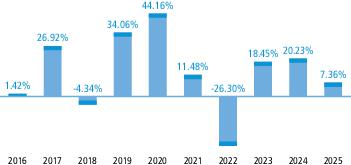
The bar chart and table below provide an indication of the risks of investing in the Fund by showing: (a) changes in the performance of the Fund’s Service Shares from year to year; and (b) how the average annual total returns of the Fund’s Service Shares compare to those of a regulatorily-required broad-based securities market index (Russell 3000® Index) (the “Regulatory Benchmark”) and the Russell Midcap® Growth Index (the “Performance Benchmark”). The Performance
Benchmark is generally more representative of the market sectors and/or types of investments in which the Fund invests or to which the Fund has exposure and which the Investment Adviser uses to measure the Fund’s performance. The Fund has included in the table below the performance of the Regulatory Benchmark, which represents a broader measure of market performance, to comply with regulatory requirements. For additional information about these benchmark indices, please see “Additional Performance and Benchmark Information” on page 6 of the Prospectus. The Fund’s past performance is not necessarily an indication of how the Fund will perform in the future. Performance reflects applicable fee waivers and/or expense limitations in effect during the periods shown. In addition, performance reflects Fund level expenses but does not reflect the fees and expenses associated with any variable annuity contract or variable life insurance policy that uses the Fund as an investment option for any contract or policy. Had performance reflected all of those fees and expenses, performance would have been reduced. Updated performance information is available at no cost at am.gs.com or by calling the phone number on the back cover of the Prospectus.
CALENDAR YEAR
During the periods shown in the chart above:
Returns
Quarter ended
Best Quarter Return
32.27%
June 30, 2020
Worst Quarter Return
-20.13%
June 30, 2022
AVERAGE ANNUAL TOTAL RETURN
For the period ended December 31, 2025


1 Year
5 Years
10 Years
Inception
Date
Service Shares
7.36%
4.67%
11.58%
1/9/2006
Russell Midcap® Growth Index
8.66%
6.64%
12.48%
Russell 3000® Index
17.15%
13.14%
14.27%
Benchmark returns do not reflect any deductions for fees or expenses.
Portfolio Management
Goldman Sachs Asset Management, L.P. is the investment adviser for the Fund (the “Investment Adviser” or “GSAM”).
Portfolio Managers: Jenny Chang, Managing Director, has managed the Fund since 2019.
Buying and Selling Fund Shares
Fund shares are not sold directly to the public. Fund shares may be purchased and redeemed by separate accounts that fund variable annuity and variable life insurance contracts issued by participating insurance companies and other qualified purchasers. Orders received from separate accounts and other qualified purchasers to purchase or redeem Fund shares are effected on business days. Individual investors may
purchase or redeem Fund shares indirectly through variable annuity contracts and variable life insurance policies offered through the separate accounts.
Tax Information
Provided that the Fund and separate accounts investing in the Fund satisfy applicable tax requirements, the Fund will not be subject to federal tax. Special tax rules apply to life insurance companies, variable annuity contracts and variable life insurance contracts. For information on federal income taxation of owners of variable annuity or variable life insurance contracts, see the prospectus for the applicable contract.

4 Summary Prospectus — Goldman Sachs Mid Cap Growth Fund – Service Shares
Payments to Broker-Dealers and
Other Financial Intermediaries
The Fund and/or its related companies may pay participating insurance companies and securities dealers for the sale of Fund shares and related services. These payments may create a conflict of interest by influencing
the insurance company and your salesperson to recommend the Fund over another investment. Ask your salesperson or visit your insurance company’s website for more information.
VITGOPSUMS-26