LOGO

The 122nd Ordinary General Shareholders’ MeetingNotice of ConvocationDate and time: 10:00 a.m., Wednesday, June 17, 2026Venue: Toyota Head Office, 1, Toyota-cho, Toyota City, Aichi PrefectureResolution: Proposed Resolution:Election of 6 Members of the Board of Directors (Excluding Directors who are Audit & Supervisory Committee Members) Picture from the award-winning entries of the 19th Dream Car Art Contest “A Car That Lets Me Meet the People I Want to See”TOYOTA MOTOR CORPORATION(Securities Code 7203)


LOGO

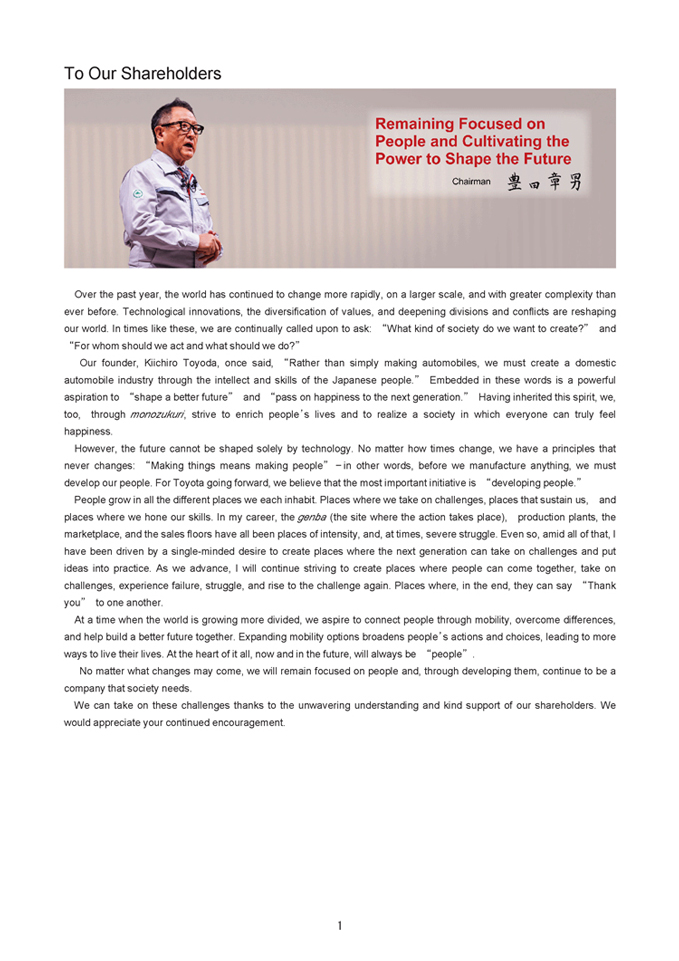
To Our Shareholders Over the past year, the world has continued to change more rapidly, on a larger scale, and with greater complexity than ever before. Technological innovations, the diversification of values, and deepening divisions and conflicts are reshaping our world. In times like these, we are continually called upon to ask: “What kind of society do we want to create?”and “For whom should we act and what should we do?” Our founder, Kiichiro Toyoda, once said, “Rather than simply making automobiles, we must create a domestic automobile industry through the intellect and skills of the Japanese people.”Embedded in these words is a powerful aspiration to “shape a better future”and “pass on happiness to the next generation.”Having inherited this spirit, we, too, through monozukuri, strive to enrich people’s lives and to realize a society in which everyone can truly feel happiness. However, the future cannot be shaped solely by technology. No matter how times change, we have a principles that never changes: “Making things means making people”—in other words, before we manufacture anything, we must develop our people. For Toyota going forward, we believe that the most important initiative is “developing people.” People grow in all the different places we each inhabit. Places where we take on challenges, places that sustain us, and places where we hone our skills. In my career, the genba (the site where the action takes place), production plants, the marketplace, and the sales floors have all been places of intensity, and, at times, severe struggle. Even so, amid all of that, I have been driven by a single-minded desire to create places where the next generation can take on challenges and put ideas into practice. As we advance, I will continue striving to create places where people can come together, take on challenges, experience failure, struggle, and rise to the challenge again. Places where, in the end, they can say “Thank you”to one another. At a time when the world is growing more divided, we aspire to connect people through mobility, overcome differences, and help build a better future together. Expanding mobility options broadens people’s actions and choices, leading to more ways to live their lives. At the heart of it all, now and in the future, will always be “people”. No matter what changes may come, we will remain focused on people and, through developing them, continue to be a company that society needs. We can take on these challenges thanks to the unwavering understanding and kind support of our shareholders. We would appreciate your continued encouragement.


LOGO

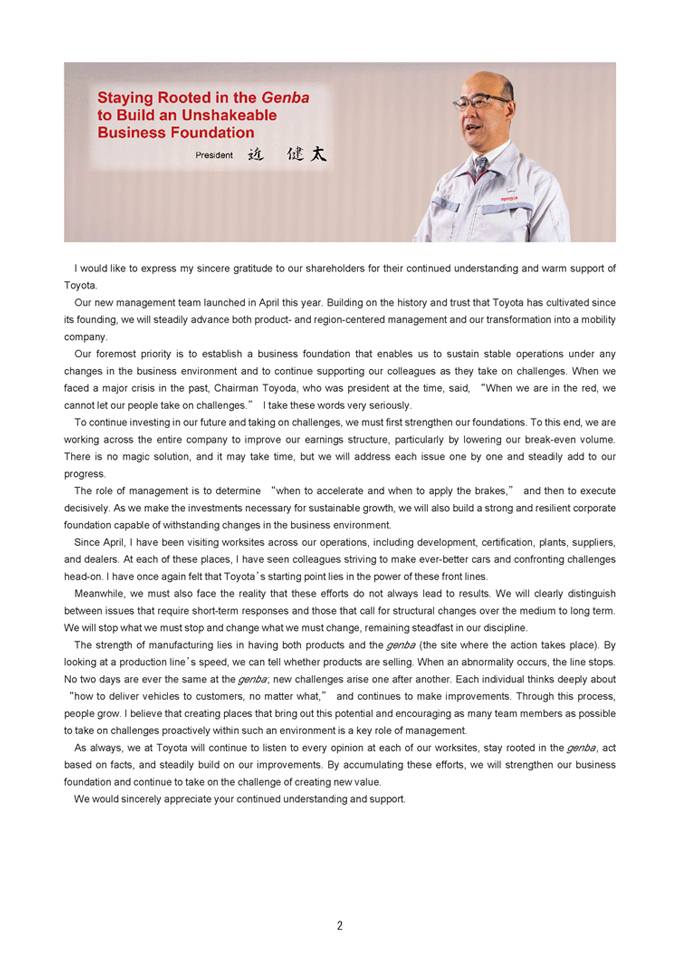
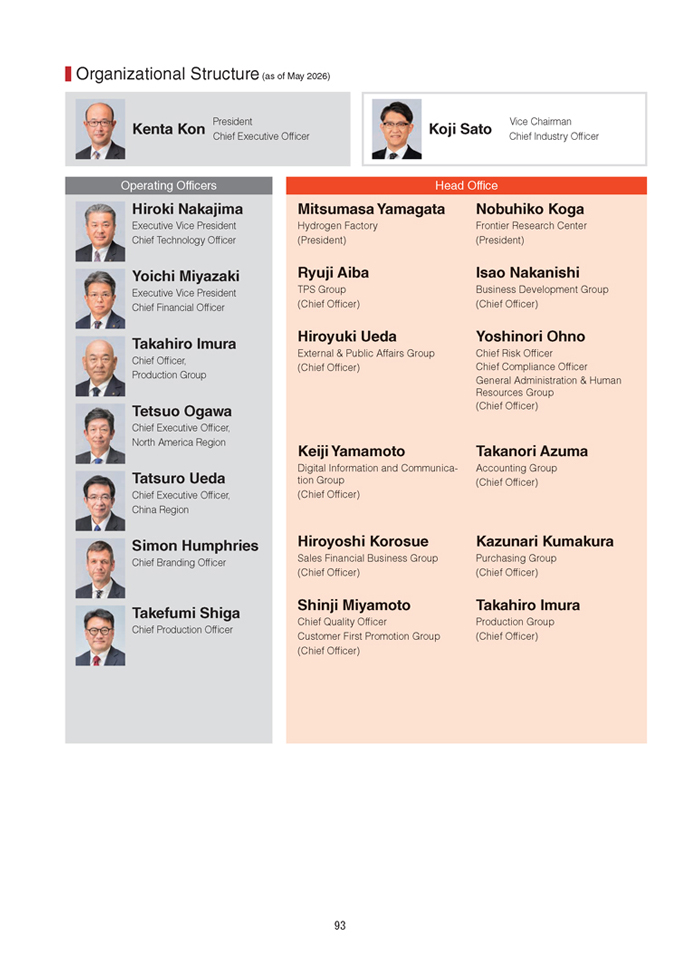
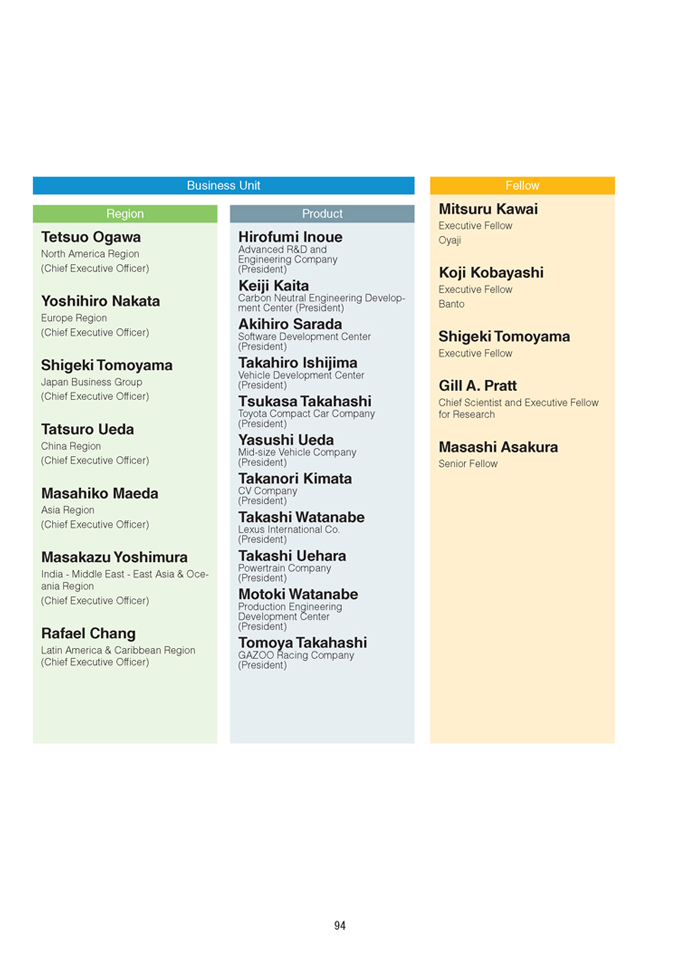
I would like to express my sincere gratitude to our shareholders for their continued understanding and warm support ofToyota.Our new management team launched in April this year. Building on the history and trust that Toyota has cultivated since its founding, we will steadily advance both product- and region-centered management and our transformation into a mobility company.Our foremost priority is to establish a business foundation that enables us to sustain stable operations under anychanges in the business environment and to continue supporting our colleagues as they take on challenges. When we faced a major crisis in the past, Chairman Toyoda, who was president at the time, said, “When we are in the red, we cannot let our people take on challenges.”I take these words very seriously.To continue investing in our future and taking on challenges, we must first strengthen our foundations. To this end, we are working across the entire company to improve our earnings structure, particularly by lowering our break-even volume. There is no magic solution, and it may take time, but we will address each issue one by one and steadily add to ourprogress.The role of management is to determine “when to accelerate and when to apply the brakes,”and then to execute decisively. As we make the investments necessary for sustainable growth, we will also build a strong and resilient corporatefoundation capable of withstanding changes in the business environment.Since April, I have been visiting worksites across our operations, including development, certification, plants, suppliers,and dealers. At each of these places, I have seen colleagues striving to make ever-better cars and confronting challenges head-on. I have once again felt that Toyota’s starting point lies in the power of these front lines.Meanwhile, we must also face the reality that these efforts do not always lead to results. We will clearly distinguish between issues that require short-term responses and those that call for structural changes over the medium to long term. We will stop what we must stop and change what we must change, remaining steadfast in our discipline.The strength of manufacturing lies in having both products and the genba (the site where the action takes place). By looking at a production line’s speed, we can tell whether products are selling. When an abnormality occurs, the line stops. No two days are ever the same at the genba; new challenges arise one after another. Each individual thinks deeply about “how to deliver vehicles to customers, no matter what,”and continues to make improvements. Through this process, people grow. I believe that creating places that bring out this potential and encouraging as many team members as possibleto take on challenges proactively within such an environment is a key role of management.As always, we at Toyota will continue to listen to every opinion at each of our worksites, stay rooted in the genba, act based on facts, and steadily build on our improvements. By accumulating these efforts, we will strengthen our business foundation and continue to take on the challenge of creating new value.We would sincerely appreciate your continued understanding and support.


LOGO

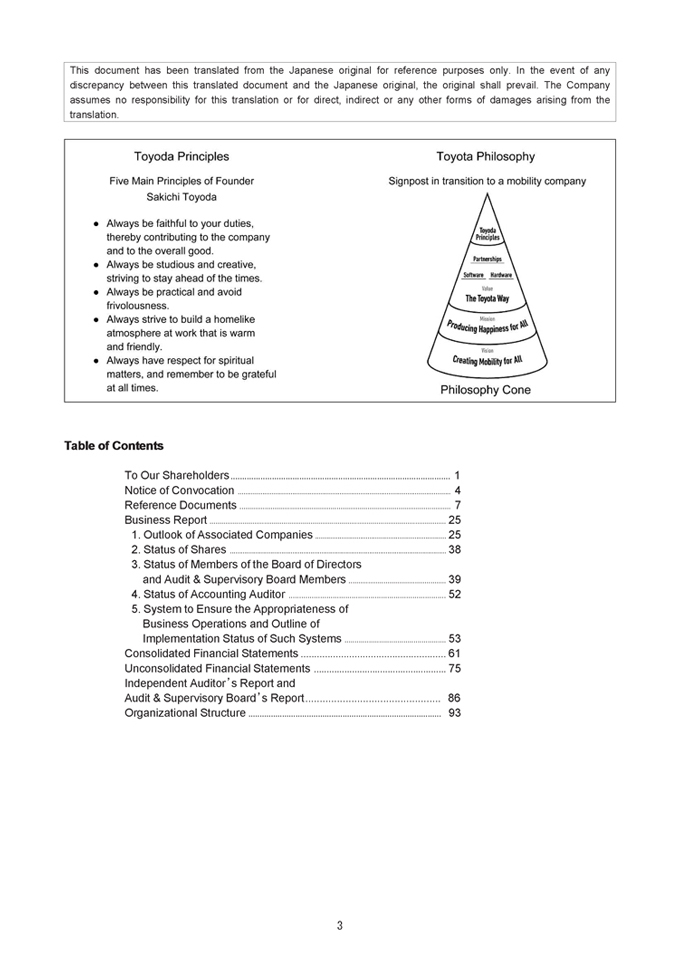
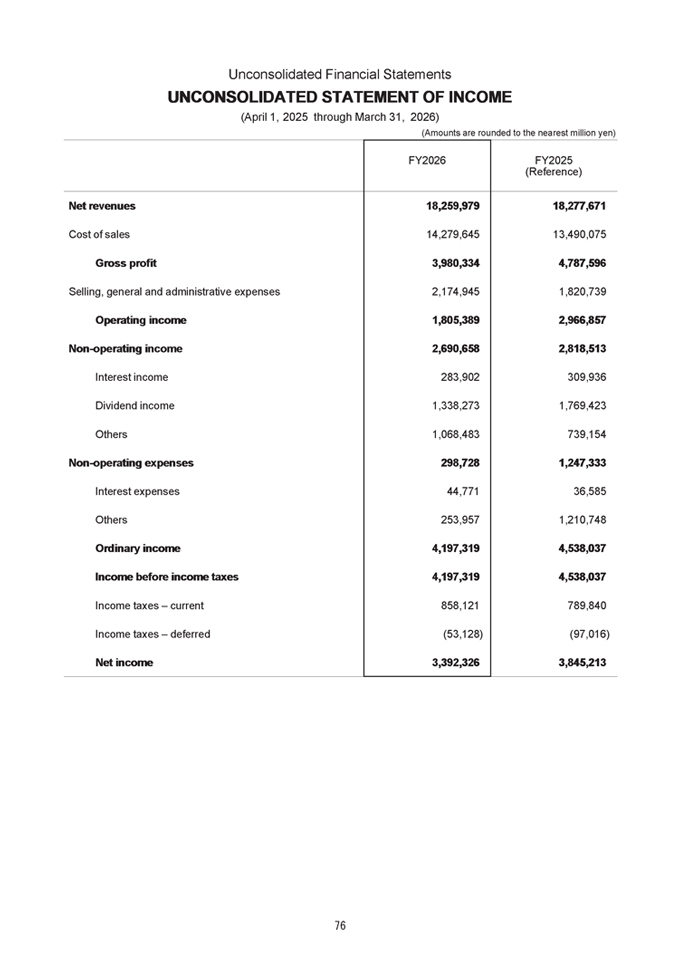
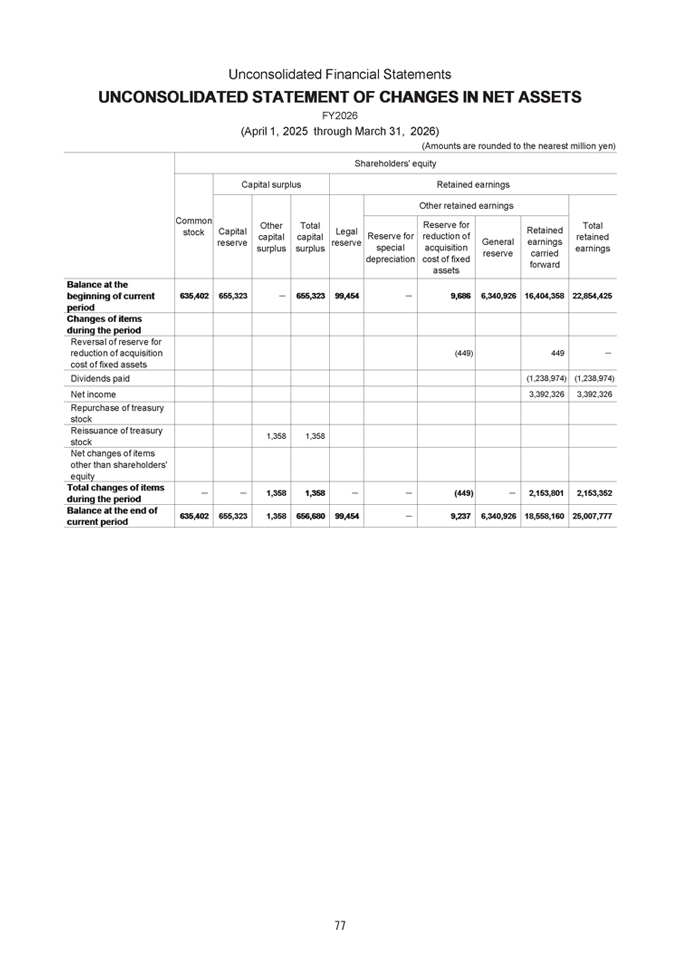
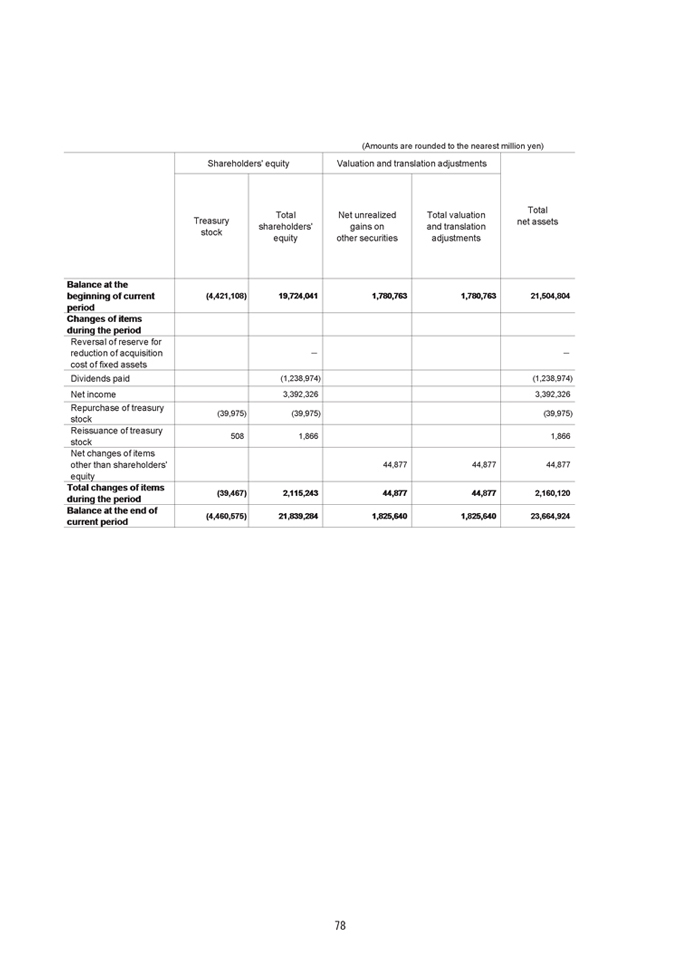
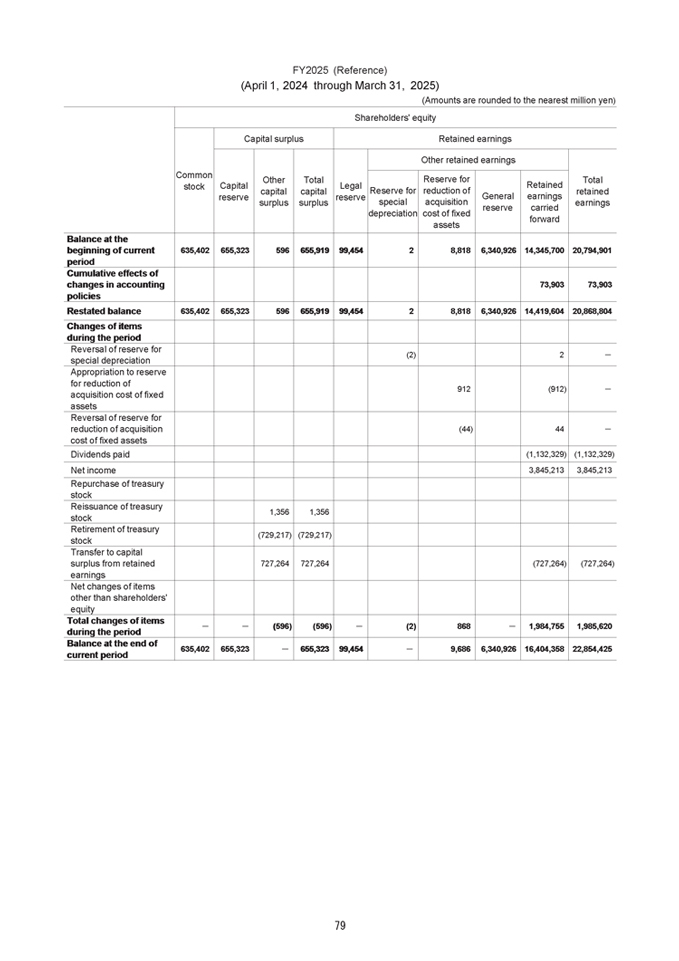
This document has been translated from the Japanese original for reference purposes only. In the event of any discrepancy between this translated document and the Japanese original, the original shall prevail. The Company assumes no responsibility for this translation or for direct, indirect or any other forms of damages arising from the translation. Table of Contents To Our Shareholders 1 Notice of Convocation 4 Reference Documents 7 Business Report 25 1. Outlook of Associated Companies 25 2. Status of Shares 38 3. Status of Members of the Board of Directors and Audit & Supervisory Board Members 39 4. Status of Accounting Auditor 52 5. System to Ensure the Appropriateness of Business Operations and Outline of Implementation Status of Such Systems 53 Consolidated Financial Statements 61 Unconsolidated Financial Statements 75 Independent Auditor ‘s Report and Audit & Supervisory Board ‘s Report 86 Organizational Structure93


LOGO

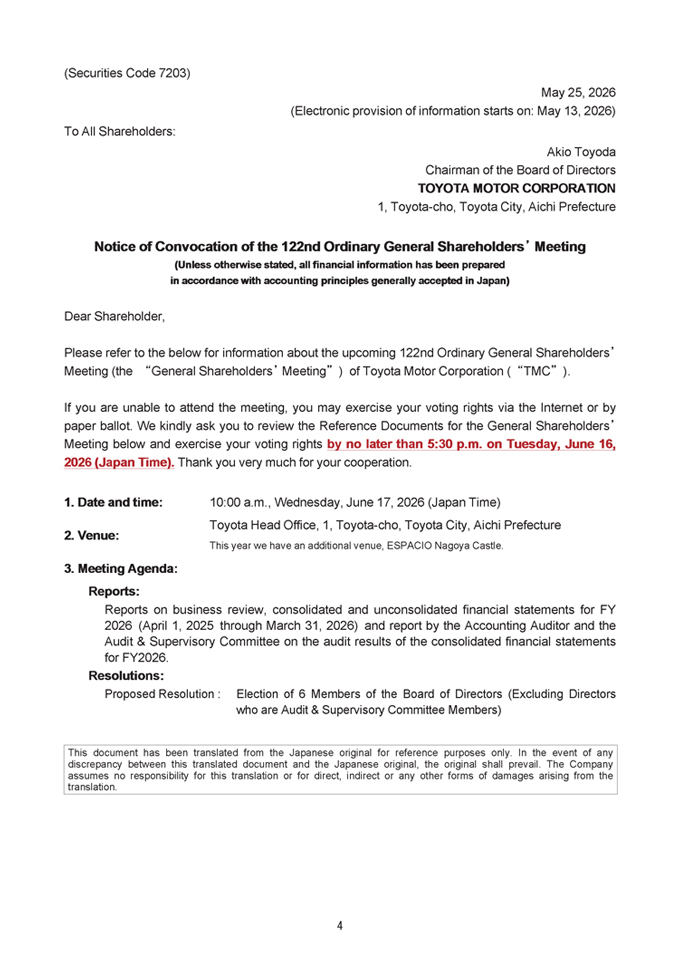
(Securities Code 7203)May 25, 2026(Electronic provision of information starts on: May 13, 2026)To All Shareholders:Akio ToyodaChairman of the Board of DirectorsTOYOTA MOTOR CORPORATION1, Toyota-cho, Toyota City, Aichi PrefectureNotice of Convocation of the 122nd Ordinary General Shareholders’Meeting(Unless otherwise stated, all financial information has been prepared in accordance with accounting principles generally accepted in Japan)Dear Shareholder,Please refer to the below for information about the upcoming 122nd Ordinary General Shareholders’ Meeting (the “General Shareholders’Meeting”) of Toyota Motor Corporation (“TMC”).If you are unable to attend the meeting, you may exercise your voting rights via the Internet or by paper ballot. We kindly ask you to review the Reference Documents for the General Shareholders’ Meeting below and exercise your voting rights by no later than 5:30 p.m. on Tuesday, June 16, 2026 (Japan Time). Thank you very much for your cooperation.1. Date and time: 10:00 a.m., Wednesday, June 17, 2026 (Japan Time) Toyota Head Office, 1, Toyota-cho, Toyota City, Aichi Prefecture2. Venue: This year we have an additional venue, ESPACIO Nagoya Castle.3. Meeting Agenda: Reports:Reports on business review, consolidated and unconsolidated financial statements for FY 2026 (April 1, 2025 through March 31, 2026) and report by the Accounting Auditor and the Audit & Supervisory Committee on the audit results of the consolidated financial statements for FY2026.Resolutions:Proposed Resolution : Election of 6 Members of the Board of Directors (Excluding Directors who are Audit & Supervisory Committee Members)This document has been translated from the Japanese original for reference purposes only. In the event of any discrepancy between this translated document and the Japanese original, the original shall prevail. The Company assumes no responsibility for this translation or for direct, indirect or any other forms of damages arising from the translation.


LOGO

In convening this General Shareholders’Meeting, TMC has taken measures to electronically provide information, and its electronic provision is posted on the following website: [TMC website] https://global.toyota/en/ir/stock/shareholders/ In addition to the above, the information is posted on the following website: [Tokyo Stock Exchange website] https://www2.jpx.co.jp/tseHpFront/JJK020010Action.do?Show=Show Access the TSE website above, search “TOYOTA MOTOR CORPORATION”or our securities code “7203,”select “Basic information”and go to “Documents for public inspection/PR information.”Other Information Concerning the Notice of Convocation·The Companies Act has been revised so that, in principle, materials concerning the General Shareholders’ Meeting are to be viewed on our website, and a paper copy of such materials are delivered only to shareholders who have requested it by the record date. However, for this Meeting, a paper copy of the “REFERENCE MATERIALS CONCERNING THEGENERAL SHAREHOLDERS’ MEETING”has been sent to shareholders regardless of whether they made a request, for their convenience when attending the Meeting.·Any revisions to matters subject to electronic provision will be posted on the websites above.


LOGO

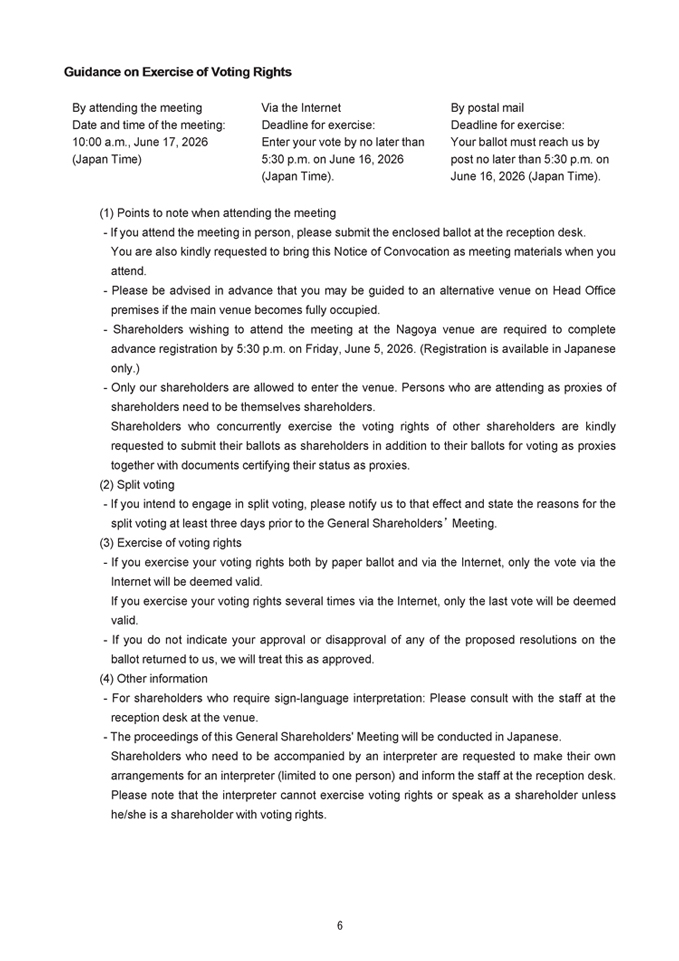
Guidance on Exercise of Voting Rights By attending the meeting Via the Internet By postal mailDate and time of the meeting: Deadline for exercise: Deadline for exercise:10:00 a.m., June 17, 2026 Enter your vote by no later than Your ballot must reach us by(Japan Time) 5:30 p.m. on June 16, 2026 post no later than 5:30 p.m. on (Japan Time). June 16, 2026 (Japan Time).(1) Points to note when attending the meeting- If you attend the meeting in person, please submit the enclosed ballot at the reception desk. You are also kindly requested to bring this Notice of Convocation as meeting materials when you attend.- Please be advised in advance that you may be guided to an alternative venue on Head Office premises if the main venue becomes fully occupied.- Shareholders wishing to attend the meeting at the Nagoya venue are required to complete advance registration by 5:30 p.m. on Friday, June 5, 2026. (Registration is available in Japanese only.) - Only our shareholders are allowed to enter the venue. Persons who are attending as proxies of shareholders need to be themselves shareholders.Shareholders who concurrently exercise the voting rights of other shareholders are kindly requested to submit their ballots as shareholders in addition to their ballots for voting as proxies together with documents certifying their status as proxies.(2) Split voting- If you intend to engage in split voting, please notify us to that effect and state the reasons for the split voting at least three days prior to the General Shareholders’Meeting.(3) Exercise of voting rights- If you exercise your voting rights both by paper ballot and via the Internet, only the vote via the Internet will be deemed valid.If you exercise your voting rights several times via the Internet, only the last vote will be deemed valid.- If you do not indicate your approval or disapproval of any of the proposed resolutions on the ballot returned to us, we will treat this as approved.(4) Other information- For shareholders who require sign-language interpretation: Please consult with the staff at the reception desk at the venue.- The proceedings of this General Shareholders’ Meeting will be conducted in Japanese. Shareholders who need to be accompanied by an interpreter are requested to make their own arrangements for an interpreter (limited to one person) and inform the staff at the reception desk. Please note that the interpreter cannot exercise voting rights or speak as a shareholder unless he/she is a shareholder with voting rights.


LOGO

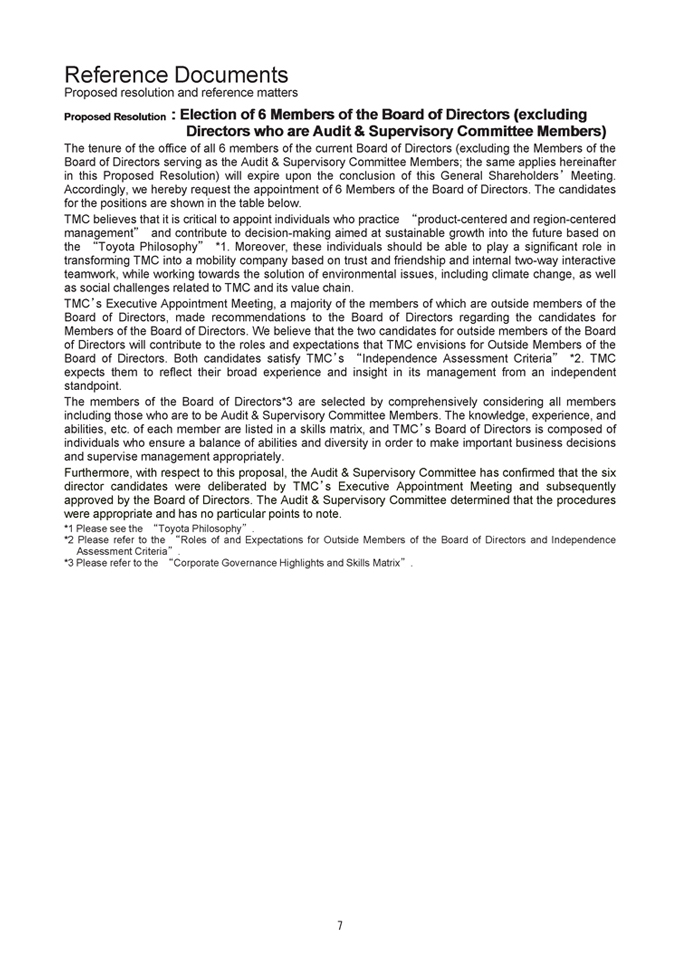
Reference DocumentsProposed resolution and reference mattersProposed Resolution : Election of 6 Members of the Board of Directors (excluding Directors who are Audit & Supervisory Committee Members)The tenure of the office of all 6 members of the current Board of Directors (excluding the Members of the Board of Directors serving as the Audit & Supervisory Committee Members; the same applies hereinafter in this Proposed Resolution) will expire upon the conclusion of this General Shareholders’Meeting. Accordingly, we hereby request the appointment of 6 Members of the Board of Directors. The candidates for the positions are shown in the table below.TMC believes that it is critical to appoint individuals who practice “product-centered and region-centered management”and contribute to decision-making aimed at sustainable growth into the future based on the “Toyota Philosophy”*1. Moreover, these individuals should be able to play a significant role in transforming TMC into a mobility company based on trust and friendship and internal two-way interactive teamwork, while working towards the solution of environmental issues, including climate change, as well as social challenges related to TMC and its value chain.TMC’s Executive Appointment Meeting, a majority of the members of which are outside members of the Board of Directors, made recommendations to the Board of Directors regarding the candidates for Members of the Board of Directors. We believe that the two candidates for outside members of the Board of Directors will contribute to the roles and expectations that TMC envisions for Outside Members of the Board of Directors. Both candidates satisfy TMC’s “Independence Assessment Criteria”*2. TMC expects them to reflect their broad experience and insight in its management from an independent standpoint.The members of the Board of Directors*3 are selected by comprehensively considering all members including those who are to be Audit & Supervisory Committee Members. The knowledge, experience, and abilities, etc. of each member are listed in a skills matrix, and TMC’s Board of Directors is composed of individuals who ensure a balance of abilities and diversity in order to make important business decisions and supervise management appropriately.Furthermore, with respect to this proposal, the Audit & Supervisory Committee has confirmed that the six director candidates were deliberated by TMC’s Executive Appointment Meeting and subsequently approved by the Board of Directors. The Audit & Supervisory Committee determined that the procedures were appropriate and has no particular points to note.*1 Please see the “Toyota Philosophy”.*2 Please refer to the “Roles of and Expectations for Outside Members of the Board of Directors and Independence Assessment Criteria”.*3 Please refer to the “Corporate Governance Highlights and Skills Matrix”.


LOGO

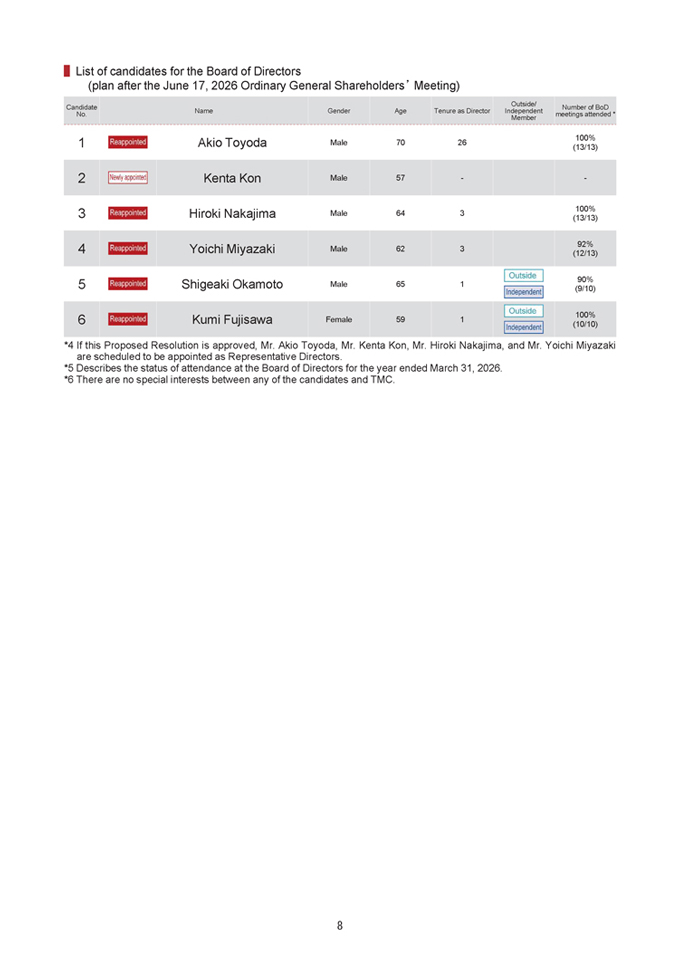
List of candidates for the Board of Directors (plan after the June 17, 2026 Ordinary General Shareholders ‘Meeting)Outside/CandidateNumber of BoDNameGenderAgeTenure as Director IndependentNo. meetings attended *Member 100%1 Akio Toyoda Male 70 26 (13/13)2 Kenta Kon Male 57 - - 100%3 Hiroki Nakajima Male 64 3 (13/13) 92%4 Yoichi Miyazaki Male 62 3 (12/13) 90%5 Shigeaki Okamoto Male 65 1 (9/10) 100%6 Kumi Fujisawa Female 59 1 (10/10)*4 If this Proposed Resolution is approved, Mr. Akio Toyoda, Mr. Kenta Kon, Mr. Hiroki Nakajima, and Mr. Yoichi Miyazakiare scheduled to be appointed as Representative Directors. *5 Describes the status of attendance at the Board of Directors for the year ended March 31, 2026. *6 There are no special interests between any of the candidates and TMC.


LOGO

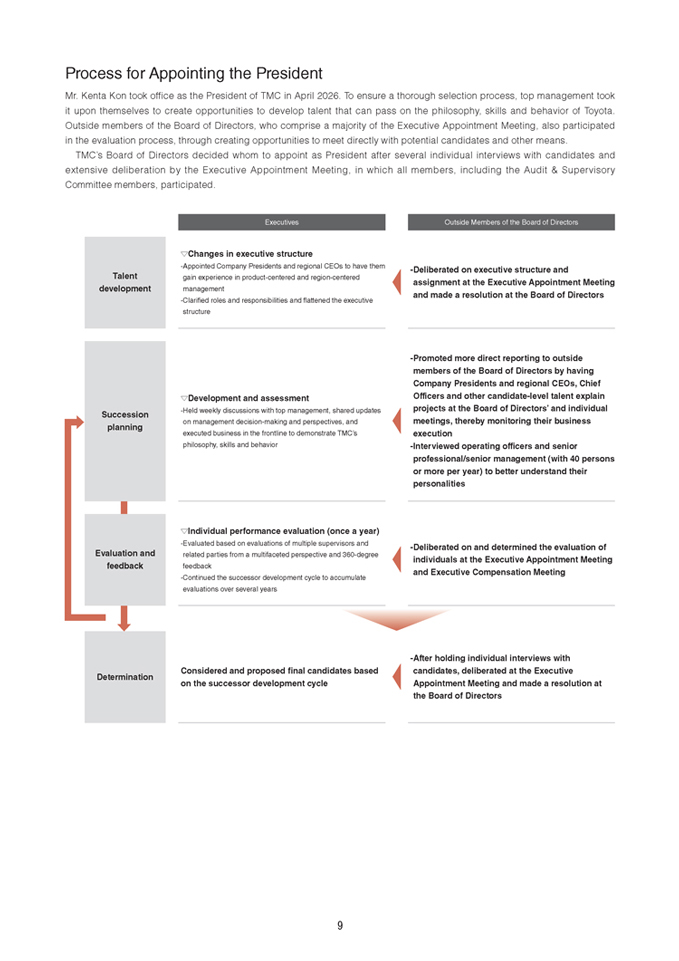
Process for Appointing the PresidentMr. Kenta Kon took of?ce as the President of TMC in April 2026. To ensure a thorough selection process, top management took it upon themselves to create opportunities to develop talent that can pass on the philosophy, skills and behavior of Toyota. Outside members of the Board of Directors, who comprise a majority of the Executive Appointment Meeting, also participated in the evaluation process, through creating opportunities to meet directly with potential candidates and other means.TMC’s Board of Directors decided whom to appoint as President after several individual interviews with candidates and extensive deliberation by the Executive Appointment Meeting, in which all members, including the Audit & Supervisory Committee members, participated.Executives Outside Members of the Board of DirectorsChanges in executive structure-Appointed Company Presidents and regional CEOs to have them -Deliberated on executive structure and Talent gain experience in product-centered and region-centered assignment at the Executive Appointment Meeting development management and made a resolution at the Board of Directors-Clarified roles and responsibilities and flattened the executive structure-Promoted more direct reporting to outside members of the Board of Directors by having Company Presidents and regional CEOs, Chief Development and assessment Officers and other candidate-level talent explain -Held weekly discussions with top management, shared updates projects at the Board of Directors’ and individual Succession on management decision-making and perspectives, and meetings, thereby monitoring their business planning executed business in the frontline to demonstrate TMC’s execution philosophy, skills and behavior -Interviewed operating officers and senior professional/senior management (with 40 persons or more per year) to better understand their personalitiesIndividual performance evaluation (once a year)-Evaluated based on evaluations of multiple supervisors and -Deliberated on and determined the evaluation of Evaluation and related parties from a multifaceted perspective and 360-degree individuals at the Executive Appointment Meeting feedback feedback and Executive Compensation Meeting-Continued the successor development cycle to accumulate evaluations over several years-After holding individual interviews with Considered and proposed final candidates based candidates, deliberated at the Executive Determination on the successor development cycle Appointment Meeting and made a resolution at the Board of Directors


LOGO

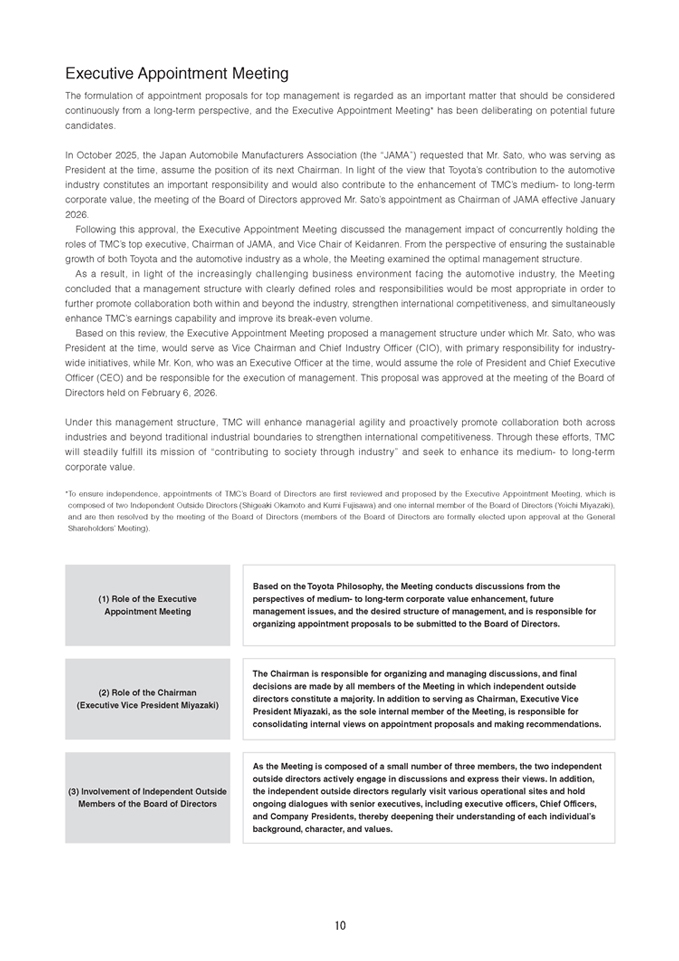
Executive Appointment MeetingThe formulation of appointment proposals for top management is regarded as an important matter that should be considered continuously from a long-term perspective, and the Executive Appointment Meeting* has been deliberating on potential future candidates.In October 2025, the Japan Automobile Manufacturers Association (the “JAMA”) requested that Mr. Sato, who was serving as President at the time, assume the position of its next Chairman. In light of the view that Toyota’s contribution to the automotive industry constitutes an important responsibility and would also contribute to the enhancement of TMC’s medium- to long-term corporate value, the meeting of the Board of Directors approved Mr. Sato’s appointment as Chairman of JAMA effective January 2026.Following this approval, the Executive Appointment Meeting discussed the management impact of concurrently holding the roles of TMC’s top executive, Chairman of JAMA, and Vice Chair of Keidanren. From the perspective of ensuring the sustainable growth of both Toyota and the automotive industry as a whole, the Meeting examined the optimal management structure.As a result, in light of the increasingly challenging business environment facing the automotive industry, the Meeting concluded that a management structure with clearly de?ned roles and responsibilities would be most appropriate in order to further promote collaboration both within and beyond the industry, strengthen international competitiveness, and simultaneously enhance TMC’s earnings capability and improve its break-even volume.Based on this review, the Executive Appointment Meeting proposed a management structure under which Mr. Sato, who was President at the time, would serve as Vice Chairman and Chief Industry Of?cer (CIO), with primary responsibility for industry-wide initiatives, while Mr. Kon, who was an Executive Of?cer at the time, would assume the role of President and Chief Executive Of?cer (CEO) and be responsible for the execution of management. This proposal was approved at the meeting of the Board of Directors held on February 6, 2026.Under this management structure, TMC will enhance managerial agility and proactively promote collaboration both across industries and beyond traditional industrial boundaries to strengthen international competitiveness. Through these efforts, TMC will steadily fulfill its mission of “contributing to society through industry” and seek to enhance its medium- to long-term corporate value.*To ensure independence, appointments of TMC’s Board of Directors are first reviewed and proposed by the Executive Appointment Meeting, which is composed of two Independent Outside Directors (Shigeaki Okamoto and Kumi Fujisawa) and one internal member of the Board of Directors (Yoichi Miyazaki), and are then resolved by the meeting of the Board of Directors (members of the Board of Directors are formally elected upon approval at the General Shareholders’ Meeting).Based on the Toyota Philosophy, the Meeting conducts discussions from the (1) Role of the Executive perspectives of medium- to long-term corporate value enhancement, future Appointment Meeting management issues, and the desired structure of management, and is responsible for organizing appointment proposals to be submitted to the Board of Directors.The Chairman is responsible for organizing and managing discussions, and final decisions are made by all members of the Meeting in which independent outside (2) Role of the Chairman directors constitute a majority. In addition to serving as Chairman, Executive Vice (Executive Vice President Miyazaki) President Miyazaki, as the sole internal member of the Meeting, is responsible for consolidating internal views on appointment proposals and making recommendations.As the Meeting is composed of a small number of three members, the two independent outside directors actively engage in discussions and express their views. In addition, (3) Involvement of Independent Outside the independent outside directors regularly visit various operational sites and hold Members of the Board of Directors ongoing dialogues with senior executives, including executive officers, Chief Officers, and Company Presidents, thereby deepening their understanding of each individual’s background, character, and values.


LOGO

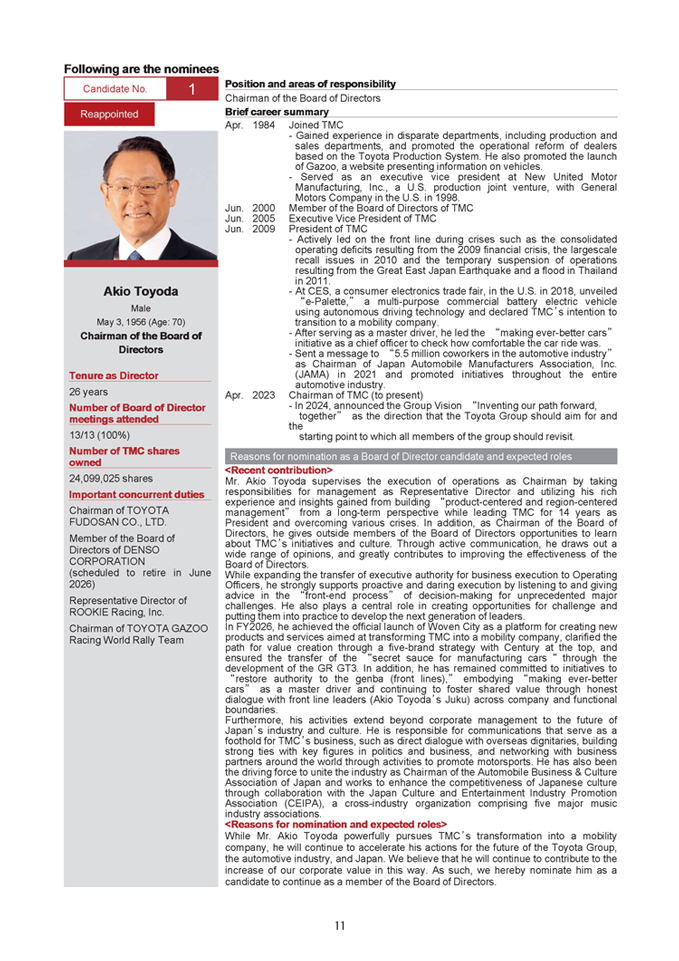
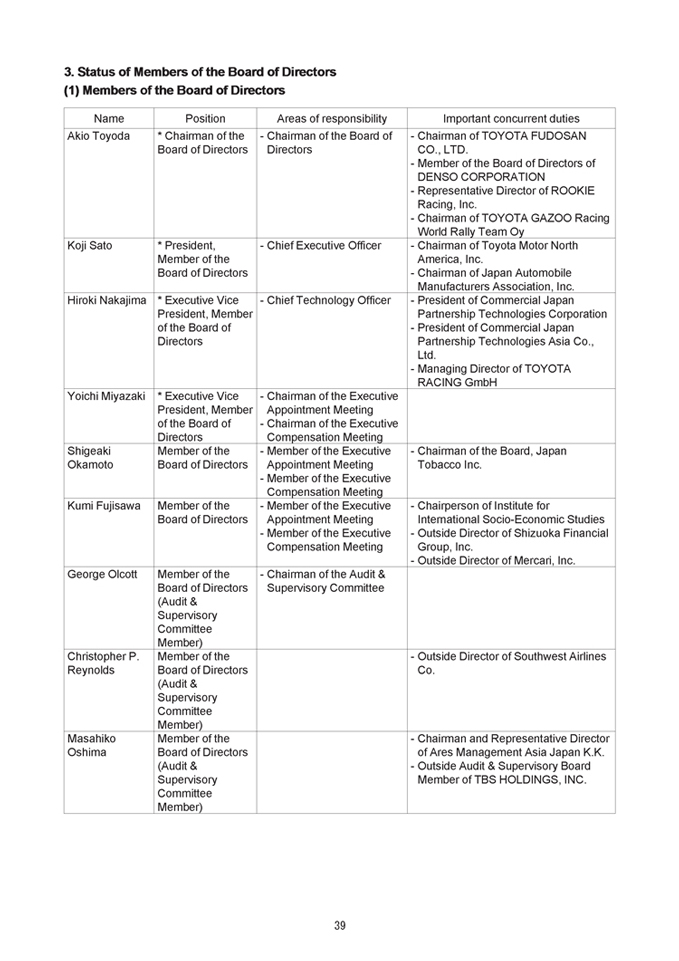
Following are the nomineesPosition and areas of responsibilityCandidate No. 1Chairman of the Board of DirectorsBrief career summaryApr. 1984 Joined TMC- Gained experience in disparate departments, including production and sales departments, and promoted the operational reform of dealers based on the Toyota Production System. He also promoted the launch of Gazoo, a website presenting information on vehicles.- Served as an executive vice president at New United Motor Manufacturing, Inc., a U.S. production joint venture, with General Motors Company in the U.S. in 1998.Jun. 2000 Member of the Board of Directors of TMC Jun. 2005 Executive Vice President of TMC Jun. 2009 President of TMC- Actively led on the front line during crises such as the consolidated operating deficits resulting from the 2009 financial crisis, the largescale recall issues in 2010 and the temporary suspension of operations resulting from the Great East Japan Earthquake and a flood in Thailand in 2011.Akio Toyoda - At CES, a consumer electronics trade fair, in the U.S. in 2018, unveiled Male “e-Palette,”a multi-purpose commercial battery electric vehicle using autonomous driving technology and declared TMC’sintention to May 3, 1956 (Age: 70) transition to a mobility company.Chairman of the Board of - After serving as a master driver, he led the “makingever-better cars” initiative as a chief officer to check how comfortable the car ride was.Directors- Sent a message to “5.5 million coworkers in the automotive industry” as Chairman of Japan Automobile Manufacturers Association, Inc.Tenure as Director (JAMA) in 2021 and promoted initiatives throughout the entire 26 years automotive industry.Apr. 2023 Chairman of TMC (to present)Number of Board of Director - In 2024, announced the Group Vision “Inventingour path forward, meetings attended together” as the direction that the Toyota Group should aim for and the 13/13 (100%) starting point to which all members of the group should revisit.Number of TMC sharesReasons for nomination as a Board of Director candidate and expected roles owned <Recent contribution>24,099,025 shares Mr. Akio Toyoda supervises the execution of operations as Chairman by taking Important concurrent duties responsibilities for management as Representative Director and utilizing his rich experience and insights gained from building “product-centeredand region-centered Chairman of TOYOTA management” from a long-term perspective while leading TMC for 14 years as FUDOSAN CO., LTD. President and overcoming various crises. In addition, as Chairman of the Board of Directors, he gives outside members of the Board of Directors opportunities to learn Member of the Board of about TMC’sinitiatives and culture. Through active communication, he draws out a Directors of DENSOCORPORATION wide range of opinions, and greatly contributes to improving the effectiveness of the Board of Directors.(scheduled to retire in June While expanding the transfer of executive authority for business execution to Operating 2026) Officers, he strongly supports proactive and daring execution by listening to and giving advice in the “front-end process” of decision-making for unprecedented major Representative Director of challenges. He also plays a central role in creating opportunities for challenge and ROOKIE Racing, Inc. putting them into practice to develop the next generation of leaders.Chairman of TOYOTA GAZOO In FY2026, he achieved the official launch of Woven City as a platform for creating new Racing World Rally Team products and services aimed at transforming TMC into a mobility company, clarified the path for value creation through a five-brand strategy with Century at the top, and ensured the transfer of the “secret sauce for manufacturing cars“ through the development of the GR GT3. In addition, he has remained committed to initiatives to “restore authority to the genba (front lines),” embodying “making ever-better cars” as a master driver and continuing to foster shared value through honest dialogue with front line leaders (Akio Toyoda’sJuku) across company and functional boundaries.Furthermore, his activities extend beyond corporate management to the future of Japan’sindustry and culture. He is responsible for communications that serve as a foothold for TMC’sbusiness, such as direct dialogue with overseas dignitaries, building strong ties with key figures in politics and business, and networking with business partners around the world through activities to promote motorsports. He has also been the driving force to unite the industry as Chairman of the Automobile Business & Culture Association of Japan and works to enhance the competitiveness of Japanese culture through collaboration with the Japan Culture and Entertainment Industry Promotion Association (CEIPA), a cross-industry organization comprising five major music industry associations.<Reasons for nomination and expected roles>While Mr. Akio Toyoda powerfully pursues TMC’s transformation into a mobility company, he will continue to accelerate his actions for the future of the Toyota Group, the automotive industry, and Japan. We believe that he will continue to contribute to the increase of our corporate value in this way. As such, we hereby nominate him as a candidate to continue as a member of the Board of Directors.


LOGO

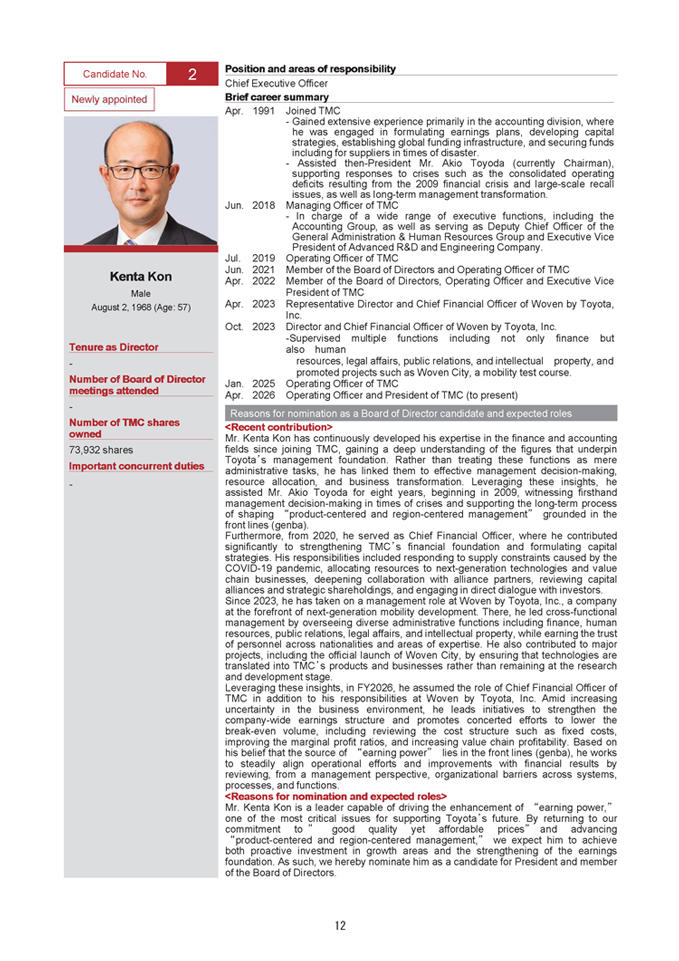
Position and areas of responsibilityCandidate No. 2Chief Executive OfficerBrief career summaryApr. 1991 Joined TMC- Gained extensive experience primarily in the accounting division, where he was engaged in formulating earnings plans, developing capital strategies, establishing global funding infrastructure, and securing funds including for suppliers in times of disaster.- Assisted then-President Mr. Akio Toyoda (currently Chairman), supporting responses to crises such as the consolidated operating deficits resulting from the 2009 financial crisis and large-scale recall issues, as well as long-term management transformation.Jun. 2018 Managing Officer of TMC- In charge of a wide range of executive functions, including the Accounting Group, as well as serving as Deputy Chief Officer of the General Administration & Human Resources Group and Executive Vice President of Advanced R&D and Engineering Company.Jul. 2019 Operating Officer of TMCJun. 2021 Member of the Board of Directors and Operating Officer of TMC Kenta Kon Apr. 2022 Member of the Board of Directors, Operating Officer and Executive Vice Male President of TMCAugust 2, 1968 (Age: 57) Apr. 2023 Representative Director and Chief Financial Officer of Woven by Toyota, Inc.Oct. 2023 Director and Chief Financial Officer of Woven by Toyota, Inc.-Supervised multiple functions including not only finance butTenure as Director also human- resources, legal affairs, public relations, and intellectual property, and Number of Board of Director promoted projects such as Woven City, a mobility test course. meetings attended Jan. 2025 Operating Officer of TMCApr. 2026 Operating Officer and President of TMC (to present) -Reasons for nomination as a Board of Director candidate and expected rolesNumber of TMC shares owned <Recent contribution>Mr. Kenta Kon has continuously developed his expertise in the finance and accounting 73,932 shares fields since joining TMC, gaining a deep understanding of the figures that underpin Toyota’s management foundation. Rather than treating these functions as mereImportant concurrent duties administrative tasks, he has linked them to effective management decision-making, - resource allocation, and business transformation. Leveraging these insights, he assisted Mr. Akio Toyoda for eight years, beginning in 2009, witnessing firsthand management decision-making in times of crises and supporting the long-term process of shaping “product-centeredand region-centered management” grounded in the front lines (genba).Furthermore, from 2020, he served as Chief Financial Officer, where he contributed significantly to strengthening TMC’s financial foundation and formulating capital strategies. His responsibilities included responding to supply constraints caused by the COVID-19 pandemic, allocating resources to next-generation technologies and value chain businesses, deepening collaboration with alliance partners, reviewing capital alliances and strategic shareholdings, and engaging in direct dialogue with investors. Since 2023, he has taken on a management role at Woven by Toyota, Inc., a company at the forefront of next-generation mobility development. There, he led cross-functional management by overseeing diverse administrative functions including finance, human resources, public relations, legal affairs, and intellectual property, while earning the trust of personnel across nationalities and areas of expertise. He also contributed to major projects, including the official launch of Woven City, by ensuring that technologies are translated into TMC’sproducts and businesses rather than remaining at the research and development stage.Leveraging these insights, in FY2026, he assumed the role of Chief Financial Officer of TMC in addition to his responsibilities at Woven by Toyota, Inc. Amid increasing uncertainty in the business environment, he leads initiatives to strengthen the company-wide earnings structure and promotes concerted efforts to lower the break-even volume, including reviewing the cost structure such as fixed costs, improving the marginal profit ratios, and increasing value chain profitability. Based on his belief that the source of “earningpower” lies in the front lines (genba), he works to steadily align operational efforts and improvements with financial results by reviewing, from a management perspective, organizational barriers across systems, processes, and functions.<Reasons for nomination and expected roles>Mr. Kenta Kon is a leader capable of driving the enhancement of “earningpower,” one of the most critical issues for supporting Toyota’s future. By returning to our commitment to ” good quality yet affordable prices” and advancing “product-centered and region-centered management,” we expect him to achieve both proactive investment in growth areas and the strengthening of the earnings foundation. As such, we hereby nominate him as a candidate for President and member of the Board of Directors.


LOGO

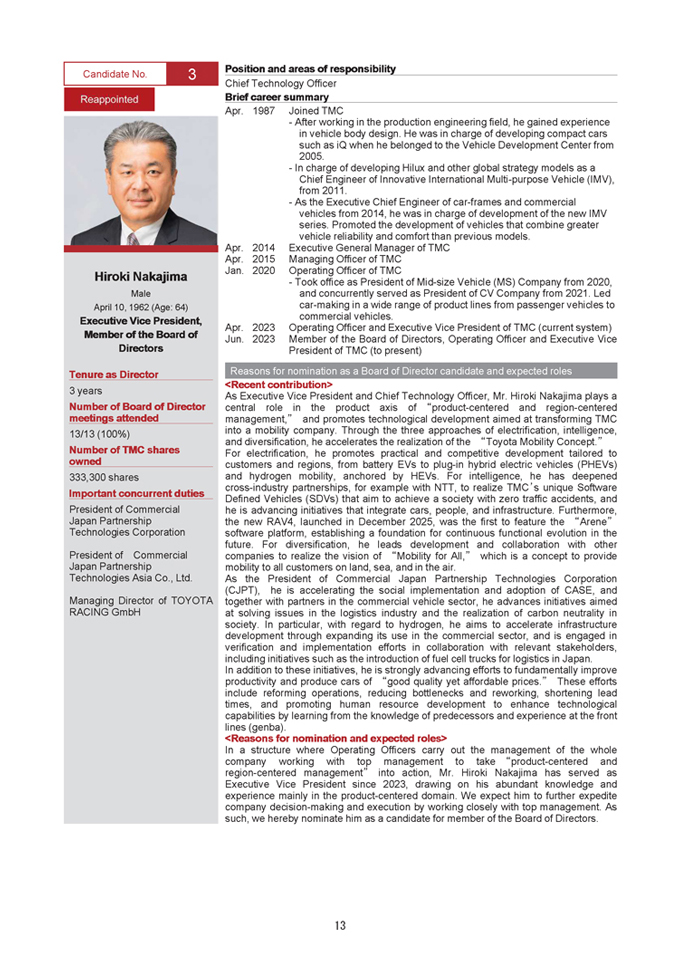
Position and areas of responsibilityCandidate No. 3Chief Technology OfficerBrief career summaryApr. 1987 Joined TMC- After working in the production engineering field, he gained experience in vehicle body design. He was in charge of developing compact cars such as iQ when he belonged to the Vehicle Development Center from 2005.- In charge of developing Hilux and other global strategy models as a Chief Engineer of Innovative International Multi-purpose Vehicle (IMV), from 2011.- As the Executive Chief Engineer of car-frames and commercial vehicles from 2014, he was in charge of development of the new IMV series. Promoted the development of vehicles that combine greater vehicle reliability and comfort than previous models.Apr. 2014 Executive General Manager of TMC Apr. 2015 Managing Officer of TMC Jan. 2020 Operating Officer of TMCHiroki Nakajima- Took office as President of Mid-size Vehicle (MS) Company from 2020, Male and concurrently served as President of CV Company from 2021. Led April 10, 1962 (Age: 64) car-making in a wide range of product lines from passenger vehicles to commercial vehicles.Executive Vice President,Member of the Board of Apr. 2023 Operating Officer and Executive Vice President of TMC (current system) Jun. 2023 Member of the Board of Directors, Operating Officer and Executive Vice Directors President of TMC (to present)Reasons for nomination as a Board of Director candidate and expected rolesTenure as Director<Recent contribution>3 yearsAs Executive Vice President and Chief Technology Officer, Mr. Hiroki Nakajima plays a Number of Board of Director central role in the product axis of “product-centered and region-centered meetings attended management,” and promotes technological development aimed at transforming TMC into a mobility company. Through the three approaches of electrification, intelligence, 13/13 (100%) and he accelerates the of Mobility diversification, realization the “Toyota Concept.” Number of TMC shares For electrification, he promotes practical and competitive development tailored to owned customers and regions, from battery EVs to plug-in hybrid electric vehicles (PHEVs) 333,300 shares and hydrogen mobility, anchored by HEVs. For intelligence, he has deepened cross-industry partnerships, for example with NTT, to realize TMC’sunique SoftwareImportant concurrent dutiesDefined Vehicles (SDVs) that aim to achieve a society with zero traffic accidents, and President of Commercial he is advancing initiatives that integrate cars, people, and infrastructure. Furthermore, Japan Partnership the new RAV4, launched in December 2025, was the first to feature the “Arene” Technologies Corporation software platform, establishing a foundation for continuous functional evolution in the future. For diversification, he leads development and collaboration with other President of Commercial companies to realize the vision of “Mobilityfor All,” which is a concept to provide Japan Partnership mobility to all customers on land, sea, and in the air.Technologies Asia Co., Ltd. As the President of Commercial Japan Partnership Technologies Corporation (CJPT), he is accelerating the social implementation and adoption of CASE, and Managing Director of TOYOTA together with partners in the commercial vehicle sector, he advances initiatives aimed RACING GmbH at solving issues in the logistics industry and the realization of carbon neutrality in society. In particular, with regard to hydrogen, he aims to accelerate infrastructure development through expanding its use in the commercial sector, and is engaged in verification and implementation efforts in collaboration with relevant stakeholders, including initiatives such as the introduction of fuel cell trucks for logistics in Japan.In addition to these initiatives, he is strongly advancing efforts to fundamentally improve productivity and produce cars of “goodquality yet affordable prices.”These efforts include reforming operations, reducing bottlenecks and reworking, shortening lead times, and promoting human resource development to enhance technological capabilities by learning from the knowledge of predecessors and experience at the front lines (genba).<Reasons for nomination and expected roles>In a structure where Operating Officers carry out the management of the whole company working with top management to take “product-centered and region-centered management” into action, Mr. Hiroki Nakajima has served as Executive Vice President since 2023, drawing on his abundant knowledge and experience mainly in the product-centered domain. We expect him to further expedite company decision-making and execution by working closely with top management. As such, we hereby nominate him as a candidate for member of the Board of Directors.


LOGO

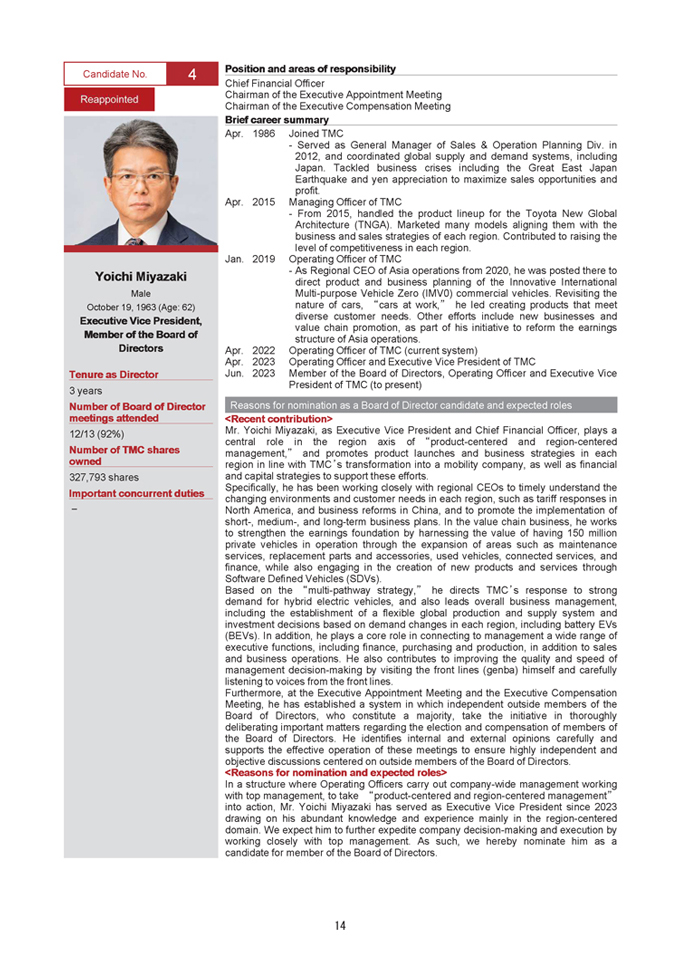
Position and areas of responsibilityCandidate No. 4Chief Financial OfficerChairman of the Executive Appointment Meeting Chairman of the Executive Compensation MeetingBrief career summaryApr. 1986 Joined TMC- Served as General Manager of Sales & Operation Planning Div. in 2012, and coordinated global supply and demand systems, including Japan. Tackled business crises including the Great East Japan Earthquake and yen appreciation to maximize sales opportunities and profit.Apr. 2015 Managing Officer of TMC- From 2015, handled the product lineup for the Toyota New Global Architecture (TNGA). Marketed many models aligning them with the business and sales strategies of each region. Contributed to raising the level of competitiveness in each region.Jan. 2019 Operating Officer of TMC- As Regional CEO of Asia operations from 2020, he was posted there toYoichi Miyazakidirect product and business planning of the Innovative International Male Multi-purpose Vehicle Zero (IMV0) commercial vehicles. Revisiting the October 19, 1963 (Age: 62) nature of cars, “carsat work,” he led creating products that meet diverse customer needs. Other efforts include new businesses andExecutive Vice President,Member of the Board of value chain promotion, as part of his initiative to reform the earnings structure of Asia operations.Directors Apr. 2022 Operating Officer of TMC (current system)Apr. 2023 Operating Officer and Executive Vice President of TMCTenure as Director Jun. 2023 Member of the Board of Directors, Operating Officer and Executive Vice President of TMC (to present) 3 years Number of Board of Director Reasons for nomination as a Board of Director candidate and expected roles meetings attended <Recent contribution>Mr. Yoichi Miyazaki, as Executive Vice President and Chief Financial Officer, plays a 12/13 (92%) central role in the region axis of “product-centered and region-centered Number of TMC shares management,” and promotes product launches and business strategies in each owned region in line with TMC’stransformation into a mobility company, as well as financial 327,793 shares and capital strategies to support these efforts.Specifically, he has been working closely with regional CEOs to timely understand theImportant concurrent duties changing environments and customer needs in each region, such as tariff responses in— North America, and business reforms in China, and to promote the implementation of short-, medium-, and long-term business plans. In the value chain business, he works to strengthen the earnings foundation by harnessing the value of having 150 million private vehicles in operation through the expansion of areas such as maintenance services, replacement parts and accessories, used vehicles, connected services, and finance, while also engaging in the creation of new products and services through Software Defined Vehicles (SDVs).Based on the “multi-pathway strategy,” he directs TMC’s response to strong demand for hybrid electric vehicles, and also leads overall business management, including the establishment of a flexible global production and supply system and investment decisions based on demand changes in each region, including battery EVs (BEVs). In addition, he plays a core role in connecting to management a wide range of executive functions, including finance, purchasing and production, in addition to sales and business operations. He also contributes to improving the quality and speed of management decision-making by visiting the front lines (genba) himself and carefully listening to voices from the front lines.Furthermore, at the Executive Appointment Meeting and the Executive Compensation Meeting, he has established a system in which independent outside members of the Board of Directors, who constitute a majority, take the initiative in thoroughly deliberating important matters regarding the election and compensation of members of the Board of Directors. He identifies internal and external opinions carefully and supports the effective operation of these meetings to ensure highly independent and objective discussions centered on outside members of the Board of Directors.<Reasons for nomination and expected roles>In a structure where Operating Officers carry out company-wide management working with top management, to take “product-centeredand region-centered management” into action, Mr. Yoichi Miyazaki has served as Executive Vice President since 2023 drawing on his abundant knowledge and experience mainly in the region-centered domain. We expect him to further expedite company decision-making and execution by working closely with top management. As such, we hereby nominate him as a candidate for member of the Board of Directors.


LOGO

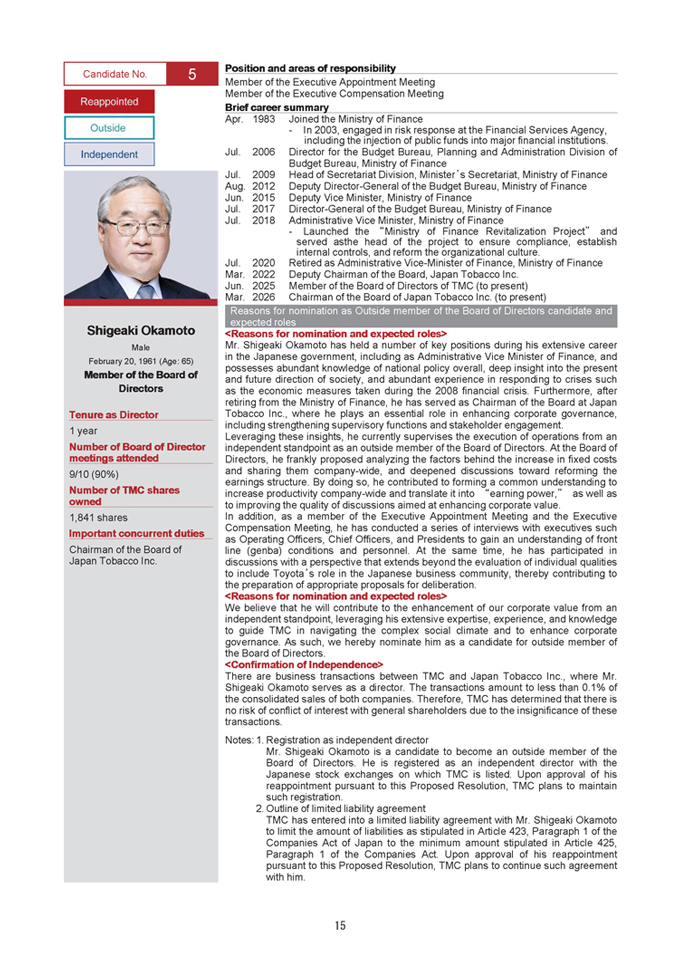
Position and areas of responsibilityCandidate No. 5 Member of the Executive Appointment Meeting Member of the Executive Compensation MeetingBrief career summaryApr. 1983 Joined the Ministry of Finance- In 2003, engaged in risk response at the Financial Services Agency, including the injection of public funds into major financial institutions.Jul. 2006 Director for the Budget Bureau, Planning and Administration Division of Budget Bureau, Ministry of Finance Jul. 2009 Head of Secretariat Division, Minister’sSecretariat, Ministry of Finance Aug. 2012 Deputy Director-General of the Budget Bureau, Ministry of Finance Jun. 2015 Deputy Vice Minister, Ministry of Finance Jul. 2017 Director-General of the Budget Bureau, Ministry of Finance Jul. 2018 Administrative Vice Minister, Ministry of Finance- Launched the “Ministry of Finance Revitalization Project” and served asthe head of the project to ensure compliance, establish internal controls, and reform the organizational culture.Jul. 2020 Retired as Administrative Vice-Minister of Finance, Ministry of Finance Mar. 2022 Deputy Chairman of the Board, Japan Tobacco Inc.Jun. 2025 Member of the Board of Directors of TMC (to present) Mar. 2026 Chairman of the Board of Japan Tobacco Inc. (to present)Reasons for nomination as Outside member of the Board of Directors candidate andShigeaki Okamoto expected roles<Reasons for nomination and expected roles>Male Mr. Shigeaki Okamoto has held a number of key positions during his extensive career in the Japanese government, including as Administrative Vice Minister of Finance, and February 20, 1961 (Age: 65) possesses abundant knowledge of national policy overall, deep insight into the presentMember of the Board of and future direction of society, and abundant experience in responding to crises such Directors as the economic measures taken during the 2008 financial crisis. Furthermore, after retiring from the Ministry of Finance, he has served as Chairman of the Board at Japan Tenure as Director Tobacco Inc., where he plays an essential role in enhancing corporate governance, including strengthening supervisory functions and stakeholder engagement. 1 year Leveraging these insights, he currently supervises the execution of operations from an Number of Board of Director independent standpoint as an outside member of the Board of Directors. At the Board of meetings attended Directors, he frankly proposed analyzing the factors behind the increase in fixed costs 9/10 (90%) and sharing them company-wide, and deepened discussions toward reforming the earnings structure. By doing so, he contributed to forming a common understanding to Number of TMC shares increase productivity company-wide and translate it into “earningpower,” as well as owned to improving the quality of discussions aimed at enhancing corporate value. 1,841 shares In addition, as a member of the Executive Appointment Meeting and the Executive Compensation Meeting, he has conducted a series of interviews with executives suchImportant concurrent duties as Operating Officers, Chief Officers, and Presidents to gain an understanding of front Chairman of the Board of line (genba) conditions and personnel. At the same time, he has participated in Japan Tobacco Inc. discussions with a perspective that extends beyond the evaluation of individual qualities to include Toyota’srole in the Japanese business community, thereby contributing to the preparation of appropriate proposals for deliberation.<Reasons for nomination and expected roles>We believe that he will contribute to the enhancement of our corporate value from an independent standpoint, leveraging his extensive expertise, experience, and knowledge to guide TMC in navigating the complex social climate and to enhance corporate governance. As such, we hereby nominate him as a candidate for outside member of the Board of Directors.<Confirmation of Independence>There are business transactions between TMC and Japan Tobacco Inc., where Mr. Shigeaki Okamoto serves as a director. The transactions amount to less than 0.1% of the consolidated sales of both companies. Therefore, TMC has determined that there is no risk of conflict of interest with general shareholders due to the insignificance of these transactions.Notes:1.Registration as independent directorMr. Shigeaki Okamoto is a candidate to become an outside member of the Board of Directors. He is registered as an independent director with the Japanese stock exchanges on which TMC is listed. Upon approval of his reappointment pursuant to this Proposed Resolution, TMC plans to maintain such registration.2.Outline of limited liability agreementTMC has entered into a limited liability agreement with Mr. Shigeaki Okamoto to limit the amount of liabilities as stipulated in Article 423, Paragraph 1 of the Companies Act of Japan to the minimum amount stipulated in Article 425, Paragraph 1 of the Companies Act. Upon approval of his reappointment pursuant to this Proposed Resolution, TMC plans to continue such agreement with him.


LOGO

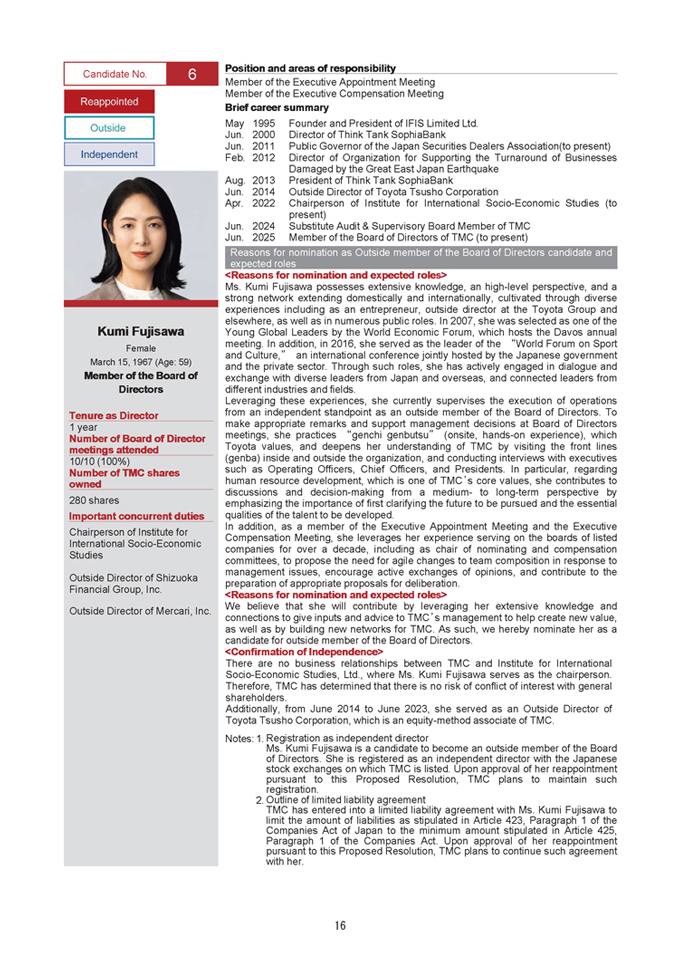
Position and areas of responsibilityCandidate No. 6 Member of the Executive Appointment Meeting Member of the Executive Compensation MeetingBrief career summaryMay 1995 Founder and President of IFIS Limited Ltd. Jun. 2000 Director of Think Tank SophiaBankJun. 2011 Public Governor of the Japan Securities Dealers Association(to present) Feb. 2012 Director of Organization for Supporting the Turnaround of Businesses Damaged by the Great East Japan Earthquake Aug. 2013 President of Think Tank SophiaBank Jun. 2014 Outside Director of Toyota Tsusho Corporation Apr. 2022 Chairperson of Institute for International Socio-Economic Studies (to present) Jun. 2024 Substitute Audit & Supervisory Board Member of TMCJun. 2025 Member of the Board of Directors of TMC (to present)Reasons for nomination as Outside member of the Board of Directors candidate and expected roles<Reasons for nomination and expected roles>Ms. Kumi Fujisawa possesses extensive knowledge, an high-level perspective, and a strong network extending domestically and internationally, cultivated through diverse experiences including as an entrepreneur, outside director at the Toyota Group and elsewhere, as well as in numerous public roles. In 2007, she was selected as one of the Kumi Fujisawa Young Global Leaders by the World Economic Forum, which hosts the Davos annual meeting. In addition, in 2016, she served as the leader of the “World Forum on SportFemaleMarch 15, 1967 (Age: 59) and Culture,”an international conference jointly hosted by the Japanese government and the private sector. Through such roles, she has actively engaged in dialogue and Member of the Board of exchange with diverse leaders from Japan and overseas, and connected leaders from Directors different industries and fields.Leveraging these experiences, she currently supervises the execution of operations Tenure as Director from an independent standpoint as an outside member of the Board of Directors. To 1 year make appropriate remarks and support management decisions at Board of Directors Number of Board of Director meetings, she practices “genchi genbutsu”(onsite, hands-on experience), which meetings attended Toyota values, and deepens her understanding of TMC by visiting the front lines 10/10 (100%) (genba) inside and outside the organization, and conducting interviews with executives Number of TMC shares such as Operating Officers, Chief Officers, and Presidents. In particular, regarding owned human resource development, which is one of TMC’s core values, she contributes to discussions and decision-making from a medium- to long-term perspective by 280 shares emphasizing the importance of first clarifying the future to be pursued and the essential Important concurrent duties qualities of the talent to be developed.In addition, as a member of the Executive Appointment Meeting and the Executive Chairperson of Institute for Compensation Meeting, she leverages her experience serving on the boards of listed International Socio-Economic companies for over a decade, including as chair of nominating and compensation Studies committees, to propose the need for agile changes to team composition in response to management issues, encourage active exchanges of opinions, and contribute to the Outside Director of Shizuoka preparation of appropriate proposals for deliberation.Financial Group, Inc.<Reasons for nomination and expected roles>We believe that she will contribute by leveraging her extensive knowledge and Outside Director of Mercari, Inc. connections to give inputs and advice to TMC’s management to help create new value, as well as by building new networks for TMC. As such, we hereby nominate her as a candidate for outside member of the Board of Directors.<Confirmation of Independence>There are no business relationships between TMC and Institute for International Socio-Economic Studies, Ltd., where Ms. Kumi Fujisawa serves as the chairperson. Therefore, TMC has determined that there is no risk of conflict of interest with general shareholders.Additionally, from June 2014 to June 2023, she served as an Outside Director of Toyota Tsusho Corporation, which is an equity-method associate of TMC.Notes:1.Registration as independent directorMs. Kumi Fujisawa is a candidate to become an outside member of the Board of Directors. She is registered as an independent director with the Japanese stock exchanges on which TMC is listed. Upon approval of her reappointment pursuant to this Proposed Resolution, TMC plans to maintain such registration.2.Outline of limited liability agreementTMC has entered into a limited liability agreement with Ms. Kumi Fujisawa to limit the amount of liabilities as stipulated in Article 423, Paragraph 1 of the Companies Act of Japan to the minimum amount stipulated in Article 425, Paragraph 1 of the Companies Act. Upon approval of her reappointment pursuant to this Proposed Resolution, TMC plans to continue such agreement with her.


LOGO

Notes: 1: The information included in the above table is as of the date of this reference document for this General Shareholders’ Meeting (5/8/2026), except for the information of the number of TMC shares owned, which is as of 3/31/2026.2: Outline of directors and officers liability insurance agreementTMC has entered into a directors and officers liability insurance agreement with an insurance company under which the insurance premiums are fully borne by TMC. The agreement names all Members of the Board of Directors, Vice Chairman, Operating Officers, Executive Fellows, and Senior Fellows as insured persons. The insurance policy covers damages, court costs, etc. that may result from the insured being liable for the performance of their duties in the capacity of their offices. The directors and officers liability insurance agreement stipulates provisions to the effect that the scope of damages to be compensated upon losing a case shall be limited, and that insurance shall not be paid in the case of certain events, for the purpose of guaranteeing the appropriateness of the directors’andofficers’executionof duties. The current agreement will expire in July 2026, and TMC plans to renew the agreement with similar provisions.


LOGO

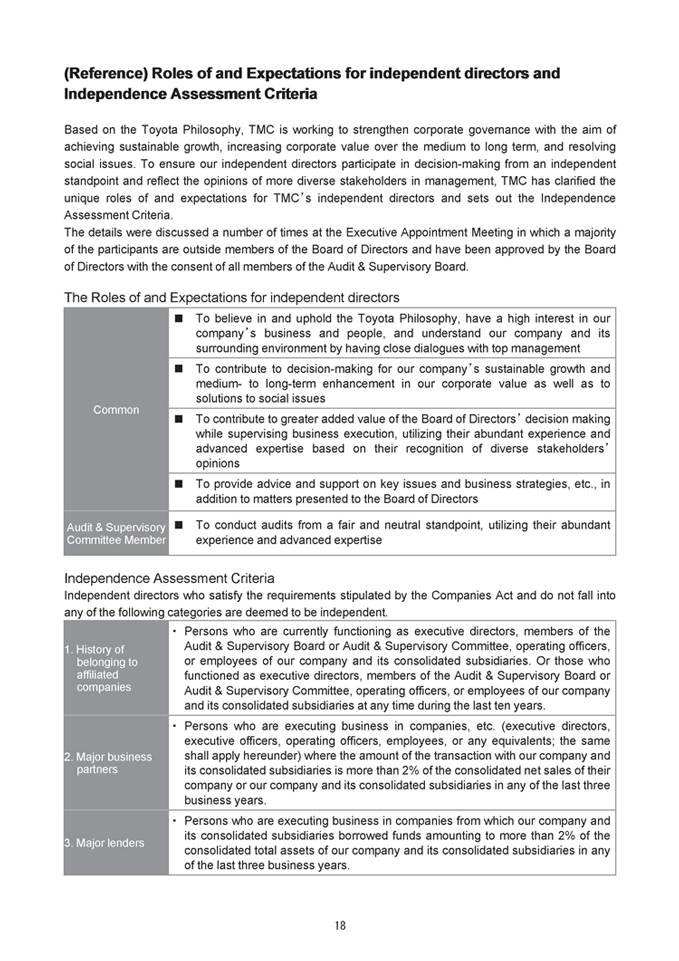
(Reference) Roles of and Expectations for independent directors and Independence Assessment CriteriaBased on the Toyota Philosophy, TMC is working to strengthen corporate governance with the aim of achieving sustainable growth, increasing corporate value over the medium to long term, and resolving social issues. To ensure our independent directors participate in decision-making from an independent standpoint and reflect the opinions of more diverse stakeholders in management, TMC has clarified the unique roles of and expectations for TMC’s independent directors and sets out the Independence Assessment Criteria.The details were discussed a number of times at the Executive Appointment Meeting in which a majority of the participants are outside members of the Board of Directors and have been approved by the Board of Directors with the consent of all members of the Audit & Supervisory Board.The Roles of and Expectations for independent directors To believe in and uphold the Toyota Philosophy, have a high interest in our company’s business and people, and understand our company and its surrounding environment by having close dialogues with top management To contribute to decision-making for our company’s sustainable growth and medium- to long-term enhancement in our corporate value as well as to solutions to social issuesCommon To contribute to greater added value of the Board of Directors’decision making while supervising business execution, utilizing their abundant experience and advanced expertise based on their recognition of diverse stakeholders’ opinions To provide advice and support on key issues and business strategies, etc., in addition to matters presented to the Board of DirectorsAudit & Supervisory To conduct audits from a fair and neutral standpoint, utilizing their abundant Committee Member experience and advanced expertiseIndependence Assessment CriteriaIndependent directors who satisfy the requirements stipulated by the Companies Act and do not fall into any of the following categories are deemed to be independent. Persons who are currently functioning as executive directors, members of the 1. History of Audit & Supervisory Board or Audit & Supervisory Committee, operating officers, belonging to or employees of our company and its consolidated subsidiaries. Or those who affiliated functioned as executive directors, members of the Audit & Supervisory Board or companies Audit & Supervisory Committee, operating officers, or employees of our company and its consolidated subsidiaries at any time during the last ten years. Persons who are executing business in companies, etc. (executive directors, executive officers, operating officers, employees, or any equivalents; the same 2. Major business shall apply hereunder) where the amount of the transaction with our company and partners its consolidated subsidiaries is more than 2% of the consolidated net sales of their company or our company and its consolidated subsidiaries in any of the last three business years. Persons who are executing business in companies from which our company and its consolidated subsidiaries borrowed funds amounting to more than 2% of the3. Major lenders consolidated total assets of our company and its consolidated subsidiaries in any of the last three business years.


LOGO

Consultants, accountants, or jurists who earned more than US$120,000 a year 4. Highly paid directly from our company and its consolidated subsidiaries as remuneration (excluding that for the function of Outside Members of the Board of Directors and experts Outside Audit & Supervisory Committee Members) in any of the last three business years. Persons who (or persons belonging to organizations that) received contributions 5. Large contribution amounting to more than US$120,000 a year from our company and its consolidated subsidiaries in any of the last three business years.6. Major Persons who are executing business in companies, etc., that are ranked tenth or higher in terms of the holding ratio of our company’s shares or for which our shareholders company is ranked tenth or higher in terms of the holding ratio of their shares. 7. Affiliated audit Persons who currently belong to or belonged to, at any time during the last ten years, the audit firms serving as accounting auditors of our company and its firms consolidated subsidiaries Spouses, or relatives within the second degree of kinship, either of members of the Board of Directors and the Audit & Supervisory Committee, operating officers8. Close relatives or key employees of our company and its consolidated subsidiaries, or of persons falling into the above 1 to 6 (excluding non-key persons).9. Mutual executive Persons who are executing business in companies that are accepting one or more member(s) of the Board of Directors or the Audit & Supervisory Committee dispatch from our company and its consolidated subsidiaries.10. Term of office Persons whose term of office as an outside executive is longer than 12 years.Persons who fall within any of the above-listed categories may be determined as independent, under the condition that our company discloses the reason for the determination when such persons satisfy the requirements for independent directors stipulated in the Companies Act and are substantially independent, and thus, a conflict of interest with general shareholders is deemed not to emerge.


LOGO

Confirmation of IndependenceMr. Shigeaki Okamoto and Ms. Kumi Fujisawa are as stated in the section titled “Confirmationof Independence” under Proposed Resolution.Member of the Board of Directors serving as an Audit & Supervisory Committee MemberTMC had an advisory agreement with Dr. George Olcott from June 2020 through March 2022 to receive his advice on the internationalization of school operations as a director of an integrated junior and senior high school (Kaiyo Academy) established with the aim to develop the next generation of leaders, which TMC has been endorsing. However, TMC has determined that there are no conflicts ofGeorge Olcott interest with general shareholders due to the insignificance of these transactions.The total amount of his compensation was 12 million yen per year, and the total compensation for the above period was 22 million yen. This contract ended in March 2022, and since then, apart from his remuneration as an outside board member, there have been no business relationships with Dr. Olcott.Mr. Masahiko Oshima retired from SMBC in July 2024, with which TMC has business relationships. However, TMC has determined that there are no conflicts of interest with general shareholders as the business relationships between TMC and SMBC are immaterial, with the amount of our borrowings from SMBC beingMasahiko Oshima less than 1% of our total consolidated assets in any of the last three business years. Furthermore, in the fiscal year ended March 2026, TMC does not hold any shares of the holding company of SMBC that it owned. SMBC is not among the top 10 companies in terms of TMC’sshareholding ratio.Ms. Hiromi Osada worked for the Chunichi Shimbun as its executive, with which TMC has business relationships. However, as the amount of the transactions is Hiromi Osada immaterial, accounting for less than 0.2% of the consolidated sales of both companies in any of the last three business years, TMC has determined that there are no conflicts of interest with general shareholders.


LOGO

(Reference) Corporate Governance Highlights and Skills Matrix (plan after the June 17, 2026 Ordinary General Shareholders’ Meeting) The Board of Directors consists of six Members of the Board of Directors and four Members of the Board of Directors serving as the Audit & Supervisory Committee Members, for a total of ten Members. TMC’s Executive Appointment Meeting, a majority of which are outside members of the Board of Directors, makes recommendations to the Board of Directors regarding the appointment of Members of the Board of Directors. TMC expects its Members of the Board of Directors to embrace the “Toyota Philosophy” as the bedrock for the knowledge, experience, and abilities they have acquired in the past mainly as executives and managers, as shown in this skills matrix. In addition to “Governance, risk management, and compliance” and “human resource development”, which is the common skill we desire across all individuals, the matrix shows up to five skills per person that are priorities for us. [Skills Matrix] Akio Toyoda Kenta Kon Hiroki Nakajima Yoichi Miyazaki Position Chairman of Position Chairman of the Board of Directors President, Member of the Board of Directors Executive Vice President, Member of the Board of Directorsthe Board of Directors President, Member of the Board of Directors Executive Vice President, Member of the Board of Directors Outside/Independent Member* Audit & Supervisory Committee Meetings Executive Appointment Meeting (Chairman) Executive Compensation Meeting (Chairman) Skills matrix Skills required to supervise management Corporate management Governance, risk management, and compliance Global Finance and accounting Skills to further promote transformation into a mobility company Environment and society IT and digital Skills we continue to value as TMC Technology development Production Sports and motorsports Human resource development


LOGO

[Corporate Governance Highlights] Independence ratio* Diversity Tenure Age Shigeaki Okamoto Kumi Fujisawa George Olcott Christopher P. Reynolds Masahiko Oshima Hiromi Osada Member of the Board of Directors Member of the Board of Directors serving as an Audit & Supervisory Committee Member Outside/ Independent Outside/ Independent Outside/ Independent Outside/ Independent Outside/ Independent (Chairman) (Full-Time)


LOGO

(Reference) Corporate Governance Structure Structure 10 members (5 Independent Outside Directors / 2 females) 4 members of the Board of Directors who are Audit & Supervisory Committee Members (3 Independent Outside Directors / 1 female) All internal and outside members of the Board of Directors participate, engaging in discussions that leverage their respective areas of expertise Discussions of the Deliberating on matters brought forward by executive management at a preliminary stage, with a Board of Directors focus on enhancing corporate value Supporting initiatives undertaken by executive management under the theme of “Strngthening Japan” <Key Agenda Items> - Hydrogen business and robotics initiatives (preliminary consultations) - Changes in the management structure (deliberated following review by the Executive Appointment Meeting) - Earnings structure reform (raised as a topic in the financial results for the second quarter of the fiscal year ended March 2026 and held in-depth discussion as a management issue) Speed of Enhancing the speed of decision-making through preliminary consultations from executive Decision-Making management, enabling the Board of Directors to approve major strategic directions and delegate authority to executive management


LOGO

(Reference) Strategically-held Shares Policies on Strateic Shareholdings TMC does not hold strategically-held shares except in cases where such holdings are deemed to be meaningful.*TMC assesses the propriety of its strategic shareholdings at the Board of Directors every year upon reviewing whether they are meaningful or commensurate with the cost of capital, etc. TMC engages in constructive dialogue with issuers to share and address business challenges. * Refers to the case where it is determined that such holdings contribute to the improvement of corporate value from the medium- to long-term perspective, based on a comprehensive consideration of business strategy, relationships with business partners, and contribution to and cooperation in the development of society. Strategic Shareholdings Mar. 31, Mar. 31, Mar. 31, Mar. 31, Mar 31, 2022 2023 2024 2025 2026 Listed 53 49 40 34 34 Number of Unlisted 95 92 84 81 80 issuers Deemed holdings 31 24 17 4 Total 179 165 141 119 114 Listed 3,032.4 ,094.9 3,508.7 2,951.3 3,237.4 Balance Unlisted 90.2 115.1 124.0 69.8 71.8 (billion yen) Deemed holdings 195.5 127.0 145.0 27.0 Total 3,318.0 3,37.0 3,777.7 3,048.3 3,309.3 Percentage of strategic shareholding balance to 12.2% 11.4% 10.7% 8.3% 8.1% consolidated net assets (Total shareholder’s equity) Strategic Holdings of Listed Shares


LOGO

Business Report (Fiscal Year under review: April 1, 2025 through March 31, 2026) 1 Outlook of Associated Companies (1) Progress and Achievement in Operation Under the task of “make ever-better cars,” Toyota has worked on “product-centered and region-centered management” for many years, and through this approach, we have built a full product lineup and a global business foundation. Leveraging these foundations, during FY2026, we continued strengthening the “work foundation,” beginning with ensuring safety and quality, while striving to deliver better cars to customers around the world. In addition, in order to fulfill our mission of “producing happiness for all” through the offering of a diverse range of mobility options, we have advanced various technological developments and infrastructure-building initiatives aimed at transforming into a mobility company, under the Toyota Mobility Concept. TOYOTA RAV4 Corolla Cross GR SPORT The RAV4, chosen by many customers, has By leveraging the knowledge and expertise undergone a model change to its sixth generation, accumulated through a motorsports-bred making becoming the first of our cars to incorporate Arene, a ever-better cars, and with the involvement of GR platform designed to enable the efficient development series development drivers, we have achieved a high of software. level of driving performance. LEXUS bZ5 ES Battery electric vehicle (BEV) developed locally in The all-new eighth-generation ES stands as a China, in response to the needs of customers who forerunner in LEXUS’s next-generation electrification place importance on a comfortable personal space. lineup.


LOGO

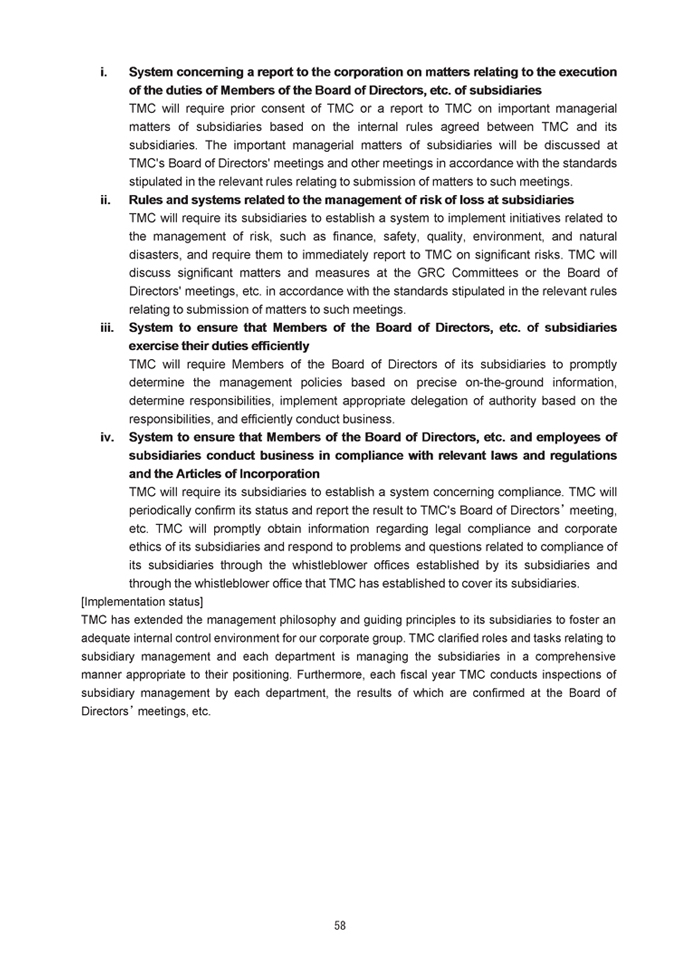
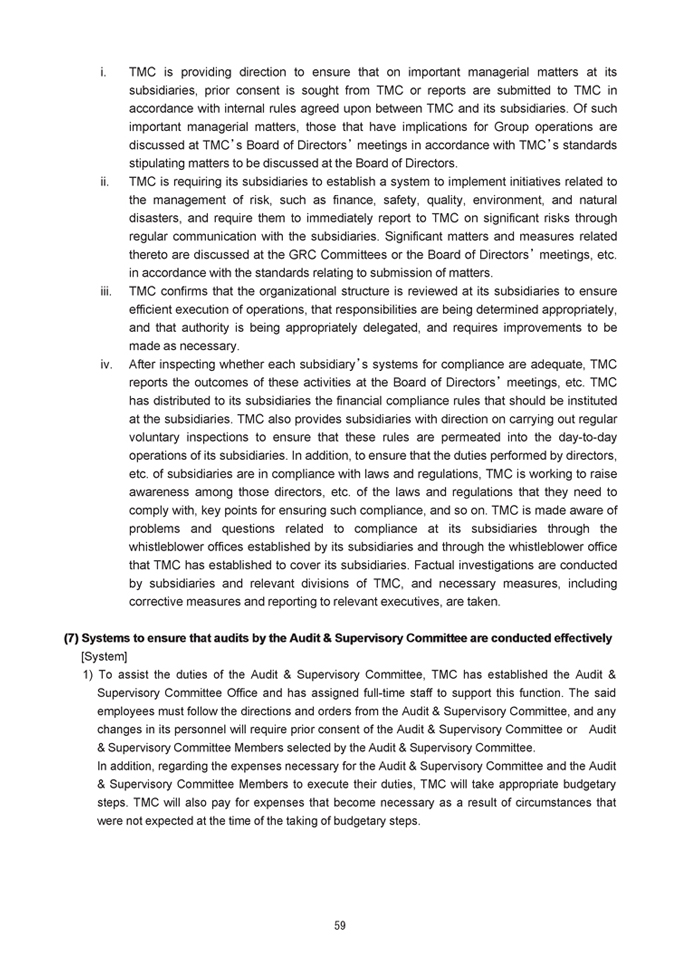
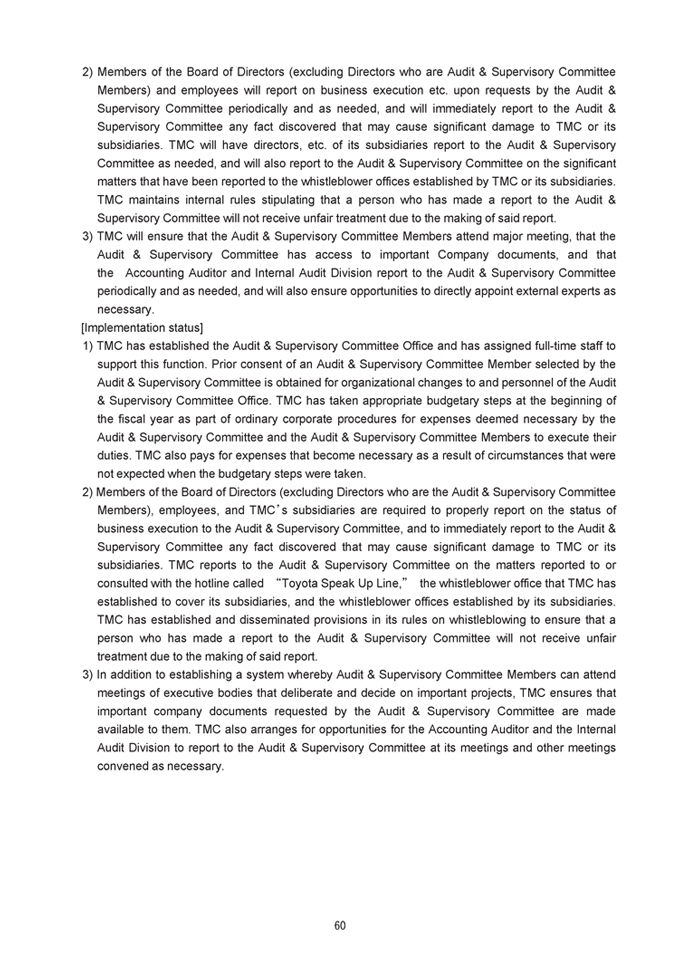
Energy Automotive batteries Toyota held an opening ceremony in November 2025 for Toyota Battery Manufacturing, North Carolina (TBMNC). The facility was established in November 2021 in North Carolina as Toyota’s first in-house battery manufacturing company outside Japan. Hydrogen Toyota’s efforts to race a Corolla equipped with one of the Company’s hydrogen engines currently in development entered their fifth year. In 2025, we conducted test drives of vehicles with small, highly efficient superconducting motors within their fuel tanks, improving tank capacity over 1.3 times. Global business expansion (Regional Sales) FY2026 (April 2025 through March 2026) 10,477 thousand units General Economic Environment in FY2026 During the fiscal year under review, the global economy showed differing trends by region. In the United States, consumption remained resilient even after tariff increases. In China, however, consumer sentiment stayed weak amid a slowdown in the real estate market and employment concerns, and consumption growth remained sluggish due to continued price stagnation and intense price competition. Multi-pathway approach (Retail Sales Mix by Powertrain) FY2026 (April 2025 through March 2026) Toyota has expanded its lineup in markets around the world in order to provide options closely aligned with the energy situation in each region and how cars are used by our customers. As a result, the proportion of electrified vehicles sales has steadily increased.


LOGO

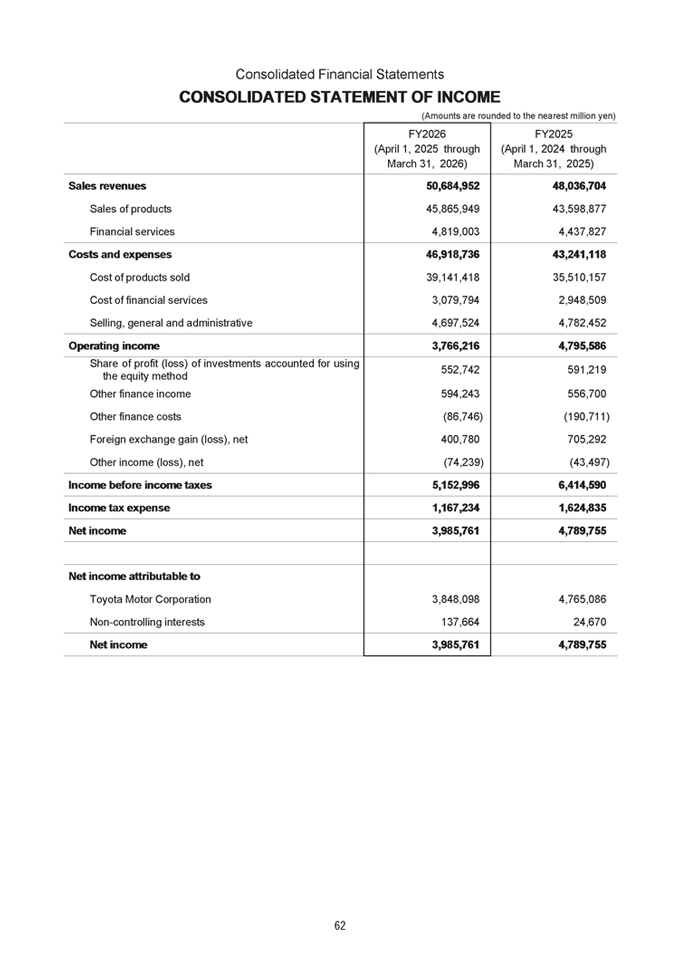
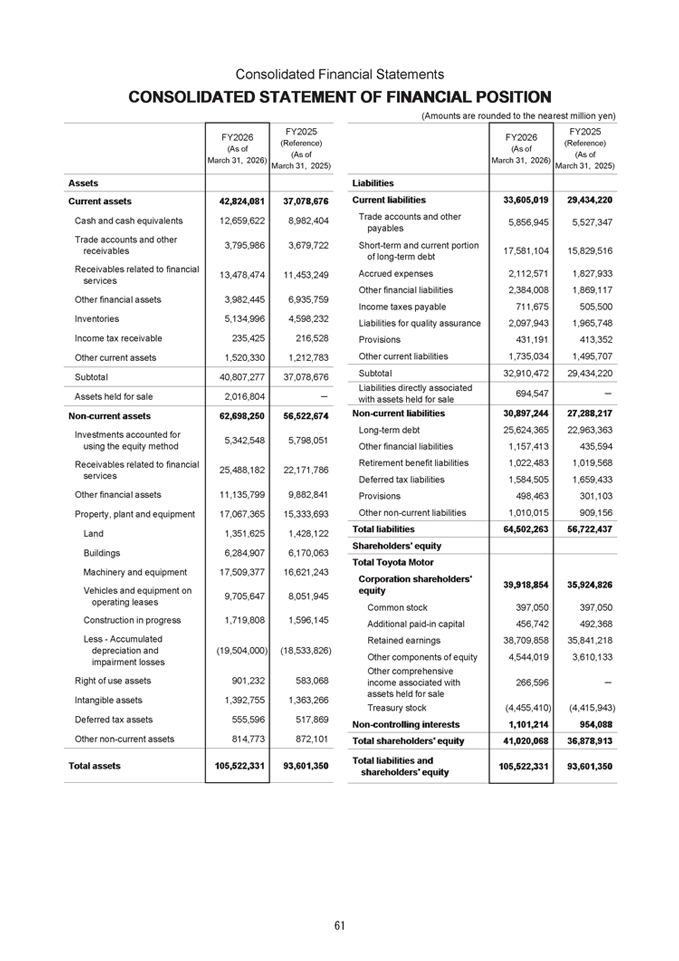
Consolidated Financial Results for FY2026 During the period under review, despite the impact of U.S. tariffs, we were able to secure a high level of profits, supported by higher sales volumes driven by strong product competitiveness, expanded value chain earnings, and other continued improvement efforts. (2) Consolidated Financial Summary Yen in millions unless otherwise stated FY2023 FY2024 FY2025 FY2026 (April 2022 (April 2023 (April 2024 (April 2025 through through through through March 2023) March 2024) March 2025) March 2026) Sales revenues 37,154,298 45,095,325 48,036,704 50,684,952 Automotive 33,776,870 41,080,731 42,996,299 45,201,924 Financial Services 2,786,679 3,447,195 4,437,827 4,819,003 Other 590,749 567,399 602,578 664,026 Operating income 2,725,025 5,352,934 4,795,586 3,766,216 Net income attributable to 2,451,318 4,944,933 4,765,086 3,848,098 Toyota Motor Corporation Basic earnings per share attributable to Toyota 179.47 365.94 359.56 295.25 Motor Corporation (yen) Total shareholders’equity 29,264,213 35,239,338 36,878,913 41,020,068 Total assets 74,303,180 90,114,296 93,601,350 105,522,331 Notes: 1. Consolidated financial statements have been prepared in accordance with International Financial Reporting Standards (“IFRS”). 2. The amounts represent sales revenues from external customers. (3) Funding The automotive business is mainly financed with funds from business operations. Starting in March 2021, Toyota has been issuing Sustainability Bonds to create a foundation for fundraising in preparation for emergencies and to raise funds for projects that contribute to the achievement of the United Nations Sustainable Development Goals (SDGs). Funds necessary for the financial services business are mainly financed through borrowings as well as with the issuance of bonds and medium-term notes. The balance of interest bearing debt as of the end of FY2026 was 43,205.4 billion yen.


LOGO

(4) Capital Expenditures and R&D As for capital expenditures, the Toyota group has promoted activities to decrease expenditures through effective use of our existing facilities and prioritization of individual projects. At the same time, we made investments in areas such as the remodeling of cars and the improvement of technological capabilities and productivity to strengthen our competitiveness as well as investments related to Automotive batteries. As a result, consolidated capital expenditures for FY2026 were 2,390.6 billion yen. As for R&D expenditures, we aspired to reinforce advanced development for the future in new fields such as vehicle electrification and automated driving while also endeavoring to improve development efficiency. As a result, consolidated R&D expenditures for FY2026 were 1,522.8 billion yen. (5) Policy on Determination of Distribution of Surplus Toyota deems the benefit of its shareholders an important element of its management policy, and its basic policy for shareholder returns is to reward long-term shareholders. Dividends: Aim to increase dividends stably and continuously 95 yen (increase of +5 yen year on year) Repurchase of shares: Aim to conduct flexibly taking into account our share price levels etc., and to respond to requests for the sale of its own shares as needed 3,656.8 billion yen regarding the fiscal year (The value of shares that were planned to be repurchased through a tender offer as part of the process of taking Toyota Industries Corporation private. Treasury shares to be acquired pursuant to this tender offer are scheduled to be cancelled.)


LOGO

(6) Issues to be Addressed Group vision “Inventing our path forward, together” The Group vision represents the direction the Toyota Group* should take and the vision and values to which all Toyota Group members can return. “Inventing our path forward, together.” Sakichi Toyoda, the founder of the Toyota Group, invented the Toyoda wooden hand loom with the desire to make life a little easier for his struggling mother. Kiichiro Toyoda invented the domestically produced passenger car with the idea that the automobile industry must be developed by the knowledge and skills of Japanese people. Thinking of others, learning, honing skills, making things, and bringing smiles to people’s faces —that passion and attitude toward invention are truly the starting point of the Toyota Group. In a time when there is no right answer, we will build a corporate culture in which we can say “thank you” to each other and aim to be a Toyota Group that is needed in the future, where diverse human resources can play an active role. * Toyota Industries Corporation, Toyota Motor Corporation, Aichi Steel Corporation, JTEKT CORPORATION, Toyota Auto Body Co., Ltd., Toyota Tsusho Corporation, AISIN CORPORATION, DENSO Corporation, TOYOTA BOSHOKU CORPORATION, TOYOTA FUDOSAN CO., LTD., TOYOTA CENTRAL R&D LABS., INC., Toyota Motor East Japan, Inc., Toyoda Gosei Co., Ltd., Daihatsu Motor Co., Ltd., Toyota Housing Corporation, Toyota Motor Kyushu, Inc., Woven by Toyota, Inc.(As of April 1, 2026)


LOGO

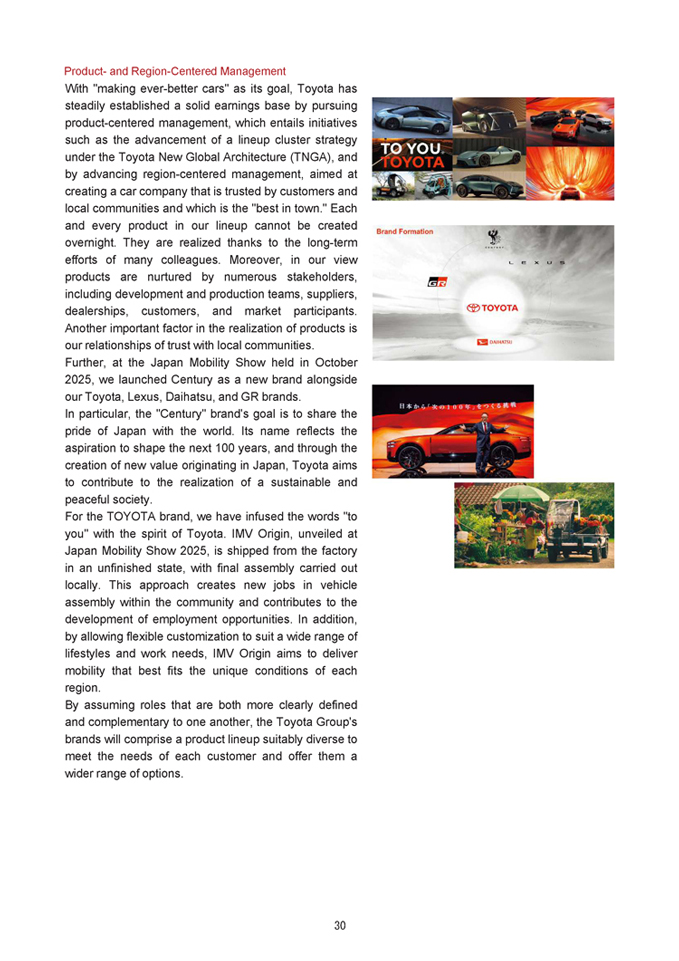
Product- and Region-Centered Management With “making ever-better cars” as its goal, Toyota has steadily established a solid earnings base by pursuing product-centered management, which entails initiatives such as the advancement of a lineup cluster strategy under the Toyota New Global Architecture (TNGA), and by advancing region-centered management, aimed at creating a car company that is trusted by customers and local communities and which is the “best in town.” Each and every product in our lineup cannot be created overnight. They are realized thanks to the long-term efforts of many colleagues. Moreover, in our view products are nurtured by numerous stakeholders, including development and production teams, suppliers, dealerships, customers, and market participants. Another important factor in the realization of products is our relationships of trust with local communities. Further, at the Japan Mobility Show held in October 2025, we launched Century as a new brand alongside our Toyota, Lexus, Daihatsu, and GR brands. In particular, the “Century” brand’s goal is to share the pride of Japan with the world. Its name reflects the aspiration to shape the next 100 years, and through the creation of new value originating in Japan, Toyota aims to contribute to the realization of a sustainable and peaceful society. For the TOYOTA brand, we have infused the words “to you” with the spirit of Toyota. IMV Origin, unveiled at Japan Mobility Show 2025, is shipped from the factory in an unfinished state, with final assembly carried out locally. This approach creates new jobs in vehicle assembly within the community and contributes to the development of employment opportunities. In addition, by allowing flexible customization to suit a wide range of lifestyles and work needs, IMV Origin aims to deliver mobility that best fits the unique conditions of each region. By assuming roles that are both more clearly defined and complementary to one another, the Toyota Group’s brands will comprise a product lineup suitably diverse to meet the needs of each customer and offer them a wider range of options.


LOGO

Continuous improvement in break-even volume In 2024 and 2025, we faced certification issues and a lack of capacity head-on and reinforced our operational foundations. As a result, we have rigorously enhanced safety and quality and secured additional capacity, which has stabilized production. On the other hand, we have recently seen a significant rise in our break-even volume due to a combination of increases in investments in human resources and future-oriented investments and the impact of U.S. tariffs. Therefore, we have begun Companywide measures. First, we will increase earnings by reforming fixed costs, achieving cost improvements, and initiating sales initiatives in all regions, groups, and in-house companies. Additionally, to boost productivity even further, we will encourage employees to reexamine their ways of working and pursue efficient, value-added work. For instance, we will step up our utilization of AI for routine tasks and low-value-added work so that personnel can focus on tasks only humans can perform, thereby heightening the “rate of value-added work.” In advancing the aforementioned measures, we will focus on improving our break-even volume by ensuring that the benefits of reinforcing our operational foundations are steadily reflected in our earnings power. Toyota needs a management structure that reliably generate earnings in both favorable and challenging operating conditions and thereby enables the Company to continue pursuing joint growth initiatives with its stakeholders. In our transformation into a mobility company, value chain businesses will play a crucial role. Providing continuous value to customers throughout the long ownership period after the sale of a new car, these businesses have steadily grown. This growth is thanks to the many different products we offer. Supported by strong brands forged through product- and region-centered management, our diverse product lineup has enabled us to have 150 million units in operation worldwide. The growth of our value chain businesses is also attributable to the strength of our products, including their ease of repair and our ability to supply parts for them, as well as to the efforts of frontline personnel engaged in services, sales finance, used car sales, and insurance to fully utilize the high residual value of each product. Going forward, in addition to the virtuous cycle of new cars and value chain businesses, we will further strengthen our earnings base by promoting the creation of new forms of value through software and diverse mobility services. Across Toyota’s workplaces, starting with production sites, employees continue to tackle numerous challenges while striving every day to make “ever-better cars.” To translate these efforts into tangible results, management and the front lines (genba) will work as one to create an environment that enables workplaces across Toyota, starting with production sites, to fully demonstrate their capabilities.


LOGO

Transforming into a mobility company We aim to pursue our transformation into a mobility company that offers freedom of movement for all. We want to ensure that automobiles continue to serve as a form of mobility that benefits society and brings smiles to people around the world well into the future. To that end, we will work to minimize the detrimental effects that cars have on society while maximizing the emotional value of cars. Placing cars at the center, we will focus our efforts on enhancing the mobility of data and energy while pursuing their integration with social systems. By doing so, we will strive to create new mobility value and a new industrial structure. Contributingto a society with zero traffic accident: Software-Defined Vehicles (SDVs) Software Defined Vehicles (SDVs) are playing a leading role in the transformation into a mobility company. Toyota’s main aspiration in working with SDVs is a society with zero traffic accidents. Through SDVs, we aim to realize safer, more reliable, and more fun mobility. However, realizing such a society is difficult with just the technological innovation of cars. It requires an integrated three-pronged approach involving “cars,” “people,” and “infrastructure.” For example, this includes coordination with road infrastructure that utilizes data from built-in sensors to address blind spots —an issue that evolution of vehicles cannot overcome alone — and AI agents that autonomously support drivers (people). An environment with uninterrupted communication and the development of infrastructure such as data centers are key to linking cars with society. Accordingly, we are working to create appropriate infrastructure. Toyota places strong emphasis and priority on safety and security. At the same time, we have an opportunity to leverage the strength of having 150 million private vehicles in operation to help identify the diverse values of SDVs, including the use of things such as AI agents that grow alongside customers and cars that may one day be capable of reproducing more professional or proficient driving styles. We aim to continue to provide customers with safe, reliable, high-quality software through innovative digital platforms that are the foundation of software development and our “Arene” software creation platform which is installed in the all-new RAV4. We will accelerate the development of an SDV infrastructure unique to Toyota through cooperation with our partners across industries.


LOGO

ToyotaWoven City Toyota aspires to transform into a mobility company. On our journey toward accomplishing this goal, Toyota Woven City will function as a “mobility test course” for creating new products and services. Toyota and its Group company Woven by Toyota, Inc. are advancing the Toyota Woven City project. Toyota Woven City saw its official launch in September 2025, with companies and individuals commencing demonstrations of various products and services, and some residents have begun moving in. By combining Toyota’s manufacturing expertise, Woven by Toyota’s advanced software capabilities, and the unique strengths of each Inventor, Toyota Woven City seeks to foster Kakezan, a Japanese concept of “multiplication,” where new innovation and societal value emerge from the convergence of different ideas and capabilities. Further supporting Inventor innovation, the Inventor Garage has begun operations in April 2026. The Inventor Garage is located in the former stamping facility of Toyota Motor East Japan’s Higashi-Fuji plant, which supported passenger vehicle production over the years. The site carries forward the monozukuri*1 spirit of the original plant while symbolizing Toyota Woven City’s connection between heritage and innovation. The Inventor Garage is expected to act as a hub for end-to-end development, featuring co-creation spaces where Inventors can build and test prototypes. Toyota Woven City aims to realize a safe and secure mobility society by conducting demonstrations of systems in which people, mobility technologies and infrastructure are closely coordinated with one another. Together with allies who share our vision, we will leverage Toyota Woven City to further our transformation into a mobility company that will help weave the future. *1 Monozukuri, meaning “the art of making things” in Japanese, refers to Toyota’s spirit of craftsmanship and dedication to manufacturing continuously better products for people.


LOGO

Strengthening relationships with stakeholders and cultivating culture To achieve the sustainable enhancement of Toyota’s corporate value, we recognize that it is a key priority to further strengthen relationships of trust with our diverse stakeholders, including shareholders and investors, customers, local communities, dealers, and suppliers. TOYOTAWORLD ARIGATO FEST. 2025 In December 2025, we invited local community members, dealers in each region, business partners and investors who support Toyota Group to Japan for TOYOTA WORLD ARIGATO FEST. 2025, an event held to express our gratitude for their ongoing efforts. At the event, guests were given a first look at Toyota’s upcoming models and had the opportunity to experience a range of mobility solutions currently in development. Through the “ARIGATO (thank you)” exchanged at the event, we were once again reminded of the importance of the trust we have built with our stakeholders. We will carry forward relationships in which we can say “ARIGATO” to one another across generations and continue to deepen these bonds.TOYOTAARENA TOKYO TOYOTA ARENA TOKYO opened in October 2025. The multipurpose arena, which is the home ground of the men’s professional B.League basketball team ALVARK TOKYO, can provide various forms of spectator sports and entertainment. The concept of TOYOTA ARENA TOKYO is “discovering potential together.” We hope this arena becomes a place where people, especially young people, discover their potential in sports and music. TOYOTA ARENA TOKYO is a dream destination for people who love sports, including basketball, and entertainment. We will create a community together with all our fans and the people who live, work in, and visit this area that is lively all year round and aim for the arena to become a place to unleash countless possibilities in terms of sports, mobility, and community.


LOGO

(7) Main Business The Toyota group’s business segments are automotive operations, financial services operations and all other operations. Business Main products and services Vehicles (passenger vehicles, trucks and buses, and Automotive Operations mini-vehicles), Parts & components for production, Parts, etc. Financial Services Operations Auto sales financing, Leasing, etc. Other Operations Information Technology, etc. (8) Main Sites <TMC> Name Location Head Office Aichi Prefecture Tokyo Head Office TokyoNagoya Office Aichi Prefecture Honsha Plant Aichi Prefecture Motomachi Plant Aichi Prefecture Kamigo Plant Aichi Prefecture Takaoka Plant Aichi Prefecture Miyoshi Plant Aichi Prefecture Tsutsumi Plant Aichi Prefecture Myochi Plant Aichi Prefecture Shimoyama Plant Aichi Prefecture Kinu-ura Plant Aichi Prefecture Tahara Plant Aichi Prefecture Teiho Plant Aichi Prefecture Toyota Technical Center Higashi-Fuji Shizuoka Prefecture Toyota Technical Center Shimoyama Aichi Prefecture Toyota Woven City Shizuoka Prefecture <Domestic and overseas subsidiaries> Please see section”(10) Status of Principal Subsidiaries.” (9) Employees Number of employees Increase (Decrease) from end of FY2025 390,927 +7,074


LOGO

(10) Status of Principal Subsidiaries Company name Location Capital/ Subscription Percentage ownership interest Main business million yen % Hino Motors, Ltd. Tokyo 172,717 71.92 Manufacture and sales of automobiles Prime Planet Energy & Solutions, Inc. Tokyo 84,958 51.00 Manufacture and sales of automobile parts Toyota Financial Services Corporation Aichi Prefecture 78,525 100.00 Management of domestic and overseas financial companies, etc. Daihatsu Motor Co., Ltd. Osaka Prefecture 28,404 100.00 Manufacture and sales of automobiles Toyota Finance Corporation Aichi Prefecture 16,500 100.00* Finance of automobile sales, Card business Toyota Auto Body Co., Ltd. Aichi Prefecture 10,372 100.00 Manufacture and sales of automobiles Toyota Motor Kyushu, Inc. Fukuoka Prefecture 7,750 100.00 Manufacture and sales of automobiles Toyota Motor East Japan, Inc. Miyagi Prefecture 6,851 100.00 Manufacture and sales of automobiles Woven by Toyota, Inc. Tokyo 56 100.00 New technology and business development of mobility in thousands % Toyota Motor Engineering & Manufacturing North America, Inc. U.S.A. USD 1,958,950 100.00* Management of manufacturing companies in North America Toyota Motor Manufacturing, Kentucky, Inc. U.S.A. USD 1,180,000 100.00* Manufacture and sales of automobiles Toyota Motor North America, Inc. U.S.A. USD 999,158 100.00* Management of all North American affiliates Toyota Motor Credit Corporation U.S.A. USD 915,000 100.00* Finance of automobile sales Toyota Motor Manufacturing, Indiana, Inc. U.S.A. USD 620,000 100.00* Manufacture and sales of automobiles Woven Capital, L.P. U.S.A. USD 560,000 100.00* Strategic investment in growth companies Toyota Motor Manufacturing, Texas, Inc. U.S.A. USD 510,000 100.00* Manufacture and sales of automobiles Toyota Motor Sales, U.S.A., Inc. U.S.A. USD 365,000 100.00* Sales of automobiles Toyota Battery Manufacturing, Inc. U.S.A. USD 0 90.00* Manufacture and sales of automobile parts Toyota Motor Manufacturing Canada Inc. Canada CAD 680,000 100.00 Manufacture and sales of automobiles 50033-001 Japan North America


LOGO

Company name Location Capital/ other Asia Europe Subscription Percentage ownership interest Main business in thousands % Toyota Motor Europe NV/SA Belgium EUR 3,504,469 100.00 Management of all European affiliates Toyota Motor Finance (Netherlands) B.V. Netherlands EUR 908 100.00* Loans to overseas Toyota related companies Toyota Motor Manufacturing (UK) Ltd. U.K. GBP 300,000 100.00* Manufacture and sales of automobiles Toyota Motor Manufacturing Turkey Inc. Turkey TRY 150,165 90.00* Manufacture and sales of automobiles in thousands % Guangqi Toyota Engine Co., Ltd. China USD 670,940 70.00* Manufacture and sales of automobile parts Toyota Motor (China) Investment Co., Ltd. China USD 118,740 100.00 Sales of automobiles Toyota Motor Finance (China) Co., Ltd. China CNY 4,100,000 100.00* Finance of automobile sales million yen Lexus Electrified Shanghai Co., Ltd. China 107,100 100.00 Manufacture and sales of automobiles in thousands Toyota Motor Asia (Singapore) Pte Ltd. Singapore SGD 6,000 100.00 Management of sales operations in Asia Toyota Leasing (Thailand) Co., Ltd. Thailand THB 18,100,000 90.00* Finance of automobile sales Toyota Motor Thailand Co., Ltd. Thailand THB 7,520,000 86.43 Manufacture and sales of automobiles Toyota Motor Asia (Thailand) Co., Ltd. Thailand THB 1,300,000 100.00* Management of manufacturing operations in Asia in thousands % Toyota Motor Corporation Australia Ltd. Australia AUD 481,100 100.00 Sales of automobiles Toyota Finance Australia Ltd. Australia AUD 120,000 100.00* Finance of automobile sales Toyota do Brasil Ltda. Brazil BRL 6,709,980 100.00 Manufacture and sales of automobiles Notes: 1. * Indicates that the ownership interest includes such ratio of the subsidiaries. 2. The ownership interests are calculated based on the total number of shares issued at the end of the fiscal year. 3. Hino Motors, Ltd. has been excluded from the scope of consolidation in connection with its business integration with Mitsubishi Fuso Truck and Bus Corporation on April 1, 2026.


LOGO

2. Status of Shares (1) Total Number of Shares Authorized 50,000,000,000 shares (2) Total Number of Shares Issued 15,794,987,460 shares (3) Number of Shareholder 1,272,096 (4) Major Shareholders Name of Shareholders Number of Shares (1,000 shares) Percentage ofShareholding (%) The Master Trust Bank of Japan, Ltd. 1,667,971 12.80 Toyota Industries Corporation 1,192,331 9.15 Custody Bank of Japan, Ltd. 794,894 6.10 Nippon Life Insurance Company 633,045 4.86 State Street Bank and Trust Company (Standing Proxy: Settlement & Clearing Services Division, Mizuho Bank, Ltd.) 602,312 4.62 JPMorgan Chase Bank, N.A. (Standing Proxy: Settlement & Clearing Services Division, Mizuho Bank, Ltd.) 537,926 4.13 DENSO Corporation 449,576 3.45 The Bank of New York Mellon as Depositary Bank for Depositary Receipt Holders (Standing Proxy: Sumitomo Mitsui Banking Corporation) 355,369 2.73 Toyota Fudosan Co., Ltd. 249,754 1.92 AISIN Corporation 173,246 1.33 Notes: 1. Toyota Industries Corporation has tendered all shares of TMC that it holds in response to TMC’s tender offer for its own shares, for which the final day of the tender offer period was April 27, 2026. TMC plans to acquire 1,191,088,200 shares (representing 99.9% of such tendered shares) on May 25, 2026, the settlement commencement date. 2. The Bank of New York Mellon as Depositary Bank for Depositary Receipt Holders is the nominee of the Bank of New York Mellon, which is the depositary for holders of TMC’s American Depositary Receipts (ADRs). 3. The percentage of shareholding is calculated after deducting the number of shares of treasury stock (2,761,055 thousand shares) from the total number of shares issued. (5) Status of Shares Issued as Consideration for the Execution of Duties to Members of the Board of Directors during FY2026 Number of Shares (1,000 shares) Number of Recipients (Persons) Members of the Board of Directors (Excluding Outside Members of the Board of Directors and Audit & Supervisory Committee Members) 661 5


LOGO

3. Status of Members of the Board of Directors (1) Members of the Board of Directors Name Position Areas of responsibility Important concurrent duties Akio Toyoda * Chairman of the - Chairman of the Board of - Chairman of TOYOTA FUDOSAN Board of Directors Directors CO., LTD. - Member of the Board of Directors of DENSO CORPORATION - Representative Director of ROOKIE Racing, Inc. - Chairman of TOYOTA GAZOO Racing World Rally Team Oy Koji Sato * President, - Chief Executive Officer - Chairman of Toyota Motor North Member of the America, Inc. Board of Directors - Chairman of Japan Automobile Manufacturers Association, Inc. Hiroki Nakajima * Executive Vice - Chief Technology Officer - President of Commercial Japan President, Member Partnership Technologies Corporation of the Board of - President of Commercial Japan Directors Partnership Technologies Asia Co., Ltd. - Managing Director of TOYOTA RACING GmbH Yoichi Miyazaki * Executive Vice - Chairman of the Executive President, Member Appointment Meeting of the Board of - Chairman of the Executive Directors Compensation Meeting Shigeaki Member of the - Member of the Executive - Chairman of the Board, Japan Okamoto Board of Directors Appointment Meeting Tobacco Inc. - Member of the Executive Compensation Meeting Kumi Fujisawa Member of the - Member of the Executive - Chairperson of Institute for Board of Directors Appointment Meeting International Socio-Economic Studies - Member of the Executive - Outside Director of Shizuoka Financial Compensation Meeting Group, Inc. - Outside Director of Mercari, Inc. George Olcott Member of the - Chairman of the Audit & Board of Directors Supervisory Committee (Audit & Supervisory Committee Member) Christopher P. Member of the - Outside Director of Southwest Airlines Reynolds Board of Directors Co. (Audit & Supervisory Committee Member) Masahiko Member of the - Chairman and Representative Director Oshima Board of Directors of Ares Management Asia Japan K.K. (Audit & - Outside Audit & Supervisory Board Supervisory Member of TBS HOLDINGS, INC. Committee Member)


LOGO

Name Position Areas of responsibility Important concurrent duties Hiromi Osada Member of the Board of Directors (Audit & Supervisory Committee Member (full-time))Notes:1. * Representative Director2. Mr. Koji Sato, who is President and a member of the Board of Directors, concurrently serves as Operating Officer (President).3. Mr. Hiroki Nakajima and Mr. Yoichi Miyazaki, who are members of the Board of Directors, concurrently serve as Operating Officers (Executive Vice Presidents).4. Ms. Hiromi Osada is a Director (Audit & Supervisory Committee Member (full-time)). The reason for designating a full-time Audit & Supervisory Committee Member is to enhance the effectiveness of audits & supervision by the Audit & Supervisory Committee through attendance at important internal meetings, routine information gathering, and coordination with the accounting auditor and the internal audit division, among others.5. Mr. Shigeaki Okamoto, Ms. Kumi Fujisawa, Dr. George Olcott (Audit & Supervisory Committee Member), Mr. Masahiko Oshima (Audit & Supervisory Committee Member), and Ms. Hiromi Osada (Audit & Supervisory Committee Member (full-time)), all of whom are members of the Board of Directors, are outside members of the Board of Directors. They are also Independent Directors as provided by the rules of the Japanese stock exchanges on which TMC is listed.6. The “Important concurrent duties” are listed chronologically, in principle, based on the dates the executives assumed their present positions.7. TOYOTA RACING GmbH is the company formerly known as TOYOTA GAZOO Racing Europe GmbH.8. As for the important concurrent duties of Mr. Akio Toyoda, Chairman of the Board of Directors, he is scheduled to retire from his position as a Member of the Board of Directors of DENSO CORPORATION at the conclusion of DENSO CORPORATION’s 2026 Annual General Meeting of Shareholders.9. TMC has entered into Directors and Officers liability insurance contracts with an insurance company, naming all Members of the Board of Directors, Vice Chairman, Operating Officers, Executive Fellows and Senior Fellows as insured persons. For details, please see Proposed Resolution of the Reference Documents.10. Effective April 1, 2026, the positions and responsibilities were changed as follows.Name Position Areasof responsibility Koji Sato * Vice Chairman of the Board of DirectorsChief Industry Officer Yoichi Miyazaki * Executive Vice President, Member of the Board of Directors Chief Financial Officer* Representative DirectorNotes: Mr. Yoichi Miyazaki, who is Executive Vice President and a member of the Board of Directors, concurrently serves as Operating Officer (Executive Vice President)


LOGO

(2) Compensation to Members of the Board of Directors and Audit & Supervisory Board Members for FY20261) Details on Determination of the Amount and Calculation Method of Remuneration to Members of the Board of Directors and Audit & Supervisory Board Members and the Determination Methoda. Decision Making Policy and ProcessTMC believes that it is critical to appoint individuals who practice “product-centered and region-centered management” and contribute to decision-making aimed at sustainable growth into the future based on the “Toyota Philosophy*”. Moreover, these individuals should be able to play a significant role in transforming TMC into a mobility company through trust and friendship and internal two-way interactive teamwork, while working towards addressing environmental issues, including climate change, and the solution of social challenges related to TMC and its value chain. Executive compensation is an important method to motivate executives to take various actions and is determined according to the following policies.* Please see the “Toyota Philosophy”.- It should be a system that encourages members of the Board of Directors to work to improve the medium- to long-term corporate value of TMC- It should be a system that can maintain compensation levels that will allow TMC to secure and retain talented personnel - It should be a system that motivates members of the Board of Directors to promote management from the same viewpoint as our shareholders with a stronger sense of responsibility as corporate managersToyota became a company with an Audit & Supervisory Committee based on a resolution adopted at the 121st Ordinary General Shareholders’ Meeting held on June 12, 2025. By resolution of the Board of Directors held on the same day, changes were made to the policy regarding the determination of remuneration for each member of the Board of Directors prior to the transition to a company with an Audit & Supervisory Committee, including specifying that the policy applies to Board of Directors (excluding those who are Audit & Supervisory Committee members) and other modifications. However, there were no substantive changes to the policy before and after the transition to a company with an Audit & Supervisory Committee.Policies for determining remuneration for each member of the Board of Directors (excluding those who are Audit & Supervisory Committee members) are resolved by the Board of Directors. The remuneration is effectively linked to corporate performance while reflecting individual job responsibilities and performance in determining remuneration levels and methods.Remuneration for outside members of the Board of Directors and members of the Board of Directors who are Audit & Supervisory Committee members consists only of fixed payments. As a result, this remuneration is not readily impacted by business performance, helping to ensure independence from management.Based on the resolution of the 121st Ordinary General Shareholders’ Meeting held on June 12, 2025 concerning remuneration for the members of the Board of Directors (excluding those who are Audit & Supervisory Committee members) of Toyota, the maximum cash compensation was set at 3.0 billion yen per year (of which, the maximum amount payable to outside members of the Board of Directors is 0.3 billion yen per year). Additionally, it was further resolved that the maximum share compensation for members of the Board of Directors (excluding outside members of the Board of Directors and those who are Audit & Supervisory Committee members) was set at 4.0 billion yen per year. The number of members of the Board of Directors (excluding those who are Audit & Supervisory Committee members) to which such resolutions at the 121st Ordinary General Shareholders’ Meeting related was six (including two outside members of the Board of Directors).


LOGO

The total amount of remuneration for members of the Board of Directors who are Audit & Supervisory Committee members is set at no more than 360 million yen per year based on a resolution at the 121st Ordinary General Shareholders’ Meeting held on June 12, 2025. The number of members of the Board of Directors who are Audit & Supervisory Committee members as resolved at the Ordinary General Shareholders’ Meeting is four (including three outside members of the Board of Directors).The amount of remuneration for each member of the Board of Directors (excluding those who are Audit& Supervisory Committee members) and the remuneration system are decided by the Board of Directors and the “Executive Compensation Meeting,” a majority of the members of which are outside members of the Board of Directors, in order to ensure the independence of the decisions. The members of the “Executive Compensation Meeting” are Yoichi Miyazaki (Chairman), Executive Vice President and a member of the Board of Directors, and Shigeaki Okamoto and Kumi Fujisawa, each an outside member of the Board of Directors.Note:1. Yoichi Miyazaki, Executive Vice President and a member of the Board of Directors, replaced Shigeru Hayakawa, Vice Chairman of the Board of Directors, as Chairman of the Executive Compensation Meeting upon the conclusion of the 121st Ordinary General Shareholders’ Meeting held on June 12, 2025. In addition, Shigeru Hayakawa retired as Vice Chairman of the Board of Directors upon the conclusion of the 121st Ordinary General Shareholders’ Meeting.2. The members of the Executive Compensation Meeting were changed from Ikuro Sugawara, Sir Philip Craven, Masahiko Oshima and Emi Osono, each an outside member of the Board of Directors, to Shigeaki Okamoto and Kumi Fujisawa, each an outside member of the Board of Directors. Ikuro Sugawara, Sir Philip Craven and Emi Osono retired as outside members of the Board of Directors, and Masahiko Oshima, an outside member of the Board of Directors, assumed the office of member of the Board of Directors who is an Audit & Supervisory Committee member, as of the conclusion of the 121st Ordinary General Shareholders’ Meeting held on June 12, 2025.3. The amount of remuneration for each outside member of the Board of Directors (excluding those who are Audit & Supervisory Committee members) and the amount of remuneration for each non-outside member (excluding those who are Audit & Supervisory Committee members) of the Board of Directors were determined at conventions of the Executive Compensation Meeting held in May 2025 and April 2026, respectively.The Board of Directors resolves the policy for determining remuneration for and other payments to each member of the Board of Directors (excluding those who are Audit & Supervisory Committee members) and the executive remuneration system as well as the total amount of remuneration for FY2026, and delegates the determination of the amount of remuneration for each member of the Board of Directors to the Executive Compensation Meeting. The Executive Compensation Meeting reviews the remuneration system for members of the Board of Directors and senior management on which it will consult with the Board of Directors and determines the amount of remuneration for each member of the Board of Directors (excluding those who are Audit & Supervisory Committee members), taking into account factors such as corporate performance as well as individual job responsibilities and performance, in accordance with the policy for determining remuneration for and other payments to each member of the Board of Directors (excluding those who are Audit & Supervisory Committee members) established by the Board of Directors. The Board of Directors considers that such decisions made by the Executive Compensation Meeting are in line with the policy on determining remuneration and other payments for each member of the Board of Directors (excluding those who are Audit & Supervisory Committee members).Remuneration for members of the Board of Directors who are Audit & Supervisory Committee members is determined by the members of the Board of Directors who are Audit & Supervisory Committee members within the scope determined by resolution of the shareholders’ meeting.FY2026 compensation was discussed and determined at the Executive Compensation Meetings held in May, July, October, November and December 2025 and January, February, March and April 2026. Remuneration for members of the Board of Directors (excluding those who are Audit & Supervisory Committee members) was determined with the unanimous consent of the Executive Compensation Meeting members.


LOGO

<Major discussions made at the Executive Compensation Meetings> - Compensation levels by position and duties - FY2026 KPI evaluation - Determination of individual compensation amountb. Method of Determining Performance-based Remuneration (Bonus and Share Compensation)1) Directors with Japanese citizenship (excluding outside members of the Board of Directors and members of the Board of Directors who are Audit & Supervisory Committee members) TMC sets the total amount of compensation that each member of the Board of Directors receives annually (“Annual Total Remuneration”) at an appropriate level based on position and duties by referencing compensation levels benchmarked against global companies selected based on the size of each person’s role and other factors.TMC makes sure that STI (short term incentive) and LTI (long term incentive) account for around 20% and 50% of the Annual Total Remuneration, respectively, and performance-based remuneration, which is STI and LTI combined, account for around 70%. STI is provided in the form of cash compensation based on “consolidated operating income,” “fluctuation of TMC’s market capitalization*,” and “individual performance evaluation.” LTI is provided in the form of share compensation based on “multiple financial indicators,” the “non-financial indicator,” and “individual performance evaluation.” In addition, there are cases where LTI may be paid in cash to retiring members of the Board of Directors (excluding outside members of the Board of Directors and members of the Board of Directors who are Audit & Supervisory Committee members) and members of the Board of Directors (excluding outside members of the Board of Directors and members of the Board of Directors who are Audit & Supervisory Committee members) who do not reside in Japan.* Calculated by multiplying the closing price of TMC’s common stock on the Tokyo Stock Exchange by the number of shares issued after deducting the number of shares of treasury stock<Composition of Compensation>% of Total RemunerationType of Remuneration Concept Remuneration Method Base compensation* Around 30% Cash The percentage of total compensation remuneration represented by STI (Short Term Incentive) Around 20% Cash LTI is designed to compensation increase as an individual’s LTI (Long Term Incentive) Around 50% Share roles and duties become compensation greater.* Fringe benefits and various allowances (e.g., a certain monetary payment that may be made following the retirement of a member of the Board of Directors who retires due to death, determined by taking into comprehensive consideration the role, duties, and other relevant factors of such director) may be provided to members of the Board of Directors within an appropriate range.<Concept of Performance Evaluating Indicators>STI Financial (1) Consolidated operating Indicator for evaluating TMC’s efforts based on indicators income (single year) short-term business performance (2) Fluctuation of TMC’s market Corporate value indicator for shareholders and capitalization investors to evaluate TMC’s efforts Individual performance evaluation Qualitative evaluation of performance of each member of the Board of Directors LTI Financial (3) Consolidated operating Indicator for evaluating TMC’s indicators income (multiple years) medium- to long-term efforts based on business performance (4) Total shareholder return Corporate value indicator for shareholders and (5) Return on equity investors to evaluate TMC’s medium- to long-term effortsNon-financial (6) Progress of efforts to resolve Indicator for evaluating TMC’s indicator sustainability issues medium- to long-term efforts based on the degree of corporate value enhancement Individual performance evaluation Qualitative evaluation of performance of each member of the Board of Directors


LOGO

<Method and Reference Value for Each Performance Evaluating Indicator and Evaluation Result> Evaluation Evaluation STI Evaluation Method Reference Value Weight Result Evaluate the degree of attainment of consolidated operating income in (1) Consolidated FY2026, using the average operating income 70% 2.5 trillion yen consolidated operating income of (single year) TMC over the last 10 fiscal years as a reference value (set in 2023) Comparatively evaluate the 134% fluctuation of TMC’s market capitalization for FY2026 (average (2) Fluctuation of from January through March), using TMC: 36.1 trillion yen TMC’s market 30% the market capitalization of TMC TOPIX: 2,709.83 capitalization and TOPIX for FY2025 (average from January through March) as reference values Evaluation Evaluation LTI Evaluation Method Reference Value Weight Result Evaluate the degree of attainment of consolidated operating income for the last three fiscal years, (3) Consolidated including FY2026, using the operating income 35% 2.5 trillion yen average consolidated operating (multiple years) income of TMC over the last 10 fiscal years as a reference value (set in 2023) Comparatively evaluate TMC’s total shareholder return, using the rate of change calculated by dividing the sum of the stock price of TMC on the last day of FY2026 and the cumulative amount of dividend per share during the period from the (4) Total 17.5% fiscal year that is four years before TOPIX: 202.2% shareholder return FY2026 through FY2026 by the stock price on the last day of the 130% fiscal year that is five years before FY2026 and the rate of change in TOPIX Net Total Return calculated in the same manner as reference values Comparatively evaluate TMC’s (5) Return on return on equity for FY2026 using 17.5% 8% equity the levels recommended by the Ito Review as reference values Comprehensively evaluate quantitative and qualitative KPIs For each KPI, (6) Progress of (amount of reduction in GHG principally assessed efforts to resolve emissions, employee engagement 30% based on the average sustainability survey and governance) that are over the preceding issues linked to business activities and five-year period established based on six materiality themes* * Expanding the Value of Mobility, Safety & Reliability, Coexistence of Humanity & the Earth, Supporting the Community & Employment, Active Contribution by All, Strong Production & Business Operation. 44


LOGO

<Concept of Individual Performance Evaluation> For the determination of Annual Total Remuneration, the STI base amount and the LTI base amount, which reflect the performance evaluation results of financial indicators and the non-financial indicator, are subject to adjustment based on individual performance evaluation. The evaluation takes into account various factors, such as initiatives (including the ESG perspective) based on the Toyota Philosophy* and initiatives toward medium- to long-term corporate value enhancement, as well as trust from his or her peers and contribution to the promotion of human resources development. The range of adjustments based on individual performance evaluations is set within the range of 50% above or below the STI base amount and the LTI base amount, which reflect the performance evaluation results of financial indicators and the non-financial indicator, commensurate with position and job responsibilities. The amount of performance-based remuneration for each Member of the Board of Directors is calculated based on evaluation results. Given the huge responsibilities of the Chairman of the Board of Directors, the Vice Chairman of the Board of Directors, and the President and Member of the Board of Directors, their remuneration is adjusted solely based on company-wide performance evaluations, and does not reflect individual performance evaluations. * Please see the “Toyota Philosophy”. 2) Directors with foreign citizenship (excluding outside members of the Board of Directors and members of the Board of Directors who are Audit & Supervisory Committee members) Fixed remuneration and performance-based remuneration are set based on the remuneration levels and structures that allow TMC to secure and retain talented personnel. Annual Total Remuneration levels as well as the percentages of fixed remuneration and performance-based remuneration in total remuneration are set taking into account each member’s job responsibilities and the remuneration standards of the entity for which such member previously worked (application determined individually). Performance-based remuneration consists of STI and LTI as is the case with directors with Japanese citizenship (excluding outside members of the Board of Directors and members of the Board of Directors who are Audit & Supervisory Committee members). The amounts of STI and LTI change in the same manner by reflecting STI and LTI performance evaluating indicators set for directors with Japanese citizenship (excluding outside members of the Board of Directors and members of the Board of Directors who are Audit & Supervisory Committee members) and individual performance evaluation results. In addition, there are cases where we provide income tax compensation for certain members of the Board of Directors in light of the difference in income tax rates with those of their former affiliations. 45


LOGO

c. Share Compensation System 1) Restricted share compensation plan TMC’s Board of Directors resolves on share compensation within the maximum share compensation amount of 4.0 billion yen per year (with the aggregate number of TMC’s common shares to be allotted to members of the Board of Directors of TMC, excluding outside members of the Board of Directors and members of the Board of Directors who are Audit & Supervisory Committee members, to be subject to a maximum of 4 million shares per year in total) that was established at the 121st Ordinary General Shareholders’ Meeting held on June 12, 2025. The overview of the share compensation is as follows. Eligible persons Members of the Board of Directors of TMC (excluding outside members of the Board of Directors and members of the Board of Directors who are Audit & Supervisory Committee members) Total amount of the share Maximum of 4.0 billion yen per year (the eligible members of the compensation Board of Directors will make an in-kind contribution of all monetary claims granted within the said amount to receive delivery of the common stock to be issued or disposed of for the allotment) Amount of the share Set each year as part of performance-based remuneration compensation payable to each considering factors such as corporate results, duties, and member of the Board of Directors performance Type of shares to be allotted and Issue or disposal of common stock (with transfer restrictions method of allotment under an allotment agreement) Total number of shares to be Maximum of 4 million shares per year in total to eligible allotted members of the Board of Directors (provided, however, that if a stock split, including a gratis allotment, or a reverse stock split of TMC’s common shares is carried out after June 12, 2025, or in case of events that otherwise require an adjustment to the total number of TMC’s common shares to be issued or disposed of as restricted share compensation, such total number of shares will be adjusted to a reasonable extent) Amount to be paid Determined by the Board of Directors of TMC based on the closing price of TMC’s common stock on the Tokyo Stock Exchange on the business day prior to each resolution of the Board of Directors, within a range that is not particularly advantageous to eligible members of the Board of Directors Transfer restriction period A period of between three and fifty years, as predetermined by the Board of Directors of TMC Conditions for removal of transfer Restrictions will be removed upon the expiration of the transfer restrictions restriction period. However, restrictions will also be removed in the case of expiration of the term of office, death, or other legitimate reasons. Gratis acquisition by TMC TMC will be able to acquire all allotted shares without consideration in the case of violations of laws and regulations or other reasons specified by the Board of Directors of TMC during the transfer restriction period. 46


LOGO

2) Restricted share unit plan If an Eligible Member of the Board of Directors does not reside in Japan at the time of receiving an allotment of restricted shares, Toyota may grant restricted share units instead of the restricted shares above to relieve the recipients from the burden of compliance with laws and regulations in their country of residence and tax disadvantages. The only conditions different from Toyota’s restricted share compensation plan are that the delivery of common shares will be upon the expiration of a period equivalent to the transfer restriction period and that in the event of the death of an Eligible Member of the Board of Directors, it will be a payment of money to the successors of members of the Board of Directors of Toyota in lieu of an issuance of common shares. Both the restricted share compensation plan and the restricted share unit plan shall be managed together within the total amount of share compensation applicable. In some cases, share compensation for a retiring Eligible Member of the Board of Directors may be allotted to them without any transfer restrictions. In addition, share compensation may be paid in cash to a retiring Eligible Member of the Board of Directors or an Eligible Member of the Board of Directors who does not reside in Japan. d. Clawback rule TMC introduced a clawback rule in November 2023. Under this rule, if TMC is required, in connection with financial reporting requirements under applicable laws and regulations, to restate its past financial statements, TMC will, subject to certain conditions, mandatorily recover the resulting overpaid portion of performance-based remuneration from incumbent or retired members of the Board of Directors who received such remuneration. The clawback rule does not apply to members of the Board of Directors who retired from office before its introduction. The compensation that is subject to clawback is the whole or part of performance-based remuneration, including share compensation, that has been paid based on financial statements before restatement, and the clawback applies to the three fiscal years ended immediately before the day on which the restatement of financial statements is required. The management and operation of this rule, including the identification of remuneration, periods, and individuals who are subject to clawback, are conducted by the Executive Compensation Meeting. 47


LOGO

2) Amount of Compensation, the Amount of Compensation by Type of Compensation and the Number of Eligible Executives by Category of Executives Amount of compensation by type Number of (million yen) Amount of Category eligible Base Performance-based compensation compensation executives compensation (million yen) Bonus Share compensation Members of the Board of Directors (excl. Directors who are Audit 12 932 2,005* 4,143 & Supervisory 1,206 (521 thousand shares) (6) (101) (101) Committee Members) (of which, outside members of the Board of Directors) Members of the Board of Directors who are Audit & Supervisory 4 194 194 Committee Members (3) (104) (104) (of which, outside members of the Board of Directors) Audit & Supervisory Board members 6 80 80 (of which, outside (3) (28) (28) Audit & Supervisory Board members) 2,005* Total 22 1,206 1,206 (521 thousand shares) 4,416 Notes: 1. Compensation for members of the Board of Directors (excluding Directors who are Audit & Supervisory Committee Members) includes compensation for members of the Board of Directors prior to the transition to a company with an Audit & Supervisory Committee, including five members who retired during FY2026. Compensation for members of the Board of Directors who are Audit & Supervisory Committee Members relates to the period after the transition to a company with an Audit & Supervisory Committee, while compensation for Audit & Supervisory Board members relates to the period prior to the transition to a company with an Audit & Supervisory Committee. 2. The amount of cash compensation payable to members of the Board of Directors (excluding Directors who are Audit & Supervisory Committee Members) has been set at a maximum total of 3.0 billion yen per year (of which, the maximum amount payable to outside members of the Board of Directors is 0.3 billion yen per year) and the amount of share compensation has been set at a maximum total of 4.0 billion yen per year, by resolution at the 121st Ordinary General Shareholders’ Meeting held on June 12, 2025. Cash compensation consists of monthly compensation and bonuses. The amount of compensation payable to Directors who are Audit & Supervisory Committee Members has been set at a maximum total of 0.36 billion yen per year by the resolution of the 121st Ordinary General Shareholders’ Meeting held on June 12, 2025. 3. Performance-based compensation is granted in the amount calculated by multiplying the closing price of common stock on the date immediately before the date of the allotment resolution by the number of shares stated above pursuant to the resolution at the Board of Directors Meeting held on May 8, 2026. *The amount of share compensation stated above is calculated by multiplying the average price of common stock from April through March of FY2026 by the number of shares resolved, as a reference. 48


LOGO

4. Share compensation is to be granted to four individuals, namely Mr. Akio Toyoda, the Chairman of the Board of Directors, Mr. Hiroki Nakajima, Executive Vice President and a Member of the Board of Directors, Mr. Yoichi Miyazaki, Executive Vice President and a Member of the Board of Directors and Mr. Simon Humphries, Operating Officer (compensation for the period during which Mr. Simon Humphries serves as a Member of the Board of Directors). In addition, share compensation is to be paid in cash to Mr. Koji Sato, the Vice Chairman of the Board of Directors, who will retire from his position upon the conclusion of the 122nd Ordinary General Shareholders’ Meeting to be held on June 17, 2026. 49


LOGO

(3) Status of Outside Members of the Board of Directors 1) Major activities for FY2026 Attendance of Audit Attendance of Attendance of Board & Supervisory Audit & Category Name of Directors meetings Committee meetings Supervisory (total attended/total (total attended/total Board meetings held) held) (total attended/total held) Member of the Board of Directors Shigeaki Okamoto 9/10 Member of the Board of Directors Kumi Fujisawa 10/10 Member of the Board of Directors (Audit & Supervisory Committee George Olcott 10/10 10/10 4/4 Member) Member of the Board of Directors (Audit & Supervisory Committee Masahiko Oshima 13/13 10/10 Member) Member of the Board of Directors (Audit & Supervisory Committee Hiromi Osada 10/10 10/10 4/4 Member(full-time)) Note: The total number of meetings held varies due to the difference in the dates of assumption of office. Each outside member of the Board of Directors contributed by giving opinions based on his or her experience and insight. Mr. Shigeaki Okamoto and Ms. Kumi Fujisawa, members of the Board of Directors (excluding Directors who are Audit & Supervisory Committee Members), played an appropriate role as stated in <Reasons for nomination and expected roles> of Proposed Resolution of the Reference Documents. Dr. George Olcott, member of the Board of Directors (Audit & Supervisory Committee Member), is an outside member of the Board of Directors who possesses a wealth of experience in international financial markets, including investment banking and asset management, as well as outstanding insight into global management, human resource development, and corporate governance. From an independent standpoint, he led organizational audits rooted in the Toyota value of “genchi-genbutsu” (onsite, hands-on experience) as the chair of the Audit & Supervisory Committee. At the Board of Directors meetings, he actively expressed opinions and, through proactive on-site inspections of overseas sites and subsidiaries and dialogue with executives, provided recommendations on advanced technologies, global management, and risk management from an objective perspective. Mr. Masahiko Oshima, member of the Board of Directors (Audit & Supervisory Committee Member), is an outside member of the Board of Directors who possesses knowledge of financial markets gained by managing a global financial group, experience in leading sustainability and investor relations, and a track record of rebuilding governance structures at overseas operations. From an independent standpoint, Mr. Masahiko Oshima appropriately fulfilled the responsibilities as an Audit & Supervisory Committee Member. At meetings of the Board of Directors and the Audit & Supervisory Committee, Mr. Masahiko Oshima actively expressed opinions and, through proactive on-site inspections, dialogue with executives, exchanges of views with labor union representatives, and visits to domestic and overseas operations, provided objective and practical recommendations on how the company should address management challenges and communicate with external stakeholders, thereby contributing to the enhancement of supervisory functions. Ms. Hiromi Osada, member of the Board of Directors (Audit & Supervisory Committee Member (full-time)), is an outside member of the Board of Directors who possesses broad knowledge gained through experience as a journalist covering incidents, judicial affairs, economics, and international affairs, as well as objective analytical skills and a diverse network. From an independent standpoint, Ms. Hiromi Osada led auditing activities as a Audit & Supervisory Committee Member(full-time). At meetings of the Board of Directors and the Audit & Supervisory Committee, Ms. Hiromi Osada actively expressed opinions and, through proactive on-site inspections, dialogue with executives, visits to domestic and overseas operations and subsidiaries, and reports received from each division, accurately shared the information obtained with the Audit & Supervisory Committee, thereby contributing to the enhancement of audit effectiveness by leveraging an external perspective and the execution capability of a full-time member. 50


LOGO

2) Details of Limited Liability Agreements Agreements between the outside members of the Board of Directors or outside Audit & Supervisory Board members and TMC to limit liability as stipulated in Article 423, Paragraph 1 of the Companies Act, with liability limited to the amount stipulated in Article 425, Paragraph 1 of the Companies Act. 51


LOGO

4. Status of Accounting Auditor (1) Name of Accounting Auditor PricewaterhouseCoopers Japan LLC (2) Compensation to Accounting Auditor for FY2026 1)Total compensation and other amounts paid by TMC for the services provided in Article 2, Paragraph 1 of the Certified Public Accountants Act of Japan 1,107 million yen 2)Total amount of cash and other property benefits paid by Toyota 2,408 million yen Notes: 1. The Audit & Supervisory Committee examined whether the content of the Accounting Auditor’s audit plan, its execution of duties, basis for calculating the estimated compensation and others were appropriate, and thereupon agreed on the amount of compensation to the Accounting Auditor. 2. The amount in 1) above includes compensation for audits performed in compliance with the Financial Instruments and Exchange Law. 3. The amount in 2) above includes compensation for advice and consultation concerning accounting matters and information disclosure that are not included in the services provided in Article 2, Paragraph 1 of the Certified Public Accountants Act of Japan. 4. Among principal subsidiaries of TMC, overseas subsidiaries are audited by certified public accountants or audit firms other than PricewaterhouseCoopers Japan LLC. (3) Policy regarding decisions on the dismissal or non-reappointment of the Accounting Auditor If an Accounting Auditor falls under any of the items of Article 340, Paragraph 1 of the Companies Act and the Accounting Auditor’s dismissal is accordingly deemed to be appropriate, the Audit & Supervisory Committee shall dismiss the Accounting Auditor with the unanimous consent of the Audit & Supervisory Committee Members. If any event or situation that hinders an Accounting Auditor from appropriately executing its duties is deemed to have occurred, the Audit & Supervisory Committee shall determine the content of a proposal for the dismissal or non-reappointment of the Accounting Auditor to be submitted to the General Shareholders’ Meeting. 52


LOGO

5. System to Ensure the Appropriateness of Business Operations and Outline of Implementation Status of Such Systems Basic understanding of system to ensure appropriateness of business operations TMC will work on developing individuals working at TMC and TMC’ssubsidiaries, based on the “Toyota Philosophy,” the “Guiding Principles at Toyota,” the “Toyota Code of Conduct,” the “ToyotaWay 2020,” and the “ToyotaGroup Vision,” ensuring that each person involved understands and can practice these principles accurately. In addition, TMC will create an open workplace culture that is closer to the front lines and encourages people to speak up. TMC will develop a system that “we stop when there is an abnormal situation and improve it,” and will continue the same without laxity, based on the concept of the “ToyotaProduction System (TPS).”By implementing these measures, TMC will ensure the appropriateness of TMC’sbusiness operations. System to ensure the appropriateness of business operations and outline of implementation status of such systems TMC has endeavored to establish a system for ensuring the appropriateness of business operations as a corporate group and the proper implementation of that system in accordance with the “BasicPolicies on Establishing Internal Controls.”Each business year, TMC inspects the establishment and implementation of internal controls to confirm that the organizational units responsible for implementing internal controls are functioning autonomously and are enhancing internal controls as necessary, and findings from the inspection are reviewed at Governance, Risk Management, and Compliance Committees (GRC Committees) and the Board of Directors’meetings. (1) System to ensure that Members of the Board of Directors execute their responsibilities in compliance with relevant laws and regulations and the Articles of Incorporation [System] 1) TMC will make decisions regarding business operations after comprehensive discussions at the Board of Directors’ meetings and other meetings of various cross-sectional decision-making bodies. Matters to be decided are properly submitted and discussed at the meetings of those decision-making bodies in accordance with the relevant rules. 2) TMC will appropriately discuss significant matters and measures relating to issues such as corporate ethics, compliance and risk management at the GRC Committees or the Board of Directors’ meetings, etc. 3) TMC will ensure that Members of the Board of Directors act in compliance with relevant laws and regulations and the Articles of Incorporation, based on the Code of Ethics and other explanatory documents that include necessary legal information, which will be presented on occasions such as to members of the Board of Directors when they assume office. 53


LOGO

[Implementation status] 1) In executing business operations, matters to be discussed are properly presented to the Board of Directors and cross-sectional decision-making bodies in accordance with regulations that identify the matters to be discussed with decision-making bodies. Matters are then comprehensively examined before decisions are made. The following matters require a resolution of the Board of Directors: (1) matters stipulated in the Companies Act and other laws and ordinances, (2) matters stipulated in the Articles of Incorporation, (3) matters delegated for resolution at the General Shareholders’Meeting,and (4) other material business matters. The following matters are required to be reported to the Board of Directors: (1) status of execution of business operations and other matters stipulated in the Companies Act and other laws and ordinances and (2) other matters deemed necessary by the Board of Directors. 2) With the aim of establishing a governance structure that can deliver sustainable growth in accordance with the “Toyota Philosophy,” the “Guiding Principles at Toyota,” and the “ToyotaCode of Conduct,” etc., TMC deliberates on important topics pertaining to sustainability, corporate ethics, compliance and risk management as well as responses thereto at the GRC Committees or the Board of Directors’meetings,etc. 3) TMC has stipulated the fundamental provisions to be observed by Members of the Board of Directors and other executives in the “GuidingPrinciples at Toyota,” the “ToyotaCode of Conduct,” the “Codeof Ethics,” etc., and all executives have been familiarized with these provisions. The relevant laws and regulations and the Articles of Incorporation that executives are to observe are listed in manuals to make all executives familiarized with those laws, regulations and rules and we conduct compliance education for newly appointed executives. (2) System to retain and manage information relating to the execution of the duties of Members of the Board of Directors [System] Information relating to exercising duties by Members of the Board of Directors shall be appropriately retained and managed by each division in charge pursuant to the laws and regulations and relevant internal rules. [Implementation status] In accordance with the relevant internal rules as well as laws and regulations, each organizational unit is required to properly retain and manage materials used by decision making bodies, minutes of meetings, and other information needed for the execution of duties by Members of the Board of Directors. TMC has established global systems and mechanisms for addressing full range of information security issues, including the management of confidential information, and regularly conducts inspections of progress being made in this regard by TMC and its subsidiaries. 54


LOGO

(3) Rules and systems related to the management of risk of loss [System] 1) TMC will properly manage the capital fund through its budgeting system and other forms of control, conduct business operations, and manage the budget, based on the authorities and responsibilities in accordance with the “Ringi” system (effective consensus-building and approval system) and other systems. Significant matters will be properly submitted and discussed at the Board of Directors’ meeting and other meetings of various bodies in accordance with the standards stipulated in the relevant rules. 2) TMC will ensure accurate financial reporting by issuing documentation on the financial flow and the control system, etc., and by properly and promptly disclosing information through the Disclosure Committee. TMC will also disclose non-financial information in a timely and appropriate manner. 3) TMC will establish basic regulations regarding risk management, appoint a responsible person for risk management, identify significant risks related to TMC’sbusiness activities, and collaborate with each region or subsidiary to implement measures against those risks. 4) As a precaution against events such as natural disasters, TMC will prepare manuals, conduct emergency drills, arrange risk diversification and insurance, etc. as needed. [Implementation status] 1) Budget is allocated to each organizational unit assigned to oversee each expense item, such as general expenses, research and development expenses, and capital expenditures, and is managed in accordance with the earnings plan. Significant matters are properly submitted for discussion in accordance with standards in the rules stipulating the matters to be discussed at the Board of Directors and other decision-making bodies. 2) To ensure accurate financial reporting, commentaries are prepared on financial information collected to prepare consolidated financial reports, and these are distributed to subsidiaries. To ensure the timely and proper disclosure of information, information is collected through the Disclosure Committee, where decisions on the need for disclosure are made. Processes of TMC and its key subsidiaries are documented as required by law, and the effectiveness of internal control systems with respect to financial reporting is evaluated. The effectiveness of the disclosure process is also evaluated. 3) TMC has appointed a Chief Risk Officer (CRO) charged with global risk management. The CRO is working to prevent and mitigate the impact of risks that could arise in TMC’sglobal business activities. Beneath the CRO are regional CROs appointed to establish the risk management structure in specific regions. At head office departments (such as Accounting and Purchasing), function-based risk management is assigned to chief officers and risk managers of individual divisions, while at in-house companies, product-based risk management is assigned to the company presidents and risk managers of individual divisions. This structure enables coordination and cooperation between the regional head offices and sections. In the area of quality, the CQO (Chief Quality Officer) is in charge of each Regional-CQO, and is promoting the improvement of products and services sincerely reflecting customer feedback, as well as the manufacturing that is in compliance with laws and regulations, across the entire company globally. TMC also monitors market developments and establishes and enhances our management structure that responds to quality-related risks. 55


LOGO

4) To prepare against disaster, Group/Region and each division have formulated business continuity plans (BCPs) for resuming production and restoring systems, among others, and they are continuing to improve these BCPs by conducting regular training (initial responses and restoration efforts) each year. TMC has also adopted a three-pronged approach to business continuity management (BCM) entailing concerted efforts by employees and their families, Toyota Group companies and their suppliers, and TMC. (4) System to ensure that Members of the Board of Directors exercise their duties efficiently [System] 1) Members of the Board of Directors will promptly determine the management policies based on precise on-the-spot information and, in accordance with Toyota’s advantageous “field-oriented” approach, appoint and delegate a high level of authority to officers who take responsibility for business operations in each in-house company, region, function, and process. The responsible officers will proactively compose relevant business plans under their leadership and execute them in a swift and timely manner in order to carry out Toyota’s management policies. Members of the Board of Directors will supervise the execution of duties by the responsible officers. 2) TMC, from time to time, will make opportunities to listen to the opinions of various experts and stakeholders in each region, and reflect those opinions in TMC’s management and corporate activities. [Implementation status] 1) TMC has established product-based in-house companies, and adopted a field-oriented Groupwide organization in which each region, function and process is regarded as a “Group/Region”within which the “in-housecompanies” and individual divisions of the Group/Region play key roles in executing operations. The Board of Directors makes decisions efficiently by appropriately receiving updates on the company’ssituation that are in line with the field from the Operating Officers and chief officers, etc. The in-house company presidents and chief officers responsible for business execution are independently formulating and implementing policies for each organizational unit, and the Operating Officers and chief officers, etc. are supervising these efforts. 2) TMC has created opportunities to hear opinions from various stakeholders such as external experts in each region to obtain advice and information from an outside perspective, and utilizes them in the consideration of approaches to management and corporate activities. 56


LOGO

(5) System to ensure that employees conduct business in compliance with relevant laws and regulations and the Articles of Incorporation [System] 1) TMC will clarify the responsibilities of each organization unit and maintain a basis to ensure continuous improvements in the system. 2) TMC will appoint a compliance officer and continuously review the compliance framework to ensure effectiveness. For this purpose, each organization unit shall confirm the effectiveness by conducting self-checks, among others, and report the result to the Board of Directors’meeting, etc. 3) TMC will promptly obtain information regarding legal compliance and corporate ethics and respond to problems and questions related to compliance through its hotline called “Toyota Speak Up Line” that TMC established, as well as through other channels. [Implementation status] 1) TMC has worked to “visualize”operations and improve the transparency of responsibility authority by clarifying the responsibilities of each organizational unit and making it available to all employees on the internal site. In addition, TMC fosters a corporate culture of ” Continuing Improvement’’ by “Observing Things Carefully”and discovering problems through education programs for new recruits as well as in personnel-grade-specific education programs. 2) TMC has appointed a Chief Compliance Officer (CCO) charged with compliance management. TMC has been providing education to a wide range of employees, beginning with newly hired employees, to ensure that all employees acquire basic knowledge about compliance so as to improve compliance awareness throughout the Company. Functional divisions inspect the response status of each department and report the results to the Board of Directors’meeting, etc. 3) TMC has established a hotline such as the “Toyota Speak Up Line”. to enable employees to consult with outside attorneys or the relevant internal persons in charge about problems and questions concerning compliance. TMC conducts investigations of the facts and takes necessary measures once informed of an issue. The details of these consultations and outcomes of the measures subsequently taken are reported to the relevant executives at TMC. (6) System to ensure the appropriateness of operations in the corporate group consisting of TMC and TMC’s subsidiaries [System] Toyota will share Toyota’s management principles with its subsidiaries, and develop and maintain a sound environment of internal controls for the business group. In addition, TMC will manage its subsidiaries in a comprehensive manner appropriate to their positioning by clarifying the roles of the division responsible for the subsidiaries’ financing and management and the roles of the division responsible for the subsidiaries’ business activities. Those divisions will confirm the legality and appropriateness of the operations of the subsidiaries by exchanging information with those subsidiaries, periodically and as needed. 57


LOGO

i. System concerning a report to the corporation on matters relating to the execution of the duties of Members of the Board of Directors, etc. of subsidiaries TMC will require prior consent of TMC or a report to TMC on important managerial matters of subsidiaries based on the internal rules agreed between TMC and its subsidiaries. The important managerial matters of subsidiaries will be discussed at TMC’s Board of Directors’ meetings and other meetings in accordance with the standards stipulated in the relevant rules relating to submission of matters to such meetings. ii. Rules and systems related to the management of risk of loss at subsidiaries TMC will require its subsidiaries to establish a system to implement initiatives related to the management of risk, such as finance, safety, quality, environment, and natural disasters, and require them to immediately report to TMC on significant risks. TMC will discuss significant matters and measures at the GRC Committees or the Board of Directors’ meetings, etc. in accordance with the standards stipulated in the relevant rules relating to submission of matters to such meetings. iii. System to ensure that Members of the Board of Directors, etc. of subsidiaries exercise their duties efficiently TMC will require Members of the Board of Directors of its subsidiaries to promptly determine the management policies based on precise on-the-ground information, determine responsibilities, implement appropriate delegation of authority based on the responsibilities, and efficiently conduct business. iv. System to ensure that Members of the Board of Directors, etc. and employees of subsidiaries conduct business in compliance with relevant laws and regulations and the Articles of Incorporation TMC will require its subsidiaries to establish a system concerning compliance. TMC will periodically confirm its status and report the result to TMC’s Board of Directors’meeting, etc. TMC will promptly obtain information regarding legal compliance and corporate ethics of its subsidiaries and respond to problems and questions related to compliance of its subsidiaries through the whistleblower offices established by its subsidiaries and through the whistleblower office that TMC has established to cover its subsidiaries. [Implementation status] TMC has extended the management philosophy and guiding principles to its subsidiaries to foster an adequate internal control environment for our corporate group. TMC clarified roles and tasks relating to subsidiary management and each department is managing the subsidiaries in a comprehensive manner appropriate to their positioning. Furthermore, each fiscal year TMC conducts inspections of subsidiary management by each department, the results of which are confirmed at the Board of Directors’meetings,etc. 58


LOGO

i. TMC is providing direction to ensure that on important managerial matters at its subsidiaries, prior consent is sought from TMC or reports are submitted to TMC in accordance with internal rules agreed upon between TMC and its subsidiaries. Of such important managerial matters, those that have implications for Group operations are discussed at TMC’sBoard of Directors’meetingsin accordance with TMC’sstandards stipulating matters to be discussed at the Board of Directors. ii. TMC is requiring its subsidiaries to establish a system to implement initiatives related to the management of risk, such as finance, safety, quality, environment, and natural disasters, and require them to immediately report to TMC on significant risks through regular communication with the subsidiaries. Significant matters and measures related thereto are discussed at the GRC Committees or the Board of Directors’meetings,etc. in accordance with the standards relating to submission of matters. iii. TMC confirms that the organizational structure is reviewed at its subsidiaries to ensure efficient execution of operations, that responsibilities are being determined appropriately, and that authority is being appropriately delegated, and requires improvements to be made as necessary. iv. After inspecting whether each subsidiary’ssystems for compliance are adequate, TMC reports the outcomes of these activities at the Board of Directors’meetings,etc. TMC has distributed to its subsidiaries the financial compliance rules that should be instituted at the subsidiaries. TMC also provides subsidiaries with direction on carrying out regular voluntary inspections to ensure that these rules are permeated into the day-to-day operations of its subsidiaries. In addition, to ensure that the duties performed by directors, etc. of subsidiaries are in compliance with laws and regulations, TMC is working to raise awareness among those directors, etc. of the laws and regulations that they need to comply with, key points for ensuring such compliance, and so on. TMC is made aware of problems and questions related to compliance at its subsidiaries through the whistleblower offices established by its subsidiaries and through the whistleblower office that TMC has established to cover its subsidiaries. Factual investigations are conducted by subsidiaries and relevant divisions of TMC, and necessary measures, including corrective measures and reporting to relevant executives, are taken. (7) Systems to ensure that audits by the Audit & Supervisory Committee are conducted effectively [System] 1) To assist the duties of the Audit & Supervisory Committee, TMC has established the Audit & Supervisory Committee Office and has assigned full-time staff to support this function. The said employees must follow the directions and orders from the Audit & Supervisory Committee, and any changes in its personnel will require prior consent of the Audit & Supervisory Committee or Audit & Supervisory Committee Members selected by the Audit & Supervisory Committee. In addition, regarding the expenses necessary for the Audit & Supervisory Committee and the Audit & Supervisory Committee Members to execute their duties, TMC will take appropriate budgetary steps. TMC will also pay for expenses that become necessary as a result of circumstances that were not expected at the time of the taking of budgetary steps. 59


LOGO

2) Members of the Board of Directors (excluding Directors who are Audit & Supervisory Committee Members) and employees will report on business execution etc. upon requests by the Audit & Supervisory Committee periodically and as needed, and will immediately report to the Audit & Supervisory Committee any fact discovered that may cause significant damage to TMC or its subsidiaries. TMC will have directors, etc. of its subsidiaries report to the Audit & Supervisory Committee as needed, and will also report to the Audit & Supervisory Committee on the significant matters that have been reported to the whistleblower offices established by TMC or its subsidiaries. TMC maintains internal rules stipulating that a person who has made a report to the Audit & Supervisory Committee will not receive unfair treatment due to the making of said report.3) TMC will ensure that the Audit & Supervisory Committee Members attend major meeting, that the Audit & Supervisory Committee has access to important Company documents, and that the Accounting Auditor and Internal Audit Division report to the Audit & Supervisory Committee periodically and as needed, and will also ensure opportunities to directly appoint external experts as necessary.[Implementation status]1) TMC has established the Audit & Supervisory Committee Office and has assigned full-time staff to support this function. Prior consent of an Audit & Supervisory Committee Member selected by the Audit & Supervisory Committee is obtained for organizational changes to and personnel of the Audit& Supervisory Committee Office. TMC has taken appropriate budgetary steps at the beginning of the fiscal year as part of ordinary corporate procedures for expenses deemed necessary by the Audit & Supervisory Committee and the Audit & Supervisory Committee Members to execute their duties. TMC also pays for expenses that become necessary as a result of circumstances that were not expected when the budgetary steps were taken.2) Members of the Board of Directors (excluding Directors who are the Audit & Supervisory Committee Members), employees, and TMC’ssubsidiaries are required to properly report on the status of business execution to the Audit & Supervisory Committee, and to immediately report to the Audit & Supervisory Committee any fact discovered that may cause significant damage to TMC or its subsidiaries. TMC reports to the Audit & Supervisory Committee on the matters reported to or consulted with the hotline called “ToyotaSpeak Up Line,” the whistleblower office that TMC has established to cover its subsidiaries, and the whistleblower offices established by its subsidiaries. TMC has established and disseminated provisions in its rules on whistleblowing to ensure that a person who has made a report to the Audit & Supervisory Committee will not receive unfair treatment due to the making of said report.3) In addition to establishing a system whereby Audit & Supervisory Committee Members can attend meetings of executive bodies that deliberate and decide on important projects, TMC ensures that important company documents requested by the Audit & Supervisory Committee are made available to them. TMC also arranges for opportunities for the Accounting Auditor and the Internal Audit Division to report to the Audit & Supervisory Committee at its meetings and other meetings convened as necessary.


LOGO

Consolidated Financial StatementsCONSOLIDATED STATEMENT OF FINANCIALPOSITION(Amounts are rounded to the nearest million yen)FY2025 FY2025FY2026 FY2026(Reference) (Reference)(As of (As of(As of (As ofMarch 31, 2026) March 31, 2026)March 31, 2025) March 31, 2025)Assets LiabilitiesCurrent assets 42,824,081 37,078,676 Current liabilities 33,605,019 29,434,220 Trade accounts and otherCash and cash equivalents 12,659,622 8,982,404 5,856,945 5,527,347payablesTrade accounts and other3,795,986 3,679,722 Short-term and current portionreceivables 17,581,104 15,829,516of long-term debtReceivables related to financial 13,478,474 11,453,249 Accrued expenses 2,112,571 1,827,933servicesOther financial liabilities 2,384,008 1,869,117Other financial assets 3,982,445 6,935,759Income taxes payable 711,675 505,500Inventories 5,134,996 4,598,232 Liabilities for quality assurance 2,097,943 1,965,748Income tax receivable 235,425 216,528 Provisions 431,191 413,352Other current assets 1,520,330 1,212,783 Other current liabilities 1,735,034 1,495,707Subtotal 40,807,277 37,078,676 Subtotal 32,910,472 29,434,220Liabilities directly associatedAssets held for sale 2,016,804 — with assets held for sale 694,547 — Non-current assets 62,698,250 56,522,674 Non-current liabilities 30,897,244 27,288,217Investments accounted for Long-term debt 25,624,365 22,963,3635,342,548 5,798,051using the equity method Other financial liabilities 1,157,413 435,594Receivables related to financial Retirement benefit liabilities 1,022,483 1,019,56825,488,182 22,171,786services Deferred tax liabilities 1,584,505 1,659,433Other financial assets 11,135,799 9,882,841 Provisions 498,463 301,103Property, plant and equipment 17,067,365 15,333,693 Other non-current liabilities 1,010,015 909,156Land 1,351,625 1,428,122 Total liabilities 64,502,263 56,722,437Shareholders’ equityBuildings 6,284,907 6,170,063Total Toyota MotorMachinery and equipment 17,509,377 16,621,243Corporation shareholders’39,918,854 35,924,826Vehicles and equipment on equity9,705,647 8,051,945operating leasesCommon stock 397,050 397,050Construction in progress 1,719,808 1,596,145 Additional paid-in capital 456,742 492,368Less - Accumulated Retained earnings 38,709,858 35,841,218depreciation and (19,504,000) (18,533,826)impairment losses Other components of equity 4,544,019 3,610,133Other comprehensiveRight of use assets 901,232 583,068 income associated with 266,596 — assets held for saleIntangible assets 1,392,755 1,363,266Treasury stock (4,455,410) (4,415,943)Deferred tax assets 555,596 517,869 Non-controlling interests 1,101,214 954,088Other non-current assets 814,773 872,101 Total shareholders’ equity 41,020,068 36,878,913Total liabilities andTotal assets 105,522,331 93,601,350 105,522,331 93,601,350shareholders’ equity
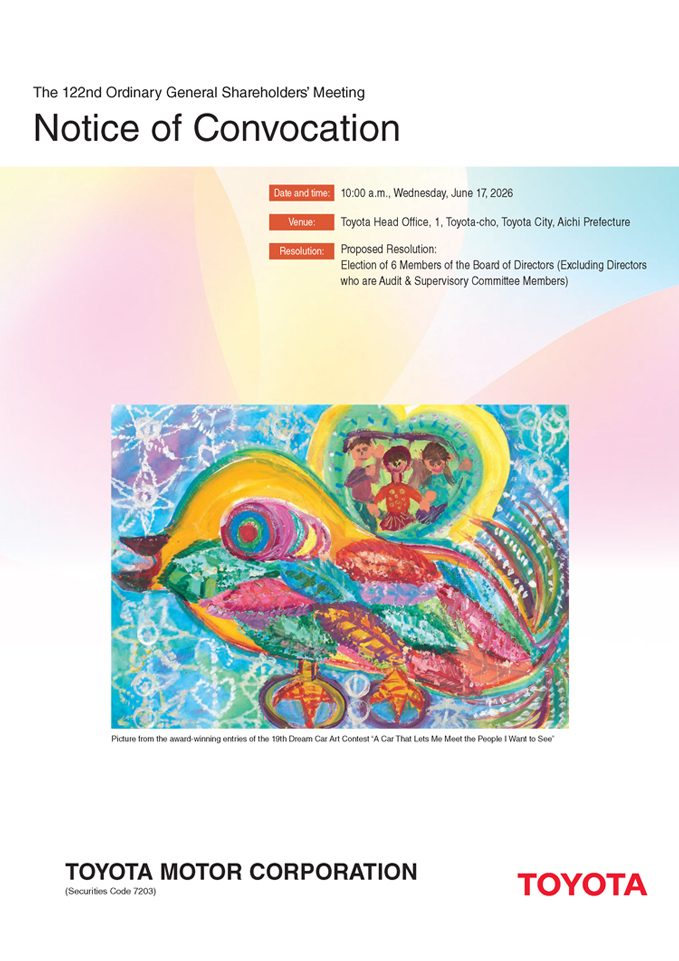

LOGO

Consolidated Financial Statements CONSOLIDATED STATEMENT OF INCOME (Amounts are rounded to the nearest million yen) FY2026 (April 1, 2025 through March 31, 2026) FY2025 (April 1, 2024 through March 31, 2025) Sales revenues 50,684,952 48,036,704 Sales of products 45,865,949 43,598,877 Financial services 4,819,003 4,437,827 Costs and expenses 46,918,736 43,241,118 Cost of products sold 39,141,418 35,510,157 Cost of financial services 3,079,794 2,948,509 Selling, general and administrative 4,697,524 4,782,452 Operating income 3,766,216 4,795,586 Share of profit (loss) of investments accounted for using the equity method 552,742 591,219 Other finance income 594,243 556,700 Other finance costs (86,746) (190,711) Foreign exchange gain (loss), net 400,780 705,292 Other income (loss), net (74,239) (43,497) Income before income taxes 5,152,996 6,414,590 Income tax expense 1,167,234 1,624,835 Net income 3,985,761 4,789,755 Net income attributable to Toyota Motor Corporation 3,848,098 4,765,086 Non-controlling interests 137,664 24,670 Net income 3,985,761 4,789,755 62


LOGO

Consolidated Financial Statements CONSOLIDATED STATEMENT OF CHANGES IN EQUITY FY2026 (April 1, 2025 through March 31, 2026) (Amounts are rounded to the nearest million yen) Common stock Additional paid-in capital Retained earnings Other components of equity Other comprehen-sive income associated with assets held for sale Treasury stock Toyota Motor Corporation shareholders’ equity Non-controlling interests Total shareholders’ equity Balances at April 1, 2025 397,050 492,368 35,841,218 3,610,133 — (4,415,943) 35,924,826 954,088 36,878,913 Comprehensive income Net income — — 3,848,098 — — — 3,848,098 137,664 3,985,761 Other comprehensive income, net of tax — — — 1,459,998 — — 1,459,998 69,946 1,529,944 Total comprehensive income — — 3,848,098 1,459,998 — — 5,308,095 207,610 5,515,705 Transactions with owners and other Dividends paid — — (1,238,974) — — — (1,238,974) (125,416) (1,364,389) Repurchase of treasury stock — — — — — (39,975) (39,975) — (39,975) Reissuance of treasury stock — 1,358 — — — 508 1,866 — 1,866 Retirement of treasury stock — — — — — — — — — Equity transactions and other — (36,984) — — — — (36,984) 64,932 27,948 Total transactions with owners and other — (35,626) (1,238,974) — — (39,467) (1,314,067) (60,483) (1,374,550) Reclassification to retained earnings — — 259,516 (259,516) — — — — — Transfer to other comprehensive income associated with assets held for sale — — — (266,596) 266,596 — — — — Balances at March 31, 2026 397,050 456,742 38,709,858 4,544,019 266,596 (4,455,410) 39,918,854 1,101,214 41,020,068 63
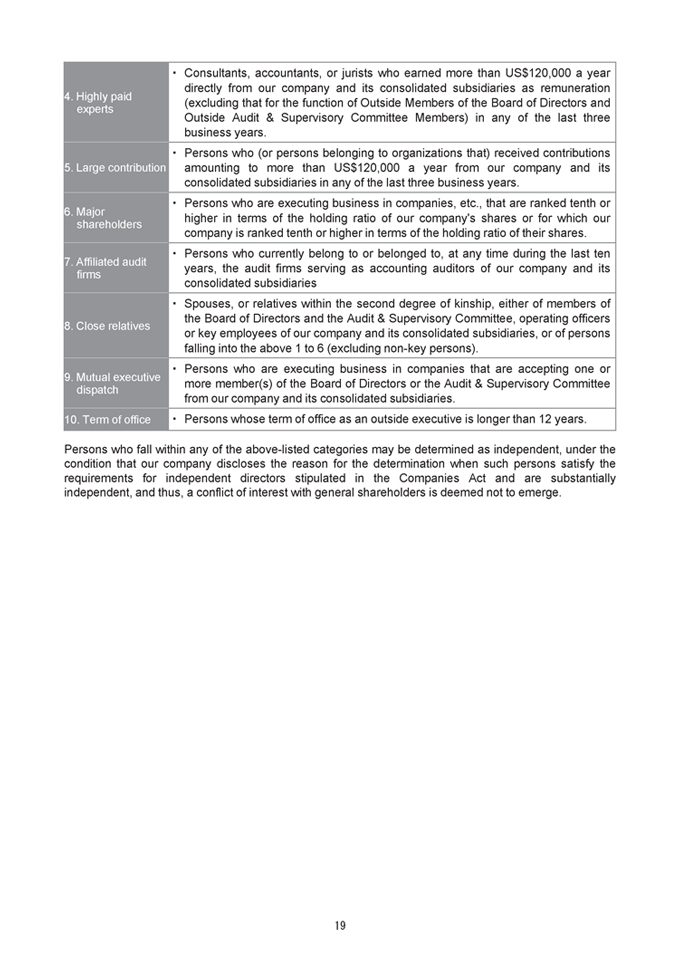
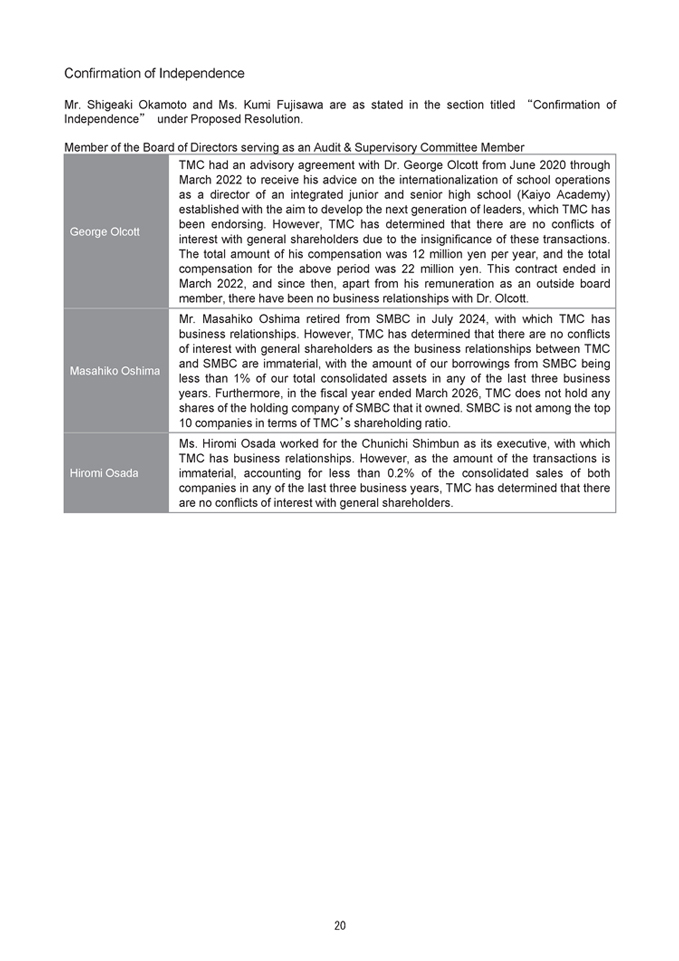

LOGO

FY2025 (Reference) (April 1, 2024 through March 31, 2025) (Amounts are rounded to the nearest million yen) Common stock Additional paid-in capital Retained earnings Other components of equity Treasury stock Toyota Motor Corporation shareholders’ equity Non-controlling interests Total shareholders’ equity Balances at April 1, 2024 397,050 491,802 32,795,365 4,503,756 (3,966,982) 34,220,991 1,018,347 35,239,338 Comprehensive income Net income — — 4,765,086 — — 4,765,086 24,670 4,789,755 Other comprehensive income, net of tax — — — (753,264) — (753,264) 7,233 (746,031) Total comprehensive income — — 4,765,086 (753,264) — 4,011,822 31,903 4,043,724 Transactions with owners and other Dividends paid — — (1,132,329) — — (1,132,329) (127,232) (1,259,560) Repurchase of treasury stock — — — — (1,179,043) (1,179,043) — (1,179,043) Reissuance of treasury stock — 1,356 — — 866 2,222 — 2,222 Retirement of treasury stock — (1,953) (727,264) — 729,217 — — — Equity transactions and other — 1,163 — — — 1,163 31,069 32,232 Total transactions with owners and other — 567 (1,859,593) — (448,961) (2,307,987) (96,162) (2,404,149) Reclassification to retained earnings — — 140,359 (140,359) — — — — Balances at March 31, 2025 397,050 492,368 35,841,218 3,610,133 (4,415,943) 35,924,826 954,088 36,878,913 64
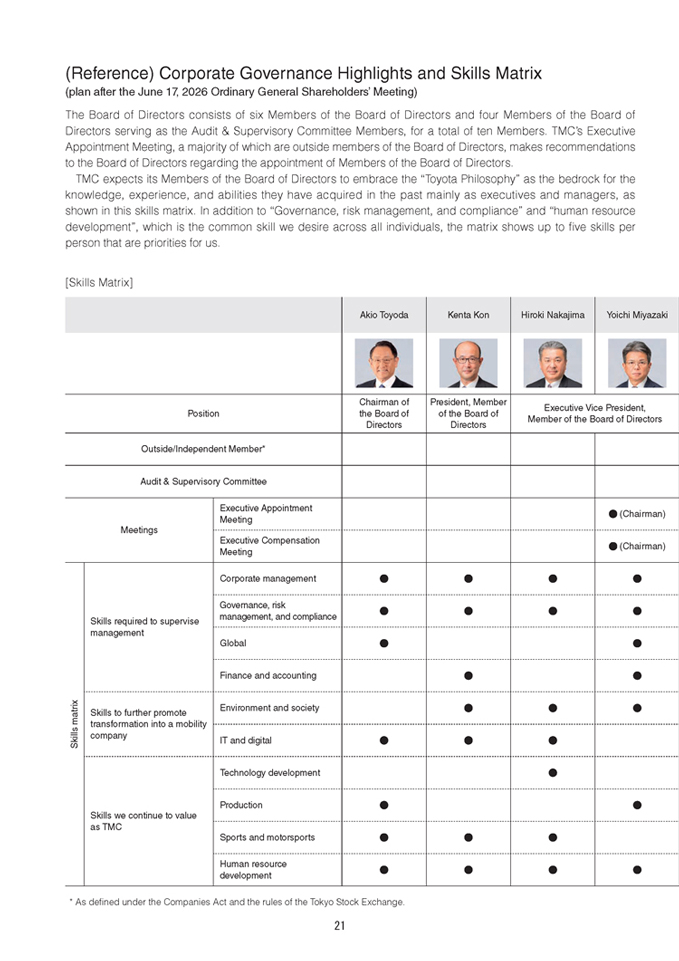
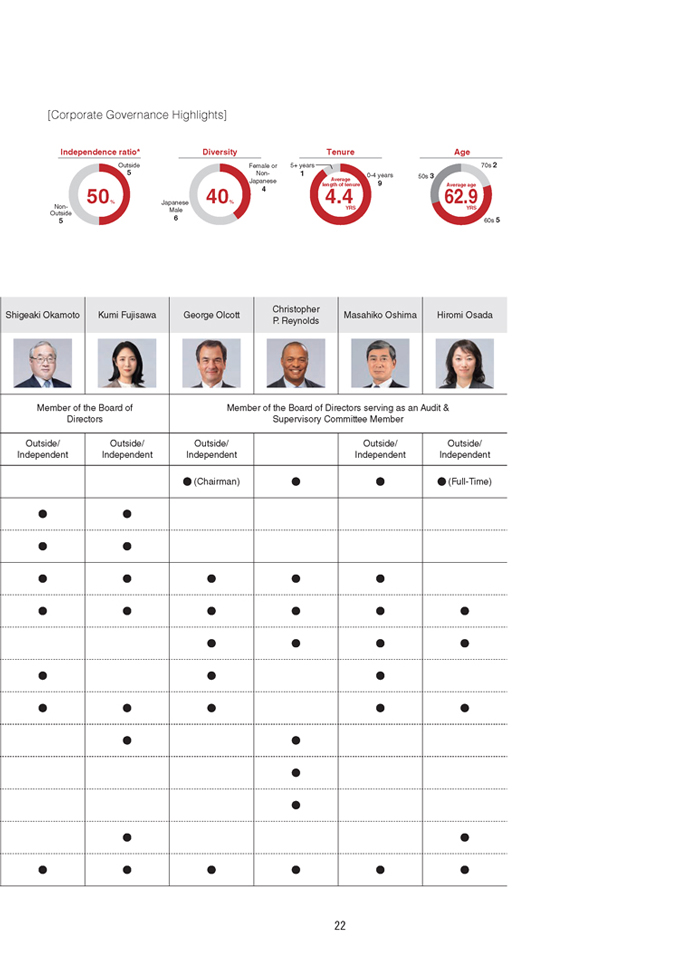

LOGO

NOTES TO THE CONSOLIDATED FINANCIAL STATEMENTS *Amounts are rounded to the nearest million yen unless otherwise stated. [Significant matters pertaining to the preparation of consolidated financial statements] 1. Number of consolidated subsidiaries and associates accounted for by the equity method: TMC has 602 consolidated subsidiaries and 159 associates accounted for by the equity method. 2. Basis of consolidated financial statements: TMC’sconsolidated financial statements have been prepared in accordance with International Financial Reporting Standards (IFRS), pursuant to the provision of Article 120, Paragraph 1 of the Ordinance on Accounting of Companies. Also, pursuant to the provision of the latter part of the said paragraph, certain disclosure items required under IFRS are omitted in the consolidated financial statements. 3. Standards and methods of valuation of financial assets: TMC and its consolidated subsidiaries as a group (collectively, “Toyota”)initially recognizes financial assets when it becomes a party to a contract and classifies financial assets into “financialassets measured at amortized cost,” “debtand equity financial assets measured at fair value through other comprehensive income” or “financial assets measured at fair value through profit or loss.”The sale or purchase of financial assets that occurred in the normal course of business are recognized and derecognized at the trade date. 4. Standards and methods of valuation of inventories: Inventories are valued at cost, not in excess of net realizable value. The cost of inventories is determined principally by using the weighted-average method. 5. Depreciation of property, plant and equipment and amortization of intangible assets: Depreciation of property, plant and equipment is calculated on the straight-line method. An intangible asset with a finite useful life is amortized using the straight-line method. 6. Standards of accounting for provisions: The amounts of liabilities for quality assurance are recognized primarily based on historical experience of repair costs and product failures. Allowance for doubtful accounts and credit losses are recognized primarily based on the frequency of occurrence and loss severity. Retirement benefit liabilities are recognized based on defined benefit obligations measured by actuarial calculations less the fair value of plan assets.


LOGO

7. Standards of accounting for revenues and expenses: In the automotive operations, performance obligations are considered to be satisfied when completed vehicles and parts are delivered to the agreed locations with dealers. For parts for production, it is when they are loaded on a ship or delivered to manufacturing companies. We do not have any material significant payment terms as payment is received at or shortly after the point of sale. Toyota’ssales incentive programs principally consist of cash payments to dealers calculated based on total vehicle volume or vehicle unit sales of certain models sold by a dealer during a certain period of time. Toyota accrues these incentives as revenue reductions upon the sale of a vehicle corresponding to the program by the amount determined in the related incentive program utilizing the most likely outcome method. The sale of certain vehicles includes a contractual right, which entitles customers to free vehicle maintenance. We use an observable price to determine the stand-alone selling price for separate performance obligations or a cost plus margin approach when one is not available. Such revenues from free maintenance contracts are deferred and recognized as revenue over the period of the contract in proportion to the costs expected to be incurred in satisfying the obligations under the contract. Revenues from the sales of vehicles under which Toyota conditionally guarantees the minimum resale value are recognized on a pro rata basis from the date of sale to the first exercise date of the guarantee in accordance with lease accounting. The underlying vehicles of these transactions are recorded as assets and are depreciated in accordance with Toyota’s depreciation policy. Interest income from financial services is recognized using the effective interest method. Revenues from operating leases are recognized on a straight-line basis over the lease term. If the period between satisfaction of the performance obligation and receipt of consideration is expected to be within one year or less, as a practical expedient, we do not adjust the promised amount of consideration for the effects of a significant financing component. Revenue is recognized net of any taxes collected from customers and subsequently remitted to governmental authorities. [Changes in Presentation] (Consolidated statement of financial position) Provisions, which were included in “Othercurrent liabilities” and “Othernon-current liabilities” for the year ended March 31, 2025, have been reclassified and presented as separate line items for the year ended March 31, 2026, due to the increased materiality and for the purpose of providing a clearer presentation of the financial position. To reflect this change in presentation, amounts for the year ended March 31, 2025 have also been reclassified and presented accordingly.


LOGO

[Accounting estimates] Of the items recognized through accounting estimates in the consolidated financial statements for the year ended March 31, 2026, those that may have significant effects on the consolidated financial statements for the following year March 31, 2027 are as follows: 1. Liabilities for quality assurance 2,097,943 million yen Liabilities for quality assurance mainly represent management’s best estimate, at the time products are sold, of the total costs that Toyota will incur to repair or replace product parts that fail while still under warranty, as well as the costs of recalls and other safety measures. The amount of liabilities for quality assurance is estimated primarily based on currently available information such as historical experience of repair costs and product failures. 2. Allowance for credit losses on finance receivables 502,743 million yen Retail receivables and finance lease receivables consist of retail installment sales contracts secured by passenger cars and commercial vehicles. The allowance for credit losses on finance receivables is measured at the portfolio level, based on a systematic, ongoing review and evaluation performed as part of the credit risk evaluation process, historical loss experience, the size and composition of the portfolios, current economic events and conditions, the estimated fair value and adequacy of collateral, forward-looking information including movements of the world economy and other pertinent factors. [Consolidated statement of financial position] 1. Allowance for doubtful accounts 117,860 million yen Allowance for credit losses 502,743 million yen 2. Components of other components of equity Exchange differences on translating foreign operations 3,435,012 million yen Net changes in revaluation of financial assets measured 1,109,007 million yen at fair value through other comprehensive income 3. Assets pledged as collateral 10,999,469 million yen 4. Guarantees 1,553,327 million yen


LOGO

[Consolidated statement of changes in equity] 1. Shares of common stock issued and outstanding as of March 31, 2026 15,794,987,460 shares 2. Dividends from surplus (1) Cash dividends Type of Total cash Dividends Resolutions Record date Effective date shares dividends per share Directors’Meetingheld Common 652,446 million yen 50.0 yen March 31, 2025 May 26, 2025 on May 8, 2025 stock Directors’Meetingheld Common September 30, November 26, 586,527 million yen 45.0 yen on November 5, 2025 stock 2025 2025 (2) Dividends of which record date falls in the year ended March 31, 2026 and effective date falls in the year ending March 31, 2027 Scheduled to be Type of Total cash Dividends Record date Effective date resolved shares dividends per share Directors’Meetingheld Common 651,697 million yen 50.0 yen March 31, 2026 May 26, 2026 on May 8, 2026 stock [Financial instruments] 1. Matters pertaining to the status of financial instruments Toyota has certain financial instruments, which arose in the normal course of business, such as marketable securities and finance receivables. Toyota uses derivative financial instruments to manage mainly the exposures to fluctuations in interest rates and foreign currency exchange rates. 2. Matters pertaining to the fair value of financial instruments Carrying amount Fair value Assets (Liabilities) (million yen) (million yen) Public and corporate bonds and stocks, other (Note) 12,938,418 12,938,418 Receivables related to financial services 38,966,655 39,407,482 Long-term debt (Including current portion) (36,795,373) (36,700,382) Derivative financial assets 479,447 479,447 Derivative financial liabilities (357,955) (357,955) Note: Included 40,245 million yen of “Assets held for sale” recorded on the consolidated statement of financial position. 3. Fair value information by level within the fair value hierarchy of financial instruments In accordance with IFRS, Toyota classifies fair value measurement into the following three levels based on the observability and significance of the inputs used. Level 1: Quoted prices in active markets for identical assets or liabilities Level 2: Fair value measurement based on inputs other than quoted prices included within Level 1 that are observable for the assets or liabilities, either directly or indirectly Level 3: Fair value measurement based on models using significant unobservable inputs for the assets or liabilities


LOGO

(1) Financial assets and financial liabilities measured at fair value in the consolidated statement of financial position Fair value (million yen) Classification Level 1 Level 2 Level 3 Total Public and corporate bonds and stocks, other 8,246,631 3,511,909 1,179,878 12,938,418 (Note) Derivative financial 427,652 51,795 479,447 assets Derivative financial (357,955) (357,955) liabilities Note: Included 40,245 million yen of “Assets held for sale” recorded on the consolidated statement of financial position. (2) Financial assets and financial liabilities not measured at fair value in the consolidated statement of financial position Fair value (million yen) Classification Level 1 Level 2 Level 3 Total Receivables related to — 39,407,482 — 39,407,482 financial services Long-term debt (Including current — (29,046,698) (7,653,684) (36,700,382) portion) (3) Method of fair value measurement The fair value of assets and liabilities is determined using relevant market information and appropriate valuation methods. The methods and assumptions for measuring the fair value of assets and liabilities are as follows: 1) Receivables related to financial services The fair value of receivables related to financial services is estimated by discounting expected cash flows to present value using internal assumptions, including prepayment speeds, expected credit losses and collateral value. As unobservable inputs are utilized, the fair value of receivables related to financial services is classified as Level 3. 2) Public and corporate bonds Public and corporate bonds include government bonds. Toyota primarily uses quoted market prices for identical assets or valuation techniques using observable input to measure the fair value of these securities.


LOGO

3) Stock Toyota primarily uses quoted market prices for identical assets to measure fair value. Therefore, stocks with an active market are classified as Level 1. Fair value of stocks with no active market is measured by using the market approach or other appropriate methods. Therefore, stocks with no active market are thus classified as Level 3. Price book-value ratios (“PBR”) of comparable companies, discount ratios of discounted cash flow valuation method and others are the significant unobservable inputs relating to the fair value measurement of stocks classified as Level 3. The fair value increases (decreases) as PBR of a comparable company rises (declines) or the discount rate declines (rises). The estimated increase or decrease in fair value of stocks if the unobservable inputs were to be replaced by other reasonable alternative assumptions are not significant. These estimates are based on valuation methods that are considered appropriate in each case. The significant assumptions involved in the estimations include the financial condition and future prospects and trends of the investees and the outcome of the referenced transactions. Due to the uncertain nature of these assumptions or by using different assumptions and estimates, the fair value may be impacted materially. The shares classified as Level 3 are measured by the responsible department using quarterly available information in accordance with Toyota’s consolidated financial accounting policies and reported to the supervisors along with the basis of the change in fair value. 4) Derivative financial instruments Toyota employs derivative financial instruments, including foreign exchange forward contracts, foreign currency options, interest rate swaps, interest rate currency swap agreements and interest rate options to manage mainly its exposures to fluctuations in interest rates and foreign currency exchange rates. Toyota primarily estimates the fair value of derivative financial instruments using industry-standard valuation models that require observable inputs including interest rates and foreign exchange rates, and the contractual terms. The usage of these models does not require significant judgment to be applied. These derivative financial instruments are classified as Level 2. In other certain cases when market data are not available, key inputs to the fair value measurement include quotes from counterparties, and other market data. Toyota assesses the reasonableness of changes of the quotes using observable market data. These derivative financial instruments are classified as Level 3.derivative fair value measurements consider assumptions about counterparty and Toyota’s own non-performance risk, using such as credit default probabilities. 5) Long-term debt (Including current portion) The fair value of long-term debt including the current portion, except for secured loans provided by securitization transactions using special-purpose entities (“Loans Based on Securitization”), is estimated based on the discounted amounts of future cash flows using Toyota’s current borrowing rates for similar liabilities. As these inputs are observable, the fair value of these debts is classified as Level 2. The fair value of the Loans Based on Securitization is primarily estimated based on current market rates and credit spreads for debt with similar maturities. Internal assumptions including prepayment speeds and expected credit losses are used to estimate the timing of cash flows to be paid on the underlying securitized assets. In case these valuations utilize unobservable inputs, the fair value of the Loans Based on Securitization is classified as Level 3. 70


LOGO

[Revenue recognition] (1) Disaggregation of revenue The table below shows Toyota’s sales revenues from external customers by business and by product category. (million yen) For the year ended March 31, 2026 Sales of products Automotive Vehicles 38,847,899 Parts and components for production 1,509,449 Parts and components for after service 3,608,666 Other 1,235,909 Total automotive 45,201,924 All other 664,026 Total sales of products 45,865,949 Financial services 4,819,003 Total sales revenues 50,684,952 The majority of sales of products are revenues recognized from contracts with customers under IFRS 15 “Revenue from Contracts with Customers” , and receivables related to such revenues are recognized as “Trade accounts and other receivables.” (2) Useful information in understanding the amount of revenue for the year ended March 31, 2026, the year ended March 31, 2027 and onward 1) Contract liabilities Contact liabilities consist of the following: (million yen) March 31, 2026 Contract liabilities 1,664,633 Contract liabilities are primarily related to advances received from customers. Contract liabilities are included in “Other current liabilities” and “Other non-current liabilities” in the consolidated statement of financial position. For the year ended March 31, 2026, the amounts transferred from contract liabilities at the beginning of the fiscal year to operating income were 729,698 million yen. 71


LOGO

2) Performance obligations The aggregate amounts of transaction prices allocated to unsatisfied performance obligations related to contracts that have original expected durations in excess of one year were 1,350,018 million yen as of March 31, 2026. The main contents of unsatisfied performance obligations are insurance revenues and maintenance revenues. For insurance revenues, Toyota receives payment agreed upon in the contract at the inception of the contract, and revenue is recognized over the term of the contract, which ranges from three to 120 months. As of March 31, 2026, the unsatisfied performance obligations related to insurance revenues were 542,409 million yen, and Toyota expects to recognize as revenue 156,443 million yen in fiscal 2027, and 385,966 million yen thereafter. For maintenance revenues, Toyota receives payments agreed upon in the contract at the inception of contract, and revenue is recognized over the term of the contract, which ranges from 18 to 84 months. Unsatisfied performance obligations for sales of products related to contracts that have an original expected duration of one year or less have been excluded from this disclosure. [Assets held for sale] (The business integration of Mitsubishi Fuso Truck and Bus Corporation and Hino Motors, Ltd.) As of the effective date of the business integration between Mitsubishi Fuso Truck and Bus Corporation (“MFTBC”) and Hino Motors, Ltd. (“Hino”) (April 1, 2026), Hino is no longer a consolidated subsidiary of Toyota. Consequently, the assets, liabilities, and related other comprehensive income of Hino and its consolidated subsidiaries have been reclassified as held for sale, and are presented at the end of the current consolidated fiscal year as assets held for sale, liabilities directly associated with assets held for sale, and other comprehensive income associated with assets held for sale. However, assets and liabilities related to Hino’s Hamura plant are not classified as held for sale because that plant will become a consolidated subsidiary of Toyota before the business integration in the next consolidated fiscal year as Toyota Motor Hamura, Inc.. (Review of capital relationship with Toyota Industries Corporation) On March 24, 2026, Toyota Fudosan Co., Ltd. completed a tender offer for the shares of Toyota Industries Corporation (“Toyota Industries” ). Because a squeeze-out procedure and the planned sale of the Toyota Industries shares held by Toyota are expected to be completed in the next consolidated fiscal year, Toyota has reclassified our holdings of Toyota Industries and related other comprehensive income as held for sale. 72


LOGO

[Earnings per share] (Amounts are rounded to the nearest hundredth digit yen) 1. Toyota Motor Corporation shareholders’equity per share 3,062.82 yen 2. Earnings per share attributable to Toyota Motor Corporation 295.25 yen [Significant subsequent events] (The business integration of MFTBC and Hino) On June 10, 2025,Toyota, Daimler Truck AG, MFTBC and Hino concluded a definitive agreement for the business integration of MFTBC and Hino. Hino has been excluded from consolidated subsidiaries of Toyota as of the effective date of this business integration (April 1, 2026). Prior to the business integration in the following consolidated fiscal year, Hino’s Hamura Plant became a consolidated subsidiary of Toyota as Toyota Motor Hamura, Inc. . However, management is currently evaluating the impact of this business integration on Toyota’s consolidated financial statements.


LOGO

[This page intentionally left blank]


LOGO

Unconsolidated Financial Statements UNCONSOLIDATED BALANCE SHEET (As of March 31, 2026) (Amounts are rounded to the nearest million yen) FY2026 FY2025 FY2026 FY2025 (Reference) (Reference) (Assets) (Liabilities) Current assets 16,512,121 15,707,095 Current liabilities 6,185,881 5,974,594 Cash and deposits 5,828,255 3,996,258 Electronically recorded Trade accounts receivable 1,636,381 1,815,800 obligations-operating 381,308 395,659 Marketable securities 4,716,345 5,415,469 Trade accounts payable 1,396,049 1,257,898 Finished goods 313,790 276,852 Current portion of long-term Work in process 130,180 99,228 borrowings 193,500 171,500 Raw materials and supplies 478,313 502,589 Current portion of bonds 119,940 319,520 Short-term loans 1,753,989 2,323,881 Other payables 725,897 909,847 Income taxes receivable — 49,563 Income taxes payable 355,212 65,933 Others 1,657,568 1,229,955 Accrued expenses 1,824,570 1,942,238 Less: allowance for doubtful Deposits received 1,104,674 845,108 accounts (2,700) (2,500) Others 84,731 66,891 Fixed assets 15,144,204 13,339,604 Long-term liabilities 1,805,520 1,567,301 Property, plant and Bonds 979,520 788,560 equipment 2,117,882 1,909,359 Long-term borrowings 153,857 173,857 Buildings, net 585,781 472,769 Allowance for retirement Structures, net 93,638 89,534 benefits 360,665 364,287 Machinery and equipment, Others 311,478 240,597 net 480,837 298,093 Total liabilities 7,991,401 7,541,895 Vehicle and delivery (Net assets) equipment, net 33,720 27,950 Shareholders’ equity 21,839,284 19,724,041 Tools, furniture and fixtures, Common stock 635,402 635,402 net 109,752 83,971 Capital surplus 656,680 655,323 Land 480,883 476,137 Capital reserve 655,323 655,323 Construction in progress 333,272 460,906 Other capital surplus 1,358 — Investments and other Retained earnings 25,007,777 22,854,425 assets 13,026,321 11,430,244 Legal reserve 99,454 99,454 Investments in securities 7,818,832 7,626,969 Other retained earnings 24,908,323 22,754,970 Investments in subsidiaries Reserve for reduction of and affiliates 4,443,587 3,036,861 acquisition cost of fixed Long-term loans 96,789 118,392 assets 9,237 9,686 Deferred tax assets 322,125 300,216 General reserve 6,340,926 6,340,926 Others 392,389 397,206 Retained earnings carried Less: allowance for doubtful forward 18,558,160 16,404,358 accounts (47,400) (49,400) Less: treasury stock (4,460,575) (4,421,108) Valuation and translation adjustments 1,825,640 1,780,763 Net unrealized gains on other securities 1,825,640 1,780,763 Total net assets 23,664,924 21,504,804 Total 31,656,325 29,046,699 Total 31,656,325 29,046,699
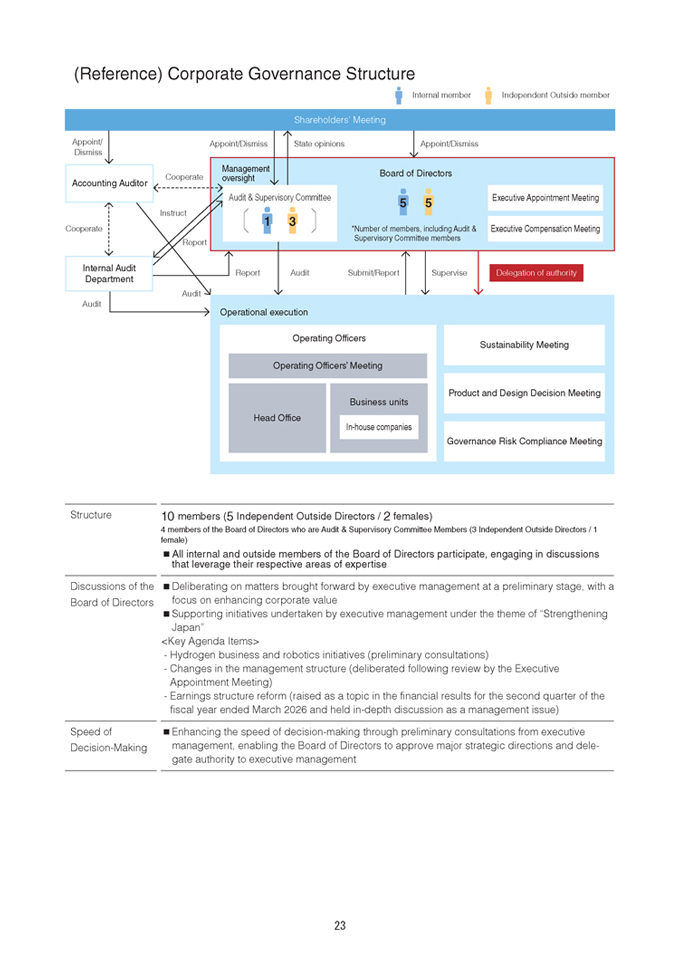

LOGO

Unconsolidated Financial Statements UNCONSOLIDATED STATEMENT OF INCOME (April 1, 2025 through March 31, 2026) (Amounts are rounded to the nearest million yen) FY2026 FY2025 (Reference) Net revenues 18,259,979 18,277,671 Cost of sales 14,279,645 13,490,075 Gross profit 3,980,334 4,787,596 Selling, general and administrative expenses 2,174,945 1,820,739 Operating income 1,805,389 2,966,857 Non-operating income 2,690,658 2,818,513 Interest income 283,902 309,936 Dividend income 1,338,273 1,769,423 Others 1,068,483 739,154 Non-operating expenses 298,728 1,247,333 Interest expenses 44,771 36,585 Others 253,957 1,210,748 Ordinary income 4,197,319 4,538,037 Income before income taxes 4,197,319 4,538,037 Income taxes – current 858,121 789,840 Income taxes – deferred (53,128) (97,016) Net income 3,392,326 3,845,213


LOGO

Unconsolidated Financial Statements UNCONSOLIDATED STATEMENT OF CHANGES IN NET ASSETS FY2026 (April 1, 2025 through March 31, 2026) (Amounts are rounded to the nearest million yen) Shareholders’ equity Common stock Capital surplus Retained earnings Capital reserve Other capital surplus Total capital surplus Legal reserve Other retained earnings Total retained earnings Reserve for special depreciation Reserve for reduction of acquisition cost of fixed assets General reserve Retained earnings carried forward Balance at the beginning of current period 635,402 655,323 — 655,323 99,454 — 9,686 6,340,926 16,404,358 22,854,425 Changes of items during the period Reversal of reserve for reduction of acquisition cost of fixed assets (449) 449 — Dividends paid (1,238,974) (1,238,974) Net income 3,392,326 3,392,326 Repurchase of treasury Stock Reissuance of treasury stock 1,358 1,358 Net changes of items other than shareholders’ equity Total changes of items during the period — — 1,358 1,358 — — (449) — 2,153,801 2,153,352 Balance at the end of current period 635,402 655,323 1,358 656,680 99,454 — 9,237 6,340,926 18,558,160 25,007,777
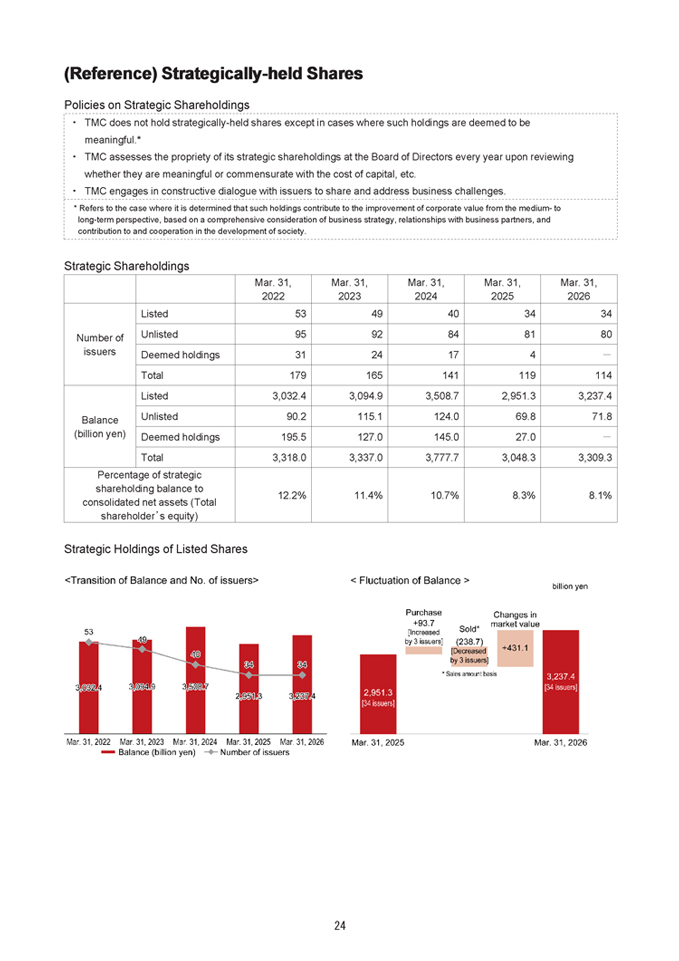
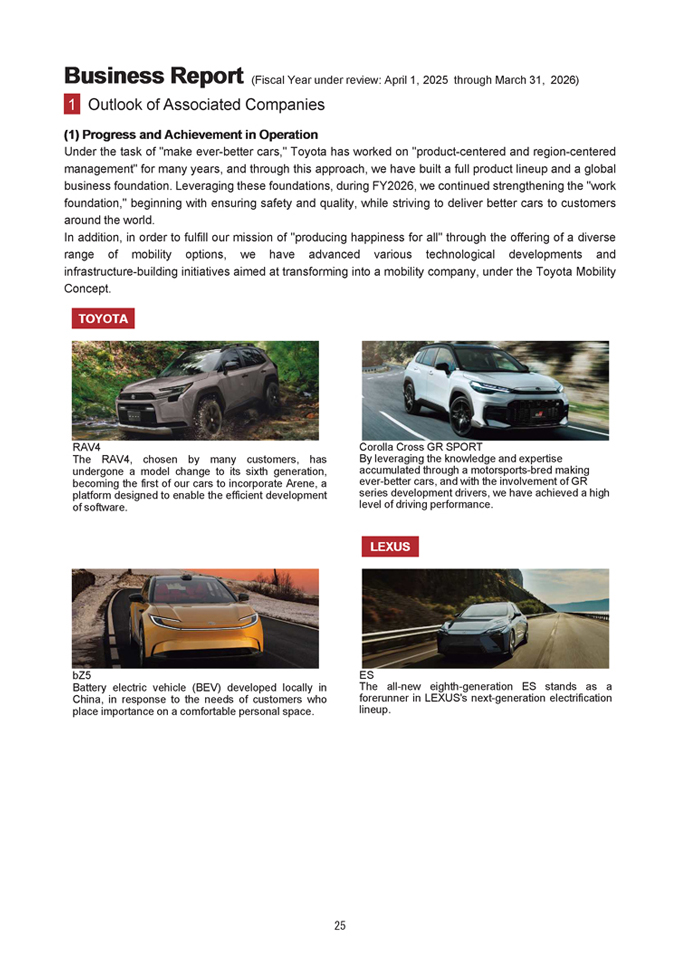

LOGO

Balance at the beginning of current period Changes of items during the period Reversal of reserve for reduction of acquisition cost of fixed assets Dividends paid Net income Repurchase of treasury stock Reissuance of treasury stock Net changes of items other than shareholders’ equity Total changes of items during the period Balance at the end of (4,421,108) (39,975) 508 (39,467) (4,460,575) 19,724,041 1,780,763 1,780,763 21,504,804 (1,238,974) (1,238,974) 3,392,326 3,392,326 (39,975) (39,975) 1,866 1,866 44,877 44,877 44,877 2,115,243 44,877 44,877 2,160,120 21,839,284 1,825,640 1,825,640 23,664,924
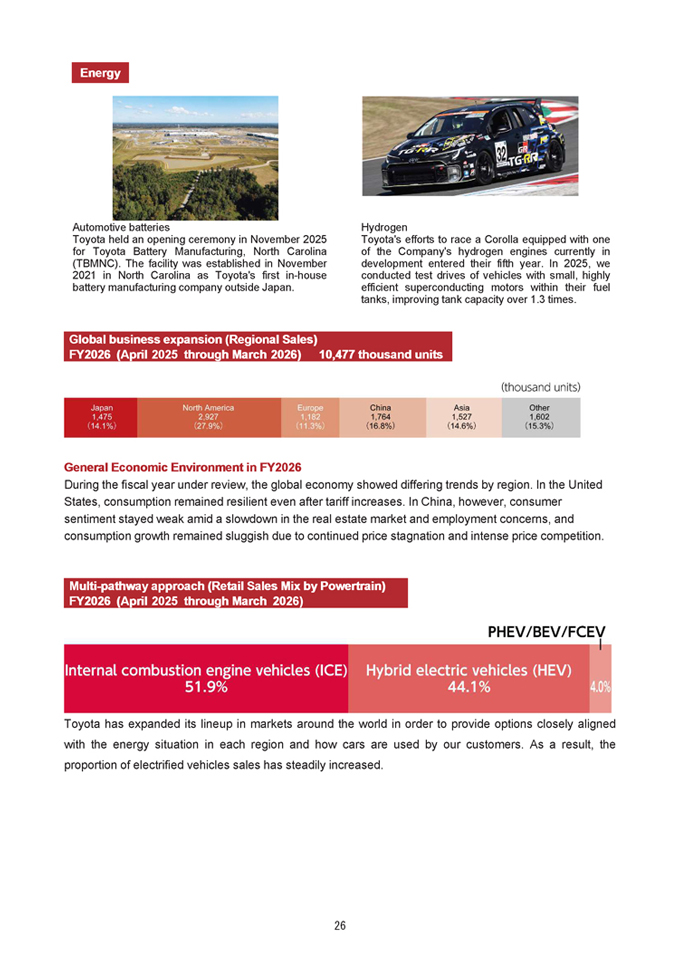

LOGO

FY2025 (Reference) (April 1, 2024 through March 31, 2025) (Amounts are rounded to the nearest million yen) Shareholders’ equity Capital surplus Retained earnings Other retained earnings Common Other Total Reserve for Total stock Capital Legal Retained capital capital Reserve for reduction of retained reserve reserve General earnings surplus surplus special acquisition earnings reserve carried depreciation cost of fixed forward assets Balance at the beginning of current 635,402 655,323 596 655,919 99,454 2 8,818 6,340,926 14,345,700 20,794,901 period Cumulative effects of changes in accounting 73,903 73,903 policies Restated balance 635,402 655,323 596 655,919 99,454 2 8,818 6,340,926 14,419,604 20,868,804 Changes of items during the period Reversal of reserve for (2) 2 special depreciation Appropriation to reserve for reduction of 912 (912) acquisition cost of fixed assets Reversal of reserve for reduction of acquisition (44) 44 cost of fixed assets Dividends paid (1,132,329) (1,132,329) Net income 3,845,213 3,845,213 Repurchase of treasury stock Reissuance of treasury 1,356 1,356 stock Retirement of treasury (729,217) (729,217) stock Transfer to capital surplus from retained 727,264 727,264 (727,264) (727,264) earnings Net changes of items other than shareholders’ equity Total changes of items (596) (596) (2) 868 1,984,755 1,985,620 during the period Balance at the end of 635,402 655,323 655,323 99,454 9,686 6,340,926 16,404,358 22,854,425 current period
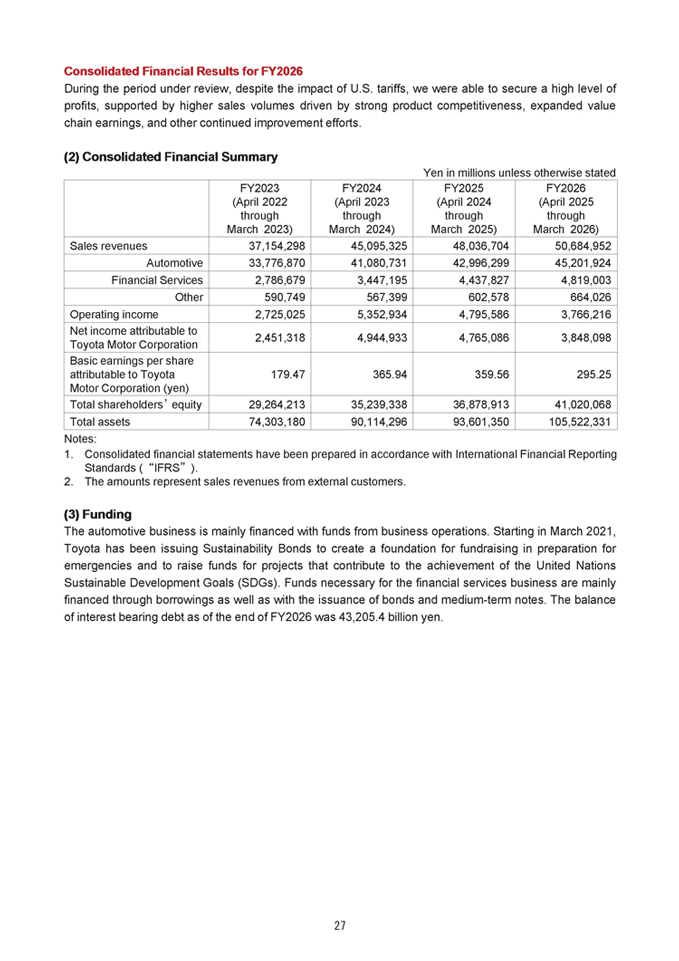
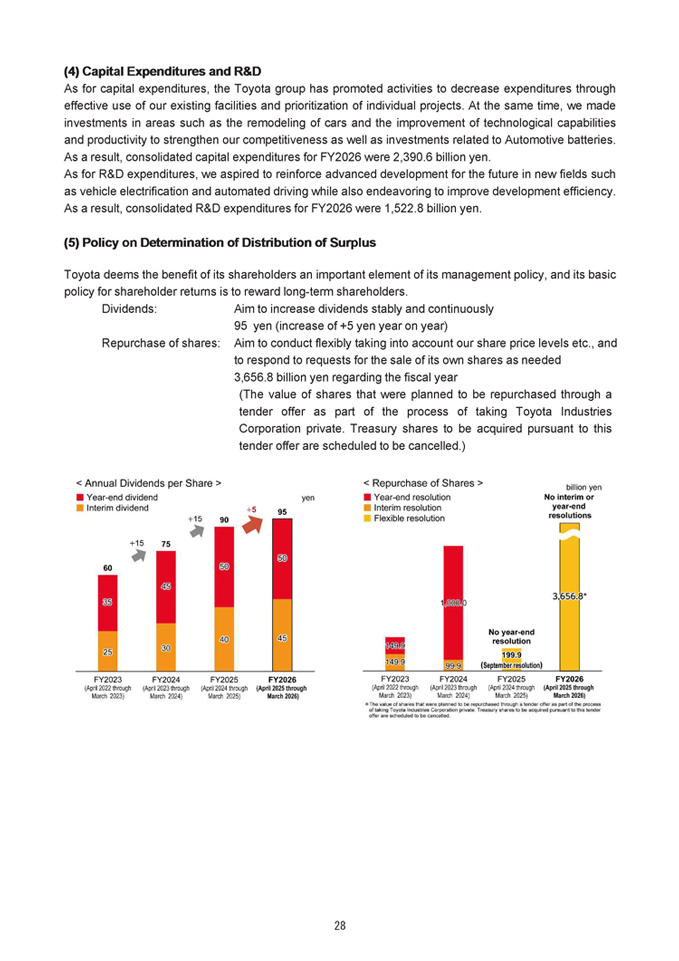

LOGO

(Amounts are rounded to the nearest million yen) Shareholders’ equity Valuation and translation adjustments Total Net unrealized Total valuation Total Treasury net assets shareholders’ gains on and translation stock equity other securities adjustments Balance at the beginning of current (3,972,147) 18,114,074 2,326,007 2,326,007 20,440,081 period Cumulative effects of changes in accounting 73,903 (73,903) (73,903) policies Restated balance (3,972,147) 18,187,978 2,252,104 2,252,104 20,440,081 Changes of items during the period Reversal of reserve for special depreciation Appropriation to reserve for reduction of acquisition cost of fixed assets Reversal of reserve for reduction of acquisition cost of fixed assets Dividends paid (1,132,329) (1,132,329) Net income 3,845,213 3,845,213 Repurchase of treasury (1,179,043) (1,179,043) (1,179,043) stock Reissuance of treasury 866 2,222 2,222 stock Retirement of treasury 729,217 stock Transfer to capital surplus from retained earnings Net changes of items other than shareholders’ (471,341) (471,341) (471,341) equity Total changes of items (448,961) 1,536,063 (471,341) (471,341) 1,064,723 during the period Balance at the end of (4,421,108) 19,724,041 1,780,763 1,780,763 21,504,804 current period
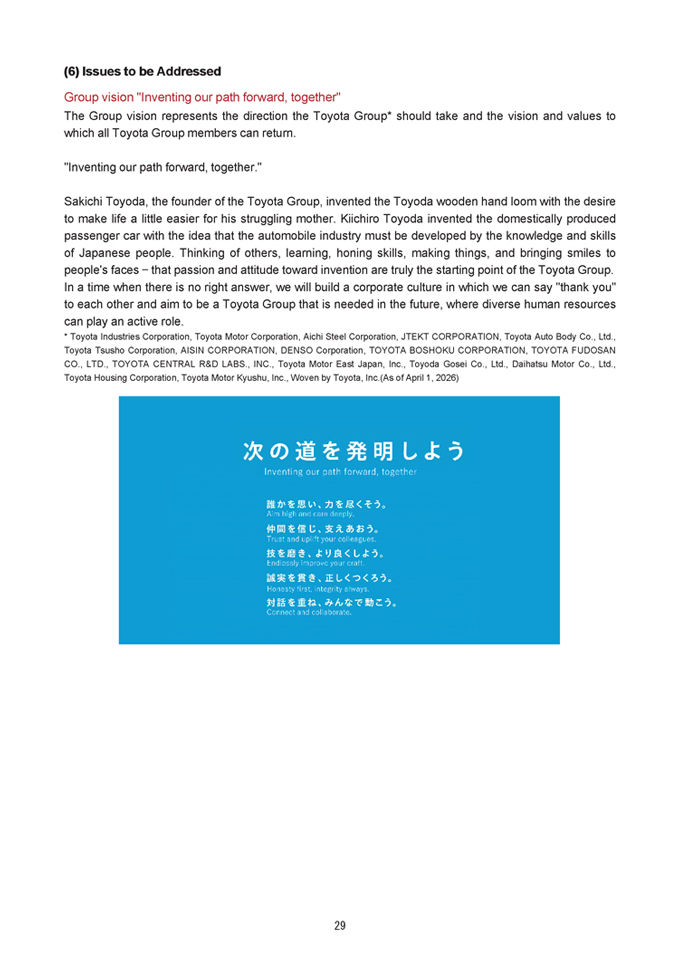
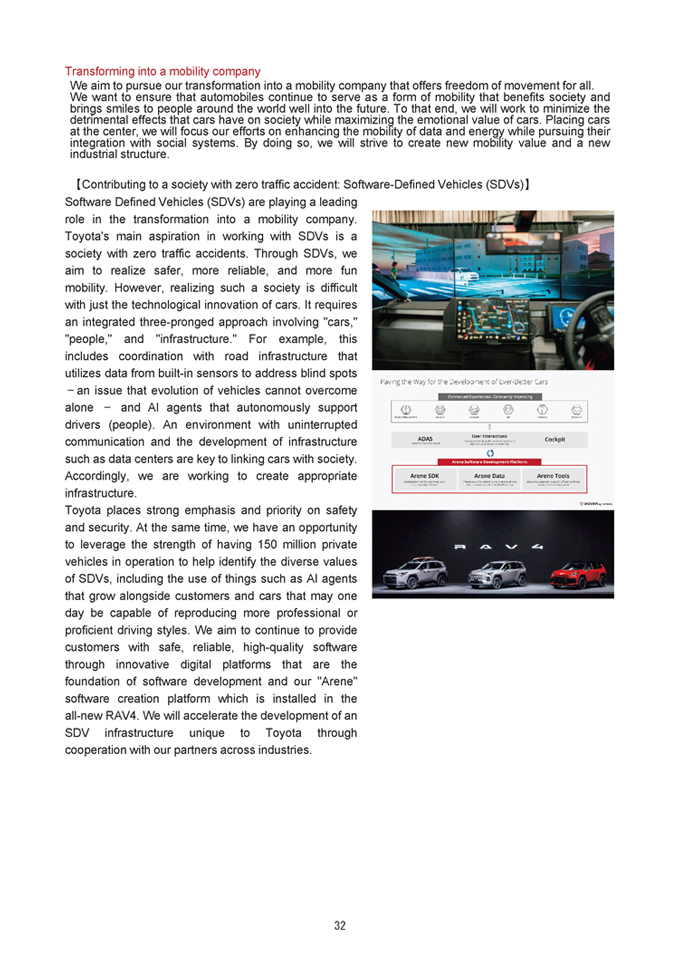
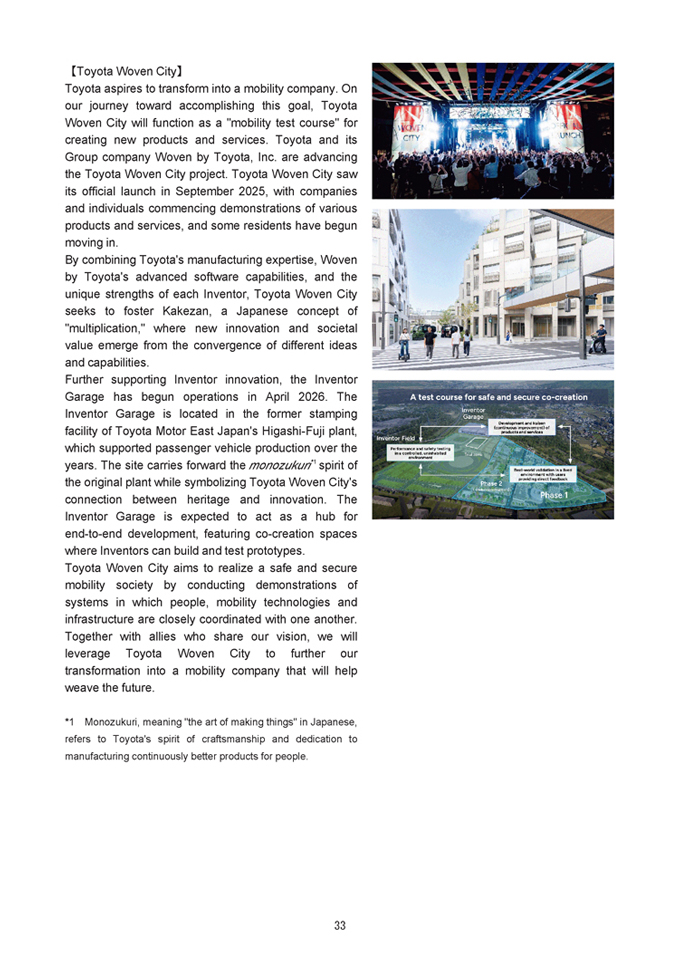

LOGO

NOTES TO UNCONSOLIDATED FINANCIAL STATEMENTS *Amounts are rounded to the nearest million yen unless otherwise stated. [Significant accounting policies] 1. Standards and methods of valuation of assets (1) Standards and methods of valuation of securities Equity securities of subsidiaries and affiliates are stated at cost determined on the moving-average method. Other securities: Other securities other than equity securities, etc. without market prices are stated at fair value (Differences in valuation are included directly in net assets; costs of securities are determined on the moving-average method.) Equity securities, etc. without market prices are stated at cost determined on the moving-average method. (2) Standards and methods of valuation of inventories Standards: Cost method (the amounts presented in the balance sheet are written down to the lower of cost or market value) Methods: Generally, average method 2. Depreciation of property, plant and equipment is computed on the declining balance method. 3. Standards of accounting for reserves (1) Allowance for doubtful accounts: To prepare for losses from bad debt, allowance for doubtful accounts is provided in an amount which is determined by considering the historical loss experience and the collectibility of the receivables. (2) Allowance for retirement benefits: To provide for the retirement benefits for employees, including those already retired, allowance for retirement benefits is stated based on estimated retirement benefit obligations and estimated pension assets at the end of the fiscal year. 4. Standards of accounting for revenues and expenses In the automotive operations, performance obligations are considered to be satisfied when completed vehicles and parts are delivered to the agreed locations with dealers. For parts for production, it is when they are loaded on a ship or delivered to manufacturing companies. We do not have any material significant payent terms as payment is received at or shortly after the point of sale. TMC’s sales incentive programs principally consist of cash payments to dealers calculated based on total vehicle volume or vehicle unit sales of certain models sold by a dealer during a certain period of time. TMC accrues these incentives as revenue reductions upon the sale of a vehicle corresponding to the program by the amount determined in the related incentive program utilizing the most likely outcome method. The sale of certain vehicles includes a contractual right, which entitles customers to free vehicle maintenance. We use an observable price to determine the stand-alone selling price for separate performance obligations or a cost plus margin approach when one is not available. Such revenues from free maintenance contracts are deferred and recognized as revenue over the period of the contract in proportion to the costs expected to be incurred in satisfying the obligations under the contract.
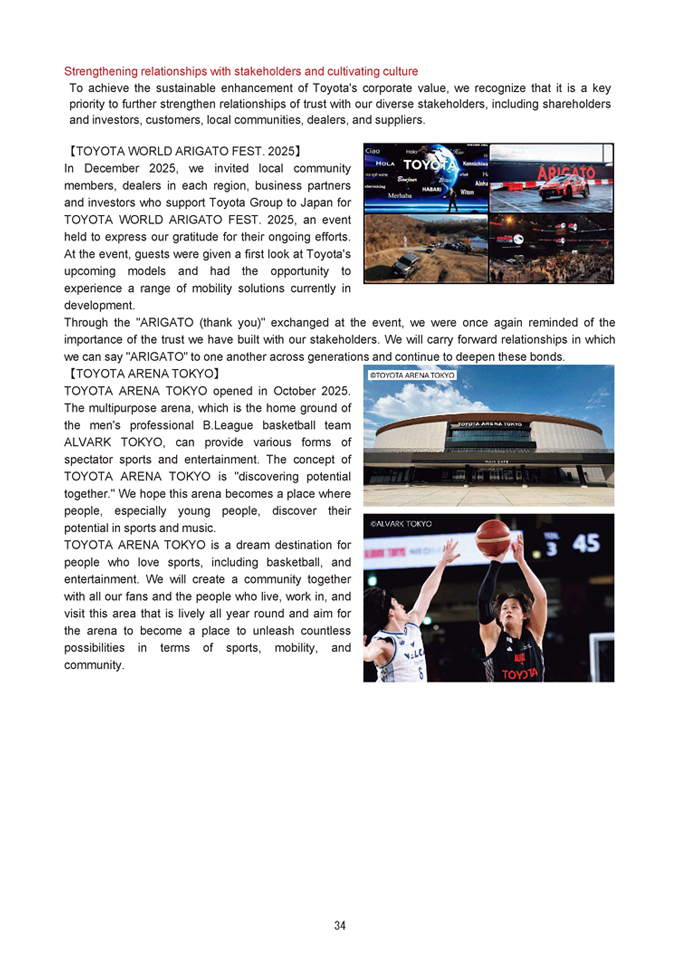
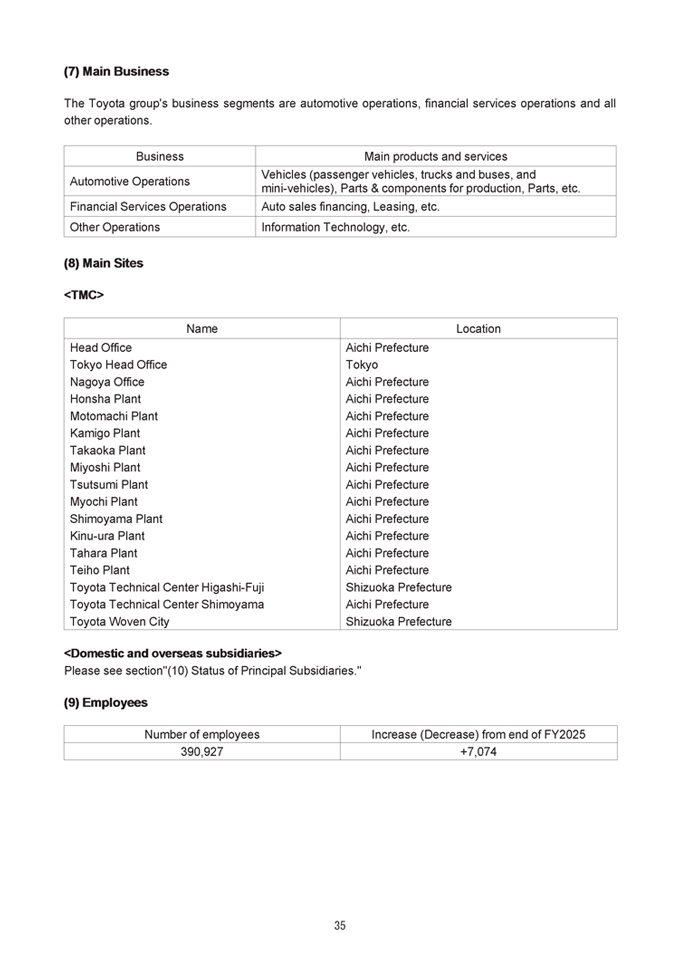
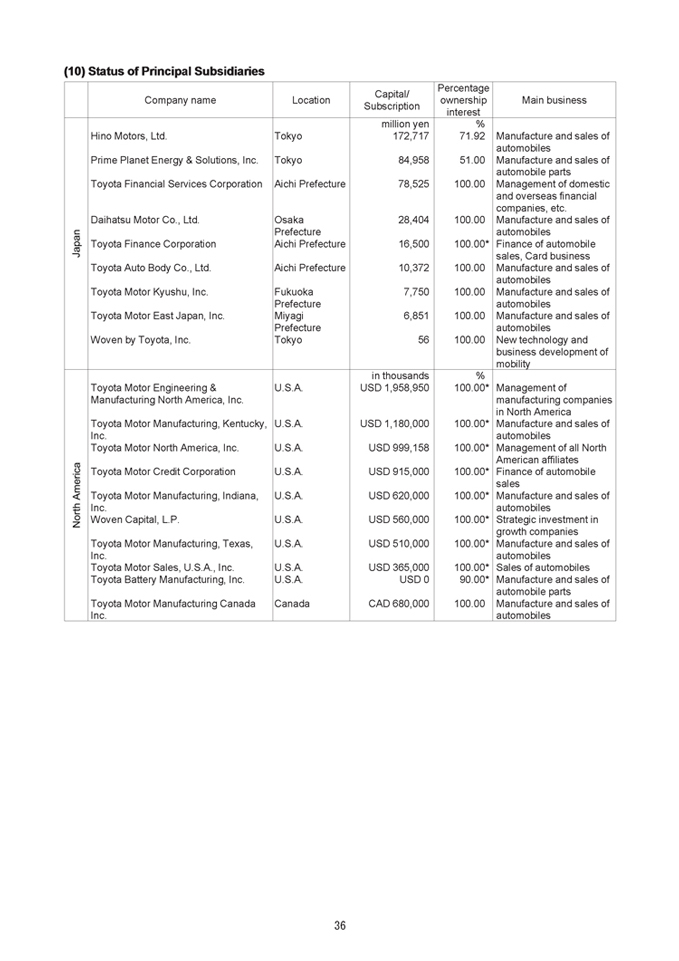
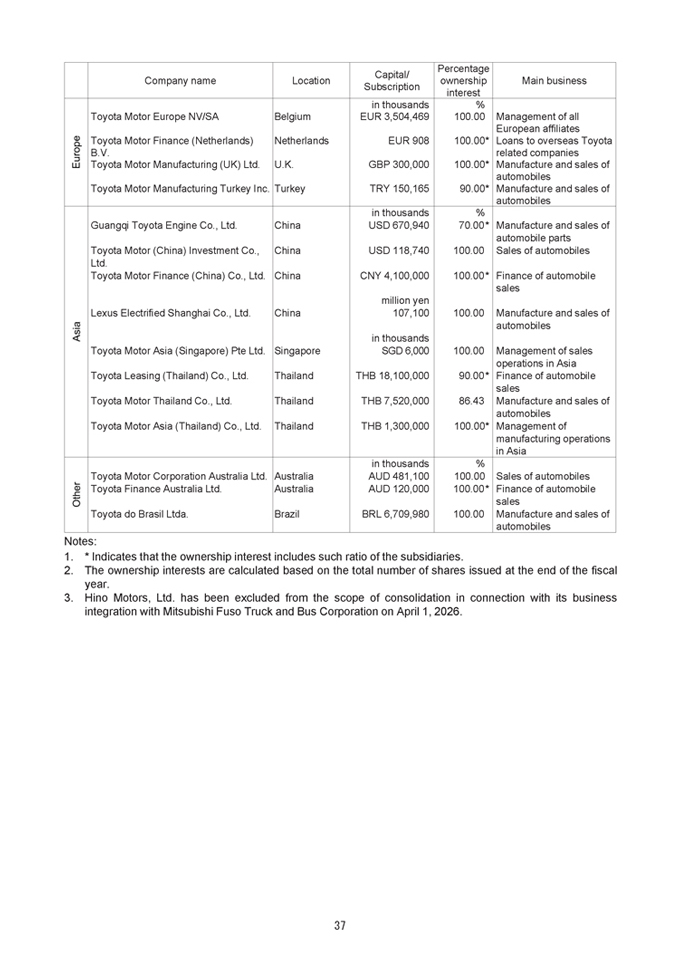
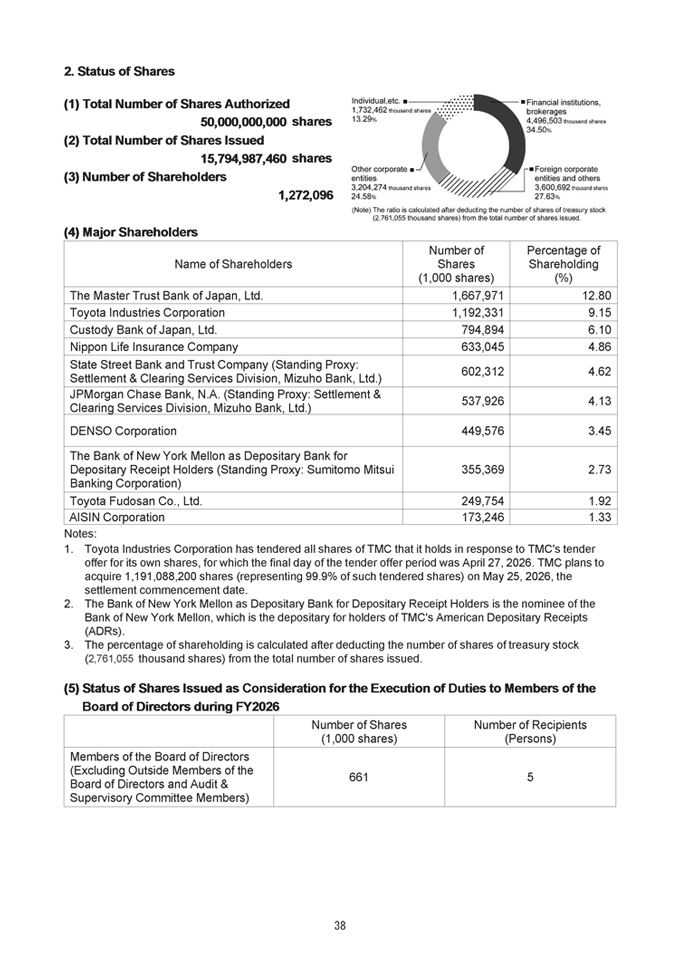

LOGO

[Accounting estimates] Of the items recognized through accounting estimates in the unconsolidated financial statements for the year ended March 31, 2026, those that may have significant effects on the unconsolidated financial statements for the following fiscal year are as follows: Liabilities for quality assurance 1,457,897 million yen Liabilities for quality assurance contained in accrued expenses mainly represent management’s best estimate, at the time products are sold, of the total costs that TMC will incur to repair or replace product parts that fail while still under warranty, as well as the costs of recalls and other safety measures. The amount of liabilities for quality assurance is estimated primarily based on currently available information such as historical experience of repair costs and product failures. [Unconsolidated balance sheet] 1. Accumulated depreciation of property, plant and equipment 3,942,212 million yen 2. Receivables from and payables to subsidiaries and affiliates Short-term receivables 4,243,996 million yen Long-term receivables 124,116 million yen Short-term payables 2,887,073 million yen Long-term payables 110,488 million yen [Unconsolidated statement of income] 1. Transactions with subsidiaries and affiliates Net sales 12,131,597 million yen Purchases 8,633,794 million yen Non-operating transactions 3,715,081 million yen 2. Transfer pricing taxation adjustments with TMC’s U.S. subsidiary included in non-operating expenses for the year ended March 31, 2026 was 61,716 million yen.


LOGO

[Unconsolidated statement of changes in net assets] Type and number of treasury stock at the end of FY2026 Common stock 2,761,602,986 shares TMC has adopted a share-based compensation plan using a Stock-Granting Employee Stock Ownership Plan (ESOP) Trust. TMC shares held by the Trust are included in the number of common stock. [Tax effect accounting] TMC has adopted the group tax sharing system. In addition, TMC accounts for and discloses income taxes, local income taxes, and tax effect accounting in accordance with the “PracticalSolution on the Accounting and Disclosure Under the Group Tax Sharing System” (PITF No. 42, August 12, 2021). Deferred tax assets mainly relate to accrued expenses, impairment losses on securities, and depreciable assets, and are netted with valuation allowance. Deferred tax liabilities mainly relate to net unrealized gains on other securities.


LOGO

[Related-party transactions] 1. Subsidiaries, affiliates, etc. Balances as Transaction Voting Description of Account of the end of Category Name Transaction amounts Interests Relationship name the fiscal year (million yen) (million yen) Trade Mainly vehicle Toyota Motor Holding 2,986,159 accounts 399,171 Sales of TMC sales (Note 1) Subsidiary Sales, U.S.A., Indirect receivable products Inc. 100.00% Loan of funds 642,866 Loans 1,294,629 (Note 2) (Note 2) Holding Outsourcing Underwriting Toyota Motor Direct (research and of North 99.90% studies on 394,329 Subsidiary capital - -America, Holding automobiles) (Note 3) increase Inc. Indirect Concurrent service (Note 3) 0.10% of directors Subscription Toyota Asset - 800,000 Affiliate Investment to preferred - -Co., Ltd. (Note 4) (Note 4) stock Notes: 1. Terms of transactions, including price terms, are determined through negotiations. 2. The interest rates of loan of funds are determined based on the market interest rate. The transaction amount represents the average balance during the fiscal year. 3. Underwriting of capital increase represents underwriting of a subsidiary’s capital increase. 4. The investment consists of non-voting preferred stock.


LOGO

2. Members of the Board of Directors, Audit & Supervisory Board Members, major shareholders, etc. Balances as Transaction Voting Description of Account of the end of Category Name Transaction amounts Interests Relationship name the fiscal year (million yen) (million yen) Payment for Joint development outsourcing Other Company, 1,022 54 and outsourcing service payables etc. with a (participating in (Note 2) majority of motorsport its voting Other competitions, 0 interests ROOKIE Income from evaluating receivables held by Racing, Inc. vehicle sales, prototypes, etc.) 20 TMC (Note 1) etc. Trade Vehicle sales executives (Note 2) accounts 0 Dispatch of or their receivable secondees close Salaries of Concurrent service Other relatives secondees 245 14 of directors (Note 2) receivables Notes: 1. Mr. Akio Toyoda, who is Chairman of the Board of Directors of TMC, indirectly holds 100.00% of the voting interests. 2. Terms and conditions of transactions are determined through appropriate negotiations taking into account costs incurred, etc. [Earnings per share] (Amounts are rounded to the nearest hundredth digit yen) 1. Net assets per common stock 1,815.72 yen 2. Net income per common stock 260.28 yen [Significant subsequent events] (The business integration of MFTBC and Hino) On June 10, 2025,Toyota, Daimler Truck AG, MFTBC and Hino concluded a definitive agreement for the business integration of MFTBC and Hino. Hino has been excluded from subsidiaries of Toyota as of the effective date of this business integration (April 1, 2026). Prior to the business integration in the following fiscal year, Hino’s Hamura Plant became a subsidiary of Toyota as Totota Motor Hamura, Inc. . However, management is currently evaluating the impact of this business integration on Toyota’s financial statements.


LOGO

Independent Auditor’s Report (English Translation*) May 2, 2026 To the Board of Directors of Toyota Motor Corporation PricewaterhouseCoopers Japan LLC Nagoya office Hitoshi Kiuchi, CPA Designated limited liability Partner Engagement Partner Koji Sugimoto, CPA Designated limited liability Partner Engagement Partner Naoko Mori, CPA Designated limited liability Partner Engagement Partner Shuichi Hiraiwa, CPA Designated limited liability Partner Engagement Partner Opinion We have audited, pursuant to Article 444 (4) of the Companies Act of Japan, the accompanying consolidated financial statements, which comprise the consolidated statement of financial position, the consolidated statement of income, the consolidated statement of changes in equity, and the notes to the consolidated financial statements, of Toyota Motor Corporation and its subsidiaries (hereinafter referred to as the “Company”) for the fiscal year from April 1, 2025 to March 31, 2026. In our opinion, the consolidated financial statements referred to above present fairly, in all material respects, the financial position and its financial performance for the period covered by the consolidated financial statements in accordance with the latter part of Article 120 (1) of the Ordinance on Accounting of Companies that allow the partial omission of the disclosure items required by International Financial Reporting Standards. Basis for Opinion We conducted our audit in accordance with auditing standards generally accepted in Japan. Our responsibilities under those standards are further described in the Auditor’s Responsibilities for the Audit of the Consolidated Financial Statements section of our report. We are independent of the Company in accordance with the ethical requirements that are relevant to audits of consolidated financial statements of public interest entities in Japan, and we have fulfilled our other ethical responsibilities in accordance with these requirements. We believe that the audit evidence we have obtained is sufficient and appropriate to provide a basis for our opinion. Other Information The other information comprises the business report and its accompanying supplementary schedules. Management is responsible for the preparation and disclosure of the other information. In addition, the Audit & Supervisory Committee is responsible for overseeing the directors’ execution of their duties in designing and operating the reporting process over the other information. Our opinion on the consolidated financial statements does not cover the other information and we do not express any for of assurance conclusion thereon. In connection with our audit of the consolidated financial statements, our responsibility is to read the other information and, in doing so, consider whether the other information is materially inconsistent with the consolidated financial statements or our knowledge obtained in the audit or to remain alert for whether there are the indications that the other information appears to be materially misstated beyond such material inconsistencies. If, based on the work we have performed, we conclude that there is a material misstatement of the other information, we are required to report that fact. We have nothing to report in this regard.


LOGO

Responsibilities of Management and the Audit & Supervisory Committee for the Consolidated Financial Statements Management is responsible for the preparation and fair presentation of the consolidated financial statements in accordance with the latter part of Article 120 (1) of the Ordinance on Accounting of Companies that allow the partial omission of the disclosure items required by International Financial Reporting Standards, and for design and operating effectiveness of such internal control as management determines is necessary to enable the preparation of the consolidated financial statements that are free from material misstatement, whether due to fraud or error. In preparing the consolidated financial statements, management is responsible for assessing the Company’s ability to continue as a going concern and disclosing, as applicable, matters related to going concern in accordance with the latter part of Article 120 (1) of the Ordinance on Accounting of Companies that allow the partial omission of the disclosure items required by International Financial Reporting Standards. The Audit & Supervisory Committee is responsible for overseeing the directors’ execution of their duties in designing and operating effectiveness of the Company’s financial reporting process. Auditor’s Responsibilities for the Audit of the Consolidated Financial Statements Our responsibilities are to obtain reasonable assurance about whether the consolidated financial statements as a whole are free from material misstatement, whether due to fraud or error, and to issue an independent auditor’s report that includes our opinion. Misstatements can arise from fraud or error and are considered material if, individually or in the aggregate, they could reasonably be expected to influence the economic decisions of users taken on the basis of these consolidated financial statements. As part of an audit in accordance with auditing standards generally accepted in Japan, we exercise professional judgment and maintain professional skepticism throughout the audit. We also: · Identify and assess the risks of material misstatement of the consolidated financial statements, whether due to fraud or error, design and perform audit procedures responsive to those risks. The procedures selected depend on the auditor’s judgment. In addition, we obtain audit evidence that is sufficient and appropriate to provide a basis for our opinion. · Obtain an understanding of internal control relevant to the audit in order to design audit procedures that are appropriate in the circumstances when assessing the risks, while the purpose of the consolidated financial statement audit is not to express an opinion on the effectiveness of the Company’s internal control. · Evaluate the appropriateness of accounting policies and their applications which management adopted, the reasonableness of the accounting estimates and the appropriateness of the related disclosures made by management. · Conclude on the appropriateness of management’s use of the going concern basis of accounting and, based on the audit evidence obtained, whether a material uncertainty exists related to events or conditions that may cast significant doubt on the Company’s ability to continue as a going concern. If we conclude that a material uncertainty exists, we are required to draw attention in our auditor’s report to the related disclosures in the consolidated financial statements or, if such disclosures are inadequate, to modify our opinion. Our conclusions are based on the audit evidence obtained up to the date of our auditor’s report. However, future events or conditions may cause the Company to cease to continue as a going concern. · Assess whether the presentation of the consolidated financial statements and related notes are prepared in accordance with the latter part of Article 120 (1) of the Ordinance on Accounting of Companies that allow the partial omission of the disclosure items required by International Financial Reporting Standards, as well as whether the presentation, composition, and content of the consolidated financial statements and related notes properly present the transactions and accounting events on which the consolidated financial statements are based. · Plan and perform audit of the consolidated financial statements to obtain sufficient and appropriate audit evidence about the financial information of the Company to provide a basis for our opinion on the consolidated financial statements. We are responsible for the direction, supervision and review of the audit of the consolidated financial statements. We are solely responsible for our audit opinion. We communicate with the Audit & Supervisory Committee regarding, among other matters, the planned scope and timing of the audit and significant audit findings, including any significant deficiencies in internal control that we identify during our audit and other matters required by auditing standards. We also provide the Audit & Supervisory Committee with a statement that we have complied with relevant ethical requirements regarding independence, and communicate with them all relationships and other matters that may reasonably be thought to bear on our independence, and where applicable, actions taken to eliminate threats or safeguards applied to reduce threats to an acceptable level. Interest required to be disclosed by the Certified Public Accountants Act of Japan Our firm and its designated engagement partners do not have any interest in the Company that is required to be disclosed pursuant to the provisions of the Certified Public Accountants Act of Japan. * Notes to the Readers of Independent Auditor’s Report This is an English translation of the Independent Auditor’s Report as required by the Companies Act of Japan for the conveniences of the readers.The original was prepared in Japanese. All possible care has been taken to ensure that the translation is an accurate representation of the original, however, in all matters of interpretation of information, views or opinions, the original language version of the report takes precedence over the translated version. 87


LOGO

Independent Auditor’s Report (English Translation*) May 2, 2026 To the Board of Directors of Toyota Motor Corporation PricewaterhouseCoopers Japan LLC Nagoya office Hitoshi Kiuchi, CPA Designated limited liability Partner Engagement Partner Koji Sugimoto, CPA Designated limited liability Partner Engagement Partner Naoko Mori, CPA Designated limited liability Partner Engagement Partner Shuichi Hiraiwa, CPA Designated limited liability Partner Engagement Partner Opinion We have audited, pursuant to Article 436 (2) (i) of the Companies Act of Japan, the accompanying financial statements, which comprise the balance sheet, statement of income, statement of changes in net assets and notes to the financial statements, and the supplementary schedules of Toyota Motor Corporation (hereinafter referred to as the “Company”) for the 122nd fiscal year from April 1, 2025 to March 31, 2026. In our opinion, the financial statements and the supplementary schedules referred to above present fairly, in all material respects, the financial position and its financial performance for the period covered by the financial statements and the supplementary schedules in accordance with accounting principles generally accepted in Japan. Basis for Opinion We conducted our audit in accordance with auditing standards generally accepted in Japan. Our responsibilities under those standards are further described in the Auditor’s Responsibilities for the Audit of the Financial Statements and the Supplementary Schedules section of our report. We are independent of the Company in accordance with the ethical requirements that are relevant to audits of financial statements of public interest entities in Japan, and we have fulfilled our other ethical responsibilities in accordance with these requirements. We believe that the audit evidence we have obtained is sufficient and appropriate to provide a basis for our opinion. Other Information The other information comprises the business report and its accompanying supplementary schedules. Management is responsible for the preparation and disclosure of the other information. In addition, the Audit & Supervisory Committee is responsible for overseeing the directors’ execution of their duties in designing and operating the reporting process over the other information. Our opinion on the financial statements does not cover the other information and we do not express any form of assurance conclusion thereon. In connection with our audit of the financial statements, our responsibility is to read the other information and, in doing so, consider whether the other information is materially inconsistent with the financial statements or our knowledge obtained in the audit, or to remain alert for whether there are the indications that the other information appears to be materially misstated beyond such material inconsistencies. If, based on the work we have performed, we conclude that there is a material misstatement of the other information, we are required to report that fact. We have nothing to report in this regard. 88


LOGO

Responsibilities of Management and the Audit & Supervisory Committee for the Financial Statements and the Supplementary Schedules Management is responsible for the preparation and fair presentation of the financial statements and the supplementary schedules in accordance with accounting principles generally accepted in Japan, and for design and operating effectiveness of such internal control as management determines is necessary to enable the preparation of the financial statements and the supplementary schedules that are free from material misstatement, whether due to fraud or error. In preparing the financial statements and the supplementary schedules, management is responsible for assessing the Company’s ability to continue as a going concern and disclosing, as applicable, matters related to going concern in accordance with accounting principles generally accepted in Japan. The Audit & Supervisory Committee is responsible for overseeing the directors’ execution of their duties in designing and operating effectiveness of the Company’s financial reporting process. Auditor’s Responsibilities for the Audit of the Financial Statements and the Supplementary Schedules Our responsibilities are to obtain reasonable assurance about whether the financial statements and the supplementary schedules as a whole are free from material misstatement, whether due to fraud or error, and to issue an independent auditor’s report that includes our opinion. Misstatements can arise from fraud or error and are considered material if, individually or in the aggregate, they could reasonably be expected to influence the economic decisions of users taken on the basis of these financial statements and the supplementary schedules. As part of an audit in accordance with auditing standards generally accepted in Japan, we exercise professional judgment and maintain professional skepticism throughout the audit. We also: · Identify and assess the risks of material misstatement of the financial statements and the supplementary schedules, whether due to fraud or error, design and perform audit procedures responsive to those risks. The procedures selected depend on the auditor’s judgment. In addition, we obtain audit evidence that is sufficient and appropriate to provide a basis for our opinion. · Obtain an understanding of internal control relevant to the audit in order to design audit procedures that are appropriate in the circumstances when assessing the risks, while the purpose of the audit of financial statements and the supplementary schedules is not to express an opinion on the effectiveness of the Company’s internal control. · Evaluate the appropriateness of accounting policies and their applications which management adopted, the reasonableness of the accounting estimates and the appropriateness of related disclosures made by management. · Conclude on the appropriateness of management’s use of the going concern basis of accounting and, based on the audit evidence obtained, whether a material uncertainty exists related to events or conditions that may cast significant doubt on the Company’s ability to continue as a going concern. If we conclude that a material uncertainty exists, we are required to draw attention in our auditor’s report to the related disclosures in the financial statements and the supplementary schedules or, if such disclosures are inadequate, to modify our opinion. Our conclusions are based on the audit evidence obtained up to the date of our auditor’s report. However, future events or conditions may cause the Company to cease to continue as a going concern. · Evaluate whether the presentation and disclosures of the financial statements and the supplementary schedules are in accordance with accounting principles generally accepted in Japan, the overall presentation, structure and content of the financial statements and the supplementary schedules, including the disclosures, and whether the financial statements and the supplementary schedules represent the underlying transactions and events in a manner that achieves fair presentation. We communicate with the Audit & Supervisory Committee regarding, among other matters, the planned scope and timing of the audit and significant audit findings, including any significant deficiencies in internal control that we identify during our audit and other matters required by auditing standards. We also provide the Audit & Supervisory Committee with a statement that we have complied with relevant ethical requirements regarding independence, and communicate with them all relationships and other matters that may reasonably be thought to bear on our independence, and where applicable, actions taken to eliminate threats or safeguards applied to reduce threats to an acceptable level. Interest required to be disclosed by the Certified Public Accountants Act of Japan Our firm and its designated engagement partners do not have any interest in the Company which is required to be disclosed pursuant to the provisions of the Certified Public Accountants Act of Japan. * Notes to the Readers of Independent Auditor’s Report This is an English translation of the Independent Auditor’s Report as required by the Companies Act of Japan for the conveniences of the readers.The original was prepared in Japanese. All possible care has been taken to ensure that the translation is an accurate representation of the original, however, in all matters of interpretation of information, views or opinions, the original language version of the report takes precedence over the translated version. 89


LOGO

Audit & Supervisory Committee’s Report Audit Report The Audit & Supervisory Committee (the “Committee”) has audited the execution of duties by Members of the Board of Directors of Toyota Motor Corporation (the “Company”) during FY2026 / the 122nd fiscal year extending from April 1, 2025 through March 31, 2026. The Committee hereby reports the methods used and the results of those audits as follows. 1. Audit Methods and Details The Committee determined the audit policies, division of duties, etc. and conducted audits by the following methods. 1) In cooperation with the Internal Audit Department and other related divisions, the Committee has attended the Board of Directors’ meetings and other important meetings, and received reports from Members of the Board of Directors and senior executives on the execution of their duties. The Committee also reviewed important documents and surveyed operations and assets at the head office, production facilities, and major business locations of the Company. Regarding subsidiaries, the Committee has exchanged opinions and information with their own boards of directors, audit & supervisory boards, and senior executives, and received business reports from them as necessary. 2) Concerning the unconsolidated financial statements (unconsolidated balance sheet, unconsolidated statement of income, unconsolidated statement of changes in net assets, and notes to the unconsolidated financial statements) and their supplementary schedules, and the consolidated financial statements (consolidated statement of financial position, consolidated statement of income, consolidated statement of changes in equity, and notes to the consolidated financial statements), the Committee received reports from Members of the Board of Directors and senior executives. The Committee also received reports from the Accounting Auditor on its auditing process and results. In addition, the Committee received a notification from the Accounting Auditor confirming that the “systems to ensure the appropriate execution of duties” (matters listed in each item of Article 131 of the Regulation on Corporate Accounting) have been properly maintained. 2. Audit Results (1) Audit Results Concerning the Business Report and Related Documents 1) The business report and its supplementary schedules accurately represent the Company’s situation as required by laws and regulations and the Company’s Articles of Incorporation. 2) No irregularities or violations of applicable laws, regulations, or the Company’s Articles of Incorporation were found with respect to the execution of duties by Members of the Board of Directors. 3) The resolutions of the Board of Directors concerning the internal control system (a system as stipulated in Article 399-13, Paragraph 1, Items 1(b) and 1(c) of the Companies Act) are appropriate, and no issues requiring comment were identified concerning the execution of duties by Members of the Board of Directors with respect to the system. 90


LOGO

(2) Audit Results Concerning the Unconsolidated Financial Statements and Their Supplementary Schedules The Committee confirms the audit methods and results of the Accounting Auditor, PricewaterhouseCoopers Japan LLC, regarding these documents are appropriate. (3) Audit Results Concerning the Consolidated Financial Statements The Committee confirms the audit methods and results of the Accounting Auditor, PricewaterhouseCoopers Japan LLC, regarding these documents are appropriate. May 7, 2026 Audit & Supervisory Committee of Toyota Motor Corporation Audit & Supervisory Committee Member (Chairperson) George Olcott Audit & Supervisory Committee Member Christopher P. Reynolds Audit & Supervisory Committee Member Masahiko Oshima Full-time Audit & Supervisory Committee Member Hiromi Osada Notes: 1. Audit & Supervisory Committee Members George Olcott, Masahiko Oshima, and Hiromi Osada are Outside Directors as provided for in Article 2, Item 15 and Article 331, Paragraph 6 of the Companies Act. 2. The Company transitioned from a Company with an Audit & Supervisory Board to a Company with an Audit & Supervisory Committee as of June 12, 2025 by resolution of the 121st Ordinary General Shareholders’ Meeting held on the same day. Details from April 1, 2025 to June 11, 2025 are based on information inherited from the former Audit & Supervisory Board. 91


LOGO

[This page intentionally left blank] 92


LOGO

Organizational Structure (as of May 2026) Kenta Kon President Chief Executive Officer Koji Sato Vice Chairman Chief Industry Officer Operating Officers Hiroki Nakajima Executive Vice President Chief Technology Officer Yoichi Miyazaki Executive Vice President Chief Financial Officer Takahiro Imura Chief Officer, Production Group Tetsuo Ogawa Chief Executive Officer, North America Region Tatsuro Ueda Chief Executive Officer, China Region Simon Humphries Chief Branding Officer Takefumi Shiga Chief Production Officer Head Office Mitsumasa Yamagata Hydrogen Factory (President) Ryuji Aiba TPS Group (Chief Officer) Hiroyuki Ueda External & Public Affairs Group (Chief Officer) Keiji Yamamoto Digital Information and Communication Group (Chief Officer) Hiroyoshi Korosue Sales Financial Business Group (Chief Officer) Shinji Miyamoto Chief Quality Officer Customer First Promotion Group (Chief Officer) Nobuhiko Koga Frontier Research Center (President) Isao Nakanishi Business Development Group (Chief Officer) Yoshinori Ohno Chief Risk Officer Chief Compliance Officer General Administration & Human Resources Group (Chief Officer) Takanori Azuma Accounting Group (Chief Officer) Kazunari Kumakura Purchasing Group (Chief Officer) Takahiro Imura Production Group (Chief Officer)


LOGO

Business Unit Region Tetsuo Ogawa North America Region (Chief Executive Officer) Yoshihiro Nakata Europe Region (Chief Executive Officer) Shigeki Tomoyama Japan Business Group (Chief Executive Officer) Tatsuro Ueda China Region (Chief Executive Officer) Masahiko Maeda Asia Region (Chief Executive Officer) Masakazu Yoshimura India - Middle East - East Asia & Oceania Region (Chief Executive Officer) Rafael Chang Latin America & Caribbean Region (Chief Executive Officer) Product Hirofumi Inoue Advanced R&D and Engineering Company (President) Keiji Kaita Carbon Neutral Engineering Development Center (President) Akihiro Sarada Software Development Center (President) Takahiro Ishijima Vehicle Development Center (President) Tsukasa Takahashi Toyota Compact Car Company (President) Yasushi Ueda Mid-size Vehicle Company (President) Takanori Kimata CV Company (President) Takashi Watanabe Lexus International Co. (President) Takashi Uehara Powertrain Company (President) Motoki Watanabe Production Engineering Development Center (President) Tomoya Takahashi GAZOO Racing Company (President) Fellow Mitsuru Kawai Executive Fellow Oyaji Koji Kobayashi Executive Fellow Banto Shigeki Tomoyama Executive Fellow Gill A. Pratt Chief Scientist and Executive Fellow for Research Masashi Asakura Senior Fellow