
Summary Prospectus
April 30, 2026
Baillie Gifford U.S. Equity Growth Fund
Class K | Institutional Class |
Before you invest, you may want to review the Fund’s full prospectus, which contains more information about the Fund and its risks. You can find the Fund’s full prospectus, its statement of additional information (“SAI”), the most recent reports to shareholders, and other information such as the Fund’s financial statements, free of charge, online at http://USmutualfund.bailliegifford.com. You can also get this information at no cost by calling 1‑844‑394‑6127 or by emailing northamericanvehiclesteam@bailliegifford.com. This Summary Prospectus incorporates by reference the Fund’s entire prospectus and SAI, each dated April 30, 2026, as supplemented or revised, and the financial statements included in the Fund’s annual report to shareholders, dated December 31, 2025.
Investment Objective
Baillie Gifford U.S. Equity Growth Fund seeks capital appreciation.
Fees and Expenses
The tables below describe the fees and expenses that you may pay if you buy, hold, and sell shares of the Fund. You may pay other fees, such as brokerage commissions and other fees to financial intermediaries, which are not reflected in the tables and examples below.
Shareholder Fees
(Fees paid directly from your investment)
Class K | Institutional Class | |
None | None |
Annual Fund Operating Expenses
(Expenses that you pay each year as a percentage of the value of your investment)
| Class K |
| Institutional Class |
|
Management Fees(a) | 0.50% |
| 0.50% |
|
Distribution (12b‑1) Fees | None |
| None |
|
Other Expenses | 1.00% |
| 1.10% |
|
Total Annual Fund Operating Expenses | 1.50% |
| 1.60% |
|
Fee Waiver and/or Expense Reimbursement(b) | (0.85)% |
| (0.85)% |
|
Total Annual Fund Operating Expenses After Fee Waiver and/or Expense Reimbursement(b) | 0.65% |
| 0.75% |
|
(a) | The Management Fee consists of an Advisory Fee and an Administration and Supervisory Fee paid by the Fund to Baillie Gifford Overseas Limited. |
(b) | Baillie Gifford Overseas Limited has contractually agreed to waive its fees and/or bear Other Expenses of the Fund until April 30, 2027 to the extent that such Fund’s Total Annual Operating Expenses (excluding taxes, sub-accounting expenses and extraordinary expenses) exceed 0.65% for Class K and Institutional Class shares. This contractual agreement may only be terminated by the Board of Trustees of the Trust. Expenses after waiver/reimbursement exceed 0.65% for Institutional Class due to sub-accounting expenses of 0.10%. |
Example of Expenses
The example below is intended to help you compare the cost of investing in the Fund with the cost of investing in other mutual funds. It assumes that you invest $10,000 in the Fund for the time periods indicated, regardless of whether or not you redeem your shares at the end of such periods. It also assumes that your investment has a 5% return each year and that the Fund’s operating expenses remain the same. The example below also applies any contractual expense waivers and/or expense reimbursements to the first year of each period listed in the table.
Although your actual costs may be higher or lower, based on these assumptions, your expenses would be:
Class K | Institutional Class | |||
1 Year | $66 | $77 | ||
3 Years | $391 | $422 | ||
5 Years | $738 | $791 | ||
10 Years | $1,718 | $1,828 | ||
Portfolio Turnover
The Fund pays transaction costs, such as commissions, when it buys and sells securities (or “turns over” its portfolio). A higher portfolio turnover rate may indicate higher transaction costs and may result in higher taxes when Fund shares are held in a taxable account. These transaction costs, which are not reflected in “Annual Fund Operating Expenses” or in the “Example of Expenses” above, affect the Fund’s performance. During the Fund’s most recent fiscal year, the Fund’s portfolio turnover rate was 18% of the average value of its portfolio.
Principal Investment Strategies
The Fund seeks to meet its objective by investing in a portfolio of equities, which include common stock and other equity securities, of issuers located in the U.S.
The portfolio managers seek to identify exceptional growth businesses in the U.S. and to own them for long enough that the advantages of their business models and the strength of their cultures support positive relative performance over the long term.
Under normal circumstances, the Fund invests at least 80% of its net assets (plus any borrowings for investment purposes) in common stocks and other equity securities of companies whose
1
Baillie Gifford U.S. Equity Growth Fund – Summary Prospectus
principal activities are in the U.S. The Fund invests in equity securities either directly or indirectly, such as through depositary receipts, and may invest in preferred stocks, convertible securities, rights and warrants. The Fund typically invests primarily in issuers with a market capitalization of more than $1.5 billion at the time of purchase and may participate in initial public offerings (“IPOs”).
The portfolio managers employ a bottom-up approach to stock selection, seeking to identify companies they believe have attractive long-term growth prospects, and select companies without being constrained by a benchmark. Under normal circumstances, the intended outcome is a portfolio typically consisting of between 30 and 50 growth companies with the potential to outperform the Fund’s benchmarks over the long term. The portfolio managers focus on company research and the long-term outlook of companies and industries. Ideas can come from a wide variety of sources, including, but not limited to, research trips, company meetings, and relationships with industry thought leaders and academic institutions. Stock ideas are normally researched to assess a range of factors, including: long-term growth potential, geographic and industry positioning, competitive advantage, management, financial strength and valuation. The Fund is a non-diversified fund, which means that it may invest a relatively large percentage of its assets in a small number of issuers, industries or sectors The Fund aims to hold securities for long periods (typically at least 5 years), which generally results in relatively low portfolio turnover and is in line with the portfolio managers’ long-term investment outlook. When assessing a company’s long-term growth prospects, the portfolio managers seek to identify and to incorporate a range of factors that are material to managing the Fund’s investment risks and maximizing capital appreciation. Such factors potentially include the environmental, social, and/or governance characteristics of the company, such as stewardship, sustainable business practices, and/or corporate culture.
Principal Risks
The Fund’s net asset value and returns will be impacted by the performance of the underlying investments of the Fund. An investment in the Fund is not a deposit in a bank and is not insured or guaranteed by the Federal Deposit Insurance Corporation or any other government agency. You could lose money by investing in the Fund.
The principal risks of investing in the Fund (in alphabetical order after the first five risks) are:
— | Investment Style Risk – Baillie Gifford Overseas Limited (the “Manager”) actively makes investment decisions for the Fund through bottom-up stock selection. Accordingly, the Fund will have risk characteristics that differ from its benchmark index. The Manager’s judgments about the attractiveness, relative value, or potential appreciation of a particular stock may prove to be incorrect and cause the Fund to lose money or underperform compared to its benchmark index. There can be no assurance that the Manager’s investment decisions will produce the desired results. |
— | Growth Stock Risk – The prices of growth stocks may be based largely on expectations of future earnings, and their prices can decline rapidly and significantly in reaction to |
negative news. Growth stocks may underperform stocks in other broad style categories (and the stock market as a whole) over any period of time and may shift in and out of favor with investors generally, sometimes rapidly, depending on changes in market, economic, and other factors. |
— | Long-Term Investment Strategy Risk – The Fund pursues a long-term investment approach, typically seeking returns over a period of several years. This investment style may cause the Fund to lose money or underperform compared to its benchmark index or other mutual funds over extended periods of time, and the Fund may not perform as expected in the long term. An investment in the Fund may be more suitable for long-term investors who can bear the risk of short- or medium-term fluctuations in the value of the Fund’s portfolio. See also “Selected Investment Techniques and Topics—Our Stewardship Approach.” |
— | Geographic Focus Risk – The Fund expects to focus its investments in a limited number of countries or geographic regions, and as a result may not offer the same level of diversification of risks as a more broadly global fund because the Fund will be exposed to a smaller geographic area. The performance of a fund that is less diversified across countries or geographic regions will be closely tied to market, currency, economic, political, environmental, or regulatory conditions and developments in the countries or regions in which the Fund invests, and may be more volatile than the performance of a more geographically-diversified portfolio. |
— | Non-Diversification Risk – The Fund is classified as a “non-diversified” fund. A non-diversified fund may hold a smaller number of portfolio securities, with larger positions in each security it holds, than many other mutual funds. To the extent the Fund invests in a relatively small number of issuers, a decline in the market value of a particular security held by the Fund may affect its value more than if it invested in a larger number of issuers. The value of the Fund’s shares may be more volatile than the values of shares of more diversified funds. See also “Focused Investment Risk.” |
— | Conflicts of Interest Risk – The Manager’s relationships with the Fund’s institutional investor base may give rise to various conflicts of interest, since the Manager will sometimes have an incentive to favor those shareholders over other shareholders in the Fund. In addition, the Manager serves as investment adviser to various clients other than the Fund, some of whom may pursue strategies that are substantially similar or nearly identical to investment strategies pursued by the Fund. This “side-by-side” management may give rise to various conflicts of interest, including, for example, in connection with the fair allocation of trades among the Manager’s clients or the sharing of different, more, or more timely information regarding investment performance, portfolio holdings, strategy developments and/or the Manager’s general market outlook. Although the Fund’s investment objective and strategies are substantially similar to those of an ETF managed by the Manager, differences in purchase and redemption structure, investment restrictions, and legal requirements lead to the use of different trading practices and potentially different portfolio decisions. Furthermore, if investment personnel of the Manager hold |
2
Baillie Gifford U.S. Equity Growth Fund – Summary Prospectus
board or other positions at outside companies, they could be exposed to material non-public information potentially impeding or delaying a Fund’s ability to buy or sell certain investments, or they could otherwise be restricted in their ability to participate in a Fund’s investment process. |
— | Developed Markets Risk – Investing in securities of companies located in, or with exposure to, developed countries will subject the Fund to the regulatory, political, currency, security, economic and other risks associated with such countries. In recent periods, countries with developed markets have generally experienced slower economic growth than some less developed countries. Services sectors (e.g., the financial services sector) generally tend to represent the primary source of economic growth in developed markets, which can make them susceptible to the risks of individual service sectors. In addition, developed countries will be impacted by changes to the economic conditions of certain key trading partners, regulatory burdens, and the price or availability of certain commodities, among other things. |
— | Equity Securities Risk – Equity securities may react more strongly to changes in an issuer’s financial condition or prospects than other securities of the same issuer. Investing in equity securities indirectly, such as through participatory notes or depositary receipts, may involve other risks such as the risk that the counterparty may default or that the investment does not track the underlying security as expected. |
— | ESG Risk – To the extent that the Fund’s portfolio managers incorporate environmental, social and/or governance considerations (“ESG Factors”) into the Fund’s investment process as a part of the Fund’s long-term investment approach, the Fund is subject to the risk that it may underperform funds that do not take ESG Factors into account. The consideration of ESG Factors may prioritize long-term rather than short-term returns, and therefore may negatively impact the relative performance of the Fund over the short, medium or even long term depending on how successfully those ESG Factors are incorporated and whether such investments are in or out of favor. In considering ESG Factors, the portfolio managers may be dependent upon information and data obtained through voluntary reporting by issuers or third-party research that may be incomplete, inaccurate or unavailable, which could impact the portfolio managers’ assessment of relative risks and opportunities. See also “Long-Term Investment Strategy Risk” and “Selected Investment Techniques and Topics—Our Stewardship Approach.” |
— | Focused Investment Risk – Because the Fund focuses its investments in a limited number of companies, its investment strategy could result in more risk or greater volatility in returns than if the Fund’s investments were less focused. |
— | Government and Regulatory Risk – Governmental and regulatory authorities in the United States and other countries, have taken, and may in the future take, actions intervening in the markets in which the Fund invests and in the economy more generally. Governmental and regulatory authorities may also act to increase the scope or burden of regulations applicable to the Fund or to the companies in |
which the Fund invests. The effects of these actions on the markets generally, and the Fund’s investment program in particular, can be uncertain and could restrict the ability of the Fund to fully implement its investment strategies, either generally, or with respect to certain securities, industries, or countries. By contrast, markets in some non-U.S. countries historically have been subject to little regulation or oversight by governmental or regulatory authorities, which could heighten the risk of loss due to fraud or market failures in those countries. Governments, agencies, or other regulatory bodies in any country may adopt or change laws or regulations that could adversely affect the Fund or the market value of an instrument held by the Fund. |
— | Information Technology Risk – Cyber-attacks, disruptions, or failures that affect the Fund’s service providers, counterparties, the securities markets generally, other market participants, or issuers of securities held by the Fund may adversely affect the Fund and its shareholders, including by causing losses for the Fund or impairing Fund operations. |
— | IPO Risk – The Fund may purchase securities in IPOs. These securities are subject to many of the same risks of investing in companies with smaller market capitalizations. Securities issued in IPOs have no trading history, and information about the companies may be available for very limited periods. In addition, the prices of securities sold in IPOs may be highly volatile. |
— | Large-Capitalization Securities Risk – Returns on investments in securities of large companies could trail the returns on investments in securities of smaller and medium-sized companies. Larger companies may be unable to respond as quickly as smaller and medium-sized companies to competitive challenges or to changes in business, product, financial, or other market conditions. Larger companies may not be able to achieve or maintain growth at the high rates that may be achieved by well-managed smaller and medium-sized companies. |
— | Liquidity Risk – The Fund’s investments may be subject to low trading volume, lack of a market maker, contractual lock-in periods or regulatory restrictions, and the Fund may hold large positions in particular securities. As a result, it may not be possible to sell an investment at a particular time or at an acceptable price. Liquidity risk may be magnified during periods of changing interest rates, significant shareholder redemptions or market turmoil. Illiquid investments may trade at a discount from comparable, more liquid investments and may be subject to wide fluctuations in market value. In some cases, due to unanticipated levels of illiquidity the Fund may seek to meet its redemption obligations wholly or in part by distributions of assets in-kind. |
— | Market Disruption and Geopolitical Risk – The value of the Fund’s investments could be adversely affected by events that disrupt securities markets and adversely affect global markets such as war, terrorism, public health crises, and geopolitical events and by changes in non-U.S. and U.S. economic and political conditions. These disruptions could prevent the Fund from implementing its investment strategies and achieving its investment objective, and increase the Fund’s exposure to other risks detailed in this Prospectus. |
3
Baillie Gifford U.S. Equity Growth Fund – Summary Prospectus
As a result, the Fund could lose money, experience significant redemptions, encounter operational difficulties, and suffer other negative impacts. Certain locations and industries may be particularly susceptible to this risk, and other risks may be heightened by such events. |
— | Market Risk – The value of the Fund’s investments will be affected by fluctuations in the stock markets in which the Fund is invested, factors affecting a particular industry or industries, real or perceived adverse economic conditions, changes in interest or currency rates or adverse investor sentiment generally. Declines in securities market prices may reduce the net asset value of the Fund’s shares. |
— | New and Smaller-Sized Funds Risk – New funds and smaller-sized funds, such as the Fund, will be subject to greater liquidity risk due to their smaller asset bases and may be required to sell securities at disadvantageous times or prices due to a large shareholder redemption. A fund that has been recently formed will have limited or no performance history for investors to evaluate and may not reach or maintain a sufficient asset size to effectively implement its investment strategy. |
— | Service Provider Risk – The Fund will be affected by the Manager’s investment techniques, analyses, assessments and employee retention. Similarly, adverse events or performance failures at a service provider, such as human error, inadequate controls or insolvency, have the ability to adversely affect the Fund. |
— | Small- and Medium-Capitalization Securities Risk – Securities of small- and medium-capitalization companies can be more volatile due to various factors including more limited product lines, financial and management resources and market distribution channels, as well as shorter operating histories and potentially reduced liquidity, especially during market declines, than the securities of larger, more established companies. |
— | Valuation Risk – In certain circumstances, some of the Fund’s portfolio holdings may be valued on the basis of factors other than market quotations by employing fair value procedures. This may occur more often in times of market turmoil or reduced liquidity. Portfolio holdings that are valued using techniques other than market quotations, including “fair valued” securities, may be subject to greater fluctuation in their valuations from one day to the next than if market quotations were used. There is no assurance that the Fund could sell or close out a portfolio position for the value established for it at any time, and it is possible that the Fund would incur a loss because a portfolio position is sold or closed out at a discount to the valuation established by the Fund at that time. |
Performance
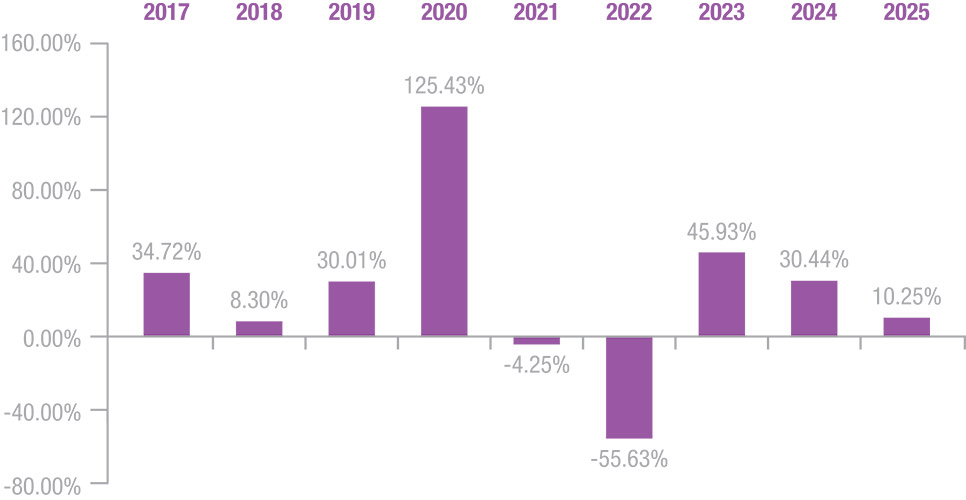
The bar chart and table below provide some indication of the risks of investing in the Fund by showing changes in the Fund’s annual total returns from year to year and by comparing the Fund’s average annual total returns with those of the Fund’s benchmarks. Past performance (before and after taxes) is not an indication of future performance.
Annual Total Returns – Institutional Class Shares(1)(2)

Highest Quarterly Return: 55.77% (Q2, 2020)
Lowest Quarterly Return: ‑38.41% (Q2, 2022)
In the table below, after-tax returns are calculated using the historical highest individual federal marginal income tax rates and do not reflect the impact of state and local taxes. After-tax returns are shown for Institutional Class shares only, and after-tax returns for other share classes will vary. Actual after-tax returns depend on your tax situation and may differ from those shown. After-tax returns shown are not relevant if you are tax-exempt or if you hold your Fund shares through a tax-advantaged account. The table compares the Fund’s returns to a broad-based securities market index, as required by relevant disclosure rules, and an additional benchmark that the Fund believes better aligns with the Fund’s investment objective and strategies. A description of the Fund’s comparative indices and details regarding the calculation of the Fund’s class-by-class performance are provided in the section of the Prospectus entitled “Additional Performance Information.”
Average Annual Total | 1 Year | 5 Years | Since Fund | |||
Institutional Class Returns | 10.25% | ‑2.27% | 15.86% | |||
Institutional Class Returns | 10.25% | ‑3.14% | 15.08% | |||
Institutional Class Returns | 6.07% | ‑1.86% | 13.26% | |||
Class K Returns Before Taxes(3) | 10.38% | ‑2.18% | 15.95% | |||
Comparative Indices | ||||||
S&P 500 Index(4) | 17.88% | 14.42% | 15.22% | |||
Russell 1000 Growth Index(5) | 18.56% | 15.31% | 19.42% | |||
(1) | Performance for Institutional Class shares prior to their date of inception (April 28, 2017) is derived from the historical performance of Class 1 shares and has been adjusted for the higher total annual operating expenses incurred by Institutional Class. |
4
Baillie Gifford U.S. Equity Growth Fund – Summary Prospectus
(2) | If reimbursement received from the Manager in 2019 were excluded, the total return would be lower. |
(3) | The inception date for Baillie Gifford U.S. Equity Growth Fund is December 5, 2016, when Baillie Gifford International, LLC purchased Class 1 shares. Classes 1‑5 of the Fund were terminated effective May 1, 2017, and Class 1 shares were converted to Class K shares. For periods prior to May 1, 2017, the performance shown is based on the performance for Class 1 shares. |
(4) | The S&P 500 Index is a product of S&P Dow Jones Indices LLC, a division of S&P Global, or its affiliates. Standard & Poor’s® and S&P® are registered trademarks of Standard & Poor’s Financial Services LLC, a division of S&P Global; Dow Jones® is a registered trademark of Dow Jones Trademark Holdings LLC. Neither S&P Dow Jones Indices LLC, Dow Jones Trademark Holdings LLC, their affiliates nor their third party licensors make any representation or warranty, express or implied, as to the ability of any index to accurately represent the asset class or market sector that it purports to represent and neither S&P Dow Jones Indices LLC, Dow Jones Trademark Holdings LLC, their affiliates nor their third party licensors shall have any liability for any errors, omissions, or interruptions of any index or the data included therein. |
(5) | The source of the index data is London Stock Exchange Group plc and its group undertakings (collectively, the “LSE Group”).© LSE Group 2020. FTSE Russell is a trading name of certain of the LSE Group companies. “Russell®” is a trademark(s) of the relevant LSE Group companies and is used by any other LSE Group company under license. “TMX®” is a trademark of TSX, Inc. and used by the LSE Group under license. All rights in the FTSE Russell indexes or data vest in the relevant LSE Group company which owns the index or the data. Neither LSE Group nor its licensors accept any liability for any errors or omissions in the indexes or data and no party may rely on any indexes or data contained in this Prospectus. No further distribution of data from the LSE Group is permitted without the relevant LSE Group company’s express written consent. The LSE Group does not promote, sponsor or endorse the content of this Prospectus. |
Updated information on the Fund’s investment performance can be obtained by visiting http://USmutualfund.bailliegifford.com.
Management
Investment Manager
Baillie Gifford Overseas Limited
Portfolio Managers
Name | Title | Year Commenced | |||
Dave Bujnowski | Portfolio Manager | 2020 | |||
Kirsty Gibson | Portfolio Manager | 2016 | |||
Lillian Li | Portfolio Manager | 2026 | |||
Gary Robinson | Portfolio Manager | 2016 | |||
Tom Slater | Portfolio Manager | 2016 | |||
Purchasing, Exchanging, and Selling Fund Shares
To purchase, exchange, or redeem shares of the Fund through an intermediary, please contact your intermediary directly.
Other investors may purchase, exchange, or redeem shares on any day the New York Stock Exchange (“NYSE”) is open for trading directly from the Fund’s transfer agent, Bank of New York Mellon, by written request, as further described in the sections of the Prospectus entitled “Shares—How to Buy or Exchange Shares” and “Shares—How to Sell Shares.” The initial and
subsequent investment minimums for the Fund shares are as follows:
Class of Shares | Minimum Initial | Minimum | ||
Class K | $10 million | None | ||
Institutional Class | None | None |
The Manager and Baillie Gifford Funds Services LLC (“BGFS”), the Fund’s distributor, each reserves the right to waive any minimum in their sole discretion, and to reject any purchase or exchange order for any reason. Additional information regarding restrictions on purchasing or exchanging shares is provided in the section of the Prospectus entitled “Shares—Restrictions on Buying or Exchanging Shares.”
Tax
The Fund intends to make distributions that will be taxable to you as ordinary income or capital gains, unless you are a tax-exempt investor or otherwise investing through a tax-advantaged account, such as an IRA or 401(k) plan. If you are investing through such a tax-advantaged account, you may be taxed later upon withdrawal of monies from that account.
Payments to Broker-Dealers and Other Financial Intermediaries
If you purchase Fund shares through a broker-dealer or other financial intermediary, the Fund and its related companies may pay the intermediary for services the intermediary provides to Fund shareholders. These payments are not primarily intended to result in the sale of Fund shares. These payments may create a conflict of interest by influencing the broker-dealer or other intermediary and your salesperson to recommend the Fund over another investment. In addition to the fees and expenses described in the “Fees and Expenses” section above, your broker-dealer or financial intermediary may charge commissions or other fees on purchases and sales of the Class K or Institutional Class shares of the Fund. Ask your salesperson or visit your financial intermediary’s web site for more information.
5