Exhibit (p)(14)

MIM Code of Ethics
Policy Owner: Head of Investments Compliance
|
|
|
| |
|
| Category |
|
Policy |
| |
|
| Scope |
|
All MIM entities and Access Persons as defined in Section 1.2 |
| |
|
| Version
Effective Date |
|
October 1, 2025 |
| |
|
| Version |
|
Version 4.0 |
| |
|
| Authoring
Department |
|
Investments Compliance |
| |
|
| Contact |
|
Any questions or escalations regarding this Policy should be directed to Investments Compliance at
InvestmentsCompliance@metlife.com |
| |
|
| Document
Summary |
|
The MIM Code of Ethics sets forth requirements for Access Persons (including MIM personnel, MII personnel, related functional
partners, and those with access to investments systems) with respect to personal securities accounts and trading. The Code of Ethics includes requirements related to (i) disclosure of personal securities accounts and transactions, (ii) pre-clearance of securities transactions, (iii) holding periods, (iv) restricted lists and MNPI, (v) MetLife, Inc. securities transactions, (vi) blackout periods, (vii) options trading, and
(viii) the approved broker-dealer policy. |
Contents
|
|
|
|
|
|
|
| 1 |
|
Introduction |
|
|
3 |
|
| 1.1 |
|
Purpose |
|
|
3 |
|
| 1.2 |
|
Scope |
|
|
3 |
|
| 1.3 |
|
Policy Ownership |
|
|
4 |
|
| 1.4 |
|
Exceptions and Escalation |
|
|
4 |
|
| 1.5 |
|
Resources |
|
|
4 |
|
|
|
|
| 2 |
|
Code Requirements |
|
|
5 |
|
| 2.1 |
|
Code of Ethics Requirements |
|
|
5 |
|
| 2.2 |
|
Violations and Related Disciplinary Action |
|
|
6 |
|
|
|
|
| 3 |
|
Reportable Accounts, Securities and Funds |
|
|
7 |
|
| 3.1 |
|
Reportable Accounts Definition |
|
|
7 |
|
| 3.2 |
|
Reportable Accounts Disclosure Requirements |
|
|
7 |
|
| 3.3 |
|
Managed Accounts |
|
|
8 |
|
| 3.4 |
|
Approved Broker-Dealer Policy (US Only) |
|
|
8 |
|
| 3.5 |
|
Reportable Securities |
|
|
8 |
|
| 3.6 |
|
Reportable Funds |
|
|
9 |
|
|
|
|
| 4 |
|
Pre-Clearance Requirement |
|
|
10 |
|
| 4.1 |
|
Pre-Clearance |
|
|
10 |
|
| 4.2 |
|
Pre-Clearance Exemptions |
|
|
11 |
|
|
|
|
| 5 |
|
Holding Period |
|
|
12 |
|
| 5.1 |
|
Holding Period Requirement |
|
|
12 |
|
| 5.2 |
|
Holding Period Exemptions |
|
|
12 |
|
|
|
|
| 6 |
|
Blackout Period Restrictions |
|
|
12 |
|
|
|
|
| 7 |
|
Requirements for MetLife, Inc. Securities |
|
|
13 |
|
| 7.1 |
|
Disclosure, Pre-Clearance, and Holding Period Requirements for MetLife Securities |
|
|
13 |
|
| 7.2 |
|
Restrictions related to MetLife Securities |
|
|
13 |
|
|
|
|
| 8 |
|
Transactions in Options |
|
|
13 |
|
|
|
|
| 9 |
|
Additional Personal Trading Restrictions |
|
|
14 |
|
| 9.1 |
|
Initial Currency Options |
|
|
14 |
|
| 9.2 |
|
Investment Clubs |
|
|
14 |
|
| 9.3 |
|
Private Placements |
|
|
14 |
|
|
|
|
| 10 |
|
Material Non-Public Information (MNPI) |
|
|
14 |
|
| 10.1 |
|
MNPI Definition |
|
|
14 |
|
| 10.2 |
|
Prohibitions |
|
|
14 |
|
| 10.3 |
|
Reporting MNPI |
|
|
15 |
|
| 10.4 |
|
MNPI Restricted List(s) and Watch List |
|
|
15 |
|
| 10.5 |
|
Sharing MNPI with Clients |
|
|
15 |
|
| 10.6 |
|
Information Barriers |
|
|
15 |
|
|
|
|
| 11 |
|
Recordkeeping and Data Sheet |
|
|
16 |
|
|
|
|
| 12 |
|
Appendix A: List of Approved Broker-Dealers |
|
|
17 |
|
2
Important note: always refer to the Investments Policies site for the most up-to-date version of the Code of Ethics
1 Introduction
1.1 Purpose
MetLife Investment Management (MIM)1 holds its employees to a high standard of integrity and business practice and has an obligation to act in the best interests of its clients. Accordingly, MIM strives to disclose, mitigate, or
otherwise avoid activities which may present conflicts of interest.
The Code of Ethics (the Code) is intended to address fundamental principles
that must guide the personal investment activities of Access Persons (as defined in Section 1.2 below) in light of their fiduciary duties:
| |
1. |
Place the interest of MIM’s client first. As fiduciaries, Access Persons must avoid serving personal
interests ahead of the interest of MIM’s clients |
| |
2. |
Avoid taking inappropriate advantage of one’s position as an Access Person |
| |
3. |
Conduct personal investing activities in such a way as to avoid even the appearance of a conflict of interest
with investment activities undertaken for MIM’s client. |
Conflicts identified may be subject to review by the MIM
Ethics Committee and disciplinary action in accordance with the Code and the MIM Policy on Policy Violations.
This Code should be read in
conjunction with other MetLife, Inc. and MetLife Investments policies including but not limited to the (i) MetLife Code of Business Ethics; (ii) MetLife Global Insider Trading Policy; (iii) MIM Information Barrier Policy; and
(iv) MetLife Insurance Investments Confidential Transaction Information Process and Information Barrier Policy.
1.2 Scope
The Code applies to all Access Persons, which includes all persons in the groups below:
| |
● |
|
MIM and MII Personnel: All personnel who report, directly or indirectly to the Head of MIM or the Chief Investment
Officer of MetLife Insurance Investments (MII)2. |
| |
● |
|
MIM Functional Partners: All personnel in functions who are primarily dedicated to MIM, including those who report,
directly or indirectly, to MIM’s Chief Compliance Officer (CCO), Chief Risk Officer (CRO), Chief Counsel, Chief Financial Officer (CFO), and Heads of Human Resources, Internal Audit, Marketing, Communications, and Information Technology (IT)3. |
| |
● |
|
Personnel with Access to MIM Systems: All personnel who have access to holdings and/or trade information of any
account owned, managed, or controlled by MIM Investments (collectively, “MIM Accounts”), including through MetLife Investments systems. |
| 1 |
For purposes of this policy, MIM includes MetLife Investment Management, LLC (MIM, LLC), MIM I, LLC, MetLife
Investment Management Limited (MIML), MetLife Investment Management Europe Limited (MIMEL), MetLife Investment Management Japan, Ltd (MIM Japan), MetLife Investments Asia Limited (MIAL), MetLife Investments Securities, LLC (MISL), MetLife Real
Estate Lending (MREL), and MetLife Latin America Asesorias e Inversiones Limitada (MILA). It also includes MetLife Insurance Investments (MII). |
| 2 |
For the avoidance of doubt, the Head of MIM and the CIO of MII are Access Persons |
| 3 |
For the avoidance of doubt, the Heads of the MIM support functions are Access Persons |
3
Important note: always refer to the Investments Policies site for the most up-to-date version of the Code of Ethics
1.3 Policy Ownership
This Policy is owned by the Head of Investments Compliance and will be reviewed at least every other year. Material changes must be approved by
Investments Legal, Investments Compliance, and the MIM Risk Committee or its designee. Investments Compliance will promptly communicate material amendments to all Access Persons.
Any questions regarding this Policy should be directed to Investments Compliance.
1.4 Exceptions and Escalation
This Code is to be adhered to
in all circumstances. Investments Compliance, in consultation with the Ethics Committee as applicable, may grant case-by-case exceptions to any of the requirements,
restrictions, or prohibitions in this Code that do not violate its general principles or applicable regulatory requirements. Requests for exceptions must be made in writing to Investments Compliance.
1.5 Resources
For any questions regarding this Code, please
contact Investments Compliance at personaltradinghelp@metlife.com.
Resources:
| |
● |
|
|
| |
● |
|
MIM Information Barrier Policy |
| |
● |
|
MetLife Insider Trading Policy |
| |
● |
|
MetLife Code of Business Ethics |
4
Important note: always refer to the Investments Policies site for the most up-to-date version of the Code of Ethics
2 Code Requirements
2.1 Code of Ethics Requirements
All Access Persons are required to:
| |
● |
|
Conduct business and personal trading activities in accordance with the requirements of the Code and consistent with
MIM’s duty to its clients |
| |
● |
|
Comply with the Code with respect to disclosure, certification, pre-clearance,
and other restrictions related to securities transactions in personal brokerage accounts |
| |
o |
Note: obtaining pre-clearance for a securities transaction does not
relieve an Access Person of their responsibilities to comply with requirements in the Code (including, but not limited to, holding period and blackout period restrictions and prohibitions on trading while in possession of material non-public information). |
| |
● |
|
Comply with applicable securities laws and regulations |
| |
● |
|
Promptly notify Investments Compliance upon receipt of Material Non-public
Information (MNPI)4; |
| |
● |
|
Promptly report any violations of the Code to Investments Compliance |
| |
● |
|
Acknowledge that they have received, read, and understand the Code |
All managers of Access Persons are required to:
| |
● |
|
Serve as a role model for the highest ethical standards and create and sustain a culture of trust, honesty, integrity
and respect. |
| |
● |
|
Be a resource for Access Persons. Ensure that they are aware of, understand, and know how to apply this Code and the
MIM’s policies, applicable laws and regulations in their daily work. |
| |
● |
|
Seek assistance from other managers, Investments Compliance, Legal or Human Resources when unsure of the best response
to any given situation. |
| |
● |
|
Be proactive. Take reasonable actions to prevent and identify misconduct. Report situations that might impact the
ability of Access Persons to act ethically on behalf of MIM. |
In addition to the obligations set forth in the Code, MIM Personnel and
Functional Partners are also required to:
| |
● |
|
Disclose and request approval for outside business activities in accordance with the MIM and MetLife Conflicts of
Interest Policies |
| |
● |
|
Report and request approval for gifts and entertainment both given and received as required by the MIM Gifts and
Entertainment / Anti-Bribery and Corruption Standard |
| |
● |
|
Adhere to the MIM Information Barrier Policy with respect to sharing information between public and private asset
classes |
| |
● |
|
For in-scope employees, report and request approval for certain political
contributions as required by the MIM Political Contributions and Pay to Play Policy |
4 For transactions or deals where a non-disclosure
agreement (NDA) or confidentiality agreement has been signed; the project lead is responsible for reporting to Compliance.
5
Important note: always refer to the Investments Policies site for the most up-to-date version of the Code of Ethics
2.2 Violations and Related Disciplinary Action
Violations of the Code by Access Persons or their Family Members are serious and may result in discipline, up to and including termination of
employment.
Violations are reported to senior leadership on a routine basis. Material violations and repeat violations are reviewed by the MIM
Ethics Committee.
Violations include, but are not limited to:
| |
● |
|
Failure to disclose a Reportable Account owned by (or for the benefit of) an Access Person of their Family Member
|
| |
● |
|
Failure to obtain pre-clearance approval for a transaction in Reportable
Securities (including pre-clearance of the wrong symbol or wrong transaction type (buy/sell)) |
| |
● |
|
Transaction in a security on the Restricted List |
| |
● |
|
Violation of the 30-day Holding Period (or other relevant holding period)
|
| |
● |
|
Violation of the Blackout Period restriction |
| |
● |
|
Failure to complete a required certification or disclosure within the required time period |
Violations are reviewed in light of the facts and circumstances of each individual violation and may result in disciplinary action pursuant to
the MIM Policy on Policy Violations, including but not limited to:
| |
● |
|
Suspension of personal trading privileges |
| |
● |
|
Disgorgement of profits (required for any restricted list or holding period violations that result in a financial
gain) |
| |
● |
|
Impact to performance rating, compensation, or promotion eligibility |
| |
● |
|
Termination of employment |
In accordance with the MIM Policy on Policy Violations, the severity and number of violations will be considered when recommending consequences to
management. A wilful violation of a policy may have more severe and immediate consequences. Sanctions issued will be subject to local laws. Disciplinary action will generally follow the framework below but may differ given the facts and
circumstances of each violation:
| |
● |
|
First Violation: Compliance will issue a formal policy violation and warning letter to the employee, with a
copy sent to his or her direct manager. The employee may be required to meet with Compliance for additional training on the relevant policy requirements. |
| |
● |
|
Second Violation: Compliance will issue a formal policy violation and final warning letter to the employee,
with a copy sent to his or her direct manager, the senior manager of his or her line of business, and the MIM Chief Compliance Officer. The employee may be subject to additional disciplinary action such as impact to compensation, performance rating,
promotion eligibility, or suspension of trading privileges at the discretion of MIM senior management and the Ethics Committee. |
| |
● |
|
Third Violation: In addition to the disciplinary actions noted above, the employee may be subject to additional
disciplinary actions and/or termination of employment, at the discretion of MIM senior management and the Ethics Committee |
Any
transactions that appear to indicate a pattern of abuse of an Access Person’s fiduciary duties to MIM’s Clients will be subject to scrutiny regardless of technical compliance with the Code.
6
Important note: always refer to the Investments Policies site for the most up-to-date version of the Code of Ethics
3 Reportable Accounts, Securities and Funds
3.1 Reportable Accounts Definition
Reportable Accounts are
any accounts that (i) are owned by, or for the benefit of,5 an Access Person or their Family Member(s) and (ii) are able to transact in Reportable Securities.
| |
● |
|
Family Member includes: |
| |
o |
Any family member (e.g., spouse, domestic partner, child, dependent, stepchild, sibling, etc.) that (i) is
living in the Access Person’s household or (ii) is economically dependent on the Access Person |
| |
o |
Any other person whose investments are directly or indirectly controlled by the Access Person |
Exemptions: The following types of accounts are non-reportable and exempt from disclosure and reporting
requirements:
| |
● |
|
401k accounts (if administered by employer and not able to purchase securities) |
| |
● |
|
529 College Saving Plans (if unable to allocate investments) |
| |
● |
|
Other retirement accounts, savings accounts, or any bank account so long as the account is unable to purchase
reportable securities or allocate investments |
| |
● |
|
Annuities and Variable Annuities (unless MetLife) |
| |
● |
|
Directly held mutual fund accounts |
Dividend Reinvestment Plans (DRIPs) and Systematic Investment Plans (SIPs) must be disclosed.
3.2 Reportable Accounts Disclosure Requirements
Access Persons are required to:
| |
1. |
Disclose all Reportable Accounts and Reportable Securities (as defined in 3.4 below) in the personal trading system
within 10 days of being hired (or becoming an Access Person) |
| |
2. |
Disclose any new Reportable Accounts immediately |
| |
3. |
Attest to the accuracy of their Reportable Accounts on an annual basis (by January 31 of each year)
|
Failure to disclose a Reportable Account within the required time period is considered a violation of the Code and is subject
to disciplinary action.
5 This includes the ownership of a security, by a person who, directly or indirectly, through any
contract, arrangement, understanding, relationship or otherwise, has or shares a Direct Pecuniary Interest or an Indirect Pecuniary Interest in such security. Pecuniary Interest means the opportunity, directly or indirectly, to profit or share in
any profit derived from a security or transaction affecting a security. A person has a Direct Pecuniary Interest in each security (a) held in that person’s name or in the name of any nominee for, or Personal Account of, that person, or
(b) as to which a person, by contract, arrangement, power of attorney, understanding, relationship or otherwise has Control.
7
Important note: always refer to the Investments Policies site for the most up-to-date version of the Code of Ethics
3.3 Managed Accounts
Managed Accounts are accounts in which neither the Access Person nor their Family Member has discretion over the transactions in the accounts.6 Access Persons must provide a Managed Account Letter to Investments Compliance in order for an account to be classified as a Managed Account.
| |
● |
|
Managed Accounts must be disclosed |
| |
● |
|
Transactions and holdings in Managed Accounts are not reportable and do not require
pre-clearance |
3.4 Approved Broker-Dealer Policy (US Only)
Access Persons based in the United States must hold Reportable Accounts with an approved broker-dealer. The full list of approved broker-dealers
is available in Appendix A.
If an Access Person holds Reportable Account(s) at a non-approved
broker-dealer prior to becoming an Access Person, the account(s) must be transferred to an approver-broker dealer within 90 days of becoming an Access Person.
The following Reportable Accounts are exempt from the approver broker-dealer requirement; however, a formal exemption request must be submitted in
writing to Investments Compliance for review and approval.
| |
● |
|
Managed Accounts where the Access Person (or their Family Member), does not have discretion over the
transactions in that account. |
| |
● |
|
Accounts where a Family Member is required to hold their account with their employer. |
| |
● |
|
Additional exceptions that may be evaluated on a
case-by-case basis by Compliance |
3.5 Reportable Securities
Reportable Securities must be disclosed and are subject to additional requirements as described in the Code, including pre-clearance and holding periods.
Reporting transactions in Reportable Securities:
| |
● |
|
For Reportable Accounts held with an approved broker-dealer, completed transactions in Reportable Securities will feed
into the personal trading system automatically |
| |
● |
|
For Reportable Accounts not with an approved broker-dealer, Access Persons must upload each transaction confirmation
in Reportable Securities |
| |
● |
|
For all accounts (regardless of type of broker), Access Persons must satisfy
pre-clearance and other requirements in the Code |
Certifying transactions in Reportable Securities:
| |
● |
|
On a quarterly basis (within 30 days after the end of each quarter), Access Persons must certify that all transactions
in Reportable Securities are reflected in the personal trading system. This includes confirming that all transactions have correctly fed into the system from an approved broker. |
Failure to complete required certifications within the required time period is considered a violation of the Code and is subject to disciplinary
action.
6 Robo-advisors in which the Access Person selects allocation percentages but does not have control
over the individual investments are also considered Managed Accounts.
8
Important note: always refer to the Investments Policies site for the most up-to-date version of the Code of Ethics
|
|
|
| |
|
| Reportable
Securities |
|
Non-Reportable Securities |
| |
|
American Depository Receipts (ADRs)
Bonds, including Corporate and Municipal Bonds
Equity Linked Notes (ELNs)
ETFs not listed on the ETF Exclusion List
MetLife investment-linked insurance products (e.g., Group Variable Universal Life)
Real Estate Investment Trusts (REITs)
Unlisted, private, or unformed companies |
|
Certificates of Deposit (CDs)
Currencies, including Cryptocurrencies
Futures Contracts (unless Securities Future)
Non-affiliated investment-linked insurance products
Sovereign Investment Funds
|
|
|
|
|
|
|
|
|
|
|
|
|
|
|
|
3.6 Reportable Funds
A
Reportable Fund is any fund in which MIM or another MetLife entity serves as an investment adviser or sub-adviser. This includes any funds advised or sub-advised
by PineBridge Investments.
| |
● |
|
A list of Reportable Funds is available in the personal trading system |
| |
● |
|
Access Persons are required to report any holdings and pre-clear transactions
in Reportable Funds in accordance with Section 4 below |
9
Important note: always refer to the Investments Policies site for the most up-to-date version of the Code of Ethics
4 Pre-Clearance Requirement
4.1 Pre-Clearance
Generally, all transactions in Reportable Securities must be pre-cleared in the personal trading system7. Access Persons must receive pre-clearance approval prior to making a transaction in Reportable Securities.
| |
● |
|
Access Persons are responsible for ensuring that all information required in the
pre-clearance request (e.g., brokerage accounts, transaction type, symbol, amount) is accurate and complete |
| |
● |
|
Once received, all pre-clearance approvals are valid for the same day and
the next trading day through market close where the security is being traded (the Approval Period). If an approved transaction is not fully executed within the Approval Period, Access Persons must obtain a new
pre-clearance approval the following day before executing the transaction. |
| |
– |
For example, if a Hong Kong based employee receives trading approval for a security traded on the Hong Kong exchange
on Friday that approval is valid for Friday and Monday, up until the Hong Kong market close on Monday. If an approval is received after trading hours, the approval remains valid only for the next trading day. For example, if a Hong Kong based
employee receives trading approval for a security traded on the Hong Kong exchange after the Hong Kong market close on a Friday, the approval is still only valid for Friday and through Monday’s market close. |
| |
– |
When determining the length of the approval period for securities traded on a foreign market, employees must look to
the local market time in which the security is being traded and then apply the pre-approval rules. For the avoidance of doubt, an approval received by an Access Person in Asia relating to any transactions in
US Securities is dependent on the US market in which the security is being traded. For example, if a Hong Kong employee receives trading approval for a security traded on a US exchange on Monday 10:00am (CHST), then the approval expires on Monday
4:30pm (EST), which is Tuesday 4:30am (CHST). Looking to the US Market, the trade was approved on Sunday at 10:00pm (EST) (the day the approval is granted) and is valid through Monday’s market close local time. |
| |
– |
Access Persons are ultimately responsible for knowing in which market they are trading and for complying with the pre-clearance requirement. |
| |
● |
|
Limit orders beyond one day (e.g., Good-Till-Cancelled orders) are prohibited |
| 7 |
If an Access Person is unable to access the personal trading system, they may request
off-line approval from Investments Compliance via email. |
10
Important note: always refer to the Investments Policies site for the most up-to-date version of the Code of Ethics
Access Persons will receive an
automatic approval or denial in the personal trading system and via email:
Approval:
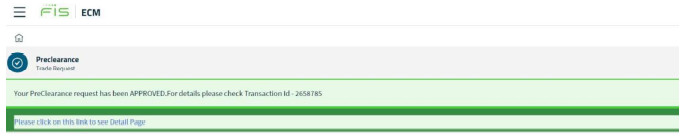
Denial:

4.2 Pre-Clearance Exemptions
| |
● |
|
Transactions in Managed Accounts are exempt from pre-clearance requirements
|
| |
● |
|
ETFs on the ETF exclusion list, or options on these ETFs, and municipal bonds are exempt from pre-clearance requirements |
Obtaining
pre-clearance does not relieve Access Persons of responsibilities to comply with other provisions of the Code (incl. holding period and blackout period restrictions and prohibitions on trading while in
possession of material non-public information).
11
Important note: always refer to the Investments Policies site for the most up-to-date version of the Code of Ethics
5 Holding Period
5.1 Holding Period Requirement
Reportable Securities
may not be (i) purchased and sold or (ii) sold and then repurchased within 30 calendar days (the “Holding Period”).8
| |
● |
|
For purchases and sales of MetLife, Inc. securities9 acquired in
the market, the Holding Period is 60 days |
| |
● |
|
For Access Persons that are part of MIM Japan, the Holding Period is 6 months |
5.2 Holding Period Exemptions
| |
● |
|
Sales of MetLife, Inc. securities that are received as part of a performance award or restricted stock grant are not
subject to the holding period requirement, but the transaction must be pre-cleared |
| |
● |
|
Transactions in ETFs on the ETF exclusion list, or options on these ETFs, are not subject to the holding period
requirement |
6 Blackout Period Restrictions
Access Persons that are involved in portfolio management, trading, or research (e.g., recommending securities or transactions) are prohibited
from trading a security in a Reportable Account on the same day or within 7 calendar days before or after an account managed by MIM or PineBridge Investments transacts in the same security. This restriction does not apply to:
| |
● |
|
Purchases or sales or issuers or securities that have a market capitalization of $5 billion or more
|
| |
● |
|
Transactions in issues or securities executed in a MIM-managed account that
replicates a broad-based securities market index |
All Access Persons who are part of the MIM Equity Management Team are
prohibited from trading a security in a Reportable Account if that security is held in any account managed by MIM Equity Management.
| 8 |
Access Persons may reach out to Compliance requesting a written exception to the Holding Period requirement;
exceptions will be reviewed and may be approved on a case-by-case basis. |
| 9 |
See section 7.2 for additional information on restrictions related to MetLife, Inc. securities |
12
Important note: always refer to the Investments Policies site for the most up-to-date version of the Code of Ethics
7 Requirements for MetLife, Inc. Securities
7.1 Disclosure, Pre-Clearance, and Holding Period Requirements for MetLife Securities
| |
● |
|
All transactions in MetLife, Inc. securities must receive pre-clearance
approval, regardless of whether the securities were acquired in the market or as part of a performance award / restricted stock grant |
| |
● |
|
For purchases and sales of MetLife, Inc. securities acquired in the market, the Holding Period is 60 days
|
| |
● |
|
Sales of MetLife, Inc. securities that are received as part of a performance award or restricted stock grant are not
subject to the holding period requirement, but the transaction must be pre-cleared |
| |
● |
|
If MetLife opens a Fidelity account on behalf of an Access Person for purposes of a performance award / restricted
stock grant, the Access Person must disclose the account in the personal trading system as a Reportable Account |
| |
● |
|
Allocations to the MetLife Company Stock Fund in a SIP or Auxiliary SIP Account are not reportable in PTA and are not
subject to the 60-day holding period |
7.2 Restrictions related to MetLife Securities
| |
● |
|
Access Persons that are also deemed Restricted Persons under MetLife’s Insider Trading Policy are prohibited
from transacted in MetLife, Inc. securities during MetLife enterprise blackout periods |
| |
● |
|
Access Persons that file Section 16 filings for the purchase and sale of MetLife, Inc. securities must pre-clear transactions through the MetLife Corporate Secretary’s Office |
| |
● |
|
Access Persons are prohibited from engaging in speculative transactions in MetLife, Inc. securities, including
purchases and sales of options in the market |
8 Transactions in Options
Access Persons are permitted to transact in options pursuant to the following requirements:
| |
● |
|
The expiration of the option must be greater than 30 days from the trade date |
| |
● |
|
Pre-clearance approval must be obtained for both (i) the initial purchase
of the option and (ii) the underlying transaction if the Access Person elects to take the option (on the transaction date) |
| |
● |
|
The option may not be closed out within 30 days of the initial trade date |
Access Persons are prohibited from transacting in options whereby they are effectively causing a purchase and sale in the same security within 30 days,
such as:
| |
● |
|
Buying a call and a put in the same security |
| |
● |
|
Selling a call and buying a call with different strike prices |
13
Important note: always refer to the Investments Policies site for the most up-to-date version of the Code of Ethics
9 Additional Personal Trading Restrictions
9.1 Initial Currency Options
| |
● |
|
Access Persons are prohibited from investing in Initial Currency Options (ICOs) |
9.2 Investment Clubs
| |
● |
|
Access Persons are prohibited from forming or participating in an Investment Club without prior approval from
Investments Compliance |
9.3 Private Placements
| |
● |
|
Access Persons are prohibited from investing in Private Placements without prior approval from Investments Compliance.
Such approval may only be granted if the investment does not present a conflict of interest. |
10 Material Non-Public Information (MNPI)
Access Persons are expressly prohibited from transaction in
securities about which the Access Person, MIM, or MetLife, has MNPI.
10.1 MNPI Definition
| |
● |
|
Information is considered material if it would likely affect the market price of a security or if a reasonable
investor would consider the information important in deciding whether to buy or sell the security |
| |
● |
|
Information is considered non-public if it has not been widely
disseminated and investors have not had time to absorb the information. |
| |
● |
|
Examples of MNPI may include: |
| |
o |
Financial plans, projections, or results |
| |
o |
Mergers or acquisitions |
| |
o |
Purchases or sales of a business; |
| |
o |
New products or businesses; |
| |
o |
Changes in executive management; or |
| |
o |
Potential or ongoing contractual negotiations |
10.2 Prohibitions
Access Persons are prohibited from:
| |
● |
|
Insider Trading — transacting in securities while aware of MNPI related to the securities issuer or its
securities |
| |
● |
|
Tipping — providing MNPI to others who act on the information by transacting those securities
|
| |
● |
|
Gifting — giving securities to others as gifts while aware of MNPI related to the securities issuer or
its securities |
| |
● |
|
Advising — advising others to transact in securities while aware of MNPI related to the securities issuer
or its securities, even if the MNPI is not shared |
14
Important note: always refer to the Investments Policies site for the most up-to-date version of the Code of Ethics
10.3 Reporting MNPI
Any Access Persons who become aware of MNPI are required to:
| |
● |
|
Promptly report the MNPI to Compliance by completing the request form or emailing InvestmentsCompliance@metlife.com |
| |
● |
|
Refrain from sharing MNPI with (i) anyone within MetLife / MIM without a valid business purpose and
(ii) anyone outside of MetLife / MIM |
When the information is no longer material or
non-pubic, Access Persons should notify Investments Compliance immediately to remove it from the Restricted List.
10.4
MNPI Restricted List(s) and Watch List
| |
● |
|
If MIM, or any Access Person, has MNPI about a securities issuer, the issuer may be added to the applicable restricted
list or watch list |
| |
● |
|
Access Persons are generally prohibited from transacting in issuers on the Restricted List and pre-clearance requests will result in a denial |
| |
● |
|
The Watch List contains issuers about which a select group of Access Persons may have access to MNPI (such as during a
confidential project or transaction) |
| |
o |
While an issuer is on the Watch List, that select group of Access Persons are restricted from transacting in the
issuer or its securities |
If any Access Person acquires MNPI outside of the course of their employment at MIM / MetLife, they
should not disclose it to anyone, including their manager and Investments Compliance. They are still prohibited from transacting in the relevant security issuer on behalf of themselves or in any MIM accounts and from making any investment
recommendations to advisory clients on the basis of such information.
10.5 Sharing MNPI with Clients
There may be certain circumstances under which MIM shares MNPI with client for a valid business reason. Prior to sharing any MNPI with any client,
Access Persons must contact Investments Compliance (InvestmentsCompliance@metlife.com) for approval.
10.6 Information Barriers
There is an Information Barrier
in place separating MIM’s asset classes that primarily trade in public securities and those that trade in private securities. Additional Information can be found in the MIM Information Barrier Policy.
In addition, there is an Information Barrier in place between MIM and MII; see the
policy for additional details.
15
Important note: always refer to the Investments Policies site for the most up-to-date version of the Code of Ethics
11 Recordkeeping and Data Sheet
|
|
|
|
| Policy Data Sheet |
|
|
| Policy Author |
|
Head of Investments Core Compliance |
|
|
| Policy Owner |
|
Investments Chief Compliance Officer |
|
|
| Policy Approval Committee |
|
MIM Policy Working Group (September 2025)
MIM Risk Committee (August 2025) |
|
|
| Policy Approval Date |
|
September 2025 |
|
|
| Last Review Date |
|
September 2025 |
|
|
| Next Review Date |
|
September 2027 |
|
|
| Applicable Laws,
Rules, and Regulations |
|
Investment Advisors Act of 1940 (Advisors Act) Rule 204A-1 Investment Company Act of
1940 (1940 Act) Rule 17J-1
All Requirements of other Applicable Foreign Jurisdictions |
|
|
| Related
Policies/Standards |
|
MetLife Code of Business Ethics
MetLife Global Insider Trading Policy
MIM Information Barrier Policy
MetLife Insurance Investments Confidential Transaction Information
Process and Information Barrier Policy |
|
|
|
|
|
|
|
| |
|
Revision History |
| |
|
|
|
| Version # |
|
Effective Date |
|
Summary of Changes |
|
Approver |
| |
|
|
|
|
2.0 |
|
October 2023 |
|
Policy refresh; clarified various requirements and aligned to MIM Policy Template |
|
MIM Policy Working Group |
| |
|
|
|
|
3.0 |
|
January 2025 |
|
Policy refresh; update to policy structure and order of sections; addition of violations examples and
framework; no material changes to any policy requirements. |
|
MIM Policy Working Group |
| |
|
|
|
|
4.0 |
|
October 2025 |
|
Updated certain policy requirements for alignment with PineBridge Investments including addition of
key principles, Access Persons obligations, and violations information, change to pre-clearance approval period, requirements for Reportable Funds |
|
MIM Policy Working Group |
16
Important note: always refer to the Investments Policies site for the most up-to-date version of the Code of Ethics
12 Appendix A: List of Approved Broker-Dealers
| |
● |
|
Bank of America / Merrill Lynch / Merrill Edge |
| |
● |
|
Charles Schwab (including transitioned TD Ameritrade accounts) |
| |
● |
|
Janney Montgomery Scott |
| |
● |
|
Morgan Stanley (including transitioned E-Trade accounts)
|
17
Important note: always refer to the Investments Policies site for the most up-to-date version of the Code of Ethics