0001133228-26-007278.txt : 20260429 0001133228-26-007278.hdr.sgml : 20260429 20260429171922 ACCESSION NUMBER: 0001133228-26-007278 CONFORMED SUBMISSION TYPE: 486BPOS PUBLIC DOCUMENT COUNT: 27 FILED AS OF DATE: 20260429 DATE AS OF CHANGE: 20260429 EFFECTIVENESS DATE: 20260429 FILER: COMPANY DATA: COMPANY CONFORMED NAME: Alternative Investment Partners Absolute Return Fund CENTRAL INDEX KEY: 0001327228 ORGANIZATION NAME: EIN: 000000000 STATE OF INCORPORATION: DE FISCAL YEAR END: 1231 FILING VALUES: FORM TYPE: 486BPOS SEC ACT: 1940 Act SEC FILE NUMBER: 811-21767 FILM NUMBER: 26918101 BUSINESS ADDRESS: STREET 1: ONE TOWER BRIDGE, 100 FRONT STREET CITY: WEST CONSHOHOCKEN STATE: PA ZIP: 19428-2881 BUSINESS PHONE: 610-260-7600 MAIL ADDRESS: STREET 1: ONE TOWER BRIDGE, 100 FRONT STREET CITY: WEST CONSHOHOCKEN STATE: PA ZIP: 19428-2881 FILER: COMPANY DATA: COMPANY CONFORMED NAME: Alternative Investment Partners Absolute Return Fund CENTRAL INDEX KEY: 0001327228 ORGANIZATION NAME: EIN: 000000000 STATE OF INCORPORATION: DE FISCAL YEAR END: 1231 FILING VALUES: FORM TYPE: 486BPOS SEC ACT: 1933 Act SEC FILE NUMBER: 333-286811 FILM NUMBER: 26918100 BUSINESS ADDRESS: STREET 1: ONE TOWER BRIDGE, 100 FRONT STREET CITY: WEST CONSHOHOCKEN STATE: PA ZIP: 19428-2881 BUSINESS PHONE: 610-260-7600 MAIL ADDRESS: STREET 1: ONE TOWER BRIDGE, 100 FRONT STREET CITY: WEST CONSHOHOCKEN STATE: PA ZIP: 19428-2881 N N N 486BPOS 1 aarf-efp24448_486bpos.htm AIP ABSOLUTE RETURN FUND - 486BPOS 2026-02-11AIPAbsoluteReturnFund-PRO-April2026
false 0001327228 N-2 N-2 No false 0001327228 dei:BusinessContactMember 2025-12-31 2025-12-31 0001327228 2025-12-31 2025-12-31 0001327228 stanley:bench20230606270Member 2025-12-31 2025-12-31 0001327228 stanley:bench20230606271Member 2025-12-31 2025-12-31 0001327228 stanley:bench20230606285Member 2025-12-31 2025-12-31 0001327228 stanley:bench20240424440Member 2025-12-31 2025-12-31 0001327228 stanley:bench20240424439Member 2025-12-31 2025-12-31 0001327228 stanley:bench20230606275Member 2025-12-31 0001327228 stanley:bench20230606275Member 2023-12-31 0001327228 stanley:bench20230606275Member 2022-12-31 0001327228 stanley:bench20230606275Member 2021-12-31 0001327228 stanley:bench20230606275Member 2020-12-31 0001327228 stanley:bench20230606275Member 2019-12-31 0001327228 stanley:bench20230606275Member 2018-12-31 0001327228 stanley:bench20230606276Member 2017-12-31 0001327228 stanley:bench20230606276Member 2016-12-31 0001327228 stanley:bench20230606275Member 2024-12-31 0001327228 stanley:bench20230606287Member 2025-12-31 2025-12-31 0001327228 stanley:bench20230606282Member 2025-12-31 2025-12-31 0001327228 stanley:bench20240123406Member 2025-12-31 2025-12-31 0001327228 stanley:bench20230606284Member 2025-12-31 2025-12-31 0001327228 stanley:bench20230606286Member 2025-12-31 2025-12-31 0001327228 stanley:bench20221105151Member 2025-12-31 2025-12-31 0001327228 stanley:bench20221105152Member 2025-12-31 2025-12-31 0001327228 stanley:bench20230606281Member 2025-12-31 2025-12-31 0001327228 stanley:bench20230606280Member 2025-12-31 2025-12-31 stanley:Years iso4217:USD xbrli:pure xbrli:shares iso4217:USD xbrli:shares

As filed with the Securities and Exchange Commission on April 29, 2026


Securities Act File No. 333-286811

Investment Company Act File No. 811-21767


UNITED STATES

SECURITIES AND EXCHANGE COMMISSION

Washington, D.C. 20549


FORM N-2


(CHECK APPROPRIATE BOX OR BOXES)

REGISTRATION STATEMENT UNDER THE SECURITIES ACT OF 1933


Post-Effective Amendment No. 1


REGISTRATION STATEMENT UNDER THE INVESTMENT COMPANY ACT OF 1940

Amendment No. 44


Alternative Investment Partners Absolute Return Fund

(Exact Name of Registrant as Specified in Charter) 


100 Front Street, Suite 400

West Conshohocken, Pennsylvania 19428-2881

(Address of Principal Executive Offices)


Registrant’s Telephone Number, Including Area Code: (610260-7600


Kara Fricke, Esq.

Morgan Stanley Investment Management Inc.

1633 Broadway

New York, NY 10019

(Name and address of agent for service)


COPY TO:


Matthew Barsamian, Esq.

William J. Bielefeld, Esq.

Dechert LLP

1900 K St NW

Washington, DC 20006


Approximate Date of Commencement of Proposed Public Offering: As soon as practicable after the effective date of this Registration Statement.


Check box if the only securities being registered on this Form are being offered pursuant to dividend or interest reinvestment plans.


Check box if any securities being registered on this Form will be offered on a delayed or continuous basis in reliance on Rule 415 under the Securities Act of 1933 (“Securities Act”), other than securities offered in connection with a dividend reinvestment plan.


Check box if this Form is a registration statement pursuant to General Instruction A.2 or a post-effective amendment thereto.


Check box if this Form is a registration statement pursuant to General Instruction B or a post-effective amendment thereto that will become effective upon filing with the Commission pursuant to Rule 462(e) under the Securities Act.


Check box if this Form is a post-effective amendment to a registration statement filed pursuant to General Instruction B to register additional securities or additional classes of securities pursuant to Rule 413(b) under the Securities Act.


It is proposed that this filing will become effective (check appropriate box):  


when declared effective pursuant to Section 8(c), or as follows:
   
immediately upon filing pursuant to paragraph (b) of Rule 486.
   
on (date) pursuant to paragraph (b) of Rule 486.
   
60 days after filing pursuant to paragraph (a) of Rule 486.
   
on (date) pursuant to paragraph (a) of Rule 486.


If appropriate, check the following box:


This post-effective amendment designates a new effective date for a previously filed post-effective amendment.


This Form is filed to register additional securities for an offering pursuant to Rule 462(b) under the Securities Act, and the Securities Act registration statement number of the earlier effective registration statement for the same offering is: ______.


This Form is a post-effective amendment filed pursuant to Rule 462(c) under the Securities Act, and the Securities Act registration statement number of the earlier effective registration statement for the same offering is: ______.


This Form is a post-effective amendment filed pursuant to Rule 462(d) under the Securities Act, and the Securities Act registration statement number of the earlier effective registration statement for the same offering is: ______.


Check each box that appropriately characterizes the Registrant:


Registered Closed-End Fund (closed-end company that is registered under the Investment Company Act of 1940 (“Investment Company Act”)).


Business Development Company (closed-end company that intends or has elected to be regulated as a business development company under the Investment Company Act).


Interval Fund (Registered Closed-End Fund or a Business Development Company that makes periodic repurchase offers under Rule 23c-3 under the Investment Company Act).


A.2 Qualified (qualified to register securities pursuant to General Instruction A.2 of this Form).


Well-Known Seasoned Issuer (as defined by Rule 405 under the Securities Act).


Emerging Growth Company (as defined by Rule 12b-2 under the Securities Exchange Act of 1934 (“Exchange Act”).


If an Emerging Growth Company, indicate by check mark if the registrant has elected not to use the extended transition period for complying with any new or revised financial accounting standards provided pursuant to Section 7(a)(2)(B) of Securities Act.


New Registrant (registered or regulated under the Investment Company Act for less than 12 calendar months preceding this filing).


image 
 
ALTERNATIVE INVESTMENT PARTNERS ABSOLUTE RETURN FUND
PROSPECTUS
April 29, 2026

Managed by
MORGAN STANLEY ALTERNATIVE INVESTMENT PARTNERS
100 Front Street, Suite 400
West Conshohocken, Pennsylvania 19428-2881
(800) 421-7572
Investment Objective. Alternative Investment Partners Absolute Return Fund (the “Fund”) is a Delaware statutory trust registered under the Investment Company Act of 1940, as amended, as a non-diversified, closed-end management investment company. The Fund’s investment objective is to seek capital appreciation.
 
Per Share
Total
Public Offering Price
At current net asset value
Based on current net asset value
Sales Load1
3%
3%
Proceeds to the Fund2,3
At current net asset value
Based on current net asset value
1 Generally, the stated minimum initial investment by an investor in the Fund is $50,000, which stated minimum may be reduced for certain investors. Investors purchasing Shares (as defined herein) may be charged a sales load of up to 3% of the Investor’s subscription. The table assumes the maximum sales load is charged.
The Distributor and/or a Service Agent (each as defined herein) may, in its discretion, waive the sales load for certain investors. In addition, purchasers of Shares in conjunction with certain “wrap” fee, asset allocation or other managed asset programs sponsored by a registered investment adviser (a “RIA”), including an affiliate of the Adviser (as defined herein), or Morgan Stanley and its affiliates (including the Adviser) and the directors, partners, principals, officers and employees of any such RIA or of any of Morgan Stanley and its affiliates may not be charged a sales load. See “Plan of Distribution.”
2 Shares are offered in a continuous offering at the Fund’s then current net asset value, plus any applicable sales load, as described herein.
3 As detailed in the section of this Prospectus entitled “Summary of Terms—Adviser Payments,” Morgan Stanley AIP GP LP (the “Adviser”) may pay additional compensation, out of its own funds and not as an additional charge to the Fund, to selected affiliated or unaffiliated brokers, dealers or other financial intermediaries (including affiliated Service Agents) (“Intermediaries”) in connection with the sale, distribution and retention of Shares and/or Shareholder servicing.
The SEC and the Commodity Futures Trading Commission have not approved or disapproved these securities or passed upon the adequacy of this Prospectus. Any representation to the contrary is a criminal offense.
An investment in the Fund is not guaranteed or endorsed by a bank, is not a bank deposit or obligation thereof, and is not insured or guaranteed by the Federal Deposit Insurance Corporation or any other government agency. An investment in the Fund involves investment risks, and you may lose money investing in the Fund.

 
The Fund is offering on a continuous basis shares of beneficial interest (“Shares”). Morgan Stanley Distribution, Inc. (the “Distributor”) acts as the distributor of the Fund’s Shares on a best efforts basis, subject to various conditions. The Distributor may enter into selected dealer agreements with various brokers and dealers (in such capacity, “Service Agents”), some of which are affiliates of the Adviser, that have agreed to participate in the distribution of the Fund’s Shares. See “Plan of Distribution.” There is no minimum aggregate amount of Shares required to be sold by the Fund. Any amounts received in advance of purchases of Shares are placed in a non-interest bearing account with the Transfer Agent (as defined herein) prior to their investment in the Fund, in accordance with Rule 15c2-4 under the Securities Exchange Act of 1934, as amended. No other arrangements have been made to place funds received in connection with the Shares’ offering in an escrow, trust or similar arrangement. Shares will be sold only to Eligible Investors (as defined herein). Shares will not be listed on any securities exchange.
Investment Portfolio. The Fund invests substantially all its assets in private investment funds (commonly referred to as hedge funds) that are managed by a select group of alternative investment managers that employ different “absolute return” investment strategies in pursuit of attractive risk-adjusted returns consistent with the preservation of capital. “Absolute return” refers to a broad class of investment strategies that are managed without reference to the performance of equity, debt and other markets. “Absolute return” investment strategies allow Investment Managers (as defined herein) the flexibility to use leveraged or short-sale positions to take advantage of perceived inefficiencies across the global capital markets. These strategies are in contrast to the investment programs of “traditional” registered investment companies, such as mutual funds. Absolute return strategies can be contrasted with “relative return strategies” which generally seek to outperform a corresponding benchmark equity or fixed income index. The Fund seeks attractive “risk-adjusted” returns, which are returns adjusted to take into account the volatility of those returns. The Fund intends to invest in private investment funds that employ the following principal strategies: relative value strategies, security selection strategies, specialist credit strategies and directional strategies. For a further discussion of the Fund’s principal investment strategies, see “Investment Program.”
Risk Factors and Restrictions on Transfer
 
Investing in Shares involves a high degree of risk. See “Types of Investments and Related Risks.”
 
The Shares are not listed on an exchange and it is not anticipated that a secondary market for the Shares will develop. Thus, an investment in the Fund may not be suitable for investors who may need access to the money they invest in the foreseeable future.
 
With very limited exceptions, Shares are not transferable and liquidity will be provided only through repurchase offers, which may be made from time to time by the Fund as determined by the Fund’s Board of Trustees in its sole discretion. See “Repurchases and Transfers of Shares.”
 
Management Fee. The Fund pays the Adviser a monthly fee of 0.083% (1.00% on an annualized basis) of the Fund’s month end net asset value (the “Management Fee”). The Management Fee is an expense paid out of the Fund’s net assets and is computed based on the value of the net assets of the Fund as of the close of business on the last business day of each month (including any assets in respect of Shares that will be repurchased by the Fund as of the end of the month). The Management Fee is in addition to the asset-based fees and incentive fees paid by the Investment Funds and indirectly paid by investors in the Fund. See “Management Fee.”
Distribution and Shareholder Servicing Fee. The Fund pays the Distributor, and the Distributor pays each Service Agent that enters into a Distribution and Shareholder Servicing Agreement with the Distributor, a monthly distribution and shareholder servicing fee at the annual rate of up to 0.75% of the net asset value of the outstanding Shares beneficially owned by customers of the Distributor or the Service Agent.
Eligible Investors. Shares are being sold only to investors that represent that they are “accredited investors” within the meaning of Rule 501(a) of Regulation D promulgated under the Securities Act of 1933, as amended. The Distributor and/or any Service Agent may impose additional eligibility requirements for investors who purchase shares through the Distributor or such Service Agent. The minimum initial investment in the Fund by any investor is $50,000 and the minimum additional investment in the Fund by any investor is $25,000. The minimum initial and additional investments may be reduced by the Fund with respect to certain individual investors or classes of investors (specifically, with respect to employees, officers or Trustees of the Fund, the Adviser or their affiliates) or with respect to investments in the Fund made by feeder funds affiliated with the Fund. Investors may only purchase their shares through the Distributor, through a Service Agent or through a RIA that has entered into an arrangement with the Distributor for such RIA to offer Shares in conjunction with a “wrap” fee, asset allocation or other managed asset program sponsored by such RIA. Any such RIA may impose additional eligibility requirements for investors who purchase Shares through such RIA. The Fund is not designed for tax-exempt investors.

 
This Prospectus concisely provides the information that a prospective investor should know about the Fund before investing. You are advised to read this Prospectus carefully and to retain it for future reference. Additional information about the Fund, including a statement of additional information (“SAI”) dated April 29, 2026, has been filed with the Securities and Exchange Commission. The SAI and the Annual and Semi-Annual Reports to Shareholders are available upon request and without charge by writing to the Fund c/o UMB Fund Services, Inc., located at 235 West Galena Street, Milwaukee, WI 53212 or by calling (800) 421-7572. The SAI, the annual reports and the semi-annual reports are available free of charge on the Fund’s website at https://www.morganstanley.com/im/en-us/financial-advisor/products/registered-funds/hedge-funds/alternative-investment-
partners-absolute-return-fund.shareclass.P.html
. Information on, or accessible through, the Fund’s website is not a part of, and is not incorporated into, this Prospectus. The SAI, material incorporated by reference and other information about the Fund, is also available on the SEC’s website (http://www.sec.gov). The address of the SEC’s Internet site is provided solely for the information of prospective investors and is not intended to be an active link.
Shares are not deposits or obligations of, and are not guaranteed or endorsed by, any bank or other insured depository institution, and Shares are not insured by the Federal Deposit Insurance Corporation, the Federal Reserve Board or any other government agency.
You should rely only on the information contained in this Prospectus. The Fund has not authorized anyone to provide you with different information. The Fund is not making an offer of Shares in any state or other jurisdiction where the offer is not permitted.


Morgan Stanley Distribution, Inc.


Table of Contents

 
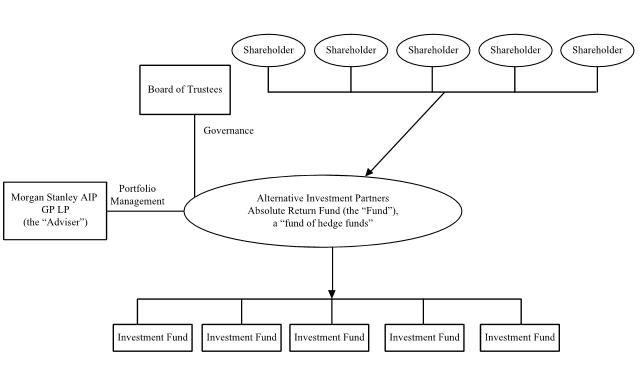
Structural Diagram
image 
This diagram and the accompanying text are intended as a simplified illustration of the Fund’s structure and investment program. Please refer to the body of this Prospectus for a more complete explanation of each, as well as details regarding the fees, expenses and risks to which an investment in Shares of the Fund is subject.
As further described in the body of this Prospectus, the Investment Funds (as defined herein) in which the Fund invests are commonly referred to as “hedge funds.” Because the investment strategies implemented by the investment managers to these Investment Funds are “non-traditional” in nature (e.g., not based on long-only portfolios of bonds or equities as are the investment programs of most registered investment companies such as mutual funds), this class of investments is typically referred to as “alternative investments.”
1 

 
Summary of Terms
The Fund
Alternative Investment Partners Absolute Return Fund (the “Fund”) is a Delaware statutory trust that is registered under the Investment Company Act of 1940, as amended (the “1940 Act”), as a non-diversified, closed-end management investment company.
Investment Objective
The Fund seeks capital appreciation.
Investment Program
The Fund seeks capital appreciation by investing substantially all its assets in investment funds (“Investment Funds”) managed by unaffiliated third-party investment managers (“Investment Managers”) who employ a variety of “absolute return” investment strategies in pursuit of attractive risk-adjusted returns (i.e., returns adjusted to take into account the volatility of those returns, as measured in the manner described below) consistent with the preservation of capital. “Absolute return” refers to a broad class of investment strategies that are managed without reference to the performance of equity, debt and other markets. “Absolute return” investment strategies allow Investment Managers the flexibility to use leveraged or short-sale positions to take advantage of perceived inefficiencies across the global capital markets. These strategies are in contrast to the investment programs of “traditional” registered investment companies, such as mutual funds. “Traditional” investment companies are generally characterized by long-only investments and limits on the use of leverage. Absolute return strategies can be contrasted with “relative return strategies” which generally seek to outperform a corresponding benchmark equity or fixed income index. Because Investment Funds following absolute return investment strategies (whether hedged or not) are often described as “hedge funds,” the Fund’s investment program can be broadly referred to as a fund of hedge funds. The Fund measures the volatility of its returns by “standard deviation,” which is a measure of risk that represents the degree to which an investment’s performance has varied from its average performance over a particular period. The obligations of the 1940 Act (and thus the protections thereunder), including limits on leverage, do not apply to Investment Funds. The Fund’s investments, other than in Investment Funds, generally are limited to derivative investments to gain exposure to certain Investment Funds, such as total return swaps, options and futures.
Investment Funds are commingled asset pools that may engage in a wide variety of investment strategies. Among other things, Investment Funds invest primarily in U.S. and non-U.S. equity and debt securities and may engage in leverage, short selling and derivatives transactions. Investment Funds typically offer their securities privately without registration under the Securities Act of 1933, as amended (the “1933 Act”), in large minimum denominations (often at least $1 million) to a limited number of high net worth individual and institutional investors. Investment Funds claim an exemption or exclusion from the definition of “investment company,” and hence are not registered as investment companies, under the 1940 Act. The managers or investment advisers of these Investment Funds, which are typically structured as limited partnerships or limited liability companies, are usually compensated through asset-based fees and incentive-based allocations. Through the selection and ongoing monitoring of Investment Funds, the Fund seeks to achieve capital appreciation that may exhibit moderate correlation with certain global equity indices and aims not to be disproportionately influenced by the performance of any single Investment Fund. In addition, by investing in a number of Investment Funds that employ a variety of absolute return investment strategies, the Fund seeks to achieve the desired capital appreciation with lower volatility than likely would be achieved by investing with most individual Investment Funds. Investing in a number of Investment Funds involves additional costs.
The Fund may seek to gain investment exposure to certain Investment Funds, to adjust market or risk exposure or to increase overall returns by seeking “leveraged” market exposure in certain investments by entering into derivatives transactions, such as total return swaps, options and futures. For example, to achieve investment returns equivalent to those achieved by an Investment Manager in whose Investment Fund the Fund could not invest directly, perhaps because of its high investment minimum or its unavailability for direct investment, the Fund may enter into one or more swap agreements under which the Fund may agree, on a net basis, to pay a return based on a floating interest rate, and to receive the total return of the reference Investment Fund over a stated time period. See “Types of Investments and Related Risks—Special Investment Instruments and Techniques—Options and Futures” and “Types of Investments and Related Risks—Special Investment Instruments and Techniques—Swap Agreements.” The Fund does not expect to gain more than 25% of its total investment exposure via such derivatives. The Fund’s investments in derivatives may involve significant economic leverage and thus may, in some circumstances, involve significant risks of loss and may increase the volatility of the Fund’s returns. These risks may increase dramatically during times where general access to credit is severely impaired (i.e., a “credit crunch”) and/or during general
2 

 
market turmoil, such as that experienced during late 2008 and during the crisis relating to COVID-19. See “Types of Investments and Related Risks—Investment Related Risks—Leverage Utilized by the Fund.”
The Adviser (as hereinafter defined) is responsible for the allocation of assets to various Investment Funds, subject to policies adopted by the Fund’s Board of Trustees. These Investment Funds will have investors other than the Fund.
The Adviser allocates Fund assets among the Investment Funds that, in its view, represent attractive investment opportunities. Allocation depends on the Adviser’s assessment of the likely risks and returns of various absolute return investment strategies that the Investment Funds utilize and the likely correlation among the investment strategies under consideration. The Adviser generally seeks to invest substantially all of the Fund’s assets in Investment Funds whose expected risk-adjusted returns are deemed attractive and likely to have limited correlations among each other or with fixed income or equity indices. The Adviser periodically reallocates the Fund’s investments among investment strategies in order to increase the Fund’s expected risk-adjusted return. There is no guarantee that the Fund, will be able to avoid substantial losses due to poor returns by any Investment Fund or that the Adviser’s expectations regarding Investment Funds’ limited correlations among each other or with fixed income or equity indices will prove correct.
The Adviser and its personnel use a wide range of resources, including its well-established network, to identify attractive Investment Funds and promising investment strategies for consideration in connection with investments by the Fund. To narrow the set of Investment Funds and investment strategies initially identified for consideration, the Adviser screens Investment Funds and investment strategies according to criteria that include both quantitative measures such as past performance and systematic risk exposures, to the extent that data is available; qualitative factors such as the reputation, experience and training of the Investment Manager; and the ability of the Investment Manager to articulate a coherent investment philosophy and risk control process. Following the initial screening process, the Adviser conducts further review of the Investment Funds that it considers likely to generate superior, risk-adjusted returns consistent with the Adviser’s views at that time as to both the most attractive strategy types and the needs of the Fund’s existing portfolio. On an ongoing basis, the Adviser conducts similar, periodic reviews with respect to Investment Funds in which the Fund has invested.
The Adviser’s personnel have extensive experience and expertise with alternative investment strategies and Investment Managers and have evaluated numerous Investment Funds representing many categories of alternative investments and utilizing various investment strategies. They also have extensive experience in directly managing alternative investment strategies. The Adviser believes that this combination of evaluation expertise and direct investment experience enables it to understand the opportunities and risks associated with investing in Investment Funds.
The Adviser intends to invest primarily in Investment Funds that employ the following strategies (among others):
 
relative value strategies—seek to identify and exploit inefficiencies in the relative pricing of securities whose prices are deemed to move in relation to each other;
 
security selection strategies—seek to combine long and short positions of equity securities primarily;
 
specialist credit strategies—seek to invest in and lend to credit sensitive issuers that are generally rated below investment grade (typically referred to as “junk”);
 
global macro and commodity trading advisor (“CTA”) strategies—seek to invest based on long-term economic trends; and
 
directional strategies—seek to invest based on the expected direction of market prices of currencies, commodities, equities and bonds in the futures and cash markets.
 
See “Investment Program—Investment Strategies.”
The Adviser typically endeavors to limit the exposure to any one type of investment strategy to less than 35% of the Fund’s gross assets (measured over time and subject to underlying Investment Funds’ liquidity constraints) and to limit investments in any one Investment Fund to no more than 15% of the Fund’s gross assets (measured at the time of purchase). The Adviser limits Fund investments in any one Investment Fund to less than 5% of an Investment Fund’s outstanding voting securities. See “Types of Investments and Related Risks—Risks of Fund of Hedge Funds Structure—Investments in Non-Voting Stock; Inability to Vote.”
The Investment Funds in which the Fund invests are not subject to the Fund’s investment restrictions and are generally subject to few investment limitations. In response to adverse market, economic or political conditions, the Fund may invest temporarily in high quality fixed income securities, money market instruments and affiliated or unaffiliated money market funds or may hold cash or cash equivalents for temporary defensive purposes. In addition, the Fund may also make these types of
3 

 
investments pending the investment of assets in Investment Funds or to maintain the liquidity necessary to effect repurchases of Shares.
Leverage
The Fund may incur leverage to the extent permitted by the 1940 Act. Specifically, the Fund may borrow money through a credit facility to fund investments in Investment Funds up to the limits of the Asset Coverage Requirement (as defined below). The Fund may also borrow money through a credit facility to manage timing issues in connection with the acquisition of its investments (i.e., to provide the Fund with temporary liquidity to acquire investments in Investment Funds in advance of the Fund’s receipt of redemption proceeds from another Investment Fund).
The 1940 Act requires a registered investment company to satisfy an asset coverage requirement of 300% of its indebtedness, including amounts borrowed, measured at the time the investment company incurs the indebtedness (the “Asset Coverage Requirement”). This requirement means that the value of the investment company’s total indebtedness may not exceed 33 1/3% the value of its total assets (including the indebtedness). The Fund’s borrowings will at all times be subject to the Asset Coverage Requirement. If at any time the Fund’s asset coverage for all borrowings falls below the minimum level required by the 1940 Act, the Fund will decrease its borrowings to the extent required. To make such payments, the Fund may be forced to sell portfolio securities when it is not otherwise advantageous to do so. The use of leverage by borrowing creates the potential for greater gains to shareholders of the Fund during favorable market conditions and the risk of magnified losses during adverse market conditions.
The Fund may choose to increase or decrease, or eliminate entirely, its use of leverage over time and from time to time. In addition, the Fund may borrow for temporary, emergency or other purposes as permitted by the 1940 Act. The Fund will comply with the limitations on leverage imposed by the 1940 Act.
Leverage is a speculative technique that exposes the Fund to greater risk and increased costs than if it were not implemented. Increases and decreases in the value of the Fund’s portfolio will be magnified when the Fund uses leverage. The use of leverage is subject to risks and would cause the Fund’s NAV (as defined below) to be more volatile than if leverage were not used. For example, a rise in short-term interest rates could lead to higher interest costs which could detract from the Fund’s return if the Fund were using leverage versus if the Fund were not using leverage. A reduction in the Fund’s NAV may cause a reduction in the market price of its Shares. The use of leverage also may cause greater volatility in the level of the Fund’s market price and distributions on the Shares.
In addition to borrowing money, the Fund may also incur economic leverage via the use of derivatives. These instruments may, in some cases, involve significant risks of loss.
Investment Funds may also utilize leverage, including economic leverage, in their investment activities. Borrowings by Investment Funds are not subject to the Asset Coverage Requirement. Accordingly, the Fund’s portfolio may be exposed to the risk of highly leveraged investment programs of certain Investment Funds and the volatility of the value of Shares may be great, especially during times of a “credit crunch” and/or general market turmoil, such as that experienced during late 2008 and during the crisis relating to COVID-19. In general, the use of leverage by Investment Funds or the Fund may increase the volatility of the Investment Funds or the Fund. See “Types of Investments and Related Risks-Investment Related Risks-Leverage Utilized by the Fund” and see “Types of Investments and Related Risks-Investment Related Risks-Leverage Utilized by Investment Funds.”
Potential Benefits of Investing in the Fund
An investment in the Fund enables investors to invest with Investment Managers whose services generally are not available to the investing public or who otherwise may place stringent restrictions on the number and type of persons whose money they will manage. An investment in the Fund also enables investors to invest with a number of Investment Managers without incurring the high minimum investment requirements that Investment Managers typically would impose on investors. Investment Funds in which the Fund may invest also may close from time to time. If the Fund has previously invested in an Investment Fund that has closed, an investor would nevertheless be able to invest indirectly in such Investment Fund by investing in the Fund.
In addition to benefiting from the Investment Managers’ individual investment strategies, the Fund as a whole should achieve the benefits of exposure to a number of different investment styles and Investment Managers. By investing through multiple Investment Managers that employ a variety of absolute return investment strategies, the Fund may reduce the volatility
4 

 
inherent in a direct investment with a single Investment Manager. However, there can be no assurances that investors will realize these benefits from investing in the Fund.
The Offering
The Fund is offering on a continuous basis through Morgan Stanley Distribution, Inc. (the “Distributor”) shares of beneficial interest (“Shares”). Shares are offered in a continuous offering at the Fund’s then current net asset value (“NAV”) per Share, plus any applicable sales load. See “Purchases of Shares.” The Distributor may enter into selected dealer agreements with various brokers and dealers (in such capacity, “Service Agents”) that have agreed to participate in the distribution of the Fund’s Shares. See “Plan of Distribution.” Shares may be purchased as of the first business day of each month from the Distributor or a Service Agent at the Fund’s then current NAV per Share plus any applicable sales load. The Fund’s current NAV per Share will be made available on the Fund’s website, http://www.morganstanley.com/im. Shares may also be purchased through a RIA that has entered into an arrangement with the Distributor for such RIA to offer Shares in conjunction with a “wrap” fee, asset allocation or other managed asset program sponsored by such RIA. The Distributor is an affiliate of the Adviser and may be affiliated with one or more Service Agents. See “Calculation of Net Asset Value.” Investors purchasing Shares in the Fund (“Shareholders”) may be charged a sales load of up to 3% of the amount of the investor’s purchase. The Distributor and/or a Service Agent may, in its discretion, waive the sales load for certain investors. In addition, purchasers of Shares in conjunction with certain “wrap” fee, asset allocation or other managed asset programs sponsored by a RIA, including an affiliate of the Adviser, or Morgan Stanley and its affiliates (including the Adviser) and the directors, partners, principals, officers and employees of any such RIA or any of the Adviser and its affiliates may not be charged a sales load. See “Purchases of Shares.”
Board of Trustees
The Fund has a Board of Trustees (each member a “Trustee” and, collectively, the “Board of Trustees”) that has overall responsibility for monitoring and overseeing the Fund’s investment program and its management and operations. A majority of the Trustees are not “interested persons” (as defined by the 1940 Act). See “Management of the Fund.”
The Investment Adviser
Morgan Stanley AIP GP LP serves as the Fund’s investment adviser (the “Adviser”). The Adviser is a limited partnership formed under the laws of the State of Delaware. The Adviser is registered as an investment adviser under the Investment Advisers Act of 1940, as amended (the “Advisers Act”).
The day-to-day portfolio management, short-term cash management and operations of the Fund are the responsibility of Mark L.W. van der Zwan, Chief Investment Officer, Fund of Hedge Funds team; Jarrod Quigley, Deputy Chief Investment Officer, Fund of Hedge Funds team; Eban Cucinotta, Portfolio Manager; Robert Rafter, Portfolio Manager; David Damsgaard, Portfolio Manager; Farhan Karim, Portfolio Manager; and Yury Rojek, Portfolio Manager, subject to oversight by the Board of Trustees. See “Management of the Fund.”
The Adviser is an affiliate of Morgan Stanley. Morgan Stanley is a preeminent global financial services firm engaged in securities trading and brokerage activities, as well as providing investment banking, research and analysis, financing and financial advisory services.
Management Fee
In consideration of the advisory and other services provided by the Adviser to the Fund, the Fund pays the Adviser a monthly fee of 0.083% (1.00% on an annualized basis) of the Fund’s month-end NAV (the “Management Fee”). The Management Fee is an expense paid out of the Fund’s net assets and is computed based on the value of the net assets of the Fund as of the close of business on the last business day of each month (including any assets in respect of Shares that will be repurchased as of the end of the month). The Management Fee is in addition to the asset-based fees and incentive fees paid by the Investment Funds and indirectly paid by investors in the Fund. See “Management Fee.”
Distribution and Shareholder Servicing Fee
The Fund pays the Distributor, and the Distributor pays each Service Agent (which may include financial institutions and other industry professionals in addition to broker-dealers) that enters into a Distribution and Shareholder Servicing Agreement with the Distributor, a monthly distribution and shareholder servicing fee of up to 0.0625% (0.75% on an annualized basis) of the NAV of the outstanding Shares attributable to the clients of the Service Agent who are invested in the Fund through the Service Agent. In exchange for this fee, the Service Agent provides distribution, marketing and/or sales support services, including making the Fund available as an investment option to the Service Agent’s clients, offering the Fund as an option on any
5 

 
distribution “platform” the Service Agent administers, making information about the Fund available to clients, including the Fund’s Prospectus, statement of additional information and sales literature, engaging in education or marketing activities about the Fund and its characteristics and retaining or utilizing the services of sales professionals, consultants and other personnel to assist in marketing shares of the Fund to clients. In addition, each Service Agent provides the following shareholder services: assisting in establishing and maintaining accounts and records relating to clients that invest in Shares, processing dividend and distribution payments from the Fund on behalf of clients, arranging for bank wires following Fund notification, responding to client inquiries relating to the services performed by the Service Agent, responding to routine inquiries from clients concerning their investments in Shares, assisting clients in changing account designations and addresses, assisting in processing client repurchase requests and providing such other similar services as permitted under applicable statutes, rules and regulations. In certain instances, a Service Agent may enter into an agreement with the Fund directly to provide shareholder services and the Fund may pay such Service Agent a fee for such services.
Adviser Payments
The Adviser may pay additional compensation, out of its own funds and not as an additional charge to the Fund, to selected affiliated or unaffiliated brokers, dealers or other financial intermediaries (including affiliated Service Agents) (“Intermediaries”) in connection with the sale, distribution and retention of Shares and/or Shareholder servicing. For example, the Adviser may pay compensation to Intermediaries for the purpose of promoting the sale of Shares of the Fund, maintaining balances of Shares, and/or for sub-accounting, administrative or Shareholder processing services. Such payments are made quarterly by the Adviser. The payments made by the Adviser may be based on the NAV of the Fund as determined by the Adviser. The amount of these payments is determined from time to time by the Adviser and may be substantial. Such additional compensation will not exceed 0.125% of the average NAV of the outstanding Shares beneficially owned by customers of an Intermediary over the applicable quarter (0.50% on an annualized basis).
With respect to each Intermediary that may receive such payments, the Adviser may pay from its own funds an amount not to exceed 0.50% of the NAV of the Fund attributable to each client of such Intermediary who invests in the Fund. A portion of this payment may be paid through to the professional responsible for the client relationship and/or selling the Fund. This payment may be made as long as a client of an Intermediary is invested in the Fund.
The prospect of receiving, or the receipt of, additional ongoing compensation as described above by Intermediaries, out of the Adviser’s own funds and not as an additional charge to the Fund, may provide such Intermediaries and/or their salespersons with an incentive to favor sales of Shares of the Fund, and funds whose affiliates make similar compensation available, over sales of shares of funds (or other fund investments) with respect to which the Intermediary receives either no additional compensation, or lower levels of additional compensation. The prospect of receiving, or the receipt of, such additional ongoing compensation may provide Intermediaries and/or their salespersons with an incentive to favor recommending that Shareholders maintain their assets in the Fund rather than re-allocate assets to another investment. These payment arrangements, however, will not change the price that an investor pays for Shares of the Fund or the amount that the Fund receives to invest on behalf of an investor. Shareholders may wish to take such payment arrangements into account when considering and evaluating any recommendations relating to Shares of the Fund. See “Adviser Payments.”
Fees and Expenses
The Fund bears all expenses incurred in the business of the Fund, including any charges and fees to which the Fund is subject as an investor in the Investment Funds. The Investment Funds will bear all expenses incurred in the business of the Investment Funds. See “Summary of Fees and Expenses” and “Fund Expenses.”
State Street Bank and Trust Company (“State Street”), as Fund administrator, performs certain administration, accounting and investor services for the Fund. In consideration for these services, the Fund pays State Street an annual fee calculated based upon the average net assets of the Fund, subject to a minimum monthly fee, and reimburses certain of State Street’s expenses.
Conflicts of Interest
The investment activities of the Adviser, the Investment Managers and their affiliates for their own accounts and other accounts they manage may give rise to conflicts of interest that may disadvantage the Fund. Morgan Stanley, an affiliate of the Adviser, is a diversified global financial services firm involved in a broad spectrum of financial services and asset management activities and may, for example, engage in the ordinary course of business in activities in which its interests or the interests of its clients may conflict with those of the Fund or the Shareholders. See “Conflicts of Interest.”
6 

 
Purchases of Shares
The minimum initial investment in the Fund is $50,000. Additional investments in the Fund must be made in a minimum amount of $25,000. The minimum initial and additional investments may be reduced by the Fund with respect to certain individual investors or classes of investors (specifically, with respect to employees, officers or Trustees of the Fund, the Adviser or their affiliates) or with respect to investments in the Fund made by feeder funds affiliated with the Fund. Additionally, the Fund may waive or reduce such minimum initial and additional investment amounts (as well as the application and funding deadlines described below) with respect to any investor funding its purchase of Shares with redemption proceeds from another fund sponsored, managed, or advised by the Adviser. The Fund will notify Shareholders in writing of any changes in the investors that are eligible for such reductions. The Fund may repurchase all of the Shares held by a Shareholder if the Shareholder’s account balance in the Fund, as a result of repurchase or transfer requests by the Shareholder, is less than $50,000.
The Fund may accept initial and additional purchases of Shares as of the first day of each calendar month. The investor must submit a completed application form five business days before the applicable purchase date. All purchases are subject to the receipt of immediately available funds three business days prior to the applicable purchase date in the full amount of the purchase (to enable the Fund to invest the proceeds in Investment Funds as of the applicable purchase date). An investor who misses one or both of these deadlines may have the effectiveness of its investment in the Fund delayed until the following month.
Despite having to meet the earlier application and funding deadlines described above, the Fund does not issue the Shares purchased (and an investor does not become a Shareholder with respect to such Shares) until the applicable purchase date, i.e., the first day of the relevant calendar month. Consequently, purchase proceeds do not represent capital of the Fund, and do not become assets of the Fund, until such date.
Any amounts received in advance of the initial or subsequent purchases of Shares are placed in a non-interest-bearing account with the Transfer Agent (as defined herein) prior to their investment in the Fund, in accordance with Rule 15c2-4 under the Securities Exchange Act of 1934, as amended (the “1934 Act”). The Fund reserves the right to reject any purchase of Shares in certain limited circumstances (including, without limitation, when it has reason to believe that a purchase of Shares would be unlawful). Unless otherwise required by applicable law, any amount received in advance of a purchase ultimately rejected by the Fund will be returned to the prospective investor. See “Other Risks—Possible Exclusion of a Shareholder Based on Certain Detrimental Effects.”
Eligible Investors
Each investor will be required to certify that the Shares are being acquired directly or indirectly for the account of an “accredited investor” as defined in Rule 501(a) of Regulation D promulgated under the 1933 Act. Investors who are “accredited investors” are referred to in this Prospectus as “Eligible Investors.” Existing Shareholders seeking to purchase additional Shares will be required to qualify as “Eligible Investors” at the time of the additional purchase. The Distributor and/or any Service Agent or RIA may impose additional eligibility requirements for investors who purchase Shares through the Distributor, such Service Agent or RIA, respectively. The Fund is not designed for tax-exempt investors.
Shares of the Fund are only registered for sale in the United States and certain of its territories. Generally, shares of the Fund will only be offered or sold to “U.S. persons” and all offerings or other solicitation activities will be conducted within the United States in accordance with the rules and regulations of the 1933 Act.
Investor Suitability
An investment in the Fund involves a considerable amount of risk. A Shareholder may lose money, up to its entire investment. Before making an investment decision, a prospective investor should (i) consider the suitability of this investment with respect to the investor’s investment objectives and personal situation and (ii) consider factors such as the investor’s personal net worth, income, age, risk tolerance and liquidity needs. The Fund is an illiquid investment. Investors have no right to require the Fund to redeem their Shares in the Fund. See “Other Risks—Closed-End Fund; Liquidity Risks.”
Valuation
Certain securities and other financial instruments in which the Investment Funds invest may not have a readily ascertainable market price and will be fair valued by the Investment Managers. Although the procedures approved by the Fund’s Board of Trustees provide that the Adviser will review the valuations provided by the Investment Managers to the Investment Funds, neither the Adviser nor the Board of Trustees will be able to confirm independently the accuracy of valuations provided by the Investment Managers (which are unaudited). Accordingly, such valuations generally will be relied upon by the Fund, even
7 

 
though an Investment Manager may face a conflict of interest in valuing the securities, as their value will affect the Investment Manager’s compensation. In addition, the NAVs or other valuation information received by the Adviser from the Investment Funds will typically be estimates only, subject to revision through the end of each Investment Fund’s annual audit. See “Types of Investments and Related Risks—Risks of Fund of Hedge Funds Structure—Valuation.”
Unlisted Closed-End Structure; Limited Liquidity and Transfer Restrictions
The Fund has been organized as a closed-end management investment company. Closed-end funds differ from open-end management investment companies (commonly known as mutual funds) in that investors in a closed-end fund do not have the right to redeem their shares on a daily basis. To meet daily redemption requests, mutual funds are subject to more stringent regulatory limitations than closed-end funds.
A Shareholder will not be able to redeem his, her or its Shares on a daily basis because the Fund is a closed-end fund. In addition, with very limited exceptions, the Fund’s Shares are not transferable and liquidity will be provided only through limited repurchase offers described below. An investment in the Fund is suitable only for investors who can bear the risks associated with the limited liquidity of the Shares and should be viewed as a long-term investment. See “Other Risks—Closed-End Fund; Liquidity Risks.”
Repurchases of Shares by the Fund
No Shareholder or other person holding Shares acquired from a Shareholder has the right to require the Fund to redeem any Shares. The Fund may from time to time repurchase Shares from Shareholders in accordance with written tenders by Shareholders at those times, in those amounts, and on those terms and conditions as the Board of Trustees may determine in its sole discretion. Each such repurchase offer will generally apply to approximately 15% of the net assets of the Fund. In determining whether the Fund should offer to repurchase Shares from Shareholders, the Board of Trustees will consider the recommendation of the Adviser. The Adviser expects that, generally, it will recommend to the Board of Trustees that the Fund offer to repurchase Shares from Shareholders quarterly, with such repurchases to occur as of each March 31, June 30, September 30 and December 31. The Fund has no obligation to repurchase Shares at any time; however, in the event that it does repurchase Shares, there is no guarantee that the Fund will offer to repurchase Shares in an amount exceeding 5% of its net assets. Shareholders who tender Shares may not have the total amount of their Shares repurchased by the Fund in a given period or over multiple periods. Thus, investors should consider the Fund to be an illiquid investment. Each repurchase offer will generally commence approximately 125 days prior to the applicable repurchase date.
If a repurchase offer is oversubscribed by Shareholders who tender Shares, the Fund may repurchase a pro rata portion of the Shares tendered by each Shareholder, extend the repurchase offer, or take any other action with respect to the repurchase offer permitted by applicable law, including prioritizing for non-proration Shareholders with account balances at or below a specified level that submit a full tender request. The Fund also reserves the right to repurchase at NAV all of a Shareholder’s Shares at any time if, for any reason, the aggregate value of such Shareholder’s Shares is, at the time of such compulsory repurchase, less than the minimum initial investment applicable for the Fund. In addition, the Fund has the right to repurchase a Shareholder’s Shares if the Fund determines that the repurchase is in the best interest of the Fund or upon the occurrence of certain events specified in the Fund’s Agreement and Declaration of Trust. The Fund also has the right at any time to repurchase at NAV the Shares of a Shareholder, or any person acquiring Shares through a Shareholder, in accordance with the Agreement and Declaration of Trust and Section 23 of the 1940 Act and any applicable rules thereunder, including Rule 23c-2. The repurchase of Shares by the Fund may be a taxable event to Shareholders.
The Fund is subject to certain Investment Funds’ initial lock-up periods beginning at the time of the Fund’s initial investment in an Investment Fund, during which the Fund may not withdraw its investment. In addition, certain Investment Funds may at times elect to suspend completely or limit withdrawal rights for an indefinite period of time in response to market turmoil or other adverse conditions (such as those experienced by many hedge funds for a period of time commencing in late 2008 and during the crisis relating to COVID-19). During such periods, the Fund may not be able to liquidate its holdings in such Investment Funds in order to meet repurchase requests. In addition, should the Fund seek to liquidate its investment in an Investment Fund that maintains a “side pocket” (i.e., a sub account established by an Investment Fund in which certain assets (which generally are illiquid and/or hard to value) are held and segregated from the other assets of the Investment Fund until some type of realization event occurs), the Fund might not be able to fully liquidate its investment without delay, which could be considerable. The Fund may need to suspend or postpone repurchase offers if it is not able to dispose of its interests in Investment Funds in a timely manner. See “Repurchases and Transfers of Shares — No Right of Redemption” and “Repurchases and Transfers of Shares — Involuntary Repurchases and Mandatory Redemptions.”
8 

 
Summary of Taxation
The Fund intends to operate as a partnership and not as an association or a publicly traded partnership taxable as a corporation for U.S. federal income tax purposes. The Fund should generally not be subject to U.S. federal income tax, and each Shareholder is required to account for its distributive share of the Fund’s taxable income or loss. If the Fund were determined to be an association or a publicly traded partnership taxable as a corporation, the taxable income of the Fund would be subject to corporate income tax, and any distributions of profits from the Fund would be treated as dividends. See “Tax Aspects.”
ERISA Plans and Other Tax-Exempt Entities
The Fund is not designed for tax-exempt and tax-deferred investors. Because the Investment Funds may use leverage, tax-exempt investors subject to the Employee Retirement Income Security Act of 1974, as amended (“ERISA”), and other tax-exempt investors may incur income tax liability to the extent an Investment Fund’s transactions are treated as giving rise to unrelated business taxable income. The Fund is not designed for investment by charitable remainder trusts and, therefore, such trusts may not purchase Shares. See “Tax Aspects.”
Reports to Shareholders
The Fund furnishes to Shareholders as soon as practicable after the end of each taxable year information as is required by law to assist the Shareholders in preparing their tax returns. Investment Managers typically experience delays in providing the necessary tax information, thereby causing a delay in the Adviser’s preparation of tax information for investors. This delay will require Shareholders to seek extensions on the time to file their tax returns. The Fund sends Shareholders an unaudited semi-annual and an audited annual report within 60 days after the close of the period for which the report is being made, or as otherwise required by the 1940 Act. Shareholders also are sent reports on a monthly or quarterly basis regarding the Fund’s operations during each month or quarter.
Term
The Fund’s term is perpetual unless the Fund is otherwise terminated under the terms of the Fund’s organizational documents.
Risk Factors
An investment in the Fund involves a high degree of risk and may involve loss of capital, up to the entire amount of a Shareholder’s investment. Other risks include the risks of investing in a fund:
 
whose Investment Managers with which the Fund invests, in some cases, may be newly organized with limited operating histories upon which to evaluate their performance;
 
where the Investment Funds in which the Fund invests may invest their assets in securities for which trading activity may be dramatically impaired or cease at any time (whether due to general market turmoil, problems experienced by a single issuer or market sector or other factors), such as collateralized debt obligations backed by mortgages (especially subprime mortgages), asset-backed commercial paper issued by structured investment vehicles and auction rate preferred shares;
 
whose performance depends upon the performance of the Investment Managers and selected strategies, the adherence by such Investment Managers to their selected strategies, the instruments used by such Investment Managers and the Adviser’s ability to select Investment Managers and strategies and effectively allocate Fund assets among them;
 
that may borrow money (i.e., incur leverage) to make investments in Investment Funds and/or incur economic leverage via the use of derivatives, which may increase the volatility of the Fund;
 
where underlying Investment Funds may invest in commodities, the trading of which may involve large amounts of leverage and thus expose the Investment Fund and thus the Fund, to substantial risk of loss;
 
whose underlying Investment Funds, whether via borrowing or utilizing derivatives, may, for investment or other purposes, also incur leverage without legal limitation and subject only to self-imposed limitations set forth in their respective offering or organizational documents, which may increase the volatility of the Investment Funds;
 
where the Investment Managers may sell securities held by Investment Funds short, which involves the theoretical risk of unlimited loss because of increases in the market price of the security sold short;
 
where the underlying Investment Funds’ investment activities may be adversely affected by regulatory changes and/or restrictions (such as those relating to position limits in commodities and/or short selling) that may be imposed at any time;
 
where the Investment Managers may invest the Investment Funds’ assets in securities of non-U.S. issuers, including those located in emerging markets, and where the Fund may invest in Investment Funds that may be denominated in non-U.S.
 
9 


currencies, thus exposing the Fund to various risks that may not be applicable to U.S. securities (including certain risks arising from problems with the euro common currency);
 
where the Investment Managers may change their investment strategies (i.e., may experience style drift) at any time;
 
where the Investment Managers may invest the Investment Funds’ assets without limitation in restricted and illiquid securities;
 
where the Investment Managers may invest the Investment Funds’ assets in equity securities without limitation as to market capitalization, such as those issued by smaller capitalization companies, including micro cap companies, the prices of which may be subject to erratic market movements;
 
where the Investment Managers may charge investors in the Investment Funds (the Fund being one such investor) asset-based fees and incentive fees of generally 10% to 30% of an Investment Fund’s net profits, which incentive fees may create incentives for Investment Managers to make investments that are riskier or more speculative than in the absence of these fees;
 
where an Investment Manager may focus on a particular industry or industries, which may subject the Investment Fund, and thus the Fund, to greater risk and volatility than if investments had been made in issuers in a broader range of industries;
 
where an Investment Fund’s assets may be invested in a limited number of securities, which may subject the Investment Fund, and thus the Fund, to greater risk and volatility than if investments had been made in a larger number of securities;
 
that is an unlisted closed-end fund whose shares are thus illiquid, which are not listed on any securities exchange or traded in any other market and are subject to substantial restrictions on transfer;
 
where the Investment Managers may use derivatives for hedging and non-hedging purposes of the Investment Funds;
 
where the Investment Funds’ returns may exhibit greater correlations among each other and/or with fixed income or equity indices than anticipated by the Adviser, especially during times of general market turmoil such as that experienced during late 2008 and during the crisis relating to COVID-19;
 
whose Adviser, Investment Managers and Service Agents may have conflicts of interest;
 
that is a non-diversified fund that may allocate a higher percentage of its assets to the securities of any one issuer than if it were a diversified fund;
 
that is subject to, and indirectly invests in Investment Funds that are subject to, risks associated with legal and regulatory changes applicable to financial institutions generally or hedge funds such as the Investment Funds in particular; and
 
that does not make periodic distributions; investors will be required to pay applicable taxes on their respective share of the Fund’s taxable income even if the Fund does not distribute such income.
 
Moreover, because the Fund invests in Investment Funds, investors are subject to additional risks, including those of investing in a fund:
 
whose underlying Investment Managers may employ quantitatively-based financial/analytical trading systems and models that are subject to inherent risks such as software development and implementation errors and other types of trading system or human errors, such that there can be no assurance that the trading systems employed by Investment Managers are currently effective or will remain effective;
 
whose underlying Investment Funds will not be registered as investment companies under the 1940 Act, and, therefore, the Fund, as an investor in such Investment Funds, and thus the Shareholders, as indirect investors in such Investment Funds, will not be able to avail themselves of 1940 Act protections;
 
whose investors will have no right to receive information about the Investment Funds or Investment Managers, and who will have no recourse against Investment Funds or their Investment Managers;
 
whose investments in certain underlying Investment Funds may be subject to initial lock-up periods during which the Fund may not withdraw its investment;
 
where certain underlying Investment Funds may at times elect to suspend completely or limit withdrawal rights for an indefinite period of time, possibly requiring the Fund to suspend or postpone repurchase offers if it is not able to dispose of its interests in Investment Funds in a timely manner;
 
that may not be able to invest in certain Investment Funds that are oversubscribed or closed or that may only be able to allocate a limited amount of assets to an Investment Fund that has been identified as an attractive opportunity;
 
whose investors will bear two layers of asset-based fees and expenses—one at the Fund level and one at the Investment Fund level—and incentive fees at the Investment Fund level;
 
10 


that may invest indirectly a substantial portion of its assets in Investment Funds that follow a particular type of investment strategy, thus exposing the Fund to the risks of that strategy (though the Adviser typically endeavors to limit the exposure to any one type of investment strategy to less than 35% of the Fund’s gross assets (measured over time and subject to underlying Investment Funds’ liquidity constraints));
 
that invests in a number of Investment Funds, resulting in investment related expenses that may be higher than if the Fund invested in only one Investment Fund;
 
where the Investment Managers may receive compensation for positive performance of the relevant Investment Fund in the form of the asset-based fees, incentive fees and other expenses payable by the Fund as an investor in the relevant Investment Fund, even if the Fund’s overall returns are negative;
 
where the Investment Managers make investment decisions independent of the Adviser and each other, which may result in the pursuit of opposing investment strategies or result in performance that correlates more closely with broader market performance;
 
many of whose assets will be priced in the absence of a readily available market and may be priced based on determinations of fair value, which may prove to be inaccurate;
 
the valuation of the Fund’s investments in Investment Funds is ordinarily determined based on valuations provided by their Investment Managers, who may face a conflict of interest as such valuations will be used to calculate fees payable to the Investment Manager, and the price at which purchases and repurchases are made;
 
that invests in Investment Funds that may hold a portion of their assets in “side pockets” (i.e., a sub-account established by an Investment Fund in which certain assets (which generally are illiquid and/or hard to value) are held and segregated from the other assets of the Investment Fund until some type of realization event occurs), which may further restrict the liquidity of the Fund’s investments in such Investment Funds, and thus the Shareholders’ investments in the Fund;
 
that may not be able to vote on matters that require the approval of the investors of an underlying Investment Fund, including a matter that could adversely affect the Fund’s investment in such an Investment Fund; and
 
that, upon its redemption of all or a portion of its interest in an Investment Fund, may receive an in-kind distribution of securities that are illiquid or difficult to value.
 
Accordingly, the Fund should be considered a speculative investment that entails substantial risks, and a prospective investor should invest in the Fund only if it can sustain a complete loss of its investment. See “Types of Investments and Related Risks.”
Economies and financial markets worldwide have recently experienced periods of increased volatility, uncertainty, distress, government spending, inflation and disruption to consumer demand, economic output and supply chains. To the extent these conditions continue, the risks associated with an investment in the Fund, including those described above, could be heightened and the Fund’s investments (and thus a Shareholder’s investment in the Fund) may be particularly susceptible to sudden and substantial losses, reduced yield or income or other adverse developments. The occurrence, duration and extent of these or other types of adverse economic and market conditions and uncertainty over the long term cannot be reasonably projected or estimated at this time.
11 

 
Summary of Fees and Expenses
The following table illustrates the fees and expenses that the Fund expects to incur and that Shareholders can expect to bear directly or indirectly. The table is based on the capital structure of the Fund as of December 31, 2025.
Transaction Fees
Maximum Sales Load (percentage of purchase amount)1
3.00%
Maximum Redemption Fee
None
Annual Fund Expenses (as a percentage of the Fund’s net assets attributable to common shares)
Management Fee
1.00%
Acquired Fund Fees and Expenses2
30.97%
Interest Payments on Borrowed Funds
1.28%
Other Expenses3
1.05%
Total Annual Fund Expenses4
34.30%
Example
You would pay the following fees and expenses (including the sales load) on a $1,000 investment, assuming a 5% annual return and that the Fund’s operating expenses remain the same:†
1 Year
3 Years
5 Years
10 Years
$435
$1,190
$1,879
$3,349
Actual expenses may be greater or lesser than those shown. Moreover, the rate of return of the Fund may be greater or less than the hypothetical 5% return used in the Example.
† On an investment of $50,000 the Example would be as follows:
Example
You would pay the following fees and expenses (including the sales load) on a $50,000 investment, assuming a 5% annual return and that the Fund’s operating expenses remain the same:
1 Year
3 Years
5 Years
10 Years
$21,734
$59,513
$93,969
$167,428
(1) Generally, the minimum initial investment by an investor in the Fund is $50,000, which minimum may be reduced for certain investors. Investors purchasing Shares may be charged a sales load of up to 3% of the Investor’s subscription. The table assumes the maximum sales load is charged.
The Distributor and/or a Service Agent may, in its discretion, waive the sales load for certain investors. In addition, purchasers of Shares in conjunction with certain “wrap” fee, asset allocation or other managed asset programs sponsored by an investment adviser, including an affiliate of the Adviser, or Morgan Stanley and its affiliates (including the Adviser) and the directors, partners, principals, officers and employees of any such investment adviser or of any of the Adviser and its affiliates may not be charged a sales load. See “Plan of Distribution.”
(2) The Acquired Fund Fees and Expenses include the operating expenses, trading expenses and performance-based incentive fees of the Investment Funds in which the Fund invested for the fiscal year ended December 31, 2025. The operating expenses consist of management fees, administration fees, professional fees (i.e., audit and legal fees), and other operating expenses. Trading expenses are primarily interest and dividend expenses and are the byproduct of leveraging or hedging activities employed by the Investment Managers in order to enhance the Investment Funds’ returns. The information used to determine the Acquired Fund Fees and Expenses is generally based on the most recent shareholder reports received from the respective Investment Funds or, when not available, from the most recent communication from the Investment Funds. The agreements related to investments in Investment Funds provide for compensation to the Investment Funds’ managers/general partners in the form of management fees generally ranging from 1.0% to 3.0% annually of net assets and performance incentive allocations generally ranging from 10% to 30% of net profits earned. Some Investment Funds employ a pass-through expense arrangement with no stated management fee. Fees and expenses of Investment Funds are based on historic fees and expenses. Future Investment Funds’ fees and expenses may be substantially higher or lower because certain fees are based on the performance of the Investment Funds, which may fluctuate over time. See below for the breakdown of the Acquired Fund Fees and Expenses:
Operating Expenses
2.45%
Trading Expenses
23.57%
Incentive Fees
4.95%
Total Acquired Fund Fees and Expenses
30.97%
(3) Other expenses are based on estimated amounts for the current fiscal year. “Other Expenses” include the Distribution and Shareholder Servicing Fee of 0.75% paid by the Fund to the Distributor, and in turn paid by the Distributor to each Service Agent (which may include financial institutions and other industry professionals in addition to broker-dealers) that enters into a Distribution and Shareholder Servicing Agreement with the Distributor. See “Distribution and Shareholder Servicing Fee.”
12 

 
(4) The total annual Fund expenses include the Fund’s portion of the management fees, performance allocations and other expenses paid by the Investment Funds as set forth in the row titled “Acquired Fund Fees and Expenses.” This total differs from the amount of such expenses set forth under “Financial Highlights,” which does not include the Acquired Fund Fees and Expenses.
The purpose of the table above is to assist investors in understanding the various fees and expenses Shareholders will bear directly or indirectly. For a more complete description of the various fees and expenses of the Fund, see “Fund Expenses,” “Management Fee,” “Distribution and Shareholder Servicing Fee” and “Purchases of Shares.”
13 

 
Financial Highlights
The financial highlights table below is intended to help you understand the Fund’s financial performance for the fiscal years ended December 31 of each year from 2016 through 2025. The information reflects financial results for an investor that has been in the Fund since inception. The information in the table was derived from the financial statements which have been audited by Ernst & Young LLP, an independent registered public accounting firm, whose report, along with the financial statements, are incorporated by reference into the Fund’s SAI. The SAI is available upon request. The following represents per Share data, ratios to average net assets and other financial highlights information for Shareholders.


For a Share outstanding throughout the year:
 
For the Year
Ended
December 31,
2025
 
For the Year
Ended
December 31,
2024
 
For the Year
Ended
December 31,
2023
 
For the Year
Ended
December 31,
2022
 
For the Year
Ended
December 31,
2021
 
For the Year
Ended
December 31,
2020
 
For the Year
Ended
December 31,
2019
 
For the Year
Ended
December 31,
2018
 
For the Year
Ended
December 31,
2017
 
For the Year
Ended
December 31,
2016
Net asset value, beginning of year
$
2,567.38
$
2,283.30
$
2,143.29
$
2,022.78
$
1,912.34
$
1,737.31
$
1,634.99
$
1,663.23
$
1,588.42
$
1,601.67
Net investment loss(a)
 
(88.25
)
 
(80.86
)
 
(72.43
)
 
(57.30
)
 
(45.28
)
 
(42.07
)
 
(44.21
)
 
(45.25
)
 
(41.33
)
 
(38.37
)
Net realized and unrealized gain (loss) from investments
 
386.32
 
364.94
 
212.44
 
177.81
 
155.72
 
217.10
 
146.53
 
17.01
 
116.14
 
25.12
Net increase (decrease) resulting from operations
 
298.07
 
284.08
 
140.01
 
120.51
 
110.44
 
175.03
 
102.32
 
(28.24
)
 
74.81
 
(13.25
)
Net asset value, end of year
$
2,865.45
$
2,567.38
$
2,283.30
$
2,143.29
$
2,022.78
$
1,912.34
$
1,737.31
$
1,634.99
$
1,663.23
$
1,588.42
Total Return(b)
 
11.61
%
 
12.44
%
 
6.53
%
 
5.96
%
 
5.78
%
 
10.07
%
 
6.26
%
 
(1.70
)%
 
4.71
%
 
(0.83
)%
Ratio of total expenses(c)
 
3.33
%
 
3.39
%
 
3.37
%
 
2.79
%
 
2.33
%
 
2.41
%
 
2.70
%
 
2.75
%
 
2.56
%
 
2.47
%
Ratio of net investment loss to average net assets(d)
 
(3.24
%)
 
(3.32
%)
 
(3.29
)%
 
(2.77
)%
 
(2.32
)%
 
(2.40
)%
 
(2.61
)%
 
(2.70
)%
 
(2.53
)%
 
(2.46
)%
Portfolio turnover
 
11
%
 
9
%
 
19
%
 
25
%
 
11
%
 
23
%
 
33
%
 
22
%
 
14
%
 
21
%
Senior security, end of year (000s)
$
84,771
$
63,771
$
55,521
$
66,721
$
68,896
$
74,996
$
77,246
$
97,646
$
90,145
$
109,246
Asset coverage per $1,000 of senior security principal amount(e)
$
4,350
$
5,549
$
6,255
$
5,409
$
5,268
$
5,300
$
5,512
$
5,061
$
6,066
$
5,589
Net assets, end of year (000s)
$
283,949
$
290,079
$
291,744
$
294,172
$
294,068
$
322,500
$
348,561
$
396,559
$
456,666
$
501,362
(a)
Calculated based on the average shares outstanding methodology.
(b)
Total return assumes a subscription of a Share in the Fund at the beginning of the year indicated and a repurchase of the Share on the last day of the year, and does not reflect the impact of the sales load, if any, incurred when subscribing to the Fund.
(c)
Ratio does not reflect the Fund’s proportionate share of the expenses of the Investment Funds.
(d)
Ratio does not reflect the Fund’s proportionate share of the income and expenses of the Investment Funds.
(e)
Represents asset coverage per $1,000 of indebtedness calculated by subtracting the Fund’s liabilities and indebtedness not represented by senior securities from the Fund’s total assets, then the result divided by the aggregate amount of the Fund’s senior securities representing indebtedness, and multiplying the result by 1,000.
The above ratios and total returns have been calculated for the Shareholders taken as a whole. An individual Shareholder’s return and ratios may vary from these returns and ratios due to the timing of Share transactions and withholding tax allocation, as applicable.
14 

 
Senior Securities
The following table sets forth certain information regarding the Fund’s senior securities as of the end of each of the Fund’s prior ten fiscal years.
Year
Type
Total Amount
Outstanding
Exclusive of
Treasury Securities
Asset Coverage
Per $1,000 of Indebtedness1
Involuntary Liquidating Preference
Per Unit
Average Market Value Per Unit (Exclude Bank Loans)
Year Ended December 31, 2025
Line of Credit
$84,771,267.00
$4,421.90
N/A
N/A
Year Ended December 31, 2024
Line of Credit
$63,771,267
$5,548.73
N/A
N/A
Year Ended December 31, 2023
Line of Credit
$55,521,267.00
$6,254.63
N/A
N/A
Year Ended December 31, 2022
Line of Credit
$66,721,267.00
$5,408.97
N/A
N/A
Year Ended December 31, 2021
Line of Credit
$68,896,267.00
$5,268.27
N/A
N/A
Year Ended December 31, 2020
Line of Credit
$74,996,267.00
$5,300.22
N/A
N/A
Year Ended December 31, 2019
Line of Credit
$77,246,267.00
$5,512.34
N/A
N/A
Year Ended December 31, 2018
Line of Credit
$97,646,267.00
$5,061.18
N/A
N/A
Year Ended December 31, 2017
Note Payable
$90,144,999.00
$6,065.91
N/A
N/A
Year Ended December 31, 2016
Note Payable
$109,245,769.00
$5,589.30
N/A
N/A
1 Asset coverage per $1,000 of indebtedness is calculated by subtracting the Fund’s liabilities and indebtedness not represented by senior securities from the Fund’s total assets, dividing the result by the aggregate amount of the Fund’s senior securities representing indebtedness, and multiplying the result by 1,000.
The Fund
The Fund, which is registered under the 1940 Act as a non-diversified, closed-end management investment company, was organized as a Delaware statutory trust on May 12, 2005. The Fund commenced operations on January 1, 2006. The Fund’s principal office is located at 100 Front Street, Suite 400, West Conshohocken, PA 19428, and its telephone number is (800) 421-7572. Investment advisory services are provided to the Fund by the Adviser pursuant to the terms of an investment advisory agreement with the Fund (the “Investment Advisory Agreement”). Responsibility for monitoring and overseeing the Fund’s investment program and its management and operation is vested in the individuals who serve on the Board of Trustees. See “Management of the Fund—Board of Trustees.”
Use of Proceeds
The proceeds from the sale of Shares, not including the amount of any sales loads paid by investors and net of the Fund’s fees and expenses, are invested by the Fund to pursue its investment program and objectives as soon as practicable (but not in excess of six months) after each subscription date, consistent with market conditions and the availability of suitable investments, after receipt of such proceeds by the Fund. See “Types of Investments and Related Risks—Risks of Fund of Hedge Funds Structure—Investment Managers May Have Limited Capacity to Manage Additional Fund Investments” for a discussion of certain limitations applicable to the Fund’s ability to make investments in Investment Funds. See also “Other Risks—Availability of Investment Opportunities” for a discussion of the timing of Investment Funds’ subscription activities, market conditions and other considerations relevant to the timing of the Fund’s investments generally.
The Fund will pay the Adviser the full amount of the Management Fee during any period prior to which any of the Fund’s assets (including any proceeds received by the Fund from the offering of Shares) are invested in Investment Funds.
Structure
The Fund is a specialized investment vehicle that combines many of the features of an investment fund not registered under the 1940 Act, often referred to as a “private investment fund,” with those of a registered closed-end investment company. Private investment funds, such as hedge funds, are commingled asset pools that may engage in a wide variety of investment strategies including, among others, leverage, short selling and derivatives transactions. Investment Funds typically offer their securities privately without registration under the 1933 Act in large minimum denominations (often at least $1 million) to a limited number of high net worth individual and institutional investors. Investment Funds are excluded from the definition of “investment company,” and hence are not registered as investment companies, under the 1940 Act. The managers or investment advisers of these funds are usually compensated through asset-based fees and incentive-based fees. Registered
15 

 
closed-end investment companies are typically organized as corporations, business trusts, limited partnerships or limited liability companies that generally are managed more conservatively than most private investment funds due to certain requirements imposed by the 1940 Act and, with respect to those registered closed-end investment companies that qualify as RICs under Subchapter M of the Internal Revenue Code of 1986, as amended (the Code”), additional requirements under the Code. These registered companies often impose relatively modest minimum investment requirements (such as $2,000 or less) and publicly offer their shares to a broad range of investors, in contrast to the higher minimum investment amounts and limited range of investors which, as set forth above, characterize the offerings of private investment funds’ securities. The advisers to registered closed-end investment companies are typically compensated through asset-based fees.
The Fund is similar to a private investment fund in that it is actively managed and Shares are sold in relatively large minimum denominations to high net worth individual and institutional investors. In addition, the Investment Managers are typically entitled to receive incentive-based compensation. Unlike many private investment funds, however, the Fund, as a registered closed-end investment company, can offer Shares without limiting the number of Eligible Investors that can participate in its investment program. The structure of the Fund was designed to permit sophisticated investors that have a higher tolerance for investment risk to participate in an aggressive investment program without making the more substantial minimum capital commitment that is required by many private investment funds and without subjecting the Fund to the limitations on the number of Eligible Investors faced by many of those funds.
Investment Program
Investment Objective
The Fund seeks capital appreciation by investing substantially all of its assets in Investment Funds managed by unaffiliated third-party Investment Managers who primarily employ a variety of “absolute return” investment strategies in pursuit of attractive risk-adjusted returns (i.e., returns adjusted to take into account the volatility of those returns, as measured in the manner described below) consistent with the preservation of capital. “Absolute return” refers to a broad class of investment strategies that are managed without reference to the performance of equity, debt and other markets. “Absolute return” investment strategies allow Investment Managers the flexibility to use leveraged or short-sale positions to take advantage of perceived inefficiencies across the global capital markets. These strategies are in contrast to the investment programs of “traditional” registered investment companies, such as mutual funds. “Traditional” investment companies are generally characterized by long-only investments and limits on the use of leverage. Absolute return strategies can be contrasted with “relative return strategies” which generally seek to outperform a corresponding benchmark equity or fixed income index. Because Investment Funds following absolute return investment strategies (whether hedged or not) are often described as “hedge funds,” the Fund’s investment program can be broadly referred to as a fund of hedge funds. The Fund measures the volatility of its returns by “standard deviation,” which is a measure of risk that represents the degree to which an investment’s performance has varied from its average performance over a particular period. The obligations of the 1940 Act (and thus the protections thereunder), including limits on leverage, do not apply to Investment Funds.
Through the selection and ongoing monitoring of Investment Funds, the Fund seeks to achieve capital appreciation that may exhibit moderate correlation with certain global equity indices and aims not to be disproportionately influenced by the performance of any single Investment Fund. In addition, by investing in a number of Investment Funds that employ a variety of absolute return strategies, the Fund seeks to achieve the desired capital appreciation with lower volatility than likely would be achieved by investing with most individual Investment Funds. Investing in a number of Investment Funds involves additional costs.
Investment Philosophy
Traditional registered investment companies, such as mutual funds, generally are subject to significant regulatory restrictions in designing their own investment strategies relating to the use of leverage and the ability to sell securities short. As a registered investment company, the Fund is subject to such restrictions. By contrast, private, unregistered investment funds, such as the Investment Funds in which the Fund invests, are not subject to many of these limitations. The Adviser believes that the Fund’s strategy of investing substantially all of its assets in these types of Investment Funds creates opportunities to participate in alternative methods of investing that may earn attractive risk-adjusted returns.
The Adviser intends to invest primarily in Investment Funds that employ the following strategies (among others), which are discussed in more detail below: inefficiencies in the relative pricing of securities (“relative value strategies”), Investment Manager skill and expertise with respect to creating and combining long and short securities selection programs (“security selection strategies”), inefficiencies in commercial financing markets (“specialist credit strategies”), long-term economic
16 

 
trends (“global macro and CTA strategies”) and, on a more limited basis, Investment Manager predictions on the direction of market prices (“directional strategies”). The Adviser believes that a portfolio of alternative investment strategies may produce capital appreciation more consistently and with less volatility than would most individual traditional or alternative investment strategies. The Adviser also believes that the success of an investment program developed around these principles, such as that of the Fund, depends on the Adviser’s ability to successfully perform three key tasks: (1) discovering and developing access to attractive Investment Funds, (2) constructing a portfolio consisting of a number of such Investment Funds, and (3) managing and monitoring the risks of the Fund’s investments in such Investment Funds.
Because alternative investment strategies may be risky, the Adviser believes it is prudent for the Fund to generally invest in these strategies through Investment Funds organized as limited partnerships or other vehicles providing limited liability to their investors. This structure limits the effect that losses incurred by any one Investment Fund will have on the assets of the Fund by limiting the Fund’s amount at risk to the amount invested in that Investment Fund. In certain circumstances, however, the Adviser believes that it may be appropriate to gain investment exposure to certain Investment Funds by entering into derivatives transactions, such as total return swaps, options and forwards. For example, to achieve investment returns equivalent to those achieved by an Investment Manager in whose Investment Fund the Fund could not invest directly, perhaps because of its high investment minimum or its unavailability for direct investment, the Fund may enter into one or more swap agreements under which the Fund may agree, on a net basis, to pay a return based on a floating interest rate, and to receive the total return of the reference Investment Fund over a stated time period. See “Types of Investments and Related Risks—Special Investment Instruments and Techniques—Swap Agreements.” The Fund does not expect to gain more than 25% of its total investment exposure via such derivatives. The Fund’s investments in derivatives may involve significant economic leverage and thus may, in some circumstances, involve significant risks of loss and increase the volatility of the Fund’s returns. These risks may increase dramatically during times where general access to credit is severely impaired (i.e., a “credit crunch”) and/or during general market turmoil, such as that experienced during late 2008 and during the crisis relating to COVID-19. See “Types of Investments and Related Risks—Investment Related Risks—Leverage Utilized by the Fund.”
Investment Strategies
The Adviser intends to invest the assets of the Fund in Investment Funds that employ a variety of alternative investment strategies. As noted above, the Investment Managers to these Investment Funds generally conduct their investment programs through Investment Funds that have investors other than the Fund.
Some examples of the primary investment strategies that the Adviser considers with respect to the Fund are described below:
Relative Value Strategies—Relative value strategies focus on identifying and exploiting spread relationships between pricing components of financial assets or commodities, either with respect to single assets or commodities or groups of assets or commodities whose prices are deemed to move in relation to each other. These strategies seek to avoid assuming any outright market risk, although the risk of loss may be significant if the Investment Manager has incorrectly evaluated the nature or extent of the expected spread relationships or if unexpected intervening events affect these relationships. Examples of relative value strategies include the following:
 
 
Convertible Arbitrage Strategies—Convertible arbitrage strategies seek to exploit anomalies in price relationships between convertible securities and the securities into which they convert.
 
 
Merger Arbitrage Strategies—Merger arbitrage strategies seek to exploit merger activity to capture the spread between current market values of securities and their values after successful completion of a merger, restructuring, or similar corporate transaction.
 
 
Mortgage Arbitrage Strategies — Mortgage arbitrage strategies seek to generate both current income and capital appreciation through a variety of long and short mortgage-related investment strategies.
 
 
Statistical Arbitrage Strategies—Statistical arbitrage strategies seek to use systematic models to build long and short portfolios of securities whose current prices are predicted to increase or decrease based on established statistical relationships.
 
 
Other Arbitrage Strategies—Other arbitrage strategies seek to exploit anomalies in price spreads between related or similar instruments. These strategies will typically include fixed income, capital structure, volatility, and mortgage-backed securities arbitrage.
 
17 


Security Selection Strategies—Security selection strategies combine long positions and short sales with the aim of benefiting from the Investment Manager’s ability to select investments while offsetting some systematic market risks. Market exposure can vary substantially, leading to a wide range of risk and return profiles. There is, in addition, no guarantee that an Investment Manager will be able to minimize systematic or other risks effectively. Security selection strategies are primarily, though not exclusively, equity-based, but they may also involve sovereign and corporate debt securities. There are three primary categories of security selection strategies:
 
 
Opportunistic Equity Strategies—Opportunistic equity strategies seek to maintain varying degrees of directional exposure (i.e., exposure to changes in securities’ values) to equity markets, based on the Investment Managers’ assessment of market conditions and underlying company fundamentals. Core long holdings of some Investment Funds may be concentrated, depending on the investment approach of the Investment Manager. Higher degrees of position concentration and directional exposure have the potential for higher volatility of returns than less directional strategies. While some opportunistic equity strategies are diversified across industries, others are focused exclusively on certain geographic regions or industries. Investments in specific geographic regions or industries may, at times, be subject to volatility greater than that of market indices. As a result, the returns of the Fund have the potential to experience volatility higher than that of global equity indices.
 
 
High Hedge Equity Strategies—High hedge equity strategies seek to have limited or low net exposure to equity markets. Investment Funds may maintain short equity positions that attempt to mitigate a portion of the market exposure resulting from the Investment Funds’ long equity positions. Although the net market exposure of the Investment Funds pursuing this strategy may be lower than opportunistic equity strategies, the Investment Funds may be subject to significant exposures at the security or industry level.
 
 
Activist Equity Strategies—Activist equity strategies seek to accumulate concentrated positions in order to exert influence on underlying company management with the objective of increasing shareholder value. The Investment Manager may work with the management team of the target company to design an alternate strategic plan and assist them in its execution and may secure appointment of persons to the target company’s management team or board of directors. If necessary, the Investment Manager may initiate shareholder actions (including those that may be opposed by the target company’s management) seeking to maximize value, including corporate restructurings, share repurchases, management changes, asset sales and/or divestitures. Investment Funds pursuing activist strategies will generally have significant market exposures at the security or industry level, taking minimal short positions, if any.
 
 
Specialist Credit Strategies—Specialist credit strategies seek to lend to credit-sensitive issuers (generally below investment grade, typically referred to as “junk” issuers). Their potential investment edge is derived from the Investment Manager’s expected ability to perform a high level of due diligence and to take advantage of what the Investment Manager discerns to be relatively inexpensive securities. The securities may be inexpensive due to regulatory anomalies or other constraints on traditional lenders (e.g., disclosure rules and speed of decision-making processes). Risk of loss may be significant if the Investment Manager’s credit judgments are incorrect. There are three distinct specialist credit strategies:
 
 
Credit Trading Strategies—Credit trading strategies seek exposure to credit-sensitive securities (whether long, short, or both) based on credit analysis of issuers and securities and on credit market views.
 
 
Distressed Securities Strategies—Distressed securities strategies seek to invest in companies suffering financial distress. They seek capital appreciation and do not focus on the high-yield nature of the assets.
 
 
Private Placement Strategies—Private placement strategies seek to make short-term private placements in companies, usually pursuant to Regulation D under the 1933 Act. Regulation D allows small firms to raise capital very quickly and relatively cheaply. Investment Managers seek to benefit from underpriced equity options often embedded in the financing transaction.
 
 
Directional Strategies—Directional trading strategies are based on speculating on the direction of market prices of currencies, equities, bonds, and commodities in the futures and cash markets. Investment horizons vary considerably, but a key characteristic of the strategies is that Investment Managers can normally reverse their market view as they see a situation unfold. Some Investment Managers may employ model-based systems to generate buy and sell signals. Others use a more subjective approach, ultimately using their own discretionary judgment in implementing trades. Risk of loss may be significant if the Investment Manager’s judgment is incorrect as to the direction, timing, or extent of expected market moves. Strategies include without limitation macro trading, tactical asset allocations, and commodity trading activities.
 
18 


Global Macro and CTA Strategies—Global macro and CTA strategies can be characterized as following long-term economic trends. Global macro hedge funds can be classified as utilizing either a “systematic” approach, using quantitative methods such as computer models and simulations in their trading strategies, or a “discretionary” approach, relying on manager discretion in their trading strategies. Global macro managers use price and volume information in conjunction with valuation information as inputs in their trading decisions. CTA strategies typically focus on managed futures, either on their own or in combination with other derivatives, and can be classified as either long-term trend followers or short-term managed future program styles. CTA managers primarily use price and volume information as inputs in their trading decisions.
 
Investment Selection
The Adviser is responsible for the allocation of assets to various Investment Funds, subject to policies adopted by the Board of Trustees.
The Adviser selects opportunistically from a wide range of Investment Funds in order to create a broad-based portfolio of such funds while seeking to invest in compelling investment strategies and with promising Investment Managers at optimal times.
The Adviser and its personnel use a wide range of resources to identify attractive Investment Funds and promising investment strategies for consideration in connection with investments by the Fund. These resources include, but are not limited to, the experience of the Adviser’s personnel and their contacts with Investment Managers, academics and prime-broker groups; Morgan Stanley’s global network (subject to third-party confidentiality obligations, information barriers established by Morgan Stanley in order to manage potential conflicts of interest, and applicable allocation policies); conferences and seminars; contacts with selected family offices and investors in other funds managed by the Adviser or its affiliates; academic journals and database research; and ideas generated from within the Adviser.
To narrow the set of Investment Funds and investment strategies initially identified for consideration, the Adviser conducts ongoing analysis of Investment Managers and investment strategies. The Adviser’s criteria include both quantitative measures such as past performance and systematic risk exposures, to the extent that data is available; qualitative factors such as the reputation, experience and training of the Investment Manager; and the ability of the Investment Manager to articulate a coherent investment philosophy and risk control process.
The Adviser expects that only a few Investment Funds will be deemed sufficiently interesting to warrant further review after the initial analysis. Following this analysis, the Adviser conducts extensive due diligence on the Investment Funds that it considers likely to generate superior, risk-adjusted returns consistent with the Adviser’s views at that time as to both the most attractive strategy types and the needs of the Fund’s existing portfolio. The due diligence process typically includes meetings with the Investment Manager to seek to understand the Investment Manager’s investment strategy, investment philosophy and portfolio construction procedures. The due diligence process seeks to identify the types of securities and other instruments held or techniques utilized and to confirm the presence of and adherence to an investment and risk control process. The due diligence process also typically includes quantitative analysis of the investment strategy, including an analysis of past performance history and risk factors.
If the Adviser’s assessment of the abilities of the Investment Manager and the attractiveness of the investment strategy employed by the Investment Manager are sufficiently positive, then further due diligence typically will be performed. The additional diligence generally involves an analysis of the operational and legal structure of the Investment Fund and background investigations of the Investment Manager. The Investment Manager’s fee structure, the depth and quality of the Investment Manager’s organization, the legal terms and conditions of the Investment Fund’s governing documents, the potential for developing and maintaining a long-term relationship with the Investment Manager and the likely alignment of interests between the Investment Fund, its Investment Manager and the Fund are examples of factors that the Adviser typically investigates.
The Adviser’s personnel have extensive experience and expertise with alternative investment strategies and Investment Managers and have evaluated numerous Investment Funds representing many categories of alternative investments and utilizing various investment strategies. They also have extensive experience in directly managing alternative investment strategies. The Adviser believes that this combination of evaluation expertise and direct investment experience enables it to understand the opportunities and risks associated with investing in the Investment Funds. For a more complete description of the experience of the personnel of the Adviser who are principally responsible for the management of the Fund, see “The Adviser.”
19 

 
Portfolio Construction
The Adviser allocates Fund assets among the Investment Funds that, in its view, represent attractive investment opportunities. Allocation depends on the Adviser’s assessment of the likely risks and returns of various investment strategies that the Investment Funds utilize and the likely correlation among the Investment Funds under consideration. The Adviser generally seeks to invest substantially all of the Fund’s assets in Investment Funds whose expected risk-adjusted returns are deemed attractive and likely to have limited correlations among each other or with fixed income or equity indices. The Adviser periodically reallocates the Fund’s investments among Investment Funds in order to increase the Fund’s expected risk-adjusted return.
While the Fund is a “non-diversified” fund under the 1940 Act, the Adviser believes it is important to maintain a broad-based portfolio in order to reduce the effect on the Fund of losses or poor returns by any one Investment Fund. There is no guarantee, however, that the Fund will be able to avoid substantial losses due to poor returns by an Investment Fund or that the Adviser’s expectations regarding Investment Funds’ limited correlations among each other or with fixed income or equity indices will prove correct. The Adviser typically endeavors to limit the exposure to any one type of investment strategy to less than 35% of the Fund’s gross assets (measured over time and subject to underlying Investment Funds’ liquidity constraints) and to limit investments in any one Investment Fund to no more than 15% of the Fund’s gross assets (measured at the time of purchase). The Adviser limits Fund investments in any one Investment Fund to less than 5% of such Investment Fund’s outstanding voting securities. See “Types of Investments and Related Risks—Risks of Fund of Hedge Funds Structure—Investments in Non-Voting Stock; Inability to Vote.”
Investment Funds in which the Fund invests are not subject to the Fund’s investment restrictions and are generally not subject to any investment limitations under the 1940 Act or the Code (as hereinafter defined). Therefore, the Fund is not entitled to the protections of the 1940 Act with respect to the Investment Funds.
For example, the Investment Funds are not required to, and may not, hold custody of their assets in accordance with the requirements of the 1940 Act. As a result, bankruptcy or fraud at institutions, such as brokerage firms, banks, or administrators, into whose custody those Investment Funds have placed their assets could impair the operational capabilities or the capital position of the Investment Funds and may, in turn, have an adverse impact on the Fund.
In response to adverse market, economic or political conditions, the Fund may invest temporarily in high quality fixed income securities, money market instruments and affiliated or unaffiliated money market funds or may hold cash or cash equivalents for temporary defensive purposes. In addition, the Fund may also make these types of investments pending the investment of assets in Investment Funds or to maintain the liquidity necessary to effect repurchases of Shares.
Leverage
The Fund may use leverage to seek to achieve its investment objective. The Fund may incur leverage to the extent permitted by the 1940 Act. Specifically, the Fund may borrow money through a credit facility to fund investments in Investment Funds up to the limits of the Asset Coverage Requirement. The Fund may also borrow money through a credit facility to manage timing issues in connection with the acquisition of its investments (i.e., to provide the Fund with temporary liquidity to acquire investments in Investment Funds in advance of the Fund’s receipt of redemption proceeds from another Investment Fund).
The 1940 Act requires a registered investment company to satisfy an asset coverage requirement of 300% of its indebtedness, including amounts borrowed, measured at the time the investment company incurs the indebtedness (the “Asset Coverage Requirement”). This requirement means that the value of the investment company’s total indebtedness may not exceed 33 1/3% the value of its total assets (including the indebtedness). The Fund’s borrowings will at all times be subject to the Asset Coverage Requirement. If at any time the Fund’s asset coverage for all borrowings falls below the minimum level required by the 1940 Act, the Fund will decrease its borrowings to the extent required. To make such payments, the Fund may be forced to sell portfolio securities when it is not otherwise advantageous to do so. The use of leverage by borrowing creates the potential for greater gains to shareholders of the Fund during favorable market conditions and the risk of magnified losses during adverse market conditions.
The Fund may choose to increase or decrease, or eliminate entirely, its use of leverage over time and from time to time. In addition, the Fund may borrow for temporary, emergency or other purposes as permitted by the 1940 Act. The Fund will comply with the limitations on leverage imposed by the 1940 Act.
Leverage is a speculative technique that exposes the Fund to greater risk and increased costs than if it were not implemented. Increases and decreases in the value of the Fund’s portfolio will be magnified when the Fund uses leverage. The use of leverage is subject to risks and would cause the Fund’s NAV to be more volatile than if leverage were not used. For example, a
20 

 
rise in short-term interest rates could lead to higher interest costs which could detract from the Fund’s return if the Fund were using leverage versus if the Fund were not using leverage. A reduction in the Fund’s NAV may cause a reduction in the market price of its Shares. The use of leverage also may cause greater volatility in the level of the Fund’s market price and distributions on the Shares.
In addition to borrowing money, the Fund may also incur economic leverage via the use of derivatives. These instruments may, in some cases, involve significant risks of loss.
Investment Funds may also utilize leverage, including economic leverage, in their investment activities. Borrowings by Investment Funds are not subject to the Asset Coverage Requirement. Accordingly, the Fund’s portfolio may be exposed to the risk of highly leveraged investment programs of certain Investment Funds and the volatility of the value of Shares may be great, especially during times of a “credit crunch” and/or general market turmoil, such as that experienced during late 2008 and during the crisis relating to COVID-19. In general, the use of leverage by Investment Funds or the Fund may increase the volatility of the Investment Funds or the Fund. See “Types of Investments and Related Risks-Investment Related Risks-Leverage Utilized by the Fund” and “Types of Investments and Related Risks-Investment Related Risks-Leverage Utilized by Investment Funds.”
Risk Management and Monitoring of Investments
As noted above, unregistered investment funds typically have greater flexibility than traditional registered investment companies as to the types of securities the unregistered funds hold, the types of trading strategies used, and, in some cases, the extent to which leverage is used. The Investment Managers selected by the Fund have full discretion, without the Fund’s input, to purchase and sell securities and other investments for their respective Investment Funds consistent with the relevant investment advisory agreements or governing documents of the Investment Funds. The Investment Funds are generally not limited in the markets in which they invest, either by location or type, such as U.S. or non-U.S., large capitalization or small capitalization, or the investment discipline that they may employ, such as value or growth or bottom-up or top-down analysis. These Investment Funds may invest and trade in a wide range of securities and other financial instruments and may pursue various investment strategies and techniques for both hedging and non-hedging purposes. Although the Investment Funds will primarily invest and trade in equity and debt securities, they may also invest and trade in equity-related instruments, currencies, financial futures, debt-related instruments, and any other instruments that are deemed appropriate by the relevant Investment Manager and permitted under the relevant Investment Fund’s governing documents. The Investment Funds may also sell securities short, purchase and sell option and futures contracts and engage in other derivatives transactions, subject to certain limitations described elsewhere in this Prospectus. The use of one or more of these techniques may be an integral part of the investment program of an Investment Fund and involves certain risks. The Investment Funds may use leverage, which also entails risk. See “Types of Investments and Related Risks—Investment Related Risks—Leverage Utilized by Investment Funds.”
The Adviser monitors the risks of individual Investment Funds and of the portfolio in the aggregate. The primary goal of this process with respect to individual Investment Funds is to determine the degree to which the Investment Funds are performing as expected and to gain early insight into factors that might call for an increase or decrease in the allocation of the Fund’s assets among those Investment Funds. With respect to aggregate portfolio monitoring, the Adviser endeavors to monitor, to the best of its ability, the Fund’s aggregate exposures to various alternative investment strategies and to various aggregate risks. The Adviser may use futures, options, swaps or other instruments to balance the overall mix and/or manage risk, subject to certain limitations contained in the 1940 Act. Such derivatives may be based on various underlying instruments, including Investment Funds, individual securities, securities indices or interest rates. Such derivatives entail certain risks. See “Types of Investments and Related Risks—Special Investment Instruments and Techniques.”
The Adviser monitors the operation and performance of an Investment Fund as frequently as the Adviser believes is appropriate in light of the strategy followed by the Investment Manager and prevailing market conditions. The Adviser solicits such information from the Investment Manager and other sources, such as prime brokers, that the Adviser deems necessary to properly assess the relative success or failure of an Investment Fund. Prime brokers typically are large full-service brokerages that provide clients with research-related goods and services and support infrastructure to engage in various trading strategies. Morgan Stanley, as prime broker, may be privy to non-public information about the performance of an Investment Fund, which it generally would not disclose to the Adviser, the Fund or Shareholders without express permission to do so. Accordingly, Shareholders may not know important information that could result in a deterioration in the Fund’s performance notwithstanding that certain affiliates or entities within Morgan Stanley will have such information. The Adviser conducts reviews with Investment Managers and the Adviser’s network and analyses of data. Changes in leverage, personnel, market
21 

 
behavior, expenses, litigation, capital resources, economic conditions and other factors may be monitored, as appropriate and to the extent the information is available to the Adviser.
Based on the Adviser’s assessment of factors such as (i) the degree to which the Investment Manager is pursuing an investment strategy consistent with its stated policy; (ii) whether and to what degree the focus, incentives and investment strategy of the Investment Manager have changed; and (iii) whether the investment strategy employed remains consistent with the objectives of the Fund, the Adviser may periodically adjust the Fund’s allocations among Investment Funds.
The Fund’s investment program entails substantial risks. There can be no assurances that the investment objectives of the Fund (including its risk monitoring goals) will be achieved, and results may vary substantially over time. The Fund may consider it appropriate, subject to applicable laws and regulations, to utilize forward and futures contracts, options, swaps, other derivative instruments, short sales, margin, or leverage in the Fund’s investment program. Such investment techniques can substantially increase the adverse impact to which the Fund’s investment portfolio may be subject. See “Types of Investments and Related Risks—Special Investment Instruments and Techniques.”
Types of Investments and Related Risks
General
The value of the Fund’s total net assets may be expected to fluctuate in response to fluctuations in the value of the Investment Funds in which the Fund invests. Discussed below are the investments generally made by Investment Funds and, where applicable, the Fund directly, and the principal risks that the Adviser and the Fund believe are associated with those investments. These risks will, in turn, have an effect on the Fund. The Fund invests substantially all its assets in Investment Funds. The Fund’s direct investments generally are limited to derivative investments to gain exposure to certain Investment Funds, such as total return swaps, options and futures. Additionally, in response to adverse market, economic or political conditions, the Fund may invest temporarily in high quality fixed income securities, money market instruments and affiliated or unaffiliated money market funds or may hold cash or cash equivalents for temporary defensive purposes. In addition, the Fund may also make these types of investments pending the investment of assets in Investment Funds or to maintain the liquidity necessary to effect repurchases of Shares. When the Fund takes a defensive position or otherwise makes these types of investments, it may not achieve its investment objective.
Investment Related Risks
General Economic and Market Conditions. The success of the Fund’s activities may be affected by general economic and market conditions, such as interest rates, availability of credit, inflation rates, economic uncertainty, changes in laws, and national and international political circumstances. These factors may affect the level and volatility of security prices and liquidity of the Fund’s investments. Unexpected volatility or lack of liquidity, such as the general market conditions that prevailed during the 2008 financial crisis and during the crisis relating to COVID-19, could impair the Fund’s profitability or result in its suffering losses.
Market and Geopolitical Risk. The value of your investment in the Fund is based on the values of the Fund’s investments, which change due to economic and other events that affect the U.S. and global markets generally, as well as those that affect or are perceived or expected to affect particular regions, countries, industries, companies, issuers, sectors, asset classes or governments. Price movements, sometimes called volatility, may be greater or less depending on the types of securities the Fund, and the underlying Investment Funds in which the Fund invests, own and the markets in which the securities trade. Volatility and disruption in financial markets and economies may be sudden and unexpected, expose the Fund to greater risk, including risks associated with reduced market liquidity and fair valuation, and adversely affect the Fund’s operations. For example, the Adviser potentially will be prevented from executing investment decisions at an advantageous time or price as a result of any domestic or global market disruptions and reduced market liquidity may impact the Fund’s ability to sell securities to meet redemptions (i.e., increase the risk that the Fund will not be able to pay redemption proceeds within the allowable time period). In addition, no active trading market may exist for certain investments held by the Fund, which may impair the ability of the Fund to sell or to realize the current valuation of such investments in the event of the need or decision to liquidate such assets.
The increasing interconnectivity between global economies and markets increases the likelihood that events or conditions in one region or market may adversely impact other companies and issuers in a different country, region, sector, industry, market or with respect to one company may adversely impact other companies and issuers, including those in a different country, region, sector, industry, or market. Securities in the Fund’s portfolio may underperform or otherwise be adversely affected due to inflation (or expectations for inflation), deflation (or expectations for deflation), interest rates (or changes in interest rates),
22 

 
global demand for particular products or resources, market or financial system instability or uncertainty, embargoes, the threat and/or actual imposition of tariffs, sanctions and other trade barriers, natural disasters and extreme weather events, health emergencies (such as epidemics and pandemics), terrorism, regulatory events and governmental or quasi-governmental actions. The occurrence of global events similar to those in recent years, such as terrorist attacks, natural disasters, social and political (including geopolitical) discord and tensions or debt crises and downgrades, among others, may result in increased market volatility and may have long term effects on both the U.S. and global financial markets. Inflation rates may change frequently and significantly because of various factors, including unexpected shifts in the domestic or global economy and changes in monetary or economic policies (or expectations that these policies may change). Changes in inflation rates or expected inflation rates may adversely affect market and economic conditions, an issuer’s financial condition, the Fund’s investments and an investment in the Fund.  The market price of debt securities generally falls as inflation increases because the purchasing power of the future income and repaid principal is expected to be worth less when received by the Fund. The risk of inflation is greater for debt instruments with longer maturities and especially those that pay a fixed rather than variable interest rate.  Other financial, economic and other global market and social developments or disruptions may result in similar adverse circumstances, and it is difficult to predict when similar events affecting the U.S. or global financial markets or economies may occur, the effects that such events may have and the duration of those effects (which may last for extended periods). In general, the securities or other instruments that the Adviser believes represent an attractive investment opportunity or in which the Fund seeks to invest maybe unavailable entirely or in the specific quantities sought by the Fund. As a result, the Fund may need to obtain the desired exposure through a less advantageous investment, forgo the investment at the time or seek to replicate the desired exposure through a derivative transaction or investment in another investment vehicle. Any such event(s) could have a significant adverse impact on the value, liquidity and risk profile of the Fund’s portfolio, as well as its ability to sell securities to meet redemptions. There is a risk that you may lose money by investing in the Fund.
Social, political, economic and other conditions and events, such as war, natural disasters, health emergencies (e.g., epidemics and pandemics), terrorism, conflicts, social unrest, recessions, inflation, interest rate changes and supply chain disruptions, may occur and could significantly impact issuers, industries, governments and other systems, including the financial markets. As global systems, economies and financial markets are increasingly interconnected, events that once had only local impact are now more likely to have regional or even global effects. Events that occur in one country, region or financial market will, more frequently, adversely impact issuers in other countries, regions or markets. These impacts can be exacerbated by failures of governments and societies to adequately respond to an emerging event or threat. These types of events quickly and significantly impact markets in the U.S. and across the globe leading to extreme market volatility and disruption. The value of the Fund’s investment may decrease as a result of such events, particularly if these events adversely impact the operations and effectiveness of the Adviser or key service providers or if these events disrupt systems and processes necessary or beneficial to the investment advisory or other activities on behalf the Fund.
Highly Volatile Markets. Financial markets may be highly volatile from time to time. The prices of commodities contracts and all derivative instruments, including futures and options, can be highly volatile. Price movements of forwards, futures and other derivative contracts are influenced by, among other things, interest rates; changing supply and demand relationships; trade, fiscal, monetary and exchange control programs and policies of governments; and national and international political and economic events and policies. In addition, governments from time to time intervene, directly and by regulation, in certain markets, particularly those in currencies, financial instruments, futures and options. Intervention often is intended directly to influence prices and may, together with other factors, cause all such markets to move rapidly in the same direction because of, among other things, interest rate fluctuations. An Investment Fund also is subject to the risk of the failure of any exchanges on which its positions trade, of their clearinghouses, of any counterparty to an Investment Fund’s transactions or of any service provider to an Investment Fund (such as an Investment Fund’s “prime broker”). In times of general market turmoil, even large, well-established financial institutions may fail rapidly with little warning.
Investment Funds are subject to the risk that trading activity in securities in which the Investment Funds invest may be dramatically reduced or cease at any time, whether due to general market turmoil, problems experienced by a single issuer or a market sector or other factors. If trading in particular securities or classes of securities is impaired, it may be difficult for an Investment Fund to properly value any of its assets represented by such securities. For valuation risks to which Investment Funds may be subject, see “Types of Investments and Related Risks—Risks of Fund of Hedge Funds Structure—Valuation.”
Concerns about political instability, questions about the strength and sustainability of the U.S. economic recovery, concerns about the growing federal debt and slowing growth in China, are factors which continue to concern the financial markets and create volatility. The Fund may invest in Investment Funds that have substantial exposure to the securities of financial services companies. Issuers that have exposure to the real estate, mortgage and credit markets may be particularly affected by subsequent adverse events affecting these sectors and general market turmoil. Moreover, legal or regulatory changes
23 

 
applicable to financial services companies may adversely affect such companies’ ability to generate returns and/or continue certain lines of business. See “Other Risks—Regulatory Change.”
Hedge funds may be forced to “deleverage” by selling large portions of their investments in a fairly short period of time in the event of market turmoil (which may cause many financial services companies to reduce or terminate the credit they extend to hedge funds) or other adverse events (such as the conditions that occurred during the financial crisis). If an Investment Fund is required to deleverage in such fashion, its returns will likely be substantially reduced, and it may be forced to liquidate entirely if it cannot cover its outstanding indebtedness. See “Types of Investment and Related Risks—Investment Related Risks—Leverage Utilized by the Fund” and “Types of Investment and Related Risks—Investment Related Risks—Leverage Utilized by Investment Funds.” The Fund may take a position in Investment Funds that invest in the publicly traded and privately placed equity or other securities of companies in the information technology and Internet sectors. These investments are subject to inherent market risks and fluctuations as a result of company earnings, economic conditions and other factors beyond the control of the Adviser. The public equity markets have in the past experienced significant price volatility.
General Risks of Securities Activities. All securities investing and trading activities risk the loss of capital. Although the Adviser will attempt to moderate these risks, no assurance can be given that the Fund’s investment activities will be successful or that Shareholders will not suffer losses. To the extent that the portfolio of an Investment Fund is concentrated in securities of a single issuer or issuers in a single industry, the risk of any investment decision made by the Investment Manager of such Investment Fund is increased. Following below are some of the more significant specific risks that the Adviser and the Fund believe are associated with the Investment Funds’ styles of investing.
Equity Securities. Investment Funds may hold long and short positions in common stocks, preferred stocks and convertible securities of U.S. and non-U.S. issuers. Investment Funds also may invest in depositary receipts or shares relating to non-U.S. securities. See “Types of Investment and Related Risks – Investment Related Risks – Non-U.S. Securities.” In general, prices of equity securities are more volatile than those of fixed income securities. U.S. and foreign stock markets, and equity securities of individual issuers, have experienced periods of substantial price volatility in the past and it is possible that they will do so again in the future. The prices of equity securities fluctuate, sometimes rapidly or widely, in response to activities specific to the issuer of the security as well as factors unrelated to the fundamental condition of the issuer, including general market, economic, political and public health conditions. Investment Funds may purchase securities in all available securities trading markets and may invest in equity securities without restriction as to market capitalization, such as those issued by smaller capitalization companies, including micro cap companies. During periods when equity securities experience heightened volatility, such as during periods of market, economic or financial uncertainty or distress, an Investment Fund’s investments in equity securities are subject to heightened risks during periods of market, economic or financial uncertainty or distress. See “Smaller Capitalization Issuers.”
The value of equity securities and related instruments decline in response to perceived or actual adverse changes in the economy, economic outlook or financial markets; deterioration in investor sentiment; inflation, interest rate, currency, and commodity price fluctuations; adverse geopolitical, social or environmental developments; issuer- and sector-specific considerations; unexpected trading activity among retail investors; and other factors. Market conditions affect certain types of equity securities to a greater extent than other types of equity securities. If the stock market declines, the value of an Investment Fund’s equity securities will also likely decline, which will result in a decrease in the value of your investment in the Investment Fund. Although prices can rebound, there is no assurance that prices of an Investment Fund’s equity securities will return to previous levels.
Bonds and Other Fixed Income Securities. Investment Funds may invest in bonds and other fixed income securities, both U.S. and non-U.S., and may take short positions in these securities. Investment Funds will invest in these securities when they offer opportunities for capital appreciation (or capital depreciation in the case of short positions) and may also invest in these securities for temporary defensive purposes and to maintain liquidity. Fixed income securities include, among other securities: bonds, notes and debentures issued by U.S. and non-U.S. corporations; debt securities issued or guaranteed by the U.S. Government or one of its agencies or instrumentalities (“U.S. government securities”) or by a non-U.S. government; municipal securities; and mortgage-backed and asset-backed securities. These securities may pay fixed, variable or floating rates of interest, and may include zero coupon obligations. Fixed income securities are subject to the risk of the issuer’s inability to meet principal and interest payments on its obligations (i.e., credit risk) and are subject to price volatility resulting from, among other things, interest rate sensitivity, market perception of the creditworthiness of the issuer and general market liquidity (i.e., market risk). The Investment Funds may face a heightened level of interest rate risk in times of monetary policy change and uncertainty, such as when the Federal Reserve Board adjusts a quantitative easing program and/or changes rates. The duration of a fixed income security is an attempt to quantify and estimate how much the security’s price can be expected to change in
24 

 
response to changing interest rates. For example, when the level of interest rates increases by 1%, a fixed income security having a positive duration of four years generally will decrease in value by 4%; when the level of interest rates decreases by 1%, the value of that same security generally will increase by 4%. Accordingly, securities with longer durations are likely to be more sensitive to changes in interest rates, generally making them more volatile than securities with shorter durations.
Investment Funds may invest in fixed income securities rated investment grade or non-investment grade (commonly referred to as “high yield/high risk securities” or “junk bonds”) and may invest in unrated fixed income securities. Non-investment grade securities are fixed income securities rated below Baa3 by one or more agencies, including Moody’s Investors Service, Inc. (“Moody’s”), below BBB by Standard & Poor’s Rating Group, a division of The McGraw-Hill Companies, Inc. (“S&P”), or the equivalent by another nationally recognized rating organization, or if unrated considered by an Investment Manager to be equivalent quality. Non-investment grade debt securities in the lowest rating categories or unrated debt securities determined to be of comparable quality may involve a substantial risk of default or may be in default. An Investment Fund’s investments in non-investment grade securities expose it to a substantial degree of credit risk. Non-investment grade securities are subject to greater risk of loss of income and principal than higher rated securities and may be considered speculative. Non-investment grade securities may be issued by companies that are restructuring, are smaller and less creditworthy or are more highly indebted than other companies, and therefore they may have more difficulty making scheduled payments of principal and interest. Non-investment grade securities may experience reduced liquidity, and sudden and substantial decreases in price. An economic downturn affecting an issuer of non-investment grade debt securities may result in an increased incidence of default. In the event of a default, an Investment Fund may incur additional expenses to seek recovery. In addition, the market for lower grade debt securities may be thinner and less active than for higher grade debt securities. Fixed income securities are also susceptible to liquidity risk (i.e., the risk that certain investments may become difficult to purchase or sell).
Fixed income securities may experience reduced liquidity due to the lack of an active market and the reduced number and capacity of traditional market participants to make a market in fixed income securities, which may occur to the extent traditional dealer counterparties that engage in fixed income trading do not maintain inventories of corporate bonds (which provide an important indication of their ability to “make markets”) that keep pace with the growth of the bond markets over time. Liquidity risk also may be magnified in times of monetary policy change and/or uncertainty, such as when the Federal Reserve Board adjusts quantitative easing program and/or changes rates, or other circumstances where investor redemptions from fixed income mutual funds, exchange-traded funds or hedge funds may be higher than normal, causing increased supply in the market due to selling activity.
Mortgage-Backed Securities. Investment Funds may invest in mortgage-backed securities. The investment characteristics of mortgage-backed securities differ from those of traditional debt securities. Among the major differences are that interest and principal payments on mortgage-backed securities are made more frequently, usually monthly, and that principal may be prepaid at any time because the underlying mortgage loans generally may be prepaid at any time. Investments in mortgage-backed securities are subject to the risk that if interest rates decline, borrowers may pay off their mortgages sooner than expected, which may adversely affect an Investment Fund’s performance by forcing the Investment Fund to reinvest at a lower interest rate. Prepayment rates can shorten or extended the average life of an Investment Fund’s mortgage securities. Rates of prepayment which are faster or slower than anticipated by an Investment Manager may reduce yields, increase volatility and/or cause an Investment Fund to lose NAV. Mortgage-backed securities are also subject to extension risk, which is the risk that rising interest rates could cause mortgages or other obligations underlying the securities to be prepaid more slowly than expected, thereby lengthening the duration of such securities, increasing their sensitivity to interest rate changes and causing their prices to decline. Further, particular investments may underperform relative to hedges that the Investment Funds may have entered into for these investments, resulting in a loss to the Investment Fund. In particular, prepayments (at par) may limit the potential upside of many mortgage-backed securities to their principal or par amounts, whereas their corresponding hedges often have the potential for large losses.
The Investment Funds may also invest in structured notes, variable rate mortgage-backed securities, including adjustable-rate mortgage securities (“ARMs”), which are backed by mortgages with variable rates, and certain classes of collateralized mortgage obligation (“CMO”) derivatives, the rate of interest payable under which varies with a designated rate or index. The value of these investments is closely tied to the absolute levels of such rates or indices, or the market’s perception of anticipated changes in those rates or indices. This introduces additional risk factors related to the movements in specific indices or interest rates that may be difficult or impossible to hedge, and which also interact in a complex fashion with prepayment risks.
Mortgage-backed securities are also subject to the risk of delinquencies on mortgage loans underlying such securities. An unexpectedly high rate of defaults on the mortgages held by a mortgage pool may adversely affect the value of a mortgage-
25 

 
backed security and could result in losses to an Investment Fund. So-called “subprime” mortgages (mortgage loans made to borrowers with weakened credit histories or with a lower capacity to make timely payments on their mortgages) have experienced higher rates of delinquency in recent years. Increased mortgage delinquencies may adversely impact the market for mortgage-backed securities generally (including derivatives or other instruments linked to the value of such securities) and lead to turmoil in the credit markets generally, as happened in the period beginning in 2007. In particular, holders of mortgage-backed securities may experience great difficulty in valuing such securities if there is a reduced market for mortgage-backed securities (as happened during the same period). The risks associated with mortgage-backed securities typically become elevated during periods of distressed economic, market, health and labor conditions. In particular, increased levels of unemployment, delays and delinquencies in payments of mortgage and rent obligations, and uncertainty regarding the effects and extent of government intervention with respect to mortgage payments and other economic matters may adversely affect the Investment Funds’ investments in mortgage-backed securities. See “Types of Investments and Related Risks—Investment Related Risks—Highly Volatile Markets” and “Types of Investments and Related Risks—Risks of Fund of Hedge Funds Structure—Valuation.”
Non-U.S. Securities. Investment Funds may invest in securities of non-U.S. issuers and in depositary receipts or shares (of both a sponsored and non-sponsored nature), such as American Depositary Receipts, American Depositary Shares, Global Depositary Receipts or Global Depositary Shares (referred to collectively as “ADRs”), which represent indirect interests in securities of non-U.S. issuers. Sponsored depositary receipts are typically created jointly by a foreign private issuer and a depositary. Non-sponsored depositary receipts are created without the active participation of the foreign private issuer of the deposited securities. As a result non-sponsored depositary receipts may be viewed as riskier than depositary receipts of a sponsored nature. Non-U.S. securities in which Investment Funds may invest may be listed on non-U.S. securities exchanges or traded in non-U.S. over-the-counter markets (“OTC”). Investments in non-U.S. securities are subject to risks generally viewed as not present in the United States. These risks include: varying custody, brokerage and settlement practices; difficulty in pricing of securities; less public information about issuers of non-U.S. securities; less governmental regulation and supervision over the issuance and trading of securities than in the United States; the lack of availability of financial information regarding a non-U.S. issuer or the difficulty of interpreting financial information prepared under non-U.S. accounting standards; less liquidity and more volatility in non-U.S. securities markets; the possibility of expropriation or nationalization; the imposition of withholding and other taxes; adverse political, social or diplomatic developments; limitations on the movement of funds or other assets between different countries; difficulties in invoking legal process abroad and enforcing contractual obligations; and the difficulty of assessing economic trends in non-U.S. countries. In addition, investments in certain foreign markets, which have historically been considered stable, may become more volatile and subject to increased risk due to ongoing developments and changing conditions in such markets. Moreover, the growing interconnectivity of global economies and financial markets has increased the probability that adverse developments and conditions in one country or region will affect the stability of economies and financial markets in other countries or regions. Governmental issuers of non-U.S. securities may also be unable or unwilling to repay principal and interest due, and may require that the conditions for payment be renegotiated. Investment in non-U.S. countries typically also involves higher brokerage and custodial expenses than does investment in U.S. securities.
The risks associated with investing in non-U.S. securities may be greater with respect to those issued by companies located in emerging market or less developed countries, which are countries that major international financial institutions generally consider to be less economically mature than developed nations, such as the United States or most nations in Western Europe. Emerging market or developing countries may be more likely to experience political turmoil or rapid changes in economic conditions than more developed countries, and the financial condition of issuers in emerging market or developing countries may be more precarious than in other countries. In addition, emerging market securities generally are less liquid and subject to wider price and currency fluctuations than securities issued in more developed countries. These characteristics result in greater risk of price volatility in emerging market or developing countries, which may be heightened by currency fluctuations relative to the U.S. dollar. Additionally, companies in emerging market countries may be subject to less stringent requirements regarding accounting, auditing, financial reporting and recordkeeping compared to those in more developed countries and therefore, material information related to an investment may not be available or reliable.
Certain foreign markets may rely heavily on particular industries or foreign capital and are more vulnerable to diplomatic developments, the imposition of economic sanctions against a particular country or countries, organizations, companies, entities and/or individuals, changes in international trading patterns, trade barriers and other protectionist or retaliatory measures. Economic sanctions could, among other things, effectively restrict or eliminate an Investment Fund’s ability to purchase or sell securities or groups of securities for a substantial period of time, and may make the Investment Fund’s investments in such securities harder to value. International trade barriers or economic sanctions against foreign countries, organizations, companies, entities and/or individuals may adversely affect an Investment Fund’s foreign holdings or exposures.
26 

 
Investments in foreign markets may also be adversely affected by governmental actions such as the imposition of capital controls, nationalization of companies or industries, expropriation of assets or the imposition of punitive taxes. Governmental actions can have a significant effect on the economic conditions in foreign countries, which also may adversely affect the value and liquidity of an Investment Fund’s investments. For example, the governments of certain countries may prohibit or impose substantial restrictions on foreign investing in their capital markets or in certain sectors or industries. In addition, a foreign government may limit or cause delay in the convertibility or repatriation of its currency which would adversely affect the U.S. dollar value and/or liquidity of investments denominated in that currency. Any of these actions could severely affect security prices, impair the Fund’s ability to purchase or sell foreign securities or transfer an Investment Fund’s assets back into the United States, or otherwise adversely affect the Investment Fund’s operations. Certain foreign investments may become less liquid in response to market developments or adverse investor perceptions, or become illiquid after purchase by an Investment Fund, particularly during periods of market turmoil. Certain foreign investments may become illiquid when, for instance, there are few, if any, interested buyers and sellers or when dealers are unwilling to make a market for certain securities. When an Investment Fund holds illiquid investments, its portfolio may be harder to value or sell.
Short Sales. An Investment Fund may attempt to limit its exposure to a possible market decline in the value of its portfolio securities through short sales of securities that its Investment Manager believes possess volatility characteristics similar to those being hedged. An Investment Fund may also use short sales for non-hedging purposes to pursue its investment objectives if, in the Investment Manager’s view, the security is over-valued in relation to the issuer’s prospects for earnings growth. Short selling is speculative in nature and, in certain circumstances, can substantially increase the effect of adverse price movements on an Investment Fund’s portfolio. A short sale of a security involves the risk of an unlimited increase in the market price of the security that can in turn result in an inability to cover the short position and a theoretically unlimited loss. No assurance can be given that securities necessary to cover an Investment Fund’s short position will be available for purchase.
An Investment Fund may make “short sales against-the-box,” in which it will sell short securities it owns or has the right to obtain without payment of additional consideration. If an Investment Fund makes a short sale against-the-box, it will be required to set aside securities equivalent in kind and amount to the securities sold short (or securities convertible or exchangeable into those securities) and will be required to hold those securities while the short sale is outstanding. An Investment Fund will incur transaction costs, including interest expenses, in connection with initiating, maintaining and closing-out short sales against-the-box.
Other risks of investing in non-U.S. securities include the following:
 
 
Non-U.S. Exchanges. An Investment Fund may trade, directly or indirectly, futures and securities on exchanges located outside of the United States. Some non-U.S. exchanges, in contrast to U.S. exchanges, are “principal’s markets” in which performance is solely the individual member’s responsibility with whom the Investment Fund has entered into a commodity contract and not that of an exchange or clearinghouse, if any. In the case of trading on non-U.S. exchanges, an Investment Fund will be subject to the risk of the inability of, or refusal by, the counterparty to perform with respect to contracts. Moreover, since there is generally less government supervision and regulation of non-U.S. exchanges, clearinghouses and clearing firms than in the United States, an Investment Fund is also subject to the risk of the failure of the exchanges on which its positions trade or of their clearinghouses or clearing firms, and there may be a high risk of financial irregularities and/or lack of appropriate risk monitoring and controls.
 
 
Non-U.S. Government Securities. An Investment Fund’s non-U.S. investments may include debt securities issued or guaranteed by non-U.S. governments, their agencies or instrumentalities and supranational entities. An Investment Fund may invest in debt securities issued by certain “supranational” entities, which include entities designated or supported by governments to promote economic reconstruction or development, international banking organizations and related government agencies. An example of a supranational entity is the International Bank for Reconstruction and Development (commonly referred to as the “World Bank”).
 
 
Investment in sovereign debt of non-U.S. governments can involve a high degree of risk, including additional risks not present in debt obligations of corporate issues and the U.S. Government. Certain emerging market countries are among the largest debtors to commercial banks and foreign governments. The issuer or the governmental authority that controls the repayment of sovereign debt may be unable or unwilling to repay the principal and/or interest when due in accordance with the terms of such obligations. Uncertainty surrounding the level and sustainability of sovereign debt of certain countries that are part of the European Union, including Greece, Spain, Portugal, Ireland and Italy, has increased volatility in the financial markets. In addition, a number of Latin American countries are among the largest debtors of developing countries and have a long history of reliance on foreign debt. Additional factors that may influence the ability or willingness to service debt include, but are not limited to, a country’s cash flow situation, the availability of sufficient
 
27 


foreign exchange on the date a payment is due, the relative size of the debt service burden to the economy as a whole, the sovereign debtor’s or governmental entity’s policy toward international lenders, such as the International Monetary Fund, the World Bank and other multilateral agencies, the political constraints to which a governmental entity may be subject, and changes in governments and political systems. A country whose exports are concentrated in a few commodities or whose economy depends on certain strategic imports could be vulnerable to fluctuations in international prices of these commodities or imports. If a foreign sovereign obligor cannot generate sufficient earnings from foreign trade to service its external debt, it may need to depend on continuing loans and aid from foreign governments, commercial banks and multilateral organizations, and inflows of foreign investment. The commitment on the part of these foreign governments, multilateral organizations and others to make such disbursements may be conditioned on the government’s implementation of economic reforms and/or economic performance and the timely service of its obligations. Failure to implement such reforms, achieve such levels of economic performance or repay principal or interest when due may result in the cancellation of such third parties’ commitments to lend funds, which may further impair the foreign sovereign obligor’s ability or willingness to timely service its debts.
 
 
At certain times, certain countries (particularly emerging market countries) have declared moratoria on the payment of principal and interest on external debt. Governmental entities may also depend on expected disbursements from non-U.S. governments, multilateral agencies and others to reduce principal and interest arrearages on their debt. The commitment on the part of these governments, agencies and others to make such disbursements may be conditioned on a governmental entity’s implementation of economic reforms and/or economic performance and the timely service of such debtor’s obligations. Failure to implement such reforms, achieve such levels of economic performance or repay principal or interest when due may result in the cancellation of such third parties’ commitments to lend funds to the governmental entity, which may further impair such debtor’s ability or willingness to service its debts in a timely manner. Consequently, governmental entities may default on their sovereign debt. Holders of sovereign debt (including the Fund) may be requested to participate in the rescheduling of such debt and to extend further loans to governmental entities. There is not a formal legal process for collecting on a sovereign debt that a government does not pay or bankruptcy proceeding by which all or a part of the sovereign debt that a governmental entity has not repaid may be collected. Periods of economic uncertainty may result in the volatility of market prices of sovereign debt to a greater extent than the volatility inherent in debt obligations of other types of issues.
 
 
Currencies. One or more Investment Funds may invest a portion of its assets in non-U.S. currencies, or in instruments denominated in non-U.S. currencies, the prices of which are determined with reference to currencies other than the U.S. dollar. To the extent unhedged, the value of such Investment Fund’s assets will fluctuate with U.S. dollar exchange rates, as well as the price changes of its investments in the various local markets and currencies. Thus, an increase in the value of the U.S. dollar compared to the other currencies in which the Investment Fund makes its investments will reduce the effect of increases, and magnify the effect of decreases, in the prices of securities denominated in currencies other than the U.S. dollar and held by the Investment Fund in such securities’ respective local markets. Conversely, a decrease in the value of the U.S. dollar will have the opposite effect on the non-U.S. dollar securities of the Fund or such Investment Fund. In addition, some governments from time to time impose restrictions intended to prevent capital flight, which may for example involve punitive taxation (including high withholding taxes) on certain securities transfers or the imposition of exchange controls making it difficult or impossible to exchange or repatriate the local currency. Currency exchange rates may fluctuate significantly over short periods of time for a number of reasons, including changes in interest rates and overall economic health of the issuer. Devaluation of a currency by a country’s government or banking authority will also have a significant impact on the value of any investments denominated in that currency.
 
 
An Investment Fund may also incur costs in connection with conversion between various currencies. In addition, certain Investment Funds may be denominated in non-U.S. currencies. Subscription amounts contributed by the Fund for investment in such an Investment Fund will be converted immediately by the relevant Investment Manager from U.S. Dollars into the applicable foreign currency at the then applicable exchange rate determined by and available to the Investment Manager. In certain cases, depending on the applicable circumstances, the exchange rate obtained by the Investment Manager may be less advantageous to the Fund than other rates available to the Fund directly.
 
 
An Investment Fund may enter into foreign currency forward exchange contracts for hedging and non-hedging purposes in pursuing its investment objective. Foreign currency forward exchange contracts are transactions involving an Investment Fund’s obligation to purchase or sell a specific currency at a future date at a specified price. Foreign currency forward exchange contracts may be used by an Investment Fund for hedging purposes to protect against uncertainty in the level of future non-U.S. currency exchange rates, such as when an Investment Fund anticipates purchasing or selling a non-U.S. security. This technique would allow the Investment Fund to “lock in” the U.S. dollar price of the security. Foreign currency forward exchange contracts may also be used to attempt to protect the value of an Investment Fund’s existing
 
28 


holdings of non-U.S. securities. Imperfect correlation may exist, however, between an Investment Fund’s non-U.S. securities holdings and the foreign currency forward exchange contracts entered into with respect to those holdings. The precise matching of foreign currency forward exchange contract amounts and the value of the securities involved will not generally be possible because the future value of such securities in foreign currencies will change as a consequence of market movements in the value of those securities between the date on which the contract is entered into and the date it matures. There is additional risk that such transactions may reduce or preclude the opportunity for gain if the value of the currency should move in the direction opposite to the position taken and that foreign currency forward exchange contracts create exposure to currencies in which an Investment Fund’s securities are not denominated. Foreign currency forward exchange contracts may be used for non-hedging purposes in seeking to meet an Investment Fund’s investment objective, such as when the Investment Manager to an Investment Fund anticipates that particular non-U.S. currencies will appreciate or depreciate in value, even though securities denominated in those currencies are not then held in the Investment Fund’s investment portfolio. The use of foreign currency forward exchange contracts involves the risk of loss from the insolvency or bankruptcy of the counterparty to the contract or the failure of the counterparty to make payments or otherwise comply with the terms of the contract.
 
 
Generally, Investment Funds are subject to no requirement that they hedge all or any portion of their exposure to non-U.S. currency risks, and there can be no assurance that hedging techniques will be successful if used.
 
 
European Economic Risk. European financial markets have experienced volatility in recent years and have been adversely affected by concerns about rising government debt levels, credit rating downgrades, and possible default on or restructuring of government debt. These events have affected the value and exchange rate of the euro. An Investment Fund’s investments in euro-denominated (or other European currency-denominated) securities also entail the risk of being exposed to a currency that may not fully reflect the strengths and weaknesses of the disparate European economies. The governments of several member countries of the European Union (“EU”) have experienced large public budget deficits, which have adversely affected the sovereign debt issued by those countries and may ultimately lead to declines in the value of the euro. In addition, if one or more countries leave the EU or the EU dissolves, the world’s securities markets likely will be significantly disrupted.
 
 
It is possible that EU member countries that have already adopted the euro could abandon the euro and return to a national currency and/or that the euro will cease to exist as a single currency in its current form. The effects of such an abandonment or a country’s forced expulsion from the euro on that country, the rest of the EU, and global markets are impossible to predict, but are likely to be negative. The exit of any country out of the euro would likely have an extremely destabilizing effect on all Eurozone countries and their economies and negatively affect the global economy as a whole, which may have substantial and adverse effects on one or more Investment Funds and thus the Fund. In addition, under these circumstances, it may be difficult for an Investment Fund to value investments denominated in euros or in a replacement currency.
 
 
Leverage Utilized by the Fund. The Fund may incur leverage to the extent permitted by the 1940 Act. Specifically, the Fund may borrow money through a credit facility to fund investments in Investment Funds up to the limits of the Asset Coverage Requirement. The Fund may also borrow money through a credit facility to manage timing issues in connection with the acquisition of its investments (i.e., to provide the Fund with temporary liquidity to acquire investments in Investment Funds in advance of the Fund’s receipt of redemption proceeds from another Investment Fund). See “Investment Program-Leverage.”
 
 
The 1940 Act requires a registered investment company to satisfy an asset coverage requirement of 300% of its indebtedness, including amounts borrowed, measured at the time the investment company incurs the indebtedness (the “Asset Coverage Requirement”). This requirement means that the value of the investment company’s total indebtedness may not exceed 33 1/3% the value of its total assets (including the indebtedness). The Fund’s borrowings will at all times be subject to the Asset Coverage Requirement. If at any time the Fund’s asset coverage for all borrowings falls below the minimum level required by the 1940 Act, the Fund will decrease its borrowings to the extent required. To make such payments, the Fund may be forced to sell portfolio securities when it is not otherwise advantageous to do so. The use of leverage by borrowing creates the potential for greater gains to shareholders of the Fund during favorable market conditions and the risk of magnified losses during adverse market conditions.
 
 
The Fund may choose to increase or decrease, or eliminate entirely, its use of leverage over time and from time to time. In addition, the Fund may borrow for temporary, emergency or other purposes as permitted by the 1940 Act. The Fund will comply with the limitations on leverage imposed by the 1940 Act.
 
 
Leverage is a speculative technique that exposes the Fund to greater risk and increased costs than if it were not implemented. Increases and decreases in the value of the Fund’s portfolio will be magnified when the Fund uses leverage.
 
29 


The use of leverage is subject to risks and would cause the Fund’s NAV to be more volatile than if leverage were not used. For example, a rise in short-term interest rates could lead to higher interest costs which could detract from the Fund’s return if the Fund were using leverage versus if the Fund were not using leverage. A reduction in the Fund’s NAV may cause a reduction in the market price of its Shares. The use of leverage also may cause greater volatility in the level of the Fund’s market price and distributions on the Shares.
 
 
In addition to borrowing money, the Fund may also incur economic leverage via the use of derivatives. These instruments may, in some cases, involve significant risks of loss.
 
 
Leverage Utilized by Investment Funds. The Investment Funds may also utilize leverage in their investment activities. Specifically, some or all of the Investment Funds may make margin purchases of securities and, in connection with these purchases, borrow money from brokers and banks for investment purposes. Investment Funds that utilize leverage are subject to the same risks as the Fund with respect to its use of leverage as set forth above, and may also be subject to the following additional risks: Trading equity securities on margin involves an initial cash requirement representing at least a percentage of the underlying security’s value. Borrowings to purchase equity securities typically will be secured by the pledge of those securities. The financing of securities purchases may also be effected through reverse repurchase agreements with banks, brokers and other financial institutions. In the event that an Investment Fund’s equity or debt instruments decline in value, the Investment Fund could be subject to a “margin call” or “collateral call,” under which the Investment Fund must either deposit additional collateral with the lender or suffer mandatory liquidation of the pledged securities to compensate for the decline in value. In the event of a sudden, precipitous drop in value of an Investment Fund’s assets, the Investment Fund might not be able to liquidate assets quickly enough to pay off its borrowing. During the financial crisis of late 2008 and during the crisis relating to COVID-19, numerous hedge funds faced margin calls and were required to sell large portions of their investments in rapid fashion so as to meet these calls. In addition, hedge funds may be forced to deleverage in a fairly short period of time in the event of market turmoil (which may cause many financial services companies to reduce or terminate the credit they extend to hedge funds) or other adverse events (such as those that occurred during the financial crisis). A substantial number of hedge funds could be forced to liquidate as a result. If an Investment Fund is required to deleverage in such fashion, its returns will likely be substantially reduced, and it may be forced to liquidate entirely if it cannot meet its margin calls or otherwise cover its outstanding indebtedness. In addition, legal and regulatory changes applicable to hedge funds and/or financial services companies generally may either force Investment Funds to deleverage or otherwise limit their ability to utilize leverage. See “Other Risks—Regulatory Change.”
 
 
The Asset Coverage Requirement does not apply to Investment Funds. Accordingly, the Fund’s portfolio may be exposed to the risk of highly leveraged investment programs of certain Investment Funds and the volatility of the value of Shares may be great.
 
 
In seeking “leveraged” market exposure in certain investments and in attempting to increase overall returns, an Investment Fund may purchase options and other synthetic instruments that may involve significant economic leverage and may, in some cases, involve significant risks of loss, especially in highly volatile market conditions such as those currently being experienced.
 
 
Smaller Capitalization Issuers. Investment Funds may invest in smaller capitalization companies, including micro cap companies. Investments in smaller capitalization companies often involve significantly greater risks than the securities of larger, better-known companies because they may lack the management expertise, financial resources, product diversification and competitive strengths of larger companies. The prices of the securities of smaller companies may be subject to more abrupt or erratic market movements than those of larger, more established companies, as these securities typically are less liquid, traded in lower volume and the issuers typically are more subject to changes in earnings and prospects. In addition, when selling large positions in small capitalization securities, the seller may have to sell holdings at discounts from quoted prices or may have to make a series of small sales over a period of time.
 
 
Distressed Securities. Certain of the companies in whose securities the Investment Funds may invest may be in transition, out of favor, financially leveraged or troubled, or potentially troubled, and may be or have recently been involved in major strategic actions, restructurings, bankruptcy, reorganization or liquidation. These characteristics of these companies can cause their securities to be particularly risky, although they also may offer the potential for high returns. These companies’ securities may be considered speculative, and the ability of the companies to pay their debts on schedule could be affected by adverse interest rate movements, changes in the general economic climate, economic factors affecting a particular industry or specific developments within the companies. These securities may also present a substantial risk of default. An Investment Fund’s investment in any instrument is subject to no minimum credit standard and a significant portion of the obligations and preferred stock in which an Investment Fund may invest may be less than investment grade (commonly referred to as junk bonds), which may result in the Investment Fund experiencing greater risks than it would if
 
30 


investing in higher rated instruments.
 
 
Non-Diversified Status. The Fund is a “non-diversified” investment company for purposes of the 1940 Act, which means that it is not subject to percentage limitations under the 1940 Act on the percentage of its assets that may be invested in the securities of any one issuer. The Fund’s NAV may therefore be subject to greater volatility than that of an investment company that is subject to such a limitation on diversification. The Fund will, however, endeavor to limit investments in any one Investment Fund to no more than 15% of the Fund’s gross assets (measured at the time of purchase). An Investment Manager may focus on a particular industry or industries, which may subject the Investment Fund, and thus the Fund, to greater risk and volatility than if investments had been made in issuers in a broader range of industries.
 
 
Reverse Repurchase Agreements. Reverse repurchase agreements involve a sale of a security by an Investment Fund to a bank or securities dealer and the Investment Fund’s simultaneous agreement to repurchase the security for a fixed price (reflecting a market rate of interest) on a specific date. These transactions involve a risk that the other party to a reverse repurchase agreement will be unable or unwilling to complete the transaction as scheduled, which may result in losses to the Investment Fund. Reverse repurchase transactions are a form of leverage that may also increase the volatility of an Investment Fund’s investment portfolio.
 
 
Purchasing Initial Public Offerings. The Investment Funds may purchase securities of companies in initial public offerings or shortly after those offerings are complete. Special risks associated with these securities may include a limited number of shares available for trading, lack of a trading history, lack of investor knowledge of the issuer, and limited operating history. These factors may contribute to substantial price volatility for the shares of these companies, and share prices for newly-public companies have fluctuated substantially over short periods of time. Such volatility can affect the value of the Fund’s investment in Investment Funds that invest in these shares. The limited number of shares available for trading in some initial public offerings may make it more difficult for an Investment Fund to buy or sell significant amounts of shares without an unfavorable effect on prevailing market prices. In addition, some companies in initial public offerings are involved in relatively new industries or lines of business, which may not be widely understood by investors. Some of these companies may be undercapitalized or regarded as developmental stage companies, without revenues or operating income, or the near-term prospects of achieving revenues or operating income. Initial public offerings may also produce high, double digit returns. Such returns are highly unusual and may not be sustainable. In addition, an investment in an initial public offering may have a disproportionate impact on the performance of an Investment Fund that does not yet have a substantial amount of assets. This impact on an Investment Fund’s performance may decrease as an Investment Fund’s assets increase. Further, some companies that have recently undergone initial public offerings (particularly in the technology sector) may be led by a single founder or a small number of founders. These founder-led companies may have capital structures that give founders control over all or a substantial majority of the company’s voting stock even after the company’s initial public offering and as a result, give such founders the ability to control matters submitted to stockholders for approval, including the election, removal, and replacement of directors and any merger, consolidation, or sale of all or substantially all of the company’s assets. As a corollary of those limited voting rights, investors in these founder-led companies may therefore have less ability to influence the business decisions of such companies than with other publicly traded companies. Founder-led companies also may be subject to heightened succession risk.
 
Special Investment Instruments and Techniques
Investment Funds may utilize a variety of special investment instruments and techniques described below to hedge the portfolios of the Investment Funds against various risks, such as changes in interest rates or other factors that affect security values, or for non-hedging purposes in seeking to achieve an Investment Fund’s investment objective. The Adviser, on behalf of the Fund, may also use these special investment instruments and techniques for either hedging or non-hedging purposes. These strategies may be executed through derivatives transactions. Instruments used and the particular manner in which they may be used may change over time as new instruments and techniques are developed or regulatory changes occur. Certain of these special investment instruments and techniques are speculative and involve a high degree of risk, particularly in the context of non-hedging transactions.
Derivatives. The Fund, and some or all of the Investment Funds, may invest in, or enter into, derivatives or derivatives transactions. Derivatives are financial instruments whose value is based, at least in part, on the value of an underlying asset, interest rate, index or financial instrument. Prevailing interest rates and volatility, among other things, also affect the value of derivatives. Derivatives entered into by an Investment Fund or the Fund can be volatile and involve various types and degrees of risk, depending upon the characteristics of a particular derivative and the portfolio of the Investment Fund or the Fund as a whole. Derivatives often have risks similar to their underlying assets and may have additional risks, including imperfect correlation between the value of the derivative and the underlying asset, risks of default by the counterparty to certain
31 

 
transactions, magnification of losses incurred due to changes in the market value of the securities, instruments, indices or interest rates to which they relate, risks that the transactions may not be liquid and risks arising from leverage in derivatives, initial and variation margin and settlement payment requirements, mispricing or valuation complexity, and operational and legal issues. The use of derivatives involves risks that are different from, and possibly greater than, the risks associated with other portfolio investments. Derivatives may permit an Investment Manager or the Adviser to increase or decrease the level of risk of an investment portfolio, or change the character of the risk, to which an investment portfolio is exposed in much the same way as the manager can increase or decrease the level of risk, or change the character of the risk, of an investment portfolio by making direct investments in specific securities or other instruments. Derivatives may entail investment exposures that are greater than their cost would suggest, meaning that a small investment in derivatives could have a large potential effect on the performance of an Investment Fund or the Fund. The Adviser’s use of derivatives may include total return swaps, options and futures designed to replicate the performance of a particular Investment Fund or an Investment Fund’s underlying investments (for example, where an Investment Fund is concentrated in a given sector). The Adviser may enter into these types of derivatives for a wide array of purposes, including where, for example, an Investment Fund in which the Fund would like to invest does not have sufficient capacity for a direct investment on the part of the Fund. The Adviser may also enter into derivatives to increase or otherwise adjust market or risk exposure generally. The Fund does not expect to gain more than 25% of its total market exposure via such derivatives.
If an Investment Fund or the Fund invests in derivatives at inopportune times or incorrectly judges market conditions, the investments may lower the return of the Investment Fund or the Fund or result in a loss. A decision as to whether, when and how to use derivatives involves the exercise of skill and judgment and even well-conceived derivatives transactions may be unsuccessful because of market behavior or unexpected events. An Investment Fund or the Fund also could experience losses if derivatives are poorly correlated with its other investments, or if the Investment Fund or the Fund is unable to liquidate a derivatives position because of an illiquid secondary market. The market for many derivatives is, or suddenly can become, illiquid. Changes in liquidity may result in significant, rapid and unpredictable changes in the prices for derivatives.
Options and Futures. The Fund and the Investment Funds may utilize options and futures contracts and so-called “synthetic” options (a combination of instruments that in the aggregate create the payoff exposure of a desired option) or other derivatives sold (or “written”) by swap dealers, broker-dealers or other permissible financial intermediaries. Options transactions may be effected on securities exchanges, futures clearing houses or in the OTC market. When options are purchased OTC, the Fund or the Investment Fund’s portfolio bears the risk that the counterparty that wrote the option will be unable or unwilling to perform its obligations under the option contract. Options may also be illiquid and, in such cases, the Fund or an Investment Fund may have difficulty closing out its position. OTC options also may include options on baskets of specific securities, indices or other financial assets or instruments.
The Fund and the Investment Funds may purchase call and put options on specific securities, indices or other financial assets or instruments, and may write and sell covered or uncovered call and put options for hedging and non-hedging purposes in pursuing the investment objectives of the Fund or the Investment Funds. A put option gives the purchaser of the option the right to sell, and obligates the writer to buy, the underlying security or other asset at a stated exercise price, typically at any time prior to the expiration of the option. A call option gives the purchaser of the option the right to buy, and obligates the writer to sell, the underlying security or other asset at a stated exercise price, typically at any time prior to the expiration of the option. A covered call option on a security is a written call option with respect to which the seller of the option owns the underlying security or places cash or liquid securities in a segregated account on the books of or with a custodian in an amount equal to the notional value of the underlying security less the amount of the premium received to fulfill the obligation undertaken. The sale of such an option exposes the seller during the term of the option to possible loss of opportunity to realize appreciation in the market price of the underlying security above the exercise price plus the amount of the premium received or to possible continued holding of a security that might otherwise have been sold at a profit or to protect against depreciation in the market price of the security. A covered put option is a written put option with respect to which the Fund has sold short the underlying security or to which cash or liquid securities have been placed in a segregated account on the books of or with a custodian in an amount equal to the exercise price less the amount of the premium received to fulfill the obligation undertaken (the latter, a “cash-covered put”). The sale of such an option exposes the seller during the term of the option to a decline in price of the underlying security below the exercise price less the amount of the premium received while depriving the seller of the opportunity to invest the segregated assets.
The Fund and the Investment Funds may close out a position when buying or writing options by selling or purchasing an option on the same security with the same exercise price and expiration date as the option that it has previously purchased or written on the security. In such a case, the Fund or the Investment Fund will realize a profit or loss if the amount paid to purchase (or received to sell) an option is less (or more) than the amount received from the corresponding sale (or purchase) of the option.
32 

 
Investment Funds may enter into futures contracts in U.S. markets or on exchanges located outside the United States. Non-U.S. markets may offer advantages such as trading opportunities or arbitrage possibilities not available in the United States. Non-U.S. markets, however, may have greater risk potential than U.S. markets. In addition, any profits realized could be eliminated by adverse changes in the relevant currency exchange rate, or the Fund or an Investment Fund could incur losses as a result of those changes. Transactions on non-U.S. exchanges may include both futures contracts that are traded on U.S. exchanges and those that are not. Unlike trading on U.S. futures exchanges, trading on non-U.S. exchanges is not regulated by the U.S. Commodity Futures Trading Commission (“CFTC”).
Engaging in transactions in futures contracts involves risk of loss to the Fund or the Investment Fund that could adversely affect the value of the Fund’s net assets. No assurance can be given that a liquid market will exist for any particular futures contract at any particular time. There is also the risk of loss by the Fund of margin deposits in the event of bankruptcy of a broker (known as a “futures commission merchant” or “FCMs”) with which the Fund or an Investment Fund has open positions in one or more futures contracts. Many futures exchanges and boards of trade limit the amount of fluctuation permitted in futures contract prices during a single trading day. Once the daily limit has been reached in a particular contract, no trades may be made that day at a price beyond that limit or trading may be suspended for specified periods during the trading day. Futures contract prices could move to the limit for several consecutive trading days with little or no trading, preventing prompt liquidation of futures positions and potentially subjecting the Fund or the Investment Funds to substantial losses. Successful use of futures also is subject to the Adviser’s or an Investment Manager’s ability to predict correctly movements in the direction of the relevant market, and, to the extent the transaction is entered into for hedging purposes, to determine the appropriate correlation between the transaction being hedged and the price movements of the futures contract.
Commodity Futures Contracts and Options. Investment Funds may invest in commodity futures contracts and options thereon. Trading in commodity interests may involve substantial risks. The low margin or premiums normally required in such trading may provide a large amount of leverage, and a relatively small change in the price of a security or contract can produce a disproportionately larger profit or loss. There is no assurance that a liquid secondary market will exist for commodity futures contracts or options purchased or sold, and an Investment Fund may be required to maintain a position until exercise or expiration, which could result in losses. Futures positions may be illiquid because, for example, most U.S. commodity exchanges limit fluctuations in certain futures contract prices during a single day by regulations referred to as “daily price fluctuation limits” or “daily limits.” Once the price of a contract for a particular futures contract has increased or decreased by an amount equal to the daily limit, positions in the futures contract can neither be taken nor liquidated unless traders are willing to effect trades at or within the limit. Futures contract prices on various commodities or financial instruments occasionally have reached the daily limit for several consecutive days with little or no trading. Similar occurrences could prevent an Investment Fund from promptly liquidating unfavorable positions and could subject such Investment Fund and, therefore, the Fund to substantial losses. In addition, Investment Funds may not be able to execute futures contract trades at favorable prices if trading volume in such contracts is low. It is also possible that an exchange or the CFTC may suspend trading in a particular contract, order immediate liquidation and settlement of a particular contract, or order that trading in a particular contract be conducted for liquidation only.
Trading in commodity futures contracts and options is a highly specialized activity which may entail greater than ordinary investment or trading risks. The price of stock index futures contracts may not correlate perfectly with the movement in the underlying stock index because of certain market distortions. First, all participants in the futures market are subject to initial margin and variation margin requirements. Rather than meeting additional margin requirements, investors may close out futures contracts through offsetting transactions which would distort the normal relationship between the index and futures markets. Second, from the point of view of speculators, the margin requirements in the futures market are typically less onerous than margin requirements in the securities market. Therefore, increased participation by speculators in the futures market also may cause temporary price distortions. Successful use of stock index futures contracts by an Investment Fund also is subject to its Investment Manager’s ability to predict correctly movements in the direction of the market. Regulatory developments affecting the exchange-traded and OTC derivatives markets may impair an Investment Fund’s, ability to manage or hedge its investment through the use of derivatives.
Under CFTC regulations, FCMs are required to maintain a client’s assets in a segregated account. If a FCM used by an Investment Fund fails to properly segregate, the Investment Fund may be subject to a risk of loss of the margin on deposit with the FCM in the event of the FCM’s bankruptcy. In addition, under certain circumstances, such as the inability of another client of the FCM or the FCM itself to satisfy substantial deficiencies in such other client’s account, the Investment Fund may be subject to a risk of loss of its margin on deposit with its FCM, even if such margin funds are properly segregated. In the case of any such bankruptcy or other client loss, the Investment Fund might recover, even in respect of property specifically traceable to
33 

 
the Investment Fund, only a pro rata share of all property available for distribution to all of the FCM’s clients, and the Fund may suffer a loss as a result.
Non-U.S. Futures Transactions. Investment Funds may invest in non-U.S. futures contracts and in options thereon. Non-U.S. futures transactions involve executing and clearing trades on a non-U.S. exchange. This is the case even if the non-U.S. exchange is formally “linked” to a U.S. exchange, whereby a trade executed on one exchange liquidates or establishes a position on the other exchange. No U.S. organization regulates the activities of a non-U.S. exchange, including the execution, delivery, and clearing of transactions on such an exchange, and no U.S. regulator has the power to compel enforcement of the rules of the non-U.S. exchange or the laws of non-U.S. countries. Moreover, such laws or regulations will vary depending on the country in which the transaction occurs. For these reasons, Investment Funds which trade on non-U.S. exchanges may not be afforded certain of the protections which apply to U.S. commodity futures transactions, including the right to use U.S. alternative dispute resolution procedures. In particular, funds received from Investment Funds to margin non-U.S. futures transactions may not be provided the same protections as funds received to margin futures transactions on U.S. exchanges. In addition, the price of any non-U.S. futures or option contract, and therefore, the potential profit and loss resulting therefrom, may be affected by any fluctuation in the foreign exchange rate between the time the order is placed and the non-U.S. futures contract is liquidated or the non-U.S. option contract is liquidated or exercised.
Possible Effects of Speculative Position Limits. The CFTC and the U.S. commodities exchanges have established limits referred to as “speculative position limits” on the maximum net long or short speculative futures positions that any person may hold or control in certain derivatives traded on U.S. commodities exchanges. All accounts owned or managed by a commodity trading advisor, its principals and their affiliates generally will be combined for position limit purposes. Because futures position limits allow a commodity trading advisor, its principals and their affiliates to control only a limited number of contracts in any one commodity, the Adviser and each Investment Manager and their principals and affiliates are potentially subject to a conflict among the interests of all accounts the Investment Manager and its principals and their affiliates control which are competing for shares of that limited number of contracts. Although each Investment Manager may be able to achieve the same or similar performance results with OTC substitutes for futures contracts (except as described below), the OTC market may be subject to differing prices, lesser liquidity and greater counterparty credit risks than the U.S. exchange-traded market. Each Investment Manager may be required to reduce the size or number of positions that would otherwise be held for an Investment Fund or not trade in certain markets on behalf of the Investment Fund in order to avoid exceeding such limits. Modification of trades that would otherwise be made by an Investment Fund, if required, could adversely affect the Investment Fund’s operations and profitability. A violation of speculative position limits by the Adviser or an Investment Manager could lead to regulatory action materially adverse to an Investment Fund’s prospects for profitability.
Periodically, the CFTC and exchanges change the position limits to which futures, options on futures and some swaps are subject. To the extent these contracts are traded, the Fund may be constrained by how many contracts it may trade. The CFTC has also modified the bona fide hedging exemption for which certain swap dealers were previously eligible, which could limit the amount of speculative OTC transaction capacity each such swap dealer would have available for an applicable Investment Fund.
The speculative position limits of the CFTC and U.S. commodities exchanges are subject to change. Any new or additional position limits imposed on an Investment Manager, its principals and affiliates may impact the Investment Fund’s ability to invest in a manner that most efficiently meets its investment objective.
Forward Trading. Forward contracts and options thereon, unlike futures contracts, are not traded on exchanges and are not standardized; rather, banks and other swap dealers act as principals in these markets, negotiating each transaction on an individual basis. Forward trading is less regulated than futures trading: There is no limitation on daily price movements, and speculative position limits are currently not applicable. The principals who deal in the forward markets are not required to continue to make markets in the currencies or commodities they trade, and these markets can experience periods of illiquidity, sometimes of significant duration. There have been periods during which certain participants in these markets have refused to quote prices for certain currencies or commodities or have quoted prices with an unusually wide spread between the price at which they were prepared to buy and that at which they were prepared to sell. Disruptions can occur in any market traded by Investment Managers because of unusually high trading volume, political intervention, or other factors. The imposition of controls by governmental authorities might also limit such forward trading to less than that which the Investment Managers would otherwise recommend, to the possible detriment of the Fund. Market illiquidity or disruption could result in major losses to the Fund. In addition, Investment Funds in which the Fund has an interest may be exposed to credit risks with regard to counterparties with whom the Investment Managers trade, as well as risks relating to settlement default. Such risks could result in substantial losses to the Fund. To the extent possible, the Adviser will endeavor to select Investment Funds having
34 

 
Investment Managers which it believes will deal only with counterparties which are creditworthy and reputable institutions, but such counterparties may not be rated investment grade.
Call and Put Options on Securities Indices. The Fund or Investment Funds may purchase and sell call and put options on stock indices listed on national securities exchanges or traded in the OTC market for hedging purposes and non-hedging purposes in seeking to achieve the investment objectives of the Fund or the Investment Funds. A stock index fluctuates with changes in the market values of the stocks in the index. Successful use of options on stock indexes will be subject to the Adviser’s or an Investment Manager’s ability to predict correctly movements in the direction of the stock market generally or of a particular industry or market segment, which requires different skills and techniques from those involved in predicting changes in the price of individual stocks.
Warrants and Rights. Investment Funds may invest in warrants and rights. Warrants are instruments that permit, but do not obligate, their holder to subscribe for other securities or commodities. Rights are similar to warrants, but normally have a shorter duration and are offered or distributed to shareholders of a company. Warrants and rights do not carry with them the right to dividends or voting rights with respect to the securities that they entitle the holder to purchase, and they do not represent any interest in the assets of the issuer. As a result, warrants and rights may be considered more speculative than certain other types of equity-like securities. In addition, the values of warrants and rights do not necessarily change with the values of the underlying securities or commodities and these instruments cease to have value if they are not exercised prior to their expiration dates.
Swap Agreements. The Fund or an Investment Fund may enter into OTC swap contracts or cleared swap transactions, which include equity, interest rate, and index and currency rate swap agreements. These transactions will be undertaken in attempting to obtain a particular return when it is considered desirable to do so, possibly at a lower cost than if the Fund or an Investment Fund had invested directly in the asset that yielded the desired return. An OTC swap contract is an agreement between two parties pursuant to which the parties exchange payments at specified dates on the basis of a specified notional amount, with the payments calculated by reference to specified securities, indices, reference rates, currencies or other assets or instruments. In a standard OTC swap transaction, two parties agree to exchange the returns (or differentials in rates of return) earned or realized on particular predetermined reference investments or instruments, which may be adjusted for an interest factor. The amounts to be exchanged or “swapped” between the parties are generally calculated with respect to a “notional amount,” that is, the return on or increase in value of a particular dollar amount invested at, for example, a particular interest rate, in a particular non-U.S. currency, or in a “basket” of reference securities representing a particular index. Most swap agreements entered into by the Fund or an Investment Fund require the calculation of the obligations of the parties to the agreements on a “net basis.” Consequently, current obligations (or rights) under a swap agreement generally will be equal only to the net amount to be paid or received under the agreement based on the relative values of the positions held by each party to the agreement (the “net amount”). If the other party to a swap defaults, the Fund’s or the Investment Fund’s risk of loss consists of the net amount of payments that the Fund or the Investment Fund contractually is entitled to receive. Although the terms of a swap may provide for termination rights, there can be no assurance that an Investment Fund will be able to terminate the swap. To achieve investment returns equivalent to those achieved by an Investment Manager in whose Investment Fund the Fund could not invest directly, perhaps because of its investment minimum or its unavailability for direct investment, the Fund may enter into one or more swap agreements under which the Fund may agree, on a net basis, to pay a return based on a floating interest rate, and to receive the total return of the reference Investment Fund over a stated time period. The Fund may seek to achieve the same investment result through the use of other derivatives in similar circumstances. The U.S. federal income tax treatment of swap agreements and other derivatives as described above is unclear. Swap agreements and other derivatives used in this manner may be treated as a “constructive ownership of the reference property,” which may result in all or a portion of any long-term capital gain being treated as ordinary income. Cleared swap transactions held may help reduce counterparty credit risk. In a cleared swap, the Fund’s or an Investment Fund’s ultimate counterparty is a clearinghouse rather than a swap dealer, bank or other financial institution. OTC swap agreements are generally not entered into or traded on exchanges and often there is no central clearing or guaranty function for swaps. These OTC swaps are often subject to credit risk or the risk of default or nonperformance by the counterparty. Certain swaps have begun trading on exchanges called swap execution facilities. Exchange trading is expected to increase liquidity of swaps trading. Both OTC and cleared swaps could result in losses if interest rates, foreign currency exchange rates or other factors are not correctly anticipated by the Fund or Investment Fund or if the reference index, security or investments do not perform as expected. The Dodd-Frank Wall Street Reform and Consumer Protection Act (the “Dodd-Frank Act”) and related regulatory developments require the clearing and exchange-trading of certain standardized swap transactions. Swaps subject to mandatory central clearing must be traded on an exchange or swap execution facility unless no exchange or swap execution facility “makes the swap available to trade.” The Fund or an Investment Fund may pay fees or incur costs each time it enters into, amends or terminates a swap agreement.
35 

 
Lending Portfolio Securities. Investment Funds may lend their securities to brokers, dealers and other financial institutions needing to borrow securities to complete certain transactions. The lending Investment Fund continues to be entitled to payments in amounts equal to the interest, dividends or other distributions payable in respect of the loaned securities, which affords the Investment Fund an opportunity to earn interest on the amount of the loan and on the loaned securities’ collateral. In connection with any such transaction, the Investment Fund will receive collateral consisting of cash, U.S. government securities or irrevocable letters of credit that will be maintained at all times in an amount equal to at least 100% of the current market value of the loaned securities. An Investment Fund might experience loss if the institution with which the Investment Fund has engaged in a portfolio loan transaction breaches its agreement with the Investment Fund.
When-Issued and Forward Commitment Securities. Investment Funds may purchase securities on a “when-issued” basis and may purchase or sell securities on a “forward commitment” basis in order to hedge against anticipated changes in interest rates and prices. These transactions involve a commitment by an Investment Fund to purchase or sell securities at a future date (ordinarily one or two months later). The price of the underlying securities, which is generally expressed in terms of yield, is fixed at the time the commitment is made, but delivery and payment for the securities takes place at a later date. No income accrues on securities that have been purchased pursuant to a forward commitment or on a when-issued basis prior to delivery to the Investment Fund. When-issued securities and forward commitments may be sold prior to the settlement date. If an Investment Fund disposes of the right to acquire a when-issued security prior to its acquisition or disposes of its right to deliver or receive against a forward commitment, it may incur a gain or loss. The risk exists that securities purchased on a when-issued basis may not be delivered and that the purchaser of securities sold by an Investment Fund on a forward basis will not honor its purchase obligation. In such cases, an Investment Fund may incur a loss.
Restricted and Illiquid Investments. Although the Adviser anticipates that most Investment Funds will invest primarily in publicly traded securities, they may invest a portion of the value of their total assets in restricted securities and other investments that are illiquid. Restricted securities are securities that may not be sold to the public without an effective registration statement under the 1933 Act or that may be sold only in a privately negotiated transaction or pursuant to an exemption from registration.
When registration is required to sell a security, an Investment Fund may be obligated to pay all or part of the registration expenses, and a considerable period may elapse between the decision to sell and the time the Investment Fund may be permitted to sell a security under an effective registration statement. If adverse market conditions developed during this period, an Investment Fund might obtain a less favorable price than the price that prevailed when the Investment Fund decided to sell. Investment Funds may be unable to sell restricted and other illiquid securities at the most opportune times or at prices approximating the value at which they purchased the securities. The Fund’s interests in Investment Funds are themselves illiquid and subject to substantial restrictions on transfer.
The Fund’s ability to liquidate an interest in an Investment Fund will likely be limited. The Fund is subject to certain Investment Funds’ initial lock-up periods beginning at the time of the Fund’s initial investment in an Investment Fund, during which the Fund may not withdraw its investment. In addition, certain Investment Funds may at times elect to suspend completely or limit withdrawal rights for an indefinite period of time in response to market turmoil or other adverse conditions (such as those experienced by many hedge funds for a period of time commencing in late 2008 and during the crisis relating to COVID-19). Investment Funds may also assess fees for redemptions or other withdrawals. The limited liquidity of these Investment Funds’ interests may adversely affect the Fund were it to have to sell or redeem such interests at an inopportune time. The Fund may need to suspend or postpone repurchase offers if it is not able to dispose of its interests in Investment Funds in a timely manner.
Private companies, especially private technology companies, in the early phases of their life cycle may rely on projected rapid growth of their revenues and/or user base for a substantial portion of their current valuation. Such projections may assume that current levels of rapid growth rate will continue for an extended period. If this projected growth rate were to slow substantially, the value of such companies’ shares may be adversely affected.
Private companies have no obligation to become public or otherwise pursue an exit strategy that would allow existing investors to readily dispose of their interests or exit the investment. Even if such a company intends to pursue an exit strategy, the planned exit strategy may be impaired or delayed indefinitely depending on market circumstances or other factors beyond their control.
Some of the Investment Funds may hold a portion of their assets in “side pockets,” which are sub-accounts within the Investment Funds in which certain assets (which generally are illiquid and/or hard to value) are held and segregated from the Investment Fund’s other assets until some type of realization event occurs. Side pockets thus have restricted liquidity,
36 

 
potentially extending over a much longer period than the typical liquidity an investment in the Investment Funds may provide. Should the Fund seek to liquidate its investment in an Investment Fund that maintains these side pockets, the Fund might not be able to fully liquidate its investment without delay, which could be considerable. In such cases, until the Fund is permitted to fully liquidate its interest in the Investment Fund, the value of its investment in such Investment Fund could fluctuate based on adjustments to the fair value of the side pocket as determined by the Investment Manager. In addition, if an Investment Fund establishes a side pocket prior to the Fund’s investing in the Investment Fund, the Fund may not be exposed to the performance of the Investment Fund’s assets held in the side pocket.
Counterparty Credit Risk. Many of the markets in which the Fund and the Investment Funds effect their transactions are OTC or “interdealer” markets. With the exception of certain counterparties such as OTC swap dealers, the participants in these markets are typically not subject to credit evaluation and regulatory oversight as are members of “exchange-based” markets. To the extent the Fund or an Investment Fund invests in swaps, other derivatives or synthetic instruments, or other OTC transactions in these markets, the Fund or Investment Fund may take credit risk with regard to parties with which it trades and also may bear the risk of payment or settlement default. These risks may differ materially from those involved in exchange-traded transactions, which generally are characterized by clearing organization guarantees, daily marking-to-market and settlement, and segregation and minimum capital requirements applicable to intermediaries. Transactions entered into directly between two counterparties generally do not benefit from these protections and require separately negotiated documentation, which in turn may subject the Fund to the risk that a counterparty will not margin or settle a transaction in accordance with its terms and conditions because of a dispute over the terms of the contract or because of a credit or liquidity problem. Such “counterparty risk” is increased for contracts with longer maturities when events may intervene to prevent settlement. The ability of the Fund and the Investment Funds to transact business with any one or any number of counterparties, the lack of any independent evaluation of the counterparties or their financial capabilities, and the absence of a regulated market to facilitate settlement, may increase the potential for losses by the Fund. In addition, the Fund and the Investment Funds are subject to the risk that a counterparty may be unable to settle a transaction due to such counterparty’s insolvency, inability to access sufficient credit, or other business factors.
Fixed Income and Convertible Bond Arbitrage. Fixed income arbitrage is an investment strategy which involves taking opposite positions in the market with respect to a bond in an effort to profit from small price discrepancies while limiting interest rate risk. Convertible bond arbitrage involves a similar concept with respect to convertible securities, in which an investor purchases convertible securities while simultaneously selling short the issuer’s common stock in an effort to profit from a potential inefficiency in the value of a convertible security relative to the issuer’s common stock. The success of the investment activities of an Investment Fund involved in fixed income and convertible bond arbitrage will depend on the ability of the Investment Fund to identify and exploit price discrepancies in the market. Identification and exploitation of market opportunities involve uncertainty. No assurance can be given that the Investment Fund will be able to locate investment opportunities or to exploit price discrepancies correctly. A reduction in the pricing inefficiency of the markets in which the Investment Fund will seek to invest will reduce the scope for the investment strategies of the Investment Fund. In the event that the perceived mispricings underlying the positions of the Investment Fund were to fail to materialize as expected by the Investment Fund, the Investment Fund could incur a loss. Fixed income and convertible bond arbitrage strategies often involve substantial amounts of leverage in an effort to reap large returns from small inefficiencies. If an Investment Fund utilizes substantial leverage in implementing such strategies, the impact on the volatility of, as well as the potential loss to, the Investment Fund and thus the Fund, could accordingly be substantial.
Other Instruments and Future Developments. An Investment Fund may take advantage of opportunities in the area of swaps, options on various underlying instruments, and certain other customized “synthetic” or derivative instruments, which will be subject to varying degrees of risk. In addition, an Investment Fund may take advantage of opportunities with respect to certain other “synthetic” or derivative instruments which are not presently contemplated, or which are not presently available, but which may be developed and which may be subject to significant degrees of risk.
Risks of Fund of Hedge Funds Structure
The Investment Funds are not registered as investment companies under the 1940 Act. The Fund, as an investor in these Investment Funds, does not have the benefit of the protections afforded by the 1940 Act to investors in registered investment companies. Although the Adviser periodically receives information from each Investment Fund regarding its investment performance and investment strategy, the Adviser may have little or no means of independently verifying this information. An Investment Fund may use proprietary investment strategies that are not fully disclosed to the Adviser, which may involve risks under some market conditions that are not anticipated by the Adviser. Investment Managers may change their investment strategies (i.e., may experience style drift) at any time. In addition, the Fund and the Adviser have no control over the Investment Funds’ investment management, brokerage, custodial arrangements or operations and must rely on the experience
37 

 
and competency of each Investment Manager in these areas. The performance of the Fund depends on the success of the Adviser in selecting Investment Funds for investment by the Fund and the allocation and reallocation of Fund assets among those Investment Funds.
The Investment Funds typically do not maintain their securities and other assets in the custody of a bank or a member of a securities exchange, as generally required of registered investment companies. It is anticipated that the Investment Funds in which the Fund invests generally will maintain custody of their assets with brokerage firms which do not separately segregate such customer assets as required in the case of registered investment companies. Under the provisions of the Securities Investor Protection Act of 1970, as amended, the bankruptcy of any such brokerage firm could have a greater adverse effect on the Fund than would be the case if custody of assets were maintained in accordance with the requirements applicable to registered investment companies. There is also a risk that an Investment Manager could convert assets committed to it by the Fund for its own use or that a custodian could convert assets committed to it by an Investment Manager to its own use.
For the Fund to complete its tax reporting requirements and provide an audited annual report to Shareholders, it must receive timely information from the Investment Funds. Investment Managers typically experience delays in providing the necessary tax information, thereby causing a delay in the Adviser’s preparation of tax information for investors. This delay will require Shareholders to seek extensions on the time to file their tax returns. An investor in the Fund meeting the eligibility conditions imposed by the Investment Funds, including minimum initial investment requirements that may be substantially higher than those imposed by the Fund, could invest directly in the Investment Funds. By investing in the Investment Funds via the Fund, an investor in the Fund bears a portion of the Adviser’s Management Fee and other expenses of the Fund, and also indirectly bears a portion of the asset-based fees, incentive fees and other expenses borne by the Fund as an investor in the Investment Funds. Each Investment Manager receives any incentive-based fees to which it is entitled irrespective of the performance of the other Investment Funds and the Fund generally. As a result, an Investment Manager with positive performance may receive compensation from the Fund, in the form of the asset-based fees, incentive-based fees and other expenses payable by the Fund as an investor in the relevant Investment Fund, even if the Fund’s overall returns are negative. Investment decisions of the Investment Funds are made by the Investment Managers independently of each other so that, at any particular time, one Investment Fund may be purchasing shares in an issuer that at the same time are being sold by another Investment Fund. Transactions of this sort could result in the Fund directly or indirectly incurring certain transaction costs without accomplishing any net investment result, which may result in the pursuit of opposing investment strategies or result in performance that correlates more closely with broader market performances. Because the Fund may make additional investments in or redemptions from Investment Funds only at certain times according to limitations set out in the governing documents of the Investment Funds, the Fund from time to time may have to invest some of its assets temporarily in money market securities or money market funds, among other similar types of investments.
Investment Funds may permit or require that redemptions of interests be made in kind. Upon its redemption of all or a portion of its interest in an Investment Fund, the Fund may receive securities that are illiquid or difficult to value. In such a case, the Adviser would seek to cause the Fund to dispose of these securities in a manner that is in the best interest of the Fund. The Fund may not be able to withdraw from an Investment Fund except at certain designated times, limiting the ability of the Adviser to redeem assets from an Investment Fund that may have poor performance or for other reasons.
Other risks that the Adviser believes are associated with the Fund’s fund of hedge funds investment approach include:
 
 
Development and Implementation of Global Macro Trading Systems. Investment Managers may implement global macro investment strategies via quantitative trading. In that connection, Investment Managers may employ quantitatively-based financial/analytical trading systems to aid in the selection of investments for an Investment Fund, to allocate investments across various asset classes and types and to determine the risk profile of the Investment Fund. The use of these trading systems in an Investment Fund’s investment and trading activities involves special risks, both in the development of the trading systems and in their implementation. The accuracy of the trading signals (i.e., indicators of when a trade may be desirable) produced by the trading systems is dependent on a number of factors, including without limitation the analytical and mathematical foundation of the trading systems, the accurate incorporation of such principles in a complex technical and coding environment, the quality of the data introduced into the trading systems and the successful deployment of the trading systems’ output into the investment process. Software development and implementation errors and other types of trading system or human errors are an inherent risk of employing complex quantitatively-based trading systems in investment and trading processes. Trading systems may operate or be operated erroneously. Such errors may result in, among other things, the execution of unanticipated trades, the failure to execute anticipated trades, the failure to properly gather and organize available data, and/or the failure to take certain hedging or risk reducing actions. These errors, including errors that appear in software codes from time to time, may be very hard to detect, may go undetected for long
 
38 


periods of time, or may never be detected. The degradation or impact caused by errors may be compounded over time. Such errors could, at any time, have a material adverse effect on the performance of an Investment Fund.
 
Other risks of such trading systems include:
 
 
Trading Systems with Discretion. Although an Investment Fund’s global macro trading strategies may be reliant on technology, discretionary decisions may be used on occasion within trading systems. There may be some trading systems where discretionary decisions are a large component of the trading system. Trade opportunities within such a trading system may be subject to qualitative scrutiny and modification or approval by Investment Managers before execution. Such discretionary trading decisions or modifications require the exercise of judgment by the Investment Managers. Investment Managers may, at times, decide to modify or not to make certain trades recommended by a trading system. Additionally, in an attempt to improve results and/or achieve other specified objectives, certain Investment Managers have the ability, under certain circumstances, to delay trading or to execute trades on behalf of an Investment Fund that are either not derived from any one of the trading systems or are based on instructions from the Investment Manager. There can be no assurance that the Investment Managers have or will correctly evaluate the nature and magnitude of the various factors that could affect the value of and return on the Investment Fund’s investments. Prices of the Investment Fund’s investments may be volatile and a variety of factors that are inherently difficult to predict may significantly affect the results of the Investment Fund’s, and thus the Fund’s, activities and the value of its investments.
 
 
Effectiveness of Trading Systems. The success of an Investment Fund’s investment and trading activities will depend, to some degree, on the effectiveness of the Investment Manager’s trading systems. There can be no assurance that the trading systems are currently effective or, if currently effective, that they will remain effective during the existence of the Investment Fund. Trading systems are generally back-tested, to the extent practicable, prior to implementation on the basis of historical data. For example, event driven strategies may not be capable of being back-tested. Even if all of the assumptions underlying the trading systems were met exactly, the trading systems can only make a prediction, not afford certainty. Changes in underlying market conditions can adversely affect the performance of trading systems. There is no guarantee that such trading systems will continue to be effective in changing market conditions, and past performance is no indication of future performance or returns. Further, most statistical procedures cannot fully match the complexity of the financial markets and, as such, results of their application are uncertain. Because the financial markets are constantly evolving, most trading systems eventually require replacement or enhancement. There is no guarantee that such replacement or enhancement will be implemented on a timely basis or that it will be successful. The use of a trading system that is not effective or not completely effective could, at any time, have a material adverse effect on the performance of an Investment Fund and thus the Fund.
 
 
Technological Failures. The successful deployment of an Investment Fund’s trading systems, the implementation and operation of these trading systems and any future trading systems, and various other critical activities of the Investment Managers could be severely compromised by unforeseeable software or hardware malfunction and other technological failures, power loss, software bugs and errors, malicious code such as “worms,” viruses, or “system crashes,” fire or water damage, or various other events or circumstances either within or beyond the Investment Manager’s control. Software bugs and errors, in particular, and their ensuing risks are an inherent part of technology-based analytics, systems and models. Any event that interrupts an Investment Manager’s computer and/or telecommunications operations could result in, among other things, the inability to establish, modify, liquidate, or monitor the Investment Fund’s investments and, for those and other reasons, could have a material adverse effect on the operating results, financial condition, activities and prospects of the Investment Fund and thus the Fund.
 
 
Valuation. Certain securities and other financial instruments in which the Investment Funds invest may not have a readily ascertainable market price and will be fair valued by the Investment Managers. Such a valuation generally will be conclusive with respect to the Fund, even though an Investment Manager may face a conflict of interest in valuing the securities, as their value will affect the Investment Manager’s compensation. In most cases, the Adviser will have no ability to assess the accuracy of the valuations received from an Investment Fund. In addition, the NAVs or other valuation information received by the Adviser from the Investment Funds will typically be estimates only, subject to revision through the end of each Investment Fund’s annual audit. Revisions to the gain and loss calculations will be an ongoing process, and no net capital appreciation or depreciation figure can be considered final until the annual audit of each Investment Fund is completed.
 
 
Securities Believed to Be Undervalued or Incorrectly Valued. An Investment Manager may invest in securities that an Investment Manager believes are fundamentally undervalued or incorrectly valued, but such securities may not ultimately be valued in the capital markets at prices and/or within the timeframe the Investment Manager anticipates. As a result, the
 
39 


Fund may lose all or substantially all of its investment in an Investment Fund in any particular instance.
 
 
Investment Funds’ Turnover Rates. The Investment Funds may invest on the basis of short-term market considerations. The turnover rate within the Investment Funds may be significant, potentially involving substantial brokerage commissions and fees. The Fund has no control over this turnover. As a result, it is anticipated that a significant portion of the Fund’s income and gains, if any, may be derived from ordinary income and short-term capital gains. In addition, the redemption by the Fund of its interest in an Investment Fund could involve expenses to the Fund under the terms of the Fund’s investment with that Investment Fund.
 
 
Investment Managers May Have Limited Capacity to Manage Additional Fund Investments. Certain Investment Managers’ trading approaches presently can accommodate only a certain amount of capital. Each Investment Manager will normally endeavor not to undertake to manage more capital than such Investment Manager’s approach can accommodate without risking a potential deterioration in returns. As a result, an Investment Manager may refuse to manage some or all of the Fund’s assets that the Adviser seeks to allocate to such Investment Manager. Further, in the case of Investment Managers that limit the amount of additional capital that they will accept from the Fund, continued sales of Shares would dilute the indirect participation of existing Shareholders with such Investment Manager.
 
 
Dilution. If an Investment Manager limits the amount of capital that may be contributed to an Investment Fund from the Fund, or if the Fund declines to purchase additional interests in an Investment Fund, continued sales of interests in the Investment Fund to others may dilute the returns for the Fund from the Investment Fund.
 
 
Investments in Non-Voting Stock; Inability to Vote. Investment Funds may, consistent with applicable law, not disclose the contents of their portfolios. This lack of transparency may make it difficult for the Adviser to monitor whether holdings of the Investment Funds cause the Fund to be above specified levels of ownership in certain asset classes. To avoid adverse regulatory consequences in such a case, the Fund may need to hold its interest in an Investment Fund in non-voting form. Additionally, in order to avoid becoming subject to certain 1940 Act prohibitions with respect to affiliated transactions, which are designed to protect registered investment companies, such as the Fund, from transactions which involve overreaching by affiliates, the Fund intends to own less than 5% of the voting securities of each Investment Fund. This limitation on owning voting securities is intended to ensure that an Investment Fund is not deemed an “affiliated person” of the Fund for purposes of the 1940 Act, which may, among other things, potentially impose limits on transactions with the Investment Funds, both by the Fund and other clients of the Adviser. To limit its voting interest in certain Investment Funds, the Fund may enter into contractual arrangements under which the Fund irrevocably waives its rights (if any) to vote its interest in an Investment Fund. The Fund will not receive any consideration in return for entering into a voting waiver arrangement. Other investment funds or accounts managed by the Adviser may also waive their voting rights in a particular Investment Fund. Subject to the oversight of the Fund’s Board of Trustees, the Adviser will decide whether to waive such voting rights and, in making these decisions, will consider the amounts (if any) invested by the Adviser in the particular Investment Fund. These voting waiver arrangements may increase the ability of the Fund to invest in certain Investment Funds. However, to the extent the Fund contractually forgoes the right to vote the securities of an Investment Fund, the Fund will not be able to vote on matters that require the approval of the interest holders of the Investment Fund, including matters adverse to the Fund’s interests. This restriction could diminish the influence of the Fund in an Investment Fund, as compared to other investors in the Investment Fund (which could include other investment funds or accounts managed by the Adviser, if they do not waive their voting rights in the Investment Fund), and adversely affect the Fund’s investment in the Investment Fund, which could result in unpredictable and potentially adverse effects on Shareholders. There are, however, other statutory tests of affiliation (such as on the basis of control), and, therefore, the prohibitions of the 1940 Act with respect to affiliated transactions could apply in some situations where the Fund owns less than 5% of the voting securities of an Investment Fund. In these circumstances, transactions between the Fund and an Investment Fund may, among other things, potentially be subject to the prohibitions of Section 17 of the 1940 Act notwithstanding that the Fund has entered into a voting waiver arrangement.
 
Repurchase Risks
With respect to any future repurchase offer, Shareholders tendering any Shares for repurchase must do so by a date specified in the notice describing the terms of the repurchase offer (the “Notice Date”). The Notice Date generally will be 95 days prior to the date as of which the Shares to be repurchased are valued by the Fund (the “Valuation Date”). Tenders will be revocable upon written notice to the Fund up to 85 days prior to the Valuation Date. Shareholders that elect to tender any Shares for repurchase will not know the price at which such Shares will be repurchased until the Fund’s NAV as of the Valuation Date is able to be determined, which determination is expected to be able to be made only late in the month following that of the Valuation Date. It is possible that during the time period between the Expiration Date and the Valuation Date, general economic
40 

 
and market conditions, or specific events affecting one or more underlying Investment Funds, could cause a decline in the value of Shares in the Fund. Moreover, because the Notice Date will be substantially in advance of the Valuation Date, Shareholders who tender Shares of the Fund for repurchase will receive their repurchase proceeds well after the Notice Date. In addition, the Fund is subject to certain Investment Funds’ initial lock-up periods beginning at the time of the Fund’s initial investment in an Investment Fund, during which the Fund may not withdraw its investment. In addition, certain Investment Funds may at times elect to suspend completely or limit withdrawal rights for an indefinite period of time in response to market turmoil or other adverse conditions (such as those experienced by many hedge funds for a period of time commencing in late 2008 and during the crisis relating to COVID-19). During such periods, the Fund thus may not be able to liquidate its holdings in such Investment Funds in order to meet repurchase requests. In addition, should the Fund seek to liquidate its investment in an Investment Fund that maintains a side pocket, the Fund might not be able to fully liquidate its investment without delay, which could be considerable. The Fund may need to suspend or postpone repurchase offers if it is not able to dispose of its interests in Investment Funds in a timely manner. See “Repurchases and Transfers of Shares.”
Other Risks
Investing in the Fund involves risks other than those associated with investments made by Investment Funds, including those described below:
Limited Operating History. Investment Funds and/or Investment Managers with whom the Fund may invest may, in some cases, be newly organized with limited operating histories upon which to evaluate their performance.
Performance Incentive Arrangements. Each Investment Manager may receive a performance or incentive fee of generally 10% to 30% of net profits of the Investment Fund that it manages. These performance incentives may create an incentive for the Investment Managers to make investments that are riskier or more speculative than those that might have been made in the absence of the performance or incentive fee. In addition, these performance incentives will be calculated on a basis that includes realized and unrealized appreciation of assets, and may be greater than if it were based solely on realized gains.
Availability of Investment Opportunities. The business of identifying and structuring investments of the types contemplated by the Fund is competitive, and involves a high degree of uncertainty. The availability of investment opportunities generally is subject to market conditions as well as, in some cases, the prevailing regulatory or political climate. No assurance can be given that the Fund will be able to identify and complete attractive investments in the future or that it will be able to invest fully its subscriptions. Similarly, identification of attractive investment opportunities by Investment Funds is difficult and involves a high degree of uncertainty. Even if an attractive investment opportunity is identified by an Investment Manager, an Investment Fund may not be permitted to take advantage of the opportunity to the fullest extent desired. Other investment vehicles sponsored, managed or advised by the Adviser and its affiliates may seek investment opportunities similar to those the Fund may be seeking. The Adviser will allocate fairly between the Fund and such other investment vehicles any investment opportunities that may be appropriate for the Fund and such other investment vehicles.
Control Positions. Investment Funds may take control positions in companies. The exercise of control over a company imposes additional risks of liability for environmental damage, product defects, failure to supervise and other types of liability related to business operations. In addition, the act of taking a control position, or seeking to take such a position, may itself subject an Investment Fund to litigation by parties interested in blocking it from taking that position. If those liabilities were to arise, or such litigation were to be resolved adversely to the Investment Funds, the investing Investment Funds likely would suffer losses on their investments.
Inadequate Return. No assurance can be given that the returns on the Fund’s investments will be commensurate with the risk of investment in the Fund. Investors should not commit money to the Fund unless they have the resources to sustain the loss of their entire investment in the Fund.
Correlation. While the Adviser generally seeks to invest the Fund’s assets in Investment Funds which are deemed likely to have limited correlations among each other or with fixed income or equity indices, there can be no assurance that the Adviser’s expectations regarding such limited correlations will prove correct. Investment Funds’ correlations among each other or with fixed income or equity indices may be much higher in times of general market turmoil such as those experienced during the 2008 financial crisis and during the crisis relating to COVID-19.
Inside Information. From time to time, the Fund or its affiliates may come into possession of material, non-public information concerning an entity in which the Fund has invested, or proposes to invest. Possession of that information may limit the ability of the Fund to buy or sell securities of the entity.
41 

 
Recourse to the Fund’s Assets. The Fund’s assets, including any investments made by the Fund and any interest in the Investment Funds held by the Fund, are available to satisfy all liabilities and other obligations of the Fund. If the Fund becomes subject to a liability, parties seeking to have the liability satisfied may have recourse to the Fund’s assets generally and not be limited to any particular asset, such as the asset representing the investment giving rise to the liability.
Possible Exclusion of a Shareholder Based on Certain Detrimental Effects. The Fund may, in its sole discretion, repurchase Shares held by a Shareholder or other person acquiring Shares from or through a Shareholder, if:
 
the Shares have been transferred or have vested in any person other than by operation of law as the result of the death, dissolution, bankruptcy, insolvency or adjudicated incompetence of the Shareholder;
 
ownership of the Shares by the Shareholder or other person likely will cause the Fund to be in violation of, require registration of any Shares under, or subject the Fund to additional registration or regulation under, the securities, commodities or other laws of the United States or any other relevant jurisdiction;
 
continued ownership of the Shares by the Shareholder or other person may be harmful or injurious to the business or reputation of the Fund, the Board of Trustees, the Adviser or any of their affiliates, or may subject the Fund or any Shareholder to an undue risk of adverse tax or other fiscal or regulatory consequences;
 
any of the representations and warranties made by the Shareholder or other person in connection with the acquisition of the Shares was not true when made or has ceased to be true;
 
the Shareholder is subject to special regulatory or compliance requirements, such as those imposed by the U.S. Bank Holding Company Act of 1956, as amended (the “BHCA”), certain Federal Communications Commission regulations, or ERISA (as hereinafter defined) (collectively, “Special Laws or Regulations”), and the Fund determines that the Shareholder is likely to be subject to additional regulatory or compliance requirements under these Special Laws or Regulations by virtue of continuing to hold the Shares; or
 
the Fund or the Board of Trustees determine that the repurchase of the Shares would be in the best interest of the Fund.
 
The effect of these provisions may be to deprive an investor in the Fund of an opportunity for a return even though other investors in the Fund might enjoy such a return.
Limitations on Transfer; Shares Not Listed; No Market for Shareholder Shares. No Shareholder is permitted to transfer his, her or its Shares without the consent of the Fund. The transferability of Shares is subject to certain restrictions contained in the Fund’s Agreement and Declaration of Trust and is affected by restrictions imposed under applicable securities laws. Shares are not traded on any securities exchange or other market. No market currently exists for Shares, and the Fund contemplates that one will not develop. The Shares are, therefore, not readily marketable. Although the Adviser and the Fund expect to recommend to the Board of Trustees that the Fund offer to repurchase Shares quarterly, no assurances can be given that the Fund will do so. Consequently, Shares should only be acquired by investors able to commit their funds for an indefinite period of time.
Closed-end Fund; Liquidity Risks. The Fund is a non-diversified closed-end management investment company designed primarily for long-term investors and is not intended to be a trading vehicle. An investor should not invest in the Fund if the investor needs a liquid investment. Closed-end funds differ from open-end management investment companies (commonly known as mutual funds) in that investors in a closed-end fund do not have the right to redeem their shares on a daily basis at a price based on NAV.
Substantial Repurchases. Substantial requests for the Fund to repurchase Shares could require the Fund to liquidate certain of its investments more rapidly than otherwise desirable in order to raise cash to fund the repurchases and achieve a market position appropriately reflecting a smaller asset base. This could have a material adverse effect on the value of the Shares.
To the extent the Fund obtains repurchase proceeds by disposing of its interest in certain Investment Funds, the Fund will thereafter hold a larger proportion of its assets in the remaining Investment Funds, some of whose interests at times may be less liquid or illiquid. This could adversely affect the ability of the Fund to fund subsequent repurchase requests of Shareholders or to conduct future repurchases at all. In addition, after giving effect to such dispositions, the remaining Investment Funds may not reflect the Adviser’s ideal judgments as to the desired portfolio composition of the Fund’s Investment Funds, in that the Fund’s performance may be tied to the performance of fewer Investment Funds and/or may not reflect the Adviser’s judgment as to the Fund’s optimal exposure to particular asset classes or investment strategies. These consequences may be particularly applicable if the Fund receives requests to repurchase substantial amounts of Shares, and may have a material adverse effect on the Fund’s ability to achieve its investment objective and the value of the Shares. In
42 

 
addition, substantial repurchases of Shares could result in a sizeable decrease in the Fund’s net assets, resulting in an increase in the Fund’s total annual operating expense ratio.
Potential Significant Effect of the Performance of a Limited Number of Investments or Strategies. The Adviser expects that the Fund will participate in multiple investments. The Fund may, however, make investments in a limited number of the Investment Funds and Investment Funds may make investments in a limited number of portfolio companies. In either instance, these limited numbers of investments may have a significant effect on the performance of the Fund. In addition, the Fund may invest a substantial portion of its assets in Investment Funds that follow a particular investment strategy. In such event, the Fund would be exposed to the risks associated with that strategy to a greater extent than if the Fund’s exposure was broadly diversified amongst Investment Funds pursuing various investment strategies. However, the Adviser typically endeavors to limit the exposure to any one type of investment strategy to less than 35% of the Fund’s gross assets (measured over time and subject to underlying Investment Fund liquidity constraints).
Tax Considerations; Distributions to Shareholders and Payment of Tax Liability. The Fund does not intend to make periodic distributions of its net income or gains, if any, to Shareholders. A Shareholder is required each year nonetheless to pay any applicable U.S. federal and state income taxes on his, her or its share of the Fund’s taxable income and must pay applicable taxes from other sources. The amount and timing of any distributions will be determined in the sole discretion of the Fund. See “Tax Aspects” for a summary of certain significant U.S. federal income and other tax consequences that are relevant to an investment in the Fund.
Regulatory Change. Legal and regulatory changes could occur during the term of the Fund, which may materially adversely affect the Fund. The regulation of the U.S. and non-U.S. securities, derivatives and futures markets and investment funds such as the Fund has undergone substantial change in recent years and such change may continue. In particular, the Dodd-Frank Act contains changes to the existing regulatory structure in the United States and is intended to establish rigorous oversight standards to protect the U.S. economy and American consumers, investors and businesses. The Dodd-Frank Act requires additional regulation of hedge fund managers, including requirements for such managers to register as investment advisers under the Advisers Act, and to disclose various information to regulators about the positions, counterparties and other exposures of the hedge funds managed by such managers.
The Dodd-Frank Act significantly alters the regulation of commodity interests and comprehensively regulates the OTC derivatives markets for the first time in the United States. Provisions in the law include: registration requirements with the SEC and/or the CFTC, recordkeeping, capital, and margin requirements for swap dealers as determined by applicable regulations, and the requirement that certain standardized OTC derivatives, such as interest rate swaps, be executed in regulated markets and submitted for clearing through regulated clearinghouses. OTC derivatives transactions traded through clearinghouses are subject to margin requirements set by clearinghouses and possibly to additional requirements set by the SEC and/or the CFTC. Certain regulators also have set margin requirements for OTC derivatives transactions that do not trade through clearinghouses. OTC swap dealers, the Fund and Investment Funds may be required to post margin for the first time for certain types of derivatives transactions. This will increase the dealers’ costs, as well as the costs of the Fund and Investment Funds, and may also be passed through to other market participants, such as an Investment Fund, in the form of higher fees or spreads and less favorable dealer valuations.
The Dodd-Frank Act and the rules promulgated thereunder may limit the ability of an Investment Fund and, in turn, the Fund, to meet its investment objective either through limits or requirements imposed on it or upon its counterparties. In particular, new position limits imposed on an Investment Fund or its counterparties may impact an Investment Fund’s ability to invest in a manner that most efficiently meets its investment objective, and new requirements, including capital, mandatory clearing and margining, may increase the cost of the Investment Fund’s investments and doing business. See “Types of Investments and Related Risks—Special Investment Instruments and Techniques-Possible Effects of Speculative Position Limits.”
Regulatory developments affecting the exchange-traded and OTC derivatives markets may impair an Investment Fund’s ability to manage or hedge its investment portfolio through the use of derivatives. In addition, the practice of short selling has been the subject of numerous temporary restrictions, and similar restrictions may be promulgated at any time. Such restrictions may adversely affect the returns of Investment Funds that utilize short selling. See “Types of Investments and Related Risks—Investment Related Risks—Short Sales.” Certain tax risks associated with an investment in the Fund are discussed in “Tax Aspects.”
New SEC requirements applicable to the Fund may limit the ability of the Fund to invest in derivatives, short sales and similar financing transactions, limit the Fund’s ability to employ certain strategies that use these instruments and/or adversely affect the Fund’s performance, efficiency in implementing its strategy, liquidity and/or ability to pursue its investment objectives and
43 

 
may increase the cost of the Fund’s investments and cost of doing business, which could adversely affect investors. See “Types of Investments and Related Risk-Special Investment Instruments and Techniques-Derivatives.”
Special Risks Related to Cyber Security. The Fund and its service providers are susceptible to cyber security risks that include, among other things, theft, unauthorized monitoring, release, misuse, loss, destruction or corruption of confidential and highly restricted data; denial of service attacks; unauthorized access to relevant systems, compromises to networks or devices that the Fund and its service providers use to service the Fund’s operations; or operational disruption or failures in the physical infrastructure or operating systems that support the Fund and its service providers. Cyber attacks against or security breakdowns of the Fund or its service providers may adversely impact the Fund and its shareholders, potentially resulting in, among other things, financial losses; the inability of Fund shareholders to transact business and the Fund to process transactions; inability to calculate the Fund’s NAV; violations of applicable privacy and other laws; regulatory fines, penalties, reputational damage, reimbursement or other compensation costs; and/or additional compliance costs. The Fund may incur additional costs for cyber security risk management and remediation purposes. In addition, cyber security risks may also impact issuers of securities in which the Fund invests, which may cause the Fund’s investment in such issuers to lose value. There can be no assurance that the Fund or its service providers will not suffer losses relating to cyber attacks or other information security breaches in the future.
Limits of Risk Disclosures
While this Prospectus discloses all material risks involved with an investment in the Fund of which the Fund currently is aware, the above discussions of the various risks associated with the Fund and the Shares are not, and are not intended to be, a complete enumeration or explanation of the risks involved in an investment in the Fund. Prospective investors should read this entire Prospectus and consult with their own advisors before deciding whether to invest in the Fund. In addition, as the Fund’s investment program changes or develops over time, an investment in the Fund may be subject to risk factors not described in this Prospectus. The Fund will update this Prospectus to account for any material changes in the risks involved with an investment in the Fund.
Management of the Fund
General
The Fund’s Board of Trustees provides broad oversight over the operations and affairs of the Fund. A majority of the Trustees are not “interested” persons (as defined by the 1940 Act) of the Fund or the Investment Adviser.
Morgan Stanley AIP GP LP serves as the Fund’s investment adviser, subject to the ultimate supervision of, and any policies established by, the Fund’s Board of Trustees, pursuant to the terms of the Investment Advisory Agreement.
Under the terms of the Investment Advisory Agreement, the Adviser allocates the Fund’s assets and monitors regularly each Investment Fund to determine whether its investment program is consistent with the Fund’s investment objective and whether its investment performance and other criteria are satisfactory. The Adviser may reallocate the Fund’s assets among Investment Funds, terminate its relationship with Investment Funds and select additional Investment Funds, subject in each case to the ultimate supervision of, and any policies established by, the Board of Trustees.
A discussion of the factors considered by the Fund’s Board of Trustees in approving the continuance of the Investment Advisory Agreement is set forth in the Fund’s semi-annual report to its shareholders for the period ended June 30, 2025.
The Adviser was formed as a limited partnership under the laws of the State of Delaware on November 10, 2000. The Adviser is a registered investment adviser under the Advisers Act. The Adviser currently serves, and may in the future serve, as an investment adviser and/or sub-adviser of other registered and unregistered private investment companies. The offices of the Adviser are located at 100 Front Street, Suite 400, West Conshohocken, PA 19428-2881, and its telephone number is (610) 260-7600.
Management Team
The personnel of the Adviser principally responsible for management of the Fund are experienced and educated investment professionals with extensive experience in alternative investments. The Adviser and its personnel maintain relationships with a large number of managers. The Adviser believes that, as a result of these contacts, the Fund should have access to a large number of Investment Funds from which to select.
44 

 
The personnel of the Adviser who have primary responsibility for management of the Fund are:
Mark van der Zwan, CFA. Mr. van der Zwan is a Managing Director of MSIM. Effective July 2016, Mr. van der Zwan began serving as Chief Investment Officer and Head of the Morgan Stanley AIP Hedge Fund team and, since 2006, he has been a portfolio manager for several Morgan Stanley AIP Hedge Fund team portfolios, including the Fund since its inception. Mr. van der Zwan has more than 20 years of relevant industry experience. He is also a member of the Investment Committee. Prior to joining MSIM, he was a senior consultant with Alan D. Biller & Associates, Inc., an institutional investment consulting firm with approximately $70 billion in assets under advisory. He has also held various positions at the National Research Council of Canada where he conducted advanced computational modeling research. Mr. van der Zwan received both a B.Sc. with honors in chemistry and an M.B.A. in finance from Queen’s University in Ontario, Canada. Mr. van der Zwan holds the Chartered Financial Analyst designation.
Jarrod Quigley. Mr. Quigley is a Managing Director of MSIM and Deputy Chief Investment Officer of the Fund of Hedge Funds team. He is a portfolio manager for several Morgan Stanley AIP Hedge Fund team portfolios, including the Fund since 2010. He focuses on credit, secondary & co-investment strategies. He joined MSIM in 2004 and has more than 20 years of industry experience. He is also a member of the Investment Committee. Prior to joining the firm, Mr. Quigley was an investment banking analyst in the financial institutions group of A.G. Edwards & Sons. Mr. Quigley received a B.S. summa cum laude in finance from Babson College where he was also valedictorian. He holds the Chartered Financial Analyst designation.
Eban Cucinotta. Mr. Cucinotta is a Managing Director of MSIM and the head of quantitative analytics for the Morgan Stanley AIP Hedge Fund group, focusing on evaluating and monitoring hedge fund investments from a quantitative and risk management perspective. Mr. Cucinotta is also the chair of the Morgan Stanley AIP hedge fund team Risk Monitoring Group which is responsible for consistent oversight of risk levels within Morgan Stanley AIP portfolios and comprises the senior most members of the hedge fund team and all investment committee members. He is a part of MSIM’s Risk Management Committee, and in this role is responsible for reporting any Morgan Stanley AIP level risk upward to MSIM risk management. Mr. Cucinotta joined Morgan Stanley in 2002 and has more than 20 years of industry experience. He and his team lead the development of the hedge fund team’s trading, allocation and liquidity management tools. He is also a member of the Investment Committee. Prior to his current role, Mr. Cucinotta was a client group associate for Morgan Stanley Investment Management, where he supported both AIP’s Hedge Fund and Private Equity Fund groups as well as MSIM’s emerging markets debt and high-yield products. Mr. Cucinotta received a B.S. in industrial management from Carnegie Mellon University and an M.B.A. from the Yale School of Management.
Robert Rafter. Mr. Rafter is a Managing Director at MSIM and serves as a portfolio manager and head of research for the Morgan Stanley AIP Hedge Funds group. He joined Morgan Stanley AIP in 2011 and has 19 years of professional experience. He is also a member of the Investment Committee. Prior to joining the firm, Mr. Rafter served as vice president responsible for hedge fund investments at Colchis Capital Management, a boutique alternative investment manager. Previously, he was a segment producer at CNBC Business News and an analyst at Lehman Brothers, where he worked on the central funding desk within the Fixed Income Division. Mr. Rafter received a B.A. in government from Georgetown University. He is a member of the Bond Club of Philadelphia and the CFA Society of Philadelphia. Mr. Rafter holds the Chartered Financial Analyst designation.
David Damsgaard. Mr. Damsgaard is an Executive Director of MSIM and serves as the strategy head for Global Macro, Emerging Markets, and Sovereign Relative Value strategies within the Morgan Stanley AIP Hedge Fund team. He joined the firm in 2019 and has 15 years of investment experience. Prior to joining the firm, Mr. Damsgaard was a proprietary commodities trader at Marex Spectron. Previously, he was an Associate Portfolio Manager at Caxton Associates and an Associate Director for Macquarie Bank Limited managing a derivatives portfolio providing hedging solutions within agricultural products. Mr. Damsgaard received a B.A. in economics from Yale University.
Farhan Karim. Mr. Karim is an Executive Director for the Morgan Stanley AIP Hedge Fund team at MSIM and serves as the strategy head for long/short equity research. Mr. Karim joined the firm in 2022 bringing more than 18 years’ industry experience and 10 years as a fundamental equity long/short portfolio manager and analyst. Prior to joining the firm, he was a portfolio manager at North Rock Capital managing a market neutral long/short portfolio and has also held roles at Millennium, Citadel (Surveyor Capital), George Weiss, UBS and Trafelet. Mr. Karim began his career at Citigroup in the investment banking division. He received a BBA in finance and accounting from the Ross School of Business at the University of Michigan.
Yury Rojek. Mr. Rojek is an Executive Director for the Morgan Stanley AIP Hedge Fund team at MSIM and serves as the strategy head for Systematic Strategies within the Morgan Stanley AIP Hedge Fund group. Mr. Rojek joined the firm in 2024 bringing more than 14 years of industry experience including 7 years in an asset management role and 6 years as a sell-side quantitative analyst. Prior to joining the firm, he was a Senior Investment Officer at UBS Hedge Fund Solutions. Mr. Rojek holds a PhD degree
45 

 
in Mathematics from Voronezh State University (Russia).
The SAI provides additional information about the portfolio managers’ compensation, other accounts managed by the portfolio managers, and the portfolio managers’ ownership of Shares in the Fund.
The Adviser is an affiliate of Morgan Stanley. Morgan Stanley is a preeminent global financial services firm engaged in securities trading and brokerage activities, as well as providing investment banking, research and analysis, financing and financial advisory services. The firm has relationships with many users and providers of capital, and the Adviser has access to the firm’s talent, ideas, unique opportunities and resources. Morgan Stanley has one of the largest global asset management organizations of any full-service securities firm, with total assets under management and supervision as of December 31, 2025 of approximately $1.9 trillion for a large and diversified group of corporations, governments, financial institutions and individuals. Morgan Stanley serves many interests in addition to the Fund, which creates certain risks and possibilities of adverse effects on investors in the Fund. See “Conflicts of Interest.”
Administrator
The Fund has retained State Street (the “Administrator”), whose principal business address is State Street Financial Center, 1 Congress Street, Boston, MA 02114, to provide certain administrative and fund accounting services to the Fund. Under the terms of an administration agreement between the Fund and the Administrator (the “Administration Agreement”), the Administrator is responsible, directly or through its agents, for, among other things: (1) calculating and disseminating the NAV of the Fund in accordance with the Fund’s then-current Declaration of Trust; (2) preparing for review the semi-annual and annual financial statements of the Fund, as well as monthly or quarterly reports regarding the Fund’s performance and NAV; and (3) performing additional services, as agreed upon, necessary in connection with the administration of the Fund. The Administrator may retain third-parties, including its affiliates or those of the Adviser, to perform some or all of these services.
The Administrator is paid a monthly administrative fee computed at an annual rate ranging from 0.045% to 0.075%, based on the aggregate monthly net assets of certain Morgan Stanley products, including the Fund, for which the Administrator serves as the administrator. The administrative fee may be renegotiated from time to time between the parties. The Administrator is also reimbursed by the Fund for out-of-pocket expenses relating to services provided to the Fund. The Administration Agreement may be terminated at any time by either of the parties upon not less than 60 days’ written notice.
The Administration Agreement provides that the Administrator, subject to certain limitations, will not be liable to the Fund or to Shareholders for any and all liabilities or expenses except those arising out of the fraud, gross negligence or willful default or misconduct of the Administrator or its agents. In addition, under the Administration Agreement, the Fund has agreed to indemnify the Administrator from and against any and all liabilities and expenses whatsoever out of the Administrator’s actions under the Administration Agreement, other than liability and expense arising out of the Administrator’s fraud, gross negligence or willful default or misconduct.
Custodian and Transfer Agent
State Street also serves as the custodian (the “Custodian”) of the assets of the Fund and may maintain custody of such assets with U.S. and foreign subcustodians (which may be banks, trust companies, securities depositories and clearing agencies), subject to policies and procedures approved by the Board of Trustees. Assets of the Fund are not held by the Adviser or commingled with the assets of other accounts, except to the extent that securities may be held in the name of the Custodian or subcustodians in a securities depository, clearing agency or omnibus customer account. The Custodian’s principal business address is State Street Financial Center, 1 Congress Street, Boston, MA 02114.
UMB Fund Services, Inc. (“UMB”) serves as the transfer agent (the “Transfer Agent”) with respect to maintaining the registry of the Fund’s Shareholders and processing matters relating to subscriptions for, and repurchases of Shares. UMB’s principal business address is 235 West Galena Street, Milwaukee, WI 53212.
Fund Expenses
The Adviser bears all of its own costs incurred in providing investment advisory services to the Fund, including travel and other expenses related to the selection and monitoring of Investment Managers. As described below, however, the Fund bears all other expenses related to its investment program. The Adviser also provides, or arranges at its expense, for certain management and administrative services to be provided to the Fund. Among those services are: providing office space and
46 

 
other support services, maintaining and preserving certain records, preparing and filing various materials with state and U.S. federal regulators, providing legal and regulatory advice in connection with administrative functions and reviewing and arranging for payment of the Fund’s expenses.
Expenses borne by the Fund (and thus indirectly by Shareholders) include:
 
all expenses related to its investment program, including, but not limited to, expenses borne indirectly through the Fund’s investments in the underlying Investment Funds, including any fees and expenses charged by the Investment Managers of the Investment Funds (including management fees, performance or incentive fees and redemption or withdrawal fees, however titled or structured), all costs and expenses directly related to portfolio transactions and positions for the Fund’s account such as direct and indirect expenses associated with the Fund’s investments, including its investments in Investment Funds (whether or not consummated), and enforcing the Fund’s rights in respect of such investments, transfer taxes and premiums, taxes withheld on non-U.S. dividends, fees for data and software providers, research expenses, professional fees (including, without limitation, the fees and expenses of consultants, attorneys and experts) and, if applicable, brokerage commissions, interest and commitment fees on loans and debit balances, borrowing charges on securities sold short, dividends on securities sold but not yet purchased and margin fees;
 
any non-investment related interest expense;
 
attorneys’ fees and disbursements associated with preparing and updating the Fund’s registration statement and with reviewing potential investments to be made in Investment Funds;
 
fees and disbursements of any accountants engaged by the Fund, and expenses related to the annual audit of the Fund and the preparation of the Fund’s tax information;
 
fees paid and out-of-pocket expenses reimbursed to the Administrator;
 
recordkeeping, custody and transfer agency fees and expenses;
 
the costs of errors and omissions/Trustees’ and officers’ liability insurance and a fidelity bond;
 
the Management Fee;
 
the Distribution and Shareholder Servicing Fee;
 
the costs of preparing and mailing reports and other communications, including proxy, tender offer correspondence or similar materials, to Shareholders;
 
fees of Trustees who are not “interested persons” and travel expenses of Trustees relating to meetings of the Board of Trustees and committees thereof;
 
all costs and charges for equipment or services used in communicating information regarding the Fund’s transactions among the Adviser and any custodian or other agent engaged by the Fund; and
 
any extraordinary expenses (as defined below), including indemnification expenses as provided for in the Fund’s organizational documents.
 
The Investment Adviser will be reimbursed by the Fund for any of the above expenses that it pays on behalf of the Fund, except as otherwise provided above.
The Fund bears certain ongoing offering expenses associated with the Fund’s continuous offering of Shares (mostly printing expenses). Offering expenses cannot be deducted by the Fund or the Shareholders.
“Extraordinary expenses” are expenses incurred by the Fund outside of the ordinary course of its business, including, without limitation, costs incurred in connection with any claim, litigation, arbitration, mediation, government investigation or similar proceeding, indemnification expenses, and expenses in connection with holding and/or soliciting proxies for a meeting of Shareholders.
Investment Funds bear various expenses in connection with their operations similar to those incurred by the Fund. Investment Managers generally assess asset-based fees to, and receive incentive-based fees from, the Investment Funds (or their investors), which effectively will reduce the investment returns of the Investment Funds. These expenses and fees will be in addition to those incurred by the Fund itself. As an investor in the Investment Funds, the Fund will bear its proportionate share of the expenses and fees of the Investment Funds and will also be subject to incentive fees to the Investment Managers.
47 

 
Management Fee
In consideration of the advisory and other services provided by the Adviser to the Fund, the Fund pays the Adviser the Management Fee, monthly, at the rate of 0.083% (1.00% on an annualized basis) of the value of the Fund’s month end net assets. The Management Fee is an expense paid out of the Fund’s assets. The Management Fee is computed based on the value of the net assets of the Fund as of the close of business on the last business day of each month (including any assets in respect of Shares that will be repurchased by the Fund as of the end of the month), and is due and payable in arrears.
Distribution and Shareholder Servicing Fee
The Fund pays the Distributor, and the Distributor pays each Service Agent (which may include financial institutions and other industry professionals in addition to broker-dealers), a monthly distribution and shareholder servicing fee of up to 0.0625% (0.75% on an annualized basis) of the NAV of the outstanding Shares attributable to the clients of the Service Agent who are invested in the Fund through the Service Agent. In exchange for this fee, the Service Agent provides distribution, marketing and/or sales support services, including making the Fund available as an investment option to the Service Agent’s clients, offering the Fund as an option on any distribution “platform” the Service Agent administers, making information about the Fund available to clients, including the Fund’s Prospectus, statement of additional information and sales literature, engaging in education or marketing activities about the Fund and its characteristics and retaining or utilizing the services of sales professionals, consultants and other personnel to assist in marketing shares of the Fund to clients. In addition, each Service Agent provides the following shareholder services: assisting in establishing and maintaining accounts and records relating to clients that invest in Shares, processing dividend and distribution payments from the Fund on behalf of clients, arranging for bank wires following Fund notification, responding to client inquiries relating to the services performed by the Service Agent, responding to routine inquiries from clients concerning their investments in Shares, assisting clients in changing account designations and addresses, assisting in processing client repurchase requests and providing such other similar services as permitted under applicable statutes, rules and regulations. In certain instances, a Service Agent may enter into an agreement with the Fund directly to provide shareholder services and the Fund may pay such Service Agent a fee for such services.
Adviser Payments
The Adviser may pay additional compensation, out of its own funds and not as an additional charge to the Fund, to Intermediaries in connection with the sale, distribution and retention of Shares, and/or Shareholder servicing. For example, the Adviser may pay compensation to Intermediaries for the purpose of promoting the sale of Shares of the Fund, maintaining balances of Shares, and/or for sub-accounting, administrative or Shareholder processing services. Such payments are made quarterly by the Adviser. The payments made by the Adviser may be based on the NAV of the Fund as determined by the Adviser. The amount of these payments is determined from time to time by the Adviser and may be substantial. Such additional compensation will not exceed 0.125% of the average NAV of the outstanding Shares beneficially owned by customers of an Intermediary over the applicable quarter (0.50% on an annualized basis).
With respect to each Intermediary that may receive such payments, the Adviser may pay from its own funds an amount not to exceed 0.50% per annum of the NAV of the Fund attributable to each client of such Intermediary who invests in the Fund. A portion of this payment may be paid through to the professional responsible for the client relationship and/or selling the Fund. This payment may be made as long as a client of an Intermediary is invested in the Fund.
The prospect of receiving, or the receipt of, additional compensation as described above by Intermediaries, out of the Adviser’s own funds and not as an additional charge to the Fund, may provide such Intermediaries and/or their salespersons with an incentive to favor sales of Shares of the Fund, and funds whose affiliates make similar compensation available, over sales of shares of funds (or other fund investments) with respect to which the Intermediary receives either no additional compensation or lower levels of additional compensation. The prospect of receiving, or the receipt of, such additional ongoing compensation may provide Intermediaries and/or their salespersons with an incentive to favor recommending that Shareholders maintain their assets in the Fund rather than re-allocate assets to another investment. These payment arrangements, however, will not change the price that an investor pays for Shares of the Fund or the amount that the Fund receives to invest on behalf of an investor. Shareholders may wish to take such payment arrangements into account when considering and evaluating any recommendations relating to Shares of the Fund.
48 

 
Calculation of Net Asset Value
The value of the Fund’s net assets is determined as of the close of the Fund’s business at the end of each month in accordance with the procedures described below or as may be determined from time to time in accordance with the valuation policies and procedures adopted by the Board of Trustees. The Board of Trustees has approved procedures pursuant to which the Fund values its investments in Investment Funds at fair value, which ordinarily will be the value provided to the Fund by the Investment Funds’ Investment Managers from time to time, usually monthly. In accordance with these procedures, fair value as of each month-end ordinarily will be the value determined as of such month-end for each Investment Fund in accordance with the Investment Fund’s valuation policies and reported at the time of the Fund’s valuation. Because most Investment Managers will provide the Fund with their determinations of the month-end NAV of their Investment Funds after the relevant month-end, the Fund expects to calculate its month-end NAV and NAV per Share within 15 business days following the relevant month-end. This information will be available to Shareholders upon request. In the event that an Investment Fund does not report a month-end value to the Fund on a timely basis, the Fund would determine the fair value of such Investment Fund based on the most recent final or estimated value reported by the Investment Fund, as well as any other relevant information available at the time the Fund values its portfolio. Using the nomenclature of the hedge fund industry, any values reported as “estimated” or “final” values will reasonably reflect market values of securities for which market quotations are available or fair value as of the Fund’s valuation date.
Prior to investing in any Investment Fund, the Adviser will conduct a due diligence review of the valuation methodology utilized by the Investment Fund, which as a general matter will utilize market values when available, and otherwise utilize principles of fair value that the Adviser reasonably believes to be consistent with those used by the Fund for valuing its own investments. Although the procedures approved by the Board of Trustees provide that the Adviser will review the valuations provided by the Investment Managers to the Investment Funds, neither the Adviser nor the Board of Trustees will be able to confirm independently the accuracy of valuations provided by such Investment Managers (which are unaudited). Accordingly, the valuations of the Investment Manager generally will be relied upon by the Fund, even though an Investment Manager may face a conflict of interest in valuing the securities, as their value will affect the Investment Manager’s compensation.
The Fund’s valuation procedures require the Adviser to consider all relevant information available at the time the Fund values its portfolio. The Adviser and/or the Board of Trustees will consider such information, and may conclude in certain circumstances that the information provided by the Investment Manager of an Investment Fund does not represent the fair value of the Fund’s interest in the Investment Fund. Although redemptions of investments in Investment Funds are subject to advance notice requirements, Investment Funds will typically make available NAV information to holders which will represent the price at which, even in the absence of redemption activity, the Investment Fund would have effected a redemption if any such requests had been timely made or if, in accordance with the terms of the Investment Fund’s governing documents, it would be necessary to effect a mandatory redemption. Following procedures adopted by the Board of Trustees, in the absence of specific transaction activity in the investment in a particular Investment Fund, the Fund would consider whether it was appropriate, in light of all relevant circumstances, to value such a position at its NAV as reported at the time of valuation, or whether to adjust such value to reflect a premium or discount to NAV. In accordance with generally accepted accounting principles and industry practice, the Fund may not always apply a discount in cases where there was no contemporaneous redemption activity in a particular Investment Fund. In other cases, as when an Investment Fund imposes extraordinary restrictions on redemption, or when there have been no recent transactions in Investment Fund interests, the Fund may determine that it was appropriate to apply a discount to the NAV of the Investment Fund. The Fund will also follow such procedures with respect to assets of an Investment Fund held in a side pocket in determining whether it was appropriate to apply a discount to the value of such assets. Any such decision would be made in good faith, and subject to the review and supervision of the Board of Trustees.


The valuations reported by the Investment Managers of the Investment Funds, upon which the Fund calculates its month-end NAV, may be subject to later adjustment, based on information reasonably available at that time. For example, fiscal year-end NAV calculations of the Investment Funds are audited by their independent auditors and may be revised as a result of such audits. Other adjustments may occur from time to time. Because such adjustments or revisions, whether increasing or decreasing the NAV of the Fund at the time they occur, relate to information available only at the time of the adjustment or revision, the adjustments or revisions will not affect the amount of the repurchase proceeds of the Fund received by Shareholders who had their Shares repurchased prior to such adjustments and received their repurchase proceeds. As a result, to the extent that such subsequently adjusted valuations from the Investment Managers or revisions to NAV of an Investment Fund adversely affect the Fund’s NAV, the outstanding Shares will be adversely affected by prior repurchases to the benefit of Shareholders who had their Shares repurchased at a NAV higher than the adjusted amount. Conversely, any increases in the NAV resulting from such subsequently adjusted valuations will be entirely for the benefit of the outstanding Shares and to the
49 

 
detriment of Shareholders who previously had their Shares repurchased at a NAV lower than the adjusted amount. The same principles apply to the purchase of Shares. New Shareholders may be affected in a similar way.
To the extent the Adviser invests the assets of the Fund in securities or other instruments that are not investments in Investment Funds, the Fund will generally value such assets as described below.
 
U.S. exchange listed and NASDAQ traded equity securities (other than options) will be valued at their closing sale prices as reported on the exchange on which those securities are primarily traded. If no sales of those securities are reported on a particular day, the securities will be valued based upon their composite bid prices for securities held long, or their composite ask prices for securities held short, as reported by those exchanges. Securities traded on a non-U.S. securities exchange will be valued at their closing sale prices on the exchange on which the securities are primarily traded, or in the absence of a reported sale on a particular day, at their bid prices (in the case of securities held long) or ask prices (in the case of securities held short) as reported by that exchange. Listed options will be valued at their bid prices (or ask prices in the case of listed options held short) as reported by the exchange with the highest volume on the last day a trade was reported. Other securities for which market quotations are readily available will be valued at their bid prices (or ask prices in the case of securities held short) as obtained from one or more dealers making markets for those securities. If market quotations are not readily available, securities and other assets will be valued at fair value as determined in good faith by, or under the supervision of, the Board of Trustees.
 
Debt securities (other than convertible debt securities) will be valued in accordance with the procedures described above, which with respect to these securities may include the use of valuations furnished by a pricing service that employs a matrix to determine valuations for normal institutional size trading units. The Board of Trustees will regularly monitor the methodology and procedures used in connection with valuations provided by the pricing service. Debt securities with remaining maturities of 60 days or less will, absent unusual circumstances, be valued at amortized cost, so long as this method of valuation is determined by the Board of Trustees to represent fair value.
 
If, in the view of the Adviser, the bid price of a listed option or debt security (or ask price in the case of any such security held short) does not fairly reflect the market value of the security, the Adviser may request a valuation committee to instead adopt procedures to be used by the Adviser, if so delegated by the Board of Trustees and in accordance with procedures adopted by the Board of Trustees, to value the security at fair value, subject to the oversight of the valuation committee.
 
All assets and liabilities initially expressed in non-U.S. currencies will be converted into U.S. dollars using non-U.S. exchange rates provided by a pricing service compiled as of 12:00 noon, New York time. Trading in non-U.S. securities generally is completed, and the values of non-U.S. securities are determined, prior to the close of securities markets in the United States. Non-U.S. exchange rates are also determined prior to such close. On occasion, the values of non-U.S. securities and exchange rates may be affected by significant events occurring between the time as of which determination of values or exchange rates are made and the time as of which the NAV of the Fund is determined. When an event materially affects the values of securities held by the Fund or its liabilities, the securities and liabilities will be valued at fair value as determined in good faith by, or under the supervision of, the Board of Trustees.
 
In general, fair value represents a good faith determination of the current value of an asset (or, with regard to a short sale, a liability) and will be used when there is no public market or possibly no market at all for the asset (or, with regard to a short sale, the liability). The fair values of one or more assets (or, with regard to short sales, liabilities) may not be the prices at which those assets (or, with regard to short sales, liabilities) are ultimately sold. In such circumstances, the Adviser and/or the Board of Trustees will reevaluate its fair value methodology to determine, what, if any, adjustments should be made to the methodology.
The Adviser or its affiliates act as investment adviser to other clients that may invest in securities for which no public market price exists. Valuation determinations by the Adviser or its affiliates for other clients may result in different values than those ascribed to the same security owned by the Fund. Consequently, the fees charged to the Fund and other clients may be different, since the method of calculating the fees takes the value of all assets (or, with regard to short sales, all liabilities), including assets (or, with regard to short sales, liabilities) carried at different valuations, into consideration.
Expenses of the Fund, including the Management Fee and the costs of any borrowings, are accrued on a monthly basis on the day NAV is calculated and taken into account for the purpose of determining NAV.
Prospective investors should be aware that situations involving uncertainties as to the value of portfolio positions could have an adverse effect on the Fund’s net assets if the judgments of the Board of Trustees, the Adviser, or Investment Managers to the Investment Funds should prove incorrect. Also, Investment Managers to the Investment Funds will only provide determinations
50 

 
of the NAV of Investment Funds on a weekly or monthly basis, in which event it will not be possible to determine the NAV of the Fund more frequently.
Conflicts of Interest
As a diversified global financial services firm, Morgan Stanley, an affiliate of the Adviser, engages in a broad spectrum of activities including financial advisory services, asset management activities, sponsoring and managing private investment funds, engaging in broker-dealer transactions, and other activities. In the ordinary course of business, Morgan Stanley engages in activities in which Morgan Stanley’s interests or the interests of its clients may conflict with the interests of the Fund or the Shareholders. The discussion below sets out such conflicts of interest that may arise; conflicts of interest not described below may also exist. The Adviser can give no assurance that any conflicts of interest will be resolved in favor of the Fund or the Shareholders.
Transactions by Morgan Stanley — Morgan Stanley may pursue acquisitions of assets and businesses and identification of an investment opportunity in connection with its existing businesses or a new line of business without first offering the opportunity to the Fund. Such an opportunity could include a business that competes with the Fund or an Investment Fund in which the Fund has invested or proposes to invest.
From time to time, Morgan Stanley may pursue the development of investment managers who will manage private investment funds that would otherwise qualify as investments for the Fund. Due to the conflicts of interest involved and in accordance with applicable law, the Adviser will not make any investment for the Fund in any Investment Fund that is managed by an affiliate of the Adviser. Accordingly, there may be investments that are unavailable to the Fund due to the manager’s affiliation with Morgan Stanley. Further, in the event that Morgan Stanley acquires a business or investment manager that is a manager of any Investment Fund, the Adviser may need to liquidate any investment by the Fund in an Investment Fund managed by such affiliated investment manager.
In addition, Morgan Stanley may have other relationships with Investment Funds or Investment Managers which may not result in Morgan Stanley directly or indirectly controlling, being controlled by, or being under common control with, such Investment Funds or Investment Managers. These relationships may include distribution or intermediary relationships with Investment Funds, strategic or principal investments in Investment Funds or their Investment Managers, or other contractual relationships. To the extent permitted by applicable law, it is possible that the Fund may invest in one or more such Investment Funds or with one or more such Investment Managers. In such circumstances, the management fee and the incentive fee or allocation charged by any such Investment Fund or Investment Manager may still apply.
Compensation for Services—Morgan Stanley may seek to perform investment banking and other financial services for, and will receive compensation from, Investment Funds, the sponsors of Investment Funds, companies in which Investment Funds invest, or other parties in connection with transactions related to those investments or otherwise. This compensation could include financial advisory fees, as well as underwriting or placement fees, financing or commitment fees and brokerage fees. Investment banking and other financial services compensation will not be shared with the Fund or Shareholders and may be received before the Fund realizes a return on its investment. Morgan Stanley may have an incentive to cause investments to be made, managed or realized in seeking to advance the interests of a client other than with the Fund or its Shareholders or to earn compensation. Morgan Stanley may also act as prime broker for Investment Funds.
Compensation Attributable to Fund Investments—Broker-dealers (whether or not affiliates of Morgan Stanley) may act as Service Agents to assist in the distribution of the Shares. Any sales load will be in addition to a Shareholder’s investment. The amount of the sales load is set forth in “Purchases of Shares.” The Service Agents may in their sole discretion waive the sales load payable by a Shareholder as described in the “Purchases of Shares” section. In addition, the Fund pays the Distributor, and the Distributor pays each Service Agent that enters into a Distribution and Shareholder Servicing Agreement with the Distributor, a monthly distribution and shareholder servicing fee at the annual rate of up to 0.75% of the NAV of the outstanding Shares beneficially owned by customers of the Distributor or the Service Agent, as set forth in “Distribution and Shareholder Servicing Fee.” Also, as set forth under “Adviser Payments,” the Adviser may pay additional compensation, out of its own funds and not as an additional charge to the Fund, to Intermediaries in connection with the sale, distribution and retention of Shares and/or Shareholder servicing. The potential for Service Agents and/or Intermediaries to receive compensation in connection with a client’s investment in the Fund in the form of a sales load, Distribution and Shareholder Servicing Fees or payments from the Adviser, respectively, presents the Service Agents and/or Intermediaries with a potential conflict of interest in recommending that such client purchase Shares in the Fund.
51 

 
In addition, the prospect of receiving, or the receipt of, additional compensation by the Service Agents and/or Intermediaries in the form of a sales load, Distribution and Shareholder Servicing Fees or payments from the Adviser, respectively, may provide such Service Agents, Intermediaries and/or their salespersons with an incentive to favor sales of Shares in the Fund and interests in funds whose affiliates make similar compensation available over sales of interests in funds (or other fund investments) with respect to which the Service Agent or Intermediary does not receive additional compensation or lower levels of additional compensation. Prospective investors should take such payment arrangements into account when considering and evaluating any recommendations relating to Shares.
Morgan Stanley’s Asset Management Activities—Morgan Stanley conducts a variety of asset management activities, including sponsoring unregistered investment funds as well as other investment funds registered under the 1940 Act and in that capacity is subject to the 1940 Act and its regulations. Those activities also include managing assets of employee benefit plans that are subject to ERISA and related regulations. Morgan Stanley’s investment management activities may present conflicts if the Fund and these other investment or pension funds either compete for the same investment opportunities or pursue investment strategies counter to each other.
Morgan Stanley’s Prime Brokerage and Administrative Activities—Certain Morgan Stanley affiliates may provide brokerage, administrative and other services from time to time to one or more accounts or entities managed by the Investment Managers of Investment Funds or their affiliates. A Morgan Stanley affiliate, as prime broker to an Investment Fund, may be a secured lender to the Investment Fund and, as such, may protect its own interest by foreclosing on fund assets, notwithstanding that such foreclosure may be adverse to the interest of investors in the Investment Fund. In addition, Morgan Stanley, as prime broker or administrator, may be privy to non-public information about the performance of the Investment Fund, which it generally would not disclose to the Adviser, the Fund or Shareholders without express permission to do so. Accordingly, Shareholders may not know important information that could result in a deterioration in the Fund’s performance notwithstanding that certain affiliates or entities within Morgan Stanley will have such information.
Morgan Stanley affiliates may provide prime brokerage and other brokerage services to the Investment Funds in compliance with applicable law. The Investment Funds may, to the extent permissible, and in compliance with applicable law, sell securities to or purchase securities from Morgan Stanley affiliates as counterparty. Morgan Stanley affiliates may create, write, or issue derivative instruments with respect to which the counterparty is an Investment Fund or the performance of which is based on the performance of an Investment Fund. Morgan Stanley affiliates may keep any profits, commissions, and fees accruing to it in connection with its activities for itself and other clients, and the Management Fees from the Fund to the Adviser will not be reduced thereby. The Investment Funds will pay market rate commissions or fees in respect of such transactions.
The Morgan Stanley affiliates may have an interest in an account managed by, or enter into relationships with, an Investment Manager of an Investment Fund or its affiliates on terms different from those of an interest in the Fund. In addition, the Investment Managers of Investment Funds may receive research products and services in connection with the brokerage services that Morgan Stanley affiliates may provide from time to time to one or more Investment Funds or other accounts of such Investment Managers.
Morgan Stanley and its affiliates, including their officers, directors, principals, partners, members, or employees, may have banking and investment banking relationships with the issuers of securities that are held by the Investment Funds or by the Fund. They may also own the securities of these issuers. However, in making investment decisions for the Fund, the Adviser does not obtain or use material inside information acquired by any division, department, or affiliate of Morgan Stanley in the course of those relationships. In addition, Morgan Stanley affiliates may provide brokerage, placement, investment banking and other financial or advisory services from time to time to one or more accounts or entities managed by the Investment Managers or their affiliates, including the Investment Funds, and receive compensation for providing these services. These relationships could preclude the Fund from engaging in certain transactions and could constrain the Fund’s investment flexibility.
As part of its investment management process with respect to the Fund, the Adviser performs operational due diligence on, and periodically monitors, the operational control environment of the Investment Managers. See “Investment Program—Investment Selection.” The Adviser has arrangements in place to provide similar operational due diligence and monitoring services to certain of its affiliates and other third parties. In some cases, the Adviser charges a fee for this service.
Voting Rights in Investment Funds — From time to time, an Investment Fund may seek the approval or consent of its investors in connection with certain matters relating to the Investment Fund. In such a case, the Adviser has the right to vote in its sole discretion the Fund’s interest in the Investment Fund. The Adviser considers only those matters it considers appropriate in taking action with respect to the approval or consent of the particular matter. Business relationships may exist between the Adviser and its affiliates, on the one hand, and the Investment Managers and affiliates of the Investment Funds, on the other
52 

 
hand, other than as a result of the Fund’s investment in an Investment Fund. As a result of these existing business relationships, the Adviser may face a conflict of interest acting on behalf of the Fund and its Shareholders. See “SAI – Annex A – Proxy Voting Policy and Procedures.”
The Fund may, for regulatory reasons, limit the amount of voting securities it holds in any particular Investment Fund and may as a result hold substantial amounts of non-voting securities in a particular Investment Fund. The Fund’s lack of ability to vote may result in a decision for an Investment Fund that is adverse to the interests of the Shareholders. In certain circumstances, the Fund may waive voting rights or elect not to exercise them, such as to achieve compliance with U.S. bank holding company laws. See “Types of Investments and Related Risks—Risks of Fund of Hedge Funds Structure—Investments in Non-Voting Stock; Inability to Vote.”
Client Relationships—Morgan Stanley and its affiliates have existing and potential relationships with a significant number of sponsors and managers of Investment Funds, corporations and institutions. In providing services to its clients and the Fund, Morgan Stanley may face conflicts of interest with respect to activities recommended to, or performed for, such clients, on the one hand, and the Fund, the Shareholders and/or the Investment Funds, on the other hand. Morgan Stanley may also face conflicts of interest in connection with any purchase or sale transactions involving an investment by the Fund, whether to or from a Morgan Stanley client, and in connection with the consideration offered by, and obligations of, such Morgan Stanley client in such transactions. In such cases, Morgan Stanley will owe fiduciary duties to the Morgan Stanley client that may make Morgan Stanley’s interest adverse to that of the Fund. In addition, these client relationships may present conflicts of interest in determining whether to offer certain investment opportunities to the Fund.
Diverse Membership; Relationships with Shareholders—The Shareholders are expected to include entities organized under U.S. law and in various jurisdictions that may have conflicting investment, tax and other interests with respect to their investments in the Fund. The conflicting interests of individual Shareholders may relate to or arise from, among other things, the nature of investments made by the Fund and/or Investment Funds, the structuring of the acquisition of investments of the Fund, and the timing of disposition of investments. This structuring of the Fund’s investments and other factors may result in different returns being realized by different Shareholders. Conflicts of interest may arise in connection with decisions made by the Adviser, including decisions with respect to the nature or structuring of investments, that may be more beneficial for one Shareholder than for another Shareholder, especially with respect to Shareholders’ individual tax situations. In selecting Investment Funds for the Fund, the Adviser considers the investment and tax objectives of the Fund as a whole, not the investment, tax or other objectives of any Shareholder individually.
Brokerage Activities—Morgan Stanley will be authorized to engage in transactions in which it acts as a broker for the Fund and for another person on the other side of the transaction. In any such event, Morgan Stanley may receive commissions from, and have a potentially conflicting division of loyalties and responsibilities regarding, both parties to such transactions. Morgan Stanley may also act as agent for the Fund, Investment Funds and other clients in selling publicly traded securities simultaneously. In such a situation, transactions may be bundled and clients, including the Fund, may receive proceeds from sales based on average prices received, which may be lower than the price which could have been received had the Fund sold its securities separately from Morgan Stanley’s other clients.
Regulation as a Bank Holding Company—In September 2008, Morgan Stanley elected to be regulated as a Bank Holding Company (“BHC”) under the BHCA, and the Federal Reserve granted Morgan Stanley’s application for financial holding company (“FHC”) status under the BHCA. FHC status is available to BHCs that meet certain criteria. FHCs may engage in a broader range of activities than BHCs that are not FHCs.
The activities of BHCs and their affiliates are subject to certain restrictions imposed by the BHCA and related regulations. Certain BHCA regulations may require aggregation of the positions owned, held, or controlled by Morgan Stanley and its affiliates (including without limitation the Adviser) in client and proprietary accounts with positions held by the Fund (and, in certain instances, one or more Investment Funds). Moreover, Morgan Stanley may cease in the future to qualify as an FHC, which in either case may subject the Fund to additional restrictions or may cause the Adviser to recommend that the Board of Trustees vote to dissolve the Fund. Additionally, there can be no assurance that the bank regulatory requirements applicable to Morgan Stanley and the Fund will not change, or that any such change will not have a material adverse effect on the Fund.
Related Funds—Conflicts of interest may arise for the Adviser in connection with certain transactions involving investments by the Fund in Investment Funds, and investments by other funds advised by the Adviser, or sponsored or managed by Morgan Stanley, in the same Investment Funds. Conflicts of interest may also arise in connection with investments in the Fund by other funds advised or managed by the Adviser or any of its affiliates. Such conflicts could arise, for example, with respect to the timing, structuring and terms of such investments and the disposition of them. The Adviser or an affiliate may determine that an
53 

 
investment in an Investment Fund is appropriate for a particular client or for itself or its officers, directors, principals, members or employees, but that the investment is not appropriate for the Fund. Situations also may arise in which the Adviser, one of its affiliates, or the clients of either have made investments that would have been suitable for investment by the Fund but, for various reasons, were not pursued by, or available to, the Fund. The investment activities of the Adviser, its affiliates and any of their respective officers, directors, principals, members or employees may disadvantage the Fund in certain situations if, among other reasons, the investment activities limit the Fund’s ability to invest in a particular Investment Fund.
Management of the Fund—Personnel of the Adviser or its affiliates will devote such time as the Adviser, the Fund and their affiliates, in their discretion, deem necessary to carry out the operations of the Fund effectively. Officers, principals, and employees of the Adviser and its affiliates will also work on other projects for Morgan Stanley and its other affiliates (including other clients served by the Adviser and its affiliates) and conflicts of interest may arise in allocating management time, services or functions among the affiliates.
Purchases of Shares
Purchase Terms
The minimum initial investment in the Fund from each investor is $50,000, and the minimum additional investment in the Fund is $25,000. The minimum initial and additional investments may be reduced by the Fund with respect to certain individual investors or classes of investors (specifically, with respect to employees, officers or Trustees of the Fund, the Adviser or their affiliates) or with respect to investments in the Fund made by feeder funds affiliated with the Fund. Additionally, the Fund may waive or reduce such minimum initial and additional investment amounts (as well as the application and funding deadlines described above) with respect to any investor funding its purchase of Shares with redemption proceeds from another fund sponsored, managed, or advised by the Adviser. The Fund will notify Shareholders in writing of any changes in the investors that are eligible for such reductions. The Fund may repurchase all of the Shares held by a Shareholder if the Shareholder’s account balance in the Fund, as a result of repurchase or transfer requests by the Shareholder, is less than $50,000.
The Fund may accept initial and additional purchases of Shares as of the first day of each calendar month. The investor must submit a completed application form five business days before the applicable purchase date. All purchases are subject to the receipt of immediately available funds three business days prior to the applicable purchase date in the full amount of the purchase (to enable the Fund to invest the proceeds in Investment Funds as of the applicable purchase date). An investor who misses one or both of these deadlines will have the effectiveness of its investment in the Fund delayed until the following month.
Despite having to meet the earlier application and funding deadlines described above, the Fund does not issue the Shares purchased (and an investor does not become a Shareholder with respect to such Shares) until the applicable purchase date, i.e., the first day of the relevant calendar month. Consequently, purchase proceeds do not represent capital of the Fund, and do not become assets of the Fund, until such date.
Any amounts received in advance of the initial or subsequent purchases of Shares are placed in a non-interest- bearing account with the Transfer Agent prior to their investment in the Fund, in accordance with Rule 15c2-4 under the 1934 Act. The Fund reserves the right to reject any purchase of Shares in certain limited circumstances (including, without limitation, when it has reason to believe that a purchase of Shares would be unlawful). Unless otherwise required by applicable law, any amount received in advance of a purchase ultimately rejected by the Fund will be returned to the prospective investor. See “Types of Investments and Related Risks—Other Risks—Possible Exclusion of a Shareholder Based on Certain Detrimental Effects.”
Investors purchasing Shares in the Fund may be charged a sales load of up to 3% of the amount of the investor’s purchase.
The Distributor and/or a Service Agent may, at its discretion, waive the sales load for the purchase of Shares of the Fund by or on behalf of: (i) purchasers for whom the Distributor, the Adviser, Morgan Stanley or one of their affiliates acts in a fiduciary, advisory, custodial, or similar capacity; (ii) employees and retired employees (including spouses, children, and parents of employees and retired employees) of the Distributor, the Adviser, Morgan Stanley and any affiliates of the Distributor, the Adviser or Morgan Stanley; (iii) Trustees and retired Trustees of the Fund (including spouses, children and parents of Trustees and retired Trustees); (iv) purchasers who use proceeds from an account for which the Distributor, the Adviser, Morgan Stanley or one of their affiliates acts in a fiduciary, advisory, custodial, or similar capacity, to purchase Shares of the Fund; (v) Service Agents and their employees (and the immediate family members of such individuals); (vi) investment advisers or financial planners that have entered into an agreement with the Distributor that charge a fee for their services and that purchase Shares of the Fund for (1) their own accounts or (2) the accounts of eligible clients; (vii) clients of such investment advisers or financial
54 

 
planners described in (vi) above who place trades for the clients’ own accounts if such accounts are linked to the master account of the investment adviser or financial planner on the books and records of a Service Agent; and (viii) orders placed on behalf of other investment companies that the Distributor, the Adviser, Morgan Stanley or an affiliated company distributes. To receive a sales charge or minimum investment waiver in conjunction with any of the above categories, an investor must, at the time of purchase, give the Distributor sufficient information to permit the Distributor to confirm that the investor qualifies for such a waiver. In addition, purchasers of Shares in conjunction with certain “wrap” fee, asset allocation or other managed asset programs sponsored by a RIA, including an affiliate of the Adviser, or Morgan Stanley and its affiliates (including the Adviser) and the directors, partners, principals, officers and employees of any such RIA may not be charged a sales load. Notwithstanding any waiver, investors remain subject to eligibility requirements set forth in this Prospectus.
Initial and any additional purchases of Shares of the Fund by any Shareholder must be made via wire transfer of funds. Payment for each initial or subsequent additional purchases of Shares must be made in one installment.
To help the government fight the funding of terrorism and money laundering activities, federal law requires all financial institutions to obtain, verify, and record information that identifies each person who opens an account. What this means to you: When you open an account, we will ask your name, address, date of birth, and other information that will allow us to identify you. If we are unable to verify your identity, we reserve the right to restrict additional transactions and/or liquidate your account at the next calculated NAV after your account is closed (less any applicable sales/account charges and/or tax penalties) or take any other action required by law. The Fund has implemented an anti-money laundering compliance program, which includes designation of an anti-money laundering compliance officer.
Eligible Investors
Each investor in the Fund will be required to certify to the Fund that the Shares are being acquired for the account of an “accredited investor” as defined in Rule 501(a) of Regulation D promulgated under the 1933 Act. Investors who are “accredited investors” are referred to in this Prospectus as “Eligible Investors.” Existing Shareholders who subscribe for additional Shares will be required to qualify as Eligible Investors at the time of each additional purchase. Qualifications that must be met in becoming a Shareholder are set out in the application form that must be completed by each prospective investor. The Distributor and/or any Service Agent or RIA who offers Shares may impose additional eligibility requirements on investors who purchase Shares through the Distributor, such Service Agent or RIA, respectively. The Fund is not designed for tax-exempt investors. See “Plan of Distribution.”
Shares of the Fund are only registered for sale in the United States and certain of its territories. Generally, shares of the Fund will only be offered or sold to “U.S. persons” and all offerings or other solicitation activities will be conducted within the United States in accordance with the rules and regulations of the 1933 Act.
Repurchases and Transfers of Shares
No Right of Redemption
No Shareholder or other person holding Shares acquired from a Shareholder has the right to require the Fund to redeem any Shares. No public market for Shares exists, and none is expected to develop in the future.
Consequently, it is not expected Shareholders will be able to liquidate their investment other than as a result of repurchases of Shares by the Fund, as described below.
Repurchases of Shares
The Fund may from time to time repurchase Shares from Shareholders in accordance with written tenders by Shareholders at those times, in those amounts, and on those terms and conditions as the Board of Trustees may determine in its sole discretion. Each such repurchase offer will generally apply to approximately 15% of the net assets of the Fund. There is no minimum amount of Shares which must be repurchased in any repurchase offer. In determining whether the Fund should offer to repurchase Shares from Shareholders, the Board of Trustees will consider the recommendation of the Adviser. The Adviser expects that, generally, it will recommend to the Board of Trustees that the Fund offer to repurchase Shares from Shareholders quarterly, with such repurchases to occur as of each March 31, June 30, September 30 and December 31. The Fund’s Board of Trustees may, at any time, cause the Fund to redeem Shares at NAV. The redemption price payable in respective Shares involuntarily redeemed will be equal to the NAV of the shareholder’s Shares as of the effective date of the applicable redemption. The Fund has no obligation to repurchase Shares at any time. Shareholders who tender Shares may not have the total amount of their Shares repurchased by the Fund in a given period or over multiple periods. Thus, investors should
55 

 
consider the Fund to be an illiquid investment. Each repurchase offer will generally commence approximately 125 days prior to the applicable repurchase date. In determining whether to make a recommendation to the Board of Trustees to conduct a repurchase offer at any such time or in determining whether to accept a recommendation from the Adviser at any such time, the Adviser and the Board of Trustees, respectively, may consider the following factors, among others:
 
whether any Shareholders have requested to tender Shares to the Fund;
 
the liquidity of the Fund’s assets (including fees and costs associated with redeeming or otherwise withdrawing from Investment Funds);
 
the investment plans and working capital and reserve requirements of the Fund;
 
the investment opportunities currently available to the Fund;
 
flows in the Fund;
 
the impact of fulfilling the tenders on the Fund’s overall portfolio of Investment Funds, taking into account expected return and risk considerations;
 
the impact of the tenders on the relative economies of scale with respect to the size of the Fund;
 
the history of the Fund in repurchasing Shares;
 
the availability of information as to the value of the Fund’s Shares in underlying Investment Funds;
 
the existing conditions of the securities markets and the economy generally, as well as political, national or international developments or current affairs;
 
any anticipated tax consequences to the Fund of any proposed repurchases of Shares; and
 
the recommendations of the Adviser.
 
The Fund will repurchase Shares from Shareholders pursuant to written tenders on terms and conditions that the Board of Trustees determines to be fair to the Fund and to all Shareholders. When the Board of Trustees determines that the Fund will repurchase Shares, notice will be provided to Shareholders describing the terms of the offer, containing information Shareholders should consider in deciding whether to participate in the repurchase opportunity and containing information on how to participate. Shareholders deciding whether to tender their Shares during the period that a repurchase offer is open may obtain the Fund’s NAV per share by contacting the Adviser during the period. If a repurchase offer is oversubscribed by Shareholders who tender Shares, the Fund may repurchase a pro rata portion of the Shares tendered by each Shareholder, extend the repurchase offer, or take any other action with respect to the repurchase offer permitted by applicable law, including prioritizing for non-proration Shareholders with account balances at or below a specified level that submit a full tender request. Accordingly, Shareholders who tender Shares may not have the total amount of those Shares repurchased by the Fund in a given period or over multiple periods.
Repurchases of Shares from Shareholders by the Fund will be paid in cash. Repurchases will be effective after receipt and acceptance by the Fund of eligible written tenders of Shares from Shareholders by the applicable repurchase offer deadline. The Fund does not impose any charges in connection with repurchases of Shares.
Shares will be repurchased by the Fund after the Management Fee has been deducted from the Fund’s assets as of the end of the month in which the repurchase occurs—i.e., the accrued Management Fee for the month in which Fund shares are to be repurchased is deducted prior to effecting the relevant repurchase of Fund shares.
In light of liquidity constraints associated with the Fund’s investments in Investment Funds and the fact that the Fund may have to effect redemptions from Investment Funds in order to pay for Shares being repurchased, the Fund expects to employ the following repurchase procedures:
 
Each repurchase offer will generally commence approximately 125 days prior to the applicable repurchase date. A Shareholder choosing to tender Shares for repurchase must do so by the applicable deadline, which generally will be 95 days before the Notice Date. Shares will be valued as of the Valuation Date, which is generally expected to be March 31, June 30, September 30 or December 31. Tenders will be revocable upon written notice to the Fund up to 85 days prior to the Valuation Date (such deadline for revocation being the “Expiration Date”). If a repurchase offer is extended, the Expiration Date will be extended accordingly.
 
Promptly after the Expiration Date, the Fund will give to each Shareholder whose Shares have been accepted for repurchase a promissory note (the “Promissory Note”) entitling the Shareholder to be paid an amount equal to the value, determined as of the Valuation Date, of the repurchased Shares. The determination of the value of Shares as of the Valuation Date is subject to adjustment based upon the results of the next annual audit of the Fund’s financial statements.
 
56 


The Promissory Note, which will be non-interest bearing and non-transferable, is expected to contain terms providing for payment at two separate times, as is customary regarding such payments.
 
The initial payment in respect of the Promissory Note (the “Initial Payment”) will be in an amount equal to at least 90% of the estimated value of the repurchased Shares, determined as of the Valuation Date. The Initial Payment will be made as of the later of (1) a period of within 30 days after the Valuation Date, or (2) if the Fund has requested withdrawals of its capital from any Investment Funds in order to fund the repurchase of Shares, within ten business days after the Fund has received at least 90% of the aggregate amount withdrawn by the Fund from such Investment Funds.
 
The second and final payment in respect of the Promissory Note (the “Post-Audit Payment”) is expected to be in an amount equal to the excess, if any, of (1) the value of the repurchased Shares, determined as of the Valuation Date and based upon the results of the annual audit of the Fund’s financial statements for the year in which the Valuation Date occurs, over (2) the Initial Payment. It is anticipated that the annual audit of the Fund’s financial statements will be completed within 60 days after the end of each fiscal year of the Fund and that the Post-Audit Payment will be made promptly after the completion of the audit.
 
If modification of the Fund’s repurchase procedures as described above is deemed necessary to comply with regulatory requirements, the Board of Trustees will adopt revised procedures reasonably designed to provide Shareholders substantially the same liquidity for Shares as would be available under the procedures described above. The Fund is subject to certain Investment Funds’ initial lock-up periods beginning at the time of the Fund’s initial investment in an Investment Fund, during which the Fund may not withdraw its investment. In addition, certain Investment Funds may at times elect to suspend completely or limit withdrawal rights for an indefinite period of time in response to market turmoil or other adverse conditions (such as those experienced by many hedge funds for a period of time commencing in late 2008 and during the crisis relating to COVID-19). During such periods, the Fund thus may not be able to liquidate its holdings in such Investment Funds in order to meet repurchase requests. In addition, should the Fund seek to liquidate its investment in an Investment Fund that maintains a side pocket, the Fund might not be able to fully liquidate its investment without delay, which could be considerable. The Fund may need to suspend or postpone repurchase offers if it is not able to dispose of its interests in Investment Funds in a timely manner.
The Fund will record on its books a segregated account consisting of cash that the Fund has requested be redeemed from its underlying investments, in an amount equal to the aggregate estimated unpaid dollar amount of the Promissory Notes issued to Shareholders tendering Shares.
Payment for repurchased Shares may require the Fund to liquidate portfolio holdings earlier than the Adviser would otherwise have caused these holdings to be liquidated, potentially resulting in losses, and may increase the Fund’s investment related expenses as a result of higher portfolio turnover rates. The Adviser intends to take measures, subject to policies as may be established by the Board of Trustees, to attempt to avoid or minimize potential losses and expenses resulting from the repurchase of Shares.
A Shareholder tendering for repurchase only a portion of the Shareholder’s Shares will be required to maintain an account balance of at least $50,000 after giving effect to the repurchase. If a Shareholder tenders an amount that would cause the Shareholder’s account balance to fall below the required minimum, the Fund reserves the right to repurchase all of a Shareholder’s Shares at any time if, for any reason, the aggregate value of such Shareholder’s Shares is, at the time of such compulsory repurchase, less than the minimum initial investment applicable for the Fund. This right of the Fund to repurchase Shares compulsorily may be a factor which Shareholders may wish to consider when determining the extent of any tender for purchase by the Fund.
In the event that the Investment Adviser or any of its affiliates holds Shares in the capacity of a Shareholder, the Shares may be tendered for repurchase in connection with any repurchase offer made by the Fund.
Shareholders who require minimum annual distributions from a retirement account through which they hold Shares should consider the Fund’s schedule for repurchase offers and submit repurchase requests accordingly.
Involuntary Repurchases and Mandatory Redemptions
In accordance with the terms and conditions of the Fund’s Agreement and Declaration of Trust, the Fund reserves the right to repurchase at NAV all of a Shareholder’s Shares at any time if, for any reason, the aggregate value of such Shareholder’s Shares is, at the time of such compulsory repurchase, less than the Fund’s $50,000 minimum initial investment amount. Such involuntary repurchases will be conducted in accordance with Section 23 of the 1940 Act and Rule 23c-2 thereunder.
57 

 
The Fund may also, when consistent with the requirements of the Fund’s Agreement and Declaration of Trust and the provisions of the 1940 Act and rules thereunder, including Rule 23c-2, repurchase or redeem Shares of a Shareholder without consent or other action by the Shareholder or other person if the Fund determines that:
 
the Shares have been transferred or have vested in any person other than by operation of law as the result of the death, bankruptcy, insolvency, adjudicated incompetence or dissolution of the Shareholder;
 
ownership of Shares by a Shareholder or other person is likely to cause the Fund to be in violation of, require registration of any Shares under, or subject the Fund to additional registration or regulation under, the securities, commodities or other laws of the United States or any other relevant jurisdiction;
 
continued ownership of Shares by a Shareholder may be harmful or injurious to the business or reputation of the Fund, the Board of Trustees, the Adviser or any of their affiliates, or may subject the Fund or any Shareholder to an undue risk of adverse tax or other fiscal or regulatory consequences;
 
any of the representations and warranties made by a Shareholder or other person in connection with the acquisition of Shares was not true when made or has ceased to be true;
 
with respect to a Shareholder subject to Special Laws or Regulations, the Shareholder is likely to be subject to additional regulatory or compliance requirements under these Special Laws or Regulations by virtue of continuing to hold any Shares; or
 
it would be in the best interests of the Fund for the Fund to repurchase or redeem the Shares.
 
The repurchase price payable in respect of Shares repurchased in the manner described above will be equal to the NAV of the Shareholder’s Shares as of the effective date of the applicable purchase. The repurchase of Shares by the Fund may be a taxable event to Shareholders.
Transfers of Shares
Shares may be transferred only:
 
by operation of law as a result of the death, bankruptcy, insolvency, adjudicated incompetence or dissolution of the Shareholder; or
 
under certain limited circumstances, with the written consent of the Fund, which may be withheld in its sole discretion and is expected to be granted, if at all, only under extenuating circumstances.
 
The Fund generally will not consent to a transfer of Shares by a Shareholder unless the transfer is to a transferee that represents that it is an Eligible Investor and after the transfer, the value of the Shares held in the account of each of the transferee and transferor is at least $50,000. A Shareholder transferring Shares may be charged reasonable expenses, including attorneys’ and accountants’ fees, incurred by the Fund in connection with the transfer. In connection with any request to transfer Shares, the Fund may require the Shareholder requesting the transfer to obtain, at the Shareholder’s expense, an opinion of counsel selected by the Fund as to such matters as the Fund may reasonably request.
In subscribing for Shares, a Shareholder agrees to indemnify and hold harmless the Fund, the Board of Trustees, the Adviser, each other Shareholder and any of their affiliates against all losses, claims, damages, liabilities, costs and expenses (including legal or other expenses incurred in investigating or defending against any losses, claims, damages, liabilities, costs and expenses or any judgments, fines and amounts paid in settlement), joint or several, to which those persons may become subject by reason of, or arising from, any transfer made by that Shareholder in violation of these provisions or any misrepresentation made by that Shareholder or a substituted Shareholder in connection with any such transfer.
Voting
Each Shareholder has the right to cast a number of votes equal to the number of Shares held by such Shareholder at a meeting of Shareholders called by the Fund’s Board of Trustees. Shareholders will be entitled to vote on any matter on which shareholders of a registered investment company organized as a corporation would be entitled to vote, including certain elections of a Trustee and approval of the Advisory Agreement, in each case to the extent that voting by shareholders is required by the 1940 Act. Notwithstanding their ability to exercise their voting privileges, Shareholders in their capacity as such are not entitled to participate in the management or control of the Fund’s business, and may not act for or bind the Fund.
58 

 
Tax Aspects
The following is a summary of certain aspects of the income taxation of the Fund and its Shareholders that should be considered by a prospective Shareholder. The summary of the U.S. federal income tax treatment of the Fund set out below is based upon the Code, judicial decisions, Treasury Regulations (proposed and final) (the “Regulations”) and rulings in existence on the date of this Prospectus, all of which are subject to change, possibly with retroactive effect.
The summary does not discuss the effect, if any, of various proposals to amend the Code that could change certain of the tax consequences of an investment in the Fund. Nor does the summary discuss all of the tax consequences that may be relevant to a particular investor or to certain investors subject to special treatment under the U.S. federal income tax laws, such as insurance companies, financial institutions and dealers. Each prospective Shareholder should consult with his, her or its own tax advisor in order to fully understand the U.S. federal, state, local and non-U.S. income tax consequences of an investment in the Fund. In addition, the following discussion does not address the U.S. federal, state or local income tax consequences relevant to non-U.S. investors. Non-U.S. investors should consult with their own tax advisors as to the tax consequences of an investment in the Fund.
In addition to the particular matters set forth in this section, tax-exempt entities should review carefully those sections of this Prospectus and the SAI regarding liquidity and other financial matters to ascertain whether the investment objectives of the Fund are consistent with their overall investment plans. Further, the use of leverage by the Investment Funds could result in the receipt of unrelated business taxable income by tax-exempt investors in the Fund. The Fund is not designed for tax-exempt investors. Prospective tax-exempt investors are urged to consult their own counsel and tax advisers regarding the acquisition of Shares.
Distributions
The amount of any distributions the Fund pays may vary over time, depending on market conditions, the composition of the Fund’s investment portfolio, the expenses borne by the Fund, and any distributions made to the Fund by the Investment Funds. The Fund cannot guarantee, nor does the Fund currently anticipate, that it will pay any distributions.
Capital Gains Distributions
An Investment Fund may realize capital gains on the sale of portfolio securities. If it does, the Fund may make distributions out of any net short-term or long-term capital gains, normally in December of each year. The Fund may make supplemental distributions of dividends and capital gains following the end of its fiscal year. There can be no assurance that the Fund will pay any capital gains distributions in a particular year. Distributions and capital gain distributions made by the Fund are treated as withdrawals from the partnership for tax purposes.
Tax Treatment of the Fund’s Operations
The Fund received an opinion of Dechert LLP, counsel to the Fund, that under the provisions of the Code and the Regulations, as in effect on the date of the opinion, as well as under the relevant authority interpreting the Code and the Regulations, and based upon certain representations of the Fund’s Board of Trustees, the Fund will be treated as a partnership for U.S. federal income tax purposes and not as an association taxable as a corporation.
Under Section 7704 of the Code, “publicly traded partnerships” are generally treated as corporations for federal income tax purposes. A publicly traded partnership is any partnership the interests in which are traded on an established securities market or which are readily tradable on a secondary market (or the substantial equivalent thereof). Interests in the Fund will not be traded on an established securities market. Regulations concerning the classification of partnerships as publicly traded partnerships (the “Section 7704 Regulations”) provide certain safe harbors under which interests in a partnership will not be considered readily tradable on a secondary market (or the substantial equivalent thereof). The Fund may not be eligible for any of those safe harbors. In particular, the Fund will not qualify under the private placement safe harbor set forth in the Section 7704 Regulations if the Fund has more than 100 Shareholders.
The Section 7704 Regulations specifically provide that the fact that a partnership does not qualify for the safe harbors is disregarded for purposes of determining whether interests in a partnership are readily tradable on a secondary market (or the substantial equivalent thereof). Rather, in this event the partnership’s status is examined under a general facts and circumstances test set forth in the Section 7704 Regulations. Dechert LLP has rendered its opinion that, under this “facts and circumstances” test, and based upon the anticipated operations of the Fund as well as the legislative history to Section 7704 of the Code, the text of the Section 7704 Regulations and certain representations of the Board of Trustees, the interests in the
59 

 
Fund will not be readily tradable on a secondary market (or the substantial equivalent thereof) and, therefore, that the Fund will not be treated as a publicly traded partnership taxable as a corporation.
The opinion of Dechert LLP described above, however, is not binding on the Internal Revenue Service (the “Service”) or the courts. If it were determined that the Fund should be treated as an association or a publicly traded partnership taxable as a corporation for federal income tax purposes (as a result of a successful challenge to such opinion by the Service, changes in the Code, the Regulations or judicial interpretations thereof, a material adverse change in facts, or otherwise), the taxable income of the Fund would be subject to corporate income tax when recognized by the Fund; distributions of such income, other than in certain redemptions of Shares, would be treated as dividend income when received by the Shareholders of the Fund to the extent of the current or accumulated earnings and profits of the Fund; and Shareholders of the Fund would not be entitled to report profits or losses realized by the Fund.
Unless otherwise indicated, references in the following discussion of the U.S. federal income tax consequences of Fund investments, activities, income, gain and loss, include the direct investments, activities, income, gain and loss of an Investment Fund and those indirectly attributable to the Fund as a result of it being an investor in an Investment Fund.
As a partnership, the Fund is generally not subject to U.S. federal income tax. The Fund files an annual partnership information return with the Service, which reports the results of operations. Each Shareholder of the Fund is required to report separately on its income tax return its distributive share of the Fund’s net long-term capital gain or loss, net short-term capital gain or loss and all other items of income or loss. Each Shareholder of the Fund is taxed on its distributive share of the Fund’s taxable income and gain regardless of whether it has received or will receive a distribution from the Fund. For a more detailed discussion of certain aspects of the income taxation of the Fund and its investments under Federal and state law, see the discussion of U.S. federal income tax considerations in the SAI.
Tax Audit
The Fund’s tax returns are subject to review by the Service and other taxing authorities, which may dispute the Fund’s tax positions. Any recharacterizations or adjustments resulting from an audit may require each Investor to file amended tax returns and/or pay additional income taxes, interest or penalties and possibly may result in an audit of the Investor’s own tax return.
The “partnership representative” will have sole authority to act on behalf of the Fund in any audit proceeding, and generally will bind the Fund and the Shareholders. Absent certain elections by the Fund, any adjustments to Fund tax items, and any resulting tax liability, will be determined and collected at the Fund level and thus borne by the Investors in the year in which the audit is completed, rather than the year to which the audit relates. Future guidance is expected to clarify many aspects of this new partnership audit regime.
ERISA Plans and Other Tax-Exempt Entities
The Fund is not designed for tax-exempt or tax-deferred investors. Because the Investment Funds may use leverage, tax-exempt investors subject to ERISA, and other tax-exempt investors may incur income tax liability to the extent an Investment Fund’s transactions are treated as giving rise to unrelated business taxable income. The Fund is not designed for investment by charitable remainder trusts and, therefore, such trusts may not purchase Shares. See “Tax Aspects.”
Plan of Distribution
The Fund is offering Shares on a continuous basis through the Distributor. Shares are offered in a continuous offering at the Fund’s then current NAV per Share plus any applicable sales load. The principal office of the Distributor is located at 1585 Broadway, New York, NY 10036. The Distributor may enter into selected dealer agreements with Service Agents that have agreed to participate in the distribution of the Fund’s Shares. Neither the Distributor nor any Service Agent is obligated to buy any Shares from the Fund. There is no minimum aggregate amount of Shares required to be sold by the Fund. No arrangements have been made to place funds received in connection with the Shares’ offering in an escrow, trust or similar arrangement, other than the account with the Transfer Agent as set forth below. The Distributor is an affiliate of the Adviser and may be affiliated with one or more Service Agents.
Shares may be purchased only from a Service Agent, through the Distributor or through a RIA that has entered into an arrangement with the Distributor for such RIA to offer Shares in conjunction with a “wrap” fee, asset allocation or other managed asset program sponsored by such RIA. To make an investment in the Fund through a Service Agent or the Distributor,
60 

 
a prospective investor must open a brokerage account (an “Account”) with a Service Agent or the Distributor. Shares are not available in certificated form.
Generally, the minimum required initial purchase by each investor is $50,000. Please note that a Service Agent may establish higher minimum investment requirements than the Fund, and may independently charge transaction fees and additional amounts (which may vary) in return for their services in addition to receiving a portion of the sales load, which will reduce an investor’s return.
Once a prospective investor’s order is received, a confirmation will be sent to the investor. The investor’s Account will be debited for the purchase amount, which will be deposited into an account with UMB, as the Fund’s Transfer Agent. See “Purchases of Shares—Purchase Terms.”
Shares may be purchased as of the first day of each month from the Distributor, a Service Agent or a RIA at the Fund’s then current NAV per Share plus the sales load (if applicable). See “Purchases of Shares.”
The maximum aggregate sales load payable to the Distributor and all Service Agents will not exceed 3.0% of the aggregate offering price of the Shares. The maximum aggregate Distribution and Shareholder Servicing Fee payable by the Fund to the Distributor and all Service Agents (as set forth under the section “Distribution and Shareholder Servicing Fee”) will not exceed 2.0% of the aggregate offering price of the Shares. For a description of the services to be provided by the Distributor and Service Agents in connection with the Distribution and Shareholder Servicing Fee, see “Distribution and Shareholder Servicing Fee.” The maximum aggregate compensation payable by the Adviser (as set forth under the section “Adviser Payments”) to Intermediaries will not exceed 3.0% of the aggregate offering price of the Shares. For a description of the services to be provided by Intermediaries in connection with such compensation payable by the Adviser, see “Adviser Payments.”
Additional Information About the Fund
Each Fund Share represents a proportional interest in the assets of the Fund. Each Fund Share has one vote at Shareholder meetings, with fractional Shares voting proportionally, on matters submitted to the vote of Shareholders. There are no cumulative voting rights. Fund Shares do not have pre-emptive or conversion or redemption provisions. In the event of a liquidation of the Fund, Shareholders are entitled to share pro rata in the net assets of the Fund available for distribution to Shareholders after all expenses and debts have been paid.
61 

 
Inquiries
Inquiries concerning the Fund and Shares (including information concerning subscription and repurchase procedures) should be directed to:
Investor Services
Alternative Investment Partners Absolute Return Fund
c/o Morgan Stanley Alternative Investment Partners
100 Front Street, Suite 400
West Conshohocken, Pennsylvania 19428-2881
Telephone: (800) 421-7572
Facsimile: (212) 507-0024
62 

 
(This page intentionally left blank)


© 2026 Morgan Stanley. Morgan Stanley Distribution, Inc. 

 
image 
 
ALTERNATIVE INVESTMENT PARTNERS ABSOLUTE RETURN FUND
STATEMENT OF ADDITIONAL INFORMATION
April 29, 2026

Managed by

MORGAN STANLEY ALTERNATIVE INVESTMENT PARTNERS
100 Front Street, Suite 400
West Conshohocken, Pennsylvania 19428-2881
(800) 421-7572
This Statement of Additional Information (“SAI”) is not a prospectus. This SAI relates to and should be read in conjunction with the prospectus of Alternative Investment Partners Absolute Return Fund (the “Fund”) dated April 29, 2026. A copy of the prospectus may be obtained without charge by contacting the Fund at the telephone number or address set forth above.


Table of Contents

 
Investment Policies and Practices
The Fund is a non-diversified, closed-end management investment company. The Fund was organized as a Delaware statutory trust on May 12, 2005 and commenced operations on January 1, 2006. Morgan Stanley AIP GP LP serves as the Fund’s investment adviser (the “Adviser”). The investment objective and principal investment strategies of the Fund, as well as the principal risks associated with the Fund’s investment strategies, are set forth in the prospectus. Certain additional investment information is set forth below.
Fundamental Policies
The Fund’s stated fundamental policies, which may only be changed by the affirmative vote of a majority of the outstanding voting securities of the Fund (“Shares”), are listed below. As defined by the Investment Company Act of 1940 (the “1940 Act”), the vote of a “majority of the outstanding voting securities of the Fund” means the vote, at an annual or special meeting of the Fund’s shareholders duly called, (a) of 66 2/3% or more of the voting securities present at such meeting, if the holders of more than 50% of the outstanding voting securities of the Fund are present or represented by proxy; or (b) of more than 50% of the outstanding voting securities of the Fund, whichever is less. The Fund may not:
 
1 invest 25% or more of the value of its total assets in the securities, other than U.S. government securities, of issuers engaged in any single industry (for purposes of this restriction, the Fund’s investments in Investment Funds (as hereinafter defined) are not deemed to be investments in a single industry).
 
2 borrow money, except to the extent permitted by the 1940 Act (which currently limits borrowing to no more than 33 1/3% of the value of the Fund’s total assets).
 
3 issue senior securities, except to the extent permitted by Section 18 of the 1940 Act (which currently limits the issuance of a class of senior securities that is indebtedness to no more than 33 1/3% of the value of the Fund’s total assets or, if the class of senior security is stock, to no more than 50% of the value of the Fund’s total assets).
 
4 underwrite securities of other issuers, except insofar as the Fund may be deemed an underwriter under the 1933 Act in connection with the disposition of its portfolio securities.
 
5 make loans of money or securities to other persons, except through purchasing fixed income securities, lending portfolio securities or entering into repurchase agreements.
 
6 purchase or sell commodities or commodity contracts, except that it may purchase and sell non-U.S. currency, options, futures and forward contracts, including those related to indices, and options on indices, and may invest in commodity pools and other entities that purchase and sell commodities and commodity contracts.
 
7 purchase, hold or deal in real estate, except that it may invest in securities that are secured by real estate or that are issued by companies or Investment Funds that invest or deal in real estate.
 
With respect to the Fund’s first Fundamental Policy, the Fund may not concentrate its investments in a particular industry or group of industries. Additionally, to the extent that timely information is available and it is practicable to do so, the Fund will consider the investment concentration of underlying funds in determining if it is concentrated in an industry or group of industries.
With respect to these investment restrictions and other policies described in this SAI or the prospectus (except the Fund’s policy on borrowings set forth above), if a percentage restriction is adhered to at the time of an investment or transaction, a later change in percentage resulting from a change in the values of investments or the value of the Fund’s total assets, unless otherwise stated, will not constitute a violation of such restriction or policy. The Fund will be required to remedy a breach of its policy on borrowings resulting from a change in the values of investments or the value of the Fund’s total assets within three days. The Fund’s investment policies and restrictions do not apply to the activities and transactions of Investment Funds (as defined below) in which assets of the Fund are invested.
The Fund’s investment objective is fundamental and may not be changed without the vote of a majority of the Fund’s outstanding voting securities (as defined by the 1940 Act).
Certain Portfolio Securities and Other Operating Policies
As discussed in the prospectus, the Fund invests substantially all of its assets in private investment funds (“Investment Funds”) that are managed by alternative asset managers (“Investment Managers”) that primarily employ various absolute return investment strategies in pursuit of superior risk-adjusted returns. Additional information regarding the types of securities and
1 

 
financial instruments in which Investment Managers may invest the assets of the Investment Funds, and certain of the investment techniques that may be used by Investment Managers and the Adviser, are set forth below.
Equity Securities
The investment portfolios of Investment Funds may include long and short positions in common stocks, preferred stocks and convertible securities of U.S. and foreign issuers. The value of equity securities depends on business, economic and other factors affecting those issuers. Equity securities fluctuate in value, often based on factors unrelated to the value of the issuer of the securities, and such fluctuations can be pronounced.
Investment Managers may generally invest the assets of Investment Funds in equity securities without restriction. These investments may include securities issued by companies having relatively small market capitalization, including “micro cap” companies. The prices of the securities of smaller companies may be subject to more abrupt or erratic market movements than larger, more established companies, because these securities typically are traded in lower volume and the issuers typically are more subject to changes in earnings and prospects. These securities are also subject to other risks that are less prominent in the case of the securities of larger companies.
Fixed Income Securities
Investment Funds may invest in fixed income securities. Fixed income securities include bonds, notes and debentures issued by U.S. and foreign corporations and governments. These securities may pay fixed, variable or floating rates of interest, and may include zero coupon obligations. Fixed income securities are subject to the risk of the issuer’s inability to meet principal and interest payments on its obligations (i.e., credit risk) and are subject to the risk of price volatility due to such factors as interest rate sensitivity, market perception of the creditworthiness or financial condition of the issuer and general market liquidity (i.e., market risk). Certain portfolio securities, such as those with interest rates that fluctuate directly or indirectly based on multiples of a stated index, are designed to be highly sensitive to changes in interest rates and can subject the holders thereof to significant reductions of yield and possible loss of principal.
Investment Funds may invest in both investment grade and non-investment grade debt securities. Investment grade debt securities are securities that have received a rating from at least one nationally recognized statistical rating organization (a “Rating Agency”) of one of the four highest rating categories or, if not rated by any Rating Agency, have been determined by an Investment Manager to be of comparable quality.
An Investment Fund’s investments in non-investment grade debt securities, including convertible debt securities, are considered by the Rating Agencies to be predominantly speculative with respect to the issuer’s capacity to pay interest and repay principal. Non-investment grade securities in the lowest rating categories may involve a substantial risk of default or may be in default. Adverse changes in economic conditions or developments regarding the individual issuer are more likely to cause price volatility and weaken the capacity of the issuers of non-investment grade securities to make principal and interest payments than is the case for higher grade securities. In addition, the market for lower grade securities may be thinner and less liquid than the market for higher grade securities. For a description of the ratings of the Rating Agencies, see Annex B to this SAI.
Non-U.S. Securities
Investment Funds may invest in equity and fixed income securities of non-U.S. issuers and in depositary receipts, such as American Depositary Receipts (“ADRs”) that represent an indirect interest in securities of non-U.S. issuers. Non-U.S. securities in which Investment Funds invest may be listed on non-U.S. securities exchanges or traded in non-U.S. over-the-counter (“OTC”) markets or may be purchased in private placements and not be publicly traded. Investments in non-U.S. securities are affected by risk factors generally not thought to be present in the U.S. These factors are listed in the prospectus under “Types of Investments and Related Risks—Investment Related Risks—Non-U.S. Securities.”
As a general matter, Investment Funds are not required to hedge against non-U.S. currency risks, including the risk of changing currency exchange rates, which could reduce the value of non-U.S. currency denominated portfolio securities irrespective of the underlying investment. However, from time to time, an Investment Fund may enter into foreign currency forward exchange contracts for hedging purposes or non-hedging purposes to pursue its investment objective. Foreign currency forward exchange contracts are transactions involving the Investment Fund’s obligation to purchase or sell a specific currency at a future date at a specified price. Foreign currency forward exchange contracts may be used by the Investment Fund for hedging purposes to protect against uncertainty in the level of future non-U.S. currency exchange rates, such as when the Investment Fund anticipates purchasing or selling a non-U.S. security. This technique would allow the Investment Fund to “lock in” the U.S.
2 

 
dollar price of the security. Foreign currency forward exchange contracts also may be used to attempt to protect the value of the Investment Fund’s existing holdings of non-U.S. securities. There may be, however, imperfect correlation between the Investment Fund’s non-U.S. securities holdings and the foreign currency forward exchange contracts entered into with respect to such holdings. Foreign currency forward exchange contracts also may be used for non-hedging purposes to pursue the Fund’s or an Investment Fund’s investment objective, such as when an Investment Manager anticipates that particular non-U.S. currencies will appreciate or depreciate in value, even though securities denominated in such currencies are not then held in the Fund’s or Investment Fund’s investment portfolio.
Commodities
Certain Investment Funds may invest directly in commodities, rather than gaining exposure to commodities markets by investing in futures contracts. Unlike financial instruments, there are costs of physical storage associated with purchasing a commodity, which would not be associated with a futures contract for the same commodity. These storage costs include the time value of money invested in the physical commodity plus the actual costs of storing the commodity less any benefits from ownership of the physical commodity that are not obtained by the holder of a futures contract (this is sometimes referred to as the “convenience yield”). To the extent that these storage costs change for a commodity while the Investment Fund has invested directly in that commodity, the value of the Investment Fund’s investment in that commodity may change accordingly.
In addition, the values of commodities are subject to additional variables which may be less significant to the values of traditional securities such as stocks and bonds. Variables such as drought, floods, weather, livestock disease, embargoes and tariffs may have a larger impact on commodity prices. These additional variables may create additional investment risks which subject the Investment Fund investments to greater volatility than investments in traditional securities.
Money Market Instruments
The Fund and Investment Funds may invest, for defensive purposes or otherwise, some or all of their assets in high quality fixed income securities, money market instruments and affiliated or unaffiliated money market mutual funds, or may hold cash or cash equivalents in such amounts as the Adviser or Investment Managers deem appropriate under the circumstances. The Fund or Investment Funds also may invest in these instruments pending allocation of their respective offering proceeds. Money market instruments are high quality, short-term fixed income obligations, which generally have remaining maturities of one year or less, and may include U.S. government securities, commercial paper, certificates of deposit and bankers’ acceptances issued by domestic branches of United States banks that are members of the Federal Deposit Insurance Corporation, and repurchase agreements. The rules governing money market funds: (1) permit a “government money market fund” and “retail money market fund” (as those terms are defined in Rule 2a-7 under the 1940 Act) to use the amortized cost method of valuation to maintain a stable net asset value (“NAV”) per share, typically a stable $1.00 NAV per share, and (2) require all other types of money market funds to operate with a floating net asset value per share rounded to a minimum of the fourth decimal place in the case of a fund with a $1.0000 share price or an equivalent or more precise level of accuracy for a fund with a different share price (e.g., $10.000 per share, or $100.00 per share). The Fund may invest in money market funds that seek to maintain a stable $1.00 NAV per share or that have a share price that fluctuates. Although a stable share price money market fund seeks to maintain a stable $1.00 NAV per share, it is possible to lose money by investing in such a money market fund. With respect to a floating share price money market fund, because the share price will fluctuate, when the Fund sells its shares in such a fund, the shares may be worth more or less than what the Fund originally paid for them. A money market fund that is not a “government money market fund” may impose a discretionary liquidity fee (up to 2%), if the board of trustees (or its designee) determines it is in the best interests of the fund. A government money market fund is exempt from these discretionary liquidity fees, although the fund may choose to opt-in to the implementation of discretionary liquidity fees. Beginning on October 2, 2024, a money market fund that does not qualify as a “government money market fund” or “retail money market fund” must impose a mandatory liquidity fee, if the fund experiences total daily net redemptions that exceed 5% of net assets based on flow information available within a reasonable period after the last computation of the fund’s NAV on that day (or such smaller amount of net redemptions as the board or its delegate determines), unless the fee is de minimis (i.e., is less than 0.01% of the value of the shares redeemed).
Repurchase Agreements
The Fund may enter into repurchase agreements to a limited extent. Repurchase agreements are agreements under which the Fund or an Investment Fund purchases securities from a bank that is a member of the Federal Reserve System, a foreign bank or a securities dealer that agrees to repurchase the securities from the Fund or Investment Fund at a higher price on a designated future date. If the seller under a repurchase agreement becomes insolvent or otherwise fails to repurchase the securities, the Fund or Investment Fund would have the right to sell the securities. This right, however, may be restricted, or the value of the securities may decline before the securities can be liquidated. In the event of the commencement of bankruptcy or
3 

 
insolvency proceedings with respect to the seller of the securities before the repurchase of the securities under a repurchase agreement is accomplished, the Fund or Investment Fund might encounter a delay and incur costs, including a decline in the value of the securities, before being able to sell the securities. Repurchase agreements that are subject to foreign law may not enjoy protections comparable to those provided to certain repurchase agreements under U.S. bankruptcy law, and they therefore may involve greater risks. The Fund has adopted specific policies designed to minimize certain of the risks of loss from its use of repurchase agreements.
Reverse Repurchase Agreements
The Fund and Investment Funds may enter into reverse repurchase agreements to a limited extent. Reverse repurchase agreements involve the sale of a security to a bank or securities dealer and the simultaneous agreement to repurchase the security for a fixed price, reflecting a market rate of interest, on a specific date. These transactions involve a risk that the other party to a reverse repurchase agreement will be unable or unwilling to complete the transaction as scheduled, which may result in losses to the Fund or an Investment Fund. Reverse repurchase agreements are a form of leverage which also may increase the volatility of the Fund’s or an Investment Fund’s investment portfolio.
In December 2023, the Securities and Exchange Commission (“SEC”) adopted rule amendments providing that any covered clearing agency (“CCA”) for U.S. Treasury securities require that every direct participant of the CCA (which generally would be a bank or broker-dealer) submit for clearance and settlement all eligible secondary market transactions in U.S. Treasury securities to which it is a counterparty. The clearing mandate includes in its scope all repurchase or reverse repurchase agreements of such direct participants collateralized by U.S. Treasury securities (collectively, “Treasury repo transactions”) of a type accepted for clearing by a registered CCA, including both bilateral Treasury repo transactions and triparty Treasury repo transactions where a bank agent provides custody, collateral management and settlement services.
The Treasury repo transactions of the Fund or an Investment Fund with any direct participants of a CCA will be subject to the mandatory clearing requirement. Compliance with the clearing mandate for Treasury repo transactions will be required by June 30, 2027. The Fund and Investment Funds will be required to clear all or substantially all of their Treasury repo transactions as of the compliance date. There are currently substantial regulatory and operational uncertainties associated with the implementation of these requirements which may affect the cost, terms and/or availability of cleared repo transactions.
Special Investment Techniques
Investment Funds may use a variety of special investment techniques to hedge a portion of their investment portfolios against various risks or other factors that generally affect the values of securities. They may also use these techniques for non-hedging purposes in pursuing their investment objectives. These techniques may involve the use of derivatives transactions. The techniques Investment Funds may employ may change over time as new instruments and techniques are introduced or as a result of regulatory developments. Certain of the special investment techniques that Investment Funds may use are speculative and involve a high degree of risk, particularly when used for non-hedging purposes. It is possible that any hedging transaction may not perform as anticipated and that an Investment Fund may suffer losses as a result of its hedging activities.
Derivatives. Investment Funds may engage in transactions involving options, futures and other derivative financial instruments. Derivatives can be volatile and involve various types and degrees of risk, depending upon the characteristics of the particular derivative and the portfolio as a whole. Derivatives permit Investment Funds to increase or decrease the level of risk, or change the character of the risk, to which their portfolios are exposed in much the same way as they can increase or decrease the level of risk, or change the character of the risk, of their portfolios by making direct investments in specific securities or other instruments.
Derivatives may entail investment exposures that are greater than their cost, meaning that a small investment in derivatives could have a large potential impact on an Investment Fund’s performance. Derivatives are generally subject to a number of risks such as leverage risk, liquidity risk, market risk, credit risk, default risk, counterparty risk (the risk that the other party in an agreement will fail to perform its obligations), management, operational risk and legal risk.
If an Investment Fund invests in derivatives at inopportune times or judges market conditions incorrectly, such investments may lower the Investment Fund’s return or result in a loss. An Investment Fund also could experience losses if its derivatives were poorly correlated with its other investments, or if the Investment Fund were unable to liquidate its position because of an illiquid secondary market. The market for many derivatives is, or suddenly can become, illiquid. Changes in liquidity may result in significant, rapid and unpredictable changes in the prices of derivatives.
4 

 
Derivative instruments may also involve counterparty risk that the party on the other side of the transaction will be unable to honor its financial obligation to the Investment Funds.
Rule 18f-4 under the 1940 Act regulates the use of derivatives, short sales, reverse repurchase agreements and certain other transactions by registered investment companies and replaces guidance of the SEC and its staff regarding asset segregation and cover transactions previously applicable to the Fund’s derivatives and other transactions. These requirements may limit the ability of the Fund to use derivatives and reverse repurchase agreements and similar financing transactions as part of its investment strategies. Subject to certain exceptions, Rule 18f-4 requires funds to trade derivatives and other transactions that create future payment or delivery obligations subject to a value-at-risk (“VaR”) leverage limit, certain derivatives risk management program and reporting requirements. Generally, these requirements apply unless the Fund qualifies as a “limited derivatives user.” Under the rule, when the Fund trades reverse repurchase agreements or similar financing transactions, including certain tender option bonds, it needs to aggregate the amount of indebtedness associated with the reverse repurchase agreements or similar financing transactions with the aggregate amount of any other senior securities representing indebtedness when calculating the Fund’s asset coverage ratio or treat all such transactions as derivatives transactions. Reverse repurchase agreements or similar financing transactions aggregated with other indebtedness do not need to be included in the calculation of whether the Fund is a limited derivatives user, but for funds subject to the VaR testing, reverse repurchase agreements and similar financing transactions must be included for purposes of such testing whether treated as derivatives transactions or not. The SEC also provided guidance in connection with the rule regarding use of securities lending collateral that may limit the Fund’s securities lending activities. These requirements may increase the cost of the Fund’s investments and cost of doing business, which could adversely affect investors. In addition, under the rule, the Fund is permitted to invest in a security on a when-issued or forward-settling basis, or with a non-standard settlement cycle, and the transaction will be deemed not to involve a senior security under the 1940 Act, provided that (i) the Fund intends to physically settle the transaction and (ii) the transaction will settle within 35 days of its trade date (the “Delayed-Settlement Securities Provision”). The Fund may otherwise engage in such transactions that do not meet the conditions of the Delayed-Settlement Securities Provision so long as the Fund treats any such transaction as a “derivatives transaction” for purposes of compliance with the rule. Furthermore, under the rule, the Fund will be permitted to enter into an unfunded commitment agreement, and such unfunded commitment agreement will not be subject to the asset coverage requirements under the 1940 Act, if the Fund reasonably believes, at the time it enters into such agreement, that it will have sufficient cash and cash equivalents to meet its obligations with respect to all such agreements as they come due.
Options and Futures. The Fund and the Investment Funds may utilize options and futures contracts. They also may use so-called “synthetic” options (a combination of instruments that in the aggregate create the payoff exposure of a desired option) or other derivative instruments sold (or “written”) by swap dealers, broker-dealers or other permissible financial intermediaries. Such transactions may be effected on securities exchanges, futures clearing houses or in the over-the-counter (“OTC”) market and negotiated directly with counterparties. When such transactions are entered into OTC and negotiated directly with counterparties, an Investment Fund bears the risk that the counterparty will be unable or unwilling to perform its obligations under the option contract. Such transactions may also be illiquid and, in such cases, an Investment Manager may have difficulty closing out its position. OTC options and synthetic transactions purchased and sold by Investment Funds may include options on baskets of specific securities, indices or other financial assets or instruments.
The Fund and the Investment Funds may purchase call and put options on specific securities, indices or other financial assets or instruments, and may write and sell covered or uncovered call and put options for hedging purposes and non-hedging purposes to pursue their investment objectives. A put option gives the purchaser of the option the right to sell, and obligates the writer to buy, the underlying security or other asset at a stated exercise price typically at any time prior to the expiration of the option. Similarly, a call option gives the purchaser of the option the right to buy, and obligates the writer to sell, the underlying security or other asset at a stated exercise price typically at any time prior to the expiration of the option. A covered call option on a security is a written call option with respect to which an Investment Fund owns the underlying security or places cash or liquid securities in a segregated account on the books of or with a custodian in an amount equal to the notional value of the underlying security less the amount of the premium received to fulfill the obligation undertaken. The sale of a covered call option exposes an Investment Fund during the term of the option to possible loss of opportunity to realize appreciation in the market price of the underlying security above the exercise price plus the amount of the premium received or to possible continued holding of a security that might otherwise have been sold at a profit or to protect against depreciation in the market price of the security. A covered put option is a written put option with respect to which the Fund has sold short the underlying security or to which cash or liquid securities have been placed in a segregated account on the books of or with a custodian in an amount equal to the exercise price less the amount of the premium received to fulfill the obligation undertaken (the latter, a “cash-covered put”). The sale of such an option exposes the seller during the term of the option to a decline in
5 

 
price of the underlying security below the exercise price, less the amount of the premium received while depriving the seller of the opportunity to invest the segregated assets. Options sold by the Investment Funds need not be covered.
An Investment Fund may close out a position when buying or writing options by selling or purchasing an option on the same security with the same exercise price and expiration date as the option that it has previously purchased or written on the security. The Investment Fund will realize a profit or loss if the amount paid to purchase (or received to sell) an option is less (or more) than the amount received from the corresponding sale (or purchase) of the option. To close out a position as a purchaser of an option, an Investment Manager would ordinarily effect a similar “closing sale transaction,” which involves liquidating the position by selling the option previously purchased, although the Investment Manager could exercise the option should it deem it advantageous to do so.
Investment Funds may enter into futures contracts in U.S. domestic markets or on exchanges located outside the United States. Foreign markets may offer advantages such as trading opportunities or arbitrage possibilities not available in the United States. Foreign markets, however, may have greater risk potential than domestic markets. In addition, any profits that might be realized in trading could be eliminated by adverse changes in the relevant currency exchange rate, or a loss could be incurred as a result of those changes. Transactions on foreign exchanges may include both futures which are traded on domestic exchanges and those which are not. Unlike trading on domestic futures exchanges, trading on foreign exchanges is not regulated by the CFTC.
Engaging in these transactions involves risk of loss, which could adversely affect the value of the Fund’s net assets. No assurance can be given that a liquid market will exist for any particular futures contract at any particular time. There is also the risk of loss of margin deposits in the event of bankruptcy of a broker (known as a “futures commission merchant” or “FCMs”) with which the Investment Fund has open positions in one or more futures contracts. Many futures exchanges and boards of trade limit the amount of fluctuation permitted in futures contract prices during a single trading day. Once the daily limit has been reached in a particular contract, no trades may be made that day at a price beyond that limit or trading may be suspended for specified periods during the trading day. Futures contract prices could move to the limit for several consecutive trading days with little or no trading, thereby preventing prompt liquidation of futures positions and potentially subjecting an Investment Fund to substantial losses. Successful use of futures also is subject to an Investment Manager’s ability to correctly predict movements in the direction of the relevant market, and, to the extent the transaction is entered into for hedging purposes, to ascertain the appropriate correlation between the transaction being hedged and the price movements of the futures contract.
Some or all of the Investment Managers may purchase and sell stock index futures contracts for an Investment Fund. A stock index future obligates an Investment Fund to pay or receive an amount of cash equal to a fixed dollar amount specified in the futures contract multiplied by the difference between the settlement price of the contract on the contract’s last trading day and the value of the index based on the stock prices of the securities that comprise it at the opening of trading in those securities on the next business day.
Some or all of the Investment Managers may purchase and sell interest rate futures contracts for an Investment Fund. An interest rate future generally represents an obligation to purchase or sell an amount of a specific debt security at a future date at a specific price.
Some or all of the Investment Managers may purchase and sell currency futures or commodity futures, which create an obligation to purchase or sell an amount of a specific currency or commodity, as the case may be, at a future date at a specific price.
Options on Securities Indexes. Some or all of the Investment Managers may purchase and sell for the Investment Funds call and put options on stock indexes listed on national securities exchanges or traded in the OTC market for hedging purposes or non-hedging purposes to pursue their investment objectives. A stock index fluctuates with changes in the market values of the stocks included in the index. Accordingly, successful use by an Investment Manager of options on stock indexes will be subject to the Investment Manager’s ability to predict correctly movements in the direction of the stock market generally or of a particular industry or market segment. This requires different skills and techniques than predicting changes in the price of individual stocks.
Warrants and Rights. Warrants are instruments that permit, but do not obligate, the holder to subscribe for other securities or commodities. Rights are similar to warrants, but normally have a shorter duration and are offered or distributed to shareholders of a company. Warrants and rights do not carry with them the right to dividends or voting rights with respect to the securities that they entitle the holder to purchase, and they do not represent any rights in the assets of the issuer. As a result, warrants
6 

 
and rights may be considered more speculative than certain other types of equity-like securities. In addition, the values of warrants and rights do not necessarily change with the values of the underlying securities or commodities and these instruments cease to have value if they are not exercised prior to their expiration dates.
Swap Agreements. The Investment Managers may enter into equity, interest rate, and index and currency rate swap agreements on behalf of the Investment Funds. These transactions are entered into in an attempt to obtain a particular return when it is considered desirable to do so, possibly at a lower cost than if an investment was made directly in the asset that yielded the desired return. Certain credit default swaps and interest rate swaps are traded on exchanges and subject to central clearing but many swaps are traded in the OTC market. OTC swap agreements are two-party contracts entered into primarily by institutional investors for periods ranging from a few weeks to more than a year. In a standard OTC swap transaction, two parties agree to exchange the returns (or differentials in rates of return) earned or realized on particular predetermined investments or instruments, which may be adjusted for an interest factor. The amounts to be exchanged or “swapped” between the parties are generally calculated with respect to a “notional amount,” i.e., the return on or increase in value of a particular dollar amount invested at, for example, a particular interest rate, in a particular foreign currency, or in a “basket” of reference securities representing a particular index. Forms of swap agreements include interest rate caps, under which, in return for a premium, one party agrees to make payments to the other to the extent interest rates exceed a specified rate or “cap”; interest rate floors, under which, in return for a premium, one party agrees to make payments to the other to the extent interest rates fall below a specified level or “floor”; and interest rate collars, under which a party sells a cap and purchases a floor or vice versa in an attempt to protect itself against interest rate movements exceeding given minimum or maximum levels.
Most OTC swap agreements entered into by an Investment Fund would require the calculation of the obligations of the parties to the agreements on a “net basis.” Consequently, an Investment Fund’s current obligations (or rights) under a swap agreement generally will be equal only to the net amount to be paid or received under the agreement based on the relative values of the positions held by each party to the agreement (the “net amount”). The risk of loss with respect to OTC swaps is limited to the net amount of payments that a party is contractually obligated to make. If the other party to an OTC swap defaults, an Investment Fund’s risk of loss consists of the net amount of payments that it contractually is entitled to receive.
To achieve investment returns equivalent to those achieved by an Investment Manager in whose investment vehicles the Fund could not invest directly, perhaps because of their investment minimums or their unavailability for direct investment, the Fund may enter into swap agreements under which the Fund may agree, on a net basis, to pay a return based on a floating interest rate and to receive the total return of the reference investment over a stated time period. The Fund may seek to achieve the same investment result through the use of other derivatives in similar circumstances. The U.S. federal income tax treatment of swap agreements and other derivatives used in the above manner is unclear.
The Dodd-Frank Wall Street Reform and Consumer Protection Act (the “Dodd-Frank Act”) and related regulatory developments require the clearing of certain standardized OTC derivative instruments, such as interest rate swaps and credit default index swaps. Separately, under the trade execution requirement, swap transactions subject to the clearing requirement must be traded on either a Designated Contract Market (“DCM”) or Swap Execution Facility (“SEF”) unless no DCM “makes the swap available to trade.” In a cleared swap, an Investment Fund’s ultimate counterparty is a central clearinghouse rather than a swap dealer, brokerage firm, bank or other financial institution. An Investment Fund may enter into cleared swaps through an executing broker. Such transactions will then be submitted for clearing and, if cleared, will be held at regulated FCMs that are members of the clearinghouse that serves as the central counterparty. When an Investment Fund enters into a cleared swap, it must deliver to the central counterparty (via an FCM) an amount referred to as “initial margin.” Initial margin requirements are determined by the central counterparty, but an FCM may require additional initial margin above the amount required by the central counterparty. During the term of the swap agreement, a “variation margin” amount may also be required to be paid by an Investment Fund or may be received by the Investment Fund in accordance with margin requirements for such swap transaction and any applicable controls set for such accounts, depending upon, among other things, changes in the price of the underlying reference asset subject to the swap agreement. At the conclusion of the term of the swap agreement, if an Investment Fund has a loss equal to or greater than the margin amount, the margin amount is paid to the FCM along with any loss in excess of the margin amount. If an Investment Fund has a loss of less than the margin amount, the excess margin is returned to the Investment Fund. If an Investment Fund has a gain, the full margin amount and the amount of the gain is paid to the Investment Fund.
Central clearing is designed to reduce counterparty credit risk compared to uncleared swaps because central clearing interposes the central clearinghouse as the counterparty to each participant’s swap, but it does not eliminate those risks completely. There is also a risk of loss by an Investment Fund of the initial and variation margin deposits in the event of bankruptcy of the FCM with which the Investment Fund has an open position in a swap contract. The assets of an Investment
7 

 
Fund may not be fully protected in the event of the bankruptcy of the FCM or central counterparty because the Investment Fund might be limited to recovering only a pro rata share of all available funds and margin segregated on behalf of an FCM’s customers. If the FCM does not provide accurate reporting, an Investment Fund is also subject to the risk that the FCM could use the Investment Fund’s assets, which are held in an omnibus account with assets belonging to the FCM’s other customers, to satisfy its own financial obligations or the payment obligations of another customer to the central counterparty. Exchange-trading is expected to increase the liquidity of swaps trading. As a result of recent regulatory developments, certain standardized swaps are currently subject to mandatory central clearing and these cleared swaps must be traded on an exchange or SEF. An SEF is an electronic trading platform in which multiple market participants can execute swap transactions by accepting bids and offers made by multiple other participants on the platform. Transactions executed on an SEF may increase market transparency and liquidity but may cause the Fund to incur increased expenses to execute swaps. Central clearing should decrease counterparty risk and increase liquidity compared to bilateral swaps because central clearing interposes the central clearinghouse as the counterparty to each participant’s swap. However, central clearing does not eliminate counterparty risk or liquidity risk entirely. In addition, depending on the size of the Fund and other factors, the margin required under the rules of a clearinghouse and by a clearing member may be in excess of the collateral required to be posted by the Fund to support its obligations under a similar bilateral swap. However, the CFTC and other applicable regulators have adopted rules imposing certain margin requirements, including minimums, on uncleared swaps which may result in the Fund and its counterparties posting higher margin amounts for uncleared swaps. Requiring margin on uncleared swaps may reduce, but not eliminate, counterparty credit risk.
In addition, with respect to cleared swaps, an Investment Fund may not be able to obtain as favorable terms as it would be able to negotiate for an uncleared swap. In addition, an FCM may unilaterally impose position limits or additional margin requirements for certain types of swaps in which an Investment Fund may invest. Central counterparties and FCMs generally can require termination of existing cleared swap transactions at any time, and can also require increases in margin above the margin that is required at the initiation of the swap agreement. Margin requirements for cleared swaps vary on a number of factors, and the margin required under the rules of the clearinghouse and FCM may be in excess of the collateral required to be posted by an Investment Fund to support its obligations under a similar uncleared swap. However, regulators have adopted rules imposing certain margin requirements, including minimum margin requirements, on uncleared swaps, which may result in the Fund and its counterparties posting higher margin amounts for uncleared swaps. Requiring margin on uncleared swaps may reduce, but not eliminate, counterparty credit risk.
An Investment Fund is also subject to the risk that, after entering into a cleared swap with an executing broker, no FCM or central counterparty is willing or able to clear the transaction. In such an event, the central counterparty would void the trade. Before an Investment Fund can enter into a new trade, market conditions may become less favorable to the Investment Fund. Although the terms of a swap may provide for termination rights, there can be no assurance that an Investment Fund will be able to terminate the swap.
The Adviser will continue to monitor developments regarding trading and execution of cleared swaps on exchanges, particularly to the extent regulatory changes affect an Investment Fund’s ability to enter into swap agreements and the costs and risks associated with such investments.
Lending Portfolio Securities
An Investment Fund may lend securities from its portfolio to brokers, dealers and other financial institutions needing to borrow securities to complete certain transactions. The Investment Fund continues to be entitled to payments in amounts equal to the interest, dividends or other distributions payable on the loaned securities which affords the Investment Fund an opportunity to earn interest on the amount of the loan and on the loaned securities’ collateral. An Investment Fund generally will receive collateral consisting of cash, U.S. government securities or irrevocable letters of credit which will be maintained at all times in an amount equal to at least 100% of the current market value of the loaned securities. The Investment Fund might experience risk of loss if the institution with which it has engaged in a portfolio loan transaction breaches its agreement with the Investment Fund.
When-Issued, Delayed Delivery and Forward Commitment Securities
To reduce the risk of changes in securities prices and interest rates, an Investment Fund may purchase securities on a forward commitment, when-issued or delayed delivery basis, which means delivery and payment take place a number of days after the date of the commitment to purchase. The payment obligation and the interest rate receivable with respect to such purchases are fixed when the Investment Fund enters into the commitment, but the Investment Fund does not make payment until it
8 

 
receives delivery from the counterparty. After an Investment Fund commits to purchase such securities, but before delivery and settlement, it may sell the securities if it is deemed advisable.
Securities purchased on a forward commitment, when-issued or delayed delivery basis are subject to changes in value, generally changing in the same way (i.e., appreciating when interest rates decline and depreciating when interest rates rise), based upon the public’s perception of the creditworthiness of the issuer and changes, real or anticipated, in the level of interest rates. Securities so purchased may expose an Investment Fund to risks because they may experience such fluctuations prior to their actual delivery. Purchasing securities on a when-issued or delayed delivery basis can involve the additional risk that the yield available in the market when the delivery takes place actually may be higher than that obtained in the transaction itself. Purchasing securities on a forward commitment, when-issued or delayed delivery basis when an Investment Fund is fully or almost fully invested results in a form of leverage and may result in greater potential fluctuation in the value of the net assets of an Investment Fund. In addition, there is a risk that securities purchased on a when-issued or delayed delivery basis may not be delivered and that the purchaser of securities sold by an Investment Fund on a forward basis will not honor its purchase obligation. In such cases, the Investment Fund may incur a loss.
Bitcoin
Bitcoin is a digital asset designed to act as a medium of exchange. Bitcoin and other cryptocurrencies facilitate decentralized, peer-to-peer financial exchange and value storage that is used like money, without the oversight of a central authority or banks. The value of bitcoin is not backed by any government, corporation, or other identified body. Similar to fiat currencies (i.e., a currency that is backed by a central bank or a national, supra-national or quasi-national organization), bitcoin and other cryptocurrencies are susceptible to theft, loss and destruction.
The value of an Investment Fund’s investments in bitcoin is subject, among other things, to fluctuations in the value of bitcoin, which have been and may in the future continue to be highly volatile. The value of bitcoin is determined by the supply and demand for bitcoin in the global market for the trading of bitcoin, which consists primarily of transactions on electronic exchanges. The price of bitcoin could suddenly significantly increase or drop precipitously (including to zero) for a variety of reasons, including, but not limited to, regulatory changes, a crisis of confidence, “51% attacks” (i.e., a potential threat to blockchain networks, where a group of miners may control more than 50% of the network’s mining hash rate) or other malicious behavior, flaws or operational issues in the bitcoin network or a change in user preference to competing cryptocurrencies. An Investment Fund’s exposure to bitcoin could result in substantial losses to the Fund.
Cryptocurrency is a new technological innovation with a limited history; it is a highly speculative asset and future regulatory actions or policies may limit, perhaps to a materially adverse extent, the value of an Investment Fund’s indirect investment in bitcoin and the ability to exchange bitcoin or utilize it as a medium of exchange.
THE ADVISER IS A MEMBER OF THE NATIONAL FUTURES ASSOCIATION (“NFA”) AND IS SUBJECT TO NFA’S REGULATORY OVERSIGHT AND EXAMINATIONS. THE ADVISER HAS ENGAGED OR MAY ENGAGE IN UNDERLYING OR SPOT VIRTUAL CURRENCY TRANSACTIONS IN AN INVESTMENT FUND. ALTHOUGH NFA HAS JURISDICTION OVER THE ADVISER, THE FUND AND THE INVESTMENT FUNDS, YOU SHOULD BE AWARE THAT NFA DOES NOT HAVE REGULATORY OVERSIGHT AUTHORITY FOR UNDERLYING OR SPOT MARKET VIRTUAL CURRENCY PRODUCTS OR TRANSACTIONS OR VIRTUAL CURRENCY EXCHANGES, CUSTODIANS OR MARKETS. YOU SHOULD ALSO BE AWARE THAT GIVEN CERTAIN MATERIAL CHARACTERISTICS OF THESE PRODUCTS, INCLUDING LACK OF A CENTRALIZED PRICING SOURCE AND THE OPAQUE NATURE OF THE VIRTUAL CURRENCY MARKET, THERE CURRENTLY IS NO SOUND OR ACCEPTABLE PRACTICE FOR NFA TO ADEQUATELY VERIFY THE OWNERSHIP AND CONTROL OF A VIRTUAL CURRENCY OR THE VALUATION ATTRIBUTED TO A VIRTUAL CURRENCY BY THE ADVISER.
Repurchases and Transfers of Shares
Repurchase Offers
As discussed in the prospectus, offers to repurchase Shares will be made by the Fund at such times and on such terms as may be determined by the Fund’s Board of Trustees (the “Board”), in its sole discretion in accordance with the provisions of applicable law. In determining whether the Fund should repurchase Shares from shareholders of the Fund (“Shareholders”) pursuant to written tenders, the Fund’s Board will consider the recommendation of the Adviser. The Board also will consider various factors, including but not limited to those listed in the prospectus, in making its determinations.
The Fund’s Board will cause the Fund to make offers to repurchase Shares from Shareholders pursuant to written tenders only on terms it determines to be fair to the Fund and to all Shareholders of the Fund. When the Fund’s Board determines that the Fund will repurchase Shares, notice will be provided to each Shareholder of the Fund describing the terms thereof, and
9 

 
containing information Shareholders should consider in deciding whether and how to participate in such repurchase opportunity. Shareholders who are deciding whether to tender their Shares during the period that a repurchase offer is open may ascertain an estimated net asset value of their Shares (which is calculated once a month at month-end) from State Street Bank and Trust Company (“State Street”), the administrator for the Fund (the “Administrator”), during such period. If a repurchase offer is oversubscribed by Shareholders, the Fund may repurchase only a pro rata portion of the Shares tendered by each Shareholder, extend the repurchase offer, or take any other action with respect to the repurchase offer permitted by applicable law.
The Fund will record on its books a segregated account consisting of cash that the Fund has requested be withdrawn from its underlying investments, in an amount equal to the aggregate estimated unpaid dollar amount of any outstanding repurchase offer.
Payment for repurchased Shares may require the Fund to liquidate portfolio holdings earlier than the Adviser would otherwise liquidate these holdings, potentially resulting in losses, and may increase the Fund’s portfolio turnover. The Adviser intends to take measures (subject to such policies as may be established by the Fund’s Board) to attempt to avoid or minimize potential losses and turnover resulting from the repurchase of Shares.
Involuntary Repurchases and Mandatory Redemptions
As noted in the prospectus, in accordance with the terms and conditions of the Agreement and Declaration of Trust, the Fund reserves the right to repurchase at NAV all of a Shareholder’s Shares at any time if, for any reason, the aggregate value of such Shareholder’s Shares is, at the time of such compulsory repurchase, less than the Fund’s $50,000 minimum initial investment amount. Such involuntary repurchases will be conducted in accordance with Section 23 of the 1940 Act and Rule 23c-2 thereunder.
The Fund may also, when consistent with the requirements of the Fund’s Agreement and Declaration of Trust and provisions of the 1940 Act and rules thereunder, including Rule 23c-2, repurchase or redeem Shares of a Shareholder without consent or other action by the Shareholder or other person if the Fund determines that:
 
the Shares have been transferred or have vested in any person other than by operation of law as the result of the death, bankruptcy, insolvency, adjudicated incompetence or dissolution of the Shareholder;
 
ownership of Shares by a Shareholder or other person is likely to cause the Fund to be in violation of, require registration of Shares under, or subject the Fund to additional registration or regulation under, the securities, commodities or other laws of the United States or any other relevant jurisdiction;
 
continued ownership of Shares by a Shareholder may be harmful or injurious to the business or reputation of the Fund, the Board of Trustees the Adviser or any of their affiliates, or may subject the Fund or any Shareholder to an undue risk of adverse tax or other fiscal or regulatory consequences;
 
any of the representations and warranties made by a Shareholder or other person in connection with the acquisition of Shares was not true when made or has ceased to be true;
 
with respect to a Shareholder subject to Special Laws or Regulations, the Shareholder is likely to be subject to additional regulatory or compliance requirements under these Special Laws or Regulations by virtue of continuing to hold any Shares; or
 
it would be in the best interests of the Fund for the Fund to repurchase the Shares.
 
The repurchase price payable in respect of Shares repurchased in the manner described above will be equal to the NAV of the Shareholder’s Shares as of the effective date of the applicable purchase. The repurchase of Shares by the Fund may be a taxable event to Shareholders.
Transfers of Shares
With very limited exceptions, Shares are not transferable and liquidity will be provided only through the repurchase offers that will be made from time to time by the Fund. No transfer of Shares will be permitted by the Fund unless the transferee is an “Eligible Investor” (as defined in the prospectus) and, after the transfer, the value of the Shares beneficially owned by each of the transferor and the transferee is at least equal to the Fund’s minimum investment requirement.
The Fund’s organizational documents provide that each Shareholder has agreed to indemnify and hold harmless the Fund, the Board, the Adviser, each other Shareholder and any affiliate of the foregoing against all losses, claims, damages, liabilities, costs and expenses, including legal or other expenses incurred in investigating or defending against any such losses, claims, damages, liabilities, costs and expenses or any judgments, fines and amounts paid in settlement, joint or several, to which such
10 

 
persons may become subject by reason of or arising from any transfer made by such Shareholder in violation of these provisions or any misrepresentation made by such Shareholder in connection with any such transfer.
Management of the Fund
The Trustees supervise the Fund’s affairs under the laws governing statutory trusts in the State of Delaware. The Trustees have approved contracts under which certain companies provide essential management, administrative and shareholder services to the Fund.
Trustees and Officers
The Board of the Fund consists of ten Trustees. These same individuals also serve as directors or trustees for certain of the funds advised by the Adviser and Morgan Stanley Investment Management Inc. (“MSIM”). None of the Trustees have an affiliation or business connection with the Adviser or any of its affiliated persons or own any stock or other securities issued by the Adviser’s parent company, Morgan Stanley. These are the “non-interested” or “Independent Trustees” as defined under the 1940 Act.
General. The Board of the Fund oversees the management of the Fund, but does not itself manage the Fund. The Trustees review various services provided by or under the direction of the Adviser to ensure that the Fund’s general investment policies and programs are properly carried out. The Trustees also conduct their review to ensure that administrative services are provided to the Fund in a satisfactory manner.
Under state law, the duties of the Trustees are generally characterized as a duty of loyalty and a duty of care. The duty of loyalty requires a Trustee to exercise his or her powers in the interest of the Fund and not the Trustee’s own interest or the interest of another person or organization. A Trustee satisfies his or her duty of care by acting in good faith with the care of an ordinarily prudent person and in a manner the Trustee reasonably believes to be in the best interest of the Fund and its shareholders.
Board Structure and Oversight Function. The Board’s leadership structure features an Independent Trustee serving as Chairperson and the Board Committees described below. The Chairperson participates in the preparation of the agenda for meetings of the Board and the preparation of information to be presented to the Board with respect to matters to be acted upon by the Board. The Chairperson also presides at all meetings of the Board and is involved in discussions regarding matters pertaining to the oversight of the management of the Fund between meetings.
The Board of Trustees operates using a system of committees to facilitate the timely and efficient consideration of all matters of importance to the Trustees, the Fund and Fund Shareholders, and to facilitate compliance with legal and regulatory requirements and oversight of the Fund’s activities and associated risks. The Board of Trustees has established six standing committees: (1) Audit Committee, (2) Governance Committee, (3) Compliance and Insurance Committee, (4) Equity Investment Committee, (5) Fixed Income, Liquidity and Alternatives Investment Committee and (6) Risk Committee, which are each comprised exclusively of Independent Trustees. Each committee charter governs the scope of the committee’s responsibilities with respect to the oversight of the Fund. The responsibilities of each committee, including their oversight responsibilities, are described further under the caption “Independent Trustees and the Committees.”
The Fund is subject to a number of risks, including investment, compliance, operational and valuation risk, among others. The Board of Trustees oversees these risks as part of its broader oversight of the Fund’s affairs through various Board and committee activities. The Board has adopted, and periodically reviews, policies and procedures designed to address various risks to the Fund. In addition, appropriate personnel, including but not limited to the Fund’s Chief Compliance Officer, members of the Fund’s administration and accounting teams, representatives from the Fund’s independent registered public accounting firm, the Fund’s Treasurer and portfolio management personnel, risk management personnel and independent valuation and brokerage evaluation service providers, make regular reports regarding the Fund’s activities and related risks to the Board of Trustees and the committees, as appropriate. These reports include, among others, quarterly performance reports, quarterly risk reports and discussions with members of the risk teams relating to each asset class. The Board’s committee structure allows separate committees to focus on different aspects of risk and the potential impact of these risks on some or all of the funds in the complex and then report back to the full Board. In between regular meetings, Fund officers also communicate with the Trustees regarding material exceptions and items relevant to the Board’s risk oversight function. The Board recognizes that it is not possible to identify all of the risks that may affect the Fund, and that it is not possible to develop processes and controls to eliminate all of the risks that may affect the Fund. Moreover, the Board recognizes that it may be necessary for the Fund to bear certain risks (such as investment risks) to achieve its investment objective.
11 

 
As needed between meetings of the Board, the Board or a specific committee receives and reviews reports relating to the Fund and engages in discussions with appropriate parties relating to the Fund’s operations and related risks.
Trustees
The Fund seeks as Trustees individuals of distinction and experience in business and finance, government service or academia. In determining that a particular Trustee was and continues to be qualified to serve as Trustee, the Board has considered a variety of criteria, none of which, in isolation, was controlling. Based on a review of the experience, qualifications, attributes or skills of each Trustee, including those enumerated in the table below, the Board has determined that each of the Trustees is qualified to serve as a Trustee of the Fund. In addition, the Board believes that, collectively, the Trustees have balanced and diverse experience, qualifications, attributes and skills that allow the Board to operate effectively in governing the Fund and protecting the interests of Shareholders. Information about the Fund’s Governance Committee and Board of Trustees nomination process is provided below under the caption “Independent Trustees and the Committees.”
The Trustees of the Fund, their birth years, addresses, positions held, length of time served, their principal business occupations during the past five years and other relevant professional experience, the number of portfolios in the Fund Complex (described below) overseen by each Independent Trustee (as of December 31, 2025) and other directorships, if any, held by the Trustees, are shown below. The Fund Complex includes all open-end and closed-end funds (including all of their portfolios) advised by the Adviser and any registered funds that have an adviser that is an affiliate of the Adviser (including, but not limited to, MSIM) (collectively, the “Morgan Stanley Funds”).
Name, Address and Birth Year of Independent Trustee
Position(s) Held with Registrant
Length of
Time Served*
Principal Occupation(s) During Past 5 Years and Other Relevant Professional Experience
Number of Funds in Fund Complex Overseen by Independent Trustee
Other Directorships Held by Independent Trustee During Past 5 Years**
Frances L. Cashman
c/o Morgan, Lewis and
Bockius LLP
Counsel to the
Independent Trustees
One State Street
Hartford, CT 06103
Birth Year: 1961
Trustee
Since February 2022
Formerly, Chief Executive Officer, Asset Management Portfolio, Delinian Ltd. (financial information) (2021-2024); Executive Vice President and various other roles, Legg Mason & Co. (asset management) (2010-2020); Managing Director, Stifel Nicolaus (2005-2010).
80
Board Director and Member of the Membership Committee, Mutual Fund Directors Forum (since May 2025); Trustee and Member of the Audit and Investment Committees, Baltimore Equitable Insurance (since May 2025); Board Director and Member of the Marketing Committee, Archdiocese of Baltimore School Board (since May 2025); Trustee, Chair of the Advancement Committee and Member of the Investment Committee, Cristo Rey Jesuit High School (since December 2024); Trustee and Investment Committee Member, Georgia Tech Foundation (Since June 2019); Formerly, Trustee and Chair of Marketing Committee, and Member of Finance Committee, Loyola Blakefield (2017-2023); Formerly, Trustee, MMI Gateway Foundation (2017-2023).
12 


Name, Address and Birth Year of Independent Trustee
Position(s) Held with Registrant
Length of
Time Served*
Principal Occupation(s) During Past 5 Years and Other Relevant Professional Experience
Number of Funds in Fund Complex Overseen by Independent Trustee
Other Directorships Held by Independent Trustee During Past 5 Years**
Kathleen A. Dennis
c/o Morgan, Lewis and Bockius LLP
Counsel to the
Independent Trustees
One State Street
Hartford, CT 06103
Birth Year: 1953
Trustee
Since August 2006
Chairperson of the Governance Committee (since January 2021), Chairperson of the Liquidity and Alternatives Sub-Committee of the Investment Committee (2006-2020) and Director or Trustee of various Morgan Stanley Funds (since August 2006); President, Cedarwood Associates (mutual fund and investment management consulting) (since July 2006); formerly, Senior Managing Director of Victory Capital Management (1993-2006); Senior Vice President, Chase Bank (1984-1993).
79
Board Member, University of Albany Foundation (2012-present); Board Member, Mutual Fund Directors Forum (2014-2024); Director of various non-profit organizations.
Nancy C. Everett
c/o Morgan, Lewis and
Bockius LLP
Counsel to the
Independent Trustees
One State Street
Hartford, CT 06103
Birth Year: 1955
Trustee
Since January 2015
Chairperson of the Equity Investment Committee (since January 2021); Director or Trustee of various Morgan Stanley Funds (since January 2015); Owner, OBIR, LLC (institutional investment management consulting) (since June 2014); Formerly, Interim Vice President for Investment Management, Dominion Energy (2024-2025); Formerly, Chief Executive Officer of Virginia Commonwealth University Investment Company (2015-2024); Managing Director, BlackRock, Inc. (February 2011-December 2013) and Chief Executive Officer, General Motors Asset Management (a/k/a Promark Global Advisors, Inc.) (June 2005-May 2010).
80
Formerly, Member of Virginia Commonwealth University School of Business Foundation (2005-2016); Member of Virginia Commonwealth University Board of Visitors (2013-2015); Member of Committee on Directors for Emerging Markets Growth Fund, Inc. (2007-2010); Chairperson of Performance Equity Management, LLC (2006-2010); and Chairperson, GMAM Absolute Return Strategies Fund, LLC (2006-2010).
Richard G. Gould III
c/o Morgan, Lewis and
Bockius LLP
Counsel to the
Independent Trustees
One State Street
Hartford, CT 06103
Birth Year: 1959
Trustee
Since June 2024
Global Chief Executive Officer, CLSA Ltd. (2019-2021); Chief Executive Officer, Americas, CLSA Americas, LLC (2014-2021); Head of Global Sales, Bloomberg Tradebook, Bloomberg LP (2010-2014); Founding Member, Executive Vice President, Information Services Group (2006-2010); Managing Director, Morgan Stanley (1990-2006); Executive Director, International Portfolio Trading & Derivatives, Morgan Stanley (1988-1990); Vice President, International Portfolio Trading & Derivatives, Morgan Stanley (1986-1988; Equity Derivatives Trading, Lehman Brothers (1983-1986).
80
Global Management Committee Member, CLSA (2014-2020); Broking Executive Committee Member, CLSA (2014-2020)
13 


Name, Address and Birth Year of Independent Trustee
Position(s) Held with Registrant
Length of
Time Served*
Principal Occupation(s) During Past 5 Years and Other Relevant Professional Experience
Number of Funds in Fund Complex Overseen by Independent Trustee
Other Directorships Held by Independent Trustee During Past 5 Years**
Eddie A. Grier
c/o Morgan, Lewis and
Bockius LLP
Counsel to the
Independent Trustees
One State Street
Hartford, CT 06103
Birth Year: 1955
Trustee
Since February 2022
Dean, Santa Clara University Leavey School of Business (2021-2025); Dean, Virginia Commonwealth University School of Business (2010-2021); President and various other roles, Walt Disney Company (entertainment and media) (1981-2010).
80
Formerly, Director, Witt/Kieffer, Inc. (executive search) (2016-2024); Director, NuStar GP, LLC (energy) (2021-2024); Director, Sonida Senior Living, Inc. (residential community operator) (2016-2021); Director, NVR, Inc. (homebuilding) (2013-2020); Director, Middleburg Trust Company (wealth management) (2014-2019); Director, Colonial Williamsburg Company (2012-2021); Regent, University of Massachusetts Global (since 2021); Director and Chair, ChildFund International (2012-2021); Trustee, Brandman University (2010-2021); Director, Richmond Forum (2012-2019).
Jakki L. Haussler
c/o Morgan, Lewis and
Bockius LLP
Counsel to the
Independent Trustees
One State Street
Hartford, CT 06103
Birth Year: 1957
Trustee
Since January 2015
Chairperson of the Audit Committee (since January 2023) and Director or Trustee of various Morgan Stanley Funds (since January 2015); Chairman, Opus Capital Group (since 1996); formerly, Chief Executive Officer, Opus Capital Group (1996-2019); Director, Capvest Venture Fund, LP (May 2000-December 2011); Partner, Adena Ventures, LP (July 1999-December 2010); Director, The Victory Funds (February 2005-July 2008).
80
Director, Ingram Micro Holding Corporation and Member, Nominating and Corporate Governance Committee (since October 2024); Director, Vertiv Holdings Co. (VRT) (since August 2022); Director of Cincinnati Bell Inc. and Member, Audit Committee and Chairman, Governance and Nominating Committee (2008-2021); Director of Service Corporation International and Member of the Audit Committee and Chair of the Investment Committee; Formerly, Director, Barnes Group Inc. (2021-2025); Member of Chase College of Law Center for Law and Entrepreneurship Board of Advisors; Director of Best Transport (2005-2019); Director of Chase College of Law Board of Visitors; formerly, Member, University of Cincinnati Foundation Investment Committee.
14 


Name, Address and Birth Year of Independent Trustee
Position(s) Held with Registrant
Length of
Time Served*
Principal Occupation(s) During Past 5 Years and Other Relevant Professional Experience
Number of Funds in Fund Complex Overseen by Independent Trustee
Other Directorships Held by Independent Trustee During Past 5 Years**
Dr. Manuel H. Johnson
c/o Johnson Smick
International, Inc.
220 I Street, NE
Suite 200
Washington, D.C.
20002
Birth Year: 1949
Trustee
Since July 1991
Senior Partner, Johnson Smick International, Inc. (consulting firm); Chairperson of the Fixed Income, Liquidity and Alternatives Investment Committee (since January 2021), Chairperson of the Investment Committee (2006-2020) and Director or Trustee of various Morgan Stanley Funds (since July 1991); Co-Chairman and a founder of the Group of Seven Council (G7C) (international economic commission); formerly, Chairperson of the Audit Committee (July 1991-September 2006); Vice Chairman of the Board of Governors of the Federal Reserve System and Assistant Secretary of the U.S. Treasury.
79
Director of NVR, Inc. (home construction).
Michael F. Klein
c/o Morgan, Lewis and
Bockius LLP
Counsel to the
Independent Trustees
One State Street
Hartford, CT 06103
Birth Year: 1958
Trustee
Since August 2006
Chairperson of the Risk Committee (since January 2021); Managing Director, Aetos Alternatives Management, LP (since March 2000); Co-President, Aetos Alternatives Management, LP (since January 2004) and Co-Chief Executive Officer of Aetos Alternatives Management, LP (since August 2013); Chairperson of the Fixed Income Sub-Committee of the Investment Committee (2006-2020) and Director or Trustee of various Morgan Stanley Funds (since August 2006); formerly, Managing Director, Morgan Stanley & Co. Inc. and Morgan Stanley Dean Witter Investment Management and President, various Morgan Stanley Funds (June 1998-March 2000); Principal, Morgan Stanley & Co. Inc. and Morgan Stanley Dean Witter Investment Management (August 1997-December 1999).
79
Director of certain investment funds managed or sponsored by Aetos Alternatives Management, LP; Formerly, Director of Sanitized AG and Sanitized Marketing AG (specialty chemicals) (2021-2025).
Patricia A. Maleski
c/o Morgan, Lewis and
Bockius LLP
Counsel to the
Independent Trustees
One State Street
Hartford, CT 06103
Birth Year: 1960
Trustee
Since January 2017
Chairperson of the Compliance and Insurance Committee (since January 2025); Director or Trustee of various Morgan Stanley Funds (since January 2017); Managing Director, JPMorgan Asset Management (2004-2016); Oversight and Control Head of Fiduciary and Conflicts of Interest Program (2015-2016); Chief Control Officer—Global Asset Management (2013-2015); President, JPMorgan Funds (2010-2013); Chief Administrative Officer (2004-2013); various other positions including Treasurer and Board Liaison (since 2001).
80
Formerly, Trustee (January 2022 to March 2023), Treasurer (January 2023 to March 2023), and Finance Committee (January 2022 to March 2023), Nutley Family Service Bureau, Inc.
15 


Name, Address and Birth Year of Independent Trustee
Position(s) Held with Registrant
Length of
Time Served*
Principal Occupation(s) During Past 5 Years and Other Relevant Professional Experience
Number of Funds in Fund Complex Overseen by Independent Trustee
Other Directorships Held by Independent Trustee During Past 5 Years**
W. Allen Reed
c/o Morgan, Lewis and
Bockius LLP
Counsel to the
Independent Trustees
One State Street
Hartford, CT 06103
Birth Year: 1947
Chair of the Board and Trustee
Chair of the Board since August 2020 and Trustee since August 2006
Chair of the Boards of various Morgan Stanley Funds (since August 2020); Director or Trustee of various Morgan Stanley Funds (since August 2006); formerly, Vice Chair of the Boards of various Morgan Stanley Funds (January 2020-August 2020); President and Chief Executive Officer of General Motors Asset Management; Chairman and Chief Executive Officer of the GM Trust Bank and Corporate Vice President of General Motors Corporation (August 1994-December 2005).
79
Formerly, Director of Legg Mason, Inc. (2006-2019); and Director of the Auburn University Foundation (2010-2015).
* This is the earliest date the Trustee began serving the Morgan Stanley Funds. Each Trustee serves an indefinite term, until his or her successor is elected.
** This includes any directorships at public companies and registered investment companies held by the Trustee at any time during the past five years.
The executive officers of the Fund, their birth years, addresses, positions held, length of time served and their principal business occupations during the past five years are shown below (as of December 31, 2025).
Officers*
Name, Birth Year and
Address of Executive
Officer
Position(s) Held with Registrant
Length of Time Served**
Principal Occupation(s) During Past 5 Years
John H. Gernon
1585 Broadway
New York, NY 10036
Birth Year: 1963
President and Principal Executive Officer
Since September 2013
President and Principal Executive Officer of the Equity and Fixed Income Funds and the Morgan Stanley AIP Funds (since September 2013) and the Liquidity Funds and various money market funds (since May 2014) in the Fund Complex; Managing Director of the Adviser.
Deidre A. Downes
1633 Broadway
New York, NY 10019
Birth Year: 1977
Chief Compliance Officer
Since November 2021
Managing Director of the Adviser (since January 2024) and Chief Compliance Officer of various Morgan Stanley Funds (since November 2021). Formerly, Vice President and Corporate Counsel at PGIM and Prudential Financial (October 2016 - December 2020).
Christopher Auffenberg
100 Front Street,
Suite 400
West Conshohocken, PA 19428-2881
Birth Year: 1984
Vice President
April 2022
Chief Operating Officer (since May 2022) and an Executive Director of the AIP Hedge Fund team.
Deidre E. Walsh
1 Post Office Square
Boston, MA 02109
Birth Year: 1971
Secretary and Chief Legal Officer
Since June 2025
Managing Director (since 2021) of the Adviser and various entities affiliated with the Adviser; Vice President of various entities affiliated with the Adviser (since 2003); Secretary (since June 2025) and Chief Legal Officer (since June 2025) of various Morgan Stanley Funds.
Francis J. Smith
750 7th Ave
New York, NY 10019
Birth Year: 1965
Treasurer and Principal Financial Officer
Treasurer since July 2003 and Principal Financial Officer since September 2002
Managing Director of the Adviser and various entities affiliated with the Adviser; Treasurer (since July 2003) and Principal Financial Officer of various Morgan Stanley Funds (since September 2002).
Michael J. Key
1585 Broadway
New York, NY 10036
Birth Year: 1979
Vice President
Since June 2017
Vice President of the Equity and Fixed Income Funds, Liquidity Funds, various money market funds and the Morgan Stanley AIP Funds in the Fund Complex (since June 2017); Managing Director of the Adviser; Head of Product Development for Equity and Fixed Income Funds (since August 2013).
16 

 
* In addition, the following individual who is an officer of the Adviser or its affiliates serves as the assistant secretary of the Fund: Allan Fajardo. The following individuals who are officers of the Adviser or its affiliates also serve as assistant treasurers of the Fund: Lee Spector, Jason Hirsch, Margaret Watt and Dwayne Coit.
** This is the earliest date the officer began serving the Morgan Stanley Funds. Each officer serves an indefinite term, until his or her successor is elected.
It is a policy of the Fund’s Board that each Trustee shall invest in any combination of the Morgan Stanley Funds that the Trustee determines meets his or her own specific investment objectives, without requiring any specific investment in any particular Fund. The Board has adopted a policy that Trustees are expected to retire no later than the end of the year they reach the age of 78. The Board’s Governance Committee has discretion to grant waivers from this retirement policy under special circumstances, including for Trustees to continue serving in Chair or Chair-related roles beyond the retirement age. Current Trustees who have reached the age of 75 as of January 1, 2021, are grandfathered as exceptions to the retirement policy and may continue to serve on a Board until the end of the year in which they turn 80 years of age.
For each Trustee, the dollar range of equity securities beneficially owned by the Trustee in the Fund and in the Family of Investment Companies (Family of Investment Companies includes all of the registered investment companies advised by the Adviser and MSIM) for the calendar year ended December 31, 2025, is set forth in the table below.
Name of Trustee
Dollar Range of Equity Securities in the Fund (As of December 31, 2025)
Aggregate Dollar Range of Equity Securities in All Registered Investment Companies Overseen by Trustee in Family of Investment Companies
(As of December 31, 2025)
Independent:
Frances L. Cashman
None
over $100,000
Kathleen A. Dennis
None
over $100,000
Nancy C. Everett
None
over $100,000
Richard G. Gould
None
over $100,000
Eddie A. Grier
None
over $100,000
Jakki L. Haussler
None
over $100,000
Manuel H. Johnson
None
over $100,000
Michael F. Klein1
None
over $100,000
Patricia A. Maleski
None
over $100,000
W. Allen Reed1
None
over $100,000
1 Includes the total amount of compensation deferred by the Trustee at his election pursuant to a deferred compensation plan. Such deferred compensation is placed in a deferral account and deemed to be invested in one or more of the Morgan Stanley Funds (or portfolio thereof) that are offered as investment options under the plan.
As to each Independent Trustee and his or her immediate family members, no person owned beneficially or of record securities of an investment adviser or principal underwriter of the Fund, or a person (other than a registered investment company) directly or indirectly controlling, controlled by or under common control with an investment adviser or principal underwriter of the Fund.
As of March 31, 2026, the Trustees and officers of the Fund, as a group, owned less than 1% of the outstanding Shares of the Fund.
Independent Trustees and the Committees
Law and regulation establish both general guidelines and specific duties for the Independent Trustees. The Board has six committees: (1) Audit Committee, (2) Governance Committee, (3) Compliance and Insurance Committee, (4) Equity Investment Committee, (5) Fixed Income, Liquidity and Alternatives Investment Committee and (6) Risk Committee.
The Independent Trustees are charged with recommending to the full Board approval of management, advisory and administration contracts, Rule 12b-1 plans and distribution and underwriting agreements; continually reviewing fund performance; checking on the pricing of portfolio securities, brokerage commissions, transfer agent costs and performance and trading among funds in the same complex; and approving fidelity bond and related insurance coverage and allocations, as well as other matters that arise from time to time. The Independent Trustees are required to select and nominate individuals to
17 

 
fill any Independent Trustee vacancy on the board of any fund that has a Rule 12b-1 plan of distribution. The Fund does not have a Rule 12b-1 plan.
The Board of Trustees has a separately-designated standing Audit Committee established in accordance with Section 3(a)(58)(A) of the Securities Exchange Act of 1934, as amended. The Audit Committee is charged with recommending to the full Board the engagement or discharge of the Fund’s independent registered public accounting firm; directing investigations into matters within the scope of the independent registered public accounting firm’s duties, including the power to retain outside specialists; reviewing with the independent registered public accounting firm the audit plan and results of the auditing engagement; approving professional services provided by the independent registered public accounting firm and other accounting firms prior to the performance of the services; reviewing the independence of the independent registered public accounting firm; considering the range of audit and non-audit fees; reviewing the adequacy of the Fund’s system of internal controls; and reviewing the valuation process. The Fund has adopted a formal, written Audit Committee Charter.
The members of the Audit Committee of the Fund are Eddie A. Grier, Jakki L. Haussler and Nancy C. Everett. None of the members of the Fund’s Audit Committee is an “interested person,” as defined under the 1940 Act, of the Fund (with such disinterested Trustees being “Independent Trustees” or individually, “Independent Trustee”). Each Independent Trustee is also “independent” from the Fund under the listing standards of the New York Stock Exchange, Inc. (“NYSE”). The Chairperson of the Audit Committee of the Fund is Jakki L. Haussler.
The Board of Trustees of the Fund also has a Governance Committee. The Governance Committee identifies individuals qualified to serve as Independent Trustees on the Fund’s Board and on committees of the Board and recommends such qualified individuals for nomination by the Fund’s Independent Trustees as candidates for election as Independent Trustees, advises the Fund’s Board with respect to Board composition, procedures and committees, develops and recommends to the Fund’s Board a set of corporate governance principles applicable to the Fund, monitors and makes recommendations on corporate governance matters and policies and procedures of the Fund’s Board of Trustees and any Board committees and oversees periodic evaluations of the Fund’s Board and its committees. The members of the Governance Committee of the Fund are Kathleen A. Dennis, Patricia A. Maleski, Michael F. Klein, Manuel H. Johnson and W. Allen Reed, each of whom is an Independent Trustee. In addition, W. Allen Reed (as Chair of the Board of the Morgan Stanley Funds) periodically may attend other operating committee meetings. The Chairperson of the Governance Committee is Kathleen A. Dennis.
The Fund does not have a separate nominating committee. While the Fund’s Governance Committee recommends qualified candidates for nominations as Independent Trustees, the Board of Trustees of the Fund believes that the task of nominating prospective Independent Trustees is important enough to require the participation of all current Independent Trustees, rather than a separate committee consisting of only certain Independent Trustees. Accordingly, all the Independent Trustees participate in the selection and nomination of candidates for election as Independent Trustees for the Fund. Persons recommended by the Fund’s Governance Committee as candidates for nomination as Independent Trustees shall possess such experience, qualifications, attributes, skills and diversity so as to enhance the Board’s ability to manage and direct the affairs and business of the Fund, including, when applicable, to enhance the ability of committees of the Board to fulfill their duties and/or to satisfy any independence requirements imposed by law, regulation or any listing requirements of the NYSE. While the Independent Trustees of the Fund expect to be able to continue to identify from their own resources an ample number of qualified candidates for the Fund’s Board as they deem appropriate, they will consider nominations from Shareholders to the Board. Nominations from Shareholders should be in writing and sent to the Independent Trustees as described below under the caption “Shareholder Communications.”
The Board formed the Compliance and Insurance Committee to address insurance coverage and oversee the compliance function for the Fund and the Board. The Compliance and Insurance Committee consists of Kathleen A. Dennis, Patricia A. Maleski and Richard G. Gould, each of whom is an Independent Trustee. The Chairperson of the Compliance and Insurance Committee is Patricia A. Maleski.
The Equity Investment Committee and the Fixed Income, Liquidity and Alternatives Investment Committee oversee the Trust’s portfolio investment process and review the performance of the Trust’s investments. The Equity Investment Committee and the Fixed Income, Liquidity and Alternatives Investment Committee also recommend to the Board to approve or renew the Trust’s Investment Advisory and Administration Agreements. Each Investment Committee focuses on the Trust’s primary areas of investment, namely equities, fixed income and alternatives. Kathleen A. Dennis, Nancy C. Everett, Eddie A. Grier, Jakki L. Haussler, Michael F. Klein and Richard G. Gould are members of the Equity Investment Committee. The Chairperson of the Equity Investment Committee is Nancy C. Everett. Frances L. Cashman, Manuel H. Johnson and Patricia A. Maleski are members of the Fixed Income, Liquidity and Alternatives Investment Committee. The Chairperson of the Fixed Income, Liquidity and Alternatives Investment Committee is Manuel H. Johnson.
18 

 
The Risk Committee assists the Board in connection with the oversight of the Trust’s key risks, including investment risks, operational risks, and risks posed by the Trust’s service providers as well as the effectiveness of the guidelines, policies and processes for monitoring and mitigating such risks. The members of the Risk Committee of the Trust are Frances L. Cashman, Manuel H. Johnson, Michael F. Klein and W. Allen Reed, each of whom is an Independent Trustee. The Chairperson of the Risk Committee is Michael F. Klein.
During the Fund’s fiscal year ended December 31, 2025, the Board of Trustees held the following meetings:
 
Number of Meetings:
Board of Trustees
6
Committee
Audit Committee
4
Governance Committee
4
Compliance and Insurance Committee
4
Equity Investment Committee
5
Fixed Income, Liquidity and Alternatives Investment Committee
5
Risk Committee
4
Experience, Qualifications and Attributes
The Board has concluded, based on each Trustee’s experience, qualifications and attributes that each Board member should serve as a Trustee. Following is a brief summary of the information that led to and/or supports this conclusion.
With more than 30 years of experience in the financial services industry, Ms. Cashman possesses valuable insights and expertise regarding governance, marketing, communications, and strategy. Ms. Cashman previously served as Chief Executive Officer of the Asset Management Portfolio of Delinian Ltd. Prior to that, Ms. Cashman spent over 20 years at Legg Mason & Co., ultimately serving as Executive Vice President and Global Head of Marketing and Communications. She has gained valuable experience as Director of two investment management entities and as a distribution leader reporting to boards of other mutual funds. In addition, Ms. Cashman also serves as Trustee for the Georgia Tech Foundation and as a Board Director and Member of the Marketing Committee for the Archdiocese of Baltimore School Board. Ms. Cashman also serves as a Director on the Board of the Mutual Fund Directors Forum; an Independent Trustee and Member of the Audit and Investment Committees for Baltimore Equitable Insurance; and a Trustee, Chair of the Advancement Committee, and Member of the Investment Committee of Cristo Rey Jesuit High School.
Ms. Dennis has over 25 years of business experience in the financial services industry and related fields including serving as a Director or Trustee of various other funds in the Fund Complex, where she serves as Chairperson of the Governance Committee. Ms. Dennis possesses a strong understanding of the regulatory framework under which investment companies must operate based on her years of service to this Board and her position as Senior Managing Director of Victory Capital Management. Ms. Dennis also formerly served as a director on the Board of the Mutual Fund Directors Forum.
Ms. Everett has over 35 years of experience in the financial services industry, including roles with both registered investment companies and registered investment advisers. Ms. Everett serves as the Chairperson of the Equity Investment Committee. By serving on the boards of other registered funds, such as GMAM Absolute Return Strategies Fund, LLC and Emerging Markets Growth Fund, Inc., Ms. Everett has acquired significant experience with financial, accounting, investment and regulatory matters. Ms. Everett is also a Chartered Financial Analyst.
With over 30 years of global experience in the financial services industry, Mr. Gould brings extensive expertise in managing and developing diverse businesses within financial organizations. Mr. Gould’s approach to management combines strategic perspective with deep global operations experience. Throughout his career in finance, he has held executive positions at firms including Lehman Brothers, Morgan Stanley, Information Services Group (ISG), Bloomberg LP, and CLSA Americas (CLSA). Mr. Gould began his career as an equity derivatives options trader at Lehman Brothers. He then transitioned to Morgan Stanley to start its Non-US Derivatives and Global Portfolio trading business, where he eventually became a Managing Director and held a diverse set of senior positions, heading the firm’s various business lines in New York, London, and Tokyo. After his tenure with Morgan Stanley, Mr. Gould began a new venture as a Founding Member and Executive Vice President of ISG, a special purpose acquisition company. After successfully taking ISG public, Mr. Gould joined Bloomberg Tradebook as its Head of Global Sales and built a sales organization around the firm’s fixed income, equities derivatives, FX products, and logarithmic trading platform. Mr. Gould next held Chairman, CEO, and other executive roles within CLSA and its global affiliates. At CLSA, he provided strategic leadership for the company and its affiliates, establishing and implementing long range goals, strategies,
19 

 
plans, and policies. He was also a member of the CLSA Global Management Committee and the CLSA Broking Executive Committee, further contributing to his governance experience.
During the course of a career spanning more than 40 years in both academia and industry, Mr. Grier has gained substantial experience in management, operations, finance, marketing, and oversight. Mr. Grier formerly served as the Dean of Santa Clara University’s Leavey School of Business. Prior to that, Mr. Grier was the Dean of the Virginia Commonwealth University School of Business. Before joining academia, Mr. Grier spent 29 years at the Walt Disney Company where he served in various leadership roles, including as President of the Disneyland Resort. Mr. Grier also gained substantial oversight experience serving on the boards of Sonia Senior Living, Inc. (formerly, Capital Senior Living Corporation), NVR, Inc., and Middleburg Trust Company. In addition, Mr. Grier currently serves as Regent of University of Massachusetts Global. Mr. Grier is also a Certified Public Accountant. Mr. Grier formerly served as a Director of Witt/Kieffer, Inc., and Director of NuStar GP, LLC.
With more than 30 years of experience in the financial services industry, including her years of entrepreneurial and managerial experience in the development and growth of Opus Capital Group, Ms. Haussler brings a valuable perspective to the Fund’s Board, where she serves as the Chairperson of the Audit Committee. Through her role at Opus Capital and her service as a director of several venture capital funds and other boards, Ms. Haussler has gained valuable experience dealing with accounting principles and evaluating financial results of large corporations. She is a certified public accountant (inactive) and a licensed attorney in the State of Ohio (inactive). The Board has determined that Ms. Haussler is an “audit committee financial expert” as defined by the SEC.
In addition to his tenure as a Director or Trustee of various other funds in the Fund Complex, where he currently serves as the Chairperson of the Fixed Income, Liquidity and Alternatives Investment Committee and formerly served as Chairperson of the Audit Committee, Dr. Johnson has also served as an officer or a board member of numerous companies for over 20 years. These positions included Co-Chairman and a founder of the Group of Seven Council, Director of NVR, Inc., Director of Evergreen Energy and Director of Greenwich Capital Holdings. He also has served as Vice Chairman of the Board of Governors of the Federal Reserve System and Assistant Secretary of the U.S. Treasury. In addition, Dr. Johnson also served as Chairman of the Financial Accounting Foundation, which oversees the Financial Accounting Standards Board, for seven years.
Through his prior positions as a Managing Director of Morgan Stanley & Co. Inc. and Morgan Stanley Dean Witter Investment Management and as President and a Trustee of the Morgan Stanley Institutional Funds, Mr. Klein has experience in the management and operation of registered investment companies, enabling him to provide management input and investment guidance to the Board. Mr. Klein is the Chairperson of the Risk Committee. Mr. Klein also has extensive experience in the investment management industry based on his current positions as Managing Director and Co-Chief Executive Officer and Co-President of Aetos Alternatives Management, LP and as a Director of certain investment funds managed or sponsored by Aetos Alternatives Management, LP. In addition, he also has experience as a member of the board of other funds in the Fund Complex.
In addition to her tenure as a Director or Trustee of various other funds in the Fund complex, where she currently serves as the Chairperson of the Compliance and Insurance Committee, Ms. Maleski has over 30 years of experience in the financial services industry and extensive experience with registered investment companies and other pooled products. Ms. Maleski is the Chairperson of the Compliance and Insurance Committee. Ms. Maleski began her career as a certified public accountant at Price Waterhouse LLP (“PW”) and was a member of PW’s Investment Company Practice. After a brief stint at the Bank of New York, Ms. Maleski began her affiliation with the JPMorgan Funds, at the Pierpont Group and then with J.P. Morgan Investment Management Inc. From 2001-2013, Ms. Maleski held roles with increasing responsibilities, from Vice President and Board Liaison, Treasurer and Principal Financial Officer, Chief Administrative Officer and finally President and Principal Executive Officer for the JPMorgan Fund complex. Between 2013 and 2016, Ms. Maleski served as Global Head of Oversight and Control of JPMorgan Asset Management and then as Head of JPMorgan Chase’s Fiduciary and Conflicts of Interest Program. Ms. Maleski has extensive experience in the management and operation of funds in addition to regulatory and accounting and valuation matters.
Mr. Reed has experience on investment company boards and is experienced with financial, accounting, investment and regulatory matters through his prior service as a Director of iShares, Inc. and his service as Chair of the Board and as Trustee or Director of other funds in the Fund Complex. Mr. Reed also gained substantial experience in the financial services industry through his prior positions as a Director of Legg Mason, Inc. and as President and CEO of General Motors Asset Management.
The Trustees’ principal occupations and other relevant professional experience during the past five years or more are shown in the above tables.
20 

 
Advantages of Having the Same Individuals as Trustees for the Morgan Stanley Funds
The Independent Trustees and the Fund’s management believe that having the same Independent Trustees for each of the Morgan Stanley Funds avoids the duplication of effort that would arise from having different groups of individuals serving as Independent Trustees for each of the Funds or even of sub-groups of Funds. They believe that having the same individuals serve as Independent Trustees of all the Morgan Stanley Funds tends to increase their knowledge and expertise regarding matters which affect the Fund Complex generally and enhances their ability to negotiate on behalf of each fund with the fund’s service providers. This arrangement also precludes the possibility of separate groups of Independent Trustees arriving at conflicting decisions regarding operations and management of the Funds and avoids the cost and confusion that would likely ensue. Additionally, having the same Independent Trustees serve on all fund boards enhances the ability of each fund to obtain, at modest cost to each separate fund, the services of Independent Trustees of the caliber, experience and business acumen of the individuals who serve as Independent Trustees of the Morgan Stanley Funds.
Trustee and Officer Indemnification
The Fund’s Declaration of Trust provides that no Trustee, officer, employee or agent of the Fund is liable to the Fund or to a shareholder, nor is any Trustee, officer, employee or agent liable to any third persons in connection with the affairs of the Fund, except as such liability may arise from his/her or its own bad faith, willful misfeasance, gross negligence or reckless disregard of his/her or its duties. It also provides that all third persons shall look solely to Fund property for satisfaction of claims arising in connection with the affairs of the Fund. With the exceptions stated, the Declaration of Trust provides that a Trustee, officer, employee or agent is entitled to be indemnified against all liability in connection with the affairs of the Fund.
Shareholder Communications
Shareholders may send communications to the Fund’s Board of Trustees. Shareholders should send communications intended for the Fund’s Board by addressing the communications directly to that Board (or individual Board members) and/or otherwise clearly indicating in the salutation that the communication is for the Board (or individual Board members) and by sending the communication to either the Fund’s office or directly to such Board member(s) at the address specified for each Trustee previously noted. Other Shareholder communications received by the Fund not directly addressed and sent to the Board will be reviewed and generally responded to by management, and will be forwarded to the Board only at management’s discretion based on the matters contained therein.
Compensation
Each Trustee (except for the Chair of the Boards) receives an annual retainer fee of $350,000 for serving as a Trustee of the Morgan Stanley Funds.
The Audit Committee Chairperson receives an additional annual retainer fee of $80,000, the Equity Investment Committee Chairperson, Fixed Income, Liquidity and Alternatives Committee Chairperson and Risk Committee Chairperson each receive an additional annual retainer fee of $50,000, the Governance Committee Chairperson receives an additional annual retainer fee of $60,000 and the Compliance and Insurance Committee Chairperson receives an additional annual retainer fee of $65,000. The aggregate compensation paid to each Trustee is paid by the Morgan Stanley Funds, and is allocated on a pro rata basis among each of the operational funds of the Morgan Stanley Funds based on the relative net assets of each of the Morgan Stanley Funds. The Chair of the Boards receives a total annual retainer fee of $630,000 for his services provided to each Board.
The Fund also reimburses such Trustees for travel and other out-of-pocket expenses incurred by them in connection with attending such meetings. Trustees of the Fund who are employed by the Adviser receive no compensation or expense reimbursement from the Fund for their services as Trustee.
Effective April 1, 2004, the funds in the Fund Complex began a Deferred Compensation Plan (the “DC Plan”), which allows each Trustee to defer payment of all, or a portion, of the fees he or she receives for serving on the Board of Trustees throughout the year. Each eligible Trustee generally may elect to have the deferred amounts credited with a return equal to the total return on one or more of the Morgan Stanley Funds that are offered as investment options under the DC Plan. At the Trustee’s election, distributions are either in one lump sum payment, or in the form of equal annual installments over a period of five years. The rights of an eligible Trustee and the beneficiaries to the amounts held under the DC Plan are unsecured and such amounts are subject to the claims of the creditors of the Fund.
Prior to April 1, 2004, certain Morgan Stanley Funds maintained a similar Deferred Compensation Plan (the “Prior DC Plan”), which also allowed each Independent Trustee to defer payment of all, or a portion, of the fees he or she received for serving on the Board of Trustees throughout the year. Generally, the DC Plan amends and supersedes the Prior DC Plan and all
21 

 
amounts payable under the Prior DC Plan are now subject to the terms of the DC Plan (except for amounts paid during the calendar year 2004, which remain subject to the terms of the Prior DC Plan).
The following table shows aggregate compensation payable to each of the Fund’s Trustees from the Fund for the fiscal year ended December 31, 2025 and the aggregate compensation payable to each of the Funds’ Trustees by the Fund Complex (which includes all of the Morgan Stanley Funds), which may include, for Independent Trustees, shares (if any) deemed to be beneficially owned through a deferred compensation plan, as of December 31, 2025.
Compensation1
Name of Independent Trustee
Aggregate Compensation from the Fund2
Total Compensation from the Fund Complex Payable to Trustees3
Independent:
Frank L. Bowman4
$308
$350,000
Frances L. Cashman3
308
350,000
Kathleen A. Dennis
361
410,000
Nancy C. Everett
352
400,000
Richard G. Gould
308
350,000
Eddie A. Grier
308
350,000
Jakki L. Haussler
378
430,000
Manuel H. Johnson
352
400,000
Michael F. Klein2,3
351
400,000
Patricia A. Maleski
365
415,000
W. Allen Reed3
555
630,000
1 Includes all amounts paid for serving as director/trustee of the funds in the Fund Complex, as well as serving as Chairperson of the Boards or a Chairperson of a Committee or Sub-Committee.
2 The amounts shown represent the aggregate compensation before deferral with respect to the Fund’s fiscal year. The following Trustees deferred compensation from the Fund during the fiscal year ended December 31, 2025: Mr. Klein, $351.
3 The amounts shown represent the aggregate compensation paid by all of the funds in the Fund Complex as of December 31, 2025 before deferral by the Trustees under the DC Plan. As of December 31, 2025, the value (including interest) of the deferral accounts across the Fund Complex for Ms. Cashman and Messrs. Klein and Reed pursuant to the deferred compensation plan was $379,190, $5,531,516, and $3,634,166, respectively. Because the funds in the Fund Complex have different fiscal year ends, the amounts shown are presented on a calendar year basis.
4 Mr. Bowman retired from the Board of Trustees on December 31, 2025.
Prior to December 31, 2003, 49 of the Morgan Stanley Funds (the “Adopting Funds”) had adopted a retirement program under which an Independent Trustee who retired after serving for at least five years as an Independent Trustee of any such fund (an “Eligible Trustee”) would have been entitled to retirement payments, based on factors such as length of service, upon reaching the eligible retirement age. On December 31, 2003, the amount of accrued retirement benefits for each Eligible Trustee was frozen, and will be payable, together with a return of 8% per annum, at or following each such Eligible Trustee’s retirement as shown in the table below.
The following table illustrates the retirement benefits accrued to the Fund’s Independent Trustees by the Adopting Funds for the calendar year ended December 31, 2025, and the estimated retirement benefits for the Independent Trustees from the Adopting Funds for each calendar year following retirement. Only the Trustees listed below participated in the retirement program.
Name of Independent Trustee
Retirement Benefits Accrued as Fund Expenses
By All Adopting Funds1
Estimated Annual Benefits Upon Retirement2 From All Adopting Funds
Manuel H. Johnson
$(18,020)
$50,135
1 Mr. Johnson’s retirement expenses are negative due to the fact that his retirement date has been extended and therefore his expenses have been over accrued.
2 Total compensation accrued under the retirement plan, together with a return of 8% per annum, will be paid annually commencing upon retirement and continuing for the remainder of the Trustee’s life.
Code of Ethics
Pursuant to Rule 17j-1 under the 1940 Act, the Board of Trustees has adopted a Code of Ethics for the Fund and approved Codes of Ethics adopted by the Adviser and Morgan Stanley Distribution, Inc. (collectively the “Codes of Ethics”). The Codes of Ethics are intended to ensure that the interests of Shareholders and other clients are placed ahead of any personal interest, that no
22 

 
undue personal benefit is obtained from the person’s employment activities and that actual and potential conflicts of interest are avoided.
The Codes of Ethics apply to the personal investing activities of Trustees and officers of the Fund, the Adviser, and Morgan Stanley Distribution, Inc. (“Access Persons”). Rule 17j-1 and the Codes of Ethics are designed to prevent unlawful practices in connection with the purchase or sale of securities by Access Persons, including with respect to securities that may be purchased or held by the Fund (which may only be purchased by Access Persons so long as the requirements set forth in the Codes of Ethics are complied with). Under the Codes of Ethics, Access Persons are permitted to engage in personal securities transactions, but are required to report their personal securities transactions for monitoring purposes. In addition, certain Access Persons are required to obtain approval before investing in initial public offerings or private placements. The Codes of Ethics are available on the EDGAR Database on the SEC’s internet site at http://www.sec.gov, and copies of the Codes of Ethics may be obtained, after paying a duplicating fee, by electronic request at the following email address: publicinfo@sec.gov.
Investment Advisory and Distribution Agreements
The Adviser is a wholly owned subsidiary of Morgan Stanley. The principal offices of Morgan Stanley are located at 1585 Broadway, New York, NY 10036 and the principal offices of the Adviser are located at 100 Front Street, Suite 400, West Conshohocken, PA 19428.
Pursuant to an Investment Advisory Agreement with the Fund (the “Advisory Agreement”), the Adviser receives compensation for providing investment advisory services in the amounts described below.
Advisory Fees
The Adviser provides investment advice and portfolio management services pursuant to the Investment Advisory Agreement and, subject to the supervision of the Fund’s Board of Trustees, makes the Fund’s day-to-day investment decisions, arranges for the execution of portfolio transactions and generally manages the Fund’s investments. The Adviser is entitled to receive a monthly advisory fee (the “Management Fee”) at an annual rate of 1.00% of the value of the Fund’s month end net assets. For the fiscal years ended December 31, 2023, December 31, 2024 and December 31, 2025, the Fund incurred $2,941,798, $2,954,317 and $2,909,767, respectively, in Management Fees.
The Advisory Agreement was last approved by the Fund’s Board (including a majority of the Independent Trustees) at a meeting held in person on April 28, 2005 and was also subsequently approved by the then sole Shareholder of the Fund. The Advisory Agreement of the Fund had an initial term of two years from the date of its execution. The Advisory Agreement will continue in effect from year to year thereafter so long as such continuance is approved annually by the Board or by vote of a majority of the outstanding voting securities of the Fund; provided that in either event the continuance is also approved by a majority of the Independent Trustees by vote cast at a meeting called for the purpose of voting on such approval, in accordance with the 1940 Act. The Advisory Agreement is terminable without penalty, on 60 days’ prior written notice: by the Board; by vote of a majority of the outstanding voting securities of the Fund; or by the Adviser. The Advisory Agreement also provides that it will terminate automatically in the event of its “assignment,” as defined by the 1940 Act and the rules thereunder.
A discussion of the factors considered by the Fund’s Board of Trustees in approving the renewal of the Advisory Agreement is set forth in the Fund’s semi-annual report to its Shareholders for the six months ended June 30, 2025.
The Advisory Agreement provides that in the absence of willful misfeasance, bad faith, gross negligence in the performance of its duties or reckless disregard of its obligations and duties under the Advisory Agreement, the Adviser is not liable for any loss the Fund sustains for any investment, adoption of any investment policy, or the purchase, sale or retention of any security.
Distributor
Morgan Stanley Distribution, Inc. (the “Distributor”), a wholly owned subsidiary of Morgan Stanley, serves as the Fund’s distributor pursuant to a distribution agreement. The principal office of Morgan Stanley Distribution, Inc. is located at 1585 Broadway, New York, NY 10036. Under the distribution agreement, the Distributor, as agent of the Fund, agrees to use its best efforts as sole distributor of the Fund’s shares. The distribution agreement continues in effect so long as such continuance is approved at least annually by the Fund’s Board, including a majority of those Trustees who are not parties to such distribution agreement nor interested persons of any such party.
23 

 
Distribution and Shareholder Servicing Fee
The Fund pays the Distributor, and the Distributor pays each financial institution, broker-dealer and other industry professional that enters into a distribution and shareholder servicing agreement with the Distributor (collectively, “Service Agents”) a monthly distribution and shareholder servicing fee (the “Distribution and Shareholder Servicing Fee”) of 0.0625% (0.75% on an annualized basis) of the net asset value of the outstanding Shares attributable to the clients of the Service Agent who are invested in the Fund through the Service Agent. In certain instances, a Service Agent may enter into an agreement with the Fund directly to provide shareholder services and the Fund may pay such Service Agent a fee for such services. The total Distribution and Shareholder Servicing Fees incurred by the Fund to the Distributor for the fiscal years ended December 31, 2023, December 31, 2024 and December 31, 2025 was $2,187,137, $2,196,160 and $2,172,557 respectively.
Other Accounts Managed by the Portfolio Managers
Because the portfolio managers may manage assets for other investment companies, pooled investment vehicles, and/or other accounts (including institutional clients, pension plans and certain high net worth individuals), there may be an incentive to favor one client over another resulting in conflicts of interest. For instance, the Adviser may receive fees from certain accounts that are higher than the fee it receives from the Fund, or it may receive a performance-based fee on certain accounts. In those instances, the portfolio managers may have an incentive to favor the higher and/or performance-based fee accounts over the Fund. In addition, a conflict of interest could exist to the extent the Adviser has proprietary investments in certain accounts, where portfolio managers have personal investments in certain accounts or when certain accounts are investment options in the Adviser’s employee benefits and/or deferred compensation plans. The portfolio manager may have an incentive to favor these accounts over others. If the Adviser manages accounts that engage in short sales of securities of the type in which the Fund invests, the Adviser could be seen as harming the performance of the Fund for the benefit of the accounts engaging in short sales if the short sales cause the market value of the securities to fall. The Adviser has adopted trade allocation and other policies and procedures that it believes are reasonably designed to address these and other conflicts of interest.
The following table shows information regarding accounts (other than the Fund and AIP Absolute Return Fund STS (the “Feeder Fund”)) managed by each named portfolio manager as of December 31, 2025:
Mark L. W. van der Zwan
Jarrod Quigley
Eban Cucinotta
Robert Rafter
David Damsgaard
Farhan Karim
Yury Rojek
Number of Accounts
Total Assets in Accounts
($ billion)
Registered Investment Companies
1
$1.16
Other Pooled Investment Vehicles1
21
$3.68
Other Accounts1
99
$11.40
1 Of these other accounts, 53 accounts with a total of approximately $6.24 billion in assets had performance-based fees.
Securities Ownership of Portfolio Managers
As of December 31, 2025, the dollar range of securities beneficially owned (or held notionally through IMAP), as defined and discussed below by each portfolio manager in the Fund is shown below:
Mark L. W. van der Zwan:
None
Jarrod Quigley:
None
Eban Cucinotta
$10,001-$50,000
Robert Rafter:
$1-$10,000
David Damsgaard:
None
Farhan Karim:
$10,001-$50,000
Yury Rojek:
$1-$10,000
Portfolio Manager Compensation Structure
Morgan Stanley’s compensation structure is based on a total reward system of base salary and incentive compensation, which is paid either in the form of cash bonus, or for employees meeting the specified deferred compensation eligibility threshold, partially as a cash bonus and partially as mandatory deferred compensation. Deferred compensation may be granted as a deferred cash award under the Investment Management Alignment Plan (“IMAP”), as an equity-based award or as a deferred incentive compensation award under another Firm compensation plan. The portion of incentive compensation granted in the
24 

 
form of a deferred compensation award and the terms of such awards are determined annually by the Compensation, Management Development and Succession Committee (“CMDS”) of the Morgan Stanley Board of Directors.
Base salary compensation. Generally, portfolio managers receive base salary compensation based on the level of their position with the Adviser.
Incentive compensation. In addition to base compensation, portfolio managers may receive discretionary year-end compensation.
Incentive compensation may include:
 
Cash bonus.
 
Deferred Compensation:
 
A mandatory program that defers a portion of incentive compensation into restricted stock units or other awards based on Morgan Stanley common stock or other plans that are subject to vesting and other conditions.
 
IMAP is a cash-based deferred compensation plan designed to increase the alignment of participants’ interests with the interests of the Adviser’s clients. For eligible employees, a portion of their deferred compensation is mandatorily deferred into IMAP on an annual basis. Deferred incentive awards granted under IMAP are notionally invested in referenced funds advised by the Adviser or its affiliates. Portfolio managers must notionally invest at least 25% of their IMAP award in a combination of the designated funds managed by the portfolio manager that are included in the IMAP notional investment menu.
 
Deferred compensation awards are typically subject to vesting over a multi-year period and are cancellable in the event the employee terminates employment prior to the vesting date (other than for reasons of death, disability, retirement and involuntary termination not involving a cancellation event). Prior to distribution, deferred compensation awards are also subject to cancellation and clawback in the event the employee engages in certain proscribed behavior, including, without limitation, if the employee engages in “cause” (i.e., any act or omission that constitutes a breach of obligation to the Firm, including failure to comply with internal compliance, ethics or risk management standards and failure or refusal to perform duties satisfactorily, including supervisory and management duties) and if the employee takes any action, or fails to take any action (including with respect to direct supervisory responsibilities) where such action or omission: causes a restatement of the Firm’s consolidated financial results; constitutes a violation of the Firm’s Global Risk Management Principles, Policies and Standards; or causes a loss of revenue associated with a position on which the employee was paid and the employee operated outside of internal control policies.
 
Eligibility for, and the amount of any, incentive compensation is subject to a multi-dimensional process. Specifically, consideration is given to one or more of the following factors, which can vary by portfolio management team and circumstances:
 
Revenue and profitability of the business and/or each fund/accounts managed by the portfolio manager;
 
Revenue and profitability of the Firm;
 
Return on equity and risk factors of both the business units and Morgan Stanley;
 
Assets managed by the portfolio manager;
 
External market conditions;
 
New business development and business sustainability;
 
Contribution to client objectives;
 
Team, product and/or Investment Management performance;
 
The pre-tax investment performance of the funds/accounts managed by the portfolio manager (which may, in certain cases, be measured against the applicable benchmark(s) and/or peer group(s) over one-, three- and five-year periods); and
 
Individual contribution and performance.
 
The Firm has a Global Incentive Compensation Discretion Policy, approved by the CMDS. This policy sets forth standards for the appropriate exercise of managerial discretion in determining the level of incentive compensation to be awarded to an employee. This policy specifically provides that all managers must consider whether an employee managed risk appropriately and effectively managed and supervised the risk control practices of his or her employee reports during the performance year.
25 

 
For the Firm’s material risk takers, managers are required to document their decision making process for discretionary compensation. Managers are trained on these requirements annually and are required to certify compliance with the applicable requirements. The Policy is reviewed at least annually, and updated as needed.
Fund Expenses
The Adviser bears all of its own costs incurred in providing investment advisory services to the Fund, including travel and other expenses related to the selection and monitoring of Investment Managers. As described below, however, the Fund bears all other expenses related to its investment program. The Adviser also provides, or arranges at its expense, for certain management and administrative services to be provided to the Fund. Among those services are: providing office space and other support services, maintaining and preserving certain records, preparing and filing various materials with state and U.S. federal regulators, providing legal and regulatory advice in connection with administrative functions and reviewing and arranging for payment of the Fund’s expenses.
Expenses borne by the Fund (and thus indirectly by Shareholders) include:
 
all expenses related to its investment program, including, but not limited to, expenses borne indirectly through the Fund’s investments in the underlying Investment Funds including any fees and expenses charged by the Investment Managers of the Investment Funds (including management fees, performance or incentive fees and redemption or withdrawal fees, however titled or structured), all costs and expenses directly related to portfolio transactions and positions for the Fund’s account such as direct and indirect expenses associated with the Fund’s investments, including its investments in Investment Funds (whether or not consummated), and enforcing the Fund’s rights in respect of such investments, transfer taxes and premiums, taxes withheld on non-U.S. dividends, fees for data and software providers, research expenses, professional fees (including, without limitation, the fees and expenses of consultants, attorneys and experts) and, if applicable, brokerage commissions, interest and commitment fees on loans and debit balances, borrowing charges on securities sold short, dividends on securities sold but not yet purchased and margin fees;
 
any non-investment related interest expense;
 
attorneys’ fees and disbursements associated with preparing and updating the Fund’s registration statement and with reviewing potential investments to be made in Investment Funds;
 
fees and disbursements of any accountants engaged by the Fund, expenses related to the annual audit of the Fund and the preparation of the Fund’s tax information;
 
fees paid and out-of-pocket expenses reimbursed to the Administrator;
 
recordkeeping, custody and transfer fees and expenses;
 
the costs of errors and omissions/Trustees’ and officers’ liability insurance and a fidelity bond;
 
the Management Fee;
 
the Distribution and Shareholder Servicing Fee;
 
the costs of preparing and mailing reports and other communications, including proxy, tender offer correspondence or similar materials, to Shareholders of the Fund;
 
fees of Trustees who are not “interested persons” and travel expenses of Trustees relating to meetings of the Board of Trustees of the Fund and committees thereof;
 
all costs and charges for equipment or services used in communicating information regarding the Fund’s transactions among the Adviser and any custodian or other agent engaged by the Fund; and
 
any extraordinary expenses (as defined below), including indemnification expenses as provided for in the Fund’s organizational documents.
 
The Adviser will be reimbursed by the Fund for any of the above expenses that it pays on behalf of the Fund, except as otherwise provided above.
The Fund will bear certain ongoing offering costs associated with the Fund’s continuous offering of Shares. Offering costs cannot be deducted by the Fund or the Shareholders.
“Extraordinary expenses” are expenses incurred by the Fund outside of the ordinary course of its business, including, without limitation, costs incurred in connection with any claim, litigation, arbitration, mediation, government investigation or similar proceedings; indemnification expenses; and expenses in connection with holding and/or soliciting proxies for a meeting of Shareholders.
26 

 
The Investment Funds bear all expenses incurred in connection with their operations. These expenses are similar to those incurred by the Fund. Investment Managers generally will charge asset-based fees to, and receive performance-based fees from, the Investment Funds (or their investors), which effectively will reduce the investment returns of the Investment Funds and the amount of any distributions from the Investment Funds to the Fund. These expenses, fees and allocations will be in addition to those incurred by the Fund and its Shareholders. As an investor in the Investment Funds, the Fund will bear its proportionate share of the expenses and fees of the Investment Funds and will also be subject to incentive allocations to the Investment Managers.
Proxy Voting Policies and Procedures and Proxy Voting Record
While it is unlikely that the Fund will hold voting securities on a regular basis pursuant to its stated investment policies, the Fund may, from time to time, hold voting securities in an Investment Fund and may at some point vote a proxy. The Board of Trustees believes that the voting of proxies on securities held by the Fund is an important element of the overall investment process. As such, the Trustees have delegated the responsibility to vote such proxies to the Adviser. The following is a summary of the Adviser’s Proxy Voting Policy (“Proxy Policy”).
The Adviser uses its best efforts to vote proxies on securities held in the Fund as part of its authority to manage, acquire and dispose of Fund assets. In this regard, the Adviser has formed a Proxy Review Committee (“Committee”) comprised of senior investment professionals that is responsible for creating and implementing the Proxy Policy. The Committee meets monthly but may meet more frequently as conditions warrant. The Proxy Policy provides that the Adviser will vote proxies in the best interests of clients consistent with the objective of maximizing long term investment returns. The Proxy Policy provides that the Adviser will generally vote proxies in accordance with pre-determined guidelines contained in the Proxy Policy. The Adviser may vote in a manner that is not consistent with the pre-determined guidelines, provided that the vote is approved by the Committee. The Adviser will generally not vote a proxy if it has sold the affected security between the record date and the meeting date.
The Proxy Policy provides that, unless otherwise determined by the Committee, votes will be cast in the manner described below:
 
Generally, routine proposals will be voted in support of management.
 
With regard to the election of directors, where no conflict exists and where no specific governance deficiency has been noted, votes will be cast in support of management’s nominees.
 
The Adviser will vote in accordance with management’s recommendation with respect to certain non-routine proposals (i.e., reasonable capitalization changes, stock repurchase programs, stock splits, certain compensation-related matters, certain anti-takeover measures, etc.).
 
The Adviser will vote against certain non-routine proposals (i.e., unreasonable capitalization changes, establishment of cumulative voting rights for the election of directors, requiring supermajority shareholder votes to amend by-laws, indemnification of auditors, etc.).
 
The Adviser will vote in its discretion with respect to certain non-routine proposals (i.e., mergers, acquisitions, take-overs, spin-offs, etc.), which may have a substantive financial or best interest impact on an issuer.
 
The Adviser will vote for certain proposals it believes call for reasonable charter provisions or corporate governance practices (i.e., requiring auditors to attend annual shareholder meetings, requiring that members of compensation, nominating and audit committees be independent, reducing or eliminating supermajority voting requirements, etc.).
 
The Adviser will vote against certain proposals it believes call for unreasonable charter provisions or corporate governance practices (i.e., proposals to declassify boards, proposals to require a company to prepare reports that are costly to provide or that would require duplicative efforts or expenditure that are of a non-business nature or would provide no pertinent information from the perspective of institutional shareholders, etc.).
 
Certain other proposals (i.e., proposals requiring directors to own large amounts of company stock to be eligible for election; requiring diversity of board membership relating to broad based social, religious or ethnic groups; limiting retirement benefits or executive compensation; etc.) generally are evaluated by the Committee based on the nature of the proposal and the likely impact on shareholders.
 
Information regarding how the Registrant voted proxies relating to portfolio securities during the most recent 12-month period ended June 30 is available (i) without charge, upon request, by calling toll-free (or collect 1-888-322-4675; and (ii) on the SEC’s website at http://www.sec.gov.
27 

 
Conflicts of Interest
If the Committee determines that an issue raises a material conflict of interest, or gives rise to a potential material conflict of interest, the Committee will request a special committee to review, and recommend a course of action with respect to, the conflict in question, and the Committee will have sole discretion to cast a vote.
Third-Parties
To assist in its responsibility for voting proxies, the Adviser may from time to time retain experts in the proxy voting and corporate governance area as proxy research providers (“Research Providers”). The services provided to the Adviser by the Research Providers would include in depth research, global issuer analysis, and voting recommendations. While the Adviser may review and utilize recommendations made by the Research Providers in making proxy voting decisions, it is in no way obligated to follow any such recommendations. In addition to research, the Research Providers could provide vote execution, reporting and recordkeeping. The Committee would carefully monitor and supervise the services provided by any Research Providers.
Further Information
For a copy of the Proxy Policy, see Annex A to this SAI. A copy of the Proxy Policy is also available on our web site at www.morganstanley.com/funds and on the SEC’s web site at www.sec.gov.
Conflicts of Interest
The Adviser and the Investment Managers
The Adviser also provides investment advisory and other services, directly and through affiliates, to various entities and accounts other than the Fund (“Adviser Accounts”). The Fund has no interest in these activities. The Adviser and the investment professionals who, on behalf of the Adviser, provide investment advisory services to the Fund are engaged in substantial activities other than on behalf of the Fund, may have differing economic interests in respect of such activities, and may have conflicts of interest in allocating their time and activity between the Fund and the Adviser Accounts. Such persons devote only so much time to the affairs of the Fund as in their judgment is necessary and appropriate.
Set out below are practices that the Adviser will follow. An Investment Manager may provide investment advisory and other services, directly or through affiliates, to various entities and accounts other than the Investment Funds. Although the Adviser anticipates that Investment Managers will follow practices similar to those described below, no guarantee or assurances can be made that similar practices will be followed or that an Investment Manager will adhere to, and comply with, its stated practices.
Participation in Investment Opportunities
The Adviser expects to employ an investment program for the Fund that is substantially similar to the investment program (or, in some cases, to portions of the investment program) employed by it for certain Adviser Accounts. As a general matter, the Adviser will consider participation by the Fund in all appropriate investment opportunities that are under consideration for those Adviser Accounts. There may be circumstances, however, under which the Adviser will cause one or more Adviser Accounts to commit a larger percentage of their respective assets to an investment opportunity than that to which the Adviser will commit the Fund’s assets. There also may be circumstances under which the Adviser will consider participation by Adviser Accounts in investment opportunities in which the Adviser does not intend to invest on behalf of the Fund, or vice versa.
The Adviser evaluates for the Fund and for the Adviser Accounts a variety of factors that may be relevant in determining whether a particular investment opportunity or strategy is appropriate and feasible for the Fund or an Adviser Account at a particular time, including, but not limited to, the following: (1) the nature of the investment opportunity taken in the context of the other investments at the time; (2) the liquidity of the investment relative to the needs of the particular entity or account; (3) the availability of the opportunity (i.e., size of obtainable position); (4) the transaction costs involved; and (5) the investment or regulatory limitations applicable to the particular entity or account. Because these considerations may differ for the Fund and the Adviser Accounts in the context of any particular investment opportunity, the investment activities of the Fund and the Adviser Accounts may differ from time to time. In addition, the fees and expenses of the Fund differ from those of the Adviser Accounts. Accordingly, the future performance of the Fund and the Adviser Accounts will vary.
When the Adviser determines that it would be appropriate for the Fund and one or more Adviser Accounts to participate in an investment transaction in the same Investment Fund or other investment at the same time, it will attempt to aggregate, place and allocate orders on a basis that the Adviser believes to be fair and equitable, consistent with its responsibilities under applicable law. Decisions in this regard are necessarily subjective and there is no requirement that the Fund participate, or
28 

 
participate to the same extent as the Adviser Accounts, in all investments or trades. However, no participating entity or account will receive preferential treatment over any other and the Adviser will take steps to ensure that no participating entity or account will be systematically disadvantaged by the aggregation, placement and allocation of orders and investments.
Situations may occur, however, where the Fund could be disadvantaged because of the investment activities conducted by the Adviser for the Adviser Accounts. Such situations may be based on, among other things, the following: (1) legal restrictions or other limitations (including limitations imposed by Investment Managers with respect to Investment Funds) on the combined size of positions that may be taken for the Fund and/or the Adviser Accounts, thereby limiting the size of the Fund’s position or the availability of the investment opportunity; (2) the difficulty of liquidating an investment for the Fund and the Adviser Accounts where the market cannot absorb the sale of the combined positions; and (3) the determination that a particular investment is warranted only if hedged with an option or other instrument and there is a limited availability of such options or other instruments. In particular, the Fund may be legally restricted from entering into a “joint transaction” (as defined in the 1940 Act) with the Adviser Accounts with respect to the securities of an issuer without first obtaining exemptive relief from the SEC. See “Other Matters” below.
Directors, principals, officers, employees and affiliates of the Adviser and each Investment Manager may buy and sell securities or other investments for their own accounts and may have actual or potential conflicts of interest with respect to investments made on behalf of the Fund or an Investment Fund in which the Fund invests. As a result of differing trading and investment strategies or constraints, positions may be taken by directors, principals, officers, employees and affiliates of the Adviser or an Investment Manager, or by the Adviser for the Adviser Accounts, or by an Investment Manager on behalf of its own other accounts (“Investment Manager Accounts”) that are the same as, different from, or made at a different time than, positions taken for the Fund or an Investment Fund.
Investment Managers or their affiliates may from time to time provide investment advisory or other services to private investment funds and other entities or accounts managed by the Adviser or its affiliates. In addition, Investment Managers or their affiliates may from time to time receive research products and services in connection with the brokerage services that affiliates of the Adviser may provide to one or more Investment Manager Accounts.
Other Matters
An Investment Manager may from time to time cause an Investment Fund to effect certain principal transactions in securities with one or more Investment Manager Accounts, subject to certain conditions. For example, these transactions may be made in circumstances in which the Investment Manager determined it was appropriate for the Investment Fund to purchase and an Investment Manager Account to sell, or the Investment Fund to sell and an Investment Manager Account to purchase, the same security or instrument on the same day. Future investment activities of the Investment Managers, or their affiliates, and the principals, partners, directors, officers or employees of the foregoing, may give rise to additional conflicts of interest.
The Adviser and its affiliates will not purchase securities or other property from, or sell securities or other property to, the Fund, except that the Fund may in accordance with rules under the 1940 Act engage in transactions with accounts that are affiliated with the Fund as a result of common officers, directors, advisers or managing general partners. These transactions would be effected in circumstances in which the Adviser determined that it would be appropriate for the Fund to purchase and another client to sell, or the Fund to sell and another client to purchase, the same security or instrument on the same day.
Future investment activities of the Adviser and its affiliates and their principals, partners, directors, officers or employees may give rise to conflicts of interest other than those described above.
Capital Accounts And Allocations
Capital Accounts
The Fund maintains a separate capital account for each Shareholder (including the Adviser, or any of its affiliates to the extent any of them contributes capital to the Fund as a Shareholder). Each such capital account has an opening balance equal to the Shareholder’s initial contribution to the capital of the Fund and is increased by the sum of the amount of cash and the value of any securities contributed by the Shareholder to the capital of the Fund, plus any amounts credited to the Shareholder’s capital account as described below. Each Shareholder’s capital account is reduced by the sum of the amount of any repurchase by the Fund of the Shares, held by the Shareholder, plus the amount of any distributions to the Shareholder that are not reinvested, plus any amounts debited against the Shareholder’s capital account as described below.
29 

 
Capital accounts of Shareholders are adjusted as of the close of business on the last day of each of the Fund’s fiscal periods. Fiscal periods begin on the day after the last day of the preceding fiscal period and end at the close of the Fund’s business on the first to occur of the following: (1) the last day of a fiscal year of the Fund; (2) the last day of a taxable year of the Fund; (3) the day preceding any day on which a contribution to the capital of the Fund is made; (4) any day on which the Fund repurchases any Shares of any Shareholder; (5) the day preceding any day on which a substituted Shareholder is admitted; or (6) any day on which any amount is credited to or debited against the capital accounts of all Shareholders in accordance with their “investment percentages.” An “investment percentage” will be determined for each Shareholder as of the start of each fiscal period by dividing the balance of the Shareholder’s capital account as of the commencement of the period by the sum of the balances of all capital accounts of all Shareholders as of that date.
Allocation of Net Profits and Net Losses
Net profits or net losses of the Fund for each of its fiscal periods are allocated among and credited to or debited against the capital accounts of all Shareholders as of the last day of the fiscal period in accordance with Shareholders’ investment percentages for the fiscal period. Net profits or net losses are measured as the net change in the value of the net assets of the Fund, including any net change in unrealized appreciation or depreciation of investments and realized income and gains or losses and accrued expenses, before giving effect to any repurchases by the Fund of Shares, and excluding the amount of any items to be allocated among the capital accounts of the Shareholders other than in accordance with the Shareholders’ investment percentages. Allocations for U.S. federal income tax purposes generally are made among the Shareholders so as to reflect equitably amounts credited or debited to each Shareholder’s capital account for the current and prior fiscal years. See “Tax Aspects — Tax Treatment of the Fund’s Operations — Allocation of Profits and Losses”.
Allocation of Special Items - Certain Withholding Taxes and Other Expenditures
Withholding taxes or other tax obligations incurred by the Fund that are attributable to any Shareholder will be debited against the capital account of that Shareholder as of the close of the fiscal period during which the Fund paid those obligations, and any amounts distributable at or after that time to the Shareholder will be reduced by the amount of those taxes. If the amount of those taxes is greater than the distributable amounts, then the Shareholder and any successor to the Shareholder’s Shares is required to pay upon demand to the Fund, as a contribution to the capital of the Fund, the amount of the excess. The Fund is not obligated to apply for or obtain a reduction of or exemption from withholding tax on behalf of any Shareholder, although in the event that the Fund determines that a Shareholder is eligible for a refund of any withholding tax, it may, at the request and expense of the Shareholder, assist the Shareholder in applying for the refund.
Any expenditures payable by the Fund, to the extent paid or withheld on behalf of, or by reason of particular circumstances applicable to, one or more but fewer than all of the Shareholders, will generally be charged to only those Shareholders on whose behalf the payments are made or whose circumstances gave rise to the payments. These charges will be debited to the capital accounts of the applicable Shareholders as of the close of the fiscal period during which the items were paid or accrued by the Fund.
Reserves
The Fund may cause appropriate reserves to be created, accrued and charged against net assets and proportionately against the capital accounts of the Shareholders for contingent liabilities as of the date the contingent liabilities become known to the Fund. Reserves will be in such amounts (subject to increase or reduction) that the Fund may deem necessary or appropriate. The amount of any reserves and any increase or decrease in them will be proportionately charged or credited, as appropriate, to the capital accounts of those investors who are Shareholders at the time when the reserves are created, increased or decreased, except that, if the reserves, or any increase or decrease in them, exceeds the lesser of $500,000 or 1.0% of the aggregate value of the capital accounts of all those Shareholders, the amount of the reserves, increase, or decrease may instead be charged or credited to those investors who were Shareholders at the time, as determined by the Fund, of the act or omission giving rise to the contingent liability for which the reserve was established, increased or decreased in proportion to their capital accounts at that time.
Tax Aspects
The following is a summary of certain U.S. federal income tax considerations generally affecting the Fund and its U.S. Shareholders that are not described in the Fund’s prospectus. No attempt is made to present a detailed explanation of the tax treatment of the Fund or its Shareholders, and the discussion here and in the Fund’s prospectus is not intended as a substitute for careful tax planning. Shareholders are urged to consult their tax advisors with specific reference to their own tax situations, including their state and local tax liabilities.
30 

 
The following general discussion of certain federal income tax consequences is based on the Internal Revenue Code of 1986, as amended (the “Code”), and the regulations issued thereunder (the “Regulations”) as in effect on the date of this SAI. New legislation, as well as administrative changes or court decisions, may significantly change the conclusions expressed herein, and may have a retroactive effect with respect to the transactions contemplated herein.
This summary also does not discuss all of the tax consequences that may be relevant to a particular Shareholder or to Shareholders that acquire Shares in the Fund other than for cash. Certain classes of Shareholders (including insurance companies, tax-exempt organizations, employee stock ownership plans, financial institutions, brokers, dealers, traders in securities that elect to mark-to-market their securities holdings, subchapter S corporations, persons whose functional currency is not the U.S. dollar, persons that hold their Shares as a hedge or otherwise have hedged (or will hedge) the risk of holding Shares, persons that hold Shares as part of (or in connection with) a “straddle,” “conversion” or other integrated transaction or persons who actually or constructively own 10 percent or more of certain equity securities or voting control of any company in which the Fund invests) may be subject to special rules not discussed below. Such Shareholders should consult with their own tax advisors as to the tax consequences of an investment in the Fund. In addition, the following discussion does not address the U.S. federal, state or local income tax consequences relevant to non-U.S. Shareholders. Non-U.S. Shareholders should consult with their own tax advisors as to the tax consequences of an investment in the Fund.
Tax Treatment of the Fund’s Operations
Classification of the Fund. The Fund received an opinion of Dechert LLP, counsel to the Fund, substantially to the effect that, based on the Code and Regulations, as in effect on the date of the opinion, as well as under relevant authority interpreting the Code and Regulations, and certain representations of the Adviser, the Fund will be treated as a partnership for U.S. federal income tax purposes and not as an association taxable as a corporation. Dechert LLP also provided the Fund with an opinion substantially to the effect that based upon, among other things, the restrictions on transferability of the Shares in the Fund and the limitations on any right to have the Shares repurchased by the Fund at the request of the Shareholder, the anticipated operations of the Fund and certain representations of the Adviser, the Shares in the Fund will not be readily tradable on a secondary market (or the substantial equivalent of such a market) and, therefore, that the Fund will not be treated as a “publicly traded partnership” taxable as a corporation.
The opinion of counsel received by the Fund is not binding on the Internal Revenue Service (the “IRS”) or the courts. If it were determined that the Fund should be treated as an association or a publicly traded partnership taxable as a corporation for U.S. federal income tax purposes (as a result of, for example, a successful challenge to the opinion by the IRS, changes in the Code or the Regulations or judicial interpretations of the Code or the Regulations, a material adverse change in facts, or otherwise), the taxable income of the Fund would be subject to corporate income tax when recognized by the Fund; distributions of that income, other than in certain redemptions of Shares, would be treated as dividend income when received by the Shareholders to the extent of the current or accumulated earnings and profits of the Fund; and Shareholders would not be entitled to report profits or losses realized by the Fund. One consequence would be a significant reduction in the after-tax return to the Shareholders. The balance of the discussion below is based on the assumption that the Fund will be treated as a partnership for U.S. federal income tax purposes. Unless otherwise indicated, references in the discussion to the tax consequences of the Fund’s investments, activities, income, gain and loss include the direct investments, activities, income, gain and loss of the Fund, and those indirectly attributable to the Fund as a result of it being an investor in an Investment Fund.
As an entity taxed as a partnership, the Fund is not generally itself subject to U.S. federal income tax. The Fund files annual information returns with the IRS that report the results of its operations. Each Shareholder is required to report separately on the Shareholder’s income tax return the Shareholder’s distributive share of the Fund’s net long-term capital gain or loss, net short-term capital gain or loss and all other items of ordinary income or loss. Each Shareholder is taxed on the Shareholder’s distributive share of the Fund’s taxable income and gain regardless of whether the Shareholder has received or will receive a distribution from the Fund. A Shareholder may have taxable income for a taxable year for which it has incurred an economic loss with respect to the Shares in the Fund.
Allocation of Profits and Losses. Under the Declaration of Trust, the Fund’s net capital appreciation or net capital depreciation for each accounting period of the Fund is allocated among the Shareholders and to their capital accounts without regard to the amount of income or loss recognized by the Fund for U.S. federal income tax purposes. The Declaration of Trust provides that items of income, deduction, gain, loss or credit recognized by the Fund for each fiscal year generally are to be allocated for income tax purposes among the Shareholders pursuant to the Regulations, based upon amounts of the Fund’s net capital appreciation or net capital depreciation allocated to each Shareholder’s capital account for the current and prior fiscal years.
31 

 
Under the Declaration of Trust, the Fund has the discretion to allocate specially an amount of the Fund’s capital gain (including short-term capital gain) or capital loss for U.S. federal income tax purposes to a withdrawing Shareholder to the extent that the Shareholder’s capital account exceeds or is less than, as the case may be, his, her or its U.S. federal income tax basis in his, her or its Shares, or such Shareholder’s U.S. federal income tax basis exceeds his, her or its capital account. No assurance can be given that, if the Fund makes such a special allocation, the IRS will accept the allocation. If the allocation is successfully challenged by the IRS, the Fund’s tax items allocable to the remaining Shareholders would be affected.
Tax Elections; Returns; Tax Audits. The Code provides for optional adjustments to the basis of Fund property upon distributions of Fund property to a Shareholder and transfers of Fund Shares (including by reason of death) if a partnership election has been made under Section 754 of the Code. Under the Declaration of Trust, the Adviser, in its sole discretion, may cause the Fund to make such an election. Any such election, once made, cannot be revoked without the consent of the IRS. The effect of any such election may depend upon whether any Investment Fund also makes such an election. As a result of the complexity and added expense of the tax accounting required to implement an election, the Adviser currently does not intend to make an election. However, even though the Adviser does not intend to make an election, the Fund will generally be required to adjust its tax basis in its assets in respect of all Shareholders in cases of partnership distributions that result in a “substantial basis reduction” (i.e., in excess of $250,000) in respect of the relevant partnership’s property or with respect to transfers of Fund Shares at a time when either (A) the adjusted tax basis of the Fund’s assets exceeds their fair market value by more than $250,000 or (B) immediately after the transfer of the Fund Shares, the transferee would be allocated net loss in excess of $250,000 upon a hypothetical disposition of all of the Fund’s assets at fair market value in a taxable transaction.
The Adviser decides how to report the Fund items on the Fund’s tax returns, and all Shareholders are required under the Code to treat the items consistently on their own returns, unless they file a statement with the IRS disclosing the inconsistency. In light of the uncertainty and complexity of certain applicable U.S. tax laws, the IRS may not agree with the manner in which the Fund’s items have been reported. In the event the income tax returns of the Fund are audited by the IRS, the tax treatment of the Fund’s income and deductions generally will be determined at the Fund level in a single proceeding rather than by individual audits of the Shareholders.
A “partnership representative” will have sole authority to act on behalf of the Fund in any audit proceeding, and generally will bind the Fund and Shareholders. Absent certain elections by the Fund, any adjustments to Fund tax items, and any resulting tax liability, will be determined and collected at the Fund level and thus borne by Shareholders in the year in which the audit is completed, rather than the year to which the audit relates. An affiliate of the Adviser will act as the Fund’s “partner representative” and, as such, will have authority to make elections and otherwise act on behalf of the Fund in the event of an audit. Future guidance is expected to clarify many aspects of this new partnership audit regime.
Distributions and Partial and Total Withdrawals from the Fund
In general, no gain or loss will be recognized by a Shareholder on distributions, if any, from the Fund. However, gain will be recognized by each Shareholder on the Fund’s distributions of money, to the extent that the amount of money distributed exceeds the adjusted basis of its Shares in the Fund immediately before the distribution. This gain has the same character as would gain realized by a Shareholder upon a sale or exchange of its Shares in the Fund (discussed below). Distributions of “marketable securities,” as defined in Section 731 of the Code, under certain circumstances will be treated as money for these purposes. An exception from such treatment applies to distributions from certain investment partnerships and the Adviser will endeavor, consistent with the Fund’s overall business objections, to have the Fund qualify for such exception.
If a Shareholder receives a distribution of money or other property from the Fund and such money or other property is treated as received in exchange for the Shareholder’s interest in the “unrealized receivables” or “substantially appreciated inventory items” of the Fund (including “unrealized receivables” and “substantially appreciated inventory items” of any partnership in which the Fund invests), the Shareholder (and the Fund, under certain circumstances) could be required to recognize gain. Similarly, a Shareholder (and possibly the Fund) could be required to recognize ordinary income upon a distribution of “unrealized receivables” or “substantially appreciated inventory items” from the Fund, if such distribution is treated as received in exchange for the Shareholder’s interest in other property of the Fund. The Adviser does not expect that the Fund will own significant amounts of “unrealized receivables” or “substantially appreciated inventory items.”
As discussed above, the Declaration of Trust provides that the Fund may specially allocate items of Fund capital gain (including short-term capital gain) or capital loss to a withdrawing Shareholder to the extent its liquidating distribution would otherwise exceed or be less than, as the case may be, its adjusted tax basis in its Shares. Such a special allocation of capital gain may result in the withdrawing Shareholder recognizing capital gain, which may include short-term gain, in the Shareholder’s last taxable year in the Fund, thereby reducing the amount of long-term capital gain recognized during the taxable year in which it
32 

 
receives its liquidating distribution upon withdrawal. Such a special allocation of capital loss may result in the withdrawing Shareholder recognizing capital loss, which may include long-term capital loss, in the Shareholder’s last taxable year in the Fund, thereby reducing the amount of short-term capital loss recognized during the taxable year in which it receives its liquidating distribution upon withdrawal.
Sale of Shares. If a Shareholder has all or any portion of its Shares repurchased, the Shareholder will be required to recognize gain or loss in the amount of the difference between the amount realized on the repurchase and the tax basis of its Shares or the portion of its Shares repurchased. Any gain or loss realized upon a repurchase of Shares will be treated as capital gain or loss unless the gain is attributable to Shares in passive foreign investment companies in which the Fund does not make an election to be taxed currently and in any controlled foreign corporation in which the Fund is treated as a “U.S. Shareholder,” and “unrealized receivables” or “substantially appreciated inventory items,” in which case all or a portion of the gain attributed to such items will be treated as ordinary income.
The closing of the Fund’s taxable year will also occur with respect to any Shareholder who has all of its Shares redeemed.
Medicare Tax
An additional 3.8% Medicare tax is imposed on certain net investment income (including interest, dividends, annuities, royalties, rents and net capital gains) of U.S. individuals, estates and trusts to the extent that such person’s “modified adjusted gross income” (in the case of an individual) or “adjusted gross income” (in the case of an estate or trust) exceeds certain threshold amounts.
Tax Treatment of Fund Investments
In General. The Adviser expects that the Fund and the Investment Funds will act as traders or investors, and not as dealers, with respect to their respective securities transactions. A trader and an investor are persons who buy and sell securities for their own accounts, whereas a dealer is a person who purchases securities for resale to customers rather than for investment or speculation. As noted above, unless otherwise indicated, references in the discussion to the tax consequences of the Fund’s investments, activities, income, gain and loss include the direct investments, activities, income, gain and loss of the Fund, and those indirectly attributable to the Fund as a result of it being an investor in an Investment Fund.
Gains and losses realized by a trader or an investor on the sale of securities are generally capital gains and losses. The Adviser thus expects that its gains and losses from its securities transactions and the gains and losses from the Investment Funds typically will be capital gains and capital losses. These capital gains and losses may be long-term or short-term depending, in general, upon the length of time the Fund maintains a particular investment position and, in some cases, upon the nature of the transaction. Property held for more than one year generally will be eligible for long-term capital gain or loss treatment. Special rules, however, apply to the characterization of capital gain realized with respect to certain regulated futures contracts, non-U.S. currency forward contracts and certain options contracts that qualify as (or qualify for treatment as) “Section 1256 Contracts,” which are described below. The application of certain rules relating to short sales, to so-called “straddle” and “wash sale” transactions and to certain non-U.S. regulated contracts and options contracts may alter the manner in which the Fund’s or an Investment Fund’s holding period for a security is determined or may otherwise affect the characterization as short-term or long-term, and also the timing of the realization of certain gains or losses. Moreover, the straddle rules and short sale rules may require the capitalization of certain related expenses of the Fund or an Investment Fund.
The Fund may acquire derivative positions with respect to other Investment Funds, which may be treated as constructive ownership of the other Investment Funds. A constructive ownership transaction includes holding a long position under a notional principal contract or entering into a forward or futures contract with respect to certain financial assets, or both holding a call option and granting a put option with respect to certain financial assets when the options have substantially equal strike prices and contemporaneous maturity dates. If the Fund has long-term capital gain from a “constructive ownership transaction,” the amount of the gain that may be treated as long-term capital gain by the Fund is limited to the amount that the Fund would have recognized if it had been holding the financial asset directly, rather than through a constructive ownership transaction, with any gain in excess of this amount being treated as ordinary income. In addition, an interest charge is imposed with respect to any amount recharacterized as ordinary income on the underpayment of tax for each year that the constructive ownership was open.
The Fund may realize ordinary income from dividends with respect to shares of stock and accruals of interest on debt obligations. Certain of such dividends may qualify for the preferential maximum tax rate for qualified dividend income applicable to individuals, estates and trusts. The Fund or an Investment Fund may hold debt obligations with “original issue discount,” in which case, the Fund would be required to include amounts in taxable income on a current basis even though
33 

 
receipt of those amounts may occur in a subsequent year. The Fund or Investment Fund may also acquire debt obligations with “market discount.” Upon disposition of such an obligation, the Fund generally would be required to treat gain realized as interest income to the extent of the market discount, or its share of such market discount in the case of an obligation held by an Investment Fund, that accrued during the period the debt obligation was held by the Fund or an Investment Fund. The Fund may realize ordinary income or loss with respect to its or an Investment Fund’s investments in funds engaged in a trade or business. Income or loss from transactions involving certain derivatives, such as the periodic payments from swap transactions, will also generally constitute ordinary income or loss. In addition, amounts, if any, payable by the Fund or an Investment Fund in connection with equity swaps, interest rate swaps, caps, floors and collars likely would be considered “miscellaneous itemized deductions” which, for a noncorporate Shareholder, are generally not deductible.
Gain recognized by the Fund or an Investment Fund from certain “conversion transactions” will be treated as ordinary income. In such a transaction, substantially all of the taxpayer’s return is attributable to the time value of the net investment in the transaction. Included among conversion transactions specified in the Code and the Regulations are: (1) the holding of any property (whether or not actively traded) and entering into a contract to sell the property (or substantially identical property) at a price determined in accordance with the contract, but only if the property was acquired and the contract was entered into on a substantially contemporaneous basis; (2) certain straddles; (3) generally any other transaction that is marketed or sold on the basis that it would have the economic characteristics of a loan but the interest-like return would be taxed as capital gain; or (4) any other transaction specified in the Regulations.
Shareholders may be treated as owning positions held by the Fund, including positions held by the Fund through different investment advisory agreements or Investment Funds. Those positions, and other positions held by a Shareholder, may be treated as positions in a straddle as described below under the caption “Effect of Straddle Rules on Shareholders’ Securities Positions.”
Currency Fluctuations. To the extent that its investments are made in securities denominated in a non-U.S. currency, gain or loss realized by the Fund (directly or through an Investment Fund) frequently will be affected by the fluctuation in the value of such non-U.S. currencies relative to the value of the U.S. dollar. Gains or losses with respect to the Fund’s investments in common stock of non-U.S. issuers will generally be taxed as capital gains or losses at the time of the disposition of the stock, subject to certain exceptions specified in the Code. In particular, gains and losses of the Fund on the acquisition and disposition of non-U.S. currency (for example, the purchase of non-U.S. currency and subsequent use of the currency to acquire stock) will be treated as ordinary income or loss. In addition, gains or losses on disposition of debt securities denominated in a non-U.S. currency to the extent attributable to fluctuation in the value of the non-U.S. currency between the date of acquisition of the debt security and the date of disposition will be treated as ordinary income or loss. Gains or losses attributable to fluctuations in exchange rates that occur between the time the Fund accrues interest or other receivables or accrues expenses or other liabilities denominated in a non-U.S. currency and the time the Fund collects the receivables or pays the liabilities may be treated as ordinary income or ordinary loss.
The Fund or an Investment Fund may acquire non-U.S. currency forward contracts, enter into non-U.S. currency futures contracts and acquire put and call options on non-U.S. currencies. If the Fund or an Investment Fund acquires currency futures contracts or option contracts, including those that are Section 1256 Contracts, or any currency forward contracts, however, any gain or loss realized by the Fund with respect to the instruments will be ordinary, unless (1) the contract is a capital asset in the hands of the Fund or an Investment Fund and is not a part of a straddle transaction and (2) an election is made (by the close of the day on which the transaction is entered) to treat the gain or loss attributable to the contract as capital gain or loss. If those conditions are met, gain or loss recognized on the contract will be treated as capital gain or loss; if the contract is a Section 1256 Contract, Section 1256 of the Code will govern the character of any gain or loss recognized on the contract.
Section 1256 Contracts. The Code generally applies a “mark-to-market” system of taxing unrealized gains and losses on, and otherwise provides for special rules of taxation with respect to, Section 1256 Contracts. A Section 1256 Contract includes certain regulated futures contracts, certain non-U.S. currency forward contracts and certain options contracts. Section 1256 Contracts held by the Fund or an Investment Fund at the end of a taxable year of the Fund or an Investment Fund will be treated for U.S. federal income tax purposes as if they were sold by the Fund or an Investment Fund at their fair market value on the last business day of the taxable year. The net gain or loss, if any, resulting from these deemed sales (known as “marking-to-market”), together with any gain or loss resulting from any actual sales of Section 1256 Contracts (or other termination of the Fund’s obligations under the Contract), must be taken into account by the Fund in computing its taxable income for the year. If a Section 1256 Contract held by the Fund or an Investment Fund at the end of a taxable year is sold in the following year, the amount of any gain or loss realized on the sale will be adjusted to reflect the gain or loss previously taken into account under the mark-to-market rules.
34 

 
Capital gains and losses from Section 1256 Contracts generally are characterized as short-term capital gains or losses to the extent of 40% of the gains or losses and as long-term capital gains or losses to the extent of 60% of the gains and losses. Gains and losses from certain non-U.S. currency transactions, however, will be treated as ordinary income and losses unless certain conditions described under “Currency Fluctuations,” above, are met. These gains and losses will be taxed under the general rules described above. If an individual taxpayer incurs a net capital loss for a year, the portion of the loss, if any, which consists of a net loss on Section 1256 Contracts may, at the election of the taxpayer, be carried back three years. A loss carried back to a year by an individual may be deducted only to the extent (1) the loss does not exceed the net gain on Section 1256 Contracts for the year and (2) the allowance of the carry back does not increase or produce a net operating loss for the year. A “securities futures contract” is not treated as a Section 1256 Contract, except when it meets the definition of a “dealer securities futures contract.”
A “securities futures contract” is any security future as defined in Section 3(a)(55)(A) of the Exchange Act, which generally provides that a securities futures contract is a contract of sale for future delivery of a single security or a narrow-based security index. The Code provides that any gain or loss from the sale or exchange of a securities futures contract (other than a “dealer securities futures contract”) is considered as gain or loss from the sale or exchange of property that has the same character as the property to which the contract relates. As a result, if the underlying security would be a capital asset in the taxpayer’s hands, then gain or loss on the securities futures contract would be capital gain or loss. In general, capital gain or loss from the sale or exchange of a securities futures contract to sell property (that is, the short side of such a contract) will be treated as short-term capital gain or loss. Any “dealer securities futures contract” is treated as a Section 1256 Contract.
A “dealer securities futures contract” is a securities futures contract, or an option to enter into such a contract, that (1) is entered into by a dealer (or, in the case of an option, is purchased or granted by the dealer) in the normal course of its trade or business activity of dealing in the contracts or options and (2) is traded on a qualified board of trade or exchange.
Mixed Straddle Election. The Code allows a taxpayer to elect to offset gains and losses from positions that are part of a “mixed straddle.” A “mixed straddle” is any straddle in which one or more but not all positions are Section 1256 Contracts and certain identification requirements are met. Under certain Temporary Regulations, the Fund (and any Investment Fund) may be eligible to elect to establish one or more mixed straddle accounts for certain of its mixed straddle trading positions. The mixed straddle account rules require a daily marking to market of all open positions in the account and a daily netting of gains and losses from positions in the account. At the end of a taxable year, the annual net gains or losses from the mixed straddle account are recognized for tax purposes. The application of the Temporary Regulations’ mixed straddle account rules is not entirely clear, so no assurance can be given that a mixed straddle account election by the Fund or the Investment Fund will be accepted by the IRS.
Short Sales. Gain or loss from a short sale of property is generally considered as capital gain or loss to the extent the property used to close the short sale constitutes a capital asset in the Fund’s or an Investment Fund’s hands. Except with respect to certain situations in which the property used to close a short sale has a long-term holding period on the date on which the short sale is entered into, gains on short sales generally will be short-term capital gains. A loss on a short sale will be treated as a long-term capital loss if, on the date of the short sale, “substantially identical property” has been held by the Fund or an Investment Fund for more than one year. Certain Regulations may suspend the running of the holding period of “substantially identical property” held by the Fund or an Investment Fund.
Gain or loss on a short sale will generally not be realized until the time at which the short sale is closed. If the Fund or an Investment Fund holds a short sale position with respect to stock, certain debt obligations or Fund Shares that have appreciated in value and then acquires property that is the same as or substantially identical to the property sold short, however, the Fund or an Investment Fund generally will recognize gain on the date it acquires the property as if the short sale was closed on that date with the property. If the Fund or an Investment Fund holds an appreciated financial position with respect to stock, certain debt obligations, or Fund Shares and then enters into a short sale with respect to the same or substantially identical property, the Fund or an Investment Fund generally will recognize gain as if the appreciated financial position was sold at its fair market value on the date the Fund or an Investment Fund enters into the short sale. The subsequent holding period for any appreciated financial position that is subject to these constructive sale rules will be determined as if the position was acquired on the date of the constructive sale.
Effect of Straddle Rules on Shareholders’ Securities Positions. The IRS may treat certain positions in securities held, directly or indirectly, by a Shareholder and his, her or its indirect share in similar securities held by the Fund or an Investment Fund as “straddles” for U.S. federal income tax purposes. The application of the “straddle” rules in such a case could affect a Shareholder’s holding period for the securities involved and may defer the recognition of losses with respect to the securities. The Fund will not generally be in a position to furnish to Shareholders information regarding the securities positions of
35 

 
Investment Funds that would permit a Shareholder to determine whether his, her or its positions in securities also held by Investment Funds should be treated as offsetting positions for purposes of the straddle rules.
Limitation on Deductibility of Interest and Short Sale Expenses. The Code limits the ability of noncorporate taxpayers to deduct “investment interest,” which is interest on indebtedness and any amount allowable as a deduction in connection with property used in a short sale, that is properly allocable to property held for investment. Investment interest is not deductible in the current year to the extent that it exceeds the taxpayer’s “net investment income,” consisting of net gain and ordinary income derived from investments in the current year less certain directly connected expenses (other than interest or short sale expenses treated as interest). For this purpose, any long-term capital gain is excluded from net investment income unless the taxpayer elects to pay tax on the amount at ordinary income tax rates.
The Fund’s or an Investment Fund’s activities will be treated as giving rise to investment income for a Shareholder, and the investment interest limitation would apply to a noncorporate Shareholder’s share of the interest and short sale expenses attributable to the Fund’s operation. In such case, a noncorporate Shareholder would be denied a deduction for all or part of that portion of his, her or its distributive share of the Fund’s ordinary losses attributable to interest and short sale expenses unless he, she or it had sufficient investment income from all sources including the Fund. A Shareholder that could not deduct interest or short sale expenses currently as a result of the application of the provisions described above would be entitled to carry forward such expenses to future years, subject to the same limitation. The investment interest limitation would also apply to interest paid by a noncorporate Shareholder on money borrowed to finance his, her or its investment in the Fund. In addition, Section 163(j) of the Code generally limits the deductibility of “business interest” by a taxpayer to the business interest income of the taxpayer plus 30% of the taxpayer’s adjusted taxable income.
Adjusted taxable income generally includes taxable income, determined without regard to (i) any items of income, gain, loss or deduction that are not attributable to a trade or business, (ii) any business interest or business interest income, (iii) any net operating loss deduction, and (iv) any deduction for depreciation, amortization or depletion. In the case of a taxpayer that is a partnership, this limitation is generally determined at the partnership level. Special carryforward rules apply to partnerships and their partners.
Deductibility of Fund Investment Expenditures by Noncorporate Shareholders. Investment expenses including, for example, investment advisory fees of an individual, are generally not deductible. The consequences of the Code’s limitations on the deductibility of investment expenditures will vary depending upon the particular tax situation of each taxpayer. For that reason, noncorporate Shareholders should consult their tax advisors with respect to the application of these limitations to their particular tax situations. Potential investors should consult their own tax advisors with respect to the application of the investment interest and business interest limitations to their particular tax situations.
Application of Rules for Income and Losses from Passive Activities. The Code restricts the deductibility of losses from a “passive activity” against certain income that is not derived from a passive activity. This restriction applies to individuals, personal service corporations and certain closely held corporations. Under certain Temporary Regulations, income or loss from the Fund’s securities investment and trading activity generally will not constitute income or loss from a passive activity. Passive losses from other sources generally could not be deducted against a non-managing Shareholder’s share of such income and gain from the Fund. Income or loss attributable to the Fund’s investment in a fund engaged in a non-securities trade or business may, however, constitute passive activity income or loss.
Limitation on Excess Business Losses. Taxpayers other than C corporations are unable to deduct “excess business loss.” An excess business loss for any taxable year is the excess (if any) of a taxpayer’s otherwise allowable aggregate deductions for the taxable year which are attributable to trades or businesses of the taxpayer (excluding deductions for certain capital losses), over the sum of the aggregate gross income of the taxpayer for such taxable year which is attributable to such trades or business (determined by applying certain capital gain limitations), plus $250,000 ($500,000 for married taxpayers filing jointly), as adjusted for inflation. Any disallowed loss is treated as a net operating loss carryover to the following taxable year.
“Phantom Income” from Fund Investments. Under various “anti-deferral” provisions of the Code (the “passive foreign investment company” and “controlled foreign corporation” provisions), investments, if any, by the Fund in certain foreign corporations may cause a Shareholder to (1) recognize taxable income prior to the Fund’s receipt of distributable proceeds, (2) pay an interest charge on receipts that are deemed as having been deferred or (3) recognize ordinary income that, but for the “anti-deferral” provisions, would have been treated as capital gain.
36 

 
Non-U.S. Taxes
Certain dividends and interest directly or indirectly received by the Fund from sources outside the U.S. may be subject to non-U.S. withholding taxes. In addition, the Fund or an Investment Fund may be subject to non-U.S. capital gains taxes to the extent they purchase and sell securities of non-U.S. issuers. Tax treaties between certain countries and the United States may reduce or eliminate such non-U.S. taxes. The Fund cannot predict in advance the rate of non-U.S. tax it will directly or indirectly pay, as the amount of the Fund’s assets to be invested in various countries is not known at this time.
The Shareholders will be informed by the Fund as to their proportionate share of the non-U.S. taxes paid by the Fund or an Investment Fund that they will be required to include in their income. The Shareholders generally will be entitled to claim either a credit (subject to various limitations on foreign tax credits) or, if they itemize their deductions, a deduction (subject to the limitations generally applicable to deductions) for their share of such non-U.S. taxes in computing their U.S. federal income taxes. A tax-exempt Shareholder will not ordinarily benefit from such credit or deduction.
Unrelated Business Taxable Income
An organization that is exempt from U.S. federal income tax is generally not subject to such tax on its passive investment income, such as dividends, interest and capital gains, whether realized by the organization directly or indirectly through a fund in which it is a partner. This type of income is exempt, subject to the discussion of “unrelated debt-financed income” below, even if it is realized from securities trading activity that constitutes a trade or business.
This general exemption available to an exempt organization from U.S. federal income tax does not apply to the “unrelated business taxable income” (“UBTI”) of such an organization. Except as noted above with respect to certain categories of exempt trading activity, UBTI generally includes income or gain derived (either directly or through partnerships) from a trade or business, the conduct of which is substantially unrelated to the exercise or performance of the organization’s exempt purpose or function.
UBTI includes not only trade or business income or gain as described above, but also “unrelated debt-financed income.” This latter type of income generally consists of (1) income derived by an exempt organization (directly or through a fund) from income-producing property with respect to which there is “acquisition indebtedness” at any time during the taxable year and (2) gains derived by an exempt organization (directly or through a fund) from the disposition of property with respect to which there is acquisition indebtedness at any time during the twelve-month period ending with the date of the disposition.
The Fund may incur “acquisition indebtedness” with respect to certain of its transactions, such as the purchase of securities on margin. Based upon a published ruling issued by the IRS that indicates that income and gain with respect to short sales of publicly traded stock does not constitute income from debt-financed property for purposes of computing UBTI, the Fund will treat its short sales of securities as not involving “acquisition indebtedness” and not resulting in UBTI. Moreover, income realized from option writing and futures contract transactions generally would not constitute UBTI. To the extent the Fund recognizes income in the form of dividends and interest from securities with respect to which there is “acquisition indebtedness” during a taxable year, the percentage of the income that will be treated as UBTI generally will be equal to the amount of the income times a fraction, the numerator of which is the “average acquisition indebtedness” incurred with respect to the securities, and the denominator of which is the “average amount of the adjusted basis” of the securities during the taxable year.
To the extent the Fund recognizes gain from securities with respect to which there is “acquisition indebtedness” at any time during the twelve-month period ending with the date of their disposition, the portion of the gain that will be treated as UBTI will be equal to the amount of the gain times a fraction, the numerator of which is the highest amount of the “acquisition indebtedness” with respect to the securities, and the denominator of which is the “average amount of the adjusted basis” of the securities during the taxable year. In determining the unrelated debt-financed income of the Fund, an allocable portion of deductions directly connected with the Fund’s debt-financed property will be taken into account. In making such a determination, for instance, a portion of losses from debt-financed securities (determined in the manner described above for evaluating the portion of any gain that would be treated as UBTI) would offset gains treated as UBTI.
The calculation of the Fund’s “unrelated debt-financed income” will be complex and will depend on the amount of leverage used by the Fund from time to time, the amount of leverage used by Investment Funds, and other UBTI generated by those funds. As a result of this complexity, the Fund cannot predict the percentage of its income and gains that will be treated as UBTI for a Shareholder that is an exempt organization. An exempt organization’s share of the income or gains of the Fund that is treated as UBTI may not be offset by losses of the exempt organization either from the Fund or otherwise, unless the losses
37 

 
are treated as attributable to an unrelated trade or business (such as, for example, losses from securities for which acquisition indebtedness is incurred), among other things.
To the extent that the Fund generates UBTI, the applicable U.S. federal tax rate for an exempt Shareholder generally would be either the corporate or trust tax rate depending upon the nature of the particular exempt Shareholder. An exempt organization may be required to support, to the satisfaction of the IRS, the method used to calculate its UBTI. The Fund will report to a Shareholder that is an exempt organization information as to the portion of its income and gains from the Fund for each year that will be treated as UBTI. The calculation of UBTI with respect to transactions entered into by the Fund is highly complex, and for that reason, no assurance can be given that the Fund’s calculation of UBTI will be accepted by the IRS.
In general, if UBTI is allocated to an exempt organization such as a qualified retirement plan or a private foundation, the portion of the Fund’s income and gains that is not treated as UBTI will continue to be exempt from tax, as will the organization’s income and gains from other investments that are not treated as UBTI. The possibility of realizing UBTI from its investment in the Fund generally should not, as a result, affect the tax-exempt status of an exempt organization. However, a charitable remainder trust will be subject to a 100% excise on any UBTI recognized with respect to an investment in the Fund. In view of the potential for UBTI, the Fund is not likely to be a suitable investment for a charitable remainder trust. A title-holding company will not be exempt from tax if it has certain types of UBTI. Moreover, the charitable contribution deduction for a trust under the Code may be limited for any year in which the trust has UBTI. A prospective investor should consult its tax advisor with respect to the tax consequences of receiving UBTI from the Fund.
Certain Matters Relating to Specific Exempt Organizations
Private Foundations. Private foundations and their managers are subject to U.S. federal excise taxes if they invest “any amount in such a manner as to jeopardize the carrying out of any of the foundation’s exempt purposes.” This rule requires a foundation manager, in making an investment, to exercise “ordinary business care and prudence” under the facts and circumstances prevailing at the time of making the investment, in providing for the short-term and long-term needs of the foundation to carry out its exempt purposes. The factors that a foundation manager may take into account in assessing an investment include the expected rate of return (both income and capital appreciation), the risks of rising and falling price levels and the need for diversification within the foundation’s portfolio.
Tax-exempt organizations that are private foundations, with certain exceptions, are subject to a 1.39% U.S. federal excise tax on their “net investment income.” A private foundation will be required to make payments of estimated tax with respect to this excise tax. To avoid the imposition of an excise tax, a private foundation may be required to distribute on an annual basis its “distributable amount,” which includes, among other things, the private foundation’s “minimum investment return,” defined as 5% of the excess of the fair market value of its nonfunctionally related assets (assets not used or held for use in carrying out the foundation’s exempt purposes), over certain indebtedness incurred by the foundation in connection with those assets. A private foundation’s investment in the Fund would most likely be classified as a nonfunctionally related asset. A determination that an interest in the Fund is a nonfunctionally related asset could cause cash flow problems for a prospective Shareholder that is a private foundation, as such an organization could be required to make distributions in an amount determined by reference to unrealized appreciation in the value of its Shares. This requirement would, however, be less burdensome to a private foundation to the extent that the value of its interest is not significant in relation to the value of other assets it holds.
In some instances, an investment in the Fund by a private foundation may be prohibited by the “excess business holdings” provisions of the Code. If a private foundation (either directly or together with a “disqualified person”), for example, acquires more than 20% of the capital interest or profits interest of the Fund, the private foundation may be considered to have “excess business holdings.” In such a case, the foundation may be required to divest itself of its Shares in the Fund in order to avoid the imposition of an excise tax. The excise tax will not apply, however, if at least 95% of the gross income from the Fund is “passive” within the applicable provisions of the Code and the Regulations. The Adviser believes that the Fund will likely meet the 95% gross income test, although the Adviser can give no absolute assurance with respect to the matter.
Qualified Retirement Plans. Employee benefit plans subject to the provisions of the Employee Retirement Income Security Act of 1974, as amended (“ERISA”), individual retirement accounts (“IRAs”) and Keogh plans should consult their counsel as to the U.S. tax implications of investing in the Fund.
Private Universities. Certain tax-exempt private universities are subject to excise tax on their “net investment income” that is not otherwise taxed as UBTI, including income from interest, dividends, and capital gains. Tax legislation enacted in 2025 has modified these rules to, among other changes, implement a tiered tax rate and increase the maximum excise tax rate to 8% for
38 

 
taxable years beginning after 2025. Private universities should consult with their tax advisors regarding an investment in the Fund.
Tax Shelter Disclosure Regulations
Certain Regulations and revenue procedures set forth the circumstances under which certain transactions must be disclosed in a disclosure statement attached to a taxpayer’s U.S. federal income tax return (a copy of such statement must also be sent to the IRS Office of Tax Shelter Analysis). In addition, these Regulations impose a requirement on certain “material advisors” to maintain a list of persons participating in such transactions, which list must be furnished to the IRS upon written request. These Regulations can apply in situations not conventionally considered to involve “tax shelters.” Consequently, it is possible that such disclosure could be required by any or all of the Fund, an Investment Fund or the Shareholders (1) if the Fund or an Investment Fund incurs a foreign currency loss on certain foreign currency transactions or a loss with respect to a position that formed part of a straddle (in each case, in excess of a certain monetary threshold and computed without regard to offsetting gains or other income), (2) if a Shareholder or the Fund incurs a loss upon a disposition of, or withdrawal from, the Fund or an Investment Fund, respectively, in each case in excess of a certain monetary threshold or (3) possibly in other circumstances. Furthermore, the Fund’s material advisers could be required to maintain a list of persons investing in the Fund pursuant to these Regulations and the IRS could inspect such list upon request.
Certain State and Local Taxation Matters
Prospective investors should consider, in addition to the U.S. federal income tax consequences described, potential state and local tax considerations in investing in the Fund. The Fund intends to conduct its activities so that it will not be subject to entity level taxation by any state or local jurisdiction. No assurance can be given, however, that the Fund will be able to achieve this goal.
State and local laws often differ from U.S. federal income tax laws with respect to the treatment of specific items of income, gain, loss, deduction and credit. A Shareholder’s distributive share of the taxable income or loss of the Fund generally will be required to be included in determining its reportable income for state and local tax purposes in the jurisdiction in which the Shareholder is a resident. A fund in which the Fund acquires an interest may conduct business in a jurisdiction that will subject to tax a Shareholder’s share of the Fund’s income from that business. A prospective Shareholder should consult his, her or its tax advisor with respect to the availability of a credit for such tax in the jurisdiction in which the Shareholder is a resident.
ERISA and Certain Other Considerations
The Fund is not designed for tax-exempt or tax-deferred investors. Persons who are fiduciaries with respect to an employee benefit plan or other arrangement subject to ERISA (an “ERISA Plan”), and persons who are fiduciaries with respect to an IRA or Keogh Plan, which is not subject to ERISA but is subject to the prohibited transaction rules of Section 4975 of the Code (together with ERISA Plans, “Benefit Plans”) should consider, among other things, the matters described below before determining whether to invest in the Fund.
ERISA imposes certain general and specific responsibilities on persons who are fiduciaries with respect to an ERISA Plan, including prudence, diversification, an obligation not to engage in a prohibited transaction and other standards. In determining whether a particular investment is appropriate for an ERISA Plan, regulations of the U.S. Department of Labor (the “DOL”) provide that a fiduciary of an ERISA Plan must give appropriate consideration to, among other things, the role that the investment plays in the ERISA Plan’s portfolio, taking into consideration whether the investment is designed reasonably to further the ERISA Plan’s purposes, an examination of the risk and return factors, the portfolio’s composition with regard to diversification, the liquidity and current return of the total portfolio relative to the anticipated cash flow needs of the ERISA Plan, the income tax consequences of the investment (see “Tax Aspects Unrelated Business Taxable Income” and “Tax Aspects—Certain Matters Relating to Specific Exempt Organizations ”) and the projected return of the total portfolio relative to the ERISA Plan’s funding objectives. Before investing the assets of an ERISA Plan in the Fund, a fiduciary should determine whether such an investment is consistent with its fiduciary responsibilities and the foregoing regulations. For example, a fiduciary should consider whether an investment in the Fund may be too illiquid or too speculative for a particular ERISA Plan, and whether the assets of the ERISA Plan would be sufficiently diversified. If a fiduciary with respect to any such ERISA Plan breaches its or his responsibilities with regard to selecting an investment or an investment course of action for such ERISA Plan, the fiduciary itself or himself may be held liable for losses incurred by the ERISA Plan as a result of such breach.
39 

 
Because the Fund is registered as an investment company under the 1940 Act, the Fund will be proceeding on the basis that its underlying assets should not be considered to be “plan assets” of the ERISA Plans investing in the Fund for purposes of ERISA’s (or the Code’s) fiduciary responsibility and prohibited transaction rules.
A Benefit Plan which proposes to invest in the Fund will be required to represent that it, and any fiduciaries responsible for such Plan’s investments, are aware of and understand the Fund’s investment objective, policies and strategies, that the decision to invest plan assets in the Fund was made with appropriate consideration of relevant investment factors with regard to the Benefit Plan and is consistent with the duties and responsibilities imposed upon fiduciaries with regard to their investment decisions under ERISA and the Code, as applicable.
Certain prospective Benefit Plan Shareholders may currently maintain relationships with the Adviser or its affiliates. Each of such persons may be deemed to be a fiduciary of or other party in interest or disqualified person of any Benefit Plan to which it provides investment management, investment advisory or other services. ERISA prohibits (and the Code penalizes) the use of ERISA Plan and Benefit Plan assets for the benefit of a party in interest and also prohibits (or penalizes) an ERISA Plan or Benefit Plan fiduciary from using its position to cause such Plan to make an investment from which it or certain third-parties in which such fiduciary has an interest would receive a fee or other consideration. Benefit Plan Shareholders should consult with their own counsel and other advisors to determine if participation in the Fund is a transaction that is prohibited by ERISA or the Code or is otherwise inappropriate. Fiduciaries of ERISA or Benefit Plan Shareholders will be required to represent that the decision to invest in the Fund was made by them as fiduciaries that are independent of such affiliated persons, that such fiduciaries are duly authorized to make such investment decision and that they have not relied on any individualized advice or recommendation of such affiliated persons, as a primary basis for the decision to invest in the Fund.
Employee benefit plans which are not subject to ERISA may be subject to other rules governing such plans. Fiduciaries of non-ERISA Plans, whether or not subject to Section 4975 of the Code should consult with their own counsel and other advisors regarding such matters.
The provisions of ERISA and the Code are subject to extensive and continuing administrative and judicial interpretation and review. The discussion of ERISA and the Code contained in this SAI and the prospectus is general and may be affected by future publication of regulations and rulings. Potential Benefit Plan Shareholders should consult their legal advisers regarding the consequences under ERISA and the Code of the acquisition and ownership of Shares.
Brokerage
Each Investment Manager is responsible for placing orders for the execution of portfolio transactions and the allocation of brokerage for any Investment Fund it manages. Transactions on U.S. stock exchanges and on some non-U.S. stock exchanges involve the payment of negotiated brokerage commissions. On the great majority of non-U.S. stock exchanges, commissions are fixed. No stated commission is generally applicable to securities traded in OTC markets, but the prices of those securities include undisclosed commissions or mark-ups.
The Adviser expects that each Investment Manager will generally select brokers and dealers to effect transactions on behalf of its Investment Fund substantially as described below, although the Adviser can give no assurance that an Investment Manager will adhere to, and comply with, the described practices. The Adviser generally expects that, in selecting brokers and dealers to effect transactions on behalf of an Investment Fund, an Investment Manager will seek to obtain the best price and execution for the transactions, taking into account factors such as price, size of order, difficulty of execution and operational facilities of a brokerage firm and the firm’s risk in positioning a block of securities. Subject to appropriate disclosure, however, Investment Managers of Investment Funds that are not investment companies registered under the 1940 Act may select brokers on a basis other than that outlined above and may receive benefits other than research or items that benefit the Investment Manager rather than its Investment Fund. The Adviser may consider the broker selection process employed by an Investment Manager as a factor in determining whether to invest in its Investment Fund. Each Investment Manager generally will seek reasonably competitive commission rates, but will not necessarily pay the lowest commission available on each transaction.
Consistent with seeking best price and execution, an Investment Manager may place brokerage orders with brokers (including affiliates of the Adviser) that may provide the Investment Manager and its affiliates with supplemental research, market and statistical information, including advice as to the value of securities, the advisability of investing in, purchasing or selling securities, and the availability of securities or of purchasers or sellers of securities, and furnishing analyses and reports concerning issuers, industries, securities, economic factors and trends, portfolio strategy and the performance of accounts. The expenses of an Investment Manager are not necessarily reduced as a result of the receipt of this supplemental information, which may be useful to the Investment Manager or its affiliates in providing services to clients other than an Investment Fund. In
40 

 
addition, not all of the supplemental information is used by the Investment Manager in connection with an Investment Fund in which the Fund invests. Conversely, the information provided to the Investment Manager by brokers and dealers through which other clients of the Investment Manager and its affiliates effect securities transactions may be useful to the Investment Manager in providing services to an Investment Fund. In accordance with provisions of the 1940 Act, an affiliate of the Adviser may effect brokerage transactions for an Investment Fund.
Administrator
The Fund has retained the Administrator, State Street, whose principal business address is State Street Financial Center, 1 Congress Street, Boston, MA 02114, to provide certain administrative and fund accounting services to the Fund. Under the terms of an administration agreement between the Fund and the Administrator (the “Administration Agreement”), the Administrator is responsible, directly or through its agents, for, among other things: (1) calculating and disseminating the net asset value of the Fund in accordance with the Fund’s then-current Declaration of Trust; (2) preparing for review the semi-annual and annual financial statements of the Fund, as well as monthly or quarterly reports regarding the Fund’s performance and net asset value; and (3) performing additional services, as agreed upon, necessary in connection with the administration of the Fund. The Administrator may retain third-parties, including its affiliates or those of the Adviser, to perform some or all of these services.
The Administrator is paid a monthly administrative fee (“Administrative Fee”) computed at an annual rate ranging from 0.045% to 0.075% based on the aggregate monthly net assets of certain Morgan Stanley products, including the Fund, for which the Administrator serves as the administrator. The Administrator is also reimbursed by the Fund for out-of-pocket expenses relating to services provided to the Fund. The Administrative Fee may be renegotiated from time to time between the parties. For the fiscal years ended December 31, 2023, December 31, 2024 and December 31, 2025, the Fund incurred $183,381, $181,643 and $177,096, respectively, in Administrative Fees. The Administration Agreement may be terminated at any time by either of the parties upon not less than 60 days’ written notice.
The Administration Agreement provides that the Administrator, subject to certain limitations, will not be liable to the Fund or to Shareholders for any and all liabilities or expenses except those arising out of the fraud, gross negligence or willful default or misconduct of the Administrator or its agents. In addition, under the Administration Agreement, the Fund has agreed to indemnify the Administrator from and against any and all liabilities and expenses whatsoever out of the Administrator’s actions under the Administration Agreement, other than liability and expense arising out of the Administrator’s fraud, gross negligence or willful default or misconduct.
Custodian and Transfer Agent
State Street also serves as the custodian of the assets of the Fund (the “Custodian”) and may maintain custody of such assets with U.S. and foreign subcustodians (which may be banks, trust companies, securities depositories and clearing agencies), subject to policies and procedures approved by the Board of Trustees. Assets of the Fund are not held by the Adviser or commingled with the assets of other accounts, except to the extent that securities may be held in the name of the Custodian or subcustodians in a securities depository, clearing agency or omnibus customer account. The Custodian’s principal business address is State Street Financial Center, 1 Congress Street, Boston, MA 02114.
UMB Fund Services, Inc. (“UMB”) serves as transfer agent (the “Transfer Agent”) with respect to maintaining the registry of the Fund’s Shareholders and processing matters relating to subscriptions for, and repurchases of Shares. UMB’s principal business address is 235 West Galena Street, Milwaukee, WI 53212.
Independent Registered Public Accounting Firm
Ernst & Young LLP serves as the independent registered public accounting firm of the Fund. Its principal business address is 2005 Market Street, Suite 700, Philadelphia, PA 19103.
Legal Counsel
Dechert LLP, New York, NY, acts as legal counsel to the Fund. Its principal business address is 1095 Avenue of the Americas, New York, NY 10036.
41 

 
Control Persons and Principal Holders of Securities
As of March 31, 2026, AIP Absolute Return Fund LDC (the “Offshore Fund”), a Cayman Islands exempted limited duration company whose principal offices are located at 100 Front Street, Suite 400, West Conshohocken, PA 19428, owned approximately 59.9% of the Fund’s Shares. The Offshore Fund thus may be deemed to control the Fund and may be in a position to control the outcome of voting on matters as to which Shareholders are entitled to vote. However, in the event of any Shareholder vote, the Offshore Fund will “pass through” the vote to its own investors and will vote its Shares in accordance with the votes of its investors. The Offshore Fund will at all times be controlled by the Feeder Fund. Upon any Shareholder vote that is “passed through” by the Offshore Fund to the Feeder Fund, the Feeder Fund will do the same with respect to its own underlying investors.
As of March 31, 2026, the persons named above are the only persons owning of record or beneficially 5% or more of the outstanding Shares of the Fund.
Reports to Shareholders
The Fund will furnish to its Shareholders as soon as practicable after the end of each taxable year such information as is necessary for such Shareholders to complete Federal and state income tax or information returns, along with any other tax information required by law. Investment Managers typically experience delays in providing the necessary tax information, thereby causing a delay in the Adviser’s preparation of tax information for investors. This delay will require Shareholders to seek extensions on the time to file their tax returns. The Fund will prepare, and transmit to its Shareholders, a semi-annual and an audited annual report within 60 days after the close of the period for which it is being made, or as otherwise required by the 1940 Act. Quarterly reports from the Adviser regarding the Fund’s operations during such period also will be sent to the Fund’s Shareholders.
Fiscal Year
For accounting purposes, the fiscal year of the Fund is the 12-month period ending on December 31st. The 12-month period ending December 31 of each year will be the taxable year of the Fund unless otherwise determined by the Fund.
42 

 
43 

 
APPENDIX A MORGAN STANLEY INVESTMENT MANAGEMENT EQUITY PROXY VOTING POLICY AND PROCEDURES
Introduction
This Equity Proxy Voting Policy and Procedures (“Policy”) sets out Morgan Stanley Investment Management’s (“MSIM”)1 approach to Proxy Voting, the procedures it follows with respect to Proxy Voting and the guidelines used to inform voting on key issues. The Policy is reviewed annually and updated as necessary to address new and evolving proxy voting issues and standards.
A. MSIM APPROACH TO PROXY VOTING
MSIM will vote proxies in a prudent and diligent manner and in the best interests of clients in accordance with its fiduciary duties, consistent with the objectives of the relevant investment strategy (“Client Proxy Standard”). MSIM will generally seek to vote proxies in accordance with the Proxy Voting Guidelines set out below.
MSIM has a decentralized approach towards investment management, consisting of independent investment teams. Investment teams seek to integrate this Policy with their investment goals and client expectations, using their vote to support sound corporate governance with the aim of enhancing long-term shareholder value, providing a high standard of transparency, and enhancing companies’ economic value. To that end, investment teams retain the overall vote decision.
Under this Policy, proxy voting is led by our investment teams with support from the Global Stewardship Team (“GST”). The GST supports investment teams to vote in accordance with the Client Proxy Standard and comprises individuals who are separate from our investment teams. The GST is also responsible for the consistent application of this Policy and the Proxy Voting Guidelines and for providing voting recommendations to investment teams. The GST also oversees the proxy voting operational processes, vote execution and research.
As a result of MSIM’s independent investment team structure, a situation may emerge in which different investment teams have different views on how to vote the same proxy in the best interest of their respective clients. Under these circumstances, each investment team will vote according to their views, subject to market rules.
B. APPLICABILITY OF POLICY
This Policy2 applies to proxy voting activities across MSIM. MSIM votes proxies on behalf of its sponsored funds and advisory clients that have granted it the authority to do so and will vote the proxies in accordance with this Policy unless otherwise agreed with the client.
Certain MSIM exchange-traded funds (“ETFs”) will follow Calvert Research and Management’s (“Calvert”) Proxy Voting Policies and Procedures and the Global Proxy Voting Guidelines set forth in Appendix A of the Calvert Proxy Voting Policies and Procedures. MSIM’s oversight of Calvert’s proxy voting and engagement is ongoing pursuant to the 40 Act Fund Service Provider and Vendor Oversight Policy.
Proxy Voting Procedures
MSIM follows the following procedures when voting proxies:
A. PROPRIETARY PROXY VOTING PLATFORM
MSIM uses a proprietary management system, Provosys3, when voting proxies. Provosys streamlines our proxy voting process by providing a centralized platform for research, vote instruction and management of conflicts of interests. We believe that the internal management of this process provides us with enhanced quality control, as well as oversight and independence of the proxy administration process. Our proprietary system also handles workflow around proxy voting, documenting the views of various investment teams and the GST where relevant.
B. PROXY SERVICES PROVIDED BY THIRD PARTIES
MSIM also retains the services of Institutional Shareholder Services (“ISS”) and Glass Lewis (collectively, the “Proxy Service Providers3”) for proxy vote execution, reporting, record-keeping, and where appropriate, to provide company- level reports that summarize key data elements within an issuer’s proxy statement or on specific thematic/market topics.
MSIM performs periodic due diligence on the Proxy Service Providers as part of ongoing oversight. Topics of the reviews include, but are not limited to, the Proxy Service Providers’ management of conflicts of interest, methodologies for developing their policies, research, and resources.
While MSIM utilizes certain services from the Proxy Service Providers, all voting decisions are made by MSIM’s investment teams.
A-1 

 
C. PROXY VOTING OPERATIONS
The GST3 is responsible for ensuring that voting instructions from investment teams and clients (where applicable) are communicated to our Proxy Service Provider responsible for proxy vote execution (currently, ISS serves in this capacity) and that adequate controls are in place to ensure instructions communicated electronically are accurately recorded in ISS systems for execution (including scenarios where votes have been split because of client preference or differing investment team convictions).
Additionally, the GST conducts monthly reviews of a vote audit report provided by ISS, confirming the execution status for meetings and conducts ex-post reviews to confirm that ISS has accurately implemented voting instructions.
D. PROXY VOTING OVERSIGHT
The Proxy Review Committee (“PRC”) has overall responsibility for this Policy. The PRC consists of investment professionals who represent the different investment disciplines and/or geographic locations of MSIM and members of the GST. Additionally, the GST administers and implements the Policy through consultation with PRC members and MSIM investment teams, as well as monitors services provided by the Proxy Service Providers and any other research providers used in the proxy voting process.
E. SECURITIES LENDING
Accounts or funds sponsored, managed, or advised by MSIM may participate in a securities lending program through a third-party provider. The voting rights for shares that are out on loan are transferred to the borrower and therefore, the lender is not entitled to vote the lent shares at the company meeting.
However, in certain circumstances a portfolio manager may seek to recall shares for the purposes of voting. In this event, the handling of such recall requests would be on a reasonable efforts basis.
F. MARKET AND OPERATIONAL LIMITATIONS
Voting proxies of companies located in some jurisdictions may involve several issues that can restrict or prevent the ability to vote such proxies or entail significant costs. These issues include, but are not limited to: (i) proxy statements and ballots being written in a language other than English; (ii) untimely and/or inadequate notice of shareholder meetings; (iii) restrictions on the ability of holders outside the issuer’s jurisdiction of the listing organization to exercise votes; (iv) requirements to vote proxies in person; (v) the imposition of restrictions on the sale of the securities for a period of time in proximity to the shareholder meeting; and (vi) requirements to provide local agents with power of attorney to facilitate our voting instructions.
As a result, MSIM will use reasonable efforts to vote clients’ non-U.S. proxies, after weighing the costs and benefits of voting such proxies, consistent with the Client Proxy Standard.
G. CONFLICTS OF INTEREST
MSIM is part of Morgan Stanley, a global financial services group, and, as such, MSIM faces potential conflicts due to the role of other Morgan Stanley divisions which may have commercial relationships with companies in which MSIM may invest. Such potential conflicts of interest involving divisions of Morgan Stanley outside MSIM are managed through the operation of various policies and procedures, including (among others) those creating and enforcing information barriers between MSIM and other Morgan Stanley divisions.
MSIM has also enacted policies and procedures to address potential conflicts resulting from its own commercial or other relationships and to manage conflicts of interests so that proxies are voted in accordance with the Client Proxy Standard. The GST administers Policy implementation and is responsible for providing investment teams with voting recommendations in accordance with this Policy and the Proxy Voting Guidelines. The Head of GST may convene a special committee to oversee how a proxy should be voted in accordance with the Client Proxy Standard, in certain situations including circumstances where a potential material conflict of interest is not addressed by such policies and procedures. Any determinations of the special committee regarding a material conflict of interest will be reported to any applicable Fund Board, where appropriate.
MSIM also faces potential conflicts of interest when voting proxies of its parent company Morgan Stanley. In such situations, MSIM will seek to vote its shares in the same proportion as other holders of Morgan Stanley’s shares (“echo vote”).
H. PROXY VOTING REPORTING & RECORDKEEPING
We will promptly provide a copy of this Policy to any client requesting it. We will also, upon client request, promptly provide a report indicating how each proxy was voted with respect to securities held in that client’s account. MSIM files an annual Form N-PX on behalf of each MSIM affiliate for which such filing is required, indicating how proxies were voted with respect to each MSIM affiliate fund’s or advisor’s holdings.
A-2 

 
The GST will maintain requisite proxy voting books and records, including but not limited to: (1) proxy voting policies and procedures, (2) proxy statements received on behalf of client accounts, (3) proxies voted, (4) copies of any relevant research documents and (5) PRC and Special Committee decisions and actions. This documentation will be maintained for such period as required by relevant law and regulation.
MSIM also maintains rationales for its voting decisions at shareholder meetings (including votes against management) in a searchable database on an external website, which is updated on a rolling 12-month basis.
Records are retained in accordance with Morgan Stanley’s Global Information Management Policy, which establishes general Firm-wide standards and procedures regarding the retention, handling, and destruction of official books and records and other information of legal or operational significance. The Global Information Management Policy incorporates Morgan Stanley’s Master Retention Schedule, which lists various record classes and associated retention periods on a global basis.
I. REVIEW OF POLICY
The PRC through consultation with PRC members, and in conjunction with the Legal and Compliance Division, reviews this Policy annually to ensure that it remains consistent with clients’ best interests, regulatory requirements, investment team considerations, governance trends and industry best practices.
MSIM Proxy Voting Guidelines
MSIM4 (also defined as “We” within this section) will vote proxies in a prudent and diligent manner and in the best interests of clients in accordance with its fiduciary duties, consistent with the Client Proxy Standard.
Our proxy voting principles are rooted in the tenets of accountability, transparency and protection of shareholder rights. Stock ownership represents an opportunity to participate in the economic rewards of a long-lived asset and shareholder rights represent an important path to maximizing these rewards. When reviewing proposals, MSIM considers the financial materiality, including the company’s exposure to the risk or opportunity, the management of such issues and company’s current disclosures.
MSIM therefore expects the companies in which it invests to adhere to effective governance practices and to protect their shareholders’ interests. In addition to these proxy voting guidelines, MSIM may review publicly disclosed information from the issuer, research, and other sources. Investment teams will independently make voting decisions as appropriate for their strategies.
A. BOARD OF DIRECTORS
The board of directors plays a key role in overseeing management and ensuring effective execution of strategies to achieve long-term shareholder value creation. The board has several important responsibilities including, but not limited to, selecting the executive leadership, monitoring and incentivizing performance, succession planning, and overseeing company strategy. In order to effectively carry out its fiduciary duties, we believe it is crucial for the board to have the right mix of skills, be sufficiently independent, and have the proper accountability mechanisms in place.
 
1. BOARD COMPOSITION: The role of the board of directors is to provide governance oversight and guidance to position the company for strategic success and drive long term value creation for shareholders. We believe that diverse perspectives on the board help directors assess and manage risks and opportunities comprehensively. Diversity on a board can include diversity of thought, background, skills, and experiences. Directors with a mix of tenures can also be beneficial to balance new perspectives with industry experience and knowledge. We generally expect the board to be composed of directors with adequate skill sets and diversity to provide oversight of the business, and in line with any local market regulations. Additionally, we expect the audit committee to have directors with appropriate financial expertise to serve on the committee.
 
2. BOARD INDEPENDENCE: We generally expect boards to adhere at a minimum to their prevalent market or regulatory standards on board independence. In most markets, a majority independent board is considered best practice. When assessing independence of directors, we may consider relevant circumstances and relationships with the company and related parties such as senior management or large shareholders.

In our experience, the right leadership structure is critical to a strong board. When voting on matters related to board leadership, we may consider company performance and any evidence of entrenchment or perceived risk indicating power may be overly concentrated in a single individual. We also generally expect key board committees to be comprised of independent board members.
 
3. BOARD ACCOUNTABILITY: Director elections are the primary mechanism for shareholders to hold board members accountable. Therefore, we generally expect directors to be elected annually to serve on the board by majority vote. We generally expect directors who fail to receive majority shareholder support should resign from their position unless there is
 
A-3 


sufficient disclosure concerning the reasons why they failed to get support from a majority of the shareholders.

Boards should take into consideration the views of their long-term shareholders to ensure alignment, and to make appropriate efforts to communicate their plans and views broadly. To that end, we generally expect the board to engage meaningfully with long-term shareholders, especially to address concerns on matters that may affect the long-term value creation of the company.

We may consider withholding support for directors where we have significant concerns due to inadequate risk oversight of potentially financially material issues5. We may consider withholding support for Audit Committee members for failure to address accounting irregularities or financial misstatements over consecutive years.

Directors should dedicate adequate time to their role and consider any other existing commitments alongside their board and/or committee memberships. We may look at meeting attendance to determine whether directors have adequate time for their responsibilities.
 
B. AUDITORS
Investors rely on auditors to attest to the integrity of a company’s financial statements, without which the business could not be properly evaluated. It is essential that auditors be independent, accurate, fair in the fees charged, and not subject to conflicts of interest. We therefore expect auditors to be independent in order to provide an objective opinion and assurance. We may consider non-audit related business, length of service and any other relevant context when assessing auditor independence. We generally expect non-audit related fees to be less than 50% of the total fee.
C. EXECUTIVE & DIRECTOR COMPENSATION
Properly structured compensation is essential to attracting and retaining effective corporate management. Poorly structured compensation plans can create perverse incentives. We expect compensations plans to be reasonable, and appropriately incentivize executives to make risk-reward decisions that align with the business strategy and goals, and long-term shareholder value creation. Compensation plans should also build in retention mechanisms for high performing executives. We generally expect compensation plan payouts to align with performance and long-term value creation.
We expect director compensation to follow market best practice and be aligned with long-term shareholder interests. For executives and directors who gain shares through equity compensation plans, we generally expect reasonable guidelines and holding requirements. Typically, stock options issued to executives should be priced at fair market value on the date of the grant and any re-pricing should not incur a significant cost to shareholders.
We generally expect employee ownership, retirement and severance plans to be designed in a manner that does not disadvantage shareholders. These plans should not be excessively dilutive or incur a high cost. We generally expect discounted employee stock purchase plans to be broad-based and include non-executive employees. Discount rates should be in line with market best practice and not excessive.
For compensation plans with performance metrics, in instances where performance milestones are not met, we may expect reasonable claw back provisions for executive or director compensation related to these missed milestones depending on the circumstances.
We generally evaluate each compensation plan and any related proposals, including shareholder proposals, within the context of the market and the company. In order to make a suitable evaluation about compensation and related matters, we expect appropriate disclosures on relevant aspects.
D. SHAREHOLDER RIGHTS AND DEFENSES
Companies should take actions and make decisions with the intent of maximizing long-term shareholder value creation. We generally support proposals that enhance shareholder rights and vote against those that seek to undermine them. We believe that in most cases, each common share should have one vote, and that a simple majority of voting shares should be what is required to effect change.
 
1. SHAREHOLDER RIGHTS PLANS: Shareholder rights plans, commonly known as poison pills, and similar take-over defenses should aim to promote long-term shareholder value creation. When designing plans and defenses, companies should ensure that they do not suppress potential value by unduly discouraging acquirers. We generally expect companies to seek shareholder approval or ratification of shareholder rights plans.
 
2. UNEQUAL VOTING RIGHTS: We generally expect companies to adhere to the one share one vote principle. When companies have dual-class structures, they should ensure that such structures are not misused to support instances where a few insiders may benefit at the cost of other shareholders. Ultimately, structures should strive to create alignment between the shareholders’ economic interests and their voting power.
 
A-4 


3. VOTING REQUIREMENTS: We typically prefer a majority vote standard for binding votes. We also expect management to be responsive to non-binding votes that have received majority support. We generally expect companies to protect minority shareholder rights as their primary goal when considering supermajority vote requirements.
 
4. RIGHT TO CALL SPECIAL MEETINGS: We generally expect companies to allow large shareholders to call special meetings. A large shareholder may be defined by a reasonable threshold or in line with prevalent market practices.
 
5. PROXY ACCESS: We generally consider ownership thresholds, holding periods, the number of directors that shareholders may nominate and any restrictions on forming a group in our evaluation of proposals related to proxy access.
 
E. CAPITAL STRUCTURE
We expect any changes to the capital structure to be driven by legitimate business needs and not as a means of anti-takeover defense. We generally expect companies to ensure that such changes do not disadvantage shareholders.
Companies should provide a clear business rationale when requesting the authorization, or increase in authorization, of new shares or new share classes. They ought to request a reasonable number of shares in relation to the purpose outlined. Companies should follow prevalent market practices, such as offering pre-emptive rights, to ensure shareholders are not excessively diluted, unless required by specific circumstances which are clearly stated.
We generally consider specific company and market context when we evaluate proposals on dividend payout ratios and related matters.
F. CORPORATE TRANSACTIONS & PROXY FIGHTS
We expect companies to provide a clear economic and strategic rationale for proposed transactions. We also expect disclosure of any financial benefits to the board or executives from any proposed transaction and will generally look for assurances that shareholder interests were prioritized. We generally assess company-specific circumstances when evaluating voting matters related to mergers, acquisitions, other special corporate transactions, and contested elections.
G. SHAREHOLDER PROPOSALS
In assessing shareholder proposals, we will carefully consider the potential financial materiality (as appropriate to the investment strategy of MSIM’s investment teams and relevant advisory affiliates) of the issues raised in the proposal, as well as the company’s exposure to relevant risks and opportunities, current disclosures on the topic, and the sector and geography in which the company operates. We generally seek to balance concerns of reputational, operational, litigation and other risks that lie behind the proposal against costs of implementation.
We generally support proposals that seek to enhance useful disclosure on potentially financially material issues (as appropriate to the investment strategy of MSIM’s investment teams and relevant advisory affiliates), including but not limited to climate, biodiversity, human rights, supply chain, workplace safety, human capital management and pay equity. We focus on understanding the company’s business and commercial context and recognize that there is no one size fits all that can be applied across the board.
We generally do not support shareholder proposals on matters best left to the board’s discretion, or addressed via legislation or regulation, or that would be considered unduly burdensome. We also generally do not support shareholder proposals related to matters that we do not consider to be financially material (as appropriate to the investment strategy of MSIM’s investment teams and relevant advisory affiliates) for the company.
Appendix A
POLICY STATEMENT
The Policy, with respect to securities held in the accounts of clients applies to those MSIM entities that provide discretionary investment management services and for which an MSIM entity has authority to vote proxies. For purposes of this Policy, clients shall include: Morgan Stanley U.S. registered investment companies, other Morgan Stanley pooled investment vehicles, and MSIM separately managed accounts (including accounts for Employee Retirement Income Security (“ERISA”) clients and ERISA-equivalent clients). This Policy is reviewed and updated as necessary to address new and evolving proxy voting issues and standards.
This Policy applies to the MSIM Affiliates set out in Section 1 of this Policy.
Each MSIM Affiliate will use its best efforts to vote proxies as part of its authority to manage, acquire and dispose of account assets.
A-5 


With respect to the U.S. registered investment companies sponsored, managed or advised by any MSIM Affiliate (the “Morgan Stanley Funds”), each MSIM Affiliate will vote proxies under this Policy pursuant to authority granted under its applicable investment advisory agreement or, in the absence of such authority, as authorized by the Board of Directors/Trustees of the Morgan Stanley Funds.
 
For other pooled investment vehicles (e.g., UCITS), each MSIM Affiliate will vote proxies under this Policy pursuant to authority granted under its applicable investment advisory agreement or, in the absence of such authority, as authorized by the relevant governing board.
 
For separately managed accounts (including ERISA and ERISA-equivalent clients), each MSIM Affiliate will vote proxies under this Policy pursuant to authority granted under the applicable investment advisory agreement or investment management agreement. Where an MSIM Affiliate has the authority to vote proxies on behalf of ERISA and ERISA-equivalent clients, the MSIM Affiliate must do so in accordance with its fiduciary duties under ERISA (and the Internal Revenue Code).
 
In certain situations, a client or its fiduciary may reserve the authority to vote proxies for itself or an outside party or may provide an MSIM Affiliate with a statement of proxy voting policy. The MSIM Affiliate will comply with the client’s policy.
 
Certain ETFs will follow Calvert’s Global Proxy Voting Guidelines set forth in Appendix A of Calvert’s Proxy Voting Policies and Procedures and the proxy voting guidelines discussed below do not apply to such ETFs. See Appendix A of Calvert’s Proxy Voting Policies and Procedures for a general discussion of the proxy voting guidelines to which these ETFs will be subject.
 
For the Investment Management Private Side clients, each adviser will, as a fiduciary to its clients, vote proxies in the best interest of its clients in a manner consistent with the objective of maximizing long-term investment returns. The “Proxy Vote Designee” will be the professional responsible for overseeing the investment for which a proxy vote is required. The Proxy Vote Designee will typically be the asset manager (for Real Estate Investing or Infrastructure) or the investment professional (for Private Credit and Equity). The Proxy Vote Designee will vote proxies in accordance with any applicable stockholder or similar agreement, the business plan associated with an investment (if applicable), and if necessary, with the advice of senior management of the applicable client, all in a manner consistent with these procedures. Additionally, each adviser reserves the right to depart from these procedures in order to avoid voting decisions that it believes may be contrary to its clients’ best interests.
 
 
In circumstances in which (i) an adviser has determined to consider a matter on a case-by-case basis; (ii) the subject matter is not covered by these procedures; (iii) a material conflict of interest is present; or (iv) an adviser might find it necessary to vote contrary to the general guidelines outlined in these procedures to maximize shareholder value and vote in the best interests of the client, the Proxy Vote Designee may consult with their coverage attorney regarding appropriate internal process, decisions and completion of the proxy material.
 
 
For IM Private Side clients, potential conflicts of interest may occur where an adviser or any of its affiliates or their respective employees has a direct or indirect economic stake in the outcome of a proxy vote that is different from a client’s stake. When such a potential conflict arises between an adviser and any of its affiliates or their respective employees on the one hand and one or more of the clients on the other, a designee, in consultation with their coverage attorney, will evaluate the matter to determine whether an actual conflict exists. Where an actual conflict exists, the adviser will take necessary and appropriate steps to address the conflict. If more than one client invests in the same portfolio company, or Morgan Stanley (or one or more of its affiliates or their respective employees or other clients) invests in the same portfolio company, Morgan Stanley (or one or more of its affiliates or their respective employees or other clients) and the two or more clients may have different investment objectives, client-specific voting policies or ultimate economic interests. In these situations, opposing votes may be cast by the relevant investors. Potential conflicts or the appearance of conflicts of interests will be disclosed in the applicable client’s private placement memorandum, Form ADV Part 2A, as well as in the client’s partnership agreement or, in the case of separate account clients, the investment management agreement consistent with the adviser’s obligations under the Investment Advisers Act of 1940, as amended
 
An MSIM Affiliate will not vote proxies unless the investment management agreement, investment advisory agreement or other authority explicitly authorizes the MSIM Affiliate to vote proxies.
In addition to voting proxies of portfolio companies, MSIM routinely engages with, or, in some cases, may engage a third party to engage with, the management or board of companies in which we invest on a range of environmental, social and governance issues. Governance is a window into or proxy for management and board quality. MSIM engages with companies where we have larger positions, voting issues are material or where we believe we can make a positive impact on the governance structure. MSIM’s engagement process, through private communication with companies, allows us to understand the governance structures at investee companies and better inform our voting decisions. In certain situations, a client or its
A-6 

 
fiduciary may provide an MSIM Affiliate with a proxy voting policy. In these situations, the MSIM Affiliate will comply with the client’s policy.
Appendix B
Appendix A applies to the following accounts managed by Morgan Stanley AIP GP LP (i) closed-end funds registered under the Investment Company Act of 1940, as amended; (ii) discretionary separate accounts; (iii) unregistered funds; and (iv) non-discretionary accounts offered in connection with AIP’s Custom Advisory Portfolio Solutions service. Generally, AIP will follow the guidelines set forth in Section II of MSIM’s Proxy Voting Policy and Procedures. To the extent that such guidelines do not provide specific direction, or AIP determines that consistent with the Client Proxy Standard, the guidelines should not be followed, the Proxy Review Committee has delegated the voting authority to vote securities held by accounts managed by AIP to the Fund of Hedge Funds investment team, the Private Markets investment team or the Portfolio Solutions team of AIP. A summary of decisions made by the applicable investment teams will be made available to the Proxy Review Committee for its information at the next scheduled meeting of the Proxy Review Committee.
In certain cases, AIP may determine to abstain from determining (or recommending) how a proxy should be voted (and therefore abstain from voting such proxy or recommending how such proxy should be voted), such as where the expected cost of giving due consideration to the proxy does not justify the potential benefits to the affected account(s) that might result from adopting or rejecting (as the case may be) the measure in question.
Waiver of Voting Rights
For regulatory reasons, AIP may either 1) invest in a class of securities of an underlying fund (the “Fund”) that does not provide for voting rights; or 2) waive 100% of its voting rights with respect to the following:
 
1. Any rights with respect to the removal or replacement of a director, general partner, managing member or other person acting in a similar capacity for or on behalf of the Fund (each individually a “Designated Person,” and collectively, the “Designated Persons”), which may include, but are not limited to, voting on the election or removal of a Designated Person in the event of such Designated Person’s death, disability, insolvency, bankruptcy, incapacity, or other event requiring a vote of interest holders of the Fund to remove or replace a Designated Person; and
 
2. Any rights in connection with a determination to renew, dissolve, liquidate, or otherwise terminate or continue the Fund, which may include, but are not limited to, voting on the renewal, dissolution, liquidation, termination or continuance of the Fund upon the occurrence of an event described in the Fund’s organizational documents; provided, however, that, if the Fund’s organizational documents require the consent of the Fund’s general partner or manager, as the case may be, for any such termination or continuation of the Fund to be effective, then AIP may exercise its voting rights with respect to such matter.
 
1 The MSIM entities covered by this Equity Proxy Voting Policy and Procedures (the “Policy”) include the following: Morgan Stanley AIP GP LP, Morgan Stanley Investment Management Inc., Morgan Stanley Investment Management Limited, Morgan Stanley Investment Management Company, Morgan Stanley Saudi Arabia, MSIM Fund Management (Ireland) Limited, Morgan Stanley Asia Limited, Morgan Stanley Investment Management (Japan) Co. Limited, Morgan Stanley Investment Management Private Limited, Mesa West Capital, LLC, Morgan Stanley Infrastructure Inc, Morgan Stanley Private Equity Asia Inc, Morgan Stanley Real Estate Advisor, Inc, MS Capital Partners Adviser Inc, MSREF Real Estate Advisor, Inc, MSRESS III Manager, L.L.C, Morgan Stanley Eaton Vance CLO Manager LLC, Eaton Vance Management, Boston Management and Research, Eaton Vance Trust Company, Eaton Vance Management (International) Limited, Eaton Vance Advisers International Ltd, Morgan Stanley Eaton Vance CLO CM LLC, Parametric SAS, Parametric Portfolio Associates LLC, and Atlanta Capital Management Company LLC (each an “MSIM Affiliate” and collectively referred to as the “MSIM Affiliates” or as “we” below.)
2 This Policy does not apply to MSIM’s authority to exercise certain decision-making rights associated with investments in loans and other fixed-income instruments (collectively, “Fixed Income Instruments”). Instead, MSIM’s Policy for Exercising Consents Related to Fixed Income Instruments applies to MSIM’s exercise of discretionary authority or other investment management services, to the extent MSIM has been granted authority to exercise consents for an account with respect to any Fixed Income Instruments held therein.
3 Not applicable for Morgan Stanley AIP GP LP, Mesa West Capital, LLC, Morgan Stanley Infrastructure Inc, Morgan Stanley Private Equity Asia Inc, Morgan Stanley Real Estate Advisor, Inc, MS Capital Partners Adviser Inc, MSREF Real Estate Advisor, Inc, MSRESS III Manager, L.L.C.
4 The MSIM entities covered by this Equity Proxy Voting Policy and Procedures (the “Policy”) currently include the following: Morgan Stanley AIP GP LP, Morgan Stanley Investment Management Inc., Morgan Stanley Investment Management Limited, Morgan Stanley Investment Management Company, Morgan Stanley Saudi Arabia, MSIM Fund Management (Ireland) Limited, Morgan Stanley Asia Limited, Morgan Stanley Investment Management (Japan) Co. Limited, Morgan Stanley Investment Management Private Limited, Mesa West Capital, LLC, Morgan Stanley Infrastructure Inc, Morgan Stanley Private Equity Asia Inc, Morgan Stanley Real Estate Advisor, Inc, MS Capital Partners Adviser Inc, MSREF Real Estate Advisor, Inc, MSRESS III Manager, L.L.C, Morgan Stanley Eaton Vance CLO Manager LLC, Eaton Vance Management, Boston Research Management, Eaton Vance Trust Company, Eaton Vance Management (International) Limited, Eaton Vance Advisers International Ltd, Morgan Stanley Eaton Vance CLO CM LLC, Parametric SAS, Parametric Portfolio Associates LLC, and Atlanta Capital Management Company LLC (each an “MSIM Affiliate” and collectively referred to as the “MSIM Affiliates” or as “we” below).
5 For example, we may withhold support for a director we believe is responsible for a company’s involvement/remediation of breach of global conventions such as UN Global Compact Principles on Human Rights, Labor Standards, Environment and Business Malpractice.
A-7 

 
APPENDIX B — DESCRIPTION OF RATINGS
Standard & Poor’s Ratings Services
An S&P Global Ratings issue credit rating is a forward-looking opinion about the creditworthiness of an obligor with respect to a specific financial obligation, a specific class of financial obligations, or a specific financial program (including ratings on medium-term note programs and commercial paper programs). It takes into consideration the creditworthiness of guarantors, insurers, or other forms of credit enhancement on the obligation and takes into account the currency in which the obligation is denominated. The opinion reflects S&P Global Ratings’ view of the obligor’s capacity and willingness to meet its financial commitments as they come due, and this opinion may assess terms, such as collateral security and subordination, which could affect ultimate payment in the event of default.
Issue credit ratings can be either long-term or short-term. Short-term issue credit ratings are generally assigned to those obligations considered short-term in the relevant market, typically with an original maturity of no more than 365 days. Short-term issue credit ratings are also used to indicate the creditworthiness of an obligor with respect to put features on long-term obligations. S&P Global Ratings would typically assign a long-term issue credit rating to an obligation with an original maturity of greater than 365 days. However, the ratings it assigns to certain instruments may diverge from these guidelines based on market practices.

I. S&P’s Long-Term Issue Credit Ratings
AAA: An obligation rated ‘AAA’ has the highest rating assigned by S&P Global Ratings. The obligor’s capacity to meet its financial commitments on the obligation is extremely strong.
AA: An obligation rated ‘AA’ differs from the highest-rated obligations only to a small degree. The obligor’s capacity to meet its financial commitments on the obligation is very strong.
A: An obligation rated ‘A’ is somewhat more susceptible to the adverse effects of changes in circumstances and economic conditions than obligations in higher-rated categories. However, the obligor’s capacity to meet its financial commitments on the obligation is still strong.
BBB: An obligation rated ‘BBB’ exhibits adequate protection parameters. However, adverse economic conditions or changing circumstances are more likely to weaken the obligor’s capacity to meet its financial commitments on the obligation.
BB; B; CCC; CC; and C: Obligations rated ‘BB’, ‘B’, ‘CCC’, ‘CC’, and ‘C’ are regarded as having significant speculative characteristics. ‘BB’ indicates the least degree of speculation and ‘C’ the highest. While such obligations will likely have some quality and protective characteristics, these may be outweighed by large uncertainties or major exposure to adverse conditions.
BB: An obligation rated ‘BB’ is less vulnerable to nonpayment than other speculative issues. However, it faces major ongoing uncertainties or exposure to adverse business, financial, or economic conditions that could lead to the obligor’s inadequate capacity to meet its financial commitments on the obligation.
B: An obligation rated ‘B’ is more vulnerable to nonpayment than obligations rated ‘BB’, but the obligor currently has the capacity to meet its financial commitments on the obligation. Adverse business, financial, or economic conditions will likely impair the obligor’s capacity or willingness to meet its financial commitments on the obligation.
CCC: An obligation rated ‘CCC’ is currently vulnerable to nonpayment and is dependent upon favorable business, financial, and economic conditions for the obligor to meet its financial commitments on the obligation. In the event of adverse business, financial, or economic conditions, the obligor is not likely to have the capacity to meet its financial commitments on the obligation.
CC: An obligation rated ‘CC’ is currently highly vulnerable to nonpayment. The ‘CC’ rating is used when a default has not yet occurred but S&P Global Ratings expects default to be a virtual certainty, regardless of the anticipated time to default.
C: An obligation rated ‘C’ is currently highly vulnerable to nonpayment, and the obligation is expected to have lower relative seniority or lower ultimate recovery compared with obligations that are rated higher.
D: An obligation rated ‘D’ is in default or in breach of an imputed promise. For non-hybrid capital instruments, the ‘D’ rating category is used when payments on an obligation are not made on the date due, unless S&P Global Ratings believes that such payments will be made within the next five business days in the absence of a stated grace period or within the earlier of the
B-1 

 
stated grace period or the next 30 calendar days. The ‘D’ rating also will be used upon the filing of a bankruptcy petition or the taking of similar action and where default on an obligation is a virtual certainty, for example due to automatic stay provisions. A rating on an obligation is lowered to ‘D’ if it is subject to a distressed debt restructuring.
NR: Indicates that a rating has not been assigned or is no longer assigned.
Note: Ratings from ‘AA’ to ‘CCC’ may be modified by the addition of a plus (+) or minus (-) sign to show relative standing within the rating categories.
II. S&P’s Short-Term Issue Credit Ratings
A-1: A short-term obligation rated ‘A-1’ is rated in the highest category by S&P Global Ratings. The obligor’s capacity to meet its financial commitments on the obligation is strong. Within this category, certain obligations are designated with a plus sign (+). This indicates that the obligor’s capacity to meet its financial commitments on these obligations is extremely strong.
A-2: A short-term obligation rated ‘A-2’ is somewhat more susceptible to the adverse effects of changes in circumstances and economic conditions than obligations in higher rating categories. However, the obligor’s capacity to meet its financial commitments on the obligation is satisfactory.
A-3: A short-term obligation rated ‘A-3’ exhibits adequate protection parameters. However, adverse economic conditions or changing circumstances are more likely to weaken an obligor’s capacity to meet its financial commitments on the obligation.
B: A short-term obligation rated ‘B’ is regarded as vulnerable and has significant speculative characteristics. The obligor currently has the capacity to meet its financial commitments; however, it faces major ongoing uncertainties that could lead to the obligor’s inadequate capacity to meet its financial commitments.
C: A short-term obligation rated ‘C’ is currently vulnerable to nonpayment and is dependent upon favorable business, financial, and economic conditions for the obligor to meet its financial commitments on the obligation.
D: A short-term obligation rated ‘D’ is in default or in breach of an imputed promise. For non-hybrid capital instruments, the ‘D’ rating category is used when payments on an obligation are not made on the date due, unless S&P Global Ratings believes that such payments will be made within any stated grace period. However, any stated grace period longer than five business days will be treated as five business days. The ‘D’ rating also will be used upon the filing of a bankruptcy petition or the taking of a similar action and where default on an obligation is a virtual certainty, for example due to automatic stay provisions. A rating on an obligation is lowered to ‘D’ if it is subject to a distressed debt restructuring.
NR: Indicates that a rating has not been assigned or is no longer assigned.
III. Municipal Short-Term Note Ratings
SP-1: Strong capacity to pay principal and interest. An issue determined to possess a very strong capacity to pay debt service is given a plus (+) designation.
SP-2: Satisfactory capacity to pay principal and interest, with some vulnerability to adverse financial and economic changes over the term of the notes.
SP-3: Speculative capacity to pay principal and interest.
D: ‘D’ is assigned upon failure to pay the note when due, completion of a distressed debt restructuring, or the filing of a bankruptcy petition or the taking of similar action and where default on an obligation is a virtual certainty, for example, due to automatic stay provisions.
Moody’s Investors, Inc.
Credit ratings are assigned on Moody’s global long-term and short-term rating scales and are forward-looking opinions of the relative credit risks of financial obligations issued by non-financial corporates, financial institutions, structured finance vehicles, project finance vehicles, and public sector entities. Moody’s defines credit risk as the risk that an entity may not meet its contractual financial obligations as they come due and any estimated financial loss in the event of default or impairment. The contractual financial obligations addressed by Moody’s ratings are those that call for, without regard to enforceability, the payment of an ascertainable amount, which may vary based upon standard sources of variation (e.g., floating interest rates), by an ascertainable date. Moody’s rating addresses the issuer’s ability to obtain cash sufficient to service the obligation, and its willingness to pay. Moody’s ratings do not address non-standard sources of variation in the amount of the principal obligation (e.g., equity indexed), absent an express statement to the contrary in a press release accompanying an initial rating. Long-term ratings are assigned to issuers or obligations with an original maturity of eleven months or more and reflect both on the
B-2 

 
likelihood of a default or impairment on contractual financial obligations and the expected financial loss suffered in the event of default or impairment. Short-term ratings are assigned to obligations with an original maturity of thirteen months or less and reflect both on the likelihood of a default or impairment on contractual financial obligations and the expected financial loss suffered in the event of default or impairment. Moody’s issues ratings at the issuer level and instrument level on both the long-term scale and the short-term scale. Typically, ratings are made publicly available although private and unpublished ratings may also be assigned.
I. Moody’s Global Long-Term Rating Scale
Aaa: Obligations rated Aaa are judged to be of the highest quality, subject to the lowest level of credit risk.
A: Obligations rated A are judged to be upper-medium grade and are subject to low credit risk.
Baa: Obligations rated Baa are judged to be medium-grade and subject to moderate credit risk and as such may possess certain speculative characteristics.
Ba: Obligations rated Ba are judged to be speculative and are subject to substantial credit risk.
B: Obligations rated B are considered speculative and are subject to high credit risk.
Caa: Obligations rated Caa are judged to be speculative of poor standing and are subject to very high credit risk.
Ca: Obligations rated Ca are highly speculative and are likely in, or very near, default, with some prospect of recovery of principal and interest.
C: Obligations rated C are the lowest rated and are typically in default, with little prospect for recovery of principal or interest.
Note: Moody’s appends numerical modifiers 1, 2, and 3 to each generic rating classification from Aa through Caa. The modifier 1 indicates that the obligation ranks in the higher end of its generic rating category; the modifier 2 indicates a mid-range ranking; and the modifier 3 indicates a ranking in the lower end of that generic rating category. Additionally, a “(hyb)” indicator is appended to all ratings of hybrid securities issued by banks, insurers, finance companies, and securities firms.
II. Moody’s Global Short-Term Rating Scale
P-1: Ratings of Prime-1 reflect a superior ability to repay short-term debt obligations.
P-2: Ratings of Prime-2 reflect a strong ability to repay short-term debt obligations.
P-3: Ratings of Prime-3 reflect an acceptable ability to repay short-term obligations.
NP: Issuers (or supporting institutions) rated Not Prime do not fall within any of the Prime rating categories.
Fitch Ratings Inc.
Fitch Ratings’ credit ratings relating to issuers are an opinion on the relative ability of an entity to meet financial commitments, such as interest, preferred dividends, repayment of principal, insurance claims or counterparty obligations. Credit ratings relating to securities and obligations of an issuer can include a recovery expectation. Credit ratings are used by investors as indications of the likelihood of receiving the money owed to them in accordance with the terms on which they invested. The agency’s credit ratings cover the global spectrum of corporate, sovereign financial, bank, insurance, and public finance entities (including supranational and sub-national entities) and the securities or other obligations they issue, as well as structured finance securities backed by receivables or other financial assets.
I. Fitch’s Long-Term Obligations Ratings
AAA: Highest credit quality. ‘AAA’ ratings denote the lowest expectation of credit risk. They are assigned only in cases of exceptionally strong capacity for payment of financial commitments. This capacity is highly unlikely to be adversely affected by foreseeable events.
AA: Very high credit quality. ‘AA’ ratings denote expectations of very low credit risk. They indicate very strong capacity for payment of financial commitments. This capacity is not significantly vulnerable to foreseeable events.
A: High credit quality. ‘A’ ratings denote expectations of low credit risk. The capacity for payment of financial commitments is considered strong. This capacity may, nevertheless, be more vulnerable to adverse business or economic conditions than is the case for higher ratings.
B-3 

 
BBB: Good credit quality. ‘BBB’ ratings indicate that expectations of credit risk are currently low. The capacity for payment of financial commitments is considered adequate, but adverse business or economic conditions are more likely to impair this capacity.
BB: Speculative. ‘BB’ ratings indicate an elevated vulnerability to credit risk, particularly in the event of adverse changes in business or economic conditions over time; however, business or financial alternatives may be available to allow financial commitments to be met.
B: Highly speculative. ‘B’ ratings indicate that material credit risk is present.
CCC: Substantial credit risk. ‘CCC’ ratings indicate that substantial credit risk is present.
CC: Very high levels of credit risk. ‘CC’ ratings indicate very high levels of credit risk.
C: Exceptionally high levels of credit risk. ‘C’ indicates exceptionally high levels of credit risk.
Note: The modifiers “+” or “-” may be appended to a rating to denote relative status within major rating categories. Such suffixes are not added to ‘AAA’ ratings and ratings below the ‘CCC’ category.
II. Fitch’s Short-Term Ratings Assigned to Issuers and Obligations
F1: Highest Short-Term Credit Quality. Indicates the strongest intrinsic capacity for timely payment of financial commitments; may have an added “+” to denote any exceptionally strong credit feature.
F2: Good Short-Term Credit Quality. Good intrinsic capacity for timely payment of financial commitments.
F3: Fair Short-Term Credit Quality. The intrinsic capacity for timely payment of financial commitments is adequate.
B: Speculative Short-Term Credit Quality. Minimal capacity for timely payment of financial commitments, plus heightened vulnerability to near term adverse changes in financial and economic conditions.
C: High Short-Term Default Risk. Default is a real possibility.
RD: Restricted Default. Indicates an entity that has defaulted on one or more of its financial commitments, although it continues to meet other financial obligations. Typically applicable to entity ratings only.
D: Default. Indicates a broad-based default event for an entity, or the default of a short-term obligation.
KROLL BOND RATING AGENCY (“KBRA”)
KBRA’S RATING SCALES AND SERVICES
KBRA assigns credit ratings to issuers and their obligations using the same rating scale. In either case, KBRA’s ratings are intended to reflect both the probability of default and severity of loss in the event of default, with greater emphasis on probability of default at higher rating categories. For obligations, the determination of expected loss severity is, among other things, a function of the seniority of the claim. Generally speaking, issuer-level ratings assume a loss severity consistent with a senior unsecured claim. KBRA appends an (sf) indicator to ratings assigned to structured obligations. These definitions should be used in conjunction with KBRA’s rating methodologies.
LONG-TERM CREDIT
AAA: Determined to have almost no risk of loss due to credit-related events. Assigned only to the very highest quality obligors and obligations able to survive extremely challenging economic events.
AA: Determined to have minimal risk of loss due to credit-related events. Such obligors and obligations are deemed very high quality.
A: Determined to be of high quality with a small risk of loss due to credit-related events. Issuers and obligations in this category are expected to weather difficult times with low credit losses.
BBB: Determined to be of medium quality with some risk of loss due to credit-related events. Such issuers and obligations may experience credit losses during stress environments.
BB: Determined to be of low quality with moderate risk of loss due to credit-related events. Such issuers and obligations have fundamental weaknesses that create moderate credit risk.
B-4 

 
B: Determined to be of very low quality with high risk of loss due to credit-related events. These issuers and obligations contain many fundamental shortcomings that create significant credit risk.
CCC: Determined to be at substantial risk of loss due to credit-related events, near default or in default with high recovery expectations.
CC: Determined to be near default or in default with average recovery expectations.
C: Determined to be near default or in default with low recovery expectations.
D: KBRA defines default as occurring if:
 
1 There is a missed interest payment, principal payment, or preferred dividend payment, as applicable, on a rated obligation which is unlikely to be recovered.
 
2 The rated entity files for protection from creditors, is placed into receivership, or is closed by regulators such that a missed payment is likely to result.
 
3 The rated entity seeks and completes a distressed exchange, where existing rated obligations are replaced by new obligations with a diminished economic value.
 
KBRA may append - or + modifiers to ratings in categories AA through CCC to indicate, respectively, upper and lower risk levels within the broader category.
SHORT-TERM CREDIT
KBRA’s short-term ratings indicate an ability to meet obligations that typically have maturities of 13 months or less when issued by corporate entities, financial institutions, and in connection with structured finance transactions. When applied to municipal obligations, KBRA’s short-term ratings typically indicate an ability to meet obligations of three years or less. Short-term ratings may be assigned to both issuers and to specific obligations. As compared to long-term ratings, greater emphasis is placed on an obligor’s liquidity profile and access to funding. KBRA appends an (sf) indicator to ratings assigned to structured finance obligations.
K1+: Exceptional ability to meet short-term obligations.
K1: Very strong ability to meet short-term obligations.
K2: Strong ability to meet short-term obligations.
K3: Adequate ability to meet short-term obligations.
B: Questionable ability to meet short-term obligations.
C: Little ability to meet short-term obligations.
D: KBRA defines default as occurring if:
 
1 There is a missed interest payment, principal payment, or preferred dividend payment, as applicable, on a rated obligation which is unlikely to be recovered.
 
2 The rated entity files for protection from creditors, is placed into receivership, or is closed by regulators such that a missed payment is likely to result.
 
3 The rated entity seeks and completes a distressed exchange, where existing rated obligations are replaced by new obligations with a diminished economic value.
 
NR Not Rated - KBRA has not assigned a rating to the obligation, program, or issuer.
WR Withdrawn Rating - KBRA has withdrawn the rating of a previously rated obligation, program, or issuer. This rating action may be linked to the full repayment of a security, maturity of an obligation, or some other event.
B-5 

 
(This page intentionally left blank)

 
(This page intentionally left blank)


© 2026 Morgan Stanley. Morgan Stanley Distribution, Inc. 


PART C - OTHER INFORMATION


ITEM 25.  FINANCIAL STATEMENTS AND EXHIBITS


(1) Financial Statements:


Part A:


Financial Highlights: For the years ended December 31, 2016, December 31, 2017, December 31, 2018, December 31, 2019, December 31, 2020, December 31, 2021, December 31, 2022, December 31, 2023, December 31, 2024 and December 31, 2025.


Part B:


Incorporated by reference in the Statement of Additional Information included herewith are the Registrant’s audited financial statements for the fiscal year ended December 31, 2025, notes to such financial statements and the report of independent registered public accounting firm thereon, as contained in the Fund’s Form N-CSR filed with the Securities and Exchange Commission on March 6, 2026.


(2) Exhibits:  
  (a)(1) Certificate of Trust.(1)
  (a)(2) Agreement and Declaration of Trust.(1)
  (b) Amended and Restated By-Laws, dated December 8, 2015.(10)
  (c) Not Applicable.
  (d) Not Applicable.
  (e) Not Applicable.
  (f) Not Applicable.
  (g)(1) Investment Advisory Agreement.(2)
  (g)(2) First Amendment to Investment Advisory Agreement.(9)
  (h)(1) Form of Distribution Agreement.(2)
  (h)(2) First Amendment to Distribution Agreement.(6)


  (h)(3) Second Amendment to Distribution Agreement.(7)
  (h)(4) Selected Dealer Agreement.(3)
  (i) Not Applicable.
  (j) Custodian Agreement.(2)
  (k)(1) Distribution and Shareholder Servicing Plan and Form of Distribution and Shareholder Servicing Agreement.(9)
  (k)(2) Administration Agreement.(2)
  (k)(3) Amended and Restated Transfer Agency Agreement.(8)
  (k)(4) Form of Voting Waiver Arrangement.(4)
  (k)(5) Variable Funding Note.(5)
  (k)(6) Note Purchase Agreement.(5)
  (l) Opinion and Consent of Dechert LLP.(12)
  (m) Not Applicable.
  (n)(1) Opinion and Consent of Dechert LLP on tax matters.(11)
  (n)(2) Consent of Independent Registered Public Accounting Firm.(12)
  (o) Not Applicable.
  (p) Not Applicable.
  (q) Not Applicable.
  (r)(1) Code of Ethics of the Fund.(12)
  (r)(2) Code of Ethics of the Investment Adviser.(12)
  (s) Powers of Attorney.(12)


(1) Previously filed as an exhibit to the Registrant’s Registration Statement on Form N-2, filed with the Securities and Exchange Commission on May 16, 2005.
(2) Previously filed as an exhibit to Pre-Effective Amendment No. 3 to the Registrant’s Registration Statement on Form N-2, filed with the Securities and Exchange Commission on January 27, 2006.


(3) Previously filed as an exhibit to Pre-Effective Amendment No. 4 to the Registrant’s Registration Statement on Form N-2, filed with the Securities and Exchange Commission on April 21, 2006.
(4) Previously filed as an exhibit to Post-Effective Amendment No. 6 to the Registrant’s Registration Statement on Form N-2, filed with the Securities and Exchange Commission on February 29, 2008.
(5) Previously filed as an exhibit to Post-Effective Amendment No. 11 to the Registrant’s Registration Statement on Form N-2, filed with the Securities and Exchange Commission on April 27, 2010.
(6) Previously filed as an exhibit to Post-Effective Amendment No. 16 to the Registrant’s Registration Statement on Form N-2, filed with the Securities and Exchange Commission on April 27, 2012.
(7) Previously filed as an exhibit to Post-Effective Amendment No. 18 to the Registrant’s Registration Statement on Form N-2, filed with the Securities and Exchange Commission on April 29, 2013.
(8) Previously filed as an exhibit to Post-Effective Amendment No. 11 to the Registration Statement on Form N-2 of AIP Long/Short Fund P, filed with the Securities and Exchange Commission on February 28, 2014.
(9) Previously filed as an exhibit to Post-Effective Amendment No. 22 to the Registrant’s Registration Statement on Form N-2, filed with the Securities and Exchange Commission on April 29, 2015.
(10) Previously filed as an exhibit to Post-Effective Amendment No. 24 to the Registrant’s Registration Statement on Form N-2, filed with the Securities and Exchange Commission on April 29, 2016.
(11) Previously filed as an exhibit to Post-Effective Amendment No. 1 to the Registrant’s Registration Statement on Form N-2, filed with the Securities and Exchange Commission on May 16, 2018.
(12) Filed herewith.


ITEM 26. MARKETING ARRANGEMENTS


Not Applicable.


ITEM 27. OTHER EXPENSES OF ISSUANCE AND DISTRIBUTION


The following table sets forth the estimated expenses to be incurred in connection with the offering described in this registration statement:


Registration fees   $ 155,750  
Printing   $ 21,000  
Accounting fees and expenses   $ 0  
Legal fees and expenses   $ 545,000  
Miscellaneous   $ 0  
Total   $ 721,750  


ITEM 28. PERSONS CONTROLLED BY OR UNDER COMMON CONTROL


No person is directly or indirectly under common control with Registrant, except that the Registrant may be deemed to be controlled by Morgan Stanley AIP GP LP (the “Adviser”), the investment adviser to the Registrant. The Adviser was formed under the laws of the State of Delaware on November 10, 2000. Additional information regarding the Adviser is set out in its Form ADV, as filed with the Securities and Exchange Commission (SEC File No. 801-60699).


ITEM 29 NUMBER OF HOLDERS OF SECURITIES


Title of Class: Shares of Beneficial Ownership. Number of Record Holders: 266.


ITEM 30. INDEMNIFICATION


Reference is made to Article 5.2 of Registrant’s Agreement and Declaration of Trust filed as Exhibit 2(a)(2) to this Registration Statement. Insofar as indemnification for liabilities arising under the Securities Act of 1933 may be permitted to the Investment Adviser, officers and controlling persons of


Registrant pursuant to the foregoing provisions or otherwise, Registrant has been advised that in the opinion of the Securities and Exchange Commission such indemnification is against public policy as expressed in the Securities Act of 1933 and is, therefore, unenforceable. In the event that a claim for indemnification against such liabilities (other than the payment by Registrant of expenses incurred or paid by the Investment Adviser, officer or controlling person of Registrant in the successful defense of any action, suit or proceeding) is asserted by the Investment Adviser, officer or controlling person, Registrant will, unless in the opinion of its counsel the matter has been settled by controlling precedent, submit to a court of appropriate jurisdiction the question whether such indemnification by it is against public policy as expressed in the Securities Act of 1933 and will be governed by the final adjudication of such issue.


Registrant hereby undertakes that it will apply the indemnification provisions of the Agreement and Declaration of Trust in a manner consistent with Investment Company Act Release No. 11330 (Sept. 4, 1980) issued by the Securities and Exchange Commission, so long as the interpretation of Sections 17(h) and 17(i) of the 1940 Act contained in that release remains in effect. Registrant, in conjunction with the Adviser and Registrant’s Board of Trustees, maintains insurance on behalf of any person who is or was an Independent Trustee, officer, employee, or agent of Registrant, against certain liability asserted against him or her and incurred by him or her or arising out of his or her position. In no event, however, will Registrant pay that portion of the premium, if any, for insurance to indemnify any such person or any act for which Registrant itself is not permitted to indemnify.


ITEM 31. BUSINESS AND OTHER CONNECTIONS OF INVESTMENT ADVISER


A description of any other business, profession, vocation, or employment of a substantial nature in which the Investment Adviser, and each managing director, executive officer or partner of the Investment Adviser, is or has been, at any time during the past two fiscal years, engaged in for his or her own account or in the capacity of director, officer, employee, partner or trustee, is set out in Registrant’s Prospectus in the section entitled “Management of the Fund” and to the section of the Statement of Additional Information captioned “Management of the Fund.” The information required by this Item 31 with respect to each director, officer or partner of the Investment Adviser is incorporated by reference to Form ADV with the Securities and Exchange Commission pursuant to the Investment Advisers Act of 1940, as amended (File No. 801-60699).


ITEM 32. LOCATION OF ACCOUNTS AND RECORDS


The Administrator maintains certain required accounting related and financial books and records of Registrant at State Street Financial Center, 1 Congress Street, Boston, Massachusetts 02114. The other required books and records are maintained by the Adviser at 100 Front Street, Suite 400, West Conshohocken, Pennsylvania 19428-2881.


ITEM 33. MANAGEMENT SERVICES


Not Applicable.


ITEM 34. UNDERTAKINGS


(1) The Registrant hereby undertakes to suspend the offering of its units until it amends the prospectus filed herewith if (a) subsequent to the effective date of its registration statement, the net asset value declines more than 10 percent from its net asset value as of the effective date of the registration statement or (b) the net asset value increases to an amount greater than its net proceeds as stated in the prospectus.


(2) Not Applicable.


(3) The Registrant hereby undertakes:


(a) to file, during any period in which offers or sales are being made, a post-effective amendment to the registration statement:


(1) to include any prospectus required by Section 10(a)(3) of the Securities Act of 1933;


(2) to reflect in the prospectus any facts or events after the effective date of the registration statement (or the most recent post-effective amendment thereof) which, individually or in the aggregate, represent a fundamental change in the information set forth in the registration statement. Notwithstanding the foregoing, any increase or decrease in volume of securities offered (if the total dollar value of securities offered would not exceed that which was registered) and any deviation from the low or high end of the estimated maximum offering range may be reflected in the form of prospectus filed with the SEC pursuant to Rule 424(b) if, in the aggregate, the changes in volume and price represent no more than 20% change in the maximum aggregate offering price set forth in the “Calculation of Registration Fee” table in the effective registration statement; and


(3) to include any material information with respect to the plan of distribution not previously disclosed in the registration statement or any material change to such information in the registration statement;


(b) that, for the purpose of determining any liability under the Securities Act of 1933, each such post-effective amendment shall be deemed to be a new registration statement relating to the securities offered therein, and the offering of those securities at that time shall be deemed to be the initial bona fide offering thereof;


(c) to remove from registration by means of a post-effective amendment any of the securities being registered which remain unsold at the termination of the offering;


(d) that, for the purpose of determining liability under the Securities Act of 1933 to any purchaser:


(1) Not Applicable;


(2) if the Registrant is subject to Rule 430C [17 CFR 230.430C]: each prospectus filed pursuant to Rule 424(b) under the Securities Act of 1933 as part of a registration statement relating to an offering, other than registration statements relying on Rule 430B or prospectuses filed in reliance on Rule 430A under the Securities Act of 1933, shall be deemed to be part of and included in the registration statement as of the date it is first used after effectiveness. Provided, however, that no statement made in a registration statement or prospectus that is part of the registration statement or made in a document incorporated or deemed incorporated by reference into the registration statement or prospectus that is part of the registration statement will, as to a purchaser with a time of contract of sale prior to such first use, supersede or modify any statement that was made in the registration statement or prospectus that was part of the registration statement or made in any such document immediately prior to such date of first use; and


e) that for the purpose of determining liability of the Registrant under the Securities Act of 1933 to any purchaser in the initial distribution of securities:


The undersigned Registrant undertakes that in a primary offering of securities of the undersigned Registrant pursuant to this registration statement, regardless of the underwriting method used to sell the securities to the purchaser, if the securities are offered or sold to such purchaser by means of any of the following communications, the undersigned Registrant will be a seller to the purchaser and will be considered to offer or sell such securities to the purchaser:


(1) any preliminary prospectus or prospectus of the undersigned Registrant relating to the offering required to be filed pursuant to Rule 424 under the Securities Act of 1933;


(2) free writing prospectus relating to the offering prepared by or on behalf of the undersigned Registrant or used or referred to by the undersigned Registrant;


(3) the portion of any other free writing prospectus or advertisement pursuant to Rule 482 under the Securities Act of 1933 [17 CFR 230.482] relating to the offering containing material information about the undersigned Registrant or its securities provided by or on behalf of the undersigned Registrant; and


(4) any other communication that is an offer in the offering made by the undersigned Registrant to the purchaser.


(4) The Registrant undertakes that:


(a)      Not Applicable; and


(b) For the purpose of determining any liability under the Securities Act of 1933, each post-effective amendment that contains a form of prospectus shall be deemed to be a new registration statement relating to the securities offered therein, and the offering of the securities at that time shall be deemed to be the initial bona fide offering thereof.


(5) Not Applicable.


(6) Not Applicable.


(7) The Registrant undertakes to send by first class mail or other means designed to ensure equally prompt delivery within two business days of receipt of a written or oral request, any prospectus or Statement of Additional Information.


SIGNATURES


Pursuant to the requirements of the Securities Act of 1933 and the Investment Company Act of 1940, the Registrant certifies that this Registration Statement meets all the requirements for effectiveness pursuant to Rule 486(b) under the Securities Act of 1933 and the Registrant has duly caused this Registration Statement to be signed on its behalf by the undersigned, thereunto duly authorized, in the City of New York and State of New York on the 29th day of April, 2026.


  ALTERNATIVE INVESTMENT PARTNERS ABSOLUTE RETURN FUND
     
    /s/ John H. Gernon
  By: John H. Gernon
  Title: President and Principal Executive Officer


Pursuant to the requirements of the Securities Act of 1933, this Registration Statement has been signed below by the following persons in the capacities and on the dates indicated.


Signatures   Title   Date
           
(1) Principal Executive Officer   President and Principal Executive Officer    
           
By: /s/ John H. Gernon       April 29, 2026
  John H. Gernon        
      Treasurer and    
(2) Principal Financial Officer   Principal Financial Officer    
           
By: /s/ James F. Kirchner       April 29, 2026
  James F. Kirchner        
           
(3) Majority of the Trustees        


Signatures       Title   Date
         
Independent Trustees        
         
Frances L. Cashman*      
         
Kathleen A. Dennis*        
         
Nancy C. Everett*        
         

Richard G. Gould III*


Eddie A. Grier*        
         
Jakki L. Haussler*        
         
Dr. Manuel H. Johnson*        
         
Michael F. Klein*        


Patricia A. Maleski*        
         
W. Allen Reed (Chairman)*        


By: /s/ Mark F. Parise       April 29, 2026
  Mark F. Parise        
 

Attorney-In-Fact for each of the Trustees Named Above


*By Power of Attorney


EX-99.(L) 2 aarf-efp24448_ex99l.htm OPINION AND CONSENT OF DECHERT LLP

Exhibit (l)


1900 K Street, NW

Washington, D.C. 20006-1110

+1 202 261 3300 Main

+1 202 261 3333 Fax

www.dechert.com


April 29, 2026


Alternative Investment Partners Absolute Return Fund (the “Fund”)

One Tower Bridge

100 Front Street, Suite 400

West Conshohocken, Pennsylvania 19428-2881 


Re: Opinion of Counsel Regarding Issuance of Shares by the Fund (File Nos. 811-21767 & 333-286811)


Dear Ladies and Gentlemen:


We have acted as counsel to the Fund, a statutory trust organized under the laws of the State of Delaware, in connection with the registration of 72,374 shares of beneficial interest, $.001 par value (“Shares”) under the Securities Act of 1933, as amended (the “1933 Act”). In such capacity, we have reviewed Post-Effective Amendment No. 1 to the Fund’s Registration Statement on Form N-2 under the 1933 Act and the Investment Company Act of 1940, as amended, as filed by the Fund with the Securities and Exchange Commission (the “Registration Statement”). We are familiar with the actions taken by the Fund and its Board of Trustees in connection with the organization of the Fund and the authorization, and the proposed issuance and sale, of Shares, including but not limited to the adoption of a resolution authorizing the issuance of Shares in the manner described in the prospectus contained in the Registration Statement (the “Prospectus”). In addition, we have reviewed the Fund’s Agreement and Declaration of Trust, Amended and Restated By-Laws and such other documents and matters as we have deemed necessary to enable us to render this opinion. With your permission, all assumptions and statements of reliance herein have been made without any independent investigation or verification on our part except to the extent otherwise expressly stated, and we express no opinion with respect to the subject matter or accuracy of such assumptions or items relied upon.


Based upon, and subject to, the foregoing, we are of the opinion that the Shares to which the Registration Statement relates when issued and sold in the manner described in the Prospectus, will be legally issued, fully paid and non-assessable.


The foregoing opinion is limited to the Federal laws of the United States and the Delaware Statutory Trust Act, and we are expressing no opinion as to the effect of the laws of any other jurisdiction.


We have consented to the filing of this opinion as an exhibit to the Registration Statement and to the reference to us under the heading “Legal Counsel” in the Statement of Additional Information forming a part of the Registration Statement. In giving this consent, we do not concede that we are in the category of persons whose consent is required under Section 7 of the 1933 Act. This opinion may be incorporated by reference in any subsequent post-effective amendment to the Registration Statement filed by the Fund pursuant to Rule 462(b) under the 1933 Act in connection with an offering of Shares.


  Very truly yours,
   
  /s/ Dechert LLP
  Dechert LLP

 
EX-99.(N)(2) 3 aarf-efp24448_ex99n2.htm CONSENT OF INDEPENDENT REGISTERED PUBLIC ACCOUNTING FIRM

Exhibit (n)(2)


CONSENT OF INDEPENDENT REGISTERED PUBLIC ACCOUNTING FIRM


We consent to the references to our firm under the captions “Financial Highlights” in the Prospectus and “Independent Registered Public Accounting Firm” in the Statement of Additional Information, each dated April 29, 2026, and each included in this Post-Effective Amendment No. 1 to the Registration Statement (Form N-2, File No. 333-286811) of Alternative Investment Partners Absolute Return Fund (the “Registration Statement”).


We also consent to the incorporation by reference of our report dated February 27, 2026, with respect to the financial statements of Alternative Investment Partners Absolute Return Fund included in the Annual Report to Shareholders (Form N-CSR) for the year ended December 31, 2025, into this Registration Statement, filed with the Securities and Exchange Commission.


/s/ Ernst & Young LLP


Philadelphia, Pennsylvania

April 29, 2026

 
EX-99.(R)(1) 4 aarf-efp24448_ex99r1.htm CODE OF ETHICS OF THE FUND

Exhibit (r)(1)


Funds Code of Ethics


1Executive Summary


This Code of Ethics (the “Code”) is intended to ensure that all acts, practices and courses of business engaged in by “Access Persons”1 of any registered investment companies, including exchange traded funds advised or managed by Morgan Stanley Investment Management, Inc. (“MSIM”), Calvert Research Management (“Calvert”), Eaton Vance Management (“Eaton Vance”), Boston Management and Research (“BMR”) and Morgan Stanley AIP GP LP (“Morgan Stanley AIP”), (each, a “Fund” and collectively, the “Funds”) reflect high standards and comply with the requirements of Section 17(j) of the Investment Company Act of 1940 (the “1940 Act”), as amended, and Rule 17j-1 thereunder (the “Rule”). To the extent that any such individuals, including those who are employed by a Fund investment adviser or affiliated sub-adviser or a fund principal underwriter, are subject to compliance with the MSIM Public and Private Side Code of Ethics and Personal Trading Guidelines (the “Adviser Code”), which has been adopted pursuant to the Rule, compliance by such individuals with the provisions of the Adviser Code shall constitute compliance with this Code. The Code will be effective for a Fund upon its adoption by that Fund’s Board of Directors or Trustees, including a majority of directors or trustees who are not interested persons (“Independent Directors/Trustees”) as set forth in Section 5.


1.1General Duty to Maintain Confidentiality


The Independent Directors/Trustees of each Fund is obligated to maintain the confidentiality of all information and data which a Fund may disclose to him or her while he or she is acting in his or her capacity as a trustee of the Fund including, but not limited to: information regarding a Fund’s governance, Board of Trustees, officers and service providers (including a Fund’s Adviser); minutes and other records of meetings; investment program, strategies and performance; portfolio holdings; dividends and distributions; secondary offerings; investment leverage; compliance, legal and regulatory matters (including Fund policies and procedures); valuation of assets; administration, custody, finances or operations (including information relating to financial statements); corporate actions; strategic plans; litigation and regulatory inquiries; communications; regulatory examinations and enforcement activities; shareholders and shareholder-related communications; marketing, and secondary market support activities; intellectual property and trade secrets; and any other information which is proprietary to a Fund or its service providers (including its Adviser) or which a Fund has obtained from third parties and with respect to which a Fund is obligated to maintain confidentiality (collectively, “Confidential Information”). Each of the Independent Directors/Trustees of each Fund must use Confidential Information only in connection with his or her duties as a Fund director or trustee and may not use Confidential Information in any way that is, or could be deemed, to be detrimental to a Fund, its officers, trustees and/or the Adviser or other service providers.


2Glossary


2.1Definitions


1 As defined under Rule 17j-1 under the 1940 Act.

 FOR INTERNAL USE ONLY 1


Access Person Defined by Rule 17j-1 under the 1940 Act as (i) any director, officer, general partner or employee of a fund or of a fund’s investment adviser (or of any company in a control relationship to the fund or investment adviser) who, in connection with his or her regular functions or duties, makes, participates in, or obtains information regarding the purchase or sale of Covered Securities (as defined in Rule 17j-1)  by a fund, or whose functions relate to the making or any recommendations with respect to such purchases or sales; or (ii) any director, officer, or general partner of a principal underwriter who, in the ordinary course of business, makes, participates in or obtains information regarding, the purchase or sale of Covered Securities by the fund for which the principal underwriter acts, or whose functions or duties in the ordinary course of business relate to the making of any recommendation to the fund regarding the purchase or sale of Covered Securities.
Beneficial Ownership “Beneficially Owned” generally means an interest where you or a member of your Immediate Family, directly or indirectly: (i) have investment discretion or the ability (including joint ability or discretion) to purchase or sell securities or direct the disposition of securities; (ii) have voting power over securities, or the right to direct the voting of securities; or (iii) have a direct or indirect financial interest in securities (or other benefit substantially equivalent to ownership of securities). For purposes of this Code, “beneficial ownership” shall be interpreted in the  of 1934same manner as it would be under Section 16 of the Securities and Exchange Act, as amended, and the rules and regulations thereunder.
Covered Securities Generally includes:
•All equity or debt securities (excluding high yield securities, which are prohibited), including but not limited to, derivatives of securities (such as options on securities, on indexes and on currencies, warrants and American depositary receipts);
•Asset-backed securities;
•Closed-End Funds;
•Commodities;
•Corporate and municipal bonds, and similar instruments;
•Exchange-Traded Funds including single-stock Exchange-Traded Funds, Exchange- Traded Notes and Crypto Currency Exchange-Traded Funds;
•Futures;
•Initial Coin Offerings and Secondary Coin Offerings;
•Investments in all kinds of limited partnerships;
•Investments in real estate investment trusts (REITs);
•Investments in private investment funds, hedge funds, private equity funds, and venture capital funds;
•Open-end mutual funds and Exchange-Traded Funds for which MSIM or Eaton Vance Management or an Eaton Vance Affiliated Entity acts as adviser or sub-adviser and excluding money market funds;
•Preferred securities;
•Securities indices;
Employee Any individual employed by a Fund, its Adviser, or affiliated sub-adviser.
Immediate Family Pursuant to this Code includes a director or trustee’s spouse or domestic partner, dependents and all other persons for whom the director or trustee, their spouse, or domestic partner contributes substantial financial support. This does not include an unrelated person who shares the same residence with the director or trustee provided that the unrelated person and the director or trustee are financially independent of one another.
Independent Director/Trustee A director or trustee of a Fund who is not an “interested person” of the Fund within the meaning of Section 2(a)(19) of the 1940 Act.
Open-end Registered Investment Companies Open-end mutual funds or equivalent in other jurisdictions (e.g., UCITS, SICAVs, UK Authorized Unit Trusts, open-end investment companies (“OEICS”)) for which MSIM does not act as adviser or sub-adviser;
 FOR INTERNAL USE ONLY 2


Personal Transaction The purchase or sale, or other acquisition or disposition, of a security for the account of the individual making the transaction or for an account in which he or she has, or as a result of the transaction acquires, any direct or indirect beneficial ownership in a security.
Proprietary or Sub-advised Mutual Fund Proprietary or Sub-advised Mutual Fund means any Open-end Registered Investment Companies for which MSIM acts as investment adviser or sub-adviser.


2.2Exemptions


No holding or reporting requirement (as specified) is required for a Personal Transaction in any of the following securities:


U.S. government securities and equivalent securities issued by non-U.S. governments;


Bank certificates of deposit;


Bankers’ acceptances;


Commercial paper;


U.S. government agency securities;


High quality short-term instruments (including repurchase agreements);


Open-end Registered Investment Companies (mutual funds) not advised or sub-advised by MSIM (as defined in the Adviser Code);


Money market funds;


Currencies (including spot FX)


Physical commodities;


529 plans provided that the plan is not invested in a Proprietary or Sub-advised Mutual Fund;


Variable insurance products that invest in funds for which MSIM does not act as adviser or sub-adviser;


Exchange-traded funds (“ETFs”) including Crypto Currency ETFs (No holding period requirement but reporting is required). Single-stock ETFs are not exempt; and


Exchange-traded notes (No holding but reporting is required).


In addition, no report is required with respect to any account over which the Access Person has no direct or indirect influence or control.


3Reporting Requirements


3.1Reports of Transactions - Independent Directors/Trustees and Directors/Trustees who are not Access Persons (collectively, “Directors/Trustees”)


A Director/Trustee shall report promptly to MSIM’s-Legal and Compliance Division (“LCD”) any Personal Transaction in a security if he or she knows or in the course of his/her duties as a Director/Trustee should have known that during the 15 calendar day period immediately before or after the Director/Trustee’s transaction in the same security: (i) the Fund purchased or sold the same security; or (ii) the Fund, its investment adviser or affiliated sub-adviser considered purchasing or selling the same security. For the sake of clarity, Fund portfolio holdings information that is published or otherwise made publicly available shall not be construed to impart actual or constructive knowledge of the Fund’s portfolio transactions on a Director/Trustee. The purchase or sale of securities while in possession of material non-public information is strictly prohibited.

 FOR INTERNAL USE ONLY 3


Holding Period: Morgan Stanley and Eaton Vance Closed-End Funds. Pursuant to federal securities laws, Directors/Trustees of closed-end Funds may not benefit from purchasing and selling shares of a closed-end Fund within 6 months of each other. Directors/trustees must file, on SEC Form 4, information regarding their transactions in shares of the closed-end Funds. A member of MSIM’s Legal and Compliance Division will notify the Directors/Trustees and assist with the filing of these Forms. Closed-end Fund shares purchased should be held for at least 6 months.


3.2Reports of Transactions, Brokerage Accounts and Holdings - Access Persons not covered by Section 3.1


No later than 10 calendar days after becoming an Access Person, new Access Persons who are not covered by Section 3.1 will be required to provide to the MSIM Code of Ethics Group:


A list of all non-exempt securities holdings, with the information set forth below under annual reporting, as of the date of becoming an Access Person; and


A list of all outside brokerage accounts, including open-end investment company accounts. The information must be current as of a date not more than -45 calendar days before the information is submitted.


On a quarterly basis, an Access Person of a Fund who is not covered by Section 3.1 must report:


All non-exempt securities transactions; and


A list of brokerage accounts and Open-end Registered Investment Company accounts opened during the quarter, to the MSIM Code of Ethics Group.


On an annual basis, an Access Person of a Fund who is not covered by Section 3.1 must provide the MSIM Code of Ethics Group with:


A list of holdings of all non-exempt securities beneficially owned by such Access Person as of March 31; the title of security, the number of shares held, and the principal amount of the security;


The name of any broker dealer, financial institution or Open-end Registered Investment Company where an account was maintained by such Access Person, as of March 31; and


The date the information is submitted by the Access Person.


The information in the Annual Report must be current as of 45 calendar days before the report is submitted.


An Access Person must obtain approval from the MSIM Code of Ethics Group before directly or indirectly acquiring Beneficial Ownership in any securities in an initial public offering or in a limited offering.


3.3Reports of Transactions Brokerage Accounts and Holdings – General


Any quarterly report required herein must be made within 30 calendar days after the end of the calendar quarter in which the Personal Transaction occurred. The reports may be made on the forms provided by MSIM Code of Ethics Group (accessed by email at: comply@morganstanley.com) or may consist of a broker

 FOR INTERNAL USE ONLY 4


statement that provides at least the same information. In the event that the MSIM Code of Ethics Group already maintains a record of the required information, an Access Person may satisfy this requirement by: (i) confirming in writing (which may include e-mail) the accuracy and completeness of the record and disclosing the Beneficial Ownership of securities (if any) not listed on the account statement; and (ii) recording the date of the confirmation. Furthermore, each year, an Access Persons will receive an Annual Certification for Employees from the MSIM Code of Ethics Group, where he or she is required to confirm that the information the Firm has in its records is accurate and complete. The Certification must be completed by the deadline specified by the MSIM Code of Ethics Group.


The MSIM Code of Ethics Group, or MSIM’s LCD, as applicable, will identify and advise all Access Persons of the Fund, including the Directors and Trustees, subject to the reporting requirements above. Each report required under this Section 3.3 will be submitted for review by the MSIM Code of Ethics Group.


4Consequences of Violating the Code and Reporting of Violations


Any officer of a Fund who discovers a violation or apparent violation of the Code by an Access Person shall bring the matter to the attention of the applicable Fund’s Chief Compliance Officer (the “Fund CCO”), who shall then determine, in consultation with LCD as appropriate, whether a violation has occurred and, if so, impose such sanctions, if any, as deemed appropriate. The Fund CCO shall then report such violations to the Board of Directors/Trustees of the Fund, including rationale for the determination of the violation and any applicable sanctions no later than the next regularly scheduled Board meeting.


5Administration and Review of the Code


No less frequently than annually, the Board of Directors or Trustees of each of the Funds shall be provided with (i) a written report that describes any new issues arising under the Code since the last report to the Board, including information on material violations of the Code and sanctions imposed in response to material violations; and (ii) a certification from the Fund CCO that each Fund has adopted procedures reasonable necessary to prevent Access Persons from violating the Code.

The Board of Directors or Trustees of each of the Funds, including a majority of the Independent Directors/Trustees, must approve this Code and any amendments.


6Recordkeeping


Records are retained in accordance with the Firm’s Global Information Management Policy, which establishes general Firm-wide standards and procedures regarding the retention, handling, and destruction of official books and records and other information of legal or operational significance. The Global Information Management Policy incorporates the Firm’s Master Retention Schedule, which lists various record classes and associated retention periods on a global basis.


 FOR INTERNAL USE ONLY 5


7Policy Governance


Effective Date March 12, 2026
Relevant Law and Other Sources Rule 17j-1 under the 1940 Act; Section 16 of the Exchange Act of 1934, as amended.
Owner:

Deidre Downes, Chief Compliance Officer of Morgan Stanley Funds

Laura Donovan, Chief Compliance Officer of Eaton Vance Funds and the North Haven Private Asset Fund

Hope Brown, Chief Compliance Officer of Calvert Funds

Approver:

Deidre Downes, Chief Compliance Officer of Morgan Stanley Funds

Laura Donovan, Chief Compliance Officer of Eaton Vance Funds and the North Haven Private Asset Fund

Hope Brown, Chief Compliance Officer of Calvert Funds

Contact Information im_compliance_policies@morganstanley.com
Intranet Location http://policies


Approved by the Boards of the Morgan Stanley Funds on June 9-10, 2015; December 2, 2021; June 14-15, 2023; June 12-13, 2024; and March 11-12, 2026.

 FOR INTERNAL USE ONLY 6


EX-99.(R)(2) 5 aarf-efp24448_ex99r2.htm CODE OF ETHICS OF THE INVESTMENT ADVISER

Exhibit (r)(2)


MORGAN STANLEY INVESTMENT MANAGEMENT

PUBLIC AND PRIVATE SIDE CODE OF ETHICS AND PERSONAL TRADING GUIDELINES

March 23, 2026

1 


TABLE OF CONTENTS


I. INTRODUCTION 3
  A. General 3
  B. Standards of Business Conduct 3
  C. Mandatory Training Requirements 4
  D. Overview of Code Requirements 5
  E. Personal Conflicts 6
II. TYPES OF ACCOUNTS/ACCOUNT OPENING REQUIREMENTS 7
  A. Personal Securities Accounts 7
  B. Fully Managed Account* 7
  C. Other Morgan Stanley Sponsored Accounts 8
  D. Non-Morgan Stanley Accounts 8
  E. Individual Savings Accounts (“ISAs”) for Employees of MSIM Ltd. and EVAIL 8
  F. Mutual Fund Accounts 8
  G. Automatic Investment Plans 8
  H. Investment Clubs 9
  I. Cryptocurrencies 9
III. PRE-CLEARANCE REQUIREMENTS FOR PERSONAL SECURITIES TRANSACTIONS 10
  A. General 10
  B. Initiating a Trade 10
  C. Requirements for Tier 1 Employee 10
  D. Restrictions and Requirements for Tier 2 Employees and IM Public Side Investment Personnel 11
  E. Restrictions and Requirements that apply to Research Recommendations or Conclusions 11
  F. Restrictions and Requirements for Omni and Those Who Have Access to Flex One 12
  G. IM Private Side Employees and Those Designated to be “Above-the-Wall” 12
  H. Transacting in Morgan Stanley Securities 12
  I. Trading Derivatives 13
  J. Other Restrictions 14
  K. Other Activities Requiring Pre-Clearance 14
IV. HOLDING REQUIREMENTS 15
  A. Proprietary or Sub-advised Mutual Funds and Single-Stock Exchange-Traded Funds 15
  B. Covered Securities 15
  C. Holding Requirements Specific to MSIMJ Employees 15
  D. Holding Requirements Specific to HK Type 9 License Holder Employees 15
V. REPORTING REQUIREMENTS 16
  A. Initial Reporting and Holdings Certification 16
  B. Quarterly Reporting and Certification 16
  C. Annual Reporting and Holdings Certification 17
VI. OUTSIDE BUSINESS ACTIVITIES AND PRIVATE INVESTMENTS 19
  A. Approval to Engage in an Outside Business Activity 19
  B. Approval to Invest in a Private Investment 20
VII. REVIEW, INTERPRETATIONS AND EXCEPTIONS 20
VIII. ENFORCEMENT AND SANCTIONS 20
IX. RELATED POLICIES 21
X. RECORDKEEPING 21
  A. Firm Requirements 21
  B. MSIM Maintenance of Records Relevant to this Code 22
SCHEDULE A 23
XI. DEFINITIONS 25
SCHEDULE B 32
2 


I.INTRODUCTION


 A.General


The Morgan Stanley Investment Management (“MSIM”) Public and Private Side Code of Ethics (the “Code”) is intended to fulfill MSIM’s requirements under Rule 204A-1 of the Investment Advisers Act of 1940, as amended (the “Advisers Act”), Rule 17j-1 under the Investment Company Act of 1940, as amended (the “Company Act”) and similar requirements applicable to our business globally. The Code is reasonably designed to prevent legal, business and ethical conflicts, to guard against the misuse of confidential information, and to avoid even the appearance of impropriety that may arise in connection with your personal trading and Outside Business Activities as an MSIM Employee. It is very important for you to read the “Definitions” section to understand the scope of this Code, including the individuals, accounts, securities and transactions it covers. You are required to acknowledge receipt and your understanding of this Code at the start of your employment at MSIM or when you become a Covered Person, as defined below, and annually thereafter.


In addition to this Code, there are separate Funds Code of Ethics applicable to each of the Morgan Stanley, Eaton Vance, Calvert Mutual Funds and MSIM China Co. Ltd.


 B.Standards of Business Conduct


MSIM seeks to comply with the Federal securities laws and regulations applicable to its business. The Code is designed to assist you in fulfilling your regulatory and fiduciary duties as an MSIM Employee as they relate to your personal securities transactions. Please keep in mind that the Code is only a guide and it cannot and does not attempt to cover all possible situations that may arise in the ordinary course of MSIM’s business. In addition, the Code does not supersede, amend or interpret the Morgan Stanley Code of Conduct, the Firm’s Code of Ethics and Business Conduct, Firmwide Global Employee Trading Policy, or any other Morgan Stanley personal employee trading policy or compensation plan to which Covered Persons are subject.


Fiduciary Duties

You have a duty to act in utmost good faith with respect to each Client, particularly where the interests of MSIM may be in conflict with those of a Client. MSIM has a duty to deal fairly and act in the best interests of its Clients at all times. The following fiduciary principles govern your activities and the interpretation / administration of these rules:


The interests of Clients must always be placed first.
All personal securities transactions must be conducted in compliance with the rules contained in this Code and in such manner as to avoid any actual or potential conflict of interest or any abuse of your position of trust and responsibility.
You should never use your position with MSIM, or information acquired through your employment, in your personal trading in a manner that may create a conflict—or the appearance of a conflict—between your personal interests and the interests of MSIM and / or its Clients. If such a conflict or potential conflict arises, you must report it immediately to your local Compliance group.
3 


Ensure investment advice is suitable given the Client’s investment objectives and strategies.
Provide Clients and the IM Private Side Investment Committee(s) with full and fair disclosure of all material facts, as appropriate; communicate in a way that is clear and not misleading.


In connection with providing investment advisory services to Clients, this includes avoiding any activity which directly or indirectly:


Defrauds a Client in any manner.
Misleads a Client, including any statement that omits material facts.
Operates or would operate as a fraud or deceit of a Client.
Functions as a manipulative practice with respect to a Client or securities.


Personal Securities Transactions and Relationship to MSIM Clients


MSIM prohibits you from engaging in personal trading in a manner that would distract you from your daily responsibilities. MSIM strongly encourages you to invest for the long term and discourages short-term, speculative trading. You are cautioned that short-term strategies may attract a higher level of scrutiny. Excessive or inappropriate trading that interferes with job performance or that compromises the duty that MSIM owes to its Clients will not be tolerated.


These standards do not identify all possible conflicts of interest, and literal compliance with each of the specific provisions of this Code will not shield you from liability for personal trading or other conduct that is designed to circumvent its restrictions or violates a fiduciary duty to Clients.


Ignorance of the law or rules is not a defense from, or an excuse for, penalties or sanctions. Any Covered Person who is uncertain about their requirements under this Code of Ethics, or whether certain practices are in compliance with the law, should consult Compliance.


If you become aware that you or someone else may have violated any aspect of this Code, you must report the suspected violation to Compliance, or your Designated Manager immediately in accordance with the Global Speaking Up and Reporting Concerns Policy.


C.Mandatory Training Requirements


The training of all Covered Persons is one of the various ways that Morgan Stanley exhibits its commitment to maintaining integrity and operating with the highest ethical standards on regulatory and Firm issues at a global, divisional and regional level. Completion of required training is an ongoing focus of the regulators and important to mitigate risk across all areas. In addition, all Covered Persons are responsible for understanding and abiding by all policies, procedures, industry standards, best practices and regulatory requirements discussed and outlined within their assigned Training Requirements.


Mandatory Training Requirements

Please note that the trainings listed immediately below may have a shorter due date than others. Any late training may result in a violation. 


  Training Name Description
  Morgan Stanley Investment Management Initial Disclosure Form Used to report internal accounts with Morgan Stanley and E*TRADE, DRIPS, Stock Purchase Plans, Physical Stock and Bond Certificates, Company Stock in External 401k, ESPP and ESOP
  Outside Business Interests – New Hires Part of the Global NFR Code of Conduct New Hire Curriculum which provides an overview on how to report: outside securities accounts, outside business activities, and private investments
4 


To ensure compliance, MSIM educates its Covered Persons on laws related to its activities, which may include periodically issuing training, bulletins, manuals and memoranda. Covered Persons are expected to read all such materials and be familiar with their contents.


Covered Persons who fail to complete all or part of their Training Requirements or are repeatedly tardy in their completion may be subject to disciplinary action, up to and including termination of employment. Disciplinary actions can be issued orally or in writing and may include, but are not limited to:


Notifying an employee’s Manager of the delinquency in writing or via the Performance Management Dashboard;
Issuance of a Letter of Warning / Education to the employee and employee’s Manager;
Record delinquency in the Compliance Incident Tracking of Employees database; or
Suspension or termination of employment


Non-completion of the Code of Conduct or the Code of Ethics training and applicable certifications and supplements can result in additional disciplinary actions prior to suspension or termination of employment, such as, restriction of trading privileges and reduction of discretionary bonus. In addition, non-completion of mandatory training by contingent workers may result in termination of their engagement with Morgan Stanley.


D.Overview of Code Requirements


Compliance with the Code is a matter of understanding its basic requirements and making sure the steps you take regarding activities covered by the Code are in accordance with the letter and spirit of the Code. Generally, you have the following obligations:


You must examine the specific provisions of the Code for more details on each of these activities. Please contact Compliance if you have any questions.

5 


 E.Personal Conflicts


As per the Firm’s Code of Conduct, personal conflicts can arise from your outside activities or investments, or those of your family. You must avoid any investment, activity or relationship that could, or could appear to, impair your judgment or interfere with your responsibilities to Morgan Stanley (the “Firm”) and our Clients.


If you become aware of an actual or potential conflict, you must act in accordance with applicable regulatory requirements and our policies. You also must notify your supervisor, the Conflicts Management Officer (CMO) for your business unit in your region, a member of LCD or the Firm’s Global Conflicts Office (GCO)—including if an actual or potential conflict arises from an investment or activity that was previously approved through the Outside Business Interests (OBI) System. Consult the Conflicts of Interest InfoPage for additional information.


To reinforce our commitment to avoid conflicts of interest and act in the best interest of our Clients, the following rules have been adopted:

Covered Persons may not act on behalf of MSIM or a Client in connection with any transaction in which they have a personal interest.
Broker-dealers, service providers and suppliers should be selected based on quality, reliability, price, service and technical advantages in accordance with applicable firm policies.


  Examples of Potential Personal Conflicts include, but are not limited to:
   
Having a personal or family interest in a transaction involving Morgan Stanley.


Competing with Morgan Stanley for the purchase or sale of services.


Taking advantage of outside business opportunities that arise because of your position at Morgan Stanley.


Accepting special benefits offered based on your relationship with Morgan Stanley (such as discount prices, more favorable loan terms or investment opportunities), unless the terms are offered to a broad group of individuals (for example, discounted banking services offered to all Firm employees at the same location).


Engaging in personal financial arrangements or certain other personal relationships with other Morgan Stanley employees.


Working for a competitor, customer or supplier of MSIM while a Covered Person.


Directing business to a broker-dealer, service provider or supplier owned or managed by, or that employs, a relative or friend.
6 


II.TYPES OF ACCOUNTS/ACCOUNT OPENING REQUIREMENTS


 A.Personal Securities Accounts


Generally, you and your Immediate Family must maintain all Personal Securities Accounts that may invest in Covered Securities at a Morgan Stanley Broker or Preferred Brokers, as applicable to the respective jurisdiction.


Requirements may vary in non-U.S. offices. New Employees or newly designated Covered Persons must disclose their Personal Securities Account(s) and accounts of their Immediate Family within 10 calendar days of hire/becoming a Covered Person and transfer their Personal Securities Account(s) to a Morgan Stanley Broker or Preferred Brokers, as applicable in non-US jurisdictions, at their own expense, within 60 calendar days of Compliance’s review. Failure to do so may be considered a significant violation of this Code. New accounts due to marriage, inheritance, etc. are required to be disclosed within 10 calendar days of the event.


Opening a Morgan Stanley or E*TRADE Brokerage Account. When opening a Personal Securities Account, you must notify the Broker that you are an Employee and that the relevant account must be coded as an Employee or Employee-related account. U.S. Employees can open a new account at etrade.com/msemployee or going to myfinances/ to open a Morgan Stanley account. Employees do not need prior approval via the OBI system to open accounts with Morgan Stanley or E*TRADE.


 B.Fully Managed Account*


With prior approval, Fully Managed Accounts are generally permitted to be maintained outside of the Firm. For Fully Managed Accounts maintained outside of the Firm, Employees must provide Employee Investing and Activities Compliance (“EIAC”) with a copy of the executed management agreement or equivalent documents, with the respective account numbers, which EIAC will review for the relevant provisions. For certain brokers, the management agreement is not required (e.g., robo-advisors). If the account is managed by a firm other than Morgan Stanley, you must submit a request in the OBI System and may be required to periodically upload duplicate copies of statements into the system upon Compliance’s request or where applicable, EIAC will arrange for copies of the statements to be sent to the Firm.


With prior approval, you may open a Fully Managed Account for yourself or an Immediate Family member if the account meets the standards set forth below. In certain circumstances and with approval from Compliance, you may appoint non-Morgan Stanley managers (e.g., trust companies, banks or registered investment advisers) to manage your account.


To establish a Fully Managed Account, you must grant the manager complete investment discretion over your account. Pre-clearance is not required for trades in this account; however, you may not participate, directly or indirectly, in individual investment decisions or be made aware of such decisions before transactions are executed. This restriction does not preclude you from establishing investment guidelines for the manager, such as indicating industries in which you desire to invest, the types of securities you want to purchase or your overall investment objectives. However, those guidelines may not be changed so frequently as to give the appearance that you are directing account investments.


*Pursuant to local regulation, Employees of MSIM Private Limited and IM Public Side Employees of the Global In-house Centers as listed in Schedule B are prohibited from opening Fully Managed Accounts.

7 


 C.Other Morgan Stanley Sponsored Accounts


You do not have to pre-clear participation in Morgan Stanley Sponsored Accounts (e.g., Morgan Stanley 401 (k), Employee Incentive Compensation Plan, etc.) with Compliance. However, you must disclose participation in these and similar plans during the annual certification process. Changes made to existing investments in the Morgan Stanley 401(k) Plan that result in funds being moved in or out of the Morgan Stanley Stock Fund are subject to applicable window periods, and if you are an Access Person, to pre-clearance in accordance with Section III.


 D.Non-Morgan Stanley Accounts


Exceptions to the requirement to maintain Personal Securities Accounts at a Morgan Stanley Broker are rare and require Compliance approval. If your request is approved, you will be required to ensure that missing statements are uploaded directly into the OBI System periodically upon Compliance’s request. Requirements may vary in non-U.S. offices.


If you open an account other than with a Morgan Stanley Broker (inclusive of E*TRADE) without obtaining the required Compliance pre-approval, you must immediately disclose it to Compliance through the OBI System. You may be required to close such account.


Maintaining a non-Morgan Stanley 401(k) plan or similar account that permits you to trade Covered Securities must be disclosed in the OBI System for review by Compliance. Similar plans that do not have brokerage capabilities, but hold Covered Securities, must be disclosed during the Initial Disclosure Process and as part of the annual certification process.


Any approval to open or maintain a Held-Away Spousal Account, is subject to you, as the employee, providing or arranging to provide relevant account information and duplicate account statements. In addition, at such time as your spouse or domestic partner is no longer employed by another financial institution, you must promptly transfer the account to Morgan Stanley or E*TRADE and update the relevant OBI disclosure.


 E.Individual Savings Accounts (“ISAs”) for Employees of MSIM Ltd. and EVAIL


Fully Managed Accounts for ISAs (i.e., an independent manager makes the investment decisions) and non-discretionary ISAs (including single company ISAs) where you make investment decisions, may only be established and maintained as long as the account is pre-approved by Compliance through the OBI System. In addition, for non-discretionary ISAs you must obtain pre-clearance approval for each transaction you wish to undertake via the Trade Pre-Clearance (“TPC”) system. Duplicate statements must be supplied to Compliance and applicable quarterly and yearly reporting requirements must be met. For the avoidance of doubt, Fully Managed Accounts for ISAs do not require pre-clearance approval for each transaction undertaken by the independent investment manager. However, yearly reporting requirements apply.


 F.Mutual Fund Accounts


You and your Immediate Family may open an account for the purpose of transacting in affiliated open-end Mutual Funds, including Sub-Advised and Proprietary Mutual Funds (i.e., an account directly with a fund transfer agent) without prior approval from Compliance. You must report participation in these accounts via the Initial Disclosure Process or during the next quarterly certification cycle and as part of the annual certification process. Accounts invested only in non-affiliated open-end Mutual Funds do not require disclosure in the OBI System if the account does not have the ability to trade in Covered Securities.

8 


 G.Automatic Investment Plans


With prior approval, you may open an account directly with an issuer to purchase its shares, such as a dividend reinvestment plan, (“DRIP”) or Direct Purchase Plan (“DPP”) by submitting a pre-clearance request via the TPC system for the initial purchase.


Automatic Investment Plans


Employees are not required to pre-clear automatic investments made as part of an established DRIP or DPP; however, any future, off-scheduled, self-directed transactions (buys, sells and gifts) require pre-clearance.


You must report DRIP or DPP holdings to Compliance initially via the Initial Disclosure Process or during the next quarterly certification cycle and as part of the annual certification process. Please note that these accounts do not require OBI disclosure.


H.Investment Clubs


You may not participate in or solicit transactions on behalf of investment clubs in which members pool their funds to make investments in securities or other financial products.


I.Cryptocurrencies


You are generally not required to disclose accounts for Cryptocurrency (wallets/accounts) if they do not have brokerage capability (i.e., cannot hold Covered Securities) and are not linked to an account with brokerage capability (whether such capability is utilized).


While trading Cryptocurrencies does not require disclosure or pre-clearance, other types of participation in Cryptocurrency activities (e.g., private investments, outside business activities (including mining), and participating in Initial Coin Offerings (“ICOs”)) require disclosure and pre-approval through the OBI System(please see the Global Employee Trading, Investing and Outside Business Activities Policy).

9 


III.PRE-CLEARANCE REQUIREMENTS FOR PERSONAL SECURITIES TRANSACTIONS


How to Preclear a Trade and Other Helpful Hints


  Open the TPC system (type “TPC/” into your browser.
  Select the correct account, transaction type (buy/sell) and quantity.
  Pre-clear all Covered Securities unless an exemption applies.
  All Single-Stock ETFs are subject to pre-clearance requirements and the 30-calendar day holding period requirements.
  Execute only after receiving an APPROVAL e-mail from the system.
  You can only execute within your approval window.
  Contact Compliance with questions prior to trading.


 A.General


You and your Immediate Family are required to pre-clear and receive prior approval for all personal securities transactions in Covered Securities (including the gifting of Covered Securities) unless your personal securities transaction is subject to an exemption under this Code. Should an Employee be made aware of a proposed transaction in a Fully Managed Account or have personally directed or asked another person to direct a trade in a Fully Managed Account, the Employee is required to pre-clear that trade prior to execution. See the Securities Transaction Matrix in Schedule A for additional information regarding the requirements for pre-clearance. In keeping with the general principles and objectives of the Code, Compliance, in its sole discretion, may refuse to grant approval of a personal securities transaction, without specifying a reason for the refusal.


Personal trade requests for IM Public Side employees will be denied if there is an order for a Client in the same or related security at the time the personal trade request is submitted. Exceptions may be granted if the Covered Security is being purchased or sold for a passively-managed index fund or index portfolio.


Any transaction that is prohibited by the Code may be required to be reversed and any profits (or any differential between the sale price of the personal security transaction and the subsequent purchase or sale price by a Client during the relevant period) are subject to disgorgement. See “Enforcement and Sanctions”.


Please consult with your local Compliance if you have any questions.


 B.Initiating a Trade


Transactions requiring pre-clearance may not be executed prior to receiving an “Approval” e-mail from the TPC system. Approval is obtained by entering your trade request into the TPC system. Upon completion of the necessary compliance checks, you will receive a system generated e-mail notification advising whether your request has been approved or rejected and the time frame in which you are permitted to execute your trade. You must wait for notification from the TPC system advising that your trade request has been approved before executing the trade.


C.Requirements for Tier 1 Employee


Covered Persons deemed Tier 1 Employees have until the close of next business day from the date of approval to execute the trade.


Note: Omni Personnel and those who have access to Flex One; see Section III.F “Restrictions and Requirements for Omni Personnel and those who have access to Flex One” below.

10 


 D.Restrictions and Requirements for Tier 2 Employees and IM Public Side Investment Personnel


Tier 2 Employees are required to pre-clear Covered Securities through the TPC system during the open market session they intend to execute the trade. Approved requests are valid only during the market session for which it is granted and expires at market session close that same day. Any transaction not completed (whether in whole or in part) during that market session will require a new approval. This means that you are not permitted to enter “good-till-canceled” orders. Only market orders and limit orders for the day are permitted. Open orders, such as limit orders and stop-loss orders, must be pre-cleared each day until the transaction is effected. In the case of trades in international markets where the market has already closed when approval is granted, transactions must be executed by the next close of trading in that market.


In addition, no purchase or sale transaction may be made in any Covered Security or a related investment (i.e., derivatives) by IM Public Side Investment Personnel or other Employees who have knowledge of client trading (excluding Omni Personnel and those who have access to Flex One) for a period of five (5) calendar days before and five (5) calendar days after the IM Public Side Investment Personnel purchases or sells the security on behalf of a Client. Exceptions from the Blackout Period may be granted if the Covered Security was traded for an index fund or index portfolio.


 E.Restrictions and Requirements that apply to Research Recommendations or Conclusions


Where research recommendations or conclusions are involved, IM Public Side Investment Personnel must adhere to the following.


If within the five (5) calendar days prior to and including the day you seek pre-clearance and approval to enter into a personal securities transaction for a security:


that security or a related financial instrument has been added to or removed from the Analyst Select Portfolio (a paper portfolio (non-cash) that enables analysts to express their opinions on their coverage sector or a specific stock within the coverage sector), or an existing position in the Analyst Select Portfolio has been increased or decreased;


the weighted price potential (“WPP”) of that security (as determined by a Research Analyst) or a related financial instrument has been changed (the amount of the change in order to trigger the restrictions set forth herein as determined from time to time) on the relevant system; or


for purposes of CRM, that security (or its issuer) has been designated as “eligible” or “ineligible” or its designation as a “eligible” or ineligible has changed, then you CANNOT trade the security and your pre-clearance request will be denied.


Blackout Period related to the Rebalance and Reconstitution of a Calvert Index


If you are an Employee with knowledge of the decisions of the CRM Research, Review and Recommendation Committee or the actions taken by the CRM Index Committee (or any new or successor committees that CRM may form to perform similar functions) as determined by the CRM Chief Compliance Officer or their designee, for the 5 calendar days prior to and including the day that the relevant Calvert Index is rebalanced or reconstituted, you may NOT enter into a Personal Securities Transaction in your personal account. A Compliance Officer will notify you if you are subject to this blackout period.

11 


Additional Requirements Pertaining to Research Analysts in the Eaton Vance Affiliated Entities


Research Analysts and their Immediate Family are subject to the requirements and restrictions listed below.


Personal Securities Transactions for Securities in Your Coverage Area. You and your Immediate Family may not enter into a personal securities transaction in any security for which you have coverage responsibility:


If you are in the process of making a new recommendation, have changed a recommendation or conclusion for the security or a related financial instrument, but have not yet communicated it to the IM Public Side Investment Personnel in your department; or
Until the 5th calendar day after you have communicated your new or changed recommendation or research conclusion throughout the relevant investment group.


You may then proceed according to the requirements set forth above under sub-sections A, B and C above.


F.Restrictions and Requirements for Omni and Those Who Have Access to Flex One


IM Public Side Investment Personnel who trade for Omni or those who have access to the Flex One system, are required to receive approval from their Designated Manager, via e-mail, for any personal securities trades one (1) calendar day prior to the intended transaction. Upon receipt of their Designated Managers approval, the employee is then required to request approval, the following trade date, via the TPC system and must wait until they receive notification from the TPC system, prior to executing. Final approval is valid for that day only.


Please consult your local Compliance if you have questions.


G.IM Private Side Employees and Those Designated to be “Above-the-Wall”


IM Private Side Employees and MSIM Employees designated as Above-the-Wall (“ATW”) are required to pre-clear their transactions with their Designated Manager and the Control Group.


H.Transacting in Morgan Stanley Securities


Transacting in, including the gifting of, Morgan Stanley securities and options is subject to the Global Employee Trading, Investing and Outside Business Activities Policy (see section 7) and must take place during the designated window periods. Consult MS Today or MSIM Code of Ethics Employee Jive site for the window period announcement prior to trading.


You may, from time to time, receive or have access to MNPI related to Morgan Stanley BDCs. This could include, for example, information about BDCs’ financial performance or possible strategic transactions. As with any other situation involving MNPI, you are prohibited from transacting in Morgan Stanley BDC securities, including through your Morgan Stanley 401(k) Plan or other deferred compensation or retirement plans (including those held outside the Firm) while in possession of any MNPI. For further information regarding what types of information may constitute MNPI, see the Global Confidential and Material Non- Public Information Policy.

12 


Subject to approval, you, your spouse or domestic partner or dependent may only transact in (e.g. purchase, sell, transfer, or gift) Morgan Stanley BDC securities during specified open window periods (including transactions in the Morgan Stanley Stock Fund option of the 401(k) Plan).


The window period for transactions in Morgan Stanley BDC securities generally begins on the next business day after the Company publicly releases quarterly or annual financial results and extends until the undisclosed financials for the current (or just-completed) quarter become close enough to being finalized to constitute inside information. To the extent, these dates are set in advance, the same will be provided to Control Group for inclusion on the relevant Restricted Lists.


All Morgan Stanley employees (including on behalf of their spouse or domestic partner or dependent) must preclear trading in Morgan Stanley BDC securities as per standard pre-clearance procedure.


There may be a need to close the trading window in case of material non-cyclical (i.e., non-earnings) information, such as potential M&A activity. Each applicable Business Unit is responsible for timely Control Group notification for these non-cyclical situations.


 I.Trading Derivatives


MSIM Employees who work in the PPA business and India employees are prohibited from trading ALL Derivatives.


The following is a list of permitted options trading (for non-PPA Employees) that must be pre-cleared by your local Compliance and submitted through the TPC system:


Call Options


Listed Call Options. You may purchase a listed call option on common stock if the call option has a “period to expiration” of at least 30 calendar days from the date of purchase and you hold the call option for at least 30 calendar days prior to sale. If you choose to exercise the option, you must also hold the underlying security delivered pursuant to the exercise for 30 calendar days after the date of option exercise.


Covered Calls. You may also sell (or “write”) a call option only if you have held the underlying security (in the corresponding amount) for at least 30 calendar days.


Put Options


Listed Put Options. You may purchase a listed put option on common stock if the put option has a “period to expiration” of at least 30 calendar days from the date of purchase and you hold the put option for at least 30 calendar days prior to sale. If you purchase a put option on a security you already own, you may exercise the put once you have held the underlying security for 30 calendar days. If you purchase a put on a security that you do not own, you may not exercise the put; and must sell the option prior to its expiration date.


You may not trade futures, forward contracts, including currency forwards, physical commodities and related derivatives, over-the-counter options, warrants or swaps. You are prohibited from selling (“writing”) a put. The prohibition on commodities trading applies to trades directly on commodities markets rather than holding the physical commodity (e.g., gold bullion).

13 


 J.Other Restrictions


Primary and Secondary Public Offerings


You and your Immediate Family are generally prohibited from purchasing any equity security in an initial or secondary/follow on public offering. In addition, unless otherwise notified by Compliance, you may not purchase an equity security that is part of a primary or secondary public offering that the Firm is underwriting or selling until the distribution has been completed. This restriction does not apply to rights issuances to which Personal Securities Accounts would be entitled with regard to their existing holdings. Note that this restriction also applies to your Immediate Family, regardless of whether the securities are purchased into a Personal Securities Account.


Purchases of new issue debt are permitted, provided such purchases are pre-cleared by Compliance and meet other relevant requirements of the Code.


Short Sales


You and your Immediate Family may not engage in short selling of Covered Securities.


Restricted List


You and your Immediate Family may not transact in Covered Securities that appear on the Firmwide Restricted List or the MSIM Restricted List. You must check the Restricted Lists prior to submitting a TPC request and executing the trade.


Cross Trades


MSIM Employees and their Immediate Family are not allowed to engage in cross trades or pre-arranged trades between their Personal Securities Accounts, MSIM funds and MSIM Client accounts.


Changes to Normal Settlement Cycles


Hong Kong Type 9 License Holders are not permitted to make changes to normal settlement cycle or delay settlement for any trades in Personal Securities Accounts.


K.Other Activities Requiring Pre-Clearance


  Activity Resources/Additional Information
  Outside Business Activities Please see Section VI “Outside Business Activities and Private Investments” of this Code.
  Outside Brokerage Accounts Please see Section II “Types of Accounts and Account Opening Requirements” of this Code.
  Transactions in Private Investments Please see Section VI “Outside Business Activities and Private Investments” of this Code.
  Political Contributions Please consult the Firm Policy on U.S. Political Contributions and Activities.
14 


IV.HOLDING REQUIREMENTS


 A.Proprietary or Sub-advised Mutual Funds and Single-Stock Exchange-Traded Funds


You may not redeem or exchange Proprietary or Sub-advised Mutual Funds or Single-Stock Exchange- Traded Funds until at least 30 calendar days from the purchase trade date.


Employees are subject to the terms and restrictions of an open-end fund’s prospectus, including restrictions such fund may impose on excessive trading. You may not engage in trading of shares of an open-end fund that is inconsistent with the prospectus of that fund. Where a proprietary or sub-advised fund’s prospectus has a holding period that is less than 30 calendar days, Employees are required to hold shares for at least 30 calendar days before selling.


 B.Covered Securities


You may not sell a Covered Security until you have held it for at least 30 calendar days. For calculation purposes, the trade date counts as day one and the position may be closed on the 31st calendar day or thereafter.


 C. Holding Requirements Specific to MSIMJ Employees


When selling equity (i.e., domestic and foreign equity shares and rights as well as corporate bonds, etc. that can be converted into shares such as corporate bonds with share warrants or share options), Covered Persons at MSIMJ must hold such instruments for at least six months. This includes transactions in Morgan Stanley Securities.


 D.Holding Requirements Specific to HK Type 9 License Holder Employees


All personal account investments (including Exempt Securities) made by Hong Kong SFC Type 9 License Holders are required to be held for a minimum of 30 calendar days.

15 


V.REPORTING REQUIREMENTS


A.Initial Reporting and Holdings Certification


When you commence employment with MSIM or otherwise become a Covered Person, you must complete the Initial Disclosure Process (the “Initial Report”) no later than 10 calendar days after you become a Covered Person. The information you provide must not be more than 45 calendar days old from the day you became a Covered Person and must include:


The title and type, and, as applicable, the exchange ticker symbol or CUSIP number, number of shares and the (current) principal amount of any Covered Security;


The name of any broker-dealer, bank or financial institution where you maintain an account in which any securities are held; and


The date you submitted the Initial Report.


All new Covered Persons will receive training on the principles and procedures of the Code. As a Covered Person, you must also certify that you have reviewed, understand and agree to abide by the terms of this Code, including but not limited to, the disclosure of outside accounts and Private Investments that are required to be logged in the OBI System within 10 calendar days and the transfer or closure of the account within 60 calendar days of Compliance’s review. Your Outside Business Activities must be disclosed within 30 calendar days.


New Hire Checklist


As a new hire, you have 10 calendar days to:


Complete your Initial Disclosure Process.
Disclose your Outside Accounts and Private Investments.


Within 30 calendar days of hire you must:

Complete your new hire trainings.
Disclose your Outside Business Activities.

Within 60 calendar days of Compliance’s review you must:

Transfer and close any non-approved personal securities account.


If you have any questions, contact your local Compliance group.


B.Quarterly Reporting and Certification


You must submit a Quarterly Transactions Report to Compliance no later than 30 calendar days after the end of each calendar quarter, or in accordance with regulatory requirements applicable to your region. You do not have to submit a Quarterly Transactions Report if it would duplicate information provided in broker account statements that Compliance already receives or may access.


Quarterly Requirements


Each quarter you will receive a Quarterly Transactions Report. You are only required to submit the report if one of the conditions is met.

The report is required to be submitted no later than 30 calendar days after the end of each calendar quarter.


The Quarterly Transactions Report must contain the information set forth below.


For transactions in a Personal Securities Account during the previous quarter you must provide:


oThe date of the transaction, the title, and, as applicable, the exchange ticker symbol or CUSIP number, interest rate and maturity date, number of shares and principal amount of any Covered Security;
16 


oThe nature of the transaction (i.e., purchase, sale or other type of acquisition or disposition);


oThe price of the security at which the transaction was effected;


oThe name of the broker-dealer or bank with or through which the transaction was effected; and


oThe date you submitted the Quarterly Transaction Report.


For any new account, including accounts for your Immediate Family, established by you during the previous quarter in which any securities are held for your direct or indirect benefit, you must provide:


oThe name of the broker-dealer, bank or financial institution with which you established the account;


oThe date the account was established; and


oThe date you submitted the Quarterly Transaction Report.


A reminder to complete the Quarterly Transaction Report will be provided to you by Compliance.


C.Annual Reporting and Holdings Certification


Annual Requirements


Each year, Covered Persons will receive an Annual Certification for Employees (“ACE”) where you are required to confirm that the information the Firm has in its records is both accurate and complete.

As part of ACE, you will be required to read and understand both the Code of Conduct and the MSIM Code of Ethics.

ACE includes sections regarding Morgan Stanley Accounts, Morgan Stanley Sponsored Plans, Outside Business Interests and Additional Reportable Investments.

You are required to complete this certification on or before it’s due date.


You must update, as applicable, and certify to the following information on an annual basis (the “Annual Report”):


A list of your current brokerage account(s), including those for your Immediate Family;


A list of all securities and current principal amount Beneficially Owned by you in these account(s);


A list of all your approved Outside Business Activities, and Private Investments;


A list of all other additional reportable investments you hold outside of Morgan Stanley (such as DRIPs, other 401(k) accounts and any Covered Securities held in certificate form);


A list of financial institutions (broker dealers, banks, transfer agents, etc.) with which you maintain an account in which any securities are held; and


That you have not made, directly or indirectly, any individual investment decision related to any Fully Managed Account(s), nor have you directed another person to make such investments without first pre-clearing those transactions in accordance with Section III.
17 


The information in the Annual Report must be current as of 45 calendar days before the report is submitted. You must also certify that you have reviewed and agree to abide by the requirements of the Code and that you are in compliance with the Code.


The link to the Annual Report will be provided to you by Compliance.


Hong Kong Type 9 License Holders are required to submit their holdings annually (via Annual report) and semi-annually each year.

18 


VI.OUTSIDE BUSINESS ACTIVITIES AND PRIVATE INVESTMENTS


 A.Approval to Engage in an Outside Business Activity


Special Considerations Related to your Outside Business Activity Disclosures


Disclose existing activities within 30 calendar days of hire.  
All times thereafter, you must receive pre-approval through OBI System before participating.  
As part of the Annual Certification process, you are required to review/edit each disclosure for completeness and accuracy.  
U.S. Registered Employees only, real estate investments that generate rental income require disclosure in OBI, unless the property is also used by you as a primary, secondary or vacation residence.  
Non-U.S. Registered Employees are not required to disclose real estate investment that generate rental income.  


You may not engage in any Outside Business Activity, regardless of whether you receive compensation or are asked to engage in such activity by the Firm, without prior approval first from your Designated Manager and then from Compliance. If you receive approval, it is your responsibility to notify Compliance immediately if any conflict or potential conflict of interest arises during the Outside Business Activity or if the nature of the activity changes, materially.


Examples of an Outside Business Activity, as per the Global Employee Trading, Investing and Outside Business Activities Policy, include providing consulting services, organizing a company, giving a formal lecture or publishing a book or article, accepting compensation from any person or organization other than the Firm, serving as an officer, employee, director, partner, member, or advisory board member of a company or organization not affiliated with the Firm, whether or not related to the financial services industry (including charitable organizations or activities for which you do not receive compensation), setting up a holding company for investments, investing in rental properties or acting as power of attorney and receiving compensation for such role. Generally, Compliance will not approve any Outside Business Activity related to the securities or financial services industry other than activities that reflect the interests of the industry as a whole and that are not in competition with those of the Firm.


In the case of employees of Morgan Stanley AIP GP LP (“AIP”), where serving on an advisory board for a company in which AIP invests is part of the AIP employee’s roles and responsibilities as an employee of AIP, such service shall not be considered an Outside Business Activity and approval via the OBI System is not required. The relevant senior business managers are responsible for approving Employees to serve on advisory boards, documenting such approvals, maintaining a list of such Employees, and reviewing the list in consultation with the relevant Compliance officers at least annually.


Employees in Morgan Stanley’s Private Infrastructure, Private Real Estate Investing and Private Credit and Equity business units (“Private Side Investing”) are permitted upon Morgan Stanley’s request to join boards of public or private companies in which Private Side Investing funds have an investment. Private Side Investing maintains a database of directorships held by Private Side Investing employees on behalf of Private Side Investing funds. Therefore, these employees are not required to disclose these directorships in OBI but through BluePrint and IM Legal Entity Management (LEM) should be informed. However, where a Private Side Investing employee wants to join the board of a company where no Private Side Investing fund has an investment, this must be disclosed through the OBI System.


A request to serve on the board of any company, particularly the board of a public company, will be granted in very limited instances only. If you receive approval, your directorship may be subject to the implementation of information barrier procedures to isolate you from making investment decisions for Clients concerning the company in question, as applicable.

19 


 B.Approval to Invest in a Private Investment


You must request and receive approval through the OBI System for all Private Investments that are not offered on the Morgan Stanley platform and not held in a Morgan Stanley account. Private Investments include investments in privately held corporations, limited partnerships, tax shelter programs, hedge funds and holding companies (e.g., LLC, LP, S-Corp, C-Corp, etc.).


Singapore-licensed Employees are prohibited from conducting (by way of Outside Business Activity or Private Investment) the following non-financial advisory activities:


Being engaged in any of the following:


Carrying on or being involved in the business of money lending
Organizing, promoting or conducting any casino marketing arrangement in or with respect to any casino
Acting as an associate of an international market agent
Being engaged in the business of an international market agent
Being an applicant for an international market agent license
Carrying on the business of an estate agent, or acting/representing as an estate agent
Acting or holding himself out as a salesperson for any licensed estate agent
Marketing any investment that is not an investment product


Being invested in, or holding any interest in the following:


Any money lending business
Any business of an international market agent
Any business of an estate agent


VII.REVIEW, INTERPRETATIONS AND EXCEPTIONS


Compliance is responsible for administering the Code and reviewing your Initial, Quarterly and Annual Reports. Compliance has the authority to make final decisions regarding Code policies and may grant an exception to a policy if it determines that no abuse or potential abuse is involved. Exceptions are granted only in rare and unusual circumstances, such as financial hardship. You must contact Compliance with any questions regarding the applicability, meaning or administration of the Code, including requests for an exception, in advance of any contemplated transaction. If Compliance determines that an exception would not be against the interests of any Client and is consistent with applicable laws and regulations, including Rule 204A-1 under the Advisers Act and Rule 17j-1 under the Investment Company Act, Compliance may approve an exception and will document the exception, including the circumstances and rationale.


VIII.ENFORCEMENT AND SANCTIONS


Violations of the Code must be reported promptly to Compliance and, as appropriate, senior management. On a quarterly basis, violations of the Code are reported to the applicable funds’ board of directors. Compliance may issue letters of warning/education or impose sanctions as appropriate, including notifying your Designated Manager, issuing a reprimand (orally or in writing), restricting your trading privileges, reducing your discretionary bonus, if any, requiring reversal of a trade made in violation of the Code or other applicable policies, or taking other disciplinary action, including, but not limited to, suspension or termination of your employment. Violations are considered on a cumulative basis.

20 


The foregoing sanctions are intended to be guidelines only. Compliance, in its discretion, may recommend alternative actions if deemed warranted by the facts and circumstances of each situation. MSIM management, including the Head of MSIM Compliance, is authorized to determine the choice of actions to be taken in specific cases.


Sanctions may vary based on applicable law and regulatory requirements in your jurisdiction.


In addition, pursuant to the terms of Section 9 of the Investment Company Act of 1940, as amended, no director, officer or Employee of MSIM may become, or continue to remain, an officer, director or Employee of MSIM without an exemptive order issued by the U.S. Securities and Exchange Commission, if such director, officer or Employee:


Within the past ten years has been convicted of any felony or misdemeanor (i) involving the purchase or sale of any security; or (ii) arising out of his or her conduct as an underwriter, broker, dealer, investment adviser, municipal securities dealer, government securities broker, government securities dealer, transfer agent, or entity or person required to be registered under the U.S. Commodity Exchange Act, or as an affiliated person, salesman or employee of any investment company, bank, insurance company or entity or person required to be registered under the U.S. Commodity Exchange Act; or


Is or becomes permanently or temporarily enjoined by any court from: (i) acting as an underwriter, broker, dealer, investment adviser, municipal securities dealer, government securities broker, government securities dealer, transfer agent, or entity or person required to be registered under the U.S. Commodity Exchange Act, or as an affiliated person, salesman or employee of any investment company, bank, insurance company or entity or person required to be registered under the U.S. Commodity Exchange Act; or (ii) engaging in or continuing any conduct or practice in connection with any such activity or in connection with the purchase or sale of any security.


You are obligated to immediately report any conviction or injunction described here to Compliance.


In addition to the above, you may also be subject to similar fit and proper/conduct related requirements to the extent you are employed or licensed in non-US jurisdictions. Please reach out to your local Compliance coverage if you are unclear about the requirements that apply to you.


IX.RELATED POLICIES


In addition to this Code, you are also subject to the policies and procedures documented in the Compliance Manual applicable to your region; the Global Employee Trading Investing and Outside Business Activities Policy; the Morgan Stanley Code of Conduct; the Global Confidential and Material Non-Public Information Policy; the Policy on U.S. Political Contributions and Activities; and the MSIM Global Gifts, Entertainment and Charitable Giving Policy (requirements may vary in non-U.S. offices).


X.RECORDKEEPING


 A.Firm Requirements


Records are retained in accordance with the Firm’s Global Information Management Policy, which establishes general Firm-wide standards and procedures regarding the retention, handling, and destruction of official books and records and other information of legal or operational significance.


The Global Information Management Policy incorporates the Firm’s Master Retention Schedule, which lists various record classes and associated retention periods on a global basis.

21 


 B.MSIM Maintenance of Records Relevant to this Code


Compliance shall maintain records relevant to this Code as may be necessary under the provisions of this Code including all educational materials distributed or training sessions held relating to the Code.


Previous versions include: August 16, 2002, February 24, 2004, June 15, 2004, December 31, 2004, December 15, 2006, May 12, 2008, August 19, 2010, September 17, 2010, February 15, 2011, March 1, 2011, September 28, 2011, June 29, 2012, September 16, 2013, October 10, 2014, March 26, 2016, December 7, 2017, December 12, 2018, December 12, 2019, December 11, 2020, January 1, 2022, December 15, 2022, December 12, 2023 December 12, 2024 and July 25, 2025.

22 


SCHEDULE A

SECURITIES TRANSACTION MATRIX


TYPE OF SECURITY

Pre-Clearance

Required

Reporting

Required

30 Calendar Days

Holding Period

Required

Covered Securities
Pooled Investment Vehicles:
Closed-End Funds Yes Yes Yes
Proprietary or Sub-advised Mutual Fund No Yes Yes
Unit Investment Trusts No Yes Yes
Single-Stock ETFs Yes Yes Yes
Exchange-Traded Funds (ETFs) including Commodity ETFs and Cryptocurrency ETFs No Yes No
Exchange-Traded Notes (ETNs) No Yes No
Hedge Funds Yes Yes No
Equities:
Morgan Stanley Securities1 Yes Yes Yes
Listed Morgan Stanley BDC Securities Yes Yes Yes
Common Stocks Yes Yes Yes

Listed Depository Receipts e.g. ADRs,

Ads, GDRs

Yes Yes Yes
DRIPs2 Yes Yes Yes
Corporate Non-Voluntary Actions (e.g., Stock Splits, Mergers, Spin-off, etc.) No Yes No
Rights Yes Yes Yes
Stock Dividend No Yes No
Warrants (Listed and Exercised) Yes Yes Yes
Preferred Stock Yes Yes Yes

Listed Real Estate Investment Trusts

(REITs)

Yes Yes Yes

Initial Public Offerings (equity IPOs)

and Secondary/Follow on offerings

PROHIBITED


1 Employees may transact in Morgan Stanley securities only during designated window periods. Pre-clearance of transactions in Morgan Stanley securities is required for all Access Persons. Non-Access Person are exempt from pre-clearance.

2 Automatic purchases for dividend reinvestment plan are not subject to pre-approval requirements. Only the initial set up/purchase requires preclearance.

23 


TYPE OF SECURITY Pre-Clearance Required Reporting Required

30 Calendar Days

Holding Period

Required

Private Investments in Public Equity Securities (PIPES) Yes Yes N/A
Derivatives (Employees who work in the PPA businesses and India Employees are prohibited from trading ALL derivatives):
Morgan Stanley (stock options) Yes Yes Yes
Listed Common Stock Options Yes Yes Yes
Listed call and put options on broad-based or single sector indices that have at least 30 days to expiration No Yes No
Listed call and put options on ETFs No Yes No
Forward Contracts (including currency forwards) PROHIBITED
Commodities Contracts PROHIBITED
OTC options, warrants or swaps PROHIBITED
Futures PROHIBITED
Fixed Income Instruments:
Asset Backed Securities Yes Yes Yes
Fannie Mae Yes Yes Yes
Freddie Mac Yes Yes Yes
Corporate Bond Yes Yes Yes
Convertible Bonds (converted) Yes Yes Yes
Municipal Bonds Yes Yes Yes
New Issues (fixed income) Yes Yes Yes
Government Sponsored Entities (GSE) / Agency Bonds Yes Yes Yes
Structured Notes (Equity-Linked and Credit-Linked) Yes Yes Yes
High Yield Sovereign Debt (as rated by S&P) Yes Yes Yes
High Yield Securities3 PROHIBITED
Private Investment and Outside Activities:
Private Investments (e.g. limited partnerships) Yes Yes N/A
Outside Activities Yes Yes N/A
Investment Clubs PROHIBITED
Exempt Securities (The following are exempt from pre-clearance, reporting and holding requirements, except that for Hong Kong SFC Type 9 licensed employees a 30-calendar day holding period is required for all personal account investments in securities including exempt securities):
Mutual Funds (open-end) not advised or sub-advised by MSIM Brokerage CDs GNMA Bankers’ Acceptances
Direct Obligations of the US and Foreign Governments (US Treasury/Investment Grade Sovereign Debt4) Money Market Funds (Inclusive of Morgan Stanley Money Market Funds) Commercial Paper Investment Grade Short-Term Debt Instruments5

 Variable Annuity Contracts

Regulated Collective Investment Schemes Physical Commodities Currencies


3 Securities rated below investment grade by S&P.

4 Sovereign debt security rated below investment grade will be subject to pre-clearance and 30-calendar day holding period requirement. Ratings from other rating agencies besides S&P should not be used to determine whether pre-clearance is required.

5 For these purposes, repurchase agreements and any instrument that has a maturity at issuance of fewer than 366 days that is rated as investment grade by a nationally recognized statistical rating organization.

24 


 XI. DEFINITIONS


These definitions are here to help you understand the application of the Code to various activities undertaken by you and other persons related to you who may be covered by the Code. The definitions are an integral part of the Code and a proper understanding of them is essential. Refer back to these definitions as you read the Code.


“Above-the-Wall” is the status of specific identified senior management personnel and the related support groups entitling them to receive and have access on an ongoing basis to MNPI from the Private Side in order to perform their duties without following formal Wall Crossing procedures.


“Access Persons” (for purposes of transacting in Morgan Stanley securities) is defined in the Global Employee Trading, Investing and Outside Business Activities Policy and means those individuals or divisions that, as part of their job function may receive or have access to Morgan Stanley-related material non-public information that is recurring or cyclical in nature.


“Applicable Laws” means all applicable rules and regulations in the jurisdictions in which MSIM conducts business (which jurisdictions shall include, without limitation, those in North America, Europe and Asia).


“Beneficially Owned” generally means an interest where you or a member of your Immediate Family, directly or indirectly: (i) have investment discretion or the ability (including joint ability or discretion) to purchase or sell securities or direct the disposition of securities; (ii) have voting power over securities, or the right to direct the voting of securities; or (iii) have a direct or indirect financial interest in securities (or other benefit substantially equivalent to ownership of securities). For purposes of this Code, “beneficial ownership” shall be interpreted in the same manner as it would be under Section 16 of the Securities and Exchange Act, as amended, and the rules and regulations thereunder.


“Blackout Period” for purposes of this Code, means a temporary period of time as determined by Compliance during which you may be restricted from all personal securities trading or a temporary or indefinite restriction on transactions in certain specific Covered Securities based upon your job responsibilities.


“Chief Compliance Officer” or “CCO” refers to the Chief Compliance Officers that are selected and appointed from time to time by MSIM’s SEC-registered investment advisers.


“Client” means shareholders or limited partners of registered and unregistered investment companies and other investment vehicles, institutional, high net worth and retail separate account clients, employee benefit trusts and all other types of clients advised by MSIM.


“Closed-End Fund” means any fund with a fixed number of shares and which does not issue and redeem shares on a continuous basis. While Closed-End Funds are often listed and trade on stock exchanges, they are not “Exchange traded funds” as defined below in the Covered Securities definition.


“Compliance” means your applicable local Compliance group (e.g., Atlanta, Boston, Dublin, London, Minneapolis, Mumbai, New York, Paris, Seattle, Singapore, Tokyo, and Washington, D.C.).


“Control Group” is a team within Legal and Compliance that is responsible for maintaining the Firm’s Information Barriers (often referred to as “the Wall”). The Control Group serves as a buffer between the Firm’s various business units, controlling and coordinating communications between these areas, as well as conducting global surveillance to ensure that applicable laws and rules are followed.

25 


“Covered Persons” means:


All MSIM Employees;


All directors and officers of MSIM;


Any person (such as certain consultants, leased workers or temporary workers and any member of an Investment Committee to an IM Private Side-sponsored fund that is advised by an adviser, including SEC registered investment advisers under the Advisers Act and those advisers authorized under applicable EU law) who provides investment advice to clients on behalf of MSIM, is subject to the supervision and control of MSIM or who has access to nonpublic information regarding any Client’s purchase or sale of securities, or portfolio holdings, or who is involved in making securities recommendations to Clients, or who has access to such recommendations that are nonpublic. Contingents that are hired for positions lasting more than one year or are otherwise classified as a Covered Person by their assignment contacts/managers or Compliance may be required to transfer brokerage accounts to a Morgan Stanley Broker or Firm approved third party broker as applicable to the respective jurisdiction.


Any person with responsibilities related to MSIM or who supports MSIM as a business and has frequent interaction with Covered Persons or Investment Personnel, as determined by Compliance (e.g., Participating Affiliate Employees and certain designated personnel in IT, Tax, Legal, Compliance, and Human Resources).


Any other persons falling within the definition of “Access Person” under Rule 17j-1 of the Company Act or Rule 204A-1 under the Advisers Act (such as those supervised persons who have access to nonpublic information regarding the portfolio holdings of a client fund) and such other persons that may be so deemed by Compliance from time to time.


IM Private Side employees who meet the criteria of Category B Consultant Advisors, as set forth in the Global Advisory Directors and Senior Advisors Policy, shall not be classified Covered Persons as defined above. IM Private Side Compliance, in conjunction with the applicable business unit, shall be responsible for maintaining a schedule of all IM Private Category A and Category B Consultant Advisers.


The definition of “Covered Person” may vary by location. Contact Compliance if you have any question as to your status as a Covered Person.


“Covered Securities” includes generally:


All equity or debt securities (excluding high yield securities, which are prohibited), including but not limited to, derivatives of securities (such as options on securities, on indexes and on currencies, warrants and American depositary receipts);
Asset-backed securities;
Closed-End Funds;
Commodities;
Corporate and municipal bonds, and similar instruments;
Exchange-Traded Funds including single-stock Exchange-Traded Funds, Exchange-Traded Notes and Cryptocurrency Exchange-Traded Funds;

26 


Futures;
Initial Coin Offerings and Secondary Coin Offerings;
Investments in all kinds of limited partnerships;
Investments in real estate investment trusts (REITs);
Investments in private investment funds, hedge funds, private equity funds, and venture capital funds;
Open-end mutual funds and Exchange-Traded Funds for which MSIM or Eaton Vance Management or an Eaton Vance Affiliated Entity acts as adviser or sub-adviser (including those funds that consist of Exempt Securities as listed in Schedule A and excluding money market funds);
Preferred securities;
Securities indices;
Structured Notes, such as equity-linked or credit- linked notes;
Unit investment trusts.


Covered Securities does not include “Exempt Securities,” as defined below. Refer to Schedule A for application of the Code to various security types.


“Cryptocurrency” means any virtual or digital representation of value, token or other asset in which encryption techniques are used to regulate the generation of such assets and to verify the transfer of assets, which is not a security or otherwise characterized as a security under the relevant law. This includes initial coin offerings (“ICOs”) and secondary coin offerings (“SCOs”).


“Derivative” means (1) any Futures and (2) a forward contract, a “swap”, a “cap”, a “collar”, a “floor” and an over-the-counter option. Questions regarding whether a particular instrument or transaction is a Derivatives for purposes of this Code should be directed to your local Compliance group. For avoidance of doubt, a Derivative on a Cryptocurrency is considered to be a “Derivative” for purposes of this.


“Designated Manager” means manager designated by your business unit or department to supervise your personal trading and investing activities.


“Eaton Vance Affiliated Entity” means each of the following: Atlanta Capital Management LLC (“ACM”); Boston Management and Research; Calvert Research and Management (“CRM”); Eaton Vance Advisers International Ltd.; Eaton Vance Management; Eaton Vance Management (International) Limited; Parametric Portfolio Associates LLC. (“PPA”).


“Employee” means all MSIM employees globally on the Public and Private Sides of the Morgan Stanley Investment Management Division business and, as appropriate, their Immediate Family.


“Exempt Securities” are securities that are not subject to the pre-clearance, holding or reporting requirements. Examples of Exempt Securities include:


Bankers’ acceptances, bank certificates of deposit and commercial paper;


Investment grade, short-term debt instruments, including repurchase agreements (which for these purposes are repurchase agreements and any instrument that has a maturity at issuance of fewer than 366 days that is rated in one of the two highest categories by a nationally recognized statistical rating organization);


Direct obligations of the U.S. Government (including securities that are backed by the full faith and credit of the U.S. Government for the timely payment of principal and interest) and equivalent securities issued by non-U.S. governments, such as:
27 


oGinnie Maes,
oU.S. savings bonds, and U.S. Treasuries; and
oSecurities issued by non-U.S. governments e.g., premium bonds, indexed- linked savings certificates, fixed income savings certificates, guaranteed equity bonds, capital bonds, children’s bonus bonds, fixed rate savings bonds, income bonds and pensioner’s guaranteed income bonds issued and sold directly to the public through the National Savings and Investments agency of the United Kingdom’s Chancellor of the Exchequer. Note: Non-U.S. government debt securities must be rated Investment Grade or higher by S&P. Otherwise, they will be subject to pre-clearance and 30-day holding period requirement);


Shares held in money market funds;


Variable insurance products that invest in funds for which MSIM does not act as adviser or sub-adviser;


Open-end mutual funds or equivalent in other jurisdictions (e.g., UCITS, SICAVs, UK Authorized Unit Trusts, open-end investment companies (“OEICS”)) for which MSIM does not act as adviser or sub-adviser;


Currencies (including Spot FX);


Holding physical commodities; and


529 Plans provided that the plan is not invested in MSIM Sub-Advised or Proprietary Funds


Refer to Schedule A for application of the Code to various security types and additional requirements for Morgan Stanley Asia Limited Employees who hold a Hong Kong Type 9 license.


“Firm” means Morgan Stanley, MSIM’s parent company.


“Fully Managed Account” means an account (including fully managed Individual Savings Accounts (“ISAs”) and an account managed on a discretionary basis by a professional financial adviser or investment adviser (e.g., a robo-advisor) for which an MSIM Employee or Immediate Family has authorized a professional financial advisor or investment manager, in its sole discretion, to acquire and dispose of assets held in the account. Neither the MSIM Employee nor the Immediate Family may make, directly or indirectly, any investment decision, be made aware of any such decisions before transactions are executed by the advisor or manager, or otherwise direct the advisor or manager to effect any transactions in the account. A Fully Managed Account is not considered a Personal Securities Account.


“Hong Kong Type 9 License Holder” means MSIM Investment Personnel housed in Hong Kong entity Morgan Stanley Asia Limited who holds a Hong Kong Type 9 license.


“Immediate Family” pursuant to this Code includes a Covered Persons spouse or domestic partner, dependents and all other persons for whom the Covered Person, their spouse, or domestic partner contributes substantial financial support. This does not include an unrelated person who shares the same residence with the employee provided that the unrelated person and employee are financially independent of one another.

28 


“Initial Public Offering” (“IPO”) means an offering of securities registered under the Securities Act of 1933, the issuer of which, immediately before the registration, was not subject to the reporting requirements of Sections 13 or 15(d) of the Securities and Exchange Act of 1934. As used in this Code, the term “Initial Public Offering” shall also mean a one- time offering of stock to the public by the issuer of such stock which is not an initial public offering.


“Investment Committee” refers to any committee established to be primarily responsible for making investment decisions on behalf of, or investment recommendations to, a Client of IM Private Side.


“Investment Personnel” means MSIM Employees and any other Covered Persons who (i) obtain or have access to information concerning investment recommendations made to any Client; (ii) any persons designated as Investment Personnel by Compliance; (iii) who, with respect to a Client: (a) provides information or advice with respect to the purchase or sale of a financial instrument for the Client (e.g., portfolio manager, or, in some cases a Research Analyst) or (b) helps execute the investment decisions of a portfolio manager, or, where applicable, Research Analyst on behalf of a Client.


“IM Private Side” refers, individually and collectively, to the regulated investment advisers that provide investment advisory and management services to Clients of the Private Real Estate Investing, Private Infrastructure, and Private Credit and Equity, and AIP Private Markets Fund of Funds business units of MSIM’s division, including SEC registered investment advisers and those advisers authorized under applicable EU law.


“Morgan Stanley Broker” means a broker-dealer affiliated with Morgan Stanley, including E*TRADE.


“Morgan Stanley Investment Management” or “MSIM” or “IM” means the companies and businesses comprising the Public and Private Sides of Morgan Stanley’s Investment Management Division.


“Morgan Stanley Securities” means equity, preferred and debt securities issued by Morgan Stanley, including the Morgan Stanley Stock Fund, but excludes structured products, such as equity-linked or credit- linked notes.


“Mutual Funds” means (i) all open-end mutual funds; and (ii) similar pooled investment vehicles established in non-U.S. jurisdictions, such as registered investment trusts in Japan. For purposes of the Code, Mutual Fund does not include shares of open-end money market mutual funds (unless otherwise advised by Compliance).


“Omni Personnel and Those Who Have Access to Flex One” means designated Omni Investment Personnel who are involved in the portfolio management, trading, and research & strategy, as well as others who may have access to Flex One transactions and may have additional pre-clearance requirements as determined by Compliance.


“Outside Business Activity” means any organized or business activity conducted by a MSIM Employee outside of MSIM. This includes, but is not limited to, participation on a board of directors or advisory board, including that of a charitable organization, working part-time outside of MSIM, establishing a holding company for investments, establishing an LLC that invests in rental properties, or forming a limited partnership.


“Participating Affiliate Employee” means any professional located outside of the U.S. who is employed by or seconded to a foreign affiliate of IM Private Side and who provides investment advisory-related services to IM Private Side, including, without limitation: assisting in sourcing and providing information regarding investment and disposal opportunities, providing information and recommendations to Investment Committees, and/or providing ongoing asset or property management services.

29 


“Personal Securities Accounts” are any accounts in your own name and other accounts you could be expected to influence or control, in whole or in part, directly or indirectly, whether for securities or other financial instruments, and that can hold Covered Securities, whether or not such capability is utilized. Personal Securities Accounts include:


Accounts owned by you;
Accounts owned by your Immediate Family (as defined above);
Accounts where you obtain benefits substantially equivalent to ownership of securities;
Accounts that you or the persons described above could be expected to influence or control, such as:


oJoint accounts;
oFamily accounts;
oRetirement accounts;
oCorporate accounts;
oTrust accounts for which you act as trustee where you have the power to effect investment decisions or that you otherwise guide or influence;
oArrangements similar to trust accounts that benefit you directly;
oAccounts for which you act as custodian; and
oPartnership accounts.


“Portfolio Managers” means MSIM Employees who are primarily responsible for the day- to-day management of a Client portfolio.


“Preferred Broker” means a Firm-approved third-party broker for Personal Securities Accounts.


“Private Investment” means a securities offering that is exempt from registration under certain provisions of the U.S. securities laws and/or similar laws of non-U.S. jurisdictions. It includes investments in hedge funds, private equity funds, limited partnerships, real estate, peer to peer lending clubs and private businesses.


“Proprietary or Sub-advised Mutual Fund” means any open-end Mutual Fund for which MSIM acts as investment adviser or sub-adviser.


Proprietary or Sub-advised Exchange-Traded Funds” means any Exchange-Traded Fund for which MSIM acts as the investment adviser or sub-adviser.


“IM Public Side” means the MSIM businesses and entities and their Employees who work in the public securities markets (e.g., equities, fixed income and money markets).


“Research Analysts” are MSIM Employees who (1) perform financial, qualitative and/or quantitative analysis of financial instruments or their issuers that result in a recommendation or conclusion to Investment Personnel regarding investments for a Client; or (2) is involved in the construction or rebalancing of an index (as applicable); or (3) are assigned to make investment recommendations to, or for the benefit of, any Client portfolio; or (4) anyone deemed by Compliance to have access to investment recommendations.


“Restricted Lists” means any list of issuers or securities maintained by Morgan Stanley where trading in Personal Securities Accounts is restricted due to Firm policies or regulation.

30 


“Single-Stock Exchange-Traded Funds” (“ETFs”)” are exchanged-traded funds that track the performance of a single underlying stock.


“Tier 1 Employee” includes all Covered Persons except those that are deemed Tier 2 Employees (e.g., non-Investment Personnel and IM Private Side).


“Tier 2 Employee” includes all IM “Public Side Investment Personnel”. “Public Side Investment Personnel” refers to (“Investment Personnel” as defined above, such as Portfolio Manager, Traders and Research Analysts who are part of the MSIM “Public Side” businesses as defined above).

31 


SCHEDULE B

INVESTMENT MANAGEMENT


Registered Investment Advisers

Mesa West Capital, LLC

Morgan Stanley Infrastructure Inc.

Morgan Stanley Investment Management Inc.*

Morgan Stanley AIP GP LP*

Morgan Stanley Investment Management Limited (MSIM Ltd.)

Morgan Stanley Investment Management Company

Morgan Stanley Private Equity Asia Inc.

Morgan Stanley Real Estate Advisor, Inc.

MS Capital Partners Adviser Inc.

MSREF Real Estate Advisor, Inc.

MSRESS III Manager, L.L.C.

Eaton Vance Management (EVM)*

Boston Management and Research (BMR)

Eaton Vance Advisers International Ltd. (EVAIL)

Parametric Portfolio Associates LLC (PPA)*

Atlanta Capital Management Company, LLC (ACM)

Calvert Research and Management (CRM)


Registered Commodity Pool Operator/Commodity Trading Advisor

Ceres Managed Futures LLC


Investment Advisers that are not registered

MSIM Fund Management (Ireland) Limited

Morgan Stanley Investment Management (ACD) Limited

Morgan Stanley Investment Management Private Limited (MSIM Private Limited) (with respect to Public Side Investment Management Employees only)

Morgan Stanley Investment Management (Australia) Pty Limited

Morgan Stanley Asia Limited (MSAL) (with respect to Public Side Investment Management Employees only)

Morgan Stanley Investment Management (Japan) Co., Ltd. (MSIMJ)

Private Investment Partners, Inc.

Morgan Stanley Investment Management (China) Co. Ltd.

Morgan Stanley Investment Management Limited

Morgan Stanley Asia (Singapore) PTE

Morgan Stanley Capital K.K.

Morgan Stanley Australia Limited

Morgan Stanley India Financial Services Private Limited

Morgan Stanley Asia Limited

Morgan Stanley Business Consulting (Shanghai) Limited

Morgan Stanley Private Equity Management Korea, Ltd.

Morgan Stanley & Co. International plc

Morgan Stanley Investment Management Private Limited

Morgan Stanley (Thailand) Limited

32 


Broker-Dealer

Morgan Stanley Distribution Inc.

Eaton Vance Distributors, Inc. (EVD)

_______________

*The entity is also a registered Commodity Trading Advisor and/or a registered Commodity Pool Operator.


Transfer Agent

Morgan Stanley Services Company Inc.


Global In-house Centers (India)

Morgan Stanley Advantage Services Pvt. Ltd. (with respect to Public Side Investment Management Employees only)


Others:

Eaton Vance Management International Limited (EVMI)

Eaton Vance Asia Pacific Ltd. (EVAPac)

Eaton Vance Trust Company (EVTC)

MSIP Seoul Branch (“MSK”) (with respect to Public Side Investment Management Employees only)

33 
EX-99.(S) 6 aarf-efp24448_ex99s.htm POWERS OF ATTORNEY

Exhibit (s)


POWER OF ATTORNEY


KNOWN ALL PERSONS BY THESE PRESENTS, that Eddie A. Grier, a Director/Trustee of each MORGAN STANLEY FUND SET FORTH IN APPENDIX A HERETO (each a “Fund”), whose signature appears below, constitutes and appoints Mark F. Parise, Todd P. Zerega and Betselot Zeleke, or any of them, his true and lawful attorneys-in-fact and agents, with full power of substitution among himself and each of the persons appointed herein, for him and in his name, place and stead, in any and all capacities, to sign the registration statement and amendment(s) to the registration statement set forth opposite the name of each Fund, and to file the same, with all exhibits thereto, and other documents in connection therewith, with the Securities and Exchange Commission, as fully to all intents and purposes as he might or could do in person, hereby ratifying and confirming all that said attorneys-in-fact and agents, or either of them, may lawfully do or cause to be done by virtue hereof.


Dated: April 23, 2026


  /s/ Eddie A. Grier
  Eddie A. Grier


POWER OF ATTORNEY


KNOWN ALL PERSONS BY THESE PRESENTS, that Frances L. Cashman, a Director/Trustee of each MORGAN STANLEY FUND SET FORTH IN APPENDIX A HERETO (each a “Fund”), whose signature appears below, constitutes and appoints Mark F. Parise, Todd P. Zerega and Betselot Zeleke, or any of them, her true and lawful attorneys-in-fact and agents, with full power of substitution among herself and each of the persons appointed herein, for her and in her name, place and stead, in any and all capacities, to sign the registration statement and amendment(s) to the registration statement set forth opposite the name of each Fund, and to file the same, with all exhibits thereto, and other documents in connection therewith, with the Securities and Exchange Commission, as fully to all intents and purposes as she might or could do in person, hereby ratifying and confirming all that said attorneys-in-fact and agents, or either of them, may lawfully do or cause to be done by virtue hereof.


Dated: April 23, 2026


  /s/ Frances L. Cashman
  Frances L. Cashman


POWER OF ATTORNEY


KNOWN ALL PERSONS BY THESE PRESENTS, that Kathleen A. Dennis, a Director/Trustee of each MORGAN STANLEY FUND SET FORTH IN APPENDIX A HERETO (each a “Fund”), whose signature appears below, constitutes and appoints Mark F. Parise, Todd P. Zerega and Betselot Zeleke, or any of them, her true and lawful attorneys-in-fact and agents, with full power of substitution among herself and each of the persons appointed herein, for her and in her name, place and stead, in any and all capacities, to sign the registration statement and amendment(s) to the registration statement set forth opposite the name of each Fund, and to file the same, with all exhibits thereto, and other documents in connection therewith, with the Securities and Exchange Commission, as fully to all intents and purposes as she might or could do in person, hereby ratifying and confirming all that said attorneys-in-fact and agents, or either of them, may lawfully do or cause to be done by virtue hereof.


Dated: April 23, 2026


  /s/ Kathleen A. Dennis
  Kathleen A. Dennis


POWER OF ATTORNEY


KNOWN ALL PERSONS BY THESE PRESENTS, that Nancy C. Everett, a Director/Trustee of each MORGAN STANLEY FUND SET FORTH IN APPENDIX A HERETO (each a “Fund”), whose signature appears below, constitutes and appoints Mark F. Parise, Todd P. Zerega and Betselot Zeleke, or any of them, her true and lawful attorneys-in-fact and agents, with full power of substitution among herself and each of the persons appointed herein, for her and in her name, place and stead, in any and all capacities, to sign the registration statement and amendment(s) to the registration statement set forth opposite the name of each Fund, and to file the same, with all exhibits thereto, and other documents in connection therewith, with the Securities and Exchange Commission, as fully to all intents and purposes as she might or could do in person, hereby ratifying and confirming all that said attorneys-in-fact and agents, or either of them, may lawfully do or cause to be done by virtue hereof.


Dated: April 23, 2026


  /s/ Nancy C. Everett
  Nancy C. Everett


POWER OF ATTORNEY


KNOWN ALL PERSONS BY THESE PRESENTS, that Jakki L. Haussler, a Director/Trustee of each MORGAN STANLEY FUND SET FORTH IN APPENDIX A HERETO (each a “Fund”), whose signature appears below, constitutes and appoints Mark F. Parise, Todd P. Zerega and Betselot Zeleke, or any of them, her true and lawful attorneys-in-fact and agents, with full power of substitution among herself and each of the persons appointed herein, for her and in her name, place and stead, in any and all capacities, to sign the registration statement and amendment(s) to the registration statement set forth opposite the name of each Fund, and to file the same, with all exhibits thereto, and other documents in connection therewith, with the Securities and Exchange Commission, as fully to all intents and purposes as she might or could do in person, hereby ratifying and confirming all that said attorneys-in-fact and agents, or either of them, may lawfully do or cause to be done by virtue hereof.


Dated: April 23, 2026


  /s/ Jakki L. Haussler
  Jakki L. Haussler


POWER OF ATTORNEY


KNOWN ALL PERSONS BY THESE PRESENTS, that Dr. Manuel H. Johnson, a Director/Trustee of each MORGAN STANLEY FUND SET FORTH IN APPENDIX A HERETO (each a “Fund”), whose signature appears below, constitutes and appoints Mark F. Parise, Todd P. Zerega and Betselot Zeleke, or any of them, his true and lawful attorneys-in-fact and agents, with full power of substitution among himself and each of the persons appointed herein, for him and in his name, place and stead, in any and all capacities, to sign the registration statement and amendment(s) to the registration statement set forth opposite the name of each Fund, and to file the same, with all exhibits thereto, and other documents in connection therewith, with the Securities and Exchange Commission, as fully to all intents and purposes as he might or could do in person, hereby ratifying and confirming all that said attorneys-in-fact and agents, or either of them, may lawfully do or cause to be done by virtue hereof.


Dated: April 23, 2026


  /s/ Dr. Manuel H. Johnson
  Dr. Manuel H. Johnson


POWER OF ATTORNEY


KNOWN ALL PERSONS BY THESE PRESENTS, that Michael F. Klein, a Director/Trustee of each MORGAN STANLEY FUND SET FORTH IN APPENDIX A HERETO (each a “Fund”), whose signature appears below, constitutes and appoints Mark F. Parise, Todd P. Zerega and Betselot Zeleke, or any of them, his true and lawful attorneys-in-fact and agents, with full power of substitution among himself and each of the persons appointed herein, for him and in his name, place and stead, in any and all capacities, to sign the registration statement and amendment(s) to the registration statement set forth opposite the name of each Fund, and to file the same, with all exhibits thereto, and other documents in connection therewith, with the Securities and Exchange Commission, as fully to all intents and purposes as he might or could do in person, hereby ratifying and confirming all that said attorneys-in-fact and agents, or either of them, may lawfully do or cause to be done by virtue hereof.


Dated: April 23, 2026


  /s/ Michael F. Klein
  Michael F. Klein


POWER OF ATTORNEY


KNOWN ALL PERSONS BY THESE PRESENTS, that Patricia A. Maleski, a Director/Trustee of each MORGAN STANLEY FUND SET FORTH IN APPENDIX A HERETO (each a “Fund”), whose signature appears below, constitutes and appoints Mark F. Parise, Todd P. Zerega and Betselot Zeleke, or any of them, her true and lawful attorneys-in-fact and agents, with full power of substitution among herself and each of the persons appointed herein, for her and in her name, place and stead, in any and all capacities, to sign the registration statement and amendment(s) to the registration statement set forth opposite the name of each Fund, and to file the same, with all exhibits thereto, and other documents in connection therewith, with the Securities and Exchange Commission, as fully to all intents and purposes as she might or could do in person, hereby ratifying and confirming all that said attorneys-in-fact and agents, or either of them, may lawfully do or cause to be done by virtue hereof.


Dated: April 23, 2026


  /s/ Patricia A. Maleski
  Patricia A. Maleski


POWER OF ATTORNEY


KNOWN ALL PERSONS BY THESE PRESENTS, that W. Allen Reed, a Director/Trustee of each MORGAN STANLEY FUND SET FORTH IN APPENDIX A HERETO (each a “Fund”), whose signature appears below, constitutes and appoints Mark F. Parise, Todd P. Zerega and Betselot Zeleke, or any of them, his true and lawful attorneys-in-fact and agents, with full power of substitution among himself and each of the persons appointed herein, for him and in his name, place and stead, in any and all capacities, to sign the registration statement and amendment(s) to the registration statement set forth opposite the name of each Fund, and to file the same, with all exhibits thereto, and other documents in connection therewith, with the Securities and Exchange Commission, as fully to all intents and purposes as he might or could do in person, hereby ratifying and confirming all that said attorneys-in-fact and agents, or either of them, may lawfully do or cause to be done by virtue hereof.


Dated: April 23, 2026


  /s/ W. Allen Reed
  W. Allen Reed


POWER OF ATTORNEY


KNOWN ALL PERSONS BY THESE PRESENTS, that Richard G. Gould III, a Director/Trustee of each MORGAN STANLEY FUND SET FORTH IN APPENDIX A HERETO (each a “Fund”), whose signature appears below, constitutes and appoints Mark F. Parise, Todd P. Zerega and Betselot Zeleke, or any of them, his true and lawful attorneys-in-fact and agents, with full power of substitution among himself and each of the persons appointed herein, for him and in his name, place and stead, in any and all capacities, to sign the registration statement and amendment(s) to the registration statement set forth opposite the name of each Fund, and to file the same, with all exhibits thereto, and other documents in connection therewith, with the Securities and Exchange Commission, as fully to all intents and purposes as he might or could do in person, hereby ratifying and confirming all that said attorneys-in-fact and agents, or either of them, may lawfully do or cause to be done by virtue hereof.


Dated: April 23, 2026


  /s/ Richard G. Gould III
  Richard G. Gould III


Appendix A


April 23, 2026


Institutional and Retail Funds

Securities Act of 1933 Registration Statement

Amendment Nos.

Morgan Stanley Institutional Fund, Inc. 265, 266, 267, 268, 269, 270, 271, 272, 273, 274, 275 to Form N-1A
Morgan Stanley Institutional Fund Trust 223, 224, 225, 226, 227, 228, 229, 230, 231, 232, 233, 234 to Form N-1A
Morgan Stanley Institutional Liquidity Funds 66, 67, 68, 69, 70, 71, 72, 73, 74, 75, 76 to Form N-1A
Morgan Stanley Insight Fund 78, 79, 80, 81, 82, 83, 84, 85, 86, 87 to Form N-1A
Morgan Stanley Long Duration Government Opportunities Fund 79, 80, 81, 82, 83, 84, 85, 86, 87, 88 to Form N-1A
Morgan Stanley Variable Insurance Fund, Inc. 79, 80, 81, 82, 83, 84, 85, 86, 87, 88 to Form N-1A
Morgan Stanley U.S. Government Money Market Trust 63, 64, 65, 66, 67, 68, 69, 70, 71, 72 to Form N-1A
Morgan Stanley ETF Trust 27, 28, 29, 30, 31, 32, 33, 34, 35, 36, 37, 38, 39, 40, 41 to Form N-1A
E*TRADE Trust 2, 3, 4, 5, 6, 7, 8, 9, 10, 11, 12, 13, 14, 15, 16 to Form N-1A


AIP Funds

Securities Act of 1933 Registration Statement

Amendment Nos.

Alternative Investment Partners Absolute Return Fund 1, 2, 3, 4, 5, 6, 7, 8, 9, 10 to Form N-2
Alternative Investment Partners Absolute Return Fund STS 1, 2, 3, 4, 5, 6, 7, 8, 9, 10 to Form N-2
AIP Alternative Lending Fund A 2, 3, 4, 5, 6, 7, 8, 9, 10, 11 to Form N-2
AIP Alternative Lending Fund P 2, 3, 4, 5, 6, 7, 8, 9, 10, 11 to Form N-2
 
EX-101.SCH 8 stanley-20260429.xsd XBRL SCHEMA FILE 010002 - Document - AIPAbsoluteReturnFundPROApril {Unlabeled}link:presentationLinklink:calculationLinklink:definitionLink EX-101.DEF 9 stanley-20260429_def.xml XBRL DEFINITION FILE EX-101.LAB 10 stanley-20260429_lab.xml XBRL LABEL FILE Class of Stock [Domain]Fees and expenses Paid on a 1,000 investment, assuming a 5% annual returnFees and expenses Paid on a 50,000 investment, assuming a 5% annual returnLine of CreditNote PayableGeneral Economic and Market ConditionsMarket and Geopolitical RiskHighly Volatile MarketsGeneral Risks of Securities ActivitiesEquity SecuritiesBonds and Other Fixed Income SecuritiesMortgage-Backed Securities_1Non-U.S. SecuritiesShort Sales_1Special Investment Instruments and TechniquesRisks of Fund of Hedge Funds StructureRepurchase Risks EX-101.PRE 11 stanley-20260429_pre.xml XBRL PRESENTATION FILE GRAPHIC 12 di17490img001.jpg GRAPHIC begin 644 di17490img001.jpg M_]C_X 02D9)1@ ! @ 0 ! #_VP!# @&!@<&!0@'!P<)"0@*#!0-# L+ M#!D2$P\4'1H?'AT:'!P@)"XG("(L(QP<*#7J#A(6&AXB)BI*3E)66EYB9FJ*CI*6FIZBIJK*SM+6VM[BYNL+#Q,7& MQ\C)RM+3U-76U]C9VN'BX^3EYN?HZ>KQ\O/T]?;W^/GZ_\0 'P$ P$! 0$! M 0$! 0 $" P0%!@<("0H+_\0 M1$ @$"! 0#! <%! 0 0)W $" M Q$$!2$Q!A)!40=A<1,B,H$(%$*1H;'!"2,S4O 58G+1"A8D-.$E\1<8&1HF M)R@I*C4V-S@Y.D-$149'2$E*4U155E=865IC9&5F9VAI:G-T=79W>'EZ@H.$ MA8:'B(F*DI.4E9:7F)F:HJ.DI::GJ*FJLK.TM;:WN+FZPL/$Q<;'R,G*TM/4 MU=;7V-G:XN/DY>;GZ.GJ\O/T]?;W^/GZ_]H # ,! (1 Q$ /P#.T'7=3TGX MUW=]->W(;K2Y8VE)C0R,WEC!.!R,_1:]5^+^N3Z'\/+S[')(E]?NEE; M&/[VYSS@]CL#X/K7ELNBMK7A[XKF('[38Z[)?0,#@J8Y)"Q'OLW_ )UT[:TG MQ'\>> 8(L/;VEE_;5Z(FX27@*I'^S(H'T:@"]\!WO/[ UVWO;R:ZDMM5>$22 MR%ONJHXSVKIKWXK>";#47L9]=B\Z-MDC1Q221H?0NJE1^=>8^&M1N=*^%/Q( MN[1F2==2G567JN[:I(^@)->J> ]!TVS^&ND:?':Q/;7-A').K*")FD0,Y;UR M2?PXH W+O7-,L=#;6KB]B&FK&)3FV\8U/^QVNWNRN9&E:+=N+=< G@=@* -[5/B?X-T?5 M'TZ\UN-;F([91'$\BQ'T9E4A?Q/'>MO2/$.DZ_\ :O[*OHKL6LGE3-%DJK8S M@'H>#U&17-?"C2;*Q^&6D"*&,F\MQ/O7'/85S?PT72]*M_B*ET ML5OI-MK-TLBXPB0KD$8';;Q@4 =1<_%GP/:7SVDFO1%T;8[QQ221J>G+JI7] M:Z2^UW2].T1]9NKV)=-5%D-RIWIM) !&W.0P\'> 88/#3 M0ND4^HW(B66,@Y;R^6.>N23FL.QD>3]DV8NQ8K&ZC)S@"ZX% 'I-_P#%/P5I MMVEK54A>HX.*ZV&:.XA2:&19(I%#(Z'(8'D$'N*XF/1 M].L/@Q/:6ME#% ^BO(Z*@P[&')8^ISSDU/\ "=V?X6>'RS$G[-C)] Q _2@# MD-$M)?B;XI\3G6M;U*WM=+OFL[?3+.Y,"JBDC>X'))Q^8/; KI_#NA^)/"OB MPZ='>7>K>%KB NLU[.KS64H_AR2&92/0'''3!);XB^&>EZYK$FN:1J=WHFMY MVR7EA)C>?1USSVSR,]\UC:=XH\7>#O%^E^&_&,EMJ=EJCF&QU2!-CE\@ .HX M[J.G?.3S0!GV_P 4M&'QFNO,\0R_V&=-%O'&5E,7VKS5Z)CAL;OFQCWKTOQ# MXMT'PK#')K6I16OFY$:$%G?_ '54%CV[5QME_P G(:C_ -BX/_1T=6?$^NZ3 M8>/($TGPW)KWC!;7:!&X06\).HSR =-X=\8Z!XK67^QM12X> M'_6Q%6CD3W*, <>^,5#?^//"^ER:C'?:Q!!)IQ1;E'#;D9P2H Q\Q(!.%STK MS[3Y]?E^.^CW&N:7::9.KVYM8 MIKFT:U^SR.N3%NC.XKZ'Y1SU_.@#NO#GC+0/%JS'1=06X>#'FQE&C=,]"58 MX]^E%'Y M"E^&W_(^?$3_ +"YKH_"&CZQ=>/_ !)>ZAX9FT?1=8L0 MLUO),CK),,*3A#U*LYZ>M 'IMA?6VIZ?;W]E,LUK<1K+%(O1E89!Y]JKZ+KF MF^(;#[=I5R+FU\QH_,",H+*<'&X#//?I7D>A^)9_"/PN\6Z##-)TC: ]O;J)<=Y#\SG_OHF@#>HHHH X'P M'X3U#1]6\:2ZM;1BVU?5)9X%WA_,B9GZ@=,AAP:ROA'\-KWP1?:YIT4 M>;2?#FXT[X0:GX7L)EN]4O@99YY&VB:=F4L#[/1=1C5Q] M@2TN$!R#^["L,^G6M>B@#R_1M*^(?@RQ_P"$WIDGN=6G@>\"8#RC^/'H6P<>]=A>> M M?EN)_L?Q!UJVM)G9C"R)(R G.%Q\!^(H/@=J'@V>*T_M$.Z6[1SY25#*)-Q) QU88]AZUZS10!@RZ3=/X ?1 MP%^UG2S:@;N-_E;>OIFH? .C7GA[P+I.DWZHMU;0E) C;AG<3P?QKI** /,_ M^$7\5^"=CL9+/3[64RLTIQ\SOTX(4\>G3J3Z710!YQK&@^*=.^*P\5:)I]G MJ%I&+Y%Q MMDMP W&P]3SCC\Z]'HH \SL_#WB[P'JFI#PQ9V6KZ'?3M"L M005Z?E]2>C\)6?BL76H:EXHO(%:Z*BWTVU.Z*U4?[1&2Q[]OZ=35/5;2YOM+ MN+6SOI+"XD7$=S&@9HSZ@'@T >2^+_"ZZE\>-#CMY?W-Y"E[J4"]"+=CL9AZ M$[5_"O9JY?PMX,B\/7EYJ=UJ-SJNL7H"SWUR &V#HBJ.%7O@?T%=10 4444 M%%%% !1110 4444 %%%% !1110 4444 %%%% !1110 4444 %%%% !1110 4 M444 %%%% 'BFH:CJ+_"7QM*NHW:7$?B*2&*99FWQI]JB7"G.0,$C ]:N^'?$ M6IZA\0-!T+59Y4U+3K6\M=1B#D+,RB/RYL=]RD,#ZDUK3Z-8-X%\1VA@_<3Z MRTTB[V^9_/C;.: .'L-4O[ MBVT;P0U__--DLKK7?BMXFLYK?7[JTB MN;6,26.J&WCM%:)=Q9=X)'?Y0>A]:["RT73H_BUJ6J):J+V2Q4-+D\_<'3., MX4#..U<3XPL8X/&^K7-O/>VTMPT9F-M>S0[R(U R$8#@4 :GQ T_5(-?DU"Y M76KK08;%0C:1?&.?3Y 23*8\CS,@9R<]#3O'UE:ZAX>T#7K'5]5/VN>QMEFB MO)(A+#(XRQ5<#<0W)P/TJ+XBZ-9BYTF]C^T0W-_$MK>20W4L9N(@%PK[6&[J M>M=AXET>PC\.Z3IR6RK:6EY:B")6("!&&WOGC H XSXDV]_X=@\,VVA7U^#8 MB[O,/1&;J>30]-N]'\;VUQ:K)#=SR2S(S$[ MF$:D'KP05!XQTH YCQE923?"GP_KHU+4XK];2PA+PWLB!PY0,6 /+'<>3S7J MFD:5#HNFQ6%O+<2Q1DD/68DGK7+:WIEG/\,]-L9(=UM&EF%3<1C: M4V\YSV%=O0!XA=>*]0\*>.?%&J3W=Q/9327-G;V[N62.XC@BEB"@\#=N<<5; MT+6=1\+?!_Q7/?ZA-<:A87UQ9QSSS%F\WY(UP2>@9LUTE[H.EWEQ="XM%D!\ M207)#,?]8$0!NOIQCI44FC:?-&+>2W#0R^*FN)$+-AY.3DC/(R <=/:@#"\( MZXP\ >-]'BUQM4ETB":2"_2X+LTA^)-9BN?!WAS5;RX- M[%J$$Z3F1O\ 3+.6%V0L<_-M;*G/=17=ZOHVG1>)-:,5JD7VKP])'.L>5#KN M8<@<9P3SUI;W0]-DF\#W;6BFXLBD=O)N.47RQQUY' ZYH XSQ?XR^Q?%,7BZ MX(+?1KFTM'L/M&!<)*&\]]F>2@=/^^3Z5N:_)_;GCGQ!9:I=:LNFZ-I\#P6F MERR+)*\I),H"'+E< <@>E7QX>TFX\$>)/.L8I&NKB[EF=\EFP)K0\2:=/I7PBN4MFUC2[FZO+<.M MU?F:>'=.B<2!CP5&< ]_K46N:#IUK\-]&LK>%X8++4I7MA%,ZM$P>;!# [L\ MGO3M(LTO/ NH07DUU=(;^W;_ $FZDE((D0C!9B0,CH* .:?Q3K&KW_@NS^VW M,4FD7EK:ZKYVUV\M85L@#I^I_ M9DM0Z'OJ2<=.:Y_ MQS9)%XWO[J">\MIITB$K6UY+#OVIA67F,PF@$S1R-C/+JK!LG^Y4^@QQ^+/ 'B"ZEU._>.'5KZXM9K>[DC. MT9V#(.=N#]WITKIM*L;=_%ME=2(9)SX?2!GDCZ?I?@ M_5]/LK<0VGVBZ'EAB0 >.YSTH 3X7::MMX*T[46N[ZYN=1M(9IVNKIY1NVY^ @4,3MZGI[45N>$K:*T\(Z3;P)LBBM8U1 GRAPHIC 13 di17490img002.jpg GRAPHIC begin 644 di17490img002.jpg M_]C_X 02D9)1@ ! @ 0 ! #_VP!# @&!@<&!0@'!P<)"0@*#!0-# L+ M#!D2$P\4'1H?'AT:'!P@)"XG("(L(QP<*#7J#A(6&AXB)BI*3E)66EYB9FJ*CI*6FIZBIJK*SM+6VM[BYNL+#Q,7& MQ\C)RM+3U-76U]C9VN'BX^3EYN?HZ>KQ\O/T]?;W^/GZ_\0 'P$ P$! 0$! M 0$! 0 $" P0%!@<("0H+_\0 M1$ @$"! 0#! <%! 0 0)W $" M Q$$!2$Q!A)!40=A<1,B,H$(%$*1H;'!"2,S4O 58G+1"A8D-.$E\1<8&1HF M)R@I*C4V-S@Y.D-$149'2$E*4U155E=865IC9&5F9VAI:G-T=79W>'EZ@H.$ MA8:'B(F*DI.4E9:7F)F:HJ.DI::GJ*FJLK.TM;:WN+FZPL/$Q<;'R,G*TM/4 MU=;7V-G:XN/DY>;GZ.GJ\O/T]?;W^/GZ_]H # ,! (1 Q$ /P#W^BBB@ HH MHH **** "BBB@ HHHH **** "BBB@ HHHH **** "BBB@ HHHH **** "BBB M@ HHHH **** "BBB@ HHHH **** "BBB@ HHHH **** "BBB@ HHHH **** M"BBB@ HHHH **** "BBB@ HHHH **** "BBB@ HHHH **** "BBB@ HHHH * M*** "BBB@ HHHH **** "BBB@ HHHH **** "BBB@ HHHH **** "BBB@ HH MHH **** "BBB@ HHHH **** "BBB@ HHHH **** "BBB@ HHHH **** "BBB M@ HHHH **** "BBB@ HHHH **** "BBB@ HHHH **** "BBB@ HHHH **** M"BBB@ HHHH **** "BBB@ HHHH **** "BBB@ HHHH **** "BBB@ HHHH * M*** "BBB@ HHHH **** "BBB@ HHHH **** "BBB@ HHHH **** "BBB@ HH MHH **** "BBB@ HHHH **** "BBN2MX)/&Q-W=R.OAW<1:VJ$K]M4<>;(1R8 MSSM3H1@G.0 79O%UD\SV^DV]UK%PC;66Q0-&K>C2L1&".XW9]J;O\7WOW(M M'TI#T,K27C_BH\L _P# C6G/>:=HEO'"P6WB2-F2*&$D*B8R0JCA1D&4Y'K0!C?V)KTW,_BVZC/_3G90(/_ "(L MG\Z3_A&K\\GQAKQ;UQ:C]/(Q7157-[;KJ"6!)IE3:>44@$YQC@LO&<\T M 8W]A:W%S#XOU!SV%U:6SC_QR-#^M)M\86?(ET;5%'\)22S;\\R@G\!6W>7M MOI]JUS=/LA4@%MI.,D <#W(I&O;=-1CL&9$VGE%*ACG&."Z\9SS0!B M?\)=%9';KVGW>D=O/F426_U\Y,JH_P!_;70QR)+&LD;JZ,,JRG((]0:4@,I5 M@"",$'O7+7FCS>&2^I^'(F^SK\]UI,8_=RKG+-"O\$F,G X;H1D[@ =514-G M=P:A907EK*LMO<1K+%(O1E89!'X&L35KZ^O]5&@Z1-]GD$8EO;T*&-O&-IIG'J$0$X]R,>]4AJ?B: M_P";'0H+*(])-3N?GQZ^5&&_(N#5VQTO2?#5C,\$2P)CS+B=R7DE(_B=SEG; MZDFIHM9L9KJ.U25Q/(SJJ/"ZG*@$@Y QPRGGKGB@#-_LOQ-/_P ?'B6"'/:Q MTY4Q^,CR?RI#X;U)Q^\\8ZZV?[J6B_R@KHJ@O+R"PMS/ MY% &+_PCNJKS%XQUGZ20VC#_ -$ _K1]A\66W,.MZ;=J/X+JP9&/_ TDP/\ MO@UT-4/[:T_^SGU#SS]E25H6?RVX=9#&PQC/#@CI[]* ,PZ_J^G\ZQX>F$0Z MW&F2?:T'N4VK)^2-6KIFK:?K%L;C3[N.XC5MK;#RC=U8=5/L<&KM8NK>&[;4 M+C[?:R-8:L@Q'?0 ;N.BN.DB?[+?A@\T ;5%9&@:M-J,-Q;7T20:G92>3=1I MG83C*NF>=C#!'IR#R#3M>U9]*LXQ;0"XU"ZE$%I 3@/(03DGLJ@,S'T4]\4 M6M1U2QTBT-UJ%W%;0@A=TC8R3T ]2>P')K('B'4[_P#Y WA^XEC/2XU%_L<9 M^BE6D_\ '!4VE>&H;6Z&I:C+_:.L$'-W*O$>?X8EY$:^PY/>H-(M[;MJ# MV(<_:4B69DVG[A) .<8ZJ>] &*=0\46/-WHMKJ$0ZOIUSMD/_;*4 ?\ D0U; MTSQ+IFJ7)M(Y9(+Y5W-9W430S >NU@"1[C(]ZOV5[;ZA:K5) M4\$ ]014.J:-I^M6P@U"U295.Y&/#QM_>1ARK>X(- %ZBN/0M4N M&NXID+:??.,/)MY:*3'!<#D-QN&>,J<[MW=P6%E/>74JQ6\$;2RR-T55&23] M * )'=(HVDD=411EF8X 'J37/_\ "70WI*Z#I]WJYSCSH5$=N/\ ML^%8?[F M[Z57L](F\3^7J?B*)OLK?/::2X_=Q+GY6F7^.0C!P>%Z 9!8[MQJ=E8RK;RR M%6 3Y4C9@H9MJ9P,*"00,XZ'TH RMOC"\Y,FC:6I_A"27C?GF( _@:7^PM;E MYF\7WZ'N+6TMD'_C\;G]:VK.\@O[?S[9R\>]TR5*_,K%6&#SP5(_"IZ .=_X M1F_'(\8:\&]<6I_3R,4O]B:]%S!XMNI#_P!/EE X_P#(:Q_SK9CO;>6^GLD< MFX@1'D3:1A7W;3G&#G:W3TI;F]M[-H!.Y0SRB&/Y2BT?54'4QM)9O\ @#Y@)_X$*=%XNLHYDM]7M[K1[AR%47R 1NWHLJDQDGL- MV?:MF.\@DO9K-7)GA1))$*D85]VTYQ@YVMT]*?/!#

HC'5DZ 9*XP0>MH *P[S MQ7I\%W)96B7.IWT9P]M81>84/H[<(A_WV%49/M/BZ^N;=+B6WT"UE,$C0L4D MO9%.'4..5C4C:<3@G"JHR3@$].Q- M &9]H\77O^IL=+TM#T:ZF>YD'U1-J_DYI?[&\0S#_2/%V]O=6UM*Y66Y++$NTG<5&X\XP. M3S3KJYALK2:ZN&*0PH9)&"DX4#).!R>* ,3R?%]IRE[H^I*/X);>2U8_\#5I M!_XY33XJDT_C7M'O-.4=;F,?:;?ZETY4>[JHK9?4;6.6SB:0AKPD0?(<.0I? M&<8'R@GG'2K5 $5M=6][;1W-K/'/!(-R2Q.&5AZ@C@U+7-7_ (>ET^:75?#0 M2VO3EYK/[MO>>H9>BN>T@YSUW#BMC2=3@UG2X+^VW".4'Y7&&1@2&5AV96!! M'J#0!=HHHH **** "BBB@ HHHH **** "BBB@ HHHH **** "BBB@ HHHH * M*** "BBB@ HHHH **** "BBB@""]@>YL+FWCD,;RQ,BN.JD@@&LKP==17/A+ M3%2,1/;P);30=X)8P$>,CV((_6MRL#4-#NX=1DU;0;B.WOI,?:+>;)M[O P- MX'*N XYP,$, !OB?1KC5C;-:QF.YACE\B\BG\N6"0[=O8AHS@[E((.!P M>V5<^']9-]>74"0M//))EC.T:R(;6.( [3EMYM% MGSC==#,#'_9G'R'Z$@^PKH(IHYXEEAD22-N59&!!_$4 <3#X8UO;,K3+'+]F MO%MI1.2(I))=\1P /N@D<#CM[-N_#.JS^3.D*I.EO+M NMWE2O+"XVG:HP/+ M;H !D<=:[NB@#BKOPYK4\4P,ZN2)0P\TXN-UPDD;,#T*(K+_ ,"P.*CNO#_B M*34/M436WGQ)YAE1""AVCRXVC/4#T(XKN:1F"J68@*!DD]J .,-,\Y[;3?.U>\4X,&G)YNT^C/]Q/\ @3"HX=&U#6+N&]\1-$D4 M+"2WTRW$=,@N8FAF$ 9H6ZQ;OFV M?\!SM_"J^E.MIXSUZSG^6:\,5Y;EOXXA$D3 >NUDR?3S!ZBNCK,UG18-9ABW M2RV]U;MYEM=P'$D#XQD=B"."IR"."* )]6M?MVE7%J;:&Y65-C0S,51U/4$@ M''&>:XV\\)ZO-9-;K+)-&B72V?VBXW2P!XE6,,_5BKACG)(&WDD5LKKFJZ,! M%X@T]YHAP-1TZ)I8V]WB&7C/TW+_ +0K8T[5]-U>'SM.O[>[C'4PR!L>QQT/ ML: .4O- U^ZNKB;;$B2XR$NF!;$T3J3QUVJXZX!.!@&I;OPYJCR7J#;)!E%M M2MR5_=;XVV,NT8*A#AMQ]L;FKLZ* .+7P[K(5HHYEBCWR?9R)CNMLW+2*R^H M\M@A7_9"_=)-5[GPUKDMI+;K';R123W$JQR3E1&SWAG5^ :0C[9*OHBC(B!_ MO$EO]E3S0 _1W6]\9:]?V_-M'%;V)<='FC,K/]=OF*O'<$=N%\0NMEXA\/ZE M.<6D%=J(O;\3R23R2>233 MKRSM]0LYK.[A2:WF0I)&XR&4]0: )ZX>^\+:E(FJ+8HMM#>PS"6U$^Z*25W4 MK(@(S&2-Q?& 2>A/S5HHNN>&AY:1RZWI2_N0^/[YYK0T[ MQ/H^J3_9[>]1;L?>M)P89U^L;@-^E & V@:V+B(0+%';Q7QGCS&M6ACTU-P$:M(UTOVHJROYBLC@[6W85=N,KUQG!-=K10 M!Q%KXW;=&B(C%'GB:;*S8G=RI^J./;C!XIR^']=@F$B2I,RQ1*PDF/[Q% MN'D,1;&<"-@N3][;@X!KM:* .'TWPWK5J\$<_E?9$1V6.&Z(,3^;*V/N?,&6 M10>5^[SGBNE\/:?)IGA^PM)Q_I$<$:SG>6W2!0&.3UR15C4-5T_2;3\ %/]Z@!VO.MUXD\.Z? M"AJQXPM)[[PAJEO;1--,UNS+"O67'.S_@6 M-OXU-HNAQ:2LTSSR7=_H M(R<$$$U%:>&M>@T]]TB-?1VMG'&[7)*R&,_O5)*G&]>,E3[CU[I65U#*0RD9 M!!R#2T <2/#.IQZI'8,D#/$@ XYP>G%.M_#NLHUD\TR M$Q-:>8@E+*9(Q())AGN^]..IV\UVE% '!1^'/$2[7=;4N;>UANL71S=E!.LC M$E#C)D1QD$Y7L>:Z#0-(GT^\U*:YW,99D,#M,9#Y8AB0@Y[EXV/OG/4FMJ66 M.")I9I$CC499G; 'U)KGY/&%I>![>&#J9Y9 52,#N6) K3L('M=.M;>20R211(C.?XB 361 MI^AW<^HQZMKT\=Q>Q9^S6\.?(M,C!*YY=R"07/."0 H)SOT Y0_>W;RP<_P"^K*^?]JKGB+2QJUG!";=I/+G$@DBG,,L)"L \;#^( M$@<\$%LYZ&/5M"EGO5U72KH66JH@0R,I:*X0$D)*F1N')P1AESP>2#67Q8-/ M_=^([&72G'6YP9;1O<3 84?[X4T 9R^']<6[MKJ5XYKR*.T1K@2; ^P2"3@ M<'>!P!GG@<"F:9X:UB.[MVOO+\@7#2E$N6<1@V\: 8(&?WB,W.>N222<]E;7 M5O>P+/:W$4\+?=DB<,I^A%34 <"_A36)].MDO%26Y3S/.87196?R&C#CY5QE MB#CD\9))JQ<>'==N;:=)+E3)(DN7,I_>*]MY8B88Q@28;/MZDUVU% '#7GAW MQ!.I?^#>[_ /CM=910!R?_ K?PU_SQU+_ ,&]W_\ ':/^%;^&O^>. MI?\ @WN__CM=910!R?\ PK?PU_SQU+_P;W?_ ,=H_P"%;^&O^>.I?^#>[_\ MCM=910!R?_"M_#7_ #QU+_P;W?\ \=H_X5OX:_YXZE_X-[O_ ..UUE% 'G7B M'PMIGAR70[[2CJ$-PVL6D+,VI7$@9&D 92KR$$$<=*]%KD_'G_'KH/\ V';' M_P!&BNLH 1E5T*NH96&"",@BL&7P7X?>5I8-/%E,QRTNGRO:,3ZDQ%2?QK?H MH Y[_A%YX^+7Q/KMN/3SHIOUECG_ /8"N?\ T?!0!;_X1B[D_P"/CQ7KLRGJ-T$7 MZQQ*?UH7P3H+L&O+6746'/\ Q,KF2Z /LLC,H_ "NAHH CA@AMH5A@B2*)!A M4C4*H'L!4E%% !1110 5E:CX9T35IO/OM+M9;@=)_+ E7Z.,,/P-:M% '/?\ M(E%%_P >6M:Y:>@%^\P'T$V\5B>+;;7?#WABZU*S\7ZK)+"8PJSV]HR_-(JG MI"#T8]Z[RN3^)7_(@ZC_ +\'_HY* +?_ CFIN?WOC'6R/[J1VB#](,_K1_P MANGS?\?MYJU\.ZW&HS;#]45@I_$5T-% %+3M&TS1XS'ING6MFA^\+>%4W?7 MYJ[110 4444 %4]0TG3M7A\G4K"UO(AT2XA60#\Q5RB@#GO^$,TV+_CQN=4L M!V6UU"94'TC+%!^507NA:I9V%S<6_B_6@8HF=4>.U=> 3SF#/ZUU%4]6_P"0 M-??]>\G_ *": .8T#3=;UCPWI>HW/C#54DN[.*=U@M[10"Z!B!F$G'-:7_") M)*?],US7;KU!OF@S_P!^0E2^"_\ D1?#W_8,MO\ T4M;E &18>%M"TR<7%II M5LES_P _#)OE/UD;+'\ZUZ** "BBB@ J.:"*YA:&>))8G&&1U#*1[@U)10!S M[>"=!5BUG:RZ+M3>/4;J2&1I+:T+*JP22#&(0,Y0#IT)K8_X1J^?B?Q;KLH[@?9H_U2%3^M M0>)/^1L\&?\ 80G_ /22>NHH Y[_ (0G19?^/Y+O4O5=0O);A#_P!V*?I6U: M6=K86ZV]G;0V\*_=CA0(H_ <5/10 4444 %%%% !1110 4444 %%%% !1110 M 4444 %%%% !1110 4444 %:ZRN3'_)6W_[ 2_^CS0! MNZAJL.G3V<,D4TDEW(T<2Q*#E@C.1U'\*L?P]<5-8:A:ZE917=K)OAESM)!4 MY!(((/(((((]JS/$&D7&J76DRQ)"Z65P\TB2RM'O!B>, %0?[^?P]ZQ[;P5= MP65O;-?1NJ1H@X(^S;)VE7RCR> P3)P3L4GTH [+>G/S+P<'GH:K_P!H0'5? M[.^;S_)\[IQMSCKZ\BN1B\%7;:A'/=_V?-%Y\4DL6T[6"B96(7&.1*O'^S@D M]3IZ)X?O=-UDW=S);RJ()(?-7/F2[I2X9QC&>2#R>>>^ ;MY?6]A:O<7$@6 M-2%/NQ( 'U)('XU0O/$$%C' \UI>#SF1 !&.'=MJJ><9)],COTK#/@Z[6VV> M?;RR(L*;GR!.$G$N^3@_/C([_>)SS@;NNZ;<:E:V<5L8E,-Y!<-YC$#;&X8@ M8!Y.,4 :$-S'-#')AHRXSLD&UA[$>M$]W;VT#SSSQQQ(A=G9@ %')/TKG+SP MQ+-?WU['%9^?)?6]W"[9W$((PRL=N5SY?;/;/2LP^!;V32IK)[BU4O82V>1E ME.Y'"L%(^4@OU4\@D$'@@ [L,IZ$'C/![4;UR!N&6&1SUKD[CPO?SSWLRSVJ M2R;7MY/G+)S&6A8 @&,F,#(P<'L1DVK'P[-::K97:>1#'#$5EBC9G4DF1L*& M'!!DX8$9!8$8V[0"MX\_X]=!_P"P[8_^C1765R?CS_CUT'_L.V/_ *-%=90 M4444 %?AC_ONX_P *S/$&C^/?$&B3Z9*?#<:3%"61Y\C:X;^[ M_LT =_17)Y^(/_//PQ_WW?B#_SS\,?]]W'^%&?B#_SS\,?]]W' M^% '645R>?B#_P \_#'_ 'W\G_ *":Y_/Q!_YY^&/^^[C_ J*YB^(%S:36[+X9 E1D)#S\9&/2@#5\%_\ MB+X>_P"P9;?^BEKU5=+\0>.= M9O[V"QM_#LEM:-Y3WF^?RGE'WD0XRVWN<8SQDD' !Z%17)Y^(/\ SS\,?]]W M'^%&?B#_ ,\_#'_?=Q_A0!UE%?B#_SS\,?]]W'^ M%&?B#_SS\,?]]W'^% !X<_Y'GQG_ -?%I_Z3)765P%AH_CVPUG5M20^&V?4I M(G=2\^%V1A!CY?05IY^(/_//PQ_WW?B#_SS\,?]]W'^%&?B#_SS\,?]]W'^% '645R M>?B#_P \_#'_ 'W&]!G:&1 /[1U%/^7-"/N(>\S#I_ M='S'L" 1ZI?77BC4I_#^C3O#90-LU348C@KZP1'_ )Z$?>;^ '^\1CI[&QM= M,L8+*R@2"V@0)%$@P%4=!4>EZ79Z-IL&GV$"PVT*X1!S[DD]22?$'_?-M_\ &:/^$0U7_H>?$'_?-M_\ M9KK** /.])T;6[_6]?LI/&NN+'IUU'#$56WRP:".0EOW77+D<8XQ6Q_PB&J_ M]#SX@_[YMO\ XS4GAO\ Y&SQG_V$(/\ TD@KH;J\MK*-9+J>.%68(I=L;F/0 M#U)]!0!S7_"(:K_T//B#_OFV_P#C-'_"(:K_ -#SX@_[YMO_ (S736MU;WMN ML]K-'-"Q(#QL""02",^Q!'X5-0!R)\#33W=G+J'BG6KZ*TN8[I()O(",Z'*Y MVQ@XS[UUU%% !1110 4444 %%%% !1110 4444 %%%% !1110 4444 %%%% M!1110 445SGB#7;J.[CT+0PDNMW*;MSC,=G%T,TG_LJ_Q'V!( (]=UF\NM1_ MX1SP^ZC4W4/=797@Z9'86*,(U)9G<[GE<\L[ MM_$Q/)-,T'0K70-/^S6Y>21W,MQ<2G,EQ*?O.Y[D_H, <"M.@ HHHH **** M"BBB@ HHHH **** "BBB@ HHHH **** "BBB@ HHHH **** "BBB@ HHHH * M*** "BBB@ HHHH **** "BBB@ HHHH **** "BBB@ HHHH **** "BBB@ HH MHH **** .7\-_P#(V>,_^PA!_P"DD%7=4LKP^(M)U2WC\^&UCGAF@# -^\V$ M2+D@$C81U'#GZ&EX;_Y&SQG_ -A"#_TD@KJ* .+:P\5O!)F>19)#<&W*O&GD M,9]T32!,!U\O&1\QSGKG-6Y].UVWAU$6\TTPCN ]F/M)WR1/(CRJ2QP" '1, M] 1TKJ:* .)FT?6V%R8I-5QY5I]G\R_PP(E8RYVL 3L*@^N.I/)6*R\21W%M M&8[QH8KMVW_; =T)N),*V7R<0LG7<3C^$K\W:T4 <'8Z?XHM(+02I>W$7V>U M%Y$U]F5W"3++L$/>7A&-Y'15'\*+T5>WU)-;= !1110 4444 % M%%% !1110 4444 %%%% !1110 4444 %%%% !1110 4444 %%%% !1110 44 M44 %%%% !1110 4444 %%%% !1110 4444 %%%% !1110 4444 %%%% !111 M0 4444 %%%% '+^&_P#D;/&?_80@_P#22"NHKE_#?_(V>,_^PA!_Z205U% ! M1110 4444 %%%% !1110 4444 %%%% !1110 4444 %%%% !1110 445F:[K MEKH&G_:;@/)([B*WMXAF2XD/W40=R?T&2>!0!'X@U^+0K2,B%[J^N7\JSLXC M\]Q)C.!Z =2QX Y-5_#V@2V$L^JZK*EUKEX!]HG4?)$@Y$,0/1%_-CR>>D?A M_0[I+N37=<*2ZUDVF?M.IV4..OF7"+_ #-4 MV\8>&$.'\1Z0I][Z(?\ LU &U16&/&?A9ERGB/27'^Q>QM_(TT^-O#&2!KED MQ'9)0W\J -ZBN>;QSX809;6+<#U.?\*C_P"%@^$1G=XAL$QUWRA?YT =+17- MQ_$'P;+]WQ5HP_WKV-?YFK4?C#PS-_JO$>D/_NWL9_\ 9J -JBJD.JZ=^).MOH/P_U6ZM]QNI8OL]L$&6,DGR#:.Y&2?PH W=9UBST M+3)+^]=A&F%5$7<\CGA41>K,3P!61H6CWEUJ/_"1Z^@&I.I6UM VY+"(_P ( M[&0\;F_ <#G@OA%I7BZYDM[KQC8736UA!LTM[QP&A)X)\O[Q;: MQT %%%% !1110 4444 %%%% !1110 4444 %%%% !1110 4444 %%%% !111 M0 4444 %%%% !1110 4444 %%%% !1110!AZGXKL=+U;^RVM]0N;SR%N&CM+ M1YML;,R@DJ.,E6_*J_\ PF4'_0%\0?\ @KE_PJO!_P E;U#_ + 5M_Z/GKK* M .;_ .$R@_Z OB#_ ,%O+=_94N8I+240SQ7,#1.C%0PR&]F!K5KD_"G_(T^-/^PG%_ MZ2PT =9139-GE/YA 3:=Q)Q@=^:X#PQ=:C8^'M&U.2],MKJ%I9P,TTSSK"XC M=GF] &Q1110 4444 (+_G4?$/V:,]8=+MUCX]#))O8_5=M M&_+-'!$TLTB1QKRS.P 'XFL)_&_AX.T=OJ'VZ1>"FGQ/=G/I^Z#8I8O!7A]) M5FGT\7TZG(EU"1[IP?4&0MC\,5NHB1($C1411@*HP!0!S_\ PD>I7'_'AX6U M.1>TETT5NGY,V_\ \=H\WQC<_=M=$L >A>>6Z(^H"QC]:Z*B@#GO[(\23?\ M'QXH6+U^Q:89*/^$5:3_CZ\1:[<'_KZ6'_T4J5T-% &"O@_2/\ EK_: M%Q_U\:G&&P9/#^FRD=YK9)#^; UN44 9T/A_1;?_ %&D:?%_ MN6R+_(5>8E/\ 2K-% &3-X7\/7/\ K]"TR7_KI:1M_,54/@/PH.8_#^GP'KFWA$1' M_?&*Z&B@#GO^$+TI/^/>?5K8_P#3#5KE1_WSYF/TH_X1F\BYM/%.MP_[+M#, M/Q\R-C^M=#10!SW]G^*X.8/$%A< ?PW>FG)_X$DB@?\ ?)I/MOBVV_UVC:9> M+_>MK]D;_OAX\?\ CU=%10!SO_"526__ "$O#VM6?JRVPN5^O[AG./J!5BS\ M7>'KZ<6\.KVHN#_RPE?RI?\ OAL-^E;55[RPL]1@,%[:07,1ZQS1AU_(T 6* M*YW_ (0O2H.=+>\TENW]GW+1H/\ MES&?Q6C[-XKT_F"_L-7B'_+.\B-O*?^ MVD>5/_?L4 =%17.CQ?;V9"Z[8WFCMT,MR@:#Z^H/N3V&*GL_&4][: M->KIHCMLVJC=*3(#.L3 E0O11(IVKP2+Y0=U=VC1#N*]-P92K >C ]O04 8QBGTV*.>XBW20FX M.86,,TH4G:.HAQZ_-T&!NNZ;KT^JZ9J+ND-C-;Q*RR;S(BAX5D#'('3=R/;K M6C::)IMG;QPQVO:G:7EM97<;0W1NHXKM9YO-BV&*5_,BDXX8Q]& ( MY& "*H'242*.9+ MH1>6;5E03^6) VW;NV888/\JGM1HTU[V*VM/UJ>\UBXTZ2U2 M*6W8L^')_=$*8W''\66'UC?DXIMAJ7A_59OLEJD3N=SB.2U:/=Y+^6Q&Y1G8 MP"\=./45IVUFMM+/*99)9)FR7D()"Y)"# 'RC)Q]>] &!>ZY M0V,AV?*)VP5?=Z;AY>/[S5B->ZK//;P6]Y=&:;4]1MU"S8XCW^6#GC"E1V/3 MH:[QK*U>(Q-;0M&7WE#&"-V@W26.N>.[N16:."_21@@R<"TA)Q79UQ M.CVTEYJGC^UB*B2>]6-2W0%K2(9/YT ;_P#PDFG-;Z3-&[R+JK*MJ%3DY4ME MA_" !SGH<#K6B;NV"EC<1;02I.\8! R1^ YKFT\)S07\-Q!<)Y<>H?:TA?.( M496+HAQWDD9L\<;1CBJ$/@>[ M_M,]C/Y88_,3>HW%=PR!ZXI%N(6566:,ASM4AAR?05PMWX0U*&RFE:XCN&&G MO:".&(AFWQPH6/S#.##G/)(..< 59L/#5S=FWN9$AAC\^62>*19/WQ>1)?- M^0J^]<88$< ]N0#KQ=VQ;:+B(MN"X#C.3T'UX/Y4YKB!-VZ:,;3M;+#@XS@_ MAS7&0^")X5CVFR#HL8W!2.4N?.!Z>G%3P^#9HY;:2:6UNG@NED\R16W21J)- MH;)8;AYIZ #J>_ !U,5[:SW,MM%<123Q!6DC5@2H;D9';(J>L#PQH-SH5M'# M-<12JMG;V_R*0=T2;">>Q !K?H *BNKJWLK62ZNIXX((E+22R,%51ZDGI4M< MK80?\)9J UB\^?2;:4_V;;$?)*5X^T./XLG.P= ,-U(P 9FD0:_J6L:]?::R M:;I>IW4&=,TZY^V")[F_P 8-[=N M9ICZ@,WW1[+@>U;%% !1110 4444 %%%1-^(9+3Q796)5?L$A-M+)M.5G9=Z<] ,+CW,B^E5+3Q3/;RLE\@DA\R^/ MG @,!#<+$B[0,'.]1FMW^SM,U#3POE)-:SR+= AB0S9#JX.?4 CW J"\TK0X M+:2:]MK98,2AVFY7$Q'F YXPQQD=S0!0N_%XLEN#+I-YFVMGN9@2BD(K,N0" M03G:"/9A[@22^+8('59;*=&^U?9G4LI*$R1H#@$Y'[U3Z 9YS@'0_L#2A \/ MV.,1- ;=ER<&,DDJ>>IQC4_X2*$W*P16\L[,P/[GY ML1E]GF?3()/L">> 335\/371.FS6,LZ"4%8)E<@,^9. >A<<^XJU_8FE[K(_ M88 UD@2VP@'E*,84>W"\>P]* ,C5=?GTGQ!!O7)'.V"Y\8-9&Z\W3)9!$]QM\F13E(5#,3G' M)!X'Z]ZNV=EX:OUG&G_89A,?M$OV64'=O#?,=IZ-E_8Y;KDU:DT#2I7D9[*/ M,N_?C(!WJ%;@>H % %#_ (2R$RW%N+&Z:[@=U-N@#,RJD4A(PJ MUWXR,4+F+39O,WR)'YKJ%;R[E;=SP21RZD>H]*TO['T*[N9HS;6TT\,JRR@G M7L!)QA27()R/J*FF\6):W#6TUC,\R[0?*92I8 MR)&PR2.AD4^N.H'2MM[&VDO(+MH@9X%9(GR?E5L;@/K@?D*S;G2O#\3W%S

5D))SQRJL??GO0!G'QC- +K[1I$VZ&66,)%*C']W"LK9)(&> M2.,]*M7/BVW@BFFBLKJ>"([3)&H WY0;3DCGY\_\!;VS9CLM!U26>: 6MR[D MM*T,H;)=-F3@]U&/I4I\.Z06F;[!"&F55D8#!<+C&3Z_*O/7Y1Z"@!MAK2WV MI3V#6[P3P(&D21AN&0.W<]LX;A#()#). 4.$ M9QR>/O1DX]5)[5K)(DJ;HV#+DC(/<'!_6@!U%%% !1110 A (((!!Z@US\WA M*VMY6N="N)-&NF.X_9AF"0_[<)^0Y[D8;_:KH:* .>@\0W.GW4=EXCMX[.21 M@D-["Q-M.QZ+D\QN?[K=>@9JZ&HKFV@O;66VNH4F@E4I)'(H964]00>M<]I# M3Z!K"^'[F>2>RFC,FF3RDEP%^_ S?Q%005)Y*YSG:20#IJ*** "BBB@ HHHH M **** "BBB@ HHHH **** "BBB@ HHHH **** "BBB@ HHHH Y.#_DK>H?\ M8"MO_1\]=97)P?\ )6]0_P"P%;?^CYZZR@ HIDTJP0R2OG:BECCT S7&77BG M4O[-MI(HU22>TMKTLI!*^;,B^6 1CA21DGGKQ0!VUWRC/7BM%_P"T_MXV"V-GYBY)_()Z8Y ,W3O#HAU[4M1 MO(XI/,NTN+,^:[F/$"0DD$8#85N>3AB,TZ&PU6U\0:G>PQ63P7IA"EYV#($7 M:25"8/7(&1]15*Q\7J)M8;4 %@@C%Y:E%(,EN?E'7&6W+D]AYBBEM/$L\%Y> M07\3-F]F@MR"N-RQ(ZQ< 9+98CZ'/;(!;\-^'_[*A::[CA:_,UR1)'(SA8Y9 MVEVCW:W48E MMX618PI^>3RV;(_WU/\ P$],\;] !7GVDV6M7/C#QBVFZQ#91#4(@R26?G%C M]FAYSO&/I7H-*_\ H:+3_P %0_\ CE'] ME>*_^AHM/_!4/_CE=)10!S?]E>*_^AHM/_!4/_CE']E>*_\ H:+3_P %0_\ MCE=)10!S?]E>*_\ H:+3_P %0_\ CE']E>*_^AHM/_!4/_CE=)10!S?]E>*_ M^AHM/_!4/_CE']E>*_\ H:+3_P %0_\ CE=)10!R]QI'BU[:54\46N\H0N-+ M YQZ^9Q5SP;)#+X)T,P+LC6QA39W0J@4J?<$$'W%;ESE/WI54^M8KJTGCGMY5#1RQL&5A MZ@CK4U !1110 4444 !Z=,UR,6EZM#X@BU<6X/\ :"207T(VAHEZPLQWD-LQ MM^7^^QYKKJ* .$MM(\1VFCV\5N;M"D5NIMI+@'YTB99!O#Y16.S&TG#+G:02 M*EU#3/$=Y:WD+K)('2X5U,JE)B9U: H"?EVQ[@"+\.K6D^J2:C#?)/Y70-DX!5NV=P'!R 85AH6N6E[->BW+32#44M1(\?^A- M+7G.64KQP3A]WI.N7$#W-O%JD5T]A>QQ+/?(6MYG6+R^4;!7)"!^/4TR^\5VZZ?'/89EE M-Q#%)&\3 QAKCR&W#C!#!P/=3V!H I?8]HBXD9H(2GFSB0F3R@) #N./F'L,G(ZUJW>LV M-CX]MS @>XK)_X2"];0[_ %46\<<<$[PQQ.A+?),T M;$X/.0 1C&#D'8\W!5.PT_Q='#8R2&[%U'%;))YUT'CW"W=92RACN_>;">Y(R.]=/'XETR18R) M7#/*8=AC(9&$GE_,.H&\8S^/0$U5@\4V\NK7$.0;3[/:RVLBH=TS3-*H ]1^ M[!!XZGMS0!2TZQUHV&N,UM<6M]=6B+"\\Z.3,(BI(*L<#=@]NO051GT2\O&2 M2TMIS;2V^E*H6<((_(NB\HVEAM8)CH,Y!'6NGM/$FEWQLQ;3L_VQ%>(^4PX9 M2ZY!&5RH)YQV]1FJ_B%D\0R6#1;((I8X"Q0DR2.A88(/ X[C\10!0TNU\0)? M6<=\+X6\8RDB7,9 Q)(,39)9\QF/!&3D<[3R=/7-$M[K3=2EMK))-0FMY0C# M 9G:+RQR2!TP.?04VW\7Z/=26Z1S2CSUC='>%E4"1&=*@A\6VQU M&YBEXM\0?92(R'F,B.^ #U^5"0!SVQGB@"M<:;K%KI5@+5KVXGPRSH)D1HU- MN5 X*@@.%/&2"215-K'Q6(YYK48ZK&MO*'/T^8+]7%:6K:U9: M+ DEV[&25MD$$2EY9W_NHHY8_P NIP.:I:+IMV]]-KFK*J:A<1B*.W4[EM(< MYV ]V)P68<$@ <*#0!NT444 %%%% !1110 4444 %%%% !1110 4444 %%%% M !1110 4444 %%%% !1110!R<'_)6]0_[ 5M_P"CYZZRN'N=7TW2/BQ>/J6H M6EDDFAVP1KF98PQ$\^0-Q&:W/^$T\*_]#+HW_@?%_P#%4 ;A (((R#64OAW3 M/LT-O);)(D$8AB)X*QJ057(Z@%1CZ?4F#_A-/"O_ $,NC?\ @?%_\51_PFGA M7_H9=&_\#XO_ (J@"VN@Z4MS%<"QA\Z)WD20C+*SMN8Y]V^;Z\]:O30QW$$D M,J[HY%*L,XR#U%8W_":>%?\ H9=&_P# ^+_XJC_A-/"O_0RZ-_X'Q?\ Q5 % MZXT;3KMHVN+2.8QP/;J)/F'E. &0@]0<#(/7 ]*2WT33;:/RXK.(+YPGY&X^ M8 'R>E-M]!TJU:)K>QAA,4IFC\L;0KD$$@#V M9A_P(^IJI_PFGA7_ *&71O\ P/B_^*H_X33PK_T,NC?^!\7_ ,50!IWEE%?I M%'/DQ1RI-L[,R$,N?8, ?J!VX-FL/_A-/"O_ $,NC?\ @?%_\51_PFGA7_H9 M=&_\#XO_ (J@#%?^AET;_P #XO\ XJLG MP3>6U_K_ (PNK.YAN;>34H]DT+AT;%M"#@C@\T =E1110 4444 %%%% !111 M0 4444 <_<>&GMKF6]T"\.FW4C%Y82F^VG;N7CR,$]V0J3WS4?\ PD\^F#;X MCTR6P ZWD!,]J?6M_;)-/#D\HA; M5[>WG/2"\)MY#_P"0*WZ4 ;U%-1TD0/&RLAY#*<@TZ@ HHHH S+70K.TU1]1 MC:58# *[N0#TR1T)%9=WX)ABM!'IDDB@""/RIICM$,3.T:*=K M;=K/P2&X&/0CK:* ,;3?#\=C-%=//,]T(ECDVR;8Y-N0I* !25!P#@9P,]!A MUQX=M+F[GN7EN!++-%-E7 V/&,*5X],@YSUK7HH YV'P9I<"11JUPT40A4([ MA@5C#*H.1R,.V?K2KX-TU;62V,ET\4B1Q,LDN[*1A@BY(SQNX/WL@'.1FNAH MH **** "BBB@ HJ"ZO;6QA,UY+#PY]F4])=4NDC_$)'O)^A*_A1_86M7X_XFOB. M9$/6#2X1;+]"Y+2?BK+0!I:IKFEZ*BMJ-]!;E^$1V^>0^BJ.6/L 366=4U[6 M?ETG3CIULW_+[J:8?'JD .[_ +[*8]#6CIGA[2-'=I+&PBCG?[\YR\K_ .]( MV6;\2:TZ ,C2_#UKIMP]Z\DU[J,B[9+VZ;=(1_=7 1?]E0![9K7HHH **** M "BBB@ HHHH **** "BBB@ HHHH **** "BBB@ HHHH **** "BBB@ HHHH MCEMX)R#+#'(1TWJ#BH_L%G_SZ0?]^Q5BB@"O]@L_^?2#_OV*/L%G_P ^D'_? ML58HH K_ &"S_P"?2#_OV*/L%G_SZ0?]^Q5BB@"O]@L_^?2#_OV*/L%G_P ^ MD'_?L58HH K_ &"S_P"?2#_OV*/L%G_SZ0?]^Q5BB@"O]@L_^?2#_OV*/L%G M_P ^D'_?L58HH K_ &"S_P"?2#_OV*ECBCA7;%&J+UPHP*?10 4444 %%%% M!1110 4444 %%%% !1110 4444 %1SV\-U$8KB&.6,]4D4,#^!J2B@#GW\$> M'"[/!IB63L9+@?CYR,?UKH:* . M>_L_Q9!_J=?TZX'I=::V3_P))5 _[YH^T>,(?O:;HEV/5+Z6$_D8F'ZUT-% M'/?VWK\7^N\)W$GK]EOH'_\ 0V2C_A*9T_UWAC7HO^V,4G_H$C5T-% '/'QE M8)_KM/UR+'7.CW+C\T0TT^.="4D/)?H1_?TNY7^<=='10!S(^(/AC(!U(J3R M-]M*O\UIP^('A0Y']MVP(.,-D?S%=)10!S__ G/A;_H/6/_ ']%+_PF_AKS MA$-8MS(02%&22!C)''N/SK?KF]0_Y*-H'_8,O_\ T9:T 6#XPT,$ 74CYZ>7 M;2MG\EJ,^--'Q\JZH_\ USTFZ?\ E&:Z"B@# 7Q7;R?ZC2=;D^NFRQ_^AA:? M_;]\XS%X7UAAZLUL@_\ 'I@?TK,9_^66A6?\ VTFNH?\E&T#_L M&7__ *,M: .DHHHH **** "BBB@ HHHH **** "BBB@ HHHH **** "BBB@ MHHHH **** "BBB@ HHHH **** "BBB@ HHHH **** "BBB@ HHHH **** "B MBB@ HHHH **** "BBB@ HHHH **** "BBB@ HHHH **** "BBB@ HHHH *** M* "BBB@ HHHH **** "BBB@ HHHH **** "BBB@ HHHH *YO4/\ DHV@?]@R M_P#_ $9:UTE,?,6R>%% '?45R?] M@^,/^AUC_P#!3'_\51_8/C#_ *'6/_P4Q_\ Q5 '645R?]@^,/\ H=8__!3' M_P#%4?V#XP_Z'6/_ ,%,?_Q5 '645R?]@^,/^AUC_P#!3'_\51_8/C#_ *'6 M/_P4Q_\ Q5 '645R?]@^,/\ H=8__!3'_P#%4?V#XP_Z'6/_ ,%,?_Q5 '64 M5R?]@^,/^AUC_P#!3'_\51_8/C#_ *'6/_P4Q_\ Q5 '645R?]@^,/\ H=8_ M_!3'_P#%4?V#XP_Z'6/_ ,%,?_Q5 '645Y]X?A\9:S:7,(XC!?7-H -*C M.1%*T8/WN^W.*U?[!\8?]#K'_P""F/\ ^*H ZRBN3_L'QA_T.L?_ (*8_P#X MJC^P?&'_ $.L?_@IC_\ BJ .LHKD_P"P?&'_ $.L?_@IC_\ BJ/[!\8?]#K' M_P""F/\ ^*H ZRBN3_L'QA_T.L?_ (*8_P#XJC^P?&'_ $.L?_@IC_\ BJ . MLHKD_P"P?&'_ $.L?_@IC_\ BJ/[!\8?]#K'_P""F/\ ^*H ZROGV'5_']Q\ M=K?P_<:KN^QR2H)_LL0_T-RDC'A<99409['CUKU;^P?&'_0ZQ_\ @IC_ /BJ MYM/#_B(?$N8CQ- +_P#LA";O^RX]QC\UODQNQU&<_P"% 'J%%H_^ ME4E=10 4444 %%%% !1110 4444 %NHKET_Y*G-_V!(_ M_1[T =11110 4444 %%%% !1110 4444 "]1@TCXZQXZ ML+"XO)="T$QV\32N%U.4G"@DX_<]>*[$.I. P)],UA:UJ$-YX>\201!M]G;R MQ29'&XP[^/P84 :>DWW]J:-8ZAY?E_:K>.?9G.W_6N9C\1>*-3U+58M M&T;2I+6PO&M#)=7[QN[*JL3M6)@!\P[UM>$_^1-T/_L'V_\ Z+6L?PA,+=O% M\S*S+'K<[$*.2!%$>* )/MOC[_H!^'__ 9R_P#QFC[;X^_Z ?A__P &M '*_;?'W_0#\/_ /@S ME_\ C-'VWQ]_T _#_P#X,Y?_ (S733WEM:@&>>./+J@W,!\S'"CZDFG^;'G& M]@#@]$M/'FBVMS NDZ!*)[RXNR3J4HP99&DV_ZGMNQGVK3^V^/O^@' MX?\ _!G+_P#&:ZHNHSE@,'!YIBW,+S20QRH\T:AGC5@2 TL[V2S#W5_(CN4(!. M%B( _&K'VWQ]_P! /P__ .#.7_XS4'A*[CL-.\57DP8Q0:S>R/M&3M!!/Z5U MEO=17%M%.IVK(@CKV[^O2HY;NV@*B6>-"SB,!F )8]!]30!S/VWQ]_T _#_P#X M,Y?_ (S6:+3QX/$[ZU_9.@;FLUM/*_M*7& Y?=GR??&*[L2QDX#J3G'7OZ4I M=!G+*,=>?QH Y7[;X^_Z ?A__P &9&K E21D ^A(_G5/2];M]7MH;F"*=()XA+%)*H =3^)P?8X- M &+]M\??] /P_P#^#.7_ .,T?;?'W_0#\/\ _@SE_P#C-=4)$) #KD].>O\ MG!JM#J$,^I75@@;SK9(Y')'!#[@,'ZHU %3POK1\1^%]-U@P>0;R!9C$&W;" M1TS@9K6KD_AC_P DR\._]>2?RKK* .'TSQ)XPUVR_M#3=#T;[&\LJ1?:-1D5 MR$D9,D"(@]7/MOC[_ * ?A_\ \&IZ,.N.O>HWN[:.6.)YXUDE8HBEAEF )( ^@- '#>(K3QYX@\.Z MCI#Z3H$*WL#P&0:E*Q3<,9QY/-:?VWQ]_P! /P__ .#.7_XS75++&Q 5U.>F M#UH+H!DNN.G6@#E?MOC[_H!^'_\ P9R__&:/MOC[_H!^'_\ P9R__&:Z&;4K M6*TO+@2"5+,-YPC(8J5&2/KCM26>HQWB;O)EA!174R@ ,I&0002/J.HXH Y_ M[;X^_P"@'X?_ /!G+_\ &:KZAK7CG3=-NKZ?0M!,5M"\SA-3E)*J"3C]SUP* M[(.I. P)],_Y]17/>(-0AOO"GBF&(-OL[:>"7<.-WD!^/4;77]: -G3;S^T- M+M+T)L%Q"DNS.=NY0<9_&IIY?(MY)2,A%+8]<#-9_AK_ )%72/\ KRA_] %7 M+_\ Y!US_P!^V M^/O^@'X?_P#!G+_\9J#P3J,.E_"WPQ/.DC(]K:P#RUR=TA5%_ LRC/;/I78F M2,9RZ\>_^?2@#E?MOC[_ * ?A_\ \&//#^B1::FE:!.(Y)7\PZC*N=\C/T\GMNQ^%=\)$8X#J3SP#Z<& MCS$P#O7GISUH Y7[;X^_Z ?A_P#\&)?&GA_1;O5KW0=$:UM(S+*L.I2%RH MZX!A S7=!E+%0P)'49KBO']_#J/PM\3R0A@L=O-"=PZE3@X]J .VHHHH *** M* "BBB@ HHHH **** "BBB@ HHHH **** "BBB@ HHHH **** "BBB@ HHHH M X#PSILNL?"FYTZ!T22YN+^,,^<#-W-SQ6FW@]+G5+J>Z@M&M[N2?SU4'#?&WAO0_#ITW5-6@M;R&]O?,AD#!ESA!_&M__A9G M@S_H8+3_ ,>_PH 5_"U[(FG&XNX+N2-&6],JLOG,?+VRC:?O+Y8 !XY[5$GA M&Y$T$TCVLGE7+3>5)EQM:*1&4,1G&7# '..1DC&)/^%F>#/^A@M/_'O\*/\ MA9G@S_H8+3_Q[_"@"G8^!9;-;38]K%) +8>=$N'!CA:-V''5LC\N:;/X%GNM M-$$PT\SFVGADD57PS/$L:R8;.#\H) Z8 YQFKW_"S/!G_0P6G_CW^%'_ LS MP9_T,%I_X]_A0!>L]$N+6SUJ+=!YE^[2(PSP6B53NX]03^-5)?"KII6E06HM MDGM)/,FW;MDA-L\#$<9Z,#COMQQG-,_X69X,_P"A@M/_ ![_ H_X69X,_Z& M"T_\>_PH SXO =VENJ+H^PFVXX_O8?KV%79=)N=-\->*);E; M5&NX'EV6V=JE;98SU _N9_'';-/_ .%F>#/^A@M/_'O\*S]>^(WA"Y\.ZG!# MKUJ\LMI*B*-V68H0!TH Z3PG_P B;H?_ &#[?_T6M8OA2-YE\911[=[ZS.J[ MNF3#%UK;\*JR>$-$1U*LMA "",$'RUKD-#\7:!X=U?Q19ZOJ<5G#/\ MH8+3_P >_P * &3>$;EY9666WV&X@F6.3RY7/O5W_A9G@S_H8+3_ ,>_PH_X69X,_P"A@M/_ M ![_ H B3P?,TD3W/V.X>*\64RN&W31J9" X.1N'F$<=>3WP+_AGP]<:$%6 M5[>3%E;V^Y 0=T0*^G0C%5?^%F>#/^A@M/\ Q[_"C_A9G@S_ *&"T_\ 'O\ M"@!;3PG)9^'(K6,6W]H)/#,TF6V2>5/YH&<9&06&<<9[]*IVW@FY@<2,;(RB M2V=954AE\J[DG8#CC@7FCW+R74MO+FR@M3+&"'E,32'S'XZMYG/7D'GFJWPU_Y$'3O]^?_P!' M/1_PLSP9_P!#!:?^/?X4?#0Y^'VF-@X[ECLGV31O)P2746K0,O3G)8'Z"L3P[XP M\/\ A^[\166K:I#9W)UJYD$_PH 8_@^X M72[2S%Q!<)"S121SJP62WVF-%)4YW*F.>A)?INX#9@U@UV+*Z>UN-TCN&S M<((9HP7!R W[W)P,?+[@";_A9G@S_H8+3_Q[_"C_ (69X,_Z&"T_\>_PH M^ M&/#]QH,"5Y(+="ZY!+1Q+&<\=#MS^/MS4L_"4ECX#/^A@M/_'O\*/\ A9G@S_H8+3_Q[_"@"E8^![JU:UD, MMH)H%M4$L8(8>49-Q&1QD2 8]JUO#.@WFCW$LEV]LY>TMK;="""YBWC>V>[! MAQDXQC)ZU6_X69X,_P"A@M/_ ![_ H_X69X,_Z&"T_\>_PH /AC_P DR\._ M]>2?RKK*Y7X:(T?PT\.JZE6%E'P1@]*ZJ@#@/#&FS:O\)_[/@=$DGENE#/G M_P!*D/:M-O!T=QJ-U+=0VIM[MKE9@F=S1RJ@QG'7*$_C7/\ @KQQX:T3PQ%I MVIZO!:WD%S="6&0,&0FXD(SQZ$5T'_"S/!G_ $,%I_X]_A0 Y_#%[*=->YNK M>Z>-2+TR(RB20E")5VG[R^6 >V.F.:Z^#KK]RSO:R>7-(_ER98!7B9" Q&2 M,D$!LD#C)&,3?\+,\&?]#!:?^/?X4?\ "S/!G_0P6G_CW^% %.U\"S6P@\N2 MU@>-H3YT*X==MNT+D<=22#^'--N? T]W8&.5=/$[VMS [JK[2\D:(LF&S@CR MP<#IQCIDWO\ A9G@S_H8+3_Q[_"C_A9G@S_H8+3_ ,>_PH O1:'/%IVNVX, M?49)9$89X+H!\W'8YJI=^%7;3-.AM!;1SV[,9MV[8Y:W:%B.,_Q*<=]N.,YI MG_"S/!G_ $,%I_X]_A1_PLSP9_T,%I_X]_A0!0'@6[$,JIZ7P2W 2VSM3%JD9'('>//X^U2_P#" MS/!G_0P6G_CW^%9GB3XB^$;OPMJ]M!KMM)--931QHN[+,4( ''K0!U?AK_D5 M=(_Z\H?_ $ 5%-/FU+X3^%H(&C5DBL9R7)QB*1)"..YV8_&IH_ [;;I&:VB M$Z76'B7YDDDN3/$_3DQY&/<5C^!O'_A73/ FAV-[K5O!=064<_PH_P"%F>#/^A@M/_'O\* )KCPW<2^$=6T5&MU>\EN61P"%"RR,XSQU ;'X M5'K_ (4>_LY(-.%K )K&\M'$F2%,^P[ACT9!Q[Y[8+?^%F>#/^A@M/\ Q[_" MC_A9G@S_ *&"T_\ 'O\ "@"M-X+NVN;BXMYK6WEF:Y8LBGYA))%(%;@9'[L@ M^S'%5/&&G3Z;\)_%42>< GRAPHIC 14 di17491img001.jpg GRAPHIC begin 644 di17491img001.jpg M_]C_X 02D9)1@ ! @ 0 ! #_VP!# @&!@<&!0@'!P<)"0@*#!0-# L+ M#!D2$P\4'1H?'AT:'!P@)"XG("(L(QP<*#7J#A(6&AXB)BI*3E)66EYB9FJ*CI*6FIZBIJK*SM+6VM[BYNL+#Q,7& MQ\C)RM+3U-76U]C9VN'BX^3EYN?HZ>KQ\O/T]?;W^/GZ_\0 'P$ P$! 0$! M 0$! 0 $" P0%!@<("0H+_\0 M1$ @$"! 0#! <%! 0 0)W $" M Q$$!2$Q!A)!40=A<1,B,H$(%$*1H;'!"2,S4O 58G+1"A8D-.$E\1<8&1HF M)R@I*C4V-S@Y.D-$149'2$E*4U155E=865IC9&5F9VAI:G-T=79W>'EZ@H.$ MA8:'B(F*DI.4E9:7F)F:HJ.DI::GJ*FJLK.TM;:WN+FZPL/$Q<;'R,G*TM/4 MU=;7V-G:XN/DY>;GZ.GJ\O/T]?;W^/GZ_]H # ,! (1 Q$ /P#.T'7=3TGX MUW=]->W(;K2Y8VE)C0R,WEC!.!R,_1:]5^+^N3Z'\/+S[')(E]?NEE; M&/[VYSS@]CL#X/K7ELNBMK7A[XKF('[38Z[)?0,#@J8Y)"Q'OLW_ )UT[:TG MQ'\>> 8(L/;VEE_;5Z(FX27@*I'^S(H'T:@"]\!WO/[ UVWO;R:ZDMM5>$22 MR%ONJHXSVKIKWXK>";#47L9]=B\Z-MDC1Q221H?0NJE1^=>8^&M1N=*^%/Q( MN[1F2==2G567JN[:I(^@)->J> ]!TVS^&ND:?':Q/;7-A').K*")FD0,Y;UR M2?PXH W+O7-,L=#;6KB]B&FK&)3FV\8U/^QVNWNRN9&E:+=N+=< G@=@* -[5/B?X-T?5 M'TZ\UN-;F([91'$\BQ'T9E4A?Q/'>MO2/$.DZ_\ :O[*OHKL6LGE3-%DJK8S M@'H>#U&17-?"C2;*Q^&6D"*&,F\MQ/O7'/85S?PT72]*M_B*ET ML5OI-MK-TLBXPB0KD$8';;Q@4 =1<_%GP/:7SVDFO1%T;8[QQ221J>G+JI7] M:Z2^UW2].T1]9NKV)=-5%D-RIWIM) !&W.0P\'> 88/#3 M0ND4^HW(B66,@Y;R^6.>N23FL.QD>3]DV8NQ8K&ZC)S@"ZX% 'I-_P#%/P5I MMVEK54A>HX.*ZV&:.XA2:&19(I%#(Z'(8'D$'N*XF/1 M].L/@Q/:6ME#% ^BO(Z*@P[&')8^ISSDU/\ "=V?X6>'RS$G[-C)] Q _2@# MD-$M)?B;XI\3G6M;U*WM=+OFL[?3+.Y,"JBDC>X'))Q^8/; KI_#NA^)/"OB MPZ='>7>K>%KB NLU[.KS64H_AR2&92/0'''3!);XB^&>EZYK$FN:1J=WHFMY MVR7EA)C>?1USSVSR,]\UC:=XH\7>#O%^E^&_&,EMJ=EJCF&QU2!-CE\@ .HX M[J.G?.3S0!GV_P 4M&'QFNO,\0R_V&=-%O'&5E,7VKS5Z)CAL;OFQCWKTOQ# MXMT'PK#')K6I16OFY$:$%G?_ '54%CV[5QME_P G(:C_ -BX/_1T=6?$^NZ3 M8>/($TGPW)KWC!;7:!&X06\).HSR =-X=\8Z!XK67^QM12X> M'_6Q%6CD3W*, <>^,5#?^//"^ER:C'?:Q!!)IQ1;E'#;D9P2H Q\Q(!.%STK MS[3Y]?E^.^CW&N:7::9.KVYM8 MIKFT:U^SR.N3%NC.XKZ'Y1SU_.@#NO#GC+0/%JS'1=06X>#'FQE&C=,]"58 MX]^E%'Y M"E^&W_(^?$3_ +"YKH_"&CZQ=>/_ !)>ZAX9FT?1=8L0 MLUO),CK),,*3A#U*LYZ>M 'IMA?6VIZ?;W]E,LUK<1K+%(O1E89!Y]JKZ+KF MF^(;#[=I5R+FU\QH_,",H+*<'&X#//?I7D>A^)9_"/PN\6Z##-)TC: ]O;J)<=Y#\SG_OHF@#>HHHH X'P M'X3U#1]6\:2ZM;1BVU?5)9X%WA_,B9GZ@=,AAP:ROA'\-KWP1?:YIT4 M>;2?#FXT[X0:GX7L)EN]4O@99YY&VB:=F4L#[/1=1C5Q] M@2TN$!R#^["L,^G6M>B@#R_1M*^(?@RQ_P"$WIDGN=6G@>\"8#RC^/'H6P<>]=A>> M M?EN)_L?Q!UJVM)G9C"R)(R G.%Q\!^(H/@=J'@V>*T_M$.Z6[1SY25#*)-Q) QU88]AZUZS10!@RZ3=/X ?1 MP%^UG2S:@;N-_E;>OIFH? .C7GA[P+I.DWZHMU;0E) C;AG<3P?QKI** /,_ M^$7\5^"=CL9+/3[64RLTIQ\SOTX(4\>G3J3Z710!YQK&@^*=.^*P\5:)I]G MJ%I&+Y%Q MMDMP W&P]3SCC\Z]'HH \SL_#WB[P'JFI#PQ9V6KZ'?3M"L M005Z?E]2>C\)6?BL76H:EXHO(%:Z*BWTVU.Z*U4?[1&2Q[]OZ=35/5;2YOM+ MN+6SOI+"XD7$=S&@9HSZ@'@T >2^+_"ZZE\>-#CMY?W-Y"E[J4"]"+=CL9AZ M$[5_"O9JY?PMX,B\/7EYJ=UJ-SJNL7H"SWUR &V#HBJ.%7O@?T%=10 4444 M%%%% !1110 4444 %%%% !1110 4444 %%%% !1110 4444 %%%% !1110 4 M444 %%%% 'BFH:CJ+_"7QM*NHW:7$?B*2&*99FWQI]JB7"G.0,$C ]:N^'?$ M6IZA\0-!T+59Y4U+3K6\M=1B#D+,RB/RYL=]RD,#ZDUK3Z-8-X%\1VA@_<3Z MRTTB[V^9_/C;.: .'L-4O[ MBVT;P0U__--DLKK7?BMXFLYK?7[JTB MN;6,26.J&WCM%:)=Q9=X)'?Y0>A]:["RT73H_BUJ6J):J+V2Q4-+D\_<'3., MX4#..U<3XPL8X/&^K7-O/>VTMPT9F-M>S0[R(U R$8#@4 :GQ T_5(-?DU"Y M76KK08;%0C:1?&.?3Y 23*8\CS,@9R<]#3O'UE:ZAX>T#7K'5]5/VN>QMEFB MO)(A+#(XRQ5<#<0W)P/TJ+XBZ-9BYTF]C^T0W-_$MK>20W4L9N(@%PK[6&[J M>M=AXET>PC\.Z3IR6RK:6EY:B")6("!&&WOGC H XSXDV]_X=@\,VVA7U^#8 MB[O,/1&;J>30]-N]'\;VUQ:K)#=SR2S(S$[ MF$:D'KP05!XQTH YCQE923?"GP_KHU+4XK];2PA+PWLB!PY0,6 /+'<>3S7J MFD:5#HNFQ6%O+<2Q1DD/68DGK7+:WIEG/\,]-L9(=UM&EF%3<1C: M4V\YSV%=O0!XA=>*]0\*>.?%&J3W=Q/9327-G;V[N62.XC@BEB"@\#=N<<5; MT+6=1\+?!_Q7/?ZA-<:A87UQ9QSSS%F\WY(UP2>@9LUTE[H.EWEQ="XM%D!\ M207)#,?]8$0!NOIQCI44FC:?-&+>2W#0R^*FN)$+-AY.3DC/(R <=/:@#"\( MZXP\ >-]'BUQM4ETB":2"_2X+LTA^)-9BN?!WAS5;RX- M[%J$$Z3F1O\ 3+.6%V0L<_-M;*G/=17=ZOHVG1>)-:,5JD7VKP])'.L>5#KN M8<@<9P3SUI;W0]-DF\#W;6BFXLBD=O)N.47RQQUY' ZYH XSQ?XR^Q?%,7BZ MX(+?1KFTM'L/M&!<)*&\]]F>2@=/^^3Z5N:_)_;GCGQ!9:I=:LNFZ-I\#P6F MERR+)*\I),H"'+E< <@>E7QX>TFX\$>)/.L8I&NKB[EF=\EFP)K0\2:=/I7PBN4MFUC2[FZO+<.M MU?F:>'=.B<2!CP5&< ]_K46N:#IUK\-]&LK>%X8++4I7MA%,ZM$P>;!# [L\ MGO3M(LTO/ NH07DUU=(;^W;_ $FZDE((D0C!9B0,CH* .:?Q3K&KW_@NS^VW M,4FD7EK:ZKYVUV\M85L@#I^I_ M9DM0Z'OJ2<=.:Y_ MQS9)%XWO[J">\MIITB$K6UY+#OVIA67F,PF@$S1R-C/+JK!LG^Y4^@QQ^+/ 'B"ZEU._>.'5KZXM9K>[DC. MT9V#(.=N#]WITKIM*L;=_%ME=2(9)SX?2!GDCZ?I?@ M_5]/LK<0VGVBZ'EAB0 >.YSTH 3X7::MMX*T[46N[ZYN=1M(9IVNKIY1NVY^ @4,3MZGI[45N>$K:*T\(Z3;P)LBBM8U1 GRAPHIC 15 img001.jpg GRAPHIC begin 644 img001.jpg M_]C_X 02D9)1@ ! 0$ 8 !@ #_VP!# $! 0$! 0$! 0$! 0$! 0$! 0$! M 0$! 0$! 0$! 0$! 0$! 0$! 0$! 0$! 0$! 0$! 0$! 0$! 0$! 0$! 0'_ MVP!# 0$! 0$! 0$! 0$! 0$! 0$! 0$! 0$! 0$! 0$! 0$! 0$! 0$! 0$! M 0$! 0$! 0$! 0$! 0$! 0$! 0$! 0'_P 1" !0 %D# 2( A$! Q$!_\0 M'P 04! 0$! 0$ $" P0%!@<("0H+_\0 M1 @$# P($ P4% M! 0 %] 0(# 01!1(A,4$&$U%A!R)Q%#*!D:$((T*QP152T? D,V)R@@D* M%A<8&1HE)B7J#A(6&AXB)BI*3E)66EYB9FJ*CI*6FIZBIJK*SM+6VM[BYNL+#Q,7& MQ\C)RM+3U-76U]C9VN'BX^3EYN?HZ>KQ\O/T]?;W^/GZ_\0 'P$ P$! 0$! M 0$! 0 $" P0%!@<("0H+_\0 M1$ @$"! 0#! <%! 0 0)W $" M Q$$!2$Q!A)!40=A<1,B,H$(%$*1H;'!"2,S4O 58G+1"A8D-.$E\1<8&1HF M)R@I*C4V-S@Y.D-$149'2$E*4U155E=865IC9&5F9VAI:G-T=79W>'EZ@H.$ MA8:'B(F*DI.4E9:7F)F:HJ.DI::GJ*FJLK.TM;:WN+FZPL/$Q<;'R,G*TM/4 MU=;7V-G:XN/DY>;GZ.GJ\O/T]?;W^/GZ_]H # ,! (1 Q$ /P#^_BOS%_X* M=_\ !*[]GW_@IY\)8/"'Q,MO^$2^*7A"&\E^%'QJT.PMIO%7@J\NL27&D7R2 M>5_PD/@G5YTB?6?#-W<1QF:./4M+N=.U6%+L_IU17M,ENGT<91:4H3BXSA-*4)1DKO_'-_;=_8A^/' M[ ?QV\1_ ;X]>&Y-+UO3'DO?#/B:RCGE\*?$'PK+/)%IGB[PAJ>V$\OA[Q7I/]M,\>[;,VDZU:^?HVOVD3W>EWDPCN([ M?_5C@[Z6F6U?"S*>/...$N*::CFN*X8SO-N%LJPN:9%#.\!1P%2->KSYKA,3 MD\,WHXVE7PV'Q=*>&6*CB\'A> 9KRY\"^-? M%O@RXU"*&&_G\)^)-:\.37T-O(9H(;R71KVR>YBAE)EBCG9TCD)= K$FO]+_ M /XAC_\ @D=_T1WXC_\ A[?B+_\ +BN-\=?\&MO_ 2P\4:#/I?ACPY\9OAM MJL@E\GQ+X<^+&KZS?VY>"6)"+'QK:^)M&E$,KQW*!]/RTD*I(SPM)&R_XG<\ M$<4UA\5@>-5AZLHQJO%<+8'$X>,>9/FJT%GF)=2$6E+EC0JRNDXQTM-<&IR2:G\.KO5)C^ZO-2O=4\+BZE$-SJVCQ&$/^*/\ P4F_X-D? MVAOV3?"WB'XQ_LO^++_]I_X2:#'JFK^(?"Z^'X](^,?@CPW8QR7;:G"SO*JM#&4H M5)87'RA_M%+CIYQQ=P?C88?&5,5R*TOJ>.J3Q>#Q-)2M)X>M*=5I/X?:X:NI M4Y-*=)/W)?[=-M/^"I7B+XQ^&=9_P""?OQS\2R:OXQ^%_AA_%'[ M//B+5[Q'U+7/AOI,D-OXB^&T\LRK<:AJ'@3[3:ZQX;9I[N[E\'S:I8B*VT_P M=$\_]AE?Y4^)_AWG7A9QKG'!F=N-:OE]2%; X^E"=/#YME.+4ZV6YIAHSNX0 MQ6'5JU%RG+"XRAC,).29OAL\RW#YCAKQC63C5I2:-^PA^W?\ 'K_@GK\>=!^.WP(U]K6]MC#IOC3P7J4UP_@_XE>$'N8YM0\) M>+M.AD07%G<;/-T_48MFIZ#J2PZII5Q!=0GS/]#G_@Y:_P"4/_[1/_8V_ ;_ M -7?X#K_ "]UZCZC^=?ZM_0MRK+,]\"^)%KY-P["K1K4IJTHM6E&47"I2J0I5J-6C7HT:U+\)\1Z];"\48/$X>K.A7H M9;@ZE*K3DX3ISCB,8XRC);-;-.ZDG*,HRC*49?[+'[''[2V@?MB_LP_!;]IK MPSH&I^%-'^,/@JP\5P^&M8F@N=0T*YEEN++4M+FN[8+!>I9ZE9W<-M?1QPK> MVRPW1@MVE,,?TO7Y/_\ !#7_ )1._L2_]DE'_J3>(*_6"O\ ,WCC*\'DG&O& M&2Y=3E2R_*.*N(\KP%*=2=:=+!9?G>9X/"TYUJG[RK*GA\/1INI4]^HX<\VY MRDW^T997J8G+RT2$(# JP M#*P(92 001@@@\$$<$'@BO\ +8_X.$_V-O"?['7_ 46\=Z;\.-!C\-_#/XS M:!I'QF\)Z)9626&C:+=>)I[^S\5Z-H<$4:6\>EV?BC2]4GM+> F.R@O8[-%B MCACC7_4HK_/:_P"#NSQ)HVI_MK_L\^'K&]6XU;PQ^SA -;LU60&P?6?B%XQO M]/5V90C/<686?$9;:C1[R"<#^F/H1YQF>"\9GE&%JU?[-SWA7B"&;8>,INA/ M^R:&$S++L34IINFJN&QDITZ-6:4HQQE:E&=JSIR^,\2L/1J<.?6)QC[;"X[" M.A-I#O%=A,R6]U(+>_\ #VNZC:SF*!Y1'*QCVN P M_P!?&O\ &!_9CL+[5/VD/@%I^FV=UJ%_=_&;X906EE9027-U&V90A"..Q?#_$&"Q,UR*=3#9?G6!J MX)32]]JG/,,9&G*=XJ,Y0@U::/)\*JM1X+.:+;=*GB\)4@G>RG5PU6-2W354 MJ;:6MTF^@4445_G\?JX4444 ?@Q_P O$FI>( M)M/^W7FH;M4O[+QUIEM=7 GO9AYL5A;@QA%*?+FO1_'?_!TS_P %2O%VBG2= M!U;X&_#6[=Y#+K_@WX40WFL/#) \/D(/'.N>,M*@",XGCG@TM+M)HTVW C#( MW\[\7_0X\8N(N-^*-18?%4G4H4W4J0J.4.:7*Y'UV7^(?#V$RW X:I_:$JV%P.%H5(PP=TZM'#T M:4U"Y:PE\7:]=WVG:)%=R>9-:^'M#5HM$\/V3$)&+31=/L;<0PV\/EF.WA M5,7]GG]G'XT_M5_%7PS\%O@)X U[XB_$/Q5=)!I^BZ):M)':6OFQ1W6LZYJ$ MGEZ?H/A_31,DNIZYJUS::;8Q,IGN%>2)'_J_P%^CUDG@-@LWXHXAS[ YGQ-B M\LG1S3.I)9;D7#^2T91QF+P^"JX^I3JJE5G0I5L/U+_ .#?+]D_5/VIO^"F'P4FETRYNO ?P(O)/CM\0=0%H+FPL[/P0\.K$K=PW&LVEM*NE>!_#FH26EI=-X-\%K> M7T.G"2*,ZCJU_K.MR(AU&*&W_7JO\]_I/>*^#\5_$JOC+Q4-&Z3E",*.';5TY4:*2J6;2JU*D4VH791117\ZGUX4444 ?E_ M_P %B_V0/BO^W9^P'\6?V:/@I<>%+7XB>-M>^&&I:/-XUU>[T/PZMOX0^)/A MCQ7JWVS4K+3-8N8)#I>D78M533YA-CEF)S7$YQ46:Y'#,L3]S:C+GESOGLOE\YX0R?/L7'&Y@L6Z\*$,.O88IT8 M>SIRJ3C>"I3O*]65Y7U5E;37_-W_ .(4/_@IO_T,'[,?_AT?%'_SN*]#\ ?\ M&DG[>FO2ZDOC_P",G[.'@"*V2W.FRV6N^-?&)U)Y'87"/'9>#=+-B+= K*TC M2BE/1NUI6DO*CX;\,1DFZ>/FEO&6/J)/UY*,9>>DE]UT?QN?L[?\ !H9\(- O M+#5?VH?VG_%OQ#6WNYWO/"7PC\,VG@32[^T&PVD)M7B).\7:6FDV MLC*5^SW<3?.O]/'[*G[$?[+/[$W@Q? W[,_P:\(_#+39;>"'6=7TVR-YXO\ M%,D"QXNO%?C'4FN_$?B"X>2,3!=1U&6VMW^6SMK:%4B3ZKHK\8XY\9_$_P 2 M(?5^,.,H6]A:-J7BK3(O/DF:Z\B%%N%^WM!_X+6?& M/XT?\$R?V^_B3#X.T_\ 9R_;X_89L(_#_P 4/!K:?9^)/#NC^))O%,6A6/BG M0=#\4#6!_9=_/I_B+1KG1->;6#I>KZ72_D)_P12_X*:WW_!-G M]E3XC?!/QC^Q;^UY\4OBGXP^*M_XQ\&Z5X'^%NLQZ/J\NI^'] T+2]'N;Z^L MAJ=IQTCQ-X>^!EKIT]WXHT'PMI'CNY\2VZM865[=RV\?^BG&G!G"M/C'B.CQ+P3X=\-\.X'Q*\.L M%X4X[)L+P_E.8\587'\6\.83B+*,?EN5Y_C8<0\-K(*^;XG,,RS;*9YOC,95R;-ZF>TL1/%UZ.!G2P&,J83$4JU? M"4WA,9];CAX4J-"O6]K"4Y>R7(IKZX_8K\;?\%P?VK?AY^SS\:YO^"G'[%_A MOP5\8[;PSXGO?A_/\-OA]-\6['P[?ZB5U+0H- A^%8L)O%;V5M=0VMDFJQPB MY=-]W'L8CU+]IK_@HO\ \%#/VH/V^?'/_!/'_@E5;?#GPG)^SQ;01_M$?M*_ M%70[36],TC7XA%9ZQIEOI^IZ1JNE:;IVD:M<'0?*M/"NN:[XC\1V&J-I T[0 MM/:ZN_Q=_P"">7Q7_P""7?[-^A?LL^+_ !Y_P3(_;5U/]L/X73>$]3UOXO:/ MH_Q?/AQ_BA8ZHXC\3V?AZY^(EEX9DTZ*2:"<:?/X3CT]E5D?3I&!+_<7C7XF M?&C_ ((E?\%3/VO_ -KSXH?L\?$GXR?L7?MOI#XW;XK?#?1C!.%,5F^!X8XJK>$G#6<\%\!<)Y'Q/Q!1XPP6#K4Z&%R#C7,*''57*>$:RS M'A^EQ+C,CQ&8XB2<WA3P?; M7VEVC#39[8ZIH-R9YX[A$U"2VD2!/HO]CK]N?4?BO_P2^^&W[1?Q.^+OPR;] MH+Q#^SEXI\>ZW(VI>#-"SXXT[3/$MSIK/X1ANK:TM")[#3]^E+9112D%&@'F MLM?$WCO_ (*@^"/^"HG[ _\ P4?TK]GKX$_'?2_!'@G]FCQ1_8'Q"\;^$TLM M/^).O:]!KVFGPYX+T_1I]:.H:EI1T>6348$OY;I9+B*W2UW13,/A+]BG_@@E M^PY\7/\ @EW\/OVBOBQ\+/C!!^T-KOP(^(7C/6[/_A8GC[PV5\9:)+XR70XQ MX)66WCM-ZZ5I172Q9*MWN!,4GV@[OS*OPSPW5X9S7%>+>48/P[XJH^+'"F75 M,#P;P9P_5Q$:&)X'H8A95BLFH<4T<-DV68Z489AFD,/BJL*69U9^WP.$Q$YT M%[4<;C(XVA#(*]3-\#+(<=657,%;']HR__;4/P:E\6Q?#/P(=(_X0 M!M$U*^72AX7N=$N?#LU:[T'Q;X\^&GPR\$>"9/B=XD\)MIB:]>^%](6'X7 M:4;*]NH-MGJFHVFK6TVE6?VR^M)GE@C#?SJW7PH^)P_X-EM \'2?#'XA2^*8 M_P#@HFVJ3^$4\'>(_P#A)SI"^&]6A>^.B#3QJB61D_'_AKH_Q=\4VOQ=N_!OA MSQ'\1M%;X?>)M?URT\1_$O5_#T6A2VVO:L;RZN/#K)IEC/+>VEO9R6\30_K' M&7!^183A?Q$J<'<&\/5\1A?$7QAP,:N5\!< <3?4,FRW+>'*F3T99CG_ !=D MN.X:RW!1K9M5R[&Y#@L_K4I+$UL/A*E;"T*=?PU+^TM%\9CQ4 M= TBSUO2OAOXEUF[^SMX,U&/5+S5M2M;LB^MI+6X?$OV;MOV2_VQ?^"K7_!2 MG]EWXA>$O@G\3/V>?VE:=;WVF7]LNH7&D1_!N@_\$M/'/[= MW_!1O_@M->VOQK_:&_9EUOPK\1_#DWPLUGP)>ZSX2\"_$W6/%EC\01%#XQE" M67_"5^'M(GT+38671[X36-EXDU"=)5DN($E_3#_@W%\2V/PY_9Y^*7[%/CGX M ZA\ OVCOV=OB3XDE^+TA-UE]:PT*D:2J*3C'X _92_:%_X+__ +6W[2O[7O[,?@O]M_\ 9I\-^+OV M.?'%[X$\;Z[XH^"7A1?#OBG4+'Q1X@\*RWOA1M*^#VI:DUD;SP[$_$NAZ)XB_:!\0W/A_6-8T+5--TO7;9_B[\1[E+C1M0O;6&TU M2!K:>"X66QEGC,$\,H;RY49OZ>Z_)_'#B>EE?&&%RC(.'/#W*\MH<+<%9I;) M^!N%: GRAPHIC 16 ms001.jpg GRAPHIC begin 644 ms001.jpg M_]C_X 02D9)1@ ! 0$ 8 !@ #_VP!# $! 0$! 0$! 0$! 0$! 0$! 0$! M 0$! 0$! 0$! 0$! 0$! 0$! 0$! 0$! 0$! 0$! 0$! 0$! 0$! 0$! 0'_ MVP!# 0$! 0$! 0$! 0$! 0$! 0$! 0$! 0$! 0$! 0$! 0$! 0$! 0$! 0$! M 0$! 0$! 0$! 0$! 0$! 0$! 0$! 0'_P 1" 2 ',# 2( A$! Q$!_\0 M'P 04! 0$! 0$ $" P0%!@<("0H+_\0 M1 @$# P($ P4% M! 0 %] 0(# 01!1(A,4$&$U%A!R)Q%#*!D:$((T*QP152T? D,V)R@@D* M%A<8&1HE)B7J#A(6&AXB)BI*3E)66EYB9FJ*CI*6FIZBIJK*SM+6VM[BYNL+#Q,7& MQ\C)RM+3U-76U]C9VN'BX^3EYN?HZ>KQ\O/T]?;W^/GZ_\0 'P$ P$! 0$! M 0$! 0 $" P0%!@<("0H+_\0 M1$ @$"! 0#! <%! 0 0)W $" M Q$$!2$Q!A)!40=A<1,B,H$(%$*1H;'!"2,S4O 58G+1"A8D-.$E\1<8&1HF M)R@I*C4V-S@Y.D-$149'2$E*4U155E=865IC9&5F9VAI:G-T=79W>'EZ@H.$ MA8:'B(F*DI.4E9:7F)F:HJ.DI::GJ*FJLK.TM;:WN+FZPL/$Q<;'R,G*TM/4 MU=;7V-G:XN/DY>;GZ.GJ\O/T]?;W^/GZ_]H # ,! (1 Q$ /P#[Z_X(;_M6 M:Q^R=^S/^U/JG[0WC_Q?XS\#:C^S?XZ_X*<> K_QIXKU/Q'J$'AWX>?$3XT_ M #]HCP+HNJ^([Z_U&VMM UGX&?"3Q-8:-;R3:=;:A\9XH;"UM)+E+>ZZS_@F M?^T;\5?V!_V?OV[-5_:!3XA?M"?M*^+?VW?V3? OA3X1:AXSO;?4_%_[6W[: MW[*G[*?CZ]^#WA_Q'XPNM;L/A]X'TKXP?%OQ=-J6K303Z=X1\#:!K.M6N@ZC M=V5MH-YZS-_P11^/GB3]DW_@F-\%M9\9?#_PWXN_9T^,'Q$\(_M?0Z-K>I76 MB?%#]BCXP?M$+^T)\4OA5X>U9_#"76M:IXIUKX7_ 4TW^R]5T_2=,AM[KQ: MQU + (M6^K/BY_P3-^./Q&\0?MN>/O"_B_X=>$OB=XL_X*'?LI_M]_L=ZQK] MWKVK>$D\6_LR_ ?]GSX?KX7^-.G:1I4.L:5X<\=ZA\.OB)X*UE_#$FN:CI7A MGQ18>*K*+4K^T;PY. =_XG_X*3?''X"S?M/_ S_ &K_ -GGX7^"/CY\&_V' M/B]^W7\'K7X/?&_Q+\4/@Y\=O 'P9TF^7Q]X03Q?XO\ @Y\)?&7@GQIX)\73 M>$=&URRO/ FL6FJ>'/%VG^+M#NY/LVJ:'I_%>!_^"JW[1/C[X0_LS>+M,_8F MTSP_\5?V\=;\,Z+^Q)\)_&WQY.AS>-_#,7PAUWXQ_%/XZ?'36].^%FO'X(?" MCP5X2T;^VO#VAZ1IOQ2^)OC+1M0\.D^%]"U[Q%-H'A[&^,?[#W[9'[8WB3]I MCXZ_'CP_\$/@UXXU;_@FM^TS^PQ^S-\#_ /Q=\5?%_0K;QE^TKI-O>^._BS\ M4/BIK'P@^%0TJWN]:\+>!?"7AWPWX;\"ZX=/\+V>L^)=8U2?5M1M?#FD^D_' M+]E[XC?#SX4_\$QOBYX1\7?!32/VD_\ @GY:>&_"&E^$?C!\0YOAY\(OC=8> M//V>W^!OQC^$%K\2X_#>NZQX7\1Z_9V]OXI^&7B>+P?XDMX_$/@[3DUWP=>: M;>W-UHX!U'P=_;X_:F\6_$#]NWX%>/\ ]C;PS/\ M#?L4_!O]G'Q[I_P_P#@ MG^T+I7C+PK\>_%7[0<'QUOM(TWP3\0OBEX%^"Z^$?"MII_PJT)[W4_'/A?3/ M$6FWNJ^*[.V\-^(H]!\-WGC7R[X(?\%9/&/B+XM_'_\ 9P^-'@7]EV7XX_"/ M]CWQ[^V9H:_LE_M9#]I7X?2^$OAWKMCX0\4?#/XIZGJ'PK^%WB?X9?$[1_$^ MN^&!# OAOQ+H'B+1-7U#4-*U2*;P_/:W_P"KX?V^ MJ_ /X??%'XG>!_\ @EAX"MM)\!?%/QSXZ^!\*]4U+QU\,M4M?!?QHOO#/PYTIO#&B_&*#1U\+>)=*M'N?%'V/X5_8+_: MWUG]HV\^,Z_LW?L6?LH_"+4_^",KO7[CP MYX9 /1_@3_P55_:1\8Z%_P $[OBU\=OV,?!GP@_9Z_X*.:C\)_AY\*_%'A[] MI(?$+XN^%_BA\5/@3XJ^.7A?5_&/PJM_A)H_A.T^$GC?2_!OB"U\(:MIGQAU M;Q[I6DV^C:SX]\#^&=;U^Z\&^&_+_P#@J#X5:/\ ;-\ _$;]M/X2_M1?&O\ MX)=Z-^S/+I%O;_LS:K\9-1T/X&_M1CXE:OJ/BOXT?M!?##]GCQ7X>^,/B;PQ M%\)1X;TWP'X\TO1_'FC?#34;+Q1?KX[+^P)\:1\!OV-_BK\!_&Z_#Z]_L'S_ M !%>2^-_&>D2Z%#J5GX?2_T-;R_N)K&XA2QF^E_VD=,_X*&^ _CUX8^,W[)[ M?"KX_?!K5/ "^!OBG^R7\9/'S?!.71O$NEZ_/J^A_&3X,?%W0?A1\1KH^(=0 MTO4]2\->./ _CZS?P]J=GIWAG4-!U31;VVU#S@#\7_VJ_B)\2/ '_!+_ . F MM_\ !/+]K[PS^V%\$]5_X*!_LVZ9X&^,GC?]H7XBZ=\0_ _P]\5?M5_".+X; M_LU:U\1O"?A_XF^,/B3H^A:]J]W\+_BAJ7Q3U'P[\0/#7PCO+?2]9\*^.M>T M:31=8_5W]K3]L3]KS]G+3/!-S9? []C[1M*LOA3H7C/XQ?&#]I;]N2P_9R^ MA^)UTFH0:Q\"?@=XEU'X0^,/'?C/Q);W>D75_:^,OB1\/?A1X2CT#6/"=Q/) M+JNH>(=)\*?"&N_\$KOVI];_ &9?VM_$UO8?L^>%?VJ_VH?^"@_[.G[?-?$]G^SKX-/[/WQ&^"7B*W^%R_%*/X7Z9K>H^./'GA[X6:KK/Q"^+<7P? ML[;Q%\1/$(>3PT;"VDUZY]P^)W[(7[85_P#MN>,_VO;']GK]CK]HO4/BU^SU M\!OAQ\-K#]H_XJ>)-W[ ?COP1)XGU/XJVO@"UM_@-XSA^*'P[\<>(O$>F>,+ M_5_"$_PD\>>+/$G@VPT35/\ A'M"NM.UW00#5O\ _@K3\1_B3;_\$Q3^R;^R MQ:?%C5_^"E_[/WQV^-?AG2/B;\8+'X1:?\'G^#OA_P"".MRV_P 0?$MEX0\? M37?AJ&3XK:K8ZWJO@[POXI\1R76@:4GA[PCJL&O75WH?S)^TU^V1XW_:>^"/ MP#A\:_#NW^"/QA_9N_X.!?V!?V2?C9X6\&?$:\^(G@;4?%_A+X[_ 0\7ZAJ MW@/QW-X3^'FM>)/A_P"+_!_Q,\,WUM;^)?!'AG6+62XU#0]9TAI+!KFZ]M_8 M\_X)U_M.?!O6?^".>I?$^7X4K)^P#^SE^W)\"OC++X/\6ZUJ]OK]_P#&'4O@ MOHWP@\2^!8M0\'Z%)>6?B'PY\*[KQ%XNTS4H]*E\%ZAJ\/A^SN/%$=JVKS.?B)X@\%Z'\1Y_A5\ _"X^%7Q+;Q+JVD>#?$_AO^U/'/CS5? ?@FV\4ZM+ MX;@N+Z31]2O$]/\ V:O^"J'@+]H/XC^"[*X\*#P)\&/C-_P3[\$?M_\ P4^) MFN:R6OM5\*6OB*^\,_M#?#WQEHBV*VFD^+?@3>ZK\-[O5G\/ZKXBLM2T[QC+ M=++;I8(;GY1^)/\ P3O^,_@S]HK]I;X]?#K]AS_@GU^V#'^V7=?#WXG:IH7[ M5WB&RTCQ#^R_\>M)^&7A?X:^-K2P\877[.7Q9O?B[\"=>@\):)XM73=&7X=> M+;/Q8GB2&RTMM/\ %$.H^'_-_P#@K%^S%J/B7X'?\$V/V=_ WCCX1_#?]J_Q M%\5(?V0[WP[\"/!(\ >%]?\ @'^U+\%/%/PY_;P3X8?"G3M8U76O /PZ\+?# MF&Y^.EG=W&IW]EX1O/AGX3%_?7VN7FCQW0!^U7[#_P"T#XM_:N_9,^!/[2OC M/X=)\*-3^.?@:U^)^D^ QJ\VN3:-X&\7WM[K'PSN;_4+C3]+D_M?7OAS<^%? M$6M6(LUBTG5M6O=*M[B^@LH[ZX*^DO#WA_1?">@:'X6\-Z;:Z-X=\-:/IGA_ M0=(L8_*LM*T71K*#3M+TVSBR?+M;&QMH+6WCR=D42+DXS10!L4444 %>9_%K MX+?!SX^^#KGX=_';X3?#/XU?#^\O+34;OP+\6O ?A;XC^#KK4+ R&QOKGPQX MQTK6=$GO+(RRFTN9;%I[8R2&%T+MDHH =\)_@S\'_@+X.M?AW\#/A1\-?@O\ M/[&ZNKZQ\"_"?P+X7^'7@ZSO;XH;V\M?#'@_2]'T2WNKPQ1FZN(;%);@QH97 M M%->^-5G\//"-M\6M;\+V$<$5CX;U?XCPZ0GC'4M LHK6VBM-'O-9FTZWCMX$ /AMD6*,*44 >JT444 ?_9 end GRAPHIC 17 imgg001.jpg GRAPHIC begin 644 imgg001.jpg M_]C_X 02D9)1@ ! 0$ 8 !@ #_VP!# $! 0$! 0$! 0$! 0$! 0$! 0$! M 0$! 0$! 0$! 0$! 0$! 0$! 0$! 0$! 0$! 0$! 0$! 0$! 0$! 0$! 0'_ MVP!# 0$! 0$! 0$! 0$! 0$! 0$! 0$! 0$! 0$! 0$! 0$! 0$! 0$! 0$! M 0$! 0$! 0$! 0$! 0$! 0$! 0$! 0'_P 1" L -$# 2( A$! Q$!_\0 M'P 04! 0$! 0$ $" P0%!@<("0H+_\0 M1 @$# P($ P4% M! 0 %] 0(# 01!1(A,4$&$U%A!R)Q%#*!D:$((T*QP152T? D,V)R@@D* M%A<8&1HE)B7J#A(6&AXB)BI*3E)66EYB9FJ*CI*6FIZBIJK*SM+6VM[BYNL+#Q,7& MQ\C)RM+3U-76U]C9VN'BX^3EYN?HZ>KQ\O/T]?;W^/GZ_\0 'P$ P$! 0$! M 0$! 0 $" P0%!@<("0H+_\0 M1$ @$"! 0#! <%! 0 0)W $" M Q$$!2$Q!A)!40=A<1,B,H$(%$*1H;'!"2,S4O 58G+1"A8D-.$E\1<8&1HF M)R@I*C4V-S@Y.D-$149'2$E*4U155E=865IC9&5F9VAI:G-T=79W>'EZ@H.$ MA8:'B(F*DI.4E9:7F)F:HJ.DI::GJ*FJLK.TM;:WN+FZPL/$Q<;'R,G*TM/4 MU=;7V-G:XN/DY>;GZ.GJ\O/T]?;W^/GZ_]H # ,! (1 Q$ /P#^_BBBO,?C M9XOU7X??!GXN>/="6T?6_!'PQ\>^+]&6_ADN+%M5\->%=5UG3EO8(I8)9K1K MNRA%S#'-#))"71)8V8.-\+AZF+Q6&PE'E]MB\3AL)1YY5GR MQ]KB:7-*SY8\TK/EL^?&8JE@<'B\=7YO88+"8K&U^2///V&#PN)QE;DA>/// MV.$K'_"WQ M!\&2>%-'NM$T_6? 7B&6]TUKMK>]UK69;BXBU6S($D,G#&__ ,%4 M?V\_C!^R1#\/?#?P"T?PMK7CG6M$\5_$#QC_ ,)9HM]K6GZ-\._#,FGZ8^I1 MPV.L:,8II-9U**)GEGES'&1'"Q+,GWS\+>+(\>+PZ=/+O]8'::J?VC3_ +)] M@\&\:L7_ &G['V7U7V2=/VOL?]Y_V?D]KH?F&F0R66E0ZAJ^DV]]>_8X+BXNI+:T221S&DMU, MT<8 >5L%J]7TSQ+X?V MBH8NDZE.'M73ESQ;?+S/;HJNUW:I<1VKW-NEU*C216S31K<21H"7>.$L)'1 M"695*J 037-IJ%C=6UN\L=Q<6UW!/!!)#_KHYI8I&CB>+_EJC MLK1_Q@5R\TU'7WFFH\S32[>>%^7GAS>][O/#F]U* M4O=Y[^ZFG+3W4TYWMW:V=G$H>6[NKB*WMHT/1Y)YG2)% M.1AF< YZTY4JL9;3+^UOXD;)&UI+665%;*L,$@Y!]#4LNJ:9!]J\_4;&'[#&)K[S;NWC^QQ M-]V6ZWR+]GC;L\VQ3V-#IU%)P=.HIQLI0=.:G%MI)2@X*2;$=)F@%M)J6O^)3:W5C>7=G9I=0)'8VM] M8;P]Q>3W\,5D8+OU*P^!P.#P&%PCJ5,;CMB<13A[2G%5*M+] :*_% M3XD?&'_@J7^Q]H5G\:?C;:? #]HGX,Z1+I[?%70/A)I/BG0?'/@K1[JYC@O= M?T9]3MK#2WGB,MP;/4R8A+)?V.E6,__ +='[;^N? +]F_X8_&[X M,#P7K%[\2?%OPW@TZP\?66I2J?!OC>(W4]\='T[7?#^J6FHVMN\,;O//)#I] MSYT5W:RNA1?J/^(;YY7QV08/*<=P_G]'B3'XC*LLS/)LV6*RS^T\)1EB,3@, M=5JX'"8K+L12PZCB4L7ET*=;#5*6(PU:O2E)T_CO^(K\.X?+N)<=G67<3<-5 M^$\LPV=9OD^?Y(\'F_\ 9&-KQPN$S++J%',L;@\UPM?%2EA&\#FLZN'Q=*MA M<70P]:$55_2RBLO2=5LM7TRUU*SO;*]MYH(Y'N;&YAN;3>8E>4+-#)+'A"QR M/,)48W'O4%AXF\.:I=2V.F>(-$U&]@W>=9V&JV%Y=0[XDFCVD$-O0 M8PI[/]#])5>BU2?MJ2]NDZ*= M6DG5O%27LDZMZKLT[4O:::[:FW15>2[M89H;:6YMXKBY+"W@DFC2:#S25.HXN2IU'&*YI24)N,8M\JE*2@XQBY>ZI2DHN7NJ5]"G5I M1E&$JM.,Y2Y8PE4IJ>$/V:8-:LT^$>J_L]:QX^O=".D:>U[+XGMM46V@O1K30G4HXHX5*BTCG6 MW;-F*LGZ)ZEJVE:-;_;-8U/3])M-RI]JU*]MK&WWMPJ>?=2Q1;F/W5W9/ M85[&;9!CLF62O$NC5>>Y)@<^P4<+*I6FL'F%3'4J%.M'V491Q*EE]?VE*FJL M8ITW&<^:2CX.2<2Y=GSS]815Z*X6P*LV=[9ZA;17EA=VU]:3 M#=6<\5S;2J&*DQ3PN\4 M@# J2K$!@0>0:\:4)QYN:$X\LN27-"<>6=K\DN:$>65DWRRY963?+9-GO1J4 MY\O)4ISYX\\.2I3GSPNESPY9RYX7:7/'FA=I<]VD[-%4[74=/OI+J*RO[*\E ML9OL][':W4%Q):7&,^1=)#([6\V.?*E"/CG;BKE)QE%VE&47H[23B]4FM)*+ MU336FJ::NFFZC*,ES1E&4=5S1E&4;IN+5XRDKJ2<6KW3332::11112&%>$?M M2_\ )L?[1G_9"/B]_P"J^\0U[O7B_P"TCI>I:Y^SO\>]%T>QN=3U?5_@O\4M M+TK3;*)I[S4-2U#P-KMI8V-I"OS37-W=31001+\TDLB(.37J9'*,,[R20 M9]"$(1E*$P6N\;HA%( MT8;# WOVIYW^.?BO_@K'\>BL%YX8^!GP1T/]F+P1=+(] UKQO>6D M39ACD>ZLVLKB6$Y()1U&Y6;WW5OV:_B3XQ_X(Q_"?P?9>%/$NC_''X.^'M+^ M)G@_P]]AEM/%NG>+_!WC36=7M[6WL)8FN$U"XTRXED@M&1))6> $*Y #?"W[ M-_Q-\)?\$;/C3X=U?PIXGU;X[_&W0?$OQ,\8>'Y-+GF\8ZCXK\7^+-,O19W. MGQH;N6^BTRVBN'MRAEC\R8;,@BOZREGV2/-Y\2_VG@GGL?$.7ABH/%4'4>0U M/%"'%:SI57B.7ZC#AJ,\E6*YWAU%\BKJG[I_$\>&N(%D<.$EE&8+AN7A='Q? M=18/$*DN)*?@]4X*>0.C]5YO[1GQ;*&?_4N18ES3J/#.K[QY[\5O'/CCQA^S M]_P2R_8N\%>+M<\"Z?\ M*>$_!9^)GB+PO?/IWB1OA_X:\/Z5/>Z)IM["\Z3\2O"-_K-GH>I:9XXTZ^O9X-8GO;O4+$W#1K;6\EK)? 6J MSFVN+;9^+?[-'QY'[-7_ 3N_: ^$7@:^U[XU_LB^&_"%]X@^%%VC6'B+Q)X M_C1_P %)? . M@?LH? S]FKXW?#*U\>^)?#4_QK^(?Q@\)R^%O#?P^\)Z1J0U"]MHKB>18M>N MEOK*"Z0V4F;QK*"PLH9KF_#6W#EN+QD\SX7KY!FN6X?@S!\3\;U/%*C5S/*: M& K1K\8<0U<=6XFP6(Q=.MFV!S#A*>$PV0M8;-:4YN.'RN-#'OGEZ.;8+ PR MGC+#\2Y-FV*X^QW"'A[2\&Z]'*,ZQ&94)8?@3A>CEV'X1S##8.KA\DS'+.-X M8W%\2*6+R:M3@IXK.)8G+$X0X_\ ;2LO'G[4/[;_ .P/HGPN^(GB?X66_P < M?V?-1U?6?$/AK59[+5-*\">([+4=9\6MI*K<10#6IO"MSJ%CIUTNRYBN9;>> M&9)((F3?_:3^!ND_"[XA?LF_\$R?V>O%7C_X=_#G]H'QKXL^)WQL\31^)KV] M\;>)/#^A6T%SJNFKXF/E74;:I:Z/JMS?PQ0PVUU=Q:=]I\RS^V6MS]+?$?X+ M^*-!_P""EW[">H^$_!OB"Z^%_P ,?@-XX\&7GBBVL)[C0M"6ST#7M+T>PU/4 ME7R;:YFB%G'"DI1I6GB$8;<0O1_\%#_@9\7C\3/V;?VSO@'X2E^(OCS]FCQ% M?#Q7\-;*81:YXV^''B"2WCUJV\.AU*2ZK96YU&'[.@>X>#5&N[>&=M/-O-Y. M7\4X>EC?#7(L-F6 P>3_ .HF?XO*:&+EEL<'2XQJ8[Q I\%XCB"M5IU*;Q.6 M8BIEL< \VJK#9;BL50Q;HTHU98H]O-.#<56P'BWQ'B\IS/'Y]_Q$CAG!9WB, M%#-IXZMP'2R[POJ\?X7A?#T:M*K'"9QA:6;SS-9)1>+S;!X/$8)5ZTZ$<&_A M?_@IK^P'\ OV7OV;+3XH_L\Q^-OA+J]AXS^&OA#Q+HWAGQMXD_X1WXB:/J>O MI9[_ !GI]SJD@O=4LKB2+4;34(F1%G@,9LQYPG@^P?V^?#/P!U3PG^S[XA_: MM_:.\2^!/@=H^A6_]J_ +PW)?QWWQN\02Z-9-IPN/^$?F?Q/K$.G/A;G3TLY MK)XG/[^UNYQ<#X:_X*5?MG^-OVEOV9ET#P?^S-\8OA[\.M(^(OPVU#XE>/\ MXP^'XO"$6E:J/$-G'H/A3PQ83WC7FN:G,/@E^V_^SW^U]X_^#7C/XZ_L\:;\"]%\$V4?@WPT?&][\*?%[:<^$2LR?:FMIEN[&(5ZV7X3BJKEO D^+,[QL>)L#BO%+&8-1S M;AW%\2YA4P^4\._V=P_A,YQ]7,L%EV=8U8G%SRW$XS&8G,LNPW[W+'0Q-;+* M$/#S/&\&4'\OE@\%#-L'@,#@\HS7%_NLW6(P=#-\34^:O@/\ $KX1>!O^"BO[,5M^ MQ?X"^,_P3^#GQG@\4>%OB1X1\?:1XIT#P'XV:ST6^U'2]8\(:1XEO;N6>ZMQ M90W-QJ.]G@E:+[/Y27-S&_MUO^SGH_[4O_!5+]L7P%\0?'GQ#TWX7Z#X3^&^ MM>)_AYX3\3:EH.E_$02:5I\%AHWB:ZL[A)QX=LIS+>76F6@B_M&:2-'EB5&< ML^)'QE^.O[0O[:?[$_[0EG^RE\:O!W[./PS\>ZQX\-R1>+]=OO%]A= M:)<^*-3\*Q2O=>'/"=B9K-X+F^C5Y+>WU&2:6.:)+5/KS]G3X>^.M&_X*D_M ML>/-6\(^(--\%^)O 'PVL_#WBF\TVX@T/6[JSMK 74&F:BZ"WNY8#'()DB=F MC*,'"G;NO/LWQ.5X;'9W3JTLHXB_X@SB\+.K5XBRSB;.Z&;X+Q&R^A2H8[.I M.O5QG$.#RG$4KRJ49YA@*;IPH5F\!'$8..&\CPF<8O+^'JM"MGG"W_$?,#C: M=&CPKG'"/#V(R/,/"O,\16Q.6\/Q6'HX'A?'9UA:]H4Z]/*\RJJK4Q.'C',I MX;'>)? #X;^&_P!E7_@K/XE^ 7P/.J^$?@MX]_9ME^(.K_#3^U]1U+PO9^*[ M+5M*M+;5M)MM2N;N:TN4B2X4R&=Y&2_NXI'DB^SI!]Q?MW_L4M^UUX7\#:GX M0\>W_P *OC5\'_$@\7?"GX@6?GR6^EZJS6S7-GJMO;D3M9W+V=K-'=6PDGM+ MBW4FWN[>6XMI/#;CX=>/#_P6-L/B6/"'B _#U?V4;[P\WC0:;.?#@UPZW82C M26U0*;9;_P L%Q;,XE99 MCF688SC7PYS7+^)LLRSB'%>'_#U2OGV;UL/B,+BL[^H<2866#X@Q%2.(H2J9 MM1AA\FQM7.HNC[/%X=9M4AAFZ]/]2RO*^*? M&'PU\*>$_%UM?:A:1GP!XDU*^GU/19=)65;2&YCNHI;.Z62W2]T^\@GMC(K0 ME!Z?\:O^"B/C3]H7X,>/?@5\*_V)?VC[WXO?$_PAK7@&XT/QOX#-CX-\*W/B M33YM+O=0UO7+HI8ZC9:?;W,MY;"(6ZSLD,EQ+9QB1TX;]JO]D/XM?"7_ ()3 M_ WX,Z'X;U7XD^./@[XS\$>-O'6E>#8[C6KB-(];UC7_ !$FBVJ[Y[RTTBXU M=;(M9Q%)A#+?QQ".5J^ZX?H8?)>)N <]S3*LH\.^,,3QM_9.+R_(<[PU#*\\ MX=Q>39@\5F^(RJCGF;87(J/]J/ 9)G#>3YSG?BEP)A?#QYW@LSXEX>Q>)S?AWBG!9]ED<%D>%SJOP[DN,XCK_V M.LRS25*KE>+S;)9X2K+$8VI4Q3I2^W_CK^S=\(/@_P#L4ZE\*/!/QGO_ -C[ MX.Z?J%AKWBGQ?I^I75[?RZ1J-U!-KOAN'6M0U&/5K6;Q,Q2V672Y7OI)@D%O M:R0S3V\GX0_'[QO^Q%\-?"O@'XB?L"^#OV@_!GQ,\ ?$'PA;P_'>/3?'FE^! M/&VG76M1#6+7QOXA\07,=KKTNK@ VJ6]C:0W[22PRV\EI*^'\ER?(ZOM89;4AQE3JU*^8<7 M8S.J%>G4R_"9CC,3E,J$U0RV?UJ6*Q%#@\6:N2YC_;]+(!-.^(GBSX8S_$C2/%MOJOB?P1?W%CJ^G6 M]]H,MWK!T@+,D%OJ%]IIU#2+/4G1YM-&H&ZBW-%L;E/VM?V7?A/^P?\ %#]A M_P")W[,MMXF\!>,/$/Q]\/?#?QUJ7_"6:[JC?$CP[K M_:;G[1<>1%#,UPTIMEN(H)H_=OC/X5\>_$3]L7_@EC\3M#^'7C:'PKH/A_6[ MWQ==7VAW$9\$O?\ @^Z6&Q\5.H:+2KP2$Q-'.RJTBE4)9D5O0_\ @J7\/?'? MCW4/V*V\$^$/$'BM/#/[4WA'7?$3Z%ITVH+H>BVYMVGU74S"#]EL(5C&O[5HX7(L1PIQMA^(Q.682E5KP6)PN8U:E##UL%0 MX_Q(<_\ !;7X>GU_9'UT_GK=?#_QS^.O[-OQE_X*!_'[P]^W5XM\5M\#OV?G MT?P-\)/@YI-AXVO/#&N^)4BMYO$7BKQ5;>#H9_MMR+O^TC:F[ELYI+6ZTN*& M01Z9/',OV1>V-J/,C,216[-&Q0R07T,T3,(YA'!XWTSXI?L&_MK?&[X M^1? [QA\<_V8?VI+3P]K_B6;X=Z#;^*O&/PT^(NCP16E5Q.%R_%0Q&)51\?$\,75J<1 MY=5:H93EWT@%LWSS(\## U,[X9GG^$]K7E MA<5F6"PU>CA,;F>#J8;".E'YR_92\<_ #0?^"A'A3X4?L8Z_XRU/]EK]H/X8 M_$'2_BE\+M?TSQC!X-\(^+])T#Q!KMK?^'K3Q?9H;4ZC:Z9;6S,K3.T=]J%M M<7,Z2VD4'T?_ ,$_/BA#^REX/_;C_9>\=ZB$_P"&.O%7C#Q]X/%_J#W%S=?" MCQ%83Z]X?"33 1QPP;=+9P"5^W^()40N%(7Z8_9N_:3^./[1_P ?3J7A+]FO M4?A!^RQX<\*WT&K>,?BYX6D\)?$CQ/XZG-PME!X-TM'#QZ5;1M:IJ8O(-JP& MY=[F.>6TMI?ST_X*Y_!?XCV?[3'PDUWX07PT]/VR_#*?LN?$[38!#(^LVL.L MV&I6MT^G1XN9GATB2:XEU0JZVO\ 8]I&QY0!*MA^+N)JW 7$=.GDSSCA3A[& MXK%8[B'+^(\SAG7!N88_.UC.(%LTX5RB?#_ ![EF6\/2P/"^39Q MC<3BY<-X7CVEPSG^"JP6&P;Q%?/7EN!HT$O;_>/_ 2*^'>I:'^R_<_&'Q3; M7">./VE_'_BSXS^(;F]=Y+N>QU[4YXO#B2/(2YB32XA/!G:/+NEVJJ; /U.K ME/ GA'2_ '@KPEX'T2WAM=(\(^'-&\.:=!;QB&%+31]/M["'9&.$#+ '(Y.Y MB2222>KK^=>+<\EQ)Q-GN>N/LX9GF>*Q&'H],/@8S6'R["Q6BC#"Y=A,OP\( MI)15*R26A_5'!/#L>$^$>'.'%/VM3*,HP>&Q5?[6*S&5-XK-,9-ZN53&9KC< MSQ4Y-N4I5E*3;U"BBBOGCZ@**** "BBB@ HHHH *\"_:.TC]HC5_A_&O[,?B MWP1X2^)5CKNG7XD^(6BS:SX9UO0X5N$U+0KI;8-(:67X7$8? M*\NR[*8XI9=E629;1RO+<-4QU6G6QV)6'I5<1.KB\94HT7B,3B,5B*LHT:-* M#I4:4*2\#AG@W*^%ZV:8S#8K.&HPGB,16FJU>M.LRBBBOFSZP**** "BBB@ HHHH ** M** "BBB@#!\4_P#"1_\ "-:__P (>-+/BO\ L?4?^$;&M^>-'.N?99?[,&J& MV_TC[ ;SR?M?D?O?)W[/FQ7YH?!K]DW]I7Q_^T?X6_:?_;<\8_#G6M=^$NBZ MEHWP7^&?PKL]1C\)>&M1UM%CU?QCJ=[JJI=WNL2PDP6D>&\I@DC2"."*%OU- MHKZ#*.)8X3$1Q>7X[-3,L1EF*C'$Y>L1B8X>A7A2K3PN(J4:$J11117SY]. '%%%% '__V0$! end GRAPHIC 18 img002.jpg GRAPHIC begin 644 img002.jpg M_]C_X 02D9)1@ ! 0$ 8 !@ #_VP!# $! 0$! 0$! 0$! 0$! 0$! 0$! M 0$! 0$! 0$! 0$! 0$! 0$! 0$! 0$! 0$! 0$! 0$! 0$! 0$! 0$! 0'_ MVP!# 0$! 0$! 0$! 0$! 0$! 0$! 0$! 0$! 0$! 0$! 0$! 0$! 0$! 0$! M 0$! 0$! 0$! 0$! 0$! 0$! 0$! 0'_P 1" %' RX# 2( A$! Q$!_\0 M'P 04! 0$! 0$ $" P0%!@<("0H+_\0 M1 @$# P($ P4% M! 0 %] 0(# 01!1(A,4$&$U%A!R)Q%#*!D:$((T*QP152T? D,V)R@@D* M%A<8&1HE)B7J#A(6&AXB)BI*3E)66EYB9FJ*CI*6FIZBIJK*SM+6VM[BYNL+#Q,7& MQ\C)RM+3U-76U]C9VN'BX^3EYN?HZ>KQ\O/T]?;W^/GZ_\0 'P$ P$! 0$! M 0$! 0 $" P0%!@<("0H+_\0 M1$ @$"! 0#! <%! 0 0)W $" M Q$$!2$Q!A)!40=A<1,B,H$(%$*1H;'!"2,S4O 58G+1"A8D-.$E\1<8&1HF M)R@I*C4V-S@Y.D-$149'2$E*4U155E=865IC9&5F9VAI:G-T=79W>'EZ@H.$ MA8:'B(F*DI.4E9:7F)F:HJ.DI::GJ*FJLK.TM;:WN+FZPL/$Q<;'R,G*TM/4 MU=;7V-G:XN/DY>;GZ.GJ\O/T]?;W^/GZ_]H # ,! (1 Q$ /P#^_#SC_=_\ M=D_#^#_]?M09<_P?FKG_ -D]?\]Z_%3_ (2;QZY^7Q[XO _[&+4^,>N9SU_7 MI4,OB'XBYROC_P 8GC/_ ",6I_E_K_0?K^%>]_J^^]/_ ,!G_P#)'R_]OK^6 M7WP_R/VP\S/&P=OX7'_LG]1CWI,]>.N>[\9]/E[=OQK\-KKQ5\3%)C7Q_P", MQDXR/$6IY&3ZB<>GY' Q67=^+OB;!&6'Q!\:@XZ_\))JG'YW&*7^KT^DJ2]8 MS[_XC2&?IIW4]^\?\OZV/W=W_P"SZ_PN>H]=IZ=1Z&CS/]G_ ,=?TQ_<_'Z\ MU^&.C^+OBC>P_%#R"45=RI:;V4_PU9?\ ;R[2_P#)?\C]PM_^SZ?POV_X M!W[^M'F?[/I_"_;_ (!W[^M?A+/X\^+$!PWC7QB<'G_BH=2QM&<])ZR+SXL? M$JW/'C?QF!@YSX@U/C R>L_)]OQ[5']C/^>G]T_\Q?VZOY9??$_?(28_@!^J MOG_T"CS?]@?]\/\ _$5_/N_QG^(V1N\<^,QCN/$.IXZ]?]>/;C_&FI\:O'0D M42?$+QD!GYE_X2'4L]/:X_SZ=JS>2W;U@_G/7Y7_ W-%G+DD^66NM_=/Z"O M-_V!_P!\/_\ $4Y1NY((!QT#=_8KT[XZ<]>#7X!?\+@\;2*"GQ$\8J??Q%J7 MU'6XP3TS_2J%S\6_B#M/E?$CQCNSP!XFU('GH /M 'IGC'4]\5+RF5--PE!- MZ.W,W;\>IK3S92;4DUIHWRV_4_H.*\?+G_@08?E\O-.!8<$#'08WG_V7I7\[ M,OQ3^)[*#_PLCQN W=?$^J#KGTN,?YZ5C3_%GXG+N ^)OCD'I_R-.JC!VXQ_ MQ\C!ST],5RU,%-?%K:_1FW]IT]M_G'<_H[P?0_D:>%..,CVW8_\ 9:_FOIIMOUU/ZI_C1 M\7/F4?%'XA 8'/\ PENLD]>_^E?XUGO\:/BZO3XK_$,?]S=K/Y#_ $KC]*XW MC8=+?>O\CH::MYZG]2NWV!_X$?\ "FLN,<8Z]-S?R'%?RRM\9OBT>?\ A;?Q M%!.2P_X3#6>#]/M./7U_.L^Y^,OQ?=1L^+GQ'!!R=GC'65.,>UT"?IG^E*6. MBDVE=K9+E>OW E=I']5&/K_WP_\ \3Z_X^U)Y;>K?G7\H[_&7XS#./B[\2OI M_P )GK9X_P# K.?K64WQW^- E*_\+8^)6P'&#XQUK/'7G[5DY/\ GTR_M&7\ MDE\H?_(FG+Z?=_E8_K/ V\8)/?].+'& O/095\?\ H' ^I'UK M^2J7X[_&,G_DKGQ*7!"X'C'6_P >?M0P0>OMTK)U#X]?&:':%^+_ ,3%! +8 M\9ZX2<8X!^U\$^HKGJYQ[._-&6CU^'3K_+^A2PLI^\EI)7V?IW/ZZ2S#N0/0 M1.WY +0,D9 !!YR0ZDY]1MX^G:OY)-$_:#^+KAA)\7/B4[#&WS/&>MMT'.F/[O_ .NOY6%^.GQ: M09_X6M\06+Y4 >+=9X(Z'FYZ]:0?'7XNY.[XK?$(+@Y_XJW6.!CU%UD8]>,= M^_DS^J8.V.=Y/_ %R-]=!;KCC[9[CG'TZU$^(J,+\G^/_Q/TJ$*9?-F^(6O MPJT28>1PTE^ N$#$8.,^P%?GQX]_X+#>#/ FL:[H5W^UM\8;O5=$BD#V]MX] MUZ2*6ZC'S0K(+XDY8$ #GM7/#B#%5ZZA1PM1T[*\ERM)\UOY&]GTM\C*M@E1 MC>52+>Z7O)_=S:_TC_1.( RR)L<]]FXGCOT YQWP/I35>3C,;9[LR[>,OB;4[K4Y/VH/V@M,>5F\FWTWXO^,K*&(9R 4M]4 M174=%4@@=<9YK[+!4%BJ<95FJ=U_R\C)VM;1\O*M-M.JV/#KU:T9/V=.&*+)\7_&,A!'3)?5#G!&>3SR.E6U_P""NW_!0N*XM'G_ &O? MVB)L\SJOQ:\7*K]^ NIX7ICIWS@Y%=O]ET?^?U#_ , J7_\ 2CG^MXF]O8U+ MK^]3MLV_L6NDN_EO:_\ M1LVYAE71"=H*I+NW9[A4X4_WC@4PI([,'5D6/\ MU;*SLLA/ \R,+R >?; /%?XY7@;_ (+??MX>&3?0WO[0WQLU])=IA&H?$[Q1 M-+'$3B149]18EMO(/)4]*]]\!_\ !8#XASZOK.K>,OVF?VHOL'B/32CZ3;_& M?QS$NAZM"OFF:TD&J@I'+(/+\M2$"GC@5UTLD59)0QF'CII%N<6M=M6OUWN< M-;/*^'DXU,OQ4HQ=E4BH24KJZ?N*35U>UU&]FEJFC_6\"R*JEQYL@(7O6UU>>'T\<_M"_$VPU%9HD+KIMJ8O$T"W"^8&1)"C.LOY ?R8&C!_Z:_F?_ (NO\/K_ (>)?M__ /1\/[67 M_B0'Q-_^:.GK_P %$/V_VSG]N#]K3C'_ #7_ .)OO_U,=)T)+I;YI_FQ>WA_ M._N_X!_N!8'>-B?4J"3]3OI1QT1Q] %_/YFK_#RN?^"B/_!0"$J5_;A_:V^; M).?VA/BD!^ 7Q.H'TQBH$_X**_\ !0)R,_MP?M:$9QS^T'\4R?PSXG(%9RI2 M2=UI\N^FS*56-N;F;6VJTV]#_<4R<9V2\]<;3_,C-&7P-JD>BG(QUXR,_C7^ M'G_P\._;^PI_X;?_ &M>2!@?M!?%#N2/^AFKZ_\ V1_V]_VXM<\<0V7B#]LS M]J35K7S8P+?4/CC\0;V/!8=5N];G+#J"-V#SP.E=6'P-2M915M]]>E[63O"HSKR;M&S=G9VD^C::5GT\S_9-4.RD,JKSTR3Z1N$X+,;DD_\"/H>QQ;P M-15)4U)7BVFK26J[*[;WT>GR,Z.,-:BP2<\).1ZYZ]\5^A.F_$_XK1:?;"[^)OCV M;_1RTDK^*M7W%O+SG<;GC!![Y_7)_9-9.ZE%?]NR?Z_F/?$;(QSRP5K[ S@=,#%+^R:_\T?\ P"2_4/\ 6S 7_P!WJ_UI_*?V MH,7SE4R1W(*D],C(!'I]1D>M(0Y_O#_=)_PK^3;X:?&SXOZ[;223?%[XEW)A M7.)/&FN%@=N>3R._?&/;V/PE\5OBO<:DT,WQ-^(,JYP!)XLUAAC)R#NN2 M.>O^-4LGJ->].FGYQG?\&C>GQ5@90;5"JM?ZZ:*_D?TS ,>&4X_O9;37ANE?%#XNQ>(KFTN/BU\1GCW*(T?QAK3)G>WEM&ESXW\6WC%!N,^OZC,>F,DO.2 M3Z_ASS7TAI6O>*DLV:7Q'KC?*3EM2NQCCVDSR>V >"/Q/YU&R]&(=\8^50,GZ'.>.IX'&1S7Y< MZQXX\5V]X\"^*/$"(4!^75;U5W'W\T$G]#D9[5PNH>-/&_G;$\8>)E#AF79K M-\I&T9&")0P[9'?I6T.&*K2DITK/^[4UUZ^]I\OD<^)XKPE-1C.A4E+J]+-I MZ]&EV2U7R/V#&22+W0 ^U?(7C>RUZZT MZ?\ LS7];LK@*S1M#JMXI8D=.)!D#).,8'Z5X8;CQ2-(N+/4?&/B*WOH$D>. M9M:OD.Y5;80/.&><8'T%+#<.3QDG&G.#M M;6.[T6MK_=J?I>QQC;N09 QL!SUSWXYH!PO4_I^%?G)\+/% MOC(Q7ECK'B/6=2&UA!-+?W#-'@8!$F\L3]23T--;;Q=IUE:^+?$"6 M]PRF2--4O IY.%P)>"/;D]Z]#_5+'?\ /^E]\CG_ -9X_P LME_+_DS]179F M7Y=Z'( 5HU?()&3M+ $ 'N>.O:I$5BGENQ8_>#HHB"CIC@\''?/UK\E_BUXE M\9Z?I]G/!XO\36KAD#-;ZW?P,0< \I,&&1C)[]Z]O_9%\1>(=7E\32:KKNL: MO%!%$L#:IJ-S?&-G #8-Q(^3C@>AYKBQO#6)PE.6(JN$^5+WES/K9*][:-[6 MO=]C?!\04\5BX8?52DDTFX_"[J^B[_*Q]^H=HQR>@R2,_B>A^O2GEB>S?\ ( M/Y\C\/QKG.5R [X!./G;@9^M&Y^TD@^CM_C7B_5Y--I[>3_S/HJRY>1/[6NG MI?KA_P"6C?XU#YDO_/:;_OXW^-3[&7?\ M/^"8Z>?X?Y'4Y/I+^G^-&3Z2_I_C7+>9+_SVF_[^-_C1YDO_ #VF_P"_C?XT M_8/O^'_!#3S_ _R.IR?27]/\:,GTE_3_&N6\R7_ )[3?]_&_P :/,E_Y[3? M]_&_QH]@^_X?\$-//\/\CJTW_?QO\:0R2@$ M^=-P#_RT;_&CV$N_X?\ !#3S_#_(ZK)])?T_QHR?27]/\:Y'SY_^>TO_ '\? M_&CSY_\ GM+_ -_'_P :7L9?U;_,-//\/\CKL_[,O_CO^-)@?W)/R7_&N2\^ M?_GM+_W\?_&CSY_^>TO_ '\?_&CV,OZM_F4JBAI\]_\ @'6X']R3\E_QJ&4@ M%!Y1QQ7,23SJ)<3R_(L9'[QOXE&>_-?+7QX\1:WIGQA_9WT MBRUO5+'3M:UC5(-3L[2]GMX=1C,<1V7:QN!*%/*!PVPY*XR0>C"X.=>LJ::N MX59:IO2G3G-Z)WO:+LGMSTZ9.#U]>O:N/FN)7N"6EEQ'++%&$D9 $4G:&" MXWD#&6;).,G-/$\P.?.EST_UC?X_G7/##2_?0T7(I-+7522:2?SW[^1WU*J= M+#UF])14EZNU_7U.L P.5DSWZ'^9IP )^[(/KM_QKD?/G_Y[2_\ ?Q_\:#/. M?^6TP^DCY_G44Z$E"*[+K;S\R765W_G_ , Z_8/1OS7_ !HV#T;\U_QKCO-G M_P"?B?\ [^O_ (U 9[L$_P"D2]3_ ,M7_P :T6'G*]K:"]LOZ?\ P#N-@]&_ M-?\ &C8/1OS7_&N#>YO!C%S+W_Y:/[5&;J]PJ+[7=?\ /Q-_W\?_ !H^K3[_ M (?\$/;+^G_P#T38/1OS7_&C8/1OS7_&O._M=U_S\3?]_'_QH^UW7_/Q-_W\ M?_&CZM/O^'_!#VR_I_\ /Q]8%00JGUZ\Y[=N0?RJ-;F1#R3ZX/.GB>!A\ZY(/&3CCBOTOV4/Y?Q9^:"23+(YXYKT=RD@R6 (RV,C\O\*\V\*1) MYTI60')PO_UN.W?%=V$PSKO^8 ' )S@\9QZ9]^_;-9SA%QDFNG=EPDW.*D[I MO5:+OU%DM;-O]8N\G."2.N#_ /6')/Y5R6H:);2<@(>O&T=^W?)'IBNDE"C/ MS@'D#.>#CCZ?K61+#<+G+\@<8YX_J1U_G7/[*GV_%G5:GVC][_S.0;P]:/&R M/ I)/' !QCCMC&??KUZ5S]UX+L92VV':QZ'(.TCH2._';C-=S.LV=VX\+ZCL M3W_E5$W<\3 \L%X*X!.,8'USG/M7+.DN9V6E^_\ F_0Z(3@HI66B[R[GG5UX M'^4+%*4QD#Y&(/7! #=^?3'6N2O_ 3J$89HY),C)##(#8'!V]0#]?7CFO?( M]11O]8H'J2/?MC/'7MUJM>W%O.K#:<'." .F, '_P"M^)J'2:3LM>[=_P"O MD$I1DXI*VKO9R[>>I\LW^B>(X(R(IV8*>5 8G&.W/')Z'//'&*X/4[3Q8BL^ M^0J&Z;7!..?4C/\ 7TZU]<36=LWFD'864KE\<^@Z$9SZ ?SKE;W2XI(V7>@. M2<;>O_CHQCK7CXIU5)I/1^2_KO?]3IITH22;3;TL[OK9_K\CXUO->^.OK7TKK'AF-YR[1 MPNO.&VK@^O;\.@^G:N0NO"5H['%I%D@X.T9./3CIS]<_2OE<:JC3NWUMIM^5 M_7_@GNX:CRM.,DGH^_K:^]E]YY9%XJMY4S(70\<,#CUZ]L4[^W+.3.),>N>^ M?P^OYUVD_@B)MQ^SIMQT 4G\,8.?\/2L2X\ 1N#L5HSDXYSCU'].?KVKP7"I M=VZN^U_T:/47-9?O#DGVQTZ>]0M=(H)1]Q]G!]Q^ MO2IKKP#<*&$$DAV@X)8?68_OVS+]5/]!6OUBG_ "?B_P#,KGEW M_!'4$QR_/Y@R&Y!!7T[9Y[_3]:R=4B66%W5P&1>GZ8!![=N.O0]:QS=:@QS) M$P(P.%XQUYR >_:H;B\D2&7S=R +SN! &<8Q@9Z\O?OTKM(9)0@RQ4@# M.><$#IP1T]O6O*;?6_LERY887)P><'J>WN0*Z"'QC:G"R,HY ).1^7''^>E> M(L/[*I*3BVFK+?OV_P" =\<2DKNS3]%KYVW.RFU.2 *WFY"D\$X]^N3Z<=:Y M_4?%%R04C9E[ [N,D$>WKWS[5E7>O65PI99HR$P6).,;B57)..IQGU';O6+< MW5L68/@!0';!Y"L.HPZR=6LY/']Z M'D\%Z"9%^UL&!$>2+2;>TWNT<0ME<1F1?NEF4G ' Z5W99D&)J55.LW[%-_'FXO/#GPZN]0\)^$X M#-:/-%.1N3R>M5J_1,+E^%P=-0HTU M&Z3EJVW+S;=_*U[>1Y4ZM6J[U)-M:+1))?))/?>WD2B4@* -N.I0E<_4=_TS M4@G3&TPHP'0MG=G&"20?Z8]N35:E )Z5VI67*M%:VFFA!-YP_P">2 >V>/IS M3]YW;L#(Z=3C'3J>U5B".HJ7>OK^A_PI6\W_ .!/_,/DON7YV+INF94#+AHV M+QO&=AW' ^8\Y&!T[\YZU,=01@S30!W^7&PA(R<@.9%QEBRD@8/!.3FLS>OK M^A_PIK,"" ?T/K4*FDVU*HFW?2I.WW7M\C.:YWRRA%Q3M?DBI6_Q)*75ZW.I ML/$NI6 :.QN[NTAD/SB"=XWD@XQ!*RD;XSP"I&W&<#U^K? _[6>N^&+;PE"^ MBV]_JWA874.E7S,8&CBN5"0F)TVX>$\^8^[<3GUKXMC=1C)Q\N._M5KSF.PJ M7+J $8X"+CISGH,=1STZ=O5P.;8O+92E0K-<\5"2J)54XI\UHQJ'\MS.*CB<*I&+3 MP;X_O]>M_$G]GWUPWA_POJTL5[+HEV%-U'?">161XDE8$1A!Z9RSCM[BY6X6([DRSGR@>N 1P"/DX]N>YW/#WB1-"U2RUJ&&VG M6V>/SM/;=F?:02Y&,%3@DY(SZ=Z]NGGWMVOK/)*,E:7[N$79Z/X8]F[Z^:V/ MG:G"N'P\&\+"I"M3Z[)MZ2?+8_:WXL_\$K/!/COX M>:Q\K>*/#^E->2:KX0EB634[#R29$V2DC[0DBM\GEP@ +SGI7Y ^, MO@O\1?!6D6'B#7_#VHVVE:E>W.GP7,EN_P"ZNK4XEMIPJ@),A!+*<'D5]@? M?]N#Q?\ "KQK/KFD^*];T;0KF*%I?"UE*QT"[9$$9BN[5FV,'4MN.TYQSS7W MK\./VO?A!\1/&$-G\7? UGJ7P8&I:CJ>LZFD<4=I9:WJ,"+).N<3*&?(V1QM MM()P!@UUSRS+,>K9=%4I/O4E+5]6I-Z=?GY7/*6=\0Y?47]H8>5:BK:.ER6B MK^ZIQBFG&W=MM62:>OX$-HU[!*R72" B#SXB3N$JGC:<8,;_90UR/6M(UV]EBT_0(I5F M@M3/(3!;2MD&W\Q65(S*%7>>HP:_$WQ?X,\3> _$FO>#/%&ER:9XA\,ZC<:? MJT.P@6]W;.TA[<(MTF];)ZWTT=[/9?UJ M:/9/][^I_P _C7VW^QE!'+X\0D<^;'COU8=!R>OOQS7Q*H+!0HR0P)'XFON# M]B5'D^(4,:@L3-%QD8X89ZGM^5>KEVC&_NW:2LNEDCYSB5?\ "9B%V4/S MT_'\MS^I_P#9IO-3L-6LA:J[QO:P?<)!#8&[C![8)]?PK]N/A]97+EBOE> M&B[VC0BEJ]%>7XL^.OB/;W3:@9[8,P61AY0SDX/!#=,GT]_4U\G_ !KLY+VR MM8(@8)&""52N\E\_,"1M()]?7/;BOMOQ;=06^II:W "2/.0L]TNG;Y=3 ^"7AR/1](M;J5 7"1E7V[3G.>I';'KG!-??5A M ;WPKF,B2=HCAPI)4;"0I')/7!QCZ"ODKP]:BP\-P\X4!<81B%Z\Y"^A_#IV MKZR^%MPDGA\[F+_(WW@]O+S_75'9E4O9N< MH1@FU+7DB]T^Z_R/G?2[&Z@\4W5K=C=%,3R1@+D^A]#@?3FK_C/P-I6H6\Q$ M*&=("5FVC' R!CJ"">><$'FNR\226=GXC1Y'CA>9ODSPS*OZD MOV59+Y1\\?S@'DD9)X[8]SS1*$8+FBK-6L[OO_D$9_6OO/0)5?3[7GG;C'.? MN@>G?^M=T*<'2YFO>TUN^J3-E_%<>BMIZ_B<#XNT^$6Q=9%2<2%2"I+$#HF^!M/N;;Q!(UN#]EN$&2 <#(Y)P>HY';KS7U9H5O\ 8C&BKOW*,E>! MSW(Y.<#/K7RS\"O$46O6R[B'D63RRV#D$';@DC(YY//\Z^C#J$VCZFBSL$CD MEVQ@]"I( 7C..O?'45S8WFE&4%JE>Z_S>_0]'+:U-./M8IK3D27*E+3HK7T[ M['H>J6S3P[@VYX4>38 1U7!SG.>!CV[\U\&?$:ZU[Q1X@DTW1!+:RVURJ2X! M=74.%8G;MQE1CG/]*_0N,QWEJJ@!#-#B1^,*&7(/4X+9QCOT]*\W7P'IEI<7 ME['"BW;EY3<%0WF8^8>X)QW'7/)[<^65%AZC47RIZ2OK=/1K7;KJM;'H9G@_ MKE.,HZ12YE:ZV5UVTT7:YXO\,4%D\ME,;CP/\ $IK6:W9M/UN4K)=,,)'( MQ*[<<$>G ^A[UOW>J6NJ^+[2:&1&5#$@*G*?)U7 M/-VO\^A\SAIWQ52C5=TDU%;6:VVU6W4Y'X\3,EM!;@@_(CX'&2XP,<\%>_KT M%>Z?L8JT6GZY&ZDM=B+#YSL$8S@C^(MC P00<'M7S3^T/=O;WUDJ L9/(6-? M[V2,'].Y YSBOJC]D!)3874S1%(U4+(Y 5B.A]>H]AGM7/G%H955IPUBTY/ MF;;II*_.8Z\W:_P"A^OM*HY\ZO[->[TMTZ;Z=P(R"/48J/R_? M]/\ Z]24A('6GR1[?B1R1[?BR)AM.,YXS3:O4?RIWF/\ W!^?_P!> MHIKV"!>7E]Q)16;%K%M/,(58?,#\W)&1SC/;/ M'45IXP >,'IR.?UK"NI15X:?C]U^O^9:<9*S2Y^COT]/4&&_>.GF)G)'0Q84 MCWW=1Z#K7QA^T<)KO]H7]EFR@RC1:KK-Y*Q&X>4D4>05'3 !.2<#/0U]F,D@ M2(D' ,N_G^$N,$XR>_;/%?*GQ1^RW?[67P-LIG3=:>'/%%Y!$Q&[S([:,J5& M3W!YZ_GFO1RESC7C-_']7QCNTMOJU1;;/26IX>=N#P-6G*]W4H66JO:M#MKN MOP/JX*@>X#GYQCOUI*5HWD)C#L< M_.#C.,'&/?\J=]FQ]U0!]>_X59\JZ'14'_ ?_ +*HWEN("%9021N''X>I]*_0#\_( M'MR%)P/^^CZUD:C82S1?)GD$>OO['_#'-;+W4K*05 !QS@]B#4%Q,_E=,\=L M\<>U3*/,][61,I/3^O/-=E/(Q(=/O'@D^@Z=Z\ MV^W/;ZDYP,&09&>GL2>N,8YZUU$NKNH5U5?FXY[ HP>O &3G\ZJ7%X9@"# X')(SQV[]>#4>P_O?@'M'V?WLO'4 V>_\ M3TQBLD7*."#@$^_0<<]^_P"-4YKV&(['<*&)!).,A)[CM[ULS:YN&UAD#D9!(/YD@G"K&*MJ]%TMLCF;V\92-[9 !X(Z'TS_(\U MBS7\6X#(''.0#CK_ )X_(4[5;L;A]3QD<<@=_P _2L*2XC8Y9E!P..>1SSTK MY[&8;1INVEW[M_Z_XHGI4ZOT^Z_3J^IKK?Q @_*W/0*!].3[U)]LB?_ M )9YR>GN?PXK :6)@5# YXQR/Z#M4?R_WO\ QX_XUX3PRN[M;OH^_KH>M2Q? M+"T_>E>][V5K+U.E;[$0"RC<.A.?P]>E4I8[%SRJC';GT'<>WI6,RR#Y ME.0M3/#)1;=GIK9/_,WABXRDH\M MFW;>_P"@^[T[3W)(0=3CIQCU&.>?0CC\ZY>ZT6W_3IG]:RYY>.OKCG@^PYX]OQKF]C3_E_3]#HYX^?W&;+X>M I)BC9MN05 (Q MZ'/0C.>,]1[UQ>KZ-;0K*\MN&B4 NN,D@GCCZ^W8UV;W6U=N6)+!N6(Z$#U_ MQZ5SOB"53;R,6)4J,X)YZ<]2<<#.1R?QJ'0NW9I1OHK7LOU8**;YN9V;O:WR MMOMI_73C[?P_X:NW'GVY3/48Y'?(_EU^M7[CP)X6E0A)/+!'RKP" >!GJ3ZU MB6UQ:[I-[. 2> 3T)ZY../;J.#WJ8S1XW+(2I&5RQ/'_ .O/I2="G'645.^B MOI9]]M>WS[&Z7.N7G<;*][/7R6IFZA\--#FADBBOV#2E "K'Y0IW$XZXS^>! MWKY]^.>N>#_@-\./$OQ4\;^(TLO#^@VI;2[[:_U[(:)=T;%)DC7!(Y"L!ZTXY?2JRBTN6TD] MD]+IO^N[]#"3E%_$VM7==5^N_7T/R%_:6_:!\8?M&?$[Q!X[\4W][<6]Y>RM MH6E&21K2ST\2.L(CBR53=& S%0#R0.IS\Z3GUDINS;UM;KZ_ MUZC4&Y@..<^_8GIUQ[]JG\KV7\O_ *U,8X!/^>M.C ?J7 M-=^EA\^E[:7MN0,,,1Z$]*6-69@%'3D_3^?Y5:"@,PX(!X/Y_6IU4[!L'/.< M =,FK$ZB2;MMYE9T4+\PY]?<\_A_A[U4K3* #YNN.A ZXZ91HJZ47W'TH\L>_^?PH'[1+HOO*57XU.Q<#L/3KWH"[ M>V/6Z@ M'C/7GW[#K5&G*S*1M9AR/NDC/Y5+BGM=>G]?\.0IM>;\[->3VO3+ M!YRG(+#@C/''KSCN<>W&/3?#VNZ?%HLF@7%YJ$<%UJ,=R]MN9+6$.0IN)7X/ M(&W:>!P!ST\K=C*Y!..0<@XQT_(<\]_I5RXMTCMH)X[G%PTQC,!)^9 ,HS<\ M@MG /'4_3OPF(Q6$:E"HVXOJG;SZWOTW^6QCB:4,53]E448RFK\RBG9J[BV[ M=-7MH];[W_5/]G;]KW7?@MH5UX&\"^)+G1X;_4[&5Y+^0W&GW[P.DH2$L2(D MW*=VW QSV!K] /A'XJ_9X_:"\<>)_@C^T?\ #K1H/B+X\M6U?PKXUT!(O)O+ MW4(7G@>_E W NY!/@Z.-BI5K\L)RLK4[)%WO+J3P M_JED'DLX]*+YM/WB @A8R,L3M)SWX'QRJOO#-(LH\I4#*,!<$_(0>Z\]>>W: MOZUOV1_'_P +_P#@IK\#M?\ V:OB?IDG@;47L9+#2/B-&L=UK2ZK CM!9H\P M>Y^R2RD*7#8"MSC&*_F__:O_ &9?&_[)WQL\3_!_QQ;2*VA7L\6CZL$(@UK1 MC(PM+]6"A/.EBPTB@94]>"#7@YOEOU>3KTH\])J_-%;.3T2LKV:T3?IHCZG) MLS>)IRPV(?L\527)*G+2@Y_0FOO;]A+[.OQ,>6ZN( M-+L["19;BZN'"QE4.6PS<' &!CZ=>O+ECITJT)XBI&A3YFW.>J5_1K^MC/B. ME7K9?7AAJ,L15E&"C3BTFVI/3JWOT3\[(_K3^$'A0WC:3TT==.=I+E%B5"5E\MP IP1(2-N.O_P"NOYGO'7_!3?X5 M? S2HM+\':;)XT\4VMI&@$7.G"X";-IDSMWAQ\PXXQU%?G!\4O\ @K3^UIXL MN+F2T\5I\-M&O WV>PT=E^T")B2F'0YSMZ\YZBKK8[ PQU=4\2JL)57RS4;* M2M'5:O3Y]#S,NP&94\KPSJ8.4*CH+FI.7O0DN;1^[^B/[$/C6+.VO;:\?Q!I M4;^;D6ESJ<4M/2X-<= ]_.D7R%&D&&+GD8QS M@=\5]ADV%HYE4A3HXB/,TFTX.\59:[Z]K>?0^+SC'3RN52KCL/*C2;Y5-S4K MM-R:MRJVG7L?HAH_PR^(2:':QIX.\2W$) #2PVTIC! &XG"_=Z\YQUKW_P M:)?Z1IQM=3T^[T]Q&I>* M]3U&YLK33;BS2336MX7+Q31S!0NU]R@DM@KC'%:OP-_X+X_#/7B--_:@\-64 M5_JPMDM=*\*:8L]_$+AE02#R5W!QOR 2,D $8->QC^'YQK.@J\6XQO=0UO:Z M37-N^E[;I[$X#B7*GA8UZ%9UI5'94U%QUYN1\LFG&2C)VDU>S5G9GTE\7XK2 MTOTU=KHQ&U<$(#QP>@&??^0^LOA/Q-!K]FL<9R8TSZG../7&<#I[>YKU;7O# M7P<_;"T%-5^".N:YX:N=1"O:0>);=K.:Y9@"J)$P4#<3@8P>E<_X7_98^,7P M>AOHO&/A[4[C38H3-;ZE;(L]C-"X^29I4W,K$#,E6UIT;W>G[V/7Y>?7Y=2[HMA%;J]PZ9DFD4@=>A!) M'/7COG'IQ5;Q'X6E\6F:Q2Z: -'MVKD8RI';ICK^&.:?#]K2>RBPDBL\H"P; MF\K Y$H[=,=%P7+_,I=^JW1\WC6;'X00Q:;>[Y2J!=S$XD());D\9P?YUZ!X8^ M(=CXRMI7AMR$S&&R."&9E_(_J,5'\6K#PS?0QOJ2H[LP8'"%L$\#)&;S7EYG+1<5B(>]JG) MI6WO&2W^=]NG0^A?"UHUE%8S6L00/L9BH R,C/;TZGWK[=\)2>?I]J^3]P8R M ,D =O\ /UZU\N^!8(KBR2-=KF(< A3R ,=1QTZ\U]*>$I&6WV,-IVC Z =# MQS@=.W%>K3@W16JZ?@K?G8[O9^^YW^5NWF,\7NGV%]^-WF/U';/'Y\'\Z\R2 MUAU&TN+(CB>&1 .,_=('?U(XZ_E7I?B]@EJXX(9QXX//6O(K/4%L M+N(2$8?('X@CC.,=?KFNC"4]-^G;^O0X<:[N_G_F=!\#[(>'-4N-,DX+SL\8 MZ=2=O&,]>,=R/K7K7Q)N/$,&K:0VG(TEG)-&;J3&3&2PW'\/3Z<O/)K#$-4Y3 MNKN2LK=-7Y?UN>CEE.%1I3=K)./KI^6FO^9Z'X=DSI-HYD+EK:/<3_> R,X/)[X[X]:S]! 2R@B7D)&#G\,8_EFKEV-RE1P&X'MDD5X MG.Z53F46];VOTOK]VQ]#73A3@H2T=HM6[V7I_P #L?&GQZL+!([35YXT-Q%> MD*R AMW&,'CZ]NGJ:X?X9Q_;M7WD,1YIE4,23CY1D'J!^1]J]6^/MI&NC?: M) 3%;RKNP 1D,.V."0>#Q_*L;X;QZ9=002VVU<6:$LHP=V#N)/!S^?0#M7UV M'G_L2K-7YDK)VNM+7O;4^&Q$)4LVJ6:LKZ6]7WL^MKKJ>3?'",WVN641&1#+ M",$< !@#SZ8''YU]H?LH"WCT#4X5"AQ*HP/7&.O'O_G-?#WQ=U"%_&6EVGG+ MM\T@@'DX"XSCD]>AS_C]O_LN6F:E* =AD7YN,$>V#TP,].GTKR<[]S+YP MD[^T7.GMRIN-HZ[V:UU6^AZ?"\/:\0RJI\MH,D]N],CC,0\O<6"]">O4C^GO7Y_3=^9^?\ FC]54^6I5A:] M^M_/L24Q^@^O]#3Z*T&5Z*L45FX-MNZU]3"7Q/U_R*]%6*@;J?J?YT>S\_P$ M)1C/'KQ^=%%')Y_A_P $ \K_ &?U_P#KURWB6#-NQ1MLF.F>>,8[X]?P^M=/ M(Y1">HR.#_.N;OXI[S<$P8^022VDVO,5D#8R3DX MR#CK[&NUL-91Y(XVE)/ .3QSVX/0=SQQFL:ZT1 N0#YY88SC.,\]ONX&<]>E M/M=/6$@R':5/7I@],YP#Z=/;BG*,94G>V[27JMV_+_/8S5X5X5+WB[1Y;>>] M_P!+'HGGP+%'=O)F%0P?GCY77.>W8Y']]?H#?S;=(N?W@"QQS 8OMP8[VP!_CCG\: M;7%)XG@6S@FE8+B1P@)P,B($#.>Y_G[5DOXA:_(",P/'W25Y../E(YSZC^=> M7+#.C6K)R3]JVE9?"M/OV_,^GC67U;":.[C#JEND>A2WEO _ERW"Q, #M)P< M'H>AZU$VIVBC/VD/TX#=<].P_2O-[R.ZN%V@DD@$,22PQ_M$EL?CW^N<"STV M]^V(LK2!.23O;'JHY/(S^6*T]C&,$_:IM+:WX7W_ ,S5XJ#G*+4HV;5[73VU M_'\#UN75QDB++Z,L8!8DJ,>G7U&>G3_ "::\AR>1]>/T[?_ %\UDV#$[P5 M 5<8'7_/I6JH&UN!W[#T%7RKI)7,KP_F?_@+&^8?[P_2DSGG.<]Z**CDJ_\ M/M_>3[2G_.__ '_ ((44H.#G&?\_P">M.W#^X/T_P *=N72?N/M:^G>X>TI M_P [_P# ?^"?D5]L?U7_ +Y-1R79ZG;TP/EX[^O-4M0RW*F&0OC MY1D8&/S/G/\ D8Q7K$,T;6L85@&W;B>^""#P#ZGM2,^:/=?U\BO-Y:*/,!)& M<8.!G'&/\#^MM>J?W:Y4%LDKDA>G7T/MS777 5QW]_!YQC_ !KMDS.'1P#&SC@CG)Z8QV''?^59]QH5NQ:1#L/7O_+U_$=! M651IJW773Y'1'6,6G?3I\SDK6ZO+1-F[("@#<=S8'J3U[TVX\03H2N5P 1R@ M)SWY!'X5LS:/$.LLI.3R",>_'8=.OYUBW>C#YMAR, X8$L0>N2.,^ASC';-> M?5IS:;4=[6VZ6\S6$^1WNE=6U]2I+XA7R':4;FQ\NQ<F!WZ\^@_#\JUFL$C$BNNX,I" _*2C>,Y2VL_E_P $YW5?$/.0G8]%&.F.Y_/WK#BU MY96'F': =O "Y_7G/J./I4&I0LXXPH.[&0<=^>/\\UQ]VDT9.T9^7^'.T_GT M//\ 6N'&0CRMZ;;?UM^)UT9SOMKUOWZ?\!]#T ZQ N"K$XZY/MVPPJ9-65^A M'8\D]_7YC^->;0-,T95D?."H(.>^>V/TSBHI+V:V.3N Z_BO4GUI6U.ZA4L7)#<#. ,C)]O3\.]1.C>+5GMU=U_7F:4Z_+.,F[ M)/=MNW]7/29]7*[@ ._11SQ]>1_]:N?N-<=1ADSD8.% X&?]JO/[O7KI?4_- MD8]^V3_AGCO6-/XKD.0T1.3C)V],GZXY_P#KFN7V$OY4>A'$J6T[_)^7K_5S MT7^V8YWR5/R\8QC.,D_YS^54=6U*&6UF0JVX(-N> ,$=0.N?3..:\[/B0)P4 M8<9/*C^GM67>>(UDW(6)#@#;N'U &!Z@5Q5*>]6;>9[@QVL0^9URN21B-3\PSW('?D &CP[HUQJQ>5 NPY(+* MQX]> >_YXZUV7_"(:A$L!BAWR!I(UDB!7$=R J9WJ_+O MZDSKRC9Q:NVEIV_IGPU^W3\:M._9Q_9E^(7Q U#438:Y>6,NC>"X8;A4O;C5 M[Y'MX)+49#F6UD>.?>HRH7)Q@5_"[XB\2ZUXKU74_$?B;4[W6=?U:>6[U75= M0N'NKJ_GG?S 'F?+;D'![ # P,"OZ6/^#@C1?$^B>'O@2DU],OATZAJ)_LYI M&,9 WEM&$P$5@65LDXK^8MC&K.PWHRC"\*P:X;JQ&,>7C( QD$@X MP*]&C226UMO/:S77Y^1U4I<\;RW;;?I'?\?T*IF/F2O9JWG9_DF,*!48L?;]1[4V-#(<+['GT/\ A5E8\J=S!L\8 Y/(/?@=_?\ &I%55 "A&22 NWC'0<\]^Q[-)MI+5 MO9&@!&0/Y\]^U>6WEBQ(\+)$WWF1JQ) M=,!4Z@\GD8]NO.?TJ]+:W*/-!&DDD,,IC9B/E# #.&&..>" . ?IG\?YIQDNCT%?7=7?I_P;/U?S&L-W7CG/'^34)X)'H35Z2WD MC9 1GS "".Q/9O3_ #Z'$4ELR.READ,1WHY9=F+FCW6I6QE6.0-N.HZY./4= M*TM,TRYU6Z2VM(VDD(!P!DDXZ#CN>WY=JI&'&,G(SS@?_7_GQ7<_#Z_&F^); M%RH>,S0J2<=Y%R><9[Y /3BDU))NVR;^Y-_H5%Q;BKK623TT2;BGYWU^71&; M-X+\20,!-I=Q&YR58QL%QW(R &^IY_2L>YMY+:X\N[A<21J/F(("MG&-OMCI M@CWK]E)-$\):YX4T^]>VMFG\M?,9(U!;*C..,YY')%>!^*?@1X?UA)]0LD5Y M267RT7&,<[3P!NP>O(]#DFO)GG<:;Y9M)[6=WL_3NOPW/I)9).K#GP\7/W7K M&RMIM=M/OW]-3X TRXCC2>62])_=,#;ODHZE2&3:>C,#A6'W6Y':O9+._P# MFN_">*.ZD6Q\9:;JR6^BP&0M@KULIS"CBL1"*K15=OEC3?->4;IJ2=K6OINM=>A\UCLKQ485(Q MP]2/(^114E:S:5K7OI>W,G>[/I']DFWU7X1>-_ OCO1_%^J:7X@36+ M&=_#^G3QM9ZCIL; RF2S23 608_TMAN R<&OVT_;)_9D\/\ _!33X9^(?&.G M"'PW\=?A/I4VKP1Z/^_L];TN.P!:VOS'&RW%XZQ@[=Y:)R6 S5O]B?\ X(Y_ M!#X\VD6O:9\3M6T#Q0IM&TR[6]FFDBT\D>;8R0&0J'=3M4QKM ].:_5OXE_L M-?$#_@E-\%O&G[6_@#5[[XMZ'X-TN8>)/AY/;>9#>QZK UF-6N9IU97MH""] MQ')D[!^[^;FOU*M"C'*JKQSA1C*GI.;3=U9K1-MMV6B3?Z?DN&6/6=P> IU* M\\/4:J0C:-M)1=W)Q5XJ3NW=NSO=6/\ .ST[X<>(M1\67_@1K26/4M(U&6PO M_*1W6.:VN?L\\3R[?W4J;7Z\3:YHMGXD\;?%JST6RTK5_B?KMQXO.B62(+:#4= M9\R[,%D) #%;Q+.V]/E^[\HKXB^)GB#6O%FKN-0NGN0C";C5F6 M.U5H-I!8X*QD9P5! R2"3_\ KQGT73/A]IUG;M=7ZI!:6FTWDTX923T41 @% MM[ @'IR":]&GC,#A%2P4(_6:F'2IRJ+5SDG=R;DDWOUNG;BBDMK63LN^G4\J\.>%Y[J>$BV)A8@/<-GRT!ZDDX''..1]:^T M?@-XE\/^ ?%VD3W>K6T4MCCNM=^Y^9\3Y!_:-*KAJUJZE>ZC>\%9J_G?:R MMUN?JI^U3^T=HGB/5]$>\=?$FDZ8D*M>Q[5NK16555X[M=S@D\,3R54 X'7S M+X7^,X$^(UKX@T6[M-02[@MX].O+M8YUTZ:4J(?M#R_*[1.RY+!2-OXU\I6/ MV'4-(73]AO//ID]Q'/;R M6I=9XA$X=4+D]#@#"$'K7T&*XJQ-7'QJ12E2]U.2<5;9/5M/:^^S\CY?*N!, MLP&"DJ$)5,5+G]SWIKZ]J-EIW@[Q.D,=[I^BI=/%!,KL[93R -K,=Q.25 MVU_)3K_QM^+VK>&;#PO=>(-9.GZ;J0U*WLEGF)CD (*2;F^:,9Y097&<^W#Z M?XZU'3RUR'DM]:>5I9KVW5%G#OC=_AY\2/#8UA@LFH6=A>6I@M[B7!DV,SKM5&9LKW '%=?X@^"%PWAV37/ M!>H6OC:TD0-%/IMW;+]F!!(WQ0RMYNT$$CG/.>G'^5_X)^/?Q#\'F2Y\,^.- M;TF\N&#W4EMJ-S )"#G#D2KCCO?$NI^( M- L[B,WFG7NI74UO=QJP#(P>1D^?:0=WKCTKQZE6G6DI32B[65VM5=VV_+T. MYU<517LJRE45KRJ)6PMPC;"JQD$D 9 P<<5] ?"N623072*3S86AC&1_K%8'YD<=5*XYS@G MBO:OV(_^"F_PN_;,\!:?=>*_#FB6S7]I:V6H"9+*8VLLZ"-[=$CS,&7/#L!U MZFO7_C-^S_8_#2]B\:?#^)IO!FNLLEQ:QY?[(9<2";S$S"L;$D!!A@.O-93A M!Q:BES:-:Z:25]=-;:VWWMM<[)R>GI^ &*^P=$D*H=VT<>G'4>G'_P!>OB'PK#<:=XF%TF&M MW,#;T! 82,ORC/\ $!U)]_:OL_3[F)(X_FP9<8&X<9QP>.?P^F.]>A2:=)1Z MVV]=4:.K",N5R2=[6'>+B)K5MISM4G)ZY'Y@]!P2*\8GL3?(7#D2PE2A4[0 M.H(&<_\ UJ]=U^5!:3;G7)1@%/4';PW3!Z\8.?7%>+Z'?&34+JT>3: S@%N< MXSC '/)[CN:Z\*G!>]I==?2W2YYN+J0?7M7H6D:O'XAL)$LIX_*MG*,@ WY4X(R"3].^$KJP&_ M2KF7R&N,*J2G_6Y(X7)[],<8QSQ7:^%K.S\+W.J^9<>7;R2M/EF(3,A#"-23 MRW0$C ]/?*M3E4GHM]M5K>_^=];:'5AY3A&G*.UTY.^RMVOY?GK6G>3'! X8]"1QD\COUR>>,5P^@:[:*#&6*+/&CQ LHX)SG(.# MD=,$].?;J995E4.DB@8!53G+8ZXZC'?..G/%>;B<+.GK.'+?17MJ]EU]+/HM M/,^FH5%B::Y)1G*$;RU2:Y;-[M;)>?S/GOX\2*O@^ZMI"JO/*H=F ))+#[N? MN]Q^/-HQC/'KTZXSBNY^.&F2:IXBET>C7K]ZV/GCXL1SGXGZ>(W>2.. M3>!DXR=N[<1]?\*_4O\ 9:D=O"UXLL649T .,'/INZY_QQ7Y?^)=0?4MOS(5(R"P&#NX (QG)K]8?V;K?/P\BEA51-.Z/N&3Q@'!&.>!@8] MCQBO$XCJ06"C!OWN2FFE=6O-)-NUE9KOZ'J<(VCG$JLFE"2DHMM:MII:;ZO3 M\3Z!=0?D.0%..#SP3U-1,H7&,\YZ_A5DHW!/+-R<*PR3U &/7I]:K-N/567' M3(ZY_D./_K=:^!A-+KM)WT?^6U]C]1E"4:E2I*RC*UFY1UUZ>]?\!E%+AB0 MK'/MQ4GDOP<<'H3Q_/WXXS6OM(=_P?\ D+GA_/'_ ,"C_F144I&UBK%%(_O. MHR#WP2#_ )]J87B''GVX//6>->F2>2P Z?C^=6G=75W\I?\ R)C.44VW."6] MW..W_@0ZH&ZGZG^=,:]M4/[V[LHAW+WD Q^&[-9]WKF@V*O)>Z[I-L@).Y[Z M ^_0/D?E^-4H2;M&,I/M&$Y/\(,R]O1U_>T]-7[\?\R[+*(EW,"1ANG8@K,DWG,OF*YV*, E1SCKR2.![UY#XJ^-OP^TTK9CQ-IK2,SAY$NHF1 H M!.<-G!Y]CP?3/-V7QW^%,,Z37'B_3AM4 I]HCR6SRV-P!'8CKCC-;_4\4U?V M%3H]K/OM>_R>OD<\\QP,':6)IIOS;_%)K^KGO]Q)+,NV,>6>OS#H/Q[C(IUI M;SQIM=U8[F^G)!'X_D.:\LC^/GP:FA\V3Q[HD( )"M*N[]' [=OTKF]4_:H^ M!>B;EE\=Z=,RC=L@^0/Y?2O#)?VT_@*JM-_PF$"F/LR%LCV"Y))XQGH>.E>6^)/^"A'P0M9'@MM M5ENG!*AXXDV9^C#/7/3UZY!JY99F3:4<+5Y=_L]6D_M=>GFG3[J,KO@F+Q(JL0XW''SL 3G\!Z&OQ9^%GA2^OO^"DG MCF\OI?GTSPK;06RAS@V\ZL-C=07&/O'!'3UKZZUK_@HM\)/L5[!IZ7=Q.R,( MT,2*?M 4_/N;"[2Q['T/M7YU^"?VG=,\)_M%^)/B[J6E2SVOB2Q2PC2WC\R[ M58,A'9\&-%&>AP3V%?19?EV)I47ST)QDDTDTFV^NW9?CW/CN*S&U,;J\01L^8Q8(!]&7@=!WK MHM)\)M&0R/.#VW",],^K^W-?E8__ 4\\-V[I:V7A75+X)$0SW$4>PX8L"FT M$@],$X((S](Y?^"I5F(#':^ ]1#XX;>V#QTSUZ\YP/QQ7G5\JS&=7FCA*CBF M]4E^5[_D>ZN(\DA1PT99C04J:ASI\_NV2T?N^730_7*YL/LCG?,2VU05$<1X M'08W'IGDYZ8JBWD F4OAU( +@)&,X'9B<\<<8R.>M?C)J7_!3;7+EG^R^"7 M( 5I[@HPXY&QCNP#P.HZXS7%W?\ P4A^(LR,EEX1LHV8J4:2=F R3E2<'(Z M$@_@:TI\.9E42E+#32EKO!:.W3G)K<>9%3E*$)TJKA[JJ*,FIVLKIN&NW_!L M?NA+J#B/"F)UQCB3;D9Z9//J,XZ5D6ZRS2DRL2A8L I&0"W'S=6&._&>OO7X M,ZA_P4"^,MZ"(-*TNW!'B<6^_23V.*?B+ET4N2E%W;NMK=MTOU/Z-('MH8_GD* M #C"J2>^#R/ID\Y_*J,_B"Q@8HMP@&>0XC'IGDMGGZ]_8U_.'J7[9_[0FHK' M#-XAL[('<;>IZGCCG6^/7QHU+=)=_$*6/S 01'.X(#=? MXNH]?Y'K:X:Q#:3I22;2;T]V_7=/3?J2_$3".+:PZ>CMJNWJ?TP1>(-)<_/= M1H/^NL7\RWY\?2JNH^+_ [IL9>;4;/"C<=]Y"C 8Z%2W3T/?M7\S<0+JFG@DD8%] M""#CJT@& ?,J!>VF0#SS^^P?\_C_ "V37NK/;FY; MQOK[,&5MHO94R<\9,<@8#U]MS%.%)U"[X'U,GI5K@Z76I M[;^\G';M9M,QGXBPO[N$NK=+6_#^M#]5_M$O]W]/_K4OVN8 J$R#ST]1CV_E M6G]GB_O?K_\ 7J&2V7(VG/'//O\ 45V?/\R_9U_YG^/^1129F==R$ D9;TQ^ M-9>J3".&3YEY#=<>O0?7_P#56Z;? SC]?_KFLK5++S(1P!WR,<\CUSZ\\5E/ M=>GZL34XZ3=W^AXY>7#&_4J,DO\ PX/)/4_3ZBO3=.G MXR[*"4 (/!'0\\^ M]>::E8S0:F74_(900>> #VZ#';G'XUZ1I\):VB. 24'4X/OSGGFH$6GF4Y^8 M'GUZ^^?SJE=1;EXR?E.,?6M$VY )P./]HUG2281N"" _].E8R M^)^O^1V4OXOZ#G]GU_R.7N;9 <$@$8R,X Z_E^7 M6N5O[,,6VACUSCT.03^%=G=LKKN48R0",>F/\XQBL&?JV>F&_KFO-K]?G^9V M4=OD_P T>7ZKI<:J2#G@A0,9 /!QUP/7^M<'?:=($LZF MT6T\ <-G(ZCT%<5=*KAB@X"XQTP>_>O(QGPKT_S.REO\X_F<"EIGIR M#U'/ID4?8U;F<;N0>A'YYXSCT_.ND>/[W '/7KW[?R/]:J21>P[_ (_X'_'K M7DPV?^)G6<^^GHI)C1@F>!QP.W?GK5":Q,H4!3PV>>W!Y/\ 3CO6W)"SR, Y M !VA<],_S'/'I3/LDB98.6)P" 3P/;C^O>G+X7Z?Y$R^%_\ #]5ZG+7&CAUS MSD;B<#I@'H3_ $KB[W2&7D;\\C;@9Y)__7]*]2DAE[YZG\?\!Z]JY>^M).^?6L*]TY5#S!B"FULD8Q@ M^OXXKTYX-L;K)&"3\V>>!T]B.?Z^E:_E!V-G]V VUU,P;EHR%()89XYXZ?>X]*_KY_X+">&V\5?L::CJ M=VD:ZCX4\1Z=J44\@&]Q)+%#(B,?XB@/3MZYK^0@N7>U9B"TQD$X4?><,2,C MOSANW;TX]&EM\EZ;'?1UBMM.?\;>6VF]]UYD.$'\1_G_ "%.2-7/RN.N#GK[ M^G^0:O6UJCG$@ST]>&!54,R[USR%ZD-P ! MQD9YY]^*W+9;@8L%>*"(_/B3 P/7#8P>@./?KS01)VB_/3\3!A$[)YS*D=J# MB1=OS,;)$P.64G&]1QD#KUZ>PK?%BJE+0 M,DLDPWLR5QVQTP>QSDUT&FV$XNK=S /*A8I(F/]:) $52..,\^_UK2F MOWD=]W\M'Y'F592B[P^)7MINTWTUU_K0X"/0+J\%E.JRH)#^[0@#SA'\SB/N M3M4YS_*NWO8;*Z@L+&(6J6DX47=S:;?MEH>F+EP R $<\GOV%>AP:.B6=]-> MQBUN--)DMH>5(CEZ'&/ND$_AU[URUUH=G<+OA9E6Y W&/C.?I_OBC/ 'O MWS2:A$\J $QE7 \OUQU;''IGWQ6$OB?K_D>G2V4@ST["DUI+SBU^#_P RE)12\IV>V3TXZUZ7;Z\BDP0.T0).[)P&)&"V1USTQCK]1G MX8^&'B&+1IU6:4"WD8(A)&W)QW^OL1[8KZ<2[6>,2PR<2XD5A_=(R.>V.>QK MX?'4'[3:^K6G75_EV7?1N]S]#R/-:-7#M/>UDNUE9_=Z?CH=WJD5M=[WEF!E MVG!4@D9!.1W)_7/2N(LM4GT"Z22S#7$RR%@IRS+\V<\<]^W3'I2"^M;1#+=7 M6]T_Y99&6SQC^O0G)Z8-.M=7MO.#0Z>]Q[XSG.>F1VX_P-:X6%7"UJ6*IW7) M9:7WWUONNZ_X-\\97H+GNE^^;IMV7VK_ .?Z'[*_\$ZOVGOB!X,\=^';721? MW!OM3M(VM+=Y'(5I%_Y9J>%49&,<$AH6M:5YD\TR*N[;L;+#.>,YZ]#Q_H6_L#?&+Q1XM\#^#=>^+>W3 M?$&JV5O$OALVCV5I#;RP@222O*J^4B1DL&!['G%?K>$Q53,LGK.NW*G3I+>U MU*+3BX\UTI*2C9[77:Z/RO.LOI9+FF&="T:F.G=-:7NG)[;Z/\=]S_-/_;HT M73_@_P#M._'GX3>';Z*^T/X=^/O$&B>$)H)!)"EC!?W45L$8$KMMH46U8<%7 M&,5\;^'-&OO$&H16\*27%]?,&O'12_D$G)$F?N8'8?G7ZH_\%K/@W\-?AC_P M4Y_:'\'?!3Q78^-_ ?B?4X/&,]YIMXFHPZ7XPUB0SZMH#WD3NL(A;J6<# M/FE0<^2W8D]0<@U\^>)/%%_XLOVDD=K?1+?<8K: [%EC0?+]I''S#&1G/.,9 M.*J:QXCUSX@:I(TTSQV2 @C)^XI)R<]CGIUY]JX[6+Q$*>6X:52I*K+63NY/T6M[];+K:W);U!]BLQO@0]))(QNS[DG'MT]1C'3T],8X( MXZX5\;B:3<4W?;3J]E\]5Y'V>6\.X&C3C4JPCS..JLKN_P#P_??[C\YM7_X) MQ_!;5H'ELK'['=NOS.Z!0=P(. !VR!7SIXP_X)/>#+L.=%OY+>9VWR87).XD MG!QG'4#Z#OS7[M6.B0N/N@< ?>(YX/;MS_GK6O!X4@FEW, 00 0?\?P&._/2 MM*.-S!->]/II=[?\/]^S+Q>09=R_PU]R];[>?R/Y7_BK_P $J-6Z(4M9\B.=BV"I(S\QR-OJ>O4U^8OCCP#XP^%>MMX=\4Z1>V5W;2MME^ MS, Z@GYU_@OXX,278C4NL>\*28UXVA6 M=YR=];WY7M??L_PL?'YQP[@OJ.V#7^7#\,]7O]%U_2?%R1&W MU'P[J\,.IV:MMD$8D*2B1 00P P0>_6O[)/^"&_Q3L+?XRW.H:1K'[2-K2GR\\%FR"<=SVKZS#5?:PBY.^S7RU7W6W/S:G2JX>=2FKJFF MU)7=NO79IZ-=-4D?T9:MXQ:6'N;>UGWXV*"<$X! Z']4>'IA]A1/4#&767[]_X MG^;L&K7@D7RG4Y9F&XG@@@ 8/\O;KQBOF[Q/=:OX>U6YU&PCDE6([PH4LKY( M&./;CIUSZU]$:_&8O(/]M_Z_ X?PI\?-)U+7]$T/6=-E@UA[B.)'V,IR7" M@^XSZX]_2OM;QCX4O_$OAVW.E2R0;S;RF5"0TA^\4)');L1Z]:^;]'^#GA^? M4H]?N+9%O;,B:-XU&[((.?7W''I7T]X&^(>GW4B>'6A;=:N(-SCC,9(!P>G. M#GC'?BIFW%*2^SJS?+X8BE&2KMN-2*4'T3W=K^3_ ?RY7Q]JWR_+L=E1XO#-.C*2C)Q3UZ-J^ET[.+=]T?8OC=UE\-:HLRX\M7>,'OP> M@Y]/P.<\9KYH\*Q6VOVMU]H*D6\CPE"?N"/@''7'7KP>/2OI?7%%]I%V&^Y< M6TAC'OL//J._XU\+?#SQ/"?Y&OH3P7\7 M?$_@/PTJ:2T3VB0J41SP&"]@<\CTX[9Z5X9X^LC>7*+O;;'(LD84D$*#D@'K MC'7'TZH ]#V]:;+\ O'DSL\ M?AHD,Q(RI#8)XR..3WSCG\:@'[.OQ).!'X:V[CM8D'OT'..?IGW]:\ZB^'H0 MDITJ/,NKC3[][?D>S57$M=*4:U7E72\[?G^=D8MW^U/\6G8^7J\461CY0.,\ M9!QC*CD#_P#57)ZA^TG\6;@$-XLNX^<$QC'8X/8=^V:]-'[+_P 4YU^32K6/ M(R%?&U^VX>7V**_P# 4OB3,&-QXPU+<003O9"!SC S]>Y&3SUYXC6/C5XR8. M[>+M==MP&T3RJI.>NX-QR"??N>HKZ0D_8H^*UP> * MJ']@OXFS9+WM@C'/+/D#G)POH<\?_6IK,<@C[J5))::.'3YO_@,YWEW%=:4K M5:MG)I).5K?E:VR6J7WGQ]+\9O%=S<,EQXBUY$SS(;N<+CIW8=?Z5POB/XC: M_/)M_P"$AU6=&)(#ZA<;2#Q_STQ@^GTK[R?_ ()Z?$JYZZU81^HPFWC'!/'X M?_KJA<_\$X?'>/-?Q)8RE5):-2N0<#Y1@G&,=">?2JCFN1IVA[)-[I..O;X7 MO=A+A[BRW,JM6STLN;_/UW/S;NO%L\KL;F6\5Z@%+7Z1;B <8W GO]>_X"M?[3RG^6/W/^OQ]3BJ9/G\=*M2HY;+5K\O M/MIW9\4S^)[,EED,^Y>?*^U2A@>YV@XSSUR1G' K N_&&GQY41.0,_*[N[ _ MWLGUZX/'MZ_HE%_P3]O9W$+ZZS7.X;CM^;&>21U[X_ESS7>Z3_P36TN^1(M4 MUF02#+-(%P-IY ) .?<=<]?4R\VRJCKRP3L];*W]=_\ @F?]@\1U_P#EY42= MUO*]O.^J_JQ^1\_C/3\,T<#;EP-H4G*XP>.G!'X5@3>-+&-O,-CN)Q@& $@] M,\'ICI[GM@5^Q>L?\$U_#5AO2VU:6?]6WN.?"7$7+SNI4Y4GU M?J^O^1^5D_C6WF4?Z*YWY$86U51D _*".21ZGVR:YB?Q9N%2[TKRY)89L@BG=6'RPG)+%0>GF="1U].AKLGG MF%PU&5:G352<+6COS7=M;[V7Y'ET>&\SQ&+AA*U6=-5').6UN5-WNMKM6_,_ M&$^.+Z$B*&SN0XP2^<[L#H/D))/ID9/YU,OCG7B,BSU",#/S%< ?^.'K_P#K M[U_26?V)_@]"9%B\+60 1F+.B[E('49'..O QQP!5&W_ &./A8)U5?#UK)&3 MT\I2#G')XX_P[]JX?]<8_P#0''_P%=O.)[D?#3$5M\7.SZW;=_OV:UNG^9_- M\_C36)#GR96DZ%FB9VP/5@@&!Z8S^E,7Q1XGW!DAE9>252%R>>F,*.G?VQ7] M/<7[&OP<-NJ?\(E8^80?-X?M4B5B<")!G M!RHSCOTYS@#\!+XFI3;DX\KD[N*2]WRMIMZ&R\/<737LU>:A[JDU=R2Z_P!? M,_G"3Q!XIEX6UO#_ +MO)S[Y"C'^'(JQ;R^+;MPJ6&HNQ).4AF^;GJ !WX]> MO%?TFQ?LZ?"Z" 6]OX5TQ64 "62"/(/N=I[<'^G0V?#GP+^'%I?<>&[!RLK MEK6,KP<_+QT'L.E<^(XIE247AZ2J2DVI:1=DE=;]+^:[%Q\/)U9)8F;I13O& MVEV]&GY+<_G.LO#?CN])\O0M8F(&01:SL #GIQP6Z_2ME? 'Q,N"HB\-:XW0 M;4M)LGD<8P/4G@<@]Q7]4>B_"WP% J!/#VD09"C/V&(EB.F?EX('^'I796O@ M/P-#(=NCZ4#M)^6PBSG Z?+C_'VZ5R/C'&:IX9)-;VCLU:^B[;,]&EX;X=1_ MWF5DND]._?=K?3\#^4*'X3_%21/^11\1'C_GSN,9SGIN&!_CTXJ_;? 7XN:F M-]OX&UZ4L64.Z31'*\;?+)X YP>_YU_5NWA;PQ"Q9--TSR_>SC].XVXZCDC\ M:D32O#D7SV^F:=M_OK:QJ,C[W ! P1Z =*Y_]9Y_S/OO_P O_B'> T_VCUU M7]?\.?RUVG[+GQWG7$?@;6#D@A97<+M']X\'N5J%IUW=M^>GR=N^Q^."ZE>@@ESP!_%WYS^?'_UJ5]:N M5(R>3R &.,9Q^/TSGZ5Q]W<2Q@[)'SC."W'KU&#^?2L1=1N0X5N1P>021]&S M^)_GQ7U_U*G_ #?^3/K\SY3^UJOG_7E?_@'K5KK,K?>56Z_>P<_@?K[8Z/<+W(YX-:JW-K*"'9F!&>N<>O MISS6-3"J%U%WTOO?[M_P>FYW8;,55IR]HO>YDE=*_P GY/\ H:Q<6EQ-&8R M,DCIQTSD8'3\Z[339$2UC"J"2HZC(P .N<_G^'>O/[R&WCNHI(\[696 8C;U MQP/;&2*])L_(:SA/0D D@X'3IC'_ .K/TKSI4W&5]=-?ZV7^>Z\M$^><97ZW MTV:L].BWM?3=$OEK+DDE<@G@X S[<<>_^-<]?I''G:1U/?@]?0XS]>V:VY9= MF0NW'(!//&..A'7M7.W-J[\B3+# M]/2JG[TR#+#&>I;J,<_Y%2W5M.A^9SG:>$.!C/?CKS^7KBL>9)P2 SY[9/(S M[=Q09NJHNU]O/^D7+E)2>)2/<.5SU S@\?0Y_'%8$QG!*-(S;3U9CDXYXR23 MU[_A23)?C.Q^N3SZ<\_C[BV?1=GY"=3FM: M3T:^T_38MOYASE\+G)PV3^7K6/<32ID!@1G [C'?.<]^:ANOM9B#*_S!CT'J M.^3ZX_R:P9WOP2 PQZD'.3G(X->?72=U9:VZ+JG?IV.^C)VW>B?5]'OOV(]8 M64@L@!'/0#IZ\8ZGC_/'$RSS(_ERJ%BX9B$P2<$=5Z]NWXUM7]]>QQ,(@'8# M&'4D<#GOU(X].OX\#J7B.>T@%BZ%.A3 M=64M(IMW;LNO5]^GZG?1K4Y)U*LN6,=7K;:][*Z1N^;YC@L4CMU)W9QN<8/3 M."V",\Y]>G%8E]=V@MPWVT0NLF$!7!89'!'&1QSR><9]3^>O[2G[8%AX0$UG MH5Y;V]W9H,H)5#DA@& PX X!YP>21@5\B>&_^"@MIX@U6&SU&:XA2SD!N)&? M]V^TC<0V>Q/3&>G3^M?EG=_\%,?A_8W]AH%C9S7D@>.WFN<;HU. &8,"%QSSGCG M. *^I_!G[2_A#QHMN-/N5FEN(HW:"-2WDER.7(R .0,<\^E=>&Q^$QRA)M7D]?A>^B=NA])SW6P'+ M8QD#/)Z<_2LEI4F W,.<]\=3CU_''Z54CO;2_CC99TC>1=ZJQP #SR#ST(/7 MC.#5201Q\K.,XXRP//X'_P"O7H6/OL-/VL/:J]GJ]_EY66I8OHHDBYD )/3. M>,=/SY[=?QKB=955MY65%8!>NW.>1W]:U;V260@+*A ';USW(./I_P#KK$OV ME>VE5VB*JN> 0W&/]K'Y?_7KFG1YI-VW=_A3.M5TTN_DW;Y'F$L=Q+))MC+' M+=!]>F/J>E='H-K+:11SR)N99O.8L 2(R<;,G)V_+TR.03CUZ/0+".>1\QF3 M))RN,\]^0?P'UKJ9M"N&2Z6U@8?N!FT<9GFBR3Y\+=%0#G!&>O2B&'O>Z5DM MN5$SJ\_*E?1]S\<_^"U?B630/V0(=+@9%;Q=XTM()5S@BV@2.;:@'123R!Q] M*_D8>+8ADB7Y)+,C<1R)5D 8J>H)P?F'.*_K"_X+I^ ?&%_^S9\.O%>FV,9'UR>$%%M!/8K#;+=JV?, N,!MN.,U_*[)8MFU:)=RE5227_EV6>X3 MS-I3J.,@9)(/7-1.HJ3:>FB5E;OZ=;H]?"/]WWUEN[O:*ZWVU]+F%:2,6V-D M'([]ACCZ=H'N"><=,^]9S:;,C!R,%23@=#G.3S MSCTQ6KIDC&Z&]#E5RN!@=>,]F241EQO*( MA(RI(R< YX7/X9/K7J_A'P'-XVU%K9KA;+1M+076IW\[,@**,RK'*2$W@9V@ M@C/;I65;&K#PDF[RMS*[Z;>KV>B]7Y[X7 SQM>-.-[.R=K[WVT:W[G!6UM8Z M/-#*\$NJDJ5,5F#(\)Y)7@'&,C''>MZ?Q.-+LY-GAO4V3(E62:T=#%GD/O* ML0>/O=LC'%?5OPV\$Q^+QK-]X%T;3-&^'WA)WT_5/'?B5!++K>N6X_>66DY* M"5WEB5"S44]=]$U=/3;=/R3[GV5+A>A"C>3CS..ETFW]ZOTZ6V[ZGR M4WC6XU6Y46;B::2)DGMI0=VTC:=X/+!!T!R1C@'%5GEN8K92KR)C)&UF4*23 MT&1C\,8ZBNZ^,/PZU'PM)9:Z-!F\/:S,5EN[)#MM_+)W.5C R,KD8+'/3'IR M5M/#J6CR7B03(4Q@$8!/?((SV)X/3Y?:OHL#G-.NHNK)1N[:NVMKZZ[=GN[/ M2Z=_FLTR:IA[^RA>R=FH^>EM+;7OWN]-407:;UED5UX0!V&.<' ^@Y_\ KUT(T.2[@2XCB,BLH#*0-P(YVJ,'C&!T MX_$58MO#\_064L2\X=EX'3&0%XRC6K.9DTZ',?S$9P6 R"WUYP0?>@Z3-(Q#2"6 ,/+B;Y@J=E"G(7'8=* M[A/#=[("\R* HPFQ-I..?FX.3[#ICM5ZSTRE];M_YFU/"2J2M?;MOK_P X%]"AE1(63[+$[ 3.!M\ MQ.R@#KSR?KC!KIK31I+2XMK**S:;3609=8_O,>/F&.1SD@YR,CVKU;2/ TEP MX.I*S* KQ(2%VMGJW!ZC ZC)KTJP\.J'2)HE2.)=L84*,]CD\Y_#'7W)KQZV M:I7L^]DF]/Q_R7KJ>UALBJ54FHO7NM.W_#O?MIJ> 6O@"QCN_M$TCPLS!XK= M/ECR,8"HN ,^V!CGUSZY;S1VT$2M*$6&,1B/NZJ!AC@O6O0(O!8O7BD2 M,N(B-I!Y(R<;N.2/Y#K5N[\#*F3)'Y?.]I) .GHIZ# Y]L^M>%5S9U*R7*KW M6C2_1=.OX'T^%R2.$I-MVT>R27?RW:[GDMY?P29-O:F2<%6C9A\GRG/S$\8/ MIWSQ7I?@+2_$?B/4(+*Q@LH+^^806,+*FQG;"(2O0YR"?ITQU1?#FG6[QL]U M ELK8N#<,J@JQ_A< !2,_+[XP ,5Z%\,OBC\*?!GBZPN[NVU+6;_ $2\B>TM M=-BDG$TBL"JR.BL""V!VX/TKZ7)J=;%8RE/D3II1335XWOV:M?U3T/G,^Q66 MY=@JN)JSE+%0_\ H!?L[:SX=T7X'7>K?$:QM6MO#7P_ MUQ/%WB2>$6DEEIMAI$DEW<113!?LDZ(KF"9-C[U&#FOYCOV4?^"COAJ\O/ : M2^#M"\)PZ9-';+OB=INHW%UX8U?XK>-K_PKP'3UKH M/BMXCFOHM)\':09!:Z6%MI5))>XOI"&G=F0@.3)N7H3LX/7G.LM(@\,:%)-< M1(FHSKET!/"FGZ!X-T;PZ2@NKMDDG8 ;L/M)R>I^A M/US7Z@?LX>%M*T2PC:!$>8JF7\I"5SU"N1D#'H0.>]?E#X:\5P:WXC!L[RRF MBM\0QHAVA=O (&\\G&"?8>E?;'AS4?B5J%I96/A'4H-+B6- ]Q+EFX ^8,K* M0.N.O0K5GZ7\M#[/ T,/3IJ%&I24XJ\E/E;Y? M)/6][^=]#]C]*N]/MK<)),()&2+&=I0G/09)(/J1^/%>R:'>(5@+;YT\K(,: M!@"!D.1Z=.^>:_'72O 7Q5U Q2:S\8'L591YAB.O7L:[-[O MX]_#Z WWASXGVOB>U@^:.&\4KNC3#,KDL VY1@XQU_&NO#T*]+WYQE+F>G,G M+1W7VDT[-K[CJEB)4]'6H]%O'R5K7TU_K4_;7P_-%+&)2[.7&!OAV DX !) M )/(Q]*[VUM%!((521O 5L@YZOAHUJ;3E3T\TM/O7^:,JDZE715Z.JM:\-7?3KIOIL]CZ MRT4Q"7RGV%AN*EAD!@,C&M)9";S-.E$LD<2MO M'EG[Y .[C/)YZUY>/%^EZ:#JNH7D%K80!GN7,ZXVD'#))P %ZX.2>@YKD/B5 M_P %(OAMH7@BX^'O@*RN/&?BN>.2TS!:,;&V=OW8$LA."0>,@CCG%>W3KX/V M?-B*=ZJ>EH_9Z;*_W:;GS^:X2NXM*O3LH7Y>9G>OF3]L+7DN?VS/ OB#QS]BL#X M@,<>L65N4"6D-T2MJ)LL1&R9 E+'&>2.#C"\:7>E? ?XO^%/&GA76[?4M*/B MFREU"&TG28QQW#0L4!B.-B*?E4#Y6Y)HIXZ$*L?J]*I=-VO?E7JMNM[6OU1^ M79I@YJ; M'_$NE!;E;OP?9&&%FP5C%C&SM("225Y[@\=36IX=FS()V48));"\#GMSQZ#D M]?2OJ,!7J5OC3CUU5M_N_!:?>>7G.&I1CA?8N[:CK&UWHKWM_FUYEWQ3!-); M+/&I!C4 @9&-H)S@<9/^37"V_P!1G.:]FNHUN[24 M*$)=6 Z8"_0__6QV%>)7U_;:'JBQ3$ O+@[L;1R,D],'I^)[U[]&K%*47JXW M6K3>E^Z/GL4N6HTU9K=Z7V6K/HK0-+=]$:9,[VC'&<,>.!GT[<\=L5S+BTTF M\&H1VC03Q-F5RH19'!.YN,;MV.O0_P O3_ R0W6C12H=UO*BG(.2Q(!P.WZ> MF:X'XM>$/$EW9M=^'YT/E'<8=I.4!R58#'/3OR*Y/;*56K!MM25E]]U\ON^[ M?T(N4:-&48W2=WI_=W^>GH>E^'?$.F:SY4DS*DIV;5X569>N\'@[>.N?7UKB M/C'X'DYMR5WIK;?]/71[6*GBJE=*/*O=:VBM-?2UO\CV3197O=-L#N26 M-;?:Y.&!.W'/Y\'FOD'Q9X(>V^)QU>$F-9FA *C:NT,?E)&.!Z>_3%>T?"'6 M=0^RS:+J@(N+92!N!#<<98GO@*5E.WHK?DDT3:2?3;_ #[]-OP/(O&MS!8ZA912,IFE6./. M>-KX5CZY SSSCJ*^^/V8TLT\'WD44:F>&=)([G:!(_0F,R !B.O!/?CH*_/K MXB^%[U+2VU-9)&DC5'=G;*J!C)'&>2#U]:_2#]FB.P;X4:=<6>UKB29/M4A M9]PQD CISGKT]J^=S^K?#M\TFFZ<=&TDW+KLK:.^CNGZ'I<)4N3-_9S]Z+I. M:C+WHZWZ.ZOYV/H8'=A\!6;YF &,')[<8_G2AFY^9N#QR>X&:?2UAV3ZG\S1D^I_,TE%,KE MC_+'_P !C_\ (BY/J?S--M7LG%.SO M=)VNO.PI2<5I_7](\'\;>%M2UW4!/#&!'"SLOR\#=@C& /3Z UQL/A/7[5AM MB9E7G(!)XY'X_3GUKZF:-6&.@[XQS]>.?7\_6F+;Q*" H[GY@#VQQQ_.NF&8 M2II1E%/2R=ET5M=-'M\OO.2>$=7WK=5>Z6S=]_Z_4^?K+P9K-RT=RX>*3()* M[@3R#R0 >2.QQZXYQZ%!X?U2UA4MN8A1G<<]O0YSV]\8SD"O0M@PH&5"D$8P M.GKQS[^M2EV)Z]@.W;\/SJ7CJC^S%^J3^[1FBP$%U^ZRM]QX[J/AC4]0W"0N MB,0"%.!W X!''MV_6L^#X:M XN"22>?4]>><'KW^G%>X').2<^HXP>, D8ZC MM[\T=@.PXZ=O2F\=.,.;E2L^B2\^B7IM\R*E"44Z:;::N]7YWWNOU/R%_P"" MBVAZCH_P/\9W,$+3$64;9P6(.^,CL2"/;'85WO[$JZI=_ CX?2/%*F[P]8-M M.]1N)DW''J1U;!) QVKZ!_;:\*1^(OV=?B7*T*R26FE1O"N 0S^?"A#@Y)R& M[$=0>@Q78?LO^";+PQ\#OAK;B$B5_"^G3.KX^5G0L1@#[O/RC@^OOW0S7FP< MZ?+'F:5G9)[J3Z=M^OF?+K 36;T*EG:+F[N]M8R6O3O;U]#:-E?^9_JF8XYS MD@^W3N,9'3%36NFZB]P#Y6P9!X4@#D=!CIQT_&O96MX,LWE(#M(X48Z=0.Q] MZB$4:\A%';[HKA^O3_E7W'T:HS6TK>CM^IBZ;9JJ*+A0'Q@D@XQVX'?\.,C- M5-2\.V]X[%0F3A@=O7:,XZ]<_G^M=4"!_"OIR.<>AIFT9R,@YSD?_7R.:R=$;J*3;=DKZ[ON>7W7A 2LT6Q "!EMH&/4] <_B:T++P5#&%(5 0 MHYV.W;%(% Z$_I_A3N^[^]_YA_6R_R.4_X1RXQC[4,>F[C\LTZ/PZR'#2 X MYX/R\^P!&?7Z#\>LR/0?K_C25/*NR^Y?Y"LNR^Y?Y&/!HD28WX"C(&.#T]_7 M_"K/]D6??GZX_P :O8SG))]B>!SGCTQ2;%]/U/\ C6<]'IIHMC*:2>B6W^9_ M-M<>+%"G,R<@_7![_4<51B\3PR996#8;;E>0.AZY_P \]Q7D^H:)>*N%N23R M2 Q.<@]LY].W6N?CMM5M5>.*Y^4L"02=P(&.F!QZC+?GUQ[5JV.N6+':URH)Q]]E'/L<]1WSG\,U M\H7-SKZAU\U]OL&/&?4?3V^M8K7VOJQ"W#J!QU8'@]2 >>W/TJXUJDHM-K?M M\R*D'1BY1>N_=+Y'VCJ>MV(: )<*VPC.QE.<\X!S[?K7;Z1K-K/;QJMP%.T? M*S#/Z>O^ &:^#;#6-42:..ZNB6W ?,W)R1_>.>G;\!7LNDS:A]FCECN2/D!X M8<^F./R__764XJ2;?G^+NS3#8NKRMRLTNBBKM>OW:W/K.,-(@=7212,C:Q)Y M_ #'TJE=0/$"0^< DX(R?KG'_P"NOG^R\2^)(/DBDDPH"C!/7ID]O_K5O)JO MB6XQEI2#P258@9ZY/?'K^5<_)'S^\ZOKO]T]#DF;8Q(/'!)QGU^7!Z'CG\N> MF1<7! =@2",'G\/3D_Y-<7>W/B5,+"0P,>YLC!W XP/4=:Q1-XKD?:T9*L3D M8)R.O '4C^E9M6;2[FD>6HE.S7-KO\CO#>,_^16'?S2OO*,J M]3AMVX#CC@'OV'OZ5SM6[.);&0E>&)B M/)P#@'%1-M+3KI^!K3A%/KMW\T=')<7"YW=,9&W/!]\C/3/Z5B76HB,_,=N& MP=W0_P#U^/SKF+GQKJ*94V>P@\AD.> <]1SG^MGJ M>?>O-KR=Y+MM\OZ_4ZHSE'16ZK;>^YV%_JA\Z947@*2. 1RO?YNI/-?F?^VO M\4O$_@3P?J>H:+J264C6DBI'EPA^U[KXAV,,;>; _S@@,1@ M9Z=>^>E>(?$;1OAS\0K">U\;V<#Z9)$?WD[JJ@'.5#,0...,^M>#F\:=3"5* M7,US1>TFGL^N^GR(Q-*O7PTX8>25TUYZI[/U>WD?R.Z[K?Q/^+_B'4I)[_4K MZ5IY"?(:;RMH?< "0 ']0GA\9:9/'$T+)'++D%I", L21 M@$XR1Z_A7[H^)_@C^S5X'T/4=3\.W6D:N.3D5 M^-GQ_P#%.DQ6>L+X>NTO9[>69+=K=EE=(U8E7<1DD#');/;TZ?@6;96\'C4X MRJR56;FY>TE*UY;*ZLDMM/GU/R/B#A?'8F%2C6JTE&:O:44ZK;=F^?XFGZN* MW25SH+7X3Z?J,[Z]:7T,.GK^_E59"TL2YSA" >!@Y. M1O$B LY3<2 !DCKVQZ$XK[&_9J^'/C"6]BU'7+JZLDFG$Q12Z/+N<,4*D@[ M0#DDGKZUNI575\)SQ4JBE-5$Y+6#O=/17O?L?+8#(*F1XF.)HXB53%8: M2=).HZL)6]VW+97C&,FDK:6ZV/Z2M UO2/$$;2ZWB(QYCYZ#G]5QU]?I^GRU\*O$_AK1K,:0M\%ODC162:95E=@ ,E&.XC MKV.:]XBU62;;L?S-V"NTA@1[X[<_GGIQ7ZME^+ABL,IU9)56EM:*OZ?UH?T9 MPEGE/'8*GAL15IQQ+C&-O=AJEVN_GU-6>%XR1'(<$ _,3G)R/0]<5D7D5P\, MJJZEBF%R<#/!'4 >XR>M-N-3:,[7/S#UQTYP",'!R#G/MVYK/;5!(VS DWY M3=K.SW?DEV/J84N6I.%2:M!M+EEZ-:]M?4T?" MVL7-E/*CH4V\!I5.TX')&T$D8QV_PKTA/%20K+J-[=065C965Q=W^IS'RQ86 M=I&9'61FPB02*"$+88D<@9KPN^U6WTI&U#4=4CT>WBRQ\W;@@EM=^W<_)/_@J M-_P47\4?M-^)=;^"W@"^73_@KX8U5X;Q8HU5M;UBPE,3R,T99'M]T6]64DD$ M\ XK\AHKI5(9E90H1A;J!Y!FC4(KDDYX4GM^'4UTSV;?9UMRL98 22,@W37< MSJ"UW.>IDER6.22=V:YN:$)(^U3A3@YSP>>H[>O(KY^=6M7JOF22;TTMK_P_ M>SMH?5TL&J=)-:I)MN_S;TZOIY+IN[7F+.<;2,DYR ?_ *_?_'IFM*QAC# * MJA@>78?+C(XSR@'3/4UT5:CPZO6E&UNBU6G5]O17(IX>6)J*.'B^5M*[N[^A3MY M9K:[B"VTLD;!U>2&/**&4C.3C'7OQD&OI'3HY?[(\->!])185U]A=:O<,2MS M)8Y_?H&3))"9P,\'J6HY("GJ 1W[$U\YF&.P]:JI)NT8*+LWRWN M_+_@W/MLIRJIA8JHE^\YKJZNMET=OS_(R/B/\;+G3#;?"?X?Z6(/"NBB.QMX MBPMQ)JR ;M8<1,1<7SRLQ8RD X7)KT#0/@Y\4;2/P]X\\:W4>EVMX@DCU73W MM6U4H4#)<26KR!$D"$+O#$D#U)QXAX@^!OC3Q!XAN]?\%127EOJ$/]I&'YC- M#=. SQH!DAP_88.>O)S77VVOZ5X7\)2:=\3?$WBH^/(1'9:?X?FN9UM$#2>7 M$/(=AM .S)P..O:N&4\'548TU&562TC'FE.]G)N2Y;V5FG9\KT;ZM>OB5C8Q M^L56N2E:]H\L;-I+9^?7O]_H/B*>SU.?4M-O[S6O&#J0L.I:G!$"BL=H0>2\ MG9AC( &,$UU'P\^"-MK'VBTFTY8+23.Q'7#KN /S#!''3.3U]JF\"^$9?AWH MS7^OZM;7^J>,(H[S2(%."&'3U^K/AE?0F-GN-T[LG=7M; M;OYGRUXR^ "^%E$]J%A39E%9B(]V203GU. >.1G\/)5TQK/SDOX47RLGD H^ M20",Z\D]?Y5MBO9I.+E+35>\][6U6_]7%EF%YOWDHZM M+965[KY>FKV-_3H?M+),X4.?E( XQVQZD=.P_KUEOH\UU*!"I3)&6<8X/4\9 MXQUXSD>_&3I5DUNREV$B@<*ISA@03G';'3@\UW%G<7;R_N%V*HX8J1G SCIT MSP?7\Z^4QF)E3E:,DO75:NUOZ].A]O@H^SBK1T2OJD]M7KKK:ZOJ:5LD>BVY M0#?-C@@;@3CU/(Y/)'XCTXW5K;5_$$S0M/=11/&4CBLHRSJPSB25FVJ$/ ZY MXZ#K6SJ>M7-LIEDM5F=1EHT7

-XW#9VD@%0?HW /;TKUU]CZ"^ W[,-E\2/$"6/CKQ.+'01,!=B:/OV6_V(?\ @GO^QMX-^(GB#P%X=\1^+OBR&;PIJ.M>1<:U*Z!5>YB@ M?+<_8H+:W0S75S M(ZC83#"KR*"22P]#FO?/V^OV]8/VL_!G[.GP-B\"ZMX='[+.FZMX:U[QY=B< MKXFU&YG#^5#8N &CB:,QB8*>#UXK]#RYXG+LOEBHQA34<0X7J4T].6-][+_@ MGY7CI8#,I]4_LU^#_ (%?M"?$;Q3\8O$E MM<6GP^^$&A7/BSQ;#:W'V+2;"'2T\^&RL/)(CDO[]Q'')'/Y:'& Q(K\JOVW M/VH-9_:=^+/B+XD&6;3/!6G)_87@#07 ^S^%O#VF,;:V%L0Q"M=00+*P7AI9 M&YPH:+ ;F*QMU& M)9+K4.D5O'^\DP0HX-?CUXY^'FL6^FV?@+4[*32_$5OJ-_HVNV*Q/'<6$>C3 MR6[)>1,!);W!,)9UE .#N(YS7#GN:8[$4(5)3IRP4E_M')!*5KZ6DG>-I6VZ M))FU+*,)@,705&A[-S;Y5U?NZO9?UY'RCX*T4W^H:AXEU9"VGV=_+-8M<#9/ M=2$MAPI^1E+8;KC'/7%3:_!+KEU+=W7R6\))P/E1L#@*, 'T^N1[U[5J_AAC M)I^AV,9CL-(M\7113^]*@KYI( R,XRW0\C/6O.O$UI)(L&AV"DSSRQQ_NP6= MMS8X R3SDD^]?%K,Z4JGLXZQO;SMUUWN_3S/;K8.$:?M(J2EYMM:_@M?D<]X M,\'W'BK6K33K2T+VKS*J_+UGUK[9\9?#^QT3P3%X+1_L,^JV\ M,=P]J!Y\;*0PPO#<'@GT.<^O8?!#X;:3\,O"S>-_%+();2W>Y@@N-L;O)LW* M%5\%B,=LY)KS:'Q7-X]\:S^()I)1:RW4L=E;A2XC0$@?)_=('!Q[].*SG]8K MUG=_NHR_=I+515K-[W];7V/3R? PKI[M9=OT9YMH/[&/Q,D2/4_ M!'B9Q//()2LT\D8*L=V #\P[_\ ZJ3XP^*?CQ\"F\,Z.^I:EILUR(-/-](" M8+JZ3Y6>-LY97)P#CZBOU9^$MDS6=H-SD;%PGF&%LXX(7/3N..HQTK:^-_@/ MX8>+M4^$>G_$&R>Y.H>)ULK(,5($XD"H2YX8!F SSD#KTQ]+A,2TJ5*NHN$9 M)Q:BE+FLEJ[*ZM;2RM^)ZN,X7E[.I4PM>K1JZL[];? MD5X;^./QLO\ 6[+P]?\ BS4+R_O3$5M;9 )X V',JJ[("A4\YX/\_?\ Q1\? MKG0_LWAB?Q3XFUG68H,W]B((8OL[!,R*7BF?)'S#D=<>]?I3XD_X)[>$KK7K MK5-$@BTW7%D5;2]BF"-!8&%&AQM(.[& #^ KD]/_ ."<.FR:J^L-?DS[Q]OO MIX3+R?0_,<3D'$\L4W_: M"5"$KR224G&,N9Z\U_A3TM>]K'Q%X"OH?%>AW'B./6=76X$A$%A<@'9+U7SM MY 5<\,020,X[&NGTS]M'XF?L]ZG86.K>$[#Q%I.JW4MOI;6+.S//'M)AG51O M61P1M"JP)X/:O?\ ]I'P'X)_9Y\%V6C:,$O-9U><&::W552W+8YD*C]W@^N! MUQZU\P_LM?#B[^)WQ0@\<^-["0>$?".HHFG6EXC2PWFH%EVW,,4F5E3/+L P MXZXYHKU8X?#PJU>3WG[UHI::;=M.OX'5@\+C<;C)4,)5Q/)!.W-4F[N-D]7: MRNKKIW/7/B3_ ,%*O'WQ'.G^!(O!EYX!F_L]KV^TJ_5K:6]BB3?$T!8B5P[8 M. N"I/UKP"#]JCQG]AD:SGLM(N5=I'CL( UZ=IZ3R.%;S'(XQGD]>E?T.^,O M^";OPR_:^^%;_%?PO86FD_&;X4-%/J$EE$EM#J?AR1/*\H6T8!FV18+':=HR M3@5\.:;_ ,$[?"EGJL6IW5M&5N[P+<(Z80FW<>8N#TS@_*,=C%YD^9/;3:][G MXL?!'X3ZO^W?^U'H7P[U2^U1=9\7ZE):G6')$VE0P2*-YW'*+"IW$IQ@9XK[ MV_X*'?\ !*JQ_85O=/\ ^$<^(]U\5M+TK0;+Q+XCOI[DSV%CJLH&RPCER2US M'(H26-@ O!]/T__ &/_ -AS0O@Y^TUXM^/,3&ST;2/#TW_".064>Q(-0F@Q M<22N C!@=Q[<'UKYK_X*9>,?'WQ&TNT\+Z-I<\7@#4=7F?6_$<\LDJZO=H^ M?LB7))5@C?=C#$;L@#-$LSP^&3E5PE*%*,7SS]G%35OA]YOO;SMH['@8W*:^ M(7L*>,Q$ZLY1<8*JW%RYDYZ).2;7-\,EOK=G]0/_ ;^^.O&/Q&_8.TJ_P#& M&BPZ6[65Q9Z&86<(=/CM61&G#X(S&. H/7CKFOO+PA+%/K>O6#.&2VF>&(*1 M@.&(_+(!]1QQ7SQ_P11\(W'AW]BSP1H]Q8_8[>[T=8[1#^Y,*_90 [J0/]8, M%21AAC!YQ7T9X?T%]'\<>)8V8X&HN &R.0[=?4$=?\FO2R;'TLQA6J4TN6%^ M5I)+33^OSZG/FN#K9?'#1JM\T5'1N]MM+/>U[>=O(U?$,VJZ3;AE!=%9AF/) M&WK@Y Z8R>V#CI7@7CG4+.[MC=_:(UO8FC/EEL.6W ,N 3V'3OQ7U=XSG6'3 M6 C#K(",* Q!*_0G&2,_Y%?$?C;PE=A;G5%FD"J_F["&P%W9(YX&0#Q7JX;G MGS7UW3Y=%U7S/G\7S.HYR6C;;TLK:?GW\S[V^#EU+<>%-(C+CTWP5+.8M&-DQ;8JC+#C^,'@'C!V]_P Z^6_@7XXT[4-,T32( M"HN[>WV. ZY+(!U[CH>?I7U MJU^?]+R/9P,55HRA&U^56ZM=/UU/G'5_$R^$_$%B7M7*WF]CQ_1A:QZOJ=V&@A;+G<#M7OR" / M7'X^IJ[I]O;ZK=W5!S@\C&>0?Y5X+\>_'%C\-M-MGM;B,75[(B MF-9%\UPS $[ ,M2O/#EEJ-C!<>?=PI(=L;Y.\ [NG(/:O6 MJ86<5>+6U]?Z\SPZF,IQJ_O=>[WM^'<]&^(-GG0KNW.T,(6(STVJ#D M#'<@<>IYKZP_9$7,US.HE MIIL[QO\ \ ^EX;A">:QJVM)T$M--+RV6WI\SVGC^'..V>N.V??'6C'7W.?T M_I2#C(Z8.,>G XI:^/\ ALEM)MOUM>Y]Y;]Y5?5V_-/]0HHHIC"BBB@!C*2< MC'3_ !IOEMD\CV'I^E2T52DTK::>0?H0E2N,XYIM2N"<8!/7^E1X/H?R-6DI M).5F_EW+C4E%65MFM4GN)1115D!1112:333V8VO<V_9^^( M:2L5%S:P0#.,;I;RV !YR1]1GIQ7HGPOB%M\-O 4(P4C\*Z6@V\KD0*3C.#S MG]*\6_;*MI[K]GCQ@T#,KK/8(P4'(4W]N ?RP,GCH.2:]L^',4EO\/? MK(C M*\/A720X92&#?9D!# C@\9P>>?SB*46E'92GYV]U7_3[SRF_]KB[1O:VVZ][ M;[KG;%P01SR#Z?XU'2X/H?R-&#Z'\C6AV\WE'[D)12X/H?R-&#Z'\JR7E]P#64MC&.,]?PIA0@$\7W %%%%2VWJR7%/5_F?RBWNIRB5OWO/;J.1]#U]SZXX'-<9?:W<0S$*^ M[JQ;TQQC'KQQC_Z]<#/XV8$F4%B1DDY!QT[Y'^/UK#N_&4#N&C4'*_.W.0V2 M>^!W_P \5^K3H."UG%^GS\^G4_GV.)JR:7M4N]V^OW_A_D>BMK]R2!N.">1G MMU[^X'IR1UZU1EU@IF23CN'AOT>&?S1AT4 'H.-W'I['C'M7YXW_ (IM MM.N;CZ'XM>8A?,:/(7(W<9SR M,\=\\?KWK&$W+[$NNGH=DUAX7NW]Z]>Y]!/%$[[MY8 8!P>>_/T_K[4)'%&P M?).TY[C]:\UC\4"$#S)BQ)W99AP.PZCCUY[GI0_C2 @S*@Z;\CY3VXSWZ?C M[&E.,TV^233>C^2-85Z2BDG9)=U_G\_F>JL+:12'/KW)SQU'^&>W-ZM++'LR%W"//4]5;(!X M/KUQ7/4Y[+E@Y:ZVE'1=];&U/$4[NSNK:NZTZF;K&@6LLAP@#'.WJ!SCOQZ\ M5P=YX.M@S/ ?3Z@5N_$[XE>&/A_H-UX@U_4H+:TL(9+N M5YW2'Y(XRQ569N3QG'/'Z?SW_M*_\%NM$\+7NJ^'_AQIJZV\+W%LMV&#E6P\ M>589&%)!'XXQFO"S',,'@[NO7A%O11ZW3VTZ]/4V=93O'#IXB=FN6FKM-K2] M_-H^R/VJ/VMOA'\#(;[3=3U.R.M+%*+>Q#()/, (0!,[@<@ ?CGI7\[/QP_X M*%_$_P"(5Y?Z+X2O[K2-)9G6&8.R!2';#+@CY=N.<_TKX1^/W[0GB[XX^-;W MQKXJECJ=5YW\=PQ213,SHH)) (+8QGL.![]TD\8SZ M6UVMS<_:Y+R)L^:02=PY)SC\.V,=,XKXKTCQ+J,5TK1S2G#_ -XY.&]>G(]/ M3/%>@S:S>:D]N)BZMM53(Q;=C X)X[DG^?05XL)55.F^627L^ MROKO?RN>=F_#6*EB8U<5BX.,:;2A&,DVE>3=KV25[6U?;L?9?P&>YE\3PW]\ ML=GI#2>:TT@"PA-^<@GC&,XSZ8SCFOMKXH_'RU^%&@Q>(?"FJZ;JDD1$*V4< MZ;D9$\PM@$]>1@XQGT%?DL/B%XA\+Z+_ &5 \HMYDV).\'G!8R,C8X(VCKRQ M!&#GG@>2:KX@NM;D6"?4#) 69V22[:.(MT;]PK,6?&>-H'%=57*X5(4%'#2J MRI+=).[4>B:3T^ZQP8'A&-;'T<94IR6&I.?T!-?QA?!7Q-K/A%IIO#EY<)<$;0MM M;W*X+#&1(L?S;3R!DY!/?%?=_P 'AXW\1^(;35/%U]XBUVS-TK/9$W81(\@E M%#8 7' /'4^E>3%9E"LL/0P>(5Y-.=ERJU[:)7UT22UW>A^:\0T'_ S:R'3DAO+V1"883%\T5 M;!N,'. !DC&./K^%?&7QG^ OA;XK^#;_ ,,ZHU[9137$FJ:6Z3E;2;5V!V3S M(#@-N"DA@.G:OHF#5+>>\F69'*A2P4R @'/H3C(^O?)Z<<]>7:W5W#@.3GKD]0>,\]*^ZI91@IPEAZE&[<;1FU'EYGIV)B^),70K0Q& M'K2OSVG%-\RBG?H[+U[VU/YR?BE\+?&GP-\1RZ!XJMKJZLY)FEL-:A5S:N@^ M5(!.!M8I%M8H3D#GZ<0RRW\*Q*(F@G(;SX<&48/1BN3GC&#D]>)K: K<"9K"]>%7FL;MHC&LL,A :-BOR;MV,#D#BOP'^(OPZU[ MX)>/;SP3K2F+29KB1])U.5"&F@,A$;"4\'L".G(]>/SWB+ANOE\Y5J'+.#;= MH1E>*6JNVK-6N[OLD^C/UCA+BB.<4E2JR=&JHJZFTU45G>24=FM/=2U5Y*S3 M3QM/\-B297 SMQ@$#)Z8[>V>3C!]L5[=X8T@PQKD$%7SZC( ';GGMCIR>G%< MUH-J)8%D$BN>.=V3T[8]>#SQWKU71H%"JN>=^/0D #O_ %./K7YCF&+G-N$F MVV[/K:VEN]OT\C]BR/#T8)2Y4V];V6SUNGOMV[GBTLEK_P]M]KGM/P5\<^&)-/>.YECTW5E39YU9O@J.&2> M?3M225;V27_1[B'B:+H0-X'&,8Y& .O(KTG5O GB>[$*6UW;W$:LIBNKLF6[ MA'&2KD@J2O!)'3OVKBA0E0Q%/$QKQ7LFY)1OS7::ZZ=;--6:;333:?;.I&OA MY8:I1DU42C+6-K73[7Z*W9ZZ6'^'?"!BT'PCX?%Q/J]YID$2W=]/EHU*!<@, MV< ;?4]N.@/U;X0T,0V^9!#'&G))(&, #)XP.>GYUYQX?L[;2K&RL;B=FN5C M'GM F!)(%QAF')!.!Z#OUK0UCQ;%H6G3M<.\8>-L1JV,;@=I&.F,Y [GBL84 MJF*Q#5.#UDW=K1W;;V7=^7EY34J0P6';A4C#35==-/+Y,N_%'Q%I5I91+#,M MP(_W9BCD 4,,@DC/!!SVR/IT^7-1U/2[AIW8C[1(@,'4=0GEM[VXDC96S"TK%0^220I/O@<_2O/X+FXE$\BLV3G.6SG!'0 M=><'//TP!7W^#I/#X6DI+WE!)]-=7?57_P C\ZS'$?7,745]?::S;NGJM5;7 ML>@K>1"638F&&?WH'IPR.N>G&>GUQP M-GJ-TZR0,"!@C)_+&3CW_+CN:ZK2YI(XE,I!50 2"."?;CUZ]:X\12G4-7:/;DCIP"3UYZ@^O? M!KU;0-)LY0@<#DJ,^F6QT!&#R,XKQ'3O$5HJPP"3YMQW+T & .O^]WS^E=Y./IGO7R./PE>4O=?-=Z-)Z:[OTT^1]+A*E/ENU MHHZKW5=6U2MK?^D?2NG>!- N&MY#"D["[ACGXW<,Z@CIWR.N/ZU^T?PB_P"" M=GPP^,/@SPSK5K:6]K!-'"EP88@9Q>JJM(\F!GR\$ 9.!R>M?B-\,?%T^HZG M#(T VP&)KJW.?+E(927=G77G_:K 3SP%@R M07#Q@-$$)PH&.!VK]"X!P\JF*6'Q3C-QM=V?+TNK/U5UY'PW&=!H?[._AK]EKX3Z[H?A]K*YU?5M&F@LY+< +'"\+)="Y* MG@F LN6[GO@U_*1\)["PM+23SM7N+JZ$(4XN'E=F)'(ZDCCIWY MQ7]'W_!4_P#:IT/]FGX.R)#JEM)XZ\;I-9Z79+.AFM5);S)$ .^/,;$ X&>: M_EH\,:W=^(+<^+]>GCEN];O)KIFF;>[B5RXW,>H&X_C^0^L\0LPP>"RS^SL' M'DK-*KS1<6G)^ZK)>]NNO?78^7X$R.OF&8+&5K5'&3Y86ESN"]ZUVFO3H?7' M[)_C[5O@/\4/ _Q(\(P):7&C:LLE^@&QKRV$BH\?'+?NF=<>A('6OJ;_ (*U M_LO>'O#GQ4\"_MD?#*SMS\'_ -J'PS%=7=KIJ!XO#'Q >U0ZQ;W(C&V&:5Q) M,P;#$OD@YY^)O"=Q']FM[F73]0N+&.626/4+%':&VE?[JRE%("9QD=L>E?N% M^QK?:+^VA^RO\6OV*_'4]D?&OA72=2^)'P1N9E62XDUS2HII[FP@:3)C-S:I M'&Z)@N&(QSBOB,H>)S3AW&82=.:JRIKDK3UBN62D]%[VO+;=K;2Q]5Q!A?9Y MI1KIK#T\*WST)7YZBLXI0:M'3?WM+7/Y9->\#W&D6ITF!S+J-RTB7%VT7/V= MP712QYZ$?X8Z;WPV^!]BVH66L:U;1LMNIG:6=1@",EB?KFOLK6? R M66H:K8>([7[+K>A7VW633RT%W&H8#]Y'/&\0'8<8!Z?*'[27Q@L_ MAG\-M1;2&*ZMK2R:9HT*-LDA60&/SXPOS*<>O).2>< M ]J^!_A_J%U)XJ,NIRO+=7MVTUX\K%FFFE;+-*22"Y# '/H/I7ZP_!O1XKJV M61HTD"[6A#@,(R1_",'MZ$_RKZRKAXX6$$X.:Y8VE%))]+ZZ^JO?T-.'*TZU M=N$U&%]$[M6N_A:=K/O9GW-\,M-C^PV1Z2A(^< G=CCL>O/T!]L#VKQ#\*;7 MXBV^DI-9NNJ>';A-3T.]W86/400XP3PI# <>YK@/A_8-;Q6^U0A55*GD8 &! MV_ETQZ5]F^!D7[+$.&^??ZX?JQ^N>_!Q772P:J4Z=93C9R7N:\R5ONUVT['W M>)Q,)05.HY6@KWA))-M6L[]/+OU.8\+ZK\?M">.QU'P1:^)X8H4%O>1RKYY9 M %S.W+,/+ P#D ].]>A+XS^.DUK.D/PDM+;!.&EN$&"<^IXS]>G;%>ZZ9>+9 M"!P9D#(H'D()2QZG?G[H(Y!)_G3];UH7431VL[^:5;=')/#"<[< E3(""#GG MK7HRQ%.%/DY)W46D[QM=77KOJ?+5\.L14?LJDJ<5*\^9.5H[RT7]V_?70_ W M]K3P_P#$#QEX]TZT\:FV0/.C)X'/V>]6N##%K'B&-UFO+2SA6UN4:\@MQ*%9DD5 ML@LIVGC)Q[5P5EB,=1A1]HHM--R?,TUVLOU/;RR&5Y9[7%4Z-6O!I^_3P]16 M:6MVX=[]5IKOH?K%_P $^?'UMX7^($&C:M-!?>%/&\1\-:GEQY6V[C^SQR.Q M. (F?>?3&*\P_::^%_QT^&/QK^(7@WP)IVA^(/ T-VNJ:)J:RQR-!%=.93$K M[3=;7S1HTEP@W[A/N# M ,.0<8':O(/%FNW&E>'H+[7[Y[K5/$5];:-IT[RM)>7T_F)&SL6):3N,@=*] MZ.,J95E/+'DG.-W9[M\OV>;5+1Z'P^<5*&S4!9[<$"6"0CAV(R#G.'3H;B.!HP%,LL>YY #SO? MMQJ*K(EIJL[NM]KK17NS]E?V'_ +!X#^"'PO\ M-10"%8O"]B;D8Z2BTCP".Q!'?IQ6??6S+X[\2]?^0DX // 8]^.1UY[5]%?# M6VCT33;"SABC6UTK1[=#M0!%\N%,8'W01MP/<>O-?/[W"77B[6;SAEN[]BF> MARYP?RZ=#^E?K'!]%8? RIO6=2+7-;1>3ZO^O4_.N*G/$XJF[QY:;3::NY6U MZ=^BZ$/BN,R6ZQKD$$_4X_ =/8#^?A/BW1[N^T^>QA!+W$3*HX.2,GU/OCC MO7T?K=J))&)565>PZ<_7%&- MC!&H4E 2JX&X#IQSCGKCWQ6O>:=!J,<*E/W8=?E(&T+WXZXY[=_3)KEKSIXB MVMVUTZZ&V$HU,=1MM/M_M$K)_Q[2$Q\8*B-MPY[=CGTQVK"E3I3FE&+34E9NVZ:MMZ'J8R< MO9)1JP7-%IVOLT[O?MW[L_.3Q?\ #OQ3\4OBN(M3MG?PY90J\#%24^1B01@' M' 'KS]3]9:'XJ\NNK^XYCQF+:/29+6) $:'8>#P9 M!M'ODD_3GCUK[/\ @Y9_V9\-O#5K'W7<...>2.O?T(]*^*/B%!(-.?RRR.%C M)*GKMZ'OT/([>O:ON;X7[O\ A /!^XG>UDI9LY);;C<3W/2OF.(JDEAJ*E[S M=9/333EE9._5-[GUG#T8/,N:"<(QHQBT^K3>JMT]>J9WASN?/7<<_7 S12 $ M=22>Y/4GU/O2U\L]>5]O\K?H?9O^)5^7X67Z!1113$%%%% !1110 4C=#]#_ M "I:* *]%3X'H/R%1N #P,D_:XMI:>S;3OU^+;[C3HHHJST?9ONOQ"FO\ =/X? MS%.IK_=/X?S%9N#;;NM7YD-6;78AHHHJ91Y>M[@%%%!R0<=<#(1G7&.F1WYZ"LC9J_F2,))&54#8+GDC)(QCZ"@#H:*S]/EN[E'DG MB\M8VV'MDG@=^>0?SK0H _A^EN%AC+3G<0.F1@@=NHQ[_I7.WFL0 $I$BX!! M4,V2<@YY/;//8_G6;KUW>PJ2B@C;R"V.W7\>]>9W^O7A1E*A2!CY1P3GUP,C M\*_3Z]=Q6KMH[W>WX?=^I_/='!0O?G6_?^GJMOGL>D#74D#H0@!&W!9N0>>? M3OT[TV:_BCB8I-M9@>0WW2>F._-8U'S#E3M)/*YX'(.#CGZ5GW.N:B MN]TO3\>QUU,,HT_=][JVM=]'?:UNWZ&]XL MU$03"Z>Z^XX8 D8/U]<<'_\ 7FO3_ _Q!METZ(#RV<)C#$@#_:&.E\(ZW>1:ATX3#OV,[)K2UVNS^=E9W\OQ/T@TWXBP[!N>$_+T+GK MQ^''-=3IWQ$M8R D\0R1@[NYY'?US^?XU^?%MXJNHE_UCC@ C) ]>A(Y['I4 MD_BN\A3='F=7!3E>S;]/3U[_\=?M)>'_ EA-J&NW:VT<:-)AI N57C MC<<9^HQ^=?%,OQ+O8G8&_(F"D(A8[#U&3S@=QR/KUK\_/VN==\7>--/FMXKB M<6\4#B00RLH9!SP5ZY QCCVQGG/,N((X?#\T(Q?NZ2[V\UUTL<<<'5;<(.[N(&=642+L)4XY*'/^./R^5/B-_P %;/&] MRDMGX.MHH(3(6@F>292%QP$P>1G(ZGGZX'\]^I7][H]W?6KRW$]FTW?2QWX7+<4ZG)RS<:EH2;3O%.VNVF[6^MK['W;^T MG_P4&^/OQ8MY?#NO^)I[329#(C6]K/,JR*Z%""2W/R<<@BOS?NM9??(P)>65 MR\D['>[E\[BVS&5F^NJO?<^VP MN2T\DPBQ*INM*TIU.7WIR=I/7FYK-*ZMI&_0I0Q/J$AB^SNYVG:J@E,XZD\D M9)SU&/2N>U'2KBT%PDJM&I6<80K8OV<*$Z6'4U M"I.<4W&TFI2DE91LTUJU;6[OH?-VD7D=M]= M[!JM[K5Y:Z?H&F7>H7S%46VLHGN)G/0 +"IX]CW-?HO\!/\ @EYXW\9VT'B_ MXN:G%X%\..8I[72MZR:WJ4)(9HUM %>-F7@@G(!/]VOUJ\$? 'X(?"*'3[3X M;?#K2+*\@MDBU'Q-JWEW^H7LRJ \T<4J.T#.03D-@9%??Y;P_6S&*KUJEO.[UZ;'JYWQ'DT7!QI+&UE3NI4W^Z@TVE"BTOLEZGPM?BG%2C4I M0Q%#"X>5T\-!\ET]+7]Z2]D,DL]O;1030GG]W$2 N, MX )ZGIR*]?O-(N[OS[ VLD=P6S#&LN,C/1L @ =^XZ$5PWB#X/Z5XCCA_M M/1(K2_M^5NK>0PS9&2, $GG//.>E>I_9.&YN?ZE[W_7M7[W\_ZN?*RKX:IB M/:U'"3YKW=OU6WX7/"_$G@CPEXD\3F*77K?2=6:=HTUL21">6)!N5U((B.YB M>#T&/:L[P7X^2P\47_@/Q#JEK?+:SFUT744N5W7I4MS<,[;$+(I*B(C+$#!7 MJ_QE^S;K-\_VO2-0U"&*S#,L$DC^9)(O1A*3G:0%&!R/K7QKXR^".NQ7'G:M M'XGTS4EN7>SU+3/M$\:2#/ES33*5*!7"LW7@'.*FI.>'?+"@XI:64;6^YV1Z M5"CA\4YOZQ3A&?P0;RTL[&"Y1-P*9E\T$-G3UKX2^''[0_B#P'/:_# MGXG7+ZQ=!E31/&6WRYUC^416EXA(W ;'+,<@YZ\5]33>.;75DC:YEB#%%:, MPHHMI,C*D%25 8$':,\\UV4*\*\(ZJ-2/O..G-;;6W9JVO4\?$Y=5PM>,-*JD%2(ES(,]UQS4UCK@;4LRHCIP$A4 MC:1DX<\@8('Z\=Z];AU&*6V5TAB&5\LP.1Y>&&W)'(;DXQW&0>M=%2G#%0E2 MJT>:+BXIM)VNG%MW[7O\CKP%>>$G&>'KV<91=H2:?NM.VC6NG?9^M_Q]^,_[ M*GQ2_9OL?#GC273[KQ;\$?&&R/P]\3=-B>>PM-08D2:9KS0JT5C<1M^[ 8ID MCDS--'I> MK11AWAM+6&0".]=BK@#@8%?C'$_!?U13KX6G.M%.4FZ:4DD^:5F]-N^OD?T) MP7QHL7.G1Q-2%&7NP2J2Y7+1*]G?].]NI^<^EZ[$;16#P31R86(QEP,@OR>OA:M2JTXRBX>XXV=[I MZZ=_(_;Z&*I4Z<6IPDJB4TT^:]_OT/3WN(M(UN.[MF3:SD%FYSP,MC'4\],# M->E3>,[*QM1<-=EG(!D.X;F!7.T G P<'CDXYS7RM?Z_-=QKY^W]+_(J MMF$*=&=5.-HJ]U]W;S['TK>?%[[/"TMK-&(R2H? ,W<8QTY/3],D5XOXB^(6 MJZC=.UQ=,]M(2 K%L 'CG\<'I[#KBO"'\07TLSNNW<&.8F;$8'.2#TS]1_+% M0KX@:XE:.[!2%<8*J6;ZD C/0#TQFOMLJRO#4*:FN2<^BLF_R/@LRS7$8JI* M*VF$LDER[ [W("Y^7:!D9[G)/_P"JM6V>,2@K*0&S MF,8(/'<8_P \9%>4P:_%&KI&\C*)&Q\K9(.,<9'_ -:M:QU6X>XBE5T$>2"' M;'!Z_>!^GZUZ-6G%W5K/MU3[->EK?D]CS8/EUO>>M]=^O]=3TY)8I$D\ACQD M.0!N&,YQQR._MTQ5C3[C;%(LDDG'"EP K 9QV^G3H/P->>S:Q/9S(;=1)#(? MWH7D^^!U(P>/;VY->\U/4?,66-B+9SN6/HZJ><$CHI$L,RF1'+%5.,YZ!LG@9SCWKHM M"22]N#*SF1APJ]0"#P1WR."#GKQC'3Q6UU.9YE\M=H8D2$D@L.>@^O/O^6/8 M= O1! K1;]YP3\IYPM2I4%6IRES1YHIJ MZ]=/^'U]#\,?^"FG[17C?]H?XR^*/&PEOY?!^A:O=:)X;TII)WDA2SG>)KZ> M,DJHF:/9NC 4@\&-5\2^,(-,\56]N1=Z3/-:K:Q!5'+ M>8PGW9ZAL9],=/,=*\$:7XHU,Z)K,$%P8;5;#4;^01J+F0R>9-=3J_"N9BWS MGEJ\.^.?[.&B_#BWBDT/Q8MS/KMTIBT_3=2:800L065XXFQ$1G&W!(]>*RKY M7CN(,;6G5I57.-3V=.FU>4J:]Y-*_P .Z7?7Y:9=GN7\)JEB8UJ-Y8:,G%O[ M;NM='=[7T['[!?L\?%#X(>"?%%O:^*_''@N'X=W^;/6[#5KRWFO."?VX/"OQ+^$&K#5OA9X=@OM6\0^(XY8[?28]" M,(:XM/,!5&EF421"(M@C&0>"I]5^(OC?6+>W MN]3\0275Q;W$#2A98[6&1_+,S _NHCMW$8#8''F>H^-M8TO1=)\">%9[;PYX M5U8"ZDT_0+=M/E&+=9OL5[<(Q9EN"2DMN>$4[LD&G7QW^K5*> K4/95*D7&$ M)I1E)V?PK6[MOJ[^1P+-WQ76Q&8-\E.#NFOA>MM+:?.VO9FC^U=\6-%^)_[2 M'Q-'@%ETWX*/$JP7,".9'MK".,I)''-PQ\U\,RC@YR3D[;T\]=+^>AY MN,I7BZ?M+1=E>^G]?Y=3XDB%YX?UFVO#;R/Y,P\]VSM+AR"6*\Y"@$^U?K%^ MSIX^TV]M=.(=!(ZJLD3/PIV] ,YXQWQ^%?)&E> +7Q'?7-E<((C-$D8HRN>I 7 '//09&!TK MW:E6A5C&C.4$H>ZG+1/7>[\]V=&43K86<5!2E'^=;6OO=-:+Y=$?NKX&:*[M MK26$@AT7 5@0"<=#U[D>OYU]/>#'>&YCM^#$[*SDG#*21D8';'L?<\U^3'P? M^,.JZU?H+X,^(VFWJ1S1W\22LBO^\.S M)([9//M^&#S6U+#5;<")@Q0.Q7!Y4C[N01[^G?\ -GXN_ GQGJFNW/B+ M0OB=XDMI97=X]-BOF2S1MQ**H60.1D 8/!''%?5VE>-H+RT,;WR@[ %/#*Y( M POS\XQGMVXK-N#+/(&9(IHFD7:0BCH>H MK],=(TJW?S9IK&UO$3AI#$CL3GJ >3CKGJ/P-?7?[+'A+PCK?Q'TO2/$&E6L M-M)<0W=A(T$/EM.&!=+D.I\I -H0DG)., D5I@83J-.$)3223<4WM_6_X]#] M)J\?QRS*ZN$62Y75SIO[-M6X;O1Z]3W@_"[XF:]^SK\-O$5SX_UHQ_ M:[2"309(Y8?-MV6/?YXDP%6->3D 8''3-?)6@:VWQT_;)\*?#_0XQ-X&^!UL M+SQ'=VQ>2UNM97+>5<,Q,!8.O1#OSP:_6?\ X*)>,9_@C^S_ *)H_@JP%QXE M\9NNG^'[6V52EJ9H_*>= B Q*J?,) #@@U\W:OI'1=)$6C6ME'$D2/_I-U@ 85ER%4 #)X&0,8SVXK?^''@=+;7=4\37"Y MN'"V]D2F:UJL>@>$M1N\>1'*'M#(O# JI50!T*L<;B>G:OG?1',U MW;R9^>243-TY.>F>Z^AZUM?'KQLEC%IGA&T;YI9UEO$QQNWC)#9PWH< ?48K MG_!X,]U:MG( 4C!&>,8X/0>QYK]6R;#NCAU[K7N[V:TTZ;;GYWF6)C6KR]^+ M=V[IWV[??]WS/3[B#SQ)N7')88QR=O3G.>G:N/=&-W&)%5 KA5P>2"P /)/Z M'']?0KC8$8KD%=V2_"X &<']>IZ>X%>-^)->M[/6+2#[2B%YE!(88!+#&3TR M>@&*]>G\53K?F_(\JO**Y?>5M->A]3Z1&/['"=52/._^+[HZ]B>.GTKF8)]1 MEFN84N#&L19X\G!(4<#TQGICU_/L/!S17^C ,0&:V!7<,*V4 &W/7VX[UQ.J MF&SU80SSBU)4E<'Y2/\ :;@ ^Q!P*Y(Q:JUKJW-!)>?O-V7]?Y'4N2K2HI32 MY9-MWM;2VMNGRM]Q%X=A\1ZMKTRZ@K?8HU.UEW8.PDY&[(Y R?:N7^)UK.]_ M! C-Y4\,L.PX*#*%1[DX_J!7N'AK5K'R5M[9XI[ADD4,A!+9&!N8'@G@#CU^ MM>1?%6Z73X+2^E(C%M,3.S#A0"6.W(Y&/0X&./6G07LZBYURIR5K];M6[]RL M11IU*35.M&;Y'?EEK%(HK":(+ILY 4MOSR>,#.T\? M7J?2OI&]1K<+/Y2C^ MO]:'#E^%C3I2E"LJB5V[2OL^_73OZ'D7B:<7D)@*(OFE4X)) 8D,1],Y ]>* M^XO ENL'A#PS!N8)!:*JMQDY4M?.<11CZ_ MU?6Q]-PU*,L?-+=12[]6W;[[>9U:@ 8!R!P#W(]3^.:6C&,@< 'CUQ[^^WJ@HHHH$%%%% !1110 4444 %-*@G)S3R O)(QZYZ?6F!U M(!W#!R!R.2."/PIJZU5_D-1;V7]?>-9 3S_ )/TJ,=1GIWI\DD:_*[HC'H& M8 G&"2!DDBHMPQD9(QG(&01[$<&M(O35ZWT[Z[6-:%.:JS;B[>S;Z=O)OL?' M'[<&O?V/\&K""5%QJ?C'1+9C\VY$&HPX9.Q8YYW<=Z^N])4?V+H4BD[&T32P MN>H M(NH]3U..*^!?^"AVLP6OPR\(V+%3--XYT,;'X)+WT+I]1A>W4\=Q7WG MH,QN/#^@2CA&T32V5<8P#:1=NV3]>U%M8]-9M_-?\,>#A'?&XC7[32^2E_P? MF:M%%%6>P%-?[I_#^8IU(PR"/\]:#%QE=Z/=D%%/V'U'Z_X4P\$CTK.ILO5_ MD)IK=6"CI1168A2S-U/OV_PJ/:P8D.P!Z@!<'USQWI]% 1\I4?*IP2J\ D= M,]>G:F;!ZG]/\*?10!_#AX@MX)HFP@&%[@#.>>.?7K^G%>1:CI\,0<_*21G MP3C(!!]/;\36-K/CJ]DB8>:8SM/4X&,=>#_D>]>*>(O'6H6V5CNM^_YB0YSU M( //.,9ZU]=B\;[O7;U_KR_X!^-T<$KVMW_JYZ5-KJX %U."K9!#-QC\_?T[XZ5Q&J>. M%MLB.8=^<\@'CK]?KQ7S\\QY)VONOPO;I\]?O/5AEJG1;>MGO9[V_39:K\CT M3QS=QI:,^Y"%SP"IP/?D'''Z]2#7":!XO2U@>)BF.@^=1C!/;/4@5Y5XG^($ M4]LZ3SJ,@C[P')ST!]>,=NMW3?3R?X'I8/*>:E**6_36_1WV_S\SZD/BU7Y1@N#^=>?:UXANWD<;U MZ,,?3.#_ "]\]N!BO,'U*\F MED_TD1J&(*AL9]3C//;KD?7I7/:O;PWUO/!SC)\JT6^W]7]?3;T,'D%%7FX14GJ_P!;_=]_X_.GQ(\ >"_%,?YXKFRS#8JM*4H7;Y+[=W;_@MZ]C@S'#TL'.$X-Q:J.[5]DK[)J^W5 M]$?EK);:?]H,4TWF1(Y(V@#&,C/)'''X_P ]&!-$MIT>*1T((.2V.005[\Y( MZ=3U()Q7Z>1?\$R_'5Y=K#8R+(&<8GE*^4P+8.3P .IYK[=^$7_!-OX2_#U[ M#5_B/&GBK7=L".]?448:4%24\6[QY6DZ4%KH[M\VCNVURMOU/S1^ W[/_Q0^/BVUGX< MTFXT;08G3[?XQU-9K:QLX!MW_9$N!'',Q7./+)R<=<5^R_P*_9=^&WP'M#J= MEI=MK/B2(8O/&>KHMVMQ=[!N%E;,&V1[AN0A0!ZY-?1FG:1INGV*:-86FF:% MX>LU'E:-IT8C "+A05 SM SP?I5:Z@F\Q95)73@ D5IN+,QXQ+CMU [91P7EV&E'$UW;YW\_EM\AC%A<,Y0HVC[23FU&VKD[VD[)RLW= M7T3U44VV\Z>9[_S+F\%]<>8W[JY9S]G@ S@VULO,8(^7;M& >#S4=NL2N57= M+@\^:,?A\V,7A+?*G]S(Y)_7'7O6S_8L-V YPLF,G)( M()STSWSC/3KWK[2*HPBE0MRTUR.VW-%7T[Z?+9'CRHN2=U\5VMMNE^_^>IRL M4C0SM,E@@923OX(Z=0/IUYZ]?4/EUB2TGCO8[62YN';RPB@[(\'<7)QC!.!Z M^WKU0TY;*$I*GGC!QC)Q@< XZD<_3@4L>D-/"LBE8H]Y+(QP"/3G!R,?7I36 M.<9*$7[SVUZ^B[=#C>61G4C*:25[MM?GH[_U>^AS(\0W)O%NUTMVO05R4)9< M @DG .".F.HZ'GBMZ:^U75IQ.\(C91D H0#C'7(&>0!SCOFM-(K>W 6V@17! M.YAQN&:,+':EW+^4NU2 0 ,DC@=R>&6RN]!ANK78QEQ M&KL5(/0@$]1R,9'/3-?1D%A)*T)=0D ;$A8D$OUW#/.-OIZ5:@M=)BNITBE( MG*C:0,KGC.>X7T/3K7'/ZQ7G.SLF[[/6^GW(V5'#86*:MI;3_)6Z]=#\B_C9 M^S]:>/+6[^U:!>:,5+G3M0LXI1%W>N !D=.OS7X)T?XF?#YIO! MOB^.ZO=/MLQZ+JD\4NY[1,F)[B0C"L5/(=@0,9ZYK^A%1!;7*)/:65VDA'^O M5>5SU^8>A]+P!?6=U!XE\%>'-3A4F QQ00F[,! )):ZM6[$3SC!3>"EROW[.*:>Z]W1J]GU3M=?A%_ M;,\UN;J"[D,MHPCE\B16^4$??*L1C.0,_P J[[3_ ![=V:V_#/5KQFED>9U_LWSW! B> M-" %20[N1SWQQ7Q?\8/V$_VCO@I$= MVY4&X@K_ (UZ=+#8_ENV^KV?9_=L_P#@W/,HUL)6J-T>5IM[*W6_;5=-SSS_ M (3R9+:'4K*:1+_1;NTO-&U*.0QW4&N6,JR[LJ0XBYA8?*V8W4,-K#J1UK]5O^"5'[3-W\&O MC3!X(OM8:#P1\5'>R83R86RU10'B<[B JR,VQ<]=HXXK%J&(IRH5TK2335^^ MC_K7YW9[>"KU MH>+/V%/$5 MC-HNH:1J<:SZ?=1SAD:YN(G#*1) Q,#E2 Y!!/!'\0'_ 5I_P""17C#]E;6 M_$GQI^ %AJ_BS]GO6]4EU#5M"L(I9]4^'U]<2/-*]G'$I8:4';]HFVG9MI7LKIM,_(N?4[F?Q-< -?N@")+A+H%<*\:>4IP I_=$ H000ZD??#'%9TU_-:CB\VJ0H)P.<#L._'KT]OSWZ]E?T.J MM[CR?GD^9=Y8>G;J>G]#6O;73W,J>6S"/."J#)XZ8 ]_<_E7$)>GY8'XC(! M/?(Q[=L]>NQA2Q MMG\_G;3SZ=/G8];M9UWQJ&#,N-WS MCC.5Y-:$TD@=\*75F)"(-V /4 $C!_ M'/K7G=OK$(N&D1 )S&2)">IQUSR.?P]JMV_B2:$J%?,C$;F7'S'/US]>#ZU# MHV<>EWV_X?Y>9VRQND=;:JZ^:>G3\3OK**7S3(ZX#8PHSD8ZDC' /O\ RKO[ M"\:!$X/RX)7CG!R >_L/\*\FM]>8([@CSIE"KT&2IR1QR3SR/KSFMZSUIVA( M8$S#ED7EBHY( (SDCIW)Z5GC3PC,^H:#_#D;JTUQ(RXC>YCR67!.>1SCZYXWP4_@CQ_P"-='\7?&BRU'4M M(N;Z.Y6UL\^;;6C.-FDA3TBMT *CH"> .M=5*A]2:@K*Z7IKKU_ \W$8JGF< MU.DM;[IZWCTW>SM?HC T[QI\9_&][-JLNIP>$K74F*7-V;^*VQAO,5HHY)$, M@'_!5;_@EW\??V4?@YX/\ VO? FM>*].^% MOCG5)=*^(/PT:>X.H_!7Q0K8>PMIE.$T*0[EA92J8V'[M>[AJ-3#49YC23M! MN/,K[I7^>FNGK8\_,,*L1RX;$6YG%.+ETC?17MO=/5VU:[H_7;_@I/\ MX?L MB^'/V#M#_8]^'%WH_C'XH:OXHLGT6"RDM;P?#NPT>0/<7, M!WQ7X=>'/%ZWVD>&[^9?](T^>TTNXN"XQJ!VJKW[#.4=\[&Z< @5^%NG>([ MO3/$D/B9KV_U2Z;[]U*SF:YC8#=)*[$L3C.23Z9YYK])?@5\7-"U>&WTC40D M%K?-&%FN'7$%QNRQ.2=I/0GCD9]J_*^*76S+%_79N\:#;OV=^5I:OU\[GO9) M&A@,-+"023JKEMMMJ]/)KJE\MCZ>^/=JNO:!-H,0&R.$]66-CXKM;GPZJSE56.=%:.-W#D!"S ;"V-V>,\X M^C?$6BOJ<-O=6DL=^MM;XMG0JP,07+(I4GJHP!^5?'=S#<^"/&^G>+]+!C:T MU^TO[RWQAHX[6X4R,XQD!1DDD8P,]>O)E=^3[OZ_4>-Z?]N_J>WP_"&_\-Z[ MJFEW-BWVK1=:N+4RM$RE;82;H0^0, AAM)P"#D>M?6>C>!HKW08B((VG2- Z M^4#N) R#QR>Y'7GWR?==3T?2O&TOA'QMI)6YLOB/H6F:A=RI\R_VC:QJ+F,D M?Q+M7*GIGTYKT+2/ YM( T$)\AIFD<@$#(7RP> !Q@"O6J+]Y\T1E^*?-[+I M%\KU[]O\O4^/]%^$=K)K237=D&4MP/+(4 'GIP.WK7T_IGP=T6ZMX%B:33_W M:?O8F8 '!_B&!D'J/\CT[3_"<2MO>+!()S@]_P ?I_/UZF7[-IMF0J[0J;% MC/5YL$# Z'D_EVKZ.A/DPJ_O*S^Y-?CO]YUU:-Q*D_*.EJFM>*;YM.MK'=^ M]CMXP7D?;G."C#'&/ID5_/0EG'YD=LP,B21Q2Q'D R2 %^>PR2,YXZG S66& MI^UJ-O:[OZ/>_P C/^U,1A4_>DE'SVLKW5VMEK\WKH?V6_#+]LS]G[Q"]I&_ MQ3\+V4-R5W^?-#$^,C)VR.I P<'@>V>M?>OPU^,_P6GUW3-?T7X@PWFDZ1-: MW/V_13Y@N+F-@TMH1%EF'0%@,;4;0V'@KPREIJ.OWUVQ(N9Y% M!E@\Q^H!C&%SCG'CNNA^LWQ;^*]Y\8+"S^)/BJR4>&?!V@E? 6G26[B2_F-N(ENY8'4-@* MHD+E<<$GI5O]A/7;SXDW\^M:NR27\.HF"*)"IACMDD(55"Y ; S@#/X@UG?" M5M)^/]Q^T7I6DPR1>$_AMX?N-'\*[4/EF:*)T+(0,#(4' &,5J_\$\?!^H_# MB[M-"U.TN&GUG6KJY2;8V$A2=L$\=@/O>H!! KQ,91^M8RG5?\B2].9_\.O\ MQ87&3LZ-1J\GS*_9_P!?\,?M[IWA6(PAR!$H94 8;!G)Q]3UKZ7^',[36MG,0Q9MH.01V'M]:^0V\B34M.3S1]U3UZCZ] M\_7ZU]A^!&$-G8HAZD>GL,\<_P"<5]92H^QH6VTV_K\CXN%=UZ[76[:OT^>I MZEXDDN1IA2V(7<6Y!.[+ <\X?SHI(Y5PQW91PW XSDC M!&/ZU]17\#/:C>.IR>G0 GIZUYS-]E75K2W8QDNY!60C:1[G/O\ GQ6=!WE) M]6WZ=#7%*UEV_K_@EOP=\<['06TOPYJUK<&Y)C@681R!,#Y(_$>C? M%?0+NRTYP^2T32(03M92NX%<_=!)'3)Q6UXC\#>%/$NJZA;7$$ES,< <#)]S7I+$X.,(>ULY M7BEKUNK)[^1Q2PN,E*HJ-U'EEI;I9IL^0_AK8:_\.?'3^';^>:YTN]E LW<, MQ12Q PQR..GX_E]QZW"]YI,9'8[GQ98WLH&Z MU=23SD$')!'KGH,CC\Z]JO(G&E,=VP,C*H&,D%0,G..O4=1GZ8K+&S]MBH>< MDEUTTZ^FFJT-,%A,11PL][I/_+3S?Y+8^-1=.GBXZ?%(61I\,">?D;([\<_Y MZ5^G/@)V3PGI2L"S;(\@#)/"GTXQUS7YF?V,UKXY-U(V%-UD]0#O88).<#W+ M^T*JG>ZDUKT_X!V;9)+8(#$D9'KS2$@=2!]:C\[<[*QQ@G/7KD]O3'^>#3R\ M<8+2+N4 _@<9S^E?&)>3]%^2N??P^+$?XOU8HYZ<_3FC_P#7^'K7GOB3Q3/9 MRK;V$;?O72($I]>W%=M8&865F]P=]SM^<8R<8YX]^H)ZU3BU;SZ M=5HWKTZ6?0DN @]"#@X..Q]/K10=F6V+M!8DC_:[T5(!1110 4$9!'J,449Q MR>0.30!S?B*_;3=-EF7#M&C,,$D\*>H]^M?+VI_'"VTB]DMK^Z$0<[8%:15Q M(Q(&,D$$M@D9]CZ5]2ZIH]OJL<\,LQMXIE*EE]""/7CKZ?3/?YD\7?LC^"O% M^J?VI>^)M2MI5:-D@A)$9*$E6&#C<3C/XMO\SS\5'& M-?N.9=K=NE^_GU*5GXTUO4;N&\N+V7[/,2\&PDC8<$=#@C'<9_#-?1OAS6;: MYL(UEN"7VJ"=W//XYQ^?\L^6:1^S_I.D1VT4/B#4YX[2/RXU=FQAE"\@GHN, M_P#U^:ZN#X4_9P!;:Y?1@$8^#M9T'Q'<7^F6_C/1/MFF3ESYA:=IK M7+W-XFGV(NMW2/9 @55/^R0W!^IZD5]!ST/JZC_R]=E%;N\6G+6VBM;>VK7= M'A8##XM9E5JSO[)3FY7=M'>VV^KTO_P3N>HR.1Z]J*1!L&.W/ Z<@XI:YSZ8 M**** "H&ZGZG^=3U W4_4_SK.IT^?Z&=39>OZ"4445F9A1110 44A&X8]U '^;5XJUNX\IA'=A5*XPK#&..G\OTX'3PW5M=(5V-TN\?Q;^< MY[]0 3VQC)QTKU/Q!X5OY('!B?)7@@G(P/IS[Y'TKPG6? VJ2>8$CD"G)SSP M<\#MVY^OI6^+Q51Q;MM?3Y=>^O0_,\*DWJKZ]3 U#Q(C%3-=*1G[VX;AG.,< M 8]?;K7(:EK%C+PUT&SG^+W]/P&>:DO?A[JK,68O&%.23TQCN2>E!-34 MX&6ZX.1W^A/'Z5\U7K3J,HJVC:?KT/=II*44DDKZK2ST[+0XSQA?6C0 MQR!LD'()X/3I_G'4=.-_P3<2RV2B$-*44-@Y.!G&0/8X%<[XE\%WL%N7E=_E M"G8%! /)QZG\NYKO/AW:/#8XBAS($(8G=]W<.,8SC(_.OGZTI2JKFDWJ[7;? M?:__ ^Y[^'BE"Z27R2?X&IJFH:G%#M6*09')&?NG\,\8YKR[4K[4I"2H96^ M89XR<\$=1AN'C(, '!49!P"1QVZG/&/:O*M5T'5 "R L06(&WW./3\N/ MQKSZTYK:37P[-];GH44GND_BU:N]+6W[=.QYDZZD9"6#LQ&0QY.,G.,''US6 ME;:9JLJH^Y\]0-PX&0,8QC\_TK8BTS6G=HWAV]P3R>G&!C/N?KCITW-,T+7I M9E"L50'&-O'MUQCZ]CD]1SEAJ-6O7:YIM-JUVVEM=)=EWL%>M#"N9\9F.*I MXB4FHQ:N]'LM>E_3[MNAU.DV#6NF1VT5]),$4?;)"_S)+M :+(P5"G)('/)G6H+Z=8+7[-II?F0R3LFFEO\ A^A*UA=^;=7\TA#.I!^[GGCH.!M^@Y_, M6K'3UQ#)),79R"2QR1&>-F.@!YX []:=]H8SN))//BF_A'\&>A&.,C/(..>. MM:JVT:I&T3.WF$1;74+M#8;<"/O8)[G'ZU[-.,IQY8MI63LFU?2W0\>K[*/O M5)-CR2O M!R?FSCIU]/7BD"6]O:FW=RQC7<7P"[=#C;D@\GJ!T%95K)/H!UW6D0\XQ@2%N?W0R 6&W'TYZ_7%.NH0KQ MPR7L?]H."\<'R[=@Y)W]0>IP!S^'#HL3I)'"6CD V74\JX.,_=3/# -R/7MQ MR.Z& YDFJ<;[I\JNFNJ=K]/Q/+KYBZ:Z13\K3 @#KW 4=OPZ>M:UE8V-O=6X:62X M9EP2$!7 MWSW[_P"1Y-;.TKVJR6FMIO1I]D_3UZ[&!'8W5Y,GCOZ\UV-]?(VF@0(T,K_*VX M#<<@?-DG(![<].AZFO*-3L;2WG6<-*]Z^2NY5$>\@Y#,I; P>/?DUZE'+U!1 M6O_#G9ZG=66KP),DDA, R MP7@L5 )^Z!R?_K#FN+U!)-0"KIVH/972G:KD$,(QQM.[((('4@D@]Q5[3+IK M6%Y+A%4G)6%<%9<#H6/8G'0<<<]CD^(-1FDM5N8+9;"?;LBA1 _FCD;R[;2# MZ8Y]S75*G3C%)0@M>D4GM_F>?*[WU?_ (?[(UO3?)N(M1MY,L M3-(7))8#)9@254GV ]N,X]8^%O[0WCKX8ZJR6NHK>Z6[!;FSNV6]L6A8[9U: MUNA-"$,18/M0'!(%>%Z3<7S)-:7\TSO+%YC!XPHC4G@J<_,3R/ISZ8BCL9I$ MF&GA)Y(G&XL%.0#R"H)&#SD#J#T])26VR>CMV>C[="H5:M-IPJ3A_ADUV[-' MV%\;/V+/@O\ MM^$;OQW\%HM.^'?QW@MI+I-'MXTM-!\>O$ADDCB0G;&TQR! MMV<\<9X_GY\1^%_BA\#/B.?#GB[0M5\'?$#P=J]O>PZ*RO;?;#IUUN:;2KN1 M3#) XCWQA&8DG'((K]EOAU\4_$7PWU&/4=/>[LIA*FZ03.HMU# ,+.,8%L, M9$>UNO=]]&[GUN4YNJ?N5)N4GI[TN M_2[OK?\ JY[W^RE\=1\)-)U3PEXCTT:KH&KZ=-IM]8WL,5U9R6MS&8YH)X MI49'$BDJS,-X7[K \C\0_P!@FU^(_P"R9\+=VI13BWM=Q:MK:VJL?982I"K1=:"7M8U&HS2M-1LG926J M5[[.VMS^/O\ X*T_\$7K[X.C6_VE/V4M$G\0_#.2[N=3\;^ M)@EEO/"-U,S M2W,UI9YDE.@H^Z10F2-S@'%?S2CH[O&\=UYC^=;NI$D6"5(1#@QQHV4\MQN# M9S7^L+;Z6]ZFI6<>GQWEL^G-!JFD7\8GT_6;2=62XM9X75EGA,1^7(.#^8_C M^_X+>?\ !)S2/@'?V_[7/P'T-K7X,>-M7BL/B#X=L81,?!OB;474K?6RJ \6 MG75W*T'DNJQ0\N&SP?@\\X=I4G4Q%/EA;WG&"4-VND>BNNFROW/M\HSVI&C] M6Q$74FU:%6>K5K/ET6U&UOY:YA+O)R5Y&>QQW'(Y/!Z@<@9J] M$3(H6W%P[#&Z.0K@=SC [9>M'YUO!%&TC3(6" C8" M 2#D#H?7J:]W^#O['_Q8^+%];BQL4T/2D.^ZU?4RULGE#E_+60!7;;]T$C)] MJ^,C0C"ORR;DET;BU?L[NV_E;OV/BLT[^2 M9\MHR28#1S>8O!=64*N#@+@C.1_(\\\T.R@^4&#;CD;LEACG.X8&?KU_ FOT M@^)O[)G@CP9ID%A::U/J.OQA8;V90D5N)EX>1"A82+GH2>1CG.:^2M;^#VKZ M/)I MZG9/$B^;(-_E#?\ 3/!)'U[>Q'2KD?B"PL)5O2[M*2 B 9)8'Y !TP3P01]: M\C'BN6$RP0!"2 &(9_F^;IRO3H>#GCM56VU.1IC<77SINW"/^$8Y&"<$G/3. M 3QWI^W6G57\VM/^&.S%0FX+D;C=6]V\;IJW2U]'UZ'KEC!JWC7Q&9-:>?R( MW#6\1XMH%25DA):\EQC*R18V*". MFX1?GIS)][O7K?0\(^ /QH\8_#OQ MEHWB;X6Z]J&GZQH^J131W=K-/:7MQ+#(&=(U! ,DP4QQG8 &85_1M_P4\_X* M->$_'W_!&?4?@_\ $_Q+I^K?M"_&K7-'AT+PO:2P3ZUI^BZ6L)O=5\3/$!Y# MQ21[=S!)'!(9BUB02V^I:A: M%$N=18,%VRLR,X1 5!.=U?+'Q'\/S>*[#4?&-Q=7VJG5;0PSQW5Q)<265Y(X MEGEM&9B;>*60$M BA,'&2.NV*^MX6E]5_>2IRCSRC>7*V[QO:]M5\K;GESXN MH9E/VZC3IRIOV>T8NT7S7T2O\K)Z'P##;N8FCB9&>*,0^9& $95 4[1V'&/7 M()[UUW@25M+UG3[*YGEAL[ZX*;5,DD8'7DU[ M;\6?"&@:EY'C7PM-%>>%?$=H5NOLA#W%K/, 6\V,,=A8G!P![=J^:_ \&G^* M= BTW5HH[F^TW;':Q9W?:(U Q,[8)4J.<#@D8)]?6/"1UGP9=1:4T+ZAX>O9 MO.E69F:.(=XXXN44 < YSD#C%?-4\?'"2=%TXQDF]>5)Z?*W]7/9JP=2/M=7 M'==5_P ,OP/T3_8PUFY\1?"S4/ ]RWFZ[\,-576?"\4K S:CX64'@C.:_1?3-(CGLKNRLXD9)88=7TZ8+S):S(JSV8)SA8)R[8Z@KUP M,5^07[.GCRP\'?%B'4].8QK-<"*]T^X8P@:==D)-'$H.9HYE^7YA\G! YQ7[ MAQ:6YT>'6M!0R6-LGV\*!GR+&^3#6<3KGS5A9S,2<'@C&!FOI\-.GC*,'&$% M/ENWRJ_6^J7XZGS%9RPV)=52E&,YWC9R2M=;)66_D>=-I+1VT9=%1@^'('S' M!QSR<@X/;IU]1@ZMHELT%S?R!&@T]#XIL780 M),KJS> M*-HKT)AX9V'.8G/R@$')P?;\\/#/QKT/]ECX.^(/$Y>SL]?;P^]OX^('B;XQIK6J:[=WFM^-_$D5WJ4\C.1:6\MYG MR8FR0P9,#+%< COBNNA+#UZ,J-2-O MJ_KT/]"+_@F7X,L$^#_Q7U"*.+S-?LK^9SMS)J4T<$C>:Y)W,<="N 3]*^G? MV6K33]3TFUU7[%"-7TC7]0TR6X\L"=+?S91Y9'0*!T. <9KPS_@F7J^G-\/] M TB&12E]X.M9945@2UQ/;*LK%0?F,A8[LYQG.3TKVCX#:M#X1^)'Q*\(7:K% M&=:GN[!"2IW3/(0 F, M]X<\#IDUK"G#VT M<6FG*UK]=M%??RW/T(U?39+KPMJ&E11AQY,EPF!D;2"2%XR!C(QVXP.]?C[\ M5VDT;5;K9,\<$EW.EW8'"QJT9)$I!&FOSV/E'PU>C5=9@/ MFLIC=?)P>B!@2OT/0_C7WMX'+*MD/X05P.V",\'_ #S7Y]_#BS>/6;>&YPD\ M,<1*'DL6/?N,=\#K]:_0GP?'B&UDR _CKT?Y M,]>U2Y4VB@N4<,06[E.R\ \'G/\ /L?D#XO^+[W1)#/I"R374)4QQ1_>9\XS MD XVGGCO^&?KV]TQ[NRWI\Q926SU4 ^Y/XXX/'K7@W_ CEIJ7BJ&*[LTO( MHY6CD#Y();Y QP",J>0/4?ES8>I&+:LM+WOR_?9G;F5*>(Y84FTUNXMKMKI^ MO8Y#X&:QXD\4^,])U+7UFLG>)24F)7SPO(W#C/&!P/;/-?I3:VD\C#$82,J- MI7)W+C((R?0 \\'ZUXY%\/=(L+C2=2M(!"]I JA$145LC/S,,,/K@9_'GO!X MIDM1 K1RA(U$8"@D,%&WAL=,#.>:X,=)RJ0<(IM2DWHMK?A^'FSNRMSP5*?M M;U'4BH)2ULT[W5[ZD>MFSTF\6XE6. ,_SW+;8_*"X#9;&,'UXY'&#S6Y!J.F MWT"R6M[%<6Q0@R63C)'2O!?A?X*O\ X=->V\VIWE]I[S/,LEW(254$MM550G,$+2>8<;AQ^ ^O&:\K.L-XC M\2"&S 6&.0$L"22,GG&._<'&,XKUV_MG.D7$:XCS;%&(&2653D8XY/?\:RK- M^UCK:SZ=O+\"J$Y>RDG)V>MKM]WZ==?,^;+ 6>K:G<32*6EM[M064_.2) ., MYX'Y_0YK[S\(:Q86NA6B&78RQ( 9'3(( !('7_ZY-?#?@^Q2;6=0M)(C$[7> M%=2=SY?KCMP>@/M7VEH_P[M9K"'[7<7"L849$5BN[Y>A_,<@R6KO%:W6R6K.W)I3IUFZ4;.4VG**L^E]4K];G23^+M,A+NQB)! MP2D@+.V>IYQG.,X_EQ3(O$&I:JR)IU@IB8X>64Y4JW0ISVQD]^1TK(_X55H3 M*=T]X)&.\DN6VMG. &/('3GKWKN]%TBUT6V6VAWS"/[KR':>.G0'./7)KYQS MI*$K1]]?#9[:VTN[>M]UM8^RA.JYQNFE*_,[-7LNNG?J<\GAB:XNH[B_;84D M24(N",JP.,>Y'KT-=JH",&4;2.A';V&_3M25A*3?W:V MVUW.@.Y/#110 SRT(V[1CTY_QI=B8"[1@=!@? MSZTZFLVTXQGC/7_ZU-7>BOWW'S-;-_>*54C:0,<9=%1E6G*RU/#?CY>R6 MWAGPT5)_?>,=*B?&!N03#"GC'<#.,^IKW(N2P8<9B@X(&1^Y0D=.V?SS7@7Q M^N[6#P]X3ANGBC6Y\>Z);666^>>25RTF$.,&,@J,$].0#BO?&(:1B/X5BC([ M@B&/J.V>WTZTU;F2MI::UZ>]&R_KLT>=A4E6Q5IW]ZZ5^G,_ZOITW DDY-)1 M16IVA1110!&[$'@]O;WIVU3V_4_XT,NXYSCC'3_Z](7P2,=#CK_]:LZG3Y_H M9U-EZ_H-< 8P/7^E,)P"3R!R>W3W[4YFW8XQBF$9!'J"/SK,S'KB4;U.T'^$ M8([#KU]^M-W!B<#&.,?3O^-1)$4.0YV_W<#%3,03D #@# ]N] "00>1CCGVKR;5KJ'YMCC;M))"\9[9..#@]^/YUL M:[JUC(I"2D''.3CC'!_R?7%>\8 MK?9?GW/S"@YQ>B6_7_A_+33N<_JM[;;+A&G7YEV@ 9R>W3&/Z=J\YOM0M(7 M(\U>,\%@??U_I3=G' MK[^G-?/8QQ^S;X==+>GR['N8:4IM.5K\UE;T-#Q/J-I/:R!9D)ZE2#Q@'O\ MX9_"NG^'#6LUJ\>P!M@.X @'YAW&3^?^->(ZW<6\EH\<,S%X^& ;.XC.,8([ M%1CV]>O7?#[Q*NF6[)(0?D #'_>!Y;Z?7C/H:^:JJ4JJC!Q4G>SE\-^[U72_ M5'TN'U@DDV]/=6[]+]3Z.U#3-L)QE;(DC !W=" M#\OOWR<]5-2^(\9A$8YPN,]QD8_'MT.>MV2GPM+;;37OYG9&HH+6C635]+7Z_>;DND"2Z 3Y&6'?M Z@ M,<[2<;F_V1DC%>D>"O"1OI(B8C+YLH7RQ@R]\GRQDC@9]\'V->7:7KD>HW$4 M$#-/>-(!:[ 68RD@!65 3M[DD;>A)/;[8\ >'V\,Z0=7U8*OB.YB#6\/!CB# M 8.WH"5SCI@GIWKZ7A[**E>O";C)TFTXRC;576SMM>W^9XF;XR-6,Z<_<4;I M):2OYN_^6Z->VTS2_">GPMM$UTZKLC<@-$V!@_-SD''88[#UA20W4CWUS.5\ M\^8(N3MZ8 (Z@#Z]>:BN%AO9I)KMVGN224C!^4'@_=Y P1C.!Z58LM+GDB-U M<#RH8^L.2 H!QMP<$C"\=>3S7[%@0\_+L7YU]2>*M06K2"9[6V^SDL!')(0Q M=3]X8/3(XYYY["H%L+2817EO<&%5DQL)QO(!XVC\3TZ<8K>TZZN;.X\VZMA- M:!6"],X P&P.3CUP>E>_'#.K&,9)I:+W5:_WWW2^6BU/GL1C^9M^[?\ RZ;_ M (=-B:UTFR@7+?NI.#R0WS8SDD=?FR"YA5V$D18D,@W'/55*KR!Q MU/3 IHOX-0;9#O4DD/0&M#2],N5NRRXE1(S(^XY"CD<AA\)&#]WF>JW>N_I]Q\_B<1*:=Y-7[-IVU\]--NK\BK(TTE[(L #,%&W M^Z">N\G*CI_$.HQ4/ER+.'=3L!S+L_#/3&<=!COP,\5JWL31F0Z<-PN3LN6( M!,>W/"Y&1R/UQW%;6D63I;.]PJ/D'G@^YP?P/^>*]BG24G%-?UK)6MK^)SMM;Z3?3S3S)/;I;2!C?%7+J !\BQ\OM)!' M'&*Z+4=<\.7FGYA C\@"(!(V5I2G'FL.N6(SSWQWQAL-Q>0RRP);6TEM.Q$8 M*@MM)P=QZ9ST]/PJ)OLT=Q!:3:;;1K+(A!THRF^6,I)V6B=W[R[?B<%JOBR33/LYLD=W.,?NF.5] M <'!/'7G@]*1_&GB>^0K9:9J_$[P'X-@;[1J,#$ C("?AT).#C X'3%=D*<(;)67>W_ M /Z\CS94*ZUK5Z2_P +LOQ;T??3[[G*Q:WXJN6,&HZ-<*V2R/&X4"+&!QQD MY_K]:N1ZY"B/!>:/>^:./.>-F2,@@Y+@8QP0,'OP>E><:Y^T_P"!+C,5IZ< ]NE95E^T_X/9!:RQS,QX=I+:0IA3DE\KD@@9_$<]Z MJ2G+11CR]-%_6_J8/$4:4G%SSW,MEJ,*/!+]C= #M=6 )P M.N[CIQP#[5R5X^KWPE67Y5L)MEK)@;;A$P0WKCL,?C7':O\ M _#G5$B6RG2 M"X0?O$$,B%B/8@<9]/3O6?;_ !F\)WFGW;&^ GM9"D$84J7 [8.&([?UKG>$ M699DDN8U8$.C9&"N"0.6YKR2TC\JYGO MX[=G@N<_*<$'[OX>?M=:)X8U35/L MNF?$3PE/#<^!_%Z)MU7[2@7?I]W)Q,8I(08=TA,8W9Z9KZ7T_2=5TN\_L_64 MS>QVR1WD (:(+&F(YTG7]W*[@ E5.><5_/5\+?C'K7P^\:6=YH^H^5HMI=P' MRXW(VEG5.!D#)X!]B<\8S_0E\'OB3H/QN\,[([J-/$=C;P.SADWS84'!(.6R M>"!GOS2G%55*K%^GY'WV19Q&,H4*SBDYIK=.UDEK?7YZ6\SW[ MX+NXMR^!<*P$5Q(NX ,3B%H\;B,=R,?3BO<_BQ^R9X$_:-^"7Q ^ ?CFV MLO[#^*>BO87.I>7&%T;4/G:SU."%QEIK>=UD7R\/E1@BN ^&VD2FYB5P1-#( MBRX! 9T;MQU. ?Y9K[&LM0?[1!8Q/%&]NMN999 28@&&TJ%Y5B>N>=OXU^>Y M[.O4JRH1=E*ZOTO9N]FW^/I8_6,)3P[I1Q*5Z44G)JU[.R6OFW]WX?YL?QZ_ M9@\/?L?_ !E^)OP>D\/0^+M2^'GB./2[/Q;K-DT,UUI6QQ%/#%.GF2QR! ^Y M00">:KZ3X_DN]-@L&AM++2T7/V>PVV\H&.0Q3:2..GU[9K]V?^"T_P $-0^( M'[>'B1_">E?VA%JOP]T4-!I409)-52WC:2>Y$ 8+(RA\F7#Y))Y-?F#X7_8& M^)NHB&ZN- O[2"3(VX<<'@Y^0=.N>,&OS:IEN<5<2I4Z<72DTU)PGS6EJNNC MMTLK&E?'X!Q=)3U6FK5[Z]E:^GW_ "/S:^,GB;1WTZZ%@L;SH6C1F1C(".<% MCR<=VYSTS7Q*%F,WVNZC,GGLV2&P5R#C/H.F.AXSV-?J;^V?^R)X@_9^\%CQ MMJYD2TN[HQ>1,WS$XR64'&1SMX!]*_+J/5;6XL&+KM$Z!HAC!X.> >0.G(SQ M^%77PM;#2M4-O MP!P<]!P3T)U&X>5FMBW[O)7DCG/&,C)[=!Q6[#K$5S G]H0W%PT*!7VM@(1G M)7N<8SGJ,$=^>JGAXXJ$8S]_-'R]JOP6\:Z:YFX\ >.;246] M[X>U*W9A\N8)"I &>'"XZ<@@X/K7VO;76E7B.--\17>FZC$ ;>U<_>DR?E)? MC ..^>!6U#X^U[1Y[>S\861O+3:%BO%CC8A"-OF%@&S@'<3GH"0*[(9-1DKN M=:/?EE%_==:;_(\]\98R%HSHX6;M9-QJ1E=7LU:=G\EKY/?XZ\*_#+7M4N7, MCQZ1$ J7$MR0\[QY&_:G53C)!.,8SFOTI\.:YHOPC^'-M:?!77-6L]>U.UM[ M?QCJYG=%D89^V6JN& \D*?E0'J3P,XKPG4M+LKS[3K_A^[&H0RY,ELGRD GG M"#GZ\#/;UIVA74NB)'?V<)NK.0E=6\.S9+(I^_>H&/(<#:,E>EE^#6"5 MJ:<]-ZBYW9^ENMK]SY;/N(\3F,7&JZ,+-VA"+BG)::\TKW2NES.R>FC>OK.D M:IHVOVTL-Q-,E\]R]TUPX;_3YGC(E9MW+EF+?B<]*JWUO=^%]'O[@1M=65ZK M*MC_ *Q80PXE &0#Q]1^M>:ZM>Q6]RNLZ8&CM'S)9VXRIM7R#+&PX.,9 W # MIC)KT?X=>-[;Q/\ ;],U*))1-$8( P!(D*[00IYX;D\"O3K4I5M9TZ?PV7N^ M]MT;VW^3/DL+C\51;JR2^IQJ)5)*,N>,[M6NW9+3M>^B[GPCXR@5=9EE3"RR MS--$P."&39)@A6 PP(X]\_UI?@)\5!IM^_AWQ#(JVTD;1VD MA4 B89W L>V,8SW/ S7R6)PM)XV-#E=ZMUT46TFVGI;FO:U]]$?K.58^=7*5 MCL)*-2E03]O&=Y5(QB[J45%I\F_,[>[:[LKL]\\"6-[X;UE+4E7G]?7.CV1U*SC;S0@M64A''[QUR"3$IYE'NH/OQ7SAJ>E2 MZEX8?Q-X8A^U7.GW$LS $;F2([R#@DJ'"X(/7)]Z^Y_V4SX-^)FBV.LWTH,X M9-&U?.-F@WK%8P)!]T'?P"P /6OSW.^'JT,7*K"$N5-V[:/M;;;Y?,^URCB2 MCBJ$:%9P5U9N*M)Z6>K;M;_@&)J_@"\>;P]XRT..6'5M(,)E6%2/MEJYPHFC M !_1@#/2W\$_V7+#Q!I=[X:U#3XQJ]@'O/#^I%%=/$6GS*"L2M@AMD9R M",D9XQ7T@/V2-0T#0M&O= A:*+2+U+RSN(@RR:5J43AKBW+* 66908]@X.<# MK7IY#@<33YN:.EKI6T[=?TT9EFU?#3<(P;Y8.R:M?7N[6?\ 774^9OB)X#U; MX>?$.[M!'BPR\FG3L5S)!*22^T'(P#\H/?@>WQ!^U_JIM?!HR<]S7X8^(5LOC#9:MJ:R"2PT]K[26M'7!6YC#1$^61D'=T.T<@Y]L\X5?! MS=:<5RRERPT;5[:IOT^78^WX7Q6%KT)85OWO9*RS?LG7D&E?&_P@]ZZK;MJ5 MNYW8;),RJ@P.0&.%/ISD&LC]I#X>W/PW^+GB?3KR%HHKG4;RYMF.0K)(Q8( M?0'. >.1BO)_".O3:%XO\.ZY:R-&]A>V\S,IQ\L4R2'@<]$S@^O6O5P4/;9= M'$4VO:2C9WUBKJS]U:];;W\K(\7,*;HYA6IN"]E%RE=K5^ZY1N[K73M;L?T8 M_MOZ%J/C/1_#%CHIG^PI9+^%O$]CJ- MVI2;2-5MQ?[T/F6Q,RJJ1@#,P! Y3([YZU^KP^+UCXS^$OASQU#*EW+I44<5 M]&Y#MMV*K?)DDGDG[O4>]?%7QXL]/EN/#OC#2+2-]+UR:.:]"*%Q=0LKR(X' M0@D8SC/H>T8>G/#*RNUU.FS:M;7;O<_N;_ ."1 MOQ-B:7X<:%>NK7=_X/TJZP[CY;>>.)86Y_B=BH*?>4'YL5]SW6JIIO[6GBO1 M)&$4]U-#,D;$*"C-D%&/!Z] 3Z>]?S__ /!/_P"*4/@SQO\ LX:VSO!!XJ\/ M6&FHN\@*+)8I%4KD#/R#@_7WK]QOCJ(+;]L+X?\ B"&9X#XCT:RNB%)5)FV MX)& 3[9)R<\8Q7HTIN5.47:W,]O1=;O]37")4OAUU;U]+H_77X=WLL-S]D%SI=\N=K0P+(,$9RH!)S]XGV]:O_ !>"R:9):B%)8-7@E1EE5=N% M3)SG )YQQUY[UVY?[F)I)-N[ZM]G_7ET-Y^%GPROK MS4_&US<3%HUC(38_RME7Y^4_, /Y=.U?I/X.=6M("#W'8^P_KFOBVWT71M.^ M(6J16*>3J$<[^9"04&-YR0K 9Z\$<'@CK7VAX$C$EM"/]I/U*>G^?:OL7-^P M6W](_.Z$52Q;IQ>B;5W9O0]\MXV;3E:+)8AE<$$?+CJ,\9YQZUQVC:#'#KC6D;)8*J@8V'KGJ0._%9&FQR-J2@K\I9N0"<,>]<"DH)RB[REJT]D^RT5D>_3IPC4N];OKK9:=#US[,\VC.J1J9C#MC M(Y.WCG/'X\"O.=%_MZWFN$UBV7[,DK+%DJ^(P> "!]1G->MP,FG:6LTOS1[< MXX)P ">AZ\8Z=<^E4C<1ZM:L%A1$4$!@%RR]58XY[<_2L8XF5*=1RI*JIKE2 M2ORV=[VLVNW6_P!YVSA2DHN-KIWLVDMOQ*L$=G-:.D(!,J#(#;?+QGMDG)/I M^7IX7XLUZ^TBZDT]-.>>*5C&KJ"P ?Y 6\!*P29>(YE7(Z M9PH^N?\ /-:[:1I^H0K<3VT,CD#)(4LI[D$@D$>G_P"NBGC'3DW"A67-I;HK MW[1\S&O156-I**45=3Y< @+\H*]B>^<>Y]*J37YZ$NJYX!&!D#'J.N/4U]3VZ@0V0CP$BMT#A6' M. !UZ=1W[9[UX>;RE.I337*E#W96MJD[K6Z][;U?D>GD7LX.?/RNU:5KVO:R MUWU_KH7LYYZYYZ8Z^W;Z44W>"?0$G;@Y&.W3Z],<=\<4N>_;_'VZ_I7BM::3F2)'&W8R@D@Y(X MR,]2<9S^''3DC'\A:O6,H^3 MLKZ/5/6UK=M0:C"+ZYGI;\2N]_:1RF%YXQ* #Y>?F.>F!W/L M,G\C4YE0*KD\,< 8^;GH2O4#W_.O.]=M8+'7HM11VEE3!$(;Y"W Z$\^W8'\ M#7=VURUW EV;8*[J%*'HN0 6&/3(.,>W S6CA:,9'G\S%[" MABR'$O[LJ0<=&P3@YZ=Q[YKY'0UW8+#?6JJ52,U2;LY1NG?MM;\.NMT>= MBJL:3Q%6G5CS0PUX+F5G+WW9JZOLMGY'S+^V'\=+*X^(/PGT/1I6N;/1/&>F MZA+# &*S3H^UBZC((R<9/4(-)L=7@5HVN[2W>>)@5,<_EJ7 M4AL$X' ;G/Y5^._CKX;ZJGQ0T/56T9[FVM-;@D9W5I$4"0$G)# 9&/;'<5^K MO@#5X;C1P$A$#EUB\GH4*(J_(N.G'3IQ]<>CF664,)2]I1]JW%J_.T_=E;FO M:/3>]]7ZGR7"&88_&XG,?K[I0E&I+V"@G!22G9.2E)W=NUNK2/1<9!(Z=??\ M1V]:2D5&C&YS][@9^7[W Z\'KGJ3C\:7MGL._;\^E>$I-[)>K?X>I]S^\Z.' MRU_4****M>9IKUWZB%@.I_G4)Y)^IIS]1]/ZFF5G4V7S,ZFR]?T"BBBLS,** M** "BBB@#_-=\5^#=1B5F2,'CT_K7CVI>$-7FC<;?+(!7@YXSP>QSU[&OL'5 M]'O+F\-M-=O*,<@*HST/\/TSGKUS7-?\(N&:>(P7#!6ZH-P.!DD9_"K>78RK MI%6VW3[^2^YGYE2Q5!/6,EU>B_#7[]KGPI?_ ]U>1W+%BF1J8R\F<>A]?US[5^B5GX4TQKG9=6UR!N(+.,*/KC&?QS[TNK_#+PZP6 M=7+$@'R@!DCIM/&X=>H/%<]3(,PE=/D<$O/KSR*Z32O!/A"5OLEI9$,R\9B;*@'J M,CMZ]_J37DUN$LSJ-ZTTFK>ZZG-KV?(M>^JT/:PO$6"PLH5$W.4'=17*[O:R M5_._]7/S];P+H84>=).I]"IP.F[M]>>O'UJNO@30KRYBL]/@N+B5W568QM@ MGKGD@;8<>=<+;2&,8ZDG&!CDD],9R/3AKKPY MX>\-W5Q9Z+!;S:D@P+K:K8X_NG*>S<9[^N./!< 8JKB^;$5K1YMN:I>W>S5E MZ7^9KB.,X5':G0<=+7E&._;1[6/(O GPY\.?#\?VB;19M>NH 89B WDQG.$* MG(#9).1@^_:O2CBXAC:[NF%\TC- H)PIR3CG/ 4<<>W2JV6Z;"R$D0R$ E^H^7/'*D\C!YR1G%?M&1Y3A6XFABE1P\,BAD7."%R2=PXSW/X]>]9=I"DUOY M" 1C.6R 2S>OS>V./3WZ7[25HGDM6G4NWRQ952$& !@'CKSC';'%?74,,E)R MLN5K9JW7TW_I:'PN+Q[;:;E:[Z_COO\ GJ.&FA;>*X,R@1ON\L8SC:3TR/Y5 ME7-U>W,@-K&R!6"EV4A2F<'VY'7'O5R[LKF$J'N-\LC$;B0J[>H 7[H)ZG Z M?A6S!(DI-66[UT?Z+77^D<&+Q"I1O)MZ._*O*_6WS[Z%ZVNOLUPGF6Y MF$I^9,<,I!SSW(XX->DI:6MQH\8MK<1B0YD+'!7(YR>V!S7!6UPT!QS[=Z[.PGM;VUEMKJX>RC.?D3/RYZE3C=[?_KS7J1I^S23 MBVWJFE?[WH_T^X\E8VE64OBCRMKWVDVK;K79W_JY2N;(ZGOP7B3Q-8V]I/;QP33W,>2"J,+K]4T^6;3K=NUHHBJC_:0C("C())X'X5R:?+$"!$AG0[?7)S MD_C[Y&:W^M1_Y]U?_ 5_F9O*Z536KB9/R4WVUUT]-CSW1OV=OA];P,VG:#%< M-&#-')= &0W&T?*,C.P8'?G/UIUQ\&HA-$\.@Z7!(YD$IDCBPD<:EOF&WC.W M R.OM7J^HW^O:8+2.&""5HX%F>6WE0KOS@JV21GC)7TQ^/*ZEXYU*2X+SZ1= MM@%;IXFW!E _@0< YSZ9YZUS3Q-?FER0DHWT36MNSL;QRS Q2BI7LMV]7YN] M^OGMZ,^<_$/@ 1RM?VOAK2Q);2[&?RU D*GG;\HSDC&/SKS^^AT"WDEN=7\( M6Z7$#%7DMT*L7&,M@#!)R,?0 <5];?\ "P_"ES;06E]%-"R3#=!^GYV]-?UT9YE; R4ER-.TM+7?G:YW? MA_Q5KZJ+>Y2<(,;B58=N?UX/?*UZ)9>(89I KSMY(CV2*<9WY^8\]CZD= .U M8?AKQ[X3UN4VE^+>SN77:%C5 2W08! .2?7)]QUKJ)?#%DBF73TD=II-Z2OR M2K=%"K\@7H?7/6M:2PM:+G'1=>9I-[[6;7H>CAZ-1QYI3C3LE[LY-2=NRM]U M]KZ.Q2.D?VA=":TOMEMN+2)G&<U?97[,7QHU7X4^*],#WSII\DZ M(\A9MH4''4G&,>HQU]J^17T/4M.:!X[A K9,BJ%+%<=AC@]NG7GI5]-:,1@M MIX&5(&WB8?*58'&[( )QCIGBKM1<7&FFKRY=>_R>WZG10KNE6]HU-2IM;*UX MI[I[;K=_J?V4_!;XBZ)XT\(Q>(K"2*:^U&TMH88[8JTDE1OGEMY"Y6R/4 MQ+*5"&6/#@=#Z?QP?\%]OVU/VA_VE?VY_B/\-?BQ%J'A3P7\#=?N?"?@'X91 M.\.D:;:0!?LVLM&@7[;=:C;O%,+N-(5,ME";CS2JM*FX)M*[ MU3TOK&]_/3=IK]^X"Q?]MX6I1;M2IPM451I-Q5M(K9^]9;Z+5[:_OY_P0R_; M!\2_M8>(_P!K/XT?M%:QI^K:QKGB^;7-,FU>:-+7POI^H>;/:>&X9+@X2"PA MD$,(R"5C!P?M5:'X>\3S^%]>U34?#&H:??VT[6<^J75O;10RZ;;RJ499T0 ML[!#N?8=VYU7QWXBO+J0@/)-J5R,]C\@E"\_0=/S\S"<28 M'#X**Q%"M.LH)N48T^5M-IOFE)7;:VV71O0O,N% ?"FMV6M>;>W-Y MJ,EA<1RI%;E,(KF(L 0><'L>V:_G+\33BWDMQ:+B2W,EK$0#S$CG#8[Y '-4 M? !\0ZO:VVH:EJ-W?RAF59KJ:2;8K ;@ID+ 9[;<8SD5>\3Q217<<(89PR X M!P"=Q!)'MU/)[8'%>+CL50QZ=:DG!U6YKGM=7Z-QNKZ=-"!@Y XSGMDH.,#/'48SZ^Q_,78)I57S [!HY-JMG MD*#T/8_7&?QYK' 0<)RYFFN5)*/KUOZW\QYNIR?M;_NY-\JO[R=MWNK>G;L> MIP:/X:OXH?[1CN+>^D(5)[ZY<(%^8*3GYMO ]^E>?P-+<0PS1S!9855V+-C<.F,9PQSR>#[=37LG@75Y1 M.#(D$D:H1(G&2VWG)'(Z<8(.>M?34*'/LET6NVWZ:'YSFN*J4V[2=HW=K[6Z M+M?UU?WGFEOX>O\ 3-62\\/SW,,[.OGZ',"J;03N 5L*PZ_T&<5U^MZ9->S0 M:G;VTNE75O;QB]MRIVNZY+R@@%2KGIP1Z=C7OUII?P[^(R#1VNCX:\3VR,\. MH&22+[1*@.U220K!CD>G/3D5X]KFO>*O!E_/X6\3P07^G2$V]IJHCC_>6Y)6 M,^E'#PP\>:4?AQG/(/7TZ^;_">:6^\<6L[,X87JLQ49&S?T(P0!C//!%>3B\:OK]'#THSM M*,6]%RMMR37?S_$^ZRC)O^,$[BVF^WVBR&1I!+N*D! &R2"., M'!R>,=_6OMGXK";4(841F>TBD50C#( .!QZ_0\UP5Q9P3:.$6#:JQHK>6 M@!(?Y7!;&<'H#V)_,KY>JE>$^5*=KQDU9)M=];=M/F<&59Y'*Z,J%";5"4Y1 MJPE9N4%IR\K=I7;U3:36A>^#_P 0SHDC>&=9D"6&N1 33R'"$H""N3Q\P!'' M4XQSDU[Q\&_B;IW[.WQQL+KQ%$9/@U\4;B#1O&.E1[O*TJ&_=8;+Q,A' DM7 M*S$@KW)QUKY!\<>'H;'P6VK6<,]O<:=(K6DRLV8R<,02?OAC_?XQ[8SZQH5Q MIOQH^$:0Q.HUWP]I[6EY"0'EN'0!MY;E@,J"FWA?X1Z^/F48RYJ$HKVJ2E&7 MV7]EIO>Z:;[--/?0^CR1SKP_M*CSK"QJU*56$TXN,HKVD90LY)0G!KEU3C.F MX-N,KG]L'["WBZ30O&&F?##Q[J-OJNEW%M;ZS\$?B6DBM8^(?#.J(DEE8W%U MDQ?:8D8PNC-N&P$BOVZN?A_%IS-&UM'+HFJ1B5H.'@L-87]Y%=H1PRSRX Y* MD,.N:_B,_P""3_[8OA_QCX"B_9$^.6NOH>M^"-2DO_A3XYN)1%?>'Y0X6TTX MW0*RS6N\;8X[AFC4$@#'3^W;]FGQIJ'CWX;0>%?%CQW_ (@\/Z?;P6&JKL": MQ#:J/(U(-%\DS2J@.#N!Z]:\[#QC!1@ITU.*U5];IO3:Z\[GVU)QQ<$XPG9Q MYE-V<9W6Z:>S77MTOH?/_CGP+:^%YK[7KRTBNO"OBBV?0_%UDJ$_Z;<@Q17. MP#"JN\,>,8K\#OB'^S=>_!7XL^,X8)(7\+:U^'=.\36>HZ#J%O%NNX9$F$J@))= %8I N,*P;&"H!X]>:_+/]KWX1 M7=]X*E,5J)==\&3-"S*G[R;387.QL#[X"GECDXXS6>;Y?''X*<6H*=*]12=[ M7Y;:.U]/Z9ZV1XG^SGFXNKEK=-Q)D3!+;03QC@>M?@G$H4V\JC$X+"X4C#*R$@C;V/'.,' M/-?VL?M"^%;+4OA_XDTRZBBNK:_TF=Y6=<"&58F#1D]BK GCGUXZ?QG>.M.@ M\.^.?%>EQ*6AM]4ND@D&0(T,[# SP1C^]G\J^5RRK5ITY8*#LX26K^%6EJUN M[V32>UFS[;B*G"JX8JBO=J02<=$Y75K-*RLKMNS;NE;L?HC^SG>W5_\ "?5+ M*WEVD3R,8BQ)./9LXY'I].*[/PK%#XP\(^-=+U=&)SWZ'.,5[]JNH1_"?QQ964RK M)IWC>*Y@OE'*22W" 198Y\L@]=A&>*^FQV']GA8XE)>#OV>_&5[,B1>%?& M,FF!"Q!3;$L"*?;*C@C''XU_4Y\?=3.M:;^S[\7M/^=+2[L+"[D49"HWEJ@ )ZGKUX%?Q/_LU:M+I_P +_$6DSLZ)X+\96>NV@)($$%Q?CYEQ@LNTX.[C M&?P_L.\(>*SXW_8C\':U$XNAI<]M?^< K&-42,AQCIC..>N.:\[!/G;I[-KV MEWM9[7[,^C!K^WU;PUIEVK RFRM;A .I!C4@CK M[8^M=C\2M-F\0_#K^TX"6N=&+7"1J,/(RKA0 .>JXQ_^NOES]FWQ;%KG@GPA M/<3^<]UI-E 6!"@?+MP0#C((] >/QK[. 6#0=3L;MB8HTDD7C*JC+PS+T<+G M/S9'!/U]' OGQ":=O9S2DWK=-\KM;U_X]7N+G1H+2YC5I8@JR,#CD=R 1W&3_/%?:8FD\-0INZ5KW2_# M\#\VH357'5>6_N.5_/WNEK[6ZV/L&-)&LD5AUSV'0#CT]>?>HH ]EF[.3Y(. M0.X8$'_/^1K6\0:)0S>8@C!7 (P3D;;T+4+E411(P!"[L]=WX]N,?F/:O6PU14 M6W&G";:2?/LM;Z:-O7T/-E.O*4E3DDXZOF;V\K+^NY^C\7QIFEVRQS)O=OWF M&';D9YS@$]>E=#:_&V\1.9D.!R P/8\9S].,9K\_++5KF,L#,P!4$=>QY'/ MSW&/PK?@UF? /GMG&>WJ#U')Y[YYKL6,;=I4**3T=ETV=M.US"5?$QO>2[;O MJC[H_P"%Z77=\_0 9_\ 'L_K3#\<[XN"LH .!R3G/,IZ*:Y?5[/T36 MW_!/MN+XXZ@Q -PJXY#9 Y&,#!.?UQZ>VPO[0/B".,16VI $#CD-@9[@]NY(/\ +TJTFK-@GS#^GMQUZ?YQ0\-E]7XH+3I-0?S5[ET< MPQD-8SY=;O=>]WTW7KH?;)_:!\7[C_Q,Y>I^Z>#SVY/'I44W[07B\8QJLR#) MSA@03C@'GMG(Q[U\7_VO)_SU?OCYR/TS@=^!2_VH[_\ +:08_P!O/\Z4<'EL M9)^RI2MTE"FT[]TXF5?,,SJ34E7Y8K=J'9@!C: ._&1[\G/Y&M/88&2L\/0:[.$'\K.+ M7X&$L5FKDVL7):]:E3\==?O/N-?VH?&Y,AW97)Z=R>3C!XZ5H0?M4^*[9-D-PN!_"2-OID\\#U]![5\&R MZV[#&=F,]1CMZ>U46UJ0,/WQ[>N#SZ9'OG-2\OR5IWHS:MLX0Z>3]/GIJMR* M6:9Y"3;KT];[3G?6_=+8_0Q?VNO&$')N+7 '/KGKR<=./Q)[5/%^V)XK9]L MC6C@@C=[$?7^'_)K\Y+G620_4#GI_>'U_^O751AD]&%H8>JG=OX(6U5N_EV,ZN:YS**C[6,G?5 MJ4K..NFW];GZ,7/[2]L[&0V-D[%RS%@"Q8DG.<9!)Z]<5#3[<. MO(5"#NQDX(!X)&.1G]:_-P:@_42/@@XX!X/OW]OU]*0333,"CN"I)R#@\\ C MWY.,]<NER74%CXA\/!HY)HH&G1MOE)*P1I&'((4'=VSR>._ MW[I&MVVN:;9:Q9$/H^K6*2VP7DE74%2>3TSU]N2:_FNM-*O)Y!(KNSLRY)W' MG<, CI_GM7]#7P>BEMOA=X"AFSYHT6V!R#DXB0%P'LJF' MIJ*K2DDDW9+D*\NI]_P )9QC\=*5/$S4W3NI:Z:-)VZO?2YZ: M,A8QV6-0H]% X%%-3..3W/X#TQVQ3J^8CLO3T/T'VB>NNNNR_P PJ!NI^I_G M4]0-U/U/\Z4HN5K6TN)OGTBF[;D$]W!:H6F=ER/EV\YQUS],_P ZSX_$%E*1 M&DYRW ''4\ 'G(Y-7KBTBNU"2XVC/7OD8.#5"/0-/B<2)&NX'<-SM@D'(SST MS^7:HY'W0N27IY/G_ZJ)9H8(1),-ZY8;1G.?4^V#S5))5M M92LY7#9V1QDL1QZCDDG'&2.>U6-D4RGSED"+EA*R[58-R%(Z#' Y'.<]:'"V MTHRVV?Y=_P"K7(2?5-:VU_ID=O,G/'.3T[=:?4\K[ [IZ)R\XJZ_0_D)L/^"=FKK(GVCQ/9R2;E!D MW.<\GH"<]L=1[@UZ"?V =-TM8#?:[;Y,:DB/=A\\%V;/RGM@@G'M7UV/VCOV M>?#-F]QKWQ1\,P3("R(^I6^*\-\6?\%&OV2])DDL]6^)&BF0 M1L]O]GN(V#Q;BH)V,3DGL?Q&:_<:63TDU>BXJ_\ S[=]%LKI?H?@.(SG!P3< M<;AV]W:O#HK])6U[*QQ-K^P-X&G>-IM9$JRD>8B,591C/7OZG@''/2M9_P!@ M'X5*4,UU<.5[+.^&Q[ ' [9]1VKR&X_X*O?LG:1?M&/&5M- C,=T3AOE!X*D M?D!.0/7IC/0_K73/+<*G%.FDW&Z5D MFTOE\]._6QQ0XFRNG"2Q->C*:D[6JP=HVVW_ "WT/>3^QC\--.N%V6$%?AYJ%YJNH79@T^2YBB$44Y4LCMAR"1P/F&,]R68C$0H8:<95:DN6%IJ6JUZ;NR:?8^W/VU?&/@[X$^!;3X>>#]( MTBV\>^+5,D#HD,LNGVD@(9KH!249H]PY*E3WXK\4)]1F;S$$++J2(DFID1&9?M$>2TJ#:<#CN.20.>3R M>1G/ R>^*==7"6UE;Q:9*DEI.VQM@^8MSE0,9&"#RP X_/W*&7QA3BVK2:U3 M5G?7HMG^C/EL3F"J*4N>+;;TYD[6\OP+VL:I'':0-9*4F0A74,,L> 1N .,\ M'D<_C5S38VD1=0NR(79?,";MYSP0O&.>"?\ &L:.S:XA@2[B-LS,,.?FR/7" MY/'&3[YK8N_L]B8;6W9[QD10[*& QW(W#&!T(YKOHT;-JUTEZ=NYX%7$3E)W M3M=N^ZN_,M22C5V"*LL;0L'CE#$B0CY=IZ=N?IGK3KR[9'@TJWP+M]I\X@, M >1*V!\A5OXBVT'!/<$^E;^Q_N*_JC%UTKW=ON1+"ET;V*V6XB))&[ M# $>_3)P<\9SBNNTZ.:[:>WEC!A@?80H 664#.X'MQV/]17%V<]E#!!;012> M=O;%^S;LMDYZ$G&3@<>E=)H]_+;B[M;V81Q;S.ER06\SY< ';\V>"1G^77T, M'AW%WE'EZZJ2^7]=T>1B,7[5-*:V?5>>FO5K\_NWHM/N+:YMEDECLA<2,L*. M1(3P<8Z=>OY=#T=+HWB"*XD$+QSPL PE(P!_P$MW.>?>H8[R#58H#/!+Y]K( M/L*[&UNI)ETGKU^?W\=.GSIM2@M=F];V7X?,X)]'\2W:%HM2C1H\A;;= M]T+U'!^7J3G'&?PK#F\)Z[JKB.Z\0G36C.Y5B#R-)_"5)# XP,G//-\-)HX-[>,+ZXDVDF&-I(R1CYA] M\\D9'3C-)IWPNT*-+?4O[6U66<3B)K7S9 P)."Q?=SSVQQD"O6Y42S?SVAM] MY)41D9QD\GT..HI;(SM=B2" *?F4D$L#C&1GOCZ"H^L_].9?^ O_ M "-/JKO_ !8_^!'C7BOX=7EFT<^F:WJ:1RW(B>%IW7R4(7,C;B2RX^G0XQS2 MQ>![ZW^6WUZ5Y4AWQ22G?'<.PYC(.<8!/)SG'&.M>[:E/%J&;E4@D@2W$=UO M1@895'S9&,GCJ1G^5MZ3J=II\Z75EI^H[&9MQC59"1@\-C.3CDXZ MD\>GF#>!8]7B%_EUU^?Z?B?)NI?!S7;ZZDF\&>,;G39 &9H95EB4KGY% M,QDP!OY/&,'\3YEK&O\ [3GPKN7A\1>";'XG>$U!YTLQW>I?9ER96+A7?S!' MDJ,'Y@,8[?5FJ-JVF:W.\O;ZXUOXKO!J!&ER: MC921M^]@MHS(H"_>)^T#:5P#D FLG3@[JZU73EN5&JZ%KTO:).^S=TK[M:W? M2S/!OAMXA^ 7QYUB;2](UZ7X:>/(,X\+>)(WT_4#<*,M$AF,2$AS@<9_6O?= M/\$?%;P.;JQGMYM<]2!7F/CGX&X_".K*=]K\4_"V-+\21W:@^2^H>7Y7F('(+!"V1R,G%<$/B?^T#^ MQ/>6L'Q+U"\^+/P+O66W\._$;3(VO-0T:SD;;!9:XZ!YK=X(\2/+,HB;D)(Q MX'$J52C*SFE3O_$3M%*^KEJ[:/5W<>]D>MA\'A\WBJ]"JZ-:Z4<'4<55G*R] MVE:WM.9_#"4(U+:>^VD?1WAK7X[C5Y=,\0M=:?J3,PBBNXI%6-@#P^X #/3D MG!YY!KKKC5=)LKR/2]8LQBZ(2WNH&$T!W_=9W Q&#P3NX'8UUGPX^+WPB^+F MEZ9=:C8Z-JFGZUM-GXETR2)[RWW@/F_6(F6,KG:6D55+< DXSV_Q#^!CZ)HZ M^)O!%XGBOPA*0-16)TDN['S, QHK$3*0#@$+C&>1BO0E%PA!8>2K7FG+V3]I MRO31\MVM+/5[:['%)2E7E2K4I4)PINFHU8NFZG*W[T5))R5[KNFFM+67I_[- MWBJY^'WC?0S;RQ-83W,,SSK,%2WMH75XFC;)\PY)VR#')^IK\@_^#F;X*VVA M?MA_#+XXZ#;PC3/V@?A?I>NWU[$RCSO$NF,+6?S) )&-I%&P. >#G. M+OCQ^PE^S!\>/"T44LOPD\8W7@WQ'%$!)<6FDZI9+'9EY,G:HF=6#!C&.0Q' M)'A\:X:C7RU5)2C[6G.Z51RYHZ6WUO+3[UH?HOAMC98+'O#U9*A3K.K#F MJ^['6G.S]ZR=Y*-EO\C^33Q1XMT!O@UX6^#OAW1+BYO++5_^$G\1Z];VDN)M M3D@9HK*XN(D?>J1,VS>Q P!M.<#YJNUM9+J&&(F'<(VE:\62T2-R0&C&]1O* MY." "<\8K^\S_@V1_8J^ GQ0_9&_:"UWXR?#7PI\3-1_X6C:Z3;:IK]E'=W. MDBQL)('M(92CN,E23L.PD9R:_93XQ?\ !#'_ ()R?&^PN])U+X+:;X3O+K:T M&M:!&MHUA*H8H[A%5B X!*J,8^M?F*R98NA+]Y&G[J3BXK1*G5DJD:C;J2DWSS4904;OW.6#E9**YI7DT?YGD22.ZL8+M&CA/ER><,#:^2"!V('/4>M5I-7AU-'E;>]S& 9PP" MF#VP22Q;D'&,=>]?KU_P55_X)R^+?V*/C1)X;OM+UY?A!4[DX0,>*_'_4=$\+I>RW/]HZG9,X"W,1WJK8'&![ MYR .1^.:\^I@,;A>:G##UIT:+<8UHTINFTM;J:5FM='?H^S.&&)PE9*4\11C MB)WE.A*I!58/F:M*":E&6RU6[\S-D'VU7E$C1F(<)L#%\=A@C^70U9L0+J%T MWJC;LG<1P<]",C!K,>R\-Q$^1J^H.A)W$,P '0_7']>M:=AI_A<1LUO?WD\C MO7M#FLEU5!:1PI M#=2 >25'[M5)R V<.2.,8!)_*O$=$TO1R\$\5Q>@*7\X9W'!' XZ#/' Z@U[ M=X5TCPU=RV!6\NX)HID,NXL,#?PW/3<.!@]\>]?88-2<.;E>VCW[=;'Y=G%I M3FJ;]TFWT7W['TCI'@GP[XG>W,%FT%TF ]VG[IXVXPQ(Y(W'/! M^E<[\4O@UJMOI$JZC(UU8Q(UW9WQ)+1 KQG()*KCIGL:]1^'HLHM<_LBPU1? M+NF7?<7; I$3TRW4]B /0].E?5'BSP%XLU;P#K<":?!KT$%A.;2YLMAW;8F8 M1JI((I8W"4_9 M58P5:%Y\LHQ2YTG[RTT6[OZG\T/C[59TUB]TIYR\5O(T8E5B&=4<@ *>G0 \ M] 3[5Z%\!HQ9:RVJ31AX5&0K]GIW(QGI7G7Q!TZ\C\>ZY::EISV$] MK?SQR6UQ&T$H;SG4 +(%W8.#D CT]:U_#FL3:$LC*_EPPLJ3#H0QX4!?O-G& M,@$ 'KR:_(J.*<,UJ^WA*"I59Q3FFK)2?<_J?$4>?AG#8?"P4I8C"4 M)S]GRRBY3IPFK.+:;FVG9.W2RU1]TZE?6^I6MU%,D:&ZD:2V.\294CCY0!CT M_'W-8,>CRW5FME"DD4H<'Z5_)[]5NU9GI'QV>+1OAPVC> M:XO[IX_E!PRA<'!!!)Z'I_6OG_\ 9]\?3^!/&T%NY)T?6;4VM]!))A$FE7:) MR6R#M)/R]3GKQ7I?Q:U6;Q>NG7TD95KBV5C"#M ) .<''KZ=.,<\?,-WIES8 MSJ]MN:XBF1R%PI0*VXX;./R/Y\5\OF-G6E-:I;26S5[VOM9K^MC].X5]B\DK M97+EA4G[1-R7+)24>13>WPM:-]VEUO\ ;6O+<^!/'FF>-]$DN+:&YNK6;53; MDJ^H60F$D+6DBD&UD0DEG^%REA*J98 M36\*@98=RN M, 9(8^H1@C8!8*/W-WMM9Z[?UL>_D]>-'#PP"A[2K MAH>RD^5RE[KENM_M+?I;R/[Z_B7/:Z5HS^+M(3[1;V;V=]<+;D*TULQ1ICO4 M?*(E+%L@YQVS7D_QA\/Z;XN\,6OCG1DBO-&\1:F<5X]\" M9I?#&I^,?V>_%4@E@@U*^U/PS)>2KNDBE8R0Q6P9B=@W8 X YX'%?1T)JK@; M7NY*SZMZ7Z?YZ7(Q#G#%4:B33C4NUK[JTUDOLIZI7ZZG\SW[0/@U[&[\9Z ( MS]E^V:D$A9"N$F5PJ(3P I/ P,YYQ7\5G[3OA@^$_C'XOTPQ (VH2R!2"&*O M,Q!Y!R0#^0SUZ_Z%7[=OPHU'P5X]U=F@<6VKRR.C[0J1MDE_F/!VKR0&/'8\ MU_#Y_P %+OAK<>$_C+/XEM TVGZAQ)*F/+#L_P RE<[N,GDC'8^WR\Z$,)6G M4=HMWLV[7WM;U\];['W<,1''82G!3C-QBM(M2<;+6_*[K5>IX#^R[>O;^*I+ M.&3RWF( 8GT... 2?Z^N,'Z]^.ED\UII3W1WZA8RQ7EI,5YC1"&^4'YCYG & M. .,FO@KX ZFFG>.[(F7:SW"* =WSY;/& 1^9&!7Z2?&&P77]#L=6LF$LR6 M;6LL*$!D$,8^;:2,Y)SD9'N:^OPN'^O9"WRN4XWNDI2DFKM7732UK]_F?B6? MXQY=Q7!3J*E&JJ4U*3Y5+F23M?=76Z?D>X?L_NFK_#SXFW".%-UX326Y4$,4 MFM061R1C),B@]B,^U?TF_P#!.;XKQ^-?V)=8\/WUSG^S]):T,;R"0QO H7S" M.Q<)D#J"1SQFOY9?V']5FO+_ .(?A&]E#?:_"]_Y5NS98B".20J,$]AT/X"O MVB_X)4>.PWP6^.?AN,9?2[BZAM$WO3K<^^H5'B8TZD;S4H+6/O+:^C5].WX']/G[%OB6&_\ !FDZ M?',WG:9/$$(.X;%DP(\?UZ9Z^H_5GQ)J$=CX1UO463;*-%8*O#,'DB*HP4#+ M8;G'IQG&17XZ_P#!-R"VU'P+91DO#'$S?QRB0X ')&2,'.!CVK]=?$8- M]X5U^SB4/J<_AV_DTZ(D'%Q9VSRH"IX8ME<#//(X/%=N4.53$U([1G4C[VJC M;GC=]K*]WJ;8VI+#X'$U'%WC3;46M7>+5DNOW'Y;_L_0:2?$?Q \2?$W5;>V M.NZC#])\*ZC<7.@7?VG1[N3 M=#<1X:)5)XP02#P0,9[\^M?R!_M"?MI?$.P^*6J>%Y;G4]#\0Z)XVU72Y(7, MUI:F 7$T*R@MLA)Q\RA7.<#!K^G_ /82^(L/B7X#>$X/%NLP7&K7T$1BEGFW MS3L57;SDD9YX8C/T//['FF3^URO#5:,G4DJ<$XP?.XM1UT6J\]5Z)GX7DO$4 M7GN*H5I1IN52:4:DE%M\VUI/6^GK]Q^CNF%);2-H\ >4!D#[W'WL=03GOR.G M-5I(GB2=U<$JN0,'D<[ER#W!-3Z'&T*B%AM3I&U?G_+RUY4+WJQJ.+A]N^CUCO?[S]:J/FPT M)I6C**<;;-6>WYGXX?MG?CZFNU_:60W/Q2A\SB1$8%20=I)Z<$]>#[#J:YK1(/L]NJR !] MJD=R<\9R.Y]^F*]*/NRE"7NS23<'I)+:[3U\CRH)J=1M-)K1O9N[VOO_ %H= M/' )0K [>2",9YXZ'CCV[HZ$-C]?3KUJM9 Y4'INY].?_ *U= M;!;*R*=HQG X'3\^_)%:'/5BVU9/XH_E_P .9,-L6(&< #(R,\_GGU/O]*=- M 4;DD\#D#'')ST/\ZZ#[+CD _@/ZFJMPBXP2 ^.05R<8..?ZTO:R[2^Y?Y$ MU:*:=E?RWM_G?_A^ACI&.N3Z8X]JL*0O;/&.O;CV]J-I SC S]/T_P ?\*2K MC&=1OK^A_PH]E/_ )^+\/\ ,PL^S^YDC,&.<8'I MG/ZX'\J@9P0>,>Y8'O\ 0>W>G[U]?T/^%5I,[#MZY'ITS[UJHRLDZMM+?UJ( M:R*V?F7!['D?S'_UJ@E!"XW*0,#.T>G&>>2,>M-+L,Y.,=>!_A5>64$8#<_0 M_EV'/0U2;AKS\]]+:JWXE1CS-KLK]/UT,^XSQD@]>@VX/?/7/YC\:SW."3Z# M^E7)0WRE@0#DC/3M5*3JWT_I3=23_P"'9?L4^J_\E_S*,QWDCH./?I^546#8 M;Y@!@\;><8]<_KBKCL,DYZ].#Z"J992#SV/8_P"%9A[%>7_DO^93="<%GSVP M!CWSC)S[_A4>P>I_3_"IG8''/3^N*B+H.K"@I*G!6DKN][Z?IH3KN"@#;C MR.<8'Z_Y%6+>9HI5SM^8^N.@SW!]NG^%,0QE5.0?E7UZD"I5A#.IX!7IG)Y( MXQ_7_P#72:;<4DW[T=%KU0G.DU)124N65M5_*_S1ZKX5O8&G@WH L_"'P;)#SFVBCR.TD8 =1QG*D8)Z<=<8KA MXPBW1P;BF^6:4FME>G-6?X^>GD>UP3**Q5>+:4I2DE%[O6+5EOZ'L*DX.Y=I MRW!.>Y[TI. 3C.*=(=N78\%L YSG/3 &3S].M#)-AQ'&S,NW M!DYQQVKX)5(62YXW5DU=;]C]0<94XQ)/#?AV,S:OK-A8LN-RS3H64]P50E^.!R.U?/7C M#]JKP1X?>1-&B?59E+JT\C$0%QP63>5/EEN5QVX(K6,9S=H0E+?1)O79?)_. M_D9O&4,/%RG4II2T3^[M(90!U,C'&P#MD'/(KG=; M\6>&?#<+7&M:O8VJ1JTCQ"YCEE*H-S*L8.68@<*#DD^F*_,'QQ^V'J]TUR%U M2WTZV?<(X+%RLC*>HD(XRO\ #@]^#S7QIXS_ &EA>32NMS)?3 LQ^T3R/E@2 M<*"=H);@9[=S753RW'U91C'"XF7M)*":H3M[[45JH]+_ #W\CP<=Q1@\/SMX MC#KEC*3O6IIWBFTOB\NFY^P_C7]JSP7X=,\6AVT>HSB$7$-Q.5A582FYY6#; MB!%SE21G';M9_9[^,_BCXQZ+XG\37\5K'H5K>RV&C[4"C4&@<(\D1QA0K9Y& M=W4>M?SN>*?BKXK\<75AX3T9[EM6\2ZE;Z+9BT!:?R+Z55FV[3G9&)""QPJ@ MSX6Z;J/PA^'7@OP!HEGYO]B:9;RZK)+&?.N-2F19+KS7QAR7_BW,.O M/2KQ^35,LFJ6(O"LO^74TXU.C^&6N]MDM#GRCB-YJE.G%RIR>DXJ\'KH[J\? MNT\S[*59O,BAFP[00"0RCY0@E ^3;W(/ )([_C5EU"UB8H\T8(ZY<#GTYKYO MUCXL^,XHY431'8W&T/)"GSQK']T9YRK'COT.>PKSB;Q-XQU21KA+6\09P5V/ MD$DY'(Y&<\_@!7@U\74HSY%1F]+W4':[OY?U\SZ65:='EC[*<^:*E=)M:]+K ML?Y3T_B77+K"W?B'6+E3QM;5KIAZ'@RCMT_'TS5(7$,KDSFZN)#@!I[B:? & M> Y8]3U'X]*YJ"^L,Y,RG!'\0YQUZ_G_ "K8BU?2X@ 90<=,8/'YY^O7\*_J M/ZI2>^.C_P"!)_\ MQ_#%;"XQ)I1J2T[\OY)_-&W;QPED9+-'.2!E9"QZ9'O MC'Z5L6\:[F)LH5YX#P,>IZ<@X]\_6N=B\5:;$ H<;1DD!<$D<$Y&".<=_P Z MVX/&>FJ@*J#@#&3DX_')SU]>W>M*5#!PJ1=6O&HUM+1V79-Z77ZH\3&8/,%! MM49R;=DKSOOW27WZ'0B%V2-TC0K'*6*HN$!&#C;@$#'48 _+CZR_92\#2W_B M/4_&^LP*EA9PF/2W=SU2XF\KS_ #UWW=R0N,?=R1U/MR!]*Q_/6.;[*K;)VX+9 MQPW4Y[YR3DX^O-8&NWE>BNUK6T7^=K?TQTUT MEELM+,/<7UQ*&E8$G$###*23Z\X^N!FI;>W.F78;[3YJ7('E6IYV2MG(7DXY MRI6TVJO9-$PGMF+-* 0K8/W,9635]K7Z-+KV.DBN=1M65 MKJ,M&_,? P >G(''TSVKH;;S)XY;R5D&W@*0-PZ8XP>>IY%4&>Q;.T#.0,]OR["TB@@TEXVD$DTY#PE3G /K[ ]O05M3H:OT[KOZ$ M4\9SMJUM.M]O2]_N^\H?VK/:3VEM/-&EK+.2V0"!N'8#N MOK)+SUZ?G_70460MA9:=9#SYLH6<\MR 3D\X_P ]<&NHO+.:W@D@CCW2F$,S M8R0YX*Y.>/?]*@PB$_P!N MGNRX!?S5(:$$Y,.,9(7(.?0C.*]#_@(\M[FKI4.IVMK'/.@1$DR7(R%!..>. MG./7I781QWLT@DAN5!,8Y'0O^-<#9^,M,AMVM9)_GN%*OD;ECR,@X8$# MH #CZ=.-*TU"*&!A;7 N4?,CJKG<$Y. PQSR/K[X!KKAJ$L^G,;;S19$[0) &M0UA[^ M\ES?:TOK_5CGG5K1DU&_*G96>EO^"<5>RM?1A+;7$@11B*U)(D?(XSSG)Z?4 M]:Y""WU^#4S'"L%W$[Y;>07BY P>?O?_ *^]==XGL84M%OVT@:?;VX)N+JYD M2(D+@EOE8'&1V[GC->37GC+X>2(%7Q?8VTXP'C_M$1E''!4G=O!]B21VZ<-+ M#=$ON(E7J67M+VZ:O?\ X;S.N\4:'XJD07-IX<:[CLR)Y);4;G96 4[L9.S) MR.H!SZYKG+>^:VO+47^@S6,CH)=VP;V!.!P<$'VR.YK6\*?$3POHUYY] MIXVL6&U5EEDU19(K:,-D22)(61E+?+@@YQ7O>A?M-_!^TD_LWQU:>&/%%O( M%UI+JTC:-3PQ&Q%Y5G;#^7W(A5XW5[VNK^EU?]2_X!^'/PW^*MK!9 M:WI,>F:AJD;)97D(6,"?&$8X(QAP#]3],^._$KX$_$GX!WFK:=XNT!_B'\)O M$BM%J-C=P?:M&FT=R=]K<32(XMIX(BSQR*5;<>".!7WI\-_%W[*NNRVFK^$_ M'>@Z+>B1#'9W&IP(-Y.<(K$!"#U*XYYYS@?I+X*M?!7CC2'T2]U7PUXQTBX@ M07NF)>V=VUY;2@*8H_,WJLI4DX4!L'@UV3H8=T97MK':VEK?UO\ F>OA_9JO M'V&]T]]5MK=;-=.OG<_BP^/W[,OC#]F*VB_:W_9"U'4O%G[/]_(&\;^ #+/= M7?@:9I ;F&Z@0L4TE)BRVT^!M(4$[T/Q%X9UMI;/43 M'!XH\.WC^8ME=QX$ZJA8C )RI"XQSGBOWU\=?L.1?!SQ%KFJ^"-)DUKX$?%? M2[K1OB%X 81W=IHUGK<3V9NGB821((9;GS594!5D4J0P!K^-;Q+\*/%?["O[ M8WQ5^"MF\Z:/;:K+J_AU(6E6$>%M=F^VZ2T:L=LDL%LZH[#+9!R>:^:P_\_>C_M ^&?A?I5O\0O'FH-J.H6I,OA?PH-LE MSJFN+&O]D:C+'DD6XN"2Z-^[PN<#.1];?\$U_CKXH\0?M)6'CKQW)<77BSXH MR:AIWBRT;,D5KH5_$]O+8PPME%BCTEDVP(HC#C<$!R:^@SK**.+PE31.JX)K M3S4M_D[;=;::GQ/#N&/A=\,/VGOAGX3OOM_A7_AH;QGXJ\-0 MHRM/9QWVJ7DEQ;W 'S*8Y'PBOC8O"C&17[(>5SG"Y/?H?SQFOR"O&6"KU:$E M&-JMHVO:4.6/*[]6O>B]%LM.K_H?!5%7P;Q";:DN;WKV*_S.?^"U/P M&?\ 9C_:M^,?@>RL7M=!\0:Q)XGT&Z"^5'<1ZM,UU<^20%#*DLSJ0IP",W5ZJ MZ/PLN((H+N:$.<;F!'XG QT[=O45TN@6<1=7$+LB8$C#.&(Y)&3C\?Z5F:)I M%SKET8V1@(Y"Y?DG:3G).G6,*6#O;8 )48 YZ8Z=<\=?RZU\G M1I>TC"5O^7S=WOJNW7?NCZ/'J%'#2G5=HSI)171R4=UY_>=/I$0)0V %NKA5 MD\S@,!TVY[@Y)Y&>_:N^TV^MM+F+7,B,S 8*G +=L\Y[C\,UYV,1P[C)Y6W# MJ%SSTXP,%5T*,8K=+3S=K_)W MZ_(_*YTZE7$U72NX1;3W^'7KUT\_4^K]"\4QIO)K]O/V=/$.DZMI-C!):QSE;:-F#@-%-E%#!@2021UZG'/O7\^VB6UGJ MEK#;P7922*5&C8L0H((([],_ISUK]2OV9-8\0Z7+IFGM:_D,\:>&->^'GB?6O!/BNP>+7O#&HW.F7SX95D,4C1B4Y MP2,+N!(S@\^@_OM^ WBA[;6;&WU.5(1J@>U#NP2$&:,IE@,*?O$9-O\J7U;[,7B9BZYP&.,%>N1GTR,:Z7P!I) M\2^)+<2?\>UNZS3*>1L+< C&.<8Z]^O3'FNM3G51+> QC*X8*N6R#C(&3V///IBORG+:]7%5GNZ<)-R?DI6 M2;O;1V^Y/79?J7$E19/E%>=))8FJH4:232;E6<5)I=>6$GJK6;5K,Z;Q6L%U MJ+"V;_1;)!!&H(P& *XZX_09Q[5QNO>&19V$-RX^:Y3<3SG."?I_GI5R/4DE MO98\$F>8%0L+H_\ ;&G):%272-]N<$_=]QP,>G:OL'@7 M6HMZZK_AK?=V?7S/SF698C)<1A)5KI8BS=U9\M2SO9?WY.[=];=CDOV;?$JZ M5J?B7PUJ.9+;6[::&UA;D+<("2P5LY)!'.,GMWKVU;:ZBL;/QIX1GN-(\2> M=8BNI+R%VC98X)U9E9E((#(A6OD!WN_!7B.&_5'5H-11,C*_NWE"+W@W;O9MN+[+Y=+>9^C976C]UEF(O!^I^ ?VB_!$&VN\H3&X% 2=P^N*_#_ /X-G/B3 M8ZU\'?'_ ,--35/-\+ZIIBX>T M=2K9>]'LEL[_ )?-=-SX8_:PT;P]^T3^S]:?$C0$BN-333AJ$L:*IFM)9+8+ M+O*Y;!D5E X_P_@3_P""JOAQ[6YM)Y D9M#,EP&'S-(A(&21RL-=3:,MT?W=N9Y95(7S#M"%2 J#@'. ,U_&E_PNK,,J^L4^>U^5.6_ M9.6GS_/?J>.YZ#UZD 5^JOB&_M]%L()FC:[%QI/F&(GH<>OZ\].HK]2==U_/ M7GVN'*RC@ZU'K)_@XI?FG]Q^>>)^&4,UR_$:6C3L[/7W:TFOP:\_0J?LI>+( M/#_[0RHRO%::_I>HV\RDG:@GA=0H&0,98CC'7VY_53_@G3XMNO _B?\ :$TL M,6TS4=4E@MHR?D#W'F 8' X+$^GZ5^+O@^[DT/XGZ)JQA,<4/VMFE "_*T)! M^8#H.V3@<'JLX))%_A-O*I83EQ;;=-M[>7WGV'"^9JI@:+NKP48;]DM/*^FZOOW/[0/V"M% MO?#/PHTR^NU:.RO)HKXCH-DCA^21[XXZ$^]?HUXV\5Z78^$;_P 5:=?20W.E M:3J4T; _NE6.U)E\WJ-A"]3U)QCC%? G@[XO^!OA;X)^&O@"[U"S,VJ1K:QE M7C!3Y%4!\=U([G(S^7A_[9_[<_PJ_9M^&FHZ5XGU:UDCU^TU&PM5$X\QYKNW M8(L8!RWWQD9('0UZ&089RJTHQ6K?DOA5^O\ P=NNYV\0YI3PV7XFO5?N1IV> MO\SY4]6KN[7<_DA_:(^/-S\3?C-\5[G5-*T74[.#Q[?G3+NV5([A9+:[D+-N M4#)RN2,\G@YZ5^B?[)_[;FI:*?">A&]%G;:5/;H(6F*J%5E! 7=STQQP._>O MQ(TZ[\(ZIXX\:>(=8O[T6GB'Q1?ZOI<-JA*BSN999@OR\ NC@;NO8X[^S^%_ MBU\*O NK6US'X9OM5,,J-;"5I5!=2"N\@@D%AG&>?IG'[=E6+P]/#QH8B2NE M;6VR2\[[=/U/Y*S.KB99X\;@KM.HVFM]WVT_._S/]"G]FKXXZ5\6O"UH8+Z. M2_C@RX1@Q($: $G.[/)Y^OUKZ!U^$_8)95CWCC:.&\=V9XF&%9L,%8,O(!STZ]*_1'X*?\ M%M_VA/B/J^D:/XI\->&[6TO)A;WTT:!"(F !VG@;F!(Z'OSWKP\TX M)RI)SJ-5*G)\7-?6]EJFN^JM;6^GZEE/B'1P=&AA%W6/.>,$XY]SC'4>G%:%AD)&&Z[$S_GZ\_KWKZ\ M\*?#WX-)-/%U'<6LP(>ZDC#\*,EOG(P#T]#R:^6M0\.Z MKX9U>?0M=@E@NK*:2W$DB,OG>22 XR!PV.#D_E7@YA@I8/%RA5_C\D54O>Z6 M]M==S[O!XY9C!8FEKAIQ7LWW>^FO;>QM:;$)';)QM*GIZG%=?$-D8'89(^@_ M_5^%5?,;=P> / MFZ\?G3XX_K_4_3_/^-71&=ISZ]1UZ=^.E &2\7RGA>W;W'M4/E>R_E_]:M1X MSD\\_I562/K[XX'\Q_\ J]:UAL_7]$93W7I^K*$@P,>AQ^6:K,FXMQDC&/Q% M6VBY/#=3V]_I2&+_ 'A]1_\ 6%685?@9DRML++G';'0#/7V]?QJO6I+%][IG M'<>W8X_SS5;8?4?K_A0<94IK_=/X?S%6'0Y'(Z>_J?:HF0[3R/U]?I082^)^ MK,V3HWU_K59TP,\<\]3TZ_UJ])'U]\<#^8__ %>M4IH^.OJ.1T]OKZ=*"J>[ M]/U,Z5]V!QP3]?QJE)U;Z?TJR\);D' 7)Z'\O_U]:JN-H(Z\'^M!J9FW^O7U_6L5\H2<^OZB, MXP,-CD''K[\XZ^U*3E%7C\5U9]M>AY\FU4;6^OY._P"%ST"RO"FP'&-ZYR>@ MSQQC].,>U?NS^RD[W'P8\/SRD[(Y;@1C@D+\W3U /O\ S!/\_P#IMRLLD0?. MPRJ&Y[;N>#WQ^=?MC^QAXI;_ (5R=+OB%T^QN9YHI')VI&BLW)/W1QN(/! P M:XL]H8FM@.9*3<7"3Z^ZDW+E7\UGI=>1]'PMBL-@L&V\/:4[+ON+HG"D9YQSZ=<^XKX8U;]MWQM MXIT>SO#)%X>GO+5);JQM>+I592T6S&.N?F]/3'-? W[;OQP/[2'[7.D_"C0Y MQ>:!\,"FKZU?0.7M#,FY[:T&QC$9%Y5UQGD<=*Z!=&9HHGVD+,OF09!W1X'E MNA;^$;5!"]!D8%>OD' 5+$8+"8O$)2G7I1K3;5OC;T6FT4DK[R:;ZZ>;Q'XD MSK9AC\%A)-1P]>I2@D^D;6:]?PZ+2YW/BSXW:YJTDUQ-)?7$K,Q,MU,_EGOT M)X&<_A^=?.^O^./$M_(XDU B-V)$<;'"ALD*ISSC(&<_AWKN+W1I6W*PX& ><@?A7VU+@S*Z+I28'"8=U(J/-2IRJ+9>]3BYK3HKQ[GSE3.\5BZM.E5OS5:D*?7>I)0[_ M -\_1K_@FA^SO;^+_&NJ_'#Q)8)<^'?"ENVC^%+:XC$B7.J?\O=R5<%=UN^X M!L$@KUS@#]OKFST2UB$FH) J 85R%^91G'/3ITQUP:^>/AK<>!O@9\*_#?@' M2KF(WNGZ+:W&KB (&?4KJ%&OFTJC3 MDF]>7EOT/ZAX:K91P[P[2HXN5-8IP3=[.7-**M%/39M)V6_6ZN?7\">%;DYC M-KY*@EI65,+C&!GG);'Y=N,5F7C^&1+BTNK)5 PP5$QN'7/'7\<^U?G_ &.M M^*M(N/*&LSWEI*':2$,S'<1\O))^X<_AVQTT7U75KP[VN;M#P< N.W/0\_4C M)_GYBRVI.4W)ZQDXV>NW5O37TT^\I\4TJ>DY*SUA>WP/X?+^NY_D=P:E,S - M*W'KP>#GCGMZ]3CFM5-4=:_P"YBM-E%+;S M2T_SWNCTJ/5#\IYR,XSD@^N>WX'/X=*TH]:D08POKG YQG)SR2.G7&/SKRK^ MVPHR>,9Y)&% ."W R<#)/K[U3F\02H%8$_O)52)1C+QN<+*!C.UCP!C=6M+, MU!-7;N[]^J_K_ACC_P!6G7U=*-D[6?=W=MUI9/T^X_0/]D?P'-\5OBO8?:HC M-X;\%_\ %0ZT48PL'A.Z&)I@#A973:(S\N1@U)&4DLRL3S7RI^PS\)K_P!\(KOQ3K%I+!K'Q%BBGN$(,4] MO8[B]G;R;P#O! FG,+B M\+10@J.68G/ ST.>.!G'&?H:M:?=K,RF1EAMD_U$@ 4LRGD%QR_(Z$\. M,9YSZ5]%@Z4K*/O"V.1SG^E< MSYGVZZ46O]?\.?+8C&15:HN1->?PKI]!E1($A:8,88=L@D;?:[N)K>)B412I8NW0,"HQU]@>GKQV6G06\;2!7:6:YD#LRJRK&#T#!N^- MO( K10BMHQ^2%2Q/.VHKD:6K6EUV>O\ 7H:O_"4R:7;7\RPB>YM%,EI'Y>]Y M7)*A0#][ PV/KD5G^";A]+DU77O$%\K7GB7EXVB799QCE8Q$21$>V[KP:[*V MT>SB>/4)HA,((F=!\I5Y0K'+@Y!7 R!GTS[<,CB[;4"8X[B"]EDC5U VV9P< M CUX.W&.2/>CE79?<:.3>K;?6SUO9?TCT5/$.BW3HUKK-B+F+[L#^5$HZ??& MX_J1CKQFLC6]8@5VMDU/1FGGB\XONAF1"W&T@G"L/3@#TR:\K3X=VJQF[MC< MO?L6W+-)E2"20%"D'!& "0>/QQ27P))+=30_9)8Y/LAF?$C,'8G!*MDD8 Z$ MY]J/8O\ Y^/_ ,"(^OQ7_,-'M\"Z:+UV/0K?PI_:<*"+5=,,]V^&D4Q*J#J2 M &PI /48Z5N)\'_%^G2I?:+XFTJXAF \Z%I(I-B'@C!;Y>">?7\Z\+L/"_B> M&>WM[#SD22=US*THV!03][(4 XP#Q@GKQ@]%)X2\>,JS:7K%Q9KNVS6\L\A: M4[N1&4<*,CID9Q1[%_\ /Q_^!?UU,YXQ2::PZ6EKJ']?UYGIUGX-^(>D7UU' M!KVA36US.9/(FD7?%D#Y-X8' .3@9&.#73-_PD4$HM[[Q!H\"HH\Y(%1QLP. M&.<=>-P))STZUX[#\/\ QWJ/[N^UNZTI(\"*X9]^]>Q.W+$-SSR2.]>E^'O! M<>EPB'5;V36I)E$_3%: M_P!LT'5;>".QTJ+3+V%@6553E2C4>\I.^ M^_\ 7]:VV?'_ /",ZK?!E/CS6/M2IA52-E+*,'/'OWQSG'M7.#P/XDEO&6;Q MSKT< W>80TBOCMM.!CG@X[&O:[:\M=.0#RY$O&V<^XKC]9\2VJ3I=VNGFY,BY2,RL'=CD!B%(1>0 !CT(Z55.G"[]U; M&=7#QII-RYKNUF[V_P CYYU']F#X=O M ZX'-GS*K_-G@$GM7TK_;5^\$TL^EF. M.0$R0^9()%C/3DG:.XXZ_P N8BNS978GL[>39,"?(#2LRN>I)S@XSCCG(K7D MA>_+'[CGY(?RK[BMX#^"/P<:],6J> O$D1!Q NEZC@R1S_+[\^"7B/XS+?6=T=%O;>WNI%N!/ M<-.H0,%^3RT(! (W;L=R,YZ^C!PJTI62M;M_7_#'5AIJC6B_AUW6FJ_X?R/V M+^"UGXHT&T_LO6M=US7]#N81;WMOK44EU+<6JJ2!*S!@[(,,#G(<;L],_P U M_P#P<<_ N_\ AW\3_@M^UIX2\.SR_#V]T*3PMXH\46,,D:0:O;NB:5::D$78 M!&@:/,F-V[WK^B7P1\7_ (JZ)9VVSP_%JC0A',7V=7$P4# M*FVDE"4-'>G9H:M"]<\$>--)O6MI-/U2TF"W5M% M*T::E8W)18[JV:-5=1$2Q4C/(X_IJ_X(T_"TW7Q)\9Z];(9X?#GPJ\87,=ZA M#P)OT2Z1)N ?)<.,&*3#J!GCBO;RO%8Z>2XS%XV[Y*/-S3:CU;I?\&\W[8D>L_MM_ MMA_ #Q!KKL?%WQ9\?ZIX3M)G 2WN[36]0B9+8EO^/)^ "V,\'J>3G'7M_*O\F[]@7]HO5/V;?\ @IRGQ$M=3:SA7XZ>)M/U2(JU6ZB;JN/-KRNFWL]U9-.SML]S]_I4 ME@LVIY>E;#+!0FJ3?N2;I0;DXV2YN;FOOTZDV3$\=P$+.LHC5,DJ$D)1F8#C M(XP3R" >.!7\07_!U?X%CD^*WP4\3V4*O=7.@7-I?R194RQFYS$)R!AV60Y# MOS@;>!7]P,08B-E.R2X"91\MY6QVSO"]6=1D$ <')K^6'_@Y2^"FH^)/ 7@+ MXG06KSZ/IZW>EWSI%)))8R0L;I+MI5!C$,A41*GWPYR3CBM\!&-:.)HR2DZT M:L8)J[O)JS5[-'["UT M6&6*7C5"A>9AAE\HCY@(BG2L&:Y2:_\R,GR_,)4$@Q7G0H?55]6FOWD:LIMR2O;:W:U[6/*Q^,JXZG"3E)453A:";Y$YPNG: MRU2>W2W71G:B:$0&1T63]VH3(& WN" M,_7TICR74,0MV!!!)W'&T\ #&>>V<^A]1S/:,'0J\99B3M.,#=QMST[XSU'X M<5U5W[D?1??HUY=SP*%*<)2:EOS+W7JU9NS[)Z[ZG5Z/XIGLF\K[&/*#J5$: M!94SC!,@.3MZ\XYR.@K]0/V2?$;:WJ^F6AN%9YG6($N%:-3@!,@Y!0\Y(SCK MWK\H(+"\42RM(D,#K7VK^RS%?Z7XX\."TN;A5GN4FD9 M0[*&RNXEEX"G&!TYKV>%L5)9G)>!Q)AU+ 12E[-)I::+5ZVN] M?7[C^GSX=> ;^2TAFNF,YMC%/9)'(T4C,I#JC2+\S;L8Y]<]0:^6?^"O_P"Q MH_[7'[-C_$/P;I\#_&GX*V9U.\T2SA'VW7O#4,8>:"-8P6N)X(@S,_S,2A!& M:^[/@=L\0>&-.D-T]M=2JML))9 WELL8S(=IW '^#^($CI@U[E$+OP->IJ-U M#!?:?:K):R32IYGVRUNQMO8=1#AEG@DC:144YQD9K[?-:=+&T,5AJU&%2%6, MHJG*-TYM6YK=TVFGY+3H'#-=Y3B,%C:55^UHSA4=1:RY8M-P;_DM=-=G):W/ M\S'2M&N[K6&L9;=[$V%VZZGYZ,C6ICU\-^(YF,M[9.8OW4<4TSNT,4>S82=PYK\>-9U,2SW%K&Q4 M)*(PAQMB5$4*&7KEL!L@@$'UK\5>55,AJXR%:/+[>3]E'ELE%RC&+JKF4ES+EC453EXYV?)R22;9N:+#;W M.HPSR8VIDJ#P 5RPY'7G&,]A7O'A^YV(;I2!(JD'(RH&.R=.@XQG->%^'50K M&SJS,@Y*G'3OGT ZY.:]/L9W$>V!OD([8..Q' _^OT_#WLLK\R2F^9/5)VTV MMIM;=::?.[/@>(N>M7C&E_LM^-\ZMH6DW.BMK?SW>Y^C<$-UL MNE"M/VDZ?OPE-N4XOEY6DWJHJ*3LK:K8_J9_X(4_''3_ ($_\%!OBK\*->U) M?[,\;Z4U[!.'"6*W,L3F,1 '8CJ6&<'!/OQ7]RMEK@T^+P]XGAN,P:C+%IEQ M<*ZK=_MR^&M4\/SR-+=I#Y]RK,9D1#51KWY*5WNE!Z/ROK]R/FG]OG M29?A[XEL_BIIP>V^RRVK2W-M(8FFM9MC*FY<98,22Q)..O(K^(7_ (+8_M,> M'?CWXOL-(N;/[-XO\)%0+QAL\^P9,*)0,^;(3@;R22?J17]MO_!10ZU\0_V* MO'6I^%)5N?%OA31;G4[?# FX-C;,_E+@[Q(NS^(8'8#C'^9M^TY\3#\4O$-E MXAU")[;7H+-]*\11S*!)%>VDWE'<5 +Y9>".F<'FOTG$1CA\B52<8^UG&W/+ MXK-6?O=U?[CX;+X5:W$48PK5%2I58R<8.\;QE>*DGI:3BT[][;Z/Y8TJY>+4 M;9U;;ON8]V!WW G&>!TZ],U^E^GQ_P!I>#]"1;D;H;>-VC)YVA%]_?COVK\R M;;'VB,Q\&*9.O.2&'3'\C_+-?H1X,N#_ ,(OILK%C*\"0J@8#:H5<,1U(Y!X MZ]B>37@\*U(RQ5>$DI1LY*+U5G?I_7X#\5J7-AL%4AI44Y15N1[[N_W7 M6OGFZWJD^FSW-Z8V L[6X5)2#M!,17>W]X =C@>GH?UQ_P""/36_A[PGXK\7 MZC<"W9M2GO\ 2Y+@@BYG^'+!+EK*RL+G[<>*/C[KGB?XI^"=(M]362&PN)M1EC#@/9NQ+!&D#950 " M(^@[5^4G_!3_ /:3M?B;\2/#GP[%\U_)X;E>ZO%2X+JMU)&L2[R"1P5Y0\<' MW%4;?XSOX*T'QI\5-;N(DO+F&5-'A,P^T ^6RB5&;Y DF00H&>#DFOQGNO'V MK>./B!KOC759'GOM6U.6Z2623=BW+GRHQD\%>I(X],9Q7!P]B\52Q=!5%-)S MDKN^B:=_O3_&S:MK['$V$HXK+<5"$U*U-/E37Q7O!WOI9ZNVMEMNU]E:3X@- MGL6XF82K&-H!PJ +@*B]%)4;3Z\YKN]+UF/58E"02&10=K.Q.WO_ )Y^GH?E MZV\1I>2Q&0.TX"C:&7&X8 ]4XBGC>6$917-I&*>NK\FVGKT MZ'T=97%P(2=7NUMK5"1%<>8(9% &1&9!SM7&,'@1D')P!U-?F#KOCCQAXG9[%KR:VM-Y81H7W,N3^ M\!3LPZ-KFW6$7$UO)(!/>74K)!!&#EV?>QTXWA#(*O\ M.?YC/#2TG"- M*HG*.B:ZJ-WTC=W>C/['OV(?^"Q'@O1(;>)O"'BW4-+TJ-&OM7T.SN;VW2&, M G=!"CJ<*"1G'3IGBOVRT?\ :/\ V=_VW?#3>,/@_P"+K1_'&CVZ_P!H>%+X MQ:?JC2H/WR36WNHU;7&U M2RMKM)#C$D<,=PDCY'(&&C7G3C'-X1YL9%+2, M''\??NEHFGKU.?(N(\QRC'SP7-5JY#=4\OJU'=SDJFJ:V3]ERMI-ZMV;M<_7 M/38+J /#<036T\+%)[>4*RQR*2"4D4DL#CH> .?IT]O"I7<02V">I X!('3/ M4R\06TC_+F:*XVAJ;?X<_B.?J?S_ /U5.JEAG@=L9_P%9\L>R_KYD\TN[*;Q_+]T\\=ZHR(1 MQC)!Z],]?U]JVS"[X52N/K]3[_3_ZU1;,!L\\<'\^H_+VK6,)(P=H('0L,J<=#WX[ MU6DMGQQL'!_C4?U_E5.*:LDK]"&VU9NZ[&1(BE<8Z^Y]#5-XR!P._KU_S[XK M5DA93@E,CG&\H+ #\#D?YXJ?9R_J_P#D39=E]R,O:3U7/X?_ M %J8Z#:1MQGVYZCIQ6BT+K_=/&?E.[^7?ZU RNO6M51;2=EMV?^ M1E4PZ:X]/UZ9_I4$D:D+D?7W/'7K6I)%)G_5 MY_X$.O//T]ZH2@@X(Q@D$>A]*N-))WE%>6C_ %.6FO92DW+F4DM&T[._2[5C M)DB4 ;0N,<<9XS@'GZ=ZV&&."I/T'3_/ZU3? MG^$Y) /H1]>_Y=L4_9P_EC]QM[6/9??KVX]*A>WC"C@@G@ MG)YR#TS6S+#DDX'7WS^G0#H!562)B1DC;C '(P1[C_/Y5'L7V7W/_(/;1[+[ MH_YF"]OD_=('(Y.#_GV[?S@:$ G /^'^?7IS6ZT0((V\]>_ ]:HRIM)R.<\8 M]/?_ !Z].U5&G%;Q5_3I\R)R4DFO-;+R]4AUS@_Q'&.#]>>WK^/IFL"4M MP6/0DCWSCT[?7UKJ;U ^0.#D]!TQU&?3U/3FN>GB8[AM*!%=R2"0Q7[J#'1F MY"]NW>E*,8KF4$VG%V2W2DK_ ('!*//.45+E;3M)/6]G:S[[%_2+@B5 S!1Y MB$D ?*-PRW7L.O\ ]6LB[EWQ7-PVRSM]N M,R27,F$3:, L"01T^2?VTO%.L?%3XF_!#]B[1;M[G3M/6R^)OQ>L[21C:V^H ML\;Z1HMS"AWK.UF5EF$N(V*G"U[N7Y8\[Q.':BUA:4H.K23<834))N,TE:SM M[T;V<6T?-9UFZR? 8B@YN6+JQDJ-2_[R#:=G&6C5GK?>_G9GL_[#/@K7=4\- M:M\5_&"SR^*/B=J]]XONKFX9EFCL[Z=IK"S"-DPPP1$J80=K9&<<"OT=73V9 M$E&T[\F5 ,*I 'EC&$!/) ^]G)YKE?AEX4M/#7A[1=+@B$$-I9PPB!1@1*L M:C8H' 4;>!VZ_7U:2WBC!V X) 5>ISW/<5^ASIPH-T**5.C2]RG3AI",%M&* M71=#Y+ 053#4<15BI8FM352M5FKU*E23?-*1T/\SGCO7ILD;1)O"@D=A]?\/\*HM;M,X%%>UM[:Y<@SZES]FFB##!VR88#&/4CK7/W6DP?9=0FOIO(L8+66ZED5& M;$MNF^*-@/F)=L@;>.>>U>/>'/\ @H'XB\ 65QX8TOX87KZ5:W,D3W#"(#4C M"[+'K.>6QP>&Q+HXM\JG*,W&4H.RG%M:N\;I*R3; MLS7AS"Y/3S1X[-ZE25"$E.%)Q,&OS;#Y)CJ? M6Q5&JX2P^;PA3C3C!1Q$USW5]N9Q?)KHK/7J?Y=JW$F>6QGOG&/\]JL+=..L MF>WWB/Y _P">U8GVCW'YK^'^>WO1]H]Q^8_PKX/Z_#^;\7_F?LDL-%_82^2- MW[2&X+G'4C>3D#DJ,CDL!M''4U]-_LB_!R?XZ_&S0-'N8)G\-Z1*FO:[*JEK M:RTZQ99?L-TY.$=R @4YSGH:^1S<, 2HW,-NU1C)8D #CU)Q].V>*_H:_8"^ M"\GPU^#D95+QA\*>BO.R6OPM*_GRO0^WM9F=-EC MHT#V>FZ=)!;P6J(%CAMK6".&/"C 98U<<<@YZ\UYCJSW-]=W]QYB=_WD $ MN2Q)"S C9WSZX'\J^[RZBI.'-!)NWR=K:+_ (<_)\ZQTH^V2:<;/6[V71*_ MX&=&T7G/;30LR3DD-P W)'\R.Q/J>U0W4\]M,+.-P(CC0O?IQT)__ %U' MI.II]JEN;Z/%M:AU5ST)P0#GMR1^526L,5V\MVS\98KUX!R>ON/P%?6X6E&# M=M;).[2UU_KJ?EF:8F7=]FN(%;+OG M!)VG P3V6FQQSVJW,\A!MU= 60 \$J-%,% MO4B$]P [*/E9,@8 P-HX&>O'UKS&U^(:65^D^I6BWUG;PB#]R,J95&"1CC.? M\\UI0^+=&UR*ZBN?,TNZOK@2VK.=K00G@#)YQQCZ?6FJ:[M_<:4L?2IR]]1A M=6WUOO\ =;R^\]H77;*S4(8);E8DD9HT.[>60@(/7'4#T'M7(Z$+&$7$LDAW$D!@,D G'3&?6L^TGM=-N[&&RU!-2@10TTA.X,Q'W23Z?EG M&:TXKR%M0GNK=XI%Z/:8& #P6QD8/7/_ .NCV3_O?<>A3QV%G9^TUTTTUZ_C MI\F=W#;V,DJW5O*>0!L!XQ],X[Y^AY.*Z2"P0LA!5)) #YS$?ZD_\LR0>YR, M=CP?6O.-,UBV@2^T]HHC+?AA9/O *L3GY3GMCMP.U:NG--IX6WNKO,H;)59- MVT/Y'I[U4L;P-+% MEB5.06/'53@^V/\ )K?0V=K:JSN,R2!N< DD\\\9X/\ 3VK).>MY-:VTL=U- MX67PP@T[;O9M_P!:=B1=$COXWDN9KA4088KGR4; & 1Z#TX_H6&FK:7$L"2B MXBFB$<;2'/EDL?GR?;CZ ^PKI;'44N!'9Q>4(0BEFP,L/5O4GIVZ4ES%$95N M894=5;R]JXP& SD@<@=0 /K]*6VL(+F^DA^R^3>VQS<"-,,J ]7 P -N._<<5T M?]I2A%58-^T#:V. 1T(R#T(]><52M]8GMKR>[,,; #%[)M&,'&26QTQZ\]/K M7-S5.\ON-(TJ$%;G;_\ ?TM\_S)=4M='GAA8H;9X@ 3(<&9UZNAQG:><>O3 MUKRCQEX[6SD@TJT BN%PD9##+%<3R&!;OD$XY]N>XYI>V2NI7YEOYO\ JQQ8 MF%6,Y3IR;C)WBNR^6^QF'1KKQ;*DD\K1LH!=0>H]>@[#IC^E=II'@_3;#:EV M%G? \AV&0HS@K M3LL=KIDDC6Y\O>BDABO\7'7GIBG"NFWRIMVZKI\M10H5'%2J2=NB\_GJ=#K- MMI*P36;"*.=AM23@;_1![@CH?7/K7#26/QZ\'VKK;#1-5O;>>TD6UCB@.%GE8< M$] 2>,9'/H#DU?MI[+[.F8L<9 M88Z\?US7N?@']J_QMHJ:"D)(W8G0#!QSUYX[_7IFO1-!^ .NZK]E$6O^&HH8Y 7$MS&&\X8R<$ MYQQQC\J[\*Z\$X\L97[N5UUO;RZ;]C"M'EES)NZNTNFEOZ?]6_43X4?M/J^E MQR:P+:V:\,0CVJIGA\Q@HV C!SG!R>!7Z-?"SQ]I6N7^GWBFUM-5MXD-O<1. ML%Q+ XR6.P ,,'G.3@_6OQ"\"_ CQ1+.EG-XM\,I&A01@7<65*G*;?F'.1V. MQ[S^W;^PY\ M'/VZOA]Z-=P6UH7QES<2-'&JC.6 M:OCJL\;A,MQF$C4G["I!W4G:,%SK7PK5KEBFE]_# 9)F&<9=CXI0 MQ5*HJE.,5%IR2OK=-V>VFK7F?Y&^O:K*GQW\=:[83",?\+3\67ME,K$$O)XB MN[B)T?@@[0KJ2!D#(P:_UFO^"5'Q:N?C/_P3Y_9_\7ZC+]IU72_#2>$;VX=B M\C+HZ10)-*QP3N#<9.3TYQ7^3U\4/A/\0_@E\9?'OPK^,6@ZGX4^(6@^)+^' MQ!I>H0F&\:ZDNY)(KV&)P"L5R,R1N.L;DG!K_2A_X-O/'<_C/_@GA;Z)=,6; MPGXNNM-0-DX^T,F!]2%!..]?#8*,U2Q#J*S5:.JW?-*=)I]DU-/L[)ZK5_:9 MU7C3SK!8E)>]0=':T'3DJH/EYI@?]:87CYP N=K M<=MN2>GMBOBK_@H7\%K'X\?LD?%3P1 M!/#'*RAXCDY5>,]".F.<5\]Z+J95$13("5VH#D' 8CIC]3WXK]6/VL/L.MZE MXPDB6&+4Y?%FO/IH"@,^C?:9?+48&=A!':ORBA1X+NXM3$/M"2R1HI7)#[CG M _$?3GKTKT^)\-+#XVGBXQY?:Q<7#[$=IMIK6[N]].FR/S;A7,9YEE]?#5(Q ME+#U8Y!YXZ5BSZ?.C6[WPV)+)M8ME05"@@>G4<9]?6NVT6RC?5((; M./?!Y:G@$@$XY YQD=>O3Z?/2Q,ZG+&*BW=)*_6Z2M;I<^B5'#4+SJ\T.5- MR[-).^ZMMU_$Z3P]H;71,FY)1YJJ [$@MG[HXZY/T';@8K].?V7?#T<=R=1E M@LXA9B*W4,%WQRD@%R6YS@CH,8'''3X0\,^&[Z>>R,4DD<(U*+S0$(^0..>F M1D')SCL.1FOT1T1=-TB6VM]'N1!/)I]I+)[KZ?B?LK\%_$< MOAG4[?P_J%T;F"^2UN@T3D"T5W4AF.1@$' //3\_L[XE>-]#\.>&+N2^N[>6 MSDMTF4S2@ @)D\G.>G//;'%?CA\,_B[I^D&+5?&=Y \D=N+>!K>4%Y1 HP5 M.3C;GC) ],U7\>?OC=K6F> O ]].T6L3)8"4.6\H2,(USSR.1G/8\9S7W ME3+(2E3JU9N$E-/EARN+M:][Z]UZ'R=+BREA\ME2PDOK&,J/EA"LW91<;)^Y M9WN_2Q]1>+/AOX8_;&^ _P :_@UINJ6.I2W&CZAXN\)*TR7,VE^(M.B>X,-H M#ED+,N%12N3QWX_B1U70]8TGQ1K_ (?UB"2+5/#^L7^DWX:,HS7%A=/:,S D M$<1<<\U_HN_L2_L4:-^SAIK^.O&&I3IJ-]ILMUJ:WDY:*XBEM)GO"B.2 C*1 M\H]/H!_!9^VEK6A7'[6?Q\N_"FU?#]S\1M?ETQ88_+A^SF[?<8RH QYN\\>I M/M7YSXEX?#3JX"I%NFZ2LU!)*I>.G-?>S5]'U?F?MOA)4S2>7XY8ZE&^)Y:L M)7FW3:E:7)S/:496DGI=)[I'E.F*;2-0>I7'S$=\C./;T_QS79V5RMK#L#!B M1CGU]>G?\?6O);'7 X02=4YY.#\I'/8D^@]^N:Z'^W8I3\O?/.>3Z?Q>_P!/ MTKX'!XFC0LU/9):V[:JR]+_=8^HS3+,14K2M"2C>[:U3:T7?N_0Z:]F2X5X2 MP.Y22.^.>1VX/U[U\]^)85L=5$X.PPS"56Q@[HV#J./<8SQS^%>LG5$$C$DE MBA(SUQVY&/3\@,5Y=XJ:*ZFWD;BS 8 &22VW@]O<UE7I_NHQG[1J M[EOJ[:>=SZ+A:E4P=9495K^[>ZT3TU75GZI?\ !)"\NO%?[56E7;2% MF32+H7#L-RVF(I CN?X =4N?M-_X>U2[NK" M.27=+<>6Y8^2I.2J@@=0,9Y/%?YW_P#P2Y\33>"/BWJNL-OZS_ (!_M8:)\*/B;X-\#:CXEL](U;X@V4TEOJ%S<*EM?&X3 M(MU5F ,TG"8 ))]#7-DV43J7K2C-62;4%TYK.ZMMH_OTOJ=N _'T-WI,>JR M.RV&GWMS&8C'>2 .$4API!&/I7^?9^V_\+-6^&_QN\97<[65SX;\1ZS=ZMX8 MNM,=)+&YTF\F>:WGS%\N#&Z]0"3R0,5_;=_P44TBS^._[,7Q#TF&UV^*/"/F M:SI\"9>\OAF1OM%L/O!"!O4J.01TXK^#/XI>.O$6JZF^E>(9[N]M=*9].DCO MG:6XM&MR8UC#.2R;2N,#@=.@K[/B2.$CD-&G.5>,DDXN*5N>*VDET?75JRO; M0^;X/K9A7XIQ?LOJ\L-&%JKFVJCISG=.FW=*3G%)!SC/3M7WSX,U"UA\+Z;<21NQCB5&:1I.GVD32S!4 B3&)9+C:D*$=R&Z?Y-? M'\*TZJK5*L5>4U:VO+;77N_ZT/I/$F'-@L)*2M:I)ORT@K/IT6O2^NA?\*^" M_$?Q/^(T.FZ+:_:[UIC]EM_+:8LA.W=A<_=!!!(')]C7[!?!O_@G9\5_'=QI M]MXH8Z3ING0QW203(T0E4*&P #R".,$GC/0\#[&_X)M?L.Z=\*_!4'QE^(.G MQW/B_P 1AKG1[.]B61;2UN$+1D*XSDAE((XSTK]>-$N[?3PTCK#;3@!3'#"! MB$CA< <#;T'0?2OI,7DM!.6(KN3JS;E*+4>75WMM?3_-(^.PF<5E1IT:*C&C M&,:<&N:+E%12EF[7LOYR_VW_P!@_5O#WPO@O_!FK2W\]A IO]$@ M+R-+)$"75(LCY?E]/_K?@9-HNH:%J,EG>VT^G:A:Y2:RN(7AE!C;YFVM@$ C M/#&O[M?C.GA6XMTO;T1S022'S;:4 I(6.&^4\8;/?US7Y:_MP?L4^"?BC\%M M4^(/PWT2UL/%_AN-]5$-A"B37\#QGSUE,>"P54W#<#@G//-<]'+\-5DE%>SD MMI02YKI7NKVL[K?:SM;4UIYW4IUO88EIT*KY93E)W@^6R;O=2CT:T>SBTU9_ MSI:%2]\R>?I';ALNAZDXR1Q MD9!.,9X'%1:?J^GZ:+RUUN-[:YTXR6C6WW0LT1*2N1G[P8,3QU![9-<9=Z[! M/<.FF1O/&YQY_4@'C.>,<5']TY+EJIQ5J2U24VU%*4&G>.LDTHZ-W[NWU2:"YMK.RD\_4D"7,PC"LD M%NQRL:\!TO3KDQB)[@1Q3R%Y)5_X^2'ZQ[_ +VP#[JYQSTKZV^#\]OX M=,$.D:''=W/DJ1@*3DD]*]/)H5*^)483>7IR7M,1A]:M M2-TN9J;<.9J]WJEII='@<4O)&;*X,E_=Q\/Y4D R= MQ^Z5ZDDYYK^J+]B']NO]G7X8Z-H/PP^'WP;N=6\-/-!:7+6OA>*\U"YC&U/- MO7DM)!Y,@Y?=(/E)R*_!GPK\0?V6_ &@0:O\1K.Y\?\ C1XE:'3;6X_T.U?; MPLL8)4;7/=1]WO7T=X _X+5P?![26\+?"W]F;P!I5@T0M&UB^TJ.ZU2=%!19 MUF,+%9&!R2&X.#GK7ZI#%"_%KIYZG2-*MM"O"+A 0VJ"U*BX8=0K(-C; MCWQ6#\4OA=?> =1GO],W3^'+QOW\L<;2PK*QX&_!((..<<')XK^4#X-?\%H? MVFM7\76D/@WX9^'U6ZGB,F))(3Y;2 X:-@H\M1QCG ]NG]('P$_;K^(7Q3\, MVT?Q*\%Z-<++;K%>VMF%D-N\B!7?&#ATY(.,@_A7RF;<+8_&M8G*?:U*,VI\ MM>_-&.]E)WG)6NO?DW?7FELOUOA_CG)YTXX*OA\=#$TTHR5%4Y14DK7E9RLD MU[VM[=$]#>"H25#G3'->T:='\+_&(EA>SNM! MNL$V]S*3'$S$';N)QG)QZ$"K>B_ N]U*1YGUVVFLC.RQRQ$?-"I 52'KJ4L1MG6W?:V3P0Q '3!R<?LK0-&T[2;&"'1[2QM M(@@"JENBR@8QDX&TWRP5[[O5]%LOFCW/ M;E)RA!2Y;QM=V]5H]?0_*MOV8?C 55UT>$EP&*LA#KD9P_S?>'0\X!K+O?V< M/C-;!2WAM9@2V/+B!QCU^;&3Z=:_84O+D_Z0!R>-HXYZ=.U-+RX'^E*!G^) M0?Y8/^%>-3XHQ;E=8?#-)]'6UT[IOTV/,]*YZ[^$OQ2MP3=>!=7( ;/EV3^YXP M>,=N_2OW,$CC()B>O/'7/7_ K? M_6K$]<)AU_W$J_@M/\C#_5:'_/ZM\E#_ "/P9D^'_CNW4J_@W7XAC)!L9._< M'OG]/QK%O/"GBV%6,WAC6X\8!Q8R _CP>>#SG/TK]_'B@<\PVPY&5N+>-WQW M/"]/057>PL9!A['2V!_O6<1'!_W<9_$<'V-:QXLJV5\+33_Z^-+[FK_BS&?! M=:I=QQ,E%W:7NWL]D]=_E\C^>BYTO68"1-HNLQ$#G=9SY_#"'MSQ]?2L^2TN M54L]I=QY!)WVUP.2,X.8QSVXK^AU]%T1B/.T?1)1D\G3X2?_ $'GL>O.:RYO M!_A*X+B;PQH$@8DX^QVX)+="1L&"?3^7:EQ;'_E_A;+[+IU([_\ ;R73YG)5 MX&Q4$I4Z[FV[-2LTDETY>M_N1_/'(T*9$C2)QT:&<'C_ +9=O3@_G5*2:S!) M,X7(&28Y1CIZQX'^?I7]"LOPR^'4X/G>"M$;.>MK"!^&5Z^P_*L6X^"GPEN@ MWG>!]).X'A88ANR2,<#@'/)]JTCQ;@KJ]&LM5LZ;ZK:TD<[X+S"VDX7MHM7_ M %T/Y^7N+8])T/H>1Z=00/\ (STJLTD'3S4!]"PY]NN:_?&Z_9L^"UZ/WW@/ M3TSGF)E7T'; SUY ]JYZX_9&^!-SNW>#S$3@;HI6*CKD@@<'GUZ=:[%Q7EO6 MGB5_V[!_E-G.^#-N< MC#HWJ.S'(/IZU^W=[^Q+\ [Q&5M%NHP<'"7#*WR],$=??T&>]HSWZ>N.W%:QXERB:O-XF+VLJ4FO71,SEPIGE.T8T:,EJ[\ MSW?3\#\6);0.7:-O,P[;L,I"GGKG&<>G/%8\KQQ;4D"'%Q"ZID%YV1N+9 "2 M7F)]AQSBOV"O_P#@G/X*GN@UCXOU6*T8\C:"W/)Z]:SH/^":W@>RU-=4 M;QMJ3QVZM,8G7,8C4$RRG<< Q@ J>@SGKTO_ %BRF-G"524FU%1G"5K3:C)N MT;WBI72W;LK:G!BN%,_C3E4A1IWC*$I.[TIJ<75DM=XTU*2OI=*^A^.OB+6M M!\%Z7XJ^(WBM&B\*?";0KKQKKCW1\JQUC5(XW?P]I:L_RRS?;XXXUA4,2W' MYKXL_P""?/@CQ#\1_%GC[]I[XB0SS>-OC%X@N-!/V)OA?=BXTV^\01^+?B=KMJ1%+/H MUDR)9:3=&/&Z)[F-F,;':2Q.!FOL+X+^!M/^'OACP_X;T^V6VBT_38XT5%&% M5(U &!C@ >O3Z5^VY#EL,MRF.,I7G2QD%-RJ))T^>*E>"25K6Y=/V^"R^FGBZ[?O*M#XZ?N^YRJ49)/<^@["**((L9/W5)5NJL?O M#'M]3]:U)I&5@=IQ@]O3\/\ ]7O6#'-Y&QSG) ).<@DCVZ8X_P FM,7*M$TC M= A&3ZD=?KGCMDTFVW>+YXMZ2;5VN[MI?T/9IU*:HTG!JS@K+M;2W?H[]26. M?S"0RA4'5CT QGG)QZU<5T=7.!Y:HSE^,*BD9&84O-1TO3H(I+F6\N%MT4GY9[B4[O('MN &!^ %14J2H1>+DH\F%7M M)*3TLU;77I:Z_J]X?&1=1X2HJD7C+4Z?LES2;3O9\WDTM-_*YZQ\,]-\#/JT MLGQ#U"UL=%DLMT-A=RJC:JDX(22*-N61,$Y..#QFO5;CX=_LQWUN+6"?PVA= MWD1W>W\R%"20K$C.X\#&<'D&OSC^,W[//[6/BWQ_JNKZ;X6U:VT+3XHK'2;: MT65$6*%3F1=F 0X(P0",GKQ7CM[\!OVK-)C9YO!OBE_E*EXS=%@!QE,<$@ ^ M_N!S7PV8U\ES3$_7Z.<8B&).,C^=<]=_LG_LYZ@[%9[!2PQA9+55Z=0I4D$YYSG//-?DK=>"/VGM*!9O M#'CD;>H\N[QQ[]#GG _#TK$EN_VCM/)\_2O&%OL .R2UO&901GEE!!SC@#D= M^:ZHX;"VO2SNO)_WG1_)*]OF83S;#-6J\+4(+O&&(5NG5-7[=.A^LUS^PU\" M[Q&%O/IIW'Y09+3&*%QUZK@DX/')_.HW^/_P :[3]V]WXBR#T-O>[-:>?J<'5_'@DT+PX\H&]-.MF MVSWL:LNY6E=08I]V/+;&TYS7Z)WVIK';;8V!G*R ,^69MQZL<@DY.0<]B!BO MT/AO 1H82Z=]6M=V^I^;<59A">)]G1E[E"G.G-;+VG. M^=Q=VY)M:/2R2CT.?UZYCL0UK-=+<)'E79#DDG!.2#DGGKGZ\H8YP0#@X/H*NDPP6T\-VHDNKQF\HR9; 8G!&>XR,?X M8-VG"280S0"3DI*QX*D=" 3CDX/TK[3#02E!177KIW_7]#\@S?&P M<:L;MSDO=TWUO=M-VV_+JV5Y8Y8;8Z$\$!24^89?,'FD9Z%\Y.0,?YQ5RVL9 M;>/]S*ENJ];>7!9^ ,'U XZ#VSUY%XYIIS=N[LV0R[6(49/&!D]\>2&:ZFCD9<%PY.X #@+@@=AVZC/2OH:$7=O35*WS/B:\XR:4MVGLF]^ MN_\ 78UM'U;K_9I"TJKY]I(WVD9P22JG@'CJ/7-.>F*X#6O#6BWL62ZTOQ'!<6]I\\JO>N&,:D\_?Y;M^//?-'1OC-2T-M92-*65FDU9-A &>1D]_ M7CK7*R^"]+N8?LT=AI<3(&^=M7C6!@ <@@@9)Z Y&3^==/-#75_^ _\ !,:5 M&O"W-46]])KNM>FMO0^L_"/Q%T+5IBULUI+YC9C*W"R21D\XC)8LF"<@#&"> M#7L=KJ-I>O7L/RIGO;CPA>P2Z.EC8-;R;F MD%Z)XR0W=58 XY(Z#)Z8SCZ$\ _'ZQO'@T[5=3B>]:4+A $!X !1R6.T-P/PYS]37C.E>,IY4 MLVB-M+'+M$03:TC!CC[P;&<'/& /QKUVSN+&)%-RDK22Q[P96WQ1D^H .!D= M">E<!]]M< )&=L8C)5I%Q MGG&"03QSQZBNHM4U.>P-VL9B: &7;G"R'D891U)QR3SS^%W'Z5NI?7=M*HDN&:TGA56B!^=7SDE3P ,$X!4]#6;@[.]K M>IZ\9S=)M/51TUUW3^5MKZ^ERU#XEO;96GU"+:,&-%12 68X!Q]<,<<#ZUG2 MZG<('$A^63+,H)PX.2 XS\Q _O ]^*ZRUT^WF3S;D+-:,ORP\-,I(X;."#MS MDG';GUJ-O#VG*\(6\EG1S^].,X!)RHX 4#('.>,U'+'LB8QK22:MTWFEOMT. M*7Q/!;#[)-$1;Y\Q"JX*R$8P".@[X!(SQ3U\9JUQ'ITM@DD5T0D=K/[MS';4M\:VTM MJ%,PVQM'& <' )4#)YY'YBJ4UI>V\39B2*)1\DB($++C<"2 .3UZ\YZUV=H ML$60+=+@RY\HR %E[ KP-I[CC /:K&H6<5S;16EU,8V*@8C.UH_]F0G(. 1V M'!'7G"=.C3UC=WT=U\^C[KY&\85E!1J/S\W\2>(;BUG*K^XC9P'03L 2?E^9 P!/..>]>N7.FO8P2 M6T4AF5@1OCSG&#C<>1R/;.>M>8ZSH=O=6EPWV0RW<;L4#EF&1RN1D9^;GKU[ M'FIO3_E_!_Y_G<'!K733S/.]6\47L($=O+=!?5)9%&3@Y&&QUS^'05Q%_P"( M_%44EM+9:IJL%N\H20)J=W;7R] M.YQ58N5[6^UN[=K=^O\ 7;RI_$OQ5L]2LWT+6]HQW M&:][\+ZK^T>JPW^E^)/$0N74?NYKR^*$'HK R?,">"O/'':J6F:Q:6MVDD2Q MI+;GD!4&W'&0"N /7/UQT-?17@;XP6UDT=OJ+0+"@QN6)%DP,8^;!!&>F!@_ MD*VC5E6JIR_AQBHO75Z]K=GOU,(T^22DW::VMV\WIV.\^&'CO]J&SEMV:_U" M698E9P\UR51P>L:,Q5,^H ZD\U^E_P $/VA?CQHLEDVM%Y!#<1/,9E=I&VL" M"LS O&?]H$'WKY*\#_'KPA%=VT=U%&J,J)'HP00>1T!/3B,)A:U.45!24H--2@G>Z::L[ MIKNFK.[T>M_8R_,,31Q5"<*C4X33C>32T[N^FGWOL?//_!57_@E9\)?^"JOP MHO\ XK?#71=,^&W[8?@FPFO;74T@@A7QW%96SW"V>IS0!)[ZXNMC6]N\[2E7 MD49XKR'_ (-A-,\?_#SX7_M3_ KXF:1J?AWQ?\,?%UD=6T/4$FB?3M1+R1^: MBR!0T4A7>60'BD$ M8'TKW7X9>%_ 'A[QIXO\>:3X?T[1_%WQ"M;.U\97VDV\=K'X@DLU*P7M^B*? M.OFW9EF+ L><5^5YEE\L#'%4X4W:J_W;U;C:<9*-TM8))J#^*"]QN4.5Q_8L M!4GFRPKJ5(/V+4G>:NG)+FY6W=*32;2?*Y>]9215QY:@@;#D;5 QG<1VKX8_X*._$R3X7?L;?&'Q7;W:6=Q>'S@.>*CX5=&LQEV9 PV$RJ<%N.2.XK@X8PCK9E M26TH5;U%--+EIWJ2LWT2Y+/OI9F7'>-CE.25J->:<,7"U!46JDN62Y5SI-FYG:WN+G4&5<$>?,'*OCEA@\!NP]37P5XW MO72]&KVD3Q(923*I**[$9+87CGKGT]:^C_VB=7>^\47]Q:R0A=/A2QC\M1_J ME&').>9!_>]<]:^=B%\2>&-7L/-'V[3E\^T3@231KN;]X.2[=EQ M7B?:8BM1'*[\LE%1MH]FKOHK^A\GP-@(T2.'NO%.H7SVR3R&1(OG10Q8JQ&.<<]OH:[3P[XNO+2Y0H2 M,%,Y8@[096BPVD27$X F9/)"'J)8VR3CKC' 'J<9Z8N6= MQ&\^]F97W [5)"8R!@CKM/1OQY&:^)R^36(3G)V34EZJUK^CU_,_0\QRO"5\ M-*/*G[LXM6=M5*[335[^NMUZ'ZW?!OX]?""T\.1Z/XRT"1;T@ ZA;A9'#$ ; MRW+9'7U/!P>*]FF^+OP0LR+C2+VYO7EB*B.YC\P1,P^Z%;(#J,?-CGIGM7Y! M:-=QK-$J.L:X_>D$>6N #QDG'3D<@>]=!)\0=#T!725OMLJR,\2P[=Q/\(+ M$$9)! ''?GI^B4>*JV!I65)K1;]/)-?@?AV/\ #3#9GB)NG3J2O-N, M97;UDWHN5NROO?;5L_023XH63:I>-H]U.=.G?!\\%UM6D?"""-\B,.S;3MQ\ MN0>,5].?LY?%&VT?QQH5W<:OH&G7NDZM;74T5[-':FYA24,467W^"?%.G^'?#UUX> M\0:6FLZKJ$GF_P!MWD\LFK6DC#A;6[21%BC!Z JV.,]JUPO%]?%U(^T]I&*J M?%*+BI+1V5W=W[VMZNQY&8>&>%RJG"M3J4/KD6N6A&I[1JFFW*=1Q7LX.,E9 M1DVW_=2N_P"X;XS_ !VUCQA\*7^*W@NZM_$7AOPI\/KA-3TKPK>_VE>6VH6] M@\<\#Z?$[BD00Z3JLKB+"1XCIX98*I'V\%S2IU'R M\WNV:3NWH[VMOK<^TX+XGI\/<^&S3#5)PG:E"K25U3492GS6LXWJ)+>5XI:- MWL?Q]6TD^T2P,LL602/,C9P.I/(SC@YXZ-H=;U;]G+XJW_@#Q7"\IM/#GB*X$^D22\M#;K$%C*A MY (]XD 7(.#BOY?OVIO^"='[5?[&_B6^TCXB_#S4M;T*!V%MXH\.0R7VF3(I M(\QI($DQ@ ';[@$YYK\\S+AS,\N@Y5,-4G&[7-04JO2^J44U_P"36ZZ;?K.$ MS_(\YCR83$PA7_Y]XI0H.5]E"I*?LYNW=TV[Z)O?XSFN0/N,>@SECG/YGK[= M/I6/=8E)RGF'!.W^+.,@@]01SSV(J&6+Q,CL[^&M:V_= _LF]CP0>0S&, MCIQ[8S61<:G>6S$7-I=64ZYAL!4C.G*/LY+W6W3K4IRM?5I1J.32OJTK:KN>B?#S MXE:E\.[R>YTHF*Z@O \0XG M O%QA",U5HQA#1IP:J*2GJM-%;YVLTQ9CPK@\QS+*\;7C)+#XJUC+# MU*HP011QP"[ ME9GY&0?O<'%+,^*,5F&#>&G3P\&M7S2Y7L]G:VJZ):]^_I99P7@,JS'^T M,).NW) ?#?CBVN-6TW?%/+;VD EBA9 AADN05*%=W3<,#\C7Y&V5OY] MW$ SNS21HI*D#>[@;6'H"EO8*4#VZIC)Y8\]:Z>$:E>;;I\GNVYG)M-K71+N[;]%K; M73YWQ*JT(8.G1J>T=23G&E&,?=4DX <5RP\1>+K_?+?VDD5O]G$99H]L1$8RKN#P6)')4C/Z5\E?$ MCQ(MUJT.FW-R5D><*L,;X0Y;'S+\W? (_+O7V&859U4H_:4=5T;]>JZ]C\NP MM:FHTHK5J*NK;/MZF/XJ^,.I>)[ZYM)-Z6RSNH9RQ"C.!@DX!!]/Z\_6'P9O MH=3\+MI=VRZA:7MO);74!PYDMI5*2J0V0<(21G@<\5X)-\.-/O\ P==WMI$A MU%8/,)3 .[:26/'+<\]<]?>K'P5\0+X=MKG3;R>6&Z@:,Q,"2^/,/F*,]%*\ M$$?SKSL'"I3J1<]4N>347?11D].K=OE?8Y\Q?,O=YM91:Y5>5[I)I;Z75]]/ M0_('_@I)_P $Y?$O@/5]5^-/P=T:?Q%X U6>>XUG2+)";O2[N0M)+,(8AGR8 MV+,X4=!SWK\?M&9].MDBEM%AO+0XGBEB 9NQW(5!SGKFO["?BI\0_%7B.QUB M'PG-#+IEA#+!?Z3YB2(P!M09YP3Q^//S^(S3!SQ<_P!XZ?))J:JI02]Y MWDFVWNM>G7<_0_\ *OGJUU*.X58R&(8!8Y@0IAC'.9T."5 SSP">,<#'MWP?\"?$ M3XM^*-/\%?"OPWJ/B[6+V?R6FT^)Q86Y0 O//=%3#$ENH\QU9OFQM!Z9[\-F M4:,55C5BZ4X\T)TWS.47MMWW;UT5M&<&:NO= MWT7,]7>T9+5="M_Y,"?:;E+:ZG?YK.?<]Y-==\.VL:S?VC!877[JT WB6WA*XN$V@E7"L&XP2,X_&?$WP]\/Z;8Z3X6L8OAM::;;165G;>&+:S@TIK>!-L<36WV:7_ $?; MD;'8MC@L:Z<'Q5'#XN$H4HXJ,6G*-5)*$4[W@IWPFLO#/P^N;;2M6TC6= M&\1V4L46JKXATB33+J([MH2W ?A#XQCD(WZK<_&XF+@\XHTW]C+X5Z]>V=UX:UG7? VFPM'C3_ QKEO,DBAP3 M"JK%\H8#8,]CZ=?U[!>(F5SPJA.-6C-0LU3H77PV:NI*RZ7/R"EX,<1Y#F%6 MKA,?V>=&^&G@:; MQ!X"\2_%CQ/JUHZJ=$BNDA>WZ9>23RI!(J=\#D9]JP]-\7^*OASH%IXN\<>/ M+>V\,16GVN^LO$.GN^I^8X+#35O-Z1))$1M+F/YB37S^89S@\U3G0C42O*_/ M2=-Z.U[2NVK:KNM=4T?>9?E6:97-4:T8NIHOS3/VU-"^)'Q/T;PKHG@QKG0+B_$6HZQ;0F26*#< M%CN;>ZB)6-MQWAL''/!Q7ZV>!OB7J_@XKI&LQW&J>$[KR'T?5[F7][9VSJ"R MW<[8$I0$M&-2-:DY))J//'FETT5[NUOD:N!Z"D Z #Z 5C-XATA.7OX H/)YP/7O M_2H3XGT,YV:E <8R>NG;\JP8_$.D/RVHP''7:N>XZ.? M7VH]E/\ EE?RBV/FH2U>(G%O5Q2T7DM=3>P/0?D*:(XPW.?3\:3A)6O3:5^L7;YO5 M+UV[FD9*=G&NWUU?;^ON+>!Z#\A3@2!@$@=< X&?7%5CPTZ=8+V]M;664;H12)/ M3#,I0$YZ%ACJ<=YG.<6E&C.HVMJ<>9_))7?G9:7(Q$EAH.KB<0J-%?%6J2C& ME#6UYSE917FWHMRZQEB4S198EO+$9^Z, M/&.MW,=M':Z)?7+2>8$9!%"Q\M!D/8UW6H_%;0[#X@^'OAE%F\\0 M:]I-YKD!B!:TM+6UE53+/. 49&4D@9&[@@=!7\\/_!97X^WOQ#\<^#OV5_!& MH-+J/B?56?Q(EM*76#2[$I)=+(Z-MCCG4[5+#!YV7!7#];/<_R["XG#2I MX:3>)JN<7&7LJ:DZ5]+'(XW$CA?[O7[H MX X]/2O!?AKX1L_!?AO0]%L$CM+?2;1;..- /M$A2V6-XWD > 2@N$ &&. MG)F.N>3^']28R'LL-A\MHI>PI1C%ZV:BDEHNNW M>SMJ?QOD3J87"XG'R?/CLQQ4ZV*U*I.4WRSW;Y9/32^ESU1-0BF,D<8QCN.0212O>*6$"$%6YXYY'KSCJ.?IWS7F']N7$4 ;]V#N/.WKG MXYS_ $_E6GIFN+)*AD>/"MNE.-O[M<%PO/#$$ 'L<]JX%@TI*G3B^5+W6[6Y M;==-.I]!''44Y2ISE[)/EBI*TK.V\7UO>VO;O8]02'?", ^PP,Y&3D'_#@!L1.FY)=5 /F,JN-N58DJP&X$ #W^4/#_G:] M-INGZ\2VL(\;F9'(7+#)R>1ANG M:S<5I9.5]TC]?\.<@AF>,695Z5.K0PRA4IJ;5^=R7V;.VRZG?Q7=ULRPP9"9 M @)PL9.$4*?N\ YZ#V/0H9';[T2L,Y&\ C.>ISTP/K42."6*;AGUZ;3T5>!\ MJXXX[]33BQ.03P>#_G_.:_ 8J<(/EES3E*^NT8MZ\KWNEMYZ;']"SDJDH1E@ ML.Z4(V3?+=V2T:Y7HW_2(Y8K>48DM+"3U$D$#CU_B!SR?P3X'N\BY\*^')P3EDETFQ4$\\E_)SE3T] M:Q;CX5_"B9MUQ\/O"\C9R"NG6G<#/2/_ #W[5Z"$4'.,GU.#CZ2QAW+T<;W-".Q^M<6 MEZ3X$\)^&_ &CP(NG^&-&M=(TDQ@!9(;=8TGO>Q\UW3,K'EG)Y)YK$OY)9HX MWB61, %V?[IQZ!23U_KD=*O:G<17DK7DI)BMY/)@"$EH[.3+3A_0F;:1WQ]: MYNXO[H2%+5U>,<[),;@N,Y(ZCC/)&<\MW)-O7U5[N]W?>K=7=O([3S2;I+- J\$/C@C./Z'(Z M5QNI7AU6-'?='.)\"1A\GE8(VDKSU ZUT,RM+-(R0(\ESER%P02!@X'0@=.! MCZUBW(D3%IY<6]VVA!@R(3GEAU Z_KV&:]BC2M:6FC3_ _'?T7F?GF8U>:I M)+6[?YFOHHLWB-O,"[!#^\ 'EYP2!D\\' SC]*BM89;9KN\N#(L*9\O!X(!. M.IP1CD'D]:=I+&)'@E6&/"D&5V"JI/R_>/1AUQZ\9J.YL[N46U@[7%Q%(_[R M2(%E"G!^9AV'U'MC->M0Z?\ ;OY,\&O\2]#H[&VN]26.:"3$4D&Q4B_UYD!/ M+9XP1WS],=:V+SP_87-G:QW]TUG<6TH:27S3&Q0D#&5.XD@^V<]^,6[&.RT^ MQ\NR=DN(P(MSDC:-OWF]LGV_QD3PUYNV_P!2O3>13$NWDONC3'(W$' P/Z\ M\UV'CUX57=Q#D+SZCJ\T<"R'R;..]*^2K'(C/S \$\X/4DYYQ7IITF+4D-M% M+.MO%\I\I6;;^709'Z\<9KC-2\ :)/D%S--(R1RG&-PR<>WN5]:NG MO\OU/,G3JRE9R:ZZNWYM?=MV.,O--^$>FI]F?>UW.^(?#WA/48Y([>74;2W@?<0D]V_A[X M=:1'+=ZY:624,=O!(5AGD@G&._IFHH/AU"\J[;.YL%0[%N4619$DSD%BX7)!/\ M"2._6NXC^+FN.+J'PW\.+J:YERJW,SB$J#G#>6,>QQCC'/(KFKR7XO:Y&9M5 MDCTBV8';"I7$>3GYG4<'G&&Y) J'6I7_ (6NVD'^#LOP=SLEAZM*&F*CR[\K MQ$;W>Z=.,Y2\]8V/3_#5_J_@*QEGOO$T+QQ!7MA=SL944,HPJ%CSM) ]^H]/ MJ'X=?'#0=>46,FJVMU*(Q'+&[J92=N#Y0!R?;H<>IZ?FM?>$E*3S^*/%DL\B M+F&U25B)">-IW,0,#C ''M69I=U:>$KE=2T3[8MVC?NGFWHDA'*E>S GD $Y M]O'N,]%)?\ V-3/<^8YEVM!(N3" M@/0OGE0 ><<_2OS8^%G[2ZWTT>B>,_1IVUNFK:J^C3/:M'US[.J2"5KN2521Y0+6Z*>S%L'(&,C_&NBT[Q6T] MU/:%%AC)QN*J,#H2,$X.,C ZFO)-*U>UC-N;*Y7R=HWPLH,BGN"O4'CZGVK1 MM;R.6\GQ^Z,@(0-\K,>"-OJ&\9I&A5F=N#YF<[1@XV]ASD\9[8N030M%B2,72 4Q7))>%8[=B#";L>]OHM5MUMV=82 %21B%#-CL> M/S'M^-#3+\64TNC[&=P"/-(.">NX'N.>O3C(.>D33LM'OV?;T/0A5YU:ZTUW M7GYZ'6Q0V]@&$\8EA6(R!D 9F9N"N6] ">.]<->6S17CVU]:*VXO):\L=Y ;KG;W/ M3@$?*1BN,TJ%VDDAB(20 E4D)+>4. >^/ZYKNM>TZ[AFFEBN4CLBW#EQY;+G M PV<'GKGK]*C2RTAK:*6VE5M3$8#F(AD,/JQ'&>2,GU'?%(X6G=Z/=]'W9Y? M=1"*^98)%>4-^]C7<7;H2 3P?Q.,9S6H(I/LQER591G;DAN^?R_+BNHFFTF& M94M+9+BY;(N94PY0A>Y ^4DGU')_/"$^Z64% (R3P1@#_#O_ )YIQJS>G9]V=)X6U$1QQQ7$\D:RK\ID8 Q]>.N<#&?45]/> _%-I'+ M;Z*ZW#* _"EL*.1@#'5><A^X'P=^(TVBI#%-J$<]FRH%WS!NN!D;F S_(]\X%?=OP] M^*,4^HQ6D-UYC,RC.]"></X=^G7%?S8:)\893;"W03QO"/W:12DD,/N=& MS]['^&>OZ6_L;:]KWB*]AU+5[B8,A#^7,65B@^ZP#=01ZY]>M+-L#AJ^&=10 M4I6O9).6SZ*[^5NQ[V0YUBZ6*C24YTLH?/EE=F^0C8#M"DMG@XR*_@G_X*V?MEM^T/\=?'WC71->1 M_ ?@::]\$^ 8G8QB:_@>2+4(MF0A/F([ILRQ&">M?V]>%/&=C?I_8UU"E[:W M$#V-[ITA\N&XLKM##<%ISPP:,L F>O;N?Y.O^"KO_!"WXO6OC_Q;\<_V4KS2 MO&'@34%O/%L/P:FD$=_;Z[<-)+?-I]DA$ET[*\C1[%+.P '6OSW"3C@,7BN6 ME.%2:E&G[DE?EO*I%>[:_P $GLW%6YG9I?=<09?4SK"8%U:RE%1C+EB2ZI:'\A'Q-UK27338I[B6WUF]\ZXO&G(-NP)+*"Z%F4L#\N[Y>N>> MOSM!K4MCJ:W=M)@2I]G*(WRD'@F0 E2#D'(R<8QTP.K^)5GXFTGQ5XB\/^,= M)NO#OB[2]0N=-UKPYK%K)9S:3=0.R/;M'.!)"Q*E5! )&".M>(RM-:S!&4PI M)E@I.5B?/W"^>O0\]<\8&*_.LSQM:IFE:56349NT>9N.O,]TVK:/;S/O^',C MIX;*J=!**E"*OLU+F2;<';5:1::YFTKIV:1V/B"4OJ]L82XD2"..(.S2$J"2N0%ZDD8 ' Y(]:Y.TDE>:SE?#&UG2 M1XS_ *R:$%<*B]3C&PL,JLZ5&R]R#4[:NRJ)IO17;3]WI*^LDXLGN?$]TS MR6>FR/F0[?,8_*!T/*D^WOV[\]#I%BA$,MX'ED)!=F^;Y\C)7<>%Z8)Y)'US MP.@P!+C<$+#)(8YQD=^?P!_H1FO1;>[*820JK*^0,@#;D8Q]3G]>:>65ZDYJ M6(?,K[23LE>^SZZ6.7-X4Z-.5/"P4&_BE"-IS=K:R6JBK_"FE>[;;V]8TNYG MMHX2UPXB4#9;HH6$Y& '.<@@'@@$D_2NELIK&^N%-WYB.O"NC #(YR23GT(S MP>17F<.I*T<<9=<8P!GT&>>ASQ_+J*V8]3BC0*,HWJ3SQC'OGZYSP:^PC*DX MQ]FXI6UU5N;OKVWW?;9'YCCL#6KU'-1G=>ZK*5U'5/1)MWU6UO,]8_M&QM]] MD85:W>:-Y)R_[V0H?F ZC![=^#7T9\#?B_X^^%.M7'B+X9^,-1\-7\$D5P+> MSO9;>UFA7'EI=)&R^8P<%B,%0"<$YKX?:_'Q%.O1JQE*FTU'F333T:=F^C;M?0 M^:S#)G+#S@H.-2?PMIIQDFGJWJFTONTOV_?OX??\%0?C[NCG\4W]MXBN(_*# MEII(PRH5+,9$^9F(&IS7VMX*_X*[_#'Q6Z^'?C#\.K/Q+8V[I#-IM]I MRZEY^2%)@>>-\@\_>(X'.,"OYK? _BN[TZ1]EI;W2[3@M,' ;!V8.3N.<8[< M=N:]UT[XYWVG"UBL/"'AY+P(5NK^>SB>=2W5R"A.0,D'/4#O7Z)@L[G*@OK5 M&C4T][F2;:MZ/K;77?5;'YGC,-F^"Q$HX:O54M;*$VK.^[6MU:Z233O:STL_ MZ%Y'M9I+>RU'1=-@NQ-Y18 KL#;B3TP>3U MST_$KP]\8OV4=*\5^*+CXL_ GP)XU\.374T5O9Z=90PWEQ;%V ,+?$7C#5YHK_ ,2WITU@)&%HSVUE$QR6M BD1YC[CJ0<5R$= M]H<3S+J N%CL<".Y!^>4D[?E+<'=@G..YY[5EC>(L+7I_5J?"^!JNFG#V\HT MDZFGQN^S\^Z6J-$IRJ2=+56IJ*;:_\!>^A]"?'3X: M_P#!.+XEZ[-XC\#>$O&7PDT^4'.AV4PE@:3X7 TJNE*='DO.;;NFH/1).]]%= M-W;/KZO&G$>4X2B\/G>/Q]2G-ITJO/+V:45J^=2W7NM*]]$XK5+V;Q'_ ,&W MOQZU*Q.K?"3XV_"WQY;SQF>R%[K%OH]S.C#Q2 MM?KIH'Q3^*UU+IXAU7Q!8*9,6$FE7T]O'),H^=T$LA01@8*^4%(QSQMKZ2\/ M?MO?M9?#2XM].TOQ3&.2XRG&IA*K@YK3EGUE:UTW+KIY;:'IY7X_9U@VH8^C3J)-*7M*?L[I;V*5^(6A>&/$&C:OX?OGU6V:2RUK2[RPPBS#?K7W+\' MOVC?@W\:W27XZ?LQ_#O4_$!7;<>)1X>L[?4HU90#)%>PP(JD98JX;&> *N1J M353GBW?FTLET3:;6W6]WIHCVL;XA8;C50=.A[*<8\JA=SO-N\Y*\8R]Z334? M>LDK2:V^3?&'BY+#PK+)*LB.L(Y2+9$&8;5#%@ISZ #WY[?G.^CZWXJ\:#4Y M$;[+'=%D+$IGYLC&["\=FZ=X TO6--M9G6"\T\M))<1 MAB \31'+[A@C;G/Z5R9AA(TJ\81E&3]FFTG&3O=]$_+:QY]"ABZ537#XA1>L M9>QJV2Z6?L]?Q3W,:SU/2=&T9[2ZN[:$O;!) 9%W[PF&[[<@^A(/:OE;5K)G M\2OJFGZ^+.T221I(T;)N ^=J\$( I&I^(_V)OVX$9IK_P""WB*[ MA52<68N6[9^XOS#_ '3SGZU\G>._@Q^UOX;N6L/^&?O&\=P)TA@$T5W#!(S' M:QE=UQY:@AB1P,YZ5RPPE63M3M"3C.TII1BO[;2M:ZWWTO1XW^SW^UUI.E_M@:S\&_B=<06_@WQ'JL>C6&K7$L8 MB@O;J<00R.VX@$/(I7&?F !YQG]Q/V@/^"7&K^)/#SSV?ANS\6:-KNGK?Z5J MT5L6FGMKF/?')&7C!N*_ 6V_X(]_M8?%SQLOCW7_ !;\+/@K']O& MKB_\2:]#'=Z<8&%TDLF90T<\94,JN?O@8Z8K^A#P#^W3\<_@'\&=(^!I^).E M_&C7=!TFV\,CXA7=DR6FB0K$L#7.DS%=NHH@4L)$+ X!SR*_-\?A\CPCET\-"I2YJ%/VRE"HE"KM)\T MJ<5RS5I*.O)9QN[GX<^)/^"+L$OBPW7B_P 7'X;^&;*QMX$AG\0WEN@UK62J MA9KF>Y"EXFFY("$AB0":\ZN/$_B'QQKU]JOB/6Y=:OTNGFN-0G=XK2\!(DW6 M]F[;2RDX 5<$CZU['IGB!H[6UCMKA[B)EQ*KQ^1]EV#(5(^I4XQP,=^M?$0S M.-27L\$YK!)M8;FNFZ5[1O?7773\]S]GR7AVAD\8/,Z7UBI&,>9VYDI6W32= M]N[T\M#[7\!F^U!MMI>7$%C$,E)B-\LA'(=P<["<0(+*RQO/RMM)SUZ]O;\N.]=7+JWBK M5[C9;:A=P@,=X&\# /.!G&,# QW&.IKUZ'MJ5JCYOWEDM]T[Z;_T^A[M=T*L M:BI\M.ER^Y&ZBD^NCMTV5K['UY9ZC:6X99K,SRL%$FV;(N.?NN-X$6#W3)/0 M^WHGACX@V&@.GDZ)J-@6=%?[/J8/*MWQA&ED) 3GL M<<=17TF$KUU&_LZJ5MW"5K?^ [6/E:F3X.O4G.I5H+23LZE*][MV7OIZV[7U M2/T(D_:BE^&1TZ/Q'I?B+3+?5]O]AQZG>276FZE&V K"\8,@W#YL3M&'H/"7B6VT_P 9^%7 #6^H&,74*MA?/TR^)W1! =RA&7. M,^'%WC+W";@]U:1G'E3-N#@ M'!KW<%C7[)MR2LM^9:-7=][:/H[WZH^?QF34)/VJHMM;>X^GHMGWUO>YSOP_ M^ /QW_X)[^,9?#^K>$9/B3\/DU"2ZTWQPD,E\TVE7$N88K@RH9DD@C8;@5"@ MKQGBOU1^)OQ%O/B5^S3<>+?!T$NDZIX=B34]1T[<(O\ B3Q%1OA?XWZUK%S<^,O@I\==,GTSP<]A#)-)X=\07\Q6TT M\-&"L5BS31A]NU1'DGC.?2P>849TKU'&JQ4RIE^'?%GB?33>S:33C8MY M<)\NY#*6QD8-5C*^'JT*ZCAY351Q=.I*DTZ%Y+G2J*/+.FVDX1E:4'*:4I1< M4O(J\-X[+<=0Q/UQ2I4^9RI*JGSXZ8'YB%[2TV[U"?0LX^G !Z^O'YU;>]C,5K%M<2(\B%3%@R;2P; MC;DX[GL*]>)[&G:_)IWY7;[^6QV^WJ;>T5 M]K'L3L(X(0DAA][H,^W([^G-44T^ZQYUG)-%&"?D8%5/H.>G_ M -84E1I/50;5^BE:_;1'0JE=1C*3DE)73>B=^SND_D69;+RB<19'8D9'/H1U M(_E65,L#G]]"N%8C(3C@_H.O'IQS6@-0NH2+>[C4G&'+*45>48OFE'6UW%)M:]T4Y59*\ MY\J6L7)J*;[)MV>G9OT*]MJ%I;%D>WAFA<*KEDP8A_>!; Y'UQCI5C3XFAO/ M[0\/:MY,N\.UI(^(6*MN\O:I)PQ&.A//'%-DCLKH/ ;_ $RYX'[I+F%9%SC! MP&!.>@SGTZFLL:8;"0-:)'%O(S+YZX0$CYQ\PSCD].?2J="FTX\CU37PRZW7 M\OF8/%U:RZ-XS-S-]B\16:VUSG$=PB?Z,Q)XVL0#@ MDYR1D C'K79R+A1-;@2QD@@0G>0/4YZ@CKW_ KP./4;V2,6-Q+IL\:<)*;B M,7.>Q W9R,C&.?I6C9ZWXDT$K+%,DVGAOFA>13-C(W!5W9*A<;3SUZ^OCXC* MZE-.5/FNE?E2DT_2R=ON9[U+'\MKSBM%NTM4M]>GX_I[FDH:$OY7F+P'$A(" M$\Y. 3O7!V]L\'H37RC^U[\*OB]\8?A+K'A?X->*[3PKXFE@E2+5;VW#7L!= M2H-HZ\Y'4%F7L>O7Z+T?QCHFM1(D.@'7ON2 MLQ5)#$[!^!2'+!Q<8UZ?-%R3:= MU>+DG'3W)*2NG9M)"S##4,]P5?*L=6:P.;4YX-2H33J4:JBW*I>,KP7O*TFX MJZLVKG\HW[,7Q$_X**?LL?M-:W\._P!K708/&'PNM? ?B?4[7XX:COB&D>'] M&20K;&Z(6N#:ZWXAU'1? D,_!?P+I_@;P7 MX=\.Z?$D-GIMA;VOEQ1A8!Z:;;ADC$2JTT,21Q&4':2S?OI&P,[ROW> M,Y/IU9JFY7$2'YEZ@9P![XYYYSUS6I9!(27+!=H+9..V#CK@\^GI6>YS<75KOFV;WMHE;S7J<.'BJ<%2U25EOIMIY&'?"4Q")7 M4,$YY8 '' !ZY[XKLFLC(YRW+DE1 MQTZ_7CD' XXZ\U@SZ#=:E(;[QGJ<*2Z%X3CCM],G<'RI-4)&V-#@J9(V*E\$ MD'CG.#^NP5FR;@'S#RRCHK$DL!D],GCTKPK]GOX56GPB^%7@_P (PQA)DMTU M'66VE9]2U2Z3SF(&,N897!8=5",YK^-^+\ M[_MGB+'.":5X2IPJSIWC*UFZDXRJ-)WY%3T2/[3X#R*64<.X.=2G M.G6KPC[2-2,H2^%25XRC&5HW4;M?%=7=M&CO\QV\>A_3_&C>/0_I_C49!!P00>N",''KBDH&?X-VCZ1> M:YJ>G:-IB"YO_$-U;6%O;C(:.[FE6.,#TY;\0",=J_I[^%_@C3?A#\'O!/@O M256WNK+2+276D7_EKJMQ&DMR[8/)#.ZY.#P1C-?B_P#\$]/A1'\0/C7'XGU2 M&.XT7X=6Z:]<)<1"2WN+Y&/V".0,-K,95SR<],U^X?B*\EO=4O9K +);MNEB MC&3%&C$LRJ.@\MMR*!T"@#.!7Z'P7E[IQE)II7LKK6R?5/5^\G;3INU9GY%X MDYS#W,D4_?24Y*^SE>RWO:,'%:K=N_4V;Z]ABTEMJ?O)TP[#J,'()QZGIG(K MS>34[B)Y+S.(S\@.?H",\G_/TK5_M>WOK5;2"3=.N])T+8"[03Z\8(X KCH+ MJ:2TN+!T5R)R2[OTFE'ENO[R_3[C\9QE3FC2A?\ @TW3]=Y? MKMZ&M!??:[J#$SP>7&2"I(!Y!R,<%4[6(X8' '/ID5'< M>)M:M6AL[6R;R Q9QMR C9!R,=L_EWZUIZ=)#=QQW31;+<$&&*4 H%QD,%Z M[CC/^1I-,-GZD_3D@8Q7,7G@/Q-K,\\.M>+[J"55((@F: M*-CC)$9!QCYL8&,=*]/N)9'>>]6W:.VB0C:BX#, >2 1R3@YZ#BN8$AU2Y@7 M,ZEDR@9B4 R?O#L ,'GM6E/=^GZGESG5D_WE[=+Z:G!6'PC\-R6\T6LW]]&M*M+R885I'1"P/&7)QV )S MC Q7>7\>CZ=;RQWVHNETS-NM[>3&0<<. 22#Z'OCU%>7Z]X@L+&V*Z5:,UQ( MVPE5PYWG9ECU[\YZ@'M6I!BWVIR:;&(-/L$FU%@09H5S&I/.&(X !X)/OBN7 MGTSQ#XCD(\1^*H-%TU8BS6MM@R2#.224Y#D#:0>>_2M:XTW7O( 60V[ORYM2 M4=@1G!(]L''4FA].M[6P_?VTT]V27IXH.=::K\D_SN>;" MR\,+?M!:6UYJ1M"^V^O WV=V (RV[*[3V)[].>:XO5%N-7NGM5MHT6-B(EB4 M=!G&W Z @G],5Z^]M-J5I=6]M;"W@8!;@J0&49!!4#_:]..?PK1TCP+.1 J1 M 3;P[2[<2%K3TA>V^[T?ET_#J><^'?AZ]S M'')=Z8X<.K&?."QR/G(X/7&/;T.:^F- O=4\*" !;JYM!"L:V\C-)'&00V]5 M/"MCC=GIZ]*D@LYM&@V3Q++A0$R,@$ @?F?>MVQM-4OUBGF@?[,#F!$.WS'Q MGRW!^\FT9P>^<4+#ZJS^5M].IK3QV(IU(SO)M.^\NN__ WR/6_"WCG3]5

M0:OO\ \-M_3^?0^GR_-8U/XS\G=[?J?7NF^(K6.^>RDC::!!AI&R2T MHQDC@]1_3&*U)KTR+.:\*M/%"W%E"Q5([@KNRF [+@ M?,S9R3C//<\@5U^D:['=P,);A@\>%5BXWKSS@DD@$'!]A7/:VG;3^OO/>AB8 M2BI0?N-76JV^9ZGH^H,;01W?^N\P>7G 88/&.YSQW]S727=C+?6GEQ2?9)]X MF%[]W(7'[D-COW'.?RKSJUU&&2Y3RML@C0'##=\P YP3ZC@]C756VM27T!M) MIT4*X;9G!&#SWY(/\O2F;4J^KL^GZ^3-_4]2GOM-@TVVACM=3M<">5P%-S%M MVB3IELMC'!]#5>*%O[)\B[N7^T9Y"YP>Y/&..WI4-QJ=G.\86,&Y@7:LS_*9 MMI_U>[(W8 )P?4C_(Z%7U7J MM/>[^IIVVCVC1,UYON+5AA(SDJI)(SMYQSTSV/'(Q7(7^AZ=I$S7=O--)'*3 M\D>2J*3_ *LE?[O7'I75/K]^[D:7IZSV[Y!!3=7$UI9%9=-TZ>2:;.]O+.TD]= MW'^T< 2Y(XQU_#C&>W4=:]9OK/5[5?+BM1%!"29/-B19 MG7MM+X P<9)(X^M8G]G:Q=.)$U>S1LC;;L]MYJ]P/OYSC@#\NIQ+G2B[3=GT MVV^:?F1*%6=O9WMUT..L]%EAMI(+F>-<2;7DV O!R.I.2"!@G/\ .NFCL]$C M189IIM4$<8DE:,D>1D8+$C&%/*_7'3FNDM_#%Y,VZX@DF4QE[@VDJ$3R8),D MD:$@DC&1V&>]SK8+J$$,1M4(,;+)#Y3%03\N\J Y')QGKR!THC5HIIQ>O M2UM_NN9RI5E%N=^7K=/T6WFT:^AZIX:_M(V9LQ:VZ$?Z7*X0, ?[QZD'W[CC MM7WY\/?VA?#7@W2K31M%=$OFM OVM"-S' &0^9+=8TK_A%]*2;2K!E,$^IK(RAH)Q MY:!(@?FD#'(8 G';.:^]_P!GGQ'X+_91^#6I_&#QE+%+\4_&=ZWA7X8:"8P^ MIZ]K6HDP6%ZUG_KYPL\T;R2A2$0%B<5G6P%.O&K*"3J5E*UE>2E-.#>NJ5[- MVZ+J?0X/B2MRX=5FU[-+FNVMGK=:VNOO^9_+[_P<1?L^?$/PG_P45^-?Q,T7 MX7:[IWPN\<6>FWVA>*-%T*>YT6^O;2 1ZO+=2VD;0VDGVG/G328(R&)R3C^? MC^SM0NHUGTO2=0N;4$+/+IUO=WZ+)_$AZ#XK\%^&/AWK-W\8=3\06EKK$=QXJ\36KW6I>&X;BY5A$NGR%HH8MX M,3*HP,"OYT?V!_&WP4\*?MP_M#_ 'PO\$? NK?"7P3X]N%TA=0TVSNKS^SKK M4) +1W>-U.QM^U <*I4# %?G68\ U,3BE.O5="+:=*52*:G-IVC&?NJ4G&G* M*(@@D X]>/6J\K^9/YC3EH M;CGS?+Z$GD9[$_X\U_IG_P#!5GX&_P#!/[X3_!GP5XX^*W[*GA#Q#X$\4J]M MJ&I>'+"RT_Q1X=FO;17%_87,*H\LB^9L1"3M*CZU_,#XR_X(J?";]ICP]>>/ M/^">/QG&J27FZYA^$'Q,EBL-7L2ZF<6EIJ#D%Y3CYK&\%YI[& M%; UW.DU)J*7+43ISG"47!RDK\U*46E*]^MF?0Y=X@\/U,R=/%TWAZTH\CG/ MWJ(]6\+0?"MW\3Z([QWF@KJ=K]L=4SNDC M7SLNK 95AT&#W)KQSXB_\$__ -N'X,-)<>-OV=?'EO:VZB2:\L])N=8M@@+? M,6LUG4MP<@X?ID8/'ET\'F>'M[;+J\;/5^R;3MUTCHGOMOW/2JXC*\:W]7S+ M!U923?+]9C&S=VM9*&MGIKJMFMG\Y;PD?F+PZX 'KSCMV[#I^E1S7MP&3DC! M&,\CUS]?4=:T+NRU_2@8-;\%^+M,O$^66/4/#=_9I&X/.XO;JPY'!(_+.:QO M[2LHI?+N&2T)."=12>WV GCAXP0>O^(KL4JLUI#V,=I1E=--/65FHV^;\NYY MD\%4H55:+K73E&=-<^CVBG!S;MNM)7OI8Z_1DN9V_?YV.01V7;[9Z].PZ^M> MZ^%O#=C![UY9X3;3]2$<4-]9N5D".ZW$7/(' M[H2.K;1_#GG@\=:^I- T&VMH49IVV>4K0EGCD263'(VJQS@<\]?K7U>3X?#J M*JUI+E2O=-;M6UUM:]OGW/RGC3&8O#JH^7$4N5VDZ4)\ZCI%.*LI5"L54%B!C) R1Z 9R>.!VR:=JTUMIQ>.6\BENB#N6W8,^". M>5SCK^'0<\TLVC:E+#+-%?K%&6"*A95QG"\ $ ?X_G7.KHFDV5^!J5\_VE0S M9#1L7;_:);D'D8]P.:]W$SHQHOV%[-6W5M>T;^6NVKOW/S*C2A7JJM7Q.8?$ MW>-*LY]_>FX+1:JR;\E8YZ;Q(MHS6FG07#S.3*9)@WDAG/H>-W3Z]?2JZR:A M<2_:+UH=R@LL/R^4W!.)%SM!7 (_(*[8>:TZ.J D!(E#9SP/DR,CGOP*\.*E_%^MJ'-=\CDO=L]FKW MOIUM=,^UP6!]HDZ&$JU&XQ:J3BW4J-KXY75U==%>W>^WLMCKMQ)I\-E*S11! M]N+TC82ODM&",@-GG(/KBOGFR\6QV[ MK]GO"DF[,4$SQ1ISTW*S =3ST_+IW=AXXLYXC;ZE(R/*0EUU= MM8J^G5/?Y'VQX9^,=KX>TFPM%8W5U&D:VTLISL.?G*9X!V\$#M@GI72ZQ\9? MM6H6,(0.>"3SCFN0\3?%4> [.>U95O]5GW;7\T$QEE(5@"2?E)W#'&<$=,CTI<6 M0P5*-Y?!KONH^\U:_6WW]CQEP/+.Z_LH8&:C[' MZ<^(?VMKSX;P6"WMU%+=O9K#8Z9I[ W-S*X 1I43+$ D$DCIG-=I\'-<\>?$ M_6[/Q[\5=8U"ZL&9&T?PG;730VMM90G?;37,>=KR-D^:I7/&#G)S^)G@+Q ^ MM:\_BCQ/J+:A=Q./L273&8VZA@56 /\ < Z8 XSVZ5^B/@/X_P!EI"6UN\L@ M2)$R,X!..PR,9Z=.?2ORWC#Q$XHS6K]7R.<\-1E>+DKI6VWV_KL?U%X7>"O# M?#]&.(SW$4L16C'G46XMMV4K6=]>FG8_H)\'?M:^,- TNW\/V.JQZ;H]F(X[ M2VTM/L9A2( *+@QD>:< #<0>AY).!WXSCT'?:7^T-X?D,7EW(; M(!RVWL?KG_'CWS\;AJWZ_M%3 M(N#\:G[*G2P\*7[E1:24N5?':VS3W[I6/ZVO!?\ P4_\!6L,*ZAHNOW<,>U' MF+-*)!QEP"V<'WQR.IKQ?]K+]MCX0?%/P;*OA/\ M;2_$5LS2(&C:*1VF4)M M#I@GD9/;T/K^!/@CXU6-Z5C%U;K%( 552NX@]-PS][DY/3OT%>E77B;2[O\ M?F[C0N 69R"".",=<$<=^.W>O3Q7%/$"ZO]8N].;:9$>ZD\OD_\M$8D M,O8@YSFGZ: ]HENJ ",<*N%'&.@X '?&,58UW6=$AMGE6YA=W4L^Q5/F,OS? M/ZD$?A7B]]\7M!L)A;?:1#, 01&FSD'V^GJ.]?)3R3'YMB'7Q<):N[YD^KO9 M]_T>Q]31S#*,JPZH4JE/166J6B27EZ?Y]/IC1[U(" TA!3MG'';O^O?OCBO0 M=+\2PP*WF2[AR,9YSCC!_&OB*'XKV$\D4BWA8NQ01I\KG;T+'W/3Z$=,5TFC M?$K3HKLP7E\DDL\D:V]C',);F5F8!42,,6+$G!X/7I7N87AO$N=.C0@WRVBK M+HMM+^J?XL\;&<2X&G3J5*TXJE"[3=K& Q@DY M P>N3V]<]\FO>/"OQ)E\01SK&UK%IVEP->ZKK&J.NG6&E6$2F22XCNI"JW,L M: E4#$LV!R.*^8OAO\-M4URP3Q-XPMI[72!=&O"E'G=",8\RJ24;M)R]V]D?('[47_!:OX.?"+7]2\&?!O1[[XL MZYI,LMO>^++L&WTJWOK8[3!#&<)/''-E=X!# 9W5^>N@_P#!57X_?M->,Y/! M'B6*TT32M:C>6SLM#'V.0K&#L262/:2, !BW/D_Q>_X)\?$P:W=Z;X3\ M#^)M>UO4+B:/3M.TG1[J4ZG,&+%?-CC81@D@[F8;LYZ<5]0?LC?\$0?V\7CF M^*7B7X=P_#2U$;6FG+XIN(QJHAN%V&>.%Y-UO\K$J<9 /!XKAS_ (5S[+). MCA:K:U4%IR25^5)N^G,K772[Z'H\&\?<.\8*EB:L(X2+E2=:G47LZM)OEE4: MBVG.,5SM2C[JLDVY.Q]S?#[XO?$SP]#X:72=>GDMXK>&"_LI':^V;L*09/F" MDG/7I]#BO5OVT_C;XM^%/P8^'D;ZG&NI_&378;6ZM1?B&2;1=/=6NFV&G3#3Y-5N+^U#7 4@?:I$DES(1RV M0/PY->>_ME?\$NM8_:8\8>!O$&I?M9>!O#OA#X<:;+:V%A!=$W-I=R@&=HU@ MWQHLI4 L,EE# \5R8#*>(:-+V>,P>71C)6UG36ZU>KTLF[OOY[?<9]G'"^%K MJ659IC\?037,J2J5%9?X>:W5)=7Y&+\)?VD/$,%CH6B"ZNK'44BB72[B"=HI M(&9%2WG68%2(TP"_.& ],5_4S\(]>\.?M/\ ['&F>$/C;8:5XYLK[1=3TJXM M=16.6YM=;L;60:5-ITTH+?:[J:*)(FCPY9QCV_DX\$?LA?"?X#6&_P")7[7& MG>-XY(Y+:UATCSYM5M(H4>98-K'J58@\'FZ&7TL'B>7'5 ML+A:)G6A>E+VT)QJ.<5=V M4E?EU]+Z;F+\,_A/JNI^/_$W@SP7X2UCQ5\2?#VNZEHR>#[FTD6U\(V:7)AT MN/425*[S$=[2-@OC.:_=[]F+_@GE^TQ\&/[-^+EQXQL-3^*5SIXGM?!EY8@'RC/ -?GC\"O^"N/[ /\ PN#Q1X\TY/$OP\\=?$=; M9-=UJ_AS;WEY$H07MXVPKYBGE68@@DY')K^D7X _M-_";XQ^'],UGP/\1]&U MZ"[B1'NA+$9[RZV@/*%+;A,PPKMC! /W:Z\TE56%E_9=>&*PRC>K2IWJ7:Y M6FE%WY5*^K3>UTKMGP].ICIXQ4LTP\\(Y2:C5FN6,59[M[-Z?-VZ'RYXGT[_ M (*3V#PS:9H7PVU2Z#2S2^3-&8T#Y/V74V4_-(S=1R>_KW!QZ=*^4EQ#7H15&MA*;6TKTYJ]DDE=1[42_-TV;=G(;."2. >.<&NJAQ%34.1Y=2GS)ZN;5N[LZ+M;I\C MBK<&9XIQQ-3/KX9VG##N4?W<.D&HU5T3W2L>#?LA>,M6^+_[/?P[^(?COPI< M>&_&.MZ0&\5^']5@,5[I]Z^5DC\F0!T9=P*<#H<"O:-3^&?@;5EC:ZT\SJCX M/[V9'R.3NPPPWX#'%<[J_BFR\,AKW6-3TW18ERRV5MY8O)@++Z*W\/:=+I^@D!Y?$.K1%XYES]V*!@/WK 8' (/XUXU:.(E M7JXC!REAW5!5"GAL3%8B=%).UGJ MER\V[LWUUUWT-"Z^ OPPGN#/_8MU%*J+AX-1N8]_'&1YG.!C^G2C_A1GP[== MLFG:HJ@$9_M2Z)QCKQ(>G.!]*[+4]>L=$@6?6M?L;-533C=][72ZOMO;*=OJJ3>WNQNNSTOMN8Q_9Z^%[R"3 MR-6C<<@_VG=J1VZY[_7US[3W'P#\"RH((Y_$**!P(]3N649XR"QR/P.#79ZG MKTFF6K7FLWT&E +\L[W"R23^@2R)RK-CC X!/7H>6MMV,5D]^=M:;ZWL_.STZD5J&!2WC\ M/Z:=5TN<\O[.'@>&1)A=^*%=9%VNFH3[U9C@$%6R%]?; J]\2=J@9))[<^E4=:B^)6F0H[_$?0]/\O ! MNE62Y_ V'Q+8:QXK^)^K6? MA;PS'HBFU9M((CDU?5V6/E46/S;-Y" #)D=NWK'1:GYM>"=1U#]I;]I3X@?'SQ"9;KP[I&IS^&/!<"O'^N!&&QSCJ<5X-\"/A]9^ M!/A]I.B6\8CF33K6&<*N'F!16E$IZOYC_-(3R2,YZY^C3 H$+[5WK D.,3OS*FI2J4V[V=K\NKTO8GFW?+MZ8/TQW_ $Z5$G4_3^HI<2'Y MIS7,>V6(H?,,<8;#7&\%_^?<1\[]W\.[UXSTKZ M2_9B^#OB;XD^*3XOT2]CT0>!+II+:[N(%GMKZ_3!MEGC<8:-Y%RSD90#()-? M.^GQ&XDN1YZ6?V.UFU!KJ=$6QAL+:,O>R7DCD*5C4$KN( R2!6'\'O\ @NC^ MQ5\#K/4_A8]CJ.HW>DZM=V6L>)=/:WFMM4NUD\F8J=Y\Z"%PP W;4'([FOD. M/*N=X;*H87(Z^$/CW]G&S\ M016DZW6@>*=)L;N^L-8T21@B/;R6H*+(\;+D8X)Q[5X7:?\ !Q5\? #YO[,N MH)%SY:G1=2)5.RG*$Y'3D]N><"OW!_9I_:G^!?[?^O:W=:'\'[75O#WAS3[= MX?&7B?1[*Z26-MI6VL9Y$D90, A8W('&0>M?9I^ GP+;.?A5X0<9.&.@6)+# M/!SY1SGZU^.X/.N"\HI?4^)."<1B,QC:5;ZK5I4K2:LW*/,I1BW?DBXJRZOK M^MRX>X_S^H\?PAX@1_LV4>6FL>Y5*:IJ3Y52O[O,M%)JU^B1_+Q)_P '%/[0 M&[]S^S->E,\E]&U( >P^0$^O(_P*#_@XJ^/P^]^S?/$1R5.D:B/IR5R#QTZY MQG%?U!R_L_\ P)E #?"GP;@9X;1K&$<]Q^Z&3_*JC_LY? %\EOA'X(8X//\ M9ED3]1^[Z]\UUKBWPIT3X S7Y8BFU_Z7_6P/@/QLL_\ C8&4[/["_+77^O7^ M8I?^#C'XZ(29_P!G*;'K_96I>OT^@'7UJ1_^#CSXOI'AOV>)TF!8LOV._CX& M,?(T,AQ@]=Q#=1C%?TQ-^S7^SR^=_P '_!;9Z[M,LCGZY3FHO^&7_P!G!SN/ MP>\$J3P1_9=D.G3HF*V7%/A)UX"S9>?MZ;7W>TM_D<[X#\;/^C@93_X"OZ_K M8_FG3_@X^^*'EYN?V>KAFSR!9WTIZ] GD)D#(.=_'H::G_!R'X^7(D_9WN-V M?^@7?CIQCY0._M7]*LO[+'[-WXXJF?V2_P!F M%CD_!KP<3[Z98_\ QNG_ *T>$C6G F;+TK1M]T:L5_7H2^!?'!/W./\ *K?X M'O\ )2_'7Y'\GW[+7_!J5\HDD\"^+]RJ M^20/].(]3Z9[9YHHK\HPV>9K@J:6%QDZ*5M(QIO;3>49-O3=O7J?JF/X=R;, MLREB,=@HXC$;^VG6K*:T6B491@EY*-D8V\XVW[5'PF5YR6=V\" M>+RP+'<<8O@,'W_+DU)!_P &SWQWBW[OVI_A,QDQN9? GB\,/IF^['^F.E%% M=,>+.((ZK,)M]W2HO\XG+/@OAEMWRN#;;;_?XC7ITGV5B./_ (-H_CS!O1/V MJ/A(ZEB _&)DP20,E+\#.?3C J$_\&T'Q[RS1_M3_ @1SU;_ (0'QD2> MH_Y_^HP<8Q_B45TQXOXB5FLRGZ>QH6^[V9YU3@CA2 @_\-6_""501\K^ ?&>"H8$CB_'49[_7WZ6'_@V_^.2O(9/V MG/A-)'+_ ,L#X'\8&).,90-?Y!ZD YQGO116G^NG$L4W',I+3I0H=/\ MPG_ M (A_P?.7O9)0>VOML3?7_N*77_X-R?CL$2!?VGOA7Y*J0%'@CQ8-H'.% O0, M=N1GWZ5=@_X-T/C1;J2O[2?PJ:;C;*W@GQ:=I(R#@7H![]> .U%%-<<<4-*^ M9RU_Z<8?O_@%+PZX-7-_PB4;:NWML1VO;^)$01?M0_">./. M]E;P-XP.[)[XONF!C&/RJK;?\&YGQ^MC,5_:<^$+-*"JL? OC >0",8B(OP< M=\-QGM115KCCBA;9I/\ \$8?_P"0.2IX;\$U(IRR*@]?^?\ B?7_ )^',S?\ M&TGQSFN/M3_M1_"B6,&# _\L\+?_='8]?ZP2?\ !L]\ _&/E ]CS?;LCKUQFBBC_ %YXH_Z&D_\ P1A__D!1\,>!FKO( M*'7_ )?XK_Y8//\ P;2?'OG'[5/PF7)S_P B'XP('L ;[@56N_\ @V<^/$]D M;M_^#9WXR0Q6R_\ #3'PD5XB#*\?@;QA^^/4[PU\ M1RV"?T[5OM_P;??' 8,/[3/PDB(38"O@;Q?T P#_ ,?O4_D.M%%5'COBJ.D< MUFEY4,/_ /*V)^&/ T;)9!0U5_X^*W?_ '%*@_X-M?CFRXF_:B^%4VX/&>,=3U%%%5_ MK[Q9_P!#>I_X(P__ ,K_ %!>&7 [:7]@T%?32OB?_EA(W_!N5\<#"\2_M.?" M]6&7 \&DLAHZM)_O\ %=7;I410T?\ MX-O?V@M-F9G_ &IOA+=1\A%?P+XQ#(G.%'^G[<\@$_\ U\]5:?\ !NU\=K6Z M28?M.?"MDSF2+_A"/%@#?+V/VT@8Z\YS^E%%8OC?B>[7]IRT5_X%#_Y#;R/2 MI^'O!U.G",CGCK^>*T1_P0'^,ZM'*G[1GPT68*!(P\'^*0KG/+#_3203Z'BBBIEQOQ M,K?\*4NO_+BAY?W#:GP#PBF[9/23>C:K8CUZU'U-[3_^""_Q7A4#4/V@_A[= ME"7C*>$_$L>R0\$Y-X? *S+CYAX5\1'('9LW M1R#T/MGOS114_P"N_$]K?VE)_P#<&A_\@:_ZA\*:?\)-/O\ QL1Z_P YU=G_ M ,$1?BAI]NZVOQQ^'0N64[2_A3Q%Y"MC )5;H.>G///IZ_/WQ'_X(2?MOZUN M3X>?M8_L_>%XG)<2ZK\/?B#>W0F)).UK74TC$87&%*YW9[<445A_K?Q&_P#F M9U=;_8H^;_Y]FBX)X75_^$JF[;?OJ_=+^8^/O%W_ ;,_P#!2[QI/)-J'_!2 M'X-V4 M>2"7'@/XC@Y[\#6L*L_E)2EF5:3:W:AT?1**7X'M87@[AI4W M%91A4HO2\>9N]]Y2O)_-G<^'O^#8'_@I9X9G6?3O^"D_PB-.7EUC_ $S/&\%\,3I23RC# MKF5FX.I3>EFKE9$'_!O=\;);MI=6_:2^&4]L22([?P;XI63(.>6DO"HQ^//YT45V+C'B M2*]W,JBNW_RZH]+;>X>5_J5PPXN/]ET^5)>[[:O9W;33O*_GO>_4[K3/^"#W MQ9TR]M9T^/WPV,5D 8D'A#Q,#))'S%]H4W?ENBMRP56MS?,+G4XH2& MB>#Y%F56QBBBNF'''%%-Q<,SFF^KHT&[Z.]^3]/EU.-\"<*.-27]D4M+NRK5 M[;V_GOYZ-._6S:/HO1O^"/G[2/A#X0W_ ("\&_M'?#BT\5^(WU74O%7C+4_" MWBN:36];U429NIDM[Q;A88G?VM/V2]!_9\\2?'GX=P> M,/#.N+J-CXWN/#/B5K&XM1&J);7-G#&*E3V\\KIRJRER\[ MJUTTGS[6FD]$EJFK+S9^G>O_ /!.7]HJ6R\#:_X3^+WPALOBSH-JNG>+?&VJ M^$_%,D/B6!/D-S]EM;I9EO"H()D8QD\U]8?#[]E_XN:'X;M-.\=>.?AWXMU% M-WVX)X0G.C7>1\S_ &?4/.N0['(.Y]NW'>BBGB.->),0N2OCXU8^ZK2PN&L[ MI/6U*.U]/U>IMA^$.'\.HRH8%TI>^TXXC$:_W:#]>_8%^"7C MEWG\=?"'X*ZW>2<23IX.2$.3SEE6( DG!Y'![FOG'QW_ ,$/OV"/B5;SVWBK M]GGX6J+C.Z[TG1YK2[0GNA&U 1DX[445Y53/\UJ-\V)T:U4:=-+;M9_G\CW< M-E&7PCS*A>4793E.;DEV4KIK?2UC\Z/C-_P:=?\ !/SQZDEYX"U3Q;\*M1,K M2-)HCK<6@D;@#[/*20@.,*O&/QK\ZOB'_P &.4^%_VV_#EE,ZY5=7\"ZY=Q"0YY+0W M<Q'%%%<\\VS"K)N>(FVU=V2C=V;V5E^!=+)\LHRYJ>#HQ;DDWRI]4KJ\=&EM M;3RM<]=^&7_!EI/9:/?+\;/VR=.U[Q/$]>N$R"=AEC:\(/4;@F.:KZI M_P &4?QBUF7[;J?[=W@>XOM@7UI13V?JO\O*VA6'P&$PW[S#T(4I2CJX)1W6NT.O5[^=S+'_!E-^T% M91H^E?M[_#:*=?\ GY^&OBUH.#V6+40_KU_6M2#_ (,Q_P!JF%"O_#P/X6%C MSN'PQ\8<'CAZ.M7;^.IHD_XDK=> MB2+MM_P9J?M5VYY_X*!?"Z127[4EL5 M9_V^_AH"O0Q?#;Q:,GW#:C115T<97HZ4Y1CS2N_C=.%UT[=M"J?GUGWSTZ]S7/ZA_P:I_M?WL[W/\ PV;\ ?.<'F3X9>/R!DDY&-8S MGW]>:**I9GC4K*JDNRITU_[:7*$9_$K^K?\ FM%%=N#SK,:%12I5H0E%74O M84F[K6[YD[_<>-G.%HU<*X5%-PFXTW%5:D5RR=FO==]4WK<_0[PM_P $A/B! MH&^2Z^,G@R_EDVJ6_P"$:UE41%Z1QQF='\ M0OAG>.%_=)?>&-?:,#'R[Q'<*3R03SVZ445](_$'B^G3C2IYQ4IPCLH4,/'I MU?LKOYL^$PG ?"7UK$8B>34*M:O"*JSK5:]5R7.Y;3J-)WZQ2?2]CE-;_P"" M:'[4T-[)?^ ?C9\"?"%Y)N1;P?#SQ+>7,"G/EFW=[H^4Z]W!R>?:OEWXA?\ M!''_ (*0>.YIY7_;X^'-HMP6W(/!?CGR]K]5$,>K+$@P2!M7(SQ@@&BBO*Q7 M&?$N*5\1F=2JVVO>I4=/2T%9^:ZGU>7<(\.8&4OJ>58?#WBF_9NJK\RLT_WE MK--K9:,^>-2_X-X/VV-O'; M%<==?\&S_P"UEYE6$DB)U_MC;L;.'.-Q Y-%%>% M7S+'XAM5L77J:O>K-=?[LHGTV!PV&RQ.&!PV'H1NU9483ZOK551_B-XD/P]\:;8&CC\LF/_ (FA/[P#<^>K$XP***XIRE4@Z=2O>/A/_P $ _V[?@OK&GWOP_\ VXOA3HVFZ=(K MIHL/@3QTMGN4Y+@#5AAF(.[C;STX%%%=N!S+'9:K8+$3HK716FG=6U513OH< M69M9K"4P^(G[0'P?\=6 M$/DK(MMX4\7VMQ+$A D4-=7LBHTD8P&^;:Q!YQ7W+8>%-?*?\3>_THR=0--A MND0'G/\ Q\,Q[XZ445K4S+%XF3J5JD9S;NW[*DKOJWRQ5V^KW/*CAJ6'CR45 M*$5'1*_;T%ZU'3]0FNT4X$C0&!Q%YFW[F]<;NM%%3'$UH^\G&Z=O@A;5>B_ M,PEA:-25YJI4U?ISV^5K'+:-^S]9VUY_:_B#5AXJUYF#M?ZHDI2V<\ MYM+=3Y853DJ)58= :Z;Q!X#\;RV/]G^%?$>BZ7"?NRWMC=22VTF>9K=+5TA\ MP'E1(A3(&01115RQ^*FE&52ZB[I5RAYZFBBH^LUW%WFW9I6:5K/ MNK?\ U]A2'_@I-97']K>)=;7Q/X@QF\'AY2M*G?5KXI=-NIYW9? G5+.VO-5UKQ4GB M+QO>13I;ZGJ-M,=)T\RKB5[6RC8.60$>29=Q!7GK7Y!?$K_@CK\8?B]^T@OQ MR\7_ !V^'DWA[3+1K+PIX4M?"OB,7&CPO-Y\S"YFN6MS+<2[I)G15RS$+A<" MBBO>R?B?/,C_ 'V5XZ6$JS=I3C2HSE9\VB=2$K+W=E;=_+Y?B+A3(.((T<'G M&7PQV&PT_K%"C4JUHPIUE*"]HE3J0;>VDFUHM+7O]+V7_!-OQC8B-8_B5X2_ M=Q)$%.AZN0" #Q,/3Z?3OHQ_P#!.SQQEM_Q-\*D<$*NB:O@9]-TV>1C\J** M]=^(G&+G.;SJJY3UDW0PSOK?_GWW['CK@'A%RC?):'NQ4(_O<0K1BK)*U1)) M)+H3#_@G9XT!!_X67X7X.?\ D":M_P#'Z?)_P3Q\;$Y7XE>%?3YM$U?^D]%% M+_B(G&/_ $.:G_@C#?\ RLU_U X0_P"A-1_\&XC_ .6C;C_@F?>^)] \0>&O M%OQ*A33?$&F76D7<_ANSO;.[6TO$*3*AN9&521E20/2 M7DC1Q<(0ZA@2A&0PSTSQUZ=J**^8S;.R/M.'\HR_),(LNRS#QPV"I*].A%RE&#;ULYN4]5WD_O'G M1G/66,_6,G^>:3^Q6_YZ0_\ ?D?X445Y?MZW_/R?WL]_EC_*ON7^0?V-+_SV MA_[\_P#UZ<-(D QYD!]_)_\ KT45'M*O_/RI_P"!,GV=/^2/_@*!M'D(P)8% F]Q",TS^Q9?\ GO%_WY%%%'M:G_/R?_@3_P QJ,5HHQ7R7^1__]D! end GRAPHIC 19 img003.jpg GRAPHIC begin 644 img003.jpg MB5!.1PT*&@H -24A$4@ C8 !O" 8 #_J(HC 7-21T( KLX< MZ0 1G04U! "QCPO\804 )<$A9

[=U[>%35W2_P;X)(:ZE:CUR$&;R 8E+:D,1P,=A6, E)P1F';,7$Q.B'B(B(B%J5U?K#R4JO*B8B( MB%J#W?I#+6R:FIH@A,#9LV?1T-" QL9&-#8V0@@!B[6/JB@V-A8Q,3&(C8U% MITZ=3'E$1$1$T103$Z/6'<90^7)AT]C8B(:&!GS]]==8NG2IL0Y7YL^?KQ\B M(B(B:A4Q,3'XZJNOT*E3)W3JU.F;'1RYL#E]^C3.G#F#DR=/HK"P4#\_K)DS M9^J'B(B(B%K%E5=>B1,G3N#BBR]&ERY=OMG)0? V5$-# TZ?/HV3)T_JYQ(1 M$1&U.Z=/GT9#0X-ZG 8 8N4#P@T-#3A[]BQ.G3JEG49$1$34_IPYQ'OOO6G3I^N'B(B(B%I%]^[=L7?O7EQ^^>6X[+++<-%%%YW[ M[:BV6-B,>J@8]9]]J=+WI \$ *S9O,M0"EB4.Q)I@Z_'(\^]B7=V[D./*[IB M^$W]5+E9XU(Q(2O)=$ZD9-WR6FZEW/^L^O>BW)'XGWU'D3'T!OSPNAZFDD]+BB*P!@1$H_/'3O,#QT M[S LRAVISE^4.Q*W#>H'(0063Q^)$2G]L&'I)#QT[S ,Z-LS[#79Q>C M'BK&B)1^V%$R SM*9N 5_R[UP:V7U:/H\>RPUSQ\_ L 0/UG7X;D-2?D![Y^ MW&V^4RS*'8D=)3-"YFY'R0S,O/MF""%J]A_%TR^]%U*.P6 P M&*T3=J*VL GG[MM^# !X9^<^5!\\!@"X;5 _]6'RBO^;G8#J@\?0[?+OJ70T M+9Y^[D/XMD']]"Q+U0>/H?ZS+TWM*7H\&^/3$DSE6N*V0><63?HBJ#DF/_F: M?L@D7+Z3.??=XCAN$[*2,.>^6_3#EB*=!^G1Y3Y4[3^*'E=T-8U7_+7=L:-D M!D:D1%9?2_RUX@ 8$!P=^CX"?Y&(1'1^=9F"QOCUKYOZUY3'@!4[3^J%CR^ MK7LQ\N;^>A$ P*!)SV'0I.>P].7W+8];Y4E+7WY?E7FQ- $/^CEL=%S2O13 ME+5O?6A:%,RY[Q;$7]O=='[UP6-X=+E/I=_>L<]4AV_KWI V5A\\IH[IBPYC MGW3&O$>7^X!@7^3ME$GS7U7'):=\8WUVX]=<>KW-G8?J@\?PSLYS8RH7RKK% MTTQEXSG&UDM1(W7)2*B\R-J"QM]B\@JAM_4%P#P;OD^""&P M^T ];DV^#MU_<&XWQ+=UK]I>BKNF6\AVT[.O;L7VXG//\JQ]ZT/L/E /$;Q5 MU/T'W\/VXNF8>??-6/O6AWBQ-!!R_8?N'::NA>!S&E7[CZ)XWEW87CP]I+P0 M G'7=%.[,U7[CV+0I.D) M:M&'8)^0P&@\%HG; 3M86-&_(VP;'/3^'M'?L0 MV',(23?V5K>CJ@[4JUT;*\8%@/32FY4X]ODI=+_B^T#P P\ _O36AUK)4++L M PO6 0 V+)VDE3CGH7N'J0]G!-L_^('E(3LRXK 2" M#_U"NRUJ/-]J#HS^\$H9QJ4E8/'T;YXY(B*B\R=J"QM])645(U+ZJF_J[^S< MA^.?GT+<-=W43D[5_J-XL32 ]"'76Z[*]/2A8R=M\X]]?BKD^GK9$2E]\=\/ MI@, !C^P'']XI2RD_.X#]>KXMJ)<;"O*-?5!K]--VNJ85?K=\OT8_,!RK U^ M&!\Z=A)'/CWWH+&QK%.]>ECEZ\?@,'Y.YSGE259SYF8>A!#J 70 ^)]]1T/R M]3!>0Z:-_;+*U]-6M#6>-ND-81K6[2YF0?CKDK5@7H]&S#LQ-B)M%].

5%.:B(C.KZ@M;/25E%VD#?[F@\'X35=^8/TT\9J0<_1K&-TW6^&'$ (/&3Z@]'..?7X*M^>]H-+R0U>V M57Y8RCJ-C-<\?/P+""'PM\!!0.N_L?Q](\_]+9BJ_4?Q]HYSNT)_>*4,;^_8 MI_(0O UBS-/KD7TSAIX?Z?CI]1CKL\K7T_*8\=]NYT$(@56/C06"8Z/W[[$5 M?AP/[LB$ZY=QC.6S6G*QJ.?K+=\/P!@^$U]36U" M\#=G-F_[&.E#KD?.?[^NCD_/'H)?9"8"P5V"Y:^=&[/A-_55]%#9G)#UCCPH:(B(CLV2ULVOQ6%..;>.G-2OS7W-40P2VU M;I=?$E*&P6 P& Q&:-B)VH[-U*E3]4,4QC\^.8XI"_^?2F]9Q5TO(B(B-SP> M3^ONV%#DXJ[IABVK?J6"B(B(6H8+&R(B(NHPHG8K:LJ4*?HA(B(BHE;A]7HM M;T6IA/Y<(F%@!B8F(0&QN+BRZZ"%VZ=-'/)2(B(KH@ MQ#0U-8FFIB:<.G4*ITZ=PJ%#AY"2DH)__>M?>EDB(B*B=N'JJZ\.OV,3&QN+ MSIT[Z^<2$1$171#4KWO'QL:B4Z=.7-@0$1'1!2NFJ:E)""%P^O1I?/755SA^ M_#CBXN+PR2>?Z&6)B(B(VH5KKKG&_E:444Q,C'Z(B(B(Z((0LF/SZ:>?XL8; M;\3!@P?ULD1$1$3MPK777NMNQX:(B(CH0F6[8W/@P &]+!$1$5&[<-UUUW'' MAHB(B#HVVQV;_?OWZV6)B(B(VH6^??MRQX:(B(@Z-ML=FWW[]NEEB8B(B-J% M?OWZ<<>&B(B(.C8N;(B(B*C#L+T5]?'''^MEB8B(B-J%ZZ^_GK>BB(B(J&.S MW;'YYS__J9G,7+* MNQ#9+FR$$*T6Y>7EZ-^_/\K+RT/R'EY.5:M6H6:FIJ0>F7=^O%(KZ>'7I\>O_WM;T/.B4:L6K5*76/CQHTA M^1TYTM+24%-3$W+<36S_;L"3G>W&CM]Y+3_-A%3DX.%B]>C#U[ M]J!/GSZHJZN+J,].8^24UY[#CNW"IC5MW+C1]%^C@H("//WTTRK]UEMO8 M[-FS!RM7KD1^?C[@T*:67,^*U75D>UY^^653V6B:,F6*:N.WS>;-FYO=]Y__ M_.>8.W>N;;HE*BHJU+?*@H*"9K7%_$.0D?2EN\EI_FQ4U96 MAN[=NP/!\Y]XX@F]2$2,_>UH;!C3 MIT_(+JO?[\?SRS.V+R,C MPY1GM&#! E,=QF_8&1D9*"PL1&%AH>4U9!EC^YTX7:LEC'4:QSIX1D9&R'DR75I:&G8,PHV5W76=\N0^?N7[P*[-5G-B5U:6=]L_ MG;Z#8'<=JS8YO4Z,]>@_2\*]!YWJ-9(_WZ1P]>JB_5ZR$VY^K.HK+"Q$>GHZ M$+QC(/L9:9^-Y?7^ZG49VZ&_ENVNX7:NVH+MPD9?&44KZNKJD)24A&'#A@$. MWQ#7!P2W!>/BXI">GFY9KU6; M(KU>N)#2T]/QBU_\(B0_,S-3C7-^?CY6K5H%K]>KVEY=7:W2%145>/[YYU6= M8\:,075U-88-&X;\_'Q45%18MC$]/1U>KQ?5U=7(S\]'?GX^-FW:!!'\5BM- MFC0)(KC#E9>7A\S,S)#SQX\?CZE3IUK6;^).UVK)9&>GH[\_'Q45U?CI9=>0GY^OFJCS^>#U^M%7EZ>:1SR\_.1G)RL MVB'G0PBAYKVZNAIY>7GJ=2/'HZRL3.7+.:^NKL;.G3M15E86TCYC.YW&RNZZ M3GG&.9+]J:FI05Q 7$CU/CW#S-&S8,.3EY2$I*0E" M"#S__//(S\]'9F:F;9NMYL2NK&Q#)/TS1D%! 6IJ:C!X\& (AW&T:I/3Z\1I M7,*]!YWJ-<:F39M4'6[JM8IHOI?L(MS\V-4W>?)D];/4[_?#Y_-%W&>]O+&_ M^<&?V\9V6LV9TS77EY\'J] MN/KJJX'@0L?)CW[T(P# X,&# 9OGH63[99T]>_8$ "Q;M@P U!L' )Y\\DD@ M>&\X)R?'='YJ:BH H'?OWB@K*T-M;:UCGKR._(9A7$ 9R461).L"@.>??UZU M3[9']@/!URH M9.6E94%K\.NG-.UFDM^FY=M2$I*POCQXRV?T3+*R\M3YUQ] M]=4X\?'QZCFM0""@QD/?G5B[=BUJ:VLQ;]X\VW$.-U9.UW7* M,\Z1K-LJ[:9_X=K8$F[F:2E7#S$VE]D?99+V]DS'.: MLW#7<#-7;<5V8:.OC*(1&S=NQ-RY-+J:7R[MM36UII6WF[+V87' MX\'X\>.!X.Z1W^]7NPEZO<8Z=^_>C=V[=ZL7I[$/1BVY7K@P2DQ,Q.3)DT/* MR')V:>G(D2,A=>IE]'_K=/!D(+F"-QXWEUZY=:WHS'SMVS#$O M,3$1+[[X(A#\01!NGN4/\+5KUYK::_RW'H% 'WZ]#$=CWATG9UN6FC'CUZ] ,[PV[<#-/F9F9:F=4/]^NS<*BC79EF],_ MO2[CSP\]SZE-=J\3-^.BY[NIURZ,=3G5:Q?Z.7I:#Z;OG]?E<['&[+ M(?A;*@"P9\/?_A#3)DR!;MW[U8+2K=J M@@_LN=62:UFYZJJK4%M;B[JZ.M-Q?7PCH;].2TM+;<<. !Y__''U7GWXX8=M MRX8;*Z?K.N5%RJFN<&W4)24EP>OUXIEGGM&S@&#=I:6EKN=I_/CQV+1I$P*! M@-IU1)@VZYS*1MH_)T[7L6+U.G$[+DZLZFTO(AVC1[%>%MFP8(%ZKA=.RHJ*K!TZ5+TZ-$CHG)683PG,3%135Q6 M5I8Z;GRA&8^-'#G2="T$MYIEO?HY+;F>71CI>1,F3$"W;MTLR[E-?_311Q!" MJ.USV4ZCS,Q,>+U>=:]8/I-PUUUWF=HCYSDU-=7T&V69F9E <($GO\D6%A:B MHJ+",:\T^'":$ *//_XX8#$&0@B4EI;"Z_7BS3??##DN#'V1QXWI]/1TU-;6 MJNM45%2@MK86#S_\L#I?K[.YU[(+.0;&]\:?__QGS)HU2Z7E Y^EP5MW>KW& MM*SOE[_\I:D^_5NAS*NHJ%#7GCQY,E)34TWMDQ%NK)RNZY1GU2:GM%-=X=HH MR^NQ<.'"D/>\",YK>7DY,C,S7TB/<_+BIS]@6O3W-21O[>^C0(2#X M,QT.+U> 4 M$$N6+!%5557"Y_.I8S)24U-%:FIJR'$]?#Z?ZW)Z6ZJJJDSGCALW3E1558DY M<^8(K]'7)\]>K5MN?;Y2U9 MLL34%SFF5F$\7[X.Y=@;Z[7JK_'ZJ:FIPNOUJKFV"KMK&NU:1;BQLKNN4Y[>IG!II[K" MS5@8\^WJE?-O/&;7YM;JG]X7JS)VU[%J4[C7B=VU]+KTUVNX>F7H[Z=P]>KG MZ_6T]+UD%^'FQZX^8__DN9'V62]O5:\QSWA,MM'I&N/&C0M)Z_UOC0 @]N[= M*^KKZ\7ITZ=%0T.#$$((V_\)9E55E;X&HF^! 0,& ,%;;!Z/1\]NMJ*B(O6\ M#1$144L-&# @LO\)IK[EP_AV1#3G_\DGG\2 0-0:_'0,(/!8# 8+0D[M@L; M^O9Y\,$'U;\S,S-;_/!7KUZ]@.!]8^[6$!%16["]%?711Q_I98F(B(C:A1__ M^,>1W8HB(B(BNM#8[MA\^.&'>EDB(B*B=B$A(8$[-D1$1-2Q=9B%C<_G0T)" M@GZX38T:-0H)"0E(2$@(^X^,C SLVK4KY'A;Q;1IT[!@P0+LVK4+7J\7+[SP M0D@964[^54L]3T9;]^7--]_$'__X1U.;HMT&-_V.-*9-FZ86D@D)":BMK<7" MA0M#RK5VM,7X,1@,!L,<=B[8A4T@$$!Q<7'(\?,56[=NQ9577@DA!-YXXPT\ M^NBC*L_8UN7+E\/C\82S8AFOVMK:S%PX$ 0&5EI8H' M'WP0K[[Z:IO_W9RV&#\&@\%@F,..[<*FO2LH*- /G3=.MYW0SMK:$2Q>O!@> MCP?+ER\W'=^P80-FSYZ-X\>/FXX3$=&WA^W"1E\9M306+5J$Q,1$^'P^+%JT MR)27F)BHHK*RTC;/Y_-!"('1HT=CZ]:M6+9LF?J?A)64E&#TZ-&VYY:4E)CR M1H\>C9*2$I24E*@RQGP][.J2UP6 T:-'A[3!JJV2'!/]VGI?G,;.>)V2DA+D MYN9:UBD<^B L_N*PW@;]?)_/9TK7U=6I=B1:S*/Q&K*,L7ZW=5565F+KUJVX M\\X[0^H70N#^^^_'P($#+>O5^RS'3(ZO;(^>-I:U&]]PXV><:[V/X5Z'QO/D M>T _;C7># :#T9'#CNW")IIV[=H% @$ @@$ OC@@P]47E)2DCH^>_9LTU^H M34I*0E%1D.,->#P>S)X]&X% 'Z_'\N6+5/G <#MM]^.Q8L7(Q ( MH*BH",N6+<,++[P )@^?3KJZNK4.8% !Z/1^7KG.JZ__[[L6'#!B"X8_#& M&V^8SM7;*BU;MDSUW>/QP._W T!(7YS&3C+V9^K4J:K.Z=.GJS).?=#I;8#- M7,CK+%Z\&+U[]P:";2DJ*E*WBG3+EBW#RI4KU5C(-KJMJ[Z^'@C^FE\X3GTV MCIF-WZ- AK%NW3LVAQ^/!ZM6K7;T.K<9='I?U MZ>\;(J)O,]N%C;XR:FFL6[<.=75U>.211_"7O_P%0@CX?#X@^$,Z*2E)_8"O MK*R$S^?#T*%#D9"0 "$$)DZCIFS9JECLEZT]/3(81 0D(" MLK.S\?KKKT,(@>>>>PX>CP>S9LW"Q(D3(82 U^L-:;.;NJS:HX>>!P"S9LU2 M=7J]7APY<@3"HB_"9NR,8>R/'*_O5" M146%*C=DR)"0-EB]#NW&W>E]8VP/@\%@=.2P8[NPB::! PM0X<.(3DY M&:^]]IJ>9*BW#35WRF'ZN M7=V1IJW&+MPU1'#'0;CL@WZ^,1UN+NZXXPZL6+$";[_]-D:,&!&2;U6G$ +U M]?4AXQBNKH2$!'@\'JQ8L2(D3P1?/WZ_O\5]UM-ZGC",KU6^GDY.3D9N;B[* MR\N1G9VM\O1RQK3=N,/A?:.793 8C(X:=MID85-968G?_>YW$$)@PH0)&#IT M*(002$M+ P#,G#E3E=VP80,2$A*0EI:&NKHZT]^#>>&%%]0/=+EE[_?[U3'9 M;EFOO*:L=]JT:2JM]U%/RW!3E]/YPJ*M>ED];3QF-W9Z ,#.G3M5NK"P$&/' MCH5H01]D.MQ<3)@P 75U==BYZS605 '#X\&&57K%B14@;W-3UQ!-/H*ZN M#F/&C#$=]_O]" 0"2$M+<]5GN_Y:I>$POE;EC6F_WP^/QX/UZ]>KXP@^BV-W MCG 8]_CX>,#F?6.LB\%@,#IRV+']?T7MW+E3+]MLNW;M0E%1D7KP-3L[&[_^ M]:^!X/;\F#%C5-E5JU:I+74];^;,F9@X<2( 8/7JU7CVV6>1G9V-JZZZ"L\^ M^RP0_$:^?OUZ $!*2HHZ=^'"A4A/3P< C!T[5BTP9LZ6))YZP'3NCL6/'PNOU.I9STP>/ MQX.Q8\>&C*?37 # 4T\]A<3$1%6G'>/8&]M@U)RZ$&&?]=? ^O7KPZ;MQM?- M^!G;X?%X3.V&S6MAXL2)MN.N'S>^;U)24BQ?AT1$'4E*2HKE_RO*=F&S8\<. MO0YJQ^ZXXPZ,'3L6$R9,T+/:Q%-//16RJ&BN:-85+>=[?(F(R&S0H$&6"QO; M6U%$;ATZ=$@_U&S1K(N(B+Y];'=LMF_?KI>E=NK..^]4MS9FS)C19KL*O__] M[_'ZZZ_#X_'@]==?U[,C$LVZHNU\C2\1$=D;/'BPY8X-%S9$1$1TP8EX8;-M MVS:]#B(B(J)V8S!TZ%#+A0T?'B8B(J(.PW;'9NO6 MK7I9(B(BHG;AYIMOYHX-$1$1=6RV.S9;MFS1RQ(1$1&U"ZFIJ=RQ(2(BHH[- M=L>FK*Q,+TM$1$34+@P;-LQRQ\9V8?/^^^_K=1 1$1&U"[?<>^]]_2R1$1$1.W"3W[R$^[8$!$14<=FNV/S][__72]+1$1$U"[\ M]*<_Y8X-$1$1=6RV.S9_^]O?]+)$1$1$[<+/?O8SRQT;VX7-7__Z5[T.(B(B MHG;AUEMOM5S8\%84$1$1=1BV.S;OOONN7I:(B(BH71@^?#AW;(B(B*ACL]VQ M>>>==_2R1$1$1.W"B!$CPN_8Q,3$("8FQGB(B(B(J%V*C0V]\63:L3E]^C0^ M^^PSW'###1!"Z&6)B(B(VH68F!A\_/''N/322W'II9>:?]T; +[^^FM\_?77 M.'GR)$Z<.($OO_P2ITZ=0F-C(QH;&_7ZB(B(B-J,O*MT\<47HTN7+KCLLLMP M^>67HVO7KNC:M2MB8V//+6S$.3A[]BS.G#F#+[_\$O_^][_QU5=?X3__^0^: MFIK0U-2DUT]$1$349N2C,IT[=T;GSIWQ_>]_'UV[=L4EEUR"2RZY!+&QL8B- MC3VWL & AH8&-#0TJ(>(SYPY@S-GSJ"IJ8FWI8B(B.B\BXF)0:=.G="I4R=\ M][O?Q7>^\QUTZ=(%%U]\\;E%34S,-PL;N3/3T-" LV?/FFY!<6%#1$1$[8%< MP'3NW%D]5].I4R=UJTHM;(00$$*@L;%1+7+D,2(B(J+V0"Y@U#,UP7_+6U7_ 5'PV_@QYF2K(7 $E%3D2N0F"" end GRAPHIC 20 img004.jpg GRAPHIC begin 644 img004.jpg MB5!.1PT*&@H -24A$4@ ;, %+" 8 !<+&+S 7-21T( KLX< MZ0 1G04U! "QCPO\804 )<$A9

[=U_3!MGGC_PMW>;MI "$21MZG.X% ,IN12I#>&R.<.N4(7)-EOYI$@! M?54MC9*N8K'*G=3$*D+Y Z'LFO:KN^HBT*91C_U&*HZ$=&@OW6!4H2MXLRVA MK2[-)@O!;C9Q2=HD*, ";=,[?__ \S SC'^!?XSM]TM"ZYEGQN.P$N]^GAD_ M'T,@$ B B(@HC?U O8.(B"C=,,R(B"CM,O9N(*"OEYZY#8=YC*,Q[##O+BK"K;".>W/"X^K"8A0TS,-#6Y#<7)G#A MDE^]FXB(9':6%6&_92LJMA2HAZ*F.L5^R.).LS 0(M*J" #PXR(:(5;=^?1Y_D+/OS\CMCW M1,XC^/6K.V,*M(C3C'*<<@PO7) 1$=%*6S:MQS__XW:T_.Q9L>^OB]_C[?YK M,4TYQA1F8*"%Q" C(EJ]%Y\WXI"U3&Q?GYK%O_WNFN*8<&(.,S#05F"0$1&M MW;Z_WZ*HT/[K\AU?-Z('S^W66SW>6XHQD-9 M=9B!@<8@(R)*@/V6OQ6O/[E^'U\_^$8QKF5-888L#C0&&1%18FS9M!Y5945B M6_WXOI8UAQFR,- 89$1$B555OE&\'KM^3S&F)2YAABP*- 89$5'B;?N;?/%Z M>NY;Q9B6N(49LB#0&&1$1,E1F+>\^'#2PPP9'&@,,B*BY"E8OTZ\GEUXJ!C3 M$OE?PL(,&1!H##(BHO20T#!#&@<:@XR( M*'TD/,R0AH'&(",B2B])"3.D4: QR(B(TD_2P@QI$&@,,B*B])34,(.. XU! M1D24OI(>9M!AH#'(B(C26TK"##H*- 89$5'Z2UF800>!QB C(LH,*0TSI##0 M&&1$1)DCY6&&% 0:@TR;Q^-!0T.#>C<1D>[I(LR0Q$!+MR S& R*'Y_/ISZ$ MB"CKZ2;,D(1 2[<@DWB]7@0" ?3V]J*^OEX]G%4Z.SM%L+.*)"*)KL(,"0PT MO0=9:6DI# 8#2DM+U4-"=74UO%XO()L2E,Z3*C9IVV PP.5RJ=YAFG""FOUQOR#W1?7Q_,9K/8=KO=Z.GI02 0 M0$E)"1H:&L1V(!! 6UN;9D@!0$U-C:CXI//E7"X7;MRX(<;KZNK$YQH8&!#[ MG4XGWGKK+7&>U^M%CR*T M)BD1Y[>UM6%H:$AL$U'VTF68(8Z!IO<@BX;9;(;!8(##X1!_ MV ' :K7"8K&(;;?;C9J:&E'1>+U>3$U-*:H?N]T.C\<#J]6Z(L#DAH>'T=W= M+,&H*KJ' Z'XCRSV8S&QD:Q[?/YQ+%-34TAC]VS9X\(WHL7+^*U MUUY3' L DY.3BG]?34V-^A BRE*Z#3/$(=#2)?6U-1@9&1$5%OAU-?7H[>W%X% ",C(^KA MF)26EHKK2C\# P/JPX@H"^DZS+"&0$N7()-,3DXJIM16PVJUHJ^O3[U[!:/1 M"+?;'7(*$@!J:VMQ^O1I]6[!:#0"P:F_2$PF$P#@O??>4P]I*BXNUKQV75V= M8IJ2B$BB^S##*@(MW8(L7@8&!N!P.,0TG,%@4!\" "@I*4%O;Z^8OC1H/ #2 MV-B(^OIZQ7M)#Y0XG4YQ;B0='1UB:E!]C5#4UY8> #E^_#A*2DHT/Q,193=# M0&/NRM:NSYOJ>W>9\(N]Y>K="GH.LOX3=>I=1$04@CR+(OW]3(O*3!*I0M-S MD!$14>*D59@A3* QR(B(LE?:A1DT HU!1D24W9(69OTGZA0_VXLWJ ^)B11H M\0ZR2/.R1$2D/TD+,P1OYMG:A_#^)3_>./"<>CAF%R[YXQID1$24GI(:9I)W M@E.$:ZW.B(B(D*HPDUR]^0 T-6R6TP_MAZH!()!=_98#9P'J\34G_RXP\%' M]+<7;U!,7TKG \#98S4XO+=<UCX$8U$.JT0BHC26U#"3*J&*X@+83WT$ M # 6Y>"E728Q9BS,Q3_\W9, @+G%AR*T_O"GK['-E*^HKO95FS UO8#SH\OW MS8:O?(72I_/%]JG?_1D(5H%SBP]%:+4>J!37S,M9)X[7&_EJ%[&LHA$O+I<+ M=KM=;$N+#!,1Z4E2PTRJA%YY4[G@;&O/IXI*20HPN:LW'\ 6_#:X?)I1R\S\ M=^I="JT'*E&P_E%Q/:E*U"L]->>T6"Q1+7A,1)1,20TS+5/W%_'S%T,WI%0[ M>>XRWK_D1^G3^3@_ZH>Q,!?[JI<6L@6 VAU/X?(7TXISM$B!MZ_:I(O*+-;F MG%"U5Y%7;5)33'D3S5"-+^55EKKAY]MOOXVFIB;1"L;E/=,1B+6462W-.J]4JMLUFLVB%XO5Z%55;=W7APY<@2!0$#1ITP2KL'FX."@N([9;,;@ MX*#Z="*BN$BKA8;37:B@[NSL5#2Y=#J=HJ>9O'*R6JVB?Y?'X]%L3AD(!.#Q M>-#1T2&.]?E\(OCL=CMJ:VL5P60P/0S#\AH>'12\SG\^'^OIZ3$Y.*EXC M^)FD\ST>#YJ;F\68(=@L-%Q#4"(B.7D6A?K[*4EY94;1-^>AT.AED1)0P##.=B*8Y9T='!]K:V@!96'@\'O5A0'"Z4!J3 M3T_6UM:*]T"P*I1/76I9S1.4+I=+3$\& H$5 4U$%$\,LS0B30U*U=G(R(AH M?&DP&-#0T"".M5JM:&YNAL%@@,/A$%.'ZL:7IT^?5DPKJC4V-L+M=HL'0*)5 M75TM'AR1?F(YGX@H%KQGED21YGSC1>O>5[+9[79LW;I55&0NEPL]/3TI_4Q$ ME%YXSXQ2[O777X?#X1!565-3DWB(A(@HWC(NS/95+ZTF$FIYJM8#E3A[;.53 M@)G$8K&DO (J*2E9\7 *'P AHD1)R#1C5\MN& MSQ?9:WV\MG >K,'E[5G-5 MD62+5"83$=&RE$XS=K7LAO_N@E@JZLS A&*%#B(BHGB+>V5V]E@-SGWX1F%\2"P^JQN<6'>.7-$;&.HK3BQ_;B#3C9_(+XC&>/U6#XRE=X M:9<)X_Y9C%RY@P,_?@:OO#FRHD)L[?D4MA\5*]YO7[4)AQJ6UWF4_]OEYX^. MW\/)\9W5X;SDJB@M$U89@@$G_*Q\; MOO*5ZNS0:G<\!5O[D @HB?W41QCWS^+]2W[8VH=$_S3)]N(-.-10+A8Z'AV_ MAZZ6W8#4ID;6>XRS@Q,X&3S"RN2]'ES(URQ!)^<[4?%&!V_)T+NY+G+BDHN+_<1V=%$1*17<0\S M #@_NE0)G1F80/^).G'/+"]GG6)18/GT7E[.NI!3DY'99%/^ MX^I= (#+7TR+!T["F;P]J]Y%1$0Z$OK*[_RH'^]?\BL^CQ3&SH-58I^\?QH1 M$>E/W!_-I]#Z(SQ:2D1$R^19%.GO9]PK,R(BHK62S\+EYZY3C&EAF!$1D>Y, MSWTK7A?F/:88T\(P(R(BW1G_^+USK(BQ9@6AAD1$>G* MK;OS&+M^7VSO*HO\%:JDAUF_3E?4S]%BFU(9%:@,C>?^27RQ,W'^B#JT]GXK% M@_M/U(E_S]EC-;AV;!*LM916QY<"J/*90ER[.:,X'@",13GH M_^--Q;Y]U29,32^(][AZ\P'&_;-XNFBY=4LXO_U@$@A^!JGB(R*BU+AU=Q[_ M\A]7<>H__RSV/9'S"([:*O##'Q@4QX:3M#"K*"[ -E.^6.\P+V>=6$V?B(BR MP\S\=_#=F_\R&_^["BB[/_2?J<&9@ N='_>*]I?M< M9X_58/C*5WCGPH2X#R>_9_:K5F]'RLV?QR ]C MK[,TSUC_>'RGW^13C)+SHW[,+3[$X;WE>.?"!*;N+XJJ[>RQ&@" _=1'BN:9 M4EN8,P,3HLFG=/],"JCA*U_AI5VFF!^V"+>Z/A$1)<[.LB+\ZM6=^"?;]E4% M&4)59M=NS:"C]S+FOWFH'J)8&0S RE\Q$5%6RL]=A\*\QU"8]QBJRC:B*LKO MD46B&69@H,7-^L?7H:VI$A5;EI_>)"*B^ I9SU5L*4!;4V7L&$&!MJJ,,B(B)(K8IB!@183!AD14?)%%69@H$6%049$ ME!I1AQD8:&$QR(B(4B>F, ,#31.#C(@HM6(.,S#0%!AD1$2IMZHP P,-8) 1 M$>G&JL,,61YH##(B(OU84Y@A2P.-049$I"]K#C-D6: QR(B(]"TM0\! /;N,N$7>\O5PU%+]P:?\0BRENZ/ MX;\[K]Y-1)25Y)VF=Y8585?9QL1UFI;"#%D<:/$(,E9D1$21[2PKPG[+UC7] MO=6<9I3+QBE'!AD14?)\O^##S^^(?4_D/()?O[HSID"+.,THE\E3CHD.,B(B M6FG+IO7XYW_[S=?RVF*<>8P@P9&F@,,B*BU'KQ>2,.6?-^+'SVT6VWV>&XKQ4%8=9DCS0&.0$1'ITW[+WXK7GUR_CZ\? M?*,8U[*F,$.:!AJ#C(A(O[9L6H^JLB*QK7Y\7\N:PPQI%F@,,B(B_:LJWRA> MCUV_IQC3$INY;Q9B6N(49=!YH##(BHO11F+>\ M^'#2PPPZ#30&&1%1>BE8OYP!LPN15XV*>YA!9X'&(",BRGP)"3/H)- 89$1$ MV2%A8884!QJ#+'8>CP<-#0WJW41$NI?0,$.* BV3@LQ@,"A^?#Z?^A BHJR7 M\#!#D@,MDX),XO5Z$0@$T-O;B_KZ>O4P$5'62TJ8(4F!ELY!5EI:"H/!@-+2 M4O604%U=#:_7"\BF!*7SI(I-VC88#'"Y7*IW6.;Q>")6?)V=G6):[/YT-I::D8]W@\L-OMBF,]'H_B6/FX_#/(KRW_GSV2RVW6XW>GIZ$ @$4%)2@H:&!K$=" 30 MUM:F&5( 4%-3(RH^Z7PYE\N%&S=NB/&ZNCKQN08&!L1^I].)M]YZ2YSG]7K1 MW-R,0" B\6"KJXN<6QO;R\Z.CH4Q];6UJYX'X_'@].G3XOS)B%A='=WB_,<#@=NW%A:O5I> MU3D<#L5Y9K,9C8V-8MOG\XECFYJ:0AZ[9\\>$;P7+U[$:Z^]IC@6 8'!]'4 MU"3>S^UVP^_7Y_]G1)1<20\SQ#G0,B'(CA\_+BHNL]F,X\>/*\;E%50D\F.U MJJ.NKB[U*2$YG4[%>TGGUM348&1D1%1;X=37UZ.WMQ>!0 C(R/JX9A)UY5^ MY,%)1-DK)6&&. 9:N@>99')R$@'9E-IJ6*U6]/7UJ7>O8#0:X7:[0TY! D!M M;2U.GSZMWBT8C48 0$]/CWIH!9/)! !X[[WWU$.:BHN+-:]=7U\?]7L0479) M69@A3H&6"4$6+P,# W X'&(:SF PJ \! )24E*"WMU=,7QHT'@!I;&Q$?7V] MXKVD!TJ<3J5!I*ZZ#+)F MFZ'4UM8J*LM0S37EC3H[.SM73!>Z7"[%=4,U\N1"Q$39*:W"#&$"+9V#+%)S M3OF"P/+FG-*8U!;%Z_6BJ:E),V#DK5B:FYO%];3(&V-V=W>+X&AN;A;7D3?M&B::P8"@14M<#P>#YJ:FL1YTB+)TIC#X1!CF7@?D(@B M2[LP@T:@I7.014/>HTP>0E*332E02DI*<.3(D14-*WT^'[Q>KYA*;&QL7!&* M/$BG$ZGV)8^ MO\_GP\6+%W'DR!$QUM;6)EX34?9(RS"#+- R(<@B->?4B_KZ>M'.97!P,.3G ME-\S&Q@84(RQN281)4+:AAF"@9;N029937-.B\4"M]LMINI\/A^ZN[M175VM M.*ZDI 1FLUG<3W.Y7&&G&4/I[NX6(13+YY2LMKGFGCU[X' XQ+;T[R@I*<&> M/7O0W=TMQN15)1%EC[0.,UJJ=*1J2;I_)MVCDNOIZ1%3?,/#P[!:K>I#(K): MK8J',-0/DD2RVN::%HL%3J=3G-/4U"3"U&*QX,B1(V*LN;E9?3H190%=-.?, M%I&:R^F9Q^-!KV:X4E$M%9IUYR3],]BL8BO#T@_3J>3049$ MNL PHZ@-# PH'MX(]0 ($5&R,)B(A6 M+6EA)CD_NK1BQ_;B#0" PWO+1<5V]EB-.*[U0"6<\6"7V.P]6H?5 I>:8_+WZ3]2)ST-$1.DGZ6$FA=#5FP^PK]J$Y\V%L+4/ MP=8^A.$K7RD"9YLI'[;V(;SRYHB8FI2.?2>XT'!7RVYFF7"7FYCXAS1L?OB=?G1_TP%N:N M>#C#6)B+D^U%?7Z\>3BJ+Q0*-16.(B%(J:6$FW3.SM0_AZLT'8O^X?U;LM[4/P7[J(\5Y MK=89T?]>/]2WY1?4U-+RB"K7;'4YB\/2L[(S3? MG;\" )XW%ZJ'DBI2:L5K]>KJ-JZN[O1UM:&0+"1IC15Z'*Y M%,TWG4ZG(F3<;C=Z>GH0" 1P].A1]/;VXLB1(R';M7B]7M36UHKW>NNMMX!@ M, X.#HKKF,UF# X.JD\G(HJ+E(;9^5$_1L?O*1[$"%5QR1\4>6F7";_]8&G! M6_NICU"];:,8NW9S1MQ/"V=T_!Y.-K^ _@B+5^J!U&EZ:&A(] >3VKY(58_9 M;%94;?*FG?OW[X?;[08 # \/*]JD'#]^/.1YT3";S2+D]NS9$_*>WFI:SA 1 M18NKYB=1N. L+2V%U^N%V6P.N3)]:6DI.CHZT-C8J+F*O<3C\:"CHT,$G\_G M$U6'A;=HGT^'^KKZS$Y.:EX#8WKRJ

6-.@ZI9IM5J M17-S,PP& QP.AZB6&AL;45]?+\XY??JTHA)3:VQLA-OMAB'X $BTJJNKQ8,C MTD\LYQ,1Q8+3C$D4J4R.%_5T7RK8[79LW;I55&0NEPL]/3TI_4Q$E%XXS4@I M]_KKK\/A<(BJK*FI2=QW(R**-X99!K)8+"FO@$I*2L3],NF'7:F)*%$R(LR< M!ZL4:S42$5%V25J8;2_>H/@^F?PGGHO\.@]6*=9W)"*BS)>T,+MZ\X%B85_Y M,E;RY:W6RO'N&!SOCJEW$Q%1!DO)TXRM!RI1L/Y11>A(U=0V4SZFIA=@/_61 MXNF5N<6'>.7-$;%]]E@-\G+6 <'U'2=OS^*="Q-B!9&3YRZ+U])"PM+[(E@I MGFQ^0;P? +Q_R1_5ZB&K%>EI'"(B6C(S_QU^_G^7OBN;G[L._^_UY19A6I)6 MF47#6)2C6&Q8O@#QW.)#<5_,>; *4_<786L?0FO/IV'7=ZS>ME&\1U[..M%* MIN7E9_'^)3]LP86&Q_U+84A$1*DW/?>M>%V8]YAB3(NNPDS>K@7!"DZZKV8L MS!7[C44Y&+ER!PA.7X[[0R\L+&\C,W5_$4\7+;^/9%/^X^I=1$240N-?+O]= M3[LPD]M7;5)45>$":S7\=Q?PTJZEGF;5VS;R/AL1D8Z,32P7(CO+BA1C6G0; M9@C>)Y/(IQ*G[B^B9L=F('CO*]PT8R@5Q05H[?E4A"41$>G#K;OS&+M^7VSO M*HO<0%FW879^U(^YQ8=BFG%J>D&,.=X=PS93/OI/U.&- \\IIA*C-75_4;2 MZ3]1A[/'PM]<)"*BY.CS_$6\WEE6A"I)1_N\\>ZP&YS[\ M N='$]=UFD\S$A&%]\%G4SCUGW\6V[]Z=2N#._'#'RPW M^0TG*RLS(B+2AUMWY_$O_W%5$61/Y#R"H[:*J(,,K,R2BY49$66[F?GO<'_N M6TQ\.8NQB7N*IQ81K,B.VK;#M''E=X+#89@1$9$N_*1R,UI^]BP>^6'LDX:: M9ZQ_?&G-0R(BHD3;65:$7[VZ$_]DV[ZJ($.HRNS:K1ET]%[&_#?+7UJF53(8 M@)6_8B*BK)2?NPZ%>8^A,.\Q5)5M1%64WR.+1#/,P$"+F_6/KT-;4V74CY<2 M$5'L0M9S%5L*T-94R2G'-6"0$1$E1\@P P-M31AD1$3)$S;,P$!;%089$5%R M10PS,-!BPB C(DJ^J,(,#+2H,,B(B%(CZC # RTL!AD14>K$%&9@H&EBD!$1 MI5;,808&F@*#C(@H]5859F"@ 0PR(B+=6'68(XA1DR/- 89$1$^J499K^Y,*'> M%;5,#+1X!-E:?J=$1!2>9IA=N.1?TQ_?3 JT> 79A4M^]6XB(HH3S>:72;\8F^Y>CAJZ=[@,QY!UM+],?QWY]6[B8BRDKS3],ZR(NPJVYBX3M-2 MF"&+ RT>0<:*C(@HLIUE1=AOV;JFO[>:TXQRV3CER" C(DJ>3Z[?QQO__@G^ MM?\J_N=_5]1748E8F4FRI4)+9)#UGZA3[R(BRBHS\]]A>NY;C'\YB[&)>QB[ M?E\Q7F;,QU%;!4P;UROV1Q)UF"$+ BV100:&&1'1"K?NSJ//\Q=\^/D=L>^) MG$?PZU=WQA1H$:<9Y3)YRC'1049$1"MMV;0>__R/V]'RLV?%OK\N?H^W^Z_% M-.484Y@A0P.-049$E%HO/F_$(6N9V+X^-8M_^]TUQ3'AQ!QFR+! 8Y 1$>G# MOK_?HJC0_NOR'5R[-:,X)I15A1DR)- 89$1$^O+B\T;\^+G-8KO/63>M1558D MMM6/[VM9 M3\]]JQC3$KIA!IX'&(",B2B\%ZY3P>-#0TJ'<3$>E>RL,,*0BT= HR@\&@^/'Y?.I#B(BRGB["#$D,M'0*,HG7 MZT4@$$!O;R_JZ^O5PT1$64\W888D!)J>@ZRTM!0&@P&EI:7J(:&ZNAI>KQ>0 M30E*YTD5F[1M,!C@[Q M>&"WVQ7'>CP>Q;'RA (!%!24H*&A@:Q'0@$T-;6IAE2 %!34R,J M/NE\.9?+A1LW;HCQNKHZ\;D&!@;$?J?3B;?>>DN!^/QX/3IT^+\R8G)P$ =KM=O'<@$,#0T) (1R+* M;KH+,R0@T/0<9-$PF\TP& QP.!SB#SL 6*U66"P6L>UVNU%34R,J%Z_7BZFI M*47U8[?;X?%X8+5:5P28W/#P,+J[N\5Y#H<#-V[< %15G+]W&XW_/[T_?^5 MB.)'EV&&. 9:.@39\>/'1<5E-IMQ_/AQQ;B\@HI$?JQ6==35U:4^)22GTZEX M+^GO3V]B(0"&!D9$0]'#/INM*//#B)*'OI-LP0AT!+ MAR"33$Y.(B";4EL-J]6*OKX^]>X5C$8CW&YWR"E( *BMK<7ITZ?5NP6CT0@ MZ.GI40^M8#*9 #OO?>>>DA3<7&QYK7KZ^NC?@\BRBZZ#C.L(=#2*D!D*ZN+@P.#BH^4[3O2429S1#0F+NRM0^I=Z7DUR(B(*''2)LP01: QR(B( MLE-:A1G"!!J#C(@H>Z5=F$$CT!AD1$393?=AUM6R&_NJEQ[MEI,"C4%&1$11 MA5G_B3K%CU:X:-E>O %GC]6H=Z]P]E@-#D?YI*+',$[&O?!UL+VHV*,^V>QS92O'M)D/_413IZ[K-ZM$,TQ M1$24?&&_9W9X;SF>-Q?"?NHCQ;A4[3C>'4/K@4H4K'\4CG?' $!4+OU_O(F3 MS2^(<\;]LW"\.X:SQVJ0E[,. '!F8 +G1_WH:MF-WX_Z<7YTJ/U>!7YSY'R\O/XC/OM.(XY\$J$7)3TPNPG_H(SH-5 MF+P]B]OW%W#@Q\_@E3>7EE[:7KP!)YM?@*U]2'',H8;E2G)T_!Y,FW+AO[L@ MPD[]>T$4WY,@(J)E6>G3^?#?75#OQN3M6>3E/J+>K7#UY@.T]GR*N<6' ML+4/P?'N& [O+%/7V.;*3_L?2QC82[Z_W@3"(;&U/1RF!H+2S4_(SEY2LV,SKMV< 0"\? !; M^Q F;\^B_T3=JA[Z:.WY5%15H:J[;:9\5&_;*$(/P0HK6B-7[J"BN #;BS<@ M+V>=YC6T2"%8^4RA"--HQ=J<$ZKV*O*J36J**6]D&:KQI;S*4C?\?/OMM]'4 MU"1:P;A<+M%44[I^N :;ZL:O6VC> U W-^2>^?"!$;'[V%3_N/JH:6INV#P[*LV*:89Y6.A M[*LVB:E-Z>?]2WY4%!< P8"63SMJD<*KY>5GPX:2^M\FA6!%<8'X_40CEN:< M5JM5;)O-9M$*Q>OU*JJV[NYNM+6U(1!L?"E-%;I<+D7C2Z?3J0@9>/ MHK>W%T>.' G9;B5<@\W!P4%Q';/9C,'!0?7I1$1Q$3;,I/M>+^TRB2KGI5TF MV-J'MM&S2<#3_WNSZ*J^FFU M27&_RG[J(T7%I75#4#[%*'GGP@3R_V?/SX\9#G12-4@TTU^36(B.(M[-.,%+NNEMTKGIZ4:(6OI+2T%%ZO%V:S M6='3S!#L&%U24H+2TE)T='2@L;$1'H\'S%AT9C3Y_.AOKX>DY.3BM?0N*Y\"M/I=*YH M.DI$%(X\B\+]_42DRHQB(TV+:@59)-$TY^SHZ$!;6QL0?!##Z_6*"DW-[7:+ M,?GT9&UMK7@/!*')%^8CF?B"@6G&9,HDAEEG(J+TPFE&2KG77W\=#H=#5&5-34WBOAL14;PQS#*0Q6))>0544E(B M[I=)/R4E)>K#B(CB0C=A%NT*^T1$1&JZ";-PSAZK47RW+-R*_J!2L8R5O#5+?W!5 M$&E<:ON"X-)8+^U:JH+&_;,P%N6(UBMR9X_5X-R'7RA7W>CY% #PQH'G,+?X M$,;"7)P9F$#E,TM+59T\=UD<)ZW&(;U/Y3.%FI^WJV6W8ODLZ?<@WS\Z?D]S MY9)H1'H:AXB(EB7]:<:3YRZ+=1#/#$R@=L=3ZD/$&HD_#4[A;2_>@)=VF<3" MP=&2UHF4 BHO9QT^\T[#IK'H\-3T O[A[YX$9&UASH_Z0WY>^ZF/,#6](*I M!*WM0_!M"F7TY!$1#H3ES"#;*U#K2E J9+YPY^^%HOS_L/?/8FIZ041 M2K_](/3*%P!$ZQ5,Q;E*-:F-!;FXNFBE9T$ MB(@H=>(29O*&FO*@B2>I6K+)%CF.1-YC3+Z2?:R?5WYM6_M0R/ D(J+4B$N8 M(=@*!C'T#?O#G[Y6-,W\^8N)Z74U[I]%R\O/KEC)/MSGE5=>4_<74;-CLV*< MB(CT)2YA]OM1OYB*TVKFJ>7JS0=+#U,TOX#^$W68O+W1J[<@;$P5]%= M.MSG_19%^OL9 ME\J,B(@HE1AF1$2D.S/SWXG7^;E+3\&'PS C(B+=F9[[5KPNS'M,,::%849$ M1+HS_N7R0X$,,R(B2DMC$_?$ZYUE18HQ+6L*L[/':I*ZM%/K@4JT'JA4[TXH MKJ)/1)1%PQKF5- MWS.3KV;O/%B%F?GOQ&KTX_Y9.-X=P[YJ$P[\^!FQ&O[VX@TXV?R"N,;98S5B MO4;Y:OOR_=)J^/*5[L\,+!TG+5PLK6K?VO,I3C:_ ,@^@R34M?I#K.ROM8J^ M?*7_J>D%V$]]),8CB?0]"2*B;/?!9U,X]9]_%MN_>G4G*K84*([1$M?*K**X M0*Q?N,V4C^W%&W!^U(^\G'5BU0S;CXHQ[E^ZL=?5LAOG/OQ"G%.[XREL+]Z MPWO+,75_4>R75KH?';\GUE245LB75O>PM0]A:GH!)YM?$"OQ2Y\AW+7D;*J5 M_;56T:_=\91X_UB"C(B(PCO_\2U%D/VD!Y]-X8S[NM@N,^;C MER]7*(X))ZYA%LK(E3NH*"[ ]N(-R,M9I^@[)E4Y\BKLZLT'L+4/8?+V+/I/ MU(D>9FNE=:U8.=X=@ZU]"&\<> YGC]6HAXF(* :W[L[C7_[CJJ(B>R+G$1RU M5>"'/S HC@TG*6$FA4;+R\\J>HI-32]HKEHO>>?"!$;'[V%3_O+-OX+UCRJ. MB5:D:X6CU;_LE3='PE9P1$2TTLS\=_#=F_\L5YT42UP= )F_/BBF_KI;=^/VH7P19ZX%*5&_;B-:>3Q6M6-0/ M1=C:A\2Q\GV0/3P"U0,@TKTKZ;%]:: QR(B(TD="PPQI&F@,,B*B])+P,$.:!1J#C(@H_20E MS) F@<8@(R)*3TD+,^@\T!AD1$3I*ZEA!IT&&H.,B"B])3W,H+- 8Y 1$:6_ ME(09=!)H##(BHLR0LC!#B@.-049$E#E2&F9(4: QR(B(,DO*PPQ)#C0&&1%1 MYM%%F"%)@<8@(R+*3+H),R0XT!AD1$292U=AA@0%&H.,B"BSZ2[,$.= 8Y 1 M$64^7889XA1H##(BHNR@VS##&@.-049$E#UT'6989: QR(B(LHONPPPQ!AJ# MC(@H^Z1%F"'*0&.0$1%EI[0),T0(- 89$5'V2JLP0XA 8Y 1$64W0R 0"*AW MIH-KMV;0T7L9 !AD1$19+FW##,% 0[!:(R*B[)76849$1(1TO&=&1$2DQC C M(J*T)Z89#0:#>HR(B$@WPMT58V5&1$1ICP^ $!%1VF-E1D1$:8]A1D1$:>__ 5 ZNFJA^Q4OI= $E%3D2N0F"" end GRAPHIC 21 img005.jpg GRAPHIC begin 644 img005.jpg M_]C_X 02D9)1@ ! 0$ 8 !@ #_VP!# $! 0$! 0$! 0$! 0$! 0$! 0$! M 0$! 0$! 0$! 0$! 0$! 0$! 0$! 0$! 0$! 0$! 0$! 0$! 0$! 0$! 0'_ MVP!# 0$! 0$! 0$! 0$! 0$! 0$! 0$! 0$! 0$! 0$! 0$! 0$! 0$! 0$! M 0$! 0$! 0$! 0$! 0$! 0$! 0$! 0'_P 1" !/ /D# 2( A$! Q$!_\0 M'P 04! 0$! 0$ $" P0%!@<("0H+_\0 M1 @$# P($ P4% M! 0 %] 0(# 01!1(A,4$&$U%A!R)Q%#*!D:$((T*QP152T? D,V)R@@D* M%A<8&1HE)B7J#A(6&AXB)BI*3E)66EYB9FJ*CI*6FIZBIJK*SM+6VM[BYNL+#Q,7& MQ\C)RM+3U-76U]C9VN'BX^3EYN?HZ>KQ\O/T]?;W^/GZ_\0 'P$ P$! 0$! M 0$! 0 $" P0%!@<("0H+_\0 M1$ @$"! 0#! <%! 0 0)W $" M Q$$!2$Q!A)!40=A<1,B,H$(%$*1H;'!"2,S4O 58G+1"A8D-.$E\1<8&1HF M)R@I*C4V-S@Y.D-$149'2$E*4U155E=865IC9&5F9VAI:G-T=79W>'EZ@H.$ MA8:'B(F*DI.4E9:7F)F:HJ.DI::GJ*FJLK.TM;:WN+FZPL/$Q<;'R,G*TM/4 MU=;7V-G:XN/DY>;GZ.GJ\O/T]?;W^/GZ_]H # ,! (1 Q$ /P#^=BT_X+X? M\%==#FG\/:3^V3XPM-%\/SR:%I%DGA'X>.EGI>D2'3]/M$=_"K2NEM9VT,"- M([R%$!=V;+'[9^%/_!:[_@J9XD^'^DZSJW[6?BJ\U&XU/6H)[I_#'@1'DBMC M!]G1EC\,JB^7O/(4%LX.>*_FVGC_ .)]K_;.NZM@_P#;_.>W?MS7Z0?L\V'G M?"C33M!*Z_X@08 XS%;,"<$#K@X]03SU']3>!'#62YSQ=EV#S/*,MS"C5PM: M4J..P.&Q=*O\[>-G$>:9-D-+$9?F.,R^I' M/,#1E4P>*KX:;I5*.8J5.4Z-2G)P>2?\%W?^"LR;B/VP?%Q [?\ M(G\/LX_\);T_^OZU\#>-[,K-=@J#B23/ S]\XZ>Y//3BL\6&8C.1P5 [C MO^?48_*OK.-N$^'LOSK'4*&0Y/0IT\16BJ=/+<%3C%*I42C&,,/%12LDK+HO MEX/#?%&G3PL/S_G6A'_P72_X*O,,O^U_XMSM)*_\(IX (!!] M_#'4?2OR2M8@%#8QP<]L9Z::CFF8*UW:.+Q.B7I5TTUV/UC3_@N? M_P %73"SG]KWQ<6#8W?\(IX R%SGMX8],C@]<_AC77_!=G_@K*A.S]L'Q<@] M?^$3^'^0>N.?"Y]"/7GD5^8\:1K:N7*IEP!OPN02N "2,DDD]<],<5SM[#D, M1M.%]!T[=R.G7KSTXJZO#V2*DG'*,K34=;8'"7U;NW^X3VM;_@&>$XDSF56? M-FF8-<^BEC,2U:T=KU;;OI]Q^I8_X+O_ /!6H$_\9A^+B !U\)_#XYSZ#_A% M?\_CQJZ?_P %UO\ @K)/<0)+^V!XN=7/0]*_(40D MR'CH,= 1QDAC.(LUA0J..98Z+5*4KK%XA/X)-6_>^5TU;U/Z!/ M#G_!8W_@IQJ&DQW-S^U-XIEF:)6W_P#",^!P7R-5< X''"D ?F<8YP#ZU_5W M&7AEP7A>%^'\7AN$.&:-?$98JE6K1R/*Z=2K4=.C+FJ3IX.,I3]YOFE)MW9_ M,. \3^*7Q90P53B?/9499S&@Z,LWQ\J3@XXK]W[-XMQ<+QC[MFM$[:(]F\2_ M\%U?^"LUCJ!AM/VPO%T40@A8)_PBGP^(W,F6;)\+GJ><$GVXZ;_@ MKG&T87]LCQ>NX M_Q2/P\(^N3X5/'N._ R:_.3QE8%=3&4ZVMOSMP.C 'Z9Z M^WKQC@KZR(:+*\&,=LC[S<]<_ASUSW&?YHS#A?(Z6(K1CDF5)*=THY?A(V5[ M625!*WR7W']1Y/Q/F57"824\RQDYRH)RE/%5I2DU&6K;JWDWOKKHNA^KG_#^ M;_@KCMS_ ,-C>+\XZ_\ ")?#W&0<$_\ (JXQGK38O^"\_P#P5PR*Z_X1_[VZMV/ MUU;_ (+P?\%;!;LX_;$\7E@A(8^$_A[U!Z_\BMC^?M69#_P7I_X*X,3N_;&\ M8-Z#_A$OA[CTZCPL#_GTZ?EY)9,+#>1P8C@@#\?H,Y]ZY^UM1@<#J>W.0><\ M_P!*[8\,9%>FO[$RIW3?_(NPG35_\N'U>FGX&5#B',90K/\ M#%RY:G+?ZS6 M??2[JZ;621^P=E_P7;_X*T2D!_VPO%[9X)/A/X?#J1_U*PQQSGO[<5T1_P"" MYW_!6 6\<@_:]\7$FX:,G_A%/ &2H0,!_P BP1C)/7GZ5^1.G6F0I( (P>G. M,X/'ZC\^^ZZ-GSN8<49M"M%0S7'Q3J6TQF(2>D]-*R[+^K'ZIP?\%Q M_P#@JVY ?]KOQ8Q[G_A%? /.1Z?\(Q[\<8[UK+_P6^_X*J8!/[6_BSW)\+> M>OT/ACZ=:_*>ULAP-O0YZ9S^1[G_ #P:Z%=/;8#@#@'H&Z^F/E0X*X M.O&:Y'Q%_P7._X*NV& MJSVUM^U[XMBA0+M0>%? ! R,DY;PNQR>_/O@9P/SXTZR(G4.N"3@';^.?2O- M?'%MLUNXP,9$>>.^WT'/Z] :RS7@WAJCET90X?R6$_;Q3G'*\"IV<)Z76'3Y M;J[2=MM^EY-Q=G=?-94JF+3[?\(KX!SW]/"X[C_P"L*)/^"Z__ 5B3;C]K_Q:N/\>N2..O-?%8C MAK(J<;K)LJ5VK6R[":OF5]Z"^[L[GU7^L&<>ULLTQ]M=/KN(MHF[?QO0_52; M_@N[_P %9Q(JK^V#XN&2>GA/X?G."!SGPL?\_6NLTO\ X+E?\%6[A%:?]KOQ M:_KGPIX!SVYX\,8Y]?P[BOQX^S%GC.T[B3VSW&?IP>/;)P<9KTKP_IY< 8YV M[O;&/IU SG\ !Q7MY-PEP_7E'VF0Y1-2M\66X*6EDKI/#NW7;KUU./-^*E?\%J/^"I-SX?\1WLG[6'BM[BRTN:X MM9?^$7\"9BE4KM< >&@&VYZ,"O/3BN>TC_@MI_P52NK:"2;]K;Q;(TDB!W/A M7P%SN'(Q_P (P,?S[^X^#O#>EB3PSXM79Q_8%TP^7KM"GG\,]>AP.^*YSPYI M#?8+/Y#_ *Q,\'@$'CGCCIGVYXK[6OP)PPGEUN&\B7/A*\I\N48#WY0QBBI3 MMA?>?*^6[;:CI>VA^7P\0N($LY3S_-G[+,,+"G?,L8_9PGELYN$+XEN,7.+F MXQM%R]YIO4_8GPK_ ,%A_P#@IG?HIO/VI/%-P3UW>&O!"YY[[?#B@9YZ=L8] M:[W_ (>X_P#!1_\ Z.8\3_\ A/>"O_F?K\T?"6D^7!'\A' 'W1GGD].N.WIZ M=J[C^SC_ '#_ -\'_P"*K]$RSP]X+>$IN?!_#%632O.ID.52DW9=7@[_ ->1 M^+9UXI\9K,*T:/%_$=*G%V4*>>YI"*U>T88Q17I8_"&X@']O:]P-IUS5"#_V M_P _;Z>O8\@ 5^G7[,]EO^$ED2O_ #,>NL#GI_H]J!U/L1GL>,\U^;S6Y.NZ MUT(_MO52<@8.+ZRX4C:6KXCRU7_[AYG> M^O;7[N^OB?Q MML]WD<^9*>W]\\9]OT/X5X2NGWE_>PZ?I]I<7]]?W$5G8V= MG!)< ?O),DX.0)"><=, MX/MZY)K&AED^$7A33]0L0R?%;XCZ<;G2[M4+7?@'P%?M);6]WIBJ#)!XM\;X ME-I=(!57M=EUJR2)]OQ_@Z=?B?.'6FZ.#PM?$5L57C!3G&$L1*G3HT( M-QC5Q6*K25##4I24>=SJU7&AAJ[?R'#^=5,%DN!IX2C#&9GF$XX7+,)4J2I4 MJE:.'6(Q&*QE:$9SP^6Y;A8SQN88B$)5(T8T<-AXSQN/P<(U_P#A$/ OPW C M^(LUQXP\:QC=-\.O"^IQV>D>'IB WV3QMXOMUN2VHQ9476@>&TEN+1MT%[JM MK.&B62+XS^);#,/A+1/ O@.S",%A\.^$-'GO0JYVM-KNOP:UK4\P!^>=[U2Y M&2J]*CB^"VN:9$B^,_%'@7X?ZA'YY4:,>'U.>.IJ*Q<^/E3>'5 M?%X['8RA1J9%C\;_ (GR6DS77B>VUN,L4:UUOP[X6UBS920"C6]YH\J*I!QQ MM([$&LBY\4_#7Q86M/'?@>#PG=S#:OC/X8PC3Y+>1N//U;P/>7$FB:K;@X>= M-)GT2[(W&$NV$;N+#XHP:]:FS^)7A7PUK_A^=O(N+KP]X;T7PIXIT.)^/[1\ M/ZEH=I8Q275F2)ET_58+RPOE0VTJ1^8)5Q?%/P2M/#5_<#Q'\3O FBZ%'=0DGOM6US7]!U.!+S2=47POH5IJ&H:<;JREC>2+49+41S>9&CN%#'>J\R MQ.'C6PV.6=X."4,52S:G12PSJ2ER2Q,,SQ3E0HUU&I&ABL)FL)>UIRI-4Z\8 M1JC?%#X#^*IK'2_&W_".W31W>E7%T\T&G:Q+X?U M)(-;\)^,-%G22XT349[-;/4O*?33=W5I>/$.6U3P5<>#/&SZ!-=0ZG:H]G?Z M+K-NI6UUW0-3A2]T36K8'.(M0L)(I7CR6M[GS[9SO@<5YLLI5&MA\31H5,/3 MG6I0KX6=2-?ZK.NW+#U*&*A.I#&9;C(TJSP6+4YSC4HU\%B)RQ%&%2O]5@^* M/K-/$Y?BL91QV(I8;%U,%F=*A/!?VE1PBIT\9A\=EM6GAZF4\095/$859MEL MJ%&E4P^+P>;Y?3A@L76H8/[S^&6D%_#ML=@/[B($'( RO8_3D<<]^IK-^.&B MF'P! =F,ZJYSW'RKG'<:]B^$^D%_#MI\@R8HA@X)VE1T]NN,]B1W% M?1L?[)OB+]HGX8_%@^%-?T[3/$?PM\&2^.]#\*WEA=76H_$_5SK6GZ3;^ /# M$UO-&EMXIU2WN;R[T6*YAN$U2[L5TB"-;N]@:O[*\1GA,NX(XG->;ZE88># X,0.#SP6)[D'!_P BOW'\6?\ !+N_T[Q] MX;\%>-/CAHNE^)];_9V\"?&N^\'>#O &I^/OB+8Z]XJ\>^(O NN?"S0/ \7B M;P]?>.?$/POD\/7&M?$J?PS>7.KZ7:2R66A^$_$&I6EQ;CP7PK_P35\:?$CP M1XJ\4^%?B+HEWXHT#]GZ_P#C?X6^'4_A/Q%8^(OB+=Z5\D:?JFDV]WJ!>'PB=/M=<#2'^,,YS7*9/$U*>+C*FJD?W MD:5?D<77KT5.,G22G#GPM?WX*5/DINHJDH2BS^]LAPF;1PV7TIX9JM/#WC3] MM0?\ Z_3Z M<\5DQ69\UQLX&,'^A],^H/&,U^K/CW_@G-XL\ ?&OX%? ;5_B?X,;6_BG\#[ M;XV^/?$*:9JYT3X*Z?I5AXTU?XE>%M=BMGN[_P 5^(_AIIG@;68M8AT*"#^T MO$22>';.*&>WEN:\DT7]B76OBGJ6HW_[,WQ*\'?&?P!#;^%]/L?%'BN2R^!N MNZE\1O%EGXAO]*^"-EX+\<:W>/JWQ?NK#PMK.J:;X8\,:_XCL]5T9+.^M]72 M:\6Q3RI8O+VJ-2.(2HSISJ.KR552C"EB*V$(P]>%%S:^L*G*I1] MI2<*D_7H4\Q7UJ,L/)5*=6G1=-SI^U]K5H4,5&$:?/S2E'#XFA.JE9TO;4X5 M?9U&X1^*Y;'&G$C/$0XP2,Y)X[D^X_.N7M++)+,O3( (Z_S/;G]#WK]6?#O_ M 3-_:*\7_#;0-7T6V\)W?Q!\7>,OACX/\._!JR\3:%??$&RA^)_@SQ5\0M* M\0?$'3K;4FN/AI8V_@WPN_B9;;Q-9I M_ GQ'I7@WPCXO^&/AFT\;^/_ !!XP\>^&_#'PV\*^"]2CT-M'\5:KX^UBZMM M%M=)UR?Q+X>T_1_,*7]YJFK6FF_88[P3Q1>]2QF5RJ.$<;AI2HTZDJD/:KF4 M:3HPJ3C%QYIPA4KTJ;E3C4BZE2%.FZLVHOGP<,RCAJM26%KQC5Q-.$9O6],G$ )QCN>_T]Z^T_&O[&,OPC^%'PPUCQ_XD_L?XW?$3]H?QY\% M=3^&D6I>&K^U^'VG?#_4/#V@:EJWB2ULKB?7KS4K_6]?2\L;O393X<.@C3)8 M[JZGURTEB]P^+O\ P3I\0_#O6/C-X;T?XC:>C?L^^#?$'Q$\;7_QL\-Q_ F+ MQ1HVB>,;'P$K_">"3Q5\0&\;VVI:Q?6_V&[OY/"YD,]K:&U^UWD$;?3Y?C\K M6%KN>)455H8OV4W3J.E.&'JY53JU:52,)J=%3S'"0C5A&:J3K+D7)&=2/S^9 MX/-7B:=.&&G.HIX233<83_-.S ML,!3C)ZGC!!QWQD\CIS]>N:Z3^S\1 [<'"C/()Y'J?S^G%?H5\0O^"=GQ4^% M?C#5M&O]8\,>,_#&G:'X[U,>)O ^O^&-0U"PU+P+\'8?C5>:'XR\+7'B!=2\ M%:K/X.N8=6M]*U2>35=0TM)YM+M;S4$_LT9ME^P1\?;[Q'9^"U3X76OB1O"6 MJ^,?$6F7GQ=\!I=?#RPT.'0Y]3TWXE6L.K3ZAX+\1V\?B70O^))JMF+IGU Q M9\S3]56P]C!9EDU;#NO#,,*Z+HNK&3G**Y(PE4FY1E252#A&'O<].%N:FHRG M*K3C5^+S##9RL3&B\#B'54X0<(J,GS591C3LU4Y9*HYI1Y)3NX5.:-/V-7V7 MP=960\]#CJPQGKC(.?T'88Z]*\G\>V^-(/$^F+\#9?"UKJVD_#OX>0?%K7-9N_$VN:WHGG6-O!XW\&Z M;%H>DSZ'-<7VMIJ]]%+;7%N]G;7"MN/GU_\ \$ZOVC?'5EHOC30C\(;+PYXI MT;P3XGTV3Q;\:_AOX2U?3_"GQ)U:]\-_#3Q#XHT+5M<2_P##5CX]\4V,GA#P MV+Y6EN?%$D&ER+''/#>2<>?9AE=++ZM"KBZ%.K1Q.&4U-R@E+$X=XFA&G)Q? MM)3P\X5DH0=HSAKS24#T>%\)F=7-85XX:I*G5PF,4&G%Z87%4\/B'-72IQI5 MDZ%_BEIM_P"%M4U4VZ6J:@MI()!I]ZE\MB\_X)U_M%7= M]Y?ABQ\%:Y:WGBZX\/Z#8WGQ!\':'XTO/#M[\0-;^&'@OXB:SX'OM6&M>'/ M_C_QOH;^%?"NNZBBVFH>)+_2M,C8C5=-N;K\YQ^-P$(2_P!LH/EDXR:FN13B MXN47+E<;\LXR5G*+A>:FXIGZ13R[,VO;?5*W+S^S2:BIN4Z;J12@Y*>L4_LI M\SC%QYI1YOA6TL]XB;&<$X.,_P 0)Z^G3/TX&!7K_A?2RX4[!T^O3'KC&3QT M['US7U9X/_X)K?M?>)/AWKOQ,TOX5BX\->%O#6@>*-2C;7])BUZ6U\0^&+/Q MK;:38Z(TQNIO%%AX3U'2]=UGPY.;74]-M-2L(7BDO[J.U/N<7_!//X^?##XW M? OX'?&?1['X=:S\=_$6E^'?#NK1W=IXIMM,FNO$%GX:UN/4++2KF&=]6\,: MC>P0ZKI"S0^;+)$EE?31R>>OUO#N-R>,HPEF6!]K3HUZLZ,:\)UU#"86KC<2 MU2@Y59.CA:%:O.,(3?LX/EYI6@_B>*89M#!.I# XOV4JM.G"JZ4XT>;$8RG@ MJ*=27+3BIXJO2H)SE%*=2/-97E'YP\(:*S>'/%AV _\ $ANP>,Y^4'D#IV M_.LKPSH##3K)M@RTJ'&W)^Z1QQGG ]:_5V\_X)U?%'08M;TKP5?V_B*RU;P7 MIUSI\/Q%L;+X)>.7\5Z_J7BW3M(^&5SX \5^(-2O%^(6NP^"=9U[PUH%EJVH MOKOAF;2M8@FMQJ4%N>#TC]A?XI:/\-]<\<^(?$'PD\-0^$_AYX%^*5]X6UGX MC:4OC.?PM\1;R&R\()'H-C%>_8M=UAKB)[30=8N=.U&7>D*P_:)(XF_0HYMD M->&5SAFF%M+#2ITX-S]LYU\="-.#HJC5J1E*4H1:7-&+J4E*K#VM)U/Y]QL. M(\+6XBISRS%I4\?0JSJ15/V*HX;*:LJM3VTJ]&GR17/*\O9RDH5'"G4]E4]G M\S>'M),4"#9SM P0<]!R 1GU_'CJ"1O?V=_O?E_]E7W;K?[#7Q9^&6A^)]4^ M*%G:>$TTGX/ZK\5_#C65S;:];>(XM&\7>"?"NJ>'FN;6:(:9J6GOXUL;V\=T MGC15A2!KB.Y\V/XW^RGU/Z?XU]_DF.RW,L-*678S#XVG1<(SJX>:J4E*I&I* M,8U(^Y-I4:L9J#;ISIRA/EFDG^.9U'-\NQ3>;8/$Y?5Q,JKIT<5%T:[5%T%. M4J,KU(1:Q>&G3E.,55IU8U*;G"\H_P _!@ UK6O7^V=2_$F]GZ=0..N>@^M? MJ?\ LO1K)\)[",+GR]6\0#&,8W+;D<8';/08K\R&@(UO6>!SK&I$\#G-Y-]# MSD9].(K&PNW7@I9278>_DW@:9$ /*T[3M9LK30M,MU)$<<-II5E:6Z@D1I'$SG RU?6FA1*OQ5T M4#F1_P#A)H;11C)O'\.:REF$X!W_ &EH]N.2Q7'I7PAHFN:IX5UW1O$FD2)# MK&@:E9ZG8//&)8EO;&9)46>)N)89&5HYXR1OB=URI((^[\2W3P^<3"77Q_]J*A&C/%87@V MCA5,ZE6G5E!2G"E5JY=E>$Q-2FG..'A.*;MROJOB8]K-O%D]O>02^=#=0R:S>LD\4P&)HY%.Y)!D.N"O!%=G\94$/CJV ML=NPZ/X&^'>DM'S^YDMO!6BO-%C ",D]Q(&4 -D]6(._/I?PTL_'G@#QQK% MA<6/PJ\=:>OBBYT?3WGOET?7K*6XL?$7AZ=7;^T9?#^G^++<-/'"\FH2>'+I M8K662Y49=\3/AC\0H]:\8^--' MI9(-:TVP,5]IUM;03V*_8X7MH)2I KXFO@<5+#9U5I4HXB5?-Z.(JK!R=6-# M!QIX_-J6+FIRIUUA<7#,H2PL_9592IX7%RKJC/#U(OT<)G.6QS'A2AB,1/ 0 MPG#.*P.&EFD5AYXS-:E;)>&<1EE.5*%?"/,LMK9!5AF-)8C#PA6S'+:>#EBZ M6-HSCY=;*3ILOLXY]QST')].G?/:NL^,*":+X7ZBHRE_\)?#$7F$ ^9)I-]K M>DNK-D[C#]E2/GYE4(K#(I/!/A36?&+3Z3H<%O-=I:W>J3/>7]GIEG:Z=I\: MRWMY=WU_+#:VT$".I=Y9%Y<*H8G%=[X_\/6>A_!;0+?Q)K>A:_K]CXQU73/ M]SX0U%-9@TC3%CM=3\8:#XFU6-5L)HDNM1T_4=!M].:ZFMKN[U 2SBVD:,+# MX2O5R?,:CINGAW@:5>.)JRHU4J[I0JRHQJ MJI%XO-\'A>*,@HJO&MCXYM7P57+Z*G4QBP^?Y17P]+%RA"C*G3P]"IE2Q-9X MC$X9RPE/$5L/#$SPTJ,_-/AM#]I\(_'#3;@^,=(OM M3N(@WRO)IUF[7&PD2>47,88AA7H5C&?$GPT\!ZU+B34/!'BF_P# 5Q.R_/+H M&K6S>)_#D3MU=;*Y77K6#/"0E8EX7"\CISCPE\(FOK5($USXJ^(=8\.O?!3) M=V_@7PFFFRZKIL+D[+0ZSXBNK0W3QJ9Y[/3EA+I%(RMZ!\/(-OPN\7[QB.3Q M]\/4M589'VJ.R\523[/]H69()Z[20>H![E>,%QKE>%PGB3P]8\ 9B@QP!SM ]_P .XKU' MXJ_$+XB_"CP!)$[W6-?\*W]QJVCK#!K-IJ/@3Q9I'CGPGJ>D:J8V MO-'O]&\4Z+INIP76GRV\LC6P@F,EO))&_,_!"V\[0+ ;<8CMP2,#D$$8XYP2 M.G&>,UZU\8_ACXM^(OAK1O"G@C0;KQ!X@O+^[GBLKRO447+97E'\Y-2_:[^/N@>*-/UNYUK MPEXTU#2]#L=+LI/B5\.?!'Q%59K+XB^)_BS8^()!XLT34G?Q=8?$+QCXE\16 MWBD2+K EU6:REN9=/6*UC\LU3]L']IN/4K/4K3XI:QIWB")]%U&W\5Z79:5I MWBNTU;1/C'XI^/6F:Y9^(;*RAU&TUJW^*OC'Q#XH.I02QW$IU#^S96;2H(+- M/?\ QC^RY;K>LEY^T9^RQ874<*)<6DWQ4O;IK>8$J\1NM,\*WVGW!1\HTUG= MW-N[ M%-(A#MY?JW[+>G&>V_XR=_9.C(MD&U_BAK8)'F.,C/@CD# YXSSQ7\ M=Y]AN'U7JSI4,+%N<(^YE^*BE!3DTE'^SHTXQ]]NT*<(N+5U)*$8_P"CG#N8 M\22PF"A4K8M\N'J)J6.PTW=TTGS-9A.].=G=WBY3ZN?'7PDT>]T?P=XAOM.TJ_N?[,U77O%'B77;/Q''>VD]OXNB\1ZI MXU\4_P#"1KXEAU,:W::U>:?J'GVC+ -S1_VY?VBM!U2^D\/R?"GP_IR1^&SX M<\-:-\#_ (4:?X4^'VM>#[?Q%:>&?&?PW\.0>%5TSP5X]TB+Q=XE%OXUT:&' MQ$SZO.\]]*8K3[/Z7;_LLZ8=,0C]I;]E4GRB=X^)NM%"#D\'_A"@2#GTZUP! M_99TP7DI_P"&GOV3 =V,?\+0US.,CJ/^$'P,#CJ>>.N:\?$87(IK#*I0P\HQ MI.$8_4L4HQISG[1P48X"G%+VCE-)+W93FX.'/-3]?*LUXB4\P:JXI3=;VCF\ M9A9RE4@O91FV\=4?,H0A#FDTVH04E/DAR=4O[;7[2^E^$/"EI8>*_#4$_A6] M\(ZN=>/PZ\"OXI\8S^!_"VK> _"]M\3/$KZ$VL?$?3=+\"Z[JW@S^S?%MUJ= MI>>&[U]-O8KB-(VC\!\*?M&?$WPK\1/&/Q%T+3OAI:W/C_PZO@_QAX(?X4^ M[WX2:[X42?1KVWT"]^%MYHL_@TZ=9:KX?T76K)$TM9;76=/@U..871ED?Z>O M/V7=-/AQ0?VEOV5ABW!\S_A9>MB+@]0W_"%YP,=<>QKR^W_99TY2?^,G_P!D MP#)Z?%'7&);GC'_"#\Y&2"/_ -7N4,)P_&3DJ.&2J4IPJJ."QJ4U5E3J24U' M I->TA"<=/W#FX>R]I&FXOZ[*5X MQG4O>7-/GE[3VEW;B?%7QS^+GQ0U32=:\<^*FU_5M&^(/BOXI6&HW&FZ5!<1 M^-O&^K:+K7B+5'-G:0K);W%_X?T@V>E,HTS2[6RCLM.M;:T+PM[QX@_:Q^+O MB+5?&?BV\TKX1VNJ?%;P[XI\$_$Z+2/@U\/-+TCQ[I7BK5=/\2ZIJ'BC1[30 MTT_4?$\?B/3K'7-+\3>3'K.DZG:17&GW,!!SD:;^S!IJLH/[3?[*## SL^)V MN$Y)X'_(DCN !T)]^H[C_AF;3FT^W1/VD_V5BWVX["?B;K"HVZ$ +YDG@U45 MB1R9"JJ.688X^MP%'AUX.M3E2H*-+"5J5*"P&/C&%.=3 RE3C&GET(*$GA<. MVFFHRHTJD>2<(37AYICN)EBX5HU<4ZDZ]&4JKQN#.;O26(K1C MRJ-H5JD&I4YRIF*O[4OQYO[KQ91M2U#Q?\+9 M_@UK\Z[-/7[(;WX>W,^C*MIY*VL[G5;81ZF!=#TM_P!L/XY6_B3POX^E'PPO MO&'A2.:6U\1ZA\'?AO/K.LZW/:Z):?\ "7>+-3'AZ._\4^,XK?P[I,5MXFUB MYNM1A\B>19?,U'46N_'/'/P>\:?"O5M)TSQAIEI%;ZYIPUGPSXAT34].\1>$ M?%^AF62V76_"GBC1KB[TC6].^T1R03M;7'VFPNEDLM2MK.]C>W6QH'@3Q+XZ MU?2?"7@W0M1\2>)M>NDM=(T72;?[3>WDP1YI,+E8X;>W@CFNKV\N9(;2PM(9 MKR]N(+6&65?I<)D60U,!5Q,<)EDL*L--JO"G1A15".'E0JWJ1G1C"E&C&I2J MJ*S"&*E7I4_J\I5*E657ZQ&O14:4H5G M*"_VA_B9X6U#XK7KIX'\7+\:]9M/$'Q)T_P"( M'P\\(>--'UW7K#6-5U^RUB'2=:TN>QTC4+35M;U2ZMYM)ALO+^U&%4$*(B^% M>//VC_C);W5SIL/B.QAT\^'?A-X26V3PYH(6/P_\$_%H\=?#6PC/]GED7P_X MD1;QI@WGZG JV.I275F!"/K!?V97LIC;:O\ M ?LOZ/J<$HCO]*N/BP=3N-. MN4R);.>]\/\ A[6-&GG@?=%*=/U.^M@ZGRKB1<.?$_'7[,FFSZC)/[4E3JRQ+I3PV*A.$L9A))K%UW6 MQ,:B6.E4DJ]6K5J5H3O%U*E1RA&?QIX]\2:U^T?XX_:3ND3Q4F@1^(-+^'T_C#Q)H-[=?#M-0? MP]<:KX=,[VIL+L6*$M ^)MY_PE>B>&K^6YT72+V.VDL;1 M%TW38+>H?V7M,\C_ ).E_9&P)">?BIKN 0!D9_X07\<<=^O2LR?]EW2WDC_X MRG_9$SN.!_PM;70,9'&/^$$X/KU/MSS^7XNADD82C"G2A+VRQ$9+"XOGC5=1 M2C4@Y8%\DJ;C3]E%)TZ:I4HQI24%&7ZY#&\05IOVDJTH*"IRIJMAXTIPIT'1 M]^$,1%2E4IN4:M5R56I[2HY5%*?-'VWX@?MQ_&OXO^,/CCXJNCX;M]%^-WQ3 MU[XJ6VAZUX3\+^)=1^&NL:G;6N@Z?<_#?Q%J&DC4?!6M6'A+2?#^@7.J^%SI M0O!HEC=I;6\L$'D][9?M"?%CQE\4/!_QFU2X\)V7Q*\%ZS#XHT[Q-X>\!>$O M#DVJ^+$U--;F\5^*;32-*M;'Q1XCU#5D%[J6J:S!2VO[+GC M'3?".H>+O"?BWX5?&/0/"UG_ &CXNN?@[XXM_%^H^$M*$R1'6]?\.7%CHWB2 M#0$ED2.ZUZUTF]TC3V9/[3O+)7C9^K\ :.&VD+D%>,8(.1^/KU]LU^G\%Y)D ME7#8=87"8.K"CA8X.HE3DYQI3P<,+.A6C55.I^_PB4*D:M%*O3?M&JLI>W7X M!XH<4YY@UC'BL7BZ,ZM>>*@^>*A.I3QLL5"K2G3=2%Z&*O.,J=5SH5$H7IV= M*?V1\!OC7\5/A?X>^(C>$]7TLR>(+FV\7R2:_P"&= \52Z5XUTNWU.QTGQKX M:D\0Z?J+^'?%NDV>M:I;:;KVE&WO;.&Z*0N#%"8]O0/C5\5K>#6KB?5M*U)_ M%_@?P?\ #K7EUGPQX?U:&YT#P$NGMX+N(8KRPF2S\1^&KC2[*^TWQ-;"+6HK MZ%[M[N26:4ORW@#1=VE>($*9W:7. ,=>.O.1COT_I72:=H6RQM#L!(=. OU( MXX[=/ICUK]&K9'EC7(L-AK./LW>A1D M^>5*$X_QOF7B-G5&OF.#AG6/C1IX^C.C26+J>SA[; 8AU;0=U)3EB,0W[3VJ M7MZL81A"I.$O7OB#^U%\+/#^HVVE>$/"^B)?VGC MKQ!X9\6>,+R[;3-,MI)M7\0^(_"&A:KJ&KN_VU[BUF6*6*&[N(I/C[[&?;\S M_C7LNKV0C@<;,$ YS@$Y&_7V\W\I/3]!_A7H9=@,ORVA[# 83#X&E)J M3IX6C"C"4DI)-J&[2E))MMI-I6C:,?/I\4YMGKGB\VS''9E64FH5<9B9XB<8 MR47)1E/92]G3M[O$,8.>W/'J?8#I^=LEMC5M5/KJE_@<#_EZE/'O@XZ8QWZ" MOT9_9B)C\!A!@?Z?JKD@D<[$'3/?'!/KQ7\R_1^C[+CC)I[..$Q#3VN_9X9+ M>RVOZON?Z'_2%KNKPCBHIW_X6\%U_EJXW77Y?>(VTW2]20'XH_#O0_$G_"F;F=2&'K8O$X.,7@:6)C4I5L=AZ&']G[7%T)' MP>64\3@,BP_$%&69SPF%P%7+\ZP658OZA6Q.%E.GB)O!'Q$\3II$_C2V^'WPFT+1=--CH6@:M MJVE^%K;1M,O;J2_F\CPTEUJGBFXN;NYFDNKVYOK2;4;F4AIGX4+[GI-MX0\> M?#;Q#H%MK=WXI\?W>J>!_!?B#QYX#\ R>9<>&XX;NYT'3]3M]1O=-O-?TRVO M/#]LFK^)_L6F7,$%O9([7,"RN?@^XCOX[R\75TO/[86ZN$U,ZFLXU,7XD)N_ MM_VH?:1>";?YXGQ(),[ZUM(\2:]HEMK&GZ/K.I:99^(+)+'7+6PO)K2+5K*& M83PVE^L+H9[=9L2")SL)R&!4D'\]P7$F%PF+Q#J9=7KT<;1KX3'2QF*6)QE2 M]"="CR450R_+\%4HV=!3H485<)0JXFEA7!+V53ZC.." M;2[A[*T>XM;2TMOWUS' ;75&4%QX5XUTI/B4+"#P=X^^&HT#2S>/X=\ M"W,,'PPN]&34/*FNA+8ZG&-(U#59_)@AN]3_ .$@OYKUH4(F$2I&OF7AW7]; MT#2-471=6U#2H]7M)](U6.PNI;:/4=,NX_*N;&]CC8)<6TL;LK1R*P )VE22 M:X&] 8,I (P<@@$<9QG/''&.X^E=N.X@P$\MPF7X;)XX;"/V]7$T8XW$*KS5 M:E"4*=+,5&IBJ]"^'6(GA\=0=%8KDG"C+V<*IYN3\'9S3XAS'/<=Q1/'9DHX M3#8#%5EBHU:V(R24Z&783&*.,G@J.,RG%QQ4LO]K3J8F'MJN'/7 MHKWQU\,+:T\'>.O!.C:SX7O)[K6=)TKQ580ZAI[3W0@BU'4/"?BK1;M;FSDN M4AMUO&TC5GA,B1/9+*'1V\Z^$$6E2> /&3_$Q+ M_P#X5A8ZAI&K^'%C<)/JOC[3+Q!+X9\+B9LI_P )!HTUS9>)KRR4P:=9)!=W M>;J*U0V;3Q!J'C#QBWB'5%A2YU#486%K;+LL]/LX$2WL-,L8B3Y5CIME'#9V MD8 VPPJ6RS-GLP56.'H8.U652.:4:%' 8;&4\/5S#+<'#&*.,;Q<,/1K/"8C MV%+#Y>K^SQ.&J8FK##T(X9SK>9G-&>-S7&J>&IT)\/XO&8K..,56P&.H8##U,9BZF/C3POZ[? BW(T2P&W M((@&>X;(.!S^?J/>OKSXUI?:?^R'\69] \V.^U#QE\-M!\7SVQ*7,?@"_/B& M[:SD9 )%T35?&&G^'H=9&?(FN[/0;2X)6YCBF^4_@7@:5IJ9'#V^1DX/0$'. M.!P?;KTQCZ(^+_C[Q)\-=$T_6_#9TV<7T=[HFO:#KVF6^M>&/%/AW45A_M+P M[XFT2['V;5-(O?)AD:-C%=6MU!:ZAIMW8ZE:6MY#_7'&E&IB\@X;HT%3JU,/ M2R_%0HUI\E+$/!2P]?ZO4FHS4(U5"T*CA4A3K4\/4J0G3A-+_.RAFU/+_'#) MZF)=2-'%8_.,%.O2CSUL']>P.+PJQM&#E!SJ8>4KRA&=.I4P];%TJ52G5J4Y M/\OO">C_ 2OAK]I\7=1\0Z/=7>H^#+'P[J>A037*Z5I%Q_PD;^+M4N[>..6 M*1[9X/#-K:M)%=O;Q7][=0:9J#0-$O1:OX%_85O]0M["Z^)WQ(T:UTFPLXTU MK3/#5W>ZCXC>=+=;ZZ>QU#3WLA/IU\EPMC:0)HL&JV=S/>33Z75+UHQA? M/8 &O,M3^(G[.)U"W5OV20Y$$.#_ ,-"_$=2!EL#:-$(.#SDXYQTK^9.*,-B MZV)Q$EA<^PSJUHKDIXK*'3IR4Z:YJ/[^HE[M.44[2@W5G-PYG'D_T'X0S; X M/ TJ+QG"N-3PE2'ML7@\Y>(C'6KS1DJ-%PJ.3BIR?--4X^QC)1^&_&4VKZ?J/ANUEU76-2U;0X-3\.VTUCX@N9[BX\/V4LMW%I]E%8?:H[ MRXD>+UVQ\:?L]-X?1A^RJ!&;8ML_X7U\06 !4Y&\Z-D]0"< ]?>O&6\>_LX# M4ID'[)* ^81D?M#?$9<_,/X1H>.,DX'M]*\NOEN.YL&VN(G3A0E"4)5LE;J5 M).')6YXU8\DX*\5!4W3=U)1C*+;K).(6E"I6 MZ]%=BX72[.TOY/%-GJVCV>C_8+>;5-;NXKB^U*3Q#]GL?#<<.A27&H M>;?#OPK^REK-U#-\0_%GCCP=:6'P_P#A];J7 M1[J;2]/_ +$%I>Z1-:13VUI=R21[KJ!7>+Z;UKQS^SS'X1CD;]E17B%JI\D? M'WX@+@$]/,&C%S[GC/3V/AB?$;]F[YBO[(H&3D_\9$?$?DXY./[#_EQ[U[\, M%BI1JQ6&XB3K2G-5(XO)N?#\\:473PW-5484H\C<(5(U^1U*CA._)R5PQF^! MJ4:\UCN%I+#XJI1G"EAOBQX,+O6 M-)@AN;.%SIFCPW,DAN-0A63B/B5X:_9[L/ VB7'PI\7>/=9\7KXFALM7TWQ5 MIMC;Z5/I(M-=2ZUK39[33K-[4BYL=#D@T^ZFNIQ;ZY-&[M)I\DC7[+XD?LXY M '[)0 !&,_M#?$4Y/'>_'6K\1_V>%M+1T_9/@W"ZD>-9_C[\1IH! M(L:X,\<>EVTDL1/WXDG@9ERJRQM\P][+<)F%"-2I*'%%:"A"2H5<7D'L)*'L MXRA4C&=.I*E5YE*I%U$U*,73G&S4KSG,,OK05)5^$Z,IN(O"GC!OB3IFB,^?+LM0\/Z7X5U;Q+!;D0QZA8>%[BX"7%[$;GHOA=%=Z;\# M_P!J/6/#A:+QA#X$\#Z5+=VK,FJ6'PVU_P >Z=IWQ%GL'CQ-';7JGP]HOB": M'&/#^J:A#<,MI<7!/G'Q ^*&O_$>3PUI4VE>'O"'@OPA;W=MX,^'W@W3YM,\ M)^&4U*2&75+V"&[NM0U/5]>UJ6WMI-;\3>(-3U37=5:UM8;B]%G9V5I;/\.> M./%/PPU:S\7>#[^.RU:TAO+&:.]L;35='UC1]5M'L=9T#7]%U&*XTW7/#^M6 M$LMCJVD:C!/9WEK*5=%D6*1/JJ.58FID^:*4*%+$XG'1S*&#=3FPT'3Q&75U M@ZU:%-QE]967IXNK3I2I+$XA3C3KTJ,WB/SNOGV&IY[DLHUJ]?"X;!2RV6-5 M-PQ$_;4,PH2QE&C.HY1CA)8^V$HU*L*SPV&4)3HU*T%0XCX3:#\+M8U6[LOB MEXFU'PAH_P!H\+^3K&EV4NHW5M82>+-(A\6RVFFQ0R0WVI6OA!]8N]*M+J6U MMYKZ"&,S;BL;]9X^^&/_ 3]$\$K_M$_&.2235;@7L5O\,[5Y(](C\466F6: M)O41#5)/#-_<>)96\Y[)3X?O=,CDFN-7TYX^C?XL? >_W7FL_LG^&UU.=]]X M/"?QA^)7A7P^9F!+MIOA^<^(GTJ!CDK:)J]S!%G9!Y<06-?'/%GQ/_9L\Z1I MOV0EF831KN_X:+^),0R02"0NAD\ F:[BTK3M)T^#3FUG5-0N+RQMM/>.%+YN1N?B=^S,+=7/['B')('_& M2'Q+4C!R<-_8))'M[_EA_P#"T_V8S-$&_8Y3A^O_ TI\3>"3@?\P''&.#QV MQ@U^78_"9A&3C*6?K_L=PZOIG[0W MP>7X>RW6HSW7Q.T;0K%9[?[.=?\ "&KZXND:_8>(+)'DB71=<\&W&I0^*;*X MD>RBTB?41D.' M/+!M/2W*L>2"#ZFN<\%?&_0]$\-7NE_!/X.^&/@Q/XFTB[T/7/%L'B7Q/\0O MB"^AZG"]KJVA:%XK\4RQ0^%--UBSDDLM7E\/:)9:WJ%A+/ITVM#3KF[M)_3? MAAI2E0/+^4 8'8 ?0?TK]HX1P=='O1A*]1TJ-.,ZDU"5>I.5-5(4(_Q[XS<18?#Y=B\!0Q2QHX4Z;J1HTX*HZGKZ\<\CUZA-'$-E;X5<@@@=,'!Y(X Y]?ITQ70>!=.5+/5AM./LSC" MD#J02,>XZ^H/Y])>:../MJCM9_W6G]]_Z_,_@C-, M]E+-\;'G:4\30EJ]W'"62T\F]MSP?Q-"$@DXRW/T^X3T],@\_7/>O'-Z^OZ' M_"O;_&H$44G0 %QGH<;3DCVRW_ZN_@?F-_>?_P >KFE7Y7922ZZW/U3A1RJY M>YMMWE&V_9^3\O,_".X@QJ>I$#&=1OF(P.O[-LVSPDT.]?97[/,A M3P_<)C&+R[(QSPT:X].A'3T _'^8_!JI]6XNRB22NL-4B]=/>HX=KIY:?,_T MS\:_]IX7Q\=W'-*$UU^&OBH^NBV7;[CE?BB 4NR,8#2\>GSGMTSGOGZU\G3G M$Y*ETE24,KJS(R2(^Y'1U(9'1@&5U*LK ,IR :^KOB;)F.[QG(>8]L?H0 M>G4>O05\G7 S-+C^\2>WUKO\19\^=XF4792J57OK_$FT^GEVV^9V>'*MDT4_ MY8IWUO>$4[W6MT^J::;6J;1[A#\0_#_C.VM[+XLZ3J&I:C;P1VEG\1O#3VT' MC2*"%!';P^([2ZVZ;XR@MXPL:7%\]GK:1*(SJDRJJ57'PUT+4Y_-\(_%?P%J MD3@;++Q-<7_@;6HU)&%GMM:M7TW#E*4G]7RW,(Q_L^$I2 M]\+>"!,N"#J6L M7JQ^(M8M0W+6VF6.E+.N4-\@.1YW8L!ILB@ ?.,< =@ .,<9'/Y^A'/W+%22 M.H QGV//Z UZ57,L+1I4I87*\/&IR+DJXS$8C,G3DVTI0H5X8;!N47K%UJ&) M5U?V4K6?F8;),RQ-?$4\PXBQU2@ZS52AE>#P61*LK1O&IC,)4Q^9PA)-QG'" M8S RLVEB(7YEV6N^-M>\;:M:W.LS6\=MIT LM$T/2[:/3O#WA[30Q*:?HFE6 MX$%E;Y&Z:7#W5W+FXO+BXG=I*].\' #4M-XZ7,7MW!/7/7GUKP/2\FZ'J7SV MZY[\^IS^'TKWOPB<:EIV.US">W<@_P \^_/Y;997JXC,J5?$5:E:M4KPE4J5 M&Y3FU4H)7;LK*,8PC&,80A",(4Z<(0A"//Q/A,-@_''45\P?!F]*VUG&>,3P ; MV<=^E?2G[0DY?P3I2X&XW /3_8!^F<$_E[XK^V\TJ^VRO()+6V M%4;^:I4]+VV6NO\ D?Y2<3X26'\6.'JJM>6<8F5]M'&JW=^5W:_RV/SC\1VB MF5FVCE%[Y/)(YX/Y]J\JU&V/]I6Q[B"(=V1TQU Q^7>O;=1!M1M< F&/;_W]HM M6]O:RMKMKKY+?S/2OE9XQO<$?Q9R..WTZ1^ MI/X].BDVEH#VNI,\C@; W /7W'?'6L95*G(Y.1UX&,BMJ%CY%MZ_:6S]&"D? MIQTKNHR2A55MZ;7WSI6T7I\CZG&SG/DDUI&IN_.G5O\ (Z)0%N;91G[BXSVQ MSUS_ )Z?7;U]1_9A/Y=>@ _J*Q')%S!GD*%X/7TZ]\\#V^E:^O/C3..H4<=0 M#@9].G'L2>_;VJ4U&ABTW]A_^D)J_P [/KIZ'R-12>*RYJ^L]=[?$[>GH>8L MP$9ZXW\>PP>O/TKR7Q.BR"5L9)N8^21Z$ =AGMQ7J,SD1$C/^L.0<<9((P?K MC/)KS;7%\R"0=0+F/KCGAL]1G.E?'9C-/#U8W7\*;Z='%_U]Q^I-.+E2AFCYM M57JVUOO5DT_G^!]"^"[8)%J2%>L3^X(X(]2>WOTXQBM_5K=4M5X' Z'_ '3C MMU]><^O:J_A),/>#''EN!C SR"O3W^G>M;Q H2U)Y^4@'IW4?U/Y5Z-2HDI: MZ]NEG?2_Y'\3XRO*>=RU;_.]_P#QZO:_B/."?RP.W/KS7SQ]H?T_4UXF(Q"IR5VKRN 9]6NZ[G]1<$X6?]C4W97?(W=)_9=M_4__V0$! end XML 24 report.css IDEA: XBRL DOCUMENT /* Updated 2009-11-04 */ /* v2.2.0.24 */ /* DefRef Styles */ .report table.authRefData{ background-color: #def; border: 2px solid #2F4497; font-size: 1em; position: absolute; } .report table.authRefData a { display: block; font-weight: bold; } .report table.authRefData p { margin-top: 0px; } .report table.authRefData .hide { background-color: #2F4497; padding: 1px 3px 0px 0px; text-align: right; } .report table.authRefData .hide a:hover { background-color: #2F4497; } .report table.authRefData .body { height: 150px; overflow: auto; width: 400px; } .report table.authRefData table{ font-size: 1em; } /* Report Styles */ .pl a, .pl a:visited { color: black; text-decoration: none; } /* table */ .report { background-color: white; border: 2px solid #acf; clear: both; color: black; font: normal 8pt Helvetica, Arial, san-serif; margin-bottom: 2em; } .report hr { border: 1px solid #acf; } /* Top labels */ .report th { background-color: #acf; color: black; font-weight: bold; text-align: center; } .report th.void { background-color: transparent; color: #000000; font: bold 10pt Helvetica, Arial, san-serif; text-align: left; } .report .pl { text-align: left; vertical-align: top; white-space: normal; width: 200px; white-space: normal; /* word-wrap: break-word; */ } .report td.pl a.a { cursor: pointer; display: block; width: 200px; overflow: hidden; } .report td.pl div.a { width: 200px; } .report td.pl a:hover { background-color: #ffc; } /* Header rows... */ .report tr.rh { background-color: #acf; color: black; font-weight: bold; } /* Calendars... */ .report .rc { background-color: #f0f0f0; } /* Even rows... */ .report .re, .report .reu { background-color: #def; } .report .reu td { border-bottom: 1px solid black; } /* Odd rows... */ .report .ro, .report .rou { background-color: white; } .report .rou td { border-bottom: 1px solid black; } .report .rou table td, .report .reu table td { border-bottom: 0px solid black; } /* styles for footnote marker */ .report .fn { white-space: nowrap; } /* styles for numeric types */ .report .num, .report .nump { text-align: right; white-space: nowrap; } .report .nump { padding-left: 2em; } .report .nump { padding: 0px 0.4em 0px 2em; } /* styles for text types */ .report .text { text-align: left; white-space: normal; } .report .text .big { margin-bottom: 1em; width: 17em; } .report .text .more { display: none; } .report .text .note { font-style: italic; font-weight: bold; } .report .text .small { width: 10em; } .report sup { font-style: italic; } .report .outerFootnotes { font-size: 1em; } XML 25 Show.js IDEA: XBRL DOCUMENT // Edgar(tm) Renderer was created by staff of the U.S. Securities and Exchange Commission. Data and content created by government employees within the scope of their employment are not subject to domestic copyright protection. 17 U.S.C. 105. var Show={};Show.LastAR=null,Show.showAR=function(a,r,w){if(Show.LastAR)Show.hideAR();var e=a;while(e&&e.nodeName!='TABLE')e=e.nextSibling;if(!e||e.nodeName!='TABLE'){var ref=((window)?w.document:document).getElementById(r);if(ref){e=ref.cloneNode(!0); e.removeAttribute('id');a.parentNode.appendChild(e)}} if(e)e.style.display='block';Show.LastAR=e};Show.hideAR=function(){Show.LastAR.style.display='none'};Show.toggleNext=function(a){var e=a;while(e.nodeName!='DIV')e=e.nextSibling;if(!e.style){}else if(!e.style.display){}else{var d,p_;if(e.style.display=='none'){d='block';p='-'}else{d='none';p='+'} e.style.display=d;if(a.textContent){a.textContent=p+a.textContent.substring(1)}else{a.innerText=p+a.innerText.substring(1)}}} ZIP 30 0001133228-26-007278-xbrl.zip IDEA: XBRL DOCUMENT begin 644 0001133228-26-007278-xbrl.zip M4$L#!!0 ( &J*G5P$R]:7?;1K8V^OGF5^"J3\ZQUZ%H#AKMQ.^293E1)[;5DIQT M^EUW916!HH@8!!@,DIA??_=052@,E"<6;3G(.9V()(8:=NUY/_N[_W,[C[QK MF69A$G__/\/^X'\\&?M)$,97W__/T<7QZ>G__)^GWWPWR^$RN#3.OM^:Y?GB M\:-'-S(U6WS1X]LL;+MP-!@,'_W[Y<\7_DS.Q788 M9[F(?6GNBL+X[>H7X*_FTDD:55^!W^B7C!\U'@V_!N4-]L5[C_C'RJ5YZZ6[ M?&FN+PVS9&%VU;5#'#/,4/[[V?G/Y>5Y^_7EI8_R5,39-$GG M(H<]A">-!MN#T?9P9#UD.Y-^Y4'PN7^57-_YG.'N]N!@>SS4SVEL3G6F^/-$ M9&;%95S,1VVK.!H\DK>YC+-P$LEMO$RF],YL>]0?Z-N+;/M*B(5YP%1D$WJ M^@$?M*LO#F1M:_7\X(?*A;Z+R>>/Y,I)G,OW]S M^6+[8.O1T^\>T3"^^6Z2!,NGWWB>]UT07GM9OHSD]UM!F"TBL7P<)[%\DH5_ MR<>C)UMT%5X8WC[&FV7Z@<2I'Z"?$0:!C*TOU??PTE>XMZ'/,[G-SW'U_=^' M^SN'@Y=R/I'IEA>+.0Y4AH^/YC(.X'_YBTA<;7EA\/U6>'N]/=P[/-C=>CH5 M42:_>U1Y[J>_\R2&K5@>PTM3$9W&@;S]22ZK[][;>CH MC4>[8]&!VL?P//$ M+W#.O./V>_>WGK[:'C5>^)%OE)DO%O!.6L;F"IS&U\?)?"'B97,@!^T#^;AQ MX(-O@]M1B-0%#'7PSJ']*J/HISBYB2^DR(".@],L*^!13U\E:]^-U21X.'@G M"=(OC<. PTCE5*8@5F56&R+RS,<9"4,8V,?QV?<3FO2F?(GKG(7S123U=[,4 M5T2QMVW-WOJW60#K_O\WWWQ'LOJQV@"M1?#J^D/B M)NH221O.SU9?A0%^.0V!2=$ZR58Q=GSZ4_64UF^N/#.35[C'A@^R^'\L;Q=1 MZ(W8;;U%*]Y5F3 ([,,V;CPU8.^ M>]3Z?#6B1XTAZ:_T8GSW_VYO>__WUY>_[/]___?7_WWYXNT_WQQ<7%SGKP__ MN'YQ>#O\(Y@EXXOALW_OAZ/75_ZOORV>'P17YW]=_O/9WDUR>A0<7PV3@S>W MO_QZ,OOQ^-GKZ^'^T=MP'@R'\VY_=O[S MV]DOSW;WQK\N_PRG13;.STXO9/KB/UGPPW'P\S]_/CR(_YJ\??OSF_\-_W5Y M]/)-_B;;^=\\G^^\^'EW]U_'O\YN?[DZ_=?UL\4__YG[/^^>G9[-IM?+Z9]O M?WX[_>GDY1^7T>'/<,M_#OZU_-?SMR]_. F>[_Z6_/CGRY.KP>7PS>R'@X$8 M^5*^&197SUZ'O^7_^BGX,7GTVV[P:G"\V/_YM]GI8?#LGX.7O_Z2'_SRZMG% M/\7Y\F9X=;E_^.._?[V5^[>7A\O_'9__<+E\/?AK<'Q]-H_^.+R\?CDI7O\U M>S/ZZ=\7YT7XR\'9R?S%CGR['UP>SJ__]>;Y^9O_G)[,WOZOG[ZYNKA^\<-/ MR]'NH\LWQ_D?CRYW+OX_[_CB?'O;(M<%,( DJ))6+M+\N,J+>?M _1E.I85!EE]O-=Z7%LO6.OAM1__ MZ,X!M&Q/ZP4?L%DKYO\>6]#+9Y/-@;[)D%O).SMV_\JGEU%/U)%#WL M*/K3*'K8471]X)^5H@]V.XJV*-J7T\?G8?;V+AK62];1\)=!PSL[G9[Q_C2\ M U;WCEFRCH:_$!H>'W8T_($TK)>LH^$O@X9QM+\/1[^/AY4_]W=_/U77=R3^ M:SP\%X1[$%) ML <=P?XM"?;@7A'L?DFPYL_]O8Y@UT2P>_> 8/?O%<'NE02[UQ'LWY)@]^X3 MP8YV2J-KIU,)_HXJP6CG'A'LP7Y'D1^:-;/_I=+@WS1:>S#J:/A#:7C4T7!] MX)\U:V:PU]'P!V3-#$=CLV0=#7\9-#PZV.EH^$/Y\$Y'P_6!?UX:[OCP!]-P MQX<; _^<-#S<[6I[WI^&1\/A8- MC_ZQ=; XH/6.],W%\W>.4T'B/89K/],HSX\N3U^_7*<0;A-7"^.TXBOO85HP FK1RE.>?WI:'FQ.]\D36@YS). MYF'\_D-Z[VUHCNFN=^GKVE:QLJ'?I3)B&,59N&C!ZK3VKX8U.4V3^;F\ 6_7KSXO?+[[_N'N_N#01M6F($$L[YEO$'Z MZKM',"7ZBS[1AV^^X6^_6V@$PRGPT\?><+#(O:,T%%'/^U%&US(/?='S+D2< M;5\ -YX^\>8BO0KC[3Q9//8&YN,DR?-D3M\@6]X647@5/_9\D#VH!GPW>7J4 M>=,PDH%W$^8S+Y])[T+Z11KFHR:T_$_&5](Z3^3S,4'1^D\0>H3EZ MH\.>QY".DZ??/5H\5=/XQ%DTQIN&5[.P7!8!]G;V'Q/XVN9Y:BV> H/ M\=/G73Y3/1*>N&H5]K:>PO2W@;7M[;]C$>@?M1(($? MM[>?VEB@]@$9CA9YXXR,\;N;,,AGN):#;[9'_%YGEZC5S^<>,>O7[X\O;@X??UJ"ANSN'FWM_ZY9_LU+\3)(H\(8[G_KB%Z_/7ZX3)!;X13M( M[ 864:^@\Q<]./[QY/@G[^CL[/SUV?DIG!GOV>M_>Z_/\3\G%P\W03#OO64, MGXW;0Y#;CR=)$DU$%"7Y)+EMV]%S>15F.<-?7^1@=.*7U2T^P,4^W-_9>U+? M9N_\Y(?3BTNR9EXQ/WEY\NK2>_/J^>^6^.CB^]UR^\X>%X['#) M_BBR/)PN-T@?'W"@WGMWSI(L/YE.I9^'U])@ E>WY7#UMN#MV^9^SSS@HS6( M]O&TZ _#P=;3%N7I*]IN![O=II_9Y[*ZPL-/.(ZGKWXYN;C$+[\!J7MV].HW MSQS+G<%7LGKVTK6?G>%H]1I^^F%YOP&U'9[QUM.=G2]7EJY)"_EXTTTO)*P> M_%)=NYVMIT<1/#\6Q/,L.^I,I'DL4S @55L$C_LB?(.-$3[#:C\XN15@TN$4 MO&3JE9/R1.9=+*2/'OK "V/O> 9#E^G#QOZLUA3OD6+U\72@L,_5?WX.8SFL M$@/8\F! >B]2>*9WD:=2YO6-[GV""Z'Y_E'U_6!%7Q0A4-K.8/ 9*.R39W8, M?[Y.+Y.;FNP!;?]7.%;>,3KYDEGBOY7QIRQLG,C3?5U M>@97AL8'K <)^NJ9C.-L&5V+.!0-#O_)JX/:D(C^$RZ.DZ#V;E#*0)*.#K9' M!P>;U(,,;U%#1,9REL+:A L1>2>WTB^(+;Z>3D-?9ILP6C;*M$HF^M__. Z M?9)YES*2BUD22X]%;0]D@A\5V%@*WB7%-[A[C[T''T,.>#[P&0T"&('^NS=L MG'G-P3_B53\GOHC.=Y+]65^Y_@9F]#))KT0,LHE"IK:Z\E+$XHK,<"38 M38SEO5?W_:3O"-38X=YX[#U+$Q'G;#Y-V MJU]UEP0;@?KRZK/OR;>_%+D^0Q.QS.19F(>BIAXZB;XUJ]A%(5B[OVS M[ST+0=I/911L[.7/I3^3:>[]_//9!MXV/ 1SYB<0%]ZK7[U-+*T='SGV1H/! M8.]KL3^!4#CN=K0 4^,V! M$>IAOA3P(8^S88(SD+RG1R2+)P!P_*R91Z'\# M"C0\/+YZ_''MW+V"3KP\_2#GWL-9Q^^C/2D\F1!3PH^ M=H3CO47N)M)#>3MQ\#H]Q74'-?-? Q M\P39-Y/^6]B"6R^<$I$F\%J0]":_8R+1-$N)1F&< 5S 9/L"INJ)5*HK$CR" M\/.B2+,"W69YX@5JDAXH#Z&:)CRJG*>W@(EF?1H^_"N%.3PB"E-4]^E$OIIS M=92\)DJ6D5A*(&2T\L*X2(I,L^,J^:X.C:V)?#$MY[TI]P;4%+C$T"TR;B_@ MN2"]^F8VWD1D<%<8P[- LP&Y@!=C,HJW,]SUBCA0_+V6%07\'<.JW@-T?HP& M3ZH_TY?#)P][7@+WX@/ \+1&K\<%K_71:/9)/% VFB@/5N,P=6?IOIXE3+L_ M2T$+29<7,QE-:[UF]T?C@7O^KT\'_%>HHZ,4DTPK)A4._X.,92HBCY&-F$:/ M^B,\0,);8,"[5'J$B>$AP:8G.$R-[@R!)8=>Z,'\N%*\=$=COM\ M.(Y@\9"R1%3NJCDP.\/QI'I,1AL^)JL)/5E]B#@?_MU'"7[02A?Z$=4Z5'2; MR@]^)+!U-NI+UC7-\S(?EDQYZFN-N++0O@Y@+;91A(VV,YH%/&RO0 M:;& 5^7R&]CDAX]YB$X&^G?G%FIV.)I\@X+UUYF,GTLX'F '7+ !<%!U.XW' M:V<P5Q-J.VNW]^LS"^=S&2 'C)85_<$^/>P O@U2H0=3>+%!U=?EE3W12+K%'E_N=GD7>0XCTQ[Z:V MD=;SV&Y#RY5U8SR&L#7K33OIC#77YMDK>6-.$!Z>%TEZELKK,"DRUH2K)\E% MT/82G00K?3B!S& )863HZ8GE33WO8,J^3C5F4)V58V?%\SI'Y'VFUC9'Y,[> MJ*81'[HB4NUR9!)[MV>0:#/FX&==33%>\SN\@#W*7FP)QJ[P:<:4OF MZGK;<1&-O7Q/-WW3%6\.A]\=CNYPN/1.W\["29AGF)X&]!94#X6+>.\:#D7P M-S\4[N!L=)Q1"G]&P4:*8EEV#^B7_DQ@/BS<^1>L+:Y"61C663_WY_@3,*A) MISN.,&IY$@=8L-U(5MI97E%27L[ Y.TUWZ93MY[V,FR^TS,SXHLC&66/9?7,DH6%CA$DY[7 M'VG=>JK?[UD#,&2VFJ)AXG% 610SD7DR LG#QM6$Q$\1"?PL4%A.]!L"ZPWZ M:>\Z#!UUWVOJIL*":Q&U\^<=!_2LWZA8\AWLFEQ0=Y(_D?IK:>8UFQ> MZ3WXT_QI>[56)+"M3).V,O,ZRMP@9<+88OT(I+CM\'9[%@:!A'?C$&&1 M!X-=V\F#]WP"_?P*2[S]4YS6B95( "?P0%CQJQ_2Y":?*1%596/KSPW8>JI?Z_%[2W6SA0:'H\GV MJ)T*#?QU6>FT8XPF^T=M*GWE)/N-MSZB)63T3R9<0SEY\+%/Y!AV[*V@F1Z8 M(J"684QQLE3A;=B3M[J4-"TQU"Q#A<82)R07"]#DR(UVBR8-RE*X.J.XD-+Z MR'&&!DNT-)452*X8UX1?,(B)N=- MR+V82:>\/VDP-*]*_2^Q8%( \JQQH*Y MTCM(@[ R5_\,#Z-A23XP"Y&32U;_9UN*3P%$9I*5"8Z''FP\A*)VYO#6&9(X=*7 MA*)E51!\)J;[H;#SXQ;4>8:B_P38>0,KOP)VWL#2?Q3L?"O&/E[S!)C'GP6" M1\#(GGBO%]1ZX[$'E*!YC7F*9]I=M*R,'NV>-3W]W44(6Y/"%&[U%.YF%NIV M/XDBLP) MS_)PT#_8WQ^ FK2[NS_>W3OX]HDU1EIV]1F7[O%>'RX9#/9V#W8.!CN[NWO? M/IE&B<@?XZ^X%^;-=[[U8*]_. 5;3C>'>[N[>R//^VMNG>+]4I%=GP_'E[] M!;Y@9#XI$AX\81*@YUDD09_UM=2+@9Y%A#D5\S!:/FZRIPS94T;LJ:1@>TXT MQ_*C&0,LGR 9D,KI[Z"R+H :?Q^B-,F'O\/_[>X.A@=[+'9PJ86UW*10T:%3 M"\ +30<)CZ$^,X/ZU'=K:[-;6WL<]Y9G/0)/LMU&ISQ],TDK--0:J-4"J#QP MUD4\Q/&X/][?/=C='>T/]@_V=T9[WU;Z]+S[]M$NT.]HM#_>WQL?[G_HW7>^ M7*M9Y62;SP;NA;;X]UO#K15\J%2C[5MM5@$BX"H%13% KIBDC__Q@OYYN7@VE]'Z1;7YV&>6 MIA^W)WNK]T2I6M:NJ&^<[,NX?5_6QWF&._V=T0[S'L2,^_GRY/S5T>7I+W8W M!>_LZ/SRU/>=4F";#6L/1N.-L?&W[ M, (14.[#V?GKB[.3X\LW%^Y6]_#ONKAMK05Y@6=&(U3K.*!_GFB5M+\SWH=[ M#D:'>SO#O9+_K%PO>OV@OPMJ6W.3U,-MY?/1%S$&P] [>EL'O3'D-48#NL.\ M_L5]??[#$;4#>O7SR6_>.P28NPWX&ZD,U@;4VY#T/*LQ""_S)%VKJ62_O=&L MH^?9K3$\NU>%\\$\ ,WTH;P0V,-5SO&OI[\P;GA M??L8NWBO]X&]EE2>%L8=5.06O] 16TZW1WC/&X1YQ5SV(D_2I9>G!1"PRXE\ M1,9NCQ(>YQ1&Y+^].(FW@79AXI2HT_.LC,IYV<_!0M!T.2>5==GW+F$N>IVI M)XHU@$33"BY^GGB9E&\]7RS"'$.;"XSRA%1:T&\]J:LF ?B)WF@:B[ M(O4G/HB#C_)+WN4-)(__HZ>KS/&[IE3UL59'70V7#$&'5+$>3RN.57/]UJW# M=7?P02[2T4[_<#P>#_:/1AM^_V!WM[>T!;H\/AP>%X_V M'M;J MF@[ZAXTUK?F=^,J_F>OIT[UW]V.=:2GMA>8O-NGD<^'&1A<&2)N+&0B\53IW MMY_W:C\O$Q"='[27'8.\;]O,#3D\#3N//?9\V9W=^[VI1[GG%VE*-;<2N[!F M\.]K$17=SM[SG7TF,FZX\*G[VW'J^[;UV$,I\WY.1+!^4WM/R?RL6&"W>_R/ M>DECWSK.<3_)9_QMQ_O_-CNXGE2PCG>O3,G8FC[X$953"Z3;M_ME7]P9EZCG\.UZ]T&SO0DJX9;;K>UKJ1S%9]:Y*Y(2A7P1\L> MHWCE5+8U#^-P7LP]^$^.M8=6(&^RQ,))_H*Z7QJ1B9&]_]H=]$#1['DWL]"? MU1\W%TN&<@D*7ZH*2* ' 0]9OY0JYZ@'F_55J!7^]!3@!GK5R"N>50J%L2U6 M&#_4(T:@+\P8$O JM/,BL/,P/ELL4&<8?ZM1T_3C300T*R:9GX94+,4!4CY> M+J<+#*&8*SRRN;BEE;>&#;NDIM-WE(51#@4G_!R+!,,)1M@1D>X1(:1<<,=U M[XAZL#\@D+7VY<=:7"_,X;<05E+B0@)U"8PD,^R8D\NYE@>M#Z?7Y-5@0V<$W_8YB'5#L^.NAV".D&9#=$9,J*2"J^%TC7IVE2;: [X#X),+A MX*6Z3W8Q1XPOO/12IO.,"'GT1,N_,[%$89KUM#)0DP)'IV?>#V?>SV>5Q$9U MM\EM1,&P@/\YU3!+B'M,_I-Q)EB]2@I*6T19A7!0TP+A'%%ZH:C"U,6XTA^3 M!)?M=>MQ:J "?C3BCD EBMCZ/$F3MR1I PE'.B7,2)K2E M854!L09947*SAQ;TJGUSF97:;(BN-=P>:K]&OM**@BJ,],64YW+JFDNSZDZ? M9DD4$"8T<@OE.Y@,D!K;,MI+@%Z@@I,E/*Y08I/@^1I:"^$&>R/8FXH[D/W2PLSHMM M[T_-W8.4=54(Q "23%LR#L 6TI;H1,1O>_I"_@@<>Y%D84X&SP36BK?5305! M=2K4[#R9,C"^&E089X5"+;(F,EGR-&5 Z);/U9!/\6*0 'CXTD62&NN2<9/P^QMQLNP3 I2&;" "&70,_@ M"Y&1;&(RUEC[K=F,[UFZ3EJV=4SV&L>$47+*\X&+\>%8/+O#T>!@;SB&-=@9 M?^L2?Z?QIHX]?V3AS:7%B8VAG-0LZ(G(X.>,E3B0L1,9RVE8*K%8LJ<54U;U M#+!EW0"Q?3P]8(9^GRT1E\5%:F26$]GHR\)'EQC[N0/+R:SZY-0N[@&K1P7#M:0+96,'?>V']OEC)$;4SDJ[H]E#;&E M QP_E53>E;&)H(>K+")BZMHH K.$'8R^0-=#ONP94[1BFI2>VBRA+BY.)\BA M(?3Z6/[,JB^XQRCII+W2A /50Q->$"[0=ZS$1L4L6KWQK2Y+EW-L]5XG16K)6* M-,51,-N@4S61,@;%+R#W"^V8\M;8A-3FCBAE!)POJ^$3>B4\]* IX0 T/)/!E5M%C ;P4'5!2Z4)19.=STJ* MAS2XH#"F5:YO38+O23-^"L="0813[ =^5O)9Z%K^E&KYM?1T.3EKC-3B3EZ% M'+LG6.V06+?(%L$?!3$%'B8IC!FR"5NRD>LJO19:/U$5[WWC MO=_\7(ER*-=5H-(H L^/@/3(;]^Z#(TMQ]FAIY^>A(C VBFWD"F!5RL% ?47 MU#D#.+K@@Y1VN$0O6M]VR>*&1SK!&B378^O&TBS:S5 M =/32V4D5/_-VHUZMFQ/7>E$/H;6@*6#(ZH.I)/4$!L !"01YB!1]&$"Q#6C M;@E\_I%6I^$M[86/YF4(BN]MB19"X\UL]JIG;G/9H$0Z08S7_=FCV* MV>L#1K:Y-F202*\3W"?B!&2'HC]5C:QO:P##^L-;/"\1V00W:\^%(AE6>ZU@L<'J6 M:L=N7MO'QE1P*J9%2F(#4RK(:@UJE'Y$K_OLM AVJX_VTY299D/$\8\L-_XZ, MI"I,97V93"K1':D\9HWK9-F2[*1"-'=7C]@D\B&T3&U1]O8/WQ_59G56UCM2 ME\9F;0X/OFV>Y[L7H;Y.[[T:@P];#2?\]]0$$T'0F9QH%9(4W@Q8$&C6Z.)% MSHLBO^*KO5PNV+]8LE5]VKG!#+*!["X.V[J?[YF9\J%L8;":+7RQO&#<\8*. M%VR&%UP:]S'I[>A:M?VJGO9WJGQWDS<2ZZA/H'P1J'$FV"1JJ0Q5JOTHO=/L MNE6=H5'[+C(7I1^6>; R_<+*TT='$AW1::*##*B[W,P2O@JC7&!14#,L-GPY M'P/^6EK6@NN(*R8P@#[+(Z7,LE;_<\=7.[[:\=4O@J_^2GD $KAA%,Y#9)/ M224W:.O5.6ZNS"(B:F2T4?AG$5(>J0Z:F::2'#B;@4T*6EJC1[GVP;A.AIA( M#E1.TV3NY>&M&[TVK/AGB4BI:O,2HY.2'?P8>,F22%KE MA:R ;B"IY5R6(73<"6VQ6@'UM6JV[X4X^[CI**CP7_B3<6;JUFXYT?=H]-4X M]W9WO"Z#W%7\\V4)#OU";@"VV_@]%V*958H]!??W!/XR9=-OT!\F9K]665&ISJLI;Y( F#8;:(K;O(]3J80+K##6"UU+_HHH3TW+ M?1TEQ;VBQVTK;3J5FNH!KORE"KV!X4\&_?W=;QLRHBHZ0,91TWH+;J5,1(=I M)C=*:W<:IP:U/YDK_;I.0-J!9%-/EWBWEG5OYEWV;:MT(I$J*IF:I:2A\VM* M /DC.<3P3ITPYG-[.-#V^>+H6T>PEOA-PX3 H MS"@3Q@"@5$9I)3-2DC=EH$S1Y8"ZL''F6\1):MTW.^;]H^9G$4 MIE:-S$/\LCYX>X^J<8> _&,@O)'-*"2&$IO Z!VLPY<9\:Z]><3B#1_@.=[- M#7KFASIN&"V2_@E!E%354,8%5"0/4"US;'Z5]0>MZASQ08/SA(EYZ#Z]"R!, M? 0TF-M]:X$=JZ*.Z?EQ59*9[2=+#)?3,E1X4:6_@;MR<\=I56TL MQV8JRX].3=UV0 I(V?3;Y7BYH;B[Y_=(VZ!BRBFA@I5UDJ51A]MK"D%=CJ8$ M_F'1!:MN+)(C=MV03TK.PVWU^5PNJ X>R,]R5;%A+JY%&%',D-!Z4%)C#HJ( MRQ(@!>'E-!ZQ]&YP(1'AZI1ZBPY-YHO.M1 M7^(?1"1C8?HBOPQ!R!5O4:GZ]=3;'8^&(U2FX&UH)N#;N(&PRZGIYL1FM]R2 MJNW!4]NNJ2-#DJC_5B&!J4K15#N>Q$X]P(U@V(V<9-C(VO+F"F\&S/'[K>=O M7K[\[??A_L[AX/?![V-'TFJ6YXOL\:-'3I$1;F[Z<\+[C5QV%P.0[&^'MB*0*;L=K-&-%E:=::X M)&SNWJ4 A8YKP:(LL1BC"G%?G!PW]O0!,@W@&7BN,^GWKY)K%2,&=2F5F?$M MV3<3.B2&4319F'0LS%/"A D5JG"KYUG4/&U5N$U6 A-13HYJA56"N1M\-4C2 MMUT895U!VEHNGX+2RZI8>IGA'OJZE1!]/?(/$RR?<21I1#SU\"1=.L*!J\P, MWIJ'N8*6,H'3K7'I.E?A2IP&Z!^VKS*^)V?<^=6G=P7C/Y46; M6SD 4N21Y&56G-GF95AD+2A#E)SE-3%GW'UHU)$T+L#,22D!#:@EB1DMA_DQ M02=N@'+(HBQ!,JS9-/V3<_%6=5E@'W.E#P4AU^04NM=G_0\P4;,@5*YG@J>B M:#W=K)ZY@2DN,&TWSV4+ J3E\*RFQ6M/9W]GO ]6_L'H<&]GN+>[]RTGM _Z MNXKD?8H%J$Q5]<$Z >J;YDE3[YE).A7#Q2UZ4#=Q1E>.<9/GU)E1\$Y,P1HU-_9I6X,E7(D MC\J>+MF$F8+:A!I\GGWLZ;N7(9OW*HBH+MN3:I/=87^WT62W.IK;=Y5"Z/?; M@F9E691UD5KW87]\<'@(L^-_'WY;2JEWWWW0WX,)CP_TOZLWKZ=/+:S#WZQ) M;9UGVPOZ43TT-[^$7VD#3= UST!6KS*]6G?I(T_!_6C&_;F/RG="3XT&$4A? MV>Z/8["V@'6RB_\?\._?_9E8@!K\^TAK">O73RW5'Q95^5SRM #SD+P-H<#, MEPKYB+4V/;X?5/,%<(?YPBAHO&'.4^L7UO&=>\EW-DPUHX[O M?&U\9^>S\9T7TN0O4<5RQX/N)P_:, 4-.R;TU3&AW3^6R8QOEH3>,&[2 M69KX4@:=HG,_^\EQ-DPN'=AAL#]1=IE]]Q7)K1A M MKI(NQ?'Q/:<)JJU<[! MCM&-#]9$ ;)IZ. 7V%#&C#.:I' <*?4Q?W).WX MSOWD.QNFF9W."?WU\9T-IZ<>8Q>:(!1QI>NJNNXWW]DPS71\YROD.QM.6JVV\>P8S_UD/!LFFIV#CO%\=8QGP[FK M[]_@MF-*]Y,I;9B@.J;T%3*E#6>UZG:/9V(Y9_C-CO7<1]:S8;+I6,_7QWI& M&\Y?/1:1KSM3)U/OEYG]QGPY2S MVZ4A?GW<9\.IK.=R8?B/G1#4<:-[SXTV3$F['3C'U\>--IS@^DN"C=8[AG,_ M&1T<4X',"+MD]NY1RV]23.PSSL3*_[RI,V3$][@XXG?74\:<,YKLB- MT.=CYREV[.=^LI\-DT['?KY"]K/A;-8C6 TP7/< M_W!P.-X9CG>'NWL[^^-O[94=[I1+2Q2PU]_='8X& M!WO#\>'AX0Y2BX=8%B619[^O15WNWO M?L'K',ZO/!'EWV^%<^ G(&U3__NM("1R@]\&@U'_C\45,J&URXXG):-QL>Z' M7_"JNUC+RUF8>0%3,KG!T8V![GHX1)$,I>>O%U$(C:S MD\*?]7 -;F04X7\#F8LPRN %5R(-:,G@#2ZG-I4RZ^&X"+B%%C5%_'"[\[2.K;E".BG2"F,%,C,3\,)'H[X+H+K MT8]6/QS,^D+PHX=#A6BQ")2\@KL/D\9!\$ 0*/ MFRSK%\X)(23-U'G-W$ZPL?ZXHFIV8"%MPZBU8TQ/$'8#6 *RM >R?]7O>7&2 M>Q/@,X$';")*@(QIR19)FD^3*$SH[$T2?#KP& FF+\86B9>FTCG'L)96\44: MSSS)TS)?B0R>E)H=5.![_/E M LUN6 "7LVJG1U!,9(K\^MHF*4.;#5ZW.?-P;9SU#F^#CT_K:SRZ-OZ&VM[OUM^5#2U M@L85Y3VN^Y)J9/7>U$'&L7)97;X^5E:NV=J*DC-XVE@3HJLZ*"0C%. _)60/_ M\K MG$ 0J R=7);,F+)K4HFBNL_,2%P6.(%3$0-3*&(QG8912#U[\UF8!ML+ M4!&6K5[$ED&_5+^9<=_,$D_.%U$"R^!=BS24.6G,VJNDU8Z4U [M!]R0T\YV MG,;>HDBS(B1U0>3P"\D#"@%LB^ /4&Q@27B8,/6P+_L]\]'\CHY5\9:B.@D% M?(J8<_RN$P0$BT*>OPM, MXEWKVSY18#3)C==R'&ERTTC>AA.F09@O!A(B">HM+4F2>MDL26$\(G*KI"^2 MC+S^F3DL(K@&7@G#P#6'+? E'#RD5@F\R ]A@VAR?IID/).K*)D _]5\V*S9 M)<4T[ 6A "L2-GR'EDGRN6(":CM;8A[O"!3T6B,%ACXNVX(H&S1(]"I?26 I M).W\F4#>"??]Q4&H,FP3UIK#1ZI=*K,E)$A8*4V3?:]&^_;&.IT8/'(B#=$H M?J$7/,6&]B08ZH/2Z\_QQ')!4&E R@..H_@+,"X_28&S+I*80ML3H/$9DK%B M.7@@47>G SD\0G*81)K"5. M\H?. ZK)%$27)=5:8ZD]O4N-=(KFP?44)9"0:09J!3T12=:.U2(30\X-ZC(E*Z5Y.B%(-F("0KD-7O8PX,:%<0H M2HZIV21H)PF%R<$:B4BPUP\P3[%"ZYL1@""[6&$",L*-;(RL9W%)Y XT.SY? M,/'PNA%MQE^N!#Q)WBZHKS9^XG M!>8S9)VKPUU."6;2P*0BXOF(L[Q(DDBI_7.Q]&1\A>P 2$2 * ^D;8>VBC!0 M/>:@M!CJA8?#KFXT5X;'!2PAA)4-27?RWO0O^D13Z)FF#TI;P._(1LFD7Z0J M!8:\U/;D2XY!FCY<'$4DU6.W;H7R*,.>( :;8![7;ZH:98)+,IURP"!,[5DM MZ%$2+BAMN*O0I$F688:+\AYDM&[U#F]X.![?$5X8CZOA!=P,."]@D(9Q."_F ML'EQ G\K"?2 -1F@7LRQS+W_&L*%L%=)_)!4#\,GXV(^@?FB!@+GV8NEVXG> M -7,4%T,K\, 31'..\WR,"]4@2.3;9*V;2Y8Z2%FPP+S1B0(!YT*/@]G=V*XM0<0)-=3-/4%+=0\<)9N*!)Z.^C4"C/PD9, MSAX-ML@*MCCA:PELA7V6($.O9BP(MCEU$!-[%:UBUA8P(O4#^DM\H9C1I;H3 M=PU8(RMBSIDCB)D$F3#(FQ#.#?Y)6-WU+FPB/3B+4:301H$<2GM^I^FL.NB$;TSXT,OZL4]%F M![8PST1%:)2K&"47^3?,[0G5L(!\2*FJQ2G'OR:+U_;1X.R0Y)0Z8KSR6@E1 MHS:C19>VFJQM'$]0VT?'*U%OQ8BN:M[*>G4YRP^PC+T7I 8*+%WHV0S'VF>] M6"A!KD6$7Y$O'T-=-B\1&W,#J- *%Y D3;6J9*0^,3V4<KTT0V -\=1&+:Q%&6IO#RBT>KC4>2TBPA9G3.J"+ M.Z:C1)5>N..>0%\A4R?KQ&6QC7L?*8R-WM]#?YD@\PCTOI 9P@)_U=1I2DR$ M-XT2H?@_]TOQ4#;VN(HO@1LH.D4SJ!"X*@#AW-IW)L7 MTABBE\N%S*JRC$_B.2J$<.,YEKN1DW#TY&*!2,]:[3[ MK68B3)UMLO(Z%.X%@"5[6AS0E<*FN"*H\-@JW0K4^JLXG,+KA)$5!B:7WBUJW>RK5,(,M4YO-!@<<)!.R5,0^3[(=:J1 MB=C< ,(_?OW+Z?/MX6&[TKX9>V*UMFQIR6T__ZRULC>HVOQ5>FO)6;JJ2KSS MC'VD9TRW-T=,"\:R$-.3-AO$@)1L#*9!1#F!U%KILB%84!E9#-JDA,4$)%*RP+LDXRW]!JO0[E3:], M.;,S\2U3-EE@B*B(*<#?=TJ.1^6!">1"$M((TX^:L"%.G&F6\?C8K%-1#[;@ M"$](N3'A=WW@G!ZE:CC)Y:M6Y(*Z+700>3M%%2R"#/*6V@<[]%G28_O V5M) M%1$4.,5J-<\FB M$E/A[' 5%&@_29$J)[-._L;;$!YQ&\@,SE&8S3 '4.8W2?J68EKP"#A+TZ7- M63>+\ :3 P*:AUFXDI^A)5*1JZI"*U895W0*:F%MHZY[EXD7BS1-;ARK%I@# MEK?F?=3 -BN<.E2"66T$5274I]NS>8J7 4.7<<7N5D%)+J@**757^DDNJ04/)784P6"@V\K12[KH;@##-/***FH#]EW? )=9UB0:ET MEIQ13&2)*<0JMQ.'$$L99*U&BKP-.='.@'GVO=>8<.OIG%B=K-&VT1DH59%( MW59E:&5>D5/&>X%N->40:TD*K,/)SDR2N.R\36M7I^R:0*5.D?%([#X+KV6= M6]/''&[EO6Q'-:U(1+AI0\+95.M3T0%-XUI$A5"E'C)M<]"6OC)*(T<["0W. MJP1[P)"/MQVXU;GL8B<,#DJ[NE;46L%VHBLC2^[8.LP145ES7$1!A4OMF[>9 M3.FJ2V$B(\Q!S+31B""^R7P26@#GO)7XJ:1!B@G5T^OL>%&5,/&NBH?5PD(769;X# ]C*>HJ7[J13MWQNW6;C]PNP'8)5DH$[RPU(! 0 MHU[9%?NB+'?,'CY^UZY5-F=0VYQ!QJN]&&XWV^5N0GVC.H)0P,K@.ZM:*#63'$8 M#!K+Q-'\T;<-8K:6T*QQG:AK/;C@F4]4HLO=C;BL]?^@DX +>[BW?_BDLJ0Z MB:>M<9AZ87@VR8KN'L1ZNOTWJOQH9DM+D[Z=Y.G!E\$Y84- M9F/#N;FJA1R.GNA*B]*7Q%I3E&".7Q621^%)F2$#*_*5M6K5['+( 7^3&PLM MP 3F":D%G@GYP'>EO[650;12\ZK^9Y_(% >KF6+'"3M.V''"IXJ%+*UJW,_& M#5F9EX1E11R1(11*+#.#%E=#*V#5K.,V';?IN,V7S6VX&"C,EA'F*3K2*'[:\:&.#W5\Z$OF0QPD89"5+X:I<%Z)RKLT M(Z0.D%PEI'Q>")M>I"D[S7J&A=('T[+2=;8%-\E4'CL%O<$<760S Z&]%D[( M#*52LTB%EA97>3QXW S05/@@_#FAO-=ZG*"<(%67UGG5.WB0880?P]>[<-7[ M4)M5O-9L2M(L)KLH0ZI=E9BCJ&%IE2$\I;A.N UC-9U XT\XQ>FKK><><2W+C^8I&L-O,/"ER2F2@W).$&_(8IRP7 MUVX 5/2#H&C.-6K("P4I_R-!RG,,_T)#<3:8)RW:JR3>_H6G>9$G_MLG\,9- MH''"IL!K9<>UU\VUWR.K,+2:U",@D,7I[FIL@'A6H).62$I5MZ%^BF.JFX16.V4W7DV-GB14$F X18)E;-1IL(W#46G+0Z=)C3+0J^F;F7&KJLC:MQTG*@5/T<+(R4<7(*X M4K!6JE.M6\2?RX:%LF)]6]: &[R@=XU*8C!#)VNK;Z>"71_FF)D^-Z[];?;. M*%A6Q-E(DVM$'C#TQ,,S]EPIGPB8G7;EG9N,GCSLZ[)2K+ M1!YF5'B@VKGYFBND%E> #1Z#!:=/#C8QG0!/CJDVW+%L4'@<8H[MO3/%'F30 M\UJ][#454<^49$RF?BT'7VD=5N.*+J=E<5R=OH,A 8(1+%<=)AB;(D==HZ+. M>'..YE1J+')KFLA<&E .988$\MNR!VQ(^MK5^Z$A-9B-1]S2PU&NI"0G$OHOQ;/R=A?X@S9K-&! M-T+B6N6K*#4#EA>NVW:JCKVEY:^[K9=]B;%K2)*U#+4[+NO8!0/0CLAG'I8[ M%:IL.]>-B R*/9&/H3X$KE*,GWBU:J5*)RO@GH>JQ3NJI]Z-5$D)(79T0T4" M%0RW.(0\F$QUPM:?E(^]8J54-+U25FM\TE((D<@V:U#@\S2E5N2SRXE%UIY9 MBGD)*,T--;EY7&-VKXY^:7&>J4ZKE$"F.A%)LWWFA683G6+.9$@9E?9_ B=' M=?M480SH?)=-[M([K MZ,D-1+&A&]TD(#)A6I?.CM))UZ#4GN.^#'@*PM1VSQ)DI\J&?E;ZAAR[JYI( MRNW)JZM#@2#]-#ZQ'0-M4>?(8%)E#>SW<1V%TEX,5$? V#$]G"O@NEP#PQ5A M*[I5&[=(LTNDT6-9XNA)NBVSD-B<12ITA'I+2$QWN:NUH^[LJ%LZ?GSW+-?E M<>_;F0ODDYI,SY8NMI.N->VGFI5L=7%P.;$F"=TUMH_H%>QR\$Z;6*QJ9G9O M)W1G^S6[47+6[?%]G5!SCYU&39JKK%ME9F+7&)MVR:!I9U_^2_;K95T "7\+IK*O4&Q><("FR\D M11;I9Y!-A=EAF^P'1NN/PZ%Q!SU\OUY@M?(QBF<8.E4J6ZW.#)R;0;!'7Q!: M/O67.#; PS:ITOF9G/@M69A3"H2..K2<7@T]@+1Q'08%)-GD(TED8G#;T&?>_9TA):.KUZ M7D1YN(@VUL"L9*@68KZ@WA62[>=:-]5W[A1R.8J0R+H_IZMN_7JJ6W>ZZM:N MNK6K;OUBWM09Q1^M'9IN@"#WFEV)E/6$Z0A1FS+3]WY,;E %)A&88J0S1C4X M1OA?T!6P'"C3K22U<>8\]PQ;,&.4C_$EC I#2EFG#SMV;F'*QVM4"&$FG?=J M[7FO(:KBO+IH[PMJIAG&!::24^]$HTR_3-(K&,A%+N)(+KWG5AI+#XZRWZ]4 M'9F?D[1$\N60(\@N/D.^ZW1SD\^E<84YZ%G6)JD@*/K8:!646\!>!+,Z5BOR MLB8)\_L8ES/'+LJJ[(.#K/JEKXY^,4NP !.'7NJXZ6149%2<(A:+"&X@+$V! M!E24B&J0[LR Y0%_#K6@U1B;219(Z2%8Z9$_DI#!]HQ _8O38%B_0MJ M]K" BR_=70IV&*2+28'(C> MID"0A4KMC>8P@%GI=;!I N9W$[4WJ-WGSK,532GRGL7X3=*V=H?XUREH"SA M0%I>_:0E#_-&3K(P!UXQR_/%XT>/;FYN^G-BPQESX;Z?S!^%\[Z]VUQM;F]Y M66U^?GKDOF\Q>CB)2Q W)3!0X+#4EKY4 NMDA24)=&9QB' /L5T]+2Y^_Z.( MK>IWDS-RDXJ%)OJIQ/1?Y^6&(HH27W7EU!43'%L(U-M5EHY'*'2)JN/3\^LW M&"NFT\66?&?"@*?GEUJJ0WU8^HVG ?TJ0=Y-R-X[\.:54\K<4L[Z;+MA+J@83;?1X&B7MHV(J WBM=2YS^KBQD/KME%& M):W"N:>-6'"HD*>GI'W$(;"M4/5,3*C66FHVMPJD6.M?FGC-D"[*H"3J?P8O7&5ZKMJ5>O#"J-[6<[1,DX[ M7N?$)6GYKI6NLY)3=DY.CWS?CCS?CZC]#BN2;_K[ NE-U1 D/@[&Y6H M5#"HF)D*RO'T*>5H%BZ0_\P=9\A23PDN3Q0WQC4#4V<=\[F$KX%5- 9L(6") MK$PDJBQ ^>PFM68$J>48#Q3Y5(_&-\>>(4';EM! S+YT7&I=&D,@EO#:;?3J MV25-6D3T[-IHU;YIA8BL8+*(E.W%FJ2&2UZ*]*U3@OJY_VO?NX;G(E7_YT: M&7H\"V4E!?,U&S&]UAX8N13S)]X_19HF@?>O(KR*L!KTN5P4,(-W/,KQ26D. M\V0"+SHN_!"4A!R><68V4<5*GWCG"2A\N7VW(EW"7/Z0;ULNZ=F5?:3\X9G4BE!#;76; MIMHI6Y^M^U2+A[2J)O3K/A*2Z@N,2('J#-NDVI""(BUBBCR:9/MIB#T]XRM5 M:ND8WLO@>9GFIYBU2V$L@C,P=;4D.6\0#HPRF!%CE?,,#(L"%O$6ONHA-X;A M81TDLNA81,LLA/O57-4[G )[F555K5R79GD[F;X^R\/B.B]D!PJ^SLQK[-<6 M!DKG,3Y^3-@:TJ9!;F/[>$("LO3W*BU6+:OJ;\B* MW=9>4]TWMGM:"-!WL/2F;2XF08-]W&%&&+-%SBM0]F.M8#U9-U7T8/.1BU < MZX2WY*Z((=40;94:N$0&L>AT]CC)OT4X8 M7.''@ZEW*N7:I:B=+T,D8X6#5: ;#TXG85T$,8P@M$+B/1.EM./D="7QM&HP M^P%7!BH4#.!RTE+J$8\IS(L2'9:EMMLLPP",3U 20".8 CNF#N,-?L4:_K;* M45-Q%4J3R526C/>>='FDT^S<9]DU]\EH+4%]L!:,KU*2J'*-%1!.G@ U9&^T M"WK(H+^_^TX]Q.7$4)E1K[$[O>I\T)RGIJLO6^7F* +I47.PG$P4K.:;[BQYEQG:4(>C *&D&&8W/3, M5,HV&0'67% UY:U5PA*F M-<((X :P9WPV95*)Z:Y4J94JZ%&]_,8K"0O!LZT8(SUR;Q81Z+FY;19QJE$L M(]>@0@)&0O@EU@*7Y6"EJFSHJY9OW&(&&IV5:EF2*&*,WZ89(K/'&YB;)J8, MK88PF^FHB^[4RB3E<[R6=+C%G09)R)F(I@1*JAD$UWR0$0CTBK$J,%AQQ\O-HKOC)"?T8MYI M3BP(U((X;2E! X7U18@D/.;V3E0.%1P3E0JD'(D52JR/&806/$5:#Z;5TGL+ M)]&7:>S:6,IK@+V934@ER>I18>[^3&V7(E,/#A<(2E'Z4N \PNU9]0EA;-.E M6E2W2:+:1TWP5C)3!ZH,D5)"N0K7A/ 2885M*@U-.$/*KA4#B5+D.,&TT'@S MJ;Q2Y2V9\[XM9=T%^B3(MA8UOE1*0/KHL?K]WOKT..9:;?7GZFB:=S21S',*.-,23@5GB04 MK)N86A[S$2281\YSL>ZE^I9:5-FJO=Y002!JG+'U6=5=]TS1M:FMLGWQF%TH M@U"0%+1CDN6#JH6%#TW5_&GE9E..X+B]0EN/9=2G>TU_-VCC&&?D9 'M.&8W MZ46;*[S6I":OD8Q3. #$2K1H$ FHNK[*0RQUXR_"Z02M)TMI[ M%1UW(B)&:7%<3&%4&5YR%AR3;:6[4%:4-G-3;E%5VQA+:3'"QKNP6U>22Y_* MM/\L1 K+!:)T ^TX%55P'-R,A<912S51%:N5Y 4KLJ%=V8'$K;8+2"JO<,I! M["+9S)I.6!E6 \*S/E.K AIV&74CQ#M6^V5Q2]'F4H4%" L$ 6\/WZ1@:Q2E;7.$4H-$UBJGH4X^E(?5H2/$;O=U9E# MG9*VEMWX%26.3M"!@T!.C\H6D5^ ,2%]B3RMTFJW*520\3-,54W9T-7K2,&. MS6QS0'8'YGPTF%0MX$HS5Z8D>K2*^D)@P)5MVUH>S1%5.Y@4/L>99VKE#D9D!*L MJD:M#3.JRUT1<75/PJPU_MTQA[69& OE^\;59PY >HXB)/IF@3_V;)$(.Y>0 M9\867Z059#X<.DSTFP#KYZXSMD[8LQ,I-P!T8%S\'VD5$D=FM3"3?:W2UM_[@&8UQ56?THTIL/9I>>^#<@++"$ M6_%D _@8\U.-N$QV-OH%6( S4FX%9D!O*T@8J2\E-RJ3;$FMNL/C)J2M!8\% M;'>F,5"-D:'2N%B?"'W59-EN'T#)DM,D;>$EFOR4RD>WFM_<.NK5*2X;&%0B M1=;X^UYM1['5=\9*%'$[2\^UP<1T[J2*6%"_9;='B*M$='1/8JV R'6>O3D$ M*FAB1Y2:&U/)^JX[9[N\[[7[OU_H$H$3KA;I'.#K3^^>P/,RQ-S2)3D9-]=- M2Z.@K&6Q]9UJP0KK=[Q;5,91T14T>A]0[NQMO%D/6LNT_E=UJ0[-O;,5XY#>DL% MKD-VS16:S2GV4,2$/YNP#%R]$99F&P%+? ;(!FYS LQ7*_B1%N%ERF*3 ]-"!U+R/\LX(IM4&*"HIQ'4) M+T'G3NW(/2.%:-V-6LFCS@2DE'+@W*AS.,MRI*:G8H]"VPX)U"OTZ%ONQ&'>9AM2FM'9H!%?*_=@<]8"!]T%FM$JY*X8*Y?(X. M$)V80%JD?H\*;S@&XOFOT2Z/M6V*JD:B;0XJGX)[N9H\/)I2/29:U@"8AKZ; M<,*0)NI'J&LK:T1__P"'1B4Z$<*&U\=K\/RM'@+P*(-T77%WV!E*QCS;2 XS M DNDC<&OI#.5;CF5,E"1[,RK-TBQTH[,KFM@=5/OX#2Y0*C$5M4CF,)D[TV5 MZLAD!#&N@0:M!$"3ZHRSIZ(S*8((31NW%644>BA7(_1!4,Z#EK"=2WBMP4['KAFGQP;H3R[R54)BT=2. M&YT#;=1!4 TPZR'ER 4S,,.B26=SREV+R3S,J6\GNNA0/MLB#.-=,.9K64%, MQ/Q[= #44][-40M T(-DC^S50%9G16Q<9T:6&6->.*<$K5Q&2PN0@?62'.SS M^N06:9@8,-)5T]-<9UJ@\*\T-'.:-JW'\ #5QYBSOBT, )4LI-*G65Z'<3.\ M7E+DJ@D^A VTHO>8-N[TT(:L/7/C/'Q>6?JR&>7)-=N@+JFXXG(ZY4Y".G&! MO=JM-EX@([&D?7_5Y34',*@IZ,Z&>=HP)K!&O8;)+08 MH(DBUCP] ,A!1%7KGKHPNV6Q]I:TI%/PVM-VD/SN#O]:*C000UHY"U16+\=P M,3CMFWBA5B:Y%E?14[LN2;V:A:]#P7$2;^L(Z#8FS-DX),[+,W#LE]JJ4B"S M5M>U&0PKC!]65*H*MDK5> LYUR -:&GH!><%<(#AKC_:WK&Z,KEM56+Z3)QH M%- C+DP8'HYW5G9EPA\K'9E*^QH//O7?(D9";5@0[4:2,HP>B!;WB^-N&MI5 MJIMW^6'J%W,%G6(!#K#3$LN9Z$J5Z4;9XB%W-TRER!10KP1A=JU3[%M]2DF! MC@2W&UC$D;@!O1QVX$U,ECRYJFY"!7L3ZC:UI8B!&WH,]\Z:_(J3:LVIB/)P MSC8%[R,_,S*@DD2JVBO6>4!9<+!:W+9G8?96\I)'8Z>G"49 MUU0"J4=%IJH_JQ+[F2Z2/U8TXW*2SV6>AL@9@!F>D*+N/X1WHGV.IK5X M%\%;%P6?H%>GM)O-656,1X6IT"UMZHDLT3Z1++_5U0:(BA+HS2>=[*OEO'N\ M \5!X(4PK) +E"4,G/#1*8]YS@48KH2I0X8C@7 MD)]CE)]]J]^]1@=OOGTC<3TSM10W$%0;8T P,FJY#? M*@&)3,JWRC L7?"E0W$#QEP;D?Z)0!73Y9T3,^O#9$SP(Z;_3\,CR@J1W:= ME4NBX+W8%+P[GB3LF$Y-$.:$V&.-E8,QW)E1K8:";4Q2*S"$=&GVRG2#*<'J M*\C_9%*YU5AM.#B>7T_;V-2QVM)%0[;-&:$0 620E8C;;7F+@;YRCIW]MT:P MI48CT"0FQ=%THIVJHG9M#[V)BV3M[W :TM"CQ(+#FR3-9U1;G,4HA!TQ !W M)$9G?U7/PGV/^(H*.D9IWU!,,$Y*GZ#;D#CILY5X,>9WR;ERRY:>QU:YT&Y-J\%T6>A8[8^7 M%B;?U<9?JB57J"0,E$9H:M$AQZ0T$828@I(I59X$IMN,!FP8H7!OA.4XG@HX M[=2KM:W!IRX-Q0P>=/TKFY8"FD%!CJH%XA]5D[$-BS:=Y5U.S:1(:R FXTO3 M*=(TUU1>A_*&OK_6!Z?9?[BM+%8)N?K>N@T_QPJTRYY'K%Q]9EG-U/5NFOXR M2:Q*10.YP/A43 CV["8L4N&3VG#'.KC%2VVNL6I'B?9P$8N"''N8=D2V%7 4 MLF=1&[#&?*5-7RSTIPL9T1KR_5K1'VE%9W)QZB!VYMF6IO$_>)US9<+ M+NM#'03>3=D@&?G"*]!$J()27H4='\+V8[H H*9BFF53^$ND%U7L\,OEPG$\ MD. HRNH^-!W.)>,_V>8__4V(9P7/YT<97$EE!%V L>1CRT!UL3%<.Z? VIT" M;^(H)/!PRR%CUA^],ISC57IG&!%-I>V=2PQ6ZD3YLA-I,0>F5]DI2_9W!Y[&"N% =_&A!B5>?,B)_@X'/!#]BD**[S,R:M^=68Z5]J42CAUAY9YF)8/5,=/ M<72!0'\-->KH>YKW3'.,!>,[B*_==_BCZF*1+*V=3 ME3/6%KR+\J\ILZ16XJ# IRWGC"*R68@HU5S!CW&IBW9RPSQ]4626KS[,FL?% M>4_%4E&C -"UU"0%/ R;D] !L( DC>YB);11GQ0E:CA$6 F;:"^.\441%]&Z MDG[9AIIB4BJ"76M#9?16(5P;!@>'Y2*5T]',$_)%S$"VG/R-*I/(LL1G-(2- M9.CK92R7O5K>39V>9SHW&UVF6DAA]Y)MA+BO!+ ^+"CD"V)*X.4".ZZB3/2W*+94[B2V&%?-N+,5T30"C=5]%5U77Z'JER6@,P0A MJ!J2/6,N7TA%"0IJK4X(V906A'*D*?(Q M M&NF]7&4GH&/NY9%*UYDMH[K%@U..LY !1C4R"E8T5P)@R\ZZ< M9Q7GD'QEB'[NE@N"+A@FE+Y/+?#F6..Z0 &^IY4BH+$KC9O%6>L,#2MI:'O M8T7^(PFC5CGD='JE'&)6YLNZ'!KMWHT 9(VY@TA87VK0E++C:N0 _ &I$-$0 MM#-F^8[35H./M!'MT+^$O>Q$M&(KR^.34=UKA0E;< 1O)S&_J-5XXY=X2W#L0$2CX](NKJU1B M:;'*@= ]L-N&K'4)-!RK%:QT"X:W"EB?U*V)6ZYSS\*==,V;[L"8=NI8*3E% MHV%5-2W$*+PKB7)3CH<&O5BUE<9C8)D_UAA#4TTQX=0=E<-3ZQ)B6EZ1'9)* M!3>R"?P7,@K,BY&$$7^'O:#L]K3\H#H.5;MK10&HV]KU=VT!_N!48%Q(UCU&X[*H M=6= V$BNV]T1-(^EAU.E+=F1A!]A:QPNAT&@%J.QOSUR^1;G:D55T6P)Z6C, M?8'( +3BRFM0"5"8Y(%&%G9G!GU*PI#5GM7J:5"O1%',V0CP*/'?;A<+;:S# M]L&@R:'9@LY1X>[M;2;<'N?Z='I>4*3L?:VTJM7^$^2Q02IN:EBI-;UAU5K1 M8W 9,&[@=&8R,K"6&=;@&%QEAO"A0+R9#*PY$6NF-%FJW)GB=FB?"^T7J;LQ M67L(-4G91%S9E1?I/ FC,GO6;3((FN/2#J8\*&MU,>""3N0T1.V%K,(Y' MAP_[WG,>!/=1Y\/5:Q*HE>K#'B_"B(:M59%54@3I&1M-54; D#1@+RJEKUFL M7R>NU0Z1CTQ*&;7#M0%5;2#*,N ML!MDW3ZD#"MJSD I/%+9OD&9&*^\1I606GVR"OD5@6'SY<*YZ0'F>A3^Q$1; E@>PA8LD MRQ<(=-[,/ LQ>*$AFO2T@S!;J-:2U?Z7CJ5T2UTS:H3 M"-B[K&LHDO:F4)V M@KF=-Z1RQ+Q7B7=.6TS8<#J7MJ51NOU0UPU+[QKP*0*>P$'!?J7UB;X4&&)- MZ!<]E=6I:%T!ZKTM0#WH"E"[ M2N /6+>5/G:_B4S-Z+8CY'<88.1'';@*IW%&)P7--Q3L\<@14,+@:I-QJ@IV HWLBI!M5"S6ZE/3VZ*F@JZ? M)$-+VPK\W& :E D@!:XC(YR0LQ;B8D.M/D=[:MKJLK;8K0'&8Y,-VD$?5+EG M"I!SD293W$QC)5<'G8-RE',%#/61Q?-;K< &.C^BW(NNXF3]>A9JW,8G1VCF,28Q6Z(X"C558/:G="9>U"95JD,09;&FN-7"5+$L*+6*3( M=CB_0TQSE4UN ^5H#K#$8FH;'4AD%:T=3GPD;MP>X@05Z3"SVK=8-7.+5((6 MK0":0I(&JE=3UF\'FS180F4(E<,8ZGE8&Z\!G]Q6-OC :]$I@&.VUECQ2&2F M CGR%>(5X !UOI@J)#*"A->@+#RJ/JY:)H_,/,S4\YR7 >B2TLJN880&XYPD M(3.V$^(R;0*#3R&WVJWO9VGEDIE?)>^X!+:$W^>A4Z5 T9Q.T[]6O5M2MQ. M]TO8&W"A0WG0"%I"VW J1#^EOK\Z'T,]@< ID #F8"YR IUC,*J\K7F;G7Y6 MJ\*A!$2"7Y'4RHW9/$%L4,M.3L4P96$*<0,CIZDY9!6ER.GLR"=$!*>R'8C7 MT4"M87:E)NL3_)ZO6B\P M+MUN[J,/,GXH^HCK=NV>3;/^; 8_'__ MXW!O__!)94EU\D4>K%R#EH'>,5_-;56*PL&W319V]R+4U^F]5^-#,Q)<'.<; MRN)M,U 9^J6:FLUGEV%8*'?0QX2HGJX=B.4-*=H:\Y(>H8'(E-;K.+<7C$KN MD,<%5FK\B2<99%B;'*I.9I3K)14H&>,G8#A M?"%"U4C3EZJ4T110/M 14%!CBF55E&K">FAUQ!.,YA1M;(,X:'_#B,I65:X MAYE3PX*5QMYVIE)%=7M[V#/]WH 78,@GQ>1P['PM)[F%=)-Y:&6HPI(DS:] M,&7> T) "&G5LF*RP-;Q;LNF]:LQW(=DM*V&164L*36*6H@%Y9%DJKU2II&X M;104[UH"L>F&H:+@TDI*85B85M,,1MP)I4XH=4+I2Q9*J#9;6J3'_;>RLJ[? M_K%9A&/4;"[BP1)"//PY9BO4JMUA,-0=)7C='ND5.G(:(RD3(G@2J_?!3(US$*F-"C531QR4Q$=.S7@'K$V(><*Q M@WG'KSM^W?'K+Y=?J^I1T.F3-$UNN%FT+A3E)"J=IO:0BZW?2DMS(\.A87ZH M\DR^7?I)G,Q#WSS'NP[=>F*1CQ8

X.L;UQ3(N]GY0E#1:HH>B-KH)0X95=1-,$W[8VKM-[=4=DCBXNHQ4N-:S-[0+K$O=6+&7.0)2IQJ]8@D:-(^3IV/7D MMN?=/$#%;-+9 ;4#:@?4QPS4+<$V[2-#@0?,BLT8&G4BFF^V]=)\"0"FH$*G M.Y%*NN1I1NNIM#B[E45Z&!JF4:DY>Y2+)-!+MVR5D:MU%E5>VUR5AN5I'(IM M.1AS,.9@[!1@[!Z=L^JFJ7\OP_^1G.*!Y?.B R)& "@:(.(;QKC58,F2&ZZ= M@7:K6*JAS M0SR'>"> >+L4MRH=:B<2MB9)@1:$ SRH6XM('\K-WML"?FS"G@B\4G].ON(H M33=23Y/3_ZJ]ZQ:,E4-T2R\U@2[D&+-)U./U/I\$[ 1FU!J@4=]-YL M5SO4H Y^G%,WUV;R>G52U*JN"4=?@!F-=7OMQK4O/-GVA3/7OG"+HUS[0M>^ M\(C:%SZSXB83F;54U,_@P6JRQ)93UY.=@FQ/099#EF1<7 6?(Z/V7[18SZ(4 M_BBJ%;6JJ)J25^-H5/]"0U%^62G%JH.\> S#60.6ZYZHK9U._]?CB7B9I<+X M3SQY IM7SI9WMKRSY8\7JKYLRPNGHXP,&_Y+(X%9YC;BIXT&0[12+X0W%Z^< M>\]!@H.$05,I. XC'$8XC'@>&(&^=A!_ M3'JH#)P6X&"Y,9K.:K=OT?A&9J-5%<0B_& 4WJY8'//,JW^>1O*QA(R_RDI; M10%:1VQM_IE*]S#](Z]2IJU6%XM(A-&IF&?8)R-0I[I*;ZE3L<-?A[\.?T\: M?[$I]8VJ*TLSG76V%:-\J7U2HN\F3HXCQ%-??24[$5@='L$P!V3!934LX":V M&KOEXE< CM5P#[_W I%K /_!!F2[>XTGE%Q'DQBJU,#:<^F54!;CE2C@?H M;@EW2[A;XMAOB3I$2L@A[%ND02D[%^-8G@A1!7U\80GV.74QEC]']5I?K4!N MWRU+BMCH#AW<.[QS>G1;>U51"Z7%0J!&/;,1(3@*)(T(S&K417G*:C$,I MR^BV%+W^Q,PM!!$5=%'0AG_ U!/Y$*HBKGED^6<9"<:1;6*6H^4!\;@ 46,M MW9/4RC"K.3!K71K,FA7LC";GK3L0S+SDPLH34Z,I ;;=S#N9=S)_O#*OG4ED3\$Z0'*<11YCBP&3 MK-">=CDWKE[B3WZ=1 \(T5YJNT[T.XH->,UM.5!RH.1 Z?A!J?+Y=F2*6!AE M\(M8I1JW]TW7253F]V6I9)ZG8&05>G@"TBZ@HA2U;)&[.AHF8 "_O,15"LV>&7 H/* M66X[BZ&:XLT^T[JD_XW?4&U:MV8[MJ@4'4/P&L%H/ _9P)I4C.W>9M;O+ MW5W^K7VH[5UA:^%MOEK'Z<;[3XDQH8*),7"7LB9&F0.OX1OQA@Y(#UK)-WF! M/5C0:%FE(8_M3K=K,:8 Q&AL8"&-*F6-Y.FBN,./AG"UQ^E:M+Q%9(6]4HVA M*);D699*7[((T16;M8S=U_9H>XSLLEPQM1I9\4F[+2@:&<#?<.9XBD9CF=&< M1?7G+6((:O)FI_+*;Y[9U;-$[QTTC/5008^"GC&F2*VP5Y#^@_-^N2O$72&G M>84(#P^)M>P9EO$;S-Y$"Y#E9J\>77,N'D6PY<^&/>\J*,B=UA% A_TN.PEBT*7ID; C4FN4MVNY;U?H[6Z3..06@/3+H4?L%[INN-1=%@VMZ:: MMTE?'KME44Q#6W-.(RG@7E/GCK6I!1?9J@Z&'0P[&#YV&&XXW"C1 51">F#VC=N PR6&2PZ1CQB3RJNT)0NAGH_1W'NNJOWR-]8UH MU\:\X"(K@BJX-210$ 8T,U$MQ.S&6L *Y0N$1Q6N)0\F++J#$[+R:!YO9'0V M:G0!5UN!-<(GBS4FQF5\76;!DN5R_FHNT^,B$1)5UF48Y6L55"KL>GY5"F][ MD@U5D>-N89LFGFP55KBL.Z%D9"\W1]$+!?P5G3&B$)LUT89 MPL))R8HB8S*0LEZG65$"TF\HEMI<.M\ MR]XQ@]$+5;%3JZH!33+7U'RYX@Q7'Y*GAORS9+$8 3V;F[K'JZ\:^8@. MA-AU)T@3W&D$M_(K-S/2.5;<+7/LMXQ1(<6,UL';.9<9S\M8U3L9R$9=H7CE M::E\QG.N^DJHUA 'R2DPVT&3VQHAN;$?!TT.FAPT'2\T?;F5J$K2Q-0!P!V1 MI;D0T?>('*AKGE'^9C5*![&*WX+JO.50E9-WK [:@;6H=31=U9TMOZ^NH]*P MNF8;DEK98Y"6O9U[7]NES>ULS0MIEGYK91:U5D8U2Z+=(W6HYC?,U2TY''8X M?-HX7!MUYH4\B'+J;%$*X0=%F:GHTI95URA$VLXE1]T)SHMEB%H*B4QTTL_/"22B4#?0!QPY MD.E:56MBI2;-TF0!)IZJQM=FWVOJAX(%Z<;*%7*7N6C7!CQ ,WVE':^,=AG4 M.NRN5,F]O!@PF4S@LJI*R&673./?&:>!<@Z?'3X[?#YF?*Z';MK#_=3&/XU# M#/A7B0("8*M4 83T?@^8(@2@2 /0*2FPV_??>B^C+N]V1,[!)>ANE(0/+P+Q MB/*EP&O+%5DMGEH!8JJP047)Q6^K]KH(96HXGAH8LV09H31IJ:_H(TL>AR*< MSF\R]$JB2S9+5];Q6DZR$:MOGW'EP7'C3!CLK*ER"L .B*/_RJ9;M^1?09TZ M?V4JW8LRHZ>K27KT\"I*?^@FH0U=X:']852:0>,Q2B5Q=Y6[J]Q==>1W54N- MVFT*6G** XR+ KW)]#G9^ECX/]9H%[!8X555 D+#)^ZI-S8;MMIMS2H6K[S! M)=XE(=;3H1>847>^^TPGC8;;M6RNR;M#-H=LQX]L':]< XAA]FW&0[Y:*S4; M0][8L*"9HZN]":B[;HE]IY;<0,']RT\1-E(WFL;CHZSFZ%9C?G25L%:E84]A MM%A@]G"A=6G7Q_U>W'5]W/=AN^_F[Z[ QD2OX4V\Z51I+OF2;M8YS:-#.Y4Z M8WHX^@!];:)7FQ8C,3HS >,PSNMSQ44O=YH^CBY'/3K!*#ZSM3&=HR/W4A7H MZUU2KJ)H$()]BO,R%_:M[H[BQ9@5KF%$;;CK77.NK/B/JNWR!\-88I1Q:7V/ MO\M,T-_QG+O2AV"^=U?K>B<>7S[AFDK35'&$/A:]^Q'D(UU%TK%;32 2H<+< MNTNS.+Q#1P_U#,1K1C28-@;-JF9@Y/@.,D[N^ML4Y2R."A#+,I&N%_P'74L\ M!['Z[G5DD<'VVOX-IIHE(H4#LT^ VF@)+&+9PU%Q7L,9!4MLJMCU/J:RIJ008,-S?@Q[AX6+H14Y[JJ( MDE)V &X?DL62AAFB8&A[UD7(56L0-H<#[D@[![.[.8H2QZC.$9R "G;L=#V] MU!XF9OJ7=MAEZE&O='1=UTP!-P Z!QSX2-JR>1F&/)% ^\U/PKST\,[@E+X? MEBC>FP@=GI0LJB9F2T^DL%O-1O_([7 *Y&#,$!TZV"*P$B8I \(\S^E91[#[ MQOP!M2\MVB)A@G(G#*%AY&[5R"9KK=!MBK/',7J)M[)NT,WR-&'8#0ST"*S" M$NURCF#W.)-F17).O2.BG K&NN;*GKA&VG5,^!8=$WS7,6&+I5S'!-TX!_A(=]C<^D+XOGH\^UE'T0+%H G;<7]@'JJZ&Y MAHN821G'I4CE%S'EK:9@U>PG,^*A(:V5V ML]5TYP?2V=6_A&8N]YE7276X&:!45(#J#WLO@Z*LIH*JFC'XYP]@^E.M[\#O M6%U^O]X-F5?^ MA_"J^/L%_OZ:&C[#-R[I;7_Z/=]$AN'@Z9'![W6G_:%V31JKIGM@RRNY%^/L MBD]H+<\DSG";.$V;K:Y#]KX4DU!O%FX7,(4^X^:JT)WQ^VIQI'MO!RF0222= MA#V/Y-A%*T&=!T5I9 Q&Z$]=D!8O3^,H]%1PM7X.\L-*V][]>:F.?7[44>T* M>6Z=VPR89]8;@SK8F_K]V;"/I[C_M[L^Z)*CZ7CF3R>]T616_[9)#6]'/!JP M"'GS[Q>^UNWK1]3KSK:.J!%=%9^\/Y[ZY#;XX;#O8/;WQ;N?V>=H5:Z\:Q:# MSO"/E(7>2P4>3X^UW[,\RG]=&(B%@+53K1K[EG:]YAGZ3\!"1WU!-[(7G9@U M=M91T\I"7CV]^C"6%T->KM_Y\'CXCWS)EK3LFSYQLB)+4FG*K/C%MQ+:Q[.* MUGQ^RN1-?X_T8:GRBL7YWR\^_/+3A2<&?:%,%6^2 M<&T< X>=]:7P>Y7T SB]-SF/FV(.$^J8@(XZQ(4[0/2<)SL@X5<,/+781WLA MQ.SBW2]IPK<0XJL2JPS;QE3VG\X2[G7[S\L2ODK@#..OL'S[IO(VF5BW?,6" MA>NG35E=2MZ'^"]?&BP@9G?V#ZI,H^#]+5"N @ M1\]&_LKY _;W!_2=/\#Y YZWZH?EU2)E^TE4OM.@I5,*'V4H5MR"?IQ]=,$1 MH)?_3:S%TV#$LP25JX *WT*AJ>V,5=OQ@?6=#\Q!V\.A3?$LLBQR[%42/L3F M'?D7[P; $A,'=,\(Z#ZH^K??V$;D90.7?I]F67HGT:\U,<#8@>W'D MHHMG U8?4TS@;/?=VP2NH37@.@96<;#T*%@B9GP$+ W!O!MV!T_EQSI84/,H MP.;)(II_]B=?C&I*LO[XF6&G@4=$-0=&5+,_&%N/:LJ5/BYL=QX,TA)/E RR M9QQOL!=EAS:K-OXO+;T[JB9?,S'6IJKAV*[6L%E&\-*L>N?P:4SUC%,66L@^ MK-Z*K@_F_=7O@.)NE)]W,&A=KG QS!N]@%,@/4 ,T+$\P3*L%\544WS6'"N_ M84F:'AE?,5DHGP.4O*&.'\.WVP+9"M,ND@ZRM8\$CAX5;S_J@'I_U.V-QV-@ MK?[,G\X&D^F#(NK]87 M_\&S=C4LTL0])T?-.9-S0.3<+O5R]#Q->HX_=QU!87]H9 M#+^"H;Y-I*5MYL#I>=)'>_GQ+$1%&KVS"_02:_>L;%MZDW&&(RK2S(MYGHMA M%8GL[9HOT[ND:[LWM/=SFG%LJ"D[TN)X/!IE1/YLLSE1^YK%BFT/A5YNUM@Z ME, 3O>YR>3393[JYI4RV]!SZLHO[/*).N\.2>\J*!2FHK$H9@?!^31H-CH'' M_CKJ49C%H*.,/>%,FEQ&GO(WWX2V9]=1"BY$WWK4>6)$G0>Z3Y&+.A_S73G9 MB[)3%W6V'G66>/C%L+/-I<@[]JO"SB[>O*_L35TDV46276C#19(=.5TD^1G3 MTT62SXN>+I)\_NYU_UM%DF<7[_I^9S(8NF"-XZ8G"":/P0 :S3HC?^ 8RC'4 M$T23L0/T;-"9C5TXV3'4DX23Q]@?83SI#%M:)!QW0'EP##YRZ\..S(K=E_ZK M6LVN%1W;^Q^>\(S%:BKS*DJH^3'\AX9,&I&V^:8*O='$FBJX&^7*Z=SQ[I91 ML-3/D6%?-:,2>-R3DQCUD_*N'&D,/UIP21M][T6G>W0YT]@3'4B'WV8W8O"T M]M-C8+%<8S_1P0L5R%;+U#YL',<99!$UB3;G]I"W77!1/9SS#SBO&/O IC3>Z37^Q[OFV6T4<._J!CD8R(U#<&G*=A@!Y3@2 M#EB6X:SP>IQF-ZMZ>%CBBVIV0D:3ER13103\_RX3<0G8Y&@:^*L6*>>$WV5L M+2=T8\RK(]KD>B#B:2#""'HP[(H:&(;R$^LLO*4^9G/SL(V?T^P&'GQ=L"3F&PHV(6WU>G*O M$8>3"WOEJ9'"8NH64+9#4X !"_&G#+X5K>%J[L".%L! F0P=PD6;;K@ DY-MVT"N-F#^MYA1RHX6) 0U/>O]N<&4 MA0;CNWOJ-6; [!%&GYD)$N.1/26D?P@E!/'["VTR)>((F-Z.'8/VDK&P%DW& M;\/G2*U. GXI)NG!8T!0$>\74HZKF]VZ"%,//+P@A))4Z4_T>JD?4=I"A J_ MM\$1A#P)X2^6Q_I5:[0SUJ]ZOIP\OAW]!Z[/ 7J0)*NJ#S-2">ZP$!5*&OEH M^TX5+X3+<,'S'%X&9"!.>1EU>1=6 I=)0;P5\QOYMU<=^H6X5+=W!CO>XLV, MXRT#N -K!/++QHGX%$#5*.1FGHJ8/6_Q8LF$5,TWL&O0TXD$,;^%?=S@JH$G MESRD']%4O 7E!U8E[T)2$AHB)!HC9\3I%$)!-9HG2Q3#YF=))*1"+1,SY7!Z MFUN.$F%M(S-1&B@L,.0X"SY*Q!*_"$>Y=Z-,I_J0SE4*E 2M G>75^,5X5?K M-"MR^A/@#PA[EJ[H&S9W"GR% TT1\)JG#K1!C?T;],>\ !$"W-PU0VU 8SAL61SL)N-<-#K->(SK0#:R MR[;JL$FVM@@*\HO@(6R7=(6L*L@%Z[I/[E928%]+EM:ZL++R45I:@-GJ9BOQ MRH!O*(4/F<[O]EZ068[_%8EL,:G"U4B00\ZPJZ&S79;_H%27*VW+[63\:=_> M\$"E41FZ5&5=FK!8HUL;JWR-M_6P;6FW3OYGX>#:IUW:&+LXWM,KS0I;[D"B M4SYQX4C;Z\2Q0=VA3UQ"$&J.:(7;?!<\)3&=AX? N>MTU:)"""T0YS4!]%X6 MRRPM;Y9*=04U%R% W!?DJTI26!?=E/6;I%MI6%KMA?,\J%F&:K!6Y)81^OL MQ+?2QF&I)8U>WW69;B>:2SHL+EJ!?'@<_S'G 0!75[CS; M-DY]OWC)F]"^;1?3'K5['W:TB'$&/7G];E'%CU9<^)/F'':D3=EYQMFG,+W3 MY6 MFK55Z\;0VM_LD!B726XXEMP,,#<#[-B*DP[935[[;YJ-F<\^D_3(NB@_ MF4>S.QP]J_D/1U%[?\B>ZM*]>J8">P\YSU5B!]W1Y%F)[#.36&W>D_Y_9O+Z M[,1UV)W9OV"/@7YG*8MR(LE^4RI//-_X3 609BT>^>R-YY7L0P.?=J3WZ"C- M<.#;2]P9'")Q1XQ>JZ4U:)C%]Z:13H)@L!3!EN-A%21'X*Q M5.R)87[!S%K%) D6+!M)JR\KCZLZA464L"00Z=EPR$4I F^V\T1$?DN4A"6L M>5-+D:% LB!PB5=N!'X0-L7SI>J2B[B" T#JUK M=<=&=N2>JP7.V,J9_(*OV?C) %EC"\+1.!UW9[W98.@/1OYH/)P,7M3#HL/Z6*GJ?A!?-H:1&B/+EO%";_[2_^N/?V ML>0EI[JQL_'6SN W\-*E]G;3^@9O)=EF]+\=#_/Q:10;:%O+FMWP2PK37,XY M8#1_P^([MLGO7X[?Q_6TL)3X&)+F0I[)EPY#>M)'+VK'W'_1?&.#^*/JGY*I M=C"YCMBT%7M5?+4W>\!CF+?,4!WXR\=?WPN-0.NYDB!H=((<7;S['D0,(9': MH.&U\1[5B0335-AVT=73H$$S^-2&!N?X)J>M?G664%Z0_>\UKP,,SFIE&8A:[P:^91AM%B@GJ=S1(7^CX=% M]3)ZZ]7K;6XIGYB]8 NU4.6)M)CSHTN M +ME6926>4N2CJ'/YV!JQ+$WQ^H+FST21?$99J^2627_U?5^HMK%%6ABE,4; M\X)[(=>5INH,=N_%:+P,BZB,F-J\8'_"?\W&O7\V=#\_--U7'\6VI$_Z_:'DUGUOZET3;%B6[ $1+'J^]35H:FNBV,5D]U#0;6TJ![;8LWZHS M1@"E@ 25(>\LXGFJ]_=[_MA3%01VJI"KEXD24[,,%( *O[^[NN@"TW9OT]O45 M*,<1+/LU#V]8]CID!7OM#_J3?G_Z&FY-W^\-QZ-9?]SK#P?PJV+5'T^FXVGH M_YD$>=9=%BN+TF0>O]RID*4[.%N0EWJ5;$47*B$159#"9%^R6Q1 ;GF$.I9^ MBX+G'[,$;,V_L=7ZK?=_ )PWWC_^\5M',$G(URA*"5;.WH!EP]%ML"[G<11X M+ C0%4)%<5&VPG(*-&I%:3!\/T[A+SK.5>W8YK:JT^Q0 !S*T68.OZZL/E?N#61IL@.P"+T)\U87*7KDFN?U/"6(I!+H:]P!'"N)+ M/ *H:O4 R>CT4+0Z'C4H$/X(JI_G1EFJX?UKO4=,<4#(,3T2[8VBSJA$Y6'U M)@V]HZF:;&T,;;+F7NC?\EM/75/B3[J]Z6PV&O3[(X#3AXTNZ#WHT]/N:##I M#T>HR4]FON]>Y5[E7G5BKQI/>N/>#/[?; 3JU_!):LA:,/(;9DGWUB>39=OT MI)F$V"_5U1V]._J''OTQ>/.?\?$[SG><_SR/WW&^X_SG>?R.\QWG/\_C=YSO M./]Y'K_C?,?YS_/X'><[SG^>Q^\XWW'^\SQ^Q_F.\Y_G\3O.?]:<;ZT-U7%3 M9=P]BJQLOYTF3U\I/'\G:N5$"EY:%KK8SYP8;^.],E$97DD9D9@B_>9!4^I/ ME<4-4N,'H=19UCX<,80]/=5_45V%O5L6E[SCS3F\,\'* MAW1AH=NQ?.V&I-7=A>?#2']]SN0\BDJU)R=IOS,:3[J#Z7.FK!/4LR+GN0IJ M?SKH#GK/F;).4,^*G.%3G/55![_7YWXE1?)ZCG0L[S M%%2_,_/[W<'P.5/6">I9D?-##LSIR-Z@3U M7,AYMH(Z'G2Q=\#SI:P3U+,BY[D*ZF@Z[0[[SYFR3E#/BISG*JCCGM\=3US^ MV[.18LQ_BY);GAAI292^LOU^]>LE?P"OA!OFB+@L\14+XU M9YU.WW>B^V/]?XZ").62&.4GQKU'MA'C*=:W,-<$96).TEZ$#8-'87 MM-Z[_!7[?"FVT!^]V.*3 ^W@U0$7W_J*4V!/APP.&1Z,#+WN=.R0P2�P:' M##5DF/2[PWL)#,-1MW]/XJY#!H<, M#AF>)S+TN[U[@CL.&1PR.&1XGL@P[/;O24UVR."0P2'#\T2&D8M:.F1PR."0 M80L9_.[ Q28<,CAD<,A01X;!M#MP?@:[R.!2;\\A]3;CL)O_\M!C2>B5B?ZG MM<:3-RQ*O)>8YOO*6V3IRDC^S9]S0O^W9J_3N95<+<5>@C:8CKL#5_+D1,J) MU).)U'C8G;E.-TZDG$@]E4CU_7YWZ$3*B903J2EW$!YR4R=M(USU@1I8E+V'$P[F#\R6!\-KVW.O;\Z>I$RHG4TXK4=-CM MN1ER3J2<2#V=D[GG7&).I)Q(/:%(]7O=D1,I)U).I)[.R]QS::5.I)Q(/64H M=-3MN>P")U).I)Y,I'I]5Z+G1.J\>S'TI]W^/9K8OSID.)^C M/\_+=C)T55%.HL[[KO4'KE>BZWMT7K!A)W^*Y3G\_[$]M]SY4]8)ZEF1\UP%=32>= B[D M/$]!]3LSO]\=N$11)ZCG0LYS%=3)8-(=N/B]$]1S(>>Y"NIX,.S.G(WJ!/5< MR'FV@CH>=/NNH,,)ZKF0\UP%=32==H>NP=?SD>*/:<%B[W=>E%GR]$V]AMV1 M>,UW>;E^]W*..9?P@WR1*SXX I9RJ=*V$XU]OSN^QYMP[^J/(E/ZQ?%G2G][ M[G3 X(#AP&" MPX4Z+MR7 .APP>&"PX7GB M^[]XN_PX8'# X8'B.P##N]ITAX7#!X8+#A497 MI^[DGN+&5PX9'#(<\]&?*C(,NQ.7P^!PP>&"PX6ZQM#K3D\Z5GD*&H-+ MLSWU--O?<8@M-GXL*-^6?U[S).>Y]8S;P&7<'AUWN4O)-J8/NH.3OI-.X$KZ M]LSI<,'APL-QX9YJ88<+#A<<+CQ37'!A%" M Q>:=L1)9]4Y7'"X<,Q'?\*X<-(C5!TN M.%PXYJ,_75P8N?(G M>>X5J??T.;?RQ0SHR6XXO9=FOMM/[PU=>N_1<;2[!JW7G RZ_=/NF_GJ^"_" M;\^>#AD<,CP<&0;W3"]PR."0P2'#B@S] M[N2DO6H.&1PR'/71GS RG+8UX9#!(<-1'_T)(\/PI#/Z'#(X9#CJHS]A9#CM M87\.&1PR'/71GS RG'85@$,&APQ'??0GC RG/>_/(8-#AJ,^^A-&AN%)5P*< M C*XE-]33_G]+SHZZX%ZW/=3MK#= )7PK=G M38<*#A4>*%*"OYI-^MRJ.!0X8B/_E11H>^\C2ZO]9P@X^F9[)HG49IY.0_*+"HV'8\G M(7:VW<"S[?6Q?0D$S>_I0W=T".@XZ8LT_>MS)F? DX)G)D'E;TZ:I--A9S*Y MYPX]?[HZ,3TKCSN@^B_3\Z>K$]*S(>9YB.AYW M)DY,G9B>#3G/5$RGG>GLGL8%YT]7)Z9G1<[S%-/)L#-S8NK$]&S(>:9B.NGT M[VL#=/YT=6)Z5N0\3S&=33IC)Z9.3,^&G&K$]*S(>9YB MZO=F#])Z7;;;J0OQ%IKGGE_]3MPWICR9BW;+:_GV'GK+$J":,UB MBX/B5\ 'A?7A\-P-AW\&4N.NOK.[^H:=P>B>21'G3U8GI6=%SO.4TE%G-+RG MN=[YD]5)Z5F1\SRE=-SICYRSQTGIN9#S/*5TU!GVW%WJI/1B[D/%FY MD/,\I70,4NKR;IV4G@LYSU-*0>.=[N_C=>E\IR["O_#"8YC2E]?[UKGVF@,W,)+DY.SX:<9RJGLUZG-W%RZN3T7,AYKG+J=R;#>R8AG#]A MG9R>%3G/54Z''7_B0G-.3L^%G.9YR.NCW.R.7D.;D]&S( M>:9R.IQV1B[9Q6YN3T;,AY MGG(ZZOF=P7A_?Z^9F 8_LWG,]3_I7VIUU5Q>=4"P V.#P^T-5K\1M%'_$@<+ M^_<"'B-#!?"TOU_T3 ;XKLC4FY><_B MH(Q9P4-OSG+X_]/$*Y;<8[+'8[YD&<^]M"SR@B6X56_%BV4:PJG>;+JVLX4= MW:W(Y-S)Y-'1II+)CVG!8B_C19DEF*!=KD "F9>7\SS(HG41@8RF"_C--0JG M%PF)_0D.UF,%_3SGL,X$A14^A[^@O.X(Y#<@46?X47C#NLR")8B]^IAXH(2 MF.6%%[*-A3:KU5Z-]75H66$*FTW2 E:WB'D@]A.M0 LIU"IS%L-GXI2%'2^" M0)'JXW%P=5HBH> J<'!U=+2I1/AW!HC4+KH9XM\?DEN>%RLP7ND1N1/< MTV(.);BA$]RCH\V3"BY@AER M>)A-6Z$^" )7M,C2U?::"[*?5&5K@08!?@:66<9@T42W42@62XZ.FYN,WR"P MB:$/"KYJ3]Q^L]XVGIK-39L'+BRD%>PB6L<;12^Y+]@/4?MQ.-OT*G^]+!Z# M(+9X\)]6$&>5T8Z\- ?A\S*\5H6T%(8EGWM+=HNF.;"C(8 +X"MM>B_3..09 M<##[Q-'T!R/]#G['N]Y50N8[L&X)3S0^K'GTZ9FPVISR1<"6Y.Y6;./=LFRC M13#G>I_&Q\*2*P.\B%;2(2&\#( Y28ZPDR9V%X_+N8N*)9X7R0S[[+$X3@-< M8M*Q^VXXC?4ZAH^"<-E\T;;4&S\9PFR\3\12IN/NK#<;#/W!R!^-AY/!B]I- M9D@0B?FX.QKY_=YT[ ]FL]D0/GUQ$,PXL]"FPG?S:&D1\);Y.W_XW>NYF@KT MM[_XX]Y;#=,/)"^% HV=C;=V!K^!ERYU/(_6-W@KR3:C_^UXF(]/H_!DVUK6 MH(5R9<.0P8+1R]JQ]Q_ MT7QC@_BCZI^2J78PN0X:-UBCP5=[LP<\AGE+,,/^?O&7C[^^_].?#&<]K4)+ M@F"R 4?UQ=@6R2XNM^10P/!GC_SU9QG M%Q[/ [:&8RFRDE]X"5LA)?CBS35ISM=:,;WM@V9]H')KDJ< M!(0#QCBK(U_'#$O";QVMGWC/*F'L"M_E[YL M/)G-^J/)9#:%6W_VL*^/N^/9:#R:3N$I0)[>^&%?'W8G/7CG8#B>]*9#?_3 MQ??AZ^-!?]H;3(;^;- ;/NSKH^Y@U(?_UQ^,^^/)8#A[DJRX(\I\'7>/0GXSO9S@G*K@B%'R[V6P\E \]5MC M8GWU5DLO_&!$[^R\3H;I:: \NH[E6^Q,E7>2\^TEYT-RF\9PW6#P[0 <_(_H M/V44,AGGMOZZWS*^X!E/@H-BPA])5+C+Y6Q$Y$JFP/S,LD]PRQR ;?_)XI)[ MBI4.\<:7I).%W/N>)9\. @0I?.35@Z3D]%T.1Y'%Z:Y!A=PER+ZI]__<^#7?IR,_OR0H.\@X"KR$/(@6K$X__O%AU]^NO!$Q N# M"L6;I%Q=AFEQ*3\"1 ;SM5WI4?<>Z^,IQC*L M%+WA\5@?DXMWXX&R/IR*YSCR:$R/*4U?'4Z[DX'CRZ/A2V=Z."(ZT^.YFQX# M)[NG3EUG>AP'/0^AZ TJ16]P/*;'#!0\T/#Z+O#AF/+8K(])#^SB3G\T[(Z= M]7$\?.FL#T=$9WT\=^OC*>;4QV=]]#'V,>Q-NS,7DSL>OG36AR.BLSZ>N_7Q%-.&3X.R9RN[SOHX M#GH>0M'S*T7//Q[K8P#6Q[0SG8V=]>&8\MBLCR%:'_WQM-MWUL?Q\*6S/AP1 MG?7QW*V/GI/=4Z>NLSZ.@YZ'4/1ZE:+7.Q[K8W3Q;C+LS)SUX9CR^*R/,5H? M@UZOBW%^QY='PI?.^G!$=-;',[<^_)F3W5.GKK,^CH.>!U#T_)E6]*H?O[WU M,0'K8]+I#YWUX9CRZ*P/477N][N#H>/+H^%+9WTX(CKKX[E;'U,GNZ=.76=] M' <]#Z'H32M%;WH\UL?LXMULTAD[Z\,QY=%9'],>6A^]L=_%N\[QY9'PI;,^ M'!&=]?'IU#S]XV3\C6V/J0^V1Z_C M#S'W:N9L#\>4!V'*/6V//G:\ZHU'W9GO^/)H^-+9'HZ(SO9X[K;'V,GNJ5/7 MV1['0,U#J'GC2LT;'X_M,;AXY_=FG?YPU)F,G?'AN/*HC \J.1]-9]V!X\OC MX4MG?#@B?K7Q 3^CSB._I:3[EW(%;PK,WR)P14G)A-##+Q9I6B2H-JD??D]Q M0\NB6+]Y_?KN[J[[>9[%W32[>=WO]0:O,_CS:_59@2__NOY)0> ,KKW>Z,_) M;#3I 61]7L5O8I;<_/V")Q?T.O/]].6/0,-K'G."H4OQ&-_O:X;ZCC:FSMGD MCQ$MI2,'\4J^R^> MEFO&@F6^F[_SOWL]KQ"\3=(;QZ?8N"%QEWY/<&)-+LU?"+GJT:5H10"N\IP7 M $Q %W;#O3689W_U.X [F- 4@=TV+WB8\#SWHMP#N@5ES. WWGSCY>6\H.LL MN?&*)?=^ KSYVU^F?7_R-O?BB,VCF&Y+CR5A_5' RE[&UQG/$47$P^B*]=2A MVMAJKN]O;Y&EJ^TU%VG!8H_AB>0=#T0X"M7>8*EE7.!"\5_LYB;C-W .'EL! MRA9X5EM/DSLRWJJWC$\U#Z1#1V1S[RM8?;2.-]O[(6)WVYFY'?&V4.VU 6OO MOF,$,QE?_!DLV1HNB3_' JV @U^SUK_#PH/"_Q/^;S3J^;/:Y]7K'WR]]1O" M-NR.CL'W,K!]N?FS;G\XF57_FPH6^"@9M.V^^_K3?1YG.],"I4ZSX]TMHV") MZ B0$.7 SP!H\ < 4A0T?S;L>5=! ;#B,0"^Y!*.FF=YM(@X?#F(TYR'EQS$ M?\420. 5P -@PRW/"_HQ2%>P^@V\!A[P] A1;0@4#I; KT*QTA]XS.Y8AHH M*\HBS0#YLC('J$N\GQG 1A]]>+U1UU,G@4N%)0?PA!2N$<*&'#_^_Q@@189( M@]\85]_04&ES7^LL2H)H#<">+A91P)%2<1K0)<8*#U09[Z<,ON==%QGG1<>[ M+B, ]F&OU_'^!53PWL,VENDR#3[QI./]=H4D[4\%9$<%W!J@3*V7:<(]L"71 MO0DO>#GM]5YYP[Y_:7-KD]&DW_4^5,S"PMLH1U+!=VYAKT!(H. Z2^$F@^T6 MJ;ZEU$UVA=^ -:_++"\9/$)^!MAXE>.U!JN.6EY@;X&\D6DBFS0\/=6*1CL:887(5(0%9^< M\U8=QN8FC4,%^MQD;*49R@ "6J$2)F0L_!)';8I6"SH$*BDEBW. H93(SE'D M\(_?IRP+D80?46XYS[O>->=6-R6)\W.U@:9BU'^[O2Q)KMJ]U*(E3+Z@14P: M6L34BA8Q?A;WW"X=XH^<"AU^R]* \S!WJL13J1)K>:*599*SF,[Z>@D8#A:" M3;E%>PQNR;C4]DYEUX#R06O!6Y/! MPML-K 6 A]V+ M"-"7?U[S)$<"X%4J-LWU]4GW$ER9='UR0N\=P)[._XTNEUN\D\$V3 &DX;]K MLI\#\KB\G)>%)RAA=5?\HVZH[&23C$[D-X (2>A[ND1CGED4QD_82Y3I!/M M).,!ARV()<"FM( 9E!,7HKRT/F[6G$ZE4BW$KG[GPN/Q>Y1_RN4E1C_CAXD! MX+__R\,;NWO$-^6HI)9!469<+L30@\2M"_*(ZOG_,E $_A&M(ESY>X9N.J ' M<*KX%"A-@G"@%M,6C$W+ZYB4)>:%41Z4>8ZL -NTN<& 9P4#WH]QU=)Z8.MU M+,7#4%XU B@^@[^MV"=NR![*H:D9T^D)>H.RE"JB_PJ/S&J4O3+YUZJ]97*: M]^MZG68%QI(B?B\%2#F'$P*T16.3IC<\@4?$\:9K1_.8/4/-@\3_+HICN-GK-B'^O"CA#W4G MIZ'=_P3B%);2EMJ@\SA*0X!:]'L"985G!/_21ECA9[7*>R\KI8;6I^X NAQN M&]>XUKS2Q8)GDAV%]O6J?OFW00 /( ^BH0/?<@ !O+Z7C)R9\RCAY.+0H+#@#&G2XFU:X,-%K*CA M6;4)&J;7M@.+ JT7%@"0D D7&KE'I?X 4'>+8:#&HCOJ!I<.K%28S%A M2]"WO)S'L?($ E_AL9")!H]*WP-XK-FN,8<<;<5<@&T=VF=*((DJ> M@Y\@744*JKVU[1D)$2RQ'H0/N9XD1$UIK ^A8OHT+I,)OQY9$ M1&6E[#\K8?16SS43FF(NH3R7D$';*?.2) 17SD&8D,C%$B[5FZ6 D,LYRY$R M7&<(8$X1B)_Q!_3@ZQ/9NK6-GXS+V]BGR .9CKNSWFPP] 3@8OS O3 M'U8W)EWKX^YHY/=[T[$_ -5A.'A1Y;9\O8[P_'*LS*/U92++_)T_,E)H_O87 M?]Q[J_,,'DA>2D8R=C;>VAG\!EZZS-0C:'V#MY)L0D7<\3 ?GW;Q^EW[6M8@ M<)?SC+-/EW,.UCI_P^([MLGO7X[?Q_6TL)3X&)+F0I[)EPY#+'HV>E$[YOZ+ MYAL;Q!]5_Y1,M8/))>N]Z;7E]E9\M3=[7*#IL\PP7?8O'W]]+VT<35I!$,QZ M!#FZ>/<]B!C>0!_) 80-EC +."ERLJ'LH$%O#S0XQS<= N$.9P4-#V<%W:?' M1S(";^B+9I9%D&;K5+K$.MZ\S"/*CJ,\"U16I6JT9EF1P"V[C-9TN:O?VU7+ ME ^TV@DI^]H%1QL3.D?HK5*R$1(,0),*':-C!9:U2O/"VV$EY5Y8DE]7>7YM M;BCC_RFCC$O?\&J-1%/NGRI'A_)YT&8#>Q3L6>F?1/-M3\M-G]-_0/N)%AO/ MYU(CO"[GTIGD_:QLZP^H0*"B_#L8/@F<]OLT)"3U9]-QATQ96#PJ MR"]MF]0'4+5MO@(/3N65P,%5X9,:8U6ZN>VUD,[?X$O-@<*@$UR.OG8EDBOX M(LBC,@,-[JWMXJ5R _RU+S*! 7, F%Y9#[:NRWD>192M.PC42.4H0$K@PIH2,)36G8K'-K"[#@$FFXO6/C&20+1F[(@4Y?- MTUL,ML*&60 TA8?4'-)D9^T"4QWZT9X"819J&PU.Q2[ [@V0]2MQ'P/1Q7N> MW&.; ]_'+!-RM8.I1)X9W&9104[>0.&(O/91?D2$A&B:IS%]Q4"9V,'6]%6D,"CDZ$1>'<_QE44Z6>>-LX9U4&I/G@DVW M,J$4&5?LDR(BF0Z8KU PX&F01046 5M'6(]C-><$PQIBB0+G;RW2<4"Q88.R-&3)77]HLA[-D70MBS1@B[ M[T+83Q["-BZCWX1,V=&,CL*+L^.4:[6VM9+7RS^N+]I:!:@^ #P'4($S 2CF M9GU_=:J_ZC3-JR3\361G\AQK9K^/T^"3>'H$EG1X5>RJI1U470"&/1P,]!T) MU!,R1Q^D?;A6U:AF&IE:?JU M:U$>K6.4]B.F4X@G3UL#N9&6:!_ [2J1,54 MC5NZEA @4K2CPG;4EQ6B)AKT'U22+EGX[Y*2QL0R<^]EU.7=COZG_CMJ"R*' M%2VR(*"4.U06;E.TIE0^M?)&TK=)9U]QEI=9511DPIEJ'@@E?&[Y%+=MFOQ >22P#.5S MKD1%V^KMJ2+*C[LJ"_1["#5?%SQL/W"GMZZ*^EBUQ@S')]U*<0JZ09K$&V-E MAM=6VU.ER*]3/-GU&G)E$A9= G.N"2ME^A 45&ZQ[47I=$%*F*X.&R]_Y#Q M'(DO (I!FF54UDIYS7/@\26RL80<%,=%])E8 FA(-:+\L]U\PN]YP) $6PK& M(D58H02[!D':4>CEW9(33E+^(4%+DA8B^UK$-*J;QW)@3=+,3(145+JG1$$[ M.B27T04&A-S*'UW(NB'C^48EO;S2<^OW>5VW0(E2>@E(GSP"5"M#K-D-^:W0 M/#MU?J7T7[ED?(QP#N'-J1N>Y#+W#BNTS7<6]7#R2U$45]JG([!=(E?& M*1#YJF-4=5:(627!ABEE'6*5%5WL7ZAJV.K\8L>(/.:HS/Y&Y' O(W)DUX@4 MT30J)U:O%MIHW6[^Z!%VTH& V MWASB0HS%"N@N5_DD4MF3%R,&@ *9:\JBE>A"!3L"F ZC'"0(*_!0':+]*0>/3F,J':_R3NR&1?+"@?]7@/]H+_ ?'](U_-LRBE.,*V[:?<,'H.UY M>(?'>]'6@MO?N-@KT_UQ3H!.(X]3AB\1@C$6'2U@%905=H/M'K&Y$NCQ119) M%=.N?TH&Q&4L-0)(O-ME,(I['S^8MCD"JJX4E?,*2[[,IHSDN^IZ5[GE0J?[ MZ+0Q[D),S3&H@<0SS[[K?;_1SHN."DYC55#["R2YK?I+)8,UDF74U26-O6J# M]!%95X@ZF+%=HRXTKT7.A;&E*M/G/,9K5ZHTMC-7ZUT]!?,9A8U[1E_$EHKM M+B/RH(*,PX/A;V8G"-M)>\W\C9C2A+%,@WS^CZK>D^68<7@_;$.IT$\ M_I:9['7+3&W'()7$15AX$Q(_"FXP@G1MH473UJ (@O8$FNX^LSCWE>JDB;!@ M-5%0]%,1 3/*/@HYF(NQB&6]:08/9%1-.V]AWX&TEXU;Y&73QWO+P'S<=O'" M+C\<)HHE SA>_@E[>ZA65B#N@$+-$@?"'E4'+8KTR664RE^I8NGJTM3>!!T% M42<@/V77!U"]O^V$MRE(K4DS[$_@+:($S&QR?HC@3[5RV<$ F!L.)(R*UH=3 M3 +;8WHS9N<-5RL8K:2PQ/")U,E67-61[EG9;,%,PO"I5#0N8! MA%$FU0++7FW91@]U04/YTZ^'_6[O\#X3EGEH](&2'*7D_S?LL';'!]I@H'J% M96!766YUONMJ7Y'RA1:O3(6G.L$MC[QPQ3<=XD9""P;Z=^SY,(E>==I0A\@Z M@2B$5@:J9Q[GSA\@N6?\C?>2_\5M:7$T'C5/HDVC_^T&W$A M&F"LJ/(^; I_M_Q)M;X9NQICB!Q;V7$PEW,O=.X+ M#[VJJX6(%UANVF94E7Y<1KE1 BB3\V4:5=MV6XJ!2.((H M"\J5F.;9K%JUN;=V-2TJE(RA/I3"Q8Z...K>%OZ;IJ$@U@<</130A::B8,Q8"#Y8>;ZJ#XIC< @KHT^(^U K-V7YA^5&F^H/)W84]2]TZ<6 M<DSFE.%L+DX*C%==)I0\9 M26"ULY#1%/]:>,;-;7P@W;I:TD<>+)/H/R77WT%VTB.9])2?*LDY3+G(P<.X MA(A#$(P2,Y+=V!^]L-V"GVYA(ET;>M]&3,"C@9XMX\L:2K@)MJ)FH+IT99SEO+4UKG(L* UO=I&R# M1 L5IRT7&())S@K9HD-VJ4=)PQI#7M6T>)5%*:,^J*GAR5$:Z&K-* M1ENWI MSL_RLT%6)L%2.[$L-TAZC>@N=J)6+SU1<-"K-(J-VYP"L!CQBT06J_P> @>. MX9L*H[W4-F8 1QC5,VK>__K/#S]<^K.##0Y[T P6 XS:_OP/Q?Q_((?^M][L MOWWFF+.,][>,P>;=QS+V#YGB>*T-29?B^%6T]?>B;?_;)9_L,'B_E(E2RWK_ MQ@[G*U)^T*$ANK[M:C4EC.>VZKK*6X/C?$IR(J!+HZU&U:[ZN\-I4W4KJCH8 M"1\-J7<:C!T*/UI2^WM)ZL"FI%ZC+BG= 5H<17;89H>C4H=4E(2K\5!Y2_=5 M*=N,$K5J?0?>.,9Y-./LU>.D;[''B1G8;P;Z9;I-].YWE4[W3TJG,R_XZ)UM MA13G_.U*Y_,6:5!20"U"3WJTV*C0#>C<<2K\HOD:+)'04\5IPD\]Y\4=YXG. M([3>35F5%B7!K*X7 \(G!NBJ"L1&O]$OX316@MPJ+Z M([:;MJG7"U>>C,,+B. K46>]2NGBT<>/OZ/YEG0%M;1\4-7V[#:-:,Q-N5*3 MP]*R(/$]1%(!FK(=U$Z6NGB3O.C*"I<>:--,CQ8[U PD1#0KOT F3AU?@XX>V!!;1*!WHU%UZ9Z$^15^^64SXJ]K!&@U!%3+CN M;BR_WO5^-.XAG8MKM8*^"0RBXIK7LYZ_]J:J74B]QH74:[F0-*!NIT<^8KL# MPF.5VF?N9/\+9Z]ZZ+ZJAU9G(&;'4K;8WR\PR1&>PN,XQX&FV/.M2L+;=47K M1,'Z&1JY8_2>S/@7_2)L>S">JTA=,QYHG/D6G0P]X%;\#(\QSK((=[[W%I.U M Q9?5M^[YXWUUH8.K%.8RF%Y&RS4D%0FX?](5D$5V,<.;KH&9=H-10EL)C%4;=0"J MOL[X%<65=&1GH[[9VL%;H5Y-"N"?606(! !?Q,WS@LJ]JH?[8P>5#BKM0.7/ M/$/E\1NBI%S!7@"YDI\58ZXIMR=@:])L"9N$GJF0S*IE@FD[&*,7FCSIAGFC M4DQ"9I2I/XMY]57B)=4$QURE,3.YOXXH Z8$H@@G6V+?/=G#WZZU)884<3-M MQ*'Y_FB^5[^ _L2AN4-S2VB>9@5-Y_T6>.Y)0/?T*N[%=!'3 +#!-WL*3V4K M0ZI./ZO1UH[@^:>Y6_]Z<.-!UHV@'- M:VP\0A-8XF^I!YO+N!]SM_"7" MQ:C]F0-Q!^)V0/Q7BF=^0_@6"WBLFU=X+JJ0L=(N+$JU1V+Y)DY^ >W:$:EMEZYIS6DWK9FX MIC5;+.6:UKBF-4?4M.8,U/V]:N4'/:?N.W7?DL]&M1[47/<-'#9J#6TM"F5O M12[<,=6H+*/'(HOEM&-1XQ"M;++2.Z M/!8Y+T0*+/KM3;]4E>-HN2[P9_$F7Q MY*8:9(.TD66]ZRQ=P/Z$-83SP:AJTAC'D-BMX;\I&:RMX%PVC6JM;R>[##L4 M(*QB&BS6B\-S3"KH7AFB;%*TH*"![5CJM\7 !QJV)UR!LJLL%L10W$54"(-Q MF=,".W*D [:+QQ'L=]59#!7D6) ]^I($X%L>1Q5-W;,2[A_2@F M#QW>[5A;A9Q_U.)[7+$HH=XT>#'B)2@FM!$FF)5['H M;*9!5:HB,GWJ%?E0Q0YE0^=.%2[:452I'H'U*GF^DM4)!ZCMP$)-0^>C-B@Q MG;PEZ_PN@2<.$-<\IC?A FU#3T%I9G>I6J90Q13<(M0X' MO6DI%EWO?*&Z'8GY4]A-HKT5J%V-]U^D?!-SI%\ *J4 GTJRZ,%#D"4$W*C M)"QQU @6@XFN_/1)JG7CH:F&(MQ:L:'HFSBK^53DM+$..2=RNTA(*JVR? /0ZU3WB]'V-=6;1[);"]'#6-8%(-:O&CXN<4G8KBION7 ;&'0>W'V4T"2,%R%8-W+;;\C-I<[I0[WWJ M4UJ%WE)";&P?01,0*1&9(EI+,(G1&\-E!9]H"-H2B;$]"/TNS3Y5ZS7V4'"V M4I=I 3S$]9Q1/&XQ716C1ZH#6I77%WCKF FG",MQ1@(^8X74PD:I=IN$P/6D M/3)X='1?4:?M%/0EY:0#>S8G)2EMV9Z.4FX=1N;-4Y:%E6.3NK)_L.OT2SB6 M=+)LLZN[FVQ8"C)!1# X2W;G]EZ*O$JA_*0YKR9PSH67)Z\:6\JSL-U0J/V< M7Y'PRT#JBGT6,4<2D(Y7;:(*P]6J6;$-.>X>?@O*7K!D.6I4!A6M;DIXF3NB M?9$,P:MNJQ&-/L74U9JOJ:F9,@6*S0S9JDD?V2:F]G< ?W.E8'Y1"00>940_ M"ABCVY*L$PW9'6S, [1WRN+^RN)>3=8&0Z:B6[_X!#PT0=3!_FUY7F(8XF6%H]3Z\0!S6PCF;S(68G-67>= /?TS M4:K&HLQPR)LMYM&/%>6B5SP\K2S1>^Q/=^9 M9T)%G%>#FZE&!;>98 3+:R3IF'6*4KLR/XU;IF$2-VC5I-G&*-?1R526@Y8H M-A&U/>FVZ&Y;+%T!Y92D\&H&!?*+PACCI?/2ESVZRQ%'94C MN_[>TF70;IW1'AT,-8=*\/AW&=[(OO"8@:=:&VYG6H4TX2THO/O&.KOD]V,F$G8/W[E/O+^0[V^J,;7$I:8>8UPO+^^6G.X+ M#)-TA)G5L5W3B4]X5>5%22 $B(TW./4#75Q2TZ+KHMZNJOJ":FP5\3L7P'\ M=N[5T6_@.OHY[+2$G3^ ^I.AHA>J!'\4[H-#J+$, V-:#,)J_JAP.=+?RL5" M3$NL.IF'\H'69TQMQ-):YV%3#F%*E0JZ+3QJLV@V76XBCM,$9:?MA3&ZQ 'H M_@"Z5Q.]@6NBYP#4$H#^1C/]N/=;S *^-6WJ(."IEK#62VA-Z?_$A4YY6?!L MA05']2_E-5#M6,7-,B_):49A$B;FM/XN?"@H[C_(.: (B?YL,/"NT)"O?8!A M WW8W0I^ -C/5N36R5B$G:0D%@/[;;S_E%'P*=X0%MMO!D7NI&#)V1I+YMK& M-BEZR/)*X>"C[5)OEU!%S]6$W711\,3CJSD/0S4;F:N+SG)"EVOL^J@[::\> MA0/7H]#=2=:4^JK(Y!NH\M7+6UPBZ(C5[@9TP99RKJC4C76!C%'Q(%L"6B[% M$@T( S'Q"$&8?IJG29AW9*EP-5](X7!9B"@Z=:#-EU7VL(']<.E&_T4LIS)S M-=(,Q'TCRI2MYGAZGW#6PI)E@./P*4I2E=:&.9Q&9A>WW5A8()^DV4J&N; X MB,M.Y8;;1\R6%>:0QRS'!PJ)P66R2&.&RY#VO M-Q8N-]+'!1H%AB"HT.Y74>UD5QG" Q.CUDN=7*8*Y3H>9FZO8(5P^F4N$G[P M[-.[A&(Z&76$1\Y2(1!*R\)6\?@/^@(&*_-&(,=NELG^HZAT(*=:OC&:BM@J MK2-#!TNS(MGJOAHBI4.5!\B?P1EB<*#7A@3)/G>8=Y>"4%.Q@>#2%5;1*2S$ M=)I ]FVEM"+49 ,F4VE,F-EH^+0*$&(Z@O4VU*[AG6MX]^T;WDU=P[LMEG(- M[US#.]?P[BD= 'OUMQZX_M;. 6#) ? _HK#^9U(\4:=\__'J\)X N8I5;15F MTSMX,U@)E7'Z7\PSS*OIJ)0)(=S55DM,0%C3%=C%!=C_(:CUM86+TN(%I?6K M%<=8!",:9.1>B=T3_HO+E7.2FEZS: MMU4K;#6I+"M!;6SZ8P_%H[-CX-&OA9_A7HVQAOU# M\:AHWYO7>\4(90S3/YK]I;?*BIP M4:*GMU'=7<_-A*L6?]\Z\9)T'=+U0$M:160*M87OL$W!0(H$<@+TC1-^&A,>>B(,V.JWS/"TS#/XC?X48SUQLL =6QD28=$M4 M\+D54T6'J9HT.!OO'QWB5T9C@#LT[#JS-;Z\6G#U:II6M6L9511Y I@Z@;G$ MJH]9D8K^$7;;;^A&D3)K0!)0AVTK E83S)'1& (>[;9%LL&B"UC(5U&@* ;B M?0F(]@E8 R5TG;^U6^>:9C<,QT"P).95WPK9D3+A!351>6GH!,4RRL++-X0]J=1>8P; M 56G$)4^&/>#A0ISFZW7\!BFQ^&$B4BM1PA9FHGKD]P$"]E[31CJ4O(4(J$W LM'X1$Q]EV!C2@F]?X- M\H@)(79#\5@NP(!/F, >&JP?"OV$G*6ZUP561:.)R#SD.0>W/WX^/MQKYX< MPZ'5^S'U0("R]$ZV9"E:E<&*MYM:E>@81%,7Q56)3K*M"ZE3XWKL/%X&EILX MI*HU -X_8^5'JFH%Q.=$NCP?7O7H$#$>',CY$JJ#,>4T3+ _Q M%OQN&VO5T*20\Q7FC9:H7X ,%-0U1*A+TOJ] ^3&1,=%F8D12ERDQ2X*RRU MQ(0%0GX-L%WO)QU$I>:XZ@\[P)\@2'B>FN>7T[,J2U2V&B\U::K"B'S(/:QW]C=8\D6 ^[?P1MV2=@A*\MB$IAXM.1AZ(S MX&Z"X,[K;@WJU4C$KT9_Z58+A"G&Y&V[PQJP-!D=Z3Q8)M%_2JZR'##H*CMR MH0FK/BF[+:":5*#)<"VR45,B3;6U M,<_&9$'5RY(:I5;?(*W0*AL:&B=@O6Q#)<]9:HQ.>7F\\K)7DX[AV*;R\J'= M]U:?4U5IVG)\X [8U5JYOGP2%(7=S&W7PTCE.94[IFW!5!ICJ%ZB^>@M)VTF MT2I7'6@KJ59:G!04+ARM=B_V4/=AJU94]2J4LRCS)E90@^FU--29<*G&_$8, MBZ*FN+NF(5B_["H$D"RB/)[WC?)J[X"M^7?!>;4QH9J&? T* VY&V+W::#S0 M.([F$LE1&_W7\)P(>F#*CZS[JV:WM9.F\B[CY%&RF<,T$->X?0]^?4Q9B,T: MT[6XID(]'=<*_1/PML9T'BIUKR4^_;G2'UPS:)%>\4VQ"9JG"+)X!K65N" M#;9P)SN!;-85#AVH#SMNWV)N_6*K\K=5;M!N%[0<);V;=%$BZU1C.3V"D+6= M>(>)2-=*H>$ATB_):_BV6T59)QQ4/5M,P:\V*JWWS!)W5.?J$+$]) M;'@*=$J--I7%[')0C5/LP\5#,^0N<@):?5KH,LM4(38FL,2'8 M]N-MA]LKO*C'W[V[9:HFHR=!M);5^=N)<,:P!,.+U*$Z?9G#;UL95M%)61[P MT$O-%=R>;L'MS!7<;K&4*[AU!;='5'#[G(V$O5IU#:?6RQ1^TY&$]T8DP14J M?!5Q]RK#'LX.EO$JLNA 2Q5N!U&2P%:I:.G3'F3MJ!EK&*SL5#:4F0-K:.0U M;=AN[]NK*BDPY&LLG%71XB][J:6W2&KJ26A.+K_7"*N<,@>=SBN#7TUO%_4H MDBTI[Z&C:&99R\&J&V657]BJ2:@#CB)//R_G:$;)C#'LH]D6999L"ERXG1Q! M@^=TVZ7V0#R:*#)[XD"!=/*9ZXR!VN1G@V!*\C@+5,4I&$QD*BZBS]1I,\"N M8MABJCZ?OD8ZRW&]* WU?*$*/[:(5'.7T+;N+2&14RMY6TY!*S'MII@AHSA/ MY^/ON;UJ+4<6:BTK(OZ+:H&T2QT3CI1S(8$UX+3$3!1MJQ8!F(I=:_,[[&&; MWWI^DO961:(KW IO-]DO6$]+KU="'2;?PY2FC(=E(#;/%PMTDUH6%!^@D$Y:V.ZS8TX,O#:%-GOA;AD%2T.IHX_DN@RU5ANYTR 1\[PC M.;:C)\]CX-N?>2Y1YJ9%$BTOE#OH@2 M'KZ2BAJ&!#HU[1=WA9'N(A838:TG^60@B4$M"4EOA-03C P:Q-H*?CKI?;3T M[M5K8F2UU\1/U B;4I@Z[3XH);09ZJ69+!X7&6 D@QUOF<:@ZX*]GX8JYR[* M#/$V?4+T$K%-=?@Z:YWA18F,'49P]+G+/F4E>LBH/'UBXR5 MI.E@MGQ4E+(L6Y7,B2)S+(.FL3'BV[*I78@S[DG-33/+(W! O4RE!TT=>D'_ MVB(=>;!H3$]8)TJ0ED R,(I9E&UEC@9L;>0"B[^KP3AV;>0\4MD2[9PHF(X< MVV@E=L0&,1$V%+,%<$=U*]K!T^/A::^^'R.K?3\^)"HS19B8DLZBEW['T_TW MR4."+!N(U@0RK=:X6A&MI/NZX.@-$DWT@)5H%+E*&:X9XX?1_3M@E"5\HT9B MF)4ZI/2HK@+D_B@3X]^U[XD.!6E&.Q60C&-%L(8;_XN8>,MBZP5 E#PD#WB# MZH[,= .#$02DDP]+HX7U3)N[7K+,)>Q^#5#MU8!A9*$!0R,6 M_P]T@X)^X*+O7T7.O4J^1]9+OC4LV1[A$TNV,:M:6;#$^ 4%\$V44U-^A)_6 MN-G@-JD]R&@/ ;H=V*NVHW&R"$LIVC9?U?6NP22E^4 QCL*J72+SE/J@B+NQ M6((,P?7.U+CQ!0NT#VK1XDG<#L&O;3L7Q(5!ODV5J$OC?=ZGDIJ_5_9,@^QT M8>Z_8=G$2<6QEH ]&Z$/WI0MA&5?6-M?JBI6,B MPD.-9[]R"L+C;Y2]ZG!'5NMP/YJ.->FA$)Z(&^PVD?%:_R(Q39?8.H?-Y0L* MAUI7<.&]$G,,'PIRZZ#7>U&):LCG<)M@Z:]M3X:V"J M81.H4Z3;,9=_K1;OO<3?R*"+U82W.I[;?)5Q5]B>T]'WW[ZR>\M_7%*+YHH3 M@>B)DINS5^:8B MI&Q3+J[KJ@6!;9_E#;T5_LNBA):;HUL._:@TKZ52YKT0=@[+7& Z%.6V20>L MTV QJU@ MF:8B[**SOJD-B/A9C%!&OT6"7?502G&JEFBGH=F;GB?DKIOQ03.$1/ MG79742UDT?'@FLZPZPZ%A(4MKH(7U*I5>],:'B_#-V,]9Y.JS#>51\7,2 $F MTP>/><]YRU*=F#Y:3/!UI3I@H1JV4Y6>$ MNB1RW<4G0TZUQ-+"V8[^8=8B7M>50XM;#EB*8=%:/4"7 %;(-Y<@- ;SHUWO M2M0G&B.1MW42LA.9F+^U]6GI>;";O1X%VB\M$ZE:/4PRM4RM5BG!4I$2]7:R M1^CEFS 1IL'=6HV,LC M,L,"++[.5+$:ND$='S^:CVUS:".K17.BZF82ZT1'FU&4*K*XQ?L=JQ%//=+< M'#^ :7>R5O/[*NAD.0ZVLQJG-9;9'F^\HO(;6*V9*M?B-R&/J"SI/DSMF0J/ MH&(5;S1Q:YDPZRR]R=B*4"/@&:58MU:&D'NHNL[E#:X=1N+N5)NTN2O2+3H> MEZM8]2.T!U7*51W#$&>#&S MCZJ.2]$8K'ZO-[4_<5!N"^N#@)24JX'G+Z8:O?_UGQ]^N/1GY-R7F^F8]Y49 M_6M-JF\DN%:-9VQN;)N%[EO;(^JV;2[^\D!8=!X;TF[T/]2$&F.BKB&-CKZG MN:%6^A[RMG8-#G8KNDF:_((-WT&I^[R*W\0LN?G[!4\N_[@6)AJL[G?T8@;" MA?DS7\UY=@&W:L#6<"9@UO ++V$K)!]?O$%._4F,7R!G)JK-W\=I\&DO@\^_ M(%T[^GQ[.9SX%O* &X5"N%HY4D+/MOHY32)8OIR+:4!,>S51=7ZNEN@>0VFO M$ONQU1+[*TJ,PDSE>8J#A\JD/>=;%'!6+9>HN%DYJA8Q_QRI]BD8]"LRIN<$ MM3_/=OX!2R*1$2$MA;8!=*3NF?L5F\2TJD[]2[0?X'VC8R>&,*G5 %5\F[X% M^\WTQ5S=5'IWS>"M"*Q^7+8-M*&*B$HN2@Q=S'*08\5J2B8O)&6Q;9) M9M=)LRX+45LC:U#E!'98W([!@96N(P<#1)EJ"H(I!UOJ<=L 33 ,.&8#'J@X M!W,/HYRFV8$ J4X06=L8I5U:_A:)*_N[WH+&:M* ;"17;J^;4@LW7AF-?W2ON_A;;*V(/W? 7,QN='\'.:T*/Y&OF.T787I734RS MWK6LK1V'T8) CL$.*?[$0$[@IPQ4(+YS@.Q>8;!&'*)*JZSX9E$68G@\[J1]4=1O M GOI%GU/&"HW@[4MYW& M3QS4O(,I+-UIN:=3439*J;2"IF(F+@LD(O#DAI251!+2B PAKSZ3'6HPT;AVVJ6=XJG.AN-@]O&=V">C(N]\Z M/W+L9Q+GM+C']Z?BN.*4U"><9[&RVARJ3=V>M/CCJV7IYDC R0K9*Q],J#IY,NEB.+ M>]3KKC96=46_1P^)J%Y,6JM3-/6J42-M*3T'Z!BEIGNT->CK>O]J4%5SFQF7 MU8[!>HO[6DMN^:'.(<*V?*V M/%3?:74!:_U9Z%^H/=VQ=5Y5"=7TY=2;LY@:@5!_Q5OR& #W?E;Q7=F,!3?S M3?4PA&Z&/6F5S%3U3-=H7IO*HU2PQ+P$D"E%&Z-+>LV>J#(X#AEVZ9C@:%IL MAG*MNNNG1CXGY7RV[%HH0DUEK4TA.LPN=RM;UR+EP 2:#PUOP4>M+CO-YZLU MG[T:SXTM-)[;0_/1+5V5@8RWNNI,U&:88/\A#HR1X 1BEM?NFFJ)2R5.P_[G1A1@U4"Y[$>?&S!6U&730Y/6^DY;UTS5BOYS5 MICPOXF*'-9/RBKV5@11EMH/YNF#Q&[LR@F"HD0H7-<9/$2RU'^TF3:4E(=C(1KX-)KL^F#"M"!_IHA%Y.3,<]EXK9L M9V&U;Y29N5E;FFI?]"E)[XSA5B95B'=%68KH=BY"#6051JF\&MKJ.DPBVMP= MK!]/6 ]<$0N62I;N8 JX07=VGV23KA,4XEE,J0%:SKO5]B>(AB?Y4G4(]X[S2+ M;5R%[_E7^/JNPM=5^+H*WZ-YDTN]:YB]^QC'5MMXSSEH!1&Z1='7G%#N&$Z) MN)$I)VJL"2A(RLS2I4:-=EXR"T.ZHJ5F+ UN2E/+:S%Q_,H!^D:K1#6*0%:Z M'_:%0=M7C=XTU U7=?=XCMZKC?#8:AOA[Y7KM4V#K(]+5[RJ' 8M; AV=+?D))DR6G"'1H3: MX1*[(P:E<$2C#7$KK?*VT:32RW3@Y!6R6@+2[4-1; *[,K;5R"W0JQ49<#0M M?44="]NR+O6T ,O5Z55DK1ZAHLPT;HPB%V/!6V)%.DRW:PJY@ZW'P]9>C07' M!VDLV#;F4>7+J'P3\Y:,Z+:DE#=[_,; M^/75%-^K%]C80B^P1EGF_XBPD1O?]E74W*O'TL1J!YN/][:*%?,K$EZH&195 MYQ.1CX@YAS%&:F4:@CF"5/V!;)6VKK2'3%[>/6N]Z_T0Y6#Z4O-G&N: D?2Z MGIP;<=(5EJRT->)@(K!JNT]=I4P: =DPRH @&/Q4,3-00Y,@6BO+8#O[07V0 MOB^S5FCK0.HT$&-3I7V,L> #S0I3_;C$HM$*:!EB+*>#FL.+*X5?DK5A&F!* M(65AMDTGM9\Z[VV9=8)B.WB,/5YG0@LLT;Q%RV-?ZSOSNBT MDPH?,75O5!;*NG(-2X.F"TRH2K)C,:7ZX;.+[19M/]%[M!1Q#3GDLFCIZ;GQF3)]9_7_VWK7) M;>-:%_XKK%3MMZ0J:J+1Q9+B\^XJ17:R717'+LM./IX"27 &%@@PN,R(^?6G MU[/6ZEX-@".,/4UY._RRMZ/A<-#HV[H\%WQN\+Y.=-R3"8:'Z'S2R?5$FI?)$X?CTDF?*9-X>O'LY>]BAF?IM[SR^BWW%Q;ZOY("QE! M(2\5]/KYBP?%^[R9P/L,@0<"_RDT65U\K7$$1(3XSGL7@,YNQ?UWRF,/,:#' M^4YD6T$XT_-S<=PS?EM5#G,[BK3WZ0 *'N*\F BRU!:Z%P-DM48*[+9/(4\$M2$@&?0;A!]S?FJFTN!_E*AOVC&+VW?U-NB\XL[;7 > M\,?HXO=NA;%4*SJ-BOGO^JZ_+9/:_+&0_TPEZJ+[[X M?)>JW)^TS_Z:U^'4I"&=YBKUM<1#W4<"U*;Q2-BFK]\H+4FO',&7 MGCNDF.-B;W5NZKHK)>C)A*L&PE3TJ:NR7OESV%2/@+"[)?D3G-@@Y?V[; M'D0N:A#6]!_BT5L"S97Z:&8-'+D\OX>UQ<[]DW;#ZUW.JM6$WXGN5,\.4H5" M-,E;TG712H0LSF.Z@.GY0%H,-O3DL5;"L0KZ&JGI\-H=@$+57BF[H^!-$+ZJ.7&DMHU@V.A0]-[9EB[R4P_/V>[9- MX7V-RX,'!5$<"(=%9H;F']WJZIA2'Q3Q\G71=W6&S<4=%V7,Z.SG"S4!4C=&0^48H68,HHBU3MT[%.5F*8]2[/J32Y MR7NQ&&KUI VR7?>%J;*I;<\N=I M.A-?:$6]>3RH:A.\CI4]E8\J$P7AQ8^%RX^I3JXM&5N"OL[+2/A4 PZ=6$E$ M3$J=6LA53S/634.QVTT:(&E(H""4UX4#!-=4C-SR75[L3HVQ*C=O:4&UC=_L MJ56>(NUV M(PE#S@ZX)>E/UA"TR!7(Z9(1VD;>AV1!F-P%U5'H3.(LPX7D_,V:2_B#GTTJ3/FY)X M_-/'819'I_^9R_X?P&5_=N:RG[GL9R[[;^8OG3'-@_AY3C#\ZOY1]BQNWJO7 MB:)L"9XW^0ZU-*H=A2+VOJE9+:=N+$%>(LG:6A*TA[;+=X#_F99BU W/=RLW M ?4IW%NZ:ZI=IF8?D89G1E#P$@),BD%+7-/(W$^V+3ZW'HH3L.^ >\U-@?BY MRKJ>>MJ;HLW(?D=JPA\[<@9=W+IW%!HRR\5UGI5=VNS?_=GFBHT)%H^T^Y[O M"[?^BC4_G?NK_+]<1.@>N:F;HMTME5=(CBZ2M:%7Y)L7&:H[_^I=MO@D^M>D MBV!MM 3KM;@NX&;2K)2?M2W<'\@:5F*03*;)*9Q;'-RC6*BQ#+E;9%WGSMNI M6:2V#'9=:MA%:'\:=NN5:8L^AJA:+;S.CO"8M"*1!ZPZP!,DIR/SE2M:GM3? M L$;2[;E+I+!!TC"?A(,T$W<4 $^F+#X)12;>,3"UI4X6_=7)3N6H\T+U MU @@Q&Q=;HRF'):5[R3IP6"\75*]A)WOW>)4O4%!_=A$.S2%%NUUL0W%SXGR M/I=<#LF7H4D:"=C=$6BX-G[HD(,H),.,,E(MR+=Y^%"8B\>1J-H U)6Z[^I? M\_#OQF42:6#M BQA0I]F"7T.5$U\S<% A_1S$QK=)\)#BZ3=$33#Q8*3FQ]] MFU4Z6/"TCTQW#)EDZ_YORZ@]?8&AVJ>+/76D(7AU&!K5M]0$Y^X ,T*4+L%- MKWU6; Q_J6@C#,'*79,[V.^/;3>. I$&)T(PBG"?WQ8N.YI(*J!3AHT"[ M)TBK.V"PX/3Q-,+"V:-80W6..W;K)3\P(R@#HBT^T/2.QM)"'"7/[^]SQ7!L M^L980=!RU-]]%/J4928-3DAK;1)'(MR";1^/3=+-H3=M,#!D/GJ);G?4D#IQ MQ0"!#AH; Y>%&J+$?96:Y8/B\1!?T^;YAY8M3$ [3\ZG>+WR-"H7ZA9D>!IH MC-<-;.XR/N(CY$:8FB6MO:MZR.*2N5:$1U+U$#<]W"<'([?+/S4@Z<8'_+)!#5NK"E2!!XW[?*I DE0TO]48 MU3]/# Z9@,HV%FP"]GN FP ?:T#K-97XKC/"WI=LM5SJNTJZ&!M2OKME\TL@ M67#(XQ)CD +70.E1?86&P]N+Q=?V^3'KY T*<$:$'(FK^I+JL%Q%TL5(8PK5 MJ^48)V* +WJD>&"]@.T#(,/3VOB76Q4.S#]FZ[Q994(]%$>2Y-J8P\U"!T:N M-W*V<:-V3U0>1"R"&045GWJTA01VV$A;0\?F4?6R-EULLOY0IJ_&31X2!AT? ME4BS=5.+)PPM26(4,J24N"'2AY@NQH:#\"*FQ9P",3JE@D<'IG<7S$*6X1&C M>JN%#AJ]'W6IU9QZN+ [Z]24_CKC$\&%ZI6AZVH&Z=;8!Q?JJ<>.^-XT;)(V M&(C,CYZQ8K@$J\K?!+(@;0RX+5JDC[[%QU@%:9MB MK'6I\KIRWVA/+PZR6$9]EAA"ZK7H!P]2:O1=CMX3#1UU>#_P MQ(Z&?B=9>0MW!I*@]16K\J/E%3F"T.%!'4TH ^2@0T&'N1#0Y&;>S/\ M#1HV)S;;1$@^_80!4W7'TXM>MS5Z%!%L;D(QW9M.U%@1Q>W775V47 MA2\ZT M2Y4JYD]R A2617N=;P9'2='UH<5*"\[O,.Y'%UWG8A1W1U=NLL^$LP<+[%_/ MTEQ[_>S>->K7LZ2^7J<)R<4=PWR+JH8'0XNVO%+;S@CRAW'=K\[@58E)?P$7FD*#3C1 M1ZNNREPJ=:GS_DP?C'E9(<.7Z]@=95L_26XV#*PY;JQ[F8U(GH+"#O"5J?A; M^*D*T D"""1V<1@>[D!KB-N?)P7701@6:QT$KK-(**L' MQ$F%JV,K">+7W6TE<ZI=]IV MN51>7;E AUN(+>5\1E?!5^%]!NHR#,6GGKXI"2DL97W&\US!3-Q-]S@NDO[A^ESZ)( MOWZ5*$HW9I1DTC0.FX+&S"3#"JFR_XQ42ZWJ'(<$72X^,(@3_LC201R:)HW+ MI*E3%A7'A:N^I?]L(P]&9K%$V7$(3ICJ=DY\$R2^LSC\KU_??TNEVBQ<(]G: M0HR[X]?,89#%M,G5\E26# I*>5E"N)O*_T"X<[<;%4\^C:&V*;#853ZP29/*MV?!C=9\4$#TU*.D'68JVA+:A.1! M49;!6.J^HX>6FC752?+-Z)"?J(X>+8Y.V-*D');]TW_36?N)': C%JN>*/3< M#S.LR3^=AU?5!DBXRIW(GJED*,EHE!"8HKQR@4VA'J@1O9&@):$ M 4J]2O=E1MN#-F-G,)1Q@2H80>5A*.J%:G4-M3Q<;D5]M9\^2XYB4;RJ?YR#R 8/(61[(K]_\*KSL MTU]H=/7RZ=,TW95[&5WY5I^1VWSK =WI@;%O8SIEH$."7QX# N@#@A;(87.# MHR/;%UU67KAOZJY!GK7H^Z18&HJ.LHZ\+3M&I&TXF>V"+2TK?[=MWY!D@&)A MKX@K$"N;3[$CS+!5SEX\P;8]"V^G=E&"6R39>U+3PFNOL]>0&@TM?N3.!8+T M+HPJ"+36Q^)==)T(;\N:+8-;,*W0_@A9$!_B4 M;[,JNV(9D^1L[(F7[-6?"*E02GLPN%>3&XE>;*",V=O)"P3,,89.>QG?93H] MA@-IK0F/85Q=S["U![U?9_%1WOPZ/LI]C21G/-"EO84OTQ2$9MW"7W/4&.[> MU/?M_UG]]X7U3TURIX\R,&\2#1$XP!2X=N4!Q01P)V(+/4P-A;Y]D[M+A@H6 M_"]"J79?W71%:CVC^"+RS$NW>)_@?\A=<3$>JKA*6\S")L##ERX)/U8M\!_XNPXEK&V?P5M5GD!L2EJRY'UFII4N M$EQWGGD%M2RF6P C,FG-?A$6 S5PW?',RU,3/ZZ&C?]<"QM:A="++*KU/08>2KFN Q) M<>,7KM6&?&G\UA3,#E.%34ZD>(B&$D6\18_+A-P^]A%D3M+!212ZM6BE@Y6X MT8H'*6+P?I/'HGIU)KJLOE:BW\3?:REZ,0@G+=E :SC+ 3E,2B:B1!(*/!/' M*9VDZE\_P((3*2BH6PU8G3<-J/ER(%J83;(SJ06[&8GXPY3.*+ MRREL\6\AG(46 [A?-(>,/-Z17V#:I#9^ELA3T:\A-Z5-34^],-"VK[CEH8<, MM._&[R*<1V[Z*91URS%MYF#-%?7%;N)G]:TL4W:,-#N,YK9H$79N,EDB]!@E M:-"U._WM9HJRYE5S(O= +X #B)1#D^#DO:S\=_'J%#CE5/_]G-C]FL3NS2P^ MTIO[\Y%)YPDDF.F)/?""7=D156VQ4 M\8M%I+Q@*E;V <:C\ MJI!4T%$:_B9SR,"U"&F3;L-V&:0AI6I\PF*IO[JG0C@*-BFU%S2$/+!Z<>+G M09(X"Z)&114/Z8@!^0F':3HEDD!15Z+)5S7,13O5KHP:%RPQ[?.M.^*>(R\O M+;2%X"JBO'P#%7["MY3MN9GZD#'!+"K:F^>_JMC[[.&+O2]LL??E$)I^PF+O MGVL4"-TASYC2OZ#$] V7F$R9+'G/=3++#AGLRC^G7$;3I; ENWW= M849MKD)L(?4'F]S\0*Z/=<95R\$+>>Q?%^N+#,9\H@KZ%MC.G1LHE< W^98L M;6[@\^">5()S5$-J$D8-*JW'/@ M522XMDKY6I^3Q7AE8LO5('HV+8Z)L\1E9--B9 MFP+1CZL8[QO&N7A47.3NSA H.8V$3\3!,$<=$([DP:]NZIT>,DGO@3O$HUHZ M+SEU]$:!*%#L;:F?!PF[F\+JD$IK88* &Z3WY3V=P!T,<\#=F\DHQ"6^A.X@Y2<-X:+'4E([)C]-KK$D$L_B+T_!]R(C_DBS_7 M&?FZ;7[N6SI;U7>#I0?%E5W4^#P52LI-.$KXS7G+E<0:R]EDZ'> L4%ED6\\ MC*W("[9N3FB*KDE8NQ>]'OWEX.2 3>=%I(-IDTR), M^#X3OL^$[]_,7SH3O@=5KCFEIY?W[X_-8I*_^2)1%\WVP+R0<:QPS'IG^<=L MMR]9X8Y#G>DX+<"/6TK_+O]K>32J2$KMS&[0@9'2R$UL6[>EFCP\@XT5)H.; M3!F?2_AN$"_^Z\M/#UM_LTVMQ4.O-.HPL&5?9E_M8%0Z)3R8B\7;-=D-PZ1E M.02NJ >EOB_.$8-52F*M14:D2P(4EJ6ZR]I7OC3#W&4?A'^[FT+Y#<>(LID= MY+EQ\)"-@UDB%F]>W?^PG*41\":53=U3;HT>77_BYKSYP_\#7_<8( MN;[B5W 48OOWJ?=PHF(U9/+NG#FFSOPYRY[3^8E2:<.'C-9*+5;NV[K>A*3W M&VWV+]ZS&,*2^C]I2[M:HXV>1*=GJ]?+KZOZU#M M^X%+FG]UA]B>;G%"'+=R@U)5XMOU7YOL]LG_T WS+L &,3Y]AO?XWN_#7P>) M+3&(YE]]X2Y'6DE4@!:_3/4MP+Y:UU<5>.<-C[%NKMS3*QR3C7ITU2K00Q1Z MJRFF5_I[T0SJ7WW&DHF3VV;499"PI;Z5BY/&2X:D5W4C97X=Z?!7@2[:%:D! MF_SRE!3>(+>3,>I!4I=L,FI0[%JFWN3;#*3R1@4IP,# /TXI[W\.O.;D.1^# M9 '\[1AF8X>YR:^:G-].*&H?F?KC=?V4@U-0D$Z(\G2-;7NHY",:HZN%?@&+ M;H#9DSDTFX[07+#FN,E'XTX[KL$[U>7E&WY&UH9"<'KG@'Q#+=EM,]9@51 W MC0Z>Q:9P#W"M9Z:(8TYBW@@$42QVRT"^A=[9H';%+7'O_XU']-K=/N1NU]?Y MIB^);N(;,]M![^84S;!/[PD:B8&CJY"[[XHL105XL\DK^4^[#S6](QUT*F7C M<#F)[ IBJUFU"!22R>-E>)C3Z U@K0HT8?HOM]?HG21N7/IC^1N^ ME+RP5*8G]A3"7CN/VK' V_RAX&XBJ/[4C?(6?CY)?1#WNP:%4316W5227DR;<#1\ M601OX4.>[]TLNV7KA2Q$MU_ &S0\KRD%2;ND

[R;_%![DGM*]H$) &8;&6 M&[^:%PHAI8G M('DK*X1/;M5'5?[,.1!XR$!@CH3+LZ>_3L+EU4.C^I\]M1(NE\]>?#Y4_[<* M(OTS8T9_0T#^(;YU &>U/0AW5I#KK?M3K?O3R2&KQY\,20"1#N#6JFH<<50Q MR(+> IW)Y\;/8"?3-^0XG+,F5_U/Z16FCNE"J<,B4^\8,.H]E-ZAHK)MV%B% M6K%]VW,WT_V9Z_*@]9C,8F%/X'>W;_)]5FRLLYVW5J6W[E8>^:=!&4 -:\K: M?6?4D&6WFO%768)&&ZW:I!#^R6DXZDQ83/7WF0"XJIN&$OT "*^W&@OJ4-I% M6]>5WK!)BT0"I+0IP$B6_P[VGLNCH#1+J=3J #%G%;*>L,YK?@6>\$Y-R3XMVC)&BE+?< MJ J^/P1\ F$Y"N;T'#B5<2-,CTQ&PK@% %/PDQTC*/^[]57"&"^O]#DM?FK@ MB.G7F'RV:"R%@46B+91?TRP(O$G6D33-Q2,)F1EJ^#C*+]QZ;&BXUH%]5*K$ M=,DI*=IMC$M"6F4D,B=CL\08-RCMHTOFWG#-Q+NA&/C2L%M 54>#3FZ\$57\ M&^ORNER$\ZE=/,I0H7J,@97%KDA<6(*D+-6O($BSIWX@"]=4A[O"*QX93[C$ M3.ZUN B 0287D9(E4V_IOL+TQ8-$$P&F("*U>Q:X M>:"TEQ+:.5GFO05ND)C.^.)4AMM'B54# K"VI:G67:.ZY?F+.)./;R@+;N): M&OW6$_S6*5)&N[<55O3VAV\-HBE$3O+PJX.YA%%IC08KC6YM3AGS:K/5L5-S ME32>$3GR;S=P1OG(58&D8FP!I#STJ" Y< H$*;PI@KQAMFKKLN\$:-WZ<$.8 MM0W7X*4\&VJ'-J$Q1,FT.@4A((\THBBZ'3XNO6IH%Y:WO9B%Q5\'$@ M][BK;W*?*I]$V4B>F!\^BG(1ZXQV[6<[LTY7YS*M?R>Z:FESV]REV-0 M98_%%*IAJ]LZ?R?R/!]>6;XGAF^9X;O;^8OG1F^@^!D3J1Q;TOG=,%)'),< MQ"^#ZM !Y\MU)- *1I7XB\7[^LF:P.G>/]+%,ONFV'FSVG#_/QJ$+VA@)F86 MA$X;LH-;=^A"(4:8$"Z?ZCR'13)=[I=XF)UBZ*CO6!ZB!NV@8?>8ZW&I:^QJ MS6 H$&T<+1Y8FI@" :8H4TU6$3E^$N+H,@["7#*621!V(N#S'=78T!%^%,I( MIJ81>B16I=D-[D-(@7TH.0B4'R?O[;NOX:<0QV-5W^,%J#@]/\8E0=VNL_T> MRU1M-:"Y[E)F=S154H1_]O3IJU&M76W7@+#[+"WQ ;06S!Y+^1!2_$3.0@US M+R2;>5BMK+^I-7(B>N9X:D:<2X]*!U]A=C8;#GH2J2P]G3WIX ME/D-D_1&2OXJSD\NL]Z 0^7]Q7,#?(-L17W9R'TC6H !^1=J;XGST-V^K'$F M+^E(,:D414P C7[ M>U'>2VD%(JW6L09#5,X%VI,'5# ]\R;I3-^..6>X5 M1^ \$R"TN^VGVCE>U6F!P^,__3],RON'ZDE\&^&Z/V&^?7Q$WH85F CW__\' M*%WNWR1U^-1&D#S(/]R!CKTS9:IQKHO^RJ1BCF#%LZ>O?A78]L7#@VU?6[#M MF\\(MIURE?O<*-O8Y6UH$2ABI9\P 7SD?A-JVDDOH@7$G>I&I&[I4<._5!F= M H\#1^,M5IU[C*_"H_\@C[Z<_"G<@MW/_EK6J\2E5SMY^]4/HRYR0V+;;2Y6VP-^[J86%Y#/ M/B1=@Y6_6?Q<%X0MYM*].ACND7Y%4K%IO9?#\S)-N_WD2/3YU4L-K6&F\'F6 MG%7#/3(T^>D)QC:(=-YR&H0Z3/7)$4M/]:;(;VFOLNMYHGR%-([K\+2CC0PM(=>)R:],3VJ,(]!(?H3MTZ>"'/1 M9_8*R/CNQW=Z4(S@ZU.#&6#+.;4,I1"9YZ1G?PM"93C,6%:^PD)]WWEM8?6M M5PGQ/Q%T!%W)==]V]>:P7*R:^@-#J=ECJ>M*(!+EPD2$RW $*= MRD%&WAUD>O&9+"I VMEW<46GA][-]E@=_7;(U B2D5_UI7P%I"#VI-_4)A=A MOLD;K^(-4#XH(,*2C<;,9\/4Q'X9M'H4UNZ;(B^^3S LY!IQ.CGOS79FOL892H1-M*YS=IH=!S:,5G8&BP.W5* M>!LW1H$2@,;/4OYQW]1NKL4^6OII?AAP=$Z^ZH[C;/*\\G MZYC)WA31"5>H%N5-#0&;'/1!3&91Z%$&IP9?WQ$Y/ST>W1CI 6H3-JT@W M"CC5I=4;B95!1>)'+^E0_02$1[C(=755IX:%VVW!73Q5XC4V@)1X]B!XX1V# M.I/3=;'T,@*>E^)^KZA5#L! M^EERBHQ?1_062("1UR?4L]S%Q>54,NP[32&45E8XJ*.7.AYX$62V9$^%IW:S M^%<;=-P=IB0GE #.MB(@L?K:]!6]5Q3/B?Q'9,H\ M;:016TD.ELB9,/)PI=LY@DG/GMY;, G%U4]_\64:WT(FC$RW.GEE28?ZV/FS MRKT+[+"#-72O#_*(9;T6#>2T/5*WV'%M2MN9V%04D\F% BU7V>R6-&). ,:W M_ZS(=XVYHQS$O:*NY[,L9/2G^.\D36 M,7:'MWR4YN>?.7&/J\77O4L_\K1"Q5^/YTL>GV,?G185(ZHC(7H#5/!YAP=J MT!6;[8N(F.$#WL23I3<=YH-5,Z<6H,;G86WYWT4.++$ /?C,]Y36SBO, =E1 M9@UL=[4&,0AQ!FG#< "3^"#8#-#:YEQZ&)ZG36YI>[%!%5_N[(L>V92/G 3D MI"N.3[)6V(9B*P&?=TIAWI'KW?RE9=4E2#XJN+71.3_YMM(&=H&&[=TR-\3= M:RX6;SVOB@!9X1*:&.WHB#'K#4NQ[0AL \X0A[2-YT69$C^M-F0P!S/W([+8^%>/KY,DZ>#7E*8LG':!J/BHZ>\958L M%--"9>Q5KF5,SDO<+X#.>29Q/63$.TL9[/+RWA'OY2SN]>6S1!'ON^DJE62J M1('*LQOWS52$C(0@-GWK$W;]9>_6+*ZB7%+J2[K%A/YH"IZGJAHM)ZK!/MQQ MW[,6)Y^KC.)7LD4*XS2U%'/>6T>$UARC:4U#"1NG4O!_%/+L3;'I74*^'!D! M^>AWS\=2I7H#(!I4_F.MOB&=SA7,.PJO!".Y*O+8?HF:TB/ 1M% ]CWU=B-DIHED%+ M-FF_5E] #B3EHZ#J2U(/;H15W!U/-Z]P _4U8EZ3>7;FQF:"=QO6:)TR48X 4?=L:PZ$9*410""-[L: M9%AH%%50!#+ES4B"^AV_&'EJ O%P4VU+'2$_^2,=Z90CHU=OI7;+PP29608J M?=S9T^('2$8S2U27J*A""&J1-$Y[V9%J=WZ[)!I\5AV6'A=%<55_T!HD;30I M!,$0A_V2F"X00:UBXR<:C;DC/,?DG]G#LW#]BYN9REDG?YXE?13%\^.,WT\J6AF3Y[??GY:*;OR4-@ M\=[MQA/02]]..UQ2\V*WY]XSXBW:3EHK96-@+[+IKP,(F6LHYG52XHUX(LIB M=^TVW]4U^S&XWROS85GDA+;<0[&HM3B%(7RB=:^'0KC$ M;0WNFZ]R.I,A:;J9\I,.:36%QG;P=&P3C(Y^%[=TDKXU?8Y7L:)[(QK M(!L@N5-LE[IDQC/A@R,BJ2VM1<&!M%U E<-"DQA%2%(2]C%J*8CQ-C7@@?PR MW$ J- '2HE[(3^]BP5M:K<31\<#]^4>ICJ[']0-GHAF- R5 MU-*(YYJ8F>D.=%#[:"R$IW4K4E)+ M'N["&:Q)A@?(T1R0E.X(O:W8K#+3H\C-- :6EX#CWXNP*OV:1 MG,4W4Y5,O!AB_)MS=OA._#M(SGH!4G'#3IK=(H-QBF7:NY^[&UP8)!^*BK&V M[(ZB%[GY?%M3/0L#>X3LS?_$U_X8E9=6/)'A/SC,I,I$X=E0#5#?L'T+E+.. M/DX+L\S-'8%)HPBG[\ <=F=-CJQH/STCC$V MO^#]/$?A0O$A!@1QCWF=14-[IC[ ^@Y JEX DN NE9 " MDN/8%O-HD_@=&@ "_DYC_A?^83/UQ?1>&?]@OM"\\]$\F7U\P__MOL:\RVYS M]._BJG,IPY/P>W?\Q?CIWKP>CG<_/ECLLXW_UA_B!QLLR%^!QIF_9&8!Q)^E MK^-=OCY6R/,:15^KG-!GJ^5 O(/Y?R\6VI_J#]@5"SZTR2DC* MFTQ\2:NSWH1"T'MJKOASUC^9AAMNC"U"QN&/J:,A>8(GC >[U5A"TR<)26LG MQN>V0$P+&B%,L17>NMBAPNV?4QIPVMIF$?)KV%2/W7$I<8G,&-/JZ*SKW:Y& MQUK%143BK^-* E=Q=$;0NZ>_[,X?E^JTN7:J@"Y &S\SQMN$0J\FI_W$W2:- MYH]X[/#T!3&&)<,/MKV+-Q>KPU( "M#THKXC=[[%RW-(7TZ.8G)S%,EVN/A[ MG0?5[,"$'*A11>)33/7RVE16*<),4]*QV'4D AWR3XMMT>SN$*9:3J7.)!A^ MAX\2 KFL**E8FUCC"!7=($,7:A>MKZRU@NFO55JP&&RLUFXU?A^>Z@O?=S1% M,[%=DC&>1HJE:'CA-!&ZW\N$[14R)^]^5[NIJQN?, H0[WC6-@I/;/"L_Q3% M5^Y_-B'41FCYR8C\=Q6$/YO%C'OV[!R$GX/P$%[/63)I_&;O&80').U)]9O' M ;D/Z8+\X !'I'6#3;[J)DC^B:N;5WW69"Y*81BV?TB#?%W*99-=J:.@=4S) M2G^F4[3@ODLI:$KFFFQ=IQ:,")K91UXKJ0=(X]4[$)FGUPQ!!Z'89ITLSU0S M!K=4H>[WU/SD[S\-3):;^DV]JSL#U29.?L7.RZ+B: !\RP&+=955T!.,B'D2 M[Y7)TT 3;NH2PY(1)+9TC<=+"Z SH?L8/[L!H.>XP_Q*Z#A?!7>0=(A/4*. M5($X&[3 I;\DR^V?=5-N\+1>W_<);UZ32V"OH3KH1$6<& M()F=>S"DNG27BB"GX,;-=+'=5ZP_'3/?^NZZ-I CR7R3CRDXE!-N,EYZ4CBX M4YJ3556-/.8==Z!S^S "\6/QFOKK9O MT+TM9 '!ADR"VI8^8W17QUM3(\FTA;Q(*Y#6.Q46M5#%JGGNS_Y4B5ZR[OJ_ MNM. N CO]^X1EXOO77S:7]'?_H:B.X%@?.-6WV$YT,J-!;M2U[]& K8C_EG5 M4Y&<1OPWPA8$8YACQ\!PJ\+NTFN,G6:V,E3H<3R7]%RL'(V%!"TIV@F&ND>/ M:I7$%MN,J7FB$$E3L2W[7 JXGEB5.$V4'5]1?1CHGN:&@)+8 )(3+1>KGM$=XY:QC#H_$3H.!W>38WR M+%SROUNXY-59N&2TI,[")6?ADM^0<,GOH'8R"UK^[(L'J9W8H_U<._E?6SN9 M11IXEHHTH-%S0)TP!F #F4(/KR]:=HM EU^5?.FK-(N29@$'MZO>16J>7\:E M=9@X9H3%(8V0Y'8?4:99!WP0:1O:N@$7Q T!JRS6!#FYS9K-H-A?YF1;-1!G MCTOHW]95#L^_])Q\^N.A$F[D,G?D=T3-AX8*"M(76(I?E6JNNHIIMNFWIU$*H?Q0"8; M9]HV7FF)$P/,'RA9Y]R"XLG#W/%A3740EX5*NR\K-O'C1VW@U$MN5$&-SH"! M:BA; %$) ;,Z%NG@6BM];\%%=;D23-$L,6EV\B4>'U,X_%HOQ($S>E.T[BIJ M0 /S(ADT'Q*]=!N&6VOJ:! +X7U$8;J/1VE&)")4UJYJLA*?&/P2" M,D-L*XK$_41A)-UUX8(#B.+DKC MXWBD+D6755RH'*RN L):J^Z,)7S0?'$6 ^S9ZW.O_9POADQPSI))Q>U[V_G@ ME4X(DML8:3L^BO3"CG:>'W-WAP1Q8'NRHXYV[1XH!!R^LYHXPIUR1P2KQX2$ M Y%1CV/S6C(A1"2&+_19XP $ :('(YP(Y+:<3@@',9-[__TZ/V84F36->ZY, M$/8,:N17,H@4DY*>IJ+0:*!'QG:_># M!>BNVD.RL!!C3VMK$M=8; B:/DQ, MZ[@P$8(F"1.U6A:MD.2^+8<[HE/>,O'4'H\71X$B5UQD-;K)LPAH]*D!A)(K@8EH('32%9MP4>&%D*3=]T%\]20.F;T! M?(U//X-V"FJPH6XX'#?1;-7G$.NR8_;AX*N*BA9AE=QR<0I?*7Y.ASV/@$&6 MY\SW(3/?65(6S\]2%N?,U^2T,!R97 M!E5)H^LOVN]6C&?MGWLI_@:!IY96^G,@UC_Y1(*1ENLDF(!O3.^9$;@4NBI+^-]]Q?<6"M,M8]Q>AVB=D^B&IH"W G =K_'-# M\[X1QG[:.;LE04#I?[/LI^??;P?RN&W0.6;S:9)'"5X:QKA9XLZ>!0>& J;^ M=:4&#MC7&AORYFJ8'1:65T&9$A=A><'AZ\!42K7%J-$FS6&W_G6V:M%(CC6' M@1SN)O\A;YP''(GY_R2U:E:.MS5B;D]"2 M2)'%=Z X2M4";3ZI)5!DU4/%F&HC>7"3W]"3JT'/MJ30+BIH)!>X9**M\LBL M*Q4',Z9@ (H9'=WBJ\G658\C.(C171<3ER/^5Z>0[0PD*G>40;[/Y=@%P390 M/1'/)A:W1XDAZ!9Y.R%>K+RY@@?/.W46BB^NY+W=<(4:SRZ2^2*E9I%C#IDU M%B%[W@;^#)T#@%&$B1UZ'%/0Q>-)[=%.STVE!E\#N,ZSTL4&*K,$NMP%D;?= M@15\U8*S$WG)C"@FIJ0B5110(#W!#@<1.AXIQS9AKD9UR7#4^4,XJP[1%7NG M_],YAW^X'/[Y+"65SZGL1E,1+P\!;MU,O5?Y<-3<"*QOEB\[U?MNBGV+/,!+?&6 M;_UBU8L6BX\94P=31@;NC&F#"M M09R9/#7Y"N%W&[SULOV^=+\HM@YL_ZFW<,:.=QVLP<+GHN#(%CO@ +^#28H7[>(2L[!]6W6F'H_L&0H[9AI:/^V?: MWO)VL?R0W'*>*R'>7X6ICF'&R:0F+-D4@G3' DW MP++FJV%T%[A_ /4H3L(SM>-27S+6#9[P*4M[0[,'&M<"(AOKZOB7WVNIMODB3%9VW:S M(JIX9.#I9D'E%X?5XTE[MK HDS*49AP$/@O3E4DHD6"NJ2MO4/GZ5/1DOJ+'URECXY2Y\\9'8^2_KD^5GZY)R=F[Q[ MSI)))7TB??@VDH@-+?B+Q3<[8IY0W+FN&^^:C0R>XLOEXKJ^S6$+HQV!.T+2 MD_"^#(# CTYY0?7EX! M!'?6RKA9)T(O)TG+VVL4 M&6C:=,:X?P&\B.+,I+WA04A=]B&O9";<^.]SNB0=%8@ED %JA78X!=B\XZ V MRU,E64TO]8[ZYNDP6:,Z'BVBR7(P0&7Y!Y&GI$-O695%S#-"S&^%]3@*Y<]4^GIW5RKI5 M."B\ EOZ2.J">7R5TU!EF/^&%TYQMRS(H60 M?_4N*MP)71>WT0%MPMS3G:N#Y9HQN=Y&8B?)@?V] Z<6:^1)A@EZKNJ^HW.<#F>K]$&2#2P4M%RXC']3@'%#G]K4 MM]45R;O*R>]+:T;U)3&0&80U(AHU4JP"9KHZY_46W-\ M4J2>UV51Y;Y\G7)$4;67-W;$('$Q9VUT'L+SN[\O3."O?])2A/LOM_90+A& M_2T)Q$]5-O5:*(L/J4]V'TE'E$OWH%1K.8?3#QI.OYC%R'MQ9N2=PVD3*,]9 M,JF*$-^@NQ=XY'3UNG-L=%UQGHZ3OVS<0>W._4V]UV.?3DZQ3LA6[F@7]A'^ MF=VX7316\35_$M>$ YGQ4ZMF/ C<9,6BA(@SA :Z5A\Z^ICTP; M3#A_XG#]JJQ75A^F27O]Q@H&>\HDR(9$[1CE=NP 2Z[RJXP9#IB CT6GY'-U M(*%DQ5SE MZ6+^&U"TUAJJ(EOG1=_M-!J_/?%$('C1"JU%'(]V^**N)H2,IU M&JDRQ43&[,,LEBCE23JUKT_0]<"[;/L5D0F[0M2*)2(,6Z.*0J=QB1-C[EO/ MVAN$7CVY_:0F-;0C7F3A?8.#U@9$*,8M4+(SW(+*8*[6?S'%\_/M=+?>W#WN>J:?T,QP27_/U'E\-^Q0$#Z\N:/2J]F M=4.2:RCUB;I(:V]/5/G.*!AUO/$? M0D/P(IX:)G+-'O ..!^26P*Q%%J[ P6.DV DLK4;4)#8&BKW/2HN\HNEL-%N M"H'RB2@%?45.5FAD_E<6[HLV,CI\:Y,/9_2DDB!%Q8H&@0$8U72I^%_L.Y:W MVA#GCEZ!:&8+%">KN*H[^.[';D/E:;>05"3-'_Z^J:^:;/=$CZ,+J57*4YQ# MB_N'%K-X\B_.T@KGT.(7[. ?S06L.!+*&9O\JF@5UNUW-U17*YR=K5NV[18< M=2CANI_)Y6/1*.[8>N[6GI[9:<&/U%;(-]3PL1* RC'@2X\T?G=Y1JB7C1?W M@;+E=3XU4H0RK?PT_('%H]31B1RM'#1,7>S:!!)>NGWK;H!5&^I:42-C/$9_ MUW0U275&PTRM^DA=O/PCW66+Y\\7EW]\_E_Q$Q>=/I;(+0]SZG8@^R,(;A?-+&X.5I1'J[:)YB;,#_38H= =WJ*0<)D$ MFP>6*H]43N&@XT;@,=6V6P=T?-&I(4N $ ]UJC;NUV(T=LI!^>1K=0@O>\$, M#%$'K^F%4X4.-!%GK-XPR]>GD//<^CYRT)/ M?]JNK^N:6V[>7@!,'?YO.%_D5$ZIP"!S2[*!_CO=)7*:^A,/BM&X1^FL&&F7 MGU!(/;Y/N.A"AZTO1RS9@1/]1 _.\@2QK+VK6/9C=+LFMC$G,HPOQJ"LI89, M57CQ+ H_?M3S@3O[P)W%NG_Q,$(-YP/W/^S ]2V"HA41O+[,V!/!BYHA:63H M9>B^PHU0 D3$7>Q RV?S1G29(;]:4,JVN,V%%9D8'\".I3FZP^*/@D?S;BD3 M+/=!9A5B>L7"A8#2$U_Q#OH6T#XI:RZ2'FIG;;*S-MGGUR9[<]8F&RVILS;9 M69OLK$WVD"'O+&[VBU=G;;)SR/O+:@S#^H"+?DUI'DQD9@L!$AI$GJ(X\>]O M_R%84R 6A:&7^ZC7?[N/?<%'3@M@H:((VYR1$UY3L L>S+*>D*K$T/.*4=C* MI2'3,]8ZY\]P&,](3O[D)F,GL<;7?930<9&1%R\8U6C2BQY$!GLM#L^_*6:(4+\XZ)N>[\A=! MTSS"'E>=[QH")SBH9AM;+N]P&([E(L.GY=3:N#]Y@T)3J_SJ4UE8NT>%8RXL M3==JH,N.H-:^D*, $;@ZGTCS3Z19&B$OSQHAO_L3:?Z2F:41\O)S:H1,8NF' MR-W38.HG+01Q^/;\;":OJ80G9B!>)'AZ(Y+)*9\U1N[CM!6,DH2>D^, OH=G MP-OY#"W-7?2XG/)\9()64ER0/M$R!LPC&UHU]8=<]%A(G) MH*P HW1Q+\9# M1X]E-'VI^90#.%J;[7)-?DVG9R@H/=5@STBN ,PW]]EL59,0:1;Q"T;@M[1^ M2F3!PYB?2/VW_=/BQR8#5I!092XILI;KE:X\+W1)F3R9A),?=M9>1Y#*AC1# M6P(>T-\AA9N,B,%I%V#>4'L!F ;>1> ]E@=Z!O4)\CD7>EP7BS]'R#IODC5^ M =UAS_LUZ*G1#T_C\;@O(4XWH3O-^:Z()+%&CWGH<$K8Q98'F1'FLI#[? -_ M>O\"DB(^7/XMLMK8/S@0EM$9P=".H/U$ 7#1<3X,1 HPD#=>P>\N R6>2L!C M5HE[K"9,%^D5(YD[<:Y+X2@^ #+UP9(-1ZM.O;#<*.2':S+#ZB"(0Q]8ZB>8 MZQN4QT_(SEGL>K?)\P)SM\FAKVT/&?/( 1R3XWG)IZQWRY*\2ZM-UM6>>^2] MW@'"Q#Y(JT]M]WP-T'=>M02CVHHVS7!F!^L1MO1MO]GDU1):Z<6^Z C4NFGJ MO?^EL>O7R:I-# V?7H\[RA-0#W1K4KU@=2)R196[_[G^4)+[(XX/.C@S4AK> MQF#EB\57#"Y-?J7YQ&ENT-2(6D4P7HCX-8B 28$>198?NXQA#EX'!".7@Z"5?8>J=(\QP)I91WN"FRZ\I?=V'V[>&"4G_;ET+Q."FU=!%(01.K$J]<=A3# M:+GE(CP9$49915(>I9IF;#C>#W(8B>U21V]6 <""-UMG%9WP. \*V"^8DVV@ MZT[@8)"R^X[&A>S LH@&ATA:CL:5Z*,T^15!\2A(8%')UKJSQ_M(98O"BIW8 MJ,'"!I9(','@39Z6W1RONV@J@"*6\QYR.,S)'N;%3&*6&/$[C(,$6UO<_L^^ M_"&\N7=X

]/$O7G:N\IGX[9\D\3XC[.$ZX7&SJG.EZ M=,KBV!E5=Q=OU^NZH4DH3>]K C=1@0 M4XL3^#&9K=S"!NJ!TQ7WZ)/S@%>"83B+4CWDL3U+E.KE63GB?&R; WG.DGF9 M#H*@EF@2\?G#38\RQ-7KG!G M^,ITO0_,9LZ/VT/E_K_[N@@GX:7/IP ,8Q"&=&26J16-[@6M6"[06N)DTCV8 M7&$>3CEB:R_BVH"HK2(U+=(+T*NN^OE:>LAK:1:K_.7#D!S/F)'?Q;4TBQ?[ M,HT;]3S,R/N=.]/=>W?_YB%]0Y)YS0G (I, "[X14>^3QUO'C^AXUT6[76^L1N)X32Q MF7;2JH 'A8?3HOX&S V\Z:T(DV* MU5E3%6I2 MU(YX=*EW5KMF33I R?[5UX1=T^?!C&Q3E6_5W$JK-(.B_3F+;,BU6_(C86^:)M%N\#\"YYB/I.ZC3> MZEIO?O=OMP,8X''0L,2T$BT0?J)Q?_<$[5JQ$('PG8G+H@H\P2*:NG>[?P/- M*B^R1UT&_P,%RZ[0$L51SR:/J&N$T!8W]R[[.;$IHEL,+F2^:>8ED#QC>63*3:E580_;!U=-(H M.A6P3U:3.W?:8@/57B/OXWV6?9]]M ,%\<8OB\ 0 $BW:Q?:]F4>8"ZGLAE5 MA%!$8 Y1^=(&I;"]8;Q#*(.N2U@'+L._;-URK F-BS\#&'=B65%=880OZ5NX M$#68%TJJW%N^R,LI:QQ[0[RNWQT1.5A!D0.5DS8:-@Z)2T2=EQ9!;M[C3"GHUL*21E+!83/P@HWZ9@>N;6TJROV2.6G[P">_+FO M/BQ6-:'REHL ,62LFNZIX;!\/9SVSD29A82_<$X4805^IASDK)]UUL_Z[/I9 MSY^>];-&2^JLGW76SSKK9SUDA6H6 _^+AV'@G_6S?A<5JED,_"_2,/")5$AQ M)>/N582J$4],CW8Y5[$?\(SX8A9^^XN'P6^?J]B_AS/BBUGX[2_2X+?G5;'_ M[I[C*VU24RF[R[K^1+(<2K#RU.;*/! M4W(B7+"M,149HSI@A?Z9AFT?5F7<8ID"XE8)J]8#%E=J.\45[<2^S0.@ ;US M,IOF9O>$1Y0*_Q'T$AG.@+X^(:XGH(!,;,;M-*>'S!SX+\=U-(9)FAFCV1E M. :>$)-5!FA"\[\N7_S4I MX7[5U*U?UHVHGH;0%= )J]*JILPWB MOTJ.#_\.SA'@0T: LZ@@7SP,%>0< ?XN(L!95) OTE!!YD6 /XC,SP]!YN>M ME^))'PC^,%89,DI "D_- -82%141;4*+<]PX@E9.4IF*K/J )F2(D-S%3V X M[1 ?:^FUQ:XONZR"FZ$?)0M"^-&;X(OCW&RQ+3XJMBUMJ\N%;J7OZPJ*$TUC M7"K<17[,UV]HP;J?:Y<5*!+!/YBYPS7GG53%H,M=W^P?[H6FTJJFC)>7U^SJ M*RX<-^Z_Z-^$Z03+KERD.S&$5?G!E%Y^CF-Q&W?,^G M&YW5WXC@Y/?]JG0WTG>$-2/(W6=4E_5G;UQ'B>":JI.YY\>N];'3%@D:UM B MGL*V0S6*:1GZQ^E^T)OO8O&>B:9>Y+2MW?^D$I31CQU@JY@#E6LAQ7U69)^2 M#FO+9LON&6^RHL2A!&D^UBY=,D,(\:/\T^*Z:$GR)OR(KQCW2T0W,MJ:6O;B M2H$.JM[G#6O%I1R7/*0&6(J_@Y:9^SCL()A\82!L'"F::UM%"N45C7&D/#3\ M6#D4V\2 V2J_+0]/9.V'?0$@[[8DV"S662R=!;*&U8!K/6-C\9ZJ=V;0!(UE MG.+8OO!DLHHQBF]:Q3@0#&4_&<^2P1;ZQ#(_"4W]Z+'EU:A)TXPJCIMBNZ42 M7<=YS&2NMNH9T4G<(0M3S';,[@DC3CDP.LT(FNZ^N:^"*SMKXE+"LW=)BGOA M8'8:7Y8AM8IY_+,.^=12U1;^SK*6-R3VYK:=J0\R\+SB,V%%;C]Y&Q5.1?33 M!2WTR^A?N .I!KY8STOW$M[7NSP<*R=AO&I3!,_DR6I,'VCRJZPATE[66H@P MR;RAQ6+./9UY2D)=Y,M2=RY1P M9]5Z0N*73T*Z"+RBUB%/VU*1I[8Q Y^W>#HT@>CZ*5HSCCO$M.WPZ*6H=3#$ M.S^GG+&O8URX!VZH[C0ZHO'B8_803I0KM#N/;:I'$?5%L-Y)2SUD+EV7]17D MY]VA^SC XIGLL:!4".% K^+9F1!=0_ @/_2T"/G?3TK+O@X+.RVS"$?V0CE2 M.A=7Q(O7Y^0@MRZ%I4M6&,U@X8+:->+C&$G_&N&4ZDGYEJ9O73>D9-\<@B&#!N^R!%'H8H$GCIM" MR&_WX>FBIP#6P&X'P<8LLZ)R>1A)-V'P&AW2Z5ZT*C6.=1J=IF(M(U5^+/8R M+>Y!!!H,Y^LOD\>:)R/&T)3KG.8EKY!LKEU,3X-#P>-SUY=_/PR<07'REW%B MWEP\>WF<%H,Q#2NH22@QSZ2G]_Q5[@M^(++$FID2__?%\S??YG3I_V&1M^ZF=>_<7;/Y'Q95MJ.= MEV__1 +0](?_7+K[8M8#O?X#QE1\O'GR\O6;+QZT]GOYS&WG%[R?_\_JO[7L M:$+';XR*'UT7/U)$5/S+)42&(82]%%[6)W>8W;9)25NG6YTO?NWJG"6]\,4; MLSIG?O$LDL6K(84HF:PZW00JE)XM;K*FR#F*%''%.,F,%U_G%Y^[#MMU4ZPH M"L_+^C8(S2>W?](VJ$? CK6)KS)Z<@R., >HXB^]'*3A?P],KKW+A!:G9!R="C7M@C]*- D:#"]5HJC//"W"$JG!"1 I22_*U$U,UKC_G>A=EI/ M/VAH;VZ*EJ):MSM6^756;E/SRP.0,3@=FX2-II M2SQ)+;38H. 12HOY1[?2K26:,>&-0!47T>U$IO4>"V1@JKNLJN 5'XRXTNXA MK9"V.5?6>+]S+@U(KSL#N!Y\=/JI3B<55%]:';ILP KFPBK3)%[;]U[$- JC MY2'"Q@I/@@;))B=8$#T\'9++Q:D+/!+%T0/8S16MLJ/IR&G#G#>_A3#G5P?A ML_A[KR[O'>:\FL43>_4L.71BR.8-RE7A%#L=T4@JQ'AI\2D9]KI39JE= M FL!:$Q*465*J\H517]+6#E]7-1#JTT>UL7B^] +'82-,95A24T%BA<0/9 V M#ZE@(1J9ZLNG%=P)2SZ:/*PL-$FI%ST)*);^'#MS9A3"!:EU>Y%HD-T=]O(J M^$Y)C.?1"VN3[W-VXNKWLJ F],,BWDQX*R%<\98LT]LS>ALH6R=MRU_7U/VS M$\:RQ=RP 2:I+=QW9XV8)!?-:.NTOK/(;:^!O[$M71<[:F7EB46!UW7##7GD M ]TM$7M&")6)N1F?"=X60 2EU'48RJAYXS'6:N[PZP.(LY3._UXIGWS\AFT7;?/4B4=W9)@Z4VPC$4742A2GD M8A"UT\T'>O%L:P#,810A6$5VDW4@?%<5]),E#> ZF;(6 IQ\&:0-NR&+JK5@ M+Q:_98P (\W)0-@%.A!WMYZ[)I)/G1,Q7@,YC7L M+1E-:V(80!&#I+1;'G '.!D_2&+$<^CB+ $6# MK+>[0<:G8@.2YDCI/O8]:P+ C3Y#J[/4PF'J1#;&/OJ1HDHBY=TH\]/#@G-$ MOT>/? U5*=2#DU2S>][.[J%V^>(VL?T[6WZ(@TN#5'O>.Y\Y^)'*2!CV*G4= M'CTJACL-54$\D=8RA;3]9L6\1@N8$,U%5 )70S^S9T\A8Z$&004YT;2J8-OV M5^X&$/G)VZN?Q.R:4@@?I7): M^';CQ-%J"5)=W65JG[AH;[,]M3N-CV%2\%[/D,M-3J0+1@X2.H\BDWP2LVP+ M1Q-OXHZNJZE;V+6?E,F.MN7'C"Y:&-XT4WUA.NY<9$@YOVKGN7$2_K)2E&TT ML;KKI!8M_52N]YVN@"FB $3)<#N\@;B^;\+::A:&O5Q$KV+J)9A^I @;80>6 MQ8<\-8-=ROP>^(Y=W_9$&RJ@]Y41(,T+(8Q.4 ^P=VO3ZAJ-IPUE9S-WIYJL M0>2 8_VV(&S\YN<>XN:([&L1 _*6K"+&7QZ,X)1_3:0B+KI:5-8+\D[/7OY7 MZFHS:9/QR35TD;TI,H:6V&K[N6?Y<#W+5[/49%Z]O'^*/(O[_^IA(7\&FO6I MZU5V?#L,%4">K/<4R/45RY2U+ *&&ON:V!P_]YLK7+P#4]QE\@C"7G8P*81] M' )2OO-GM%B N%!5D0S5@HO%6X_!AD\>!?4YDUM@[98Z=KAFE!M%-Y-9(P@ M'_-F77#\TWX@G15Z*IH+C)/^![@8MWE9/L$=7!!7\1C YA2^AGTE\.]M7WJ' M2??XLG((N753U W+Q/ )G/,HP &X>P'C^N'(-E@B:_$GZ2*,XT\0O.N:0"W: MAM+$G YVS3K\PD5N57QZG1:MJNA _9"MC/+$[4$[,'4PM#-'Z5XII:66/&PV M1,_@^>1K5>9V"\/ ZA"O9QY\VV\V.=E_<.^7.9M)9TP>^6+Q+A0!^9\H$HJ% MA@QE>KEHLKT4T?IJ3T8P:V80#(J)AN!_OJD3W=2SO)9?O;K_33V+._#J]>=# M%WUG,MB_<)9Y0CGA(Q)L,=K;)MF:"(-3EZT%+=#63\C+U1V-(DW<'BKWM>YA M5)0X:90MS_>(6&6[55'Y;H%%%XEV!),#KZZ(\^Y.W#5J,I(4'>KM-L3GR.(I MX6\@7T+?^3B4FDX%I&IK=P<^G7T9]$\7NAQ/'4WD:L06>>>ZR9##>!E6'OU%"-+4 M?:OQ*R;PNQ_?^=OJGQ39^85+M[@H#&WH8\LH8CRQYES@@8>"JOMCK:^]AOY/ M#$RA?[UM:EFN/+A/B?))62KM#4R1D/$N"[+=\HQZ6(3EY4L,)--=AG;6$I"HD'5=P@ -8RZP.+SZTV9DUJZU!]0O)6U M'W(1:AF7LJ-N9/K63S@'!/I5QS7T($WBA.X$TK6MF%?S-L,4PLV;4W" 44%TE7<"X];7)^)X((LSWZ2O_'Y##A MX"I,!?K9,996TCY-W[2]Z@Y,$;Q:6QC6I'4XIU14"2-##X#O+YUGWTR43_#= MYK9CVMNVQI0(3H"O)'DP3%HC$EK+(4#4<_3\2L/Z6G 'KD/6[VLT2 B7U,@@ MB4G2/.B@Q@".4-*Y:XI:D;L4IQ:-CW3#JZ:IP>K[!7.C;^>NUY?679@F+]G< MS'Y_:>',YH20&6"):!TG/%XDSH\^AKJ3BX&UFQ'Z4/3B1O-:WU;M\&6>P!L: M$P7A$O+;;J^#6[>-[ L>LN1A[O98KUE1B=?CJJX9JNU^&<-VN5W?=K5+5"K1 ML!()IOQ?I(9U NGHJA;0400KFUJH8KV;&Y4H+B3ENZ+?03D)Y5OWT-N^W%($ MWT7^O_RM7?8A%P.5I-,F4C%,<]:L28 MK5U>&UBS,S(M9T%L>XS4BF[B2BUF M3YH-(I'BDFWFC^_=NU@+1NP$[CQ6@_"NB.9 M,F\S\4VW'B(W#[C9Y/0TP4=T7)I_/WY:(K*Y)EEZ>@FLC_J9SDG_7,=/RC!G M.%0WO_;H3(RW&Q[+$[OI(<_'Q2, W"#MM4S<0)$2'$W5$[,0M1;'1_4#'J=4 M?ER3WBBXCW9+I&WLC0]&T>KXY5/I%CE)7+K3I+C10<=!2]H*<70-"8R&GR%L M(Y8G.]<\'K#F,8LU_OK^K/'7LUCCK].PQN?6/*A8F*-4F(5^*R '+LD2F#O= M6_A/*1%0.3_GZBU[-JIH?SA)TGKB!0"SW_RJ7<__/#@ $T(J12WL=LXO63; M1[IP21>:6+_EP13DY370]7V*L?EHXIM*+0RIV!S7FJ<:^"BU^Q#6Q$V(=J7K M+^?@/BMP?_FZUZ/$E2I[:=(*>FQ6C(N0<$[3,Q#X[;&'(.OC^M\&@81;#PW% M3C5SI'&I/0HKTGU%G#2?J;+_R5399V>J[)DJ>Z;*_F;^TCD*'<27+15B/4 MC>!G29B/E+4KS&Q2I\\#31/<% <0RL;M"9J_!5C;U?K@UYQ(* TPW!-(#QX, M>-^* S8R\.E5].HPJHO%CQ8=Y790I9LB;"4+_Z"_/[$;/>E0%+EKF>+P):FA MZ3PL_QQN@URX#<%,)MU=\E#Z^ :193XR\0(*WG B@,BN"]APJ0^/=_5N5P/[ M*WA*FBX\*/VD8+WR1U++>_>7']_Y^MVY]/. E^XL\LWK^Y-O7L\BW[Q.1;[Y MNKK*KL0[;.#?.WGA&FD U:_0JOA=M0;L23[SY$R% V%RL:UN**P5(18K:KN+ MB\/?:_K/O@'C583>F LJQ&7I9$BW",63_&/1JKO9P3)DAV^..E-I^Q31GV=' MO!_!>RT$O^?1F#IK^I/ M29$3+X,,@:3>=!)JMM]T%Z1*<1A?6+A-5W76B LB7;KL.3)H8*B=(KTL5KT0 MLO-HE29O@;;:)/)^17KI;K+#Q>([=1O9N*CV((.AZ4"[T 6"9+O-_4*SVO7Q ME^Z"YM?@(=Z[;"/Q0%(B4G;0UC.5D%?YH=8CCX=@+!J] 4E+>HU4H222$8,% MJ?V6LZVE[:79-_27SS!E?&SO "7@'-D\)QQY2RR;!0O/ +6\[E[!T M#.:6&8(GZQZ6=F@7N%A_M^\\0$(G6P1>+2T'+V*" M+0MROH&?I>T.2 +&M_&2L?:^.T^3J'M'(QJ(VUBY5XM>#?H)[@>;G-K7U*;& M.4H>5WL2@$J-?YF6!;5#6.4@BI"_A)&8QZ$3YD->__!P/V<##YD-S"+XO;X_ MP>_U+(+?Z\](\!NGH^]JRYT32DQZTM]DN3"8*:_]"Y5T/-/#AUI>X] 0DV,0^KY,'4<+]34,$O>!/ 1YCT081<(1"A3-DU06^5AM75$ M#"LJR$L;5(A; 45I5"#28@4"7D.]JSED#3QY#M"?Z 0/=I!WI MFJ'2%V8K[8A\"X-#[9#"(>!21>]1!G2-3Z#(L29DY M\>*MF#3\-CDIAMB.TW>3!+87^F.?(IKCPH^>9:+NJL-0,JF"3!NK*[A)K0)X M!$IJ!KF,"PY301P.P4H,F=RR9P+!8JP_#\L2Q+/CN M[-?EAF)< /LD:B+Y3%ORXA-[9S-4BA-Q#$Y2<7*4J+;93=V@S1CGRVN1>N1$ M$W''\,;@S$RM9@TJ+37W:B(?CWJ,D_&C"!*KE(U8@(WW85CBYM7P,BX2M^XD MKG/1HML'@5\>:O34][YU@^U\[=<3.#@R"2UR+6A0VPCCE[J4CQZ'M;93A";4 M/B7&?;&#D$.71W6A@?;R4)O2?HE\#\L/'!F0G]'$@A 4 _90A-B:TYK)SF.EODC'3IY+(NY-;<(G(X(YR+O;, Y2"ZDDWP$(C M7#9RPI&HK]L_[N9MT@9&EK0=ZN0F]?61'KSMQ9YJ/&X]OKVPV4+3'DR'U>%>\1N%!G*K\+B,-1[ M5;T^,:A)M?!' OE6"?]B\4/67>N2VN4Y8@KCPS3Q.TLIY)#W;$P].&GK;:'. MG_5V2W?.T))1M@\+YLKL+9A;2V69A19TV^MB'Q5U>258 :H3P,]X9O[\P[?S.(= MODG%._P)RFI(/DUI9"(/RVS&+L53CDTA#QLBP/=Y-[R[E4. MX6'R[WY. EQL4'9A-3V-?-=%L^YW5*A94_?=8^$1(^DY!RU?ELKAF3^!R3@& MJ3!N&F_7YN460 ^W2MOM(6K4;7*V+%B+% S&89\XK%5>E+/F/7&U=KRF"MQ! MDVN*?N3>PY)UNPO1 Y /;U$_@RSE:(5O,/^@8&:JRYSV,L:36;AB$TT%1GOD M_4->Q(42-5@,/-3*BVZ0T0;&UQV\OAN"78JK=GZNB9.GJF MCOYF_M+99760(LR)]^]/'7TSBSKZ)IG+ZO@R7Z*QPKH6Q,ISJ<%U)C+H5%/5 MBSPP*.&(4+1=4ZQZ+UE4EE/1+4<2HJ'J.YJIU9O)&8NXHQRO&;K@.=E^P&3[ MS2RFUYO[,[W>S&)ZO4G#])J%[?1D:,,T],7NSX[H]*3,Z9Y748TQG2=A=^OC M#.AS#.=D!($J)'NQ?\$/0"AU1#:E"G6!YIU/FS3KXN;""0;E$0(%=)X99"K MK+*H/N0;160ADXR>7RP7J= BM"3!48 33$0J_^T>M@2^Q7'%+&(YJV2?N&!6<6;A]YHZ1R@.>X6W;)F,EE8Y^4BK]S* M6'L<1G+21U\&->_1V]9B39G=XD/^ ZBWL!O(MRZ5X=0>0^>/-A$L$N#<&VJT M;')"P@@A//78^"$/L1NGI7X )D9M81YF2[71K$6U='1LRC=@YQUG\PO4*2GF M<;LE",[&E_N\G")464T+-=OO2S0T!B#;J;-UN*^\UC=U(9(?C%G9Y4V5,<:O M:/<$#W-/6)<<,[JAK?,-;(^H[A601DNIDL729%-,,BFJC:Z[Q*BRV!]'5H>@ M^S=!+\_.G3L7!H,*CS]Y*XXD(?"2DDZ7+SS'H.'J,'[!'A%O4&02X%OT8I Q M$3H ?08A.4?CLB[=K[@93GO62\$X4[-76]?N\5W<'0N5Q$0SDI3' M737'.>F"]+@\@C,&;+,<\OY1!O,U_K1R$#;G'.DA_ MO9G%?WOS&?EOWRN6]FML.L0:[P4J0G?"]QI9_HV)"RD,?&VM.-+D/%TLWI+=#K<*6S*^X,.,T1Y\S)^( MB:1XS(S8X[6+8F 3YC(*@DJ5K2XZ0JQLMT59(#WR[N7>SHV-# 7]',^W)U]? M+/XLT,CA9"8=H6P!][CU;?1:?]'0D1WQ I#Z([[?C;SJ=RN6!X\$[%)W0RG= M]F-:6B4 UCK.8LZ&X+#,X 8C-F-E-^&18@)7!-P@MV61N(N=[6IO_:1D6BGP M^MTSJ W; 7FE^?@,F:< M='!O<5]UG9<;$=":,ABG+#3U[9;;F]HKB59P?"^W6K(8/AQX^!LNAV4W=4&J M\>L\9W5Q%)PHEX="I7?I.+$DV\;*@A38)_EU1;UFE='A-JFW@/ M04W&[>LL$ /3RA)1UBW@,#+1N2GJTK_?.P)+E3S3^^^8 HZ,WSVN+'&/(99B M7-J4WIT*?)^J^B@ML:-P8"I" )[$)V;\A)!3)WH:VH1>K-;QDN>2(R^U^AJ3%G1O7T%]QL;H)WCG"P!=< MA#0\K7^SNC'C5I&Z[*JNLL661%A4SRK_F.^X,D9G@FABR!5G[=47MSE F][% M)'>;D*H;L9 &YVFI$;=!.<:>X13/V4;(.MMG:PJF$.?BJC4CDA@#=8X8V4'Z M"_N]RTCP+REIRTPZ M<1=#I4(#D K*M\P' %DM!SDE)D]Y>^KSZ?!PIP/M^SF;^-[P1MKW<[XX#;QQ M5EOB+W5SFS4;U89/WW;0/WBGJA[1?2"_/RKD+%6AWQ3$8VEC_7G2.+'+2)IM M0Z((7U)+])J.(>*.R' "XHB)JAY1\<4=UA;)9VZH57Y5=T5+)Z#,"5"^Z(U&;A982';MP1_$!GU>2T$F[O:XQI:8_CC>D!2!=?;;6=0K[8T90 M?/"+29]/1*)$$,O>_.ZGDH1XM$)8BQ ,RS^2K#1)3'E]:2)[E;XPF1:D0'D? M@0OP5UMW@Z >YB[!3<\E(]51-,[ L0QVG,!,R&&8 >-+FGP+KF?B2?M77W=> M]PE:CDIK/#I;@-.Y)\2O;O1WV=>8=!/[MI?&V88BPH9J4!:E(2Z5B6N'"D$[ M^ 31O71^GZO^(,LL@ZW!79\EX\:+Q5=%2TP\W NT' %ET]:7E.KE$DBLP3>. M.5LKQQ+>/DGF^,.2E;9(G8^,E]8X,[J\@78Y77&>7[AU)WS=B&H-HMU"JY+) MH3)UB?+F%<$;*QJA>\RL[ZYKU;X 2 ZU \[FD3EO!_>"FS-Q0,[$]R*@$:=> MWBD+V$3+W+D_'X2^O:S9)N^:PL)0D7>[Q\3:,@?=@BD>LAQ',J&[[.?:VS$E M9M^&Q[Q;E2Y"A'I_BJSR'4\M6+$C-_9=U$X2W_@KS'/J2\SWM H]U=Q%NSNZ M?O3:HD(4]6Q;>686SN$%:<3>-ODV([H+*9YC.4P;54UH_"^BF8RKC;H\ MXZ8[J_]6+O:XJ1LY)"E5'TV\NR9LC_E,)_Y/I!._.-.)SW3B,YWX-_.7SG3B M025M3EGLWE1)JJ3-^>)4IGA3H0H'806Q(DH"3@E5"#4$(/T0[0PCH :0TAV M6S?=->=/+DWJ.W%N9DQ#^&@R-@?S+^ *[K_WJWR[P),X'T0:?RFVE!)Y#2X><6933*/ MU15#)*?)L$0?WVU=BW)@N<74)=TU["!:H=%6F;3PC,!E**"+DB[[P0Q@D5/& M5\+\K)Z,?E"DK56W>?Y!$CV+2)UJE;4VNS]FQ49XL$C]4JA0FHX.G)Q/H.0) M^U'_['@V_^?QC%,"GJ/%A4_JI1.#6DUV.3!W.VTM[:&T.WG \O8"E:!N1F+O MB7=KZ^KXE\T]2*W2Q+& M(@N ;2GOAE;_"5>EIT":+A$ORO,E_Y"7_!RTX/.G]T8+TO4]XXLOTZ %9UWR M_\R:!KT9V@8_T*1\?NV06_M,#3_3(CQHDT?.,JA\LU4N!^2;.GDKNEZY%:V* MH(6[H>M2X.54=031 3>WM*3#I1\WF"[DC3,,2/@C M4-T!G*,Y+3HWE)NZ8_\"/)H4WUD_4NYJ,W=L34*],VHF=24'/V'J-03UG=W# M*9:B2TW=([,%4; IU,M)U';ELB[:ML\;%W4%-:KEU&ZSL%KWLFC>8:5M&_KH M.B7M3Z@,!?90=]AS7$;W>'=X J!*F)Q!8X8&&T*YJ1'*S%0YQ7)90_@(@4U[ M^XF4@XOC3&L^<>RL,' !>_JM21"?5A\.!WRM2 \=/"S"T^JI(G7@8M__PDU@>A].3M,D1"?#DA@(C9BK;).W1:/,6G!@7'-%7,HXL2+]=:8U M7GKX0E)S>\%S:'(H\E+5?S#&?",O@@#EXY4)PZDJ3&_207E8U&V]T$JV"YC: MGK!EGI4$H(C\U(O?[+.#>'5TJN1-+X)UZ/@M #DI=L3^$^[J2X^;9Q[,,D0- M_FG76;D6O";<7%%U6&/1A6<,U_UR(67#I?DL;4+W#S%"C0,BB>P2FXF84(-# MK(6B<,-Z,J?!,II?K"QV9C24-%Z2[>(14@DIQA2"S6UX5M-BL/@)'B_E[: MDL[ 0LP"Y *H*YX?]HVB!<81\K VN:E+^G]":O.';=8-K*5/6-",[NCA_1;T M$N6Z7O(XW:?D+;D3\4/>>76>K5F])L7PR2,;4)N_(,7N;^D.3%IPB",,#J50 MQC>N\.[4C>$8=5F:D@;B:'^.CWO MR(KX7SVP\'K:=]'#TV')F>MC,67)!L'9A(X/>U>CWWT"?"0-2S80GS;[K)## M5?0&^<$1M?BG7F7",N-=*\6%.#T.RA10H%@)G935.$XPLO"TC^A_FFGD\<%:OGY<"P**06 R#;0EVT'Z"Z67&3]DAB=[-9E*!B9.26%$ UMM!)V M5W//AYD,TBY:K9J)3 /6A%'"2;T9Z1K7$)%F TUC%LS$&<_7O&@'8Z>)$S9@ M\"NJI%#,U3<9F]IG0\]O#%JWWM!?)M6(Z(E%T,4-"J!6[I":7?'PSUAI1@0V FNFCITQZ_.IBR#"5L:1!H!G0DHK^UR108%@! ^:F M>S^0HZ/+T?VDKX1FSBU/]A!H4KLWA><9"!>8L@$)?U'O$E76P97(Q^8 5TZ_ MC\\L19=<+Q4 [O?TTQ/$T.'XSA;;LF88^$1](>QX5B^M.QBN MR%4MK1SRCZI3M75Y30-NS)IT/KKLH\OB\JQ36L9P"09ZI1U$).N5K>H;L _[ M"H][L4"E[D3QU?0#@E:&0DG1*N];,C,,EQZ[#8$9JXCTP*] Q[&!%_!H@:H= MB4\]TM.[Z*D#]05&)[0G]FPKJR+)I+CYA*X%$MXH:(]=46ELE;.+@1^QMPKG M^;]8O#M6GTPKD$+1'(W,_<=>QA'J+G;Y1QDZ>CZ21R5.4FL# M7AN1PNMMQY4$3TLF]@>=.\'HH%E<]1EUYT@^OEI[&1Q(#VF]68?<2BN:OO8$ MBD0#=I8&NAJ-2SS/TG>5E4J4O-6N,K?'C*1/J_39J[[R?+[$6F5&'\JM$MWL MWN>"RD84%J&9^K4OV 4..A&3U]+S]Q450];;RLCD5RX6?ZY%*#(US]R>">V( M)RC+X2V% M"LY2JST'+A"%NJ4TP&79TJV@$\RA3\J1?55O-D_^TM!I]T^ZR]Z[N\G%KS_D M_"AN0%01Z7?NU7_O'0P6;]=Q FZ^Q?U(DW#!ZW.!TJ@!1J[?:2-C4Y+2<\X* MM#WQ&WX;=+Z,ML7X%DX;%;['MC%GWHZ>!2]-S^M3W(Z+7=]V')KI=9)5D6/, M](%U(-D2XD%7]:Q/R^HAW88V>=6!+VJO;499-R@:LEH_=^.:\L1MGDL7@YC^ MU/1L10>%,JU"0HD6>:K+YG:*G3I)::,=U3D? $=RYMC^[^78OCQS;,\S-.TN/Z.FW=_$?^_[NNFV=5G4AB?XF1@%9>X] M(BR,NUZLFOJ#"VF602?.EP\GBRYI$X9*E.CIP5QB6=\.GI;@]&5.52M)%N+4 M@,*\4E[^5 ^.EHP'@)@67-(:NG8*J5@I$!3N1DM+55/Q98S'EQ*N\75N*485 MYK6'FDA%MJRS:H"A2H^F9)O$D5,)7C?I9>VI)MM70JDCB%&H.TB;.W14=12\ M *OI44GYTDUF25FMR\?2YH/?P**MDJQ;U,X.K$$58[TF7@$:H-KK"4^\D,ZR MIKU9>[WD5D00P4I,7;6X^J)I\IN:U:7=UNJ$NB+%/M;2DD[NSNVXCI7%J>7K M_I'E\2")IE/IUS89O^29FVH*"'6&%=!Q*O[JT?T!'.@H#P0SQL@. F4@Y21S M"*I"U(3$6&I5;JAHY=45_+08"^5O&6P?*]E)Y(P.'(0VZ]EK&^V/A9K=D/"200?BNC M@$R$(P\)W[Z'6[0 3PV&OZKO,[66\:PA76F-!=3@W9/8*Y00^8S15 M\+,78$;20':];GK>6T.2J]'VE36VB<@:V6*\"1&^TS8UAXCL2,\Z]&_G!*#- MX36_^*=Y+KM3JLW$:#P%MB6C4#\ GL4@<8GI^F9[:D8069E#[T6A*4INSM;< M>XIGP;< _3@0&M%G5?2VB;Z3?AP(TSQIJ9DFFC/XPWIB5I9JX\.]BHSA+:(" MRR<,FO/Y1X!8L9;-5(?%/%JH2:E/V 1&MDO>J'?KEL-%'P_2*>:QL02G;P$& MWLE[XK^#O(7^T'5=">PQ::;O+R&/5@=2AY7+W ^@,S_9?-))Q.2=H_ 'C,)G M:99=WE^S['*69MGE9]0L^R>A%@*K2WOA$U:;/^3A![1YCVX-^KP:<<3/"> M&87IV+Z"=';']8ZCJL2$VGWO-N^Z/&CKW89C4!(P^BP1Z-#K+,C_*!K!]@H[ MD6MV.B.#6Y>+?:=!7JO#."'19$U<+'Z8?K1FK/IA#F^&TD+=@P^0 MPWR3[K&T$),K*I'R;@4N&BLH\&LNWSQ_#KQ,W80!Z,.#$,15%$!ER31435#R M36Q_TL1Q7VJ$FC?"(Q$N.\KS_?"0]\,LN:O+^\M=73KUV03ZT%';Z0:WPJ>^0%)*98N(B^FYP4I3?:LW3ZO./, M2VQWI?[MWLQ&N(("^".I #:F 0L@/7-D>E4AF_)2%<"K;[_ M9P>WSZR@CAVT+*;FBV9XDSB%\?8PDV5%B'\HO@W3V<1A&-_T>O$.ZE0T)L1" MVCK+I<-"L+5.37>25D+V^Z;^2,P 7B8:T\2&.2%[C&LY@2GD>09:440 -'IE M&8-#=RT]8-J1^5<.5=R \+3>&#I7*F&*^W^;-^M1;DEX18105B3$"7N0O@U? M5(5XRJP_/.GWWOYLY2ZIJ@+8VQ2+C0JR.1[X&PQW0C7 KT&'.3LF8-CI]WG@*4PHH6%@M,;5NM@Z+1C^3_1 M8R&.Q):FPX=1-%_ /3/:A(09&!+/SF=]LZN+TJCP2/AAXHY'*'UEK?"K4\>% MW+1'@1"6Y]SRVF(6MDP2C$?&QEQK9NJB[[!X]O3I:UP1/E(B#X2B+6)SIW?? M_>.;KYY+@1_(\.Q7?UBD)DZW@*#Y,8JX2*RD. M_Y3N\5-(N\BX> &1\AC"W;#+8=!7=%[;46,K&7>^XQIK^#I6)"BJ.(X:$)E3 M ]GL-J=TR05V>^H)DH.&5HI)\XD)61WS CNOER!=B$#EORN00BA-8TQ,Q&+F M\#D>>L!XZ-DLH.RS^P-EG\T"RCY+ Y3]PW]_SQ4UD4!& 168Q0)];*FWL=R\ MF_&K@_V@*/JY!Z&/TE9I0UFU++;N6P_N.84+CEX[4=%_9E9FD^V+M*&!6ZJW MW75X))>:YL"6NIOCCVZO]U3F)D$(N7=LDA'7C-TO*R:.,BWI&L$G4 :$(QWG M8TL\0$Z&D[+0Y'E*JAK@O?,+E4%##1-!JO?^E1 "_H&4?ZMN!#2 T/76J8F^ M@TYU.B-+POF&-U0F]O6-*O5B*R0K3R\]"'G[C'YX,>5GI-R#'H"SD'+/[H^4 M>S8+*?@ N$@'18,W>,>BX_#_V'O7YKB-:VWTKZ!< M)Z>DJA%#W2T[294DVXGV&SE^3=NI?;ZD>@8])"(,,,:%U.37GW7K[M4 AAHE M;%BQD5VU+9)S0=]6K\NSGL?RV4+M6TS\V09U8 MXY9(;$R.]3CEIK Y"XX*T046G:!G0]ST];4E(EF.#AQ'/KT1?1G&Y6\ M275?HH.3#Z9;[$ !SUDXYG\(!@XV5V$3SH7=2_=!7?DTK.:T&??1K^VA3AS' MRBU3D]KR8KGNTG*=A"YX]/'H@DI4$7?/:GBSJD:R9#4%1Z&)6_BT;5 MNAVE*G+*[>L-2MQ[CJ"@+@BW_@.SV7!7#$:K,P@)'5>J=BD<&<4]_FW 7NJ2 MN?/TKD2>FAR*^_02XO)A[;5+U*\FTMNF3B_L<8SK)V))AJDNRJPEKJO#WC(? M*E+^\I9$1[9CJ?L6_%"U?/#XO5QAJJ;A,PG!9UNZT7^+W>C/EF[TI1M]Z4;_ M9+YI47P>^&"G.%0?C_-Y=!+.YW$JG,^^[JPD323]0M$'TX3N,+Y"(D1D8.;* MAP=6P-T/GU^J2@ ES'45[JCW)US!B:F8KBB\]34 1SL:2JD#@MOI:JI _KAQ MM95:1^25*B)90J8(N#$IRD)2_-L>U^WHB!R8DF)-UPW$G&Y*D0P_;(0S9R^O M4R7C"&B4M$MH;#'U,'B1W= M^]:7Y(LF[M3%E =2FR;FP9.$$MTDS%7CTDDRFK/L[X[7P+[?V+W+3+FLCJ*@ MI58R@:9X#F$AP&&;Q?(OQ=X$P>_$ !:W)@2)9.=,^(O'%+S6EPJ%XM-3>Z+G MUY(;8_BC=G:W%DH/F4'/O4GWY6@2DY*NU[(\'>DNW$[*R)<+\\,C+>=J@M4< MV[T/%?P:OC[6GO*)=ES?I-GUN&M==HI,YRH:Y!2\'+N?(V9E$9*ZE+RBVZZ* M<00K*MB&SZ^>F?OO0!,PTT*ZA'U_,$0.+FV5(.-YPL')$ M6]YOSL1+EL?=/;[7/D[VPK.@; M\T+_8=U-DW9>FVVZ'CG!HMBN/Q\ M93^0,E#JI0JKL(IRS\Y&./D/QX8OO2#"F;[?E\7&125D8G>P(V&HA.G6.SP2 MI?(*C'/))0YL>%@MH7!>PR^V<#YG5#-!BH/0'*6LX0^]LAGC(=.BX:2^FZ_<-SNQKA-.(8##5NX:A\693-SDY MV61*4C=#,S6%8>(UAP=5ZC2&"L<]A&V4K*"4A&.S8%8)4>:$,45O$UM)8%F7 MNH UAKV[$]S,#%Y(M JX/.X:)=(5)H1GI<.@?4O3+MD8,(2N[8.:6:CJTDIO M*7PP_$A'<=]P/2:<[O2,Y ZVKN#:Q]U"9G&FC9:M^Q9BW+8-/&G"@(+_K'KT M0\@?B\XPWY E)H9%N2,MX)1+]#@ Y43Y/1=9%Z8J*301(EA/GI["=: 1B=VZ M);8PVI_BC*%.O "E:T>XG9I\1M\!PBK T@3DT;I,(6U+40)07/H3LO&W+[W4 M;YUKFKJX>=0(3K1=39C O.>_,=PKO%WE,EKT0DA $M8[]&Z Y;2)M>;:?KN% M: /GELV;\E_]J1+$R)*)N,-,Q..3L+>//QY[^_@D[.WC7Y"D]ALB0VUWV$K-/:[@#L'9WQO6 MMH;QE=*ND7I@D12,Z$OIO4"C4&OBYMP$V;:ZPGS+: 8VZE-B=6\' 4HM \U8 M2-^OVAYY))EN& ]$KZ:R==^6!VHQ(4:V*UHZ!#$B0U+CKPQL'Z(N[!J\ER/K MG+32@GO(J)L=+@JY2#8'MSN5RO/$X ]!:-;1$1\?(_N><(72A2A.TSRD)1E> MX]?"@#A9&]%9A&UD3C@&.;:?*89BK]"3$LOE/W\U@L)O]$Z+[4&$Y;3;C)P9&[TX^<2]>KLC5%R4VPG,F$[]-Z82Z@FG')IKG'N38>T\14+P>T^ P<$5>I$UEFY5>I\ M41KSS>2UT7<%+F+J^"X,3(^FP-YO?!9R,S T#?/.ZXHM!QO/E@]+8#J7G5GA MQKLAQIAV$.$3;3E*5,UM/CA9T+<^?;"2GQH/-DH6;Q37RFPE74!:B8^> M?M5;0Y*F\-3PZ_) 5L'"=8.9:*V7B^0.+Y*3.ML>/U,72557WZ).;;')WN_*+TI37?[Q,UL]^/&" M/PH^X'OL$]APD\ _GCPY?TO@E,\RVV[,'B8<=K']+*O,#C>9W7Z!R"C\XE=( M,'32 SW_C,94O+]^\.S)YW=[:3U\!#OW"6_=/ZS_]#VA&V#S,;QC"^]'NADN MCES 4#9X0:FN&-J 899FWI:_"AC_XY/Z(A]__O'^S4G] 8]?).0.FRRPH6UF MRD25]YAFS:@54Z- I8&F&Q)9?O0 MM:1^X=(HTH5I=G5BU!.WG@R'L>00[S"'^.2D;LPGCS[Z@#\Y";7YY/&M*(YS0**H2<&G0)=%\'/R^ ^,U5J;ZAUAYZ6#CW\[DRRXZ\*BU%%HLO'Z M,<09-95W4;F1-QW#-T/T>0S=TZ;6]!KTN+K&PC P*E;Y!5/K$+&:41G(1VC9 MML!V%?YL67/54^2YOQ)7P!#.3N6ZL)V,4OIQ6XO)IC^\:C_Z1"*1?+0:$Q,T MFV<(F6'K?^?S@:S?MOGA^SNG,'1'->3VIFB^#WJYJ$?L M>#]?>OFU6S84&,N&@=S$6J][V:HIGXB729!);@Y8]E2X2XIN#I05K=-65$/K MFXH2ATY"SOCL3'7R T\/5P1HY0L6]^,NW8^36C">//EX]^,DD,V3IXG.GPPDY!A#929]ZCO@#RNM,"[E9";9ZEQ6X/R MIU2$K/5"9Q;L62'(?U5,2;HO=LR$-&:%DIII46W*GC:LZ]^?$$R*3GDD<:HY M];,K,,[DVR7NNA%2AWAH&@LJL')/'G"$:NXL>^7*<\<9IMKLNC#J&^;J*-*; M",DQVK$8\/ @O_5UGNP;:U44Z"0M=;Y'Y"W19RHJ/U/\34F;OX>C((>&J6)( M;(CV),*,X2X@\:&)<:SKIK)Q"F@*@3"QXBF']O61+)POT3,'O0Q.#1F-EF=> M*8@"H^A0A[)H!!2(D^% #./\'<_.K)36+N5&D^_CW+/L94L=ZFU?=D,TI)L. MBBBX'^(Z'@Z+K:1W RAY6K4#!X!/A>PQ(E]NC<'BI'F"B>F3T$# MGB-"3\?D>59T$MSP Z'W-2VH[WJ@6C^QO5S;R#%RDK>S)(HG 4P[D]OCK(?M M "SBDN6\4&U-U]G*5?N9E*O'EE-T)E;$+S$W@&1M73LI]X:24 QWIG#KI(2( MG.IJS4X\'YR,M:7W('D^182U(-L'35))*;@TF4\M^CPMNOY\.;-QB.XW?_W0 MGE77-@H%X8 <'EKS+6SJ5E)F) >_H2BE:*]2=S,3UXCM8O^([5W Z<2#)+$1 MAJ%QD[>741EUM37JK=HTIM=DPI9"!&^WV:Y&9BJ$(E'FDG.2)B=<%B&!U(.A M$R7D.<'G-BWTY+2NLN4UDF" M5D^>?7Q*ZR2X_Y/GB5):TRSC1%C--I>3&&1E(Z'3;1;4IM;B;, Y>5?@-?KC M'H?HME%=GX= 0Z21N\Q_R7X^;D 8TR<['5@?<(SJ]_ QV !78WXJWD=.? M"33@ABH*Z1M '3B BQFN<7QPX\1BI@QY4(,C[5(6%N6!%KXDNN8YD\E3\7%Z M&K0A:[6KIG@U:&;?&'>4,?FLOKURBVU+7 /%BVP5B%TTW<2,6 YJGB;A7+EH MC@W&IY/HKMK7=1-'N TE(/D:0!!+72T6_TXM_DD-+T\^ON'ER4D-+T]2-;QP M3R_CY#TNP.W.M2T+2QF9AL+[>L/DG+[8&07#6VF_TFK?FCAFOP?WF,BB,)=J MO[CS[1GMPO/!+CR?V(5^3XSQP/_&I#XFO*_#LBK YD=LAI.@>$\=%,_-04"1?_P,4;WP*;8LX1&09../GP74Z;%SZ9&Q\1PJL"1]3Z-^HE_D4Q^,\\I8 M3?6!:LY'ZZ0._S7_&SY&S667'_U>XLW8F/)!>-\MWQ@_W8O/A^/=CZV1?K;Q M=WT6/]A@0_X'R.'3M\Q)(,NG:4"6$=[]\V.\ 8H:@+)_;QS;AB^F_;FLUQ#] MOC6;ID::8XHM+PXMA%TSD D[ TLK//1:0.J$( MXRD2&A]#34<5K_CJZ'"PZ[P^1!]4'B0SFY0=S;&V_AZ>ICS0$7(CR%I>9.+I M*X+@A]N_@R#6"5R/_?;:H5IM]/JD&2[8#&WK:1W(@D*1FF+)-ZB^:0(KF/\ C")*WQ^'N=B-H498 M>"'Q2!M6!G")ZI2CPJ"&M*?NXX9"I9=U-ON!J.+?. C MQ,],>)K&UPML_^[GW*: :%G%;)_F9.HJI.66DEGOE&P^E(, M@'UO-[T[\WT5(=])KH5?A@R"/9,)\CML=L)+L64=V9N2CNS2<%<"J=60OHD- M=$!D&%9.]GKP>*QB(^DN#,19(X6W)E%'NFL:$T0B#\-+EW:QPJTB&X4SJ?L] M"MI@1Y,S!& =;3NNTZS<50I!V,&+?:-3M1&2_C_ M_UF3Y]="?):VW:E^3U?VOR^NE)#<1/4S40,T,88Y(8Q\B<6A520S,7 M)KN3G Y"GDOC,A"-HX2F&CNE7%0(1++@NSTZ+-BF2PQ'1)&4M/]#Q6$$(EQI M>J:5Z[ETE.G#IDM)[PR T^,DX/&Z\N)2?YQ+G=V%D_NK**\_/:E'\.G']P@^ M/:E'\&FJ'D%=7G<9R''>9ZF''U_P4U;OV5(/7UR*<)1/V3)I$)2GU<,'!6Z& MTWQ%RC54>TK/GN_H4F^I\$4E;V^R0DU:O)S&EH7A:E):%=O-505W(C*@YGZF ML&4X=-8X_4GTQM!#VVP,_H&FEYLBM-EUC BN11,QWT/+G)8+!;_]V%BHM""2 M*N1(5JJ6$S\FY^WM!%5^X3&H\Q6.)ZCBN:[%P 48;0]'DS6U=G4>9+*PL(\( M,3!XZ$M/@1@XZQ/R^S-XT_'ZN&E4W5Q--(I60:3I01MX(;G1_^SS2TW(-3&^ MM,,Y@@JA$$' L#BLG#+N-*8#\PEW++.DZ@HB>M]89-<@_A?JHAKMR[0 6M39%L^EWV$>^H;I4+?0";M:='!J7LF2-:A1UNS+E]HA8 MG\>SIQR4+6BZ<2N16(;-'UKMA>5(24=!CY<@B'OAZ V#\Y4J"O;-AD2KU*S^%$4RG):*Z\B,)S-:1?#C^A(G'NKQS(K MZA8?IF_D*O6C ^=HQ<2+HS^M_(-Z,BWD853OS?O<>]1QY$Q?HR8Z?Y&$*' M@PWTIIC@?]#!.RQO)7[>CA&1N.4VK/>V!U^OD3 FZI2HDH\(O.V"=ME5@=PH M!(A%P-E9AG1W]KW!)UJ);G#>D%KT("LD?9H;LW=( J;;4*,_R[X62A5J DZ_ M4+CG7;/R0')XN#^9Y]-V.%CTT5>3K\+C1.0(S.#@O$!JP""U%])-2AN#!"7O MU\023!!2-;JQ( T^M53]8O]TR)8T;4,*U(U*BWSL#9BFSHIMFJR72 C%5R"> MDK4RDC@%Q)D\.0'L!.]-&Y%SX+A2#JJJ78N @%*W+)DZ:.!U!'Q@2AH,F%?9 MKD8V"CS\+4/@":P+QL[24@9-I)WIA%A9$,>"(T^=JO"M/5XPW8C.&:[<*HM# MDZ)QA+C,/=\H/?J8'V7BFK]<\W,C969H- MMXJAE:RN<$WQQ_CD3.WNM)'AL>?RLK#^AN$.AC5R+OY].,1<@F_3^;E1S+Z$WW<9?I_4;OUL:;=>PF\5 M6)^R97[)=NL?7*V47(9ON#EDWJ![W(-V2P@^V<4WB'S0#J:5:;>*VCEJMM5M M=GAYB/,V>FK\N\O27O$BNG0F>M]C0*#EG44TPDSJ;E/ZI8^]02SK_ MEH21Z'"J9LRD"8;A,B&#H^<3=54*C!5LU?9XPA@]-VRVQ/?0:?+($&FK=.W) MN#?4T4W+RY?;$F6(JX-D1MA#Q88B%$1IIRE^U0KL]GW''7_4U(?W2;W;]97' M%2BMT8@?-&V]+*87U$V6$* )6Q86G5MTB8KV:B7( 2360G8T.",,JJZKHI-N MQ1.*A1Q%;A.S*3(_>K!D0IOEV-%/"P]D74CC@6+=E0I>?>)A5&%+&E4T-9%A M'ZL(+D%%TJ#BV4EM,,_NI@UF"2I^#4'%LY/:8)ZE:8,Y+:CXB7 JLZ!37PO@ M:5*I+QA7A@-YJN2@+3>A:D>TOJXV(88=S'U>)$XEFE;2FW2X'2TT F%H2"ZG M!IYMPX"+*0F2@ ^\8#3GM5N+H7)>8J89V**;LF\QGT:091%=<)4LQ94_"2]V MP@:X#EN#4X";?EL6K"FGJ5EQA*X^,X_4(B6MV>]DY M-J*J0?,!]6/D?15GR9.SXF?2]L,RK/A/25T6$^,F^:A2%4]_4*;"LE';%3LB<\=:WDJCEAO+ MJHOP40UMYM2U%,OLF4.-XLA'%HTPD@P[R[ZW3AA23N"E*3@TQ] 8-F"),14O ML+,/5+:\K!7SRRJY0PJ;'94 -F9?=/CT^WV#E& .]IU;]?.VN.P#6@$K/D5. MJH9H^,NLATNR%!:J,!7'YBUU8<^5&A8'^DX=Z)-Z 9\]61SHQ8$.KO$I6R9- ME^=I#K02[7W%M,K$8/3*LM2O>'\UJM $>/A/]-L9&L*..FKB.\?NN).-G;=? M)::C1GYI0P4"O,O[> X+-8?\VU6V[J7BK@;B0H*^9#\@<3BPML[+]W+0?"5Z ME(-$![YAQ?6NB6SCMB$9HTEW5+&7M0.!,>U&+TW["P_6;Y8'Z\7"@S7:4@L/ MUL*#M?!@W67\+!^%?'+2:05SU+)?GF)I9(JHJS+%8M6"TX_ M;@:<)HGGWT8JH47%&(4E3W*7=N:DYL%G2_/@8F>4!3EER_R2S8/#K+UCD_^A M;RKBT?N> MQ9T(R3];N('1CN 10W?8=C(89:79%RZ6'U&H)J!G. MG09TMUP9ZJ00S)HP*Z)TLAO](/7!2O$1L3LEK_3@O0!E/2'QG9@4'1L^<9A8 MNFFI 1*N3D]V'M%ED.0NTM"HMZE=YW))]$D3]3HEOIDTQW4(>I,GB6X*W$KT M8H(HO*HJ"Q,*9<%@J.TOL%#^D47[SHQDXA??YBY]FY,Z,YXOG1F+;Z.\EE.V MS"_9F3%%#/06+/U?$!+R5U19 EO_VN!N96 MORH+9%=L#L/GS. (O3[.A^5\ MLSGH YQ\*-P,>VQ4H#90ZF?>H#M2YZ120W+UGC++[.J>VT_DM K49W&^FV$,\:+?BN;D)Q""X;(?*[!8/DU56'4^)$ MO)+VF1;M.UJCX$6RWEWAU+>**K0W1_[9<8A88[?4#NPGA<@QD!1L'LJ &'C# MZLPCA5P4VFXC]4'X]Y&U4HW=OOS'S;-3=B$MW,B(JAM#:?PQ,<'0J-VGJ3=@ M:Z&HM@=9,>C/VUWXYI*[G"ZN#+:ILQYY7I2]D)RE==/R JN^DGI"AU_<>F(% M(0H:?*RKNLQQCLF7.[9:BSMW=^[<\Y,P\<\73/SBSBE'[90M\TMBXK]"JS8+ M)/[-L('6791DQ-N!%8],MU>CJ+JF6/<=PXXFPG!OTE-?JM015H0('GEGRZ+B MD'_?-YLKO!;55>3R!T=$:2>OG^@],]- X3@(%*C- M.^$XJ^ 1&EMM#F2GBSP6"/Q>> V+U%9F9ZOOJG@3KHJ]D22YG(D6K8>I@A\@^NZR'V[K!_:&9F M>D*LDM-%$[O&UGZIK;EF([<8#U\\.<]>;D@@^ZI8%ZYW)VZV,[ _R\*I%%>M MR/FF%?#E_DJ6ZL;:&2\"/" <41L=/,S3W_D..MY4 M"E%^I!-);$_*,5$HX'E"X8GQR<8/6+0R,%Y )-EHK$?T3S10,6V_W1&UAB-' M45MP#V:BKAP]R@QFD)UFL,$0*^SK-I#JN-.SDIW$\A83!!91K7N'G^$"J;H: M;$FN]LT:/L #XF=FNI(:&J A5%(7G+N:R'!S1@^'(.$K(5\V2SKA9:; M@.7X4%*_ATFF%KZF0?92]G6XTAN:N7D7PF&]KM&G.&0W!F4Z:)3D6K?9/2Z: MW\?M# .W]+>T:<;;+AP%5I"B0N=Z50D6%\%"0F*<=C3-D*QO(XTYK1D M*&H1SC)6K5.&?$ON!@FH;##+T$I.?M1\B\MLRK;F1W8-U3P*62Z4]+P+ M9YBKPC0VY"CE7*#4S31<,+O'M[&#:9%8:?3>(U=$4L:UR>MG)6GE0Y;7M"]O MO84FQGJ?R1 F*=)_";#9]%,Z_S8B@B/J=V&AI[-(3.?*T8WYR\C5U<70Y/A4 MY.]KD';9V4$188.8I:<40$?I>K1G$ES@<;KG L^S;W7#3[C^>G#][:W=KVWR6V79C M]C#G7=/;S[+*[/!$V>T7WQ?M._SB5V6]>7?2 SW[C,94O+]^\.QS J'GXQ+FX]]6?;]SBH#Y-N"3_W0#GM1&^?RY MVH G?O!)K7;//T_4G_GWH5,1:,B;L*%J<.S K8H0;I3HI8P2OD

5L2F_'O MV_40?('#W-8LXTNPT5 _2NOJTN4(MR92(N9PI!NX:)TPDV[U&(XSNX>_E6ST MM_S^K^#!)0]]G[-PZ@\37(DOGL)8#VV0VTKM)=+,&AI3R'#*HG#Q+@PSIUI+ M3 K)X9@:N&?E'(Z=ECVPOKGT:5H_I-^CVCKXBK#KW)I&73Q[_/'SX:SCW^.! MG TV,3I1=-CHY32VX7Y.+*/C]I[/>+RKZAMQ#HG-LY,5I7#%85_][(=%#01V M43SY[NRK&^\1SQ#]#+<46^H$7!?MVU!CXR/H60#D5T)2UE%G4>A MRM?O]T6CUL+)X\8?OW+6);-P3=0[<&>.NM@GW^L+T=!_+='0D_.%:&BTI1:B MH85HZ!,B&OHMQTG_1@24*K8Q! X8Z70B 0V'(!NG=\.Y>+RPZ\JRJ@@I2'J] MTS&T@;.L#),S#F<^1T63.<1#&U01$I]GV5MX[II2X&NE>:ECE2"VJ#EX"A)O M-:J0-/1"4@XI[IRZ\HZXC%"7M@8!IF@V,P2"BS'JKT1#;9&>VQ+C>B<%:C4? M:6L3(Z8$AWR: .@=8RL-AY206)(')C]S"FS@/F&^ MRM)4)X5XQ /\C:-)Q=1VWIB; 0W4@&QB8JY29[\9!8!3#-/;AEBQ[5O4;=>: MH+4TS?C!P)Q+31"W+4E,Y7:+R^$# EPO7#<"Z[1[A*IR7RJ9K:19@[[9U449 M>/9=%4^).M\+V$I$LF& UA18;J:\P0X#Y2N;7UHIT=(HAR/#?F%X"T./.'Y+ M.:Q'Y^>?4RBE(K!-4[142R]93PDF^/7??GKSU8.'+^Z?95_Q"VFHKD<&[ #-I. [<)PC)8'=:N/CH8U[F>PXXXN'Q$ MVN8!$4GT$#UX4 7GT^AS9UD0AEJWW1Y=DF&.LD4X0N&5BMVP\Z(ER.F '2?@KM_I"YW MAT6J%V>/GCQ_$?[W.6\:QH%*H6H0C][)]'[*9<]TUE-N684$HXZ'5I0N'33! M5'*CF[:M-XPA(7B)5DJDI"M<\^/8)T#:^%.22I5RY08]#EO6-U^DV2TO?E.[ M9=@6.-DFZ$B#_N9E*/]2()CO\ MT XIDP129"6U;B!EW<4P1A-E6'@25]()G M22ZXX2M[0[' I:G@)7*N2IG,H.EY19.)T">N;7%85&>6Y:Y<- NO)UVJB.%V MV?IIM_YW8=)1,P7Q6]ZF@X>G/P#$V*>8ODIX/O3U$G$0>=FO)"PR5Z8?G MOTNM!_?XG,"#%0D1UMOBN$PL:QAWTNK1.BB^'HT?"D=?",+O1*;9CU%Z:.?5 MBFDY/L>&7G59TS<1%XA#K!N&RK/_=UB7E>:KP%4R)NECFF2SSRVM3E*H+ M1QW/O^VQ'[^O"$\\#XGSNF^17(9987(\!ML# Z*0ZJ+I-UTO+7?!4,B9ZPY[ MVS(.<;?GL[).+-BITL\D*]H5>&QY^_LXP8!C+SDQ'_5YHP_7>DZM% M\'UT>_(]//I4]IXYBY:ZYQ4K41#B[87+_ )9B^QIU#+9(?'!8=(3<;;"HF2;N&I)=SM#VXU.L>P5R= MP+>(=)0JBAWR:XK1TP,2=!YN,=QJTK*(!!"-S2?ZA*\M1$C(P$5%$O"L$K?M MN3:PF@HC13ON7J5MQ,5C87@@+X(RZ4 "+%S>7 M%X=H))18^*YN^9;^90BFV$HYO8>]>QCJXW;T,GQ6['O;; HNK$3Z$$9>Z<@^ M$L-I W&AY'.W&5@>\<68Y>&Z:.J*Q4NSW.S AJTP&L_!&07K2OV9*SSE)7&S M8+4)##=: D4$PLYI].%4.V7;GE3BP7O4^Z!N,D)1P%5)5XH1:NCA$C+&AXV= MOXV$]BF\AM*$76O+K8=CS%WAQ'IK5URR>[,672L;"GX ML]W5,T9'MRS>X=N9_[GMJ6<#9>D3GSYN$R[TW;'<&;/=&6\JD]N?*3/^/;': MI+\SCL=[/B9SK*MU<)44["I$7CXU1F 8_$SASQ<6CO9=VJT;A>D18O"-YV@0 M2 BZ\Z3"U&&#A?7'5-1RI%4. MT:5C=.D8_62^:7&"TCE!W]M-W1\CUWQ)0=\\V)"):%,#I^-B60!;#SCL#A'1 M]HQ@-PZ%KVP9,<2L*"P6! A#!5IP:UK$'X [H1//H9I0@RMW:3S%G4H]*<>$ MI L2)W 53L2$TL;*9]U5Q<#GMD(%A >*U7=TX>@%S6V;33(,(2>!,R*U\CE2 M"$+FI B0Z8EBO026Z&BLZ)ZZ>$[ET2Z+:^8V#I MO;F/6"@3JI[]9^)DP_#N(Z3(E#]Z?CZ:IH\2)AN:APD%,(E*3A8"^RB;@A/[ MXMGS%U]&4^HBKCN517N\/RJ+AH]\^R0,YRF9+%HJ-*L[W1X_WTD;:<.X+?K# MM2^CTVW(1UWUP8%9\%@#@CR8&W2$/['\DUQA9M,6.+ M&?NMF[&@FZ?/;NMBKMO<%8>"(?F5*;4^,'G715TZR[;R4AFLJ-:D3ZL3J;OG MTB0Z)89FN4!,/;#&MNGG([X? N;C3_(97214LB*\0IU+(MO-4](@R]SX8/;' MBN*MBXYJ'#7SA_(C-+:TB('._@F/VN:LX['8Y,4F+S;YT[7)0?+[/[#.4NV' M5^RV?Y%'MES> M,Q-?G"C.PQ?W@J/#2\<)+)GW86&V18O=7.$^&6K#+G9YLV!E)*C3D NIBRFU&FAH]JDHT=SPSB[/LE:G>97]A%LJDUNJU]+N]Y!ZLAR^>/B/U1[-CX6^M M(?+J+Z]?.N600-[ZCYNZ<>"<7,AX&<_\^OOWUR\S.Z9M.5A M!$L7%;,$$TVKS>]G]^#<$U_UM<6.=!G8A2S?7RD-T&3?AP<.XW5Z#N05>_F+ M-F"O!]LCP,Q3MP&K.GB4=?GP5A01;::!N646<&]>%TW7^Y9)B*A2;TVLV]=" M:LJ7ZI?P6,L]N=R3RSWY2=^3+F\PF9$(IE.WW2DZ7)V9N7$\NX*66C-R2B!4 M&GUT)V8A4IL\)C'YQ1BJ\FM5F_Q- 7=(>E@TCV5KL>; =='2'2@Y0.1EAGB5 M"/LJKXD=T;2R^JVF1V$J=6XO)94*]/T0A)*^MC%2[58TV[;Z9WUPK?2-Z\-= M0&#S,;(Z(&7E2;._=,;OV[K+_EH@W.%+[%U^RYUDN).TIRGTVG-T3P\B5!76>H]+;U(7CV/Z=^I=0TSP%5\-Q"(S3V@HCISBBN3^AUXPS2%U^ F MUGH&GJ1.(,489^2:(N0FQA]?V4UI KB%[E0F+G*B-QQ'1@_OXDOV]5%(O&"% M1]4NA 70,SK2ANP>MU 27YOC@^N;!J8$ MHBO[OFA%CX,??A"G*4:^&2@KD=K?ZS[F8.;+>L^[+\QL)$"/KVNLR0OBU<>Q ML9# RU*NAR%!E1\8-]^FYF]!1#0R'.2NR#5VYV(^.U9/)P\L! JD4[F6-'+#YRO$=Q67\*5C2HE>,60' (J4J6]FCU$ M&R\!:K>%=;9-R]R"F_!\S($G=!J^(\ Q7B%7WV656,89_&:8131W>#K*&O<5 MN!'Z0/% T#)BH$=)2!&0I4L#LTY"\09V4CG@BN]$6"(BY83TA1__)!6)E!G1 MJXGDK]1N82.!-)98S29L^MY6'UPHO"/O$4 *[5+*\:!P<86YX%W?]:;D![[/ MLVJZ+(HKC-YG6\J0UK04@56& @ZZ&9"'0RQE*Y)P%:F)X[Y@=FEDWTZ]$3>. M!QJ^_=N7/RTF1&T"C,E'90^AM%?[(2T8EK)2<^%U9XR&4@X MF)JLW9FRM-+U1@<7/>O"K0[9&>-I)SQF MR.5S^"KP8ILAQ[@<^[MQ0C@^$-[?$ ^L6>UM2L43_&@6.,,%'DB<$9;CB)*F MXB0A'SXQ'1G$9U1#I%H47.HPGU:H0AH7B!,QBJ>@XO.$4G?%I-8LD9;#NVZX M_.M5W;PJY0S:6E1U9,!Y'@;:[<7I4R=KS&LW9Q.Y)N M,8^3O%]%;L$(_K//+_F>,!ZF*I3<&>[>;5T6%+IZ SRE-SOGX%;>O1P]AE8I M<:GXPOK,1*1ZLLVV]L8V8S(X49YR4Y@V=W)\>=S"J'6)QEKOP1# MKWL#+" M[#OL_ :/VQ!):AW17U.GA;TL@@Q/8J8E#[AUJQ(>%"U'2#<6RF*(Y%$;C$/L M>2DY:V1_ZT5J0^?X4O/@G^91Q!P!8AL1B2'^TT"IM*8\,]>.\J,N"1JEA;+I M5T39]&BA;!IMJ86R::%L^J^G;+K%PLT7YCV9+\P+KG(;Y5*"7QWJJBYM0EWW ME"/$#Z/=G5L4 &RM3M'Z6Q0%!QW#$K^[8!E<5@OD-R96P!X]5%!0R;)*7 N?I:8W>R[^* P&1. ??;?K?& M[A$M-T=>]$5PG6?AU7&%7:[ESE"?CO,F[*<7>TQ?PI;?X4';EY'$V-F _^>J MO@&GMEF-!3/I?#NNJLK/\.P49^A63T;,ISYQ'!>+: SXX[;HF.,9K=[&IF4. M8>Q9_'!MK,[79BI(:=4IB..305@<,#%I5V6@\.(5L=+7WW VU-5T-$DWVB1T M^F#ER_H&=65"M#T.K@^T(R@KA%B^;C438L&A82DM$%(?+!XTU'ZG\;@'9I(\ M)X?JL[2LBCJZ['S: 9O8UDUM\L2E1EVP)K)W6,?1 H&/T5+3P;7AQNLC68^_ M.".EP3/=88\P:X0,5;DUUS4+_S)UL>(GN$:#63S+7@[QLE) MSEG(X@ /BF ="P>;#SNF> _)R1940I8Z#;?2OLP?)SW9' M3]%Z.WDGWZKB<;\#YLO8I;JP:<9<[50[ MAM%RJR42]CSXU"B;3_Z#H:J9L!XQ-T=Z%VX1?/KEZ+9]T^AK0F&GM_=_M9=B M?32/"WVY2R'5FTW?:'T:@@Q&Y#>L[,%Q'M=KL/;DZ]=)#6JHC8=N \5QYFC% M\/0Q9W3U@'[0C&=P*(MKTU%)S!"$#@O6K8!O6J=Q[0X'8PB:PB$-76QL4>N7OK!;#7$P4/X40BUWUK^H\?_!-@YWOV(V> MN&S)N!2WT3H'7RE8I%+M1;@8^@W!!\0DQ01Q@E?56%58);CGBO8*08]U@Z%* M3?$-(B"3>N2P)+EIA;%L$)MYK37UX=X(99[_<[P_X/3J=P^O ?+CK;]Z%YR/)M! MEH+W"V8^(7*Q$#5>,Q"3WF7Y,_[VP^NTL9>Z"]W]YT"ZVZ)I&24W:8W/LN]" MOZY3+34W8AKL%S$7:60F/%W4Q==IAR<0)/RJU]_\\'I%LA--_L[:/>Q".+]F M7W3XD10^T1::,&@W9H\4UB4%[*V.5-91K!5QKR0>ENPP_Z@<0OA01"XG>%M. M>TBM4)WI(P?[OMF/OMD7I@X.Y(JRM./GTR^Z*L)! > MR/WI"@PW;L?!.+D+U4ACIO1 ND^)WYN\"U.E[Z9V&:&L#Z.'JG(2^BO63&T3 MW=#C=[OS--CS::L/KWT';[@HRU9$8/#!CAVJVQ<+][(TM=#"^75+ZJA.["=] M]E5YY6CE:VU#ZHEU&OT43)A5VN R@TD3-8<]>PO'9ER@R)2+\65_1K#2T(-2 M;(M( ; =-ZB!*#$+_38"*4_-3WJ3B M NX^ D6VKSCNLA6YP#O78B"/,C$I5 M*W>SH5M(WC#+SVZM34X^V^ZQ79GM &4MMUA*$4P'+@OA&?F^6=R[5.Z=OVM[ M6 ,,]'9]>4GW#_4K<( QK4S*U"3#(HUQNZIO5,5VE;J]?&*'8+X4;!I RXK.W1=67'%F<_)D4, MX;OW@'?H,7)"T+E*C)$:?)UQA8+0]T\:IP0VZNBA!UJ!;R2"H M]@H^AQ2S<<(PL4UR4ZE1("[@@B>H,.5*V@$6;H4&BW::LH=-9 OG!_%'$9F/ MZ[%1=SZ6Z:H#TWYD%^@VCMZ1-DD[T27(7&(#ZZ:!5GT'&^I?-EZ+T\RC,V%) MS:0RCVH D]:31G !SJ^W=5ZR$8NJT^@L3QTW+'92W(\YX)Z"!?B+*ONF'+*4 ME!=[?9>3^BVX.9@ B5Q6E9Y3S7_''7;=9QL\5&3DJ@\J,^C >V(;V-^B]H#(#?D]J>4-S,T<@.FI)M25]WDW M!Q)&A4'1 E.W N; !,ZW4A@X-X@P%X1J/-XG&'N$2S/@'1S_7[H9\/'2#+@T M R[-@)_,-RW-@/]!E_S1!,FM61'WPC@[XF!<1]A'/#YE/J3EAT(0C ,>?%SZ MY"L5IBZN]LS$8[)2%+[Y100S^_J W5\7#,B;$^1.Z#&JES;7F)T@NG%&X3>8 M,6@W=M\5CF.4GE)@@P<)+(6+C_ -B)MT>VL[N6,86 M\S1%RP##RG8W=?..2ABYQ<^)BJ.V65[5T'-<&[0I/] M_"9$T@BP3= VH,@//CK\,B1 :!SZ^3WC/([4"Z]&!-F,@*7#F?1\J=3'E^JI MT5R;DHHB$T?JVY<_?1G4O&F955((Q27,YJ"@FTC/_J4&):.<%:ZBA5/("/)Y M)&?QS)L=Q'YHVHO=NH<]QPD+Q]:.1L_"E)!1(!3&ER%UX\%"2H^*7A,WFN-] MUJ=-7D7/XFA )RY8S<7+30H[FQ<\NGW?8$EW6&Z8O*8]#B2I+>2C7[1M+_WB MBE@?C#*[UX$3F1S65G=/Q,KS$_X[?@Q!4]R78*\JHY5+Q/4G)KINK*.+UQSR MV8"$_IBA]-S\;4^LRVQP\.;F^\+[6,[RSR(^K_'=?M?@';"Y"G;?SQ\)(F%/U&B8.H%\"2;[N$_X/^>/CV'4%B_X_B>#CX8NS1T^>OPC_^YQ7]*\"5=E2I('MMHCH1] K,%,+XXQI:MOQ%3U36RY< MII>-V?G&.8YE$8C2!NJ)U2T'3 ,"GU.;M86'!><%E;.:3=-L>:U3WO4(@NB MG%#R%/I]SMY[;&>(W9. >B+Q$II._;0X%NAIV_-+MU!/^06//^0X/(X=AX?G MB^-PYX[#VQ!LJ,@_C=/P250KTL_T(S@93WAV_[#^TY]MA?0'J@+[:YS5&6M M/PSOH;%"F,1?PB2E6J'YOH /"!E&]E"V6U,T4?(+Z51VYI]UHR Q24--]_!) M]3AMW7M?3CXAR^>G&,OP/UABG 3I86XY3# M6/H\[F0:W];-)7SJ16>JTAZREV^^R_[\7?;7[RB/8=M)IV_RGZ/"9&6/6V)!L>Q"(UQO?.![# 9FXCGKDNRH(;90.( M(FM&XE!6=7;"Y"X6&\+/)?8A@92J10*)JHLC[ZF3&7/^N\^>3R4JX@ --04( ML2AHX4HS7+\MQV"'LXB<%N,UB*-E(8^O(U5VU*RF9L/$XC,M%U&6=2Z+"^MR M5>QY42;)85M+JAPJ_S\AT",F% (HVH@;TWJH;E)FD)-M]90]'9G0Q0S>#3!> M)>*<#73IBHTP*P;'[ /.<"$B9]>N5TC"MC\_39D\?G3]ZNCB[G_R9TC<,D@SC M_81HFE9QV_(5;**OL6PDHB\WX(6^W1 M^?EY?)\E3@8;3RUE\PGW7 U$DS_%CQ@J#NSZ.RJ80UP,Y+^NA"1@IIRB"6+D MOR=BK?4#]RM8!_8LU S@@_>5^@5A&SK-Q*YYUG$6:NRJ"$12R2T@#@8FD_T; MZJ9[>'Z>?=/ ZU$1P%KP:2]ZE.]^<@X[ZN^8FD="W:OZJMZ\L]4J^^XEAN./ M/G_PZ///'ZX\X*8#3V-_A6QYPBX/6^_>LX?G]],:P&?G#YX_@UV_&*H[RQJJ MM.P/UNR6[.%=7@.(Q&R54<5+I;KQ,EA: M,B=AGE!U4AB.0L@C7Y6VBDOBITHLPS/Y14^\MB5JWS'NDN\G)P/$B]6RVPL^ MM"8PDJ(M2UIX6*THKB8=5C6A"",A(S%)"R*@EN!Q;%J7=KS_WG:\)TL[WM*. MM[3C?3+?M+BJ*9RIFRLA0 2O:B=\(^Q1,5[]=J?JBR68F*E%[:UIWF5I^\]. M>HYK0PP3V?]W8R#"??W-R_1-<6^;LTQ_+>$M,XJ],%GZ5=%83+KBWGQ[\>;M MF1!0H?/\/SW$"(_.'SY;C3]E;2\3IT<(:([<9&WV^JJPD1?Y-\IFL!?_%X0C MRLF:J/;^A2B/N!H%42:3\K4%Q@J/SL^?H09+("M*Z^<'HB7Q\)ET&&6U3'G* ML_L/B(C=@JM/H^(R%74XUM697[G$W-*\*W B=PC )(VM1^(*OSK)718F,G?^OV>V_S%XZ+#&LV)MJ8E/30+#W&NZR34'7:%*N8CA>N<&B M<(.<^3BO>4]MJ# ,0SD,3(^&[JM=G=N2-0[X2<_&%@]E. K$F^+SP39X=7:Q M.>,ENJJK.K&\ :S'YLKN"CHZ7+C,WIZ].GMYADO%W7Z6X^K_VX,I\[6E'RM6 M 20Z^NQO58>K!7FX?1RTJJS;U1\"2MQ: FH#+X)+YVC;U@V-2H3;#JQ,, M!ZU?@9[ ^1,F'3CJ('B_(+&@RAWX',XO$([WW2K:S3=<.51SLS;5.WQ]6E9T M-IZNENFMJG(V2-VTW^,H7Y[]&3S]_(9DC7@]+X@=7H_$WWATV9VQ$EZVZ7=9 M:?KE.-[9=80@L-R@'-U:M^4U3P+&:>V\9_W2GW#>Z:*PDL?T:X;-$9 1O"MH$O#6B<";N>4DAN3$T&6 M *L+4H70:NG*HG5U7;;_MAN8F+(=IU@ :[0I5X-MPYFH38G:$.+5^;9UVK&# M15=#"2=L%=PHH7%*O!,IPN#A%VKLC9QLH=>C9OS?\'?S2XV5["+4Z?3PHY9/.2Y/.3O:S!$7?:] MV4+@,H^#S-]US#LV7?".0^_<5-*##I_XSBZ?ZKWE&2^Z.,,BP6^4G1B_GB[' MAP_]Y?CP1;@2-01M>"TF3?W>999"%IE6D)#A0N9D6R*'''D^,UWC$94MCJ?< MX!7XFC6+HCO+9*C/B[2O1Y!^;B/B7-AK+$V4!U6^25NSO'0];7#A$.55]OK; M5Z^S5XY-[UM[TSJ3[G(V\**_VBMXZNQ50UCO5MW,2&[)^E84 \&G8S(1)PT7 M-[?MNZ0CDJB$XMB?^#76[ +W$AUIG=5=.=Q9>(2XYTJ7'1_MG#H;(>D M+>&."X%!O,.3)I1J6(379;_&+_ONJBA-;LO]%7;N2?S_^IN7V06X5):;X_5K MHE$O>:9/]A;]REP7>?:5V;67!H*R>>Y1_W6TI:OL:Q+911LUF6J*&]&=O 7? MH&B!_US6:S*!FZ9>95\[?S>MPT>^-,?=%WB"+>P:IG;&^@MWE)!?OB^3*H72I/]5QKK\V])7^@5LT+#'?*6#O]_#6#JLC3OZ[L*)% M3+= XN6R[TDMKFO0(D]=>U6 (F3?>9?MK7/9X)HR[[M:O9:\$"9$\5E.XFKN"ZE]"%;U%PV*%79]7B+ MSA<7A@TS<4=B8:W>44X9KTB*[-3EN-P6,]T6WY@&TV#_!W;>;IZK@K[J^#5Q M2XEA!&N;#,]2.U'CVZJLJ\O?LVZ6Y2Q.#*GA$4]:_T>/LC4FZBF;XY.2#S]G M8^V$J6>N$].$/G2)43+VZ'L;O#$P#.0QJE%/Q\/BZM]ZL;=S[B4K96A+0KVU/H,3E6=[4&5!AF+2F6>XMXN*HJ^EW:'O77\-S@GF?W M+GK8_@>891G+_95$'=G?;8$Z"3^^NF#]D,9L;6D[O3,9UTKI5[A5Y6J$RYQS MK.+CS%S;SWVL]1<;W1^O7NH:/.TSIE D!*'+%'Y?0]P9,H4^%!64GDHUHEM: M0. -4[#<.G/=.O_;@S'[OOZG?3=3F@^_*O&=X^^%M.DCN7,N2) "O,$-MI9_ M=$PB><$P-].WTY-P.R65R@XWWY-;RW$*(?9<7LBDOH3;U14&JFKB(CW3UQBJ MPS[ K%]<_)\!I'3:+7C!A>TIU']')EPMX85S\_4R/DF\"DK#D.M(6.PZLCT:\,0VN MT2Y\2E)O4IYPY:M:QY^^OG&\8& G1>/B*-G]LM_N@*.-@S #;FU9".=:'*J< M#4,71D\BL2"$* C]XN)0@/NW+,_48]IJ@ M#-HA4K0G*CI\SB"7A5J9*>U'HX^/@!.VE*@E? 0YH6M4<) M85$3+!!^H,5EJ;:V[AN:@L'>Q(='7C8IWA/!4.NWZ"@J30I2Q@GKU(.E-=(VW2)%4C7%JX/7)VT[:%S4.SU:9NX!3Q9EPI1$PDTQGU::6V M;$6%.>6\-^7X&$LFC^R7$T_@U)(X1HZS&9T"+RX.$2S6C#>V80XU5M)"PU>W M0H=2,/UD6OU)TFO-+'%84/MBD*^*E)]0ZUP4(B DW);%IA--=E#OY005GGNDGCI_[6U "]:!?[-WBJP:9Q-,H$ MKMD]/$YRB*(5D+-S'ZT#JIAZSDFE*ISG#?X7'-KH,P-P[C6E+E?9P[15P[JZ MI =QI+2O:K 6$+V]?9G!87WX9"6:Q^B]>?-FPFA=PQS!6%7YS3OBREJ>94/Q MA]17;ORH->%?A)5\;;L;Y+P9R1M&2WELD?&S/,-Y6._Q^^?KM%O![8M%+' N MJ(8%1_SRBNAPP('CV[:&_316R_XBN_?POA>6=I%%7K3(RUZ)B"WRF;S\*2(: M2!Q5X69J/NP3:R2RKW !V,NZ8\UBQOT4 M.];6P?_JFUZ.[93Y<'U&::_K8K?NFS96=J$YK_ON0;U]L$?Z?P9C5T,9>>]3 MB3^6Q\[58$B1BY(XRT[+X)63Y,P<9/H/F2W(W1!#*&M EP!)%9:4\$/,Q[/S M+#<'GY*_:;"KBUX$XU[L80I[&&\37P9"EO6Q!5AI(4!G7DA:Q:5W2.,8%Q4V M!%R$6'96FS1+SUIX,90,PHWHZ!GPB7PNI@FGS+Y'PDBYK\%99#Z1WG?S;QO3 M@VV$S04[%8P-[ ;"(*&MA %O^Q*E- V1T:?M#=@5K=#Y!;]"6[&Z42[_0.%; MR\1,K[\BSK\*WEKB%2O@L795L3U,#(?Y67#U+@VF"(^N)HDRN.6\@#1.*3)9%XYXG$UQ UUWEA*@<0K]HM[,J7:$V6O.*=7$\ZVT?^9@P= MWO@5T)DGORXNU>0L0'#VHSP6>F1>T(4_DN#M;8_U9'Y/ZK;I[$?D_3#LWE(# M)?@.?GAM=H^C#'$>L>R-NBV8MPGB72M=J,PM4>S6C;/W]+24KT(#![^]G[8" MJ7P?KYDIQ>V-S7L$C+ ,8W#OQ_*9V% X6C+1[*;.D?5!IPM2^Q/$4E5=EO#( M(>WBGS#&\*R\G\0>'2D0=>PJJG62%:7!2-&I,CN?!PDV)O'0XNV&:>O)W718 M#3829=QJ\$C6?)9^C\,L;Q[9ECBJ(YIM!3J-?MYNFV+,3SA4*@MGL^P9ADC%A I,&\31M4T-C417_^+!0EPTRF>A%IF#&Y0]75-5J ML%+";=#X"?+)7&-PVW]-DM?7:?S#Q+#5#3VJ MNY]+>RD0+__W _F5+)@]1!X-@09]M0FP=,:/S=%^P]Z3PZWMS6&HH1E(H,5C M6_(X=S+Q+@[,UG53V0BH<8]!HCUZPQYM"2_068_[$I-\6-\TFO7SP:R?CV<] M7(8P>#55.,-E;3J>_JD+\..FXC'Y/NY>GQA#1]<<6?0_?H:.R&=@*\IM5]#MSJ5"(QR1(+<';>MO=8+7:]W.K/G6WY*M8*H ^)>6P M[BGKC4-"@%3 )'(6=6STJ#'521AC^'.EE%]2]6\+#4)]- M:.Q/7IFG2:1SP7V93@$+1N>M(2X?N']B%W*[+I!%H$3;".^$*ZNI*6!A,T\O M5W7P%KS6C/@LTQI%OZ^FOM]=N@<+E[(4_AR2!1U&&N>D+SKI.,&/WI>$?^.J MW87_?7[<_UZ<[L7I_LT[W>!9W.A-]3MH>+)?!W==8HV'V MD1!H<#5X9UCA>1B5+I9KL5R+Y?IT+=<10R4<6)*YP(C/D\.I_/XJ#A$'V!Y' M%0"A9C="W*?.CK%E'?7!*_ZR]YJO<3%3BYE:S-0G;J:8A #QBL=ZOWVWN)B@ MJ.%O.>/+&5_.^*=[QADT\\[:/:6F71L>00ATP\=FHB:WG.WE;"]G^],]V]2J M2S5<<,9MT]32[52[DLWO7<.GRZ#07UG!Q?\N-/H75=LW0<8JVQ:YI3^LZRI? MC,%B#!9C\&D;@R#1GGUCE_K&1)J M%P>*LCG"V5NP0D+OXE*$2&>@\:K^PS2!RLY:_*E']&R MVGJ[6*?%.BW6Z=.U3G$'BL.%(]+?_MP7>VXT;0+?1=\R08ORF8BD)N$)U&:K"$IR0A<,9!D2HBLQMSVA'3U@0&A*SO8K\6^[78KT_7?L&9AN=O M3(TV!P5$O)MT#_O1[);4FHA.Z7[45"94TQ+VZ2ZUP/^SI8;">5OJM&*C*;.\ MWO0$7)MLZ?]H2\0'6AY9T<>H4_W%^1?C%O[(#L$_US#?MADVG(?Q$&G.T%9\ MP 9X0_3OV-6%T.!4*C:%8W:W(U'UDWS&45$*/&B.:7A=7]MP8(CTM>B0EX(Z MNM;VRI3;6,LH+0$;,=&B!BG>YS=%JQB\Z%D7-HR[%<)C#CK'" -N7%TP]YFE M;-OI#;^;&B7B>F2,\>\.DMOW=N"8E@>B]R0WTRW*8R[,$2D1AC&E*7:K#!4O+N6-IED7TD>SRG868AS^ M9U#9E=X6><=*PDD_][?' B7>]D'WC+>$*QV_8&'.D"@OF]%65IOZT)*HUTG5-&X6PN$@G/G')I M*Z0F0Y&YMB4B:637?\ B<90F1H899BS96*0P\60F^D4HA+,:TK,(4P7?1$7: M$^V%I.\[T6M6F8;GA+&1+]G@-6GI(:,>X*YO*I^?'CX^D60WHP48$4^7QA^I7JQ8!F1YH2IGB-%P;<7Q$#[O.% 7>TI18& MW(4!]Q?[I@F5B.UV( M .EJ1_JX RVM2#G".VB4PHQ>=I76)XNWR^R M>P_/X*;+"*4J3>CP>3GJ3!>M5X*[-F5O)UO#Z>,S"R-%>>BDKC0)A[$L1#Q( M4E?VH3]WOBHAR^AY;_\4K\OM9;93+U1?*;$?2@.!C4T'0V&XEMJ:Z)\T#.%& MA(7*>VYF@N-%/@$*L$%498;1P=1E]?F';K//H]L,7KO<9G=^FYT.D%]NNCNM MM/@+R:^ DT4;_))?23:$U\.R3)S6UA0R\FSKE0%11[GH^D EFUXNJ:CRGN3H M-#,H:S*J[ OS:C[(K2DMY9F,NQJ1S27>BZW:BZW?BUM+IK??X\?!]?GLT=/? MI>4>/3][_O2#=_.W+W_R58B^:SL8 #ZM6%S3\="T6/JF+!QO#169HM5U6-+T MZ3Z;:R1$Q'8=/1()C=OW8)ZK2RN$Q' %;-&[&3^_%YG7JXHZ%,T[F[SDYVH) ML,?:"3$,S3G]3N/9,G-MBI+6R*@4(&/E]B&!.!ALJ'KRBJ:MBOMZJKZI$?8F M1-@5N1;189)BV[XT'<+Y7'EMO&I.%H-(?V5R- 30K-&A\U^<= W]4L"4^XE5 M4G!#E_*[IB8_IT=%84\WAZ108G[(+*JQH(6A'5(6'08>?0,[F=""/.RT5>F\ MW_AJ73@5B*&\%K7[>*X-YZ<)R0FO@@\&"[]Q/.A.VP4^#)8<[).;(A\O(3DU MC39Q23"8_I4F7U:7$ /A*UOBRH(+# /!V0Z3T++-U+YWV -DAMR2KN*+,>70 M!F:-"*?KLF3:Y?%-9=LO9&RRF<".P&XNVBO5MA0D>41]V=6(4(@GZ@!(2D(M M]Q##?& M2QN>T*J'II5P:PLG<6,;)QU<-$/:?;?88>.G8R51MR]EP4(D"__\N;<._!Y4HHB>7Q))4DKV:VD2FT;;4 =-SCH> MBFR>;JN^PP$V?>FE+4C%"F>!+)[#9*%C+ZSO9G!Y8R1 %2JD8J[)6;ULK$U> M!H\08$'BHO-*H9/FT<:^K<9( ?%_$*W#1P%]C' !>3"40SK)O ML GJO=GM2PE=D_J-@V72:X,3.QB\$_J!FVPO26:PHKO:*E4@YH1KN[9QM4+E@UR0GEM<:FY;.K4;& 0T_G:WA M)>P.)N[@Q+>L/R"X@?9TEJM^-Y&^9G,U2%C3'$BGV[+4 MV<>TDL<_3(R([A^X3$ILLD;O3:V*J>(U*9R\7ISC7\S$G3GA>TDZX^RS+2"/ M1S82_6:/?UP=<\_9+V@W<-A<4QM>/K%7N-(X"K$K\[2L_GOQ ID\%_L/+$7! MH?_O/:"=LM)"CN+Z8!*7O1S"&1YZ:ZY]I>B(5TUP:IJ$&X*.FRUJHIO.HC/X MSOI,4KRLKGRQXOO)#>*_/QGP]V"?3\M^TYD[)2C&ZV$))VE0G!S M90.FTU6\+*+LN)"")>JTQ1$Y!%)(T!6<\<(LK2R_IE:6SY=6EJ6596EE^72^ M:5QZBTMMDR\8U.8>+;6Y.Z_-O3;E1HK,> 2^M5WV$OVP["=$PR^5NKM*$AQO MVU"=!G$B?J+78/1FWV<@;J3 ]%6[ 6)O-P@F(M6163 5,W)>W2P0EJ#2+K0 M^S6M2V/=6G2(G]M_MKB/"#*WX8S\'J>%(Y\!S].KO" ME,D>(SR;Z^G9]TW;FVH0?"?'5=)F;"D1/< C=O$.P@IBX;WKV,$$(J5PA$" MK*UJ3?)-62H=-$>M:_CH3GQGHFU]O-U660\+@;4?0:(SQ'"\ 5N]O5=J;E)C MAZ)3_8#.^6VK,+(C%+2%-Q,)*-I:3P'C^"-VY&SSASO.#"V>;2. M4\;1O_\L>V4WIF^Q=PEBZJD=D=8PPNJX]([BB_#L)FZQ)%#5?5:T6*$P R\> M']%M9UU.JX3X&NL$[JUIX8=^+-COM^'V'$)<4BV@V[C:^MR/&9D6[.\A@V- MR2K>T*X+YD'2 B!\+QL(;9TQ5TW'"($/6$76M"9U7^;!G##H.5B]4 >,!Q?A M(.C4)4[UX#=C[U.)/@828>V(FHZ?TIL,N8<&3XNHTNS&(AE*RUR(E'[TVRYJ M&0CM(]!N M^H9[)O!F!RF.^E)'LG,_Q=4]1- MR* +4ARW_.C4:X@&;;5-72$#)%A#[&K."Y@5TH%I['5A;W0+/B_;SG97=0YK M<7F0GAN;UG,_9K]XPQ,40(C(8/=WG1N7/-O@W%""7A4I?7L.L:RZ]R!!YZ;8 MSU"Z5(?1UT7<\B@C )%D8:5*LK9<86@[:IADEPJ#Y7Z*YA8_F_:#('!4\)/6 MH7A9(L_DY2@\]C'AL8!2N8V#"1'32/LRVI1C6HR9HB[O2X_YPH0KK9("LAY' M)06Q\="]T^4: .MJ6S2[U W,=H^"4!6U+V"A;@,WB]D0B\.1.1XZ0'XBI#T; M;YV^,GU>P*5Z_RQ[2?$5;$3D DF]0.J9QU1P\J2*O# P0L AR]FM5<=H13YM M)KLY=FK=AV%V9VL2)YL,;0>("AG7+A([:.G=(><6D(O' 11;&.:^(VK# M([.BB(P5M&"YI.^2 V$JU@_F$>.IHK&1O6!#0#7ES) )/-E)'SK220U)[*3K M9HV Z#AF]/P R;*H@:T\^!J;^8COH0A]84E!#T6SZ7?2=Q9N(SWIPVMGPC0X M?.+Q0!B6G6-FB3)G(_R)=J.V)Q-7&9AP=Z$W-K>[O;>O'TRG-A'19EJ^TVM* MX6&7Z\:ZLR2(F=&#T;[K#GN4#\$L*.(\PBG"I(U>:GATE_C@*TZ\$;=\J<-A MQMT@@1%^NUQ*LE9FW;)VXU8MCFNJ/TQRZTJ2X\J@\@%="1@0Z[<7V^1P%3KK MOF?URF#)!*]:3LL0Y!=Y:+>K8Z41S- X#Z@YD:\I02KCZ6J;[(?60EK._[='4O;_]"9Z9="_*1").+?\G[!I^ M8I\3=1DF@P*SNP*;(QIL.&1(&[P 1C)9&U+\WQN4+,%!^OZWQ/5)'Z ;E>:# M >!.W%BUJ]!S( 0WX8BHN>B R0XW/G0F3,NI ?:[,$=O\'8F.0\XG37L=(ND M[6GSN2/#_:&S0XLBDK]&F (DPS'V.(H=-E:V W&IQ$P-'5Q:XBA4RM31EJ<' MY>FF6XA,?U5GDMB.M/7&?H7W5]K!6J=,:&.TQR ZK5 M:+2./W@;Z.G)N1S$1W6F4O\0&Q_(("?VTY4MN7*:D1+)OMY@F@U^X28);<# MA@]F*K%)GUR%N(3C^#A?5I+2R.%R:ZG\Y2YP\D)@6)=UG:-_WEUQ1*)<6J[7 M45HJ-3"C[??8+-PJMM@Q(N.W%Z^OF]_+_TL)9O*@ZJ.5-9\&.R)!L.+LT@#W MXNO'[:" G'(G@3E:J9YFMY?Q,1KQ$W9$YN/+FK$HJL]-#Q(/^/_ Q1G0#6SA M&)HR.\"SSS$R/Z5'DH A,I44I:PE,03Y="C_L6Y:W?^-![WEXB&&2TCTY12TS;$G:53#4U0:75CC5TMZE M_IL&MZ,TXD9)+!GABCL:+->ZII)?=85;@BE?^ZY(,(C$%B%&!3/]C9I^O4J<_0T=J%2U]N1 M0QX>!M,H:G]%:1&Z +II:@A?AQI\"F\V7N*P=K[\Q8P2W9QB91_>D(A$HD6X M D?$->&%HXFOH&-WALT0,ES&BX@QM+Z7+_6MQ9N>& )QAYVV&=U:84-D@TOE M^OG5:AQ99E-YR.K2"O8K:@5[L;2"+:U@2RO8)_--:1X 8^TF2\1E$!@')X+B>:/^,Q7)@/10NU_.0('UMPZ5' MP<8W5*6^I7B>.D(8Z7B&:HXN:_$0S:BM[8,;+=I/YX/]=#[>3^':A&55FP#W M3EF;CC?6U%7Y<;/PF+PDYP%,C(&YO\CV__$S=%D^RS:V+.&52*/YQ\_"E:I' M-'1TSY7=IT]MU$_TBWSB9CX_'TT37T+@0PS/GYI"/\?#3IY-C[6(4MQ>G\\NS@+BB1EP5<8]1E=?/7R_V+E#"%)"'[I#MHY=W@'L4&7"(G1>)5 I\DYPKWB77IH?%C5"ES!#JK(:$= MA8?;<4\@C_PL>[/%0J+GGII\E_XRD_;"#P7D?0 M @CHB]RM!/'-AL^@8AQ2XSFNI^A]:77QWMWV3.T53/(JPD%0IKUNP_(B[VUX MF^Q>6I6JKA[0;EDU2H=Q_FRDU) M2]JG][$UUN1%5'+\CQ=LII$-%JM>(WK9D4#4%>$<=W6#3>RD$.=4J'@>'#]Z M?(W1/3<]4:GYX$8+L8HLG=<\DO!AO$IQ$Z+JW(^0%K"7R4*R=$CJ#'R,K5A] M!+ABTL&%'[W/#__&6;J+..G\>)RT!$=+1Z37>?RZ M41QT!' ^R?-#],5I2]6NY2 &Z'5$SJ)&JU51\7'[-L8:PT72-U717K&?8.A2 M5!(4XA[M]F6-6%ELJ&V*]ZF+\ %6J1^TID;)7:SJ"C_A^\E5P>?NJZ([2D$D M'1JH*-4PS0VB>9+?([I#6G2XW)ZA%MT)H9=;.ED'*W26#7=X+/UK5*:V4(*.^SN M^["1LS"ES@Y05XRRO8 8_T6:2VM)?F MMJ8YZ1H:N7@3?7,=:;?;]GJ2!R83Y&@G8B,96&UU2DH"7 M7@A&@EX&@0F$0QB*H$?OW^W3Q4DC">IQT1'.. +%LE51>@[/AX^^.#^'QT0\ M/:)A_K=NWDEKPP\2 ^I)4'%1P#,D#B7PB4N(&T0SQW>9T?-//9EI-%GI*D#F MR7]PQ,=16,]98'$Q?JRH9>6BP^E,R^+T[6A_\!I2ZTS9UCI@BI'_-(ZS[&\5 M=FZ8T!#Q@:E)W!LT&,803H7,1F X2"(=@CLBLVRY]83D/-:VN['LZI=ILH]#W+_BY-Q,SFBGJDV>0YE MDN:0'&A-<(;%4W@8925'U?6A%?VX4D3*(=Y6YIBQ%-&)%KN"/!-.6_E%7YQ_ M,<;V19X<_',-CK1MAGBM,'!"IP^]K0]X4=Z5^W<\TP7I>!J9G;LH(V9OG^ B M>L6P4T:2H !'RRF6M+W'[8E908I]F0/*FB7#*!-U#884@J5Z#G7".\ M%JJW2?3-R!@F[H?8(%RI:+&2]U/@AXX5 @:*[.-YV'JTO1LNIS"I0Q]Y20KP M7<,]U;H^$#0O:1&24B:6LT<-)CZEYW77G5-+;:B^XY,-TQ:- RO.QAHC 6FC MQ[Q..R _D?!*%.+DQ+*OIWGJ!>GLIX='$<4V)F Q(=7Q0;..K]6F/6VQG2OH MI-?X[UP[&P/!(L<6\9[CG;SB9(SC.5LH5N]NX;Y^CZ2U0R'CL)SX.^[39Q80 M&Z)DK$"WKFX#L4Q#1'RX]1HB1&YZ!TH6M1Q6C7 HRJ3G#8XTL5&V@2F&CSZ> MJBI6('6>Z;YO]I)(TH1,2.6V[+6[X=QGJ644(78JLMK=,C>F$3Q-6W0.W0&O MK,MK1JX(ARVG*=H1096GTO7,@DC+[$D[$POC"O.#HZRL@YCQI(H;G[=_]OFE M4)TMS"ICZG=)9;.2*G1Y,!)@ &CK2W;;VZ[2FG>66)A\8QV0]< MF85KX=?#M?#T?.%:&&VIA6MAX5I8N!;NPKK-R+4@5[94AD:W&OF^-]:^@WN- MOUBR:)RWO2B;]742:[P1LTA)!+L'&MIBQN"SKM2E)4[#: M%(BU9U!&FZ$*T2I[6S>7\!@7G:E*2R1I(0$WPE/:ZA*\BI8I2M9-;7+BCD<> MC-2-=T*@S:@9%_R'45%^%,GWW?!64LC9A=Q ^ CXMCUX[34! )@(%%[%+/W% M-:7IYV'MV#)K!\VKX%Y@6M_9Y@$W#4:4V2O=A>?'XF4Z/0$X1)0-IPF<&NEP MF?U"IDVY9=&BR6T2/\E(JZ25;G?]BRWEA74ZU*LF^2Z>Z.4:39#Z'M)A9?O4(P\:>$''P@Q093+ MCP6 -O!UEY@JJ8A6O&],Y;J-,.$V/8 @S-76Y34C,K;FNFY^T65;TF?_^91& M:-HANI9#Z^)//V@%@/5A8 S^\/OB3RG7G/1?'S[Z3ACVFA7_N"Y>: MP]1Q &XZ8^J@YD@G3:@RAYM(G+Y35U*]QTPB-LH=IEK/T%K2@25\6WAL[&W( M*GN3E>BKJ_N!WH8&"GR"%K'F6]NXY+K^KAF8>[E>=D%$557TY9PH=:V0)CP\ MF1Q2M^M<[YRV)%/"&9K/(WF0" 43:J'8Y=\O!NAN9GO(E3[R>]1) MQZ7/(;0MZ[UC(U0G;.8J! ZZM% M?)"^"AKITQAUF$TMQ,"!FCN\,:;M5!S[@>XQ%99)ZS MHI5U8V3Z(+9)K>\F8QE+I1*>EXKZ>N4\BV!?!384#0W(PV+N!N*>;ES^#D@Y MMOA0G<'#-3@HWXO'"2,:SN#\T?5*K5C!?-?-Q,'SRV?\;^KTXG6W2FL38,XR M6J,L8!RH=C[=DI\NGCD+I( JCA(!*'+T/!I,76#WE5'%1^9]04*VI2W I M+Y$+ -U&]RO:Y501YM\S&!X;%ZE_D5Y$T[ :B4\GITH],M$4XK9VL%2:@P.B M^P["[][U#]--NK-Y84CZ\;85GH'_%9X-COMEL6%'DVB)B6[C=D%7SS X,26K MP'E+:P;A&[) 1$--V[$44_?NL=;026O/T(4HZ-((Q0FG\.NUY ),4B.HA]O/ MSTKRN_2VIPB;\A:$LTIP;A7X"5%\%2%9\+1>4 M'1%W9*DW5-A#=Z=M#TC+ID/H1YQ_\)$(@.E:GED8VKCRT4Q79%7V,J:*$ M^<@L\62DQ]7S%J9VD M\?2X8K2U3F;5$GR9W90;1-"S9-J^-!MO8-N5VV_\1Z9A\'_E3"&5<#!;@+]* M>S>^^;-<*BPPH'(I? \C073_"_+:F)=WU0D M8MCI#,C942?<5.I61+@VJ>A%$7B=>F38L;/R,2!);M&(1&; T@*2JO.U<3C\ MJ+1EI Z6*1*\T9KAC$3KQDW<25N635-%FVMR':B6)-TM2)QLY:S0M3,T=(L' M\(MX "\[CF]<^HDV55B;N;R"5[H.WF;WG)PE<0AVNDL(3D6\U;BY4;99TB*B M$%R\O'3FPT#@P>%%=S6,%;G Z71@2)^8Z.Q+Q%&XPF@1T@G<I+LJ?DI=1NX3<)" QTL MI#I__3O;W0 T*]4!:?/0;B3?E(DJNU[H]85XYPV M:DO'GFA,O)4/NZ7([NZ>L)EOP^82^6\N2&0E]0:I%O&G9^:<&+,U=F3:>R&/ M0BNP-(.M$=Y0U#V-U*.XKUABGOT3\;=1?EU>U9H/):J:8$PI7S\(8L_Y@ M&V^PC1TL.S$Z4*&1SH\I4W;8 M"L.T:T!W>-VI_8V5)$FPJV3HCEW;.[M.82X^5'S^J!FK ML9&SS1T%)DI6+@P9-:PX9BLM9\A E.S:,5DOM]<6K!?FG6-[D."8ZU)J1$T; M:/&=;%\^N17>#@Z=CKF2Z\NMY#J9*[GF2JZYDNNS>=,A"V9KB\[80X-&&B1Q!<0#HW3M,M4WJYH!S!]DP7X^#< M.6P;LEN[B8P\]<"FH?#GB=#5U#@F;,KBP,)AB"2\*%M'TVY!PEQ+QG^&],$BIJOD'8 M=^A5"+P1>U]YZ4C)I4@0!Y7SZ6M#OMC@ 9P7+,N)3K, M&Y3$2-VUNKMLT)4>1E4:KCBQ*VM]A2TKZA##R?+12UJSF!Q\PONVHZ(]>7)^ MC*MO,-]<0*&0PS5RD0?F#,(.!^%8VD::.]$MQJ 1J1571D@)1 ,4L%6;KFL[ M][G26N*E+2;O2P]:'5?7VYD]?_WBS:4$X1@7$4QK9PUD#Z/;.W]BM7"7(@?G MS[W*N=C!RY;0D8/#AJ87:!7"OM"YT[D !JDJQP+VB2AOM) I%P..BS,FJJXP M:$G"172HR7'S*!="4YQUQA^L,UX11N 'BZ?!(WB9(?$9;1V:+9-KD:?,\34H M;?!M7^=<6"Q07+R6"A?%08 <)*Y?'$5L18%IH> MV7;=C55V*WZ47.[DZMRU2.HS3=ZS"B@F- M\JJVJ<8!4:*_BS$G-'I_A64RP$!Y,AN_,-1/!# B'"1=46\59BLG0E7D+GO MUT3&HF%-[7YG=?8N.LJ!DL,^;CL;2[@U5UE] >/QV '7M[7U::S)$$%.N M*48/J])%9AC65*C.@;T&&9HH:+<[LNE/B IOAZ6KAH:;VAL"'+H](7^(0"8T*NUX4"[4309(U'_2^WJC)]@8,E<.P;@ZSM1)5 UCI%<,*EZR".R^]YA$YRH$5G#,L=&=2@PK_:6OG\=]@$Y7T M@;5>+TU)O$DU- LG#*.&(+SROI%ZV!'J 0JTH*59]]LNVGS(M==_<>QNR)]B M,Q>01>"5B&&(B_(%;L@<*VGLC(Z2?U2W^D9H9];J'?-GVBED.LW9;/#9@D)* MEZ@&N,$"5$MRUK$99*-MXTVTRE%B!4$B9L>QQ?-P^7/NLIII/(-K O!7=?SN)8Y@E%5@CPKB+D:4^Z/DMMIVL:OJ.VK N5V[@YME$^N:R)G0>DZ M3I*?@ 6^--8P,_/K!?Z?EO2_6:I1OIA9G/ \.QRTU7)5^"&-ZMBBWW9F=PUK:?@JQ$79T9F@QFZJE (Z18 M$1H>2:[Q0K@1UARR54)%M/3"691,A37XM2)DX&N ;3\@6?P<(VW#:,#66S0'GK_9UV M%-Q-9I6-&SQG+TEY>]=3I#N.%T7=4<1AJ\):YG&4_& X/(=T><0_G2QU>ZMU M?(_$:_,\$*CAYTF0FL@KH_= MI_M8H6NIQBD'T.QAB.127ZMB%;2<,99#V,['\[/?7+Y@NQW92<#^?9]@3R2PS +=1L*V[?;C>ZA%]@W>RWE5*_S MYETC813Z-WZ8\1LK>'%VI26'^::MN[0%,3F(7-*)?@E'7>3VF[9*WWT?&:+A M705XK9Y%]]1,ETP ]-JW4/Z8ZM-AJ((A!-:^KI(&MHQ9D,*6R M0VA"=/2*8:^V73-WP(P04EEO!$(O'=-*F%C;20TDB%"70/2#[GZO1Q.JX?S. M=#UMG"VYJXUA&#KS8)JV$IW(L!=<&DFY*/@%\9)[3%0NDA2[QT 8^G+YLCZ] MLS!1W!?RPL?M9OBEE8L,E1WM934(39/590#>0IL19G^Y 19?N!V=?+ @A\EG M&3$>E: <4P*JO[)\6CP0_1"49P+*IAWA2M>"O:14,]EX2=<-8 M[N;E"%S7=;?@G-E8X4IUJY-5GG4I\VQT;>[*(T;7*K$-58F)9#K1,4P7!*:E M"GSO(404/B<3&,;4AZ7?$S+JF2;O>%/\ZX 'S1K#.TN[_>Z.L[$SD;'S+.># M]Q.C%N$2QB#I*< M(/!)C+A%=I"J:Y+?P!5NLEP4AQ4P9+:9.QFB$.%*J_<>6,"YE2/)MSSNK'H] MH)P(>GO='[[?>;M$%&*&O,B#XDKFMA"EJ+!OM70^4>L* VT&'U%>3> 8EPJ] MO+"-)PXSTT%3/LMO-MJ;19Q%"A.RE/8: O>?+9^(C8UU5EN;KV5D60Z&^.BH MI+W*R$QVQ'I]+ O8;80?"(,H MZF.&D@,%FX,Q&:VN@UJZ08QEX,TYKOM[Z&W9P@F?I6;(J>,'IT@7FOP3%5IS M0H^P (OQM![F < M'#6T7Z0["Q.HB!,(%'$3IALP%'L+<]<+#M9%%B1]E63+7L+QH;OD;ZW;C;DA MVW1VF^.[^:,ITDQ7$M6UUU5- AG#RHBH)OG:\Z0=<86B6C+J\^L:_ 3)MJA. MM">,F$LSC%Y0Y85<1V\*[(V9KH74Q7BTI:N'B+>UJ6+X1)X85URZL"#W7[66 MFRD8P;D5U585K?"+DM1%447A9PY372FBY%@D."S;YPVV=\1#ET6(JE%VM(E2 MQ+092N"!@!X41',[+>I*FS ="X+P:H51N8G8!9I\#0:4*C6X#B ]/="C56J+ M\ *)/E_"E KIR&[#A&&EAF,L,F>1T/$ZFZ!9 !.VVF)_.)$DJC8U!7!-Z[:% MU[(8YL1LIV0I$)80/RR?X-(+.ME+Q K:YF_7R@4K$?D9F0 6X:7N9#18<07> M#1R;$3((:T<'AV[6D%-IR->639&5S ^8L?R'9"R?2O+QT*,&A=]>>FD"C0'E M(GFM,4&CDRN05CCR'9=!N%QL@9@KH[N>8()I;X(_>A-L6O"JFMX\CQ+XB/D3 M0@ L,37L%'S A'BT=I1+*5*XP,CHNX)TMM:0BDU!IG#X5$Q#QKI+.I%@=4/& M:!IZ%3C&62CM#1;D+3@L/RVWW)2@K)*6WR.#-6<'PQ.UB1XB'UGCJD'Q/.[F MBXTJ%V1T- +OK6)=4$4R&&%7:##Z?0Q-_*GA;F0+*B5?2-T %K,5/+L=:>^H M.">W%0?.;C),=03=,O1OUI,_I' 19UXH\TXU&;K%=),MYZ4 AINX7SQ/1LH! M)5ECTP397(L%'=W%<'%(UKNNJ%)^Q)E)M>)8&HKZ0S">HFXU_S']P'Q;>U! DF M;:I7*V)ZNJM'UZS28MG9K(TF*8LT_,KWA/5-*,!<[CL*$G< /?SDQP0I -,8 M<)Q>H3<82<1P5(-F:%6,325@;H!Q6-Q#W&.6F"Y0LS Z@SC=![V[[\K.4'1G M5XIF1YK2K4W4P&&P[N'2^F>.XHO;85WX4?*&1)N=.POGQ?$4?62C8@E#FM=&5GM2&EPDPU<1!NI/U=) M?DU5DF=SE>1<)3E727XV;YJK)']W8GR\Z)$"@QY# Z46_3(HB1E4M4_0*R2B M]S(+"I]@;.(OCZIPV;7.C_0GSV1U_:DZ)_6-16*P 1?@;!R-M#-22VWLHVEB M/;;YI4D!8CNH7-#J-YH1/[Y]0\MPV\L^-5W>DKRBW1R%@^,:LC$7P:Y;77EO/#;XM_HMG8 MS!NPV5798B#>=[F,(^A@1$F^BLSZY6$?[=[UP4%N+UPA:8#/\^K$^'OWEE_. M,9&I6E4Y2CH/T351<.05H5E*7?0N\0AM-076,DUQ1X9T(-&4L"L-&[NX3,94 MXIJ]>WBA(UU"IE.]3DJ-3'\8>L?TB:KA'Z9]CN6("_%T'"2DYKY'R<]6D/C2 M(WI'4BN2>ELS4NE'>T-J]+:JWV%L4\!*=871;D8<[LB<"%WU:(XC/C6J4:Z4 M$![$1893/11ZS7NANJHHJI1IPSS21R9%L^6!D>VD55<:3E"2X@0 =\&=0,2" M)Y1G?_T&G*%_I==J U/ZU^FI>$1_(P]G[ /P_K0]^1?\S\7%\>GI0_\+>Q/: M#_\40OODR='I^:,G[C^/>1]?2;F?UQT[CF[\+%RE^,M\"C?DG)?VOY=V=9.W M&#?THD!?X^).Z(>BM8[5=>MN#=(P;YDBW/=-K:YC5F-EH[743RCYKXOCQ?'Q ML0/OF*=YV=(=#XS<\?>_3B]P9.R1].=(SL;8""T$!5#RLF_AT&^SV'W'@]^"B;+/9,FT7?S)O22#O$%_8' MORM#8TIJ5AIA8R:'99Z5N5+E'5EOQVT2%6E O"E$ZX/GBDWC#SZ5EB;GP.N] MW3)QIL6^4?^HKI1B'Y452(L5N3@7+.A\B:#"976C#X<$!>7620LS-K347'&\ M49;FNQD<4II.""TVN/I5;,EA4YP+DX5;6#K^@>7IV(T^J<+Z?K)?!H:DPM*= M 6^1#2Y$E1W2_&FI"L*L> )BT6>@\V:%<@V3]2N*FOR[H_)3V>*@G ST28$< M]:7<)Q,W0QL;-E7.YRFOP[C)%(40R5$ -ZC)#YF!X M[[4?F\0<.RB]R"V7EAAD4\QVI0E['4*5US!FC ;!D,8.U:B8D[0E^YX6>V1 MS4"I@18K_-7H(3]CY_2I5&+#+(?KMUUK?N3VV!_6X_U>71Z M#A98%![17>QIV3$<4+$9Q[8]_)]$1+F01'33"+[&.Y&[)G@(&UBZDWA['1

6UI^T@13A?_KWT,0"GQ'B8M@X2@^.8W4QMS;*QRLAO6,IY&C?*P""A M?CO\&*)V-?'W!["_JHZM&XQ#8+W_M\;.O[SBMD[.$,GK'9J-DD7XI#IS7*6O M.[CN)Q?IZ8-SK[+KY,G9.=;-LY$9FYR%.JC6-[K7LZ369 *&['-V4[S$-*5_ M87,"%EDOH[,8*5LA.CKLAQ*YU-Q@#[APL2"^6'9>1Z,&!*18:MB*0MV"Q0BV MU2\E^6H4,+C-J267BMO3N"=YFNVI'D?!\%')D5@QAIM MNVJ##+=8!J/>QEEMIR$OVZK7-\$XBBYV2FSESD$?82 U)R.(FGV J1(&8*!Y(;C&7(,$ U^D6EJ+ZI MV^ 1/?O6>D.!)V>.J@T/F8LPZ_2]A56>Y5BFMNQ:@LH3 QG<+?0*:]-6>.@M%VAD,)?T?ETD:0=W)*.OH]4E'0O!.%=IWFZ_ MAZG#W!T$A$MY6])U[K<>4J/95!VQG:;7>9'5NF2C?J-J@UV-,,9G#8.VOPB"GZ@ W0,[1!L$,VP^;/>RSM=N=>];?*/B!V.]'^B ]Q7C?! MI<,85M?T"6%4::J8Y58:O.X'[W!DZ,U'7?D/O98+ZC)J9.100,+JP>(9.1SU M8%[Y)56Y#V ], E[&\)-^"T.[VJ+LTQVFS;^)C\,,I.\<91(=LP;4:,ZA2I+ MYKY34K]+)4]D7%/2,5%7M68DE_7_?%U(7V2S)6B+BBMD05_*%&WW=S+JD?1$ M 8[IX.10QH6]Z?T&WP>GAVQ5V=^M7&I/X'*T6[!='C2]5VYWS_;-17-?0='< M^5PT-Q?-S45SG\V;9K#B[U7\+L\$)AH9))1O(B-4VKPCYZ)CT!4%:-A^ UV: MBU*TO\#@=9&7[UR(;:W [(T,?A,S.8B.^!HZ5-"R%(:>9%E5[XQS@='J1L)H MOJO_/?T=#8(<\76$39(8?167NL'U/31T]'9RS)XF7&+M1WOL?OU_9GN&9>8) MR(SP-FZ^RA!AFN"76)6(+['@/CM;"JH8ZI#?!/7O.L:8.!F=Y12F=%75N:8: MDA"V0A&;"9@;2!,8\W>17)F0D&]+-QTB2:7-"F):A..J0@I<4V06&-\5U67D M];I?$0I_9/ZG7*YN7'0.D:+REO0:HGA^;9@^Z>^:R:=(I/VV5AN)1*-7L> 4 MIJTQP>BV(< V#!_\B:CN4EU=U6K=>.0MA-I[_>+2YW<-J#3ZI9J[RX+&"X*\ M+Q]&CTXP68@KW51U6P[*L"S>&;\1U$Q99BA8$ IIAM8IKS!]JV4+.IF@L9] MY4H\I")&(N]&*_;"Y'WB>\(D+J5H_"8'\80TB!:B"M]>,T.'Z@K)%DO>.D8$7&L+TL*# MI^L:#(IFS5T484.V2:$(PD#2QE:'+T!Y,0,O=B,2B=(0!'R:")_?LI'Z_"Q1 MRRZ2&_R&M)9C0S>T.:BI;H8<]61"T.$5(GYT#:J-IIZ0QM0_2OZ7#1 0C&NM M^%W;JOLNZN3^%U$4\!8:CC<:I%J0"MWF'7Z@3DJ%9:AP1&'YD9] 5/,R!Y&^ M"/H[]19!"GV+ZC;IN+LEKTK<>#J,&0RI%Q[4*=2"<)4W MF[@^; 8D@5<<@BB='$'M*&VH9T""_;P?#(2*U^A9[-!I"%VIC1L%"D#46P+A M#QFF&(JS?MI?\>YSDY:PP)*Y@'=?!_YY6)#KH7,<7DQNL12LHB3V^F(Z)]S# M;G(W-&I"5VN'^_""5)'9/L6AAA?"^PFJZ..%T+]6>+O!'.$@(($R+XY/#A2! M"+Q&#<]0\*R[XHHD=0#8/&/ IH,[H9& TQ^^?9*R7CNU&G<-#/[:=*7L.V\X M>QGD\'(9,%SRW/3T#NH1<9)HQE,$E8G%G)Z=(,4Y=BX]VN_A?(S6-0$I,NM& MO(^CY/_CZ%&J_%:9Q@_1T;L*$FZ=+D[@U%%U%KP=X;1R00=U8,%07;T8*%XV M8D1I!$L!_7Q6* MC!\[+VPY-N-E]TE-/8SMX)VO2H)R7^4-@U-6IA&\"(%?2E(M;UI+?V?"R5)N MAPY[WE(.X"CYNR[1)V.!\)9S1NV+V=MVF@R7 M@BK'5V1H-RX #M_.4],1PV.F,^HAK4JL2A<"AW#)(O.,MQSM[Q=^D)/:%1;% MYWJ6R$Y8D^)>QJ:S^QB;SGJ,38]GQJ:],S:]UEX%=9G9"J&9P2F&$_BR2EY3 MA(?,<\/R,3N"^TL>!4:GE;,2_S2MT(R39UT[@ND&7[U6@[(R;L?D%\,C48M> MDST8O>$S:+^7E?33!+.R?L=I+3,7C6Z.,"V6E&; WVUL][M,@XE6;<)F0W-\ M9T_M_?RZXMP2.MOU#UU/T]=7XL(N@CNHPN3#2W0K.^E;HM7=)DYK?<=D:X83-IJ"?ZSC9F MLW4U84<9)/I#4$55:*]4+FXNGL*[0M+E5=VMB*.B*&*^.KDR'B>%JRAH3#S] M[TV9\LF%K>TL$>8TX&N@L$BM62E80%QD&G0)4)OZ<&X'+9$UMXA=MFA$%'S8#* MSE2R1:T")-N P[,+=\K(?*!!>TT3JQV3LTD+VA&[%1\BP&).[=^=JN'D6.[- MWLUE,$.:8HZXL:'LGQ3\-3D[623_TX&8.3M>>*V=SXY)6CW3J?Q\XF*-MG1Z MVI:2IF08;P\39;O6ESWWP'@;+:;(>> !PR-&53=J2_8@MZHU4>X)$A'4F0^D MA:IS"M3AB+7+FVE,2I@3B!E^N2_-"+7A@(O.TF=9T$:/+RBNT#!+W$O9EPBE M 6O&0G2']\7;UZ-AWH@UO!_AMRTTH\.1*^1["#@$(F^CTQ7W:-C[,4,3^7PGU%I7 71'CKJ0GIO'5G>J^V[>Z46/O#5VZV+/ M3O+&S,RWN[PS; V'(,:^E[/;A:A,CA&^-)$/Q\ONMR-G4 LAMW9,2RB1!Q/C M\(WGL_4?&Q=I&;Q9JG &BQRB)!9D,09'UQ'%KI34[WB=S)KO[@O[!4+AN"<4 MCH="P>D@N)O>348!4%2J9>DPIG<^;IW.R.0PZG1D#MSMCP3I7[]!_?]-DNJB M:)!!I+SZZS=./_DSZEN-QYX0I:?6WD_TBVQ$S1T?#Y:))3HHY+X0]9;0KG%? MF-X@JC!5A?P.GOF]&#O?A,/I;9X?!?XX??[__C]/'CYZ\GVPI,:0:[.=:S R MT#OF:^+?8NX\_G:H@NY>A/XZ??!J?*QU$P=)S1*H5Z+4L+4S86$8[I!>Y=0U".Z7NE MO2M#8Y96V"P#/E"E7J,=#J-1Q5GM,;#BW[):L:9'PV4:+E)FY#^0F+&.P32G59PD;O7+4USWT^&HV.N;+/E_V+^^R5YM-5;==R>CO MM*MK I,%_>7GNSW?[?EN?P%W>U54MP%'_'QAYPL[7]C/]\(R 30 MGC?O;-:!*[9FL32+I5DL?2EB:406U=A>".%U&BYVM#YGT$VH/G MST&"60#, N#+$0#7.0(Q@[P$@X0'7:GFVSS?YODV?]ZW6>)YS/R"!!<>9Z&R MJ($;571Z-!/I6)B)PZG8XO7O.QRS()@%P2P(/F]!H TKF5>!:4IK=-K5G C@ M,G_;NDKL_*U?+@92XU8376JRJ4"LX$(M$F9[9+9B:CEL?Q$SSB < Y*,K$T> M ^G155[/0% []_D&5<^!+LFM% N>XJ[)/*$"K\6N%](\,DI41?_B,YA988H M->VV!(NJSM*<@-U>R1FV4!);R( Y_"(VB]C:FD,X-JG(\[JN;GM#/>IOQW!B M4JD2< =D76VV3#@"Z,BI8;EDWG#/#JQBB]H$F-J=#$-@2$*Q0>K4:^)HW_+* MIVT>=MP:SHBZ# 8Z\Q M14?T'(\QVWM3W#I(4%9:8A3]]5WL;JTQEJ,<; \WT!,><*\FME"W<>?DJCVH MY!P%XRCZ['ZM[:*9+%6AR'-2Q)A-1'G82@TFC,UYLJ3 MB E?-3A_V"A0(?XDKG27XR;5:T?))3&9P=PPGO2Q;"=#1I+**?4>(TGL2MR/ M93N9*0OWL?*C;(4C]IQ/26/-"$4E^DFJFNNCQ'^2)2"R'$+<6XA:C6(E>&2^ M;RXX)WH_?^!^?_F!47K_Y,=K^EG095IE!5A[<;GTK!V>59I92DU[ I#.IOT2 M=_DL=2"F1W9YOD'[9%AU/4'&>9SX N"//U'?5,[X:4VL5DNMT8P5MGA+BS!6 MQ^@1=)71?21\S1I^3]TWF8>PK^:1"HZ[4I]^GQ_IHX5ILU-W,)7>7$T7GMXS MA9/0]NYA-VP:'XG:7=BEM_P@(KG$!JTUZ'KT9H-[[X][ODQ[JGM-"D.Q[LIZ MT=EK:W H1JIU!_?$%>:0*.SGUVTZ#MDZ>JXYVD=D&\5E@9/#Y?$(BM(9C!4; M:=29\6BW/F4X][?RSK'G>EAZRDKZ!$>GMG,D*-X- 2,[A8L%HYU)4.8,P9PA M^$,R!+^'-BNFQ#@YO8A*_1S2?=U'R74Y5D'R99W'_ M"K^0EHSP>;/V8#^ZY?>[=BQUGQ@YYLP&I,MPG$+.9?%TG:=R4_%IZC;H*(I# M++D"/__1;6)3YCV>6AC$?%UX3)(#HK,S-U:N.2X]?83M.!R2Z8;Y?I/7[NO2 MA^SPC@ XQV^-!>A]/VIG19R:C?/("*2O D4C]Y-XGJ$CLV$X&X8Q+O K\#@W M1%-A(U,]T;/HA7PQ+D\^92\[A9D&ES8@!YH"6AR%E;:1GN"*&OFE7LEYTV#9 M#:@R$+^>;'WE_@:*W\K6!#SNO+5%P_[46(U3I!O[.'&F).#5)RMAX?+]9#!$ MS:V.&R/R:S^R95J/8=C8C"]HG&%K%0;L_ST=!EJFZ9:_8=0B%LYG8 M7VX[@(=S.X#!D9K; ,QL^B:15C5 M%:%48.7/CCD+X:)M@P!.G1R<'B:YQQ6#V##7I\(PT*N"9H2=? VK='1">@08 MW@E/675C$'*[E;(*F&!:=@V6Q33]]?!FG.K\!C?=',VHR4QW[-75%2K/UK1> MMBM>!E ^6FS2K?T5F77LK&-G'?MYZ]@&>3BXI@^#PY^J;%]53?O@DN+.?7W; MJ[&*DJK]:;0QJ* M17@8V":Q]U%PZY1%7.5(>,F[X9/D,4A79CN\:J&!MQEF,F6*7JHKJG&$8YNS M2G.A_>\7 JMD767Y*D^#/&UPMT<1UBBEI7H;1?82Q!87-E!#^%*C)L#@$(6Q MX&YL36'050>>"VJXN.46KM'-8D?!/%UIE54;!,9C%7#F3Z\&/Z JX7!M<9JP MWZQ;I9(]+-?"8N 6Y28A\F*+LT:M_19D'D0?V;VH6'VIO5X@G:G?]J?7VSJO MZ;V7><>] X,,0Y!3]AZ3@V>#$T65OGO0;4PA)LP.;@;5SHN\YH:P(R?7/,'K MG<*64>^5"U/_'7.:3O/;V@\LJ#,N'[G7?O_A%S#2C*DJ%G8?!BXQ/@:7 4.S MB2YDVYH.[,K(-8]&J\.1AR-8Y%B/["(&"4E$MG^PPS(7)XE#SC07#4GB^7!\%JKSM7P8T211H+L>@AD [L+\I > C%9D9#%$'0 M)N;$UEH']7(2QVIZ-TGX/.PT&ZW?#:=UG\1@8W&-)6+P?TWD=MC(/))L0 SJ MUB=\H,*UWNX@'\!V]V3P@E9="_*_4%N3J4J-TK ='^!AGDJ(NFMXP#0K5R.U MX#)MP 0'F3 L?&[0N\S)4\&9FVEG>4-UR1*F-/FV\8H\*OK'*QI96X.8*'<0 M8LV6ZN^EA$+<-Q+FX'8OJ^H=WL%&2SPULZ0:=*29/!7.!C(']&HPPY WE2F( M$4MA5WQ\S#/B,3-[A:2+';F3,&CL,AM=28C1K"H*<&Q]?HU!4 F3MTW'%VXR MWAHN/,HM^_Q\)_8#J9;H1(AWSGSZ%?&$/+7NJSK7BLCJ<1A9D9/#H,J (HE= M"]>?."I3%6*Z4]4U%(32\#8[/@YPVBF [;ZI$%S&SA?'[(S)534- 1;$W,[+ M%-TZ/>8H6!5!=IB.J_30G"P;]MB4C!FOZS6<0R0QLKN"S9XH((CX"P%6F_U M'8?:#,4"$B:M86H=Q5(]_PU9GM.7#LRBH'CO> D<(NE MZ/3/FRHGG;\&_V -SW,;*CM(&VC7S&VQY:V8B-UN9C+9[])>AI4/5D?TRC>J M$D.MHRQF_-5^PP-7<$BR+V._DDUUTJIB&\0\-D+F1'%\?!RU MJI'#W5?Y#6Z2<$H,B-BD;G"XLXUGT) )Q@J%I'ST6SQV6GJ\:^0]*3HY2+S& MLY(#1**I6WO.E[34;OASY(G!]WW^/7@2;O[DTS+!P)9(FCC&LEI((&8K@]X;([Z- R[T5=B1YJZ@BQ8M\ +N%1-X\P4V:*QF)]7QV[2<;B' MJ$XQ\&+X7WP3::+J,5E4.T%XB%'3B@ACJEI\],"2"6667NBZ^(MO5&EQZ9D!?A,-:AW':)AZC5 M*B^0Q(@#=GYK( I!*LS)<9.A0'0O?,+0">Q'RTG:,P%&*.98EO6*TRD].Y^Z M?6_+?R^'-+3&L31R5R "6=ZT=;[L/)8I]'!:R<99I=M>PZI?73L\Q)9.ICEK M7I59K!GUB9T'3F&3@AO3%7I@CW(<$IT2H6$=B3KWF F6P[JG^21^^ M/8>/. M[@L$I@@ ^_$RGA:HM\H B!/?:V!,Y^Z!:D3SG!\G MERF?U=>H"4[/T@>G^+=:4^!^:%_,M>U?;FW[H[FV?7"DYMKVN;;],ZIMGZWD MC\J5$SH,U/F"HT.2##= $#_&*6TX/\EDLQ3'48-*B+QL?,,R4,\UJ.?&T\R8 M03<=.9SJ7@1^7"VY?F/']>T\BY:)&]PL&PK1U6&[$XEB^,.Q']F _XG0!R]F MV6O_-!,@SS5?<\W7'U+SY45,'36=X7G V"9<8_K##4..*">Y-7>:+SBY6B ! M*OBME;6%NF5$JO8@ RU1K:GV.FY[HZ4JW]7=IDVW*%B;"KY7XK^1/2W#X@&: M"'J/((,5;(J\7,I,WLFZPJ5Z;>Y%5AA-K"YA%J?86I ROM8I,+R)3$6(2)6-24-V # M&\=ZAF!\M:EDPI_D&2T7^W;8_ UA3HC_KS+ZP2T4"/%)V#I_P5J++'G34M+/ M9 -I"+:YS&\PU :D-TYB%L>S.)[%\>=8V!;%E:%,ENMH,*T$5TIWX,'.I!7!V(H:7VLP[&0!(;)SF0VO*='J>R M(BG=81JI>1==O4BM6JO>.\$OE>=.S!)XE\"R!/U\)["01 MBDO,39 L\>)('W',])CHO-L683#);8!W)";P09+,MV@0U"=D\0Q?-- M7K>,Q!'C6JKO"8?H0@3?PU=GD3>+O%GD?;8B+V\=\8U VI?(MNUH /SR#K\& MI%?KX5+"+HLS\VS-/%M[060$/%K8\G"CMG0J0B)(L-X[FU^P\U/+9^BJ\IRM8.]=0HB7 %U$E5(12U%4>]I M;%)J4P456'-=R?[0_&\E-=ZXW9[Q^GMV\>7&!"B$$IXWHX1FDW4V6?\(DW4' MN$>-0WOV!+^9R!*8/>99_,SBY[,6/QPF,ZRB1-X)(B3-Z[1;(Y=M:GIHD-PP MK=HM5MG/$7,%KU@8^)5K79#+@H7G(($T2J*T9G)LQ0RSLY[!Q.9YWYJ,@)$;FD>2; M02Z&+2$,8%I$!R="4T-C2-3]$]@PWBI228O\6-$Z?RTT3D=)CW?+.(6YI6JM906G(\5' P2[_?6*P$/PO8Z\6S]< MM"/1;N9-_,#C[")$Y1"[ ;F]RZ852A#G\OD;_5V3P>7"\V,? @^LEJC4;7WW M6(A.=A&I$>."43=Y*?X'[EBCBZ0ADO+>%JF&^7_)D !3HVY,I8.W$):07^8^ M!^'V1>F #0PPI)P+^9XYB:'^45@(2!N%;.[K,E]MZ392OA21AE8].?#@W0"_ MN$*$M09!;H)IE-DN5"%,$=F\R4JT[*%IH?(U=BA2:W6%OX#/+N$+!N1-9"\^ M0>6!DUY1&P#J*^41Y-O76QF()C@IXOR*[5L,"NB5+EFPFJG"4GSL5"?A1A4@ MYV]==B6UVU;$ +@<)'\5N5<3]GH&S2ZB'#4\ PA M23@#L(R62ZMU7*O"0"661HA1W0-.#YG_A<=TP10B1HP[(BN0X@$.(ZR?$*2# M7QS+RQ:5USQO0@3<[N%27P3JCY*W76NHB=U]GJN0%XA@F $%4HINB$K*;KUDE_&& MB-V#!+#[H^];+;<#VB&*BB38/2.VQC)C,31R*:C9T!"T!NK ;C@*OVISWB4( MEH*#/;@(2<75M&Q%XD\L^*/*=W]@Q"' M6*:E;"E0<+P/!D>]94JX1$9!_S3 MJMY4D@BP*);^O'PZ@REZ,I&1;L@6E-D%UKT;U#:J, XYV7*(RK-$$=2]@*RO M5'%7'X^*E%3$#8D+.HW^XD6.#%HZ7SEQAD#B"!LCH/K!T%\F+A4:AF3[$.)1 MO]=UFG,Y(_Q%QK^I\YL<[#"TCH+CR2$,^*!EUE1-?)Y<& !%EOS#LU$8N*9^ MCAZ,!*R[M9!.(/:QK@H_IFMOH2D1#,F9..K=-:**1'2H"J,U-'A$Q'IC8O2K-U7B<3AZ5AFX*81'PJ*;3*<54V3+UT79#"Y%1\ !D?/N8R]B0YS@;)*/7HM2U]3D M)8;Y*V'-MHLA:R!GU0PY>*RT--URZR3AB(E,N*W$0>VP;V%N8 -5[?>>-K\. M&E,W4MOGY*#K<[U+9B+WSB(QG7WCYJ]!WE%Q(@=]*'^",JY,F1N;X^&V>#S3 MJL"R@H1B?SOT0^)U+$"(*(F2:V3RON9(.^JXZK:,?A@51WR"SK[<=Y;V@*(H M@XV IR(7T0+;><,2X$?*JGQ '_'VZ(,.>LS)\24*6@:W@4$B5PF-#"MBX+.U M27Z.3)H:9-.T=\UTJOOF+;E<*A08_=^-GC0.:)GS)6>@D=3]J$ 9;%_<*S=W M?=D[,,#< ;/%GK V. TT.5=5#0>$=B#'WZ1R;]3[!_H]]7FDD"1R8\C)JO5- MKF^3%(0;2P[.S#9>U)F>%?/$.!O.$AB_N7R!P7M%C5NDR2A%;\O,TO@8(6X6 M *V%QNBJVVLM!)[:/_@5Z:W\1C=3P-C8Z:GU&-\S7F'*B@<=&C8%//$H\J!J M7!F6IAW7]A64H+^R+9L&G;I3.2PDA280_K5.=;XAGZHK32=82Y1E2@)%B..@ MW0EWPG-,$L48K&O0+LW0,]V \)'N6=[0(K?<,'KDE6>VC"X,'LF. (72MPYW MU:D5@Q"CRVA4#-XP=R/[!#E39"OG8L\]%GL^\]N#S66>^_1[7==W3#*'?=AL M@&BCMHQ[NJ$8$[:6QOX_"Y =&P&&$9RG?J=;KY<32VWT92I'336%&AOKT&W; M8R\DKRR L24"A7TTP<)B_<+5(+226#2T*CO43UR%:*5WJDJ4WE>=HE(5V(S2 M=^'Y,PCI*UMLA%R:?.["PN\)#;'!7@_]NJ6201IFUK;&K/=\XI=$^)E MFDV@K4_!.W9_=A0?.?6Q#"2M&HB^()$4N=[1I 6,J)4,24LC0[A#4Z4Y8QM, M'*H/'YZE\UXVXQ>Z%:8=[*-'Q^?^S5X8?,*F6Q9Y6E#13J8S__ 8P +I&O4"X M^ WX%H1:A_E6JT/,#'I3#\4)WM;(4*(/7^&C &T#LP7)61I1GA8@3_(5,@>) MWO-/+Q[0_J&(>AC]=_L0H. .CN&!2/EF#HW1J!4UO5ABN)FU&Y^$X,"&@GZJ MK?-08/L^DX$'*%/1AHQA-4%%(,E'2N!Y&T!9=.<<]94OCA,+EK",V#>G8'I@ MM6P*E7*-@O?(?K)16RD=430=;8=^K[#+;28B0QGS MBC8Z?G5Z0!&5M$@/LE,F]4_JD>]IA?EXS(')UAR+;MN9OXNP)+(W%!;C1BUXC.'\EU>]9V5!O*6O*$ M6@)9:5F(=LD8BN'=[7GN<#;SOKDX%\E]145R3^8BN;E(;BZ2^VS>-(?%?P]D MT/>$]^NBH@)=\$\H8!9CN;RXL.=V&.R](^PU1UBC^W/C.9=^%I6N[S1M]N#!E$[1Q$^27?+_,4LWXU8JRM7XY+7>$K$'P M7S%IC8=5^+X/GUGQ/O*W%P*9C[MEBCMI6N\8'-/?6;XS4G M\D]754NAY 'H\B@>XNC/=O,N>\@2+P\&)JU#!Z 0]G3QCCOF)?M6>:'93BQ+ M)/X+\O;E"H&CT7-C8 9UM4>J;4TV3KNRI!?V0CJ&='5P?T;!0O$R(2/6)X);5^O0LEPN_B.Y9Y0'!B]/Y;&-J% E_PY*'$_M2YT?!W@N.18V[HGWABIIS=SE=$LYFE MW3'#ML$SG 71W+A8]02RZ7U(;*&!&.^;E72;L- M;BY,G^-@<#K)9'3%MG']#2,PB-!)VE-L%Q;/[P79";11%=)NQ@^X(^^$\ Q< M=[W"X1=]'@>LZ7(PY]@V$!^9O*%BZT)S<$:QU,=8IQV1U]-"RT%CP@K8TA\[ M$!KRC"KG+<2E%H 6I-A7^5K?7^CAX?W ML9T^[+&=GL]LIWMG.WW^^L6;R^05\L70!?J9CB;8BP^>,]W'P3_:)AXF+0I;G^?'BN,9_?2X5J$ MANZ01@;'3$V. FZ_W&/K][(G86AS,KH*:E^C1)'V*GJO\AM48'7.O1'N)1HZ MNIOHQV/&6,95OFC.YQQDKO5:Y0Q11;AC,P!X2!,?^INI2MAT-3RB,=T>C\"S ML9:8QZ)\)+;7O0KAT7T*X5%/(3R<%<+>%0*J @)Q>.&Q6?;O6_97*Q#LN6O0 M26@L;-V1EQV2URY5@R'8:UC4*S8)[7Y4]9'Y%H=A5]*8)GR"?8,8RM.)2LR[ MF^SVR\M?L3T;#SC9%!W7'ZK-IH '4R]EA5F/HE(9R\4-#!HAZ,AKN\(PB?AA MWOQQ 9%^4]R DXO'%U&G]T,-H[M5X)6\!(/W_ZKZ'?SK_[ XZ.PA#]H?'$I' M@DAC_*!R_3&9$Y:[+K+/15D6$PVZO'(=>,D_C>J5X"!V]9,) N-C47XC[E_J MO#7DB/X*E%*A%DR-3OVRP-Z%TLN[B\_U(?>D%]U_2Y0DI'L3K,A9=VO8EBM, M)+0^[Y9\V\]8+2EN$ (:DI<5W,0:D4&\KS%G14=CJ75I6:^HLBY9D?EGTQT[ M>N3RC$R/72LBOJ=L%:GOHMYC!&5?N3B\MY4(5^L>D8;8?_UK13Y!.E M?+92HL@?WD;N9&U;@@9-KJ1YJ%!D1SV+YOT93Z8J*1%'":90 ,PQP;TL>-CW MVABJF,XLMA*;#A=^L4O9,KB4_Z22UR\NC8AN6,K398'U[QB9JR=O/G>GH5JJ!KH*R?3YAJN+[^&Z^'Q M7,,UUW#--5R?S9OF&JY/[Z7B,7!;?.>:K/.-1G]_65?OF''=V,H', [1ZY?\ M*ULE(UK_/G481!$PQ4WR7Q?'"Q"?1\DK&%5#)T,;(H[P2%$ Q% 9Q76& M84/ *C43\BQ!F=O:Q%2<8>AZWV*\&TFRF8<9@^%7V@_THS',23$/(1+U,E#D MH4D.'/8':;T/$T(Y$E156$URI,ZA-6?J$*^M!X< */!'!+I>$,>%V@R\2""1 M64=PI$D:"]@HTHR!V>/J_HRP@'&%X,5[E!EAO0!0%().]F M'L.AE<%#+VV,AK\:%4^JEWEKCZ?3YHNSYT"1LK!KN!Y@<&5J M:VFZU_"<:Q=4#D()(_851XT\O%*8*HF:X=V=A@D50G* '11M5N8PR.6.G,SY M$.X[,[A6[WN)"&]W-FKKUX+Y<3]3[='+(UGN!_T>P8K)V='QM^9$NU?$Y1"4 M[,*F]M)X)GCAZ8NS>5RV:8\F$36)[&6.44FK#ZV31:?U%CSJNW63L2 M91^^.5Q*\W%[&C47K[41SCLN&2)1-3@Y-,C>-3)YL0\\P^;CK]267"U[4B.7 MTQ-+R%IGN:H1DO]APFX_9S=JP85W+WI3'#FGE WY@,T,3FA_QSX8G/7X/G#6 MXQ"<=7X\@[/V#LZZ=(&(%UY%\.42&]T8-3BCM?9Q%ZD\EJP*-IIM.4G#?K;$ M5@R!#)8)2?J1$I@!+8<4VWI/P_0Q@@!N,(H&KH&O)Z(F637U?\#ZLIQ\& YU MP2S$$8(!L8AT$\2X(361DP:QW7*=MP+BP1G2'(QG8,M0&&3#,>3(/@YQIV#( M0P9/1X[*)LQZ-TE6D8(@^ QLY -BE;DA% ;(563WD42W8YSQ6H$0]36AD&^$ MPB4N)Q-WJAV4^2Y"XA=<7,OQ@E S]N[J"BM,E#F.6(X^/)*)B[QC."7 ?$56 MWN$<5HB40RO:]OWC!NI+&*\#.VU4/L(<,Z?IO]PT_'L+''Q\?)N>G)P\>73PZ MC?[F'U5*U2'XYM.3T\/DXOC1@V.P &8?[2ORT4YG'VWVT68?[4_XIJ]/ED8' M;I^<6.UX\!:9=U#P4'*@-''T!)GC]\].CT]-%'SBKQ!K='=?I9A$)W',6X;LEQ M0FX)*HHGWR>GQZT&)HWZ0P@=C+9(797KT*:Z,'(;3H\=GYX]/+RXNSHX? MG9UX.FA4Z)P6O]47I_M^+? ME](?U_;?A^K>+7L$'?/P\?'QPXO'YX^/040]#)8MHKZY\ZU?L^XY\37+Q>-' M#!H[Z6L6G#[SC@67C$YEJHL";FE*=EA_ZA>;8?(B$!)XNA+O$7_]YMBN.+W5 MW@Y?$7B?H ]E(Q_B(9Z!4GAT\?CBXO31\:/'C\Y!V\&M^9BO@XX\A?\\.GOT M\.S)HX_]]ITO_^^_M'4XV>&S01J@#/SK-R?6#KW!LLM4%7*,8%U["Q+;$9SN M(.\(J.7KJT05[5^_R=<@[6!AZO2OWV0YG5WXV_'QR=%OFZMO]AI+?>S5_[ P M'*9L[+9F\T9^R$;VO+Z4@7^C&(\;VOM8;;IWRWK:0%5\H,'Y MT?GI^<;TAKC\Y]OGKU]>OGWQZ_/DQOW[Y\_OI-?TR^?&7E\_BM9$X^6P"AO'WX114@-N'-V\OWSZGI?_Y MQ^3RV;,7;U_\_/+RG[ G/_[\^J=+_.D/Z=[Q=:_ZY:;.B^3TR8)<2G^![PM* M')V?/8+O/#Y]\O#\Y*$33#O72T(8%V#/?6AXXC,8P\!-GL_;[SEO/PG+V7(; M489^+HN[(^>R9U1"?X5_?OWWRY<)B-.7_WS^?\D]ZBW>+OR)# IO Z9'YOAO M_\.Q.?Y@QB$YDQVRKQ*21XG5-]C&;BV%.#M*X@Y,J_C+%[8H5=CV'4U*1W5* M^,3+%Z;;"C4""IJXUUIEHPR:L1M&NV'21#\!&Y@H+7(B&3+63]1 M2\G)LHKW_*/D$C9GLS7U39%+=,V>"&=(M<0^2\+LBW68PB2UW!(=.Q;8!0AC M+M1L#70O*;OU4M?<22VKL5V$*[Q6R^I&?W+=TY\9*O!EPV\DM&XP R=NUNIO M7W'XJ?]B]\^]JI/3TZ/SBX<[$HPCZ(M/NWU?)"#BP[(RP;)]OR1B,7N'P;EL MD20_SQ+C48:C>1\W1?/DY.CL\9,G,#O^[R-^R:'^17HZEUN\.@N?>(M".7$\=&3@9SH;3)_\D]V54#UR]1H M$)E.*VZ-_5T)UB*(3L$3!G68-LV^=Y,W!"GR@?&]#]B_U'3%?45L$E0GY9TF M-=R_WR$'OHQ#]!D(B\__&)W\[F,R"Z+/[ 2=37N"7MMZ6Q9 AKG5(ZJ<1=$7 M*8HF/DA/9E'TM8FB\VE/$.?U3%#:4;'-TN<+E#X3GYV3V1+ZZL3/Q;1'Z&E5 MKL 38XZW%T)(.$N?+U+Z3'QT3A_/TN=KDSX/)Y8^:I.WJC#-0)KD$IRQ2]L_ M^32\)GS#+GRY0Y$Q^8L^-9YGQM,N?Q MM$?H^>L7;RXI_/P4-DSE9?(S]3'N$ M?C M@6>)\T5*G(F/R_EL 'UU$N?D>-HS=)EA!^:FA8%5]2QVODBQ,_69.9]S M7E^?W#F9..S<-6V5Y:H,P#_2_X/'SU+GRY0Z$Y^86>I\A5)G8J3KCWFIP 4#P6/I M$V>CYPL5/Q,?G?.S6?Q\=>)G8F3KY0939/G[Y)+H2$].O^^WZ_)8A;QB^N?_ M[O)VF[RJJ_?;Y->*\FA$.K25N%*5ZJR;B3Z^6%DV]3E\\(=%N#^'0_)%BJJ) M(;%65/U@1=4SW:1UOB'JYVJ5O%8HAV**G,_AK'RA F5JO/V>!1'\3LY=/4XL.-Z1^#1L&_GXV/_\R.;-O1+N>.&3H]/S1T_< M?QYOB.CU T@[8S2HN/A3++K?H$)X_G-8W@34U -80ETW^2K7V2))BZK1V0.P M+Y*U4KPHBQ1^-AGNE"WJD:B;M5V;55OX_:B MJ+NF3<#T^4EMDY-3;)5U?$&'!T8+HP8/+*DVIM(5/_@_JNP4C.J$/OMPT)KY M\L6KY.^ODG^^2N"M-W@2&\N91C;7H^^;J%/R5EQE-SE\,&B5<#>\ M[U3+WT!@82<.7(6-!3=X'Z%R&'V%U\PCA%O@3&]U49@9Q^U58<95Y\T[7.2F M2G-J_$']2P8K/CI\&#*>--N3(B^3L#G)D2U\QKLKO5B\1\7=1]?R)?<[9RQU M4=T..V?L1:;=T;SL*Y)IO;9:>% 4[B=LKE$@?T@+L^F6>$?[LIAJPUY%E.QP M3U?>JF]DU1?)[76>7E/_F:HLJ D-6%(EMY6CRZE6JYRN!4BHFZJE?A8*OO!; M56,T3012U;7PFA(7+NHEO>&P76/A7KY$=)V:B*_7B%R6.@6"Z3.YS,EEDV1Z M1;UV9)Z>4?.4%6=RF1(#Y\F3\^- I-,OX(_N!;';-[F%ER'&MBGKW 7D)4_ 3*ML &0BB0,<.SUIJ>-D$_I/#0>H":).O@:*:J*-#N.5"' M.)J'#Y/3OYQ]BV-=@PMG!CB<_ :. BEGT$0=GG6>T2+)^1O7#D5(#XJ[E_#, MB^-O/WK;Z B;F<"4:RT_\ '>8$S[>_S#P?+0SJ3_MI@S^^"9B,C18,FBFBUT MTW@6*@JBLFJ_NT\5!!+_N"?QCX<2_\+*7Q"\GIA&Z>[W@ [6YA,6!%7I76W8 MI2L.>WP&8XF?5U NJ[JN;D%"EGJ[2/3[5&]:O'$H M*6!0* DVNE[G;>M< &/7)P?L%8$@K.'L6^1K%*C\4;1MX4EEY5M;967*" MUFA4$ZLGZ ="SY?ZL]B8Q<:GBHVS/Z_8(',';* R1Q_8,X7NER!O-/=S/GEL M+N>]\@0_A&]494HW.J;T4$E:@&C UPRFAS*L16\,C Z]A/F4V#MXEXS[*#D$ M9JKUM&-.;\?DMA3*;:OTW6(P'\\SGF7J+%/CRM3S/Z],A>NDZUNXC+H7$F(O M5#Q,*V+SLJE6JO;S>*8_NCA.,$3WS)K_+0(79!0*7'"DH@J;JBQ%VMOL5Y8W MX*#F!M>%XAVK U=5D5?>O&<1,HN03Q0A%W]>$;)6[W0"![:4,#TX=4G/@JE$ MG&R8*L!9;-=UU5U=)]+>$9VW5?Z>HDUIM0[#8H7F +:[N#&EB"\,ZP1C^36^ M/"]A+K5M1YFHJUISC6)BB^J MJH(GQ%((L+6=I^8G2\M$L+1>$BT#YF&G"X($8@?^O M"4PT*A^=R.@'EACT![_C0)GW('R^_4A4_G=\7=#")I7RD+_Y.+!ODQQT\7/#&[[/;?8BI)/$9(SYO%# MSM[_8H@ ]#5"7$T .8@QKO*ZX0,8H"*WBS @JECT&ZI+@E02R&&0?9XHU!2 M=(6J70*]BIO?QA.PH9@'OQ"C',FEQ>\6VT4O;$Z7K,W7ND"I$:!NU8W*"[HN MJ-5S"DION*R ?@L/RJJDJ;REN8)"C)LUO)C+Q=%-1#L%EV0>/"G>UFS=#F2->\"HJ'-#]Z@6W#.N?3C^ MKB TXZJNUC .]RF;-VI8]CE!+%OV84FE!8@-!$'&A0[@2;O-&RU@\ 5+3=$H M#?A:'2@4E=SD56'%&:%E_0VLY+ &)47XG"4NU+^[7+:VQBC]%AZ'-9;P# F' M3WX\XV\>A?_I<;6.:\!F:NOA9,?*;#9^*5X@:[**=EIM-J!P117CS;IQ_K-W MVZ3O^PA@;@*0'./S#W&+.&=NLL@]*#3/6V>S[HI3,S):H 8"W"\B49Y=ZM6- MX)6HNM;6%HP7C$RFN.X&IN.Q[A6"&-3&X7RV]E?R9I!T(U&Q8>>DY5'SWP;KKEGASVAQ]N 3^RRARARO? MU/D-N:).7+#G8RJQ^GK$E$S%KK+AB!+71=/-5@78>"67L='XY8_UZ%A_DK_9 MX7(8NLYAKV!(B5YOBFH+1D*=5V"1JV53%6A!U;KMZKC8@_&Z8-R+KFZZO&7+ M#>X1HJ"P6/>!RG[KJ/:-1QLK54OB "SS[48+HBJXJ8/;.!VUR!1W M/Z5$K'_[Y3=3DM7L[^ \EH/C+RT-@L2RSS?#@4 ;]/O(W?TST[E(3/_BVV"5 M3[_MO[&W]RYE9,[4CC-NP\%CZ2-WK#[X=!"QBO =O?WYJ3"DV*T-F(F^^=L/ M<,/0:WA+ 3B0!]B4@2D_U5 U?Y4T-).]:39N/C4E;BEI\Q+48FIEV^(BDQ2:5NA_%FM,&9D(4AV#L\' MPUX5'?B?[$3R]+#N& R,9*E0PL%TS%.[TH,R#8*T_([8:;-^)36=+PR4FWG0 M"4OAQ4MRKTNXW^DZU#6%*48U^D!,P%$;7B 3N/1BYW3IFJDT M?2B^O)&-H5>NU0W>+[H1^0VFTILUQFA@)]Z!HD_5)F]AY_^C.(/F0(&&029/ MZPH_9AAAXHH[&39+L4V-:$-S<4/Y1[/0M3=3L7>:C@+1>/>IADLMZVY#J4*0 MW##+U$Q]7=TP7IK+O.)F#NLK-*]H0(@/6A9Y?X/M\=59>486/* M.HXA-N:R^/$BW*>BJ?SGL!9B&CD;J:,,*#QI#7JKC%Z_@PN:$B1X[ 3RIKHM MG&7W'JG?J/3B!9=>S.9R5 WI6\0&FKFC].4H^7'\#U8;+2OR@LNJE3!PII?P M$L*A._44\](.#..TJC>580K%/S@6FS%91!A^^#]:@@7%[CFB52>$IB1MJEJ# M",#.ZTWK$/%Q30!>Y/]H5,E5MT&P!:B2*Y[<[MU1H8A&68:"-32)O:2N6N8% M6CVH0[5N/;K1V Z/65#< @%:E)1,\N:9'.1'^FB1I."(Y2W-Y) &=L@2'6Y?['Q;FA4\ZVKGETD8,A2Y4/LGI1;0)^)^V,XVH=JW-=\ Y0 M$2]Z@%0G:S>![QEI?^?_97D-&UP0!!(+4N0GZP:N$Z9R#U)DJQ0QRJ.<,>[2!:0QIW.7*Q(8P^7\$G M"8B8=0[JL\UUD;$E5S4-122*BKD4K'B83: IE#.^P(]U7:%+0#N#E6:#/R!5 M1Z##7XQ^8J(25EODX15^@(^*.?%4PPV!(Y8(MH/1>""ZM"(R<)V4RF#%\>/5 M%1.4XRW,&RI\,5\5]G+.5Q_$A86*H\P=6I++*ZSPLX I"\HK0.QJKJ:9(+< M>?Q"BKGYJN9*$T+&(E"*,=\(2"BW2?#H!2_74FN'&H]O5:ER)($@0@XF1TY0 M37;2OSN%"G86!?M!XPQ("7=Q%W[(W??C.WYH>?"QV$$#4ROAX'3^&9="?8J, MZ@R=?45T2!@_Z#B.Q89"KUJF9\>F"LN;V(S=D 05;1O;B*TUOLYIQ>3EV-X$ MWA.-'R,ZHX)!Y']5("K)!UQ9^S;3*P5V#[%]1O9"B(S2O!!!0MAL0@=Q'Y-- ML/9IPU5R-[JH-GQB0Q 1VG$W>8:DTL:$15Q6183<[S3CD3D^%KE]0>@EX$FY MU>J=Y@VR)RHPM\D&&KU^(?$$L5.$KM0D[H9UI2C.F3>)C6LA8RJIHWHP8#03 M;'<%1OV)58]?XMCC8)(2@D5?I10W)'K- CLV/+?>*'=.[4?XHY)"FL#=XJMG M0\X]H01CT3JYA+EAIS82.GGZ"#F#;Q!^-&WH8@*),%I3T4X2X-,JK2C=D;H7YO M[ "NS9-J;PJ5 M2G:0'>N6/[HL\A2M$9J9[THWP31[#F]4SXPP%$*9@-:@B6:Z9#>.'G/6(%>< M7=U( @WU'(V9(^$V%NIZH0R* (1*3U;W+0' (\?:_(7DM"(_7F!^4GJG> MP1W[\XCP/Y)C,:O8/56.*"_LW+:8\AY($\-N[U>"7NOL"AG,%*(RAWQ)G 4. M&8M<:)\$3AZYH9 =BA%P'+(UC9% FA49!TQU"#D:3B;3);FT>#['0N))7HM? MBW[N!#@ECX_ >3!'R3_ QK_!+:0X'!5@H\D+_Q^S7?V-)6E*%1#,3&>S;V;: MAH'*+F#D^ *S.[$? ,>+^/ILPP48'E,GS3#%3>2[S ^L:BM+\RB MN8D)&,25XW* P-R.75$CET>3V8:D9XH[.JW0>3<31.S%!$1E28:*EUXF8] 9 MY^WN6/21A>GAGD<6(S@443UO_V#558LVH)%RB/>CO!B23TO\!P,D>.-E08:R MHR]]C 5\>RT1"F^FL7MP)1B"PE &IJX\VDPY2OA/-;"(B!, 0Q &K)[@=2Q4T>VM%@LGYM1V36LLKF-G M:*#7]WL\;D])@5-H!78P2&5&W3G!NYFA_\YSN+K?C9JT%RPF=3XD7>Z\N9X! M/0YR\,U^#:$_31-IM:4U=USJK:GUQE%%RF4D)^8>V7"SU@ M"+JSW892$ZKD6"%\^QKA7A, [/M;^ '[9Z,FPB,W-VF-R# P'C)'"A/#+^^H MU)-?2H1K)*-E]@O&L)*42:N&2^XVU]N&@'M-6]7(I*B:IB)IQ@QA?F A;A#* M4L.;F"X')B3STQ^6&LR>U"%9>6JM'=&\K3"0^?',#9(_MGZDJ*VU"KDABN'$ MLWD=LP6.'']3=(VA_^OH+[)=. L3870?)XP' A67NM0K#)U2R#AJ2NBVU'5S MG6^,;3TR"ULUAGM8+?$BNI @XZJ9=&ZPE0<$[,"6<-5:XQHB7DDJO]'ZCION MPN%)R(M >F6NL?$? ;!-'A..U0A7\LA)$S-N18@7MS9PQ L]&F^[CCP[>_Q\ MN4?#]V[@H&K[ ZR"P6-(R,K\50K^!*J28D:F[LM7ZL'#'$]JT'4CK,DQ7X&+ M:BJK&I&W!E^ PL0O0_"+^)OHSFVM[ ]P]FX"1[M U6Z'26_VEF8SV342*I= M8+E8A<5PMYH4^2(I ME T"#OPDN>4#7Y E1!$6YO>$/^2UQ_")4%M3^A$W5[RK*1\;MX+^]=F]J#)T MM8+;3N9[A9U O9^#[ZT[LG=7S.4E&#'J<).J)JX4PQ9C^ Z$Q8"N,Z*(M/TT\UC_'QA(= M/M3T07 ;MY$VBY@;3I4'TX:3%R!DP#*G^&-=I5JC4F;I,D&%:W#.:AU<@P43 M2CW $JT0\NK5,AMGTX'UI!AN+0[_6K5^*]PR[H9MX3&X806Q0KDN;^RM4J33 M5<\'UP]-!UV3S[]1&[1V$-Y -IS4R@N$EXTG5;X3WEPPX]$ZUQL^E!.U=\I@ M'[!D,%G6\-IKX=0JPF*+4:*0!*%WLND,KC;>+3I(OZ$C"?9<ST+:C.2A\.RA? MX:S^APAY$.FLX:%9;%<#'1H+Q,+K3I%"*BK'O'8)6O%LP, M6P="!F:]\ E_S!/^Z^3H^#B!S_N?PYT[.#TT\$O6Y]$)WRQ)]/ 0$M#@M_AK]]M#K_U+J.K'#@&*V4;K=[$)#H87;>2:V'Z#XBC[ MBQ"R42!+>B&)-OM$_^/!7.."**GIJ7[7C,N346D@G=,,H0-\L4!IRH->FCV3 M>#^;HL/=BYO][/?+\L3#SG7&406,:L%'*8EJ=W#AP),_=M(WMB'\+WTG>M&- MK"H/V0[5PEB)^H6%@]AE'+&XE8!O(C9V#CXEB?^-RC.3BUC#Z1RN#!_AR)6+ MU$GH8TP*$A%K=#VQ-#-O4C L, )3;SWNFI4&*=1M\!R%WU9TY'OS&5RUZK@0_1[PO@P M_#XZO^0=2XZN@!%R9@(27*_(^$(-WC[(2UN(O]X49(I:K^VNI\>5'S]HN!ED M ,-(?D[;"JSXY'21G!Z?GB_&Q!E?CPQCLGB(R9M;;='W_JCS7-6?@X6\[O $ MFFNU!NM/M55_!^P]HNGK]]@51),SQDW,,H7-3- 8J\'K64L_<%HF[#$(9MC% MM[$+P*PIV'B$OX@9]SN3N+:@TG!-84O>!@X=_HZ:G6 LJ!5?H$!>&:0NZ5H_ MO& 7D#),J#&KV# 8/'!PGU!JD3XP[*8<^$ED_O[J2RA()!\+NTP7^HHHLJP\ M.K1] VEBFKIS@2M/)G/>3$$&!F]Q:@M,Q)-OS3H'&3Y1>SA'[ MHVVH-\-]S MT/U3@^ZO7;#@T@8+YHC[WB/NO5*XT1@-F[(%7$(,.7$6_RAY/?I1HL=U/W(P M@^.&4P LQX&5MG:L"6C:N8,FQLZLF:DD=M8/G;T&DZ8&_^K-%FRV->IB Z&E MKT<.MJL0&*D*;7K,XTHW2;AQ/?I?8Y,E.R+<7,8F_"/B\Y>Q?78R1RFGX174 M'24O#/B<- H?'C5Z*-%CPK@HAK61:X@#$ZXI[ JTZ]C"3$,=M[ASP1FM1?XZ M%P=+L3M5-8:[)R5H]!$/>BX.EZ%U1_)7073%C@*.$4SC:#*=%J#$$RXBZG]" MF@>P)8?;3I0]A GBK5M9F!8:4*C(7)+EE& GK^*Z/HR-F&.<>(TI,_CI' MEOY@+&<0;N(]^:BPT^ KDRC!QDH?+IPJ!#]A"N5YM!0-(E:9?KS&E%XW.39] M4*6F+NM6Q?XAD0H+U2#$'\5^%E@]5$BG0V72-(1X"7K(4(C(REB.WC ?X3H M"?,Y1(%F2G\F@/%@Y;-LREVGC#/L6"9>FM8Y78F_H](Q*ES<%+KE+?&F1A46 M*1A#78$&D2L+B8N@:Y XFQJJ-5*][IMBP\CGZ'WIAVOQ%! B":$\5(_%T['( MU\B-@C#O)51TKM;!!& _J6I^KKK>>P'5,YUR9/ST^/2,/8 W'G,H',#GAHB%I,B\\A M:4<]*^R0GSZ]M$-&,!E9DUGEM*RK=[I^P(KI$-T5!-7B'.E=A RF)K"Z;1D;0=!+#>?9=/>M MR@S!$:(>>B*_MU03=6M!=A):UUPR.>* DB)@)\%N-8,+M$&+#-M> M=T5;9=>#N*1Q0^Q9/L>';(CN0R8YS+,:G?L(^ 0M_8F;VF?W'QPP9"9:^4Z"IFS7U*$3T2 M]S2'=DQ$XHV\8WG,M"Q%% 8&)\RCF\[V0U:B7/%A4=$3P MW5P"4?MM=;"*PJ]S#/@PK:,<^^L>S4<9-%=8Z!.LD+",+(=IX@E\_Y<9X$\]$K48:*.ZPNX);! V MD;%R$O2C%)%5E'Y_.M>UV"0U[[YH>&9WW]A:![T+XS;JS+P ,=6C9QI=7YHL MW+B%QU^)81(L?KJ3SO,H>=&K$C.1)/-)/X0;U_;F9"]2Q&)T%8^))>?,)!M M8QOM3M%T6-1HPKQTQMPYP$B%F0].Y6:F?-G7QODXF3YN1L!K^=^>.>$&BY[_ M+>8YVI5"N\(P/=/_C+75J#9"V6#XXLBR)MWE1/,X]V'<$B=O[0PJ5(+^.O'E M@5&\7(V-?V'1T#C9D&G#NM%M*BEKOE9(B@?O0,($ZY)X++AQ4UT5X!'YBR"4!H-M!GO(ID:(],9+D]B2:UX(C)G%[U,3K*^/EUBXT"O; M#KZ-5FOF 666@W4G=0!$/'FKME(;M*6SL'.^47MR[EK+.^9K#5-OIDNT*=[A M:;0-] *>+ILK]9OIU1,D0OVK/:N(?7$[7XXKTK>FXO+*V,$$8]^"$(^R"5(2EWKLC!ROF#D9_0C%'2V = M)9]E,2D[4W$3U8PF#\X0']I,-U]H5V+*/QO8 _T @@C^9)4.-Z^6/WDI)D8X M'!@IT<(F&11![HTEP6^0K^7&6 M'_L)EZS&S'Z^\DW_OF-=6EEM4--@Z)L9?D%Q_-9E5Y9,V^]>CL1=-=/52L\ M7Q/%AG-PM^V[:'!K#19IR5E5 V=1Y.D<)9?#9:%("0LF5^UM'*-\)<7$;KUN M=>0FIINJ0F?4]/PPP6BZ6'33O>4F>R(?I07F@0KJ",E,3&T4/8F(NKB="!.# M5*O8@@,Q3]2>O)_>YYB-UZM\391S$)N\Q/'T(E_])F9"M,_F3;-1^;N=TB!_89--)K V=%FLH\*_DU :VS)-GME: M*3]TWD--1R;"NZY*H8UQ$O)X]>!\A)K4Y*1TLR/[ M)\S"5#"!?8+N1J.#/68+LN(3??JA\^761QIZX1>JGRL-QAG&C32:37*%QGKI M^B6^>?Z4X]>((FW5BK)UJN;R1J(%;3!^+2RC[P/FW:8)#%[0-A4-)0L4[TD*V'HK'0/&'([8_]_O/6P) Q,2"2 M)4P14NH-Q:))N\7O-L,0SQ8K;JX(,_#&Q*#:!QQ@$^SRK^JU M!2G;:!Z=OX5=)W_B].7(:$L#V-W4U56MUD9B()PEQ%["MO[=!$,78Z@RO*); MGPZ-#CGS^^4F(VQZC4N%W#2I+2I8K8\,:=\O5B5@.4>?H)3.7W//+<3(P9V7 M,#+GFP64FV,#MCWUV]IP!*:B!@L@UTID[*<6BW#)R"_%=#M];PE:4U&2L MAU;D\GY>B,EIUN]?9#=(-SLW,XSXB$6HRSPL<*RQJV>#68+(<*5@>>F@I:I@ MI(KT>0OT&*M=4H44Z4?90C1)*(H(-$O1T;ZXWPU=BCFWN\OT[M\]NVERVDPH MTENQK")$"IYB/,21RXVDM,:V[K-;Q< ^V#[60D944,F.$65]<;-(EAW''EFU M]4#TH O@TA+Y\^(/O&,?8$X0Q^G2%AXQDLFUL9%B'YF+6R12GEGL9GZ[3GY" M:"N) Y.ABPZE)9&PIC U!2U+;5Q$(_300G'6L/@(G@ I!,81-[5I*VO(U@FM MU4!NC(S,0UGM,GV#.E9JS3!6P3J-_2B>E PBJZA:JFN09-5V<>&4BLKHLCCL M*C^DJAMB:'-=\[J>GO?O;=1L"\%C6A99CI;?J[NG2G34!@^D90I*"6X-_H"J MIFCVJI$DA70D0/0@5B!DR$GK%5>EV[30EMQD*O_3QE.84)8[6[N8C>IIW>V( M)[[P6%WP@!_DA]XF8;R2;1?3?+2(79B)2SJLFL>6'KD,;; \B4A1#Z[0*+A MQKA>XLN@74))=K%^GR&YD,X>O'%[Z-4EQYSB*UQOK'+V&IWZM*J.C-+!]886 MAS!XTY:OM3;U(S:=*U)D9)HQY^8MH9UFTF#+!8IG^!8^J";NJ-N?6^"D[- M MQHWHJT&OB"CF- ,==00SJG'/L(/!'1+/W-5 -'FD)C#,KEQQSQ=DM,S9I[>& M0OQ.2[03=XZ!)R$-HWO65-]N]C7=F-S)O3!,7*-+Z-&1^[3(-447)71-\/V\ MY6UH>!\8Z^-6G3E^9>H$P]U3X;]_-KSV<%Q^9'QU?!QX4#$ZEN[@$@YD3_F/-OAO M^G"_9;BI0[+T+FB1-]6#J.8W]@BP?=B:;0DS@"_:!A0RW /J^[T$W\GXB7XN MBR]PV0M22&21$UC;:K6RZ$LNOD;:-XSI\SL.8W-U#T#V_@P:;,]YX-IMW-:H M0*P!@5F(YE9MA#,*.0E]J@X/,$RZ1VI<7$XLKG>!Y:PZR[&@C\+2?4M&2*DU M.1+<]<)SI;2PPW@U";;6_+KJI(NK["[JG@?PCP>&1#+FS$Q$^>>WCJ-&T$YX M?4I]5;4YE46I'_Q8C42$@)(?"ER2N!,(?W]!\5!" &8PSR36%?*V.E8XN\ MP0))X]KH,$HR3["S'9:MM$C@4#54U].U 3[PB$Z3+^VM;.VE_R1>Q?J#Y! ( MFU$=,D%4T(X8X^NJ>:>%Z698(X'[D3$(SQ;?6GDG379(;LQ%#A%Y''?:&S8, MB@J>/KJ!$^KM[J=OZ40U,:YU,"IC0WP%DS'<8R3:S ^CTT3GM5^)RA)^ZCIN ME+Q8QZWOKN*^](:?7+%/?JWM9MIJ)_E$VV]2P6LFLC=RE 5?3CM34]*BXWPI M"_MB2ZT5;230'"?V8+F2MS%VB'/B7?)7\G(:\D!OBZH@+$WY M++'O@YWL^_;"M3FTPZK;LKGKK$=O%MQP, 1[>=K* &/.2PS>)AV1'YYRQ=)- MLJJ81]M%W)GD+*VZITN.2;LZ(+CYK@\)26GC8MOF['SE76UR9NC M:]<7)Y5C42 R=-Q,*4,2NF-PO"G8$!7KM:$^T[RLXAV*[R"N0E+#6ZG6C0DRC= MU-4J)V156YE& )8J)]/>:D:NM]FU4V9*OHCVS)% ;GJ_'Q>;-O",U/^T" PW MC:VO=XAD.Z[=@M/M&;]BDNXP9Z\+6%@I-5+UQF"K?J M@7<0PVR>D=P&[&*N(9MKR.8:LL_F33./ MXZ=Z??=9U$N-;!-:WBI)NF\8Z%'],J>28V1.R^T1: W05W] M_^R]>7/;RI4^_%50F4E*^A6M:+<53Z:*EF5;-Y*M$>U[Y[[_3#6)IH@(!!@L MDIE/_YZE-X"@;%^S:5'NS-2U)"[HY?3ILSZ/B?9Q,0OZ/4YKETWSJ&5 +RKW M3ZIGG;J/75 7"3$J<+3 =5$IL*#JAY3BF(DD5G%LSBQL$5*(]2%P)[>=G4M* M5CY;GD-B6!6V;>";]'#-R S--@&#E+.<*X?)?]BR4B>WVX'*CWFW3%/UG WV M>HU%C.UZ+LMX,D=)CC7RA6#JXMK4T MP"?Z-O"+W:)A5:Q&< Y5UT&"]4BK25[?3-H7@%X9#4ZC3K#S?>6$7DHJJNOU M&W"IL)9;9!4,B7 3$:Z?FY94(PZ5 MF.!HS+E42;9"9S?5*R&O&QG44."$[&.JJ^I2ER:VT9\L9F1Z^4SSG MO&UQ_DGIG6%8 SX8E^CTS]7PP7>$S-U'(*]ADK&I0?(W2>1.6+R%^0GY.2>SY)S5H( MY_9=JZL#G+=@H8 FGL&$$A;Z^;8MW4W!?UEF,-2!1J?1O7#[<'C$X=.F5!^7 M^D9;MUE^W^R=L1,VO(I3B>9I5ID":F-^OSF]M.QMWGMG;!:N[?.A8YK/,,VE M;&Y:@3RC6E'TI;KJTB]Q'Q>4'JG.82Z*N/0>)*(F,]L8:J-9X[0>537[X[;S M!Z:T((X*-%#E@] _RFY2J]]C 5[R!SP(^(!8H"_%#YQX[N^EK"-8#TA;RVE' MY\CHX??@!M&X#:JB>RIBQ:00B[G.,F.88BCGN28RX"E0>SW/4WW8;Y]3B1#P MJHU:E1IB%@\^D<=E(R7GKOZ;)5O&.G1*50.L,'A6].V$,8)E@1D&.[R38S@# M5OU 8%)77&JM=HC:W;$80 [GY+LJ# 8P2:>SRCK67!REY=2>1ZICU :O1656 M@3&?DVLK"^K6LHQ@C.Y*9=NP+>6X3G77N*$S($BS)E!,5]C"@D$HS""B=%;P MN'Y##8PJ2M)D0.#IQ%,]OE.Q9JQQOOUZ7(9NTVF5AZHV> K<$=1V5 MIC0^41K$%%25,Y [.$C4DZ/ <1G!MKJ7"A3&G<)04NL'$7O*Y([0R7D)UWE>?\XU! MH\?D%-=VE-=A#%O,(QN]=LIIL,-9]9ER68V(QLEG[#!"F(I"O\W>:(G_$/Z" M'3,%+SR9I8EU]; A118$P.V>:@<^H9%!--^DV5G4[T8IIZ*LW)O9.R[>@C?$ MVSGDC(F:#B [>D%!GN32G<@HZVKRO;TC&C3N8K=R!TIL-A^/&'P82=]3E UJ5\.LV)$D#] MT02VN+_;LT?R!V7;S,2=04_GZK&%5/G!O47!;PJG7U\D"/X/P(< 67)P=,[1 MU%@'4L1W'4V\ASH+G:BIQ+=]UFX>M6X %0J4"E8@TQQ%7?@".@9EK69LD7;H M2Q9:-3T7CG01E7Y]IV;#%5(Q2*DB0JVTGIJCI1[V7O6#8RNC-M0C#1;&/AI1 MN< O[L,",3/ERM1"4 MD>Y@TO$=O<>^\KLD1I^:13/<>>NZ\WX312$T\N0USG,--YU]:-'$V2$GG;,T M#!VK /9TP(8[G['33G5#U\-R5"2@6\:F/;G)T^FW;Y,-1T*1X;5C'FY56(== M96JF/)L,*1916RBJ1NIYXQ8D86 6!0$@C36&00RW)\RP5GAUY01>YP7PC-"" MVHQ)%.8[44-,"IZJVIL1O&3+8J?-?G8ZUP1A"5.YRQE/G3_>;@QLQ6O\EI1S M\(=*P1*-=VG%2IM7!D]TKB=K'&O*7*N9Z$"Z@L!0$2H$-2W@-K6E,3TC#J&- M[ FUD1V'-K+01A;:R![-DT(;V7=X\NI*4T4@6#0!]S>:(E3Z@Y7-".@FFN**P#7!(,%.T#@]3G;E)PDX\Z#P[MLG"BTQ#!)[?7S'NQ':#B>7@8RE-A9%25Q((K^$,^)#76J*Q3A-=>%1/V/R85E@4YJI:0 M;S7-&W4#]33@C,K#,5LW$460&DZH$)]T4EPH:TQG5,@)JEJ M%:(WA"*,\:\J,^%443RSSL7K7=@0CRC@J8WIY ML*K8J@R,HTI$D4DRSQTW+FE,$T=5YU^5"2?B?]:4?U&5"N9PC6$'\H(;?SE' M6BIZ*;U"L5.>CALWD[&N6_=;[FQ+E,SN-5)LUR$??U@ TD'<_-=+$F M.W*GY^P][B MH*(!@GTWE49K"^INHD0-H7-'M MZTMW&>G+NJ=PNLT*,8"OZ43P:X*#HZPJT)8QT+7F1JFH-WDQ983AEN;4S6+- MJV($:E@3@- AZ+F037ZF13)$9TN#9O2H6X)U.@V9M:.X-?R9I8YW*K>I43+< MF!+E1Q&J0CA%A317S[%M [(U4P+RLET*E>9YT;':'E9D;854<-<)2E4B6HJ[ MXDA4FCK:D"9O%F;19B'6LM;J* 'G!O:28&)G"I*8H\VE9WU#@Z8X/*;TL-], M+!K"&GDPJ6"88P- V)R>S9*R=.+QY;8PN/B2:3WEM.1G^I'6+GB6J]G#2S3Y MNTS)ALFXD*5G- _JDE&)857GU.!V;*+[F<"'OH/7D+9O>GKV+@>7A9C@#'WM M*7;S_*N&=Q+D\L)D3;:?;[^J,2]")J$HT+8ZH**UGE[G:NT871C!Y>1YELX- MH"XV>+(UP#89P:NXB"J6-<&.NE$/S8T<=^TPUCI@.LIH(AE["9O6E-IK;W&# M#<[.MPGCV&C.;-MZ^AQ0_[2F(*W\=XPZFP-#LS<8M\3R;!-;)%QS@8A*86:18+SF@"O?F.DLUMC898Y/8_TI1%':%.=#ZY!4K?ESYQ,F6V/& M("8Y#M?":D@?0&Q&$Z16VL<+D([J2:%P9A2@LCZW"7.1&HB51,T2HH1R&2%B HPN1\;)- M[VH6ROF8X:7WCJW!:9>$M(*(7LL23AO)SZFR\L!NH#)DS\5ED*FN! 4* M@_:@.67,*3C6D^@99YU<6U%%%E +H7N4]U?X/8I3.1T2G^BXH1)8>&@$\%F\ MK'4CFY8R1_X4X65'@,@E86Y+>>+7;"0]%LLTN;/1WZ[!1UMWB<"QPYIO.]U] M9$H6[%K"W)7.2!#H$+Z![VWG$+M_;A)E^]Y!)SVHFO.[ILGEXCQ-.E7ZQM35 M4W08&[.PI#EF2>@CYCE>/;5..7O=S:S1-#<=1H\[42B*&YZ3WB\U(9?ZTTS. MB8X-?>,0+#)]%3K+:L)RW7CC%&>GMBI"4J- 5I?T$6 1JBOOJM]%=*&N@VR. M2# I?%;3&A5Y6B)&A!V5HK@!PRN6"."$NUO/"%%SFJ,)IVXO^#N\9UDGD6]A M= KUK(?)=2\MDZHIB7"E:<)H5Q+?S@W&.&PD>@$:XJ$I8;J-QSRNT[2U71H)I4G5@!]Q M=](W%T-[/L'G7\7*GK;\ =S1F+PL'2^/ZU'+D5#>+<7HJ5-+78@J&F,L;QTD M;?L<_A/KEFRKV]_19JH[*RS1TEFC9)3,%%HF.51LBPZ)3#N**[;ML]R_%&OI5<-;%-])WP%8BBB MS+B@H8H=#Z]*R^;^L=$DUUR7T!#W=!KBGH>&N- 0%QKB'LV30D/<'V6AT$%- M112&-OES@LRV&Y:[[P5MIG L^J.V8;3JM.K-ILX_>$T>J+PBSE6=O*,$%_Y(*R,#'A*D4>9:, M#$SL#):>LO%4*44M-XR\:_G3K0M;$GT&)Z=D1[+7(F M/>P9T@I4HSP3,Y(Y@D3<*#.%\>9N5(DMBVML*U3L<[%4ME. MU8T!#1/,3>*8GV(,:"=ZI_G %B9DKGJORL*$G!9W!_DQS9[07[#PM:!@40, MP291-(0U/,3E^W$JL;A;KVQ$\==0HN/6F1=URF7DHKV#&9>1VCW@/+5.CBW$ M^*D]AJ6SG&QR.'6$: U3A7O- .0*(7X9<6LYF.8DT M)TNJKBK=8Y8P&0K=9A/P8TC0G#P)IU%;,]B)KFG>S'!#[^Z8)D\0(^T] MOS)(8'!.Y+JW-+(?\BLKRJ$ZBK?=2-(0@DX_T D"Z,(P#1F!38-WN<)KD-BO MB@6)E6JWTA_PW#R5R9N\(@H7U>;=E.P%_DM36%)G6J]ACP:J#&F#^!0<8)Y0 M6W>ROLO'UD08OAH-,*3:?K3AO63'N%S;FF\M)8*ZA6JW;$>65P-/&.4;<1&0 MZ;PCSCS2U9@1[&C3^EO=-5 M?(3S7 T0W5;AQ>626IBF=KX3"'A+G0\UV1>>LV'&YM*)]^8-VFD;+9;E*2G[ M \:0YU8]S37;28'SM6916\\8LZAM^&CCQ*O>^![#I_MMBT9"K],8\EUU8=R! M]1I#?K4\&UK!&%JW,=11NOVE0#6P/O>40]'2(;Y5FLFK/Y)J(^,RJ=<^S7)25K/F?53ZN)::%C M YJY6E"BB.Q"I6R(XL*QF[B%7S%I:G;B#.N_-6,QU^1W("&H4GZOCJM>3S5B M:0R?H,16UB77C^^2$AME<4.QT"C):LE89&!S8GNOV]*&J4DBMC A?+Q0;3]6 M/FX9G"[2G-^ @(4^LA@0"OW&2?(8T#OF"'^@\\@AN7B@RUC;M0@DZ#<%P<"K M6)8'IS,?)1:[B]2M@V863L=W+/C>/JSX(2_Y?PW_^T*%EZ_ DA_G:9([O$9. MC=:*E_IGJQ)9T@B72N)F,F!G!)F(UOO,[ :Z>60@44<%]N*YS=>=?7=0%M8^8?BM M].WOV[9&RS-+6$WD2&%;N?QA[O8VMK/[='(=&&:^BX3ZI+PZ_&YE M?*)KX(UJ<^O,82NPK%QF-^*&"^V$HS=)=ANC 5"5'Q&WW&B$*(? C%HSIXC MS5V?,25#+B1M!!=PDKK !Z$W:?-[DUZ$WJ30FQ1ZDQ[-DX))]H>SI^1H.Q8( M!9C:I;3@LY/!T94THINQ=(T"!3YBS#"^,EG'V ?Y#A27X):G&EVC4FB/C-CD MFHC@03)U3HSN'KCHF S (QMAZK =!T0N_ M21:'0&2B>&Q4&2N!>\(-&FTQ/8B8S>!\)8R;RB1-39Z 6([2)./BGEA^XIQB)&:MY?HRG?=" MKAM*G6=:P\%N]\, 6_7$M>;\$H ]>XA9DSW4T(ITBSP0_R[ 1<;$;)VLB:GPC M[*4[1HX4*IAC2^(T'M4L1^,9\UC.P=+[U0A:$Z \-Z7ZIC9?6-Q%ITA'2[_Q@8_Q@D+-N'JPO*ODFJ4)UD(KZ^LL(\7 ME-5-G-PDB)7/B(4N!ABB+!-*''@[23WEQ@$VTW8B_1VV?F!4S&=5KNC?J *! M092YND+&!!G^&_3DV#:;=F]"N\!9!N4MQ(TT= B//$(3W- M,SGGOIU'8,(_!_ANH(GO8^S'X%Y&SESZGIIT@R_.K M=\29D5EQ#18M(J[+Q&>5]:P0S_3O^.J_:K@]W+_RN4Z M9A%+&KMV4LY%^@6Q1D /*L@VP^$9W:3YD'L$;Q5PL*Z-5R4Z9MEY:0REE&4Y M1E_ ;7S+&^ ;ZT 46K= !;K.3+&3UG'H*<1WP2.(FAK\+&97UOA,:#Y7^2S MB()"LZ3*ZS+%P)+I-X)=_K(=?ZJ"?J#OB,IPS0? MW<+ 8;O F[S/BUM*V*,S)R)4RC.WG[[:],DU$"@D206G=)7O1 N8E[+EB]"$7*#Y\UW#ZWHT%'EW&G*TYZO?@PVZ8.DA M^$^RW,,/6FPE7L>[LZC_^M?SP=EU=#Z(^M'EV>4K^/G#FPA?>M__>/[A??\B M>O/IXZ?K,WC#8/#A])S^:KBJWK_I&ZZJ_OO7^#V#3Z]^.3O]&'W\$*E70? & MT?79VT\7_8\?KG_W*FP??CV['IR_??>1AG/VO_W+G?B?Q\;K_?M _I6'C>/KOX;^_G@T^7IZ]_PC[\?XUV D7']]]^/3V'2XR MS>:73]?G@]?G]*D(E\&=;X]^P4_2NN O7@O!FZ,=]*+?/WR*!C#@B]?1*QC5 M;_WK,QA%_R,-__4'$*_WL,KO^K^>N9+B[.8GF.[U^P)3['WK'YE_WK M?YQUR,#5]8?7GTX_#O"-C3V#WQ?>?/:_I^_Z[]^>#?SZV:>?!A\_O#[O\RAX MY"#[SOKW+P8?6IOP]OS7L_?1Z=GUQSZ(VV7_X]GU.8[]7?\:I@2_##Z>GPZ4 M9ACXE1V]J#V0^=.+3Z]Q(R[ZI__ I_=AC.]AI2_._S\XMU?7YZ?XZN##I^O3 M,R/8'Z[Z__.)]!>H+:W-UGI^>=7IS,$(^)$?+WY'[?C^ P[W/2F=_NGIV=7' M_JN+,Y@*B@Y, J4;CP1HS_[KL__Y!%L!'X1C/U^>O/GV$C<'!+W[BU>^N1FI>XO\E MHB3^^Y_ _L_N.-G8.;\WX$J3?QO*C7L>!V&/ZKV_@_^[^CHZ,6+???]*S,* MCG\*HV#O9&?_\/F)_=\+%H-K:8O9T7PCL-.QZA,;(!)V^8337NM.)MK5CCX0 M(FU(*ZY,GY78QSJJ2X>Y>5;DU+A1([81(P 3]+O9!!9PIP62X8$M!E'%N7?N MA%0-I/P7#7[G&SB(2AS:H>^&P_:F<4;O#B7E)A M,$'X3_(T=OA#Z6.&@==Y@W%OO":&ZZ*L!7(K0&1LPF Q;"[(JY*D[+J M/JJ$8G9+%:N53?QP:BM$!E:6CUPJ<0O@X=0I]I "I4/GGJGH 7EGP@VOY5.9 MTL]$AZZ4I\9D&(ND<"/F'+7*J>-]L$1O*!KA)>?4?<0Z:DPMK-/"3B#X6)60 M"N%)Q09EW)EB0S/&$BZ#9)@X'+8E%P;FXUXCR1HZ U=PUG]P9^!)Z P, MG8&A,_#1/"FX?7\8T8! :[B]">OTV3)N7.3*5S"6,!&.CI+8=2SP@IOD]PS4 M5.C>'\ZWCR;N1>O5<+&H23O-.=Q/NSWR55I MO'!G0A8=IGF)S=1O3<<^^S;[#6IW&8R"MI>9MCT7575(#N:HZR&9 MCAR><*76>K:J6\9^08MSCVCIK$>K]IX%VS]%2MLP[G'2/58^=W/:5,-,H">X MTXH#962+*1RPD*Z/XWY-T1^BU5IC2"4XSJMTG T 7%Y04! C%<,\1\Q/EQA2 M4Q N0K8E1L([21 M!KM1LW24>9W-1((0,RE6\EL,/CHI=44L>OB(=5VG>.""X*\F::N @O"JLML7 M:U7-^EWQ?3BA(R8'0RFQB':H9+%N'?1ND2:VP]6!.":#C73K?>)92.P(*V)F MU*/KV7+>5'=ZJBYZ+KOL.17N#K-E(T#DP)_618:W)4=I]42QDQRQ.'VW7.-U M-84AUF12.: $;$+HLC2A\=+Q3,/-D923AY(.VXS66,GIC+Y,$$ \" BQ3&") MEZV(]KJ%7 9+@3RUS,Z&&:B0QE6L!#=HA]5E-\^Q^1XT/C+7M//*EX84]5K& M*"\8S _9SQ5F/[-\>3JE*[>G,IB,6JS9$G1&R:"*XNNOY0BNW] M^ASPVIVBU*3-:24@P(9ZW_^5@O?4&NE8\497J2O*(96*DG%/D8>A:L=FD5[+ MJ#'>*&E(GW-\8,@(P*BL1!JV'@ZV+M1IB?1$R!7>B@0+ -WJB],QSBN&>&<^DWZ M-T(?RD9L9!=UM]A,%B6ZR(UL8R-E^KXHMRX%G[.0(Z%L+YS?Z0]R1Q=G=75@F3ECL_WE!MSA+:-:XK6/ K,:E2-7? MX#M?JES>GYK#:6V>:S!^6[KJ+_]QLHJ7KD''0!^8K]9T*IOW MXL^+FOGA16BOTU>OQK6"^$H5F;=9[N3E&$7\WIA)_Q_*]"H^TNUVA!C04U]K.KL?P> MF]PGR'=051L MM)1],O$[9[ NVF%C;(7NBF(YK M@L]*,CSN6$^N4HW#NE3 O9Q[JAKE[Z@!>]Z+;A>[+-R$E=9:NGA%C,=)FC 1 M3,YS7%#:ZC/N6J >)R5=6^(9KV$YA3%0B<]6[X^3- M P\_#O,"U%H[T6J7@CH0VX?R"X?-G/@_HL!"^<77EE\XTL5HP)H)'@15W](V MCN/6 !N2&W 2"MU)C-7OP_S.MB(WJL>Q:$N)^@^JK1+FK,GQ&'T;&*K+).NT M3S1I9+O*2!NH(2JBY;<;IQ*?:6SR3G'=NHTWH2AI=56MG8A(H6YU-5+\&[H M1!JD\4'D9\7>!J:]/JF%5&X_[P3)/48RN'0?D487X ZHP:R:P ;A//0 R)08*1:$U_8K0E$+5E[#*5V7KD;=RYGL,,KH?>0KAUZE*&,H-O M&W$C!N84:!FH:6\-Z4D]OKPP^+:MU:XB>%S9:H]J%"3:JEM3;>OX@D%;^\&T M<7E7D&HP']7L>BLMP1I@ 14%8XD"*TC)YD[ 39]FR7BN6L33F%)5YN2M,?O4 M!#@LP3C3 4"7A'R<_1[<-C(39G1:&PU;"IO.!G%,]5O8;ZS@C4,'RMB3,,& M2S1!QY([#K4X'_K.,;U7AQ@-D3 M,'LVS.GCM+)N-1[E4YND&>IV/)1=O!61BDGW\%+WGG:2=.J:[KE&_J=9LJDR M+%ZQ/9T^(K[(ITG9S+P_.-QV1;^?$\/VX=D<_Q4HW73M3=U?6H$#0!UKTL\'G$4GAY%:YB)G92%&/E' < M:\K,5OAUACV,@9I@WUY+^ 2<3@[UFF=2!XQGL![0(C)FBC8Q,@EB11VHH+-& M!#!%G-S*AP4_5"$L3(T ]EQX*8QK"T),=G+KN( CZ1]W(K"2>8A'*YG$3?T M3OXHX,BO6-686E\3:C74G;X#CC+SRGZFA8?4&VC04B 80@92DL2U2$L&#B?, M!4R0,9-87I!A4VG!P[2T5DAKR.&-:T3($13V,@%P77A-V"(4Z$,=GJ5R[A*C M.7?R>3;:,;A\EX/S2XVFA['WS 3)FAK?YTL7\.F]%N" M>)?(^TCS,AA[S^1'AU2;: \$:_I%4@G"C<^8D]8%+#3G^8;WQDUM&3@QK[J3 M 3QN"C'E##'\,D,(PV@DBB+!%'!=M5:<+C>%+J,:==1"M6;9,I_-\N%SO$<2 M8LV2H<0/.^[A@U52,KW&7!7:!/VR&C9 .@,E.8#@^W&2+:ZY%[9E%.#^*X%/ MB3(A)0C8#]7OD]U@8H7QB?>$V="%.B&HQ[++8?.M]YGS(_T7K#E!DC985 MM'F<[.].U#=SYY.$N^O,W-TA:H@9::S'FSR/D3,$S#!CB]&[F(77*\!. 0<+ M-#B(VJRHR;A1TQ-:+:B2.V6HB(H4N*Q7K#= M^<+%[+U?63R=B*1PCE1ES+_3?$H%5XBD;\I9X3CE]ZR_W4\Z? &EK7>2,P=S MC*$%D;>+G&>O4/M2HNHR=Y?B U.S:XW+I4Q@':&2%M8$T<10S5:=*:*^%EJQ M" +K\PI//;,88S2BQ6T@XPZ'#P84@SVF:;1\-9*2<0CON(1$<0=2$@<1( NJ M'M'3]&KS<21%M?3@('-S<-6HNWT.6/GJ'M&:]"2#.EU]!-"8?HQMA3 LE) $ MBWP.+TRY*9 M(<)"?XZ!D6U>EOF(XV>(MU#N1-V[CS6!+B1VF7R.#)J]W^(X+5M_B[;VMJ-^ M'2>5O9YZT=;^=O26\ENT">XK!]M$2**V!Z=[CC[NPOL.MZ,S6,2J$3KU>N\Z M#S_:CMXDGR6.#2L!>M&%*>K&$??3"J>&;GCI#L]\!;UKZW@[ND:\#.>;.7&& MECH52GK>I%E!T6GY>92"@KC#(P_RTQ67W(G.!$/XJ@F@&XG%T)REY"A3.0)] MHP78O-5(,=[$J$)T4:'G,O9%5I/.0Z;;8UIC@W?(QHS=\DZ.PMBO:W^ZYSWF M8NV[<5V0#VFC8B-!K0@/A9F-:65-QAT5>@[7\4J1@9.RTUMIB 3%*@;H*U@LIY$::2X8 HD8U=#%T MRF=8Y()0.AZ^YU0EA&Z!T9%@:P"OY=9R[EOW:J42^SB?P;W+1@636&&G+W%M M8$R6"#@T+P4'>TV/DH\-X-Q$596DF':0;G\LF""%D\J6N<7Q MOIQ-)7BNKI=4<,[.TRH9W\<.5,,M*+@;[ HU#U7)"YWZ03.>^)S9/B= -9BJ MZ_5^R6@N9&HMYF:^'2M>9QCP+P]@#J3+*>'A]"V=3QO>A?-1E?*2$: M4S"$@3KH0^[+OO6*&2A.S8U&D/FEC[Z&=<(/T,'CS5#! S*SF$QQE,*_.QWQ M.*N:;3C.:YXN3?-[S$!2W$FVG>4BKMK&J[=-IR.JTSPJYFD?!=N&'.6B,<)O&KG"9=E3.0+(D,UNIJ M!.NR$)RAL5G&.B3M6 7(IG>3P4C6T)L+3G3"N?I9#@<-NR6PV0\5-O7Z60E2 M6@X'1-P4!!;@)/YYPP4F_;N^,I;@#.8S-E\,395?XRNKBCRE\R71TLA09KYZ M1CM8DB-QIWJ.8F_O35)IF(-,XKR0RV6\AIR?Q686M@B-)[1%-?.B;'39XBM, M4S::8"Z,3&CG#3DY%&"Q+ 9/0Z_N= K%WKE'LV30O3K.XC]I*2* MO5:VKY'2=*]J-( C-*(3L!\=>Q^N<$FN.?MP%&-QO#_K1I@LD._Z/9G=8']\ M.__*37!N+ 4S[+)[D+;Z2,?V.IS4D!E=??]):#E9>82[E)+CO<;W6(*(.J#$.E9JV%/4I5^D1 +3*JF,Q MIM=I8:Q9JH+!(B&?N >.'W>14-Z16%>34K4A]VA^RB]+825VHE<$G(?;J$N0 M-1B=V=*>GOU(0]V*JBJ28:UH4KQ6Z=TF:6I3=V;!W<1=7L)HLWI*=1$&Z8F! M)*E4JKT_AO0O=I!WVB6VB=_X=K= V1/]9%U 5Q.;PE2)$3:&\SWPP,5+G3!,62!6]6(3$=,XUL;J?ME$P MXKDROI)M+4WNA>4WZC43U3EG-<%_J(S1#2;HSM+S0=KJVJ M&JQ<(*IC248[Q82MUL'/V_2\2:698+EW[^)41>.W6M6[VSK%GAD(P:[ZXRT& MAWT-'A--XF#/+U#8_N[^D<_OWW9VS_3T3I(9%DU@&\/<[_10YG7UKBTVQ,*> M V;]$RJJV:4@O41TZ^A%V#:]'6TM M&CRZK;K9B(U[69HVZP< ^QOA1HJ1FLC@%URR5NAIMQEWW/T2U+A^,H@*OG]O M]ADO#@MM[_S=#H[BM=^)I-X:-:.FFWCJSM$,G#60K#C2U +-@-OG/S2Q90#^ MB[,\WMD]V3U^\?SXY.CXY/G1T2%.^JL_?K)S\OS@8/_YWN&+@_W#_:/U??A@ M;^=D[_#X$(9^>'SP_.CD^3=]_#D\^\7Q\=[SO1?'1R<')R??].G]PYW=XY.# MPY/#O<,#6+>C@^;'7:&)EM!*P-'"4_+W/QV;L'53-G9W3A9D8Y$DX6%.A V. MRBS)*WT3]<$7UWXOK/T/S>E1F/&]P&+POJKN8_?21_-:XZ&OR'S_'7/+5,GD M_8$=QN>RN&JG7 ?1?82B>Z6IKC!$=43W M=;D.Y4==]11$N=8AL"LW!'9F0F _C^@]T;HRMD%-"',-PO5&5Q.OZ5GK>(X. MY*WA41]T7'<-SR+8O+7Z!FMX7' _GLBER3?4:S?,'[U3$?@?X](V[NLU#$&9 M!.NP,;_-R/R#8:AP5'QLWQM"0BBCBYWH5)23JGW4*$EU*S;#F_7%=!1;>'_HATV#T@ZJ0LO+^ MP'<"DYA807SZ,=H]WML]\"\S)LKZMVCOY'AO!>9&T) ^-LJ8A&%_'N7^#!(L M8?-YA;R1PZ(67B"<[$/V=_?W@XP]4AE[DQ=3;(#O*6"*L\]R5!,JLL&EZ%/' MN4\)<7#\KW3130^Y6I(L@:==5/%.M,45[]B>[',H#F3B=K0%HKOW#/YSN/W2 M69E?$\_'\HIA#K%;GE!L&/I$5>?E*5977?9V<7EV87F\RP=ZF-KK[8'YE(S!5GR?P-D6L#@PEMVC9W[5V-YN M=YG3IBFR)QO3?;'[%+;G2=XS7'JOSR_SND@=?O>#*N#H#X9709!B!T'PLJYJ MS[<)!>)-J"Z"R[:>1ELEV767PKO9=01Z6>)D=61-I ME4SS0C+NI6 2>PV-Z?/)SM:JY6_)O>=X4&N'+T5Q*SWA;;EQ&W.D^L5H$B?8 MZR+]8$5U;?)@-,ES!;SS8PY7CY&JUW*PXCN4X@Z05/\*5,_/*XQLIUR=%DE9 MY=&UG$>_R!+.=/0.[D&O3U=2I>3)M(HH9\#GDUV-W0F)ZW^G>]%;F8-=(**/ MPON,>YD\ZH].>#Q2YU)6.>]$UAGZYZN:\7-25Z[\FSJ;Z]F2;* )GV1 MS\&1\JNQ4W$KQPFF*M%S?(Z>X\&Z]QC,OLOSZ*VHY#U<$>L2;#O=KW<@ES6A M!-RJ#7!XEN!6[0?;(*>AM2](Z..6T-#:]^A%[XF&WD)K7VCM"ZU]3UIS M/=5+,[3V/;76OG"8?LQA^H>H)BG>*?V=Z+7,LL1_:]?:F_^BT)P7FO.^KSGO MZ" 8#!NKXU;7OA=V\$T8C^M< V8D'I0#Y_9E?!<0-FJ M@K;/Q3:T8VZ)\UZ4;9H*\L+E-]'M@BVT;M]M+J4NE5;J#!=B^V5D6AG]5G>> MRE@4]WD>8[=J/D)D=1C0E#M\QOX83-S&42,.#FTX11=!;I=^M>"6RVPB&\N+P&8YG)9VC&W#_/MFDPO.3GV,#GZ0!Q;UANK?E M4T9,6@E3O'GMUDJ'2 ^RQC:#_6[J>\:'&J#! MO7JT$>3SX5F>/4.*I*2*R-1*_LTL2W^LQ2,*0>7'KD7>@[L%ULQ.= ;K*RO_ M\<& )Q="UB%DW0I9'P4[;&,U: A9;_H.#AI10,]X2^&H;ZZ@=$2&"8UEOG;X MB*@K=.VZ"WYA6;XJ* M"VZ[PZ4^!] 1BM5($X=K0R$XQUA8,FW%(S%6NZYC88.PO>@U,E1C5.(,!.%F M3GB'Y$X?>88X^2+J)(>/45$E?D$I4$ODV;T4*=B83F!H?4IJAA$B#&0TU.&8]F/5H)]HRJ+ PJ+UG!OK&\V5_L*WP5Y; D+Z5(*2>\=HN M*IDZ[8$G^]_:O E@&X/6^]#N%MF@]AEL0'G"/-..X):"REJW:/GC&Z MV(K *#? /'JR*865P%5NP 8^2?O67F$6L^F'WE@*L,SGHV&*KVHPG;"OV\EI MK 5[%Y.YCV2E.:_B>:%_3>!9>!FA:8#I;#+9+_U?Q80X8^IH,B>?,_;L*9W! M@2*[AZ'7RNAMD=_#TJ-_Y-LL1[L'Q!A1NO80SKKEOGI%^Y8%88ZC1Z)<9-=( M]UI/!4Z?+EFB:?NNDG&6%2RZR_YEU!_";557?HLQKF55%^AP%Z*2-XDLE4QY M=WKMVGK/"H9KWHOD)*,):ONW.]';O$[CZ/S\/.3]0MXOY/W6G?=;1?U5T)&/ M.ZL7]L=CS@X#2)XQT0^###Q2&5!AQ:71U=.+09^)EGS7ZYT\4PFXI6/Q6I$) M/B:\KU0SMK\J5XC+"?<\YS_>21&C6ZEV92"(T^E5FN?HWM^ '2%B.?/<*Z,K4%K/6FEI&SBW3%R%;)4@6^Q84R:SI$GM/QC4S M/:W<,#8S['J.K5&CA-T$.Q;*5F9"I6R]QD T[1N)/J[(7XAY[#5\XHX[O,S2 M^!R'L^PO7F#C!DK >J727?*O6A:_";&V-+XX?H9K\U*'JKPV$]EIZ@5 AQBY MG*-718YH*26-Z<#K"<%)!^:W1VW>!.:W1[LURL9QLNGK9;(A.\]8=KYO=%!+ MMZBG[77Z8V?[AZ+.@6YDPT[9$KJ1@T WLB!2@6XDT(T$NI% -Q+H1GXJTS;0 MC?SH'? &]1SH1D(!Z6:*;J ;"7*Z"7(:Z$:"A#YN"0UT(X]>])YHZ"W0C:SB M.8%N9$6^0: ;"9?F5Y^$0#<2Z$;"85I%YQH,7R+7R%NPZHK0'Q+Z0T)_2,"% M"_HSX,+]+#LX\(YM;U!I//>P[ F?H.3@9A:>QI3B\?W&&!"7"@/WQT_N[JEQ@*>88!4H^%1';?7010Y]=?\ M!FL![FZ9@108X"V*058BR;QC?>&PM>.)MO>]?%QFS&A%[VOP5LLHK=7 M:\";D00VN6UOQD//-?EVFH,\2V*A28$NDCOJ**)]\+KH^MZ#S\'QGT[KC,A' M9K(0,*XU[?A><\=_O5['S"?Y5 [K)(T9=U5A67EOPW#Z*9,X3F$(U%7KFV?1 M6!7*[K+0MO[W&!L^]DX:>WP*FC]+/+=N_I:D:2*F)2VQBV>Z[[EME03Z6MY0 M3^;Z.'TN15F*T:0N98409=S=M 9NMS9L-8.EBL3S)74Z@<-+:>!F:^K:=EC% MAGK1JP*F//7< .S(4<-U60\4+Z)-@=<6*^HD7F,ZU@$^;",-S%_$[6T27>Q$ M[T1=EFG(#87<4,@-K3\W]#QTAS]2!1FPPQ[W_FPP *;3[^.DP;U M^1KHK2V#CV*+6,*![G,0#Y+XM(AV?)\7#50]16OOPPQ&I;FV%9"5_SW9.SEI MLHTOA76C\7EU59MSQY%UQ$3$#)E=O [D5[#GZD)JD.FK:(LY.W9WU\:F0NDV ML+N(X:D/!J:(U*A*'A%1Q7L6C!,[706F9O?AXT0:@GBO90-\+AU.F]VC9S1Y M^.E%@'5ZU-=.@'5ZM%OCH@3>%&(:72:C(H_>Y:EWW,C3O)CE!2,WHA&P#H;S M]TB5)I ]C@.O:@A^[]:W^1U&7/$*7ZN=]0$VEI5V*TWX*QZE.[_0J"Q 8,GD M.]'6K]UB)9^^+HI8%UZ MSS61*HHB,WC"FE[(%@*N9Y]AS4N\.M)4WI!??"'N_2XXF9U$%(6/\BW19UE5 MR%DA,UE3^YIBYO(< -#4C$W=\2Z(5,#S#'B> M <\SX'D&/,^?*J89\#Q_] X$/,\5@Y\$0)U-%]V YQGD=!/D-.!Y!@E]W!(: M\#P?O>@]T=!;P/,,>)Y+GQ7P/)^"YGJJEV; \PQXGN$PK:2XL=A!PLI:IM$[ MOP )O^23K,RSM;2%JF=%@VDRNEU#;Z-3W,10$]Z?N;^_&YVKML9>]/[,^P,' M=5))K"3W_J3?!"AT<-OSK!>]WCE=PUJ">MGW_I1FH^;A2;! -E9I!A#/3=]! MU>RYALZ@O2 EFRLEC)YENLL:9D74NO;]XZ>-\JRL4RH?'R?%5+=$-IM5WR2? MI=]:5!A,CHG+B^1?=1)CT2 &#?NI6HT[6:Z]ZKG=C4H5[[W&\G@N&FW5>C?+ M^X\9",Q[Y?F2'N%6'Z_/473W"*.:156($IM[;770;1TDDB(:HX:SG0!CK:31_R#A).>@0[R. ]'W$@K;MYJ6%U2&UQ+R M=N^\$89G SFKUM$AO(M=V[]BMXN1#C7QM11UC3SF '%(8495W, TSO9ALMSX-GN;F; MY_;96-Q2PA;U?%ED9574([R@_"/P!>GZ,=)UF8PF0J;1FYWH'ZE,UA.+#1!] M :(O0/0Y$'TOPOV\L1HT1'XW?0<'ZT/8V#T.P_BP (L01U$(7T4PK 6U;IW\%#V@S,4T: >^@TV&U7P4 + YPC< MY,(C!@E=TVW;B'-WZ,HUYC_^(J:SEP3L99&NF@N$!'F>V4HJ1*AQ9-*>5QJ0 MHTE_G(#\4H,#N'=RXA>TQVU]:#?=8A$6K7UH2VXDC$ECJD ML!?/O>Z% 4I%V-1 "KCA9G+(-FSPYKG9AA%S@T;)>DHWQJ3^F34L1G.EG.59 MF1=2U?![-&$7O0;7D/7YZ(NK+G@^PF,465+!FSVG@-_2O6,?!O?BK:2"(GC) MJZ%:SN0(/E/-H]%$3O$HEYH7T3/TY5%@E-I,[70EJB(!H8GZV**0RO(V"0FK MD+ *":LU)ZR. S3]8U61@5/J<>_/6CFE O7;8Q6#CD UP08D!G7^/"OK0OA. M)SU4+W_40(CW&X%:7IO>C [Z]4A:*[#WO#O#YC6_=Z7FW2]+V0S'83X)D:^/ M/6.H$Z@$GBO%]I%519["YP451K])XAI,\&*^ALQ6-DZ3445ETM1:@S#C5T5. ME"O(#WRTCN7@[)I>!I5;^\M_O-C?VW^I&+!YK]:3:30\\L2 MJ:(O9%*%:-7 M[- JYX;KXQ=T?IID!,#62&^: X&CT%K#:U,/84S,%- =PM:,TIH8?U2EO&1F MX'-ZU%?^('-Z]%NC8V_:BMDR[&"]KT>Y"J/="9R M_V"[YR@2KY:.2R8:M?PCVLCW7]W6%QJ7/Y[ZASQE^I5>P MNZ)N8H($0HNGK/R7$%H&*%%."H^MN^WG:B?IG!C7$OIOWMT@ MAZ',_+$J1RHS7P>H,Y<\^JX(#LTM0=P< [ MX9ANPC&EHU0^T'CCM3:R Q.*L*M^RLXCLP MX"K+5. ;NNNK!&(-Z^'4)^\^ M:\J%Z7CQWW^T'%;OKA@)=M]8@*S#9P;$"H[OMP",/.++[\DFA58" M4?7#M^=)VB;=8$@7\N8&=&")!*#>@?@TA.;>"5PW30Q-_[=OOQ[6119]RA+J MPJW@ND61887C&3B4>SK_*#J2VY<2M>NH79'&VONE==5_^E)@?>GI^R/3Q]:$ M]@ER?E1UP7_V)>S_SRQTE\YI+9T^>2T%\6QOE[]OJ1IA5: :3[R8T).DC.#_ M47[A&],$^[1CO*KQ+]K 'DHT(DML@\INZ)4NNW(G.A.CB?D0OEUBX6B49+$< M)QE2#L,5-.U%=58E:82/AI.)N;*R'HUD6<)OGL/R,@5U(..=[MT+9^+[SL23 M.A34(4X"/(_B1BY75-&L'J;)"&R+*3P_D5P?75!IID380P=XT;YGHG+ [M$2 M%3V@PL*\F).T^/(,$[5CM-Q]GH8Y)FG_P%GX;M/H.;;9_'CCZ,"W<73BR!0H M6...Y>R.619!6+\>_I04T9 R-+0UO4AP^;V$'RUX '#PYW=O>/=W8/G>[#F1X=' MW]'N=KA))6-/-JZ!96/J4GATE?FA=V_31(E[]YQF.BI'6D^/B>X8S)T _+J> MK8Y0**'== %V._A">UT0HN]KKXO6W/<6&M\V7G:^H?$MV%)/5Q)^R2=9]&XG M>BN++/=/L>TUVK=W].(H>E7D(KX7<^]3>2_OH]_SXK87O?\] B?UX-C[(UM( M]P=! V_LN6N6"EUY#&4^4"T3Y&=CY8>Q^@=R5NG*GKV@#C9W.Y>I@Z4%;F?_ MJK$ @S%+/WMFXE(,M5Q9L$AUK3L(_C['Y=8(41U/?)? N[T3 MC05E\H.($F42%Q*)R%[G]]D:^@KWC@\.?ISAO7>R9L/[^2J:"L/A^%$-)DR9 M80AM@BV\Z5O*MO#[_$Z;!/M[8334UC@*^4]$LX$];'V"+AYXY)9")*7H6 M.6TP^[O^>7:# OE1-WR1E/#,B6>IZM?CLE9-\DH]NI>'P2[9 M6+72O$O#1F[L1O9G19(2?5;8Q(W=1+;'/\PD]CN#LV"(%]VPZ_X^.P;P>!M( M7VND]?P*/AW?J+!O)<4TF)U/5")5U/5L)_I-I.7$OTT87>5@.;'@1X-_@3/L M'[;N%3P2&YTO^Q'XFKMKC[R&P,[F'I"!'!6RTNS,K, OY(WGHH<0WMUXN>%P M7YW)R&UN"SNY<3NY&-HU)-'[>]OM.*^;O/?:,I]5244MSJ JTD144E7C.X-Y MV8'L\UC&YC!M(]NX5;-K*,0PIW)[0:FW+'+GG9ZA2AX*QP?K^XFJEC<%)A3* MZ)>=:#"% ^+=,'U^M!L]AX/8O_-O=?_PBH?C<.MN[M&PO.WK*S6V";Y@?S\= M^=$W>3HG8\,[[+"552M/:_ 5U3QMD:EG-.(0A][Z1\+U ?/=9]6HPE=[;TN6UW/:>WS3OK1:_5--=H;'N@ M_\\_'4='$UTKP+SW?/O'MM6]A*\0,?[QJLCC>E1%K^6=3/,9@:6.X?UJHWU[ MSXM"M,!FLG>P D!M^TE7$S@S84B_%\<[)[LG!X=[!T=[1\>'SP_^W,!"=# A M24<<[QP=[>WOOCC>.S@Y.3D\^+/%/0P ?-\N$N[2[BEHX>%_[QT[V"Y_^8^] MX]V79H/-IG[=]A(TIC.SXX69P5_@H1,#:4GC.WBIMNV$_K?DR_;PVPBNLVLL M,W$CGPW!L[U]-I1PP.3?1 H6<_GP>' M)_;.5QN"02,X1V"EPQ%#6LR/A(>:8Q<,'(BL*O_KKV(1%V@UVJ"-!]NE#9[B MDSJQ9UW-%<#8]17W1+#8SS/$P"8L0 +(!@LA3?-[-%Z2#*0MB6N11O>3')D# MX/%Y$P="AQF16:!R HNEH2=@[@-1EDD)IEH%?]?U 0XV]]^0J!B^_8WXIRCB M?"?ZZ)DEL6N6)4T3 ;3;\.'+9PF?RGFJ.%,[RTH'.LOF-"^DC 8SLMMZT2_( MVA*]2XIR-/';=7()YQXF5D6_B8K[\%[##95AHUQ2!;(&+_KAB2B(AQE,M#KX M)@83_:'R:3&8!-:&KWR@1?,_K^A:B69YFHP:-\)?_N/%_M[SER5S+L*?107B MY]+?3$2:*AX0],N1Y0-= M"A^9XY-&1(0O:MZB"5Z <3[#K*+945II33!/=ZO\/*,#AB8]W$@)_"G+HQ04 M2H'OY@"+S&*]@4AK@3_,X=VX_V1-W/C=,GCT\Q?.W(PPOLWA;LJH ?\TGTZ3 M"H4')QXG)9HU*'@PKQO$-X[N!1&51>,BG\*P8==YOK17:GU@#5&YX69Z)A(9 M)<6HGJ)U,D*I8OH=E"8,"9D=@L&/X,-)5DNCS4&L%,-JP3\\*V1*R>,B3^$S M0SG/55#.F2#LT4YT6A<%_N)S8F;L:+U-Q)UD09&Q$17CZI^ M>R23N%_Q6,#[D5L(WB@_C^2,N59@15HS4UOG!\W SFLJYG8O*FUE@H )=>#X MCNPZ+K!C]Y.$#PN<063->[&K"&+@?;@UG2PJWWV#G?QD]]<;.!+NK<0N5 S. M!>P""!4+G^2 *W@^=<$%&$.9@;V#9SZ=XR4@%WBKW$@S2IK^G0;JIX39N9;M MG7)JV+6V[+,[7[>$7G O*VG\$F.7(,?*3-[GG-R"F,O!^>4V*3Y\*G@:<(!@ MP^CLP(\PH"?#E]1# PMIDF&VU42+$?MOQ! 5^)0VAT_IZ&3GY/G!P?[SO<,7 M!_N'^\?K8T3:!T?TQ>[NWHNCHZ/=_>?[W\.(]!UE@_S.D 3^?C]7L=@0>P/? M.3^*5.&'["EMF[NI_(T8W6MXL+7K/V 00\H, MC?0U/-AQ@%QGQ_MSNWR:==&JH8;\?O7U33;8P8;IMJ=J@YV#NSE#GS.K_O8H MB8[";J^T1Q@4ZL5.="K*R51DP3+9[!U]GVU:M-&@ M?9^<]OV'J"8IFK'(2R&S+"G#R=WL'0W:=_/W,&C?GT/[O@?3=QZ=[D1GL,2R M^B'XQ>']$799I4+Z;OJ%!^6[^ M'@;E^W,HWTN1U3*-WNU$O^23K,Q#I<.&;VA0OIN_AT'Y_B3*5V'0OMF)_I'* M)%M]X>PQ/^B_RGKVWTB)!O^HARSL7E 6FRE$0>%O_AX&A?]S*/PK41783(YQ MYDN1RO(V"4=WL[HRIYEQHQ$PSS6P$2'GY)5((S&%8T?,"8AE)+.2 M,0=C.99%L0CF)"H"_2-H27S?K"[*FF!B\TC83S6^:Y:*;"<:U*.)?8//%NC& MPV&P\/P1P3:9$>*\1R.:.((HQ5).&<9O*!6Z$[\?%")"Q4US0M)=CL*X!6^: MY44U!H.40-8*F8^W&3+0*SD!(_QJK#<7=E%AOC$J'PZ<=B% @:X!2JU/4'L$ MIN;T1-LC!!+G &_B(Q=;&4]+#=PD]HZT<3PG#9(HEX&I> M,20)&&&^'<7$/<(+B@#:ZC>$*RSR- 4Y[)E?6!W"&_E4P7=,82KJ5683_XKU M\3FM)6L?,!)7=;!A42]% 2=[#6AZQSZ_O^=>Z\Q%U,:*YU.+6+@1RL:LI_10 M*LN23^[>G_5[\[I"0%;.=AF-K*$7L&9GF=E72R\[W!;H\&=K\=@0M@5N%LX[NVCK>CZZ2\M7\.FFPU*-I+C@'A8V/_V WL'!EK:#V#]? (-+O'5EU>^,?-%O$TR< P+E@SD*$I1A6X!M=U M*J.]_>&S/?+K6"?$^-9D6-.;\0_&&L3YB9M"T@3*EQJ,FQR)0MXEDOACD)70 MZWS ]@<]-<7##&.8R-$M/C9G@,49)O[PU['C2EOGHQ<-B_P65.&-),,[*4MT M<,&, >50CA$.^881FE"-OB+X"V> M"-$"/:+7(/42>L3G@1YQ0:0"/6*@1_S1](C!8_O&6W&Q*]4-N$P[>Y!AS?I80Z'>=P@6:Y7_^&Z&861A557 MNF8^)Z8)VI"&Z$:Y>QB[1THL&EPGK5OB* (GD3&K89M&.L_(UGXQ?:D2#@FQ M46%H(+EA>QY^=8Q>']/3)CPNL'9.1OG,S.J;)F*FSP$HEX:+O+G\'M,[1(PF M,)-:5R4X.WXS5ZM21/WSP_IMPB*27US,Y96:>5B6S3J_A^GY.R MDOC2<1SAW[$D#UBDS&Z&<+ST:FR3]M\V84H!D*_GU5MN/A4'G>2%/N*NSZY6 M6<_.W=+FY$9?*<%KG!:%6%#@"SU<0Z'%,L6.;_:,?QO+Q?F)&-QEL81*LIS# MU*;X4I)1L-$SXQZG.,N7ZABXX[P3::WJ/(HBPZ" >#+^[LOZ9!P50_7'_3HA;V7:)<07Z^,G5*9O9/#731?>HT5 MVJ*+I,0R)J\DJTGI#-<8BT.)!T[-IRO$IF>DZA@XD);.>P]\1GUD6Y$9=WDT MB2(&]SECLTGF\7HNBF]4;8#=(+SC<3G(2@:;S8C$>WD?_9X7M]&@RD>WQA;M M8:9F)]I23WK_^^#,SAT/"I&!ZF(;OXR$7SJ(L.(+YRZH1(]N6$,+HJRS7]:5 MH&1AZ:3.35!NDS%SZM@XMD]) O,@Q2?&EE-5E-WA]SQ;U)@JR8567Q;9G*U> M#_NR\<5*_]K/SLE=1 MK@O!/78GTWQ6MO=,F=:^ MZW#:2^XOW:HK ];9EFG>G25K-<3!F;L(C]"+^IH+.U%;7@! M^$L;[84FW6BA\@4Z>FVN9W:VR*7*R()*[);48<%"2*=;88-^.S/+Z9L*1 M6BK/X#B O6NG.M)?-K9S@KH%A7&(UNG>_1'[&*Q)CS3VMG6P= M5L596SP%8%>DJ2['0SL+J[O IQ3<$Y1-:.Y&BYB%$<.$"L'@35QJJ+ZB(%< MP\'C,5R#?GN%^MT=YKSTO/A#L*.YU*^,2X3BF3 M#G\$0T45,7N>VU\YSX"-@>5X3K9W(XF@%"#52)*&+%F*4W'?__D>)4TG9!KW M/$V8^E4F>1I3?:-_;YG&C%'SA\913I#@@AM2(U/#BY7_DKMMEUY8%-(N1Z"2 MJ&^=R*E?>XJ:3G7 V9D.*?LZTRIS1P5?@VV^VJ@F)MBD:=;Y0A,%=6S' M<8&Z?DFUL0H4T!>.[!?ZE*%QG;%-XYYVTX*D3L['KYN@,@I+W]KJ2_$&G\]6 ML0Q:@S8[3F>DHC.:L,3-7KK&:VFTP0%WA&V"1[\RK;'80=5L4:+S]UV-3JX& M(6DS%[=7M\KTCSB]V*HZP:E@6%9QTARH_0H5C_J:5?,:;/^^UC/,81. Q?.C6D_$]I/U>1C-W&G,YK=+L'H+2_=\#DM MG9Y>C*1WWD=48])*%CQPF)9>2SZG]-#AAOMHL?;%ZTFGV[;$;3P5Y024U+(, M1<<]V5AMKW'\\?=?%$OW^J%O]3FI+RM2D(:%O5BT34+/VN;VK+T(/6NA9RWT MK#V:)P5?[SM\O2;41"1*#HU8XS\A@(%,I91,TP1Y<#CO;N_H5LZC KZZT0#B M>%WJ-:_V!U<04"N$>ASY>/AC9(+XBT-7C06Z:Z*@R*EN>J4[KHNZH@N*J,T@%AV%'J(<)Z6$R#T<0[*W-:,N!N*%F+7?:FW^!5 MRWY:XDA\N?[F6Z):M IKBV"U)Q3"5RM9X]>UZ:QIY(/&23D"/3"'IT2P-3!_'9O26%)?:*UN7=6[ M33L-MCQRT(+__J?=%EJP?O)$TOOW9I]12"R,KO-W.SBR;[\2QG@I;'%SU$U& M@3V$*6TQ"C0-E,]_:&++P((79GETLG/R_.!@__G>X8N#_U#5<6MW9C7+8 MN;?A@&W:IB]"$7RDSUG?\SV73GOZ=[^SO[/ MP7S:(I$[FT FK_Z(AS&$M9-=^P_)AHLTFS)Z# M7:K(HT)4*W0:\F:<8/PX<9',DRR&O2[FO>BR-,6H&NT%7B>\.BSY2C(J3O9? M@DO#KI#VJI W@J"#'%C 7@0+>TN%(SV"/;%@!UR-3*V+\F:^TYP0-J+F=9G. M&;^3D"Q.)RC.9Y_EJ"8,)Y^S^L"4KP8@ND30QDO#=1==F4Y:SQV2K[&F.H'O MO:ABG\_9B:XLWKRHFO)5SHCP 38UVM<2"YKC0M[I2,2OV+=^E4A2T)N(0%[F^9#.$'OI(@523&+([W8@M^( M!K#7>%/<"$*^-J=I/0A*.)?7A&S$).;5?:-1VU(M1@A+4^D">[H#&AR',#($ M%RDDJO*$B4*(*MJZO:,SH^T?VU(!E=L:*6:SK?U&*@H;4UPL5;F8-. MANM-PO7Z!F\68?"_O"(BX7KR=6YV Y]Y*=">WP9M/%)>\:S,V:34!-TD)JNH M*$^UUNLUH6G[\1V^J;D:O8Y][VS!]GLBO$K":0$761Y=RWGTBRQAU:)W8,B0(="&3\-(F+2ZJ=,1$PPCG!@2T6PQ+?:PTC+:VF98_]([9KU]P0Z4$BM M3$AVAAQ/#5)A,R)8S+@04WF/#"",>7<_2<"JW:<1_W):!S-!E(;<,9^W:SN )T+Q/Q0PTKU\[U_J% MC5TBTXB@YXJ&'RL4?&G;CFG:&KYI":P=XU6?DXWT1;W]H'K>__'*>:];.8=K MZ'NO(0479.^A@Z,_'!&SETV1(X$&M>KC,%W*.T?C^:7(T-J4;\6NYS/I25&R MTM K86^=JKM-^T%DJ%=S[T%GNE\<'E\GIN#,DV[8'C?>PUS>7O8OH_ZPS-,: M%/^UK.H"N18H]H>KQ&C*%Q>GM%YGH#))H[,C[/=*>EOD]R C/ *DP^I%;<1 F]( H@=%8C!UX.)[&#-^2\09Q?;LTP <"CL+)Z=ADU X)=Q=?0JU&XM@/7=PE(CQ$I9J)!!*L\-C8O<* MH2@];X3]<=PS9%T@,:L"W6PO3J#K?/D*&^25!$A>BQM2J'R]Y3;('.'0WMD M BW+:<&RP3'LH>?/M-[1K"X0S!*'>7Z+ZX#RKK-T2L 'B-BY!F:/)*UP/>EI[F45 M";)S%J71A:;M&KT[$//(3FWEY1UH^"8D8[73'?J4A3C<9(BGP02!U7T M%KKP/$-^,9>[-0HXW5E.DIG)DBD9-0.V(X7M*C$4G\#[E:F48.@/+0[\0XK1 M-"8EO\G!7.Z9![DDF ''=)-J'Y?@F)X$'-,%D0HXI@''=.-Q3'^V,E>XZ74] MG8;>)%_F7IB(S[21-:;+7!E93E7;(E\#O1'\([+JUE-ZYZ2[QW5!)@ERZA@7&(H4<18N*P2SUFO9M3-QIEZ3G"G9P,W3N&JX7S"_=QQ9M&1 MW<-%>RT%A>L',"L1G::B\.M6?\HTI:+Q4"ZDN)-S712&A6+*<5XL]#2SN6\- M'W_^-4&)@XW$8YEG]U*DL+WV@O4[*#);E5+D')DJB]@_D0@<:'*?"*S$H^EAN[@KVH.'LTX;0J%/B M#I%E7C1DD!1\QU&R -6.X+<2.#YG9I-#@QP%2&7K+Y([.E.8:8FV] 'JF41] MXVVP44PU#V=SNQ>]__5:IVBH$BJ)XU0.:XHD8&'!J8Y,G/ME'G?*6&BI#+4HPF=2DK\$WY'G:WU$G48'2?"!^O*)SBM\Z/TU8B M^Y*.$XU2B]_@MO[K/Q)$!2_<[7'?\[X>5**(WEY1DB][-8KV7-4Y )9U,)O6&\[8PS \ST-=:?U"J@E.XFH9)I\V$ M+>AW(/@'==8!5TNI8NIO)?=Q.,,1@@*"<>H_CVQP^4J+!R9FE*OLB M:5STBCU4<&77*5-J@KEW@X:SN;E48PGUY(V,0N?XN*X5P(J"+?@V$LEM51OL MDU4UX+W:,IJ+,6A.U>[*G* M>T4 7"[_#%80Q.1"*X,1#U1)(LK'*5Q>J]$;RI1.B/O6+4?AZZNSO:!5$&3: MGSFL0<&)YCLHIH:>,NB=\_74(#N!?=4FW.R,%NYM3)T'S2&?9V655+5B$'O# M!;T8%V "*E0MBUZ:WZ+6QH1,U!;'WUUB;6ZC'OBRF/1'#S>9HI6BZ@C<>L,D MF]65BEBO98>0,XTR&"[;](ZSQLE2E[ )O>1^QNC]5I7HVK:INV7=M(G9KA^L MV6.3KGGFNLO3Z!YO(D!HE ;ULL])-6*R?5GE9=/6NW32"1=7MB_?51KH^PG< M5;M ;/;R,L5H6I4S6(2\8#>%G[,V.M_F'%K7ZT2ZDN5"%K23BT-M4"RS[#UG M#]%K")>C%\\.MG,%GMUHL=?RD;AV7X: YFB5IA*W;4O?&GOUJX"=CMS.6X"B M9U^X,KTW_+-XS/(<$:ATJ:1?C!MW[Y)'*F'-4:KR=DPPV?+V!Z.(PJ_-U5@I!&[*KBP MV "8@3M4Z2SN*Y'=DD,N[[U.DRO*NW="%Y,V^(!_N5+FLS*4U7BO$EG E5ZI M*(.JJU&?^V4';EGUL?4[!>2JO"GR:;2_N[OW;']W[Z"EW;!.V.FE3+(1NM[4 M82G)4$F&L! 5V==C_*(._"7_&"T7B4B((U<%!I1!>,51>W1=C/I5!F-/88GU MXVF2)53?VS8G465C07MS,O8[UPM#ILN:&T*F[U&LB:CN,5"$6TCCA!^.FWMI M@R$M0*P/IDR K>BL@AWW'2@Q\U@ 5C,'1-AN /-NT*>E16E\D\"-D0AUS\'( MQZ ).05SCD7+<)Q@P_*;0DQ9I_H]5]8B>,CQ>LB'-9:2:W,Y#:/D5-@ D>\N M/Y7FRK%6BKM)@U&]$E$!5QT)N]NN5)XMVF%SW6--40GW[?&W=!U[K6"R JKD M! 2]'5-KY*%=GS@93,"N*7LV<(8?@$6R6" .7IQG%"=WM%_(57$8AO9V M6576MT'J^ 6:^T+@TYVXA7IT=FHAHGAZ]H$2"3*CV/YE3C!I;1T?U,C*L(TU M1:NZ$W6E E;_C4;US,$LU@ -J;Q#)P'UJJ/5W\1MQ08H-80PE7E]!$XBY/8@YL MQ_4L5/F?V M54O+\\4_8D4,5AW7PV=VV&\8>QSV?O[P/KKS6PM?1^?LL+\N39" $^M>';KHZ+@KB?/*9R1"I72D9>C MI"0OT8J,@W5E.SZF3C_:&U/([^B;45YR% "_GCAC7&63)K?(VN"UX#LK:TP> MJ> I2ESOZ]0VGTVJ&^0N!1UU5#K!BA;-(TCS&B3YHIY*DQ-U5?#]1!5N M/J0JEZG)$%E:G47K4@WH-!3NQS0S;%C!1%VEB=JP0E_#=2)L9HC;6]4MI%C' MLMQR!^0ZKRGARLWG'!07-RV5C0F$-"%?VNEYB[@9W&^W48E1_DF>QCC(+%<- M0O.OFH$=,GZBFB1%''%1!07AX;K)L)//3<:#*2*2HER'&(M#YLMB*N8-0SLI_SKA)@J$I<(HZE#$$8RVFO1@_&DZKM-HFI1C,/(8AP!. M#VAC,(Y W#E/A''=K*42FR;4W?P5YQ>O\?M:XX59A.11DKQ_PWI'F;UCODKS%V5O)56FK]A MD<)5O+*K>&"59XNQ+-S JSHQSAJ7I+1+R14VSFIW=HJ;]BEMH&*SK_-=B@JT MZ^L2#&9CBYIODJ,E@Q[.L=*DP#R@0?MI#)";NEE9D];BSVWA)6!L]@;S:;FM MB40IX7B?>,8EI>])YS2<$?=DJ[1Z*=*ZLZ/ EE,)=V$M6\:C7W>TB,\2=P19.@9=!;3H#R)*V-\$U;?7[1? TY)Y9 M#G?F3O2!9N:JN98@PKQD4_#XYV>[N[N]XO<2?YLM"YN>X\4SCK*PO[ MM) 8&KV>#?$S8>VEDOB"!+'W)9:@=;6\]+X>*:-[^H1WU^AS;;Q,!HM:HLAS M<_]7K/Z1L_H..^ J=M;GS/[SV+_Z,FBR7VQ^^A[Q/S["B3!,D=?9W-Q@7*QB ME'E]34G MN>=LKIM=-RE ]OU0-HE:AB(1 &*1S*3&! M);=DN-_>^A+?X5G_R#-=UH/7 M_DE[-$#DJH<.Q0$?;[0@G,IZOY%CP]&@CP.MB-?6SF"0K#(/Q4%]\.JF0X1_ M5EF-9MU:(>YDZM26YW7U+!\_F^6C6\F8LUE)O0S4VZU5X+0KANQ56U>5BMC0 M'*:2,)VQD*.54*9Y8_H9"]Q5N-PH[CYS-1IS(\N;RA_C)SQCSQ$&M2,,'H$9 M)3-TY<@DA3WCMM8PG(_5>)!4XH0"T)\521KM];!W]K!GJI(ZVX(,\]-K.99T M%ES_/KI*X<4M_)#JHGY]2G_3K=0:,@KM@_N2%>H:DD>HO&,<,%@PI0G%(4NR M0%Y;JN;;IC"*I-0SW-0?$$5U9&:3V=@9J?:HDE4=5M=GDQ)3N4]D:9 M2YCBA/W&]RH@#X$IZR0G\;3-3_Z="M*(7 >:+0JF=J"&(*#C!)N>$6%1"9@6 M1FK77]@R6J8:+B:XAG5TG$AYU:?P9:^5'_7PG^H<40J&L^ZZ"(W.3QY2QQX6 MWM \M*XJC4+5J1BF\(H*ZXNH3.#)HOC::XL?N'!Y^10N?3$B5C[>CC!&NAX[ M"@=7O,KR;_NJN2K[.W^N+J-8_^5.I"W;+&H(K4%)*WM2B/H0& MRQ4<]1_=8+D7&BQ#@V5HL'PT3PIIVS\:P5&6*MS;)*;6Q&W=8@7&9>ZCEL6) M+ 7&OM3O=;._]ON3V 5 \%K=(U*)Z,YT?RO#C(V90J(-]N D&M/>#N;RRD*? MXQR-2-I_DC2$N0#S:5F^9Z[KTMM]B<8MMA'3KE =.)@E" ++@-_.* S&OP8; MEI#X#O;\6N7[N_M'WM$CR?/]YITQ2"EF9]R*LO^?O3=MCMO*TH3_"J+&?H., M --<1$JRNRM>69;=ZBY7>2375/1\Z;B9N,F$A02RL)!B_?HYV]T )$G9>5,D MA9[I-D7F@KN=>Y;G/(_)U\5\^ ,^YB)/0%6_VU(U-ON'&2EY$U/!CS5'I0DU M6C3)08Z)A)M#"'GTV@*\HX+$3&H"TV?5-0/#F&%(N<19N$X%RH\KLFM/9G.. MFV.Q)[Y/28ZP=?_NN%M[_L5QZ%R"482POBC@BQ?P:?_^IV/K;M"76[]\I>GU M)YN/:$;;;.3W[N'(*6]K.X9O:!!W#LE[$/><\M3SJH:[VSK-,W"3L1\$[EWR M28^/>U[5Q]\U,/<*>M'V43X[GQV?G)V=73P[/7]Q]OS%"QSSO=]]^FSV$MY\ M\OS%\^,7)\<7IZ>?]/:SX]GQ^=G9L_/GQV?H51Z?A6_WYYX'._QLN,]QL_W[ MG\ZLBQ].\?'LY6"*K[!''.X=N;WYE;U9>SJ.ZM["\%N!F[O[N@OYKJ;;D(B] M? O^B[]KL(Z^(;);*_N].^UDVFD/8J?]%;O9QWN\MR&&1Q?_L:_O$TWJ,:N0 M]6^#S+L-)N)8F. 1T G=BR$[W8$AF_;RP]W+OU(9?'P?BRI(],ULXKM?7(!H M(J>][/&S?5_6DUOX,#:_=TE_^TFW\^2:/;;5_K%&A8J_S)+OJ^NU*N/:E&?3 MA?DT+\ROSHY?3"[\XU]%;@J:S/V3-O<(M0:#_UHUJ^@6_VRR^$_35DP&_RDL MXF3OG[B]_R_5K@K4VGHU2W[099DWTZE][&MZ=G$R+>)C7\1G)Y/I?=JF]Z_@ M:=\DKV?)&YABW;;3F7WL*WIV?CHMXF-?Q&?'D^%]VH;W7;Y881O23[/D)R2S MG,[L8U_1*=GP%!9Q2C8\<PB%..]\E;7LSQ@NG]<9;\5Z'SR"BVTP#%%NE+TGU\R83' M>Z(F[^Q\ H4\^D6<[JVG?F_]HMH:64C$'=]O=OI-J;,L3'Q M9(\=@-[TF?7O;=6CDV->PJT;6HC?-FVLG?/6)R@,*%)[8I0LP5O5L',"3M\6,;_X-\Z;= 28L9VF-R@_2^6GF"=/#=[[OYD?W%;'QYIX/SAP[. MZ=,Y.+]ZDAQ(((LZAIM:LR3U=M)2IC<7IDQ5L*(,2D=[+, !MZQ''LOR)(Z] MUI*;6M[-F(=GL9W3QV-3]KEN1_AHD9;SV^3G6M+/*>KJGDQG+<99._OBSYJ1 MY/2X=[>+=XWPT^)F'1S8F$=,2(KMN1X39AI_3!8$N5)%IY,#Y@_&$YFC=ZN; M]M",WPY#+18B#+2HJZ89S@=>_S''^G-CJ12(Z/EGW32HP$1V@36!(2!--EW= M=*JTMG$[Q7!R#4OXU=GSE^G)RV,P+.?I.G#U+3R[@WV)O M\RM=W,00#76C_%XO5-?H._8>*8]E.8ETH>!?:$.;--!_X@. +/AR!(R2;$@V M3W*RDV6-85F?/1W+BC[4-1(MAF \OS.[;8'P[QGR.C].?/ MTGT.E:_>_!^?I* /K:7:\RU/R#B\&2Y*-X%]B?+%'X)](#XXU VEF; MNKJLU5HNHCU(?)6CFEXHUVJVIUK"E6;C21+V:!-XB*;UA/SP-M_R622]=\/B M>&B1DX/(FO(R]6^*4.S/3OXU]MKQ%3!'Q@EXV+PMF,S?7PJ6,X/+P,IP+]6" M1/58Z*^!62@O6])!:%@:-DVZ#0FLJ\4JCZQDAKO,"AIZSZTN]2SYV\!PX,9U MMQJMRF)1=S P[[TL-M"RNBAI//1GD2[]F,,":_@O7;(+<9V#(SG71G@"!E!= M:A*F#'5!83 OOD:!2=*?7*>X0V$ +G"CH="JC>T*"OO\&8P[0O8GQ"WAVW^N MX4'O%)RYU42??G[S?#)NGB?]G#^R6\;T<^!8P.:M(?[B.&+L!)O3/9;B&),X M<8K<_HT5*2H)K5CH1V])8J16G0;"JWRMVELL%[YJ=(P>PW>\(8W,(-F?<)AN M3=THT&X7O9"TR!L<*ED(,(3HS><;&KU8$&\28HY*/)-)AN7QR+"'YQ?G%Z\>+D$V543F/G]Y_N+EL^?'QY_X[C/XZO.S9VS% M\Q=_0(/EL2%/GB1J85+&>/I%;5CC=^XR^=[%^" F\^8JHQ5 ^8 MU]]$^[[O;Q"3T_-]'HW.T'2@'NZ!>F.=U5<0FJK"':N_8Z; G;?/) 83:]Q[ MT=!!;_[VI,>GQX?30CWPA3H_3D_.[H\L MG6J6$V31U2S%&H^ER[4XZRP4C[ 0+ MEG3:Y1RR;P ^J359Y\,X,$20KB"NX M#O.QY=R?)/IJ!H+@>^Q7N*I-3-^BNL)2 H<]4T5_PB7>CI4B ;X '6-R[PY. MY-<529W[OI4L5P++,_H=Z8##M\%GX<;A@F/,P^ 7QDJ\MDMPM3M3"^;!K55. M0Y6R>+^V5N3+WX/O_>.UHMGIEX%;.#F%Y7IF3]?K*J-,W9MVE2^VQD-/)#@9 M*2=$ X5XV+AW'=CXD^>_'9UXQ_SDY;/CY-6B3;?@>?"N<[B/<)GL<:(D&QXU MM=G4=/6^;Q#DY/3M!1?N+9\_/O@Y*2=X9H(-Z,3L_/SD]?G%QV1F]? MW7M[P,>H9 7!R;__Z7_]^K?7_W/R_-E+E\*0!<'<.IRC/_WY>SABI(=,,0$8 MB-<56I\6;F4UO)5W8PWZY?0Q:_ 4OVGR:W[GI0C3 ]&ZO;8$2Y- X%W-6W#M M?9 RO\JZ]GJ]*:H;C@[PWL_;7#<2P2OZ'18]\-^;"O=]3K%2N2SR!=^QYHZ, M?NNKJRK/_'A^@J7]05A:WV\#?Q6]OLK;)^0$72%B"WM1W0;QG6)RK);+?(%> MED20Z .GO@.:^AYHS*URFW=K0-V+A6Z:Y!<:H>?+>B&!P:H-IH@ZFQK8!NQ^ M;FI]A6>G*PMUO>P*^ 7.$BJ?YG''"8>P1$^]*CD%06O6U0L(4:@YMU%\7S5Z MT=6\:! 2A$-/$]?YU.^K]-Y'EF"M;C"/$16B)H^?X?.O=&&#&(JH#ACQCL]1 M(6-%525-Q S3F.?W:2!L'FZA:C-1BP8/!BCFIL"V&V"8*0C&8= M=M[?;03:>W7:'Q;%++JFGFL)@"[! \2!V!/K+5U4Z&<-?U>T!1%DW[7T<#+1 M@L;?P"SCN/)Z]/'\CZ#X>5V5>5M163#%8&K[2X"-#A MG/O#XDM5PGNZ;RG1[0QECO#PG.[*33>'JQ+MH\914<_^ILZO,'-.L2?MR%X< M'7-LWBY45RHOV*_E8_#FAY]>O4M^4*V:DQ7AW[Y_\]JZ"W3;EW!\FAP&@!6! MMMU\^\TWU]?7,UC7V65UE4J:<2/WQ)@9C3E ,53&\TFE 6:C;N@.2[(.CMY" MT4(MM4[1=FA,>M2P]Q:TT.C.2#[!ZT%8PVSA1@0CV7PK"YN7R^K_EX%/GLGN M,J!OZ2R16TH.1%7?T+;R;_7DU66M^?Q,*=)=^H4F9PCQ@\)6,JQ85-?H\33= MO,FS7,%JP&$.\XELP\"VE0AP+\0E;(8O)-M35 M"5<$Q.SE_<1[5(GQ?5RJ[ M5C=I\E=]G?QW57^ G_X[.3D^/KNPGM[H@P<9U-Y3'Q\G/X+):&%8L W;-'G? MH4U$:LWD'[$#HM=P+ZVJ5;7X@+U6O[S"S/7IB\D"[;Q,0$V10UMD38]SOME) M#7I'^R\VH480&<&-L] Y?$58@XS:HT=.2'65"^>!'9\RCRS]D+;[WO32PS6^ M /MK&EJF#;>[*\]NEQ^UGBZT*!<:[WG:U<&67VC)<-4M^'MY!4%F"4$5_=V> MA#ZQQNUF(6HV#',K7Y.V$-.]C@*M9H7IL#O5O"XUN1"+!)<'S^[/?BCU_V.2=E2D"0)MI#B MQ)S,CH^_-NO.I#9CFX"^$QLT$PSA5--HG(H?]] BZC&T-&,=HC&___3X]"SF MYZ=['1W,>=V&L7P:^?4?G M_%EZ=O(\^AZ./8SCE^GSBZC#"$FW,%.?A#=",SG?NW40>W$=\L,@28Y%<7G% MB)Y;Y1'(*? _?JOJO+TQ-_ 8D0%?XW']"ZTIQ4EU%%L=P)SNJTV=%\GI"V*5 M.6>B%L2U%4U%"1Y,@)8MNB:]D]HL%L5EYMAL%#>]S,ODTN^ MM[I>T]^O*W$];!D\$\\)._FLC^FYA?T@OXA!9!A4\Q"52W41_VCD/5M4T+ M>P[W)CP!_L* MBPI@(.1D@D.,$8>)=*3>A1\F\P)GE9FJI-"4QJXI(\=EG=%LVK26@<1N/1LP M[WC.\I(J2?@^6&(P-Z4J6KBW8! 7QQA4-F(T,=,*0[ZNL819)F6%Y?)OS0:- MF@?&S?]=N/7_P/;D4^1E\K9.$>W+R.0NG-C@DR(&2Y8%"W4=7*&*VDZ*&Y/3 MXV,D-E""3H@)X6+'ATXEXB0J<[TD$)$,UVP)FSNONR)VK1E-'^&T)Z]G-Q=I MDD%(WC5^PLC0XX%5;6 WU;?Z/#X"R!;#^0CP(V';;E6 M\C$Q-PB>AZSC>X^J5!\*1,6 W4#N<#8!^)IJ#L^H7"I6WN.Z:H;3$Q; P!: M%Y 4.7D0Q%!:WH!_VT2_4SAJ:,",J5P02/C5+E.<CFU7CZ8 M;YI"D)V$(.150$3IU\?>$X",V VW$^U.$=F&)%@VL+;9(W=9&J(3/;G($T QWM4)Z_0P7 M7X"B$4&@T_) Z1X4O*?A,)%W!0MH7?RHV4'*@SD9 SJ+[0KLUN5J^$C4Q&=: M]_#,81B%6-+>DV/S%FU[V?7EV'Z..2R6YR3I7NZ%ED3NR*:T??(R>'QV,#$< MLX3#4K1[22 8_VC>SS%I2P1D,0=U_Z/2.*2G(6&>,7>PPO+U(()!\[W/+D^6EZ?AX7-1I(G$[EF9W%1G\C M#_J54<]E#*N]77ZQ'1W\AWKJ?-I=!<"3TNVW-L%=C>X*_T,Z0>A*-P&/+7)B M4Z(J>@9_><&\F^,Y"(T!H4LS$8D=0&Q?%M517.(6E M\>X3YC$N>5+!0'6%H9<8I6#B5A[C787 &)&PW9D.:6 MXT;LU_T=Q:N.[Y)YD:,T/D2[4K0W]A$-]?A7E-U[ ?O7@D19]4>($$RT0'S@ M;; +D3\5 JI-G>L6*\%>2Q[MZM[BQ752K^F;[I[)&]:>^J2O,>VB\-+;#J8G;OV<>2A-?T30+813_FR M9^ZX"=2^6!)JABNI62'H#W$Z38\D2Q(J[:4*[S><*+J(& M2?,5;DX$]5Z.@<%LN&YB>@$?TH9\( M\VFB<'<51=BUZW,QM[7*8'P% 2Q,DB.^+T( ,,.7"'9MH;.N]E#8@YP0"B6RN1U)\>@-/P4FNZH=]#5Y4=49C3,=*-I#C')DXD/C M<_+:6,\%3UOTX/K5VU^25_.F*KI6H^ 8Z@S0,7__Z_L@(_ZCUK%5YPWN!-/I M,;_G4"PX!8I4LBG56@\I&FHTB7! GDQFZ]M)G_?1Z/.>OYR]?'YV=OK\Y-F+ ML]-GIQ>?)+%[ N]^=G%Q_NSTY<7%LQ?GG_3FT^/9\8OCXY,7Y^?GQZ?/3WOO MGO1Y'Q=*BC)E/X,3E/QEEOQC!HY0F: I_[_7JMR7ANI_JKJNLN1_=_EEH6_V M]:UOYO"QKSLXGC#!:E_?^JZ"NZ)-WE$S[;Z^] =U!2?I![5N+A4X%OOZVA]5 MC>[*?ZDZ7^_K._^[@^#^7?6;_O!%*4N3\?%-$__B"=BFOW;D78&G93+YT\(^ MB85E];-77 #(R]'EC6DI#KY*YGD!#GUYN _=W\>QW9ZDA_-.7^9-2UW%'G7> M:U->FFS)XU[>DVD!'_<"?G4R.[F8[.^3M;\,Q/B%:_B>!?X_4L/??5;+R,4V MW8;, _Q'OF2PFI/1>)R;ZG0R^X]\!;\ZFUV\B&WV'\+Z/6&C[H*VQVG"'\+V M>*+'^^7+'1CH:7TB>MTGLV?'O\O^WEI1\V<5^WVW5MC^=)S5%8W;33+OQ3( M"$,28D+FW)>>1VBW>>&A'0S.@EJ]E'1&(14$$F)\S->J15WR"-T&[B$N9C$: M<;Q!2KJ32/,X[8JLM:-H3X_B^=Y6X(^#@6:GYP_!B]IWH\)[AS?[VW6IZV:5 M;W#O32T*$5DHGQ9XAZ&;6544JDY()*6OP$J 3&P\M[Q8!T;K%(EP$7",;:?2 M1OOVYU>_'*8^ ROBP2(38B$IJ-%WLNBK(>[*;_O-&X+/E?RF"<+T>"!,SY_- M7IZ=G9T\?_'\^,7)\<79IZ&0SF?'%Q<7+TY/3E^>O'AY]OS%!$-ZW.'(%@S2 MZ)&V:SQE^1[\NOZU*O54VWFRQS;$[DVG]9$OYW1:G_1I[6->I\/ZF%?SJY/C M]/CXY.BK<_SO[TOE3N?V,:QT@!J?+ME'OII?P9$]F8[LTSZRO9Z+Z= ^\O6< M/.,G?5S]7J7IK#[RQ=RS8_P05O))'DK7S+>+(_D0ENG)'K@_Y-'N'$EPO5C+%!IB!!&=7Z&C7M MFINFU20:C:] HB+D*5-$SV3(KOQ/384A*BJY7)-L%/@L(G\LE7>$"^%S+E2S M2N95V35$E8?<3X;OJ[%:PT2HM-&+?)G#L,=IOS1LAWR>%R@;U*YJW2!!=%Q M!ND/$>0!R9R\H3"CDO_7-?Q&M:@B./KTL^2'T4$)C>-EK4I2WFHBD]J[A\.Q M*-I33@G1:[MART _OBI$')J.">)_F<'RR,(,?[TJN91 MV6^.RW,X=@B"<1J^RA]SV)\#7CE'*R>RB%L^T2R8;/9)_.DQNB1;Q)^>3>)/ M@RTUB3]-XD^/7OSI2_,ZC0NFMGA4?"T:D1"PYVMF&T4-$/H;,T-F&O\D^,Y0 MY_%UX&K&O-D]?^0'?:6+:D,_DUI(MUBPZA$^SSIO6Y3B$2_E]<\_O/<%=O"I M>V*H5C#^!])5J>IFXK',9?+-@<[ZJ*8P%_^MV_R/\?<3\E/NM0U M[N5TC&/94'G/MSR?"]!P0Q6X(V5WY;$Y71MBNG9R0T(X.^W9?>W9MZ,A0>P- M"Y[IS$_(1#D4'I4Z>C>T^\-TPA;J>'->$*!?:^H4@!.#JDM'.G)/0,]L3(?@ MCT_I^ ZGA695"SW>1#%TS]W1\>?S>#B?SN^'87F3@'-75*KEB1WS]3]MD&=T MBDT(L[41A)S7?_\3=5GT&QS&>EC[D?JQY[@FMW>N>J'%\?%@FFS+Z2TMGW:. M^_MPI"E6 LS;*QK>_%]\6@Q%KM;%=_>NP&SOWKVCQ?7,SLW+%U\/3^_MD]"? MIWO/QJ=&E#$.YVN;A1RU=J.S?<\ZRJ<>VN/MAW8ZJ=-)_=)/JDWY^V'R_8O4 MD0[M$[AI>_Y5?U<]E1/]28XCG^B3DSVKJLE9K5E.A M!!N6N>XN'9%R,*JEU/D"2TA-6RT^)%V9LUB3\&5P^BUFW&0S&+UT&#SLFLK1 M^%CV@5BDSFJD-=W\-[T@+2TL&6(--]"&X1CR\WLHD[&;C-UD['YG%N#G5[\@ M%H6!#U+4WR[)%LA&@>U#02F6SU(60 !6D5 3BQR>MVT$"&/UHX19)[;^G/NZ M*I!E<[@I++QF :&"=!'X"FWB/^8 DXACW$'$J-SZCA^;)D"4^#0FJX0%:6 MUVBLD?0F_'6YS(M3N^,<@ W[U !KFBH'/1 MP\[%&(V^,A*_5F.6L0QX6BG&I<2$06%>KM84]@-6MBJXDH6(S*%PK,,O\MRN*RNR4,X@6)^00KDDS M7GAX"$3G'5?WQIV8J'KI;F>IHJG\314\.,FC%^H:"WAFYXRL+DOH!DK($* MH8#]3:)0U!J\GG7.:!>Z^B'89G5Y'1L[C&C"Q0HW?C4'ZZ9,E9AXUO)Z[8T\ M6:J\0"@[+B-L); 6Y-F3YXTN _TR9QUXW:[R!>4^ZKSY((X-;?.HXK\M^N6T M]U"26)Z7#OBR:^ 1X=&%]3+).J+'P^/0+-6"G7E_N$T'+P6?M!(POC<&?N\A M']EE]-C&V3GU@91_:=O0QD/T/0R3](KQK]X?89?9L=!"07BTD6.8$2HJ&"+^ M%;8=H_%I=/&%T!F5QD_K'8)O6:89]SZ&=&"Q3:!IMJ77;5%2[ U,-CSPIL#X\Q=?V?F]V?MQAIL=0A#=3I+%'AMTO#.WRQFLL6N(%;O:D6B/=,R%H2S;WH_G\QG=:C/.;Y7!H&XZ/ M27J]:6;)>VYQ6C#L,"XHJL3#4]M'O(3GIMNZ*NF66U>UE;)W6N-\N36F:PP\ ML.0*_+;HWW-&4<">Q_K M:@D1C5A-L2/SKLE+,'3XBF\PE,T>/QB=?Z!.D:;(!DPWX M+#8 (YGI$$^'>#K$#_D0MUU-D3GWZ]-IIMR;^/_$+U%)?Y&]U1FBA*\-$4/3 M<9^.^W3<'^YQ?\4R3I/K/1WCZ1@_WF/\YJ,DP6&_?="MA[*=3NYT3^W!/ M[E_UM?.BLQY[A?U#TS6(5Y!X>CK3TYF>SO3#/=/(]V1P4X1R(#I #_@ _RK5NL4<]A9MVA-Q6J< -,3/YY.]72JIU/]@$\U9K9J?=2J MCWY;BG>"+>@%VVON7YA.#A@2LU:$!++HXJC %]4@V&^ND[5638>X;'4)7]HP MZ%EM-@5\#)[(N2X7*\P+'##2%&W91L-3(_IK@[\D9'Y5ZJ.4R)/U$<->P5/Q MK1-C7#[1'_4]2)OR/,0;P+[#AQ5(OH3AF0W%S4$2RFZ!76, M[(S2NBW8!I.<7*\TDYR4#O9O_"^" M(7BS%[EI'LV:7BXY9P/?91X#?V\Z7C2CP>G); -"C:TH"TU0"9P0V%,X)#N> M6J,+V2195YLE]9U0]+EFDVS 4Y(-.)]D P9;:I(-F&0#)MF 75BW/^[=K1!/6[(UDU:);2W. \04PA_P.I2. M*'+%0LKHO3%%&^TS836H%0D<,*%[8P>#8VB<[(&A,?"'BIF@?'GCM30[;G8O M11.7&< ]+"L8L8N,C5^UOLKU-;HTAN_&C(8;W;H--\2""UYJ#<[DQ*&].Z6] M'V&2DC4-G O@]_>#>!$9M=*=I&QM: M3BOE4O5,J\EFS"PR48.8^)*8#%1=JQ)I,\"LX2?()Z=TI>PC.>]UP=*MD&'P MWK38<7NE@PTUU^;1,W]_P?K &F)H6#7>&^!Z^=;;K=42PFL41U0+';W3EA<) MXEZ,7>TCX36?ESBAN=!\;FI-?X1_FJFN]:*JLP8KJGJC:O-*)&:#'Z_@-U7G MO @A^B.^!GK=WV?O9U&'MM38#8UL#Y==H;C)V_-G+OI;M\1 M%%?,V+RJ2VW2CV1-#Y@\H$.;QLPIK);U?@4'&Q5+P3(?3BH:4YUKJG-]UCH7 M^COW]T8"4J]Y1W2B3.I%[TK=1[%%\,Y^NP)S>KD:VN2X.KAF!(TA2R-6U^(& M;PO/6?R12$:=HXN44$LMQ$)V4 LP7AXX8L39Q%LG=DUE\-@>:97GC2V)H3= M?-1>%<6.#@(#O=X8/BF\U[-:78,;P!\0&6LI%(1%, ML IV2WG;U>%4P!DI&^7Y(8:!B;,L>]U^@JH1SB[SY,):*/^PP^KS4@V>U-O, M?DP6GM0F-B?Q9,A;,+IH#+&]U:_1P:0UQY4J8^84I_P1C(L^'GMDPK1GA MS6"TM*C+R/%FJS[*D0#??9UW:_QB^AVNQTH7E!8KJ_*(O'3"!^@2?7TZ2Y3# M4ZWBFEFU;*\Q0R81#[K9&"RH&H9FECRR:'M=+5D.5,ZR9R?&&1D)#C8P>JA= MCTM:M(K60L$-"K;]QKVL;AEME<8F]G-I1+A]ZNH#1#*75 \6$CPZ%\QISD29 M)(-JK2$N'WA_8AJ!;17Z1Q3N#>>?.X'['.#++"D(,X,2C"43CAORHE4-A(0":\K=4)0/ MP]=,)FHR49.)>N FRK+C5UU[5"V/-M4"67\\^Y.OR7Y9$_3*5:6KBM$U;94QP-0F_0E03X=Z.M0/]U#C+:?K#O"JS MR1A,QF R!@_;&'@D0C_JJ:@QG=CIQ#[P$_N#IX?*ZGH.N)N\)T0\5@:FTSR= MYNDT/_C3;)WQL.ZX5MR68D@:7%\7(J>Z$CZ^-; J S?)HT6>G M5]>-*KCD";$IU0>LV@^CZB0A*ZIDK37^:*W#]Y6J ML]B ??LD_5HH8U/I3VAQ=;6<+-5DJ29+]7 M5=B.8D#B"/M'V@E6,L 6%M/! MW#7<(@ M1P A9(DG^S79K\E^/5S[!6<:GK]6%=H<)!FR+M,!-J?I)5'_$$'&8=!A!G'= MNB1^0S);7LN:8W184G?A?OOK2'XQ_Q<]%3))"MG2>'O_)UNBB97UBR8W\'E7 MKG.X^^?:!QOY9 >X]_%TB8^OYM65=J>$:$#S%HDIJ*=KKE>J6/H! <(I%WK3 MXH&*SFMRC12L]MC2LTYT&+OC\>T(FD_;13D&'O"QJIQI;#2EW\21O*OG%WE6 M\[)#SAC[5M@XE.QJ9LG?PH^+2\)?8D0.AP"V3;=H>T= 6JO]+-RTJW8R\9(# M>3-Z<]L\2.T9',OW%2Q0UR+KL#$[]I,6%=HS0QIF5-@"H@?3*QQS>_E]R$/6 ML@'Q$(8GA2ND=ABP:Y#?/6).5S"4:5273%3FW=?M8G M"N?'2^%\,5$X#[;41.$\43@_>@KG+\UW^G6,+HD<\X#WZC97@XF;JXUFOX)Y MA1O/VT+7RS@1U(&"-)9Q2:V&[MULE(SJ4I=(]EC<<$3"*6L,.G1[-"?F$*J^ M(7$7,T$M-%)#>9Q1_LNBTE+6U3KMDVH)OQ"'%GDMOEM5-X?@DY(*F2]904.L M,3;1]$$!NT+;U:6MP0V^(K:R!B4%UD0%)?V5F0>O K<-1C_^9 %/:KCQ4M<7 M 4M<"53#IBHBTT"A83 "++SE1Z,.HKH"9S[P%9&05Y5V.4W:L#]XCYO7!=1Y MY# 7!5>JFA**+9QK?&RS;=R)+^5$;-M/RCPR\?7"8C0=Z>$2L9YE8/-73=9Y M3\1=EAIYBM!W1G'^"^*BDO]34>1%M/.Y;)5?,/K+NMK]T[WP';4_38SHN]KD M_UCEX(WF+3+^=V61?]!$/:G:GBU!4Y1<\1IX'%N(=17JXSJ!JP\5GKJZZ539 M&E),(N'( FY,66S/7L4EW+Y)Y<;(UYHL!_PWW3:D'.&[?1,EZ+\;9 UOJC7J M?.;P)W@WF"6&^#'Q^'XQ,G-=Y/K*I,QQ-F4\A%SD%$=(BD:L?/Z%D_/5LD8C MCJNF"^VS06,B"%T_;_FB)WX:OO&0U9"WB!WO2EUA.A59MUNCKD4XRB:7SB=8 M75H4HD0T4V#[G*DXP0NUK. V(;(6G(&X^$MD=ZQMM4,>PZ:LAX;P)CF0)";_ MC7\IJ;FJHZ &T[E$);9<$KK7[*5;3I)7P*7BKJI;DQE6';AYM>Q) MIIF%J&%!@BO1&=[!7=Y4G*669T-%0PQZX'E)W 6!-&D 8T$Q10QCL,@EF_(= M,1JAGB)#[^R^M+\QFY)4;&K2O$-"4EWFD4'-(=>R)>XTUL-VSF")_(/&!L(-&M/##>IFM"OD9(^N Y44.( MJEN9$XE_*ZH]WM/WY!3]%::;/-C2LG]IV\==+0:D,CLJ7%K(DT.ZC@WF MP%PQKR*_'[U]$KW\F*_S?^$:%02ZTO5Z)$R]UQS$'%TPORZ'T)]IY BJ,R?T MA'KC1KX3SLUE1UVZI>8J)NM*R0(-MZ?YSMA;D0:!#X\VK$3N:3E?AKJXOX); M1Y5Z:B:>NZ+I NXILL85: M ..@VVNM2_%,<+F1XECOA6;%BBI)L=;CI8378JY3PBO-BF(3+#2"5;Z66"E/YD[)DW (/))BB4SM'M MC.DVE&B1MCDQHU;*9KC*"EVB+2IRD]F:S-9DMAZ$V1J$PS;X[V4N1LXX1KMK M^$VF'!3$2!2)V#7BNE'&8>CUQ+1;!_E,SU!,2#5522=PH39Y"VO$?3"(\D!! M6/B@MEI\0&X'T8DQ(F[V3\VFR%'1QPS&UP4_,KS.:P717AU9J\@\@2K;_ A% MU?%>2-8P1BR;IHEN%[/Q0L%D;B=S.YG;!VQNU24<;/"J;K>88M6Z\AYV33=X M%/)F90J[42U3MT8=9,S@2RU:).N,F. 61QCK'#FUYH OJ>NU^HV+9XU'H\6^ M)]PF"B^:9'YS5*CKR):VWWV >#3DZJ>'GLSL9&8G,_LHS2Q85JS29WFSJ/7O M<%G% *]U?4G>'E7V13@593 _Z"/TR2);IV8#!ZA:+HTM,CA?K-P16$8AE+)! M9 ]IV.:8.T!=(C#&5/2U^FGY&@YL2X NF)FFZ70]&;;)L$V&[;$9-L*ZB.ER MY@J56PU8<(& /GR9[SN"FP66@ N<1#F.)@*B_DU58P';2SS&Q?\AA<]"6_OJ MW$+C=9'_UR*=HM%.\EU$PUGFOY/0!FN]G@O3H1^VQS7/E/ATJ",6>?*(S*CM M(-,;Y(8LVY2[,0B_68.?G-LWARZQ\:MI@%H4GR=7=++8D\5^E!:['_'?8;7# MF/\.NQW3NGEWPL!NNS& N<[THE!-DR]1@$+56=/[NU@R<%;1-&.[%_R2F7>U MY=HE*XZ_B)J]J!J$6M+7$]*'>3K@FZ^KKLCLDV8=":N34VW@PFBSL>,);'Q7 M:_>\F#&@(,)P121@U?$5\ ;^U,B(>AI'66&;(@8Q1.K@./5L+QTRA6X<^!*W M)(Q$J**\.W:Z;*;+9KIL'OYE\]I0*1$3Y2!SX7[A/&6;CT4+6%V72<$-T-2* M:WUG--!<$&-%8[BA+BW,/J8M,ZGC[X)'QBP+NL7P='2[&%=_E6\".N-Y7:DL MX?YL8I$JT.'&9R>V*+#>[:I$C$5==9L&Y9363!835S.Z%1\>9K+4R]Q<)'K1 MD27V@Y7OV/!Z*&6B,;I21:?:$>5W>65=;5J$ MUN ;$N4#?,K)Z1'U Z'3E%=Q/3A,#F3)?W:E3LZ.J5GB2N4%;?>#_-"2C3%9 M19IT&YJ"?W:Z:5,T"1@X\!"+XFA98Q<7A0@%6M/DY.C%BQ='9Z>G1\\NGI\S MI]9!#I\K5N/]F]=[H2:]UG.PXAH;;%=MN_GVFV^NKZ]GL!(S"#,FMJRGQ);U M?&++&FRIB2UK8LN:V+(>A=/1XS%Y+2CEU(BC9F6.W[,4TML7.I 2E M7)W4*B>R(:MSY3#UE,[BE4DQO+K,,:.*[>I430+7#VT+OF7TO?OHC$Y[PQ1V M+G+CL(J/'0#T6.8%E#?%]GS+1<;X6\JB&HI:M1B#-J31(T [>WF9T!"8;E;" MP=XH":C05&#G/30& C 4#1T]]JF?=7<&Z]=57F='OZ@: YS)4.VLME,ART;. M_3"8QNDQTV!R3"JW$GV&]!L(V1FP%"'% >;PL+!0MY:O@3O2Y=-B+XB9P%/ D.%[V+&':PVU(UE"GEG_O2+^9/EL:'V^\:H_SAR@("M9Q^, ,-G ME,(,"?0<#E$D>F0@8^EI],+O6;KH,KJ-&I"Z)#H* <@E$ M0'$%&>9%+MQ/E5 X$3TDT3T-YOMMF?BTBV[QMHQU08MN*F94FY5$;&R@"!+5AFG"T[])A# MLM,ZW=V[N[M_[&JJYGCISND&W]6._9'$ !;5QE*U^=P?\'8X?:_*4G],7O$E M!6;O_:NW,_CGMC=1NA8Y35W.%GL(NCJYUO/$)#RCYE6OKV=KTGU"%'"A;V9@ M)+]96MK5D32O_VA;D[#_II(\^_<_@17ZG\5*;2"(^9]SR>G\F7(T(W^'QURT M)_\#_^_\_/S%BPO_]3O;M1X MP^!)LACZE:H)!8!9H-;P$$>E U\L!%-!3]NNE,*QA+2G)E-NS]"5X^;\7I5I4-%-WDTRP\WNK+6F?48WAG^ M(.*JQ$(AK2X0F,5=/#.W_O)M4:JSK3A9;L3'P+U'9/@B<;2(>6GS<\B?B>&, M^Y;4T@_3!^TC<=?X.5.B !#R=2Z&YS6G)PC5SL\9DM]9TF0_VC7[>):\)WI> MEB:'6))"K:HLX@:/8#S6^+TVP<(4?BJO>VKC)L\"H_RMRRY9!PO.F49N8B5F MAB@+-W4^L>WM3!]+MZBZQH*J=+8=K'B^Y"#JH[-",$2 M$ O5B-46 1SK10R?ZE &SCG8O VZ-(?N$>K]&)2O$ K%K]D&-RLQ.V-#Y28X M.H%R!#F%OA_D#[SRCY5KAH$WZMI^NG2@1(:-\_4RG.5?R2"CEX!,=GF]Z-:X MT^BN7H%9O\)9YP?FKOJ!_[%0'=;92[J>B*]]'Y>N&0'5R*DN +N%D/HU^M0( M'81K1S9C7IO @B242 > 0 _E^&K=&/]"$0G"<.!1DY6\]6A( VEGHV' RT:Y M@+&UNV/%MN[KO:YJ+)5TVE!W.F_D6A?PN=2@9W%.L3M0 MKE>:P@HE1X*DG+:8!A111KUH?7EC6?O%]+/&FW)Z&W9*J#;9GPRL+<15W?%& MPWI/GD W:GC@8:(6'RHF\_5J18&^30Y.#D>Z9K:93/5!EP:<@>(-L/%C \=( M+8-6SCU4DTB4C"/^+CDX/93VFW]V>28]4KUA< ?$E4V(E%IGUI'QYI B4MH! M$H["QY\=1A^AU,T80F,TJ;R9EV8V?"?^N9JC1T5UMDW%;#R'\*#/>!ZP Z01 M2)S13+^JX'$RZ7LX/QRL:/1%. M_0;>54.VA7./0U,5>_D&)G!X1A"0<*?E2?OKXJ=@E^&8]N4GVS'Y$]P'< 4@ M%#$R1H74ZF/Z(P@^:"4:3OORO[P(A!A?P1(6,O?+CNR@)W4[.O&#R6&: U7? M3#[(C@0;)<-N/<,>'CHW7 7@3_@7].#LCX4M?FCA/&0MHHA[TO/RS;38BT:M M!_E.?/C^!6CN/WJ]7/NMY-\@BEYO**A1EY8H\#?%DQR3.)U5^1*[46N6E/))C9)0AM3;CJE_+4\M@3LP8)^[)?#%U!(X MM01.+8$/YINFLL&:4-E8PJQ;!K@'.)8M[#8W\'2(KUY0U2G+&Y5A8HZ01E($,5XD!7;D1[(' MZOP]X0L7IX]T9]WZ3O'0;D C>=MYB8YJL>AJKWS#$DK6B5R8R*BWHI(_&:;' MO#P#BN]VBW8_(J7FN&S+)0N$J@E'/W>4/RFR-B&3J&!&O M-!ND*ULUZ>\$0JWRQ^S)AKAGY&X_-[.IVT=R LG.%3?6TL$ *,E*435NQ;PD M+@#!7O]6Y6$J2L#7R8%J2'O/4^>..="3E\^.P2ZTATYA>R3'&AI";OZS'%:4 M9#>=JH8N:IG76#RF>@GY61\Q.X9^'7+BZ:7C!8TYNO=O7L--IK69];_1LO[, M$EIFQ@D..+E+.YGP'YSBS@9V/;K9!?Q/[&WV8$+;E^;PF0DN+I0T0]7#".Q;%<$P@XTCX_E';CP&7 M+NU1J(?4U_O)\0!%(K_!5QAT&8P![F,683)]"1AN[H-1P+N9!$X@JX>);?A% M3BZ02T1Q%U>OGGM.*PXV Y8 XAZX5X; M)EE[A$R;TLBC]3N6' #09D04(>*7G$*@VX9&2QN=W"3W1RZHKE3D)GS/.0SNK-7V3N\X1#&M=K38]B>SLJ M[RRQHFK6-PSP$CS8;@YZ>((M,Q:,Z0CGB:F,&'FWKA"YB(4^;'SW36/6<];IT"[,@]CVEJX B^YA_F>G-A M$?J1^-@5N)0Z%81=,"SQ3LEQR>."9$*@>^#BCXS0(H,R L&H9A0/-+*<5@"; MO.>X0]J^,O@D&#VFR?8GI>A2GO+V3S)C2IT'NH>HE#P0+Y-6>7"F3-W YF)8 MW:W(QI%+/AWSCQS!8MR.?A=Q8;ZMI,?Q0C(3AI&.@0W$9"P(B[BL"(2-Y^:2 M7 3#PRENS;;@>[I0=\^H@7F!P,'D$BBFO*T5&,NPH!T!6WGC C^=!_$ MH]S\HC\N]*8/(,/]EG,&J,X(P,K)G*ZP:#E\K4FX"K$$Y7A]<\_YQ#N5BE>\X1@;K @F>DR+H3G'U%S5O]^B7M2F M'LL>!*?4;[GE!J!7TR=Z']!K_V:+B_KDS;\HT\9VL,8>:8[Y<3^C2FA>!9<"NF"W(SK M+!@DS9HZX\#$=BVQW/"X LHS'+DWKL-9\@:'2N"+_D0@.QQ!.S35^.>J(+]7 M_[-SGQJUO.^>TV*5?O=Y81O_0"96]=BKSIUN9UK$]( M'K!J5C8*Q@YM';L-E]BG7=3CEL\^J+\)MX\3(:1=0UO1R"W"@#-I3^Y_D)U- M\TG[ ,<2\"7@:)*]=]N#F3=3-U#6+>Y80!Q_K:V;O@>D)5?WEFZ&D?U#%V/+ M)VLT?.(,U>5D+S#T79OJEH6?NJ^> M4/?5RZG[:NJ^FKJO'LPW33F;WWGCO0XO+LIF>!=<0U>PRG[K&KH&;1YG40C1 MPKQKL).^,3FU B6H,D7N.4448^C[9=XL,(FJ40JVF<7U5H+O@LOX,B_-P^)S MJF4K>6S_T?'?&T1D4/@3/"\#.='/;L.I& S3GYO830:,3D:L!?;SN.+1@)[' M'Z4R([N!!_&'X#'A!"]OU4>R9B.OWP.U34:H$K,HY$;B@YETM[IWA)0S/)1Y M;@:?8U\66;]&7';V.-F1-NZQ=P2_LR0[=PZ?B!_SED(IWY?&'H2,Q'!@H2*# MG0XN1F;4N=3X+'Z45M6C/O9BQ"QAMV=@FD9*4_%A7(+@] DK+8%@,S, _%?E MK2\T+S/-DUYQ9C03X^QNTZJZM;8UYG!#FT<8XJO<)H-,8L0/ ^^.B5P/$$R( M='\:8VN_QXMT8QL4&87=7O?:=F8<"NWB1&6^RW3PJZ +^*^Z16F@92X02/SW M7ZJFF4B'=W<*<$XW,L=@>4KX9T%3'-R7UBA)SC?TW]A'%,*>3+IHB;'[;D,? M%?OU*:=YZ/Z%!G#DLO$_1ZS>WD1"W)UC*_;!\\Z2[2N+R[76"BD$,L.O@'\& M;Z04^(:?"S9_%B;2-\?B6"'+0A8WM&9O99GZ#NM..S2Q-.P""ZBUH+&1U*I,-^=K<)Z*1- MJ"8P-OW1K]:$Z=:HP/U6KPWW5M\*;//E>CY#(-0PG;4_]"+Z'YQ>" MZ>C]??9^EBQU1K @V5,0)B$:!7OQ&P,90CFE6D"O;G*"24#5NR9VCURMEP5N M+L..-E(]\6PU0I7O6[ PA@CBS]HT06_ &-5^E-EP]VK,$8KG_2LLPJN&>?3I MF4^_2_!WOSKBE9&8_6\;2P-JWA1Z);Y'PMZ(>/.3(QC+$7PO4NYOR=(<):\% M<_X/L VX)]'FP7.AS=H6F$[PR4WN8N[X]+T9KRE&;>@5;1Y(C8LO0MD M![+@RK)5/=5RHL8P]O:2'EYD'/J,L2/"ODTSD=YX-!ZD_D)_,>NH0;B74=JH M/!-DF#=7Z1[ E5Y-TY1>:>X5,3:;)*AJ ZVOL17IU:2=G\'#HETQ2]X&9>JH M;;;!-V-^Z1(-O"_[U!OQVC'&E(-A,K24]+&1?K.J;\,22-(NCPOY%89/AN-" M?-)M*B2[7ZLR\X$N*2-=[ID#30>KIPD$WC2>5F+D@6%I/] G1W[4&_(C\/\3 MTP;!M;$-TE*#&>(-U$'!GJOKT":%3=X]NP)S9 2_(C<>T7Q>#4E9^^3#JI^I MU3 ?5A( ![\47Q^'TALK2. RXLKC+D2JW<'!PJ7$ MY:5ZBGB*/+C)<=I1:^(-!Y3B]:"M((/G7!ICS.I5H^,%;,8?T>>*S\63BDHF1 MD"X1+[DB5Y;CW]F;C B'5WK;*^>:4GD?2N3QV8/E)*N2F+-@;3>)=&,)7:*W M Z_WWB"\T?Y9)_EPI(DSTWKMB3&CN?2TF*,.Z]<1L+(,T81:_C R+3]S%6)M MYZ&_X8C=CHCV5JO,]V:]P^!4 MHL-]2$[3MHV8,G#=@E&"R,%X8>R,,3? M 2,'IS-O5H-S9/=Z0OPKQKK$+K\PBFBP\Y3)$Z "UEU-HL_O:!)][C>)GK]X M\6)J$MUYDZA778KCLYY_$=,;.@H6KLJTR4VW7I._LK0T0]NJK3T%/Z_F2J5T M4Q5W_7%PYNBS]M3,Y_%>8-;3-0<)VB(D)Z\KVED=1/1_K:P.EZ!6F9 /;%Q) MG(\:YJ5@+$&A2ELS(Y,.$Q/5EHU54@T#7WA]F@[## +[CHT[BQ*7=TT!RUP9 M&5\M_9P.ZAH7!(DWJL(T9<%%?9AB; R=#4'RGA&V]/@N(5<4)A0< M5[[,%XFH@2S,W2:$N_@.IU(06YG=PXSDV&)DE&FQ_LIC]H*BJ8GM"36QG1U/ M36Q3$]O4Q/9@OFG*(N_$=30479ZKX3F06WQ'K)LR>59C!8'(*WF+]A\)]MYA M-;?3< R.@@G+U]]_YUYIR<85==,([-0VQ[62*8$Y>?_J+4**K^,B9/5EWA2B#Z:PP(-<7]R\ M5.9$?(\43 P#%OK[KD9O6F14F2*Q@8V-#I8J6TX4(FA8<@?@[K#@*KC+->:D M,O)#\\A$Z:%V BQ66U>*]5QETL<420)2.1( 7X,#VMIGGHI0.S(?L,%-K*F* MIDJR2G/0(3;$KRP/+(8O6E7K0J-&&H%9_'*YCX1@3-&> \\%88@L8JGTXC4' MO>9PIUG-+,1R42C3#1)\J,<-E*,8(6&UHQ:6JS5\:H[I5EB!(\8 P51>PB__ M94(EPP4'7UZ!WP+1%#SK*M]0W 9_7^8E/&A.YI_#1WX?DZ2 M>PSW),5"RZ0+.?ZHI07GX$@TM20Z+WD/&[/>5+69C@V,@ @X M*0^\[,J%(8LEA/8B2H:,(Y#1B=;D\)[4MJRV-)K MS/^2Z10%KH-*\(CT;^Z.K?/F VY3 X^*?KZ:L:&X06RD4?. J"?[G/V'3C<+ M[[4L*W1JND+E]_".*_A\3TC+4^MI]67-J#E/^CUR6M[;3J+_4]PX#9J.KC/\ MS769G!R;I@F+U?%\,&H]N.E1WUY5E*4C^&)5F&(A'_N;V.=P7/CGT)AUK^;: M"!:=27"].\(Q/)'.9-C8L2*J59,9,CTMDO")FJ+STT_*,BT-+C%1//,$\-P- MT5/0: -OV_.R[:T)KT7?*GI9ST\&IY*[@IW$J:MM#KY_19=5>40?XJ\6YEQ' M?MU?Q.AL_&%&\ \OXN0K[@RP]"E=1!.HB9X#0C3Q2[ZEB+3(2QW+G[_GMQ_/ M3L\3RG0='R=-5>091?[XM^0X.4F.__3GU^C]4BCIEU7"XQ3\)\9P'!Q?%((R M9JB$D)B?Z0>] *>@3?[REU]2C(C!(A1A8P!52Q2I]"'652# TF1*"(^HL$D_ MGT+I$PR'O31$>D?^09O1!ED!SFQ8Q,4-T;ZM^,0>W93R(H!-O MI]92K9/L3,B$[238CMV805@K3Q <'HXP=VCS<;0417G/YGK+PT:]7C_)6)\'@8%@(I&I MO8V,O*Y<5VZ?Z?93CMG(@ECQ#LK>J"S'70$!&=<[L/THZ^S@J!.46:HF#4,XF M9:(>H[RF3!,KHE? QA=@0BXMD-)L#-D$L(BIK:SDGJ\6U:SS;O%<)UR-W[HL MER2M.'*A2><*W."M*5E%E*9'8&6&N3/M4<8LU4+D@6U.\3 R0IQC=-H[LGK^ MY67E=WPU/=E=VE]N0H?#H:TN2R*N\8[M=STB;=.N'M\Q3'N4+>X:SJ0[UQ4- ML -OY!P2H9PN+1./&6=@G((4S![P_-(8:1#B0F7"#6;=NN/R&WPCHL!L*PR3 M+/ETF/B'X-%Y N0J)D';@N%BX+=4=62V*$<#)21$E@3);VE+_E9J/Z'D"43Y M-56O'UOL!+$''.%6A;/:U7MIEPDS=GC3]2@)O<0DY64'E7VX SKI(Q]QFNZ* MP_:5UQRS^[/D[V5!O+*V.H+7]H*[12RLT-IQ;RIN21WNH\')T[2PK%RI)Q.5 M)L:Z7%+O/P$1FT:XP+2,!G6@/O43]D9;QH",2M8$'Q51R#VZ$Q?!A'IT.9H' MICRS?1O4.3\)J4=JFB=WD.SQ#3&(#(^[EZ$1)]FAR\&JZF+IW^!;SJY'JK', M"TJEE%WT# X8JC6[JFR8&T>G!OX>FSVY?R2M ?NP,2R/+N@>JI:P.HGC)9%/ M,0)#QJ.)ZX4.)N87##>)[]\?#5Y\U?;YRMJ '>_M>AY MTX:Z$<%OJL[X2ERB'RFN:24B.^EBU*X];I>!0]I46*] ML3(;3,"_[KK>J_6^2(ZI>4HB/RE,*CT1A#&ZUK"QR5*,C36MXLFONE;,[SZB/M>!'5YI6](C]R)H9==L M;+%-J:K90U+%W-DF>LE,D,V!3"I1C&GPOFW M/:^L$?(0-MGZHT=S8X6$L>W M&_R]Z02;,\CNN<*<)/OOD?=S70$,MVI(>\)->2=3 UY4T/>U)#W M8+[IBPLA=I; OJ4SY&2H M!&Y^03[;O40"J%\(_>FL5H2K'M% EM*4+5;L6X>Z[Z(8?J>*\D<%([X5@_3( M=3$L2'/P9UX-D0O0EJN"B\--M\5!N_V!S5STA]F; M,^;S:$S#U$)A<2KJ""_S*UTF 8V7T,)]T(T!$YFF!F7C\-0FB2E+!H_/;&#: M>XUC^7;A.W72&=!!$;?!R$(:L@#$,)8UE)PH/ZA7@ZGU&LYL[[PU7N&3@('Z M2Z^V/.+4$F+UWQ3<>=5\!Q$EU4%8">05W!+M7I-+OQKXBLTL$-GY1OKR6&B5 M68!EA[)Y@4N/]0-J+,JTA@,^P'Y$)MD/OY_NJSYOOH'!NN>5/+!W)0=\TIE6 MV J7+WL%=BT+1OY!5&BZ!N-(I$J,)G\OW_O\_)F/-IK=*RMHH:9P>Z'MAPWI M>S:IQ\:ZCU(TMY%^T&+D2SNKL^05"QRL[*^05GO!K-,IWDH6$'M5?="93?0Q MM*]L/(0,F%Q.H!GP?ES51M5_!XK M(ND^8FTX-CL 6'8G".;WFGM)7+_@FN.3K3DSY"VCMP]-Z@AN8=N9QR1:=F>H MN(EH-[?_45WK*SP:FKT14F#PG_66)PP'YQ Z 9^[/S5L12.G:YO06Z5Z!=,C M4SV2JV%;5&L72EKJ?9L7&G,IS=-F)!$,TRSLX<+YR^,JCT@2V@"V#_*9GI&! M8ZT0(G0]/2="U\/>R-F_DNZ<'OC;<+SQ92("!$$1<7"5Q._G3DB.PQ'RZIP, MR<$K;C"W*NANX<=B4=D%'OEM7B=+E=<&XL\4M' /4ELTX2=CCLTL#\[RP?>P M2.NUSG)A[;;:YV:^@PJ1"8O\%V@?%F@SVT9=,MP9>QD6%P22UTQ]XQME2P[,/UH4-GRNU>D_T7'@GLLC7!VGX(/C/BM+CVH$2N3LFE ML1&22 ?RD9:[H;IK[5T-G?7AH@/;R8)IR=/P (BAM&GY0N;12'NW'4)72A)% MWQ!*#"-S;&JG:SY ;J%7">?--#AB.D(^?7%#[?I141_43"8'JBL%^=W><#N6 MHQI2G79,S-W/5>![ B;5V+"Y'A#70JELR=GGSQV1 MJ/>QTG"]ZX*-)>[&@B);O/G(7U6N16 >FPR=N@D04DGS/"H,,=GNW6!FC3/J MNZ]^^^65X:<3DAX\0!0,NQ[MMF(B>5^KS5E\;EJEA?3V$]OXWM:,FAW(2Z]+ MN=_2 1'CG")A2VMCTDPA;SX-)4SL<'ANTI*I5<)@A]\(V<6UX=*KG(Z><#+D M14&YSY'SSACW#@9:U27YLOT0!]] V)/ 36\^AN.R:9B9H.P369P5>CC%URV>6L!$Y5E@UO26R5*Q1\ #9. MX_D2G6=#5UGJZR"X-LM\.9!7F&Z!/\*$\T.0M,#]] MR'BHV$;]66/KZAU0U M5=&$T.>)&F=7)P;<4;D64W"BP]X I]OK P;#Y'V_ED"E0CA7:1^K;O-X]!7F MH^-:._^Q^_"YT;!PT!*[KDI]TY>^M&5TARN@U[FW1^:T\.61;&[)YI5<63J@ MJ_"S-PRO,O@).V1,QZ,*,JZ0P5 Z\%IXDHEG4,AI:\D024EN1%P;/;>M+9 MB5]/2B4783S'4-]SI/^4=Z9@0INX)\[AHE^5(@-FNU:H:N*"50KK&;T2'CIZ ML1F=1TCGWHE8URJ(; AU14%&'=J9_X2X$WV1I0&0V&F;G(W=7'#+GO60MBTLV06]5=:*6ZY46V4(KC+: M?+14VUZ.+7%R ".3O-N>-$Z>LQDT^._Q'DT[*MZLBY&@QZ[6-Y<88'$[C7D' -/V%,_>_%P,$/$CX/ MQVS:7^;D0'EIAUNOBD,DVN%:3-B,*SX3W<&1-:YR>)^J"]2@'XX"+I(FGQW$'%3J)]N?7HVTR?( M3((2CRGO',M=W M8<0)1#-$60B\AB-"H5^_Q4DE#XU,: M?AMO*_!+\NU\#(6*K;?NDPUX@;CP31*2,^L6I@CM\BA;Z#*\5$X&8;.\K?\M MEM%@:FU\0JV-IU-KX]3:.+4V/IAOFDHMO[\>P8FG6STL1J+;PM<]G19R\M = MV.Y8[*GG;]1I8:ZKH=,RO.[YE7?Y+F/^17Q^OCM\EQ%GO$\PX;BWH$:>8F%\0DBB'Q"F<>L?\PP^AJ MPF,IN*CMJ'YIVM#'!HW=6;XTLNASW5YK';S(9FFD\.N&:!9-@1R293F]$=I.-E03[1(#1>=X<.IF_$_FC>K2FKFB[0>&<*THD M:CC\?@W0*CF&V#!*O]@\X3[;DX01B0D07=.4I5 M&J8+-':8UX38*3_*8&%*)39G5 @[>H L,SUYP;ZTJ=_OU;&RF]?J+;]3? M*;CO9XVS4H;3TH3;^VSVXNO$3C1!PAOL[:V$J-Z4?;'!+A!V MI.)HH,+,5;G4RBH0KKSLA!6]KFY4P3_&38F7PMSI\^&AW6\.\B:-5"S MF5J$T M0SST[M7>$][Y*=IJFM+,'-JN4K,MVA6L.0D/QV?=G-IG=FA;!Q*BY#8ZOH)) M-_0QD\Z\+9.?&(^];W(9 [A@G$6_!&Y"Y!XO1A/VMJ "5LVT7B)!(2U*(OV8 M00RA\7?DKD4NL'JLXGEM?$-BB7?JX5Y[-J)690325>5T-/"&]37,YQT'>0T* MBGH?)^"7/#+UV'5IF90QJZJ1%@>13C2[%%W+T]+#FJ1 TW]2F!+%T?<"K@BX M3V#I_+ZGI5W'M2@91<4RP/((92\QJL"6<8B-+I)J31!@Q+WV/X]JC5.6B9O! MFE1K'K(+X5;J)_2G[2[IZ7DI8_\H/^P61#*FC:2O/3."AM&UU09.N_3/V M.AD((Z>\"APV(+@*%O-B4>MT9'"S;3^C+#9.+3(S@GN %@P9=3P8'H2J/ Y" M7^=X7P17E*5NH9Y6>/ &8UTB3?(^OU34'KH'72^?_07%*1CKNM(%<^<[&I^J MU'W"?;/2X!Y>YFA&EY3WOTU.R/77S)+W4B^.ZF1U!4[LRK3V85./5<:V/6/Y MO\8Q=M;R]'-W3A#R4E03E]30VW VG=4XRZH\BJZDQRG]!;7G7*-0A7V 0$"Z M$M5*]UVZ+?"&R0J_^7P? MB/QKU:SHL:Q^],#:NWV'6XN6WVW <-V'ZXW65!6&$NNS4L_PW=V[GNQ?,>/C MJ;JP-I3<@M2YY'$Y5*PIY?7Y&['[D=,=N3'4NYI\,VC(FQIQ\_.U5SU@ S/8 MM7P56D736?(SF.'JRBB]FQTJNUNQ%G1DG55RK?@+&<5#U75)ZI'-'!D(0-VAT&TQ.],XJ5;8Q0"UXKY]G44WXZLR-HB/K_#/N3(NKG%=64BG9U/ \ M^09^,@:;VL:Q["'U#^R.,%<\ZN3TW(VM'LHR+U7)L#PB!"0>>'QR._"HR?5D M0>7,C7%YD\M:,=\KRM*WYB_W?7KFKJ3%EPN.^9>"DKY&-P:-9/XA>>O9/2SR;O&2*7:SB(HMVWA/X8#UO(8PIDLN MSZAVQ!YL&9FOXX6""G -"M>-]_%[47_P].EI\WC@QWS):I,94^*9$X)/U-N) MBKEI\8%=^L:BQNL^"AG(8D&1(S^-Z MX-4<%L=H5K\V@;UML#9CP.$&@3QB-Z4"0>Q5:_4Q7W=KYO/$$OS2AOZ(-#"? M9*8HLLZ@H4Y%VO?;H1.>S/AHZ,#RPH@7H*7PIHO756[5"C9TCDY7WC1=W.%A ME0=-U#B2T.=\'^,-,!46T]"-=VZHFTR86B.B*%H]'@?]U&3XA)H,SZ8FPZG) M<&HR?##?],5!EG;:9+B16!*+\N9^HTPN0:69@)#M.2:A[?_V-5/.5:7 MZQIS ?;&H)>8J]]0I21_%U$K7[O!Z/2XY_1\ J_.-N8=, 5_6*:*G.'VR'&8 M$#Z LDINH#?^U(@%DBMM!]U[53*$A[HYX6KD_"9VRTQO3Z4<#)*['S9&2F6" MD"_A-J,8SCSN'8ENMY]C#NJVX,>QJ(91#S',WUJC\9 ^N'1+@A?H\E)=,M.; MP#1B [(,@2%F*8(1,0;"+Z#!$U?%%77\2N3DLN$0;?!);+SES1>)9 KDXYIK M%:20(X/-7?N(AU[!I$3>=NW6M>SG:]8"P3.4MS D\@WNW)ZQ,14PE%**R;3] MT+*U-S3)!!@32T/QJ?QR0?]W6515;9*N1:%J3"9^T+Z9) ),6%Y7TUV#G='P M8D[.8M<4VUZB-8!X_'@+5> MQEIAI9"M14Y*/F#0QK-?\-);3I=D:/30S(^O#K-44*)+'I#TD@R:[AWC*1AS M >%I+A+8BB.E+ M!']S_L]\))'X^CL =(BB&'&K@E0Y\X$<.>/%:U9#L+3%9C!I,L=B M88G/NPQ'A!Z7./VN!\"5157#,T3?@>7MR/(.O=GMUP4I2?==]QP) '=P'SPZC"[ .9WQ@,3PC M,5W(NV;G:49JRM4UR9@[T$H_Q$H3URRZ_56V/&MH."+KJ+J[4"&P'(D%2 &. M@XIA%H,J')@1L4-(G8S-R+A4Z#C*O,6]<.V:N,?A;(W!I%$/50#0]+0)X433 MD1(/ZHV557YOWOZ.$&;P$G]+B$N"B@,&"Q]SE+^8H4T\MX^\5_&U04?_6$ $ MU?5M]A[:%H?=WGD;YD\PWB.5=O0%W 8'MPQNTU*(23AB/ H@W^G^Z''\%AQK M30]L+Q55F07Y,HB=#B%XXCRNUS+ .%WW@4NW/N:6M;%%5%0K1DC]FU(J?9=-R-BXZ/> MES\^ TTB1;XCQ*C[G&G'38=!0 E(6= M"Z,+U[43C#8JWF,Y///) >&5/BJ4 >1B@<^H-7P]2X'82DK7V$6S+VE=U816 M[7 /XI.WI46VY#+[^W!83J%D_+U,:-0SY\VK9_O[.93;+!YE4P9+Z3/&9:+A MZ._-/72+^3-\8Z-M\S#^@MTQ5[ *74XFH"7U$-S87)?WI#[O^ MN$3DB4=8P1V/B(P2B_)"UPYA7K@/.=3[>16.:C 8HRBF-M*V$@QKHV[X]_XW M[3<:&=E;]E>TR;YL%W[GF,KM #QSE0PWUJ!#,>74'"?F1EXO/0Z1RU!>UYQY M=NQ,X(9EV[Q ]\V(HQA"^\>G13ZV^5Q#P\/ <;3]>' M:1A9;UM.VV8;.TDW3C+J!R=C7GA.D&YVO,W]9*R$)? P"7^;0B:R$N,,,_@_ MLM=.]0:%)?4[V^68R)-I1;GEG-.M-AWC)S+QM9AY5D[.FS/)$'P>R.0AO6%D MP+O$#(CV\=M/@^XLF[4_=%@7VWEB%GZL+&67;81%5IS*N!$EGR9XC"RW9:1D MK=NTOVEM]5'"#*^5ZTX^7/R([TPI)-RI44G4QTQ#&EH,3PE4HDML7"W#EEQ3 M1KOGE'SAM_@5UD39U3;:82T-%N.(:VJF@-_<-*U>2Y\0 M7I0>P_ P;U#&YS!R;>Y6!8Q$685'@YNS^7'56%MENN5NQY;9T;^X+MFHCLI] MR#0&S >_E_ABENR?Q.*>D$"36L/F&[K% S[ANWV!?4B6FTL)-QZMPU)G>*PL M)E1]3(S(,MY:.-0 MH+6Z9)!)V#'J+N5@(-1VB!!P5XJ&OP9?VT+^=.O4>;Z?>LZE3;^K4FSKU'LPW?7'Y@IW%+]N8 M.6%V'9"P<29KBQZT7_Z33%YRZ?M[%&^][Y#$N?F6R#4-DU9U($/VK232 M&45\6?X%X>J6E*QAH!WL;SM^PL(XWTWV=GS&4F]T],CL]?O*&[9= Q>DPX:H M0)2$N^"HT\CYUCW!JC!B%5X*;)UJ(LLZ4M"!3\LTX.4V4[)6\%PF6#$%BUZW M2LI4PW6-2)\YW:IP"7,L0XDM^H[P!57D%@"*H[A?U5LP*8AS,Q=%,44?(V)J M3_3,5BY.5.;;(.&P==)B#LT/1&TUB:(V#.2H=<. BV#";WBZ[3A@HZ(, !7G M-W4%TZ!E'V K!Q.TVGWKXMU7^TB0^+H#O>2CY6[A4032=UL*(@Q#8[*ZO 53 MHP4XD>EE7EJTCLT_BRQ"5+#<]@%.*.==3O2KY).V%&8Y+*"*7\<0^J7IBS)[ M[.Q '1ZO#HTI^R- 2N]PEW'%MSY7Y%[U+@ P;"!Y);!2@'=_ L9 )1P MA3'9CV#ZU$51(](;7 M?H\NP43(NRO#I3$YTEOVG>N7'\=)E(D5/MB['N\?.$ZF[]7UO$K+I)!G,_][ MGCDR$F>=#O=:0]L>#KM50$GE3SVV X7>43?E"P=5[/R^_Z3EN74+"];.@/9@ M0WLXR=Z.%98:C!SRN,Y_T$9-W8@M:1# ;98D)SM):&5<:L7[\^,K3?H\KLFHQ MQ915]-!IH[I1^*BCA\U0$&P9!V\*21'B\:Z1IX=&$;D)%CMG, #M:LJ_+I!F M12>7.?- 4W)FRS/;E'H/,80_;X,6PGOU1KRWV/"@M^_>3_[18_6/WE.8_5X% MZ*;X/M%/@_24\A3?@K14WO28%5V2:URYL$?EX&668@ZI:QC4QHTY7@8#Q^,( M(4>;E(9HR-N5UQ1QT+R1ZD6O@VH?$'"X@TR?;R!-9V4ZG#5^IZ. M7.4W3ON?O2?IM#PD(K/][*6O2#@BKKD-,&%KFQ1L>O,P4KR/FU4> B18('J9 MAI.^[.W>U%9*[B"D,VX_KC +\XSC7/=(#KQ%'-7IJ>\I%X&?WBN0V+8N7:@:/#H\L(U[JMV M8.*,&2+;F8TU+N_S .&N;\(1>N01/1D>)I-QS,T];G=X>OK,]RS7(P6GR,)- M$#G4V'@E5 K@L""P.YH( M>C>5#;0L/L4:_KQULQ$,R;8'^9L@*J>V,KL_,4R:](26;]0\VGVZ^F4#EXF_ M$9Q,7+B9X\:X]STH:?^DV.U*KDEC.&0#JS/LHZ?=&SD;?Y=/\ ?WI]MZXZNW MCU0+D=/2L196N&&[FW^,[ABOOX+AD>)$AT<"%==\#-6;RYN[SHBQC1ZE%[?, M!3)\G@2Q<7(]"F&WI'M;/,L[/.+G#I[\"_>1'G$NXP_0E#HJT3T7AMZ^>T]Q M!U-GF LAR/)Z%6CT\M/$YW.,V];HU%/[-+9T):T0K"'$YTR7R6\0$1E*%,!7 MJ[H_AOLT/^ZEX=:2>ILXZC[]TELSTKT/-9\I26?+\T_%]P6A>IA?,S8=B%LV MET,:VO\>#HF56(2L';=HAMJ4'!CS)6V&?@NAION\N&1^OSH^(;AP,.8*R#*) M0LW=8E6R[.H2BU[P8\!IG9=+!#9(P>]2U598V)L9=SH]UM.I)70']]/G;@D] MGUI"IY;0J27TP7S3)-ZXFRR>Y-H82;S!2*SMN7.PH6V,EA@]F[Y_M\TM)?DS MX]?M,3E)N%RC1N+U0!*2J@U%)M##L80WEOQ:PH0M[ Y3X/ M)C^(#!LRW!(X]*WA^U6443,%[^2-T/M^%C!@@<_,B5;E'C60FS,PP89/)XYJ M'S%1H W&,V<;<[E6D?L=P]AB5*P@W(8CACL,Y"XZHQ*KM,5%/J"VX MOSI]'M9L4IO8XD=@P;7*"M[;!R,;AY;$S=',CUR=\FK34P3<1]>)49BGML\^ M#(*UH+A'M0E:[WEZI[V.?P+C/S&(>SY$<*TAFGC_=8 M2@=MG/> < P?16F/)FET60TIP+X:HAC,1@9M@UDO]=&J-XB]: ?;"%]$+.]? M^ 6]ZUS)/=%&TF:1^WP+;GM>YB366R/;)4H2#S88DQN$RJF"K]B3J)<]R(5S M$]@3QA0>ZVILU7FUTV!UL?')<]^C\(R#/G*;/HMM#ZH0F@BHV_++U=[>D* MC*A5?-8U%+.[@D5I5II'EJP4:L LE_DBYWT[.$L$E(25:*JN7E".UI'#:Y$K M?Q7&=3B9G&MV#LE^U.?#>]-.J]S,Q0U[A-S):U9P)*E.#=U-CTN&V%;$UVZK(;2'V M&38J%^G"K18#'F]=E?HFF5?8\\^3SS5C/5(9ZNL-\V8-E(/V0HE^<7;PFR5F MZ!%.>S%9U@\BQ3FVW8=FJHQ?3)/E-W;AIPQ>O0_7N,>\DVR*KDG.'-75P.]W MG)S2,B*RUY.[M9/&X_'9];:=9>\.7Y'ZJ D,D*NNE:(4[J^#_)#\_[S5:\IH MF7>A^Y\*-C%N@=BY"+8KD3KY>C>M<@VUYD"D\/CR_,,SXKVN?W#B&@EX)GDH M#):BGM&0271STH?AX)FDR<>]-"GVEBUGR7@C_R6LP M3@.# 6SDX;TM/ME@2VSMYBN_"9_W>+$ M[37U[3V?=9IM ),F@6#FGE(#5N][J;DJ%% !,@%E".5W&=VXIO!7@282%'3A M2E;HL5K'S5DG2R2TA^O>;;N\MZ)FQU&>Z IC;[@X\-$&'V3\%3H]:@F=H2P+="Q149<#@Q5V8KBL\OV&8<^#4/91@HGFMTX.1 M@-"T6 ZM7AL.+J=K6A\=R=@"FS,5FW?0G @NUYILN$\38!+>/I.SV<*LIKQ6 MI;K$.;BUVD,Y7H]+/>;(J&YKF5A,@C28^3MK/V&B525+[CFZ5)>^DK2W,0:I MF:A#)*IPV[KH[;#^7NJ+CT_7\B.]ED-L%G)6P!;[WNPUOI#W>?%&[4(P@*VH M(_ P*J][EU>-@ YC&Z36)_>ZYIFWIYQ.E>5QB]M3/O;=MN6PKVK&J"5ZPP&+ M'AR&R4!7X6V-SJ:',KN\Q!1YJUU^D[\J]L4;#(-AZ$1/?!RN7,6G24BZ?Y4T^WL!9,PZ519^^KT_#A%^W?PU?DQ M_T2D(R)EX4"T'G4F1#, M]%B.1Y0D*$/.VXQ]&B7@I[KSX! M1W-7JD;127-A(JG!$?4\0DQA'M4#H_@0@@.O^]-XLMAY!5MF7UDP5#V%N]*& MZS";\D!$A@SGB2T!/9/G-0Q'=ICZ@%JG/-27617[N(]Q!EX.]J(N5$>\8KT6 M%J37=@P2O8+[!I:W'@V:X"TZWQ (R8++Z)TP*8273HDX.FZ>5G2()&N)\@B7 M1"PA#^T_>XAKW3'<4H% MZT1T0#0>[\[PK^!)@_4I-=Q>3 VW4\/MU'#[8+[IB_.I_YAU.SD%\_9,G.7Y MG_]JA#M_51]UXYFV'02P!#^E=9-6/@]Y#9FRV-Z1_2U6$\WA"RH9=KT@-%W4.6,/S4KR 92 MN/39O<[ R'FQ&RLJPWT6J/CD51^XY96?-6^:#B%)>'K8^\-7S'5[C>Z@3<=@ MFUB=.U(\B-[REC0^L$>,)J/6)%H9-2>&K6SY&OSJ5G/:RHY#5M!2TBQ4B96H M#3Q5ON"R3'9%*'GBTA$N,O_MV Q"9;@M.WM#@JMQ*S5>3]Y8=PUQ5]->FILN M!L.OR5&T6R>I#G\H$4=":$G,".43P'R'_7P!7LFTZ3&94<\ *A\%4U?29T6[ MV&^E"G>S[0?YC$2T%/Z213'C$VV/C.$#A*&7[I*\-CT,R6!VAM3=?O?0HE#Y M.M$YU5BBXG&3!1J$-CGP[+8Y/#U@GTFQH&G@=S6'":EY+7E&L > ,AXT=%1U+4*KTW D]JGC$Z08&*4DXF$Y'7O=)[;Q_2!;#>=*WTO.7C;&V1 M6YE)AA*?Z$A_U.M-&W92&OR$I%URHB K]1+6FKT/:LCDQ:^\U9K,X>X\\;^7 MK!>:N5+SKY(-Y-SSY)SOK+\).T0N56G:10PB3(X&;?EMC(I!3P6>&<]"F;(A M,8P@^9#DU;V<=]S4.O<;,6=CXV*/- 2J7RPO8/EL:8!*?H5LN259K##MMIY97HW ;="\(@K$.9_7\@#_/W[W]] M:W6\K=1Q:%2MV(^B0;D&^!X0WV$66GU9U1)AR^1%=8IZ1RA-<%AC/:X.UW?) MU/>,&3X0E]LWC<8>^CURAP9\NE>MV=10A1.B"J;4(EA"_GNWL6R21=<+1"@A M=X:NB5P6(W^)LOPUMJ&U+)>0_,3.8L!5,WF?.\SGX;:WFYW"@!+MSP!EVSL' M:L!NP15:XGZXU[UJP7QD4J/&=JI%F>N>D] 3:6M:LCTD>,TO,$=]?K/-HA^, MG7[VA@[CP^?Y,8\V=06GG,@C#>U;W\Q:Q9Z:?"-3X4:5 :&8]BGQ+"2C9;PC MROYDX'L(:TN C(L-,4<8 ^>"=[$:X@%:8FU?MF]\SB)G+'D]MBW$UA6XQN\X M6L-GK@PANG0M6L497S+"&_)D-7=+WX[9>SB'77W?0[7- W**]&6C3#+,Q'+4 MAFK*$NAR>06)N$E-GL]9\KU"&DKJB878JR,%9DWD *1BCY40&SJB1 0'U; G M%U3DD'_:KA2Z0@9J7)Y>863*+AK!PMQSJ&%;+3XX'WS8243F([S%K.7H,_6Z MA!]>KEXUC#)M<;U:+9(_O;GTN8]YB*R6@ ]YW]N@Y 8EYK^B52]I@+/DYZK6 M%37(["&=&4;%%8=?US@X=.>Q8MIQ4S?!"!5N+>],^=ETVW/E+3!).N/ ML1,<%OUF/2WAG4(7G(%^H[7D?F[@TZ_^R(HL@XTD%]F8X#><)P2/J4N/N-!U M;8ZP.?:"-EL@^6?GE.ZB%D6"@J-Y6+BN,06SK'G3\=C*;HT0:ON@>1=^8AH>8'_ 3S=T*]C,5(X*/>@ 7T^UZ4#%M7FQ KA, M8YEYP>WY&Q]FDY)>J:6@]_;Q7NC\FC&2='OH AS0%A_>'C#U09KCWM9B0*,K:PRPMN0RH/7/USK=]ECFK7U] M'[XDN.'=BTU:\T6QZR.8ZT2L3Y^H&M79>>[S0.*X!_4]&H= M^!<#GO;2![ ,$ L'4C[K4?7Z<9,7*>%KA ;G,^0@6**.$[N'Q&>.>F5"G 1+ M.,'WXB0EE9>9-+YZX]7MO : +EG-+Z$%2H9P=7W*TWSR%ILN>P61Q!)QZ&M MNZ9USSM"<%PJ4H$Q\C6.:78XJ&T.=6P.OG[W3--M,(&0.JV:-F^6G'\T WG[ M[CVOX5I#X)5QS(85=XEL-04W4O +2K2UQ@]G)8BH&B_W#F0"G7?;$>4G4?X? M>V_:W+:5;0W_%53J[:>LNA0CR7/R=%?1LNSH:=M22TK2^=0%$H9OF.R^PO[ I"2H) M,34.^S)%,+=G84S8V3]ZGJYXAL!9#TTQV/X-->AIFTR-:(Q\K"1M+1C8-<=/ M W'B"(LAZ1R)TDKXUE)1[F>5$?X9\[-E>L77 BQ&W*WL;$%'J46OVI>[D0[7 MWFH2PB;2O%'2*NMVQ< E0FV\]+JU<. M8$!:%H[])%=4U9/WZ35 *_ "'=IJ M1I5HS(ZHM*[5 0O+JFO\!B&WAS&,7.TY^&$^5Y*N.2:JP[=O\ E;FK^%>))G%:F=LTM]D">;&%,R 1+A[0;;8L?ZT>ZKYDW]%3\OU?&_]LJ,>AIQ_TTM#,I4OSF\27N1?2,G!O8RVS( M/2ST!9JO@0R<91J]T471P#V_ K@0R ('OG^J8A67B=!',!4OGBM4FQ0T@5S] M=A;6]*I5?@\22MWI- ,AFLS[ ^F[U/,4,BDB%I.6N6C"L)6[A=E0I[8VE4XK*F#!Z2L7+IU0X6 M9H%H-LG1T82?A&??12@+/7Y6H$G#GW*D.^TN."=Z4/PX:,35\!W?WE448>!D MH_@4QR+NL\F"DV>#@",/;T1\2YBAKCH;P9#&A$;#HC@:8:@TV1/$NDV91P_P MH]V84I,)Q"NKQKG#/E^95N_9X4@K \V'L(8;U5#'AE0G+2T6KF1P'QWN4#" M>/>*8'6*Z?5UU@*C]CG8^6)PC#:E-[';$Y@Z\7HW?X(<%>@VZT!#46.YD 65 MK4@RY-;9'S]\'O+S_[;N'@YKPC3_E-PK2';O6QRW53?DDTQZ%K^7.FN))G,5 MWW"J!_D"*KA28I&L[@FR K<7VY6BSJ'XJDC9HJ5+M].4DC+ZE:/>7&'44^HP M!-^2&X'_RQ&031ABNGVV0(;MLXRS[S5_Q4G*@G?&VT82(/5XV M2W<#\LUCOBM13@GB60U&+B]R34Q J3M= ME1;:P0?R7TS54!T*KCE2:!"ZN?YU:K=0^2 M%"F<+4R,9X3!UO>KX!YY"C!U$M;=7+O)UN1RN3J[+"J3JT.D:H;L393G9PV0 MV]87Q^3AML,7UUSJ?7;(RVZY9E>=3UF MO8*>1:%9KXP&)8V-]B[M5T>4#O.7K%950MA7%0Q?#BP\W[VZZGYDA32]JGS6>:]?)>(#<7$,VS& 1&SL:IHQ>W&D@T8K2^N$/G&+7X+ M6(U%.DV=ZO4:,3>I8U3;\"O[)7#&T?&\?RR]S$[%)=/DT7T61]8MLO5@UFG5 MS%@MT!EARLK J99E45*K=!X=[!D'1H?HYNP5Q*,[]\ZCU\K5[ZOI-2:RG$2) MH27Y$W^1MT)1IC>0B4R.3;(0[C1IW+C+L::<)LR#RN:^U?6O5+QP1*_'^O9! M$Y_KXP9.+3FQH:D $F^<Y-,XLB.@T MB[=;+#J"JZFX4.H;%*D/C77:?_[T$>-B MX F0Q$<35!Z='9]/[#ULA=I=R)9DVROSKN.SB79'=LC0_%,5R.7(<^+7]3EC MAA\ Z^K@,8,+;Q#V8DEFLM9+PJZ:$/(,E?ROW3;H$NZO.9)E6$G&K/)Z)(,K!'NS11> $Z[)(^ *$J8-YP\H[6E$_ M>3R#4.82 U(T>6*V(]A\I63ZJ3K);%@SA&(K<8X^4!+9V37T0MBDS_[F%1B' M9M<-6.//W>SZ;&AV'9I=AV;7+^:;OCNT8@@*.I21@^\D)J9XCN35>"N'=0E. M^[R\5N"C.97 7-PS5B?N$1(7@]@*7A<-$0[F\4MHV=XOE 9;KJ7:37+B@J[ M0YV4VP!0WK1.J#.YY,^6* 33B)Q[0FRV6+D%QT HS7SX)@,\&89A^C'SA73:H059Q3>J- 7Z==HH>8@QU: MW1C-$?NY-#Y2'L#6(JH_AHU(I3$S.IG/4U;'<(_-)(^SFRJM=KJRJ)5WDA@A MI*BSRQ9X"RL>JG$Q,%!\1&-P380;=IC8A43/$4=9RF4BKG)5TB:>KF*=>6+Y M*X^^G'N!&;A67H' MQY+6C?Q>^*&OL(=,X!1^!8R)M$T1#/=KQ?O %J<.=0].C24:5G?B!L1,A:>6 MHI5QSF,7,4&:"E3HA %V>!W;PI8"R?9$*DDVP^'+VK[<)D&2&+7/XI.$4,IG M3)GE'JK."SQ;2? 7>DNGYS R9;G@:R9"J'C*J 8(GU^"(8'M\@ QL-C%SW5. M0<0R1"TV8UP6N:JQ/:"&(*G"5>(,$U'32S\EXLS8<:@W:U,K5:: MIEVT\CNC"(4^L&3IH8UDI_GK2VLC2@2^F,&S+)8=,>HM[LF1 MWCW@4-/!=U;N(Q8.GOO!PQUM,,A 27[,]0+"!@>OFA*_$A$&=D;-Q>W?3V@/ MUJ"RUEXGO44,Q")639SK6M06KP-=:<;KB<<"VY8, 5E3>GS:@_JZ&B*0C7=. MDD ZK<2;8@:;"P51Z:1+2^40AVPN]._V,GNQ/[H[(U:"3U(7HK?.9?>ZC@W5 M\,CIQJ_,Z@:5_J*=HY\(AQ$;.&A_X=1R 6&=!O4VL)5,E/00(B22@90=*:3& M5'N=^$Y9C*2ZPR),J8V*R+QI8<27X^F%JX-GX,^F3"OD>"4>B'?K^&H<_% / M@@8)##3UVFR!0)OPS16719P-QG4S=%/FQ/&>R.)K=#XPZ$K2^5QSQJX[TO3R M7@8#Y%?AR!4B<]W:CA+OE97;"RNC)MJ4.KYV"NO'<#>GNNC[E)()JQ'5";?,2=O5:Z'HPS6'0.I$)WBMW%[[FOW]BE\^2[N'3VGX\/'CU];O_G&6\2@N:1#=). M_@E%LH>>@T[!44!8(:W-4<5DB#HD\',>UY[W\(#99>OX% MPG@M^)3X.#YNI,=GD] RX0QMQ2<=6?DB:LAJ#P\EG=,^3+#N\W%RIX+B MM^ M+MV?CYX_?>P!^(-*!?M-.G8UX Z4%7HAZTN_-6#?3IR[KH%Y*51.5CIGJK!W MDB$[6Y$%(C6Q!0^3BP^M#M A5MK(?//NX?*<);D3CY].M0ET\/3BUB'71B1Y M/_+(V[T:-DRR>%3-$4085)<1A2H^Q116DM,)1*")>8Q+5(0A7WK-Z;?*-YB1 M3N(2E6A:JF)!J27E6,0NA;6+1:FHZ;98P0=;XFYWZDLG 2Q6BX+AEPH_44>X M;^(I9N2=[L:7)V^,,0G>R9@HPR@DF^I&NL3L4+C<2DU%[I"]%%@';>M:NK+0 MA#6O3&1J'^9^FP\(V1-XKP=Y^:<41GCZ+%*X>(;_X=9F^,ILW*& ME6,JSHP"/\XDD- MZJ:29:BM/%0GNVW4H\QF>U I8QL0%S(A6Q]8'\L(8;S0B8\+26$=>TT1N![. MLP5E].%QTP8]^/DO$&(&;'<)WO&JV\G$;_Y3B-7N?1)"PYAZ[!*FW(B(AIQ^ M;),>1R_8Q[4U$SJAS,C0N7X?>!.^4,RMY_+JE-AJS0)6<=6YNUG+P])T M[S]_M(<,&@YV52,,J"-$L7?.?AWS@ H,*6R,R3P&Q%$ICIE5J.E20TU-#+SB M>QS?H:/0CD>W#@**3H)!*<"[#+D'12I!ZPF%%2'17[BS+D2X$>;U]761(3&_ M(99@MX@CU2M,<=(&Z2V)])((EVH%"VBH"M.::W5X$-UDO5ED\5?)_0R=;^IA M+!6RZ_A:X"+XK'0<*=?>AQZQP8*.XA%]F6&LQ-$L=A348)=4Y8#]$C4CLI_0 MF0=9)<;X53H7/9WLZ,V?*WTPPT MR8U)*70B0"XY)0PN[RD;.6-)O?)&V.KC3"B@^)*R, YM()F(R1"X#<9NH_VA M+MS+VV1>#Q:AWSC3CCQWNME"LZI6BW15V4VHZ><$&A;/Y[ %4?UV'!UADPH< MK>!-:;I,*LF!1*FE\1U:]2V#QL"LU W#MRVA90\1I]:"\>8+/EKP#F$/C%3J M/#O,JA]:X\3\6C!S-W:$\+%7*77T\#G37@72B#M'#L:9$YDP>"7XNX830"&' MY:9EX$E\>\=67 NV:"@-(?VZ:T9W+3;L.H-#3\\.R<\HP]_TMX6^?9U]1^#+ MIM*X6MO^5PA_-NUBO;.(=-KW[>D#S(XK+)MZO4C+9)CT*66WI'?KCF^Q0>OY(H*R 5[GEHW/P! ,.P62O9J*0SIW>Y<+ MKUC!B%+7==<48CZS,6],)SX(.SI"NEJ2L31W'*)Q],IQ$G2 Y)Z7[B+=PQ_^ M#+Y@K__'^> E>A>N,V3T8E"5 7-=?B= <]@%]9L:N(CC MIEX4)9&^:R-!#^*8"3/3;-]Y_F^87!ECZQ)I;1.MC6H)+9E)/KDB#H*P1PRU M6)=(M&D<[[5S'0N%_Y+DR2@]H6\%=TL-V+50V+5^7E>^8;0H<@?I*3Z8\WNV MH@SJO$0M$()PL>-&7+5MTY,7^>YVW \BE^ R(>RLUGC6HD_77TYW7"!A#Y:F M3J*9%8SI30*>>9((J1TB;ZKW\V"3@2 MFET?;M Z-EC(L)L&):ZY5Q69/9JJ$JO<,SX<0DQ:)^QX5M'YY-C%I%!LV53H M9;@(5[$(+#8>7BEEWM3(3K)JIIK>F-,[+6JD)B/>_^C4=!+?VQOELY[!@7.8 M"NSY"UT>]U!CZQ(IVF!1?YN$&V21KF%A,(0G?#UKP]S5\?3\CHZGYZV.IX.A MXVGC'4\ORN(]G*A+-30U;<0%P-240[/R5J14TVZJ'GR4&=7)2K(%V@55']2L MT=;%0NX\#B!](.,,6V7UB\.B@V2;& WZ#K^1SB"AY(5'6)0S2KVJB]E[Y)1A MUF2V&B+N@YY9[XL"QW7$C$6W#,LUDI>H+HN:0P8[:@PN4KK$8'@G'!)<8E\Y M#/K/HI2>T77#&+GO#PM0HV:.#X@O>U=P2W7B?+ESA6+D9P5-",Q%V@@4OI:Q MM&Z?7!R*GB , INM^$I.#; 8Z>&<=X;O#D$"4,L3Z,YKP=*'N\UJ<$\WYY[J M/#QK+DMJ0ZTQ\%#EN+78SY/I8Q"QX%'0SP5#: M)@R<;"Q7HM.&IZ/32'Q8S&??L@8F*KASRW3I -L4@=Y6K90BP%8QE:PW M)B6J6@3 <6#V.@Y,IR=4)2X_I=M%I-77=>F8LUL5/RE\/GP>EZ&H0Q3Y4A : MS=>2'0/=N2O)DR,#';@@NBMP'A@7[K@0:;FT@'7XP< "J*,("XI2R:"P-IIF M>)MB2L]<-./HW-'5=NKOED?2X0HZWDX96K86S65K%SHI8!5C.4P(*PN MUHJBW98])8I!3F &S>\+W#V6/>JDK3 AE MZ;8'19EMMA!MWIW>INS>@:\+85IT0F0ZG5;%D./",P*OI+26X\PB/DC<4D-O MEBMV>SSH&3- %)T*$RNQPS:-'M>9@6 MF:%F)3I"I 7')G.D]=Q#YVPQ6(3U2F>4+D:"7^F7M?,JI3PK*&<4D.W-S!XF MI2\=-B47/#M"P"Q$QA5G/]"*9J%7S7T^DSUI,3XY82P""^;Z,>FJY<>4R[W] M:<(:SHU0R*UNT'.8P E[.\.]-)/2%QBW1F'_=9HG#1+'X?.YSZK@Q<4RG1DO MDJ:B9(4OFVL2Y.6-S<&KDO9#/I,>+M8F#"P!1LFPEZ>QH+&DUE&[/[2F\(GY/JBI"QU>-"NP&^UVS'_B)!'8V)!8$4Y8#HV2E2++0D(H:/D-Y]79[)' M(@AR#@&UJA$ BK7Q59GF".7/+.$W3$=)Q-^5]X[H59J#Z4#$V"'%*J-H/Z@E M@+OGDAY$/_&+HJKQ[GT[B?8.]OG )0M*%[B/BDE?&"VSY$Y5?:V4@^?7B0YO03T.Q8G_61/]699*M_O^ MP'49!U"$%;\2;&MVPUT??/W3A7O)W;GSHI>.JALRB]TMZIVR]J7:J>7&'Z1[VH*OY=JEL6V^_:B;*KZ9U+O6I5( MDXD#P@N.$:KL6\)0=^,\;P17*O\,RY&EC[H1B?2T&ZA)X5IA*;]"R:UZP2O[ MWR8N:^0X,*E%"P_MS(N;M<-QM=;PY^!,6:0*Q@_!V6-V[G'48B&X&0//$G<4 MCTP>[Z;/;^?,LG<0G4GCFEU0PD#O>'/1L]LNYV;,6SXO'BZ'VM3F@$TM6[V*4SC\YKBU+CKL-WS0 &I89'E^!?L7%';N0> M"(O64BDWOL[=BX8)@S"KGV'*@4K33_:B)+ZI)& Q"NOP(K@!!T\WA*?K;Q-# M V,X%5H9+:?M5+N%6;I,N8L4FYP=55%AS77<%:9NWI8T7V5:DYB\):,G,O#F MTOIRJ&N]JB42B\N4@4B- 8G,R[@!GQ8V%^Q4\*A@-ZB<*0QPP%B/2-0\)EA) MX&0].$ZB%V@B1M>?U= 02O)P"<)4T"R&>-WZ.S?DPL;AP=DT$K7,T_E-SW#( M9:75(QGV>NUJ,G!0EO,:-F]5(-+;743ODTU.1-<@V,UZ=ZUH_ZY:T7ZK5O1DJ!5MO%9TV%1UD:3"ED5-FZBR M.T%K,I2.-G(]N?4=RCSX"8N960'=5N\)"I!I=JL09L4\Z0[T]@R='G_DC67 MX4\,VW-6+[C'-^8DBH(%1-_!#*^*'GB8QVFD,&;G;0>,"U8%PT)-0$6I M[3T]+>61T<#!;W?"1D..[^/QDE*K1]*0MB\V'EW9)-*+ MDO==F!W/1)=T$U M9)6T!J8W;B(XM#]!+1#Y9:82)Z%NGE!8903=.S)^4B&-Z;6AWW+6R15.D!:Z M/%Z:#+>U,8&'YF\W$H+KVTT04?D;B8D-P2.9-A4?GJ6=! ZSO%/'I95N53=H M,>4C*L9W5G6'P&HS@E9O7_!Q/C>UK.-\-C8U OB[5?"T1E]?LN2R>[;=OW_- M>]NZ,-K0Z_P[=PTR">DV2K+F#'BAES&,%7FM6HG4RVPW4^PZ7AF0T4CW2$B; M1>50QT0R?9_YM!T\?!S]COU*K^-,Y;$Y4V_3[#INWBLUBGX_CAX_/-@_N-OG M/;C+YSUH^;S/!I]WXS[OL4/(>&8;;D^)U2F:6!#+J[1<#D[P1CAQ2@SE_T^\ M7/T<_0&3=1F]>7/:T7_X[K70CBG.&P58^]Q])8Z M](*FMK7E"9I,:U+P+9[N[8VBTT6:Q8G*5HL4WGWF _-VX_WQ [W2%S40[V<1,[_Z6:0=Q5HU4<1>_4-1C)\CW\ZX\1 MIBO)1#(GH&8 ]1 !=YN__;WGCZ/)E_ADD,3[ MEMH.]X>VPZ'M<&@[_'*^J<G27T_2HY30-)*L!"BWPBK+(HE/1D\&\QZFY MLW^1' IF/TS&*O%D/J\6*(>N$W;M$]8)X;1FV!-=Y]*J$SS$Q,,>ICS!.I>0<,@TMB@4B=G,)5A\= M/!L1)W58SAPJ 'U(E_"L@2FP'C\?/P_Y^7]SDRI^CE? 9MZF@I%5R1NBHHB02OT1EJYC+BXJ2?T8:1(H%[G?'0 MX*UJ#+9:* 6EU 4_,&LP;N@M 9WH41B[XZ\)H;&TIFES\ MC-J_X/5+^(45UHW;]2Z]4;Y,OS^^ M*Y)\W(HD!WJ'S4>29]+VBS)2CK!E7FD&= MTEOQO!;DK\H)!\;4LO$'^BNVOVEI/BUG3LG4+G&09!:'/GR4N*0+&'.T-: 6%6NM'89GA#6!RY^R0B% EN2!9? MAVUJ[+(;P13>K) W5?CRRY00V(G*XIL662-S*>CUP#G:&NDDKHJ""4)E6.95 MIP?4D8P@$!W0#=(EV"9[_U%I*WF.>5K)Y]'AD17I;+2P'*_JO59'$V$ 8AN1 M%MAYFM$EG?+>E-T[#OE$D6]1>$J5,- BW&N9UGWV943@19^5(BQ90Q0W"66 M=,,ZW3-TIE/3J.78-Y)?,2U>\,%%XO2 IQ0P3!5#P5!]'3MS7(U8]\2&=GPT MY]8X^E>'/H.;I!T [BU\&D8XH<(\66JT)GGTA.[6RK4L5%MT/V-;O5!WNW-/ M[G+GGK3 :<7KB*\&$MU\ M6A-L),<]#HP!H?$M(30.!H3&@- 8$!I?SC?U^%E/[W+$GK87U^/8>^-+XNK'R?E;)%"O/^C2B!"^C&)Z_C' M_8<'3P\.GOT(IF1_?^_1D\?/#Y[L'3QZ"+^JEP=/GCY[\BS9_T\^J\KQHEX& MSMK9'G\)97M)%N==2JH^1BHD)Z*LOHB.FMY&_YN\8'F;5!>Q])%B=@Y7-\^$?SH/(RO_63\]$MVMS/>++! M+3A&^!L2,:5%[C@(WU$D$R;0"%RH/_IO@S1@(;_BM"P^W$2_,0SV%&EMPGX? M=SH8PIR07Z6)-WA4#O<& @B;NLUGW2GC:S4'BNSTA[T]/WZK/VKS#_]43FS5 MK/Z!O+'PGZ#EZ.!0>(*[%)&[RP0T9_= 6D,0GF7%==7!>GJ[4VMR7#9IHE!P M7)2^2,&:F/(MFCODP-[#9B%E5<$?RZE)*]&0,$7SC!G\FE7"K0N5B_0H3$=N MKJZ9Z>^JR*ZH2$6CEL'P-VU#[#=/XC()!7/]7F_>R3A"DQ&YMVZX+SL%!VIR M^$MT<1*Y+E:X*_][TR.DM;1-$=3L(QT1\$-#="4LF$.TFTB\G.=:[HX3AB1W MGF(&"A7_2&!!U/)ZM&T0"#1/P7-+T6B$- !)PU(ELY9*.Z&8B?@.D[U6-CE3 M5W%>"^2+;DVC$JWORD,:EQCQ!#7>#6YFVUI7#2S M905;[S('.6^H5;PD1N2M"$;2MYG=C*?]DB1?*/\N#H/>;&GI/N=E$6>:WY*. M#P)(9X9@FZ&:_"[=NH5:J%AOJ'"G!>[4E-H"/.:5*G/_T,0I,3&I?(%E%GA, MA 'O(J@DJMP&)12;&CD8V#A:P-:-M M"-@;!D(B-S&@5 M;*YBF<[XJ<'A*YCP4F'O4GM[6?4GL)E79-)XD6!?D^RGMAB=G/Q@.#Z%<5%X MMX6% MUA>#+]-/6'4'($VHZ^ZPWNN7+0OL\C*MZ/J#70?^!=J M[[YEX4G%@5MM)B-K:*JUCI<"MP2LO2/^9BVLCAAY"D*.J^LI"/.Q8^9D5V+O MUQ+&FPATF.Z'=7- $U"0(K2J=.!L=WC0]C"-;HXSS>2)_B'M./5!S1KN5B'& MSDIA/]_@#VVJ0S+&.246_7FD,TZ4AKK%N4'_NYG5#?431%5:-WPF2-]YJC*/)Z>F;X\/)B^,W6*0[>24%LR&IL]$Z#KL,85/Z!UM( MZ9,[Q%+;GJN 3:E7(I8S(VT8O%@D"\/T&CHG A9YJA9Q-M>$&^1_%=B=A M C;#_J@B<%)*9\8HY**;"<+H')/I*W% ;E]>:SNH75-'"]LU5:U<&/!+2W930A M3L%< MZE*V&P;#17Y92 ];U<2VGY2;63WMB="+@B*!7-3X#?8+1+DG9CW8F Y>X$:] M0/_TF4,QN( ;K4%H% *U ]"_I1JO3>KU0N7:KHA3\=.PT3=<+C\].SD].SZZ MF)S]$?DXP3>3BUZ",#Y/YV4==80(09%/H=[F?$&!GPPCG['U!J$'E?*2OZ&39#56#;, M6H]'89B>7"-"W$B-ALMS,/[_-C'IH@J=XP@A5=<*^1Y=CY"Q%CI/.ML*EQKO MDMB7=Y4!C:,3WD?F?/&AXN0^#"W)\&XIRO=S##QB,EO>OAM!:#MK<+(T#XFD M3N=A@1)QF19-3^')A!;G%WB:2HL'&?R^36?_^ H\/SK[[?CPZ!Q__.WXY='+ MZ,4?T<4OQV.B.P=:F=2/%,9=\ M]5R_2J<%CL_//6G6UQGR\+Y1UV#P'LR0DI;*%]D-PV(U9)EKMEL,YK[^B]U, MLU1=V7HZML10+J8G3;8#24ZAX> MZ2A:JGI1)+"Y+C&_B$-6K$+G\K@FJX6=PT8@VG4/^RT"S8 @!BZDX6QO M9%9_7R!I),?-=8I16041&E<;C(=@L&1K#L0H$F @[FD-#62! 21'1,!:"_2Q M/G4TNCD_>#0F0 MC1)HO3Z_^.HS MR2ZX/'55XQ53/%UKI1P.;.Q7OK37EJ--(#DRC(F.=_)SAN M'B'C39ZR!AK8:JQ,]'N7G1'WI4*B![.F1 PNYIV.S\^U^#JA;6'69O$JGJ7U MS4YPA ITB=F_,]C!I&PV7$O!A0V;:;7;".8+&W5:!QXF9]4H23@R^(W3;5"G,TF0I M=A@B+[^R_:'(%J^YW# L)AAU:A2*+.@X[#[,8;?1_.\,(>5FX/[P^)Q)UDE@ M+*O 1"-?2Q41J31M85/SB052CK2&FFM0LI34[00[G)HBYRG2.7/!R.Y$3 HV MG%H)N5.62J%M%NSU M4'':J'_ULNU?_79T=G[\^I>+P;W:I'O%=_<9G0*(MY;+M*Z5,E6CT[-#4\Y8 M2'$[)A45N=M3JH-S-YQ!, L=R=FA;H^3W*JY'L!(S%55D;$)>_EA+R%8)DQT MYHPJZ&TY2M)JEJY,P]R/,)Y+55R6\6J1SECSE95;N V*@0U$RFJRWV LQY%O M0T/K.U)CGI3Z-?>JL5)<+11(N8@BTGHT&3=Q,Z8!5TF/A)#%.+RVUVD!#D%1 MK'3)I*3Y:7*8[GUR:Z&"-%VUQI-.;.NWET+1(UU<6P/F:N3%<#=L\FXX&D?G M1X>_GATCWB!Z@_2) [?,!AU!EBFIT+OG)@73=S.2XEG"PDDD393H.@%U>&*U M,$79;.D'AY.LE>.C3/1"X%2 :5T:JQ3CY5$FNT%/(CS7C3$'?$/I1FA<)W9$ M*Y:?Y&"P)(5FK)!F!0I1H90FTD' ]5$J(R([+Q0<4$BPP)09;4A53)X4==*( M-^JZ:+($17X0[PF_CBMP?S#GH^9S J9,8W !AQMPHS?@JW'T=G+VSZ,+8JLU MN>?)F^C-\=OCBR$1'815P_2ESBT_#P<'[%I6J$?Z)]QV52*Y*3KCX$T7\$UP MUBEZTDR*=,G,8A0)K>H2WA!1DI3.-?>42G2U#1HR%@S4X\/T-!@QL$>PA C4 MPBZO64%([0LB-) QW ''^2EZD.ZT,6#LJT_!B!2UUF(,&@*6&-/F[(UD<7[9 M@/756K!@WJ*C_#)+J\7/\+#PM"C0ME1,F?DC:8F:K# ,+F48MTLCI1-,]'[X M +V>[VU*%KIDG+D(,'&6B$/_XQ2K*R'^P%W[XWV[MR%WD*6\F_^.CX?ZX,T$D7;:P6SHE/G9(#9>*IGQ3:/ MM'L,^V1&+G18J01,Y' E#;)4&>>_%^E*[ASK_QHN+Y,"XNSQ.#IO K-<]Y:QBPFR?X MEO&M#V59=0YM33LQLB]1=*W#DEC0+ %;; 3=0A='XQ-AW8/ M.LTV?O>SU:ZA$$W#"E[<1IKE4ZQVZ(7&01\,]DE0_. O*J8P%?=+T"@T#D \ MYXP#45L0NF!5"#L R=IHR$%M^&7#YK.QLUVGI!8Z=_WQQB%LRY131S $JI5S M]?O%!8;O!3UYS@4!7H0JW9O"][FXUB7W"A<'.7[LOX2"4H!&DQQ\#(7,[^"Q M&P@')79D X8&R_+F+M5E7 J1QNWS%S03BHF)J1*H'A<+P]*2W3C@Y*"6A4C' M7A3!#V:G-?LKI+#]+IUBSAY=$$I*0$49LJNA_-4&V6;)VUV6%! M8#;=J.O(3,&#+C!7DE.=!F%235Q6]%EH!)QD2S];:OYK\RNTZ%B.'AKHOZD&^H.A@7YHH!\: MZ+^8;QJBL;_6U,TNTC).<\IRT0T,85.K-V-:%.\K(1#"Q)Q7_T+,60=OMK_C M?\)J6Q3Q;HWNP4$/Z@U&H-(K>$[/3Q'/4/PG?._#'>-VD,!K94]/H$E0I24@_>1(?/-ZAKB'\][EDT6SGF$,CA!TY C6*2-I$?XYN/^)L ME-X#BG7*.%G(R*PX;$E$NWV8HS0SFL77LN$N&RX\#6F8#:=A](K#F1!A-X'D M8>*B2T=5]\(MW4YV[ER/+_$S74G6'09]AA42Q.-'%RY2(D[CBI'P>03+QQ3# MUVJ*EFTDL0<5PCL81NDU0+10"PD'73GO4K+Y>XU)@^T8&VGP&_+#LS/ M2'E/)"#571U,SI)X,1L%8 T<)TB+39TID M*N^Q5N@]:.G@:MVB!PWF8ZST1V=Z*:+SV0(6*S/6(:-V:8TPXGD')R&N*O%A MX%_%+"7S8194[LN*#8J U(:^F\UG9X_'T=G1;\='OP_R=X'X","QO%>S^DCH M]?%5?S;YS+X(3=T;,AGX"O!,5UE*AOZE@,U&EO4#O=(M@&XX#9K=. Q"E$0E MVI0E>4)M5'4+(.[ICE8C[9VB[IW;*-"1 @]-PH/(R5*7NAPM]KI46J OS9,& M[I<;'L.JQ)@@'!'L]VJ9R+M> WX:3-0F8YBP='2/MD!']X"BL$3-R1N&(%MJ MN[_KHJ[FIIMDHU?9ET<1 L$:.+^9R%?%QG MW/C:ZK]C%%%4KO-U&Z&O-F$T4 MESK/35W#662-V);58ZQVT!"@Q$5R;V2P\;.X+*GA>$T0>FU54%-JI9F5#3G# MFA",%[@NN$6;_5&4&EVF'VAOOH=[!3YG&G9#5@U5B/C>$S]/0LYXQU%08)M#1WW] K-P/T4S!$B&K?7[Y]Q_V?F@/L64R><0.X(@^ MM71^HE\D^F-@Q^/S9F+6X=/\&V&,4\,@J(._=2X'9R;-5+GIP? M(Z_;3Z[#$"0*N7 (*>K^.S7U.(F<6,.7/T;OG>L!\&)-U13:)=>VGM!$6HXXWBU$"'5BLU[V.R+3)M<\"I;.6M! MM>'*$=NF)(44ZTV: J]\G!D8%;@X=!^-L22&RX7L89C*Y8]'3CHA=@N7&< M#*!0USN/8=M&<8HU"1ZM"7B'@@:TB^C8 VL$M 5I*@SA;=46(WI9.SBIS&DF M&K 6>!>X:]\G:[]6[HRSIH77G4Y^3=+:>&YL;E*7M, U$N=1 TUYI;;! V@> M=LU]"3\:OP'^C9[)X&L-OI;G:QT,OM;+Z/C=RZ/3(_A_[PZ/PCM;?3:?[+V; MV44Z\@AY8I;-4A*E*9/%QAF76\ET%J4+# F;(M200T2ST_5D T%$Y$%XO2PJ M_61H^.&??T(\7WLAHWYO9>I ",=V@2)20 HK/($.%+/=V#%X%RS=#YAZUH]I M >,MHF]"2W;XTESN]="="/3U2/N$Y47%7'3$2:?RM"B]0E4996#[E._MZF>; MEC_*_POQE+!!D)C4.D,C)Y]A$T$10U-)= WS(2E9 SH:^*>"FD2(K.EWIVT? M-N4RKHE32<\&>D^TUX*FZIP$5GO#Z.5WFD< MH=JCTZ'*Q*^!"8&(VAVL<$9#P21RJ5X].6J3BU86N];/+KNXO)B^,W MQQ=_A/>:= * ]3:-;#VGG=,E)M5-HKF3SZ%HKD#F+]<$!*>NHR1XQMT*6B7F MNL?[LS$F6T<:(D)_'!2Q%U7R,*8WUL-"E!Z9XI!CNN7!479MC@("+&V"UY=] M.+>*5364H-)4;*7"O@Y3N4SFB0LY?8 M"Y&JG'8[6I"EP:@08/U]8,Y2A+BI J#FSV?$+ZZH14& M0+ ;J![I"[3)[(JNB*-$+!2(N.&OO"*P8F6V5%<5[+/T)Y0WJNZ'6@N"I-*^Y0I- 8[-& M@FR#/SLA1V/;$MHHXT_(JW\[:9J-)$Z^CQZK5J/$"T3^A$@AMQLR?GUY'+8' MX_M8/K>LBZU.!1=>&5:(=Y]DL]&"5;7NI<1&L$L=O8?+.P#,W(?1"W (DAD:EIHF)##Z@,0=4 M^YL.>^JBQCX3=7J[SB*-^WT70C$=!,VLR8(]!O_S.,<0YT:AR=%D7K>T+W M-)@Q<,((,>Z4O* V!.Y'T%URBH,(L0;NFRMY-YL"JU#,UXV3L\K"&F/;S^M?=QX4L2Z<< FD[;4Z-YIS3SL+IY$ MLMRCT*0LK&#Y_)PF.8RM%G :-6Z,]J:9L.T7^3L[,5K%-ZBA2J?)KDT;YM;. MZ9GI&>Z;#7D!+12&OU(H"5]D67&ML<(>R%94Q7G]M,A%?]^QP][PJ@B+/G3L M K>:N/"22Q+'8W$BS1B(3'CU37>+5OWI?W=),!(?GZOR@R]LWCBYN5E@Y MPDZ4BOB)BI6(_F&NE!/\=CJL0-0QCK.0$#A+0W^%X8W;(0O%LH^!Z8SB!$.ON U81T!=I?R;5;( MZ@-1 U#W?9)FG+RF\(SW(=VLN '[F^^PMHK9\L#>G5D2/OJK!BG%*W_VJ2JX MB_SBB29$H Y-#/4L@X+^).J1Y&>/F.S8F@RO_2XL>GS-38.+8U9F..J;H0-O MW_B\>3J^V%+58):)*39"NGQ70M9['6IXU44N?'RX9/!6T]8@!R1L'XNYGF>H MRH#[@'-*' V@9VQWOE,D]>?!:0!A?BDL;<'/S@ Y52.-(\'[--U^H6'S![CG M)"G+TFS=>,5Z*-(G91D)+1>@Z_(Z+S#$J,HD -G8IE;D RIUCC7$ 5LLC/) M5@J;P;$"#YB.C,P"I5JGF##W)L*TJ>%!8"2&VP*]+5R,0U$8\5'EY&I,O?,# M_=AFTY$OQ]'Y+Y.SHU].WKP\.HO.CE__3=Z]C%X>O3IZ=WXT<)%M;)DL2W&,FJ@VH)\AQYJ M6H*W(7>T5NFI%T4E;"I:O!BVE" :8!Z6'NM*6 ZRF.I6U*\\ P<;\6MR=2P+ M23+H921D!3@--!@!$U)6$D):\+V5!Z.4;E3)4E@/_)J^<4OB5H:##"N+^>7 MMC5T,PYL6[U'!J[(GOOQ],WDW7GXCL;SKLV4U"6;(;"ZR!1$VNVK(JW0F[7L M2&!\TBPNZ9;9);1>T%2,FH,G:4U:G"ZEWK]$$W_/RPH+YYQ3HF9V@X+6GSYR MB(_#EFYH$*XP"Z'EDT+@%ZL5(2<-K%6&,KW!&ZL1_N&B*>-+*B/.R/ *;5AO M_23\F*A%%&Y5=P'(\;YB*2V$TL^)1V =3SXOR- 7/]PD Y?0I]PDO[X[^M>O MDS?1;R<7Q^]>RV7R>>B$K,GQN.(QV$!/EOU;[=-:(8XM,._8)V-VM086A\3N M+*ZB&K$U[K'21&QC7VCSE&G55.SYZD"EG>D,FN"(YNH:OY%E+9A#!3D(ZXBO M%JYXH=(BT\1[M8Q?LSI=$OYBY(Y-A@^_P60G0@$9^F$:FX(.::KJ:Z7R3E^8 MIO0WLB56X$>256EIE9BO5?E=X\&'MOVON&W_T="VW]E30]O^T+8_M.U_SG#C M*V_;'XBYP@4@.O" ,.3X[.CMT;LMA1^U1K(A/^D<\PX^+U6DN4.I@#]-N?". M?ZDL>Z!$+@Y79>#V6 )#<^\B^]>(J_$>CF,.BE.$TBIQ.*TXSK@KY>-H;P4% MWJ1YEVI+%V(JPQ[+/&D(E>8N%MT@(]W+JO37S0,L#GFA(2_T:6;YT?=MEBD1 M%%V<1(>3-V^B\].CP^/)F^CMT1%:ZR\B040H\2XO,"4=8N3^9VJ/P$PCU/(. M-\*D^RB24C$*QM,;N&,G?S[#R2 /3K?MODR';U6<-F<_6H4Z4X+9!@O$DXD1WF#1!N^>@IGDUU; M%YI4&[.E.>5O#1@14[L"#V(-(FKUBB-,VJVHKQKITBVJ#T9@X3<.R)7E4V-2 M._JNTZTM&ST@:>\-%#P:@W=R>GP!CLGYQ=FOAQ>_GAT-%!F;;]7#@\^@K$H7 MY&;Q*JV)\D++'DCS#=9] (N=I8/CZOTUW$ MA6P+%G*/(+A3Q=.S()B+];T^PQ8,@DXU5!T1?87=6*4P28 U!,H,4R M6?6B*-/_I1>-I+$*/7'J,FK_=1ZA,EKP+FQB,L-OXL(VU9,5=XFA^"H2X!$M M.8W$CQRL5!YCR=M21VF/F' MEQ8>B$@8B(-GL T;[Z4Q'K9="T?%2+:>1X5SK6P#CO5/X?B01(S*$^$+8,L2 MOMVZU>4RM)1LU%-\!9[BR=GIR=GDXBBZ.)N\.Y\<(J/-N=#=<'#XBL!/0W/) MYCW(=FG!N\0-*H<0PD8)UU[I6(#A,XJA8PE?*@TJG4),X,9N36!-[JI#&JN! M4\8]%BGBTB5#8/YJ5-;J&0J-_1HE2ZU1(U[->6#R"L-MUDTO."BI:VJ[+5,L ML\#[DY;O+-*^8G-WUUZ(8'=U9@"N^Y##$C!7C[K:4I67U$9( &A6;8&?!.,F M.6/+I>1NMY%F:T5V0/@T(^HS6.N-6NO7?@,@&.?3D_/)F\$R;U+5T'(!KNLA M5FR09O!7IE(W7A;%%Z;-P&%C%N9LK,4^P/#>Z:$5RQB6K M)/:D,;UBVP%2_ M/3]^:]@ZG=?4*EX:)4QIZ$VNT@I%2>/Y/,WPN:L=S4G#;.!P+9$"H'17Z_D: M82!SK6"ZXL =$[:QVHP)+C^^ERA>E*&L$5[ZTS>7"EDES1?=?4-G-%#M%%ZE,K]X[IM<4\=;T_-2BB7MTH!X+ M%#"NZ0S6FTIW"#<5FCY7NP3[V>ZG&]"Q@($;J;@I.X0%= DGIDU-B9C:-$LX2MTC@@7,Z,4=9K#O564[U=9C/W=\5S9 M5^N4M0/6BCG,%T(V,C#S8M:0/0PY&.H@)WR9SE"V3;I);++'N02O51Q3SF'P MFLV*RQR9*74S($L.Y@7WR^!?*"A!- 2]!+DX W-.PX8',Y> =UT6K(,HPL># M$=NX$7,Z/UF/0RN'#&N2(H]9B4.AWD],Y9Q*,LQ! MJ62,-KQ^#MJYUYJ3P-%?EZ[6:5,F*J^*I>I3=;[7'.GP,+"%]K2$P+V69[-N M-970>J^4-=[T1]K[H..[ISL=Z+MB] _I[>3J=4)9WO!(:!\2YD(Q]T4J0:VDF@'I428.P]] M$RW0U'-)NB99.FEW+CZ@4!&Q&4MM5Y0%P>73$QFT"5IF'*Y0\">%U_.GZ&U1 M7L*7G8,WFZF;Z-?Q^1AO\+2JZ9)V9L(4 72VM?7655%D_CNN(%B&QZ_"#@Q7 M@Q:@4JNX9$YY7K7$;KD'-@0RO\,E/-*6F_8XAZ&JZ)QW\4WT ._B@[V? MC\Z.SR?T[_V?=^P.#EQ9I&_=Q1!'*O'RQ3L(-3![!P.'4J&RHQ"W-JN$?*(8 M83M8",NBNR*J_<(Z)/$NX3 H9=-]^@,@)M-&66[(3S+*G9U M8APY."PU8DO0-I]S&23:;]FC85$V)CB MDG@<*!?@WBQLY4::"TCHZRO&#" AZ.RI@81@ M("$82 B^"1("9ROO[:WIA=I<5Y@8M!_\QVDMI[,B'W6)X%0_?_+T^<_>)&MC MO=$^L8>K^_:)]7QV>Y[N/1L?:\&").U;Z0UTI^\3)T?4Z \W3S(R 2DEYJ\( M@H#]I/E-VS-\@)\N :<$V"']-QV\OP)GJ=*QK1 3]_FLGF]*=3 W8L#,1M7$ MS*-@7562[.&,/\+2=-IG1J9@2WDT$F=L.-J95YH\7JCM5Y+$*C;>&_]%?-% MWRN?V&(\W"+#+?*QRCF<-UV?*(T>J/'E>!3]>GA\<;XA,QPT^K^?B0]BAD.C M]$P9]!([&HD\>CT28K"S@YT=[.P78V?O60FBT@IE3=<663[.!H>U21_G9I,] MO;\-COIKGD%O#_WU1 %-^>OV1"^81VQ]017Q45.UB+,Y7AIW+^@HO&_NCV ) M40$BA:J">I5A%Y8)85.I:(X7Y3Q-FEF*Y;FDJ>U>XK$\T&#N8\PWYW$6G:DK ME3K9A#@\O;J)7Q=!E,Y&I]?7HP?H/Q&XS?%V'\#L7R'5V\JOA8"ZO( M89SA6,UQ?IT54_!L3LE"_,86XG4#I@693QBJ@N"(!7I0%B%+1XOY(^D&.;-GAKTP:G)<3=X,R=HW]H0F]*I7#YLZ3SSFE=Q_T%PX#^L'F' MY_%*DIC@X7-4+PD-42EI-QK+*]8[+DB&PX&75/53X7$!1/AE5*ZZ=$9 MC8.&MT9?,2B9F;9XH%NYL52D1\A#LU(!,D@"+4J6JXP>X,.?*1CO$04LLJ5Q ME/"'XWQ>QH8F<2>2;>^,W9NRD$.C!]4GZQ#F-.5&TB-J?]UQ9[AG%MI'J9V* M(K8MFR^LZF+V7CKM G/8:%51DP_D))WIH46)2%RS8I82I%T>UUV#!^G<>?@= MYD!(YQ;Z/K+'% V0U)A4G@8>FY-*%9_(F6,V+*.(&S)N-2X5K9WX7>-H A<- M4R*@@)MG5R5[$)[&@G!8:+$310AE(DAJ/RHQ"I?2'1E?%6FBW4&K2<[*V+56 MX=9:=M0L779O!:T&M[5[X N#5GS1WN?&0'I_R0-U_2Z7G+R7V/FO^H"W$*CW M><-W$:A_13X@9C<]BC X[.P%/$AWT$)KFX1EG$2A"T1*"D@ZH9NF8VFKQD). M',WB2NU.;W;QO]$T!BOX,WP6?!CQV7!D&-A>T\,0#0-"^:Y4:5!?GF&CY\)1 MVB9O&-,<3#O[C=J'A$]"76=9/GI@<5G7#&!?:L5127*?;4:Q%I9W6T^LDMR^-,85!. MF*1F%2_##@GID^9% MEA::N8?(F5J-! \PR>=OPGL<&&=3:XBSAL]MH;O#G\*>86Y^C$$)M/SYT_7$ M^KHP3ZQM MY')!1J;;.3$C/9:.0,I7=88F<7A9&&'Q/8)E:2,5>/3:U$QSJR M< $RR'E*Y+:LB:H30C'&BM!2TG7R@1;F(ET)LB S,5+ !8$LTRQ$2R2R##FWR\K?H%!-[!Q./'E>> MN_VP\$JMCM:+[:>0GI*NC,TU] 0>,G-+;&DIGW\03WMFV 4F?0 M[N!L8L:J!4K/M$/2C^YV*BYWXL/Y8MI.-Y'Z@#8QK5&;0#?]5#TT-AUZK8&Q M9E/T\E)@DAE.A2 JY?[6MI>5AN;XHF6'=8,'P:8.E5_&J..&9GJD+QFD$*5; MIAJ1P\ O@EBI7J1E(K#8P!2A\IW\7!P!V?I?J75%YDZ/N$F97^M#RIGP$I7J M\*4JOTK+(B4/CLYG F.BSK/0:LUXK=<5*2QC9/HT[BLZJAII@I M&A0ZFW2M= $4_XE4STL,/&/Y'/AU"D.9U3H5L*75-]"'\"MG!1%H!36X@O/? M]:)$43WC%".I=I/#1]NDAV.+2%T<+D *S"U==_!0H&_B8,%UE**4LR'I;"@N M-^4HQ$O2N^WJ. 5(]^DA&"BXOB4*KB<#!5=G3PT47 ,%UQ=$P36P;]_G5O1; MV^YL&>OM$NM-$6ZYC[>W+6V+-;!;6MX&NOV_3+?OLNT'^[87 Z?_QC)@MB^J MQ7/,+6:IR_.M*2"F-^U:T.3X-'I]&KTY)< :Y^5W43QXCHQ:+K^;S?6&//-. M'OE0Y-/6I)$%%N=3XK=3ZP:DUN3.4&AL/U/X06BTO,AW0PNOVF=T1 #FPIR' MB?=<.*C)M,*R&+MWV%2PDSBMCCG)4Y-Z.B^RAA/Q0LP_CEYKW9@1+:W;^R=WI8P5Z'%-@L2O>&BIQ(8)G1**/ MQV^9UABP,W8U4Y>L0 LO%.^DVYK?UKV8WO0:(9RN+8C)(2L@[KE?5'+)/W7$ MX_3 .:7REG36.R_2+2]])X__/L0T@X_1=(T@V&Q9\5*-Q^6BC \N+.$"(M0% R'X::(I8I) MV!06][\-MBT.@K,;60BOC;Z5()(\;?J/WV/4-$73+%[<&4F:_M\?TT!QWO>U M!HS7%CU)=/Y+V.R4_-%F6:6$2MC?T;53:J.<97%5,=;(.&2(:\XYC,MN<*DP M#/+8MM%#,NI.=/"- ='^;UAGU!1_6!B7^H4.=J)KW&019MXU5M%[64=]S8N" M?[IK'WZ'0@*?R)!Q2Y\%I6#&CS^VZ>,>1!FMB>QYQ:=ONA_^L6^OBFTUF+1H M,3Y^"C8'HKJY[025:EE<<7V^5!:!2>T1B9"^CTS+G* ?A>38(0)FKB&JA%B;16Z7 MH^#WE,8PTKP1W(B690PSQJ1+Z/S8ND=RE L83(-W@T@VLT0'--RX@(6O]']C9HV!T&;6 MH$,#488$-[ XB^(:/JH<4?0S0OZ<;0SLSD?4'%*ZLZYRV'2\#VAY8Y'!HI94 M.FOE3T;D$X65N+WA^WO-[G'[]_75-U4H!%\66VKGBC<6\!>Q_V=./\A5OW$U;N2<]MV^D9 M(H3;!K?+$X-ZV/=0#[=[P%UR;(.,DER;G-0S59\][7I_<(8M)* MJ-CN4=GU,D_\"I-[DMNKE^M9_N\3B?C3N-MOTO?<.W\#U? M'7)DAVL:A,_C)DFC20D!%7P(K3<99^>Q'AR7*H,%W5D[G$F5QO<9:]"EQ*#CA-W7^7K] MV'(@:3GZ7N?R/@K&9"0O/-<#I"[8G'HZA1= 7G!V]*K_ \*/%K[[_#PZ/CZ6 MM8(O?3-^,^ZNPU%<@Y/Q&WFJAV].],MYS=P_VC4?12^*"O_PUF_D.5,5#&&V M"#L^]YE(4S$R![7_<>$T,EL2^XW.F71?;_IRO1=';^KN0>"WA1RC78[#M[P2 ML,7BI:K+=!:=3\Z]GRWN8J(Y,"M^$R[*I 9#5,=FKSKSHB%D\%K)\,%(M+2H MAV[5&;V08VYG"\%=G:NR9#HX\%3WP4O-/PY(A(?85)<1" M/LE?2K;I[)KWMVVEHCYGHLU.5U##28FVD-\0/(D7=.O>+T$8IF/%/D:X!.%. MR,<>W/$0[OCC;\<=QSX&]2%&T881TGLAG .3,8A_C*IFA81ZHJ:IP<4N(1CI MJ/E:;+$F.#9YK32_0FP66HT?2_A/DAJ "7+PP.G&SBF66@U[AG/$(W%GMO2) M_?I.B[R2/9N1BY;/4I@/XC;_I5G"@W#W#%S<\11&J!N$X1='E@./3- ++0WV M-LY6)>*>9^HCS^# CO45LV,]'=BQ.GMJ8,<:V+$^VS?%49K\_0=8FO_,%O$* M#,]_]I_+^OR#YKOO!;"LLWK_/_O_.7CZ\-&CYX_=-VS,:#X:?R?,1L_'!X^> M/K?_\TR@WJ>G1^]>'O\[>D&.\?[!S]'+H_/#L^/3B^.3=]$)!.R3B^-WK\\# M-:R.#[Z3^?>YGK3S$OT?>:J'>C&8OFEK'0\:+V=%%>PSKM9D5!U?QBE>9$QC$M&N;CX#==(Z$/ M.YT,NB<$:?$ XRB8%;WS!D:9:LE)T+JSL^BI&\6V)YF_#]*U6:OR(^H2:5 MGHK)J%N4$&N6\+)!S0X4#@G;E9+FR,]05D[3'5*^T#/(?E3Y G-@W& J/1YF MJ5@"QHY.U_)I7-P'\SC5FN.H)7R) MQ$8:(.0\&2MI.E=Q_,C? V^DM4/92:5JZH*PVS8H%2/1[# J@A-1*!RY5$A M,A*)'IAI/7@,[E%B')\5]G)EZ5(PO87$W_"\0DW PZL:;&>0#A'=PSHCTI6@ M_2G4:!(9>9Y5?+-D%2&_!S51\QA>-/"*;(9DJ'L55<3WCJT_S&>1%3@W: ?! M9E0+L%OTTS@Z-__NN]&86OY2D^#A)D21N(112D45MI?+E<;1)AB^NW(>6;?; MB733D@C'1E%]L\)DI696Q_CD<91 M*SG)"B/ MTJWS'6=5$3453S/VT,^T_-U'>@XK<#CF*F;.^")W=L&6EFV\SGNZ)E-DEXDW M%O@/]A'['"Q"F+G7T?KE#4T85:J8E C]K?.+;7A49DWA^7E\=-5HU*<+HR1" M,&3^N52NZKW#83B-<3^$]I?H^$0Z ?H]JM],RQ\_&_G3L3DNQF=Y@\?A H\# M&_E#/@YRC%Q:J$ /SOG1R>2G,(3&]FNBB7>P2T+ZTCP\^1F^7SMX"ZG;+6 O M($)"#(.YF*8W:TR.N)/K?$+7!PQ*RF3\2]<'[/KH*<**:ZRZ@'4$0P'[X#L\ MC<'V\V?>SGHWL\YF96R^WM:[_'K7 2IR[BN $'L)5R:XT*BE]O7M:KCDA@V] M\0W]>?>SWLZPO*B9=DT,[J=)7(*CL'#YZ*3F4IAQ*=<3AL* [HNWOW.H5K3TIH M.G'_%%8U\A?]2#"]^NCJ#XLTBG)4"?JOR2?OBJ+6DAY5@PC M4Z6[A.P6X="=D@(_.;]B_@6;N_,K_! >C?ZL.% M&[-4EW&98#->A2*->#(P!,':!V:B, >#)+/(M!KTQ"QBC-;A[V#29W">V^,V M"22.F^!KJUJ<1V(#U,\I=8'V4!VG=!S]OD@18HBY9_>&)"Y\.:.D5TG"J2%' M+=J?],3:KL'WMB9C)&D4$7LOFOI:X5 H2B1-S:C))1U3BVK],OZ3D'6K@DBP MT>$6N[@=_V.P1)NS1)_Y+G:\8E+-OFHRS*.++YP7N:Z.L,M)>7K7;&B97'-# MIW4TC_%BY$T*KEL1^D+NG(^^DS$5\.3(7K=4F^SS)$3*!;._\(B)C@K:ESE\ MCO9;@IZ[P6?X$D[JYSVHSCDE;_..A# M[3H 09$/RU6;GL*UYYP]"=3Y,!& M,4#\!5&DSN.K@E_=>RA"B^[TG;AYX1V#3SOJQRU41O<^WTK.>)U9\;)JN"S, MN:M3 11I, /KQ]J[[52_!SNR.3ORF3;F$HZCJ[2L&SQ8$AG&I8N_UR 84<6.2I;4'%EJ+C8W"J"0EE*"-#M<+!HV^:8V^CN M-\D-$39$I!KFC7\-R1$E-\F'V6G% U([%2<*M1H8K]SD9/G77"/2NX*$K^(OYIFV8N.VY48^VYT:M MNH&]7\AZ,D!#RY["R>.PHQ<$WUJF6J@F= M?ZF90QE+VZ)8&,],=9O5I8T3UW9SJ'^S)[R=6[(5DHC&VE<#"P;OFJ&/<,.2 M1Q6W/(15K9=%Z'MV"ETXA.IXKZCS2L"O9OJGZ2M-4G!%P0&"]R1J2HK40B>7 M#K"PS44P[\["AS#'#LH#PU%]6'5"B?BC#4I>YU.IW4:5Y@]FS3]G&\2[HE8_ MN:T-029,AR<$O>X L^T1K\^AZ2GBOX+S61;(NDHM]NP;^J>8S@F^:+.PC:0H?,]@L+VN":33J.%XJ6%/ M0P=\>O^]_;-5\%X#/O] M5^R? :2RA1+'YP.I! 6;(0#F5I *BG/T%.QO-!T/([>-CFA[S.WQH1UU6W7ELY/MU%<.J?"@!?OK%)PP M AIYUH=\RB8WYQ;* >=NHO)^5G18X:\GB="3)C >FR2ZTDQ(/7#)]3GFB)O" M9VQ_RI2%.=WJX8]T1.8&;B%'>*^@,$C8-M)Q6]" ;&U,&.84/AD__3Z$7EH: M.V^+(K'RAZP$37(>J.P=3E3G>T.C'W8H[X-:/QNK]<2XO", +:8FW;K&N6J MP-2W6XBA9'5:-T(:8131$WD).,]JD<)( A-:@%FF#%CW6XFFKH'QS5"E!:58 M4+;&). 1XM05% <88W5% /> F_ M7 2?3<16AG7DP0Z*#F"$']>F\QI(%S80!WYVTH6#@71A(%T82!>^F&\:TER? M>%]1FT&Z*)!K8>YP_ 7U:-S8%N_'.Z//X#":W:T5HF/\0\BB=JP>\JED M'8(.?&MK'/*+QE_M%)VW<[C=\.7>OG^]2,L:04[6BR8D:>B4;9^GN\ZD?/RQ MO_-HAL7 KCGV:U)T?B*"=1'LPM9.PB7"8$I7JC6$67X)TT)S21.)*?^@K2FX M]ZAP8&8ZZ(S:#1_T:W! @\GI^_ +K64\\DP. ;LY]X\RQU=QFG%F-,.\[>4" M$V%7"%+'7=+D],H*)6KTAP2-V%%7'F'74VL;M[*Z VCDTZ?QOE+"OM&4?@>K M)\Q T.B<3_26F$;B^'-(@<'7TEG\LTDN^?*?*IV'UKPBHB@UM+0LU$"W]9D/NW-C MN_/S;,[NWG27N\<^P3^Q($MER,%.?9VL%#T;@989XOHJ32AVOF,7H&,S+'\0 MBH//(6D-564-TMXRPS+%\Q0 M7%;1_B@Z8 #A0\*&(A/(IY-(Z6:;);8K,D M?3B\+2RYB:X&F*=YZ#V-/(,>(JM1R0AI0M8,$85;F2.(<] Q-7T=[/W\8'$S MW:%_[QLM>.[2#SI*VI/LIB!666>S813"-%/!+542!MY!^V,?5S7"TDU3JM* M_!6K;^6I!M,[;YZGY7*(?ENE2[>X;/&(, M7C:Q\)0NUKM4V$[I%.>H5](IPPX;=W,;8 M-_)T-<.!N ":,&);_\RS_%MKD M.\O_T"Y_CJT :E5S=?>6/3 L?P@FI-,M,"%)4\(#S+$TJQ6L*'MJMOMP1V(< M" -XA^ANF3DZ00Z_FU0?^37;DN7X7MNZ7Z4UA#WZ\ Z]W)L\%=[<:GZ)F=_@ MS/;3)NP-J#<5"@=J9KKM)?G-&PO()7UXLJAYEF! MY5 JYV(PVNJ:95P/G< M0B;!;7'W\9/PZ K6#D=/ 7FN8"&N.6B%WRRIWV\V*\J$EHY24YKNB/A'N:V5 MVI)Y5"H)WT\<7ZI\9L.OUEF;&5(F(3>@#%K9$#^3:9^'+\'7*=2*<0B-,?QV M-JO7N*XC<=VY'K99D_<7D2\T*WB8F#,;NA*_:WZA'V?'P"R=;8P\Y36FB'RY M;EPNW,HCW('7"F[FN')I \++ GE/B1<-'PW>D.A!.L_N$'Q5E;))8#]$&YN\/"%/WN_M4OUW=.W MYO Y)XZI&/"3VJA%/GNZ]-!/>3H/W#'^":<+@VE'8J6CZ3#L^J\:IOO+;?O] MGMN];Z=_G%4/71US45RB_>AO]&5\,XIR)/N'BS0CW9&IB%?YVUVSP!J:?>26 M6J=(EU;!^Y#PVJ8I]N3N>L[@0-'P%5,T/!PH&@:*AH&BX8OYIL&I^0M@[A=; M@'._QHSC&K<&'J#MV!BOG! _;?_&ZSI!3+B1-P//YW9O)WQFJ\>3WH+#BG M;81*M_ $\-$E9ZD\\@*]G1TIZJ IGCM.#1<"TJ5R1#S=]SAYY0Q M-TKP1)-L=8W!IWL] M.^ZJ$YEVE>85CO MYO,PIH?+[JXB9M@V1K2GBYA:S,4FM8VPM:JDTM(+M>&)F"NDVU0#L&W3VWL+ M'5&4V;YE;]/?_]I&'NZGC6V(+?1(O<*\_"T; CVWO[8?2)91"@G#WOB*$H.N MRNPM.^1MFJ=+7/)/V!LCULI>*%P(E0=&67:*!4BJPFK(/<6 =4K-)F4_;.:O M*'M!2#5G%[\4ZNHSRECHGTA!ME2PYL@'F/).&=9Y4^M\M@7QY#-4-DX)L2VK MZGKL3G<:IJP7<:6Y;%APM,@5IB.H?"TD)6L,EV&$!EN(].UIW@3NLM']=.T^ M$Z\9S?!:8^XD@W]*35!&;8@]\FS8UQO;UUO8UGU[.9J619SLLCRCYN+G^C;> MP6:O&WUOP]>/8@2]/>Y#*_-&6YG_>7;RYDWTXN3=R^AL7WT[O"/ MZ(&$W_]\<3:1"'PG7)?S=SO],KO[3W\^UPMP?CAY36!)SH_.?CL^/#H? MVLLW9:9PPJ4YK-/JZG:3<^]GZG=Z(MB%>WNKV-(LD(8%FKU(I73Q(69]%#E+ MZ\ONAFU1KDTYPM-[88G48NKTP6M;R_Q7$%W([V_3.A8^O4OP0&OD$5NNP$%) MJ75I8V2!I]A]'KY&RC?.>*Q4CO=M(=NXNZPJ8[0:_ M7&)3O3\Z E!6")X6I:*P)2<:1=3DU*(,4RVCX*,H7(/PM0^J^8Y#*(<[V [# M5#"#5P'UHLL!=D<)"D)) TI]Z^6A2>\X_(L\610+6^7(@ M9=GT5?KFY-WKW8NCL[?1X=G1R^.+X<[\VIK#7XIQYH/.Q:!L651UE!<,U-*W M4](H"Z7=I2([O$G:,VW!DWJ_17?% 'T<<1:V($49F+JRQ7VB ]ZJ*:\P515G+V\RD M.?"Q5C9=LYT1E1*6, 8Y?A41N;E[$YZYI-P"N 8P I5?I661#^B%KZYSK&_7 MHB7RMJS1_]K4MB6/(VAO)NRN&+#1@==]C#YAFV)]1 M#;0- VW#0-OPQ7S3X Q\T7"U/E_ 4*EY#@&%:!_A#'#R>YTW@."/.'#S^!(Q MV:Y70,7[6;'DRIKC%SAD:T-#U5?;B]O9RZWVVGMOWA%C' WPHW34N]S#H%FA M0T=CFAAEV(]?4R=P9SO>M:D@0"ICE.CJ81L?UOYKPLU^]-+C;3LL^]<.-R3T M )7[564!(554S)"^"G-GZ?RGNQ;46[>]UKKM==?-QEPP?T)K+G M%9^^AW[XQ[Z9V3KYE''W#$YO&PGIG_VM:QEN.?AWS\"F3@_$"Z7B7H(E1 W* M2N3JAIB1HXEJ?H7<;QV5$OOGN'(@W2/$A,4B7^0(;H8T"BR? <-J<:6+M5?) MN'_)X4>S\^'?^/B#M1BLA6TY*HNARIK@S*$FYMHVO^\!-K:/HFOP2 M]0'^AAY\VWE@T%.IQ*Z W3]W8T"G]T3^G19FHLFTK[("H9M<^Q7><3F,B/L7X#9'RO9M1 M$&+"*/AH%^_%_W%XJ!P,/$D8Z>Z&:#*!*[*D[L[#PT/J7)&N.]0,)(DVN&Q1 MM[V!CR[I]+'T.R5FA=(LJ"_.3%<(O:4F0.J+"%PVE'[&)\=U@9N@O8D L&=K4WC,P."D:-(9 7GT?Y#U(NL%\2DC (M>!>* M0F9P92\CXVC4#T=.][:K1\P*CMSNDBNGV\5IR]&*A'4)7QS/I#_G=QP.I03VK:1?HONM*;5FE4M$-/*Y9NK'0.'@?'IH[:ZJ\-BEJ M^O.Z&0LB4,;*J]\X-:G(+XM+?F.&6H3NDX^ZW7XVM NTOXMA90? S@#8&8IJ V!G .P,)?C!6@R G0&P,P!V!FLQ M '8&P,X V%E[.@? SC8BY7=GP2/E=T6-XET* 4$4-2,)/&FUZ4*EJS2'"!N[ MZS$,*"[+>"E7-A: AS3)IA;_]_"+_SL8K:2,KW/1;W/WP+7Y6[TP],-$E0Y1 MWE5:-%5VT['!O3LBND"2+OD$QFAL Z&0I?E[KK/C .8-F&4Z>VI@EAF89;[];_KVC&EP MO.K^OKEG']"]CH:'$L2Y$P<'>X\=/'SY^\NPK,V^W6K&#SY^LVN^W7W&4)G__ M ;;8?V:+> 76\S\'>[+/_D'[IN\%\&6S>O\_\+^/'S]^OO_(>\,G[+!GCQX_ MWGN^]^3@\=[C@R:Z0XLSU^Y,Z[D_UN+T'WLI*/9#%>F,T/ MZ^T0-UVS%<-F>/8B4\I\ M_G-TL'?P)'I;E)?PE>=UG&<*M9J]GZ.76'1*IPWG_8[SV?A3DD*R&0[&SQX^ M^O_;>];>Q)5DO_M7]#VZ1YJL",'F$9@Y=R22(7/8DY (,N?LZFJUZN F>&)L MUC;)\.^WJKK] D-(QA (*-),8G _JJKKW55U \Y+N71:UA,R*)/IZ,7::0-^ M2O42$$;M=)XDU&SS G&Q5$^>A\18"5B_2.XO%OQY"?UL:?\I+>X5(#3MMW%2 MWGYD"%0V3S$]I)@>40Q3@[+2)Y:@?";U2'('WC2[M^R<';/KV]];7=;N7%QW MKYJW[>N.]!*./^)'UB#*M3#UT'),@0,?EVM)%8_FEK'0V4P# M_%MQK&3FPHW8L>_!=$YF8F6@PHV5AP[$;Y7 M:P"R9K?4%Z0CGEC7'7%@+?0 5I):A-STPOR-9W82\T+:-Y@4^M%1'>_(V"R,"- T'-)SXF-Q"&EJ.P\MO28QYS__+YAGOPVL=UGZ\UK'W! M/!$ZJ<.\C4J$_Y&Z8V(,3EY_?QI.GUA]:C\$^$><^]$Y,'_$0O&Z"QUT] W]?U4J56;1@UP'P9 M'@4C4,;JM;JI_]OI^UYQ&(Q^^0RJ85C$P-0H/W$@/.JKHXJ01#P,K?(FR"=U M=[?M@$(TDJG.EM.W)]@]%[.:9/:0)^CMKKA'390[0701G4]@C.B:.)XO/V*3 MF&JI48C;PN[ =,KD(9LGVP*F=@A?=@3L#[/'4_V(,5KN>K0%Y(1XMQUWY-'J M,%^:C2=WMM7'^_!@EF!T7QM8W@C?]02JT#PJ!R_;EN*@%V# 1-L"QC!BG>/S M7I>R1DV91440E*%Y+%B!RVFI)#!V[HXP[9/ZUCKLB@,V68WV5BM*:W2C5/P_ MQ\?LPA*V^9%U)[8XOD$7WO%QEB++P IBN [\7PG[I'DGM0_4CM'AUW^@[_FN M;9EIL3GK_5+_)E9RDEK*)J"Q0%5+JF8+DD1?IZHE3 G4==.F!"N]2F%+6LV, M-CQC-\N':]+6C*7:VLO65JD6R]7%W#&O-;=^#*T[:T9->^7*EYZTI/:W'J0^ M-_VKALV3//C1,_K\SVPTMV7^G.!ME'7T!^JEAFY43DSQH]'@NA2XYXCK@:R2 M ^+HUH.E([3+/YL!E,JED3[B,H3< [-43LUS1]=.&));%7.99PJDM(YPX<2 1 M*\$HR2?6$_^98/SN(S,H9#*7>R>#,R%T>Q: R&/&^$<8H)F)0$B">%$@9&'V MR4SH8QX/2P]$F@HP_0O?B"AI/@DJ-=V\#SZ$8N)Z=PI0R;PO2FA/!VLD8*)X M5!1F2N=7) =/QK42(:T]"C+]+&N:C0OES*K*^\&JRGI=+]?T$[-:JE;*1HI5 M];#4A_E"7G6Z]T*NLA>4 ZI0O7K:.#V9(1E;]*6OF=L@2[(HI+QI"MD!,]W: M?IIY:V?+=B'L^_8C+'=[Y[N*6L-*7=/B!R,G@RX>]L44SG2E/*C$AI26@"') MWI![8NC:V,(,%O5HH2[+;FPN/\XTH1>_=W#!9-'=?AC7:9;T$"9+F%2?+E 9 M$@?&E$4@[]*DJ91JIV4CR9@JI=/3BM$X,6OU2JDJ39J'\I(TB5MLLC8@;54X M_6P/;WWOJ6=/S)IZJ5(NH^^.R*:2=O'^Z5*QM[\X%O6%U7F8O#U#*96]IY3J M7E"*7BHU*K5J*(BJDE+^Y+ 0].%=R!YZ6(A2)*BCNO?44=M'ZJA)ZD!B8#<3 M&('[(E/.[#E]V#M$')Q[@V,Q&!N52J7^;T2S+;%\/09=5!DPYZ[CJPM37T1_ M"&ACEYNE.^2''VT_.1S<8DF$.7O@_BB7X5>]7BJ52^7ZB:@T*N5: MF<[_L:.OR@'PFE_ ?V"%WD!X?I(A['DNO[-;GHQY*> HGT0"\>W$1=-N?-'T M1EXT;4873=F%Y8W>5#AL%RVXVT\(!_Z?1-CX@+#=0MA_#@C;+81YNZ5AS8M' M+[S\ZIITZ[45#*V^C[^%=10. C")[1R4H0TAUEB&V-E4:N$=T!RAV=\5'/L2 MQ3?N$Q@M5 4&%N Y8KHR,G.I<_7JI#K=>F7<3]P^257^P-:S#A*PG F"(M)@%U9#"1Q3" M3M1:5Y+&_!.J*3 M&;.0I:RCLA'6$:TJ+0V:8\^RF:$O8QR;EP?+TTNV1AZX?K 0J[6W% @7XLZ3 M$J%!B*UO"V*79X/L!&)U_2TQJ\XK"7J]M"UH79[&L1MH?=,#FT*KL2UH/7T' M:*UO 5J)">OE;4%K_1V@=8X)+\8A>:;:-^S2=>Y/>D,L]XN.97;SDZI3+&1E M";7*MN"WL?OX-8RM.;9;XR219?EV'*^;,796P>O6&#OZ;O@IE_/CMT1K[-'4 MM\;0T=_2I7E!T QK[C_G#*%252DRPC/)9]192CY)-30I;2"N M+3L-:4:MR*Z:W3]:M^W.5];L=IN=K[++4*+I^IKZ'H<$=EI4K;I:_[AI=7JM'KN^8.U>[UNS<]ZB5E9?VKW;;OOL6]S$:P^H M[A8;@KBV[3YANJ1TB?M"=@N1DD03\/:(+O:)'V/A^+(OR!UV,0$1X\F>'7W7 M<5"L@2R)1) +DL[#84WA]SWK+NSN8?FJ.X@2:%%/D1R:R[P2UEL="Y!'"@:8 M;>W(O/N[#X9>*AB5TX)1+1T]D[QA)&+R]=JO"V UFPQAY!IM2*HRD08R$,)? M.6,CN0O]UP7K734;9:7!KA=-J:6UH64&S7$SX M?PVM0*Q"[6] X3? \S#Y_&60^WDJWBK2W3BY&GJA5'HAM:Z51%_#F]^ 6N/+ M$BEN3$9C*.\/E+Q)2MXF(MYF/GLI[A/]0 ]$^Z9$6ZU4#_SW-8"[LGPT,[@C MW,F!9@^,=@M)]-8-N'T@S4V2YBFHLR\VOE8FT'4ZKO?4O5@OLIM6MW?=Z;'S MZ\YM]_KRLO6%G?V377?9M\Z75A<>7UU==\)/]\;!V''96'@^=C+VF6EYHA_8 M4^9ZV"Q8_:4!'Q0>Z[NCD4N>Q,!S;>E&C&-A!5#L^@)6& QY,!,G@W5-T2%I M8OD74WDGU3@8QKF;LBO7N^<4.W-L,:5DAJ\W[/*&?<"A,-!FE#ZIBU3TE_[I MJ$#MDJWXHA67G\\'ZHH,_:CJ=?;$R7V*2Y$[PR_;_"FZNT41/%G !YC/V?8 M=\=]E-WD0&?!A,-2,=$26K,2+:$]4'P]D_RUB5D!O+X(F#L)T,MJ!:IM47'3[T6N<,XV 4GJR7].-:J=9H'!U"$SGSC@;K?+LZ Q9Q?<%^O[X$ M9D'!"0#_MV[[MMW*-P:&/PL5B36RC)?.>VL%-AV2:7;+^?:7<,O"H-@BW MJT[[HGW>W*O 65<,A(<7?I#QCK@I4"HT4=T'JJT6#8T(<2Z3X_DNM'$2B>J< MS0S9NE?ND62/M2@E!/#A^.Z >_@^+GCDR(;(&&T!"<)LB]]9MF+\GN6C%(F% M5$(J-/M4:45OE,NA> 4Y/K*"0$K8[#O(!0SZ67V\S(K["V4PSB*U !_@,G_+ M=/8*5>5PA6HGKE#EKP(DE+KQQ/,G7+;)""A,#8J/2Z3DN4!M0-(@#CS-A0^] M)Z"^0E(E',(!N!/"44J;*?5&BC^#5%'UI$)]['EER)_TA[,'"D\^O^>6X^-B ML?20-@9"[$_Q\(D?8Q!7?ACS7GBV<$(+) !N@A!6@/,H4-OK"TH$@5-&[XM' M:AF"N^ ,V(8U0HC,K4DM2*,%)T_[!X(3#B#'&_,IG5Q0CA-@@V5%4?XHO@_3 MC+E%>O0SQQZ_FCCTFE+]4[PP! BLL \0&DQL4-P'."5^CSL /DHD*, W@/OA MY)[;%P+/[A'!',#J!>+UZTD1RI-EVPAS&]:201^H2&.$Q!2X:R@!0#& M."S8<<@R=GRL<4;4"@9<@N"!18&N-=60I72%+; .JLSN+Y=+8,*!Q5R44*L4 M -GUTI%$6X3?YWD?4+#+;!>(FOMJ?W "@+*":,D]F?KC:_KIA^$1#02_64IE M49O6&Y42L3X\)T"Q(5D"0_/4RCTQ0E+&YX+29(LI#X#,,_H^<682C4(36%8A MG]6YM#,7S.4(L@+U;9PF4%/Y$_AVGVSP.S'D]B!D0XIY/0U=/&6N-.R!>R:K MSZDA(X938&(TMMTI/8(5W:N*=8EM:.%Y[2,=P9Y"+CV-.5OXE2%P>1AFJ#87 M<61 7N(CG$CI*X4HX4V-!]@M^\@D;$FQ2[?"J1 M,G:]("$D >$C:S("+!!T"DKZA- #]A;2_92@1RPBY/]>R-?IK:>AU1^F)$( M['6@P:(=-TCKF=&@![=#SL:;7F1GWWKM3JO7H_Q'F1YY?MWIM,[1E),9DIT_ M6[U;S,1%3U*[U^KNC8775'F+X_ 4( E+)>IN H<-)&M! ]X^$(I-/KJ2X=/) MEVQ@I(X_1RW #X#689',X<'$0SZJ3L(B)8;"V1R^ -3&[RF3DERF+K*9'\"X MZ1J!XCP::6E>X$@GR*(Q%6-0Z@O,$="^ B!E9DZ\T*LXYL!]@B<7Y+\/M@R; M"NX!J0OG'E@:,6X\R DVXSZ!P)*Y)!HQ!AJFS]'& LX&*XK7GL$KHY6#AAJR MU+1',\.8OO%+_ )5%DVDX63&<[99$:-*=^Y^)Y842&3;=ABE969?R M#10XW"*NCTAA#HIL%;PC+$%XN!XP=4SEU6 N+_)@P-BAK_A%'N)9"VU^WH2M M4RF1'YJKCB$?T+.L'3S+:V7Q1I%=7DO''#+SYOGY];?.K63WW=;Y=??+_MRO MD!&:J*T1G)I8"52:F!8=11Z7$ ;=E)+?\1"@,>2@XYG=N>Z#/!@>>9O]&1L7 MV*J,\O0"4/4#=A&]>4X.'E#&L9+U/=IGZCL%=N;Z 8@/[0KT0#CK$[0M?58R M=+TB(TQ2^L0,8VX1&$L*MQ7K^)%^'* _B5UX .9HTAX8V8)52G \_X+32_6U MA^[0[3^ >-!NA./X4_N1.Q;'0VS4CXUZ73^22^+ M;B@I1]_$D?\&EHV^-=)5?&7]1JKF('4U%,WA#_R(]'N*7T3:D(@N^IHJW(^# M9]]\DJD&#@@*= $$[)';$\QGZ-MH9["1"WR=/+=Z">.:,C9UWCD M9YI? C[-7@+JD1_NPB@3 &=V6- ?/?32$!2QT>0(120#$<:#T+$<+D=Y;-%7 MRU17.*6AQX!A;4 $!6 ?F+@![F8^T M)H*@&]W$!CAJ-O , IXG!C;Z<^;$H8;@'/!^0'1)7GH@S$&@4C->),H_N/*E M$5 QVH;X;#%%(Z]W!T?R;!0T3,Q\M,P)M\-$31J+W]]CXF$ Q\,3&%>D\!4; M@(C L0(P;96'2+V0]'&A%B%OE*L/LQ=>1+F*6A6Z2I'K:ZG ?X%(+M1#<&V@ M('(GMDGA",P[!:JF MF(AD'Q@'\J*V0S+>A2LSQ:,E=T2Z&:5]ND_D(;7NAPRUSE QB^[4C_@/:S09 MQ9?EJ0=JF'*CJ"52GS"'ASJGSNFCL=^N=9YRS&%]=%8Q*J#;@:Y:R$ G.6H) M=7X"CKBIL6?U10+=CDNJJ$:ZGE'Z=0;CX5ZBL>-=R9'FR$!Y3,^YW9_843@Q ME=MT(43H.95*@7HU(F4MFY;(K?O.^7%YCA\C4>$TR=.GS3J2B?%@KWCRRB=: MQ%/T+2YG!)_U;3>1/[#8'W*9WY'*D>=@K#TM0(9& MCD^*!T6AD5DF2:+#L0+I8'1 OEIDP MTY6H>N]TTE>:PL@%')(H2:((]:N1X#*;9(FF2N'*P2SJI)H;2R\ETF3F!= : M&&4F4S&AM-]DRHV/+LOOP#6T2$DLE\[9_^NG[/RBRPPP MJO'!OSY*\3*G<"[2,9\]!Z \8[Q:U)Z7N=GR*]J83-9"M>PYY2GVUI)A M)U,Z!Y;G!]H$52]I D8,'M-.BICY "::,.,\+BE:04&/1Z9;"91'N%AO2Z!5 M)DC'R)E=LY9Z,1[<=/L3>II,,)#&&4$F]3B5=V Y2[TIV>O3%JTO\:+,Z>72 M4QUS7&DD<:F P B4L,LE5M$1A%:*ZT5Z*R&!33"QW)]@)ILPR>@SNPD=!E$.WK7QI&4>$)* M\-4%N#O'(U\LTF/7AU1A4\95RL_P;H5_G&Q!T//AJ\*< RJ%%+3P2@9'(3S@*D,!)@LIB,N"Z>'&';L]IS M:#R'""^$DC5IYG@B,I#0PXP*=7@08TI)*?&QIA[58M3P.O3$43GD\H+((@"$ MN?NTW5ZZ4UHG;I46F]JNE!GJW9!L[N*57&[0"-'V\ ME(?;];3D7TN)\:!EX0=>J20?!EQK@/*>H&\\K*BFKKF[\:S%[4I=S2!YF^)(9 MO\-\[.68QRR0A! 9*V/E923TKE5411&5HP0)I 2^NEOF1]9O=#4Q1!39 4O/ MTYP:\$89-RNDSV5";(6Y;$\WETQ]+'"/U\R#C3>:4MBP;-"8R71X-6C@5I M2V)!;#86M+M9A-5-9Q&N;RNU][.5T[E4R)GT8'HP'_?+?)2[IGL" MO?;73O/V6S>\A?*>9?3-S$5&Y:.1\21WH"V+9BE9-U^3(7WU<<:UC#?.K(&E M-$&VI*03\!/LQP*<0YM;&OJV4Y&A+/.PMEI43NUCIH2..0&&U>?2)SJ[2"U> MI!39BN6Y\B* LO+F;115[6:"X1^:@$^"H>O!,3:C_+1SY9)'D^&?KO= "XP* M)T9/9<44S6C\YD_&GX,AJ-3P/[)/8GS8K0ZK*1IY58!CAIY/]YCGYUU#(_G, M$KPP$IHA__>+D6=;@]O!^H;-L][UY;?;%NNV@,=T MV,6WSI>?Z3L7?DD!K5;*[FZSM BQ>K?Z^E?+J[S[VJV]=$TO_?Z,6+^S>?^! MZ4"F2JJO]V;:B7\2U?+_NSMTV.]%]E5XCNOD01:YP"ZWO9Y-/RZK[+S>R?,# M;A8 ;6HL%2C MB8NG27WA3F":?%AP+.I&IRI&SM02"0M2J%IIF-K@TYV%/B:8O%TYLIU1 I(" M_S6\7YE-.5Y)[L&X5!+'3]U#3A[YG.16_FLG-K5[R_X"AV5VU7D(UQFSN?KK MRF)VYLWR,Z^&7WO]!*=KGD _S? 8O%$KY;W6^\K-5 M\!(JZ"^>#&=N@*WD)QN,CA^B 14A)A[2 ]G+)5N'=YS=S[BG]WO<3MB+"$]D;0O6&K OJ8N"SRR([ MY_YPQ)V_+5-?,Q>SA$A7_GXR&+_]2-KPB?J#!T,;XT;-(OLB',?R,Y'TSD_& MAH'>@8,Q9>=%UH()11 <0+YH+?0+_?$3ZNHOG[M6?X@-:[X6V5] IVL'^-_YPX.%(O-W/O%]^P#S#<#\ MBU=D5]R9"!L=\NB8]]UL7>4 ]SSA?H5<&8".+B];6!L#^9PJJ;P*E5(>X>M< M8^'/Q;UC=\Z2*P?UPY6#G;ARL',NL]T]-QOG=3<\\+"_.NI25U@@^\$Z2)BU M0_VO(FO:ML!.9UBP^'S(+6_$G:/] WTN?O]==_$G,NBV(RB;3LW+-4![Q;T' MT*PB _<&VYF*94M52UF1F:_V-?T%?'KO KX*14M0LU4L*2=?21-.@N>(Z7'; M.;X(V]?2]?N9>"CK<+Q(W[QS'\5:?#4Y#?BWWRS@ NS&?9+M(L,-_G9BT1U/ MMBG.OL0$:!Q,@)>: $M5]9,[UYS"MX?!R/[\7U!+ P04 " !JBIU<+PCT M3\T( !;)@ %P &%A5PR_,S46BEG4!25F@3F"J8Q,%UK-V$!?"196X2,/ M;[D1'JO"B$6Z-N)*3(]@SM1,X'O-RG'OY/CL+A 38>!-^+;7.,'=KW"CXE8O ME%LS,D;9L_"7F$MY%,4NFL?L[:(R.>TSVHEM>Y+HHV8+BO'.]%$ MQT=.O]ZX?S(\@].SX7!TU3^]N/SPOM*LV.NK_F"07;_4@H7P34!/-O]W!!.I M?*YJG@Q#%FO>A>Q3Q0:L-[Y^L?Q;KF@QS&Q#5U72Z/?&@[^J[MX[U#9FOB^B MF?/^;GRW6G&N/J"ED!N#)NF8>7@'G5UOQ091.*0@H3NDZL(U]RV.''A(TG'OXM,'&%V?OJ^(^:S9;-6_Q+,*](?C]Y4* MP7OP>IL[[U81RO!U$C+O*Z!%H&4H_-RS?Q7)Z)_GN>S!,_1$Z[#9A/_#R"C. M3=6IATFDVGRRFULOJQ$B&T#ZN$JKWMR-RJ?B&&*&)& MW'*XB&ZY-G,LVW#%E(FXTM"?(/U]L%!:WOQLS^=O0=-5XW6'@#E>^RQ7L,_ M&^@L5[=9?R>BISJEIT47>J>6I>5KWLVI^%7]T'VE73.T14T_QR(2,@(Y1;0F MD>8AYO:,*>HMX4+KA$4>I[NC@"FN8;($2G>7^.X#TYB*+MI&Y@&M @-MF$F,5!AFA:-9N235# GK=WP)GT 6 MIH=#MM"$"?H\PA'$NU1PN M:^V"$9E6%FRT4"C'IW(>LVA9+N7F[3:+YMG/4\Q-?RU=\T 4'$32S^Z\@$4S M3G+G0FM2K^B@S7KG[BJ7$%L8"K ,)#!.^4;,(D"#85@ UW2A?871<"*1:LB& M,:&-HT:/@">%80Z>-4EVK\0$4J5/X$"6K<=*QE*C*T1&9G1'LQ"!FM,:8=8+ M$TMZD\1 ) V$8BXH5])0,E_&V>8,L6P;(;K.-J9WZ4'Q@#3+)32*;LT9&J; MY]I38D(Z19F..D:+$TK+R.#\L[KW"&J* ;K*7U_#,!T06&=L@.\#2> ?="MLI4&YRJ SEW+K_FQ!1X<;*L#8D.K%$(R[GS.<6:#(AZY= U!ES MRY_XF=).S%)?**K( DDJO<:_I KVQ\#O/(XLG<(%*=@F-SEC(30MQ @%'2Z= M8I2DE)/YC7(IDIF9#O:X2E'-).ID\H4NG2])%>9A'C-O2?99UQ==@/<1OG-M M+2?VCM%]WT>M.F$Z5;B:PLI9;F35>F(JL91(S#>+;*(>.2V7+$ND_C,!,X[J M7'%!%RX"X05/913Z"3\B0 /$!"5QBG1,]#P9'TO@508B\RP$HG&"51+[J!#C M[61589K05L>MH7MK)LQ=^;?91+_D^M!N>"AWX7)^@9/\+"^UO"D81P%ZC5LK%@&JB./M:FW "8Q>3BMQ;_(;" M#@"KV.8A6Y\+UJ07PM6@>+D0N9^M9.73Y^9;FO_;[]K;G7WN@=R-5MDX@>V* MIG#FB8]MIV6&Z5K=MLUI5"[Q]-NH].%'F-@R@TQGABG6:ZK;N(!MP:I!#CBS M[5K: PV);+,1-FV#,G8N]-I3Z*==$0O+I8L(X3-WV],GDL=<-4]99+.&MKV: MB5O7\@F=N<'6(U_:]A&7/"1!5XI2!DOUP>8!"539NHU=C,:7L6H$V*5F@HA1 M%9*%4/G<-4H[XOU,M6Q"J,.XZ.DY6U+QP7Y6JE@JVZ-AY[UR)"I!G(A%55LZ M,A#3+,.S609;YWR8>3I.#T>,.%'4_-H7KQ/LY';WVF\F;S?--1OZ?$;-)JKI M %0NN>*]%:9>I<8SOG[\9[?Z<0ZW.H?;)VV?=-K?<)JV^M;QT=VW=MSV"W/M \9_!H9/\YK&'_4]D?4$L#!!0 M ( &J*G5RC@'XM< , $(* 8 86%R9BUE9G R-#0T.%]E>#DY;C(N M:'1MU59=C^(V%'U'XC_<(G4T2&3Y&'6Z'5BD0,).)):)2+;5/)KDAK@R=M9V MIL._[W4@T]WIOK1BI!:D)(Y]SSF^/M?Q[#[]M)YW.[/[T _H#NXW2Z-T'H?G[MGB(7BD.SW%D*2/Z_!#KU#2WL%X5%GP-6=B /3.' ])[+.QA-P>*S]9C@>VIJOB]M;SY;S,/GDN^XA6O9OY[T9\,%28@O MS):AM*@;NBNY,]7TS6F6#YLDW*3PL()H$X1Q2!=J;L./49*&VS" ^/-B'2W! M7RX?/F_2:/.QVUE%VT__ZP3\7AO+BV-O_AM"IJ0A5K *;(F@L4"-,D/CWJA: M0\'U 6J9HW8#NIV,5993$%R)_$NMIBLNF"9^!GF:JEY7(/*U+P"C&QS.*!(KL= M58"?Y]QI(@V1+)0^,-<: +*LA)Q&YN!7F@N8_#* R6AR.VAT--U<9J+.:42# MS W$RE@O+ K2RY\0?&+)'1-LU#L8MWDZ"=8-T==JKE=$#QMO,B#9 IN@FYL; M;_+^]OUXW >G5M!$)6O0(_F$QC;P,=-6HC;@[XP2M74Q)&E$G)-)9* MY ZC-_;X#!C0A0:'- M5)M:33"K-94&G@HO?,Y*)O<(2W4X<&,H^B)NN:0Q+HLU-$,(M306KMBAFL(C M[2E[6*_C_Y[4N.2"Y2BJDM.@&*4T1_'$)&>7P?]V![P,Y@O*#YY'^QV*_(ZJ M9(]32/!+[>J3$,'SSH>761#]VM*=4+R=LE8=[N"VLE/8*4VU\?(NX<2O85(] M ]4;SXDO]1?K$)8AK: ?!/0U_M ;]9IV$OO+MOU/9W3FS900K#*DN7V:4BWE MMG0@HQ\=_;;%)F$.1[0[F%75MUN:P,(=G-*@C?C[=_X5>FNF-'"GNZV[N-G2 MG=+6I+G)X5>I'KIT]:U/;R);? M7>7_T,O6G8(JV\$\D@DPU((A";LDH8#,[GRZU9;:6(DL:209XOOK]SRZ6RU9 M-B8Q@>1Z7!-C/?IQ^KS/Z=,'[Z[?GQ\V&P?O3H].X%O@?P?79]?GIX<'+_@; M[K[0MP^./Y[\):ZN_SH__6-M$$?YGNAN)KFX#D8J$Q_4G;B,1S)J\866N%)I M,%B#%^'5B_)[K^&U*QEE;7IF7XQD>A-$>V)S7^3J:]Z687 #/]/@9ICO"R\. MXW1/'(?2^[)V>'!\>/IU&/2#7*RG&^O=C8,7QS#,_VFWQ)E"AORA?CO-X M7]P%?C[$$6W^8ZWT*(ZTG07_4G 3>^_'J:_2=AXG&N9X661Q&/C%4.#]0_VO M,YP7I?'@8)<,DC[C0 4@C] #8-F;<>1GHA?[2L0#<9H/ R];'JYU7L'3\#TU MF>NCX_-3T3L]/[\X.CDY^_#VC[7--?I]=7'4,[__]^SD^MT?:[2:9ACN#/8% M#ZH?A_[B(^-%W[0_^W&>QZ,]'.7!]:7IYU:EV$!HR!1>0C(_N#XQ3VA M7)\<3M_9?IGDR**TY$,UPZ[!R_P&=L,D+[RQGEPJ\35 M> 2CG/"=%]>7^ ^"[OO79GNSL[5+JX/#++.DS^,L#P83AT9W\;-,E,2>]?\S M^Z_ KCJ8ZV' F-ML6-05Z_E0B=]"_^]QO(_W?DOISPT!SP91KB)?^;"60D79 M.%4B'TI@'6$HI)<#-T]2^ X\X/0R\F'VXS2#OZ'U_C@+(I5E\-X-$+X/;8G^ MQ'1TY,$K6;-QH=(LCC+=IUG5JT\7N,3X)>9."/J1T42DZB;( 1C1<& M^SY.;V0DKG(9A6HBSHJVW]-#^&<++GL=L:XG]O[J[+V!8$OT9(A4(2Y5IF3J M#9WW[!OZ&?M2LW$J\S@2?\K(4W4O.+>+GH[C#*\ZC^-ZV'[-N\?O+^WZX@.5 M&1Z=78BW%^+\HI@//=!L.$\4G:XKZ0U;0II51=:H[VIT"$/E(5F&DY9P\(QX MJ!U(J@;XF!@"D8L,.O)EZAN$&B7A!(14/L3WFXU4_3T.4IHAH=D5M@\3[[Y: M_[R!%[ 79Z%ZA 0P;F@?[G9?[VR6,)XNP,UB4A)Z'A'6MQB&(+N@^<_M+K:= M*ABZ2IL-MQ%\Q#30$=!/Y9A"2OS89PI<3>, MA0024S#G>,(H* 7"RD5K1M44454.!D$8R%SYS48V[K?=6X390)[029#(4-"P M[]( R*1%O< +GQ'J0-H$Y8#PS4!:("*+BW$_##P"PT4:W$)/XBH P5>6?GR? M*%F&S<8U4!9.ZNT8'@V1"3#$#777$73W=_P N]3L@2>BWYC/ UR>U0(8!@#F MH02:[BL5 ;3B!. C$F!,8QG1='$PN&0M=^+]Z14J@)&D,0P(\"PS**9'R)#( MAL@0/;B=!_D8@%2TVVSH1C3GG0>$[1W\K!UVYH*J8.9Z'>X"Z+P/:#,8,+&! MC$\-XHP3((X@)Q8'D$!2@9D24C*U9@BX#/@'T!Q.[@2HR\OC-$,LNDY!KJ@R M!Y7 (3_'@$@3?-QW'\_UXQ:3HS@G&9("\N(B,+<'XM'K? 9(F2"MP<+8CE^8 M7@M.E8E,Y3BM'!?($OUNQ^H!2]"]EB'?%]/2RDH/*FME/?-7T=(Z4WK:_2^] M59%*@5^=C '!@%C?2T @^!]P/1H$B"D "4"^4LO+U/-^O,YV32)K'B4 I34; M*&RU-( +P)AOD/,CC$8&1LB9O#*YU-Q2LXJ1G Y M9UZ(L@A:'08C)&J0>?@<"$%H/ ;)E\$WC #U/F 'T"OR-OV@)Q/I8:\H10T_ M,#Q32S+-2%J@(N;$(<)@%/!,]DK#!+4.F!+SG!*SNHD!BR-DKZ M61DKA MW+-]1RXW&]#!32I'+5!A4EB9FT"_#ER/Y@3#W1<)\+ !V,P 7B!N;H0$CHJT MR@-+D*A\^X[0 :B$ +N0V@,HCD-0 M&:$%@&M> 0"M20(#\NQPT]A3/JCZ&8#A5H9C7@Q$HPRX,/0N?8!.0+.$.R!% M >ZQ#QK>(*!%(6R(8=IT']E]T5]Y?6% "Q'4C"([8&F4CY 51*M*99:F F M&ZNP,!A2V9*PUFKQ&#!0._5"%3]%EFF-@GLXK"@8[ @NBG&F2D*GV7#Z$'$4 M(H+A6".MCM!D'6;HCQD.F9FP498<78F@A)P7&6&U1W=2V!)#^%B"G M2]'F!BT!]#]? <:"T0*0I%_ 11"#H1F[ZBU:4<,>6X7"!J-X@8-R-%L<)B'5 M%(IT?I2ZM7*"S=.4MJK*U5N0W-FC^+Y6>N[$!4%-CB37*\874'089UK5+-<1'V<1+DAC MO5)_CQ4HC# I7@N*-,[ F>Y6#=*\=)#!7+L*T*$JMI*O!B$>QJX>QI-TYZB@ MR"2#J9B_JJ&UN:RI+/Y"-<#E*1A2(GW4Q\JT4IEVA0QL][O8NR&),I_[IF9K M(K&ZIQVDVC+>8H8-C!KOVQ?4D@84Y M2F4_\/;%!SE2C($?8D2[;HD[F+>(?4UQ9&8GTXC:3Y7\TNXK4->@[82PVT5> MEB079;S69%B(UE+K[J"6RJUF!TY_="2[/FR[BF.7 5)2MUQ^5>5G#QU'22^; MRXXXQ<]J.DV Q[ M:/ &6[XMP/0O^$4> 0Q#H4H-989.1Y')D.#10\\? M0/U*>>.4?"5B'0!L=!,8:K$8&TQ&_"^%T@9D I,? WV6GQ61&O498>%2*LX ]CX&HL4;.0K01<<(#TT19S&_ M]H@5#N6M3HE>H7%X,8FSP'BUB^?VF5YI>+::3^ ZG>4MN,/-RD9'O(%V %H Z7#V3HV;1VK_0(3;3,&23C6W5<\R@16@/DNI4,0JZ4T MB^V=#-1L3*9!Q@8L&H9[9SR5+"5MZL9+XZ)U6 RZ14]-K@Z(T>F\#%H 8/:9 MZ_4GKE*D:3P)'4^SDV52\5M+I$P;*ML3!\0F' MU%=#4)1M,T'%MH3:VD.?DK^7\FF5O^'&_Z>C=D#MBK)#@EO&*+=#$H\8*4@T MRX_*E(0\QE=?3:@-=(UQFH(!QH.1:2HQTP?O'8V@%P^8DJ^(?E%, .6H(,%0 M40D&&*AJ]P%RRIUACG]]BDT3-E(Y9L@3&*_YJ4B'$51@BA@8=>/H04= MWP&PH#X$DC9/QQ3'*C5AD+I]S0EHG$Y:@!>$W0T8&5D>P[K7/MPJ+@M]_4-L M8I6]=)( ]?<8B)/Z%DH#>C/.,=A7NG:&GDF85P^8KOAHXH[4P96-7Y5O5MXW MS)TD.W(,D-8Y"US7P;+&C":HH*NT*#0!>#7Y>G9=67Y*PTD.G/) M>7G ;D+I8G2K.#7C)P_TD%+-X]LSI M:R9RD2I8SW0VV3@L&B67A[>?@,>>&AMIF:SUB,PED_Y5DX;7<@.BK7(&G@MS M3.#Z\3"I*F'+!,U%*7U.ZPM6 EF%IA3:M(8JJ%MC5LS\> 0DB*%[)GZ4'#HF MR^2"G()U')TKIDF%@LNJKA%0Y"Z S\P=NOF4=;%?'4DU><\/'QJJG6C MX=2&C($7V:&3(E!$MH'! H7#ZP3%)]%_Z@+M)LZ^5'*M!0[9T!1MQP4*>!UA M_;1J.Y6-:/1:-T<)%T^KM&@):7W>Z*M;ZW)CO?O:9AL[48\?#VPK>2Z+'/BI M].=>3J%XY=S9/*9C,,VN=1QJFK MWQFEFMG==8U7NU5D[TD/A++Q=J:N\[/%NI(V]"8D-DSHW:9UO MDH-<9B)/HH==.$FV,-PKJU?XXCUK2:A9+M4D6ZA'Z\J?B$55Q:KZ9/P+]7O0 M7+-WE@;UW9SF56=SM[0#OGO4/>W^&EF),S)?ZU(5IQ-EM;Y5D[NE&?)6IYHF M6DU__,=T_N/".XMU)Z=?U2B92F7$&A'+3F:L(,+C[/O?WNW\7D8WG0;WP>[: M0,Q/%;H,\(>S*97"T1@;#@:!\C>:C2 SMWV]+Z]..)CL;LT1!R"_XCMR!UM_ MV]XRYK?$C.H'=K[DK-VM7<*$F;F[W=\INWPNVK)'#\4H5]6#J$Y%KES)\BR,?LUHSAJ?^I<=4311+;_Z/G( MVU/YJ&V]7O=0]B^,K9N/@*W',OHB/!SD /?Y6[M:N\ /]>K?*# M5QE$BG:WHPZNDISVX:W6^%=98PQ(JY2LGD0FY*QR25W8':R_-6]CM?T>% M0MY0'H$;#GYLU&,DF\*][17N+1?WWF$&T-]C+A.0#<&8:>;:.C6):GC=9%5Q0(C%MA2+Q:-^ *^OQY/N"DV6C"9_2IAI/\0(<39. M*3D9\,4?8[B0"]00?B!V#.JRGA=.RUHAS*^!,#87WJV]6Y2UO7Y35'PLE(>I M#0WPF%AW(G$)P"GVW1AE^ M,57E6:!<1!ME7/29@RH_18E)\;);+:)EB[QH+*L"Y0S+XOHZ!RB*]?3+H>KJ M+F<,3MO$H%OE[ODM[<6GJG!17)>Y$T2#D!,4X]3L2%].*;&'@^!72!QYK')6 MVU4*N[3D<>E4WUY5&5OFLFQC#;$2O#.N:6I31++:$DV:-;;O*V^(R0 UE]U" MS24ZSF8579Q=IOGG8)>;#ZOO?#2UA47O@#9,$U1>4!I"KE5,Q?]YUU/[W%9@ M[155QD\"KB-NM9[SWHE3D'\R.SFHR-,,!DY:Y9U$M M0UDS&=J43=O2L:V(57=_G)I,S^ZN\#"#Q)?0E)P8?2LPN\U@ZIP]SOOA*&IMF+=:7//\OK+YI8V2 M6+\=ZULJVZ=.],)R @8:I7YY+SU?_D(P]T*)-UJFKJXN]MMLF&J_I>H;NHPG M=-W'>>;[<7ZL^G1P?/A.&]H7I#?LB>J)0E0EP2EP4"W,@7LF M.L+=@#Y0/I7-Z^=X=@ZVU18'+0/195/KDY[J$&,Q$[+%8!4G+ZH M616D98&,58'LH$CEJTRP(XZ< DVN4BKF*Z5TD@Q !I:23UN:84A($.58$\KL M<4=UBO=(PR]07'!.,(I>!5QZU(5"IY7//AXM$>KT>#S10$+C!JC+]1#L8L!_ MRD>P56:>_WZVY]9]MF=+'*?Q%SIH NU$= ,Q*KPS>FV[8C\2A7FZ%%)_8G?/ M6T/WN5J(R0)GMM1N#<'Z#6@-R CZLS93LP%&4\:&$6"Z%X^8PY3!U1*1NJM" MT#7.ZR%ISWZR?CNLA,9!.U,$CV(MU4/_WJ;Q.%G*CI(?>&S28SJU:T37-U#: M[LY<#S>Q&>W$OG?'U;ZH9&J1BGDM$'U8SI@V%QD04]%4>FL6''PGWNI MJQQ\FFN3OKY0)K<-]6:@,\(+\(P3$-!\HC6E8(J*?OD8/+@PY%Z7"P+@Y^G- M .2DD5&EF(V"%/QN/FI5^GG@)FUOI=/_S$1KHT1S]?N^6\$;BZ#X]O3B\KGJ M6JMZ3T> ;W?WN=I*D)<"-?ID[FAL'$;:38,NF:+2[6D[G6]>94F:KGH94>5150!#JH]G0@C) ) MJI>X:3/5999GJYC:\U)_NHY(.:@:VX= M5&53,M[<^&$'T*X21]THT?;W9"C>%S_Z#6@]&^X+?;[%3Y1,:*J%+<(?MFJS MD8_05UJXWS1_LS$=5)R"PF5*:6$Z]+R]6>&3'&="(D:5S 2(S2.ZCZ(^(]ZM M2SD$YN 11_;9=9OJ!G(V2EFMG77LH]U26R('U.@_($YD>_Q MR?63_QI19D#&>0$=N+A!B678)^7F:=>TUDP72P?;6:6#K=+!GB@=;&>5#K9* M!WO6Z6"/+/RJ'3>S#S6AJFR/$ZEQ_EO) !5KNB M^%KMNG+N5D!>G U]5!=MT]8"V_A?[&J04X7SY[E/W0^FKG#]391,IV.&&:>HT#E=M^3^T>9?SY8E1-,04[_,F3Y9C2$RE;O2 MTOZD8B>$NWLMC\UP"W0I)]XK(#VX.Z2ZQG2L#T\=BV/JM=&G?)FU(46HV2B/ MVUJO^B'KMO ! <,@4D4M6'-G7KCD&:BD2S=9ES4B@OY,X%%M\7*J8^^$#PU, M$C J<>-$BW$13^BA%$=*9:3-'^1LK^"MLT7"S7\S:HW#-3 3;_^J(>^3D>H\K9 FD&O]]'L#6R9X\9@"/ 8GH&)I?I P)CS MN?% !5FH0GQ'), M)I.1R0-FO8(XJX\U 'VW"W86F,'S>$F9B0RCH^9L[YD!WW$L63FK3^&O8\0I MM8";SLS!%08FI?6T?:%VY_,^]F)E[,1PS[J3P$L144 ^<[QY"&J@-U0^J.F^ M'NQ(J7QIOLBGY*UUD8I?D+?N5GGKD0^X IHQ(Y+FHR1/'5;PS%GH3F?7YL,L MB#OMS=F%-JRR]2%N-D)D?H.4Q ]M3],0<%9<8"T M=1D2PT)#2I+QE!?< I5WL$)4YJ5!7_$Q)I@H3P7LL7!+0#:149HT]X9K'@<7 M0VF3$$NG.HP*1X_AK*UO"W8!G-)GP^JS1(4U]A332N.E26= MHNQD_1A[QW).LEH(=G1I2.61XH2.+4QC#QA1BG8SF+GHND5.%BD45EA\B[8 ML*U<46FIG]LI%6)NX>#?\>.4(%[N;IR'(6W!\,RPR"CX!BQT$4#"R#['M+5> M/S*_ED*+K3X.FZGB.%1'P. YY:3K+WOWTO?":R4@9@N(ES,*YM;F!%R2M^"+ M4@F@T#,7$IO?ASM&)O"4T5N7HFFKTW8"3NA)?5DZ]A:]*U;E?1O&?>"%9PZG M=*$I;)G%X MK(ZW@'=&Z(FYX5PVD"5<#X$U1#(; CK!/?["UKSQ ]%Q]*0NER3$0(2TAQ(K M-23***'-1@80)8X.8& U>)%9(QLR9\IGTX![+S&A"M02/1MQI950 RWT[&7B M%@1A/#8NK&;# [F7%7LU8X^+75B@Z!H>NK;##8^3LE6=(@M+1N Y,;K=58QN M%:-[HAC=[BI&MXK1?5.,[@< X]M]HP]C8V5E[E[U#$?V% K:JZH%KV7H6SJM M! 5O0;-XSLD2*W8N$DM]U@?=\O(M<-KIW J'IX,!UX03)Z!4\(&F[IF/ M]S;/J=S=K9;8VMQZ65JQ;QB^2]#I37^]N_.JU=UYW>KN[FZX\F/F&;M;KQT&TZ!3N$Y$SI_BJ"UP1N9?HOOK< M[CKNDN[KG4UQY.7[-MC4?6F,8%,Z%>_CM>[K[1T.J*%U6TJYU;@WV]1B#X 4O?@VW>EF79>.% R8"RBG=+.=K]$3?&W!/>TAS9YF11!*&( M\]3Q,/25_?GV\+-VN"_FGL"H1XA= M-1O=G79WEYK>WN?>NUOM[C9=V>& DE:GNVVC43]*I.;E C'#:K]S/'XO5QZ_ ME87KF'D)A9US*AO3C^>/(7>3S>7;\_/_Q_4$L#!!0 ( M &J*G5RJ@;VFDH\ $Y[! 8 86%R9BUE9G R-#0T.%]E>#DYLE_P[?3JY._Q+MSE_GC=]?# (__B".#L>QZ+@C&8E+>2>N@Y'C M5_B#BFC+T!V\@!OAUE;VOO=P6]OQHP.ZYJ,8.>&-ZW\0AQ]%+'_$!X[GWL"O MH7LSC#^*7N %X0=QXCF][R\^?SKYW/@Q=+MN+/;"_;WC_4\O3V"XK5]Y44_Z ML0S-FZYE_\7G?_C=:/SQP0\6O[VMOGT#WQ[B2^P'PL _->&_BR^B?5W__84[ MNKDY/#RJ_CV^>2%JYYW?7\ U+^&*M9K/_0^F>5F3.CP\SLUI]GR(@&JAZW@5 M\55ZMS)V>TYE\9'0V_7,5OR:BZOK+[5+>'#M\KSQEVA>_M%H=RX:EQUQ4;NL M?6G@CRL?1.O;R7FS+FJ7IZ)UW?RCUFF(=O.T(>I7\,?5F6ATOC;K;?Z^<=V^ MNJR=ETN=Z]II\_*+^/(-+CUO7C;:JU\L)^P-Q?&KBC@^/'YKOPY>^/\.#L29 M*[W^!]%R;N1'8!7_3J3?D_!R<7"@6->^8?>F3\PH,X&,,EQ^-8#^&@&\1Q M,/H@WN)G8Z??=_T;\R%?V0W"O@S-AVT7IA2*X_$/$06>BP3 MOBW82MPU&'_NNS P6_G2-R\ M4W'*_WKU]LW9^Z./XN%CF&+=*;G:Y)DGWP<*Z@S9S"'>%[3DSC@SP\G&>PP/9D#@;.R/4F'^Y9/OO9 M1#G-ZJ>7^*S/1+WIZ.I7N(R7O[\X?K$N([WL7%^=?JMWFE>7Q6/.["V^?1&" M*M"L-,-$MO)!'!S17/.S?_'Y57K@U>9/CT4_BH[U*WQ.(3-31/;ZOZ??4[BH M%L-9X)79^?!TBNG3C.3-HB/YN>U]\;DV@^X6G,2;!>;P[NVJ)_%%^C)TO">@ MQOOI:H$-72H)/S'=KG2?3U9(K"L=>#MV_+X3]B,1#,1)$KF^C")1#_Q^THO7 MFFQWM/J36U[?5%J]0%*-@W B.J'C^C D,*3_G;BA','[H@VCUM<[:EUDTT\W ME5JOX*VW+A@-P%CK05]N,JV^V='J(EO>V%1:;QA'HVRD" M?;"9/?WZIS9G'V!YK]W@.W^U&FWT\]3J]:MOEYWV2_6#N&HU+M&I>MWXWV_- M:_+^MM>"VJ:IZK<=VWMJ2_UQV%Y;]I+0C5T9B5JO%R2;)Z%WI+K==OI9XGD3 M 1:0DVTBD&VN@7\5#&8J+(+QQ?(&>)4].1'L<^%$0IE2[::SU MW8YJM]I0OPS\@QS-[BAUFREU8\WTIM]W;]U^@AJKB?X3TXSZ\.Q2-T=@+)E*2A_^BW;P0YW&_*AR_+QI_U)KG.QK?1AH_VU0: MOTABI.^SQ-\I#-M-HE\VE41K";S#@<]%T[^548P>?='RX(H=H6XCH7[=5$*U MR+/N)=U-(\_W._)<:)C4NFXO:9;V1"3")LZMKD]@OVHWZM^MFI]EHBPY/?" XE0?Q4![\Z7B> M2D78$?A6$OC&1L8Z(?SB],BYX?I3*8LF'7Q'MUM)MQL;,D,W'-+LJ23V[-YN M'HGNJK07VNE_;BJ)F >M#;.*MLFFZW("'ACPW.1_AZ=7ZZ(:6N1[L2_^U.,FB%P3AT9>R$$W2L MMI/N@=._=2,PWZV4:S;PVS!@3QZTXZ#W731^](:.?R,/* 3RQ[[L#MH0<52[/^F7I:=_2[ ME?2[L;D+]]+OUW\1.K)X+\[=GO0C*? 6&6XW23]LV#]Y %Y\1BOHX>;/ PGE MLTTDM;F MN_K_V.32PZMO'>HG=/*MC7V"V@)K"O_@&D.[Z5#:_6@]]-,"VMJ576^W'EH; MC\/@%A@C&.T-_P:[_K@^\$9QE<019ON9-@ J1#I9"TI] '?<4?!V:Z,V!7,U M#%&PR5E-*V0VC'*/IRO MD&N;[)@OV[\T6S\60'!W6EGNVV1]GKGA:)-;(>T( M=,N-2X)(OG!B7[+(US58Y;9PU+YOK8Z$] M@++F)C!M_DD_V;#]>)7GO"^I(_UG;$Y/#>K_W\&!.'.EU_\@6LZ-_"C:H"=) MD$$?Q+$X.-!S/&W^H2?)S>YY-+SRZA,>Q0?QUAZT_I"O5*WJ]8=M%Q8F%,?C M'R(*/!=WC(8GZHWS\U;M%"M9?G]Q^()^!\JIZ]\SZ[W 4JOW]@+/<\81S$W_ M9%I1'QT>_C>^?J:]F)*A^@#W".\PNV]_V8,MD&'^Z=9BZV7^2!F,2)!.U^U] M%)?.2/)67 :X_L?V32_U7?B-I:31]NJM_?02-JM@W[JA=+X?=.4@".$-8]IL M>R_?%FPE[AJ,NY7=>T5;>@"M["OM\>(\F(H4N3UH>ZW%XS.Y^-FR)W8X-:W# M^W8:W0+6SJJ!'+_C5$)<\>DOWY"3IZJ__MR\[%Q?G7XC1]OT+M%JM!Y,R&8# M8!PG9@=./N,N+.&1/W'Z%MV1S&;>NSVX_ _?H#>O;;HLW*8CVL-:NDT&"35E MDU-,\A<6-+FB: MF-XN"A(.$XG0LM/+I<3'=.[KQ)/B^/!U[> (7X./MX9=HYJRD&+'^/71^]>'%>%$ MPAGQJ^SQV!?K<57X!4>__0W/YS=F7U$NU8/1V/$G"[W"NM;,')XFIX\@;IQ3P%WRQQ7QP/I)YJM5O!.VX2)^P+YP;LSBBF&8_<*(EH)_%* M%_4(S!YU?9 9(TI:JN#SRB6XV[D-7'@RO)-NA7FH$F:\W1V-5>W?A)'71LY$ M."&L/$9->X@?2'7ZP!7BH9C@M,>Z,6:L\"9PX+/2 [""V@'R #HFVUGG^U=% M,T8J XXQP4$$88RF,R)CP4MPTK!Z?6%MUJDKI?$BRRHYK)5/"9NMLG/4QCP2"0EQO# MBL"(HZKX"P;IA%*3"&VLT_ON!W>>[-_@YSWIPA''9]"JI0/$)5,C0W*%17-X M4^';D(B6;I"T4G1NX'M:/%BP\W%Z@$K%J_?F=I.RR&"M2?P_RK M\>:/J#P&X0=Q+?LV(V]>?!'MZ_KO+]S1S>'AJ^K?XYL7HG;>^?T%Z@RSN?R, M<+([?5]^_P66?(;:RKYF_^LO?[:8OT*;01],Z@D1\ M>&[*I4B.@0N!7.+*XIQ@RC);Z?2&6IQDA6)%-)P87O,'\K.*J#MHIL3314-XDGL(]S9X,%Q03 MK4"DV@<*5EOC<*+(!<4!Q08(=:7,H1@B0:.>'H @QI>!-I'T7$0"Z"<\#M2> MP(W>WB(X259W< 2H[8(K8J6!UJ1%-^E'.-@1BY);"4!]> #'];& M ;T'50HAM 2+.\+SIP\1WJWNO,-U^T)::;IE&AZL M%0 !3?CZ($35;"*"HN:\9C.E?H36^,;T")PCTK&$[25F/_8V2%\".<%X\#6DEO)P M\5U=SM2T7HC,C1\6H0J,1SMV1U(QND'@@7:+U)AR+#!D_)X[]N!0WB#U^P(N 38;\ :L;,*<0+,[HP^,1[&+JP9_-T\[7WU^0 MN_(G1[1DGQOK!;,T@K?5(W*[_:.;>-Z4WC#3!9*A!TT+([@"J.'.F41(B\!U M>A+E%IA7U1G^N]VB*KM >_M#CKZ0>[B&,O,>P0==WE2N$-9 @(BE-FF8<$JF0"A5AJWFWZWIN/-F1R73TF,WM M*4-Z+N6@ (J&00(&B2]1_<*=R&P#TP6*@@JK1,9!!?NL72?#,$ANV+M4+J5^ M#W39S' Y44:_HA^CVO5"B;JH8ZCE'Z.^$PT_!F&!XVOJJJZ,[Z3,O;!<2CF0 M]BU-"T7\YB5-+Y58H#(.F,P=BWH+:9I4TJA"^CD=LY"*$M'=Y(Y&LN_"K#R6 MGS0X+T 783T]>S>P?N,9-#T_CXS@*'%CLO-O7.V[9]YBS%/KMH#L*H1\1H.N+TB/E3<@QG>R;CE;U0J# M6PJA:8M$B8-\.P2[KW(P&KEQ+.5>M,^"< "C8B\+V$#E4M^->EY )( B";X# MV2AQ3>$"BOXXY/&A$ U\@W[=T2CQL3"="S,%:,$L 8%B>@A.2X]'E\3(C>!W MG,::%-RHGPK$W8=U&_[:S%G_Y%!\_T%@\E8/02=#;K[:1RY8G2DE\ M;DSPH@)G^!S[0??(?]^+T,62P]QW7FV1= M4$AJO+YP1^#?P/=@],'%8$U%.@6&-19*BD%-TX/K8!+AB%5\5![U#=$P".,# M_*XBD,(U]:OQIODJ/2?!+98JZ);>9UD,'">+>2:.&((2#-/TY*WTD"M%O1"> MX4^JY5+C!S:KPQ>1_F-IJL93P[HI6LH#])KP,?P[Z.*BDB^(_#%J%=&?"*N& M[A":,4ZY82\946H<;G!HMU"$ M!]RZ@4?BT\F&J">6ZKZH*RI9C7==/4?+8HX%%\2^<[GOEO M8Z54:( ];-_F4&,P AE.N6?NM$[I! M$@F*;+/:D\W(D3^4FHK_]\B[R#9Y *-S*>#*VBDH*P/QIU!(<3V>I\2^D*5:9O4B=3)$F M2NLU<2FM#'3:@)(X I!5>B',")0W.TT0QYF"]GR#*F;H1M^!&X4!)L^C7Q43 M[K.I6H6KSGG;2AGW2#[FTK,I-:7+7K^NT;* :[D8IP/UJ"?[28@_NZ#/@)XR M29>PPIDLEJQ+,_AP23,"%'7X)(J(H<-.);%'(7/<*$Z+<4/*WB,=21_AM=HS.XO[5?[5N:3I$\_I?:<#;?A:N32#L:WDJ+_XK-(7 M0>F2:=JB)ND(%.&(4B-2D69,]T4>-&C! MY\]&$5+4M_ X"V/'EHPV@U[E<)I&=\^"<+1"RE[-9+]%[)C1 MZ4A(W*3LJ6(YE=N571+48QK_T[FNG38JXO2ZV6K#B*E78"L)>T,4GBT/9E 1 MK>$D(NV3OZ:D]B#3-@ 5+%VCR1>!_&O\4,-X?7CTO2(:[5:+7]J^:FW]T5F/ M4U(XK_NH::I"M&GRZ/[A4P:>N)1WXBNHIFM)5_65: M46SRWMD)/%9Y*FDF1%1\8G)%6/-S"%_O<@B?/H?P]=;D$#Z2=R80DG/O>I87 ME*),8-J3[$$G"Y9>99T'<":I+H\+W_HZ'&4?-3[1:+6I'"(,B+A!'\D$#$)T MI5!D3*F^" '@H:,$A>+(P3IM=AJ,Y A=_WVG.CT,]&'('\JKJZOET=FA,NLY M,8.?TY6"T)1<)S0N()=B,?$2@R9/%-9-V[OJI<'PQ^ @B?D(AIC/GD?B^:=L#\1QB/32SU;JAY*U;7A*]&EXP)%45TAA]:[7+4E60X?(/3[W^?FF=A[I98!K MPYME*BM-2J\.NBA=HB^!!HB73^QMIG"H0U>TK#"Z#0MS"AI5-P"Z+6#]N\W0 MF]&$LY16A)S+..:U_],)B2^\% V2!@;*0*;%L(37,F/_GOVB?V94U#P!<^&T M"?HV_1ZE,J!KN_==!4I,2UATCCI=![6O('SN"SJ#BH^/JO2D-H9X_8B"+:$M M6D1&LBP_N^U>*9#S)//$5Q)J1][J'_0R82=3J6]982J=*EM43[E=K Q0]">% M6>C9O>!8HXH2^%II"RB5+>^\BCR! 5B@"$1H@N'K X[)%VU83A>HJ"(RT VM MC!B:FB[&!ZO.]>2-"37A)-4U.(:0%@,'T0W\)!\@\Z>6;)3&5LR2=">D+L*/ M>%KO@O [(G-E Q,YHF-5B=+HV"U6X"UZQ&R.M4%=65'0_[2:_[HX"=GX%@9\ M )X\'6#V/RM.P%UZ7@ F)-P+!E0O2'G2L">84HH:"+& ;$2:@%ZYK?TK"5E\O;.FM^G5_Z2PW^<,!H2-GY:\R M"H"F<$ST& 4AFE6QXWKDS+$28"-I'1$1 !CT[!U&X@Y3,,38!^FW$Z91Z M >9[3-_L/*9/[S%]LUT>T^<""-Q83,\Q!2]UG1._*I2Y=62/M0A=S@PL9P&) M89JNR=/.XH8U/YND_;2*X-/+YF1 LA&!^RBIJ#]]7#QR2BN:\K2E%' M-YF?(O1@5F0>SL1*05?H7OF$<3,)>H_* MN0TRGR9@*RGC:@": 9R)O?K%U;[&&;8PG!/?C0W>#*>R5E AEZ,NNP3/ZZ?: MU6D_+]6'!_&SM\>A@T(TFBN[C),SE8Q-W*Y<*2[+F0M_AA19[J>0, M*:[[(=6SBW!%3C\8Q[+_8>.#++_]1JO]4T[1A4$\\K%"]& 1CBBZ!3&Z-G2\ M@<%U0J*VX 3RT!(@NLA%IJMH*4)#L5^"1E7(C$:NZ@W>MFKN7]FXHCTZ"8/O M8%(@5"0L745#=.@4F=!RP;KXFZH5PRBL]#@@CD&#/F[HOX'+ K-$WZFI4<0$ M?GA>!3&H^?&#V=$^)]PAEM&M$Y; R9"?I^G M3SFKE+YS;17>&JY\WE35J,GV)ELYN5_0FK@RL4I?S.2J_[J=7]ZMR2 M[S:5(X$VIE*5@[A+JRYQ2#[T[5KNX(ZGD05*W7 MDV-B/12. 7G5E;X]71 (/CAABAB]GWQ8/C["ANF'@]!E8ERUWTRP* MQH,,5+*B63&#HHGY'(K5H(+V(SV/*ZFE26_2;9^L"RW4 M'0TMCX;^#,+O#)T0$L@XZ7PQ@OWTX,9@A'[KT#A*C%?K;NAZTXWC=H2Q/81Q M2CBTE+>G53@MU%+/VK1C+4LM=SX5&6 Z(.B%_7*I.ZD8H#;F)UA6IG@00\ - M0E?Z_9]"HG^[RXEX^IR(MUN4$['9&9^+=+"V6EAW_FHUVN+J3-3J]:MOEYWV M2_6#N&HU+F&NXKKQO]^:UXV+!GRY?%:_:W*]G";7B^6T6""N-57]N[+LEN/W MU5=6AOVL(&NA=%I"<5\NL]2TTVUJA!UQQKY02@O0(%B,V#1OO=*N,0ID%6[2 M"I%U.>%=Y71ICD^AN$-@W5""B1>B?.3/(TZHM^8%E]>6= M:9E--;9345O<:]4[0:I"@SF;C=T7..*N]CXM )TB(X6\=70HX(1+1/02?41C M@UN&,*F7E W##OD<:J;I%CW@S*O[QT0Z&1-7N31-78:TU&=1GJKTDK8SU(27 M:;!.4.*H2MB/9$5/[6W!U-+A%H:YH1H3*D"(V3NO!L_8G MM@\/S$/F$*B5QJ62K7!9%74:I%+<(QA%PZZ)U+!H2$*>1+^RWG:KB5P?R2;* MW(M34#\?Z.IZ=6-5(-^PN 1F)>(T8 Y^2E9(^+!($BNC9!4.ZLM1I#T?N ; M>$+!<(- 3G#E:,(N%QF]I#0F^%0]-8]JH\=A%27UY[ZOH*47S'#-UCG.EE,YSI+L,C^0MO ZG#\SRQU M*[];#[,AM,_DMR/:\>1[;JU8#(&SFI4S)65KC!&F MZTIK:09<[H1\,KQQ$BU'\"G<5JC-+'5N0FEU-FA*"YO M41["2/I!+U'9V*:.R]) -<_T$\QP-; E. 0&>F<%P$2+#3-/JVMXX;1ONJNU M%+QZ9$$1I"-DN/(4"W9/5F^J%1$&W>! M62*]JES(C5L5"-T(^V$(C!6SKMB M-SB@MG:YBK;^* = &I"_D"C_S M4J;O2"6=&HK>(L6GD W0%L.NL4@MEPH/K\GRCB0F=1(D_K3=R G>;I;D1E+& MD5YKU7LADO1$& U!NE(=M:9][ET0D?JJ,(MUMB"-F).Y; >(1T!#&&R,NE+A!X-F0NNWFNIS! _99U<:GZ8;8K,YL M$9D@H%.$_1+="+EF(4%4RB7#&VY"@I,VK"I,L8*LP'%:/T^H;-G50POM@'KN M<55@CKD1XT1--#(MD-6='\NE87"'#7-3.L!;N0N[.P;RK,QH+4<]<=-H=&:L MLJ>;=H0L]/I6V0;%T--+V#.;25_6H%(L8K#)NIOIP@$:K^0ICF$LA&N5=LO1 M2Y]MM"=N$I<00+"<0#)67#@U7_#J.X44;B'2+2D(Q8TSJ^*KVA0L(T'/@C5ZO45HO R1+??1 M%!X0+_=QE[B+]8VK*I^M9L,98ZEO0C-&NJ5E4YMQ'N_OM_ _+>"YB=H$[E:L M"GVHJL:H3%100C%)W4'S7&78(@/%CQ,@JA[WU;1<1!FPG'A#["1EYN VZX1,>4Z1?;1(7*X$+EO7^M@MA/7T(Z[.A/3>Z75V]R%KP^/Q-[W_8IM22.70 E+^N M9+::==[I JFV*I%K4GSZT9%%GPO#7!#OZ=*8E6F(Z9&8Y,Z)":_%#IECMJY, M$-B$1^V^3?>$J^<$HBE.QN>UKY]N.Q>U#X+\:BKEFCQ0!#FE*L;9$.5FFCE7 MF,))YH"Y&T64X9QZH/#-[""3_=1H-1-\)L M6HQ>%.@"^[5,M,CV=B*3Q2Y"Q<2P1W6-W))UH(-)+!=)6G1UCS"+%/LVM2!_ MS_G94&C:'8V, '5CBLM:=UNX ];.*]2/:2\K/X8= =OGDKJP6K(Y10X^%OGE M$FH9E'RIM Z]ZW3D.)9A>@*31ZDH547'5M,0^;2S>T"^0G+K=R<9/:G-K^:Q MJ.P86\GKFIARSQD[&C>%\:6'*!^F1U0I&)*E215T26FQ'H6,#"@\LM&ZYRM> MRPJ6OKH7OF]%P*78],OXBG6HF))O=4(3/J]_4+MS2(5.(K@N]6H"([=4/* 4 M2A6QT8HK*LM7H4=S;$$%PG7(:BI<;\%XD'!) R#ZBE0.H#LX/MP9)_P> MPZ&PD;^EQVM])GJ[LNB.'5 M3-W<;:J"CDP /C(ATV:[%IF0Z<#*(8E,P<-YW*]RBZ _:LWSG6M@M5)O1AP= MMP;WJES:E\%6X%AE$OXEL(75#BLZ%/CQC2LH5S25C( >ID#%.Q1/E:=:E#, MP(K5HW+)UH\RD,RX5#.F:+@=*W(Y:SR--F(J );VI@ K.!'\&%0+A&Z+.'# MZERE#BD6&-*JFP?J0_;IV^=.JX[>/9(QIQ_0ZB/8DL;Q[P=)-YZ5*6+H M$"XKEZQXW8.6TJR>KQ%T;5*VZ$I1=>J'FIH=9LG9P&>P*FL+B[W!(N=L,9%S MD1 N&SK.4EFS\Y.LWJ$\)[%?I7E@5H5ALQ:$Q5BA3)KSR46USF" '8\PPH=W M'\#9%-;N4NMF+2W:2?>@1KD2S.;!#AF'KHR1[=KW"!9=F9$8CX=*UT)?;9H' M[B!>?FI^9]-8\DDA*3BF;KDXRT-MTMXT\YYC3*&RG5I=/FR Q6^SYE1OTO/8 MC?00X\O*PF/.1\7]GG'5W+<3VL[4C#A5N LLV%R>CDE),)#C"N2+'!-L*Q=6 M=E@AW?E!W7>[H.[3!W7?;4U0=[6<]-F)]2^+B?5: N,!KM4KEZR6O=2'=CN% M^\]D_J]#)B=*^6+!ZG/?NS"3UX5^T6CHA.ALU.EDCB"O@:1@B*6*CRE,K"T: M[$QL;!D8$)?,FQ[%Y1+%8:5J&W4@?YJSC= M7B54103F'.KAN:9XZ5Y+ @0H"3]5?<^(697ED_,UTEY6TCKE< MN2 7G#ILS_&8R0U;?#;(6&@N=C+JX6063 M>75$Q^^-G8-MS*.7^J)]Y:V9W)=),%&.-2SKINN*$PH4B@.6 MK3 :M_]=82NF[C@R%HI?<3>4=,;(4+"^<".1Q/#C?V1_?YO23_XDG#?=)31/ MU>0ZRT9 +,<;-B:Q];J*SD#2%3=3GLD<,5BM@51Z[UB5>&3;!'%);;ED@,KL M&U,/[8BR:/8Y1=5Z-_MZM5I4#^"7*\3<)&W*A(CK5R9$O%\T6WJHE?>$F0-% M>4Q[8]: (BEU]4_Y6T#AA,390Z$XRN[2]8:?)^YY1\ M>J?D^ZUQ2CX3N+1I^5_4?J1UW3BHGS=JU[7+>B,#FR;.KJY%JW'=OKJLG8MV MH_[MNMEI-MJB ]>V:_5.\^JR;?L3'Z_9P:_\LU2XS_DH80L_M.C 9@BGR..D M6H!\#>XH^M/"*E7RH:C-!XHFO+H5WYVM;+X^.#_][A>/]:2M5 M9$=#*=FY(S1Z=*J] M1)<:Z[3_QF)9T$4?=<"MU,GH>449Q0HE'9V+/^1HS&F@E- 3/>I :S"\-B5T M'7!=4Z-S%N7KFJ;=\#JGACU=N"^O#@]LL##M=U.%"9F;'G6"#:ZYYZBY,\!. MVT _TN7.+[ZHM5K75W^ S)$'(\=5>0,ITLBCCA6M14+?PK$JL -QL;H"#J[ M@:O+'G5P]>E>S600F@;-*ORD<@-@>;/#6Y4D?*9)5].XID4*EX+X7!6"Z=/Z M56:F-4VA&UHQ'PI=XOF74QE# 7-KTP' 7 M2[:[10D ;NTR_XTB6X*0D1F4+6DC0;:Y8Y\-_I?!*R%<"(RL!F.J&LGU6)R! M[H)."_(PZ:%2J1+'M*CF(?I.^5UV#P7V;K&P3M.%U O*I3Q^#*V:&;,;S0C: M<7"$GF;X#;-*1'N%#6'W@;4Q'6N&%TX3] M.91Q_%W*L>D11?3 )Q$'[?=<:J-'C7@-1 IM#+?8[.@P.%$'U+:0(9@PK"^2OJ89,W>UI (DPK*\-@-Z(PW5[%!Z9>&P=+T10^Q5A57CJFK\:)O-B/*E M)@1/&,U20(9UMEW2CP1E+/5-PR ]T '%?U?]>59B3/_V9M5[-I$N2#$,5] M!DZ/(-!LC%QMR*PM++N!V:A;'$BA.(M*=Q6MET#;G('VS\=&3/GJ0(::]R:YOY$_'S' MBCX"(/?S2POV% EZ,"U=CSW'GJIFH@0^$Q1'9Z4Y;E2FCI:3A1>@S^]RS\Z* M%.)7;^[?0B MA;+8.UHN%3BF[7PK2YVT' =4'P2#^BYCX/)1Q.X224AC6.M3* 25"2#[J4<- MQP5"T^V72Q3"LEZ1>_J \/E197;)*:.=6KC]\L<8)D:P;+F[=$\JQ+]!O1M$ M-PPCY^=!DT?#C<- 3&HB*>GH0247%R6Z[:\@Q[:,9[L&R%'?#ZJ@N"CLFP:"7]&:^(A M=K/^0+ME47/)6!MP.V,;]:E7A*[:RMQ,")QPT ]@+2-SJ4)^P!8;BI30=$)H M!GQ)JD/EHA)R,""CB%S>I&,YIF!<8;,C"86^HWSJ/+-(P858A(&VB^,!H^]/ M>)MAZ^Z&QI9A0U-1224;CM&H%<;(5; 1I.89I4_G:KJ^O=M+4N6>R ^003;Q M@VEW8<:_J!R<(QV(\2?3SF-R$&O7M96.KW*(@5@PT13#%52LMP"G3O/O+ .CL$-;5&//9IZI_;D#QU0^QG]<5^[NSD! 9X_0!?!WIM]T]6L7**V M9LI*QJ=.7<*-SSAO@*J$%IBQW@:J/>#:+O+KFD6V:QZT([=:+EF^?F.0G'A. M[SL&:%H\C06# '=.Q&=0.?W](A^_6*Z+_V=DYS/PD2J]J+&H7H3M&%/6 2F#V:76ZY1X^ ;_T^2#Z&>>S@]]UXZ=Z[S M!&X5>(2VNL@9):'A]%D,L5,23@(8FIRWLK0YOJJ^?_.X@(>SP4]5)A'-M9C/ MD7N8,B8(KCJ3T("* *HYD93?\X!.&!NS/2:D])"W]]X0M.+2FCE^6.)JK *F MJ< V6T]G9#[K\X'=[LE.9DV[4#?((D:&U S-80))^A"@WH%4.]UEMDSZBFB';I&=$;)L .4:1J@L, MQJZO2POYDQZUIKDA"1RC.A)BC@-G/ "3B"COT3HOW*ZJ_E4&<'P>1:Z$& MS9Z061 X2IA3P:&$OE2_%/A LJ1_+]WL2'EA4@9E4>('' 5#-.8@5F%[72&=% OL/.26ZV=$>E8>/.,^*%3K^BBMG M^U(E5;HW-U(GY*0:1+F4-D]#<8:JO3U2I4M2VDE ?^^KHY$F#+!+X".\;$>1 MCT61E#?&$&O<)_KZHI(G.=34L:"9T%GV4\JQ^G?#1XIZ);S4!>9H^13T5T ' MV2^%>K)^$*6?([Y+\;/89- ?TC@4\5+:'N-?UFN7EU<=%9.T#1[.*>%,QT) MEVRN5?4^&OP)A>#5N^J[-P]1"I8(D%*,2:0([-OGG(5'G9T=Y3W"5;R67< M0U0UHH1\$V2SJ&N4UQ#O1H,>\TQ58U3Z46/5@[7.+]W/L73K[?6A*^TF\UBC M"](M5,-V0W7&I:R42]IS^*9([Q_P'DB M>R#; -$,R3@HZLO1R68D9S.D37_(6M&6IKK?IVIZ6IQYUW5 MPB"OXT;:[&DX,1S1/^@$UE(@T@:6VQ&VQY(DT;TBX3']*-.KH1+"W.E"%'9, M93A/KGB RU$L=Z#JKJES'E;N"_G4-*O7?*3=@E?>P_95<-CZ$BCN+Y0#=6V: MU^#85G',XGZ$8PS*/<@EI:(CJ?Z:ABM- K%Q$F#;=QBRRX@GR_1?S5S#W(D^ M+/#._FJ:W?;:79;^J/C86,.\#1!+2G44 N4MZW6NJ'U71KN3^YK,K=0I;8*T MB[O/5,,?? E2[$12''N4^-0"H(^19@[1OM AL#FGK0R,M8&Z0S*\%B$9%* MW4#K,*-^VUW X8KQ*DSFM9*Z&EJ.G UT7O$(4G=,I:7D1:OM%G.Z 66"]@FA MJGL0225F:A5Q0L*CSMM]I4\'\5 MYP$CW*^JA[/#>4_A#%D@U$E9O>R5,XM(PFE& @6>)+V.RC-AAF#@7P[KVC;'S2 A@@J&?,3)R>.5(G1J:F]DBCU, M-M7$K&*V.J6@^*,R5>SLWU3!GB27B)4A1=EW2O? +H.JW]+3\+756A$V,K#& M+SZNX;^F)E#!XJK20&I3?4]9X')+ G?L_P%]!)"5*1A#XF79G&#F^-8YYO)< M7;F&POL CLS!GXZGZ]>V'5MT_H)1=SXKY2X;,LHNF F UCI_F@#HS"1CQ5,S M.9@:YJ"0UYJ2.820"0.P3;XHI75)26 M9^"]33O<]XNV[*Y4Q"Q@&=!<[_U^6H]4O4>/D)7X-$IN)2I_.%AI4LFV<^ZBPP9O M_$<84?J$!3W/(5ZNT,<,D""***<";%\8P0U8/5!YHJ&A M,>45CQ1.HI*6GZ<0)[P6\]A\N00CM3A'EM]PZ1 ISH4-UJFW3)KCWY<#&:+" M@!4X$EZ:>K=B9@&W[&O0II:%J7D;T'/$ %(L$AC3 ID>4*T:Z ME8,@!_#+9> ?: .\:3V6&>.B(>7C74AY#4+*Q[N0\L*LMFVAT=G=QBIV*WKB M;U.]Z"G_-6U,K?I!:PZ%YYPP[4T1#7='JIBVGY2,BSK0?@&GMA4@I6RH-%_T MN5.98U;;R+"A',8?)T:UT5I'%#)?3YV"]1&MG2IJJR;C8^*QU-N97#N1U8")G(G46\F(68ROH X9 MJ8)2]!1&5ADC;*!JNV&%XM+"2NZT$%,F%Z[!@:DGW=?OA3G AQI40OI<81LH MZ#5\)C6]H%H*2\# M%TJOS.R G0+5LEIE R#&+$O4>'P2CH53O^6P0 -R)S. MFL3SY_9U(W"RL 49V#0?5P>3L"8W&T72#G>X]=R-EM0.9[T(%^&-JFVP/ MCZ,I:%YXD]RYRT(Y,5.AYF[6@(T6_T3'[AD@4BA?V(*MJ3J:Y$[3(N=5556N MCZ\)7IGU%%-$\"X(OVL5J-6J&>G,F?Q-D)Z.Q4=GF)S$!6OGY\):T.JR9K9> MKOA.)AJ($+&4R$?-G#0X ^J?*H-<%[@S[)M_@$ML-D 5NFE4 QN0H3N9@6Q) MH X:-'8&X,=2,M,>07;<0Z_?/M+]O!B;9 0BN((_N*Z1H408%\RM"M]E#[/991N2"+)5/T,$(0% M%>Y8O#K,U0SH*#6"*#!HFH&?4.F8W&LN_W8*_L]\JG'+(GY%5:ADO=XP"!CD M6OZ08<]56@(_4=474 -8T.*#]+64\>--R S4:7A]Z;D,E@##C; WB/:)FT?C M"*<&EMHD>KIJ/OJV;6IO!W2H(260$".D/Z#"$T.$N,[H)\/885IF=@%XKB3>.Y2V4 M":[8G36_>[G=&*Z=S^RL*Y;+Z^CL$U#_;%YGO?QG6%WZX-Q$4XP$]O,S6!(, MYLY/*ZPR[)'N1_5@L3-7Q/9F#BLS'H8LPNCVE\D)A(RLW3 M9<'ZU'2?:.F7EC+PT(R!1^V=K'+UJ)U\1'&F._0/]-#&!%LUJF!RM_9:FJZ@ MZC*X83R<1&1CTMGHI_%@'>6R8)PJ OD\98)081TZ-_@<5@0\#F&&&,;HSAE' M1@1D-7Z5L88;26JM)0W@=TL>P,83 6*B7ZM#Q30LJHKG\FDQT[]0;/+B8(PX#6;1'Z-&K7(ED]=/+ *NX^_J1"U M:=^\O-+,]9.B\]N"F2 4.=@S+BNEXG#B$ZA2_TY02A@EAXH"X4]NATW(?FIY M7[+K!V42QZE F>2%)ES,%*)1]?RB5(D[-])YWPI-QN[X9.M.EJHY-2C3U,8) M8]7Q21& /<#\L-*"?DRQH";MJ \J@4UQ6RW,TYA9W\6#U$V,6LT8-CHRIG)D MK&)6ZH).,S!@=E18Q7@F.$^2[%Q765 16BZIUF"1N*/,&\3XQ-IBCY+&XJ'* M\%#VNQNF $U*\H/"@HCG>KJYX9&OP%(Q"HFFHE[BD?<35EC#R5JU?:[V@9J& M2W/0#=2<'J.V]S%-N5:*>3F@8C?"K %-LQMG,6HK=/ X8$DAF10MD[7*C+LS MY^,<283%I?4W4J<(UH132S M2GLM6B=N"\.G0 JYV/US)@>=AD($48A_[I (PN"\2H% L7>'B1BY9=18/Q02 MRWU'37O894']AW0>=3Z+ K<">9QV[G!81O6]:M736C+*3%E18YZU8EOU$*'& MJ>?7EO*M7 CU/D00THE09=08\!5DJ70#)<&CEA;KC.$3^V>@S""^:H M&%&%Z1@QGZV:((:;AH&HJ[:1X*C*GI2Z2TP P=6)06VD]./ZI+>U\O-K *SD M7_@'>D[$>^!(/>F#Z? 5%&(J>F7J(]"KM$G!"$LT>NFB^;QH4;IHF+;"J5#2 M2SSS79445EO]:Q"%2#&_!3A*KIN?:M!-L ?.IZWRT=:X M*_QGR3@8#_/QI 1G$UB> *?'U'%'L 678#Y=!R/'K_ ',+("/]Q,O^T+VJ+[ M28U6::IIYP?Q"H^517SF58IN"+!2(-(_.:;YD!Q$[G^D=F5/>WLSGKVI5ZOG MT[F9>OH]+\^YS:>^STYKH:%F2LOIC@$)[P_WT(S]<#I<0!SJ9$V8/*@Z8\<8S8ZQ^IA7ELA@5 M,WP6E*R@IM+8*H;DJ1@<7<_?JNVJF+$Z1-+DE?KVV5;%OGV>0<"V?3LO5>GU M+E5I#5*57F]7JM)&>]2.W\WQJ!T3.GKSC\5RC+Y>G>/LQ77C?[\UKQL7C_FX8RM()7H>/:EIHVL_[QUMA<$X=&6L$FK:2?? Z=^ZF.)QD<18_* ,0(:/]B??M#A+IQTW>J:-/Z$C_)1\'HQTA7*OI0C06@YJJ^5M:Z4 M;82Y#3/6EO"<<.T+5U?8RZN2E8HR[E6G5Y/';W*J4N3.+:C.+^^^.QM1_ M&,24KZ2=Q+8G.*M?%)&H<'G<@A''F:R@J)#7,]4%IU MY,;S"9QQO."C7N)QP8]NCE=)DV.X]E)[LR*%;RP-P*AIS*F@)70G>97V\^J( M(/PQ76H:PI]3?T"YQD+/)?6%?Z;'I_[SQXFT=)="SZ\!5I"Y2<$(S<'V($JSS4"(P*>S&Z%WIJ->F?C]10>E.. M^>G/'_/[3KGX^J]RJ3"':?4'?_VL*42QRG= M'K 9)&L&C_D:!Q;)V ?7@6B MLSL1:7I8^ZP^+T7,5E&[2H!SG_:1Z[NC9(1:]90$7[!V\LW.(;D&#LDW.X?D M)CDD4W_DY^M&Z^JZ\W1>QRU&S_^-"TQ3C^'GIJKWNY:@ AE0="6^(E'']VJH MMXUP_"Y62/FG;NK-7YBIY;V ME*$XDY#\@@3+O8??JS!P=@<,FH ?" 0SX%+_+AHY(+X&Z'?A5P[K_.-DY&4+7"0"5N]\$:GX(TIYH728Y?3+/+X??7U M2OPXZ]?N[[?C5;?[0YJ@$E/V*8 ,K>!/%;2#4F#(B@*,4NYL&/QW1/** [ZA(W M\Q2K,U#&V0)M[&TQ1UF@^OP>*5@*Z,!XE$-YZ\H[V:\P< %!*',HR[D))0$% M@MG#1F\:Z[*SPNSX%;;=15'ON2.7*Z(J&O% *R8(]Z?2T1P[F[(@!TVA8168 MT5YP3H6-J"9: M%]&;0!XO8)6;:L]+M-,PI"E>NGK33.O_L769A[^NR*#.\)<"@_5P*O53-=RA MQ#/2T[%LYRMLMZAC>;!'5=E6QMOLX;X\.C[\[\6/K>GU\U]'9Z_?_W9ZW[AL M^^'>L?P$]S@Z?'W_XF!66Z3Z:@]AD2KI83Z:"M/' 4;]/SSQD&>OVZ\Z&QXJ M[XH<*$R0J=!;^,GW2\>%'Z6G=EPH1Q_\F'?%Z=6<9OG>(GRU1UHP6]F1#W[[ M@UY85^;KPTH@&;U@IK$[G=[Y$YW95TIK.U)[?%)3=/(SI*;%>>T>1:4JYE/> M8[%:S6>7S>B/'B*<_BS6:E#-0G'%?AU0AA@W@&Z)E9#:R8;=@?TEV:!U(J'- MJ V0"3L:VTRA4&#CW4-L3\.(\X:L*+1C,745#5GC-)AI-ZS!D=F=F,<_,1WE M.7G8B4&%B7M1H>,5.[1PET,$G]=I&+8[UD ZKEZ=NMR>%XY(5\ NN2Z7>#VX5XG&"Q& +DDL6N!HP5QLJQ*P,-AZT)8YDZM3-HK-Q^0H< */^3&L/TE$]C!>G3C^GI M/4D/#5))NE'+H^35'0];X:*6AKII*;)J.W)S'_U4RR7=[H'Z]]@!#46!W%%4 M$QLFXZO(!&)/NRI!-Q(CN1S(XVG/0L<:0)0/N:3QN9F'6OF<%SO52R7L+'FO M&HL=UVD^LU I.BH.'>>R8[ /+?P&+*PKO>#N*2LD-BV2O(S$E+/IALOS$<9U M VR.QX*9%"2F:[)Q9\6:_W]831K!;V^>0Q[!^_=5SM*6VREFE@L1]>DZ3+Z"O6P$SH;F/(FB07T M0!OCDDS*%>Z[D2[1W%]!)N-SDCCWZAN_OOW U'MF]TW+&; #.2DQ3Q-W(';D M8" 1"G_!S7V/A4H_M9/&T7+ID=7UTNZNY(+^U(STA<+;0+'R^-U?YW8_?O2;+/SQ3Z/H:0E=?.SFPU MN:I8O#FCOQ7H^F FN-%0M2&C-JZS3<=[D]+3=W&S3O:#JI^[TI<#-[:R?%=G M?VX/9WBG,M'ORU1?D5BXMXH!I073!&YKAJ"L'.5=ZZ:ZTPJ?3"\(!R&Z M,HT^<<@KV_)O:<'A>^?Q[(+#"R'TP/[Z?O+@XN>U;!"SXG-W3R2OR"&WO+PB M>CUOU:IBE6A^/6*\[H9?:W>,*7C:=5E MODBK%_@#1&TV_7'M )C!=$8<0-""W1C#C1C=IP@G;,<0I7&"CG,&:=(,<9F1 M3WNM:FGC7YA?)0WO=K/3PE ]'5VK6@Z'R^H9EL-Q>IW?3WJQJ3KC;G'JRT8, M^MURXOI%$ZDW4FRG2*H(%W?>1;:30W>R&MS1%^62P7T:PXT!$8WG8!+25-YC M4\4W5#>$M"$-,SG*O["3Y) M+KFQ*>;K)P;!-#V6OQY0?BS\HP?F]"1CCD/E@EQTWKA8%,B:(4ZY+S<2D'V. M"8@!_B/FT74B-XLWD9%YFF(AIG9.NT3*)?:)K,!0?-E46SSE M:ING8LXGY%Q"]P1885=W/K<01Z'()=>131"K"#_AO^]G.?!>+(59[@CI%PB) MCKM)Y9Y3$E&953.W8PWK) <.LT( MYCCSTZJUH6I6F^I<>1V!FM@OGLR&A99%3H MY 8=D=4*P3[QB)WB"$ZMP3E X2";!-%U]\NEG%=< _R(I\?WV9'*KV*$V5@T MF)6/ *L5%>_R)G;$"R-LN+OX^ZW;3XBJ-!L"6NJY$7DM0HG9R60#XN5G">HP M%X[O(&),S5)C?7@XO9?B=/0.B0R(F1.7)YF>W@I>.65[2)3 \8#&0XJ]R8,> M=G@V6C%!^61S3'/U"VF?P>8,M_8]R7R_[9+YUB"9[[?M2N9;N?LACQ6I0)PR MSH)R2:,E:1/%H;K5*=1(U8-BJJ?^)CF2TKKG[P7/^[[GZ3V;BIF*ND]NXO"A;^ M;B9EH]T6M7JG^4>STVS CY>G MHG7=_*/6:8CFY1^-=F?7P'"]^FQ, 9+/]W:1:PL8,+#K!C54$VQPYEU=Y9+R M=4WLL'U6B5_QCC]"2)SZB6!,O(X=XH#W.KK MIO24$"6'A7DL/P=14FSP+PPX\G.X._*'&W'23 JG.@,\5<.,\3&?:HR=\6S, MDK@[^ED=_12A%AGTU>6 VM0\[V'D%;LC;(1E6M99.=4Z1P;].XZ1":J6P\(= M5G8HYI"X&$F+N;'DC@2?*0E&#Z- G7MDV=.97"S&_8ZB2F&N%3LP7LH^&)5D M%J9PVP\;!@;R==X,B6_RB% B5F^R(^=G2\[?JNWJPRCI6MY@(V$DT#2#$(%/ M*IA"YU%^?9R-(Y(7[0;HCLKET>E''G[J.*.H_:<)&Q0%8-:(<:^:"Y.#:@P; M.T&'(3D'DRC-Z6SJ3^;8^A7Q MZ=MG3JHEA@*B^VXH*6Z([$-KC2A+I1^IK/YOGY%_X#X[T7?>X/1]G""AK645 M=< XS1QZI9Q89WZ? D&Y\LL<1Q@ M.WE, 4@_':30*$[H1C*RJR1GNQ P%LPJ4A9-P:P:X[)$E7)IA/A4E+VV39&& MQ@]G1)U@"!)F]DK! H &RL0+J#4+U[0A1W0S ;KJM";7U'Y6+H<95[WDE8 M>S=!(M;YGR""..OV,/.+DH#<_]#CZ2P <53$#3R2/J$0 MH"<\V>/=!&))J.:.O^X&P7<^,+!PE)?2@7UP4/U;-T+D MP6X /$!] X^!@>B93HT#&8P#+_)<.J,F-*A.N>(?+ >-9H_QKDTFCEQ?S M(( PPHG5LA9/0.A2BA:"A*3O)E!!RWF"BGZ:4*, $8NXUCZN5$R+GHQA4U2T MRLQQ0 D:1HFKJ%\X4=Q()*5KN=*,@U=^'-PQ_I$#>DCHRPFWW:9Q3.\S]L5& M+AD&'C"P+R3V/-0HZW:\%;LLX4)S;J+-Q\NE:9Z26V8KM* M CF4 Z1I5?6B:R04L](/H"/JP"8$GA5$UDJ "B(#RTC+@CG76CT&:>8I6%MA M9L\O\[L7GYM\-GL.3U&F-L-@JF2EV1)?6N*\E58D-5NZN@!8']5-KZ*=!MN3*2DO+.(FH_IV^ANJ)FJ\($ MK*@)4;\4M7+C>/*L4Q["'"E()KGV1&&D.-0+C./KZCE1(>&U@CH2CH1)&,<^TA8,[.X@&+G$2+L>-)!/4.% MS9=3"/OJD/*G59[$XY^6=#=@6;+'PQ!GFG(]"&$%PH2D+&R#_N(:;8H&VQ19 M/4!?40_)I80?-8":4"_59)/X6+.G#Z"^H8TD:YYEJ@21M(#_JQ+O!$@LGR!L M=5,CV&NDLK\#Q-$EPD(Z(=V@1UJ">AN?7Y=7@4]P\4#$(/'A(0I9VY)757T# M#"1[AZ95Y-%]!R2J8DQ:*P E9:RRDD%7G_%:BXO!3"2<]@$^8]X@^;B&Y$VN MJ$H+N9B-R!=G!\A^#VK+IYW6)UXB800^[VOS0IR#&0.$ (^!1!W#GEXU*82+ 8Q8A3]A@_SP_P@ M\[1R*;M"5#*:V<0*5_A-M]?3,\XRR!4#*B_IR*OH)A_WFGTL#//-KB*974K# MYBA$XCF$&9!;;76.S,4Z8>LFA#UB\&K8VHEIX8B9V\A4V7TWQW"T@&J8_,BJ M9N3@O^%#4TOHHA&#.Z?4\T$F';#KA*&+^;=IITNX#\2,I]$BR)8=.=]9R9S* M &;MMNZYY%4$H0&2P->R1$T;3%7? .SG"B 7S:=ZO\NG6H-\JO?/.)_J8;DW M&2)SE3:PP\%SFS^-3\3/4SS<_<.D%58SFY&TR_@VKA MFY7?*!/U<7VMSWD3?FXO",>!2C"J&#&DG#"DUH#$=X EPM4Q"PJ072/X="C[ M<)Q(CV+4B*RW C7%/5F]J5;$^7D=_@![K'U0A]=51%W]315'F^$SO)^&VC!W M!]92'GB

BQ!3#F\C:<6#%L3@O_"[YPS#$\ _9 M BYME>H2%(VU]9'>M]N6AQ;U&J<]NE.C*.BYJH<"&>,@B'U'U8GSEG 1[VZ= M'[C.4X(CSUUVR[W\Y4:29OO?CUEWGK?(0FE3N\7^!4E:0-8JOX76N)(&"E^& M<@Q,7$45F 'QI:#D[XC^YWEY8(H/Q= =11*]TTG,N6_8A")2\?2!0L8V1H2] M4;O%?^#B7Z0*"\4>L\E<*GJ7<7"C&H2:SZ/!+-%P%[ 9EF-$6?82SYGD7L4F M3UXIE3*D9.(JK*A?6HUG0_*?:[ =&2/'MZT:GUFE>77)]<^/_ZHT6_;H19_&-*X4OIY@<6UTC*AJ9ZE@))OR5Y-X M&(0JPY; AM!;ZED!S12^%]]>+HTQ&5.#.&*4E8*W='Q^4(XD Q8U3%TQQ9 B^YQ7L^!IV1:H5LK02NG@K:4GXP9 M1M+QE6:K=RXT06:]>39^J0JN1-KH,\M'"=XN93CA4#AYVV0WQYC8P'F#*<83 MA<;3T9=+^?7.; \WDE:Y7\X-IIH49 P2&AY%LFE]W8C3Q"+<++4\::]KS[G3 MV6C4&)L"*!CIUK.]3N"JX\/7M8,CQJ_FU#9TR&.R5$TA5M-E1[_]G;DJ=>_3 M''%@<'TF]Y*:5INT2VNN\% $SGRVT)ITDA##ZB /0Q?S&)'FLHWK MK>:O83 .7<+)5KF3(Y,C5157& 3]M^'XA(%=$;?%;^<42WZSSCA.SV^Y1)%+ ME0J7INR8E)IJ_K"Y493 L9=QC,<7:U 0J)M145*AEW(&)_IEW!$>S[V ,K$9K4_<80:U?[./I7[ @%WV-M # M8RX\H)"OZTDLUH"+8+3F"DS?"B6==DR2[@8@4BJ""TLJ*O&-.3<_LSJFY::%LO4@I2LS9A3BO@B'(<+U_$P='M@LU05RJE#]JT# MU'& @B["?'6U\,S]S4!H>IP1Q[0#1\,B4R0.*P<8V:8 +DB,'!@J41:>H073 MDXX/=^E)3Y^>='RX7>E)CP(.B#.\"2B%/.59(6M&OH:4PXS%!,Z*1_H5IR:F M[+&BNXJD[*1"+!.[C(S@^/6%XRFS_)8KR BD$[BM!,[>1TZJ\B%5*=X KE&@ MZ;9V DKP@&ON(S=.'-8#J=U'*B7RZLU7["&"=0W<%<0:6CZ!H&;>D2#>>7'6G= XHBH MZ$Q#R;[7$J]87<=OC]Z_/F359D2G"7%PK6(W53HAK-8_AE8YGQ<+ABLJ( ^2 M/9$,08$9\Q4J>C'%=/JIA0_35:UD*8!8I(-(C)[U&G/RL+[:A@*GSJG9+"?9Z-5;W4MW^QN0O'WU!.U8_V1X)T)JP (>8/V$ M=AF1VZ0K)=4#W;J$V:PLY8'T JZ[!)KH2_0&P,][[CXR1W1FF$ZLJMDZ7LKM MU@YS]ZD^F93")&9D*2H,1 6QIWL\44"2#&54?*G')\&;5X3N^9F& MZY814=ZCMN$ '?I^-K?:N?6_RMOC>+HDXG57)Q1Z!1K;-P MI&0/&42"U.2G@X<'+.CCW>;,D=V/_A+.!4DK6OGAW,$^&CFD!-L5<+F ERY! M "W?\;_C,D5)2,:-54&;'[KXQ9'CUJ["SMV==3[#*9#@@D<]_!BVX5/J5C9 M(46GX,*G]%=)?>XA+9<>>$K%:@]IN90_I , MDW@:XYXC%F!T3=1CEU,Y?>\>/#//?//_[-CK>:W3.!6MJ_-FO=G8)G?\U,D" M/9IC<9H<^619QXKT=#O.:16$ZC!2FB%K$?N%0Q%7RV&@SP6*H<#_F$7% <&3 M@\5Y,"K.1PH/JJ?F2J@X8)OVA.6W*T">.C;)[>O JX]>=L8M$@@LUN)*W:95 M'%OP/OX(@[$L4?%W(D]\>@S<635=HF"T&?E'0<_0#6IQW&B4JW%]<0>(Y=) M+RA6P8]4 +)%H#H:C8X,\6DZ)U;/C%AEF4;^Z M/OU7H]&":=F5CP]!?WO /VO,@GXN[K"A9;,+XM=3=^UL _-5%<<^MNIZK1J% M.3&8:, ^$A_ =B/8E4.W4:888MR7TX&5IXL9W__@;WLF*ZWOWCD MN8:8 M8;VGJ.#"06L4SH?:%M'N#6'C/,KS(0@IW'O$'8I0A+E!HOO3BY[G1)'22$P9 M5#_=8;2 W: ?<0#WALF-@K>+!FZ/=H';-0C<'FU7X/;Y",@%<25(W;UP**:L M,,.$EBS7"E),(=8H6V66!,TSP([1?$@]A@1&%Z5I5?JN-+R.[S+)3Y1MS_84)0*P,<3N ME3A40'3 R^F)Y1*!3Y"WAL1VL-RV?0_V?*ST72U,7D:IADE4JC\I87, 1TQN M,$GNZ&U%'!\>'H,T/)/=,,&=.'Y-G\&?_TQ\*8[>Z%]/8;,( /75T=1'ZBIX MW 7L[-$Q_?:N8M[S'C\X.H2IR'&L;OE-?V9>#4\IE^"S(WQ,",*97H2_IK<= MO].?T?".^5<15+P[HDT/ZY+5^[C%?\=:: 8_FM_23Z;<'AX=/;F[,5TDX#\V6)J,TSC@WB%I*@&\CH=!USIP6O$$4R"& 8[ MX0XB]S^(KG>4EUUFH^RN#G3'P!FYWN3#/4MA/YS"SFIF8.O%DG:E\U>K(:[. MA**#OWA_T@814U-7"TH';FHR#UJ78VM_5&A\ZH$Y?ON3J]0E-%8GAE]%1, MP$:R_*QLG;D%Q=.;6LU7AZ*N&TF>8B/)5#P_Z;B^*@R$%OD5UV106=)3-&<" M4/=IW@7JQ;M&K79Z8JL7]2O4A"Y_?_':J#U9DOQ%,E3?<]+9>J@B- I:WSHF M;,B^E?:<5T9^9;%/WS>.SEZM[6*OW;-/JM;>AY;5+BV:VQ12]Q;OV7 6P+D4[P(H J2Q?L8?G==_*-K'*[N ;"L[7P\D8SG82 MAM+OJ<^WE5B6*:-W)_Q)-NV92^/\.;\,,&,8SOEEM/\\"&!W:C=PTY[YJ?U* M;;YVWNC=*5VS7?NI4[J+T$U%Z*C9M+N+QQ716*Z\V H0M[^U/A]]>HE_;>L! MV['%+=BU9WZ SUWJ<)([QR>G]4RRQ[.@A-WYW<1=>^;GEYQ^>'"#WO?GLN6[ M@[J)N[8!!_67LWXIQ5J)U%,Y#B*7X("OL5'Z.(X$MOL6M=/KJ+*$K%EZ6:T? M5<07>.+L7.OM(:'=P=_$7=N @[_*U3B];K;8'#[>F<.[P[KFN_;,#VM=(_40 MY-T?@9?XE-M:4YT ]E""5UC=%NVQYR(PW84,;V0(/[3'KG\0# 85(>->=1>S MVYWS==VT9W[,KW&\6[O5.T&\!;OVS$\H2]A3]Q8!:7<%)+N#NJZ;]LS/Z9_< MF0PT8^7VXGY(,NQA$=C6JL [$;L%N_;,CVXKE ,94ET_"MMGLNF[H[J)N[8! M1W6IP:-KZ7BB$<7HB2HHO5Q.[&CONM'L8&KY+G*T._7KN&O/YM0W?9>:KJ@> M*U<#$,PP?/0W8_+I1#1;5WQ0E_$V5-';$CM".>'DY5G@><&=(/A^]=H"CF 2 M?E^M)N'W<8]0Z_KJ:_.DV6F<%I.;P=.>6NAC&'+'Q3: E_).7 MA)GH#U(!%G M5?UIXZQF1IC%&[5A1)?2?V$&/K2=3&PZYS(V-S4N='JQPX0B6%F&3- HJ93[C1FO4<)C:1(JQ/8*E0'W/7U45DQ:U!*C* M@<>8;K21P%GTE0<.>[1:;1C'GL-C]X/8[CZ'PW?&B(P.W,SNOU055[@%"&+N M*F87R5@DXY>FP:&Z/,*'I$N Z/:X"'/QI%_M\*37 $_ZU=;@23\,_[B@=1=M M]#UR8N9.KPL \@[O^ $*S.,N5@:S6!1"K^Z6; 8<[Y*6:X=2NT.I?324VJ%WW0RYU:J)KNI6K%H5-OV^ZUB6/%J2 M8#0.W:Z+9CE9PK%J?UP[/P>3W;QM'UZ^J978JRN\WHLH7R88DZ=BQS!W,]D! M**[@U*GHG%UT*:[XS&WG]NYFLGXS>99'KH?N=.IJG<1:S&',JAL&3O^@ZT3< M2#,B0%/TR\]*)8@&6:Q\-UC@0\L?8Y4[56T(O MCYE5NCO"VYDS^G@G^%[8X4W=Y0V>R.[@;RKV^ZM2U:*V(.UV:@7KQG3/> M;?IV;OI9$B?A+(']?'=WYZ,_,,*06Q2'"87<=N[SS[4(L\].X/&Y MMI9;H?1NC_J^M3-Y7L?MS/%]5XH+1V[G;NYFLGXS>68G+)0P:#QBO>WANTA\M^>.'8^/W'9NZ6XFZS>3YW7,L!2P&44)5C8,R#GKDG-V)]=V M,]D=N!4M_5["1=?C6C=4G.YFXF\GN)*[@)'Z%X8F_$/1" MM%$\2IB?.)7=6.PYD0@)%Z<[$>U_.*/QQ];N&.YFLCN&*SZ&V:ZYK^:U"=KE MS+,!JZXWL* MIE<,J+EX* G8* M9$Z!;##0K)WOCM ]G:&$^Q$%&@L#YR+25D1H8/10]QPJH#4;ZK4"M_D>Z%^[$W'1;EYLB=PX"8/O,D0 MV/KIMLC"+Y<7M2V9RHGCP_9$_PBC?R?!1T+5'L?(CF;ZC[;WK)X"\^O%XJH+ MSW<4B,* <-:^M8DEGP7LTDUCGW"FX;M.*)TH"2 +@)? L-RPN\RUFRNB7(@JSMJ7UR\\LQ3(6%-LYX)_S>IJH M )H-)*W"VA([':6F8;ET0\(B#7/*(F-\K<=H=*\^BBEEBTYXP.52?L2" M!WSG@LW;E?G.*VGK&E0$[[&E+9.]*JZ=F/I-D<4?@#89X@C(RK_A X=C04]N MI)=*1,,@\?ID),)0$K0*81Q]"4=^Y/HPR*&D!V5'9IGPC[;82MBC:HR:\FD)\C?%+F'<^;8*N=7G#CPQGN"VP!Z$:D M:^@=(575_0]=7TU[2\UMD/-ZUR!G#1KDO-[&!CD+[VT7^,\B&YQIIW-/ZP74 MB^]W[EL;J\7F.WO2N.K3E[S!2_ZO6=7??Q:GC;/F9;/3O+ILVXI'JG:LEI59 M;>269P>DCS\QZW&R%%&-DU'_OWD]LPM9A_AQ7PZH+1BZ,] !#7)#HC092F\L M)D%2+H$1+D/@AL"7T=GAC,<>O!KOT/Z/>M"G>V[!E@D2>(X).0JZ.7:^2Q^9 M+3R/^#O+.78=HU1B$P&>@!<@BCTVF /1UB,9C3[/H'K^OOB-BG+-SR].2%Z,4)%"OCQ[ 6A=VY !F?/ G",Q_A/0A MDFVYY$:T$B@V$_*,16/9R("'S)"*7X M!$T.43+&@(? N-$8M@>+!SS<,]HPV!<0UA+M20J'.+>H1G"'/^SN!\3IWP1X M>=>)7((;OKAL-56' VR.H/)4VA@D=^%R%&ZDS\D0F#M=Y(+^EA =W[DQ*%VQ M%:W!:X#8K*/J&!+(8?U(X!,7T7<>44$Y=(>!IRT>I=I MX0BK-:^#XSZ>/CI>5)=%N_/IV^*V@.;N'XRY]8[K$R$1 M.S4**RY-R!JGZ$UZ'BFAL#(^:K_+8S1OWLP5>T](92QCT"UV[MQ%BL2HQQ5M M(9QTA#1.KPK!7F;3(62/DVX;BK3T-]!9U'?37J)W0[/!1*)JCD>R[R*G/R'55@:.*@1AXC0*:Y]\^B#UWGP^B9>?UW:@72E96 M0M9?NJX'!B3PJS0>_3<(BEA_P]Q W[9/(D%W2L58K/2\3(/;4 V(G@XW O]S MM7:47O<1AJ?'=QL0\QH'8+.62ZCC6!=6]$#)*TB&??IX=6?NR7 #/%P_W=$W M6,LC@+F"J>P2&U'+G@G.PW+ Y:R7=6DK8_1QH)X4\YZBZ^ 6O1HTIN!.97!F MQ[)?)5,_(P6&;O3_V[OVY[2M;?T[,_P/FG-GSIB.3.JX29ND-S,$DX;&CGT- M:>_YZ8X,PM:)D#@2V.&_O^NU7Y+ CV!,".VTB;$>F[7W7GL]OO4MLH]\3Y;* MA5XJYC'Z%.&==A'R."90R,&M0]L![B%W'I8.!4(P"()6'<:=2/('+Y7] M9T6B< -VOL(\)I>$BB,=#T^$.X>^L3Y0DX!^*:@2%$Q(+_D^MJ]X-'?;NAB< M1..&F_;9^Q;.)K!IJF=3-C(\?8SL/-E\VRJFZ?1;DQ*/:4'Z)K@ M-E"6:EO\#6O5<(.+V01N)W4$9@"&B7(L:HU(840KLO7HW\.7&VCUMZ^B<&3/ MWND(I!5F>M."U-6E[5-[_63H2.7B1'F+GB.A.O3C0+N&-/ODLX$#@&I ]27# M186/PC\%!B/(A!R;UX*==8D=#Z@1N'4&,'(F6]$L@=WTR^8Z:.TX@J]<,IC0 M@,E"C$.#'&B^BF!\W+5&?B3^66)]8,ES !,8)$JE\IEA_?HZA$T=XT&&(=QH M.N/PJN]=8>%-$J+61@,IX-[FL /Q/(5QX!FO4&0#^AZ(:%/FOSJ5IAE\:PD3 M@W+@UT_G$]9/?E#4P_T.BA;1$^6%@*%U M<&.&9,."ZF0VC&2F;"Y:*"Q>5L[#%'[$5 .&VT.QL8#93+# MZ _YVTWO[ZL(#//B@#A:DXZF80)+,%<[?4KA>'@2=],+Y9C.T:H&7U'UNY=O MJ4]QNFU(WT<["8'Q)54.1T(TUZP9+.5N8CK;LT"9Y4/%J:2N ME7:FP O7[OA>:QJ#*0@#>Y?"'(&[S"=QF ]].#PAJNS$/SY?OIEGK()]G< UF!RR6]H MMIO?B;=T'W.+ !YI[/V!XK7G)4*[$^X.QK0Y8=T>AY4:]94;X& M!UZ=T8/>SJY16Z =>#$;4=0TG-Z$85(>@HH.:T][!EL/EL2 GQBK>,X@33,P M[3CE!F?-&"FR @F\6D\'=RQ 9!W9\3?HE<&?XL_CK9<.:$EF\R%YS5]YXJLSF@>_-E]14O.?%[,X M+N4]*^72 H5&(4K=K+EBZ>[F9.USP@&U-!/O1WFP"&6&V=K-T4KGZ+?%$Z0. M3$;M_KS075+7"A6FI*)C^BDVRM^%M)%3]^RM5A^>I9$,.$\0IT7'*UBU&/$-O'@89Q4C1Z\90 MR0W,-LQ2D.>4D2#X8/1<\ 5"(L-GP5?F$-5CC*S^ M*>>0..#/KRD8NOA42U&?*2R*OS1W(1&1LP"E&4W846V!(1!CFK)>ZYBR6M1I MQ!&1#S/8<-YYF*>@Q###MEO,WXF% MX:+<1@&'."2T,W5 ;'@>52%L=(:%CV0L"P##]=_[!P;?AK'X.1WJJ5SP_.=? M6G#%@J-?&SQ\_JLC6"_+7(XK!]"B#R1,K%0=NOB:\@E*MI#8!&3<-&A)TPA< MZ=#1)D=(CECV<%S:=W82J%[#OSS"7L#\SN&+34OP%$Q&JW*?T))A2/" >FT M!@E"C%#P;;CZ,@5#]1T:$6+3\EH [X54'+;B&U$RI@2[DNOFWI'C[_08P*>> M4J\9A)4O*!DI2S V1DGK6B'Z &%S:))["A!MLG_+= KUN,6$!6._WK-B2FJ M@7 Z>6&,-/#RP54XG+$UB#=8H]#":W'X=;$L5YE8W+R%UU^DIMPYU7H*M_ U M>D>P=3&A0.87&;%P#-N;.2)XC^@94&!P8.?TBB 7('"FL*05%NKWDA6X;P#. MY*:?A5>>J4^9X3Y:3M=7*" M%5TS\'.NP/;%3CL^'K'JQHO9E/2IRM9/4Q_>0SHJNN:,M_U&=;1+)VI*J-I> M;D+@F*\J6-1E&L[E\I# H78 MY78?"PA">\IWI^^MON(4B% +KMT@7VGF!/ M.P957FZD^E2F2H$1VWQ7 MX1".,?E!72:!%/D4]FT!]!"(GS2YTR'=YO,-1&<(XL M$QP;YBB\RY.+%9':#^%,%WUM3C0AQB?*J;B[Q,Q\3\'DJHP!5OSOG]_V5$JA MI8O.31AP3.268R:WI.'\8%IF1>K\3"/6=Z&U;Q)DSR;G'D:#G1@?)L9"BT7? M4X%X/M3V8VZUB&P.W&G1DT\2O'PG\P?(_#/X)V7C[3$ !W$L] '&2(UEJ9>"#!O9"A*X"7X0N*& M"0=72819<+OSN!.PTX$\$/=)%* M2$:\H@(SJVI\#!Z]"A!3%S)6F)+S^D*#.)+>] MYPTL\4VSFR 3='5 Q!=*3>0W@2I!M#X=5'Z((=ZL_/DH3M-,ZQ8B[V1.$Z() M([0O+K()(T'^1V >N84=4W2E 04ZHL',3<(0ZMXP-Q TWCNRDN EWBG%48%L M(HH@A,LV-,MJAKW-:U?#7]DIS"JTIT#+;:PLLP9F;M4HPRUPM8R%CT;#&/EJW95& MT83@PHP,;9AF"%NEP&^1PTHI'N\C^FJ?6]QHO1R-*@D#A&?R0:_Y[EZK"G"O M+=$8R[<_/FYK5=QJGRA-_$:*Q>U+<2+.X2@,LL'5&W@69JRF^A/&<%N7JZ>V MSZVG.E](85N[J&<4EZ]W/!TVWRP(12SZ'#M36,\ ?7K, =@WB/4.QB%RR7AG M&N7:RO-T@++,40!-/=:SL];VGT4*Y%[!,!'']1H%@PQ*E6NQD;*+<:9G7,"# MDVWC/G5'E0)7H(71MZ;K2"C[C&Z Y_E2&9*EDPSGQB?FT*C,([8Z%KWU83;O M-4'%P)8]4P&&56TV)5-Y-"T6:17:D"DR;VTRPN[ C3G DC M#MD581).#F]8U)IVNTSDV^)Q(%\PO>K2M);30>;7U6OR%C3:KSLTV@:@T7[= M(C3:=ZN;#G[^[5;EE#Y8+_T1)4F$;B884EN6Z+E%<,HP?;CL2.?EP37%>BVD M-GTN;36) 1D^_+%D^XV+LE=QS'A5IXS'M>[@ XZCV5C- 5<1#74:4Z:H7K-] M!%^X)>'<2\>AGD;WDLL9^I73,!PJ )"\0F%^U(]743S,PD13>L#G,[TF^$6$ M[M=#T4.EM]-/M'8F88)! XP_RJ.L,3A7BV0H 8$==#3ON'*,.8@QO>&@;>;0.CJ*O77-L/"0'\/L*UP]10Y;6OT.:-XS13%R+X!D^'K.G] MWGV+6>;7WJ?R?)6*T,:P"KP+!6@A9W8K-N]4)7N$?_.N7<^6 M-SM#Z[G[=NT6-,A+G67=MUMN2'][+.#PYR;W7^HQN^L5%BTBZ4T)N_08OI"\ M?>;3Z (LW@YRS2M5P-KM5L+& MKX1*#"A.H^5[8F:=$K%N[Q.AN_G<[O9[((]NN_57[M=KGS]Z+4,91G"EP/K,KC)?[7;A8WY@QX\?R5=Q9CBE8X'(5KDGR9.$@4\(NU M-D/:21?W0.&VA(T2].\9Y59#I(004O^GCHH_:DKU[NA(0MW=#H_D],=P&(FO M:"=/Z9&%[#=V#?,$BF#8@)FF"_W2P/N0PL[\B/_#>&.]]@H<\P'XN2MJ%;L.3J-1&=[_:(F8!'HTV1%0$ -E(V,TQK,5)BZ+684.89F66U5=NZ*,LT\#+THN43<(TLRW)('$IM(GOL8 #J=6# M28N#$;TTTBMZ;W*8RXM0W" M89POD4B2J?A-B#]O''P)%[7(\R7I:KKCA0-"T/@8W!EC/"BX(6@(<1C/.<.D M+H*9HNR"VT8+,V;A5]!O M:C[V $I:7C0(BMCG;E:ZE)PV@$%S"@M=BURY%2 MRZM<[.HHLP"9@5"'X4(V\3&Y?GMU@7LT>*_@(*&3P?M S: JM (MMBI65#AM M"'8.&G(QWK(C2QU4>>FD\GZ @ZJX2^U#:S++$-X "YU"R@);-CCY(NT= M:)<)S@'A7],QHED'JCH]?*DZ!%8)-Q6*+!9=9?3G6J'L\P@_8-'H FDC3 M/>I&8&7CM?1,2JJKZZF5BQIA/*?DA0@*E3#B18*$!+4N,/!:WW(+#N"W'0Y@ M W OVT1#F"-JE7*B 1-K(A(E(;5YNF9ZDG9X%;UVOI5A40%'D6KJ8(I:'*, M!M(P2$JZ(,7>\/&'3K=RF!_ 7,I]]01;CJYLN%)^+^["9;I=8,X3ZD)+!Q3 MH$3WF9K9$2D1?[G94C$1C<3(QJ0K02!._5FBZ\3D7O7L->GI)[(7*AJ'B.!Y M]9J>JF@=#W1S$20T 3'E5[KZ:))%,(2(((Y%'F1J85'A"EBM.T#>?L'9*72L M0+L%_2]N=H&S62!RWF*SKL) KJAH KVV5%XPY-(6QBGEY0QP#,S;LT M[#;W.AAC@S!+"M-8;"E"3AW2I9NN*-*)/- =&'*[WBK(JVU_AXK]C?0;AP'[ MIG^#J#"U'%Y[>T'#;A>CQTYM6*1G3/%N5A56NW7IUA(X+ MQEWM#4FY[Q7?5FB2H^2VW=K-U0^68N,VE#G1'ZN04SR7ZH(XYK8N&,/0IR17 M/@\K(D.2W9:U5[H B=R)!=34$F$C2^2_L%KWZ&BN&O YTD9UF#:JJVH)??WK M;C+*@EQ10?A.<5.;4<-T,!/,B7_=ZI[I2TX(6I$3K0XN+*;7,MB\4GTT\)'+I>/]9(#=EXJ)[>RG+"BF3WO M-#[3S:?F,S7@9RL<,:\R;N;A]%E7FB#,*8&11;GJN[*LF-+]YE8[X&4%E4W] MQ9YZI:YGLY=J))UJ:-'7$TTZ15'\ L[2H&@7*X"*PM8>>4BHZGWB^F>N, RO M:4JA>DU!MNY)*[0!BN:QIH\Q3._MMN^6S8TF- 4_JS!/S%%!%K#B^YZD:>R> MD]#%88N TZZZ+0>X6V2BNM4=^X8_UTG$26%X-SWR>[ MY^\K<(H^H'O5TN[5^SC\ZITFCE7*2L!RD.B)E2X2NF\8;+9[1;I]L8S!Z2MF M"I_[AV;*-R (MD=!HO!R[O0VIYF4CD\(M'9]0S7X0GJ.S%QUL<$U^EZ&Q/ MN_ D:Z%R6 F&S=-.2_,UM:-E!A\*Y+VX7?S;ZKZ$SK-D34* TG:*&&) MSC6MN.KGX!T5/7ZK0K5,1TX(HGG'S-VK M7>9N S)WK[8H<[>W MBD%178K=!0>*_2W\.M'L;["Q8YZD-%,=QWWF7$SI,"3RS:% MOX/QT5P&:MI1[6P>GIXVIIX?6,::XF[' KPJ298QGMY>L>7L#T:\OI)NETK6 MG-E"_2J)RHLP =E.'5 8"-TJ+0.UBS-$1KL+MMC-PX/G@4X2F@;.@5K9W$$6 M7:BE?OLIB*%F.0:7<\JLX/RX5V>U+3E4'I?+X4_P+:;:[MFV_?2XLI/C82>\ MAPCO'+Y&)JRN.P$^0(!63]*ME=^OS=]>+!5A\^ ;28*HZMSX?:;Z!X]&J1ZG M#$P86J8+!<0Y.G]CUYPXD2(+Z9-9QZVN8[F<14/Q&.4TW;X)?,P-T,*.XY>" M;U7I.,3WN%-*DA([:3_(<*S<(@.X-06G*=FQ:=U7L&-U MHCEX_O)N)O2^N!M/D[W024^A^Z_*U!?0L2J!NABWC I[&,SW8::);,H*GUL( M2I-QW=Y\I>F!YD#53,X:\W)8)+U/9.C75"\59<-]C&S.!<1&,ET60=QF^2G4 MICKNJ[KY.,%=5=F@.(=#IC8?9>G8J>P0_"02W074!S.]-GAAG7ZSGAP'-[G* M&JE3D#Z#ZQ7DI%YS,"=-KZMQ(;F=:\7@]1WZ:U:UEO7MQJAP8\AV$?T9APEG M>./9A;#:J0<;8-HVKQ9->8'F7D\S$ T%L<-$&!7-$! JH, Z-KBG0'>DFEE6 M5+F[C$?;)F,1,(AZB8P+K4DB:1> _3^&Q%TP/F-'+2R^ MK?\T]X %/J7:6BSZ5L!4;J_AGN*((='P)WZ%34HI4'>IUB#-%)4(0P,%;\,L M.=VPQ>U4BK4AY6X=%;;2WD$#@[Z(4S 91]_[#R@9@DQ>&!@C,WB*:([D'+#@4-(*A5.!VK(XF(C#$*N"H_![DB@ MBY.P N=YPR- E(NC0S('@L7R"Q$T=Q'$.'PN-Z2"P6'XE;(]IGJAP<\\;)!M MB1"2RX1CX,B5L:QX"D%7#$&B]RL/%,OB3#E5O::M37[1+U1;A67E0^QW4$#0 MX7M+55V+1K#5ZQV[*:$)*4?PKA[2<$;SA.8S3B\L),GN2]$18^3O@M(Y_'F'TGEZE,[ASUN$TEG? M)NW!VHO#?2Y2J+;!;+=3U=MW^N\U'91N#$DT0?R$X?Z433.K(SLVIORBLI@$ MO).F+^""T2C8J8KGU+4#![35V,]^!#OZH KJJ9T^4)!Q7"HA!AF'DZG4]NF6 M)G(0T5.?6T:$&&#H8U:>UT1>[F(TM[M)\C[:PE(&6+$\3A@LRW>B&K,_R-U"#-?Y!>22- MNQZ5![NC<@..RH,M/2JKI,7S>8% S/MF)BK&3F/LM3]TCC[#DGJW"MWEK@ > M-NFK[J>_.KW^2>=3WSMI?6K]T<&_KJJY["JU+^I>^.]0*U^5G3A\23,-(_[\ M]MS4S5E*3K5V173OJK[:+<,Y"?/ ^QLI\:7+K8^E*NMX<;%"V>82@!\'*SEV M[SN(JB)A',M/ZQ\,4B7\<>8=GSW!NZL%(?2&]=H>'8[8<;BQ*6-KC M3$5FN6 >R*=9O39;1XN+D/RU#:6GNV2KW+#29NL;PGGG_1,+X;S3ZWG=;M<8 MGL?-XV9['2]?U.&[\]=)8QT:9'GC-UC.@.G=2] MO;.SUEIF:4E+>]&@/@^HU3Y9B7 *L5AW-.T O9.I626X9.S%VSY?PRC0&1;K M;RTF5\D";$MC"3A,TC3V3B=A!JLX>Z8_K]?Z$M45E;9* W'Y#&'35LTU_7Z& MQEF^*@MQ V>EPAAW6\4;PHMU&NEH;E%:U]X<72PP3H8-99>MS>+XYW^]>K/< M&@/U<=2HUQYE8/>Q"I5QIHBYV7"53_7X&MY>D91O0K2)*:9)/-\8.WBO M-4-43AP%(/\S4"EKG .' QU$W3I>+MEZ[?L2+7'9@%C;:=,7*P+7TY]KL2)* MZ"UM:*_/OKV3E-I741*PE$A(FS*P=6M)=UOL86HIF*19V/#.^IWUCT)9?!^; M'Y]@2K16>KIIP+XN"!!5\(^>HN4H'@=/M$*>[.V: *B=)HAW03MSKX>)RZL@ M>JQ3_ &A%6LO?X1]%/@PM"?1+\Q8A?K-=2PG\6!3E-UCK.FEYGIA5'M]6#N5 MUNDM*;'GNY38!J3$GF]I2NR1O$8N2-@_(H+<=?J%[J8[0D ^=JM!N."J;,*E MN]Z.MNFWI\HDQ2#;T2KC-_S2_W/_6?GS?^IC\QWN\A3EW/4AL)DN3;RF$)81 M\"F6451>[H1W'G]VGB:$TD,19JO:X!U>8QCZ,K2L\.MI4YSJ M0LB@7GN2:,P&;JU3XD-]O<839D%6J9!0T7GASE\GW;5G>=!Y.@L&T0B6B,[M MP ?K'@B7Y2M] X/HMQ]_(9[TNO#H,)W%WCNDMKW2X+F3WD?=HI2V%''N?GN MC_\-NM]J2G][-WIT;^PXOS9A_[)\=O_!U!+ P04 " !J MBIU<1KSHM6@) 7C %P &%A0GGLU/3]>.VO4+Z'D73??WG6$4ZGTH[$XT>&+,%;3X#72C,0LSR0L9Z'$I MACMX(5[:>7C=%[RLQT*5-6T.8,SDI0CW8?< -+_561:(2WPJQ>5('\ @"B*Y M#T@+#;^JWVKY([2ULW048YTC!0LR<,:#:Z[%@&56&7C M0\WESN&GL*\F!^_7/_K2:7]SN] ^ _&^'N&(,Z?6,PQ06W/<.?S: M:G]K@=-L0L?M]MJM'AQ=@'?F]ESH=/'8\GH9T".FP?5]P<')P:D47&:VMQC4 MA>0#'[IXZ+;30:37="SCYLU6'GNO!2;OKG4$#!^QT MW%:]\6]PX,SMNEX;?C47,O@4^-_CZ. D#OU/TCS\+0,WHTAQ4!@6IF/)@4TF MG$D%?1Y$-VC*( J5%CK6J&H6^G0^$J%6<,[D%9SDH,.D4!QU'OD^='+P'R[Y M)3-MC[A6V(W&UP)^A6TBB:_?D2]ZQ,<9& D%6L;W0@] FP7P"2ZX9+Z4G$_,5%$(;!Q%%YBQV,<>6CZ-=XG M0\*$2X4.S;S@/HS07('3=(BVX57F"A$:RT(V1ILG.-$2 S$/S,>0X&GRPD0# M[1BP"1L(+6B6Z\B$THR%81!*2V;,4III/D87DLOPD4_/<,[2-<\T5UR3;>AT MA#8KH;EI3;9M;\U$02G-F)ZQLZ$(DC;*V&\"1G;RI$XH.B>YCI(+(GH&?C2( M:3A%OF/*0Q0?V6&:4@_3?JC;'A_$TOAK.G!O!R,67J(UQ]%X+)3"Z[!K99)T M1P;1X!1LZIZNF,02/:'+%88?QE372!J#* Y\-(5L2!*5,>GIWP&%97@G,+/4 M 1HX%')LGF+?9@XI)OS'VD'=4+BGVL$QN##^WBMPS.ZFPD-;<6@R@\4X(]#N M/L=70@XX_K60&F5*UD3#W'HJQ:Q.K*^L_NBSCO+Q]\&92!% L92!XFZQO+8A MBI5*KKC$=,\Y:KIP[#:;O8YSW&B=_KZSNV.>=YQZ??9\.O:-\/6(!M_]YP'T M(^ESF<6U+6 3Q?=A]FC'K,0UKSM=D6M>?=;!-9=D:# KZCJ:',"TUS)U.O6N M^/*J///#J[\\3#]"D8WO1]J;,S\Y-5V;H8#CJB@0_FLLJ9VT6]Y\>E#&8Q'< M[;^0(--4B?_R))T[AWF57UA7:GGJ^]!XB8?N*R/[OM'\@ BM$IV\D;11MU'X M+]DLG @>X-SJ8%4Y0*.^QSP<4*>0S<[\K3?^FEF8S)PLAC!Q;S:7[L52IM<6 M!-03Z(*$XN0V41!Z_6-NS<^EQ;DV'?3)Z70OVV3:/8H)RN%9$%S8%BT8&C!,'U@ M^)7I4L6M8LG!HX3!] M<-C".ZP[.,Z!>TU+MK9H:-'0HJ%%0XN&J4'#Q25@D\%P-5]6W"_0!G.?@C&H6T(J:(#NUOR:2<#BT<6CA,/1PN708V&1!?X= K M(+%L(=%"8OH@\5S@ HLS"5GK:T"L8OG0\J'E0\N'E@]3PH>+*\ FH^%JOJSX MAG+%$J$EPO0188=I*0:"T:=USUG U95($Q3:MY13#H7V+65+A98*EZP"FPR& M*[OSBAW#JN5#RX?IX\-O.7""@(?0Y=Q/$QG:[<*4DZ$%0PN&J0?#!^5_DY%P M!4=6W"C\8D'0@F#Z0+!+F^W2A],2H 0/IX''Z[I M'\>#VUL)$,('\^#VU@P(X8-Y,,G,# CA(WD0D[,4",'RH.7!OSL/+JX"@(O M)F/AZOZL2(>%78N'*<9#!YDD],4M..LH8>NLN&3;NDOLSY765?\W^P6QOER$ MGY5N'\OCI8P00[+3+PGZ1_T+_=UY7'Z2H;#L+'Y5P=2@SV3/A/D^KN]8C6D& M+R7X=54KO!5HA/< R0*##%VN&>:5P$HEMP@_RM<3'B53Z5FOI@W-URDM:;I0 MJ!Z=7R$HG66E"]_<#J&#R(5P5?A2*F$,YXBV-R/:!]'L3(.Y MSC_O%X-G->3,F!Y:D/EH&7]V\7Y*8&_5S?0\K2DOJ&J=GR.+Y"4S>0\# M?@S)7GC]$'U@LH%50LJ%E0KJ%10I:!" M076B@L*IE*T>GM"#V2BB_&]@^BN8]@JFO8IIKV+:JYCV*J:]BFFO8MJK*(]J M9:74O]KEIS8\-B'M3=K.K<=3BCR-T)?04%9[,HFDCL.$.W]6%_&%[>#SB5B]A\F<9FLZ;5PMNU\&>NEYNO&.=1B*_2^U9<;RQF MEE$ 910 W8,\C116$,L$X7HG&YMWX@2ZJ&$>BBA M'DK8KH3M2MAN#]OM%:P63 #=?WE=I^YNK@ PIYC.#-#$QSF.=3\#F.0")KF M8BA@@P*V*&"3 K8IK'(?DPJ4,N42E]'#_6G-X&BF6XJ7L.M-'XY*HQMSH4TTL%;U$"CMNS M:OB_5 ,NJ_.*:-+'#L++).O.!N;\>6BT27\QZ9T4)OW![V\^^[&L@OU8UFL^ MEO7"1Z>0R]KU"[H9RY]YY\W#_P%02P,$% @ :HJ=7"B;U37X$ M!$ M !$ !D:3$W-#DP:6UG,# Q+FIP9YW65U333;<'X'\(&) 2>C/T""I%Z=)% M!(QTD"!->A>49@)2!5&ZP"LH)=27HA)$*5*E]UXEM!!ZE5!#D1S?;YUR!C0 ZDN7()>HJ"$0" T- M]64Z5GHZ6EHZ+F86*"L/-Q\O#S<,Q@^7$.$7%!."P:[)7Q>[)2DC(\,GHJ!R M6TI90EI&ZI]#0#0T-'2T=)ST])Q2 C !J?]WR$T $S6@!+2#08( !1,(S 0B MMP%\?^:D OTKP'\&1 &FI+H$H::Y3/NGH9(1H "!P1248"HJ2LH_U> _=8"2 MB8I90%+]$HN1'430FU4J/"F76NAN>3.;\? N7-K>YR7-978.3B[NJ\(BUZ[? MD)&5D[^MH*AQ3U-+^S[B@I>:]OY#>EY^P=^%1<4E'[]^JZBLJOY>4]O2VM;>T=G5W3,R.C8^ M,?ES"K= 6%Q:7EE=6]\@[NT?'!X=DTY._W&! ##HO_*_NIC^N"@H*<&4D']< M( K4/PU,E%0"DI>8U8T@=MXL@E+AU*QWDW++FVF$I(UWV>Q]AB^SPV46KA+_ MH?U+]G^#O?RW9/\-^Q\7#J #@_X\'I@)4 ,&AOQG#1"D252P[/9,NM6<0.W( MP?)N01N;6G-+SHNC567\D1(8?SJ9 MVIM75;GP*V:%/V34 =L=# :_+%2 BVDW]I.!++_M4I&V4%[T)>HO1T>I-M-F M><(+5_$WDB[Z8B##Q13'3:CZBZ9)SU]/A6N3ITW1]Y*[+'<^)DCC:CWF8^9H MOHP][@A^?E-1;DI(FS59Z_50;8G1R>1[DH=1S4@CZ_G]N@IGQ*1QEFG:QQU< M06(.?/(C&JH^^N2">YT[Z'FY2F5_I(_^YYSH]'MTRPT^B//;.?2]#;ZZY4/3 M%M\;WKA]XOQKIF3N%<.M5B\?!NT'N9#X( 7_4ISKQ.EGJ0UY;YK<<+#D-1.T M")AV;S^JN8RW//U^" V)#&C2#7H4;+!86J0JM(789]6<+EW(XMP"35K/=^?/?;HZ!QTJ]!Z5ZP\\;1 MU5%3=@V?HD!/.* ULP1+>+>"Y)[X5(S6VU+FP7/:[H[>76<]C>^*=HJ+2-T[ M<<#4P%>^;#D&J#E.Q9;;E]?&9>)IL51 H!X9:%>C;T @6G,64!BLTKSXA M)H*A Y:J6J2\-$8&:&:S%UQ>]TJ*;/WL/J"[\_L:^.VP^%52!B&;)Z5A$JSR-@^NIRY/NY8![?P2=[TO.R M\47H_/8Y!F)(VL(/SF[/DBGW!+OR<7Z]!!M^8./V3GY1T-+^':XC,L!:84=, MW^PCTOWXZ:+'3NQ FG#@ZL?7WB^4UZUTJ&R.G&L09B$M7SJ%*TLT/5:6M"+9 M463 _R&[2IW9%2Q3[HR?5=_ M2J/06Q=4DDGL>!88MP<:1:,Z%"$Q$S9;GIH2O'R'Y6RN2P8^<:#.1DG#>=)^ MRZE5>AP*U\:(*&*U_.O9=%(F*Z&#%R>%)B-+:,?=*FENAU8R; MKTB:AUJZHWJR?/5=]8N[6)*:3GD]:7;QTW3&H\*:"@^;;UV;*>QK X3&U\NP MP_,U<.WN:EP%E/USI^88^P*^,X-+*WY4A08)+,[_[1/* $\Z]R?26$^]\[_6 M\M(' AW)QWVY&.&K RG_@CKKU3]5]9(*1AN=7+:)FM]3#;I'!KYDAG:O@?,G M&P5))JUF9,!V[-!1ITEJ2).E;TTR^SV_$GHUO*_4OL=&1;3] 20HX9-?L M^X;Y=M9@$UNX5I?@]O[E[6V.%W4>JKN$]KM2L9A"O0:CKHXC6=)33K[;"T=F,N+N08.W^6+/*3G0Q(+:BLK[*?-QJ]BJ.;X M^J(_G(:/"KR^]+61Z5RN85?SJ,:WA!J'<&0_\N*4O'5=!,4CSUSO?^(QMI8# ME=U5"]O95E8B-/"U,=Y0_S0_L+G$5P):@OS?,8/O3MS-A\7:0(!%=D,7C*_(KFS7VT)6S88D[A< M,%HXX:P/.C!,!!B\;IV:40#"GZEP&,5;!8>+2S#"(LZ^?)9>GZC\,\+-X8JR M-R%TY60@TA=1,7)H+2=GYQ3JJQ"?3-H%X,5#+*,O.HD0BZJ*#U-Q8M%"_"*WS6[? M@#Q]L%8ONA"LU,(-"T2F?^5LY8*G(F?VN@+K>)?P(7?#;L??&"4X/H95[=:, M'L3*O 2Y_2X[2N'?^\N3KAR4=1;\3'K=="L(0KBF"G'GI<>(&FPS[J1NPTX0 MACWP&028YY'#S\#)S\-W.*76Y0WPD.$FF\HL,5QX7?P%7#,&$"(V.0;85R-IGIOALWP-ZW>?/+>(2BS6];HZ@BW8 M2^.1PK_>RC ;:?B8A9&T=<]!O MTMIX?9<,M%F2 3:T>\^H:<3#<*&Z;YC%;C]'X!)2B+,EL8\XTG C!M@[,Z!' M$U8)RS.F\=&6\16A:N&Z!]? L:'T[N+$!#46JL0S6;_0\M3Y_0",G1?FO8J' M])VA().%'V].E_N>LZ,LA*O]1%XD>5?I/ -[?SE47DP<:.#]/I^MCXRK(D94SG>^5WQJ36PB:;2C)'.>XTS"T#&BI\>9N M[88-K\SM[>7?_4O77Y3<::"N=BA_'\A2&7KYR'WY7!S?5:\2$% RZRZOB"T/ MI!@,]@$\(_)N)+"]P(>J6VL"K$;_WD87YA9OW-Q-ZQC!YC]/8R+%W+?_X.Q) M+,+E65T?N-,L!)[ DE!M%IA<(EA]J-)\64]'O[*^X6Y?C]#>2F=PCP9X M0\_#(/^1?'B0MJOM[[;37CW!7T\_G).F%0:T^9';*TFVJL)NM5^JC(*>_/VF MCX:R6)E"D;W"D5K*F,0SA\O(+>9LNS;D]#PU$GZFO!'E^^#ONM78B[ M6^19%#O7%?2!G6;C!KC5\BKSO/ID 3&IV[UL5O1M\B+@@^)&P;4)^U5$0^(VX\Q\ M6U5ULH:_F#.!G^/RV2.OC"2'Y^K2LO5N,N M XNJ\.EYTG,HW;2KV23^9VQ=GTIOG;X [74S^'(S*(HA<9[MA(U&N+(>4TH'BX$B#YEO/6+GU=&@)#N#O M\#+7G^?&2A'GV83C[5-5):IB1@BGG/J%L%:>@Q8IW1H%O>G[*AVW/*I3-$:] M#D*O3%M9?'X[.PC_)B2I]%ZK@+>>\2&OY$B80B*7.4*^)1NZF6\\1OAAJ4.M MT_I"$,)@*&D+%4/Q&LANI&N]8X@M;+?[\TTLUT) ?:4?K,(QYM$BI3ZXN0\N M:JTJK6=N^ 8Q3*E=[4_JZ&N MQC&!<%LPE3]G5][+N]URJ#)+NV4>P]4>^J=\(XU72Y;QGY.Y]E0+Z'P>Q*M M'*^^_OU!(7Z8WU$.W4WJS3AET&(PK[AW)<+OC7 R[<%WB7[86W9C/H4NV\5I MMK1<4HIYS&KS'&S\J03]ED4D2\&*%AG0_9;*X2CFN^_YI&30GVUVXU0NBR-: M-I_MH^91&10!V^1]J+ACUP5SH=R?2#W6&'7,:#KV="TD=!4\W_-2T-SKY F M,=3D,$BW7TB=<;1+HFOQ+^>U:BHJ7D K;*W@N?7'4Y@'$(.SI5/DR@^1H]6$ M('6GC];NO85KN" H56&:6"R\[#J\AP)68P5 ^ --B0O;PHO-O/#]S_9)6*S$ M\H?YJQ^ZE7G/7Y4D5F@&BQE-]7I3]24IOWU+HW6M]=D@ MUA4LVG9:YYX-K6>32PO]M'%KUKW[R8C8O'--K2ESKG%3&(WH&*8I?8@HG*7Z M;C=F63SCT;NF>.(HA5_ M8%;%I+LQ?"O@BP:X3AESL"W8?U.9ME@]0'9\Y,K9(:/5NM3I1L)D5IJZ#'FRB3BMJ)1C'2 MR^[MRNG>1\@N<-%&J+..X1I*6N)PP!L#.BN:J%H=DOE^*#J5/(Q$!"$\GFUQ M-;IQN$'*2D1X%+"AG7((COA?.SF8/9S;B("HY6,=AM\EK[JT@$61?1F06MRA MBL,=4H83JK#?5S;J7=[5_N6T]WW"8;K#73\')3XV?PVM,5F3["0, NB7&];Z MOQ=?(QN_5Z;/[=P?&,Z*X%_U@LZNC]1ZWNB8/;=T\A?D$E'EN\^UY-.>TD<9 MD3*H,B@S2+-V&I*&_VUC\+6:$1>Y%"2K M+JU]6;&MB?V&] M_*_<=\["8C%&=5XAAFW;&X$OC"PQS%4QHRV*>O4T7Z^5.CRT2@F#-+""R%/_ M 5!+ P04 " !JBIU<&%6&EX]- #(8 $0 &1I,3[N[N[NT#V=.V_NW.^;.^_=.T]F_IC3:Z_557VJ3NW:]MNG-L"GX$L GK*\ MDCR ] D! ? #X+R +H:&@@-%1T$ B$@8&.B46(C?7P(189P2-<0LK'U%24 MCRDH:.@YF6AHV>DH*)B%6-BY>?CY^:F91"2$><4Y^?AY?T^"A(&!@?40BQ0; MFY3W"<43WG_Z@C(R/1 @_PD9#QD>!M #5BG:A(?[F ?[F0'B"C MH**!T#$P'R)NJ, #'B A(S] 049%14%!_.J'^!U P4,(CC?9(PP1$ZT3( M^RXV YU.IJ29Z,7P$3W?&^= #$QB$E*RQPR,3,PLK/P"@D+"(J*R3^7D%125 ME%]JOM+2UM'5,S4S?VMA:67MXNKF[N'IY1WT/C@D-.Q#.#3N4WQ"XN6E5=45E77U+:TMK5W='9U]XR,CHU/3$Y-SRROK*ZM;VQN;>\< MGYR>G5]<7EW?_.8+"4!&^A_7W^4+'\'7 Q049!30;[Z0'GC\O@$?!?4)#QJ! MM ;(Q.D1+>\[=$*9V(R29@PZOA='1&^,&<&8/Y_^K](1V7S8ZP.WSL]JZ7E/XD&U5Q9O952==FR,O872G2Q:FDL[G!E=F\P7N1 M::D@.$#+GC80!\,O..T^#JG7GR3..COA,232%JK:]:206BD1#?',V1=-0E,7QXAYLTS33$- MW.UPZ0?>0%H,B6)G?UI=>BLX2)H3Z-_[KO7DP0&(G2M/%[2C5'YGJY6UQQG] M'.U30,^K )H(/)])#J^L_F7H35HHK4/9ST&W[ ZP!^LF^]#/(Z6(%!SR##*Q M - K.5D+#[0,<]3U'P4<#6TV["^XY+7(4/S12@1L=G?O-2U%GRY:Q,@S-#1@ MDLYV.!.I4V%%!D6L,:/$.",!-=\]/SX;853Q^3!]L$:>55X5^>U+9]Y3E-6Y M")_Q)_E727 @F1+S(7.TDH!86AK5+TV31MJE\5E*+J6C\8A!%)4'IGW57[N] M&.BNO@[HSNXHY6=.V+ZMC1IG:ZZ3B"LLLL-2IV'XJ9%E9#:A(]WZ47AZ?7U@2US@\[KM%@% MU2SVNH%1J6OJ:%QW=+7?3TDBW-*R8V:XX< P "OW"VU/F&LMW*ZR!@?N-,=& MWV'3-\&!7]BN K*W-FJP 3_90;"YDAXQA*/:+::CE700!WW[<"2 #Z>Q8/MN MEXKJ\U/1.2NH7R&H1K6 :2U2K_9M8>XN<<>J6EW4BH!=8?%)Y+R.V\L]1^O] M-SL+Y)5CG)*+-G0ZUET\E&> _6IF]38MI'0Q!)LOKY?9=U.=>=NIDH)ZN+?]]'R8QW@L0.JQSAS\/2DGB-W28LPE>9A M]?D17K8#>F-N*I2T0_/6)$[Z,NB&(X*\:E(22GL@QE)0F)L8'+A&]O1?T1E4 MB92#=9+=L&C%P0$*(L'XY3P[^Y"A?W'!1IS0KV6*5T4ZO5$SH- M&($#9E<)R+#H%<^-BU^CL7#@3%]!7\LCX28XTU#OUY6QF$Z^T?N@YLT\_H\^ M]C-!4Z%@*\6$MZJY!P12(AVB^8=2I+GJQW+10MX<11EX.S=N ].X]Z6?D.! M++;^J+C*-^M$QA$1L\!K;1?=^:=#?:"B"2#V@%=BYSY^_U>&=95@D1$C>T9X M_+K2RV;@'$53]%MD[JY6"[;,..,KL=AH7'*(%ZESX0$Z/Y)W^"9_;\$^G7:T MS#CGXP.6F,HTWU5]D:*T3F8LW;7XBVL M+R5Z_6A=<3HPQ"X_!8N9'H\O*G0D@+?RJN4TCC$R)Q^&!S42VOP< 'Z7 VN9 M6-]P(%G,.."PXXB!K![7W-M8#YP\O(5(3O=V-HPR*-_UM.N\/FU^ <9,#1!9 MO))WZ*3K>'SD8*"7-MK5SG7!V$#"[5FY(PL'U!+4A>% EPWU:>'G0[OU7ZG= M%,EA^%1/9^2)+NU$.G# @-],)&P-DBF$ )+Y]4>[Y\DU1D9EZ"Y;09NP\7M4V)G1?[)T4XF8XW MGG-XS !O.:;NW M+XFSKA[#0*X?6>NLCMP&H634'"WUY=0K,LG1E=W=9-?JA$6IBD_-=#+M] VQ MSREEH[0$Z*PZV66Q B3MJB=5AVS3*P+1]^TNO1R;'3#6EE)8\[J%4<[V5(&W M?EGMDXT[MJX-'+CRM5\.S*@U50NN17)@'<=8K?=T[9Y)?JZ$>_E*!:=$M=B"$)CYY"O7;29D5/AP'L;=2:.56S/E,V#&=PA*53J MJ<=]D!U?D^\\E*CM%071=^X,X$+;?A\'!S<[.[;XA+72MCJE.4U[\57D #7^ MW8+/MH6,M=5O8EI"E$A9A-5YGX.8PH&V$U]CJQZCK1MH]%+"@HH6^$C "@03 M495DC5-;-1H^Y%^GM#>EMJJZ27RNZ5.;5Y@X9F>:,, 8$U)/+WU"(8)I3-8! MZL'8I&0=!^3LW!Q\["C[?QP/H@0YJSP*T:)*C\)6,1B' Z$YHQN)KXZ&5&Q& M$Y,&#V87O$.,PC?+@U+.YX0+(YE>!NF.+#56SM%]HH[O(",E(--Q-W\M394^ MA#KS[\ 0- WO#FPY[59C.D[:NHI$\VD";-B:)S4,KE2>:48\O3AB*!_R"-1I M4HB(?H-^;^-<+("-CRR3*_#M"9$Q/=C5^[)>J!LE<.;QWQ!-8HT2XX^Y@97$%VAR41U>@[Q M$Z4$OG(;6G*=%6!?Q*#KRVH,MTO2J!JIGEYQJ%%5LER:\+PK'S+UA07UDQL" MW.*B0):L5(8$,@+%V7BSU])W2]%X]MZ?:NG:V'94,-C"D!R MB]Y1>']OMA%KI^R:+YLU+J>^3JIV?EWYI&75:B8+N=<^ "FV4^]@*QV']; U M:>SX&=;.V@=97/Z55;<6)7)N"4S:4@0:*A;..Z@'K[ (X%8\G5CP57+.=!%! M,_/Y;/Z4)F-&O'J&;PQ71KAH(_8S:\*;!^^@:M; )K\ASDJO+G1C6;^'.*83 M3PA-%!:1'+,5@ [I'?MD71OBC-#4?,CY+D678E]A?5T*:7*J.OM^\+,R-.-\5 M@>G^Q-).6&^,>D+PM,E[WZS[[!245Q15)O"5&/LM:94*1\-XG5?"I".%$O(J M&64876 N311Z.L:YC7&5E3;QMQGR^'A!?CX>33<):1H*IU2;R/JCU)\"NNA:#/FAQ#XZ'5YNF0-$6E(A*:S<*LI!(PO@ODYXTC;EN)>G, MSJ^0>0Z..L.!G$I-'A05,%_GGT\:5V]&_ <#2G?_D[DNWABGF WFH:=\ES\_<35K"GG<& & M#KG31<=&T4 XL#+96MNE%2Z2P'S9?>',*%98YCS"QI5W,O7$^$+F?D15N^9H MHH8CNW*7LCY62:*M@"(N'K]L@6S\"B0B0WB)XA2C5'2"F 4.+%.,;[A<3!#$ M^48<)"H0M%#.,L@4C594QL:E?FDBF@X %>BQ'S/.(41,[SY17E._8-9A2^, MD$M3@Y([U+?U28=AS>&D.:IU*XP_,.ON8_ MC6=/[2BT+A@Z%9+XV,"3#I\+.AT5[$G:."N-GAS!;3A^\'K_4,.^V')E:2@3W&J+H\7-%/ M*?Q*1.$[<-XP,ELI@>^S0ERH/C;^LWP;5^)W.YO MGOXM(TZP6 K\'YM>=B.H2%%J!K%: MC::B-V?3>1YPW9QHNIZD'G/[2.T3(* M8(>MM2ZE5+4A&>2M#VZ_XU&I-:&"%])!-@-51O1'!VD8_7W:JGZ,"R4R)8K! MT=\VW-1\JS(*J+C+4V];'NMN 50L$:D,"]9C$'=+!\T!)]7YIJ@GJ=DZEL-*9%'+<$!KAP3 M&V^&^8,*[/,PXDD>>N7$#SSDGT2X*/(C1$T/+N>>8Y[GI,F/\?MT_ZP7'>9_ MR0-=?5;M7**XME9OR[=>(]+5K,4D#&+,KCH.^;+)4)FS:45BZQ[FAG(21/TT M[@!\AQH)F.6&5EB:QV<&LJNQ_^2M:$8*,ORB_O0C6G:YXFY?D,:$Y2ZOFIZF'+.6)F3($QK]3:6+E)>]VLQ M:"QI<^TX.*>7U)7=1I:.Q;((CT!&^0MY*!.*2:(XE:) 8GN0VOUBV)[Y2(I;37/" M<$-;DXG"[;(J8(&PD?:ZRMKXU:03YGW\(I1DY#T"#&' T>-=$]GFNZ9O5JF/ M)^CJJFP.N;I(L%F>UEC@!SD\1@I$@WA&S&T6*=&G7&A-:ET6LU]4X:L]])NF M=>SQ?Z\YAM34&"SPX6S7K%XS85U\4"1XV-SBY#'WZKJ!>9CPVC%4J8"$BG+2 MWBY7B5.SFU8ED3=M@6W6ZPTC:0?*9]M;[SC#"D*D5B-/CS82OBSYBVUV.[K9 M>?Y.5Z1"+&GW=W>\E',4+JG9X_=\,@T?=RR&N=;;[_$!LDL2*>Q+9!.7#O?V2/&G;"^6^4-"W)00";_J.-G*N1E L M>L*0FH CGTB8/..@)M&) AD5Z)*8#B4: P "TD*E5#CWR;'VHXXNQ7<#S8F M>0VS>G)9'Z#,#@P!(#X\_4O;&N'5I(."..H3K458DPH"'99_7J_F0Y86#N% U*2N'. , M^0>61>6V0OW0*I4B4?;72%0&=JL-<4R98(X3C9D58,YZ@B=-X?I3KDBM,^UX M-QT.3+EWP@'Y\%UF)+)70P5YYB:!Z%VTQ>9'QJ$+6@G8XKK/.CDXT]AF>"2S MVS33.JH0J,L'AN^UNC+9=K-??7::F7R>("3PD?WQF;]@Q5!B^\R7JL3G27M= M=H5"(4IT4N"Q55*7V>*B@QH1.+!6N T'+A[4P('A(W74QBMYSC4X$!U-M%O& MLB,D3;)+H0S1(VD6?5ALTZOK1HRPP[:>#95TW-*NOJRC![6/F1\(OPZ9(0I! MAS+'F+P0P$SW07JA(0<0(H@H/N_*XNGXM]/#\CI=>Y#273&#<58$]QVV]; 4 MQ>4=K88<'*#2FZBQVD*][0,-J=9K,7VTJUC$]7RS^Z+LV+^ OOASRX^+BXA& M_O#<;)HSTX6ZGC48 Z0K* \.-()@4?F+9Z(+MJ-@&706!"ZD M/@K9/H5T[F\4^HH5=F0)MI[+OE%<41_FJA*F)07FT6;^O;5X_8)<5\[Q%RIUPKEN@0O#4ISOPLC>I[CH&1]]H,^]YS.8 MM&^0_F7)!P?\931_/80#L22MBQ=8E0C1J.A_0HHU6;9[^"S%0,]*J]L%#H"Q MDM?!NN3L$-')S'" &4&L(NGA&\0AGE"=%)/8,=[8 VPE.U)J3= PB[R#E5-RI77R M/1-%#O,[-T *O!C^JRL@]9#$.;KOVW>Z_T+4T.JWO=>KK^S_DTSKWIKK2L[H MR4@Z:S[%T3@0ND5M6MR<3(X8((!!\Z@WCO_ M/=%EDDN$@:&'+\X-94[TWX./0&_2F] L;OI8+'OVRJ;'T7/(-WZD%LD+E@T/U)=GG7Q]NAT*_U+)8:Y M2 H5@J $] $%C3O6SJ/S=E63/+T=+0W#F>Y?9"[E,9IK!.@T)^@T@1(%?&V/ MY3KRW;)["62VS1U/%:$]PX=H3!& )O7AYM'E#Q\'5,-F':;,N@0,G^ M4O=XWZSN)>YG*8]*E,[2<7J]74ZY0*#4D (X8"GE9KQWF#QXXGN08C<@>G/" M%ONQ6=LN3T%B\<)WV.M8B5W_^00FH]83IZBG!9VWPO3GHMY,H8>N\V;S<]T. MK&'TH?T&U]"#3]46I!U>-"=>F[\ M/WU\X;@@CD#16*!)VIU! #U"T7J2/7Z M8Q1BGJ93/2-U M,%B25^Q^Q64 [:#NVYRU5J63/NFG5B_45J\(J5GR$)K75,]YI![CS77R\W2' M1%0/=*--4+5Y#TO,-Y3CBI]V4B@&3T\'("G0W[.EU!^UE1DO&G42I:4QG#?, M<4[/R:"WLE'6&%S[E\N""87C/_=*" V:QXK<@UKD83 M([T4@+/'F_J>BJ]Y7_Z\BSQ$Q\QEHD8L^N'BH,1>K\1W%<;)JKA-]I0./6(@ MP)21FY?;T0<_SKJSM4S/NE+;:DV6@HDL^4/ MJJ+!JY/2<*!X/QH6232AS;0Z>'4^!-D3,T6$.#FW3X"&'"&@S02^BV\ PYJT MP3>2F+ML\9.N=G[UVA9%E@[?$L([]$7H?O$BA;KZ1@; >< T>]L<8-MU->; MR]&W!ZMWS'_['?E'9HWX'>)YJ?ZD"!!U &Z)^$,K0+3GWS7XCRZ9[Q@$\[HR MA=U6(^)KWS%:].HBGF7<-C0-NR..D"%VLVMFN;$.U@]XG&DSI86!3P=;J2_G M.Z\T_N:[.DA7SMGK*@@13^]XX(#?'"28[ \MP.W3OV=P_!^=\^;IWRXY?(,K MC$0P3K_TR@Q#(R;F]#@V6AD8/S*^"_M%A1"9>14L7&^NB%JIY!@6EZ6S71*- M+:JGW_F@3/SZ=3CAH\Z*5R-WTJM?W\(N'I)#<+KM+!=>+CBD]7@I+#P5[K4[ M<(HXADHW@3(T#%+]:># (!@+LNA!O2S_MPTI2G.B[LT5W+O3H\[[2R<8H<7? M?$>:^#\>"GBZP!32$(YOLCT7%L?@%M^D8PF3*)YPLU/"#9D^9Z'U>'&Z["Z/ M9[I^1I3[7RB.?V4P2BH](@:6-:==X*4A@@I3468-J6OTHQW1@SB_PNYL!>)D MQU/6::_@-%=>>>GY"+\C"+*AVU]B^3]*1-W1UVP.<. U R+&;M3VK'7>Q2- M13$!'-@Z16SGWX&L%&G_B/W^X^2<-)'K]6/'V=-!^FM&+ ;'GL),QB*K@ZM M[Q.%N/IV%M/@[R1.&C&/Y1[!(L5:S9%MQP5(HS!OFO$1=OC>;P,&0.KE17W( MR0UY.QZR,1,\M,2CUZ!I>D6)JI"S[>XMF(R69O*@U0YS&<_E0$E"B8D^KIM) MP/D_YPAU4R -X^M+_6CMRHD*2MY].UA?O]4ZWG:=(XJHD,M,K2@S_XC;QHX^TJNWSAQ?LLB;E/$ M[NTVYMCVRNZD.3U*1O_2T'G-*8I'G_HHS+KQ3/PJ"':-B-6K DPA"$QL>YQV M_QYA62.*;!FU]96ED6:UJ<*O/M,FVMJ;#N&^\$,%7(S_.(X?TO+D.QP8.EW! MO=V8A0,1DZHV;@X^]F4S_11#)33BMNCT!.B#)2C^1 * ,U/3J)J'!6?&RE?K M&S:5SP=0C/J B"WGFEE2X<$&M[%_(&_Z*VF+K&"[[XA5GW%@T=?.]]C/K?), MMP_U,\%Z&MO\WM$\D/#0K:\=@RQ3'-WFC M<$9:I&_'3NEDH8\E6+C4K+OTBE4=\XC'/1MR93-$5KL5J/&B]^"=,U!V86C+ M/11+78,% 8YLS__+SN5%(-APH&MZ%7R+CC"Z[)A7\R]ZCJX^*HUSK)XN5T1Y MO@W@QK[M?Z]80T,@B#_FN+EEY>D DQ]$.+HI&=Q[^L#:<&!EIK7= >5+JAQ4 MUM&NI]YJC2?-597F&3\RP*E2#^%25.VI)XO.MTB*]&JWX M=Q6*!X#KLS,4UZ)OB$G>#I]7DC"R"!AX::59G'(=-7W0Z?WZ TD,,V@W*OM$ MBXV+0,')CBSJ."-\?Q8RBS2/41V'.>V;(M,]Z20,(V@4LI$#'-U%(>$<-.4$ M.?MMQA85)+$"%^8>&+R]);U'SJ_MTRES&PW[>48TQ^$_UO$]JA-#X$[Q1WU]:0O^O6./I65@ZOR 7?^*67W/9K2$F+7:"97A@KI:$EJ?]5 6 <& MZ$[GE"*6O)'&2I9P5+6/+MYQO"_;J?V1[U9DA'3Q8@!)>$' 9BLD1U5V3,6^Z)?/PGO;AC0P@$^S=D.*E+9T&.JF-R%FR=PH$P= M;9PH1-QB^:U!;MA9(O6>4<=BUZA:9#T/%*W&K,U=21;""BQDUFP<#X;@F5=\ M=)1X#FG)@@/!0>%#]S6V0VWI2BY"#J[SP&-9?>+Q)9MM[O3DU>)U50 M1XCS"=W\Q-_&A>WO6<"!M^G8WUFS18N^ND33PB8,SDXVM&#R-8WP+CG M^@5^'3LZOP9M\FW$Z? M&J E'YRU8&@-/HK=W4++WM&:&!)<*PZ# ^A[9N+V#DV.(DN_\*V,.&N@"[L= M@B2J=B9H_1R'%&CO4S%.8,=VN4C),6B@ET:=_R'Z3>J=%K[GVJ!_RU%X_C!Y M\(G]8S$5A61;V[YT:%9$O$,/(I%K,0?=(_DBA!A8 VDI:(8## [J"'A"5 6+ M3D7DX1N(?)TW"!;P"R'49H/&984[1G7($$D;]15;XAU;-D(3&J^>I2.@,%<8 M^$B;ZTH##F!\HCY#10/3ZQ59D9. M1@3C'MR;![^Q':HS0H341U\0/TL9XT&6BHR/BJ#A__0R7MT_:B/V/IF_C^=\ M QW1P#HV:!H6Y5%O?=+P^?%XD5I+V@G_U2BLQ0FRS(<#VKK W.2<$:?7;Z@Y/.W2NE!(78+DR3 CE0*1U7 M.K.:15S[Q[RN&FM%3NP[6R,YRX_%!+T5W0PA))9,]*[V4_W,D_9V7 (/W_$_ M4MDTE"_]=='6HF_$"_&I6BORDGP*?OTPQMJ.^3 P K=A@W#DL+^U3_LJXV"8)3/)5 M M)A,A\<.]: +5WZ54S#H-_NVY])#$SV8(%*<5!Y.LERN:H[ZYT8&0XILZ HB MAX"#&ME6QY :VX]WP091"^B-XZV/(;7IFN5_]?;(>OR^#G*VKEW]4C=^G[XL M6MA/;W[^! >4R^0 L_YE"*X!'/@Y5-X-VN<'^Z87J&8"*YJZ;\^'D5[BWG4!^8 MFE<07(A@ R1QG[92+1+41DP"0+ 7DIPA2TJT[^" ;Y):Y57E[+U[Y#"5$DO*$"]=&R_]'9WV M>M&&O&KP28OV20XB+2?'OM$:UZXO+AM[S6TT(^V"OTLQ'&K<-80:SO85H2-< MRD%?.0[Y$_;OTYR'$?96:= !(CIH^)]*?OZ[WG?_T6=E'\OGNF7MS!C>N91.R4 K[@QE96L%%O>+?ZU :LEG MLH)@R@L9B)R-S>&>6L(-&X6+Z?,QG>1(77@@PB)OU$&4.5>!]VY^\@]3NB4& MLHOUVMD(%4GV/@K+!CAZ!QVHF82G#G:\7)@1V-G.%+.=R9MGX446;6N*?SC\ M-%28Z2#:(.KK#SL*Y<<3: 0Q(V^Y/6*'TO3R\RT3O+\6--->2\\;SO#+5O]4 M;?Y4@+35='%&B!3*%%%$XT.:._HFRB>L2@FC6B0X@D^9\&M67BA5HY#TN]J# MY)]JW[>3/M;*F@K4*_VI)==*XSG==[.H))C$F6SA0\$PW/;76Y/G@ M$J@D 0#FR0$(&*9N8"TJGW*I3EH317/)YF ]0,3SKM$Z=K1DD[)$BN(\M2%_ MQDA?U[!C:)X\;Z5.=^/TS=2;^+NN[-40GK/7Z&NO'[#TKM9]>.T>I%;EH672 MWXTI54$"1,>)K_VD<1WTQ.9/?X-G,%A2;^GX(#<6?.6'A4(,UU47-.7"" M91,_$PYD*K"H=KZ#ZL L*MELU"9RZRULY,LB2H&3V MI=1(!N,A5 8+Z20BQ<]G" WUH,;%;J6 KZ:QE$K6],GTR8=95&./;\OKJ[?] M.I$^WPIB=;,"[^E?!S$]&"%P,OSJ)"I1GIB4&[W_AI4^]=ST MQ3R2C6*(VJ84.1PX@EKU.V3WD]=__%Y:F*>YMJYB'GH4 !+9X5CDZR&T8]Z)X1GP)1(E7%1'GP:IA'_,9/" RIO>]PQ',7Z M7A)4]V!QGV]J<+V'P?Q$.9]V?*F)(@!GW18 9M_M2E%6?27Y;'KZR#NRW0/K MW6ZX7'5PO.[;B% QS1"*-&D#CL7W LRVW^*+Z*I-!I">G=MELI"K+9($LMP*G6-^>N\@Q2_2:(&V&V? M+['+7*&=#5P2'E"3/E^":6Y4OQ.R3^(IW[MFZ-)V5,*.44U'KR9F@QBMG-R*?J9I1JF-/9;4%[/@<(8VU M^]A(]%4.&\C1'Z-:T6FAY-G+*]B&IQ:+\Z3/;6D-MPJTO?@^/3M[%RX]3V#+ ME-H&V/@'8(;O["ST3*@4Y*\&HG\JAW8UOU+(9\I1,2A\3WV48(VL4W]]EFRE M=F%70DV?XWDK&[W2/= \A"7T@AOI2[;TSQV]C@:_;Z56M4:Y;A3#1FKX?+7L M^)V?5TR"NV5DP;:^N0(CVPMDH_R[:97HJ0@$0RI49?_V\TU _Z5"Z9*/5OO? M^K&GD]QTRH7\)IE2)P]:F7.%F88MV+/QOB/ M?KU0M1'_Z(K^1E90MB H31W]\D%Z_4BY,$=VTL7,].NVC!E[[4?X&\BIW)UD ME/V >MVQ9ZE^$&><5[*-1='FT]D0N-58O7:I(?Z?X,: MXVP_>O8VH8.%GM.,_9J^4G/S5 X9J+ZLC!M<Q&: JX"LA,"QJ M.\$[$*BNA1'?A74=%^!-0G$;7G'_(>>@%&P2( !%J6Q!6F?N(/1QK/?!50:Z MQMVNS]+P# H^,):%=[#4A[4<<)Y\/HV+$O7(SSC6=%$BA)@F"'T:? PRZ2MY M1FO6U=5-C[^?)JNGK2<1O'ZR=D;/9W:;!/14'[O5$T,-[Z%+LRSDG)@K@NOO>B$XF*M,[QJ< M%<1>UQP'Z9+_%'J6(/UHSN[$[.6G8%D>D4YZ*M#N0M'TM*?UO<5CR-3;1]3E M*A>ZTO/U0GWNJ9&)%R+V-0+6JLC*\6L6I=&\AXL1 1YY6DO> :@ (OJ]+WW$ MT5Y=4FM333DVFX[5]SU64;&Y<_Z+\'G7Y?=)?UX>F0T.00<^WP_423M$]77Q M52[-],X["GEGA5Q[?I@'&Y;]%>6CK:R]S$PN='N8&&<,#Z(=0=:V-^X!Q1^8 MHN;DV",)RI1:Q4L#I38+% F/YS"!C!4_%9WR,=O"H#65OQ3A F@E>Z<15G&OEA5@9I8:"9DN7&M$YRKYBV<1? M?C6C6\5KR2.CMJR223:RGDZN4P4&D)L4I>M1&I/AESEU$T> M(J\9A5ZHUWEK$7IVV[WN,RMLC]=%S_L<2?:]!46JY)G9ZKC2OEXWK7)RUNM> M*"^NHR-$#W#[EXP,78HF$ F4)S#8O\QFXZ6W*5,=)U]K6GW_^2T&[JUC6LQF M#:G#14$& MYNB>ZMQ0;*^CQ\9"=&]3&NSQY2.^^-9KUES99L MR65GCDA0& -?L= [,YN;2TB#"EUF9-72;1XNWWY92^VQ[$LR.X$:H-X>\4'P MU:5?>+&E;%K1(W_+#&<&_@E"COLC;(KO_E\21>9OJJS-6-!?[ID)PF?( AV& MGKDO8/V54.9Q^M21F;/2&.7K,MKKU_A1A+%0K]UVP'V\=W'K<9X: >,7#PH+ M'6->D23M*!7=^O@PWG@0C:T\192SV'BR Y&<&[LC0WQW6A]/[^.B0W:,5()I M"KMY1,_79BD-SIZZS/"<9VE!2?ZR%.F-N^ MBD9]%(MX;WEUF:1-330>/7V,/+*)?NISTHC1C.)Q.U_I_(56HKAF;Q-,(W>L M=R16##*OS[O(J#4T?_@:9=J95 #$Z'0D"3F$00PUUPH&YE6<:B8;S#GEQ^Q' M1D;2D$>"#F\#YP*KYTKH?A@@0:??2(9*E"(YM/I3PWJ"O]5%$3?R&<32._,% M1^G.&&8YDN[4-*WE[>J?#RJLZ&0U$(_0S^8T^+RR$GRO91AD^9IG8"]@+D7( M%]-6DB-J:U)X=-TJA>EW$F1<:7+5V<'S;Q9M^*H >1)_@ M[V1Z8>DU% U$: M]_$KC3>/.VT.T3G/EQK5#2$D MU4-%:WP&[03$/B)J"_&:SL,EZP%K!#IFCP)POH6'3.PLW$RP%2BMIBZ\PJ8H M*39')!V[+_^:U '>KOW./%;>Y9(T'[6)E^" )7V,L8Q@R ?OECZ/F%F>JG78 M+95-46: L(H=79M[DD2]UL8^IIS]MQF5 '_7#PG2]9(:.GL=(XZ]7[,)6 UE MGQU3KA>N<98J4G(2C?7D,#*Z66(^\#4NCYM>R.W2;H]2C2T-;1CDS_?[<]%)*M8,"7M59.%)0!" %FV38)"26&7UT'E44(*P@$(=LJ7*T M]OQLOH[O3$Q9__23XE'H_+;H>ANNBP-Q/M'HE%$GP:!O<.&&V\?>=7)4#SK3 M0SPU80KLO#M=$\IR8YO8N]5/$$XTFMH^FM<@I@_HU-$OG_TZ-JS=/AXT^6(N MA-=.[_ (F=0F^DD5#K[;7E@\2I\]Z&%UX,H1J!PQ'[CQ^V&Y@_X0FJ M0*2AI1$X(A*1!D?G124V%AY4F9ST;P,)4FU79,Q. F*0JU-YD1I M-7_IE1@VN'VXU90^9,]0@:A4:=,0%.U8Y?:I-$2LT:LX=2TBZGRT<\605R[B M@P%?C\F4Z9/8]ZG&?:+OZDW!T5*JKX+:!4]V)O'6R-7*9GIM:#/F^9Z-Y"&/ M^>_A>>[X_%["+J7EE$W$Q"1QU:166'']:58<=U@^30$%]I1$[1F1O!_!R3%4 M1<6JO[SRYD6>;@OZWBU-&V),/C,N+1LOL2HA7)ESAD M*D729 9Y3"GNYV3?84_,CK$2L(F[:!.$'Q+2(R*O22 N=(3E\">U@#_UWY>?SX8 MJ5G$C[G9#%Z.ADF"RZDTH@H>S_90W$N^;M0FRBFPT=)CQV"8+8%J3:/@LWA9 M0 XRHW3@ &:D!:K9>,;,E>'.UQ$9 A/ M?VB3OJWB0M14$CKP8>%I3$1I6>6&R*5#\NZ@7@,_SYPT/6_1UMJ+'WP106-: M0G>,J40(?YXHCPA$5XU7W_^\(-3=2/+G=98S*R,B$8X2M1\D3=:%D6*"QBBP M@B:11Z"+3T?MLDY6RL*X4IC6["5? Z#N36'$OL(!C-Q@R);Y<..1)!>,-?K/ M:T;RN"5Y?GIW6)H?U\<+55KO?J%$UKR.=Z_I_=+NC))U/-/&A]2$1_EM="^Y M3 T* 7#QEOJ(;LP/@WEY8(F=EUBQ>*9ZS/1< 8^W@ M1YU,\QHJ7+,00%;CZ:GXC]9.PO2UJZI2S@*/DKUP[QY(%=ZHHYT3CKG&(G?T M='EAY=*,YOT%7O).RI25CU-K1.;R-7YI552.7%=Q.I<^VQXE37LQFCG.\6+! M(I:(,=S1E(9RN-IM!Y?\$W5+$6(K[E)Q1XW>)O;5OC"SDB)PS/FF.X!$?3KL MX4_ONA)S)?2,T[BO%N?$"TJ42&5R.N.( Y*FXZ$^Q!_]_?85:[>!H.?B#%%+:%GM.L^:$V,;7LQ#3_F]D15A\RJ=\">27XB'RS9V7 M'_87*A"#+<7Y3!U\N4RA:VH;2G3X+.JWLUY:R$#1@90$KX*,G/G\%2-I(8JW M&93Y ?I=_C>QISQ\Y9:Y-G8S@\U/JDG/Z HS WC*%W$[3?FUU<0'76EUUF89 MI]9F8[+3D934'7'0'/F&3":I*,MKZE+7UZL)>OE?FAM@1Y.VQ*^.TFQ*V!B% M YLF1V\3'\@]KFB5PPN6$0M!-<7ZCJ- AS-],_(SR'6\ CK5[7JL&-O62U]7 M&AN"7D,G;K]TOQ?@$IN$8/Y_.KO G8N)CD<"ZWV"Q[BK25)!IP+AO@[I7>Y3 M<]WYC2;?FB[I8#=2FO[TZB!9.9?&&=B3AI76UK2W+T<,7VS3W?$0?'T6!+L/EVRV M@ .2,9#%$BWF=$R$B$-TJ(G43J#FK&RR%>/H0@U66RFHN <1/N<\+R388_>1XMIDH>(/^WHXYPT M'*"29)C8+QDV,JNFCDZ)@.C]Y5#B%MP> \F?/-M]M^WVK5+M#H-!'7R8)#F\ MBNY_D9QI&*WY*^'1->EG_XJAWY78%PN-)#>'&'-*NQ?Z6]0(=VB6!2/X,GKO M$2*PU;@?\0*R12#P^^Q"W-?\==IN^;TSN]M M//JZ5/^T=6O&$JX##?X]_>< MZY 4MV'$=%U70GW5*HN"Y$:WF9MHQV9QHA=Q-:K0V5.;!013/IQN]]ZJ6$AQ&GWC;ZK/)[&.B8[_;9!B W[3#U2Q9R.A38NK@@'=L2% M$**:',C,AP/I=*,>GAV0:_,,73@PJU3DA,AE.G^7&@]"S*X2(%=7QT\=-W]. MN:Y%4ZOQ9&?#@??R+(VKM[J37!*RQN4T]T_%0,OA6WGI6"K&H"OW 0=1#N*N M03@@L1ZFQ'1_,>TP41GP^S^7N#Y(^.<5_#^3V/ZXTQ4CVD)YD&[Y(? >&00! M6#@LD;/_R9<-_^54]/M%!C0R'3+%"P?@@+S>I)+![Y<=#.12OZLVX0 LHB(= M!_IO%L[\1Q/;NV'P,L.+))PVM*PA;F6A-UOV>^(15)Y3HF[E^4 CS%M MION@5=P;2H0Q-#^#W+VBGI+D1N"9"? =8>=O_/*[A!+RQSZ-/X[X2Q'E_S.3 MI'GZ4Y/9"":Z"$70A37[N5@"(UDB^,K#09=U^P-LVK>@#NHS4<38P,]PX.H[ ML,M]71 M?4=!W9ZS8S\5CQ]S=,]C5^.CW;@]TVX#W)';&L4 M[6<)#ZR&C\.:CT/O<4K@P-(W,(SU+Z7D?^R*WJ,FA0SM4L,P$2JRDO>[GAS\ MQZ[_)Z;XOA@HH#)OT:*56/O^ \>L^'#75C*R;?P0A7N7AA0E]K^WCL<9@M.X MII4(:_& S>O.-SBN^]$X4"LGO$MQB(*!":MEWL?P5N]H6+R2X=^I:>[-O8L7:=S#H(9%>^^P):I=L[I I@C M]U1G2&-_]Q%WB$ (M5D!WX+Z?U?$(\9R^-5C9KKH45H14)2G6)^8"O5O':(;MT#+<.".K!<.=%CG!IZ3\D>' MXN89A)[0U#5Z"6+%9![8IFA;;7R3?$.X2D_ "QY 9..+=L>7]\ = H4$B4"N M^LVO_'L[D] ^3ZCD6#Y"JTE==1HS-SXO+?_<&3?K#L8\K,K?:BT2'7/PL*,H M:3OM*%5>QU?!*@.>@WXA@8,!%_ ?9Z/^8].-C=TNLBA7@MO[,H>7AHRS>GLB M0,2X\NH6%N"/L+CFE,:[M]%_;-:R")";5=5]H2?X^.RZEPPE']F)V@"_G;?S M9=0-#VT[._/PC["1 .0"K$!TIN(U-PIU--"LKQ\;)>RX<$TGAV%^XG M[8P*Y!%B5W>DZFBI<7[W^5DZ.U3&B1<%GIO3*?MS&26I]S9?HMN,F,?..;0X MR.5'LBN*ZVUD&<9O.PYZOK?MZWQ&.L4YKU@&7S]R16C1+!S8JO@!07_&,=M^ MREO&[CVW)Q.EB/_4,QU#+U) AW%:$R^5+1.3'><#3A&7Z3BX3\N/-S[:N#S8%D7)].G]6/H\A[DY M03[.X29UMB3->O1/&F7SG3-+Y#6WH]-Z?C M:.__DD38'74HP@U;<,$!LD(US%UGSX^M6M[9E;L.],VM;3_K6;19'1UY)8V5 M&XCN>'<\1+U#3@M7HK2%K]UK'+G](.[3U&IZF_Z/X4!74"ZD$0R+\@9^@L+N M7GU?L)95''9-+"]K@/9)C-^%':@'/">F!>ZL._^L-9[*!V+88NW:<6@\TC\6 MNF[EGP])@W/<$BXU#/3E1+\6T(*0BM%1+-): D1^_NL:G$%+%=50=W.6MUY7 M&9"7X#E4%M;T%DB0 (T-@?C^)+()R_+CI6.Q7>-I4;2-,GTUMEME@]1LC M:W:A*+(536.-S#3>E+*.3(L,)11)66:L(6(83(C>$,8(6H G$9HBU>>_,/-]=["!^'20\O-]?4>@PF0SJ(;QK>NMA&74KX#()X _>'1%BYVX M=D6B ?+-8IT#(>V76A9*\&=;5+.+3T;0-\8P>D$[!Z5P\JK:5&+-I$X5,=%Y M)(+N(G_N5DZL"T8.8XAYS\DSHF0M%1[34)F8O&9U?<]@'0/*D:.T=T#]481^ M;^8O4'&WI8CS"W\8S^4[S9WUGY$:M$S)N?"PZFZL?0G/.!?Y7 X9+%)S?%_=(61W M%YHJXN"U/#8VQBU]\2_A&[OW]Z)@_KWI P:!QM /]X MMA>C'=Q/G>%1[5I2J$?N,2_1ZZ^ -:'%'D9$W8F0ESVPEVAP6=/EQTOQ%"=6 M02Q21"^Q.;&F'I5$;0%NF:MB #TX2(#9[]YY<=G5DM/$-8",]VVLO/L8^XK< M<4"_9V[[CK,85MF\]QBD!J$.G(9!X0L0Q2VC2_C$!K=&_ HU)U0!T71EJKEV M=>E?Y'_VKS]>%EU-Q33H-9]9!M>4[0,'!LHL9D![="!IMB#INE?4WM\2LGCC MF#>=RC>1XO><5=1NC:9M-#QKK1B2-;(^2)R.%AX""R2"GNLS^/(XDM35>)?' M\PQ\06F_D)_OKV1X9=&EN*0K\(AV:GL9Z?.8EO/%2[I!Y)A5^Y5O=W13HVR- M.XE=Q<-2F%%^A"PA:YFX/9O" M>(*.?.:P?6>RR_34PY%J-)HWFT%J7#@NJARZ>#R,-\>*U^ 9B/A?:$,0AM&1 MKOJ:D3MN=;U3KJ*\-EYS'*2#0KWS(\5TC=M7$B:YX:0J'-K 7K)=(D5&N$/O MBT9TV?7A(?'P(!/&U^X0R]/+4MJJ8X(6_N,![@3(RT-Z.)IV@)(5:* M(YQ4=-(4W"[Y/H7;-/I +]=)T%-PZG%&M OAFINQW-8;D1N*++7P8)BZ)JIB M-#_'R-H3:LB.;[^D;?#"UECE9H8@K3Y1).$O9$^QD:I?"5,DLE +IM;=-M87 M[I7BP&B;5PY0$-W9GWFDMII-'V( M9KSOQ9+Y'5<#?Y7W$?=FNV0AC-/R=E5)-M9T!WE&06Y:#LQ?!1=IIM]""OQT M0)L*$FBZJJ8[1Y+PT:(R70@0E@3$=F\!4EO GFUK!QD>9ON<4_EDH+]_P.O" M&'_8LW4PD9XTY[FV(ASJKC!NR?AX6[["U3Z@7,H=_ZDOYQ)>\P/?K,]\\T66 MM9\,*1F=82;0N#-Y)R^;%)VN+NX[>2L[U.4V/^=)X*O^P2U )I"%*8]U]'>1 MLCLTQ*#W_-U3,X-K;9-5E5X-^T[W,_*+PTW^,+5]0>3?Q57/23D]JF6TSU=* MLF?CE$_!)-)EP+!$KD B"VO3+"*>9Q)C+!;ZAH<@7J44QY-N%DB\W<'6(@"? MV* S8Y:6)#X4#J]F=\W,'"" '<&MMW(=N7H?NPL*VH]_<2(;D+^V']L&A:1? MO -X#0I41'A[XX<\R['>B98=FA+Y&X(:%0[U4$\"7 /E$ 56]L]5/U>L2/9X M*OEVJL/N6Z2JD^%RV,Y6X_2E-B@=W/D_&#(\&2GE*A(Q^ MJZNE9?*Y^<(:Y0.%LLD3V0/4]VWY*NJ**Q6NLE)T0(JJ97A#Q:'E4 M*B)_B <]"NNN'R]7FE6B;2HF/44I& M\\.R]D2+EZ;:O*_V]!8ZU((L.-OXXC-;H ;Z*"F(ML_2:G#6>3K3J[/ZD:#[ MB0)C2O$DE##&S560;\YNW'"N\ _^=- AO\83.+Q];Y&CZ6) -3V=!;= MY"MW5^UJ)YX5?!L[JQ$U,$K06>&*8&4E;]F M;?4TMH"0IP?'9&5E+&9:Q$OB0>8[><.VE*%,+ "?.E<,5][TMN52&WC@'$-B MWIW9 J;L&>':'KT\HN$XPY6K=A=BE3VT0\^AF*NHVRI;VV=F2B+TCO38VL="+DP>>S) M\P?[9?>3_'LKTK/[-58T F[9Z(5,V2^Z4A@$F=!Y:-!8 M[%Y3R6L>2F^'H/IWCSBSF!I M#BY@G/%N.L\R,KT@,B\!4:,AJX@[;A/GY+=.^8)AFTF\/U;)/#KU37DNX. ] MK:0O+7BV,PK'00(X#1A;L3%=[KS0#ORZ=R:*^\BK& JNES/AL6&PTDUWX@QW M2K,MPNBF5G\FR#K,XWQ:\/RQOH&ZV?QU\Q8QF9;8#JZ%^KJO34>]!K=%(7L[ M. ^?>$P5R7C9'P-<@YMYP:'#E6R+R+_&\MV9#OT6W8]+13JI@6T7/E>=QY-\ MG1,U-TXBAP)U._PRMVW\YX7;L+,-N[Z&Y-_3[EUL;;-L,YZSN8CO3^2X/"E= ME'>U+#)GX.L;@?DHDI)_0N1N$IM*29FZ?TH*69).I<_8;@$_67+TB3.48<+G MWO;5E(K-E*9:>FLAG\Q2U(\#$BSQYD0K6A4.3EI;8%&WL3"K5=^$?31:;F'U M6_D$24=KB)_BI .^@Q\FNG]:^ I3Y%4%(&AA 4@RM=B:PNVLTVV9UC3?_;X] M."5HRQ7DK:=F7/2*3TE-N4EU,\2OT,(G0CF]4O*K.#-5BWDC*XL(T6_"2<-! MTDPG"X;"S?.1A:[U(>QWD12AV%8U&RY])]CV: FVT KP'U1F(<2NK#C([1ARN"I.M4BA#-_;1I6;+A);%&O9E25:1Q[,N46>FFK7IM>CW#0L M9%_=1@IP7E@0,=$XZ6*^"XW95'%$_WUV@E_JZR /_QER25CL\YD%5[PI<(-; M.9ZN'\+VFFG/TBHWI#8[$%JT .!ATT)GXX,#%NN\M"0XK/E-I =IYT)0J(.= M[1L;&1D,<(VX$(!7OAWM*9>"$"Z'2E?M7U=_9S\?FV&8SLA\=ZKCE9*Y9"/- M0RY_[MAK,G24@&SW_QE;3L?H0U+A9QT9(B1/SQ?UR#"D?^<[B.>=8U(89"_& MX.C__$3^_^OCV_KT3U!+ P04 " !JBIU<*)O5-?@0 "T$0 $0 &1I M,3B$D0I4J7W7B6T$'J54$.1'-]OG7)S+L[Y?K/F:N\U M:S\S-T/^2<8#C ^T$%H B ( 0'\60)X&- #J2Y<@EZBH(1 (#0WU93I6>CI: M6CHN9A8H*P\W'R\/-PS&#Y<0X1<4$X+!KLE?%[LE*2,CPR>BH');2EE"6D;J MGT- -#0T=+1TG/3TG%(", &I_W?(30 3-: $M(-!@@ %$PC,!"*W 7Q_YJ0" M_2O ?P9$ ::DN@2AIKE,^Z>ADA&@ ('!%)1@*BI*RC_5X#]U@)*)BEE 4OT2 MBY$=1-";52H\*9=:Z&YY,YOQ\"Y65U;WR#N[1\<'AV33D[_<8$ ,.B_\K^ZF/ZX*"@IP920?UP@"M0_#4R4 M5 *2EYC5C2!VWBR"4N'4K'>3F E0 P:&_&<-$*1)5+#L]DRZU9Q [!_I XM#F]C3I5.^UM[!\FY!&YM:2 M+OIB(,/%%,=-J/J+IDG/7T^%:Y.G3='WDKLL=SXF2.-J/>9CYFB^C#WN"'Y^ M4U%N2DB;-5GK]5!MB=')Y'N2AU'-2"/K^?VZ"F?$I'&6:=K''5Q!8@Y\\B,: MJC[ZY()[G3OH>;E*97^DC_[GG.CT>W3+#3Z(\]LY]+T-OKKE0],6WQO>N'WB M_&NF9.X5PZU6+Q\&[0>YD/@@!?]2G.O$Z6>I#7EOFMQPL.0U$[0(F'9O/ZJY MC+<\_7X(#8D,:-(->A1LL%A:I"JTA=AGU9PN7>YQ/OWYBT?)]PM0];^58I@-G4X%0 MEL[ Z1%EC8)-,N!^T=,8LV71O:P[[/BQ2CHLD!=JE&0UV1(OW-.YD/I6,$KJ MJ7C;L9B6+O8\:Z[!>]#.:KY5<^3@4^B;$K]RRW4Y7/](U_<6N.A;+8AGO:TA MQ,B7Z-)TE#;H)MS Y.>90&R')Y6L]WY\]]NCH''2KT'I7K#SQM'545-V#9^B M0$\XH#6S!$MXMX+DGOA4C-;;4N;!<]KNCMY=9SV-[XIVBHM(W3MQP-3 5[YL M.0:H.4[%EMN7U\9EXFFQ5$"@'AEH5Z-RJW;S\,6VP9V02D*HA_2C :8"@0D, MHJ51KCL"B-PDQQA-NH37 N%+C"]B" [#!YO0"!:P^H+OS^QKX[;#X55(&(9LER\-RK'3;KV[E6_6H MV([NY>*"^!T(/#/$]J@)F]U:RQ>M+$IH+=(.0'U"6Q H-F6W-O;-'ZB]ADS1[I6$2K/(V#ZZG+D^[E@'M_!)WO2\[+Q1>C\]CD& M8DC:P@_.;L^2*?<$N_)Q?KT$&WY@X_9.?E'0TOX=KB,RP%IA1TS?["/2_?CI MHL=.[$":<.#JQ]?>+Y37K72H;(Z<:Q!F(2U?.H4K2S0]5I:T(ME19,#_(;M* MG=D5)S(@(E!,!GY^5SOP\W=I.]U)L5OL8D'LSJ0?Q[%/NC)]5W]*H]!;%U22 M2>QX%ABW!QI%HSH4(3$3-EN>FA*\?(?E;*Y+!CYQH,Y&2<-YTG[+J55Z' K7 MQH@H8K7\Z]ET4B9S#EU06Y@^AXKH8,7)X4F(TMHQ]TJ:6Z'5C)NO2)J'6KJC M>K)\]5WUB[M8DII.>3UI=O'3=,:CPIH*#YMO79LI[&L#A,;7R[##\S5P[>YJ M7 64_7.GYAC[ KXS@TLK?E2%!@DLSO_M$\H 3SKW)])83[WSO];RT@<"'C6]SFV1#SI/"EQ\7#%&R-:M1KH5QIO'V=)E M]5Q:"!^0'$W?4WN%$9CT/ C6-JW:M9XK]2^QT9%M/T!)"CADU^S[AOEVUF 3 M6[A5R_T7R0#SXPU>K@SM8?]8QF^6W5**W;=:4B)5'GS#8"I ZU4<$SA,]M-0 M)ZE^#V_N7M;8X7=1ZJNX3VNU*QF$*]!J-S/!E$&H=P9#_RXI2\=5T$Q2//7.]_XC&VE@.5W54+V]E6 M5B(T\+4QWE#_-#^PN=S%^3[K#IWDT/'JR">W5#66^IOY95$'9WHBQM7A01DJ MQAX17 EJ"_-\Q@^].W,V'Q=I @$5V0Q>,K\BN;-?;0E;-AB3N%PP6CCAK \Z M,$P$&+QNG9I1 ,*?J7 8Q5L%AXM+,,(BSKY\EEZ?J/PSPLWABK(W(73E9"#2 M%U$Q/4BT!&SBL1 MZFG"]A(7.W.?P%Y,V@7@Q4,LHR\ZB1"+JHH/4W%BT4+\(K?-;M^ /'VP5B^Z M$*S4P@T+1*9_Y6SE@JQ,J\!+G] M+CM*X=_[RY.N')1U%OQ,>MUT*PA"N*8*<>>EQX@:;#/NI&[#3A"&/? 9!)CG MDF^&S? WK=Y\\MXA*+-;UNCJ"+=A+YS(PN>+7 M?*#:"G-.G6ZYN$YTB?/+"FT?FG(["E3B$CLX,]?]/)(9-/#[MH !;Y9BRKJ? M(233@QL:X_3!QHX/US/4IJ4'1=4V!A@;*DB].G M-=1H98^YGO<2PD,H&/]9G2HPQ,8X4(W&G/39VIT[+>8F/[+VAOC!M$FMJ"G? M-E-RYX^GZV/C*LB1E3.=[Y7?&I-;")IM*,DOG(??E<'-]5KQ(04#+K+J^(+0^D& SV 3PC M\FXDL+W AZI;:P*L1O_>1A?F%F__LKYRS)[A;E^/T-Y*9W"/!GA#S\,@_Y%\ M>)"VJ^WOMM->/<%?3S^,-:!W'>LB)!VK/+=%]6J^=4OIR-:BB)4 M1W]>J9[<*16LJ8Q#.'R\@MYFR[-N3T/#42?J:\$>7[X.^ZU=B+M;Y%D4-R2W M:^BD#,[P2,J7."63MZ]<5](&= M9N,&N-7R*O.\^F0!,:G;O6Q6]&WR(N"#XD;!M0G[541#XC;CS'Q;576RAK^8 M,X&?X_+9(Z^-P$D[@C5OBQK#NJ*/Y0V#7PK3AC<3N))A^P^X=YQGNV$C4:XLAY32@>+@2(/F6\]8N?5T: D.X._P,M>?Y\9* M$>?9A./M4U4EJF)&"*><^H6P5IZ#%BG=&@6]Z?LJ';<\JE,T1KT.0J],6UE\ M?CL["/\F)*GT7JN MY[Q(:_D2)A"(IG#B3IPJ#=M8- /K59,PA]#)ZM9V[X!C%,J5WM3^KH:[&,8%P6S"5 M/V=7WLN[W7*H,DN[91YR;J9RD2O;D6L7[.T"V^\SKY]/EFT6R7'N]TNK94@+ M\/:3$&>_$X2@ZJ;K_&U[#U1[ZIWPCC5=+EO&?D[GV5 OH?![$JTK-.&708C"ON')?MA;=F,^A2[;Q6FVM%Q2BGG, M:O,<;/RI!/V6121+P8H6&=#]ELKA*.:[[_FD9-"?;7;C5"Z+(UHVG^VCYE$9 M% ';Y'VHN&/7!7.AW)](/=88=0"MLK>"Y]<=3F <0@[.E4^3*#Y&CU80@=:>/UNZ] MA6NX("A589I8++SL.KR' E9C!4#X TV)"]O"B\V\\/W/]DE8K,3RA_FK'[J5 M=S84&2(=V+0[<)H%Z<]?E216: :+&4WU>E/U)2F_?4NC=:WUV2#6%2S:=EKG MG@VM9Y-+"_VT<6O6O?O)B-B\@8IBE]B"B;*).*VHE&,=++[NW*Z=Y' MR"YPT4:HLX[A&DI:XG# &P,Z*YJH6AV2^7XH.I4\C$0$(3R>;7$UNG&X0Z)@]MW3R%^024>6[S[7DTY[21QF1,J@R*#-( MLW8:DH;_;6/PM9H1%YRW%F 7#? J91[D4)*L"TNK7U9L:V)_8;W\K]QWSL)B M,49U7B&&;=L;@2^,+#',53&C+8IZ]31?KY4Z/+1*"8,TL(+(4_\!4$L#!!0 M ( &J*G5RD=9\+C 0 ,$< 4 2TR,#(V,#0R.2YX0$O0!7-N=VIX[-PVY,.4+'VT+S/N&D1%'_F@7_012H,"3$M"* M&>H$*V%%(4"X'2P%=:!%X*83K(15!<$*\-O;VT@K1&PG0?8<2&D):(F/&/%V MN!0#)5;&76V,GU\0\\ESGJG.9,<@0N0+!]$)0 S[ MN0(KQ:EN?@JD- =F@3X8^(1;.PCC K>%?*,-9H+*CLMOU7W4RR<!O]S(L>V0]A&]C#77F M\SG0T@(:DC;@MR_W"CP#-#]^A0)OPTL.CE)ZTB=[C\6'P5;AY^KRXN)"U0=( M:22@D'5D_RF.,=U&JVM%?L$B@IYEL P<+,V;.(80QW##(Y((Q)!(&-TF-(A9 M!&.&B6DH_,OZKI%)ZCLXK)^M&J MIEC3LAW;MEW#,CY'?J**F'R\N?MZD]E8 M:QNWTL;7]>.-LF'\^T+EX9@066/,^W\V*_1UM 9M(#,5YC^/ -R$V/$!)8'JU0YM(%7 M70FR6%CYJ?XN71_)_,E1C36JB:]#6-^MC&AN0IUKN1 .8X),\,<=DIM]JD/5 M^ S+'9G&I[JC,_]43TIG73E5/\.-%J]7>G"K[!68=PT$NMFKA]$[#_[:J[;2 M.HW'&O,?CY1\G,VF;N W<'I"?L*P^/@E7FU&6KEEZ:?H98\-ABI),!4@P"'( M,""(0HBI%:)P@UB394N.Y7W54L^:8ZN-&DG=6$ UX=)OI6YSF;^7&Y)J1])* MQ(1!&\-I7QM/Q][[R->6>E346]$6E5MCRW'E/**0:(YC![#H:[UNSA$U#J31T0?NJD<(-,^ MC!Z9$HU3=MCYCJM2VX*-XI/#]:TI+S[G[G?Y4M2U^B%-_<[/<+QZH3S*^4;E M36>B8Y;NN/OT+MNJ Q 1//]R0@1ZKKSG!3Z=-RH9GOUPH*?_;#SY_F2K/\?U MQE^RLJ^X+VI/W2N[RKE3.CSF M3B]S9\#,)[W,)P-F/NUE/ATB<]=Q[(DSZYNX0F:?Y,.O-EMD@ MLR7CUEL59P.NBK/>JC@;9)YGW#KRO"$='O.K7N97 V;N]3+W!LR\MX?.!ME# M/=MS/6\\;V?>D Z.N==1%1O203%WW+%G=W2BAO1/,@?%OR-7_P-02P,$% M @ :HJ=7+A:V1_M @ &QD !@ !S=&%N;&5Y+3(P,C8P-#(Y7V1E9BYX M;6S-F%UOFS 4AJ_;7\'8-3$0"$W4M.I4;:J4;E*K2;VK^#@D5HT=V4Z3_/MA M"MT@":5H(=P@L%_.>?U@V3Y<7F\2HKT"%YC1J6X-3%T#&K((T_E47\G8N-"O MK\[/SLXNOQB&]@,H<%]"I 5;[9:%JV\K3"+@FC,8:H:AA)<$TY>)N@2^ "T- M3\5D(_!47TBYG""T7J\'Z^& \3FR3=-"3_>SQW !B6]@*J1/0]#SMV*V[R5K M/!ZCI\<9^LYXXLM"K#*6Y)N DR++$!6&"KGJQ37ZJI?-3OQ_[62]J53@BE7;Z!]'G)&X %B+;_]_7#WGO4] M'J8213A!N09%+/$Q-1)( N"I\2R6W"YAJ@N<+ D4;0L.\<%!N%F"2"IOKG+U MM1P7Y28+AWOM"0@'<_:*0HA1YNT!BY=?E&R;V1+[XMBF[:H;0]UDQMZ#%IXB MB#'%ZAO-TL=2*MA(H!%$13+EJJGG/#IA82DD4?.!\=;VTX?G&T)4&G%?^FC$ M#X!,]4HG^HP/-=,);%6VD>G8XRQCWO@=C$2J?FBWG;LQ9LD.A2,4..M083Y>OJ9ZN>T=#9C=!9O<>F=T%LJ$Y,D?V MQ:@664740V35872 S&R"S.P],K-#9/5K64747V2=K&5YKOJUK"+J+[(NUS*O M"3*O]\B\#I$Y39 YO4?F=(C,;8+,[3TRMPMD3MKC.,-Q+;**J(?(JL,X/C*G M_I!1$?46F=/)(<,Q+7OHF/5'V8JHE\C*PR@A0WM*Z58U_R.$*X[E]K_7_:7 MQZG]2RE:U_^Q+X+LZZV$,??]Y=M8@$A1M/P=5-[P? N!O*-"\E4"5/[T$[C- M/G5ELAV4'6LW\IH4(][)UHF/L.WN2UZ'98G7I"SQ3E:6M(#788'B-3D'>2<[ M![6 U\F)*,_5Y+>+=[*]J@6\S^Q:;ZWJHGZW7YW_ 5!+ P04 " !JBIU< MO"8G4[\$ #3)P & '-T86YL97DM,C R-C T,CE?;&%B+GAM;-6:VV[; M.!"&K].GX+K 7E66Y+.SB8HF3=H 3EO$;5%@L0AH:6P3H4B7I!+[[4O*EF)+ MMJ-MM+'V)M9A-//K_W@0B9R\G8<4W8.0A+/3FEMW:@B8SP/")J>U2(VM7NVM M]^KHZ.CD#\M"'X"!P H"-%J@]]R/SB)" Q"H56\BRS*!)Y2PNV/S9X0E()V> MR>.Y)*>UJ5*S8]M^>'BH/S3K7$SLAN.X]H_KP="?0H@MPJ3"S(?:ZJDQW_:0 MV^_W[1_#@7W)18A5$FPJ;H3/1X(F59IV(B@)G^?BU]/'=]-0G8CL2;TF6Y)C M&;_+@/M8Q98^J0CMC#!G5A)FF4N6V[":;GTN@YJW-%IP"C\]#3%A2('ZKT]J6@(WWWM H0/)(^)#)$?_L*57(FA7,D.JL9F('9GT; MUKPX*^)C%.=%?R\S_W-B/PI8E_M.;+J*A9^HT(=/"%E%V#[74^5,672]@8T% M#[?:E=3C>XRP_PUT,U536!B8':?5Z,= 5Q=O1_K39ZKO-)V.TVETG6L(1R R M0'8$%0?[#&+;FL8./=XE@$28!0CF,V!2GWS!)$"<(8S<-X[C(,+N0:H0F'J# MM*M1J#_Z],WVGZ^;W;_THRS"% E0D6"':A+[B3PVBZ>@E-TTW")-PZU8TW"+ M-(VV\S]M&V[!MI&C4G;;:!=I&^V*M8U$CZ?G8C!3PKF @*B*L&T79)MSM6RV MG2)L.Q5CF^CQ/G$%NJLO\(A"15H:V8;K.FVWO7]$SP0=G&Q&C[?< MF*'H0CO/0^+'H_LU%G>@T#EGNB<3SN2AF6^W.L]\E]ME,V\48=ZH&/-$C[?" M:TA_ #[C5$/V=1NX(?*N(J0;!4GG/"YYW.X5&;=[%1NW4SW>1S*9T@7ZSBE6 MA,*J8Q^\.V_W=M<0GK>W;,A%UFN]BJW74CWI$&ZZ[W)1#GXD=)_6G^?O?$7N MX\.*,"^X$,N[73;S(@NQ7F6F[8P>[^)G1-1BC71%\!9<2^6-+1OO_ADZ$U05 MO.D,?::_O)8+[<]J"@)=DCD$Z(KY/(3J07]RLMYE=]G0NT6@=RL&O9M^EG&A M)G@"UAGV[S3N1\ZW;D5(=PN2SGE<-NE6$=*MBI%.].CEM'ZD/JQ7KRNW"@+. M65LVX")[8;V*[86E>KSA5/=E-,2T0GVWX%98WM32T+;TG5:KV=^+-A-T<+09 M/=YP!C[17]M7Z3ZW/I1*1.9P.6=_!7_*R,_H\+UZN^-Y]+M,+QE]:_]"*Q-4 M$?2I'B]=8%U&FK+^_0C!!.(SB8:Z"?@J$@??']UN]2[F>;=+9.XVFBUG_PY* M)J@"S#?T>#UFF M3F1?79Z?G9U=?', @H"BKI"=R8&,:6)=03&&J)U)>OG9:1Z8LV0A&%5K&&TRG1,05 MQ:5P9H0LWIP#+84>^9="/?!T W'Y6RXD7^8RC3N2PPW+25;H:2B)@8[MG3*T MCUOUO%!X52Y"-_"&E9-Z\"F6[]]<7O'=T V]@7L+>0S<\+%#M&TUKOFF(\(3 M'4P>;BS%YT>P5J %X3*>D\SEZZ[O3CG+&XCH2=E.MQ;CLG:,;4]6G<[XX3;\ M\$GQPP8_OTM^_3;\^B?%KV_P"[KD%[;A%YX4O]#@U]^7WQX_,?+DZ9K2^TP\ MBZTDC8O_?QT]C-T^[C?7$4-T@'7<#NGCZIF)U*L7=O+TUY-Y;:AY)T#-,Z@- M.JP949N:$1VP9GQ-S4RDIA9U2:W-3BDZX$ZI-35S?S3LDEJ;_5%TU'7-3*2F MAMTNL347-D-TS-C,PH9QE]@&;; -3@#;P,3691,3!6VP!2> +3"Q==F[1&UZ ME^B O4MK;&;'@KMI60)Y)0C\82,V0W24V,Q$-+:].Y4]L 7-^P]#=,38 G/_ M@;MI$0(7>W[@-F]V#=&18MM,1&.K>P3TR?%$#NAQ]:'^W[T\_PM02P$"% ,4 M " !JBIU#DY, 7 " :&+! !A87)F+65F<#(T-#0X7V5X M.3ES+FAT;5!+ 0(4 Q0 ( &J*G5PHF]4U^! +01 1 M " 3Z5! !D:3$W-#DP:6UG,# Q+FIP9U!+ 0(4 Q0 ( &J*G5P858:7 MCTT ,A@ 1 " 66F! !D:3$W-#DP:6UG,# R+FIP9U!+ M 0(4 Q0 ( &J*G5PHF]4U^! +01 1 " 2/T! !D M:3$W-#DQ:6UG,# Q+FIP9U!+ 0(4 Q0 ( &J*G5RD=9\+C 0 ,$< 4 M " 4H%!0!S=&%N;&5Y+3(P,C8P-#(Y+GAS9%!+ 0(4 Q0 M ( &J*G5RX6MD?[0( !L9 8 " 0@*!0!S=&%N;&5Y M+3(P,C8P-#(Y7V1E9BYX;6Q02P$"% ,4 " !JBIU2TR,#(V,#0R.5]L86(N>&UL4$L! M A0#% @ :HJ=7$TC-XSR @ C!< !@ ( !(!(% '-T L86YL97DM,C R-C T,CE?<')E+GAM;%!+!08 #0 - '0# !(%04 ! end XML 33 aarf-efp24448_486bpos_htm.xml IDEA: XBRL DOCUMENT 0001327228 dei:BusinessContactMember 2025-12-31 2025-12-31 0001327228 2025-12-31 2025-12-31 0001327228 stanley:bench20230606270Member 2025-12-31 2025-12-31 0001327228 stanley:bench20230606271Member 2025-12-31 2025-12-31 0001327228 stanley:bench20230606285Member 2025-12-31 2025-12-31 0001327228 stanley:bench20240424440Member 2025-12-31 2025-12-31 0001327228 stanley:bench20240424439Member 2025-12-31 2025-12-31 0001327228 stanley:bench20230606275Member 2025-12-31 0001327228 stanley:bench20230606275Member 2023-12-31 0001327228 stanley:bench20230606275Member 2022-12-31 0001327228 stanley:bench20230606275Member 2021-12-31 0001327228 stanley:bench20230606275Member 2020-12-31 0001327228 stanley:bench20230606275Member 2019-12-31 0001327228 stanley:bench20230606275Member 2018-12-31 0001327228 stanley:bench20230606276Member 2017-12-31 0001327228 stanley:bench20230606276Member 2016-12-31 0001327228 stanley:bench20230606275Member 2024-12-31 0001327228 stanley:bench20230606287Member 2025-12-31 2025-12-31 0001327228 stanley:bench20230606282Member 2025-12-31 2025-12-31 0001327228 stanley:bench20240123406Member 2025-12-31 2025-12-31 0001327228 stanley:bench20230606284Member 2025-12-31 2025-12-31 0001327228 stanley:bench20230606286Member 2025-12-31 2025-12-31 0001327228 stanley:bench20221105151Member 2025-12-31 2025-12-31 0001327228 stanley:bench20221105152Member 2025-12-31 2025-12-31 0001327228 stanley:bench20230606281Member 2025-12-31 2025-12-31 0001327228 stanley:bench20230606280Member 2025-12-31 2025-12-31 iso4217:USD pure iso4217:USD shares false 0001327228 N-2 N-2 No false 333-286811 811-21767 N-2 true true 1 true true 44 Alternative Investment Partners Absolute Return Fund 100 Front Street Suite 400 West Conshohocken PA 19428-2881 610 260-7600 Kara Fricke, Esq 1633 Broadway New York NY 10019 As soon as practicable after the effective date of this Registration Statement. false true false false false false true false false false false false false false true false false false false false <div><span style="clear:both;font-family:Arial, Helvetica, sans-serif;font-size:9.02pt;;">The following table illustrates the fees and expenses that the Fund expects to incur and that Shareholders can expect to bear </span><span style="clear:both;font-family:Arial, Helvetica, sans-serif;font-size:9.02pt;;">directly or indirectly. The table is based on the capital structure of the Fund as of December 31, </span><span style="clear:both;font-family:Arial, Helvetica, sans-serif;font-size:9.02pt;;">2025</span><span style="clear:both;font-family:Arial, Helvetica, sans-serif;font-size:9.02pt;;">.</span></div> <div><span style="clear:both;font-family:Arial, Helvetica, sans-serif;font-size:10.824pt;;"><b>Transaction Fees</b></span></div><div> <table cellspacing="0" style="width:100%;cellspacing:0;border-top:1.5pt solid #000000;margin-left:0;border-bottom:1.5pt solid #000000;margin-top:10px;"> <tr style="height:1px;"> <td style="height:1px;width:90.89064130812942%"></td> <td style="height:1px;width:9.109358691870579%"></td> </tr> <tr> <td colspan="1" style="border-bottom:0.9pt solid #000000;vertical-align:bottom"> <div style="background-color:#FFFFFF;padding-left:2pt;padding-top:1pt;padding-bottom:0;align:left;text-align:left;padding-right:2pt;font-family:Arial, Helvetica, sans-serif;font-size:10pt;margin-top:0pt;margin-bottom:0;"><span style="clear:both;font-family:Arial, Helvetica, sans-serif;font-size:8.02pt;;">Maximum Sales Load (</span><span style="clear:both;font-family:Arial, Helvetica, sans-serif;font-size:8.02pt;;">percentage of purchase amount</span><span style="clear:both;font-family:Arial, Helvetica, sans-serif;font-size:8.02pt;;">)</span><span style="clear:both;font-family:Arial, Helvetica, sans-serif;font-size:6pt;;"><sup>1</sup></span> </div> </td> <td colspan="1" style="border-bottom:0.9pt solid #000000;vertical-align:bottom"> <div style="background-color:#FFFFFF;padding-left:2pt;padding-top:1pt;padding-bottom:0;align:right;text-align:right;padding-right:2pt;font-family:Arial, Helvetica, sans-serif;font-size:10pt;margin-top:0pt;margin-bottom:0;"><span style="font-family:Arial, Helvetica, sans-serif;font-size:8.02pt;">3.00%</span></div> </td> </tr> <tr> <td colspan="1" style="vertical-align:bottom"> <div style="background-color:#FFFFFF;padding-left:2pt;padding-top:1pt;padding-bottom:0;align:left;text-align:left;padding-right:2pt;font-family:Arial, Helvetica, sans-serif;font-size:10pt;margin-top:0pt;margin-bottom:0;"><span style="clear:both;font-family:Arial, Helvetica, sans-serif;font-size:8.02pt;;">Maximum Redemption Fee</span></div> </td> <td colspan="1" style="vertical-align:bottom"> <div style="background-color:#FFFFFF;padding-left:2pt;padding-top:1pt;padding-bottom:0;align:right;text-align:right;padding-right:2pt;font-family:Arial, Helvetica, sans-serif;font-size:10pt;margin-top:0pt;margin-bottom:0;"><span style="font-family:Arial, Helvetica, sans-serif;font-size:8.02pt;">None</span></div> </td> </tr> </table></div> <span style="clear:both;font-family:Arial, Helvetica, sans-serif;font-size:8.02pt;;">percentage of purchase amount</span> 0.03 0 <div><span style="clear:both;font-family:Arial, Helvetica, sans-serif;font-size:10.824pt;;"><b>Annual Fund Expenses</b></span><span style="clear:both;font-family:Arial, Helvetica, sans-serif;font-size:10.824pt;;"> </span><span style="clear:both;font-family:Arial, Helvetica, sans-serif;font-size:10.824pt;;"><b>(as a percentage of the Fund’s net assets attributable to common shares)</b></span></div><div> <table cellspacing="0" style="width:100%;cellspacing:0;border-top:1.5pt solid #000000;margin-left:0;border-bottom:1.5pt solid #000000;margin-top:10px;"> <tr style="height:1px;"> <td style="height:1px;width:90.89064130812942%"></td> <td style="height:1px;width:9.109358691870579%"></td> </tr> <tr> <td colspan="1" style="border-bottom:0.9pt solid #000000;vertical-align:bottom"> <div style="background-color:#FFFFFF;padding-left:2pt;padding-top:1pt;padding-bottom:0;align:left;text-align:left;padding-right:2pt;font-family:Arial, Helvetica, sans-serif;font-size:10pt;margin-top:0pt;margin-bottom:0;"><span style="clear:both;font-family:Arial, Helvetica, sans-serif;font-size:8.02pt;;">Management Fee</span></div> </td> <td colspan="1" style="border-bottom:0.9pt solid #000000;vertical-align:bottom"> <div style="background-color:#FFFFFF;padding-left:2pt;padding-top:1pt;padding-bottom:0;align:right;text-align:right;padding-right:2pt;font-family:Arial, Helvetica, sans-serif;font-size:10pt;margin-top:0pt;margin-bottom:0;"><span style="font-family:Arial, Helvetica, sans-serif;font-size:8.02pt;">1.00%</span></div> </td> </tr> <tr> <td colspan="1" style="border-bottom:0.9pt solid #000000;vertical-align:bottom"> <div style="background-color:#FFFFFF;padding-left:2pt;padding-top:1pt;padding-bottom:0;align:left;text-align:left;padding-right:2pt;font-family:Arial, Helvetica, sans-serif;font-size:10pt;margin-top:0pt;margin-bottom:0;"><span style="clear:both;font-family:Arial, Helvetica, sans-serif;font-size:8.02pt;;">Acquired Fund Fees and Expenses</span><span style="clear:both;font-family:Arial, Helvetica, sans-serif;font-size:6pt;;"><sup>2</sup></span> </div> </td> <td colspan="1" style="border-bottom:0.9pt solid #000000;vertical-align:bottom"> <div style="background-color:#FFFFFF;padding-left:2pt;padding-top:1pt;padding-bottom:0;align:right;text-align:right;padding-right:2pt;font-family:Arial, Helvetica, sans-serif;font-size:10pt;margin-top:0pt;margin-bottom:0;"><span style="font-family:Arial, Helvetica, sans-serif;font-size:8.02pt;">30.97%</span></div> </td> </tr> <tr> <td colspan="1" style="border-bottom:0.9pt solid #000000;vertical-align:bottom"> <div style="background-color:#FFFFFF;padding-left:2pt;padding-top:1pt;padding-bottom:0;align:left;text-align:left;padding-right:2pt;font-family:Arial, Helvetica, sans-serif;font-size:10pt;margin-top:0pt;margin-bottom:0;"><span style="clear:both;font-family:Arial, Helvetica, sans-serif;font-size:8.02pt;;">Interest Payments on Borrowed Funds</span></div> </td> <td colspan="1" style="border-bottom:0.9pt solid #000000;vertical-align:bottom"> <div style="background-color:#FFFFFF;padding-left:2pt;padding-top:1pt;padding-bottom:0;align:right;text-align:right;padding-right:2pt;font-family:Arial, Helvetica, sans-serif;font-size:10pt;margin-top:0pt;margin-bottom:0;"><span style="font-family:Arial, Helvetica, sans-serif;font-size:8.02pt;">1.28%</span></div> </td> </tr> <tr> <td colspan="1" style="border-bottom:0.9pt solid #000000;vertical-align:bottom"> <div style="background-color:#FFFFFF;padding-left:2pt;padding-top:1pt;padding-bottom:0;align:left;text-align:left;padding-right:2pt;font-family:Arial, Helvetica, sans-serif;font-size:10pt;margin-top:0pt;margin-bottom:0;"><span style="clear:both;font-family:Arial, Helvetica, sans-serif;font-size:8.02pt;;">Other Expenses</span><span style="clear:both;font-family:Arial, Helvetica, sans-serif;font-size:6pt;;"><sup>3</sup></span> </div> </td> <td colspan="1" style="border-bottom:0.9pt solid #000000;vertical-align:bottom"> <div style="background-color:#FFFFFF;padding-left:2pt;padding-top:1pt;padding-bottom:0;align:right;text-align:right;padding-right:2pt;font-family:Arial, Helvetica, sans-serif;font-size:10pt;margin-top:0pt;margin-bottom:0;"><span style="font-family:Arial, Helvetica, sans-serif;font-size:8.02pt;">1.05%</span></div> </td> </tr> <tr> <td colspan="1" style="vertical-align:bottom"> <div style="background-color:#FFFFFF;padding-left:2pt;padding-top:1pt;padding-bottom:0;align:left;text-align:left;padding-right:2pt;font-family:Arial, Helvetica, sans-serif;font-size:10pt;margin-top:0pt;margin-bottom:0;"><span style="clear:both;font-family:Arial, Helvetica, sans-serif;font-size:8.02pt;;">Total Annual Fund Expenses</span><span style="clear:both;font-family:Arial, Helvetica, sans-serif;font-size:6pt;;"><sup>4</sup></span> </div> </td> <td colspan="1" style="vertical-align:bottom"> <div style="background-color:#FFFFFF;padding-left:2pt;padding-top:1pt;padding-bottom:0;align:right;text-align:right;padding-right:2pt;font-family:Arial, Helvetica, sans-serif;font-size:10pt;margin-top:0pt;margin-bottom:0;"><span style="font-family:Arial, Helvetica, sans-serif;font-size:8.02pt;">34.30%</span></div> </td> </tr> </table></div> 0.01 0.3097 0.0128 0.0105 0.343 <div><span style="clear:both;font-family:Arial, Helvetica, sans-serif;font-size:10.824pt;;"><b>Example</b></span></div><div><span style="clear:both;font-family:Arial, Helvetica, sans-serif;font-size:9.02pt;;">You would pay the following fees and expenses </span><span style="clear:both;font-family:Arial, Helvetica, sans-serif;font-size:9.02pt;;">(including the sales load)</span><span style="clear:both;font-family:Arial, Helvetica, sans-serif;font-size:9.02pt;;"> on a $1,000 investment, assuming a 5% annual return </span><span style="clear:both;font-family:Arial, Helvetica, sans-serif;font-size:9.02pt;;">and that the Fund’s operating expenses remain the same:†</span></div><div> <table cellspacing="0" style="width:100%;cellspacing:0;margin-left:0;border-bottom:1.5pt solid #000000;margin-top:10px;"> <tr style="height:1px;"> <td style="height:1px;width:25.066682129189378%"></td> <td style="height:1px;width:24.933317870810622%"></td> <td style="height:1px;width:24.933317870810622%"></td> <td style="height:1px;width:25.066682129189378%"></td> </tr> <tr> <td colspan="1" style="border-bottom:0.9pt solid #000000;vertical-align:bottom"> <div style="background-color:#FFFFFF;padding-left:2pt;padding-top:1pt;padding-bottom:0;align:center;text-align:center;padding-right:2pt;font-family:Arial, Helvetica, sans-serif;font-size:10pt;margin-top:0pt;margin-bottom:0;"><span style="clear:both;font-family:Arial, Helvetica, sans-serif;font-size:8.02pt;;"><b>1 Year</b></span></div> </td> <td colspan="1" style="border-bottom:0.9pt solid #000000;vertical-align:bottom"> <div style="background-color:#FFFFFF;padding-left:2pt;padding-top:1pt;padding-bottom:0;align:center;text-align:center;padding-right:2pt;font-family:Arial, Helvetica, sans-serif;font-size:10pt;margin-top:0pt;margin-bottom:0;"><span style="clear:both;font-family:Arial, Helvetica, sans-serif;font-size:8.02pt;;"><b>3 Years</b></span></div> </td> <td colspan="1" style="border-bottom:0.9pt solid #000000;vertical-align:bottom"> <div style="background-color:#FFFFFF;padding-left:2pt;padding-top:1pt;padding-bottom:0;align:center;text-align:center;padding-right:2pt;font-family:Arial, Helvetica, sans-serif;font-size:10pt;margin-top:0pt;margin-bottom:0;"><span style="clear:both;font-family:Arial, Helvetica, sans-serif;font-size:8.02pt;;"><b>5 Years</b></span></div> </td> <td colspan="1" style="border-bottom:0.9pt solid #000000;vertical-align:bottom"> <div style="background-color:#FFFFFF;padding-left:2pt;padding-top:1pt;padding-bottom:0;align:center;text-align:center;padding-right:2pt;font-family:Arial, Helvetica, sans-serif;font-size:10pt;margin-top:0pt;margin-bottom:0;"><span style="clear:both;font-family:Arial, Helvetica, sans-serif;font-size:8.02pt;;"><b>10 Years</b></span></div> </td> </tr> <tr> <td colspan="1" style="vertical-align:bottom"> <div style="background-color:#FFFFFF;padding-left:2pt;padding-top:1pt;padding-bottom:0;align:center;text-align:center;padding-right:2pt;font-family:Arial, Helvetica, sans-serif;font-size:10pt;margin-top:0pt;margin-bottom:0;"><span style="font-family:Arial, Helvetica, sans-serif;font-size:8.02pt;">$435</span></div> </td> <td colspan="1" style="vertical-align:bottom"> <div style="background-color:#FFFFFF;padding-left:2pt;padding-top:1pt;padding-bottom:0;align:center;text-align:center;padding-right:2pt;font-family:Arial, Helvetica, sans-serif;font-size:10pt;margin-top:0pt;margin-bottom:0;"><span style="font-family:Arial, Helvetica, sans-serif;font-size:8.02pt;">$1,190</span></div> </td> <td colspan="1" style="vertical-align:bottom"> <div style="background-color:#FFFFFF;padding-left:2pt;padding-top:1pt;padding-bottom:0;align:center;text-align:center;padding-right:2pt;font-family:Arial, Helvetica, sans-serif;font-size:10pt;margin-top:0pt;margin-bottom:0;"><span style="font-family:Arial, Helvetica, sans-serif;font-size:8.02pt;">$1,879</span></div> </td> <td colspan="1" style="vertical-align:bottom"> <div style="background-color:#FFFFFF;padding-left:2pt;padding-top:1pt;padding-bottom:0;align:center;text-align:center;padding-right:2pt;font-family:Arial, Helvetica, sans-serif;font-size:10pt;margin-top:0pt;margin-bottom:0;"><span style="font-family:Arial, Helvetica, sans-serif;font-size:8.02pt;">$3,349</span></div> </td> </tr> </table></div><div><span style="clear:both;font-family:Arial, Helvetica, sans-serif;font-size:9.02pt;;"><b>Actual expenses may be greater or lesser than those shown.</b></span><span style="clear:both;font-family:Arial, Helvetica, sans-serif;font-size:9.02pt;;"> Moreover, the rate of return of the Fund may be greater or less than </span><span style="clear:both;font-family:Arial, Helvetica, sans-serif;font-size:9.02pt;;">the hypothetical 5% return used in the Example.</span></div><div><span style="clear:both;font-family:Arial, Helvetica, sans-serif;font-size:8.02pt;;">† On an investment of $50,000 the Example would be as follows:</span></div> 435 1190 1879 3349 <div><span style="clear:both;font-family:Arial, Helvetica, sans-serif;font-size:10.824pt;;"><b>Example</b></span></div><div><span style="clear:both;font-family:Arial, Helvetica, sans-serif;font-size:9.02pt;;">You would pay the following fees and expenses </span><span style="clear:both;font-family:Arial, Helvetica, sans-serif;font-size:9.02pt;;">(including the sales load)</span><span style="clear:both;font-family:Arial, Helvetica, sans-serif;font-size:9.02pt;;"> on a $50,000 investment, assuming a 5% annual </span><span style="clear:both;font-family:Arial, Helvetica, sans-serif;font-size:9.02pt;;">return and that the Fund’s operating expenses remain the same:</span></div><div> <table cellspacing="0" style="width:100%;cellspacing:0;margin-left:0;border-bottom:1.5pt solid #000000;margin-top:10px;"> <tr style="height:1px;"> <td style="height:1px;width:25.066682129189378%"></td> <td style="height:1px;width:24.933317870810622%"></td> <td style="height:1px;width:24.933317870810622%"></td> <td style="height:1px;width:25.066682129189378%"></td> </tr> <tr> <td colspan="1" style="border-bottom:0.9pt solid #000000;vertical-align:bottom"> <div style="background-color:#FFFFFF;padding-left:2pt;padding-top:1pt;padding-bottom:0;align:center;text-align:center;padding-right:2pt;font-family:Arial, Helvetica, sans-serif;font-size:10pt;margin-top:0pt;margin-bottom:0;"><span style="clear:both;font-family:Arial, Helvetica, sans-serif;font-size:8.02pt;;"><b>1 Year</b></span></div> </td> <td colspan="1" style="border-bottom:0.9pt solid #000000;vertical-align:bottom"> <div style="background-color:#FFFFFF;padding-left:2pt;padding-top:1pt;padding-bottom:0;align:center;text-align:center;padding-right:2pt;font-family:Arial, Helvetica, sans-serif;font-size:10pt;margin-top:0pt;margin-bottom:0;"><span style="clear:both;font-family:Arial, Helvetica, sans-serif;font-size:8.02pt;;"><b>3 Years</b></span></div> </td> <td colspan="1" style="border-bottom:0.9pt solid #000000;vertical-align:bottom"> <div style="background-color:#FFFFFF;padding-left:2pt;padding-top:1pt;padding-bottom:0;align:center;text-align:center;padding-right:2pt;font-family:Arial, Helvetica, sans-serif;font-size:10pt;margin-top:0pt;margin-bottom:0;"><span style="clear:both;font-family:Arial, Helvetica, sans-serif;font-size:8.02pt;;"><b>5 Years</b></span></div> </td> <td colspan="1" style="border-bottom:0.9pt solid #000000;vertical-align:bottom"> <div style="background-color:#FFFFFF;padding-left:2pt;padding-top:1pt;padding-bottom:0;align:center;text-align:center;padding-right:2pt;font-family:Arial, Helvetica, sans-serif;font-size:10pt;margin-top:0pt;margin-bottom:0;"><span style="clear:both;font-family:Arial, Helvetica, sans-serif;font-size:8.02pt;;"><b>10 Years</b></span></div> </td> </tr> <tr> <td colspan="1" style="vertical-align:bottom"> <div style="background-color:#FFFFFF;padding-left:2pt;padding-top:1pt;padding-bottom:0;align:center;text-align:center;padding-right:2pt;font-family:Arial, Helvetica, sans-serif;font-size:10pt;margin-top:0pt;margin-bottom:0;"><span style="font-family:Arial, Helvetica, sans-serif;font-size:8.02pt;">$21,734</span></div> </td> <td colspan="1" style="vertical-align:bottom"> <div style="background-color:#FFFFFF;padding-left:2pt;padding-top:1pt;padding-bottom:0;align:center;text-align:center;padding-right:2pt;font-family:Arial, Helvetica, sans-serif;font-size:10pt;margin-top:0pt;margin-bottom:0;"><span style="font-family:Arial, Helvetica, sans-serif;font-size:8.02pt;">$59,513</span></div> </td> <td colspan="1" style="vertical-align:bottom"> <div style="background-color:#FFFFFF;padding-left:2pt;padding-top:1pt;padding-bottom:0;align:center;text-align:center;padding-right:2pt;font-family:Arial, Helvetica, sans-serif;font-size:10pt;margin-top:0pt;margin-bottom:0;"><span style="font-family:Arial, Helvetica, sans-serif;font-size:8.02pt;">$93,969</span></div> </td> <td colspan="1" style="vertical-align:bottom"> <div style="background-color:#FFFFFF;padding-left:2pt;padding-top:1pt;padding-bottom:0;align:center;text-align:center;padding-right:2pt;font-family:Arial, Helvetica, sans-serif;font-size:10pt;margin-top:0pt;margin-bottom:0;"><span style="font-family:Arial, Helvetica, sans-serif;font-size:8.02pt;">$167,428</span></div> </td> </tr> </table></div> 21734 59513 93969 167428 <span style="clear:both;font-family:Arial, Helvetica, sans-serif;font-size:6pt;;"><sup>(2)</sup></span><span style="clear:both;font-family:Arial, Helvetica, sans-serif;font-size:8.02pt;;"> The Acquired Fund Fees and Expenses include the operating expenses, trading expenses and performance-based incentive fees of the Investment </span><span style="clear:both;font-family:Arial, Helvetica, sans-serif;font-size:8.02pt;;">Funds in which the Fund invested for the fiscal year ended December 31, </span><span style="clear:both;font-family:Arial, Helvetica, sans-serif;font-size:8.02pt;;">2025</span><span style="clear:both;font-family:Arial, Helvetica, sans-serif;font-size:8.02pt;;">. The operating expenses consist of management fees, administration </span><span style="clear:both;font-family:Arial, Helvetica, sans-serif;font-size:8.02pt;;">fees, professional fees (i.e., audit and legal fees), and other operating expenses. Trading expenses are primarily interest and dividend expenses and </span><span style="clear:both;font-family:Arial, Helvetica, sans-serif;font-size:8.02pt;;">are the byproduct of leveraging or hedging activities employed by the Investment Managers in order to enhance the Investment Funds’ returns. The </span><span style="clear:both;font-family:Arial, Helvetica, sans-serif;font-size:8.02pt;;">information used to determine the Acquired Fund Fees and Expenses is generally based on the most recent shareholder reports received from the </span><span style="clear:both;font-family:Arial, Helvetica, sans-serif;font-size:8.02pt;;">respective Investment Funds or, when not available, from the most recent communication from the Investment Funds. </span><span style="clear:both;font-family:Arial, Helvetica, sans-serif;font-size:8.02pt;;">The agreements related to </span><span style="clear:both;font-family:Arial, Helvetica, sans-serif;font-size:8.02pt;;">investments in Investment Funds provide for compensation to the Investment Funds’ managers/general partners in the form of management fees </span><span style="clear:both;font-family:Arial, Helvetica, sans-serif;font-size:8.02pt;;">generally ranging from 1.0% to 3.0% annually of net assets</span><span style="clear:both;font-family:Arial, Helvetica, sans-serif;font-size:8.02pt;;"> and </span><span style="clear:both;font-family:Arial, Helvetica, sans-serif;font-size:8.02pt;;">performance incentive allocations generally ranging from </span><span style="font-family:Arial, Helvetica, sans-serif;font-size:8.02pt;">10%</span><span style="clear:both;font-family:Arial, Helvetica, sans-serif;font-size:8.02pt;;"> to </span><span style="font-family:Arial, Helvetica, sans-serif;font-size:8.02pt;">30%</span><span style="clear:both;font-family:Arial, Helvetica, sans-serif;font-size:8.02pt;;"> of net profits </span><span style="clear:both;font-family:Arial, Helvetica, sans-serif;font-size:8.02pt;;">earned.</span><span style="clear:both;font-family:Arial, Helvetica, sans-serif;font-size:8.02pt;;"> Some Investment Funds employ a pass-through expense arrangement with no stated management fee. Fees and expenses of Investment </span><span style="clear:both;font-family:Arial, Helvetica, sans-serif;font-size:8.02pt;;">Funds are based on historic fees and expenses. Future Investment Funds’ fees and expenses may be substantially higher or lower because certain </span><span style="clear:both;font-family:Arial, Helvetica, sans-serif;font-size:8.02pt;;">fees are based on the performance of the Investment Funds, which may fluctuate over time. See below for the breakdown of the Acquired Fund Fees </span><span style="clear:both;font-family:Arial, Helvetica, sans-serif;font-size:8.02pt;;">and Expenses:</span><div> <table cellspacing="0" style="width:100%;cellspacing:0;border-top:1.5pt solid #000000;margin-left:0;border-bottom:1.5pt solid #000000;margin-top:10px;"> <tr style="height:1px;"> <td style="height:1px;width:90.89064130812942%"></td> <td style="height:1px;width:9.109358691870579%"></td> </tr> <tr> <td colspan="1" style="border-bottom:0.9pt solid #000000;vertical-align:bottom"> <div style="background-color:#FFFFFF;padding-left:2pt;padding-top:1pt;padding-bottom:0;align:left;text-align:left;padding-right:2pt;font-family:Arial, Helvetica, sans-serif;font-size:10pt;margin-top:0pt;margin-bottom:0;"><span style="clear:both;font-family:Arial, Helvetica, sans-serif;font-size:8.02pt;;">Operating Expenses</span></div> </td> <td colspan="1" style="border-bottom:0.9pt solid #000000;vertical-align:bottom"> <div style="background-color:#FFFFFF;padding-left:2pt;padding-top:1pt;padding-bottom:0;align:right;text-align:right;padding-right:2pt;font-family:Arial, Helvetica, sans-serif;font-size:10pt;margin-top:0pt;margin-bottom:0;"><span style="clear:both;font-family:Arial, Helvetica, sans-serif;font-size:8.02pt;;">2.45%</span></div> </td> </tr> <tr> <td colspan="1" style="border-bottom:0.9pt solid #000000;vertical-align:bottom"> <div style="background-color:#FFFFFF;padding-left:2pt;padding-top:10pt;padding-bottom:0;align:left;text-align:left;padding-right:2pt;font-family:Arial, Helvetica, sans-serif;font-size:10pt;margin-top:0pt;margin-bottom:0;"><span style="clear:both;font-family:Arial, Helvetica, sans-serif;font-size:8.02pt;;">Trading Expenses</span></div> </td> <td colspan="1" style="border-bottom:0.9pt solid #000000;vertical-align:bottom"> <div style="background-color:#FFFFFF;padding-left:2pt;padding-top:10pt;padding-bottom:0;align:right;text-align:right;padding-right:2pt;font-family:Arial, Helvetica, sans-serif;font-size:10pt;margin-top:0pt;margin-bottom:0;"><span style="clear:both;font-family:Arial, Helvetica, sans-serif;font-size:8.02pt;;">23.57%</span></div> </td> </tr> <tr> <td colspan="1" style="border-bottom:0.9pt solid #000000;vertical-align:bottom"> <div style="background-color:#FFFFFF;padding-left:2pt;padding-top:1pt;padding-bottom:0;align:left;text-align:left;padding-right:2pt;font-family:Arial, Helvetica, sans-serif;font-size:10pt;margin-top:0pt;margin-bottom:0;"><span style="clear:both;font-family:Arial, Helvetica, sans-serif;font-size:8.02pt;;">Incentive Fees</span></div> </td> <td colspan="1" style="border-bottom:0.9pt solid #000000;vertical-align:bottom"> <div style="background-color:#FFFFFF;padding-left:2pt;padding-top:1pt;padding-bottom:0;align:right;text-align:right;padding-right:2pt;font-family:Arial, Helvetica, sans-serif;font-size:10pt;margin-top:0pt;margin-bottom:0;"><span style="clear:both;font-family:Arial, Helvetica, sans-serif;font-size:8.02pt;;">4.95%</span></div> </td> </tr> <tr> <td colspan="1" style="vertical-align:bottom"> <div style="background-color:#FFFFFF;padding-left:2pt;padding-top:1pt;padding-bottom:0;align:left;text-align:left;padding-right:2pt;font-family:Arial, Helvetica, sans-serif;font-size:10pt;margin-top:0pt;margin-bottom:0;"><span style="clear:both;font-family:Arial, Helvetica, sans-serif;font-size:8.02pt;;">Total Acquired Fund Fees and Expenses</span></div> </td> <td colspan="1" style="vertical-align:bottom"> <div style="background-color:#FFFFFF;padding-left:2pt;padding-top:1pt;padding-bottom:0;align:right;text-align:right;padding-right:2pt;font-family:Arial, Helvetica, sans-serif;font-size:10pt;margin-top:0pt;margin-bottom:0;"><span style="clear:both;font-family:Arial, Helvetica, sans-serif;font-size:8.02pt;;">30.97%</span></div> </td> </tr> </table></div> <span style="clear:both;font-family:Arial, Helvetica, sans-serif;font-size:8.02pt;;">The agreements related to </span><span style="clear:both;font-family:Arial, Helvetica, sans-serif;font-size:8.02pt;;">investments in Investment Funds provide for compensation to the Investment Funds’ managers/general partners in the form of management fees </span><span style="clear:both;font-family:Arial, Helvetica, sans-serif;font-size:8.02pt;;">generally ranging from 1.0% to 3.0% annually of net assets</span> <span style="clear:both;font-family:Arial, Helvetica, sans-serif;font-size:8.02pt;;">performance incentive allocations generally ranging from </span><span style="font-family:Arial, Helvetica, sans-serif;font-size:8.02pt;">10%</span><span style="clear:both;font-family:Arial, Helvetica, sans-serif;font-size:8.02pt;;"> to </span><span style="font-family:Arial, Helvetica, sans-serif;font-size:8.02pt;">30%</span><span style="clear:both;font-family:Arial, Helvetica, sans-serif;font-size:8.02pt;;"> of net profits </span><span style="clear:both;font-family:Arial, Helvetica, sans-serif;font-size:8.02pt;;">earned.</span> 0.10 0.30 <span style="clear:both;font-family:Arial, Helvetica, sans-serif;font-size:6pt;;"><sup>(3)</sup></span><span style="clear:both;font-family:Arial, Helvetica, sans-serif;font-size:8.02pt;;"> Other expenses are based on estimated amounts for the current fiscal year. “Other Expenses” include the Distribution and Shareholder Servicing </span><span style="clear:both;font-family:Arial, Helvetica, sans-serif;font-size:8.02pt;;">Fee of 0.75% paid by the Fund to the Distributor, and in turn paid by the Distributor to each Service Agent (which may include financial institutions and </span><span style="clear:both;font-family:Arial, Helvetica, sans-serif;font-size:8.02pt;;">other industry professionals in addition to broker-dealers) that enters into a Distribution and Shareholder Servicing Agreement with the Distributor. </span><span style="clear:both;font-family:Arial, Helvetica, sans-serif;font-size:8.02pt;;">See “Distribution and Shareholder Servicing Fee.”</span> <span style="clear:both;font-family:Arial, Helvetica, sans-serif;font-size:6pt;;"><sup>(4)</sup></span><span style="clear:both;font-family:Arial, Helvetica, sans-serif;font-size:8.02pt;;"> The total annual Fund expenses include the Fund’s portion of the management fees, performance allocations and other expenses paid by the </span><span style="clear:both;font-family:Arial, Helvetica, sans-serif;font-size:8.02pt;;">Investment Funds as set forth in the row titled “Acquired Fund Fees and Expenses.” This total differs from the amount of such expenses set forth </span><span style="clear:both;font-family:Arial, Helvetica, sans-serif;font-size:8.02pt;;">under “Financial Highlights,” which does not include the Acquired Fund Fees and Expenses.</span> <div><span style="clear:both;font-family:Arial, Helvetica, sans-serif;font-size:10.824pt;;"><b>Senior Securities</b></span></div><div><span style="clear:both;font-family:Arial, Helvetica, sans-serif;font-size:10.824pt;;">The following table sets forth certain information regarding the Fund’s senior securities as of the end of each of the Fund’s </span><span style="clear:both;font-family:Arial, Helvetica, sans-serif;font-size:10.824pt;;">prior ten fiscal years.</span></div><div><div> <table cellspacing="0" style="width:100%;cellspacing:0;padding-bottom:2pt;padding-top:0pt;margin-left:0pt;"> <tr style="height:1px;"> <td style="height:1px;width:28.578607599829915%"></td> <td style="height:1px;width:11.967992577989099%"></td> <td style="height:1px;width:16.695658896749006%"></td> <td style="height:1px;width:14.700993467084155%"></td> <td style="height:1px;width:12.706328037419304%"></td> <td style="height:1px;width:15.352352236267349%"></td> </tr> <tr> <td colspan="1" style="border-bottom:0.9pt solid #000000;vertical-align:bottom"> <div style="background-color:#FFFFFF;padding-left:0pt;padding-top:6.5pt;padding-bottom:0;align:left;text-align:left;padding-right:2pt;font-family:Arial, Helvetica, sans-serif;font-size:10pt;margin-top:1pt;margin-bottom:0;"><span style="clear:both;font-family:Arial, Helvetica, sans-serif;font-size:8.02pt;;"><b>Year</b></span></div> </td> <td colspan="1" style="border-bottom:0.9pt solid #000000;vertical-align:bottom"> <div style="background-color:#FFFFFF;padding-left:0pt;padding-top:6.5pt;padding-bottom:0;align:center;text-align:center;padding-right:2pt;font-family:Arial, Helvetica, sans-serif;font-size:10pt;margin-top:1pt;margin-bottom:0;"><span style="clear:both;font-family:Arial, Helvetica, sans-serif;font-size:8.02pt;;"><b>Type</b></span></div> </td> <td colspan="1" style="border-bottom:0.9pt solid #000000;vertical-align:bottom"> <div style="background-color:#FFFFFF;padding-left:0pt;padding-top:6.5pt;padding-bottom:0;align:center;text-align:center;padding-right:2pt;font-family:Arial, Helvetica, sans-serif;font-size:10pt;margin-top:1pt;margin-bottom:0;"><span style="clear:both;font-family:Arial, Helvetica, sans-serif;font-size:8.02pt;;"><b>Total Amount</b></span><br/><span style="clear:both;font-family:Arial, Helvetica, sans-serif;font-size:8.02pt;;"><b>Outstanding</b></span><br/><span style="clear:both;font-family:Arial, Helvetica, sans-serif;font-size:8.02pt;;"><b>Exclusive of</b></span><br/><span style="clear:both;font-family:Arial, Helvetica, sans-serif;font-size:8.02pt;;"><b>Treasury Securities</b></span></div> </td> <td colspan="1" style="border-bottom:0.9pt solid #000000;vertical-align:bottom"> <div style="background-color:#FFFFFF;padding-left:0pt;padding-top:6.5pt;padding-bottom:0;align:center;text-align:center;padding-right:2pt;font-family:Arial, Helvetica, sans-serif;font-size:10pt;margin-top:1pt;margin-bottom:0;"><span style="clear:both;font-family:Arial, Helvetica, sans-serif;font-size:8.02pt;;"><b>Asset Coverage</b></span><br/><span style="clear:both;font-family:Arial, Helvetica, sans-serif;font-size:8.02pt;;"><b>Per $1,000 of </b></span><span style="clear:both;font-family:Arial, Helvetica, sans-serif;font-size:8.02pt;;"><b>Indebtedness</b></span><span style="clear:both;font-family:Arial, Helvetica, sans-serif;font-size:6pt;;"><sup><b>1</b></sup></span> </div> </td> <td colspan="1" style="border-bottom:0.9pt solid #000000;vertical-align:bottom"> <div style="background-color:#FFFFFF;padding-left:0pt;padding-top:6.5pt;padding-bottom:0;align:center;text-align:center;padding-right:2pt;font-family:Arial, Helvetica, sans-serif;font-size:10pt;margin-top:1pt;margin-bottom:0;"><span style="clear:both;font-family:Arial, Helvetica, sans-serif;font-size:8.02pt;;"><b>Involuntary </b></span><span style="clear:both;font-family:Arial, Helvetica, sans-serif;font-size:8.02pt;;"><b>Liquidating </b></span><span style="clear:both;font-family:Arial, Helvetica, sans-serif;font-size:8.02pt;;"><b>Preference</b></span><br/><span style="clear:both;font-family:Arial, Helvetica, sans-serif;font-size:8.02pt;;"><b>Per Unit</b></span></div> </td> <td colspan="1" style="border-bottom:0.9pt solid #000000;vertical-align:bottom"> <div style="background-color:#FFFFFF;padding-left:0pt;padding-top:6.5pt;padding-bottom:0;align:center;text-align:center;padding-right:2pt;font-family:Arial, Helvetica, sans-serif;font-size:10pt;margin-top:1pt;margin-bottom:0;"><span style="clear:both;font-family:Arial, Helvetica, sans-serif;font-size:8.02pt;;"><b>Average Market </b></span><span style="clear:both;font-family:Arial, Helvetica, sans-serif;font-size:8.02pt;;"><b>Value Per Unit </b></span><span style="clear:both;font-family:Arial, Helvetica, sans-serif;font-size:8.02pt;;"><b>(Exclude Bank </b></span><span style="clear:both;font-family:Arial, Helvetica, sans-serif;font-size:8.02pt;;"><b>Loans)</b></span></div> </td> </tr> <tr> <td colspan="1" style="border-bottom:0.9pt solid #000000;vertical-align:bottom"> <div style="background-color:#FFFFFF;padding-left:0pt;padding-top:1pt;padding-bottom:0;align:left;text-align:left;padding-right:2pt;font-family:Arial, Helvetica, sans-serif;font-size:10pt;margin-top:0pt;margin-bottom:0;"><span style="clear:both;font-family:Arial, Helvetica, sans-serif;font-size:8.02pt;;">Year Ended December 31, 2025</span></div> </td> <td colspan="1" style="border-bottom:0.9pt solid #000000;vertical-align:bottom"> <div style="background-color:#FFFFFF;padding-left:0pt;padding-top:1pt;padding-bottom:0;align:center;text-align:center;padding-right:2pt;font-family:Arial, Helvetica, sans-serif;font-size:10pt;margin-top:0pt;margin-bottom:0;"><span style="clear:both;font-family:Arial, Helvetica, sans-serif;font-size:8.02pt;;">Line of Credit</span></div> </td> <td colspan="1" style="border-bottom:0.9pt solid #000000;vertical-align:bottom"> <div style="background-color:#FFFFFF;padding-left:0pt;padding-top:1pt;padding-bottom:0;align:center;text-align:center;padding-right:2pt;font-family:Arial, Helvetica, sans-serif;font-size:10pt;margin-top:0pt;margin-bottom:0;"><span style="font-family:Arial, Helvetica, sans-serif;font-size:8.02pt;">$84,771,267.00</span></div> </td> <td colspan="1" style="border-bottom:0.9pt solid #000000;vertical-align:bottom"> <div style="background-color:#FFFFFF;padding-left:0pt;padding-top:1pt;padding-bottom:0;align:center;text-align:center;padding-right:2pt;font-family:Arial, Helvetica, sans-serif;font-size:10pt;margin-top:0pt;margin-bottom:0;"><span style="font-family:Arial, Helvetica, sans-serif;font-size:8.02pt;">$4,421.90</span></div> </td> <td colspan="1" style="border-bottom:0.9pt solid #000000;vertical-align:bottom"> <div style="background-color:#FFFFFF;padding-left:0pt;padding-top:1pt;padding-bottom:0;align:center;text-align:center;padding-right:2pt;font-family:Arial, Helvetica, sans-serif;font-size:10pt;margin-top:0pt;margin-bottom:0;"><span style="clear:both;font-family:Arial, Helvetica, sans-serif;font-size:8.02pt;;">N/A</span></div> </td> <td colspan="1" style="border-bottom:0.9pt solid #000000;vertical-align:bottom"> <div style="background-color:#FFFFFF;padding-left:0pt;padding-top:1pt;padding-bottom:0;align:center;text-align:center;padding-right:2pt;font-family:Arial, Helvetica, sans-serif;font-size:10pt;margin-top:0pt;margin-bottom:0;"><span style="clear:both;font-family:Arial, Helvetica, sans-serif;font-size:8.02pt;;">N/A</span></div> </td> </tr> <tr> <td colspan="1" style="border-bottom:0.9pt solid #000000;vertical-align:bottom"> <div style="background-color:#FFFFFF;padding-left:0pt;padding-top:1pt;padding-bottom:0;align:left;text-align:left;padding-right:2pt;font-family:Arial, Helvetica, sans-serif;font-size:10pt;margin-top:0pt;margin-bottom:0;"><span style="clear:both;font-family:Arial, Helvetica, sans-serif;font-size:8.02pt;;">Year Ended December 31, 2024</span></div> </td> <td colspan="1" style="border-bottom:0.9pt solid #000000;vertical-align:bottom"> <div style="background-color:#FFFFFF;padding-left:0pt;padding-top:1pt;padding-bottom:0;align:center;text-align:center;padding-right:2pt;font-family:Arial, Helvetica, sans-serif;font-size:10pt;margin-top:0pt;margin-bottom:0;"><span style="clear:both;font-family:Arial, Helvetica, sans-serif;font-size:8.02pt;;">Line of Credit</span></div> </td> <td colspan="1" style="border-bottom:0.9pt solid #000000;vertical-align:bottom"> <div style="background-color:#FFFFFF;padding-left:0pt;padding-top:1pt;padding-bottom:0;align:center;text-align:center;padding-right:2pt;font-family:Arial, Helvetica, sans-serif;font-size:10pt;margin-top:0pt;margin-bottom:0;"><span style="font-family:Arial, Helvetica, sans-serif;font-size:8.02pt;">$63,771,267</span></div> </td> <td colspan="1" style="border-bottom:0.9pt solid #000000;vertical-align:bottom"> <div style="background-color:#FFFFFF;padding-left:0pt;padding-top:1pt;padding-bottom:0;align:center;text-align:center;padding-right:2pt;font-family:Arial, Helvetica, sans-serif;font-size:10pt;margin-top:0pt;margin-bottom:0;"><span style="font-family:Arial, Helvetica, sans-serif;font-size:8.02pt;">$5,548.73</span></div> </td> <td colspan="1" style="border-bottom:0.9pt solid #000000;vertical-align:bottom"> <div style="background-color:#FFFFFF;padding-left:0pt;padding-top:1pt;padding-bottom:0;align:center;text-align:center;padding-right:2pt;font-family:Arial, Helvetica, sans-serif;font-size:10pt;margin-top:0pt;margin-bottom:0;"><span style="clear:both;font-family:Arial, Helvetica, sans-serif;font-size:8.02pt;;">N/A</span></div> </td> <td colspan="1" style="border-bottom:0.9pt solid #000000;vertical-align:bottom"> <div style="background-color:#FFFFFF;padding-left:0pt;padding-top:1pt;padding-bottom:0;align:center;text-align:center;padding-right:2pt;font-family:Arial, Helvetica, sans-serif;font-size:10pt;margin-top:0pt;margin-bottom:0;"><span style="clear:both;font-family:Arial, Helvetica, sans-serif;font-size:8.02pt;;">N/A</span></div> </td> </tr> <tr> <td colspan="1" style="border-bottom:0.9pt solid #000000;vertical-align:bottom"> <div style="background-color:#FFFFFF;padding-left:0pt;padding-top:1pt;padding-bottom:0;align:left;text-align:left;padding-right:2pt;font-family:Arial, Helvetica, sans-serif;font-size:10pt;margin-top:0pt;margin-bottom:0;"><span style="clear:both;font-family:Arial, Helvetica, sans-serif;font-size:8.02pt;;">Year Ended December 31, 2023</span></div> </td> <td colspan="1" style="border-bottom:0.9pt solid #000000;vertical-align:bottom"> <div style="background-color:#FFFFFF;padding-left:0pt;padding-top:1pt;padding-bottom:0;align:center;text-align:center;padding-right:2pt;font-family:Arial, Helvetica, sans-serif;font-size:10pt;margin-top:0pt;margin-bottom:0;"><span style="clear:both;font-family:Arial, Helvetica, sans-serif;font-size:8.02pt;;">Line of Credit</span></div> </td> <td colspan="1" style="border-bottom:0.9pt solid #000000;vertical-align:bottom"> <div style="background-color:#FFFFFF;padding-left:0pt;padding-top:1pt;padding-bottom:0;align:center;text-align:center;padding-right:2pt;font-family:Arial, Helvetica, sans-serif;font-size:10pt;margin-top:0pt;margin-bottom:0;"><span style="font-family:Arial, Helvetica, sans-serif;font-size:8.02pt;">$55,521,267.00</span></div> </td> <td colspan="1" style="border-bottom:0.9pt solid #000000;vertical-align:bottom"> <div style="background-color:#FFFFFF;padding-left:0pt;padding-top:1pt;padding-bottom:0;align:center;text-align:center;padding-right:2pt;font-family:Arial, Helvetica, sans-serif;font-size:10pt;margin-top:0pt;margin-bottom:0;"><span style="font-family:Arial, Helvetica, sans-serif;font-size:8.02pt;">$6,254.63</span></div> </td> <td colspan="1" style="border-bottom:0.9pt solid #000000;vertical-align:bottom"> <div style="background-color:#FFFFFF;padding-left:0pt;padding-top:1pt;padding-bottom:0;align:center;text-align:center;padding-right:2pt;font-family:Arial, Helvetica, sans-serif;font-size:10pt;margin-top:0pt;margin-bottom:0;"><span style="clear:both;font-family:Arial, Helvetica, sans-serif;font-size:8.02pt;;">N/A</span></div> </td> <td colspan="1" style="border-bottom:0.9pt solid #000000;vertical-align:bottom"> <div style="background-color:#FFFFFF;padding-left:0pt;padding-top:1pt;padding-bottom:0;align:center;text-align:center;padding-right:2pt;font-family:Arial, Helvetica, sans-serif;font-size:10pt;margin-top:0pt;margin-bottom:0;"><span style="clear:both;font-family:Arial, Helvetica, sans-serif;font-size:8.02pt;;">N/A</span></div> </td> </tr> <tr> <td colspan="1" style="border-bottom:0.9pt solid #000000;vertical-align:bottom"> <div style="background-color:#FFFFFF;padding-left:0pt;padding-top:1pt;padding-bottom:0;align:left;text-align:left;padding-right:2pt;font-family:Arial, Helvetica, sans-serif;font-size:10pt;margin-top:0pt;margin-bottom:0;"><span style="clear:both;font-family:Arial, Helvetica, sans-serif;font-size:8.02pt;;">Year Ended December 31, 2022</span></div> </td> <td colspan="1" style="border-bottom:0.9pt solid #000000;vertical-align:bottom"> <div style="background-color:#FFFFFF;padding-left:0pt;padding-top:1pt;padding-bottom:0;align:center;text-align:center;padding-right:2pt;font-family:Arial, Helvetica, sans-serif;font-size:10pt;margin-top:0pt;margin-bottom:0;"><span style="clear:both;font-family:Arial, Helvetica, sans-serif;font-size:8.02pt;;">Line of Credit</span></div> </td> <td colspan="1" style="border-bottom:0.9pt solid #000000;vertical-align:bottom"> <div style="background-color:#FFFFFF;padding-left:0pt;padding-top:1pt;padding-bottom:0;align:center;text-align:center;padding-right:2pt;font-family:Arial, Helvetica, sans-serif;font-size:10pt;margin-top:0pt;margin-bottom:0;"><span style="font-family:Arial, Helvetica, sans-serif;font-size:8.02pt;">$66,721,267.00</span></div> </td> <td colspan="1" style="border-bottom:0.9pt solid #000000;vertical-align:bottom"> <div style="background-color:#FFFFFF;padding-left:0pt;padding-top:1pt;padding-bottom:0;align:center;text-align:center;padding-right:2pt;font-family:Arial, Helvetica, sans-serif;font-size:10pt;margin-top:0pt;margin-bottom:0;"><span style="font-family:Arial, Helvetica, sans-serif;font-size:8.02pt;">$5,408.97</span></div> </td> <td colspan="1" style="border-bottom:0.9pt solid #000000;vertical-align:bottom"> <div style="background-color:#FFFFFF;padding-left:0pt;padding-top:1pt;padding-bottom:0;align:center;text-align:center;padding-right:2pt;font-family:Arial, Helvetica, sans-serif;font-size:10pt;margin-top:0pt;margin-bottom:0;"><span style="clear:both;font-family:Arial, Helvetica, sans-serif;font-size:8.02pt;;">N/A</span></div> </td> <td colspan="1" style="border-bottom:0.9pt solid #000000;vertical-align:bottom"> <div style="background-color:#FFFFFF;padding-left:0pt;padding-top:1pt;padding-bottom:0;align:center;text-align:center;padding-right:2pt;font-family:Arial, Helvetica, sans-serif;font-size:10pt;margin-top:0pt;margin-bottom:0;"><span style="clear:both;font-family:Arial, Helvetica, sans-serif;font-size:8.02pt;;">N/A</span></div> </td> </tr> <tr> <td colspan="1" style="border-bottom:0.9pt solid #000000;vertical-align:bottom"> <div style="background-color:#FFFFFF;padding-left:0pt;padding-top:1pt;padding-bottom:0;align:left;text-align:left;padding-right:2pt;font-family:Arial, Helvetica, sans-serif;font-size:10pt;margin-top:0pt;margin-bottom:0;"><span style="clear:both;font-family:Arial, Helvetica, sans-serif;font-size:8.02pt;;">Year Ended December 31, 2021</span></div> </td> <td colspan="1" style="border-bottom:0.9pt solid #000000;vertical-align:bottom"> <div style="background-color:#FFFFFF;padding-left:0pt;padding-top:1pt;padding-bottom:0;align:center;text-align:center;padding-right:2pt;font-family:Arial, Helvetica, sans-serif;font-size:10pt;margin-top:0pt;margin-bottom:0;"><span style="clear:both;font-family:Arial, Helvetica, sans-serif;font-size:8.02pt;;">Line of Credit</span></div> </td> <td colspan="1" style="border-bottom:0.9pt solid #000000;vertical-align:bottom"> <div style="background-color:#FFFFFF;padding-left:0pt;padding-top:1pt;padding-bottom:0;align:center;text-align:center;padding-right:2pt;font-family:Arial, Helvetica, sans-serif;font-size:10pt;margin-top:0pt;margin-bottom:0;"><span style="font-family:Arial, Helvetica, sans-serif;font-size:8.02pt;">$68,896,267.00</span></div> </td> <td colspan="1" style="border-bottom:0.9pt solid #000000;vertical-align:bottom"> <div style="background-color:#FFFFFF;padding-left:0pt;padding-top:1pt;padding-bottom:0;align:center;text-align:center;padding-right:2pt;font-family:Arial, Helvetica, sans-serif;font-size:10pt;margin-top:0pt;margin-bottom:0;"><span style="font-family:Arial, Helvetica, sans-serif;font-size:8.02pt;">$5,268.27</span></div> </td> <td colspan="1" style="border-bottom:0.9pt solid #000000;vertical-align:bottom"> <div style="background-color:#FFFFFF;padding-left:0pt;padding-top:1pt;padding-bottom:0;align:center;text-align:center;padding-right:2pt;font-family:Arial, Helvetica, sans-serif;font-size:10pt;margin-top:0pt;margin-bottom:0;"><span style="clear:both;font-family:Arial, Helvetica, sans-serif;font-size:8.02pt;;">N/A</span></div> </td> <td colspan="1" style="border-bottom:0.9pt solid #000000;vertical-align:bottom"> <div style="background-color:#FFFFFF;padding-left:0pt;padding-top:1pt;padding-bottom:0;align:center;text-align:center;padding-right:2pt;font-family:Arial, Helvetica, sans-serif;font-size:10pt;margin-top:0pt;margin-bottom:0;"><span style="clear:both;font-family:Arial, Helvetica, sans-serif;font-size:8.02pt;;">N/A</span></div> </td> </tr> <tr> <td colspan="1" style="border-bottom:0.9pt solid #000000;vertical-align:bottom"> <div style="background-color:#FFFFFF;padding-left:0pt;padding-top:1pt;padding-bottom:0;align:left;text-align:left;padding-right:2pt;font-family:Arial, Helvetica, sans-serif;font-size:10pt;margin-top:0pt;margin-bottom:0;"><span style="clear:both;font-family:Arial, Helvetica, sans-serif;font-size:8.02pt;;">Year Ended December 31, 2020</span></div> </td> <td colspan="1" style="border-bottom:0.9pt solid #000000;vertical-align:bottom"> <div style="background-color:#FFFFFF;padding-left:0pt;padding-top:1pt;padding-bottom:0;align:center;text-align:center;padding-right:2pt;font-family:Arial, Helvetica, sans-serif;font-size:10pt;margin-top:0pt;margin-bottom:0;"><span style="clear:both;font-family:Arial, Helvetica, sans-serif;font-size:8.02pt;;">Line of Credit</span></div> </td> <td colspan="1" style="border-bottom:0.9pt solid #000000;vertical-align:bottom"> <div style="background-color:#FFFFFF;padding-left:0pt;padding-top:1pt;padding-bottom:0;align:center;text-align:center;padding-right:2pt;font-family:Arial, Helvetica, sans-serif;font-size:10pt;margin-top:0pt;margin-bottom:0;"><span style="font-family:Arial, Helvetica, sans-serif;font-size:8.02pt;">$74,996,267.00</span></div> </td> <td colspan="1" style="border-bottom:0.9pt solid #000000;vertical-align:bottom"> <div style="background-color:#FFFFFF;padding-left:0pt;padding-top:1pt;padding-bottom:0;align:center;text-align:center;padding-right:2pt;font-family:Arial, Helvetica, sans-serif;font-size:10pt;margin-top:0pt;margin-bottom:0;"><span style="font-family:Arial, Helvetica, sans-serif;font-size:8.02pt;">$5,300.22</span></div> </td> <td colspan="1" style="border-bottom:0.9pt solid #000000;vertical-align:bottom"> <div style="background-color:#FFFFFF;padding-left:0pt;padding-top:1pt;padding-bottom:0;align:center;text-align:center;padding-right:2pt;font-family:Arial, Helvetica, sans-serif;font-size:10pt;margin-top:0pt;margin-bottom:0;"><span style="clear:both;font-family:Arial, Helvetica, sans-serif;font-size:8.02pt;;">N/A</span></div> </td> <td colspan="1" style="border-bottom:0.9pt solid #000000;vertical-align:bottom"> <div style="background-color:#FFFFFF;padding-left:0pt;padding-top:1pt;padding-bottom:0;align:center;text-align:center;padding-right:2pt;font-family:Arial, Helvetica, sans-serif;font-size:10pt;margin-top:0pt;margin-bottom:0;"><span style="clear:both;font-family:Arial, Helvetica, sans-serif;font-size:8.02pt;;">N/A</span></div> </td> </tr> <tr> <td colspan="1" style="border-bottom:0.9pt solid #000000;vertical-align:bottom"> <div style="background-color:#FFFFFF;padding-left:0pt;padding-top:1pt;padding-bottom:0;align:left;text-align:left;padding-right:2pt;font-family:Arial, Helvetica, sans-serif;font-size:10pt;margin-top:0pt;margin-bottom:0;"><span style="clear:both;font-family:Arial, Helvetica, sans-serif;font-size:8.02pt;;">Year Ended December 31, 2019</span></div> </td> <td colspan="1" style="border-bottom:0.9pt solid #000000;vertical-align:bottom"> <div style="background-color:#FFFFFF;padding-left:0pt;padding-top:1pt;padding-bottom:0;align:center;text-align:center;padding-right:2pt;font-family:Arial, Helvetica, sans-serif;font-size:10pt;margin-top:0pt;margin-bottom:0;"><span style="clear:both;font-family:Arial, Helvetica, sans-serif;font-size:8.02pt;;">Line of Credit</span></div> </td> <td colspan="1" style="border-bottom:0.9pt solid #000000;vertical-align:bottom"> <div style="background-color:#FFFFFF;padding-left:0pt;padding-top:1pt;padding-bottom:0;align:center;text-align:center;padding-right:2pt;font-family:Arial, Helvetica, sans-serif;font-size:10pt;margin-top:0pt;margin-bottom:0;"><span style="font-family:Arial, Helvetica, sans-serif;font-size:8.02pt;">$77,246,267.00</span></div> </td> <td colspan="1" style="border-bottom:0.9pt solid #000000;vertical-align:bottom"> <div style="background-color:#FFFFFF;padding-left:0pt;padding-top:1pt;padding-bottom:0;align:center;text-align:center;padding-right:2pt;font-family:Arial, Helvetica, sans-serif;font-size:10pt;margin-top:0pt;margin-bottom:0;"><span style="font-family:Arial, Helvetica, sans-serif;font-size:8.02pt;">$5,512.34</span></div> </td> <td colspan="1" style="border-bottom:0.9pt solid #000000;vertical-align:bottom"> <div style="background-color:#FFFFFF;padding-left:0pt;padding-top:1pt;padding-bottom:0;align:center;text-align:center;padding-right:2pt;font-family:Arial, Helvetica, sans-serif;font-size:10pt;margin-top:0pt;margin-bottom:0;"><span style="clear:both;font-family:Arial, Helvetica, sans-serif;font-size:8.02pt;;">N/A</span></div> </td> <td colspan="1" style="border-bottom:0.9pt solid #000000;vertical-align:bottom"> <div style="background-color:#FFFFFF;padding-left:0pt;padding-top:1pt;padding-bottom:0;align:center;text-align:center;padding-right:2pt;font-family:Arial, Helvetica, sans-serif;font-size:10pt;margin-top:0pt;margin-bottom:0;"><span style="clear:both;font-family:Arial, Helvetica, sans-serif;font-size:8.02pt;;">N/A</span></div> </td> </tr> <tr> <td colspan="1" style="border-bottom:0.9pt solid #000000;vertical-align:bottom"> <div style="background-color:#FFFFFF;padding-left:0pt;padding-top:1pt;padding-bottom:0;align:left;text-align:left;padding-right:2pt;font-family:Arial, Helvetica, sans-serif;font-size:10pt;margin-top:0pt;margin-bottom:0;"><span style="clear:both;font-family:Arial, Helvetica, sans-serif;font-size:8.02pt;;">Year Ended December 31, 2018</span></div> </td> <td colspan="1" style="border-bottom:0.9pt solid #000000;vertical-align:bottom"> <div style="background-color:#FFFFFF;padding-left:0pt;padding-top:1pt;padding-bottom:0;align:center;text-align:center;padding-right:2pt;font-family:Arial, Helvetica, sans-serif;font-size:10pt;margin-top:0pt;margin-bottom:0;"><span style="clear:both;font-family:Arial, Helvetica, sans-serif;font-size:8.02pt;;">Line of Credit</span></div> </td> <td colspan="1" style="border-bottom:0.9pt solid #000000;vertical-align:bottom"> <div style="background-color:#FFFFFF;padding-left:0pt;padding-top:1pt;padding-bottom:0;align:center;text-align:center;padding-right:2pt;font-family:Arial, Helvetica, sans-serif;font-size:10pt;margin-top:0pt;margin-bottom:0;"><span style="font-family:Arial, Helvetica, sans-serif;font-size:8.02pt;">$97,646,267.00</span></div> </td> <td colspan="1" style="border-bottom:0.9pt solid #000000;vertical-align:bottom"> <div style="background-color:#FFFFFF;padding-left:0pt;padding-top:1pt;padding-bottom:0;align:center;text-align:center;padding-right:2pt;font-family:Arial, Helvetica, sans-serif;font-size:10pt;margin-top:0pt;margin-bottom:0;"><span style="font-family:Arial, Helvetica, sans-serif;font-size:8.02pt;">$5,061.18</span></div> </td> <td colspan="1" style="border-bottom:0.9pt solid #000000;vertical-align:bottom"> <div style="background-color:#FFFFFF;padding-left:0pt;padding-top:1pt;padding-bottom:0;align:center;text-align:center;padding-right:2pt;font-family:Arial, Helvetica, sans-serif;font-size:10pt;margin-top:0pt;margin-bottom:0;"><span style="clear:both;font-family:Arial, Helvetica, sans-serif;font-size:8.02pt;;">N/A</span></div> </td> <td colspan="1" style="border-bottom:0.9pt solid #000000;vertical-align:bottom"> <div style="background-color:#FFFFFF;padding-left:0pt;padding-top:1pt;padding-bottom:0;align:center;text-align:center;padding-right:2pt;font-family:Arial, Helvetica, sans-serif;font-size:10pt;margin-top:0pt;margin-bottom:0;"><span style="clear:both;font-family:Arial, Helvetica, sans-serif;font-size:8.02pt;;">N/A</span></div> </td> </tr> <tr> <td colspan="1" style="border-bottom:0.9pt solid #000000;vertical-align:bottom"> <div style="background-color:#FFFFFF;padding-left:0pt;padding-top:1pt;padding-bottom:0;align:left;text-align:left;padding-right:2pt;font-family:Arial, Helvetica, sans-serif;font-size:10pt;margin-top:0pt;margin-bottom:0;"><span style="clear:both;font-family:Arial, Helvetica, sans-serif;font-size:8.02pt;;">Year Ended December 31, 2017</span></div> </td> <td colspan="1" style="border-bottom:0.9pt solid #000000;vertical-align:bottom"> <div style="background-color:#FFFFFF;padding-left:0pt;padding-top:1pt;padding-bottom:0;align:center;text-align:center;padding-right:2pt;font-family:Arial, Helvetica, sans-serif;font-size:10pt;margin-top:0pt;margin-bottom:0;"><span style="clear:both;font-family:Arial, Helvetica, sans-serif;font-size:8.02pt;;">Note Payable</span></div> </td> <td colspan="1" style="border-bottom:0.9pt solid #000000;vertical-align:bottom"> <div style="background-color:#FFFFFF;padding-left:0pt;padding-top:1pt;padding-bottom:0;align:center;text-align:center;padding-right:2pt;font-family:Arial, Helvetica, sans-serif;font-size:10pt;margin-top:0pt;margin-bottom:0;"><span style="font-family:Arial, Helvetica, sans-serif;font-size:8.02pt;">$90,144,999.00</span></div> </td> <td colspan="1" style="border-bottom:0.9pt solid #000000;vertical-align:bottom"> <div style="background-color:#FFFFFF;padding-left:0pt;padding-top:1pt;padding-bottom:0;align:center;text-align:center;padding-right:2pt;font-family:Arial, Helvetica, sans-serif;font-size:10pt;margin-top:0pt;margin-bottom:0;"><span style="font-family:Arial, Helvetica, sans-serif;font-size:8.02pt;">$6,065.91</span></div> </td> <td colspan="1" style="border-bottom:0.9pt solid #000000;vertical-align:bottom"> <div style="background-color:#FFFFFF;padding-left:0pt;padding-top:1pt;padding-bottom:0;align:center;text-align:center;padding-right:2pt;font-family:Arial, Helvetica, sans-serif;font-size:10pt;margin-top:0pt;margin-bottom:0;"><span style="clear:both;font-family:Arial, Helvetica, sans-serif;font-size:8.02pt;;">N/A</span></div> </td> <td colspan="1" style="border-bottom:0.9pt solid #000000;vertical-align:bottom"> <div style="background-color:#FFFFFF;padding-left:0pt;padding-top:1pt;padding-bottom:0;align:center;text-align:center;padding-right:2pt;font-family:Arial, Helvetica, sans-serif;font-size:10pt;margin-top:0pt;margin-bottom:0;"><span style="clear:both;font-family:Arial, Helvetica, sans-serif;font-size:8.02pt;;">N/A</span></div> </td> </tr> <tr> <td colspan="1" style="border-bottom:0.9pt solid #000000;vertical-align:bottom"> <div style="background-color:#FFFFFF;padding-left:0pt;padding-top:1pt;padding-bottom:0;align:left;text-align:left;padding-right:2pt;font-family:Arial, Helvetica, sans-serif;font-size:10pt;margin-top:0pt;margin-bottom:0;"><span style="clear:both;font-family:Arial, Helvetica, sans-serif;font-size:8.02pt;;">Year Ended December 31, 2016</span></div> </td> <td colspan="1" style="border-bottom:0.9pt solid #000000;vertical-align:bottom"> <div style="background-color:#FFFFFF;padding-left:0pt;padding-top:1pt;padding-bottom:0;align:center;text-align:center;padding-right:2pt;font-family:Arial, Helvetica, sans-serif;font-size:10pt;margin-top:0pt;margin-bottom:0;"><span style="clear:both;font-family:Arial, Helvetica, sans-serif;font-size:8.02pt;;">Note Payable</span></div> </td> <td colspan="1" style="border-bottom:0.9pt solid #000000;vertical-align:bottom"> <div style="background-color:#FFFFFF;padding-left:0pt;padding-top:1pt;padding-bottom:0;align:center;text-align:center;padding-right:2pt;font-family:Arial, Helvetica, sans-serif;font-size:10pt;margin-top:0pt;margin-bottom:0;"><span style="font-family:Arial, Helvetica, sans-serif;font-size:8.02pt;">$109,245,769.00</span></div> </td> <td colspan="1" style="border-bottom:0.9pt solid #000000;vertical-align:bottom"> <div style="background-color:#FFFFFF;padding-left:0pt;padding-top:1pt;padding-bottom:0;align:center;text-align:center;padding-right:2pt;font-family:Arial, Helvetica, sans-serif;font-size:10pt;margin-top:0pt;margin-bottom:0;"><span style="font-family:Arial, Helvetica, sans-serif;font-size:8.02pt;">$5,589.30</span></div> </td> <td colspan="1" style="border-bottom:0.9pt solid #000000;vertical-align:bottom"> <div style="background-color:#FFFFFF;padding-left:0pt;padding-top:1pt;padding-bottom:0;align:center;text-align:center;padding-right:2pt;font-family:Arial, Helvetica, sans-serif;font-size:10pt;margin-top:0pt;margin-bottom:0;"><span style="clear:both;font-family:Arial, Helvetica, sans-serif;font-size:8.02pt;;">N/A</span></div> </td> <td colspan="1" style="border-bottom:0.9pt solid #000000;vertical-align:bottom"> <div style="background-color:#FFFFFF;padding-left:0pt;padding-top:1pt;padding-bottom:0;align:center;text-align:center;padding-right:2pt;font-family:Arial, Helvetica, sans-serif;font-size:10pt;margin-top:0pt;margin-bottom:0;"><span style="clear:both;font-family:Arial, Helvetica, sans-serif;font-size:8.02pt;;">N/A</span></div> </td> </tr> </table></div></div> <table style="padding-top:5pt;width:100%;cellspacing:0;"> <tr> <td style="vertical-align:top;font-family:Arial, Helvetica, sans-serif;font-size:6pt;text-align:left;align:left;width:2%;"><span style="clear:both;font-family:Arial, Helvetica, sans-serif;font-size:6pt;;"><b>1</b></span></td> <td style="padding-bottom:0pt;padding-top:-10.02pt;padding-left:2pt;padding-right:0pt;"><span style="clear:both;font-family:Arial, Helvetica, sans-serif;font-size:8.02pt;;">Asset coverage per $1,000 of indebtedness is calculated by subtracting the Fund’s liabilities and indebtedness not represented by senior </span><span style="clear:both;font-family:Arial, Helvetica, sans-serif;font-size:8.02pt;;">securities from the Fund’s total assets, dividing the result by the aggregate amount of the Fund’s senior securities representing indebtedness, and </span><span style="clear:both;font-family:Arial, Helvetica, sans-serif;font-size:8.02pt;;">multiplying the result by 1,000.</span></td> </tr> </table> <div> <table cellspacing="0" style="width:100%;cellspacing:0;padding-bottom:2pt;padding-top:0pt;margin-left:0pt;"> <tr style="height:1px;"> <td style="height:1px;width:28.578607599829915%"></td> <td style="height:1px;width:11.967992577989099%"></td> <td style="height:1px;width:16.695658896749006%"></td> <td style="height:1px;width:14.700993467084155%"></td> <td style="height:1px;width:12.706328037419304%"></td> <td style="height:1px;width:15.352352236267349%"></td> </tr> <tr> <td colspan="1" style="border-bottom:0.9pt solid #000000;vertical-align:bottom"> <div style="background-color:#FFFFFF;padding-left:0pt;padding-top:6.5pt;padding-bottom:0;align:left;text-align:left;padding-right:2pt;font-family:Arial, Helvetica, sans-serif;font-size:10pt;margin-top:1pt;margin-bottom:0;"><span style="clear:both;font-family:Arial, Helvetica, sans-serif;font-size:8.02pt;;"><b>Year</b></span></div> </td> <td colspan="1" style="border-bottom:0.9pt solid #000000;vertical-align:bottom"> <div style="background-color:#FFFFFF;padding-left:0pt;padding-top:6.5pt;padding-bottom:0;align:center;text-align:center;padding-right:2pt;font-family:Arial, Helvetica, sans-serif;font-size:10pt;margin-top:1pt;margin-bottom:0;"><span style="clear:both;font-family:Arial, Helvetica, sans-serif;font-size:8.02pt;;"><b>Type</b></span></div> </td> <td colspan="1" style="border-bottom:0.9pt solid #000000;vertical-align:bottom"> <div style="background-color:#FFFFFF;padding-left:0pt;padding-top:6.5pt;padding-bottom:0;align:center;text-align:center;padding-right:2pt;font-family:Arial, Helvetica, sans-serif;font-size:10pt;margin-top:1pt;margin-bottom:0;"><span style="clear:both;font-family:Arial, Helvetica, sans-serif;font-size:8.02pt;;"><b>Total Amount</b></span><br/><span style="clear:both;font-family:Arial, Helvetica, sans-serif;font-size:8.02pt;;"><b>Outstanding</b></span><br/><span style="clear:both;font-family:Arial, Helvetica, sans-serif;font-size:8.02pt;;"><b>Exclusive of</b></span><br/><span style="clear:both;font-family:Arial, Helvetica, sans-serif;font-size:8.02pt;;"><b>Treasury Securities</b></span></div> </td> <td colspan="1" style="border-bottom:0.9pt solid #000000;vertical-align:bottom"> <div style="background-color:#FFFFFF;padding-left:0pt;padding-top:6.5pt;padding-bottom:0;align:center;text-align:center;padding-right:2pt;font-family:Arial, Helvetica, sans-serif;font-size:10pt;margin-top:1pt;margin-bottom:0;"><span style="clear:both;font-family:Arial, Helvetica, sans-serif;font-size:8.02pt;;"><b>Asset Coverage</b></span><br/><span style="clear:both;font-family:Arial, Helvetica, sans-serif;font-size:8.02pt;;"><b>Per $1,000 of </b></span><span style="clear:both;font-family:Arial, Helvetica, sans-serif;font-size:8.02pt;;"><b>Indebtedness</b></span><span style="clear:both;font-family:Arial, Helvetica, sans-serif;font-size:6pt;;"><sup><b>1</b></sup></span> </div> </td> <td colspan="1" style="border-bottom:0.9pt solid #000000;vertical-align:bottom"> <div style="background-color:#FFFFFF;padding-left:0pt;padding-top:6.5pt;padding-bottom:0;align:center;text-align:center;padding-right:2pt;font-family:Arial, Helvetica, sans-serif;font-size:10pt;margin-top:1pt;margin-bottom:0;"><span style="clear:both;font-family:Arial, Helvetica, sans-serif;font-size:8.02pt;;"><b>Involuntary </b></span><span style="clear:both;font-family:Arial, Helvetica, sans-serif;font-size:8.02pt;;"><b>Liquidating </b></span><span style="clear:both;font-family:Arial, Helvetica, sans-serif;font-size:8.02pt;;"><b>Preference</b></span><br/><span style="clear:both;font-family:Arial, Helvetica, sans-serif;font-size:8.02pt;;"><b>Per Unit</b></span></div> </td> <td colspan="1" style="border-bottom:0.9pt solid #000000;vertical-align:bottom"> <div style="background-color:#FFFFFF;padding-left:0pt;padding-top:6.5pt;padding-bottom:0;align:center;text-align:center;padding-right:2pt;font-family:Arial, Helvetica, sans-serif;font-size:10pt;margin-top:1pt;margin-bottom:0;"><span style="clear:both;font-family:Arial, Helvetica, sans-serif;font-size:8.02pt;;"><b>Average Market </b></span><span style="clear:both;font-family:Arial, Helvetica, sans-serif;font-size:8.02pt;;"><b>Value Per Unit </b></span><span style="clear:both;font-family:Arial, Helvetica, sans-serif;font-size:8.02pt;;"><b>(Exclude Bank </b></span><span style="clear:both;font-family:Arial, Helvetica, sans-serif;font-size:8.02pt;;"><b>Loans)</b></span></div> </td> </tr> <tr> <td colspan="1" style="border-bottom:0.9pt solid #000000;vertical-align:bottom"> <div style="background-color:#FFFFFF;padding-left:0pt;padding-top:1pt;padding-bottom:0;align:left;text-align:left;padding-right:2pt;font-family:Arial, Helvetica, sans-serif;font-size:10pt;margin-top:0pt;margin-bottom:0;"><span style="clear:both;font-family:Arial, Helvetica, sans-serif;font-size:8.02pt;;">Year Ended December 31, 2025</span></div> </td> <td colspan="1" style="border-bottom:0.9pt solid #000000;vertical-align:bottom"> <div style="background-color:#FFFFFF;padding-left:0pt;padding-top:1pt;padding-bottom:0;align:center;text-align:center;padding-right:2pt;font-family:Arial, Helvetica, sans-serif;font-size:10pt;margin-top:0pt;margin-bottom:0;"><span style="clear:both;font-family:Arial, Helvetica, sans-serif;font-size:8.02pt;;">Line of Credit</span></div> </td> <td colspan="1" style="border-bottom:0.9pt solid #000000;vertical-align:bottom"> <div style="background-color:#FFFFFF;padding-left:0pt;padding-top:1pt;padding-bottom:0;align:center;text-align:center;padding-right:2pt;font-family:Arial, Helvetica, sans-serif;font-size:10pt;margin-top:0pt;margin-bottom:0;"><span style="font-family:Arial, Helvetica, sans-serif;font-size:8.02pt;">$84,771,267.00</span></div> </td> <td colspan="1" style="border-bottom:0.9pt solid #000000;vertical-align:bottom"> <div style="background-color:#FFFFFF;padding-left:0pt;padding-top:1pt;padding-bottom:0;align:center;text-align:center;padding-right:2pt;font-family:Arial, Helvetica, sans-serif;font-size:10pt;margin-top:0pt;margin-bottom:0;"><span style="font-family:Arial, Helvetica, sans-serif;font-size:8.02pt;">$4,421.90</span></div> </td> <td colspan="1" style="border-bottom:0.9pt solid #000000;vertical-align:bottom"> <div style="background-color:#FFFFFF;padding-left:0pt;padding-top:1pt;padding-bottom:0;align:center;text-align:center;padding-right:2pt;font-family:Arial, Helvetica, sans-serif;font-size:10pt;margin-top:0pt;margin-bottom:0;"><span style="clear:both;font-family:Arial, Helvetica, sans-serif;font-size:8.02pt;;">N/A</span></div> </td> <td colspan="1" style="border-bottom:0.9pt solid #000000;vertical-align:bottom"> <div style="background-color:#FFFFFF;padding-left:0pt;padding-top:1pt;padding-bottom:0;align:center;text-align:center;padding-right:2pt;font-family:Arial, Helvetica, sans-serif;font-size:10pt;margin-top:0pt;margin-bottom:0;"><span style="clear:both;font-family:Arial, Helvetica, sans-serif;font-size:8.02pt;;">N/A</span></div> </td> </tr> <tr> <td colspan="1" style="border-bottom:0.9pt solid #000000;vertical-align:bottom"> <div style="background-color:#FFFFFF;padding-left:0pt;padding-top:1pt;padding-bottom:0;align:left;text-align:left;padding-right:2pt;font-family:Arial, Helvetica, sans-serif;font-size:10pt;margin-top:0pt;margin-bottom:0;"><span style="clear:both;font-family:Arial, Helvetica, sans-serif;font-size:8.02pt;;">Year Ended December 31, 2024</span></div> </td> <td colspan="1" style="border-bottom:0.9pt solid #000000;vertical-align:bottom"> <div style="background-color:#FFFFFF;padding-left:0pt;padding-top:1pt;padding-bottom:0;align:center;text-align:center;padding-right:2pt;font-family:Arial, Helvetica, sans-serif;font-size:10pt;margin-top:0pt;margin-bottom:0;"><span style="clear:both;font-family:Arial, Helvetica, sans-serif;font-size:8.02pt;;">Line of Credit</span></div> </td> <td colspan="1" style="border-bottom:0.9pt solid #000000;vertical-align:bottom"> <div style="background-color:#FFFFFF;padding-left:0pt;padding-top:1pt;padding-bottom:0;align:center;text-align:center;padding-right:2pt;font-family:Arial, Helvetica, sans-serif;font-size:10pt;margin-top:0pt;margin-bottom:0;"><span style="font-family:Arial, Helvetica, sans-serif;font-size:8.02pt;">$63,771,267</span></div> </td> <td colspan="1" style="border-bottom:0.9pt solid #000000;vertical-align:bottom"> <div style="background-color:#FFFFFF;padding-left:0pt;padding-top:1pt;padding-bottom:0;align:center;text-align:center;padding-right:2pt;font-family:Arial, Helvetica, sans-serif;font-size:10pt;margin-top:0pt;margin-bottom:0;"><span style="font-family:Arial, Helvetica, sans-serif;font-size:8.02pt;">$5,548.73</span></div> </td> <td colspan="1" style="border-bottom:0.9pt solid #000000;vertical-align:bottom"> <div style="background-color:#FFFFFF;padding-left:0pt;padding-top:1pt;padding-bottom:0;align:center;text-align:center;padding-right:2pt;font-family:Arial, Helvetica, sans-serif;font-size:10pt;margin-top:0pt;margin-bottom:0;"><span style="clear:both;font-family:Arial, Helvetica, sans-serif;font-size:8.02pt;;">N/A</span></div> </td> <td colspan="1" style="border-bottom:0.9pt solid #000000;vertical-align:bottom"> <div style="background-color:#FFFFFF;padding-left:0pt;padding-top:1pt;padding-bottom:0;align:center;text-align:center;padding-right:2pt;font-family:Arial, Helvetica, sans-serif;font-size:10pt;margin-top:0pt;margin-bottom:0;"><span style="clear:both;font-family:Arial, Helvetica, sans-serif;font-size:8.02pt;;">N/A</span></div> </td> </tr> <tr> <td colspan="1" style="border-bottom:0.9pt solid #000000;vertical-align:bottom"> <div style="background-color:#FFFFFF;padding-left:0pt;padding-top:1pt;padding-bottom:0;align:left;text-align:left;padding-right:2pt;font-family:Arial, Helvetica, sans-serif;font-size:10pt;margin-top:0pt;margin-bottom:0;"><span style="clear:both;font-family:Arial, Helvetica, sans-serif;font-size:8.02pt;;">Year Ended December 31, 2023</span></div> </td> <td colspan="1" style="border-bottom:0.9pt solid #000000;vertical-align:bottom"> <div style="background-color:#FFFFFF;padding-left:0pt;padding-top:1pt;padding-bottom:0;align:center;text-align:center;padding-right:2pt;font-family:Arial, Helvetica, sans-serif;font-size:10pt;margin-top:0pt;margin-bottom:0;"><span style="clear:both;font-family:Arial, Helvetica, sans-serif;font-size:8.02pt;;">Line of Credit</span></div> </td> <td colspan="1" style="border-bottom:0.9pt solid #000000;vertical-align:bottom"> <div style="background-color:#FFFFFF;padding-left:0pt;padding-top:1pt;padding-bottom:0;align:center;text-align:center;padding-right:2pt;font-family:Arial, Helvetica, sans-serif;font-size:10pt;margin-top:0pt;margin-bottom:0;"><span style="font-family:Arial, Helvetica, sans-serif;font-size:8.02pt;">$55,521,267.00</span></div> </td> <td colspan="1" style="border-bottom:0.9pt solid #000000;vertical-align:bottom"> <div style="background-color:#FFFFFF;padding-left:0pt;padding-top:1pt;padding-bottom:0;align:center;text-align:center;padding-right:2pt;font-family:Arial, Helvetica, sans-serif;font-size:10pt;margin-top:0pt;margin-bottom:0;"><span style="font-family:Arial, Helvetica, sans-serif;font-size:8.02pt;">$6,254.63</span></div> </td> <td colspan="1" style="border-bottom:0.9pt solid #000000;vertical-align:bottom"> <div style="background-color:#FFFFFF;padding-left:0pt;padding-top:1pt;padding-bottom:0;align:center;text-align:center;padding-right:2pt;font-family:Arial, Helvetica, sans-serif;font-size:10pt;margin-top:0pt;margin-bottom:0;"><span style="clear:both;font-family:Arial, Helvetica, sans-serif;font-size:8.02pt;;">N/A</span></div> </td> <td colspan="1" style="border-bottom:0.9pt solid #000000;vertical-align:bottom"> <div style="background-color:#FFFFFF;padding-left:0pt;padding-top:1pt;padding-bottom:0;align:center;text-align:center;padding-right:2pt;font-family:Arial, Helvetica, sans-serif;font-size:10pt;margin-top:0pt;margin-bottom:0;"><span style="clear:both;font-family:Arial, Helvetica, sans-serif;font-size:8.02pt;;">N/A</span></div> </td> </tr> <tr> <td colspan="1" style="border-bottom:0.9pt solid #000000;vertical-align:bottom"> <div style="background-color:#FFFFFF;padding-left:0pt;padding-top:1pt;padding-bottom:0;align:left;text-align:left;padding-right:2pt;font-family:Arial, Helvetica, sans-serif;font-size:10pt;margin-top:0pt;margin-bottom:0;"><span style="clear:both;font-family:Arial, Helvetica, sans-serif;font-size:8.02pt;;">Year Ended December 31, 2022</span></div> </td> <td colspan="1" style="border-bottom:0.9pt solid #000000;vertical-align:bottom"> <div style="background-color:#FFFFFF;padding-left:0pt;padding-top:1pt;padding-bottom:0;align:center;text-align:center;padding-right:2pt;font-family:Arial, Helvetica, sans-serif;font-size:10pt;margin-top:0pt;margin-bottom:0;"><span style="clear:both;font-family:Arial, Helvetica, sans-serif;font-size:8.02pt;;">Line of Credit</span></div> </td> <td colspan="1" style="border-bottom:0.9pt solid #000000;vertical-align:bottom"> <div style="background-color:#FFFFFF;padding-left:0pt;padding-top:1pt;padding-bottom:0;align:center;text-align:center;padding-right:2pt;font-family:Arial, Helvetica, sans-serif;font-size:10pt;margin-top:0pt;margin-bottom:0;"><span style="font-family:Arial, Helvetica, sans-serif;font-size:8.02pt;">$66,721,267.00</span></div> </td> <td colspan="1" style="border-bottom:0.9pt solid #000000;vertical-align:bottom"> <div style="background-color:#FFFFFF;padding-left:0pt;padding-top:1pt;padding-bottom:0;align:center;text-align:center;padding-right:2pt;font-family:Arial, Helvetica, sans-serif;font-size:10pt;margin-top:0pt;margin-bottom:0;"><span style="font-family:Arial, Helvetica, sans-serif;font-size:8.02pt;">$5,408.97</span></div> </td> <td colspan="1" style="border-bottom:0.9pt solid #000000;vertical-align:bottom"> <div style="background-color:#FFFFFF;padding-left:0pt;padding-top:1pt;padding-bottom:0;align:center;text-align:center;padding-right:2pt;font-family:Arial, Helvetica, sans-serif;font-size:10pt;margin-top:0pt;margin-bottom:0;"><span style="clear:both;font-family:Arial, Helvetica, sans-serif;font-size:8.02pt;;">N/A</span></div> </td> <td colspan="1" style="border-bottom:0.9pt solid #000000;vertical-align:bottom"> <div style="background-color:#FFFFFF;padding-left:0pt;padding-top:1pt;padding-bottom:0;align:center;text-align:center;padding-right:2pt;font-family:Arial, Helvetica, sans-serif;font-size:10pt;margin-top:0pt;margin-bottom:0;"><span style="clear:both;font-family:Arial, Helvetica, sans-serif;font-size:8.02pt;;">N/A</span></div> </td> </tr> <tr> <td colspan="1" style="border-bottom:0.9pt solid #000000;vertical-align:bottom"> <div style="background-color:#FFFFFF;padding-left:0pt;padding-top:1pt;padding-bottom:0;align:left;text-align:left;padding-right:2pt;font-family:Arial, Helvetica, sans-serif;font-size:10pt;margin-top:0pt;margin-bottom:0;"><span style="clear:both;font-family:Arial, Helvetica, sans-serif;font-size:8.02pt;;">Year Ended December 31, 2021</span></div> </td> <td colspan="1" style="border-bottom:0.9pt solid #000000;vertical-align:bottom"> <div style="background-color:#FFFFFF;padding-left:0pt;padding-top:1pt;padding-bottom:0;align:center;text-align:center;padding-right:2pt;font-family:Arial, Helvetica, sans-serif;font-size:10pt;margin-top:0pt;margin-bottom:0;"><span style="clear:both;font-family:Arial, Helvetica, sans-serif;font-size:8.02pt;;">Line of Credit</span></div> </td> <td colspan="1" style="border-bottom:0.9pt solid #000000;vertical-align:bottom"> <div style="background-color:#FFFFFF;padding-left:0pt;padding-top:1pt;padding-bottom:0;align:center;text-align:center;padding-right:2pt;font-family:Arial, Helvetica, sans-serif;font-size:10pt;margin-top:0pt;margin-bottom:0;"><span style="font-family:Arial, Helvetica, sans-serif;font-size:8.02pt;">$68,896,267.00</span></div> </td> <td colspan="1" style="border-bottom:0.9pt solid #000000;vertical-align:bottom"> <div style="background-color:#FFFFFF;padding-left:0pt;padding-top:1pt;padding-bottom:0;align:center;text-align:center;padding-right:2pt;font-family:Arial, Helvetica, sans-serif;font-size:10pt;margin-top:0pt;margin-bottom:0;"><span style="font-family:Arial, Helvetica, sans-serif;font-size:8.02pt;">$5,268.27</span></div> </td> <td colspan="1" style="border-bottom:0.9pt solid #000000;vertical-align:bottom"> <div style="background-color:#FFFFFF;padding-left:0pt;padding-top:1pt;padding-bottom:0;align:center;text-align:center;padding-right:2pt;font-family:Arial, Helvetica, sans-serif;font-size:10pt;margin-top:0pt;margin-bottom:0;"><span style="clear:both;font-family:Arial, Helvetica, sans-serif;font-size:8.02pt;;">N/A</span></div> </td> <td colspan="1" style="border-bottom:0.9pt solid #000000;vertical-align:bottom"> <div style="background-color:#FFFFFF;padding-left:0pt;padding-top:1pt;padding-bottom:0;align:center;text-align:center;padding-right:2pt;font-family:Arial, Helvetica, sans-serif;font-size:10pt;margin-top:0pt;margin-bottom:0;"><span style="clear:both;font-family:Arial, Helvetica, sans-serif;font-size:8.02pt;;">N/A</span></div> </td> </tr> <tr> <td colspan="1" style="border-bottom:0.9pt solid #000000;vertical-align:bottom"> <div style="background-color:#FFFFFF;padding-left:0pt;padding-top:1pt;padding-bottom:0;align:left;text-align:left;padding-right:2pt;font-family:Arial, Helvetica, sans-serif;font-size:10pt;margin-top:0pt;margin-bottom:0;"><span style="clear:both;font-family:Arial, Helvetica, sans-serif;font-size:8.02pt;;">Year Ended December 31, 2020</span></div> </td> <td colspan="1" style="border-bottom:0.9pt solid #000000;vertical-align:bottom"> <div style="background-color:#FFFFFF;padding-left:0pt;padding-top:1pt;padding-bottom:0;align:center;text-align:center;padding-right:2pt;font-family:Arial, Helvetica, sans-serif;font-size:10pt;margin-top:0pt;margin-bottom:0;"><span style="clear:both;font-family:Arial, Helvetica, sans-serif;font-size:8.02pt;;">Line of Credit</span></div> </td> <td colspan="1" style="border-bottom:0.9pt solid #000000;vertical-align:bottom"> <div style="background-color:#FFFFFF;padding-left:0pt;padding-top:1pt;padding-bottom:0;align:center;text-align:center;padding-right:2pt;font-family:Arial, Helvetica, sans-serif;font-size:10pt;margin-top:0pt;margin-bottom:0;"><span style="font-family:Arial, Helvetica, sans-serif;font-size:8.02pt;">$74,996,267.00</span></div> </td> <td colspan="1" style="border-bottom:0.9pt solid #000000;vertical-align:bottom"> <div style="background-color:#FFFFFF;padding-left:0pt;padding-top:1pt;padding-bottom:0;align:center;text-align:center;padding-right:2pt;font-family:Arial, Helvetica, sans-serif;font-size:10pt;margin-top:0pt;margin-bottom:0;"><span style="font-family:Arial, Helvetica, sans-serif;font-size:8.02pt;">$5,300.22</span></div> </td> <td colspan="1" style="border-bottom:0.9pt solid #000000;vertical-align:bottom"> <div style="background-color:#FFFFFF;padding-left:0pt;padding-top:1pt;padding-bottom:0;align:center;text-align:center;padding-right:2pt;font-family:Arial, Helvetica, sans-serif;font-size:10pt;margin-top:0pt;margin-bottom:0;"><span style="clear:both;font-family:Arial, Helvetica, sans-serif;font-size:8.02pt;;">N/A</span></div> </td> <td colspan="1" style="border-bottom:0.9pt solid #000000;vertical-align:bottom"> <div style="background-color:#FFFFFF;padding-left:0pt;padding-top:1pt;padding-bottom:0;align:center;text-align:center;padding-right:2pt;font-family:Arial, Helvetica, sans-serif;font-size:10pt;margin-top:0pt;margin-bottom:0;"><span style="clear:both;font-family:Arial, Helvetica, sans-serif;font-size:8.02pt;;">N/A</span></div> </td> </tr> <tr> <td colspan="1" style="border-bottom:0.9pt solid #000000;vertical-align:bottom"> <div style="background-color:#FFFFFF;padding-left:0pt;padding-top:1pt;padding-bottom:0;align:left;text-align:left;padding-right:2pt;font-family:Arial, Helvetica, sans-serif;font-size:10pt;margin-top:0pt;margin-bottom:0;"><span style="clear:both;font-family:Arial, Helvetica, sans-serif;font-size:8.02pt;;">Year Ended December 31, 2019</span></div> </td> <td colspan="1" style="border-bottom:0.9pt solid #000000;vertical-align:bottom"> <div style="background-color:#FFFFFF;padding-left:0pt;padding-top:1pt;padding-bottom:0;align:center;text-align:center;padding-right:2pt;font-family:Arial, Helvetica, sans-serif;font-size:10pt;margin-top:0pt;margin-bottom:0;"><span style="clear:both;font-family:Arial, Helvetica, sans-serif;font-size:8.02pt;;">Line of Credit</span></div> </td> <td colspan="1" style="border-bottom:0.9pt solid #000000;vertical-align:bottom"> <div style="background-color:#FFFFFF;padding-left:0pt;padding-top:1pt;padding-bottom:0;align:center;text-align:center;padding-right:2pt;font-family:Arial, Helvetica, sans-serif;font-size:10pt;margin-top:0pt;margin-bottom:0;"><span style="font-family:Arial, Helvetica, sans-serif;font-size:8.02pt;">$77,246,267.00</span></div> </td> <td colspan="1" style="border-bottom:0.9pt solid #000000;vertical-align:bottom"> <div style="background-color:#FFFFFF;padding-left:0pt;padding-top:1pt;padding-bottom:0;align:center;text-align:center;padding-right:2pt;font-family:Arial, Helvetica, sans-serif;font-size:10pt;margin-top:0pt;margin-bottom:0;"><span style="font-family:Arial, Helvetica, sans-serif;font-size:8.02pt;">$5,512.34</span></div> </td> <td colspan="1" style="border-bottom:0.9pt solid #000000;vertical-align:bottom"> <div style="background-color:#FFFFFF;padding-left:0pt;padding-top:1pt;padding-bottom:0;align:center;text-align:center;padding-right:2pt;font-family:Arial, Helvetica, sans-serif;font-size:10pt;margin-top:0pt;margin-bottom:0;"><span style="clear:both;font-family:Arial, Helvetica, sans-serif;font-size:8.02pt;;">N/A</span></div> </td> <td colspan="1" style="border-bottom:0.9pt solid #000000;vertical-align:bottom"> <div style="background-color:#FFFFFF;padding-left:0pt;padding-top:1pt;padding-bottom:0;align:center;text-align:center;padding-right:2pt;font-family:Arial, Helvetica, sans-serif;font-size:10pt;margin-top:0pt;margin-bottom:0;"><span style="clear:both;font-family:Arial, Helvetica, sans-serif;font-size:8.02pt;;">N/A</span></div> </td> </tr> <tr> <td colspan="1" style="border-bottom:0.9pt solid #000000;vertical-align:bottom"> <div style="background-color:#FFFFFF;padding-left:0pt;padding-top:1pt;padding-bottom:0;align:left;text-align:left;padding-right:2pt;font-family:Arial, Helvetica, sans-serif;font-size:10pt;margin-top:0pt;margin-bottom:0;"><span style="clear:both;font-family:Arial, Helvetica, sans-serif;font-size:8.02pt;;">Year Ended December 31, 2018</span></div> </td> <td colspan="1" style="border-bottom:0.9pt solid #000000;vertical-align:bottom"> <div style="background-color:#FFFFFF;padding-left:0pt;padding-top:1pt;padding-bottom:0;align:center;text-align:center;padding-right:2pt;font-family:Arial, Helvetica, sans-serif;font-size:10pt;margin-top:0pt;margin-bottom:0;"><span style="clear:both;font-family:Arial, Helvetica, sans-serif;font-size:8.02pt;;">Line of Credit</span></div> </td> <td colspan="1" style="border-bottom:0.9pt solid #000000;vertical-align:bottom"> <div style="background-color:#FFFFFF;padding-left:0pt;padding-top:1pt;padding-bottom:0;align:center;text-align:center;padding-right:2pt;font-family:Arial, Helvetica, sans-serif;font-size:10pt;margin-top:0pt;margin-bottom:0;"><span style="font-family:Arial, Helvetica, sans-serif;font-size:8.02pt;">$97,646,267.00</span></div> </td> <td colspan="1" style="border-bottom:0.9pt solid #000000;vertical-align:bottom"> <div style="background-color:#FFFFFF;padding-left:0pt;padding-top:1pt;padding-bottom:0;align:center;text-align:center;padding-right:2pt;font-family:Arial, Helvetica, sans-serif;font-size:10pt;margin-top:0pt;margin-bottom:0;"><span style="font-family:Arial, Helvetica, sans-serif;font-size:8.02pt;">$5,061.18</span></div> </td> <td colspan="1" style="border-bottom:0.9pt solid #000000;vertical-align:bottom"> <div style="background-color:#FFFFFF;padding-left:0pt;padding-top:1pt;padding-bottom:0;align:center;text-align:center;padding-right:2pt;font-family:Arial, Helvetica, sans-serif;font-size:10pt;margin-top:0pt;margin-bottom:0;"><span style="clear:both;font-family:Arial, Helvetica, sans-serif;font-size:8.02pt;;">N/A</span></div> </td> <td colspan="1" style="border-bottom:0.9pt solid #000000;vertical-align:bottom"> <div style="background-color:#FFFFFF;padding-left:0pt;padding-top:1pt;padding-bottom:0;align:center;text-align:center;padding-right:2pt;font-family:Arial, Helvetica, sans-serif;font-size:10pt;margin-top:0pt;margin-bottom:0;"><span style="clear:both;font-family:Arial, Helvetica, sans-serif;font-size:8.02pt;;">N/A</span></div> </td> </tr> <tr> <td colspan="1" style="border-bottom:0.9pt solid #000000;vertical-align:bottom"> <div style="background-color:#FFFFFF;padding-left:0pt;padding-top:1pt;padding-bottom:0;align:left;text-align:left;padding-right:2pt;font-family:Arial, Helvetica, sans-serif;font-size:10pt;margin-top:0pt;margin-bottom:0;"><span style="clear:both;font-family:Arial, Helvetica, sans-serif;font-size:8.02pt;;">Year Ended December 31, 2017</span></div> </td> <td colspan="1" style="border-bottom:0.9pt solid #000000;vertical-align:bottom"> <div style="background-color:#FFFFFF;padding-left:0pt;padding-top:1pt;padding-bottom:0;align:center;text-align:center;padding-right:2pt;font-family:Arial, Helvetica, sans-serif;font-size:10pt;margin-top:0pt;margin-bottom:0;"><span style="clear:both;font-family:Arial, Helvetica, sans-serif;font-size:8.02pt;;">Note Payable</span></div> </td> <td colspan="1" style="border-bottom:0.9pt solid #000000;vertical-align:bottom"> <div style="background-color:#FFFFFF;padding-left:0pt;padding-top:1pt;padding-bottom:0;align:center;text-align:center;padding-right:2pt;font-family:Arial, Helvetica, sans-serif;font-size:10pt;margin-top:0pt;margin-bottom:0;"><span style="font-family:Arial, Helvetica, sans-serif;font-size:8.02pt;">$90,144,999.00</span></div> </td> <td colspan="1" style="border-bottom:0.9pt solid #000000;vertical-align:bottom"> <div style="background-color:#FFFFFF;padding-left:0pt;padding-top:1pt;padding-bottom:0;align:center;text-align:center;padding-right:2pt;font-family:Arial, Helvetica, sans-serif;font-size:10pt;margin-top:0pt;margin-bottom:0;"><span style="font-family:Arial, Helvetica, sans-serif;font-size:8.02pt;">$6,065.91</span></div> </td> <td colspan="1" style="border-bottom:0.9pt solid #000000;vertical-align:bottom"> <div style="background-color:#FFFFFF;padding-left:0pt;padding-top:1pt;padding-bottom:0;align:center;text-align:center;padding-right:2pt;font-family:Arial, Helvetica, sans-serif;font-size:10pt;margin-top:0pt;margin-bottom:0;"><span style="clear:both;font-family:Arial, Helvetica, sans-serif;font-size:8.02pt;;">N/A</span></div> </td> <td colspan="1" style="border-bottom:0.9pt solid #000000;vertical-align:bottom"> <div style="background-color:#FFFFFF;padding-left:0pt;padding-top:1pt;padding-bottom:0;align:center;text-align:center;padding-right:2pt;font-family:Arial, Helvetica, sans-serif;font-size:10pt;margin-top:0pt;margin-bottom:0;"><span style="clear:both;font-family:Arial, Helvetica, sans-serif;font-size:8.02pt;;">N/A</span></div> </td> </tr> <tr> <td colspan="1" style="border-bottom:0.9pt solid #000000;vertical-align:bottom"> <div style="background-color:#FFFFFF;padding-left:0pt;padding-top:1pt;padding-bottom:0;align:left;text-align:left;padding-right:2pt;font-family:Arial, Helvetica, sans-serif;font-size:10pt;margin-top:0pt;margin-bottom:0;"><span style="clear:both;font-family:Arial, Helvetica, sans-serif;font-size:8.02pt;;">Year Ended December 31, 2016</span></div> </td> <td colspan="1" style="border-bottom:0.9pt solid #000000;vertical-align:bottom"> <div style="background-color:#FFFFFF;padding-left:0pt;padding-top:1pt;padding-bottom:0;align:center;text-align:center;padding-right:2pt;font-family:Arial, Helvetica, sans-serif;font-size:10pt;margin-top:0pt;margin-bottom:0;"><span style="clear:both;font-family:Arial, Helvetica, sans-serif;font-size:8.02pt;;">Note Payable</span></div> </td> <td colspan="1" style="border-bottom:0.9pt solid #000000;vertical-align:bottom"> <div style="background-color:#FFFFFF;padding-left:0pt;padding-top:1pt;padding-bottom:0;align:center;text-align:center;padding-right:2pt;font-family:Arial, Helvetica, sans-serif;font-size:10pt;margin-top:0pt;margin-bottom:0;"><span style="font-family:Arial, Helvetica, sans-serif;font-size:8.02pt;">$109,245,769.00</span></div> </td> <td colspan="1" style="border-bottom:0.9pt solid #000000;vertical-align:bottom"> <div style="background-color:#FFFFFF;padding-left:0pt;padding-top:1pt;padding-bottom:0;align:center;text-align:center;padding-right:2pt;font-family:Arial, Helvetica, sans-serif;font-size:10pt;margin-top:0pt;margin-bottom:0;"><span style="font-family:Arial, Helvetica, sans-serif;font-size:8.02pt;">$5,589.30</span></div> </td> <td colspan="1" style="border-bottom:0.9pt solid #000000;vertical-align:bottom"> <div style="background-color:#FFFFFF;padding-left:0pt;padding-top:1pt;padding-bottom:0;align:center;text-align:center;padding-right:2pt;font-family:Arial, Helvetica, sans-serif;font-size:10pt;margin-top:0pt;margin-bottom:0;"><span style="clear:both;font-family:Arial, Helvetica, sans-serif;font-size:8.02pt;;">N/A</span></div> </td> <td colspan="1" style="border-bottom:0.9pt solid #000000;vertical-align:bottom"> <div style="background-color:#FFFFFF;padding-left:0pt;padding-top:1pt;padding-bottom:0;align:center;text-align:center;padding-right:2pt;font-family:Arial, Helvetica, sans-serif;font-size:10pt;margin-top:0pt;margin-bottom:0;"><span style="clear:both;font-family:Arial, Helvetica, sans-serif;font-size:8.02pt;;">N/A</span></div> </td> </tr> </table></div> 84771267 4421.9 63771267 5548.73 55521267 6254.63 66721267 5408.97 68896267 5268.27 74996267 5300.22 77246267 5512.34 97646267 5061.18 90144999 6065.91 109245769 5589.3 <div><span style="clear:both;font-family:Arial, Helvetica, sans-serif;font-size:12.024pt;;"><b>Investment Objective</b></span></div><div><span style="clear:both;font-family:Arial, Helvetica, sans-serif;font-size:9.02pt;;">The Fund seeks capital appreciation by investing substantially all of its assets in Investment Funds managed by unaffiliated </span><span style="clear:both;font-family:Arial, Helvetica, sans-serif;font-size:9.02pt;;">third-party Investment Managers who primarily employ a variety of “absolute return” investment strategies in pursuit of </span><span style="clear:both;font-family:Arial, Helvetica, sans-serif;font-size:9.02pt;;">attractive risk-adjusted returns (i.e., returns adjusted to take into account the volatility of those returns, as measured in the </span><span style="clear:both;font-family:Arial, Helvetica, sans-serif;font-size:9.02pt;;">manner described below) consistent with the preservation of capital. “Absolute return” refers to a broad class of investment </span><span style="clear:both;font-family:Arial, Helvetica, sans-serif;font-size:9.02pt;;">strategies that are managed without reference to the performance of equity, debt and other markets. “Absolute return” </span><span style="clear:both;font-family:Arial, Helvetica, sans-serif;font-size:9.02pt;;">investment strategies allow Investment Managers the flexibility to use leveraged or short-sale positions to take advantage of </span><span style="clear:both;font-family:Arial, Helvetica, sans-serif;font-size:9.02pt;;">perceived inefficiencies across the global capital markets. These strategies are in contrast to the investment programs of </span><span style="clear:both;font-family:Arial, Helvetica, sans-serif;font-size:9.02pt;;">“traditional” registered investment companies, such as mutual funds. “Traditional” investment companies are generally </span><span style="clear:both;font-family:Arial, Helvetica, sans-serif;font-size:9.02pt;;">characterized by long-only investments and limits on the use of leverage. Absolute return strategies can be contrasted with </span><span style="clear:both;font-family:Arial, Helvetica, sans-serif;font-size:9.02pt;;">“relative return strategies” which generally seek to outperform a corresponding benchmark equity or fixed income index. </span><span style="clear:both;font-family:Arial, Helvetica, sans-serif;font-size:9.02pt;;">Because Investment Funds following absolute return investment strategies (whether hedged or not) are often described as </span><span style="clear:both;font-family:Arial, Helvetica, sans-serif;font-size:9.02pt;;">“hedge funds,” the Fund’s investment program can be broadly referred to as a fund of hedge funds. The Fund measures the </span><span style="clear:both;font-family:Arial, Helvetica, sans-serif;font-size:9.02pt;;">volatility of its returns by “standard deviation,” which is a measure of risk that represents the degree to which an investment’s </span><span style="clear:both;font-family:Arial, Helvetica, sans-serif;font-size:9.02pt;;">performance has varied from its average performance over a particular period. The obligations of the 1940 Act (and thus the </span><span style="clear:both;font-family:Arial, Helvetica, sans-serif;font-size:9.02pt;;">protections thereunder), including limits on leverage, do not apply to Investment Funds.</span></div><div><span style="clear:both;font-family:Arial, Helvetica, sans-serif;font-size:9.02pt;;">Through the selection and ongoing monitoring of Investment Funds, the Fund seeks to achieve capital appreciation that may </span><span style="clear:both;font-family:Arial, Helvetica, sans-serif;font-size:9.02pt;;">exhibit moderate correlation with certain global equity indices and aims not to be disproportionately influenced by the </span><span style="clear:both;font-family:Arial, Helvetica, sans-serif;font-size:9.02pt;;">performance of any single Investment Fund. In addition, by investing in a number of Investment Funds that employ a variety of </span><span style="clear:both;font-family:Arial, Helvetica, sans-serif;font-size:9.02pt;;">absolute return strategies, the Fund seeks to achieve the desired capital appreciation with lower volatility than likely would be </span><span style="clear:both;font-family:Arial, Helvetica, sans-serif;font-size:9.02pt;;">achieved by investing with most individual Investment Funds. Investing in a number of Investment Funds involves additional </span><span style="clear:both;font-family:Arial, Helvetica, sans-serif;font-size:9.02pt;;">costs.</span></div><div><span style="clear:both;font-family:Arial, Helvetica, sans-serif;font-size:12.024pt;;"><b>Investment Philosophy</b></span></div><div><span style="clear:both;font-family:Arial, Helvetica, sans-serif;font-size:9.02pt;;">Traditional registered investment companies, such as mutual funds, generally are subject to significant regulatory restrictions </span><span style="clear:both;font-family:Arial, Helvetica, sans-serif;font-size:9.02pt;;">in designing their own investment strategies relating to the use of leverage and the ability to sell securities short. As a </span><span style="clear:both;font-family:Arial, Helvetica, sans-serif;font-size:9.02pt;;">registered investment company, the Fund is subject to such restrictions. By contrast, private, unregistered investment funds, </span><span style="clear:both;font-family:Arial, Helvetica, sans-serif;font-size:9.02pt;;">such as the Investment Funds in which the Fund invests, are not subject to many of these limitations. The Adviser believes that </span><span style="clear:both;font-family:Arial, Helvetica, sans-serif;font-size:9.02pt;;">the Fund’s strategy of investing substantially all of its assets in these types of Investment Funds creates opportunities to </span><span style="clear:both;font-family:Arial, Helvetica, sans-serif;font-size:9.02pt;;">participate in alternative methods of investing that may earn attractive risk-adjusted returns.</span></div><div><span style="clear:both;font-family:Arial, Helvetica, sans-serif;font-size:9.02pt;;">The Adviser intends to invest primarily in Investment Funds that employ the following strategies (among others), which are </span><span style="clear:both;font-family:Arial, Helvetica, sans-serif;font-size:9.02pt;;">discussed in more detail below: inefficiencies in the relative pricing of securities (“relative value strategies”), Investment </span><span style="clear:both;font-family:Arial, Helvetica, sans-serif;font-size:9.02pt;;">Manager skill and expertise with respect to creating and combining long and short securities selection programs (“security </span><span style="clear:both;font-family:Arial, Helvetica, sans-serif;font-size:9.02pt;;">selection strategies”), inefficiencies in commercial financing markets (“specialist credit strategies”), long-term economic </span></div><div><span style="clear:both;font-family:Arial, Helvetica, sans-serif;font-size:9.02pt;;">trends (“global macro and CTA strategies”) and, on a more limited basis, Investment Manager predictions on the direction of </span><span style="clear:both;font-family:Arial, Helvetica, sans-serif;font-size:9.02pt;;">market prices (“directional strategies”). The Adviser believes that a portfolio of alternative investment strategies may produce </span><span style="clear:both;font-family:Arial, Helvetica, sans-serif;font-size:9.02pt;;">capital appreciation more consistently and with less volatility than would most individual traditional or alternative investment </span><span style="clear:both;font-family:Arial, Helvetica, sans-serif;font-size:9.02pt;;">strategies. The Adviser also believes that the success of an investment program developed around these principles, such as </span><span style="clear:both;font-family:Arial, Helvetica, sans-serif;font-size:9.02pt;;">that of the Fund, depends on the Adviser’s ability to successfully perform three key tasks: (1) discovering and developing </span><span style="clear:both;font-family:Arial, Helvetica, sans-serif;font-size:9.02pt;;">access to attractive Investment Funds, (2) constructing a portfolio consisting of a number of such Investment Funds, and (3) </span><span style="clear:both;font-family:Arial, Helvetica, sans-serif;font-size:9.02pt;;">managing and monitoring the risks of the Fund’s investments in such Investment Funds.</span></div><div><span style="clear:both;font-family:Arial, Helvetica, sans-serif;font-size:9.02pt;;">Because alternative investment strategies may be risky, the Adviser believes it is prudent for the Fund to generally invest in </span><span style="clear:both;font-family:Arial, Helvetica, sans-serif;font-size:9.02pt;;">these strategies through Investment Funds organized as limited partnerships or other vehicles providing limited liability to their </span><span style="clear:both;font-family:Arial, Helvetica, sans-serif;font-size:9.02pt;;">investors. This structure limits the effect that losses incurred by any one Investment Fund will have on the assets of the Fund by </span><span style="clear:both;font-family:Arial, Helvetica, sans-serif;font-size:9.02pt;;">limiting the Fund’s amount at risk to the amount invested in that Investment Fund. In certain circumstances, however, the </span><span style="clear:both;font-family:Arial, Helvetica, sans-serif;font-size:9.02pt;;">Adviser believes that it may be appropriate to gain investment exposure to certain Investment Funds by entering into </span><span style="clear:both;font-family:Arial, Helvetica, sans-serif;font-size:9.02pt;;">derivatives transactions, such as total return swaps, options and forwards. For example, to achieve investment returns </span><span style="clear:both;font-family:Arial, Helvetica, sans-serif;font-size:9.02pt;;">equivalent to those achieved by an Investment Manager in whose Investment Fund the Fund could not invest directly, perhaps </span><span style="clear:both;font-family:Arial, Helvetica, sans-serif;font-size:9.02pt;;">because of its high investment minimum or its unavailability for direct investment, the Fund may enter into one or more swap </span><span style="clear:both;font-family:Arial, Helvetica, sans-serif;font-size:9.02pt;;">agreements under which the Fund may agree, on a net basis, to pay a return based on a floating interest rate, and to receive </span><span style="clear:both;font-family:Arial, Helvetica, sans-serif;font-size:9.02pt;;">the total return of the reference Investment Fund over a stated time period. See “Types of Investments and Related </span><span style="clear:both;font-family:Arial, Helvetica, sans-serif;font-size:9.02pt;;">Risks—Special Investment Instruments and Techniques—Swap Agreements.” The Fund does not expect to gain more than 25% </span><span style="clear:both;font-family:Arial, Helvetica, sans-serif;font-size:9.02pt;;">of its total investment exposure via such derivatives. The Fund’s investments in derivatives may involve significant economic </span><span style="clear:both;font-family:Arial, Helvetica, sans-serif;font-size:9.02pt;;">leverage and thus may, in some circumstances, involve significant risks of loss and increase the volatility of the Fund’s returns. </span><span style="clear:both;font-family:Arial, Helvetica, sans-serif;font-size:9.02pt;;">These risks may increase dramatically during times where general access to credit is severely impaired (i.e., a “credit crunch”) </span><span style="clear:both;font-family:Arial, Helvetica, sans-serif;font-size:9.02pt;;">and/or during general market turmoil, such as that experienced during late 2008 and during the crisis relating to COVID-19. See </span><span style="clear:both;font-family:Arial, Helvetica, sans-serif;font-size:9.02pt;;">“Types of Investments and Related Risks—Investment Related Risks—Leverage Utilized by the Fund.”</span></div><div><span style="clear:both;font-family:Arial, Helvetica, sans-serif;font-size:12.024pt;;"><b>Investment Strategies</b></span></div><div><span style="clear:both;font-family:Arial, Helvetica, sans-serif;font-size:9.02pt;;">The Adviser intends to invest the assets of the Fund in Investment Funds that employ a variety of alternative investment </span><span style="clear:both;font-family:Arial, Helvetica, sans-serif;font-size:9.02pt;;">strategies. As noted above, the Investment Managers to these Investment Funds generally conduct their investment programs </span><span style="clear:both;font-family:Arial, Helvetica, sans-serif;font-size:9.02pt;;">through Investment Funds that have investors other than the Fund.</span></div><div><span style="clear:both;font-family:Arial, Helvetica, sans-serif;font-size:9.02pt;;">Some examples of the primary investment strategies that the Adviser considers with respect to the Fund are described below:</span></div><div><span style="clear:both;font-family:Arial, Helvetica, sans-serif;font-size:9.02pt;;margin-left:0pt;margin-left:0pt;"><i>Relative Value Strategies</i></span><span style="clear:both;font-family:Arial, Helvetica, sans-serif;font-size:9.02pt;;">—Relative value strategies focus on identifying and exploiting spread relationships between pricing </span><span style="clear:both;font-family:Arial, Helvetica, sans-serif;font-size:9.02pt;;">components of financial assets or commodities, either with respect to single assets or commodities or groups of assets or </span><span style="clear:both;font-family:Arial, Helvetica, sans-serif;font-size:9.02pt;;">commodities whose prices are deemed to move in relation to each other. These strategies seek to avoid assuming any outright </span><span style="clear:both;font-family:Arial, Helvetica, sans-serif;font-size:9.02pt;;">market risk, although the risk of loss may be significant if the Investment Manager has incorrectly evaluated the nature or </span><span style="clear:both;font-family:Arial, Helvetica, sans-serif;font-size:9.02pt;;">extent of the expected spread relationships or if unexpected intervening events affect these relationships. Examples of relative </span><span style="clear:both;font-family:Arial, Helvetica, sans-serif;font-size:9.02pt;;">value strategies include the following:</span></div><div> <table cellspacing="0" style="padding-top:9pt;padding-right:2%;padding-left:0%;" width="100%"> <tr> <td style="padding-top:0pt;width:2%;padding-bottom:0pt;padding-left:0pt;align:left;valign:top;"> </td> <td style="vertical-align:top;padding-bottom:0pt;padding-top:0pt;width:98%;padding-left:0pt;text-align:left;align:left;vertical-align:top;"> <div style="font-size:10pt;font-family:Arial, Helvetica, sans-serif;"><span style="clear:both;font-family:Arial, Helvetica, sans-serif;font-size:9.02pt;;margin-left:18pt;margin-left:0pt;"><i>Convertible Arbitrage Strategies</i></span><span style="clear:both;font-family:Arial, Helvetica, sans-serif;font-size:9.02pt;;">—Convertible arbitrage strategies seek to exploit anomalies in price relationships </span><span style="clear:both;font-family:Arial, Helvetica, sans-serif;font-size:9.02pt;;">between convertible securities and the securities into which they convert.</span></div> </td> </tr> </table></div><div> <table cellspacing="0" style="padding-top:9pt;padding-right:2%;padding-left:0%;" width="100%"> <tr> <td style="padding-top:0pt;width:2%;padding-bottom:0pt;padding-left:0pt;align:left;valign:top;"> </td> <td style="vertical-align:top;padding-bottom:0pt;padding-top:0pt;width:98%;padding-left:0pt;text-align:left;align:left;vertical-align:top;"> <div style="font-size:10pt;font-family:Arial, Helvetica, sans-serif;"><span style="clear:both;font-family:Arial, Helvetica, sans-serif;font-size:9.02pt;;margin-left:18pt;margin-left:0pt;"><i>Merger Arbitrage Strategies</i></span><span style="clear:both;font-family:Arial, Helvetica, sans-serif;font-size:9.02pt;;">—Merger arbitrage strategies seek to exploit merger activity to capture the spread between </span><span style="clear:both;font-family:Arial, Helvetica, sans-serif;font-size:9.02pt;;">current market values of securities and their values after successful completion of a merger, restructuring, or similar </span><span style="clear:both;font-family:Arial, Helvetica, sans-serif;font-size:9.02pt;;">corporate transaction.</span></div> </td> </tr> </table></div><div> <table cellspacing="0" style="padding-top:9pt;padding-right:2%;padding-left:0%;" width="100%"> <tr> <td style="padding-top:0pt;width:2%;padding-bottom:0pt;padding-left:0pt;align:left;valign:top;"> </td> <td style="vertical-align:top;padding-bottom:0pt;padding-top:0pt;width:98%;padding-left:0pt;text-align:left;align:left;vertical-align:top;"> <div style="font-size:10pt;font-family:Arial, Helvetica, sans-serif;"><span style="clear:both;font-family:Arial, Helvetica, sans-serif;font-size:9.02pt;;margin-left:18pt;margin-left:0pt;"><i>Mortgage Arbitrage Strategies</i></span><span style="clear:both;font-family:Arial, Helvetica, sans-serif;font-size:9.02pt;;"> — Mortgage arbitrage strategies seek to generate both current income and capital </span><span style="clear:both;font-family:Arial, Helvetica, sans-serif;font-size:9.02pt;;">appreciation through a variety of long and short mortgage-related investment strategies.</span></div> </td> </tr> </table></div><div> <table cellspacing="0" style="padding-top:9pt;padding-right:2%;padding-left:0%;" width="100%"> <tr> <td style="padding-top:0pt;width:2%;padding-bottom:0pt;padding-left:0pt;align:left;valign:top;"> </td> <td style="vertical-align:top;padding-bottom:0pt;padding-top:0pt;width:98%;padding-left:0pt;text-align:left;align:left;vertical-align:top;"> <div style="font-size:10pt;font-family:Arial, Helvetica, sans-serif;"><span style="clear:both;font-family:Arial, Helvetica, sans-serif;font-size:9.02pt;;margin-left:18pt;margin-left:0pt;"><i>Statistical Arbitrage Strategies</i></span><span style="clear:both;font-family:Arial, Helvetica, sans-serif;font-size:9.02pt;;">—Statistical arbitrage strategies seek to use systematic models to build long and short </span><span style="clear:both;font-family:Arial, Helvetica, sans-serif;font-size:9.02pt;;">portfolios of securities whose current prices are predicted to increase or decrease based on established statistical </span><span style="clear:both;font-family:Arial, Helvetica, sans-serif;font-size:9.02pt;;">relationships.</span></div> </td> </tr> </table></div><div> <table cellspacing="0" style="padding-top:9pt;padding-right:2%;padding-left:0%;" width="100%"> <tr> <td style="padding-top:0pt;width:2%;padding-bottom:0pt;padding-left:0pt;align:left;valign:top;"> </td> <td style="vertical-align:top;padding-bottom:0pt;padding-top:0pt;width:98%;padding-left:0pt;text-align:left;align:left;vertical-align:top;"> <div style="font-size:10pt;font-family:Arial, Helvetica, sans-serif;"><span style="clear:both;font-family:Arial, Helvetica, sans-serif;font-size:9.02pt;;margin-left:18pt;margin-left:0pt;"><i>Other Arbitrage Strategies</i></span><span style="clear:both;font-family:Arial, Helvetica, sans-serif;font-size:9.02pt;;">—Other arbitrage strategies seek to exploit anomalies in price spreads between related or </span><span style="clear:both;font-family:Arial, Helvetica, sans-serif;font-size:9.02pt;;">similar instruments. These strategies will typically include fixed income, capital structure, volatility, and mortgage-backed </span><span style="clear:both;font-family:Arial, Helvetica, sans-serif;font-size:9.02pt;;">securities arbitrage.</span></div> </td> </tr> </table></div><div> <table cellspacing="0" style="padding-top:9pt;padding-right:2%;padding-left:0%;" width="100%"> <tr> <td style="padding-top:0pt;width:2%;padding-bottom:0pt;padding-left:0pt;align:left;valign:top;"> </td> <td style="vertical-align:top;padding-bottom:0pt;padding-top:0pt;width:98%;padding-left:0pt;text-align:left;align:left;vertical-align:top;"> <div style="font-size:10pt;font-family:Arial, Helvetica, sans-serif;"><span style="clear:both;font-family:Arial, Helvetica, sans-serif;font-size:9.02pt;;margin-left:18pt;margin-left:0pt;"><i>Security Selection Strategies</i></span><span style="clear:both;font-family:Arial, Helvetica, sans-serif;font-size:9.02pt;;">—Security selection strategies combine long positions and short sales with the aim of </span><span style="clear:both;font-family:Arial, Helvetica, sans-serif;font-size:9.02pt;;">benefiting from the Investment Manager’s ability to select investments while offsetting some systematic market risks. </span><span style="clear:both;font-family:Arial, Helvetica, sans-serif;font-size:9.02pt;;">Market exposure can vary substantially, leading to a wide range of risk and return profiles. There is, in addition, no </span><span style="clear:both;font-family:Arial, Helvetica, sans-serif;font-size:9.02pt;;">guarantee that an Investment Manager will be able to minimize systematic or other risks effectively. Security selection </span><span style="clear:both;font-family:Arial, Helvetica, sans-serif;font-size:9.02pt;;">strategies are primarily, though not exclusively, equity-based, but they may also involve sovereign and corporate debt </span><span style="clear:both;font-family:Arial, Helvetica, sans-serif;font-size:9.02pt;;">securities. There are three primary categories of security selection strategies:</span></div> </td> </tr> </table></div><div> <table cellspacing="0" style="padding-top:9pt;padding-right:2%;padding-left:0%;" width="100%"> <tr> <td style="padding-top:0pt;width:2%;padding-bottom:0pt;padding-left:0pt;align:left;valign:top;"> </td> <td style="vertical-align:top;padding-bottom:0pt;padding-top:0pt;width:98%;padding-left:0pt;text-align:left;align:left;vertical-align:top;"> <div style="font-size:10pt;font-family:Arial, Helvetica, sans-serif;"><span style="clear:both;font-family:Arial, Helvetica, sans-serif;font-size:9.02pt;;margin-left:18pt;margin-left:0pt;"><i>Opportunistic Equity Strategies</i></span><span style="clear:both;font-family:Arial, Helvetica, sans-serif;font-size:9.02pt;;">—Opportunistic equity strategies seek to maintain varying degrees of directional exposure </span><span style="clear:both;font-family:Arial, Helvetica, sans-serif;font-size:9.02pt;;">(i.e., exposure to changes in securities’ values) to equity markets, based on the Investment Managers’ assessment of </span><span style="clear:both;font-family:Arial, Helvetica, sans-serif;font-size:9.02pt;;">market conditions and underlying company fundamentals. Core long holdings of some Investment Funds may be </span><span style="clear:both;font-family:Arial, Helvetica, sans-serif;font-size:9.02pt;;">concentrated, depending on the investment approach of the Investment Manager. Higher degrees of position </span><span style="clear:both;font-family:Arial, Helvetica, sans-serif;font-size:9.02pt;;">concentration and directional exposure have the potential for higher volatility of returns than less directional strategies. </span><span style="clear:both;font-family:Arial, Helvetica, sans-serif;font-size:9.02pt;;">While some opportunistic equity strategies are diversified across industries, others are focused exclusively on certain </span><span style="clear:both;font-family:Arial, Helvetica, sans-serif;font-size:9.02pt;;">geographic regions or industries. Investments in specific geographic regions or industries may, at times, be subject to </span><span style="clear:both;font-family:Arial, Helvetica, sans-serif;font-size:9.02pt;;">volatility greater than that of market indices. As a result, the returns of the Fund have the potential to experience volatility </span><span style="clear:both;font-family:Arial, Helvetica, sans-serif;font-size:9.02pt;;">higher than that of global equity indices.</span></div> </td> </tr> </table></div><div> <table cellspacing="0" style="padding-top:9pt;padding-right:2%;padding-left:0%;" width="100%"> <tr> <td style="padding-top:0pt;width:2%;padding-bottom:0pt;padding-left:0pt;align:left;valign:top;"> </td> <td style="vertical-align:top;padding-bottom:0pt;padding-top:0pt;width:98%;padding-left:0pt;text-align:left;align:left;vertical-align:top;"> <div style="font-size:10pt;font-family:Arial, Helvetica, sans-serif;"><span style="clear:both;font-family:Arial, Helvetica, sans-serif;font-size:9.02pt;;margin-left:18pt;margin-left:0pt;"><i>High Hedge Equity Strategies</i></span><span style="clear:both;font-family:Arial, Helvetica, sans-serif;font-size:9.02pt;;">—High hedge equity strategies seek to have limited or low net exposure to equity markets. </span><span style="clear:both;font-family:Arial, Helvetica, sans-serif;font-size:9.02pt;;">Investment Funds may maintain short equity positions that attempt to mitigate a portion of the market exposure resulting </span><span style="clear:both;font-family:Arial, Helvetica, sans-serif;font-size:9.02pt;;">from the Investment Funds’ long equity positions. Although the net market exposure of the Investment Funds pursuing this </span><span style="clear:both;font-family:Arial, Helvetica, sans-serif;font-size:9.02pt;;">strategy may be lower than opportunistic equity strategies, the Investment Funds may be subject to significant exposures </span><span style="clear:both;font-family:Arial, Helvetica, sans-serif;font-size:9.02pt;;">at the security or industry level.</span></div> </td> </tr> </table></div><div> <table cellspacing="0" style="padding-top:9pt;padding-right:2%;padding-left:0%;" width="100%"> <tr> <td style="padding-top:0pt;width:2%;padding-bottom:0pt;padding-left:0pt;align:left;valign:top;"> </td> <td style="vertical-align:top;padding-bottom:0pt;padding-top:0pt;width:98%;padding-left:0pt;text-align:left;align:left;vertical-align:top;"> <div style="font-size:10pt;font-family:Arial, Helvetica, sans-serif;"><span style="clear:both;font-family:Arial, Helvetica, sans-serif;font-size:9.02pt;;margin-left:18pt;margin-left:0pt;"><i>Activist Equity Strategies</i></span><span style="clear:both;font-family:Arial, Helvetica, sans-serif;font-size:9.02pt;;">—Activist equity strategies seek to accumulate concentrated positions in order to exert influence </span><span style="clear:both;font-family:Arial, Helvetica, sans-serif;font-size:9.02pt;;">on underlying company management with the objective of increasing shareholder value. The Investment Manager may </span><span style="clear:both;font-family:Arial, Helvetica, sans-serif;font-size:9.02pt;;">work with the management team of the target company to design an alternate strategic plan and assist them in its </span><span style="clear:both;font-family:Arial, Helvetica, sans-serif;font-size:9.02pt;;">execution and may secure appointment of persons to the target company’s management team or board of directors. If </span><span style="clear:both;font-family:Arial, Helvetica, sans-serif;font-size:9.02pt;;">necessary, the Investment Manager may initiate shareholder actions (including those that may be opposed by the target </span><span style="clear:both;font-family:Arial, Helvetica, sans-serif;font-size:9.02pt;;">company’s management) seeking to maximize value, including corporate restructurings, share repurchases, management </span><span style="clear:both;font-family:Arial, Helvetica, sans-serif;font-size:9.02pt;;">changes, asset sales and/or divestitures. Investment Funds pursuing activist strategies will generally have significant </span><span style="clear:both;font-family:Arial, Helvetica, sans-serif;font-size:9.02pt;;">market exposures at the security or industry level, taking minimal short positions, if any.</span></div> </td> </tr> </table></div><div> <table cellspacing="0" style="padding-top:9pt;padding-right:2%;padding-left:0%;" width="100%"> <tr> <td style="padding-top:0pt;width:2%;padding-bottom:0pt;padding-left:0pt;align:left;valign:top;"> </td> <td style="vertical-align:top;padding-bottom:0pt;padding-top:0pt;width:98%;padding-left:0pt;text-align:left;align:left;vertical-align:top;"> <div style="font-size:10pt;font-family:Arial, Helvetica, sans-serif;"><span style="clear:both;font-family:Arial, Helvetica, sans-serif;font-size:9.02pt;;margin-left:18pt;margin-left:0pt;"><i>Specialist Credit Strategies</i></span><span style="clear:both;font-family:Arial, Helvetica, sans-serif;font-size:9.02pt;;">—Specialist credit strategies seek to lend to credit-sensitive issuers (generally below </span><span style="clear:both;font-family:Arial, Helvetica, sans-serif;font-size:9.02pt;;">investment grade, typically referred to as “junk” issuers). Their potential investment edge is derived from the Investment </span><span style="clear:both;font-family:Arial, Helvetica, sans-serif;font-size:9.02pt;;">Manager’s expected ability to perform a high level of due diligence and to take advantage of what the Investment Manager </span><span style="clear:both;font-family:Arial, Helvetica, sans-serif;font-size:9.02pt;;">discerns to be relatively inexpensive securities. The securities may be inexpensive due to regulatory anomalies or other </span><span style="clear:both;font-family:Arial, Helvetica, sans-serif;font-size:9.02pt;;">constraints on traditional lenders (e.g., disclosure rules and speed of decision-making processes). Risk of loss may be </span><span style="clear:both;font-family:Arial, Helvetica, sans-serif;font-size:9.02pt;;">significant if the Investment Manager’s credit judgments are incorrect. There are three distinct specialist credit strategies:</span></div> </td> </tr> </table></div><div> <table cellspacing="0" style="padding-top:9pt;padding-right:2%;padding-left:0%;" width="100%"> <tr> <td style="padding-top:0pt;width:2%;padding-bottom:0pt;padding-left:0pt;align:left;valign:top;"> </td> <td style="vertical-align:top;padding-bottom:0pt;padding-top:0pt;width:98%;padding-left:0pt;text-align:left;align:left;vertical-align:top;"> <div style="font-size:10pt;font-family:Arial, Helvetica, sans-serif;"><span style="clear:both;font-family:Arial, Helvetica, sans-serif;font-size:9.02pt;;margin-left:18pt;margin-left:0pt;"><i>Credit Trading Strategies</i></span><span style="clear:both;font-family:Arial, Helvetica, sans-serif;font-size:9.02pt;;">—Credit trading strategies seek exposure to credit-sensitive securities (whether long, short, or </span><span style="clear:both;font-family:Arial, Helvetica, sans-serif;font-size:9.02pt;;">both) based on credit analysis of issuers and securities and on credit market views.</span></div> </td> </tr> </table></div><div> <table cellspacing="0" style="padding-top:9pt;padding-right:2%;padding-left:0%;" width="100%"> <tr> <td style="padding-top:0pt;width:2%;padding-bottom:0pt;padding-left:0pt;align:left;valign:top;"> </td> <td style="vertical-align:top;padding-bottom:0pt;padding-top:0pt;width:98%;padding-left:0pt;text-align:left;align:left;vertical-align:top;"> <div style="font-size:10pt;font-family:Arial, Helvetica, sans-serif;"><span style="clear:both;font-family:Arial, Helvetica, sans-serif;font-size:9.02pt;;margin-left:18pt;margin-left:0pt;"><i>Distressed Securities Strategies</i></span><span style="clear:both;font-family:Arial, Helvetica, sans-serif;font-size:9.02pt;;">—Distressed securities strategies seek to invest in companies suffering financial distress. </span><span style="clear:both;font-family:Arial, Helvetica, sans-serif;font-size:9.02pt;;">They seek capital appreciation and do not focus on the high-yield nature of the assets.</span></div> </td> </tr> </table></div><div> <table cellspacing="0" style="padding-top:9pt;padding-right:2%;padding-left:0%;" width="100%"> <tr> <td style="padding-top:0pt;width:2%;padding-bottom:0pt;padding-left:0pt;align:left;valign:top;"> </td> <td style="vertical-align:top;padding-bottom:0pt;padding-top:0pt;width:98%;padding-left:0pt;text-align:left;align:left;vertical-align:top;"> <div style="font-size:10pt;font-family:Arial, Helvetica, sans-serif;"><span style="clear:both;font-family:Arial, Helvetica, sans-serif;font-size:9.02pt;;margin-left:18pt;margin-left:0pt;"><i>Private Placement Strategies</i></span><span style="clear:both;font-family:Arial, Helvetica, sans-serif;font-size:9.02pt;;">—Private placement strategies seek to make short-term private placements in companies, </span><span style="clear:both;font-family:Arial, Helvetica, sans-serif;font-size:9.02pt;;">usually pursuant to Regulation D under the 1933 Act. Regulation D allows small firms to raise capital very quickly and </span><span style="clear:both;font-family:Arial, Helvetica, sans-serif;font-size:9.02pt;;">relatively cheaply. Investment Managers seek to benefit from underpriced equity options often embedded in the financing </span><span style="clear:both;font-family:Arial, Helvetica, sans-serif;font-size:9.02pt;;">transaction.</span></div> </td> </tr> </table></div><div> <table cellspacing="0" style="padding-top:9pt;padding-right:2%;padding-left:0%;" width="100%"> <tr> <td style="padding-top:0pt;width:2%;padding-bottom:0pt;padding-left:0pt;align:left;valign:top;"> </td> <td style="vertical-align:top;padding-bottom:0pt;padding-top:0pt;width:98%;padding-left:0pt;text-align:left;align:left;vertical-align:top;"> <div style="font-size:10pt;font-family:Arial, Helvetica, sans-serif;"><span style="clear:both;font-family:Arial, Helvetica, sans-serif;font-size:9.02pt;;margin-left:18pt;margin-left:0pt;"><i>Directional Strategies</i></span><span style="clear:both;font-family:Arial, Helvetica, sans-serif;font-size:9.02pt;;">—Directional trading strategies are based on speculating on the direction of market prices of </span><span style="clear:both;font-family:Arial, Helvetica, sans-serif;font-size:9.02pt;;">currencies, equities, bonds, and commodities in the futures and cash markets. Investment horizons vary considerably, but </span><span style="clear:both;font-family:Arial, Helvetica, sans-serif;font-size:9.02pt;;">a key characteristic of the strategies is that Investment Managers can normally reverse their market view as they see a </span><span style="clear:both;font-family:Arial, Helvetica, sans-serif;font-size:9.02pt;;">situation unfold. Some Investment Managers may employ model-based systems to generate buy and sell signals. Others </span><span style="clear:both;font-family:Arial, Helvetica, sans-serif;font-size:9.02pt;;">use a more subjective approach, ultimately using their own discretionary judgment in implementing trades. Risk of loss </span><span style="clear:both;font-family:Arial, Helvetica, sans-serif;font-size:9.02pt;;">may be significant if the Investment Manager’s judgment is incorrect as to the direction, timing, or extent of expected </span><span style="clear:both;font-family:Arial, Helvetica, sans-serif;font-size:9.02pt;;">market moves. Strategies include without limitation macro trading, tactical asset allocations, and commodity trading </span><span style="clear:both;font-family:Arial, Helvetica, sans-serif;font-size:9.02pt;;">activities.</span></div> </td> </tr> </table></div><div> <table cellspacing="0" style="padding-top:9pt;padding-right:2%;padding-left:0%;" width="100%"> <tr> <td style="padding-top:0pt;width:2%;padding-bottom:0pt;padding-left:0pt;align:left;valign:top;"> </td> <td style="vertical-align:top;padding-bottom:0pt;padding-top:0pt;width:98%;padding-left:0pt;text-align:left;align:left;vertical-align:top;"> <div style="font-size:10pt;font-family:Arial, Helvetica, sans-serif;"><span style="clear:both;font-family:Arial, Helvetica, sans-serif;font-size:9.02pt;;margin-left:18pt;margin-left:0pt;"><i>Global Macro and CTA Strategies</i></span><span style="clear:both;font-family:Arial, Helvetica, sans-serif;font-size:9.02pt;;">—Global macro and CTA strategies can be characterized as following long-term </span><span style="clear:both;font-family:Arial, Helvetica, sans-serif;font-size:9.02pt;;">economic trends. Global macro hedge funds can be classified as utilizing either a “systematic” approach, using </span><span style="clear:both;font-family:Arial, Helvetica, sans-serif;font-size:9.02pt;;">quantitative methods such as computer models and simulations in their trading strategies, or a “discretionary” approach, </span><span style="clear:both;font-family:Arial, Helvetica, sans-serif;font-size:9.02pt;;">relying on manager discretion in their trading strategies. Global macro managers use price and volume information in </span><span style="clear:both;font-family:Arial, Helvetica, sans-serif;font-size:9.02pt;;">conjunction with valuation information as inputs in their trading decisions. CTA strategies typically focus on managed </span><span style="clear:both;font-family:Arial, Helvetica, sans-serif;font-size:9.02pt;;">futures, either on their own or in combination with other derivatives, and can be classified as either long-term trend </span><span style="clear:both;font-family:Arial, Helvetica, sans-serif;font-size:9.02pt;;">followers or short-term managed future program styles. CTA managers primarily use price and volume information as </span><span style="clear:both;font-family:Arial, Helvetica, sans-serif;font-size:9.02pt;;">inputs in their trading decisions.</span></div> </td> </tr> </table></div><div><span style="clear:both;font-family:Arial, Helvetica, sans-serif;font-size:12.024pt;;"><b>Investment Selection</b></span></div><div><span style="clear:both;font-family:Arial, Helvetica, sans-serif;font-size:9.02pt;;">The Adviser is responsible for the allocation of assets to various Investment Funds, subject to policies adopted by the Board of </span><span style="clear:both;font-family:Arial, Helvetica, sans-serif;font-size:9.02pt;;">Trustees.</span></div><div><span style="clear:both;font-family:Arial, Helvetica, sans-serif;font-size:9.02pt;;">The Adviser selects opportunistically from a wide range of Investment Funds in order to create a broad-based portfolio of such </span><span style="clear:both;font-family:Arial, Helvetica, sans-serif;font-size:9.02pt;;">funds while seeking to invest in compelling investment strategies and with promising Investment Managers at optimal times.</span></div><div><span style="clear:both;font-family:Arial, Helvetica, sans-serif;font-size:9.02pt;;">The Adviser and its personnel use a wide range of resources to identify attractive Investment Funds and promising investment </span><span style="clear:both;font-family:Arial, Helvetica, sans-serif;font-size:9.02pt;;">strategies for consideration in connection with investments by the Fund. These resources include, but are not limited to, the </span><span style="clear:both;font-family:Arial, Helvetica, sans-serif;font-size:9.02pt;;">experience of the Adviser’s personnel and their contacts with Investment Managers, academics and prime-broker groups; </span><span style="clear:both;font-family:Arial, Helvetica, sans-serif;font-size:9.02pt;;">Morgan Stanley’s global network (subject to third-party confidentiality obligations, information barriers established by Morgan </span><span style="clear:both;font-family:Arial, Helvetica, sans-serif;font-size:9.02pt;;">Stanley in order to manage potential conflicts of interest, and applicable allocation policies); conferences and seminars; </span><span style="clear:both;font-family:Arial, Helvetica, sans-serif;font-size:9.02pt;;">contacts with selected family offices and investors in other funds managed by the Adviser or its affiliates; academic journals </span><span style="clear:both;font-family:Arial, Helvetica, sans-serif;font-size:9.02pt;;">and database research; and ideas generated from within the Adviser.</span></div><div><span style="clear:both;font-family:Arial, Helvetica, sans-serif;font-size:9.02pt;;">To narrow the set of Investment Funds and investment strategies initially identified for consideration, the Adviser conducts </span><span style="clear:both;font-family:Arial, Helvetica, sans-serif;font-size:9.02pt;;">ongoing analysis of Investment Managers and investment strategies. The Adviser’s criteria include both quantitative measures </span><span style="clear:both;font-family:Arial, Helvetica, sans-serif;font-size:9.02pt;;">such as past performance and systematic risk exposures, to the extent that data is available; qualitative factors such as the </span><span style="clear:both;font-family:Arial, Helvetica, sans-serif;font-size:9.02pt;;">reputation, experience and training of the Investment Manager; and the ability of the Investment Manager to articulate a </span><span style="clear:both;font-family:Arial, Helvetica, sans-serif;font-size:9.02pt;;">coherent investment philosophy and risk control process.</span></div><div><span style="clear:both;font-family:Arial, Helvetica, sans-serif;font-size:9.02pt;;">The Adviser expects that only a few Investment Funds will be deemed sufficiently interesting to warrant further review after </span><span style="clear:both;font-family:Arial, Helvetica, sans-serif;font-size:9.02pt;;">the initial analysis. Following this analysis, the Adviser conducts extensive due diligence on the Investment Funds that it </span><span style="clear:both;font-family:Arial, Helvetica, sans-serif;font-size:9.02pt;;">considers likely to generate superior, risk-adjusted returns consistent with the Adviser’s views at that time as to both the most </span><span style="clear:both;font-family:Arial, Helvetica, sans-serif;font-size:9.02pt;;">attractive strategy types and the needs of the Fund’s existing portfolio. The due diligence process typically includes meetings </span><span style="clear:both;font-family:Arial, Helvetica, sans-serif;font-size:9.02pt;;">with the Investment Manager to seek to understand the Investment Manager’s investment strategy, investment philosophy and </span><span style="clear:both;font-family:Arial, Helvetica, sans-serif;font-size:9.02pt;;">portfolio construction procedures. The due diligence process seeks to identify the types of securities and other instruments </span><span style="clear:both;font-family:Arial, Helvetica, sans-serif;font-size:9.02pt;;">held or techniques utilized and to confirm the presence of and adherence to an investment and risk control process. The due </span><span style="clear:both;font-family:Arial, Helvetica, sans-serif;font-size:9.02pt;;">diligence process also typically includes quantitative analysis of the investment strategy, including an analysis of past </span><span style="clear:both;font-family:Arial, Helvetica, sans-serif;font-size:9.02pt;;">performance history and risk factors.</span></div><div><span style="clear:both;font-family:Arial, Helvetica, sans-serif;font-size:9.02pt;;">If the Adviser’s assessment of the abilities of the Investment Manager and the attractiveness of the investment strategy </span><span style="clear:both;font-family:Arial, Helvetica, sans-serif;font-size:9.02pt;;">employed by the Investment Manager are sufficiently positive, then further due diligence typically will be performed. The </span><span style="clear:both;font-family:Arial, Helvetica, sans-serif;font-size:9.02pt;;">additional diligence generally involves an analysis of the operational and legal structure of the Investment Fund and </span><span style="clear:both;font-family:Arial, Helvetica, sans-serif;font-size:9.02pt;;">background investigations of the Investment Manager. The Investment Manager’s fee structure, the depth and quality of the </span><span style="clear:both;font-family:Arial, Helvetica, sans-serif;font-size:9.02pt;;">Investment Manager’s organization, the legal terms and conditions of the Investment Fund’s governing documents, the </span><span style="clear:both;font-family:Arial, Helvetica, sans-serif;font-size:9.02pt;;">potential for developing and maintaining a long-term relationship with the Investment Manager and the likely alignment of </span><span style="clear:both;font-family:Arial, Helvetica, sans-serif;font-size:9.02pt;;">interests between the Investment Fund, its Investment Manager and the Fund are examples of factors that the Adviser typically </span><span style="clear:both;font-family:Arial, Helvetica, sans-serif;font-size:9.02pt;;">investigates.</span></div><div><span style="clear:both;font-family:Arial, Helvetica, sans-serif;font-size:9.02pt;;">The Adviser’s personnel have extensive experience and expertise with alternative investment strategies and Investment </span><span style="clear:both;font-family:Arial, Helvetica, sans-serif;font-size:9.02pt;;">Managers and have evaluated numerous Investment Funds representing many categories of alternative investments and </span><span style="clear:both;font-family:Arial, Helvetica, sans-serif;font-size:9.02pt;;">utilizing various investment strategies. They also have extensive experience in directly managing alternative investment </span><span style="clear:both;font-family:Arial, Helvetica, sans-serif;font-size:9.02pt;;">strategies. The Adviser believes that this combination of evaluation expertise and direct investment experience enables it to </span><span style="clear:both;font-family:Arial, Helvetica, sans-serif;font-size:9.02pt;;">understand the opportunities and risks associated with investing in the Investment Funds. For a more complete description of </span><span style="clear:both;font-family:Arial, Helvetica, sans-serif;font-size:9.02pt;;">the experience of the personnel of the Adviser who are principally responsible for the management of the Fund, see “The </span><span style="clear:both;font-family:Arial, Helvetica, sans-serif;font-size:9.02pt;;">Adviser.”</span></div><div><span style="clear:both;font-family:Arial, Helvetica, sans-serif;font-size:12.024pt;;"><b>Portfolio Construction</b></span></div><div><span style="clear:both;font-family:Arial, Helvetica, sans-serif;font-size:9.02pt;;">The Adviser allocates Fund assets among the Investment Funds that, in its view, represent attractive investment opportunities. </span><span style="clear:both;font-family:Arial, Helvetica, sans-serif;font-size:9.02pt;;">Allocation depends on the Adviser’s assessment of the likely risks and returns of various investment strategies that the </span><span style="clear:both;font-family:Arial, Helvetica, sans-serif;font-size:9.02pt;;">Investment Funds utilize and the likely correlation among the Investment Funds under consideration. The Adviser generally </span><span style="clear:both;font-family:Arial, Helvetica, sans-serif;font-size:9.02pt;;">seeks to invest substantially all of the Fund’s assets in Investment Funds whose expected risk-adjusted returns are deemed </span><span style="clear:both;font-family:Arial, Helvetica, sans-serif;font-size:9.02pt;;">attractive and likely to have limited correlations among each other or with fixed income or equity indices. The Adviser </span><span style="clear:both;font-family:Arial, Helvetica, sans-serif;font-size:9.02pt;;">periodically reallocates the Fund’s investments among Investment Funds in order to increase the Fund’s expected risk-adjusted </span><span style="clear:both;font-family:Arial, Helvetica, sans-serif;font-size:9.02pt;;">return.</span></div><div><span style="clear:both;font-family:Arial, Helvetica, sans-serif;font-size:9.02pt;;">While the Fund is a “non-diversified” fund under the 1940 Act, the Adviser believes it is important to maintain a broad-based </span><span style="clear:both;font-family:Arial, Helvetica, sans-serif;font-size:9.02pt;;">portfolio in order to reduce the effect on the Fund of losses or poor returns by any one Investment Fund. There is no guarantee, </span><span style="clear:both;font-family:Arial, Helvetica, sans-serif;font-size:9.02pt;;">however, that the Fund will be able to avoid substantial losses due to poor returns by an Investment Fund or that the Adviser’s </span><span style="clear:both;font-family:Arial, Helvetica, sans-serif;font-size:9.02pt;;">expectations regarding Investment Funds’ limited correlations among each other or with fixed income or equity indices will </span><span style="clear:both;font-family:Arial, Helvetica, sans-serif;font-size:9.02pt;;">prove correct. The Adviser typically endeavors to limit the exposure to any one type of investment strategy to less than 35% of </span><span style="clear:both;font-family:Arial, Helvetica, sans-serif;font-size:9.02pt;;">the Fund’s gross assets (measured over time and subject to underlying Investment Funds’ liquidity constraints) and to limit </span><span style="clear:both;font-family:Arial, Helvetica, sans-serif;font-size:9.02pt;;">investments in any one Investment Fund to no more than 15% of the Fund’s gross assets (measured at the time of purchase). </span><span style="clear:both;font-family:Arial, Helvetica, sans-serif;font-size:9.02pt;;">The Adviser limits Fund investments in any one Investment Fund to less than 5% of such Investment Fund’s outstanding voting </span><span style="clear:both;font-family:Arial, Helvetica, sans-serif;font-size:9.02pt;;">securities. See “Types of Investments and Related Risks—Risks of Fund of Hedge Funds Structure—Investments in Non-Voting </span><span style="clear:both;font-family:Arial, Helvetica, sans-serif;font-size:9.02pt;;">Stock; Inability to Vote.”</span></div><div><span style="clear:both;font-family:Arial, Helvetica, sans-serif;font-size:9.02pt;;">Investment Funds in which the Fund invests are not subject to the Fund’s investment restrictions and are generally not subject </span><span style="clear:both;font-family:Arial, Helvetica, sans-serif;font-size:9.02pt;;">to any investment limitations under the 1940 Act or the Code (as hereinafter defined). Therefore, the Fund is not entitled to the </span><span style="clear:both;font-family:Arial, Helvetica, sans-serif;font-size:9.02pt;;">protections of the 1940 Act with respect to the Investment Funds.</span></div><div><span style="clear:both;font-family:Arial, Helvetica, sans-serif;font-size:9.02pt;;">For example, the Investment Funds are not required to, and may not, hold custody of their assets in accordance with the </span><span style="clear:both;font-family:Arial, Helvetica, sans-serif;font-size:9.02pt;;">requirements of the 1940 Act. As a result, bankruptcy or fraud at institutions, such as brokerage firms, banks, or administrators, </span><span style="clear:both;font-family:Arial, Helvetica, sans-serif;font-size:9.02pt;;">into whose custody those Investment Funds have placed their assets could impair the operational capabilities or the capital </span><span style="clear:both;font-family:Arial, Helvetica, sans-serif;font-size:9.02pt;;">position of the Investment Funds and may, in turn, have an adverse impact on the Fund.</span></div><div><span style="clear:both;font-family:Arial, Helvetica, sans-serif;font-size:9.02pt;;">In response to adverse market, economic or political conditions, the Fund may invest temporarily in high quality fixed income </span><span style="clear:both;font-family:Arial, Helvetica, sans-serif;font-size:9.02pt;;">securities, money market instruments and affiliated or unaffiliated money market funds or may hold cash or cash equivalents </span><span style="clear:both;font-family:Arial, Helvetica, sans-serif;font-size:9.02pt;;">for temporary defensive purposes. In addition, the Fund may also make these types of investments pending the investment of </span><span style="clear:both;font-family:Arial, Helvetica, sans-serif;font-size:9.02pt;;">assets in Investment Funds or to maintain the liquidity necessary to effect repurchases of Shares.</span></div><div><span style="clear:both;font-family:Arial, Helvetica, sans-serif;font-size:12.024pt;;"><b>Leverage</b></span></div><div><span style="clear:both;font-family:Arial, Helvetica, sans-serif;font-size:9.02pt;;">The Fund may </span><span style="clear:both;font-family:Arial, Helvetica, sans-serif;font-size:9.02pt;;">use leverage to seek to achieve its investment objective. The Fund may incur leverage to the extent permitted </span><span style="clear:both;font-family:Arial, Helvetica, sans-serif;font-size:9.02pt;;">by the 1940 Act</span><span style="clear:both;font-family:Arial, Helvetica, sans-serif;font-size:9.02pt;;">. Specifically, the Fund may borrow money through a credit facility to fund investments in Investment Funds up </span><span style="clear:both;font-family:Arial, Helvetica, sans-serif;font-size:9.02pt;;">to the limits of the Asset Coverage Requirement. The Fund may also borrow money through a credit facility to manage timing </span><span style="clear:both;font-family:Arial, Helvetica, sans-serif;font-size:9.02pt;;">issues in connection with the acquisition of its investments (i.e., to provide the Fund with temporary liquidity to acquire </span><span style="clear:both;font-family:Arial, Helvetica, sans-serif;font-size:9.02pt;;">investments in Investment Funds in advance of the Fund’s receipt of redemption proceeds from another Investment Fund).</span></div><div><span style="clear:both;font-family:Arial, Helvetica, sans-serif;font-size:9.02pt;;">The 1940 Act requires a registered investment company to satisfy an </span><span style="clear:both;font-family:Arial, Helvetica, sans-serif;font-size:9.02pt;;">asset coverage requirement of 300% of its indebtedness, </span><span style="clear:both;font-family:Arial, Helvetica, sans-serif;font-size:9.02pt;;">including amounts borrowed, measured at the time the investment company incurs the indebtedness (the “</span><span style="clear:both;font-family:Arial, Helvetica, sans-serif;font-size:9.02pt;;">Asset Coverage </span><span style="clear:both;font-family:Arial, Helvetica, sans-serif;font-size:9.02pt;;">Requirement</span><span style="clear:both;font-family:Arial, Helvetica, sans-serif;font-size:9.02pt;;">”)</span><span style="clear:both;font-family:Arial, Helvetica, sans-serif;font-size:9.02pt;;">. This requirement means that the value of the investment company’s total indebtedness may not exceed </span><span style="clear:both;font-family:Arial, Helvetica, sans-serif;font-size:9.02pt;;">33 1/</span><span style="clear:both;font-family:Arial, Helvetica, sans-serif;font-size:9.02pt;;">3%</span><span style="clear:both;font-family:Arial, Helvetica, sans-serif;font-size:9.02pt;;"> the value of its total assets (including the indebtedness). The </span><span style="clear:both;font-family:Arial, Helvetica, sans-serif;font-size:9.02pt;;">Fund’s borrowings will at all times be subject to the Asset </span><span style="clear:both;font-family:Arial, Helvetica, sans-serif;font-size:9.02pt;;">Coverage Requirement. </span><span style="clear:both;font-family:Arial, Helvetica, sans-serif;font-size:9.02pt;;">If at any time the Fund’s asset coverage for all borrowings falls below the minimum level required by </span><span style="clear:both;font-family:Arial, Helvetica, sans-serif;font-size:9.02pt;;">the 1940 Act, the Fund will decrease its borrowings to the extent required. To make such payments</span><span style="clear:both;font-family:Arial, Helvetica, sans-serif;font-size:9.02pt;;">, the Fund may </span><span style="clear:both;font-family:Arial, Helvetica, sans-serif;font-size:9.02pt;;">be forced to </span><span style="clear:both;font-family:Arial, Helvetica, sans-serif;font-size:9.02pt;;">sell portfolio securities when it is not otherwise advantageous to do so. The use of leverage by borrowing creates the potential </span><span style="clear:both;font-family:Arial, Helvetica, sans-serif;font-size:9.02pt;;">for greater gains to shareholders of the Fund during favorable market conditions and the risk of magnified losses during </span><span style="clear:both;font-family:Arial, Helvetica, sans-serif;font-size:9.02pt;;">adverse market conditions</span><span style="clear:both;font-family:Arial, Helvetica, sans-serif;font-size:9.02pt;;">.</span></div><div><span style="clear:both;font-family:Arial, Helvetica, sans-serif;font-size:9.02pt;;">The Fund may choose to increase or decrease, or eliminate entirely, its use of leverage over time and from time to time. In </span><span style="clear:both;font-family:Arial, Helvetica, sans-serif;font-size:9.02pt;;">addition, the Fund may borrow for temporary, emergency or other purposes as permitted by the 1940 Act. The Fund will </span><span style="clear:both;font-family:Arial, Helvetica, sans-serif;font-size:9.02pt;;">comply with the limitations on leverage imposed by the 1940 Act.</span></div><div><span style="clear:both;font-family:Arial, Helvetica, sans-serif;font-size:9.02pt;;">Leverage is a speculative technique that exposes the Fund to greater risk and increased costs than if it were not implemented. </span><span style="clear:both;font-family:Arial, Helvetica, sans-serif;font-size:9.02pt;;">Increases and decreases in the value of the Fund’s portfolio will be magnified when the Fund uses leverage. The use of </span><span style="clear:both;font-family:Arial, Helvetica, sans-serif;font-size:9.02pt;;">leverage is subject to risks and would cause the Fund’s NAV to be more volatile than if leverage were not used. For example, a </span></div><div><span style="clear:both;font-family:Arial, Helvetica, sans-serif;font-size:9.02pt;;">rise in short-term interest rates could lead to higher interest costs which could detract from the Fund’s return if the Fund were </span><span style="clear:both;font-family:Arial, Helvetica, sans-serif;font-size:9.02pt;;">using leverage versus if the Fund were not using leverage. A reduction in the Fund’s NAV may cause a reduction in the market </span><span style="clear:both;font-family:Arial, Helvetica, sans-serif;font-size:9.02pt;;">price of its Shares. The use of leverage also may cause greater volatility in the level of the Fund’s market price and distributions </span><span style="clear:both;font-family:Arial, Helvetica, sans-serif;font-size:9.02pt;;">on the Shares.</span></div><div><span style="clear:both;font-family:Arial, Helvetica, sans-serif;font-size:9.02pt;;">In addition to borrowing money, the Fund may also incur economic leverage via the use of derivatives. These instruments may, </span><span style="clear:both;font-family:Arial, Helvetica, sans-serif;font-size:9.02pt;;">in some cases, involve significant risks of loss.</span></div><div><span style="clear:both;font-family:Arial, Helvetica, sans-serif;font-size:9.02pt;;">Investment Funds may also utilize leverage</span><span style="clear:both;font-family:Arial, Helvetica, sans-serif;font-size:9.02pt;;">, including economic leverage,</span><span style="clear:both;font-family:Arial, Helvetica, sans-serif;font-size:9.02pt;;"> in their investment activities. Borrowings by </span><span style="clear:both;font-family:Arial, Helvetica, sans-serif;font-size:9.02pt;;">Investment Funds are not subject to the Asset Coverage Requirement. Accordingly, the Fund’s portfolio may be exposed to the </span><span style="clear:both;font-family:Arial, Helvetica, sans-serif;font-size:9.02pt;;">risk of highly leveraged investment programs of certain Investment Funds and the volatility of the value of Shares may be </span><span style="clear:both;font-family:Arial, Helvetica, sans-serif;font-size:9.02pt;;">great, especially during times of a “credit crunch” and/or general market turmoil, such as that experienced during late 2008 </span><span style="clear:both;font-family:Arial, Helvetica, sans-serif;font-size:9.02pt;;">and during the crisis relating to COVID-19. In general, the use of leverage by Investment Funds or the Fund may increase the </span><span style="clear:both;font-family:Arial, Helvetica, sans-serif;font-size:9.02pt;;">volatility of the Investment Funds or the Fund. See “Types of Investments and Related Risks</span><span style="clear:both;font-family:Arial, Helvetica, sans-serif;font-size:9.02pt;;">-</span><span style="clear:both;font-family:Arial, Helvetica, sans-serif;font-size:9.02pt;;">Investment Related Risks</span><span style="clear:both;font-family:Arial, Helvetica, sans-serif;font-size:9.02pt;;">-</span><span style="clear:both;font-family:Arial, Helvetica, sans-serif;font-size:9.02pt;;">Leverage Utilized by the Fund” and “Types of Investments and Related Risks</span><span style="clear:both;font-family:Arial, Helvetica, sans-serif;font-size:9.02pt;;">-</span><span style="clear:both;font-family:Arial, Helvetica, sans-serif;font-size:9.02pt;;">Investment Related Risks</span><span style="clear:both;font-family:Arial, Helvetica, sans-serif;font-size:9.02pt;;">-</span><span style="clear:both;font-family:Arial, Helvetica, sans-serif;font-size:9.02pt;;">Leverage Utilized by </span><span style="clear:both;font-family:Arial, Helvetica, sans-serif;font-size:9.02pt;;">Investment Funds.”</span></div> <div><span style="clear:both;font-family:Arial, Helvetica, sans-serif;font-size:12.024pt;;"><b>Risk Management and Monitoring of Investments</b></span></div><div><span style="clear:both;font-family:Arial, Helvetica, sans-serif;font-size:9.02pt;;">As noted above, unregistered investment funds typically have greater flexibility than traditional registered investment </span><span style="clear:both;font-family:Arial, Helvetica, sans-serif;font-size:9.02pt;;">companies as to the types of securities the unregistered funds hold, the types of trading strategies used, and, in some cases, </span><span style="clear:both;font-family:Arial, Helvetica, sans-serif;font-size:9.02pt;;">the extent to which leverage is used. The Investment Managers selected by the Fund have full discretion, without the Fund’s </span><span style="clear:both;font-family:Arial, Helvetica, sans-serif;font-size:9.02pt;;">input, to purchase and sell securities and other investments for their respective Investment Funds consistent with the relevant </span><span style="clear:both;font-family:Arial, Helvetica, sans-serif;font-size:9.02pt;;">investment advisory agreements or governing documents of the Investment Funds. The Investment Funds are generally not </span><span style="clear:both;font-family:Arial, Helvetica, sans-serif;font-size:9.02pt;;">limited in the markets in which they invest, either by location or type, such as U.S. or non-U.S., large capitalization or small </span><span style="clear:both;font-family:Arial, Helvetica, sans-serif;font-size:9.02pt;;">capitalization, or the investment discipline that they may employ, such as value or growth or bottom-up or top-down analysis. </span><span style="clear:both;font-family:Arial, Helvetica, sans-serif;font-size:9.02pt;;">These Investment Funds may invest and trade in a wide range of securities and other financial instruments and may pursue </span><span style="clear:both;font-family:Arial, Helvetica, sans-serif;font-size:9.02pt;;">various investment strategies and techniques for both hedging and non-hedging purposes. Although the Investment Funds will </span><span style="clear:both;font-family:Arial, Helvetica, sans-serif;font-size:9.02pt;;">primarily invest and trade in equity and debt securities, they may also invest and trade in equity-related instruments, </span><span style="clear:both;font-family:Arial, Helvetica, sans-serif;font-size:9.02pt;;">currencies, financial futures, debt-related instruments, and any other instruments that are deemed appropriate by the relevant </span><span style="clear:both;font-family:Arial, Helvetica, sans-serif;font-size:9.02pt;;">Investment Manager and permitted under the relevant Investment Fund’s governing documents. The Investment Funds may </span><span style="clear:both;font-family:Arial, Helvetica, sans-serif;font-size:9.02pt;;">also sell securities short, purchase and sell option and futures contracts and engage in other derivatives transactions, subject to </span><span style="clear:both;font-family:Arial, Helvetica, sans-serif;font-size:9.02pt;;">certain limitations described elsewhere in this Prospectus. The use of one or more of these techniques may be an integral part </span><span style="clear:both;font-family:Arial, Helvetica, sans-serif;font-size:9.02pt;;">of the investment program of an Investment Fund and involves certain risks. The Investment Funds may use leverage, which </span><span style="clear:both;font-family:Arial, Helvetica, sans-serif;font-size:9.02pt;;">also entails risk. See “Types of Investments and Related Risks—Investment Related Risks—Leverage Utilized by Investment </span><span style="clear:both;font-family:Arial, Helvetica, sans-serif;font-size:9.02pt;;">Funds.”</span></div><div><span style="clear:both;font-family:Arial, Helvetica, sans-serif;font-size:9.02pt;;">The Adviser monitors the risks of individual Investment Funds and of the portfolio in the aggregate. The primary goal of this </span><span style="clear:both;font-family:Arial, Helvetica, sans-serif;font-size:9.02pt;;">process with respect to individual Investment Funds is to determine the degree to which the Investment Funds are performing </span><span style="clear:both;font-family:Arial, Helvetica, sans-serif;font-size:9.02pt;;">as expected and to gain early insight into factors that might call for an increase or decrease in the allocation of the Fund’s </span><span style="clear:both;font-family:Arial, Helvetica, sans-serif;font-size:9.02pt;;">assets among those Investment Funds. With respect to aggregate portfolio monitoring, the Adviser endeavors to monitor, to the </span><span style="clear:both;font-family:Arial, Helvetica, sans-serif;font-size:9.02pt;;">best of its ability, the Fund’s aggregate exposures to various alternative investment strategies and to various aggregate risks. </span><span style="clear:both;font-family:Arial, Helvetica, sans-serif;font-size:9.02pt;;">The Adviser may use futures, options, swaps or other instruments to balance the overall mix and/or manage risk, subject to </span><span style="clear:both;font-family:Arial, Helvetica, sans-serif;font-size:9.02pt;;">certain limitations contained in the 1940 Act. Such derivatives may be based on various underlying instruments, including </span><span style="clear:both;font-family:Arial, Helvetica, sans-serif;font-size:9.02pt;;">Investment Funds, individual securities, securities indices or interest rates. Such derivatives entail certain risks. See “Types of </span><span style="clear:both;font-family:Arial, Helvetica, sans-serif;font-size:9.02pt;;">Investments and Related Risks—Special Investment Instruments and Techniques.”</span></div><div><span style="clear:both;font-family:Arial, Helvetica, sans-serif;font-size:9.02pt;;">The Adviser monitors the operation and performance of an Investment Fund as frequently as the Adviser believes is </span><span style="clear:both;font-family:Arial, Helvetica, sans-serif;font-size:9.02pt;;">appropriate in light of the strategy followed by the Investment Manager and prevailing market conditions. The Adviser solicits </span><span style="clear:both;font-family:Arial, Helvetica, sans-serif;font-size:9.02pt;;">such information from the Investment Manager and other sources, such as prime brokers, that the Adviser deems necessary to </span><span style="clear:both;font-family:Arial, Helvetica, sans-serif;font-size:9.02pt;;">properly assess the relative success or failure of an Investment Fund. Prime brokers typically are large full-service brokerages </span><span style="clear:both;font-family:Arial, Helvetica, sans-serif;font-size:9.02pt;;">that provide clients with research-related goods and services and support infrastructure to engage in various trading </span><span style="clear:both;font-family:Arial, Helvetica, sans-serif;font-size:9.02pt;;">strategies. Morgan Stanley, as prime broker, may be privy to non-public information about the performance of an Investment </span><span style="clear:both;font-family:Arial, Helvetica, sans-serif;font-size:9.02pt;;">Fund, which it generally would not disclose to the Adviser, the Fund or Shareholders without express permission to do so. </span><span style="clear:both;font-family:Arial, Helvetica, sans-serif;font-size:9.02pt;;">Accordingly, Shareholders may not know important information that could result in a deterioration in the Fund’s performance </span><span style="clear:both;font-family:Arial, Helvetica, sans-serif;font-size:9.02pt;;">notwithstanding that certain affiliates or entities within Morgan Stanley will have such information. The Adviser conducts </span><span style="clear:both;font-family:Arial, Helvetica, sans-serif;font-size:9.02pt;;">reviews with Investment Managers and the Adviser’s network and analyses of data. Changes in leverage, personnel, market </span></div><div><span style="clear:both;font-family:Arial, Helvetica, sans-serif;font-size:9.02pt;;">behavior, expenses, litigation, capital resources, economic conditions and other factors may be monitored, as appropriate and </span><span style="clear:both;font-family:Arial, Helvetica, sans-serif;font-size:9.02pt;;">to the extent the information is available to the Adviser.</span></div><div><span style="clear:both;font-family:Arial, Helvetica, sans-serif;font-size:9.02pt;;">Based on the Adviser’s assessment of factors such as (i) the degree to which the Investment Manager is pursuing an investment </span><span style="clear:both;font-family:Arial, Helvetica, sans-serif;font-size:9.02pt;;">strategy consistent with its stated policy; (ii) whether and to what degree the focus, incentives and investment strategy of the </span><span style="clear:both;font-family:Arial, Helvetica, sans-serif;font-size:9.02pt;;">Investment Manager have changed; and (iii) whether the investment strategy employed remains consistent with the objectives </span><span style="clear:both;font-family:Arial, Helvetica, sans-serif;font-size:9.02pt;;">of the Fund, the Adviser may periodically adjust the Fund’s allocations among Investment Funds.</span></div><div><span style="clear:both;font-family:Arial, Helvetica, sans-serif;font-size:9.02pt;;">The Fund’s investment program entails substantial risks. There can be no assurances that the investment objectives of the Fund </span><span style="clear:both;font-family:Arial, Helvetica, sans-serif;font-size:9.02pt;;">(including its risk monitoring goals) will be achieved, and results may vary substantially over time. The Fund may consider it </span><span style="clear:both;font-family:Arial, Helvetica, sans-serif;font-size:9.02pt;;">appropriate, subject to applicable laws and regulations, to utilize forward and futures contracts, options, swaps, other </span><span style="clear:both;font-family:Arial, Helvetica, sans-serif;font-size:9.02pt;;">derivative instruments, short sales, margin, or leverage in the Fund’s investment program. Such investment techniques can </span><span style="clear:both;font-family:Arial, Helvetica, sans-serif;font-size:9.02pt;;">substantially increase the adverse impact to which the Fund’s investment portfolio may be subject. See “Types of Investments </span><span style="clear:both;font-family:Arial, Helvetica, sans-serif;font-size:9.02pt;;">and Related Risks—Special Investment Instruments and Techniques.”</span></div><div><span style="clear:both;font-family:Arial, Helvetica, sans-serif;font-size:19.247999999999998pt;;">Types of Investments and Related Risks</span></div><div><span style="clear:both;font-family:Arial, Helvetica, sans-serif;font-size:12.024pt;;"><b>General</b></span></div><div><span style="clear:both;font-family:Arial, Helvetica, sans-serif;font-size:9.02pt;;">The value of the Fund’s total net assets may be expected to fluctuate in response to fluctuations in the value of the Investment </span><span style="clear:both;font-family:Arial, Helvetica, sans-serif;font-size:9.02pt;;">Funds in which the Fund invests. Discussed below are the investments generally made by Investment Funds and, where </span><span style="clear:both;font-family:Arial, Helvetica, sans-serif;font-size:9.02pt;;">applicable, the Fund directly, and the principal risks that the Adviser and the Fund believe are associated with those </span><span style="clear:both;font-family:Arial, Helvetica, sans-serif;font-size:9.02pt;;">investments. These risks will, in turn, have an effect on the Fund. The Fund invests substantially all its assets in Investment </span><span style="clear:both;font-family:Arial, Helvetica, sans-serif;font-size:9.02pt;;">Funds. The Fund’s direct investments generally are limited to derivative investments to gain exposure to certain Investment </span><span style="clear:both;font-family:Arial, Helvetica, sans-serif;font-size:9.02pt;;">Funds, such as total return swaps, options and futures. Additionally, in response to adverse market, economic or political </span><span style="clear:both;font-family:Arial, Helvetica, sans-serif;font-size:9.02pt;;">conditions, the Fund may invest temporarily in high quality fixed income securities, money market instruments and affiliated or </span><span style="clear:both;font-family:Arial, Helvetica, sans-serif;font-size:9.02pt;;">unaffiliated money market funds or may hold cash or cash equivalents for temporary defensive purposes. In addition, the Fund </span><span style="clear:both;font-family:Arial, Helvetica, sans-serif;font-size:9.02pt;;">may also make these types of investments pending the investment of assets in Investment Funds or to maintain the liquidity </span><span style="clear:both;font-family:Arial, Helvetica, sans-serif;font-size:9.02pt;;">necessary to effect repurchases of Shares. When the Fund takes a defensive position or otherwise makes these types of </span><span style="clear:both;font-family:Arial, Helvetica, sans-serif;font-size:9.02pt;;">investments, it may not achieve its investment objective.</span></div><div><span style="clear:both;font-family:Arial, Helvetica, sans-serif;font-size:12.024pt;;"><b>Investment Related Risks</b></span></div><div><span style="clear:both;font-family:Arial, Helvetica, sans-serif;font-size:9.02pt;;margin-left:0pt;margin-left:0pt;"><i>General Economic and Market Conditions.</i></span><span style="clear:both;font-family:Arial, Helvetica, sans-serif;font-size:9.02pt;;"> The success of the Fund’s activities may be affected by general economic and </span><span style="clear:both;font-family:Arial, Helvetica, sans-serif;font-size:9.02pt;;">market conditions, such as interest rates, availability of credit, inflation rates, economic uncertainty, changes in laws, and </span><span style="clear:both;font-family:Arial, Helvetica, sans-serif;font-size:9.02pt;;">national and international political circumstances. These factors may affect the level and volatility of security prices and </span><span style="clear:both;font-family:Arial, Helvetica, sans-serif;font-size:9.02pt;;">liquidity of the Fund’s investments. Unexpected volatility or lack of liquidity, such as the general market conditions that </span><span style="clear:both;font-family:Arial, Helvetica, sans-serif;font-size:9.02pt;;">prevailed during the 2008 financial crisis and during the crisis relating to COVID-19, could impair the Fund’s profitability or </span><span style="clear:both;font-family:Arial, Helvetica, sans-serif;font-size:9.02pt;;">result in its suffering losses.</span></div><div><span style="clear:both;font-family:Arial, Helvetica, sans-serif;font-size:9.02pt;;margin-left:0pt;margin-left:0pt;"><i>Market and Geopolitical Risk.</i></span><span style="clear:both;font-family:Arial, Helvetica, sans-serif;font-size:9.02pt;;"> The value of your investment in the Fund is based on the values of the Fund’s investments, which </span><span style="clear:both;font-family:Arial, Helvetica, sans-serif;font-size:9.02pt;;">change due to economic and other events that affect the U.S. and global markets generally, as well as those that affect or are </span><span style="clear:both;font-family:Arial, Helvetica, sans-serif;font-size:9.02pt;;">perceived or expected to affect particular regions, countries, industries, companies, issuers, sectors, asset classes or </span><span style="clear:both;font-family:Arial, Helvetica, sans-serif;font-size:9.02pt;;">governments. Price movements, sometimes called volatility, may be greater or less depending on the types of securities the </span><span style="clear:both;font-family:Arial, Helvetica, sans-serif;font-size:9.02pt;;">Fund, and the underlying Investment Funds in which the Fund invests, own and the markets in which the securities trade. </span><span style="clear:both;font-family:Arial, Helvetica, sans-serif;font-size:9.02pt;;">Volatility and disruption in financial markets and economies may be sudden and unexpected, expose the Fund to greater risk, </span><span style="clear:both;font-family:Arial, Helvetica, sans-serif;font-size:9.02pt;;">including risks associated with reduced market liquidity and fair valuation, and adversely affect the Fund’s operations. For </span><span style="clear:both;font-family:Arial, Helvetica, sans-serif;font-size:9.02pt;;">example, the Adviser potentially will be prevented from executing investment decisions at an advantageous time or price as a </span><span style="clear:both;font-family:Arial, Helvetica, sans-serif;font-size:9.02pt;;">result of any domestic or global market disruptions and reduced market liquidity may impact the Fund’s ability to sell securities </span><span style="clear:both;font-family:Arial, Helvetica, sans-serif;font-size:9.02pt;;">to meet redemptions (i.e., increase the risk that the Fund will not be able to pay redemption proceeds within the allowable time </span><span style="clear:both;font-family:Arial, Helvetica, sans-serif;font-size:9.02pt;;">period). In addition, no active trading market may exist for certain investments held by the Fund, which may impair the ability of </span><span style="clear:both;font-family:Arial, Helvetica, sans-serif;font-size:9.02pt;;">the Fund to sell or to realize the current valuation of such investments in the event of the need </span><span style="clear:both;font-family:Arial, Helvetica, sans-serif;font-size:9.02pt;;">or decision </span><span style="clear:both;font-family:Arial, Helvetica, sans-serif;font-size:9.02pt;;">to liquidate such </span><span style="clear:both;font-family:Arial, Helvetica, sans-serif;font-size:9.02pt;;">assets.</span></div><div><span style="clear:both;font-family:Arial, Helvetica, sans-serif;font-size:9.02pt;;">The increasing interconnectivity between global economies and markets increases the likelihood that events or conditions in </span><span style="clear:both;font-family:Arial, Helvetica, sans-serif;font-size:9.02pt;;">one region or market may adversely impact other companies and issuers in a different country, region, sector, industry, market </span><span style="clear:both;font-family:Arial, Helvetica, sans-serif;font-size:9.02pt;;">or with respect to one company may adversely impact other companies and issuers, including those in a different country, </span><span style="clear:both;font-family:Arial, Helvetica, sans-serif;font-size:9.02pt;;">region, sector, industry, or market. Securities in the Fund’s portfolio may underperform or otherwise be adversely affected due </span><span style="clear:both;font-family:Arial, Helvetica, sans-serif;font-size:9.02pt;;">to inflation (or expectations for inflation), deflation (or expectations for deflation), interest rates (or changes in interest rates), </span></div><div><span style="clear:both;font-family:Arial, Helvetica, sans-serif;font-size:9.02pt;;">global demand for particular products or resources, market or financial system instability or uncertainty, embargoes, </span><span style="clear:both;font-family:Arial, Helvetica, sans-serif;font-size:9.02pt;;">the threat </span><span style="clear:both;font-family:Arial, Helvetica, sans-serif;font-size:9.02pt;;">and/or actual imposition of </span><span style="clear:both;font-family:Arial, Helvetica, sans-serif;font-size:9.02pt;;">tariffs, sanctions and other trade barriers, natural disasters and extreme weather events, health </span><span style="clear:both;font-family:Arial, Helvetica, sans-serif;font-size:9.02pt;;">emergencies (such as epidemics and pandemics), terrorism, regulatory events and governmental or quasi-governmental </span><span style="clear:both;font-family:Arial, Helvetica, sans-serif;font-size:9.02pt;;">actions. The occurrence of global events similar to those in recent years, such as terrorist attacks, natural disasters, social and </span><span style="clear:both;font-family:Arial, Helvetica, sans-serif;font-size:9.02pt;;">political (including geopolitical) discord and tensions or debt crises and downgrades, among others, may result in increased </span><span style="clear:both;font-family:Arial, Helvetica, sans-serif;font-size:9.02pt;;">market volatility and may have long term effects on both the U.S. and global financial markets. Inflation rates may change </span><span style="clear:both;font-family:Arial, Helvetica, sans-serif;font-size:9.02pt;;">frequently and significantly because of various factors, including unexpected shifts in the domestic or global economy and </span><span style="clear:both;font-family:Arial, Helvetica, sans-serif;font-size:9.02pt;;">changes in monetary or economic policies (or expectations that these policies may change). Changes in inflation rates or </span><span style="clear:both;font-family:Arial, Helvetica, sans-serif;font-size:9.02pt;;">expected inflation rates may adversely affect market and economic conditions, an issuer’s financial condition, the Fund’s </span><span style="clear:both;font-family:Arial, Helvetica, sans-serif;font-size:9.02pt;;">investments and an investment in the Fund.  The market price of debt securities generally falls as inflation increases because </span><span style="clear:both;font-family:Arial, Helvetica, sans-serif;font-size:9.02pt;;">the purchasing power of the future income and repaid principal is expected to be worth less when received by the Fund. The </span><span style="clear:both;font-family:Arial, Helvetica, sans-serif;font-size:9.02pt;;">risk of inflation is greater for debt instruments with longer maturities and especially those that pay a fixed rather than variable </span><span style="clear:both;font-family:Arial, Helvetica, sans-serif;font-size:9.02pt;;">interest rate.  Other financial, economic and other global market and social developments or disruptions may result in similar </span><span style="clear:both;font-family:Arial, Helvetica, sans-serif;font-size:9.02pt;;">adverse circumstances, and it is difficult to predict when similar events affecting the U.S. or global financial markets or </span><span style="clear:both;font-family:Arial, Helvetica, sans-serif;font-size:9.02pt;;">economies may occur, the effects that such events may have and the duration of those effects (which may last for extended </span><span style="clear:both;font-family:Arial, Helvetica, sans-serif;font-size:9.02pt;;">periods). In general, the securities or other instruments that the Adviser believes represent an attractive investment opportunity </span><span style="clear:both;font-family:Arial, Helvetica, sans-serif;font-size:9.02pt;;">or in which the Fund seeks to invest maybe unavailable entirely or in the specific quantities sought by the Fund. As a result, the </span><span style="clear:both;font-family:Arial, Helvetica, sans-serif;font-size:9.02pt;;">Fund may need to obtain the desired exposure through a less advantageous investment, forgo the investment at the time or </span><span style="clear:both;font-family:Arial, Helvetica, sans-serif;font-size:9.02pt;;">seek to replicate the desired exposure through a derivative transaction or investment in another investment vehicle. Any such </span><span style="clear:both;font-family:Arial, Helvetica, sans-serif;font-size:9.02pt;;">event(s) could have a significant adverse impact on the value, liquidity and risk profile of the Fund’s portfolio, as well as its </span><span style="clear:both;font-family:Arial, Helvetica, sans-serif;font-size:9.02pt;;">ability to sell securities to meet redemptions. There is a risk that you may lose money by investing in the Fund.</span></div><div><span style="clear:both;font-family:Arial, Helvetica, sans-serif;font-size:9.02pt;;">Social, political, economic and other conditions and events, such as war, natural disasters, health emergencies (e.g., epidemics </span><span style="clear:both;font-family:Arial, Helvetica, sans-serif;font-size:9.02pt;;">and pandemics), terrorism, conflicts, social unrest, recessions, inflation, interest rate changes and supply chain disruptions, </span><span style="clear:both;font-family:Arial, Helvetica, sans-serif;font-size:9.02pt;;">may occur and could significantly impact issuers, industries, governments and other systems, including the financial markets. </span><span style="clear:both;font-family:Arial, Helvetica, sans-serif;font-size:9.02pt;;">As global systems, economies and financial markets are increasingly interconnected, events that once had only local impact </span><span style="clear:both;font-family:Arial, Helvetica, sans-serif;font-size:9.02pt;;">are now more likely to have regional or even global effects. Events that occur in one country, region or financial market will, </span><span style="clear:both;font-family:Arial, Helvetica, sans-serif;font-size:9.02pt;;">more frequently, adversely impact issuers in other countries, regions or markets. These impacts can be exacerbated by failures </span><span style="clear:both;font-family:Arial, Helvetica, sans-serif;font-size:9.02pt;;">of governments and societies to adequately respond to an emerging event or threat. These types of events quickly and </span><span style="clear:both;font-family:Arial, Helvetica, sans-serif;font-size:9.02pt;;">significantly impact markets in the U.S. and across the globe leading to extreme market volatility and disruption. The value of </span><span style="clear:both;font-family:Arial, Helvetica, sans-serif;font-size:9.02pt;;">the Fund’s investment may decrease as a result of such events, particularly if these events adversely impact the operations </span><span style="clear:both;font-family:Arial, Helvetica, sans-serif;font-size:9.02pt;;">and effectiveness of the Adviser or key service providers or if these events disrupt systems and processes necessary or </span><span style="clear:both;font-family:Arial, Helvetica, sans-serif;font-size:9.02pt;;">beneficial to the investment advisory or other activities on behalf the Fund.</span></div><div><span style="clear:both;font-family:Arial, Helvetica, sans-serif;font-size:9.02pt;;margin-left:0pt;margin-left:0pt;"><i>Highly Volatile Markets.</i></span><span style="clear:both;font-family:Arial, Helvetica, sans-serif;font-size:9.02pt;;"> Financial markets may be highly volatile from time to time. The prices of commodities contracts and </span><span style="clear:both;font-family:Arial, Helvetica, sans-serif;font-size:9.02pt;;">all derivative instruments, including futures and options, can be highly volatile. Price movements of forwards, futures and other </span><span style="clear:both;font-family:Arial, Helvetica, sans-serif;font-size:9.02pt;;">derivative contracts are influenced by, among other things, interest rates; changing supply and demand relationships; trade, </span><span style="clear:both;font-family:Arial, Helvetica, sans-serif;font-size:9.02pt;;">fiscal, monetary and exchange control programs and policies of governments; and national and international political and </span><span style="clear:both;font-family:Arial, Helvetica, sans-serif;font-size:9.02pt;;">economic events and policies. In addition, governments from time to time intervene, directly and by regulation, in certain </span><span style="clear:both;font-family:Arial, Helvetica, sans-serif;font-size:9.02pt;;">markets, particularly those in currencies, financial instruments, futures and options. Intervention often is intended directly to </span><span style="clear:both;font-family:Arial, Helvetica, sans-serif;font-size:9.02pt;;">influence prices and may, together with other factors, cause all such markets to move rapidly in the same direction because of, </span><span style="clear:both;font-family:Arial, Helvetica, sans-serif;font-size:9.02pt;;">among other things, interest rate fluctuations. An Investment Fund also is subject to the risk of the failure of any exchanges on </span><span style="clear:both;font-family:Arial, Helvetica, sans-serif;font-size:9.02pt;;">which its positions trade, of their clearinghouses, of any counterparty to an Investment Fund’s transactions or of any service </span><span style="clear:both;font-family:Arial, Helvetica, sans-serif;font-size:9.02pt;;">provider to an Investment Fund (such as an Investment Fund’s “prime broker”). In times of general market turmoil, even large, </span><span style="clear:both;font-family:Arial, Helvetica, sans-serif;font-size:9.02pt;;">well-established financial institutions may fail rapidly with little warning.</span></div><div><span style="clear:both;font-family:Arial, Helvetica, sans-serif;font-size:9.02pt;;">Investment Funds are subject to the risk that trading activity in securities in which the Investment Funds invest may be </span><span style="clear:both;font-family:Arial, Helvetica, sans-serif;font-size:9.02pt;;">dramatically reduced or cease at any time, whether due to general market turmoil, problems experienced by a single issuer or </span><span style="clear:both;font-family:Arial, Helvetica, sans-serif;font-size:9.02pt;;">a market sector or other factors. If trading in particular securities or classes of securities is impaired, it may be difficult for an </span><span style="clear:both;font-family:Arial, Helvetica, sans-serif;font-size:9.02pt;;">Investment Fund to properly value any of its assets represented by such securities. For valuation risks to which Investment </span><span style="clear:both;font-family:Arial, Helvetica, sans-serif;font-size:9.02pt;;">Funds may be subject, see “Types of Investments and Related Risks—Risks of Fund of Hedge Funds Structure—Valuation.”</span></div><div><span style="clear:both;font-family:Arial, Helvetica, sans-serif;font-size:9.02pt;;">Concerns</span><span style="clear:both;font-family:Arial, Helvetica, sans-serif;font-size:9.02pt;;"> about political instability, questions about the strength and sustainability of the U.S. economic recovery, concerns </span><span style="clear:both;font-family:Arial, Helvetica, sans-serif;font-size:9.02pt;;">about the growing federal debt and slowing growth in China, are factors which continue to concern the financial markets and </span><span style="clear:both;font-family:Arial, Helvetica, sans-serif;font-size:9.02pt;;">create volatility. The Fund may invest in Investment Funds that have substantial exposure to the securities of financial services </span><span style="clear:both;font-family:Arial, Helvetica, sans-serif;font-size:9.02pt;;">companies. Issuers that have exposure to the real estate, mortgage and credit markets may be particularly affected by </span><span style="clear:both;font-family:Arial, Helvetica, sans-serif;font-size:9.02pt;;">subsequent adverse events affecting these sectors and general market turmoil. Moreover, legal or regulatory changes </span></div><div><span style="clear:both;font-family:Arial, Helvetica, sans-serif;font-size:9.02pt;;">applicable to financial services companies may adversely affect such companies’ ability to generate returns and/or continue </span><span style="clear:both;font-family:Arial, Helvetica, sans-serif;font-size:9.02pt;;">certain lines of business. See “Other Risks—Regulatory Change.”</span></div><div><span style="clear:both;font-family:Arial, Helvetica, sans-serif;font-size:9.02pt;;">Hedge funds may be forced to “deleverage” by selling large portions of their investments in a fairly short period of time in the </span><span style="clear:both;font-family:Arial, Helvetica, sans-serif;font-size:9.02pt;;">event of market turmoil (which may cause many financial services companies to reduce or terminate the credit they extend to </span><span style="clear:both;font-family:Arial, Helvetica, sans-serif;font-size:9.02pt;;">hedge funds) or other adverse events (such as the conditions that occurred during the financial crisis). If an Investment Fund is </span><span style="clear:both;font-family:Arial, Helvetica, sans-serif;font-size:9.02pt;;">required to deleverage in such fashion, its returns will likely be substantially reduced, and it may be forced to liquidate entirely </span><span style="clear:both;font-family:Arial, Helvetica, sans-serif;font-size:9.02pt;;">if it cannot cover its outstanding indebtedness. See “Types of Investment and Related Risks—Investment Related </span><span style="clear:both;font-family:Arial, Helvetica, sans-serif;font-size:9.02pt;;">Risks—Leverage Utilized by the Fund” and “Types of Investment and Related Risks—Investment Related Risks—Leverage </span><span style="clear:both;font-family:Arial, Helvetica, sans-serif;font-size:9.02pt;;">Utilized by Investment Funds.” The Fund may take a position in Investment Funds that invest in the publicly traded and privately </span><span style="clear:both;font-family:Arial, Helvetica, sans-serif;font-size:9.02pt;;">placed equity or other securities of companies in the information technology and Internet sectors. These investments are </span><span style="clear:both;font-family:Arial, Helvetica, sans-serif;font-size:9.02pt;;">subject to inherent market risks and fluctuations as a result of company earnings, economic conditions and other factors </span><span style="clear:both;font-family:Arial, Helvetica, sans-serif;font-size:9.02pt;;">beyond the control of the Adviser. The public equity markets have in the past experienced significant price volatility.</span></div><div><span style="clear:both;font-family:Arial, Helvetica, sans-serif;font-size:9.02pt;;margin-left:0pt;margin-left:0pt;"><i>General Risks of Securities Activities.</i></span><span style="clear:both;font-family:Arial, Helvetica, sans-serif;font-size:9.02pt;;"> All securities investing and trading activities risk the loss of capital. Although the Adviser </span><span style="clear:both;font-family:Arial, Helvetica, sans-serif;font-size:9.02pt;;">will attempt to moderate these risks, no assurance can be given that the Fund’s investment activities will be successful or that </span><span style="clear:both;font-family:Arial, Helvetica, sans-serif;font-size:9.02pt;;">Shareholders will not suffer losses. To the extent that the portfolio of an Investment Fund is concentrated in securities of a </span><span style="clear:both;font-family:Arial, Helvetica, sans-serif;font-size:9.02pt;;">single issuer or issuers in a single industry, the risk of any investment decision made by the Investment Manager of such </span><span style="clear:both;font-family:Arial, Helvetica, sans-serif;font-size:9.02pt;;">Investment Fund is increased. Following below are some of the more significant specific risks that the Adviser and the Fund </span><span style="clear:both;font-family:Arial, Helvetica, sans-serif;font-size:9.02pt;;">believe are associated with the Investment Funds’ styles of investing.</span></div><div><span style="clear:both;font-family:Arial, Helvetica, sans-serif;font-size:9.02pt;;margin-left:0pt;margin-left:0pt;"><i>Equity Securities</i></span><span style="clear:both;font-family:Arial, Helvetica, sans-serif;font-size:9.02pt;;"><b>.</b></span><span style="clear:both;font-family:Arial, Helvetica, sans-serif;font-size:9.02pt;;"> Investment Funds may hold long and short positions in common stocks, preferred stocks and convertible </span><span style="clear:both;font-family:Arial, Helvetica, sans-serif;font-size:9.02pt;;">securities of U.S. and non-U.S. issuers. Investment Funds also may invest in depositary receipts or shares relating to non-U.S. </span><span style="clear:both;font-family:Arial, Helvetica, sans-serif;font-size:9.02pt;;">securities. See “Types of Investment and Related Risks – Investment Related Risks – Non-U.S. Securities.” In general, prices of </span><span style="clear:both;font-family:Arial, Helvetica, sans-serif;font-size:9.02pt;;">equity securities are more volatile than those of fixed income securities. U.S. and foreign stock markets, and equity securities of </span><span style="clear:both;font-family:Arial, Helvetica, sans-serif;font-size:9.02pt;;">individual issuers, have experienced periods of substantial price volatility in the past and it is possible that they will do so again </span><span style="clear:both;font-family:Arial, Helvetica, sans-serif;font-size:9.02pt;;">in the future. The prices of equity securities fluctuate, sometimes rapidly or widely, in response to activities specific to the </span><span style="clear:both;font-family:Arial, Helvetica, sans-serif;font-size:9.02pt;;">issuer of the security as well as factors unrelated to the fundamental condition of the issuer, including general market, </span><span style="clear:both;font-family:Arial, Helvetica, sans-serif;font-size:9.02pt;;">economic, political and public health conditions. Investment Funds may purchase securities in all available securities trading </span><span style="clear:both;font-family:Arial, Helvetica, sans-serif;font-size:9.02pt;;">markets and may invest in equity securities without restriction as to market capitalization, such as those issued by smaller </span><span style="clear:both;font-family:Arial, Helvetica, sans-serif;font-size:9.02pt;;">capitalization companies, including micro cap companies. During periods when equity securities experience heightened </span><span style="clear:both;font-family:Arial, Helvetica, sans-serif;font-size:9.02pt;;">volatility, such as during periods of market, economic or financial uncertainty or distress, an Investment Fund’s investments in </span><span style="clear:both;font-family:Arial, Helvetica, sans-serif;font-size:9.02pt;;">equity securities are subject to heightened risks during periods of market, economic or financial uncertainty or distress. See </span><span style="clear:both;font-family:Arial, Helvetica, sans-serif;font-size:9.02pt;;">“Smaller Capitalization Issuers.”</span></div><div><span style="clear:both;font-family:Arial, Helvetica, sans-serif;font-size:9.02pt;;">The value of equity securities and related instruments decline in response to perceived or actual adverse changes in the </span><span style="clear:both;font-family:Arial, Helvetica, sans-serif;font-size:9.02pt;;">economy, economic outlook or financial markets; deterioration in investor sentiment; inflation, interest rate, currency, and </span><span style="clear:both;font-family:Arial, Helvetica, sans-serif;font-size:9.02pt;;">commodity price fluctuations; adverse geopolitical, social or environmental developments; issuer- and sector-specific </span><span style="clear:both;font-family:Arial, Helvetica, sans-serif;font-size:9.02pt;;">considerations; unexpected trading activity among retail investors; and other factors. Market conditions affect certain types of </span><span style="clear:both;font-family:Arial, Helvetica, sans-serif;font-size:9.02pt;;">equity securities to a greater extent than other types of equity securities. If the stock market declines, the value of an </span><span style="clear:both;font-family:Arial, Helvetica, sans-serif;font-size:9.02pt;;">Investment Fund’s equity securities will also likely decline, which will result in a decrease in the value of your investment in the </span><span style="clear:both;font-family:Arial, Helvetica, sans-serif;font-size:9.02pt;;">Investment Fund. Although prices can rebound, there is no assurance that prices of an Investment Fund’s equity securities will </span><span style="clear:both;font-family:Arial, Helvetica, sans-serif;font-size:9.02pt;;">return to previous levels.</span></div><div><span style="clear:both;font-family:Arial, Helvetica, sans-serif;font-size:9.02pt;;margin-left:0pt;margin-left:0pt;"><i>Bonds and Other Fixed Income Securities.</i></span><span style="clear:both;font-family:Arial, Helvetica, sans-serif;font-size:9.02pt;;"> Investment Funds may invest in bonds and other fixed income securities, both U.S. </span><span style="clear:both;font-family:Arial, Helvetica, sans-serif;font-size:9.02pt;;">and non-U.S., and may take short positions in these securities. Investment Funds will invest in these securities when they offer </span><span style="clear:both;font-family:Arial, Helvetica, sans-serif;font-size:9.02pt;;">opportunities for capital appreciation (or capital depreciation in the case of short positions) and may also invest in these </span><span style="clear:both;font-family:Arial, Helvetica, sans-serif;font-size:9.02pt;;">securities for temporary defensive purposes and to maintain liquidity. Fixed income securities include, among other securities: </span><span style="clear:both;font-family:Arial, Helvetica, sans-serif;font-size:9.02pt;;">bonds, notes and debentures issued by U.S. and non-U.S. corporations; debt securities issued or guaranteed by the U.S. </span><span style="clear:both;font-family:Arial, Helvetica, sans-serif;font-size:9.02pt;;">Government or one of its agencies or instrumentalities (“U.S. government securities”) or by a non-U.S. government; municipal </span><span style="clear:both;font-family:Arial, Helvetica, sans-serif;font-size:9.02pt;;">securities; and mortgage-backed and asset-backed securities. These securities may pay fixed, variable or floating rates of </span><span style="clear:both;font-family:Arial, Helvetica, sans-serif;font-size:9.02pt;;">interest, and may include zero coupon obligations. Fixed income securities are subject to the risk of the issuer’s inability to </span><span style="clear:both;font-family:Arial, Helvetica, sans-serif;font-size:9.02pt;;">meet principal and interest payments on its obligations (i.e., credit risk) and are subject to price volatility resulting from, among </span><span style="clear:both;font-family:Arial, Helvetica, sans-serif;font-size:9.02pt;;">other things, interest rate sensitivity, market perception of the creditworthiness of the issuer and general market liquidity (i.e., </span><span style="clear:both;font-family:Arial, Helvetica, sans-serif;font-size:9.02pt;;">market risk). The Investment Funds may face a heightened level of interest rate risk in times of monetary policy change and </span><span style="clear:both;font-family:Arial, Helvetica, sans-serif;font-size:9.02pt;;">uncertainty, such as when the Federal Reserve Board adjusts a quantitative easing program and/or changes rates. The duration </span><span style="clear:both;font-family:Arial, Helvetica, sans-serif;font-size:9.02pt;;">of a fixed income security is an attempt to quantify and estimate how much the security’s price can be expected to change in </span></div><div><span style="clear:both;font-family:Arial, Helvetica, sans-serif;font-size:9.02pt;;">response to changing interest rates. For example, when the level of interest rates increases by 1%, a fixed income security </span><span style="clear:both;font-family:Arial, Helvetica, sans-serif;font-size:9.02pt;;">having a positive duration of four years generally will decrease in value by 4%; when the level of interest rates decreases by </span><span style="clear:both;font-family:Arial, Helvetica, sans-serif;font-size:9.02pt;;">1%, the value of that same security generally will increase by 4%. Accordingly, securities with longer durations are likely to be </span><span style="clear:both;font-family:Arial, Helvetica, sans-serif;font-size:9.02pt;;">more sensitive to changes in interest rates, generally making them more volatile than securities with shorter durations.</span></div><div><span style="clear:both;font-family:Arial, Helvetica, sans-serif;font-size:9.02pt;;">Investment Funds may invest in fixed income securities rated investment grade or non-investment grade (commonly referred </span><span style="clear:both;font-family:Arial, Helvetica, sans-serif;font-size:9.02pt;;">to as “high yield/high risk securities” or “junk bonds”) and may invest in unrated fixed income securities. Non-investment grade </span><span style="clear:both;font-family:Arial, Helvetica, sans-serif;font-size:9.02pt;;">securities are fixed income securities rated below Baa3 by one or more agencies, including Moody’s Investors Service, Inc. </span><span style="clear:both;font-family:Arial, Helvetica, sans-serif;font-size:9.02pt;;">(“Moody’s”), below BBB by Standard &amp; Poor’s Rating Group, a division of The McGraw-Hill Companies, Inc. (“S&amp;P”), or the </span><span style="clear:both;font-family:Arial, Helvetica, sans-serif;font-size:9.02pt;;">equivalent by another nationally recognized rating organization, or if unrated considered by an Investment Manager to be </span><span style="clear:both;font-family:Arial, Helvetica, sans-serif;font-size:9.02pt;;">equivalent quality. Non-investment grade debt securities in the lowest rating categories or unrated debt securities determined </span><span style="clear:both;font-family:Arial, Helvetica, sans-serif;font-size:9.02pt;;">to be of comparable quality may involve a substantial risk of default or may be in default. An Investment Fund’s investments in </span><span style="clear:both;font-family:Arial, Helvetica, sans-serif;font-size:9.02pt;;">non-investment grade securities expose it to a substantial degree of credit risk. Non-investment grade securities are subject to </span><span style="clear:both;font-family:Arial, Helvetica, sans-serif;font-size:9.02pt;;">greater risk of loss of income and principal than higher rated securities and may be considered speculative. Non-investment </span><span style="clear:both;font-family:Arial, Helvetica, sans-serif;font-size:9.02pt;;">grade securities may be issued by companies that are restructuring, are smaller and less creditworthy or are more highly </span><span style="clear:both;font-family:Arial, Helvetica, sans-serif;font-size:9.02pt;;">indebted than other companies, and therefore they may have more difficulty making scheduled payments of principal and </span><span style="clear:both;font-family:Arial, Helvetica, sans-serif;font-size:9.02pt;;">interest. Non-investment grade securities may experience reduced liquidity, and sudden and substantial decreases in price. An </span><span style="clear:both;font-family:Arial, Helvetica, sans-serif;font-size:9.02pt;;">economic downturn affecting an issuer of non-investment grade debt securities may result in an increased incidence of </span><span style="clear:both;font-family:Arial, Helvetica, sans-serif;font-size:9.02pt;;">default. In the event of a default, an Investment Fund may incur additional expenses to seek recovery. In addition, the market </span><span style="clear:both;font-family:Arial, Helvetica, sans-serif;font-size:9.02pt;;">for lower grade debt securities may be thinner and less active than for higher grade debt securities. Fixed income securities are </span><span style="clear:both;font-family:Arial, Helvetica, sans-serif;font-size:9.02pt;;">also susceptible to liquidity risk (i.e., the risk that certain investments may become difficult to purchase or sell).</span></div><div><span style="clear:both;font-family:Arial, Helvetica, sans-serif;font-size:9.02pt;;">Fixed income securities may experience reduced liquidity due to the lack of an active market and the reduced number and </span><span style="clear:both;font-family:Arial, Helvetica, sans-serif;font-size:9.02pt;;">capacity of traditional market participants to make a market in fixed income securities, which may occur to the extent </span><span style="clear:both;font-family:Arial, Helvetica, sans-serif;font-size:9.02pt;;">traditional dealer counterparties that engage in fixed income trading do not maintain inventories of corporate bonds (which </span><span style="clear:both;font-family:Arial, Helvetica, sans-serif;font-size:9.02pt;;">provide an important indication of their ability to “make markets”) that keep pace with the growth of the bond markets over </span><span style="clear:both;font-family:Arial, Helvetica, sans-serif;font-size:9.02pt;;">time. Liquidity risk also may be magnified in times of monetary policy change and/or uncertainty, such as when the Federal </span><span style="clear:both;font-family:Arial, Helvetica, sans-serif;font-size:9.02pt;;">Reserve Board adjusts quantitative easing program and/or changes rates, or other circumstances where investor redemptions </span><span style="clear:both;font-family:Arial, Helvetica, sans-serif;font-size:9.02pt;;">from fixed income mutual funds, exchange-traded funds or hedge funds may be higher than normal, causing increased supply </span><span style="clear:both;font-family:Arial, Helvetica, sans-serif;font-size:9.02pt;;">in the market due to selling activity.</span></div><div><span style="clear:both;font-family:Arial, Helvetica, sans-serif;font-size:9.02pt;;margin-left:0pt;margin-left:0pt;"><i>Mortgage-Backed Securities.</i></span><span style="clear:both;font-family:Arial, Helvetica, sans-serif;font-size:9.02pt;;"> Investment Funds may invest in mortgage-backed securities. The investment characteristics of </span><span style="clear:both;font-family:Arial, Helvetica, sans-serif;font-size:9.02pt;;">mortgage-backed securities differ from those of traditional debt securities. Among the major differences are that interest and </span><span style="clear:both;font-family:Arial, Helvetica, sans-serif;font-size:9.02pt;;">principal payments on mortgage-backed securities are made more frequently, usually monthly, and that principal may be </span><span style="clear:both;font-family:Arial, Helvetica, sans-serif;font-size:9.02pt;;">prepaid at any time because the underlying mortgage loans generally may be prepaid at any time. Investments in mortgage-</span><span style="clear:both;font-family:Arial, Helvetica, sans-serif;font-size:9.02pt;;">backed securities are subject to the risk that if interest rates decline, borrowers may pay off their mortgages sooner than </span><span style="clear:both;font-family:Arial, Helvetica, sans-serif;font-size:9.02pt;;">expected, which may adversely affect an Investment Fund’s performance by forcing the Investment Fund to reinvest at a lower </span><span style="clear:both;font-family:Arial, Helvetica, sans-serif;font-size:9.02pt;;">interest rate. Prepayment rates can shorten or extended the average life of an Investment Fund’s mortgage securities. Rates of </span><span style="clear:both;font-family:Arial, Helvetica, sans-serif;font-size:9.02pt;;">prepayment which are faster or slower than anticipated by an Investment Manager may reduce yields, increase volatility and/</span><span style="clear:both;font-family:Arial, Helvetica, sans-serif;font-size:9.02pt;;">or cause an Investment Fund to lose NAV. Mortgage-backed securities are also subject to extension risk, which is the risk that </span><span style="clear:both;font-family:Arial, Helvetica, sans-serif;font-size:9.02pt;;">rising interest rates could cause mortgages or other obligations underlying the securities to be prepaid more slowly than </span><span style="clear:both;font-family:Arial, Helvetica, sans-serif;font-size:9.02pt;;">expected, thereby lengthening the duration of such securities, increasing their sensitivity to interest rate changes and causing </span><span style="clear:both;font-family:Arial, Helvetica, sans-serif;font-size:9.02pt;;">their prices to decline. Further, particular investments may underperform relative to hedges that the Investment Funds may </span><span style="clear:both;font-family:Arial, Helvetica, sans-serif;font-size:9.02pt;;">have entered into for these investments, resulting in a loss to the Investment Fund. In particular, prepayments (at par) may limit </span><span style="clear:both;font-family:Arial, Helvetica, sans-serif;font-size:9.02pt;;">the potential upside of many mortgage-backed securities to their principal or par amounts, whereas their corresponding </span><span style="clear:both;font-family:Arial, Helvetica, sans-serif;font-size:9.02pt;;">hedges often have the potential for large losses.</span></div><div><span style="clear:both;font-family:Arial, Helvetica, sans-serif;font-size:9.02pt;;">The Investment Funds may also invest in structured notes, variable rate mortgage-backed securities, including adjustable-rate </span><span style="clear:both;font-family:Arial, Helvetica, sans-serif;font-size:9.02pt;;">mortgage securities (“ARMs”), which are backed by mortgages with variable rates, and certain classes of collateralized </span><span style="clear:both;font-family:Arial, Helvetica, sans-serif;font-size:9.02pt;;">mortgage obligation (“CMO”) derivatives, the rate of interest payable under which varies with a designated rate or index. The </span><span style="clear:both;font-family:Arial, Helvetica, sans-serif;font-size:9.02pt;;">value of these investments is closely tied to the absolute levels of such rates or indices, or the market’s perception of </span><span style="clear:both;font-family:Arial, Helvetica, sans-serif;font-size:9.02pt;;">anticipated changes in those rates or indices. This introduces additional risk factors related to the movements in specific </span><span style="clear:both;font-family:Arial, Helvetica, sans-serif;font-size:9.02pt;;">indices or interest rates that may be difficult or impossible to hedge, and which also interact in a complex fashion with </span><span style="clear:both;font-family:Arial, Helvetica, sans-serif;font-size:9.02pt;;">prepayment risks.</span></div><div><span style="clear:both;font-family:Arial, Helvetica, sans-serif;font-size:9.02pt;;">Mortgage-backed securities are also subject to the risk of delinquencies on mortgage loans underlying such securities. An </span><span style="clear:both;font-family:Arial, Helvetica, sans-serif;font-size:9.02pt;;">unexpectedly high rate of defaults on the mortgages held by a mortgage pool may adversely affect the value of a mortgage-</span></div><div><span style="clear:both;font-family:Arial, Helvetica, sans-serif;font-size:9.02pt;;">backed security and could result in losses to an Investment Fund. So-called “subprime” mortgages (mortgage loans made to </span><span style="clear:both;font-family:Arial, Helvetica, sans-serif;font-size:9.02pt;;">borrowers with weakened credit histories or with a lower capacity to make timely payments on their mortgages) have </span><span style="clear:both;font-family:Arial, Helvetica, sans-serif;font-size:9.02pt;;">experienced higher rates of delinquency in recent years. Increased mortgage delinquencies may adversely impact the market </span><span style="clear:both;font-family:Arial, Helvetica, sans-serif;font-size:9.02pt;;">for mortgage-backed securities generally (including derivatives or other instruments linked to the value of such securities) and </span><span style="clear:both;font-family:Arial, Helvetica, sans-serif;font-size:9.02pt;;">lead to turmoil in the credit markets generally, as happened in the period beginning in 2007. In particular, holders of mortgage-</span><span style="clear:both;font-family:Arial, Helvetica, sans-serif;font-size:9.02pt;;">backed securities may experience great difficulty in valuing such securities if there is a reduced market for mortgage-backed </span><span style="clear:both;font-family:Arial, Helvetica, sans-serif;font-size:9.02pt;;">securities (as happened during the same period). The risks associated with mortgage-backed securities typically become </span><span style="clear:both;font-family:Arial, Helvetica, sans-serif;font-size:9.02pt;;">elevated during periods of distressed economic, market, health and labor conditions. In particular, increased levels of </span><span style="clear:both;font-family:Arial, Helvetica, sans-serif;font-size:9.02pt;;">unemployment, delays and delinquencies in payments of mortgage and rent obligations, and uncertainty regarding the effects </span><span style="clear:both;font-family:Arial, Helvetica, sans-serif;font-size:9.02pt;;">and extent of government intervention with respect to mortgage payments and other economic matters may adversely affect </span><span style="clear:both;font-family:Arial, Helvetica, sans-serif;font-size:9.02pt;;">the Investment Funds’ investments in mortgage-backed securities. See “Types of Investments and Related Risks—Investment </span><span style="clear:both;font-family:Arial, Helvetica, sans-serif;font-size:9.02pt;;">Related Risks—Highly Volatile Markets” and “Types of Investments and Related Risks—Risks of Fund of Hedge Funds </span><span style="clear:both;font-family:Arial, Helvetica, sans-serif;font-size:9.02pt;;">Structure—Valuation.”</span></div><div><span style="clear:both;font-family:Arial, Helvetica, sans-serif;font-size:9.02pt;;margin-left:0pt;margin-left:0pt;"><i>Non-U.S. Securities.</i></span><span style="clear:both;font-family:Arial, Helvetica, sans-serif;font-size:9.02pt;;"> Investment Funds may invest in securities of non-U.S. issuers and in depositary receipts or shares (of both </span><span style="clear:both;font-family:Arial, Helvetica, sans-serif;font-size:9.02pt;;">a sponsored and non-sponsored nature), such as American Depositary Receipts, American Depositary Shares, Global </span><span style="clear:both;font-family:Arial, Helvetica, sans-serif;font-size:9.02pt;;">Depositary Receipts or Global Depositary Shares (referred to collectively as “ADRs”), which represent indirect interests in </span><span style="clear:both;font-family:Arial, Helvetica, sans-serif;font-size:9.02pt;;">securities of non-U.S. issuers. Sponsored depositary receipts are typically created jointly by a foreign private issuer and a </span><span style="clear:both;font-family:Arial, Helvetica, sans-serif;font-size:9.02pt;;">depositary. Non-sponsored depositary receipts are created without the active participation of the foreign private issuer of the </span><span style="clear:both;font-family:Arial, Helvetica, sans-serif;font-size:9.02pt;;">deposited securities. As a result non-sponsored depositary receipts may be viewed as riskier than depositary receipts of a </span><span style="clear:both;font-family:Arial, Helvetica, sans-serif;font-size:9.02pt;;">sponsored nature. Non-U.S. securities in which Investment Funds may invest may be listed on non-U.S. securities exchanges or </span><span style="clear:both;font-family:Arial, Helvetica, sans-serif;font-size:9.02pt;;">traded in non-U.S. over-the-counter markets (“OTC”). Investments in non-U.S. securities are subject to risks generally viewed </span><span style="clear:both;font-family:Arial, Helvetica, sans-serif;font-size:9.02pt;;">as not present in the United States. These risks include: varying custody, brokerage and settlement practices; difficulty in </span><span style="clear:both;font-family:Arial, Helvetica, sans-serif;font-size:9.02pt;;">pricing of securities; less public information about issuers of non-U.S. securities; less governmental regulation and supervision </span><span style="clear:both;font-family:Arial, Helvetica, sans-serif;font-size:9.02pt;;">over the issuance and trading of securities than in the United States; the lack of availability of financial information regarding a </span><span style="clear:both;font-family:Arial, Helvetica, sans-serif;font-size:9.02pt;;">non-U.S. issuer or the difficulty of interpreting financial information prepared under non-U.S. accounting standards; less </span><span style="clear:both;font-family:Arial, Helvetica, sans-serif;font-size:9.02pt;;">liquidity and more volatility in non-U.S. securities markets; the possibility of expropriation or nationalization; the imposition of </span><span style="clear:both;font-family:Arial, Helvetica, sans-serif;font-size:9.02pt;;">withholding and other taxes; adverse political, social or diplomatic developments; limitations on the movement of funds or </span><span style="clear:both;font-family:Arial, Helvetica, sans-serif;font-size:9.02pt;;">other assets between different countries; difficulties in invoking legal process abroad and enforcing contractual obligations; </span><span style="clear:both;font-family:Arial, Helvetica, sans-serif;font-size:9.02pt;;">and the difficulty of assessing economic trends in non-U.S. countries. In addition, investments in certain foreign markets, which </span><span style="clear:both;font-family:Arial, Helvetica, sans-serif;font-size:9.02pt;;">have historically been considered stable, may become more volatile and subject to increased risk due to ongoing </span><span style="clear:both;font-family:Arial, Helvetica, sans-serif;font-size:9.02pt;;">developments and changing conditions in such markets. Moreover, the growing interconnectivity of global economies and </span><span style="clear:both;font-family:Arial, Helvetica, sans-serif;font-size:9.02pt;;">financial markets has increased the probability that adverse developments and conditions in one country or region will affect </span><span style="clear:both;font-family:Arial, Helvetica, sans-serif;font-size:9.02pt;;">the stability of economies and financial markets in other countries or regions. Governmental issuers of non-U.S. securities may </span><span style="clear:both;font-family:Arial, Helvetica, sans-serif;font-size:9.02pt;;">also be unable or unwilling to repay principal and interest due, and may require that the conditions for payment be </span><span style="clear:both;font-family:Arial, Helvetica, sans-serif;font-size:9.02pt;;">renegotiated. Investment in non-U.S. countries typically also involves higher brokerage and custodial expenses than does </span><span style="clear:both;font-family:Arial, Helvetica, sans-serif;font-size:9.02pt;;">investment in U.S. securities.</span></div><div><span style="clear:both;font-family:Arial, Helvetica, sans-serif;font-size:9.02pt;;">The risks associated with investing in non-U.S. securities may be greater with respect to those issued by companies located in </span><span style="clear:both;font-family:Arial, Helvetica, sans-serif;font-size:9.02pt;;">emerging market or less developed countries, which are countries that major international financial institutions generally </span><span style="clear:both;font-family:Arial, Helvetica, sans-serif;font-size:9.02pt;;">consider to be less economically mature than developed nations, such as the United States or most nations in Western Europe. </span><span style="clear:both;font-family:Arial, Helvetica, sans-serif;font-size:9.02pt;;">Emerging market or developing countries may be more likely to experience political turmoil or rapid changes in economic </span><span style="clear:both;font-family:Arial, Helvetica, sans-serif;font-size:9.02pt;;">conditions than more developed countries, and the financial condition of issuers in emerging market or developing countries </span><span style="clear:both;font-family:Arial, Helvetica, sans-serif;font-size:9.02pt;;">may be more precarious than in other countries. In addition, emerging market securities generally are less liquid and subject to </span><span style="clear:both;font-family:Arial, Helvetica, sans-serif;font-size:9.02pt;;">wider price and currency fluctuations than securities issued in more developed countries. These characteristics result in </span><span style="clear:both;font-family:Arial, Helvetica, sans-serif;font-size:9.02pt;;">greater risk of price volatility in emerging market or developing countries, which may be heightened by currency fluctuations </span><span style="clear:both;font-family:Arial, Helvetica, sans-serif;font-size:9.02pt;;">relative to the U.S. dollar. Additionally, companies in emerging market countries may be subject to less stringent requirements </span><span style="clear:both;font-family:Arial, Helvetica, sans-serif;font-size:9.02pt;;">regarding accounting, auditing, financial reporting and recordkeeping compared to those in more developed countries and </span><span style="clear:both;font-family:Arial, Helvetica, sans-serif;font-size:9.02pt;;">therefore, material information related to an investment may not be available or reliable.</span></div><div><span style="clear:both;font-family:Arial, Helvetica, sans-serif;font-size:9.02pt;;">Certain foreign markets may rely heavily on particular industries or foreign capital and are more vulnerable to diplomatic </span><span style="clear:both;font-family:Arial, Helvetica, sans-serif;font-size:9.02pt;;">developments, the imposition of economic sanctions against a particular country or countries, organizations, companies, </span><span style="clear:both;font-family:Arial, Helvetica, sans-serif;font-size:9.02pt;;">entities and/or individuals, changes in international trading patterns, trade barriers and other protectionist or retaliatory </span><span style="clear:both;font-family:Arial, Helvetica, sans-serif;font-size:9.02pt;;">measures. Economic sanctions could, among other things, effectively restrict or eliminate an Investment Fund’s ability to </span><span style="clear:both;font-family:Arial, Helvetica, sans-serif;font-size:9.02pt;;">purchase or sell securities or groups of securities for a substantial period of time, and may make the Investment Fund’s </span><span style="clear:both;font-family:Arial, Helvetica, sans-serif;font-size:9.02pt;;">investments in such securities harder to value. International trade barriers or economic sanctions against foreign countries, </span><span style="clear:both;font-family:Arial, Helvetica, sans-serif;font-size:9.02pt;;">organizations, companies, entities and/or individuals may adversely affect an Investment Fund’s foreign holdings or exposures. </span></div><div><span style="clear:both;font-family:Arial, Helvetica, sans-serif;font-size:9.02pt;;">Investments in foreign markets may also be adversely affected by governmental actions such as the imposition of capital </span><span style="clear:both;font-family:Arial, Helvetica, sans-serif;font-size:9.02pt;;">controls, nationalization of companies or industries, expropriation of assets or the imposition of punitive taxes. Governmental </span><span style="clear:both;font-family:Arial, Helvetica, sans-serif;font-size:9.02pt;;">actions can have a significant effect on the economic conditions in foreign countries, which also may adversely affect the value </span><span style="clear:both;font-family:Arial, Helvetica, sans-serif;font-size:9.02pt;;">and liquidity of an Investment Fund’s investments. For example, the governments of certain countries may prohibit or impose </span><span style="clear:both;font-family:Arial, Helvetica, sans-serif;font-size:9.02pt;;">substantial restrictions on foreign investing in their capital markets or in certain sectors or industries. In addition, a foreign </span><span style="clear:both;font-family:Arial, Helvetica, sans-serif;font-size:9.02pt;;">government may limit or cause delay in the convertibility or repatriation of its currency which would adversely affect the U.S. </span><span style="clear:both;font-family:Arial, Helvetica, sans-serif;font-size:9.02pt;;">dollar value and/or liquidity of investments denominated in that currency. Any of these actions could severely affect security </span><span style="clear:both;font-family:Arial, Helvetica, sans-serif;font-size:9.02pt;;">prices, impair the Fund’s ability to purchase or sell foreign securities or transfer an Investment Fund’s assets back into the </span><span style="clear:both;font-family:Arial, Helvetica, sans-serif;font-size:9.02pt;;">United States, or otherwise adversely affect the Investment Fund’s operations. Certain foreign investments may become less </span><span style="clear:both;font-family:Arial, Helvetica, sans-serif;font-size:9.02pt;;">liquid in response to market developments or adverse investor perceptions, or become illiquid after purchase by an Investment </span><span style="clear:both;font-family:Arial, Helvetica, sans-serif;font-size:9.02pt;;">Fund, particularly during periods of market turmoil. Certain foreign investments may become illiquid when, for instance, there </span><span style="clear:both;font-family:Arial, Helvetica, sans-serif;font-size:9.02pt;;">are few, if any, interested buyers and sellers or when dealers are unwilling to make a market for certain securities. When an </span><span style="clear:both;font-family:Arial, Helvetica, sans-serif;font-size:9.02pt;;">Investment Fund holds illiquid investments, its portfolio may be harder to value or sell.</span></div><div><span style="clear:both;font-family:Arial, Helvetica, sans-serif;font-size:9.02pt;;margin-left:0pt;margin-left:0pt;"><i>Short Sales.</i></span><span style="clear:both;font-family:Arial, Helvetica, sans-serif;font-size:9.02pt;;"> An Investment Fund may attempt to limit its exposure to a possible market decline in the value of its portfolio </span><span style="clear:both;font-family:Arial, Helvetica, sans-serif;font-size:9.02pt;;">securities through short sales of securities that its Investment Manager believes possess volatility characteristics similar to </span><span style="clear:both;font-family:Arial, Helvetica, sans-serif;font-size:9.02pt;;">those being hedged. An Investment Fund may also use short sales for non-hedging purposes to pursue its investment </span><span style="clear:both;font-family:Arial, Helvetica, sans-serif;font-size:9.02pt;;">objectives if, in the Investment Manager’s view, the security is over-valued in relation to the issuer’s prospects for earnings </span><span style="clear:both;font-family:Arial, Helvetica, sans-serif;font-size:9.02pt;;">growth. Short selling is speculative in nature and, in certain circumstances, can substantially increase the effect of adverse </span><span style="clear:both;font-family:Arial, Helvetica, sans-serif;font-size:9.02pt;;">price movements on an Investment Fund’s portfolio. A short sale of a security involves the risk of an unlimited increase in the </span><span style="clear:both;font-family:Arial, Helvetica, sans-serif;font-size:9.02pt;;">market price of the security that can in turn result in an inability to cover the short position and a theoretically unlimited loss. No </span><span style="clear:both;font-family:Arial, Helvetica, sans-serif;font-size:9.02pt;;">assurance can be given that securities necessary to cover an Investment Fund’s short position will be available for purchase.</span></div><div><span style="clear:both;font-family:Arial, Helvetica, sans-serif;font-size:9.02pt;;">An Investment Fund may make “short sales against-the-box,” in which it will sell short securities it owns or has the right to </span><span style="clear:both;font-family:Arial, Helvetica, sans-serif;font-size:9.02pt;;">obtain without payment of additional consideration. If an Investment Fund makes a short sale against-the-box, it will be </span><span style="clear:both;font-family:Arial, Helvetica, sans-serif;font-size:9.02pt;;">required to set aside securities equivalent in kind and amount to the securities sold short (or securities convertible or </span><span style="clear:both;font-family:Arial, Helvetica, sans-serif;font-size:9.02pt;;">exchangeable into those securities) and will be required to hold those securities while the short sale is outstanding. An </span><span style="clear:both;font-family:Arial, Helvetica, sans-serif;font-size:9.02pt;;">Investment Fund will incur transaction costs, including interest expenses, in connection with initiating, maintaining and closing-</span><span style="clear:both;font-family:Arial, Helvetica, sans-serif;font-size:9.02pt;;">out short sales against-the-box.</span></div><div><span style="clear:both;font-family:Arial, Helvetica, sans-serif;font-size:9.02pt;;">Other risks of investing in non-U.S. securities include the following:</span></div><div> <table cellspacing="0" style="padding-top:9pt;padding-right:2%;padding-left:0%;" width="100%"> <tr> <td style="padding-top:0pt;width:2%;padding-bottom:0pt;padding-left:0pt;align:left;valign:top;"> </td> <td style="vertical-align:top;padding-bottom:0pt;padding-top:0pt;width:98%;padding-left:0pt;text-align:left;align:left;vertical-align:top;"> <div style="font-size:10pt;font-family:Arial, Helvetica, sans-serif;"><span style="clear:both;font-family:Arial, Helvetica, sans-serif;font-size:9.02pt;;margin-left:18pt;margin-left:0pt;"><i>Non-U.S. Exchanges.</i></span><span style="clear:both;font-family:Arial, Helvetica, sans-serif;font-size:9.02pt;;"> An Investment Fund may trade, directly or indirectly, futures and securities on exchanges located </span><span style="clear:both;font-family:Arial, Helvetica, sans-serif;font-size:9.02pt;;">outside of the United States. Some non-U.S. exchanges, in contrast to U.S. exchanges, are “principal’s markets” in which </span><span style="clear:both;font-family:Arial, Helvetica, sans-serif;font-size:9.02pt;;">performance is solely the individual member’s responsibility with whom the Investment Fund has entered into a </span><span style="clear:both;font-family:Arial, Helvetica, sans-serif;font-size:9.02pt;;">commodity contract and not that of an exchange or clearinghouse, if any. In the case of trading on non-U.S. exchanges, an </span><span style="clear:both;font-family:Arial, Helvetica, sans-serif;font-size:9.02pt;;">Investment Fund will be subject to the risk of the inability of, or refusal by, the counterparty to perform with respect to </span><span style="clear:both;font-family:Arial, Helvetica, sans-serif;font-size:9.02pt;;">contracts. Moreover, since there is generally less government supervision and regulation of non-U.S. exchanges, </span><span style="clear:both;font-family:Arial, Helvetica, sans-serif;font-size:9.02pt;;">clearinghouses and clearing firms than in the United States, an Investment Fund is also subject to the risk of the failure of </span><span style="clear:both;font-family:Arial, Helvetica, sans-serif;font-size:9.02pt;;">the exchanges on which its positions trade or of their clearinghouses or clearing firms, and there may be a high risk of </span><span style="clear:both;font-family:Arial, Helvetica, sans-serif;font-size:9.02pt;;">financial irregularities and/or lack of appropriate risk monitoring and controls.</span> </div> </td> </tr> </table></div><div> <table cellspacing="0" style="padding-top:9pt;padding-right:2%;padding-left:0%;" width="100%"> <tr> <td style="padding-top:0pt;width:2%;padding-bottom:0pt;padding-left:0pt;align:left;valign:top;"> </td> <td style="vertical-align:top;padding-bottom:0pt;padding-top:0pt;width:98%;padding-left:0pt;text-align:left;align:left;vertical-align:top;"> <div style="font-size:10pt;font-family:Arial, Helvetica, sans-serif;"><span style="clear:both;font-family:Arial, Helvetica, sans-serif;font-size:9.02pt;;margin-left:18pt;margin-left:0pt;"><i>Non-U.S. Government Securities.</i></span><span style="clear:both;font-family:Arial, Helvetica, sans-serif;font-size:9.02pt;;"> An Investment Fund’s non-U.S. investments may include debt securities issued or </span><span style="clear:both;font-family:Arial, Helvetica, sans-serif;font-size:9.02pt;;">guaranteed by non-U.S. governments, their agencies or instrumentalities and supranational entities. An Investment Fund </span><span style="clear:both;font-family:Arial, Helvetica, sans-serif;font-size:9.02pt;;">may invest in debt securities issued by certain “supranational” entities, which include entities designated or supported by </span><span style="clear:both;font-family:Arial, Helvetica, sans-serif;font-size:9.02pt;;">governments to promote economic reconstruction or development, international banking organizations and related </span><span style="clear:both;font-family:Arial, Helvetica, sans-serif;font-size:9.02pt;;">government agencies. An example of a supranational entity is the International Bank for Reconstruction and Development </span><span style="clear:both;font-family:Arial, Helvetica, sans-serif;font-size:9.02pt;;">(commonly referred to as the “World Bank”).</span> </div> </td> </tr> </table></div><div> <table cellspacing="0" style="padding-top:4pt;padding-right:2%;padding-left:0%;" width="100%"> <tr> <td style="padding-top:0pt;width:2%;padding-bottom:0pt;padding-left:0pt;align:left;valign:top;"> </td> <td style="vertical-align:top;padding-bottom:0pt;padding-top:0pt;width:98%;padding-left:0pt;text-align:left;align:left;vertical-align:top;"> <div style="font-size:10pt;font-family:Arial, Helvetica, sans-serif;"><span style="clear:both;font-family:Arial, Helvetica, sans-serif;font-size:9.02pt;;">Investment in sovereign debt of non-U.S. governments can involve a high degree of risk, including additional risks not </span><span style="clear:both;font-family:Arial, Helvetica, sans-serif;font-size:9.02pt;;">present in debt obligations of corporate issues and the U.S. Government. Certain emerging market countries are among the </span><span style="clear:both;font-family:Arial, Helvetica, sans-serif;font-size:9.02pt;;">largest debtors to commercial banks and foreign governments. The issuer or the governmental authority that controls the </span><span style="clear:both;font-family:Arial, Helvetica, sans-serif;font-size:9.02pt;;">repayment of sovereign debt may be unable or unwilling to repay the principal and/or interest when due in accordance </span><span style="clear:both;font-family:Arial, Helvetica, sans-serif;font-size:9.02pt;;">with the terms of such obligations. Uncertainty surrounding the level and sustainability of sovereign debt of certain </span><span style="clear:both;font-family:Arial, Helvetica, sans-serif;font-size:9.02pt;;">countries that are part of the European Union, including Greece, Spain, Portugal, Ireland and Italy, has increased volatility in </span><span style="clear:both;font-family:Arial, Helvetica, sans-serif;font-size:9.02pt;;">the financial markets. In addition, a number of Latin American countries are among the largest debtors of developing </span><span style="clear:both;font-family:Arial, Helvetica, sans-serif;font-size:9.02pt;;">countries and have a long history of reliance on foreign debt. Additional factors that may influence the ability or </span><span style="clear:both;font-family:Arial, Helvetica, sans-serif;font-size:9.02pt;;">willingness to service debt include, but are not limited to, a country’s cash flow situation, the availability of sufficient </span> </div> </td> </tr> </table></div><div> <table cellspacing="0" style="padding-top:1pt;padding-right:2%;padding-left:0%;" width="100%"> <tr> <td style="padding-top:0pt;width:2%;padding-bottom:0pt;padding-left:0pt;align:left;valign:top;"> </td> <td style="vertical-align:top;padding-bottom:0pt;padding-top:0pt;width:98%;padding-left:0pt;text-align:left;align:left;vertical-align:top;"> <div style="font-size:10pt;font-family:Arial, Helvetica, sans-serif;"><span style="clear:both;font-family:Arial, Helvetica, sans-serif;font-size:9.02pt;;">foreign exchange on the date a payment is due, the relative size of the debt service burden to the economy as a whole, </span><span style="clear:both;font-family:Arial, Helvetica, sans-serif;font-size:9.02pt;;">the sovereign debtor’s or governmental entity’s policy toward international lenders, such as the International Monetary </span><span style="clear:both;font-family:Arial, Helvetica, sans-serif;font-size:9.02pt;;">Fund, the World Bank and other multilateral agencies, the political constraints to which a governmental entity may be </span><span style="clear:both;font-family:Arial, Helvetica, sans-serif;font-size:9.02pt;;">subject, and changes in governments and political systems. A country whose exports are concentrated in a few </span><span style="clear:both;font-family:Arial, Helvetica, sans-serif;font-size:9.02pt;;">commodities or whose economy depends on certain strategic imports could be vulnerable to fluctuations in international </span><span style="clear:both;font-family:Arial, Helvetica, sans-serif;font-size:9.02pt;;">prices of these commodities or imports. If a foreign sovereign obligor cannot generate sufficient earnings from foreign </span><span style="clear:both;font-family:Arial, Helvetica, sans-serif;font-size:9.02pt;;">trade to service its external debt, it may need to depend on continuing loans and aid from foreign governments, </span><span style="clear:both;font-family:Arial, Helvetica, sans-serif;font-size:9.02pt;;">commercial banks and multilateral organizations, and inflows of foreign investment. The commitment on the part of these </span><span style="clear:both;font-family:Arial, Helvetica, sans-serif;font-size:9.02pt;;">foreign governments, multilateral organizations and others to make such disbursements may be conditioned on the </span><span style="clear:both;font-family:Arial, Helvetica, sans-serif;font-size:9.02pt;;">government’s implementation of economic reforms and/or economic performance and the timely service of its obligations. </span><span style="clear:both;font-family:Arial, Helvetica, sans-serif;font-size:9.02pt;;">Failure to implement such reforms, achieve such levels of economic performance or repay principal or interest when due </span><span style="clear:both;font-family:Arial, Helvetica, sans-serif;font-size:9.02pt;;">may result in the cancellation of such third parties’ commitments to lend funds, which may further impair the foreign </span><span style="clear:both;font-family:Arial, Helvetica, sans-serif;font-size:9.02pt;;">sovereign obligor’s ability or willingness to timely service its debts.</span> </div> </td> </tr> </table></div><div> <table cellspacing="0" style="padding-top:4pt;padding-right:2%;padding-left:0%;" width="100%"> <tr> <td style="padding-top:0pt;width:2%;padding-bottom:0pt;padding-left:0pt;align:left;valign:top;"> </td> <td style="vertical-align:top;padding-bottom:0pt;padding-top:0pt;width:98%;padding-left:0pt;text-align:left;align:left;vertical-align:top;"> <div style="font-size:10pt;font-family:Arial, Helvetica, sans-serif;"><span style="clear:both;font-family:Arial, Helvetica, sans-serif;font-size:9.02pt;;">At certain times, certain countries (particularly emerging market countries) have declared moratoria on the payment of </span><span style="clear:both;font-family:Arial, Helvetica, sans-serif;font-size:9.02pt;;">principal and interest on external debt. Governmental entities may also depend on expected disbursements from non-U.S. </span><span style="clear:both;font-family:Arial, Helvetica, sans-serif;font-size:9.02pt;;">governments, multilateral agencies and others to reduce principal and interest arrearages on their debt. The commitment </span><span style="clear:both;font-family:Arial, Helvetica, sans-serif;font-size:9.02pt;;">on the part of these governments, agencies and others to make such disbursements may be conditioned on a </span><span style="clear:both;font-family:Arial, Helvetica, sans-serif;font-size:9.02pt;;">governmental entity’s implementation of economic reforms and/or economic performance and the timely service of such </span><span style="clear:both;font-family:Arial, Helvetica, sans-serif;font-size:9.02pt;;">debtor’s obligations. Failure to implement such reforms, achieve such levels of economic performance or repay principal </span><span style="clear:both;font-family:Arial, Helvetica, sans-serif;font-size:9.02pt;;">or interest when due may result in the cancellation of such third parties’ commitments to lend funds to the governmental </span><span style="clear:both;font-family:Arial, Helvetica, sans-serif;font-size:9.02pt;;">entity, which may further impair such debtor’s ability or willingness to service its debts in a timely manner. Consequently, </span><span style="clear:both;font-family:Arial, Helvetica, sans-serif;font-size:9.02pt;;">governmental entities may default on their sovereign debt. Holders of sovereign debt (including the Fund) may be </span><span style="clear:both;font-family:Arial, Helvetica, sans-serif;font-size:9.02pt;;">requested to participate in the rescheduling of such debt and to extend further loans to governmental entities. There is not </span><span style="clear:both;font-family:Arial, Helvetica, sans-serif;font-size:9.02pt;;">a formal legal process for collecting on a sovereign debt that a government does not pay or bankruptcy proceeding by </span><span style="clear:both;font-family:Arial, Helvetica, sans-serif;font-size:9.02pt;;">which all or a part of the sovereign debt that a governmental entity has not repaid may be collected. Periods of economic </span><span style="clear:both;font-family:Arial, Helvetica, sans-serif;font-size:9.02pt;;">uncertainty may result in the volatility of market prices of sovereign debt to a greater extent than the volatility inherent in </span><span style="clear:both;font-family:Arial, Helvetica, sans-serif;font-size:9.02pt;;">debt obligations of other types of issues.</span> </div> </td> </tr> </table></div><div> <table cellspacing="0" style="padding-top:9pt;padding-right:2%;padding-left:0%;" width="100%"> <tr> <td style="padding-top:0pt;width:2%;padding-bottom:0pt;padding-left:0pt;align:left;valign:top;"> </td> <td style="vertical-align:top;padding-bottom:0pt;padding-top:0pt;width:98%;padding-left:0pt;text-align:left;align:left;vertical-align:top;"> <div style="font-size:10pt;font-family:Arial, Helvetica, sans-serif;"><span style="clear:both;font-family:Arial, Helvetica, sans-serif;font-size:9.02pt;;margin-left:18pt;margin-left:0pt;"><i>Currencies.</i></span><span style="clear:both;font-family:Arial, Helvetica, sans-serif;font-size:9.02pt;;"> One or more Investment Funds may invest a portion of its assets in non-U.S. currencies, or in instruments </span><span style="clear:both;font-family:Arial, Helvetica, sans-serif;font-size:9.02pt;;">denominated in non-U.S. currencies, the prices of which are determined with reference to currencies other than the U.S. </span><span style="clear:both;font-family:Arial, Helvetica, sans-serif;font-size:9.02pt;;">dollar. To the extent unhedged, the value of such Investment Fund’s assets will fluctuate with U.S. dollar exchange rates, as </span><span style="clear:both;font-family:Arial, Helvetica, sans-serif;font-size:9.02pt;;">well as the price changes of its investments in the various local markets and currencies. Thus, an increase in the value of </span><span style="clear:both;font-family:Arial, Helvetica, sans-serif;font-size:9.02pt;;">the U.S. dollar compared to the other currencies in which the Investment Fund makes its investments will reduce the effect </span><span style="clear:both;font-family:Arial, Helvetica, sans-serif;font-size:9.02pt;;">of increases, and magnify the effect of decreases, in the prices of securities denominated in currencies other than the U.S. </span><span style="clear:both;font-family:Arial, Helvetica, sans-serif;font-size:9.02pt;;">dollar and held by the Investment Fund in such securities’ respective local markets. Conversely, a decrease in the value of </span><span style="clear:both;font-family:Arial, Helvetica, sans-serif;font-size:9.02pt;;">the U.S. dollar will have the opposite effect on the non-U.S. dollar securities of the Fund or such Investment Fund. In </span><span style="clear:both;font-family:Arial, Helvetica, sans-serif;font-size:9.02pt;;">addition, some governments from time to time impose restrictions intended to prevent capital flight, which may for </span><span style="clear:both;font-family:Arial, Helvetica, sans-serif;font-size:9.02pt;;">example involve punitive taxation (including high withholding taxes) on certain securities transfers or the imposition of </span><span style="clear:both;font-family:Arial, Helvetica, sans-serif;font-size:9.02pt;;">exchange controls making it difficult or impossible to exchange or repatriate the local currency. Currency exchange rates </span><span style="clear:both;font-family:Arial, Helvetica, sans-serif;font-size:9.02pt;;">may fluctuate significantly over short periods of time for a number of reasons, including changes in interest rates and </span><span style="clear:both;font-family:Arial, Helvetica, sans-serif;font-size:9.02pt;;">overall economic health of the issuer. Devaluation of a currency by a country’s government or banking authority will also </span><span style="clear:both;font-family:Arial, Helvetica, sans-serif;font-size:9.02pt;;">have a significant impact on the value of any investments denominated in that currency.</span> </div> </td> </tr> </table></div><div> <table cellspacing="0" style="padding-top:4pt;padding-right:2%;padding-left:0%;" width="100%"> <tr> <td style="padding-top:0pt;width:2%;padding-bottom:0pt;padding-left:0pt;align:left;valign:top;"> </td> <td style="vertical-align:top;padding-bottom:0pt;padding-top:0pt;width:98%;padding-left:0pt;text-align:left;align:left;vertical-align:top;"> <div style="font-size:10pt;font-family:Arial, Helvetica, sans-serif;"><span style="clear:both;font-family:Arial, Helvetica, sans-serif;font-size:9.02pt;;">An Investment Fund may also incur costs in connection with conversion between various currencies. In addition, certain </span><span style="clear:both;font-family:Arial, Helvetica, sans-serif;font-size:9.02pt;;">Investment Funds may be denominated in non-U.S. currencies. Subscription amounts contributed by the Fund for </span><span style="clear:both;font-family:Arial, Helvetica, sans-serif;font-size:9.02pt;;">investment in such an Investment Fund will be converted immediately by the relevant Investment Manager from U.S. </span><span style="clear:both;font-family:Arial, Helvetica, sans-serif;font-size:9.02pt;;">Dollars into the applicable foreign currency at the then applicable exchange rate determined by and available to the </span><span style="clear:both;font-family:Arial, Helvetica, sans-serif;font-size:9.02pt;;">Investment Manager. In certain cases, depending on the applicable circumstances, the exchange rate obtained by the </span><span style="clear:both;font-family:Arial, Helvetica, sans-serif;font-size:9.02pt;;">Investment Manager may be less advantageous to the Fund than other rates available to the Fund directly.</span> </div> </td> </tr> </table></div><div> <table cellspacing="0" style="padding-top:4pt;padding-right:2%;padding-left:0%;" width="100%"> <tr> <td style="padding-top:0pt;width:2%;padding-bottom:0pt;padding-left:0pt;align:left;valign:top;"> </td> <td style="vertical-align:top;padding-bottom:0pt;padding-top:0pt;width:98%;padding-left:0pt;text-align:left;align:left;vertical-align:top;"> <div style="font-size:10pt;font-family:Arial, Helvetica, sans-serif;"><span style="clear:both;font-family:Arial, Helvetica, sans-serif;font-size:9.02pt;;">An Investment Fund may enter into foreign currency forward exchange contracts for hedging and non-hedging purposes </span><span style="clear:both;font-family:Arial, Helvetica, sans-serif;font-size:9.02pt;;">in pursuing its investment objective. Foreign currency forward exchange contracts are transactions involving an </span><span style="clear:both;font-family:Arial, Helvetica, sans-serif;font-size:9.02pt;;">Investment Fund’s obligation to purchase or sell a specific currency at a future date at a specified price. Foreign currency </span><span style="clear:both;font-family:Arial, Helvetica, sans-serif;font-size:9.02pt;;">forward exchange contracts may be used by an Investment Fund for hedging purposes to protect against uncertainty in </span><span style="clear:both;font-family:Arial, Helvetica, sans-serif;font-size:9.02pt;;">the level of future non-U.S. currency exchange rates, such as when an Investment Fund anticipates purchasing or selling a </span><span style="clear:both;font-family:Arial, Helvetica, sans-serif;font-size:9.02pt;;">non-U.S. security. This technique would allow the Investment Fund to “lock in” the U.S. dollar price of the security. Foreign </span><span style="clear:both;font-family:Arial, Helvetica, sans-serif;font-size:9.02pt;;">currency forward exchange contracts may also be used to attempt to protect the value of an Investment Fund’s existing </span> </div> </td> </tr> </table></div><div> <table cellspacing="0" style="padding-top:1pt;padding-right:2%;padding-left:0%;" width="100%"> <tr> <td style="padding-top:0pt;width:2%;padding-bottom:0pt;padding-left:0pt;align:left;valign:top;"> </td> <td style="vertical-align:top;padding-bottom:0pt;padding-top:0pt;width:98%;padding-left:0pt;text-align:left;align:left;vertical-align:top;"> <div style="font-size:10pt;font-family:Arial, Helvetica, sans-serif;"><span style="clear:both;font-family:Arial, Helvetica, sans-serif;font-size:9.02pt;;">holdings of non-U.S. securities. Imperfect correlation may exist, however, between an Investment Fund’s non-U.S. </span><span style="clear:both;font-family:Arial, Helvetica, sans-serif;font-size:9.02pt;;">securities holdings and the foreign currency forward exchange contracts entered into with respect to those holdings. The </span><span style="clear:both;font-family:Arial, Helvetica, sans-serif;font-size:9.02pt;;">precise matching of foreign currency forward exchange contract amounts and the value of the securities involved will not </span><span style="clear:both;font-family:Arial, Helvetica, sans-serif;font-size:9.02pt;;">generally be possible because the future value of such securities in foreign currencies will change as a consequence of </span><span style="clear:both;font-family:Arial, Helvetica, sans-serif;font-size:9.02pt;;">market movements in the value of those securities between the date on which the contract is entered into and the date it </span><span style="clear:both;font-family:Arial, Helvetica, sans-serif;font-size:9.02pt;;">matures. There is additional risk that such transactions may reduce or preclude the opportunity for gain if the value of the </span><span style="clear:both;font-family:Arial, Helvetica, sans-serif;font-size:9.02pt;;">currency should move in the direction opposite to the position taken and that foreign currency forward exchange contracts </span><span style="clear:both;font-family:Arial, Helvetica, sans-serif;font-size:9.02pt;;">create exposure to currencies in which an Investment Fund’s securities are not denominated. Foreign currency forward </span><span style="clear:both;font-family:Arial, Helvetica, sans-serif;font-size:9.02pt;;">exchange contracts may be used for non-hedging purposes in seeking to meet an Investment Fund’s investment objective, </span><span style="clear:both;font-family:Arial, Helvetica, sans-serif;font-size:9.02pt;;">such as when the Investment Manager to an Investment Fund anticipates that particular non-U.S. currencies will appreciate </span><span style="clear:both;font-family:Arial, Helvetica, sans-serif;font-size:9.02pt;;">or depreciate in value, even though securities denominated in those currencies are not then held in the Investment Fund’s </span><span style="clear:both;font-family:Arial, Helvetica, sans-serif;font-size:9.02pt;;">investment portfolio. The use of foreign currency forward exchange contracts involves the risk of loss from the insolvency </span><span style="clear:both;font-family:Arial, Helvetica, sans-serif;font-size:9.02pt;;">or bankruptcy of the counterparty to the contract or the failure of the counterparty to make payments or otherwise comply </span><span style="clear:both;font-family:Arial, Helvetica, sans-serif;font-size:9.02pt;;">with the terms of the contract.</span> </div> </td> </tr> </table></div><div> <table cellspacing="0" style="padding-top:4pt;padding-right:2%;padding-left:0%;" width="100%"> <tr> <td style="padding-top:0pt;width:2%;padding-bottom:0pt;padding-left:0pt;align:left;valign:top;"> </td> <td style="vertical-align:top;padding-bottom:0pt;padding-top:0pt;width:98%;padding-left:0pt;text-align:left;align:left;vertical-align:top;"> <div style="font-size:10pt;font-family:Arial, Helvetica, sans-serif;"><span style="clear:both;font-family:Arial, Helvetica, sans-serif;font-size:9.02pt;;">Generally, Investment Funds are subject to no requirement that they hedge all or any portion of their exposure to non-U.S. </span><span style="clear:both;font-family:Arial, Helvetica, sans-serif;font-size:9.02pt;;">currency risks, and there can be no assurance that hedging techniques will be successful if used.</span> </div> </td> </tr> </table></div><div> <table cellspacing="0" style="padding-top:9pt;padding-right:2%;padding-left:0%;" width="100%"> <tr> <td style="padding-top:0pt;width:2%;padding-bottom:0pt;padding-left:0pt;align:left;valign:top;"> </td> <td style="vertical-align:top;padding-bottom:0pt;padding-top:0pt;width:98%;padding-left:0pt;text-align:left;align:left;vertical-align:top;"> <div style="font-size:10pt;font-family:Arial, Helvetica, sans-serif;"><span style="clear:both;font-family:Arial, Helvetica, sans-serif;font-size:9.02pt;;margin-left:18pt;margin-left:0pt;"><i>European Economic Risk.</i></span><span style="clear:both;font-family:Arial, Helvetica, sans-serif;font-size:9.02pt;;"> European financial markets have experienced volatility in recent years and have been adversely </span><span style="clear:both;font-family:Arial, Helvetica, sans-serif;font-size:9.02pt;;">affected by concerns about rising government debt levels, credit rating downgrades, and possible default on or </span><span style="clear:both;font-family:Arial, Helvetica, sans-serif;font-size:9.02pt;;">restructuring of government debt. These events have affected the value and exchange rate of the euro. An Investment </span><span style="clear:both;font-family:Arial, Helvetica, sans-serif;font-size:9.02pt;;">Fund’s investments in euro-denominated (or other European currency-denominated) securities also entail the risk of being </span><span style="clear:both;font-family:Arial, Helvetica, sans-serif;font-size:9.02pt;;">exposed to a currency that may not fully reflect the strengths and weaknesses of the disparate European economies. The </span><span style="clear:both;font-family:Arial, Helvetica, sans-serif;font-size:9.02pt;;">governments of several member countries of the European Union (“EU”) have experienced large public budget deficits, </span><span style="clear:both;font-family:Arial, Helvetica, sans-serif;font-size:9.02pt;;">which have adversely affected the sovereign debt issued by those countries and may ultimately lead to declines in the </span><span style="clear:both;font-family:Arial, Helvetica, sans-serif;font-size:9.02pt;;">value of the euro. In addition, if one or more countries leave the EU or the EU dissolves, the world’s securities markets likely </span><span style="clear:both;font-family:Arial, Helvetica, sans-serif;font-size:9.02pt;;">will be significantly disrupted.</span> </div> </td> </tr> </table></div><div> <table cellspacing="0" style="padding-top:4pt;padding-right:2%;padding-left:0%;" width="100%"> <tr> <td style="padding-top:0pt;width:2%;padding-bottom:0pt;padding-left:0pt;align:left;valign:top;"> </td> <td style="vertical-align:top;padding-bottom:0pt;padding-top:0pt;width:98%;padding-left:0pt;text-align:left;align:left;vertical-align:top;"> <div style="font-size:10pt;font-family:Arial, Helvetica, sans-serif;"><span style="clear:both;font-family:Arial, Helvetica, sans-serif;font-size:9.02pt;;">It is possible that EU member countries that have already adopted the euro could abandon the euro and return to a national </span><span style="clear:both;font-family:Arial, Helvetica, sans-serif;font-size:9.02pt;;">currency and/or that the euro will cease to exist as a single currency in its current form. The effects of such an </span><span style="clear:both;font-family:Arial, Helvetica, sans-serif;font-size:9.02pt;;">abandonment or a country’s forced expulsion from the euro on that country, the rest of the EU, and global markets are </span><span style="clear:both;font-family:Arial, Helvetica, sans-serif;font-size:9.02pt;;">impossible to predict, but are likely to be negative. The exit of any country out of the euro would likely have an extremely </span><span style="clear:both;font-family:Arial, Helvetica, sans-serif;font-size:9.02pt;;">destabilizing effect on all Eurozone countries and their economies and negatively affect the global economy as a whole, </span><span style="clear:both;font-family:Arial, Helvetica, sans-serif;font-size:9.02pt;;">which may have substantial and adverse effects on one or more Investment Funds and thus the Fund. In addition, under </span><span style="clear:both;font-family:Arial, Helvetica, sans-serif;font-size:9.02pt;;">these circumstances, it may be difficult for an Investment Fund to value investments denominated in euros or in a </span><span style="clear:both;font-family:Arial, Helvetica, sans-serif;font-size:9.02pt;;">replacement currency.</span> </div> </td> </tr> </table></div><div> <table cellspacing="0" style="padding-top:9pt;padding-right:2%;padding-left:0%;" width="100%"> <tr> <td style="padding-top:0pt;width:2%;padding-bottom:0pt;padding-left:0pt;align:left;valign:top;"> </td> <td style="vertical-align:top;padding-bottom:0pt;padding-top:0pt;width:98%;padding-left:0pt;text-align:left;align:left;vertical-align:top;"> <div style="font-size:10pt;font-family:Arial, Helvetica, sans-serif;"><span style="clear:both;font-family:Arial, Helvetica, sans-serif;font-size:9.02pt;;margin-left:18pt;margin-left:0pt;"><i>Leverage Utilized by the Fund.</i></span><span style="clear:both;font-family:Arial, Helvetica, sans-serif;font-size:9.02pt;;"> The Fund may incur leverage to the extent permitted by the 1940 Act. Specifically, the </span><span style="clear:both;font-family:Arial, Helvetica, sans-serif;font-size:9.02pt;;">Fund may borrow money through a credit facility to fund investments in Investment Funds up to the limits of the Asset </span><span style="clear:both;font-family:Arial, Helvetica, sans-serif;font-size:9.02pt;;">Coverage Requirement. The Fund may also borrow money through a credit facility to manage timing issues in connection </span><span style="clear:both;font-family:Arial, Helvetica, sans-serif;font-size:9.02pt;;">with the acquisition of its investments (i.e., to provide the Fund with temporary liquidity to acquire investments in </span><span style="clear:both;font-family:Arial, Helvetica, sans-serif;font-size:9.02pt;;">Investment Funds in advance of the Fund’s receipt of redemption proceeds from another Investment Fund). See </span><span style="clear:both;font-family:Arial, Helvetica, sans-serif;font-size:9.02pt;;">“Investment Program-Leverage.”</span> </div> </td> </tr> </table></div><div> <table cellspacing="0" style="padding-top:4pt;padding-right:2%;padding-left:0%;" width="100%"> <tr> <td style="padding-top:0pt;width:2%;padding-bottom:0pt;padding-left:0pt;align:left;valign:top;"> </td> <td style="vertical-align:top;padding-bottom:0pt;padding-top:0pt;width:98%;padding-left:0pt;text-align:left;align:left;vertical-align:top;"> <div style="font-size:10pt;font-family:Arial, Helvetica, sans-serif;"><span style="clear:both;font-family:Arial, Helvetica, sans-serif;font-size:9.02pt;;">The 1940 Act requires a registered investment company to satisfy an asset coverage requirement of 300% of its </span><span style="clear:both;font-family:Arial, Helvetica, sans-serif;font-size:9.02pt;;">indebtedness, including amounts borrowed, measured at the time the investment company incurs the indebtedness (the </span><span style="clear:both;font-family:Arial, Helvetica, sans-serif;font-size:9.02pt;;">“Asset Coverage Requirement”). This requirement means that the value of the investment company’s total indebtedness </span><span style="clear:both;font-family:Arial, Helvetica, sans-serif;font-size:9.02pt;;">may not exceed 33 1/3% the value of its total assets (including the indebtedness). The Fund’s borrowings will at all times </span><span style="clear:both;font-family:Arial, Helvetica, sans-serif;font-size:9.02pt;;">be subject to the Asset Coverage Requirement. If at any time the Fund’s asset coverage for all borrowings falls below the </span><span style="clear:both;font-family:Arial, Helvetica, sans-serif;font-size:9.02pt;;">minimum level required by the 1940 Act, the Fund will decrease its borrowings to the extent required. To make such </span><span style="clear:both;font-family:Arial, Helvetica, sans-serif;font-size:9.02pt;;">payments, the Fund may be forced to sell portfolio securities when it is not otherwise advantageous to do so. The use of </span><span style="clear:both;font-family:Arial, Helvetica, sans-serif;font-size:9.02pt;;">leverage by borrowing creates the potential for greater gains to shareholders of the Fund during favorable market </span><span style="clear:both;font-family:Arial, Helvetica, sans-serif;font-size:9.02pt;;">conditions and the risk of magnified losses during adverse market conditions.</span></div> </td> </tr> </table></div><div> <table cellspacing="0" style="padding-top:4pt;padding-right:2%;padding-left:0%;" width="100%"> <tr> <td style="padding-top:0pt;width:2%;padding-bottom:0pt;padding-left:0pt;align:left;valign:top;"> </td> <td style="vertical-align:top;padding-bottom:0pt;padding-top:0pt;width:98%;padding-left:0pt;text-align:left;align:left;vertical-align:top;"> <div style="font-size:10pt;font-family:Arial, Helvetica, sans-serif;"><span style="clear:both;font-family:Arial, Helvetica, sans-serif;font-size:9.02pt;;">The Fund may choose to increase or decrease, or eliminate entirely, its use of leverage over time and from time to time. In </span><span style="clear:both;font-family:Arial, Helvetica, sans-serif;font-size:9.02pt;;">addition, the Fund may borrow for temporary, emergency or other purposes as permitted by the 1940 Act. The Fund will </span><span style="clear:both;font-family:Arial, Helvetica, sans-serif;font-size:9.02pt;;">comply with the limitations on leverage imposed by the 1940 Act.</span></div> </td> </tr> </table></div><div> <table cellspacing="0" style="padding-top:4pt;padding-right:2%;padding-left:0%;" width="100%"> <tr> <td style="padding-top:0pt;width:2%;padding-bottom:0pt;padding-left:0pt;align:left;valign:top;"> </td> <td style="vertical-align:top;padding-bottom:0pt;padding-top:0pt;width:98%;padding-left:0pt;text-align:left;align:left;vertical-align:top;"> <div style="font-size:10pt;font-family:Arial, Helvetica, sans-serif;"><span style="clear:both;font-family:Arial, Helvetica, sans-serif;font-size:9.02pt;;">Leverage is a speculative technique that exposes the Fund to greater risk and increased costs than if it were not </span><span style="clear:both;font-family:Arial, Helvetica, sans-serif;font-size:9.02pt;;">implemented. Increases and decreases in the value of the Fund’s portfolio will be magnified when the Fund uses leverage. </span></div> </td> </tr> </table></div><div> <table cellspacing="0" style="padding-top:1pt;padding-right:2%;padding-left:0%;" width="100%"> <tr> <td style="padding-top:0pt;width:2%;padding-bottom:0pt;padding-left:0pt;align:left;valign:top;"> </td> <td style="vertical-align:top;padding-bottom:0pt;padding-top:0pt;width:98%;padding-left:0pt;text-align:left;align:left;vertical-align:top;"> <div style="font-size:10pt;font-family:Arial, Helvetica, sans-serif;"><span style="clear:both;font-family:Arial, Helvetica, sans-serif;font-size:9.02pt;;">The use of leverage is subject to risks and would cause the Fund’s NAV to be more volatile than if leverage were not used. </span><span style="clear:both;font-family:Arial, Helvetica, sans-serif;font-size:9.02pt;;">For example, a rise in short-term interest rates could lead to higher interest costs which could detract from the Fund’s </span><span style="clear:both;font-family:Arial, Helvetica, sans-serif;font-size:9.02pt;;">return if the Fund were using leverage versus if the Fund were not using leverage. A reduction in the Fund’s NAV may </span><span style="clear:both;font-family:Arial, Helvetica, sans-serif;font-size:9.02pt;;">cause a reduction in the market price of its Shares. The use of leverage also may cause greater volatility in the level of the </span><span style="clear:both;font-family:Arial, Helvetica, sans-serif;font-size:9.02pt;;">Fund’s market price and distributions on the Shares.</span></div> </td> </tr> </table></div><div> <table cellspacing="0" style="padding-top:4pt;padding-right:2%;padding-left:0%;" width="100%"> <tr> <td style="padding-top:0pt;width:2%;padding-bottom:0pt;padding-left:0pt;align:left;valign:top;"> </td> <td style="vertical-align:top;padding-bottom:0pt;padding-top:0pt;width:98%;padding-left:0pt;text-align:left;align:left;vertical-align:top;"> <div style="font-size:10pt;font-family:Arial, Helvetica, sans-serif;"><span style="clear:both;font-family:Arial, Helvetica, sans-serif;font-size:9.02pt;;">In addition to borrowing money, the Fund may also incur economic leverage via the use of derivatives. These instruments </span><span style="clear:both;font-family:Arial, Helvetica, sans-serif;font-size:9.02pt;;">may, in some cases, involve significant risks of loss.</span></div> </td> </tr> </table></div><div> <table cellspacing="0" style="padding-top:9pt;padding-right:2%;padding-left:0%;" width="100%"> <tr> <td style="padding-top:0pt;width:2%;padding-bottom:0pt;padding-left:0pt;align:left;valign:top;"> </td> <td style="vertical-align:top;padding-bottom:0pt;padding-top:0pt;width:98%;padding-left:0pt;text-align:left;align:left;vertical-align:top;"> <div style="font-size:10pt;font-family:Arial, Helvetica, sans-serif;"><span style="clear:both;font-family:Arial, Helvetica, sans-serif;font-size:9.02pt;;margin-left:18pt;margin-left:0pt;"><i>Leverage Utilized by Investment Funds.</i></span><span style="clear:both;font-family:Arial, Helvetica, sans-serif;font-size:9.02pt;;"> The Investment Funds may also utilize leverage in their investment activities. </span><span style="clear:both;font-family:Arial, Helvetica, sans-serif;font-size:9.02pt;;">Specifically, some or all of the Investment Funds may make margin purchases of securities and, in connection with these </span><span style="clear:both;font-family:Arial, Helvetica, sans-serif;font-size:9.02pt;;">purchases, borrow money from brokers and banks for investment purposes. Investment Funds that utilize leverage are </span><span style="clear:both;font-family:Arial, Helvetica, sans-serif;font-size:9.02pt;;">subject to the same risks as the Fund with respect to its use of leverage as set forth above, and may also be subject to the </span><span style="clear:both;font-family:Arial, Helvetica, sans-serif;font-size:9.02pt;;">following additional risks: Trading equity securities on margin involves an initial cash requirement representing at least a </span><span style="clear:both;font-family:Arial, Helvetica, sans-serif;font-size:9.02pt;;">percentage of the underlying security’s value. Borrowings to purchase equity securities typically will be secured by the </span><span style="clear:both;font-family:Arial, Helvetica, sans-serif;font-size:9.02pt;;">pledge of those securities. The financing of securities purchases may also be effected through reverse repurchase </span><span style="clear:both;font-family:Arial, Helvetica, sans-serif;font-size:9.02pt;;">agreements with banks, brokers and other financial institutions. In the event that an Investment Fund’s equity or debt </span><span style="clear:both;font-family:Arial, Helvetica, sans-serif;font-size:9.02pt;;">instruments decline in value, the Investment Fund could be subject to a “margin call” or “collateral call,” under which the </span><span style="clear:both;font-family:Arial, Helvetica, sans-serif;font-size:9.02pt;;">Investment Fund must either deposit additional collateral with the lender or suffer mandatory liquidation of the pledged </span><span style="clear:both;font-family:Arial, Helvetica, sans-serif;font-size:9.02pt;;">securities to compensate for the decline in value. In the event of a sudden, precipitous drop in value of an Investment </span><span style="clear:both;font-family:Arial, Helvetica, sans-serif;font-size:9.02pt;;">Fund’s assets, the Investment Fund might not be able to liquidate assets quickly enough to pay off its borrowing. During the </span><span style="clear:both;font-family:Arial, Helvetica, sans-serif;font-size:9.02pt;;">financial crisis of late 2008 and during the crisis relating to COVID-19, numerous hedge funds faced margin calls and were </span><span style="clear:both;font-family:Arial, Helvetica, sans-serif;font-size:9.02pt;;">required to sell large portions of their investments in rapid fashion so as to meet these calls. In addition, hedge funds may </span><span style="clear:both;font-family:Arial, Helvetica, sans-serif;font-size:9.02pt;;">be forced to deleverage in a fairly short period of time in the event of market turmoil (which may cause many financial </span><span style="clear:both;font-family:Arial, Helvetica, sans-serif;font-size:9.02pt;;">services companies to reduce or terminate the credit they extend to hedge funds) or other adverse events (such as those </span><span style="clear:both;font-family:Arial, Helvetica, sans-serif;font-size:9.02pt;;">that occurred during the financial crisis). A substantial number of hedge funds could be forced to liquidate as a result. If an </span><span style="clear:both;font-family:Arial, Helvetica, sans-serif;font-size:9.02pt;;">Investment Fund is required to deleverage in such fashion, its returns will likely be substantially reduced, and it may be </span><span style="clear:both;font-family:Arial, Helvetica, sans-serif;font-size:9.02pt;;">forced to liquidate entirely if it cannot meet its margin calls or otherwise cover its outstanding indebtedness. In addition, </span><span style="clear:both;font-family:Arial, Helvetica, sans-serif;font-size:9.02pt;;">legal and regulatory changes applicable to hedge funds and/or financial services companies generally may either force </span><span style="clear:both;font-family:Arial, Helvetica, sans-serif;font-size:9.02pt;;">Investment Funds to deleverage or otherwise limit their ability to utilize leverage. See “Other Risks—Regulatory Change.”</span> </div> </td> </tr> </table></div><div> <table cellspacing="0" style="padding-top:4pt;padding-right:2%;padding-left:0%;" width="100%"> <tr> <td style="padding-top:0pt;width:2%;padding-bottom:0pt;padding-left:0pt;align:left;valign:top;"> </td> <td style="vertical-align:top;padding-bottom:0pt;padding-top:0pt;width:98%;padding-left:0pt;text-align:left;align:left;vertical-align:top;"> <div style="font-size:10pt;font-family:Arial, Helvetica, sans-serif;"><span style="clear:both;font-family:Arial, Helvetica, sans-serif;font-size:9.02pt;;">The Asset Coverage Requirement does not apply to Investment Funds. Accordingly, the Fund’s portfolio may be exposed </span><span style="clear:both;font-family:Arial, Helvetica, sans-serif;font-size:9.02pt;;">to the risk of highly leveraged investment programs of certain Investment Funds and the volatility of the value of Shares </span><span style="clear:both;font-family:Arial, Helvetica, sans-serif;font-size:9.02pt;;">may be great.</span> </div> </td> </tr> </table></div><div> <table cellspacing="0" style="padding-top:4pt;padding-right:2%;padding-left:0%;" width="100%"> <tr> <td style="padding-top:0pt;width:2%;padding-bottom:0pt;padding-left:0pt;align:left;valign:top;"> </td> <td style="vertical-align:top;padding-bottom:0pt;padding-top:0pt;width:98%;padding-left:0pt;text-align:left;align:left;vertical-align:top;"> <div style="font-size:10pt;font-family:Arial, Helvetica, sans-serif;"><span style="clear:both;font-family:Arial, Helvetica, sans-serif;font-size:9.02pt;;">In seeking “leveraged” market exposure in certain investments and in attempting to increase overall returns, an Investment </span><span style="clear:both;font-family:Arial, Helvetica, sans-serif;font-size:9.02pt;;">Fund may purchase options and other synthetic instruments that may involve significant economic leverage and may, in </span><span style="clear:both;font-family:Arial, Helvetica, sans-serif;font-size:9.02pt;;">some cases, involve significant risks of loss, especially in highly volatile market conditions such as those currently being </span><span style="clear:both;font-family:Arial, Helvetica, sans-serif;font-size:9.02pt;;">experienced.</span> </div> </td> </tr> </table></div><div> <table cellspacing="0" style="padding-top:9pt;padding-right:2%;padding-left:0%;" width="100%"> <tr> <td style="padding-top:0pt;width:2%;padding-bottom:0pt;padding-left:0pt;align:left;valign:top;"> </td> <td style="vertical-align:top;padding-bottom:0pt;padding-top:0pt;width:98%;padding-left:0pt;text-align:left;align:left;vertical-align:top;"> <div style="font-size:10pt;font-family:Arial, Helvetica, sans-serif;"><span style="clear:both;font-family:Arial, Helvetica, sans-serif;font-size:9.02pt;;margin-left:18pt;margin-left:0pt;"><i>Smaller Capitalization Issuers.</i></span><span style="clear:both;font-family:Arial, Helvetica, sans-serif;font-size:9.02pt;;"> Investment Funds may invest in smaller capitalization companies, including micro cap </span><span style="clear:both;font-family:Arial, Helvetica, sans-serif;font-size:9.02pt;;">companies. Investments in smaller capitalization companies often involve significantly greater risks than the securities of </span><span style="clear:both;font-family:Arial, Helvetica, sans-serif;font-size:9.02pt;;">larger, better-known companies because they may lack the management expertise, financial resources, product </span><span style="clear:both;font-family:Arial, Helvetica, sans-serif;font-size:9.02pt;;">diversification and competitive strengths of larger companies. The prices of the securities of smaller companies may be </span><span style="clear:both;font-family:Arial, Helvetica, sans-serif;font-size:9.02pt;;">subject to more abrupt or erratic market movements than those of larger, more established companies, as these securities </span><span style="clear:both;font-family:Arial, Helvetica, sans-serif;font-size:9.02pt;;">typically are less liquid, traded in lower volume and the issuers typically are more subject to changes in earnings and </span><span style="clear:both;font-family:Arial, Helvetica, sans-serif;font-size:9.02pt;;">prospects. In addition, when selling large positions in small capitalization securities, the seller may have to sell holdings at </span><span style="clear:both;font-family:Arial, Helvetica, sans-serif;font-size:9.02pt;;">discounts from quoted prices or may have to make a series of small sales over a period of time.</span> </div> </td> </tr> </table></div><div> <table cellspacing="0" style="padding-top:9pt;padding-right:2%;padding-left:0%;" width="100%"> <tr> <td style="padding-top:0pt;width:2%;padding-bottom:0pt;padding-left:0pt;align:left;valign:top;"> </td> <td style="vertical-align:top;padding-bottom:0pt;padding-top:0pt;width:98%;padding-left:0pt;text-align:left;align:left;vertical-align:top;"> <div style="font-size:10pt;font-family:Arial, Helvetica, sans-serif;"><span style="clear:both;font-family:Arial, Helvetica, sans-serif;font-size:9.02pt;;margin-left:18pt;margin-left:0pt;"><i>Distressed Securities.</i></span><span style="clear:both;font-family:Arial, Helvetica, sans-serif;font-size:9.02pt;;"> Certain of the companies in whose securities the Investment Funds may invest may be in transition, </span><span style="clear:both;font-family:Arial, Helvetica, sans-serif;font-size:9.02pt;;">out of favor, financially leveraged or troubled, or potentially troubled, and may be or have recently been involved in major </span><span style="clear:both;font-family:Arial, Helvetica, sans-serif;font-size:9.02pt;;">strategic actions, restructurings, bankruptcy, reorganization or liquidation. These characteristics of these companies can </span><span style="clear:both;font-family:Arial, Helvetica, sans-serif;font-size:9.02pt;;">cause their securities to be particularly risky, although they also may offer the potential for high returns. These companies’ </span><span style="clear:both;font-family:Arial, Helvetica, sans-serif;font-size:9.02pt;;">securities may be considered speculative, and the ability of the companies to pay their debts on schedule could be </span><span style="clear:both;font-family:Arial, Helvetica, sans-serif;font-size:9.02pt;;">affected by adverse interest rate movements, changes in the general economic climate, economic factors affecting a </span><span style="clear:both;font-family:Arial, Helvetica, sans-serif;font-size:9.02pt;;">particular industry or specific developments within the companies. These securities may also present a substantial risk of </span><span style="clear:both;font-family:Arial, Helvetica, sans-serif;font-size:9.02pt;;">default. An Investment Fund’s investment in any instrument is subject to no minimum credit standard and a significant </span><span style="clear:both;font-family:Arial, Helvetica, sans-serif;font-size:9.02pt;;">portion of the obligations and preferred stock in which an Investment Fund may invest may be less than investment grade </span><span style="clear:both;font-family:Arial, Helvetica, sans-serif;font-size:9.02pt;;">(commonly referred to as junk bonds), which may result in the Investment Fund experiencing greater risks than it would if </span> </div> </td> </tr> </table></div><div> <table cellspacing="0" style="padding-top:1pt;padding-right:2%;padding-left:0%;" width="100%"> <tr> <td style="padding-top:0pt;width:2%;padding-bottom:0pt;padding-left:0pt;align:left;valign:top;"> </td> <td style="vertical-align:top;padding-bottom:0pt;padding-top:0pt;width:98%;padding-left:0pt;text-align:left;align:left;vertical-align:top;"> <div style="font-size:10pt;font-family:Arial, Helvetica, sans-serif;"><span style="clear:both;font-family:Arial, Helvetica, sans-serif;font-size:9.02pt;;">investing in higher rated instruments.</span> </div> </td> </tr> </table></div><div> <table cellspacing="0" style="padding-top:9pt;padding-right:2%;padding-left:0%;" width="100%"> <tr> <td style="padding-top:0pt;width:2%;padding-bottom:0pt;padding-left:0pt;align:left;valign:top;"> </td> <td style="vertical-align:top;padding-bottom:0pt;padding-top:0pt;width:98%;padding-left:0pt;text-align:left;align:left;vertical-align:top;"> <div style="font-size:10pt;font-family:Arial, Helvetica, sans-serif;"><span style="clear:both;font-family:Arial, Helvetica, sans-serif;font-size:9.02pt;;margin-left:18pt;margin-left:0pt;"><i>Non-Diversified Status.</i></span><span style="clear:both;font-family:Arial, Helvetica, sans-serif;font-size:9.02pt;;"> The Fund is a “non-diversified” investment company for purposes of the 1940 Act, which means </span><span style="clear:both;font-family:Arial, Helvetica, sans-serif;font-size:9.02pt;;">that it is not subject to percentage limitations under the 1940 Act on the percentage of its assets that may be invested in </span><span style="clear:both;font-family:Arial, Helvetica, sans-serif;font-size:9.02pt;;">the securities of any one issuer. The Fund’s NAV may therefore be subject to greater volatility than that of an investment </span><span style="clear:both;font-family:Arial, Helvetica, sans-serif;font-size:9.02pt;;">company that is subject to such a limitation on diversification. The Fund will, however, endeavor to limit investments in any </span><span style="clear:both;font-family:Arial, Helvetica, sans-serif;font-size:9.02pt;;">one Investment Fund to no more than 15% of the Fund’s gross assets (measured at the time of purchase). An Investment </span><span style="clear:both;font-family:Arial, Helvetica, sans-serif;font-size:9.02pt;;">Manager may focus on a particular industry or industries, which may subject the Investment Fund, and thus the Fund, to </span><span style="clear:both;font-family:Arial, Helvetica, sans-serif;font-size:9.02pt;;">greater risk and volatility than if investments had been made in issuers in a broader range of industries.</span> </div> </td> </tr> </table></div><div> <table cellspacing="0" style="padding-top:9pt;padding-right:2%;padding-left:0%;" width="100%"> <tr> <td style="padding-top:0pt;width:2%;padding-bottom:0pt;padding-left:0pt;align:left;valign:top;"> </td> <td style="vertical-align:top;padding-bottom:0pt;padding-top:0pt;width:98%;padding-left:0pt;text-align:left;align:left;vertical-align:top;"> <div style="font-size:10pt;font-family:Arial, Helvetica, sans-serif;"><span style="clear:both;font-family:Arial, Helvetica, sans-serif;font-size:9.02pt;;margin-left:18pt;margin-left:0pt;"><i>Reverse Repurchase Agreements.</i></span><span style="clear:both;font-family:Arial, Helvetica, sans-serif;font-size:9.02pt;;"> Reverse repurchase agreements involve a sale of a security by an Investment Fund to a </span><span style="clear:both;font-family:Arial, Helvetica, sans-serif;font-size:9.02pt;;">bank or securities dealer and the Investment Fund’s simultaneous agreement to repurchase the security for a fixed price </span><span style="clear:both;font-family:Arial, Helvetica, sans-serif;font-size:9.02pt;;">(reflecting a market rate of interest) on a specific date. These transactions involve a risk that the other party to a reverse </span><span style="clear:both;font-family:Arial, Helvetica, sans-serif;font-size:9.02pt;;">repurchase agreement will be unable or unwilling to complete the transaction as scheduled, which may result in losses to </span><span style="clear:both;font-family:Arial, Helvetica, sans-serif;font-size:9.02pt;;">the Investment Fund. Reverse repurchase transactions are a form of leverage that may also increase the volatility of an </span><span style="clear:both;font-family:Arial, Helvetica, sans-serif;font-size:9.02pt;;">Investment Fund’s investment portfolio.</span> </div> </td> </tr> </table></div><div> <table cellspacing="0" style="padding-top:9pt;padding-right:2%;padding-left:0%;" width="100%"> <tr> <td style="padding-top:0pt;width:2%;padding-bottom:0pt;padding-left:0pt;align:left;valign:top;"> </td> <td style="vertical-align:top;padding-bottom:0pt;padding-top:0pt;width:98%;padding-left:0pt;text-align:left;align:left;vertical-align:top;"> <div style="font-size:10pt;font-family:Arial, Helvetica, sans-serif;"><span style="clear:both;font-family:Arial, Helvetica, sans-serif;font-size:9.02pt;;margin-left:18pt;margin-left:0pt;"><i>Purchasing Initial Public Offerings.</i></span><span style="clear:both;font-family:Arial, Helvetica, sans-serif;font-size:9.02pt;;"> The Investment Funds may purchase securities of companies in initial public offerings </span><span style="clear:both;font-family:Arial, Helvetica, sans-serif;font-size:9.02pt;;">or shortly after those offerings are complete. Special risks associated with these securities may include a limited number </span><span style="clear:both;font-family:Arial, Helvetica, sans-serif;font-size:9.02pt;;">of shares available for trading, lack of a trading history, lack of investor knowledge of the issuer, and limited operating </span><span style="clear:both;font-family:Arial, Helvetica, sans-serif;font-size:9.02pt;;">history. These factors may contribute to substantial price volatility for the shares of these companies, and share prices for </span><span style="clear:both;font-family:Arial, Helvetica, sans-serif;font-size:9.02pt;;">newly-public companies have fluctuated substantially over short periods of time. Such volatility can affect the value of the </span><span style="clear:both;font-family:Arial, Helvetica, sans-serif;font-size:9.02pt;;">Fund’s investment in Investment Funds that invest in these shares. The limited number of shares available for trading in </span><span style="clear:both;font-family:Arial, Helvetica, sans-serif;font-size:9.02pt;;">some initial public offerings may make it more difficult for an Investment Fund to buy or sell significant amounts of shares </span><span style="clear:both;font-family:Arial, Helvetica, sans-serif;font-size:9.02pt;;">without an unfavorable effect on prevailing market prices. In addition, some companies in initial public offerings are </span><span style="clear:both;font-family:Arial, Helvetica, sans-serif;font-size:9.02pt;;">involved in relatively new industries or lines of business, which may not be widely understood by investors. Some of these </span><span style="clear:both;font-family:Arial, Helvetica, sans-serif;font-size:9.02pt;;">companies may be undercapitalized or regarded as developmental stage companies, without revenues or operating </span><span style="clear:both;font-family:Arial, Helvetica, sans-serif;font-size:9.02pt;;">income, or the near-term prospects of achieving revenues or operating income. Initial public offerings may also produce </span><span style="clear:both;font-family:Arial, Helvetica, sans-serif;font-size:9.02pt;;">high, double digit returns. Such returns are highly unusual and may not be sustainable. In addition, an investment in an </span><span style="clear:both;font-family:Arial, Helvetica, sans-serif;font-size:9.02pt;;">initial public offering may have a disproportionate impact on the performance of an Investment Fund that does not yet </span><span style="clear:both;font-family:Arial, Helvetica, sans-serif;font-size:9.02pt;;">have a substantial amount of assets. This impact on an Investment Fund’s performance may decrease as an Investment </span><span style="clear:both;font-family:Arial, Helvetica, sans-serif;font-size:9.02pt;;">Fund’s assets increase. Further, some companies that have recently undergone initial public offerings (particularly in the </span><span style="clear:both;font-family:Arial, Helvetica, sans-serif;font-size:9.02pt;;">technology sector) may be led by a single founder or a small number of founders. These founder-led companies may have </span><span style="clear:both;font-family:Arial, Helvetica, sans-serif;font-size:9.02pt;;">capital structures that give founders control over all or a substantial majority of the company’s voting stock even after the </span><span style="clear:both;font-family:Arial, Helvetica, sans-serif;font-size:9.02pt;;">company’s initial public offering and as a result, give such founders the ability to control matters submitted to stockholders </span><span style="clear:both;font-family:Arial, Helvetica, sans-serif;font-size:9.02pt;;">for approval, including the election, removal, and replacement of directors and any merger, consolidation, or sale of all or </span><span style="clear:both;font-family:Arial, Helvetica, sans-serif;font-size:9.02pt;;">substantially all of the company’s assets. As a corollary of those limited voting rights, investors in these founder-led </span><span style="clear:both;font-family:Arial, Helvetica, sans-serif;font-size:9.02pt;;">companies may therefore have less ability to influence the business decisions of such companies than with other publicly </span><span style="clear:both;font-family:Arial, Helvetica, sans-serif;font-size:9.02pt;;">traded companies. Founder-led companies also may be subject to heightened succession risk.</span> </div> </td> </tr> </table></div><div><span style="clear:both;font-family:Arial, Helvetica, sans-serif;font-size:12.024pt;;"><b>Special Investment Instruments and Techniques</b></span></div><div><span style="clear:both;font-family:Arial, Helvetica, sans-serif;font-size:9.02pt;;">Investment Funds may utilize a variety of special investment instruments and techniques described below to hedge the </span><span style="clear:both;font-family:Arial, Helvetica, sans-serif;font-size:9.02pt;;">portfolios of the Investment Funds against various risks, such as changes in interest rates or other factors that affect security </span><span style="clear:both;font-family:Arial, Helvetica, sans-serif;font-size:9.02pt;;">values, or for non-hedging purposes in seeking to achieve an Investment Fund’s investment objective. </span><span style="clear:both;font-family:Arial, Helvetica, sans-serif;font-size:9.02pt;;">The Adviser, on behalf of </span><span style="clear:both;font-family:Arial, Helvetica, sans-serif;font-size:9.02pt;;">the Fund, may also use these special investment instruments and techniques for either hedging or non-hedging purposes.</span><span style="clear:both;font-family:Arial, Helvetica, sans-serif;font-size:9.02pt;;"> </span><span style="clear:both;font-family:Arial, Helvetica, sans-serif;font-size:9.02pt;;">These strategies may be executed through derivatives transactions. Instruments used and the particular manner in which they </span><span style="clear:both;font-family:Arial, Helvetica, sans-serif;font-size:9.02pt;;">may be used may change over time as new instruments and techniques are developed or regulatory changes occur. Certain of </span><span style="clear:both;font-family:Arial, Helvetica, sans-serif;font-size:9.02pt;;">these special investment instruments and techniques are speculative and involve a high degree of risk, particularly in the </span><span style="clear:both;font-family:Arial, Helvetica, sans-serif;font-size:9.02pt;;">context of non-hedging transactions.</span></div><div><span style="clear:both;font-family:Arial, Helvetica, sans-serif;font-size:9.02pt;;margin-left:0pt;margin-left:0pt;"><i>Derivatives.</i></span><span style="clear:both;font-family:Arial, Helvetica, sans-serif;font-size:9.02pt;;"> The Fund, and some or all of the Investment Funds, may invest in, or enter into, derivatives or derivatives </span><span style="clear:both;font-family:Arial, Helvetica, sans-serif;font-size:9.02pt;;">transactions. Derivatives are financial instruments whose value is based, at least in part, on the value of an underlying asset, </span><span style="clear:both;font-family:Arial, Helvetica, sans-serif;font-size:9.02pt;;">interest rate, index or financial instrument. Prevailing interest rates and volatility, among other things, also affect the value of </span><span style="clear:both;font-family:Arial, Helvetica, sans-serif;font-size:9.02pt;;">derivatives. Derivatives entered into by an Investment Fund or the Fund can be volatile and involve various types and degrees </span><span style="clear:both;font-family:Arial, Helvetica, sans-serif;font-size:9.02pt;;">of risk, depending upon the characteristics of a particular derivative and the portfolio of the Investment Fund or the Fund as a </span><span style="clear:both;font-family:Arial, Helvetica, sans-serif;font-size:9.02pt;;">whole. Derivatives often have risks similar to their underlying assets and may have additional risks, including imperfect </span><span style="clear:both;font-family:Arial, Helvetica, sans-serif;font-size:9.02pt;;">correlation between the value of the derivative and the underlying asset, risks of default by the counterparty to certain </span></div><div><span style="clear:both;font-family:Arial, Helvetica, sans-serif;font-size:9.02pt;;">transactions, magnification of losses incurred due to changes in the market value of the securities, instruments, indices or </span><span style="clear:both;font-family:Arial, Helvetica, sans-serif;font-size:9.02pt;;">interest rates to which they relate, risks that the transactions may not be liquid and risks arising from leverage in derivatives, </span><span style="clear:both;font-family:Arial, Helvetica, sans-serif;font-size:9.02pt;;">initial and variation margin and settlement payment requirements, mispricing or valuation complexity, and operational and legal </span><span style="clear:both;font-family:Arial, Helvetica, sans-serif;font-size:9.02pt;;">issues. The use of derivatives involves risks that are different from, and possibly greater than, the risks associated with other </span><span style="clear:both;font-family:Arial, Helvetica, sans-serif;font-size:9.02pt;;">portfolio investments. Derivatives may permit an Investment Manager or the Adviser to increase or decrease the level of risk of </span><span style="clear:both;font-family:Arial, Helvetica, sans-serif;font-size:9.02pt;;">an investment portfolio, or change the character of the risk, to which an investment portfolio is exposed in much the same way </span><span style="clear:both;font-family:Arial, Helvetica, sans-serif;font-size:9.02pt;;">as the manager can increase or decrease the level of risk, or change the character of the risk, of an investment portfolio by </span><span style="clear:both;font-family:Arial, Helvetica, sans-serif;font-size:9.02pt;;">making direct investments in specific securities or other instruments. Derivatives may entail investment exposures that are </span><span style="clear:both;font-family:Arial, Helvetica, sans-serif;font-size:9.02pt;;">greater than their cost would suggest, meaning that a small investment in derivatives could have a large potential effect on the </span><span style="clear:both;font-family:Arial, Helvetica, sans-serif;font-size:9.02pt;;">performance of an Investment Fund or the Fund. The Adviser’s use of derivatives may include total return swaps, options and </span><span style="clear:both;font-family:Arial, Helvetica, sans-serif;font-size:9.02pt;;">futures designed to replicate the performance of a particular Investment Fund or an Investment Fund’s underlying investments </span><span style="clear:both;font-family:Arial, Helvetica, sans-serif;font-size:9.02pt;;">(for example, where an Investment Fund is concentrated in a given sector). The Adviser may enter into these types of </span><span style="clear:both;font-family:Arial, Helvetica, sans-serif;font-size:9.02pt;;">derivatives for a wide array of purposes, including where, for example, an Investment Fund in which the Fund would like to </span><span style="clear:both;font-family:Arial, Helvetica, sans-serif;font-size:9.02pt;;">invest does not have sufficient capacity for a direct investment on the part of the Fund. The Adviser may also enter into </span><span style="clear:both;font-family:Arial, Helvetica, sans-serif;font-size:9.02pt;;">derivatives to increase or otherwise adjust market or risk exposure generally. The Fund does not expect to gain more than 25% </span><span style="clear:both;font-family:Arial, Helvetica, sans-serif;font-size:9.02pt;;">of its total market exposure via such derivatives.</span></div><div><span style="clear:both;font-family:Arial, Helvetica, sans-serif;font-size:9.02pt;;">If an Investment Fund or the Fund invests in derivatives at inopportune times or incorrectly judges market conditions, the </span><span style="clear:both;font-family:Arial, Helvetica, sans-serif;font-size:9.02pt;;">investments may lower the return of the Investment Fund or the Fund or result in a loss. A decision as to whether, when and </span><span style="clear:both;font-family:Arial, Helvetica, sans-serif;font-size:9.02pt;;">how to use derivatives involves the exercise of skill and judgment and even well-conceived derivatives transactions may be </span><span style="clear:both;font-family:Arial, Helvetica, sans-serif;font-size:9.02pt;;">unsuccessful because of market behavior or unexpected events. An Investment Fund or the Fund also could experience losses </span><span style="clear:both;font-family:Arial, Helvetica, sans-serif;font-size:9.02pt;;">if derivatives are poorly correlated with its other investments, or if the Investment Fund or the Fund is unable to liquidate a </span><span style="clear:both;font-family:Arial, Helvetica, sans-serif;font-size:9.02pt;;">derivatives position because of an illiquid secondary market. The market for many derivatives is, or suddenly can become, </span><span style="clear:both;font-family:Arial, Helvetica, sans-serif;font-size:9.02pt;;">illiquid. Changes in liquidity may result in significant, rapid and unpredictable changes in the prices for derivatives.</span></div><div><span style="clear:both;font-family:Arial, Helvetica, sans-serif;font-size:9.02pt;;margin-left:0pt;margin-left:0pt;"><i>Options and Futures.</i></span><span style="clear:both;font-family:Arial, Helvetica, sans-serif;font-size:9.02pt;;"> The Fund and the Investment Funds may utilize options and futures contracts and so-called “synthetic” </span><span style="clear:both;font-family:Arial, Helvetica, sans-serif;font-size:9.02pt;;">options (a combination of instruments that in the aggregate create the payoff exposure of a desired option) or other derivatives </span><span style="clear:both;font-family:Arial, Helvetica, sans-serif;font-size:9.02pt;;">sold (or “written”) by swap dealers, broker-dealers or other permissible financial intermediaries. Options transactions may be </span><span style="clear:both;font-family:Arial, Helvetica, sans-serif;font-size:9.02pt;;">effected on securities exchanges, futures clearing houses or in the OTC market. When options are purchased OTC, the Fund or </span><span style="clear:both;font-family:Arial, Helvetica, sans-serif;font-size:9.02pt;;">the Investment Fund’s portfolio bears the risk that the counterparty that wrote the option will be unable or unwilling to perform </span><span style="clear:both;font-family:Arial, Helvetica, sans-serif;font-size:9.02pt;;">its obligations under the option contract. Options may also be illiquid and, in such cases, the Fund or an Investment Fund may </span><span style="clear:both;font-family:Arial, Helvetica, sans-serif;font-size:9.02pt;;">have difficulty closing out its position. OTC options also may include options on baskets of specific securities, indices or other </span><span style="clear:both;font-family:Arial, Helvetica, sans-serif;font-size:9.02pt;;">financial assets or instruments.</span></div><div><span style="clear:both;font-family:Arial, Helvetica, sans-serif;font-size:9.02pt;;">The Fund and the Investment Funds may purchase call and put options on specific securities, indices or other financial assets or </span><span style="clear:both;font-family:Arial, Helvetica, sans-serif;font-size:9.02pt;;">instruments, and may write and sell covered or uncovered call and put options for hedging and non-hedging purposes in </span><span style="clear:both;font-family:Arial, Helvetica, sans-serif;font-size:9.02pt;;">pursuing the investment objectives of the Fund or the Investment Funds. A put option gives the purchaser of the option the right </span><span style="clear:both;font-family:Arial, Helvetica, sans-serif;font-size:9.02pt;;">to sell, and obligates the writer to buy, the underlying security or other asset at a stated exercise price, typically at any time </span><span style="clear:both;font-family:Arial, Helvetica, sans-serif;font-size:9.02pt;;">prior to the expiration of the option. A call option gives the purchaser of the option the right to buy, and obligates the writer to </span><span style="clear:both;font-family:Arial, Helvetica, sans-serif;font-size:9.02pt;;">sell, the underlying security or other asset at a stated exercise price, typically at any time prior to the expiration of the option. A </span><span style="clear:both;font-family:Arial, Helvetica, sans-serif;font-size:9.02pt;;">covered call option on a security is a written call option with respect to which the seller of the option owns the underlying </span><span style="clear:both;font-family:Arial, Helvetica, sans-serif;font-size:9.02pt;;">security or places cash or liquid securities in a segregated account on the books of or with a custodian in an amount equal to </span><span style="clear:both;font-family:Arial, Helvetica, sans-serif;font-size:9.02pt;;">the notional value of the underlying security less the amount of the premium received to fulfill the obligation undertaken. The </span><span style="clear:both;font-family:Arial, Helvetica, sans-serif;font-size:9.02pt;;">sale of such an option exposes the seller during the term of the option to possible loss of opportunity to realize appreciation in </span><span style="clear:both;font-family:Arial, Helvetica, sans-serif;font-size:9.02pt;;">the market price of the underlying security above the exercise price plus the amount of the premium received or to possible </span><span style="clear:both;font-family:Arial, Helvetica, sans-serif;font-size:9.02pt;;">continued holding of a security that might otherwise have been sold at a profit or to protect against depreciation in the market </span><span style="clear:both;font-family:Arial, Helvetica, sans-serif;font-size:9.02pt;;">price of the security. A covered put option is a written put option with respect to which the Fund has sold short the underlying </span><span style="clear:both;font-family:Arial, Helvetica, sans-serif;font-size:9.02pt;;">security or to which cash or liquid securities have been placed in a segregated account on the books of or with a custodian in </span><span style="clear:both;font-family:Arial, Helvetica, sans-serif;font-size:9.02pt;;">an amount equal to the exercise price less the amount of the premium received to fulfill the obligation undertaken (the latter, a </span><span style="clear:both;font-family:Arial, Helvetica, sans-serif;font-size:9.02pt;;">“cash-covered put”). The sale of such an option exposes the seller during the term of the option to a decline in price of the </span><span style="clear:both;font-family:Arial, Helvetica, sans-serif;font-size:9.02pt;;">underlying security below the exercise price less the amount of the premium received while depriving the seller of the </span><span style="clear:both;font-family:Arial, Helvetica, sans-serif;font-size:9.02pt;;">opportunity to invest the segregated assets.</span></div><div><span style="clear:both;font-family:Arial, Helvetica, sans-serif;font-size:9.02pt;;">The Fund and the Investment Funds may close out a position when buying or writing options by selling or purchasing an option </span><span style="clear:both;font-family:Arial, Helvetica, sans-serif;font-size:9.02pt;;">on the same security with the same exercise price and expiration date as the option that it has previously purchased or written </span><span style="clear:both;font-family:Arial, Helvetica, sans-serif;font-size:9.02pt;;">on the security. In such a case, the Fund or the Investment Fund will realize a profit or loss if the amount paid to purchase (or </span><span style="clear:both;font-family:Arial, Helvetica, sans-serif;font-size:9.02pt;;">received to sell) an option is less (or more) than the amount received from the corresponding sale (or purchase) of the option.</span></div><div><span style="clear:both;font-family:Arial, Helvetica, sans-serif;font-size:9.02pt;;">Investment Funds may enter into futures contracts in U.S. markets or on exchanges located outside the United States. Non-U.S. </span><span style="clear:both;font-family:Arial, Helvetica, sans-serif;font-size:9.02pt;;">markets may offer advantages such as trading opportunities or arbitrage possibilities not available in the United States. Non-</span><span style="clear:both;font-family:Arial, Helvetica, sans-serif;font-size:9.02pt;;">U.S. markets, however, may have greater risk potential than U.S. markets. In addition, any profits realized could be eliminated </span><span style="clear:both;font-family:Arial, Helvetica, sans-serif;font-size:9.02pt;;">by adverse changes in the relevant currency exchange rate, or the Fund or an Investment Fund could incur losses as a result of </span><span style="clear:both;font-family:Arial, Helvetica, sans-serif;font-size:9.02pt;;">those changes. Transactions on non-U.S. exchanges may include both futures contracts that are traded on U.S. exchanges and </span><span style="clear:both;font-family:Arial, Helvetica, sans-serif;font-size:9.02pt;;">those that are not. Unlike trading on U.S. futures exchanges, trading on non-U.S. exchanges is not regulated by the U.S. </span><span style="clear:both;font-family:Arial, Helvetica, sans-serif;font-size:9.02pt;;">Commodity Futures Trading Commission (“CFTC”).</span></div><div><span style="clear:both;font-family:Arial, Helvetica, sans-serif;font-size:9.02pt;;">Engaging in transactions in futures contracts involves risk of loss to the Fund or the Investment Fund that could adversely affect </span><span style="clear:both;font-family:Arial, Helvetica, sans-serif;font-size:9.02pt;;">the value of the Fund’s net assets. No assurance can be given that a liquid market will exist for any particular futures contract at </span><span style="clear:both;font-family:Arial, Helvetica, sans-serif;font-size:9.02pt;;">any particular time. There is also the risk of loss by the Fund of margin deposits in the event of bankruptcy of a broker (known </span><span style="clear:both;font-family:Arial, Helvetica, sans-serif;font-size:9.02pt;;">as a “futures commission merchant” or “FCMs”) with which the Fund or an Investment Fund has open positions in one or more </span><span style="clear:both;font-family:Arial, Helvetica, sans-serif;font-size:9.02pt;;">futures contracts. Many futures exchanges and boards of trade limit the amount of fluctuation permitted in futures contract </span><span style="clear:both;font-family:Arial, Helvetica, sans-serif;font-size:9.02pt;;">prices during a single trading day. Once the daily limit has been reached in a particular contract, no trades may be made that </span><span style="clear:both;font-family:Arial, Helvetica, sans-serif;font-size:9.02pt;;">day at a price beyond that limit or trading may be suspended for specified periods during the trading day. Futures contract </span><span style="clear:both;font-family:Arial, Helvetica, sans-serif;font-size:9.02pt;;">prices could move to the limit for several consecutive trading days with little or no trading, preventing prompt liquidation of </span><span style="clear:both;font-family:Arial, Helvetica, sans-serif;font-size:9.02pt;;">futures positions and potentially subjecting the Fund or the Investment Funds to substantial losses. Successful use of futures </span><span style="clear:both;font-family:Arial, Helvetica, sans-serif;font-size:9.02pt;;">also is subject to the Adviser’s or an Investment Manager’s ability to predict correctly movements in the direction of the </span><span style="clear:both;font-family:Arial, Helvetica, sans-serif;font-size:9.02pt;;">relevant market, and, to the extent the transaction is entered into for hedging purposes, to determine the appropriate </span><span style="clear:both;font-family:Arial, Helvetica, sans-serif;font-size:9.02pt;;">correlation between the transaction being hedged and the price movements of the futures contract.</span></div><div><span style="clear:both;font-family:Arial, Helvetica, sans-serif;font-size:9.02pt;;margin-left:0pt;margin-left:0pt;"><i>Commodity Futures Contracts and Options.</i></span><span style="clear:both;font-family:Arial, Helvetica, sans-serif;font-size:9.02pt;;"> Investment Funds may invest in commodity futures contracts and options thereon. </span><span style="clear:both;font-family:Arial, Helvetica, sans-serif;font-size:9.02pt;;">Trading in commodity interests may involve substantial risks. The low margin or premiums normally required in such trading </span><span style="clear:both;font-family:Arial, Helvetica, sans-serif;font-size:9.02pt;;">may provide a large amount of leverage, and a relatively small change in the price of a security or contract can produce a </span><span style="clear:both;font-family:Arial, Helvetica, sans-serif;font-size:9.02pt;;">disproportionately larger profit or loss. There is no assurance that a liquid secondary market will exist for commodity futures </span><span style="clear:both;font-family:Arial, Helvetica, sans-serif;font-size:9.02pt;;">contracts or options purchased or sold, and an Investment Fund may be required to maintain a position until exercise or </span><span style="clear:both;font-family:Arial, Helvetica, sans-serif;font-size:9.02pt;;">expiration, which could result in losses. Futures positions may be illiquid because, for example, most U.S. commodity </span><span style="clear:both;font-family:Arial, Helvetica, sans-serif;font-size:9.02pt;;">exchanges limit fluctuations in certain futures contract prices during a single day by regulations referred to as “daily price </span><span style="clear:both;font-family:Arial, Helvetica, sans-serif;font-size:9.02pt;;">fluctuation limits” or “daily limits.” Once the price of a contract for a particular futures contract has increased or decreased by </span><span style="clear:both;font-family:Arial, Helvetica, sans-serif;font-size:9.02pt;;">an amount equal to the daily limit, positions in the futures contract can neither be taken nor liquidated unless traders are willing </span><span style="clear:both;font-family:Arial, Helvetica, sans-serif;font-size:9.02pt;;">to effect trades at or within the limit. Futures contract prices on various commodities or financial instruments occasionally have </span><span style="clear:both;font-family:Arial, Helvetica, sans-serif;font-size:9.02pt;;">reached the daily limit for several consecutive days with little or no trading. Similar occurrences could prevent an Investment </span><span style="clear:both;font-family:Arial, Helvetica, sans-serif;font-size:9.02pt;;">Fund from promptly liquidating unfavorable positions and could subject such Investment Fund and, therefore, the Fund to </span><span style="clear:both;font-family:Arial, Helvetica, sans-serif;font-size:9.02pt;;">substantial losses. In addition, Investment Funds may not be able to execute futures contract trades at favorable prices if </span><span style="clear:both;font-family:Arial, Helvetica, sans-serif;font-size:9.02pt;;">trading volume in such contracts is low. It is also possible that an exchange or the CFTC may suspend trading in a particular </span><span style="clear:both;font-family:Arial, Helvetica, sans-serif;font-size:9.02pt;;">contract, order immediate liquidation and settlement of a particular contract, or order that trading in a particular contract be </span><span style="clear:both;font-family:Arial, Helvetica, sans-serif;font-size:9.02pt;;">conducted for liquidation only.</span></div><div><span style="clear:both;font-family:Arial, Helvetica, sans-serif;font-size:9.02pt;;">Trading in commodity futures contracts and options is a highly specialized activity which may entail greater than ordinary </span><span style="clear:both;font-family:Arial, Helvetica, sans-serif;font-size:9.02pt;;">investment or trading risks. The price of stock index futures contracts may not correlate perfectly with the movement in the </span><span style="clear:both;font-family:Arial, Helvetica, sans-serif;font-size:9.02pt;;">underlying stock index because of certain market distortions. First, all participants in the futures market are subject to initial </span><span style="clear:both;font-family:Arial, Helvetica, sans-serif;font-size:9.02pt;;">margin and variation margin requirements. Rather than meeting additional margin requirements, investors may close out </span><span style="clear:both;font-family:Arial, Helvetica, sans-serif;font-size:9.02pt;;">futures contracts through offsetting transactions which would distort the normal relationship between the index and futures </span><span style="clear:both;font-family:Arial, Helvetica, sans-serif;font-size:9.02pt;;">markets. Second, from the point of view of speculators, the margin requirements in the futures market are typically less </span><span style="clear:both;font-family:Arial, Helvetica, sans-serif;font-size:9.02pt;;">onerous than margin requirements in the securities market. Therefore, increased participation by speculators in the futures </span><span style="clear:both;font-family:Arial, Helvetica, sans-serif;font-size:9.02pt;;">market also may cause temporary price distortions. Successful use of stock index futures contracts by an Investment Fund also </span><span style="clear:both;font-family:Arial, Helvetica, sans-serif;font-size:9.02pt;;">is subject to its Investment Manager’s ability to predict correctly movements in the direction of the market. Regulatory </span><span style="clear:both;font-family:Arial, Helvetica, sans-serif;font-size:9.02pt;;">developments affecting the exchange-traded and OTC derivatives markets may impair an Investment Fund’s, ability to manage </span><span style="clear:both;font-family:Arial, Helvetica, sans-serif;font-size:9.02pt;;">or hedge its investment through the use of derivatives.</span></div><div><span style="clear:both;font-family:Arial, Helvetica, sans-serif;font-size:9.02pt;;">Under CFTC regulations, FCMs are required to maintain a client’s assets in a segregated account. If a FCM used by an </span><span style="clear:both;font-family:Arial, Helvetica, sans-serif;font-size:9.02pt;;">Investment Fund fails to properly segregate, the Investment Fund may be subject to a risk of loss of the margin on deposit with </span><span style="clear:both;font-family:Arial, Helvetica, sans-serif;font-size:9.02pt;;">the FCM in the event of the FCM’s bankruptcy. In addition, under certain circumstances, such as the inability of another client of </span><span style="clear:both;font-family:Arial, Helvetica, sans-serif;font-size:9.02pt;;">the FCM or the FCM itself to satisfy substantial deficiencies in such other client’s account, the Investment Fund may be subject </span><span style="clear:both;font-family:Arial, Helvetica, sans-serif;font-size:9.02pt;;">to a risk of loss of its margin on deposit with its FCM, even if such margin funds are properly segregated. In the case of any </span><span style="clear:both;font-family:Arial, Helvetica, sans-serif;font-size:9.02pt;;">such bankruptcy or other client loss, the Investment Fund might recover, even in respect of property specifically traceable to </span></div><div><span style="clear:both;font-family:Arial, Helvetica, sans-serif;font-size:9.02pt;;">the Investment Fund, only a pro rata share of all property available for distribution to all of the FCM’s clients, and the Fund may </span><span style="clear:both;font-family:Arial, Helvetica, sans-serif;font-size:9.02pt;;">suffer a loss as a result.</span></div><div><span style="clear:both;font-family:Arial, Helvetica, sans-serif;font-size:9.02pt;;margin-left:0pt;margin-left:0pt;"><i>Non-U.S. Futures Transactions.</i></span><span style="clear:both;font-family:Arial, Helvetica, sans-serif;font-size:9.02pt;;"> Investment Funds may invest in non-U.S. futures contracts and in options thereon. Non-U.S. </span><span style="clear:both;font-family:Arial, Helvetica, sans-serif;font-size:9.02pt;;">futures transactions involve executing and clearing trades on a non-U.S. exchange. This is the case even if the non-U.S. </span><span style="clear:both;font-family:Arial, Helvetica, sans-serif;font-size:9.02pt;;">exchange is formally “linked” to a U.S. exchange, whereby a trade executed on one exchange liquidates or establishes a </span><span style="clear:both;font-family:Arial, Helvetica, sans-serif;font-size:9.02pt;;">position on the other exchange. No U.S. organization regulates the activities of a non-U.S. exchange, including the execution, </span><span style="clear:both;font-family:Arial, Helvetica, sans-serif;font-size:9.02pt;;">delivery, and clearing of transactions on such an exchange, and no U.S. regulator has the power to compel enforcement of the </span><span style="clear:both;font-family:Arial, Helvetica, sans-serif;font-size:9.02pt;;">rules of the non-U.S. exchange or the laws of non-U.S. countries. Moreover, such laws or regulations will vary depending on the </span><span style="clear:both;font-family:Arial, Helvetica, sans-serif;font-size:9.02pt;;">country in which the transaction occurs. For these reasons, Investment Funds which trade on non-U.S. exchanges may not be </span><span style="clear:both;font-family:Arial, Helvetica, sans-serif;font-size:9.02pt;;">afforded certain of the protections which apply to U.S. commodity futures transactions, including the right to use U.S. </span><span style="clear:both;font-family:Arial, Helvetica, sans-serif;font-size:9.02pt;;">alternative dispute resolution procedures. In particular, funds received from Investment Funds to margin non-U.S. futures </span><span style="clear:both;font-family:Arial, Helvetica, sans-serif;font-size:9.02pt;;">transactions may not be provided the same protections as funds received to margin futures transactions on U.S. exchanges. In </span><span style="clear:both;font-family:Arial, Helvetica, sans-serif;font-size:9.02pt;;">addition, the price of any non-U.S. futures or option contract, and therefore, the potential profit and loss resulting therefrom, </span><span style="clear:both;font-family:Arial, Helvetica, sans-serif;font-size:9.02pt;;">may be affected by any fluctuation in the foreign exchange rate between the time the order is placed and the non-U.S. futures </span><span style="clear:both;font-family:Arial, Helvetica, sans-serif;font-size:9.02pt;;">contract is liquidated or the non-U.S. option contract is liquidated or exercised.</span></div><div><span style="clear:both;font-family:Arial, Helvetica, sans-serif;font-size:9.02pt;;margin-left:0pt;margin-left:0pt;"><i>Possible Effects of Speculative Position Limits.</i></span><span style="clear:both;font-family:Arial, Helvetica, sans-serif;font-size:9.02pt;;"> The CFTC and the U.S. commodities exchanges have established limits </span><span style="clear:both;font-family:Arial, Helvetica, sans-serif;font-size:9.02pt;;">referred to as “speculative position limits” on the maximum net long or short speculative futures positions that any person may </span><span style="clear:both;font-family:Arial, Helvetica, sans-serif;font-size:9.02pt;;">hold or control in certain derivatives traded on U.S. commodities exchanges. All accounts owned or managed by a commodity </span><span style="clear:both;font-family:Arial, Helvetica, sans-serif;font-size:9.02pt;;">trading advisor, its principals and their affiliates generally will be combined for position limit purposes. Because futures position </span><span style="clear:both;font-family:Arial, Helvetica, sans-serif;font-size:9.02pt;;">limits allow a commodity trading advisor, its principals and their affiliates to control only a limited number of contracts in any </span><span style="clear:both;font-family:Arial, Helvetica, sans-serif;font-size:9.02pt;;">one commodity, the Adviser and each Investment Manager and their principals and affiliates are potentially subject to a conflict </span><span style="clear:both;font-family:Arial, Helvetica, sans-serif;font-size:9.02pt;;">among the interests of all accounts the Investment Manager and its principals and their affiliates control which are competing </span><span style="clear:both;font-family:Arial, Helvetica, sans-serif;font-size:9.02pt;;">for shares of that limited number of contracts. Although each Investment Manager may be able to achieve the same or similar </span><span style="clear:both;font-family:Arial, Helvetica, sans-serif;font-size:9.02pt;;">performance results with OTC substitutes for futures contracts (except as described below), the OTC market may be subject to </span><span style="clear:both;font-family:Arial, Helvetica, sans-serif;font-size:9.02pt;;">differing prices, lesser liquidity and greater counterparty credit risks than the U.S. exchange-traded market. Each Investment </span><span style="clear:both;font-family:Arial, Helvetica, sans-serif;font-size:9.02pt;;">Manager may be required to reduce the size or number of positions that would otherwise be held for an Investment Fund or not </span><span style="clear:both;font-family:Arial, Helvetica, sans-serif;font-size:9.02pt;;">trade in certain markets on behalf of the Investment Fund in order to avoid exceeding such limits. Modification of trades that </span><span style="clear:both;font-family:Arial, Helvetica, sans-serif;font-size:9.02pt;;">would otherwise be made by an Investment Fund, if required, could adversely affect the Investment Fund’s operations and </span><span style="clear:both;font-family:Arial, Helvetica, sans-serif;font-size:9.02pt;;">profitability. A violation of speculative position limits by the Adviser or an Investment Manager could lead to regulatory action </span><span style="clear:both;font-family:Arial, Helvetica, sans-serif;font-size:9.02pt;;">materially adverse to an Investment Fund’s prospects for profitability.</span></div><div><span style="clear:both;font-family:Arial, Helvetica, sans-serif;font-size:9.02pt;;">Periodically, the CFTC and exchanges change the position limits to which futures, options on futures and some swaps are </span><span style="clear:both;font-family:Arial, Helvetica, sans-serif;font-size:9.02pt;;">subject. To the extent these contracts are traded, the Fund may be constrained by how many contracts it may trade. The CFTC </span><span style="clear:both;font-family:Arial, Helvetica, sans-serif;font-size:9.02pt;;">has also modified the bona fide hedging exemption for which certain swap dealers were previously eligible, which could limit </span><span style="clear:both;font-family:Arial, Helvetica, sans-serif;font-size:9.02pt;;">the amount of speculative OTC transaction capacity each such swap dealer would have available for an applicable Investment </span><span style="clear:both;font-family:Arial, Helvetica, sans-serif;font-size:9.02pt;;">Fund.</span></div><div><span style="clear:both;font-family:Arial, Helvetica, sans-serif;font-size:9.02pt;;">The speculative position limits of the CFTC and U.S. commodities exchanges are subject to change. Any new or additional </span><span style="clear:both;font-family:Arial, Helvetica, sans-serif;font-size:9.02pt;;">position limits imposed on an Investment Manager, its principals and affiliates may impact the Investment Fund’s ability to </span><span style="clear:both;font-family:Arial, Helvetica, sans-serif;font-size:9.02pt;;">invest in a manner that most efficiently meets its investment objective.</span></div><div><span style="clear:both;font-family:Arial, Helvetica, sans-serif;font-size:9.02pt;;margin-left:0pt;margin-left:0pt;"><i>Forward Trading.</i></span><span style="clear:both;font-family:Arial, Helvetica, sans-serif;font-size:9.02pt;;"> Forward contracts and options thereon, unlike futures contracts, are not traded on exchanges and are not </span><span style="clear:both;font-family:Arial, Helvetica, sans-serif;font-size:9.02pt;;">standardized; rather, banks and other swap dealers act as principals in these markets, negotiating each transaction on an </span><span style="clear:both;font-family:Arial, Helvetica, sans-serif;font-size:9.02pt;;">individual basis. Forward trading is less regulated than futures trading: There is no limitation on daily price movements, and </span><span style="clear:both;font-family:Arial, Helvetica, sans-serif;font-size:9.02pt;;">speculative position limits are currently not applicable. The principals who deal in the forward markets are not required to </span><span style="clear:both;font-family:Arial, Helvetica, sans-serif;font-size:9.02pt;;">continue to make markets in the currencies or commodities they trade, and these markets can experience periods of illiquidity, </span><span style="clear:both;font-family:Arial, Helvetica, sans-serif;font-size:9.02pt;;">sometimes of significant duration. There have been periods during which certain participants in these markets have refused to </span><span style="clear:both;font-family:Arial, Helvetica, sans-serif;font-size:9.02pt;;">quote prices for certain currencies or commodities or have quoted prices with an unusually wide spread between the price at </span><span style="clear:both;font-family:Arial, Helvetica, sans-serif;font-size:9.02pt;;">which they were prepared to buy and that at which they were prepared to sell. Disruptions can occur in any market traded by </span><span style="clear:both;font-family:Arial, Helvetica, sans-serif;font-size:9.02pt;;">Investment Managers because of unusually high trading volume, political intervention, or other factors. The imposition of </span><span style="clear:both;font-family:Arial, Helvetica, sans-serif;font-size:9.02pt;;">controls by governmental authorities might also limit such forward trading to less than that which the Investment Managers </span><span style="clear:both;font-family:Arial, Helvetica, sans-serif;font-size:9.02pt;;">would otherwise recommend, to the possible detriment of the Fund. Market illiquidity or disruption could result in major losses </span><span style="clear:both;font-family:Arial, Helvetica, sans-serif;font-size:9.02pt;;">to the Fund. In addition, Investment Funds in which the Fund has an interest may be exposed to credit risks with regard to </span><span style="clear:both;font-family:Arial, Helvetica, sans-serif;font-size:9.02pt;;">counterparties with whom the Investment Managers trade, as well as risks relating to settlement default. Such risks could result </span><span style="clear:both;font-family:Arial, Helvetica, sans-serif;font-size:9.02pt;;">in substantial losses to the Fund. To the extent possible, the Adviser will endeavor to select Investment Funds having </span></div><div><span style="clear:both;font-family:Arial, Helvetica, sans-serif;font-size:9.02pt;;">Investment Managers which it believes will deal only with counterparties which are creditworthy and reputable institutions, but </span><span style="clear:both;font-family:Arial, Helvetica, sans-serif;font-size:9.02pt;;">such counterparties may not be rated investment grade.</span></div><div><span style="clear:both;font-family:Arial, Helvetica, sans-serif;font-size:9.02pt;;margin-left:0pt;margin-left:0pt;"><i>Call and Put Options on Securities Indices.</i></span><span style="clear:both;font-family:Arial, Helvetica, sans-serif;font-size:9.02pt;;"> The Fund or Investment Funds may purchase and sell call and put options on stock </span><span style="clear:both;font-family:Arial, Helvetica, sans-serif;font-size:9.02pt;;">indices listed on national securities exchanges or traded in the OTC market for hedging purposes and non-hedging purposes in </span><span style="clear:both;font-family:Arial, Helvetica, sans-serif;font-size:9.02pt;;">seeking to achieve the investment objectives of the Fund or the Investment Funds. A stock index fluctuates with changes in the </span><span style="clear:both;font-family:Arial, Helvetica, sans-serif;font-size:9.02pt;;">market values of the stocks in the index. Successful use of options on stock indexes will be subject to the Adviser’s or an </span><span style="clear:both;font-family:Arial, Helvetica, sans-serif;font-size:9.02pt;;">Investment Manager’s ability to predict correctly movements in the direction of the stock market generally or of a particular </span><span style="clear:both;font-family:Arial, Helvetica, sans-serif;font-size:9.02pt;;">industry or market segment, which requires different skills and techniques from those involved in predicting changes in the </span><span style="clear:both;font-family:Arial, Helvetica, sans-serif;font-size:9.02pt;;">price of individual stocks.</span></div><div><span style="clear:both;font-family:Arial, Helvetica, sans-serif;font-size:9.02pt;;margin-left:0pt;margin-left:0pt;"><i>Warrants and Rights.</i></span><span style="clear:both;font-family:Arial, Helvetica, sans-serif;font-size:9.02pt;;"> Investment Funds may invest in warrants and rights. Warrants are instruments that permit, but do not </span><span style="clear:both;font-family:Arial, Helvetica, sans-serif;font-size:9.02pt;;">obligate, their holder to subscribe for other securities or commodities. Rights are similar to warrants, but normally have a </span><span style="clear:both;font-family:Arial, Helvetica, sans-serif;font-size:9.02pt;;">shorter duration and are offered or distributed to shareholders of a company. Warrants and rights do not carry with them the </span><span style="clear:both;font-family:Arial, Helvetica, sans-serif;font-size:9.02pt;;">right to dividends or voting rights with respect to the securities that they entitle the holder to purchase, and they do not </span><span style="clear:both;font-family:Arial, Helvetica, sans-serif;font-size:9.02pt;;">represent any interest in the assets of the issuer. As a result, warrants and rights may be considered more speculative than </span><span style="clear:both;font-family:Arial, Helvetica, sans-serif;font-size:9.02pt;;">certain other types of equity-like securities. In addition, the values of warrants and rights do not necessarily change with the </span><span style="clear:both;font-family:Arial, Helvetica, sans-serif;font-size:9.02pt;;">values of the underlying securities or commodities and these instruments cease to have value if they are not exercised prior to </span><span style="clear:both;font-family:Arial, Helvetica, sans-serif;font-size:9.02pt;;">their expiration dates.</span></div><div><span style="clear:both;font-family:Arial, Helvetica, sans-serif;font-size:9.02pt;;margin-left:0pt;margin-left:0pt;"><i>Swap Agreements.</i></span><span style="clear:both;font-family:Arial, Helvetica, sans-serif;font-size:9.02pt;;"> The Fund or an Investment Fund may enter into OTC swap contracts or cleared swap transactions, which </span><span style="clear:both;font-family:Arial, Helvetica, sans-serif;font-size:9.02pt;;">include equity, interest rate, and index and currency rate swap agreements. These transactions will be undertaken in </span><span style="clear:both;font-family:Arial, Helvetica, sans-serif;font-size:9.02pt;;">attempting to obtain a particular return when it is considered desirable to do so, possibly at a lower cost than if the Fund or an </span><span style="clear:both;font-family:Arial, Helvetica, sans-serif;font-size:9.02pt;;">Investment Fund had invested directly in the asset that yielded the desired return. An OTC swap contract is an agreement </span><span style="clear:both;font-family:Arial, Helvetica, sans-serif;font-size:9.02pt;;">between two parties pursuant to which the parties exchange payments at specified dates on the basis of a specified notional </span><span style="clear:both;font-family:Arial, Helvetica, sans-serif;font-size:9.02pt;;">amount, with the payments calculated by reference to specified securities, indices, reference rates, currencies or other assets </span><span style="clear:both;font-family:Arial, Helvetica, sans-serif;font-size:9.02pt;;">or instruments. In a standard OTC swap transaction, two parties agree to exchange the returns (or differentials in rates of </span><span style="clear:both;font-family:Arial, Helvetica, sans-serif;font-size:9.02pt;;">return) earned or realized on particular predetermined reference investments or instruments, which may be adjusted for an </span><span style="clear:both;font-family:Arial, Helvetica, sans-serif;font-size:9.02pt;;">interest factor. The amounts to be exchanged or “swapped” between the parties are generally calculated with respect to a </span><span style="clear:both;font-family:Arial, Helvetica, sans-serif;font-size:9.02pt;;">“notional amount,” that is, the return on or increase in value of a particular dollar amount invested at, for example, a particular </span><span style="clear:both;font-family:Arial, Helvetica, sans-serif;font-size:9.02pt;;">interest rate, in a particular non-U.S. currency, or in a “basket” of reference securities representing a particular index. Most </span><span style="clear:both;font-family:Arial, Helvetica, sans-serif;font-size:9.02pt;;">swap agreements entered into by the Fund or an Investment Fund require the calculation of the obligations of the parties to the </span><span style="clear:both;font-family:Arial, Helvetica, sans-serif;font-size:9.02pt;;">agreements on a “net basis.” Consequently, current obligations (or rights) under a swap agreement generally will be equal only </span><span style="clear:both;font-family:Arial, Helvetica, sans-serif;font-size:9.02pt;;">to the net amount to be paid or received under the agreement based on the relative values of the positions held by each party </span><span style="clear:both;font-family:Arial, Helvetica, sans-serif;font-size:9.02pt;;">to the agreement (the “net amount”). If the other party to a swap defaults, the Fund’s or the Investment Fund’s risk of loss </span><span style="clear:both;font-family:Arial, Helvetica, sans-serif;font-size:9.02pt;;">consists of the net amount of payments that the Fund or the Investment Fund contractually is entitled to receive. Although the </span><span style="clear:both;font-family:Arial, Helvetica, sans-serif;font-size:9.02pt;;">terms of a swap may provide for termination rights, there can be no assurance that an Investment Fund will be able to </span><span style="clear:both;font-family:Arial, Helvetica, sans-serif;font-size:9.02pt;;">terminate the swap. To achieve investment returns equivalent to those achieved by an Investment Manager in whose </span><span style="clear:both;font-family:Arial, Helvetica, sans-serif;font-size:9.02pt;;">Investment Fund the Fund could not invest directly, perhaps because of its investment minimum or its unavailability for direct </span><span style="clear:both;font-family:Arial, Helvetica, sans-serif;font-size:9.02pt;;">investment, the Fund may enter into one or more swap agreements under which the Fund may agree, on a net basis, to pay a </span><span style="clear:both;font-family:Arial, Helvetica, sans-serif;font-size:9.02pt;;">return based on a floating interest rate, and to receive the total return of the reference Investment Fund over a stated time </span><span style="clear:both;font-family:Arial, Helvetica, sans-serif;font-size:9.02pt;;">period. The Fund may seek to achieve the same investment result through the use of other derivatives in similar circumstances. </span><span style="clear:both;font-family:Arial, Helvetica, sans-serif;font-size:9.02pt;;">The U.S. federal income tax treatment of swap agreements and other derivatives as described above is unclear. Swap </span><span style="clear:both;font-family:Arial, Helvetica, sans-serif;font-size:9.02pt;;">agreements and other derivatives used in this manner may be treated as a “constructive ownership of the reference property,” </span><span style="clear:both;font-family:Arial, Helvetica, sans-serif;font-size:9.02pt;;">which may result in all or a portion of any long-term capital gain being treated as ordinary income. Cleared swap transactions </span><span style="clear:both;font-family:Arial, Helvetica, sans-serif;font-size:9.02pt;;">held may help reduce counterparty credit risk. In a cleared swap, the Fund’s or an Investment Fund’s ultimate counterparty is a </span><span style="clear:both;font-family:Arial, Helvetica, sans-serif;font-size:9.02pt;;">clearinghouse rather than a swap dealer, bank or other financial institution. OTC swap agreements are generally not entered </span><span style="clear:both;font-family:Arial, Helvetica, sans-serif;font-size:9.02pt;;">into or traded on exchanges and often there is no central clearing or guaranty function for swaps. These OTC swaps are often </span><span style="clear:both;font-family:Arial, Helvetica, sans-serif;font-size:9.02pt;;">subject to credit risk or the risk of default or nonperformance by the counterparty. Certain swaps have begun trading on </span><span style="clear:both;font-family:Arial, Helvetica, sans-serif;font-size:9.02pt;;">exchanges called swap execution facilities. Exchange trading is expected to increase liquidity of swaps trading. Both OTC and </span><span style="clear:both;font-family:Arial, Helvetica, sans-serif;font-size:9.02pt;;">cleared swaps could result in losses if interest rates, foreign currency exchange rates or other factors are not correctly </span><span style="clear:both;font-family:Arial, Helvetica, sans-serif;font-size:9.02pt;;">anticipated by the Fund or Investment Fund or if the reference index, security or investments do not perform as expected. The </span><span style="clear:both;font-family:Arial, Helvetica, sans-serif;font-size:9.02pt;;">Dodd-Frank Wall Street Reform and Consumer Protection Act (the “Dodd-Frank Act”) and related regulatory developments </span><span style="clear:both;font-family:Arial, Helvetica, sans-serif;font-size:9.02pt;;">require the clearing and exchange-trading of certain standardized swap transactions. </span><span style="clear:both;font-family:Arial, Helvetica, sans-serif;font-size:9.02pt;;">Swaps subject to mandatory central </span><span style="clear:both;font-family:Arial, Helvetica, sans-serif;font-size:9.02pt;;">clearing must be traded on an exchange or swap execution facility unless no exchange or swap execution facility “makes the </span><span style="clear:both;font-family:Arial, Helvetica, sans-serif;font-size:9.02pt;;">swap available to trade.”</span><span style="clear:both;font-family:Arial, Helvetica, sans-serif;font-size:9.02pt;;"> The Fund or an Investment Fund may pay fees or incur costs each time it enters into, amends or </span><span style="clear:both;font-family:Arial, Helvetica, sans-serif;font-size:9.02pt;;">terminates a swap agreement.</span></div><div><span style="clear:both;font-family:Arial, Helvetica, sans-serif;font-size:9.02pt;;margin-left:0pt;margin-left:0pt;"><i>Lending Portfolio Securities.</i></span><span style="clear:both;font-family:Arial, Helvetica, sans-serif;font-size:9.02pt;;"> Investment Funds may lend their securities to brokers, dealers and other financial institutions </span><span style="clear:both;font-family:Arial, Helvetica, sans-serif;font-size:9.02pt;;">needing to borrow securities to complete certain transactions. The lending Investment Fund continues to be entitled to </span><span style="clear:both;font-family:Arial, Helvetica, sans-serif;font-size:9.02pt;;">payments in amounts equal to the interest, dividends or other distributions payable in respect of the loaned securities, which </span><span style="clear:both;font-family:Arial, Helvetica, sans-serif;font-size:9.02pt;;">affords the Investment Fund an opportunity to earn interest on the amount of the loan and on the loaned securities’ collateral. </span><span style="clear:both;font-family:Arial, Helvetica, sans-serif;font-size:9.02pt;;">In connection with any such transaction, the Investment Fund will receive collateral consisting of cash, U.S. government </span><span style="clear:both;font-family:Arial, Helvetica, sans-serif;font-size:9.02pt;;">securities or irrevocable letters of credit that will be maintained at all times in an amount equal to at least 100% of the current </span><span style="clear:both;font-family:Arial, Helvetica, sans-serif;font-size:9.02pt;;">market value of the loaned securities. An Investment Fund might experience loss if the institution with which the Investment </span><span style="clear:both;font-family:Arial, Helvetica, sans-serif;font-size:9.02pt;;">Fund has engaged in a portfolio loan transaction breaches its agreement with the Investment Fund.</span></div><div><span style="clear:both;font-family:Arial, Helvetica, sans-serif;font-size:9.02pt;;margin-left:0pt;margin-left:0pt;"><i>When-Issued and Forward Commitment Securities.</i></span><span style="clear:both;font-family:Arial, Helvetica, sans-serif;font-size:9.02pt;;"> Investment Funds may purchase securities on a “when-issued” basis and </span><span style="clear:both;font-family:Arial, Helvetica, sans-serif;font-size:9.02pt;;">may purchase or sell securities on a “forward commitment” basis in order to hedge against anticipated changes in interest </span><span style="clear:both;font-family:Arial, Helvetica, sans-serif;font-size:9.02pt;;">rates and prices. These transactions involve a commitment by an Investment Fund to purchase or sell securities at a future date </span><span style="clear:both;font-family:Arial, Helvetica, sans-serif;font-size:9.02pt;;">(ordinarily one or two months later). The price of the underlying securities, which is generally expressed in terms of yield, is </span><span style="clear:both;font-family:Arial, Helvetica, sans-serif;font-size:9.02pt;;">fixed at the time the commitment is made, but delivery and payment for the securities takes place at a later date. No income </span><span style="clear:both;font-family:Arial, Helvetica, sans-serif;font-size:9.02pt;;">accrues on securities that have been purchased pursuant to a forward commitment or on a when-issued basis prior to delivery </span><span style="clear:both;font-family:Arial, Helvetica, sans-serif;font-size:9.02pt;;">to the Investment Fund. When-issued securities and forward commitments may be sold prior to the settlement date. If an </span><span style="clear:both;font-family:Arial, Helvetica, sans-serif;font-size:9.02pt;;">Investment Fund disposes of the right to acquire a when-issued security prior to its acquisition or disposes of its right to deliver </span><span style="clear:both;font-family:Arial, Helvetica, sans-serif;font-size:9.02pt;;">or receive against a forward commitment, it may incur a gain or loss. The risk exists that securities purchased on a when-issued </span><span style="clear:both;font-family:Arial, Helvetica, sans-serif;font-size:9.02pt;;">basis may not be delivered and that the purchaser of securities sold by an Investment Fund on a forward basis will not honor its </span><span style="clear:both;font-family:Arial, Helvetica, sans-serif;font-size:9.02pt;;">purchase obligation. In such cases, an Investment Fund may incur a loss.</span></div><div><span style="clear:both;font-family:Arial, Helvetica, sans-serif;font-size:9.02pt;;margin-left:0pt;margin-left:0pt;"><i>Restricted and Illiquid Investments.</i></span><span style="clear:both;font-family:Arial, Helvetica, sans-serif;font-size:9.02pt;;"> Although the Adviser anticipates that most Investment Funds will invest primarily in </span><span style="clear:both;font-family:Arial, Helvetica, sans-serif;font-size:9.02pt;;">publicly traded securities, they may invest a portion of the value of their total assets in restricted securities and other </span><span style="clear:both;font-family:Arial, Helvetica, sans-serif;font-size:9.02pt;;">investments that are illiquid. Restricted securities are securities that may not be sold to the public without an effective </span><span style="clear:both;font-family:Arial, Helvetica, sans-serif;font-size:9.02pt;;">registration statement under the 1933 Act or that may be sold only in a privately negotiated transaction or pursuant to an </span><span style="clear:both;font-family:Arial, Helvetica, sans-serif;font-size:9.02pt;;">exemption from registration.</span></div><div><span style="clear:both;font-family:Arial, Helvetica, sans-serif;font-size:9.02pt;;">When registration is required to sell a security, an Investment Fund may be obligated to pay all or part of the registration </span><span style="clear:both;font-family:Arial, Helvetica, sans-serif;font-size:9.02pt;;">expenses, and a considerable period may elapse between the decision to sell and the time the Investment Fund may be </span><span style="clear:both;font-family:Arial, Helvetica, sans-serif;font-size:9.02pt;;">permitted to sell a security under an effective registration statement. If adverse market conditions developed during this </span><span style="clear:both;font-family:Arial, Helvetica, sans-serif;font-size:9.02pt;;">period, an Investment Fund might obtain a less favorable price than the price that prevailed when the Investment Fund decided </span><span style="clear:both;font-family:Arial, Helvetica, sans-serif;font-size:9.02pt;;">to sell. Investment Funds may be unable to sell restricted and other illiquid securities at the most opportune times or at prices </span><span style="clear:both;font-family:Arial, Helvetica, sans-serif;font-size:9.02pt;;">approximating the value at which they purchased the securities. The Fund’s interests in Investment Funds are themselves </span><span style="clear:both;font-family:Arial, Helvetica, sans-serif;font-size:9.02pt;;">illiquid and subject to substantial restrictions on transfer.</span></div><div><span style="clear:both;font-family:Arial, Helvetica, sans-serif;font-size:9.02pt;;">The Fund’s ability to liquidate an interest in an Investment Fund will likely be limited. The Fund is subject to certain Investment </span><span style="clear:both;font-family:Arial, Helvetica, sans-serif;font-size:9.02pt;;">Funds’ initial lock-up periods beginning at the time of the Fund’s initial investment in an Investment Fund, during which the Fund </span><span style="clear:both;font-family:Arial, Helvetica, sans-serif;font-size:9.02pt;;">may not withdraw its investment. In addition, certain Investment Funds may at times elect to suspend completely or limit </span><span style="clear:both;font-family:Arial, Helvetica, sans-serif;font-size:9.02pt;;">withdrawal rights for an indefinite period of time in response to market turmoil or other adverse conditions (such as those </span><span style="clear:both;font-family:Arial, Helvetica, sans-serif;font-size:9.02pt;;">experienced by many hedge funds for a period of time commencing in late 2008 and during the crisis relating to COVID-19). </span><span style="clear:both;font-family:Arial, Helvetica, sans-serif;font-size:9.02pt;;">Investment Funds may also assess fees for redemptions or other withdrawals. The limited liquidity of these Investment Funds’ </span><span style="clear:both;font-family:Arial, Helvetica, sans-serif;font-size:9.02pt;;">interests may adversely affect the Fund were it to have to sell or redeem such interests at an inopportune time. The Fund may </span><span style="clear:both;font-family:Arial, Helvetica, sans-serif;font-size:9.02pt;;">need to suspend or postpone repurchase offers if it is not able to dispose of its interests in Investment Funds in a timely </span><span style="clear:both;font-family:Arial, Helvetica, sans-serif;font-size:9.02pt;;">manner.</span></div><div><span style="clear:both;font-family:Arial, Helvetica, sans-serif;font-size:9.02pt;;">Private companies, especially private technology companies, in the early phases of their life cycle may rely on projected rapid </span><span style="clear:both;font-family:Arial, Helvetica, sans-serif;font-size:9.02pt;;">growth of their revenues and/or user base for a substantial portion of their current valuation. Such projections may assume that </span><span style="clear:both;font-family:Arial, Helvetica, sans-serif;font-size:9.02pt;;">current levels of rapid growth rate will continue for an extended period. If this projected growth rate were to slow substantially, </span><span style="clear:both;font-family:Arial, Helvetica, sans-serif;font-size:9.02pt;;">the value of such companies’ shares may be adversely affected.</span></div><div><span style="clear:both;font-family:Arial, Helvetica, sans-serif;font-size:9.02pt;;">Private companies have no obligation to become public or otherwise pursue an exit strategy that would allow existing investors </span><span style="clear:both;font-family:Arial, Helvetica, sans-serif;font-size:9.02pt;;">to readily dispose of their interests or exit the investment. Even if such a company intends to pursue an exit strategy, the </span><span style="clear:both;font-family:Arial, Helvetica, sans-serif;font-size:9.02pt;;">planned exit strategy may be impaired or delayed indefinitely depending on market circumstances or other factors beyond </span><span style="clear:both;font-family:Arial, Helvetica, sans-serif;font-size:9.02pt;;">their control.</span></div><div><span style="clear:both;font-family:Arial, Helvetica, sans-serif;font-size:9.02pt;;">Some of the Investment Funds may hold a portion of their assets in “side pockets,” which are sub-accounts within the </span><span style="clear:both;font-family:Arial, Helvetica, sans-serif;font-size:9.02pt;;">Investment Funds in which certain assets (which generally are illiquid and/or hard to value) are held and segregated from the </span><span style="clear:both;font-family:Arial, Helvetica, sans-serif;font-size:9.02pt;;">Investment Fund’s other assets until some type of realization event occurs. Side pockets thus have restricted liquidity, </span></div><div><span style="clear:both;font-family:Arial, Helvetica, sans-serif;font-size:9.02pt;;">potentially extending over a much longer period than the typical liquidity an investment in the Investment Funds may provide. </span><span style="clear:both;font-family:Arial, Helvetica, sans-serif;font-size:9.02pt;;">Should the Fund seek to liquidate its investment in an Investment Fund that maintains these side pockets, the Fund might not be </span><span style="clear:both;font-family:Arial, Helvetica, sans-serif;font-size:9.02pt;;">able to fully liquidate its investment without delay, which could be considerable. In such cases, until the Fund is permitted to </span><span style="clear:both;font-family:Arial, Helvetica, sans-serif;font-size:9.02pt;;">fully liquidate its interest in the Investment Fund, the value of its investment in such Investment Fund could fluctuate based on </span><span style="clear:both;font-family:Arial, Helvetica, sans-serif;font-size:9.02pt;;">adjustments to the fair value of the side pocket as determined by the Investment Manager. In addition, if an Investment Fund </span><span style="clear:both;font-family:Arial, Helvetica, sans-serif;font-size:9.02pt;;">establishes a side pocket prior to the Fund’s investing in the Investment Fund, the Fund may not be exposed to the performance </span><span style="clear:both;font-family:Arial, Helvetica, sans-serif;font-size:9.02pt;;">of the Investment Fund’s assets held in the side pocket.</span></div><div><span style="clear:both;font-family:Arial, Helvetica, sans-serif;font-size:9.02pt;;margin-left:0pt;margin-left:0pt;"><i>Counterparty Credit Risk.</i></span><span style="clear:both;font-family:Arial, Helvetica, sans-serif;font-size:9.02pt;;"> Many of the markets in which the Fund and the Investment Funds effect their transactions are OTC or </span><span style="clear:both;font-family:Arial, Helvetica, sans-serif;font-size:9.02pt;;">“interdealer” markets. With the exception of certain counterparties such as OTC swap dealers, the participants in these </span><span style="clear:both;font-family:Arial, Helvetica, sans-serif;font-size:9.02pt;;">markets are typically not subject to credit evaluation and regulatory oversight as are members of “exchange-based” markets. </span><span style="clear:both;font-family:Arial, Helvetica, sans-serif;font-size:9.02pt;;">To the extent the Fund or an Investment Fund invests in swaps, other derivatives or synthetic instruments, or other OTC </span><span style="clear:both;font-family:Arial, Helvetica, sans-serif;font-size:9.02pt;;">transactions in these markets, the Fund or Investment Fund may take credit risk with regard to parties with which it trades and </span><span style="clear:both;font-family:Arial, Helvetica, sans-serif;font-size:9.02pt;;">also may bear the risk of payment or settlement default. These risks may differ materially from those involved in exchange-</span><span style="clear:both;font-family:Arial, Helvetica, sans-serif;font-size:9.02pt;;">traded transactions, which generally are characterized by clearing organization guarantees, daily marking-to-market and </span><span style="clear:both;font-family:Arial, Helvetica, sans-serif;font-size:9.02pt;;">settlement, and segregation and minimum capital requirements applicable to intermediaries. Transactions entered into directly </span><span style="clear:both;font-family:Arial, Helvetica, sans-serif;font-size:9.02pt;;">between two counterparties generally do not benefit from these protections and require separately negotiated documentation, </span><span style="clear:both;font-family:Arial, Helvetica, sans-serif;font-size:9.02pt;;">which in turn may subject the Fund to the risk that a counterparty will not margin or settle a transaction in accordance with its </span><span style="clear:both;font-family:Arial, Helvetica, sans-serif;font-size:9.02pt;;">terms and conditions because of a dispute over the terms of the contract or because of a credit or liquidity problem. Such </span><span style="clear:both;font-family:Arial, Helvetica, sans-serif;font-size:9.02pt;;">“counterparty risk” is increased for contracts with longer maturities when events may intervene to prevent settlement. The </span><span style="clear:both;font-family:Arial, Helvetica, sans-serif;font-size:9.02pt;;">ability of the Fund and the Investment Funds to transact business with any one or any number of counterparties, the lack of any </span><span style="clear:both;font-family:Arial, Helvetica, sans-serif;font-size:9.02pt;;">independent evaluation of the counterparties or their financial capabilities, and the absence of a regulated market to facilitate </span><span style="clear:both;font-family:Arial, Helvetica, sans-serif;font-size:9.02pt;;">settlement, may increase the potential for losses by the Fund. In addition, the Fund and the Investment Funds are subject to the </span><span style="clear:both;font-family:Arial, Helvetica, sans-serif;font-size:9.02pt;;">risk that a counterparty may be unable to settle a transaction due to such counterparty’s insolvency, inability to access </span><span style="clear:both;font-family:Arial, Helvetica, sans-serif;font-size:9.02pt;;">sufficient credit, or other business factors.</span></div><div><span style="clear:both;font-family:Arial, Helvetica, sans-serif;font-size:9.02pt;;margin-left:0pt;margin-left:0pt;"><i>Fixed Income and Convertible Bond Arbitrage.</i></span><span style="clear:both;font-family:Arial, Helvetica, sans-serif;font-size:9.02pt;;"> Fixed income arbitrage is an investment strategy which involves taking </span><span style="clear:both;font-family:Arial, Helvetica, sans-serif;font-size:9.02pt;;">opposite positions in the market with respect to a bond in an effort to profit from small price discrepancies while limiting </span><span style="clear:both;font-family:Arial, Helvetica, sans-serif;font-size:9.02pt;;">interest rate risk. Convertible bond arbitrage involves a similar concept with respect to convertible securities, in which an </span><span style="clear:both;font-family:Arial, Helvetica, sans-serif;font-size:9.02pt;;">investor purchases convertible securities while simultaneously selling short the issuer’s common stock in an effort to profit </span><span style="clear:both;font-family:Arial, Helvetica, sans-serif;font-size:9.02pt;;">from a potential inefficiency in the value of a convertible security relative to the issuer’s common stock. The success of the </span><span style="clear:both;font-family:Arial, Helvetica, sans-serif;font-size:9.02pt;;">investment activities of an Investment Fund involved in fixed income and convertible bond arbitrage will depend on the ability </span><span style="clear:both;font-family:Arial, Helvetica, sans-serif;font-size:9.02pt;;">of the Investment Fund to identify and exploit price discrepancies in the market. Identification and exploitation of market </span><span style="clear:both;font-family:Arial, Helvetica, sans-serif;font-size:9.02pt;;">opportunities involve uncertainty. No assurance can be given that the Investment Fund will be able to locate investment </span><span style="clear:both;font-family:Arial, Helvetica, sans-serif;font-size:9.02pt;;">opportunities or to exploit price discrepancies correctly. A reduction in the pricing inefficiency of the markets in which the </span><span style="clear:both;font-family:Arial, Helvetica, sans-serif;font-size:9.02pt;;">Investment Fund will seek to invest will reduce the scope for the investment strategies of the Investment Fund. In the event that </span><span style="clear:both;font-family:Arial, Helvetica, sans-serif;font-size:9.02pt;;">the perceived mispricings underlying the positions of the Investment Fund were to fail to materialize as expected by the </span><span style="clear:both;font-family:Arial, Helvetica, sans-serif;font-size:9.02pt;;">Investment Fund, the Investment Fund could incur a loss. Fixed income and convertible bond arbitrage strategies often involve </span><span style="clear:both;font-family:Arial, Helvetica, sans-serif;font-size:9.02pt;;">substantial amounts of leverage in an effort to reap large returns from small inefficiencies. If an Investment Fund utilizes </span><span style="clear:both;font-family:Arial, Helvetica, sans-serif;font-size:9.02pt;;">substantial leverage in implementing such strategies, the impact on the volatility of, as well as the potential loss to, the </span><span style="clear:both;font-family:Arial, Helvetica, sans-serif;font-size:9.02pt;;">Investment Fund and thus the Fund, could accordingly be substantial.</span></div><div><span style="clear:both;font-family:Arial, Helvetica, sans-serif;font-size:9.02pt;;margin-left:0pt;margin-left:0pt;"><i>Other Instruments and Future Developments.</i></span><span style="clear:both;font-family:Arial, Helvetica, sans-serif;font-size:9.02pt;;"> An Investment Fund may take advantage of opportunities in the area of swaps, </span><span style="clear:both;font-family:Arial, Helvetica, sans-serif;font-size:9.02pt;;">options on various underlying instruments, and certain other customized “synthetic” or derivative instruments, which will be </span><span style="clear:both;font-family:Arial, Helvetica, sans-serif;font-size:9.02pt;;">subject to varying degrees of risk. In addition, an Investment Fund may take advantage of opportunities with respect to certain </span><span style="clear:both;font-family:Arial, Helvetica, sans-serif;font-size:9.02pt;;">other “synthetic” or derivative instruments which are not presently contemplated, or which are not presently available, but </span><span style="clear:both;font-family:Arial, Helvetica, sans-serif;font-size:9.02pt;;">which may be developed and which may be subject to significant degrees of risk.</span></div><div><span style="clear:both;font-family:Arial, Helvetica, sans-serif;font-size:12.024pt;;"><b>Risks of Fund of Hedge Funds Structure</b></span></div><div><span style="clear:both;font-family:Arial, Helvetica, sans-serif;font-size:9.02pt;;">The Investment Funds are not registered as investment companies under the 1940 Act. The Fund, as an investor in these </span><span style="clear:both;font-family:Arial, Helvetica, sans-serif;font-size:9.02pt;;">Investment Funds, does not have the benefit of the protections afforded by the 1940 Act to investors in registered investment </span><span style="clear:both;font-family:Arial, Helvetica, sans-serif;font-size:9.02pt;;">companies. Although the Adviser periodically receives information from each Investment Fund regarding its investment </span><span style="clear:both;font-family:Arial, Helvetica, sans-serif;font-size:9.02pt;;">performance and investment strategy, the Adviser may have little or no means of independently verifying this information. An </span><span style="clear:both;font-family:Arial, Helvetica, sans-serif;font-size:9.02pt;;">Investment Fund may use proprietary investment strategies that are not fully disclosed to the Adviser, which may involve risks </span><span style="clear:both;font-family:Arial, Helvetica, sans-serif;font-size:9.02pt;;">under some market conditions that are not anticipated by the Adviser. Investment Managers may change their investment </span><span style="clear:both;font-family:Arial, Helvetica, sans-serif;font-size:9.02pt;;">strategies (i.e., may experience style drift) at any time. In addition, the Fund and the Adviser have no control over the </span><span style="clear:both;font-family:Arial, Helvetica, sans-serif;font-size:9.02pt;;">Investment Funds’ investment management, brokerage, custodial arrangements or operations and must rely on the experience </span></div><div><span style="clear:both;font-family:Arial, Helvetica, sans-serif;font-size:9.02pt;;">and competency of each Investment Manager in these areas. The performance of the Fund depends on the success of the </span><span style="clear:both;font-family:Arial, Helvetica, sans-serif;font-size:9.02pt;;">Adviser in selecting Investment Funds for investment by the Fund and the allocation and reallocation of Fund assets among </span><span style="clear:both;font-family:Arial, Helvetica, sans-serif;font-size:9.02pt;;">those Investment Funds.</span></div><div><span style="clear:both;font-family:Arial, Helvetica, sans-serif;font-size:9.02pt;;">The Investment Funds typically do not maintain their securities and other assets in the custody of a bank or a member of a </span><span style="clear:both;font-family:Arial, Helvetica, sans-serif;font-size:9.02pt;;">securities exchange, as generally required of registered investment companies. It is anticipated that the Investment Funds in </span><span style="clear:both;font-family:Arial, Helvetica, sans-serif;font-size:9.02pt;;">which the Fund invests generally will maintain custody of their assets with brokerage firms which do not separately segregate </span><span style="clear:both;font-family:Arial, Helvetica, sans-serif;font-size:9.02pt;;">such customer assets as required in the case of registered investment companies. Under the provisions of the Securities </span><span style="clear:both;font-family:Arial, Helvetica, sans-serif;font-size:9.02pt;;">Investor Protection Act of 1970, as amended, the bankruptcy of any such brokerage firm could have a greater adverse effect </span><span style="clear:both;font-family:Arial, Helvetica, sans-serif;font-size:9.02pt;;">on the Fund than would be the case if custody of assets were maintained in accordance with the requirements applicable to </span><span style="clear:both;font-family:Arial, Helvetica, sans-serif;font-size:9.02pt;;">registered investment companies. There is also a risk that an Investment Manager could convert assets committed to it by the </span><span style="clear:both;font-family:Arial, Helvetica, sans-serif;font-size:9.02pt;;">Fund for its own use or that a custodian could convert assets committed to it by an Investment Manager to its own use.</span></div><div><span style="clear:both;font-family:Arial, Helvetica, sans-serif;font-size:9.02pt;;">For the Fund to complete its tax reporting requirements and provide an audited annual report to Shareholders, it must receive </span><span style="clear:both;font-family:Arial, Helvetica, sans-serif;font-size:9.02pt;;">timely information from the Investment Funds. Investment Managers typically experience delays in providing the necessary tax </span><span style="clear:both;font-family:Arial, Helvetica, sans-serif;font-size:9.02pt;;">information, thereby causing a delay in the Adviser’s preparation of tax information for investors. This delay will require </span><span style="clear:both;font-family:Arial, Helvetica, sans-serif;font-size:9.02pt;;">Shareholders to seek extensions on the time to file their tax returns.</span><span style="clear:both;font-family:Arial, Helvetica, sans-serif;font-size:9.02pt;;"> An investor in the Fund meeting the eligibility conditions </span><span style="clear:both;font-family:Arial, Helvetica, sans-serif;font-size:9.02pt;;">imposed by the Investment Funds, including minimum initial investment requirements that may be substantially higher than </span><span style="clear:both;font-family:Arial, Helvetica, sans-serif;font-size:9.02pt;;">those imposed by the Fund, could invest directly in the Investment Funds. By investing in the Investment Funds via the Fund, an </span><span style="clear:both;font-family:Arial, Helvetica, sans-serif;font-size:9.02pt;;">investor in the Fund bears a portion of the Adviser’s Management Fee and other expenses of the Fund, and also indirectly bears </span><span style="clear:both;font-family:Arial, Helvetica, sans-serif;font-size:9.02pt;;">a portion of the asset-based fees, incentive fees and other expenses borne by the Fund as an investor in the Investment Funds. </span><span style="clear:both;font-family:Arial, Helvetica, sans-serif;font-size:9.02pt;;">Each Investment Manager receives any incentive-based fees to which it is entitled irrespective of the performance of the other </span><span style="clear:both;font-family:Arial, Helvetica, sans-serif;font-size:9.02pt;;">Investment Funds and the Fund generally. As a result, an Investment Manager with positive performance may receive </span><span style="clear:both;font-family:Arial, Helvetica, sans-serif;font-size:9.02pt;;">compensation from the Fund, in the form of the asset-based fees, incentive-based fees and other expenses payable by the </span><span style="clear:both;font-family:Arial, Helvetica, sans-serif;font-size:9.02pt;;">Fund as an investor in the relevant Investment Fund, even if the Fund’s overall returns are negative. Investment decisions of the </span><span style="clear:both;font-family:Arial, Helvetica, sans-serif;font-size:9.02pt;;">Investment Funds are made by the Investment Managers independently of each other so that, at any particular time, one </span><span style="clear:both;font-family:Arial, Helvetica, sans-serif;font-size:9.02pt;;">Investment Fund may be purchasing shares in an issuer that at the same time are being sold by another Investment Fund. </span><span style="clear:both;font-family:Arial, Helvetica, sans-serif;font-size:9.02pt;;">Transactions of this sort could result in the Fund directly or indirectly incurring certain transaction costs without accomplishing </span><span style="clear:both;font-family:Arial, Helvetica, sans-serif;font-size:9.02pt;;">any net investment result, which may result in the pursuit of opposing investment strategies or result in performance that </span><span style="clear:both;font-family:Arial, Helvetica, sans-serif;font-size:9.02pt;;">correlates more closely with broader market performances. Because the Fund may make additional investments in or </span><span style="clear:both;font-family:Arial, Helvetica, sans-serif;font-size:9.02pt;;">redemptions from Investment Funds only at certain times according to limitations set out in the governing documents of the </span><span style="clear:both;font-family:Arial, Helvetica, sans-serif;font-size:9.02pt;;">Investment Funds, the Fund from time to time may have to invest some of its assets temporarily in money market securities or </span><span style="clear:both;font-family:Arial, Helvetica, sans-serif;font-size:9.02pt;;">money market funds, among other similar types of investments.</span></div><div><span style="clear:both;font-family:Arial, Helvetica, sans-serif;font-size:9.02pt;;">Investment Funds may permit or require that redemptions of interests be made in kind. Upon its redemption of all or a portion </span><span style="clear:both;font-family:Arial, Helvetica, sans-serif;font-size:9.02pt;;">of its interest in an Investment Fund, the Fund may receive securities that are illiquid or difficult to value. In such a case, the </span><span style="clear:both;font-family:Arial, Helvetica, sans-serif;font-size:9.02pt;;">Adviser would seek to cause the Fund to dispose of these securities in a manner that is in the best interest of the Fund. The </span><span style="clear:both;font-family:Arial, Helvetica, sans-serif;font-size:9.02pt;;">Fund may not be able to withdraw from an Investment Fund except at certain designated times, limiting the ability of the </span><span style="clear:both;font-family:Arial, Helvetica, sans-serif;font-size:9.02pt;;">Adviser to redeem assets from an Investment Fund that may have poor performance or for other reasons.</span></div><div><span style="clear:both;font-family:Arial, Helvetica, sans-serif;font-size:9.02pt;;">Other risks that the Adviser believes are associated with the Fund’s fund of hedge funds investment approach include:</span></div><div> <table cellspacing="0" style="padding-top:9pt;padding-right:2%;padding-left:0%;" width="100%"> <tr> <td style="padding-top:0pt;width:2%;padding-bottom:0pt;padding-left:0pt;align:left;valign:top;"> </td> <td style="vertical-align:top;padding-bottom:0pt;padding-top:0pt;width:98%;padding-left:0pt;text-align:left;align:left;vertical-align:top;"> <div style="font-size:10pt;font-family:Arial, Helvetica, sans-serif;"><span style="clear:both;font-family:Arial, Helvetica, sans-serif;font-size:9.02pt;;margin-left:18pt;margin-left:0pt;"><i>Development and Implementation of Global Macro Trading Systems.</i></span><span style="clear:both;font-family:Arial, Helvetica, sans-serif;font-size:9.02pt;;"> Investment Managers may implement global macro </span><span style="clear:both;font-family:Arial, Helvetica, sans-serif;font-size:9.02pt;;">investment strategies via quantitative trading. In that connection, Investment Managers may employ quantitatively-based </span><span style="clear:both;font-family:Arial, Helvetica, sans-serif;font-size:9.02pt;;">financial/analytical trading systems to aid in the selection of investments for an Investment Fund, to allocate investments </span><span style="clear:both;font-family:Arial, Helvetica, sans-serif;font-size:9.02pt;;">across various asset classes and types and to determine the risk profile of the Investment Fund. The use of these trading </span><span style="clear:both;font-family:Arial, Helvetica, sans-serif;font-size:9.02pt;;">systems in an Investment Fund’s investment and trading activities involves special risks, both in the development of the </span><span style="clear:both;font-family:Arial, Helvetica, sans-serif;font-size:9.02pt;;">trading systems and in their implementation. The accuracy of the trading signals (i.e., indicators of when a trade may be </span><span style="clear:both;font-family:Arial, Helvetica, sans-serif;font-size:9.02pt;;">desirable) produced by the trading systems is dependent on a number of factors, including without limitation the analytical </span><span style="clear:both;font-family:Arial, Helvetica, sans-serif;font-size:9.02pt;;">and mathematical foundation of the trading systems, the accurate incorporation of such principles in a complex technical </span><span style="clear:both;font-family:Arial, Helvetica, sans-serif;font-size:9.02pt;;">and coding environment, the quality of the data introduced into the trading systems and the successful deployment of the </span><span style="clear:both;font-family:Arial, Helvetica, sans-serif;font-size:9.02pt;;">trading systems’ output into the investment process. Software development and implementation errors and other types of </span><span style="clear:both;font-family:Arial, Helvetica, sans-serif;font-size:9.02pt;;">trading system or human errors are an inherent risk of employing complex quantitatively-based trading systems in </span><span style="clear:both;font-family:Arial, Helvetica, sans-serif;font-size:9.02pt;;">investment and trading processes. Trading systems may operate or be operated erroneously. Such errors may result in, </span><span style="clear:both;font-family:Arial, Helvetica, sans-serif;font-size:9.02pt;;">among other things, the execution of unanticipated trades, the failure to execute anticipated trades, the failure to properly </span><span style="clear:both;font-family:Arial, Helvetica, sans-serif;font-size:9.02pt;;">gather and organize available data, and/or the failure to take certain hedging or risk reducing actions. These errors, </span><span style="clear:both;font-family:Arial, Helvetica, sans-serif;font-size:9.02pt;;">including errors that appear in software codes from time to time, may be very hard to detect, may go undetected for long </span> </div> </td> </tr> </table></div><div> <table cellspacing="0" style="padding-top:1pt;padding-right:2%;padding-left:0%;" width="100%"> <tr> <td style="padding-top:0pt;width:2%;padding-bottom:0pt;padding-left:0pt;align:left;valign:top;"> </td> <td style="vertical-align:top;padding-bottom:0pt;padding-top:0pt;width:98%;padding-left:0pt;text-align:left;align:left;vertical-align:top;"> <div style="font-size:10pt;font-family:Arial, Helvetica, sans-serif;"><span style="clear:both;font-family:Arial, Helvetica, sans-serif;font-size:9.02pt;;">periods of time, or may never be detected. The degradation or impact caused by errors may be compounded over time. </span><span style="clear:both;font-family:Arial, Helvetica, sans-serif;font-size:9.02pt;;">Such errors could, at any time, have a material adverse effect on the performance of an Investment Fund.</span> </div> </td> </tr> </table></div><div><span style="clear:both;font-family:Arial, Helvetica, sans-serif;font-size:9.02pt;;">Other risks of such trading systems include:</span></div><div> <table cellspacing="0" style="padding-top:9pt;padding-right:2%;padding-left:0%;" width="100%"> <tr> <td style="padding-top:0pt;width:2%;padding-bottom:0pt;padding-left:0pt;align:left;valign:top;"> </td> <td style="vertical-align:top;padding-bottom:0pt;padding-top:0pt;width:98%;padding-left:0pt;text-align:left;align:left;vertical-align:top;"> <div style="font-size:10pt;font-family:Arial, Helvetica, sans-serif;"><span style="clear:both;font-family:Arial, Helvetica, sans-serif;font-size:9.02pt;;margin-left:18pt;margin-left:0pt;"><i>Trading Systems with Discretion.</i></span><span style="clear:both;font-family:Arial, Helvetica, sans-serif;font-size:9.02pt;;"> Although an Investment Fund’s global macro trading strategies may be reliant on </span><span style="clear:both;font-family:Arial, Helvetica, sans-serif;font-size:9.02pt;;">technology, discretionary decisions may be used on occasion within trading systems. There may be some trading systems </span><span style="clear:both;font-family:Arial, Helvetica, sans-serif;font-size:9.02pt;;">where discretionary decisions are a large component of the trading system. Trade opportunities within such a trading </span><span style="clear:both;font-family:Arial, Helvetica, sans-serif;font-size:9.02pt;;">system may be subject to qualitative scrutiny and modification or approval by Investment Managers before execution. </span><span style="clear:both;font-family:Arial, Helvetica, sans-serif;font-size:9.02pt;;">Such discretionary trading decisions or modifications require the exercise of judgment by the Investment Managers. </span><span style="clear:both;font-family:Arial, Helvetica, sans-serif;font-size:9.02pt;;">Investment Managers may, at times, decide to modify or not to make certain trades recommended by a trading system. </span><span style="clear:both;font-family:Arial, Helvetica, sans-serif;font-size:9.02pt;;">Additionally, in an attempt to improve results and/or achieve other specified objectives, certain Investment Managers have </span><span style="clear:both;font-family:Arial, Helvetica, sans-serif;font-size:9.02pt;;">the ability, under certain circumstances, to delay trading or to execute trades on behalf of an Investment Fund that are </span><span style="clear:both;font-family:Arial, Helvetica, sans-serif;font-size:9.02pt;;">either not derived from any one of the trading systems or are based on instructions from the Investment Manager. There </span><span style="clear:both;font-family:Arial, Helvetica, sans-serif;font-size:9.02pt;;">can be no assurance that the Investment Managers have or will correctly evaluate the nature and magnitude of the various </span><span style="clear:both;font-family:Arial, Helvetica, sans-serif;font-size:9.02pt;;">factors that could affect the value of and return on the Investment Fund’s investments. Prices of the Investment Fund’s </span><span style="clear:both;font-family:Arial, Helvetica, sans-serif;font-size:9.02pt;;">investments may be volatile and a variety of factors that are inherently difficult to predict may significantly affect the </span><span style="clear:both;font-family:Arial, Helvetica, sans-serif;font-size:9.02pt;;">results of the Investment Fund’s, and thus the Fund’s, activities and the value of its investments.</span> </div> </td> </tr> </table></div><div> <table cellspacing="0" style="padding-top:9pt;padding-right:2%;padding-left:0%;" width="100%"> <tr> <td style="padding-top:0pt;width:2%;padding-bottom:0pt;padding-left:0pt;align:left;valign:top;"> </td> <td style="vertical-align:top;padding-bottom:0pt;padding-top:0pt;width:98%;padding-left:0pt;text-align:left;align:left;vertical-align:top;"> <div style="font-size:10pt;font-family:Arial, Helvetica, sans-serif;"><span style="clear:both;font-family:Arial, Helvetica, sans-serif;font-size:9.02pt;;margin-left:18pt;margin-left:0pt;"><i>Effectiveness of Trading Systems.</i></span><span style="clear:both;font-family:Arial, Helvetica, sans-serif;font-size:9.02pt;;"> The success of an Investment Fund’s investment and trading activities will depend, to </span><span style="clear:both;font-family:Arial, Helvetica, sans-serif;font-size:9.02pt;;">some degree, on the effectiveness of the Investment Manager’s trading systems. There can be no assurance that the </span><span style="clear:both;font-family:Arial, Helvetica, sans-serif;font-size:9.02pt;;">trading systems are currently effective or, if currently effective, that they will remain effective during the existence of the </span><span style="clear:both;font-family:Arial, Helvetica, sans-serif;font-size:9.02pt;;">Investment Fund. Trading systems are generally back-tested, to the extent practicable, prior to implementation on the </span><span style="clear:both;font-family:Arial, Helvetica, sans-serif;font-size:9.02pt;;">basis of historical data. For example, event driven strategies may not be capable of being back-tested. Even if all of the </span><span style="clear:both;font-family:Arial, Helvetica, sans-serif;font-size:9.02pt;;">assumptions underlying the trading systems were met exactly, the trading systems can only make a prediction, not afford </span><span style="clear:both;font-family:Arial, Helvetica, sans-serif;font-size:9.02pt;;">certainty. Changes in underlying market conditions can adversely affect the performance of trading systems. There is no </span><span style="clear:both;font-family:Arial, Helvetica, sans-serif;font-size:9.02pt;;">guarantee that such trading systems will continue to be effective in changing market conditions, and past performance is </span><span style="clear:both;font-family:Arial, Helvetica, sans-serif;font-size:9.02pt;;">no indication of future performance or returns. Further, most statistical procedures cannot fully match the complexity of </span><span style="clear:both;font-family:Arial, Helvetica, sans-serif;font-size:9.02pt;;">the financial markets and, as such, results of their application are uncertain. Because the financial markets are constantly </span><span style="clear:both;font-family:Arial, Helvetica, sans-serif;font-size:9.02pt;;">evolving, most trading systems eventually require replacement or enhancement. There is no guarantee that such </span><span style="clear:both;font-family:Arial, Helvetica, sans-serif;font-size:9.02pt;;">replacement or enhancement will be implemented on a timely basis or that it will be successful. The use of a trading </span><span style="clear:both;font-family:Arial, Helvetica, sans-serif;font-size:9.02pt;;">system that is not effective or not completely effective could, at any time, have a material adverse effect on the </span><span style="clear:both;font-family:Arial, Helvetica, sans-serif;font-size:9.02pt;;">performance of an Investment Fund and thus the Fund.</span> </div> </td> </tr> </table></div><div> <table cellspacing="0" style="padding-top:9pt;padding-right:2%;padding-left:0%;" width="100%"> <tr> <td style="padding-top:0pt;width:2%;padding-bottom:0pt;padding-left:0pt;align:left;valign:top;"> </td> <td style="vertical-align:top;padding-bottom:0pt;padding-top:0pt;width:98%;padding-left:0pt;text-align:left;align:left;vertical-align:top;"> <div style="font-size:10pt;font-family:Arial, Helvetica, sans-serif;"><span style="clear:both;font-family:Arial, Helvetica, sans-serif;font-size:9.02pt;;margin-left:18pt;margin-left:0pt;"><i>Technological Failures.</i></span><span style="clear:both;font-family:Arial, Helvetica, sans-serif;font-size:9.02pt;;"> The successful deployment of an Investment Fund’s trading systems, the implementation and </span><span style="clear:both;font-family:Arial, Helvetica, sans-serif;font-size:9.02pt;;">operation of these trading systems and any future trading systems, and various other critical activities of the Investment </span><span style="clear:both;font-family:Arial, Helvetica, sans-serif;font-size:9.02pt;;">Managers could be severely compromised by unforeseeable software or hardware malfunction and other technological </span><span style="clear:both;font-family:Arial, Helvetica, sans-serif;font-size:9.02pt;;">failures, power loss, software bugs and errors, malicious code such as “worms,” viruses, or “system crashes,” fire or water </span><span style="clear:both;font-family:Arial, Helvetica, sans-serif;font-size:9.02pt;;">damage, or various other events or circumstances either within or beyond the Investment Manager’s control. Software </span><span style="clear:both;font-family:Arial, Helvetica, sans-serif;font-size:9.02pt;;">bugs and errors, in particular, and their ensuing risks are an inherent part of technology-based analytics, systems and </span><span style="clear:both;font-family:Arial, Helvetica, sans-serif;font-size:9.02pt;;">models. Any event that interrupts an Investment Manager’s computer and/or telecommunications operations could result </span><span style="clear:both;font-family:Arial, Helvetica, sans-serif;font-size:9.02pt;;">in, among other things, the inability to establish, modify, liquidate, or monitor the Investment Fund’s investments and, for </span><span style="clear:both;font-family:Arial, Helvetica, sans-serif;font-size:9.02pt;;">those and other reasons, could have a material adverse effect on the operating results, financial condition, activities and </span><span style="clear:both;font-family:Arial, Helvetica, sans-serif;font-size:9.02pt;;">prospects of the Investment Fund and thus the Fund.</span> </div> </td> </tr> </table></div><div> <table cellspacing="0" style="padding-top:9pt;padding-right:2%;padding-left:0%;" width="100%"> <tr> <td style="padding-top:0pt;width:2%;padding-bottom:0pt;padding-left:0pt;align:left;valign:top;"> </td> <td style="vertical-align:top;padding-bottom:0pt;padding-top:0pt;width:98%;padding-left:0pt;text-align:left;align:left;vertical-align:top;"> <div style="font-size:10pt;font-family:Arial, Helvetica, sans-serif;"><span style="clear:both;font-family:Arial, Helvetica, sans-serif;font-size:9.02pt;;margin-left:18pt;margin-left:0pt;"><i>Valuation.</i></span><span style="clear:both;font-family:Arial, Helvetica, sans-serif;font-size:9.02pt;;"> Certain securities and other financial instruments in which the Investment Funds invest may not have a readily </span><span style="clear:both;font-family:Arial, Helvetica, sans-serif;font-size:9.02pt;;">ascertainable market price and will be fair valued by the Investment Managers. Such a valuation generally will be </span><span style="clear:both;font-family:Arial, Helvetica, sans-serif;font-size:9.02pt;;">conclusive with respect to the Fund, even though an Investment Manager may face a conflict of interest in valuing the </span><span style="clear:both;font-family:Arial, Helvetica, sans-serif;font-size:9.02pt;;">securities, as their value will affect the Investment Manager’s compensation. In most cases, the Adviser will have no ability </span><span style="clear:both;font-family:Arial, Helvetica, sans-serif;font-size:9.02pt;;">to assess the accuracy of the valuations received from an Investment Fund. In addition, the NAVs or other valuation </span><span style="clear:both;font-family:Arial, Helvetica, sans-serif;font-size:9.02pt;;">information received by the Adviser from the Investment Funds will typically be estimates only, subject to revision through </span><span style="clear:both;font-family:Arial, Helvetica, sans-serif;font-size:9.02pt;;">the end of each Investment Fund’s annual audit. Revisions to the gain and loss calculations will be an ongoing process, and </span><span style="clear:both;font-family:Arial, Helvetica, sans-serif;font-size:9.02pt;;">no net capital appreciation or depreciation figure can be considered final until the annual audit of each Investment Fund is </span><span style="clear:both;font-family:Arial, Helvetica, sans-serif;font-size:9.02pt;;">completed.</span> </div> </td> </tr> </table></div><div> <table cellspacing="0" style="padding-top:9pt;padding-right:2%;padding-left:0%;" width="100%"> <tr> <td style="padding-top:0pt;width:2%;padding-bottom:0pt;padding-left:0pt;align:left;valign:top;"> </td> <td style="vertical-align:top;padding-bottom:0pt;padding-top:0pt;width:98%;padding-left:0pt;text-align:left;align:left;vertical-align:top;"> <div style="font-size:10pt;font-family:Arial, Helvetica, sans-serif;"><span style="clear:both;font-family:Arial, Helvetica, sans-serif;font-size:9.02pt;;margin-left:18pt;margin-left:0pt;"><i>Securities Believed to Be Undervalued or Incorrectly Valued.</i></span><span style="clear:both;font-family:Arial, Helvetica, sans-serif;font-size:9.02pt;;"> An Investment Manager may invest in securities that an </span><span style="clear:both;font-family:Arial, Helvetica, sans-serif;font-size:9.02pt;;">Investment Manager believes are fundamentally undervalued or incorrectly valued, but such securities may not ultimately </span><span style="clear:both;font-family:Arial, Helvetica, sans-serif;font-size:9.02pt;;">be valued in the capital markets at prices and/or within the timeframe the Investment Manager anticipates. As a result, the </span> </div> </td> </tr> </table></div><div> <table cellspacing="0" style="padding-top:1pt;padding-right:2%;padding-left:0%;" width="100%"> <tr> <td style="padding-top:0pt;width:2%;padding-bottom:0pt;padding-left:0pt;align:left;valign:top;"> </td> <td style="vertical-align:top;padding-bottom:0pt;padding-top:0pt;width:98%;padding-left:0pt;text-align:left;align:left;vertical-align:top;"> <div style="font-size:10pt;font-family:Arial, Helvetica, sans-serif;"><span style="clear:both;font-family:Arial, Helvetica, sans-serif;font-size:9.02pt;;">Fund may lose all or substantially all of its investment in an Investment Fund in any particular instance.</span> </div> </td> </tr> </table></div><div> <table cellspacing="0" style="padding-top:9pt;padding-right:2%;padding-left:0%;" width="100%"> <tr> <td style="padding-top:0pt;width:2%;padding-bottom:0pt;padding-left:0pt;align:left;valign:top;"> </td> <td style="vertical-align:top;padding-bottom:0pt;padding-top:0pt;width:98%;padding-left:0pt;text-align:left;align:left;vertical-align:top;"> <div style="font-size:10pt;font-family:Arial, Helvetica, sans-serif;"><span style="clear:both;font-family:Arial, Helvetica, sans-serif;font-size:9.02pt;;margin-left:18pt;margin-left:0pt;"><i>Investment Funds’ Turnover Rates.</i></span><span style="clear:both;font-family:Arial, Helvetica, sans-serif;font-size:9.02pt;;"> The Investment Funds may invest on the basis of short-term market considerations. </span><span style="clear:both;font-family:Arial, Helvetica, sans-serif;font-size:9.02pt;;">The turnover rate within the Investment Funds may be significant, potentially involving substantial brokerage commissions </span><span style="clear:both;font-family:Arial, Helvetica, sans-serif;font-size:9.02pt;;">and fees. The Fund has no control over this turnover. As a result, it is anticipated that a significant portion of the Fund’s </span><span style="clear:both;font-family:Arial, Helvetica, sans-serif;font-size:9.02pt;;">income and gains, if any, may be derived from ordinary income and short-term capital gains. In addition, the redemption </span><span style="clear:both;font-family:Arial, Helvetica, sans-serif;font-size:9.02pt;;">by the Fund of its interest in an Investment Fund could involve expenses to the Fund under the terms of the Fund’s </span><span style="clear:both;font-family:Arial, Helvetica, sans-serif;font-size:9.02pt;;">investment with that Investment Fund.</span> </div> </td> </tr> </table></div><div> <table cellspacing="0" style="padding-top:9pt;padding-right:2%;padding-left:0%;" width="100%"> <tr> <td style="padding-top:0pt;width:2%;padding-bottom:0pt;padding-left:0pt;align:left;valign:top;"> </td> <td style="vertical-align:top;padding-bottom:0pt;padding-top:0pt;width:98%;padding-left:0pt;text-align:left;align:left;vertical-align:top;"> <div style="font-size:10pt;font-family:Arial, Helvetica, sans-serif;"><span style="clear:both;font-family:Arial, Helvetica, sans-serif;font-size:9.02pt;;margin-left:18pt;margin-left:0pt;"><i>Investment Managers May Have Limited Capacity to Manage Additional Fund Investments.</i></span><span style="clear:both;font-family:Arial, Helvetica, sans-serif;font-size:9.02pt;;"> Certain Investment Managers’ </span><span style="clear:both;font-family:Arial, Helvetica, sans-serif;font-size:9.02pt;;">trading approaches presently can accommodate only a certain amount of capital. Each Investment Manager will normally </span><span style="clear:both;font-family:Arial, Helvetica, sans-serif;font-size:9.02pt;;">endeavor not to undertake to manage more capital than such Investment Manager’s approach can accommodate without </span><span style="clear:both;font-family:Arial, Helvetica, sans-serif;font-size:9.02pt;;">risking a potential deterioration in returns. As a result, an Investment Manager may refuse to manage some or all of the </span><span style="clear:both;font-family:Arial, Helvetica, sans-serif;font-size:9.02pt;;">Fund’s assets that the Adviser seeks to allocate to such Investment Manager. Further, in the case of Investment Managers </span><span style="clear:both;font-family:Arial, Helvetica, sans-serif;font-size:9.02pt;;">that limit the amount of additional capital that they will accept from the Fund, continued sales of Shares would dilute the </span><span style="clear:both;font-family:Arial, Helvetica, sans-serif;font-size:9.02pt;;">indirect participation of existing Shareholders with such Investment Manager.</span> </div> </td> </tr> </table></div><div> <table cellspacing="0" style="padding-top:9pt;padding-right:2%;padding-left:0%;" width="100%"> <tr> <td style="padding-top:0pt;width:2%;padding-bottom:0pt;padding-left:0pt;align:left;valign:top;"> </td> <td style="vertical-align:top;padding-bottom:0pt;padding-top:0pt;width:98%;padding-left:0pt;text-align:left;align:left;vertical-align:top;"> <div style="font-size:10pt;font-family:Arial, Helvetica, sans-serif;"><span style="clear:both;font-family:Arial, Helvetica, sans-serif;font-size:9.02pt;;margin-left:18pt;margin-left:0pt;"><i>Dilution.</i></span><span style="clear:both;font-family:Arial, Helvetica, sans-serif;font-size:9.02pt;;"> If an Investment Manager limits the amount of capital that may be contributed to an Investment Fund from the </span><span style="clear:both;font-family:Arial, Helvetica, sans-serif;font-size:9.02pt;;">Fund, or if the Fund declines to purchase additional interests in an Investment Fund, continued sales of interests in the </span><span style="clear:both;font-family:Arial, Helvetica, sans-serif;font-size:9.02pt;;">Investment Fund to others may dilute the returns for the Fund from the Investment Fund.</span> </div> </td> </tr> </table></div><div> <table cellspacing="0" style="padding-top:9pt;padding-right:2%;padding-left:0%;" width="100%"> <tr> <td style="padding-top:0pt;width:2%;padding-bottom:0pt;padding-left:0pt;align:left;valign:top;"> </td> <td style="vertical-align:top;padding-bottom:0pt;padding-top:0pt;width:98%;padding-left:0pt;text-align:left;align:left;vertical-align:top;"> <div style="font-size:10pt;font-family:Arial, Helvetica, sans-serif;"><span style="clear:both;font-family:Arial, Helvetica, sans-serif;font-size:9.02pt;;margin-left:18pt;margin-left:0pt;"><i>Investments in Non-Voting Stock; Inability to Vote.</i></span><span style="clear:both;font-family:Arial, Helvetica, sans-serif;font-size:9.02pt;;"> Investment Funds may, consistent with applicable law, not disclose the </span><span style="clear:both;font-family:Arial, Helvetica, sans-serif;font-size:9.02pt;;">contents of their portfolios. This lack of transparency may make it difficult for the Adviser to monitor whether holdings of </span><span style="clear:both;font-family:Arial, Helvetica, sans-serif;font-size:9.02pt;;">the Investment Funds cause the Fund to be above specified levels of ownership in certain asset classes. To avoid adverse </span><span style="clear:both;font-family:Arial, Helvetica, sans-serif;font-size:9.02pt;;">regulatory consequences in such a case, the Fund may need to hold its interest in an Investment Fund in non-voting form. </span><span style="clear:both;font-family:Arial, Helvetica, sans-serif;font-size:9.02pt;;">Additionally, in order to avoid becoming subject to certain 1940 Act prohibitions with respect to affiliated transactions, </span><span style="clear:both;font-family:Arial, Helvetica, sans-serif;font-size:9.02pt;;">which are designed to protect registered investment companies, such as the Fund, from transactions which involve </span><span style="clear:both;font-family:Arial, Helvetica, sans-serif;font-size:9.02pt;;">overreaching by affiliates, the Fund intends to own less than 5% of the voting securities of each Investment Fund. This </span><span style="clear:both;font-family:Arial, Helvetica, sans-serif;font-size:9.02pt;;">limitation on owning voting securities is intended to ensure that an Investment Fund is not deemed an “affiliated person” of </span><span style="clear:both;font-family:Arial, Helvetica, sans-serif;font-size:9.02pt;;">the Fund for purposes of the 1940 Act, which may, among other things, potentially impose limits on transactions with the </span><span style="clear:both;font-family:Arial, Helvetica, sans-serif;font-size:9.02pt;;">Investment Funds, both by the Fund and other clients of the Adviser. To limit its voting interest in certain Investment Funds, </span><span style="clear:both;font-family:Arial, Helvetica, sans-serif;font-size:9.02pt;;">the Fund may enter into contractual arrangements under which the Fund irrevocably waives its rights (if any) to vote its </span><span style="clear:both;font-family:Arial, Helvetica, sans-serif;font-size:9.02pt;;">interest in an Investment Fund. The Fund will not receive any consideration in return for entering into a voting waiver </span><span style="clear:both;font-family:Arial, Helvetica, sans-serif;font-size:9.02pt;;">arrangement. Other investment funds or accounts managed by the Adviser may also waive their voting rights in a </span><span style="clear:both;font-family:Arial, Helvetica, sans-serif;font-size:9.02pt;;">particular Investment Fund. Subject to the oversight of the Fund’s Board of Trustees, the Adviser will decide whether to </span><span style="clear:both;font-family:Arial, Helvetica, sans-serif;font-size:9.02pt;;">waive such voting rights and, in making these decisions, will consider the amounts (if any) invested by the Adviser in the </span><span style="clear:both;font-family:Arial, Helvetica, sans-serif;font-size:9.02pt;;">particular Investment Fund. These voting waiver arrangements may increase the ability of the Fund to invest in certain </span><span style="clear:both;font-family:Arial, Helvetica, sans-serif;font-size:9.02pt;;">Investment Funds. However, to the extent the Fund contractually forgoes the right to vote the securities of an Investment </span><span style="clear:both;font-family:Arial, Helvetica, sans-serif;font-size:9.02pt;;">Fund, the Fund will not be able to vote on matters that require the approval of the interest holders of the Investment Fund, </span><span style="clear:both;font-family:Arial, Helvetica, sans-serif;font-size:9.02pt;;">including matters adverse to the Fund’s interests. This restriction could diminish the influence of the Fund in an Investment </span><span style="clear:both;font-family:Arial, Helvetica, sans-serif;font-size:9.02pt;;">Fund, as compared to other investors in the Investment Fund (which could include other investment funds or accounts </span><span style="clear:both;font-family:Arial, Helvetica, sans-serif;font-size:9.02pt;;">managed by the Adviser, if they do not waive their voting rights in the Investment Fund), and adversely affect the Fund’s </span><span style="clear:both;font-family:Arial, Helvetica, sans-serif;font-size:9.02pt;;">investment in the Investment Fund, which could result in unpredictable and potentially adverse effects on Shareholders. </span><span style="clear:both;font-family:Arial, Helvetica, sans-serif;font-size:9.02pt;;">There are, however, other statutory tests of affiliation (such as on the basis of control), and, therefore, the prohibitions of </span><span style="clear:both;font-family:Arial, Helvetica, sans-serif;font-size:9.02pt;;">the 1940 Act with respect to affiliated transactions could apply in some situations where the Fund owns less than 5% of the </span><span style="clear:both;font-family:Arial, Helvetica, sans-serif;font-size:9.02pt;;">voting securities of an Investment Fund. In these circumstances, transactions between the Fund and an Investment Fund </span><span style="clear:both;font-family:Arial, Helvetica, sans-serif;font-size:9.02pt;;">may, among other things, potentially be subject to the prohibitions of Section 17 of the 1940 Act notwithstanding that the </span><span style="clear:both;font-family:Arial, Helvetica, sans-serif;font-size:9.02pt;;">Fund has entered into a voting waiver arrangement.</span> </div> </td> </tr> </table></div><div><span style="clear:both;font-family:Arial, Helvetica, sans-serif;font-size:12.024pt;;"><b>Repurchase Risks</b></span></div><div><span style="clear:both;font-family:Arial, Helvetica, sans-serif;font-size:9.02pt;;">With respect to any future repurchase offer, Shareholders tendering any Shares for repurchase must do so by a date specified </span><span style="clear:both;font-family:Arial, Helvetica, sans-serif;font-size:9.02pt;;">in the notice describing the terms of the repurchase offer (the “Notice Date”). The Notice Date generally will be 95 days prior to </span><span style="clear:both;font-family:Arial, Helvetica, sans-serif;font-size:9.02pt;;">the date as of which the Shares to be repurchased are valued by the Fund (the “Valuation Date”). Tenders will be revocable </span><span style="clear:both;font-family:Arial, Helvetica, sans-serif;font-size:9.02pt;;">upon written notice to the Fund up to 85 days prior to the Valuation Date. Shareholders that elect to tender any Shares for </span><span style="clear:both;font-family:Arial, Helvetica, sans-serif;font-size:9.02pt;;">repurchase will not know the price at which such Shares will be repurchased until the Fund’s NAV as of the Valuation Date is </span><span style="clear:both;font-family:Arial, Helvetica, sans-serif;font-size:9.02pt;;">able to be determined, which determination is expected to be able to be made only late in the month following that of the </span><span style="clear:both;font-family:Arial, Helvetica, sans-serif;font-size:9.02pt;;">Valuation Date. It is possible that during the time period between the Expiration Date and the Valuation Date, general economic </span></div><div><span style="clear:both;font-family:Arial, Helvetica, sans-serif;font-size:9.02pt;;">and market conditions, or specific events affecting one or more underlying Investment Funds, could cause a decline in the </span><span style="clear:both;font-family:Arial, Helvetica, sans-serif;font-size:9.02pt;;">value of Shares in the Fund. Moreover, because the Notice Date will be substantially in advance of the Valuation Date, </span><span style="clear:both;font-family:Arial, Helvetica, sans-serif;font-size:9.02pt;;">Shareholders who tender Shares of the Fund for repurchase will receive their repurchase proceeds well after the Notice Date. </span><span style="clear:both;font-family:Arial, Helvetica, sans-serif;font-size:9.02pt;;">In addition, the Fund is subject to certain Investment Funds’ initial lock-up periods beginning at the time of the Fund’s initial </span><span style="clear:both;font-family:Arial, Helvetica, sans-serif;font-size:9.02pt;;">investment in an Investment Fund, during which the Fund may not withdraw its investment. In addition, certain Investment </span><span style="clear:both;font-family:Arial, Helvetica, sans-serif;font-size:9.02pt;;">Funds may at times elect to suspend completely or limit withdrawal rights for an indefinite period of time in response to market </span><span style="clear:both;font-family:Arial, Helvetica, sans-serif;font-size:9.02pt;;">turmoil or other adverse conditions (such as those experienced by many hedge funds for a period of time commencing in late </span><span style="clear:both;font-family:Arial, Helvetica, sans-serif;font-size:9.02pt;;">2008 and during the crisis relating to COVID-19). During such periods, the Fund thus may not be able to liquidate its holdings in </span><span style="clear:both;font-family:Arial, Helvetica, sans-serif;font-size:9.02pt;;">such Investment Funds in order to meet repurchase requests. In addition, should the Fund seek to liquidate its investment in an </span><span style="clear:both;font-family:Arial, Helvetica, sans-serif;font-size:9.02pt;;">Investment Fund that maintains a side pocket, the Fund might not be able to fully liquidate its investment without delay, which </span><span style="clear:both;font-family:Arial, Helvetica, sans-serif;font-size:9.02pt;;">could be considerable. The Fund may need to suspend or postpone repurchase offers if it is not able to dispose of its interests </span><span style="clear:both;font-family:Arial, Helvetica, sans-serif;font-size:9.02pt;;">in Investment Funds in a timely manner. See “Repurchases and Transfers of Shares.”</span></div> <span style="clear:both;font-family:Arial, Helvetica, sans-serif;font-size:9.02pt;;margin-left:0pt;margin-left:0pt;"><i>General Economic and Market Conditions.</i></span><span style="clear:both;font-family:Arial, Helvetica, sans-serif;font-size:9.02pt;;"> The success of the Fund’s activities may be affected by general economic and </span><span style="clear:both;font-family:Arial, Helvetica, sans-serif;font-size:9.02pt;;">market conditions, such as interest rates, availability of credit, inflation rates, economic uncertainty, changes in laws, and </span><span style="clear:both;font-family:Arial, Helvetica, sans-serif;font-size:9.02pt;;">national and international political circumstances. These factors may affect the level and volatility of security prices and </span><span style="clear:both;font-family:Arial, Helvetica, sans-serif;font-size:9.02pt;;">liquidity of the Fund’s investments. Unexpected volatility or lack of liquidity, such as the general market conditions that </span><span style="clear:both;font-family:Arial, Helvetica, sans-serif;font-size:9.02pt;;">prevailed during the 2008 financial crisis and during the crisis relating to COVID-19, could impair the Fund’s profitability or </span><span style="clear:both;font-family:Arial, Helvetica, sans-serif;font-size:9.02pt;;">result in its suffering losses.</span> <span style="clear:both;font-family:Arial, Helvetica, sans-serif;font-size:9.02pt;;margin-left:0pt;margin-left:0pt;"><i>Market and Geopolitical Risk.</i></span><span style="clear:both;font-family:Arial, Helvetica, sans-serif;font-size:9.02pt;;"> The value of your investment in the Fund is based on the values of the Fund’s investments, which </span><span style="clear:both;font-family:Arial, Helvetica, sans-serif;font-size:9.02pt;;">change due to economic and other events that affect the U.S. and global markets generally, as well as those that affect or are </span><span style="clear:both;font-family:Arial, Helvetica, sans-serif;font-size:9.02pt;;">perceived or expected to affect particular regions, countries, industries, companies, issuers, sectors, asset classes or </span><span style="clear:both;font-family:Arial, Helvetica, sans-serif;font-size:9.02pt;;">governments. Price movements, sometimes called volatility, may be greater or less depending on the types of securities the </span><span style="clear:both;font-family:Arial, Helvetica, sans-serif;font-size:9.02pt;;">Fund, and the underlying Investment Funds in which the Fund invests, own and the markets in which the securities trade. </span><span style="clear:both;font-family:Arial, Helvetica, sans-serif;font-size:9.02pt;;">Volatility and disruption in financial markets and economies may be sudden and unexpected, expose the Fund to greater risk, </span><span style="clear:both;font-family:Arial, Helvetica, sans-serif;font-size:9.02pt;;">including risks associated with reduced market liquidity and fair valuation, and adversely affect the Fund’s operations. For </span><span style="clear:both;font-family:Arial, Helvetica, sans-serif;font-size:9.02pt;;">example, the Adviser potentially will be prevented from executing investment decisions at an advantageous time or price as a </span><span style="clear:both;font-family:Arial, Helvetica, sans-serif;font-size:9.02pt;;">result of any domestic or global market disruptions and reduced market liquidity may impact the Fund’s ability to sell securities </span><span style="clear:both;font-family:Arial, Helvetica, sans-serif;font-size:9.02pt;;">to meet redemptions (i.e., increase the risk that the Fund will not be able to pay redemption proceeds within the allowable time </span><span style="clear:both;font-family:Arial, Helvetica, sans-serif;font-size:9.02pt;;">period). In addition, no active trading market may exist for certain investments held by the Fund, which may impair the ability of </span><span style="clear:both;font-family:Arial, Helvetica, sans-serif;font-size:9.02pt;;">the Fund to sell or to realize the current valuation of such investments in the event of the need </span><span style="clear:both;font-family:Arial, Helvetica, sans-serif;font-size:9.02pt;;">or decision </span><span style="clear:both;font-family:Arial, Helvetica, sans-serif;font-size:9.02pt;;">to liquidate such </span><span style="clear:both;font-family:Arial, Helvetica, sans-serif;font-size:9.02pt;;">assets.</span><span style="clear:both;font-family:Arial, Helvetica, sans-serif;font-size:9.02pt;;">The increasing interconnectivity between global economies and markets increases the likelihood that events or conditions in </span><span style="clear:both;font-family:Arial, Helvetica, sans-serif;font-size:9.02pt;;">one region or market may adversely impact other companies and issuers in a different country, region, sector, industry, market </span><span style="clear:both;font-family:Arial, Helvetica, sans-serif;font-size:9.02pt;;">or with respect to one company may adversely impact other companies and issuers, including those in a different country, </span><span style="clear:both;font-family:Arial, Helvetica, sans-serif;font-size:9.02pt;;">region, sector, industry, or market. Securities in the Fund’s portfolio may underperform or otherwise be adversely affected due </span><span style="clear:both;font-family:Arial, Helvetica, sans-serif;font-size:9.02pt;;">to inflation (or expectations for inflation), deflation (or expectations for deflation), interest rates (or changes in interest rates), </span><span style="clear:both;font-family:Arial, Helvetica, sans-serif;font-size:9.02pt;;">global demand for particular products or resources, market or financial system instability or uncertainty, embargoes, </span><span style="clear:both;font-family:Arial, Helvetica, sans-serif;font-size:9.02pt;;">the threat </span><span style="clear:both;font-family:Arial, Helvetica, sans-serif;font-size:9.02pt;;">and/or actual imposition of </span><span style="clear:both;font-family:Arial, Helvetica, sans-serif;font-size:9.02pt;;">tariffs, sanctions and other trade barriers, natural disasters and extreme weather events, health </span><span style="clear:both;font-family:Arial, Helvetica, sans-serif;font-size:9.02pt;;">emergencies (such as epidemics and pandemics), terrorism, regulatory events and governmental or quasi-governmental </span><span style="clear:both;font-family:Arial, Helvetica, sans-serif;font-size:9.02pt;;">actions. The occurrence of global events similar to those in recent years, such as terrorist attacks, natural disasters, social and </span><span style="clear:both;font-family:Arial, Helvetica, sans-serif;font-size:9.02pt;;">political (including geopolitical) discord and tensions or debt crises and downgrades, among others, may result in increased </span><span style="clear:both;font-family:Arial, Helvetica, sans-serif;font-size:9.02pt;;">market volatility and may have long term effects on both the U.S. and global financial markets. Inflation rates may change </span><span style="clear:both;font-family:Arial, Helvetica, sans-serif;font-size:9.02pt;;">frequently and significantly because of various factors, including unexpected shifts in the domestic or global economy and </span><span style="clear:both;font-family:Arial, Helvetica, sans-serif;font-size:9.02pt;;">changes in monetary or economic policies (or expectations that these policies may change). Changes in inflation rates or </span><span style="clear:both;font-family:Arial, Helvetica, sans-serif;font-size:9.02pt;;">expected inflation rates may adversely affect market and economic conditions, an issuer’s financial condition, the Fund’s </span><span style="clear:both;font-family:Arial, Helvetica, sans-serif;font-size:9.02pt;;">investments and an investment in the Fund.  The market price of debt securities generally falls as inflation increases because </span><span style="clear:both;font-family:Arial, Helvetica, sans-serif;font-size:9.02pt;;">the purchasing power of the future income and repaid principal is expected to be worth less when received by the Fund. The </span><span style="clear:both;font-family:Arial, Helvetica, sans-serif;font-size:9.02pt;;">risk of inflation is greater for debt instruments with longer maturities and especially those that pay a fixed rather than variable </span><span style="clear:both;font-family:Arial, Helvetica, sans-serif;font-size:9.02pt;;">interest rate.  Other financial, economic and other global market and social developments or disruptions may result in similar </span><span style="clear:both;font-family:Arial, Helvetica, sans-serif;font-size:9.02pt;;">adverse circumstances, and it is difficult to predict when similar events affecting the U.S. or global financial markets or </span><span style="clear:both;font-family:Arial, Helvetica, sans-serif;font-size:9.02pt;;">economies may occur, the effects that such events may have and the duration of those effects (which may last for extended </span><span style="clear:both;font-family:Arial, Helvetica, sans-serif;font-size:9.02pt;;">periods). In general, the securities or other instruments that the Adviser believes represent an attractive investment opportunity </span><span style="clear:both;font-family:Arial, Helvetica, sans-serif;font-size:9.02pt;;">or in which the Fund seeks to invest maybe unavailable entirely or in the specific quantities sought by the Fund. As a result, the </span><span style="clear:both;font-family:Arial, Helvetica, sans-serif;font-size:9.02pt;;">Fund may need to obtain the desired exposure through a less advantageous investment, forgo the investment at the time or </span><span style="clear:both;font-family:Arial, Helvetica, sans-serif;font-size:9.02pt;;">seek to replicate the desired exposure through a derivative transaction or investment in another investment vehicle. Any such </span><span style="clear:both;font-family:Arial, Helvetica, sans-serif;font-size:9.02pt;;">event(s) could have a significant adverse impact on the value, liquidity and risk profile of the Fund’s portfolio, as well as its </span><span style="clear:both;font-family:Arial, Helvetica, sans-serif;font-size:9.02pt;;">ability to sell securities to meet redemptions. There is a risk that you may lose money by investing in the Fund.</span><span style="clear:both;font-family:Arial, Helvetica, sans-serif;font-size:9.02pt;;">Social, political, economic and other conditions and events, such as war, natural disasters, health emergencies (e.g., epidemics </span><span style="clear:both;font-family:Arial, Helvetica, sans-serif;font-size:9.02pt;;">and pandemics), terrorism, conflicts, social unrest, recessions, inflation, interest rate changes and supply chain disruptions, </span><span style="clear:both;font-family:Arial, Helvetica, sans-serif;font-size:9.02pt;;">may occur and could significantly impact issuers, industries, governments and other systems, including the financial markets. </span><span style="clear:both;font-family:Arial, Helvetica, sans-serif;font-size:9.02pt;;">As global systems, economies and financial markets are increasingly interconnected, events that once had only local impact </span><span style="clear:both;font-family:Arial, Helvetica, sans-serif;font-size:9.02pt;;">are now more likely to have regional or even global effects. Events that occur in one country, region or financial market will, </span><span style="clear:both;font-family:Arial, Helvetica, sans-serif;font-size:9.02pt;;">more frequently, adversely impact issuers in other countries, regions or markets. These impacts can be exacerbated by failures </span><span style="clear:both;font-family:Arial, Helvetica, sans-serif;font-size:9.02pt;;">of governments and societies to adequately respond to an emerging event or threat. These types of events quickly and </span><span style="clear:both;font-family:Arial, Helvetica, sans-serif;font-size:9.02pt;;">significantly impact markets in the U.S. and across the globe leading to extreme market volatility and disruption. The value of </span><span style="clear:both;font-family:Arial, Helvetica, sans-serif;font-size:9.02pt;;">the Fund’s investment may decrease as a result of such events, particularly if these events adversely impact the operations </span><span style="clear:both;font-family:Arial, Helvetica, sans-serif;font-size:9.02pt;;">and effectiveness of the Adviser or key service providers or if these events disrupt systems and processes necessary or </span><span style="clear:both;font-family:Arial, Helvetica, sans-serif;font-size:9.02pt;;">beneficial to the investment advisory or other activities on behalf the Fund.</span> <span style="clear:both;font-family:Arial, Helvetica, sans-serif;font-size:9.02pt;;margin-left:0pt;margin-left:0pt;"><i>Highly Volatile Markets.</i></span><span style="clear:both;font-family:Arial, Helvetica, sans-serif;font-size:9.02pt;;"> Financial markets may be highly volatile from time to time. The prices of commodities contracts and </span><span style="clear:both;font-family:Arial, Helvetica, sans-serif;font-size:9.02pt;;">all derivative instruments, including futures and options, can be highly volatile. Price movements of forwards, futures and other </span><span style="clear:both;font-family:Arial, Helvetica, sans-serif;font-size:9.02pt;;">derivative contracts are influenced by, among other things, interest rates; changing supply and demand relationships; trade, </span><span style="clear:both;font-family:Arial, Helvetica, sans-serif;font-size:9.02pt;;">fiscal, monetary and exchange control programs and policies of governments; and national and international political and </span><span style="clear:both;font-family:Arial, Helvetica, sans-serif;font-size:9.02pt;;">economic events and policies. In addition, governments from time to time intervene, directly and by regulation, in certain </span><span style="clear:both;font-family:Arial, Helvetica, sans-serif;font-size:9.02pt;;">markets, particularly those in currencies, financial instruments, futures and options. Intervention often is intended directly to </span><span style="clear:both;font-family:Arial, Helvetica, sans-serif;font-size:9.02pt;;">influence prices and may, together with other factors, cause all such markets to move rapidly in the same direction because of, </span><span style="clear:both;font-family:Arial, Helvetica, sans-serif;font-size:9.02pt;;">among other things, interest rate fluctuations. An Investment Fund also is subject to the risk of the failure of any exchanges on </span><span style="clear:both;font-family:Arial, Helvetica, sans-serif;font-size:9.02pt;;">which its positions trade, of their clearinghouses, of any counterparty to an Investment Fund’s transactions or of any service </span><span style="clear:both;font-family:Arial, Helvetica, sans-serif;font-size:9.02pt;;">provider to an Investment Fund (such as an Investment Fund’s “prime broker”). In times of general market turmoil, even large, </span><span style="clear:both;font-family:Arial, Helvetica, sans-serif;font-size:9.02pt;;">well-established financial institutions may fail rapidly with little warning.</span><span style="clear:both;font-family:Arial, Helvetica, sans-serif;font-size:9.02pt;;">Investment Funds are subject to the risk that trading activity in securities in which the Investment Funds invest may be </span><span style="clear:both;font-family:Arial, Helvetica, sans-serif;font-size:9.02pt;;">dramatically reduced or cease at any time, whether due to general market turmoil, problems experienced by a single issuer or </span><span style="clear:both;font-family:Arial, Helvetica, sans-serif;font-size:9.02pt;;">a market sector or other factors. If trading in particular securities or classes of securities is impaired, it may be difficult for an </span><span style="clear:both;font-family:Arial, Helvetica, sans-serif;font-size:9.02pt;;">Investment Fund to properly value any of its assets represented by such securities. For valuation risks to which Investment </span><span style="clear:both;font-family:Arial, Helvetica, sans-serif;font-size:9.02pt;;">Funds may be subject, see “Types of Investments and Related Risks—Risks of Fund of Hedge Funds Structure—Valuation.”</span><span style="clear:both;font-family:Arial, Helvetica, sans-serif;font-size:9.02pt;;">Concerns</span><span style="clear:both;font-family:Arial, Helvetica, sans-serif;font-size:9.02pt;;"> about political instability, questions about the strength and sustainability of the U.S. economic recovery, concerns </span><span style="clear:both;font-family:Arial, Helvetica, sans-serif;font-size:9.02pt;;">about the growing federal debt and slowing growth in China, are factors which continue to concern the financial markets and </span><span style="clear:both;font-family:Arial, Helvetica, sans-serif;font-size:9.02pt;;">create volatility. The Fund may invest in Investment Funds that have substantial exposure to the securities of financial services </span><span style="clear:both;font-family:Arial, Helvetica, sans-serif;font-size:9.02pt;;">companies. Issuers that have exposure to the real estate, mortgage and credit markets may be particularly affected by </span><span style="clear:both;font-family:Arial, Helvetica, sans-serif;font-size:9.02pt;;">subsequent adverse events affecting these sectors and general market turmoil. Moreover, legal or regulatory changes </span><span style="clear:both;font-family:Arial, Helvetica, sans-serif;font-size:9.02pt;;">applicable to financial services companies may adversely affect such companies’ ability to generate returns and/or continue </span><span style="clear:both;font-family:Arial, Helvetica, sans-serif;font-size:9.02pt;;">certain lines of business. See “Other Risks—Regulatory Change.”</span><span style="clear:both;font-family:Arial, Helvetica, sans-serif;font-size:9.02pt;;">Hedge funds may be forced to “deleverage” by selling large portions of their investments in a fairly short period of time in the </span><span style="clear:both;font-family:Arial, Helvetica, sans-serif;font-size:9.02pt;;">event of market turmoil (which may cause many financial services companies to reduce or terminate the credit they extend to </span><span style="clear:both;font-family:Arial, Helvetica, sans-serif;font-size:9.02pt;;">hedge funds) or other adverse events (such as the conditions that occurred during the financial crisis). If an Investment Fund is </span><span style="clear:both;font-family:Arial, Helvetica, sans-serif;font-size:9.02pt;;">required to deleverage in such fashion, its returns will likely be substantially reduced, and it may be forced to liquidate entirely </span><span style="clear:both;font-family:Arial, Helvetica, sans-serif;font-size:9.02pt;;">if it cannot cover its outstanding indebtedness. See “Types of Investment and Related Risks—Investment Related </span><span style="clear:both;font-family:Arial, Helvetica, sans-serif;font-size:9.02pt;;">Risks—Leverage Utilized by the Fund” and “Types of Investment and Related Risks—Investment Related Risks—Leverage </span><span style="clear:both;font-family:Arial, Helvetica, sans-serif;font-size:9.02pt;;">Utilized by Investment Funds.” The Fund may take a position in Investment Funds that invest in the publicly traded and privately </span><span style="clear:both;font-family:Arial, Helvetica, sans-serif;font-size:9.02pt;;">placed equity or other securities of companies in the information technology and Internet sectors. These investments are </span><span style="clear:both;font-family:Arial, Helvetica, sans-serif;font-size:9.02pt;;">subject to inherent market risks and fluctuations as a result of company earnings, economic conditions and other factors </span><span style="clear:both;font-family:Arial, Helvetica, sans-serif;font-size:9.02pt;;">beyond the control of the Adviser. The public equity markets have in the past experienced significant price volatility.</span> <span style="clear:both;font-family:Arial, Helvetica, sans-serif;font-size:9.02pt;;margin-left:0pt;margin-left:0pt;"><i>General Risks of Securities Activities.</i></span><span style="clear:both;font-family:Arial, Helvetica, sans-serif;font-size:9.02pt;;"> All securities investing and trading activities risk the loss of capital. Although the Adviser </span><span style="clear:both;font-family:Arial, Helvetica, sans-serif;font-size:9.02pt;;">will attempt to moderate these risks, no assurance can be given that the Fund’s investment activities will be successful or that </span><span style="clear:both;font-family:Arial, Helvetica, sans-serif;font-size:9.02pt;;">Shareholders will not suffer losses. To the extent that the portfolio of an Investment Fund is concentrated in securities of a </span><span style="clear:both;font-family:Arial, Helvetica, sans-serif;font-size:9.02pt;;">single issuer or issuers in a single industry, the risk of any investment decision made by the Investment Manager of such </span><span style="clear:both;font-family:Arial, Helvetica, sans-serif;font-size:9.02pt;;">Investment Fund is increased. Following below are some of the more significant specific risks that the Adviser and the Fund </span><span style="clear:both;font-family:Arial, Helvetica, sans-serif;font-size:9.02pt;;">believe are associated with the Investment Funds’ styles of investing.</span> <span style="clear:both;font-family:Arial, Helvetica, sans-serif;font-size:9.02pt;;margin-left:0pt;margin-left:0pt;"><i>Equity Securities</i></span><span style="clear:both;font-family:Arial, Helvetica, sans-serif;font-size:9.02pt;;"><b>.</b></span><span style="clear:both;font-family:Arial, Helvetica, sans-serif;font-size:9.02pt;;"> Investment Funds may hold long and short positions in common stocks, preferred stocks and convertible </span><span style="clear:both;font-family:Arial, Helvetica, sans-serif;font-size:9.02pt;;">securities of U.S. and non-U.S. issuers. Investment Funds also may invest in depositary receipts or shares relating to non-U.S. </span><span style="clear:both;font-family:Arial, Helvetica, sans-serif;font-size:9.02pt;;">securities. See “Types of Investment and Related Risks – Investment Related Risks – Non-U.S. Securities.” In general, prices of </span><span style="clear:both;font-family:Arial, Helvetica, sans-serif;font-size:9.02pt;;">equity securities are more volatile than those of fixed income securities. U.S. and foreign stock markets, and equity securities of </span><span style="clear:both;font-family:Arial, Helvetica, sans-serif;font-size:9.02pt;;">individual issuers, have experienced periods of substantial price volatility in the past and it is possible that they will do so again </span><span style="clear:both;font-family:Arial, Helvetica, sans-serif;font-size:9.02pt;;">in the future. The prices of equity securities fluctuate, sometimes rapidly or widely, in response to activities specific to the </span><span style="clear:both;font-family:Arial, Helvetica, sans-serif;font-size:9.02pt;;">issuer of the security as well as factors unrelated to the fundamental condition of the issuer, including general market, </span><span style="clear:both;font-family:Arial, Helvetica, sans-serif;font-size:9.02pt;;">economic, political and public health conditions. Investment Funds may purchase securities in all available securities trading </span><span style="clear:both;font-family:Arial, Helvetica, sans-serif;font-size:9.02pt;;">markets and may invest in equity securities without restriction as to market capitalization, such as those issued by smaller </span><span style="clear:both;font-family:Arial, Helvetica, sans-serif;font-size:9.02pt;;">capitalization companies, including micro cap companies. During periods when equity securities experience heightened </span><span style="clear:both;font-family:Arial, Helvetica, sans-serif;font-size:9.02pt;;">volatility, such as during periods of market, economic or financial uncertainty or distress, an Investment Fund’s investments in </span><span style="clear:both;font-family:Arial, Helvetica, sans-serif;font-size:9.02pt;;">equity securities are subject to heightened risks during periods of market, economic or financial uncertainty or distress. See </span><span style="clear:both;font-family:Arial, Helvetica, sans-serif;font-size:9.02pt;;">“Smaller Capitalization Issuers.”</span><span style="clear:both;font-family:Arial, Helvetica, sans-serif;font-size:9.02pt;;">The value of equity securities and related instruments decline in response to perceived or actual adverse changes in the </span><span style="clear:both;font-family:Arial, Helvetica, sans-serif;font-size:9.02pt;;">economy, economic outlook or financial markets; deterioration in investor sentiment; inflation, interest rate, currency, and </span><span style="clear:both;font-family:Arial, Helvetica, sans-serif;font-size:9.02pt;;">commodity price fluctuations; adverse geopolitical, social or environmental developments; issuer- and sector-specific </span><span style="clear:both;font-family:Arial, Helvetica, sans-serif;font-size:9.02pt;;">considerations; unexpected trading activity among retail investors; and other factors. Market conditions affect certain types of </span><span style="clear:both;font-family:Arial, Helvetica, sans-serif;font-size:9.02pt;;">equity securities to a greater extent than other types of equity securities. If the stock market declines, the value of an </span><span style="clear:both;font-family:Arial, Helvetica, sans-serif;font-size:9.02pt;;">Investment Fund’s equity securities will also likely decline, which will result in a decrease in the value of your investment in the </span><span style="clear:both;font-family:Arial, Helvetica, sans-serif;font-size:9.02pt;;">Investment Fund. Although prices can rebound, there is no assurance that prices of an Investment Fund’s equity securities will </span><span style="clear:both;font-family:Arial, Helvetica, sans-serif;font-size:9.02pt;;">return to previous levels.</span> <span style="clear:both;font-family:Arial, Helvetica, sans-serif;font-size:9.02pt;;margin-left:0pt;margin-left:0pt;"><i>Bonds and Other Fixed Income Securities.</i></span><span style="clear:both;font-family:Arial, Helvetica, sans-serif;font-size:9.02pt;;"> Investment Funds may invest in bonds and other fixed income securities, both U.S. </span><span style="clear:both;font-family:Arial, Helvetica, sans-serif;font-size:9.02pt;;">and non-U.S., and may take short positions in these securities. Investment Funds will invest in these securities when they offer </span><span style="clear:both;font-family:Arial, Helvetica, sans-serif;font-size:9.02pt;;">opportunities for capital appreciation (or capital depreciation in the case of short positions) and may also invest in these </span><span style="clear:both;font-family:Arial, Helvetica, sans-serif;font-size:9.02pt;;">securities for temporary defensive purposes and to maintain liquidity. Fixed income securities include, among other securities: </span><span style="clear:both;font-family:Arial, Helvetica, sans-serif;font-size:9.02pt;;">bonds, notes and debentures issued by U.S. and non-U.S. corporations; debt securities issued or guaranteed by the U.S. </span><span style="clear:both;font-family:Arial, Helvetica, sans-serif;font-size:9.02pt;;">Government or one of its agencies or instrumentalities (“U.S. government securities”) or by a non-U.S. government; municipal </span><span style="clear:both;font-family:Arial, Helvetica, sans-serif;font-size:9.02pt;;">securities; and mortgage-backed and asset-backed securities. These securities may pay fixed, variable or floating rates of </span><span style="clear:both;font-family:Arial, Helvetica, sans-serif;font-size:9.02pt;;">interest, and may include zero coupon obligations. Fixed income securities are subject to the risk of the issuer’s inability to </span><span style="clear:both;font-family:Arial, Helvetica, sans-serif;font-size:9.02pt;;">meet principal and interest payments on its obligations (i.e., credit risk) and are subject to price volatility resulting from, among </span><span style="clear:both;font-family:Arial, Helvetica, sans-serif;font-size:9.02pt;;">other things, interest rate sensitivity, market perception of the creditworthiness of the issuer and general market liquidity (i.e., </span><span style="clear:both;font-family:Arial, Helvetica, sans-serif;font-size:9.02pt;;">market risk). The Investment Funds may face a heightened level of interest rate risk in times of monetary policy change and </span><span style="clear:both;font-family:Arial, Helvetica, sans-serif;font-size:9.02pt;;">uncertainty, such as when the Federal Reserve Board adjusts a quantitative easing program and/or changes rates. The duration </span><span style="clear:both;font-family:Arial, Helvetica, sans-serif;font-size:9.02pt;;">of a fixed income security is an attempt to quantify and estimate how much the security’s price can be expected to change in </span><span style="clear:both;font-family:Arial, Helvetica, sans-serif;font-size:9.02pt;;">response to changing interest rates. For example, when the level of interest rates increases by 1%, a fixed income security </span><span style="clear:both;font-family:Arial, Helvetica, sans-serif;font-size:9.02pt;;">having a positive duration of four years generally will decrease in value by 4%; when the level of interest rates decreases by </span><span style="clear:both;font-family:Arial, Helvetica, sans-serif;font-size:9.02pt;;">1%, the value of that same security generally will increase by 4%. Accordingly, securities with longer durations are likely to be </span><span style="clear:both;font-family:Arial, Helvetica, sans-serif;font-size:9.02pt;;">more sensitive to changes in interest rates, generally making them more volatile than securities with shorter durations.</span><span style="clear:both;font-family:Arial, Helvetica, sans-serif;font-size:9.02pt;;">Investment Funds may invest in fixed income securities rated investment grade or non-investment grade (commonly referred </span><span style="clear:both;font-family:Arial, Helvetica, sans-serif;font-size:9.02pt;;">to as “high yield/high risk securities” or “junk bonds”) and may invest in unrated fixed income securities. Non-investment grade </span><span style="clear:both;font-family:Arial, Helvetica, sans-serif;font-size:9.02pt;;">securities are fixed income securities rated below Baa3 by one or more agencies, including Moody’s Investors Service, Inc. </span><span style="clear:both;font-family:Arial, Helvetica, sans-serif;font-size:9.02pt;;">(“Moody’s”), below BBB by Standard &amp; Poor’s Rating Group, a division of The McGraw-Hill Companies, Inc. (“S&amp;P”), or the </span><span style="clear:both;font-family:Arial, Helvetica, sans-serif;font-size:9.02pt;;">equivalent by another nationally recognized rating organization, or if unrated considered by an Investment Manager to be </span><span style="clear:both;font-family:Arial, Helvetica, sans-serif;font-size:9.02pt;;">equivalent quality. Non-investment grade debt securities in the lowest rating categories or unrated debt securities determined </span><span style="clear:both;font-family:Arial, Helvetica, sans-serif;font-size:9.02pt;;">to be of comparable quality may involve a substantial risk of default or may be in default. An Investment Fund’s investments in </span><span style="clear:both;font-family:Arial, Helvetica, sans-serif;font-size:9.02pt;;">non-investment grade securities expose it to a substantial degree of credit risk. Non-investment grade securities are subject to </span><span style="clear:both;font-family:Arial, Helvetica, sans-serif;font-size:9.02pt;;">greater risk of loss of income and principal than higher rated securities and may be considered speculative. Non-investment </span><span style="clear:both;font-family:Arial, Helvetica, sans-serif;font-size:9.02pt;;">grade securities may be issued by companies that are restructuring, are smaller and less creditworthy or are more highly </span><span style="clear:both;font-family:Arial, Helvetica, sans-serif;font-size:9.02pt;;">indebted than other companies, and therefore they may have more difficulty making scheduled payments of principal and </span><span style="clear:both;font-family:Arial, Helvetica, sans-serif;font-size:9.02pt;;">interest. Non-investment grade securities may experience reduced liquidity, and sudden and substantial decreases in price. An </span><span style="clear:both;font-family:Arial, Helvetica, sans-serif;font-size:9.02pt;;">economic downturn affecting an issuer of non-investment grade debt securities may result in an increased incidence of </span><span style="clear:both;font-family:Arial, Helvetica, sans-serif;font-size:9.02pt;;">default. In the event of a default, an Investment Fund may incur additional expenses to seek recovery. In addition, the market </span><span style="clear:both;font-family:Arial, Helvetica, sans-serif;font-size:9.02pt;;">for lower grade debt securities may be thinner and less active than for higher grade debt securities. Fixed income securities are </span><span style="clear:both;font-family:Arial, Helvetica, sans-serif;font-size:9.02pt;;">also susceptible to liquidity risk (i.e., the risk that certain investments may become difficult to purchase or sell).</span><span style="clear:both;font-family:Arial, Helvetica, sans-serif;font-size:9.02pt;;">Fixed income securities may experience reduced liquidity due to the lack of an active market and the reduced number and </span><span style="clear:both;font-family:Arial, Helvetica, sans-serif;font-size:9.02pt;;">capacity of traditional market participants to make a market in fixed income securities, which may occur to the extent </span><span style="clear:both;font-family:Arial, Helvetica, sans-serif;font-size:9.02pt;;">traditional dealer counterparties that engage in fixed income trading do not maintain inventories of corporate bonds (which </span><span style="clear:both;font-family:Arial, Helvetica, sans-serif;font-size:9.02pt;;">provide an important indication of their ability to “make markets”) that keep pace with the growth of the bond markets over </span><span style="clear:both;font-family:Arial, Helvetica, sans-serif;font-size:9.02pt;;">time. Liquidity risk also may be magnified in times of monetary policy change and/or uncertainty, such as when the Federal </span><span style="clear:both;font-family:Arial, Helvetica, sans-serif;font-size:9.02pt;;">Reserve Board adjusts quantitative easing program and/or changes rates, or other circumstances where investor redemptions </span><span style="clear:both;font-family:Arial, Helvetica, sans-serif;font-size:9.02pt;;">from fixed income mutual funds, exchange-traded funds or hedge funds may be higher than normal, causing increased supply </span><span style="clear:both;font-family:Arial, Helvetica, sans-serif;font-size:9.02pt;;">in the market due to selling activity.</span> <span style="clear:both;font-family:Arial, Helvetica, sans-serif;font-size:9.02pt;;margin-left:0pt;margin-left:0pt;"><i>Mortgage-Backed Securities.</i></span><span style="clear:both;font-family:Arial, Helvetica, sans-serif;font-size:9.02pt;;"> Investment Funds may invest in mortgage-backed securities. The investment characteristics of </span><span style="clear:both;font-family:Arial, Helvetica, sans-serif;font-size:9.02pt;;">mortgage-backed securities differ from those of traditional debt securities. Among the major differences are that interest and </span><span style="clear:both;font-family:Arial, Helvetica, sans-serif;font-size:9.02pt;;">principal payments on mortgage-backed securities are made more frequently, usually monthly, and that principal may be </span><span style="clear:both;font-family:Arial, Helvetica, sans-serif;font-size:9.02pt;;">prepaid at any time because the underlying mortgage loans generally may be prepaid at any time. Investments in mortgage-</span><span style="clear:both;font-family:Arial, Helvetica, sans-serif;font-size:9.02pt;;">backed securities are subject to the risk that if interest rates decline, borrowers may pay off their mortgages sooner than </span><span style="clear:both;font-family:Arial, Helvetica, sans-serif;font-size:9.02pt;;">expected, which may adversely affect an Investment Fund’s performance by forcing the Investment Fund to reinvest at a lower </span><span style="clear:both;font-family:Arial, Helvetica, sans-serif;font-size:9.02pt;;">interest rate. Prepayment rates can shorten or extended the average life of an Investment Fund’s mortgage securities. Rates of </span><span style="clear:both;font-family:Arial, Helvetica, sans-serif;font-size:9.02pt;;">prepayment which are faster or slower than anticipated by an Investment Manager may reduce yields, increase volatility and/</span><span style="clear:both;font-family:Arial, Helvetica, sans-serif;font-size:9.02pt;;">or cause an Investment Fund to lose NAV. Mortgage-backed securities are also subject to extension risk, which is the risk that </span><span style="clear:both;font-family:Arial, Helvetica, sans-serif;font-size:9.02pt;;">rising interest rates could cause mortgages or other obligations underlying the securities to be prepaid more slowly than </span><span style="clear:both;font-family:Arial, Helvetica, sans-serif;font-size:9.02pt;;">expected, thereby lengthening the duration of such securities, increasing their sensitivity to interest rate changes and causing </span><span style="clear:both;font-family:Arial, Helvetica, sans-serif;font-size:9.02pt;;">their prices to decline. Further, particular investments may underperform relative to hedges that the Investment Funds may </span><span style="clear:both;font-family:Arial, Helvetica, sans-serif;font-size:9.02pt;;">have entered into for these investments, resulting in a loss to the Investment Fund. In particular, prepayments (at par) may limit </span><span style="clear:both;font-family:Arial, Helvetica, sans-serif;font-size:9.02pt;;">the potential upside of many mortgage-backed securities to their principal or par amounts, whereas their corresponding </span><span style="clear:both;font-family:Arial, Helvetica, sans-serif;font-size:9.02pt;;">hedges often have the potential for large losses.</span><span style="clear:both;font-family:Arial, Helvetica, sans-serif;font-size:9.02pt;;">The Investment Funds may also invest in structured notes, variable rate mortgage-backed securities, including adjustable-rate </span><span style="clear:both;font-family:Arial, Helvetica, sans-serif;font-size:9.02pt;;">mortgage securities (“ARMs”), which are backed by mortgages with variable rates, and certain classes of collateralized </span><span style="clear:both;font-family:Arial, Helvetica, sans-serif;font-size:9.02pt;;">mortgage obligation (“CMO”) derivatives, the rate of interest payable under which varies with a designated rate or index. The </span><span style="clear:both;font-family:Arial, Helvetica, sans-serif;font-size:9.02pt;;">value of these investments is closely tied to the absolute levels of such rates or indices, or the market’s perception of </span><span style="clear:both;font-family:Arial, Helvetica, sans-serif;font-size:9.02pt;;">anticipated changes in those rates or indices. This introduces additional risk factors related to the movements in specific </span><span style="clear:both;font-family:Arial, Helvetica, sans-serif;font-size:9.02pt;;">indices or interest rates that may be difficult or impossible to hedge, and which also interact in a complex fashion with </span><span style="clear:both;font-family:Arial, Helvetica, sans-serif;font-size:9.02pt;;">prepayment risks.</span><span style="clear:both;font-family:Arial, Helvetica, sans-serif;font-size:9.02pt;;">Mortgage-backed securities are also subject to the risk of delinquencies on mortgage loans underlying such securities. An </span><span style="clear:both;font-family:Arial, Helvetica, sans-serif;font-size:9.02pt;;">unexpectedly high rate of defaults on the mortgages held by a mortgage pool may adversely affect the value of a mortgage-</span><span style="clear:both;font-family:Arial, Helvetica, sans-serif;font-size:9.02pt;;">backed security and could result in losses to an Investment Fund. So-called “subprime” mortgages (mortgage loans made to </span><span style="clear:both;font-family:Arial, Helvetica, sans-serif;font-size:9.02pt;;">borrowers with weakened credit histories or with a lower capacity to make timely payments on their mortgages) have </span><span style="clear:both;font-family:Arial, Helvetica, sans-serif;font-size:9.02pt;;">experienced higher rates of delinquency in recent years. Increased mortgage delinquencies may adversely impact the market </span><span style="clear:both;font-family:Arial, Helvetica, sans-serif;font-size:9.02pt;;">for mortgage-backed securities generally (including derivatives or other instruments linked to the value of such securities) and </span><span style="clear:both;font-family:Arial, Helvetica, sans-serif;font-size:9.02pt;;">lead to turmoil in the credit markets generally, as happened in the period beginning in 2007. In particular, holders of mortgage-</span><span style="clear:both;font-family:Arial, Helvetica, sans-serif;font-size:9.02pt;;">backed securities may experience great difficulty in valuing such securities if there is a reduced market for mortgage-backed </span><span style="clear:both;font-family:Arial, Helvetica, sans-serif;font-size:9.02pt;;">securities (as happened during the same period). The risks associated with mortgage-backed securities typically become </span><span style="clear:both;font-family:Arial, Helvetica, sans-serif;font-size:9.02pt;;">elevated during periods of distressed economic, market, health and labor conditions. In particular, increased levels of </span><span style="clear:both;font-family:Arial, Helvetica, sans-serif;font-size:9.02pt;;">unemployment, delays and delinquencies in payments of mortgage and rent obligations, and uncertainty regarding the effects </span><span style="clear:both;font-family:Arial, Helvetica, sans-serif;font-size:9.02pt;;">and extent of government intervention with respect to mortgage payments and other economic matters may adversely affect </span><span style="clear:both;font-family:Arial, Helvetica, sans-serif;font-size:9.02pt;;">the Investment Funds’ investments in mortgage-backed securities. See “Types of Investments and Related Risks—Investment </span><span style="clear:both;font-family:Arial, Helvetica, sans-serif;font-size:9.02pt;;">Related Risks—Highly Volatile Markets” and “Types of Investments and Related Risks—Risks of Fund of Hedge Funds </span><span style="clear:both;font-family:Arial, Helvetica, sans-serif;font-size:9.02pt;;">Structure—Valuation.”</span> <span style="clear:both;font-family:Arial, Helvetica, sans-serif;font-size:9.02pt;;margin-left:0pt;margin-left:0pt;"><i>Non-U.S. Securities.</i></span><span style="clear:both;font-family:Arial, Helvetica, sans-serif;font-size:9.02pt;;"> Investment Funds may invest in securities of non-U.S. issuers and in depositary receipts or shares (of both </span><span style="clear:both;font-family:Arial, Helvetica, sans-serif;font-size:9.02pt;;">a sponsored and non-sponsored nature), such as American Depositary Receipts, American Depositary Shares, Global </span><span style="clear:both;font-family:Arial, Helvetica, sans-serif;font-size:9.02pt;;">Depositary Receipts or Global Depositary Shares (referred to collectively as “ADRs”), which represent indirect interests in </span><span style="clear:both;font-family:Arial, Helvetica, sans-serif;font-size:9.02pt;;">securities of non-U.S. issuers. Sponsored depositary receipts are typically created jointly by a foreign private issuer and a </span><span style="clear:both;font-family:Arial, Helvetica, sans-serif;font-size:9.02pt;;">depositary. Non-sponsored depositary receipts are created without the active participation of the foreign private issuer of the </span><span style="clear:both;font-family:Arial, Helvetica, sans-serif;font-size:9.02pt;;">deposited securities. As a result non-sponsored depositary receipts may be viewed as riskier than depositary receipts of a </span><span style="clear:both;font-family:Arial, Helvetica, sans-serif;font-size:9.02pt;;">sponsored nature. Non-U.S. securities in which Investment Funds may invest may be listed on non-U.S. securities exchanges or </span><span style="clear:both;font-family:Arial, Helvetica, sans-serif;font-size:9.02pt;;">traded in non-U.S. over-the-counter markets (“OTC”). Investments in non-U.S. securities are subject to risks generally viewed </span><span style="clear:both;font-family:Arial, Helvetica, sans-serif;font-size:9.02pt;;">as not present in the United States. These risks include: varying custody, brokerage and settlement practices; difficulty in </span><span style="clear:both;font-family:Arial, Helvetica, sans-serif;font-size:9.02pt;;">pricing of securities; less public information about issuers of non-U.S. securities; less governmental regulation and supervision </span><span style="clear:both;font-family:Arial, Helvetica, sans-serif;font-size:9.02pt;;">over the issuance and trading of securities than in the United States; the lack of availability of financial information regarding a </span><span style="clear:both;font-family:Arial, Helvetica, sans-serif;font-size:9.02pt;;">non-U.S. issuer or the difficulty of interpreting financial information prepared under non-U.S. accounting standards; less </span><span style="clear:both;font-family:Arial, Helvetica, sans-serif;font-size:9.02pt;;">liquidity and more volatility in non-U.S. securities markets; the possibility of expropriation or nationalization; the imposition of </span><span style="clear:both;font-family:Arial, Helvetica, sans-serif;font-size:9.02pt;;">withholding and other taxes; adverse political, social or diplomatic developments; limitations on the movement of funds or </span><span style="clear:both;font-family:Arial, Helvetica, sans-serif;font-size:9.02pt;;">other assets between different countries; difficulties in invoking legal process abroad and enforcing contractual obligations; </span><span style="clear:both;font-family:Arial, Helvetica, sans-serif;font-size:9.02pt;;">and the difficulty of assessing economic trends in non-U.S. countries. In addition, investments in certain foreign markets, which </span><span style="clear:both;font-family:Arial, Helvetica, sans-serif;font-size:9.02pt;;">have historically been considered stable, may become more volatile and subject to increased risk due to ongoing </span><span style="clear:both;font-family:Arial, Helvetica, sans-serif;font-size:9.02pt;;">developments and changing conditions in such markets. Moreover, the growing interconnectivity of global economies and </span><span style="clear:both;font-family:Arial, Helvetica, sans-serif;font-size:9.02pt;;">financial markets has increased the probability that adverse developments and conditions in one country or region will affect </span><span style="clear:both;font-family:Arial, Helvetica, sans-serif;font-size:9.02pt;;">the stability of economies and financial markets in other countries or regions. Governmental issuers of non-U.S. securities may </span><span style="clear:both;font-family:Arial, Helvetica, sans-serif;font-size:9.02pt;;">also be unable or unwilling to repay principal and interest due, and may require that the conditions for payment be </span><span style="clear:both;font-family:Arial, Helvetica, sans-serif;font-size:9.02pt;;">renegotiated. Investment in non-U.S. countries typically also involves higher brokerage and custodial expenses than does </span><span style="clear:both;font-family:Arial, Helvetica, sans-serif;font-size:9.02pt;;">investment in U.S. securities.</span><span style="clear:both;font-family:Arial, Helvetica, sans-serif;font-size:9.02pt;;">The risks associated with investing in non-U.S. securities may be greater with respect to those issued by companies located in </span><span style="clear:both;font-family:Arial, Helvetica, sans-serif;font-size:9.02pt;;">emerging market or less developed countries, which are countries that major international financial institutions generally </span><span style="clear:both;font-family:Arial, Helvetica, sans-serif;font-size:9.02pt;;">consider to be less economically mature than developed nations, such as the United States or most nations in Western Europe. </span><span style="clear:both;font-family:Arial, Helvetica, sans-serif;font-size:9.02pt;;">Emerging market or developing countries may be more likely to experience political turmoil or rapid changes in economic </span><span style="clear:both;font-family:Arial, Helvetica, sans-serif;font-size:9.02pt;;">conditions than more developed countries, and the financial condition of issuers in emerging market or developing countries </span><span style="clear:both;font-family:Arial, Helvetica, sans-serif;font-size:9.02pt;;">may be more precarious than in other countries. In addition, emerging market securities generally are less liquid and subject to </span><span style="clear:both;font-family:Arial, Helvetica, sans-serif;font-size:9.02pt;;">wider price and currency fluctuations than securities issued in more developed countries. These characteristics result in </span><span style="clear:both;font-family:Arial, Helvetica, sans-serif;font-size:9.02pt;;">greater risk of price volatility in emerging market or developing countries, which may be heightened by currency fluctuations </span><span style="clear:both;font-family:Arial, Helvetica, sans-serif;font-size:9.02pt;;">relative to the U.S. dollar. Additionally, companies in emerging market countries may be subject to less stringent requirements </span><span style="clear:both;font-family:Arial, Helvetica, sans-serif;font-size:9.02pt;;">regarding accounting, auditing, financial reporting and recordkeeping compared to those in more developed countries and </span><span style="clear:both;font-family:Arial, Helvetica, sans-serif;font-size:9.02pt;;">therefore, material information related to an investment may not be available or reliable.</span><span style="clear:both;font-family:Arial, Helvetica, sans-serif;font-size:9.02pt;;">Certain foreign markets may rely heavily on particular industries or foreign capital and are more vulnerable to diplomatic </span><span style="clear:both;font-family:Arial, Helvetica, sans-serif;font-size:9.02pt;;">developments, the imposition of economic sanctions against a particular country or countries, organizations, companies, </span><span style="clear:both;font-family:Arial, Helvetica, sans-serif;font-size:9.02pt;;">entities and/or individuals, changes in international trading patterns, trade barriers and other protectionist or retaliatory </span><span style="clear:both;font-family:Arial, Helvetica, sans-serif;font-size:9.02pt;;">measures. Economic sanctions could, among other things, effectively restrict or eliminate an Investment Fund’s ability to </span><span style="clear:both;font-family:Arial, Helvetica, sans-serif;font-size:9.02pt;;">purchase or sell securities or groups of securities for a substantial period of time, and may make the Investment Fund’s </span><span style="clear:both;font-family:Arial, Helvetica, sans-serif;font-size:9.02pt;;">investments in such securities harder to value. International trade barriers or economic sanctions against foreign countries, </span><span style="clear:both;font-family:Arial, Helvetica, sans-serif;font-size:9.02pt;;">organizations, companies, entities and/or individuals may adversely affect an Investment Fund’s foreign holdings or exposures. </span><span style="clear:both;font-family:Arial, Helvetica, sans-serif;font-size:9.02pt;;">Investments in foreign markets may also be adversely affected by governmental actions such as the imposition of capital </span><span style="clear:both;font-family:Arial, Helvetica, sans-serif;font-size:9.02pt;;">controls, nationalization of companies or industries, expropriation of assets or the imposition of punitive taxes. Governmental </span><span style="clear:both;font-family:Arial, Helvetica, sans-serif;font-size:9.02pt;;">actions can have a significant effect on the economic conditions in foreign countries, which also may adversely affect the value </span><span style="clear:both;font-family:Arial, Helvetica, sans-serif;font-size:9.02pt;;">and liquidity of an Investment Fund’s investments. For example, the governments of certain countries may prohibit or impose </span><span style="clear:both;font-family:Arial, Helvetica, sans-serif;font-size:9.02pt;;">substantial restrictions on foreign investing in their capital markets or in certain sectors or industries. In addition, a foreign </span><span style="clear:both;font-family:Arial, Helvetica, sans-serif;font-size:9.02pt;;">government may limit or cause delay in the convertibility or repatriation of its currency which would adversely affect the U.S. </span><span style="clear:both;font-family:Arial, Helvetica, sans-serif;font-size:9.02pt;;">dollar value and/or liquidity of investments denominated in that currency. Any of these actions could severely affect security </span><span style="clear:both;font-family:Arial, Helvetica, sans-serif;font-size:9.02pt;;">prices, impair the Fund’s ability to purchase or sell foreign securities or transfer an Investment Fund’s assets back into the </span><span style="clear:both;font-family:Arial, Helvetica, sans-serif;font-size:9.02pt;;">United States, or otherwise adversely affect the Investment Fund’s operations. Certain foreign investments may become less </span><span style="clear:both;font-family:Arial, Helvetica, sans-serif;font-size:9.02pt;;">liquid in response to market developments or adverse investor perceptions, or become illiquid after purchase by an Investment </span><span style="clear:both;font-family:Arial, Helvetica, sans-serif;font-size:9.02pt;;">Fund, particularly during periods of market turmoil. Certain foreign investments may become illiquid when, for instance, there </span><span style="clear:both;font-family:Arial, Helvetica, sans-serif;font-size:9.02pt;;">are few, if any, interested buyers and sellers or when dealers are unwilling to make a market for certain securities. When an </span><span style="clear:both;font-family:Arial, Helvetica, sans-serif;font-size:9.02pt;;">Investment Fund holds illiquid investments, its portfolio may be harder to value or sell.</span> <span style="clear:both;font-family:Arial, Helvetica, sans-serif;font-size:9.02pt;;margin-left:0pt;margin-left:0pt;"><i>Short Sales.</i></span><span style="clear:both;font-family:Arial, Helvetica, sans-serif;font-size:9.02pt;;"> An Investment Fund may attempt to limit its exposure to a possible market decline in the value of its portfolio </span><span style="clear:both;font-family:Arial, Helvetica, sans-serif;font-size:9.02pt;;">securities through short sales of securities that its Investment Manager believes possess volatility characteristics similar to </span><span style="clear:both;font-family:Arial, Helvetica, sans-serif;font-size:9.02pt;;">those being hedged. An Investment Fund may also use short sales for non-hedging purposes to pursue its investment </span><span style="clear:both;font-family:Arial, Helvetica, sans-serif;font-size:9.02pt;;">objectives if, in the Investment Manager’s view, the security is over-valued in relation to the issuer’s prospects for earnings </span><span style="clear:both;font-family:Arial, Helvetica, sans-serif;font-size:9.02pt;;">growth. Short selling is speculative in nature and, in certain circumstances, can substantially increase the effect of adverse </span><span style="clear:both;font-family:Arial, Helvetica, sans-serif;font-size:9.02pt;;">price movements on an Investment Fund’s portfolio. A short sale of a security involves the risk of an unlimited increase in the </span><span style="clear:both;font-family:Arial, Helvetica, sans-serif;font-size:9.02pt;;">market price of the security that can in turn result in an inability to cover the short position and a theoretically unlimited loss. No </span><span style="clear:both;font-family:Arial, Helvetica, sans-serif;font-size:9.02pt;;">assurance can be given that securities necessary to cover an Investment Fund’s short position will be available for purchase.</span><span style="clear:both;font-family:Arial, Helvetica, sans-serif;font-size:9.02pt;;">An Investment Fund may make “short sales against-the-box,” in which it will sell short securities it owns or has the right to </span><span style="clear:both;font-family:Arial, Helvetica, sans-serif;font-size:9.02pt;;">obtain without payment of additional consideration. If an Investment Fund makes a short sale against-the-box, it will be </span><span style="clear:both;font-family:Arial, Helvetica, sans-serif;font-size:9.02pt;;">required to set aside securities equivalent in kind and amount to the securities sold short (or securities convertible or </span><span style="clear:both;font-family:Arial, Helvetica, sans-serif;font-size:9.02pt;;">exchangeable into those securities) and will be required to hold those securities while the short sale is outstanding. An </span><span style="clear:both;font-family:Arial, Helvetica, sans-serif;font-size:9.02pt;;">Investment Fund will incur transaction costs, including interest expenses, in connection with initiating, maintaining and closing-</span><span style="clear:both;font-family:Arial, Helvetica, sans-serif;font-size:9.02pt;;">out short sales against-the-box.</span><span style="clear:both;font-family:Arial, Helvetica, sans-serif;font-size:9.02pt;;">Other risks of investing in non-U.S. securities include the following:</span><span style="clear:both;font-family:Arial, Helvetica, sans-serif;font-size:9.02pt;;margin-left:18pt;margin-left:0pt;"><i>Non-U.S. Exchanges.</i></span><span style="clear:both;font-family:Arial, Helvetica, sans-serif;font-size:9.02pt;;"> An Investment Fund may trade, directly or indirectly, futures and securities on exchanges located </span><span style="clear:both;font-family:Arial, Helvetica, sans-serif;font-size:9.02pt;;">outside of the United States. Some non-U.S. exchanges, in contrast to U.S. exchanges, are “principal’s markets” in which </span><span style="clear:both;font-family:Arial, Helvetica, sans-serif;font-size:9.02pt;;">performance is solely the individual member’s responsibility with whom the Investment Fund has entered into a </span><span style="clear:both;font-family:Arial, Helvetica, sans-serif;font-size:9.02pt;;">commodity contract and not that of an exchange or clearinghouse, if any. In the case of trading on non-U.S. exchanges, an </span><span style="clear:both;font-family:Arial, Helvetica, sans-serif;font-size:9.02pt;;">Investment Fund will be subject to the risk of the inability of, or refusal by, the counterparty to perform with respect to </span><span style="clear:both;font-family:Arial, Helvetica, sans-serif;font-size:9.02pt;;">contracts. Moreover, since there is generally less government supervision and regulation of non-U.S. exchanges, </span><span style="clear:both;font-family:Arial, Helvetica, sans-serif;font-size:9.02pt;;">clearinghouses and clearing firms than in the United States, an Investment Fund is also subject to the risk of the failure of </span><span style="clear:both;font-family:Arial, Helvetica, sans-serif;font-size:9.02pt;;">the exchanges on which its positions trade or of their clearinghouses or clearing firms, and there may be a high risk of </span><span style="clear:both;font-family:Arial, Helvetica, sans-serif;font-size:9.02pt;;">financial irregularities and/or lack of appropriate risk monitoring and controls.</span><span style="clear:both;font-family:Arial, Helvetica, sans-serif;font-size:9.02pt;;margin-left:18pt;margin-left:0pt;"><i>Non-U.S. Government Securities.</i></span><span style="clear:both;font-family:Arial, Helvetica, sans-serif;font-size:9.02pt;;"> An Investment Fund’s non-U.S. investments may include debt securities issued or </span><span style="clear:both;font-family:Arial, Helvetica, sans-serif;font-size:9.02pt;;">guaranteed by non-U.S. governments, their agencies or instrumentalities and supranational entities. An Investment Fund </span><span style="clear:both;font-family:Arial, Helvetica, sans-serif;font-size:9.02pt;;">may invest in debt securities issued by certain “supranational” entities, which include entities designated or supported by </span><span style="clear:both;font-family:Arial, Helvetica, sans-serif;font-size:9.02pt;;">governments to promote economic reconstruction or development, international banking organizations and related </span><span style="clear:both;font-family:Arial, Helvetica, sans-serif;font-size:9.02pt;;">government agencies. An example of a supranational entity is the International Bank for Reconstruction and Development </span><span style="clear:both;font-family:Arial, Helvetica, sans-serif;font-size:9.02pt;;">(commonly referred to as the “World Bank”).</span><span style="clear:both;font-family:Arial, Helvetica, sans-serif;font-size:9.02pt;;">Investment in sovereign debt of non-U.S. governments can involve a high degree of risk, including additional risks not </span><span style="clear:both;font-family:Arial, Helvetica, sans-serif;font-size:9.02pt;;">present in debt obligations of corporate issues and the U.S. Government. Certain emerging market countries are among the </span><span style="clear:both;font-family:Arial, Helvetica, sans-serif;font-size:9.02pt;;">largest debtors to commercial banks and foreign governments. The issuer or the governmental authority that controls the </span><span style="clear:both;font-family:Arial, Helvetica, sans-serif;font-size:9.02pt;;">repayment of sovereign debt may be unable or unwilling to repay the principal and/or interest when due in accordance </span><span style="clear:both;font-family:Arial, Helvetica, sans-serif;font-size:9.02pt;;">with the terms of such obligations. Uncertainty surrounding the level and sustainability of sovereign debt of certain </span><span style="clear:both;font-family:Arial, Helvetica, sans-serif;font-size:9.02pt;;">countries that are part of the European Union, including Greece, Spain, Portugal, Ireland and Italy, has increased volatility in </span><span style="clear:both;font-family:Arial, Helvetica, sans-serif;font-size:9.02pt;;">the financial markets. In addition, a number of Latin American countries are among the largest debtors of developing </span><span style="clear:both;font-family:Arial, Helvetica, sans-serif;font-size:9.02pt;;">countries and have a long history of reliance on foreign debt. Additional factors that may influence the ability or </span><span style="clear:both;font-family:Arial, Helvetica, sans-serif;font-size:9.02pt;;">willingness to service debt include, but are not limited to, a country’s cash flow situation, the availability of sufficient </span><span style="clear:both;font-family:Arial, Helvetica, sans-serif;font-size:9.02pt;;">foreign exchange on the date a payment is due, the relative size of the debt service burden to the economy as a whole, </span><span style="clear:both;font-family:Arial, Helvetica, sans-serif;font-size:9.02pt;;">the sovereign debtor’s or governmental entity’s policy toward international lenders, such as the International Monetary </span><span style="clear:both;font-family:Arial, Helvetica, sans-serif;font-size:9.02pt;;">Fund, the World Bank and other multilateral agencies, the political constraints to which a governmental entity may be </span><span style="clear:both;font-family:Arial, Helvetica, sans-serif;font-size:9.02pt;;">subject, and changes in governments and political systems. A country whose exports are concentrated in a few </span><span style="clear:both;font-family:Arial, Helvetica, sans-serif;font-size:9.02pt;;">commodities or whose economy depends on certain strategic imports could be vulnerable to fluctuations in international </span><span style="clear:both;font-family:Arial, Helvetica, sans-serif;font-size:9.02pt;;">prices of these commodities or imports. If a foreign sovereign obligor cannot generate sufficient earnings from foreign </span><span style="clear:both;font-family:Arial, Helvetica, sans-serif;font-size:9.02pt;;">trade to service its external debt, it may need to depend on continuing loans and aid from foreign governments, </span><span style="clear:both;font-family:Arial, Helvetica, sans-serif;font-size:9.02pt;;">commercial banks and multilateral organizations, and inflows of foreign investment. The commitment on the part of these </span><span style="clear:both;font-family:Arial, Helvetica, sans-serif;font-size:9.02pt;;">foreign governments, multilateral organizations and others to make such disbursements may be conditioned on the </span><span style="clear:both;font-family:Arial, Helvetica, sans-serif;font-size:9.02pt;;">government’s implementation of economic reforms and/or economic performance and the timely service of its obligations. </span><span style="clear:both;font-family:Arial, Helvetica, sans-serif;font-size:9.02pt;;">Failure to implement such reforms, achieve such levels of economic performance or repay principal or interest when due </span><span style="clear:both;font-family:Arial, Helvetica, sans-serif;font-size:9.02pt;;">may result in the cancellation of such third parties’ commitments to lend funds, which may further impair the foreign </span><span style="clear:both;font-family:Arial, Helvetica, sans-serif;font-size:9.02pt;;">sovereign obligor’s ability or willingness to timely service its debts.</span><span style="clear:both;font-family:Arial, Helvetica, sans-serif;font-size:9.02pt;;">At certain times, certain countries (particularly emerging market countries) have declared moratoria on the payment of </span><span style="clear:both;font-family:Arial, Helvetica, sans-serif;font-size:9.02pt;;">principal and interest on external debt. Governmental entities may also depend on expected disbursements from non-U.S. </span><span style="clear:both;font-family:Arial, Helvetica, sans-serif;font-size:9.02pt;;">governments, multilateral agencies and others to reduce principal and interest arrearages on their debt. The commitment </span><span style="clear:both;font-family:Arial, Helvetica, sans-serif;font-size:9.02pt;;">on the part of these governments, agencies and others to make such disbursements may be conditioned on a </span><span style="clear:both;font-family:Arial, Helvetica, sans-serif;font-size:9.02pt;;">governmental entity’s implementation of economic reforms and/or economic performance and the timely service of such </span><span style="clear:both;font-family:Arial, Helvetica, sans-serif;font-size:9.02pt;;">debtor’s obligations. Failure to implement such reforms, achieve such levels of economic performance or repay principal </span><span style="clear:both;font-family:Arial, Helvetica, sans-serif;font-size:9.02pt;;">or interest when due may result in the cancellation of such third parties’ commitments to lend funds to the governmental </span><span style="clear:both;font-family:Arial, Helvetica, sans-serif;font-size:9.02pt;;">entity, which may further impair such debtor’s ability or willingness to service its debts in a timely manner. Consequently, </span><span style="clear:both;font-family:Arial, Helvetica, sans-serif;font-size:9.02pt;;">governmental entities may default on their sovereign debt. Holders of sovereign debt (including the Fund) may be </span><span style="clear:both;font-family:Arial, Helvetica, sans-serif;font-size:9.02pt;;">requested to participate in the rescheduling of such debt and to extend further loans to governmental entities. There is not </span><span style="clear:both;font-family:Arial, Helvetica, sans-serif;font-size:9.02pt;;">a formal legal process for collecting on a sovereign debt that a government does not pay or bankruptcy proceeding by </span><span style="clear:both;font-family:Arial, Helvetica, sans-serif;font-size:9.02pt;;">which all or a part of the sovereign debt that a governmental entity has not repaid may be collected. Periods of economic </span><span style="clear:both;font-family:Arial, Helvetica, sans-serif;font-size:9.02pt;;">uncertainty may result in the volatility of market prices of sovereign debt to a greater extent than the volatility inherent in </span><span style="clear:both;font-family:Arial, Helvetica, sans-serif;font-size:9.02pt;;">debt obligations of other types of issues.</span><span style="clear:both;font-family:Arial, Helvetica, sans-serif;font-size:9.02pt;;margin-left:18pt;margin-left:0pt;"><i>Currencies.</i></span><span style="clear:both;font-family:Arial, Helvetica, sans-serif;font-size:9.02pt;;"> One or more Investment Funds may invest a portion of its assets in non-U.S. currencies, or in instruments </span><span style="clear:both;font-family:Arial, Helvetica, sans-serif;font-size:9.02pt;;">denominated in non-U.S. currencies, the prices of which are determined with reference to currencies other than the U.S. </span><span style="clear:both;font-family:Arial, Helvetica, sans-serif;font-size:9.02pt;;">dollar. To the extent unhedged, the value of such Investment Fund’s assets will fluctuate with U.S. dollar exchange rates, as </span><span style="clear:both;font-family:Arial, Helvetica, sans-serif;font-size:9.02pt;;">well as the price changes of its investments in the various local markets and currencies. Thus, an increase in the value of </span><span style="clear:both;font-family:Arial, Helvetica, sans-serif;font-size:9.02pt;;">the U.S. dollar compared to the other currencies in which the Investment Fund makes its investments will reduce the effect </span><span style="clear:both;font-family:Arial, Helvetica, sans-serif;font-size:9.02pt;;">of increases, and magnify the effect of decreases, in the prices of securities denominated in currencies other than the U.S. </span><span style="clear:both;font-family:Arial, Helvetica, sans-serif;font-size:9.02pt;;">dollar and held by the Investment Fund in such securities’ respective local markets. Conversely, a decrease in the value of </span><span style="clear:both;font-family:Arial, Helvetica, sans-serif;font-size:9.02pt;;">the U.S. dollar will have the opposite effect on the non-U.S. dollar securities of the Fund or such Investment Fund. In </span><span style="clear:both;font-family:Arial, Helvetica, sans-serif;font-size:9.02pt;;">addition, some governments from time to time impose restrictions intended to prevent capital flight, which may for </span><span style="clear:both;font-family:Arial, Helvetica, sans-serif;font-size:9.02pt;;">example involve punitive taxation (including high withholding taxes) on certain securities transfers or the imposition of </span><span style="clear:both;font-family:Arial, Helvetica, sans-serif;font-size:9.02pt;;">exchange controls making it difficult or impossible to exchange or repatriate the local currency. Currency exchange rates </span><span style="clear:both;font-family:Arial, Helvetica, sans-serif;font-size:9.02pt;;">may fluctuate significantly over short periods of time for a number of reasons, including changes in interest rates and </span><span style="clear:both;font-family:Arial, Helvetica, sans-serif;font-size:9.02pt;;">overall economic health of the issuer. Devaluation of a currency by a country’s government or banking authority will also </span><span style="clear:both;font-family:Arial, Helvetica, sans-serif;font-size:9.02pt;;">have a significant impact on the value of any investments denominated in that currency.</span><span style="clear:both;font-family:Arial, Helvetica, sans-serif;font-size:9.02pt;;">An Investment Fund may also incur costs in connection with conversion between various currencies. In addition, certain </span><span style="clear:both;font-family:Arial, Helvetica, sans-serif;font-size:9.02pt;;">Investment Funds may be denominated in non-U.S. currencies. Subscription amounts contributed by the Fund for </span><span style="clear:both;font-family:Arial, Helvetica, sans-serif;font-size:9.02pt;;">investment in such an Investment Fund will be converted immediately by the relevant Investment Manager from U.S. </span><span style="clear:both;font-family:Arial, Helvetica, sans-serif;font-size:9.02pt;;">Dollars into the applicable foreign currency at the then applicable exchange rate determined by and available to the </span><span style="clear:both;font-family:Arial, Helvetica, sans-serif;font-size:9.02pt;;">Investment Manager. In certain cases, depending on the applicable circumstances, the exchange rate obtained by the </span><span style="clear:both;font-family:Arial, Helvetica, sans-serif;font-size:9.02pt;;">Investment Manager may be less advantageous to the Fund than other rates available to the Fund directly.</span><span style="clear:both;font-family:Arial, Helvetica, sans-serif;font-size:9.02pt;;">An Investment Fund may enter into foreign currency forward exchange contracts for hedging and non-hedging purposes </span><span style="clear:both;font-family:Arial, Helvetica, sans-serif;font-size:9.02pt;;">in pursuing its investment objective. Foreign currency forward exchange contracts are transactions involving an </span><span style="clear:both;font-family:Arial, Helvetica, sans-serif;font-size:9.02pt;;">Investment Fund’s obligation to purchase or sell a specific currency at a future date at a specified price. Foreign currency </span><span style="clear:both;font-family:Arial, Helvetica, sans-serif;font-size:9.02pt;;">forward exchange contracts may be used by an Investment Fund for hedging purposes to protect against uncertainty in </span><span style="clear:both;font-family:Arial, Helvetica, sans-serif;font-size:9.02pt;;">the level of future non-U.S. currency exchange rates, such as when an Investment Fund anticipates purchasing or selling a </span><span style="clear:both;font-family:Arial, Helvetica, sans-serif;font-size:9.02pt;;">non-U.S. security. This technique would allow the Investment Fund to “lock in” the U.S. dollar price of the security. Foreign </span><span style="clear:both;font-family:Arial, Helvetica, sans-serif;font-size:9.02pt;;">currency forward exchange contracts may also be used to attempt to protect the value of an Investment Fund’s existing </span><span style="clear:both;font-family:Arial, Helvetica, sans-serif;font-size:9.02pt;;">holdings of non-U.S. securities. Imperfect correlation may exist, however, between an Investment Fund’s non-U.S. </span><span style="clear:both;font-family:Arial, Helvetica, sans-serif;font-size:9.02pt;;">securities holdings and the foreign currency forward exchange contracts entered into with respect to those holdings. The </span><span style="clear:both;font-family:Arial, Helvetica, sans-serif;font-size:9.02pt;;">precise matching of foreign currency forward exchange contract amounts and the value of the securities involved will not </span><span style="clear:both;font-family:Arial, Helvetica, sans-serif;font-size:9.02pt;;">generally be possible because the future value of such securities in foreign currencies will change as a consequence of </span><span style="clear:both;font-family:Arial, Helvetica, sans-serif;font-size:9.02pt;;">market movements in the value of those securities between the date on which the contract is entered into and the date it </span><span style="clear:both;font-family:Arial, Helvetica, sans-serif;font-size:9.02pt;;">matures. There is additional risk that such transactions may reduce or preclude the opportunity for gain if the value of the </span><span style="clear:both;font-family:Arial, Helvetica, sans-serif;font-size:9.02pt;;">currency should move in the direction opposite to the position taken and that foreign currency forward exchange contracts </span><span style="clear:both;font-family:Arial, Helvetica, sans-serif;font-size:9.02pt;;">create exposure to currencies in which an Investment Fund’s securities are not denominated. Foreign currency forward </span><span style="clear:both;font-family:Arial, Helvetica, sans-serif;font-size:9.02pt;;">exchange contracts may be used for non-hedging purposes in seeking to meet an Investment Fund’s investment objective, </span><span style="clear:both;font-family:Arial, Helvetica, sans-serif;font-size:9.02pt;;">such as when the Investment Manager to an Investment Fund anticipates that particular non-U.S. currencies will appreciate </span><span style="clear:both;font-family:Arial, Helvetica, sans-serif;font-size:9.02pt;;">or depreciate in value, even though securities denominated in those currencies are not then held in the Investment Fund’s </span><span style="clear:both;font-family:Arial, Helvetica, sans-serif;font-size:9.02pt;;">investment portfolio. The use of foreign currency forward exchange contracts involves the risk of loss from the insolvency </span><span style="clear:both;font-family:Arial, Helvetica, sans-serif;font-size:9.02pt;;">or bankruptcy of the counterparty to the contract or the failure of the counterparty to make payments or otherwise comply </span><span style="clear:both;font-family:Arial, Helvetica, sans-serif;font-size:9.02pt;;">with the terms of the contract.</span><span style="clear:both;font-family:Arial, Helvetica, sans-serif;font-size:9.02pt;;">Generally, Investment Funds are subject to no requirement that they hedge all or any portion of their exposure to non-U.S. </span><span style="clear:both;font-family:Arial, Helvetica, sans-serif;font-size:9.02pt;;">currency risks, and there can be no assurance that hedging techniques will be successful if used.</span><span style="clear:both;font-family:Arial, Helvetica, sans-serif;font-size:9.02pt;;margin-left:18pt;margin-left:0pt;"><i>European Economic Risk.</i></span><span style="clear:both;font-family:Arial, Helvetica, sans-serif;font-size:9.02pt;;"> European financial markets have experienced volatility in recent years and have been adversely </span><span style="clear:both;font-family:Arial, Helvetica, sans-serif;font-size:9.02pt;;">affected by concerns about rising government debt levels, credit rating downgrades, and possible default on or </span><span style="clear:both;font-family:Arial, Helvetica, sans-serif;font-size:9.02pt;;">restructuring of government debt. These events have affected the value and exchange rate of the euro. An Investment </span><span style="clear:both;font-family:Arial, Helvetica, sans-serif;font-size:9.02pt;;">Fund’s investments in euro-denominated (or other European currency-denominated) securities also entail the risk of being </span><span style="clear:both;font-family:Arial, Helvetica, sans-serif;font-size:9.02pt;;">exposed to a currency that may not fully reflect the strengths and weaknesses of the disparate European economies. The </span><span style="clear:both;font-family:Arial, Helvetica, sans-serif;font-size:9.02pt;;">governments of several member countries of the European Union (“EU”) have experienced large public budget deficits, </span><span style="clear:both;font-family:Arial, Helvetica, sans-serif;font-size:9.02pt;;">which have adversely affected the sovereign debt issued by those countries and may ultimately lead to declines in the </span><span style="clear:both;font-family:Arial, Helvetica, sans-serif;font-size:9.02pt;;">value of the euro. In addition, if one or more countries leave the EU or the EU dissolves, the world’s securities markets likely </span><span style="clear:both;font-family:Arial, Helvetica, sans-serif;font-size:9.02pt;;">will be significantly disrupted.</span><span style="clear:both;font-family:Arial, Helvetica, sans-serif;font-size:9.02pt;;">It is possible that EU member countries that have already adopted the euro could abandon the euro and return to a national </span><span style="clear:both;font-family:Arial, Helvetica, sans-serif;font-size:9.02pt;;">currency and/or that the euro will cease to exist as a single currency in its current form. The effects of such an </span><span style="clear:both;font-family:Arial, Helvetica, sans-serif;font-size:9.02pt;;">abandonment or a country’s forced expulsion from the euro on that country, the rest of the EU, and global markets are </span><span style="clear:both;font-family:Arial, Helvetica, sans-serif;font-size:9.02pt;;">impossible to predict, but are likely to be negative. The exit of any country out of the euro would likely have an extremely </span><span style="clear:both;font-family:Arial, Helvetica, sans-serif;font-size:9.02pt;;">destabilizing effect on all Eurozone countries and their economies and negatively affect the global economy as a whole, </span><span style="clear:both;font-family:Arial, Helvetica, sans-serif;font-size:9.02pt;;">which may have substantial and adverse effects on one or more Investment Funds and thus the Fund. In addition, under </span><span style="clear:both;font-family:Arial, Helvetica, sans-serif;font-size:9.02pt;;">these circumstances, it may be difficult for an Investment Fund to value investments denominated in euros or in a </span><span style="clear:both;font-family:Arial, Helvetica, sans-serif;font-size:9.02pt;;">replacement currency.</span><span style="clear:both;font-family:Arial, Helvetica, sans-serif;font-size:9.02pt;;margin-left:18pt;margin-left:0pt;"><i>Leverage Utilized by Investment Funds.</i></span><span style="clear:both;font-family:Arial, Helvetica, sans-serif;font-size:9.02pt;;"> The Investment Funds may also utilize leverage in their investment activities. </span><span style="clear:both;font-family:Arial, Helvetica, sans-serif;font-size:9.02pt;;">Specifically, some or all of the Investment Funds may make margin purchases of securities and, in connection with these </span><span style="clear:both;font-family:Arial, Helvetica, sans-serif;font-size:9.02pt;;">purchases, borrow money from brokers and banks for investment purposes. Investment Funds that utilize leverage are </span><span style="clear:both;font-family:Arial, Helvetica, sans-serif;font-size:9.02pt;;">subject to the same risks as the Fund with respect to its use of leverage as set forth above, and may also be subject to the </span><span style="clear:both;font-family:Arial, Helvetica, sans-serif;font-size:9.02pt;;">following additional risks: Trading equity securities on margin involves an initial cash requirement representing at least a </span><span style="clear:both;font-family:Arial, Helvetica, sans-serif;font-size:9.02pt;;">percentage of the underlying security’s value. Borrowings to purchase equity securities typically will be secured by the </span><span style="clear:both;font-family:Arial, Helvetica, sans-serif;font-size:9.02pt;;">pledge of those securities. The financing of securities purchases may also be effected through reverse repurchase </span><span style="clear:both;font-family:Arial, Helvetica, sans-serif;font-size:9.02pt;;">agreements with banks, brokers and other financial institutions. In the event that an Investment Fund’s equity or debt </span><span style="clear:both;font-family:Arial, Helvetica, sans-serif;font-size:9.02pt;;">instruments decline in value, the Investment Fund could be subject to a “margin call” or “collateral call,” under which the </span><span style="clear:both;font-family:Arial, Helvetica, sans-serif;font-size:9.02pt;;">Investment Fund must either deposit additional collateral with the lender or suffer mandatory liquidation of the pledged </span><span style="clear:both;font-family:Arial, Helvetica, sans-serif;font-size:9.02pt;;">securities to compensate for the decline in value. In the event of a sudden, precipitous drop in value of an Investment </span><span style="clear:both;font-family:Arial, Helvetica, sans-serif;font-size:9.02pt;;">Fund’s assets, the Investment Fund might not be able to liquidate assets quickly enough to pay off its borrowing. During the </span><span style="clear:both;font-family:Arial, Helvetica, sans-serif;font-size:9.02pt;;">financial crisis of late 2008 and during the crisis relating to COVID-19, numerous hedge funds faced margin calls and were </span><span style="clear:both;font-family:Arial, Helvetica, sans-serif;font-size:9.02pt;;">required to sell large portions of their investments in rapid fashion so as to meet these calls. In addition, hedge funds may </span><span style="clear:both;font-family:Arial, Helvetica, sans-serif;font-size:9.02pt;;">be forced to deleverage in a fairly short period of time in the event of market turmoil (which may cause many financial </span><span style="clear:both;font-family:Arial, Helvetica, sans-serif;font-size:9.02pt;;">services companies to reduce or terminate the credit they extend to hedge funds) or other adverse events (such as those </span><span style="clear:both;font-family:Arial, Helvetica, sans-serif;font-size:9.02pt;;">that occurred during the financial crisis). A substantial number of hedge funds could be forced to liquidate as a result. If an </span><span style="clear:both;font-family:Arial, Helvetica, sans-serif;font-size:9.02pt;;">Investment Fund is required to deleverage in such fashion, its returns will likely be substantially reduced, and it may be </span><span style="clear:both;font-family:Arial, Helvetica, sans-serif;font-size:9.02pt;;">forced to liquidate entirely if it cannot meet its margin calls or otherwise cover its outstanding indebtedness. In addition, </span><span style="clear:both;font-family:Arial, Helvetica, sans-serif;font-size:9.02pt;;">legal and regulatory changes applicable to hedge funds and/or financial services companies generally may either force </span><span style="clear:both;font-family:Arial, Helvetica, sans-serif;font-size:9.02pt;;">Investment Funds to deleverage or otherwise limit their ability to utilize leverage. See “Other Risks—Regulatory Change.”</span><span style="clear:both;font-family:Arial, Helvetica, sans-serif;font-size:9.02pt;;">The Asset Coverage Requirement does not apply to Investment Funds. Accordingly, the Fund’s portfolio may be exposed </span><span style="clear:both;font-family:Arial, Helvetica, sans-serif;font-size:9.02pt;;">to the risk of highly leveraged investment programs of certain Investment Funds and the volatility of the value of Shares </span><span style="clear:both;font-family:Arial, Helvetica, sans-serif;font-size:9.02pt;;">may be great.</span><span style="clear:both;font-family:Arial, Helvetica, sans-serif;font-size:9.02pt;;">In seeking “leveraged” market exposure in certain investments and in attempting to increase overall returns, an Investment </span><span style="clear:both;font-family:Arial, Helvetica, sans-serif;font-size:9.02pt;;">Fund may purchase options and other synthetic instruments that may involve significant economic leverage and may, in </span><span style="clear:both;font-family:Arial, Helvetica, sans-serif;font-size:9.02pt;;">some cases, involve significant risks of loss, especially in highly volatile market conditions such as those currently being </span><span style="clear:both;font-family:Arial, Helvetica, sans-serif;font-size:9.02pt;;">experienced.</span><span style="clear:both;font-family:Arial, Helvetica, sans-serif;font-size:9.02pt;;margin-left:18pt;margin-left:0pt;"><i>Smaller Capitalization Issuers.</i></span><span style="clear:both;font-family:Arial, Helvetica, sans-serif;font-size:9.02pt;;"> Investment Funds may invest in smaller capitalization companies, including micro cap </span><span style="clear:both;font-family:Arial, Helvetica, sans-serif;font-size:9.02pt;;">companies. Investments in smaller capitalization companies often involve significantly greater risks than the securities of </span><span style="clear:both;font-family:Arial, Helvetica, sans-serif;font-size:9.02pt;;">larger, better-known companies because they may lack the management expertise, financial resources, product </span><span style="clear:both;font-family:Arial, Helvetica, sans-serif;font-size:9.02pt;;">diversification and competitive strengths of larger companies. The prices of the securities of smaller companies may be </span><span style="clear:both;font-family:Arial, Helvetica, sans-serif;font-size:9.02pt;;">subject to more abrupt or erratic market movements than those of larger, more established companies, as these securities </span><span style="clear:both;font-family:Arial, Helvetica, sans-serif;font-size:9.02pt;;">typically are less liquid, traded in lower volume and the issuers typically are more subject to changes in earnings and </span><span style="clear:both;font-family:Arial, Helvetica, sans-serif;font-size:9.02pt;;">prospects. In addition, when selling large positions in small capitalization securities, the seller may have to sell holdings at </span><span style="clear:both;font-family:Arial, Helvetica, sans-serif;font-size:9.02pt;;">discounts from quoted prices or may have to make a series of small sales over a period of time.</span><span style="clear:both;font-family:Arial, Helvetica, sans-serif;font-size:9.02pt;;margin-left:18pt;margin-left:0pt;"><i>Distressed Securities.</i></span><span style="clear:both;font-family:Arial, Helvetica, sans-serif;font-size:9.02pt;;"> Certain of the companies in whose securities the Investment Funds may invest may be in transition, </span><span style="clear:both;font-family:Arial, Helvetica, sans-serif;font-size:9.02pt;;">out of favor, financially leveraged or troubled, or potentially troubled, and may be or have recently been involved in major </span><span style="clear:both;font-family:Arial, Helvetica, sans-serif;font-size:9.02pt;;">strategic actions, restructurings, bankruptcy, reorganization or liquidation. These characteristics of these companies can </span><span style="clear:both;font-family:Arial, Helvetica, sans-serif;font-size:9.02pt;;">cause their securities to be particularly risky, although they also may offer the potential for high returns. These companies’ </span><span style="clear:both;font-family:Arial, Helvetica, sans-serif;font-size:9.02pt;;">securities may be considered speculative, and the ability of the companies to pay their debts on schedule could be </span><span style="clear:both;font-family:Arial, Helvetica, sans-serif;font-size:9.02pt;;">affected by adverse interest rate movements, changes in the general economic climate, economic factors affecting a </span><span style="clear:both;font-family:Arial, Helvetica, sans-serif;font-size:9.02pt;;">particular industry or specific developments within the companies. These securities may also present a substantial risk of </span><span style="clear:both;font-family:Arial, Helvetica, sans-serif;font-size:9.02pt;;">default. An Investment Fund’s investment in any instrument is subject to no minimum credit standard and a significant </span><span style="clear:both;font-family:Arial, Helvetica, sans-serif;font-size:9.02pt;;">portion of the obligations and preferred stock in which an Investment Fund may invest may be less than investment grade </span><span style="clear:both;font-family:Arial, Helvetica, sans-serif;font-size:9.02pt;;">(commonly referred to as junk bonds), which may result in the Investment Fund experiencing greater risks than it would if </span><span style="clear:both;font-family:Arial, Helvetica, sans-serif;font-size:9.02pt;;">investing in higher rated instruments.</span><span style="clear:both;font-family:Arial, Helvetica, sans-serif;font-size:9.02pt;;margin-left:18pt;margin-left:0pt;"><i>Non-Diversified Status.</i></span><span style="clear:both;font-family:Arial, Helvetica, sans-serif;font-size:9.02pt;;"> The Fund is a “non-diversified” investment company for purposes of the 1940 Act, which means </span><span style="clear:both;font-family:Arial, Helvetica, sans-serif;font-size:9.02pt;;">that it is not subject to percentage limitations under the 1940 Act on the percentage of its assets that may be invested in </span><span style="clear:both;font-family:Arial, Helvetica, sans-serif;font-size:9.02pt;;">the securities of any one issuer. The Fund’s NAV may therefore be subject to greater volatility than that of an investment </span><span style="clear:both;font-family:Arial, Helvetica, sans-serif;font-size:9.02pt;;">company that is subject to such a limitation on diversification. The Fund will, however, endeavor to limit investments in any </span><span style="clear:both;font-family:Arial, Helvetica, sans-serif;font-size:9.02pt;;">one Investment Fund to no more than 15% of the Fund’s gross assets (measured at the time of purchase). An Investment </span><span style="clear:both;font-family:Arial, Helvetica, sans-serif;font-size:9.02pt;;">Manager may focus on a particular industry or industries, which may subject the Investment Fund, and thus the Fund, to </span><span style="clear:both;font-family:Arial, Helvetica, sans-serif;font-size:9.02pt;;">greater risk and volatility than if investments had been made in issuers in a broader range of industries.</span><span style="clear:both;font-family:Arial, Helvetica, sans-serif;font-size:9.02pt;;margin-left:18pt;margin-left:0pt;"><i>Reverse Repurchase Agreements.</i></span><span style="clear:both;font-family:Arial, Helvetica, sans-serif;font-size:9.02pt;;"> Reverse repurchase agreements involve a sale of a security by an Investment Fund to a </span><span style="clear:both;font-family:Arial, Helvetica, sans-serif;font-size:9.02pt;;">bank or securities dealer and the Investment Fund’s simultaneous agreement to repurchase the security for a fixed price </span><span style="clear:both;font-family:Arial, Helvetica, sans-serif;font-size:9.02pt;;">(reflecting a market rate of interest) on a specific date. These transactions involve a risk that the other party to a reverse </span><span style="clear:both;font-family:Arial, Helvetica, sans-serif;font-size:9.02pt;;">repurchase agreement will be unable or unwilling to complete the transaction as scheduled, which may result in losses to </span><span style="clear:both;font-family:Arial, Helvetica, sans-serif;font-size:9.02pt;;">the Investment Fund. Reverse repurchase transactions are a form of leverage that may also increase the volatility of an </span><span style="clear:both;font-family:Arial, Helvetica, sans-serif;font-size:9.02pt;;">Investment Fund’s investment portfolio.</span><span style="clear:both;font-family:Arial, Helvetica, sans-serif;font-size:9.02pt;;margin-left:18pt;margin-left:0pt;"><i>Purchasing Initial Public Offerings.</i></span><span style="clear:both;font-family:Arial, Helvetica, sans-serif;font-size:9.02pt;;"> The Investment Funds may purchase securities of companies in initial public offerings </span><span style="clear:both;font-family:Arial, Helvetica, sans-serif;font-size:9.02pt;;">or shortly after those offerings are complete. Special risks associated with these securities may include a limited number </span><span style="clear:both;font-family:Arial, Helvetica, sans-serif;font-size:9.02pt;;">of shares available for trading, lack of a trading history, lack of investor knowledge of the issuer, and limited operating </span><span style="clear:both;font-family:Arial, Helvetica, sans-serif;font-size:9.02pt;;">history. These factors may contribute to substantial price volatility for the shares of these companies, and share prices for </span><span style="clear:both;font-family:Arial, Helvetica, sans-serif;font-size:9.02pt;;">newly-public companies have fluctuated substantially over short periods of time. Such volatility can affect the value of the </span><span style="clear:both;font-family:Arial, Helvetica, sans-serif;font-size:9.02pt;;">Fund’s investment in Investment Funds that invest in these shares. The limited number of shares available for trading in </span><span style="clear:both;font-family:Arial, Helvetica, sans-serif;font-size:9.02pt;;">some initial public offerings may make it more difficult for an Investment Fund to buy or sell significant amounts of shares </span><span style="clear:both;font-family:Arial, Helvetica, sans-serif;font-size:9.02pt;;">without an unfavorable effect on prevailing market prices. In addition, some companies in initial public offerings are </span><span style="clear:both;font-family:Arial, Helvetica, sans-serif;font-size:9.02pt;;">involved in relatively new industries or lines of business, which may not be widely understood by investors. Some of these </span><span style="clear:both;font-family:Arial, Helvetica, sans-serif;font-size:9.02pt;;">companies may be undercapitalized or regarded as developmental stage companies, without revenues or operating </span><span style="clear:both;font-family:Arial, Helvetica, sans-serif;font-size:9.02pt;;">income, or the near-term prospects of achieving revenues or operating income. Initial public offerings may also produce </span><span style="clear:both;font-family:Arial, Helvetica, sans-serif;font-size:9.02pt;;">high, double digit returns. Such returns are highly unusual and may not be sustainable. In addition, an investment in an </span><span style="clear:both;font-family:Arial, Helvetica, sans-serif;font-size:9.02pt;;">initial public offering may have a disproportionate impact on the performance of an Investment Fund that does not yet </span><span style="clear:both;font-family:Arial, Helvetica, sans-serif;font-size:9.02pt;;">have a substantial amount of assets. This impact on an Investment Fund’s performance may decrease as an Investment </span><span style="clear:both;font-family:Arial, Helvetica, sans-serif;font-size:9.02pt;;">Fund’s assets increase. Further, some companies that have recently undergone initial public offerings (particularly in the </span><span style="clear:both;font-family:Arial, Helvetica, sans-serif;font-size:9.02pt;;">technology sector) may be led by a single founder or a small number of founders. These founder-led companies may have </span><span style="clear:both;font-family:Arial, Helvetica, sans-serif;font-size:9.02pt;;">capital structures that give founders control over all or a substantial majority of the company’s voting stock even after the </span><span style="clear:both;font-family:Arial, Helvetica, sans-serif;font-size:9.02pt;;">company’s initial public offering and as a result, give such founders the ability to control matters submitted to stockholders </span><span style="clear:both;font-family:Arial, Helvetica, sans-serif;font-size:9.02pt;;">for approval, including the election, removal, and replacement of directors and any merger, consolidation, or sale of all or </span><span style="clear:both;font-family:Arial, Helvetica, sans-serif;font-size:9.02pt;;">substantially all of the company’s assets. As a corollary of those limited voting rights, investors in these founder-led </span><span style="clear:both;font-family:Arial, Helvetica, sans-serif;font-size:9.02pt;;">companies may therefore have less ability to influence the business decisions of such companies than with other publicly </span><span style="clear:both;font-family:Arial, Helvetica, sans-serif;font-size:9.02pt;;">traded companies. Founder-led companies also may be subject to heightened succession risk.</span> <span style="clear:both;font-family:Arial, Helvetica, sans-serif;font-size:12.024pt;;"><b>Special Investment Instruments and Techniques</b></span><span style="clear:both;font-family:Arial, Helvetica, sans-serif;font-size:9.02pt;;">Investment Funds may utilize a variety of special investment instruments and techniques described below to hedge the </span><span style="clear:both;font-family:Arial, Helvetica, sans-serif;font-size:9.02pt;;">portfolios of the Investment Funds against various risks, such as changes in interest rates or other factors that affect security </span><span style="clear:both;font-family:Arial, Helvetica, sans-serif;font-size:9.02pt;;">values, or for non-hedging purposes in seeking to achieve an Investment Fund’s investment objective. </span><span style="clear:both;font-family:Arial, Helvetica, sans-serif;font-size:9.02pt;;">The Adviser, on behalf of </span><span style="clear:both;font-family:Arial, Helvetica, sans-serif;font-size:9.02pt;;">the Fund, may also use these special investment instruments and techniques for either hedging or non-hedging purposes.</span><span style="clear:both;font-family:Arial, Helvetica, sans-serif;font-size:9.02pt;;"> </span><span style="clear:both;font-family:Arial, Helvetica, sans-serif;font-size:9.02pt;;">These strategies may be executed through derivatives transactions. Instruments used and the particular manner in which they </span><span style="clear:both;font-family:Arial, Helvetica, sans-serif;font-size:9.02pt;;">may be used may change over time as new instruments and techniques are developed or regulatory changes occur. Certain of </span><span style="clear:both;font-family:Arial, Helvetica, sans-serif;font-size:9.02pt;;">these special investment instruments and techniques are speculative and involve a high degree of risk, particularly in the </span><span style="clear:both;font-family:Arial, Helvetica, sans-serif;font-size:9.02pt;;">context of non-hedging transactions.</span><span style="clear:both;font-family:Arial, Helvetica, sans-serif;font-size:9.02pt;;margin-left:0pt;margin-left:0pt;"><i>Derivatives.</i></span><span style="clear:both;font-family:Arial, Helvetica, sans-serif;font-size:9.02pt;;"> The Fund, and some or all of the Investment Funds, may invest in, or enter into, derivatives or derivatives </span><span style="clear:both;font-family:Arial, Helvetica, sans-serif;font-size:9.02pt;;">transactions. Derivatives are financial instruments whose value is based, at least in part, on the value of an underlying asset, </span><span style="clear:both;font-family:Arial, Helvetica, sans-serif;font-size:9.02pt;;">interest rate, index or financial instrument. Prevailing interest rates and volatility, among other things, also affect the value of </span><span style="clear:both;font-family:Arial, Helvetica, sans-serif;font-size:9.02pt;;">derivatives. Derivatives entered into by an Investment Fund or the Fund can be volatile and involve various types and degrees </span><span style="clear:both;font-family:Arial, Helvetica, sans-serif;font-size:9.02pt;;">of risk, depending upon the characteristics of a particular derivative and the portfolio of the Investment Fund or the Fund as a </span><span style="clear:both;font-family:Arial, Helvetica, sans-serif;font-size:9.02pt;;">whole. Derivatives often have risks similar to their underlying assets and may have additional risks, including imperfect </span><span style="clear:both;font-family:Arial, Helvetica, sans-serif;font-size:9.02pt;;">correlation between the value of the derivative and the underlying asset, risks of default by the counterparty to certain </span><span style="clear:both;font-family:Arial, Helvetica, sans-serif;font-size:9.02pt;;">transactions, magnification of losses incurred due to changes in the market value of the securities, instruments, indices or </span><span style="clear:both;font-family:Arial, Helvetica, sans-serif;font-size:9.02pt;;">interest rates to which they relate, risks that the transactions may not be liquid and risks arising from leverage in derivatives, </span><span style="clear:both;font-family:Arial, Helvetica, sans-serif;font-size:9.02pt;;">initial and variation margin and settlement payment requirements, mispricing or valuation complexity, and operational and legal </span><span style="clear:both;font-family:Arial, Helvetica, sans-serif;font-size:9.02pt;;">issues. The use of derivatives involves risks that are different from, and possibly greater than, the risks associated with other </span><span style="clear:both;font-family:Arial, Helvetica, sans-serif;font-size:9.02pt;;">portfolio investments. Derivatives may permit an Investment Manager or the Adviser to increase or decrease the level of risk of </span><span style="clear:both;font-family:Arial, Helvetica, sans-serif;font-size:9.02pt;;">an investment portfolio, or change the character of the risk, to which an investment portfolio is exposed in much the same way </span><span style="clear:both;font-family:Arial, Helvetica, sans-serif;font-size:9.02pt;;">as the manager can increase or decrease the level of risk, or change the character of the risk, of an investment portfolio by </span><span style="clear:both;font-family:Arial, Helvetica, sans-serif;font-size:9.02pt;;">making direct investments in specific securities or other instruments. Derivatives may entail investment exposures that are </span><span style="clear:both;font-family:Arial, Helvetica, sans-serif;font-size:9.02pt;;">greater than their cost would suggest, meaning that a small investment in derivatives could have a large potential effect on the </span><span style="clear:both;font-family:Arial, Helvetica, sans-serif;font-size:9.02pt;;">performance of an Investment Fund or the Fund. The Adviser’s use of derivatives may include total return swaps, options and </span><span style="clear:both;font-family:Arial, Helvetica, sans-serif;font-size:9.02pt;;">futures designed to replicate the performance of a particular Investment Fund or an Investment Fund’s underlying investments </span><span style="clear:both;font-family:Arial, Helvetica, sans-serif;font-size:9.02pt;;">(for example, where an Investment Fund is concentrated in a given sector). The Adviser may enter into these types of </span><span style="clear:both;font-family:Arial, Helvetica, sans-serif;font-size:9.02pt;;">derivatives for a wide array of purposes, including where, for example, an Investment Fund in which the Fund would like to </span><span style="clear:both;font-family:Arial, Helvetica, sans-serif;font-size:9.02pt;;">invest does not have sufficient capacity for a direct investment on the part of the Fund. The Adviser may also enter into </span><span style="clear:both;font-family:Arial, Helvetica, sans-serif;font-size:9.02pt;;">derivatives to increase or otherwise adjust market or risk exposure generally. The Fund does not expect to gain more than 25% </span><span style="clear:both;font-family:Arial, Helvetica, sans-serif;font-size:9.02pt;;">of its total market exposure via such derivatives.</span><span style="clear:both;font-family:Arial, Helvetica, sans-serif;font-size:9.02pt;;">If an Investment Fund or the Fund invests in derivatives at inopportune times or incorrectly judges market conditions, the </span><span style="clear:both;font-family:Arial, Helvetica, sans-serif;font-size:9.02pt;;">investments may lower the return of the Investment Fund or the Fund or result in a loss. A decision as to whether, when and </span><span style="clear:both;font-family:Arial, Helvetica, sans-serif;font-size:9.02pt;;">how to use derivatives involves the exercise of skill and judgment and even well-conceived derivatives transactions may be </span><span style="clear:both;font-family:Arial, Helvetica, sans-serif;font-size:9.02pt;;">unsuccessful because of market behavior or unexpected events. An Investment Fund or the Fund also could experience losses </span><span style="clear:both;font-family:Arial, Helvetica, sans-serif;font-size:9.02pt;;">if derivatives are poorly correlated with its other investments, or if the Investment Fund or the Fund is unable to liquidate a </span><span style="clear:both;font-family:Arial, Helvetica, sans-serif;font-size:9.02pt;;">derivatives position because of an illiquid secondary market. The market for many derivatives is, or suddenly can become, </span><span style="clear:both;font-family:Arial, Helvetica, sans-serif;font-size:9.02pt;;">illiquid. Changes in liquidity may result in significant, rapid and unpredictable changes in the prices for derivatives.</span><span style="clear:both;font-family:Arial, Helvetica, sans-serif;font-size:9.02pt;;margin-left:0pt;margin-left:0pt;"><i>Options and Futures.</i></span><span style="clear:both;font-family:Arial, Helvetica, sans-serif;font-size:9.02pt;;"> The Fund and the Investment Funds may utilize options and futures contracts and so-called “synthetic” </span><span style="clear:both;font-family:Arial, Helvetica, sans-serif;font-size:9.02pt;;">options (a combination of instruments that in the aggregate create the payoff exposure of a desired option) or other derivatives </span><span style="clear:both;font-family:Arial, Helvetica, sans-serif;font-size:9.02pt;;">sold (or “written”) by swap dealers, broker-dealers or other permissible financial intermediaries. Options transactions may be </span><span style="clear:both;font-family:Arial, Helvetica, sans-serif;font-size:9.02pt;;">effected on securities exchanges, futures clearing houses or in the OTC market. When options are purchased OTC, the Fund or </span><span style="clear:both;font-family:Arial, Helvetica, sans-serif;font-size:9.02pt;;">the Investment Fund’s portfolio bears the risk that the counterparty that wrote the option will be unable or unwilling to perform </span><span style="clear:both;font-family:Arial, Helvetica, sans-serif;font-size:9.02pt;;">its obligations under the option contract. Options may also be illiquid and, in such cases, the Fund or an Investment Fund may </span><span style="clear:both;font-family:Arial, Helvetica, sans-serif;font-size:9.02pt;;">have difficulty closing out its position. OTC options also may include options on baskets of specific securities, indices or other </span><span style="clear:both;font-family:Arial, Helvetica, sans-serif;font-size:9.02pt;;">financial assets or instruments.</span><span style="clear:both;font-family:Arial, Helvetica, sans-serif;font-size:9.02pt;;">The Fund and the Investment Funds may purchase call and put options on specific securities, indices or other financial assets or </span><span style="clear:both;font-family:Arial, Helvetica, sans-serif;font-size:9.02pt;;">instruments, and may write and sell covered or uncovered call and put options for hedging and non-hedging purposes in </span><span style="clear:both;font-family:Arial, Helvetica, sans-serif;font-size:9.02pt;;">pursuing the investment objectives of the Fund or the Investment Funds. A put option gives the purchaser of the option the right </span><span style="clear:both;font-family:Arial, Helvetica, sans-serif;font-size:9.02pt;;">to sell, and obligates the writer to buy, the underlying security or other asset at a stated exercise price, typically at any time </span><span style="clear:both;font-family:Arial, Helvetica, sans-serif;font-size:9.02pt;;">prior to the expiration of the option. A call option gives the purchaser of the option the right to buy, and obligates the writer to </span><span style="clear:both;font-family:Arial, Helvetica, sans-serif;font-size:9.02pt;;">sell, the underlying security or other asset at a stated exercise price, typically at any time prior to the expiration of the option. A </span><span style="clear:both;font-family:Arial, Helvetica, sans-serif;font-size:9.02pt;;">covered call option on a security is a written call option with respect to which the seller of the option owns the underlying </span><span style="clear:both;font-family:Arial, Helvetica, sans-serif;font-size:9.02pt;;">security or places cash or liquid securities in a segregated account on the books of or with a custodian in an amount equal to </span><span style="clear:both;font-family:Arial, Helvetica, sans-serif;font-size:9.02pt;;">the notional value of the underlying security less the amount of the premium received to fulfill the obligation undertaken. The </span><span style="clear:both;font-family:Arial, Helvetica, sans-serif;font-size:9.02pt;;">sale of such an option exposes the seller during the term of the option to possible loss of opportunity to realize appreciation in </span><span style="clear:both;font-family:Arial, Helvetica, sans-serif;font-size:9.02pt;;">the market price of the underlying security above the exercise price plus the amount of the premium received or to possible </span><span style="clear:both;font-family:Arial, Helvetica, sans-serif;font-size:9.02pt;;">continued holding of a security that might otherwise have been sold at a profit or to protect against depreciation in the market </span><span style="clear:both;font-family:Arial, Helvetica, sans-serif;font-size:9.02pt;;">price of the security. A covered put option is a written put option with respect to which the Fund has sold short the underlying </span><span style="clear:both;font-family:Arial, Helvetica, sans-serif;font-size:9.02pt;;">security or to which cash or liquid securities have been placed in a segregated account on the books of or with a custodian in </span><span style="clear:both;font-family:Arial, Helvetica, sans-serif;font-size:9.02pt;;">an amount equal to the exercise price less the amount of the premium received to fulfill the obligation undertaken (the latter, a </span><span style="clear:both;font-family:Arial, Helvetica, sans-serif;font-size:9.02pt;;">“cash-covered put”). The sale of such an option exposes the seller during the term of the option to a decline in price of the </span><span style="clear:both;font-family:Arial, Helvetica, sans-serif;font-size:9.02pt;;">underlying security below the exercise price less the amount of the premium received while depriving the seller of the </span><span style="clear:both;font-family:Arial, Helvetica, sans-serif;font-size:9.02pt;;">opportunity to invest the segregated assets.</span><span style="clear:both;font-family:Arial, Helvetica, sans-serif;font-size:9.02pt;;">The Fund and the Investment Funds may close out a position when buying or writing options by selling or purchasing an option </span><span style="clear:both;font-family:Arial, Helvetica, sans-serif;font-size:9.02pt;;">on the same security with the same exercise price and expiration date as the option that it has previously purchased or written </span><span style="clear:both;font-family:Arial, Helvetica, sans-serif;font-size:9.02pt;;">on the security. In such a case, the Fund or the Investment Fund will realize a profit or loss if the amount paid to purchase (or </span><span style="clear:both;font-family:Arial, Helvetica, sans-serif;font-size:9.02pt;;">received to sell) an option is less (or more) than the amount received from the corresponding sale (or purchase) of the option.</span><span style="clear:both;font-family:Arial, Helvetica, sans-serif;font-size:9.02pt;;">Investment Funds may enter into futures contracts in U.S. markets or on exchanges located outside the United States. Non-U.S. </span><span style="clear:both;font-family:Arial, Helvetica, sans-serif;font-size:9.02pt;;">markets may offer advantages such as trading opportunities or arbitrage possibilities not available in the United States. Non-</span><span style="clear:both;font-family:Arial, Helvetica, sans-serif;font-size:9.02pt;;">U.S. markets, however, may have greater risk potential than U.S. markets. In addition, any profits realized could be eliminated </span><span style="clear:both;font-family:Arial, Helvetica, sans-serif;font-size:9.02pt;;">by adverse changes in the relevant currency exchange rate, or the Fund or an Investment Fund could incur losses as a result of </span><span style="clear:both;font-family:Arial, Helvetica, sans-serif;font-size:9.02pt;;">those changes. Transactions on non-U.S. exchanges may include both futures contracts that are traded on U.S. exchanges and </span><span style="clear:both;font-family:Arial, Helvetica, sans-serif;font-size:9.02pt;;">those that are not. Unlike trading on U.S. futures exchanges, trading on non-U.S. exchanges is not regulated by the U.S. </span><span style="clear:both;font-family:Arial, Helvetica, sans-serif;font-size:9.02pt;;">Commodity Futures Trading Commission (“CFTC”).</span><span style="clear:both;font-family:Arial, Helvetica, sans-serif;font-size:9.02pt;;">Engaging in transactions in futures contracts involves risk of loss to the Fund or the Investment Fund that could adversely affect </span><span style="clear:both;font-family:Arial, Helvetica, sans-serif;font-size:9.02pt;;">the value of the Fund’s net assets. No assurance can be given that a liquid market will exist for any particular futures contract at </span><span style="clear:both;font-family:Arial, Helvetica, sans-serif;font-size:9.02pt;;">any particular time. There is also the risk of loss by the Fund of margin deposits in the event of bankruptcy of a broker (known </span><span style="clear:both;font-family:Arial, Helvetica, sans-serif;font-size:9.02pt;;">as a “futures commission merchant” or “FCMs”) with which the Fund or an Investment Fund has open positions in one or more </span><span style="clear:both;font-family:Arial, Helvetica, sans-serif;font-size:9.02pt;;">futures contracts. Many futures exchanges and boards of trade limit the amount of fluctuation permitted in futures contract </span><span style="clear:both;font-family:Arial, Helvetica, sans-serif;font-size:9.02pt;;">prices during a single trading day. Once the daily limit has been reached in a particular contract, no trades may be made that </span><span style="clear:both;font-family:Arial, Helvetica, sans-serif;font-size:9.02pt;;">day at a price beyond that limit or trading may be suspended for specified periods during the trading day. Futures contract </span><span style="clear:both;font-family:Arial, Helvetica, sans-serif;font-size:9.02pt;;">prices could move to the limit for several consecutive trading days with little or no trading, preventing prompt liquidation of </span><span style="clear:both;font-family:Arial, Helvetica, sans-serif;font-size:9.02pt;;">futures positions and potentially subjecting the Fund or the Investment Funds to substantial losses. Successful use of futures </span><span style="clear:both;font-family:Arial, Helvetica, sans-serif;font-size:9.02pt;;">also is subject to the Adviser’s or an Investment Manager’s ability to predict correctly movements in the direction of the </span><span style="clear:both;font-family:Arial, Helvetica, sans-serif;font-size:9.02pt;;">relevant market, and, to the extent the transaction is entered into for hedging purposes, to determine the appropriate </span><span style="clear:both;font-family:Arial, Helvetica, sans-serif;font-size:9.02pt;;">correlation between the transaction being hedged and the price movements of the futures contract.</span><span style="clear:both;font-family:Arial, Helvetica, sans-serif;font-size:9.02pt;;margin-left:0pt;margin-left:0pt;"><i>Commodity Futures Contracts and Options.</i></span><span style="clear:both;font-family:Arial, Helvetica, sans-serif;font-size:9.02pt;;"> Investment Funds may invest in commodity futures contracts and options thereon. </span><span style="clear:both;font-family:Arial, Helvetica, sans-serif;font-size:9.02pt;;">Trading in commodity interests may involve substantial risks. The low margin or premiums normally required in such trading </span><span style="clear:both;font-family:Arial, Helvetica, sans-serif;font-size:9.02pt;;">may provide a large amount of leverage, and a relatively small change in the price of a security or contract can produce a </span><span style="clear:both;font-family:Arial, Helvetica, sans-serif;font-size:9.02pt;;">disproportionately larger profit or loss. There is no assurance that a liquid secondary market will exist for commodity futures </span><span style="clear:both;font-family:Arial, Helvetica, sans-serif;font-size:9.02pt;;">contracts or options purchased or sold, and an Investment Fund may be required to maintain a position until exercise or </span><span style="clear:both;font-family:Arial, Helvetica, sans-serif;font-size:9.02pt;;">expiration, which could result in losses. Futures positions may be illiquid because, for example, most U.S. commodity </span><span style="clear:both;font-family:Arial, Helvetica, sans-serif;font-size:9.02pt;;">exchanges limit fluctuations in certain futures contract prices during a single day by regulations referred to as “daily price </span><span style="clear:both;font-family:Arial, Helvetica, sans-serif;font-size:9.02pt;;">fluctuation limits” or “daily limits.” Once the price of a contract for a particular futures contract has increased or decreased by </span><span style="clear:both;font-family:Arial, Helvetica, sans-serif;font-size:9.02pt;;">an amount equal to the daily limit, positions in the futures contract can neither be taken nor liquidated unless traders are willing </span><span style="clear:both;font-family:Arial, Helvetica, sans-serif;font-size:9.02pt;;">to effect trades at or within the limit. Futures contract prices on various commodities or financial instruments occasionally have </span><span style="clear:both;font-family:Arial, Helvetica, sans-serif;font-size:9.02pt;;">reached the daily limit for several consecutive days with little or no trading. Similar occurrences could prevent an Investment </span><span style="clear:both;font-family:Arial, Helvetica, sans-serif;font-size:9.02pt;;">Fund from promptly liquidating unfavorable positions and could subject such Investment Fund and, therefore, the Fund to </span><span style="clear:both;font-family:Arial, Helvetica, sans-serif;font-size:9.02pt;;">substantial losses. In addition, Investment Funds may not be able to execute futures contract trades at favorable prices if </span><span style="clear:both;font-family:Arial, Helvetica, sans-serif;font-size:9.02pt;;">trading volume in such contracts is low. It is also possible that an exchange or the CFTC may suspend trading in a particular </span><span style="clear:both;font-family:Arial, Helvetica, sans-serif;font-size:9.02pt;;">contract, order immediate liquidation and settlement of a particular contract, or order that trading in a particular contract be </span><span style="clear:both;font-family:Arial, Helvetica, sans-serif;font-size:9.02pt;;">conducted for liquidation only.</span><span style="clear:both;font-family:Arial, Helvetica, sans-serif;font-size:9.02pt;;">Trading in commodity futures contracts and options is a highly specialized activity which may entail greater than ordinary </span><span style="clear:both;font-family:Arial, Helvetica, sans-serif;font-size:9.02pt;;">investment or trading risks. The price of stock index futures contracts may not correlate perfectly with the movement in the </span><span style="clear:both;font-family:Arial, Helvetica, sans-serif;font-size:9.02pt;;">underlying stock index because of certain market distortions. First, all participants in the futures market are subject to initial </span><span style="clear:both;font-family:Arial, Helvetica, sans-serif;font-size:9.02pt;;">margin and variation margin requirements. Rather than meeting additional margin requirements, investors may close out </span><span style="clear:both;font-family:Arial, Helvetica, sans-serif;font-size:9.02pt;;">futures contracts through offsetting transactions which would distort the normal relationship between the index and futures </span><span style="clear:both;font-family:Arial, Helvetica, sans-serif;font-size:9.02pt;;">markets. Second, from the point of view of speculators, the margin requirements in the futures market are typically less </span><span style="clear:both;font-family:Arial, Helvetica, sans-serif;font-size:9.02pt;;">onerous than margin requirements in the securities market. Therefore, increased participation by speculators in the futures </span><span style="clear:both;font-family:Arial, Helvetica, sans-serif;font-size:9.02pt;;">market also may cause temporary price distortions. Successful use of stock index futures contracts by an Investment Fund also </span><span style="clear:both;font-family:Arial, Helvetica, sans-serif;font-size:9.02pt;;">is subject to its Investment Manager’s ability to predict correctly movements in the direction of the market. Regulatory </span><span style="clear:both;font-family:Arial, Helvetica, sans-serif;font-size:9.02pt;;">developments affecting the exchange-traded and OTC derivatives markets may impair an Investment Fund’s, ability to manage </span><span style="clear:both;font-family:Arial, Helvetica, sans-serif;font-size:9.02pt;;">or hedge its investment through the use of derivatives.</span><span style="clear:both;font-family:Arial, Helvetica, sans-serif;font-size:9.02pt;;">Under CFTC regulations, FCMs are required to maintain a client’s assets in a segregated account. If a FCM used by an </span><span style="clear:both;font-family:Arial, Helvetica, sans-serif;font-size:9.02pt;;">Investment Fund fails to properly segregate, the Investment Fund may be subject to a risk of loss of the margin on deposit with </span><span style="clear:both;font-family:Arial, Helvetica, sans-serif;font-size:9.02pt;;">the FCM in the event of the FCM’s bankruptcy. In addition, under certain circumstances, such as the inability of another client of </span><span style="clear:both;font-family:Arial, Helvetica, sans-serif;font-size:9.02pt;;">the FCM or the FCM itself to satisfy substantial deficiencies in such other client’s account, the Investment Fund may be subject </span><span style="clear:both;font-family:Arial, Helvetica, sans-serif;font-size:9.02pt;;">to a risk of loss of its margin on deposit with its FCM, even if such margin funds are properly segregated. In the case of any </span><span style="clear:both;font-family:Arial, Helvetica, sans-serif;font-size:9.02pt;;">such bankruptcy or other client loss, the Investment Fund might recover, even in respect of property specifically traceable to </span><span style="clear:both;font-family:Arial, Helvetica, sans-serif;font-size:9.02pt;;">the Investment Fund, only a pro rata share of all property available for distribution to all of the FCM’s clients, and the Fund may </span><span style="clear:both;font-family:Arial, Helvetica, sans-serif;font-size:9.02pt;;">suffer a loss as a result.</span><span style="clear:both;font-family:Arial, Helvetica, sans-serif;font-size:9.02pt;;margin-left:0pt;margin-left:0pt;"><i>Non-U.S. Futures Transactions.</i></span><span style="clear:both;font-family:Arial, Helvetica, sans-serif;font-size:9.02pt;;"> Investment Funds may invest in non-U.S. futures contracts and in options thereon. Non-U.S. </span><span style="clear:both;font-family:Arial, Helvetica, sans-serif;font-size:9.02pt;;">futures transactions involve executing and clearing trades on a non-U.S. exchange. This is the case even if the non-U.S. </span><span style="clear:both;font-family:Arial, Helvetica, sans-serif;font-size:9.02pt;;">exchange is formally “linked” to a U.S. exchange, whereby a trade executed on one exchange liquidates or establishes a </span><span style="clear:both;font-family:Arial, Helvetica, sans-serif;font-size:9.02pt;;">position on the other exchange. No U.S. organization regulates the activities of a non-U.S. exchange, including the execution, </span><span style="clear:both;font-family:Arial, Helvetica, sans-serif;font-size:9.02pt;;">delivery, and clearing of transactions on such an exchange, and no U.S. regulator has the power to compel enforcement of the </span><span style="clear:both;font-family:Arial, Helvetica, sans-serif;font-size:9.02pt;;">rules of the non-U.S. exchange or the laws of non-U.S. countries. Moreover, such laws or regulations will vary depending on the </span><span style="clear:both;font-family:Arial, Helvetica, sans-serif;font-size:9.02pt;;">country in which the transaction occurs. For these reasons, Investment Funds which trade on non-U.S. exchanges may not be </span><span style="clear:both;font-family:Arial, Helvetica, sans-serif;font-size:9.02pt;;">afforded certain of the protections which apply to U.S. commodity futures transactions, including the right to use U.S. </span><span style="clear:both;font-family:Arial, Helvetica, sans-serif;font-size:9.02pt;;">alternative dispute resolution procedures. In particular, funds received from Investment Funds to margin non-U.S. futures </span><span style="clear:both;font-family:Arial, Helvetica, sans-serif;font-size:9.02pt;;">transactions may not be provided the same protections as funds received to margin futures transactions on U.S. exchanges. In </span><span style="clear:both;font-family:Arial, Helvetica, sans-serif;font-size:9.02pt;;">addition, the price of any non-U.S. futures or option contract, and therefore, the potential profit and loss resulting therefrom, </span><span style="clear:both;font-family:Arial, Helvetica, sans-serif;font-size:9.02pt;;">may be affected by any fluctuation in the foreign exchange rate between the time the order is placed and the non-U.S. futures </span><span style="clear:both;font-family:Arial, Helvetica, sans-serif;font-size:9.02pt;;">contract is liquidated or the non-U.S. option contract is liquidated or exercised.</span><span style="clear:both;font-family:Arial, Helvetica, sans-serif;font-size:9.02pt;;margin-left:0pt;margin-left:0pt;"><i>Possible Effects of Speculative Position Limits.</i></span><span style="clear:both;font-family:Arial, Helvetica, sans-serif;font-size:9.02pt;;"> The CFTC and the U.S. commodities exchanges have established limits </span><span style="clear:both;font-family:Arial, Helvetica, sans-serif;font-size:9.02pt;;">referred to as “speculative position limits” on the maximum net long or short speculative futures positions that any person may </span><span style="clear:both;font-family:Arial, Helvetica, sans-serif;font-size:9.02pt;;">hold or control in certain derivatives traded on U.S. commodities exchanges. All accounts owned or managed by a commodity </span><span style="clear:both;font-family:Arial, Helvetica, sans-serif;font-size:9.02pt;;">trading advisor, its principals and their affiliates generally will be combined for position limit purposes. Because futures position </span><span style="clear:both;font-family:Arial, Helvetica, sans-serif;font-size:9.02pt;;">limits allow a commodity trading advisor, its principals and their affiliates to control only a limited number of contracts in any </span><span style="clear:both;font-family:Arial, Helvetica, sans-serif;font-size:9.02pt;;">one commodity, the Adviser and each Investment Manager and their principals and affiliates are potentially subject to a conflict </span><span style="clear:both;font-family:Arial, Helvetica, sans-serif;font-size:9.02pt;;">among the interests of all accounts the Investment Manager and its principals and their affiliates control which are competing </span><span style="clear:both;font-family:Arial, Helvetica, sans-serif;font-size:9.02pt;;">for shares of that limited number of contracts. Although each Investment Manager may be able to achieve the same or similar </span><span style="clear:both;font-family:Arial, Helvetica, sans-serif;font-size:9.02pt;;">performance results with OTC substitutes for futures contracts (except as described below), the OTC market may be subject to </span><span style="clear:both;font-family:Arial, Helvetica, sans-serif;font-size:9.02pt;;">differing prices, lesser liquidity and greater counterparty credit risks than the U.S. exchange-traded market. Each Investment </span><span style="clear:both;font-family:Arial, Helvetica, sans-serif;font-size:9.02pt;;">Manager may be required to reduce the size or number of positions that would otherwise be held for an Investment Fund or not </span><span style="clear:both;font-family:Arial, Helvetica, sans-serif;font-size:9.02pt;;">trade in certain markets on behalf of the Investment Fund in order to avoid exceeding such limits. Modification of trades that </span><span style="clear:both;font-family:Arial, Helvetica, sans-serif;font-size:9.02pt;;">would otherwise be made by an Investment Fund, if required, could adversely affect the Investment Fund’s operations and </span><span style="clear:both;font-family:Arial, Helvetica, sans-serif;font-size:9.02pt;;">profitability. A violation of speculative position limits by the Adviser or an Investment Manager could lead to regulatory action </span><span style="clear:both;font-family:Arial, Helvetica, sans-serif;font-size:9.02pt;;">materially adverse to an Investment Fund’s prospects for profitability.</span><span style="clear:both;font-family:Arial, Helvetica, sans-serif;font-size:9.02pt;;">Periodically, the CFTC and exchanges change the position limits to which futures, options on futures and some swaps are </span><span style="clear:both;font-family:Arial, Helvetica, sans-serif;font-size:9.02pt;;">subject. To the extent these contracts are traded, the Fund may be constrained by how many contracts it may trade. The CFTC </span><span style="clear:both;font-family:Arial, Helvetica, sans-serif;font-size:9.02pt;;">has also modified the bona fide hedging exemption for which certain swap dealers were previously eligible, which could limit </span><span style="clear:both;font-family:Arial, Helvetica, sans-serif;font-size:9.02pt;;">the amount of speculative OTC transaction capacity each such swap dealer would have available for an applicable Investment </span><span style="clear:both;font-family:Arial, Helvetica, sans-serif;font-size:9.02pt;;">Fund.</span><span style="clear:both;font-family:Arial, Helvetica, sans-serif;font-size:9.02pt;;">The speculative position limits of the CFTC and U.S. commodities exchanges are subject to change. Any new or additional </span><span style="clear:both;font-family:Arial, Helvetica, sans-serif;font-size:9.02pt;;">position limits imposed on an Investment Manager, its principals and affiliates may impact the Investment Fund’s ability to </span><span style="clear:both;font-family:Arial, Helvetica, sans-serif;font-size:9.02pt;;">invest in a manner that most efficiently meets its investment objective.</span><span style="clear:both;font-family:Arial, Helvetica, sans-serif;font-size:9.02pt;;margin-left:0pt;margin-left:0pt;"><i>Forward Trading.</i></span><span style="clear:both;font-family:Arial, Helvetica, sans-serif;font-size:9.02pt;;"> Forward contracts and options thereon, unlike futures contracts, are not traded on exchanges and are not </span><span style="clear:both;font-family:Arial, Helvetica, sans-serif;font-size:9.02pt;;">standardized; rather, banks and other swap dealers act as principals in these markets, negotiating each transaction on an </span><span style="clear:both;font-family:Arial, Helvetica, sans-serif;font-size:9.02pt;;">individual basis. Forward trading is less regulated than futures trading: There is no limitation on daily price movements, and </span><span style="clear:both;font-family:Arial, Helvetica, sans-serif;font-size:9.02pt;;">speculative position limits are currently not applicable. The principals who deal in the forward markets are not required to </span><span style="clear:both;font-family:Arial, Helvetica, sans-serif;font-size:9.02pt;;">continue to make markets in the currencies or commodities they trade, and these markets can experience periods of illiquidity, </span><span style="clear:both;font-family:Arial, Helvetica, sans-serif;font-size:9.02pt;;">sometimes of significant duration. There have been periods during which certain participants in these markets have refused to </span><span style="clear:both;font-family:Arial, Helvetica, sans-serif;font-size:9.02pt;;">quote prices for certain currencies or commodities or have quoted prices with an unusually wide spread between the price at </span><span style="clear:both;font-family:Arial, Helvetica, sans-serif;font-size:9.02pt;;">which they were prepared to buy and that at which they were prepared to sell. Disruptions can occur in any market traded by </span><span style="clear:both;font-family:Arial, Helvetica, sans-serif;font-size:9.02pt;;">Investment Managers because of unusually high trading volume, political intervention, or other factors. The imposition of </span><span style="clear:both;font-family:Arial, Helvetica, sans-serif;font-size:9.02pt;;">controls by governmental authorities might also limit such forward trading to less than that which the Investment Managers </span><span style="clear:both;font-family:Arial, Helvetica, sans-serif;font-size:9.02pt;;">would otherwise recommend, to the possible detriment of the Fund. Market illiquidity or disruption could result in major losses </span><span style="clear:both;font-family:Arial, Helvetica, sans-serif;font-size:9.02pt;;">to the Fund. In addition, Investment Funds in which the Fund has an interest may be exposed to credit risks with regard to </span><span style="clear:both;font-family:Arial, Helvetica, sans-serif;font-size:9.02pt;;">counterparties with whom the Investment Managers trade, as well as risks relating to settlement default. Such risks could result </span><span style="clear:both;font-family:Arial, Helvetica, sans-serif;font-size:9.02pt;;">in substantial losses to the Fund. To the extent possible, the Adviser will endeavor to select Investment Funds having </span><span style="clear:both;font-family:Arial, Helvetica, sans-serif;font-size:9.02pt;;">Investment Managers which it believes will deal only with counterparties which are creditworthy and reputable institutions, but </span><span style="clear:both;font-family:Arial, Helvetica, sans-serif;font-size:9.02pt;;">such counterparties may not be rated investment grade.</span><span style="clear:both;font-family:Arial, Helvetica, sans-serif;font-size:9.02pt;;margin-left:0pt;margin-left:0pt;"><i>Call and Put Options on Securities Indices.</i></span><span style="clear:both;font-family:Arial, Helvetica, sans-serif;font-size:9.02pt;;"> The Fund or Investment Funds may purchase and sell call and put options on stock </span><span style="clear:both;font-family:Arial, Helvetica, sans-serif;font-size:9.02pt;;">indices listed on national securities exchanges or traded in the OTC market for hedging purposes and non-hedging purposes in </span><span style="clear:both;font-family:Arial, Helvetica, sans-serif;font-size:9.02pt;;">seeking to achieve the investment objectives of the Fund or the Investment Funds. A stock index fluctuates with changes in the </span><span style="clear:both;font-family:Arial, Helvetica, sans-serif;font-size:9.02pt;;">market values of the stocks in the index. Successful use of options on stock indexes will be subject to the Adviser’s or an </span><span style="clear:both;font-family:Arial, Helvetica, sans-serif;font-size:9.02pt;;">Investment Manager’s ability to predict correctly movements in the direction of the stock market generally or of a particular </span><span style="clear:both;font-family:Arial, Helvetica, sans-serif;font-size:9.02pt;;">industry or market segment, which requires different skills and techniques from those involved in predicting changes in the </span><span style="clear:both;font-family:Arial, Helvetica, sans-serif;font-size:9.02pt;;">price of individual stocks.</span><span style="clear:both;font-family:Arial, Helvetica, sans-serif;font-size:9.02pt;;margin-left:0pt;margin-left:0pt;"><i>Warrants and Rights.</i></span><span style="clear:both;font-family:Arial, Helvetica, sans-serif;font-size:9.02pt;;"> Investment Funds may invest in warrants and rights. Warrants are instruments that permit, but do not </span><span style="clear:both;font-family:Arial, Helvetica, sans-serif;font-size:9.02pt;;">obligate, their holder to subscribe for other securities or commodities. Rights are similar to warrants, but normally have a </span><span style="clear:both;font-family:Arial, Helvetica, sans-serif;font-size:9.02pt;;">shorter duration and are offered or distributed to shareholders of a company. Warrants and rights do not carry with them the </span><span style="clear:both;font-family:Arial, Helvetica, sans-serif;font-size:9.02pt;;">right to dividends or voting rights with respect to the securities that they entitle the holder to purchase, and they do not </span><span style="clear:both;font-family:Arial, Helvetica, sans-serif;font-size:9.02pt;;">represent any interest in the assets of the issuer. As a result, warrants and rights may be considered more speculative than </span><span style="clear:both;font-family:Arial, Helvetica, sans-serif;font-size:9.02pt;;">certain other types of equity-like securities. In addition, the values of warrants and rights do not necessarily change with the </span><span style="clear:both;font-family:Arial, Helvetica, sans-serif;font-size:9.02pt;;">values of the underlying securities or commodities and these instruments cease to have value if they are not exercised prior to </span><span style="clear:both;font-family:Arial, Helvetica, sans-serif;font-size:9.02pt;;">their expiration dates.</span><span style="clear:both;font-family:Arial, Helvetica, sans-serif;font-size:9.02pt;;margin-left:0pt;margin-left:0pt;"><i>Swap Agreements.</i></span><span style="clear:both;font-family:Arial, Helvetica, sans-serif;font-size:9.02pt;;"> The Fund or an Investment Fund may enter into OTC swap contracts or cleared swap transactions, which </span><span style="clear:both;font-family:Arial, Helvetica, sans-serif;font-size:9.02pt;;">include equity, interest rate, and index and currency rate swap agreements. These transactions will be undertaken in </span><span style="clear:both;font-family:Arial, Helvetica, sans-serif;font-size:9.02pt;;">attempting to obtain a particular return when it is considered desirable to do so, possibly at a lower cost than if the Fund or an </span><span style="clear:both;font-family:Arial, Helvetica, sans-serif;font-size:9.02pt;;">Investment Fund had invested directly in the asset that yielded the desired return. An OTC swap contract is an agreement </span><span style="clear:both;font-family:Arial, Helvetica, sans-serif;font-size:9.02pt;;">between two parties pursuant to which the parties exchange payments at specified dates on the basis of a specified notional </span><span style="clear:both;font-family:Arial, Helvetica, sans-serif;font-size:9.02pt;;">amount, with the payments calculated by reference to specified securities, indices, reference rates, currencies or other assets </span><span style="clear:both;font-family:Arial, Helvetica, sans-serif;font-size:9.02pt;;">or instruments. In a standard OTC swap transaction, two parties agree to exchange the returns (or differentials in rates of </span><span style="clear:both;font-family:Arial, Helvetica, sans-serif;font-size:9.02pt;;">return) earned or realized on particular predetermined reference investments or instruments, which may be adjusted for an </span><span style="clear:both;font-family:Arial, Helvetica, sans-serif;font-size:9.02pt;;">interest factor. The amounts to be exchanged or “swapped” between the parties are generally calculated with respect to a </span><span style="clear:both;font-family:Arial, Helvetica, sans-serif;font-size:9.02pt;;">“notional amount,” that is, the return on or increase in value of a particular dollar amount invested at, for example, a particular </span><span style="clear:both;font-family:Arial, Helvetica, sans-serif;font-size:9.02pt;;">interest rate, in a particular non-U.S. currency, or in a “basket” of reference securities representing a particular index. Most </span><span style="clear:both;font-family:Arial, Helvetica, sans-serif;font-size:9.02pt;;">swap agreements entered into by the Fund or an Investment Fund require the calculation of the obligations of the parties to the </span><span style="clear:both;font-family:Arial, Helvetica, sans-serif;font-size:9.02pt;;">agreements on a “net basis.” Consequently, current obligations (or rights) under a swap agreement generally will be equal only </span><span style="clear:both;font-family:Arial, Helvetica, sans-serif;font-size:9.02pt;;">to the net amount to be paid or received under the agreement based on the relative values of the positions held by each party </span><span style="clear:both;font-family:Arial, Helvetica, sans-serif;font-size:9.02pt;;">to the agreement (the “net amount”). If the other party to a swap defaults, the Fund’s or the Investment Fund’s risk of loss </span><span style="clear:both;font-family:Arial, Helvetica, sans-serif;font-size:9.02pt;;">consists of the net amount of payments that the Fund or the Investment Fund contractually is entitled to receive. Although the </span><span style="clear:both;font-family:Arial, Helvetica, sans-serif;font-size:9.02pt;;">terms of a swap may provide for termination rights, there can be no assurance that an Investment Fund will be able to </span><span style="clear:both;font-family:Arial, Helvetica, sans-serif;font-size:9.02pt;;">terminate the swap. To achieve investment returns equivalent to those achieved by an Investment Manager in whose </span><span style="clear:both;font-family:Arial, Helvetica, sans-serif;font-size:9.02pt;;">Investment Fund the Fund could not invest directly, perhaps because of its investment minimum or its unavailability for direct </span><span style="clear:both;font-family:Arial, Helvetica, sans-serif;font-size:9.02pt;;">investment, the Fund may enter into one or more swap agreements under which the Fund may agree, on a net basis, to pay a </span><span style="clear:both;font-family:Arial, Helvetica, sans-serif;font-size:9.02pt;;">return based on a floating interest rate, and to receive the total return of the reference Investment Fund over a stated time </span><span style="clear:both;font-family:Arial, Helvetica, sans-serif;font-size:9.02pt;;">period. The Fund may seek to achieve the same investment result through the use of other derivatives in similar circumstances. </span><span style="clear:both;font-family:Arial, Helvetica, sans-serif;font-size:9.02pt;;">The U.S. federal income tax treatment of swap agreements and other derivatives as described above is unclear. Swap </span><span style="clear:both;font-family:Arial, Helvetica, sans-serif;font-size:9.02pt;;">agreements and other derivatives used in this manner may be treated as a “constructive ownership of the reference property,” </span><span style="clear:both;font-family:Arial, Helvetica, sans-serif;font-size:9.02pt;;">which may result in all or a portion of any long-term capital gain being treated as ordinary income. Cleared swap transactions </span><span style="clear:both;font-family:Arial, Helvetica, sans-serif;font-size:9.02pt;;">held may help reduce counterparty credit risk. In a cleared swap, the Fund’s or an Investment Fund’s ultimate counterparty is a </span><span style="clear:both;font-family:Arial, Helvetica, sans-serif;font-size:9.02pt;;">clearinghouse rather than a swap dealer, bank or other financial institution. OTC swap agreements are generally not entered </span><span style="clear:both;font-family:Arial, Helvetica, sans-serif;font-size:9.02pt;;">into or traded on exchanges and often there is no central clearing or guaranty function for swaps. These OTC swaps are often </span><span style="clear:both;font-family:Arial, Helvetica, sans-serif;font-size:9.02pt;;">subject to credit risk or the risk of default or nonperformance by the counterparty. Certain swaps have begun trading on </span><span style="clear:both;font-family:Arial, Helvetica, sans-serif;font-size:9.02pt;;">exchanges called swap execution facilities. Exchange trading is expected to increase liquidity of swaps trading. Both OTC and </span><span style="clear:both;font-family:Arial, Helvetica, sans-serif;font-size:9.02pt;;">cleared swaps could result in losses if interest rates, foreign currency exchange rates or other factors are not correctly </span><span style="clear:both;font-family:Arial, Helvetica, sans-serif;font-size:9.02pt;;">anticipated by the Fund or Investment Fund or if the reference index, security or investments do not perform as expected. The </span><span style="clear:both;font-family:Arial, Helvetica, sans-serif;font-size:9.02pt;;">Dodd-Frank Wall Street Reform and Consumer Protection Act (the “Dodd-Frank Act”) and related regulatory developments </span><span style="clear:both;font-family:Arial, Helvetica, sans-serif;font-size:9.02pt;;">require the clearing and exchange-trading of certain standardized swap transactions. </span><span style="clear:both;font-family:Arial, Helvetica, sans-serif;font-size:9.02pt;;">Swaps subject to mandatory central </span><span style="clear:both;font-family:Arial, Helvetica, sans-serif;font-size:9.02pt;;">clearing must be traded on an exchange or swap execution facility unless no exchange or swap execution facility “makes the </span><span style="clear:both;font-family:Arial, Helvetica, sans-serif;font-size:9.02pt;;">swap available to trade.”</span><span style="clear:both;font-family:Arial, Helvetica, sans-serif;font-size:9.02pt;;"> The Fund or an Investment Fund may pay fees or incur costs each time it enters into, amends or </span><span style="clear:both;font-family:Arial, Helvetica, sans-serif;font-size:9.02pt;;">terminates a swap agreement.</span><span style="clear:both;font-family:Arial, Helvetica, sans-serif;font-size:9.02pt;;margin-left:0pt;margin-left:0pt;"><i>Lending Portfolio Securities.</i></span><span style="clear:both;font-family:Arial, Helvetica, sans-serif;font-size:9.02pt;;"> Investment Funds may lend their securities to brokers, dealers and other financial institutions </span><span style="clear:both;font-family:Arial, Helvetica, sans-serif;font-size:9.02pt;;">needing to borrow securities to complete certain transactions. The lending Investment Fund continues to be entitled to </span><span style="clear:both;font-family:Arial, Helvetica, sans-serif;font-size:9.02pt;;">payments in amounts equal to the interest, dividends or other distributions payable in respect of the loaned securities, which </span><span style="clear:both;font-family:Arial, Helvetica, sans-serif;font-size:9.02pt;;">affords the Investment Fund an opportunity to earn interest on the amount of the loan and on the loaned securities’ collateral. </span><span style="clear:both;font-family:Arial, Helvetica, sans-serif;font-size:9.02pt;;">In connection with any such transaction, the Investment Fund will receive collateral consisting of cash, U.S. government </span><span style="clear:both;font-family:Arial, Helvetica, sans-serif;font-size:9.02pt;;">securities or irrevocable letters of credit that will be maintained at all times in an amount equal to at least 100% of the current </span><span style="clear:both;font-family:Arial, Helvetica, sans-serif;font-size:9.02pt;;">market value of the loaned securities. An Investment Fund might experience loss if the institution with which the Investment </span><span style="clear:both;font-family:Arial, Helvetica, sans-serif;font-size:9.02pt;;">Fund has engaged in a portfolio loan transaction breaches its agreement with the Investment Fund.</span><span style="clear:both;font-family:Arial, Helvetica, sans-serif;font-size:9.02pt;;margin-left:0pt;margin-left:0pt;"><i>When-Issued and Forward Commitment Securities.</i></span><span style="clear:both;font-family:Arial, Helvetica, sans-serif;font-size:9.02pt;;"> Investment Funds may purchase securities on a “when-issued” basis and </span><span style="clear:both;font-family:Arial, Helvetica, sans-serif;font-size:9.02pt;;">may purchase or sell securities on a “forward commitment” basis in order to hedge against anticipated changes in interest </span><span style="clear:both;font-family:Arial, Helvetica, sans-serif;font-size:9.02pt;;">rates and prices. These transactions involve a commitment by an Investment Fund to purchase or sell securities at a future date </span><span style="clear:both;font-family:Arial, Helvetica, sans-serif;font-size:9.02pt;;">(ordinarily one or two months later). The price of the underlying securities, which is generally expressed in terms of yield, is </span><span style="clear:both;font-family:Arial, Helvetica, sans-serif;font-size:9.02pt;;">fixed at the time the commitment is made, but delivery and payment for the securities takes place at a later date. No income </span><span style="clear:both;font-family:Arial, Helvetica, sans-serif;font-size:9.02pt;;">accrues on securities that have been purchased pursuant to a forward commitment or on a when-issued basis prior to delivery </span><span style="clear:both;font-family:Arial, Helvetica, sans-serif;font-size:9.02pt;;">to the Investment Fund. When-issued securities and forward commitments may be sold prior to the settlement date. If an </span><span style="clear:both;font-family:Arial, Helvetica, sans-serif;font-size:9.02pt;;">Investment Fund disposes of the right to acquire a when-issued security prior to its acquisition or disposes of its right to deliver </span><span style="clear:both;font-family:Arial, Helvetica, sans-serif;font-size:9.02pt;;">or receive against a forward commitment, it may incur a gain or loss. The risk exists that securities purchased on a when-issued </span><span style="clear:both;font-family:Arial, Helvetica, sans-serif;font-size:9.02pt;;">basis may not be delivered and that the purchaser of securities sold by an Investment Fund on a forward basis will not honor its </span><span style="clear:both;font-family:Arial, Helvetica, sans-serif;font-size:9.02pt;;">purchase obligation. In such cases, an Investment Fund may incur a loss.</span><span style="clear:both;font-family:Arial, Helvetica, sans-serif;font-size:9.02pt;;margin-left:0pt;margin-left:0pt;"><i>Restricted and Illiquid Investments.</i></span><span style="clear:both;font-family:Arial, Helvetica, sans-serif;font-size:9.02pt;;"> Although the Adviser anticipates that most Investment Funds will invest primarily in </span><span style="clear:both;font-family:Arial, Helvetica, sans-serif;font-size:9.02pt;;">publicly traded securities, they may invest a portion of the value of their total assets in restricted securities and other </span><span style="clear:both;font-family:Arial, Helvetica, sans-serif;font-size:9.02pt;;">investments that are illiquid. Restricted securities are securities that may not be sold to the public without an effective </span><span style="clear:both;font-family:Arial, Helvetica, sans-serif;font-size:9.02pt;;">registration statement under the 1933 Act or that may be sold only in a privately negotiated transaction or pursuant to an </span><span style="clear:both;font-family:Arial, Helvetica, sans-serif;font-size:9.02pt;;">exemption from registration.</span><span style="clear:both;font-family:Arial, Helvetica, sans-serif;font-size:9.02pt;;">When registration is required to sell a security, an Investment Fund may be obligated to pay all or part of the registration </span><span style="clear:both;font-family:Arial, Helvetica, sans-serif;font-size:9.02pt;;">expenses, and a considerable period may elapse between the decision to sell and the time the Investment Fund may be </span><span style="clear:both;font-family:Arial, Helvetica, sans-serif;font-size:9.02pt;;">permitted to sell a security under an effective registration statement. If adverse market conditions developed during this </span><span style="clear:both;font-family:Arial, Helvetica, sans-serif;font-size:9.02pt;;">period, an Investment Fund might obtain a less favorable price than the price that prevailed when the Investment Fund decided </span><span style="clear:both;font-family:Arial, Helvetica, sans-serif;font-size:9.02pt;;">to sell. Investment Funds may be unable to sell restricted and other illiquid securities at the most opportune times or at prices </span><span style="clear:both;font-family:Arial, Helvetica, sans-serif;font-size:9.02pt;;">approximating the value at which they purchased the securities. The Fund’s interests in Investment Funds are themselves </span><span style="clear:both;font-family:Arial, Helvetica, sans-serif;font-size:9.02pt;;">illiquid and subject to substantial restrictions on transfer.</span><span style="clear:both;font-family:Arial, Helvetica, sans-serif;font-size:9.02pt;;">The Fund’s ability to liquidate an interest in an Investment Fund will likely be limited. The Fund is subject to certain Investment </span><span style="clear:both;font-family:Arial, Helvetica, sans-serif;font-size:9.02pt;;">Funds’ initial lock-up periods beginning at the time of the Fund’s initial investment in an Investment Fund, during which the Fund </span><span style="clear:both;font-family:Arial, Helvetica, sans-serif;font-size:9.02pt;;">may not withdraw its investment. In addition, certain Investment Funds may at times elect to suspend completely or limit </span><span style="clear:both;font-family:Arial, Helvetica, sans-serif;font-size:9.02pt;;">withdrawal rights for an indefinite period of time in response to market turmoil or other adverse conditions (such as those </span><span style="clear:both;font-family:Arial, Helvetica, sans-serif;font-size:9.02pt;;">experienced by many hedge funds for a period of time commencing in late 2008 and during the crisis relating to COVID-19). </span><span style="clear:both;font-family:Arial, Helvetica, sans-serif;font-size:9.02pt;;">Investment Funds may also assess fees for redemptions or other withdrawals. The limited liquidity of these Investment Funds’ </span><span style="clear:both;font-family:Arial, Helvetica, sans-serif;font-size:9.02pt;;">interests may adversely affect the Fund were it to have to sell or redeem such interests at an inopportune time. The Fund may </span><span style="clear:both;font-family:Arial, Helvetica, sans-serif;font-size:9.02pt;;">need to suspend or postpone repurchase offers if it is not able to dispose of its interests in Investment Funds in a timely </span><span style="clear:both;font-family:Arial, Helvetica, sans-serif;font-size:9.02pt;;">manner.</span><span style="clear:both;font-family:Arial, Helvetica, sans-serif;font-size:9.02pt;;">Private companies, especially private technology companies, in the early phases of their life cycle may rely on projected rapid </span><span style="clear:both;font-family:Arial, Helvetica, sans-serif;font-size:9.02pt;;">growth of their revenues and/or user base for a substantial portion of their current valuation. Such projections may assume that </span><span style="clear:both;font-family:Arial, Helvetica, sans-serif;font-size:9.02pt;;">current levels of rapid growth rate will continue for an extended period. If this projected growth rate were to slow substantially, </span><span style="clear:both;font-family:Arial, Helvetica, sans-serif;font-size:9.02pt;;">the value of such companies’ shares may be adversely affected.</span><span style="clear:both;font-family:Arial, Helvetica, sans-serif;font-size:9.02pt;;">Private companies have no obligation to become public or otherwise pursue an exit strategy that would allow existing investors </span><span style="clear:both;font-family:Arial, Helvetica, sans-serif;font-size:9.02pt;;">to readily dispose of their interests or exit the investment. Even if such a company intends to pursue an exit strategy, the </span><span style="clear:both;font-family:Arial, Helvetica, sans-serif;font-size:9.02pt;;">planned exit strategy may be impaired or delayed indefinitely depending on market circumstances or other factors beyond </span><span style="clear:both;font-family:Arial, Helvetica, sans-serif;font-size:9.02pt;;">their control.</span><span style="clear:both;font-family:Arial, Helvetica, sans-serif;font-size:9.02pt;;">Some of the Investment Funds may hold a portion of their assets in “side pockets,” which are sub-accounts within the </span><span style="clear:both;font-family:Arial, Helvetica, sans-serif;font-size:9.02pt;;">Investment Funds in which certain assets (which generally are illiquid and/or hard to value) are held and segregated from the </span><span style="clear:both;font-family:Arial, Helvetica, sans-serif;font-size:9.02pt;;">Investment Fund’s other assets until some type of realization event occurs. Side pockets thus have restricted liquidity, </span><span style="clear:both;font-family:Arial, Helvetica, sans-serif;font-size:9.02pt;;">potentially extending over a much longer period than the typical liquidity an investment in the Investment Funds may provide. </span><span style="clear:both;font-family:Arial, Helvetica, sans-serif;font-size:9.02pt;;">Should the Fund seek to liquidate its investment in an Investment Fund that maintains these side pockets, the Fund might not be </span><span style="clear:both;font-family:Arial, Helvetica, sans-serif;font-size:9.02pt;;">able to fully liquidate its investment without delay, which could be considerable. In such cases, until the Fund is permitted to </span><span style="clear:both;font-family:Arial, Helvetica, sans-serif;font-size:9.02pt;;">fully liquidate its interest in the Investment Fund, the value of its investment in such Investment Fund could fluctuate based on </span><span style="clear:both;font-family:Arial, Helvetica, sans-serif;font-size:9.02pt;;">adjustments to the fair value of the side pocket as determined by the Investment Manager. In addition, if an Investment Fund </span><span style="clear:both;font-family:Arial, Helvetica, sans-serif;font-size:9.02pt;;">establishes a side pocket prior to the Fund’s investing in the Investment Fund, the Fund may not be exposed to the performance </span><span style="clear:both;font-family:Arial, Helvetica, sans-serif;font-size:9.02pt;;">of the Investment Fund’s assets held in the side pocket.</span><span style="clear:both;font-family:Arial, Helvetica, sans-serif;font-size:9.02pt;;margin-left:0pt;margin-left:0pt;"><i>Counterparty Credit Risk.</i></span><span style="clear:both;font-family:Arial, Helvetica, sans-serif;font-size:9.02pt;;"> Many of the markets in which the Fund and the Investment Funds effect their transactions are OTC or </span><span style="clear:both;font-family:Arial, Helvetica, sans-serif;font-size:9.02pt;;">“interdealer” markets. With the exception of certain counterparties such as OTC swap dealers, the participants in these </span><span style="clear:both;font-family:Arial, Helvetica, sans-serif;font-size:9.02pt;;">markets are typically not subject to credit evaluation and regulatory oversight as are members of “exchange-based” markets. </span><span style="clear:both;font-family:Arial, Helvetica, sans-serif;font-size:9.02pt;;">To the extent the Fund or an Investment Fund invests in swaps, other derivatives or synthetic instruments, or other OTC </span><span style="clear:both;font-family:Arial, Helvetica, sans-serif;font-size:9.02pt;;">transactions in these markets, the Fund or Investment Fund may take credit risk with regard to parties with which it trades and </span><span style="clear:both;font-family:Arial, Helvetica, sans-serif;font-size:9.02pt;;">also may bear the risk of payment or settlement default. These risks may differ materially from those involved in exchange-</span><span style="clear:both;font-family:Arial, Helvetica, sans-serif;font-size:9.02pt;;">traded transactions, which generally are characterized by clearing organization guarantees, daily marking-to-market and </span><span style="clear:both;font-family:Arial, Helvetica, sans-serif;font-size:9.02pt;;">settlement, and segregation and minimum capital requirements applicable to intermediaries. Transactions entered into directly </span><span style="clear:both;font-family:Arial, Helvetica, sans-serif;font-size:9.02pt;;">between two counterparties generally do not benefit from these protections and require separately negotiated documentation, </span><span style="clear:both;font-family:Arial, Helvetica, sans-serif;font-size:9.02pt;;">which in turn may subject the Fund to the risk that a counterparty will not margin or settle a transaction in accordance with its </span><span style="clear:both;font-family:Arial, Helvetica, sans-serif;font-size:9.02pt;;">terms and conditions because of a dispute over the terms of the contract or because of a credit or liquidity problem. Such </span><span style="clear:both;font-family:Arial, Helvetica, sans-serif;font-size:9.02pt;;">“counterparty risk” is increased for contracts with longer maturities when events may intervene to prevent settlement. The </span><span style="clear:both;font-family:Arial, Helvetica, sans-serif;font-size:9.02pt;;">ability of the Fund and the Investment Funds to transact business with any one or any number of counterparties, the lack of any </span><span style="clear:both;font-family:Arial, Helvetica, sans-serif;font-size:9.02pt;;">independent evaluation of the counterparties or their financial capabilities, and the absence of a regulated market to facilitate </span><span style="clear:both;font-family:Arial, Helvetica, sans-serif;font-size:9.02pt;;">settlement, may increase the potential for losses by the Fund. In addition, the Fund and the Investment Funds are subject to the </span><span style="clear:both;font-family:Arial, Helvetica, sans-serif;font-size:9.02pt;;">risk that a counterparty may be unable to settle a transaction due to such counterparty’s insolvency, inability to access </span><span style="clear:both;font-family:Arial, Helvetica, sans-serif;font-size:9.02pt;;">sufficient credit, or other business factors.</span><span style="clear:both;font-family:Arial, Helvetica, sans-serif;font-size:9.02pt;;margin-left:0pt;margin-left:0pt;"><i>Fixed Income and Convertible Bond Arbitrage.</i></span><span style="clear:both;font-family:Arial, Helvetica, sans-serif;font-size:9.02pt;;"> Fixed income arbitrage is an investment strategy which involves taking </span><span style="clear:both;font-family:Arial, Helvetica, sans-serif;font-size:9.02pt;;">opposite positions in the market with respect to a bond in an effort to profit from small price discrepancies while limiting </span><span style="clear:both;font-family:Arial, Helvetica, sans-serif;font-size:9.02pt;;">interest rate risk. Convertible bond arbitrage involves a similar concept with respect to convertible securities, in which an </span><span style="clear:both;font-family:Arial, Helvetica, sans-serif;font-size:9.02pt;;">investor purchases convertible securities while simultaneously selling short the issuer’s common stock in an effort to profit </span><span style="clear:both;font-family:Arial, Helvetica, sans-serif;font-size:9.02pt;;">from a potential inefficiency in the value of a convertible security relative to the issuer’s common stock. The success of the </span><span style="clear:both;font-family:Arial, Helvetica, sans-serif;font-size:9.02pt;;">investment activities of an Investment Fund involved in fixed income and convertible bond arbitrage will depend on the ability </span><span style="clear:both;font-family:Arial, Helvetica, sans-serif;font-size:9.02pt;;">of the Investment Fund to identify and exploit price discrepancies in the market. Identification and exploitation of market </span><span style="clear:both;font-family:Arial, Helvetica, sans-serif;font-size:9.02pt;;">opportunities involve uncertainty. No assurance can be given that the Investment Fund will be able to locate investment </span><span style="clear:both;font-family:Arial, Helvetica, sans-serif;font-size:9.02pt;;">opportunities or to exploit price discrepancies correctly. A reduction in the pricing inefficiency of the markets in which the </span><span style="clear:both;font-family:Arial, Helvetica, sans-serif;font-size:9.02pt;;">Investment Fund will seek to invest will reduce the scope for the investment strategies of the Investment Fund. In the event that </span><span style="clear:both;font-family:Arial, Helvetica, sans-serif;font-size:9.02pt;;">the perceived mispricings underlying the positions of the Investment Fund were to fail to materialize as expected by the </span><span style="clear:both;font-family:Arial, Helvetica, sans-serif;font-size:9.02pt;;">Investment Fund, the Investment Fund could incur a loss. Fixed income and convertible bond arbitrage strategies often involve </span><span style="clear:both;font-family:Arial, Helvetica, sans-serif;font-size:9.02pt;;">substantial amounts of leverage in an effort to reap large returns from small inefficiencies. If an Investment Fund utilizes </span><span style="clear:both;font-family:Arial, Helvetica, sans-serif;font-size:9.02pt;;">substantial leverage in implementing such strategies, the impact on the volatility of, as well as the potential loss to, the </span><span style="clear:both;font-family:Arial, Helvetica, sans-serif;font-size:9.02pt;;">Investment Fund and thus the Fund, could accordingly be substantial.</span><span style="clear:both;font-family:Arial, Helvetica, sans-serif;font-size:9.02pt;;margin-left:0pt;margin-left:0pt;"><i>Other Instruments and Future Developments.</i></span><span style="clear:both;font-family:Arial, Helvetica, sans-serif;font-size:9.02pt;;"> An Investment Fund may take advantage of opportunities in the area of swaps, </span><span style="clear:both;font-family:Arial, Helvetica, sans-serif;font-size:9.02pt;;">options on various underlying instruments, and certain other customized “synthetic” or derivative instruments, which will be </span><span style="clear:both;font-family:Arial, Helvetica, sans-serif;font-size:9.02pt;;">subject to varying degrees of risk. In addition, an Investment Fund may take advantage of opportunities with respect to certain </span><span style="clear:both;font-family:Arial, Helvetica, sans-serif;font-size:9.02pt;;">other “synthetic” or derivative instruments which are not presently contemplated, or which are not presently available, but </span><span style="clear:both;font-family:Arial, Helvetica, sans-serif;font-size:9.02pt;;">which may be developed and which may be subject to significant degrees of risk.</span> <span style="clear:both;font-family:Arial, Helvetica, sans-serif;font-size:12.024pt;;"><b>Risks of Fund of Hedge Funds Structure</b></span><span style="clear:both;font-family:Arial, Helvetica, sans-serif;font-size:9.02pt;;">The Investment Funds are not registered as investment companies under the 1940 Act. The Fund, as an investor in these </span><span style="clear:both;font-family:Arial, Helvetica, sans-serif;font-size:9.02pt;;">Investment Funds, does not have the benefit of the protections afforded by the 1940 Act to investors in registered investment </span><span style="clear:both;font-family:Arial, Helvetica, sans-serif;font-size:9.02pt;;">companies. Although the Adviser periodically receives information from each Investment Fund regarding its investment </span><span style="clear:both;font-family:Arial, Helvetica, sans-serif;font-size:9.02pt;;">performance and investment strategy, the Adviser may have little or no means of independently verifying this information. An </span><span style="clear:both;font-family:Arial, Helvetica, sans-serif;font-size:9.02pt;;">Investment Fund may use proprietary investment strategies that are not fully disclosed to the Adviser, which may involve risks </span><span style="clear:both;font-family:Arial, Helvetica, sans-serif;font-size:9.02pt;;">under some market conditions that are not anticipated by the Adviser. Investment Managers may change their investment </span><span style="clear:both;font-family:Arial, Helvetica, sans-serif;font-size:9.02pt;;">strategies (i.e., may experience style drift) at any time. In addition, the Fund and the Adviser have no control over the </span><span style="clear:both;font-family:Arial, Helvetica, sans-serif;font-size:9.02pt;;">Investment Funds’ investment management, brokerage, custodial arrangements or operations and must rely on the experience </span><span style="clear:both;font-family:Arial, Helvetica, sans-serif;font-size:9.02pt;;">and competency of each Investment Manager in these areas. The performance of the Fund depends on the success of the </span><span style="clear:both;font-family:Arial, Helvetica, sans-serif;font-size:9.02pt;;">Adviser in selecting Investment Funds for investment by the Fund and the allocation and reallocation of Fund assets among </span><span style="clear:both;font-family:Arial, Helvetica, sans-serif;font-size:9.02pt;;">those Investment Funds.</span><span style="clear:both;font-family:Arial, Helvetica, sans-serif;font-size:9.02pt;;">The Investment Funds typically do not maintain their securities and other assets in the custody of a bank or a member of a </span><span style="clear:both;font-family:Arial, Helvetica, sans-serif;font-size:9.02pt;;">securities exchange, as generally required of registered investment companies. It is anticipated that the Investment Funds in </span><span style="clear:both;font-family:Arial, Helvetica, sans-serif;font-size:9.02pt;;">which the Fund invests generally will maintain custody of their assets with brokerage firms which do not separately segregate </span><span style="clear:both;font-family:Arial, Helvetica, sans-serif;font-size:9.02pt;;">such customer assets as required in the case of registered investment companies. Under the provisions of the Securities </span><span style="clear:both;font-family:Arial, Helvetica, sans-serif;font-size:9.02pt;;">Investor Protection Act of 1970, as amended, the bankruptcy of any such brokerage firm could have a greater adverse effect </span><span style="clear:both;font-family:Arial, Helvetica, sans-serif;font-size:9.02pt;;">on the Fund than would be the case if custody of assets were maintained in accordance with the requirements applicable to </span><span style="clear:both;font-family:Arial, Helvetica, sans-serif;font-size:9.02pt;;">registered investment companies. There is also a risk that an Investment Manager could convert assets committed to it by the </span><span style="clear:both;font-family:Arial, Helvetica, sans-serif;font-size:9.02pt;;">Fund for its own use or that a custodian could convert assets committed to it by an Investment Manager to its own use.</span><span style="clear:both;font-family:Arial, Helvetica, sans-serif;font-size:9.02pt;;">For the Fund to complete its tax reporting requirements and provide an audited annual report to Shareholders, it must receive </span><span style="clear:both;font-family:Arial, Helvetica, sans-serif;font-size:9.02pt;;">timely information from the Investment Funds. Investment Managers typically experience delays in providing the necessary tax </span><span style="clear:both;font-family:Arial, Helvetica, sans-serif;font-size:9.02pt;;">information, thereby causing a delay in the Adviser’s preparation of tax information for investors. This delay will require </span><span style="clear:both;font-family:Arial, Helvetica, sans-serif;font-size:9.02pt;;">Shareholders to seek extensions on the time to file their tax returns.</span><span style="clear:both;font-family:Arial, Helvetica, sans-serif;font-size:9.02pt;;"> An investor in the Fund meeting the eligibility conditions </span><span style="clear:both;font-family:Arial, Helvetica, sans-serif;font-size:9.02pt;;">imposed by the Investment Funds, including minimum initial investment requirements that may be substantially higher than </span><span style="clear:both;font-family:Arial, Helvetica, sans-serif;font-size:9.02pt;;">those imposed by the Fund, could invest directly in the Investment Funds. By investing in the Investment Funds via the Fund, an </span><span style="clear:both;font-family:Arial, Helvetica, sans-serif;font-size:9.02pt;;">investor in the Fund bears a portion of the Adviser’s Management Fee and other expenses of the Fund, and also indirectly bears </span><span style="clear:both;font-family:Arial, Helvetica, sans-serif;font-size:9.02pt;;">a portion of the asset-based fees, incentive fees and other expenses borne by the Fund as an investor in the Investment Funds. </span><span style="clear:both;font-family:Arial, Helvetica, sans-serif;font-size:9.02pt;;">Each Investment Manager receives any incentive-based fees to which it is entitled irrespective of the performance of the other </span><span style="clear:both;font-family:Arial, Helvetica, sans-serif;font-size:9.02pt;;">Investment Funds and the Fund generally. As a result, an Investment Manager with positive performance may receive </span><span style="clear:both;font-family:Arial, Helvetica, sans-serif;font-size:9.02pt;;">compensation from the Fund, in the form of the asset-based fees, incentive-based fees and other expenses payable by the </span><span style="clear:both;font-family:Arial, Helvetica, sans-serif;font-size:9.02pt;;">Fund as an investor in the relevant Investment Fund, even if the Fund’s overall returns are negative. Investment decisions of the </span><span style="clear:both;font-family:Arial, Helvetica, sans-serif;font-size:9.02pt;;">Investment Funds are made by the Investment Managers independently of each other so that, at any particular time, one </span><span style="clear:both;font-family:Arial, Helvetica, sans-serif;font-size:9.02pt;;">Investment Fund may be purchasing shares in an issuer that at the same time are being sold by another Investment Fund. </span><span style="clear:both;font-family:Arial, Helvetica, sans-serif;font-size:9.02pt;;">Transactions of this sort could result in the Fund directly or indirectly incurring certain transaction costs without accomplishing </span><span style="clear:both;font-family:Arial, Helvetica, sans-serif;font-size:9.02pt;;">any net investment result, which may result in the pursuit of opposing investment strategies or result in performance that </span><span style="clear:both;font-family:Arial, Helvetica, sans-serif;font-size:9.02pt;;">correlates more closely with broader market performances. Because the Fund may make additional investments in or </span><span style="clear:both;font-family:Arial, Helvetica, sans-serif;font-size:9.02pt;;">redemptions from Investment Funds only at certain times according to limitations set out in the governing documents of the </span><span style="clear:both;font-family:Arial, Helvetica, sans-serif;font-size:9.02pt;;">Investment Funds, the Fund from time to time may have to invest some of its assets temporarily in money market securities or </span><span style="clear:both;font-family:Arial, Helvetica, sans-serif;font-size:9.02pt;;">money market funds, among other similar types of investments.</span><span style="clear:both;font-family:Arial, Helvetica, sans-serif;font-size:9.02pt;;">Investment Funds may permit or require that redemptions of interests be made in kind. Upon its redemption of all or a portion </span><span style="clear:both;font-family:Arial, Helvetica, sans-serif;font-size:9.02pt;;">of its interest in an Investment Fund, the Fund may receive securities that are illiquid or difficult to value. In such a case, the </span><span style="clear:both;font-family:Arial, Helvetica, sans-serif;font-size:9.02pt;;">Adviser would seek to cause the Fund to dispose of these securities in a manner that is in the best interest of the Fund. The </span><span style="clear:both;font-family:Arial, Helvetica, sans-serif;font-size:9.02pt;;">Fund may not be able to withdraw from an Investment Fund except at certain designated times, limiting the ability of the </span><span style="clear:both;font-family:Arial, Helvetica, sans-serif;font-size:9.02pt;;">Adviser to redeem assets from an Investment Fund that may have poor performance or for other reasons.</span><span style="clear:both;font-family:Arial, Helvetica, sans-serif;font-size:9.02pt;;">Other risks that the Adviser believes are associated with the Fund’s fund of hedge funds investment approach include:</span><span style="clear:both;font-family:Arial, Helvetica, sans-serif;font-size:9.02pt;;margin-left:18pt;margin-left:0pt;"><i>Development and Implementation of Global Macro Trading Systems.</i></span><span style="clear:both;font-family:Arial, Helvetica, sans-serif;font-size:9.02pt;;"> Investment Managers may implement global macro </span><span style="clear:both;font-family:Arial, Helvetica, sans-serif;font-size:9.02pt;;">investment strategies via quantitative trading. In that connection, Investment Managers may employ quantitatively-based </span><span style="clear:both;font-family:Arial, Helvetica, sans-serif;font-size:9.02pt;;">financial/analytical trading systems to aid in the selection of investments for an Investment Fund, to allocate investments </span><span style="clear:both;font-family:Arial, Helvetica, sans-serif;font-size:9.02pt;;">across various asset classes and types and to determine the risk profile of the Investment Fund. The use of these trading </span><span style="clear:both;font-family:Arial, Helvetica, sans-serif;font-size:9.02pt;;">systems in an Investment Fund’s investment and trading activities involves special risks, both in the development of the </span><span style="clear:both;font-family:Arial, Helvetica, sans-serif;font-size:9.02pt;;">trading systems and in their implementation. The accuracy of the trading signals (i.e., indicators of when a trade may be </span><span style="clear:both;font-family:Arial, Helvetica, sans-serif;font-size:9.02pt;;">desirable) produced by the trading systems is dependent on a number of factors, including without limitation the analytical </span><span style="clear:both;font-family:Arial, Helvetica, sans-serif;font-size:9.02pt;;">and mathematical foundation of the trading systems, the accurate incorporation of such principles in a complex technical </span><span style="clear:both;font-family:Arial, Helvetica, sans-serif;font-size:9.02pt;;">and coding environment, the quality of the data introduced into the trading systems and the successful deployment of the </span><span style="clear:both;font-family:Arial, Helvetica, sans-serif;font-size:9.02pt;;">trading systems’ output into the investment process. Software development and implementation errors and other types of </span><span style="clear:both;font-family:Arial, Helvetica, sans-serif;font-size:9.02pt;;">trading system or human errors are an inherent risk of employing complex quantitatively-based trading systems in </span><span style="clear:both;font-family:Arial, Helvetica, sans-serif;font-size:9.02pt;;">investment and trading processes. Trading systems may operate or be operated erroneously. Such errors may result in, </span><span style="clear:both;font-family:Arial, Helvetica, sans-serif;font-size:9.02pt;;">among other things, the execution of unanticipated trades, the failure to execute anticipated trades, the failure to properly </span><span style="clear:both;font-family:Arial, Helvetica, sans-serif;font-size:9.02pt;;">gather and organize available data, and/or the failure to take certain hedging or risk reducing actions. These errors, </span><span style="clear:both;font-family:Arial, Helvetica, sans-serif;font-size:9.02pt;;">including errors that appear in software codes from time to time, may be very hard to detect, may go undetected for long </span><span style="clear:both;font-family:Arial, Helvetica, sans-serif;font-size:9.02pt;;">periods of time, or may never be detected. The degradation or impact caused by errors may be compounded over time. </span><span style="clear:both;font-family:Arial, Helvetica, sans-serif;font-size:9.02pt;;">Such errors could, at any time, have a material adverse effect on the performance of an Investment Fund.</span><span style="clear:both;font-family:Arial, Helvetica, sans-serif;font-size:9.02pt;;">Other risks of such trading systems include:</span><span style="clear:both;font-family:Arial, Helvetica, sans-serif;font-size:9.02pt;;margin-left:18pt;margin-left:0pt;"><i>Trading Systems with Discretion.</i></span><span style="clear:both;font-family:Arial, Helvetica, sans-serif;font-size:9.02pt;;"> Although an Investment Fund’s global macro trading strategies may be reliant on </span><span style="clear:both;font-family:Arial, Helvetica, sans-serif;font-size:9.02pt;;">technology, discretionary decisions may be used on occasion within trading systems. There may be some trading systems </span><span style="clear:both;font-family:Arial, Helvetica, sans-serif;font-size:9.02pt;;">where discretionary decisions are a large component of the trading system. Trade opportunities within such a trading </span><span style="clear:both;font-family:Arial, Helvetica, sans-serif;font-size:9.02pt;;">system may be subject to qualitative scrutiny and modification or approval by Investment Managers before execution. </span><span style="clear:both;font-family:Arial, Helvetica, sans-serif;font-size:9.02pt;;">Such discretionary trading decisions or modifications require the exercise of judgment by the Investment Managers. </span><span style="clear:both;font-family:Arial, Helvetica, sans-serif;font-size:9.02pt;;">Investment Managers may, at times, decide to modify or not to make certain trades recommended by a trading system. </span><span style="clear:both;font-family:Arial, Helvetica, sans-serif;font-size:9.02pt;;">Additionally, in an attempt to improve results and/or achieve other specified objectives, certain Investment Managers have </span><span style="clear:both;font-family:Arial, Helvetica, sans-serif;font-size:9.02pt;;">the ability, under certain circumstances, to delay trading or to execute trades on behalf of an Investment Fund that are </span><span style="clear:both;font-family:Arial, Helvetica, sans-serif;font-size:9.02pt;;">either not derived from any one of the trading systems or are based on instructions from the Investment Manager. There </span><span style="clear:both;font-family:Arial, Helvetica, sans-serif;font-size:9.02pt;;">can be no assurance that the Investment Managers have or will correctly evaluate the nature and magnitude of the various </span><span style="clear:both;font-family:Arial, Helvetica, sans-serif;font-size:9.02pt;;">factors that could affect the value of and return on the Investment Fund’s investments. Prices of the Investment Fund’s </span><span style="clear:both;font-family:Arial, Helvetica, sans-serif;font-size:9.02pt;;">investments may be volatile and a variety of factors that are inherently difficult to predict may significantly affect the </span><span style="clear:both;font-family:Arial, Helvetica, sans-serif;font-size:9.02pt;;">results of the Investment Fund’s, and thus the Fund’s, activities and the value of its investments.</span><span style="clear:both;font-family:Arial, Helvetica, sans-serif;font-size:9.02pt;;margin-left:18pt;margin-left:0pt;"><i>Effectiveness of Trading Systems.</i></span><span style="clear:both;font-family:Arial, Helvetica, sans-serif;font-size:9.02pt;;"> The success of an Investment Fund’s investment and trading activities will depend, to </span><span style="clear:both;font-family:Arial, Helvetica, sans-serif;font-size:9.02pt;;">some degree, on the effectiveness of the Investment Manager’s trading systems. There can be no assurance that the </span><span style="clear:both;font-family:Arial, Helvetica, sans-serif;font-size:9.02pt;;">trading systems are currently effective or, if currently effective, that they will remain effective during the existence of the </span><span style="clear:both;font-family:Arial, Helvetica, sans-serif;font-size:9.02pt;;">Investment Fund. Trading systems are generally back-tested, to the extent practicable, prior to implementation on the </span><span style="clear:both;font-family:Arial, Helvetica, sans-serif;font-size:9.02pt;;">basis of historical data. For example, event driven strategies may not be capable of being back-tested. Even if all of the </span><span style="clear:both;font-family:Arial, Helvetica, sans-serif;font-size:9.02pt;;">assumptions underlying the trading systems were met exactly, the trading systems can only make a prediction, not afford </span><span style="clear:both;font-family:Arial, Helvetica, sans-serif;font-size:9.02pt;;">certainty. Changes in underlying market conditions can adversely affect the performance of trading systems. There is no </span><span style="clear:both;font-family:Arial, Helvetica, sans-serif;font-size:9.02pt;;">guarantee that such trading systems will continue to be effective in changing market conditions, and past performance is </span><span style="clear:both;font-family:Arial, Helvetica, sans-serif;font-size:9.02pt;;">no indication of future performance or returns. Further, most statistical procedures cannot fully match the complexity of </span><span style="clear:both;font-family:Arial, Helvetica, sans-serif;font-size:9.02pt;;">the financial markets and, as such, results of their application are uncertain. Because the financial markets are constantly </span><span style="clear:both;font-family:Arial, Helvetica, sans-serif;font-size:9.02pt;;">evolving, most trading systems eventually require replacement or enhancement. There is no guarantee that such </span><span style="clear:both;font-family:Arial, Helvetica, sans-serif;font-size:9.02pt;;">replacement or enhancement will be implemented on a timely basis or that it will be successful. The use of a trading </span><span style="clear:both;font-family:Arial, Helvetica, sans-serif;font-size:9.02pt;;">system that is not effective or not completely effective could, at any time, have a material adverse effect on the </span><span style="clear:both;font-family:Arial, Helvetica, sans-serif;font-size:9.02pt;;">performance of an Investment Fund and thus the Fund.</span><span style="clear:both;font-family:Arial, Helvetica, sans-serif;font-size:9.02pt;;margin-left:18pt;margin-left:0pt;"><i>Technological Failures.</i></span><span style="clear:both;font-family:Arial, Helvetica, sans-serif;font-size:9.02pt;;"> The successful deployment of an Investment Fund’s trading systems, the implementation and </span><span style="clear:both;font-family:Arial, Helvetica, sans-serif;font-size:9.02pt;;">operation of these trading systems and any future trading systems, and various other critical activities of the Investment </span><span style="clear:both;font-family:Arial, Helvetica, sans-serif;font-size:9.02pt;;">Managers could be severely compromised by unforeseeable software or hardware malfunction and other technological </span><span style="clear:both;font-family:Arial, Helvetica, sans-serif;font-size:9.02pt;;">failures, power loss, software bugs and errors, malicious code such as “worms,” viruses, or “system crashes,” fire or water </span><span style="clear:both;font-family:Arial, Helvetica, sans-serif;font-size:9.02pt;;">damage, or various other events or circumstances either within or beyond the Investment Manager’s control. Software </span><span style="clear:both;font-family:Arial, Helvetica, sans-serif;font-size:9.02pt;;">bugs and errors, in particular, and their ensuing risks are an inherent part of technology-based analytics, systems and </span><span style="clear:both;font-family:Arial, Helvetica, sans-serif;font-size:9.02pt;;">models. Any event that interrupts an Investment Manager’s computer and/or telecommunications operations could result </span><span style="clear:both;font-family:Arial, Helvetica, sans-serif;font-size:9.02pt;;">in, among other things, the inability to establish, modify, liquidate, or monitor the Investment Fund’s investments and, for </span><span style="clear:both;font-family:Arial, Helvetica, sans-serif;font-size:9.02pt;;">those and other reasons, could have a material adverse effect on the operating results, financial condition, activities and </span><span style="clear:both;font-family:Arial, Helvetica, sans-serif;font-size:9.02pt;;">prospects of the Investment Fund and thus the Fund.</span><span style="clear:both;font-family:Arial, Helvetica, sans-serif;font-size:9.02pt;;margin-left:18pt;margin-left:0pt;"><i>Valuation.</i></span><span style="clear:both;font-family:Arial, Helvetica, sans-serif;font-size:9.02pt;;"> Certain securities and other financial instruments in which the Investment Funds invest may not have a readily </span><span style="clear:both;font-family:Arial, Helvetica, sans-serif;font-size:9.02pt;;">ascertainable market price and will be fair valued by the Investment Managers. Such a valuation generally will be </span><span style="clear:both;font-family:Arial, Helvetica, sans-serif;font-size:9.02pt;;">conclusive with respect to the Fund, even though an Investment Manager may face a conflict of interest in valuing the </span><span style="clear:both;font-family:Arial, Helvetica, sans-serif;font-size:9.02pt;;">securities, as their value will affect the Investment Manager’s compensation. In most cases, the Adviser will have no ability </span><span style="clear:both;font-family:Arial, Helvetica, sans-serif;font-size:9.02pt;;">to assess the accuracy of the valuations received from an Investment Fund. In addition, the NAVs or other valuation </span><span style="clear:both;font-family:Arial, Helvetica, sans-serif;font-size:9.02pt;;">information received by the Adviser from the Investment Funds will typically be estimates only, subject to revision through </span><span style="clear:both;font-family:Arial, Helvetica, sans-serif;font-size:9.02pt;;">the end of each Investment Fund’s annual audit. Revisions to the gain and loss calculations will be an ongoing process, and </span><span style="clear:both;font-family:Arial, Helvetica, sans-serif;font-size:9.02pt;;">no net capital appreciation or depreciation figure can be considered final until the annual audit of each Investment Fund is </span><span style="clear:both;font-family:Arial, Helvetica, sans-serif;font-size:9.02pt;;">completed.</span><span style="clear:both;font-family:Arial, Helvetica, sans-serif;font-size:9.02pt;;margin-left:18pt;margin-left:0pt;"><i>Securities Believed to Be Undervalued or Incorrectly Valued.</i></span><span style="clear:both;font-family:Arial, Helvetica, sans-serif;font-size:9.02pt;;"> An Investment Manager may invest in securities that an </span><span style="clear:both;font-family:Arial, Helvetica, sans-serif;font-size:9.02pt;;">Investment Manager believes are fundamentally undervalued or incorrectly valued, but such securities may not ultimately </span><span style="clear:both;font-family:Arial, Helvetica, sans-serif;font-size:9.02pt;;">be valued in the capital markets at prices and/or within the timeframe the Investment Manager anticipates. As a result, the </span><span style="clear:both;font-family:Arial, Helvetica, sans-serif;font-size:9.02pt;;">Fund may lose all or substantially all of its investment in an Investment Fund in any particular instance.</span><span style="clear:both;font-family:Arial, Helvetica, sans-serif;font-size:9.02pt;;margin-left:18pt;margin-left:0pt;"><i>Investment Funds’ Turnover Rates.</i></span><span style="clear:both;font-family:Arial, Helvetica, sans-serif;font-size:9.02pt;;"> The Investment Funds may invest on the basis of short-term market considerations. </span><span style="clear:both;font-family:Arial, Helvetica, sans-serif;font-size:9.02pt;;">The turnover rate within the Investment Funds may be significant, potentially involving substantial brokerage commissions </span><span style="clear:both;font-family:Arial, Helvetica, sans-serif;font-size:9.02pt;;">and fees. The Fund has no control over this turnover. As a result, it is anticipated that a significant portion of the Fund’s </span><span style="clear:both;font-family:Arial, Helvetica, sans-serif;font-size:9.02pt;;">income and gains, if any, may be derived from ordinary income and short-term capital gains. In addition, the redemption </span><span style="clear:both;font-family:Arial, Helvetica, sans-serif;font-size:9.02pt;;">by the Fund of its interest in an Investment Fund could involve expenses to the Fund under the terms of the Fund’s </span><span style="clear:both;font-family:Arial, Helvetica, sans-serif;font-size:9.02pt;;">investment with that Investment Fund.</span><span style="clear:both;font-family:Arial, Helvetica, sans-serif;font-size:9.02pt;;margin-left:18pt;margin-left:0pt;"><i>Investment Managers May Have Limited Capacity to Manage Additional Fund Investments.</i></span><span style="clear:both;font-family:Arial, Helvetica, sans-serif;font-size:9.02pt;;"> Certain Investment Managers’ </span><span style="clear:both;font-family:Arial, Helvetica, sans-serif;font-size:9.02pt;;">trading approaches presently can accommodate only a certain amount of capital. Each Investment Manager will normally </span><span style="clear:both;font-family:Arial, Helvetica, sans-serif;font-size:9.02pt;;">endeavor not to undertake to manage more capital than such Investment Manager’s approach can accommodate without </span><span style="clear:both;font-family:Arial, Helvetica, sans-serif;font-size:9.02pt;;">risking a potential deterioration in returns. As a result, an Investment Manager may refuse to manage some or all of the </span><span style="clear:both;font-family:Arial, Helvetica, sans-serif;font-size:9.02pt;;">Fund’s assets that the Adviser seeks to allocate to such Investment Manager. Further, in the case of Investment Managers </span><span style="clear:both;font-family:Arial, Helvetica, sans-serif;font-size:9.02pt;;">that limit the amount of additional capital that they will accept from the Fund, continued sales of Shares would dilute the </span><span style="clear:both;font-family:Arial, Helvetica, sans-serif;font-size:9.02pt;;">indirect participation of existing Shareholders with such Investment Manager.</span><span style="clear:both;font-family:Arial, Helvetica, sans-serif;font-size:9.02pt;;margin-left:18pt;margin-left:0pt;"><i>Dilution.</i></span><span style="clear:both;font-family:Arial, Helvetica, sans-serif;font-size:9.02pt;;"> If an Investment Manager limits the amount of capital that may be contributed to an Investment Fund from the </span><span style="clear:both;font-family:Arial, Helvetica, sans-serif;font-size:9.02pt;;">Fund, or if the Fund declines to purchase additional interests in an Investment Fund, continued sales of interests in the </span><span style="clear:both;font-family:Arial, Helvetica, sans-serif;font-size:9.02pt;;">Investment Fund to others may dilute the returns for the Fund from the Investment Fund.</span><span style="clear:both;font-family:Arial, Helvetica, sans-serif;font-size:9.02pt;;margin-left:18pt;margin-left:0pt;"><i>Investments in Non-Voting Stock; Inability to Vote.</i></span><span style="clear:both;font-family:Arial, Helvetica, sans-serif;font-size:9.02pt;;"> Investment Funds may, consistent with applicable law, not disclose the </span><span style="clear:both;font-family:Arial, Helvetica, sans-serif;font-size:9.02pt;;">contents of their portfolios. This lack of transparency may make it difficult for the Adviser to monitor whether holdings of </span><span style="clear:both;font-family:Arial, Helvetica, sans-serif;font-size:9.02pt;;">the Investment Funds cause the Fund to be above specified levels of ownership in certain asset classes. To avoid adverse </span><span style="clear:both;font-family:Arial, Helvetica, sans-serif;font-size:9.02pt;;">regulatory consequences in such a case, the Fund may need to hold its interest in an Investment Fund in non-voting form. </span><span style="clear:both;font-family:Arial, Helvetica, sans-serif;font-size:9.02pt;;">Additionally, in order to avoid becoming subject to certain 1940 Act prohibitions with respect to affiliated transactions, </span><span style="clear:both;font-family:Arial, Helvetica, sans-serif;font-size:9.02pt;;">which are designed to protect registered investment companies, such as the Fund, from transactions which involve </span><span style="clear:both;font-family:Arial, Helvetica, sans-serif;font-size:9.02pt;;">overreaching by affiliates, the Fund intends to own less than 5% of the voting securities of each Investment Fund. This </span><span style="clear:both;font-family:Arial, Helvetica, sans-serif;font-size:9.02pt;;">limitation on owning voting securities is intended to ensure that an Investment Fund is not deemed an “affiliated person” of </span><span style="clear:both;font-family:Arial, Helvetica, sans-serif;font-size:9.02pt;;">the Fund for purposes of the 1940 Act, which may, among other things, potentially impose limits on transactions with the </span><span style="clear:both;font-family:Arial, Helvetica, sans-serif;font-size:9.02pt;;">Investment Funds, both by the Fund and other clients of the Adviser. To limit its voting interest in certain Investment Funds, </span><span style="clear:both;font-family:Arial, Helvetica, sans-serif;font-size:9.02pt;;">the Fund may enter into contractual arrangements under which the Fund irrevocably waives its rights (if any) to vote its </span><span style="clear:both;font-family:Arial, Helvetica, sans-serif;font-size:9.02pt;;">interest in an Investment Fund. The Fund will not receive any consideration in return for entering into a voting waiver </span><span style="clear:both;font-family:Arial, Helvetica, sans-serif;font-size:9.02pt;;">arrangement. Other investment funds or accounts managed by the Adviser may also waive their voting rights in a </span><span style="clear:both;font-family:Arial, Helvetica, sans-serif;font-size:9.02pt;;">particular Investment Fund. Subject to the oversight of the Fund’s Board of Trustees, the Adviser will decide whether to </span><span style="clear:both;font-family:Arial, Helvetica, sans-serif;font-size:9.02pt;;">waive such voting rights and, in making these decisions, will consider the amounts (if any) invested by the Adviser in the </span><span style="clear:both;font-family:Arial, Helvetica, sans-serif;font-size:9.02pt;;">particular Investment Fund. These voting waiver arrangements may increase the ability of the Fund to invest in certain </span><span style="clear:both;font-family:Arial, Helvetica, sans-serif;font-size:9.02pt;;">Investment Funds. However, to the extent the Fund contractually forgoes the right to vote the securities of an Investment </span><span style="clear:both;font-family:Arial, Helvetica, sans-serif;font-size:9.02pt;;">Fund, the Fund will not be able to vote on matters that require the approval of the interest holders of the Investment Fund, </span><span style="clear:both;font-family:Arial, Helvetica, sans-serif;font-size:9.02pt;;">including matters adverse to the Fund’s interests. This restriction could diminish the influence of the Fund in an Investment </span><span style="clear:both;font-family:Arial, Helvetica, sans-serif;font-size:9.02pt;;">Fund, as compared to other investors in the Investment Fund (which could include other investment funds or accounts </span><span style="clear:both;font-family:Arial, Helvetica, sans-serif;font-size:9.02pt;;">managed by the Adviser, if they do not waive their voting rights in the Investment Fund), and adversely affect the Fund’s </span><span style="clear:both;font-family:Arial, Helvetica, sans-serif;font-size:9.02pt;;">investment in the Investment Fund, which could result in unpredictable and potentially adverse effects on Shareholders. </span><span style="clear:both;font-family:Arial, Helvetica, sans-serif;font-size:9.02pt;;">There are, however, other statutory tests of affiliation (such as on the basis of control), and, therefore, the prohibitions of </span><span style="clear:both;font-family:Arial, Helvetica, sans-serif;font-size:9.02pt;;">the 1940 Act with respect to affiliated transactions could apply in some situations where the Fund owns less than 5% of the </span><span style="clear:both;font-family:Arial, Helvetica, sans-serif;font-size:9.02pt;;">voting securities of an Investment Fund. In these circumstances, transactions between the Fund and an Investment Fund </span><span style="clear:both;font-family:Arial, Helvetica, sans-serif;font-size:9.02pt;;">may, among other things, potentially be subject to the prohibitions of Section 17 of the 1940 Act notwithstanding that the </span><span style="clear:both;font-family:Arial, Helvetica, sans-serif;font-size:9.02pt;;">Fund has entered into a voting waiver arrangement.</span> <span style="clear:both;font-family:Arial, Helvetica, sans-serif;font-size:12.024pt;;"><b>Repurchase Risks</b></span><span style="clear:both;font-family:Arial, Helvetica, sans-serif;font-size:9.02pt;;">With respect to any future repurchase offer, Shareholders tendering any Shares for repurchase must do so by a date specified </span><span style="clear:both;font-family:Arial, Helvetica, sans-serif;font-size:9.02pt;;">in the notice describing the terms of the repurchase offer (the “Notice Date”). The Notice Date generally will be 95 days prior to </span><span style="clear:both;font-family:Arial, Helvetica, sans-serif;font-size:9.02pt;;">the date as of which the Shares to be repurchased are valued by the Fund (the “Valuation Date”). Tenders will be revocable </span><span style="clear:both;font-family:Arial, Helvetica, sans-serif;font-size:9.02pt;;">upon written notice to the Fund up to 85 days prior to the Valuation Date. Shareholders that elect to tender any Shares for </span><span style="clear:both;font-family:Arial, Helvetica, sans-serif;font-size:9.02pt;;">repurchase will not know the price at which such Shares will be repurchased until the Fund’s NAV as of the Valuation Date is </span><span style="clear:both;font-family:Arial, Helvetica, sans-serif;font-size:9.02pt;;">able to be determined, which determination is expected to be able to be made only late in the month following that of the </span><span style="clear:both;font-family:Arial, Helvetica, sans-serif;font-size:9.02pt;;">Valuation Date. It is possible that during the time period between the Expiration Date and the Valuation Date, general economic </span><span style="clear:both;font-family:Arial, Helvetica, sans-serif;font-size:9.02pt;;">and market conditions, or specific events affecting one or more underlying Investment Funds, could cause a decline in the </span><span style="clear:both;font-family:Arial, Helvetica, sans-serif;font-size:9.02pt;;">value of Shares in the Fund. Moreover, because the Notice Date will be substantially in advance of the Valuation Date, </span><span style="clear:both;font-family:Arial, Helvetica, sans-serif;font-size:9.02pt;;">Shareholders who tender Shares of the Fund for repurchase will receive their repurchase proceeds well after the Notice Date. </span><span style="clear:both;font-family:Arial, Helvetica, sans-serif;font-size:9.02pt;;">In addition, the Fund is subject to certain Investment Funds’ initial lock-up periods beginning at the time of the Fund’s initial </span><span style="clear:both;font-family:Arial, Helvetica, sans-serif;font-size:9.02pt;;">investment in an Investment Fund, during which the Fund may not withdraw its investment. In addition, certain Investment </span><span style="clear:both;font-family:Arial, Helvetica, sans-serif;font-size:9.02pt;;">Funds may at times elect to suspend completely or limit withdrawal rights for an indefinite period of time in response to market </span><span style="clear:both;font-family:Arial, Helvetica, sans-serif;font-size:9.02pt;;">turmoil or other adverse conditions (such as those experienced by many hedge funds for a period of time commencing in late </span><span style="clear:both;font-family:Arial, Helvetica, sans-serif;font-size:9.02pt;;">2008 and during the crisis relating to COVID-19). During such periods, the Fund thus may not be able to liquidate its holdings in </span><span style="clear:both;font-family:Arial, Helvetica, sans-serif;font-size:9.02pt;;">such Investment Funds in order to meet repurchase requests. In addition, should the Fund seek to liquidate its investment in an </span><span style="clear:both;font-family:Arial, Helvetica, sans-serif;font-size:9.02pt;;">Investment Fund that maintains a side pocket, the Fund might not be able to fully liquidate its investment without delay, which </span><span style="clear:both;font-family:Arial, Helvetica, sans-serif;font-size:9.02pt;;">could be considerable. The Fund may need to suspend or postpone repurchase offers if it is not able to dispose of its interests </span><span style="clear:both;font-family:Arial, Helvetica, sans-serif;font-size:9.02pt;;">in Investment Funds in a timely manner. See “Repurchases and Transfers of Shares.”</span> 1Asset coverage per $1,000 of indebtedness is calculated by subtracting the Fund’s liabilities and indebtedness not represented by senior securities from the Fund’s total assets, dividing the result by the aggregate amount of the Fund’s senior securities representing indebtedness, and multiplying the result by 1,000. XML 34 R1.htm IDEA: XBRL DOCUMENT v3.26.1
N-2 - USD ($)
Dec. 31, 2025
Dec. 31, 2024
Dec. 31, 2023
Dec. 31, 2022
Dec. 31, 2021
Dec. 31, 2020
Dec. 31, 2019
Dec. 31, 2018
Dec. 31, 2017
Dec. 31, 2016
Cover [Abstract]                    
Entity Central Index Key 0001327228                  
Amendment Flag false                  
Entity Inv Company Type N-2                  
Securities Act File Number 333-286811                  
Investment Company Act File Number 811-21767                  
Document Type N-2                  
Document Registration Statement true                  
Post-Effective Amendment true                  
Post-Effective Amendment Number 1                  
Investment Company Act Registration true                  
Investment Company Registration Amendment true                  
Investment Company Registration Amendment Number 44                  
Entity Registrant Name Alternative Investment Partners Absolute Return Fund                  
Entity Address, Address Line One 100 Front Street                  
Entity Address, Address Line Two Suite 400                  
Entity Address, City or Town West Conshohocken                  
Entity Address, State or Province PA                  
Entity Address, Postal Zip Code 19428-2881                  
City Area Code 610                  
Local Phone Number 260-7600                  
Approximate Date of Commencement of Proposed Sale to Public As soon as practicable after the effective date of this Registration Statement.                  
Dividend or Interest Reinvestment Plan Only false                  
Delayed or Continuous Offering true                  
Primary Shelf [Flag] false                  
Effective Upon Filing, 462(e) false                  
Additional Securities Effective, 413(b) false                  
Effective when Declared, Section 8(c) false                  
Effective upon Filing, 486(b) true                  
Effective on Set Date, 486(b) false                  
Effective after 60 Days, 486(a) false                  
Effective on Set Date, 486(a) false                  
New Effective Date for Previous Filing false                  
Additional Securities. 462(b) false                  
No Substantive Changes, 462(c) false                  
Exhibits Only, 462(d) false                  
Registered Closed-End Fund [Flag] true                  
Business Development Company [Flag] false                  
Interval Fund [Flag] false                  
Primary Shelf Qualified [Flag] false                  
Entity Well-known Seasoned Issuer No                  
Entity Emerging Growth Company false                  
New CEF or BDC Registrant [Flag] false                  
Fee Table [Abstract]                    
Shareholder Transaction Expenses [Table Text Block]
Transaction Fees
Maximum Sales Load (percentage of purchase amount)1
3.00%
Maximum Redemption Fee
None
                 
Sales Load [Percent] 3.00%                  
Other Transaction Expenses [Abstract]                    
Other Transaction Expenses [Percent] 0.00%                  
Annual Expenses [Table Text Block]
Annual Fund Expenses (as a percentage of the Fund’s net assets attributable to common shares)
Management Fee
1.00%
Acquired Fund Fees and Expenses2
30.97%
Interest Payments on Borrowed Funds
1.28%
Other Expenses3
1.05%
Total Annual Fund Expenses4
34.30%
                 
Management Fees [Percent] 1.00%                  
Interest Expenses on Borrowings [Percent] 1.28%                  
Acquired Fund Fees and Expenses [Percent] 30.97%                  
Other Annual Expenses [Abstract]                    
Other Annual Expenses [Percent] 1.05%                  
Total Annual Expenses [Percent] 34.30%                  
Purpose of Fee Table , Note [Text Block]
The following table illustrates the fees and expenses that the Fund expects to incur and that Shareholders can expect to bear directly or indirectly. The table is based on the capital structure of the Fund as of December 31, 2025.
                 
Basis of Transaction Fees, Note [Text Block] percentage of purchase amount                  
Other Expenses, Note [Text Block] (3) Other expenses are based on estimated amounts for the current fiscal year. “Other Expenses” include the Distribution and Shareholder Servicing Fee of 0.75% paid by the Fund to the Distributor, and in turn paid by the Distributor to each Service Agent (which may include financial institutions and other industry professionals in addition to broker-dealers) that enters into a Distribution and Shareholder Servicing Agreement with the Distributor. See “Distribution and Shareholder Servicing Fee.”                  
Acquired Fund Fees and Expenses, Note [Text Block] (2) The Acquired Fund Fees and Expenses include the operating expenses, trading expenses and performance-based incentive fees of the Investment Funds in which the Fund invested for the fiscal year ended December 31, 2025. The operating expenses consist of management fees, administration fees, professional fees (i.e., audit and legal fees), and other operating expenses. Trading expenses are primarily interest and dividend expenses and are the byproduct of leveraging or hedging activities employed by the Investment Managers in order to enhance the Investment Funds’ returns. The information used to determine the Acquired Fund Fees and Expenses is generally based on the most recent shareholder reports received from the respective Investment Funds or, when not available, from the most recent communication from the Investment Funds. The agreements related to investments in Investment Funds provide for compensation to the Investment Funds’ managers/general partners in the form of management fees generally ranging from 1.0% to 3.0% annually of net assets and performance incentive allocations generally ranging from 10% to 30% of net profits earned. Some Investment Funds employ a pass-through expense arrangement with no stated management fee. Fees and expenses of Investment Funds are based on historic fees and expenses. Future Investment Funds’ fees and expenses may be substantially higher or lower because certain fees are based on the performance of the Investment Funds, which may fluctuate over time. See below for the breakdown of the Acquired Fund Fees and Expenses:
Operating Expenses
2.45%
Trading Expenses
23.57%
Incentive Fees
4.95%
Total Acquired Fund Fees and Expenses
30.97%
                 
Acquired Fund Fees Estimated, Note [Text Block] The agreements related to investments in Investment Funds provide for compensation to the Investment Funds’ managers/general partners in the form of management fees generally ranging from 1.0% to 3.0% annually of net assets                  
Acquired Fund Incentive Allocation, Note [Text Block] performance incentive allocations generally ranging from 10% to 30% of net profits earned.                  
Incentive Allocation Minimum [Percent] 10.00%                  
Incentive Allocation Maximum [Percent] 30.00%                  
Acquired Fund Total Annual Expenses, Note [Text Block] (4) The total annual Fund expenses include the Fund’s portion of the management fees, performance allocations and other expenses paid by the Investment Funds as set forth in the row titled “Acquired Fund Fees and Expenses.” This total differs from the amount of such expenses set forth under “Financial Highlights,” which does not include the Acquired Fund Fees and Expenses.                  
Financial Highlights [Abstract]                    
Senior Securities [Table Text Block]
Year
Type
Total Amount
Outstanding
Exclusive of
Treasury Securities
Asset Coverage
Per $1,000 of Indebtedness1
Involuntary Liquidating Preference
Per Unit
Average Market Value Per Unit (Exclude Bank Loans)
Year Ended December 31, 2025
Line of Credit
$84,771,267.00
$4,421.90
N/A
N/A
Year Ended December 31, 2024
Line of Credit
$63,771,267
$5,548.73
N/A
N/A
Year Ended December 31, 2023
Line of Credit
$55,521,267.00
$6,254.63
N/A
N/A
Year Ended December 31, 2022
Line of Credit
$66,721,267.00
$5,408.97
N/A
N/A
Year Ended December 31, 2021
Line of Credit
$68,896,267.00
$5,268.27
N/A
N/A
Year Ended December 31, 2020
Line of Credit
$74,996,267.00
$5,300.22
N/A
N/A
Year Ended December 31, 2019
Line of Credit
$77,246,267.00
$5,512.34
N/A
N/A
Year Ended December 31, 2018
Line of Credit
$97,646,267.00
$5,061.18
N/A
N/A
Year Ended December 31, 2017
Note Payable
$90,144,999.00
$6,065.91
N/A
N/A
Year Ended December 31, 2016
Note Payable
$109,245,769.00
$5,589.30
N/A
N/A
                 
Senior Securities, Note [Text Block] [1]
Senior Securities
The following table sets forth certain information regarding the Fund’s senior securities as of the end of each of the Fund’s prior ten fiscal years.
Year
Type
Total Amount
Outstanding
Exclusive of
Treasury Securities
Asset Coverage
Per $1,000 of Indebtedness1
Involuntary Liquidating Preference
Per Unit
Average Market Value Per Unit (Exclude Bank Loans)
Year Ended December 31, 2025
Line of Credit
$84,771,267.00
$4,421.90
N/A
N/A
Year Ended December 31, 2024
Line of Credit
$63,771,267
$5,548.73
N/A
N/A
Year Ended December 31, 2023
Line of Credit
$55,521,267.00
$6,254.63
N/A
N/A
Year Ended December 31, 2022
Line of Credit
$66,721,267.00
$5,408.97
N/A
N/A
Year Ended December 31, 2021
Line of Credit
$68,896,267.00
$5,268.27
N/A
N/A
Year Ended December 31, 2020
Line of Credit
$74,996,267.00
$5,300.22
N/A
N/A
Year Ended December 31, 2019
Line of Credit
$77,246,267.00
$5,512.34
N/A
N/A
Year Ended December 31, 2018
Line of Credit
$97,646,267.00
$5,061.18
N/A
N/A
Year Ended December 31, 2017
Note Payable
$90,144,999.00
$6,065.91
N/A
N/A
Year Ended December 31, 2016
Note Payable
$109,245,769.00
$5,589.30
N/A
N/A
1 Asset coverage per $1,000 of indebtedness is calculated by subtracting the Fund’s liabilities and indebtedness not represented by senior securities from the Fund’s total assets, dividing the result by the aggregate amount of the Fund’s senior securities representing indebtedness, and multiplying the result by 1,000.
                 
General Description of Registrant [Abstract]                    
Investment Objectives and Practices [Text Block]
Investment Objective
The Fund seeks capital appreciation by investing substantially all of its assets in Investment Funds managed by unaffiliated third-party Investment Managers who primarily employ a variety of “absolute return” investment strategies in pursuit of attractive risk-adjusted returns (i.e., returns adjusted to take into account the volatility of those returns, as measured in the manner described below) consistent with the preservation of capital. “Absolute return” refers to a broad class of investment strategies that are managed without reference to the performance of equity, debt and other markets. “Absolute return” investment strategies allow Investment Managers the flexibility to use leveraged or short-sale positions to take advantage of perceived inefficiencies across the global capital markets. These strategies are in contrast to the investment programs of “traditional” registered investment companies, such as mutual funds. “Traditional” investment companies are generally characterized by long-only investments and limits on the use of leverage. Absolute return strategies can be contrasted with “relative return strategies” which generally seek to outperform a corresponding benchmark equity or fixed income index. Because Investment Funds following absolute return investment strategies (whether hedged or not) are often described as “hedge funds,” the Fund’s investment program can be broadly referred to as a fund of hedge funds. The Fund measures the volatility of its returns by “standard deviation,” which is a measure of risk that represents the degree to which an investment’s performance has varied from its average performance over a particular period. The obligations of the 1940 Act (and thus the protections thereunder), including limits on leverage, do not apply to Investment Funds.
Through the selection and ongoing monitoring of Investment Funds, the Fund seeks to achieve capital appreciation that may exhibit moderate correlation with certain global equity indices and aims not to be disproportionately influenced by the performance of any single Investment Fund. In addition, by investing in a number of Investment Funds that employ a variety of absolute return strategies, the Fund seeks to achieve the desired capital appreciation with lower volatility than likely would be achieved by investing with most individual Investment Funds. Investing in a number of Investment Funds involves additional costs.
Investment Philosophy
Traditional registered investment companies, such as mutual funds, generally are subject to significant regulatory restrictions in designing their own investment strategies relating to the use of leverage and the ability to sell securities short. As a registered investment company, the Fund is subject to such restrictions. By contrast, private, unregistered investment funds, such as the Investment Funds in which the Fund invests, are not subject to many of these limitations. The Adviser believes that the Fund’s strategy of investing substantially all of its assets in these types of Investment Funds creates opportunities to participate in alternative methods of investing that may earn attractive risk-adjusted returns.
The Adviser intends to invest primarily in Investment Funds that employ the following strategies (among others), which are discussed in more detail below: inefficiencies in the relative pricing of securities (“relative value strategies”), Investment Manager skill and expertise with respect to creating and combining long and short securities selection programs (“security selection strategies”), inefficiencies in commercial financing markets (“specialist credit strategies”), long-term economic
trends (“global macro and CTA strategies”) and, on a more limited basis, Investment Manager predictions on the direction of market prices (“directional strategies”). The Adviser believes that a portfolio of alternative investment strategies may produce capital appreciation more consistently and with less volatility than would most individual traditional or alternative investment strategies. The Adviser also believes that the success of an investment program developed around these principles, such as that of the Fund, depends on the Adviser’s ability to successfully perform three key tasks: (1) discovering and developing access to attractive Investment Funds, (2) constructing a portfolio consisting of a number of such Investment Funds, and (3) managing and monitoring the risks of the Fund’s investments in such Investment Funds.
Because alternative investment strategies may be risky, the Adviser believes it is prudent for the Fund to generally invest in these strategies through Investment Funds organized as limited partnerships or other vehicles providing limited liability to their investors. This structure limits the effect that losses incurred by any one Investment Fund will have on the assets of the Fund by limiting the Fund’s amount at risk to the amount invested in that Investment Fund. In certain circumstances, however, the Adviser believes that it may be appropriate to gain investment exposure to certain Investment Funds by entering into derivatives transactions, such as total return swaps, options and forwards. For example, to achieve investment returns equivalent to those achieved by an Investment Manager in whose Investment Fund the Fund could not invest directly, perhaps because of its high investment minimum or its unavailability for direct investment, the Fund may enter into one or more swap agreements under which the Fund may agree, on a net basis, to pay a return based on a floating interest rate, and to receive the total return of the reference Investment Fund over a stated time period. See “Types of Investments and Related Risks—Special Investment Instruments and Techniques—Swap Agreements.” The Fund does not expect to gain more than 25% of its total investment exposure via such derivatives. The Fund’s investments in derivatives may involve significant economic leverage and thus may, in some circumstances, involve significant risks of loss and increase the volatility of the Fund’s returns. These risks may increase dramatically during times where general access to credit is severely impaired (i.e., a “credit crunch”) and/or during general market turmoil, such as that experienced during late 2008 and during the crisis relating to COVID-19. See “Types of Investments and Related Risks—Investment Related Risks—Leverage Utilized by the Fund.”
Investment Strategies
The Adviser intends to invest the assets of the Fund in Investment Funds that employ a variety of alternative investment strategies. As noted above, the Investment Managers to these Investment Funds generally conduct their investment programs through Investment Funds that have investors other than the Fund.
Some examples of the primary investment strategies that the Adviser considers with respect to the Fund are described below:
Relative Value Strategies—Relative value strategies focus on identifying and exploiting spread relationships between pricing components of financial assets or commodities, either with respect to single assets or commodities or groups of assets or commodities whose prices are deemed to move in relation to each other. These strategies seek to avoid assuming any outright market risk, although the risk of loss may be significant if the Investment Manager has incorrectly evaluated the nature or extent of the expected spread relationships or if unexpected intervening events affect these relationships. Examples of relative value strategies include the following:
 
Convertible Arbitrage Strategies—Convertible arbitrage strategies seek to exploit anomalies in price relationships between convertible securities and the securities into which they convert.
 
Merger Arbitrage Strategies—Merger arbitrage strategies seek to exploit merger activity to capture the spread between current market values of securities and their values after successful completion of a merger, restructuring, or similar corporate transaction.
 
Mortgage Arbitrage Strategies — Mortgage arbitrage strategies seek to generate both current income and capital appreciation through a variety of long and short mortgage-related investment strategies.
 
Statistical Arbitrage Strategies—Statistical arbitrage strategies seek to use systematic models to build long and short portfolios of securities whose current prices are predicted to increase or decrease based on established statistical relationships.
 
Other Arbitrage Strategies—Other arbitrage strategies seek to exploit anomalies in price spreads between related or similar instruments. These strategies will typically include fixed income, capital structure, volatility, and mortgage-backed securities arbitrage.
 
Security Selection Strategies—Security selection strategies combine long positions and short sales with the aim of benefiting from the Investment Manager’s ability to select investments while offsetting some systematic market risks. Market exposure can vary substantially, leading to a wide range of risk and return profiles. There is, in addition, no guarantee that an Investment Manager will be able to minimize systematic or other risks effectively. Security selection strategies are primarily, though not exclusively, equity-based, but they may also involve sovereign and corporate debt securities. There are three primary categories of security selection strategies:
 
Opportunistic Equity Strategies—Opportunistic equity strategies seek to maintain varying degrees of directional exposure (i.e., exposure to changes in securities’ values) to equity markets, based on the Investment Managers’ assessment of market conditions and underlying company fundamentals. Core long holdings of some Investment Funds may be concentrated, depending on the investment approach of the Investment Manager. Higher degrees of position concentration and directional exposure have the potential for higher volatility of returns than less directional strategies. While some opportunistic equity strategies are diversified across industries, others are focused exclusively on certain geographic regions or industries. Investments in specific geographic regions or industries may, at times, be subject to volatility greater than that of market indices. As a result, the returns of the Fund have the potential to experience volatility higher than that of global equity indices.
 
High Hedge Equity Strategies—High hedge equity strategies seek to have limited or low net exposure to equity markets. Investment Funds may maintain short equity positions that attempt to mitigate a portion of the market exposure resulting from the Investment Funds’ long equity positions. Although the net market exposure of the Investment Funds pursuing this strategy may be lower than opportunistic equity strategies, the Investment Funds may be subject to significant exposures at the security or industry level.
 
Activist Equity Strategies—Activist equity strategies seek to accumulate concentrated positions in order to exert influence on underlying company management with the objective of increasing shareholder value. The Investment Manager may work with the management team of the target company to design an alternate strategic plan and assist them in its execution and may secure appointment of persons to the target company’s management team or board of directors. If necessary, the Investment Manager may initiate shareholder actions (including those that may be opposed by the target company’s management) seeking to maximize value, including corporate restructurings, share repurchases, management changes, asset sales and/or divestitures. Investment Funds pursuing activist strategies will generally have significant market exposures at the security or industry level, taking minimal short positions, if any.
 
Specialist Credit Strategies—Specialist credit strategies seek to lend to credit-sensitive issuers (generally below investment grade, typically referred to as “junk” issuers). Their potential investment edge is derived from the Investment Manager’s expected ability to perform a high level of due diligence and to take advantage of what the Investment Manager discerns to be relatively inexpensive securities. The securities may be inexpensive due to regulatory anomalies or other constraints on traditional lenders (e.g., disclosure rules and speed of decision-making processes). Risk of loss may be significant if the Investment Manager’s credit judgments are incorrect. There are three distinct specialist credit strategies:
 
Credit Trading Strategies—Credit trading strategies seek exposure to credit-sensitive securities (whether long, short, or both) based on credit analysis of issuers and securities and on credit market views.
 
Distressed Securities Strategies—Distressed securities strategies seek to invest in companies suffering financial distress. They seek capital appreciation and do not focus on the high-yield nature of the assets.
 
Private Placement Strategies—Private placement strategies seek to make short-term private placements in companies, usually pursuant to Regulation D under the 1933 Act. Regulation D allows small firms to raise capital very quickly and relatively cheaply. Investment Managers seek to benefit from underpriced equity options often embedded in the financing transaction.
 
Directional Strategies—Directional trading strategies are based on speculating on the direction of market prices of currencies, equities, bonds, and commodities in the futures and cash markets. Investment horizons vary considerably, but a key characteristic of the strategies is that Investment Managers can normally reverse their market view as they see a situation unfold. Some Investment Managers may employ model-based systems to generate buy and sell signals. Others use a more subjective approach, ultimately using their own discretionary judgment in implementing trades. Risk of loss may be significant if the Investment Manager’s judgment is incorrect as to the direction, timing, or extent of expected market moves. Strategies include without limitation macro trading, tactical asset allocations, and commodity trading activities.
 
Global Macro and CTA Strategies—Global macro and CTA strategies can be characterized as following long-term economic trends. Global macro hedge funds can be classified as utilizing either a “systematic” approach, using quantitative methods such as computer models and simulations in their trading strategies, or a “discretionary” approach, relying on manager discretion in their trading strategies. Global macro managers use price and volume information in conjunction with valuation information as inputs in their trading decisions. CTA strategies typically focus on managed futures, either on their own or in combination with other derivatives, and can be classified as either long-term trend followers or short-term managed future program styles. CTA managers primarily use price and volume information as inputs in their trading decisions.
Investment Selection
The Adviser is responsible for the allocation of assets to various Investment Funds, subject to policies adopted by the Board of Trustees.
The Adviser selects opportunistically from a wide range of Investment Funds in order to create a broad-based portfolio of such funds while seeking to invest in compelling investment strategies and with promising Investment Managers at optimal times.
The Adviser and its personnel use a wide range of resources to identify attractive Investment Funds and promising investment strategies for consideration in connection with investments by the Fund. These resources include, but are not limited to, the experience of the Adviser’s personnel and their contacts with Investment Managers, academics and prime-broker groups; Morgan Stanley’s global network (subject to third-party confidentiality obligations, information barriers established by Morgan Stanley in order to manage potential conflicts of interest, and applicable allocation policies); conferences and seminars; contacts with selected family offices and investors in other funds managed by the Adviser or its affiliates; academic journals and database research; and ideas generated from within the Adviser.
To narrow the set of Investment Funds and investment strategies initially identified for consideration, the Adviser conducts ongoing analysis of Investment Managers and investment strategies. The Adviser’s criteria include both quantitative measures such as past performance and systematic risk exposures, to the extent that data is available; qualitative factors such as the reputation, experience and training of the Investment Manager; and the ability of the Investment Manager to articulate a coherent investment philosophy and risk control process.
The Adviser expects that only a few Investment Funds will be deemed sufficiently interesting to warrant further review after the initial analysis. Following this analysis, the Adviser conducts extensive due diligence on the Investment Funds that it considers likely to generate superior, risk-adjusted returns consistent with the Adviser’s views at that time as to both the most attractive strategy types and the needs of the Fund’s existing portfolio. The due diligence process typically includes meetings with the Investment Manager to seek to understand the Investment Manager’s investment strategy, investment philosophy and portfolio construction procedures. The due diligence process seeks to identify the types of securities and other instruments held or techniques utilized and to confirm the presence of and adherence to an investment and risk control process. The due diligence process also typically includes quantitative analysis of the investment strategy, including an analysis of past performance history and risk factors.
If the Adviser’s assessment of the abilities of the Investment Manager and the attractiveness of the investment strategy employed by the Investment Manager are sufficiently positive, then further due diligence typically will be performed. The additional diligence generally involves an analysis of the operational and legal structure of the Investment Fund and background investigations of the Investment Manager. The Investment Manager’s fee structure, the depth and quality of the Investment Manager’s organization, the legal terms and conditions of the Investment Fund’s governing documents, the potential for developing and maintaining a long-term relationship with the Investment Manager and the likely alignment of interests between the Investment Fund, its Investment Manager and the Fund are examples of factors that the Adviser typically investigates.
The Adviser’s personnel have extensive experience and expertise with alternative investment strategies and Investment Managers and have evaluated numerous Investment Funds representing many categories of alternative investments and utilizing various investment strategies. They also have extensive experience in directly managing alternative investment strategies. The Adviser believes that this combination of evaluation expertise and direct investment experience enables it to understand the opportunities and risks associated with investing in the Investment Funds. For a more complete description of the experience of the personnel of the Adviser who are principally responsible for the management of the Fund, see “The Adviser.”
Portfolio Construction
The Adviser allocates Fund assets among the Investment Funds that, in its view, represent attractive investment opportunities. Allocation depends on the Adviser’s assessment of the likely risks and returns of various investment strategies that the Investment Funds utilize and the likely correlation among the Investment Funds under consideration. The Adviser generally seeks to invest substantially all of the Fund’s assets in Investment Funds whose expected risk-adjusted returns are deemed attractive and likely to have limited correlations among each other or with fixed income or equity indices. The Adviser periodically reallocates the Fund’s investments among Investment Funds in order to increase the Fund’s expected risk-adjusted return.
While the Fund is a “non-diversified” fund under the 1940 Act, the Adviser believes it is important to maintain a broad-based portfolio in order to reduce the effect on the Fund of losses or poor returns by any one Investment Fund. There is no guarantee, however, that the Fund will be able to avoid substantial losses due to poor returns by an Investment Fund or that the Adviser’s expectations regarding Investment Funds’ limited correlations among each other or with fixed income or equity indices will prove correct. The Adviser typically endeavors to limit the exposure to any one type of investment strategy to less than 35% of the Fund’s gross assets (measured over time and subject to underlying Investment Funds’ liquidity constraints) and to limit investments in any one Investment Fund to no more than 15% of the Fund’s gross assets (measured at the time of purchase). The Adviser limits Fund investments in any one Investment Fund to less than 5% of such Investment Fund’s outstanding voting securities. See “Types of Investments and Related Risks—Risks of Fund of Hedge Funds Structure—Investments in Non-Voting Stock; Inability to Vote.”
Investment Funds in which the Fund invests are not subject to the Fund’s investment restrictions and are generally not subject to any investment limitations under the 1940 Act or the Code (as hereinafter defined). Therefore, the Fund is not entitled to the protections of the 1940 Act with respect to the Investment Funds.
For example, the Investment Funds are not required to, and may not, hold custody of their assets in accordance with the requirements of the 1940 Act. As a result, bankruptcy or fraud at institutions, such as brokerage firms, banks, or administrators, into whose custody those Investment Funds have placed their assets could impair the operational capabilities or the capital position of the Investment Funds and may, in turn, have an adverse impact on the Fund.
In response to adverse market, economic or political conditions, the Fund may invest temporarily in high quality fixed income securities, money market instruments and affiliated or unaffiliated money market funds or may hold cash or cash equivalents for temporary defensive purposes. In addition, the Fund may also make these types of investments pending the investment of assets in Investment Funds or to maintain the liquidity necessary to effect repurchases of Shares.
Leverage
The Fund may use leverage to seek to achieve its investment objective. The Fund may incur leverage to the extent permitted by the 1940 Act. Specifically, the Fund may borrow money through a credit facility to fund investments in Investment Funds up to the limits of the Asset Coverage Requirement. The Fund may also borrow money through a credit facility to manage timing issues in connection with the acquisition of its investments (i.e., to provide the Fund with temporary liquidity to acquire investments in Investment Funds in advance of the Fund’s receipt of redemption proceeds from another Investment Fund).
The 1940 Act requires a registered investment company to satisfy an asset coverage requirement of 300% of its indebtedness, including amounts borrowed, measured at the time the investment company incurs the indebtedness (the “Asset Coverage Requirement”). This requirement means that the value of the investment company’s total indebtedness may not exceed 33 1/3% the value of its total assets (including the indebtedness). The Fund’s borrowings will at all times be subject to the Asset Coverage Requirement. If at any time the Fund’s asset coverage for all borrowings falls below the minimum level required by the 1940 Act, the Fund will decrease its borrowings to the extent required. To make such payments, the Fund may be forced to sell portfolio securities when it is not otherwise advantageous to do so. The use of leverage by borrowing creates the potential for greater gains to shareholders of the Fund during favorable market conditions and the risk of magnified losses during adverse market conditions.
The Fund may choose to increase or decrease, or eliminate entirely, its use of leverage over time and from time to time. In addition, the Fund may borrow for temporary, emergency or other purposes as permitted by the 1940 Act. The Fund will comply with the limitations on leverage imposed by the 1940 Act.
Leverage is a speculative technique that exposes the Fund to greater risk and increased costs than if it were not implemented. Increases and decreases in the value of the Fund’s portfolio will be magnified when the Fund uses leverage. The use of leverage is subject to risks and would cause the Fund’s NAV to be more volatile than if leverage were not used. For example, a
rise in short-term interest rates could lead to higher interest costs which could detract from the Fund’s return if the Fund were using leverage versus if the Fund were not using leverage. A reduction in the Fund’s NAV may cause a reduction in the market price of its Shares. The use of leverage also may cause greater volatility in the level of the Fund’s market price and distributions on the Shares.
In addition to borrowing money, the Fund may also incur economic leverage via the use of derivatives. These instruments may, in some cases, involve significant risks of loss.
Investment Funds may also utilize leverage, including economic leverage, in their investment activities. Borrowings by Investment Funds are not subject to the Asset Coverage Requirement. Accordingly, the Fund’s portfolio may be exposed to the risk of highly leveraged investment programs of certain Investment Funds and the volatility of the value of Shares may be great, especially during times of a “credit crunch” and/or general market turmoil, such as that experienced during late 2008 and during the crisis relating to COVID-19. In general, the use of leverage by Investment Funds or the Fund may increase the volatility of the Investment Funds or the Fund. See “Types of Investments and Related Risks-Investment Related Risks-Leverage Utilized by the Fund” and “Types of Investments and Related Risks-Investment Related Risks-Leverage Utilized by Investment Funds.”
                 
Risk Factors [Table Text Block]
Risk Management and Monitoring of Investments
As noted above, unregistered investment funds typically have greater flexibility than traditional registered investment companies as to the types of securities the unregistered funds hold, the types of trading strategies used, and, in some cases, the extent to which leverage is used. The Investment Managers selected by the Fund have full discretion, without the Fund’s input, to purchase and sell securities and other investments for their respective Investment Funds consistent with the relevant investment advisory agreements or governing documents of the Investment Funds. The Investment Funds are generally not limited in the markets in which they invest, either by location or type, such as U.S. or non-U.S., large capitalization or small capitalization, or the investment discipline that they may employ, such as value or growth or bottom-up or top-down analysis. These Investment Funds may invest and trade in a wide range of securities and other financial instruments and may pursue various investment strategies and techniques for both hedging and non-hedging purposes. Although the Investment Funds will primarily invest and trade in equity and debt securities, they may also invest and trade in equity-related instruments, currencies, financial futures, debt-related instruments, and any other instruments that are deemed appropriate by the relevant Investment Manager and permitted under the relevant Investment Fund’s governing documents. The Investment Funds may also sell securities short, purchase and sell option and futures contracts and engage in other derivatives transactions, subject to certain limitations described elsewhere in this Prospectus. The use of one or more of these techniques may be an integral part of the investment program of an Investment Fund and involves certain risks. The Investment Funds may use leverage, which also entails risk. See “Types of Investments and Related Risks—Investment Related Risks—Leverage Utilized by Investment Funds.”
The Adviser monitors the risks of individual Investment Funds and of the portfolio in the aggregate. The primary goal of this process with respect to individual Investment Funds is to determine the degree to which the Investment Funds are performing as expected and to gain early insight into factors that might call for an increase or decrease in the allocation of the Fund’s assets among those Investment Funds. With respect to aggregate portfolio monitoring, the Adviser endeavors to monitor, to the best of its ability, the Fund’s aggregate exposures to various alternative investment strategies and to various aggregate risks. The Adviser may use futures, options, swaps or other instruments to balance the overall mix and/or manage risk, subject to certain limitations contained in the 1940 Act. Such derivatives may be based on various underlying instruments, including Investment Funds, individual securities, securities indices or interest rates. Such derivatives entail certain risks. See “Types of Investments and Related Risks—Special Investment Instruments and Techniques.”
The Adviser monitors the operation and performance of an Investment Fund as frequently as the Adviser believes is appropriate in light of the strategy followed by the Investment Manager and prevailing market conditions. The Adviser solicits such information from the Investment Manager and other sources, such as prime brokers, that the Adviser deems necessary to properly assess the relative success or failure of an Investment Fund. Prime brokers typically are large full-service brokerages that provide clients with research-related goods and services and support infrastructure to engage in various trading strategies. Morgan Stanley, as prime broker, may be privy to non-public information about the performance of an Investment Fund, which it generally would not disclose to the Adviser, the Fund or Shareholders without express permission to do so. Accordingly, Shareholders may not know important information that could result in a deterioration in the Fund’s performance notwithstanding that certain affiliates or entities within Morgan Stanley will have such information. The Adviser conducts reviews with Investment Managers and the Adviser’s network and analyses of data. Changes in leverage, personnel, market
behavior, expenses, litigation, capital resources, economic conditions and other factors may be monitored, as appropriate and to the extent the information is available to the Adviser.
Based on the Adviser’s assessment of factors such as (i) the degree to which the Investment Manager is pursuing an investment strategy consistent with its stated policy; (ii) whether and to what degree the focus, incentives and investment strategy of the Investment Manager have changed; and (iii) whether the investment strategy employed remains consistent with the objectives of the Fund, the Adviser may periodically adjust the Fund’s allocations among Investment Funds.
The Fund’s investment program entails substantial risks. There can be no assurances that the investment objectives of the Fund (including its risk monitoring goals) will be achieved, and results may vary substantially over time. The Fund may consider it appropriate, subject to applicable laws and regulations, to utilize forward and futures contracts, options, swaps, other derivative instruments, short sales, margin, or leverage in the Fund’s investment program. Such investment techniques can substantially increase the adverse impact to which the Fund’s investment portfolio may be subject. See “Types of Investments and Related Risks—Special Investment Instruments and Techniques.”
Types of Investments and Related Risks
General
The value of the Fund’s total net assets may be expected to fluctuate in response to fluctuations in the value of the Investment Funds in which the Fund invests. Discussed below are the investments generally made by Investment Funds and, where applicable, the Fund directly, and the principal risks that the Adviser and the Fund believe are associated with those investments. These risks will, in turn, have an effect on the Fund. The Fund invests substantially all its assets in Investment Funds. The Fund’s direct investments generally are limited to derivative investments to gain exposure to certain Investment Funds, such as total return swaps, options and futures. Additionally, in response to adverse market, economic or political conditions, the Fund may invest temporarily in high quality fixed income securities, money market instruments and affiliated or unaffiliated money market funds or may hold cash or cash equivalents for temporary defensive purposes. In addition, the Fund may also make these types of investments pending the investment of assets in Investment Funds or to maintain the liquidity necessary to effect repurchases of Shares. When the Fund takes a defensive position or otherwise makes these types of investments, it may not achieve its investment objective.
Investment Related Risks
General Economic and Market Conditions. The success of the Fund’s activities may be affected by general economic and market conditions, such as interest rates, availability of credit, inflation rates, economic uncertainty, changes in laws, and national and international political circumstances. These factors may affect the level and volatility of security prices and liquidity of the Fund’s investments. Unexpected volatility or lack of liquidity, such as the general market conditions that prevailed during the 2008 financial crisis and during the crisis relating to COVID-19, could impair the Fund’s profitability or result in its suffering losses.
Market and Geopolitical Risk. The value of your investment in the Fund is based on the values of the Fund’s investments, which change due to economic and other events that affect the U.S. and global markets generally, as well as those that affect or are perceived or expected to affect particular regions, countries, industries, companies, issuers, sectors, asset classes or governments. Price movements, sometimes called volatility, may be greater or less depending on the types of securities the Fund, and the underlying Investment Funds in which the Fund invests, own and the markets in which the securities trade. Volatility and disruption in financial markets and economies may be sudden and unexpected, expose the Fund to greater risk, including risks associated with reduced market liquidity and fair valuation, and adversely affect the Fund’s operations. For example, the Adviser potentially will be prevented from executing investment decisions at an advantageous time or price as a result of any domestic or global market disruptions and reduced market liquidity may impact the Fund’s ability to sell securities to meet redemptions (i.e., increase the risk that the Fund will not be able to pay redemption proceeds within the allowable time period). In addition, no active trading market may exist for certain investments held by the Fund, which may impair the ability of the Fund to sell or to realize the current valuation of such investments in the event of the need or decision to liquidate such assets.
The increasing interconnectivity between global economies and markets increases the likelihood that events or conditions in one region or market may adversely impact other companies and issuers in a different country, region, sector, industry, market or with respect to one company may adversely impact other companies and issuers, including those in a different country, region, sector, industry, or market. Securities in the Fund’s portfolio may underperform or otherwise be adversely affected due to inflation (or expectations for inflation), deflation (or expectations for deflation), interest rates (or changes in interest rates),
global demand for particular products or resources, market or financial system instability or uncertainty, embargoes, the threat and/or actual imposition of tariffs, sanctions and other trade barriers, natural disasters and extreme weather events, health emergencies (such as epidemics and pandemics), terrorism, regulatory events and governmental or quasi-governmental actions. The occurrence of global events similar to those in recent years, such as terrorist attacks, natural disasters, social and political (including geopolitical) discord and tensions or debt crises and downgrades, among others, may result in increased market volatility and may have long term effects on both the U.S. and global financial markets. Inflation rates may change frequently and significantly because of various factors, including unexpected shifts in the domestic or global economy and changes in monetary or economic policies (or expectations that these policies may change). Changes in inflation rates or expected inflation rates may adversely affect market and economic conditions, an issuer’s financial condition, the Fund’s investments and an investment in the Fund.  The market price of debt securities generally falls as inflation increases because the purchasing power of the future income and repaid principal is expected to be worth less when received by the Fund. The risk of inflation is greater for debt instruments with longer maturities and especially those that pay a fixed rather than variable interest rate.  Other financial, economic and other global market and social developments or disruptions may result in similar adverse circumstances, and it is difficult to predict when similar events affecting the U.S. or global financial markets or economies may occur, the effects that such events may have and the duration of those effects (which may last for extended periods). In general, the securities or other instruments that the Adviser believes represent an attractive investment opportunity or in which the Fund seeks to invest maybe unavailable entirely or in the specific quantities sought by the Fund. As a result, the Fund may need to obtain the desired exposure through a less advantageous investment, forgo the investment at the time or seek to replicate the desired exposure through a derivative transaction or investment in another investment vehicle. Any such event(s) could have a significant adverse impact on the value, liquidity and risk profile of the Fund’s portfolio, as well as its ability to sell securities to meet redemptions. There is a risk that you may lose money by investing in the Fund.
Social, political, economic and other conditions and events, such as war, natural disasters, health emergencies (e.g., epidemics and pandemics), terrorism, conflicts, social unrest, recessions, inflation, interest rate changes and supply chain disruptions, may occur and could significantly impact issuers, industries, governments and other systems, including the financial markets. As global systems, economies and financial markets are increasingly interconnected, events that once had only local impact are now more likely to have regional or even global effects. Events that occur in one country, region or financial market will, more frequently, adversely impact issuers in other countries, regions or markets. These impacts can be exacerbated by failures of governments and societies to adequately respond to an emerging event or threat. These types of events quickly and significantly impact markets in the U.S. and across the globe leading to extreme market volatility and disruption. The value of the Fund’s investment may decrease as a result of such events, particularly if these events adversely impact the operations and effectiveness of the Adviser or key service providers or if these events disrupt systems and processes necessary or beneficial to the investment advisory or other activities on behalf the Fund.
Highly Volatile Markets. Financial markets may be highly volatile from time to time. The prices of commodities contracts and all derivative instruments, including futures and options, can be highly volatile. Price movements of forwards, futures and other derivative contracts are influenced by, among other things, interest rates; changing supply and demand relationships; trade, fiscal, monetary and exchange control programs and policies of governments; and national and international political and economic events and policies. In addition, governments from time to time intervene, directly and by regulation, in certain markets, particularly those in currencies, financial instruments, futures and options. Intervention often is intended directly to influence prices and may, together with other factors, cause all such markets to move rapidly in the same direction because of, among other things, interest rate fluctuations. An Investment Fund also is subject to the risk of the failure of any exchanges on which its positions trade, of their clearinghouses, of any counterparty to an Investment Fund’s transactions or of any service provider to an Investment Fund (such as an Investment Fund’s “prime broker”). In times of general market turmoil, even large, well-established financial institutions may fail rapidly with little warning.
Investment Funds are subject to the risk that trading activity in securities in which the Investment Funds invest may be dramatically reduced or cease at any time, whether due to general market turmoil, problems experienced by a single issuer or a market sector or other factors. If trading in particular securities or classes of securities is impaired, it may be difficult for an Investment Fund to properly value any of its assets represented by such securities. For valuation risks to which Investment Funds may be subject, see “Types of Investments and Related Risks—Risks of Fund of Hedge Funds Structure—Valuation.”
Concerns about political instability, questions about the strength and sustainability of the U.S. economic recovery, concerns about the growing federal debt and slowing growth in China, are factors which continue to concern the financial markets and create volatility. The Fund may invest in Investment Funds that have substantial exposure to the securities of financial services companies. Issuers that have exposure to the real estate, mortgage and credit markets may be particularly affected by subsequent adverse events affecting these sectors and general market turmoil. Moreover, legal or regulatory changes
applicable to financial services companies may adversely affect such companies’ ability to generate returns and/or continue certain lines of business. See “Other Risks—Regulatory Change.”
Hedge funds may be forced to “deleverage” by selling large portions of their investments in a fairly short period of time in the event of market turmoil (which may cause many financial services companies to reduce or terminate the credit they extend to hedge funds) or other adverse events (such as the conditions that occurred during the financial crisis). If an Investment Fund is required to deleverage in such fashion, its returns will likely be substantially reduced, and it may be forced to liquidate entirely if it cannot cover its outstanding indebtedness. See “Types of Investment and Related Risks—Investment Related Risks—Leverage Utilized by the Fund” and “Types of Investment and Related Risks—Investment Related Risks—Leverage Utilized by Investment Funds.” The Fund may take a position in Investment Funds that invest in the publicly traded and privately placed equity or other securities of companies in the information technology and Internet sectors. These investments are subject to inherent market risks and fluctuations as a result of company earnings, economic conditions and other factors beyond the control of the Adviser. The public equity markets have in the past experienced significant price volatility.
General Risks of Securities Activities. All securities investing and trading activities risk the loss of capital. Although the Adviser will attempt to moderate these risks, no assurance can be given that the Fund’s investment activities will be successful or that Shareholders will not suffer losses. To the extent that the portfolio of an Investment Fund is concentrated in securities of a single issuer or issuers in a single industry, the risk of any investment decision made by the Investment Manager of such Investment Fund is increased. Following below are some of the more significant specific risks that the Adviser and the Fund believe are associated with the Investment Funds’ styles of investing.
Equity Securities. Investment Funds may hold long and short positions in common stocks, preferred stocks and convertible securities of U.S. and non-U.S. issuers. Investment Funds also may invest in depositary receipts or shares relating to non-U.S. securities. See “Types of Investment and Related Risks – Investment Related Risks – Non-U.S. Securities.” In general, prices of equity securities are more volatile than those of fixed income securities. U.S. and foreign stock markets, and equity securities of individual issuers, have experienced periods of substantial price volatility in the past and it is possible that they will do so again in the future. The prices of equity securities fluctuate, sometimes rapidly or widely, in response to activities specific to the issuer of the security as well as factors unrelated to the fundamental condition of the issuer, including general market, economic, political and public health conditions. Investment Funds may purchase securities in all available securities trading markets and may invest in equity securities without restriction as to market capitalization, such as those issued by smaller capitalization companies, including micro cap companies. During periods when equity securities experience heightened volatility, such as during periods of market, economic or financial uncertainty or distress, an Investment Fund’s investments in equity securities are subject to heightened risks during periods of market, economic or financial uncertainty or distress. See “Smaller Capitalization Issuers.”
The value of equity securities and related instruments decline in response to perceived or actual adverse changes in the economy, economic outlook or financial markets; deterioration in investor sentiment; inflation, interest rate, currency, and commodity price fluctuations; adverse geopolitical, social or environmental developments; issuer- and sector-specific considerations; unexpected trading activity among retail investors; and other factors. Market conditions affect certain types of equity securities to a greater extent than other types of equity securities. If the stock market declines, the value of an Investment Fund’s equity securities will also likely decline, which will result in a decrease in the value of your investment in the Investment Fund. Although prices can rebound, there is no assurance that prices of an Investment Fund’s equity securities will return to previous levels.
Bonds and Other Fixed Income Securities. Investment Funds may invest in bonds and other fixed income securities, both U.S. and non-U.S., and may take short positions in these securities. Investment Funds will invest in these securities when they offer opportunities for capital appreciation (or capital depreciation in the case of short positions) and may also invest in these securities for temporary defensive purposes and to maintain liquidity. Fixed income securities include, among other securities: bonds, notes and debentures issued by U.S. and non-U.S. corporations; debt securities issued or guaranteed by the U.S. Government or one of its agencies or instrumentalities (“U.S. government securities”) or by a non-U.S. government; municipal securities; and mortgage-backed and asset-backed securities. These securities may pay fixed, variable or floating rates of interest, and may include zero coupon obligations. Fixed income securities are subject to the risk of the issuer’s inability to meet principal and interest payments on its obligations (i.e., credit risk) and are subject to price volatility resulting from, among other things, interest rate sensitivity, market perception of the creditworthiness of the issuer and general market liquidity (i.e., market risk). The Investment Funds may face a heightened level of interest rate risk in times of monetary policy change and uncertainty, such as when the Federal Reserve Board adjusts a quantitative easing program and/or changes rates. The duration of a fixed income security is an attempt to quantify and estimate how much the security’s price can be expected to change in
response to changing interest rates. For example, when the level of interest rates increases by 1%, a fixed income security having a positive duration of four years generally will decrease in value by 4%; when the level of interest rates decreases by 1%, the value of that same security generally will increase by 4%. Accordingly, securities with longer durations are likely to be more sensitive to changes in interest rates, generally making them more volatile than securities with shorter durations.
Investment Funds may invest in fixed income securities rated investment grade or non-investment grade (commonly referred to as “high yield/high risk securities” or “junk bonds”) and may invest in unrated fixed income securities. Non-investment grade securities are fixed income securities rated below Baa3 by one or more agencies, including Moody’s Investors Service, Inc. (“Moody’s”), below BBB by Standard & Poor’s Rating Group, a division of The McGraw-Hill Companies, Inc. (“S&P”), or the equivalent by another nationally recognized rating organization, or if unrated considered by an Investment Manager to be equivalent quality. Non-investment grade debt securities in the lowest rating categories or unrated debt securities determined to be of comparable quality may involve a substantial risk of default or may be in default. An Investment Fund’s investments in non-investment grade securities expose it to a substantial degree of credit risk. Non-investment grade securities are subject to greater risk of loss of income and principal than higher rated securities and may be considered speculative. Non-investment grade securities may be issued by companies that are restructuring, are smaller and less creditworthy or are more highly indebted than other companies, and therefore they may have more difficulty making scheduled payments of principal and interest. Non-investment grade securities may experience reduced liquidity, and sudden and substantial decreases in price. An economic downturn affecting an issuer of non-investment grade debt securities may result in an increased incidence of default. In the event of a default, an Investment Fund may incur additional expenses to seek recovery. In addition, the market for lower grade debt securities may be thinner and less active than for higher grade debt securities. Fixed income securities are also susceptible to liquidity risk (i.e., the risk that certain investments may become difficult to purchase or sell).
Fixed income securities may experience reduced liquidity due to the lack of an active market and the reduced number and capacity of traditional market participants to make a market in fixed income securities, which may occur to the extent traditional dealer counterparties that engage in fixed income trading do not maintain inventories of corporate bonds (which provide an important indication of their ability to “make markets”) that keep pace with the growth of the bond markets over time. Liquidity risk also may be magnified in times of monetary policy change and/or uncertainty, such as when the Federal Reserve Board adjusts quantitative easing program and/or changes rates, or other circumstances where investor redemptions from fixed income mutual funds, exchange-traded funds or hedge funds may be higher than normal, causing increased supply in the market due to selling activity.
Mortgage-Backed Securities. Investment Funds may invest in mortgage-backed securities. The investment characteristics of mortgage-backed securities differ from those of traditional debt securities. Among the major differences are that interest and principal payments on mortgage-backed securities are made more frequently, usually monthly, and that principal may be prepaid at any time because the underlying mortgage loans generally may be prepaid at any time. Investments in mortgage-backed securities are subject to the risk that if interest rates decline, borrowers may pay off their mortgages sooner than expected, which may adversely affect an Investment Fund’s performance by forcing the Investment Fund to reinvest at a lower interest rate. Prepayment rates can shorten or extended the average life of an Investment Fund’s mortgage securities. Rates of prepayment which are faster or slower than anticipated by an Investment Manager may reduce yields, increase volatility and/or cause an Investment Fund to lose NAV. Mortgage-backed securities are also subject to extension risk, which is the risk that rising interest rates could cause mortgages or other obligations underlying the securities to be prepaid more slowly than expected, thereby lengthening the duration of such securities, increasing their sensitivity to interest rate changes and causing their prices to decline. Further, particular investments may underperform relative to hedges that the Investment Funds may have entered into for these investments, resulting in a loss to the Investment Fund. In particular, prepayments (at par) may limit the potential upside of many mortgage-backed securities to their principal or par amounts, whereas their corresponding hedges often have the potential for large losses.
The Investment Funds may also invest in structured notes, variable rate mortgage-backed securities, including adjustable-rate mortgage securities (“ARMs”), which are backed by mortgages with variable rates, and certain classes of collateralized mortgage obligation (“CMO”) derivatives, the rate of interest payable under which varies with a designated rate or index. The value of these investments is closely tied to the absolute levels of such rates or indices, or the market’s perception of anticipated changes in those rates or indices. This introduces additional risk factors related to the movements in specific indices or interest rates that may be difficult or impossible to hedge, and which also interact in a complex fashion with prepayment risks.
Mortgage-backed securities are also subject to the risk of delinquencies on mortgage loans underlying such securities. An unexpectedly high rate of defaults on the mortgages held by a mortgage pool may adversely affect the value of a mortgage-
backed security and could result in losses to an Investment Fund. So-called “subprime” mortgages (mortgage loans made to borrowers with weakened credit histories or with a lower capacity to make timely payments on their mortgages) have experienced higher rates of delinquency in recent years. Increased mortgage delinquencies may adversely impact the market for mortgage-backed securities generally (including derivatives or other instruments linked to the value of such securities) and lead to turmoil in the credit markets generally, as happened in the period beginning in 2007. In particular, holders of mortgage-backed securities may experience great difficulty in valuing such securities if there is a reduced market for mortgage-backed securities (as happened during the same period). The risks associated with mortgage-backed securities typically become elevated during periods of distressed economic, market, health and labor conditions. In particular, increased levels of unemployment, delays and delinquencies in payments of mortgage and rent obligations, and uncertainty regarding the effects and extent of government intervention with respect to mortgage payments and other economic matters may adversely affect the Investment Funds’ investments in mortgage-backed securities. See “Types of Investments and Related Risks—Investment Related Risks—Highly Volatile Markets” and “Types of Investments and Related Risks—Risks of Fund of Hedge Funds Structure—Valuation.”
Non-U.S. Securities. Investment Funds may invest in securities of non-U.S. issuers and in depositary receipts or shares (of both a sponsored and non-sponsored nature), such as American Depositary Receipts, American Depositary Shares, Global Depositary Receipts or Global Depositary Shares (referred to collectively as “ADRs”), which represent indirect interests in securities of non-U.S. issuers. Sponsored depositary receipts are typically created jointly by a foreign private issuer and a depositary. Non-sponsored depositary receipts are created without the active participation of the foreign private issuer of the deposited securities. As a result non-sponsored depositary receipts may be viewed as riskier than depositary receipts of a sponsored nature. Non-U.S. securities in which Investment Funds may invest may be listed on non-U.S. securities exchanges or traded in non-U.S. over-the-counter markets (“OTC”). Investments in non-U.S. securities are subject to risks generally viewed as not present in the United States. These risks include: varying custody, brokerage and settlement practices; difficulty in pricing of securities; less public information about issuers of non-U.S. securities; less governmental regulation and supervision over the issuance and trading of securities than in the United States; the lack of availability of financial information regarding a non-U.S. issuer or the difficulty of interpreting financial information prepared under non-U.S. accounting standards; less liquidity and more volatility in non-U.S. securities markets; the possibility of expropriation or nationalization; the imposition of withholding and other taxes; adverse political, social or diplomatic developments; limitations on the movement of funds or other assets between different countries; difficulties in invoking legal process abroad and enforcing contractual obligations; and the difficulty of assessing economic trends in non-U.S. countries. In addition, investments in certain foreign markets, which have historically been considered stable, may become more volatile and subject to increased risk due to ongoing developments and changing conditions in such markets. Moreover, the growing interconnectivity of global economies and financial markets has increased the probability that adverse developments and conditions in one country or region will affect the stability of economies and financial markets in other countries or regions. Governmental issuers of non-U.S. securities may also be unable or unwilling to repay principal and interest due, and may require that the conditions for payment be renegotiated. Investment in non-U.S. countries typically also involves higher brokerage and custodial expenses than does investment in U.S. securities.
The risks associated with investing in non-U.S. securities may be greater with respect to those issued by companies located in emerging market or less developed countries, which are countries that major international financial institutions generally consider to be less economically mature than developed nations, such as the United States or most nations in Western Europe. Emerging market or developing countries may be more likely to experience political turmoil or rapid changes in economic conditions than more developed countries, and the financial condition of issuers in emerging market or developing countries may be more precarious than in other countries. In addition, emerging market securities generally are less liquid and subject to wider price and currency fluctuations than securities issued in more developed countries. These characteristics result in greater risk of price volatility in emerging market or developing countries, which may be heightened by currency fluctuations relative to the U.S. dollar. Additionally, companies in emerging market countries may be subject to less stringent requirements regarding accounting, auditing, financial reporting and recordkeeping compared to those in more developed countries and therefore, material information related to an investment may not be available or reliable.
Certain foreign markets may rely heavily on particular industries or foreign capital and are more vulnerable to diplomatic developments, the imposition of economic sanctions against a particular country or countries, organizations, companies, entities and/or individuals, changes in international trading patterns, trade barriers and other protectionist or retaliatory measures. Economic sanctions could, among other things, effectively restrict or eliminate an Investment Fund’s ability to purchase or sell securities or groups of securities for a substantial period of time, and may make the Investment Fund’s investments in such securities harder to value. International trade barriers or economic sanctions against foreign countries, organizations, companies, entities and/or individuals may adversely affect an Investment Fund’s foreign holdings or exposures.
Investments in foreign markets may also be adversely affected by governmental actions such as the imposition of capital controls, nationalization of companies or industries, expropriation of assets or the imposition of punitive taxes. Governmental actions can have a significant effect on the economic conditions in foreign countries, which also may adversely affect the value and liquidity of an Investment Fund’s investments. For example, the governments of certain countries may prohibit or impose substantial restrictions on foreign investing in their capital markets or in certain sectors or industries. In addition, a foreign government may limit or cause delay in the convertibility or repatriation of its currency which would adversely affect the U.S. dollar value and/or liquidity of investments denominated in that currency. Any of these actions could severely affect security prices, impair the Fund’s ability to purchase or sell foreign securities or transfer an Investment Fund’s assets back into the United States, or otherwise adversely affect the Investment Fund’s operations. Certain foreign investments may become less liquid in response to market developments or adverse investor perceptions, or become illiquid after purchase by an Investment Fund, particularly during periods of market turmoil. Certain foreign investments may become illiquid when, for instance, there are few, if any, interested buyers and sellers or when dealers are unwilling to make a market for certain securities. When an Investment Fund holds illiquid investments, its portfolio may be harder to value or sell.
Short Sales. An Investment Fund may attempt to limit its exposure to a possible market decline in the value of its portfolio securities through short sales of securities that its Investment Manager believes possess volatility characteristics similar to those being hedged. An Investment Fund may also use short sales for non-hedging purposes to pursue its investment objectives if, in the Investment Manager’s view, the security is over-valued in relation to the issuer’s prospects for earnings growth. Short selling is speculative in nature and, in certain circumstances, can substantially increase the effect of adverse price movements on an Investment Fund’s portfolio. A short sale of a security involves the risk of an unlimited increase in the market price of the security that can in turn result in an inability to cover the short position and a theoretically unlimited loss. No assurance can be given that securities necessary to cover an Investment Fund’s short position will be available for purchase.
An Investment Fund may make “short sales against-the-box,” in which it will sell short securities it owns or has the right to obtain without payment of additional consideration. If an Investment Fund makes a short sale against-the-box, it will be required to set aside securities equivalent in kind and amount to the securities sold short (or securities convertible or exchangeable into those securities) and will be required to hold those securities while the short sale is outstanding. An Investment Fund will incur transaction costs, including interest expenses, in connection with initiating, maintaining and closing-out short sales against-the-box.
Other risks of investing in non-U.S. securities include the following:
 
Non-U.S. Exchanges. An Investment Fund may trade, directly or indirectly, futures and securities on exchanges located outside of the United States. Some non-U.S. exchanges, in contrast to U.S. exchanges, are “principal’s markets” in which performance is solely the individual member’s responsibility with whom the Investment Fund has entered into a commodity contract and not that of an exchange or clearinghouse, if any. In the case of trading on non-U.S. exchanges, an Investment Fund will be subject to the risk of the inability of, or refusal by, the counterparty to perform with respect to contracts. Moreover, since there is generally less government supervision and regulation of non-U.S. exchanges, clearinghouses and clearing firms than in the United States, an Investment Fund is also subject to the risk of the failure of the exchanges on which its positions trade or of their clearinghouses or clearing firms, and there may be a high risk of financial irregularities and/or lack of appropriate risk monitoring and controls.
 
Non-U.S. Government Securities. An Investment Fund’s non-U.S. investments may include debt securities issued or guaranteed by non-U.S. governments, their agencies or instrumentalities and supranational entities. An Investment Fund may invest in debt securities issued by certain “supranational” entities, which include entities designated or supported by governments to promote economic reconstruction or development, international banking organizations and related government agencies. An example of a supranational entity is the International Bank for Reconstruction and Development (commonly referred to as the “World Bank”).
 
Investment in sovereign debt of non-U.S. governments can involve a high degree of risk, including additional risks not present in debt obligations of corporate issues and the U.S. Government. Certain emerging market countries are among the largest debtors to commercial banks and foreign governments. The issuer or the governmental authority that controls the repayment of sovereign debt may be unable or unwilling to repay the principal and/or interest when due in accordance with the terms of such obligations. Uncertainty surrounding the level and sustainability of sovereign debt of certain countries that are part of the European Union, including Greece, Spain, Portugal, Ireland and Italy, has increased volatility in the financial markets. In addition, a number of Latin American countries are among the largest debtors of developing countries and have a long history of reliance on foreign debt. Additional factors that may influence the ability or willingness to service debt include, but are not limited to, a country’s cash flow situation, the availability of sufficient
 
foreign exchange on the date a payment is due, the relative size of the debt service burden to the economy as a whole, the sovereign debtor’s or governmental entity’s policy toward international lenders, such as the International Monetary Fund, the World Bank and other multilateral agencies, the political constraints to which a governmental entity may be subject, and changes in governments and political systems. A country whose exports are concentrated in a few commodities or whose economy depends on certain strategic imports could be vulnerable to fluctuations in international prices of these commodities or imports. If a foreign sovereign obligor cannot generate sufficient earnings from foreign trade to service its external debt, it may need to depend on continuing loans and aid from foreign governments, commercial banks and multilateral organizations, and inflows of foreign investment. The commitment on the part of these foreign governments, multilateral organizations and others to make such disbursements may be conditioned on the government’s implementation of economic reforms and/or economic performance and the timely service of its obligations. Failure to implement such reforms, achieve such levels of economic performance or repay principal or interest when due may result in the cancellation of such third parties’ commitments to lend funds, which may further impair the foreign sovereign obligor’s ability or willingness to timely service its debts.
 
At certain times, certain countries (particularly emerging market countries) have declared moratoria on the payment of principal and interest on external debt. Governmental entities may also depend on expected disbursements from non-U.S. governments, multilateral agencies and others to reduce principal and interest arrearages on their debt. The commitment on the part of these governments, agencies and others to make such disbursements may be conditioned on a governmental entity’s implementation of economic reforms and/or economic performance and the timely service of such debtor’s obligations. Failure to implement such reforms, achieve such levels of economic performance or repay principal or interest when due may result in the cancellation of such third parties’ commitments to lend funds to the governmental entity, which may further impair such debtor’s ability or willingness to service its debts in a timely manner. Consequently, governmental entities may default on their sovereign debt. Holders of sovereign debt (including the Fund) may be requested to participate in the rescheduling of such debt and to extend further loans to governmental entities. There is not a formal legal process for collecting on a sovereign debt that a government does not pay or bankruptcy proceeding by which all or a part of the sovereign debt that a governmental entity has not repaid may be collected. Periods of economic uncertainty may result in the volatility of market prices of sovereign debt to a greater extent than the volatility inherent in debt obligations of other types of issues.
 
Currencies. One or more Investment Funds may invest a portion of its assets in non-U.S. currencies, or in instruments denominated in non-U.S. currencies, the prices of which are determined with reference to currencies other than the U.S. dollar. To the extent unhedged, the value of such Investment Fund’s assets will fluctuate with U.S. dollar exchange rates, as well as the price changes of its investments in the various local markets and currencies. Thus, an increase in the value of the U.S. dollar compared to the other currencies in which the Investment Fund makes its investments will reduce the effect of increases, and magnify the effect of decreases, in the prices of securities denominated in currencies other than the U.S. dollar and held by the Investment Fund in such securities’ respective local markets. Conversely, a decrease in the value of the U.S. dollar will have the opposite effect on the non-U.S. dollar securities of the Fund or such Investment Fund. In addition, some governments from time to time impose restrictions intended to prevent capital flight, which may for example involve punitive taxation (including high withholding taxes) on certain securities transfers or the imposition of exchange controls making it difficult or impossible to exchange or repatriate the local currency. Currency exchange rates may fluctuate significantly over short periods of time for a number of reasons, including changes in interest rates and overall economic health of the issuer. Devaluation of a currency by a country’s government or banking authority will also have a significant impact on the value of any investments denominated in that currency.
 
An Investment Fund may also incur costs in connection with conversion between various currencies. In addition, certain Investment Funds may be denominated in non-U.S. currencies. Subscription amounts contributed by the Fund for investment in such an Investment Fund will be converted immediately by the relevant Investment Manager from U.S. Dollars into the applicable foreign currency at the then applicable exchange rate determined by and available to the Investment Manager. In certain cases, depending on the applicable circumstances, the exchange rate obtained by the Investment Manager may be less advantageous to the Fund than other rates available to the Fund directly.
 
An Investment Fund may enter into foreign currency forward exchange contracts for hedging and non-hedging purposes in pursuing its investment objective. Foreign currency forward exchange contracts are transactions involving an Investment Fund’s obligation to purchase or sell a specific currency at a future date at a specified price. Foreign currency forward exchange contracts may be used by an Investment Fund for hedging purposes to protect against uncertainty in the level of future non-U.S. currency exchange rates, such as when an Investment Fund anticipates purchasing or selling a non-U.S. security. This technique would allow the Investment Fund to “lock in” the U.S. dollar price of the security. Foreign currency forward exchange contracts may also be used to attempt to protect the value of an Investment Fund’s existing
 
holdings of non-U.S. securities. Imperfect correlation may exist, however, between an Investment Fund’s non-U.S. securities holdings and the foreign currency forward exchange contracts entered into with respect to those holdings. The precise matching of foreign currency forward exchange contract amounts and the value of the securities involved will not generally be possible because the future value of such securities in foreign currencies will change as a consequence of market movements in the value of those securities between the date on which the contract is entered into and the date it matures. There is additional risk that such transactions may reduce or preclude the opportunity for gain if the value of the currency should move in the direction opposite to the position taken and that foreign currency forward exchange contracts create exposure to currencies in which an Investment Fund’s securities are not denominated. Foreign currency forward exchange contracts may be used for non-hedging purposes in seeking to meet an Investment Fund’s investment objective, such as when the Investment Manager to an Investment Fund anticipates that particular non-U.S. currencies will appreciate or depreciate in value, even though securities denominated in those currencies are not then held in the Investment Fund’s investment portfolio. The use of foreign currency forward exchange contracts involves the risk of loss from the insolvency or bankruptcy of the counterparty to the contract or the failure of the counterparty to make payments or otherwise comply with the terms of the contract.
 
Generally, Investment Funds are subject to no requirement that they hedge all or any portion of their exposure to non-U.S. currency risks, and there can be no assurance that hedging techniques will be successful if used.
 
European Economic Risk. European financial markets have experienced volatility in recent years and have been adversely affected by concerns about rising government debt levels, credit rating downgrades, and possible default on or restructuring of government debt. These events have affected the value and exchange rate of the euro. An Investment Fund’s investments in euro-denominated (or other European currency-denominated) securities also entail the risk of being exposed to a currency that may not fully reflect the strengths and weaknesses of the disparate European economies. The governments of several member countries of the European Union (“EU”) have experienced large public budget deficits, which have adversely affected the sovereign debt issued by those countries and may ultimately lead to declines in the value of the euro. In addition, if one or more countries leave the EU or the EU dissolves, the world’s securities markets likely will be significantly disrupted.
 
It is possible that EU member countries that have already adopted the euro could abandon the euro and return to a national currency and/or that the euro will cease to exist as a single currency in its current form. The effects of such an abandonment or a country’s forced expulsion from the euro on that country, the rest of the EU, and global markets are impossible to predict, but are likely to be negative. The exit of any country out of the euro would likely have an extremely destabilizing effect on all Eurozone countries and their economies and negatively affect the global economy as a whole, which may have substantial and adverse effects on one or more Investment Funds and thus the Fund. In addition, under these circumstances, it may be difficult for an Investment Fund to value investments denominated in euros or in a replacement currency.
 
Leverage Utilized by the Fund. The Fund may incur leverage to the extent permitted by the 1940 Act. Specifically, the Fund may borrow money through a credit facility to fund investments in Investment Funds up to the limits of the Asset Coverage Requirement. The Fund may also borrow money through a credit facility to manage timing issues in connection with the acquisition of its investments (i.e., to provide the Fund with temporary liquidity to acquire investments in Investment Funds in advance of the Fund’s receipt of redemption proceeds from another Investment Fund). See “Investment Program-Leverage.”
 
The 1940 Act requires a registered investment company to satisfy an asset coverage requirement of 300% of its indebtedness, including amounts borrowed, measured at the time the investment company incurs the indebtedness (the “Asset Coverage Requirement”). This requirement means that the value of the investment company’s total indebtedness may not exceed 33 1/3% the value of its total assets (including the indebtedness). The Fund’s borrowings will at all times be subject to the Asset Coverage Requirement. If at any time the Fund’s asset coverage for all borrowings falls below the minimum level required by the 1940 Act, the Fund will decrease its borrowings to the extent required. To make such payments, the Fund may be forced to sell portfolio securities when it is not otherwise advantageous to do so. The use of leverage by borrowing creates the potential for greater gains to shareholders of the Fund during favorable market conditions and the risk of magnified losses during adverse market conditions.
 
The Fund may choose to increase or decrease, or eliminate entirely, its use of leverage over time and from time to time. In addition, the Fund may borrow for temporary, emergency or other purposes as permitted by the 1940 Act. The Fund will comply with the limitations on leverage imposed by the 1940 Act.
 
Leverage is a speculative technique that exposes the Fund to greater risk and increased costs than if it were not implemented. Increases and decreases in the value of the Fund’s portfolio will be magnified when the Fund uses leverage.
 
The use of leverage is subject to risks and would cause the Fund’s NAV to be more volatile than if leverage were not used. For example, a rise in short-term interest rates could lead to higher interest costs which could detract from the Fund’s return if the Fund were using leverage versus if the Fund were not using leverage. A reduction in the Fund’s NAV may cause a reduction in the market price of its Shares. The use of leverage also may cause greater volatility in the level of the Fund’s market price and distributions on the Shares.
 
In addition to borrowing money, the Fund may also incur economic leverage via the use of derivatives. These instruments may, in some cases, involve significant risks of loss.
 
Leverage Utilized by Investment Funds. The Investment Funds may also utilize leverage in their investment activities. Specifically, some or all of the Investment Funds may make margin purchases of securities and, in connection with these purchases, borrow money from brokers and banks for investment purposes. Investment Funds that utilize leverage are subject to the same risks as the Fund with respect to its use of leverage as set forth above, and may also be subject to the following additional risks: Trading equity securities on margin involves an initial cash requirement representing at least a percentage of the underlying security’s value. Borrowings to purchase equity securities typically will be secured by the pledge of those securities. The financing of securities purchases may also be effected through reverse repurchase agreements with banks, brokers and other financial institutions. In the event that an Investment Fund’s equity or debt instruments decline in value, the Investment Fund could be subject to a “margin call” or “collateral call,” under which the Investment Fund must either deposit additional collateral with the lender or suffer mandatory liquidation of the pledged securities to compensate for the decline in value. In the event of a sudden, precipitous drop in value of an Investment Fund’s assets, the Investment Fund might not be able to liquidate assets quickly enough to pay off its borrowing. During the financial crisis of late 2008 and during the crisis relating to COVID-19, numerous hedge funds faced margin calls and were required to sell large portions of their investments in rapid fashion so as to meet these calls. In addition, hedge funds may be forced to deleverage in a fairly short period of time in the event of market turmoil (which may cause many financial services companies to reduce or terminate the credit they extend to hedge funds) or other adverse events (such as those that occurred during the financial crisis). A substantial number of hedge funds could be forced to liquidate as a result. If an Investment Fund is required to deleverage in such fashion, its returns will likely be substantially reduced, and it may be forced to liquidate entirely if it cannot meet its margin calls or otherwise cover its outstanding indebtedness. In addition, legal and regulatory changes applicable to hedge funds and/or financial services companies generally may either force Investment Funds to deleverage or otherwise limit their ability to utilize leverage. See “Other Risks—Regulatory Change.”
 
The Asset Coverage Requirement does not apply to Investment Funds. Accordingly, the Fund’s portfolio may be exposed to the risk of highly leveraged investment programs of certain Investment Funds and the volatility of the value of Shares may be great.
 
In seeking “leveraged” market exposure in certain investments and in attempting to increase overall returns, an Investment Fund may purchase options and other synthetic instruments that may involve significant economic leverage and may, in some cases, involve significant risks of loss, especially in highly volatile market conditions such as those currently being experienced.
 
Smaller Capitalization Issuers. Investment Funds may invest in smaller capitalization companies, including micro cap companies. Investments in smaller capitalization companies often involve significantly greater risks than the securities of larger, better-known companies because they may lack the management expertise, financial resources, product diversification and competitive strengths of larger companies. The prices of the securities of smaller companies may be subject to more abrupt or erratic market movements than those of larger, more established companies, as these securities typically are less liquid, traded in lower volume and the issuers typically are more subject to changes in earnings and prospects. In addition, when selling large positions in small capitalization securities, the seller may have to sell holdings at discounts from quoted prices or may have to make a series of small sales over a period of time.
 
Distressed Securities. Certain of the companies in whose securities the Investment Funds may invest may be in transition, out of favor, financially leveraged or troubled, or potentially troubled, and may be or have recently been involved in major strategic actions, restructurings, bankruptcy, reorganization or liquidation. These characteristics of these companies can cause their securities to be particularly risky, although they also may offer the potential for high returns. These companies’ securities may be considered speculative, and the ability of the companies to pay their debts on schedule could be affected by adverse interest rate movements, changes in the general economic climate, economic factors affecting a particular industry or specific developments within the companies. These securities may also present a substantial risk of default. An Investment Fund’s investment in any instrument is subject to no minimum credit standard and a significant portion of the obligations and preferred stock in which an Investment Fund may invest may be less than investment grade (commonly referred to as junk bonds), which may result in the Investment Fund experiencing greater risks than it would if
 
investing in higher rated instruments.
 
Non-Diversified Status. The Fund is a “non-diversified” investment company for purposes of the 1940 Act, which means that it is not subject to percentage limitations under the 1940 Act on the percentage of its assets that may be invested in the securities of any one issuer. The Fund’s NAV may therefore be subject to greater volatility than that of an investment company that is subject to such a limitation on diversification. The Fund will, however, endeavor to limit investments in any one Investment Fund to no more than 15% of the Fund’s gross assets (measured at the time of purchase). An Investment Manager may focus on a particular industry or industries, which may subject the Investment Fund, and thus the Fund, to greater risk and volatility than if investments had been made in issuers in a broader range of industries.
 
Reverse Repurchase Agreements. Reverse repurchase agreements involve a sale of a security by an Investment Fund to a bank or securities dealer and the Investment Fund’s simultaneous agreement to repurchase the security for a fixed price (reflecting a market rate of interest) on a specific date. These transactions involve a risk that the other party to a reverse repurchase agreement will be unable or unwilling to complete the transaction as scheduled, which may result in losses to the Investment Fund. Reverse repurchase transactions are a form of leverage that may also increase the volatility of an Investment Fund’s investment portfolio.
 
Purchasing Initial Public Offerings. The Investment Funds may purchase securities of companies in initial public offerings or shortly after those offerings are complete. Special risks associated with these securities may include a limited number of shares available for trading, lack of a trading history, lack of investor knowledge of the issuer, and limited operating history. These factors may contribute to substantial price volatility for the shares of these companies, and share prices for newly-public companies have fluctuated substantially over short periods of time. Such volatility can affect the value of the Fund’s investment in Investment Funds that invest in these shares. The limited number of shares available for trading in some initial public offerings may make it more difficult for an Investment Fund to buy or sell significant amounts of shares without an unfavorable effect on prevailing market prices. In addition, some companies in initial public offerings are involved in relatively new industries or lines of business, which may not be widely understood by investors. Some of these companies may be undercapitalized or regarded as developmental stage companies, without revenues or operating income, or the near-term prospects of achieving revenues or operating income. Initial public offerings may also produce high, double digit returns. Such returns are highly unusual and may not be sustainable. In addition, an investment in an initial public offering may have a disproportionate impact on the performance of an Investment Fund that does not yet have a substantial amount of assets. This impact on an Investment Fund’s performance may decrease as an Investment Fund’s assets increase. Further, some companies that have recently undergone initial public offerings (particularly in the technology sector) may be led by a single founder or a small number of founders. These founder-led companies may have capital structures that give founders control over all or a substantial majority of the company’s voting stock even after the company’s initial public offering and as a result, give such founders the ability to control matters submitted to stockholders for approval, including the election, removal, and replacement of directors and any merger, consolidation, or sale of all or substantially all of the company’s assets. As a corollary of those limited voting rights, investors in these founder-led companies may therefore have less ability to influence the business decisions of such companies than with other publicly traded companies. Founder-led companies also may be subject to heightened succession risk.
Special Investment Instruments and Techniques
Investment Funds may utilize a variety of special investment instruments and techniques described below to hedge the portfolios of the Investment Funds against various risks, such as changes in interest rates or other factors that affect security values, or for non-hedging purposes in seeking to achieve an Investment Fund’s investment objective. The Adviser, on behalf of the Fund, may also use these special investment instruments and techniques for either hedging or non-hedging purposes. These strategies may be executed through derivatives transactions. Instruments used and the particular manner in which they may be used may change over time as new instruments and techniques are developed or regulatory changes occur. Certain of these special investment instruments and techniques are speculative and involve a high degree of risk, particularly in the context of non-hedging transactions.
Derivatives. The Fund, and some or all of the Investment Funds, may invest in, or enter into, derivatives or derivatives transactions. Derivatives are financial instruments whose value is based, at least in part, on the value of an underlying asset, interest rate, index or financial instrument. Prevailing interest rates and volatility, among other things, also affect the value of derivatives. Derivatives entered into by an Investment Fund or the Fund can be volatile and involve various types and degrees of risk, depending upon the characteristics of a particular derivative and the portfolio of the Investment Fund or the Fund as a whole. Derivatives often have risks similar to their underlying assets and may have additional risks, including imperfect correlation between the value of the derivative and the underlying asset, risks of default by the counterparty to certain
transactions, magnification of losses incurred due to changes in the market value of the securities, instruments, indices or interest rates to which they relate, risks that the transactions may not be liquid and risks arising from leverage in derivatives, initial and variation margin and settlement payment requirements, mispricing or valuation complexity, and operational and legal issues. The use of derivatives involves risks that are different from, and possibly greater than, the risks associated with other portfolio investments. Derivatives may permit an Investment Manager or the Adviser to increase or decrease the level of risk of an investment portfolio, or change the character of the risk, to which an investment portfolio is exposed in much the same way as the manager can increase or decrease the level of risk, or change the character of the risk, of an investment portfolio by making direct investments in specific securities or other instruments. Derivatives may entail investment exposures that are greater than their cost would suggest, meaning that a small investment in derivatives could have a large potential effect on the performance of an Investment Fund or the Fund. The Adviser’s use of derivatives may include total return swaps, options and futures designed to replicate the performance of a particular Investment Fund or an Investment Fund’s underlying investments (for example, where an Investment Fund is concentrated in a given sector). The Adviser may enter into these types of derivatives for a wide array of purposes, including where, for example, an Investment Fund in which the Fund would like to invest does not have sufficient capacity for a direct investment on the part of the Fund. The Adviser may also enter into derivatives to increase or otherwise adjust market or risk exposure generally. The Fund does not expect to gain more than 25% of its total market exposure via such derivatives.
If an Investment Fund or the Fund invests in derivatives at inopportune times or incorrectly judges market conditions, the investments may lower the return of the Investment Fund or the Fund or result in a loss. A decision as to whether, when and how to use derivatives involves the exercise of skill and judgment and even well-conceived derivatives transactions may be unsuccessful because of market behavior or unexpected events. An Investment Fund or the Fund also could experience losses if derivatives are poorly correlated with its other investments, or if the Investment Fund or the Fund is unable to liquidate a derivatives position because of an illiquid secondary market. The market for many derivatives is, or suddenly can become, illiquid. Changes in liquidity may result in significant, rapid and unpredictable changes in the prices for derivatives.
Options and Futures. The Fund and the Investment Funds may utilize options and futures contracts and so-called “synthetic” options (a combination of instruments that in the aggregate create the payoff exposure of a desired option) or other derivatives sold (or “written”) by swap dealers, broker-dealers or other permissible financial intermediaries. Options transactions may be effected on securities exchanges, futures clearing houses or in the OTC market. When options are purchased OTC, the Fund or the Investment Fund’s portfolio bears the risk that the counterparty that wrote the option will be unable or unwilling to perform its obligations under the option contract. Options may also be illiquid and, in such cases, the Fund or an Investment Fund may have difficulty closing out its position. OTC options also may include options on baskets of specific securities, indices or other financial assets or instruments.
The Fund and the Investment Funds may purchase call and put options on specific securities, indices or other financial assets or instruments, and may write and sell covered or uncovered call and put options for hedging and non-hedging purposes in pursuing the investment objectives of the Fund or the Investment Funds. A put option gives the purchaser of the option the right to sell, and obligates the writer to buy, the underlying security or other asset at a stated exercise price, typically at any time prior to the expiration of the option. A call option gives the purchaser of the option the right to buy, and obligates the writer to sell, the underlying security or other asset at a stated exercise price, typically at any time prior to the expiration of the option. A covered call option on a security is a written call option with respect to which the seller of the option owns the underlying security or places cash or liquid securities in a segregated account on the books of or with a custodian in an amount equal to the notional value of the underlying security less the amount of the premium received to fulfill the obligation undertaken. The sale of such an option exposes the seller during the term of the option to possible loss of opportunity to realize appreciation in the market price of the underlying security above the exercise price plus the amount of the premium received or to possible continued holding of a security that might otherwise have been sold at a profit or to protect against depreciation in the market price of the security. A covered put option is a written put option with respect to which the Fund has sold short the underlying security or to which cash or liquid securities have been placed in a segregated account on the books of or with a custodian in an amount equal to the exercise price less the amount of the premium received to fulfill the obligation undertaken (the latter, a “cash-covered put”). The sale of such an option exposes the seller during the term of the option to a decline in price of the underlying security below the exercise price less the amount of the premium received while depriving the seller of the opportunity to invest the segregated assets.
The Fund and the Investment Funds may close out a position when buying or writing options by selling or purchasing an option on the same security with the same exercise price and expiration date as the option that it has previously purchased or written on the security. In such a case, the Fund or the Investment Fund will realize a profit or loss if the amount paid to purchase (or received to sell) an option is less (or more) than the amount received from the corresponding sale (or purchase) of the option.
Investment Funds may enter into futures contracts in U.S. markets or on exchanges located outside the United States. Non-U.S. markets may offer advantages such as trading opportunities or arbitrage possibilities not available in the United States. Non-U.S. markets, however, may have greater risk potential than U.S. markets. In addition, any profits realized could be eliminated by adverse changes in the relevant currency exchange rate, or the Fund or an Investment Fund could incur losses as a result of those changes. Transactions on non-U.S. exchanges may include both futures contracts that are traded on U.S. exchanges and those that are not. Unlike trading on U.S. futures exchanges, trading on non-U.S. exchanges is not regulated by the U.S. Commodity Futures Trading Commission (“CFTC”).
Engaging in transactions in futures contracts involves risk of loss to the Fund or the Investment Fund that could adversely affect the value of the Fund’s net assets. No assurance can be given that a liquid market will exist for any particular futures contract at any particular time. There is also the risk of loss by the Fund of margin deposits in the event of bankruptcy of a broker (known as a “futures commission merchant” or “FCMs”) with which the Fund or an Investment Fund has open positions in one or more futures contracts. Many futures exchanges and boards of trade limit the amount of fluctuation permitted in futures contract prices during a single trading day. Once the daily limit has been reached in a particular contract, no trades may be made that day at a price beyond that limit or trading may be suspended for specified periods during the trading day. Futures contract prices could move to the limit for several consecutive trading days with little or no trading, preventing prompt liquidation of futures positions and potentially subjecting the Fund or the Investment Funds to substantial losses. Successful use of futures also is subject to the Adviser’s or an Investment Manager’s ability to predict correctly movements in the direction of the relevant market, and, to the extent the transaction is entered into for hedging purposes, to determine the appropriate correlation between the transaction being hedged and the price movements of the futures contract.
Commodity Futures Contracts and Options. Investment Funds may invest in commodity futures contracts and options thereon. Trading in commodity interests may involve substantial risks. The low margin or premiums normally required in such trading may provide a large amount of leverage, and a relatively small change in the price of a security or contract can produce a disproportionately larger profit or loss. There is no assurance that a liquid secondary market will exist for commodity futures contracts or options purchased or sold, and an Investment Fund may be required to maintain a position until exercise or expiration, which could result in losses. Futures positions may be illiquid because, for example, most U.S. commodity exchanges limit fluctuations in certain futures contract prices during a single day by regulations referred to as “daily price fluctuation limits” or “daily limits.” Once the price of a contract for a particular futures contract has increased or decreased by an amount equal to the daily limit, positions in the futures contract can neither be taken nor liquidated unless traders are willing to effect trades at or within the limit. Futures contract prices on various commodities or financial instruments occasionally have reached the daily limit for several consecutive days with little or no trading. Similar occurrences could prevent an Investment Fund from promptly liquidating unfavorable positions and could subject such Investment Fund and, therefore, the Fund to substantial losses. In addition, Investment Funds may not be able to execute futures contract trades at favorable prices if trading volume in such contracts is low. It is also possible that an exchange or the CFTC may suspend trading in a particular contract, order immediate liquidation and settlement of a particular contract, or order that trading in a particular contract be conducted for liquidation only.
Trading in commodity futures contracts and options is a highly specialized activity which may entail greater than ordinary investment or trading risks. The price of stock index futures contracts may not correlate perfectly with the movement in the underlying stock index because of certain market distortions. First, all participants in the futures market are subject to initial margin and variation margin requirements. Rather than meeting additional margin requirements, investors may close out futures contracts through offsetting transactions which would distort the normal relationship between the index and futures markets. Second, from the point of view of speculators, the margin requirements in the futures market are typically less onerous than margin requirements in the securities market. Therefore, increased participation by speculators in the futures market also may cause temporary price distortions. Successful use of stock index futures contracts by an Investment Fund also is subject to its Investment Manager’s ability to predict correctly movements in the direction of the market. Regulatory developments affecting the exchange-traded and OTC derivatives markets may impair an Investment Fund’s, ability to manage or hedge its investment through the use of derivatives.
Under CFTC regulations, FCMs are required to maintain a client’s assets in a segregated account. If a FCM used by an Investment Fund fails to properly segregate, the Investment Fund may be subject to a risk of loss of the margin on deposit with the FCM in the event of the FCM’s bankruptcy. In addition, under certain circumstances, such as the inability of another client of the FCM or the FCM itself to satisfy substantial deficiencies in such other client’s account, the Investment Fund may be subject to a risk of loss of its margin on deposit with its FCM, even if such margin funds are properly segregated. In the case of any such bankruptcy or other client loss, the Investment Fund might recover, even in respect of property specifically traceable to
the Investment Fund, only a pro rata share of all property available for distribution to all of the FCM’s clients, and the Fund may suffer a loss as a result.
Non-U.S. Futures Transactions. Investment Funds may invest in non-U.S. futures contracts and in options thereon. Non-U.S. futures transactions involve executing and clearing trades on a non-U.S. exchange. This is the case even if the non-U.S. exchange is formally “linked” to a U.S. exchange, whereby a trade executed on one exchange liquidates or establishes a position on the other exchange. No U.S. organization regulates the activities of a non-U.S. exchange, including the execution, delivery, and clearing of transactions on such an exchange, and no U.S. regulator has the power to compel enforcement of the rules of the non-U.S. exchange or the laws of non-U.S. countries. Moreover, such laws or regulations will vary depending on the country in which the transaction occurs. For these reasons, Investment Funds which trade on non-U.S. exchanges may not be afforded certain of the protections which apply to U.S. commodity futures transactions, including the right to use U.S. alternative dispute resolution procedures. In particular, funds received from Investment Funds to margin non-U.S. futures transactions may not be provided the same protections as funds received to margin futures transactions on U.S. exchanges. In addition, the price of any non-U.S. futures or option contract, and therefore, the potential profit and loss resulting therefrom, may be affected by any fluctuation in the foreign exchange rate between the time the order is placed and the non-U.S. futures contract is liquidated or the non-U.S. option contract is liquidated or exercised.
Possible Effects of Speculative Position Limits. The CFTC and the U.S. commodities exchanges have established limits referred to as “speculative position limits” on the maximum net long or short speculative futures positions that any person may hold or control in certain derivatives traded on U.S. commodities exchanges. All accounts owned or managed by a commodity trading advisor, its principals and their affiliates generally will be combined for position limit purposes. Because futures position limits allow a commodity trading advisor, its principals and their affiliates to control only a limited number of contracts in any one commodity, the Adviser and each Investment Manager and their principals and affiliates are potentially subject to a conflict among the interests of all accounts the Investment Manager and its principals and their affiliates control which are competing for shares of that limited number of contracts. Although each Investment Manager may be able to achieve the same or similar performance results with OTC substitutes for futures contracts (except as described below), the OTC market may be subject to differing prices, lesser liquidity and greater counterparty credit risks than the U.S. exchange-traded market. Each Investment Manager may be required to reduce the size or number of positions that would otherwise be held for an Investment Fund or not trade in certain markets on behalf of the Investment Fund in order to avoid exceeding such limits. Modification of trades that would otherwise be made by an Investment Fund, if required, could adversely affect the Investment Fund’s operations and profitability. A violation of speculative position limits by the Adviser or an Investment Manager could lead to regulatory action materially adverse to an Investment Fund’s prospects for profitability.
Periodically, the CFTC and exchanges change the position limits to which futures, options on futures and some swaps are subject. To the extent these contracts are traded, the Fund may be constrained by how many contracts it may trade. The CFTC has also modified the bona fide hedging exemption for which certain swap dealers were previously eligible, which could limit the amount of speculative OTC transaction capacity each such swap dealer would have available for an applicable Investment Fund.
The speculative position limits of the CFTC and U.S. commodities exchanges are subject to change. Any new or additional position limits imposed on an Investment Manager, its principals and affiliates may impact the Investment Fund’s ability to invest in a manner that most efficiently meets its investment objective.
Forward Trading. Forward contracts and options thereon, unlike futures contracts, are not traded on exchanges and are not standardized; rather, banks and other swap dealers act as principals in these markets, negotiating each transaction on an individual basis. Forward trading is less regulated than futures trading: There is no limitation on daily price movements, and speculative position limits are currently not applicable. The principals who deal in the forward markets are not required to continue to make markets in the currencies or commodities they trade, and these markets can experience periods of illiquidity, sometimes of significant duration. There have been periods during which certain participants in these markets have refused to quote prices for certain currencies or commodities or have quoted prices with an unusually wide spread between the price at which they were prepared to buy and that at which they were prepared to sell. Disruptions can occur in any market traded by Investment Managers because of unusually high trading volume, political intervention, or other factors. The imposition of controls by governmental authorities might also limit such forward trading to less than that which the Investment Managers would otherwise recommend, to the possible detriment of the Fund. Market illiquidity or disruption could result in major losses to the Fund. In addition, Investment Funds in which the Fund has an interest may be exposed to credit risks with regard to counterparties with whom the Investment Managers trade, as well as risks relating to settlement default. Such risks could result in substantial losses to the Fund. To the extent possible, the Adviser will endeavor to select Investment Funds having
Investment Managers which it believes will deal only with counterparties which are creditworthy and reputable institutions, but such counterparties may not be rated investment grade.
Call and Put Options on Securities Indices. The Fund or Investment Funds may purchase and sell call and put options on stock indices listed on national securities exchanges or traded in the OTC market for hedging purposes and non-hedging purposes in seeking to achieve the investment objectives of the Fund or the Investment Funds. A stock index fluctuates with changes in the market values of the stocks in the index. Successful use of options on stock indexes will be subject to the Adviser’s or an Investment Manager’s ability to predict correctly movements in the direction of the stock market generally or of a particular industry or market segment, which requires different skills and techniques from those involved in predicting changes in the price of individual stocks.
Warrants and Rights. Investment Funds may invest in warrants and rights. Warrants are instruments that permit, but do not obligate, their holder to subscribe for other securities or commodities. Rights are similar to warrants, but normally have a shorter duration and are offered or distributed to shareholders of a company. Warrants and rights do not carry with them the right to dividends or voting rights with respect to the securities that they entitle the holder to purchase, and they do not represent any interest in the assets of the issuer. As a result, warrants and rights may be considered more speculative than certain other types of equity-like securities. In addition, the values of warrants and rights do not necessarily change with the values of the underlying securities or commodities and these instruments cease to have value if they are not exercised prior to their expiration dates.
Swap Agreements. The Fund or an Investment Fund may enter into OTC swap contracts or cleared swap transactions, which include equity, interest rate, and index and currency rate swap agreements. These transactions will be undertaken in attempting to obtain a particular return when it is considered desirable to do so, possibly at a lower cost than if the Fund or an Investment Fund had invested directly in the asset that yielded the desired return. An OTC swap contract is an agreement between two parties pursuant to which the parties exchange payments at specified dates on the basis of a specified notional amount, with the payments calculated by reference to specified securities, indices, reference rates, currencies or other assets or instruments. In a standard OTC swap transaction, two parties agree to exchange the returns (or differentials in rates of return) earned or realized on particular predetermined reference investments or instruments, which may be adjusted for an interest factor. The amounts to be exchanged or “swapped” between the parties are generally calculated with respect to a “notional amount,” that is, the return on or increase in value of a particular dollar amount invested at, for example, a particular interest rate, in a particular non-U.S. currency, or in a “basket” of reference securities representing a particular index. Most swap agreements entered into by the Fund or an Investment Fund require the calculation of the obligations of the parties to the agreements on a “net basis.” Consequently, current obligations (or rights) under a swap agreement generally will be equal only to the net amount to be paid or received under the agreement based on the relative values of the positions held by each party to the agreement (the “net amount”). If the other party to a swap defaults, the Fund’s or the Investment Fund’s risk of loss consists of the net amount of payments that the Fund or the Investment Fund contractually is entitled to receive. Although the terms of a swap may provide for termination rights, there can be no assurance that an Investment Fund will be able to terminate the swap. To achieve investment returns equivalent to those achieved by an Investment Manager in whose Investment Fund the Fund could not invest directly, perhaps because of its investment minimum or its unavailability for direct investment, the Fund may enter into one or more swap agreements under which the Fund may agree, on a net basis, to pay a return based on a floating interest rate, and to receive the total return of the reference Investment Fund over a stated time period. The Fund may seek to achieve the same investment result through the use of other derivatives in similar circumstances. The U.S. federal income tax treatment of swap agreements and other derivatives as described above is unclear. Swap agreements and other derivatives used in this manner may be treated as a “constructive ownership of the reference property,” which may result in all or a portion of any long-term capital gain being treated as ordinary income. Cleared swap transactions held may help reduce counterparty credit risk. In a cleared swap, the Fund’s or an Investment Fund’s ultimate counterparty is a clearinghouse rather than a swap dealer, bank or other financial institution. OTC swap agreements are generally not entered into or traded on exchanges and often there is no central clearing or guaranty function for swaps. These OTC swaps are often subject to credit risk or the risk of default or nonperformance by the counterparty. Certain swaps have begun trading on exchanges called swap execution facilities. Exchange trading is expected to increase liquidity of swaps trading. Both OTC and cleared swaps could result in losses if interest rates, foreign currency exchange rates or other factors are not correctly anticipated by the Fund or Investment Fund or if the reference index, security or investments do not perform as expected. The Dodd-Frank Wall Street Reform and Consumer Protection Act (the “Dodd-Frank Act”) and related regulatory developments require the clearing and exchange-trading of certain standardized swap transactions. Swaps subject to mandatory central clearing must be traded on an exchange or swap execution facility unless no exchange or swap execution facility “makes the swap available to trade.” The Fund or an Investment Fund may pay fees or incur costs each time it enters into, amends or terminates a swap agreement.
Lending Portfolio Securities. Investment Funds may lend their securities to brokers, dealers and other financial institutions needing to borrow securities to complete certain transactions. The lending Investment Fund continues to be entitled to payments in amounts equal to the interest, dividends or other distributions payable in respect of the loaned securities, which affords the Investment Fund an opportunity to earn interest on the amount of the loan and on the loaned securities’ collateral. In connection with any such transaction, the Investment Fund will receive collateral consisting of cash, U.S. government securities or irrevocable letters of credit that will be maintained at all times in an amount equal to at least 100% of the current market value of the loaned securities. An Investment Fund might experience loss if the institution with which the Investment Fund has engaged in a portfolio loan transaction breaches its agreement with the Investment Fund.
When-Issued and Forward Commitment Securities. Investment Funds may purchase securities on a “when-issued” basis and may purchase or sell securities on a “forward commitment” basis in order to hedge against anticipated changes in interest rates and prices. These transactions involve a commitment by an Investment Fund to purchase or sell securities at a future date (ordinarily one or two months later). The price of the underlying securities, which is generally expressed in terms of yield, is fixed at the time the commitment is made, but delivery and payment for the securities takes place at a later date. No income accrues on securities that have been purchased pursuant to a forward commitment or on a when-issued basis prior to delivery to the Investment Fund. When-issued securities and forward commitments may be sold prior to the settlement date. If an Investment Fund disposes of the right to acquire a when-issued security prior to its acquisition or disposes of its right to deliver or receive against a forward commitment, it may incur a gain or loss. The risk exists that securities purchased on a when-issued basis may not be delivered and that the purchaser of securities sold by an Investment Fund on a forward basis will not honor its purchase obligation. In such cases, an Investment Fund may incur a loss.
Restricted and Illiquid Investments. Although the Adviser anticipates that most Investment Funds will invest primarily in publicly traded securities, they may invest a portion of the value of their total assets in restricted securities and other investments that are illiquid. Restricted securities are securities that may not be sold to the public without an effective registration statement under the 1933 Act or that may be sold only in a privately negotiated transaction or pursuant to an exemption from registration.
When registration is required to sell a security, an Investment Fund may be obligated to pay all or part of the registration expenses, and a considerable period may elapse between the decision to sell and the time the Investment Fund may be permitted to sell a security under an effective registration statement. If adverse market conditions developed during this period, an Investment Fund might obtain a less favorable price than the price that prevailed when the Investment Fund decided to sell. Investment Funds may be unable to sell restricted and other illiquid securities at the most opportune times or at prices approximating the value at which they purchased the securities. The Fund’s interests in Investment Funds are themselves illiquid and subject to substantial restrictions on transfer.
The Fund’s ability to liquidate an interest in an Investment Fund will likely be limited. The Fund is subject to certain Investment Funds’ initial lock-up periods beginning at the time of the Fund’s initial investment in an Investment Fund, during which the Fund may not withdraw its investment. In addition, certain Investment Funds may at times elect to suspend completely or limit withdrawal rights for an indefinite period of time in response to market turmoil or other adverse conditions (such as those experienced by many hedge funds for a period of time commencing in late 2008 and during the crisis relating to COVID-19). Investment Funds may also assess fees for redemptions or other withdrawals. The limited liquidity of these Investment Funds’ interests may adversely affect the Fund were it to have to sell or redeem such interests at an inopportune time. The Fund may need to suspend or postpone repurchase offers if it is not able to dispose of its interests in Investment Funds in a timely manner.
Private companies, especially private technology companies, in the early phases of their life cycle may rely on projected rapid growth of their revenues and/or user base for a substantial portion of their current valuation. Such projections may assume that current levels of rapid growth rate will continue for an extended period. If this projected growth rate were to slow substantially, the value of such companies’ shares may be adversely affected.
Private companies have no obligation to become public or otherwise pursue an exit strategy that would allow existing investors to readily dispose of their interests or exit the investment. Even if such a company intends to pursue an exit strategy, the planned exit strategy may be impaired or delayed indefinitely depending on market circumstances or other factors beyond their control.
Some of the Investment Funds may hold a portion of their assets in “side pockets,” which are sub-accounts within the Investment Funds in which certain assets (which generally are illiquid and/or hard to value) are held and segregated from the Investment Fund’s other assets until some type of realization event occurs. Side pockets thus have restricted liquidity,
potentially extending over a much longer period than the typical liquidity an investment in the Investment Funds may provide. Should the Fund seek to liquidate its investment in an Investment Fund that maintains these side pockets, the Fund might not be able to fully liquidate its investment without delay, which could be considerable. In such cases, until the Fund is permitted to fully liquidate its interest in the Investment Fund, the value of its investment in such Investment Fund could fluctuate based on adjustments to the fair value of the side pocket as determined by the Investment Manager. In addition, if an Investment Fund establishes a side pocket prior to the Fund’s investing in the Investment Fund, the Fund may not be exposed to the performance of the Investment Fund’s assets held in the side pocket.
Counterparty Credit Risk. Many of the markets in which the Fund and the Investment Funds effect their transactions are OTC or “interdealer” markets. With the exception of certain counterparties such as OTC swap dealers, the participants in these markets are typically not subject to credit evaluation and regulatory oversight as are members of “exchange-based” markets. To the extent the Fund or an Investment Fund invests in swaps, other derivatives or synthetic instruments, or other OTC transactions in these markets, the Fund or Investment Fund may take credit risk with regard to parties with which it trades and also may bear the risk of payment or settlement default. These risks may differ materially from those involved in exchange-traded transactions, which generally are characterized by clearing organization guarantees, daily marking-to-market and settlement, and segregation and minimum capital requirements applicable to intermediaries. Transactions entered into directly between two counterparties generally do not benefit from these protections and require separately negotiated documentation, which in turn may subject the Fund to the risk that a counterparty will not margin or settle a transaction in accordance with its terms and conditions because of a dispute over the terms of the contract or because of a credit or liquidity problem. Such “counterparty risk” is increased for contracts with longer maturities when events may intervene to prevent settlement. The ability of the Fund and the Investment Funds to transact business with any one or any number of counterparties, the lack of any independent evaluation of the counterparties or their financial capabilities, and the absence of a regulated market to facilitate settlement, may increase the potential for losses by the Fund. In addition, the Fund and the Investment Funds are subject to the risk that a counterparty may be unable to settle a transaction due to such counterparty’s insolvency, inability to access sufficient credit, or other business factors.
Fixed Income and Convertible Bond Arbitrage. Fixed income arbitrage is an investment strategy which involves taking opposite positions in the market with respect to a bond in an effort to profit from small price discrepancies while limiting interest rate risk. Convertible bond arbitrage involves a similar concept with respect to convertible securities, in which an investor purchases convertible securities while simultaneously selling short the issuer’s common stock in an effort to profit from a potential inefficiency in the value of a convertible security relative to the issuer’s common stock. The success of the investment activities of an Investment Fund involved in fixed income and convertible bond arbitrage will depend on the ability of the Investment Fund to identify and exploit price discrepancies in the market. Identification and exploitation of market opportunities involve uncertainty. No assurance can be given that the Investment Fund will be able to locate investment opportunities or to exploit price discrepancies correctly. A reduction in the pricing inefficiency of the markets in which the Investment Fund will seek to invest will reduce the scope for the investment strategies of the Investment Fund. In the event that the perceived mispricings underlying the positions of the Investment Fund were to fail to materialize as expected by the Investment Fund, the Investment Fund could incur a loss. Fixed income and convertible bond arbitrage strategies often involve substantial amounts of leverage in an effort to reap large returns from small inefficiencies. If an Investment Fund utilizes substantial leverage in implementing such strategies, the impact on the volatility of, as well as the potential loss to, the Investment Fund and thus the Fund, could accordingly be substantial.
Other Instruments and Future Developments. An Investment Fund may take advantage of opportunities in the area of swaps, options on various underlying instruments, and certain other customized “synthetic” or derivative instruments, which will be subject to varying degrees of risk. In addition, an Investment Fund may take advantage of opportunities with respect to certain other “synthetic” or derivative instruments which are not presently contemplated, or which are not presently available, but which may be developed and which may be subject to significant degrees of risk.
Risks of Fund of Hedge Funds Structure
The Investment Funds are not registered as investment companies under the 1940 Act. The Fund, as an investor in these Investment Funds, does not have the benefit of the protections afforded by the 1940 Act to investors in registered investment companies. Although the Adviser periodically receives information from each Investment Fund regarding its investment performance and investment strategy, the Adviser may have little or no means of independently verifying this information. An Investment Fund may use proprietary investment strategies that are not fully disclosed to the Adviser, which may involve risks under some market conditions that are not anticipated by the Adviser. Investment Managers may change their investment strategies (i.e., may experience style drift) at any time. In addition, the Fund and the Adviser have no control over the Investment Funds’ investment management, brokerage, custodial arrangements or operations and must rely on the experience
and competency of each Investment Manager in these areas. The performance of the Fund depends on the success of the Adviser in selecting Investment Funds for investment by the Fund and the allocation and reallocation of Fund assets among those Investment Funds.
The Investment Funds typically do not maintain their securities and other assets in the custody of a bank or a member of a securities exchange, as generally required of registered investment companies. It is anticipated that the Investment Funds in which the Fund invests generally will maintain custody of their assets with brokerage firms which do not separately segregate such customer assets as required in the case of registered investment companies. Under the provisions of the Securities Investor Protection Act of 1970, as amended, the bankruptcy of any such brokerage firm could have a greater adverse effect on the Fund than would be the case if custody of assets were maintained in accordance with the requirements applicable to registered investment companies. There is also a risk that an Investment Manager could convert assets committed to it by the Fund for its own use or that a custodian could convert assets committed to it by an Investment Manager to its own use.
For the Fund to complete its tax reporting requirements and provide an audited annual report to Shareholders, it must receive timely information from the Investment Funds. Investment Managers typically experience delays in providing the necessary tax information, thereby causing a delay in the Adviser’s preparation of tax information for investors. This delay will require Shareholders to seek extensions on the time to file their tax returns. An investor in the Fund meeting the eligibility conditions imposed by the Investment Funds, including minimum initial investment requirements that may be substantially higher than those imposed by the Fund, could invest directly in the Investment Funds. By investing in the Investment Funds via the Fund, an investor in the Fund bears a portion of the Adviser’s Management Fee and other expenses of the Fund, and also indirectly bears a portion of the asset-based fees, incentive fees and other expenses borne by the Fund as an investor in the Investment Funds. Each Investment Manager receives any incentive-based fees to which it is entitled irrespective of the performance of the other Investment Funds and the Fund generally. As a result, an Investment Manager with positive performance may receive compensation from the Fund, in the form of the asset-based fees, incentive-based fees and other expenses payable by the Fund as an investor in the relevant Investment Fund, even if the Fund’s overall returns are negative. Investment decisions of the Investment Funds are made by the Investment Managers independently of each other so that, at any particular time, one Investment Fund may be purchasing shares in an issuer that at the same time are being sold by another Investment Fund. Transactions of this sort could result in the Fund directly or indirectly incurring certain transaction costs without accomplishing any net investment result, which may result in the pursuit of opposing investment strategies or result in performance that correlates more closely with broader market performances. Because the Fund may make additional investments in or redemptions from Investment Funds only at certain times according to limitations set out in the governing documents of the Investment Funds, the Fund from time to time may have to invest some of its assets temporarily in money market securities or money market funds, among other similar types of investments.
Investment Funds may permit or require that redemptions of interests be made in kind. Upon its redemption of all or a portion of its interest in an Investment Fund, the Fund may receive securities that are illiquid or difficult to value. In such a case, the Adviser would seek to cause the Fund to dispose of these securities in a manner that is in the best interest of the Fund. The Fund may not be able to withdraw from an Investment Fund except at certain designated times, limiting the ability of the Adviser to redeem assets from an Investment Fund that may have poor performance or for other reasons.
Other risks that the Adviser believes are associated with the Fund’s fund of hedge funds investment approach include:
 
Development and Implementation of Global Macro Trading Systems. Investment Managers may implement global macro investment strategies via quantitative trading. In that connection, Investment Managers may employ quantitatively-based financial/analytical trading systems to aid in the selection of investments for an Investment Fund, to allocate investments across various asset classes and types and to determine the risk profile of the Investment Fund. The use of these trading systems in an Investment Fund’s investment and trading activities involves special risks, both in the development of the trading systems and in their implementation. The accuracy of the trading signals (i.e., indicators of when a trade may be desirable) produced by the trading systems is dependent on a number of factors, including without limitation the analytical and mathematical foundation of the trading systems, the accurate incorporation of such principles in a complex technical and coding environment, the quality of the data introduced into the trading systems and the successful deployment of the trading systems’ output into the investment process. Software development and implementation errors and other types of trading system or human errors are an inherent risk of employing complex quantitatively-based trading systems in investment and trading processes. Trading systems may operate or be operated erroneously. Such errors may result in, among other things, the execution of unanticipated trades, the failure to execute anticipated trades, the failure to properly gather and organize available data, and/or the failure to take certain hedging or risk reducing actions. These errors, including errors that appear in software codes from time to time, may be very hard to detect, may go undetected for long
 
periods of time, or may never be detected. The degradation or impact caused by errors may be compounded over time. Such errors could, at any time, have a material adverse effect on the performance of an Investment Fund.
Other risks of such trading systems include:
 
Trading Systems with Discretion. Although an Investment Fund’s global macro trading strategies may be reliant on technology, discretionary decisions may be used on occasion within trading systems. There may be some trading systems where discretionary decisions are a large component of the trading system. Trade opportunities within such a trading system may be subject to qualitative scrutiny and modification or approval by Investment Managers before execution. Such discretionary trading decisions or modifications require the exercise of judgment by the Investment Managers. Investment Managers may, at times, decide to modify or not to make certain trades recommended by a trading system. Additionally, in an attempt to improve results and/or achieve other specified objectives, certain Investment Managers have the ability, under certain circumstances, to delay trading or to execute trades on behalf of an Investment Fund that are either not derived from any one of the trading systems or are based on instructions from the Investment Manager. There can be no assurance that the Investment Managers have or will correctly evaluate the nature and magnitude of the various factors that could affect the value of and return on the Investment Fund’s investments. Prices of the Investment Fund’s investments may be volatile and a variety of factors that are inherently difficult to predict may significantly affect the results of the Investment Fund’s, and thus the Fund’s, activities and the value of its investments.
 
Effectiveness of Trading Systems. The success of an Investment Fund’s investment and trading activities will depend, to some degree, on the effectiveness of the Investment Manager’s trading systems. There can be no assurance that the trading systems are currently effective or, if currently effective, that they will remain effective during the existence of the Investment Fund. Trading systems are generally back-tested, to the extent practicable, prior to implementation on the basis of historical data. For example, event driven strategies may not be capable of being back-tested. Even if all of the assumptions underlying the trading systems were met exactly, the trading systems can only make a prediction, not afford certainty. Changes in underlying market conditions can adversely affect the performance of trading systems. There is no guarantee that such trading systems will continue to be effective in changing market conditions, and past performance is no indication of future performance or returns. Further, most statistical procedures cannot fully match the complexity of the financial markets and, as such, results of their application are uncertain. Because the financial markets are constantly evolving, most trading systems eventually require replacement or enhancement. There is no guarantee that such replacement or enhancement will be implemented on a timely basis or that it will be successful. The use of a trading system that is not effective or not completely effective could, at any time, have a material adverse effect on the performance of an Investment Fund and thus the Fund.
 
Technological Failures. The successful deployment of an Investment Fund’s trading systems, the implementation and operation of these trading systems and any future trading systems, and various other critical activities of the Investment Managers could be severely compromised by unforeseeable software or hardware malfunction and other technological failures, power loss, software bugs and errors, malicious code such as “worms,” viruses, or “system crashes,” fire or water damage, or various other events or circumstances either within or beyond the Investment Manager’s control. Software bugs and errors, in particular, and their ensuing risks are an inherent part of technology-based analytics, systems and models. Any event that interrupts an Investment Manager’s computer and/or telecommunications operations could result in, among other things, the inability to establish, modify, liquidate, or monitor the Investment Fund’s investments and, for those and other reasons, could have a material adverse effect on the operating results, financial condition, activities and prospects of the Investment Fund and thus the Fund.
 
Valuation. Certain securities and other financial instruments in which the Investment Funds invest may not have a readily ascertainable market price and will be fair valued by the Investment Managers. Such a valuation generally will be conclusive with respect to the Fund, even though an Investment Manager may face a conflict of interest in valuing the securities, as their value will affect the Investment Manager’s compensation. In most cases, the Adviser will have no ability to assess the accuracy of the valuations received from an Investment Fund. In addition, the NAVs or other valuation information received by the Adviser from the Investment Funds will typically be estimates only, subject to revision through the end of each Investment Fund’s annual audit. Revisions to the gain and loss calculations will be an ongoing process, and no net capital appreciation or depreciation figure can be considered final until the annual audit of each Investment Fund is completed.
 
Securities Believed to Be Undervalued or Incorrectly Valued. An Investment Manager may invest in securities that an Investment Manager believes are fundamentally undervalued or incorrectly valued, but such securities may not ultimately be valued in the capital markets at prices and/or within the timeframe the Investment Manager anticipates. As a result, the
 
Fund may lose all or substantially all of its investment in an Investment Fund in any particular instance.
 
Investment Funds’ Turnover Rates. The Investment Funds may invest on the basis of short-term market considerations. The turnover rate within the Investment Funds may be significant, potentially involving substantial brokerage commissions and fees. The Fund has no control over this turnover. As a result, it is anticipated that a significant portion of the Fund’s income and gains, if any, may be derived from ordinary income and short-term capital gains. In addition, the redemption by the Fund of its interest in an Investment Fund could involve expenses to the Fund under the terms of the Fund’s investment with that Investment Fund.
 
Investment Managers May Have Limited Capacity to Manage Additional Fund Investments. Certain Investment Managers’ trading approaches presently can accommodate only a certain amount of capital. Each Investment Manager will normally endeavor not to undertake to manage more capital than such Investment Manager’s approach can accommodate without risking a potential deterioration in returns. As a result, an Investment Manager may refuse to manage some or all of the Fund’s assets that the Adviser seeks to allocate to such Investment Manager. Further, in the case of Investment Managers that limit the amount of additional capital that they will accept from the Fund, continued sales of Shares would dilute the indirect participation of existing Shareholders with such Investment Manager.
 
Dilution. If an Investment Manager limits the amount of capital that may be contributed to an Investment Fund from the Fund, or if the Fund declines to purchase additional interests in an Investment Fund, continued sales of interests in the Investment Fund to others may dilute the returns for the Fund from the Investment Fund.
 
Investments in Non-Voting Stock; Inability to Vote. Investment Funds may, consistent with applicable law, not disclose the contents of their portfolios. This lack of transparency may make it difficult for the Adviser to monitor whether holdings of the Investment Funds cause the Fund to be above specified levels of ownership in certain asset classes. To avoid adverse regulatory consequences in such a case, the Fund may need to hold its interest in an Investment Fund in non-voting form. Additionally, in order to avoid becoming subject to certain 1940 Act prohibitions with respect to affiliated transactions, which are designed to protect registered investment companies, such as the Fund, from transactions which involve overreaching by affiliates, the Fund intends to own less than 5% of the voting securities of each Investment Fund. This limitation on owning voting securities is intended to ensure that an Investment Fund is not deemed an “affiliated person” of the Fund for purposes of the 1940 Act, which may, among other things, potentially impose limits on transactions with the Investment Funds, both by the Fund and other clients of the Adviser. To limit its voting interest in certain Investment Funds, the Fund may enter into contractual arrangements under which the Fund irrevocably waives its rights (if any) to vote its interest in an Investment Fund. The Fund will not receive any consideration in return for entering into a voting waiver arrangement. Other investment funds or accounts managed by the Adviser may also waive their voting rights in a particular Investment Fund. Subject to the oversight of the Fund’s Board of Trustees, the Adviser will decide whether to waive such voting rights and, in making these decisions, will consider the amounts (if any) invested by the Adviser in the particular Investment Fund. These voting waiver arrangements may increase the ability of the Fund to invest in certain Investment Funds. However, to the extent the Fund contractually forgoes the right to vote the securities of an Investment Fund, the Fund will not be able to vote on matters that require the approval of the interest holders of the Investment Fund, including matters adverse to the Fund’s interests. This restriction could diminish the influence of the Fund in an Investment Fund, as compared to other investors in the Investment Fund (which could include other investment funds or accounts managed by the Adviser, if they do not waive their voting rights in the Investment Fund), and adversely affect the Fund’s investment in the Investment Fund, which could result in unpredictable and potentially adverse effects on Shareholders. There are, however, other statutory tests of affiliation (such as on the basis of control), and, therefore, the prohibitions of the 1940 Act with respect to affiliated transactions could apply in some situations where the Fund owns less than 5% of the voting securities of an Investment Fund. In these circumstances, transactions between the Fund and an Investment Fund may, among other things, potentially be subject to the prohibitions of Section 17 of the 1940 Act notwithstanding that the Fund has entered into a voting waiver arrangement.
Repurchase Risks
With respect to any future repurchase offer, Shareholders tendering any Shares for repurchase must do so by a date specified in the notice describing the terms of the repurchase offer (the “Notice Date”). The Notice Date generally will be 95 days prior to the date as of which the Shares to be repurchased are valued by the Fund (the “Valuation Date”). Tenders will be revocable upon written notice to the Fund up to 85 days prior to the Valuation Date. Shareholders that elect to tender any Shares for repurchase will not know the price at which such Shares will be repurchased until the Fund’s NAV as of the Valuation Date is able to be determined, which determination is expected to be able to be made only late in the month following that of the Valuation Date. It is possible that during the time period between the Expiration Date and the Valuation Date, general economic
and market conditions, or specific events affecting one or more underlying Investment Funds, could cause a decline in the value of Shares in the Fund. Moreover, because the Notice Date will be substantially in advance of the Valuation Date, Shareholders who tender Shares of the Fund for repurchase will receive their repurchase proceeds well after the Notice Date. In addition, the Fund is subject to certain Investment Funds’ initial lock-up periods beginning at the time of the Fund’s initial investment in an Investment Fund, during which the Fund may not withdraw its investment. In addition, certain Investment Funds may at times elect to suspend completely or limit withdrawal rights for an indefinite period of time in response to market turmoil or other adverse conditions (such as those experienced by many hedge funds for a period of time commencing in late 2008 and during the crisis relating to COVID-19). During such periods, the Fund thus may not be able to liquidate its holdings in such Investment Funds in order to meet repurchase requests. In addition, should the Fund seek to liquidate its investment in an Investment Fund that maintains a side pocket, the Fund might not be able to fully liquidate its investment without delay, which could be considerable. The Fund may need to suspend or postpone repurchase offers if it is not able to dispose of its interests in Investment Funds in a timely manner. See “Repurchases and Transfers of Shares.”
                 
General Economic and Market Conditions                    
General Description of Registrant [Abstract]                    
Risk [Text Block] General Economic and Market Conditions. The success of the Fund’s activities may be affected by general economic and market conditions, such as interest rates, availability of credit, inflation rates, economic uncertainty, changes in laws, and national and international political circumstances. These factors may affect the level and volatility of security prices and liquidity of the Fund’s investments. Unexpected volatility or lack of liquidity, such as the general market conditions that prevailed during the 2008 financial crisis and during the crisis relating to COVID-19, could impair the Fund’s profitability or result in its suffering losses.                  
Market and Geopolitical Risk                    
General Description of Registrant [Abstract]                    
Risk [Text Block] Market and Geopolitical Risk. The value of your investment in the Fund is based on the values of the Fund’s investments, which change due to economic and other events that affect the U.S. and global markets generally, as well as those that affect or are perceived or expected to affect particular regions, countries, industries, companies, issuers, sectors, asset classes or governments. Price movements, sometimes called volatility, may be greater or less depending on the types of securities the Fund, and the underlying Investment Funds in which the Fund invests, own and the markets in which the securities trade. Volatility and disruption in financial markets and economies may be sudden and unexpected, expose the Fund to greater risk, including risks associated with reduced market liquidity and fair valuation, and adversely affect the Fund’s operations. For example, the Adviser potentially will be prevented from executing investment decisions at an advantageous time or price as a result of any domestic or global market disruptions and reduced market liquidity may impact the Fund’s ability to sell securities to meet redemptions (i.e., increase the risk that the Fund will not be able to pay redemption proceeds within the allowable time period). In addition, no active trading market may exist for certain investments held by the Fund, which may impair the ability of the Fund to sell or to realize the current valuation of such investments in the event of the need or decision to liquidate such assets.The increasing interconnectivity between global economies and markets increases the likelihood that events or conditions in one region or market may adversely impact other companies and issuers in a different country, region, sector, industry, market or with respect to one company may adversely impact other companies and issuers, including those in a different country, region, sector, industry, or market. Securities in the Fund’s portfolio may underperform or otherwise be adversely affected due to inflation (or expectations for inflation), deflation (or expectations for deflation), interest rates (or changes in interest rates), global demand for particular products or resources, market or financial system instability or uncertainty, embargoes, the threat and/or actual imposition of tariffs, sanctions and other trade barriers, natural disasters and extreme weather events, health emergencies (such as epidemics and pandemics), terrorism, regulatory events and governmental or quasi-governmental actions. The occurrence of global events similar to those in recent years, such as terrorist attacks, natural disasters, social and political (including geopolitical) discord and tensions or debt crises and downgrades, among others, may result in increased market volatility and may have long term effects on both the U.S. and global financial markets. Inflation rates may change frequently and significantly because of various factors, including unexpected shifts in the domestic or global economy and changes in monetary or economic policies (or expectations that these policies may change). Changes in inflation rates or expected inflation rates may adversely affect market and economic conditions, an issuer’s financial condition, the Fund’s investments and an investment in the Fund.  The market price of debt securities generally falls as inflation increases because the purchasing power of the future income and repaid principal is expected to be worth less when received by the Fund. The risk of inflation is greater for debt instruments with longer maturities and especially those that pay a fixed rather than variable interest rate.  Other financial, economic and other global market and social developments or disruptions may result in similar adverse circumstances, and it is difficult to predict when similar events affecting the U.S. or global financial markets or economies may occur, the effects that such events may have and the duration of those effects (which may last for extended periods). In general, the securities or other instruments that the Adviser believes represent an attractive investment opportunity or in which the Fund seeks to invest maybe unavailable entirely or in the specific quantities sought by the Fund. As a result, the Fund may need to obtain the desired exposure through a less advantageous investment, forgo the investment at the time or seek to replicate the desired exposure through a derivative transaction or investment in another investment vehicle. Any such event(s) could have a significant adverse impact on the value, liquidity and risk profile of the Fund’s portfolio, as well as its ability to sell securities to meet redemptions. There is a risk that you may lose money by investing in the Fund.Social, political, economic and other conditions and events, such as war, natural disasters, health emergencies (e.g., epidemics and pandemics), terrorism, conflicts, social unrest, recessions, inflation, interest rate changes and supply chain disruptions, may occur and could significantly impact issuers, industries, governments and other systems, including the financial markets. As global systems, economies and financial markets are increasingly interconnected, events that once had only local impact are now more likely to have regional or even global effects. Events that occur in one country, region or financial market will, more frequently, adversely impact issuers in other countries, regions or markets. These impacts can be exacerbated by failures of governments and societies to adequately respond to an emerging event or threat. These types of events quickly and significantly impact markets in the U.S. and across the globe leading to extreme market volatility and disruption. The value of the Fund’s investment may decrease as a result of such events, particularly if these events adversely impact the operations and effectiveness of the Adviser or key service providers or if these events disrupt systems and processes necessary or beneficial to the investment advisory or other activities on behalf the Fund.                  
Highly Volatile Markets                    
General Description of Registrant [Abstract]                    
Risk [Text Block] Highly Volatile Markets. Financial markets may be highly volatile from time to time. The prices of commodities contracts and all derivative instruments, including futures and options, can be highly volatile. Price movements of forwards, futures and other derivative contracts are influenced by, among other things, interest rates; changing supply and demand relationships; trade, fiscal, monetary and exchange control programs and policies of governments; and national and international political and economic events and policies. In addition, governments from time to time intervene, directly and by regulation, in certain markets, particularly those in currencies, financial instruments, futures and options. Intervention often is intended directly to influence prices and may, together with other factors, cause all such markets to move rapidly in the same direction because of, among other things, interest rate fluctuations. An Investment Fund also is subject to the risk of the failure of any exchanges on which its positions trade, of their clearinghouses, of any counterparty to an Investment Fund’s transactions or of any service provider to an Investment Fund (such as an Investment Fund’s “prime broker”). In times of general market turmoil, even large, well-established financial institutions may fail rapidly with little warning.Investment Funds are subject to the risk that trading activity in securities in which the Investment Funds invest may be dramatically reduced or cease at any time, whether due to general market turmoil, problems experienced by a single issuer or a market sector or other factors. If trading in particular securities or classes of securities is impaired, it may be difficult for an Investment Fund to properly value any of its assets represented by such securities. For valuation risks to which Investment Funds may be subject, see “Types of Investments and Related Risks—Risks of Fund of Hedge Funds Structure—Valuation.”Concerns about political instability, questions about the strength and sustainability of the U.S. economic recovery, concerns about the growing federal debt and slowing growth in China, are factors which continue to concern the financial markets and create volatility. The Fund may invest in Investment Funds that have substantial exposure to the securities of financial services companies. Issuers that have exposure to the real estate, mortgage and credit markets may be particularly affected by subsequent adverse events affecting these sectors and general market turmoil. Moreover, legal or regulatory changes applicable to financial services companies may adversely affect such companies’ ability to generate returns and/or continue certain lines of business. See “Other Risks—Regulatory Change.”Hedge funds may be forced to “deleverage” by selling large portions of their investments in a fairly short period of time in the event of market turmoil (which may cause many financial services companies to reduce or terminate the credit they extend to hedge funds) or other adverse events (such as the conditions that occurred during the financial crisis). If an Investment Fund is required to deleverage in such fashion, its returns will likely be substantially reduced, and it may be forced to liquidate entirely if it cannot cover its outstanding indebtedness. See “Types of Investment and Related Risks—Investment Related Risks—Leverage Utilized by the Fund” and “Types of Investment and Related Risks—Investment Related Risks—Leverage Utilized by Investment Funds.” The Fund may take a position in Investment Funds that invest in the publicly traded and privately placed equity or other securities of companies in the information technology and Internet sectors. These investments are subject to inherent market risks and fluctuations as a result of company earnings, economic conditions and other factors beyond the control of the Adviser. The public equity markets have in the past experienced significant price volatility.                  
General Risks of Securities Activities                    
General Description of Registrant [Abstract]                    
Risk [Text Block] General Risks of Securities Activities. All securities investing and trading activities risk the loss of capital. Although the Adviser will attempt to moderate these risks, no assurance can be given that the Fund’s investment activities will be successful or that Shareholders will not suffer losses. To the extent that the portfolio of an Investment Fund is concentrated in securities of a single issuer or issuers in a single industry, the risk of any investment decision made by the Investment Manager of such Investment Fund is increased. Following below are some of the more significant specific risks that the Adviser and the Fund believe are associated with the Investment Funds’ styles of investing.                  
Equity Securities                    
General Description of Registrant [Abstract]                    
Risk [Text Block] Equity Securities. Investment Funds may hold long and short positions in common stocks, preferred stocks and convertible securities of U.S. and non-U.S. issuers. Investment Funds also may invest in depositary receipts or shares relating to non-U.S. securities. See “Types of Investment and Related Risks – Investment Related Risks – Non-U.S. Securities.” In general, prices of equity securities are more volatile than those of fixed income securities. U.S. and foreign stock markets, and equity securities of individual issuers, have experienced periods of substantial price volatility in the past and it is possible that they will do so again in the future. The prices of equity securities fluctuate, sometimes rapidly or widely, in response to activities specific to the issuer of the security as well as factors unrelated to the fundamental condition of the issuer, including general market, economic, political and public health conditions. Investment Funds may purchase securities in all available securities trading markets and may invest in equity securities without restriction as to market capitalization, such as those issued by smaller capitalization companies, including micro cap companies. During periods when equity securities experience heightened volatility, such as during periods of market, economic or financial uncertainty or distress, an Investment Fund’s investments in equity securities are subject to heightened risks during periods of market, economic or financial uncertainty or distress. See “Smaller Capitalization Issuers.”The value of equity securities and related instruments decline in response to perceived or actual adverse changes in the economy, economic outlook or financial markets; deterioration in investor sentiment; inflation, interest rate, currency, and commodity price fluctuations; adverse geopolitical, social or environmental developments; issuer- and sector-specific considerations; unexpected trading activity among retail investors; and other factors. Market conditions affect certain types of equity securities to a greater extent than other types of equity securities. If the stock market declines, the value of an Investment Fund’s equity securities will also likely decline, which will result in a decrease in the value of your investment in the Investment Fund. Although prices can rebound, there is no assurance that prices of an Investment Fund’s equity securities will return to previous levels.                  
Bonds and Other Fixed Income Securities                    
General Description of Registrant [Abstract]                    
Risk [Text Block] Bonds and Other Fixed Income Securities. Investment Funds may invest in bonds and other fixed income securities, both U.S. and non-U.S., and may take short positions in these securities. Investment Funds will invest in these securities when they offer opportunities for capital appreciation (or capital depreciation in the case of short positions) and may also invest in these securities for temporary defensive purposes and to maintain liquidity. Fixed income securities include, among other securities: bonds, notes and debentures issued by U.S. and non-U.S. corporations; debt securities issued or guaranteed by the U.S. Government or one of its agencies or instrumentalities (“U.S. government securities”) or by a non-U.S. government; municipal securities; and mortgage-backed and asset-backed securities. These securities may pay fixed, variable or floating rates of interest, and may include zero coupon obligations. Fixed income securities are subject to the risk of the issuer’s inability to meet principal and interest payments on its obligations (i.e., credit risk) and are subject to price volatility resulting from, among other things, interest rate sensitivity, market perception of the creditworthiness of the issuer and general market liquidity (i.e., market risk). The Investment Funds may face a heightened level of interest rate risk in times of monetary policy change and uncertainty, such as when the Federal Reserve Board adjusts a quantitative easing program and/or changes rates. The duration of a fixed income security is an attempt to quantify and estimate how much the security’s price can be expected to change in response to changing interest rates. For example, when the level of interest rates increases by 1%, a fixed income security having a positive duration of four years generally will decrease in value by 4%; when the level of interest rates decreases by 1%, the value of that same security generally will increase by 4%. Accordingly, securities with longer durations are likely to be more sensitive to changes in interest rates, generally making them more volatile than securities with shorter durations.Investment Funds may invest in fixed income securities rated investment grade or non-investment grade (commonly referred to as “high yield/high risk securities” or “junk bonds”) and may invest in unrated fixed income securities. Non-investment grade securities are fixed income securities rated below Baa3 by one or more agencies, including Moody’s Investors Service, Inc. (“Moody’s”), below BBB by Standard & Poor’s Rating Group, a division of The McGraw-Hill Companies, Inc. (“S&P”), or the equivalent by another nationally recognized rating organization, or if unrated considered by an Investment Manager to be equivalent quality. Non-investment grade debt securities in the lowest rating categories or unrated debt securities determined to be of comparable quality may involve a substantial risk of default or may be in default. An Investment Fund’s investments in non-investment grade securities expose it to a substantial degree of credit risk. Non-investment grade securities are subject to greater risk of loss of income and principal than higher rated securities and may be considered speculative. Non-investment grade securities may be issued by companies that are restructuring, are smaller and less creditworthy or are more highly indebted than other companies, and therefore they may have more difficulty making scheduled payments of principal and interest. Non-investment grade securities may experience reduced liquidity, and sudden and substantial decreases in price. An economic downturn affecting an issuer of non-investment grade debt securities may result in an increased incidence of default. In the event of a default, an Investment Fund may incur additional expenses to seek recovery. In addition, the market for lower grade debt securities may be thinner and less active than for higher grade debt securities. Fixed income securities are also susceptible to liquidity risk (i.e., the risk that certain investments may become difficult to purchase or sell).Fixed income securities may experience reduced liquidity due to the lack of an active market and the reduced number and capacity of traditional market participants to make a market in fixed income securities, which may occur to the extent traditional dealer counterparties that engage in fixed income trading do not maintain inventories of corporate bonds (which provide an important indication of their ability to “make markets”) that keep pace with the growth of the bond markets over time. Liquidity risk also may be magnified in times of monetary policy change and/or uncertainty, such as when the Federal Reserve Board adjusts quantitative easing program and/or changes rates, or other circumstances where investor redemptions from fixed income mutual funds, exchange-traded funds or hedge funds may be higher than normal, causing increased supply in the market due to selling activity.                  
Mortgage-Backed Securities_1                    
General Description of Registrant [Abstract]                    
Risk [Text Block] Mortgage-Backed Securities. Investment Funds may invest in mortgage-backed securities. The investment characteristics of mortgage-backed securities differ from those of traditional debt securities. Among the major differences are that interest and principal payments on mortgage-backed securities are made more frequently, usually monthly, and that principal may be prepaid at any time because the underlying mortgage loans generally may be prepaid at any time. Investments in mortgage-backed securities are subject to the risk that if interest rates decline, borrowers may pay off their mortgages sooner than expected, which may adversely affect an Investment Fund’s performance by forcing the Investment Fund to reinvest at a lower interest rate. Prepayment rates can shorten or extended the average life of an Investment Fund’s mortgage securities. Rates of prepayment which are faster or slower than anticipated by an Investment Manager may reduce yields, increase volatility and/or cause an Investment Fund to lose NAV. Mortgage-backed securities are also subject to extension risk, which is the risk that rising interest rates could cause mortgages or other obligations underlying the securities to be prepaid more slowly than expected, thereby lengthening the duration of such securities, increasing their sensitivity to interest rate changes and causing their prices to decline. Further, particular investments may underperform relative to hedges that the Investment Funds may have entered into for these investments, resulting in a loss to the Investment Fund. In particular, prepayments (at par) may limit the potential upside of many mortgage-backed securities to their principal or par amounts, whereas their corresponding hedges often have the potential for large losses.The Investment Funds may also invest in structured notes, variable rate mortgage-backed securities, including adjustable-rate mortgage securities (“ARMs”), which are backed by mortgages with variable rates, and certain classes of collateralized mortgage obligation (“CMO”) derivatives, the rate of interest payable under which varies with a designated rate or index. The value of these investments is closely tied to the absolute levels of such rates or indices, or the market’s perception of anticipated changes in those rates or indices. This introduces additional risk factors related to the movements in specific indices or interest rates that may be difficult or impossible to hedge, and which also interact in a complex fashion with prepayment risks.Mortgage-backed securities are also subject to the risk of delinquencies on mortgage loans underlying such securities. An unexpectedly high rate of defaults on the mortgages held by a mortgage pool may adversely affect the value of a mortgage-backed security and could result in losses to an Investment Fund. So-called “subprime” mortgages (mortgage loans made to borrowers with weakened credit histories or with a lower capacity to make timely payments on their mortgages) have experienced higher rates of delinquency in recent years. Increased mortgage delinquencies may adversely impact the market for mortgage-backed securities generally (including derivatives or other instruments linked to the value of such securities) and lead to turmoil in the credit markets generally, as happened in the period beginning in 2007. In particular, holders of mortgage-backed securities may experience great difficulty in valuing such securities if there is a reduced market for mortgage-backed securities (as happened during the same period). The risks associated with mortgage-backed securities typically become elevated during periods of distressed economic, market, health and labor conditions. In particular, increased levels of unemployment, delays and delinquencies in payments of mortgage and rent obligations, and uncertainty regarding the effects and extent of government intervention with respect to mortgage payments and other economic matters may adversely affect the Investment Funds’ investments in mortgage-backed securities. See “Types of Investments and Related Risks—Investment Related Risks—Highly Volatile Markets” and “Types of Investments and Related Risks—Risks of Fund of Hedge Funds Structure—Valuation.”                  
Non-U.S. Securities                    
General Description of Registrant [Abstract]                    
Risk [Text Block] Non-U.S. Securities. Investment Funds may invest in securities of non-U.S. issuers and in depositary receipts or shares (of both a sponsored and non-sponsored nature), such as American Depositary Receipts, American Depositary Shares, Global Depositary Receipts or Global Depositary Shares (referred to collectively as “ADRs”), which represent indirect interests in securities of non-U.S. issuers. Sponsored depositary receipts are typically created jointly by a foreign private issuer and a depositary. Non-sponsored depositary receipts are created without the active participation of the foreign private issuer of the deposited securities. As a result non-sponsored depositary receipts may be viewed as riskier than depositary receipts of a sponsored nature. Non-U.S. securities in which Investment Funds may invest may be listed on non-U.S. securities exchanges or traded in non-U.S. over-the-counter markets (“OTC”). Investments in non-U.S. securities are subject to risks generally viewed as not present in the United States. These risks include: varying custody, brokerage and settlement practices; difficulty in pricing of securities; less public information about issuers of non-U.S. securities; less governmental regulation and supervision over the issuance and trading of securities than in the United States; the lack of availability of financial information regarding a non-U.S. issuer or the difficulty of interpreting financial information prepared under non-U.S. accounting standards; less liquidity and more volatility in non-U.S. securities markets; the possibility of expropriation or nationalization; the imposition of withholding and other taxes; adverse political, social or diplomatic developments; limitations on the movement of funds or other assets between different countries; difficulties in invoking legal process abroad and enforcing contractual obligations; and the difficulty of assessing economic trends in non-U.S. countries. In addition, investments in certain foreign markets, which have historically been considered stable, may become more volatile and subject to increased risk due to ongoing developments and changing conditions in such markets. Moreover, the growing interconnectivity of global economies and financial markets has increased the probability that adverse developments and conditions in one country or region will affect the stability of economies and financial markets in other countries or regions. Governmental issuers of non-U.S. securities may also be unable or unwilling to repay principal and interest due, and may require that the conditions for payment be renegotiated. Investment in non-U.S. countries typically also involves higher brokerage and custodial expenses than does investment in U.S. securities.The risks associated with investing in non-U.S. securities may be greater with respect to those issued by companies located in emerging market or less developed countries, which are countries that major international financial institutions generally consider to be less economically mature than developed nations, such as the United States or most nations in Western Europe. Emerging market or developing countries may be more likely to experience political turmoil or rapid changes in economic conditions than more developed countries, and the financial condition of issuers in emerging market or developing countries may be more precarious than in other countries. In addition, emerging market securities generally are less liquid and subject to wider price and currency fluctuations than securities issued in more developed countries. These characteristics result in greater risk of price volatility in emerging market or developing countries, which may be heightened by currency fluctuations relative to the U.S. dollar. Additionally, companies in emerging market countries may be subject to less stringent requirements regarding accounting, auditing, financial reporting and recordkeeping compared to those in more developed countries and therefore, material information related to an investment may not be available or reliable.Certain foreign markets may rely heavily on particular industries or foreign capital and are more vulnerable to diplomatic developments, the imposition of economic sanctions against a particular country or countries, organizations, companies, entities and/or individuals, changes in international trading patterns, trade barriers and other protectionist or retaliatory measures. Economic sanctions could, among other things, effectively restrict or eliminate an Investment Fund’s ability to purchase or sell securities or groups of securities for a substantial period of time, and may make the Investment Fund’s investments in such securities harder to value. International trade barriers or economic sanctions against foreign countries, organizations, companies, entities and/or individuals may adversely affect an Investment Fund’s foreign holdings or exposures. Investments in foreign markets may also be adversely affected by governmental actions such as the imposition of capital controls, nationalization of companies or industries, expropriation of assets or the imposition of punitive taxes. Governmental actions can have a significant effect on the economic conditions in foreign countries, which also may adversely affect the value and liquidity of an Investment Fund’s investments. For example, the governments of certain countries may prohibit or impose substantial restrictions on foreign investing in their capital markets or in certain sectors or industries. In addition, a foreign government may limit or cause delay in the convertibility or repatriation of its currency which would adversely affect the U.S. dollar value and/or liquidity of investments denominated in that currency. Any of these actions could severely affect security prices, impair the Fund’s ability to purchase or sell foreign securities or transfer an Investment Fund’s assets back into the United States, or otherwise adversely affect the Investment Fund’s operations. Certain foreign investments may become less liquid in response to market developments or adverse investor perceptions, or become illiquid after purchase by an Investment Fund, particularly during periods of market turmoil. Certain foreign investments may become illiquid when, for instance, there are few, if any, interested buyers and sellers or when dealers are unwilling to make a market for certain securities. When an Investment Fund holds illiquid investments, its portfolio may be harder to value or sell.                  
Short Sales_1                    
General Description of Registrant [Abstract]                    
Risk [Text Block] Short Sales. An Investment Fund may attempt to limit its exposure to a possible market decline in the value of its portfolio securities through short sales of securities that its Investment Manager believes possess volatility characteristics similar to those being hedged. An Investment Fund may also use short sales for non-hedging purposes to pursue its investment objectives if, in the Investment Manager’s view, the security is over-valued in relation to the issuer’s prospects for earnings growth. Short selling is speculative in nature and, in certain circumstances, can substantially increase the effect of adverse price movements on an Investment Fund’s portfolio. A short sale of a security involves the risk of an unlimited increase in the market price of the security that can in turn result in an inability to cover the short position and a theoretically unlimited loss. No assurance can be given that securities necessary to cover an Investment Fund’s short position will be available for purchase.An Investment Fund may make “short sales against-the-box,” in which it will sell short securities it owns or has the right to obtain without payment of additional consideration. If an Investment Fund makes a short sale against-the-box, it will be required to set aside securities equivalent in kind and amount to the securities sold short (or securities convertible or exchangeable into those securities) and will be required to hold those securities while the short sale is outstanding. An Investment Fund will incur transaction costs, including interest expenses, in connection with initiating, maintaining and closing-out short sales against-the-box.Other risks of investing in non-U.S. securities include the following:Non-U.S. Exchanges. An Investment Fund may trade, directly or indirectly, futures and securities on exchanges located outside of the United States. Some non-U.S. exchanges, in contrast to U.S. exchanges, are “principal’s markets” in which performance is solely the individual member’s responsibility with whom the Investment Fund has entered into a commodity contract and not that of an exchange or clearinghouse, if any. In the case of trading on non-U.S. exchanges, an Investment Fund will be subject to the risk of the inability of, or refusal by, the counterparty to perform with respect to contracts. Moreover, since there is generally less government supervision and regulation of non-U.S. exchanges, clearinghouses and clearing firms than in the United States, an Investment Fund is also subject to the risk of the failure of the exchanges on which its positions trade or of their clearinghouses or clearing firms, and there may be a high risk of financial irregularities and/or lack of appropriate risk monitoring and controls.Non-U.S. Government Securities. An Investment Fund’s non-U.S. investments may include debt securities issued or guaranteed by non-U.S. governments, their agencies or instrumentalities and supranational entities. An Investment Fund may invest in debt securities issued by certain “supranational” entities, which include entities designated or supported by governments to promote economic reconstruction or development, international banking organizations and related government agencies. An example of a supranational entity is the International Bank for Reconstruction and Development (commonly referred to as the “World Bank”).Investment in sovereign debt of non-U.S. governments can involve a high degree of risk, including additional risks not present in debt obligations of corporate issues and the U.S. Government. Certain emerging market countries are among the largest debtors to commercial banks and foreign governments. The issuer or the governmental authority that controls the repayment of sovereign debt may be unable or unwilling to repay the principal and/or interest when due in accordance with the terms of such obligations. Uncertainty surrounding the level and sustainability of sovereign debt of certain countries that are part of the European Union, including Greece, Spain, Portugal, Ireland and Italy, has increased volatility in the financial markets. In addition, a number of Latin American countries are among the largest debtors of developing countries and have a long history of reliance on foreign debt. Additional factors that may influence the ability or willingness to service debt include, but are not limited to, a country’s cash flow situation, the availability of sufficient foreign exchange on the date a payment is due, the relative size of the debt service burden to the economy as a whole, the sovereign debtor’s or governmental entity’s policy toward international lenders, such as the International Monetary Fund, the World Bank and other multilateral agencies, the political constraints to which a governmental entity may be subject, and changes in governments and political systems. A country whose exports are concentrated in a few commodities or whose economy depends on certain strategic imports could be vulnerable to fluctuations in international prices of these commodities or imports. If a foreign sovereign obligor cannot generate sufficient earnings from foreign trade to service its external debt, it may need to depend on continuing loans and aid from foreign governments, commercial banks and multilateral organizations, and inflows of foreign investment. The commitment on the part of these foreign governments, multilateral organizations and others to make such disbursements may be conditioned on the government’s implementation of economic reforms and/or economic performance and the timely service of its obligations. Failure to implement such reforms, achieve such levels of economic performance or repay principal or interest when due may result in the cancellation of such third parties’ commitments to lend funds, which may further impair the foreign sovereign obligor’s ability or willingness to timely service its debts.At certain times, certain countries (particularly emerging market countries) have declared moratoria on the payment of principal and interest on external debt. Governmental entities may also depend on expected disbursements from non-U.S. governments, multilateral agencies and others to reduce principal and interest arrearages on their debt. The commitment on the part of these governments, agencies and others to make such disbursements may be conditioned on a governmental entity’s implementation of economic reforms and/or economic performance and the timely service of such debtor’s obligations. Failure to implement such reforms, achieve such levels of economic performance or repay principal or interest when due may result in the cancellation of such third parties’ commitments to lend funds to the governmental entity, which may further impair such debtor’s ability or willingness to service its debts in a timely manner. Consequently, governmental entities may default on their sovereign debt. Holders of sovereign debt (including the Fund) may be requested to participate in the rescheduling of such debt and to extend further loans to governmental entities. There is not a formal legal process for collecting on a sovereign debt that a government does not pay or bankruptcy proceeding by which all or a part of the sovereign debt that a governmental entity has not repaid may be collected. Periods of economic uncertainty may result in the volatility of market prices of sovereign debt to a greater extent than the volatility inherent in debt obligations of other types of issues.Currencies. One or more Investment Funds may invest a portion of its assets in non-U.S. currencies, or in instruments denominated in non-U.S. currencies, the prices of which are determined with reference to currencies other than the U.S. dollar. To the extent unhedged, the value of such Investment Fund’s assets will fluctuate with U.S. dollar exchange rates, as well as the price changes of its investments in the various local markets and currencies. Thus, an increase in the value of the U.S. dollar compared to the other currencies in which the Investment Fund makes its investments will reduce the effect of increases, and magnify the effect of decreases, in the prices of securities denominated in currencies other than the U.S. dollar and held by the Investment Fund in such securities’ respective local markets. Conversely, a decrease in the value of the U.S. dollar will have the opposite effect on the non-U.S. dollar securities of the Fund or such Investment Fund. In addition, some governments from time to time impose restrictions intended to prevent capital flight, which may for example involve punitive taxation (including high withholding taxes) on certain securities transfers or the imposition of exchange controls making it difficult or impossible to exchange or repatriate the local currency. Currency exchange rates may fluctuate significantly over short periods of time for a number of reasons, including changes in interest rates and overall economic health of the issuer. Devaluation of a currency by a country’s government or banking authority will also have a significant impact on the value of any investments denominated in that currency.An Investment Fund may also incur costs in connection with conversion between various currencies. In addition, certain Investment Funds may be denominated in non-U.S. currencies. Subscription amounts contributed by the Fund for investment in such an Investment Fund will be converted immediately by the relevant Investment Manager from U.S. Dollars into the applicable foreign currency at the then applicable exchange rate determined by and available to the Investment Manager. In certain cases, depending on the applicable circumstances, the exchange rate obtained by the Investment Manager may be less advantageous to the Fund than other rates available to the Fund directly.An Investment Fund may enter into foreign currency forward exchange contracts for hedging and non-hedging purposes in pursuing its investment objective. Foreign currency forward exchange contracts are transactions involving an Investment Fund’s obligation to purchase or sell a specific currency at a future date at a specified price. Foreign currency forward exchange contracts may be used by an Investment Fund for hedging purposes to protect against uncertainty in the level of future non-U.S. currency exchange rates, such as when an Investment Fund anticipates purchasing or selling a non-U.S. security. This technique would allow the Investment Fund to “lock in” the U.S. dollar price of the security. Foreign currency forward exchange contracts may also be used to attempt to protect the value of an Investment Fund’s existing holdings of non-U.S. securities. Imperfect correlation may exist, however, between an Investment Fund’s non-U.S. securities holdings and the foreign currency forward exchange contracts entered into with respect to those holdings. The precise matching of foreign currency forward exchange contract amounts and the value of the securities involved will not generally be possible because the future value of such securities in foreign currencies will change as a consequence of market movements in the value of those securities between the date on which the contract is entered into and the date it matures. There is additional risk that such transactions may reduce or preclude the opportunity for gain if the value of the currency should move in the direction opposite to the position taken and that foreign currency forward exchange contracts create exposure to currencies in which an Investment Fund’s securities are not denominated. Foreign currency forward exchange contracts may be used for non-hedging purposes in seeking to meet an Investment Fund’s investment objective, such as when the Investment Manager to an Investment Fund anticipates that particular non-U.S. currencies will appreciate or depreciate in value, even though securities denominated in those currencies are not then held in the Investment Fund’s investment portfolio. The use of foreign currency forward exchange contracts involves the risk of loss from the insolvency or bankruptcy of the counterparty to the contract or the failure of the counterparty to make payments or otherwise comply with the terms of the contract.Generally, Investment Funds are subject to no requirement that they hedge all or any portion of their exposure to non-U.S. currency risks, and there can be no assurance that hedging techniques will be successful if used.European Economic Risk. European financial markets have experienced volatility in recent years and have been adversely affected by concerns about rising government debt levels, credit rating downgrades, and possible default on or restructuring of government debt. These events have affected the value and exchange rate of the euro. An Investment Fund’s investments in euro-denominated (or other European currency-denominated) securities also entail the risk of being exposed to a currency that may not fully reflect the strengths and weaknesses of the disparate European economies. The governments of several member countries of the European Union (“EU”) have experienced large public budget deficits, which have adversely affected the sovereign debt issued by those countries and may ultimately lead to declines in the value of the euro. In addition, if one or more countries leave the EU or the EU dissolves, the world’s securities markets likely will be significantly disrupted.It is possible that EU member countries that have already adopted the euro could abandon the euro and return to a national currency and/or that the euro will cease to exist as a single currency in its current form. The effects of such an abandonment or a country’s forced expulsion from the euro on that country, the rest of the EU, and global markets are impossible to predict, but are likely to be negative. The exit of any country out of the euro would likely have an extremely destabilizing effect on all Eurozone countries and their economies and negatively affect the global economy as a whole, which may have substantial and adverse effects on one or more Investment Funds and thus the Fund. In addition, under these circumstances, it may be difficult for an Investment Fund to value investments denominated in euros or in a replacement currency.Leverage Utilized by Investment Funds. The Investment Funds may also utilize leverage in their investment activities. Specifically, some or all of the Investment Funds may make margin purchases of securities and, in connection with these purchases, borrow money from brokers and banks for investment purposes. Investment Funds that utilize leverage are subject to the same risks as the Fund with respect to its use of leverage as set forth above, and may also be subject to the following additional risks: Trading equity securities on margin involves an initial cash requirement representing at least a percentage of the underlying security’s value. Borrowings to purchase equity securities typically will be secured by the pledge of those securities. The financing of securities purchases may also be effected through reverse repurchase agreements with banks, brokers and other financial institutions. In the event that an Investment Fund’s equity or debt instruments decline in value, the Investment Fund could be subject to a “margin call” or “collateral call,” under which the Investment Fund must either deposit additional collateral with the lender or suffer mandatory liquidation of the pledged securities to compensate for the decline in value. In the event of a sudden, precipitous drop in value of an Investment Fund’s assets, the Investment Fund might not be able to liquidate assets quickly enough to pay off its borrowing. During the financial crisis of late 2008 and during the crisis relating to COVID-19, numerous hedge funds faced margin calls and were required to sell large portions of their investments in rapid fashion so as to meet these calls. In addition, hedge funds may be forced to deleverage in a fairly short period of time in the event of market turmoil (which may cause many financial services companies to reduce or terminate the credit they extend to hedge funds) or other adverse events (such as those that occurred during the financial crisis). A substantial number of hedge funds could be forced to liquidate as a result. If an Investment Fund is required to deleverage in such fashion, its returns will likely be substantially reduced, and it may be forced to liquidate entirely if it cannot meet its margin calls or otherwise cover its outstanding indebtedness. In addition, legal and regulatory changes applicable to hedge funds and/or financial services companies generally may either force Investment Funds to deleverage or otherwise limit their ability to utilize leverage. See “Other Risks—Regulatory Change.”The Asset Coverage Requirement does not apply to Investment Funds. Accordingly, the Fund’s portfolio may be exposed to the risk of highly leveraged investment programs of certain Investment Funds and the volatility of the value of Shares may be great.In seeking “leveraged” market exposure in certain investments and in attempting to increase overall returns, an Investment Fund may purchase options and other synthetic instruments that may involve significant economic leverage and may, in some cases, involve significant risks of loss, especially in highly volatile market conditions such as those currently being experienced.Smaller Capitalization Issuers. Investment Funds may invest in smaller capitalization companies, including micro cap companies. Investments in smaller capitalization companies often involve significantly greater risks than the securities of larger, better-known companies because they may lack the management expertise, financial resources, product diversification and competitive strengths of larger companies. The prices of the securities of smaller companies may be subject to more abrupt or erratic market movements than those of larger, more established companies, as these securities typically are less liquid, traded in lower volume and the issuers typically are more subject to changes in earnings and prospects. In addition, when selling large positions in small capitalization securities, the seller may have to sell holdings at discounts from quoted prices or may have to make a series of small sales over a period of time.Distressed Securities. Certain of the companies in whose securities the Investment Funds may invest may be in transition, out of favor, financially leveraged or troubled, or potentially troubled, and may be or have recently been involved in major strategic actions, restructurings, bankruptcy, reorganization or liquidation. These characteristics of these companies can cause their securities to be particularly risky, although they also may offer the potential for high returns. These companies’ securities may be considered speculative, and the ability of the companies to pay their debts on schedule could be affected by adverse interest rate movements, changes in the general economic climate, economic factors affecting a particular industry or specific developments within the companies. These securities may also present a substantial risk of default. An Investment Fund’s investment in any instrument is subject to no minimum credit standard and a significant portion of the obligations and preferred stock in which an Investment Fund may invest may be less than investment grade (commonly referred to as junk bonds), which may result in the Investment Fund experiencing greater risks than it would if investing in higher rated instruments.Non-Diversified Status. The Fund is a “non-diversified” investment company for purposes of the 1940 Act, which means that it is not subject to percentage limitations under the 1940 Act on the percentage of its assets that may be invested in the securities of any one issuer. The Fund’s NAV may therefore be subject to greater volatility than that of an investment company that is subject to such a limitation on diversification. The Fund will, however, endeavor to limit investments in any one Investment Fund to no more than 15% of the Fund’s gross assets (measured at the time of purchase). An Investment Manager may focus on a particular industry or industries, which may subject the Investment Fund, and thus the Fund, to greater risk and volatility than if investments had been made in issuers in a broader range of industries.Reverse Repurchase Agreements. Reverse repurchase agreements involve a sale of a security by an Investment Fund to a bank or securities dealer and the Investment Fund’s simultaneous agreement to repurchase the security for a fixed price (reflecting a market rate of interest) on a specific date. These transactions involve a risk that the other party to a reverse repurchase agreement will be unable or unwilling to complete the transaction as scheduled, which may result in losses to the Investment Fund. Reverse repurchase transactions are a form of leverage that may also increase the volatility of an Investment Fund’s investment portfolio.Purchasing Initial Public Offerings. The Investment Funds may purchase securities of companies in initial public offerings or shortly after those offerings are complete. Special risks associated with these securities may include a limited number of shares available for trading, lack of a trading history, lack of investor knowledge of the issuer, and limited operating history. These factors may contribute to substantial price volatility for the shares of these companies, and share prices for newly-public companies have fluctuated substantially over short periods of time. Such volatility can affect the value of the Fund’s investment in Investment Funds that invest in these shares. The limited number of shares available for trading in some initial public offerings may make it more difficult for an Investment Fund to buy or sell significant amounts of shares without an unfavorable effect on prevailing market prices. In addition, some companies in initial public offerings are involved in relatively new industries or lines of business, which may not be widely understood by investors. Some of these companies may be undercapitalized or regarded as developmental stage companies, without revenues or operating income, or the near-term prospects of achieving revenues or operating income. Initial public offerings may also produce high, double digit returns. Such returns are highly unusual and may not be sustainable. In addition, an investment in an initial public offering may have a disproportionate impact on the performance of an Investment Fund that does not yet have a substantial amount of assets. This impact on an Investment Fund’s performance may decrease as an Investment Fund’s assets increase. Further, some companies that have recently undergone initial public offerings (particularly in the technology sector) may be led by a single founder or a small number of founders. These founder-led companies may have capital structures that give founders control over all or a substantial majority of the company’s voting stock even after the company’s initial public offering and as a result, give such founders the ability to control matters submitted to stockholders for approval, including the election, removal, and replacement of directors and any merger, consolidation, or sale of all or substantially all of the company’s assets. As a corollary of those limited voting rights, investors in these founder-led companies may therefore have less ability to influence the business decisions of such companies than with other publicly traded companies. Founder-led companies also may be subject to heightened succession risk.                  
Special Investment Instruments and Techniques                    
General Description of Registrant [Abstract]                    
Risk [Text Block] Special Investment Instruments and TechniquesInvestment Funds may utilize a variety of special investment instruments and techniques described below to hedge the portfolios of the Investment Funds against various risks, such as changes in interest rates or other factors that affect security values, or for non-hedging purposes in seeking to achieve an Investment Fund’s investment objective. The Adviser, on behalf of the Fund, may also use these special investment instruments and techniques for either hedging or non-hedging purposes. These strategies may be executed through derivatives transactions. Instruments used and the particular manner in which they may be used may change over time as new instruments and techniques are developed or regulatory changes occur. Certain of these special investment instruments and techniques are speculative and involve a high degree of risk, particularly in the context of non-hedging transactions.Derivatives. The Fund, and some or all of the Investment Funds, may invest in, or enter into, derivatives or derivatives transactions. Derivatives are financial instruments whose value is based, at least in part, on the value of an underlying asset, interest rate, index or financial instrument. Prevailing interest rates and volatility, among other things, also affect the value of derivatives. Derivatives entered into by an Investment Fund or the Fund can be volatile and involve various types and degrees of risk, depending upon the characteristics of a particular derivative and the portfolio of the Investment Fund or the Fund as a whole. Derivatives often have risks similar to their underlying assets and may have additional risks, including imperfect correlation between the value of the derivative and the underlying asset, risks of default by the counterparty to certain transactions, magnification of losses incurred due to changes in the market value of the securities, instruments, indices or interest rates to which they relate, risks that the transactions may not be liquid and risks arising from leverage in derivatives, initial and variation margin and settlement payment requirements, mispricing or valuation complexity, and operational and legal issues. The use of derivatives involves risks that are different from, and possibly greater than, the risks associated with other portfolio investments. Derivatives may permit an Investment Manager or the Adviser to increase or decrease the level of risk of an investment portfolio, or change the character of the risk, to which an investment portfolio is exposed in much the same way as the manager can increase or decrease the level of risk, or change the character of the risk, of an investment portfolio by making direct investments in specific securities or other instruments. Derivatives may entail investment exposures that are greater than their cost would suggest, meaning that a small investment in derivatives could have a large potential effect on the performance of an Investment Fund or the Fund. The Adviser’s use of derivatives may include total return swaps, options and futures designed to replicate the performance of a particular Investment Fund or an Investment Fund’s underlying investments (for example, where an Investment Fund is concentrated in a given sector). The Adviser may enter into these types of derivatives for a wide array of purposes, including where, for example, an Investment Fund in which the Fund would like to invest does not have sufficient capacity for a direct investment on the part of the Fund. The Adviser may also enter into derivatives to increase or otherwise adjust market or risk exposure generally. The Fund does not expect to gain more than 25% of its total market exposure via such derivatives.If an Investment Fund or the Fund invests in derivatives at inopportune times or incorrectly judges market conditions, the investments may lower the return of the Investment Fund or the Fund or result in a loss. A decision as to whether, when and how to use derivatives involves the exercise of skill and judgment and even well-conceived derivatives transactions may be unsuccessful because of market behavior or unexpected events. An Investment Fund or the Fund also could experience losses if derivatives are poorly correlated with its other investments, or if the Investment Fund or the Fund is unable to liquidate a derivatives position because of an illiquid secondary market. The market for many derivatives is, or suddenly can become, illiquid. Changes in liquidity may result in significant, rapid and unpredictable changes in the prices for derivatives.Options and Futures. The Fund and the Investment Funds may utilize options and futures contracts and so-called “synthetic” options (a combination of instruments that in the aggregate create the payoff exposure of a desired option) or other derivatives sold (or “written”) by swap dealers, broker-dealers or other permissible financial intermediaries. Options transactions may be effected on securities exchanges, futures clearing houses or in the OTC market. When options are purchased OTC, the Fund or the Investment Fund’s portfolio bears the risk that the counterparty that wrote the option will be unable or unwilling to perform its obligations under the option contract. Options may also be illiquid and, in such cases, the Fund or an Investment Fund may have difficulty closing out its position. OTC options also may include options on baskets of specific securities, indices or other financial assets or instruments.The Fund and the Investment Funds may purchase call and put options on specific securities, indices or other financial assets or instruments, and may write and sell covered or uncovered call and put options for hedging and non-hedging purposes in pursuing the investment objectives of the Fund or the Investment Funds. A put option gives the purchaser of the option the right to sell, and obligates the writer to buy, the underlying security or other asset at a stated exercise price, typically at any time prior to the expiration of the option. A call option gives the purchaser of the option the right to buy, and obligates the writer to sell, the underlying security or other asset at a stated exercise price, typically at any time prior to the expiration of the option. A covered call option on a security is a written call option with respect to which the seller of the option owns the underlying security or places cash or liquid securities in a segregated account on the books of or with a custodian in an amount equal to the notional value of the underlying security less the amount of the premium received to fulfill the obligation undertaken. The sale of such an option exposes the seller during the term of the option to possible loss of opportunity to realize appreciation in the market price of the underlying security above the exercise price plus the amount of the premium received or to possible continued holding of a security that might otherwise have been sold at a profit or to protect against depreciation in the market price of the security. A covered put option is a written put option with respect to which the Fund has sold short the underlying security or to which cash or liquid securities have been placed in a segregated account on the books of or with a custodian in an amount equal to the exercise price less the amount of the premium received to fulfill the obligation undertaken (the latter, a “cash-covered put”). The sale of such an option exposes the seller during the term of the option to a decline in price of the underlying security below the exercise price less the amount of the premium received while depriving the seller of the opportunity to invest the segregated assets.The Fund and the Investment Funds may close out a position when buying or writing options by selling or purchasing an option on the same security with the same exercise price and expiration date as the option that it has previously purchased or written on the security. In such a case, the Fund or the Investment Fund will realize a profit or loss if the amount paid to purchase (or received to sell) an option is less (or more) than the amount received from the corresponding sale (or purchase) of the option.Investment Funds may enter into futures contracts in U.S. markets or on exchanges located outside the United States. Non-U.S. markets may offer advantages such as trading opportunities or arbitrage possibilities not available in the United States. Non-U.S. markets, however, may have greater risk potential than U.S. markets. In addition, any profits realized could be eliminated by adverse changes in the relevant currency exchange rate, or the Fund or an Investment Fund could incur losses as a result of those changes. Transactions on non-U.S. exchanges may include both futures contracts that are traded on U.S. exchanges and those that are not. Unlike trading on U.S. futures exchanges, trading on non-U.S. exchanges is not regulated by the U.S. Commodity Futures Trading Commission (“CFTC”).Engaging in transactions in futures contracts involves risk of loss to the Fund or the Investment Fund that could adversely affect the value of the Fund’s net assets. No assurance can be given that a liquid market will exist for any particular futures contract at any particular time. There is also the risk of loss by the Fund of margin deposits in the event of bankruptcy of a broker (known as a “futures commission merchant” or “FCMs”) with which the Fund or an Investment Fund has open positions in one or more futures contracts. Many futures exchanges and boards of trade limit the amount of fluctuation permitted in futures contract prices during a single trading day. Once the daily limit has been reached in a particular contract, no trades may be made that day at a price beyond that limit or trading may be suspended for specified periods during the trading day. Futures contract prices could move to the limit for several consecutive trading days with little or no trading, preventing prompt liquidation of futures positions and potentially subjecting the Fund or the Investment Funds to substantial losses. Successful use of futures also is subject to the Adviser’s or an Investment Manager’s ability to predict correctly movements in the direction of the relevant market, and, to the extent the transaction is entered into for hedging purposes, to determine the appropriate correlation between the transaction being hedged and the price movements of the futures contract.Commodity Futures Contracts and Options. Investment Funds may invest in commodity futures contracts and options thereon. Trading in commodity interests may involve substantial risks. The low margin or premiums normally required in such trading may provide a large amount of leverage, and a relatively small change in the price of a security or contract can produce a disproportionately larger profit or loss. There is no assurance that a liquid secondary market will exist for commodity futures contracts or options purchased or sold, and an Investment Fund may be required to maintain a position until exercise or expiration, which could result in losses. Futures positions may be illiquid because, for example, most U.S. commodity exchanges limit fluctuations in certain futures contract prices during a single day by regulations referred to as “daily price fluctuation limits” or “daily limits.” Once the price of a contract for a particular futures contract has increased or decreased by an amount equal to the daily limit, positions in the futures contract can neither be taken nor liquidated unless traders are willing to effect trades at or within the limit. Futures contract prices on various commodities or financial instruments occasionally have reached the daily limit for several consecutive days with little or no trading. Similar occurrences could prevent an Investment Fund from promptly liquidating unfavorable positions and could subject such Investment Fund and, therefore, the Fund to substantial losses. In addition, Investment Funds may not be able to execute futures contract trades at favorable prices if trading volume in such contracts is low. It is also possible that an exchange or the CFTC may suspend trading in a particular contract, order immediate liquidation and settlement of a particular contract, or order that trading in a particular contract be conducted for liquidation only.Trading in commodity futures contracts and options is a highly specialized activity which may entail greater than ordinary investment or trading risks. The price of stock index futures contracts may not correlate perfectly with the movement in the underlying stock index because of certain market distortions. First, all participants in the futures market are subject to initial margin and variation margin requirements. Rather than meeting additional margin requirements, investors may close out futures contracts through offsetting transactions which would distort the normal relationship between the index and futures markets. Second, from the point of view of speculators, the margin requirements in the futures market are typically less onerous than margin requirements in the securities market. Therefore, increased participation by speculators in the futures market also may cause temporary price distortions. Successful use of stock index futures contracts by an Investment Fund also is subject to its Investment Manager’s ability to predict correctly movements in the direction of the market. Regulatory developments affecting the exchange-traded and OTC derivatives markets may impair an Investment Fund’s, ability to manage or hedge its investment through the use of derivatives.Under CFTC regulations, FCMs are required to maintain a client’s assets in a segregated account. If a FCM used by an Investment Fund fails to properly segregate, the Investment Fund may be subject to a risk of loss of the margin on deposit with the FCM in the event of the FCM’s bankruptcy. In addition, under certain circumstances, such as the inability of another client of the FCM or the FCM itself to satisfy substantial deficiencies in such other client’s account, the Investment Fund may be subject to a risk of loss of its margin on deposit with its FCM, even if such margin funds are properly segregated. In the case of any such bankruptcy or other client loss, the Investment Fund might recover, even in respect of property specifically traceable to the Investment Fund, only a pro rata share of all property available for distribution to all of the FCM’s clients, and the Fund may suffer a loss as a result.Non-U.S. Futures Transactions. Investment Funds may invest in non-U.S. futures contracts and in options thereon. Non-U.S. futures transactions involve executing and clearing trades on a non-U.S. exchange. This is the case even if the non-U.S. exchange is formally “linked” to a U.S. exchange, whereby a trade executed on one exchange liquidates or establishes a position on the other exchange. No U.S. organization regulates the activities of a non-U.S. exchange, including the execution, delivery, and clearing of transactions on such an exchange, and no U.S. regulator has the power to compel enforcement of the rules of the non-U.S. exchange or the laws of non-U.S. countries. Moreover, such laws or regulations will vary depending on the country in which the transaction occurs. For these reasons, Investment Funds which trade on non-U.S. exchanges may not be afforded certain of the protections which apply to U.S. commodity futures transactions, including the right to use U.S. alternative dispute resolution procedures. In particular, funds received from Investment Funds to margin non-U.S. futures transactions may not be provided the same protections as funds received to margin futures transactions on U.S. exchanges. In addition, the price of any non-U.S. futures or option contract, and therefore, the potential profit and loss resulting therefrom, may be affected by any fluctuation in the foreign exchange rate between the time the order is placed and the non-U.S. futures contract is liquidated or the non-U.S. option contract is liquidated or exercised.Possible Effects of Speculative Position Limits. The CFTC and the U.S. commodities exchanges have established limits referred to as “speculative position limits” on the maximum net long or short speculative futures positions that any person may hold or control in certain derivatives traded on U.S. commodities exchanges. All accounts owned or managed by a commodity trading advisor, its principals and their affiliates generally will be combined for position limit purposes. Because futures position limits allow a commodity trading advisor, its principals and their affiliates to control only a limited number of contracts in any one commodity, the Adviser and each Investment Manager and their principals and affiliates are potentially subject to a conflict among the interests of all accounts the Investment Manager and its principals and their affiliates control which are competing for shares of that limited number of contracts. Although each Investment Manager may be able to achieve the same or similar performance results with OTC substitutes for futures contracts (except as described below), the OTC market may be subject to differing prices, lesser liquidity and greater counterparty credit risks than the U.S. exchange-traded market. Each Investment Manager may be required to reduce the size or number of positions that would otherwise be held for an Investment Fund or not trade in certain markets on behalf of the Investment Fund in order to avoid exceeding such limits. Modification of trades that would otherwise be made by an Investment Fund, if required, could adversely affect the Investment Fund’s operations and profitability. A violation of speculative position limits by the Adviser or an Investment Manager could lead to regulatory action materially adverse to an Investment Fund’s prospects for profitability.Periodically, the CFTC and exchanges change the position limits to which futures, options on futures and some swaps are subject. To the extent these contracts are traded, the Fund may be constrained by how many contracts it may trade. The CFTC has also modified the bona fide hedging exemption for which certain swap dealers were previously eligible, which could limit the amount of speculative OTC transaction capacity each such swap dealer would have available for an applicable Investment Fund.The speculative position limits of the CFTC and U.S. commodities exchanges are subject to change. Any new or additional position limits imposed on an Investment Manager, its principals and affiliates may impact the Investment Fund’s ability to invest in a manner that most efficiently meets its investment objective.Forward Trading. Forward contracts and options thereon, unlike futures contracts, are not traded on exchanges and are not standardized; rather, banks and other swap dealers act as principals in these markets, negotiating each transaction on an individual basis. Forward trading is less regulated than futures trading: There is no limitation on daily price movements, and speculative position limits are currently not applicable. The principals who deal in the forward markets are not required to continue to make markets in the currencies or commodities they trade, and these markets can experience periods of illiquidity, sometimes of significant duration. There have been periods during which certain participants in these markets have refused to quote prices for certain currencies or commodities or have quoted prices with an unusually wide spread between the price at which they were prepared to buy and that at which they were prepared to sell. Disruptions can occur in any market traded by Investment Managers because of unusually high trading volume, political intervention, or other factors. The imposition of controls by governmental authorities might also limit such forward trading to less than that which the Investment Managers would otherwise recommend, to the possible detriment of the Fund. Market illiquidity or disruption could result in major losses to the Fund. In addition, Investment Funds in which the Fund has an interest may be exposed to credit risks with regard to counterparties with whom the Investment Managers trade, as well as risks relating to settlement default. Such risks could result in substantial losses to the Fund. To the extent possible, the Adviser will endeavor to select Investment Funds having Investment Managers which it believes will deal only with counterparties which are creditworthy and reputable institutions, but such counterparties may not be rated investment grade.Call and Put Options on Securities Indices. The Fund or Investment Funds may purchase and sell call and put options on stock indices listed on national securities exchanges or traded in the OTC market for hedging purposes and non-hedging purposes in seeking to achieve the investment objectives of the Fund or the Investment Funds. A stock index fluctuates with changes in the market values of the stocks in the index. Successful use of options on stock indexes will be subject to the Adviser’s or an Investment Manager’s ability to predict correctly movements in the direction of the stock market generally or of a particular industry or market segment, which requires different skills and techniques from those involved in predicting changes in the price of individual stocks.Warrants and Rights. Investment Funds may invest in warrants and rights. Warrants are instruments that permit, but do not obligate, their holder to subscribe for other securities or commodities. Rights are similar to warrants, but normally have a shorter duration and are offered or distributed to shareholders of a company. Warrants and rights do not carry with them the right to dividends or voting rights with respect to the securities that they entitle the holder to purchase, and they do not represent any interest in the assets of the issuer. As a result, warrants and rights may be considered more speculative than certain other types of equity-like securities. In addition, the values of warrants and rights do not necessarily change with the values of the underlying securities or commodities and these instruments cease to have value if they are not exercised prior to their expiration dates.Swap Agreements. The Fund or an Investment Fund may enter into OTC swap contracts or cleared swap transactions, which include equity, interest rate, and index and currency rate swap agreements. These transactions will be undertaken in attempting to obtain a particular return when it is considered desirable to do so, possibly at a lower cost than if the Fund or an Investment Fund had invested directly in the asset that yielded the desired return. An OTC swap contract is an agreement between two parties pursuant to which the parties exchange payments at specified dates on the basis of a specified notional amount, with the payments calculated by reference to specified securities, indices, reference rates, currencies or other assets or instruments. In a standard OTC swap transaction, two parties agree to exchange the returns (or differentials in rates of return) earned or realized on particular predetermined reference investments or instruments, which may be adjusted for an interest factor. The amounts to be exchanged or “swapped” between the parties are generally calculated with respect to a “notional amount,” that is, the return on or increase in value of a particular dollar amount invested at, for example, a particular interest rate, in a particular non-U.S. currency, or in a “basket” of reference securities representing a particular index. Most swap agreements entered into by the Fund or an Investment Fund require the calculation of the obligations of the parties to the agreements on a “net basis.” Consequently, current obligations (or rights) under a swap agreement generally will be equal only to the net amount to be paid or received under the agreement based on the relative values of the positions held by each party to the agreement (the “net amount”). If the other party to a swap defaults, the Fund’s or the Investment Fund’s risk of loss consists of the net amount of payments that the Fund or the Investment Fund contractually is entitled to receive. Although the terms of a swap may provide for termination rights, there can be no assurance that an Investment Fund will be able to terminate the swap. To achieve investment returns equivalent to those achieved by an Investment Manager in whose Investment Fund the Fund could not invest directly, perhaps because of its investment minimum or its unavailability for direct investment, the Fund may enter into one or more swap agreements under which the Fund may agree, on a net basis, to pay a return based on a floating interest rate, and to receive the total return of the reference Investment Fund over a stated time period. The Fund may seek to achieve the same investment result through the use of other derivatives in similar circumstances. The U.S. federal income tax treatment of swap agreements and other derivatives as described above is unclear. Swap agreements and other derivatives used in this manner may be treated as a “constructive ownership of the reference property,” which may result in all or a portion of any long-term capital gain being treated as ordinary income. Cleared swap transactions held may help reduce counterparty credit risk. In a cleared swap, the Fund’s or an Investment Fund’s ultimate counterparty is a clearinghouse rather than a swap dealer, bank or other financial institution. OTC swap agreements are generally not entered into or traded on exchanges and often there is no central clearing or guaranty function for swaps. These OTC swaps are often subject to credit risk or the risk of default or nonperformance by the counterparty. Certain swaps have begun trading on exchanges called swap execution facilities. Exchange trading is expected to increase liquidity of swaps trading. Both OTC and cleared swaps could result in losses if interest rates, foreign currency exchange rates or other factors are not correctly anticipated by the Fund or Investment Fund or if the reference index, security or investments do not perform as expected. The Dodd-Frank Wall Street Reform and Consumer Protection Act (the “Dodd-Frank Act”) and related regulatory developments require the clearing and exchange-trading of certain standardized swap transactions. Swaps subject to mandatory central clearing must be traded on an exchange or swap execution facility unless no exchange or swap execution facility “makes the swap available to trade.” The Fund or an Investment Fund may pay fees or incur costs each time it enters into, amends or terminates a swap agreement.Lending Portfolio Securities. Investment Funds may lend their securities to brokers, dealers and other financial institutions needing to borrow securities to complete certain transactions. The lending Investment Fund continues to be entitled to payments in amounts equal to the interest, dividends or other distributions payable in respect of the loaned securities, which affords the Investment Fund an opportunity to earn interest on the amount of the loan and on the loaned securities’ collateral. In connection with any such transaction, the Investment Fund will receive collateral consisting of cash, U.S. government securities or irrevocable letters of credit that will be maintained at all times in an amount equal to at least 100% of the current market value of the loaned securities. An Investment Fund might experience loss if the institution with which the Investment Fund has engaged in a portfolio loan transaction breaches its agreement with the Investment Fund.When-Issued and Forward Commitment Securities. Investment Funds may purchase securities on a “when-issued” basis and may purchase or sell securities on a “forward commitment” basis in order to hedge against anticipated changes in interest rates and prices. These transactions involve a commitment by an Investment Fund to purchase or sell securities at a future date (ordinarily one or two months later). The price of the underlying securities, which is generally expressed in terms of yield, is fixed at the time the commitment is made, but delivery and payment for the securities takes place at a later date. No income accrues on securities that have been purchased pursuant to a forward commitment or on a when-issued basis prior to delivery to the Investment Fund. When-issued securities and forward commitments may be sold prior to the settlement date. If an Investment Fund disposes of the right to acquire a when-issued security prior to its acquisition or disposes of its right to deliver or receive against a forward commitment, it may incur a gain or loss. The risk exists that securities purchased on a when-issued basis may not be delivered and that the purchaser of securities sold by an Investment Fund on a forward basis will not honor its purchase obligation. In such cases, an Investment Fund may incur a loss.Restricted and Illiquid Investments. Although the Adviser anticipates that most Investment Funds will invest primarily in publicly traded securities, they may invest a portion of the value of their total assets in restricted securities and other investments that are illiquid. Restricted securities are securities that may not be sold to the public without an effective registration statement under the 1933 Act or that may be sold only in a privately negotiated transaction or pursuant to an exemption from registration.When registration is required to sell a security, an Investment Fund may be obligated to pay all or part of the registration expenses, and a considerable period may elapse between the decision to sell and the time the Investment Fund may be permitted to sell a security under an effective registration statement. If adverse market conditions developed during this period, an Investment Fund might obtain a less favorable price than the price that prevailed when the Investment Fund decided to sell. Investment Funds may be unable to sell restricted and other illiquid securities at the most opportune times or at prices approximating the value at which they purchased the securities. The Fund’s interests in Investment Funds are themselves illiquid and subject to substantial restrictions on transfer.The Fund’s ability to liquidate an interest in an Investment Fund will likely be limited. The Fund is subject to certain Investment Funds’ initial lock-up periods beginning at the time of the Fund’s initial investment in an Investment Fund, during which the Fund may not withdraw its investment. In addition, certain Investment Funds may at times elect to suspend completely or limit withdrawal rights for an indefinite period of time in response to market turmoil or other adverse conditions (such as those experienced by many hedge funds for a period of time commencing in late 2008 and during the crisis relating to COVID-19). Investment Funds may also assess fees for redemptions or other withdrawals. The limited liquidity of these Investment Funds’ interests may adversely affect the Fund were it to have to sell or redeem such interests at an inopportune time. The Fund may need to suspend or postpone repurchase offers if it is not able to dispose of its interests in Investment Funds in a timely manner.Private companies, especially private technology companies, in the early phases of their life cycle may rely on projected rapid growth of their revenues and/or user base for a substantial portion of their current valuation. Such projections may assume that current levels of rapid growth rate will continue for an extended period. If this projected growth rate were to slow substantially, the value of such companies’ shares may be adversely affected.Private companies have no obligation to become public or otherwise pursue an exit strategy that would allow existing investors to readily dispose of their interests or exit the investment. Even if such a company intends to pursue an exit strategy, the planned exit strategy may be impaired or delayed indefinitely depending on market circumstances or other factors beyond their control.Some of the Investment Funds may hold a portion of their assets in “side pockets,” which are sub-accounts within the Investment Funds in which certain assets (which generally are illiquid and/or hard to value) are held and segregated from the Investment Fund’s other assets until some type of realization event occurs. Side pockets thus have restricted liquidity, potentially extending over a much longer period than the typical liquidity an investment in the Investment Funds may provide. Should the Fund seek to liquidate its investment in an Investment Fund that maintains these side pockets, the Fund might not be able to fully liquidate its investment without delay, which could be considerable. In such cases, until the Fund is permitted to fully liquidate its interest in the Investment Fund, the value of its investment in such Investment Fund could fluctuate based on adjustments to the fair value of the side pocket as determined by the Investment Manager. In addition, if an Investment Fund establishes a side pocket prior to the Fund’s investing in the Investment Fund, the Fund may not be exposed to the performance of the Investment Fund’s assets held in the side pocket.Counterparty Credit Risk. Many of the markets in which the Fund and the Investment Funds effect their transactions are OTC or “interdealer” markets. With the exception of certain counterparties such as OTC swap dealers, the participants in these markets are typically not subject to credit evaluation and regulatory oversight as are members of “exchange-based” markets. To the extent the Fund or an Investment Fund invests in swaps, other derivatives or synthetic instruments, or other OTC transactions in these markets, the Fund or Investment Fund may take credit risk with regard to parties with which it trades and also may bear the risk of payment or settlement default. These risks may differ materially from those involved in exchange-traded transactions, which generally are characterized by clearing organization guarantees, daily marking-to-market and settlement, and segregation and minimum capital requirements applicable to intermediaries. Transactions entered into directly between two counterparties generally do not benefit from these protections and require separately negotiated documentation, which in turn may subject the Fund to the risk that a counterparty will not margin or settle a transaction in accordance with its terms and conditions because of a dispute over the terms of the contract or because of a credit or liquidity problem. Such “counterparty risk” is increased for contracts with longer maturities when events may intervene to prevent settlement. The ability of the Fund and the Investment Funds to transact business with any one or any number of counterparties, the lack of any independent evaluation of the counterparties or their financial capabilities, and the absence of a regulated market to facilitate settlement, may increase the potential for losses by the Fund. In addition, the Fund and the Investment Funds are subject to the risk that a counterparty may be unable to settle a transaction due to such counterparty’s insolvency, inability to access sufficient credit, or other business factors.Fixed Income and Convertible Bond Arbitrage. Fixed income arbitrage is an investment strategy which involves taking opposite positions in the market with respect to a bond in an effort to profit from small price discrepancies while limiting interest rate risk. Convertible bond arbitrage involves a similar concept with respect to convertible securities, in which an investor purchases convertible securities while simultaneously selling short the issuer’s common stock in an effort to profit from a potential inefficiency in the value of a convertible security relative to the issuer’s common stock. The success of the investment activities of an Investment Fund involved in fixed income and convertible bond arbitrage will depend on the ability of the Investment Fund to identify and exploit price discrepancies in the market. Identification and exploitation of market opportunities involve uncertainty. No assurance can be given that the Investment Fund will be able to locate investment opportunities or to exploit price discrepancies correctly. A reduction in the pricing inefficiency of the markets in which the Investment Fund will seek to invest will reduce the scope for the investment strategies of the Investment Fund. In the event that the perceived mispricings underlying the positions of the Investment Fund were to fail to materialize as expected by the Investment Fund, the Investment Fund could incur a loss. Fixed income and convertible bond arbitrage strategies often involve substantial amounts of leverage in an effort to reap large returns from small inefficiencies. If an Investment Fund utilizes substantial leverage in implementing such strategies, the impact on the volatility of, as well as the potential loss to, the Investment Fund and thus the Fund, could accordingly be substantial.Other Instruments and Future Developments. An Investment Fund may take advantage of opportunities in the area of swaps, options on various underlying instruments, and certain other customized “synthetic” or derivative instruments, which will be subject to varying degrees of risk. In addition, an Investment Fund may take advantage of opportunities with respect to certain other “synthetic” or derivative instruments which are not presently contemplated, or which are not presently available, but which may be developed and which may be subject to significant degrees of risk.                  
Risks of Fund of Hedge Funds Structure                    
General Description of Registrant [Abstract]                    
Risk [Text Block] Risks of Fund of Hedge Funds StructureThe Investment Funds are not registered as investment companies under the 1940 Act. The Fund, as an investor in these Investment Funds, does not have the benefit of the protections afforded by the 1940 Act to investors in registered investment companies. Although the Adviser periodically receives information from each Investment Fund regarding its investment performance and investment strategy, the Adviser may have little or no means of independently verifying this information. An Investment Fund may use proprietary investment strategies that are not fully disclosed to the Adviser, which may involve risks under some market conditions that are not anticipated by the Adviser. Investment Managers may change their investment strategies (i.e., may experience style drift) at any time. In addition, the Fund and the Adviser have no control over the Investment Funds’ investment management, brokerage, custodial arrangements or operations and must rely on the experience and competency of each Investment Manager in these areas. The performance of the Fund depends on the success of the Adviser in selecting Investment Funds for investment by the Fund and the allocation and reallocation of Fund assets among those Investment Funds.The Investment Funds typically do not maintain their securities and other assets in the custody of a bank or a member of a securities exchange, as generally required of registered investment companies. It is anticipated that the Investment Funds in which the Fund invests generally will maintain custody of their assets with brokerage firms which do not separately segregate such customer assets as required in the case of registered investment companies. Under the provisions of the Securities Investor Protection Act of 1970, as amended, the bankruptcy of any such brokerage firm could have a greater adverse effect on the Fund than would be the case if custody of assets were maintained in accordance with the requirements applicable to registered investment companies. There is also a risk that an Investment Manager could convert assets committed to it by the Fund for its own use or that a custodian could convert assets committed to it by an Investment Manager to its own use.For the Fund to complete its tax reporting requirements and provide an audited annual report to Shareholders, it must receive timely information from the Investment Funds. Investment Managers typically experience delays in providing the necessary tax information, thereby causing a delay in the Adviser’s preparation of tax information for investors. This delay will require Shareholders to seek extensions on the time to file their tax returns. An investor in the Fund meeting the eligibility conditions imposed by the Investment Funds, including minimum initial investment requirements that may be substantially higher than those imposed by the Fund, could invest directly in the Investment Funds. By investing in the Investment Funds via the Fund, an investor in the Fund bears a portion of the Adviser’s Management Fee and other expenses of the Fund, and also indirectly bears a portion of the asset-based fees, incentive fees and other expenses borne by the Fund as an investor in the Investment Funds. Each Investment Manager receives any incentive-based fees to which it is entitled irrespective of the performance of the other Investment Funds and the Fund generally. As a result, an Investment Manager with positive performance may receive compensation from the Fund, in the form of the asset-based fees, incentive-based fees and other expenses payable by the Fund as an investor in the relevant Investment Fund, even if the Fund’s overall returns are negative. Investment decisions of the Investment Funds are made by the Investment Managers independently of each other so that, at any particular time, one Investment Fund may be purchasing shares in an issuer that at the same time are being sold by another Investment Fund. Transactions of this sort could result in the Fund directly or indirectly incurring certain transaction costs without accomplishing any net investment result, which may result in the pursuit of opposing investment strategies or result in performance that correlates more closely with broader market performances. Because the Fund may make additional investments in or redemptions from Investment Funds only at certain times according to limitations set out in the governing documents of the Investment Funds, the Fund from time to time may have to invest some of its assets temporarily in money market securities or money market funds, among other similar types of investments.Investment Funds may permit or require that redemptions of interests be made in kind. Upon its redemption of all or a portion of its interest in an Investment Fund, the Fund may receive securities that are illiquid or difficult to value. In such a case, the Adviser would seek to cause the Fund to dispose of these securities in a manner that is in the best interest of the Fund. The Fund may not be able to withdraw from an Investment Fund except at certain designated times, limiting the ability of the Adviser to redeem assets from an Investment Fund that may have poor performance or for other reasons.Other risks that the Adviser believes are associated with the Fund’s fund of hedge funds investment approach include:Development and Implementation of Global Macro Trading Systems. Investment Managers may implement global macro investment strategies via quantitative trading. In that connection, Investment Managers may employ quantitatively-based financial/analytical trading systems to aid in the selection of investments for an Investment Fund, to allocate investments across various asset classes and types and to determine the risk profile of the Investment Fund. The use of these trading systems in an Investment Fund’s investment and trading activities involves special risks, both in the development of the trading systems and in their implementation. The accuracy of the trading signals (i.e., indicators of when a trade may be desirable) produced by the trading systems is dependent on a number of factors, including without limitation the analytical and mathematical foundation of the trading systems, the accurate incorporation of such principles in a complex technical and coding environment, the quality of the data introduced into the trading systems and the successful deployment of the trading systems’ output into the investment process. Software development and implementation errors and other types of trading system or human errors are an inherent risk of employing complex quantitatively-based trading systems in investment and trading processes. Trading systems may operate or be operated erroneously. Such errors may result in, among other things, the execution of unanticipated trades, the failure to execute anticipated trades, the failure to properly gather and organize available data, and/or the failure to take certain hedging or risk reducing actions. These errors, including errors that appear in software codes from time to time, may be very hard to detect, may go undetected for long periods of time, or may never be detected. The degradation or impact caused by errors may be compounded over time. Such errors could, at any time, have a material adverse effect on the performance of an Investment Fund.Other risks of such trading systems include:Trading Systems with Discretion. Although an Investment Fund’s global macro trading strategies may be reliant on technology, discretionary decisions may be used on occasion within trading systems. There may be some trading systems where discretionary decisions are a large component of the trading system. Trade opportunities within such a trading system may be subject to qualitative scrutiny and modification or approval by Investment Managers before execution. Such discretionary trading decisions or modifications require the exercise of judgment by the Investment Managers. Investment Managers may, at times, decide to modify or not to make certain trades recommended by a trading system. Additionally, in an attempt to improve results and/or achieve other specified objectives, certain Investment Managers have the ability, under certain circumstances, to delay trading or to execute trades on behalf of an Investment Fund that are either not derived from any one of the trading systems or are based on instructions from the Investment Manager. There can be no assurance that the Investment Managers have or will correctly evaluate the nature and magnitude of the various factors that could affect the value of and return on the Investment Fund’s investments. Prices of the Investment Fund’s investments may be volatile and a variety of factors that are inherently difficult to predict may significantly affect the results of the Investment Fund’s, and thus the Fund’s, activities and the value of its investments.Effectiveness of Trading Systems. The success of an Investment Fund’s investment and trading activities will depend, to some degree, on the effectiveness of the Investment Manager’s trading systems. There can be no assurance that the trading systems are currently effective or, if currently effective, that they will remain effective during the existence of the Investment Fund. Trading systems are generally back-tested, to the extent practicable, prior to implementation on the basis of historical data. For example, event driven strategies may not be capable of being back-tested. Even if all of the assumptions underlying the trading systems were met exactly, the trading systems can only make a prediction, not afford certainty. Changes in underlying market conditions can adversely affect the performance of trading systems. There is no guarantee that such trading systems will continue to be effective in changing market conditions, and past performance is no indication of future performance or returns. Further, most statistical procedures cannot fully match the complexity of the financial markets and, as such, results of their application are uncertain. Because the financial markets are constantly evolving, most trading systems eventually require replacement or enhancement. There is no guarantee that such replacement or enhancement will be implemented on a timely basis or that it will be successful. The use of a trading system that is not effective or not completely effective could, at any time, have a material adverse effect on the performance of an Investment Fund and thus the Fund.Technological Failures. The successful deployment of an Investment Fund’s trading systems, the implementation and operation of these trading systems and any future trading systems, and various other critical activities of the Investment Managers could be severely compromised by unforeseeable software or hardware malfunction and other technological failures, power loss, software bugs and errors, malicious code such as “worms,” viruses, or “system crashes,” fire or water damage, or various other events or circumstances either within or beyond the Investment Manager’s control. Software bugs and errors, in particular, and their ensuing risks are an inherent part of technology-based analytics, systems and models. Any event that interrupts an Investment Manager’s computer and/or telecommunications operations could result in, among other things, the inability to establish, modify, liquidate, or monitor the Investment Fund’s investments and, for those and other reasons, could have a material adverse effect on the operating results, financial condition, activities and prospects of the Investment Fund and thus the Fund.Valuation. Certain securities and other financial instruments in which the Investment Funds invest may not have a readily ascertainable market price and will be fair valued by the Investment Managers. Such a valuation generally will be conclusive with respect to the Fund, even though an Investment Manager may face a conflict of interest in valuing the securities, as their value will affect the Investment Manager’s compensation. In most cases, the Adviser will have no ability to assess the accuracy of the valuations received from an Investment Fund. In addition, the NAVs or other valuation information received by the Adviser from the Investment Funds will typically be estimates only, subject to revision through the end of each Investment Fund’s annual audit. Revisions to the gain and loss calculations will be an ongoing process, and no net capital appreciation or depreciation figure can be considered final until the annual audit of each Investment Fund is completed.Securities Believed to Be Undervalued or Incorrectly Valued. An Investment Manager may invest in securities that an Investment Manager believes are fundamentally undervalued or incorrectly valued, but such securities may not ultimately be valued in the capital markets at prices and/or within the timeframe the Investment Manager anticipates. As a result, the Fund may lose all or substantially all of its investment in an Investment Fund in any particular instance.Investment Funds’ Turnover Rates. The Investment Funds may invest on the basis of short-term market considerations. The turnover rate within the Investment Funds may be significant, potentially involving substantial brokerage commissions and fees. The Fund has no control over this turnover. As a result, it is anticipated that a significant portion of the Fund’s income and gains, if any, may be derived from ordinary income and short-term capital gains. In addition, the redemption by the Fund of its interest in an Investment Fund could involve expenses to the Fund under the terms of the Fund’s investment with that Investment Fund.Investment Managers May Have Limited Capacity to Manage Additional Fund Investments. Certain Investment Managers’ trading approaches presently can accommodate only a certain amount of capital. Each Investment Manager will normally endeavor not to undertake to manage more capital than such Investment Manager’s approach can accommodate without risking a potential deterioration in returns. As a result, an Investment Manager may refuse to manage some or all of the Fund’s assets that the Adviser seeks to allocate to such Investment Manager. Further, in the case of Investment Managers that limit the amount of additional capital that they will accept from the Fund, continued sales of Shares would dilute the indirect participation of existing Shareholders with such Investment Manager.Dilution. If an Investment Manager limits the amount of capital that may be contributed to an Investment Fund from the Fund, or if the Fund declines to purchase additional interests in an Investment Fund, continued sales of interests in the Investment Fund to others may dilute the returns for the Fund from the Investment Fund.Investments in Non-Voting Stock; Inability to Vote. Investment Funds may, consistent with applicable law, not disclose the contents of their portfolios. This lack of transparency may make it difficult for the Adviser to monitor whether holdings of the Investment Funds cause the Fund to be above specified levels of ownership in certain asset classes. To avoid adverse regulatory consequences in such a case, the Fund may need to hold its interest in an Investment Fund in non-voting form. Additionally, in order to avoid becoming subject to certain 1940 Act prohibitions with respect to affiliated transactions, which are designed to protect registered investment companies, such as the Fund, from transactions which involve overreaching by affiliates, the Fund intends to own less than 5% of the voting securities of each Investment Fund. This limitation on owning voting securities is intended to ensure that an Investment Fund is not deemed an “affiliated person” of the Fund for purposes of the 1940 Act, which may, among other things, potentially impose limits on transactions with the Investment Funds, both by the Fund and other clients of the Adviser. To limit its voting interest in certain Investment Funds, the Fund may enter into contractual arrangements under which the Fund irrevocably waives its rights (if any) to vote its interest in an Investment Fund. The Fund will not receive any consideration in return for entering into a voting waiver arrangement. Other investment funds or accounts managed by the Adviser may also waive their voting rights in a particular Investment Fund. Subject to the oversight of the Fund’s Board of Trustees, the Adviser will decide whether to waive such voting rights and, in making these decisions, will consider the amounts (if any) invested by the Adviser in the particular Investment Fund. These voting waiver arrangements may increase the ability of the Fund to invest in certain Investment Funds. However, to the extent the Fund contractually forgoes the right to vote the securities of an Investment Fund, the Fund will not be able to vote on matters that require the approval of the interest holders of the Investment Fund, including matters adverse to the Fund’s interests. This restriction could diminish the influence of the Fund in an Investment Fund, as compared to other investors in the Investment Fund (which could include other investment funds or accounts managed by the Adviser, if they do not waive their voting rights in the Investment Fund), and adversely affect the Fund’s investment in the Investment Fund, which could result in unpredictable and potentially adverse effects on Shareholders. There are, however, other statutory tests of affiliation (such as on the basis of control), and, therefore, the prohibitions of the 1940 Act with respect to affiliated transactions could apply in some situations where the Fund owns less than 5% of the voting securities of an Investment Fund. In these circumstances, transactions between the Fund and an Investment Fund may, among other things, potentially be subject to the prohibitions of Section 17 of the 1940 Act notwithstanding that the Fund has entered into a voting waiver arrangement.                  
Repurchase Risks                    
General Description of Registrant [Abstract]                    
Risk [Text Block] Repurchase RisksWith respect to any future repurchase offer, Shareholders tendering any Shares for repurchase must do so by a date specified in the notice describing the terms of the repurchase offer (the “Notice Date”). The Notice Date generally will be 95 days prior to the date as of which the Shares to be repurchased are valued by the Fund (the “Valuation Date”). Tenders will be revocable upon written notice to the Fund up to 85 days prior to the Valuation Date. Shareholders that elect to tender any Shares for repurchase will not know the price at which such Shares will be repurchased until the Fund’s NAV as of the Valuation Date is able to be determined, which determination is expected to be able to be made only late in the month following that of the Valuation Date. It is possible that during the time period between the Expiration Date and the Valuation Date, general economic and market conditions, or specific events affecting one or more underlying Investment Funds, could cause a decline in the value of Shares in the Fund. Moreover, because the Notice Date will be substantially in advance of the Valuation Date, Shareholders who tender Shares of the Fund for repurchase will receive their repurchase proceeds well after the Notice Date. In addition, the Fund is subject to certain Investment Funds’ initial lock-up periods beginning at the time of the Fund’s initial investment in an Investment Fund, during which the Fund may not withdraw its investment. In addition, certain Investment Funds may at times elect to suspend completely or limit withdrawal rights for an indefinite period of time in response to market turmoil or other adverse conditions (such as those experienced by many hedge funds for a period of time commencing in late 2008 and during the crisis relating to COVID-19). During such periods, the Fund thus may not be able to liquidate its holdings in such Investment Funds in order to meet repurchase requests. In addition, should the Fund seek to liquidate its investment in an Investment Fund that maintains a side pocket, the Fund might not be able to fully liquidate its investment without delay, which could be considerable. The Fund may need to suspend or postpone repurchase offers if it is not able to dispose of its interests in Investment Funds in a timely manner. See “Repurchases and Transfers of Shares.”                  
Business Contact [Member]                    
Cover [Abstract]                    
Entity Address, Address Line One 1633 Broadway                  
Entity Address, City or Town New York                  
Entity Address, State or Province NY                  
Entity Address, Postal Zip Code 10019                  
Contact Personnel Name Kara Fricke, Esq                  
Fees and expenses Paid on a 1,000 investment, assuming a 5% annual return                    
Other Annual Expenses [Abstract]                    
Expense Example [Table Text Block]
Example
You would pay the following fees and expenses (including the sales load) on a $1,000 investment, assuming a 5% annual return and that the Fund’s operating expenses remain the same:†
1 Year
3 Years
5 Years
10 Years
$435
$1,190
$1,879
$3,349
Actual expenses may be greater or lesser than those shown. Moreover, the rate of return of the Fund may be greater or less than the hypothetical 5% return used in the Example.
† On an investment of $50,000 the Example would be as follows:
                 
Expense Example, Year 01 $ 435                  
Expense Example, Years 1 to 3 1,190                  
Expense Example, Years 1 to 5 1,879                  
Expense Example, Years 1 to 10 $ 3,349                  
Fees and expenses Paid on a 50,000 investment, assuming a 5% annual return                    
Other Annual Expenses [Abstract]                    
Expense Example [Table Text Block]
Example
You would pay the following fees and expenses (including the sales load) on a $50,000 investment, assuming a 5% annual return and that the Fund’s operating expenses remain the same:
1 Year
3 Years
5 Years
10 Years
$21,734
$59,513
$93,969
$167,428
                 
Expense Example, Year 01 $ 21,734                  
Expense Example, Years 1 to 3 59,513                  
Expense Example, Years 1 to 5 93,969                  
Expense Example, Years 1 to 10 167,428                  
Line of Credit                    
Financial Highlights [Abstract]                    
Senior Securities Amount $ 84,771,267 $ 63,771,267 $ 55,521,267 $ 66,721,267 $ 68,896,267 $ 74,996,267 $ 77,246,267 $ 97,646,267    
Senior Securities Coverage per Unit $ 4,421.9 $ 5,548.73 $ 6,254.63 $ 5,408.97 $ 5,268.27 $ 5,300.22 $ 5,512.34 $ 5,061.18    
Note Payable                    
Financial Highlights [Abstract]                    
Senior Securities Amount                 $ 90,144,999 $ 109,245,769
Senior Securities Coverage per Unit                 $ 6,065.91 $ 5,589.3
[1]
1 Asset coverage per $1,000 of indebtedness is calculated by subtracting the Fund’s liabilities and indebtedness not represented by senior securities from the Fund’s total assets, dividing the result by the aggregate amount of the Fund’s senior securities representing indebtedness, and multiplying the result by 1,000.
XML 35 FilingSummary.xml IDEA: XBRL DOCUMENT 3.26.1 html 26 73 1 true 17 0 false 3 false false R1.htm 995470 - Disclosure - N-2 Sheet http://xbrl.sec.gov/cef/role/N2 N-2 Cover 1 false false All Reports Book All Reports aarf-efp24448_486bpos.htm stanley-20260429.xsd stanley-20260429_def.xml stanley-20260429_lab.xml stanley-20260429_pre.xml di17490img001.jpg di17490img002.jpg di17491img001.jpg http://xbrl.sec.gov/cef/2025 http://xbrl.sec.gov/dei/2025 true false JSON 37 MetaLinks.json IDEA: XBRL DOCUMENT { "version": "2.2", "instance": { "aarf-efp24448_486bpos.htm": { "nsprefix": "stanley", "nsuri": "http://stanley/20260429", "dts": { "inline": { "local": [ "aarf-efp24448_486bpos.htm" ] }, "schema": { "local": [ "stanley-20260429.xsd" ], "remote": [ "http://www.xbrl.org/2003/xbrl-instance-2003-12-31.xsd", "http://www.xbrl.org/2003/xbrl-linkbase-2003-12-31.xsd", "http://www.xbrl.org/2003/xl-2003-12-31.xsd", "http://www.xbrl.org/2003/xlink-2003-12-31.xsd", "http://www.xbrl.org/2005/xbrldt-2005.xsd", "http://www.xbrl.org/2006/ref-2006-02-27.xsd", "http://www.xbrl.org/2006/xbrldi-2006.xsd", "http://www.xbrl.org/dtr/type/nonNumeric-2009-12-16.xsd", "http://www.xbrl.org/dtr/type/numeric-2009-12-16.xsd", "http://www.xbrl.org/lrr/role/negated-2009-12-16.xsd", "http://www.xbrl.org/lrr/role/net-2009-12-16.xsd", "https://www.xbrl.org/2020/extensible-enumerations-2.0.xsd", "https://www.xbrl.org/dtr/type/2020-01-21/types.xsd", "https://www.xbrl.org/dtr/type/2022-03-31/types.xsd", "https://www.xbrl.org/dtr/type/2024-01-31/types.xsd", "https://xbrl.fasb.org/srt/2025/elts/srt-2025.xsd", "https://xbrl.fasb.org/srt/2025/elts/srt-roles-2025.xsd", "https://xbrl.fasb.org/srt/2025/elts/srt-types-2025.xsd", "https://xbrl.fasb.org/us-gaap/2025/elts/us-gaap-2025.xsd", "https://xbrl.fasb.org/us-gaap/2025/elts/us-roles-2025.xsd", "https://xbrl.fasb.org/us-gaap/2025/elts/us-types-2025.xsd", "https://xbrl.sec.gov/cef/2025/cef-2025.xsd", "https://xbrl.sec.gov/cef/2025/cef-2025_pre.xsd", "https://xbrl.sec.gov/country/2025/country-2025.xsd", "https://xbrl.sec.gov/dei/2025/dei-2025.xsd", "https://xbrl.sec.gov/dei/2025/dei-2025_lab.xsd", "https://xbrl.sec.gov/stpr/2025/stpr-2025.xsd" ] }, "definitionLink": { "local": [ "stanley-20260429_def.xml" ] }, "labelLink": { "local": [ "stanley-20260429_lab.xml" ] }, "presentationLink": { "local": [ "stanley-20260429_pre.xml" ] } }, "keyStandard": 73, "keyCustom": 0, "axisStandard": 3, "axisCustom": 0, "memberStandard": 1, "memberCustom": 16, "hidden": { "total": 6, "http://xbrl.sec.gov/dei/2025": 6 }, "contextCount": 26, "entityCount": 1, "segmentCount": 17, "elementCount": 210, "unitCount": 3, "baseTaxonomies": { "http://xbrl.sec.gov/cef/2025": 70, "http://xbrl.sec.gov/dei/2025": 43 }, "report": { "R1": { "role": "http://xbrl.sec.gov/cef/role/N2", "longName": "995470 - Disclosure - N-2", "shortName": "N-2", "isDefault": "true", "groupType": "disclosure", "subGroupType": "", "menuCat": "Cover", "order": "1", "firstAnchor": { "contextRef": "c_17490Member", "name": "dei:EntityFileNumber", "unitRef": null, "xsiNil": "false", "lang": "en-US", "decimals": null, "ancestors": [ "b", "p", "body", "html" ], "reportCount": 1, "baseRef": "aarf-efp24448_486bpos.htm", "first": true, "unique": true }, "uniqueAnchor": { "contextRef": "c_17490Member", "name": "dei:EntityFileNumber", "unitRef": null, "xsiNil": "false", "lang": "en-US", "decimals": null, "ancestors": [ "b", "p", "body", "html" ], "reportCount": 1, "baseRef": "aarf-efp24448_486bpos.htm", "first": true, "unique": true } } }, "tag": { "cef_AcquiredFundFeesAndExpensesNoteTextBlock": { "xbrltype": "textBlockItemType", "nsuri": "http://xbrl.sec.gov/cef/2025", "localname": "AcquiredFundFeesAndExpensesNoteTextBlock", "presentation": [ "http://xbrl.sec.gov/cef/role/N2" ], "lang": { "en-us": { "role": { "label": "Acquired Fund Fees and Expenses, Note [Text Block]" } } }, "auth_ref": [ "r32" ] }, "cef_AcquiredFundFeesAndExpensesPercent": { "xbrltype": "percentItemType", "nsuri": "http://xbrl.sec.gov/cef/2025", "localname": "AcquiredFundFeesAndExpensesPercent", "presentation": [ "http://xbrl.sec.gov/cef/role/N2" ], "lang": { "en-us": { "role": { "label": "Acquired Fund Fees and Expenses [Percent]" } } }, "auth_ref": [ "r33" ] }, "cef_AcquiredFundFeesEstimatedNoteTextBlock": { "xbrltype": "textBlockItemType", "nsuri": "http://xbrl.sec.gov/cef/2025", "localname": "AcquiredFundFeesEstimatedNoteTextBlock", "presentation": [ "http://xbrl.sec.gov/cef/role/N2" ], "lang": { "en-us": { "role": { "label": "Acquired Fund Fees Estimated, Note [Text Block]" } } }, "auth_ref": [ "r34" ] }, "cef_AcquiredFundIncentiveAllocationNoteTextBlock": { "xbrltype": "textBlockItemType", "nsuri": "http://xbrl.sec.gov/cef/2025", "localname": "AcquiredFundIncentiveAllocationNoteTextBlock", "presentation": [ "http://xbrl.sec.gov/cef/role/N2" ], "lang": { "en-us": { "role": { "label": "Acquired Fund Incentive Allocation, Note [Text Block]" } } }, "auth_ref": [ "r35" ] }, "cef_AcquiredFundTotalAnnualExpensesNoteTextBlock": { "xbrltype": "textBlockItemType", "nsuri": "http://xbrl.sec.gov/cef/2025", "localname": "AcquiredFundTotalAnnualExpensesNoteTextBlock", "presentation": [ "http://xbrl.sec.gov/cef/role/N2" ], "lang": { "en-us": { "role": { "label": "Acquired Fund Total Annual Expenses, Note [Text Block]" } } }, "auth_ref": [ "r36" ] }, "dei_AdditionalSecurities462b": { "xbrltype": "booleanItemType", "nsuri": "http://xbrl.sec.gov/dei/2025", "localname": "AdditionalSecurities462b", "presentation": [ "http://xbrl.sec.gov/cef/role/N2" ], "lang": { "en-us": { "role": { "label": "Additional Securities. 462(b)" } } }, "auth_ref": [ "r79" ] }, "dei_AdditionalSecurities462bFileNumber": { "xbrltype": "fileNumberItemType", "nsuri": "http://xbrl.sec.gov/dei/2025", "localname": "AdditionalSecurities462bFileNumber", "presentation": [ "http://xbrl.sec.gov/cef/role/N2" ], "lang": { "en-us": { "role": { "label": "Additional Securities, 462(b), File Number" } } }, "auth_ref": [ "r79" ] }, "dei_AdditionalSecuritiesEffective413b": { "xbrltype": "booleanItemType", "nsuri": "http://xbrl.sec.gov/dei/2025", "localname": "AdditionalSecuritiesEffective413b", "presentation": [ "http://xbrl.sec.gov/cef/role/N2" ], "lang": { "en-us": { "role": { "label": "Additional Securities Effective, 413(b)" } } }, "auth_ref": [ "r78" ] }, "dei_AddressTypeDomain": { "xbrltype": "domainItemType", "nsuri": "http://xbrl.sec.gov/dei/2025", "localname": "AddressTypeDomain", "presentation": [ "http://xbrl.sec.gov/cef/role/N2" ], "lang": { "en-us": { "role": { "label": "Address Type [Domain]", "documentation": "An entity may have several addresses for different purposes and this domain represents all such types." } } }, "auth_ref": [] }, "cef_AllCoregistrantsMember": { "xbrltype": "domainItemType", "nsuri": "http://xbrl.sec.gov/cef/2025", "localname": "AllCoregistrantsMember", "presentation": [ "http://xbrl.sec.gov/cef/role/N2" ], "lang": { "en-us": { "role": { "label": "All Coregistrants [Member]" } } }, "auth_ref": [ "r5" ] }, "cef_AllRisksMember": { "xbrltype": "domainItemType", "nsuri": "http://xbrl.sec.gov/cef/2025", "localname": "AllRisksMember", "presentation": [ "http://xbrl.sec.gov/cef/role/N2" ], "lang": { "en-us": { "role": { "label": "All Risks:" } } }, "auth_ref": [ "r58" ] }, "dei_AmendmentDescription": { "xbrltype": "stringItemType", "nsuri": "http://xbrl.sec.gov/dei/2025", "localname": "AmendmentDescription", "presentation": [ "http://xbrl.sec.gov/cef/role/N2" ], "lang": { "en-us": { "role": { "label": "Amendment Description", "documentation": "Description of changes contained within amended document." } } }, "auth_ref": [] }, "dei_AmendmentFlag": { "xbrltype": "booleanItemType", "nsuri": "http://xbrl.sec.gov/dei/2025", "localname": "AmendmentFlag", "presentation": [ "http://xbrl.sec.gov/cef/role/N2" ], "lang": { "en-us": { "role": { "label": "Amendment Flag", "documentation": "Boolean flag that is true when the XBRL content amends previously-filed or accepted submission." } } }, "auth_ref": [] }, "cef_AnnualCoverageReturnRatePercent": { "xbrltype": "percentItemType", "nsuri": "http://xbrl.sec.gov/cef/2025", "localname": "AnnualCoverageReturnRatePercent", "presentation": [ "http://xbrl.sec.gov/cef/role/N2" ], "lang": { "en-us": { "role": { "label": "Annual Coverage Return Rate [Percent]" } } }, "auth_ref": [ "r61" ] }, "cef_AnnualDividendPayment": { "xbrltype": "perShareItemType", "nsuri": "http://xbrl.sec.gov/cef/2025", "localname": "AnnualDividendPayment", "presentation": [ "http://xbrl.sec.gov/cef/role/N2" ], "lang": { "en-us": { "role": { "label": "Annual Dividend Payment" } } }, "auth_ref": [ "r60" ] }, "cef_AnnualDividendPaymentCurrent": { "xbrltype": "perShareItemType", "nsuri": "http://xbrl.sec.gov/cef/2025", "localname": "AnnualDividendPaymentCurrent", "presentation": [ "http://xbrl.sec.gov/cef/role/N2" ], "lang": { "en-us": { "role": { "label": "Annual Dividend Payment, Current" } } }, "auth_ref": [ "r60" ] }, "cef_AnnualDividendPaymentInitial": { "xbrltype": "perShareItemType", "nsuri": "http://xbrl.sec.gov/cef/2025", "localname": "AnnualDividendPaymentInitial", "presentation": [ "http://xbrl.sec.gov/cef/role/N2" ], "lang": { "en-us": { "role": { "label": "Annual Dividend Payment, Initial" } } }, "auth_ref": [ "r60" ] }, "cef_AnnualExpensesTableTextBlock": { "xbrltype": "textBlockItemType", "nsuri": "http://xbrl.sec.gov/cef/2025", "localname": "AnnualExpensesTableTextBlock", "presentation": [ "http://xbrl.sec.gov/cef/role/N2" ], "lang": { "en-us": { "role": { "label": "Annual Expenses [Table Text Block]" } } }, "auth_ref": [ "r40" ] }, "cef_AnnualInterestRateCurrentPercent": { "xbrltype": "percentItemType", "nsuri": "http://xbrl.sec.gov/cef/2025", "localname": "AnnualInterestRateCurrentPercent", "presentation": [ "http://xbrl.sec.gov/cef/role/N2" ], "lang": { "en-us": { "role": { "label": "Annual Interest Rate, Current [Percent]" } } }, "auth_ref": [ "r60" ] }, "cef_AnnualInterestRateInitialPercent": { "xbrltype": "percentItemType", "nsuri": "http://xbrl.sec.gov/cef/2025", "localname": "AnnualInterestRateInitialPercent", "presentation": [ "http://xbrl.sec.gov/cef/role/N2" ], "lang": { "en-us": { "role": { "label": "Annual Interest Rate, Initial [Percent]" } } }, "auth_ref": [ "r60" ] }, "cef_AnnualInterestRatePercent": { "xbrltype": "percentItemType", "nsuri": "http://xbrl.sec.gov/cef/2025", "localname": "AnnualInterestRatePercent", "presentation": [ "http://xbrl.sec.gov/cef/role/N2" ], "lang": { "en-us": { "role": { "label": "Annual Interest Rate [Percent]" } } }, "auth_ref": [ "r60" ] }, "dei_ApproximateDateOfCommencementOfProposedSaleToThePublic": { "xbrltype": "dateOrAsapItemType", "nsuri": "http://xbrl.sec.gov/dei/2025", "localname": "ApproximateDateOfCommencementOfProposedSaleToThePublic", "presentation": [ "http://xbrl.sec.gov/cef/role/N2" ], "lang": { "en-us": { "role": { "label": "Approximate Date of Commencement of Proposed Sale to Public", "documentation": "The approximate date of a commencement of a proposed sale of securities to the public. This element is disclosed in S-1, S-3, S-4, S-11, F-1, F-3 and F-10 filings." } } }, "auth_ref": [] }, "cef_BasisOfTransactionFeesNoteTextBlock": { "xbrltype": "textBlockItemType", "nsuri": "http://xbrl.sec.gov/cef/2025", "localname": "BasisOfTransactionFeesNoteTextBlock", "presentation": [ "http://xbrl.sec.gov/cef/role/N2" ], "lang": { "en-us": { "role": { "label": "Basis of Transaction Fees, Note [Text Block]" } } }, "auth_ref": [ "r38" ] }, "cef_BdcFileNumber": { "xbrltype": "fileNumberItemType", "nsuri": "http://xbrl.sec.gov/cef/2025", "localname": "BdcFileNumber", "presentation": [ "http://xbrl.sec.gov/cef/role/N2" ], "lang": { "en-us": { "role": { "label": "BDC File Number" } } }, "auth_ref": [] }, "dei_BusinessContactMember": { "xbrltype": "domainItemType", "nsuri": "http://xbrl.sec.gov/dei/2025", "localname": "BusinessContactMember", "presentation": [ "http://xbrl.sec.gov/cef/role/N2" ], "lang": { "en-us": { "role": { "label": "Business Contact [Member]", "documentation": "Business contact for the entity" } } }, "auth_ref": [ "r2", "r3" ] }, "cef_BusinessDevelopmentCompanyFlag": { "xbrltype": "booleanItemType", "nsuri": "http://xbrl.sec.gov/cef/2025", "localname": "BusinessDevelopmentCompanyFlag", "presentation": [ "http://xbrl.sec.gov/cef/role/N2" ], "lang": { "en-us": { "role": { "label": "Business Development Company [Flag]" } } }, "auth_ref": [ "r5" ] }, "cef_CapitalStockLongTermDebtAndOtherSecuritiesAbstract": { "xbrltype": "stringItemType", "nsuri": "http://xbrl.sec.gov/cef/2025", "localname": "CapitalStockLongTermDebtAndOtherSecuritiesAbstract", "presentation": [ "http://xbrl.sec.gov/cef/role/N2" ], "lang": { "en-us": { "role": { "label": "Capital Stock, Long-Term Debt, and Other Securities [Abstract]" } } }, "auth_ref": [ "r6" ] }, "cef_CapitalStockTableTextBlock": { "xbrltype": "textBlockItemType", "nsuri": "http://xbrl.sec.gov/cef/2025", "localname": "CapitalStockTableTextBlock", "presentation": [ "http://xbrl.sec.gov/cef/role/N2" ], "lang": { "en-us": { "role": { "label": "Capital Stock [Table Text Block]" } } }, "auth_ref": [ "r7" ] }, "dei_CityAreaCode": { "xbrltype": "normalizedStringItemType", "nsuri": "http://xbrl.sec.gov/dei/2025", "localname": "CityAreaCode", "presentation": [ "http://xbrl.sec.gov/cef/role/N2" ], "lang": { "en-us": { "role": { "label": "City Area Code", "documentation": "Area code of city" } } }, "auth_ref": [] }, "us-gaap_ClassOfStockDomain": { "xbrltype": "domainItemType", "nsuri": "http://fasb.org/us-gaap/2025", "localname": "ClassOfStockDomain", "presentation": [ "http://xbrl.sec.gov/cef/role/N2" ], "lang": { "en-us": { "role": { "label": "Class of Stock [Domain]" } } }, "auth_ref": [] }, "dei_ContactPersonnelName": { "xbrltype": "normalizedStringItemType", "nsuri": "http://xbrl.sec.gov/dei/2025", "localname": "ContactPersonnelName", "presentation": [ "http://xbrl.sec.gov/cef/role/N2" ], "lang": { "en-us": { "role": { "label": "Contact Personnel Name", "documentation": "Name of contact personnel" } } }, "auth_ref": [] }, "cef_CoregistrantAxis": { "xbrltype": "stringItemType", "nsuri": "http://xbrl.sec.gov/cef/2025", "localname": "CoregistrantAxis", "presentation": [ "http://xbrl.sec.gov/cef/role/N2" ], "lang": { "en-us": { "role": { "label": "Coregistrant [Axis]" } } }, "auth_ref": [ "r5" ] }, "dei_CoverAbstract": { "xbrltype": "stringItemType", "nsuri": "http://xbrl.sec.gov/dei/2025", "localname": "CoverAbstract", "presentation": [ "http://xbrl.sec.gov/cef/role/N2" ], "lang": { "en-us": { "role": { "label": "Cover [Abstract]", "documentation": "Cover page." } } }, "auth_ref": [] }, "us-gaap_DebtInstrumentAxis": { "xbrltype": "stringItemType", "nsuri": "http://fasb.org/us-gaap/2025", "localname": "DebtInstrumentAxis", "presentation": [ "http://xbrl.sec.gov/cef/role/N2" ], "lang": { "en-us": { "role": { "label": "Debt Instrument [Axis]" } } }, "auth_ref": [] }, "us-gaap_DebtInstrumentNameDomain": { "xbrltype": "domainItemType", "nsuri": "http://fasb.org/us-gaap/2025", "localname": "DebtInstrumentNameDomain", "presentation": [ "http://xbrl.sec.gov/cef/role/N2" ], "auth_ref": [] }, "dei_DelayedOrContinuousOffering": { "xbrltype": "booleanItemType", "nsuri": "http://xbrl.sec.gov/dei/2025", "localname": "DelayedOrContinuousOffering", "presentation": [ "http://xbrl.sec.gov/cef/role/N2" ], "lang": { "en-us": { "role": { "label": "Delayed or Continuous Offering" } } }, "auth_ref": [ "r4", "r5", "r74" ] }, "cef_DistributionServicingFeesPercent": { "xbrltype": "percentItemType", "nsuri": "http://xbrl.sec.gov/cef/2025", "localname": "DistributionServicingFeesPercent", "presentation": [ "http://xbrl.sec.gov/cef/role/N2" ], "lang": { "en-us": { "role": { "label": "Distribution/Servicing Fees [Percent]" } } }, "auth_ref": [ "r44" ] }, "cef_DistributionsMayReducePrincipalTextBlock": { "xbrltype": "textBlockItemType", "nsuri": "http://xbrl.sec.gov/cef/2025", "localname": "DistributionsMayReducePrincipalTextBlock", "presentation": [ "http://xbrl.sec.gov/cef/role/N2" ], "lang": { "en-us": { "role": { "label": "Distributions May Reduce Principal [Text Block]" } } }, "auth_ref": [ "r14" ] }, "cef_DividendAndInterestExpensesOnShortSalesPercent": { "xbrltype": "percentItemType", "nsuri": "http://xbrl.sec.gov/cef/2025", "localname": "DividendAndInterestExpensesOnShortSalesPercent", "presentation": [ "http://xbrl.sec.gov/cef/role/N2" ], "lang": { "en-us": { "role": { "label": "Dividend and Interest Expenses on Short Sales [Percent]" } } }, "auth_ref": [ "r44" ] }, "cef_DividendExpenseOnPreferredSharesPercent": { "xbrltype": "percentItemType", "nsuri": "http://xbrl.sec.gov/cef/2025", "localname": "DividendExpenseOnPreferredSharesPercent", "presentation": [ "http://xbrl.sec.gov/cef/role/N2" ], "lang": { "en-us": { "role": { "label": "Dividend Expenses on Preferred Shares [Percent]" } } }, "auth_ref": [ "r44" ] }, "dei_DividendOrInterestReinvestmentPlanOnly": { "xbrltype": "booleanItemType", "nsuri": "http://xbrl.sec.gov/dei/2025", "localname": "DividendOrInterestReinvestmentPlanOnly", "presentation": [ "http://xbrl.sec.gov/cef/role/N2" ], "lang": { "en-us": { "role": { "label": "Dividend or Interest Reinvestment Plan Only" } } }, "auth_ref": [ "r4", "r5", "r74" ] }, "cef_DividendReinvestmentAndCashPurchaseFees": { "xbrltype": "monetaryItemType", "nsuri": "http://xbrl.sec.gov/cef/2025", "localname": "DividendReinvestmentAndCashPurchaseFees", "presentation": [ "http://xbrl.sec.gov/cef/role/N2" ], "lang": { "en-us": { "role": { "label": "Dividend Reinvestment and Cash Purchase Fees" } } }, "auth_ref": [ "r30" ] }, "dei_DocumentRegistrationStatement": { "xbrltype": "booleanItemType", "nsuri": "http://xbrl.sec.gov/dei/2025", "localname": "DocumentRegistrationStatement", "presentation": [ "http://xbrl.sec.gov/cef/role/N2" ], "lang": { "en-us": { "role": { "label": "Document Registration Statement", "documentation": "Boolean flag that is true only for a form used as a registration statement." } } }, "auth_ref": [ "r0" ] }, "dei_DocumentType": { "xbrltype": "submissionTypeItemType", "nsuri": "http://xbrl.sec.gov/dei/2025", "localname": "DocumentType", "presentation": [ "http://xbrl.sec.gov/cef/role/N2" ], "lang": { "en-us": { "role": { "label": "Document Type", "documentation": "The type of document being provided (such as 10-K, 10-Q, 485BPOS, etc). The document type is limited to the same value as the supporting SEC submission type, or the word 'Other'." } } }, "auth_ref": [] }, "dei_EffectiveAfter60Days486a": { "xbrltype": "booleanItemType", "nsuri": "http://xbrl.sec.gov/dei/2025", "localname": "EffectiveAfter60Days486a", "presentation": [ "http://xbrl.sec.gov/cef/role/N2" ], "lang": { "en-us": { "role": { "label": "Effective after 60 Days, 486(a)" } } }, "auth_ref": [ "r83" ] }, "dei_EffectiveOnDate486a": { "xbrltype": "dateItemType", "nsuri": "http://xbrl.sec.gov/dei/2025", "localname": "EffectiveOnDate486a", "presentation": [ "http://xbrl.sec.gov/cef/role/N2" ], "lang": { "en-us": { "role": { "label": "Effective on Date, 486(a)" } } }, "auth_ref": [ "r83" ] }, "dei_EffectiveOnDate486b": { "xbrltype": "dateItemType", "nsuri": "http://xbrl.sec.gov/dei/2025", "localname": "EffectiveOnDate486b", "presentation": [ "http://xbrl.sec.gov/cef/role/N2" ], "lang": { "en-us": { "role": { "label": "Effective on Date, 486(b)" } } }, "auth_ref": [ "r84" ] }, "dei_EffectiveOnSetDate486a": { "xbrltype": "booleanItemType", "nsuri": "http://xbrl.sec.gov/dei/2025", "localname": "EffectiveOnSetDate486a", "presentation": [ "http://xbrl.sec.gov/cef/role/N2" ], "lang": { "en-us": { "role": { "label": "Effective on Set Date, 486(a)" } } }, "auth_ref": [ "r83" ] }, "dei_EffectiveOnSetDate486b": { "xbrltype": "booleanItemType", "nsuri": "http://xbrl.sec.gov/dei/2025", "localname": "EffectiveOnSetDate486b", "presentation": [ "http://xbrl.sec.gov/cef/role/N2" ], "lang": { "en-us": { "role": { "label": "Effective on Set Date, 486(b)" } } }, "auth_ref": [ "r84" ] }, "dei_EffectiveUponFiling462e": { "xbrltype": "booleanItemType", "nsuri": "http://xbrl.sec.gov/dei/2025", "localname": "EffectiveUponFiling462e", "presentation": [ "http://xbrl.sec.gov/cef/role/N2" ], "lang": { "en-us": { "role": { "label": "Effective Upon Filing, 462(e)" } } }, "auth_ref": [ "r82" ] }, "dei_EffectiveUponFiling486b": { "xbrltype": "booleanItemType", "nsuri": "http://xbrl.sec.gov/dei/2025", "localname": "EffectiveUponFiling486b", "presentation": [ "http://xbrl.sec.gov/cef/role/N2" ], "lang": { "en-us": { "role": { "label": "Effective upon Filing, 486(b)" } } }, "auth_ref": [ "r84" ] }, "dei_EffectiveWhenDeclaredSection8c": { "xbrltype": "booleanItemType", "nsuri": "http://xbrl.sec.gov/dei/2025", "localname": "EffectiveWhenDeclaredSection8c", "presentation": [ "http://xbrl.sec.gov/cef/role/N2" ], "lang": { "en-us": { "role": { "label": "Effective when Declared, Section 8(c)" } } }, "auth_ref": [ "r86" ] }, "cef_EffectsOfLeveragePurposeTextBlock": { "xbrltype": "textBlockItemType", "nsuri": "http://xbrl.sec.gov/cef/2025", "localname": "EffectsOfLeveragePurposeTextBlock", "presentation": [ "http://xbrl.sec.gov/cef/role/N2" ], "lang": { "en-us": { "role": { "label": "Effects of Leverage, Purpose [Text Block]" } } }, "auth_ref": [ "r62" ] }, "cef_EffectsOfLeverageTableTextBlock": { "xbrltype": "textBlockItemType", "nsuri": "http://xbrl.sec.gov/cef/2025", "localname": "EffectsOfLeverageTableTextBlock", "presentation": [ "http://xbrl.sec.gov/cef/role/N2" ], "lang": { "en-us": { "role": { "label": "Effects of Leverage [Table Text Block]" } } }, "auth_ref": [ "r62" ] }, "cef_EffectsOfLeverageTextBlock": { "xbrltype": "textBlockItemType", "nsuri": "http://xbrl.sec.gov/cef/2025", "localname": "EffectsOfLeverageTextBlock", "presentation": [ "http://xbrl.sec.gov/cef/role/N2" ], "lang": { "en-us": { "role": { "label": "Effects of Leverage [Text Block]" } } }, "auth_ref": [ "r59" ] }, "dei_EntityAddressAddressLine1": { "xbrltype": "normalizedStringItemType", "nsuri": "http://xbrl.sec.gov/dei/2025", "localname": "EntityAddressAddressLine1", "presentation": [ "http://xbrl.sec.gov/cef/role/N2" ], "lang": { "en-us": { "role": { "label": "Entity Address, Address Line One", "documentation": "Address Line 1 such as Attn, Building Name, Street Name" } } }, "auth_ref": [] }, "dei_EntityAddressAddressLine2": { "xbrltype": "normalizedStringItemType", "nsuri": "http://xbrl.sec.gov/dei/2025", "localname": "EntityAddressAddressLine2", "presentation": [ "http://xbrl.sec.gov/cef/role/N2" ], "lang": { "en-us": { "role": { "label": "Entity Address, Address Line Two", "documentation": "Address Line 2 such as Street or Suite number" } } }, "auth_ref": [] }, "dei_EntityAddressAddressLine3": { "xbrltype": "normalizedStringItemType", "nsuri": "http://xbrl.sec.gov/dei/2025", "localname": "EntityAddressAddressLine3", "presentation": [ "http://xbrl.sec.gov/cef/role/N2" ], "lang": { "en-us": { "role": { "label": "Entity Address, Address Line Three", "documentation": "Address Line 3 such as an Office Park" } } }, "auth_ref": [] }, "dei_EntityAddressCityOrTown": { "xbrltype": "normalizedStringItemType", "nsuri": "http://xbrl.sec.gov/dei/2025", "localname": "EntityAddressCityOrTown", "presentation": [ "http://xbrl.sec.gov/cef/role/N2" ], "lang": { "en-us": { "role": { "label": "Entity Address, City or Town", "documentation": "Name of the City or Town" } } }, "auth_ref": [] }, "dei_EntityAddressPostalZipCode": { "xbrltype": "normalizedStringItemType", "nsuri": "http://xbrl.sec.gov/dei/2025", "localname": "EntityAddressPostalZipCode", "presentation": [ "http://xbrl.sec.gov/cef/role/N2" ], "lang": { "en-us": { "role": { "label": "Entity Address, Postal Zip Code", "documentation": "Code for the postal or zip code" } } }, "auth_ref": [] }, "dei_EntityAddressStateOrProvince": { "xbrltype": "stateOrProvinceItemType", "nsuri": "http://xbrl.sec.gov/dei/2025", "localname": "EntityAddressStateOrProvince", "presentation": [ "http://xbrl.sec.gov/cef/role/N2" ], "lang": { "en-us": { "role": { "label": "Entity Address, State or Province", "documentation": "Name of the state or province." } } }, "auth_ref": [] }, "dei_EntityAddressesAddressTypeAxis": { "xbrltype": "stringItemType", "nsuri": "http://xbrl.sec.gov/dei/2025", "localname": "EntityAddressesAddressTypeAxis", "presentation": [ "http://xbrl.sec.gov/cef/role/N2" ], "lang": { "en-us": { "role": { "label": "Entity Addresses, Address Type [Axis]", "documentation": "The axis of a table defines the relationship between the domain members or categories in the table and the line items or concepts that complete the table." } } }, "auth_ref": [] }, "dei_EntityCentralIndexKey": { "xbrltype": "centralIndexKeyItemType", "nsuri": "http://xbrl.sec.gov/dei/2025", "localname": "EntityCentralIndexKey", "presentation": [ "http://xbrl.sec.gov/cef/role/N2" ], "lang": { "en-us": { "role": { "label": "Entity Central Index Key", "documentation": "A unique 10-digit SEC-issued value to identify entities that have filed disclosures with the SEC. It is commonly abbreviated as CIK." } } }, "auth_ref": [ "r1" ] }, "dei_EntityEmergingGrowthCompany": { "xbrltype": "booleanItemType", "nsuri": "http://xbrl.sec.gov/dei/2025", "localname": "EntityEmergingGrowthCompany", "presentation": [ "http://xbrl.sec.gov/cef/role/N2" ], "lang": { "en-us": { "role": { "label": "Entity Emerging Growth Company", "documentation": "Indicate if registrant meets the emerging growth company criteria." } } }, "auth_ref": [ "r1" ] }, "dei_EntityExTransitionPeriod": { "xbrltype": "booleanItemType", "nsuri": "http://xbrl.sec.gov/dei/2025", "localname": "EntityExTransitionPeriod", "presentation": [ "http://xbrl.sec.gov/cef/role/N2" ], "lang": { "en-us": { "role": { "label": "Entity Ex Transition Period", "documentation": "Indicate if an emerging growth company has elected not to use the extended transition period for complying with any new or revised financial accounting standards." } } }, "auth_ref": [ "r85" ] }, "dei_EntityFileNumber": { "xbrltype": "fileNumberItemType", "nsuri": "http://xbrl.sec.gov/dei/2025", "localname": "EntityFileNumber", "presentation": [ "http://xbrl.sec.gov/cef/role/N2" ], "lang": { "en-us": { "role": { "label": "Securities Act File Number", "documentation": "Commission file number. The field allows up to 17 characters. The prefix may contain 1-3 digits, the sequence number may contain 1-8 digits, the optional suffix may contain 1-4 characters, and the fields are separated with a hyphen." } } }, "auth_ref": [] }, "dei_EntityInvCompanyType": { "xbrltype": "invCompanyType", "nsuri": "http://xbrl.sec.gov/dei/2025", "localname": "EntityInvCompanyType", "presentation": [ "http://xbrl.sec.gov/cef/role/N2" ], "lang": { "en-us": { "role": { "label": "Entity Inv Company Type", "documentation": "One of: N-1A (Mutual Fund), N-1 (Open-End Separate Account with No Variable Annuities), N-2 (Closed-End Investment Company), N-3 (Separate Account Registered as Open-End Management Investment Company), N-4 (Variable Annuity UIT Separate Account), N-5 (Small Business Investment Company), N-6 (Variable Life UIT Separate Account), S-1 or S-3 (Face Amount Certificate Company), S-6 (UIT, Non-Insurance Product)." } } }, "auth_ref": [ "r76" ] }, "dei_EntityRegistrantName": { "xbrltype": "normalizedStringItemType", "nsuri": "http://xbrl.sec.gov/dei/2025", "localname": "EntityRegistrantName", "presentation": [ "http://xbrl.sec.gov/cef/role/N2" ], "lang": { "en-us": { "role": { "label": "Entity Registrant Name", "documentation": "The exact name of the entity filing the report as specified in its charter, which is required by forms filed with the SEC." } } }, "auth_ref": [ "r1" ] }, "dei_EntityWellKnownSeasonedIssuer": { "xbrltype": "yesNoItemType", "nsuri": "http://xbrl.sec.gov/dei/2025", "localname": "EntityWellKnownSeasonedIssuer", "presentation": [ "http://xbrl.sec.gov/cef/role/N2" ], "lang": { "en-us": { "role": { "label": "Entity Well-known Seasoned Issuer", "documentation": "Indicate 'Yes' or 'No' if the registrant is a well-known seasoned issuer, as defined in Rule 405 of the Securities Act. Is used on Form Type: 10-K, 10-Q, 8-K, 20-F, 6-K, 10-K/A, 10-Q/A, 20-F/A, 6-K/A, N-CSR, N-Q, N-1A." } } }, "auth_ref": [ "r77" ] }, "dei_ExhibitsOnly462d": { "xbrltype": "booleanItemType", "nsuri": "http://xbrl.sec.gov/dei/2025", "localname": "ExhibitsOnly462d", "presentation": [ "http://xbrl.sec.gov/cef/role/N2" ], "lang": { "en-us": { "role": { "label": "Exhibits Only, 462(d)" } } }, "auth_ref": [ "r81" ] }, "dei_ExhibitsOnly462dFileNumber": { "xbrltype": "fileNumberItemType", "nsuri": "http://xbrl.sec.gov/dei/2025", "localname": "ExhibitsOnly462dFileNumber", "presentation": [ "http://xbrl.sec.gov/cef/role/N2" ], "lang": { "en-us": { "role": { "label": "Exhibits Only, 462(d), File Number" } } }, "auth_ref": [ "r81" ] }, "cef_ExpenseExampleTableTextBlock": { "xbrltype": "textBlockItemType", "nsuri": "http://xbrl.sec.gov/cef/2025", "localname": "ExpenseExampleTableTextBlock", "presentation": [ "http://xbrl.sec.gov/cef/role/N2" ], "lang": { "en-us": { "role": { "label": "Expense Example [Table Text Block]" } } }, "auth_ref": [ "r30" ] }, "cef_ExpenseExampleYear01": { "xbrltype": "monetaryItemType", "nsuri": "http://xbrl.sec.gov/cef/2025", "localname": "ExpenseExampleYear01", "presentation": [ "http://xbrl.sec.gov/cef/role/N2" ], "lang": { "en-us": { "role": { "label": "Expense Example, Year 01" } } }, "auth_ref": [ "r37" ] }, "cef_ExpenseExampleYears1to10": { "xbrltype": "monetaryItemType", "nsuri": "http://xbrl.sec.gov/cef/2025", "localname": "ExpenseExampleYears1to10", "presentation": [ "http://xbrl.sec.gov/cef/role/N2" ], "lang": { "en-us": { "role": { "label": "Expense Example, Years 1 to 10" } } }, "auth_ref": [ "r37" ] }, "cef_ExpenseExampleYears1to3": { "xbrltype": "monetaryItemType", "nsuri": "http://xbrl.sec.gov/cef/2025", "localname": "ExpenseExampleYears1to3", "presentation": [ "http://xbrl.sec.gov/cef/role/N2" ], "lang": { "en-us": { "role": { "label": "Expense Example, Years 1 to 3" } } }, "auth_ref": [ "r37" ] }, "cef_ExpenseExampleYears1to5": { "xbrltype": "monetaryItemType", "nsuri": "http://xbrl.sec.gov/cef/2025", "localname": "ExpenseExampleYears1to5", "presentation": [ "http://xbrl.sec.gov/cef/role/N2" ], "lang": { "en-us": { "role": { "label": "Expense Example, Years 1 to 5" } } }, "auth_ref": [ "r37" ] }, "cef_FeeTableAbstract": { "xbrltype": "stringItemType", "nsuri": "http://xbrl.sec.gov/cef/2025", "localname": "FeeTableAbstract", "presentation": [ "http://xbrl.sec.gov/cef/role/N2" ], "lang": { "en-us": { "role": { "label": "Fee Table [Abstract]" } } }, "auth_ref": [ "r30" ] }, "cef_FinancialHighlightsAbstract": { "xbrltype": "stringItemType", "nsuri": "http://xbrl.sec.gov/cef/2025", "localname": "FinancialHighlightsAbstract", "presentation": [ "http://xbrl.sec.gov/cef/role/N2" ], "lang": { "en-us": { "role": { "label": "Financial Highlights [Abstract]" } } }, "auth_ref": [ "r45" ] }, "cef_GeneralDescriptionOfRegistrantAbstract": { "xbrltype": "stringItemType", "nsuri": "http://xbrl.sec.gov/cef/2025", "localname": "GeneralDescriptionOfRegistrantAbstract", "presentation": [ "http://xbrl.sec.gov/cef/role/N2" ], "lang": { "en-us": { "role": { "label": "General Description of Registrant [Abstract]" } } }, "auth_ref": [ "r56" ] }, "cef_HighestPriceOrBid": { "xbrltype": "perShareItemType", "nsuri": "http://xbrl.sec.gov/cef/2025", "localname": "HighestPriceOrBid", "presentation": [ "http://xbrl.sec.gov/cef/role/N2" ], "lang": { "en-us": { "role": { "label": "Highest Price or Bid" } } }, "auth_ref": [ "r63" ] }, "cef_HighestPriceOrBidNav": { "xbrltype": "perShareItemType", "nsuri": "http://xbrl.sec.gov/cef/2025", "localname": "HighestPriceOrBidNav", "presentation": [ "http://xbrl.sec.gov/cef/role/N2" ], "lang": { "en-us": { "role": { "label": "Highest Price or Bid, NAV" } } }, "auth_ref": [ "r67" ] }, "cef_HighestPriceOrBidPremiumDiscountToNavPercent": { "xbrltype": "percentItemType", "nsuri": "http://xbrl.sec.gov/cef/2025", "localname": "HighestPriceOrBidPremiumDiscountToNavPercent", "presentation": [ "http://xbrl.sec.gov/cef/role/N2" ], "lang": { "en-us": { "role": { "label": "Highest Price or Bid, Premium (Discount) to NAV [Percent]" } } }, "auth_ref": [ "r68" ] }, "cef_IncentiveAllocationMaximumPercent": { "xbrltype": "percentItemType", "nsuri": "http://xbrl.sec.gov/cef/2025", "localname": "IncentiveAllocationMaximumPercent", "presentation": [ "http://xbrl.sec.gov/cef/role/N2" ], "lang": { "en-us": { "role": { "label": "Incentive Allocation Maximum [Percent]" } } }, "auth_ref": [ "r35" ] }, "cef_IncentiveAllocationMinimumPercent": { "xbrltype": "percentItemType", "nsuri": "http://xbrl.sec.gov/cef/2025", "localname": "IncentiveAllocationMinimumPercent", "presentation": [ "http://xbrl.sec.gov/cef/role/N2" ], "lang": { "en-us": { "role": { "label": "Incentive Allocation Minimum [Percent]" } } }, "auth_ref": [ "r35" ] }, "cef_IncentiveAllocationPercent": { "xbrltype": "percentItemType", "nsuri": "http://xbrl.sec.gov/cef/2025", "localname": "IncentiveAllocationPercent", "presentation": [ "http://xbrl.sec.gov/cef/role/N2" ], "lang": { "en-us": { "role": { "label": "Incentive Allocation [Percent]" } } }, "auth_ref": [ "r35" ] }, "cef_IncentiveFeesPercent": { "xbrltype": "percentItemType", "nsuri": "http://xbrl.sec.gov/cef/2025", "localname": "IncentiveFeesPercent", "presentation": [ "http://xbrl.sec.gov/cef/role/N2" ], "lang": { "en-us": { "role": { "label": "Incentive Fees [Percent]" } } }, "auth_ref": [ "r44" ] }, "cef_InterestExpensesOnBorrowingsPercent": { "xbrltype": "percentItemType", "nsuri": "http://xbrl.sec.gov/cef/2025", "localname": "InterestExpensesOnBorrowingsPercent", "presentation": [ "http://xbrl.sec.gov/cef/role/N2" ], "lang": { "en-us": { "role": { "label": "Interest Expenses on Borrowings [Percent]" } } }, "auth_ref": [ "r43" ] }, "us-gaap_InterestRateRiskMember": { "xbrltype": "domainItemType", "nsuri": "http://fasb.org/us-gaap/2025", "localname": "InterestRateRiskMember", "presentation": [ "http://xbrl.sec.gov/cef/role/N2" ], "lang": { "en-us": { "role": { "label": "Interest Rate Risk [Member]" } } }, "auth_ref": [] }, "cef_IntervalFundFlag": { "xbrltype": "booleanItemType", "nsuri": "http://xbrl.sec.gov/cef/2025", "localname": "IntervalFundFlag", "presentation": [ "http://xbrl.sec.gov/cef/role/N2" ], "lang": { "en-us": { "role": { "label": "Interval Fund [Flag]" } } }, "auth_ref": [ "r5" ] }, "dei_InvestmentCompanyActFileNumber": { "xbrltype": "fileNumberItemType", "nsuri": "http://xbrl.sec.gov/dei/2025", "localname": "InvestmentCompanyActFileNumber", "presentation": [ "http://xbrl.sec.gov/cef/role/N2" ], "lang": { "en-us": { "role": { "label": "Investment Company Act File Number" } } }, "auth_ref": [ "r5", "r71", "r72", "r73" ] }, "dei_InvestmentCompanyActRegistration": { "xbrltype": "booleanItemType", "nsuri": "http://xbrl.sec.gov/dei/2025", "localname": "InvestmentCompanyActRegistration", "presentation": [ "http://xbrl.sec.gov/cef/role/N2" ], "lang": { "en-us": { "role": { "label": "Investment Company Act Registration" } } }, "auth_ref": [ "r75" ] }, "dei_InvestmentCompanyRegistrationAmendment": { "xbrltype": "booleanItemType", "nsuri": "http://xbrl.sec.gov/dei/2025", "localname": "InvestmentCompanyRegistrationAmendment", "presentation": [ "http://xbrl.sec.gov/cef/role/N2" ], "lang": { "en-us": { "role": { "label": "Investment Company Registration Amendment" } } }, "auth_ref": [ "r75" ] }, "dei_InvestmentCompanyRegistrationAmendmentNumber": { "xbrltype": "sequenceNumberItemType", "nsuri": "http://xbrl.sec.gov/dei/2025", "localname": "InvestmentCompanyRegistrationAmendmentNumber", "presentation": [ "http://xbrl.sec.gov/cef/role/N2" ], "lang": { "en-us": { "role": { "label": "Investment Company Registration Amendment Number" } } }, "auth_ref": [ "r75" ] }, "cef_InvestmentObjectivesAndPracticesTextBlock": { "xbrltype": "textBlockItemType", "nsuri": "http://xbrl.sec.gov/cef/2025", "localname": "InvestmentObjectivesAndPracticesTextBlock", "presentation": [ "http://xbrl.sec.gov/cef/role/N2" ], "lang": { "en-us": { "role": { "label": "Investment Objectives and Practices [Text Block]" } } }, "auth_ref": [ "r57" ] }, "cef_LatestPremiumDiscountToNavPercent": { "xbrltype": "percentItemType", "nsuri": "http://xbrl.sec.gov/cef/2025", "localname": "LatestPremiumDiscountToNavPercent", "presentation": [ "http://xbrl.sec.gov/cef/role/N2" ], "lang": { "en-us": { "role": { "label": "Latest Premium (Discount) to NAV [Percent]" } } }, "auth_ref": [ "r69" ] }, "cef_LoanServicingFeesPercent": { "xbrltype": "percentItemType", "nsuri": "http://xbrl.sec.gov/cef/2025", "localname": "LoanServicingFeesPercent", "presentation": [ "http://xbrl.sec.gov/cef/role/N2" ], "lang": { "en-us": { "role": { "label": "Loan Servicing Fees [Percent]" } } }, "auth_ref": [ "r44" ] }, "dei_LocalPhoneNumber": { "xbrltype": "normalizedStringItemType", "nsuri": "http://xbrl.sec.gov/dei/2025", "localname": "LocalPhoneNumber", "presentation": [ "http://xbrl.sec.gov/cef/role/N2" ], "lang": { "en-us": { "role": { "label": "Local Phone Number", "documentation": "Local phone number for entity." } } }, "auth_ref": [] }, "cef_LongTermDebtDividendsAndCovenantsTextBlock": { "xbrltype": "textBlockItemType", "nsuri": "http://xbrl.sec.gov/cef/2025", "localname": "LongTermDebtDividendsAndCovenantsTextBlock", "presentation": [ "http://xbrl.sec.gov/cef/role/N2" ], "lang": { "en-us": { "role": { "label": "Long Term Debt, Dividends and Covenants [Text Block]" } } }, "auth_ref": [ "r21" ] }, "cef_LongTermDebtIssuanceAndSubstitutionTextBlock": { "xbrltype": "textBlockItemType", "nsuri": "http://xbrl.sec.gov/cef/2025", "localname": "LongTermDebtIssuanceAndSubstitutionTextBlock", "presentation": [ "http://xbrl.sec.gov/cef/role/N2" ], "lang": { "en-us": { "role": { "label": "Long Term Debt, Issuance and Substitution [Text Block]" } } }, "auth_ref": [ "r22" ] }, "cef_LongTermDebtPrincipal": { "xbrltype": "monetaryItemType", "nsuri": "http://xbrl.sec.gov/cef/2025", "localname": "LongTermDebtPrincipal", "presentation": [ "http://xbrl.sec.gov/cef/role/N2" ], "lang": { "en-us": { "role": { "label": "Long Term Debt, Principal" } } }, "auth_ref": [ "r19" ] }, "cef_LongTermDebtRightsLimitedByOtherSecuritiesTextBlock": { "xbrltype": "textBlockItemType", "nsuri": "http://xbrl.sec.gov/cef/2025", "localname": "LongTermDebtRightsLimitedByOtherSecuritiesTextBlock", "presentation": [ "http://xbrl.sec.gov/cef/role/N2" ], "lang": { "en-us": { "role": { "label": "Long Term Debt, Rights Limited by Other Securities [Text Block]" } } }, "auth_ref": [ "r23" ] }, "cef_LongTermDebtStructuringTextBlock": { "xbrltype": "textBlockItemType", "nsuri": "http://xbrl.sec.gov/cef/2025", "localname": "LongTermDebtStructuringTextBlock", "presentation": [ "http://xbrl.sec.gov/cef/role/N2" ], "lang": { "en-us": { "role": { "label": "Long Term Debt, Structuring [Text Block]" } } }, "auth_ref": [ "r20" ] }, "cef_LongTermDebtTableTextBlock": { "xbrltype": "textBlockItemType", "nsuri": "http://xbrl.sec.gov/cef/2025", "localname": "LongTermDebtTableTextBlock", "presentation": [ "http://xbrl.sec.gov/cef/role/N2" ], "lang": { "en-us": { "role": { "label": "Long Term Debt [Table Text Block]" } } }, "auth_ref": [ "r19" ] }, "cef_LongTermDebtTitleTextBlock": { "xbrltype": "textBlockItemType", "nsuri": "http://xbrl.sec.gov/cef/2025", "localname": "LongTermDebtTitleTextBlock", "presentation": [ "http://xbrl.sec.gov/cef/role/N2" ], "lang": { "en-us": { "role": { "label": "Long Term Debt, Title [Text Block]" } } }, "auth_ref": [ "r19" ] }, "cef_LowestPriceOrBid": { "xbrltype": "perShareItemType", "nsuri": "http://xbrl.sec.gov/cef/2025", "localname": "LowestPriceOrBid", "presentation": [ "http://xbrl.sec.gov/cef/role/N2" ], "lang": { "en-us": { "role": { "label": "Lowest Price or Bid" } } }, "auth_ref": [ "r63" ] }, "cef_LowestPriceOrBidNav": { "xbrltype": "perShareItemType", "nsuri": "http://xbrl.sec.gov/cef/2025", "localname": "LowestPriceOrBidNav", "presentation": [ "http://xbrl.sec.gov/cef/role/N2" ], "lang": { "en-us": { "role": { "label": "Lowest Price or Bid, NAV" } } }, "auth_ref": [ "r67" ] }, "cef_LowestPriceOrBidPremiumDiscountToNavPercent": { "xbrltype": "percentItemType", "nsuri": "http://xbrl.sec.gov/cef/2025", "localname": "LowestPriceOrBidPremiumDiscountToNavPercent", "presentation": [ "http://xbrl.sec.gov/cef/role/N2" ], "lang": { "en-us": { "role": { "label": "Lowest Price or Bid, Premium (Discount) to NAV [Percent]" } } }, "auth_ref": [ "r68" ] }, "cef_ManagementFeeNotBasedOnNetAssetsNoteTextBlock": { "xbrltype": "textBlockItemType", "nsuri": "http://xbrl.sec.gov/cef/2025", "localname": "ManagementFeeNotBasedOnNetAssetsNoteTextBlock", "presentation": [ "http://xbrl.sec.gov/cef/role/N2" ], "lang": { "en-us": { "role": { "label": "Management Fee not based on Net Assets, Note [Text Block]" } } }, "auth_ref": [ "r42" ] }, "cef_ManagementFeesPercent": { "xbrltype": "percentItemType", "nsuri": "http://xbrl.sec.gov/cef/2025", "localname": "ManagementFeesPercent", "presentation": [ "http://xbrl.sec.gov/cef/role/N2" ], "lang": { "en-us": { "role": { "label": "Management Fees [Percent]" } } }, "auth_ref": [ "r41" ] }, "us-gaap_NetAssetValuePerShare": { "xbrltype": "perShareItemType", "nsuri": "http://fasb.org/us-gaap/2025", "localname": "NetAssetValuePerShare", "presentation": [ "http://xbrl.sec.gov/cef/role/N2" ], "lang": { "en-us": { "role": { "label": "NAV Per Share" } } }, "auth_ref": [] }, "cef_NetExpenseOverAssetsPercent": { "xbrltype": "percentItemType", "nsuri": "http://xbrl.sec.gov/cef/2025", "localname": "NetExpenseOverAssetsPercent", "presentation": [ "http://xbrl.sec.gov/cef/role/N2" ], "lang": { "en-us": { "role": { "label": "Net Expense over Assets [Percent]" } } }, "auth_ref": [ "r44" ] }, "cef_NewCefOrBdcRegistrantFlag": { "xbrltype": "booleanItemType", "nsuri": "http://xbrl.sec.gov/cef/2025", "localname": "NewCefOrBdcRegistrantFlag", "presentation": [ "http://xbrl.sec.gov/cef/role/N2" ], "lang": { "en-us": { "role": { "label": "New CEF or BDC Registrant [Flag]" } } }, "auth_ref": [ "r5" ] }, "dei_NewEffectiveDateForPreviousFiling": { "xbrltype": "booleanItemType", "nsuri": "http://xbrl.sec.gov/dei/2025", "localname": "NewEffectiveDateForPreviousFiling", "presentation": [ "http://xbrl.sec.gov/cef/role/N2" ], "lang": { "en-us": { "role": { "label": "New Effective Date for Previous Filing" } } }, "auth_ref": [ "r5", "r71", "r72", "r73" ] }, "cef_NoPublicTradingTextBlock": { "xbrltype": "textBlockItemType", "nsuri": "http://xbrl.sec.gov/cef/2025", "localname": "NoPublicTradingTextBlock", "presentation": [ "http://xbrl.sec.gov/cef/role/N2" ], "lang": { "en-us": { "role": { "label": "No Public Trading [Text Block]" } } }, "auth_ref": [ "r66" ] }, "dei_NoSubstantiveChanges462c": { "xbrltype": "booleanItemType", "nsuri": "http://xbrl.sec.gov/dei/2025", "localname": "NoSubstantiveChanges462c", "presentation": [ "http://xbrl.sec.gov/cef/role/N2" ], "lang": { "en-us": { "role": { "label": "No Substantive Changes, 462(c)" } } }, "auth_ref": [ "r80" ] }, "dei_NoSubstantiveChanges462cFileNumber": { "xbrltype": "fileNumberItemType", "nsuri": "http://xbrl.sec.gov/dei/2025", "localname": "NoSubstantiveChanges462cFileNumber", "presentation": [ "http://xbrl.sec.gov/cef/role/N2" ], "lang": { "en-us": { "role": { "label": "No Substantive Changes, 462(c), File Number" } } }, "auth_ref": [ "r80" ] }, "cef_NoTradingHistoryTextBlock": { "xbrltype": "textBlockItemType", "nsuri": "http://xbrl.sec.gov/cef/2025", "localname": "NoTradingHistoryTextBlock", "presentation": [ "http://xbrl.sec.gov/cef/role/N2" ], "lang": { "en-us": { "role": { "label": "No Trading History [Text Block]" } } }, "auth_ref": [ "r70" ] }, "cef_OtherAnnualExpense1Percent": { "xbrltype": "percentItemType", "nsuri": "http://xbrl.sec.gov/cef/2025", "localname": "OtherAnnualExpense1Percent", "calculation": { "http://xbrl.sec.gov/cef/role/Item3Ae": { "parentTag": "cef_OtherAnnualExpensesPercent", "weight": 1.0, "order": 1.0 } }, "presentation": [ "http://xbrl.sec.gov/cef/role/N2" ], "lang": { "en-us": { "role": { "label": "Other Annual Expense 1 [Percent]" } } }, "auth_ref": [ "r44" ] }, "cef_OtherAnnualExpense2Percent": { "xbrltype": "percentItemType", "nsuri": "http://xbrl.sec.gov/cef/2025", "localname": "OtherAnnualExpense2Percent", "calculation": { "http://xbrl.sec.gov/cef/role/Item3Ae": { "parentTag": "cef_OtherAnnualExpensesPercent", "weight": 1.0, "order": 2.0 } }, "presentation": [ "http://xbrl.sec.gov/cef/role/N2" ], "lang": { "en-us": { "role": { "label": "Other Annual Expense 2 [Percent]" } } }, "auth_ref": [ "r44" ] }, "cef_OtherAnnualExpense3Percent": { "xbrltype": "percentItemType", "nsuri": "http://xbrl.sec.gov/cef/2025", "localname": "OtherAnnualExpense3Percent", "calculation": { "http://xbrl.sec.gov/cef/role/Item3Ae": { "parentTag": "cef_OtherAnnualExpensesPercent", "weight": 1.0, "order": 3.0 } }, "presentation": [ "http://xbrl.sec.gov/cef/role/N2" ], "lang": { "en-us": { "role": { "label": "Other Annual Expense 3 [Percent]" } } }, "auth_ref": [ "r44" ] }, "cef_OtherAnnualExpensesAbstract": { "xbrltype": "stringItemType", "nsuri": "http://xbrl.sec.gov/cef/2025", "localname": "OtherAnnualExpensesAbstract", "presentation": [ "http://xbrl.sec.gov/cef/role/N2" ], "lang": { "en-us": { "role": { "label": "Other Annual Expenses [Abstract]" } } }, "auth_ref": [ "r44" ] }, "cef_OtherAnnualExpensesPercent": { "xbrltype": "percentItemType", "nsuri": "http://xbrl.sec.gov/cef/2025", "localname": "OtherAnnualExpensesPercent", "calculation": { "http://xbrl.sec.gov/cef/role/Item3Ae": { "parentTag": null, "weight": null, "order": null, "root": true } }, "presentation": [ "http://xbrl.sec.gov/cef/role/N2" ], "lang": { "en-us": { "role": { "label": "Other Annual Expenses [Percent]" } } }, "auth_ref": [ "r44" ] }, "cef_OtherExpensesNoteTextBlock": { "xbrltype": "textBlockItemType", "nsuri": "http://xbrl.sec.gov/cef/2025", "localname": "OtherExpensesNoteTextBlock", "presentation": [ "http://xbrl.sec.gov/cef/role/N2" ], "lang": { "en-us": { "role": { "label": "Other Expenses, Note [Text Block]" } } }, "auth_ref": [ "r40" ] }, "cef_OtherFeederFundExpensesPercent": { "xbrltype": "percentItemType", "nsuri": "http://xbrl.sec.gov/cef/2025", "localname": "OtherFeederFundExpensesPercent", "presentation": [ "http://xbrl.sec.gov/cef/role/N2" ], "lang": { "en-us": { "role": { "label": "Other Feeder Fund Expenses [Percent]" } } }, "auth_ref": [ "r44" ] }, "cef_OtherMasterFundExpensesPercent": { "xbrltype": "percentItemType", "nsuri": "http://xbrl.sec.gov/cef/2025", "localname": "OtherMasterFundExpensesPercent", "presentation": [ "http://xbrl.sec.gov/cef/role/N2" ], "lang": { "en-us": { "role": { "label": "Other Master Fund Expenses [Percent]" } } }, "auth_ref": [ "r44" ] }, "cef_OtherSecuritiesTableTextBlock": { "xbrltype": "textBlockItemType", "nsuri": "http://xbrl.sec.gov/cef/2025", "localname": "OtherSecuritiesTableTextBlock", "presentation": [ "http://xbrl.sec.gov/cef/role/N2" ], "lang": { "en-us": { "role": { "label": "Other Securities [Table Text Block]" } } }, "auth_ref": [ "r24" ] }, "cef_OtherSecurityDescriptionTextBlock": { "xbrltype": "textBlockItemType", "nsuri": "http://xbrl.sec.gov/cef/2025", "localname": "OtherSecurityDescriptionTextBlock", "presentation": [ "http://xbrl.sec.gov/cef/role/N2" ], "lang": { "en-us": { "role": { "label": "Other Security, Description [Text Block]" } } }, "auth_ref": [ "r24" ] }, "cef_OtherSecurityTitleTextBlock": { "xbrltype": "textBlockItemType", "nsuri": "http://xbrl.sec.gov/cef/2025", "localname": "OtherSecurityTitleTextBlock", "presentation": [ "http://xbrl.sec.gov/cef/role/N2" ], "lang": { "en-us": { "role": { "label": "Other Security, Title [Text Block]" } } }, "auth_ref": [ "r24" ] }, "cef_OtherTransactionExpense1Percent": { "xbrltype": "percentItemType", "nsuri": "http://xbrl.sec.gov/cef/2025", "localname": "OtherTransactionExpense1Percent", "calculation": { "http://xbrl.sec.gov/cef/role/Item3Te": { "parentTag": "cef_OtherTransactionExpensesPercent", "weight": 1.0, "order": 1.0 } }, "presentation": [ "http://xbrl.sec.gov/cef/role/N2" ], "lang": { "en-us": { "role": { "label": "Other Transaction Expense 1 [Percent]" } } }, "auth_ref": [ "r39" ] }, "cef_OtherTransactionExpense2Percent": { "xbrltype": "percentItemType", "nsuri": "http://xbrl.sec.gov/cef/2025", "localname": "OtherTransactionExpense2Percent", "calculation": { "http://xbrl.sec.gov/cef/role/Item3Te": { "parentTag": "cef_OtherTransactionExpensesPercent", "weight": 1.0, "order": 2.0 } }, "presentation": [ "http://xbrl.sec.gov/cef/role/N2" ], "lang": { "en-us": { "role": { "label": "Other Transaction Expense 2 [Percent]" } } }, "auth_ref": [ "r39" ] }, "cef_OtherTransactionExpense3Percent": { "xbrltype": "percentItemType", "nsuri": "http://xbrl.sec.gov/cef/2025", "localname": "OtherTransactionExpense3Percent", "calculation": { "http://xbrl.sec.gov/cef/role/Item3Te": { "parentTag": "cef_OtherTransactionExpensesPercent", "weight": 1.0, "order": 3.0 } }, "presentation": [ "http://xbrl.sec.gov/cef/role/N2" ], "lang": { "en-us": { "role": { "label": "Other Transaction Expense 3 [Percent]" } } }, "auth_ref": [ "r39" ] }, "cef_OtherTransactionExpensesAbstract": { "xbrltype": "stringItemType", "nsuri": "http://xbrl.sec.gov/cef/2025", "localname": "OtherTransactionExpensesAbstract", "presentation": [ "http://xbrl.sec.gov/cef/role/N2" ], "lang": { "en-us": { "role": { "label": "Other Transaction Expenses [Abstract]" } } }, "auth_ref": [ "r39" ] }, "cef_OtherTransactionExpensesPercent": { "xbrltype": "percentItemType", "nsuri": "http://xbrl.sec.gov/cef/2025", "localname": "OtherTransactionExpensesPercent", "calculation": { "http://xbrl.sec.gov/cef/role/Item3Te": { "parentTag": null, "weight": null, "order": null, "root": true } }, "presentation": [ "http://xbrl.sec.gov/cef/role/N2" ], "lang": { "en-us": { "role": { "label": "Other Transaction Expenses [Percent]" } } }, "auth_ref": [ "r39" ] }, "cef_OtherTransactionFeesBasisMaximum": { "xbrltype": "monetaryItemType", "nsuri": "http://xbrl.sec.gov/cef/2025", "localname": "OtherTransactionFeesBasisMaximum", "presentation": [ "http://xbrl.sec.gov/cef/role/N2" ], "lang": { "en-us": { "role": { "label": "Other Transaction Fees Basis, Maximum" } } }, "auth_ref": [ "r39" ] }, "cef_OtherTransactionFeesBasisMaximumPercent": { "xbrltype": "percentItemType", "nsuri": "http://xbrl.sec.gov/cef/2025", "localname": "OtherTransactionFeesBasisMaximumPercent", "presentation": [ "http://xbrl.sec.gov/cef/role/N2" ], "lang": { "en-us": { "role": { "label": "Other Transaction Fees Basis, Maximum [Percent]" } } }, "auth_ref": [ "r39" ] }, "cef_OtherTransactionFeesBasisNoteTextBlock": { "xbrltype": "textBlockItemType", "nsuri": "http://xbrl.sec.gov/cef/2025", "localname": "OtherTransactionFeesBasisNoteTextBlock", "presentation": [ "http://xbrl.sec.gov/cef/role/N2" ], "lang": { "en-us": { "role": { "label": "Other Transaction Fees Basis, Note [Text Block]" } } }, "auth_ref": [ "r39" ] }, "cef_OtherTransactionFeesNoteTextBlock": { "xbrltype": "textBlockItemType", "nsuri": "http://xbrl.sec.gov/cef/2025", "localname": "OtherTransactionFeesNoteTextBlock", "presentation": [ "http://xbrl.sec.gov/cef/role/N2" ], "lang": { "en-us": { "role": { "label": "Other Transaction Fees, Note [Text Block]" } } }, "auth_ref": [ "r39" ] }, "cef_OutstandingSecuritiesTableTextBlock": { "xbrltype": "textBlockItemType", "nsuri": "http://xbrl.sec.gov/cef/2025", "localname": "OutstandingSecuritiesTableTextBlock", "presentation": [ "http://xbrl.sec.gov/cef/role/N2" ], "lang": { "en-us": { "role": { "label": "Outstanding Securities [Table Text Block]" } } }, "auth_ref": [ "r25" ] }, "cef_OutstandingSecurityAuthorizedShares": { "xbrltype": "sharesItemType", "nsuri": "http://xbrl.sec.gov/cef/2025", "localname": "OutstandingSecurityAuthorizedShares", "presentation": [ "http://xbrl.sec.gov/cef/role/N2" ], "lang": { "en-us": { "role": { "label": "Outstanding Security, Authorized [Shares]" } } }, "auth_ref": [ "r27" ] }, "cef_OutstandingSecurityHeldShares": { "xbrltype": "sharesItemType", "nsuri": "http://xbrl.sec.gov/cef/2025", "localname": "OutstandingSecurityHeldShares", "presentation": [ "http://xbrl.sec.gov/cef/role/N2" ], "lang": { "en-us": { "role": { "label": "Outstanding Security, Held [Shares]" } } }, "auth_ref": [ "r28" ] }, "cef_OutstandingSecurityNotHeldShares": { "xbrltype": "sharesItemType", "nsuri": "http://xbrl.sec.gov/cef/2025", "localname": "OutstandingSecurityNotHeldShares", "presentation": [ "http://xbrl.sec.gov/cef/role/N2" ], "lang": { "en-us": { "role": { "label": "Outstanding Security, Not Held [Shares]" } } }, "auth_ref": [ "r29" ] }, "cef_OutstandingSecurityTitleTextBlock": { "xbrltype": "textBlockItemType", "nsuri": "http://xbrl.sec.gov/cef/2025", "localname": "OutstandingSecurityTitleTextBlock", "presentation": [ "http://xbrl.sec.gov/cef/role/N2" ], "lang": { "en-us": { "role": { "label": "Outstanding Security, Title [Text Block]" } } }, "auth_ref": [ "r26" ] }, "dei_PostEffectiveAmendment": { "xbrltype": "booleanItemType", "nsuri": "http://xbrl.sec.gov/dei/2025", "localname": "PostEffectiveAmendment", "presentation": [ "http://xbrl.sec.gov/cef/role/N2" ], "lang": { "en-us": { "role": { "label": "Post-Effective Amendment" } } }, "auth_ref": [ "r0" ] }, "dei_PostEffectiveAmendmentNumber": { "xbrltype": "sequenceNumberItemType", "nsuri": "http://xbrl.sec.gov/dei/2025", "localname": "PostEffectiveAmendmentNumber", "presentation": [ "http://xbrl.sec.gov/cef/role/N2" ], "lang": { "en-us": { "role": { "label": "Post-Effective Amendment Number", "documentation": "Amendment number to registration statement under the Securities Act of 1933 after the registration becomes effective." } } }, "auth_ref": [ "r0" ] }, "dei_PreEffectiveAmendment": { "xbrltype": "booleanItemType", "nsuri": "http://xbrl.sec.gov/dei/2025", "localname": "PreEffectiveAmendment", "presentation": [ "http://xbrl.sec.gov/cef/role/N2" ], "lang": { "en-us": { "role": { "label": "Pre-Effective Amendment" } } }, "auth_ref": [ "r0" ] }, "dei_PreEffectiveAmendmentNumber": { "xbrltype": "sequenceNumberItemType", "nsuri": "http://xbrl.sec.gov/dei/2025", "localname": "PreEffectiveAmendmentNumber", "presentation": [ "http://xbrl.sec.gov/cef/role/N2" ], "lang": { "en-us": { "role": { "label": "Pre-Effective Amendment Number", "documentation": "Amendment number to registration statement under the Securities Act of 1933 before the registration becomes effective." } } }, "auth_ref": [ "r0" ] }, "us-gaap_PreferredStockLiquidationPreference": { "xbrltype": "perShareItemType", "nsuri": "http://fasb.org/us-gaap/2025", "localname": "PreferredStockLiquidationPreference", "presentation": [ "http://xbrl.sec.gov/cef/role/N2" ], "lang": { "en-us": { "role": { "label": "Preferred Stock Liquidating Preference" } } }, "auth_ref": [] }, "cef_PreferredStockRestrictionsArrearageTextBlock": { "xbrltype": "textBlockItemType", "nsuri": "http://xbrl.sec.gov/cef/2025", "localname": "PreferredStockRestrictionsArrearageTextBlock", "presentation": [ "http://xbrl.sec.gov/cef/role/N2" ], "lang": { "en-us": { "role": { "label": "Preferred Stock Restrictions, Arrearage [Text Block]" } } }, "auth_ref": [ "r15" ] }, "cef_PreferredStockRestrictionsOtherTextBlock": { "xbrltype": "textBlockItemType", "nsuri": "http://xbrl.sec.gov/cef/2025", "localname": "PreferredStockRestrictionsOtherTextBlock", "presentation": [ "http://xbrl.sec.gov/cef/role/N2" ], "lang": { "en-us": { "role": { "label": "Preferred Stock Restrictions, Other [Text Block]" } } }, "auth_ref": [ "r16" ] }, "cef_PrimaryShelfFlag": { "xbrltype": "booleanItemType", "nsuri": "http://xbrl.sec.gov/cef/2025", "localname": "PrimaryShelfFlag", "presentation": [ "http://xbrl.sec.gov/cef/role/N2" ], "lang": { "en-us": { "role": { "label": "Primary Shelf [Flag]" } } }, "auth_ref": [ "r5" ] }, "cef_PrimaryShelfQualifiedFlag": { "xbrltype": "booleanItemType", "nsuri": "http://xbrl.sec.gov/cef/2025", "localname": "PrimaryShelfQualifiedFlag", "presentation": [ "http://xbrl.sec.gov/cef/role/N2" ], "lang": { "en-us": { "role": { "label": "Primary Shelf Qualified [Flag]" } } }, "auth_ref": [ "r5" ] }, "cef_ProspectusLineItems": { "xbrltype": "stringItemType", "nsuri": "http://xbrl.sec.gov/cef/2025", "localname": "ProspectusLineItems", "lang": { "en-us": { "role": { "label": "Prospectus [Line Items]" } } }, "auth_ref": [ "r5" ] }, "cef_ProspectusTable": { "xbrltype": "stringItemType", "nsuri": "http://xbrl.sec.gov/cef/2025", "localname": "ProspectusTable", "presentation": [ "http://xbrl.sec.gov/cef/role/N2" ], "lang": { "en-us": { "role": { "label": "Prospectus:" } } }, "auth_ref": [ "r5" ] }, "cef_PurposeOfFeeTableNoteTextBlock": { "xbrltype": "textBlockItemType", "nsuri": "http://xbrl.sec.gov/cef/2025", "localname": "PurposeOfFeeTableNoteTextBlock", "presentation": [ "http://xbrl.sec.gov/cef/role/N2" ], "lang": { "en-us": { "role": { "label": "Purpose of Fee Table , Note [Text Block]" } } }, "auth_ref": [ "r31" ] }, "cef_RegisteredClosedEndFundFlag": { "xbrltype": "booleanItemType", "nsuri": "http://xbrl.sec.gov/cef/2025", "localname": "RegisteredClosedEndFundFlag", "presentation": [ "http://xbrl.sec.gov/cef/role/N2" ], "lang": { "en-us": { "role": { "label": "Registered Closed-End Fund [Flag]" } } }, "auth_ref": [ "r5" ] }, "cef_ReturnAtMinusFivePercent": { "xbrltype": "percentItemType", "nsuri": "http://xbrl.sec.gov/cef/2025", "localname": "ReturnAtMinusFivePercent", "presentation": [ "http://xbrl.sec.gov/cef/role/N2" ], "lang": { "en-us": { "role": { "label": "Return at Minus Five [Percent]" } } }, "auth_ref": [ "r62" ] }, "cef_ReturnAtMinusTenPercent": { "xbrltype": "percentItemType", "nsuri": "http://xbrl.sec.gov/cef/2025", "localname": "ReturnAtMinusTenPercent", "presentation": [ "http://xbrl.sec.gov/cef/role/N2" ], "lang": { "en-us": { "role": { "label": "Return at Minus Ten [Percent]" } } }, "auth_ref": [ "r62" ] }, "cef_ReturnAtPlusFivePercent": { "xbrltype": "percentItemType", "nsuri": "http://xbrl.sec.gov/cef/2025", "localname": "ReturnAtPlusFivePercent", "presentation": [ "http://xbrl.sec.gov/cef/role/N2" ], "lang": { "en-us": { "role": { "label": "Return at Plus Five [Percent]" } } }, "auth_ref": [ "r62" ] }, "cef_ReturnAtPlusTenPercent": { "xbrltype": "percentItemType", "nsuri": "http://xbrl.sec.gov/cef/2025", "localname": "ReturnAtPlusTenPercent", "presentation": [ "http://xbrl.sec.gov/cef/role/N2" ], "lang": { "en-us": { "role": { "label": "Return at Plus Ten [Percent]" } } }, "auth_ref": [ "r62" ] }, "cef_ReturnAtZeroPercent": { "xbrltype": "percentItemType", "nsuri": "http://xbrl.sec.gov/cef/2025", "localname": "ReturnAtZeroPercent", "presentation": [ "http://xbrl.sec.gov/cef/role/N2" ], "lang": { "en-us": { "role": { "label": "Return at Zero [Percent]" } } }, "auth_ref": [ "r62" ] }, "cef_RightsLimitedByOtherSecuritiesTextBlock": { "xbrltype": "textBlockItemType", "nsuri": "http://xbrl.sec.gov/cef/2025", "localname": "RightsLimitedByOtherSecuritiesTextBlock", "presentation": [ "http://xbrl.sec.gov/cef/role/N2" ], "lang": { "en-us": { "role": { "label": "Rights Limited by Other Securities [Text Block]" } } }, "auth_ref": [ "r18" ] }, "cef_RightsSubjectToOtherThanMajorityVoteTextBlock": { "xbrltype": "textBlockItemType", "nsuri": "http://xbrl.sec.gov/cef/2025", "localname": "RightsSubjectToOtherThanMajorityVoteTextBlock", "presentation": [ "http://xbrl.sec.gov/cef/role/N2" ], "lang": { "en-us": { "role": { "label": "Rights Subject to Other than Majority Vote [Text Block]" } } }, "auth_ref": [ "r17" ] }, "cef_RiskAxis": { "xbrltype": "stringItemType", "nsuri": "http://xbrl.sec.gov/cef/2025", "localname": "RiskAxis", "presentation": [ "http://xbrl.sec.gov/cef/role/N2" ], "lang": { "en-us": { "role": { "label": "Risk [Axis]" } } }, "auth_ref": [ "r58" ] }, "cef_RiskFactorsTableTextBlock": { "xbrltype": "textBlockItemType", "nsuri": "http://xbrl.sec.gov/cef/2025", "localname": "RiskFactorsTableTextBlock", "presentation": [ "http://xbrl.sec.gov/cef/role/N2" ], "lang": { "en-us": { "role": { "label": "Risk Factors [Table Text Block]" } } }, "auth_ref": [ "r58" ] }, "cef_RiskTextBlock": { "xbrltype": "textBlockItemType", "nsuri": "http://xbrl.sec.gov/cef/2025", "localname": "RiskTextBlock", "presentation": [ "http://xbrl.sec.gov/cef/role/N2" ], "lang": { "en-us": { "role": { "label": "Risk [Text Block]" } } }, "auth_ref": [ "r58" ] }, "cef_SalesLoadPercent": { "xbrltype": "percentItemType", "nsuri": "http://xbrl.sec.gov/cef/2025", "localname": "SalesLoadPercent", "presentation": [ "http://xbrl.sec.gov/cef/role/N2" ], "lang": { "en-us": { "role": { "label": "Sales Load [Percent]" } } }, "auth_ref": [ "r30" ] }, "cef_SecurityDividendsTextBlock": { "xbrltype": "textBlockItemType", "nsuri": "http://xbrl.sec.gov/cef/2025", "localname": "SecurityDividendsTextBlock", "presentation": [ "http://xbrl.sec.gov/cef/role/N2" ], "lang": { "en-us": { "role": { "label": "Security Dividends [Text Block]" } } }, "auth_ref": [ "r8" ] }, "cef_SecurityLiabilitiesTextBlock": { "xbrltype": "textBlockItemType", "nsuri": "http://xbrl.sec.gov/cef/2025", "localname": "SecurityLiabilitiesTextBlock", "presentation": [ "http://xbrl.sec.gov/cef/role/N2" ], "lang": { "en-us": { "role": { "label": "Security Liabilities [Text Block]" } } }, "auth_ref": [ "r11" ] }, "cef_SecurityLiquidationRightsTextBlock": { "xbrltype": "textBlockItemType", "nsuri": "http://xbrl.sec.gov/cef/2025", "localname": "SecurityLiquidationRightsTextBlock", "presentation": [ "http://xbrl.sec.gov/cef/role/N2" ], "lang": { "en-us": { "role": { "label": "Security Liquidation Rights [Text Block]" } } }, "auth_ref": [ "r10" ] }, "cef_SecurityObligationsOfOwnershipTextBlock": { "xbrltype": "textBlockItemType", "nsuri": "http://xbrl.sec.gov/cef/2025", "localname": "SecurityObligationsOfOwnershipTextBlock", "presentation": [ "http://xbrl.sec.gov/cef/role/N2" ], "lang": { "en-us": { "role": { "label": "Security Obligations of Ownership [Text Block]" } } }, "auth_ref": [ "r13" ] }, "cef_SecurityPreemptiveAndOtherRightsTextBlock": { "xbrltype": "textBlockItemType", "nsuri": "http://xbrl.sec.gov/cef/2025", "localname": "SecurityPreemptiveAndOtherRightsTextBlock", "presentation": [ "http://xbrl.sec.gov/cef/role/N2" ], "lang": { "en-us": { "role": { "label": "Security Preemptive and Other Rights [Text Block]" } } }, "auth_ref": [ "r12" ] }, "cef_SecurityTitleTextBlock": { "xbrltype": "textBlockItemType", "nsuri": "http://xbrl.sec.gov/cef/2025", "localname": "SecurityTitleTextBlock", "presentation": [ "http://xbrl.sec.gov/cef/role/N2" ], "lang": { "en-us": { "role": { "label": "Security Title [Text Block]" } } }, "auth_ref": [ "r7" ] }, "cef_SecurityVotingRightsTextBlock": { "xbrltype": "textBlockItemType", "nsuri": "http://xbrl.sec.gov/cef/2025", "localname": "SecurityVotingRightsTextBlock", "presentation": [ "http://xbrl.sec.gov/cef/role/N2" ], "lang": { "en-us": { "role": { "label": "Security Voting Rights [Text Block]" } } }, "auth_ref": [ "r9" ] }, "cef_SeniorSecuritiesAmt": { "xbrltype": "monetaryItemType", "nsuri": "http://xbrl.sec.gov/cef/2025", "localname": "SeniorSecuritiesAmt", "presentation": [ "http://xbrl.sec.gov/cef/role/N2" ], "lang": { "en-us": { "role": { "label": "Senior Securities Amount" } } }, "auth_ref": [ "r50" ] }, "cef_SeniorSecuritiesAverageMarketValuePerUnit": { "xbrltype": "perShareItemType", "nsuri": "http://xbrl.sec.gov/cef/2025", "localname": "SeniorSecuritiesAverageMarketValuePerUnit", "presentation": [ "http://xbrl.sec.gov/cef/role/N2" ], "lang": { "en-us": { "role": { "label": "Senior Securities Average Market Value per Unit" } } }, "auth_ref": [ "r52" ] }, "cef_SeniorSecuritiesAveragingMethodNoteTextBlock": { "xbrltype": "textBlockItemType", "nsuri": "http://xbrl.sec.gov/cef/2025", "localname": "SeniorSecuritiesAveragingMethodNoteTextBlock", "presentation": [ "http://xbrl.sec.gov/cef/role/N2" ], "lang": { "en-us": { "role": { "label": "Senior Securities Averaging Method, Note [Text Block]" } } }, "auth_ref": [ "r54" ] }, "cef_SeniorSecuritiesCvgPerUnit": { "xbrltype": "perShareItemType", "nsuri": "http://xbrl.sec.gov/cef/2025", "localname": "SeniorSecuritiesCvgPerUnit", "presentation": [ "http://xbrl.sec.gov/cef/role/N2" ], "lang": { "en-us": { "role": { "label": "Senior Securities Coverage per Unit" } } }, "auth_ref": [ "r51" ] }, "cef_SeniorSecuritiesHeadingsNoteTextBlock": { "xbrltype": "textBlockItemType", "nsuri": "http://xbrl.sec.gov/cef/2025", "localname": "SeniorSecuritiesHeadingsNoteTextBlock", "presentation": [ "http://xbrl.sec.gov/cef/role/N2" ], "lang": { "en-us": { "role": { "label": "Senior Securities Headings, Note [Text Block]" } } }, "auth_ref": [ "r55" ] }, "cef_SeniorSecuritiesHighlightsAnnualizedNoteTextBlock": { "xbrltype": "textBlockItemType", "nsuri": "http://xbrl.sec.gov/cef/2025", "localname": "SeniorSecuritiesHighlightsAnnualizedNoteTextBlock", "presentation": [ "http://xbrl.sec.gov/cef/role/N2" ], "lang": { "en-us": { "role": { "label": "Senior Securities Highlights Annualized, Note [Text Block]" } } }, "auth_ref": [ "r47", "r53" ] }, "cef_SeniorSecuritiesHighlightsAuditedNoteTextBlock": { "xbrltype": "textBlockItemType", "nsuri": "http://xbrl.sec.gov/cef/2025", "localname": "SeniorSecuritiesHighlightsAuditedNoteTextBlock", "presentation": [ "http://xbrl.sec.gov/cef/role/N2" ], "lang": { "en-us": { "role": { "label": "Senior Securities Highlights Audited, Note [Text Block]" } } }, "auth_ref": [ "r48", "r53" ] }, "cef_SeniorSecuritiesNoteTextBlock": { "xbrltype": "textBlockItemType", "nsuri": "http://xbrl.sec.gov/cef/2025", "localname": "SeniorSecuritiesNoteTextBlock", "presentation": [ "http://xbrl.sec.gov/cef/role/N2" ], "lang": { "en-us": { "role": { "label": "Senior Securities, Note [Text Block]" } } }, "auth_ref": [ "r46", "r53" ] }, "cef_SeniorSecuritiesTableTextBlock": { "xbrltype": "textBlockItemType", "nsuri": "http://xbrl.sec.gov/cef/2025", "localname": "SeniorSecuritiesTableTextBlock", "presentation": [ "http://xbrl.sec.gov/cef/role/N2" ], "lang": { "en-us": { "role": { "label": "Senior Securities [Table Text Block]" } } }, "auth_ref": [ "r49" ] }, "us-gaap_SharePrice": { "xbrltype": "perShareItemType", "nsuri": "http://fasb.org/us-gaap/2025", "localname": "SharePrice", "presentation": [ "http://xbrl.sec.gov/cef/role/N2" ], "lang": { "en-us": { "role": { "label": "Share Price" } } }, "auth_ref": [] }, "cef_SharePriceTableTextBlock": { "xbrltype": "textBlockItemType", "nsuri": "http://xbrl.sec.gov/cef/2025", "localname": "SharePriceTableTextBlock", "presentation": [ "http://xbrl.sec.gov/cef/role/N2" ], "lang": { "en-us": { "role": { "label": "Share Price [Table Text Block]" } } }, "auth_ref": [ "r64" ] }, "cef_SharePricesNotActualTransactionsTextBlock": { "xbrltype": "textBlockItemType", "nsuri": "http://xbrl.sec.gov/cef/2025", "localname": "SharePricesNotActualTransactionsTextBlock", "presentation": [ "http://xbrl.sec.gov/cef/role/N2" ], "lang": { "en-us": { "role": { "label": "Share Prices Not Actual Transactions [Text Block]" } } }, "auth_ref": [ "r65" ] }, "cef_ShareholderTransactionExpensesTableTextBlock": { "xbrltype": "textBlockItemType", "nsuri": "http://xbrl.sec.gov/cef/2025", "localname": "ShareholderTransactionExpensesTableTextBlock", "presentation": [ "http://xbrl.sec.gov/cef/role/N2" ], "lang": { "en-us": { "role": { "label": "Shareholder Transaction Expenses [Table Text Block]" } } }, "auth_ref": [ "r30" ] }, "us-gaap_StatementClassOfStockAxis": { "xbrltype": "stringItemType", "nsuri": "http://fasb.org/us-gaap/2025", "localname": "StatementClassOfStockAxis", "presentation": [ "http://xbrl.sec.gov/cef/role/N2" ], "lang": { "en-us": { "role": { "label": "Class of Stock [Axis]" } } }, "auth_ref": [] }, "cef_TotalAnnualExpensesPercent": { "xbrltype": "percentItemType", "nsuri": "http://xbrl.sec.gov/cef/2025", "localname": "TotalAnnualExpensesPercent", "presentation": [ "http://xbrl.sec.gov/cef/role/N2" ], "lang": { "en-us": { "role": { "label": "Total Annual Expenses [Percent]" } } }, "auth_ref": [ "r43" ] }, "cef_UnderwritersCompensationPercent": { "xbrltype": "percentItemType", "nsuri": "http://xbrl.sec.gov/cef/2025", "localname": "UnderwritersCompensationPercent", "presentation": [ "http://xbrl.sec.gov/cef/role/N2" ], "lang": { "en-us": { "role": { "label": "Underwriters Compensation [Percent]" } } }, "auth_ref": [ "r39" ] }, "cef_WaiversAndReimbursementsOfFeesPercent": { "xbrltype": "percentItemType", "nsuri": "http://xbrl.sec.gov/cef/2025", "localname": "WaiversAndReimbursementsOfFeesPercent", "presentation": [ "http://xbrl.sec.gov/cef/role/N2" ], "lang": { "en-us": { "role": { "label": "Waivers and Reimbursements of Fees [Percent]" } } }, "auth_ref": [ "r44" ] }, "cef_WarrantsOrRightsCalledAmount": { "xbrltype": "monetaryItemType", "nsuri": "http://xbrl.sec.gov/cef/2025", "localname": "WarrantsOrRightsCalledAmount", "presentation": [ "http://xbrl.sec.gov/cef/role/N2" ], "lang": { "en-us": { "role": { "label": "Warrants or Rights, Called Amount" } } }, "auth_ref": [ "r24" ] }, "cef_WarrantsOrRightsCalledPeriodDate": { "xbrltype": "dateItemType", "nsuri": "http://xbrl.sec.gov/cef/2025", "localname": "WarrantsOrRightsCalledPeriodDate", "presentation": [ "http://xbrl.sec.gov/cef/role/N2" ], "lang": { "en-us": { "role": { "label": "Warrants or Rights, Called Period [Date]" } } }, "auth_ref": [ "r24" ] }, "cef_WarrantsOrRightsCalledTitleTextBlock": { "xbrltype": "textBlockItemType", "nsuri": "http://xbrl.sec.gov/cef/2025", "localname": "WarrantsOrRightsCalledTitleTextBlock", "presentation": [ "http://xbrl.sec.gov/cef/role/N2" ], "lang": { "en-us": { "role": { "label": "Warrants or Rights, Called Title" } } }, "auth_ref": [ "r24" ] }, "cef_WarrantsOrRightsExercisePrice": { "xbrltype": "perShareItemType", "nsuri": "http://xbrl.sec.gov/cef/2025", "localname": "WarrantsOrRightsExercisePrice", "presentation": [ "http://xbrl.sec.gov/cef/role/N2" ], "lang": { "en-us": { "role": { "label": "Warrants or Rights, Exercise Price" } } }, "auth_ref": [ "r24" ] }, "stanley_bench20221105151Member": { "xbrltype": "domainItemType", "nsuri": "http://stanley/20260429", "localname": "bench20221105151Member", "presentation": [ "http://xbrl.sec.gov/cef/role/N2" ], "lang": { "en-us": { "role": { "label": "General Economic and Market Conditions" } } }, "auth_ref": [] }, "stanley_bench20221105152Member": { "xbrltype": "domainItemType", "nsuri": "http://stanley/20260429", "localname": "bench20221105152Member", "presentation": [ "http://xbrl.sec.gov/cef/role/N2" ], "lang": { "en-us": { "role": { "label": "Market and Geopolitical Risk" } } }, "auth_ref": [] }, "stanley_bench20230606270Member": { "xbrltype": "domainItemType", "nsuri": "http://stanley/20260429", "localname": "bench20230606270Member", "presentation": [ "http://xbrl.sec.gov/cef/role/N2" ], "lang": { "en-us": { "role": { "label": "Fees and expenses Paid on a 1,000 investment, assuming a 5% annual return" } } }, "auth_ref": [] }, "stanley_bench20230606271Member": { "xbrltype": "domainItemType", "nsuri": "http://stanley/20260429", "localname": "bench20230606271Member", "presentation": [ "http://xbrl.sec.gov/cef/role/N2" ], "lang": { "en-us": { "role": { "label": "Fees and expenses Paid on a 50,000 investment, assuming a 5% annual return" } } }, "auth_ref": [] }, "stanley_bench20230606275Member": { "xbrltype": "domainItemType", "nsuri": "http://stanley/20260429", "localname": "bench20230606275Member", "presentation": [ "http://xbrl.sec.gov/cef/role/N2" ], "lang": { "en-us": { "role": { "label": "Line of Credit" } } }, "auth_ref": [] }, "stanley_bench20230606276Member": { "xbrltype": "domainItemType", "nsuri": "http://stanley/20260429", "localname": "bench20230606276Member", "presentation": [ "http://xbrl.sec.gov/cef/role/N2" ], "lang": { "en-us": { "role": { "label": "Note Payable" } } }, "auth_ref": [] }, "stanley_bench20230606280Member": { "xbrltype": "domainItemType", "nsuri": "http://stanley/20260429", "localname": "bench20230606280Member", "presentation": [ "http://xbrl.sec.gov/cef/role/N2" ], "lang": { "en-us": { "role": { "label": "General Risks of Securities Activities" } } }, "auth_ref": [] }, "stanley_bench20230606281Member": { "xbrltype": "domainItemType", "nsuri": "http://stanley/20260429", "localname": "bench20230606281Member", "presentation": [ "http://xbrl.sec.gov/cef/role/N2" ], "lang": { "en-us": { "role": { "label": "Equity Securities" } } }, "auth_ref": [] }, "stanley_bench20230606282Member": { "xbrltype": "domainItemType", "nsuri": "http://stanley/20260429", "localname": "bench20230606282Member", "presentation": [ "http://xbrl.sec.gov/cef/role/N2" ], "lang": { "en-us": { "role": { "label": "Bonds and Other Fixed Income Securities" } } }, "auth_ref": [] }, "stanley_bench20230606284Member": { "xbrltype": "domainItemType", "nsuri": "http://stanley/20260429", "localname": "bench20230606284Member", "presentation": [ "http://xbrl.sec.gov/cef/role/N2" ], "lang": { "en-us": { "role": { "label": "Non-U.S. Securities" } } }, "auth_ref": [] }, "stanley_bench20230606285Member": { "xbrltype": "domainItemType", "nsuri": "http://stanley/20260429", "localname": "bench20230606285Member", "presentation": [ "http://xbrl.sec.gov/cef/role/N2" ], "lang": { "en-us": { "role": { "label": "Short Sales_1" } } }, "auth_ref": [] }, "stanley_bench20230606286Member": { "xbrltype": "domainItemType", "nsuri": "http://stanley/20260429", "localname": "bench20230606286Member", "presentation": [ "http://xbrl.sec.gov/cef/role/N2" ], "lang": { "en-us": { "role": { "label": "Highly Volatile Markets" } } }, "auth_ref": [] }, "stanley_bench20230606287Member": { "xbrltype": "domainItemType", "nsuri": "http://stanley/20260429", "localname": "bench20230606287Member", "presentation": [ "http://xbrl.sec.gov/cef/role/N2" ], "lang": { "en-us": { "role": { "label": "Mortgage-Backed Securities_1" } } }, "auth_ref": [] }, "stanley_bench20240123406Member": { "xbrltype": "domainItemType", "nsuri": "http://stanley/20260429", "localname": "bench20240123406Member", "presentation": [ "http://xbrl.sec.gov/cef/role/N2" ], "lang": { "en-us": { "role": { "label": "Repurchase Risks" } } }, "auth_ref": [] }, "stanley_bench20240424439Member": { "xbrltype": "domainItemType", "nsuri": "http://stanley/20260429", "localname": "bench20240424439Member", "presentation": [ "http://xbrl.sec.gov/cef/role/N2" ], "lang": { "en-us": { "role": { "label": "Special Investment Instruments and Techniques" } } }, "auth_ref": [] }, "stanley_bench20240424440Member": { "xbrltype": "domainItemType", "nsuri": "http://stanley/20260429", "localname": "bench20240424440Member", "presentation": [ "http://xbrl.sec.gov/cef/role/N2" ], "lang": { "en-us": { "role": { "label": "Risks of Fund of Hedge Funds Structure" } } }, "auth_ref": [] } } } }, "std_ref": { "r0": { "role": "http://www.xbrl.org/2003/role/presentationRef", "Publisher": "SEC", "Name": "Exchange Act", "Number": "240", "Section": "12" }, "r1": { "role": "http://www.xbrl.org/2003/role/presentationRef", "Publisher": "SEC", "Name": "Exchange Act", "Number": "240", "Section": "12", "Subsection": "b-2" }, "r2": { "role": "http://www.xbrl.org/2003/role/presentationRef", "Publisher": "SEC", "Name": "Form 20-F", "Number": "249", "Section": "220", "Subsection": "f" }, "r3": { "role": "http://www.xbrl.org/2003/role/presentationRef", "Publisher": "SEC", "Name": "Form 40-F", "Number": "249", "Section": "240", "Subsection": "f" }, "r4": { "role": "http://www.xbrl.org/2003/role/presentationRef", "Publisher": "SEC", "Name": "Form F-3" }, "r5": { "role": "http://www.xbrl.org/2003/role/presentationRef", "Publisher": "SEC", "Name": "Form N-2" }, "r6": { "role": "http://www.xbrl.org/2003/role/presentationRef", "Publisher": "SEC", "Name": "Form N-2", "Section": "Item 10" }, "r7": { "role": "http://www.xbrl.org/2003/role/presentationRef", "Publisher": "SEC", "Name": "Form N-2", "Section": "Item 10", "Subsection": "1", "Paragraph": "a" }, "r8": { "role": "http://www.xbrl.org/2003/role/presentationRef", "Publisher": "SEC", "Name": "Form N-2", "Section": "Item 10", "Subsection": "1", "Paragraph": "a", "Subparagraph": "1" }, "r9": { "role": "http://www.xbrl.org/2003/role/presentationRef", "Publisher": "SEC", "Name": "Form N-2", "Section": "Item 10", "Subsection": "1", "Paragraph": "a", "Subparagraph": "2" }, "r10": { "role": "http://www.xbrl.org/2003/role/presentationRef", "Publisher": "SEC", "Name": "Form N-2", "Section": "Item 10", "Subsection": "1", "Paragraph": "a", "Subparagraph": "3" }, "r11": { "role": "http://www.xbrl.org/2003/role/presentationRef", "Publisher": "SEC", "Name": "Form N-2", "Section": "Item 10", "Subsection": "1", "Paragraph": "a", "Subparagraph": "4" }, "r12": { "role": "http://www.xbrl.org/2003/role/presentationRef", "Publisher": "SEC", "Name": "Form N-2", "Section": "Item 10", "Subsection": "1", "Paragraph": "a", "Subparagraph": "5" }, "r13": { "role": "http://www.xbrl.org/2003/role/presentationRef", "Publisher": "SEC", "Name": "Form N-2", "Section": "Item 10", "Subsection": "1", "Paragraph": "a", "Subparagraph": "6" }, "r14": { "role": "http://www.xbrl.org/2003/role/presentationRef", "Publisher": "SEC", "Name": "Form N-2", "Section": "Item 10", "Subsection": "1", "Paragraph": "a", "Subparagraph": "Instruction 2" }, "r15": { "role": "http://www.xbrl.org/2003/role/presentationRef", "Publisher": "SEC", "Name": "Form N-2", "Section": "Item 10", "Subsection": "1", "Paragraph": "b", "Subparagraph": "1" }, "r16": { "role": "http://www.xbrl.org/2003/role/presentationRef", "Publisher": "SEC", "Name": "Form N-2", "Section": "Item 10", "Subsection": "1", "Paragraph": "b", "Subparagraph": "2" }, "r17": { "role": "http://www.xbrl.org/2003/role/presentationRef", "Publisher": "SEC", "Name": "Form N-2", "Section": "Item 10", "Subsection": "1", "Paragraph": "c" }, "r18": { "role": "http://www.xbrl.org/2003/role/presentationRef", "Publisher": "SEC", "Name": "Form N-2", "Section": "Item 10", "Subsection": "1", "Paragraph": "d" }, "r19": { "role": "http://www.xbrl.org/2003/role/presentationRef", "Publisher": "SEC", "Name": "Form N-2", "Section": "Item 10", "Subsection": "2" }, "r20": { "role": "http://www.xbrl.org/2003/role/presentationRef", "Publisher": "SEC", "Name": "Form N-2", "Section": "Item 10", "Subsection": "2", "Paragraph": "a" }, "r21": { "role": "http://www.xbrl.org/2003/role/presentationRef", "Publisher": "SEC", "Name": "Form N-2", "Section": "Item 10", "Subsection": "2", "Paragraph": "b" }, "r22": { "role": "http://www.xbrl.org/2003/role/presentationRef", "Publisher": "SEC", "Name": "Form N-2", "Section": "Item 10", "Subsection": "2", "Paragraph": "c" }, "r23": { "role": "http://www.xbrl.org/2003/role/presentationRef", "Publisher": "SEC", "Name": "Form N-2", "Section": "Item 10", "Subsection": "2", "Paragraph": "e" }, "r24": { "role": "http://www.xbrl.org/2003/role/presentationRef", "Publisher": "SEC", "Name": "Form N-2", "Section": "Item 10", "Subsection": "3" }, "r25": { "role": "http://www.xbrl.org/2003/role/presentationRef", "Publisher": "SEC", "Name": "Form N-2", "Section": "Item 10", "Subsection": "5" }, "r26": { "role": "http://www.xbrl.org/2003/role/presentationRef", "Publisher": "SEC", "Name": "Form N-2", "Section": "Item 10", "Subsection": "5", "Paragraph": "1" }, "r27": { "role": "http://www.xbrl.org/2003/role/presentationRef", "Publisher": "SEC", "Name": "Form N-2", "Section": "Item 10", "Subsection": "5", "Paragraph": "2" }, "r28": { "role": "http://www.xbrl.org/2003/role/presentationRef", "Publisher": "SEC", "Name": "Form N-2", "Section": "Item 10", "Subsection": "5", "Paragraph": "3" }, "r29": { "role": "http://www.xbrl.org/2003/role/presentationRef", "Publisher": "SEC", "Name": "Form N-2", "Section": "Item 10", "Subsection": "5", "Paragraph": "4" }, "r30": { "role": "http://www.xbrl.org/2003/role/presentationRef", "Publisher": "SEC", "Name": "Form N-2", "Section": "Item 3", "Subsection": "1" }, "r31": { "role": "http://www.xbrl.org/2003/role/presentationRef", "Publisher": "SEC", "Name": "Form N-2", "Section": "Item 3", "Subsection": "1", "Paragraph": "Instruction 1" }, "r32": { "role": "http://www.xbrl.org/2003/role/presentationRef", "Publisher": "SEC", "Name": "Form N-2", "Section": "Item 3", "Subsection": "1", "Paragraph": "Instruction 10", "Subparagraph": "a" }, "r33": { "role": "http://www.xbrl.org/2003/role/presentationRef", "Publisher": "SEC", "Name": "Form N-2", "Section": "Item 3", "Subsection": "1", "Paragraph": "Instruction 10", "Subparagraph": "a, g, h" }, "r34": { "role": "http://www.xbrl.org/2003/role/presentationRef", "Publisher": "SEC", "Name": "Form N-2", "Section": "Item 3", "Subsection": "1", "Paragraph": "Instruction 10", "Subparagraph": "f" }, "r35": { "role": "http://www.xbrl.org/2003/role/presentationRef", "Publisher": "SEC", "Name": "Form N-2", "Section": "Item 3", "Subsection": "1", "Paragraph": "Instruction 10", "Subparagraph": "g" }, "r36": { "role": "http://www.xbrl.org/2003/role/presentationRef", "Publisher": "SEC", "Name": "Form N-2", "Section": "Item 3", "Subsection": "1", "Paragraph": "Instruction 10", "Subparagraph": "i" }, "r37": { "role": "http://www.xbrl.org/2003/role/presentationRef", "Publisher": "SEC", "Name": "Form N-2", "Section": "Item 3", "Subsection": "1", "Paragraph": "Instruction 11" }, "r38": { "role": "http://www.xbrl.org/2003/role/presentationRef", "Publisher": "SEC", "Name": "Form N-2", "Section": "Item 3", "Subsection": "1", "Paragraph": "Instruction 4" }, "r39": { "role": "http://www.xbrl.org/2003/role/presentationRef", "Publisher": "SEC", "Name": "Form N-2", "Section": "Item 3", "Subsection": "1", "Paragraph": "Instruction 5" }, "r40": { "role": "http://www.xbrl.org/2003/role/presentationRef", "Publisher": "SEC", "Name": "Form N-2", "Section": "Item 3", "Subsection": "1", "Paragraph": "Instruction 6" }, "r41": { "role": "http://www.xbrl.org/2003/role/presentationRef", "Publisher": "SEC", "Name": "Form N-2", "Section": "Item 3", "Subsection": "1", "Paragraph": "Instruction 7", "Subparagraph": "a" }, "r42": { "role": "http://www.xbrl.org/2003/role/presentationRef", "Publisher": "SEC", "Name": "Form N-2", "Section": "Item 3", "Subsection": "1", "Paragraph": "Instruction 7", "Subparagraph": "b" }, "r43": { "role": "http://www.xbrl.org/2003/role/presentationRef", "Publisher": "SEC", "Name": "Form N-2", "Section": "Item 3", "Subsection": "1", "Paragraph": "Instruction 8" }, "r44": { "role": "http://www.xbrl.org/2003/role/presentationRef", "Publisher": "SEC", "Name": "Form N-2", "Section": "Item 3", "Subsection": "1", "Paragraph": "Instruction 9" }, "r45": { "role": "http://www.xbrl.org/2003/role/presentationRef", "Publisher": "SEC", "Name": "Form N-2", "Section": "Item 4" }, "r46": { "role": "http://www.xbrl.org/2003/role/presentationRef", "Publisher": "SEC", "Name": "Form N-2", "Section": "Item 4", "Subsection": "1", "Paragraph": "Instruction 2" }, "r47": { "role": "http://www.xbrl.org/2003/role/presentationRef", "Publisher": "SEC", "Name": "Form N-2", "Section": "Item 4", "Subsection": "1", "Paragraph": "Instruction 3" }, "r48": { "role": "http://www.xbrl.org/2003/role/presentationRef", "Publisher": "SEC", "Name": "Form N-2", "Section": "Item 4", "Subsection": "1", "Paragraph": "Instruction 8" }, "r49": { "role": "http://www.xbrl.org/2003/role/presentationRef", "Publisher": "SEC", "Name": "Form N-2", "Section": "Item 4", "Subsection": "3" }, "r50": { "role": "http://www.xbrl.org/2003/role/presentationRef", "Publisher": "SEC", "Name": "Form N-2", "Section": "Item 4", "Subsection": "3", "Paragraph": "2" }, "r51": { "role": "http://www.xbrl.org/2003/role/presentationRef", "Publisher": "SEC", "Name": "Form N-2", "Section": "Item 4", "Subsection": "3", "Paragraph": "3", "Subparagraph": "Instruction 2" }, "r52": { "role": "http://www.xbrl.org/2003/role/presentationRef", "Publisher": "SEC", "Name": "Form N-2", "Section": "Item 4", "Subsection": "3", "Paragraph": "5" }, "r53": { "role": "http://www.xbrl.org/2003/role/presentationRef", "Publisher": "SEC", "Name": "Form N-2", "Section": "Item 4", "Subsection": "3", "Paragraph": "Instruction 1" }, "r54": { "role": "http://www.xbrl.org/2003/role/presentationRef", "Publisher": "SEC", "Name": "Form N-2", "Section": "Item 4", "Subsection": "3", "Paragraph": "Instruction 4" }, "r55": { "role": "http://www.xbrl.org/2003/role/presentationRef", "Publisher": "SEC", "Name": "Form N-2", "Section": "Item 4", "Subsection": "3", "Paragraph": "Instruction 5" }, "r56": { "role": "http://www.xbrl.org/2003/role/presentationRef", "Publisher": "SEC", "Name": "Form N-2", "Section": "Item 8" }, "r57": { "role": "http://www.xbrl.org/2003/role/presentationRef", "Publisher": "SEC", "Name": "Form N-2", "Section": "Item 8", "Subsection": "2", "Paragraph": "b, d" }, "r58": { "role": "http://www.xbrl.org/2003/role/presentationRef", "Publisher": "SEC", "Name": "Form N-2", "Section": "Item 8", "Subsection": "3", "Paragraph": "a" }, "r59": { "role": "http://www.xbrl.org/2003/role/presentationRef", "Publisher": "SEC", "Name": "Form N-2", "Section": "Item 8", "Subsection": "3", "Paragraph": "b" }, "r60": { "role": "http://www.xbrl.org/2003/role/presentationRef", "Publisher": "SEC", "Name": "Form N-2", "Section": "Item 8", "Subsection": "3", "Paragraph": "b", "Subparagraph": "1" }, "r61": { "role": "http://www.xbrl.org/2003/role/presentationRef", "Publisher": "SEC", "Name": "Form N-2", "Section": "Item 8", "Subsection": "3", "Paragraph": "b", "Subparagraph": "2" }, "r62": { "role": "http://www.xbrl.org/2003/role/presentationRef", "Publisher": "SEC", "Name": "Form N-2", "Section": "Item 8", "Subsection": "3", "Paragraph": "b", "Subparagraph": "3" }, "r63": { "role": "http://www.xbrl.org/2003/role/presentationRef", "Publisher": "SEC", "Name": "Form N-2", "Section": "Item 8", "Subsection": "5", "Paragraph": "b" }, "r64": { "role": "http://www.xbrl.org/2003/role/presentationRef", "Publisher": "SEC", "Name": "Form N-2", "Section": "Item 8", "Subsection": "5", "Paragraph": "b", "Subparagraph": "4" }, "r65": { "role": "http://www.xbrl.org/2003/role/presentationRef", "Publisher": "SEC", "Name": "Form N-2", "Section": "Item 8", "Subsection": "5", "Paragraph": "b", "Subparagraph": "Instruction 2" }, "r66": { "role": "http://www.xbrl.org/2003/role/presentationRef", "Publisher": "SEC", "Name": "Form N-2", "Section": "Item 8", "Subsection": "5", "Paragraph": "b", "Subparagraph": "Instruction 3" }, "r67": { "role": "http://www.xbrl.org/2003/role/presentationRef", "Publisher": "SEC", "Name": "Form N-2", "Section": "Item 8", "Subsection": "5", "Paragraph": "b", "Subparagraph": "Instruction 4" }, "r68": { "role": "http://www.xbrl.org/2003/role/presentationRef", "Publisher": "SEC", "Name": "Form N-2", "Section": "Item 8", "Subsection": "5", "Paragraph": "b", "Subparagraph": "Instructions 4, 5" }, "r69": { "role": "http://www.xbrl.org/2003/role/presentationRef", "Publisher": "SEC", "Name": "Form N-2", "Section": "Item 8", "Subsection": "5", "Paragraph": "c" }, "r70": { "role": "http://www.xbrl.org/2003/role/presentationRef", "Publisher": "SEC", "Name": "Form N-2", "Section": "Item 8", "Subsection": "5", "Paragraph": "e" }, "r71": { "role": "http://www.xbrl.org/2003/role/presentationRef", "Publisher": "SEC", "Name": "Form N-3" }, "r72": { "role": "http://www.xbrl.org/2003/role/presentationRef", "Publisher": "SEC", "Name": "Form N-4" }, "r73": { "role": "http://www.xbrl.org/2003/role/presentationRef", "Publisher": "SEC", "Name": "Form N-6" }, "r74": { "role": "http://www.xbrl.org/2003/role/presentationRef", "Publisher": "SEC", "Name": "Form S-3" }, "r75": { "role": "http://www.xbrl.org/2003/role/presentationRef", "Publisher": "SEC", "Name": "Investment Company Act", "Number": "270" }, "r76": { "role": "http://www.xbrl.org/2003/role/presentationRef", "Publisher": "SEC", "Name": "Regulation S-T", "Number": "232", "Section": "313" }, "r77": { "role": "http://www.xbrl.org/2003/role/presentationRef", "Publisher": "SEC", "Name": "Securities Act", "Number": "230", "Section": "405" }, "r78": { "role": "http://www.xbrl.org/2003/role/presentationRef", "Publisher": "SEC", "Name": "Securities Act", "Number": "230", "Section": "413", "Subsection": "b" }, "r79": { "role": "http://www.xbrl.org/2003/role/presentationRef", "Publisher": "SEC", "Name": "Securities Act", "Number": "230", "Section": "462", "Subsection": "b" }, "r80": { "role": "http://www.xbrl.org/2003/role/presentationRef", "Publisher": "SEC", "Name": "Securities Act", "Number": "230", "Section": "462", "Subsection": "c" }, "r81": { "role": "http://www.xbrl.org/2003/role/presentationRef", "Publisher": "SEC", "Name": "Securities Act", "Number": "230", "Section": "462", "Subsection": "d" }, "r82": { "role": "http://www.xbrl.org/2003/role/presentationRef", "Publisher": "SEC", "Name": "Securities Act", "Number": "230", "Section": "462", "Subsection": "e" }, "r83": { "role": "http://www.xbrl.org/2003/role/presentationRef", "Publisher": "SEC", "Name": "Securities Act", "Number": "230", "Section": "486", "Subsection": "a" }, "r84": { "role": "http://www.xbrl.org/2003/role/presentationRef", "Publisher": "SEC", "Name": "Securities Act", "Number": "230", "Section": "486", "Subsection": "b" }, "r85": { "role": "http://www.xbrl.org/2003/role/presentationRef", "Publisher": "SEC", "Name": "Securities Act", "Number": "7A", "Section": "B", "Subsection": "2" }, "r86": { "role": "http://www.xbrl.org/2003/role/presentationRef", "Publisher": "SEC", "Name": "Securities Act", "Section": "8", "Subsection": "c" } } }