485BPOS
2026-04-29
false
0001364924
N-1A
Fidelity Rutland Square Trust II
00013649242026-04-292026-04-290001364924fmr:S000029152Memberfmr:StrategicAdvisersInternationalFund-PROMember2026-04-292026-04-290001364924fmr:S000029152Memberfmr:StrategicAdvisersInternationalFund-PROMemberfmr:C000089634Member2026-04-292026-04-290001364924fmr:S000029152Memberfmr:StrategicAdvisersInternationalFund-PROMemberfmr:MultipleSubAdviserRiskMember2026-04-292026-04-290001364924fmr:S000029152Memberfmr:StrategicAdvisersInternationalFund-PROMemberfmr:InvestingInOtherFundsMember2026-04-292026-04-290001364924fmr:S000029152Memberfmr:StrategicAdvisersInternationalFund-PROMemberfmr:StockMarketVolatilityMember2026-04-292026-04-290001364924fmr:S000029152Memberfmr:StrategicAdvisersInternationalFund-PROMemberfmr:ForeignExposureMember2026-04-292026-04-290001364924fmr:S000029152Memberfmr:StrategicAdvisersInternationalFund-PROMemberfmr:GeographicExposureMember2026-04-292026-04-290001364924fmr:S000029152Memberfmr:StrategicAdvisersInternationalFund-PROMemberfmr:GeographicExposureToEuropeMember2026-04-292026-04-290001364924fmr:S000029152Memberfmr:StrategicAdvisersInternationalFund-PROMemberfmr:IndustryExposureMember2026-04-292026-04-290001364924fmr:S000029152Memberfmr:StrategicAdvisersInternationalFund-PROMemberfmr:IssuerSpecificChangesMember2026-04-292026-04-290001364924fmr:S000029152Memberfmr:StrategicAdvisersInternationalFund-PROMemberfmr:InvestingInEtfsMember2026-04-292026-04-290001364924fmr:S000029152Memberfmr:StrategicAdvisersInternationalFund-PROMemberfmr:QuantitativeInvestingMember2026-04-292026-04-290001364924fmr:S000029152Memberfmr:StrategicAdvisersInternationalFund-PROMemberoef:RiskNotInsuredDepositoryInstitutionMember2026-04-292026-04-290001364924fmr:S000029152Memberfmr:StrategicAdvisersInternationalFund-PROMemberoef:RiskLoseMoneyMember2026-04-292026-04-290001364924fmr:S000029152Memberfmr:StrategicAdvisersInternationalFund-PROMemberfmr:C000089634Member2016-01-012016-12-310001364924fmr:S000029152Memberfmr:StrategicAdvisersInternationalFund-PROMemberfmr:C000089634Member2017-01-012017-12-310001364924fmr:S000029152Memberfmr:StrategicAdvisersInternationalFund-PROMemberfmr:C000089634Member2018-01-012018-12-310001364924fmr:S000029152Memberfmr:StrategicAdvisersInternationalFund-PROMemberfmr:C000089634Member2019-01-012019-12-310001364924fmr:S000029152Memberfmr:StrategicAdvisersInternationalFund-PROMemberfmr:C000089634Member2020-01-012020-12-310001364924fmr:S000029152Memberfmr:StrategicAdvisersInternationalFund-PROMemberfmr:C000089634Member2021-01-012021-12-310001364924fmr:S000029152Memberfmr:StrategicAdvisersInternationalFund-PROMemberfmr:C000089634Member2022-01-012022-12-310001364924fmr:S000029152Memberfmr:StrategicAdvisersInternationalFund-PROMemberfmr:C000089634Member2023-01-012023-12-310001364924fmr:S000029152Memberfmr:StrategicAdvisersInternationalFund-PROMemberfmr:C000089634Member2024-01-012024-12-310001364924fmr:S000029152Memberfmr:StrategicAdvisersInternationalFund-PROMemberfmr:C000089634Member2025-01-012025-12-310001364924fmr:S000029152Memberfmr:StrategicAdvisersInternationalFund-PROMemberfmr:C000089634Member2025-04-292026-04-290001364924fmr:S000029152Memberfmr:StrategicAdvisersInternationalFund-PROMemberfmr:C000089634Member2021-04-292026-04-290001364924fmr:S000029152Memberfmr:StrategicAdvisersInternationalFund-PROMemberfmr:C000089634Member2016-04-292026-04-290001364924fmr:S000029152Memberfmr:StrategicAdvisersInternationalFund-PROMemberfmr:C000089634Memberoef:AfterTaxesOnDistributionsMember2025-04-292026-04-290001364924fmr:S000029152Memberfmr:StrategicAdvisersInternationalFund-PROMemberfmr:C000089634Memberoef:AfterTaxesOnDistributionsMember2021-04-292026-04-290001364924fmr:S000029152Memberfmr:StrategicAdvisersInternationalFund-PROMemberfmr:C000089634Memberoef:AfterTaxesOnDistributionsMember2016-04-292026-04-290001364924fmr:S000029152Memberfmr:StrategicAdvisersInternationalFund-PROMemberfmr:C000089634Memberoef:AfterTaxesOnDistributionsAndSalesMember2025-04-292026-04-290001364924fmr:S000029152Memberfmr:StrategicAdvisersInternationalFund-PROMemberfmr:C000089634Memberoef:AfterTaxesOnDistributionsAndSalesMember2021-04-292026-04-290001364924fmr:S000029152Memberfmr:StrategicAdvisersInternationalFund-PROMemberfmr:C000089634Memberoef:AfterTaxesOnDistributionsAndSalesMember2016-04-292026-04-290001364924fmr:S000029152Memberfmr:StrategicAdvisersInternationalFund-PROMemberfmr:IndexMS001Member2025-04-292026-04-290001364924fmr:S000029152Memberfmr:StrategicAdvisersInternationalFund-PROMemberfmr:IndexMS001Member2021-04-292026-04-290001364924fmr:S000029152Memberfmr:StrategicAdvisersInternationalFund-PROMemberfmr:IndexMS001Member2016-04-292026-04-290001364924fmr:S000029151Memberfmr:StrategicAdvisersIncomeOpportunitiesFund-PROMember2026-04-292026-04-290001364924fmr:S000029151Memberfmr:StrategicAdvisersIncomeOpportunitiesFund-PROMemberfmr:C000089633Member2026-04-292026-04-290001364924fmr:S000029151Memberfmr:StrategicAdvisersIncomeOpportunitiesFund-PROMemberfmr:MultipleSubAdviserRiskMember2026-04-292026-04-290001364924fmr:S000029151Memberfmr:StrategicAdvisersIncomeOpportunitiesFund-PROMemberfmr:InvestingInOtherFundsMember2026-04-292026-04-290001364924fmr:S000029151Memberfmr:StrategicAdvisersIncomeOpportunitiesFund-PROMemberfmr:StockMarketVolatilityMember2026-04-292026-04-290001364924fmr:S000029151Memberfmr:StrategicAdvisersIncomeOpportunitiesFund-PROMemberfmr:InterestRateChangesMember2026-04-292026-04-290001364924fmr:S000029151Memberfmr:StrategicAdvisersIncomeOpportunitiesFund-PROMemberfmr:ForeignExposureMember2026-04-292026-04-290001364924fmr:S000029151Memberfmr:StrategicAdvisersIncomeOpportunitiesFund-PROMemberfmr:IndustryExposureMember2026-04-292026-04-290001364924fmr:S000029151Memberfmr:StrategicAdvisersIncomeOpportunitiesFund-PROMemberfmr:PrepaymentMember2026-04-292026-04-290001364924fmr:S000029151Memberfmr:StrategicAdvisersIncomeOpportunitiesFund-PROMemberfmr:IssuerSpecificChangesMember2026-04-292026-04-290001364924fmr:S000029151Memberfmr:StrategicAdvisersIncomeOpportunitiesFund-PROMemberfmr:LeverageRiskMember2026-04-292026-04-290001364924fmr:S000029151Memberfmr:StrategicAdvisersIncomeOpportunitiesFund-PROMemberfmr:InvestingInEtfsMember2026-04-292026-04-290001364924fmr:S000029151Memberfmr:StrategicAdvisersIncomeOpportunitiesFund-PROMemberoef:RiskNotInsuredDepositoryInstitutionMember2026-04-292026-04-290001364924fmr:S000029151Memberfmr:StrategicAdvisersIncomeOpportunitiesFund-PROMemberoef:RiskLoseMoneyMember2026-04-292026-04-290001364924fmr:S000029151Memberfmr:StrategicAdvisersIncomeOpportunitiesFund-PROMemberfmr:C000089633Member2016-01-012016-12-310001364924fmr:S000029151Memberfmr:StrategicAdvisersIncomeOpportunitiesFund-PROMemberfmr:C000089633Member2017-01-012017-12-310001364924fmr:S000029151Memberfmr:StrategicAdvisersIncomeOpportunitiesFund-PROMemberfmr:C000089633Member2018-01-012018-12-310001364924fmr:S000029151Memberfmr:StrategicAdvisersIncomeOpportunitiesFund-PROMemberfmr:C000089633Member2019-01-012019-12-310001364924fmr:S000029151Memberfmr:StrategicAdvisersIncomeOpportunitiesFund-PROMemberfmr:C000089633Member2020-01-012020-12-310001364924fmr:S000029151Memberfmr:StrategicAdvisersIncomeOpportunitiesFund-PROMemberfmr:C000089633Member2021-01-012021-12-310001364924fmr:S000029151Memberfmr:StrategicAdvisersIncomeOpportunitiesFund-PROMemberfmr:C000089633Member2022-01-012022-12-310001364924fmr:S000029151Memberfmr:StrategicAdvisersIncomeOpportunitiesFund-PROMemberfmr:C000089633Member2023-01-012023-12-310001364924fmr:S000029151Memberfmr:StrategicAdvisersIncomeOpportunitiesFund-PROMemberfmr:C000089633Member2024-01-012024-12-310001364924fmr:S000029151Memberfmr:StrategicAdvisersIncomeOpportunitiesFund-PROMemberfmr:C000089633Member2025-01-012025-12-310001364924fmr:S000029151Memberfmr:StrategicAdvisersIncomeOpportunitiesFund-PROMemberfmr:C000089633Member2025-04-292026-04-290001364924fmr:S000029151Memberfmr:StrategicAdvisersIncomeOpportunitiesFund-PROMemberfmr:C000089633Member2021-04-292026-04-290001364924fmr:S000029151Memberfmr:StrategicAdvisersIncomeOpportunitiesFund-PROMemberfmr:C000089633Member2016-04-292026-04-290001364924fmr:S000029151Memberfmr:StrategicAdvisersIncomeOpportunitiesFund-PROMemberfmr:C000089633Memberoef:AfterTaxesOnDistributionsMember2025-04-292026-04-290001364924fmr:S000029151Memberfmr:StrategicAdvisersIncomeOpportunitiesFund-PROMemberfmr:C000089633Memberoef:AfterTaxesOnDistributionsMember2021-04-292026-04-290001364924fmr:S000029151Memberfmr:StrategicAdvisersIncomeOpportunitiesFund-PROMemberfmr:C000089633Memberoef:AfterTaxesOnDistributionsMember2016-04-292026-04-290001364924fmr:S000029151Memberfmr:StrategicAdvisersIncomeOpportunitiesFund-PROMemberfmr:C000089633Memberoef:AfterTaxesOnDistributionsAndSalesMember2025-04-292026-04-290001364924fmr:S000029151Memberfmr:StrategicAdvisersIncomeOpportunitiesFund-PROMemberfmr:C000089633Memberoef:AfterTaxesOnDistributionsAndSalesMember2021-04-292026-04-290001364924fmr:S000029151Memberfmr:StrategicAdvisersIncomeOpportunitiesFund-PROMemberfmr:C000089633Memberoef:AfterTaxesOnDistributionsAndSalesMember2016-04-292026-04-290001364924fmr:S000029151Memberfmr:StrategicAdvisersIncomeOpportunitiesFund-PROMemberfmr:IndexML038Member2025-04-292026-04-290001364924fmr:S000029151Memberfmr:StrategicAdvisersIncomeOpportunitiesFund-PROMemberfmr:IndexML038Member2021-04-292026-04-290001364924fmr:S000029151Memberfmr:StrategicAdvisersIncomeOpportunitiesFund-PROMemberfmr:IndexML038Member2016-04-292026-04-290001364924fmr:S000029151Memberfmr:StrategicAdvisersIncomeOpportunitiesFund-PROMemberfmr:IndexLB091Member2025-04-292026-04-290001364924fmr:S000029151Memberfmr:StrategicAdvisersIncomeOpportunitiesFund-PROMemberfmr:IndexLB091Member2021-04-292026-04-290001364924fmr:S000029151Memberfmr:StrategicAdvisersIncomeOpportunitiesFund-PROMemberfmr:IndexLB091Member2016-04-292026-04-290001364924fmr:S000029153Memberfmr:StrategicAdvisersFidelityInternationalFund-PROMember2026-04-292026-04-290001364924fmr:S000029153Memberfmr:StrategicAdvisersFidelityInternationalFund-PROMemberfmr:C000089635Member2026-04-292026-04-290001364924fmr:S000029153Memberfmr:StrategicAdvisersFidelityInternationalFund-PROMemberfmr:MultipleSubAdviserRiskMember2026-04-292026-04-290001364924fmr:S000029153Memberfmr:StrategicAdvisersFidelityInternationalFund-PROMemberfmr:InvestingInOtherFundsMember2026-04-292026-04-290001364924fmr:S000029153Memberfmr:StrategicAdvisersFidelityInternationalFund-PROMemberfmr:StockMarketVolatilityMember2026-04-292026-04-290001364924fmr:S000029153Memberfmr:StrategicAdvisersFidelityInternationalFund-PROMemberfmr:ForeignExposureMember2026-04-292026-04-290001364924fmr:S000029153Memberfmr:StrategicAdvisersFidelityInternationalFund-PROMemberfmr:GeographicExposureMember2026-04-292026-04-290001364924fmr:S000029153Memberfmr:StrategicAdvisersFidelityInternationalFund-PROMemberfmr:GeographicExposureToEuropeMember2026-04-292026-04-290001364924fmr:S000029153Memberfmr:StrategicAdvisersFidelityInternationalFund-PROMemberfmr:GeographicExposureToJapanMember2026-04-292026-04-290001364924fmr:S000029153Memberfmr:StrategicAdvisersFidelityInternationalFund-PROMemberfmr:IndustryExposureMember2026-04-292026-04-290001364924fmr:S000029153Memberfmr:StrategicAdvisersFidelityInternationalFund-PROMemberfmr:IssuerSpecificChangesMember2026-04-292026-04-290001364924fmr:S000029153Memberfmr:StrategicAdvisersFidelityInternationalFund-PROMemberfmr:InvestingInEtfsMember2026-04-292026-04-290001364924fmr:S000029153Memberfmr:StrategicAdvisersFidelityInternationalFund-PROMemberfmr:QuantitativeInvestingMember2026-04-292026-04-290001364924fmr:S000029153Memberfmr:StrategicAdvisersFidelityInternationalFund-PROMemberoef:RiskNotInsuredDepositoryInstitutionMember2026-04-292026-04-290001364924fmr:S000029153Memberfmr:StrategicAdvisersFidelityInternationalFund-PROMemberoef:RiskLoseMoneyMember2026-04-292026-04-290001364924fmr:S000029153Memberfmr:StrategicAdvisersFidelityInternationalFund-PROMemberfmr:C000089635Member2016-01-012016-12-310001364924fmr:S000029153Memberfmr:StrategicAdvisersFidelityInternationalFund-PROMemberfmr:C000089635Member2017-01-012017-12-310001364924fmr:S000029153Memberfmr:StrategicAdvisersFidelityInternationalFund-PROMemberfmr:C000089635Member2018-01-012018-12-310001364924fmr:S000029153Memberfmr:StrategicAdvisersFidelityInternationalFund-PROMemberfmr:C000089635Member2019-01-012019-12-310001364924fmr:S000029153Memberfmr:StrategicAdvisersFidelityInternationalFund-PROMemberfmr:C000089635Member2020-01-012020-12-310001364924fmr:S000029153Memberfmr:StrategicAdvisersFidelityInternationalFund-PROMemberfmr:C000089635Member2021-01-012021-12-310001364924fmr:S000029153Memberfmr:StrategicAdvisersFidelityInternationalFund-PROMemberfmr:C000089635Member2022-01-012022-12-310001364924fmr:S000029153Memberfmr:StrategicAdvisersFidelityInternationalFund-PROMemberfmr:C000089635Member2023-01-012023-12-310001364924fmr:S000029153Memberfmr:StrategicAdvisersFidelityInternationalFund-PROMemberfmr:C000089635Member2024-01-012024-12-310001364924fmr:S000029153Memberfmr:StrategicAdvisersFidelityInternationalFund-PROMemberfmr:C000089635Member2025-01-012025-12-310001364924fmr:S000029153Memberfmr:StrategicAdvisersFidelityInternationalFund-PROMemberfmr:C000089635Member2025-04-292026-04-290001364924fmr:S000029153Memberfmr:StrategicAdvisersFidelityInternationalFund-PROMemberfmr:C000089635Member2021-04-292026-04-290001364924fmr:S000029153Memberfmr:StrategicAdvisersFidelityInternationalFund-PROMemberfmr:C000089635Member2016-04-292026-04-290001364924fmr:S000029153Memberfmr:StrategicAdvisersFidelityInternationalFund-PROMemberfmr:C000089635Memberoef:AfterTaxesOnDistributionsMember2025-04-292026-04-290001364924fmr:S000029153Memberfmr:StrategicAdvisersFidelityInternationalFund-PROMemberfmr:C000089635Memberoef:AfterTaxesOnDistributionsMember2021-04-292026-04-290001364924fmr:S000029153Memberfmr:StrategicAdvisersFidelityInternationalFund-PROMemberfmr:C000089635Memberoef:AfterTaxesOnDistributionsMember2016-04-292026-04-290001364924fmr:S000029153Memberfmr:StrategicAdvisersFidelityInternationalFund-PROMemberfmr:C000089635Memberoef:AfterTaxesOnDistributionsAndSalesMember2025-04-292026-04-290001364924fmr:S000029153Memberfmr:StrategicAdvisersFidelityInternationalFund-PROMemberfmr:C000089635Memberoef:AfterTaxesOnDistributionsAndSalesMember2021-04-292026-04-290001364924fmr:S000029153Memberfmr:StrategicAdvisersFidelityInternationalFund-PROMemberfmr:C000089635Memberoef:AfterTaxesOnDistributionsAndSalesMember2016-04-292026-04-290001364924fmr:S000029153Memberfmr:StrategicAdvisersFidelityInternationalFund-PROMemberfmr:IndexMS001Member2025-04-292026-04-290001364924fmr:S000029153Memberfmr:StrategicAdvisersFidelityInternationalFund-PROMemberfmr:IndexMS001Member2021-04-292026-04-290001364924fmr:S000029153Memberfmr:StrategicAdvisersFidelityInternationalFund-PROMemberfmr:IndexMS001Member2016-04-292026-04-290001364924fmr:S000030092Memberfmr:StrategicAdvisersEmergingMarketsFund-PROMember2026-04-292026-04-290001364924fmr:S000030092Memberfmr:StrategicAdvisersEmergingMarketsFund-PROMemberfmr:C000092425Member2026-04-292026-04-290001364924fmr:S000030092Memberfmr:StrategicAdvisersEmergingMarketsFund-PROMemberfmr:MultipleSubAdviserRiskMember2026-04-292026-04-290001364924fmr:S000030092Memberfmr:StrategicAdvisersEmergingMarketsFund-PROMemberfmr:InvestingInOtherFundsMember2026-04-292026-04-290001364924fmr:S000030092Memberfmr:StrategicAdvisersEmergingMarketsFund-PROMemberfmr:StockMarketVolatilityMember2026-04-292026-04-290001364924fmr:S000030092Memberfmr:StrategicAdvisersEmergingMarketsFund-PROMemberfmr:ForeignAndEmergingMarketsRiskMember2026-04-292026-04-290001364924fmr:S000030092Memberfmr:StrategicAdvisersEmergingMarketsFund-PROMemberfmr:GeographicExposureMember2026-04-292026-04-290001364924fmr:S000030092Memberfmr:StrategicAdvisersEmergingMarketsFund-PROMemberfmr:GeographicExposureToAsiaMember2026-04-292026-04-290001364924fmr:S000030092Memberfmr:StrategicAdvisersEmergingMarketsFund-PROMemberfmr:GeographicExposureToTheChinaRegionMember2026-04-292026-04-290001364924fmr:S000030092Memberfmr:StrategicAdvisersEmergingMarketsFund-PROMemberfmr:IndustryExposureMember2026-04-292026-04-290001364924fmr:S000030092Memberfmr:StrategicAdvisersEmergingMarketsFund-PROMemberfmr:IssuerSpecificChangesMember2026-04-292026-04-290001364924fmr:S000030092Memberfmr:StrategicAdvisersEmergingMarketsFund-PROMemberfmr:InvestingInEtfsAndClosedEndFundsMember2026-04-292026-04-290001364924fmr:S000030092Memberfmr:StrategicAdvisersEmergingMarketsFund-PROMemberfmr:QuantitativeInvestingMember2026-04-292026-04-290001364924fmr:S000030092Memberfmr:StrategicAdvisersEmergingMarketsFund-PROMemberoef:RiskNotInsuredDepositoryInstitutionMember2026-04-292026-04-290001364924fmr:S000030092Memberfmr:StrategicAdvisersEmergingMarketsFund-PROMemberoef:RiskLoseMoneyMember2026-04-292026-04-290001364924fmr:S000030092Memberfmr:StrategicAdvisersEmergingMarketsFund-PROMemberfmr:C000092425Member2016-01-012016-12-310001364924fmr:S000030092Memberfmr:StrategicAdvisersEmergingMarketsFund-PROMemberfmr:C000092425Member2017-01-012017-12-310001364924fmr:S000030092Memberfmr:StrategicAdvisersEmergingMarketsFund-PROMemberfmr:C000092425Member2018-01-012018-12-310001364924fmr:S000030092Memberfmr:StrategicAdvisersEmergingMarketsFund-PROMemberfmr:C000092425Member2019-01-012019-12-310001364924fmr:S000030092Memberfmr:StrategicAdvisersEmergingMarketsFund-PROMemberfmr:C000092425Member2020-01-012020-12-310001364924fmr:S000030092Memberfmr:StrategicAdvisersEmergingMarketsFund-PROMemberfmr:C000092425Member2021-01-012021-12-310001364924fmr:S000030092Memberfmr:StrategicAdvisersEmergingMarketsFund-PROMemberfmr:C000092425Member2022-01-012022-12-310001364924fmr:S000030092Memberfmr:StrategicAdvisersEmergingMarketsFund-PROMemberfmr:C000092425Member2023-01-012023-12-310001364924fmr:S000030092Memberfmr:StrategicAdvisersEmergingMarketsFund-PROMemberfmr:C000092425Member2024-01-012024-12-310001364924fmr:S000030092Memberfmr:StrategicAdvisersEmergingMarketsFund-PROMemberfmr:C000092425Member2025-01-012025-12-310001364924fmr:S000030092Memberfmr:StrategicAdvisersEmergingMarketsFund-PROMemberfmr:C000092425Member2025-04-292026-04-290001364924fmr:S000030092Memberfmr:StrategicAdvisersEmergingMarketsFund-PROMemberfmr:C000092425Member2021-04-292026-04-290001364924fmr:S000030092Memberfmr:StrategicAdvisersEmergingMarketsFund-PROMemberfmr:C000092425Member2016-04-292026-04-290001364924fmr:S000030092Memberfmr:StrategicAdvisersEmergingMarketsFund-PROMemberfmr:C000092425Memberoef:AfterTaxesOnDistributionsMember2025-04-292026-04-290001364924fmr:S000030092Memberfmr:StrategicAdvisersEmergingMarketsFund-PROMemberfmr:C000092425Memberoef:AfterTaxesOnDistributionsMember2021-04-292026-04-290001364924fmr:S000030092Memberfmr:StrategicAdvisersEmergingMarketsFund-PROMemberfmr:C000092425Memberoef:AfterTaxesOnDistributionsMember2016-04-292026-04-290001364924fmr:S000030092Memberfmr:StrategicAdvisersEmergingMarketsFund-PROMemberfmr:C000092425Memberoef:AfterTaxesOnDistributionsAndSalesMember2025-04-292026-04-290001364924fmr:S000030092Memberfmr:StrategicAdvisersEmergingMarketsFund-PROMemberfmr:C000092425Memberoef:AfterTaxesOnDistributionsAndSalesMember2021-04-292026-04-290001364924fmr:S000030092Memberfmr:StrategicAdvisersEmergingMarketsFund-PROMemberfmr:C000092425Memberoef:AfterTaxesOnDistributionsAndSalesMember2016-04-292026-04-290001364924fmr:S000030092Memberfmr:StrategicAdvisersEmergingMarketsFund-PROMemberfmr:IndexMC041Member2025-04-292026-04-290001364924fmr:S000030092Memberfmr:StrategicAdvisersEmergingMarketsFund-PROMemberfmr:IndexMC041Member2021-04-292026-04-290001364924fmr:S000030092Memberfmr:StrategicAdvisersEmergingMarketsFund-PROMemberfmr:IndexMC041Member2016-04-292026-04-290001364924fmr:S000029150Memberfmr:StrategicAdvisersCoreIncomeFund-PROMember2026-04-292026-04-290001364924fmr:S000029150Memberfmr:StrategicAdvisersCoreIncomeFund-PROMemberfmr:C000089632Member2026-04-292026-04-290001364924fmr:S000029150Memberfmr:StrategicAdvisersCoreIncomeFund-PROMemberfmr:MultipleSubAdviserRiskMember2026-04-292026-04-290001364924fmr:S000029150Memberfmr:StrategicAdvisersCoreIncomeFund-PROMemberfmr:InvestingInOtherFundsMember2026-04-292026-04-290001364924fmr:S000029150Memberfmr:StrategicAdvisersCoreIncomeFund-PROMemberfmr:InterestRateChangesMember2026-04-292026-04-290001364924fmr:S000029150Memberfmr:StrategicAdvisersCoreIncomeFund-PROMemberfmr:ForeignExposureMember2026-04-292026-04-290001364924fmr:S000029150Memberfmr:StrategicAdvisersCoreIncomeFund-PROMemberfmr:IndustryExposureMember2026-04-292026-04-290001364924fmr:S000029150Memberfmr:StrategicAdvisersCoreIncomeFund-PROMemberfmr:PrepaymentMember2026-04-292026-04-290001364924fmr:S000029150Memberfmr:StrategicAdvisersCoreIncomeFund-PROMemberfmr:IssuerSpecificChangesMember2026-04-292026-04-290001364924fmr:S000029150Memberfmr:StrategicAdvisersCoreIncomeFund-PROMemberfmr:LeverageRiskMember2026-04-292026-04-290001364924fmr:S000029150Memberfmr:StrategicAdvisersCoreIncomeFund-PROMemberfmr:InvestingInEtfsMember2026-04-292026-04-290001364924fmr:S000029150Memberfmr:StrategicAdvisersCoreIncomeFund-PROMemberfmr:QuantitativeInvestingMember2026-04-292026-04-290001364924fmr:S000029150Memberfmr:StrategicAdvisersCoreIncomeFund-PROMemberfmr:HighPortfolioTurnoverMember2026-04-292026-04-290001364924fmr:S000029150Memberfmr:StrategicAdvisersCoreIncomeFund-PROMemberoef:RiskNotInsuredDepositoryInstitutionMember2026-04-292026-04-290001364924fmr:S000029150Memberfmr:StrategicAdvisersCoreIncomeFund-PROMemberoef:RiskLoseMoneyMember2026-04-292026-04-290001364924fmr:S000029150Memberfmr:StrategicAdvisersCoreIncomeFund-PROMemberfmr:C000089632Member2016-01-012016-12-310001364924fmr:S000029150Memberfmr:StrategicAdvisersCoreIncomeFund-PROMemberfmr:C000089632Member2017-01-012017-12-310001364924fmr:S000029150Memberfmr:StrategicAdvisersCoreIncomeFund-PROMemberfmr:C000089632Member2018-01-012018-12-310001364924fmr:S000029150Memberfmr:StrategicAdvisersCoreIncomeFund-PROMemberfmr:C000089632Member2019-01-012019-12-310001364924fmr:S000029150Memberfmr:StrategicAdvisersCoreIncomeFund-PROMemberfmr:C000089632Member2020-01-012020-12-310001364924fmr:S000029150Memberfmr:StrategicAdvisersCoreIncomeFund-PROMemberfmr:C000089632Member2021-01-012021-12-310001364924fmr:S000029150Memberfmr:StrategicAdvisersCoreIncomeFund-PROMemberfmr:C000089632Member2022-01-012022-12-310001364924fmr:S000029150Memberfmr:StrategicAdvisersCoreIncomeFund-PROMemberfmr:C000089632Member2023-01-012023-12-310001364924fmr:S000029150Memberfmr:StrategicAdvisersCoreIncomeFund-PROMemberfmr:C000089632Member2024-01-012024-12-310001364924fmr:S000029150Memberfmr:StrategicAdvisersCoreIncomeFund-PROMemberfmr:C000089632Member2025-01-012025-12-310001364924fmr:S000029150Memberfmr:StrategicAdvisersCoreIncomeFund-PROMemberfmr:C000089632Member2025-04-292026-04-290001364924fmr:S000029150Memberfmr:StrategicAdvisersCoreIncomeFund-PROMemberfmr:C000089632Member2021-04-292026-04-290001364924fmr:S000029150Memberfmr:StrategicAdvisersCoreIncomeFund-PROMemberfmr:C000089632Member2016-04-292026-04-290001364924fmr:S000029150Memberfmr:StrategicAdvisersCoreIncomeFund-PROMemberfmr:C000089632Memberoef:AfterTaxesOnDistributionsMember2025-04-292026-04-290001364924fmr:S000029150Memberfmr:StrategicAdvisersCoreIncomeFund-PROMemberfmr:C000089632Memberoef:AfterTaxesOnDistributionsMember2021-04-292026-04-290001364924fmr:S000029150Memberfmr:StrategicAdvisersCoreIncomeFund-PROMemberfmr:C000089632Memberoef:AfterTaxesOnDistributionsMember2016-04-292026-04-290001364924fmr:S000029150Memberfmr:StrategicAdvisersCoreIncomeFund-PROMemberfmr:C000089632Memberoef:AfterTaxesOnDistributionsAndSalesMember2025-04-292026-04-290001364924fmr:S000029150Memberfmr:StrategicAdvisersCoreIncomeFund-PROMemberfmr:C000089632Memberoef:AfterTaxesOnDistributionsAndSalesMember2021-04-292026-04-290001364924fmr:S000029150Memberfmr:StrategicAdvisersCoreIncomeFund-PROMemberfmr:C000089632Memberoef:AfterTaxesOnDistributionsAndSalesMember2016-04-292026-04-290001364924fmr:S000029150Memberfmr:StrategicAdvisersCoreIncomeFund-PROMemberfmr:IndexLB001Member2025-04-292026-04-290001364924fmr:S000029150Memberfmr:StrategicAdvisersCoreIncomeFund-PROMemberfmr:IndexLB001Member2021-04-292026-04-290001364924fmr:S000029150Memberfmr:StrategicAdvisersCoreIncomeFund-PROMemberfmr:IndexLB001Member2016-04-292026-04-29
iso4217:USD
xbrli:pure
xbrli:shares
Securities Act of 1933 Registration No. 333-139427
Investment Company Act of 1940 Registration No. 811-21991
SECURITIES AND EXCHANGE COMMISSION
Washington, D.C. 20549
FORM N-1A
REGISTRATION STATEMENT UNDER THE SECURITIES ACT OF 1933 [X]
[ ] Pre-Effective Amendment No. ______
[X] Post-Effective Amendment No. __138___
and
REGISTRATION STATEMENT UNDER THE INVESTMENT COMPANY ACT OF 1940 [X]
[X] Amendment No. _141____
Fidelity Rutland Square Trust II
(Exact Name of Registrant as Specified in Charter)
245 Summer Street, Boston, Massachusetts 02210
(Address of Principal Executive Offices)(Zip Code)
Registrant’s Telephone Number: 617-563-7000
| |
Nicole Macarchuk
Secretary and Chief Legal Officer
245 Summer Street
Boston, Massachusetts 02210
(Name and Address of Agent for Service)
| With copies to:
John V. O’Hanlon, Esq.
Dechert LLP
One International Place, 40th Floor
100 Oliver Street
Boston, Massachusetts 02110
|
It is proposed that this filing will become effective on April 29, 2026 pursuant to paragraph (b) of Rule 485 at 12:01 a.m. Eastern Time.
Fund /Ticker
Strategic Advisers® International Fund /FILFX
Offered exclusively to certain managed account clients of Strategic Advisers LLC or its affiliates - not available for sale to the general public
Prospectus
April 29,
2026
Like securities of all mutual funds, these securities have not been approved or disapproved by the Securities and Exchange Commission, and the Securities and Exchange Commission has not determined if this prospectus is accurate or complete. Any representation to the contrary is a criminal offense. |

245 Summer Street, Boston, MA 02210 |
Contents
Fund Summary
Fund:
Strategic Advisers® International Fund
Investment Objective
Strategic Advisers® International Fund seeks capital appreciation.
Fee Table
The following table describes the fees and expenses that may be incurred when you buy, hold, and sell shares of the fund.
Shareholder fees
|
(fees paid directly from your investment)
|
None
|
Annual Operating Expenses
(expenses that you pay each year as a % of the value of your investment)
|
Management fee (fluctuates based on the fund's allocation among underlying funds and sub-advisers)
|
%
A
|
|
Distribution and/or Service (12b-1) fees
|
None
|
|
Other expenses
|
0.01
%
|
|
Acquired fund fees and expenses
|
0.22
%
|
|
Total annual operating expenses
|
%
B
|
|
Fee waiver and/or expense reimbursement
|
%
A
|
|
Total annual operating expenses after fee waiver and/or expense reimbursement
|
%
B
|
This
example
helps compare the cost of investing in the fund with the cost of investing in other funds.
Let's say, hypothetically, that the annual return for shares of the fund is 5% and that the fees and the annual operating expenses for shares of the fund are exactly as described in the fee table. This example illustrates the effect of fees and expenses, but is not meant to suggest actual or expected fees and expenses or returns, all of which may vary. For every $10,000 you invested, here's how much you would pay in total expenses if you sell all of your shares at the end of each time period indicated:
|
1 year
|
$
|
42
|
|
3 years
|
$
|
143
|
|
5 years
|
$
|
301
|
|
10 years
|
$
|
758
|
Portfolio Turnover
The fund will not incur transaction costs, such as commissions, when it buys and sells shares of affiliated mutual funds but may incur transaction costs when buying or selling non-affiliated funds and other types of securities (including Exchange Traded Funds (ETFs)) directly (or "turns over" its portfolio).
A higher portfolio turnover rate may indicate higher transaction costs and may result in higher taxes when fund shares are held in a taxable account. These costs, which are not reflected in annual operating expenses or in the example, affect the fund's performance. During the most recent fiscal year, the fund's portfolio turnover rate was
45
% of the average value of its portfolio.
Principal Investment Strategies
-
Normally investing primarily in non-U.S. securities, including securities of issuers located in emerging markets. Emerging markets include countries that have an emerging stock market as defined by MSCI, countries or markets with low- to middle-income economies as classified by the World Bank, and other countries or markets that the Adviser identifies as having similar emerging markets characteristics.
The Adviser considers non-U.S. securities to include investments that are tied economically to a particular country or region outside the U.S.
The Adviser considers a number of factors to determine whether an issuer is located in or tied economically to a particular country or region including: whether a third-party vendor has assigned a particular country or region classification to the issuer or included the issuer in an index representative of a particular country or region; the issuer's domicile, incorporation, and location of assets; whether the issuer derives at least 50% of its revenues from, or has at least 50% of its assets in, a particular country or region; the source of government guarantees (if any); and the primary trading market or listing exchange. Whether an issuer is located in or tied economically to a particular country can be determined under any of these factors.
- Normally investing primarily in common stocks.
- Allocating investments across different countries and regions.
- Implementing investment strategies by investing directly in securities through one or more managers (sub-advisers) or indirectly in securities through one or more other funds, referred to as underlying funds, which in turn invest directly in securities (as described below).
- Allocating assets among affiliated
funds (i.e., Fidelity® funds, including mutual funds and ETFs), non-affiliated
funds
and non-affiliated ETFs
.
- Allocating assets among underlying funds and sub-advisers to attempt to diversify its portfolio in terms of market capitalization, investment style, and geographic region.
- Allocating assets among sub-advisers and underlying funds using proprietary fundamental and quantitative research, considering factors including, but not limited to, performance in different market environments, manager experience and investment style, management company infrastructure, costs, asset size, and portfolio turnover.
Pursuant to an exemptive order granted by the Securities and Exchange Commission (SEC), Strategic Advisers LLC (Strategic Advisers) is permitted, subject to the approval of the Board of Trustees, to enter into new or amended sub-advisory agreements with one or more unaffiliated sub-advisers without obtaining shareholder approval of such agreements. Subject to oversight by the Board of Trustees, Strategic Advisers has the ultimate responsibility to oversee the fund's sub-advisers and recommend their hiring, termination, and replacement. In the event the Board of Trustees approves a sub-advisory agreement with a new unaffiliated sub-adviser, shareholders will be provided with information about the new sub-adviser and sub-advisory agreement .
Principal Investment Risks
- Multiple Sub-Adviser Risk.
Separate investment decisions and the resulting purchase and sale activities of the fund's sub-advisers might adversely affect the fund's performance or lead to disadvantageous tax consequences.
- Investing in Other Funds.
Regulatory restrictions may limit the amount that one fund can invest in another, which means that the fund's manager may not be able to invest as much as it wants to in some other funds. The fund bears all risks of investment strategies employed by the underlying funds, including the risk that the underlying funds will not meet their investment objectives. Underlying funds that are passively managed attempt to track the performance of an unmanaged index of securities and as such their performance could be lower than actively managed funds, which may shift their portfolio assets to take advantage of market opportunities or lessen the impact of a market decline. In addition, errors in the construction of the index tracked by an underlying passively managed fund may have an adverse impact on the performance of such underlying fund.
Stock markets are volatile and can decline significantly in response to adverse issuer, political, regulatory, market, or economic developments. Different parts of the market, including different market sectors, and different types of securities can react differently to these developments.
Foreign markets, particularly emerging markets, can be more volatile than the U.S. market due to increased risks of adverse issuer, political, regulatory, market, or economic developments and can perform differently from the U.S. market.
The extent of economic development; political stability; market depth, infrastructure, and capitalization; and regulatory oversight can be less than in more developed markets. Emerging markets typically have less established legal, accounting and financial reporting systems than those in more developed markets, which may reduce the scope or quality of financial information available to investors.
Emerging markets can be subject to greater social, economic, regulatory, and political uncertainties and can be extremely volatile.
Foreign exchange rates also can be extremely volatile.
Social, political, and economic conditions and changes in regulatory, tax, or economic policy in a country or region could significantly affect the market in that country or region.
- Geographic Exposure to Europe.
Because the fund invests a meaningful portion of its assets in Europe, the fund's performance is expected to be closely tied to social, political, and economic conditions within Europe and to be more volatile than the performance of more geographically diversified funds.
Market conditions, interest rates, and economic, regulatory, or financial developments could significantly affect a single industry or group of related industries.
The value of an individual security or particular type of security can be more volatile than, and can perform differently from, the market as a whole.
The value of securities of smaller issuers can be more volatile than that of larger issuers.
ETFs may trade in the secondary market at prices below the value of their underlying portfolios and may not be liquid. ETFs that track an index are subject to tracking error and may be unable to sell poorly performing assets that are included in their index or other benchmark.
Securities selected using quantitative analysis can perform differently from the market as a whole as a result of the factors used in the analysis, the weight placed on each factor, and changes in the factors' historical trends.
An investment in the fund is not a deposit of a bank and is not insured or guaranteed by the Federal Deposit Insurance Corporation or any other government agency
.
You could lose money by investing in the fund.
Performance
The following information is intended to help you understand the risks of investing in the fund.
The information illustrates the changes in the performance of the fund's shares from year to year and compares the performance of the fund's shares to the performance of a securities market index over various periods of time.
The index description appears in the "Additional Index Information" section of the prospectus.
Past performance (before and after taxes) is not an indication of future performance.
Visit
www.fidelity.com
for more recent performance information.
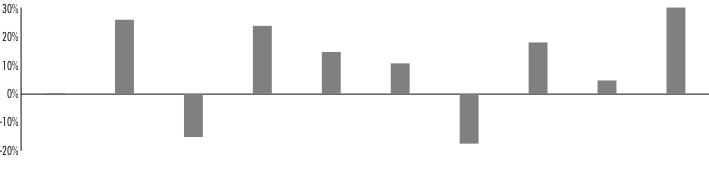
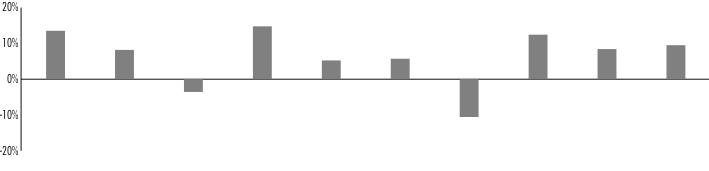
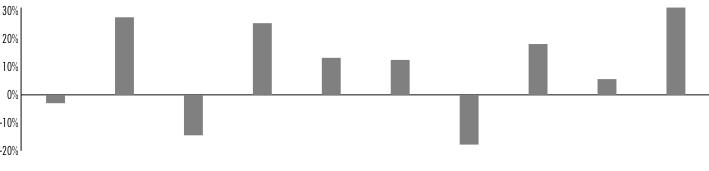
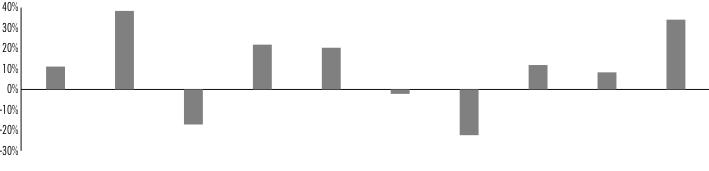
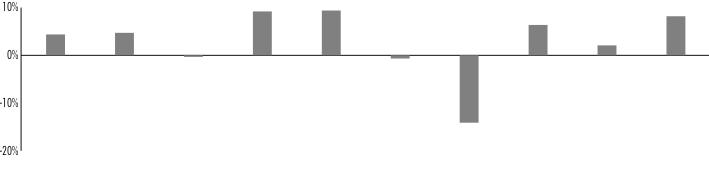
Year-by-Year Returns
|
|
2016
|
2017
|
2018
|
2019
|
2020
|
2021
|
2022
|
2023
|
2024
|
2025
|
|
|
0.36
%
|
26.22
%
|
-
15.14
%
|
24.06
%
|
14.88
%
|
10.84
%
|
-
17.47
%
|
18.22
%
|
4.81
%
|
30.52
%
|
|
During the periods shown in the chart:
|
Returns
|
Quarter ended
|
|
Highest Quarter Return
|
18.79
%
|
June 30, 2020
|
|
Lowest Quarter Return
|
-
22.31
%
|
March 31, 2020
|
|
Year-to-Date Return
|
0.64
%
|
March 31, 2026
|
Average Annual Returns
After-tax returns are calculated using the historical highest individual federal marginal income tax rates, but do not reflect the impact of state or local taxes.
Actual after-tax returns may differ depending on your individual circumstances.
The after-tax returns shown are not relevant if you hold your shares in a retirement account or in another tax-deferred arrangement, such as an employee benefit plan (profit sharing, 401(k), or 403(b) plan).
Return After Taxes on Distributions and Sale of Fund Shares may be higher than other returns for the same period due to a tax benefit of realizing a capital loss upon the sale of fund shares.
|
For the periods ended December 31, 2025
|
Past 1
year
|
Past 5
years
|
Past 10
years
|
|
Strategic Advisers® International Fund
|
|
|
|
|
Return Before Taxes
|
30.52
%
|
8.15
%
|
8.53
%
|
|
Return After Taxes on Distributions
|
28.33
%
|
6.80
%
|
7.48
%
|
|
Return After Taxes on Distributions and Sale of Fund Shares
|
19.54
%
|
6.18
%
|
6.75
%
|
|
MSCI EAFE Index
(reflects no deduction for fees or expenses)
|
31.59
%
|
9.17
%
|
8.42
%
|
|
|
|
|
|
Investment Adviser
Strategic Advisers (the Adviser) is the fund's manager. Arrowstreet Capital, Limited Partnership, Causeway Capital Management LLC, FIAM LLC, FIL Investment Advisors, Fidelity Diversifying Solutions LLC, Geode Capital Management, LLC, J.P. Morgan Investment Management Inc., Massachusetts Financial Services Company, T. Rowe Price Associates, Inc., Thompson, Siegel & Walmsley LLC, Wellington Management Company LLP, and William Blair Investment Management, LLC have been retained to serve as sub-advisers for the fund.
FIL Investment Advisors (UK) Limited (FIA(UK)), FMR Investment Management (UK) Limited (FMR UK), Fidelity Management & Research (Hong Kong) Limited (FMR H.K.), Fidelity Management & Research (Japan) Limited (FMR Japan), and T. Rowe Price International Ltd (TRPIL) have been retained to serve as sub-subadvisers for the fund.
The Adviser may change a sub-adviser's asset allocation at any time, including allocating no assets to, or terminating the sub-advisory contract with, a sub-adviser.
Portfolio Manager(s)
Wilfred Chilangwa (Lead Portfolio Manager) has managed the fund since 2006.
Purchase and Sale of Shares
The fund is not available for sale to the general public.
The price to buy one share is its net asset value per share (NAV). Shares will be bought at the NAV next calculated after an order is received in proper form.
The price to sell one share is its NAV. Shares will be sold at the NAV next calculated after an order is received in proper form.
The fund is open for business each day the New York Stock Exchange (NYSE) is open.
There is no purchase minimum for fund shares.
Tax Information
Distributions you receive from the fund are subject to federal income tax and generally will be taxed as ordinary income or capital gains, and may also be subject to state or local taxes, unless you are investing through a tax-advantaged retirement account (in which case you may be taxed later, upon withdrawal of your investment from such account).
Payments to Broker-Dealers and Other Financial Intermediaries
The fund, the Adviser, Fidelity Distributors Company LLC (FDC), and/or their affiliates may pay intermediaries, which may include banks, broker-dealers, retirement plan sponsors, administrators, or service-providers (who may be affiliated with the Adviser or FDC), for the sale of fund shares and related services. These payments may create a conflict of interest by influencing your intermediary and your investment professional to recommend the fund over another investment. Ask your investment professional or visit your intermediary's web site for more information.
Fund Basics
Investment Details
Investment Objective
Strategic Advisers® International Fund seeks capital appreciation.
Principal Investment Strategies
The fund normally invests primarily in non-U.S. securities, including securities of issuers located in emerging markets. Emerging markets include countries that have an emerging stock market as defined by MSCI, countries or markets with low- to middle-income economies as classified by the World Bank, and other countries or markets that the Adviser identifies as having similar emerging markets characteristics. Emerging markets tend to have relatively low gross national product per capita compared to the world's major economies and may have the potential for rapid economic growth.
The Adviser considers non-U.S. securities to include investments that are tied economically to a particular country or region outside the U.S.
The Adviser considers a number of factors to determine whether an issuer is located in or tied economically to a particular country or region including: whether a third-party vendor has assigned a particular country or region classification to the issuer or included the issuer in an index representative of a particular country or region; the issuer's domicile, incorporation, and location of assets; whether the issuer derives at least 50% of its revenues from, or has at least 50% of its assets in, a particular country or region; the source of government guarantees (if any); and the primary trading market or listing exchange. Whether an issuer is located in or tied economically to a particular country can be determined under any of these factors.
The fund normally invests primarily in common stocks.
The fund allocates investments across different countries and regions.
The fund implements its investment strategies by investing directly in securities through one or more sub-advisers or indirectly in securities through one or more underlying funds, which in turn invest directly in securities.
The Adviser may allocate the fund's assets among any number of underlying funds or sub-advisers
. The Adviser may actively adjust allocations among underlying funds or sub-advisers
at any time, including making no allocation at all to one or more sub-advisers.
The Adviser allocates the fund's assets among underlying funds and sub-advisers to attempt to diversify the fund's portfolio in terms of market capitalization, investment style, and geographic region.
The Adviser pursues a disciplined, benchmark-driven approach to portfolio construction, and monitors and adjusts allocations to underlying funds and sub-advisers as necessary to favor those underlying funds and sub-advisers that the Adviser believes will provide the most favorable outlook for achieving the fund's investment objective.
When determining how to allocate the fund's assets among sub-advisers and underlying funds, the Adviser uses proprietary fundamental and quantitative research, considering factors including, but not limited to, performance in different market environments, manager experience and investment style, management company infrastructure, costs, asset size, and portfolio turnover.
The fund may invest in affiliated
funds ( i.e., Fidelity ® funds, including mutual funds and ETFs), non-affiliated
funds and non-affiliated ETFs. Underlying funds include
funds managed by Fidelity Management & Research Company LLC (FMR) (an affiliated company that, together with the Adviser, is part of Fidelity Investments) or an affiliate and funds managed by investment advisers other than Fidelity. Fidelity may receive service fees that typically are at an annual rate of up to 0.40% of a non-affiliated underlying fund's average daily net assets attributable to purchases of underlying funds through Fidelity's FundsNetwork ® , though such fees may be higher or lower, or may be charged as transaction and/or account fees. In addition, the fund may invest in mutual funds and ETFs in transactions not occurring through Fidelity's FundsNetwork ® .
The Adviser generally classifies underlying funds by reference to a fund's name, policies, or investments.
For information on the underlying funds, see the underlying funds' prospectuses. A copy of any underlying Fidelity ® fund's prospectus is available at www.fidelity.com or institutional.fidelity.com. For a copy of any other underlying fund's prospectus, visit the web site of the company that manages or sponsors that underlying fund.
Common types of investment approaches that a sub-adviser may use in selecting investments for a fund include, but are not limited to, quantitative analysis, fundamental analysis, or a combination of both approaches. Quantitative analysis refers to programmatic models that analyze such factors as growth potential, valuation, liquidity, and investment risk based on data inputs. Fundamental analysis involves a bottom-up assessment of a company's potential for success in light of factors including its financial condition, earnings outlook, strategy, management, industry position, and economic and market conditions.
It is not possible to accurately predict the extent to which the fund's assets will be invested by a particular sub-adviser at any given time
.
The fund's initial shareholder approved a proposal permitting the Adviser to enter into new or amended sub-advisory agreements with one or more unaffiliated sub-advisers without obtaining shareholder approval of such agreements, subject to conditions of an exemptive order that has been granted by the SEC (Exemptive Order). One of the conditions of the Exemptive Order requires the Board of Trustees to approve any such agreement. Subject to oversight by the Board of Trustees, the Adviser has the ultimate responsibility to oversee the fund's sub-advisers and recommend their hiring, termination, and replacement. In the event the Board of Trustees approves a sub-advisory agreement with a new unaffiliated sub-adviser, shareholders will be provided with information about the new sub-adviser and sub-advisory agreement within ninety days of appointment.
Description of Principal Security Types
In addition to investing in underlying funds and the security types discussed above, the fund may invest directly in the following principal security types:
Equity securities represent an ownership interest, or the right to acquire an ownership interest, in an issuer. Equity securities include common stocks (including depositary receipts evidencing ownership of common stock), preferred stocks and other preferred securities, convertible securities, rights and warrants, and other securities, such as hybrid securities and trust preferred securities, believed to have equity-like characteristics.
Principal Investment Risks
Many factors affect the fund's performance. Developments that disrupt global economies and financial markets, such as
public health emergencies, military conflicts, terrorism, government restrictions, political changes, and environmental disasters, may significantly affect a fund's investment performance.
The fund's NAV changes daily based on the performance of the
fund's investments and on changes in market conditions and interest rates and in response to other economic, political, or financial developments. The fund's reaction to these developments will be affected by the types of
investments, the financial condition, industry and economic sector, and geographic location of an issuer, and the fund's level of investment in the securities of that underlying fund or issuer.
When your shares are sold they may be worth more or less than what you paid for them, which means that you could lose money by investing in the fund.
The following factors can significantly affect the fund's performance:
Asset Allocation Risk. The fund is subject to risks resulting from the Adviser's or a sub-adviser's asset allocation decisions. The selection of underlying funds or individual securities and the allocation of the fund's assets among various asset classes could cause the fund to lose value or its results to lag relevant benchmarks or other funds with similar objectives.
Multiple Sub-Adviser Risk . Because each sub-adviser manages its allocated portion, if any, independently from another sub-adviser, it is possible that the sub-advisers' security selection processes may not complement one another. As a result, the fund's aggregate exposure to a particular industry or group of industries, or to a single issuer, could unintentionally be larger or smaller than intended. Because each sub-adviser directs the trading for its own portion, if any, of the fund, and does not aggregate its transactions with those of the other sub-advisers, the fund may incur higher brokerage costs than would be the case if a single sub-adviser were managing the entire fund.
Investing in Other Funds. Regulatory restrictions may limit the amount that one fund can invest in another, and in certain cases further limit investments to the extent a fund's shares are already held by the Adviser or its affiliates. The fund bears all risks of investment strategies employed by the underlying funds. The fund does not control the investments of the underlying funds, which may have different investment objectives and may engage in investment strategies that the fund would not engage in directly. Aggregation of underlying fund holdings may result in indirect concentration of assets in a particular industry or group of industries, or in a single issuer, which may increase volatility. Some of the underlying funds in which the fund invests are managed with a passive investment strategy, attempting to track the performance of an unmanaged index of securities, regardless of the current or projected performance of an underlying fund's index or of the actual securities included in the index. This differs from an actively managed fund, which typically seeks to outperform a benchmark index. As a result, the performance of these underlying passively managed funds could be lower than actively managed funds that may shift their portfolio assets to take advantage of market opportunities or lessen the impact of a market decline or a decline in the value of one or more issuers. In addition, errors in the construction or calculation of the index tracked by an underlying passively managed fund may occur from time to time and may not be identified and corrected for some period of time, which may have an adverse impact on the performance of the underlying fund and its shareholders.
Stock Market Volatility . The value of equity securities fluctuates in response to issuer, political, market, and economic developments. Fluctuations, especially in foreign markets, can be dramatic over the short as well as long term, and different parts of the market, including different market sectors, and different types of equity securities can react differently to these developments. For example, stocks of companies in one sector can react differently from those in another, large cap stocks can react differently from small cap stocks, "growth" stocks can react differently from "value" stocks, and stocks selected using quantitative or technical analysis can react differently than stocks selected using fundamental analysis. Issuer, political, or economic developments can affect a single issuer, issuers within an industry or economic sector or geographic region, or the market as a whole. Changes in the financial condition of a single issuer can impact the market as a whole. Terrorism and related geo-political risks have led, and may in the future lead, to increased short-term market volatility and may have adverse long-term effects on world economies and markets generally.
Foreign Exposure. Foreign securities, foreign currencies, and securities issued by U.S. entities with substantial foreign operations can involve additional risks relating to political, economic, or regulatory conditions in foreign countries. These risks include fluctuations in foreign exchange rates; withholding or other taxes; trading, settlement, custodial, and other operational risks; and the less stringent investor protection and disclosure standards of some foreign markets. All of these factors can make foreign investments, especially those in emerging markets, more volatile and potentially less liquid than U.S. investments. In addition, foreign markets can perform differently from the U.S. market.
Investing in emerging markets can involve risks in addition to and greater than those generally associated with investing in more developed foreign markets. The extent of economic development; political stability; market depth, infrastructure, and capitalization; and regulatory oversight can be less than in more developed markets. Emerging markets typically have less established legal, accounting and financial reporting systems than those in more developed markets, which may reduce the scope or quality of financial information available to investors. Emerging markets economies can be subject to greater social, economic, regulatory, and political uncertainties and can be extremely volatile. All of these factors can make emerging markets securities more volatile and potentially less liquid than securities issued in more developed markets.
Global economies and financial markets are becoming increasingly interconnected, which increases the possibilities that conditions in one country or region might adversely impact issuers or providers in, or foreign exchange rates with, a different country or region.
Geographic Exposure. Social, political, and economic conditions and changes in regulatory, tax, or economic policy in a country or region could significantly affect the market in that country or region. From time to time, a small number of companies and industries may represent a large portion of the market in a particular country or region, and these companies and industries can be sensitive to adverse social, political, economic, currency, or regulatory developments. Similarly, from time to time, the fund or an underlying fund may invest a meaningful portion of its assets in the securities of issuers located in a single country or a limited number of countries. If the fund or an underlying fund invests in this manner, there is a higher risk that social, political, economic, tax (such as a tax on foreign investments or financial transactions), currency, or regulatory developments in those countries may have a significant impact on the fund's or the underlying fund's investment performance.
Special Considerations regarding Europe . Europe includes both developed and emerging markets. Most developed countries in Western Europe are members of the European Union (EU), and many are also members of the European Economic and Monetary Union (EMU). European countries can be significantly affected by the tight fiscal and monetary controls with which EU members and candidates for EMU membership are required to comply.
The financial instability of some countries in the EU, together with the risk of such instability impacting other more stable countries may increase the economic risk of investing in companies in Europe. Eastern European countries generally continue to move toward market economies. However, their markets remain relatively undeveloped and can be particularly sensitive to social, political, and economic developments. The EU faces challenges related to member states seeking to change their relationship with the EU, exemplified by the United Kingdom's withdrawal. There can be significant uncertainty as to the terms and consequences of EU member states seeking to change their relationship with the EU. Among other things, a member state's decision to leave the EU could result in increased volatility and illiquidity in the European and such member state's economies, as well as the broader global economy. Companies with a significant amount of business in the member state or Europe may experience lower revenue and/or profit growth, which may adversely affect the value of a fund's investments. In addition, uncertainty regarding any member state's exit from the EU may lead to instability in the foreign exchange markets, including volatility in the value of the euro.
Industry Exposure. Market conditions, interest rates, and economic, regulatory, or financial developments could significantly affect a single industry or a group of related industries, and the securities of companies in that industry or group of industries could react similarly to these or other developments. In addition, from time to time, a small number of companies may represent a large portion of a single industry or a group of related industries as a whole, and these companies can be sensitive to adverse economic, regulatory, or financial developments.
Issuer-Specific Changes. Changes in the financial condition of an issuer or counterparty, changes in specific economic or political conditions that affect a particular type of security or issuer, and changes in general economic or political conditions can increase the risk of default by an issuer or counterparty, which can affect a security's or instrument's value. The value of securities of smaller, less well-known issuers can be more volatile than that of larger issuers. Smaller issuers can have more limited product lines, markets, or financial resources.
Investing in ETFs. ETFs may trade in the secondary market ( e.g. , on a stock exchange) at prices below the value of their underlying portfolios and may not be liquid. An ETF that is not actively managed cannot sell poorly performing stocks or other assets as long as they are represented in its index or other benchmark. ETFs that track an index are subject to tracking error risk (the risk of errors in matching the ETF's underlying assets to its index or other benchmark).
Quantitative Investing. The value of securities selected using quantitative analysis can react differently to issuer, political, market, and economic developments than the market as a whole or securities selected using only fundamental analysis. The factors used in quantitative analysis and the weight placed on those factors may not be predictive of a security's value. In addition, factors that affect a security's value can change over time and these changes may not be reflected in the quantitative model.
In response to market, economic, political, or other conditions, a fund may temporarily use a different investment strategy for defensive purposes. If the fund does so, different factors could affect its performance and the fund may not achieve its investment objective.
Other Investment Strategies
In addition to the principal investment strategies discussed above, the Adviser may lend the fund's securities to broker-dealers or other institutions to earn income for the fund.
The fund may also use various techniques, such as buying and selling futures contracts, to increase or decrease its exposure to changing security prices or other factors that affect security values. The fund may also enter into foreign currency forward and options contracts for hedging purposes. In addition, the fund may have indirect exposure to derivatives through its investments in underlying funds.
Non-Fundamental Investment Policies
The fund's investment objective is non-fundamental and may be changed without shareholder approval.
Valuing Shares
The fund is open for business each day the NYSE is open.
The NAV is the value of a single share. Fidelity normally calculates NAV as of the close of business of the NYSE, normally 4:00 p.m. Eastern time. The fund's assets normally are valued as of this time for the purpose of computing NAV.
NAV is not calculated and the fund will not process purchase and redemption requests submitted on days when the fund is not open for business. The time at which shares are priced and until which purchase and redemption orders are accepted may be changed as permitted by the SEC.
To the extent that the fund's assets are traded in other markets on days when the fund is not open for business, the value of the fund's assets may be affected on those days. In addition, trading in some of the fund's assets may not occur on days when the fund is open for business.
Shares of underlying funds (other than ETFs) are valued at their respective NAVs. NAV is calculated using the values of the underlying funds in which the fund invests. For an explanation of the circumstances under which the underlying funds will use fair value pricing and the effects of using fair value pricing, see the underlying funds' prospectuses and Statements of Additional Information (SAIs). Other assets (including securities issued by ETFs) are valued primarily on the basis of market quotations, official closing prices, or information furnished by a pricing service. Certain short-term securities are valued on the basis of amortized cost. If market quotations, official closing prices, or information furnished by a pricing service are not readily available or, in the Adviser's opinion, are deemed unreliable for a security, then that security will be fair valued in good faith by the Adviser in accordance with applicable fair value pricing policies. For example, if, in the Adviser's opinion, a security's value has been materially affected by events occurring before a fund's pricing time but after the close of the exchange or market on which the security is principally traded, then that security will be fair valued in good faith by the Adviser in accordance with applicable fair value pricing policies.
Arbitrage opportunities may exist when trading in a portfolio security or securities is halted and does not resume before a fund calculates its NAV. These arbitrage opportunities may enable short-term traders to dilute the NAV of long-term investors. Securities trading in overseas markets, if applicable, present time zone arbitrage opportunities when events affecting portfolio security values occur after the close of the overseas markets but prior to the close of the U.S. market. Fair valuation of a fund's portfolio securities can serve to reduce arbitrage opportunities available to short-term traders, but there is no assurance that fair value pricing policies will prevent dilution of NAV by short-term traders.
Fair value pricing is based on subjective judgments and it is possible that the fair value of a security may differ materially from the value that would be realized if the security were sold.
Shareholder Information
Additional Information about the Purchase and Sale of Shares
NOT AVAILABLE FOR SALE TO THE GENERAL PUBLIC.
As used in this prospectus, the term "shares" generally refers to the shares offered through this prospectus.
General Information
Shares can be purchased only through certain discretionary investment programs offered by the Adviser or its affiliates. If you are not currently a client of a Fidelity discretionary investment program, please call 1-800-544-3455 (9:00 a.m. - 6:00 p.m. Eastern time, Monday through Friday) for more information. Additional fees apply for discretionary investment programs. For more information on these fees, please refer to the "Buying and Selling Information" section of the SAI.
The fund may reject for any reason, or cancel as permitted or required by law, any purchase orders.
Excessive trading of fund shares can harm shareholders in various ways, including reducing the returns to long-term shareholders by increasing costs to the fund (such as brokerage commissions or spreads paid to dealers who sell money market instruments), disrupting portfolio management strategies, and diluting the value of the shares in cases in which fluctuations in markets are not fully priced into the fund's NAV.
Because investments in the fund can only be made by the Adviser or an affiliate on behalf of its clients, the potential for excessive or short-term disruptive purchases and sales is reduced. Accordingly, the Board of Trustees has not adopted policies and procedures designed to discourage excessive trading of fund shares and the fund accommodates frequent trading.
The fund does not place a limit on purchases or sales of fund shares by the Adviser or its affiliates. The fund reserves the right, but does not have the obligation, to reject any purchase transaction at any time. In addition, the fund reserves the right to impose restrictions on disruptive, excessive, or short-term trading.
Buying Shares
Eligibility
Shares are generally available only to investors residing in the United States.
Shares are available only to certain discretionary investment programs offered by the Adviser or its affiliates.
There is no minimum balance or purchase minimum for fund shares.
Price to Buy
The price to buy one share is its NAV. Shares are sold without a sales charge.
Shares will be bought at the NAV next calculated after an order is received in proper form.
Provided the fund receives an order to buy shares in proper form before the close of business, the fund may place an order to buy shares of an underlying Fidelity ® fund after the close of business, pursuant to a pre-determined allocation, and receive that day's NAV.
The fund may stop offering shares completely or may offer shares only on a limited basis, for a period of time or permanently.
Under applicable anti-money laundering rules and other regulations, purchase orders may be suspended, restricted, or canceled and the monies may be withheld.
Selling Shares
The price to sell one share is its NAV.
Shares will be sold at the NAV next calculated after an order is received in proper form.
Normally, redemptions will be processed by the next business day, but it may take up to seven days to pay the redemption proceeds if making immediate payment would adversely affect the fund.
Provided the fund receives an order to sell shares in proper form before the close of business, the fund may place an order to sell shares of an underlying Fidelity ® fund after the close of business, pursuant to a pre-determined allocation, and receive that day's NAV.
See "Policies Concerning the Redemption of Fund Shares" below for additional redemption information.
Redemptions may be suspended or payment dates postponed when the NYSE is closed (other than weekends or holidays), when trading on the NYSE is restricted, or as permitted by the SEC.
Redemption proceeds may be paid in underlying fund shares, securities, or other property rather than in cash if the Adviser determines it is in the best interests of the fund.
Under applicable anti-money laundering rules and other regulations, redemption requests may be suspended, restricted, canceled, or processed and the proceeds may be withheld.
Policies Concerning the Redemption of Fund Shares
Shares of the fund are only available to certain discretionary investment programs offered by the Adviser or its affiliates.
If your account is held directly with a fund , the length of time that a fund typically expects to pay redemption proceeds depends on the method you have elected to receive such proceeds. A fund typically expects to make payment of redemption proceeds by wire, automated clearing house (ACH) or by issuing a check by the next business day following receipt of a redemption order in proper form. Proceeds from the periodic and automatic sale of shares of a Fidelity ® money market fund that are used to buy shares of another Fidelity ® fund are settled simultaneously.
If your account is held through an intermediary , the length of time that a fund typically expects to pay redemption proceeds depends, in part, on the terms of the agreement in place between the intermediary and a fund. For redemption proceeds that are paid either directly to you from a fund or to your intermediary for transmittal to you, a fund typically expects to make payments by wire, by ACH or by issuing a check on the next business day following receipt of a redemption order in proper form from the intermediary by a fund. Redemption orders that are processed through investment professionals that utilize the National Securities Clearing Corporation will generally settle one to three business days following receipt of a redemption order in proper form.
As noted elsewhere, payment of redemption proceeds may take longer than the time a fund typically expects and may take up to seven days from the date of receipt of the redemption order as permitted by applicable law.
Redemption Methods Available. Generally a fund expects to pay redemption proceeds in cash. To do so, a fund typically expects to satisfy redemption requests either by using available cash (or cash equivalents) or by selling portfolio securities. On a less regular basis, a fund may also satisfy redemption requests by utilizing one or more of the following sources, if permitted: borrowing from another Fidelity ® fund; drawing on an available line or lines of credit from a bank or banks; or using reverse repurchase agreements. These methods may be used during both normal and stressed market conditions.
In addition to paying redemption proceeds in cash, a fund reserves the right to pay part or all of your redemption proceeds in readily marketable securities instead of cash (redemption in-kind). Redemption in-kind proceeds will typically be made by delivering the selected securities to the redeeming shareholder within seven days after the receipt of the redemption order in proper form by a fund.
When your relationship with your managed account provider is terminated, your shares may be sold at the discretion of the managed account provider at the NAV next calculated after the sell order is placed, in which case the redemption proceeds will remain in your account pending your instruction.
Dividends and Capital Gain Distributions
The fund earns interest, dividends, and other income from its investments, and distributes this income (less expenses) to shareholders as dividends. The fund also realizes capital gains from its investments, and distributes these gains (less any losses) to shareholders as capital gain distributions.
The fund normally pays dividends and capital gain distributions per the tables below:
|
Fund Name
|
|
Dividends Paid
|
|
Strategic Advisers® International Fund
|
|
April, December
|
|
Fund Name
|
|
Capital Gains Paid
|
|
Strategic Advisers® International Fund
|
|
April, December
|
Distribution Options
Any dividends and capital gain distributions may be reinvested in additional shares or paid in cash.
Tax Consequences
As with any investment, your investment in the fund could have tax consequences for you (for non-retirement accounts).
Taxes on Distributions
Distributions you receive from the fund are subject to federal income tax, and may also be subject to state or local taxes.
For federal tax purposes, certain distributions, including dividends and distributions of short-term capital gains, are taxable to you as ordinary income, while certain distributions, including distributions of long-term capital gains, are taxable to you generally as capital gains. A percentage of certain distributions of dividends may qualify for taxation at long-term capital gains rates (provided certain holding period requirements are met).
If the Adviser buys shares on your behalf when a fund has realized but not yet distributed income or capital gains, you will be "buying a dividend" by paying the full price for the shares and then receiving a portion of the price back in the form of a taxable distribution.
Any taxable distributions you receive from the fund will normally be taxable to you when you receive them, regardless of your distribution option.
Taxes on Transactions
Your redemptions may result in a capital gain or loss for federal tax purposes. A capital gain or loss on your investment in the fund generally is the difference between the cost of your shares and the price you receive when you sell them.
Fund Services
Fund Management
The fund is a mutual fund, an investment that pools shareholders' money and invests it toward a specified goal.
The fund employs a multi-manager and a fund of funds investment structure. The Adviser may allocate the fund's assets among any number of sub-advisers or underlying funds. The Adviser may adjust allocations among underlying funds or sub-advisers from time to time, including making no allocation to, or terminating the sub-advisory contract with, a sub-adviser.
Adviser
Strategic Advisers LLC. The Adviser is the fund's manager. The address of the Adviser is 155 Seaport Boulevard, Boston, Massachusetts 02210.
As of December 31,
2025, the Adviser had approximately $1.
3 trillion in discretionary assets under management, and approximately
$7.
1 trillion when combined with all of its affiliates' assets under management.
As the manager, the Adviser has overall responsibility for directing the fund's investments and handling its business affairs.
Sub-Adviser(s)
Arrowstreet Capital, Limited Partnership (Arrowstreet) , at 200 Clarendon Street, 30th Floor, Boston, Massachusetts, 02116, has been retained to serve as a sub-adviser for the fund. As of February 28,
2026, Arrowstreet had approximately
$321.6 billion in assets under management.
Causeway Capital Management LLC (Causeway) , at 11111 Santa Monica Boulevard, 15th Floor, Los Angeles, California 90025, has been retained to serve as a sub-adviser for the fund. As of February 28,
2026, Causeway had approximately
$78.7 billion in assets under management.
Fidelity Diversifying Solutions LLC (FDS) , at 245 Summer Street, Boston, Massachusetts 02210, has been retained to serve as a sub-adviser for the fund. FDS is an affiliate of Strategic Advisers. As of December 31,
2025, FDS had approximately
$18.
8 billion in discretionary assets under management.
Other investment advisers have been retained to assist FDS with foreign investments:
- FMR UK, at
25 Cannon Street, London,
EC4M 5SB, United Kingdom, has been retained to serve as a sub-subadviser for the fund. As of December 31,
2025, FMR UK had approximately
$25.8 billion in discretionary assets under management. FMR UK may provide investment research and advice on issuers based outside the United States and may also provide investment advisory services for the fund. FMR UK is an affiliate of both FDS and the Adviser.
- FMR H.K., at Floor 19, 41 Connaught Road Central, Hong Kong, has been retained to serve as a sub-subadviser for the fund. As of December 31,
2025, FMR H.K. had approximately
$32.5 billion in discretionary assets under management. FMR H.K. may provide investment research and advice on issuers based outside the United States and may also provide investment advisory services for the fund. FMR H.K. is an affiliate of both FDS and the Adviser.
- FMR Japan, at Kamiyacho Prime Place, 1-17, Toranomon-4-Chome, Minato-ku, Tokyo, Japan, has been retained to serve as a sub-subadviser for the fund. As of March 31,
2025, FMR Japan had approximately $2.8 billion in discretionary assets under management. FMR Japan may provide investment research and advice on issuers based outside the United States and may also provide investment advisory services for the fund. FMR Japan is an affiliate of both FDS and the Adviser.
FIAM LLC (FIAM) , at 900 Salem Street, Smithfield, Rhode Island 02917, has been retained to serve as a sub-adviser for the fund. FIAM is an affiliate of Strategic Advisers. As of December 31,
2025, FIAM had approximately
$347.7 billion in discretionary assets under management.
Other investment advisers have been retained to assist FIAM with foreign investments:
- FMR UK, at
25 Cannon Street, London,
EC4M 5SB, United Kingdom, has been retained to serve as a sub-subadviser for the fund. As of December 31,
2025, FMR UK had approximately
$25.8 billion in discretionary assets under management. FMR UK may provide investment research and advice on issuers based outside the United States and may also provide investment advisory services for the fund. FMR UK is an affiliate of both FIAM and the Adviser.
- FMR H.K., at Floor 19, 41 Connaught Road Central, Hong Kong, has been retained to serve as a sub-subadviser for the fund. As of December 31,
2025, FMR H.K. had approximately
$32.5 billion in discretionary assets under management. FMR H.K. may provide investment research and advice on issuers based outside the United States and may also provide investment advisory services for the fund. FMR H.K. is an affiliate of both FIAM and the Adviser.
- FMR Japan, at Kamiyacho Prime Place, 1-17, Toranomon-4-Chome, Minato-ku, Tokyo, Japan, has been retained to serve as a sub-subadviser for the fund. As of March 31,
2025, FMR Japan had approximately $2.8 billion in discretionary assets under management. FMR Japan may provide investment research and advice on issuers based outside the United States and may also provide investment advisory services for the fund. FMR Japan is an affiliate of both FIAM and the Adviser.
FIL Investment Advisors (FIA) , at Pembroke Hall, 42 Crow Lane, Pembroke HM19, Bermuda, has been retained to serve as a sub-adviser for the fund. As of December 31,
2025, FIA had approximately
$8.
6 billion in discretionary assets under management.
Another investment adviser has been retained to assist FIA with foreign investments:
- FIA(UK), at Beech Gate, Millfield Lane, Lower Kingswood, Tadworth, Surrey, KT20 6RP, United Kingdom, has been retained to serve as a sub-subadviser for the fund. As of December 31,
2025, FIA(UK) had approximately
$3.5
billion in discretionary assets under management. FIA(UK) may provide investment research and advice on issuers based outside the United States and may also provide investment advisory services for the fund.
Geode Capital Management, LLC (Geode) , at 100 Summer Street, 12th Floor, Boston, Massachusetts 02110, has been retained to serve as a sub-adviser for the fund. As of December 31,
2025, Geode had approximately $1.7
trillion in discretionary assets under management.
J.P. Morgan Investment Management Inc. (JPMorgan) , at
270 Park Avenue, New York, NY
10017, has been retained to serve as a sub-adviser for the fund. As of December 31,
2025, JPMorgan had approximately
$4.
1 trillion in discretionary assets under management.
Massachusetts Financial Services Company (MFS) , at 111 Huntington Avenue, Boston, Massachusetts 02199, has been retained to serve as a sub-adviser for the fund. As of January 31,
2026, MFS had approximately
$661.0 billion in assets under management.
T. Rowe Price Associates, Inc. (T. Rowe Price) , at 1307 Point Street, Baltimore, Maryland 21231, has been retained to serve as a sub-adviser for the fund. As of December 31,
2025, T. Rowe Price had approximately $1.
8 trillion in assets under management.
T. Rowe Price has retained T. Rowe Price International Ltd. (TRPIL) to serve as a sub-subadviser.
- TRPIL, at Warwick Court, 5 Paternoster Square, London EC4M 7DX, United Kingdom, has been retained to serve as a sub-subadviser for the fund. As of December 31,
2025, TRPIL had approximately
$374.4 billion in assets under management.
Thompson, Siegel & Walmsley LLC (TSW) , at 6641 West Broad Street, Suite 600, Richmond, Virginia 23230, has been retained to serve as a sub-adviser for the fund. As of February 28,
2026, TSW had approximately $20.
6 billion in assets under management.
Wellington Management Company LLP (Wellington) , at 280 Congress Street, Boston, Massachusetts 02210, has been retained to serve as a sub-adviser for the fund. As of February 28,
2026, Wellington had approximately $1.3
trillion in assets under management.
William Blair Investment Management, LLC (William Blair) , at 150 North Riverside Plaza, Chicago, Illinois 60606, has been retained to serve as a sub-adviser for the fund. As of February 28,
2026, William Blair had approximately
$73.1 billion in assets under management.
Portfolio Manager(s)
Wilfred Chilangwa is Lead Portfolio Manager of Strategic Advisers ® International Fund, which he has managed since 2006. He also manages other funds. Since joining Fidelity Investments in 1997, Mr. Chilangwa has worked as a senior fund analyst, an international strategist, and portfolio manager.
The SAI provides additional information about the compensation of, any other accounts managed by, and any fund shares held by the portfolio manager(s).
From time to time a manager, analyst, or other Fidelity employee may express views regarding a particular company, security, industry, or market sector. The views expressed by any such person are the views of only that individual as of the time expressed and do not necessarily represent the views of Fidelity or any other person in the Fidelity organization. Any such views are subject to change at any time based upon market or other conditions and Fidelity disclaims any responsibility to update such views. These views may not be relied on as investment advice and, because investment decisions for a fund are based on numerous factors, may not be relied on as an indication of trading intent on behalf of any fund.
Advisory Fee(s)
The fund pays a management fee to the Adviser.
The management fee is calculated and paid to the Adviser every month.
The fund's management fee is calculated by adding the annual rate of 0.25% of the fund's average daily net assets throughout the month plus the total fees payable monthly to the fund's sub-advisers, if any, pursuant to the applicable investment sub-advisory agreement(s).
Because the fund's management fee rate may fluctuate, the fund's management fee may be higher or lower in the future.
The fund's maximum aggregate annual management fee will not exceed 1.00% of the fund's average daily net assets.
The Adviser has contractually agreed to waive a portion of the fund's management fee in an amount equal to 0.25% of the fund's average daily net assets through September 30,
2028.
The management fee paid, as a percentage of a fund's average net assets, for the fiscal year ended February 28,
2026, is shown in the following table:
|
Fund
|
Management Fee Rate
|
|
Strategic Advisers® International Fund
|
0.18%*
|
*After waiver and/or reimbursement
In return for the services of the fund's sub-advisers, the Adviser will pay each of the fund's sub-advisers the fee (as described above) payable to that sub-adviser.
FDS, in turn, will pay FMR UK, FMR H.K., and FMR Japan for providing sub-subadvisory services.
FIA, in turn, will pay FIA(UK) for providing sub-subadvisory services.
FIAM, in turn, will pay FMR UK, FMR H.K., and FMR Japan for providing sub-subadvisory services.
T. Rowe Price, in turn, will pay TRPIL for providing sub-subadvisory services.
The basis for the Board of Trustees approving the management contract, sub-advisory agreements, and sub-subadvisory agreements for the fund is available in the fund's Form N-
CSR report for the fiscal period ended February 28,
2026.
Fund Distribution
FDC distributes the fund's shares.
Distribution and Service Plan(s)
The fund has adopted a Distribution and Service Plan pursuant to Rule 12b-1 under the Investment Company Act of 1940 (1940 Act) with respect to its shares that recognizes that the Adviser may use its management fee revenues, as well as its past profits or its resources from any other source, to pay FDC for expenses incurred in connection with providing services intended to result in the sale of shares of the fund and/or shareholder support services. The Adviser, directly or through FDC, may pay significant amounts to intermediaries that provide those services. Currently, the Board of Trustees of the fund has authorized such payments for shares of the fund.
Affiliates of the Adviser may receive service fees or distribution fees or both with respect to underlying funds that participate in Fidelity's FundsNetwork ® .
If payments made by the Adviser to FDC or to intermediaries under the Distribution and Service Plan were considered to be paid out of the fund's assets on an ongoing basis, they would increase the cost of your investment and might cost you more than paying other types of sales charges.
No dealer, sales representative, or any other person has been authorized to give any information or to make any representations, other than those contained in this prospectus and in the related SAI, in connection with the offer contained in this prospectus. If given or made, such other information or representations must not be relied upon as having been authorized by the fund or FDC. This prospectus and the related SAI do not constitute an offer by the fund or by FDC to sell shares of the fund to, or to buy shares of the fund from, any person to whom it is unlawful to make such offer.
Appendix
Financial Highlights
Financial Highlights are intended to help you understand the financial history of fund shares for the past 5 years (or, if shorter, the period of operations). Certain information reflects financial results for a single share. The total returns in the table represent the rate that an investor would have earned (or lost) on an investment in shares (assuming reinvestment of all dividends and distributions). The annual information has been audited by PricewaterhouseCoopers LLP, independent registered public accounting firm, whose report, along with fund financial statements, is included in the annual report. Annual reports are available for free upon request.
Strategic Advisers® International Fund
|
Years ended February 28,
|
|
2026
|
|
2025
|
|
2024
A
|
|
2023
|
|
2022
|
|
Selected Per-Share Data
|
|
|
|
|
|
|
|
|
|
|
|
Net asset value, beginning of period
|
$
|
12.40
|
$
|
11.76
|
$
|
10.48
|
$
|
11.55
|
$
|
12.55
|
|
Income from Investment Operations
|
|
|
|
|
|
|
|
|
|
|
|
Net investment income (loss)
B,C
|
|
.36
|
|
.31
|
|
.29
|
|
.22
|
|
.24
|
|
Net realized and unrealized gain (loss)
|
|
3.74
|
|
.78
|
|
1.27
|
|
(.83)
|
|
(.12)
|
|
Total from investment operations
|
|
4.10
|
|
1.09
|
|
1.56
|
|
(.61)
|
|
.12
|
|
Distributions from net investment income
|
|
(.41)
|
|
(.29)
|
|
(.28)
|
|
(.23)
|
|
(.26)
|
|
Distributions from net realized gain
|
|
(.62)
|
|
(.16)
|
|
-
|
|
(.22)
|
|
(.86)
|
|
Total distributions
|
|
(1.03)
|
|
(.45)
|
|
(.28)
|
|
(.46)
D
|
|
(1.12)
|
|
Net asset value, end of period
|
$
|
15.47
|
$
|
12.40
|
$
|
11.76
|
$
|
10.48
|
$
|
11.55
|
|
Total Return
E
|
|
|
|
9.56%
|
|
14.97%
|
|
(5.30)%
|
|
.30%
|
|
Ratios to Average Net Assets
C,F,G
|
|
|
|
|
|
|
|
|
|
|
|
Expenses before reductions
|
|
.44%
|
|
.42%
|
|
.41%
|
|
.41%
|
|
.41%
|
|
Expenses net of fee waivers, if any
|
|
|
|
.17%
|
|
.16%
|
|
.16%
|
|
.16%
|
|
Expenses net of all reductions, if any
|
|
.18%
|
|
.16%
|
|
.16%
|
|
.16%
|
|
.16%
|
|
Net investment income (loss)
|
|
2.62%
|
|
2.51%
|
|
2.66%
|
|
2.16%
|
|
1.83%
|
|
Supplemental Data
|
|
|
|
|
|
|
|
|
|
|
|
Net assets, end of period (000 omitted)
|
$
|
28,142,555
|
$
|
24,380,562
|
$
|
19,380,006
|
$
|
15,546,881
|
$
|
22,658,482
|
|
Portfolio turnover rate
H
|
|
|
|
33%
|
|
27%
|
|
25%
|
|
29%
|
A For the year ended February 29.
B Calculated based on average shares outstanding during the period.
C Net investment income (loss) is affected by the timing of the declaration of dividends by any underlying mutual funds or exchange-traded funds (ETFs). Net investment income (loss) of any mutual funds or ETFs is not included in the Fund's net investment income (loss) ratio.
D Total distributions per share do not sum due to rounding.
E Total returns would have been lower if certain expenses had not been reduced during the applicable periods shown.
F Fees and expenses of any underlying mutual funds or exchange-traded funds (ETFs) are not included in the Fund's expense ratio. The Fund indirectly bears its proportionate share of these expenses. For additional expense information related to investments in Fidelity Central Funds, please refer to the "Investments in Fidelity Central Funds" note found in the Notes to Financial Statements section of the most recent Annual or Semi-Annual report.
G Expense ratios reflect operating expenses of the class. Expenses before reductions do not reflect amounts reimbursed, waived, or reduced through arrangements with the investment adviser, brokerage services, or other offset arrangements, if applicable, and do not represent the amount paid by the class during periods when reimbursements, waivers or reductions occur.
H Amount does not include the portfolio activity of any underlying mutual funds or exchange-traded funds (ETFs), derivatives or securities that mature within one year from acquisition.
Additional Index Information
MSCI EAFE Index is a market capitalization-weighted index that is designed to measure the investable equity market performance for global investors of developed markets, excluding the U.S. & Canada. Index returns are adjusted for tax withholding rates applicable to U.S. based mutual funds organized as Massachusetts business trusts.
IMPORTANT INFORMATION ABOUT OPENING A NEW ACCOUNT
To help the government fight the funding of terrorism and money laundering activities, the Uniting and Strengthening America by Providing Appropriate Tools Required to Intercept and Obstruct Terrorism Act of 2001 (USA PATRIOT ACT), requires all financial institutions to obtain, verify, and record information that identifies each person or entity that opens an account.
For individual investors opening an account: When you open an account, you will be asked for your name, address, date of birth, and other information that will allow Fidelity to identify you. You may also be asked to provide documents that may help to establish your identity, such as your driver's license.
For investors other than individuals: When you open an account, you will be asked for the name of the entity, its principal place of business and taxpayer identification number (TIN). You will be asked to provide information about the entity's control person and beneficial owners, and person(s) with authority over the account, including name, address, date of birth and social security number. You may also be asked to provide documents, such as drivers' licenses, articles of incorporation, trust instruments or partnership agreements and other information that will help Fidelity identify the entity.
You can obtain additional information about the fund. A description of the fund's policies and procedures for disclosing its holdings is available in its Statement of Additional Information (SAI) and on Fidelity's web sites. The SAI also includes more detailed information about the fund and its investments. The SAI is incorporated herein by reference (legally forms a part of the prospectus). The fund's annual and semi-annual reports and Form N-CSR also include additional information. The fund's annual report includes a discussion of recent market conditions and the fund's investment strategies that affected performance. In Form N-CSR, you will find the fund's annual and semi-annual financial statements.
For a free copy of any of these documents or to request other information or ask questions about the fund, call Fidelity at 1-800-544-3455. In addition, you may visit Fidelity's web site at www.fidelity.com for a free copy of a prospectus, SAI, annual or semi-annual report, or the fund's financial statements or to request other information.
The SAI, the fund's annual and semi-annual reports and other related materials are available from the Electronic Data Gathering, Analysis, and Retrieval (EDGAR) Database on the SEC's web site (http://www.sec.gov). You can obtain copies of this information, after paying a duplicating fee, by sending a request by e-mail to publicinfo@sec.gov or by writing the Public Reference Section of the SEC, Washington, D.C. 20549-1520. You can also review and copy information about the fund, including the fund's SAI, at the SEC's Public Reference Room in Washington, D.C. Call 1-202-551-8090 for information on the operation of the SEC's Public Reference Room. |
Investment Company Act of 1940, File Number(s), 811-21991 |
Fidelity Distributors Company LLC (FDC) is a member of the Securities Investor Protection Corporation (SIPC). You may obtain information about SIPC, including the SIPC brochure, by visiting www.sipc.org or calling SIPC at 202-371-8300.
Fidelity, the Fidelity Investments Logo and all other Fidelity trademarks or service marks used herein are trademarks or service marks of FMR LLC. Any third-party marks that are used herein are trademarks or service marks of their respective owners. ©
2026 FMR LLC. All rights reserved.
|
1.912871.117
|
SIT-PRO-0426
|
Fund /Ticker
Strategic Advisers® Income Opportunities Fund /FPIOX
Offered exclusively to certain managed account clients of Strategic Advisers LLC or its affiliates - not available for sale to the general public
Prospectus
April 29,
2026
Like securities of all mutual funds, these securities have not been approved or disapproved by the Securities and Exchange Commission, and the Securities and Exchange Commission has not determined if this prospectus is accurate or complete. Any representation to the contrary is a criminal offense. |

245 Summer Street, Boston, MA 02210 |
Contents
Fund Summary
Fund:
Strategic Advisers® Income Opportunities Fund
Investment Objective
Strategic Advisers® Income Opportunities Fund seeks a high level of current income. The fund may also seek capital appreciation.
Fee Table
The following table describes the fees and expenses that may be incurred when you buy, hold, and sell shares of the fund.
Shareholder fees
|
(fees paid directly from your investment)
|
None
|
Annual Operating Expenses
(expenses that you pay each year as a % of the value of your investment)
|
Management fee (fluctuates based on the fund's allocation among underlying funds and sub-advisers)
|
%
A
|
|
Distribution and/or Service (12b-1) fees
|
None
|
|
Other expenses
|
0.01
%
|
|
Acquired fund fees and expenses
|
0.36
%
|
|
Total annual operating expenses
|
%
B
|
|
Fee waiver and/or expense reimbursement
|
%
A
|
|
Total annual operating expenses after fee waiver and/or expense reimbursement
|
%
B
|
This
example
helps compare the cost of investing in the fund with the cost of investing in other funds.
Let's say, hypothetically, that the annual return for shares of the fund is 5% and that the fees and the annual operating expenses for shares of the fund are exactly as described in the fee table. This example illustrates the effect of fees and expenses, but is not meant to suggest actual or expected fees and expenses or returns, all of which may vary. For every $10,000 you invested, here's how much you would pay in total expenses if you sell all of your shares at the end of each time period indicated:
|
1 year
|
$
|
53
|
|
3 years
|
$
|
178
|
|
5 years
|
$
|
361
|
|
10 years
|
$
|
891
|
Portfolio Turnover
The fund will not incur transaction costs, such as commissions, when it buys and sells shares of affiliated mutual funds but may incur transaction costs when buying or selling non-affiliated funds and other types of securities (including Exchange Traded Funds (ETFs)) directly (or "turns over" its portfolio).
A higher portfolio turnover rate may indicate higher transaction costs and may result in higher taxes when fund shares are held in a taxable account. These costs, which are not reflected in annual operating expenses or in the example, affect the fund's performance. During the most recent fiscal year, the fund's portfolio turnover rate was
41
% of the average value of its portfolio.
Principal Investment Strategies
Normally investing at least 80% of assets in a combination of debt securities and income-producing equity securities and in shares of other income-producing funds.
Debt securities are used by issuers to borrow money. The issuer usually pays a fixed, variable, or floating rate of interest, and must repay the amount borrowed, usually at the maturity of the security. Debt securities include corporate bonds, government securities (including Treasury securities), repurchase agreements, money market securities, mortgage and other asset-backed securities, loans and loan participations, and other securities, such as hybrids and synthetic securities, believed to have debt-like characteristics (e.g., securities classified as Tier 2 Regulatory capital, securities that rank above share capital in an insolvency waterfall, securities with maturity dates and non-cancellable interest payment structures).
Equity securities represent an ownership interest, or the right to acquire an ownership interest, in an issuer. Equity securities include common stocks (including depositary receipts evidencing ownership of common stock), preferred stocks and other preferred securities, convertible securities, rights and warrants, and other securities, such as hybrid securities and trust preferred securities, believed to have equity-like characteristics.
Income-producing equity securities are equity securities that pay, or are expected to pay within the next three months, dividends or interest.
Income-producing funds are funds (including mutual funds and ETFs) that invest at least 80% of assets in debt securities and/or income-producing equity securities. Whether an underlying fund is included in the fund's 80% policy is determined at the time of investment and evaluated periodically thereafter.
Derivative instruments that provide investment exposure to the investments above or exposure to one or more market risk factors associated with such investments are included in the fund's 80% policy, consistent with the fund's investment policies and limitations with respect to investments in derivatives.
- Normally investing primarily in income producing debt securities, preferred stocks, and convertible securities, with an emphasis on lower-quality debt securities (those of less than investment-grade quality, also referred to as high yield debt securities or junk bonds).
- Potentially investing in non-income producing securities.
- Investing in companies in troubled or uncertain financial condition.
- Investing in domestic and foreign issuers.
- Engaging in transactions that have a leveraging effect on the fund, including investments in derivatives - such as swaps (interest rate, total return, and credit default), forwards and futures contracts - and forward-settling securities, to adjust the fund's risk exposure and/or to manage liquidity.
- Implementing investment strategies by investing directly in securities through one or more managers (sub-advisers) or indirectly in securities through one or more other funds, referred to as underlying funds, which in turn invest directly in securities (as described below).
- Allocating assets among affiliated
funds (i.e., Fidelity® funds, including mutual funds and ETFs), non-affiliated
funds
and non-affiliated ETFs
.
- Allocating assets among underlying funds and sub-advisers to achieve portfolio characteristics similar to those of the ICE® BofA® US High Yield Constrained Index.
- Allocating assets among sub-advisers and underlying funds using proprietary fundamental and quantitative research, considering factors including, but not limited to, performance in different market environments, manager experience and investment style, management company infrastructure, costs, asset size, and portfolio turnover.
Pursuant to an exemptive order granted by the Securities and Exchange Commission (SEC), Strategic Advisers LLC (Strategic Advisers) is permitted, subject to the approval of the Board of Trustees, to enter into new or amended sub-advisory agreements with one or more unaffiliated sub-advisers without obtaining shareholder approval of such agreements. Subject to oversight by the Board of Trustees, Strategic Advisers has the ultimate responsibility to oversee the fund's sub-advisers and recommend their hiring, termination, and replacement. In the event the Board of Trustees approves a sub-advisory agreement with a new unaffiliated sub-adviser, shareholders will be provided with information about the new sub-adviser and sub-advisory agreement .
Principal Investment Risks
- Multiple Sub-Adviser Risk.
Separate investment decisions and the resulting purchase and sale activities of the fund's sub-advisers might adversely affect the fund's performance or lead to disadvantageous tax consequences.
- Investing in Other Funds.
Regulatory restrictions may limit the amount that one fund can invest in another, which means that the fund's manager may not be able to invest as much as it wants to in some other funds. The fund bears all risks of investment strategies employed by the underlying funds, including the risk that the underlying funds will not meet their investment objectives. Underlying funds that are passively managed attempt to track the performance of an unmanaged index of securities and as such their performance could be lower than actively managed funds, which may shift their portfolio assets to take advantage of market opportunities or lessen the impact of a market decline. In addition, errors in the construction of the index tracked by an underlying passively managed fund may have an adverse impact on the performance of such underlying fund.
Stock markets are volatile and can decline significantly in response to adverse issuer, political, regulatory, market, or economic developments. Different parts of the market, including different market sectors, and different types of securities can react differently to these developments.
Interest rate increases can cause the price of a debt security to decrease.
Foreign markets, particularly emerging markets, can be more volatile than the U.S. market due to increased risks of adverse issuer, political, regulatory, market, or economic developments and can perform differently from the U.S. market.
The extent of economic development; political stability; market depth, infrastructure, and capitalization; and regulatory oversight can be less than in more developed markets. Emerging markets typically have less established legal, accounting and financial reporting systems than those in more developed markets, which may reduce the scope or quality of financial information available to investors.
Market conditions, interest rates, and economic, regulatory, or financial developments could significantly affect a single industry or group of related industries.
The ability of an issuer of a debt security to repay principal prior to a security's maturity can cause greater price volatility if interest rates change.
The value of an individual security or particular type of security can be more volatile than, and can perform differently from, the market as a whole.
Lower-quality debt securities (those of less than investment-grade quality, also referred to as high yield debt securities or junk bonds) and certain types of other securities involve greater risk of default or price changes due to changes in the credit quality of the issuer.
The value of lower-quality debt securities and certain types of other securities can be more volatile due to increased sensitivity to adverse issuer, political, regulatory, market, or economic developments and can be difficult to resell.
Investments in covenant-lite loans carry more risk than traditional loans as they allow issuers to engage in activities that would otherwise be difficult or impossible under a traditional loan agreement. In the event of default, covenant-lite obligations have lower recovery values as the lender may not have the opportunity to negotiate with the borrower prior to default.
Leverage can increase market exposure, magnify investment risks, and cause losses to be realized more quickly.
ETFs may trade in the secondary market at prices below the value of their underlying portfolios and may not be liquid. ETFs that track an index are subject to tracking error and may be unable to sell poorly performing assets that are included in their index or other benchmark.
An investment in the fund is not a deposit of a bank and is not insured or guaranteed by the Federal Deposit Insurance Corporation or any other government agency
.
You could lose money by investing in the fund.
Performance
The following information is intended to help you understand the risks of investing in the fund.
The information illustrates the changes in the performance of the fund's shares from year to year and compares the performance of the fund's shares to the performance of a securities market index and an additional index over various periods of time.
The additional index has characteristics relevant to the fund's investment strategies. Index descriptions appear in the "Additional Index Information" section of the prospectus.
Past performance (before and after taxes) is not an indication of future performance.
Visit
www.fidelity.com
for more recent performance information.
Year-by-Year Returns
|
|
2016
|
2017
|
2018
|
2019
|
2020
|
2021
|
2022
|
2023
|
2024
|
2025
|
|
|
13.52
%
|
8.18
%
|
-
3.56
%
|
14.76
%
|
5.24
%
|
5.72
%
|
-
10.55
%
|
12.43
%
|
8.41
%
|
9.49
%
|
|
During the periods shown in the chart:
|
Returns
|
Quarter ended
|
|
Highest Quarter Return
|
9.72
%
|
June 30, 2020
|
|
Lowest Quarter Return
|
-
13.53
%
|
March 31, 2020
|
|
Year-to-Date Return
|
-
0.19
%
|
March 31, 2026
|
Average Annual Returns
After-tax returns are calculated using the historical highest individual federal marginal income tax rates, but do not reflect the impact of state or local taxes.
Actual after-tax returns may differ depending on your individual circumstances.
The after-tax returns shown are not relevant if you hold your shares in a retirement account or in another tax-deferred arrangement, such as an employee benefit plan (profit sharing, 401(k), or 403(b) plan).
Return After Taxes on Distributions and Sale of Fund Shares may be higher than other returns for the same period due to a tax benefit of realizing a capital loss upon the sale of fund shares.
|
For the periods ended December 31, 2025
|
Past 1
year
|
Past 5
years
|
Past 10
years
|
|
Strategic Advisers® Income Opportunities Fund
|
|
|
|
|
Return Before Taxes
|
9.49
%
|
4.77
%
|
6.09
%
|
|
Return After Taxes on Distributions
|
6.69
%
|
2.29
%
|
3.69
%
|
|
Return After Taxes on Distributions and Sale of Fund Shares
|
5.55
%
|
2.53
%
|
3.63
%
|
|
ICE® BofA® US High Yield Constrained Index
(reflects no deduction for fees, expenses, or taxes)
|
8.50
%
|
4.50
%
|
6.44
%
|
|
Bloomberg U.S. Universal Bond Index
(reflects no deduction for fees, expenses, or taxes)
|
7.58
%
|
0.06
%
|
2.44
%
|
|
|
|
|
|
Investment Adviser
Strategic Advisers (the Adviser) is the fund's manager. FIAM LLC, PGIM, Inc., and T. Rowe Price Associates, Inc. have been retained to serve as sub-advisers for the fund.
FMR Investment Management (UK) Limited (FMR UK), Fidelity Management & Research (Hong Kong) Limited (FMR H.K.), and Fidelity Management & Research (Japan) Limited (FMR Japan) have been retained to serve as sub-subadvisers for the fund.
The Adviser may change a sub-adviser's asset allocation at any time, including allocating no assets to, or terminating the sub-advisory contract with, a sub-adviser.
Portfolio Manager(s)
Charles Sterling (Lead Portfolio Manager) has managed the fund since 2018.
Jonathan Duggan (Co-Portfolio Manager) has managed the fund since 2019.
Purchase and Sale of Shares
The fund is not available for sale to the general public.
The price to buy one share is its net asset value per share (NAV). Shares will be bought at the NAV next calculated after an order is received in proper form.
The price to sell one share is its NAV. Shares will be sold at the NAV next calculated after an order is received in proper form.
The fund is open for business each day the New York Stock Exchange (NYSE) is open.
There is no purchase minimum for fund shares.
Tax Information
Distributions you receive from the fund are subject to federal income tax and generally will be taxed as ordinary income or capital gains, and may also be subject to state or local taxes, unless you are investing through a tax-advantaged retirement account (in which case you may be taxed later, upon withdrawal of your investment from such account).
Payments to Broker-Dealers and Other Financial Intermediaries
The fund, the Adviser, Fidelity Distributors Company LLC (FDC), and/or their affiliates may pay intermediaries, which may include banks, broker-dealers, retirement plan sponsors, administrators, or service-providers (who may be affiliated with the Adviser or FDC), for the sale of fund shares and related services. These payments may create a conflict of interest by influencing your intermediary and your investment professional to recommend the fund over another investment. Ask your investment professional or visit your intermediary's web site for more information.
Fund Basics
Investment Details
Investment Objective
Strategic Advisers® Income Opportunities Fund seeks a high level of current income. The fund may also seek capital appreciation.
Principal Investment Strategies
The fund normally invests
at least 80% of its assets in a combination of debt securities and income-producing equity securities and in shares of other income-producing funds.
Debt securities are used by issuers to borrow money. The issuer usually pays a fixed, variable, or floating rate of interest, and must repay the amount borrowed, usually at the maturity of the security. Debt securities include corporate bonds, government securities (including Treasury securities), repurchase agreements, money market securities, mortgage and other asset-backed securities, loans and loan participations, and other securities, such as hybrids and synthetic securities, believed to have debt-like characteristics (e.g., securities classified as Tier 2 Regulatory capital, securities that rank above share capital in an insolvency waterfall, securities with maturity dates and non-cancellable interest payment structures).
Equity securities represent an ownership interest, or the right to acquire an ownership interest, in an issuer. Equity securities include common stocks (including depositary receipts evidencing ownership of common stock), preferred stocks and other preferred securities, convertible securities, rights and warrants, and other securities, such as hybrid securities and trust preferred securities, believed to have equity-like characteristics.
Income-producing equity securities are equity securities that pay, or are expected to pay within the next three months, dividends or interest.
Income-producing funds are funds (including mutual funds and ETFs) that invest at least 80% of assets in debt securities and/or income-producing equity securities. Whether an underlying fund is included in the fund's 80% policy is determined at the time of investment and evaluated periodically thereafter.
Derivative instruments that provide investment exposure to the investments above or exposure to one or more market risk factors associated with such investments are included in the fund's 80% policy, consistent with the fund's investment policies and limitations with respect to investments in derivatives.
The fund normally invests primarily in income-producing debt securities, preferred stocks, and convertible securities, with an emphasis on lower-quality debt securities. The fund may also invest in non-income producing securities. The fund may invest in companies whose financial condition is troubled or uncertain and that may be involved in bankruptcy proceedings, reorganizations or financial restructurings.
The fund may invest in securities of foreign issuers in addition to securities of domestic issuers.
The fund may engage in transactions that have a leveraging effect, including investments in derivatives, regardless of whether it may own the asset, instrument, currency, or components of the index underlying the derivative, and forward-settling securities. The fund may invest a significant portion of its assets in these types of investments. As a result, the fund's investment exposure could far exceed the value of its portfolio securities and its investment performance could be primarily dependent upon securities it does not own. The fund's derivative investments may include interest rate swaps, total return swaps, credit default swaps, forwards (including forward foreign currency exchange contracts) and futures contracts (both long and short positions) on securities and indexes. The fund may engage in these transactions to increase or decrease its exposure to changing security prices, interest rates, credit qualities, foreign exchange rates, or other factors that affect security values, or to gain or reduce exposure to an asset, instrument, currency, or index.
The fund implements its investment strategies by investing directly in securities through one or more sub-advisers or indirectly in securities through one or more underlying funds, which in turn invest directly in securities.
The Adviser may allocate the fund's assets among any number of underlying funds or sub-advisers
. The Adviser may actively adjust allocations among underlying funds or sub-advisers
at any time, including making no allocation at all to one or more sub-advisers.
The Adviser allocates assets among underlying funds and sub-advisers according to an allocation strategy designed to achieve portfolio characteristics similar to those of the ICE ® BofA ® US High Yield Constrained Index.
The Adviser pursues a disciplined, benchmark-driven approach to portfolio construction, and monitors and adjusts allocations to underlying funds and sub-advisers as necessary to favor those underlying funds and sub-advisers that the Adviser believes will provide the most favorable outlook for achieving the fund's investment objective.
When determining how to allocate the fund's assets among sub-advisers and underlying funds, the Adviser uses proprietary fundamental and quantitative research, considering factors including, but not limited to, performance in different market environments, manager experience and investment style, management company infrastructure, costs, asset size, and portfolio turnover.
The fund may invest in affiliated
funds ( i.e., Fidelity ® funds, including mutual funds and ETFs), non-affiliated
funds and non-affiliated ETFs. Underlying funds include
funds managed by Fidelity Management & Research Company LLC (FMR) (an affiliated company that, together with the Adviser, is part of Fidelity Investments) or an affiliate and funds managed by investment advisers other than Fidelity. Fidelity may receive service fees that typically are at an annual rate of up to 0.40% of a non-affiliated underlying fund's average daily net assets attributable to purchases of underlying funds through Fidelity's FundsNetwork ® , though such fees may be higher or lower, or may be charged as transaction and/or account fees. In addition, the fund may invest in mutual funds and ETFs in transactions not occurring through Fidelity's FundsNetwork ® .
The Adviser generally classifies underlying funds by reference to a fund's name, policies, or investments.
For information on the underlying funds, see the underlying funds' prospectuses. A copy of any underlying Fidelity ® fund's prospectus is available at www.fidelity.com or institutional.fidelity.com. For a copy of any other underlying fund's prospectus, visit the web site of the company that manages or sponsors that underlying fund.
It is not possible to accurately predict the extent to which the fund's assets will be invested by a particular sub-adviser at any given time
.
To select investments, a sub-adviser may analyze the credit quality of the issuer, security-specific features, current valuation relative to alternatives in the market, short-term trading opportunities resulting from market inefficiencies, and potential future valuation. In managing the fund's exposure to various risks, including interest rate risk, a sub-adviser may consider, among other things, the market's overall risk characteristics, the market's current pricing of those risks, and internal views of potential future market conditions.
In selecting foreign securities, a sub-adviser's analysis may also consider the credit, currency, and economic risks associated with the security and the country of its issuer. A sub-adviser may also consider an issuer's potential for success in light of its current financial condition, its industry position, and economic and market conditions.
To earn additional income for the fund, a sub-adviser may use a trading strategy that involves selling (or buying) mortgage securities and simultaneously agreeing to buy (or sell) mortgage securities on a later date at a set price. This trading strategy may increase interest rate exposure and result in an increased portfolio turnover rate which increases transaction costs and may increase taxable gains.
The fund's initial shareholder approved a proposal permitting the Adviser to enter into new or amended sub-advisory agreements with one or more unaffiliated sub-advisers without obtaining shareholder approval of such agreements, subject to conditions of an exemptive order that has been granted by the SEC (Exemptive Order). One of the conditions of the Exemptive Order requires the Board of Trustees to approve any such agreement. Subject to oversight by the Board of Trustees, the Adviser has the ultimate responsibility to oversee the fund's sub-advisers and recommend their hiring, termination, and replacement. In the event the Board of Trustees approves a sub-advisory agreement with a new unaffiliated sub-adviser, shareholders will be provided with information about the new sub-adviser and sub-advisory agreement within ninety days of appointment.
Description of Principal Security Types
In addition to investing in underlying funds and the security types discussed above, the fund may invest directly in the following principal security types:
Some of the debt securities in which the fund invests may be "covenant-lite," which means these obligations lack or contain fewer or contingent financial covenants or other financial protections for lenders and investors than other obligations.
Derivatives are investments whose values are tied to an underlying asset, instrument, currency, or index. Derivatives include futures, options, forwards, and swaps, such as interest rate swaps (exchanging a floating rate for a fixed rate), total return swaps (exchanging a floating rate for the total return of an index, security, or other instrument or investment) and credit default swaps (buying or selling credit default protection).
Forward-settling securities involve a commitment to purchase or sell specific securities when issued, or at a predetermined price or yield. When a fund does not already own or have the right to obtain securities equivalent in kind and amount, a commitment to sell securities is equivalent to a short sale. Payment and delivery take place after the customary settlement period.
Principal Investment Risks
Many factors affect the fund's performance. Developments that disrupt global economies and financial markets, such as
public health emergencies, military conflicts, terrorism, government restrictions, political changes, and environmental disasters, may significantly affect a fund's investment performance.
The fund's NAV changes daily based on the performance of the
fund's investments and on changes in market conditions and interest rates and in response to other economic, political, or financial developments. The fund's reaction to these developments will be affected by the types of
investments, the financial condition, industry and economic sector, and geographic location of an issuer, and the fund's level of investment in the securities of that underlying fund or issuer.
When your shares are sold they may be worth more or less than what you paid for them, which means that you could lose money by investing in the fund.
The following factors can significantly affect the fund's performance:
Asset Allocation Risk. The fund is subject to risks resulting from the Adviser's or a sub-adviser's asset allocation decisions. The selection of underlying funds or individual securities and the allocation of the fund's assets among various asset classes could cause the fund to lose value or its results to lag relevant benchmarks or other funds with similar objectives.
Multiple Sub-Adviser Risk . Because each sub-adviser manages its allocated portion, if any, independently from another sub-adviser, it is possible that the sub-advisers' security selection processes may not complement one another. As a result, the fund's aggregate exposure to a particular industry or group of industries, or to a single issuer, could unintentionally be larger or smaller than intended. Because each sub-adviser directs the trading for its own portion, if any, of the fund, and does not aggregate its transactions with those of the other sub-advisers, the fund may incur higher brokerage costs than would be the case if a single sub-adviser were managing the entire fund.
Investing in Other Funds. Regulatory restrictions may limit the amount that one fund can invest in another, and in certain cases further limit investments to the extent a fund's shares are already held by the Adviser or its affiliates. The fund bears all risks of investment strategies employed by the underlying funds. The fund does not control the investments of the underlying funds, which may have different investment objectives and may engage in investment strategies that the fund would not engage in directly. Aggregation of underlying fund holdings may result in indirect concentration of assets in a particular industry or group of industries, or in a single issuer, which may increase volatility. Some of the underlying funds in which the fund invests are managed with a passive investment strategy, attempting to track the performance of an unmanaged index of securities, regardless of the current or projected performance of an underlying fund's index or of the actual securities included in the index. This differs from an actively managed fund, which typically seeks to outperform a benchmark index. As a result, the performance of these underlying passively managed funds could be lower than actively managed funds that may shift their portfolio assets to take advantage of market opportunities or lessen the impact of a market decline or a decline in the value of one or more issuers. In addition, errors in the construction or calculation of the index tracked by an underlying passively managed fund may occur from time to time and may not be identified and corrected for some period of time, which may have an adverse impact on the performance of the underlying fund and its shareholders.
Stock Market Volatility . The value of equity securities fluctuates in response to issuer, political, market, and economic developments. Fluctuations, especially in foreign markets, can be dramatic over the short as well as long term, and different parts of the market, including different market sectors, and different types of equity securities can react differently to these developments. For example, stocks of companies in one sector can react differently from those in another, large cap stocks can react differently from small cap stocks, "growth" stocks can react differently from "value" stocks, and stocks selected using quantitative or technical analysis can react differently than stocks selected using fundamental analysis. Issuer, political, or economic developments can affect a single issuer, issuers within an industry or economic sector or geographic region, or the market as a whole. Changes in the financial condition of a single issuer can impact the market as a whole. Terrorism and related geo-political risks have led, and may in the future lead, to increased short-term market volatility and may have adverse long-term effects on world economies and markets generally.
Floating Rate Loans. The value of the collateral securing a floating rate loan can decline, be insufficient to meet the obligations of the borrower, or be difficult to liquidate. As a result, a floating rate loan may not be fully collateralized and can decline significantly in value. Floating rate loans generally are subject to legal or contractual restrictions on resale. The liquidity of floating rate loans, including the volume and frequency of secondary market trading in such loans, varies significantly over time and among individual floating rate loans. For example, if the credit quality of a floating rate loan unexpectedly declines significantly, secondary market trading in that floating rate loan can also decline for a period of time. During periods of infrequent trading, valuing a floating rate loan can be more difficult, and buying and selling a floating rate loan at an acceptable price can be more difficult and delayed, including extended trade settlement periods. Difficulty in selling a floating rate loan can result in a loss.
Interest Rate Changes. Debt securities, including money market securities, have varying levels of sensitivity to changes in interest rates. In general, the price of a debt security can fall when interest rates rise and can rise when interest rates fall. Securities with longer maturities and certain types of securities, such as mortgage securities and the securities of issuers in the financial services sector, can be more sensitive to interest rate changes, meaning the longer the maturity of a security, the greater the impact a change in interest rates could have on the security's price. Short-term and long-term interest rates do not necessarily move in the same amount or the same direction. Short-term securities tend to react to changes in short-term interest rates, and long-term securities tend to react to changes in long-term interest rates. Securities with floating interest rates can be less sensitive to interest rate changes, but may decline in value if their interest rates do not rise as much as interest rates in general. Securities whose payment at maturity is based on the movement of all or part of an index and inflation-protected debt securities may react differently from other types of debt securities. In market environments where interest rates are rising, issuers may be less willing or able to make principal and/or interest payments on securities when due.
Foreign Exposure. Foreign securities, foreign currencies, and securities issued by U.S. entities with substantial foreign operations can involve additional risks relating to political, economic, or regulatory conditions in foreign countries. These risks include fluctuations in foreign exchange rates; withholding or other taxes; trading, settlement, custodial, and other operational risks; and the less stringent investor protection and disclosure standards of some foreign markets. All of these factors can make foreign investments, especially those in emerging markets, more volatile and potentially less liquid than U.S. investments. In addition, foreign markets can perform differently from the U.S. market.
Investing in emerging markets can involve risks in addition to and greater than those generally associated with investing in more developed foreign markets. The extent of economic development; political stability; market depth, infrastructure, and capitalization; and regulatory oversight can be less than in more developed markets. Emerging markets typically have less established legal, accounting and financial reporting systems than those in more developed markets, which may reduce the scope or quality of financial information available to investors. Emerging markets economies can be subject to greater social, economic, regulatory, and political uncertainties and can be extremely volatile. All of these factors can make emerging markets securities more volatile and potentially less liquid than securities issued in more developed markets.
Global economies and financial markets are becoming increasingly interconnected, which increases the possibilities that conditions in one country or region might adversely impact issuers or providers in, or foreign exchange rates with, a different country or region.
Industry Exposure. Market conditions, interest rates, and economic, regulatory, or financial developments could significantly affect a single industry or a group of related industries, and the securities of companies in that industry or group of industries could react similarly to these or other developments. In addition, from time to time, a small number of companies may represent a large portion of a single industry or a group of related industries as a whole, and these companies can be sensitive to adverse economic, regulatory, or financial developments.
Prepayment. Many types of debt securities, including mortgage securities, inflation-protected debt securities, and floating rate loans, are subject to prepayment risk. Prepayment risk occurs when the issuer of a security can repay principal prior to the security's maturity. Securities subject to prepayment can offer less potential for gains during a declining interest rate environment or when the credit quality of an issuer improves and similar or greater potential for loss in a rising interest rate environment. In addition, the potential impact of prepayment features on the price of a debt security can be difficult to predict and result in greater volatility.
Issuer-Specific Changes. Changes in the financial condition of an issuer or counterparty, changes in specific economic or political conditions that affect a particular type of security or issuer, and changes in general economic or political conditions can increase the risk of default by an issuer or counterparty, which can affect a security's or instrument's credit quality or value. The value of securities of smaller, less well-known issuers can be more volatile than that of larger issuers. Lower-quality debt securities
and certain types of other securities tend to be particularly sensitive to these changes.
Lower-quality debt securities and certain types of other securities involve greater risk of default or price changes due to changes in the credit quality of the issuer. The value of lower-quality debt securities and certain types of other securities often fluctuates in response to company, political, or economic developments and can decline significantly over short as well as long periods of time or during periods of general or regional economic difficulty. Lower-quality debt securities can be thinly traded or have restrictions on resale, making them difficult to sell at an acceptable price, and often are considered to be speculative. The default rate for lower-quality debt securities is likely to be higher during economic recessions or periods of high interest rates.
Covenant-lite obligations are obligations that lack or contain fewer or contingent financial covenants and other financial protections for lenders and investors than other obligations, and may not include terms that allow the lender to monitor the performance of the borrower and declare a default if certain criteria are breached. Covenant-lite obligations carry more risk than traditional loans as they allow issuers to engage in activities that would otherwise be difficult or impossible under a traditional loan agreement. In the event of default, covenant-lite obligations have lower recovery values as the lender may not have the opportunity to negotiate with the borrower prior to default. A fund may receive less or less frequent financial information from a borrower under a covenant-lite obligation than under a traditional loan, which may result in more limited access to financial information, difficulty evaluating a borrower's financial performance over time and delays in exercising rights and remedies in event of the borrower's significant financial decline. As a result, a fund's investments in or exposure to covenant-lite obligations are generally subject to more risk than investments that contain traditional financial maintenance covenants and financial reporting requirements.
Leverage Risk. Derivatives, forward-settling securities, and short sale transactions involve leverage because they can provide investment exposure in an amount exceeding the initial investment. Leverage can magnify investment risks and cause losses to be realized more quickly. A small change in the underlying asset, instrument, or index can lead to a significant loss. Forward-settling securities and short sale transactions also involve the risk that a security will not be issued, delivered, available for purchase, or paid for when anticipated. An increase in the market price of securities sold short will result in a loss. Government legislation or regulation could affect the use of these transactions and could limit a fund's ability to pursue its investment strategies.
Investing in ETFs. ETFs may trade in the secondary market ( e.g. , on a stock exchange) at prices below the value of their underlying portfolios and may not be liquid. An ETF that is not actively managed cannot sell poorly performing stocks or other assets as long as they are represented in its index or other benchmark. ETFs that track an index are subject to tracking error risk (the risk of errors in matching the ETF's underlying assets to its index or other benchmark).
In response to market, economic, political, or other conditions, a fund may temporarily use a different investment strategy for defensive purposes. If the fund does so, different factors could affect its performance and the fund may not achieve its investment objective.
Other Investment Strategies
The fund may have indirect exposure to derivatives through its investments in underlying funds.
Non-Fundamental Investment Policies
The fund's investment objective is non-fundamental and may be changed without shareholder approval.
Shareholder Notice
The following is subject to change only upon 60 days' prior notice to shareholders:
Strategic Advisers® Income Opportunities Fund normally invests at least 80% of its assets in a combination of debt securities and income-producing equity securities and in shares of other income-producing funds.
Valuing Shares
The fund is open for business each day the NYSE is open.
The NAV is the value of a single share. Fidelity normally calculates NAV as of the close of business of the NYSE, normally 4:00 p.m. Eastern time. The fund's assets normally are valued as of this time for the purpose of computing NAV.
NAV is not calculated and the fund will not process purchase and redemption requests submitted on days when the fund is not open for business. The time at which shares are priced and until which purchase and redemption orders are accepted may be changed as permitted by the SEC.
To the extent that the fund's assets are traded in other markets on days when the fund is not open for business, the value of the fund's assets may be affected on those days. In addition, trading in some of the fund's assets may not occur on days when the fund is open for business.
Shares of underlying funds (other than ETFs) are valued at their respective NAVs. NAV is calculated using the values of the underlying funds in which the fund invests. For an explanation of the circumstances under which the underlying funds will use fair value pricing and the effects of using fair value pricing, see the underlying funds' prospectuses and Statements of Additional Information (SAIs). Other assets (including securities issued by ETFs) are valued primarily on the basis of market quotations, official closing prices, or information furnished by a pricing service. Certain short-term securities are valued on the basis of amortized cost. If market quotations, official closing prices, or information furnished by a pricing service are not readily available or, in the Adviser's opinion, are deemed unreliable for a security, then that security will be fair valued in good faith by the Adviser in accordance with applicable fair value pricing policies. For example, if, in the Adviser's opinion, a security's value has been materially affected by events occurring before a fund's pricing time but after the close of the exchange or market on which the security is principally traded, then that security will be fair valued in good faith by the Adviser in accordance with applicable fair value pricing policies. Fair value pricing will be used for high yield debt securities when available pricing information is determined to be stale or for other reasons not to accurately reflect fair value.
Arbitrage opportunities may exist when trading in a portfolio security or securities is halted and does not resume before a fund calculates its NAV. These arbitrage opportunities may enable short-term traders to dilute the NAV of long-term investors. Securities trading in overseas markets, if applicable, present time zone arbitrage opportunities when events affecting portfolio security values occur after the close of the overseas markets but prior to the close of the U.S. market. Fair valuation of a fund's portfolio securities can serve to reduce arbitrage opportunities available to short-term traders, but there is no assurance that fair value pricing policies will prevent dilution of NAV by short-term traders.
Fair value pricing is based on subjective judgments and it is possible that the fair value of a security may differ materially from the value that would be realized if the security were sold.
Shareholder Information
Additional Information about the Purchase and Sale of Shares
NOT AVAILABLE FOR SALE TO THE GENERAL PUBLIC.
As used in this prospectus, the term "shares" generally refers to the shares offered through this prospectus.
General Information
Shares can be purchased only through certain discretionary investment programs offered by the Adviser or its affiliates. If you are not currently a client of a Fidelity discretionary investment program, please call 1-800-544-3455 (9:00 a.m. - 6:00 p.m. Eastern time, Monday through Friday) for more information. Additional fees apply for discretionary investment programs. For more information on these fees, please refer to the "Buying and Selling Information" section of the SAI.
The fund may reject for any reason, or cancel as permitted or required by law, any purchase orders.
Excessive trading of fund shares can harm shareholders in various ways, including reducing the returns to long-term shareholders by increasing costs to the fund (such as brokerage commissions or spreads paid to dealers who sell money market instruments), disrupting portfolio management strategies, and diluting the value of the shares in cases in which fluctuations in markets are not fully priced into the fund's NAV.
Because investments in the fund can only be made by the Adviser or an affiliate on behalf of its clients, the potential for excessive or short-term disruptive purchases and sales is reduced. Accordingly, the Board of Trustees has not adopted policies and procedures designed to discourage excessive trading of fund shares and the fund accommodates frequent trading.
The fund does not place a limit on purchases or sales of fund shares by the Adviser or its affiliates. The fund reserves the right, but does not have the obligation, to reject any purchase transaction at any time. In addition, the fund reserves the right to impose restrictions on disruptive, excessive, or short-term trading.
Buying Shares
Eligibility
Shares are generally available only to investors residing in the United States.
Shares are available only to certain discretionary investment programs offered by the Adviser or its affiliates.
There is no minimum balance or purchase minimum for fund shares.
Price to Buy
The price to buy one share is its NAV. Shares are sold without a sales charge.
Shares will be bought at the NAV next calculated after an order is received in proper form.
Provided the fund receives an order to buy shares in proper form before the close of business, the fund may place an order to buy shares of an underlying Fidelity ® fund after the close of business, pursuant to a pre-determined allocation, and receive that day's NAV.
The fund may stop offering shares completely or may offer shares only on a limited basis, for a period of time or permanently.
Under applicable anti-money laundering rules and other regulations, purchase orders may be suspended, restricted, or canceled and the monies may be withheld.
Selling Shares
The price to sell one share is its NAV.
Shares will be sold at the NAV next calculated after an order is received in proper form.
Normally, redemptions will be processed by the next business day, but it may take up to seven days to pay the redemption proceeds if making immediate payment would adversely affect the fund.
Provided the fund receives an order to sell shares in proper form before the close of business, the fund may place an order to sell shares of an underlying Fidelity ® fund after the close of business, pursuant to a pre-determined allocation, and receive that day's NAV.
See "Policies Concerning the Redemption of Fund Shares" below for additional redemption information.
Redemptions may be suspended or payment dates postponed when the NYSE is closed (other than weekends or holidays), when trading on the NYSE is restricted, or as permitted by the SEC.
Redemption proceeds may be paid in underlying fund shares, securities, or other property rather than in cash if the Adviser determines it is in the best interests of the fund.
Under applicable anti-money laundering rules and other regulations, redemption requests may be suspended, restricted, canceled, or processed and the proceeds may be withheld.
Policies Concerning the Redemption of Fund Shares
Shares of the fund are only available to certain discretionary investment programs offered by the Adviser or its affiliates.
If your account is held directly with a fund , the length of time that a fund typically expects to pay redemption proceeds depends on the method you have elected to receive such proceeds. A fund typically expects to make payment of redemption proceeds by wire, automated clearing house (ACH) or by issuing a check by the next business day following receipt of a redemption order in proper form. Proceeds from the periodic and automatic sale of shares of a Fidelity ® money market fund that are used to buy shares of another Fidelity ® fund are settled simultaneously.
If your account is held through an intermediary , the length of time that a fund typically expects to pay redemption proceeds depends, in part, on the terms of the agreement in place between the intermediary and a fund. For redemption proceeds that are paid either directly to you from a fund or to your intermediary for transmittal to you, a fund typically expects to make payments by wire, by ACH or by issuing a check on the next business day following receipt of a redemption order in proper form from the intermediary by a fund. Redemption orders that are processed through investment professionals that utilize the National Securities Clearing Corporation will generally settle one to three business days following receipt of a redemption order in proper form.
As noted elsewhere, payment of redemption proceeds may take longer than the time a fund typically expects and may take up to seven days from the date of receipt of the redemption order as permitted by applicable law.
Redemption Methods Available. Generally a fund expects to pay redemption proceeds in cash. To do so, a fund typically expects to satisfy redemption requests either by using available cash (or cash equivalents) or by selling portfolio securities. On a less regular basis, a fund may also satisfy redemption requests by utilizing one or more of the following sources, if permitted: borrowing from another Fidelity ® fund; drawing on an available line or lines of credit from a bank or banks; or using reverse repurchase agreements. These methods may be used during both normal and stressed market conditions.
In addition to paying redemption proceeds in cash, a fund reserves the right to pay part or all of your redemption proceeds in readily marketable securities instead of cash (redemption in-kind). Redemption in-kind proceeds will typically be made by delivering the selected securities to the redeeming shareholder within seven days after the receipt of the redemption order in proper form by a fund.
When your relationship with your managed account provider is terminated, your shares may be sold at the discretion of the managed account provider at the NAV next calculated after the sell order is placed, in which case the redemption proceeds will remain in your account pending your instruction.
Dividends and Capital Gain Distributions
The fund earns interest, dividends, and other income from its investments, and distributes this income (less expenses) to shareholders as dividends. The fund also realizes capital gains from its investments, and distributes these gains (less any losses) to shareholders as capital gain distributions.
The fund normally declares dividends and pays capital gain distributions per the tables below:
|
Fund Name
|
|
Dividends Paid
|
|
Strategic Advisers® Income Opportunities Fund
|
|
Declares daily and pays monthly
|
|
Fund Name
|
|
Capital Gains Paid
|
|
Strategic Advisers® Income Opportunities Fund
|
|
April, December
|
Distribution Options
Any dividends and capital gain distributions may be reinvested in additional shares or paid in cash.
Tax Consequences
As with any investment, your investment in the fund could have tax consequences for you (for non-retirement accounts).
Taxes on Distributions
Distributions you receive from the fund are subject to federal income tax, and may also be subject to state or local taxes.
For federal tax purposes, certain distributions, including dividends and distributions of short-term capital gains, are taxable to you as ordinary income, while certain distributions, including distributions of long-term capital gains, are taxable to you generally as capital gains. A percentage of certain distributions of dividends may qualify for taxation at long-term capital gains rates (provided certain holding period requirements are met).
If the Adviser buys shares on your behalf when a fund has realized but not yet distributed income or capital gains, you will be "buying a dividend" by paying the full price for the shares and then receiving a portion of the price back in the form of a taxable distribution.
Any taxable distributions you receive from the fund will normally be taxable to you when you receive them, regardless of your distribution option; however, you will receive certain December distributions in January, but those distributions will be taxable as if you received them on December 31.
Taxes on Transactions
Your redemptions may result in a capital gain or loss for federal tax purposes. A capital gain or loss on your investment in the fund generally is the difference between the cost of your shares and the price you receive when you sell them.
Fund Services
Fund Management
The fund is a mutual fund, an investment that pools shareholders' money and invests it toward a specified goal.
The fund employs a multi-manager and a fund of funds investment structure. The Adviser may allocate the fund's assets among any number of sub-advisers or underlying funds. The Adviser may adjust allocations among underlying funds or sub-advisers from time to time, including making no allocation to, or terminating the sub-advisory contract with, a sub-adviser.
Adviser
Strategic Advisers LLC. The Adviser is the fund's manager. The address of the Adviser is 155 Seaport Boulevard, Boston, Massachusetts 02210.
As of December 31,
2025, the Adviser had approximately $1.
3 trillion in discretionary assets under management, and approximately
$7.
1 trillion when combined with all of its affiliates' assets under management.
As the manager, the Adviser has overall responsibility for directing the fund's investments and handling its business affairs.
Sub-Adviser(s)
FIAM LLC (FIAM) , at 900 Salem Street, Smithfield, Rhode Island 02917, has been retained to serve as a sub-adviser for the fund. FIAM is an affiliate of Strategic Advisers. As of December 31,
2025, FIAM had approximately
$347.7 billion in discretionary assets under management.
Other investment advisers have been retained to assist FIAM with foreign investments:
- FMR UK, at
25 Cannon Street, London,
EC4M 5SB, United Kingdom, has been retained to serve as a sub-subadviser for the fund. As of December 31,
2025, FMR UK had approximately
$25.8 billion in discretionary assets under management. FMR UK may provide investment research and advice on issuers based outside the United States and may also provide investment advisory services for the fund. FMR UK is an affiliate of both FIAM and the Adviser.
- FMR H.K., at Floor 19, 41 Connaught Road Central, Hong Kong, has been retained to serve as a sub-subadviser for the fund. As of December 31,
2025, FMR H.K. had approximately
$32.5 billion in discretionary assets under management. FMR H.K. may provide investment research and advice on issuers based outside the United States and may also provide investment advisory services for the fund. FMR H.K. is an affiliate of both FIAM and the Adviser.
- FMR Japan, at Kamiyacho Prime Place, 1-17, Toranomon-4-Chome, Minato-ku, Tokyo, Japan, has been retained to serve as a sub-subadviser for the fund. As of March 31,
2025, FMR Japan had approximately $2.8 billion in discretionary assets under management. FMR Japan may provide investment research and advice on issuers based outside the United States and may also provide investment advisory services for the fund. FMR Japan is an affiliate of both FIAM and the Adviser.
PGIM, Inc. (PGIM) , at 655 Broad Street, Newark, New Jersey 07102, has been retained to serve as a sub-adviser for the fund. As of December 31,
2025, PGIM had approximately
$909.0 billion in assets under management.
T. Rowe Price Associates, Inc. (T. Rowe Price) , at 1307 Point Street, Baltimore, Maryland 21231, has been retained to serve as a sub-adviser for the fund. As of December 31,
2025, T. Rowe Price had approximately $1.8
trillion in assets under management.
Portfolio Manager(s)
Charles Sterling is Lead Portfolio Manager of Strategic Advisers ® Income Opportunities Fund, which he has managed since 2018. Since joining Fidelity Investments in 1996, Mr. Sterling has worked as research analyst and portfolio manager.
Jonathan Duggan is Co-Portfolio Manager of Strategic Advisers ® Income Opportunities Fund, which he has managed since 2019. He also manages other funds. Since joining Fidelity Investments in 2007, Mr. Duggan has worked as team leader of fixed income research and portfolio manager.
The SAI provides additional information about the compensation of, any other accounts managed by, and any fund shares held by the portfolio manager(s).
From time to time a manager, analyst, or other Fidelity employee may express views regarding a particular company, security, industry, or market sector. The views expressed by any such person are the views of only that individual as of the time expressed and do not necessarily represent the views of Fidelity or any other person in the Fidelity organization. Any such views are subject to change at any time based upon market or other conditions and Fidelity disclaims any responsibility to update such views. These views may not be relied on as investment advice and, because investment decisions for a fund are based on numerous factors, may not be relied on as an indication of trading intent on behalf of any fund.
Advisory Fee(s)
The fund pays a management fee to the Adviser.
The management fee is calculated and paid to the Adviser every month.
The fund's management fee is calculated by adding the annual rate of 0.25% of the fund's average daily net assets throughout the month plus the total fees payable monthly to the fund's sub-advisers, if any, pursuant to the applicable investment sub-advisory agreement(s).
Because the fund's management fee rate may fluctuate, the fund's management fee may be higher or lower in the future.
The fund's maximum aggregate annual management fee will not exceed 0.75% of the fund's average daily net assets.
The Adviser has contractually agreed to waive a portion of the fund's management fee in an amount equal to 0.25% of the fund's average daily net assets through September 30,
2028.
The management fee paid, as a percentage of a fund's average net assets, for the fiscal year ended February 28,
2026, is shown in the following table:
|
Fund
|
Management Fee Rate
|
|
Strategic Advisers® Income Opportunities Fund
|
0.15%*
|
*After waiver and/or reimbursement
In return for the services of the fund's sub-advisers, the Adviser will pay each of the fund's sub-advisers the fee (as described above) payable to that sub-adviser.
FIAM, in turn, will pay FMR UK, FMR H.K., and FMR Japan for providing sub-subadvisory services.
The basis for the Board of Trustees approving the management contract, sub-advisory agreements, and sub-subadvisory agreements for the fund is available in the fund's Form N-
CSR report for the fiscal period ended February 28,
2026.
Fund Distribution
FDC distributes the fund's shares.
Distribution and Service Plan(s)
The fund has adopted a Distribution and Service Plan pursuant to Rule 12b-1 under the Investment Company Act of 1940 (1940 Act) with respect to its shares that recognizes that the Adviser may use its management fee revenues, as well as its past profits or its resources from any other source, to pay FDC for expenses incurred in connection with providing services intended to result in the sale of shares of the fund and/or shareholder support services. The Adviser, directly or through FDC, may pay significant amounts to intermediaries that provide those services. Currently, the Board of Trustees of the fund has authorized such payments for shares of the fund.
Affiliates of the Adviser may receive service fees or distribution fees or both with respect to underlying funds that participate in Fidelity's FundsNetwork ® .
If payments made by the Adviser to FDC or to intermediaries under the Distribution and Service Plan were considered to be paid out of the fund's assets on an ongoing basis, they would increase the cost of your investment and might cost you more than paying other types of sales charges.
No dealer, sales representative, or any other person has been authorized to give any information or to make any representations, other than those contained in this prospectus and in the related SAI, in connection with the offer contained in this prospectus. If given or made, such other information or representations must not be relied upon as having been authorized by the fund or FDC. This prospectus and the related SAI do not constitute an offer by the fund or by FDC to sell shares of the fund to, or to buy shares of the fund from, any person to whom it is unlawful to make such offer.
Appendix
Financial Highlights
Financial Highlights are intended to help you understand the financial history of fund shares for the past 5 years (or, if shorter, the period of operations). Certain information reflects financial results for a single share. The total returns in the table represent the rate that an investor would have earned (or lost) on an investment in shares (assuming reinvestment of all dividends and distributions). The annual information has been audited by PricewaterhouseCoopers LLP, independent registered public accounting firm, whose report, along with fund financial statements, is included in the annual report. Annual reports are available for free upon request.
Strategic Advisers® Income Opportunities Fund
|
Years ended February 28,
|
|
2026
|
|
2025
|
|
2024
A
|
|
2023
|
|
2022
|
|
Selected Per-Share Data
|
|
|
|
|
|
|
|
|
|
|
|
Net asset value, beginning of period
|
$
|
8.84
|
$
|
8.57
|
$
|
8.27
|
$
|
9.25
|
$
|
9.58
|
|
Income from Investment Operations
|
|
|
|
|
|
|
|
|
|
|
|
Net investment income (loss)
B,C
|
|
.578
|
|
.578
|
|
.537
|
|
.508
|
|
.440
|
|
Net realized and unrealized gain (loss)
|
|
.138
|
|
.245
|
|
.285
|
|
(1.000)
|
|
(.279)
|
|
Total from investment operations
|
|
.716
|
|
.823
|
|
.822
|
|
(.492)
|
|
.161
|
|
Distributions from net investment income
|
|
(.562)
|
|
(.553)
|
|
(.522)
|
|
(.488)
|
|
(.461)
|
|
Distributions from net realized gain
|
|
(.004)
|
|
-
|
|
-
|
|
-
|
|
(.030)
|
|
Total distributions
|
|
(.566)
|
|
(.553)
|
|
(.522)
|
|
(.488)
|
|
(.491)
|
|
Net asset value, end of period
|
$
|
8.99
|
$
|
8.84
|
$
|
8.57
|
$
|
8.27
|
$
|
9.25
|
|
Total Return
D
|
|
|
|
9.88%
|
|
10.29%
|
|
(5.25)%
|
|
1.61%
|
|
Ratios to Average Net Assets
C,E,F
|
|
|
|
|
|
|
|
|
|
|
|
Expenses before reductions
|
|
.41%
|
|
.43%
|
|
.43%
|
|
.42%
|
|
.38%
|
|
Expenses net of fee waivers, if any
|
|
|
|
.18%
|
|
.18%
|
|
.17%
|
|
.13%
|
|
Expenses net of all reductions, if any
|
|
.16%
|
|
.18%
|
|
.18%
|
|
.17%
|
|
.13%
|
|
Net investment income (loss)
|
|
6.50%
|
|
6.64%
|
|
6.44%
|
|
5.96%
|
|
4.57%
|
|
Supplemental Data
|
|
|
|
|
|
|
|
|
|
|
|
Net assets, end of period (000 omitted)
|
$
|
1,760,544
|
$
|
1,444,386
|
$
|
1,432,940
|
$
|
1,647,800
|
$
|
4,158,412
|
|
Portfolio turnover rate
G
|
|
|
|
55%
|
|
26%
|
|
21%
|
|
33%
|
A For the year ended February 29.
B Calculated based on average shares outstanding during the period.
C Net investment income (loss) is affected by the timing of the declaration of dividends by any underlying mutual funds or exchange-traded funds (ETFs). Net investment income (loss) of any mutual funds or ETFs is not included in the Fund's net investment income (loss) ratio.
D Total returns would have been lower if certain expenses had not been reduced during the applicable periods shown.
E Fees and expenses of any underlying mutual funds or exchange-traded funds (ETFs) are not included in the Fund's expense ratio. The Fund indirectly bears its proportionate share of these expenses. For additional expense information related to investments in Fidelity Central Funds, please refer to the "Investments in Fidelity Central Funds" note found in the Notes to Financial Statements section of the most recent Annual or Semi-Annual report.
F Expense ratios reflect operating expenses of the class. Expenses before reductions do not reflect amounts reimbursed, waived, or reduced through arrangements with the investment adviser, brokerage services, or other offset arrangements, if applicable, and do not represent the amount paid by the class during periods when reimbursements, waivers or reductions occur.
G Amount does not include the portfolio activity of any underlying mutual funds or exchange-traded funds (ETFs), derivatives or securities that mature within one year from acquisition.
Additional Index Information
Bloomberg U.S. Universal Bond Index represents the union of the Bloomberg U.S. Aggregate Bond Index, the Bloomberg U.S. Corporate High Yield Bond Index, the Bloomberg 144A Bond Index, the Bloomberg Eurodollar Bond Index, the Bloomberg Emerging Markets Aggregate USD Bond Index, and the non-ERISA portion of the Bloomberg U.S. CMBS Index. Municipal debt, private placements, and non-dollar-denominated issues are excluded from the index. The only constituent of the index that includes floating-rate debt is the Bloomberg Emerging Markets Aggregate USD Bond Index.
ICE® BofA® US High Yield Constrained Index is a modified market capitalization-weighted index of US dollar denominated below investment grade corporate debt publicly issued in the US domestic market. Qualifying securities must have a below investment grade rating (based on an average of Moody's, S&P and Fitch). The country of risk of qualifying issuers must be an FX-G10 member, a Western European nation, or a territory of the US or a Western European nation. The FX-G10 includes all Euro members, the US, Japan, the UK, Canada, Australia, New Zealand, Switzerland, Norway and Sweden. In addition, qualifying securities must have at least one year remaining to final maturity, a fixed coupon schedule and at least $100 million in outstanding face value. Defaulted securities are excluded. The index contains all securities of ICE® BofA® US High Yield Index but caps issuer exposure at 2%.
IMPORTANT INFORMATION ABOUT OPENING A NEW ACCOUNT
To help the government fight the funding of terrorism and money laundering activities, the Uniting and Strengthening America by Providing Appropriate Tools Required to Intercept and Obstruct Terrorism Act of 2001 (USA PATRIOT ACT), requires all financial institutions to obtain, verify, and record information that identifies each person or entity that opens an account.
For individual investors opening an account: When you open an account, you will be asked for your name, address, date of birth, and other information that will allow Fidelity to identify you. You may also be asked to provide documents that may help to establish your identity, such as your driver's license.
For investors other than individuals: When you open an account, you will be asked for the name of the entity, its principal place of business and taxpayer identification number (TIN). You will be asked to provide information about the entity's control person and beneficial owners, and person(s) with authority over the account, including name, address, date of birth and social security number. You may also be asked to provide documents, such as drivers' licenses, articles of incorporation, trust instruments or partnership agreements and other information that will help Fidelity identify the entity.
You can obtain additional information about the fund. A description of the fund's policies and procedures for disclosing its holdings is available in its Statement of Additional Information (SAI) and on Fidelity's web sites. The SAI also includes more detailed information about the fund and its investments. The SAI is incorporated herein by reference (legally forms a part of the prospectus). The fund's annual and semi-annual reports and Form N-CSR also include additional information. The fund's annual report includes a discussion of recent market conditions and the fund's investment strategies that affected performance. In Form N-CSR, you will find the fund's annual and semi-annual financial statements.
For a free copy of any of these documents or to request other information or ask questions about the fund, call Fidelity at 1-800-544-3455. In addition, you may visit Fidelity's web site at www.fidelity.com for a free copy of a prospectus, SAI, annual or semi-annual report, or the fund's financial statements or to request other information.
The SAI, the fund's annual and semi-annual reports and other related materials are available from the Electronic Data Gathering, Analysis, and Retrieval (EDGAR) Database on the SEC's web site (http://www.sec.gov). You can obtain copies of this information, after paying a duplicating fee, by sending a request by e-mail to publicinfo@sec.gov or by writing the Public Reference Section of the SEC, Washington, D.C. 20549-1520. You can also review and copy information about the fund, including the fund's SAI, at the SEC's Public Reference Room in Washington, D.C. Call 1-202-551-8090 for information on the operation of the SEC's Public Reference Room. |
Investment Company Act of 1940, File Number(s), 811-21991 |
Fidelity Distributors Company LLC (FDC) is a member of the Securities Investor Protection Corporation (SIPC). You may obtain information about SIPC, including the SIPC brochure, by visiting www.sipc.org or calling SIPC at 202-371-8300.
Fidelity, the Fidelity Investments Logo and all other Fidelity trademarks or service marks used herein are trademarks or service marks of FMR LLC. Any third-party marks that are used herein are trademarks or service marks of their respective owners. ©
2026 FMR LLC. All rights reserved.
|
1.912887.116
|
SRQ-PRO-0426
|
Fund /Ticker
Strategic Advisers® Fidelity® International Fund /FUSIX
Offered exclusively to certain managed account clients of Strategic Advisers LLC or its affiliates - not available for sale to the general public
Prospectus
April 29, 2026
Like securities of all mutual funds, these securities have not been approved or disapproved by the Securities and Exchange Commission, and the Securities and Exchange Commission has not determined if this prospectus is accurate or complete. Any representation to the contrary is a criminal offense. |

245 Summer Street, Boston, MA 02210 |
Contents
Fund Summary
Fund:
Strategic Advisers® Fidelity® International Fund
Investment Objective
Strategic Advisers® Fidelity® International Fund seeks capital appreciation.
Fee Table
The following table describes the fees and expenses that may be incurred when you buy, hold, and sell shares of the fund.
Shareholder fees
|
(fees paid directly from your investment)
|
None
|
Annual Operating Expenses
(expenses that you pay each year as a % of the value of your investment)
|
Management fee (fluctuates based on the fund's allocation among underlying funds and sub-advisers)
|
%
A
|
|
Distribution and/or Service (12b-1) fees
|
None
|
|
Other expenses
|
0.00
%
|
|
Acquired fund fees and expenses
|
0.16
%
|
|
Total annual operating expenses
|
%
B
|
|
Fee waiver and/or expense reimbursement
|
%
A
|
|
Total annual operating expenses after fee waiver and/or expense reimbursement
|
%
B
|
This
example
helps compare the cost of investing in the fund with the cost of investing in other funds.
Let's say, hypothetically, that the annual return for shares of the fund is 5% and that the fees and the annual operating expenses for shares of the fund are exactly as described in the fee table. This example illustrates the effect of fees and expenses, but is not meant to suggest actual or expected fees and expenses or returns, all of which may vary. For every $10,000 you invested, here's how much you would pay in total expenses if you sell all of your shares at the end of each time period indicated:
|
1 year
|
$
|
30
|
|
3 years
|
$
|
105
|
|
5 years
|
$
|
234
|
|
10 years
|
$
|
612
|
Portfolio Turnover
The fund will not incur transaction costs, such as commissions, when it buys and sells shares of affiliated mutual funds but may incur transaction costs when buying or selling non-affiliated funds and other types of securities (including Exchange Traded Funds (ETFs)) directly (or "turns over" its portfolio).
A higher portfolio turnover rate may indicate higher transaction costs and may result in higher taxes when fund shares are held in a taxable account. These costs, which are not reflected in annual operating expenses or in the example, affect the fund's performance. During the most recent fiscal year, the fund's portfolio turnover rate was
34
% of the average value of its portfolio.
Principal Investment Strategies
- Normally investing primarily in non-U.S. securities, including securities of issuers located in emerging markets. Emerging markets include countries that have an emerging stock market as defined by MSCI, countries or markets with low- to middle-income economies as classified by the World Bank, and other countries or markets that the Adviser identifies as having similar emerging markets characteristics.
The Adviser considers non-U.S. securities to include investments that are tied economically to a particular country or region outside the U.S.
The Adviser considers a number of factors to determine whether an issuer is located in or tied economically to a particular country or region including: whether a third-party vendor has assigned a particular country or region classification to the issuer or included the issuer in an index representative of a particular country or region; the issuer's domicile, incorporation, and location of assets; whether the issuer derives at least 50% of its revenues from, or has at least 50% of its assets in, a particular country or region; the source of government guarantees (if any); and the primary trading market or listing exchange. Whether an issuer is located in or tied economically to a particular country can be determined under any of these factors.
- Normally investing primarily in common stocks.
- Allocating investments across different countries and regions.
- Implementing investment strategies by investing directly in securities through one or more managers (sub-advisers) or indirectly in securities through one or more other funds, referred to as underlying funds, which in turn invest directly in securities (as described below). The fund may allocate assets to affiliated or unaffiliated sub-advisers and funds but normally allocates assets primarily to Fidelity® funds and sub-advisers.
- Allocating assets among affiliated funds (i.e., Fidelity® funds, including mutual funds and ETFs), non-affiliated funds and non-affiliated ETFs.
- Allocating assets among underlying funds and sub-advisers to attempt to diversify its portfolio in terms of market capitalization, investment style, and geographic region.
- Allocating assets among sub-advisers and underlying funds using proprietary fundamental and quantitative research, considering factors including, but not limited to, performance in different market environments, manager experience and investment style, management company infrastructure, costs, asset size, and portfolio turnover.
Pursuant to an exemptive order granted by the Securities and Exchange Commission (SEC), Strategic Advisers LLC (Strategic Advisers) is permitted, subject to the approval of the Board of Trustees, to enter into new or amended sub-advisory agreements with one or more unaffiliated sub-advisers without obtaining shareholder approval of such agreements. Subject to oversight by the Board of Trustees, Strategic Advisers has the ultimate responsibility to oversee the fund's sub-advisers and recommend their hiring, termination, and replacement. In the event the Board of Trustees approves a sub-advisory agreement with a new unaffiliated sub-adviser, shareholders will be provided with information about the new sub-adviser and sub-advisory agreement .
Principal Investment Risks
- Multiple Sub-Adviser Risk.
Separate investment decisions and the resulting purchase and sale activities of the fund's sub-advisers might adversely affect the fund's performance or lead to disadvantageous tax consequences.
- Investing in Other Funds.
Regulatory restrictions may limit the amount that one fund can invest in another, which means that the fund's manager may not be able to invest as much as it wants to in some other funds. The fund bears all risks of investment strategies employed by the underlying funds, including the risk that the underlying funds will not meet their investment objectives. Underlying funds that are passively managed attempt to track the performance of an unmanaged index of securities and as such their performance could be lower than actively managed funds, which may shift their portfolio assets to take advantage of market opportunities or lessen the impact of a market decline. In addition, errors in the construction of the index tracked by an underlying passively managed fund may have an adverse impact on the performance of such underlying fund.
Stock markets are volatile and can decline significantly in response to adverse issuer, political, regulatory, market, or economic developments. Different parts of the market, including different market sectors, and different types of securities can react differently to these developments.
Foreign markets, particularly emerging markets, can be more volatile than the U.S. market due to increased risks of adverse issuer, political, regulatory, market, or economic developments and can perform differently from the U.S. market.
The extent of economic development; political stability; market depth, infrastructure, and capitalization; and regulatory oversight can be less than in more developed markets. Emerging markets typically have less established legal, accounting and financial reporting systems than those in more developed markets, which may reduce the scope or quality of financial information available to investors.
Emerging markets can be subject to greater social, economic, regulatory, and political uncertainties and can be extremely volatile.
Foreign exchange rates also can be extremely volatile.
Social, political, and economic conditions and changes in regulatory, tax, or economic policy in a country or region could significantly affect the market in that country or region.
- Geographic Exposure to Europe.
Because the fund invests a meaningful portion of its assets in Europe, the fund's performance is expected to be closely tied to social, political, and economic conditions within Europe and to be more volatile than the performance of more geographically diversified funds.
- Geographic Exposure to Japan.
Because an underlying fund invests a meaningful portion of its assets in Japan, the underlying fund's performance is expected to be closely tied to social, political, and economic conditions within Japan and to be more volatile than the performance of more geographically diversified funds.
Market conditions, interest rates, and economic, regulatory, or financial developments could significantly affect a single industry or group of related industries.
The value of an individual security or particular type of security can be more volatile than, and can perform differently from, the market as a whole.
The value of securities of smaller issuers can be more volatile than that of larger issuers.
ETFs may trade in the secondary market at prices below the value of their underlying portfolios and may not be liquid. ETFs that track an index are subject to tracking error and may be unable to sell poorly performing assets that are included in their index or other benchmark.
Securities selected using quantitative analysis can perform differently from the market as a whole as a result of the factors used in the analysis, the weight placed on each factor, and changes in the factors' historical trends.
An investment in the fund is not a deposit of a bank and is not insured or guaranteed by the Federal Deposit Insurance Corporation or any other government agency
.
You could lose money by investing in the fund.
Performance
The following information is intended to help you understand the risks of investing in the fund.
The information illustrates the changes in the performance of the fund's shares from year to year and compares the performance of the fund's shares to the performance of a securities market index over various periods of time.
The index description appears in the "Additional Index Information" section of the prospectus.
Past performance (before and after taxes) is not an indication of future performance.
Visit
www.fidelity.com
for more recent performance information.
Year-by-Year Returns
|
|
2016
|
2017
|
2018
|
2019
|
2020
|
2021
|
2022
|
2023
|
2024
|
2025
|
|
|
-
2.98
%
|
27.72
%
|
-
14.45
%
|
25.61
%
|
13.23
%
|
12.48
%
|
-
17.77
%
|
18.16
%
|
5.63
%
|
31.19
%
|
|
During the periods shown in the chart:
|
Returns
|
Quarter ended
|
|
Highest Quarter Return
|
17.57
%
|
June 30, 2020
|
|
Lowest Quarter Return
|
-
20.84
%
|
March 31, 2020
|
|
Year-to-Date Return
|
0.80
%
|
March 31, 2026
|
Average Annual Returns
After-tax returns are calculated using the historical highest individual federal marginal income tax rates, but do not reflect the impact of state or local taxes.
Actual after-tax returns may differ depending on your individual circumstances.
The after-tax returns shown are not relevant if you hold your shares in a retirement account or in another tax-deferred arrangement, such as an employee benefit plan (profit sharing, 401(k), or 403(b) plan).
Return After Taxes on Distributions and Sale of Fund Shares may be higher than other returns for the same period due to a tax benefit of realizing a capital loss upon the sale of fund shares.
|
For the periods ended December 31, 2025
|
Past 1
year
|
Past 5
years
|
Past 10
years
|
|
Strategic Advisers® Fidelity® International Fund
|
|
|
|
|
Return Before Taxes
|
31.19
%
|
8.66
%
|
8.61
%
|
|
Return After Taxes on Distributions
|
30.19
%
|
7.67
%
|
7.86
%
|
|
Return After Taxes on Distributions and Sale of Fund Shares
|
19.03
%
|
6.62
%
|
6.87
%
|
|
MSCI EAFE Index
(reflects no deduction for fees or expenses)
|
31.59
%
|
9.17
%
|
8.42
%
|
|
|
|
|
|
Investment Adviser
Strategic Advisers (the Adviser) is the fund's manager. FIAM LLC, FIL Investment Advisors, Fidelity Diversifying Solutions LLC, and Geode Capital Management, LLC have been retained to serve as sub-advisers for the fund.
FIL Investment Advisors (UK) Limited (FIA(UK)), FMR Investment Management (UK) Limited (FMR UK), Fidelity Management & Research (Hong Kong) Limited (FMR H.K.), and Fidelity Management & Research (Japan) Limited (FMR Japan) have been retained to serve as sub-subadvisers for the fund.
The Adviser may change a sub-adviser's asset allocation at any time, including allocating no assets to, or terminating the sub-advisory contract with, a sub-adviser.
Portfolio Manager(s)
Wilfred Chilangwa (Lead Portfolio Manager) has managed the fund since 2007.
John Curtin (Co-Portfolio Manager) has managed the fund since 2022.
Purchase and Sale of Shares
The fund is not available for sale to the general public.
The price to buy one share is its net asset value per share (NAV). Shares will be bought at the NAV next calculated after an order is received in proper form.
The price to sell one share is its NAV. Shares will be sold at the NAV next calculated after an order is received in proper form.
The fund is open for business each day the New York Stock Exchange (NYSE) is open.
There is no purchase minimum for fund shares.
Tax Information
Distributions you receive from the fund are subject to federal income tax and generally will be taxed as ordinary income or capital gains, and may also be subject to state or local taxes, unless you are investing through a tax-advantaged retirement account (in which case you may be taxed later, upon withdrawal of your investment from such account).
Payments to Broker-Dealers and Other Financial Intermediaries
The fund, the Adviser, Fidelity Distributors Company LLC (FDC), and/or their affiliates may pay intermediaries, which may include banks, broker-dealers, retirement plan sponsors, administrators, or service-providers (who may be affiliated with the Adviser or FDC), for the sale of fund shares and related services. These payments may create a conflict of interest by influencing your intermediary and your investment professional to recommend the fund over another investment. Ask your investment professional or visit your intermediary's web site for more information.
Fund Basics
Investment Details
Investment Objective
Strategic Advisers® Fidelity® International Fund seeks capital appreciation.
Principal Investment Strategies
The fund normally invests primarily in non-U.S. securities, including securities of issuers located in emerging markets. Emerging markets include countries that have an emerging stock market as defined by MSCI, countries or markets with low- to middle-income economies as classified by the World Bank, and other countries or markets that the Adviser identifies as having similar emerging markets characteristics. Emerging markets tend to have relatively low gross national product per capita compared to the world's major economies and may have the potential for rapid economic growth.
The Adviser considers non-U.S. securities to include investments that are tied economically to a particular country or region outside the U.S.
The Adviser considers a number of factors to determine whether an issuer is located in or tied economically to a particular country or region including: whether a third-party vendor has assigned a particular country or region classification to the issuer or included the issuer in an index representative of a particular country or region; the issuer's domicile, incorporation, and location of assets; whether the issuer derives at least 50% of its revenues from, or has at least 50% of its assets in, a particular country or region; the source of government guarantees (if any); and the primary trading market or listing exchange. Whether an issuer is located in or tied economically to a particular country can be determined under any of these factors.
The fund normally invests primarily in common stocks.
The fund allocates investments across different countries and regions.
The fund implements its investment strategies by investing directly in securities through one or more sub-advisers or indirectly in securities through one or more underlying funds, which in turn invest directly in securities. The fund may allocate assets to affiliated or unaffiliated sub-advisers and funds but normally allocates assets primarily to Fidelity ® funds and sub-advisers.
The Adviser may allocate the fund's assets among any number of underlying funds or sub-advisers. The Adviser may actively adjust allocations among underlying funds or sub-advisers at any time, including making no allocation at all to one or more sub-advisers.
The Adviser allocates the fund's assets among underlying funds and sub-advisers to attempt to diversify the fund's portfolio in terms of market capitalization, investment style, and geographic region.
The Adviser pursues a disciplined, benchmark-driven approach to portfolio construction, and monitors and adjusts allocations to underlying funds and sub-advisers as necessary to favor those underlying funds and sub-advisers that the Adviser believes will provide the most favorable outlook for achieving the fund's investment objective.
When determining how to allocate the fund's assets among sub-advisers and underlying funds, the Adviser uses proprietary fundamental and quantitative research, considering factors including, but not limited to, performance in different market environments, manager experience and investment style, management company infrastructure, costs, asset size, and portfolio turnover.
The fund may invest in affiliated funds ( i.e., Fidelity ® funds, including mutual funds and ETFs), non-affiliated funds and non-affiliated ETFs. Underlying funds include funds managed by Fidelity Management & Research Company LLC (FMR) (an affiliated company that, together with the Adviser, is part of Fidelity Investments) or an affiliate and funds managed by investment advisers other than Fidelity. Fidelity may receive service fees that typically are at an annual rate of up to 0.40% of a non-affiliated underlying fund's average daily net assets attributable to purchases of underlying funds through Fidelity's FundsNetwork ® , though such fees may be higher or lower, or may be charged as transaction and/or account fees. In addition, the fund may invest in mutual funds and ETFs in transactions not occurring through Fidelity's FundsNetwork ® .
The Adviser generally classifies underlying funds by reference to a fund's name, policies, or investments.
For information on the underlying funds, see the underlying funds' prospectuses. A copy of any underlying Fidelity ® fund's prospectus is available at www.fidelity.com or institutional.fidelity.com. For a copy of any other underlying fund's prospectus, visit the web site of the company that manages or sponsors that underlying fund.
Common types of investment approaches that a sub-adviser may use in selecting investments for a fund include, but are not limited to, quantitative analysis, fundamental analysis, or a combination of both approaches. Quantitative analysis refers to programmatic models that analyze such factors as growth potential, valuation, liquidity, and investment risk based on data inputs. Fundamental analysis involves a bottom-up assessment of a company's potential for success in light of factors including its financial condition, earnings outlook, strategy, management, industry position, and economic and market conditions.
It is not possible to accurately predict the extent to which the fund's assets will be invested by a particular sub-adviser at any given time.
The fund's initial shareholder approved a proposal permitting the Adviser to enter into new or amended sub-advisory agreements with one or more unaffiliated sub-advisers without obtaining shareholder approval of such agreements, subject to conditions of an exemptive order that has been granted by the SEC (Exemptive Order). One of the conditions of the Exemptive Order requires the Board of Trustees to approve any such agreement. Subject to oversight by the Board of Trustees, the Adviser has the ultimate responsibility to oversee the fund's sub-advisers and recommend their hiring, termination, and replacement. In the event the Board of Trustees approves a sub-advisory agreement with a new unaffiliated sub-adviser, shareholders will be provided with information about the new sub-adviser and sub-advisory agreement within ninety days of appointment.
Description of Principal Security Types
In addition to investing in underlying funds and the security types discussed above, the fund may invest directly in the following principal security types:
Equity securities represent an ownership interest, or the right to acquire an ownership interest, in an issuer. Equity securities include common stocks (including depositary receipts evidencing ownership of common stock), preferred stocks and other preferred securities, convertible securities, rights and warrants, and other securities, such as hybrid securities and trust preferred securities, believed to have equity-like characteristics.
Principal Investment Risks
Many factors affect the fund's performance. Developments that disrupt global economies and financial markets, such as public health emergencies, military conflicts, terrorism, government restrictions, political changes, and environmental disasters, may significantly affect a fund's investment performance.
The fund's NAV changes daily based on the performance of the fund's investments and on changes in market conditions and interest rates and in response to other economic, political, or financial developments. The fund's reaction to these developments will be affected by the types of investments, the financial condition, industry and economic sector, and geographic location of an issuer, and the fund's level of investment in the securities of that underlying fund or issuer. When your shares are sold they may be worth more or less than what you paid for them, which means that you could lose money by investing in the fund.
The following factors can significantly affect the fund's performance:
Asset Allocation Risk. The fund is subject to risks resulting from the Adviser's or a sub-adviser's asset allocation decisions. The selection of underlying funds or individual securities and the allocation of the fund's assets among various asset classes could cause the fund to lose value or its results to lag relevant benchmarks or other funds with similar objectives.
Multiple Sub-Adviser Risk . Because each sub-adviser manages its allocated portion, if any, independently from another sub-adviser, it is possible that the sub-advisers' security selection processes may not complement one another. As a result, the fund's aggregate exposure to a particular industry or group of industries, or to a single issuer, could unintentionally be larger or smaller than intended. Because each sub-adviser directs the trading for its own portion, if any, of the fund, and does not aggregate its transactions with those of the other sub-advisers, the fund may incur higher brokerage costs than would be the case if a single sub-adviser were managing the entire fund.
Investing in Other Funds. Regulatory restrictions may limit the amount that one fund can invest in another, and in certain cases further limit investments to the extent a fund's shares are already held by the Adviser or its affiliates. The fund bears all risks of investment strategies employed by the underlying funds. The fund does not control the investments of the underlying funds, which may have different investment objectives and may engage in investment strategies that the fund would not engage in directly. Aggregation of underlying fund holdings may result in indirect concentration of assets in a particular industry or group of industries, or in a single issuer, which may increase volatility. Some of the underlying funds in which the fund invests are managed with a passive investment strategy, attempting to track the performance of an unmanaged index of securities, regardless of the current or projected performance of an underlying fund's index or of the actual securities included in the index. This differs from an actively managed fund, which typically seeks to outperform a benchmark index. As a result, the performance of these underlying passively managed funds could be lower than actively managed funds that may shift their portfolio assets to take advantage of market opportunities or lessen the impact of a market decline or a decline in the value of one or more issuers. In addition, errors in the construction or calculation of the index tracked by an underlying passively managed fund may occur from time to time and may not be identified and corrected for some period of time, which may have an adverse impact on the performance of the underlying fund and its shareholders.
Stock Market Volatility . The value of equity securities fluctuates in response to issuer, political, market, and economic developments. Fluctuations, especially in foreign markets, can be dramatic over the short as well as long term, and different parts of the market, including different market sectors, and different types of equity securities can react differently to these developments. For example, stocks of companies in one sector can react differently from those in another, large cap stocks can react differently from small cap stocks, "growth" stocks can react differently from "value" stocks, and stocks selected using quantitative or technical analysis can react differently than stocks selected using fundamental analysis. Issuer, political, or economic developments can affect a single issuer, issuers within an industry or economic sector or geographic region, or the market as a whole. Changes in the financial condition of a single issuer can impact the market as a whole. Terrorism and related geo-political risks have led, and may in the future lead, to increased short-term market volatility and may have adverse long-term effects on world economies and markets generally.
Foreign Exposure. Foreign securities, foreign currencies, and securities issued by U.S. entities with substantial foreign operations can involve additional risks relating to political, economic, or regulatory conditions in foreign countries. These risks include fluctuations in foreign exchange rates; withholding or other taxes; trading, settlement, custodial, and other operational risks; and the less stringent investor protection and disclosure standards of some foreign markets. All of these factors can make foreign investments, especially those in emerging markets, more volatile and potentially less liquid than U.S. investments. In addition, foreign markets can perform differently from the U.S. market.
Investing in emerging markets can involve risks in addition to and greater than those generally associated with investing in more developed foreign markets. The extent of economic development; political stability; market depth, infrastructure, and capitalization; and regulatory oversight can be less than in more developed markets. Emerging markets typically have less established legal, accounting and financial reporting systems than those in more developed markets, which may reduce the scope or quality of financial information available to investors. Emerging markets economies can be subject to greater social, economic, regulatory, and political uncertainties and can be extremely volatile. All of these factors can make emerging markets securities more volatile and potentially less liquid than securities issued in more developed markets.
Global economies and financial markets are becoming increasingly interconnected, which increases the possibilities that conditions in one country or region might adversely impact issuers or providers in, or foreign exchange rates with, a different country or region.
Geographic Exposure. Social, political, and economic conditions and changes in regulatory, tax, or economic policy in a country or region could significantly affect the market in that country or region. From time to time, a small number of companies and industries may represent a large portion of the market in a particular country or region, and these companies and industries can be sensitive to adverse social, political, economic, currency, or regulatory developments. Similarly, from time to time, the fund or an underlying fund may invest a meaningful portion of its assets in the securities of issuers located in a single country or a limited number of countries. If the fund or an underlying fund invests in this manner, there is a higher risk that social, political, economic, tax (such as a tax on foreign investments or financial transactions), currency, or regulatory developments in those countries may have a significant impact on the fund's or the underlying fund's investment performance.
Special Considerations regarding Europe . Europe includes both developed and emerging markets. Most developed countries in Western Europe are members of the European Union (EU), and many are also members of the European Economic and Monetary Union (EMU). European countries can be significantly affected by the tight fiscal and monetary controls with which EU members and candidates for EMU membership are required to comply. The financial instability of some countries in the EU, together with the risk of such instability impacting other more stable countries may increase the economic risk of investing in companies in Europe. Eastern European countries generally continue to move toward market economies. However, their markets remain relatively undeveloped and can be particularly sensitive to social, political, and economic developments. The EU faces challenges related to member states seeking to change their relationship with the EU, exemplified by the United Kingdom's withdrawal. There can be significant uncertainty as to the terms and consequences of EU member states seeking to change their relationship with the EU. Among other things, a member state's decision to leave the EU could result in increased volatility and illiquidity in the European and such member state's economies, as well as the broader global economy. Companies with a significant amount of business in the member state or Europe may experience lower revenue and/or profit growth, which may adversely affect the value of a fund's investments. In addition, uncertainty regarding any member state's exit from the EU may lead to instability in the foreign exchange markets, including volatility in the value of the euro.
Special Considerations regarding Japan . The Japanese economy, at times, has been characterized by government intervention and protectionism, an aging demographic, declining population, and an unstable financial services sector. International trade, particularly with the United States, government support of the financial services sector and other troubled sectors, consistent government policy, natural disasters, and geopolitical developments can significantly affect economic growth. Downturns in the economies of key trading partners such as the United States, China and/or countries in East and Southeast Asia, including economic, political or social instability in such countries, could also have a negative impact on the Japanese economy as a whole. Currency fluctuations may also adversely impact the Japanese economy, including its export market.
Industry Exposure. Market conditions, interest rates, and economic, regulatory, or financial developments could significantly affect a single industry or a group of related industries, and the securities of companies in that industry or group of industries could react similarly to these or other developments. In addition, from time to time, a small number of companies may represent a large portion of a single industry or a group of related industries as a whole, and these companies can be sensitive to adverse economic, regulatory, or financial developments.
Issuer-Specific Changes. Changes in the financial condition of an issuer or counterparty, changes in specific economic or political conditions that affect a particular type of security or issuer, and changes in general economic or political conditions can increase the risk of default by an issuer or counterparty, which can affect a security's or instrument's value. The value of securities of smaller, less well-known issuers can be more volatile than that of larger issuers. Smaller issuers can have more limited product lines, markets, or financial resources.
Investing in ETFs. ETFs may trade in the secondary market ( e.g. , on a stock exchange) at prices below the value of their underlying portfolios and may not be liquid. An ETF that is not actively managed cannot sell poorly performing stocks or other assets as long as they are represented in its index or other benchmark. ETFs that track an index are subject to tracking error risk (the risk of errors in matching the ETF's underlying assets to its index or other benchmark).
Quantitative Investing. The value of securities selected using quantitative analysis can react differently to issuer, political, market, and economic developments than the market as a whole or securities selected using only fundamental analysis. The factors used in quantitative analysis and the weight placed on those factors may not be predictive of a security's value. In addition, factors that affect a security's value can change over time and these changes may not be reflected in the quantitative model.
In response to market, economic, political, or other conditions, a fund may temporarily use a different investment strategy for defensive purposes. If the fund does so, different factors could affect its performance and the fund may not achieve its investment objective.
Other Investment Strategies
In addition to the principal investment strategies discussed above, the Adviser may lend the fund's securities to broker-dealers or other institutions to earn income for the fund.
The fund may also use various techniques, such as buying and selling futures contracts, to increase or decrease its exposure to changing security prices or other factors that affect security values. The fund may also enter into foreign currency forward contracts for hedging purposes. In addition, the fund may have indirect exposure to derivatives through its investments in underlying funds.
Non-Fundamental Investment Policies
The fund's investment objective is non-fundamental and may be changed without shareholder approval.
Valuing Shares
The fund is open for business each day the NYSE is open.
The NAV is the value of a single share. Fidelity normally calculates NAV as of the close of business of the NYSE, normally 4:00 p.m. Eastern time. The fund's assets normally are valued as of this time for the purpose of computing NAV.
NAV is not calculated and the fund will not process purchase and redemption requests submitted on days when the fund is not open for business. The time at which shares are priced and until which purchase and redemption orders are accepted may be changed as permitted by the SEC.
To the extent that the fund's assets are traded in other markets on days when the fund is not open for business, the value of the fund's assets may be affected on those days. In addition, trading in some of the fund's assets may not occur on days when the fund is open for business.
Shares of underlying funds (other than ETFs) are valued at their respective NAVs. NAV is calculated using the values of the underlying funds in which the fund invests. For an explanation of the circumstances under which the underlying funds will use fair value pricing and the effects of using fair value pricing, see the underlying funds' prospectuses and Statements of Additional Information (SAIs). Other assets (including securities issued by ETFs) are valued primarily on the basis of market quotations, official closing prices, or information furnished by a pricing service. Certain short-term securities are valued on the basis of amortized cost. If market quotations, official closing prices, or information furnished by a pricing service are not readily available or, in the Adviser's opinion, are deemed unreliable for a security, then that security will be fair valued in good faith by the Adviser in accordance with applicable fair value pricing policies. For example, if, in the Adviser's opinion, a security's value has been materially affected by events occurring before a fund's pricing time but after the close of the exchange or market on which the security is principally traded, then that security will be fair valued in good faith by the Adviser in accordance with applicable fair value pricing policies.
Arbitrage opportunities may exist when trading in a portfolio security or securities is halted and does not resume before a fund calculates its NAV. These arbitrage opportunities may enable short-term traders to dilute the NAV of long-term investors. Securities trading in overseas markets, if applicable, present time zone arbitrage opportunities when events affecting portfolio security values occur after the close of the overseas markets but prior to the close of the U.S. market. Fair valuation of a fund's portfolio securities can serve to reduce arbitrage opportunities available to short-term traders, but there is no assurance that fair value pricing policies will prevent dilution of NAV by short-term traders.
Fair value pricing is based on subjective judgments and it is possible that the fair value of a security may differ materially from the value that would be realized if the security were sold.
Shareholder Information
Additional Information about the Purchase and Sale of Shares
NOT AVAILABLE FOR SALE TO THE GENERAL PUBLIC.
As used in this prospectus, the term "shares" generally refers to the shares offered through this prospectus.
General Information
Shares can be purchased only through certain discretionary investment programs offered by the Adviser or its affiliates. If you are not currently a client of a Fidelity discretionary investment program, please call 1-800-544-3455 (9:00 a.m. - 6:00 p.m. Eastern time, Monday through Friday) for more information. Additional fees apply for discretionary investment programs. For more information on these fees, please refer to the "Buying and Selling Information" section of the SAI.
The fund may reject for any reason, or cancel as permitted or required by law, any purchase orders.
Excessive trading of fund shares can harm shareholders in various ways, including reducing the returns to long-term shareholders by increasing costs to the fund (such as brokerage commissions or spreads paid to dealers who sell money market instruments), disrupting portfolio management strategies, and diluting the value of the shares in cases in which fluctuations in markets are not fully priced into the fund's NAV.
Because investments in the fund can only be made by the Adviser or an affiliate on behalf of its clients, the potential for excessive or short-term disruptive purchases and sales is reduced. Accordingly, the Board of Trustees has not adopted policies and procedures designed to discourage excessive trading of fund shares and the fund accommodates frequent trading.
The fund does not place a limit on purchases or sales of fund shares by the Adviser or its affiliates. The fund reserves the right, but does not have the obligation, to reject any purchase transaction at any time. In addition, the fund reserves the right to impose restrictions on disruptive, excessive, or short-term trading.
Buying Shares
Eligibility
Shares are generally available only to investors residing in the United States.
Shares are available only to certain discretionary investment programs offered by the Adviser or its affiliates.
There is no minimum balance or purchase minimum for fund shares.
Price to Buy
The price to buy one share is its NAV. Shares are sold without a sales charge.
Shares will be bought at the NAV next calculated after an order is received in proper form.
Provided the fund receives an order to buy shares in proper form before the close of business, the fund may place an order to buy shares of an underlying Fidelity ® fund after the close of business, pursuant to a pre-determined allocation, and receive that day's NAV.
The fund may stop offering shares completely or may offer shares only on a limited basis, for a period of time or permanently.
Under applicable anti-money laundering rules and other regulations, purchase orders may be suspended, restricted, or canceled and the monies may be withheld.
Selling Shares
The price to sell one share is its NAV.
Shares will be sold at the NAV next calculated after an order is received in proper form.
Normally, redemptions will be processed by the next business day, but it may take up to seven days to pay the redemption proceeds if making immediate payment would adversely affect the fund.
Provided the fund receives an order to sell shares in proper form before the close of business, the fund may place an order to sell shares of an underlying Fidelity ® fund after the close of business, pursuant to a pre-determined allocation, and receive that day's NAV.
See "Policies Concerning the Redemption of Fund Shares" below for additional redemption information.
Redemptions may be suspended or payment dates postponed when the NYSE is closed (other than weekends or holidays), when trading on the NYSE is restricted, or as permitted by the SEC.
Redemption proceeds may be paid in underlying fund shares, securities, or other property rather than in cash if the Adviser determines it is in the best interests of the fund.
Under applicable anti-money laundering rules and other regulations, redemption requests may be suspended, restricted, canceled, or processed and the proceeds may be withheld.
Policies Concerning the Redemption of Fund Shares
Shares of the fund are only available to certain discretionary investment programs offered by the Adviser or its affiliates.
If your account is held directly with a fund , the length of time that a fund typically expects to pay redemption proceeds depends on the method you have elected to receive such proceeds. A fund typically expects to make payment of redemption proceeds by wire, automated clearing house (ACH) or by issuing a check by the next business day following receipt of a redemption order in proper form. Proceeds from the periodic and automatic sale of shares of a Fidelity ® money market fund that are used to buy shares of another Fidelity ® fund are settled simultaneously.
If your account is held through an intermediary , the length of time that a fund typically expects to pay redemption proceeds depends, in part, on the terms of the agreement in place between the intermediary and a fund. For redemption proceeds that are paid either directly to you from a fund or to your intermediary for transmittal to you, a fund typically expects to make payments by wire, by ACH or by issuing a check on the next business day following receipt of a redemption order in proper form from the intermediary by a fund. Redemption orders that are processed through investment professionals that utilize the National Securities Clearing Corporation will generally settle one to three business days following receipt of a redemption order in proper form.
As noted elsewhere, payment of redemption proceeds may take longer than the time a fund typically expects and may take up to seven days from the date of receipt of the redemption order as permitted by applicable law.
Redemption Methods Available. Generally a fund expects to pay redemption proceeds in cash. To do so, a fund typically expects to satisfy redemption requests either by using available cash (or cash equivalents) or by selling portfolio securities. On a less regular basis, a fund may also satisfy redemption requests by utilizing one or more of the following sources, if permitted: borrowing from another Fidelity ® fund; drawing on an available line or lines of credit from a bank or banks; or using reverse repurchase agreements. These methods may be used during both normal and stressed market conditions.
In addition to paying redemption proceeds in cash, a fund reserves the right to pay part or all of your redemption proceeds in readily marketable securities instead of cash (redemption in-kind). Redemption in-kind proceeds will typically be made by delivering the selected securities to the redeeming shareholder within seven days after the receipt of the redemption order in proper form by a fund.
When your relationship with your managed account provider is terminated, your shares may be sold at the discretion of the managed account provider at the NAV next calculated after the sell order is placed, in which case the redemption proceeds will remain in your account pending your instruction.
Dividends and Capital Gain Distributions
The fund earns interest, dividends, and other income from its investments, and distributes this income (less expenses) to shareholders as dividends. The fund also realizes capital gains from its investments, and distributes these gains (less any losses) to shareholders as capital gain distributions.
The fund normally pays dividends and capital gain distributions per the tables below:
|
Fund Name
|
|
Dividends Paid
|
|
Strategic Advisers® Fidelity® International Fund
|
|
April, December
|
|
Fund Name
|
|
Capital Gains Paid
|
|
Strategic Advisers® Fidelity® International Fund
|
|
April, December
|
Distribution Options
Any dividends and capital gain distributions may be reinvested in additional shares or paid in cash.
Tax Consequences
As with any investment, your investment in the fund could have tax consequences for you (for non-retirement accounts).
Taxes on Distributions
Distributions you receive from the fund are subject to federal income tax, and may also be subject to state or local taxes.
For federal tax purposes, certain distributions, including dividends and distributions of short-term capital gains, are taxable to you as ordinary income, while certain distributions, including distributions of long-term capital gains, are taxable to you generally as capital gains. A percentage of certain distributions of dividends may qualify for taxation at long-term capital gains rates (provided certain holding period requirements are met).
If the Adviser buys shares on your behalf when a fund has realized but not yet distributed income or capital gains, you will be "buying a dividend" by paying the full price for the shares and then receiving a portion of the price back in the form of a taxable distribution.
Any taxable distributions you receive from the fund will normally be taxable to you when you receive them, regardless of your distribution option.
Taxes on Transactions
Your redemptions may result in a capital gain or loss for federal tax purposes. A capital gain or loss on your investment in the fund generally is the difference between the cost of your shares and the price you receive when you sell them.
Fund Services
Fund Management
The fund is a mutual fund, an investment that pools shareholders' money and invests it toward a specified goal.
The fund employs a multi-manager and a fund of funds investment structure. The Adviser may allocate the fund's assets among any number of sub-advisers or underlying funds. The Adviser may adjust allocations among underlying funds or sub-advisers from time to time, including making no allocation to, or terminating the sub-advisory contract with, a sub-adviser.
Adviser
Strategic Advisers LLC. The Adviser is the fund's manager. The address of the Adviser is 155 Seaport Boulevard, Boston, Massachusetts 02210.
As of December 31,
2025, the Adviser had approximately $1.
3 trillion in discretionary assets under management, and approximately
$7.
1 trillion when combined with all of its affiliates' assets under management.
As the manager, the Adviser has overall responsibility for directing the fund's investments and handling its business affairs.
Sub-Adviser(s)
Fidelity Diversifying Solutions LLC (FDS) , at 245 Summer Street, Boston, Massachusetts 02210, has been retained to serve as a sub-adviser for the fund. FDS is an affiliate of Strategic Advisers. As of December 31,
2025, FDS had approximately
$18.
8 billion in discretionary assets under management.
Other investment advisers have been retained to assist FDS with foreign investments:
- FMR UK, at 25 Cannon Street, London, EC4M 5SB, United Kingdom, has been retained to serve as a sub-subadviser for the fund. As of December 31,
2025, FMR UK had approximately
$25.8 billion in discretionary assets under management. FMR UK may provide investment research and advice on issuers based outside the United States and may also provide investment advisory services for the fund. FMR UK is an affiliate of both FDS and the Adviser.
- FMR H.K., at Floor 19, 41 Connaught Road Central, Hong Kong, has been retained to serve as a sub-subadviser for the fund. As of December 31,
2025, FMR H.K. had approximately
$32.5 billion in discretionary assets under management. FMR H.K. may provide investment research and advice on issuers based outside the United States and may also provide investment advisory services for the fund. FMR H.K. is an affiliate of both FDS and the Adviser.
- FMR Japan, at Kamiyacho Prime Place, 1-17, Toranomon-4-Chome, Minato-ku, Tokyo, Japan, has been retained to serve as a sub-subadviser for the fund. As of March 31, 2025, FMR Japan had approximately $2.8 billion in discretionary assets under management. FMR Japan may provide investment research and advice on issuers based outside the United States and may also provide investment advisory services for the fund. FMR Japan is an affiliate of both FDS and the Adviser.
FIAM LLC (FIAM) , at 900 Salem Street, Smithfield, Rhode Island 02917, has been retained to serve as a sub-adviser for the fund. FIAM is an affiliate of Strategic Advisers. As of December 31,
2025, FIAM had approximately
$347.7 billion in discretionary assets under management.
Other investment advisers have been retained to assist FIAM with foreign investments:
- FMR UK, at 25 Cannon Street, London, EC4M 5SB, United Kingdom, has been retained to serve as a sub-subadviser for the fund. As of December 31,
2025, FMR UK had approximately
$25.8 billion in discretionary assets under management. FMR UK may provide investment research and advice on issuers based outside the United States and may also provide investment advisory services for the fund. FMR UK is an affiliate of both FIAM and the Adviser.
- FMR H.K., at Floor 19, 41 Connaught Road Central, Hong Kong, has been retained to serve as a sub-subadviser for the fund. As of December 31,
2025, FMR H.K. had approximately
$32.5 billion in discretionary assets under management. FMR H.K. may provide investment research and advice on issuers based outside the United States and may also provide investment advisory services for the fund. FMR H.K. is an affiliate of both FIAM and the Adviser.
- FMR Japan, at Kamiyacho Prime Place, 1-17, Toranomon-4-Chome, Minato-ku, Tokyo, Japan, has been retained to serve as a sub-subadviser for the fund. As of March 31, 2025, FMR Japan had approximately $2.8 billion in discretionary assets under management. FMR Japan may provide investment research and advice on issuers based outside the United States and may also provide investment advisory services for the fund. FMR Japan is an affiliate of both FIAM and the Adviser.
FIL Investment Advisors (FIA) , at Pembroke Hall, 42 Crow Lane, Pembroke HM19, Bermuda, has been retained to serve as a sub-adviser for the fund. As of December 31,
2025, FIA had approximately
$8.
6 billion in discretionary assets under management.
Another investment adviser has been retained to assist FIA with foreign investments:
- FIA(UK), at Beech Gate, Millfield Lane, Lower Kingswood, Tadworth, Surrey, KT20 6RP, United Kingdom, has been retained to serve as a sub-subadviser for the fund. As of December 31,
2025, FIA(UK) had approximately
$3.
5 billion in discretionary assets under management. FIA(UK) may provide investment research and advice on issuers based outside the United States and may also provide investment advisory services for the fund.
Geode Capital Management, LLC (Geode) , at 100 Summer Street, 12th Floor, Boston, Massachusetts 02110, has been retained to serve as a sub-adviser for the fund. As of December 31,
2025, Geode had approximately $1.
7 trillion in discretionary assets under management.
Portfolio Manager(s)
Wilfred Chilangwa is Lead Portfolio Manager of Strategic Advisers ® Fidelity ® International Fund, which he has managed since 2007. He also manages other funds. Since joining Fidelity Investments in 1997, Mr. Chilangwa has worked as a senior fund analyst, an international strategist, and portfolio manager.
John Curtin is Co-Portfolio Manager of Strategic Advisers ® Fidelity ® International Fund, which he has managed since 2022. Since joining Fidelity Investments in 2000, Mr. Curtin has worked as a team leader/research analyst and portfolio manager.
The SAI provides additional information about the compensation of, any other accounts managed by, and any fund shares held by the portfolio manager(s).
From time to time a manager, analyst, or other Fidelity employee may express views regarding a particular company, security, industry, or market sector. The views expressed by any such person are the views of only that individual as of the time expressed and do not necessarily represent the views of Fidelity or any other person in the Fidelity organization. Any such views are subject to change at any time based upon market or other conditions and Fidelity disclaims any responsibility to update such views. These views may not be relied on as investment advice and, because investment decisions for a fund are based on numerous factors, may not be relied on as an indication of trading intent on behalf of any fund.
Advisory Fee(s)
The fund pays a management fee to the Adviser.
The management fee is calculated and paid to the Adviser every month.
The fund's management fee is calculated by adding the annual rate of 0.25% of the fund's average daily net assets throughout the month plus the total fees payable monthly to the fund's sub-advisers, if any, pursuant to the applicable investment sub-advisory agreement(s).
Because the fund's management fee rate may fluctuate, the fund's management fee may be higher or lower in the future.
The fund's maximum aggregate annual management fee will not exceed 1.00% of the fund's average daily net assets.
The Adviser has contractually agreed to waive a portion of the fund's management fee in an amount equal to 0.25% of the fund's average daily net assets through September 30, 2028.
The management fee paid, as a percentage of a fund's average net assets, for the fiscal year ended February 28, 2026, is shown in the following table:
|
Fund
|
Management Fee Rate
|
|
Strategic Advisers® Fidelity® International Fund
|
0.13%*
|
*After waiver and/or reimbursement
In return for the services of the fund's sub-advisers, the Adviser will pay each of the fund's sub-advisers the fee (as described above) payable to that sub-adviser.
FDS, in turn, will pay FMR UK, FMR H.K., and FMR Japan for providing sub-subadvisory services.
FIA, in turn, will pay FIA(UK) for providing sub-subadvisory services.
FIAM, in turn, will pay FMR UK, FMR H.K., and FMR Japan for providing sub-subadvisory services.
The basis for the Board of Trustees approving the management contract, sub-advisory
agreements, and sub-subadvisory
agreements for the fund is available in the fund's
Form N-CSR
report for the fiscal period ended
February 28, 2026
.
Fund Distribution
FDC distributes the fund's shares.
Distribution and Service Plan(s)
The fund has adopted a Distribution and Service Plan pursuant to Rule 12b-1 under the Investment Company Act of 1940 (1940 Act) with respect to its shares that recognizes that the Adviser may use its management fee revenues, as well as its past profits or its resources from any other source, to pay FDC for expenses incurred in connection with providing services intended to result in the sale of shares of the fund and/or shareholder support services. The Adviser, directly or through FDC, may pay significant amounts to intermediaries that provide those services. Currently, the Board of Trustees of the fund has authorized such payments for shares of the fund.
If payments made by the Adviser to FDC or to intermediaries under the Distribution and Service Plan were considered to be paid out of the fund's assets on an ongoing basis, they would increase the cost of your investment and might cost you more than paying other types of sales charges.
No dealer, sales representative, or any other person has been authorized to give any information or to make any representations, other than those contained in this prospectus and in the related SAI, in connection with the offer contained in this prospectus. If given or made, such other information or representations must not be relied upon as having been authorized by the fund or FDC. This prospectus and the related SAI do not constitute an offer by the fund or by FDC to sell shares of the fund to, or to buy shares of the fund from, any person to whom it is unlawful to make such offer.
Appendix
Financial Highlights
Financial Highlights are intended to help you understand the financial history of fund shares for the past 5 years (or, if shorter, the period of operations). Certain information reflects financial results for a single share. The total returns in the table represent the rate that an investor would have earned (or lost) on an investment in shares (assuming reinvestment of all dividends and distributions). The annual information has been audited by
PricewaterhouseCoopers LLP, independent registered public accounting firm, whose report
, along with fund financial statements, is included in the annual report. Annual reports are available for free upon request.
Strategic Advisers® Fidelity® International Fund
|
Years ended February 28,
|
|
2026
|
|
2025
|
|
2024
A
|
|
2023
|
|
2022
|
|
Selected Per-Share Data
|
|
|
|
|
|
|
|
|
|
|
|
Net asset value, beginning of period
|
$
|
12.72
|
$
|
11.95
|
$
|
10.56
|
$
|
11.66
|
$
|
12.16
|
|
Income from Investment Operations
|
|
|
|
|
|
|
|
|
|
|
|
Net investment income (loss)
B,C
|
|
.39
|
|
.32
|
|
.32
|
|
.21
|
|
.27
|
|
Net realized and unrealized gain (loss)
|
|
3.85
|
|
.85
|
|
1.35
|
|
(.84)
|
|
(.03)
|
|
Total from investment operations
|
|
4.24
|
|
1.17
|
|
1.67
|
|
(.63)
|
|
.24
|
|
Distributions from net investment income
|
|
(.41)
|
|
(.30)
|
|
(.28)
|
|
(.21)
|
|
(.25)
|
|
Distributions from net realized gain
|
|
(.05)
|
|
(.10)
|
|
-
|
|
(.26)
|
|
(.49)
|
|
Total distributions
|
|
(.45)
D
|
|
(.40)
|
|
(.28)
|
|
(.47)
|
|
(.74)
|
|
Net asset value, end of period
|
$
|
16.51
|
$
|
12.72
|
$
|
11.95
|
$
|
10.56
|
$
|
11.66
|
|
Total Return
E
|
|
|
|
10.06%
|
|
15.91%
|
|
(5.41)%
|
|
1.59%
|
|
Ratios to Average Net Assets
C,F,G
|
|
|
|
|
|
|
|
|
|
|
|
Expenses before reductions
|
|
.38%
|
|
.37%
|
|
.33%
|
|
.32%
|
|
.30%
|
|
Expenses net of fee waivers, if any
|
|
|
|
.12%
|
|
.08%
|
|
.07%
|
|
.05%
|
|
Expenses net of all reductions, if any
|
|
.13%
|
|
.12%
|
|
.08%
|
|
.07%
|
|
.05%
|
|
Net investment income (loss)
|
|
2.71%
|
|
2.58%
|
|
2.85%
|
|
2.02%
|
|
2.09%
|
|
Supplemental Data
|
|
|
|
|
|
|
|
|
|
|
|
Net assets, end of period (000 omitted)
|
$
|
68,342,652
|
$
|
47,549,536
|
$
|
31,184,080
|
$
|
20,329,685
|
$
|
24,586,628
|
|
Portfolio turnover rate
H
|
|
|
|
40%
I
|
|
16%
|
|
16%
|
|
17%
|
A For the year ended February 29.
B Calculated based on average shares outstanding during the period.
C Net investment income (loss) is affected by the timing of the declaration of dividends by any underlying mutual funds or exchange-traded funds (ETFs). Net investment income (loss) of any mutual funds or ETFs is not included in the Fund's net investment income (loss) ratio.
D Total distributions per share do not sum due to rounding.
E Total returns would have been lower if certain expenses had not been reduced during the applicable periods shown.
F Fees and expenses of any underlying mutual funds or exchange-traded funds (ETFs) are not included in the Fund's expense ratio. The Fund indirectly bears its proportionate share of these expenses. For additional expense information related to investments in Fidelity Central Funds, please refer to the "Investments in Fidelity Central Funds" note found in the Notes to Financial Statements section of the most recent Annual or Semi-Annual report.
G Expense ratios reflect operating expenses of the class. Expenses before reductions do not reflect amounts reimbursed, waived, or reduced through arrangements with the investment adviser, brokerage services, or other offset arrangements, if applicable, and do not represent the amount paid by the class during periods when reimbursements, waivers or reductions occur.
H Amount does not include the portfolio activity of any underlying mutual funds or exchange-traded funds (ETFs), derivatives or securities that mature within one year from acquisition.
I Portfolio turnover rate excludes securities received or delivered in-kind.
Additional Index Information
MSCI EAFE Index is a market capitalization-weighted index that is designed to measure the investable equity market performance for global investors of developed markets, excluding the U.S. & Canada. Index returns are adjusted for tax withholding rates applicable to U.S. based mutual funds organized as Massachusetts business trusts.
IMPORTANT INFORMATION ABOUT OPENING A NEW ACCOUNT
To help the government fight the funding of terrorism and money laundering activities, the Uniting and Strengthening America by Providing Appropriate Tools Required to Intercept and Obstruct Terrorism Act of 2001 (USA PATRIOT ACT), requires all financial institutions to obtain, verify, and record information that identifies each person or entity that opens an account.
For individual investors opening an account: When you open an account, you will be asked for your name, address, date of birth, and other information that will allow Fidelity to identify you. You may also be asked to provide documents that may help to establish your identity, such as your driver's license.
For investors other than individuals: When you open an account, you will be asked for the name of the entity, its principal place of business and taxpayer identification number (TIN). You will be asked to provide information about the entity's control person and beneficial owners, and person(s) with authority over the account, including name, address, date of birth and social security number. You may also be asked to provide documents, such as drivers' licenses, articles of incorporation, trust instruments or partnership agreements and other information that will help Fidelity identify the entity.
You can obtain additional information about the fund. A description of the fund's policies and procedures for disclosing its holdings is available in its Statement of Additional Information (SAI) and on Fidelity's web sites. The SAI also includes more detailed information about the fund and its investments. The SAI is incorporated herein by reference (legally forms a part of the prospectus). The fund's annual and semi-annual reports and Form N-CSR also include additional information. The fund's annual report includes a discussion of recent market conditions and the fund's investment strategies that affected performance. In Form N-CSR, you will find the fund's annual and semi-annual financial statements.
For a free copy of any of these documents or to request other information or ask questions about the fund, call Fidelity at 1-800-544-3455. In addition, you may visit Fidelity's web site at www.fidelity.com for a free copy of a prospectus, SAI, annual or semi-annual report, or the fund's financial statements or to request other information.
The SAI, the fund's annual and semi-annual reports and other related materials are available from the Electronic Data Gathering, Analysis, and Retrieval (EDGAR) Database on the SEC's web site (http://www.sec.gov). You can obtain copies of this information, after paying a duplicating fee, by sending a request by e-mail to publicinfo@sec.gov or by writing the Public Reference Section of the SEC, Washington, D.C. 20549-1520. You can also review and copy information about the fund, including the fund's SAI, at the SEC's Public Reference Room in Washington, D.C. Call 1-202-551-8090 for information on the operation of the SEC's Public Reference Room. |
Investment Company Act of 1940, File Number(s), 811-21991 |
Fidelity Distributors Company LLC (FDC) is a member of the Securities Investor Protection Corporation (SIPC). You may obtain information about SIPC, including the SIPC brochure, by visiting www.sipc.org or calling SIPC at 202-371-8300.
Fidelity, the Fidelity Investments Logo and all other Fidelity trademarks or service marks used herein are trademarks or service marks of FMR LLC. Any third-party marks that are used herein are trademarks or service marks of their respective owners. © 2026 FMR LLC. All rights reserved.
|
1.912845.116
|
SIL-PRO-0426
|
Fund /Ticker
Strategic Advisers® Emerging Markets Fund /FSAMX
Offered exclusively to certain managed account clients of Strategic Advisers LLC or its affiliates - not available for sale to the general public
Prospectus
April 29,
2026
Like securities of all mutual funds, these securities have not been approved or disapproved by the Securities and Exchange Commission, and the Securities and Exchange Commission has not determined if this prospectus is accurate or complete. Any representation to the contrary is a criminal offense. |

245 Summer Street, Boston, MA 02210 |
Contents
Fund Summary
Fund:
Strategic Advisers® Emerging Markets Fund
Investment Objective
Strategic Advisers® Emerging Markets Fund seeks capital appreciation.
Fee Table
The following table describes the fees and expenses that may be incurred when you buy, hold, and sell shares of the fund.
Shareholder fees
|
(fees paid directly from your investment)
|
None
|
Annual Operating Expenses
(expenses that you pay each year as a % of the value of your investment)
|
Management fee (fluctuates based on the fund's allocation among underlying funds and sub-advisers)
|
%
A
|
|
Distribution and/or Service (12b-1) fees
|
None
|
|
Other expenses
|
0.02
%
|
|
Acquired fund fees and expenses
|
0.13
%
|
|
Total annual operating expenses
|
%
B
|
|
Fee waiver and/or expense reimbursement
|
%
A
|
|
Total annual operating expenses after fee waiver and/or expense reimbursement
|
%
B
|
This
example
helps compare the cost of investing in the fund with the cost of investing in other funds.
Let's say, hypothetically, that the annual return for shares of the fund is 5% and that the fees and the annual operating expenses for shares of the fund are exactly as described in the fee table. This example illustrates the effect of fees and expenses, but is not meant to suggest actual or expected fees and expenses or returns, all of which may vary. For every $10,000 you invested, here's how much you would pay in total expenses if you sell all of your shares at the end of each time period indicated:
|
1 year
|
$
|
44
|
|
3 years
|
$
|
150
|
|
5 years
|
$
|
312
|
|
10 years
|
$
|
783
|
Portfolio Turnover
The fund will not incur transaction costs, such as commissions, when it buys and sells shares of affiliated mutual funds but may incur transaction costs when buying or selling non-affiliated funds and other types of securities (including Exchange Traded Funds (ETFs)) directly (or "turns over" its portfolio).
A higher portfolio turnover rate may indicate higher transaction costs and may result in higher taxes when fund shares are held in a taxable account. These costs, which are not reflected in annual operating expenses or in the example, affect the fund's performance. During the most recent fiscal year, the fund's portfolio turnover rate was
48
% of the average value of its portfolio.
Principal Investment Strategies
-
Normally investing at least 80% of assets in securities of issuers in emerging markets and other investments that are tied economically to emerging markets and in shares of other emerging markets equity funds.
Emerging markets include countries that have an emerging stock market as defined by MSCI, countries or markets with low- to middle-income economies as classified by the World Bank, and other countries or markets that the Adviser identifies as having similar emerging markets characteristics.
Emerging markets funds are funds (including mutual funds and ETFs) that invest at least 80% of assets in securities of issuers in emerging markets and other investments that are tied economically to emerging markets. Whether an underlying fund is included in the fund's 80% policy is determined at the time of investment and evaluated periodically thereafter.
The Adviser considers a number of factors to determine whether an issuer is located in or tied economically to a particular country or region including: whether a third-party vendor has assigned a particular country or region classification to the issuer or included the issuer in an index representative of a particular country or region; the issuer's domicile, incorporation, and location of assets; whether the issuer derives at least 50% of its revenues from, or has at least 50% of its assets in, a particular country or region; the source of government guarantees (if any); and the primary trading market or listing exchange. Whether an issuer is located in or tied economically to a particular country can be determined under any of these factors.
-
Derivative instruments that provide investment exposure to the investments above or exposure to one or more market risk factors associated with such investments are included in the fund's 80% policy, consistent with the fund's investment policies and limitations with respect to investments in derivatives.
- Normally investing primarily in common stocks.
- Allocating investments across different emerging markets countries.
- Implementing investment strategies by investing directly in securities through one or more managers (sub-advisers) or indirectly in securities through one or more other funds, referred to as underlying funds, which in turn invest directly in securities (as described below).
- Allocating assets among affiliated
funds (i.e., Fidelity® funds, including mutual funds and ETFs), non-affiliated
funds, non-affiliated ETFs, and closed-end funds
.
- Allocating assets among underlying funds and sub-advisers to attempt to diversify its portfolio in terms of market capitalization, investment style, and geographic region.
- Allocating assets among sub-advisers and underlying funds using proprietary fundamental and quantitative research, considering factors including, but not limited to, performance in different market environments, manager experience and investment style, management company infrastructure, costs, asset size, and portfolio turnover.
Pursuant to an exemptive order granted by the Securities and Exchange Commission (SEC), Strategic Advisers LLC (Strategic Advisers) is permitted, subject to the approval of the Board of Trustees, to enter into new or amended sub-advisory agreements with one or more unaffiliated sub-advisers without obtaining shareholder approval of such agreements. Subject to oversight by the Board of Trustees, Strategic Advisers has the ultimate responsibility to oversee the fund's sub-advisers and recommend their hiring, termination, and replacement. In the event the Board of Trustees approves a sub-advisory agreement with a new unaffiliated sub-adviser, shareholders will be provided with information about the new sub-adviser and sub-advisory agreement .
Principal Investment Risks
- Multiple Sub-Adviser Risk.
Separate investment decisions and the resulting purchase and sale activities of the fund's sub-advisers might adversely affect the fund's performance or lead to disadvantageous tax consequences.
- Investing in Other Funds.
Regulatory restrictions may limit the amount that one fund can invest in another, which means that the fund's manager may not be able to invest as much as it wants to in some other funds. The fund bears all risks of investment strategies employed by the underlying funds, including the risk that the underlying funds will not meet their investment objectives. Underlying funds that are passively managed attempt to track the performance of an unmanaged index of securities and as such their performance could be lower than actively managed funds, which may shift their portfolio assets to take advantage of market opportunities or lessen the impact of a market decline. In addition, errors in the construction of the index tracked by an underlying passively managed fund may have an adverse impact on the performance of such underlying fund.
Stock markets are volatile and can decline significantly in response to adverse issuer, political, regulatory, market, or economic developments. Different parts of the market, including different market sectors, and different types of securities can react differently to these developments.
- Foreign and Emerging Markets Risk.
Foreign markets, particularly emerging markets, can be more volatile than the U.S. market due to increased risks of adverse issuer, political, regulatory, market, or economic developments and can perform differently from the U.S. market.
The extent of economic development; political stability; market depth, infrastructure, and capitalization; and regulatory oversight can be less than in more developed markets. Emerging markets typically have less established legal, accounting and financial reporting systems than those in more developed markets, which may reduce the scope or quality of financial information available to investors.
Emerging markets can be subject to greater social, economic, regulatory, and political uncertainties and can be extremely volatile.
Foreign exchange rates also can be extremely volatile.
Social, political, and economic conditions and changes in regulatory, tax, or economic policy in a country or region could significantly affect the market in that country or region.
- Geographic Exposure to Asia.
Because the fund invests a meaningful portion of its assets in Asia, the fund's performance is expected to be closely tied to social, political, and economic conditions within Asia and to be more volatile than the performance of more geographically diversified funds.
- Geographic Exposure to the China Region.
Because the fund invests a meaningful portion of its assets in the China region, the fund's performance is expected to be closely tied to social, political, and economic conditions within the China region and to be more volatile than the performance of more geographically diversified funds. The fund may obtain exposure to companies based or operated in China by investing through legal structures known as variable interest entities (VIEs). Instead of directly owning the equity securities of a Chinese company, a VIE enters into service and other contracts with the Chinese company. Although the VIE has no equity ownership of the Chinese company, the contractual arrangements permit the VIE to consolidate the Chinese company into its financial statements. Intervention by the Chinese government with respect to VIEs could significantly affect the Chinese company's performance and the enforceability of the VIE's contractual arrangements with the Chinese company.
Market conditions, interest rates, and economic, regulatory, or financial developments could significantly affect a single industry or group of related industries.
The value of an individual security or particular type of security can be more volatile than, and can perform differently from, the market as a whole.
- Investing in ETFs and Closed-End Funds.
ETFs and closed-end funds may trade in the secondary market at prices below the value of their underlying portfolios and may not be liquid. ETFs that track an index are subject to tracking error and may be unable to sell poorly performing assets that are included in their index or other benchmark.
Securities selected using quantitative analysis can perform differently from the market as a whole as a result of the factors used in the analysis, the weight placed on each factor, and changes in the factors' historical trends.
An investment in the fund is not a deposit of a bank and is not insured or guaranteed by the Federal Deposit Insurance Corporation or any other government agency
.
You could lose money by investing in the fund.
Performance
The following information is intended to help you understand the risks of investing in the fund.
The information illustrates the changes in the performance of the fund's shares from year to year and compares the performance of the fund's shares to the performance of a securities market index over various periods of time.
The index description appears in the "Additional Index Information" section of the prospectus.
Past performance (before and after taxes) is not an indication of future performance.
Visit
www.fidelity.com
for more recent performance information.
Year-by-Year Returns
|
|
2016
|
2017
|
2018
|
2019
|
2020
|
2021
|
2022
|
2023
|
2024
|
2025
|
|
|
11.17
%
|
38.37
%
|
-
17.13
%
|
21.88
%
|
20.37
%
|
-
2.17
%
|
-
22.35
%
|
11.92
%
|
8.35
%
|
34.09
%
|
|
During the periods shown in the chart:
|
Returns
|
Quarter ended
|
|
Highest Quarter Return
|
19.72
%
|
December 31, 2020
|
|
Lowest Quarter Return
|
-
23.14
%
|
March 31, 2020
|
|
Year-to-Date Return
|
4.51
%
|
March 31, 2026
|
Average Annual Returns
After-tax returns are calculated using the historical highest individual federal marginal income tax rates, but do not reflect the impact of state or local taxes.
Actual after-tax returns may differ depending on your individual circumstances.
The after-tax returns shown are not relevant if you hold your shares in a retirement account or in another tax-deferred arrangement, such as an employee benefit plan (profit sharing, 401(k), or 403(b) plan).
Return After Taxes on Distributions and Sale of Fund Shares may be higher than other returns for the same period due to a tax benefit of realizing a capital loss upon the sale of fund shares.
|
For the periods ended December 31, 2025
|
Past 1
year
|
Past 5
years
|
Past 10
years
|
|
Strategic Advisers® Emerging Markets Fund
|
|
|
|
|
Return Before Taxes
|
34.09
%
|
4.32
%
|
8.73
%
|
|
Return After Taxes on Distributions
|
33.44
%
|
3.70
%
|
8.28
%
|
|
Return After Taxes on Distributions and Sale of Fund Shares
|
20.80
%
|
3.25
%
|
7.11
%
|
|
MSCI Emerging Markets Index
(reflects no deduction for fees or expenses)
|
33.53
%
|
4.20
%
|
8.44
%
|
|
|
|
|
|
Investment Adviser
Strategic Advisers (the Adviser) is the fund's manager. Acadian Asset Management LLC, Causeway Capital Management LLC, FIAM LLC, FIL Investment Advisors, Fidelity Diversifying Solutions LLC, Geode Capital Management, LLC, Schroder Investment Management North America Inc., and T Rowe Price Associates, Inc. have been retained to serve as sub-advisers for the fund.
FIL Investment Advisors (UK) Limited (FIA(UK)), FMR Investment Management (UK) Limited (FMR UK), Fidelity Management & Research (Hong Kong) Limited (FMR H.K.), Fidelity Management & Research (Japan) Limited (FMR Japan), and Schroder Investment Management North America Limited (SIMNA Ltd.)
have been retained to serve as sub-subadvisers for the fund.
The Adviser may change a sub-adviser's asset allocation at any time, including allocating no assets to, or terminating the sub-advisory contract with, a sub-adviser.
Portfolio Manager(s)
Wilfred Chilangwa (Lead Portfolio Manager) has managed the fund since 2010.
Purchase and Sale of Shares
The fund is not available for sale to the general public.
The price to buy one share is its net asset value per share (NAV). Shares will be bought at the NAV next calculated after an order is received in proper form.
The price to sell one share is its NAV. Shares will be sold at the NAV next calculated after an order is received in proper form.
The fund is open for business each day the New York Stock Exchange (NYSE) is open.
There is no purchase minimum for fund shares.
Tax Information
Distributions you receive from the fund are subject to federal income tax and generally will be taxed as ordinary income or capital gains, and may also be subject to state or local taxes, unless you are investing through a tax-advantaged retirement account (in which case you may be taxed later, upon withdrawal of your investment from such account).
Payments to Broker-Dealers and Other Financial Intermediaries
The fund, the Adviser, Fidelity Distributors Company LLC (FDC), and/or their affiliates may pay intermediaries, which may include banks, broker-dealers, retirement plan sponsors, administrators, or service-providers (who may be affiliated with the Adviser or FDC), for the sale of fund shares and related services. These payments may create a conflict of interest by influencing your intermediary and your investment professional to recommend the fund over another investment. Ask your investment professional or visit your intermediary's web site for more information.
Fund Basics
Investment Details
Investment Objective
Strategic Advisers® Emerging Markets Fund seeks capital appreciation.
Principal Investment Strategies
The fund normally invests at least 80% of its assets in securities of issuers in emerging markets and other investments that are tied economically to emerging markets and in shares of other emerging markets equity funds.
Emerging markets include countries that have an emerging stock market as defined by MSCI, countries or markets with low- to middle-income economies as classified by the World Bank, and other countries or markets that the Adviser identifies as having similar emerging markets characteristics. Emerging markets tend to have relatively low gross national product per capita compared to the world's major economies and may have the potential for rapid economic growth.
Emerging markets funds are funds (including mutual funds and ETFs) that invest at least 80% of assets in securities of issuers in emerging markets and other investments that are tied economically to emerging markets. Whether an underlying fund is included in the fund's 80% policy is determined at the time of investment and evaluated periodically thereafter.
The Adviser considers a number of factors to determine whether an issuer is located in or tied economically to a particular country or region including: whether a third-party vendor has assigned a particular country or region classification to the issuer or included the issuer in an index representative of a particular country or region; the issuer's domicile, incorporation, and location of assets; whether the issuer derives at least 50% of its revenues from, or has at least 50% of its assets in, a particular country or region; the source of government guarantees (if any); and the primary trading market or listing exchange. Whether an issuer is located in or tied economically to a particular country can be determined under any of these factors.
Derivative instruments that provide investment exposure to the investments above or exposure to one or more market risk factors associated with such investments are included in the fund's 80% policy, consistent with the fund's investment policies and limitations with respect to investments in derivatives.
The fund normally invests primarily in common stocks.
The fund allocates investments across different emerging markets countries.
The fund implements its investment strategies by investing directly in securities through one or more sub-advisers or indirectly in securities through one or more underlying funds, which in turn invest directly in securities.
The Adviser may allocate the fund's assets among any number of underlying funds or sub-advisers
. The Adviser may actively adjust allocations among underlying funds or sub-advisers
at any time, including making no allocation at all to one or more sub-advisers.
The Adviser allocates the fund's assets among underlying funds and sub-advisers to attempt to diversify the fund's portfolio in terms of market capitalization, investment style, and geographic region.
The Adviser pursues a disciplined, benchmark-driven approach to portfolio construction, and monitors and adjusts allocations to underlying funds and sub-advisers as necessary to favor those underlying funds and sub-advisers that the Adviser believes will provide the most favorable outlook for achieving the fund's investment objective.
When determining how to allocate the fund's assets among sub-advisers and underlying funds, the Adviser uses proprietary fundamental and quantitative research, considering factors including, but not limited to, performance in different market environments, manager experience and investment style, management company infrastructure, costs, asset size, and portfolio turnover.
The fund may invest in affiliated
funds ( i.e., Fidelity ® funds, including mutual funds and ETFs), non-affiliated
funds, non-affiliated ETFs, and closed-end funds. Underlying funds include
funds managed by Fidelity Management & Research Company LLC (FMR) (an affiliated company that, together with the Adviser, is part of Fidelity Investments) or an affiliate and funds managed by investment advisers other than Fidelity. Fidelity may receive service fees that typically are at an annual rate of up to 0.40% of a non-affiliated underlying fund's average daily net assets attributable to purchases through Fidelity's FundsNetwork ® , though such fees may be higher or lower, or may be charged as transaction and/or account fees. In situations where a fund or strategy is not available for purchase of underlying funds through Fidelity's FundsNetwork ® , the fund may elect to purchase such fund through other means. In addition, the fund may invest in mutual funds and ETFs in transactions not occurring through Fidelity's FundsNetwork ® .
The Adviser generally classifies underlying funds by reference to a fund's name, policies, or investments.
For information on the underlying funds, see the underlying funds' prospectuses. A copy of any underlying Fidelity ® fund's prospectus is available at www.fidelity.com or institutional.fidelity.com. For a copy of any other underlying fund's prospectus, visit the web site of the company that manages or sponsors that underlying fund.
Common types of investment approaches that a sub-adviser may use in selecting investments for a fund include, but are not limited to, quantitative analysis, fundamental analysis, or a combination of both approaches. Quantitative analysis refers to programmatic models that analyze such factors as growth potential, valuation, liquidity, and investment risk based on data inputs. Fundamental analysis involves a bottom-up assessment of a company's potential for success in light of factors including its financial condition, earnings outlook, strategy, management, industry position, and economic and market conditions.
It is not possible to accurately predict the extent to which the fund's assets will be invested by a particular sub-adviser at any given time
.
The fund's initial shareholder approved a proposal permitting the Adviser to enter into new or amended sub-advisory agreements with one or more unaffiliated sub-advisers without obtaining shareholder approval of such agreements, subject to conditions of an exemptive order that has been granted by the SEC (Exemptive Order). One of the conditions of the Exemptive Order requires the Board of Trustees to approve any such agreement. Subject to oversight by the Board of Trustees, the Adviser has the ultimate responsibility to oversee the fund's sub-advisers and recommend their hiring, termination, and replacement. In the event the Board of Trustees approves a sub-advisory agreement with a new unaffiliated sub-adviser, shareholders will be provided with information about the new sub-adviser and sub-advisory agreement within ninety days of appointment.
Description of Principal Security Types
In addition to investing in underlying funds and the security types discussed above, the fund may invest directly in the following principal security types:
Equity securities represent an ownership interest, or the right to acquire an ownership interest, in an issuer. Equity securities include common stocks (including depositary receipts evidencing ownership of common stock), preferred stocks and other preferred securities, convertible securities, rights and warrants, and other securities, such as hybrid securities and trust preferred securities, believed to have equity-like characteristics.
Principal Investment Risks
Many factors affect the fund's performance. Developments that disrupt global economies and financial markets, such as
public health emergencies, military conflicts, terrorism, government restrictions, political changes, and environmental disasters, may significantly affect a fund's investment performance.
The fund's NAV changes daily based on the performance of the
fund's investments and on changes in market conditions and interest rates and in response to other economic, political, or financial developments. The fund's reaction to these developments will be affected by the types of
investments, the financial condition, industry and economic sector, and geographic location of an issuer, and the fund's level of investment in the securities of that underlying fund or issuer.
When your shares are sold they may be worth more or less than what you paid for them, which means that you could lose money by investing in the fund.
The following factors can significantly affect the fund's performance:
Asset Allocation Risk. The fund is subject to risks resulting from the Adviser's or a sub-adviser's asset allocation decisions. The selection of underlying funds or individual securities and the allocation of the fund's assets among various asset classes could cause the fund to lose value or its results to lag relevant benchmarks or other funds with similar objectives.
Multiple Sub-Adviser Risk . Because each sub-adviser manages its allocated portion, if any, independently from another sub-adviser, it is possible that the sub-advisers' security selection processes may not complement one another. As a result, the fund's aggregate exposure to a particular industry or group of industries, or to a single issuer, could unintentionally be larger or smaller than intended. Because each sub-adviser directs the trading for its own portion, if any, of the fund, and does not aggregate its transactions with those of the other sub-advisers, the fund may incur higher brokerage costs than would be the case if a single sub-adviser were managing the entire fund.
Investing in Other Funds. Regulatory restrictions may limit the amount that one fund can invest in another, and in certain cases further limit investments to the extent a fund's shares are already held by the Adviser or its affiliates. The fund bears all risks of investment strategies employed by the underlying funds. The fund does not control the investments of the underlying funds, which may have different investment objectives and may engage in investment strategies that the fund would not engage in directly. Aggregation of underlying fund holdings may result in indirect concentration of assets in a particular industry or group of industries, or in a single issuer, which may increase volatility. Some of the underlying funds in which the fund invests are managed with a passive investment strategy, attempting to track the performance of an unmanaged index of securities, regardless of the current or projected performance of an underlying fund's index or of the actual securities included in the index. This differs from an actively managed fund, which typically seeks to outperform a benchmark index. As a result, the performance of these underlying passively managed funds could be lower than actively managed funds that may shift their portfolio assets to take advantage of market opportunities or lessen the impact of a market decline or a decline in the value of one or more issuers. In addition, errors in the construction or calculation of the index tracked by an underlying passively managed fund may occur from time to time and may not be identified and corrected for some period of time, which may have an adverse impact on the performance of the underlying fund and its shareholders.
Stock Market Volatility . The value of equity securities fluctuates in response to issuer, political, market, and economic developments. Fluctuations, especially in foreign markets, can be dramatic over the short as well as long term, and different parts of the market, including different market sectors, and different types of equity securities can react differently to these developments. For example, stocks of companies in one sector can react differently from those in another, large cap stocks can react differently from small cap stocks, and "growth" stocks can react differently from "value" stocks. Issuer, political, or economic developments can affect a single issuer, issuers within an industry or economic sector or geographic region, or the market as a whole. Changes in the financial condition of a single issuer can impact the market as a whole. Terrorism and related geo-political risks have led, and may in the future lead, to increased short-term market volatility and may have adverse long-term effects on world economies and markets generally.
Foreign and Emerging Markets Risk. Foreign securities, foreign currencies, and securities issued by U.S. entities with substantial foreign operations can involve additional risks relating to political, economic, or regulatory conditions in foreign countries. These risks include fluctuations in foreign exchange rates; withholding or other taxes; trading, settlement, custodial, and other operational risks; and the less stringent investor protection and disclosure standards of some foreign markets. All of these factors can make foreign investments, especially those in emerging markets, more volatile and potentially less liquid than U.S. investments. In addition, foreign markets can perform differently from the U.S. market.
Investing in emerging markets can involve risks in addition to and greater than those generally associated with investing in more developed foreign markets. The extent of economic development; political stability; market depth, infrastructure, and capitalization; and regulatory oversight can be less than in more developed markets. Emerging markets typically have less established legal, accounting and financial reporting systems than those in more developed markets, which may reduce the scope or quality of financial information available to investors. Emerging markets economies can be subject to greater social, economic, regulatory, and political uncertainties and can be extremely volatile. All of these factors can make emerging markets securities more volatile and potentially less liquid than securities issued in more developed markets.
Global economies and financial markets are becoming increasingly interconnected, which increases the possibilities that conditions in one country or region might adversely impact issuers or providers in, or foreign exchange rates with, a different country or region.
Geographic Exposure. Social, political, and economic conditions and changes in regulatory, tax, or economic policy in a country or region could significantly affect the market in that country or region. From time to time, a small number of companies and industries may represent a large portion of the market in a particular country or region, and these companies and industries can be sensitive to adverse social, political, economic, currency, or regulatory developments. Similarly, from time to time, the fund or an underlying fund may invest a meaningful portion of its assets in the securities of issuers located in a single country or a limited number of countries. If the fund or an underlying fund invests in this manner, there is a higher risk that social, political, economic, tax (such as a tax on foreign investments or financial transactions), currency, or regulatory developments in those countries may have a significant impact on the fund's or the underlying fund's investment performance.
Special Considerations regarding Asia . Asia includes countries in all stages of economic development, from the highly developed economy of Japan to the emerging market economy of China. Most Asian economies, particularly Asian emerging markets economies, are characterized by over-extension of credit, frequent currency fluctuations, devaluations, and restrictions, unstable employment rates, rapid fluctuation in, among other things, inflation, reliance on exports, and less efficient markets. Currency fluctuations or devaluations in any one country can have a significant effect on the entire region. Recently, the markets in certain Asian countries, particularly those with emerging markets, have suffered significant currency volatility. The economies of Asian countries dependent on large export sectors may be adversely affected by trade disputes with key trading partners and escalating tariffs imposed on goods and services produced by such countries. Furthermore, increased political and social unrest in some Asian countries and slower economic growth could cause further economic and market uncertainty and economic decline in the entire region in the event of economic sanctions or military conflicts.
Special Considerations regarding the China Region. The Hong Kong, Taiwanese, and Chinese economies are dependent on the economies of other countries and can be significantly affected by currency fluctuations and increasing competition from Asia's other low-cost emerging economies. These China region economies can also be significantly affected by general social, economic, and political conditions in China and other countries. In addition, the Taiwanese economy can be significantly affected by security threats from China. Investments in companies located or operating in the China region involve risks and considerations such as greater government control of the economy; political, legal and regulatory uncertainty; nationalization, expropriation, or confiscation of property; lack of willingness or ability of the Chinese government to support the China region economies and markets; lack of publicly available information and difficulty in obtaining information necessary for investigations into and/or litigation against Chinese companies, as well as in obtaining and/or enforcing judgments; and limited legal remedies for shareholders.
Foreign investments may be subject to certain restrictions. Changes in Chinese government policy and economic growth rates could significantly affect local markets and the entire region. Reduction in spending on Chinese products and services, institution of tariffs or other trade barriers or a downturn in any of the economies of China's key trading partners may have an adverse impact on the securities of issuers in the China region.
Trade disputes and barriers to trade may pose significant risks to the Chinese economy in light of China's large export sector. Disruptions in trade relations may negatively impact both the Chinese economy and global markets and growth prospects.
A fund may obtain exposure to companies based or operated in China by investing through legal structures known as variable interest entities (VIEs). Instead of directly owning the equity securities of a Chinese company, a VIE enters into service and other contracts with the Chinese company. Although the VIE has no equity ownership of the Chinese company, the contractual arrangements permit the VIE to consolidate the Chinese company into its financial statements. VIE investments are subject to the risk that any breach of these contractual arrangements will be subject to Chinese law and jurisdiction, that Chinese law may be interpreted or change in a way that affects the enforceability of the VIE's arrangements, or that contracts between the Chinese company and the VIE may otherwise not be enforceable under Chinese law. Thus, limiting the remedies and rights of investors such as the fund. If these risks materialize, the value of investments in VIEs could be adversely affected and a fund could incur significant losses with no recourse available.
Industry Exposure. Market conditions, interest rates, and economic, regulatory, or financial developments could significantly affect a single industry or a group of related industries, and the securities of companies in that industry or group of industries could react similarly to these or other developments. In addition, from time to time, a small number of companies may represent a large portion of a single industry or a group of related industries as a whole, and these companies can be sensitive to adverse economic, regulatory, or financial developments.
Issuer-Specific Changes. Changes in the financial condition of an issuer or counterparty, changes in specific economic or political conditions that affect a particular type of security or issuer, and changes in general economic or political conditions can increase the risk of default by an issuer or counterparty, which can affect a security's or instrument's value. The value of securities of smaller, less well-known issuers can be more volatile than that of larger issuers.
Investing in ETFs and Closed-End Funds. ETFs and closed-end funds may trade in the secondary market (e. g., on a stock exchange) at prices below the value of their underlying portfolios and may not be liquid. An ETF that is not actively managed cannot sell poorly performing stocks or other assets as long as they are represented in its index or other benchmark. ETFs that track an index are subject to tracking error risk (the risk of errors in matching the ETF's underlying assets to its index or other benchmark).
Quantitative Investing. The value of securities selected using quantitative analysis can react differently to issuer, political, market, and economic developments than the market as a whole or securities selected using only fundamental analysis. The factors used in quantitative analysis and the weight placed on those factors may not be predictive of a security's value. In addition, factors that affect a security's value can change over time and these changes may not be reflected in the quantitative model.
In response to market, economic, political, or other conditions, a fund may temporarily use a different investment strategy for defensive purposes. If the fund does so, different factors could affect its performance and the fund may not achieve its investment objective.
Other Investment Strategies
In addition to the principal investment strategies discussed above, the Adviser may lend the fund's securities to broker-dealers or other institutions to earn income for the fund.
The fund may also use various techniques, such as buying and selling futures contracts, to increase or decrease its exposure to changing security prices or other factors that affect security values. The fund may also enter into foreign currency forward contracts for hedging purposes. In addition, the fund may have indirect exposure to derivatives through its investments in underlying funds.
Non-Fundamental Investment Policies
The fund's investment objective is non-fundamental and may be changed without shareholder approval.
Shareholder Notice
The following is subject to change only upon 60 days' prior notice to shareholders:
Strategic Advisers® Emerging Markets Fund normally invests at least 80% of its assets in securities of issuers in emerging markets and other investments that are tied economically to emerging markets and in shares of other emerging markets equity funds.
Valuing Shares
The fund is open for business each day the NYSE is open.
The NAV is the value of a single share. Fidelity normally calculates NAV as of the close of business of the NYSE, normally 4:00 p.m. Eastern time. The fund's assets normally are valued as of this time for the purpose of computing NAV.
NAV is not calculated and the fund will not process purchase and redemption requests submitted on days when the fund is not open for business. The time at which shares are priced and until which purchase and redemption orders are accepted may be changed as permitted by the SEC.
To the extent that the fund's assets are traded in other markets on days when the fund is not open for business, the value of the fund's assets may be affected on those days. In addition, trading in some of the fund's assets may not occur on days when the fund is open for business.
Shares of underlying funds (other than ETFs and closed-end funds) are valued at their respective NAVs. NAV is calculated using the values of the underlying funds in which the fund invests. For an explanation of the circumstances under which the underlying funds will use fair value pricing and the effects of using fair value pricing, see the underlying funds' prospectuses and Statements of Additional Information (SAIs). Other assets (including securities issued by ETFs and closed-end funds) are valued primarily on the basis of market quotations, official closing prices, or information furnished by a pricing service. Certain short-term securities are valued on the basis of amortized cost. If market quotations or official closing prices are not readily available or, in the Adviser's opinion, are deemed unreliable for a security, then that security will be fair valued in good faith by the Adviser in accordance with applicable fair value pricing policies. For example, if, in the Adviser's opinion, a security's value has been materially affected by events occurring before a fund's pricing time but after the close of the exchange or market on which the security is principally traded, then that security will be fair valued in good faith by the Adviser in accordance with applicable fair value pricing policies.
Arbitrage opportunities may exist when trading in a portfolio security or securities is halted and does not resume before a fund calculates its NAV. These arbitrage opportunities may enable short-term traders to dilute the NAV of long-term investors. Securities trading in overseas markets, if applicable, present time zone arbitrage opportunities when events affecting portfolio security values occur after the close of the overseas markets but prior to the close of the U.S. market. Fair valuation of a fund's portfolio securities can serve to reduce arbitrage opportunities available to short-term traders, but there is no assurance that fair value pricing policies will prevent dilution of NAV by short-term traders.
Fair value pricing is based on subjective judgments and it is possible that the fair value of a security may differ materially from the value that would be realized if the security were sold.
Shareholder Information
Additional Information about the Purchase and Sale of Shares
NOT AVAILABLE FOR SALE TO THE GENERAL PUBLIC.
As used in this prospectus, the term "shares" generally refers to the shares offered through this prospectus.
General Information
Shares can be purchased only through certain discretionary investment programs offered by the Adviser or its affiliates. If you are not currently a client of a Fidelity discretionary investment program, please call 1-800-544-3455 (9:00 a.m. - 6:00 p.m. Eastern time, Monday through Friday) for more information. Additional fees apply for discretionary investment programs. For more information on these fees, please refer to the "Buying and Selling Information" section of the SAI.
The fund may reject for any reason, or cancel as permitted or required by law, any purchase orders.
Excessive trading of fund shares can harm shareholders in various ways, including reducing the returns to long-term shareholders by increasing costs to the fund (such as brokerage commissions or spreads paid to dealers who sell money market instruments), disrupting portfolio management strategies, and diluting the value of the shares in cases in which fluctuations in markets are not fully priced into the fund's NAV.
Because investments in the fund can only be made by the Adviser or an affiliate on behalf of its clients, the potential for excessive or short-term disruptive purchases and sales is reduced. Accordingly, the Board of Trustees has not adopted policies and procedures designed to discourage excessive trading of fund shares and the fund accommodates frequent trading.
The fund does not place a limit on purchases or sales of fund shares by the Adviser or its affiliates. The fund reserves the right, but does not have the obligation, to reject any purchase transaction at any time. In addition, the fund reserves the right to impose restrictions on disruptive, excessive, or short-term trading.
Buying Shares
Eligibility
Shares are generally available only to investors residing in the United States.
Shares are available only to certain discretionary investment programs offered by the Adviser or its affiliates.
There is no minimum balance or purchase minimum for fund shares.
Price to Buy
The price to buy one share is its NAV. Shares are sold without a sales charge.
Shares will be bought at the NAV next calculated after an order is received in proper form.
Provided the fund receives an order to buy shares in proper form before the close of business, the fund may place an order to buy shares of an underlying Fidelity ® fund after the close of business, pursuant to a pre-determined allocation, and receive that day's NAV.
The fund may stop offering shares completely or may offer shares only on a limited basis, for a period of time or permanently.
Under applicable anti-money laundering rules and other regulations, purchase orders may be suspended, restricted, or canceled and the monies may be withheld.
Selling Shares
The price to sell one share is its NAV.
Shares will be sold at the NAV next calculated after an order is received in proper form.
Normally, redemptions will be processed by the next business day, but it may take up to seven days to pay the redemption proceeds if making immediate payment would adversely affect the fund.
Provided the fund receives an order to sell shares in proper form before the close of business, the fund may place an order to sell shares of an underlying Fidelity ® fund after the close of business, pursuant to a pre-determined allocation, and receive that day's NAV.
See "Policies Concerning the Redemption of Fund Shares" below for additional redemption information.
Redemptions may be suspended or payment dates postponed when the NYSE is closed (other than weekends or holidays), when trading on the NYSE is restricted, or as permitted by the SEC.
Redemption proceeds may be paid in underlying fund shares, securities, or other property rather than in cash if the Adviser determines it is in the best interests of the fund.
Under applicable anti-money laundering rules and other regulations, redemption requests may be suspended, restricted, canceled, or processed and the proceeds may be withheld.
Policies Concerning the Redemption of Fund Shares
Shares of the fund are only available to certain discretionary investment programs offered by the Adviser or its affiliates.
If your account is held directly with a fund , the length of time that a fund typically expects to pay redemption proceeds depends on the method you have elected to receive such proceeds. A fund typically expects to make payment of redemption proceeds by wire, automated clearing house (ACH) or by issuing a check by the next business day following receipt of a redemption order in proper form. Proceeds from the periodic and automatic sale of shares of a Fidelity ® money market fund that are used to buy shares of another Fidelity ® fund are settled simultaneously.
If your account is held through an intermediary , the length of time that a fund typically expects to pay redemption proceeds depends, in part, on the terms of the agreement in place between the intermediary and a fund. For redemption proceeds that are paid either directly to you from a fund or to your intermediary for transmittal to you, a fund typically expects to make payments by wire, by ACH or by issuing a check on the next business day following receipt of a redemption order in proper form from the intermediary by a fund. Redemption orders that are processed through investment professionals that utilize the National Securities Clearing Corporation will generally settle one to three business days following receipt of a redemption order in proper form.
As noted elsewhere, payment of redemption proceeds may take longer than the time a fund typically expects and may take up to seven days from the date of receipt of the redemption order as permitted by applicable law.
Redemption Methods Available. Generally a fund expects to pay redemption proceeds in cash. To do so, a fund typically expects to satisfy redemption requests either by using available cash (or cash equivalents) or by selling portfolio securities. On a less regular basis, a fund may also satisfy redemption requests by utilizing one or more of the following sources, if permitted: borrowing from another Fidelity ® fund; drawing on an available line or lines of credit from a bank or banks; or using reverse repurchase agreements. These methods may be used during both normal and stressed market conditions.
In addition to paying redemption proceeds in cash, a fund reserves the right to pay part or all of your redemption proceeds in readily marketable securities instead of cash (redemption in-kind). Redemption in-kind proceeds will typically be made by delivering the selected securities to the redeeming shareholder within seven days after the receipt of the redemption order in proper form by a fund.
When your relationship with your managed account provider is terminated, your shares may be sold at the discretion of the managed account provider at the NAV next calculated after the sell order is placed, in which case the redemption proceeds will remain in your account pending your instruction.
Dividends and Capital Gain Distributions
The fund earns interest, dividends, and other income from its investments, and distributes this income (less expenses) to shareholders as dividends. The fund also realizes capital gains from its investments, and distributes these gains (less any losses) to shareholders as capital gain distributions.
The fund normally pays dividends and capital gain distributions per the tables below:
|
Fund Name
|
|
Dividends Paid
|
|
Strategic Advisers® Emerging Markets Fund
|
|
April, December
|
|
Fund Name
|
|
Capital Gains Paid
|
|
Strategic Advisers® Emerging Markets Fund
|
|
April, December
|
Distribution Options
Any dividends and capital gain distributions may be reinvested in additional shares or paid in cash.
Tax Consequences
As with any investment, your investment in the fund could have tax consequences for you (for non-retirement accounts).
Taxes on Distributions
Distributions you receive from the fund are subject to federal income tax, and may also be subject to state or local taxes.
For federal tax purposes, certain distributions, including dividends and distributions of short-term capital gains, are taxable to you as ordinary income, while certain distributions, including distributions of long-term capital gains, are taxable to you generally as capital gains. A percentage of certain distributions of dividends may qualify for taxation at long-term capital gains rates (provided certain holding period requirements are met).
If the Adviser buys shares on your behalf when a fund has realized but not yet distributed income or capital gains, you will be "buying a dividend" by paying the full price for the shares and then receiving a portion of the price back in the form of a taxable distribution.
Any taxable distributions you receive from the fund will normally be taxable to you when you receive them, regardless of your distribution option.
Taxes on Transactions
Your redemptions may result in a capital gain or loss for federal tax purposes. A capital gain or loss on your investment in the fund generally is the difference between the cost of your shares and the price you receive when you sell them.
Fund Services
Fund Management
The fund is a mutual fund, an investment that pools shareholders' money and invests it toward a specified goal.
The fund employs a multi-manager and a fund of funds investment structure. The Adviser may allocate the fund's assets among any number of sub-advisers or underlying funds. The Adviser may adjust allocations among underlying funds or sub-advisers from time to time, including making no allocation to, or terminating the sub-advisory contract with, a sub-adviser.
Adviser
Strategic Advisers LLC. The Adviser is the fund's manager. The address of the Adviser is 155 Seaport Boulevard, Boston, Massachusetts 02210.
As of December 31,
2025, the Adviser had approximately $1.
3 trillion in discretionary assets under management, and approximately
$7.
1 trillion when combined with all of its affiliates' assets under management.
As the manager, the Adviser has overall responsibility for directing the fund's investments and handling its business affairs.
Sub-Adviser(s)
Acadian Asset Management LLC (Acadian) , at 260 Franklin Street, Boston, Massachusetts 02110, has been retained to serve as a sub-adviser for the fund. As of December 31,
2025, Acadian had approximately
$176.1 billion in discretionary assets under management.
Causeway Capital Management LLC (Causeway) , at 11111 Santa Monica Boulevard, 15th Floor, Los Angeles, California 90025, has been retained to serve as a sub-adviser for the fund. As of February 28,
2026, Causeway had approximately
$78.7 billion in assets under management.
Fidelity Diversifying Solutions LLC (FDS) , at 245 Summer Street, Boston, Massachusetts 02210, has been retained to serve as a sub-adviser for the fund. FDS is an affiliate of Strategic Advisers. As of December 31,
2025, FDS had approximately
$18.
8 billion in discretionary assets under management.
Other investment advisers have been retained to assist FDS with foreign investments:
- FMR UK, at
25 Cannon Street, London,
EC4M 5SB, United Kingdom, has been retained to serve as a sub-subadviser for the fund. As of December 31,
2025, FMR UK had approximately
$25.8 billion in discretionary assets under management. FMR UK may provide investment research and advice on issuers based outside the United States and may also provide investment advisory services for the fund. FMR UK is an affiliate of both FDS and the Adviser.
- FMR H.K., at Floor 19, 41 Connaught Road Central, Hong Kong, has been retained to serve as a sub-subadviser for the fund. As of December 31,
2025, FMR H.K. had approximately
$32.5 billion in discretionary assets under management. FMR H.K. may provide investment research and advice on issuers based outside the United States and may also provide investment advisory services for the fund. FMR H.K. is an affiliate of both FDS and the Adviser.
- FMR Japan, at Kamiyacho Prime Place, 1-17, Toranomon-4-Chome, Minato-ku, Tokyo, Japan, has been retained to serve as a sub-subadviser for the fund. As of March 31,
2025, FMR Japan had approximately $2.8 billion in discretionary assets under management. FMR Japan may provide investment research and advice on issuers based outside the United States and may also provide investment advisory services for the fund. FMR Japan is an affiliate of both FDS and the Adviser.
FIAM LLC (FIAM) , at 900 Salem Street, Smithfield, Rhode Island 02917, has been retained to serve as a sub-adviser for the fund. FIAM is an affiliate of Strategic Advisers. As of December 31,
2025, FIAM had approximately
$347.7 billion in discretionary assets under management.
Other investment advisers have been retained to assist FIAM with foreign investments:
- FMR UK, at
25 Cannon Street, London,
EC4M 5SB, United Kingdom, has been retained to serve as a sub-subadviser for the fund. As of December 31,
2025, FMR UK had approximately
$25.8 billion in discretionary assets under management. FMR UK may provide investment research and advice on issuers based outside the United States and may also provide investment advisory services for the fund. FMR UK is an affiliate of both FIAM and the Adviser.
- FMR H.K., at Floor 19, 41 Connaught Road Central, Hong Kong, has been retained to serve as a sub-subadviser for the fund. As of December 31,
2025, FMR H.K. had approximately
$32.5 billion in discretionary assets under management. FMR H.K. may provide investment research and advice on issuers based outside the United States and may also provide investment advisory services for the fund. FMR H.K. is an affiliate of both FIAM and the Adviser.
- FMR Japan, at Kamiyacho Prime Place, 1-17, Toranomon-4-Chome, Minato-ku, Tokyo, Japan, has been retained to serve as a sub-subadviser for the fund. As of March 31,
2025, FMR Japan had approximately $2.8 billion in discretionary assets under management. FMR Japan may provide investment research and advice on issuers based outside the United States and may also provide investment advisory services for the fund. FMR Japan is an affiliate of both FIAM and the Adviser.
FIL Investment Advisors (FIA) , at Pembroke Hall, 42 Crow Lane, Pembroke HM19, Bermuda, has been retained to serve as a sub-adviser for the fund. As of December 31,
2025, FIA had approximately
$8.
6 billion in discretionary assets under management.
Another investment adviser has been retained to assist FIA with foreign investments:
- FIA(UK), at Beech Gate, Millfield Lane, Lower Kingswood, Tadworth, Surrey, KT20 6RP, United Kingdom, has been retained to serve as a sub-subadviser for the fund. As of December 31,
2025, FIA(UK) had approximately
$3.5
billion in discretionary assets under management. FIA(UK) may provide investment research and advice on issuers based outside the United States and may also provide investment advisory services for the fund.
Geode Capital Management, LLC (Geode) , at 100 Summer Street, 12th Floor, Boston, Massachusetts 02110, has been retained to serve as a sub-adviser for the fund. As of December 31,
2025, Geode had approximately $1.7
trillion in discretionary assets under management.
Schroder Investment Management North America Inc. (SIMNA Inc.) , at 7 Bryant Park, New York, New York 10018, has been retained to serve as a sub-adviser for the fund. As of December 31,
2025, SIMNA Inc., together with its affiliates had approximately
$1.1 trillion in discretionary assets under management.
SIMNA Inc. has retained SIMNA Ltd. to serve as sub-subadviser.
- SIMNA Ltd., at 1 London Wall Place, London, EC2Y 5AU, has been retained to serve as a sub-subadviser for the fund. As of December 31,
2025, SIMNA Ltd. had approximately
$80.7 billion in discretionary assets under management.
T. Rowe Price Associates, Inc. (T. Rowe Price) , at 1307 Point Street, Baltimore, Maryland 21231, has been retained to serve as a sub-adviser for the fund. As of December 31,
2025, T. Rowe Price had approximately $1.
8 trillion in assets under management.
Portfolio Manager(s)
Wilfred Chilangwa is Lead Portfolio Manager of Strategic Advisers ® Emerging Markets Fund, which he has managed since 2010. He also manages other funds. Since joining Fidelity Investments in 1997, Mr. Chilangwa has worked as a senior fund analyst, an international strategist, and portfolio manager.
The SAI provides additional information about the compensation of, any other accounts managed by, and any fund shares held by the portfolio manager(s).
From time to time a manager, analyst, or other Fidelity employee may express views regarding a particular company, security, industry, or market sector. The views expressed by any such person are the views of only that individual as of the time expressed and do not necessarily represent the views of Fidelity or any other person in the Fidelity organization. Any such views are subject to change at any time based upon market or other conditions and Fidelity disclaims any responsibility to update such views. These views may not be relied on as investment advice and, because investment decisions for a fund are based on numerous factors, may not be relied on as an indication of trading intent on behalf of any fund.
Advisory Fee(s)
The fund pays a management fee to the Adviser.
The management fee is calculated and paid to the Adviser every month.
The fund's management fee is calculated by adding the annual rate of 0.25% of the fund's average daily net assets throughout the month plus the total fees payable monthly to the fund's sub-advisers, if any, pursuant to the applicable investment sub-advisory agreement(s).
Because the fund's management fee rate may fluctuate, the fund's management fee may be higher or lower in the future.
The fund's maximum aggregate annual management fee will not exceed 1.20% of the fund's average daily net assets.
The Adviser has contractually agreed to waive a portion of the fund's management fee in an amount equal to 0.25% of the fund's average daily net assets through September 30,
2028.
The management fee paid, as a percentage of a fund's average net assets, for the fiscal year ended February 28,
2026, is shown in the following table:
|
Fund
|
Management Fee Rate
|
|
Strategic Advisers® Emerging Markets Fund
|
0.28%*
|
*After waiver and/or reimbursement
In return for the services of the fund's sub-advisers, the Adviser will pay each of the fund's sub-advisers the fee (as described above) payable to that sub-adviser.
FDS, in turn, will pay FMR UK, FMR H.K., and FMR Japan for providing sub-subadvisory services.
FIA, in turn, will pay FIA(UK) for providing sub-subadvisory services.
FIAM, in turn, will pay FMR UK, FMR H.K., and FMR Japan for providing sub-subadvisory services.
SIMNA Inc., in turn, will pay SIMNA Ltd. for providing sub-subadvisory services.
The basis for the Board of Trustees approving the management contract, sub-advisory agreements, and sub-subadvisory agreements for the fund is available in the fund's Form N-
CSR report for the fiscal period ended February 28,
2026.
Fund Distribution
FDC distributes the fund's shares.
Distribution and Service Plan(s)
The fund has adopted a Distribution and Service Plan pursuant to Rule 12b-1 under the Investment Company Act of 1940 (1940 Act) with respect to its shares that recognizes that the Adviser may use its management fee revenues, as well as its past profits or its resources from any other source, to pay FDC for expenses incurred in connection with providing services intended to result in the sale of shares of the fund and/or shareholder support services. The Adviser, directly or through FDC, may pay significant amounts to intermediaries that provide those services. Currently, the Board of Trustees of the fund has authorized such payments for shares of the fund.
Affiliates of the Adviser may receive service fees or distribution fees or both with respect to underlying funds that participate in Fidelity's FundsNetwork ® .
If payments made by the Adviser to FDC or to intermediaries under the Distribution and Service Plan were considered to be paid out of the fund's assets on an ongoing basis, they would increase the cost of your investment and might cost you more than paying other types of sales charges.
No dealer, sales representative, or any other person has been authorized to give any information or to make any representations, other than those contained in this prospectus and in the related SAI, in connection with the offer contained in this prospectus. If given or made, such other information or representations must not be relied upon as having been authorized by the fund or FDC. This prospectus and the related SAI do not constitute an offer by the fund or by FDC to sell shares of the fund to, or to buy shares of the fund from, any person to whom it is unlawful to make such offer.
Appendix
Financial Highlights
Financial Highlights are intended to help you understand the financial history of fund shares for the past 5 years (or, if shorter, the period of operations). Certain information reflects financial results for a single share. The total returns in the table represent the rate that an investor would have earned (or lost) on an investment in shares (assuming reinvestment of all dividends and distributions). The annual information has been audited by PricewaterhouseCoopers LLP, independent registered public accounting firm, whose report, along with fund financial statements, is included in the annual report. Annual reports are available for free upon request.
Strategic Advisers® Emerging Markets Fund
|
Years ended February 28,
|
|
2026
|
|
2025
|
|
2024
A
|
|
2023
|
|
2022
|
|
Selected Per-Share Data
|
|
|
|
|
|
|
|
|
|
|
|
Net asset value, beginning of period
|
$
|
11.20
|
$
|
10.53
|
$
|
9.77
|
$
|
11.84
|
$
|
13.88
|
|
Income from Investment Operations
|
|
|
|
|
|
|
|
|
|
|
|
Net investment income (loss)
B,C
|
|
.30
|
|
.28
|
|
.26
|
|
.26
|
|
.24
|
|
Net realized and unrealized gain (loss)
|
|
5.46
|
|
.67
|
|
.77
|
|
(2.08)
|
|
(1.90)
|
|
Total from investment operations
|
|
5.76
|
|
.95
|
|
1.03
|
|
(1.82)
|
|
(1.66)
|
|
Distributions from net investment income
|
|
(.34)
|
|
(.28)
|
|
(.27)
|
|
(.25)
|
|
(.25)
|
|
Distributions from net realized gain
|
|
-
|
|
-
|
|
-
|
|
-
|
|
(.13)
|
|
Total distributions
|
|
(.34)
|
|
(.28)
|
|
(.27)
|
|
(.25)
|
|
(.38)
|
|
Net asset value, end of period
|
$
|
16.62
|
$
|
11.20
|
$
|
10.53
|
$
|
9.77
|
$
|
11.84
|
|
Total Return
D
|
|
|
|
9.07%
|
|
10.55%
|
|
(15.33)%
|
|
(12.12)%
|
|
Ratios to Average Net Assets
C,E,F
|
|
|
|
|
|
|
|
|
|
|
|
Expenses before reductions
|
|
.55%
|
|
.55%
|
|
.56%
|
|
.57%
|
|
.58%
|
|
Expenses net of fee waivers, if any
|
|
|
|
.29%
|
|
.30%
|
|
.32%
|
|
.33%
|
|
Expenses net of all reductions, if any
|
|
.30%
|
|
.29%
|
|
.30%
|
|
.32%
|
|
.33%
|
|
Net investment income (loss)
|
|
2.27%
|
|
2.44%
|
|
2.55%
|
|
2.59%
|
|
1.78%
|
|
Supplemental Data
|
|
|
|
|
|
|
|
|
|
|
|
Net assets, end of period (000 omitted)
|
$
|
15,141,008
|
$
|
12,491,051
|
$
|
9,431,984
|
$
|
7,478,310
|
$
|
9,757,932
|
|
Portfolio turnover rate
G
|
|
|
|
54%
H
|
|
40%
|
|
39%
|
|
31%
|
A For the year ended February 29.
B Calculated based on average shares outstanding during the period.
C Net investment income (loss) is affected by the timing of the declaration of dividends by any underlying mutual funds or exchange-traded funds (ETFs). Net investment income (loss) of any mutual funds or ETFs is not included in the Fund's net investment income (loss) ratio.
D Total returns would have been lower if certain expenses had not been reduced during the applicable periods shown.
E Fees and expenses of any underlying mutual funds or exchange-traded funds (ETFs) are not included in the Fund's expense ratio. The Fund indirectly bears its proportionate share of these expenses. For additional expense information related to investments in Fidelity Central Funds, please refer to the "Investments in Fidelity Central Funds" note found in the Notes to Financial Statements section of the most recent Annual or Semi-Annual report.
F Expense ratios reflect operating expenses of the class. Expenses before reductions do not reflect amounts reimbursed, waived, or reduced through arrangements with the investment adviser, brokerage services, or other offset arrangements, if applicable, and do not represent the amount paid by the class during periods when reimbursements, waivers or reductions occur.
G Amount does not include the portfolio activity of any underlying mutual funds or exchange-traded funds (ETFs), derivatives or securities that mature within one year from acquisition.
H Portfolio turnover rate excludes securities received or delivered in-kind.
Additional Index Information
MSCI Emerging Markets Index is a market capitalization-weighted index that is designed to measure the investable equity market performance for global investors in emerging markets. Index returns are adjusted for tax withholding rates applicable to U.S. based mutual funds organized as Massachusetts business trusts.
IMPORTANT INFORMATION ABOUT OPENING A NEW ACCOUNT
To help the government fight the funding of terrorism and money laundering activities, the Uniting and Strengthening America by Providing Appropriate Tools Required to Intercept and Obstruct Terrorism Act of 2001 (USA PATRIOT ACT), requires all financial institutions to obtain, verify, and record information that identifies each person or entity that opens an account.
For individual investors opening an account: When you open an account, you will be asked for your name, address, date of birth, and other information that will allow Fidelity to identify you. You may also be asked to provide documents that may help to establish your identity, such as your driver's license.
For investors other than individuals: When you open an account, you will be asked for the name of the entity, its principal place of business and taxpayer identification number (TIN). You will be asked to provide information about the entity's control person and beneficial owners, and person(s) with authority over the account, including name, address, date of birth and social security number. You may also be asked to provide documents, such as drivers' licenses, articles of incorporation, trust instruments or partnership agreements and other information that will help Fidelity identify the entity.
You can obtain additional information about the fund. A description of the fund's policies and procedures for disclosing its holdings is available in its Statement of Additional Information (SAI) and on Fidelity's web sites. The SAI also includes more detailed information about the fund and its investments. The SAI is incorporated herein by reference (legally forms a part of the prospectus). The fund's annual and semi-annual reports and Form N-CSR also include additional information. The fund's annual report includes a discussion of recent market conditions and the fund's investment strategies that affected performance. In Form N-CSR, you will find the fund's annual and semi-annual financial statements.
For a free copy of any of these documents or to request other information or ask questions about the fund, call Fidelity at 1-800-544-3455. In addition, you may visit Fidelity's web site at www.fidelity.com for a free copy of a prospectus, SAI, annual or semi-annual report, or the fund's financial statements or to request other information.
The SAI, the fund's annual and semi-annual reports and other related materials are available from the Electronic Data Gathering, Analysis, and Retrieval (EDGAR) Database on the SEC's web site (http://www.sec.gov). You can obtain copies of this information, after paying a duplicating fee, by sending a request by e-mail to publicinfo@sec.gov or by writing the Public Reference Section of the SEC, Washington, D.C. 20549-1520. You can also review and copy information about the fund, including the fund's SAI, at the SEC's Public Reference Room in Washington, D.C. Call 1-202-551-8090 for information on the operation of the SEC's Public Reference Room. |
Investment Company Act of 1940, File Number(s), 811-21991 |
Fidelity Distributors Company LLC (FDC) is a member of the Securities Investor Protection Corporation (SIPC). You may obtain information about SIPC, including the SIPC brochure, by visiting www.sipc.org or calling SIPC at 202-371-8300.
Fidelity, the Fidelity Investments Logo and all other Fidelity trademarks or service marks used herein are trademarks or service marks of FMR LLC. Any third-party marks that are used herein are trademarks or service marks of their respective owners. ©
2026 FMR LLC. All rights reserved.
|
1.918364.117
|
SAE-PRO-0426
|
Fund /Ticker
Strategic Advisers® Core Income Fund /FPCIX
Offered exclusively to certain managed account clients of Strategic Advisers LLC or its affiliates - not available for sale to the general public
Prospectus
April 29,
2026
Like securities of all mutual funds, these securities have not been approved or disapproved by the Securities and Exchange Commission, and the Securities and Exchange Commission has not determined if this prospectus is accurate or complete. Any representation to the contrary is a criminal offense. |

245 Summer Street, Boston, MA 02210 |
Contents
Fund Summary
Fund:
Strategic Advisers® Core Income Fund
Investment Objective
Strategic Advisers® Core Income Fund seeks a high level of current income.
Fee Table
The following table describes the fees and expenses that may be incurred when you buy, hold, and sell shares of the fund.
Shareholder fees
|
(fees paid directly from your investment)
|
None
|
Annual Operating Expenses
(expenses that you pay each year as a % of the value of your investment)
|
Management fee (fluctuates based on the fund's allocation among underlying funds and sub-advisers)
|
%
A
|
|
Distribution and/or Service (12b-1) fees
|
None
|
|
Other expenses
|
0.00
%
|
|
Acquired fund fees and expenses
|
0.19
%
|
|
Total annual operating expenses
|
%
B
|
|
Fee waiver and/or expense reimbursement
|
%
A
|
|
Total annual operating expenses after fee waiver and/or expense reimbursement
|
%
B
|
This
example
helps compare the cost of investing in the fund with the cost of investing in other funds.
Let's say, hypothetically, that the annual return for shares of the fund is 5% and that the fees and the annual operating expenses for shares of the fund are exactly as described in the fee table. This example illustrates the effect of fees and expenses, but is not meant to suggest actual or expected fees and expenses or returns, all of which may vary. For every $10,000 you invested, here's how much you would pay in total expenses if you sell all of your shares at the end of each time period indicated:
|
1 year
|
$
|
26
|
|
3 years
|
$
|
92
|
|
5 years
|
$
|
212
|
|
10 years
|
$
|
563
|
Portfolio Turnover
The fund will not incur transaction costs, such as commissions, when it buys and sells shares of affiliated mutual funds but may incur transaction costs when buying or selling non-affiliated funds and other types of securities (including Exchange Traded Funds (ETFs)) directly (or "turns over" its portfolio).
A higher portfolio turnover rate may indicate higher transaction costs and may result in higher taxes when fund shares are held in a taxable account. These costs, which are not reflected in annual operating expenses or in the example, affect the fund's performance. During the most recent fiscal year, the fund's portfolio turnover rate was
211
% of the average value of its portfolio.
Principal Investment Strategies
Normally investing at least 80% of assets in debt securities and in shares of other debt funds.
Debt securities are used by issuers to borrow money. The issuer usually pays a fixed, variable, or floating rate of interest, and must repay the amount borrowed, usually at the maturity of the security. Debt securities include corporate bonds, government securities (including Treasury securities), repurchase agreements, money market securities, mortgage and other asset-backed securities, loans and loan participations, and other securities, such as hybrids and synthetic securities, believed to have debt-like characteristics (e.g., securities classified as Tier 2 Regulatory capital, securities that rank above share capital in an insolvency waterfall, securities with maturity dates and non-cancellable interest payment structures).
Debt funds are funds (including mutual funds and ETFs) that invest at least 80% of assets in debt securities. Whether an underlying fund is included in the fund's 80% policy is determined at the time of investment and evaluated periodically thereafter.
Derivative instruments that provide investment exposure to the investments above or exposure to one or more market risk factors associated with such investments are included in the fund's 80% policy, consistent with the fund's investment policies and limitations with respect to investments in derivatives.
- Normally investing primarily in investment-grade debt securities (those of medium and high quality) of all types and repurchase agreements for those securities.
- Investing up to 30% of assets in high yield and emerging markets debt securities.
Emerging markets include countries that have an emerging stock market as defined by MSCI, countries or markets with low- to middle-income economies as classified by the World Bank, and other countries or markets that the Adviser identifies as having similar emerging markets characteristics.
The Adviser considers a number of factors to determine whether an issuer is located in or tied economically to a particular country or region including: whether a third-party vendor has assigned a particular country or region classification to the issuer or included the issuer in an index representative of a particular country or region; the issuer's domicile, incorporation, and location of assets; whether the issuer derives at least 50% of its revenues from, or has at least 50% of its assets in, a particular country or region; the source of government guarantees (if any); and the primary trading market or listing exchange. Whether an issuer is located in or tied economically to a particular country can be determined under any of these factors.
- Investing in domestic and foreign issuers.
- Engaging in transactions that have a leveraging effect on the fund, including investments in derivatives - such as swaps (interest rate, total return, and credit default), options, forward contracts, and futures contracts - and forward-settling securities, to adjust the fund's risk exposure (including through hedging) and/or to create and adjust the fund's investment exposure.
- Implementing investment strategies by investing directly in securities through one or more managers (sub-advisers) or indirectly in securities through one or more other funds, referred to as underlying funds, which in turn invest directly in securities (as described below).
- Allocating assets among affiliated
funds (i.e., Fidelity® funds, including mutual funds and ETFs), non-affiliated
funds
and non-affiliated ETFs
.
- Using the Bloomberg U.S. Aggregate Bond Index as a guide in allocating assets among underlying funds and sub-advisers.
- Allocating assets among underlying funds and sub-advisers to attempt to diversify its portfolio in terms of different market sectors and maturities.
- Allocating assets among sub-advisers and underlying funds using proprietary fundamental and quantitative research, considering factors including, but not limited to, performance in different market environments, manager experience and investment style, management company infrastructure, costs, asset size, and portfolio turnover.
- Analyzing the credit quality of the issuer, the issuer's potential for success, the credit, currency and economic risks of the security and its issuer, security-specific features, current and potential future valuation, and trading opportunities to select investments.
Pursuant to an exemptive order granted by the Securities and Exchange Commission (SEC), Strategic Advisers LLC (Strategic Advisers) is permitted, subject to the approval of the Board of Trustees, to enter into new or amended sub-advisory agreements with one or more unaffiliated sub-advisers without obtaining shareholder approval of such agreements. Subject to oversight by the Board of Trustees, Strategic Advisers has the ultimate responsibility to oversee the fund's sub-advisers and recommend their hiring, termination, and replacement. In the event the Board of Trustees approves a sub-advisory agreement with a new unaffiliated sub-adviser, shareholders will be provided with information about the new sub-adviser and sub-advisory agreement .
Principal Investment Risks
- Multiple Sub-Adviser Risk.
Separate investment decisions and the resulting purchase and sale activities of the fund's sub-advisers might adversely affect the fund's performance or lead to disadvantageous tax consequences.
- Investing in Other Funds.
Regulatory restrictions may limit the amount that one fund can invest in another, which means that the fund's manager may not be able to invest as much as it wants to in some other funds. The fund bears all risks of investment strategies employed by the underlying funds, including the risk that the underlying funds will not meet their investment objectives. Underlying funds that are passively managed attempt to track the performance of an unmanaged index of securities and as such their performance could be lower than actively managed funds, which may shift their portfolio assets to take advantage of market opportunities or lessen the impact of a market decline. In addition, errors in the construction of the index tracked by an underlying passively managed fund may have an adverse impact on the performance of such underlying fund.
Interest rate increases can cause the price of a debt security to decrease.
Foreign markets, particularly emerging markets, can be more volatile than the U.S. market due to increased risks of adverse issuer, political, regulatory, market, or economic developments and can perform differently from the U.S. market.
Market conditions, interest rates, and economic, regulatory, or financial developments could significantly affect a single industry or group of related industries.
The ability of an issuer of a debt security to repay principal prior to a security's maturity can cause greater price volatility if interest rates change.
The value of an individual security or particular type of security can be more volatile than, and can perform differently from, the market as a whole.
A decline in the credit quality of an issuer or a provider of credit support (such as guarantees) or a maturity-shortening structure (such as demand and put features) for a security can cause the price of a security to decrease.
Lower-quality debt securities (those of less than investment-grade quality, also referred to as high yield debt securities or junk bonds) and certain types of other securities involve greater risk of default or price changes due to changes in the credit quality of the issuer.
The value of lower-quality debt securities and certain types of other securities can be more volatile due to increased sensitivity to adverse issuer, political, regulatory, market, or economic developments and can be difficult to resell.
Leverage can increase market exposure, magnify investment risks, and cause losses to be realized more quickly.
ETFs may trade in the secondary market at prices below the value of their underlying portfolios and may not be liquid. ETFs that track an index are subject to tracking error and may be unable to sell poorly performing assets that are included in their index or other benchmark.
Securities selected using quantitative analysis can perform differently from the market as a whole as a result of the factors used in the analysis, the weight placed on each factor, and changes in the factors' historical trends.
High portfolio turnover (more than 100%) may result in increased transaction costs and potentially higher capital gains or losses. The effects of higher than normal portfolio turnover may adversely affect the fund's performance.
An investment in the fund is not a deposit of a bank and is not insured or guaranteed by the Federal Deposit Insurance Corporation or any other government agency
.
You could lose money by investing in the fund.
Performance
The following information is intended to help you understand the risks of investing in the fund.
The information illustrates the changes in the performance of the fund's shares from year to year and compares the performance of the fund's shares to the performance of a securities market index over various periods of time.
The index description appears in the "Additional Index Information" section of the prospectus.
Past performance (before and after taxes) is not an indication of future performance.
Visit
www.fidelity.com
for more recent performance information.
Year-by-Year Returns
|
|
2016
|
2017
|
2018
|
2019
|
2020
|
2021
|
2022
|
2023
|
2024
|
2025
|
|
|
4.37
%
|
4.71
%
|
-
0.33
%
|
9.19
%
|
9.38
%
|
-
0.67
%
|
-
14.11
%
|
6.36
%
|
2.08
%
|
8.18
%
|
|
During the periods shown in the chart:
|
Returns
|
Quarter ended
|
|
Highest Quarter Return
|
7.17
%
|
December 31, 2023
|
|
Lowest Quarter Return
|
-
6.12
%
|
March 31, 2022
|
|
Year-to-Date Return
|
0.05
%
|
March 31, 2026
|
Average Annual Returns
After-tax returns are calculated using the historical highest individual federal marginal income tax rates, but do not reflect the impact of state or local taxes.
Actual after-tax returns may differ depending on your individual circumstances.
The after-tax returns shown are not relevant if you hold your shares in a retirement account or in another tax-deferred arrangement, such as an employee benefit plan (profit sharing, 401(k), or 403(b) plan).
Return After Taxes on Distributions and Sale of Fund Shares may be higher than other returns for the same period due to a tax benefit of realizing a capital loss upon the sale of fund shares.
|
For the periods ended December 31, 2025
|
Past 1
year
|
Past 5
years
|
Past 10
years
|
|
Strategic Advisers® Core Income Fund
|
|
|
|
|
Return Before Taxes
|
8.18
%
|
0.04
%
|
2.69
%
|
|
Return After Taxes on Distributions
|
6.18
%
|
-
1.48
%
|
1.17
%
|
|
Return After Taxes on Distributions and Sale of Fund Shares
|
4.81
%
|
-
0.60
%
|
1.43
%
|
|
Bloomberg U.S. Aggregate Bond Index
(reflects no deduction for fees, expenses, or taxes)
|
7.30
%
|
-
0.36
%
|
2.01
%
|
|
|
|
|
|
Investment Adviser
Strategic Advisers (the Adviser) is the fund's manager. BlackRock Investment Management, LLC, FIAM LLC, J.P. Morgan Investment Management Inc., PGIM, Inc., Pacific Investment Management Company LLC, and TCW Investment Management Company LLC have been retained to serve as sub-advisers for the fund.
BlackRock International Limited (BIL), BlackRock (Singapore) Limited (BSL), FMR Investment Management (UK) Limited (FMR UK), Fidelity Management & Research (Hong Kong) Limited (FMR H.K.), Fidelity Management & Research (Japan) Limited (FMR Japan), and PGIM Limited (PGIML) have been retained to serve as sub-subadvisers for the fund.
The Adviser may change a sub-adviser's asset allocation at any time, including allocating no assets to, or terminating the sub-advisory contract with, a sub-adviser.
Portfolio Manager(s)
Jonathan Duggan (Lead Portfolio Manager) has managed the fund since 2018.
Purchase and Sale of Shares
The fund is not available for sale to the general public.
The price to buy one share is its net asset value per share (NAV). Shares will be bought at the NAV next calculated after an order is received in proper form.
The price to sell one share is its NAV. Shares will be sold at the NAV next calculated after an order is received in proper form.
The fund is open for business each day the New York Stock Exchange (NYSE) is open.
There is no purchase minimum for fund shares.
Tax Information
Distributions you receive from the fund are subject to federal income tax and generally will be taxed as ordinary income or capital gains, and may also be subject to state or local taxes, unless you are investing through a tax-advantaged retirement account (in which case you may be taxed later, upon withdrawal of your investment from such account).
Payments to Broker-Dealers and Other Financial Intermediaries
The fund, the Adviser, Fidelity Distributors Company LLC (FDC), and/or their affiliates may pay intermediaries, which may include banks, broker-dealers, retirement plan sponsors, administrators, or service-providers (who may be affiliated with the Adviser or FDC), for the sale of fund shares and related services. These payments may create a conflict of interest by influencing your intermediary and your investment professional to recommend the fund over another investment. Ask your investment professional or visit your intermediary's web site for more information.
Fund Basics
Investment Details
Investment Objective
Strategic Advisers® Core Income Fund seeks a high level of current income.
Principal Investment Strategies
The fund normally invests
at least 80% of its assets in debt securities and in shares of other debt funds.
Debt securities are used by issuers to borrow money. The issuer usually pays a fixed, variable, or floating rate of interest, and must repay the amount borrowed, usually at the maturity of the security. Debt securities include corporate bonds, government securities (including Treasury securities), repurchase agreements, money market securities, mortgage and other asset-backed securities, loans and loan participations, and other securities, such as hybrids and synthetic securities, believed to have debt-like characteristics (e.g., securities classified as Tier 2 Regulatory capital, securities that rank above share capital in an insolvency waterfall, securities with maturity dates and non-cancellable interest payment structures).
Debt funds are funds (including mutual funds and ETFs) that invest at least 80% of assets in debt securities. Whether an underlying fund is included in the fund's 80% policy is determined at the time of investment and evaluated periodically thereafter.
Derivative instruments that provide investment exposure to the investments above or exposure to one or more market risk factors associated with such investments are included in the fund's 80% policy, consistent with the fund's investment policies and limitations with respect to investments in derivatives.
The fund normally invests primarily in investment-grade debt securities of all types and repurchase agreements for those securities. The fund may invest up to 30% of its assets in high yield and emerging markets debt securities.
Emerging markets include countries that have an emerging stock market as defined by MSCI, countries or markets with low- to middle-income economies as classified by the World Bank, and other countries or markets that the Adviser identifies as having similar emerging markets characteristics. Emerging markets tend to have relatively low gross national product per capita compared to the world's major economies and may have the potential for rapid economic growth.
The Adviser considers a number of factors to determine whether an issuer is located in or tied economically to a particular country or region including: whether a third-party vendor has assigned a particular country or region classification to the issuer or included the issuer in an index representative of a particular country or region; the issuer's domicile, incorporation, and location of assets; whether the issuer derives at least 50% of its revenues from, or has at least 50% of its assets in, a particular country or region; the source of government guarantees (if any); and the primary trading market or listing exchange. Whether an issuer is located in or tied economically to a particular country can be determined under any of these factors.
The fund may invest in securities of foreign issuers in addition to securities of domestic issuers.
The fund may engage in transactions that have a leveraging effect, including investments in derivatives, regardless of whether it may own the asset, instrument, currency, or components of the index underlying the derivative, and forward-settling securities. The fund may invest a significant portion of its assets in these types of investments. As a result, the fund's investment exposure could far exceed the value of its portfolio securities and its investment performance could be primarily dependent upon securities it does not own. The fund's derivative investments may include interest rate swaps, total return swaps, credit default swaps, options (including options on futures and swaps), forward contracts (including forward foreign currency exchange contracts for hedging and non-hedging purposes), and futures contracts (both long and short positions) on securities, other instruments, indexes, or currencies. The fund may engage in these transactions to increase or decrease its exposure to changing security prices, interest rates, credit qualities, foreign exchange rates, or other factors that affect security values, or to gain or reduce exposure to an asset, instrument, currency, or index.
The fund implements its investment strategies by investing directly in securities through one or more sub-advisers or indirectly in securities through one or more underlying funds, which in turn invest directly in securities.
The Adviser may allocate the fund's assets among any number of underlying funds or sub-advisers
. The Adviser may actively adjust allocations among underlying funds or sub-advisers
at any time, including making no allocation at all to one or more sub-advisers.
The Adviser uses the Bloomberg U.S. Aggregate Bond Index as a guide in allocating the fund's assets among underlying funds and sub-advisers.
The Adviser allocates the fund's assets among underlying funds and sub-advisers to attempt to diversify the fund's portfolio among different market sectors (for example, corporate, asset-backed or government securities) and different maturities based on its view of the relative value of each sector or maturity.
The Adviser pursues a disciplined, benchmark-driven approach to portfolio construction, and monitors and adjusts allocations to underlying funds and sub-advisers as necessary to favor those underlying funds and sub-advisers that the Adviser believes will provide the most favorable outlook for achieving the fund's investment objective.
When determining how to allocate the fund's assets among sub-advisers and underlying funds, the Adviser uses proprietary fundamental and quantitative research, considering factors including, but not limited to, performance in different market environments, manager experience and investment style, management company infrastructure, costs, asset size, and portfolio turnover.
The fund may invest in affiliated
funds ( i.e., Fidelity ® funds, including mutual funds and ETFs), non-affiliated
funds and non-affiliated ETFs. Underlying funds include
funds managed by Fidelity Management & Research Company LLC (FMR) (an affiliated company that, together with the Adviser, is part of Fidelity Investments) or an affiliate and funds managed by investment advisers other than Fidelity. Fidelity may receive service fees that typically are at an annual rate of up to 0.40% of a non-affiliated underlying fund's average daily net assets attributable to purchases of underlying funds through Fidelity's FundsNetwork ® , though such fees may be higher or lower, or may be charged as transaction and/or account fees. In addition, the fund may invest in mutual funds and ETFs in transactions not occurring through Fidelity's FundsNetwork ® .
The Adviser generally classifies underlying funds by reference to a fund's name, policies, or investments.
For information on the underlying funds, see the underlying funds' prospectuses. A copy of any underlying Fidelity ® fund's prospectus is available at www.fidelity.com or institutional.fidelity.com. For a copy of any other underlying fund's prospectus, visit the web site of the company that manages or sponsors that underlying fund.
It is not possible to accurately predict the extent to which the fund's assets will be invested by a particular sub-adviser at any given time
.
To select investments, a sub-adviser may analyze the credit quality of the issuer, security-specific features, current valuation relative to alternatives in the market, short-term trading opportunities resulting from market inefficiencies, and potential future valuation. In managing the fund's exposure to various risks, including interest rate risk, a sub-adviser may consider, among other things, the market's overall risk characteristics, the market's current pricing of those risks, and internal views of potential future market conditions.
In selecting foreign securities, a sub-adviser's analysis may also consider the credit, currency, and economic risks associated with the security and the country of its issuer. A sub-adviser may also consider an issuer's potential for success in light of its current financial condition, its industry position, and economic and market conditions.
To earn additional income for the fund, a sub-adviser may use a trading strategy that involves selling (or buying) mortgage securities and simultaneously agreeing to buy (or sell) mortgage securities on a later date at a set price. This trading strategy may increase interest rate exposure and result in an increased portfolio turnover rate which increases transaction costs and may increase taxable gains.
The fund's initial shareholder approved a proposal permitting the Adviser to enter into new or amended sub-advisory agreements with one or more unaffiliated sub-advisers without obtaining shareholder approval of such agreements, subject to conditions of an exemptive order that has been granted by the SEC (Exemptive Order). One of the conditions of the Exemptive Order requires the Board of Trustees to approve any such agreement. Subject to oversight by the Board of Trustees, the Adviser has the ultimate responsibility to oversee the fund's sub-advisers and recommend their hiring, termination, and replacement. In the event the Board of Trustees approves a sub-advisory agreement with a new unaffiliated sub-adviser, shareholders will be provided with information about the new sub-adviser and sub-advisory agreement within ninety days of appointment.
Description of Principal Security Types
In addition to investing in underlying funds and the security types discussed above, the fund may invest directly in the following principal security types:
A repurchase agreement is an agreement to buy a security at one price and a simultaneous agreement to sell it back at an agreed-upon price.
Derivatives are investments whose values are tied to an underlying asset, instrument, currency, or index. Derivatives include futures, options, forwards, and swaps, such as interest rate swaps (exchanging a floating rate for a fixed rate), total return swaps (exchanging a floating rate for the total return of an index, security, or other instrument or investment) and credit default swaps (buying or selling credit default protection). Currency-related derivatives, in particular, include foreign exchange (FX) transactions such as spot FX trades, FX forwards, non-deliverable forwards, and cross-currency FX trades.
Forward-settling securities involve a commitment to purchase or sell specific securities when issued, or at a predetermined price or yield. When a fund does not already own or have the right to obtain securities equivalent in kind and amount, a commitment to sell securities is equivalent to a short sale. Payment and delivery take place after the customary settlement period. Forward-settling securities include "to be announced" securities, which usually are transactions in which a fund buys or sells mortgage-backed securities on a forward commitment basis.
Principal Investment Risks
Many factors affect the fund's performance. Developments that disrupt global economies and financial markets, such as
public health emergencies, military conflicts, terrorism, government restrictions, political changes, and environmental disasters, may significantly affect a fund's investment performance.
The fund's NAV changes daily based on the performance of the
fund's investments and on changes in market conditions and interest rates and in response to other economic, political, or financial developments. The fund's reaction to these developments will be affected by the types of
investments, the financial condition, industry and economic sector, and geographic location of an issuer, and the fund's level of investment in the securities of that underlying fund or issuer.
When your shares are sold they may be worth more or less than what you paid for them, which means that you could lose money by investing in the fund.
The following factors can significantly affect the fund's performance:
Asset Allocation Risk. The fund is subject to risks resulting from the Adviser's or a sub-adviser's asset allocation decisions. The selection of underlying funds or individual securities and the allocation of the fund's assets among various asset classes could cause the fund to lose value or its results to lag relevant benchmarks or other funds with similar objectives.
Multiple Sub-Adviser Risk . Because each sub-adviser manages its allocated portion, if any, independently from another sub-adviser, it is possible that the sub-advisers' security selection processes may not complement one another. As a result, the fund's aggregate exposure to a particular industry or group of industries, or to a single issuer, could unintentionally be larger or smaller than intended. Because each sub-adviser directs the trading for its own portion, if any, of the fund, and does not aggregate its transactions with those of the other sub-advisers, the fund may incur higher brokerage costs than would be the case if a single sub-adviser were managing the entire fund.
Investing in Other Funds. Regulatory restrictions may limit the amount that one fund can invest in another, and in certain cases further limit investments to the extent a fund's shares are already held by the Adviser or its affiliates. The fund bears all risks of investment strategies employed by the underlying funds. The fund does not control the investments of the underlying funds, which may have different investment objectives and may engage in investment strategies that the fund would not engage in directly. Aggregation of underlying fund holdings may result in indirect concentration of assets in a particular industry or group of industries, or in a single issuer, which may increase volatility. Some of the underlying funds in which the fund invests are managed with a passive investment strategy, attempting to track the performance of an unmanaged index of securities, regardless of the current or projected performance of an underlying fund's index or of the actual securities included in the index. This differs from an actively managed fund, which typically seeks to outperform a benchmark index. As a result, the performance of these underlying passively managed funds could be lower than actively managed funds that may shift their portfolio assets to take advantage of market opportunities or lessen the impact of a market decline or a decline in the value of one or more issuers. In addition, errors in the construction or calculation of the index tracked by an underlying passively managed fund may occur from time to time and may not be identified and corrected for some period of time, which may have an adverse impact on the performance of the underlying fund and its shareholders.
Interest Rate Changes. Debt securities, including money market securities, have varying levels of sensitivity to changes in interest rates. In general, the price of a debt security can fall when interest rates rise and can rise when interest rates fall. Securities with longer maturities and certain types of securities, such as mortgage securities and the securities of issuers in the financial services sector, can be more sensitive to interest rate changes, meaning the longer the maturity of a security, the greater the impact a change in interest rates could have on the security's price. Short-term and long-term interest rates do not necessarily move in the same amount or the same direction. Short-term securities tend to react to changes in short-term interest rates, and long-term securities tend to react to changes in long-term interest rates. Securities with floating interest rates can be less sensitive to interest rate changes, but may decline in value if their interest rates do not rise as much as interest rates in general. Securities whose payment at maturity is based on the movement of all or part of an index and inflation-protected debt securities may react differently from other types of debt securities. In market environments where interest rates are rising, issuers may be less willing or able to make principal and/or interest payments on securities when due.
Foreign Exposure. Foreign securities, foreign currencies, and securities issued by U.S. entities with substantial foreign operations can involve additional risks relating to political, economic, or regulatory conditions in foreign countries. These risks include fluctuations in foreign exchange rates; withholding or other taxes; trading, settlement, custodial, and other operational risks; and the less stringent investor protection and disclosure standards of some foreign markets. All of these factors can make foreign investments, especially those in emerging markets, more volatile and potentially less liquid than U.S. investments. In addition, foreign markets can perform differently from the U.S. market.
Investing in emerging markets can involve risks in addition to and greater than those generally associated with investing in more developed foreign markets. The extent of economic development; political stability; market depth, infrastructure, and capitalization; and regulatory oversight can be less than in more developed markets. Emerging markets typically have less established legal, accounting and financial reporting systems than those in more developed markets, which may reduce the scope or quality of financial information available to investors. Emerging markets economies can be subject to greater social, economic, regulatory, and political uncertainties and can be extremely volatile. All of these factors can make emerging markets securities more volatile and potentially less liquid than securities issued in more developed markets.
Global economies and financial markets are becoming increasingly interconnected, which increases the possibilities that conditions in one country or region might adversely impact issuers or providers in, or foreign exchange rates with, a different country or region.
Industry Exposure. Market conditions, interest rates, and economic, regulatory, or financial developments could significantly affect a single industry or a group of related industries, and the securities of companies in that industry or group of industries could react similarly to these or other developments. In addition, from time to time, a small number of companies may represent a large portion of a single industry or a group of related industries as a whole, and these companies can be sensitive to adverse economic, regulatory, or financial developments.
Prepayment. Many types of debt securities, including mortgage securities and inflation-protected debt securities, are subject to prepayment risk. Prepayment risk occurs when the issuer of a security can repay principal prior to the security's maturity. Securities subject to prepayment can offer less potential for gains during a declining interest rate environment and similar or greater potential for loss in a rising interest rate environment. In addition, the potential impact of prepayment features on the price of a debt security can be difficult to predict and result in greater volatility.
Issuer-Specific Changes. Changes in the financial condition of an issuer or counterparty, changes in specific economic or political conditions that affect a particular type of security or issuer, and changes in general economic or political conditions can increase the risk of default by an issuer or counterparty, which can affect a security's or instrument's credit quality or value. The value of securities of smaller, less well-known issuers can be more volatile than that of larger issuers. Entities providing credit support (such as guarantees) or a maturity-shortening structure (such as demand and put features) also can be affected by these types of changes, and if the structure of a security fails to function as intended, the security could decline in value. Lower-quality debt securities
, including floating rate loans, and certain types of other securities tend to be particularly sensitive to these changes.
Lower-quality debt securities and certain types of other securities involve greater risk of default or price changes due to changes in the credit quality of the issuer. The value of lower-quality debt securities and certain types of other securities often fluctuates in response to company, political, or economic developments and can decline significantly over short as well as long periods of time or during periods of general or regional economic difficulty. Lower-quality debt securities can be thinly traded or have restrictions on resale, making them difficult to sell at an acceptable price, and often are considered to be speculative. The default rate for lower-quality debt securities is likely to be higher during economic recessions or periods of high interest rates.
Leverage Risk. Derivatives, forward-settling securities, and short sale transactions involve leverage because they can provide investment exposure in an amount exceeding the initial investment. Leverage can magnify investment risks and cause losses to be realized more quickly. A small change in the underlying asset, instrument, or index can lead to a significant loss. Forward-settling securities and short sale transactions also involve the risk that a security will not be issued, delivered, available for purchase, or paid for when anticipated. An increase in the market price of securities sold short will result in a loss. Government legislation or regulation could affect the use of these transactions and could limit a fund's ability to pursue its investment strategies.
Investing in ETFs. ETFs may trade in the secondary market ( e.g. , on a stock exchange) at prices below the value of their underlying portfolios and may not be liquid. An ETF that is not actively managed cannot sell poorly performing stocks or other assets as long as they are represented in its index or other benchmark. ETFs that track an index are subject to tracking error risk (the risk of errors in matching the ETF's underlying assets to its index or other benchmark).
Quantitative Investing. The value of securities selected using quantitative analysis can react differently to issuer, political, market, and economic developments than the market as a whole or securities selected using only fundamental analysis. The factors used in quantitative analysis and the weight placed on those factors may not be predictive of a security's value. In addition, factors that affect a security's value can change over time and these changes may not be reflected in the quantitative model.
High Portfolio Turnover. The fund may engage in active and frequent trading of its portfolio securities. High portfolio turnover (more than 100%) may result in increased transaction costs to the fund, including brokerage commissions, dealer mark-ups, and other transaction costs on the sale of securities or reinvestment in other securities. The sale of the fund's securities may result in the realization and/or distribution to shareholders of higher capital gains or losses as compared to a fund with less active trading policies. These effects of higher than normal portfolio turnover may adversely affect the fund's performance.
In response to market, economic, political, or other conditions, a fund may temporarily use a different investment strategy for defensive purposes. If the fund does so, different factors could affect its performance and the fund may not achieve its investment objective.
Other Investment Strategies
In addition to the principal investment strategies discussed above, the Adviser may lend the fund's securities to broker-dealers or other institutions to earn income for the fund. The fund may also invest in collateralized loan obligations.
In addition, the fund may have indirect exposure to derivatives through its investments in underlying funds.
Non-Fundamental Investment Policies
The fund's investment objective is non-fundamental and may be changed without shareholder approval.
Shareholder Notice
The following is subject to change only upon 60 days' prior notice to shareholders:
Strategic Advisers® Core Income Fund normally invests at least 80% of its assets in debt securities and in shares of other debt funds.
Valuing Shares
The fund is open for business each day the NYSE is open.
The NAV is the value of a single share. Fidelity normally calculates NAV as of the close of business of the NYSE, normally 4:00 p.m. Eastern time. The fund's assets normally are valued as of this time for the purpose of computing NAV.
NAV is not calculated and the fund will not process purchase and redemption requests submitted on days when the fund is not open for business. The time at which shares are priced and until which purchase and redemption orders are accepted may be changed as permitted by the SEC.
To the extent that the fund's assets are traded in other markets on days when the fund is not open for business, the value of the fund's assets may be affected on those days. In addition, trading in some of the fund's assets may not occur on days when the fund is open for business.
Shares of underlying funds (other than ETFs) are valued at their respective NAVs. NAV is calculated using the values of the underlying funds in which the fund invests. For an explanation of the circumstances under which the underlying funds will use fair value pricing and the effects of using fair value pricing, see the underlying funds' prospectuses and Statements of Additional Information (SAIs). Other assets (including securities issued by ETFs) are valued primarily on the basis of market quotations, official closing prices, or information furnished by a pricing service. Certain short-term securities are valued on the basis of amortized cost. If market quotations, official closing prices, or information furnished by a pricing service are not readily available or, in the Adviser's opinion, are deemed unreliable for a security, then that security will be fair valued in good faith by the Adviser in accordance with applicable fair value pricing policies. For example, if, in the Adviser's opinion, a security's value has been materially affected by events occurring before a fund's pricing time but after the close of the exchange or market on which the security is principally traded, then that security will be fair valued in good faith by the Adviser in accordance with applicable fair value pricing policies. Fair value pricing will be used for high yield debt securities when available pricing information is determined to be stale or for other reasons not to accurately reflect fair value.
Arbitrage opportunities may exist when trading in a portfolio security or securities is halted and does not resume before a fund calculates its NAV. These arbitrage opportunities may enable short-term traders to dilute the NAV of long-term investors. Securities trading in overseas markets, if applicable, present time zone arbitrage opportunities when events affecting portfolio security values occur after the close of the overseas markets but prior to the close of the U.S. market. Fair valuation of a fund's portfolio securities can serve to reduce arbitrage opportunities available to short-term traders, but there is no assurance that fair value pricing policies will prevent dilution of NAV by short-term traders.
Fair value pricing is based on subjective judgments and it is possible that the fair value of a security may differ materially from the value that would be realized if the security were sold.
Shareholder Information
Additional Information about the Purchase and Sale of Shares
NOT AVAILABLE FOR SALE TO THE GENERAL PUBLIC.
As used in this prospectus, the term "shares" generally refers to the shares offered through this prospectus.
General Information
Shares can be purchased only through certain discretionary investment programs offered by the Adviser or its affiliates. If you are not currently a client of a Fidelity discretionary investment program, please call 1-800-544-3455 (9:00 a.m. - 6:00 p.m. Eastern time, Monday through Friday) for more information. Additional fees apply for discretionary investment programs. For more information on these fees, please refer to the "Buying and Selling Information" section of the SAI.
The fund may reject for any reason, or cancel as permitted or required by law, any purchase orders.
Excessive trading of fund shares can harm shareholders in various ways, including reducing the returns to long-term shareholders by increasing costs to the fund (such as brokerage commissions or spreads paid to dealers who sell money market instruments), disrupting portfolio management strategies, and diluting the value of the shares in cases in which fluctuations in markets are not fully priced into the fund's NAV.
Because investments in the fund can only be made by the Adviser or an affiliate on behalf of its clients, the potential for excessive or short-term disruptive purchases and sales is reduced. Accordingly, the Board of Trustees has not adopted policies and procedures designed to discourage excessive trading of fund shares and the fund accommodates frequent trading.
The fund does not place a limit on purchases or sales of fund shares by the Adviser or its affiliates. The fund reserves the right, but does not have the obligation, to reject any purchase transaction at any time. In addition, the fund reserves the right to impose restrictions on disruptive, excessive, or short-term trading.
Buying Shares
Eligibility
Shares are generally available only to investors residing in the United States.
Shares are available only to certain discretionary investment programs offered by the Adviser or its affiliates.
There is no minimum balance or purchase minimum for fund shares.
Price to Buy
The price to buy one share is its NAV. Shares are sold without a sales charge.
Shares will be bought at the NAV next calculated after an order is received in proper form.
Provided the fund receives an order to buy shares in proper form before the close of business, the fund may place an order to buy shares of an underlying Fidelity ® fund after the close of business, pursuant to a pre-determined allocation, and receive that day's NAV.
The fund may stop offering shares completely or may offer shares only on a limited basis, for a period of time or permanently.
Under applicable anti-money laundering rules and other regulations, purchase orders may be suspended, restricted, or canceled and the monies may be withheld.
Selling Shares
The price to sell one share is its NAV.
Shares will be sold at the NAV next calculated after an order is received in proper form.
Normally, redemptions will be processed by the next business day, but it may take up to seven days to pay the redemption proceeds if making immediate payment would adversely affect the fund.
Provided the fund receives an order to sell shares in proper form before the close of business, the fund may place an order to sell shares of an underlying Fidelity ® fund after the close of business, pursuant to a pre-determined allocation, and receive that day's NAV.
See "Policies Concerning the Redemption of Fund Shares" below for additional redemption information.
Redemptions may be suspended or payment dates postponed when the NYSE is closed (other than weekends or holidays), when trading on the NYSE is restricted, or as permitted by the SEC.
Redemption proceeds may be paid in underlying fund shares, securities, or other property rather than in cash if the Adviser determines it is in the best interests of the fund.
Under applicable anti-money laundering rules and other regulations, redemption requests may be suspended, restricted, canceled, or processed and the proceeds may be withheld.
Policies Concerning the Redemption of Fund Shares
Shares of the fund are only available to certain discretionary investment programs offered by the Adviser or its affiliates.
If your account is held directly with a fund , the length of time that a fund typically expects to pay redemption proceeds depends on the method you have elected to receive such proceeds. A fund typically expects to make payment of redemption proceeds by wire, automated clearing house (ACH) or by issuing a check by the next business day following receipt of a redemption order in proper form. Proceeds from the periodic and automatic sale of shares of a Fidelity ® money market fund that are used to buy shares of another Fidelity ® fund are settled simultaneously.
If your account is held through an intermediary , the length of time that a fund typically expects to pay redemption proceeds depends, in part, on the terms of the agreement in place between the intermediary and a fund. For redemption proceeds that are paid either directly to you from a fund or to your intermediary for transmittal to you, a fund typically expects to make payments by wire, by ACH or by issuing a check on the next business day following receipt of a redemption order in proper form from the intermediary by a fund. Redemption orders that are processed through investment professionals that utilize the National Securities Clearing Corporation will generally settle one to three business days following receipt of a redemption order in proper form.
As noted elsewhere, payment of redemption proceeds may take longer than the time a fund typically expects and may take up to seven days from the date of receipt of the redemption order as permitted by applicable law.
Redemption Methods Available. Generally a fund expects to pay redemption proceeds in cash. To do so, a fund typically expects to satisfy redemption requests either by using available cash (or cash equivalents) or by selling portfolio securities. On a less regular basis, a fund may also satisfy redemption requests by utilizing one or more of the following sources, if permitted: borrowing from another Fidelity ® fund; drawing on an available line or lines of credit from a bank or banks; or using reverse repurchase agreements. These methods may be used during both normal and stressed market conditions.
In addition to paying redemption proceeds in cash, a fund reserves the right to pay part or all of your redemption proceeds in readily marketable securities instead of cash (redemption in-kind). Redemption in-kind proceeds will typically be made by delivering the selected securities to the redeeming shareholder within seven days after the receipt of the redemption order in proper form by a fund.
When your relationship with your managed account provider is terminated, your shares may be sold at the discretion of the managed account provider at the NAV next calculated after the sell order is placed, in which case the redemption proceeds will remain in your account pending your instruction.
Dividends and Capital Gain Distributions
The fund earns interest, dividends, and other income from its investments, and distributes this income (less expenses) to shareholders as dividends. The fund also realizes capital gains from its investments, and distributes these gains (less any losses) to shareholders as capital gain distributions.
The fund normally declares dividends and pays capital gain distributions per the tables below:
|
Fund Name
|
|
Dividends Paid
|
|
Strategic Advisers® Core Income Fund
|
|
Declares daily and pays monthly
|
|
Fund Name
|
|
Capital Gains Paid
|
|
Strategic Advisers® Core Income Fund
|
|
April, December
|
Distribution Options
Any dividends and capital gain distributions may be reinvested in additional shares or paid in cash.
Tax Consequences
As with any investment, your investment in the fund could have tax consequences for you (for non-retirement accounts).
Taxes on Distributions
Distributions you receive from the fund are subject to federal income tax, and may also be subject to state or local taxes.
For federal tax purposes, certain distributions, including dividends and distributions of short-term capital gains, are taxable to you as ordinary income, while certain distributions, including distributions of long-term capital gains, are taxable to you generally as capital gains.
Because the fund's income is primarily derived from interest, dividends from the fund generally will not qualify for the long-term capital gains tax rates available to individuals.
If the Adviser buys shares on your behalf when a fund has realized but not yet distributed income or capital gains, you will be "buying a dividend" by paying the full price for the shares and then receiving a portion of the price back in the form of a taxable distribution.
Any taxable distributions you receive from the fund will normally be taxable to you when you receive them, regardless of your distribution option; however, you will receive certain December distributions in January, but those distributions will be taxable as if you received them on December 31.
Taxes on Transactions
Your redemptions may result in a capital gain or loss for federal tax purposes. A capital gain or loss on your investment in the fund generally is the difference between the cost of your shares and the price you receive when you sell them.
Fund Services
Fund Management
The fund is a mutual fund, an investment that pools shareholders' money and invests it toward a specified goal.
The fund employs a multi-manager and a fund of funds investment structure. The Adviser may allocate the fund's assets among any number of sub-advisers or underlying funds. The Adviser may adjust allocations among underlying funds or sub-advisers from time to time, including making no allocation to, or terminating the sub-advisory contract with, a sub-adviser.
Adviser
Strategic Advisers LLC. The Adviser is the fund's manager. The address of the Adviser is 155 Seaport Boulevard, Boston, Massachusetts 02210.
As of December 31,
2025, the Adviser had approximately $1.
3 trillion in discretionary assets under management, and approximately
$7.
1 trillion when combined with all of its affiliates' assets under management.
As the manager, the Adviser has overall responsibility for directing the fund's investments and handling its business affairs.
Sub-Adviser(s)
BlackRock Investment Management, LLC (BlackRock) , at 1 University Square Drive, Princeton, New Jersey 08540, has been retained to serve as a sub-adviser for the fund. As of December 31,
2025, BlackRock had approximately
$14.0 trillion in assets under management.
BlackRock has retained BIL and BSL to serve as sub-subadvisers.
- BIL, at 12 Throgmorton Avenue, Drapers Gardens, London EC2N 2DL, United Kingdom, has been retained to serve as a sub-subadviser for the fund. As of December 31,
2025, BIL had approximately
$30.7 billion in assets under management.
- BSL, at Twenty Anson, 20 Anson Road, Singapore 079912, has been retained to serve as a sub-subadviser for the fund. As of December 31,
2025, BSL had approximately
$70.3 billion in assets under management.
FIAM LLC (FIAM) , at 900 Salem Street, Smithfield, Rhode Island 02917, has been retained to serve as a sub-adviser for the fund. FIAM is an affiliate of Strategic Advisers. As of December 31,
2025, FIAM had approximately
$347.7 billion in discretionary assets under management.
Other investment advisers have been retained to assist FIAM with foreign investments:
- FMR UK, at
25 Cannon Street, London,
EC4M 5SB, United Kingdom, has been retained to serve as a sub-subadviser for the fund. As of December 31,
2025, FMR UK had approximately
$25.8 billion in discretionary assets under management. FMR UK may provide investment research and advice on issuers based outside the United States and may also provide investment advisory services for the fund. FMR UK is an affiliate of both FIAM and the Adviser.
- FMR H.K., at Floor 19, 41 Connaught Road Central, Hong Kong, has been retained to serve as a sub-subadviser for the fund. As of December 31,
2025, FMR H.K. had approximately
$32.5 billion in discretionary assets under management. FMR H.K. may provide investment research and advice on issuers based outside the United States and may also provide investment advisory services for the fund. FMR H.K. is an affiliate of both FIAM and the Adviser.
- FMR Japan, at Kamiyacho Prime Place, 1-17, Toranomon-4-Chome, Minato-ku, Tokyo, Japan, has been retained to serve as a sub-subadviser for the fund. As of March 31,
2025, FMR Japan had approximately $2.8 billion in discretionary assets under management. FMR Japan may provide investment research and advice on issuers based outside the United States and may also provide investment advisory services for the fund. FMR Japan is an affiliate of both FIAM and the Adviser.
J.P. Morgan Investment Management Inc. (JPMorgan) , at
270 Park Avenue, New York, NY
10017, has been retained to serve as a sub-adviser for the fund. As of December 31,
2025, JPMorgan had approximately
$4.
1 trillion in discretionary assets under management.
PGIM, Inc. (PGIM) , at 655 Broad Street, Newark, New Jersey 07102, has been retained to serve as a sub-adviser for the fund. As of December 31,
2025, PGIM had approximately
$909.0 billion in assets under management.
PGIM has retained PGIML to serve as sub-subadviser.
- PGIML, at Grand Buildings, 1-3 Strand, Trafalgar Square, London WC2N 5HR, United Kingdom, has been retained to serve as a sub-subadviser for the fund. As of December 31,
2025, PGIML had approximately
$68.0 billion in assets under management.
Pacific Investment Management Company LLC (PIMCO) , at 650 Newport Center Drive, Newport Beach, California 92660, has been retained to serve as a sub-adviser for the fund. As of December 31,
2025, PIMCO had approximately
$2.2
trillion in assets under management.
TCW Investment Management LLC (TCW) , at 515 South Flower Street, Los Angeles, California 90071, has been retained to serve as a sub-adviser for the fund. As of February 28,
2026, TCW had approximately
$205.8 billion in assets under management.
Portfolio Manager(s)
Jonathan Duggan is Lead Portfolio Manager of Strategic Advisers ® Core Income Fund, which he has managed since 2018. He also manages other funds. Since joining Fidelity Investments in 2007, Mr. Duggan has worked as team leader of fixed income research and portfolio manager.
The SAI provides additional information about the compensation of, any other accounts managed by, and any fund shares held by the portfolio manager(s).
From time to time a manager, analyst, or other Fidelity employee may express views regarding a particular company, security, industry, or market sector. The views expressed by any such person are the views of only that individual as of the time expressed and do not necessarily represent the views of Fidelity or any other person in the Fidelity organization. Any such views are subject to change at any time based upon market or other conditions and Fidelity disclaims any responsibility to update such views. These views may not be relied on as investment advice and, because investment decisions for a fund are based on numerous factors, may not be relied on as an indication of trading intent on behalf of any fund.
Advisory Fee(s)
The fund pays a management fee to the Adviser.
The management fee is calculated and paid to the Adviser every month.
The fund's management fee is calculated by adding the annual rate of 0.25% of the fund's average daily net assets throughout the month plus the total fees payable monthly to the fund's sub-advisers, if any, pursuant to the applicable investment sub-advisory agreement(s).
Because the fund's management fee rate may fluctuate, the fund's management fee may be higher or lower in the future.
The fund's maximum aggregate annual management fee will not exceed 0.60% of the fund's average daily net assets.
The Adviser has contractually agreed to waive a portion of the fund's management fee in an amount equal to 0.25% of the fund's average daily net assets through September 30,
2028.
The management fee paid, as a percentage of a fund's average net assets, for the fiscal year ended February 28,
2026, is shown in the following table:
|
Fund
|
Management Fee Rate
|
|
Strategic Advisers® Core Income Fund
|
0.06%*
|
*After waiver and/or reimbursement
In return for the services of the fund's sub-advisers, the Adviser will pay each of the fund's sub-advisers the fee (as described above) payable to that sub-adviser.
BlackRock, in turn, will pay BIL and BSL for providing sub-subadvisory services.
FIAM, in turn, will pay FMR UK, FMR H.K., and FMR Japan for providing sub-subadvisory services.
PGIM, in turn, will pay PGIML for providing sub-subadvisory services.
The basis for the Board of Trustees approving the management contract, sub-advisory agreements, and sub-subadvisory agreements for the fund is available in the fund's
Form N-CSR report for the fiscal period ended February 28,
2026.
Fund Distribution
FDC distributes the fund's shares.
Distribution and Service Plan(s)
The fund has adopted a Distribution and Service Plan pursuant to Rule 12b-1 under the Investment Company Act of 1940 (1940 Act) with respect to its shares that recognizes that the Adviser may use its management fee revenues, as well as its past profits or its resources from any other source, to pay FDC for expenses incurred in connection with providing services intended to result in the sale of shares of the fund and/or shareholder support services. The Adviser, directly or through FDC, may pay significant amounts to intermediaries that provide those services. Currently, the Board of Trustees of the fund has authorized such payments for shares of the fund.
Affiliates of the Adviser may receive service fees or distribution fees or both with respect to underlying funds that participate in Fidelity's FundsNetwork ® .
If payments made by the Adviser to FDC or to intermediaries under the Distribution and Service Plan were considered to be paid out of the fund's assets on an ongoing basis, they would increase the cost of your investment and might cost you more than paying other types of sales charges.
No dealer, sales representative, or any other person has been authorized to give any information or to make any representations, other than those contained in this prospectus and in the related SAI, in connection with the offer contained in this prospectus. If given or made, such other information or representations must not be relied upon as having been authorized by the fund or FDC. This prospectus and the related SAI do not constitute an offer by the fund or by FDC to sell shares of the fund to, or to buy shares of the fund from, any person to whom it is unlawful to make such offer.
Appendix
Financial Highlights
Financial Highlights are intended to help you understand the financial history of fund shares for the past 5 years (or, if shorter, the period of operations). Certain information reflects financial results for a single share. The total returns in the table represent the rate that an investor would have earned (or lost) on an investment in shares (assuming reinvestment of all dividends and distributions). The annual information has been audited by PricewaterhouseCoopers LLP, independent registered public accounting firm, whose report, along with fund financial statements, is included in the annual report. Annual reports are available for free upon request.
Strategic Advisers® Core Income Fund
|
Years ended February 28,
|
|
2026
|
|
2025
|
|
2024
A
|
|
2023
|
|
2022
|
|
Selected Per-Share Data
|
|
|
|
|
|
|
|
|
|
|
|
Net asset value, beginning of period
|
$
|
9.19
|
$
|
9.01
|
$
|
9.04
|
$
|
10.42
|
$
|
10.98
|
|
Income from Investment Operations
|
|
|
|
|
|
|
|
|
|
|
|
Net investment income (loss)
B,C
|
|
.434
|
|
.424
|
|
.375
|
|
.331
|
|
.250
|
|
Net realized and unrealized gain (loss)
|
|
.187
|
|
.165
|
|
(.041)
|
|
(1.382)
|
|
(.468)
|
|
Total from investment operations
|
|
.621
|
|
.589
|
|
.334
|
|
(1.051)
|
|
(.218)
|
|
Distributions from net investment income
|
|
(.421)
|
|
(.409)
|
|
(.364)
|
|
(.329)
|
|
(.252)
|
|
Distributions from net realized gain
|
|
-
|
|
-
|
|
-
|
|
-
|
|
(.090)
|
|
Total distributions
|
|
(.421)
|
|
(.409)
|
|
(.364)
|
|
(.329)
|
|
(.342)
|
|
Net asset value, end of period
|
$
|
9.39
|
$
|
9.19
|
$
|
9.01
|
$
|
9.04
|
$
|
10.42
|
|
Total Return
D
|
|
|
|
6.69%
|
|
3.78%
|
|
(10.12)%
|
|
(2.06)%
|
|
Ratios to Average Net Assets
C,E,F
|
|
|
|
|
|
|
|
|
|
|
|
Expenses before reductions
|
|
.31%
|
|
.30%
|
|
.28%
|
|
.28%
|
|
.28%
|
|
Expenses net of fee waivers, if any
|
|
|
|
.05%
|
|
.03%
|
|
.03%
|
|
.03%
|
|
Expenses net of all reductions, if any
|
|
.06%
|
|
.05%
|
|
.03%
|
|
.03%
|
|
.03%
|
|
Net investment income (loss)
|
|
4.72%
|
|
4.67%
|
|
4.17%
|
|
3.53%
|
|
2.31%
|
|
Supplemental Data
|
|
|
|
|
|
|
|
|
|
|
|
Net assets, end of period (000 omitted)
|
$
|
45,087,842
|
$
|
41,746,758
|
$
|
46,335,554
|
$
|
49,430,652
|
$
|
46,082,556
|
|
Portfolio turnover rate
G
|
|
|
|
181%
|
|
112%
|
|
116%
|
|
110%
|
A For the year ended February 29.
B Calculated based on average shares outstanding during the period.
C Net investment income (loss) is affected by the timing of the declaration of dividends by any underlying mutual funds or exchange-traded funds (ETFs). Net investment income (loss) of any mutual funds or ETFs is not included in the Fund's net investment income (loss) ratio.
D Total returns would have been lower if certain expenses had not been reduced during the applicable periods shown.
E Fees and expenses of any underlying mutual funds or exchange-traded funds (ETFs) are not included in the Fund's expense ratio. The Fund indirectly bears its proportionate share of these expenses. For additional expense information related to investments in Fidelity Central Funds, please refer to the "Investments in Fidelity Central Funds" note found in the Notes to Financial Statements section of the most recent Annual or Semi-Annual report.
F Expense ratios reflect operating expenses of the class. Expenses before reductions do not reflect amounts reimbursed, waived, or reduced through arrangements with the investment adviser, brokerage services, or other offset arrangements, if applicable, and do not represent the amount paid by the class during periods when reimbursements, waivers or reductions occur.
G Amount does not include the portfolio activity of any underlying mutual funds or exchange-traded funds (ETFs), derivatives or securities that mature within one year from acquisition.
Additional Index Information
Bloomberg U.S. Aggregate Bond Index is a broad-based, flagship benchmark that measures the investment grade, US dollar-denominated, fixed-rate taxable bond market. The index includes Treasuries, government-related and corporate securities, mortgage-backed securities (agency fixed-rate pass-throughs), asset-backed securities and collateralized mortgage-backed securities (agency and non-agency).
IMPORTANT INFORMATION ABOUT OPENING A NEW ACCOUNT
To help the government fight the funding of terrorism and money laundering activities, the Uniting and Strengthening America by Providing Appropriate Tools Required to Intercept and Obstruct Terrorism Act of 2001 (USA PATRIOT ACT), requires all financial institutions to obtain, verify, and record information that identifies each person or entity that opens an account.
For individual investors opening an account: When you open an account, you will be asked for your name, address, date of birth, and other information that will allow Fidelity to identify you. You may also be asked to provide documents that may help to establish your identity, such as your driver's license.
For investors other than individuals: When you open an account, you will be asked for the name of the entity, its principal place of business and taxpayer identification number (TIN). You will be asked to provide information about the entity's control person and beneficial owners, and person(s) with authority over the account, including name, address, date of birth and social security number. You may also be asked to provide documents, such as drivers' licenses, articles of incorporation, trust instruments or partnership agreements and other information that will help Fidelity identify the entity.
You can obtain additional information about the fund. A description of the fund's policies and procedures for disclosing its holdings is available in its Statement of Additional Information (SAI) and on Fidelity's web sites. The SAI also includes more detailed information about the fund and its investments. The SAI is incorporated herein by reference (legally forms a part of the prospectus). The fund's annual and semi-annual reports and Form N-CSR also include additional information. The fund's annual report includes a discussion of recent market conditions and the fund's investment strategies that affected performance. In Form N-CSR, you will find the fund's annual and semi-annual financial statements.
For a free copy of any of these documents or to request other information or ask questions about the fund, call Fidelity at 1-800-544-3455. In addition, you may visit Fidelity's web site at www.fidelity.com for a free copy of a prospectus, SAI, annual or semi-annual report, or the fund's financial statements or to request other information.
The SAI, the fund's annual and semi-annual reports and other related materials are available from the Electronic Data Gathering, Analysis, and Retrieval (EDGAR) Database on the SEC's web site (http://www.sec.gov). You can obtain copies of this information, after paying a duplicating fee, by sending a request by e-mail to publicinfo@sec.gov or by writing the Public Reference Section of the SEC, Washington, D.C. 20549-1520. You can also review and copy information about the fund, including the fund's SAI, at the SEC's Public Reference Room in Washington, D.C. Call 1-202-551-8090 for information on the operation of the SEC's Public Reference Room. |
Investment Company Act of 1940, File Number(s), 811-21991 |
Fidelity Distributors Company LLC (FDC) is a member of the Securities Investor Protection Corporation (SIPC). You may obtain information about SIPC, including the SIPC brochure, by visiting www.sipc.org or calling SIPC at 202-371-8300.
Fidelity, the Fidelity Investments Logo and all other Fidelity trademarks or service marks used herein are trademarks or service marks of FMR LLC. Any third-party marks that are used herein are trademarks or service marks of their respective owners. ©
2026 FMR LLC. All rights reserved.
|
1.912895.118
|
SSC-PRO-0426
|
|
Fund
|
Ticker
|
|
Strategic Advisers® International Fund
|
FILFX
|
Fund of Fidelity Rutland Square Trust II
STATEMENT OF ADDITIONAL INFORMATION
April 29,
2026
Offered exclusively to certain clients of Strategic Advisers LLC (Strategic Advisers) or its affiliates - not available for sale to the general public.
This Statement of Additional Information (SAI) is not a prospectus. Portions of the fund's annual report are incorporated herein. The annual report(s) are supplied with this SAI.
To obtain a free additional copy of a prospectus or SAI, dated April 29,
2026, an annual report, a fund's financial statements, or a free copy of a fund's proxy voting record, please call Fidelity at 1-800-544-3455 or visit Fidelity's web site at www.fidelity.com.
For more information on any Fidelity ® fund, including charges and expenses, call Fidelity at the number indicated above for a free prospectus. Read it carefully before investing or sending money.

245 Summer Street, Boston, MA 02210
SIT-PTB-
0426
1.912872.
128
TABLE OF CONTENTS
INVESTMENT POLICIES AND LIMITATIONS
The following policies and limitations supplement those set forth in the prospectus. Unless otherwise noted, whenever an investment policy or limitation states a maximum percentage of the fund's assets that may be invested in any security or other asset, or sets forth a policy regarding quality standards, such standard or percentage limitation will be determined immediately after and as a result of the fund's acquisition of such security or other asset. Accordingly, any subsequent change in values, net assets, or other circumstances will not be considered when determining whether the investment complies with the fund's investment policies and limitations.
The fund's fundamental investment policies and limitations cannot be changed without approval by a "majority of the outstanding voting securities" (as defined in the Investment Company Act of 1940 (1940 Act)) of the fund. However, except for the fundamental investment limitations listed below, the investment policies and limitations described in this Statement of Additional Information (SAI) are not fundamental and may be changed without shareholder approval.
The following are the fund's fundamental investment limitations set forth in their entirety.
Diversification
The fund may not with respect to 75% of the fund's total assets, purchase the securities of any issuer (other than securities issued or guaranteed by the U.S. Government or any of its agencies or instrumentalities, or securities of other investment companies) if, as a result, (a) more than 5% of the fund's total assets would be invested in the securities of that issuer, or (b) the fund would hold more than 10% of the outstanding voting securities of that issuer.
Senior Securities
The fund may not issue senior securities, except in connection with the insurance program established by the fund pursuant to an exemptive order issued by the Securities and Exchange Commission or as otherwise permitted under the Investment Company Act of 1940.
Borrowing
The fund may not borrow money, except that the fund may borrow money for temporary or emergency purposes (not for leveraging or investment) in an amount not exceeding 33 1/3% of its total assets (including the amount borrowed) less liabilities (other than borrowings). Any borrowings that come to exceed this amount will be reduced within three days (not including Sundays and holidays) to the extent necessary to comply with the 33 1/3% limitation.
Underwriting
The fund may not underwrite securities issued by others, except to the extent that the fund may be considered an underwriter within the meaning of the Securities Act of 1933 in the disposition of restricted securities or in connection with investments in other investment companies.
Concentration
The fund may not purchase the securities of any issuer (other than securities issued or guaranteed by the U.S. Government or any of its agencies or instrumentalities) if, as a result, more than 25% of the fund's total assets would be invested in the securities of companies whose principal business activities are in the same industry (provided that investments in other investment companies shall not be considered an investment in any particular industry for purposes of this investment limitation).
For purposes of the fund's concentration limitation discussed above, with respect to any investment in repurchase agreements collateralized by U.S. Government securities, Strategic Advisers LLC (Strategic Advisers) looks through to the U.S. Government securities.
Real Estate
The fund may not purchase or sell real estate unless acquired as a result of ownership of securities or other instruments (but this shall not prevent the fund from investing in securities or other instruments backed by real estate or securities of companies engaged in the real estate business).
Commodities
The fund may not purchase or sell physical commodities unless acquired as a result of ownership of securities or other instruments (but this shall not prevent the fund from purchasing or selling options and futures contracts or from investing in securities or other instruments backed by physical commodities).
Loans
The fund may not lend any security or make any other loan if, as a result, more than 33 1/3% of its total assets would be lent to other parties, but this limitation does not apply to purchases of debt securities or to repurchase agreements, or to acquisitions of loans, loan participations or other forms of debt instruments.
The acquisitions of loans and loan participations excluded from the fund's lending limitation discussed above are only those loans and loan participations considered securities within the meaning of the 1940 Act.
The following investment limitations are not fundamental and may be changed without shareholder approval.
Short Sales
The fund does not currently intend to sell securities short, unless it owns or has the right to obtain securities equivalent in kind and amount to the securities sold short, and provided that transactions in futures contracts and options are not deemed to constitute selling securities short.
Margin Purchases
The fund does not currently intend to purchase securities on margin, except that the fund may obtain such short-term credits as are necessary for the clearance of transactions, and provided that margin payments in connection with futures contracts and options on futures contracts shall not constitute purchasing securities on margin.
Borrowing
The fund may borrow money only (a) from a bank or from a registered investment company or portfolio for which Strategic Advisers or an affiliate serves as investment adviser or (b) by engaging in reverse repurchase agreements with any party (reverse repurchase agreements are treated as borrowings for purposes of the fundamental borrowing investment limitation).
Illiquid Securities
The fund does not currently intend to purchase any security if, as a result, more than 15% of its net assets would be invested in securities that are deemed to be illiquid because they are subject to legal or contractual restrictions on resale or because they cannot be sold or disposed of in the ordinary course of business at approximately the prices at which they are valued.
For purposes of the fund's illiquid securities limitation discussed above, if through a change in values, net assets, or other circumstances, the fund were in a position where more than 15% of its net assets were invested in illiquid securities, it would consider appropriate steps to protect liquidity.
To the extent that the fund acquires the shares of an underlying fund in accordance with Section 12(d)(1)(F) of the 1940 Act, the underlying fund is not obligated to redeem its shares in an amount exceeding 1% of its shares outstanding during any period of less than 30 days. Those underlying fund shares will not be treated as illiquid securities for purposes of the fund's illiquid securities limitation described above to the extent that the fund is able to dispose of such securities by distributing them in kind to redeeming shareholders. (See "Investment Policies and Limitations - Securities of Other Investment Companies.")
Loans
The fund does not currently intend to lend assets other than securities to other parties, except by (a) lending money (up to 15% of the fund's net assets) to a registered investment company or portfolio for which Strategic Advisers or an affiliate serves as investment adviser or (b) assuming any unfunded commitments in connection with the acquisition of loans, loan participations, or other forms of debt instruments. (This limitation does not apply to purchases of debt securities, to repurchase agreements, or to acquisitions of loans, loan participations or other forms of debt instruments.)
In addition to the fund's fundamental and non-fundamental investment limitations discussed above:
In order to qualify as a "regulated investment company" under Subchapter M of the Internal Revenue Code of 1986, as amended, the fund currently intends to comply with certain diversification limits imposed by Subchapter M.
For the fund's policies and limitations on futures and options transactions, see "Investment Policies and Limitations - Futures, Options, and Swaps."
Notwithstanding the foregoing investment limitations, the underlying funds in which the fund may invest have adopted certain investment limitations that may be more or less restrictive than those listed above, thereby permitting the fund to engage indirectly in investment strategies that are prohibited under the investment limitations listed above. The investment limitations of each underlying fund are set forth in its registration statement.
In accordance with its investment program as set forth in the prospectus, the fund may invest more than 25% of its assets in any one underlying Fidelity ® fund. Although the fund does not intend to concentrate its investments in a particular industry, the fund may indirectly concentrate in a particular industry or group of industries through its investments in one or more underlying funds.
The following pages contain more detailed information about types of instruments in which the fund may invest, techniques the fund's adviser (or a sub-adviser) may employ in pursuit of the fund's investment objective, and a summary of related risks. The fund's adviser (or a sub-adviser) may not buy all of these instruments or use all of these techniques unless it believes that doing so will help the fund achieve its goal. However, the fund's adviser (or a sub-adviser) is not required to buy any particular instrument or use any particular technique even if to do so might benefit the fund.
Strategic Advisers® International Fund may have exposure to instruments, techniques, and risks either directly or indirectly through an investment in an underlying fund. An underlying fund may invest in the same or other types of instruments and its adviser may employ the same or other types of techniques. Strategic Advisers® International Fund's performance will be affected by the instruments, techniques, and risks associated with an underlying fund, in proportion to the amount of assets that the fund allocates to that underlying fund.
On the following pages in this section titled "Investment Policies and Limitations," and except as otherwise indicated, references to "a fund" or "the fund" may relate to Strategic Advisers® International Fund or an underlying fund, and references to "an adviser" or "the adviser" may relate to Strategic Advisers (or its affiliates) or a sub-adviser of Strategic Advisers® International Fund, or an adviser of an underlying fund.
Borrowing. If a fund borrows money, its share price may be subject to greater fluctuation until the borrowing is paid off. If a fund makes additional investments while borrowings are outstanding, this may be considered a form of leverage.
Cash Management. A fund may hold uninvested cash or may invest it in cash equivalents such as money market securities, repurchase agreements, or shares of short-term bond or money market funds, including (for Fidelity ® funds and other advisory clients only) shares of Fidelity ® Central funds. Generally, these securities offer less potential for gains than other types of securities.
Commodity Futures Trading Commission (CFTC) Notice of Exclusion. The Adviser, on behalf of the Fidelity® fund to which this SAI relates, has filed with the National Futures Association a notice claiming an exclusion from the definition of the term "commodity pool operator" (CPO) under the Commodity Exchange Act, as amended, and the rules of the CFTC promulgated thereunder, with respect to the fund's operation. Accordingly, neither a fund nor its adviser is subject to registration or regulation as a commodity pool or a CPO. As of the date of this SAI, the adviser does not expect to register as a CPO of the fund. However, there is no certainty that a fund or its adviser will be able to rely on an exclusion in the future as the fund's investments change over time. A fund may determine not to use investment strategies that trigger additional CFTC regulation or may determine to operate subject to CFTC regulation, if applicable. If a fund or its adviser operates subject to CFTC regulation, it may incur additional expenses.
Common Stock represents an equity or ownership interest in an issuer. In the event an issuer is liquidated or declares bankruptcy, the claims of owners of bonds and preferred stock take precedence over the claims of those who own common stock, although related proceedings can take time to resolve and results can be unpredictable. For purposes of a Fidelity ® fund's policies related to investment in common stock Fidelity considers depositary receipts evidencing ownership of common stock to be common stock.
Convertible Securities are bonds, debentures, notes, or other securities that may be converted or exchanged (by the holder or by the issuer) into shares of the underlying common stock (or cash or securities of equivalent value) at a stated exchange ratio. A convertible security may also be called for redemption or conversion by the issuer after a particular date and under certain circumstances (including a specified price) established upon issue. If a convertible security held by a fund is called for redemption or conversion, the fund could be required to tender it for redemption, convert it into the underlying common stock, or sell it to a third party.
Convertible securities generally have less potential for gain or loss than common stocks. Convertible securities generally provide yields higher than the underlying common stocks, but generally lower than comparable non-convertible securities. Because of this higher yield, convertible securities generally sell at prices above their "conversion value," which is the current market value of the stock to be received upon conversion. The difference between this conversion value and the price of convertible securities will vary over time depending on changes in the value of the underlying common stocks and interest rates. When the underlying common stocks decline in value, convertible securities will tend not to decline to the same extent because of the interest or dividend payments and the repayment of principal at maturity for certain types of convertible securities. However, securities that are convertible other than at the option of the holder generally do not limit the potential for loss to the same extent as securities convertible at the option of the holder. When the underlying common stocks rise in value, the value of convertible securities may also be expected to increase. At the same time, however, the difference between the market value of convertible securities and their conversion value will narrow, which means that the value of convertible securities will generally not increase to the same extent as the value of the underlying common stocks. Because convertible securities may also be interest-rate sensitive, their value may increase as interest rates fall and decrease as interest rates rise. Convertible securities are also subject to credit risk, and are often lower-quality securities.
Country or Geographic Region. The Adviser considers a number of factors to determine whether an issuer is located in or tied economically to a particular country or region including: whether a third-party vendor has assigned a particular country or region classification to the issuer or included the issuer in an index representative of a particular country or region; the issuer's domicile, incorporation, and location of assets; whether the issuer derives at least 50% of its revenues from, or has at least 50% of its assets in, a particular country or region; the source of government guarantees (if any); and the primary trading market or listing exchange. Whether an issuer is located in or tied economically to a particular country can be determined under any of these factors.
Debt Securities are used by issuers to borrow money. The issuer usually pays a fixed, variable, or floating rate of interest, and must repay the amount borrowed, usually at the maturity of the security. Some debt securities, such as zero coupon bonds, do not pay interest but are sold at a deep discount from their face values. Debt securities include corporate bonds, government securities, repurchase agreements, and mortgage and other asset-backed securities.
Disruption to Financial Markets and Related Government Intervention. Economic downturns can trigger various economic, legal, budgetary, tax, and regulatory reforms across the globe. Instability in the financial markets in the wake of events such as the 2008 economic downturn led the U.S. Government and other governments to take a number of then-unprecedented actions designed to support certain financial institutions and segments of the financial markets that experienced extreme volatility, and in some cases, a lack of liquidity. Federal, state, local, foreign, and other governments, their regulatory agencies, or self-regulatory organizations may take actions that affect the regulation of the instruments in which a fund invests, or the issuers of such instruments, in ways that are unforeseeable. Reforms may also change the way in which a fund is regulated and could limit or preclude a fund's ability to achieve its investment objective or engage in certain strategies. Also, while reforms generally are intended to strengthen markets, systems, and public finances, they could affect fund expenses and the value of fund investments in unpredictable ways.
Similarly, widespread disease including pandemics and epidemics, and natural or environmental disasters, such as earthquakes, droughts, fires, floods, hurricanes, tsunamis and climate-related phenomena generally, have been and can be highly disruptive to economies and markets, adversely impacting individual companies, sectors, industries, markets, currencies, interest and inflation rates, credit ratings, investor sentiment, and other factors affecting the value of a fund's investments. Economies and financial markets throughout the world have become increasingly interconnected, which increases the likelihood that events or conditions in one region or country will adversely affect markets or issuers in other regions or countries, including the United States. Additionally, market disruptions may result in increased market volatility; regulatory trading halts; closure of domestic or foreign exchanges, markets, or governments; or market participants operating pursuant to business continuity plans for indeterminate periods of time. Further, market disruptions can (i) prevent a fund from executing advantageous investment decisions in a timely manner, (ii) negatively impact a fund's ability to achieve its investment objective, and (iii) may exacerbate the risks discussed elsewhere in a fund's registration statement, including political, social, and economic risks.
The value of a fund's portfolio is also generally subject to the risk of future local, national, or global economic or natural disturbances based on unknown weaknesses in the markets in which a fund invests. In the event of such a disturbance, the issuers of securities held by a fund may experience significant declines in the value of their assets and even cease operations, or may receive government assistance accompanied by increased restrictions on their business operations or other government intervention. In addition, it remains uncertain that the U.S. Government or foreign governments will intervene in response to current or future market disturbances and the effect of any such future intervention cannot be predicted.
Exchange Traded Funds (ETFs) are shares of other investment companies, commodity pools, or other entities that are traded on an exchange. Assets underlying the ETF shares may consist of stocks, bonds, commodities, or other instruments, depending on an ETF's investment objective and strategies. An ETF may seek to replicate the performance of a specific index or may be actively managed.
Typically, shares of an ETF that tracks an index are expected to increase in value as the value of the underlying benchmark increases. However, in the case of inverse ETFs (also called "short ETFs" or "bear ETFs"), ETF shares are expected to increase in value as the value of the underlying benchmark decreases. Inverse ETFs seek to deliver the opposite of the performance of the benchmark they track and are often marketed as a way for investors to profit from, or at least hedge their exposure to, downward moving markets. Investments in inverse ETFs are similar to holding short positions in the underlying benchmark.
ETF shares are redeemable only in large blocks of shares often called "creation units" by persons other than a fund, and are redeemed principally in-kind at each day's next calculated net asset value per share (NAV). ETFs typically incur fees that are separate from those fees incurred directly by a fund. A fund's purchase of ETFs results in the layering of expenses, such that the fund would indirectly bear a proportionate share of any ETF's operating expenses. Further, while traditional investment companies are continuously offered at NAV, ETFs are traded in the secondary market (e.g., on a stock exchange) on an intra-day basis at prices that may be above or below the value of their underlying portfolios.
Some of the risks of investing in an ETF that tracks an index are similar to those of investing in an indexed mutual fund, including tracking error risk (the risk of errors in matching the ETF's underlying assets to the index or other benchmark); and the risk that because an ETF that tracks an index is not actively managed, it cannot sell stocks or other assets as long as they are represented in the index or other benchmark. Other ETF risks include the risk that ETFs may trade in the secondary market at a discount from their NAV and the risk that the ETFs may not be liquid. ETFs also may be leveraged. Leveraged ETFs seek to deliver multiples of the performance of the index or other benchmark they track and use derivatives in an effort to amplify the returns (or decline, in the case of inverse ETFs) of the underlying index or benchmark. While leveraged ETFs may offer the potential for greater return, the potential for loss and the speed at which losses can be realized also are greater. Most leveraged and inverse ETFs "reset" daily, meaning they are designed to achieve their stated objectives on a daily basis. Leveraged and inverse ETFs can deviate substantially from the performance of their underlying benchmark over longer periods of time, particularly in volatile periods.
Exchange Traded Notes (ETNs) are a type of senior, unsecured, unsubordinated debt security issued by financial institutions that combines aspects of both bonds and ETFs. An ETN's returns are based on the performance of a market index or other reference asset minus fees and expenses. Similar to ETFs, ETNs are listed on an exchange and traded in the secondary market. However, unlike an ETF, an ETN can be held until the ETN's maturity, at which time the issuer will pay a return linked to the performance of the market index or other reference asset to which the ETN is linked minus certain fees. Unlike regular bonds, ETNs typically do not make periodic interest payments and principal typically is not protected.
ETNs also incur certain expenses not incurred by their applicable index. The market value of an ETN is determined by supply and demand, the current performance of the index or other reference asset, and the credit rating of the ETN issuer. The market value of ETN shares may differ from their intraday indicative value. The value of an ETN may also change due to a change in the issuer's credit rating. As a result, there may be times when an ETN's share trades at a premium or discount to its NAV. Some ETNs that use leverage in an effort to amplify the returns of an underlying index or other reference asset can, at times, be relatively illiquid and, thus, they may be difficult to purchase or sell at a fair price. Leveraged ETNs may offer the potential for greater return, but the potential for loss and speed at which losses can be realized also are greater.
Exposure to Foreign and Emerging Markets. Foreign securities, foreign currencies, and securities issued by U.S. entities with substantial foreign operations may involve significant risks in addition to the risks inherent in U.S. investments.
Foreign investments involve risks relating to local political, economic, regulatory, or social instability, military action or unrest, or adverse diplomatic developments, and may be affected by actions of foreign governments adverse to the interests of U.S. investors. Such actions may include expropriation or nationalization of assets, confiscatory taxation, restrictions on U.S. investment or on the ability to repatriate assets or convert currency into U.S. dollars, or other government intervention. From time to time, a fund's adviser and/or its affiliates may determine that, as a result of regulatory requirements that may apply to the adviser and/or its affiliates due to investments in a particular country, investments in the securities of issuers domiciled or listed on trading markets in that country above certain thresholds (which may apply at the account level or in the aggregate across all accounts managed by the adviser and its affiliates) may be impractical or undesirable. In such instances, the adviser may limit or exclude investment in a particular issuer, and investment flexibility may be restricted. Additionally, governmental issuers of foreign debt securities may be unwilling to pay interest and repay principal when due and may require that the conditions for payment be renegotiated. There is no assurance that a fund's adviser will be able to anticipate these potential events or counter their effects. In addition, the value of securities denominated in foreign currencies and of dividends and interest paid with respect to such securities will fluctuate based on the relative strength of the U.S. dollar.
From time to time, a fund may invest a large portion of its assets in the securities of issuers located in a single country or a limited number of countries. If a fund invests in this manner, there is a higher risk that social, political, economic, tax (such as a tax on foreign investments), or regulatory developments in those countries may have a significant impact on the fund's investment performance.
It is anticipated that in most cases the best available market for foreign securities will be on an exchange or in over-the-counter (OTC) markets located outside of the United States. Foreign stock markets, while growing in volume and sophistication, are generally not as developed as those in the United States, and securities of some foreign issuers may be less liquid and more volatile than securities of comparable U.S. issuers. Foreign security trading, settlement and custodial practices (including those involving securities settlement where fund assets may be released prior to receipt of payment) are often less developed than those in U.S. markets, and may result in increased investment or valuation risk or substantial delays in the event of a failed trade or the insolvency of, or breach of duty by, a foreign broker-dealer, securities depository, or foreign subcustodian. In addition, the costs associated with foreign investments, including withholding taxes, brokerage commissions, and custodial costs, are generally higher than with U.S. investments.
Foreign markets may offer less protection to investors than U.S. markets. Foreign issuers are generally not bound by uniform accounting, auditing, and financial reporting requirements and standards of practice comparable to those applicable to U.S. issuers. Adequate public information on foreign issuers may not be available, and it may be difficult to secure dividends and information regarding corporate actions on a timely basis. In general, there is less overall governmental supervision and regulation of securities exchanges, brokers, and listed companies than in the United States. OTC markets tend to be less regulated than stock exchange markets and, in certain countries, may be totally unregulated. Regulatory enforcement may be influenced by economic or political concerns, and investors may have difficulty enforcing their legal rights in foreign countries.
Some foreign securities impose restrictions on transfer within the United States or to U.S. persons. Although securities subject to such transfer restrictions may be marketable abroad, they may be less liquid than foreign securities of the same class that are not subject to such restrictions.
American Depositary Receipts (ADRs) as well as other "hybrid" forms of ADRs, including European Depositary Receipts (EDRs) and Global Depositary Receipts (GDRs), are certificates evidencing ownership of shares of a foreign issuer. These certificates are issued by depository banks and generally trade on an established market in the United States or elsewhere. The underlying shares are held in trust by a custodian bank or similar financial institution in the issuer's home country. The depository bank may not have physical custody of the underlying securities at all times and may charge fees for various services, including forwarding dividends and interest and corporate actions. ADRs are alternatives to directly purchasing the underlying foreign securities in their national markets and currencies. However, ADRs continue to be subject to many of the risks associated with investing directly in foreign securities. These risks include foreign exchange risk as well as the political and economic risks of the underlying issuer's country.
The risks of foreign investing may be magnified for investments in emerging markets. Security prices in emerging markets can be significantly more volatile than those in more developed markets, reflecting the greater uncertainties of investing in less established markets and economies. In particular, countries with emerging markets may have relatively unstable governments, may present the risks of nationalization of businesses, restrictions on foreign ownership and prohibitions on the repatriation of assets, and may have less protection of property rights than more developed countries. The economies of countries with emerging markets may be based on only a few industries, may be highly vulnerable to changes in local or global trade conditions, and may suffer from extreme and volatile debt burdens or inflation rates. Local securities markets may trade a small number of securities and may be unable to respond effectively to increases in trading volume, potentially making prompt liquidation of holdings difficult or impossible at times.
Foreign Currency Transactions. A fund may conduct foreign currency transactions on a spot (i.e., cash) or forward basis (i.e., by entering into forward contracts to purchase or sell foreign currencies). Although foreign exchange dealers generally do not charge a fee for such conversions, they do realize a profit based on the difference between the prices at which they are buying and selling various currencies. Thus, a dealer may offer to sell a foreign currency at one rate, while offering a lesser rate of exchange should the counterparty desire to resell that currency to the dealer. Forward contracts are customized transactions that require a specific amount of a currency to be delivered at a specific exchange rate on a specific date or range of dates in the future. Forward contracts are generally traded in an interbank market directly between currency traders (usually large commercial banks) and their customers. The parties to a forward contract may agree to offset or terminate the contract before its maturity, or may hold the contract to maturity and complete the contemplated currency exchange.
The following discussion summarizes the principal currency management strategies involving forward contracts that could be used by a fund. A fund may also use swap agreements, indexed securities, and options and futures contracts relating to foreign currencies for the same purposes. Forward contracts not calling for physical delivery of the underlying instrument will be settled through cash payments rather than through delivery of the underlying currency. All of these instruments and transactions are subject to the risk that the counterparty will default.
A "settlement hedge" or "transaction hedge" is designed to protect a fund against an adverse change in foreign currency values between the date a security denominated in a foreign currency is purchased or sold and the date on which payment is made or received. Entering into a forward contract for the purchase or sale of the amount of foreign currency involved in an underlying security transaction for a fixed amount of U.S. dollars "locks in" the U.S. dollar price of the security. Forward contracts to purchase or sell a foreign currency may also be used to protect a fund in anticipation of future purchases or sales of securities denominated in foreign currency, even if the specific investments have not yet been selected.
A fund may also use forward contracts to hedge against a decline in the value of existing investments denominated in a foreign currency. For example, if a fund owned securities denominated in pounds sterling, it could enter into a forward contract to sell pounds sterling in return for U.S. dollars to hedge against possible declines in the pound's value. Such a hedge, sometimes referred to as a "position hedge," would tend to offset both positive and negative currency fluctuations, but would not offset changes in security values caused by other factors. A fund could also attempt to hedge the position by selling another currency expected to perform similarly to the pound sterling. This type of hedge, sometimes referred to as a "proxy hedge," could offer advantages in terms of cost, yield, or efficiency, but generally would not hedge currency exposure as effectively as a direct hedge into U.S. dollars. Proxy hedges may result in losses if the currency used to hedge does not perform similarly to the currency in which the hedged securities are denominated.
A fund may enter into forward contracts to shift its investment exposure from one currency into another. This may include shifting exposure from U.S. dollars to a foreign currency, or from one foreign currency to another foreign currency. This type of strategy, sometimes known as a "cross-hedge," will tend to reduce or eliminate exposure to the currency that is sold, and increase exposure to the currency that is purchased, much as if a fund had sold a security denominated in one currency and purchased an equivalent security denominated in another. A fund may cross-hedge its U.S. dollar exposure in order to achieve a representative weighted mix of the major currencies in its benchmark index and/or to cover an underweight country or region exposure in its portfolio. Cross-hedges protect against losses resulting from a decline in the hedged currency, but will cause a fund to assume the risk of fluctuations in the value of the currency it purchases.
Successful use of currency management strategies will depend on an adviser's skill in analyzing currency values. Currency management strategies may substantially change a fund's investment exposure to changes in currency exchange rates and could result in losses to a fund if currencies do not perform as an adviser anticipates. For example, if a currency's value rose at a time when a fund had hedged its position by selling that currency in exchange for dollars, the fund would not participate in the currency's appreciation. If a fund hedges currency exposure through proxy hedges, the fund could realize currency losses from both the hedge and the security position if the two currencies do not move in tandem. Similarly, if a fund increases its exposure to a foreign currency and that currency's value declines, the fund will realize a loss. Foreign currency transactions involve the risk that anticipated currency movements will not be accurately predicted and that a fund's hedging strategies will be ineffective. Moreover, it is impossible to precisely forecast the market value of portfolio securities at the expiration of a foreign currency forward contract. Accordingly, a fund may be required to buy or sell additional currency on the spot market (and bear the expenses of such transaction), if an adviser's predictions regarding the movement of foreign currency or securities markets prove inaccurate.
A fund may be required to limit its hedging transactions in foreign currency forwards, futures, and options in order to maintain its classification as a "regulated investment company" under the Internal Revenue Code (Code). Hedging transactions could result in the application of the mark-to-market provisions of the Code, which may cause an increase (or decrease) in the amount of taxable dividends paid by a fund and could affect whether dividends paid by a fund are classified as capital gains or ordinary income. There is no assurance that an adviser's use of currency management strategies will be advantageous to a fund or that it will employ currency management strategies at appropriate times.
Options and Futures Relating to Foreign Currencies. Currency futures contracts are similar to forward currency exchange contracts, except that they are traded on exchanges (and have margin requirements) and are standardized as to contract size and delivery date. Most currency futures contracts call for payment or delivery in U.S. dollars. The underlying instrument of a currency option may be a foreign currency, which generally is purchased or delivered in exchange for U.S. dollars, or may be a futures contract. The purchaser of a currency call obtains the right to purchase the underlying currency, and the purchaser of a currency put obtains the right to sell the underlying currency.
The uses and risks of currency options and futures are similar to options and futures relating to securities or indexes, as discussed below. A fund may purchase and sell currency futures and may purchase and write currency options to increase or decrease its exposure to different foreign currencies. Currency options may also be purchased or written in conjunction with each other or with currency futures or forward contracts. Currency futures and options values can be expected to correlate with exchange rates, but may not reflect other factors that affect the value of a fund's investments. A currency hedge, for example, should protect a Yen-denominated security from a decline in the Yen, but will not protect a fund against a price decline resulting from deterioration in the issuer's creditworthiness. Because the value of a fund's foreign-denominated investments changes in response to many factors other than exchange rates, it may not be possible to match the amount of currency options and futures to the value of the fund's investments exactly over time.
Currency options traded on U.S. or other exchanges may be subject to position limits which may limit the ability of the fund to reduce foreign currency risk using such options.
Foreign Repurchase Agreements. Foreign repurchase agreements involve an agreement to purchase a foreign security and to sell that security back to the original seller at an agreed-upon price in either U.S. dollars or foreign currency. Unlike typical U.S. repurchase agreements, foreign repurchase agreements may not be fully collateralized at all times. The value of a security purchased by a fund may be more or less than the price at which the counterparty has agreed to repurchase the security. In the event of default by the counterparty, a fund may suffer a loss if the value of the security purchased is less than the agreed-upon repurchase price, or if the fund is unable to successfully assert a claim to the collateral under foreign laws. As a result, foreign repurchase agreements may involve higher credit risks than repurchase agreements in U.S. markets, as well as risks associated with currency fluctuations. In addition, as with other emerging markets investments, repurchase agreements with counterparties located in emerging markets or relating to emerging markets may involve issuers or counterparties with lower credit ratings than typical U.S. repurchase agreements.
Fund's Rights as an Investor. Fidelity ® funds do not intend to direct or administer the day-to-day operations of any company. A fund may, however, exercise its rights as a shareholder or lender and may communicate its views on important matters of policy to a company's management, board of directors, and shareholders, and holders of a company's other securities when such matters could have a significant effect on the value of the fund's investment in the company. The activities in which a fund may engage, either individually or in conjunction with others, may include, among others, supporting or opposing proposed changes in a company's corporate structure or business activities; seeking changes in a company's directors or management; seeking changes in a company's direction or policies; seeking the sale or reorganization of the company or a portion of its assets; supporting or opposing third-party takeover efforts; supporting the filing of a bankruptcy petition; or foreclosing on collateral securing a security. This area of corporate activity is increasingly prone to litigation and it is possible that a fund could be involved in lawsuits related to such activities. Such activities will be monitored with a view to mitigating, to the extent possible, the risk of litigation against a fund and the risk of actual liability if a fund is involved in litigation. No guarantee can be made, however, that litigation against a fund will not be undertaken or liabilities incurred. A fund's proxy voting guidelines are included in its SAI.
Futures, Options, and Swaps. The success of any strategy involving futures, options, and swaps depends on an adviser's analysis of many economic and mathematical factors and a fund's return may be higher if it never invested in such instruments. Additionally, some of the contracts discussed below are new instruments without a trading history and there can be no assurance that a market for the instruments will continue to exist. Government legislation or regulation could affect the use of such instruments and could limit a fund's ability to pursue its investment strategies. If a fund invests a significant portion of its assets in derivatives, its investment exposure could far exceed the value of its portfolio securities and its investment performance could be primarily dependent upon securities it does not own.
Strategic Advisers® International Fund will not: (a) sell futures contracts, purchase put options, or write call options if, as a result, more than 25% of the fund's total assets would be hedged with futures and options under normal conditions; (b) purchase futures contracts or write put options if, as a result, the fund's total obligations upon settlement or exercise of purchased futures contracts and written put options would exceed 25% of its total assets under normal conditions; or (c) purchase call options if, as a result, the current value of option premiums for call options purchased by the fund would exceed 5% of the fund's total assets. These limitations do not apply to options attached to or acquired or traded together with their underlying securities, and do not apply to structured notes.
The policies and limitations regarding the fund's investments in futures contracts, options, and swaps may be changed as regulatory agencies permit.
The requirements for qualification as a regulated investment company may limit the extent to which a fund may enter into futures, options on futures, and forward contracts.
Futures Contracts. In purchasing a futures contract, the buyer agrees to purchase a specified underlying instrument at a specified future date. In selling a futures contract, the seller agrees to sell a specified underlying instrument at a specified date. Futures contracts are standardized, exchange-traded contracts and the price at which the purchase and sale will take place is fixed when the buyer and seller enter into the contract. Some currently available futures contracts are based on specific securities or baskets of securities, some are based on commodities or commodities indexes (for funds that seek commodities exposure), and some are based on indexes of securities prices (including foreign indexes for funds that seek foreign exposure). In addition, some currently available futures contracts are based on the Secured Overnight Financing Rate (SOFR) and other interest rates. Futures on indexes and futures not calling for physical delivery of the underlying instrument will be settled through cash payments rather than through delivery of the underlying instrument. Futures can be held until their delivery dates, or can be closed out by offsetting purchases or sales of futures contracts before then if a liquid market is available. A fund may realize a gain or loss by closing out its futures contracts.
The value of a futures contract tends to increase and decrease in tandem with the value of its underlying instrument. Therefore, purchasing futures contracts will tend to increase a fund's exposure to positive and negative price fluctuations in the underlying instrument, much as if it had purchased the underlying instrument directly. When a fund sells a futures contract, by contrast, the value of its futures position will tend to move in a direction contrary to the market for the underlying instrument. Selling futures contracts, therefore, will tend to offset both positive and negative market price changes, much as if the underlying instrument had been sold.
The purchaser or seller of a futures contract or an option for a futures contract is not required to deliver or pay for the underlying instrument or the final cash settlement price, as applicable, unless the contract is held until the delivery date. However, both the purchaser and seller are required to deposit "initial margin" with a futures broker, known as a futures commission merchant, when the contract is entered into. If the value of either party's position declines, that party will be required to make additional "variation margin" payments to settle the change in value on a daily basis. This process of "marking to market" will be reflected in the daily calculation of open positions computed in a fund's NAV. The party that has a gain is entitled to receive all or a portion of this amount. Initial and variation margin payments do not constitute purchasing securities on margin for purposes of a fund's investment limitations. Variation margin does not represent a borrowing or loan by a fund, but is instead a settlement between a fund and the futures commission merchant of the amount one would owe the other if the fund's contract expired. In the event of the bankruptcy or insolvency of a futures commission merchant that holds margin on behalf of a fund, the fund may be entitled to return of margin owed to it only in proportion to the amount received by the futures commission merchant's other customers, potentially resulting in losses to the fund.
Although futures exchanges generally operate similarly in the United States and abroad, foreign futures exchanges may follow trading, settlement, and margin procedures that are different from those for U.S. exchanges. Futures contracts traded outside the United States may not involve a clearing mechanism or related guarantees and may involve greater risk of loss than U.S.-traded contracts, including potentially greater risk of losses due to insolvency of a futures broker, exchange member, or other party that may owe initial or variation margin to a fund. Because initial and variation margin payments may be measured in foreign currency, a futures contract traded outside the United States may also involve the risk of foreign currency fluctuation.
There is no assurance a liquid market will exist for any particular futures contract at any particular time. Exchanges may establish daily price fluctuation limits for futures contracts, and may halt trading if a contract's price moves upward or downward more than the limit in a given day. On volatile trading days when the price fluctuation limit is reached or a trading halt is imposed, it may be impossible to enter into new positions or close out existing positions. The daily limit governs only price movements during a particular trading day and therefore does not limit potential losses because the limit may work to prevent the liquidation of unfavorable positions. For example, futures prices have occasionally moved to the daily limit for several consecutive trading days with little or no trading, thereby preventing prompt liquidation of positions and subjecting some holders of futures contracts to substantial losses.
If the market for a contract is not liquid because of price fluctuation limits or other market conditions, it could prevent prompt liquidation of unfavorable positions, and potentially could require a fund to continue to hold a position until delivery or expiration regardless of changes in its value. These risks may be heightened for commodity futures contracts, which have historically been subject to greater price volatility than exists for instruments such as stocks and bonds.
Because there are a limited number of types of exchange-traded futures contracts, it is likely that the standardized contracts available will not match a fund's current or anticipated investments exactly. A fund may invest in futures contracts based on securities with different issuers, maturities, or other characteristics from the securities in which the fund typically invests, which involves a risk that the futures position will not track the performance of the fund's other investments.
Futures prices can also diverge from the prices of their underlying instruments, even if the underlying instruments match a fund's investments well. Futures prices are affected by such factors as current and anticipated short-term interest rates, changes in volatility of the underlying instrument, and the time remaining until expiration of the contract, which may not affect security prices the same way. Imperfect correlation may also result from differing levels of demand in the futures markets and the securities markets, from structural differences in how futures and securities are traded, or from imposition of daily price fluctuation limits or trading halts. A fund may purchase or sell futures contracts with a greater or lesser value than the securities it wishes to hedge or intends to purchase in order to attempt to compensate for differences in volatility between the contract and the securities, although this may not be successful in all cases. If price changes in a fund's futures positions are poorly correlated with its other investments, the positions may fail to produce anticipated gains or result in losses that are not offset by gains in other investments. In addition, the price of a commodity futures contract can reflect the storage costs associated with the purchase of the physical commodity.
Futures contracts on U.S. Government securities historically have reacted to an increase or decrease in interest rates in a manner similar to the manner in which the underlying U.S. Government securities reacted. To the extent, however, that a fund enters into such futures contracts, the value of these futures contracts will not vary in direct proportion to the value of the fund's holdings of U.S. Government securities. Thus, the anticipated spread between the price of the futures contract and the hedged security may be distorted due to differences in the nature of the markets. The spread also may be distorted by differences in initial and variation margin requirements, the liquidity of such markets and the participation of speculators in such markets.
Options. By purchasing a put option, the purchaser obtains the right (but not the obligation) to sell the option's underlying instrument at a fixed strike price. In return for this right, the purchaser pays the current market price for the option (known as the option premium). Options have various types of underlying instruments, including specific assets or securities, baskets of assets or securities, indexes of securities or commodities prices, and futures contracts (including commodity futures contracts). Options may be traded on an exchange or OTC. The purchaser may terminate its position in a put option by allowing it to expire or by exercising the option. If the option is allowed to expire, the purchaser will lose the entire premium. If the option is exercised, the purchaser completes the sale of the underlying instrument at the strike price. Depending on the terms of the contract, upon exercise, an option may require physical delivery of the underlying instrument or may be settled through cash payments. A purchaser may also terminate a put option position by closing it out in the secondary market at its current price, if a liquid secondary market exists.
The buyer of a typical put option can expect to realize a gain if the underlying instrument's price falls substantially. However, if the underlying instrument's price does not fall enough to offset the cost of purchasing the option, a put buyer can expect to suffer a loss (limited to the amount of the premium, plus related transaction costs).
The features of call options are essentially the same as those of put options, except that the purchaser of a call option obtains the right (but not the obligation) to purchase, rather than sell, the underlying instrument at the option's strike price. A call buyer typically attempts to participate in potential price increases of the underlying instrument with risk limited to the cost of the option if the underlying instrument's price falls. At the same time, the buyer can expect to suffer a loss if the underlying instrument's price does not rise sufficiently to offset the cost of the option.
The writer of a put or call option takes the opposite side of the transaction from the option's purchaser. In return for receipt of the premium, the writer assumes the obligation to pay or receive the strike price for the option's underlying instrument if the other party to the option chooses to exercise it. The writer may seek to terminate a position in a put option before exercise by closing out the option in the secondary market at its current price. If the secondary market is not liquid for a put option, however, the writer must continue to be prepared to pay the strike price while the option is outstanding, regardless of price changes. When writing an option on a futures contract, a fund will be required to make margin payments to a futures commission merchant as described above for futures contracts.
If the underlying instrument's price rises, a put writer would generally expect to profit, although its gain would be limited to the amount of the premium it received. If the underlying instrument's price remains the same over time, it is likely that the writer will also profit, because it should be able to close out the option at a lower price. If the underlying instrument's price falls, the put writer would expect to suffer a loss. This loss should be less than the loss from purchasing the underlying instrument directly, however, because the premium received for writing the option should mitigate the effects of the decline.
Writing a call option obligates the writer to sell or deliver the option's underlying instrument or make a net cash settlement payment, as applicable, in return for the strike price, upon exercise of the option. The characteristics of writing call options are similar to those of writing put options, except that writing calls generally is a profitable strategy if prices remain the same or fall. Through receipt of the option premium, a call writer should mitigate the effects of a price increase. At the same time, because a call writer must be prepared to deliver the underlying instrument or make a net cash settlement payment, as applicable, in return for the strike price, even if its current value is greater, a call writer gives up some ability to participate in price increases and, if a call writer does not hold the underlying instrument, a call writer's loss is theoretically unlimited.
Where a put or call option on a particular security is purchased to hedge against price movements in a related security, the price to close out the put or call option on the secondary market may move more or less than the price of the related security.
There is no assurance a liquid market will exist for any particular options contract at any particular time. Options may have relatively low trading volume and liquidity if their strike prices are not close to the underlying instrument's current price. In addition, exchanges may establish daily price fluctuation limits for exchange-traded options contracts, and may halt trading if a contract's price moves upward or downward more than the limit in a given day. On volatile trading days when the price fluctuation limit is reached or a trading halt is imposed, it may be impossible to enter into new positions or close out existing positions. If the market for a contract is not liquid because of price fluctuation limits or otherwise, it could prevent prompt liquidation of unfavorable positions, and potentially could require a fund to continue to hold a position until delivery or expiration regardless of changes in its value.
Unlike exchange-traded options, which are standardized with respect to the underlying instrument, expiration date, contract size, and strike price, the terms of OTC options (options not traded on exchanges) generally are established through negotiation with the other party to the option contract. While this type of arrangement allows the purchaser or writer greater flexibility to tailor an option to its needs, OTC options generally are less liquid and involve greater credit risk than exchange-traded options, which are backed by the clearing organization of the exchanges where they are traded.
Combined positions involve purchasing and writing options in combination with each other, or in combination with futures or forward contracts, to adjust the risk and return characteristics of the overall position. For example, purchasing a put option and writing a call option on the same underlying instrument would construct a combined position whose risk and return characteristics are similar to selling a futures contract. Another possible combined position would involve writing a call option at one strike price and buying a call option at a lower price, to reduce the risk of the written call option in the event of a substantial price increase. Because combined options positions involve multiple trades, they result in higher transaction costs and may be more difficult to open and close out.
A fund may also buy and sell options on swaps (swaptions), which are generally options on interest rate swaps. An option on a swap gives a party the right (but not the obligation) to enter into a new swap agreement or to extend, shorten, cancel or modify an existing contract at a specific date in the future in exchange for a premium. Depending on the terms of the particular option agreement, a fund will generally incur a greater degree of risk when it writes (sells) an option on a swap than it will incur when it purchases an option on a swap. When a fund purchases an option on a swap, it risks losing only the amount of the premium it has paid should it decide to let the option expire unexercised. However, when a fund writes an option on a swap, upon exercise of the option the fund will become obligated according to the terms of the underlying agreement. A fund that writes an option on a swap receives the premium and bears the risk of unfavorable changes in the preset rate on the underlying interest rate swap. Whether a fund's use of options on swaps will be successful in furthering its investment objective will depend on the adviser's ability to predict correctly whether certain types of investments are likely to produce greater returns than other investments. Options on swaps may involve risks similar to those discussed below in "Swap Agreements."
Because there are a limited number of types of exchange-traded options contracts, it is likely that the standardized contracts available will not match a fund's current or anticipated investments exactly. A fund may invest in options contracts based on securities with different issuers, maturities, or other characteristics from the securities in which the fund typically invests, which involves a risk that the options position will not track the performance of the fund's other investments.
Options prices can also diverge from the prices of their underlying instruments, even if the underlying instruments match a fund's investments well. Options prices are affected by such factors as current and anticipated short-term interest rates, changes in volatility of the underlying instrument, and the time remaining until expiration of the contract, which may not affect security prices the same way. Imperfect correlation may also result from differing levels of demand in the options and futures markets and the securities markets, from structural differences in how options and futures and securities are traded, or from imposition of daily price fluctuation limits or trading halts. A fund may purchase or sell options contracts with a greater or lesser value than the securities it wishes to hedge or intends to purchase in order to attempt to compensate for differences in volatility between the contract and the securities, although this may not be successful in all cases. If price changes in a fund's options positions are poorly correlated with its other investments, the positions may fail to produce anticipated gains or result in losses that are not offset by gains in other investments.
Swap Agreements. Swap agreements are two-party contracts entered into primarily by institutional investors. Cleared swaps are transacted through futures commission merchants that are members of central clearinghouses with the clearinghouse serving as a central counterparty similar to transactions in futures contracts. In a standard "swap" transaction, two parties agree to exchange one or more payments based, for example, on the returns (or differentials in rates of return) earned or realized on particular predetermined investments or instruments (such as securities, commodities, indexes, or other financial or economic interests). The gross payments to be exchanged between the parties are calculated with respect to a notional amount, which is the predetermined dollar principal of the trade representing the hypothetical underlying quantity upon which payment obligations are computed.
Swap agreements can take many different forms and are known by a variety of names. Depending on how they are used, swap agreements may increase or decrease the overall volatility of a fund's investments and its share price and, if applicable, its yield. Swap agreements are subject to liquidity risk, meaning that a fund may be unable to sell a swap contract to a third party at a favorable price. Certain standardized swap transactions are currently subject to mandatory central clearing or may be eligible for voluntary central clearing. Central clearing is expected to decrease counterparty risk and increase liquidity compared to uncleared swaps because central clearing interposes the central clearinghouse as the counterpart to each participant's swap. However, central clearing does not eliminate counterparty risk or illiquidity risk entirely. In addition depending on the size of a fund and other factors, the margin required under the rules of a clearinghouse and by a clearing member futures commission merchant may be in excess of the collateral required to be posted by a fund to support its obligations under a similar uncleared swap. However, regulators have adopted rules imposing certain margin requirements, including minimums, on certain uncleared swaps which could reduce the distinction.
A total return swap is a contract whereby one party agrees to make a series of payments to another party based on the change in the market value of the assets underlying such contract (which can include a security or other instrument, commodity, index or baskets thereof) during the specified period. In exchange, the other party to the contract agrees to make a series of payments calculated by reference to an interest rate and/or some other agreed-upon amount (including the change in market value of other underlying assets). A fund may use total return swaps to gain exposure to an asset without owning it or taking physical custody of it. For example, a fund investing in total return commodity swaps will receive the price appreciation of a commodity, commodity index or portion thereof in exchange for payment of an agreed-upon fee.
In a credit default swap, the credit default protection buyer makes periodic payments, known as premiums, to the credit default protection seller. In return the credit default protection seller will make a payment to the credit default protection buyer upon the occurrence of a specified credit event. A credit default swap can refer to a single issuer or asset, a basket of issuers or assets or index of assets, each known as the reference entity or underlying asset. A fund may act as either the buyer or the seller of a credit default swap. A fund may buy or sell credit default protection on a basket of issuers or assets, even if a number of the underlying assets referenced in the basket are lower-quality debt securities. In an unhedged credit default swap, a fund buys credit default protection on a single issuer or asset, a basket of issuers or assets or index of assets without owning the underlying asset or debt issued by the reference entity. Credit default swaps involve greater and different risks than investing directly in the referenced asset, because, in addition to market risk, credit default swaps include liquidity, counterparty and operational risk.
Credit default swaps allow a fund to acquire or reduce credit exposure to a particular issuer, asset or basket of assets. If a swap agreement calls for payments by a fund, the fund must be prepared to make such payments when due. If a fund is the credit default protection seller, the fund will experience a loss if a credit event occurs and the credit of the reference entity or underlying asset has deteriorated. If a fund is the credit default protection buyer, the fund will be required to pay premiums to the credit default protection seller.
If the creditworthiness of a fund's swap counterparty declines, the risk that the counterparty may not perform could increase, potentially resulting in a loss to the fund. To limit the counterparty risk involved in swap agreements, a Fidelity ® fund will enter into swap agreements only with counterparties that meet certain standards of creditworthiness. This risk for cleared swaps is generally lower than for uncleared swaps since the counterparty is a clearinghouse, but there can be no assurance that a clearinghouse or its members will satisfy its obligations.
A fund bears the risk of loss of the amount expected to be received under a swap agreement in the event of the default or bankruptcy of a swap agreement counterparty. A fund would generally be required to provide margin or collateral for the benefit of that counterparty. If a counterparty to a swap transaction becomes insolvent, the fund may be limited temporarily or permanently in exercising its right to the return of related fund assets designated as margin or collateral in an action against the counterparty.
Swap agreements are subject to the risk that the market value of the instrument will change in a way detrimental to a fund's interest. A fund bears the risk that an adviser will not accurately forecast market trends or the values of assets, reference rates, indexes, or other economic factors in establishing swap positions for a fund. If an adviser attempts to use a swap as a hedge against, or as a substitute for, a portfolio investment, a fund may be exposed to the risk that the swap will have or will develop imperfect or no correlation with the portfolio investment, which could cause substantial losses for a fund. While hedging strategies involving swap instruments can reduce the risk of loss, they can also reduce the opportunity for gain or even result in losses by offsetting favorable price movements in other fund investments. Swaps are complex and often valued subjectively.
Hybrid and Preferred Securities. A hybrid security may be a debt security, warrant, convertible security, certificate of deposit or other evidence of indebtedness on which the value of the interest on or principal of which is determined by reference to changes in the value of a reference instrument or financial strength of a reference entity (e.g., a security or other financial instrument, asset, currency, interest rate, commodity, index, or business entity such as a financial institution). Another example is contingent convertible securities, which are fixed income securities that, under certain circumstances, either convert into common stock of the issuer or undergo a principal write-down by a predetermined percentage if the issuer's capital ratio falls below a predetermined trigger level. The liquidation value of such a security may be reduced upon a regulatory action and without the need for a bankruptcy proceeding. Preferred securities may take the form of preferred stock and represent an equity or ownership interest in an issuer that pays dividends at a specified rate and that has precedence over common stock in the payment of dividends. In the event an issuer is liquidated or declares bankruptcy, the claims of owners of bonds generally take precedence over the claims of those who own preferred and common stock.
The risks of investing in hybrid and preferred securities reflect a combination of the risks of investing in securities, options, futures and currencies. An investment in a hybrid or preferred security may entail significant risks that are not associated with a similar investment in a traditional debt or equity security. The risks of a particular hybrid or preferred security will depend upon the terms of the instrument, but may include the possibility of significant changes in the value of any applicable reference instrument. Such risks may depend upon factors unrelated to the operations or credit quality of the issuer of the hybrid or preferred security. Hybrid and preferred securities are potentially more volatile and carry greater market and liquidity risks than traditional debt or equity securities. Also, the price of the hybrid or preferred security and any applicable reference instrument may not move in the same direction or at the same time. In addition, because hybrid and preferred securities may be traded OTC or in bilateral transactions with the issuer of the security, hybrid and preferred securities may be subject to the creditworthiness of the counterparty of the security and their values may decline substantially if the counterparty's creditworthiness deteriorates. In addition, uncertainty regarding the tax and regulatory treatment of hybrid and preferred securities may reduce demand for such securities and tax and regulatory considerations may limit the extent of a fund's investments in certain hybrid and preferred securities.
Illiquid Investments means any investment that cannot be sold or disposed of in current market conditions in seven calendar days or less without the sale or disposition significantly changing the market value of the investment. Difficulty in selling or disposing of illiquid investments may result in a loss or may be costly to a fund. Illiquid securities may include (1) repurchase agreements maturing in more than seven days without demand/redemption features, (2) OTC options and certain other derivatives, (3) private placements, (4) securities traded on markets and exchanges with structural constraints, and (5) loan participations.
Under the supervision of the Board of Trustees, a Fidelity ® fund's adviser classifies the liquidity of a fund's investments and monitors the extent of a fund's illiquid investments.
Various market, trading and investment-specific factors may be considered in determining the liquidity of a fund's investments including, but not limited to (1) the existence of an active trading market, (2) the nature of the security and the market in which it trades, (3) the number, diversity, and quality of dealers and prospective purchasers in the marketplace, (4) the frequency, volume, and volatility of trade and price quotations, (5) bid-ask spreads, (6) dates of issuance and maturity, (7) demand, put or tender features, and (8) restrictions on trading or transferring the investment.
Fidelity classifies certain investments as illiquid based upon these criteria. Fidelity also monitors for certain market, trading and investment-specific events that may cause Fidelity to re-evaluate an investment's liquidity status and may lead to an investment being classified as illiquid. In addition, Fidelity uses a third-party to assist with the liquidity classifications of the fund's investments, which includes calculating the time to sell and settle a specified size position in a particular investment without the sale significantly changing the market value of the investment.
Increasing Government Debt. The total public debt of the United States and other countries around the globe as a percent of gross domestic product has, at times, grown rapidly. Although high debt levels do not necessarily indicate or cause economic problems, they may create certain systemic risks if sound debt management practices are not implemented.
A high national debt level may increase market pressures to meet government funding needs, which may drive debt cost higher and cause a country to sell additional debt, thereby increasing refinancing risk. A high national debt also raises concerns that a government will not be able to make principal or interest payments when they are due. In the worst case, unsustainable debt levels can decline the valuation of currencies, and can prevent a government from implementing effective counter-cyclical fiscal policy in economic downturns.
Moreover, the total amount of debt the Treasury is authorized to incur is subject to a statutory limit. Once the Treasury reaches the debt limit, Congress must raise, extend or otherwise modify the limit to enable the Treasury to incur additional debt to pay the obligations of the U.S. government, including principal and interest payments on certain U.S. Government securities (such as Treasury bills, notes and bonds). Failure to, or potential failure to, increase the statutory debt limit could: increase the risk that the U.S. Government defaults on payments on certain U.S. Government securities; cause the credit rating of the U.S. Government to be downgraded or increase volatility in both stock and bond markets; result in higher debt servicing payments by the U.S. Government; reduce prices of U.S. Treasury securities; and/or increase the costs of certain kinds of debt.
Rating services have, in the past, lowered their long-term sovereign credit rating on the United States. The market prices and yields of securities supported by the full faith and credit of the U.S. Government may be adversely affected by rating services' decisions to downgrade the long-term sovereign credit rating of the United States.
Indexed Securities are instruments whose prices are indexed to the prices of other securities, securities indexes, or other financial indicators. Indexed securities typically, but not always, are debt securities or deposits whose values at maturity or coupon rates are determined by reference to a specific instrument, statistic, or measure.
Indexed securities also include commercial paper, certificates of deposit, and other fixed-income securities whose values at maturity or coupon interest rates are determined by reference to the returns of particular stock indexes. Indexed securities can be affected by stock prices as well as changes in interest rates and the creditworthiness of their issuers and may not track the indexes as accurately as direct investments in the indexes.
Indexed securities may have principal payments as well as coupon payments that depend on the performance of one or more interest rates. Their coupon rates or principal payments may change by several percentage points for every 1% interest rate change.
Mortgage-indexed securities, for example, could be structured to replicate the performance of mortgage securities and the characteristics of direct ownership.
Inflation-protected securities, for example, can be indexed to a measure of inflation, such as the Consumer Price Index (CPI).
Commodity-indexed securities, for example, can be indexed to a commodities index such as the Bloomberg Commodity Index.
Gold-indexed securities typically provide for a maturity value that depends on the price of gold, resulting in a security whose price tends to rise and fall together with gold prices.
Currency-indexed securities typically are short-term to intermediate-term debt securities whose maturity values or interest rates are determined by reference to the values of one or more specified foreign currencies, and may offer higher yields than U.S. dollar-denominated securities. Currency-indexed securities may be positively or negatively indexed; that is, their maturity value may increase when the specified currency value increases, resulting in a security that performs similarly to a foreign-denominated instrument, or their maturity value may decline when foreign currencies increase, resulting in a security whose price characteristics are similar to a put on the underlying currency. Currency-indexed securities may also have prices that depend on the values of a number of different foreign currencies relative to each other.
Insolvency of Issuers, Counterparties, and Intermediaries. Issuers of fund portfolio securities or counterparties to fund transactions that become insolvent or declare bankruptcy can pose special investment risks. In each circumstance, risk of loss, valuation uncertainty, increased illiquidity, and other unpredictable occurrences may negatively impact an investment. Each of these risks may be amplified in foreign markets, where security trading, settlement, and custodial practices can be less developed than those in the U.S. markets, and bankruptcy laws differ from those of the U.S.
As a general matter, if the issuer of a fund portfolio security is liquidated or declares bankruptcy, the claims of owners of bonds and preferred stock have priority over the claims of common stock owners. These events can negatively impact the value of the issuer's securities and the results of related proceedings can be unpredictable.
If a counterparty to a fund transaction, such as a swap transaction, a short sale, a borrowing, or other complex transaction becomes insolvent, the fund may be limited in its ability to exercise rights to obtain the return of related fund assets or in exercising other rights against the counterparty. Uncertainty may also arise upon the insolvency of a securities or commodities intermediary such as a broker-dealer or futures commission merchant with which a fund has pending transactions. In addition, insolvency and liquidation proceedings take time to resolve, which can limit or preclude a fund's ability to terminate a transaction or obtain related assets or collateral in a timely fashion. If an intermediary becomes insolvent, while securities positions and other holdings may be protected by U.S. or foreign laws, it is sometimes difficult to determine whether these protections are available to specific trades based on the circumstances. Receiving the benefit of these protections can also take time to resolve, which may result in illiquid positions.
Interfund Borrowing and Lending Program. Pursuant to an exemptive order issued by the Securities and Exchange Commission (SEC), a Fidelity ® fund may lend money to, and borrow money from, other funds advised by Fidelity Management & Research Company LLC (FMR) or its affiliates. A Fidelity ® fund will borrow through the program only when the costs are equal to or lower than the costs of bank loans. A Fidelity ® fund will lend through the program only when the returns are higher than those available from an investment in repurchase agreements. Interfund loans and borrowings normally extend overnight, but can have a maximum duration of seven days. Loans may be called on one day's notice. A Fidelity ® fund may have to borrow from a bank at a higher interest rate if an interfund loan is called or not renewed. Any delay in repayment to a lending fund could result in a lost investment opportunity or additional borrowing costs.
Investment-Grade Debt Securities. Investment-grade debt securities include all types of debt instruments that are of medium and high-quality. Investment-grade debt securities include repurchase agreements collateralized by U.S. Government securities as well as repurchase agreements collateralized by equity securities, non-investment-grade debt, and all other instruments in which a fund can perfect a security interest, provided the repurchase agreement counterparty has an investment-grade rating. Some investment-grade debt securities may possess speculative characteristics and may be more sensitive to economic changes and to changes in the financial conditions of issuers. An investment-grade rating means the security or issuer is rated investment-grade by a credit rating agency registered as a nationally recognized statistical rating organization (NRSRO) with the SEC (for example, Moody's Investors Service, Inc.), or is unrated but considered to be of equivalent quality by a fund's adviser. For purposes of determining the maximum maturity of an investment-grade debt security, an adviser may take into account normal settlement periods.
Loans and Other Direct Debt Instruments. Direct debt instruments are interests in amounts owed by a corporate, governmental, or other borrower to lenders or lending syndicates (loans and loan participations), to suppliers of goods or services (trade claims or other receivables), or to other parties. Direct debt instruments involve a risk of loss in case of default or insolvency of the borrower and may offer less legal protection to the purchaser in the event of fraud or misrepresentation, or there may be a requirement that a fund supply additional cash to a borrower on demand. A fund may acquire loans by buying an assignment of all or a portion of the loan from a lender or by purchasing a loan participation from a lender or other purchaser of a participation.
Lenders and purchasers of loans and other forms of direct indebtedness depend primarily upon the creditworthiness of the borrower and/or any collateral for payment of interest and repayment of principal. If scheduled interest or principal payments are not made, the value of the instrument may be adversely affected. Loans that are fully secured provide more protections than an unsecured loan in the event of failure to make scheduled interest or principal payments. However, there is no assurance that the liquidation of collateral from a secured loan would satisfy the borrower's obligation, or that the collateral could be liquidated. Indebtedness of borrowers whose creditworthiness is poor involves substantially greater risks and may be highly speculative. Different types of assets may be used as collateral for a fund's loans and there can be no assurance that a fund will correctly evaluate the value of the assets collateralizing the fund's loans. Borrowers that are in bankruptcy or restructuring may never pay off their indebtedness, or may pay only a small fraction of the amount owed. In any restructuring or bankruptcy proceedings relating to a borrower funded by a fund, a fund may be required to accept collateral with less value than the amount of the loan made by the fund to the borrower. Direct indebtedness of foreign countries also involves a risk that the governmental entities responsible for the repayment of the debt may be unable, or unwilling, to pay interest and repay principal when due.
Loans and other types of direct indebtedness (which a fund may originate, acquire or otherwise gain exposure to) may not be readily marketable and may be subject to restrictions on resale. Some indebtedness may be difficult to dispose of readily at what the Adviser believes to be a fair price. In addition, valuation of illiquid indebtedness involves a greater degree of judgment in determining a fund's net asset value than if that value were based on readily available market quotations, and could result in significant variations in a fund's daily share price. Some loan interests are traded among certain financial institutions and accordingly may be deemed liquid. As the market for different types of indebtedness develops, the liquidity of these instruments is expected to improve.
Direct lending and investments in loans through direct assignment of a financial institution's interests with respect to a loan may involve additional risks. For example, if a loan is foreclosed, the lender/purchaser could become part owner of any collateral, and would bear the costs and liabilities associated with owning and disposing of the collateral. In the event of a default by the borrower, a fund may have difficulty disposing of the assets used as collateral for a loan. In addition, a purchaser could be held liable as a co-lender. Direct debt instruments may also involve a risk of insolvency of the lending bank or other intermediary.
A loan is often administered by a bank or other financial institution that acts as agent for all holders. The agent administers the terms of the loan, as specified in the loan agreement. Unless, under the terms of the loan or other indebtedness, the purchaser has direct recourse against the borrower, the purchaser may have to rely on the agent to apply appropriate credit remedies against a borrower. If assets held by the agent for the benefit of a purchaser were determined to be subject to the claims of the agent's general creditors, the purchaser might incur certain costs and delays in realizing payment on the loan or loan participation and could suffer a loss of principal or interest. Direct loans are typically not administered by an underwriter or agent bank. The terms of direct loans are negotiated with borrowers in private transactions. Direct loans are not publicly traded and may not have a secondary market.
A fund may seek to dispose of loans in certain cases, to the extent possible, through selling participations in the loan. In that case, a fund would remain subject to certain obligations, which may result in expenses for a fund and certain additional risks.
Direct indebtedness may include letters of credit, revolving credit facilities, or other standby financing commitments that obligate lenders/purchasers, including a fund, to make additional cash payments on demand. These commitments may have the effect of requiring a lender/purchaser to increase its investment in a borrower at a time when it would not otherwise have done so, even if the borrower's condition makes it unlikely that the amount will ever be repaid.
In the process of originating, buying, selling and holding loans, a fund may receive and/or pay certain fees. These fees are in addition to the interest payments received and may include facility, closing or upfront fees, commitment fees and commissions. A fund may receive or pay a facility, closing or upfront fee when it buys or sells a loan. A fund may receive a commitment fee throughout the life of the loan or as long as the fund remains invested in the loan (in addition to interest payments) for any unused portion of a committed line of credit. Other fees received by the fund may include prepayment fees, covenant waiver fees, ticking fees and/or modification fees. Legal fees related to the originating, buying, selling and holding loans may also be borne by the fund (including legal fees to assess conformity of a loan investment with 1940 Act provisions).
When engaging in direct lending, if permitted by its investment policies, a fund's performance may depend, in part, on the ability of the fund to originate loans on advantageous terms. A fund may compete with other lenders in originating and purchasing loans. Increased competition for, or a diminished available supply of, qualifying loans could result in lower yields on and/or less advantageous terms for such loans, which could reduce fund performance.
For a Fidelity ® fund that limits the amount of total assets that it will invest in any one issuer or in issuers within the same industry, the fund generally will treat the borrower as the "issuer" of indebtedness held by the fund. In the case of loan participations where a bank or other lending institution serves as financial intermediary between a fund and the borrower, if the participation does not shift to the fund the direct debtor-creditor relationship with the borrower, SEC interpretations require a fund, in appropriate circumstances, to treat both the lending bank or other lending institution and the borrower as "issuers" for these purposes. Treating a financial intermediary as an issuer of indebtedness may restrict a fund's ability to invest in indebtedness related to a single financial intermediary, or a group of intermediaries engaged in the same industry, even if the underlying borrowers represent many different companies and industries.
A fund may choose, at its expense or in conjunction with others, to pursue litigation or otherwise to exercise its rights as a security holder to seek to protect the interests of security holders if it determines this to be in the best interest of the fund's shareholders.
If permitted by its investment policies, a fund may also obtain exposure to the lending activities described above indirectly through its investments in underlying Fidelity ® funds or other vehicles that may engage in such activities directly.
Covenant-Lite Obligations. A fund can invest in or be exposed to loans and other similar debt obligations that are sometimes referred to as "covenant-lite" loans or obligations (covenant-lite obligations), which are loans or other similar debt obligations that lack financial maintenance covenants or possess fewer or contingent financial maintenance covenants and other financial protections for lenders and investors. In current market conditions, many new, restructured or reissued loans and similar debt obligations do not feature traditional financial maintenance covenants, which are intended to protect lenders and investors by imposing certain restrictions and other limitations on a borrower's operations or assets and by providing certain information and consent rights to lenders. Covenant-lite obligations allow borrowers to exercise more flexibility with respect to certain activities that may otherwise be limited or prohibited under similar loan obligations that are not covenant-lite. In an investment with a traditional financial maintenance covenant, the borrower is required to meet certain regular, specific financial tests over the term of the investment; however, in a covenant-lite obligation, the borrower would only be required to satisfy certain financial tests at the time it proposes to take a specific action or engage in a specific transaction (e.g., issuing additional debt, paying a dividend, or making an acquisition) or at a time when another financial criteria has been met (e.g., reduced availability under a revolving credit facility, or asset value falling below a certain percentage of outstanding debt obligations). In addition, in a traditional investment, the borrower is required to provide certain periodic financial reporting that typically includes a detailed calculation of various financial metrics; however, in a covenant-lite obligation, certain detailed financial information is only required to be provided when a financial metric is required to be calculated, which may result in (i) more limited access to financial information, (ii) difficulty evaluating the borrower's financial performance over time and/or (iii) delays in exercising rights and remedies in the event of a significant financial decline. In addition, in the event of default, covenant-lite obligations may exhibit diminished recovery values as the lender may not have the opportunity to negotiate with the borrower or take other measures intended to mitigate losses prior to default. Accordingly, a fund may have fewer rights with respect to covenant-lite obligations, including fewer protections against the possibility of default and fewer remedies, and may experience losses or delays in enforcing its rights on covenant-lite obligations. As a result, investments in or exposure to covenant-lite obligations are generally subject to more risk than investments that contain traditional financial maintenance covenants and financial reporting requirements.
Lower-Quality Debt Securities. Lower-quality debt securities include all types of debt instruments that have poor protection with respect to the payment of interest and repayment of principal, or may be in default. These securities are often considered to be speculative and involve greater risk of loss or price changes due to changes in the issuer's capacity to pay. The market prices of lower-quality debt securities may fluctuate more than those of higher-quality debt securities and may decline significantly in periods of general economic difficulty, which may follow periods of rising interest rates.
The market for lower-quality debt securities may be thinner and less active than that for higher-quality debt securities, which can adversely affect the prices at which the former are sold. Adverse publicity and changing investor perceptions may affect the liquidity of lower-quality debt securities and the ability of outside pricing services to value lower-quality debt securities.
Because the risk of default is higher for lower-quality debt securities, research and credit analysis are an especially important part of managing securities of this type. Such analysis may focus on relative values based on factors such as interest or dividend coverage, asset coverage, earnings prospects, and the experience and managerial strength of the issuer, in an attempt to identify those issuers of high-yielding securities whose financial condition is adequate to meet future obligations, has improved, or is expected to improve in the future.
A fund may choose, at its expense or in conjunction with others, to pursue litigation or otherwise to exercise its rights as a security holder to seek to protect the interests of security holders if it determines this to be in the best interest of the fund's shareholders.
Low or Negative Yielding Securities. During periods of very low or negative interest rates, a fund may be unable to maintain positive returns. Interest rates in the U.S. and many parts of the world, including Japan and some European countries, have recently been at or near historically low levels. Japan and those European countries have, from time to time, experienced negative interest rates on certain fixed income instruments. Very low or negative interest rates may magnify interest rate risk for the markets as a whole and for the funds. Changing interest rates, including rates that fall below zero, may have unpredictable effects on markets, may result in heightened market volatility and may detract from fund performance to the extent a fund is exposed to such interest rates.
Other Large Shareholders. Certain accounts may invest in other funds ("underlying funds") and, as a result, may at times have substantial investments in one or more underlying funds.
An underlying fund may experience large redemptions or investments due to transactions in its shares by other large shareholders or similarly managed accounts. While it is impossible to predict the overall effect of these transactions over time, there could be an adverse impact on an underlying fund's performance. In the event of such redemptions or investments, an underlying fund could be required to sell securities or to invest cash at a time when it may not otherwise desire to do so. Such transactions may increase an underlying fund's brokerage and/or other transaction costs and affect the liquidity of a fund's portfolio. In addition, when other investors own a substantial portion of an underlying fund's shares, a large redemption by such an investor could cause actual expenses to increase, or could result in the underlying fund's current expenses being allocated over a smaller asset base, leading to an increase in the underlying fund's expense ratio. Redemptions of underlying fund shares could also accelerate the realization of taxable capital gains in the fund if sales of securities result in capital gains. The impact of these transactions is likely to be greater when a significant investor purchases, redeems, or owns a substantial portion of the underlying fund's shares.
When possible, Fidelity will consider how to minimize these potential adverse effects, and may take such actions as it deems appropriate to address potential adverse effects, including redemption of shares in-kind rather than in cash or carrying out the transactions over a period of time, although there can be no assurance that such actions will be successful. A high volume of redemption requests can impact an underlying fund the same way as the transactions of a single shareholder with substantial investments.
Precious Metals. Precious metals, such as gold, silver, platinum, and palladium, at times have been subject to substantial price fluctuations over short periods of time and may be affected by unpredictable monetary and political policies such as currency devaluations or revaluations, economic and social conditions within a country, trade imbalances, or trade or currency restrictions between countries. The prices of gold and other precious metals, however, are less subject to local and company-specific factors than securities of individual companies. As a result, precious metals may be more or less volatile in price than securities of companies engaged in precious metals-related businesses. Investments in precious metals can present concerns such as delivery, storage and maintenance, possible illiquidity, and the unavailability of accurate market valuations. Although precious metals can be purchased in any form, including bullion and coins, a Fidelity ® fund intends to purchase only those forms of precious metals that are readily marketable and that can be stored in accordance with custody regulations applicable to mutual funds. A fund may incur higher custody and transaction costs for precious metals than for securities. Also, precious metals investments do not pay income.
For a fund to qualify as a regulated investment company under current federal tax law, gains from selling precious metals may not exceed 10% of the fund's gross income for its taxable year. This tax requirement could cause a fund to hold or sell precious metals or securities when it would not otherwise do so.
Real Estate Investment Trusts (REITs). Equity REITs own real estate properties, while mortgage REITs make construction, development, and long-term mortgage loans. Their value may be affected by changes in the value of the underlying property of the trusts, the creditworthiness of the issuer, property taxes, interest rates, and tax and regulatory requirements, such as those relating to the environment. Both types of trusts are dependent upon management skill, are not diversified, and are subject to heavy cash flow dependency, defaults by borrowers, self-liquidation, and the possibility of failing to qualify for tax-free status of income under the Internal Revenue Code and failing to maintain exemption from the 1940 Act.
Repurchase Agreements involve an agreement to purchase a security and to sell that security back to the original seller at an agreed-upon price. The resale price reflects the purchase price plus an agreed-upon incremental amount which is unrelated to the coupon rate or maturity of the purchased security. As protection against the risk that the original seller will not fulfill its obligation, the securities are held in a separate account at a bank, marked-to-market daily, and maintained at a value at least equal to the sale price plus the accrued incremental amount. The value of the security purchased may be more or less than the price at which the counterparty has agreed to purchase the security. In addition, delays or losses could result if the other party to the agreement defaults or becomes insolvent. A fund may be limited in its ability to exercise its right to liquidate assets related to a repurchase agreement with an insolvent counterparty. A Fidelity ® fund may engage in repurchase agreement transactions with parties whose creditworthiness has been reviewed and found satisfactory by the fund's adviser.
Restricted Securities (including Private Placements) are subject to legal restrictions on their sale. Difficulty in selling securities may result in a loss or be costly to a fund. Restricted securities, including private placements of private and public companies, generally can be sold in privately negotiated transactions, pursuant to an exemption from registration under the Securities Act of 1933 (1933 Act), or in a registered public offering. Where registration is required, the holder of a registered security may be obligated to pay all or part of the registration expense and a considerable period may elapse between the time it decides to seek registration and the time it may be permitted to sell a security under an effective registration statement. If, during such a period, adverse market conditions were to develop, the holder might obtain a less favorable price than prevailed when it decided to seek registration of the security.
Reverse Repurchase Agreements. In a reverse repurchase agreement, a fund sells a security to another party, such as a bank or broker-dealer, in return for cash and agrees to repurchase that security at an agreed-upon price and time. A Fidelity ® fund may enter into reverse repurchase agreements with parties whose creditworthiness has been reviewed and found satisfactory by the fund's adviser. Such transactions may increase fluctuations in the market value of a fund's assets and, if applicable, a fund's yield, and may be viewed as a form of leverage. Under SEC requirements, a fund needs to aggregate the amount of indebtedness associated with its reverse repurchase agreements and similar financing transactions with the aggregate amount of any other senior securities representing indebtedness (e.g., borrowings, if applicable) when calculating the fund's asset coverage ratio or treat all such transactions as derivatives transactions.
SEC Rule 18f-4. In October 2020, the SEC adopted a final rule related to the use of derivatives, short sales, reverse repurchase agreements and certain other transactions by registered investment companies (the "rule"). Subject to certain exceptions, the rule requires the funds to trade derivatives and certain other transactions that create future payment or delivery obligations subject to a value-at-risk (VaR) leverage limit and to certain derivatives risk management program, reporting and board oversight requirements. Generally, these requirements apply to any fund engaging in derivatives transactions unless a fund satisfies a "limited derivatives users" exception, which requires the fund to limit its gross notional derivatives exposure (with certain exceptions) to 10% of its net assets and to adopt derivatives risk management procedures. Under the rule, when a fund trades reverse repurchase agreements or similar financing transactions, it needs to aggregate the amount of indebtedness associated with the reverse repurchase agreements or similar financing transactions with the aggregate amount of any other senior securities representing indebtedness (e.g., borrowings, if applicable) when calculating the fund's asset coverage ratio or treat all such transactions as derivatives transactions. The SEC also provided guidance in connection with the final rule regarding the use of securities lending collateral that may limit securities lending activities. In addition, under the rule, a fund may invest in a security on a when-issued or forward-settling basis, or with a non-standard settlement cycle, and the transaction will be deemed not to involve a senior security (as defined under Section 18(g) of the 1940 Act), provided that (i) the fund intends to physically settle the transaction and (ii) the transaction will settle within 35 days of its trade date (the "Delayed-Settlement Securities Provision"). A fund may otherwise engage in when-issued, forward-settling and non-standard settlement cycle securities transactions that do not meet the conditions of the Delayed-Settlement Securities Provision so long as the fund treats any such transaction as a derivatives transaction for purposes of compliance with the rule. Furthermore, under the rule, a fund will be permitted to enter into an unfunded commitment agreement, and such unfunded commitment agreement will not be subject to the asset coverage requirements under the 1940 Act, if the fund reasonably believes, at the time it enters into such agreement, that it will have sufficient cash and cash equivalents to meet its obligations with respect to all such agreements as they come due. These requirements may limit the ability of the funds to use derivatives, short sales, reverse repurchase agreements and similar financing transactions, and the other relevant transactions as part of its investment strategies. These requirements also may increase the cost of the fund's investments and cost of doing business, which could adversely affect investors.
Securities Lending. A Fidelity ® fund may lend securities to parties such as broker-dealers or other institutions, including an affiliate, National Financial Services LLC (NFS). Fidelity ® funds for which Geode Capital Management, LLC (Geode) serves as sub-adviser will not lend securities to Geode or its affiliates. Securities lending allows a fund to retain ownership of the securities loaned and, at the same time, earn additional income. The borrower provides the fund with collateral in an amount at least equal to the value of the securities loaned. The fund seeks to maintain the ability to obtain the right to vote or consent on proxy proposals involving material events affecting securities loaned. If the borrower defaults on its obligation to return the securities loaned because of insolvency or other reasons, a fund could experience delays and costs in recovering the securities loaned or in gaining access to the collateral. These delays and costs could be greater for foreign securities. If a fund is not able to recover the securities loaned, the fund may sell the collateral and purchase a replacement investment in the market. The value of the collateral could decrease below the value of the replacement investment by the time the replacement investment is purchased. For a Fidelity ® fund, loans will be made only to parties deemed by the fund's adviser to be in good standing and when, in the adviser's judgment, the income earned would justify the risks.
The Fidelity ® funds have retained agents, including NFS, an affiliate of the funds, to act as securities lending agent. If NFS acts as securities lending agent for a fund, it is subject to the overall supervision of the fund's adviser, and NFS will administer the lending program in accordance with guidelines approved by the fund's Trustees.
Cash received as collateral through loan transactions may be invested in other eligible securities, including shares of a money market fund. Investing this cash subjects that investment, as well as the securities loaned, to market appreciation or depreciation.
Securities of Other Investment Companies , including shares of closed-end investment companies (which include business development companies (BDCs)), unit investment trusts, and open-end investment companies such as mutual funds and ETFs, represent interests in professionally managed portfolios that may invest in any type of instrument. Investing in other investment companies (including investment companies managed by affiliates of Strategic Advisers) involves substantially the same risks as investing directly in the underlying instruments, but may involve additional expenses at the underlying investment company-level, such as portfolio management fees and operating expenses, unless such fees have been waived by Strategic Advisers. Fees and expenses incurred indirectly by a fund as a result of its investment in shares of one or more other investment companies generally are referred to as "acquired fund fees and expenses" and may appear as a separate line item in a fund's prospectus fee table. For certain investment companies, such as BDCs, these expenses may be significant. Certain types of investment companies, such as closed-end investment companies, issue a fixed number of shares that trade on a stock exchange or OTC at a premium or a discount to their NAV. Others are continuously offered at NAV, but may also be traded in the secondary market. Similarly, ETFs trade on a securities exchange and may trade at a premium or a discount to their NAV.
The securities of closed-end funds may be leveraged. As a result, a fund may be indirectly exposed to leverage through an investment in such securities. An investment in securities of closed-end funds that use leverage may expose a fund to higher volatility in the market value of such securities and the possibility that the fund's long-term returns on such securities will be diminished.
A fund's ability to invest in securities of other investment companies may be limited by federal securities laws. To the extent a fund acquires securities issued by unaffiliated investment companies, Strategic Adviser's access to information regarding such underlying fund's portfolio may be limited and subject to such fund's policies regarding disclosure of fund holdings.
Short Sales . Short sales involve the market sale of a security a fund has borrowed from a prime broker with which it has a contractual relationship, with the expectation that the security will underperform either the market or the securities that the fund holds long. A fund closes a short sale by purchasing the same security at the current market price and delivering it to the prime broker.
Until a fund closes out a short position, the fund is obligated to pay the prime broker (from which it borrowed the security sold short) interest as well as any dividends that accrue during the period of the loan. While a short position is outstanding, a fund must also pledge a portion of its assets to the prime broker as collateral for the borrowed security. The collateral will be marked to market daily.
Short positions create a risk that a fund will be required to cover them by buying the security at a time when the security has appreciated in value, thus resulting in a loss to the fund. A short position in a security poses more risk than holding the same security long. Because a short position loses value as the security's price increases, the loss on a short sale is theoretically unlimited. The loss on a long position is limited to what a fund originally paid for the security together with any transaction costs. A fund may not always be able to borrow a security the fund seeks to sell short at a particular time or at an acceptable price. As a result, a fund may be unable to fully implement its investment strategy due to a lack of available stocks or for other reasons. It is possible that the market value of the securities a fund holds in long positions will decline at the same time that the market value of the securities the fund has sold short increases, thereby increasing the fund's potential volatility. Because a fund may be required to pay dividends, interest, premiums and other expenses in connection with a short sale, any benefit for the fund resulting from the short sale will be decreased, and the amount of any ultimate gain will be decreased or of any loss will be increased, by the amount of such expenses.
A fund may also enter into short sales against the box. Short sales "against the box" are short sales of securities that a fund owns or has the right to obtain (equivalent in kind or amount to the securities sold short). If a fund enters into a short sale against the box, it will be required to set aside securities equivalent in kind and amount to the securities sold short (or securities convertible or exchangeable into such securities) and will be required to hold such securities while the short sale is outstanding. A fund will incur transaction costs, including interest expenses, in connection with opening, maintaining, and closing short sales against the box.
Sources of Liquidity or Credit Support. Issuers may employ various forms of credit and liquidity enhancements, including letters of credit, guarantees, swaps, puts, and demand features, and insurance provided by domestic or foreign entities such as banks and other financial institutions. An adviser and its affiliates may rely on their evaluation of the credit of the issuer or the credit of the liquidity or credit enhancement provider in determining whether to purchase or hold a security supported by such enhancement. In evaluating the credit of a foreign bank or other foreign entities, factors considered may include whether adequate public information about the entity is available and whether the entity may be subject to unfavorable political or economic developments, currency controls, or other government restrictions that might affect its ability to honor its commitment. Changes in the credit quality of the issuer and/or entity providing the enhancement could affect the value of the security or a fund's share price.
Sovereign Debt Obligations are issued or guaranteed by foreign governments or their agencies, including debt of Latin American nations or other developing countries. Sovereign debt may be in the form of conventional securities or other types of debt instruments such as loans or loan participations. Sovereign debt of developing countries may involve a high degree of risk, and may be in default or present the risk of default. Governmental entities responsible for repayment of the debt may be unable or unwilling to repay principal and pay interest when due, and may require renegotiation or rescheduling of debt payments. In addition, prospects for repayment of principal and payment of interest may depend on political as well as economic factors. Although some sovereign debt, such as Brady Bonds, is collateralized by U.S. Government securities, repayment of principal and payment of interest is not guaranteed by the U.S. Government.
Special Purpose Acquisition Companies (SPACs). A fund may invest in stock, warrants, and other securities of SPACs or similar special purpose entities that pool money to seek potential acquisition opportunities. SPACs are collective investment structures formed to raise money in an initial public offering for the purpose of merging with or acquiring one or more operating companies (the "de-SPAC Transaction"). Until an acquisition is completed, a SPAC generally invests its assets in US government securities, money market securities and cash. In connection with a de-SPAC Transaction, the SPAC may complete a PIPE (private investment in public equity) offering with certain investors. A fund may enter into a contingent commitment with a SPAC to purchase PIPE shares if and when the SPAC completes its de-SPAC Transaction.
Because SPACs do not have an operating history or ongoing business other than seeking acquisitions, the value of their securities is particularly dependent on the ability of the SPAC's management to identify and complete a profitable acquisition. Some SPACs may pursue acquisitions only within certain industries or regions, which may increase the volatility of their prices. An investment in a SPAC is subject to a variety of risks, including that (i) an attractive acquisition or merger target may not be identified at all and the SPAC will be required to return any remaining monies to shareholders; (ii) an acquisition or merger once effected may prove unsuccessful and an investment in the SPAC may lose value; (iii) the values of investments in SPACs may be highly volatile and may depreciate significantly over time; (iv) no or only a thinly traded market for shares of or interests in a SPAC may develop, leaving a fund unable to sell its interest in a SPAC or to sell its interest only at a price below what the fund believes is the SPAC interest's intrinsic value; (v) any proposed merger or acquisition may be unable to obtain the requisite approval, if any, of shareholders; (vi) an investment in a SPAC may be diluted by additional later offerings of interests in the SPAC or by other investors exercising existing rights to purchase shares of the SPAC; (vii) the warrants or other rights with respect to the SPAC held by a fund may expire worthless or may be repurchased or retired by the SPAC at an unfavorable price; (viii) a fund may be delayed in receiving any redemption or liquidation proceeds from a SPAC to which it is entitled; and (ix) a significant portion of the monies raised by the SPAC for the purpose of identifying and effecting an acquisition or merger may be expended during the search for a target transaction.
Purchased PIPE shares will be restricted from trading until the registration statement for the shares is declared effective. Upon registration, the shares can be freely sold, but only pursuant to an effective registration statement or other exemption from registration. The securities issued by a SPAC, which are typically traded either in the OTC market or on an exchange, may be considered illiquid, more difficult to value, and/or be subject to restrictions on resale.
Structured Securities (also called "structured notes") are derivative debt securities, the interest rate on or principal of which is determined by an unrelated indicator. The value of the interest rate on and/or the principal of structured securities is determined by reference to changes in the value of a reference instrument (e.g., a security or other financial instrument, asset, currency, interest rate, commodity, or index) or the relative change in two or more reference instruments. A structured security may be positively, negatively, or both positively and negatively indexed; that is, its value or interest rate may increase or decrease if the value of the reference instrument increases. Similarly, its value or interest rate may increase or decrease if the value of the reference instrument decreases. Further, the change in the principal amount payable with respect to, or the interest rate of, a structured security may be calculated as a multiple of the percentage change (positive or negative) in the value of the underlying reference instrument(s); therefore, the value of such structured security may be very volatile. Structured securities may entail a greater degree of market risk than other types of debt securities because the investor bears the risk of the reference instrument. Structured securities may also be more volatile, less liquid, and more difficult to accurately price than less complex securities or more traditional debt securities. In addition, because structured securities generally are traded OTC, structured securities are subject to the creditworthiness of the counterparty of the structured security, and their values may decline substantially if the counterparty's creditworthiness deteriorates.
Temporary Defensive Policies. In response to market, economic, political, or other conditions, a fund may temporarily use a different investment strategy for defensive purposes. If a fund does so, different factors could affect the fund's performance and the fund may not achieve its investment objective.
Strategic Advisers® International Fund reserves the right to invest without limitation in preferred stocks and investment-grade debt instruments for temporary, defensive purposes.
Transfer Agent Bank Accounts. Proceeds from shareholder purchases of a Fidelity ® fund may pass through a series of demand deposit bank accounts before being held at the fund's custodian. Redemption proceeds may pass from the custodian to the shareholder through a similar series of bank accounts.
If a bank account is registered to the transfer agent or an affiliate, who acts as an agent for the fund when opening, closing, and conducting business in the bank account, the transfer agent or an affiliate may invest overnight balances in the account in repurchase agreements or money market funds. Any balances that are not invested in repurchase agreements or money market funds remain in the bank account overnight. Any risks associated with such an account are investment risks of the fund. The fund faces the risk of loss of these balances if the bank becomes insolvent.
Warrants. Warrants are instruments which entitle the holder to buy an equity security at a specific price for a specific period of time. Changes in the value of a warrant do not necessarily correspond to changes in the value of its underlying security. The price of a warrant may be more volatile than the price of its underlying security, and a warrant may offer greater potential for capital appreciation as well as capital loss.
Warrants do not entitle a holder to dividends or voting rights with respect to the underlying security and do not represent any rights in the assets of the issuing company. A warrant ceases to have value if it is not exercised prior to its expiration date. These factors can make warrants more speculative than other types of investments.
Zero Coupon Bonds do not make interest payments; instead, they are sold at a discount from their face value and are redeemed at face value when they mature. Because zero coupon bonds do not pay current income, their prices can be more volatile than other types of fixed-income securities when interest rates change. In calculating a fund's dividend, a portion of the difference between a zero coupon bond's purchase price and its face value is considered income.
In addition to the investment policies and limitations discussed above, a fund is subject to the additional operational risk discussed below.
Considerations Regarding Cybersecurity. With the increased use of technologies such as the Internet to conduct business, a fund's service providers are susceptible to operational, information security and related risks. In general, cyber incidents can result from deliberate attacks or unintentional events and may arise from external or internal sources. Cyber attacks include, but are not limited to, gaining unauthorized access to digital systems (e.g., through "hacking" or malicious software coding) for purposes of misappropriating assets or sensitive information; corrupting data, equipment or systems; or causing operational disruption. Cyber attacks may also be carried out in a manner that does not require gaining unauthorized access, such as causing denial-of-service attacks on websites (i.e., efforts to make network services unavailable to intended users). Cyber incidents affecting a fund's manager, any sub-adviser and other service providers (including, but not limited to, fund accountants, custodians, transfer agents and financial intermediaries) have the ability to cause disruptions and impact business operations, potentially resulting in financial losses, interference with a fund's ability to calculate its NAV, impediments to trading, the inability of fund shareholders to transact business, destruction to equipment and systems, violations of applicable privacy and other laws, regulatory fines, penalties, reputational damage, reimbursement or other compensation costs, or additional compliance costs. Similar adverse consequences could result from cyber incidents affecting issuers of securities in which a fund invests, counterparties with which a fund engages in transactions, governmental and other regulatory authorities, exchange and other financial market operators, banks, brokers, dealers, insurance companies and other financial institutions (including financial intermediaries and service providers for fund shareholders) and other parties. In addition, substantial costs may be incurred in order to prevent any cyber incidents in the future.
While a fund's service providers have established business continuity plans in the event of, and risk management systems to prevent, such cyber incidents, there are inherent limitations in such plans and systems including the possibility that certain risks have not been identified. Furthermore, a fund cannot control the cyber security plans and systems put in place by its service providers or any other third parties whose operations may affect a fund or its shareholders. A fund and its shareholders could be negatively impacted as a result.
SPECIAL GEOGRAPHIC CONSIDERATIONS
Emerging Markets. Emerging markets include countries that have an emerging stock market as defined by MSCI, countries or markets with low- to middle-income economies as classified by the World Bank, and other countries or markets that the Adviser identifies as having similar emerging markets characteristics. Emerging markets tend to have relatively low gross national product per capita compared to the world's major economies and may have the potential for rapid economic growth.
Investments in companies domiciled in emerging market countries may be subject to potentially higher risks than investments in developed countries. These risks include less social, political, and economic stability and greater illiquidity and price volatility due to smaller or limited local capital markets for such securities, or low or non-existent trading volumes. Foreign exchanges and broker-dealers may be subject to less oversight and regulation by local authorities. Local governments may decide to seize or confiscate securities held by foreign investors, restrict an investor's ability to sell or redeem securities, suspend or limit an issuer's ability to make dividend or interest payments, and/or limit or entirely restrict repatriation of invested capital, profits, and dividends. Capital gains may be subject to local taxation, including on a retroactive basis. Issuers facing restrictions on dollar or euro payments imposed by local governments may attempt to make dividend or interest payments to foreign investors in the local currency. Investors may experience difficulty in enforcing legal claims related to the securities and shareholder claims common in the United States may not exist in emerging markets. Additionally, local judges may favor the interests of the issuer over those of foreign investors. U.S. authorities may be unable to investigate, bring, or enforce actions against non-U.S. companies and non-U.S. persons. Bankruptcy judgments may only be permitted to be paid in the local currency. Infrequent financial reporting, substandard disclosure, and differences in financial reporting, audit and accounting requirements and standards may make it difficult to ascertain the financial health of an issuer. Moreover, limited public information regarding an issuer may result in greater difficulty in determining market valuations of the securities.
In addition, unlike developed countries, many emerging countries' economic growth highly depends on exports and inflows of external capital, making them more vulnerable to the downturns of the world economy. The enduring low growth in the global economy has weakened the global demand for emerging market exports and tightened international credit supplies, highlighting the sensitivity of emerging economies to the performance of their trading partners. Developing countries may also face disproportionately large exposure to the negative effects of climate change, due to both geography and a lack of access to technology to adapt to its effects, which could include increased frequency and severity of natural disasters as well as extreme weather events such as droughts, rising sea levels, decreased crop yields, and increased spread of disease, all of which could harm performance of affected economies. Given the particular vulnerability of emerging market countries to the effects of climate change, disruptions in international efforts to address climate-related issues may have a disproportionate impact on developing countries.
Many emerging market countries suffer from uncertainty and corruption in their legal frameworks. Legislation may be difficult to interpret or laws may be too new to provide any precedential value. Laws regarding foreign investment and private property may be weak, not enforced consistently, or non-existent. Sudden changes in governments or the transition of regimes may result in policies that are less favorable to investors such as the imposition of price controls or policies designed to expropriate or nationalize "sovereign" assets. Certain emerging market countries in the past have expropriated large amounts of private property, in many cases with little or no compensation, and there can be no assurance that such expropriation will not occur in the future.
The United States, other nations, or other governmental entities (including supranational entities) could impose sanctions on a country that limits or restricts foreign investment, the movement of assets or other economic activity. In addition, an imposition of sanctions upon certain issuers in a country could have a materially adverse effect on the value of such companies' securities, delay a fund's ability to exercise certain rights as security holder, and/or impair a fund's ability to meet its investment objectives. A fund may be prohibited from investing in securities issued by companies subject to such sanctions and may be required to freeze its existing investments in those companies, prohibiting the fund from selling or otherwise transacting in these investments. Such sanctions, or other intergovernmental actions that may be taken in the future, may result in the devaluation of the country's currency, a downgrade in the country's credit rating, and/or a decline in the value and liquidity of impacted company stocks.
Many emerging market countries in which a fund may invest lack the social, political, and economic stability characteristics exhibited by developed countries. Political instability among emerging market countries can be common and may be caused by an uneven distribution of wealth, governmental corruption, social unrest, labor strikes, civil wars, and religious oppression. Economic instability in emerging market countries may take the form of: (i) high interest rates; (ii) high levels of inflation, including hyperinflation; (iii) high levels of unemployment or underemployment; (iv) changes in government economic and tax policies, including confiscatory taxation (or taxes on foreign investments); and (v) imposition of trade barriers.
Currencies of emerging market countries are subject to significantly greater risks than currencies of developed countries. Some emerging market currencies may not be internationally traded or may be subject to strict controls by local governments, resulting in undervalued or overvalued currencies. Some emerging market countries have experienced balance of payment deficits and shortages in foreign exchange reserves, which has resulted in some governments restricting currency conversions. Future restrictive exchange controls could prevent or restrict a company's ability to make dividend or interest payments in the original currency of the obligation (usually U.S. dollars). In addition, even though the currencies of some emerging market countries may be convertible into U.S. dollars, the conversion rates may be artificial relative to their actual market values.
Governments of many emerging market countries have become overly reliant on the international capital markets and other forms of foreign credit to finance large public spending programs that cause large budget deficits. Often, interest payments have become too overwhelming for these governments to meet, as these payments may represent a large percentage of a country's total GDP. Accordingly, these foreign obligations have become the subject of political debate within emerging market countries, which has resulted in internal pressure for such governments to not make payments to foreign creditors, but instead to use these funds for social programs. As a result of either an inability to pay or submission to political pressure, the governments have sought to restructure their loan and/or bond obligations, have declared a temporary suspension of interest payments, or have defaulted (in part or full) on their outstanding debt obligations. These events have adversely affected the values of securities issued by the governments and corporations domiciled in these emerging market countries and have negatively affected not only their cost of borrowing but also their ability to borrow in the future. Emerging markets have also benefited from continued monetary policies adopted by the central banks of developed countries.
Central banks' interest rate increases may have a disproportionately adverse effect on emerging market economies.
In addition to their continued reliance on international capital markets, many emerging economies are also highly dependent on international trade and exports, including exports of oil and other commodities. As a result, these economies are particularly vulnerable to downturns of the world economy. In recent years, emerging market economies have been subject to tightened international credit supplies and weakened global demand for their exports and, as a result, certain of these economies faced significant difficulties and some economies face recessionary concerns. Over the last decade, emerging market countries, and companies domiciled in such countries, have acquired significant debt levels.
Increases in U.S. interest rates may further restrict the access to credit supplies and jeopardize the ability of emerging market countries to pay their respective debt service obligations. Although certain emerging market economies have shown signs of growth and recovery, continued growth is dependent on the uncertain economic outlook of China, Japan, the European Union, and the United States. The reduced demand for exports and lack of available capital for investment resulting from the European debt crisis, a slowdown in China, the continued effects of a global pandemic, and persistent low growth in the global economy may inhibit growth for emerging market countries.
Current uncertainty concerning the ultimate economic consequences and geopolitical effects of Russia's invasion of Ukraine in February 2022 and concerns regarding potential escalation in the region have resulted in increased market volatility, higher global inflation and a significant rise in energy and food prices.
Canada. Canada is generally politically stable; its banking system is relatively robust and its financial market relatively transparent. Meanwhile, Canada is sensitive to commodity price changes. It is a major producer of commodities such as forest products, metals, agricultural products, and energy related products like oil, gas, and hydroelectricity. Accordingly, events affecting the supply and demand of base commodity resources and industrial and precious metals and materials, both domestically and internationally, can have a significant effect on Canadian market performance.
The United States is Canada's largest trading partner and developments in economic policy and U.S. market conditions have a significant impact on the Canadian economy. The economic and financial integration of the United States, Canada, and Mexico through the United States-Mexico-Canada Agreement (USMCA) may make the Canadian economy and securities market more sensitive to North American trade patterns. Any disruption in the continued operation of USMCA may have a significant and adverse impact on Canada's economic outlook and the value of a fund's investments in Canada.
Growth has continued to slow in recent years for certain sectors of the Canadian economy, particularly energy extraction and manufacturing. Forecasts on growth remain modest. Oil prices have fluctuated greatly over time and the enduring volatility in the strength of the Canadian dollar may also negatively impact Canada's ability to export, which could limit Canada's economic growth. The global pandemic and the conflict in Ukraine continue to negatively impact the world economy including the Canadian market.
Europe. The European Union (EU) is an intergovernmental and supranational union of European countries spanning the continent, each known as a member state. One of the key activities of the EU is the establishment and administration of a common single market consisting of, among other things, a common trade policy. In order to further the integration of the economies of member states, member states established, among other things, the European Economic and Monetary Union (EMU), a collection of policies that set out different stages and commitments that member states need to follow to achieve greater economic policy coordination and monetary cooperation, including the adoption of a single currency, the euro. While all EU member states participate in the economic union, only certain EU member states have adopted the euro as their currency. When a member state adopts the euro as its currency, the member state no longer controls its own monetary policies. Instead, the authority to direct monetary policy is exercised by the European Central Bank (ECB).
While economic and monetary convergence in the EU may offer opportunities for those investing in the region, investors should be aware that the success of the EU is not wholly assured. European countries can be significantly affected by the tight fiscal and monetary controls that the EU governing institutions may impose on its members or with which candidates for EMU membership are required to comply. Europe must grapple with a number of challenges, any one of which could threaten the sustained economic growth, regulatory efficiency, or political survival of the political and economic union. Countries adopting the euro must adjust to a unified monetary system which has resulted in the loss of exchange rate flexibility and, to some degree, the loss of economic sovereignty. Europe's economies are diverse, governance is decentralized, and its cultures differ widely. Unemployment in some European countries has historically been higher than in the United States, and a number of countries continue to face abnormally high unemployment levels, particularly for younger workers, which could pose a political risk. Many EU nations are susceptible to the economic risks associated with high levels of debt. The EU continues to face major issues involving its membership, structure, procedures and policies, including the successful political, economic and social integration of new member states, the EU's resettlement and distribution of refugees, and the resolution of the EU's problematic fiscal and democratic accountability. Efforts of the member states to continue to unify their economic and monetary policies may increase the potential for similarities in the movements of European markets and reduce the benefit of diversification within the region.
Political. From the 2000s through the early 2010s, the EU extended its membership to Eastern European countries. It has accepted several Eastern European countries as new members and has engaged with several other countries regarding future enlargement. Membership for these states is intended to, among other things, cement economic and political stability across the region. For these countries, membership serves as a strong political impetus to engage in regulatory and political reforms and to employ tight fiscal and monetary policies. Nevertheless, certain new member states, particularly former satellites of the former Soviet Union, remain burdened to various extents by certain infrastructural, bureaucratic, and business inefficiencies inherited from their history of economic central planning. Further expansion of the EU has long-term economic benefits for both member states and potential expansion candidates. However, certain European countries are not viewed as currently suitable for membership, especially countries with less developed economies. The current and future status of the EU therefore continues to be the subject of political controversy, with widely differing views both within and between member states. The growth of nationalist and populist parties in both national legislatures and the European Parliament may further threaten enlargement as well as impede both national and supranational governance.
Russia poses its own set of risks for the EU, as evidenced by the Russian invasion of Ukraine in February 2022 and the ongoing Russia-Ukraine conflict. Opposition to EU expansion to members of the former Soviet bloc may prompt more intervention by Russia in the affairs of its neighbors. This interventionist stance may carry various negative consequences, including direct effects, such as export restrictions on Russia's natural resources, Russian support for separatist groups or pro-Russian parties located in EU countries, Russian interference in the internal political affairs of current or potential EU members or of the EU itself, externalities of ongoing conflict, such as an influx of refugees from Ukraine and Syria, or collateral damage to foreign assets in conflict zones, all of which could negatively impact EU economic activity.
It is possible that, as wealth and income inequality grow both within and between individual member states, socioeconomic and political tensions may be exacerbated. The potential direct and indirect consequences of this growing gap may be substantial.
The transition to a more unified economic system also brings uncertainty. Significant political decisions will be made that may affect market regulation, subsidization, and privatization across all industries, from agricultural products to telecommunications, that may have unpredictable effects on member states and companies within those states.
The influx of migrants and refugees seeking resettlement in the EU as a result of ongoing conflicts around the world also poses certain risks to the EU. Additionally, the conflict in Ukraine has caused significant humanitarian and economic concerns for Europe. A protracted conflict would increase the number of refugees coming into Europe, cause increase in commodity prices and supply-chain disruptions, add pressure to inflation, and deepen output losses. Furthermore, there is the risk that the conflict in Ukraine may spread to other areas of Europe. All of these would adversely impact a fund's investment in Europe.
Resettlement itself may be costly for individual member states, particularly those border countries on the periphery of the EU where migrants first enter. In addition, pressing questions over accepting, processing and distributing migrants have been a significant source of intergovernmental disagreements and could pose significant dangers to the integrity of the EU.
Economic. As economic conditions across member states may vary widely, there is continued concern about national-level support for the euro and the accompanying coordination of fiscal and wage policy among EMU member states. Member states must maintain tight control over inflation, public debt, and budget deficits in order to qualify for participation in the euro. These requirements severely limit EMU member states' ability to implement fiscal policy to address regional economic conditions. Moreover, member states that use the euro cannot devalue their currencies in the face of economic downturn, precluding them from stoking inflation to reduce their real debt burden and potentially rendering their exports less competitive.
The United Kingdom (UK) left the EU on January 31, 2020 under the terms of a negotiated departure deal (commonly known as "Brexit"). A transition period, which kept most pre-departure arrangements in place, ended on December 31, 2020, and the UK entered into a new trading relationship with the EU under the terms of the EU-UK Trade and Cooperation Agreement (TCA) which reflected the long-term, post-transition landscape. Further discussions are to be held between the UK and the EU in relation to matters not covered by the trade agreement, such as financial services. Notwithstanding the TCA, significant uncertainty remains in the market regarding the ramifications of the UK's withdrawal from the European Union. Significant economic and regulatory uncertainty caused by the UK's exit from the EU has resulted in volatile markets for the UK and broader international financial markets. While the long-term effects of Brexit remain unclear, in the short term, financial markets may experience, among other things, greater volatility and/or illiquidity, currency fluctuations, and a decline in cross-border investment between the UK and the EU. The effects of Brexit are also being shaped by new trade deals that the UK is negotiating with several other countries, including the United States. Brexit could lead to legal and tax uncertainty and potentially divergent national laws and regulations as the UK determines which EU laws to replicate or replace. The impact of Brexit, and these new trade agreements, on the UK and in global markets as well as any associated adverse consequences remains unclear, and the uncertainty may have a significant negative effect on the value of a fund's investments. In addition to managing the effects of Brexit, the United Kingdom is currently grappling with financial crises. Uncertainty regarding the UK government's economic and financial policies may have a negative effect on investors and the impact of these crises may have a significant adverse effect on the value of a fund's investments.
Many European governments face high levels of public debt and substantial budget deficits, some with shrinking government expenditures, which hinder economic growth in the region and may still threaten the continued viability of the EMU. Due to these large public deficits, some European issuers may continue to have difficulty accessing capital and may be dependent on emergency assistance from European governments and institutions to avoid defaulting on their outstanding debt obligations. The availability of such assistance, however, may be contingent on an issuer's implementation of certain reforms or reaching a required level of performance, which may increase the possibility of default. Such prospects could inject significant volatility into European markets, which may reduce the liquidity or value of a fund's investments in the region. Likewise, the high levels of public debt raise the possibility that certain European issuers may be forced to restructure their debt obligations, which could cause a fund to lose the value of its investments in any such issuer.
Ongoing regulatory uncertainty could have a negative effect on the value of a fund's investments in the region. In light of such uncertainty, the risk that certain member states will abandon the euro persists and any such occurrence would likely have wide-ranging effects on global markets that are difficult to predict. These effects, however, would likely have a negative impact on a fund's investments in the region.
Ongoing levels of public debt, political and regulatory responses to the global financial crisis of 2008-2009, the effects of the COVID-19 pandemic, and uncertainty over the future of the EMU and the EU itself may continue to limit short-term growth and economic recovery in the region.
Aside from high levels of public debt, economic challenges facing the region include
significant rates of unemployment, aging populations, heavy regulation of non-financial businesses, persistent trade deficits, rigid labor markets, and inability to access credit. Although certain of these challenges may weigh more heavily on some European economies than others, the economic integration of the region increases the likelihood that an economic downturn in one country may spread to others. Should Europe fall into another recession, the value of a fund's investments in the region may be affected.
Currency. Investing in euro-denominated securities (or securities denominated in other European currencies) entails risk of being exposed to a currency that may not fully reflect the strengths and weaknesses of the disparate European economies. In addition, many European countries rely heavily upon export-dependent businesses and significant change in the exchange rate between the euro and the U.S. dollar can have either a positive or a negative effect upon corporate profits and the performance of EU investments. If one or more countries abandon the use of the euro as a currency, the value of investments tied to those countries or to the euro could decline significantly. In addition, foreign exchange markets have recently experienced sustained periods of high volatility, subjecting a fund's foreign investments to additional risks.
Nordic Countries. The Nordic countries - Iceland, Denmark, Finland, Norway, and Sweden - relate to European integration in different ways. Norway and Iceland are outside the EU, although they are members of the European Economic Area. Denmark, Finland, and Sweden are EU members, but only Finland has adopted the euro as its currency, whereas Denmark has pegged its currency to the euro. Generally, Nordic countries have strong business environments, highly educated workforces, and relatively stable financial markets and political systems. Faced with stronger global competition in recent years, however, some Nordic countries have had to scale down their historically generous welfare programs, resulting in drops in domestic demand and increased unemployment. Economic growth in many Nordic countries continues to be constrained by tight labor markets and adverse European and global economic conditions, particularly the volatility in global commodity demand. The Nordic countries' manufacturing sector has experienced continued contraction due to outsourcing and flagging demand, spurring increasing unemployment. Furthermore, the protracted recovery due to the ongoing European debt crisis and persistent low growth in the global economy may limit the growth prospects of the Nordic economies. The conflict in Ukraine continues to pose economic risks to Nordic countries.
Eastern Europe. Investing in the securities of Eastern European issuers may be highly speculative and involves risks not usually associated with investing in the more developed markets of Western Europe. Eastern European countries have different levels of political and economic stability. Some countries have more integrated economies and relatively robust banking and financial sectors while other countries continue to be burdened by regional, political, and military conflicts. In many countries in Eastern Europe, political and economic reforms are too recent to establish a definite trend away from centrally planned economies and state-owned industries. Investments in Eastern European countries may involve risks of nationalization, expropriation, and confiscatory taxation. The ongoing conflict in Ukraine poses great risk to Eastern European countries' economic stability.
Eastern European countries continue to move towards market economies at different paces with varying characteristics. Many Eastern European markets suffer from thin trading activity, dubious investor protections, and often a lack of reliable corporate information. Information and transaction costs, differential taxes, and sometimes political, regulatory, or transfer risk may give a comparative advantage to the domestic investor rather than the foreign investor. In addition, these markets are particularly sensitive to social, political, economic, and currency events in Western Europe and Russia and may suffer heavy losses as a result of their trading and investment links to these economies and their currencies. In particular, the disruption to the Russian economy as a result of sanctions imposed by the United States and EU in connection with Russia's invasion of Ukraine may hurt Eastern European economies with close trade links to Russia. Russia may also attempt to directly assert its influence in the region through coercive use of its economic, military, and natural resources.
In some of the countries of Eastern Europe, there is no stock exchange or formal market for securities. Such countries may also have government exchange controls, currencies with no recognizable market value relative to the established currencies of Western market economies, little or no experience in trading in securities, weak or nonexistent accounting or financial reporting standards, a lack of banking and securities infrastructure to handle such trading and a legal tradition without strongly defined property rights. Due to the value of trade and investment between Western Europe and Eastern Europe, credit and debt issues and other economic difficulties affecting Western Europe and its financial institutions can negatively affect Eastern European countries.
Eastern European economies may also be particularly susceptible to the volatility of the international credit market due to their reliance on bank related inflows of foreign capital. Although many Eastern European economies have experienced modest growth for several periods due, in part, to external demand, tighter labor markets, and the attraction of foreign investment, major challenges persist as a result of their continued dependence on Western European countries for credit and trade. Accordingly, the European crisis may present serious risks for Eastern European economies, which may have a negative effect on a fund's investments in the region.
Several Eastern European countries on the periphery of the EU have recently been the destination for a surge of refugees and migrants fleeing global conflict zones, particularly the civil wars in Syria and Afghanistan, the economic hardship across Africa and the developing world, and the Russia-Ukraine conflict. While these countries have borne many of the direct costs of managing the flow of refugees and migrants seeking resettlement in Europe, they have also faced significant international criticism over their treatment of migrants and refugees which may affect foreign investor confidence in the attractiveness of such markets.
Japan. Japan continues to recover from recurring recessionary forces that have negatively impacted Japan's economic growth over the last decade. Japan's economic strengths-low public external debt, relatively consistent currency, and highly innovative industries-have helped combat these recurring recessionary forces. Despite signs of economic growth in recent years, Japan is still vulnerable to persistent underlying systemic risks, including massive government debt, an aging and shrinking of the population, an uncertain financial sector, low domestic consumption, and certain corporate structural weaknesses. Furthermore, Japan's economic growth rate could be impacted by the Bank of Japan's monetary policies, rising interest rates and global inflation, tax increases, budget deficits, and volatility in the Japanese yen.
Overseas trade is important to Japan's economy and its economic growth is significantly driven by its exports. Meanwhile, Japan's aging and shrinking population increases the cost of the country's pension and public welfare system and lowers domestic demand, making Japan more dependent on exports to sustain its economy. Therefore, any developments that negatively affect Japan's exports could present risks to a fund's investments in Japan. For example, domestic or foreign trade sanctions or other protectionist measures could harm Japan's economy. In addition, currency fluctuations may also significantly affect Japan's economy, as a stronger yen would negatively impact Japan's ability to export. Likewise, any escalation of tensions in the region, including disruptions caused by political tensions with North Korea or territorial disputes with Japan's major trading partners, may adversely impact Japan's economic outlook. In particular, Japan is heavily dependent on oil imports, and higher commodity prices could have a negative impact on its economy. Japan is also particularly susceptible to the effects of declining growth rates in China, Japan's largest export market. Given that China is a large importer of Japanese goods and is a significant source of global economic growth,
any Chinese slowdown may negatively impact Japanese economic growth both directly and indirectly. Moreover, the animosity between Japan and other Asian countries, such as China and Korea, may affect the trading relations between these countries. China's territorial ambition over Taiwan may negatively impact Japan's relationship with China given Japan's historical and economic interests in Taiwan. Similarly, the European debt
levels and persistent low growth in the global economy could present additional risks to a fund's investments in Japan.
Japan's economic recovery has been affected by stress resulting from a number of natural disasters, including disasters that caused damage to nuclear power plants in the region, which have introduced volatility into Japan's financial markets. In response to these events, the government has injected capital into the economy and reconstruction efforts in disaster-affected areas in order to stimulate economic growth. The risks of natural disasters of varying degrees, such as earthquakes and tsunamis, continue to persist. The full extent of the impact of recurring natural disasters on Japan's economy and foreign investment in Japan is difficult to estimate.
Although Japanese banks are stable, maintaining large capital bases, they continue to face difficulties generating profits. In recent years, Japan has employed a program of monetary loosening, fiscal stimulus, and growth-oriented structural reform, which has generated limited success in raising growth rates. Although Japan's central bank has continued its quantitative easing program, there is no guarantee such efforts will be sufficient or that additional stimulus policies will not be necessary in the future. Furthermore, the long-term potential of this strategy remains uncertain, as the first of two planned increases in Japan's consumption tax resulted in a decline in consumption and the effect of the second increase remains to be seen. While Japan has historically kept inflation in the country relatively low, global economic challenges such as rising inflation and commodity shortages, worsened by the ongoing effects of the conflict in Ukraine, may have a negative impact on Japan's economy.
Asia Pacific Region (ex Japan). While the Asia Pacific region has substantial potential for economic growth, many countries in the region have historically faced political uncertainty, corruption, military intervention, and social unrest. Examples include military threats on the Korean peninsula and along the Taiwan Strait, the ethnic, sectarian, extremist, and/or separatist violence found in Indonesia and the Philippines, and the nuclear arms threats between India and Pakistan. To the extent that such events continue in the future, they can be expected to have a negative effect on economic and securities market conditions in the region. In addition to the regional military threats and conflicts, the effects of the conflict in Ukraine may adversely impact the economies of countries in the region.
Recent global supply chain disruptions and rising inflation have stressed the economies of countries in the region that rely substantially on international trade. In addition, the Asia Pacific geographic region has historically been prone to natural disasters. The occurrence of a natural disaster in the region could negatively impact any country's economy in the region. Natural disasters may become more frequent and severe as a result of global climate change. Given the particular vulnerability of the region to the effects of climate change, disruptions in international efforts to address climate-related issues may have a disproportionate impact on a fund's investments in the region.
Economic. The economies of many countries in the region are heavily dependent on international trade and are accordingly affected by protective trade barriers and the economic conditions of their trading partners, principally, the United States, Japan, China, and the European Union. The countries in this region are also heavily dependent on exports and are thus particularly vulnerable to any weakening in global demand for these products. Many countries in the region are economically reliant on a wide range of commodity exports. Consequently, countries in this region have been adversely affected by the persistent volatility in global commodity prices and are particularly susceptible to declines in growth rates in China. The Australian and New Zealand economies are also heavily dependent on the economies of China and other Asian countries. Countries in this region have experienced high debt levels, an issue that is being compounded by weakened local currencies. Although the economies of many countries in the region have exhibited signs of growth, such improvements, if sustained, may be gradual. Future growth in the region may be limited or hindered by the reduced demand for exports due to a continued economic slowdown in China, which could significantly lower demand for the natural resources many Asia Pacific economies export. Since China has been such a major source of demand for raw materials and a supplier of foreign direct investment to exporting economies, the slowdown of the Chinese economy could significantly affect regional growth. In addition, the trading relationship between China and several Asia Pacific countries has been strained by the geopolitical conflict created by competing territorial claims in the South China Sea, which has created diplomatic tension in the region that may adversely impact the economies of the affected countries. Regional growth may also be limited by the lack of available capital for investment resulting from the European debt crisis and by persistent low growth in the global economy, as well as increases in interest rates and the tapering of other monetary policies adopted by the central banks of developed countries.
The Republic of Korea (South Korea) . Investing in South Korea involves risks not typically associated with investing in the U.S. securities markets. Investments in South Korea are, in part, dependent on the maintenance of peaceful relations with North Korea, on both a bilateral and global basis. Relations between the two countries remain tense, as exemplified in periodic acts of hostility, and the possibility of serious military engagement still exists. Any escalation in hostility, initiation of military conflict, or collateral consequences of internal instability within North Korea would likely cause a substantial disruption in South Korea's economy, as well as in the region overall.
South Korea has one of the more advanced economies and established democratic political systems in the Asia Pacific region with a relatively sound financial sector and solid external position. South Korea's economic reliance on international trade, however, makes it highly sensitive to fluctuations in international commodity prices, currency exchange rates and government regulation, and makes it vulnerable to downturns of the world economy. South Korea has experienced modest economic growth in recent years. Such continued growth may slow, in part, due to a continued economic slowdown in China. South Korea is particularly sensitive to the economic volatility of its four largest export markets (the EU, Japan, United States, and China), which all face varying degrees of economic uncertainty, including persistent low growth rates. The economic weakness of South Korea's most important trading partners could stifle demand for South Korean exports and damage its own economic growth outlook. Notably, given that China is both a large importer of South Korean goods and a significant source of global demand, a continued Chinese slowdown may, directly or indirectly, negatively impact South Korean economic growth. The South Korean economy's long-term challenges include a rapidly aging population, inflexible labor market, dominance of large conglomerates, and overdependence on exports to drive economic growth.
China Region. The China Region encompasses the People's Republic of China, Taiwan, and Hong Kong. The region is highly interconnected and interdependent, with relationships and tensions built on trade, finance, culture, and politics. The economic success of China will continue to have an outsized influence on the growth and prosperity of both Taiwan and Hong Kong.
Although the People's Republic of China has experienced three decades of unprecedented growth, it now faces a slowing economy that is due, in part, to China's effort to shift away from an export-driven economy. Other contributing factors to the slowdown include lower-than-expected industrial output growth, reductions in consumer spending, a decline in the real estate market, which many observers believed to be inflated, and most recently, the COVID-19 pandemic and China's containment strategy. Further, local governments, which had borrowed heavily to bolster growth, face high debt burdens and limited revenue sources. Demand for Chinese exports by Western countries, including the United States and Europe, may diminish because of weakened economic growth in those countries, resulting from the European debt crisis and persistent low growth in the global economy. Additionally, Chinese land reclamation projects, actions to lay claim to disputed islands, and China's attempt to assert territorial claims in the South China Sea have caused strains in China's relationship with various regional trading partners and could cause further disruption to regional trade. In the long term, China's ability to develop and sustain a credible legal, regulatory, monetary, and socioeconomic system could influence the course of foreign investment in China.
Hong Kong is closely tied to China, economically and politically, following the United Kingdom's 1997 handover of the former colony to China to be governed as a Special Administrative Region. Changes to Hong Kong's legal, financial, and monetary system could negatively impact its economic prospects. Hong Kong's evolving relationship with the central government in Beijing has been a source of political unrest and may result in economic disruption.
Although many Taiwanese companies heavily invest in China, a state of hostility continues to exist between China and Taiwan. Taiwan's political stability and ability to sustain its economic growth could be significantly affected by its political and economic relationship with China. Although economic and political relations have both improved, Taiwan remains vulnerable to both Chinese territorial ambitions and economic downturns.
In addition to the risks inherent in investing in the emerging markets, the risks of investing in China, Hong Kong, and Taiwan merit special consideration.
People's Republic of China. China's economy has transitioned from a rigidly central-planned state-run economy to one that has been only partially reformed by more market-oriented policies. Although the Chinese government has implemented economic reform measures, reduced state ownership of companies and established better corporate governance practices, a substantial portion of productive assets in China are still owned or controlled by the Chinese government. The government continues to exercise significant control over the regulation of industrial development and, ultimately, over China's economic growth, both through direct involvement in the market through state owned enterprises, and indirectly by allocating resources, controlling access to credit, controlling payment of foreign currency-denominated obligations, setting monetary policy and providing preferential treatment to particular industries or companies. China's continued hold on its economy, coupled with a legal system less consistent and less comprehensive than developed markets, poses a risk to foreign investors.
After many years of steady growth, the growth rate of China's economy has declined relative to prior years. Although this slowdown may have been influenced by the government's desire to stop certain sectors from overheating, and to shift the economy from one based on low-cost export manufacturing to a model driven more by domestic consumption, it holds significant economic, social and political risks. For one, the real estate market, once rapidly growing in major cities, has slowed down and may prompt government intervention to prevent collapse. Additionally, local government debt is still very high, and local governments have few viable means to raise revenue, especially with continued declines in demand for housing. Moreover, although China has tried to restructure its economy towards consumption, it remains heavily dependent on exports and is, therefore, susceptible to downturns abroad which may weaken demand for its exports and reduce foreign investments in the country. The reduction in spending on Chinese products and services, the institution of tariffs or other trade barriers, or a downturn in any of the economies of China's key trading partners may have an adverse impact on the securities of Chinese issuers. In particular, the economy faces the prospect of prolonged weakness in demand for Chinese exports as its major trading partners, such as the United States, Japan, and Europe, continue to experience economic uncertainty stemming from the European debt crisis, the effects of the COVID-19 pandemic, and persistent low growth in the global economy, among other things. If the United States and China reinstitute tariffs, it may trigger a significant reduction in international trade, the oversupply of certain manufactured goods, substantial price reductions of goods and possible failure of individual companies and/or large segments of China's export industry with a potentially negative impact to a fund. These kinds of events and their consequences are difficult to foresee, and it is unclear whether future tariffs may be imposed or other escalating actions may be taken in the future. Over the long term, China's aging infrastructure, worsening environmental conditions, rapid and inequitable urbanization, and quickly widening urban and rural income gap, which all carry political and economic implications, are among the country's major challenges. China also faces problems of domestic unrest and provincial separatism. Additionally, the Chinese economy may be adversely affected by diplomatic developments, the imposition of economic sanctions, changes in international trading patterns, trade barriers, and other protectionist or retaliatory measures. In early 2025, China and the United States exchanged tariffs on exported goods. These tariffs may cause an increase in costs on imported goods including household items, agricultural products, effects on manufacturing and supply chains and rare earth minerals. This ongoing conflict may lead to an increase in costs on imported goods, diminish consumer spending and result in decreased confidence in the markets. The current and probability of new tariffs being imposed or the outbreak of a full-scale trade war may further adversely impact a fund's investments in China.
Chinese territorial claims are another source of tension and present risks to diplomatic and trade relations with certain of China's regional trade partners. Actions by the Chinese government, such as its land reclamation projects, assertion of territorial claims in the South China Sea, and the establishment of an Air Defense Identification Zone over disputed islands, raise the fear of both accidental military conflict and that Chinese territorial claims may result in international reprisal. Such a reprisal may reduce international demand for Chinese goods and services or cause a decline in foreign direct investment, both of which could have a negative effect on a fund's investments in the securities of Chinese issuers.
As with all transition economies, China's ability to develop and sustain a credible legal, regulatory, monetary, and socioeconomic system could influence the course of outside investment. The Chinese legal system, in particular, constitutes a significant risk factor for investors. Since the late 1970s, Chinese legislative bodies have promulgated laws and regulations dealing with various economic matters such as foreign investment, corporate organization and governance, commerce, taxation, and trade. Despite the expanding body of law in China, however, legal precedent and published court decisions based on these laws are limited and non-binding. The interpretation and enforcement of these laws and regulations are uncertain, and investments in China may not be subject to the same degree of legal protection as in other developed countries.
China continues to limit direct foreign investments generally in industries deemed important to national interests. Foreign investment in domestic securities is also subject to substantial restrictions, although Chinese regulators have begun to introduce new programs through which foreign investors can gain direct access to certain Chinese securities markets. Chinese regulators have implemented a program that will permit direct foreign investment in permissible products (which include cash bonds) traded on the China inter-bank bond market (CIBM) in compliance with the relevant rules established by applicable Chinese regulators.
A fund may invest in the bonds available on the CIBM through Bond Connect. The relevant rules and regulations of, the structure and terms of, and a fund's access to Bond Connect may be subject to change with minimal notice and have the potential to be applied retroactively. In the event account opening or trading is suspended on the CIBM, a fund's ability to invest in securities traded on the CIBM will be adversely affected and may negatively affect the fund. Furthermore, if Bond Connect is not operating, a fund may not be able to acquire or dispose of bonds through Bond Connect in a timely manner, which could adversely affect the fund's performance. Market volatility and potential lack of liquidity due to low trading volume of certain bonds on the CIBM may result in significant fluctuations in the prices of certain bonds traded on the CIBM.
Bond Connect trades are settled in Chinese currency, the renminbi (RMB). As a result, a fund's investments through Bond Connect will be exposed to currency risk and incur currency conversion costs, and it cannot be guaranteed that investors will have timely access to a reliable supply of RMB. RMB is the only currency of China. Although both onshore RMB (CNY) and offshore RMB (CNH) are the same currency, they are traded in different and separate markets. These markets operate separately and can be subject to different liquidity constraints and market forces, meaning their valuations can vary. A fund may hedge the foreign currency exposure that arises from the inclusion of Chinese RMB-denominated bonds into the base currency of the fund. The RMB-denominated bonds included in a fund's underlying index use CNY as the base currency. Foreign currency hedging utilizing CNY would match the currency of the index. Conversely, foreign hedging utilizing CNH may subject a fund to tracking error and incremental foreign currency risk.
While CIBM is relatively large and trading volumes are generally high, the market remains subject to similar risks as fixed income securities markets in other developing countries. Trading through Bond Connect is performed through newly developed trading platforms and operational systems. There is no assurance that such systems will function properly (in particular, under extreme market conditions) or will continue to be adapted to changes and developments in the market. In the event relevant systems fail to function properly, trading through Bond Connect may be disrupted. A fund's ability to trade through Bond Connect may therefore be adversely affected. In addition, where a fund invests in securities traded on the CIBM through Bond Connect, it may be subject to risks of delays inherent in order placing and/or settlement.
Securities listed on China's two main stock exchanges are divided into two classes. One of the two classes is limited to domestic investors (and a small group of qualified international investors), while the other is available to both international and domestic investors (A-shares). Although the Chinese government has announced plans to merge the two markets, it is uncertain whether, and to what extent, such a merger will take place. The existing bifurcated system raises liquidity and stability concerns.
Investments in securities listed and traded through the Shanghai-Hong Kong Stock Connect and Shenzhen-Hong Kong Stock Connect programs (Stock Connect Programs) involve unique risks. There is no guarantee that the Stock Connect Programs will continue. Trading through Stock Connect Programs is subject to daily quotas limiting the maximum daily net purchases as well as daily limits on permitted price fluctuations. Trading suspensions are more likely in these markets than in many other global equity markets. There can be no assurance that a liquid market on an exchange will exist. In addition, investments made through Stock Connect Programs are subject to comparatively untested trading, clearance and settlement procedures. Stock Connect Programs are available only on days when markets in both China and Hong Kong are open. A fund's ownership interest in securities traded through the Stock Connect Programs will not be reflected directly, and thus a fund may have to rely on the ability or willingness of a third party to enforce its rights. Investments in Stock Connect Program A-shares are generally subject to Chinese securities regulations and listing rules, among other restrictions. Hong Kong investor compensation funds, which protect against trade defaults, are unavailable when investing through Stock Connect Programs. Uncertainties in Chinese tax rules could also result in unexpected tax liabilities for the fund.
Currency fluctuations could significantly affect China and its trading partners. China continues to exercise control over the value of its currency, rather than allowing the value of the currency to be determined by market forces. This type of currency regime may experience sudden and significant currency adjustments, which may adversely impact investment returns. One such currency adjustment occurred in 2015, in which China purposefully devalued the yuan in an effort to bolster economic growth. More recently, however, the government has taken steps to internationalize its currency. This policy change is driven, in part, by the government's desire for the yuan's continued inclusion in the basket of currencies that comprise the International Monetary Fund's (IMF) Special Drawing Rights.
Chinese companies, particularly those located in China, may be smaller and less seasoned. China may lack, or have different, accounting and financial reporting standards, which may result in the unavailability of material information about Chinese issuers. Moreover, the Public Company Accounting Oversight Board (PCAOB) has warned that it lacks the ability to inspect audit work and practices of PCAOB-registered auditing firms within China. The Chinese government has taken positions that prevent PCAOB from inspecting the audit work and practices of accounting firms in mainland China and Hong Kong for compliance with U.S. law and professional standards. As such, under amendments to the Sarbanes-Oxley Act enacted in December 2020, Chinese companies with securities listed on U.S. exchanges may be delisted if the PCAOB is unable to inspect the accounting firm of the issuer. PCAOB's limited ability to oversee the operations of auditing firms within China may result in inaccurate or incomplete financial records of an issuer's operations within China, which may negatively impact a fund's investments in such companies.
Additionally, China's stock market has experienced tumult and high volatility, which has prompted the Chinese government to implement several policies and restrictions with regards to the securities market. While China may take actions aimed at maintaining growth and stability in the stock market, investors in Chinese securities may be negatively affected by, among other things, disruptions in the ability to sell securities to comply with investment objectives or when most advantageous given market conditions. It is not clear what the long-term effect of such policies would be on the securities market in China or whether additional actions by the government will occur in the future.
Hong Kong. In 1997, the United Kingdom handed over control of Hong Kong to the People's Republic of China. Since that time, Hong Kong has been governed by a quasi-constitution known as the Basic Law, while defense and foreign affairs are the responsibility of the central government in Beijing. The chief executive of Hong Kong is appointed by the Chinese government. Hong Kong, however, is able to participate in international organizations and agreements and continues to function as an international financial center, with no exchange controls, free convertibility of the Hong Kong dollar and free inward and outward movement of capital. The Basic Law also guarantees existing freedoms, including the freedom of speech, assembly, press, and religion, as well as the right to strike and travel. Business ownership, private property, the right of inheritance and foreign investment are also protected by law.
By treaty, China has committed to preserve Hong Kong's high degree of autonomy in certain matters until 2047. Despite this treaty, political uncertainty continues to exist within Hong Kong, as demonstrated by Hong Kong protests in recent years over political, economic, and legal freedoms, and the Chinese government's response to them. For example, in June 2020, China adopted the Law of the PRC on Safeguarding National Security, which severely limits freedom of speech in Hong Kong and expands police powers to seize electronic devices and intercept communications of suspects. Widespread protests were held in Hong Kong in response to the new law, and the United States imposed sanctions on 11 Hong Kong officials for cracking down on pro-democracy protests. While the Hong Kong government's crackdown and the COVID-19 pandemic contributed to the reduction of large-scale protests, there is no guarantee that additional protests will not arise in the future, and it is uncertain whether the United States will respond to such protests with additional sanctions.
Hong Kong has experienced strong economic growth in recent years in part due to its close ties with China and a strong service sector, but Hong Kong still faces concerns over overheating in certain sectors of its economy, such as its real estate market, which could limit Hong Kong's future growth. In addition, due to Hong Kong's heavy reliance on international trade and global financial markets, Hong Kong remains exposed to significant risks as a result of the European debt crisis and persistent low growth in the global economy. Likewise, due to Hong Kong's close political and economic ties with China, a continued economic slowdown on the mainland could continue to have a negative impact on Hong Kong's economy.
Taiwan. For decades, a state of hostility has existed between Taiwan and the People's Republic of China. China has long deemed Taiwan a part of the "one China" and has made a nationalist cause of reuniting Taiwan with mainland China. In the past, China has staged frequent military provocations off the coast of Taiwan and made threats of full-scale military action. Tensions have lowered, however, exemplified by improved relations, including the first official contacts between the governments' leaders of China and Taiwan in 2015. Despite closer relations in recent years, the relationship with China remains a divisive political issue within Taiwan. Foreign trade has been the engine of rapid growth in Taiwan and has transformed the island into one of Asia's great exporting nations. As an export-oriented economy, Taiwan depends on a free-trade trade regime and remains vulnerable to downturns in the world economy. Taiwanese companies continue to compete mostly on price, producing generic products or branded merchandise on behalf of multinational companies. Accordingly, these businesses can be particularly vulnerable to currency volatility and increasing competition from neighboring lower-cost countries. Moreover, many Taiwanese companies are heavily invested in mainland China and other countries throughout Southeast Asia, making them susceptible to political events and economic crises in the region. Significantly, Taiwan and China have entered into agreements covering banking, securities, and insurance. Closer economic links with mainland China may bring greater opportunities for the Taiwanese economy but such arrangements also pose new challenges. For example, foreign direct investment in China has resulted in Chinese import substitution away from Taiwan's exports and a constriction of potential job creation in Taiwan. Likewise, the Taiwanese economy has experienced slow economic growth as demand for Taiwan's exports has weakened due, in part, to declines in growth rates in China. Taiwan has sought to diversify its export markets and reduce its dependence on the Chinese market by increasing exports to the United States, Japan, Europe, and other Asian countries by, in part, entering into free-trade agreements. In addition, the lasting effects of the European debt crisis and persistent low growth in the global economy may reduce global demand for Taiwan's exports. The Taiwanese economy's long-term challenges include a rapidly aging population, low birth rate, and the lingering effects of Taiwan's diplomatic isolation.
India. The value of a fund's investments in Indian securities may be affected by, among other things, political developments, rapid changes in government regulation, state intervention in private enterprise, nationalization or expropriation of foreign assets, legal uncertainty, high rates of inflation or interest rates, currency volatility, uncertain global economic conditions, possible additional increases in commodity prices, and civil unrest. Moreover, the Indian economy remains vulnerable to natural disasters, such as droughts and monsoons. Natural disasters may become more frequent and severe as a result of global climate change. Given the particular vulnerability of India to the effects of climate change, disruptions in international efforts to address climate-related issues may have a disproportionate impact on a fund's investments in the country. In addition, any escalation of tensions with Pakistan may have a negative impact on India's economy and foreign investments in India. Likewise, political, social and economic disruptions caused by domestic sectarian violence or terrorist attacks may also present risks to a fund's investments in India.
The Indian economy is heavily dependent on exports and services provided to U.S. and European companies and is vulnerable to any weakening in global demand for these products and services. In recent years, rising wages have chipped away at India's competitive advantage in certain service sectors. A large fiscal deficit and persistent inflation have contributed to modest economic growth in India in recent years. Increases in global oil and commodity prices due to the COVID-19 pandemic and the conflict in Ukraine have further contributed to India's rising inflation and a widening of the current account deficit. While the economic growth rate has risen more recently, the Indian economy continues to be susceptible to a slowdown in the manufacturing sector, and it is uncertain whether higher growth rates are sustainable without more fundamental governance reforms.
India's market has less developed clearance and settlement procedures and there have been times when settlements have not kept pace with the volume of securities and have been significantly delayed. The Indian stock exchanges have, in the past, been subject to closure, broker defaults and broker strikes, and there can be no certainty that these will not recur. In addition, significant delays are common in registering transfers of securities and a fund may be unable to sell securities until the registration process is completed and may experience delays in the receipt of dividends and other entitlements. Furthermore, restrictions or controls applicable to foreign investment in the securities of issuers in India may also adversely affect a fund's investments within the country. The availability of financial instruments with exposure to Indian financial markets may be substantially limited by restrictions on foreign investors and subject to regulatory authorizations. Foreign investors are required to observe certain investment restrictions, including limits on shareholdings, which may impede a fund's ability to invest in certain issuers or to fully pursue its investment objective. These restrictions may also have the effect of reducing demand for, or limiting the liquidity of, such investments. There can be no assurance that the Indian government will not impose restrictions on foreign capital remittances abroad or otherwise modify the exchange control regime applicable to foreign investors in such a way that may adversely affect the ability of a fund to repatriate their income and capital.
Shares of many Indian issuers are held by a limited number of persons and financial institutions, which may limit the number of shares available for investment. Sales of securities by such issuer's major shareholders may also significantly and adversely affect other shareholders. Moreover, a limited number of issuers represent a disproportionately large percentage of market capitalization and trading value in India. As a result, major shareholders' actions may cause significant fluctuations in the prices of securities. Additionally, insider trading may undermine both the market price accuracy of securities and investors' confidence in the market. The illiquidity in the market may make it difficult for a fund to dispose of securities at certain times.
Furthermore, securities laws or other areas of laws may not be fully developed in India and accounting and audit standards may not be as rigorous as those in the U.S. market. Additionally, information about issuers may be less transparent, all of which increases risk to foreign investors and makes it potentially difficult to obtain and enforce court orders. The legal system may also favor domestic investors over foreign investors.
The Indian government has sought to implement numerous reforms to the economy, including efforts to bolster the Indian manufacturing sector and entice foreign direct investment. Such reformation efforts, however, have proven difficult and there is no guarantee that such reforms will be implemented or that they will be fully implemented in a manner that benefits investors.
Indonesia. Over the last decade, Indonesia has applied prudent macroeconomic efforts and policy reforms that have led to modest growth in recent years, however many economic development problems remain, including poverty and unemployment, corruption, inadequate infrastructure, a complex regulatory environment, and unequal resource distribution among regions. Although Indonesia's government has taken steps in recent years to improve the country's infrastructure and investment climate, these problems may limit the country's ability to maintain such economic growth as Indonesia has begun to experience slowing growth rates in recent years. Indonesia is prone to natural disasters such as typhoons, tsunamis, earthquakes and flooding, which may also present risks to a fund's investments in Indonesia. Natural disasters may become more frequent and severe as a result of global climate change. Given the particular vulnerability of Indonesia to the effects of climate change, disruptions in international efforts to address climate-related issues may have a disproportionate impact on a fund's investments in the country. In addition, Indonesia continues to be at risk of ethnic, sectarian, and separatist violence.
In recent periods, Indonesia has employed a program of monetary loosening through reductions in interest rates and implemented a number of reforms to encourage investment. Although Indonesia's central bank has continued to utilize monetary policies to promote growth, there can be no guarantee such efforts will be sufficient or that additional stimulus policies will not be necessary in the future. Despite these efforts, Indonesia's relatively weak legal system poses a risk to foreign investors. Indonesia's tax administration can be inefficient, and a persistent informal market exists. Moreover, global inflation and the shortage of certain commodities caused by the COVID-19 pandemic and the conflict in Ukraine may continue to adversely affect Indonesia's economic recovery.
Indonesia's dependence on resource extraction and exports leaves it vulnerable to a slowdown of the economies of its trading partners and a decline in commodity prices more generally. Commodity prices have experienced significant volatility in recent years, which has adversely affected the exports of Indonesia's economy. Indonesia is particularly vulnerable to the effects of a continued slowdown in China, which has been a major source of demand growth for Indonesia's commodity exports. Indonesia is also vulnerable to further weakness in Japan, which remains one of Indonesia's largest single export markets. Indonesia has recently reversed several policies that restricted foreign investment by permitting increased foreign ownership in several sectors and opening up sectors previously closed to foreign investors. Failure to pursue internal reform, peacefully resolve internal conflicts, bolster the confidence of international and domestic investors, and weak global economic growth could limit Indonesia's economic growth in the future.
Thailand. Thailand has well-developed infrastructure and a free-enterprise economy, which is both conducive and enticing to certain foreign investment. Thailand's manageable public and external debt burden as well as the country's acceptable fiscal and monetary policy are also positive factors for foreign investors. While Thailand experienced an increase in exports in recent years, the rate of export growth has since slowed, in part due to domestic political turmoil, weakness in commodity prices, and declines in growth rates in China. Moreover, Thailand has pursued preferential trade agreements with a variety of partners in an effort to boost exports and maintain high growth. Weakening fiscal discipline, separatist violence in the south, the intervention by the military in civilian spheres, and continued political instability, however, may cause additional risks for investments in Thailand.
In the long term, Thailand's economy faces challenges including an aging population, outdated infrastructure, and an inadequate education system. Thailand's cost of labor has risen rapidly in recent years, threatening its status as a low-cost manufacturing hub. In addition, natural disasters may affect economic growth in the country. Natural disasters may become more frequent and severe as a result of global climate change. Given the particular vulnerability of Thailand to the effects of climate change, disruptions in international efforts to address climate-related issues may have a disproportionate impact on a fund's investments in the country. Thailand continues to be vulnerable to weak economic growth of its major trading partners, particularly China and Japan. Additionally, Thailand's economy may be limited by lack of available capital for investment resulting from the European debt crisis and persistent slow growth in the global economy.
Philippines. The economy of the Philippines has benefitted from its relatively low dependence on exports and high domestic rates of consumption, as well as substantial remittances received from large overseas populations. Additionally, the Philippines' solid monetary and fiscal policies, relatively low external debt, and foreign exchange reserves support the country's economic stability. Although the economy of the Philippines has grown quickly in recent years, there can be no assurances that such growth will continue. Like other countries in the Asia Pacific region, the Philippines' growth in recent years has been reliant, in part, on exports to larger economies, notably the United States, Japan and China. Given that China is a large importer and source of global demand, a continued Chinese slowdown may, directly or indirectly, negatively impact Philippine economic growth. Additionally, lower global economic growth may lead to lower remittances from Filipino emigrants abroad, negatively impacting economic growth in the Philippines. Furthermore, certain weaknesses in the economy, such as inadequate infrastructure, high poverty rates, uneven wealth distribution, low fiscal revenues, endemic corruption, inconsistent regulation, unpredictable taxation, unreliable judicial processes, high-risk security environment, high dependency on electronic exports and the tourism sector, and the appropriation of foreign assets may present risks to a fund's investments in the Philippines. In more recent years, poverty rates have declined; however, there is no guarantee that this trend will continue. In addition, investments in the Philippines are subject to risks arising from political or social unrest, including governmental actions that strain relations with the country's major trading partners, threats from military coups, terrorist groups and separatist movements. Likewise, the Philippines is prone to natural disasters such as typhoons, tsunamis, earthquakes and flooding, which may also present risks to a fund's investments in the Philippines. Natural disasters may become more frequent and severe as a result of global climate change. Given the particular vulnerability of the Philippines to the effects of climate change, disruptions in international efforts to address climate-related issues may have a disproportionate impact on a fund's investments in the country.
Latin America. Latin American countries have historically suffered from social, political, and economic instability. For investors, this has meant additional risk caused by periods of regional conflict, political corruption, totalitarianism, protectionist measures, nationalization, hyperinflation, debt crises, sudden and large currency devaluation, and intervention by the military in civilian and economic spheres. In recent decades, certain Latin American economies have experienced prolonged, significant economic growth, and many countries have developed sustainable democracies and a more mature and accountable political environment. Additionally, some Latin American countries have a growing middle class and an increasingly diversified economy. In recent periods, however, many Latin American countries have experienced persistent low growth rates and certain countries have fallen into recessions. Specifically, the region has recently suffered from the effects of Argentina's economic crisis. While the region is experiencing an economic recovery, there can be no guarantee that such recovery will continue or that Latin American countries will not face further recessionary pressures. Furthermore, economic recovery efforts continue to be weighed down by the costs of the COVID-19 pandemic. Rising global inflation, supply chain disruptions, the tightening of monetary policies in other countries, and high energy and food prices caused by the COVID-19 pandemic and the conflict in Ukraine pose significant challenges to Latin American countries' economies.
The region's economies represent a spectrum of different levels of political and economic development. In many Latin American countries, domestic economies have been deregulated, privatization of state-owned companies had been undertaken and foreign trade restrictions have been relaxed. There can be no guarantee, however, that such trends in economic liberalization will continue or that the desired outcomes of these developments will be successful. Nonetheless, to the extent that the risks identified above continue or re-emerge in the future, such developments could reverse favorable trends toward market and economic reform, privatization, and removal of trade barriers, and result in significant disruption in securities markets in the region. In addition, recent favorable economic performance in much of the region has led to a concern regarding government overspending in certain Latin American countries. Investors in the region continue to face a number of potential risks. Certain Latin American countries depend heavily on exports to the United States and investments from a small number of countries. Accordingly, these countries may be sensitive to fluctuations in demand, exchange rates and changes in market conditions associated with those countries. The economies of Latin American countries dependent on large export sectors may be adversely affected by trade disputes with key trading partners and escalating tariffs imposed on goods and services produced by such countries. The economic growth of most Latin American countries is highly dependent on commodity exports and the economies of certain Latin American countries, particularly Mexico and Venezuela, are highly dependent on oil exports. These economies are particularly susceptible to fluctuations in the price of oil and other commodities and currency fluctuations. The prices of oil and other commodities are in the midst of a period of high volatility driven, in part, by a continued slowdown in growth in China, the effects of the COVID-19 pandemic, and the conflict in Ukraine. If growth in China remains slow, or if global economic conditions worsen, Latin American countries may face significant economic difficulties.
Certain Latin American countries may experience significant and unexpected adjustments to their currencies which may have an adverse effect on foreign investors. Furthermore, some Latin American currencies have recently experienced steady devaluations relative to the U.S. dollar and have had to make significant adjustments in their currencies. Continued adjustments and devaluations of currencies in certain countries may undermine a fund's investment there.
Although certain Latin American countries have recently shown signs of improved economic growth, such improvements, if sustained, may be gradual. In addition, prolonged economic difficulties may have negative effects on the transition to a more stable democracy in some Latin American countries. Political risks remain prevalent throughout the region, including the risk of nationalization of foreign assets. Certain economies in the region may rely heavily on particular industries or foreign capital and are more vulnerable to diplomatic developments, the imposition of economic sanctions against a particular country or countries, changes in international trading patterns, trade barriers, and other protectionist or retaliatory measures.
A number of Latin American countries are among the largest debtors of developing countries and have a long history of reliance on foreign debt and default. The majority of the region's economies have become highly dependent upon foreign credit and loans from external sources to fuel their state-sponsored economic plans. Most countries have been forced to restructure their loans or risk default on their debt obligations. In addition, interest on the debt is subject to market conditions and may reach levels that would impair economic activity and create a difficult and costly environment for borrowers. Accordingly, these governments may be forced to reschedule or freeze their debt repayment, which could negatively affect local markets.
Argentina defaulted on its debt after a U.S. court ruled in 2014 that payments to a majority of bondholders (who had settled for lower rates of repayment) could not be made so long as holdout bondholders were not paid the full value of their bonds. The ruling increases the risk of default on all sovereign debt containing similar clauses. Although Argentina settled with its bondholders following the 2014 court ruling, the country defaulted on its debt obligations again in May 2020. While Argentina emerged from its 2020 default after negotiation with its bondholders, analysts and investors are concerned that another default is inevitable given the troubles with Argentina's bond market and soaring inflation. Most recently, the U.S. has provided a multi-billion-dollar currency swap line with Argentina's central bank.
As a result of their dependence on foreign credit and loans, a number of Latin American economies may be adversely affected by
increases in interest rates by the U.S. Federal Reserve
and by
rising global inflation. While the region has recently had mixed levels of economic growth, recovery from past economic downturns in Latin America has historically been slow, and such growth, if sustained, may be gradual. The ongoing effects of the European debt crisis, the effects of the COVID-19 pandemic, and persistent low growth in the global economy may reduce demand for exports from Latin America and limit the availability of foreign credit for some countries in the region. As a result, a fund's investments in Latin American securities could be harmed if economic recovery in the region is limited.
Russia. Investing in Russian securities is highly speculative and involves significant risks and special considerations not typically associated with investing in the securities markets of the United States and most other developed countries.
Political. Over the past century, Russia has experienced political and economic turbulence and has endured decades of communist rule under which tens of millions of its citizens were collectivized into state agricultural and industrial enterprises. Since the collapse of the Soviet Union, Russia's government has been faced with the daunting task of stabilizing its domestic economy, while transforming it into a modern and efficient structure able to compete in international markets and to respond to the needs of its citizens. To date, however, many of the country's economic reform initiatives have floundered or been retrenched. In this environment, political and economic policies could shift suddenly in ways detrimental to the interest of foreign and private investors.
Russia launched a large-scale invasion of Ukraine on February 24, 2022. The conflict with Ukraine has increased tensions between Russia and its neighbors and the West, resulting in the United States and EU placing sanctions on the Russian financial, energy, and defense sectors, as well as targeting top Russian officials. These sanctions, which include banning Russia from global payments systems that facilitate cross-border payments, combined with a collapse in energy and commodity prices, have slowed the Russian economy, which has continued to experience recessionary trends. Economic sanctions include, among others, prohibiting certain securities trades, prohibiting certain private transactions in the energy sector, certain asset freezes of Russian businesses and officials, and certain freezes of Russian securities. As a result, Russian securities declined significantly in value, and the Russian currency, ruble, has experienced great fluctuations. These sanctions may also result in a downgrade in Russia's credit rating and/or a decline in the value and liquidity of Russian securities, property, or interests. Furthermore, these sanctions may impair the ability of a fund to buy, sell, hold, receive, or deliver the affected securities. Further possible actions by Russia could lead to greater consequences for the Russian economy.
Economic. Many Russian businesses are inefficient and uncompetitive by global standards due to systemic corruption, regulatory favoritism for government-affiliated enterprises, or the legacy of old management teams and techniques left over from the command economy of the Soviet Union. Poor accounting standards, inept management, pervasive corruption, insider trading and crime, and inadequate regulatory protection for the rights of investors all pose a significant risk, particularly to foreign investors. In addition, enforcement of the Russian tax system is prone to inconsistent, arbitrary, retroactive, confiscatory, and/or exorbitant taxation.
Compared to most national stock markets, the Russian securities market suffers from a variety of problems not encountered in more developed markets. There is little long-term historical data on the Russian securities market because it is relatively new and a substantial proportion of securities transactions in Russia are privately negotiated outside of stock exchanges. The inexperience of the Russian securities market and the limited volume of trading in securities in the market may make obtaining accurate prices on portfolio securities from independent sources more difficult than in more developed markets. Additionally, there is little solid corporate information available to investors because of less stringent auditing and financial reporting standards that apply to companies operating in Russia. As a result, it may be difficult to assess the value or prospects of an investment in Russian companies.
Settlement, clearing and registration of securities transactions in Russia are subject to additional risks because of the recent formation of the Russian securities market
, the underdeveloped state of the banking and telecommunications systems,
and the overall legal and regulatory framework. Prior to the implementation of the National Settlement Depository (NSD), a recognized central securities depository, there was no central registration system for equity share registration in Russia, and registration was carried out by either the issuers themselves or by registrars located throughout Russia. Title to Russian equities held through the NSD is now based on the records of the NSD and not the registrars. Although the implementation of the NSD has enhanced the efficiency and transparency of the Russian securities market, issues resulting in loss can still occur. In addition, sanctions by the European Union and the United States against the NSD, as well as the potential for sanctions by other governments, could make it more difficult to conduct or confirm transactions involving Russian securities. Ownership of securities issued by Russian companies that are not held through depositories such as the NSD may be recorded by companies themselves and by registrars. Moreover, changes in Russian laws and regulations could require the transfer of securities from the NSD to registrars or other parties outside of standard custodial arrangements. In addition, issuers and registrars are still prominent in the validation and approval of documentation requirements for corporate action processing in Russia. Because the documentation requirements and approval criteria vary between registrars and/or issuers, there remain unclear and inconsistent market standards in the Russian market with respect to the completion and submission of corporate action elections. In such cases, the risk is increased that a fund could lose ownership rights through fraud, negligence or oversight. While applicable Russian regulations impose liability on registrars for losses resulting from their errors, it may be difficult for a fund to enforce any rights it may have against the registrar or issuer of the securities in the event of loss of share registration.
The Russian economy is heavily dependent upon the export of a range of commodities including industrial metals, forestry products, oil, and gas. Accordingly, it is strongly affected by international commodity prices and is particularly vulnerable to any weakening in global demand for these products. Furthermore, the sale and use of certain strategically important commodities, such as gas, may be dictated by political, rather than economic, considerations.
Over the long-term, Russia faces challenges including a shrinking workforce, high levels of corruption, difficulty in accessing capital for smaller, non-energy companies, and poor infrastructure in need of large investments.
The sanctions imposed on Russia by the United States and the European Union, as well as the threat of additional sanctions, could have further adverse consequences for the Russian economy, including continued weakening of the ruble, additional downgrades in the country's credit rating, and a significant decline in the value and liquidity of securities issued by Russian companies or the Russian government. The imposition of broader sanctions targeting specific issuers or sectors could prohibit a fund from investing in any securities issued by companies subject to such sanctions. In addition, these sanctions and/or retaliatory action by Russia could require a fund to freeze its existing investments in Russian companies. This could prohibit a fund from selling or transacting in these investments and potentially impact a fund's liquidity.
Currency. Foreign investors also face a high degree of currency risk when investing in Russian securities and a lack of available currency hedging instruments. The Russian ruble has recently been subject to significant fluctuations due to the conflict in Ukraine and the sanctions imposed by the West. The Russian Central Bank has spent significant foreign exchange reserves to maintain the value of the ruble. Such reserves, however, are finite and, as exemplified by the recent rise in inflation, the Russian Central Bank may be unable to properly manage competing demands of supporting the ruble, managing inflation, and stimulating a struggling Russian economy. Russia's foreign exchange reserves may be spent to stabilize Russia's currency and/or economy in the future. Therefore, any investment denominated in rubles may be subject to significant devaluation in the future. Although official sovereign debt to GDP figures are low for a developed economy, sovereign default remains a risk. Even absent a sovereign default, foreign investors could face the possibility of further devaluations. There is the risk that the government may impose capital controls on foreign portfolio investments in the event of extreme financial or political crisis. Such capital controls could prevent the sale of a portfolio of foreign assets and the repatriation of investment income and capital. Such risks have led to heightened scrutiny of Russian liquidity conditions which, in turn, creates a heightened risk of the repatriation of ruble assets by concerned foreign investors. The persistent economic turmoil in Russia caused the Russian ruble to depreciate as unemployment levels increased and global demand for oil exports decreased. In particular, the recent collapse in energy prices has shrunk the value of Russian exports and further weakened both the value of the ruble and the finances of the Russian state. The Russian economy has also suffered following the conflict in Ukraine, due to significant capital flight from the country. The pressure put on the ruble caused by this divestment has been compounded by the sanctions from the United States and EU, leading to further depreciation, a limitation of the ruble's convertibility, and an increase in inflation.
The Middle East and Africa. Investing in Middle Eastern and African securities is highly speculative and involves significant risks and special considerations not typically associated with investing in the securities markets of the United States and most other developed countries. For instance, changes in investment policies or shifts in political climates in the region could result in changes to government regulations such as price controls, export and import controls, income and other taxes, foreign ownership restrictions, foreign exchange and currency controls, and labor and welfare benefit policies. Any unexpected changes to these policies or regulations may result in increased investment, operating or compliance expenses for a fund and may have an adverse effect on a fund's business and financial condition.
Political. Many Middle Eastern and African countries historically have suffered from political instability. Despite the trend towards democratization in recent years, especially in Africa, significant political risks continue to affect some Middle Eastern and African countries. These risks may include substantial government intervention in and control over the private sector, corrupt leaders, civil unrest, suppression of opposition parties that can lead to further dissidence and militancy, fixed elections, terrorism, coups, and war. In recent years, several countries in the Middle East and North Africa have experienced pro-democracy movements that resulted in swift regime changes. In some instances where pro-democracy movements successfully toppled regimes, the stability of successor regimes has proven weak, as evidenced by the political situation in Egypt. In other instances, these changes have devolved into armed conflict involving local factions, regional allies or international forces, and even protracted civil wars, such as in Libya and Syria.
The protracted civil war in Syria has given rise to numerous militias, terrorist groups and, most notably, the proto-state of ISIS. The conflict has disrupted oil production across Syria and Iraq, effectively destroying the economic value of large portions of the region and has caused a massive exodus of refugees into neighboring states, which further threatens government infrastructure of the refuge countries.
Regional instability has not been confined to the Middle East. In Nigeria, Africa's largest economy, continued conflicts between the government and various insurgent groups have caused grave humanitarian and economic consequences. In addition, Africa has experienced a number of regional health crises in recent years, which have demonstrated the vulnerabilities of political institutions and health care systems in the face of crisis.
Continued instability may slow the adoption of economic and political reforms and could damage trade, investment, and economic growth going forward. Further, because many Middle East and African nations have a history of dictatorship, military intervention, and corruption, any successful reforms may prove impermanent. In addition, there is an increasing risk that historical animosities, border disputes, or defense concerns may lead to further armed conflict in the region. Across the Middle East and Africa, such developments could have a negative effect on economic growth and reverse favorable trends toward economic and market reform, privatization, and the removal of trade barriers. Such developments could also result in significant disruptions in securities markets.
Although geographically remote from the conflict in Ukraine, Middle Eastern and African countries are subject to the adverse effect Russia's invasion of Ukraine brought to the global economy. Surging oil and food prices are straining the external and fiscal balances of commodity-importing countries and have increased food security problems in these regions. These economic disruptions may undermine a fund's investment in these countries.
Economic. Middle Eastern and African countries historically have suffered from underdeveloped infrastructure, high unemployment rates, a comparatively unskilled labor force, and inconsistent access to capital, which have contributed to economic instability and stifled economic growth in the region. Furthermore, certain Middle Eastern and African markets may face a higher concentration of market capitalization, greater illiquidity and greater price volatility compared to those found in more developed markets of Western Europe or the United States. Additionally, certain countries in the region have a history of nationalizing or expropriating foreign assets, which could cause a fund to lose the value of its investments in those countries or could negatively affect foreign investor confidence in the region. Despite a growing trend towards economic diversification, many Middle Eastern and African economies remain heavily dependent upon a limited range of commodities. These include gold, silver, copper, cocoa, diamonds, natural gas and petroleum. These economies are greatly affected by international commodity prices and are particularly vulnerable to any weakening in global demand for these products. As a result, many countries have been forced to scale down their infrastructure investment and the size of their public welfare systems, which could have long-term economic, social, and political implications.
South Africa, Africa's second largest economy, is the largest destination for foreign direct investment on the continent. The country has a two-tiered, developing economy with one tier similar to that of a developed country and the second tier having only the most basic infrastructure. Although South Africa has experienced modest economic growth in recent years, such growth has been sluggish, hampered by endemic corruption, ethnic and civil conflicts, labor unrest, the effects of the HIV health crisis, and political instability. In addition, reduced demand for South African exports due to the lasting effects of the European debt crisis and persistent low growth in the global economy may limit any such recovery. These problems have been compounded by worries over South African sovereign debt prompted by an increasing deficit and rising level of sovereign debt. These conditions led to tremendous downgrades in South Africa's credit ratings in recent years. Although the ratings are slowly recovering, such downgrades in South African sovereign debt and the likelihood of an issuer default could have serious consequences for investments in South Africa.
The securities markets in these countries are generally less developed. Financial information about the issuers is not always publicly available, and these issuers are not subjected to uniform accounting, auditing, and financial reporting rules. Market volatility, lower trading volume, illiquidity, and rising global inflation all create risks for a fund investing in these countries. These shortcomings may undermine a fund's investment in these countries.
Currency. Certain Middle Eastern and African countries have currencies pegged to the U.S. dollar or euro rather than free-floating exchange rates determined by market forces. Although intended to stabilize the currencies, these pegs, if abandoned, may cause sudden and significant currency adjustments, which may adversely impact investment returns. There is no significant foreign exchange market for certain currencies, and it would be difficult for a fund to engage in foreign currency transactions designed to protect the value of a fund's interests in securities denominated in such currencies.
PORTFOLIO TRANSACTIONS
To the extent that Strategic Advisers grants investment management authority over an allocated portion of the fund's assets to a sub-adviser (see the section entitled "Management Contract"), that sub-adviser is authorized to provide the services described in the respective sub-advisory agreement, and in accordance with the policies described in this section.
Orders for the purchase or sale of portfolio securities are placed on behalf of the fund by Strategic Advisers (either directly or through its affiliates) or a sub-adviser, pursuant to authority contained in the management contract and the respective sub-advisory agreement.
Strategic Advisers or a sub-adviser may be responsible for the placement of portfolio securities transactions for other investment companies and investment accounts for which it has or its affiliates have investment discretion.
The fund will not incur any commissions or sales charges when it invests in affiliated mutual funds, closed-end funds, or business development companies, but it may incur such costs when it invests in non-affiliated funds and when it invests directly in other types of securities, including ETFs.
Purchases and sales of equity securities on a securities exchange or OTC are effected through brokers who receive compensation for their services. Generally, compensation relating to securities traded on foreign exchanges will be higher than compensation relating to securities traded on U.S. exchanges and may not be subject to negotiation. Compensation may also be paid in connection with principal transactions (in both OTC securities and securities listed on an exchange) and agency OTC transactions executed with an electronic communications network (ECN) or an alternative trading system. Equity securities may be purchased from underwriters at prices that include underwriting fees.
Purchases and sales of fixed-income securities are generally made with an issuer or a primary market-maker acting as principal. Although there is no stated brokerage commission paid by the fund for any fixed-income security, the price paid by the fund to an underwriter includes the disclosed underwriting fee and prices in secondary trades usually include an undisclosed dealer commission or markup reflecting the spread between the bid and ask prices of the fixed-income security. New issues of equity and fixed-income securities may also be purchased in underwritten fixed price offerings.
The Trustees of the fund periodically review Strategic Advisers' and its affiliates' and each sub-adviser's performance of their respective responsibilities in connection with the placement of portfolio securities transactions on behalf of the fund. The Trustees also review the compensation paid by the fund over representative periods of time to determine if it was reasonable in relation to the benefits to the fund.
Strategic Advisers.
The Selection of Securities Brokers and Dealers
Strategic Advisers or its affiliates generally have authority to select brokers (whether acting as a broker or a dealer) to place or execute the fund's portfolio securities transactions. In selecting brokers, including affiliates of Strategic Advisers, to execute the fund's portfolio securities transactions, Strategic Advisers or its affiliates consider the factors they deem relevant in the context of a particular trade and in regard to Strategic Advisers' or its affiliates' overall responsibilities with respect to the fund and other investment accounts, including any instructions from the fund's portfolio manager, which may emphasize, for example, speed of execution over other factors. Based on the factors considered, Strategic Advisers or its affiliates may choose to execute an order using ECNs including broker-sponsored algorithmics, internal crossing, or by verbally working an order with one or more brokers. Other possibly relevant factors include, but are not limited to, the following: price; costs; the size, nature and type of order; the speed of executions; financial condition and reputation of the broker; broker specific considerations (e.g., not all brokers are able to execute all types of trades); broker willingness to commit capital; the nature and characteristics of the markets in which the security is traded; the trader's assessment of whether and how closely the broker likely will follow the trader's instructions to the broker; and the potential for information leakage; the nature or existence of post-trade clearing, settlement, custody and currency convertibility mechanisms; and the provision of additional brokerage and research products and services, if applicable and where allowed by law.
The trading desks through which Strategic Advisers or its affiliates may execute trades are instructed to execute portfolio transactions on behalf of the fund based on the quality of execution without any consideration of brokerage and research products and services the broker or dealer may provide. The administration of brokerage and research products and services is managed separately from the trading desks, which means that traders have no responsibility for administering soft dollar activities.
In seeking best execution for portfolio securities transactions, Strategic Advisers or its affiliates may from time to time select a broker that uses a trading method, including algorithmic trading, for which the broker charges a higher commission than its lowest available commission rate. Strategic Advisers or its affiliates also may select a broker that charges more than the lowest commission rate available from another broker. Occasionally, Strategic Advisers or its affiliates execute an entire securities transaction with a broker and allocate all or a portion of the transaction and/or related commissions to a second broker where a client does not permit trading with an affiliate of Strategic Advisers or in other limited situations. In those situations, the commission rate paid to the second broker may be higher than the commission rate paid to the executing broker. For futures transactions, the selection of a futures commission merchant is generally based on the overall quality of execution and other services provided by the futures commission merchant. Strategic Advisers or its affiliates execute futures transactions electronically.
The Acquisition of Brokerage and Research Products and Services
Strategic Advisers does not maintain a soft dollar program. Some sub-advisers to the fund use soft dollar or other commission-sharing arrangements in connection with transactions effected for the fund. In those cases, sub-advisers could, pursuant to their policies and procedures, allocate brokerage transactions of the fund to brokers in exchange for research-related or brokerage-related goods or services, provided that such arrangements meet the requirements of Section 28(e) of the Securities Exchange Act of 1934. Strategic Advisers does not obtain products, research, or services in connection with directing brokerage business to any broker or dealer.
Commission Recapture
Strategic Advisers does not consider, in selecting or recommending brokers, whether Strategic Advisers or a related person to Strategic Advisers receives client referrals from a broker or third party. Strategic Advisers and its affiliates are authorized to allocate brokerage transactions to brokers who are not affiliates of Strategic Advisers who have entered into arrangements with Strategic Advisers or its affiliates under which the broker, using predetermined methodology, rebates a portion of the compensation paid by the fund to offset that fund's expenses, which is paid to Strategic Advisers or its affiliates. Not all brokers with whom the fund trades have
been asked to participate in brokerage commission recapture.
Affiliated Transactions
In certain cases, Strategic Advisers and its delegates are authorized to place portfolio transactions with affiliated registered brokers or transfer agents. In particular, Strategic Advisers can place trades with NFS, through its Fidelity Capital Markets (FCM) division, and
LeveL Markets, LLC (formerly Kezar Trading, LLC) (LeveL Markets). Strategic Advisers will arrange for the execution of transactions through those brokers or dealers if Strategic Advisers reasonably believes that the quality of the execution of the transaction is comparable to what could be obtained through other qualified brokers or dealers. In determining the ability of a broker or dealer to obtain best execution, Strategic Advisers will consider a number of factors, including the broker's or dealer's execution capabilities, reputation, and access to the markets for the securities being traded. Sub-advisers of the fund are authorized to place portfolio transactions with Strategic Advisers' affiliated brokers in accordance with regulatory guidelines. For certain funds trades are facilitated through FMR's trading desk and then allocated to affiliated or unaffiliated executing brokers. In addition, from time to time, Strategic Advisers or its affiliates may place trades with brokers that use NFS or Fidelity Clearing Canada ULC (FCC) as a clearing agent and/or use Level ATS, an alternative trading system that is deemed to be affiliated with the Adviser, for execution services.
The Trustees of the fund have approved procedures whereby a fund is permitted to purchase securities that are offered in underwritings in which an affiliate of the adviser or certain other affiliates participate. In addition, for underwritings where such an affiliate participates as a principal underwriter, certain restrictions may apply that could, among other things, limit the amount of securities that the fund could purchase in the underwritings.
Non-U.S. Transactions
To facilitate trade settlement and related activities in non-United States securities transactions, Strategic Advisers or its affiliates may effect spot foreign currency transactions with foreign currency dealers. In certain circumstances, due to local law and regulation, logistical or operational challenges, or the process for settling securities transactions in certain markets (e.g., short settlement periods), spot currency transactions may be effected on behalf of funds by parties other than Strategic Advisers or its affiliates, including funds' custodian banks (working through sub-custodians or agents in the relevant non-U.S. jurisdiction) or broker-dealers that executed the related securities transaction.
Trade Allocation
Although the Trustees and officers of the fund are substantially the same as those of certain other funds managed by Strategic Advisers or its affiliates, investment decisions for the fund are made independently from those of other funds or investment accounts (including proprietary accounts) managed by Strategic Advisers or its affiliates. The same security is often held in the portfolio of more than one of these funds or investment accounts. Simultaneous transactions are inevitable when several funds and investment accounts are managed by the same investment adviser, or an affiliate thereof, particularly when the same security is suitable for the investment objective of more than one fund or investment account.
When two or more funds or investment accounts are simultaneously engaged in the purchase or sale of the same security or instrument, the prices and amounts are allocated in accordance with procedures believed by Strategic Advisers to be appropriate and equitable to each fund or investment account. In some cases this could have a detrimental effect on the price or value of the security or instrument as far as the fund is concerned. In other cases, however, the ability of the fund to participate in volume transactions will produce better executions and prices for the fund.
Arrowstreet Capital, Limited Partnership (Arrowstreet).
Introduction
As a registered investment adviser, our firm has a fiduciary responsibility, enforceable under the general antifraud provisions of the U.S. Investment Advisers Act of 1940, to take prudent steps to ensure that best execution is obtained on behalf of our clients. Our determination of best execution is not based necessarily on lowest commission rates (or other direct costs), but more broadly on whether transactions as a whole represent the best qualitative and quantitative execution for the applicable portfolio. Capitalized terms used in this policy and not defined have the meaning ascribed in the Compliance Manual.
Best Execution - Securities
Broker-Dealer Selection. Portfolio Management performs extensive due diligence regarding broker-dealer selection, usage, monitoring and evaluation by considering the full range and quality of a broker's services. These considerations may include:
• Execution capability, reliability and familiarity with specific markets
• Integrity
• Current and historical responsiveness
• Historical effectiveness in executing orders
• Commission rates
• Transparency relative to order routing and venue execution
• Financial condition
• Brokerage and research services (as permitted under Section 28(e))
• Operational capabilities
• Ability to handle a high volume of transactions
• Technology infrastructure
When a new executing broker is
being considered for addition to our approved list of broker-dealers, Portfolio Management evaluates the broker's expertise and capabilities and presents the information to the Investment Committee for review and approval.
We communicate our trading processes and requirements to each broker-dealer. These requirements include, among other things, the format of our trade communications, the specific processes by which trades are communicated, our established parameters for trading, data requirements to support our post-trade transaction cost analysis and a list of persons authorized to communicate trades.
Broker-Dealer Execution and Monitoring. On a monthly basis, Portfolio Management prepares post-trade analysis reports on the costs of implementing trading strategies. These post-trade analytics allow portfolio managers and other investment personnel to monitor broker-dealer performance against various execution benchmarks. These analyses consider such topics as how trading strategies performed during a specified period, overall trading costs in various markets, the costs associated with the delay in getting trades to the markets and the ability of broker-dealers to execute trades while minimizing market impact. These analyses are
discussed with the Investment Committee and
the Trade Execution Committee.
The information used in such analysis may include, but is not limited to:
• Decision price
• Prior closing price
• Arrival price
• Execution price
• Open, high, low and closing prices
• Next trade day open prices
• Volume Weighted Average Price (VWAP)
• Order % of daily volume
• Trade % of daily volume
• Historic volume data
• Commissions
• Exchange fees
• USD market value of trades
• Local market value of trades
• Market returns over the life of orders
Various implementation shortfall metrics may also be measured such as:
• Fixed costs
• Execution shortfall costs
• Residual shortfall costs
Scorecards that evaluate each broker-dealer are
prepared by Portfolio Management on a periodic basis. The scorecard results are shared with the relevant broker-dealers as part of a periodic evaluation process that ranks equity brokers and determines their allocation of order flow for the subsequent
period. Through reference to the scorecard results, when necessary, broker-dealers are temporarily suspended and, if their performance does not subsequently improve, they are removed from the list of approved broker-dealers. The results of these scorecards and broker-dealer suspension measures are discussed periodically with the Trade Execution Committee.
Broker-Dealer Restrictions. There may be instances where trading may be limited to the use of a single broker-dealer or comparatively fewer broker-dealers than otherwise would be prescribed by our customary trading practices. For instance, there may be restrictions imposed by clients (or clients may explicitly direct us to use certain broker-dealers in trading the applicable portfolio), by local market rules or custom or by applicable laws and regulations. As a result, there may be fewer eligible broker-dealers available for trading and best execution may be more difficult to achieve under these circumstances. In cases of client-imposed limitations, which we may not be able to accommodate in all instances, we will discuss the potential impact of such limitations with the client, including, as applicable, limitations on our ability to ensure the quality of executions.
Best Execution - Foreign Currency
Foreign Currency Trading with Third-Party Counterparties Selected by Arrowstreet. Our practice with regard to foreign exchange trading (other than with respect to certain currencies described below) is to execute the majority of client portfolio trades through third-party counterparties that are selected on a case-by-case basis in accordance with the applicable "Broker-Dealer Selection" principles described above. Because foreign exchange trading is conducted on a principal / counterparty basis, the creditworthiness of a counterparty is an additional criterion in the selection process and is monitored by Portfolio Management on a regular basis. We believe that the discretion to utilize multiple third-party counterparties allows us more opportunity to improve execution quality for client portfolios than if we were limited to a single counterparty or if we delegated currency trading to client custodians.
In
proposing foreign exchange trades, Portfolio Management utilizes a proprietary optimization tool that considers, among other things, client portfolio holdings of foreign exchange contracts and where such data is available, counterparty credit risk, current price quotations and historical execution quality from our selected counterparties, and finally, our forecasted transaction costs. We also periodically review price quotations received on an ongoing basis to evaluate the overall competitiveness of each counterparty's pricing, per currency. As certain of these considerations vary across client portfolios, particularly as it relates to client portfolio holdings, on a given day we may trade foreign exchange contracts for the same currency, with same maturity date, with different counterparties between client portfolios.
Scorecards that analyze and evaluate counterparty competitiveness are
prepared by members of the Portfolio Management team on a periodic basis. The scorecard results are shared with the relevant counterparties as part of a periodic evaluation process and to provide post execution feedback to the counterparties. The results of these scorecards are discussed periodically with the Trade Execution Committee.
Counterparty Restrictions. There may be instances where trading may be limited to the use of a single counterparty or comparatively fewer counterparties than otherwise would be prescribed by our customary trading practices. For instance, there may be restrictions imposed by clients (or clients may explicitly direct us to use certain counterparties in trading the applicable portfolio), including as it relates to counterparty credit eligibility standards or other counterparty usage restrictions. In cases of client-imposed limitations, we will discuss the potential impact of such limitations with the client, including, as applicable, limitations on our ability to negotiate rates or otherwise ensure the quality of executions. In addition, due to operational considerations, foreign exchange trading related to margin-maintenance of non-United States dollar futures contracts may be conducted entirely with the futures commission merchant with which the futures trade is held.
Foreign Currency Trading through Client Custodians. Certain emerging and frontier market currencies are executed through custodians chosen by our separately managed account clients to facilitate trade settlement or for cash management purposes. This limited usage of separately managed account clients' custodians for trading such currencies is primarily due to:
• country level exchange controls that restrict, or preclude, cross-border currency movements; and/or
• the custodian's ability to reduce operational risks associated with trading these currencies.
In addition, from time to time we may direct separately managed account clients' custodians to exchange small foreign currency balances that accumulate in a client portfolio into United States dollars or other currencies as part of our cash management process.
In the situations described above, it is our expectation that currency trades placed with a separately managed account client custodian will be executed pursuant to best execution standards as agreed between the separately managed account client and its appointed custodian. We do not, under these circumstances, have the ability to negotiate rates or to fully evaluate the quality of the execution because important elements of the counterparty relationship are outside of our knowledge and control. Our separately managed account clients are advised in such cases that we may not be able to achieve best execution under these circumstances.
Similar practices as described above are followed for the Arrowstreet Sponsored Funds. While we similarly do not have the ability to negotiate rates or seek competitive pricing in such cases, the Arrowstreet Sponsored Funds seek certain assurances with respect to the execution of such trades from their administrators/custodians and seek reporting to permit our evaluation of certain elements of such transactions.
Best Execution - Exchange Traded Futures
Subject to a client's investment guidelines, we may trade exchange traded futures contracts for client portfolios. The selection and monitoring of executing brokers and futures commission merchants for futures transactions generally follows the principles described above under "Broker-Dealer Selection" and "Broker-Dealer Execution and Monitoring" and is subject to monitoring reviews.
We currently utilize multiple futures commission merchants and multiple futures execution brokers. Scorecards that evaluate each futures execution broker are completed by Portfolio Management on a periodic basis. The scorecard results are shared with the futures execution brokers as part of a periodic evaluation process that ranks such brokers and determines their allocation of order flow for the subsequent
period. Through reference to the scorecard results, when necessary, futures execution brokers are temporarily suspended and, if their performance does not subsequently improve, they are removed from the list of approved futures execution brokers. The results of these scorecards and broker-dealer suspension measures are discussed periodically with the Trade Execution Committee.
There may be instances where we may be limited by local exchange rules to using a single futures execution broker based on the contract being traded for a client portfolio. For example, this would be the case for any exchange traded futures contract trading on a "non-give up" exchange. In such circumstance, the trade must be executed with the applicable futures commission merchant's execution broker; such limitation may negatively impact our ability to ensure the quality of executions.
Counterparty/Principal Transactions - Equity Securities
As a general rule, we execute equity securities trades in the open market using broker-dealers acting on an agency basis. However, in certain circumstances, we may determine that it is prudent to sell certain illiquid holdings on a "block" trade basis where the broker is acting as principal. In such cases, we document our investment rationale for the execution, pricing and counterparty selection for such trade. There may be other limited circumstances in which we execute equity securities trades using broker-dealers acting on a principal basis (e.g. in response to non-natural indications of interest, to complete small residual orders at the end of a trading day, or to modify settlement cycles for cash management purposes). In all such instances the pricing of these orders is consistent with prevailing market prices.
Trade Execution Committee
In addition to execution matters managed by the Investment Committee, we also maintain a Trade Execution Committee (consisting of the Chief Investment Officer, Chief Compliance Officer, General Counsel and senior members of Portfolio Management) that meets quarterly to review and discuss, among other things:
• additions to and withdrawals from our approved broker, counterparty, futures commission merchant and futures execution broker trading list;
• performance and scorecard rankings for broker-dealers and counterparties;
• commission rates;
• allocation of order flow;
• broker/counterparty/futures commission merchant/futures execution broker operational issues; and
• changes to our broker/counterparty/futures commission merchant/futures execution broker selection or execution monitoring processes, if any.
Causeway Capital Management LLC (Causeway).
In executing fund transactions with brokers and dealers, Causeway seeks to obtain the best available price in the best available market so that the fund's total cost is or proceeds are the most favorable under the circumstances, taking into account all relevant factors. In placing agency brokerage, Causeway considers the size and nature of an order, the difficulty of execution, and the full range and quality of a broker-dealer's services, including among other things:
- Execution capability;
- Brokerage and research services;
- Responsiveness;
- Level of commission rates charged;
- Financial soundness;
- Back office processing capabilities, and
- Participation in client commission recapture or directed brokerage programs.
For foreign exchange and other principal trades, Causeway considers the bid and/or offer price and also considers the factors described above, excluding brokerage and research services, commission rates, and client commission recapture programs, which factors are not applicable to principal trades.
Causeway does not adhere to any rigid formulas in selecting broker-dealers, but will weigh a combination of some or all of the preceding criteria. The determinative factor is not the lowest possible commission cost, but whether the transaction represents the best qualitative execution for the fund and Causeway's other clients. Relevant factors will vary for each transaction, and Causeway will not always select the broker charging the lowest commission rate. Causeway's traders monitor prices of full service equity trades by comparing complete equity trades generally to the stock's volume-weighted average price ("VWAP") for the trading day. Portfolio managers and research analysts assess brokers based on research services and communicate assessments to the Trading Desk. Portfolio managers and traders receive weekly and annual reports listing brokers and commissions, monitor the amount of commissions allocated among broker-dealers and seek to allocate transactions to broker-dealers who provide superior execution and research services. Causeway also uses a third party service to assist the firm in assessing best execution. These assessments are distributed quarterly to relevant portfolio managers, traders, and compliance staff and reviewed semi-annually at meetings of the firm's Best Execution Group.
For equity agency trades, Causeway may consider proprietary or third party brokerage and research services provided by broker-dealers as a factor in their selection. Causeway may effect securities transactions that cause the fund to pay an amount of commission in excess of the amount of commission another broker-dealer would have charged; provided, that Causeway determines in good faith that such amount of commission is reasonable in relation to the value of brokerage and research services provided by the broker-dealer used by Causeway, viewed in terms of either the specific transaction or Causeway's overall responsibilities to the fund and other accounts for which it exercises investment discretion.
To the extent research services may be a factor in selecting broker-dealers, such services may be in written form or through direct contact with individuals and may include information about securities, companies, industries, markets, economics, the valuation of investments and portfolio strategy. Research may be in the form of research reports, computer and technical market analyses, and access to research analysts, corporate management personnel, and industry experts. Brokerage and research services furnished by broker-dealers may be used in servicing all Causeway's accounts and not all such services may be used in connection with the fund or any other particular account of Causeway which paid commissions to the broker-dealer providing such services.
Pursuant to SEC interpretative guidance, Causeway uses commission sharing arrangements ("CSAs") with certain brokers. These CSA brokers execute trades and credit soft dollars to pools from which Causeway directs payments to the CSA brokers, third-party brokers, and independent research providers based on commission targets. The use of CSAs is intended to assist Causeway in providing credits to brokers and to independent research providers who, in its judgment, provide the best access to analysts and/or management while using reliable execution brokers which Causeway believes will benefit Causeway's accounts, including the fund.
Causeway has a Best Execution Group which is comprised of relevant management, compliance, legal, trading, portfolio management, risk, operations, and
digital services personnel. The group meets semi-annually and reviews, among other items, the third party trade execution and foreign exchange execution assessment reports noted above, confirms Causeway's list of approved broker-dealers who execute portfolio transactions for clients and changes to the list, and reviews other materials relating to Causeway's fulfillment of its best execution obligations and use of soft dollars. The Compliance department maintains records of meetings of the Best Execution Group.
Causeway may (but is not obligated to) aggregate or "block" purchase and sale orders - including IPOs and new issues - to seek the efficiencies that may be available for larger transactions when it determines that investment decisions are appropriate for each participating account and it believes that aggregation is consistent with its duty to seek best execution for its clients. Prior to placing the order, Causeway
uses Charles River to compute the allocation it intends to make among participating client accounts. When aggregating orders, participating clients receive the average share price for all the transactions in that security for the aggregated order on a given business day, with transaction costs shared pro rata based on each client's participation.
If the aggregated order is entirely filled, Causeway, through Charles River, will allocate the securities among clients in accordance with its previous allocation computation. Securities purchased or sold in an aggregated order that is not completely filled on a trading day are allocated pro rata, when possible, to the participating client accounts in proportion to the size of the order placed for each account. Causeway may, however, increase or decrease the amount of securities allocated to each account if necessary due to cash constraints or to avoid holding odd-lot or small numbers of shares for particular clients. Additionally, if Causeway is unable to fully execute an aggregated order and Causeway determines that it would be impractical to allocate a small number of securities among the accounts participating in the transaction on a pro rata basis, Causeway may allocate such securities in a manner determined in good faith to be a fair allocation.
Fidelity Diversifying Solutions LLC (FDS).
The Selection of Securities Brokers and Dealers
FDS or its affiliates generally have authority to select brokers (whether acting as a broker or a dealer) to place or execute the fund's portfolio securities transactions. In selecting brokers, including affiliates of FDS, to execute the fund's portfolio securities transactions, FDS or its affiliates consider the factors they deem relevant in the context of a particular trade and in regard to FDS' or its affiliates' overall responsibilities with respect to the fund and other investment accounts, including any instructions from the fund's portfolio manager, which may emphasize, for example, speed of execution over other factors. Based on the factors considered, FDS or its affiliates may choose to execute an order using ECNs, including broker-sponsored algorithms, internal crossing, or by verbally working an order with one or more brokers. Other possibly relevant factors include, but are not limited to, the following: price; costs; the size, nature and type of the order; the speed of execution; financial condition and reputation of the broker; broker specific considerations (e.g., not all brokers are able to execute all types of trades); broker willingness to commit capital; the nature and characteristics of the markets in which the security is traded; the trader's assessment of whether and how closely the broker likely will follow the trader's instructions to the broker; confidentiality and the potential for information leakage; the nature or existence of post-trade clearing, settlement, custody and currency convertibility mechanisms; and the provision of additional brokerage and research products and services, if applicable and where allowed by law.
In seeking best execution for portfolio securities transactions, FDS or its affiliates may from time to time select a broker that uses a trading method, including algorithmic trading, for which the broker charges a higher commission than its lowest available commission rate. FDS or its affiliates also may select a broker that charges more than the lowest commission rate available from another broker. Occasionally FDS or its affiliates execute an entire securities transaction with a broker and allocate all or a portion of the transaction and/or related commissions to a second broker where a client does not permit trading with an affiliate of FDS or in other limited situations. In those situations, the commission rate paid to the second broker may be higher than the commission rate paid to the executing broker. For futures transactions, the selection of a futures commission merchant is generally based on the overall quality of execution and other services provided by the futures commission merchant. FDS or its affiliates execute futures transactions verbally and electronically.
The Acquisition of Brokerage and Research Products and Services
Brokers (who are not affiliates of FDS) that execute transactions for a fund managed outside of the European Union or the United Kingdom may receive higher compensation from the fund than other brokers might have charged the fund, in recognition of the value of the brokerage or research products and services they provide to FDS or its affiliates.
Research Products and Services. These products and services may include, when permissible under applicable law, but are not limited to: economic, industry, company, municipal, sovereign (U.S. and non-U.S.), legal, or political research reports; market color; company meeting facilitation; compilation of securities prices, earnings, dividends and similar data; quotation services, data, information and other services; analytical computer software and services; and investment recommendations. In addition to receiving brokerage and research products and services via written reports and computer-delivered services, such reports may also be provided by telephone and in video and in-person meetings with securities analysts, corporate and industry spokespersons, economists, academicians and government representatives and others with relevant professional expertise. FDS or its affiliates may request that a broker provide a specific proprietary or third-party product or service. Some of these brokerage and research products and services supplement FDS' or its affiliates' own research activities in providing investment advice to the fund.
Execution Services. In addition, when permissible under applicable law, brokerage and research products and services include those that assist in the execution, clearing, and settlement of securities transactions, as well as other incidental functions (including, but not limited to, communication services related to trade execution, order routing and algorithmic trading, post-trade matching, exchange of messages among brokers or dealers, custodians and institutions, and the use of electronic confirmation and affirmation of institutional trades).
Mixed-Use Products and Services. Although FDS or its affiliates do not use fund commissions to pay for products or services that do not qualify as brokerage and research products and services or eligible external research under MiFID II and FCA regulations (as defined below), where allowed by applicable law, they, at times, will use commission dollars to obtain certain products or services that are not used exclusively in FDS' or its affiliates' investment decision-making process (mixed-use products or services). In those circumstances, FDS or its affiliates will make a good faith judgment to evaluate the various benefits and uses to which they intend to put the mixed-use product or service, and will pay for that portion of the mixed-use product or service that does not qualify as brokerage and research products and services or eligible external research with their own resources (referred to as "hard dollars").
Benefit to FDS. FDS' or its affiliates' expenses likely would be increased if they attempted to generate these additional brokerage and research products and services through their own efforts, or if they paid for these brokerage and research products or services with their own resources. Therefore, an economic incentive exists for FDS and/or its affiliates to select or recommend a broker-dealer based on its interest in receiving the brokerage and research products and services, rather than on FDS' or its affiliates' funds interest in receiving most favorable execution. FDS and its affiliates manage the receipt of brokerage and research products and services and the potential for conflicts through its Commission Uses Program. The Commission Uses Program effectively "unbundles" commissions paid to brokers who provide brokerage and research products and services, i.e., commissions consist of an execution commission, which covers the execution of the trade (including clearance and settlement), and a research charge, which is used to cover brokerage and research products and services. Those brokers have client commission arrangements (each a CCA) in place with FDS and its affiliates (each of those brokers referred to as CCA brokers). In selecting brokers for executing transactions on behalf of the fund, the trading desks through which FDS or its affiliates may execute trades are instructed to execute portfolio transactions on behalf of the fund based on the quality of execution without any consideration of brokerage and research products and services the CCA broker provides. Commissions paid to a CCA broker include both an execution commission and a research charge, and while the CCA broker receives the entire commission, it retains the execution commission and either credits or transmits the research portion (also known as "soft dollars,") to a CCA pool maintained by each CCA broker. Soft dollar credits (credits) accumulated in CCA pools are used to pay research expenses. In some cases, FDS or its affiliates may request that a broker that is not a party to any particular transaction provide a specific proprietary or third-party product or service, which would be paid with credits from the CCA pool. The administration of brokerage and research products and services is managed separately from the trading desks, and traders have no responsibility for administering the research program, including the payment for research. FDS and/or its affiliates, at times, use a third-party aggregator to facilitate payments to research providers. Where an aggregator is involved, the aggregator would maintain credits in an account that is segregated from the aggregator's proprietary assets and the assets of its other clients and uses those credits to pay research providers as instructed by FDS or its affiliates. Furthermore, where permissible under applicable law, certain of the brokerage and research products and services that FDS or its affiliates receive are furnished by brokers on their own initiative, either in connection with a particular transaction or as part of their overall services. Some of these brokerage and research products or services may be provided at no additional cost to FDS or its affiliates or have no explicit cost associated with them. In addition, FDS or its affiliates may request that a broker provide a specific proprietary or third-party product or service, certain of which third-party products or services may be provided by a broker that is not a party to a particular transaction and is not connected with the transacting broker's overall services.
FDS' Decision-Making Process. In connection with the allocation of fund brokerage, FDS and/or its affiliates make a good faith determination that the compensation paid to brokers and dealers is reasonable in relation to the value of the brokerage and/or research products and services provided to FDS and/or its affiliates, viewed in terms of the particular transaction for the fund or FDS' or its affiliates' overall responsibilities to that fund or other investment companies and investment accounts for which FDS or its affiliates have investment discretion; however, each brokerage and research product or service received in connection with the fund's brokerage does not benefit all funds and certain funds will receive the benefit of the brokerage and research product or services obtained with other funds' commissions. As required under applicable laws or fund policy, commissions generated by certain funds may only be used to obtain certain brokerage and research products and services. As a result, certain funds will pay more proportionately for certain types of brokerage and research products and services than others, while the overall amount of brokerage and research products and services paid by each fund continues to be allocated equitably. While FDS and its affiliates take into account the brokerage and/or research products and services provided by a broker or dealer in determining whether compensation paid is reasonable, neither FDS, its affiliates, nor the fund incur an obligation to any broker, dealer, or third party to pay for any brokerage and research product or service (or portion thereof) by generating a specific amount of compensation or otherwise. Typically, for funds managed by FDS or its affiliates outside of the European Union or the United Kingdom, these brokerage and research products and services assist FDS or its affiliates in terms of their overall investment responsibilities to the fund or any other investment companies and investment accounts for which FDS or its affiliates may have investment discretion. Certain funds or investment accounts may use brokerage commissions to acquire brokerage and research products and services that also benefit other funds or accounts managed by FDS or its affiliates, and not every fund or investment account uses the brokerage and research products and services that may have been acquired through that fund's commissions.
Research Contracts. FDS and/or its affiliates have arrangements with certain third-party research providers and brokers through whom FDS and/or its affiliates effect fund trades, whereby FDS and/or its affiliates may pay with fund commissions or hard dollars for all or a portion of the cost of research products and services purchased from such research providers or brokers. If hard dollar payments are used, FDS and/or its affiliates, at times, will cause the fund to pay more for execution than the lowest commission rate available from the broker providing research products and services to FDS and/or its affiliates, or that may be available from another broker. FDS' and/or its affiliates' determination to pay for research products and services separately is wholly voluntary on FDS' or its affiliates' part and may be extended to additional brokers or discontinued with any broker participating in this arrangement.
Funds Managed within the European Union or the United Kingdom. FDS and its affiliates have established policies and procedures relating to brokerage commission uses in compliance with the revised Markets in Financial Instruments Directive in the European Union, commonly referred to as "MiFID II", as implemented in the United Kingdom through the Conduct of Business Sourcebook Rules of the UK Financial Conduct Authority (the FCA), where applicable.
Funds, or portions thereof, that are managed within the United Kingdom by FMR Investment Management (UK) Limited (FMR UK) use research payment accounts (RPAs) to cover costs associated with equity and high income external research that is consumed by those funds or investment accounts in accordance with MiFID II and FCA regulations. With RPAs, funds pay for external research through a separate research charge that is generally assessed and collected alongside the execution commission. For funds that use an RPA, FMR UK establishes a research budget. The budget is set by first grouping funds or investment accounts by strategy (e.g., asset allocation, blend, growth, etc.), and then determining what external research is consumed to support the strategies and portfolio management services provided within the European Union or the United Kingdom. In this regard, research budgets are set by research needs and are not otherwise linked to the volume or value of transactions executed on behalf of the fund or investment account. For funds where portions are managed both within and outside of the United Kingdom, external research may be paid using both a CCA and an RPA. Determinations of what is eligible research and how costs are allocated are made in accordance with FDS' and its affiliates' policies and procedures. Costs for research consumed by funds that use an RPA will be allocated among the funds or investment accounts within defined strategies pro rata based on the assets under management for each fund or investment account. While the research charge paid on behalf of any one fund that uses an RPA varies over time, the overall research charge determined at the fund level on an annual basis will not be exceeded.
FMR UK is responsible for managing the RPA and may delegate its administration to a third-party administrator for the facilitation of the purchase of external research and payments to research providers. RPA assets will be maintained in accounts at a third-party depository institution, held in the name of FMR UK. FMR UK provides on request, a summary of: (i) the providers paid from the RPA; (ii) the total amount they were paid over a defined period; (iii) the benefits and services received by FMR UK; and (iv) how the total amount spent from the RPA compares to the research budget set for that period, noting any rebate or carryover if residual funds remain in the RPA.
Impacted funds, like those funds that participate in CCA pools, at times, will make payments to a broker that include both an execution commission and a research charge, but unlike CCAs (for which research charges may be retained by the CCA broker and credited to the CCA, as described above), the broker will receive separate payments for the execution commission and the research charge and will promptly remit the research charge to the RPA. Assets in the RPA are used to satisfy external research costs consumed by the funds.
If the costs of paying for external research exceed the amount initially agreed in relation to funds in a given strategy, FDS or its affiliates may continue to charge those funds or investment accounts beyond the initially agreed amount in accordance with MiFID II, continue to acquire external research for the funds or investment accounts using its own resources, or cease to purchase external research for those funds or investment accounts until the next annual research budget. If assets for specific funds remain in the RPA at the end of a period, they may be rolled over to the next period to offset next year's research charges for those funds or rebated to those funds.
Funds managed by FMR UK that trade only fixed income securities will not participate in RPAs because fixed income securities trade based on spreads rather than commissions, and thus unbundling the execution commission and research charge is impractical. Therefore, FMR UK and its affiliates have established policies and procedures to ensure that external research that is paid for through RPAs is not made available to FMR UK portfolio managers that manage fixed income funds or investment accounts in any manner inconsistent with MiFID II and FCA regulations.
Commission Recapture
From time to time, FDS or its affiliates engages in brokerage transactions with brokers (who are not affiliates of FDS) who have entered into arrangements with FDS or its affiliates under which the broker will, at times, rebate a portion of the compensation paid by a fund (commission recapture). Not all brokers with whom the fund trades have been asked to participate in brokerage commission recapture.
Affiliated Transactions
FDS or its affiliates place trades with certain brokers, including NFS, through its FCM division, and
LeveL Markets, with whom they are under common control or otherwise affiliated, provided FDS or its affiliates determine that these affiliates' trade-execution abilities and costs are comparable to those of non-affiliated, qualified brokerage firms, and that such transactions be executed in accordance with applicable rules under the 1940 Act and procedures adopted by the Board of Trustees of the fund and subject to other applicable law. In addition, from time to time, FDS or its affiliates place trades with brokers that use NFS or FCC as a clearing agent and/or use Level ATS, an alternative trading system that is deemed to be affiliated with FDS, for execution services.
In certain circumstances, trades are executed through alternative trading systems or national securities exchanges in which FDS or its affiliates have an interest. Any decision to execute a trade through an alternative trading system or exchange in which FDS or its affiliates have an interest would be made in accordance with applicable law, including best execution obligations. For trades placed on such a system or exchange, not limited to ones in which FDS or its affiliates have an ownership interest, FDS or its affiliates derive benefit in the form of increased valuation(s) of its equity interest, where it has an ownership interest, or other remuneration, including rebates.
The Trustees of the fund have approved procedures whereby a fund is permitted to purchase securities that are offered in underwritings in which an affiliate of FDS or certain other affiliates participate. In addition, for underwritings where such an affiliate participates as a principal underwriter, certain restrictions may apply that could, among other things, limit the amount of securities that the fund could purchase in the underwritings.
Non-U.S. Securities Transactions
To facilitate trade settlement and related activities in non-U.S. securities transactions, FDS or its affiliates effect spot foreign currency transactions with foreign currency dealers. In certain circumstances, due to local law and regulation, logistical or operational challenges, or the process for settling securities transactions in certain markets (e.g., short settlement periods), spot currency transactions are effected on behalf of funds by parties other than FDS or its affiliates, including funds' custodian banks (working through sub-custodians or agents in the relevant non-U.S. jurisdiction) or broker-dealers that executed the related securities transaction.
Trade Allocation
Although the Trustees and officers of the fund are substantially the same as those of certain other Fidelity® funds, investment decisions for the fund are made independently from those of other Fidelity® funds or investment accounts (including proprietary accounts). The same security is often held in the portfolio of more than one of these funds or investment accounts. Simultaneous transactions are inevitable when several funds and investment accounts are managed by the same investment adviser, or an affiliate thereof, particularly when the same security is suitable for the investment objective of more than one fund or investment account.
When two or more funds or investment accounts are simultaneously engaged in the purchase or sale of the same security or instrument, the prices and amounts are allocated in accordance with procedures believed by FDS to be appropriate and equitable to each fund or investment account. In some cases this could have a detrimental effect on the price or value of the security or instrument as far as the fund is concerned. In other cases, however, the ability of the fund to participate in volume transactions will produce better executions and prices for the fund.
FIAM LLC (FIAM).
The Selection of Securities Brokers and Dealers
FIAM or its affiliates generally have authority to select brokers (whether acting as a broker or a dealer) with which to place the fund's portfolio securities transactions. In selecting brokers, including affiliates of FIAM, to execute the fund's portfolio securities transactions, FIAM or its affiliates consider the factors they deem relevant in the context of a particular trade and in regard to FIAM's or its affiliates' overall responsibilities with respect to the fund and other investment accounts, including any instructions from the fund's portfolio manager, which may emphasize, for example, speed of execution or use of specific brokers over other factors. Based on the factors considered, FIAM or its affiliates may choose to execute an order using electronic channels, including broker-sponsored algorithms, internal crossing, or by verbally working an order with one or more brokers. Other possibly relevant factors may include, but are not limited to the following: price; costs; the size, nature and type of the order; speed of execution, financial condition and reputation of the broker; broker-specific considerations (e.g., not all brokers are able to execute all types of trades); broker willingness to commit capital; the nature and characteristics of the markets in which the security is traded; the trader's assessment of whether and how closely the broker likely will follow the trader's instructions to the broker; confidentiality and the potential for information leakage; the nature of existence of post-trade clearing, settlement, custody and currency convertibility mechanisms; and the provision of brokerage and research products and services, if applicable and where allowed by law.
In seeking best execution for portfolio securities transactions, FIAM and/or its affiliates from time to time select a broker that uses a trading method
for which the broker charges a higher commission than its lowest available commission rate. FIAM and/or its affiliates may also select brokers that charge more than the lowest commission rate available from another broker.
For futures transactions, the selection of a futures commission merchant is generally based on the overall quality of execution and other services provided by the futures commission merchant. FIAM and/or its affiliates execute futures transactions verbally and electronically.
The Acquisition of Brokerage and Research Products and Services
To the extent permitted by applicable law, brokers (who are not affiliates of FIAM) that execute transactions for the fund managed outside of the European Union or the United Kingdom may receive higher compensation from the fund than other brokers might have charged the fund, in recognition of the value of the brokerage or research products and services they provide to FIAM or its affiliates.
Research Products and Services. Products and services that FIAM or its affiliates have received during the last fiscal year include, when permissible under applicable law, but are not limited to: economic, industry, company, municipal, sovereign (U.S. and non-U.S.), legal, or political research reports; market color; company meeting facilitation; compilation of securities prices, earnings, dividends and similar data; quotation services, data, information and other services; analytical computer software and services; and investment recommendations. In addition to receiving brokerage and research products and services via written reports and computer-delivered services, such reports may also be provided by telephone, video and in-person meetings with securities analysts, corporate and industry spokespersons, economists, academicians and government representatives and others with relevant professional expertise.
FIAM or its affiliates may request that a broker also provide brokerage and research products and services in the form of a specific proprietary or third-party product or service
. Some of these brokerage and research products and services supplement FIAM's or its affiliates' own research activities in providing investment advice to the fund.
Execution Services. In addition, when permissible under applicable law, brokerage and research products and services include those that assist in the execution, clearing, and settlement of securities transactions, as well as other incidental functions (including, but not limited to, communication services related to trade execution, order routing and algorithmic trading, post-trade matching, exchange of messages among brokers or dealers, custodians and institutions, and the use of electronic confirmation and affirmation of institutional trades).
Mixed-Use Products and Services. Although FIAM or its affiliates do not use fund commissions to pay for products or services that do not qualify as brokerage and research products and services or eligible external research under MiFID II and FCA regulations (as defined below), as applicable and where allowed by applicable law, they may use commission dollars to obtain certain products or services that are not used exclusively in their investment decision-making process (mixed-use products or services). In those circumstances, FIAM or its affiliates will make a good faith effort to evaluate the various benefits and uses to which they intend to put the mixed-use product or service, and will pay for that portion of the mixed-use product or service that does not qualify as brokerage and research products and services or eligible external research with their own resources (referred to as "hard dollars").
Benefits to FIAM. FIAM's or its affiliates' expenses likely would be increased if they attempted to generate these additional brokerage and research products and services through their own efforts, or if they paid for these products or services with their own resources. Therefore, an economic incentive exists for FIAM and/or its affiliates to select or recommend a broker-dealer based on its interest in receiving the brokerage and research products and services, rather than on FIAM's or its affiliates' clients interest in receiving most favorable execution. FIAM and its affiliates manage the receipt of brokerage and research products and services and the potential conflicts through their Commission Uses Program. The Commission Uses Program effectively "unbundles" commissions paid to brokers who provide brokerage and research products and services, i.e., commissions consist of an execution commission, which covers the execution of the trade (including clearance and settlement), and a research charge, which is used to cover brokerage and research products and services. Those brokers have client commission arrangements (each a CCA) in place with FIAM and its affiliates (each of those brokers is referred to as CCA brokers). In selecting brokers for executing transactions on behalf of the fund, the trading desks through which FIAM or its affiliates may execute trades are instructed to execute portfolio transactions on behalf of the fund based on the brokers' quality of execution and without any consideration of brokerage and research products and services the CCA broker provides. Commissions paid to a CCA broker include both an execution commission and a research charge, and while the CCA broker received the entire commission, it retains the execution commission and either credits or transmits the research portion (also known as "soft dollars") to a CCA pool maintained by each CCA broker. Soft dollar credits ("credits") accumulated in CCA pools are used to pay research expenses. In some cases, FIAM or its affiliates request that a broker that is not a party to any particular transaction provide a specific proprietary or third-party product or service, which would be paid with credits from the CCA pool. The administration of brokerage and research products and services is managed separately from the trading desks, and the traders have no responsibility for administering the
Commission Uses Program, including the payment for research. FIAM and/or its affiliates, at times, use a third-party aggregator to facilitate payments to research providers. Where an aggregator is involved, the aggregator would maintain credits in an account that is segregated from the aggregator's proprietary assets and the assets of its other clients ("segregated account") and use those credits to pay research providers as instructed by FIAM or its affiliates. Furthermore, where permissible under applicable law, certain of the brokerage and research products and services that FIAM or its affiliates receive are furnished by brokers on their own initiative, either in connection with a particular transaction or as part of their overall services. Some of these brokerage and research products or services are provided at no additional cost to FIAM or its affiliates or might not have an explicit cost associated with them.
FIAM's Decision-Making Process. In connection with the allocation of fund brokerage, FIAM and/or its affiliates make a good faith determination that the compensation paid to brokers and dealers is reasonable in relation to the value of the brokerage and/ or research products and services provided to FIAM and/or its affiliates, viewed in terms of the particular transaction for the fund or FIAM's and/or its affiliates' overall responsibilities to that fund or other clients for which FIAM or its affiliates have investment discretion; however, each brokerage and research product or service received in connection with the fund's brokerage does not benefit the fund and certain clients will receive the benefit of the brokerage and research product or service obtained with other clients' commissions. As required under applicable laws or client policy, commissions generated by certain clients may only be used to obtain certain brokerage and research products and services. As a result, certain client accounts will pay more proportionately for certain types of brokerage and research products and services than others, while the overall amount of brokerage and research products and services paid by each client continues to be allocated equitably. Certain non-equity accounts that on rare occasion may receive an equity security through an issuer restructuring or other event and are required or determine to dispose of such equity security, subject to applicable law and client policy, may trade at execution only rates outside of the Commission Usage Program. While FIAM and its affiliates take into account the brokerage and/or research products and services provided by a broker or dealer in determining whether compensation paid is reasonable, neither FIAM, its affiliates, nor the fund incur an obligation to any broker, dealer, or third party to pay for any brokerage and research product or service (or portion thereof) by generating a specific amount of compensation or otherwise. Typically, these brokerage and research products and services assist FIAM or its affiliates in terms of their overall investment responsibilities to the fund or any other client accounts for which FIAM or its affiliates may have investment discretion. Certain client accounts use brokerage commissions to acquire brokerage and research products and services that also benefit other client accounts managed by FIAM or its affiliates, and not every client account uses the brokerage and research products and services that have been acquired through that account's commissions.
Research Contracts. FIAM and/or its affiliates have arrangements with certain third-party research providers and brokers through whom FIAM and/or its affiliates effect fund trades, whereby FIAM and/or its affiliates pay with fund commissions or hard dollars for all or a portion of the cost of research products and services purchased from such research providers or brokers.
FIAM's or its affiliates' potential determination to pay for research products and services separately (e.g., with hard dollars) is wholly voluntary on FIAM's and its affiliates' part and may be extended to additional brokers or discontinued with any broker participating in this arrangement.
Funds Managed within the European Union or the United Kingdom. FIAM and its affiliates have established policies and procedures relating to brokerage commission uses in compliance with the revised Markets in Financial Instruments Directive in the European Union, commonly referred to as "MiFID II", as implemented in the United Kingdom through the Conduct of Business Sourcebook Rules of the UK Financial Conduct Authority (the "FCA"), where applicable.
For accounts that are managed within the United Kingdom, FIAM's affiliate FMR Investment Management (UK) Limited (FMR (UK)) uses research payment accounts (RPAs) to cover costs associated with
external research that is consumed by those accounts in accordance with MiFID II and FCA regulations. With RPAs, clients pay for external research through a separate research charge that is generally assessed and collected alongside the execution commission. For clients that use an RPA, FMR (UK) establishes a research budget. The budget is set by first grouping accounts by strategy (e.g., asset allocation, blend, growth, etc.), and then determining what external research is consumed to support the strategies and portfolio management services provided within the European Union or the United Kingdom. In this regard, research budgets are set by research needs and are not otherwise linked to the volume or value of transactions executed on behalf of the account. For clients where portions are managed both within and outside of the United Kingdom, external research is paid using both a CCA and an RPA. Determinations of what is eligible research and how costs are allocated are made in accordance with FIAM's and its affiliates' policies and procedures. Costs for research consumed by accounts that use an RPA are allocated among the accounts within defined strategies pro rata based on the assets under management for each account. While the research charge paid on behalf of any one client that uses an RPA varies over time, the overall research charge determined at the client level on an annual basis will not be exceeded.
FMR (UK) is responsible for managing the RPA and may delegate its administration to a third-party administrator for the facilitation of the purchase of external research and payments to research providers. RPA assets are maintained in accounts at a third-party depository institution, held in the name of FMR (UK). FMR (UK) provides to client accounts, on request, a summary of: (i) the providers paid from the RPA; (ii) the total amount they were paid over a defined period; (iii) the benefits and services received by FMR (UK); and (iv) how the total amount spent from the RPA compares to the research budget set for that period, noting any rebate or carryover if residual funds remain in the RPA.
Impacted accounts, like those accounts that participate in CCA pools, at times, will make payments to a broker that include both an execution commission and a research charge, but unlike CCAs (for which research charges may be retained by the CCA broker and credited to the CCA, as described above), the broker will receive separate payments for the execution commission and the research charge and will promptly remit the research charge to the RPA. Assets in the RPA are used to satisfy external research costs consumed by the accounts.
If the costs of paying for external research exceed the amount initially agreed in relation to accounts in a given strategy, FIAM or its affiliates may continue to charge those accounts beyond the initially agreed amount in accordance with MiFID II, continue to acquire external research for the accounts using its own resources, or cease to purchase external research for those accounts until the next annual research budget. If
research charges for specific accounts remain in the RPA at the end of a period, they may be rolled over to the next period to offset next year's research charges for those accounts or rebated to those accounts.
Accounts managed by FIAM or its affiliates that trade only fixed income securities will not participate in RPAs because fixed income securities trade based on spreads rather than commissions, and thus unbundling the execution commission and research charge is impractical. Therefore, FIAM and its affiliates have established policies and procedures to ensure that external research that is paid for through RPAs is not made available to FMR (UK) portfolio managers that manage fixed income accounts in any manner inconsistent with MiFID II and FCA regulations.
Commission Recapture
Within the Commission Uses Program, FMR or its affiliates
may also enter into arrangements under which a CCA Broker and/or aggregator executing portfolio transactions for a client agrees to refund a portion of the commissions paid by a fund ("commission recapture"). Not all brokers with whom the fund trades have been asked to participate in brokerage commission recapture.
Affiliated Transactions
FIAM or its affiliates place trades with certain brokers, including NFS, through its Fidelity Capital Markets (FCM) division, and
LeveL Markets, with whom they are under common control or otherwise affiliated, provided FIAM or its affiliates determine that these affiliates' trade execution abilities and costs are comparable to those of non-affiliated, qualified brokerage firms, and that such transactions be executed in accordance with applicable rules under the 1940 Act and procedures adopted by the Board of Trustees of the fund and subject to other applicable law. In addition, from time to time, FIAM or its affiliates place trades with brokers that use NFS or Fidelity Clearing Canada ULC (FCC) as a clearing agent and/or use Level ATS, an alternative trading system that is deemed to be affiliated with the Adviser, for execution services. Similarly, equity trades may be executed through national securities exchanges in which FIAM or its affiliates have an interest. Any decision to execute a trade through an alternative trading system or exchange in which FIAM or its affiliates have an interest are made in accordance with applicable law, including their obligation to seek best execution. For trades placed on such a system or exchange, FIAM or its affiliates may benefit in the form of increased valuations(s) of its equity interest, or other renumeration, but it is not possible to predict the likelihood of that occurring or quantify the amount of any such benefit in advance.
The Trustees of the fund have approved procedures whereby a fund is permitted to purchase securities that are offered in underwritings in which an affiliate of the adviser or certain other affiliates participate. In addition, for underwritings where such an affiliate participates as a principal underwriter, certain restrictions may apply that could, among other things, limit the amount of securities that the fund could purchase in the underwritings.
Non-U.S. Securities Transactions
To facilitate trade settlement and related activities in non-U.S. securities transactions, FIAM or its affiliates effect spot foreign currency transactions with foreign currency dealers or may engage a third party to do so. Due to local law and regulation, logistical or operational challenges, or the process for settling securities transactions in certain markets (e.g., short settlement periods), spot currency transactions are effected on behalf of funds by parties other than FIAM or its affiliates, including funds' custodian banks (working through sub-custodians or agents in the relevant non-U.S. jurisdiction) or broker-dealers that executed the related securities transaction.
Trade Allocation
Although the Trustees and officers of the fund are substantially the same as those of certain other Fidelity® funds, investment decisions for the fund are made independently from those of other Fidelity® funds or investment accounts (including proprietary accounts). The same security is often held in the portfolio of more than one of these funds or investment accounts. Simultaneous transactions are inevitable when several funds and investment accounts are managed by the same investment adviser, or an affiliate thereof, particularly when the same security is suitable for the investment objective of more than one fund or investment account.
When two or more funds or investment accounts are simultaneously engaged in the purchase or sale of the same security or instrument, the prices and amounts are allocated in accordance with procedures believed by FIAM to be appropriate and equitable to each fund or investment account. In some cases this could have a detrimental effect on the price or value of the security or instrument as far as the fund is concerned. In other cases, however, the ability of the fund to participate in volume transactions will produce better executions and prices for the fund.
FIL Investment Advisors (FIA) and FIL Investment Advisors (UK) Limited (FIA(UK)).
The Selection of Securities Brokers and Dealers
FIA and FIA(UK) (together, for purposes of this section, "FIL") generally have authority to select broker-dealers to place or execute portfolio securities transactions for the fund. FIL has retained FIL Investments International ("FII"), FIL Investment Management (Hong Kong) Limited ("FIMHK"), FIL Investments (Japan) Limited ("FIJ"), FIL Investment Management (Luxembourg) S.
à r.l. ("
FIMLUX"), FIL Investment Management (Singapore) Limited ("FIMSL"), FIL Investment Management (Australia) Limited ("FIMAL"), and Fidelity Investments Canada ULC ("FIC"), affiliates of FIL, to make these selections. In selecting a broker-dealer for a specific transaction, FIL or its affiliates evaluate a variety of criteria and use their good faith judgment to obtain execution of portfolio transactions at prices that they believe are reasonable in relation to the benefits received.
When executing securities transactions on behalf of the fund, FIL or its affiliates will seek to obtain best execution. FIL and its relevant affiliates have in place policies and supporting procedures which are designed to help them obtain achieve this obligation. In selecting broker-dealers, including affiliates of FIL, to execute the fund's portfolio securities transactions, FIL or its affiliates consider the factors they deem relevant in the context of a particular trade and in regard to FIL's overall responsibilities with respect to the fund and its other client accounts, including any instructions from the fund's portfolio manager. Relevant factors may include the context of a particular trade, the nature of the order, the priorities associated with the order and the nature and conditions of the market in question. The diversity of markets, instruments and the kind of orders placed mean that relevant factors will be assessed differently depending upon the circumstances of execution.
In selecting the most appropriate venue or approved counterparty for a portfolio transaction, FIL or its affiliates generally consider a range of quantitative and qualitative factors, including, but not limited to, price, transaction costs, speed and certainty of execution, availability of liquidity, ease of connectivity, size and nature of the transaction, nature and characteristics of the other venues in which the security may be traded, nature of post-trade settlement, and custody and foreign exchange structures. FIL or its affiliates also consider other factors, as deemed relevant, such as the ability of the venue or counterparty to manage complex orders, the speed of execution, the financial condition of the counterparty, and the creditworthiness and the quality of any related clearing and settlement facilities.
In seeking best qualitative execution for portfolio transactions, FIL or its affiliates may select a broker using a trading method for which the broker may charge a higher commission than its lowest available commission rate. FIL or its affiliates also may select a broker that charges more than the lowest available commission rate available from another broker. FIL or its affiliates may execute an entire transaction with a broker and allocate all or a portion of the transaction and/or related commissions to a second broker where a client does not permit trading with an affiliate of FIL or in other limited situations. In those situations, the commission rate paid to the second broker may be higher than the commission rate paid to the executing broker.
The Acquisition of Brokerage and Research Products and Services
FIL or its affiliates may execute portfolio transactions with broker-dealers that provide brokerage or research products and services that assist FIL or its affiliates in fulfilling their investment management responsibilities in accordance with applicable law. These products and services may include, but are not limited to: economic, industry, company, municipal, sovereign (U.S. and non-U.S.), legal and political research reports or investment recommendations. In addition to receiving these products and services via written reports and computer-delivered services, they may also be provided by telephone and in-person meetings with securities analysts, corporate and industry spokespersons, economists, academicians and government representatives and others with relevant professional expertise. FIL or its affiliates may request that a broker provide a specific proprietary or third-party product or service. Some of these brokerage and research products and services supplement FIL's or its affiliates' own research activities in providing investment advice to the fund.
Brokerage and research products and services may also include those that assist in the execution, clearing, and settlement of securities transactions, as well as other incidental functions (including, but not limited to, communication services related to trade execution, order routing and algorithmic trading, post-trade matching, exchange of messages among brokers or dealers, custodians and institutions, and the use of electronic confirmation and affirmation of institutional trades). In addition, FIL or its affiliates may obtain from broker-dealers certain products or services that are not used exclusively in FIL's or its affiliates' investment decision-making process (mixed-use products or services).
For trades placed by FII, FIJ,
FIMLUX, FIMHK, or FIMSL no commissions on fund portfolio transactions are used by FIL or its affiliates to pay for brokerage or research products and services. All such products and services received from broker-dealers are paid for by FIL or its affiliates from their own resources (referred to as "hard dollars").
For trades placed by FIC, subject to the requirements of Section 28(e) of the Securities Exchange Act of 1934, brokers that execute transactions may receive higher compensation from the fund than other brokers might have charged the fund, in recognition of the value of the brokerage or research products and services they provide to FIC or its affiliates. In those circumstances where the products or services are mixed-use items, FIC will make a good faith judgment to evaluate the various benefits and uses to which they intend to put the mixed-use product or service, and FIC or its affiliates will pay for that portion of the mixed-use product or service that does not qualify as brokerage and research products and services or eligible external research with their own resources. FIC may use the fund's brokerage commissions to acquire brokerage and research products and services that may also benefit other funds or accounts managed by FIC or its affiliates. In an effort to minimize the potential for conflicts of interest, the trading desks through which FIC may execute trades are instructed to execute portfolio transactions on behalf of the fund based on the quality of execution without any consideration of brokerage and research products and services the broker or dealer may provide.
Affiliated Transactions
FIL or its affiliates may place trades with certain brokers, including National Financial Services LLC, through its Fidelity Capital Markets (FCM) division, with whom they or FMR are affiliated, provided FIL or the applicable affiliate determines that these affiliates' trade-execution abilities and costs are comparable to those of non-affiliated, qualified brokerage firms, and that such transactions be executed in accordance with applicable rules under the 1940 Act and procedures adopted by the Trustees of the fund and subject to other applicable law. In addition, FIL or its affiliates may place trades with brokers that use a clearing agent in whom FIL or its affiliates have a financial interest.
FIL or its affiliates may execute transactions between the fund and other mutual funds or other client accounts FIL manages or sub-advises, as well as with certain funds or client accounts managed by the fund's manager. All cross trade transactions may only be executed in accordance with applicable rules under the Investment Company Act and the procedures approved by the Trustees of the fund.
The Trustees of the fund have approved procedures whereby the fund may purchase securities that are offered in underwritings in which an affiliate of the adviser, sub-adviser or certain other affiliates participate. In addition, for underwritings where such an affiliate participates as a principal underwriter, certain restrictions may apply that could, among other things, limit the amount of securities that the fund could purchase in the underwritings.
Trade Allocation
FIL or its relevant affiliates have established policies designed to ensure that trade allocations are fair and appropriate, taking into account the investment objectives of the relevant clients and other considerations. These policies apply to initial public and secondary offerings and secondary market trades.
For fixed income and equity trades, when, in FIL's or its affiliates' opinion, the supply/demand is insufficient under the circumstances to satisfy all outstanding trade orders, the amount executed generally is distributed among participating client accounts based on order size. For both fixed income and equity trades, trades are executed by traders based on orders or indications of interest for clients, which are established prior to or at the time of a transaction.
The trade allocation policies generally provide for minimum allocations. If a standard allocation would result in an account receiving a very small allocation (for example, because of its small asset size), depending upon the circumstances, the account may receive an increased allocation to achieve a more meaningful allocation or the account may receive no allocation. The policies also provide for the execution of short sales, provided that consideration is given to whether the short sale might have a material effect on other active orders on the trading desk.
The trading systems used by FIL and its applicable affiliates contain rules that allocate trades on an automated basis, in accordance with the trade allocation policies. Generally, any exceptions to the trade allocation policies (for example, a special allocation) must be approved by senior trading and compliance personnel and documented. The trade allocation policies identify certain circumstances under which it may be appropriate to deviate from the general allocation criteria, and describe the alternative procedures in those circumstances.
Geode.
Geode may purchase equity securities in initial or secondary public offerings when such securities become available and are consistent with the investment objectives of the fund.
The Selection of Brokers
In selecting brokers or dealers (including affiliates of Strategic Advisers) to execute the fund's portfolio transactions, Geode considers factors deemed relevant in the context of a particular trade and in regard to Geode's overall responsibilities with respect to the fund and other investment accounts, including any instructions from the fund's portfolio manager, which may emphasize, for example, speed of execution over other factors. The factors considered will influence whether it is appropriate to execute an order using ECNs, electronic channels including algorithmic trading, or by actively working an order. Other factors deemed relevant may include, but are not limited to: price; the size and type of the transaction; the reasonableness of compensation to be paid, including spreads and commission rates; the speed and certainty of trade executions; the nature and characteristics of the markets for the security to be purchased or sold, including the degree of specialization of the broker in such markets or securities; the availability of liquidity in the security, including the liquidity and depth afforded by a market center or market-maker; the reliability of a market center or broker; the degree of anonymity that a particular broker or market can provide; the potential for avoiding market impact; the execution services rendered on a continuing basis; the execution efficiency, settlement capability, and financial condition of the firm; arrangements for payment of fund expenses, if applicable; and the provision of additional brokerage and research products and services, if applicable. In seeking best qualitative execution, Geode may select a broker using a trading method for which the broker may charge a higher commission than its lowest available commission rate. Geode also may select a broker that charges more than the lowest commission rate available from another broker. For futures transactions, the selection of a futures commission merchant is generally based on the overall quality of execution and other services provided by the futures commission merchant.
The Acquisition of Brokerage and Research Products and Services
Brokers (who are not affiliates of Strategic Advisers) that execute transactions for the fund may receive higher compensation from the fund than other brokers might have charged the fund, in recognition of the value of the brokerage or research products and services they provide to Geode.
Research Products and Services. These products and services may include, when permissible under applicable law: economic, industry, company, municipal, sovereign (U.S. and non-U.S.), legal, or political research reports; market color; company meeting facilitation; compilation of securities prices, earnings, dividends and similar data; quotation services, data, information and other services; analytical computer software and services; and investment recommendations. In addition to receiving brokerage and research products and services via written reports and computer-delivered services, such reports may also be provided by telephone and in person meetings with securities analysts, corporate and industry spokespersons, economists, academicians and government representatives and others with relevant professional expertise. Geode may request that a broker provide a specific proprietary or third-party product or service. Some of these products and services supplement Geode's own research activities in providing investment advice to the fund.
Execution Services. In addition, products and services may include, when permissible under applicable law, those that assist in the execution, clearing, and settlement of securities transactions, as well as other incidental functions (including, but not limited to, communication services related to trade execution, order routing and algorithmic trading, post-trade matching, exchange of messages among brokers or dealers, custodians and institutions, and the use of electronic confirmation and affirmation of institutional trades).
Mixed-Use Products and Services. Geode may use commission dollars to obtain certain products or services that are not used exclusively in Geode's investment decision-making process (mixed-use products or services). In those circumstances, Geode will make a good faith judgment to evaluate the various benefits and uses to which they intend to put the mixed-use product or service, and will pay for that portion of the mixed-use product or service that does not qualify as brokerage and research products and services with their own resources (referred to as "hard dollars").
Benefit to Geode. Geode's expenses would likely be increased if it attempted to generate these additional products and services through its own efforts, or if it paid for these products or services itself. Certain of the brokerage and research products and services Geode receives are furnished by brokers on their own initiative, either in connection with a particular transaction or as part of their overall services. Some of these products or services may not have an explicit cost associated with such product or service.
Geode's Decision-Making Process. Before causing the fund to pay a particular level of compensation, Geode will make a good faith determination that the compensation is reasonable in relation to the value of the brokerage and/or research products and services provided to Geode, viewed in terms of the particular transaction for the fund or Geode's overall responsibilities to the fund or other investment companies and investment accounts. While Geode may take into account the brokerage and/or research products and services provided by a broker in determining whether compensation paid is reasonable, neither Geode nor the fund incurs an obligation to any broker, dealer, or third party to pay for any product or service (or portion thereof) by generating a specific amount of compensation or otherwise. Typically, these products and services assist Geode in terms of its overall investment responsibilities to the fund and other investment companies and investment accounts; however, each product or service received may not benefit the fund. Certain funds or investment accounts may use brokerage commissions to acquire brokerage and research products and services that may also benefit other funds or accounts managed by Geode.
Affiliated Transactions
Geode may place trades with certain brokers, including NFS, through its Fidelity Capital Markets (FCM) division, and
LeveL Markets, with whom Strategic Advisers is under common control, provided it determines that these affiliates' trade execution abilities and costs are comparable to those of non-affiliated, qualified brokerage firms.
The Trustees of the fund have approved procedures whereby a fund is permitted to purchase securities that are offered in underwritings in which an affiliate of the adviser or certain other affiliates participate. In addition, for underwritings where such an affiliate participates as a principal underwriter, certain restrictions may apply that could, among other things, limit the amount of securities that the fund could purchase in the underwritings.
Trade Allocation
Although the Trustees and officers of the fund are substantially the same as those of certain other Fidelity ® funds, investment decisions for the fund are made independently from those of other Fidelity ® funds or investment accounts (including proprietary accounts).The same security is often held in the portfolio of more than one of these funds or investment accounts. Simultaneous transactions are inevitable when several funds and investment accounts are managed by the same investment adviser, particularly when the same security is suitable for the investment objective of more than one fund or investment account.
When two or more funds or investment accounts are simultaneously engaged in the purchase or sale of the same security or instrument, the prices and amounts are allocated in accordance with procedures believed to be appropriate and equitable to each fund or investment account. In some cases this could have a detrimental effect on the price or value of the security or instrument as far as the fund is concerned. In other cases, however, the ability of the fund to participate in volume transactions will produce better executions and prices for the fund.
Orders for funds and investment accounts are not typically combined or "blocked". However, Geode may, when feasible and when consistent with the fair and equitable treatment of all funds and investment accounts and best execution, block orders of various funds and investment accounts for order entry and execution.
Geode has established allocation policies for its various funds and investment accounts to ensure allocations are appropriate given its clients' differing investment objectives and other considerations. When the supply/demand is insufficient to satisfy all outstanding trade orders, generally the amount executed is distributed among participating funds and investment accounts
in proportion to the size of the original order placed for each fund and investment account, or otherwise according to the allocation policies. These policies also apply to initial public and secondary offerings. Generally, allocations are determined by traders, independent of portfolio managers, in accordance with these policies. Allocations are determined and documented on trade date.
Geode's trade allocation policies identify circumstances under which it is appropriate to deviate from the general allocation criteria and describe the alternative procedures. For example, if a standard allocation would result in a fund or investment account receiving a very small allocation (e.g., because of its small asset size), the fund or investment account may receive an increased allocation to achieve a more meaningful allocation, or it may receive no allocation. Generally, any exceptions to Geode's policies (i.e., special allocations) must be approved by senior investment or trading personnel, reviewed by the compliance department, and documented.
J.P. Morgan Investment Management Inc. (JPMorgan).
Investment Decisions and Portfolio Transactions. J.P. Morgan Investment Management Inc. ("JPMIM") provides investment sub-advisory services to certain clients that are U.S. registered investment companies ("funds"). Pursuant to the sub-advisory agreement (the "Agreement"), JPMIM determines, subject to the general supervision of the fund's investment adviser and its [Board of Trustees/Board of Directors], and in accordance with each fund's investment objective and restrictions which securities are to be purchased and sold by each such fund and which brokers are to be eligible to execute its portfolio transactions. JPMIM operates independently in providing services to its clients. Investment decisions are the product of many factors in addition to basic suitability for the particular client involved. Thus, for example, a particular security may be bought or sold for certain clients even though it could have been bought or sold for other clients at the same time. Likewise, a particular security may be bought for one or more clients when one or more other clients are selling the security. In some instances, one client may sell a particular security to another client. It also happens that two or more clients may simultaneously buy or sell the same security, in which event each day's transactions in such security are, insofar as possible, averaged as to price and allocated between such clients in a manner which in the opinion of JPMIM is equitable to each and in accordance with the amount being purchased or sold by each. There may be circumstances when purchases or sales of portfolio securities for one or more clients will have an adverse effect on other clients.
Brokerage and Research Services. JPMIM places orders for all purchases and sales of portfolio securities, enters into repurchase agreements, and may enter into reverse repurchase agreements and execute loans of portfolio securities on behalf of a fund unless otherwise prohibited.
Fixed income and debt securities and municipal bonds and notes are generally traded at a net price with dealers acting as principal for their own accounts without a stated commission. The price of the security usually includes profit to the dealers. In underwritten offerings, securities are purchased at a fixed price, which includes an amount of compensation to the underwriter, generally referred to as the underwriter's concession or discount. Transactions on stock exchanges (other than foreign stock exchanges) involve the payment of negotiated brokerage commissions. Such commissions vary among different brokers. Also, a particular broker may charge different commissions according to such factors as the difficulty and size of the transaction. Transactions in foreign securities generally involve payment of fixed brokerage commissions, which are generally higher than those in the U.S. On occasion, certain securities may be purchased directly from an issuer, in which case no commissions or discounts are paid.
In connection with portfolio transactions, the overriding objective is to obtain the best execution of purchase and sales orders. In making this determination, JPMIM considers a number of factors including, but not limited to: the price per unit of the security, the broker's execution capabilities, the commissions charged, the broker's reliability for prompt, accurate confirmations and on-time delivery of securities, the broker-dealer firm's financial condition, the broker's ability to provide access to public offerings, as well as the quality of research services provided. As permitted by Section 28(e) of the Securities Exchange Act, JPMIM may cause clients to pay a broker-dealer (including an affiliate of JPMIM) which provides brokerage and research services to JPMIM, or the funds and/or other accounts for which JPMIM exercises investment discretion an amount of commission for effecting a securities transaction for a fund in excess of the amount other broker-dealers would have charged for the transaction if JPMIM determines in good faith that the greater commission is reasonable in relation to the value of the brokerage and research services provided by the executing broker-dealer viewed in terms of either a particular transaction or JPMIM's overall responsibilities to accounts over which it exercises investment discretion. Not all such services are useful or of value in advising the funds or other clients. As may be requested, JPMIM will report to the fund's investment adviser regarding JPMIM's overall commissions paid by the funds and their reasonableness in relation to the benefits to the funds. In accordance with Section 28(e) of the Securities Exchange Act and consistent with applicable SEC guidance and interpretation, the term "brokerage and research services" includes (i) advice as to the value of securities; (ii) the advisability of investing in, purchasing or selling securities; (iii) the availability of securities or of purchasers or sellers of securities; (iv) furnishing analyses and reports concerning issues, industries, securities, economic factors and trends, portfolio strategy and the performance of accounts; and (v) effecting securities transactions and performing functions incidental thereto (such as clearance, settlement, and custody) or required by rule or regulation in connection with such transactions.
Brokerage and research services received from such broker-dealers (including an affiliate of JPMIM) will be in addition to, and not in lieu of, the services required to be performed by JPMIM under the Agreement. The fees that the funds pay to JPMIM are not reduced as a consequence of JPMIM's receipt of brokerage and research services. To the extent the funds' portfolio transactions are used to obtain such services, the brokerage commissions paid by the funds may exceed those that might otherwise be paid by an amount that cannot be presently determined. Such services generally would be useful and of value to JPMIM in serving one or more of its other clients and, conversely, such services obtained by the placement of brokerage business of other clients generally would be useful to JPMIM in carrying out its obligations to the funds. While such services are not expected to reduce the expenses of JPMIM, JPMIM would, through use of the services, avoid the additional expenses that would be incurred if it should attempt to develop comparable information through its own staff.
Subject to the overriding objective of obtaining the best execution of orders, JPMIM may allocate a portion of a fund's brokerage transactions to affiliates of JPMIM. Under the 1940 Act, persons affiliated with a fund and persons who are affiliated with such persons are prohibited from dealing with the fund as principal in the purchase and sale of securities unless an exemptive order allowing such transactions is obtained from the SEC. An affiliated person of a fund may serve as its broker in listed or over-the-counter transactions conducted on an agency basis provided that, among other things, the fee or commission received by such affiliated broker is reasonable and fair compared to the fee or commission received by non-affiliated brokers in connection with comparable transactions.
In addition, a fund may not purchase securities during the existence of any underwriting syndicate for such securities of which JPMorgan Chase Bank or an affiliate is a member or in a private placement in which JPMorgan Chase Bank or an affiliate serves as placement agent, except pursuant to procedures adopted by the fund's [Board of Trustees/Board of Directors] that either comply with rules adopted by the SEC or with interpretations of the SEC's staff. Each fund expects to purchase securities from underwriting syndicates of which certain affiliates of JPMorgan Chase act as a member or manager. Such purchases will be effected in accordance with the conditions set forth in Rule 10f-3 under the 1940 Act and related procedures. Among the conditions are that the issuer of any purchased securities will have been in operation for at least three years, that not more than 25% of the underwriting will be purchased by a fund and all other accounts over which the same investment adviser has discretion, and that no shares will be purchased from a fund's distributor or any of its affiliates or any JPMIM affiliate.
On those occasions when JPMIM deems the purchase or sale of a security to be in the best interests of a fund as well as other customers, including other funds, JPMIM, to the extent permitted by applicable laws and regulations, may, but is not obligated to, aggregate the securities to be sold or purchased for a fund with those to be sold or purchased for other customers in order to obtain best execution, including lower brokerage commissions if appropriate. In such event, allocation of the securities so purchased or sold as well as any expenses incurred in the transaction will be made by JPMIM in the manner it considers to be most equitable and consistent with its fiduciary obligations to its customers, including the funds. In some instances, the allocation procedure might not permit a fund to participate in the benefits of the aggregated trade.
If a fund that writes options effects a closing purchase transaction with respect to an option written by it, normally such transaction will be executed by the same broker-dealer who executed the sale of the option. The writing of options by a fund will be subject to limitations established by each of the exchanges governing the maximum number of options in each class which may be written by a single investor or group of investors acting in concert, regardless of whether the options are written on the same or different exchanges or are held or written in one or more accounts or through one or more brokers. The number of options that a fund may write may be affected by options written by JPMIM for other investment advisory clients. An exchange may order the liquidation of positions found to be in excess of these limits, and it may impose certain other sanctions.
Allocation of transactions, including their frequency, to various broker-dealers is determined by JPMIM based on its best judgment and in a manner deemed fair and reasonable to a fund's shareholders and consistent with JPMIM's obligation to obtain the best execution of purchase and sales orders. In making this determination, JPMIM considers the same factors for the best execution of purchase and sales orders listed above. Accordingly, in selecting broker-dealers to execute a particular transaction, and in evaluating the best overall terms available, JPMIM is authorized to consider the brokerage and research services (as those terms are defined in Section 28(e) of the Securities Exchange Act) provided to the funds and/or other accounts over which a JPMIM exercises investment discretion. JPMIM may cause a fund to pay a broker-dealer that furnishes brokerage and research services a higher commission than that which might be charged by another broker-dealer for effecting the same transaction, provided that JPMIM determines in good faith that such commission is reasonable in relation to the value of the brokerage and research services provided by such broker-dealer, viewed in terms of either the particular transaction or the overall responsibilities of JPMIM to the funds. To the extent such services are permissible under the safe harbor requirements of Section 28(e) of the Securities Exchange Act and consistent with applicable SEC guidance and interpretation, such brokerage and research services might consist of advice as to the value of securities, the advisability of investing in, purchasing, or selling securities, the availability of securities or purchasers or sellers of securities; analyses and reports concerning issuers, industries, securities, economic factors and trends, portfolio strategy, and the performance of accounts, market data, stock quotes, last sale prices, and trading volumes. Shareholders of the funds should understand that the services provided by such brokers may be useful to JPMIM in connection with its services to other clients and not all the services may be used by JPMIM in connection with the fund.
Under the policy for JPMIM, "soft dollar" services refer to arrangements that fall within the safe harbor requirements of Section 28(e) of the Securities Exchange Act, as amended, which allow JPMIM to allocate client brokerage transactions to a broker-dealer (including an affiliate of JPMIM) in exchange for products or services that are research and brokerage-related and provide lawful and appropriate assistance in the performance of the investment decision-making process. These services include third party research, market data services, and proprietary broker-dealer research. The funds receive proprietary research where broker-dealers typically incorporate the cost of such research into their commission structure. Many brokers do not assign a hard dollar value to the research they provide, but rather bundle the cost of such research into their commission structure. It is noted in this regard that some research that is available only under a bundled commission structure is particularly important to the investment process. However, certain clients of JPMIM with actively managed U.S. equity assets as a portion of their broader investment strategy, do not participate in soft dollar arrangements for market data services and third-party research.
Certain clients with actively managed U.S. equity assets as a portion of their broader investment strategy ("Actively Managed U.S. Equity Funds") participate in soft dollar arrangements whereby a broker-dealer (including an affiliate of JPMIM) provides market data services and third-party research in addition to proprietary research. In order to obtain such research, JPMIM may utilize a Client Commission Arrangement ("CCA"). CCAs are agreements between an investment adviser and executing broker whereby the investment adviser and the broker agree to allocate a portion of commissions to a pool of credits maintained by the broker that are used to pay for eligible brokerage and research services. JPMIM will only enter into and utilize CCAs to the extent permitted by Section 28(e) of the Securities Exchange Act. As required by interpretive guidance issued by the SEC, any CCAs entered into by JPMIM with respect to commissions generated by the Actively Managed U.S. Equity Funds will provide that: (1) the broker-dealer pay the research preparer directly; and (2) the broker-dealer take steps to assure itself that the client commissions that JPMIM directs it to use to pay for such services are only for eligible research under Section 28(e).
Investment decisions for each fund are made independently from those for the other funds or any other investment company or account managed by JPMIM. Any such other investment company or account may also invest in the same securities as the funds. When a purchase or sale of the same security is made at substantially the same time on behalf of a given fund and another fund, investment company or account, the transaction will be averaged as to price, and available investments allocated as to amount, in a manner which JPMIM believes to be equitable to the fund(s) and such other investment company or account. In some instances, this procedure may adversely affect the price paid or received by a fund or the size of the position obtained by a fund. To the extent permitted by law, JPMIM may aggregate the securities to be sold or purchased by it for a fund with those to be sold or purchased by it for other funds or for other investment companies or accounts in order to obtain best execution. In making investment recommendations for the funds, JPMIM will not inquire or take into consideration whether an issuer of securities proposed for purchase or sale by the funds is a customer of JPMIM or their parents or subsidiaries or affiliates and in dealing with its commercial customers, JPMIM and their respective parent, subsidiaries, and affiliates will not inquire or take into consideration whether securities of such customers are held by the funds.
In the European Union ("EU") and the United Kingdom ("UK") investment managers, including a segment of the operations of JPMIM, are required to either pay for research regarding certain types of securities and issuers out of their own resources or agree with clients to have those research costs paid by clients through research payment accounts that are funded out of trading commissions or by a specific client research charge, provided that the payments for research are unbundled from the payments for execution. Where such a restriction applies, JPMIM will pay for any research out of its own resources and not through soft dollars or CCAs. Certain brokers may not accept payments from JPMIM for such research in which case they would not be compensated for any research attributable to those clients. Additionally, these requirements may have had, and may continue to have, practical ramifications outside the EU and the UK with respect to how U.S. asset managers acting under the delegated authority of an EU-based asset manager and U.S. asset managers that are part of a global asset management group with one or more EU affiliates restructure the way they procure, value and pay for research under U.S. laws and regulations. It is difficult to predict the full impact of these requirements on the funds, any of our other clients and JPMIM.
Massachusetts Financial Services Company (MFS).
Specific decisions to purchase or sell securities and other instruments for the Fund are made by persons affiliated with MFS. Any such person may serve other clients of MFS or any subsidiary of MFS in a similar capacity. When making trading decisions, MFS can select strategies or methods or directly select venues in order to seek best execution for client transactions. These decisions are influenced by a number of factors that are described more specifically below.
MFS seeks to obtain best execution for the Fund by executing transactions in such a manner that the Fund's total costs or proceeds in each transaction are the most favorable under the circumstances. Trading practices differ with respect to fixed income and equity securities, and the discussion of trading practices below will differ depending on security type. MFS deals with broker/dealers reasonably expected to provide the most favorable execution quality under the circumstances. The specific criteria used in selecting a broker/dealer will vary depending upon the nature of the transaction, the market in which it is executed, and the extent to which it is possible to select among multiple broker/dealers. MFS defines best execution as a process that seeks to execute portfolio transactions in a manner that MFS believes will provide the most favorable qualitative execution, including execution price and commission, spread, or other transaction costs, reasonably available under the circumstances. This process involves the evaluation of the trading process and execution results over extended periods. In seeking best execution, MFS takes into account several factors that it considers to be relevant, which include without limitation and in no particular order, the following: price; the size of the transaction; the nature of the market or the security; the amount of the commission or "spread"; the timing and potential for impact of the transaction, considering market prices and trends; the reputation, experience, and stability of the broker/dealer involved; the willingness of the broker/dealer to commit capital; the need for anonymity in the market; and the quality of services rendered by the broker/dealer in other transactions.
MFS places trades in various manners including through different broker/dealers, agency brokers, principal market-making dealers, smaller brokers and dealers, which may specialize in particular regions or asset classes, futures commission merchants, and OTC derivatives dealers (each, a "broker/dealer" for purposes of the discussion in this section) as well as via electronic trading platforms, including electronic communications networks (ECNs) (including, without limitation, multilateral trading facilities (MTFs), and alternative trading systems (ATSs)). These trading platforms often, in the case of equity transactions, execute transactions at a commission rate lower than that charged by a full-service broker/dealer.
In certain circumstances, such as a "buy-in" for failure to deliver, MFS is not able to select the broker/dealer who will transact to cover the failure. For example, if a Fund sells a security short and is unable to deliver the securities sold short, the broker/dealer through whom the Fund sold short must deliver securities purchased for cash, (i.e., effect a "buy-in," unless it knows that the Fund either is in the process of forwarding the securities to the broker/dealer or will do so as soon as possible without undue inconvenience or expense). Similarly, there can also be a failure to deliver in a long transaction and a resulting buy-in by the broker/dealer through whom the securities were sold. If the broker/dealer effects a buy-in, MFS will be unable to control the trading techniques, methods, venues, or any other aspect of the trade used by the broker/dealer.
Brokers/dealers generally will either receive (i) a commission, which is generally negotiable and can vary depending on the type of broker/dealer, type of trade (agency or principal), and market, or (ii) for trades executed on a "net" basis in lieu of a commission, a "spread" representing the difference (or a portion of the difference) between the buying price and the selling price. Foreign equity securities are typically subject to a fixed notional commission rate which is negotiated on a country-by-country basis. Commissions in the United States are typically measured in cents per share, while commissions in most non-U.S. jurisdictions are typically measured in basis points. Fixed income transactions are generally traded in the over the counter market or on a venue and do not include a stated commission. As described above, the broker/dealer in a fixed income transaction typically retains the spread or a portion of the spread, and additionally the venue may receive some of the retained spread. In the case of securities purchased from underwriters, the cost of such securities generally includes a fixed underwriting commission or concession. Transaction costs related to trading may include market impact costs and opportunity costs in addition to dealer spreads and commission costs.
Commission rates for equity securities and some derivatives will vary depending upon the trading methods, venues, and broker/dealers selected, as well as the market(s) in which the securities are traded and their relative liquidity. As noted above, MFS can utilize a variety of broker/dealers and trading venues and strategies in order to seek best execution for client transactions. MFS evaluates various factors in selecting broker/dealers to execute trades, including the ability to execute trades with a minimum of market impact, the speed and efficiency of executions, electronic trading capabilities, adequacy of capital, commitment of capital when necessary or desirable, market color provided to MFS, execution services, and accommodation of MFS' special needs. MFS may employ outside vendors to provide reports on the quality of broker/dealer executions. With respect to transactions in derivatives, MFS trades only with broker/dealers with whom it has legally-required or client-requested documentation in place. In some instances, MFS will be limited in its ability to select certain brokers to execute portfolio transactions due to the existence of an affiliated relationship or other regulatory restriction. MFS has an incentive to direct trades to counterparties for various reasons, including its business relationships with such counterparties, including but not limited to the following: some counterparties or their affiliates distribute shares of certain MFS Funds and/or act as an authorized participant or market maker for exchange-traded funds advised by MFS; MFS may invest account assets in securities issued by counterparties or their affiliates; a counterparty could be a client of MFS; a counterparty could serve as prime broker to an MFS Fund; a counterparty could provide financing or leverage for an MFS Fund; or certain affiliates of counterparties could provide banking services to members of MFS and its affiliates. However, MFS has policies and procedures it believes to be reasonably designed to mitigate such conflicts. MFS may employ outside vendors to provide reports on the quality of counterparty executions.
MFS utilizes a global investment platform built on the principle of close collaboration among members of its investment team, where research and investment ideas are shared. MFS investment professionals rely on their own internal research in making investment decisions
, and, in addition, utilize external research provided by brokers or other research providers to help develop or refine investment ideas. External research is also used to help understand market consensus, sentiment, or perception, and identify relative inefficiencies more quickly and effectively.
MFS makes decisions on the procurement of external research separately and distinctly from decisions on the selection of brokers that execute transactions for the Fund. MFS will only execute a transaction with a broker/dealer who provides external research when, in MFS' judgment, the broker/dealer is capable of providing best execution for that transaction. However, as permitted by Section 28(e) of the Securities Exchange Act of 1934, as amended ("Section 28(e)"), MFS may cause the Fund to pay a broker/dealer that provides "brokerage and research services" (as defined in Section 28(e)) an amount of commission for effecting a securities transaction for the Fund in excess of the amount other broker/dealers would have charged for the transaction if MFS determines in good faith that the greater commission is reasonable in relation to the value of the brokerage and research services provided viewed in terms of MFS' overall responsibilities to the Fund. The brokerage and research services received may be useful and of value to MFS in serving both the accounts that generated the commissions and other clients of MFS. Accordingly, not all of the research and brokerage services provided by brokers through which the Fund's securities transactions are effected may be used by MFS in connection with the Fund whose account generated the brokerage commissions.
MFS has undertaken to bear the costs of external research for all accounts it advises, either by paying for external research out of its own resources, or by voluntarily reimbursing clients from its own resources for excess commissions paid to obtain external research. For accounts subject to a regulatory prohibition on the payment of excess commissions for research, including accounts that are directly or indirectly subject to the Markets in Financial Instruments Directive in the European Union or United Kingdom ("MiFID II accounts"), MFS will pay for external research out of its own resources. For all other accounts, MFS operates client commission arrangements that generate commission "credits" for the purchase of external research from commissions on equity trades in a manner consistent with Section 28(e). Under these arrangements, MFS may cause a client to pay commissions in excess of what the broker/dealer or other brokers might have charged for certain equity transactions in recognition of brokerage and research services provided by the executing broker/dealer. MFS has voluntarily undertaken to reimburse clients from its own resources in an amount equal to all commission credits generated under these arrangements.
The research services obtained by MFS through the use of equity commission credits may include: access to corporate management; industry conferences; research field trips to visit corporate management and/or to tour manufacturing, production or distribution facilities; statistical, research and other factual information or services such as investment research reports; access to analysts; a small number of expert networks; reports or databases containing corporate, fundamental, technical, and political analyses; ESG-related information; portfolio modeling strategies; and economic research services, such as publications, chart services, and advice from economists concerning macroeconomics information, and analytical investment information about particular industries and corporations.
Through the use of eligible brokerage and research services acquired with commission credits, MFS initially avoids the additional expenses that it would incur if it developed comparable information through its own staff or if it purchased such services with its own resources. As a result, the Fund may pay more for its portfolio transactions in the first instance than if MFS had the Fund pay execution only rates. However, because MFS has voluntarily undertaken to reimburse clients from its own resources for commission credits generated from client brokerage, MFS ultimately assumes the additional expenses that it would incur if it purchased external research with its own resources. If MFS determined to discontinue this voluntary undertaking, it may have an incentive to select or recommend a broker/dealer based on its interest in receiving external research rather than the Fund's interest in receiving lower commission rates.
Although MFS generally bears the costs of external research, MFS believes it generally does not pay, and therefore does not reimburse, clients with respect to research that is made available by a broker/dealer to all of its customers and that MFS considers to be of de minimis value, or for external research provided by executing brokers in fixed income transactions that incur mark-ups, mark-downs, and other fees rather than commissions. With respect to fixed income, MFS believes that executing brokers in fixed income transactions do not charge lower mark-ups, mark-downs, commission equivalents or other fees if clients forego research services. Consequently, MFS does not believe it pays higher mark-ups, mark-downs, commission equivalents or other fees to brokers on fixed income transactions than it would if it did not receive any research services from brokers. MFS may also execute purchase and sale transactions between the Fund and other funds or accounts managed by MFS or its affiliates (cross-trades). Cross-trade transactions entered into by the Fund are executed in accordance with applicable rules under the 1940 Act and related policies approved by the Board.
T. Rowe Price Associates, Inc. (T. Rowe Price).
Investment or Brokerage Discretion
Decisions with respect to the selection, purchase, and sale of portfolio securities on behalf of all or portion of the fund's assets (the sub-fund) are made by T. Rowe Price. T. Rowe Price is responsible for implementing these decisions for the funds, including, where applicable, the negotiation of commissions, the allocation of portfolio brokerage and principal business, and the use of affiliates to assist in routing orders for execution. T. Rowe Price and its affiliated advisers entity (the "T. Rowe Price Advisers") may delegate actual trade execution to the trading desks of other T. Rowe Price Advisers and may use these other T. Rowe Price Advisers for certain other trading-related services.
Broker-Dealer Selection
With respect to equity, fixed income, and derivative transactions, and subject to the investment limitations of each fund, T. Rowe Price may effect principal transactions on behalf of a fund with a broker-dealer that furnishes brokerage and, in certain cases, research services; designate a broker-dealer to receive selling concessions, discounts, or other allowances; and otherwise deal with a broker-dealer in the acquisition of securities in underwritings.
Fixed Income Securities
In purchasing and selling fixed income securities, T. Rowe Price ordinarily place transactions with the issuer or a broker-dealer acting as principal for the securities on a net basis, with no stated brokerage commission being paid by the client, although the price usually reflects undisclosed compensation to the broker-dealer. Fixed income transactions may also be placed with underwriters at prices that include underwriting fees. Fixed income transactions through broker-dealers reflect the spread between the bid and asked prices.
Foreign Currency Transactions
Subject to the investment limitations of each fund, T. Rowe Price may engage in foreign currency transactions ( FX ) to facilitate trading in or settlement of trades in foreign securities. T. Rowe Price may use FX, including forward currency contracts, when seeking to manage exposure to or profit from changes in interest or exchange rates; to protect the value of portfolio securities; or to facilitate cash management. T. Rowe Price selects broker-dealers that they believe will provide best execution on behalf of the funds and other investment accounts that they manage, frequently via electronic platforms. To minimize transaction costs, certain FX trading activity may be aggregated across accounts, including the funds, but each account's trade is individually settled with the counterparty.
Equity Securities
Subject to the investment limitations of each fund, in purchasing and selling equity securities, T. Rowe Price seeks to obtain best execution at favorable security prices through responsible broker-dealers and, in the case of agency transactions, at competitive commission rates. However, under certain conditions, higher brokerage commissions may be paid to broker-dealers providing brokerage and research services to T. Rowe Price than might be paid to other broker-dealers in accordance with Section 28(e) of the 1934 Act ( Section 28(e) ) and subsequent guidance from regulators.
In selecting broker-dealers to execute the funds' portfolio transactions, consideration is given to such factors as the (i) liquidity of the security; (ii) the size and difficulty of the order; (iii) the speed and likelihood of execution and settlement; (iv) the reliability, integrity and creditworthiness, general execution and operational capabilities of competing broker-dealers and services provided; and (v) expertise in particular markets. It is not the policy of T. Rowe Price to seek the lowest available commission rate where it is believed that a broker-dealer charging a higher commission rate would offer greater reliability or provide better pricing or more efficient execution. Therefore, T. Rowe Price pays higher commission rates to broker-dealers that are believed to offer greater reliability, better pricing, or more efficient execution.
Best Execution
T. Rowe Price's Global Trading Committee ( GTC ) oversees the brokerage allocation and trade execution policies for T. Rowe Price. The GTC is supported by the equity and fixed income best execution subcommittees in monitoring T. Rowe Price's compliance with the execution policy. The execution policy requires T. Rowe Price to execute trades consistent with the principles of best execution which requires an adviser to take all sufficient steps to obtain the best possible result for the funds taking into account various factors.
Research Benefits
T. Rowe Price relies upon its own research and subject any external research to internal analysis before incorporating it into the investment process.
T. Rowe Price uses equity brokerage commissions in connection with securities transactions consistent with Section 28(e) of the Securities Exchange Act of 1934 (Section 28(e)) and other relevant regulatory guidance to acquire brokerage and research services from broker
dealers through commission
sharing arrangements (CSAs). Section 28(e) permits an investment adviser to cause an account to pay a higher commission to a broker-dealer that provides brokerage and research services than the commission another broker-dealer would charge, provided the adviser determines in good faith that the commission paid is reasonable in relation to the value of the brokerage and research services provided. An adviser may make this good faith determination based upon either the particular transaction involved or the overall responsibilities of the adviser with respect to the accounts over which it exercises investment discretion.
Research services furnished by broker-dealers through which T. Rowe Price effect securities transactions may be used in servicing all accounts (including non-T. Rowe Price funds that may not be permitted to utilize excess commissions to pay for research because of a regulatory prohibition) managed by T. Rowe Price. Therefore, research services received from broker-dealers that execute transactions for a particular fund will not necessarily be used by T. Rowe Price in connection with the management of that fund. Each of the T. Rowe Price Advisers may take a different approach to paying for research services in consideration of the regulatory regime and local market practice applicable to each of the T. Rowe Price Advisers.
Consistent with Section 28(e), the external research received from broker-dealers or independent third-party research providers can include information on the economy, industries, groups of securities, individual companies, statistical information, accounting and tax law interpretations, political developments, legal developments affecting portfolio securities, technical market action, pricing and appraisal services, credit analysis, currency and commodity market analysis, risk measurement analysis, performance analysis, and analysis of corporate, environmental, social and governance responsibility issues. Research services are received in the form of written reports, computer-generated data, telephone contacts, investment conferences, financial models and personal meetings with security analysts, market specialists, access to unaffiliated individuals with expertise in various industries, businesses, or other related areas, including use of expert network services
that provide access to industry consultants, vendors, and suppliers. The above list is not exhaustive, and T. Rowe Price may consume any other external research or research service that falls within the safe harbor provision of Section 28(e). T. Rowe Price also pays for fixed income research and services directly from its own resources where feasible or required.
Allocation of Brokerage Business
T. Rowe Price has a policy of not pre-committing a specific amount of business to any broker-dealer over any specific period. T. Rowe Price makes brokerage placement determinations, as appropriate, based on the needs of a specific transaction such as market-making, availability of a buyer for or seller of a particular security, or specialized execution skills. T. Rowe Price may choose to allocate brokerage among several broker-dealers able to meet the needs of the transaction. Allocation of brokerage business is monitored on a regularly scheduled basis by appropriate personnel and the GTC.
T. Rowe Price may have brokerage relationships with broker-dealers that are, or are an affiliate of, clients that have appointed T. Rowe Price or an affiliate to serve as investment adviser, trustee, or recordkeeper. T. Rowe Price also has other relationships with or may own positions in the publicly traded securities of the broker-dealers with which they transact with or on behalf of our clients.
Evaluating the Overall Reasonableness of Brokerage Commissions Paid
On a continuing basis, T. Rowe Price seeks to determine what levels of commission rates are reasonable in the marketplace for transactions executed on behalf of funds and other institutional clients. In evaluating the reasonableness of commission rates, T. Rowe Price may consider any or all of the following: (a) rates quoted by broker-dealers; (b) the size of a particular transaction, in terms of the number of shares, dollar amount, and number of clients involved; (c) the complexity of a particular transaction in terms of both execution and settlement; (d) the level and type of business conducted with a particular firm over a period of time; (e) the extent to which the broker-dealer has capital at risk in the transaction; (f) historical commission rates; (g) rates paid by other institutional investors based on available public information; and (h) research provided by the broker-dealer.
Commission Recapture
Currently, T. Rowe Price does not recapture commissions, underwriting discounts, or selling-group concessions for equity or fixed income securities acquired in underwritten offerings. T. Rowe Price may, however, designate a portion of the underwriting spread to broker-dealers that participate in the offering.
Block Trading/Aggregated Orders/Order Sequencing
Because certain investment vehicles (including the funds) managed by T. Rowe Price and other affiliated investment advisers have similar investment objectives and programs, investment decisions may be made that result in the simultaneous purchase or sale of securities. As a result, the demand for, or supply of, securities may increase or decrease, which could have an adverse effect on prices. Aggregation of orders may be a collaborative process between trading and portfolio management staff. T. Rowe Price's policy is not to favor one client over another in grouping orders for various clients.
The grouping of orders could at times result in more or less favorable prices. In certain cases, where the aggregated order is executed in a series of transactions at various prices on a given day, each participating investment vehicle's proportionate share of grouped orders reflects the average price paid or received. T. Rowe Price may include orders on behalf of T. Rowe Price Funds and other clients and products advised by T. Rowe Price and their affiliates, including the not-for-profit entities T. Rowe Price Foundation, Inc., the T. Rowe Price Program for Charitable Giving, Inc., employee stock for certain Retirement Plan Services relationships, and T. Rowe Price and its affiliates' proprietary investments, in its aggregated orders.
T. Rowe Price and other affiliated investment advisers have developed written trade allocation guidelines for their trading desks. Generally, when the amount of securities available in a public or initial offering or the secondary markets is insufficient to satisfy the volume for participating clients, T. Rowe Price will make pro-rata allocations based upon the relative sizes of the participating client orders or the relative sizes of the participating client portfolios depending upon the market involved, subject to portfolio manager and trader input. For example, a portfolio manager may choose to receive a non-pro-rata allocation to comply with certain client guidelines, manage anticipated cash flows, or achieve the portfolio manager's long-term vision for the portfolio. Each investment vehicle (including the T. Rowe Price funds) receives the same average share price of the securities for each aggregated order. Because a pro-rata allocation may not always accommodate all facts and circumstances, the guidelines provide for adjustments to allocation amounts in certain cases. For example, adjustments may be made: (i) to eliminate de minimis positions or to satisfy minimum denomination requirements; (ii) to give priority to accounts with specialized investment policies and objectives; and (iii) to allocate in light of a participating portfolio's characteristics, such as available cash, industry or issuer concentration, duration, and credit exposure. Such allocation processes may result in a partial execution of a proposed purchase or sale order.
T. Rowe Price employs certain guidelines in an effort to ensure equitable distribution of investment opportunities among clients of the firm, which may occasionally serve to limit the participation of certain clients in a particular security, based on factors such as client mandate or a sector- or industry-specific investment strategy or focus. For example, accounts that maintain a broad investment mandate may have less access than targeted investment mandates to certain securities (e.g., sector-specific securities) where the relevant adviser does not receive a fully filled order (e.g., certain IPO transactions) or where aggregate ownership of such securities is approaching firm limits. Also, for certain types of investments, most commonly private placement transactions, conditions imposed by the issuer may limit the number or type of clients allowed to participate or number of shares offered to T. Rowe Price.
T. Rowe Price has developed written trade sequencing and execution guidelines that they believe are reasonably designed to provide the fair and equitable allocation of trades, both long and short, to minimize the impact of trading activity across client accounts. The policies and procedures are intended to mitigate conflicts of interest when: (i) trading both long and short in the same security; and (ii) shorting a security that is held by other accounts managed by T. Rowe Price that are not simultaneously transacting in the security. Notwithstanding the application of T. Rowe Price's policies and procedures, it may not be possible to mitigate all conflicts of interest when transacting both long and short in the same security; therefore, there is a risk that one transaction will be completed ahead of the other transaction, that the pricing may not be consistent between long and short transactions, or that a long or short transaction may have an adverse impact on the market price of the security being traded.
Miscellaneous
The brokerage allocation policies for T. Rowe Price are generally applied to all of their fully discretionary accounts, which represent a substantial majority of all assets under management.
The T. Rowe Price funds do not allocate business to any broker-dealer on the basis of its sales of the funds' shares. However, this does not mean that broker-dealers that purchase fund shares for their clients will not receive business from the fund. T. Rowe Price may give advice and take action for clients, including the funds, that differs from advice given or the timing or nature of action taken for other clients. T. Rowe Price is not obligated to initiate transactions for clients in any security that their principals, affiliates, or employees may purchase or sell for their own accounts or for other clients.
Purchase and sale transactions may be effected directly among and between non-ERISA client accounts (including affiliated mutual funds), provided no commission is paid to any broker-dealer, the security traded has readily available market quotations, and the transaction is effected at the independent current market price.
The GTC is responsible for developing brokerage policies, monitoring their implementation, and resolving any questions that arise in connection with these policies for T. Rowe Price.
T. Rowe Price has established a general investment policy that they will ordinarily not make additional purchases of a common stock for their clients (including the funds) if, as a result of such purchases, 10% or more of the outstanding common stock of the issuer would be held by clients in the aggregate. Approval may be given for aggregate ownership up to 20%, and in certain instances, higher amounts. All aggregate ownership decisions are reviewed by the appropriate oversight committee. For purposes of monitoring both of these limits, securities held by clients and clients of affiliated advisers are included.
Conflicts of Interest
Portfolio managers at T. Rowe Price and its affiliates may manage multiple accounts. These accounts may include, among others, mutual funds, exchange-traded funds, business development companies, separate accounts (assets managed on behalf of institutions such as pension funds, colleges and universities, and foundations), offshore funds, private funds, and common trust funds. T. Rowe Price also provides
nondiscretionary advice to institutional investors in the form of delivery of model portfolios. Like other investment professionals with multiple clients, a fund's portfolio manager(s) may face certain potential conflicts of interest in connection with managing both a fund and other accounts at the same time. T. Rowe Price and the T. Rowe Price funds have adopted various compliance policies and procedures that seek to address and mitigate certain of the potential conflicts that T. Rowe Price and its investment personnel may face in this regard.
Portfolio managers make investment decisions for each portfolio based on the investment objectives, policies, practices, and other relevant investment considerations that they believe are applicable to that portfolio. Consequently, portfolio managers may purchase (or sell) securities for one portfolio and not another portfolio.
Investments made by a fund and the results achieved by a fund at any given time are not expected to be the same as those made by other funds for which T. Rowe Price acts as investment adviser, including funds with names, investment objectives and policies, and/or portfolio management teams, similar to a fund. This may be attributable to a wide variety of factors, including, but not limited to, large shareholder purchases or redemptions or specific investment restrictions.
The T. Rowe Price funds generally may not purchase shares of stock issued by T. Rowe Price Group, Inc. However, a T. Rowe Price Index Fund is permitted to make such purchases to the extent T. Rowe Price Group, Inc., is represented in the benchmark index the fund is designed to track. T. Rowe Price may execute securities transactions with, and the T. Rowe Price funds and other accounts managed by T. Rowe Price may invest in, the securities of the fund's service providers. In addition, other T. Rowe Price accounts may use the same service providers as the T. Rowe Price funds for the same or different services.
T. Rowe Price and its affiliates furnish investment management and advisory services to numerous clients in addition to the T. Rowe Price funds, and T. Rowe Price or its affiliates may, consistent with applicable law, make investment recommendations to other clients or accounts (including accounts that have performance or higher fees paid to T. Rowe Price), which may be the same as or different from those made to a T. Rowe Price fund. The management of funds or other accounts with different advisory fee rates and/or fee structures, including accounts that pay advisory fees based on account performance (performance fee accounts), may raise potential conflicts of interest by creating an incentive to favor accounts that pay higher fees, including performance fee accounts.
The same portfolio manager(s) could serve as portfolio manager to one or more Price mutual funds or ETFs. That portfolio manager may determine to have one Price mutual fund or ETF (Investing Fund) invest in another Price mutual fund or ETF (Underlying Fund) and may have incentives, such as to support an investment strategy or cash flow needs. Moreover, a situation could occur where the best interests of the Investing Fund could be adverse to the best interests of an Underlying Fund or vice versa. For example, conflicts could arise in voting proxies or purchasing or redeeming shares of the Underlying
Fund in a manner beneficial to the Investing Fund but potentially detrimental to the Underlying Fund (or vice versa). The T. Rowe Price funds may be either an Investing Fund or Underlying Fund. T. Rowe Price and the portfolio managers have a fiduciary duty.
* For a fund where T. Rowe Price International Ltd. (TRPIL)
or T. Rowe Price Hong Kong Limited (TRPHK) serves as a sub-subadviser the above disclosure also applies to TRPIL
and TRPHK.
Thompson, Siegel & Walmsley LLC (TSW).
TSW places orders for the purchase or sale of portfolio securities on behalf of the fund pursuant to the sub-advisory agreement. TSW is responsible for the placement of portfolio securities transactions for other investment companies and investment accounts for which it has investment discretion.
Based on the factors considered, TSW may choose to execute an order using electronic communications networks (ECNs), including algorithmic trading, crossing networks, direct market access and program trading, or by actively working an order. The broker/dealers in any specific transaction are selected primarily to gain access to the best sources of liquidity by the TSW traders. Other possible relevant factors may include, but are not limited to, the following: price; the size and type of the securities transaction; the reasonableness of compensation to be paid, including spreads and commission rates; the speed and certainty of trade executions, including broker willingness to commit capital; the nature and characteristics of the markets for the security to be purchased or sold, including the degree of specialization of the broker in such markets or securities; the reliability of a market center or broker; the broker's overall trading relationship with TSW; the trader's assessment of whether and how closely the broker likely will follow the trader's instructions to the broker; the degree of anonymity that a particular broker/dealer or market can provide; the potential for avoiding or lessening market impact; the execution services rendered on a continuing basis; the execution efficiency, settlement capability, and financial condition of the firm; arrangements for payment of fund expenses, if applicable; and the provision of additional brokerage and research products and services, if applicable.
The broker/dealers generally provide both execution and research, and TSW maintains commission sharing arrangements with several of them. TSW also has commission sharing arrangements with several additional execution brokers who have no research capabilities. In addition, the Director of Trading may consider using other broker/dealers at the direction of a portfolio manager/analyst based on specific research assistance provided to them during the research process or where the traders are able to locate liquidity. TSW prohibits the use of affiliates for brokerage transactions. Broker/dealers are evaluated based on services provided, which include:
- Broker/dealer's ability to minimize total trading costs and achieve best execution.
o TSW recognizes that brokerage commissions are a cost to the client that should be minimized wherever possible without sacrificing best price execution.
o Please see Best Execution policy for additional information.
- Broker/dealer's level of trading expertise to:
Complete trades;
Provide market intelligence;
Provide market structure;
Execute and settle difficult trades;
Execute a trade in a timely manner;
Maintain anonymity;
Fulfill trading needs in a diligent, responsive and consistent manner; and
Account for
and correct
trade errors in a satisfactory manner.
- Broker/Dealer's infrastructure:
Order-entry systems;
Adequate lines of communication;
Timely
reporting of execution
;
Efficient and accurate clearance and settlement process;
Capabilities to implement step-outs; and
Ability to execute and account for client-directed brokerage arrangements and soft dollar arrangements.
- Broker/Dealer's financial condition
- Broker/Dealer's research capabilities, including:
Research coverage;
Analyst visits (on-site or virtual) to TSW;
Conference calls with analysts and strategists;
Sponsored management meetings; and
Industry or other conferences, field trips, and virtual events.
Quality of research including:
TSW analysts' votes in the Institutional Investor All American Research Survey ("IIAA Survey");
Analyst Rankings in the IIAA Survey; and
Input from TSW research analysts and portfolio managers.
Allocation
Portfolio managers allocate their orders by account prior to the time an order is being transmitted to the trading desk. When orders are aggregated and filled completely, the price paid by each account shall be the average price of the order. In allocating partial fills after execution, the security will generally be allocated pro rata.
Best Execution
TSW has a fiduciary duty to seek best execution for client transactions. TSW, as a matter of policy and practice, seeks to obtain best execution for client transactions, i.e., seeking to obtain not necessarily the lowest commission but the best overall qualitative execution under the particular circumstances. The TSW Trade Management Oversight Committee periodically reviews quarterly brokerage transaction levels with each broker/dealer through whom the Firm transacts business for its clients to evaluate the reasonableness of commissions paid, the quality and cost of execution and the levels of service provided. When brokerage compensation levels are reviewed, total cost and execution capabilities are taken into account and brokerage compensation targets are adjusted when appropriate. TSW also engages a third-party service provider to assist the firm in assessing best execution.
Commissions
TSW recognizes that brokerage commissions are a cost to the client that should be reduced wherever possible without sacrificing best price execution. Where TSW has discretion over choosing broker/dealers to execute client trades, it has negotiated commissions with all its discretionary domestic broker/dealers. Generally, compensation relating to securities traded on foreign exchanges will be higher than compensation relating to securities traded on U.S. exchanges and may not be subject to negotiation. International brokerage commissions vary by country.
Broker/dealers that execute transactions for the fund may receive higher compensation from the fund than other brokers may have charged the fund, in recognition of the value of the brokerage or research products and services they provide to TSW. TSW may accept client written instructions for directing the client's brokerage transactions to a particular broker-dealer.
Foreign Currency Transactions
Clients of TSW may choose to have foreign currency ("FX") transactions effected through either their custodian or through a FX dealer selected by TSW. Where TSW has been given authority to execute FX trades for a client, TSW follows a standard process to execute such transactions. Each client's portfolio will be set up on TSW's trading system with a single operating currency (which may not be the same as the reporting currency of the account). Client account trades, and in some cases cash flows, that occur in currencies other than the operating currency will be converted to the operating currency by processing a FX transaction. The client's custodian bank will repatriate all income to the operating currency of the account absent agreement otherwise. TSW is permitted to execute FX transactions for a client account with brokers it selects at its discretion for currency management purposes unless directed otherwise by the client. TSW recognizes that FX transactions may positively or negatively affect trades and does not seek to make currency bets on client accounts it manages. The primary purposes for transacting FX for the client account are to settle underlying equity transactions and simplify cash management.
Trade Preparation and Placement
Orders are electronically submitted to the trading desk from portfolio managers, their designees or the Order Management Group ("OMG") at various times of the day. Usually, when a decision to buy or sell a security is made, the orders will include clients that have given TSW discretion over broker/dealer selection (non-directed) and those that have directed trades to a specific broker/dealer who will accept step-outs at no additional charge. When multiple orders are simultaneously received for different broker/dealers, TSW will, where possible, bunch the orders and execute the accounts together in order to treat the accounts as fairly as possible. In all instances, care is taken to treat all clients fairly and not emphasize or de-emphasize any particular account or group of accounts on an ongoing or systematic basis.
1) Aggregation or Bunching
Where practical, TSW will bunch trades in order to more efficiently execute orders on behalf of its clients. Aggregation or bunching describes the practice of combining the orders of more than one client for the purchase or sale of the same security. It allows traders to execute transactions in a more timely, equitable, and efficient manner and seeks to reduce the market impact to clients. In doing so, the size of each bunched order may influence the choice of the broker/dealer executing the trade. The SEC has stated that an adviser may aggregate orders of more than one client as long as the adviser:
- Makes sufficient disclosure to its clients of the practice; and
- Determines that aggregation is in the best interests of the client.
If there are no additional transaction costs to the client or logistical burdens that will impair TSW's automated trading procedures and hinder the timing and execution of other client orders, Clients will participate in bunched trades under normal circumstances.
2) Step-Outs
Step-outs occur when one clearing firm transfers all or part of a security position acquired or sold on any national or regional exchange to another clearing firm. TSW's traders may use step-outs where they feel it is appropriate and will cost-effectively benefit a trade execution. Generally, TSW does not impose additional costs to the client in connection with step-outs, however, reserves the right to do so. In no case should step-outs be used if it were deemed to be detrimental to a client.
3) Trade Rotation
TSW's intent is to prohibit placing the investment interest of one client or group of clients above the investment interest of any other client or group of clients. A potential for conflict does exist. TSW manages accounts with performance-based fees, accounts with proprietary assets, and strategies with overlapping market capitalizations. Therefore, PMs may be making simultaneous investment decisions for the same security.
PMs act independently of one another; therefore, a PM's decision to execute a transaction in one strategy may be followed by another PM's decision to execute the same transaction in a different strategy. When one PM's order follows another PM's open order, the orders are generally combined. In instances where an order exceeds 10,000 shares or includes TSW Interested Accounts, the order will remain open for one hour following last execution. During this period additional orders may be aggregated with the open order, thus restarting the hour-long holding period.
Trade rotation creates inherent challenges for best execution. TSW seeks to reduce or eliminate the need for trade rotation over time by including as many accounts as possible in aggregated or bunched trades. Aggregated or bunched trades gain access to all sources of liquidity available to TSW, which may improve execution and benefit all participating clients.
Any accounts agreeing to the following conditions will be included in the aggregated or bunched trading group:
- Agree to receive step-out trades; and
- Understand the executing broker in a step-out trade may be compensated by all eligible accounts.
TSW will generally place orders for accounts that can be aggregated or bunched first. Orders for accounts that cannot be aggregated or bunched will follow. Trade rotation order for accounts that cannot be aggregated or bunched will be assigned at random on a trade-by-trade basis. TSW deviates from this rotation methodology in certain market conditions, to avoid delays for other accounts.
Wellington Management Company LLP (Wellington Management).
BROKERAGE PRACTICES
Our core business practices regarding trading and brokerage are set forth below. We have also sought to describe conflicts that arise in connection with the execution of trades for client accounts and the measures we use to manage those conflicts.
Global Trading executes all orders for trades directed by our firm's portfolio managers. Our Global Trading professionals have responsibility for selection of brokers and electronic trading methods, negotiation of commission rates, sequencing of orders, and overall trade execution.
Trades may be executed through electronic trading methods, which include broker-sponsored algorithms and accessing third-party venues, by manually working an order with one or more counterparties, or through direct trading between client accounts. Trading policies are developed and monitored by our cross-functional Order Implementation Risk Committee.
A. HOW WE TRADE LIKE ORDERS
Aggregation of orders
Given our diverse investment platform, we frequently have open orders to buy or sell the same security in more than one client account. When orders are substantially similar, Global Trading typically aggregates them and places a block order with one or more brokers.
Our trading professionals use guidelines in deciding whether to aggregate orders. They consider factors such as: the time frame over which different portfolio managers wish to build, reduce or eliminate a position; price limits and other instructions established by a portfolio manager for a specific order for a client account; client cash flows; the liquidity of the securities involved; and other relevant market information. Orders may be added to a block over a reasonable period of time during the trading day without first allocating executed shares if Global Trading believes that the additional orders are based on the same news item, analyst recommendation or other triggering event that prompted the first order, or that the addition of the orders will not have a material impact on the block order.
While we typically aggregate similar orders, we may not do so in a number of circumstances, including where Global Trading determines that:
• The order is contingent on the execution of other orders or order terms such as price sensitivity or urgency to complete the trade differ significantly. In those circumstances, the trader handling the orders will use their discretion and may contact the portfolio managers involved to determine whether their intentions will be affected by the terms of the other orders. The trader will then sequence the orders in the process of seeking best execution. Likewise, when Global Trading becomes aware of new information that it believes might affect a portfolio manager's instructions regarding an order prior to its completion, Global Trading will seek to contact all appropriate portfolio managers and proceed in accordance with any revised instructions. A material change to a portfolio manager's instructions may also result in the separation of that order from the aggregated orders.
• Client account constraints, such as operational rules or broker/dealer selection requirements, may require orders to be traded separately from the aggregate order.
• Trades with low complexity of execution requirements may be traded separately from other orders without a material impact on other orders.
• The order is worked as part of a broader Program Trade, as described in the section on Best Execution.
Client accounts with orders traded separately may receive a different and inferior price from those accounts participating in the aggregate order.
Allocation of executions
As an aggregate order is filled, we allocate securities or cash among the participating accounts pro rata, based on the order size specified by the portfolio manager at the time of order entry. Except as described below, each participating client account receives a percentage of the executed portion of the order based upon each client account's percentage of the entire order. In some circumstances, additional allocation restrictions or preferences are dictated by the local market requirements or the issuer. When an aggregate order is filled through multiple executions, we allocate equity securities, where possible, at the average execution price, accounting for any differences in applicable commission rates across client accounts. Similarly, we allocate fixed income instruments (including new issues) pro rata at each executed market level. In both cases, we generally round the allocation to a given account to the nearest round trading lot.
When an aggregate purchase or sale order is only partially filled, our allocation of securities or sale proceeds among participating client accounts can deviate from a pro rata allocation because the size of the allocation to a given account fails to meet one or more of the following criteria: a minimum lot size imposed by the issuer, a round trading lot size established by the relevant exchange or market convention, client-directed guidelines setting minimum position sizes, or a minimum allocation amount that we impose based on our judgment regarding the position size needed to attain reasonable liquidity and pricing in the market. In these instances, our Global Trading systems allocate the securities or cash using methods designed to achieve fair and equitable allocations for all clients over time. Sometimes the application of these criteria will prevent a client from participating in the allocation for a purchase or sale order entered for the client's account.
For clients investing in private equity, we follow standard practices with the exception that we take a modified approach for follow-on investments and generally seek to give existing investors in a portfolio company priority in maintaining their pro rata ownership interest; thereafter, we follow the principles outlined above.
While we believe that a pro rata allocation treats clients fairly in most instances, we recognize that a rigid formula will not always lead to a fair and equitable result. Accordingly, Global Trading or any portfolio manager may ask our Chief Compliance Officer (or the Chief Compliance Officer's designee) for an exception to the standard order aggregation and trade allocation processes described above. These exceptions are rare and will be granted only when we believe that all clients will be treated fairly under the proposed allocation.
Initial public offerings of equity securities
The allocation of equity IPOs is described in How we allocate equity IPOs.
B. HOW WE HANDLE COMPETING TRADES
Our diverse investment model often causes us to execute trades for one client that differ from, or conflict with, trades we are executing on behalf of another client. For example, one portfolio manager may be attempting to buy a security for one client account while another portfolio manager is selling the same security for another client. Likewise, one portfolio manager may sell short a security for one client while a different portfolio manager is purchasing the same security in another client account. We seek to obtain best price and most favorable execution on all orders, but one client may receive or appear to receive a more favorable outcome.
Direct trading between accounts
When we have orders to buy and sell the same security on the same terms and at the same time, Global Trading may consider doing a ''direct trade,'' sometimes referred to as a ''cross trade,'' between the client accounts that are involved. Direct trades can provide a benefit to both clients in the form of reduced market impact and reduced transaction costs. However, not all clients are permitted to engage in direct trades.
We may execute a direct trade between client accounts when we believe that trade is appropriate for all accounts involved and consistent with applicable law and client guidelines. We limit direct trades to securities for which market quotations or current market prices as determined by reference to third-party vendors are readily available. We effect direct trades at the current market price for that security. The broker/dealer may charge clients customary transfer fees to complete the transaction or brokerage commissions consistent with applicable law and regulation. Global Trading has sole discretion over whether and when to effect direct trades between eligible client accounts and may choose not to do a direct trade even if the accounts involved are permitted to do them.
Global Trading may choose to execute trades that are otherwise eligible for direct trading through broker/dealers, as described immediately below.
Contra orders
We execute contra orders (orders on opposite sides of the market) for accounts we manage in a manner designed to provide adequate market exposure to both orders. We generally place contra orders with different broker/dealers, but also use electronic trading methods when Global Trading determines that those methods offer adequate market exposure for the trades. Trades may be sequenced or executed at different terms than they otherwise would, in the interest of achieving best execution while also providing adequate market exposure for all orders. We do not consider trades executed through electronic trading methods with adequate market exposure to be direct trades.
We may purchase securities from a broker to which we have recently sold the same securities when we believe that doing so is consistent with seeking best execution, particularly where that dealer is one of a limited number of brokers who hold or deal in those securities. We do not consider trades executed in this manner to be direct trades between client accounts.
Trades executed or directed by clients
In some circumstances, we make investment recommendations or provide model portfolios to clients who execute their own securities transactions or who direct us to execute a recommended transaction only after their own internal review and approval. Those recommendations are sometimes communicated after we have completed all or part of our trading activity in that security on behalf of clients for whom we have trading discretion. When the communication of the recommendations is delayed, the delay may be significant, and it may adversely affect the price the clients who execute or direct the trades themselves obtain. When the recommendations are not delayed, our trading desk may find itself competing against those clients in the marketpla c e for the securities in question. That competition could have an adverse impact on the price obtained by all clients.
C. OUR BROKERAGE PRACTICES
Our firm's relationships with broker/dealers, particularly those affiliated with large financial services organizations, are complex. We use broker/ dealers to execute trades on behalf of clients, but we also have many other relationships with them. Some examples include:
• We invest client assets in securities issued by broker/dealers or their affiliates;
• We provide investment management services to certain broker/dealers or their affiliates;
• Broker/dealers serve as counterparties to a variety of investment instruments, including derivatives that we manage on behalf of our clients;
• Certain broker/dealers serve as prime brokers to one or more of our Sponsored Funds;
• Certain broker/dealers provide both internally generated and third-party research and analytics to us as part of trade executions that we place on behalf of our clients;
• Family members of some of our personnel, including members of Global Trading, are employed by broker/dealers and third-party research providers;
• Certain broker/dealers distribute some of our Sponsored Funds.
• Certain broker/dealers act as agents for securities borrowing programs for Sponsored Funds where the lenders may be entities that also, separately, have accounts advised by us;
• Certain broker/dealers provide financing of trades for various funds;
• Certain affiliates of broker/dealers provide banking services to our firm.
• Certain broker/dealers provide services in our capacity as CLO collateral manager.
All of these relationships pose the potential for a conflict in the selection of broker/dealers to execute trades in client accounts. For example, we understand that our firm has an incentive to select broker/dealers that provide Research Services in connection with client trade executions or that confer some other benefit to us or our personnel.
One way we manage the conflicts created by these multifaceted relationships is through our structure. We have assigned responsibility for different activities to separate and distinct business groups within our firm. All of our trading activity is directed by Global Trading, while investment matters are handled by the appropriate portfolio management and research teams with assistance from our investment implementation support. Client relationships are managed by the Client Group. Global Trading also assigns coverage of trading relationships in a manner designed to manage potential conflicts with broker/dealers. For example, no member of Global Trading is in a position to direct trades to a family member employed by a broker/dealer.
In addition to these structural arrangements, we manage the conflicts in our relationships with broker/dealers through our policies, as described below.
Best Execution
We seek best available price and most favorable execution (Best Execution) of the orders directed by our portfolio managers. We define Best Execution as a process, not a result: it is the process of executing portfolio transactions at prices and, if applicable, commissions that provide the most favorable total cost or proceeds reasonably obtainable under the circumstances (taking into account all relevant factors). Trading practices, regulatory requirements, liquidity, public availability of transaction information and commission structures vary considerably from one market to another. Best Execution incorporates many such factors, as well as the portfolio manager's investment intentions, and involves an evaluation of the trading process and execution results over extended periods. We regularly monitor our trade executions to assess our effectiveness in seeking Best Execution and use third-party analysis where applicable. We can never know with certainty that we have achieved Best Execution on any given trade, but we believe that over time we do achieve Best Execution.
Global Trading may choose to trade a portfolio of multiple securities with a single broker/dealer at a time (Portfolio Trades) to access aggregated liquidity more efficiently. The individual transactions may be executed at better or worse prices than similar transactions in the same securities that day in the interest of achieving Best Execution and maximizing the overall benefit to our clients.
Broker/dealer selection
An essential component of seeking Best Execution is broker/dealer qualification. We maintain a broad list of approved broker/dealers through which we can execute trades in client accounts. Each of our traders has discretion to decide which of those broker/dealers to use in executing specific transactions. The trader considers the wide range of brokerage services and capabilities applicable to a particular transaction and attempts to select a broker/dealer that is among those most capable of providing Best Execution. On any given trade, the relevant brokerage services and capabilities can include the ability to execute a difficult or unique trade, the ability to provide anonymity and confidentiality, the breadth of the broker/dealer's counterparty relationships, the likelihood of execution, the likelihood and timeliness of settlement, the broker/dealer's underwriting capabilities, its use of automation, and its willingness to commit capital. The applicability and importance of specific criteria will vary depending on the nature of the transaction, the market in which it occurs, nuances specific to certain products, and the number of broker/dealers that are capable of executing the transaction. A trader may or may not solicit bids from multiple broker/dealers based on that trader's judgment of the expected impact of a broad solicitation on the execution of that transaction .
Broker/dealer selection is often limited for certain products or investment strategies, such as private equity and private debt where there is a limited or no secondary market. We may have difficulty establishing or exiting a position due to this constraint.
In seeking Best Execution, eligible orders may be executed through electronic trading methods where broker/dealer selection is based on predetermined criteria.
While a trader does not consider research services when selecting a broker/dealer, we may execute orders with broker/dealers that provide research services to us when the trader handling the order believes that the broker/dealer can provide Best Execution.
Foreign currency transactions
We generally use broker/dealers to execute foreign currency transactions. However, we trade foreign currency through a client's custodian when legal requirements or operational considerations make executing through a broker/dealer impractical. For example, we issue standing instructions to client custodians to effect foreign currency transactions related to the repatriation of income.
Counterparty risk
We recognize that, as a by-product of investing, counterparty exposure is an unavoidable risk for all client accounts. We seek to preserve the ability of clients to take advantage of investment opportunities while prudently mitigating counterparty risk through counterparty selection and monitoring, trading discipline, standardized over-the-counter agreement terms and dedicated operational functions that oversee confirmation of trades, collateral management and pricing. Our traders execute transactions only with approved counterparties.
We periodically review all trading counterparties under a risk-based framework. The extent and timing of these reviews vary based on our assessment of the potential risks associated with the type of trading we conduct with that counterparty. We use both internal and external analysis in conducting these reviews, as appropriate. While we believe that these measures reduce the risk that a counterparty default will have a major impact on client accounts, they cannot guarantee that investment losses associated with a major counterparty default will be averted.
Central Clearing
Central Clearing refers to instruments and trades that are executed through a broker who then submits the transaction to a registered clearing member of a clearinghouse for settlement and servicing. Centrally cleared instruments include listed derivatives such as futures and options, certain OTC derivative swaps, and more recently Repurchase Agreement (Repo) transactions.
For certain instruments and clients, we are obligated by regulation to centrally clear all or some trades. In other markets or instruments, we have made the decision to voluntarily clear trades because we believe it to be in the best interest of our clients from a trading and counterparty risk management perspective. We generally seek to diversify our exposure to any one clearing member or clearing house, but may be limited in our ability to do so based on regulatory requirements and/or client guidelines or the lack of available and/or approved service providers. In addition, we may also decline to diversify exposure where we determine that doing so would not be in our client's best interest.
Commission rates
When applicable, brokerage commissions play an important role in our evaluation of Best Execution. As with other aspects of Best Execution, we believe that an analysis of commission costs must be multifaceted. The most appropriate commission on a trade is not always the lowest available execution commission. Many orders require skills and/or services that are not available at the lowest possible commission rate. The trader seeking to execute a specific order has full discretion to pay the commission rate necessary to pursue Best Execution of the order and selects a specific broker/dealer and commission rate based on their assessment of the execution requirements for the particular order.
We negotiate execution commission rates with broker/dealers in advance of trading based on the various types of trade execution that our client accounts may need. In many cases, we also negotiate commission rates with broker/dealers to include research services that are bundled with execution services. We attempt to negotiate rates that maximize the benefits received by our clients for their commission expenditures. Those benefits can include, but are not limited to, trade execution, the willingness and ability to commit capital and the availability of investment research provided by the broker/dealer. While some client accounts routinely make use of a range of services provided by broker/dealers, an account may make use of a particular service only rarely, if at all. As we cannot always predict when orders for a client account will require a particular service, we believe that access to the full range of services provided by broker/dealers generally benefits all client accounts. In the case of client accounts managed in strategies that we deem wholly systematic; Wellington Management has negotiated reduced commission rates for US algorithmic executions that we deem eligible. The reduced commission rates reflect their limited use of direct research. When orders for these client accounts are aggregated with other like orders for different strategies, the lower rate is not available. Global Trading retains discretion to determine whether the aggregation of orders is appropriate.
We also seek to negotiate commission rates for clearing services with clearing members that maximize the benefits received by our clients for their commission expenditures.
Client commissions and research benefits
Our investment professionals use research provided by broker/dealers and other third-party research and data providers (Research Services) in their decision making process. Research Services include written material and analyses, conversations with analysts at such providers, data services, meetings with corporate management and access to experts in a variety of fields, such as government officials, doctors, researchers, lawyers and scientists. Some of these Research Services are proprietary services developed by broker/dealers themselves, and some of these Research Services are sourced from and developed by third-party firms.
We believe that our clients benefit from our access to Research Services. Research Services can supplement our own internal research, particularly with respect to smaller issuers or niche markets and products. Research Services can also help investment professionals understand external perspectives on a given issuer, market or topic. However, market practices, regulatory constraints and our own choices regarding the provision of Research Services give rise to a number of conflicts between us and our clients and among our clients.
In most cases, broker/dealers provide Research Services as part of a package of services bundled with client trade execution services. Our clients generally pay trading commissions that cover both the cost of Research Services and the cost of execution services. (The portion of the bundled commission that goes towards payment for Research Services is often referred to as ''soft dollars'' or ''soft commissions.'') This practice creates a conflict between us and our clients. When client accounts pay bundled commission rates that include credits for Research Services, the commission rates are higher than the lowest available rate. While these trading commissions are paid for by our clients' accounts, the Research Services are provided to us. We thus receive a benefit because we do not have to pay for the Research Services ourselves. As a result, we may have an incentive to select broker/dealers based on our interest in receiving Research Services instead of our clients' interest in receiving the most favorable execution.
In some cases, a broker/dealer may execute a portion of an equity trade order using securities or cash from its own inventory in order to complete the transaction. In these instances, client trades executed at higher bundled commission rates will not yield all the Research Service credits anticipated at the time we placed the order, because commissions paid for the portion of the order executed by the broker/dealer as principal are not eligible to pay for Research Services.
Our approach to sharing research among our investment professionals also generates a conflict among our clients. We do not attempt to link soft commissions generated by a client's trading activity to Research Services that are specifically used by the investment professionals making investment decisions for that client's portfolio. Rather, we use the pool of soft commissions generated by all eligible client trading activity to pay for Research Services consumed by any of our investment professionals. While we believe that all of our clients benefit from our robust investment discussion across asset classes and investment approaches, some clients contribute more directly to the cost of obtaining Research Services used to inform that discussion.
The use and importance of Research Services to an individual portfolio manager's day-to-day investment process varies among our diverse investment styles. The breadth of use for a given Research Service also varies based on its content. Some Research Services cover topics of wide interest that benefit a broad group of client accounts, while others cover specialized topics that benefit a narrower segment of accounts. In addition, some client accounts generate more trading commissions than others. For example, mark-ups and mark-downs charged by broker/dealers (in lieu of commissions) for transactions in fixed income securities, currencies and derivatives are typically ineligible for Research Service credits, and some investment approaches trade based only on quantitative inputs or simply trade less frequently than others. As a result of these and other similar factors, some client accounts whose commissions pay for Research Services may not directly benefit from them, and some client accounts may benefit from Research Services without generating commissions that pay for them.
We may use some Research Services both to assist in the investment process and for other business purposes. In these ''mixed use'' circumstances, we will either allocate the cost of the services between client commissions and our own resources based on the proportionate use for each purpose, or we will pay for the entire service ourselves.
The business model bundling trade execution with Research Services prevails in most markets where we do business and manage client assets. However, in January 2018, rules regarding the use of client commissions to acquire Research Services took effect in the European Union (EU) and were retained as part of the rules in the United Kingdom (UK) post its departure from the EU). Those rules, the conflict between those rules and the regulatory requirements in other major markets and the manner in which we have chosen to respond to those rules combine to generate additional conflicts between us and our clients and among our clients.
Following the implementation of the EU rules, our relevant European affiliates pay for Research Services related to our European and UK business out of their own resources. The remainder of our business continues to obtain Research Services under the bundled model. Client accounts that we consider to be part of our European and UK business pay execution only rates on their equity trades, and as such these accounts pay lower overall commission rates on equity trades than in accounts not considered part of our European or UK business including when their orders are aggregated with orders for other accounts.
Client-directed brokerage and step-outs
We do not enter into agreements, expressed or implied, to select a broker/dealer for trade execution as remuneration for recommending Wellington Management as an investment adviser. We do not knowingly place transactions with a broker/dealer in recognition of sales of pooled investment vehicles we manage. However, we do not disqualify broker/dealers for trade executions simply because the broker/dealer has referred clients to us or has sold or recommended pooled investment vehicles or separate account products advised or subadvised by us.
Some clients direct us to place orders for their account with specific broker/dealers that provide services to that client. We only agree to this type of direction on a ''best efforts'' basis and to the extent that it is consistent with our regulatory obligations, including our obligation to seek Best Execution. The ability to direct client trades is also limited by operational constraints. Trading instructions vary by client and our ability to meet those requests depends, in part, on the characteristics of the securities and markets in which the account invests and the capabilities of the broker/dealers. In addition, we have determined that certain categories of transactions are not eligible for client direction. Moreover, we will limit the aggregate amount of a client's trades that are directed to a broker/dealer if we believe that the limitation is reasonably necessary to allow us to seek Best Execution. These directed brokerage instructions are distinct from client instructions restricting broker selection or imposing other trading-related constraints with respect to that client's account, which may impact our ability to seek Best Execution on trades made pursuant to those instructions. (See Aggregation of orders.)
In rare circumstances, we use ''step-outs,'' a process by which one broker/dealer steps out of all or a portion of a transaction and allows another broker to act as the broker of commission credit, in connection with client-directed brokerage instructions, or to resolve unexpected problems in the trading process. Executing broker/dealers generally do not view step-out transactions as profitable business and thus may limit or refuse to engage in step-out transactions.
We generally do not recommend brokers to clients. However, we will occasionally recommend brokers to clients who solicit brokerage recommendations in connection with a specific trade or in connection with the client's selection of a directed brokerage program. Neither our firm nor any of our personnel receives any product, research services or other remuneration for those recommendations.
Trades executed using broker capital
We engage broker/dealers as ''at risk'' counterparties to trades for client accounts (capital trades). Capital trades require broker/dealers to place their own capital at risk with respect to either the particular security or the collection of securities that is the subject of the client order. We use capital trades as part of the ongoing management of client accounts, as well as to facilitate account transitions. However, capital trades are not used proportionately across all client accounts and may not be used at all for some accounts. As with all transactions, we exercise our judgment in determining whether a capital trade is consistent with seeking Best Execution under the circumstances.
Although we may establish a stated commission rate in connection with these transactions, our assessment of Best Execution for these trades focuses on the prices our clients receive (taking into account all relevant factors), rather than the commissions paid. These prices may be influenced by the size of our past and future business with respect to all of our clients' trading activity with a broker/dealer. In any given situation, we may alter the terms of a principal bid trade after they have been agreed upon, if we believe that the terms negotiated have become unfair either to
our clients or the broker/dealer due to changed circumstances.
Affiliated brokers
We do not own or control a broker/dealer that executes securities trades for client accounts. Clients, including registered mutual funds, that have trading restrictions and/or reporting obligations with respect to principal or agency transactions with particular brokers or dealers are required to notify us in writing of those affiliations and any associated trading restrictions for their accounts.
D. HOW WE MANAGE OTHER TRADING-RELATED COST S
A trader may fulfill a single order through a number of smaller transactions. The number of participating accounts, aggregation of other like orders, execution strategy, market structure, liquidity and the number of execution venues used can result in multiple transactions. The number of transactions per order tends to increase where the liquidity of the security is low or where the firm's overall aggregate order size for a security is large. A client may incur significant trade ticket, custody and related fees due to multiple transactions. The impact of these costs tends to be higher for smaller accounts or for accounts invested in certain markets. We may, in our sole discretion, accept client instructions to impose minimum transaction amounts on that client's account on a ''best efforts'' basis in order to manage the cost of trading the account. Instructions of this type are likely to cause the client's order to be traded after any aggregated orders that do not have similar restrictions.
William Blair Investment Management, LLC (William Blair).
Decisions on portfolio transactions (including the decision to buy or sell, the appropriate price, allocation of brokerage, use of a broker as agent or dealer as principal and negotiation of commissions) normally are made by William Blair. In purchasing and selling portfolio securities, William Blair seeks to obtain the most favorable overall result, taking into account the net price, the method of execution and services provided by the broker. Such research services include economic forecasts and analytical, narrative and statistical reports on industries and companies for consideration by William Blair's other clients. Portfolio transactions may increase or decrease the return of a fund depending upon William Blair's ability to correctly time and execute such transactions.
Selection of a broker for a particular portfolio transaction depends on many factors, some of which are subjective and that include the net price, confidentiality, reliability, integrity, size and nature of the transaction and the market in which it is to occur and any other services that the broker has provided. William Blair does not consider the sale of fund shares in selecting brokers. William Blair determines the overall reasonableness of brokerage commissions and of premiums and discounts on principal transactions (which do not involve commissions) by review of comparable trades for William Blair's other clients and in the market generally. If more than one broker is believed to be equally qualified to effect a portfolio transaction, William Blair may assign the transaction to a broker that has furnished research services, but William Blair has no agreement, formula or policy as to allocation of brokerage with any broker.
William Blair uses broker-dealers that provide research to execute client transactions or generate commission sharing credits to pay for research under commission sharing arrangements. These kind of arrangements are known as "soft dollar" arrangements. Section 28(e) of the Securities Exchange Act of 1934 permits William Blair to pay higher commissions if it can demonstrate the commissions are reasonable in relation to the research or brokerage services received. William Blair receives research products and services from broker/dealers and third parties in the form of written reports on individual companies and industries of particular interest to William Blair, general economic conditions, pertinent federal and state legislative developments and changes in accounting practices; direct access by telephone or meetings with leading research analysts throughout the financial community, and industry experts; comparative performance and evaluation and technical measurement services for issuers, industries and the market as a whole; access to and monitoring of equity valuation models; and services from recognized experts on investment matters of particular interest to William Blair.
Commissions Paid
A fund may pay compensation including both commissions and spreads in connection with the placement of portfolio transactions. The amount of brokerage commissions paid by a fund may change from year to year because of, among other things, changing asset levels, shareholder activity, and/or portfolio turnover.
The following table shows the fund's portfolio turnover rate for the fiscal period(s) ended February 28,
2026 and
2025. Variations in turnover rate may be due to a fluctuating volume of shareholder purchase and redemption orders, market conditions, and/or changes in Strategic Advisers' investment outlook.
|
Turnover Rates
|
2026
|
2025
|
|
Strategic Advisers® International Fund
|
45%
|
33%
|
|
|
|
|
During the fiscal year ended February 28,
2026, the following fund(s) held securities issued by one or more of its regular brokers or dealers or a parent company of its regular brokers or dealers. The following table shows the aggregate value of the securities of the regular broker or dealer or parent company held by the fund as of the fiscal year ended February 28,
2026.
|
Fund
|
Regular Broker or Dealer
|
|
Aggregate Value of
Securities Held
|
|
Strategic Advisers® International Fund
|
Barclays PLC
|
$
|
100,426,188
|
|
|
BNP Paribas
|
$
|
132,671,656
|
|
|
Deutsche Bank AG
|
$
|
21,440,106
|
|
|
Nomura Holdings, Inc.
|
$
|
18,848,509
|
|
|
UBS AG
|
$
|
120,772,917
|
The following table shows the total amount of brokerage commissions paid by the following fund(s), comprising commissions paid on securities and/or futures transactions, as applicable, for the fiscal year(s) ended February 28,
2026, February
28,
2025, and February
29,
2024. The total amount of brokerage commissions paid is stated as a dollar amount and a percentage of the fund's average net assets.
|
Fund
|
Fiscal Year
Ended
|
|
Dollar
Amount
|
Percentage
of
Average
Net Assets
|
|
Strategic Advisers® International Fund
|
2026
|
$
|
10,201,465
|
0.04%
|
|
|
2025
|
$
|
6,992,311
|
0.03%
|
|
|
2024
|
$
|
3,673,213
|
0.02%
|
Brokerage commissions may vary significantly from year to year due to a variety of factors, including the types of investments selected by the sub-adviser(s), changes in transaction costs, and market conditions. During the fiscal year(s) ended February 28,
2026, February
28,
2025, and February
29,
2024, the following brokerage commissions were paid to affiliated brokers:
|
Fiscal
Year End
|
Broker
|
Affiliated With
|
Transaction
Initiated By
|
|
Commissions
|
Percentage
of
Aggregate
Brokerage
Commissions
|
Percentage
of
Aggregate
Dollar
Amount
of
Brokerage
Transactions
|
|
2026
|
FCM
|
FMR LLC / Strategic Advisers
|
J.P. Morgan Investment Management Inc.
|
$
|
14
|
0.00%
|
0.00%
|
|
2026
|
FCM
|
FMR LLC / Strategic Advisers
|
Strategic Advisers LLC
|
$
|
4
|
0.00%
|
0.00%
|
|
2026
|
LeveL Markets, LLC
|
FMR LLC / Strategic Advisers
|
Strategic Advisers LLC
|
$
|
0
|
0.00%
|
0.00%
|
|
2026
|
LeveL Markets, LLC
|
FMR LLC / Strategic Advisers
|
T. Rowe Price Associates, Inc.
|
$
|
103
|
0.00%
|
0.01%
|
|
2026
|
LeveL Markets, LLC
|
FMR LLC / Strategic Advisers
|
Thompson, Siegel & Walmsley LLC
|
$
|
608
|
0.01%
|
0.01%
|
|
2025
|
FCM
|
FMR LLC / Strategic Advisers
|
FIAM LLC
|
$
|
47
|
|
|
|
2025
|
Kezar Trading, LLC
|
FMR LLC / Strategic Advisers
|
FIAM LLC
|
$
|
1
|
|
|
|
2025
|
FCM
|
FMR LLC / Strategic Advisers
|
Massachusetts Financial Services Company
|
$
|
100
|
|
|
|
2025
|
FCM
|
FMR LLC / Strategic Advisers
|
Strategic Advisers LLC
|
$
|
0
|
|
|
|
2025
|
Kezar Trading, LLC
|
FMR LLC / Strategic Advisers
|
Strategic Advisers LLC
|
$
|
0
|
|
|
|
2025
|
Kezar Trading, LLC
|
FMR LLC / Strategic Advisers
|
T Rowe Price Associates, Inc.
|
$
|
9
|
|
|
|
2025
|
Kezar Trading, LLC
|
FMR LLC / Strategic Advisers
|
Thompson, Siegel & Walmsley LLC
|
$
|
110
|
|
|
|
2024
|
FCM
|
FMR LLC / Strategic Advisers
|
FIAM LLC
|
$
|
28
|
|
|
|
2024
|
FCM
|
FMR LLC / Strategic Advisers
|
Massachusetts Financial Services Company
|
$
|
7
|
|
|
|
2024
|
Kezar Trading
|
FMR LLC / Strategic Advisers
|
Massachusetts Financial Services Company
|
$
|
42
|
|
|
|
2024
|
FCM
|
FMR LLC / Strategic Advisers
|
Strategic Advisers LLC
|
$
|
0
|
|
|
|
2024
|
Kezar Trading
|
FMR LLC / Strategic Advisers
|
Strategic Advisers LLC
|
$
|
0
|
|
|
|
2024
|
Kezar Trading
|
FMR LLC / Strategic Advisers
|
T. Rowe Price Associates, Inc.
|
$
|
2
|
|
|
|
2024
|
Kezar Trading
|
FMR LLC / Strategic Advisers
|
Thompson, Siegel & Walmsley LLC
|
$
|
54
|
|
|
The following table shows the dollar amount of brokerage commissions paid to firms that may have provided research or brokerage services and the approximate dollar amount of the transactions involved for the fiscal year ended February 28,
2026.
|
Fund
|
Fiscal Year
Ended
|
|
$ Amount of
Commissions
Paid to Firms
for Providing
Research or
Brokerage
Services
|
|
$ Amount of
Brokerage
Transactions
Involved
|
|
Strategic Advisers® International Fund
|
2026
|
$
|
5,997,041
|
$
|
8,117,062,132
|
VALUATION
The NAV is the value of a single share. NAV is computed by adding the value of a fund's investments, cash, and other assets, subtracting its liabilities, and dividing the result by the number of shares outstanding.
The Board of Trustees has designated the fund's investment adviser as the valuation designee responsible for the fair valuation function and performing fair value determinations as needed. The adviser has established a Fair Value Committee (the Committee) to carry out the day-to-day fair valuation responsibilities and has adopted policies and procedures to govern the fair valuation process and the activities of the Committee. The Committee may rely on information and recommendations provided by affiliates of Strategic Advisers in fulfilling its responsibilities, including the fair valuation of securities.
Shares of underlying funds (other than ETFs) held by a fund are valued at their respective NAVs. If an underlying fund's NAV is unavailable, shares of that underlying fund will be fair valued in good faith by the Committee in accordance with applicable fair value pricing policies. The Board of Trustees of each underlying Fidelity ® fund has designated the underlying fund's investment adviser as the valuation designee responsible for that fund's fair valuation function and performing fair value determinations as needed. References below to the Committee refer to the Fair Value Committee of the fund's adviser or an underlying Fidelity ® fund's adviser, as applicable.
Generally, other portfolio securities and assets held by a fund, as well as portfolio securities and assets held by an underlying Fidelity ® non-money market fund, are valued as follows:
Most equity securities (including securities issued by ETFs) are valued at the official closing price or the last reported sale price or, if no sale has occurred, at the last quoted bid price on the primary market or exchange on which they are traded.
Debt securities and other assets for which market quotations are readily available may be valued at market values in the principal market in which they normally are traded, as furnished by recognized dealers in such securities or assets. Or, debt securities and convertible securities may be valued on the basis of information furnished by a pricing service that uses a valuation matrix which incorporates both dealer-supplied valuations and electronic data processing techniques.
Short-term securities with remaining maturities of sixty days or less for which market quotations and information furnished by a pricing service are not readily available may be valued at amortized cost, which approximates current value.
Futures contracts are valued at the settlement or closing price. Options are valued at their market quotations, if available. Swaps are valued daily using quotations received from independent pricing services or recognized dealers.
Prices described above are obtained from pricing services that have been approved by the Committee. A number of pricing services are available and a fund may use more than one of these services. A fund may also discontinue the use of any pricing service at any time. Strategic Advisers through the Committee engages in oversight activities with respect to the fund's pricing services, which includes, among other things, testing the prices provided by pricing services prior to calculation of a fund's NAV, conducting periodic due diligence meetings, and periodically reviewing the methodologies and inputs used by these services.
Foreign securities and instruments are valued in their local currency following the methodologies described above. Foreign securities, instruments and currencies are translated to U.S. dollars, based on foreign currency exchange rate quotations supplied by a pricing service as of the close of the New York Stock Exchange (NYSE), which uses a proprietary model to determine the exchange rate. Forward foreign currency exchange contracts are valued at an interpolated rate based on days to maturity between the closest preceding and subsequent settlement period reported by the third party pricing service.
Other portfolio securities and assets for which market quotations, official closing prices, or information furnished by a pricing service are not readily available or, in the opinion of the Committee, are deemed unreliable will be fair valued in good faith by the Committee in accordance with applicable fair value pricing policies. For example, if, in the opinion of the Committee, a security's value has been materially affected by events occurring before a fund's pricing time but after the close of the exchange or market on which the security is principally traded, that security will be fair valued in good faith by the Committee in accordance with applicable fair value pricing policies. In fair valuing a security, the Committee may consider factors including, but not limited to, price movements in futures contracts and ADRs, market and trading trends, the bid/ask quotes of brokers, and off-exchange institutional trading. The frequency that portfolio securities or assets are fair valued cannot be predicted and may be significant.
Portfolio securities and assets held by an underlying Fidelity ® money market fund are valued on the basis of amortized cost. This technique involves initially valuing an instrument at its cost as adjusted for amortization of premium or accretion of discount rather than its current market value. The amortized cost value of an instrument may be higher or lower than the price a money market fund would receive if it sold the instrument.
At such intervals as they deem appropriate, the Trustees of an underlying Fidelity ® money market fund consider the extent to which NAV calculated using market valuations would deviate from the $1.00 per share calculated using amortized cost valuation. If the Trustees believe that a deviation from a money market fund's amortized cost per share may result in material dilution or other unfair results to shareholders, the Trustees have agreed to take such corrective action, if any, as they deem appropriate to eliminate or reduce, to the extent reasonably practicable, the dilution or unfair results. Such corrective action could include selling portfolio instruments prior to maturity to realize capital gains or losses or to shorten average portfolio maturity; withholding dividends; redeeming shares in kind; establishing NAV by using available market quotations; and such other measures as the Trustees may deem appropriate.
In determining the fair value of a private placement security for which market quotations are not available, the Committee generally applies one or more valuation methods including the market approach, income approach and cost approach. The market approach considers factors including the price of recent investments in the same or a similar security or financial metrics of comparable securities. The income approach considers factors including expected future cash flows, security specific risks and corresponding discount rates. The cost approach considers factors including the value of the security's underlying assets and liabilities.
The fund's adviser reports to the Board information regarding the fair valuation process and related material matters.
BUYING AND SELLING INFORMATION
Shares of the fund are offered only to certain clients of Strategic Advisers or its affiliates that have granted Strategic Advisers discretionary investment authority. If you are not currently a client in a discretionary investment program offered by Strategic Advisers or its affiliates, please call 1-800-544-3455 for more information.
Investors participating in a discretionary investment program are charged an annual advisory fee based on a percentage of the average market value of assets in their account. The stated fee is then reduced by a credit reflecting the amount of fees, if any, received by Strategic Advisers LLC or its affiliates from mutual funds for investment management or certain other services.
The fund may make redemption payments in whole or in part in readily marketable securities or other property pursuant to procedures approved by the Trustees if Strategic Advisers LLC determines it is in the best interests of the fund. Such securities or other property will be valued for this purpose as they are valued in computing the NAV of a fund or class, as applicable. Shareholders that receive securities or other property will realize, upon receipt, a gain or loss for tax purposes, and will incur additional costs and be exposed to market risk prior to and upon the sale of such securities or other property.
The fund, in its discretion, may determine to issue its shares in kind in exchange for securities held by the purchaser having a value, determined in accordance with the fund's policies for valuation of portfolio securities, equal to the purchase price of the fund shares issued. The fund will accept for in-kind purchases only securities or other instruments that are appropriate under its investment objective and policies. In addition, the fund generally will not accept securities of any issuer unless they are liquid, have a readily ascertainable market value, and are not subject to restrictions on resale. All dividends, distributions, and subscription or other rights associated with the securities become the property of the fund, along with the securities. Shares purchased in exchange for securities in kind generally cannot be redeemed for fifteen days following the exchange to allow time for the transfer to settle.
DISTRIBUTIONS AND TAXES
Dividends. Because the fund may invest significantly in foreign securities and/or in underlying funds that invest significantly in foreign securities, corporate shareholders should not expect fund dividends to qualify for the dividends-received deduction. However, a portion of the fund's dividends, when distributed to individual shareholders, may qualify for taxation at long-term capital gains rates (provided certain holding period requirements are met). Short-term capital gains are taxable at ordinary income tax rates. Distributions by the fund to tax-advantaged retirement plan accounts are not taxable currently (but you may be taxed later, upon withdrawal of your investment from such account). Use of derivatives may increase taxable income and capital gains.
Capital Gain Distributions. Unless your shares of the fund are held in a tax-advantaged retirement plan, the fund's long-term capital gain distributions, including amounts attributable to an underlying fund's long-term capital gain distributions, are federally taxable to shareholders generally as capital gains.
Returns of Capital. If the fund's distributions exceed its taxable income and capital gains realized during a taxable year, all or a portion of the distributions made in the same taxable year may be recharacterized as a return of capital to shareholders. A return of capital distribution will generally not be taxable but will reduce each shareholder's cost basis in the fund and result in a higher reported capital gain or lower reported capital loss when those shares on which the distribution was received are sold in taxable accounts.
Foreign Tax Credit or Deduction. Foreign governments may impose withholding taxes on dividends and interest earned by the fund with respect to foreign securities held directly by the fund. Foreign governments may also impose taxes on other payments or gains with respect to foreign securities held directly by the fund. As a general matter, if, at the close of its fiscal year, more than 50% of the fund's total assets is invested in securities of foreign issuers, the fund may elect to pass through eligible foreign taxes paid and thereby allow shareholders to take a deduction or, if they meet certain holding period requirements with respect to fund shares, a credit on their individual tax returns. In addition, if at the close of each quarter of its fiscal year at least 50% of the fund's total assets is represented by interests in other regulated investment companies, the same rules will apply to any foreign tax credits that underlying funds pass through to the fund. Special rules may apply to the credit for individuals who receive dividends qualifying for the long-term capital gains tax rate.
Tax Status of the Fund. The fund intends to qualify each year as a "regulated investment company" under Subchapter M of the Internal Revenue Code so that it will not be liable for federal tax on income and capital gains distributed to shareholders. In order to qualify as a regulated investment company, and avoid being subject to federal income or excise taxes at the fund level, the fund intends to distribute substantially all of its net investment income and net realized capital gains within each calendar year as well as on a fiscal year basis (if the fiscal year is other than the calendar year), and intends to comply with other tax rules applicable to regulated investment companies.
Fund of Funds. Because the fund is expected to invest in underlying funds in a fund of funds structure, the fund's realized losses on sales of shares of an underlying fund may be indefinitely or permanently deferred as "wash sales." Distributions of short-term capital gains by an underlying fund will be recognized as ordinary income by the upper-tier fund and would not be offset by the upper-tier fund's capital loss carryforwards, if any. Capital loss carryforwards of an underlying fund, if any, would not offset net capital gains of the upper-tier fund or of any other underlying fund.
Other Tax Information. The information above is only a summary of some of the tax consequences generally affecting the fund and its shareholders, and no attempt has been made to discuss individual tax consequences. It is up to you or your tax preparer to determine whether the sale of shares of the fund resulted in a capital gain or loss or other tax consequence to you. In addition to federal income taxes, shareholders may be subject to state and local taxes on fund distributions, and shares may be subject to state and local personal property taxes. Investors should consult their tax advisers to determine whether the fund is suitable to their particular tax situation.
TRUSTEES AND OFFICERS
The Trustees, Members of the Advisory Board (if any), and officers of the trust and fund, as applicable, are listed below. The Board of Trustees governs the fund and is responsible for protecting the interests of shareholders. The Trustees are experienced executives who meet periodically throughout the year to oversee the fund's activities, review contractual arrangements with companies that provide services to the fund, oversee management of the risks associated with such activities and contractual arrangements, and review the fund's performance. If the interests of the fund and an underlying Fidelity ® fund were to diverge, a conflict of interest could arise and affect how the Trustees and Members of the Advisory Board fulfill their fiduciary duties to the affected funds. Strategic Advisers has structured the fund to avoid these potential conflicts, although there may be situations where a conflict of interest is unavoidable. In such instances, Strategic Advisers, the Trustees, and Members of the Advisory Board would take reasonable steps to minimize and, if possible, eliminate the conflict. Each of the Trustees oversees
15 funds.
The Trustees hold office without limit in time except that (a) any Trustee may resign; (b) any Trustee may be removed by written instrument, signed by at least two-thirds of the number of Trustees prior to such removal; (c) any Trustee who requests to be retired or who has become incapacitated by illness or injury may be retired by written instrument signed by a majority of the other Trustees; and (d) any Trustee may be removed at any special meeting of shareholders by a two-thirds vote of the outstanding voting securities of the trust. Each Trustee who is not an interested person (as defined in the 1940 Act) of the trust and the fund is referred to herein as an Independent Trustee. Each Independent Trustee shall retire not later than the last day of the calendar year in which his or her 75th birthday occurs. The Independent Trustees may waive this mandatory retirement age policy with respect to individual Trustees. Officers and Advisory Board Members hold office without limit in time, except that any officer or Advisory Board Member may resign or may be removed by a vote of a majority of the Trustees at any regular meeting or any special meeting of the Trustees. Except as indicated, each individual has held the office shown or other offices in the same company for the past five years.
Experience, Skills, Attributes, and Qualifications of the Trustees. The Governance and Nominating Committee has adopted a statement of policy that describes the experience, qualifications, attributes, and skills that are necessary and desirable for potential Independent Trustee candidates (Statement of Policy). The Board believes that each Trustee satisfied at the time he or she was initially elected or appointed a Trustee, and continues to satisfy, the standards contemplated by the Statement of Policy. The Governance and Nominating Committee may also engage professional search firms to help identify potential Independent Trustee candidates with experience, qualifications, attributes, and skills consistent with the Statement of Policy. Additional criteria based on the composition and skills of the current Independent Trustees, as well as experience or skills that may be appropriate in light of future changes to board composition, business conditions, and regulatory or other developments, may be considered by the professional search firms and the Governance and Nominating Committee. In addition, the Board takes into account the Trustees' commitment and participation in Board and committee meetings, as well as their leadership of standing and ad hoc committees throughout their tenure.
In determining that a particular Trustee was and continues to be qualified to serve as a Trustee, the Board has considered a variety of criteria, none of which, in isolation, was controlling. The Board believes that, collectively, the Trustees have balanced and diverse experience, qualifications, attributes, and skills, which allow the Board to operate effectively in governing the fund and protecting the interests of shareholders. Information about the specific experience, skills, attributes, and qualifications of each Trustee, which in each case led to the Board's conclusion that the Trustee should serve (or continue to serve) as a trustee of the fund, is provided below.
Board Structure and Oversight Function. Nancy D. Prior is an interested person and currently serves as Chair. The Trustees have determined that an interested Chair is appropriate and benefits shareholders because an interested Chair has a personal and professional stake in the quality and continuity of services provided to the fund. Independent Trustees exercise their informed business judgment to appoint an individual of their choosing to serve as Chair, regardless of whether the Trustee happens to be independent or a member of management. The Independent Trustees have determined that they can act independently and effectively without having an Independent Trustee serve as Chair and that a key structural component for assuring that they are in a position to do so is for the Independent Trustees to constitute a substantial majority for the Board. The Independent Trustees also regularly meet in executive session.
Karen Kaplan serves as the lead Independent Trustee and as such (i) acts as a liaison between the Independent Trustees and management with respect to matters important to the Independent Trustees and (ii) with management prepares agendas for Board meetings.
Fidelity® funds are overseen by different Boards of Trustees. The fund's Board oversees asset allocation funds. Other Boards oversee Fidelity's alternative investment, investment-grade bond, money market, and asset allocation funds, and Fidelity's equity and high income funds. The fund may invest in Fidelity®; funds overseen by such other Boards. The use of separate Boards, each with its own committee structure, allows the Trustees of each group of Fidelity® funds to focus on the unique issues of the funds they oversee, including common research, investment, and operational issues.
The Trustees primarily operate as a full Board, but also operate in committees, to facilitate the timely and efficient consideration of all matters of importance to the Trustees, the fund, and fund shareholders and to facilitate compliance with legal and regulatory requirements and oversight of the fund's activities and associated risks. The Board has charged Strategic Advisers and its affiliates with (i) identifying events or circumstances the occurrence of which could have demonstrably adverse effects on the fund's business and/or reputation; (ii) implementing processes and controls to lessen the possibility that such events or circumstances occur or to mitigate the effects of such events or circumstances if they do occur; and (iii) creating and maintaining a system designed to evaluate continuously business and market conditions in order to facilitate the identification and implementation processes described in (i) and (ii) above. Because the day-to-day operations and activities of the fund are carried out by or through Strategic Advisers, its affiliates and other service providers, the fund's exposure to risks is mitigated but not eliminated by the processes overseen by the Trustees. Board oversight of different aspects of the fund's activities is exercised primarily through the full Board, but also through the Audit and Compliance Committee. Appropriate personnel, including but not limited to the fund's Chief Compliance Officer (CCO), FMR's internal auditor, the independent accountants, the fund's Treasurer and portfolio management personnel, make periodic reports to the Board's committees, as appropriate. The responsibilities of each standing committee, including their oversight responsibilities, are described further under "Standing Committees of the Trustees."
Interested Trustees*:
Correspondence intended for a Trustee who is an interested person may be sent to Fidelity Investments, 245 Summer Street, Boston, Massachusetts 02210.
Name, Year of Birth; Principal Occupations and Other Relevant Experience+
Charles S. Morrison (1960)
Year of Election or Appointment: 2020
Trustee
Mr. Morrison also serves as Trustee of other funds. Previously, Mr. Morrison served as President (2017-2018) and Director (2014-2018) of Fidelity SelectCo, LLC (investment adviser firm), President of Fidelity Management & Research Company (FMR) (investment adviser firm, 2016-2018), a Director of Fidelity Investments Money Management, Inc. (investment adviser firm, 2014-2018), President, Asset Management (2014-2018), Trustee of the Fidelity Equity and High Income Funds (283 funds as of December 2018) (2014-2018), and was an employee of Fidelity Investments. Mr. Morrison also previously served as Vice President of Fidelity's Fixed Income and Asset Allocation Funds (2012-2014), President, Fixed Income (2011-2014), Vice President of Fidelity's Money Market Funds (2005-2009), President, Money Market Group Leader of FMR (2009), and Senior Vice President, Money Market Group of FMR (2004-2009). Mr. Morrison also served as Vice President of Fidelity's Bond Funds (2002-2005), certain Balanced Funds (2002-2005), and certain Asset Allocation Funds (2002-2007), and as Senior Vice President (2002-2005) of Fidelity's Bond Division.
Nancy D. Prior (1967)
Year of Election or Appointment: 2024
Trustee
Chair of the Board of Trustees
Ms. Prior also serves as Trustee of other funds. Ms. Prior serves as a Senior Advisor at Fidelity Investments (investment adviser firm, 2021-present), member of the Board of Directors of Fidelity Investments Life Insurance Company (2018-present) and member of the Board of Directors of Empire Fidelity Investments Life Insurance Company (2018-present). Prior to her retirement, Ms. Prior held a variety of positions at Fidelity Investments (2002-2020), including President of Fixed Income (2014-2020), President of Multi-Asset Class Strategies (2017-2018), President of Money Markets and Short Duration Bonds (2013-2014), and President of Money Markets (2011-2013). Ms. Prior also served as President (2016-2019) and Director (2014-2019) of Fidelity Investments Money Management, Inc. (FIMM) (investment adviser firm), Vice Chairman of FIAM LLC (investment adviser firm, 2014-2018), a Director of FMR Investment Management (UK) Limited (investment adviser firm, 2015-2018), Vice President of Fidelity's Global Asset Allocation Funds (2017-2019), Vice President of Fidelity's Bond Funds (2014-2020), and Vice President of Fidelity's Money Market Funds (2012-2020).
* Determined to be an "Interested Trustee" by virtue of, among other things, his or her affiliation with the trust or various entities under common control with Strategic Advisers.
+ The information includes the Trustee's principal occupation during the last five years and other information relating to the experience, attributes, and skills relevant to the Trustee's qualifications to serve as a Trustee, which led to the conclusion that the Trustee should serve as a Trustee for the fund.
Independent Trustees:
Correspondence intended for an Independent Trustee may be sent to Fidelity Investments, P.O. Box 55235, Boston, Massachusetts 02205-5235.
Name, Year of Birth; Principal Occupations and Other Relevant Experience+
Karen Kaplan (1960)
Year of Election or Appointment: 2006
Trustee
Lead Independent Trustee
Ms. Kaplan also serves as Trustee of other funds. Ms. Kaplan is Chair Emerita (2024-present) and past Chair (2014-2023) and Chief Executive Officer (2013-2023) of Hill Holliday (advertising and specialized marketing). Ms. Kaplan is a Member of the Board of Governors of the Chief Executives' Club of Boston (2010-present), Member of the Executive Committee and past Chair of the Greater Boston Chamber of Commerce (2006-present), Advisory Board Member of the National Association of Corporate Directors Chapter (2012-present), Member of the Board of Trustees of the Post Office Square Trust (2012-present), Trustee of the Brigham and Women's Hospital (2016-present), and Member of the Ron Burton Training Village Executive Board of Advisors (2017-present). Previously, Ms. Kaplan served as an Advisory Board Member of Fidelity Rutland Square Trust (2006-2010), Overseer of the Boston Symphony Orchestra (2014-2023), Member of the Board of Directors (2016-2023), Member of the Executive Committee (2019-2023) and Secretary (2022-2023) of The Advertising Council, Inc., Member of the Board of Directors of The Ad Club of Boston (2020-2023), Director of The Michaels Companies, Inc. (specialty retailer, 2015-2021), a member of the Clinton Global Initiative (2010-2015), Director of DSM (dba Delta Dental and DentaQuest) (2004-2014), Formal Appointee of the 2015 Baker-Polito Economic Development Council, Director of Vera Bradley Inc. (designer of women's accessories, 2012-2015), Member of the Board of Directors of the Massachusetts Conference for Women (2008-2015), Member of the Board of Directors of Jobs for Massachusetts (2012-2015), President of the Massachusetts Women's Forum (2008-2010), Treasurer of the Massachusetts Women's Forum (2002-2006), and Vice Chair of the Board of the Massachusetts Society for the Prevention of Cruelty to Children (2003-2010).
Christine Marcks (1955)
Year of Election or Appointment: 2020
Trustee
Ms. Marcks also serves as Trustee of other Funds. Prior to her retirement, Ms. Marcks served as Chief Executive Officer and President - Prudential Retirement (2007-2017) and Vice President for Rollover and Retirement Income Strategies (2005-2007), Prudential Financial, Inc. (financial services). Previously, Ms. Marcks served as a Member of the Advisory Board of certain Fidelity ® funds (2019-2020), was Senior Vice President and Head of Financial Horizons (2002-2004) and Vice President, Strategic Marketing (2000-2002) of Voya Financial (formerly ING U.S.) (financial services), held numerous positions at Aetna Financial Services (financial services, 1987-2000) and served as an International Economist for the United States Department of the Treasury (1980-1987). Ms. Marcks also serves as a member of the Board of Trustees, Audit Committee and Benefits & Operations Committee of the YMCA Retirement Fund (2018-present), a non-profit organization providing retirement plan benefits to YMCA staff members, and as a member of the Board of Trustees of Assumption University (2019-present).
Kimberly E. Ritrievi (1958)
Year of Election or Appointment: 2025
Trustee
Dr. Ritrievi also serves as Trustee of other Funds. Dr. Ritrievi is a member of the Board of Directors (2018-present) and Chair (2024-present) of Mativ Holdings (specialty materials), a member of the advisory board of Intrinio (fintech, 2016-present) and a member of the Board of Directors of Tetra Tech (engineering consulting, 2013-present). Dr. Ritrievi also serves as President of The Ritrievi Group LLC (personal portfolio management, 2005-present). Previously, Dr. Ritrievi served as Managing Director and Co-Head of Americas Investment Research and as a member of the Global Investment Policy Committee and Americas Investment Review Committee at Goldman Sachs (2001-2004), a specialty chemical industry analyst at Goldman Sachs (1997-2001), Credit Suisse First Boston (1995-1997), Lehman Brothers (1992-1995) and PaineWebber (1987-1992) and a process development engineer at ARCO Chemical (1985-1987). Dr. Ritrievi serves as Co-Chair of the Leadership Council for the Princeton University School of Engineering and Applied Science, a member of the Funding Board of the Massachusetts Institute of Technology Sandbox Innovation Fund Program and a member of the Council of Advisors for the Wellesley Centers for Women.
Harold Singleton III (1962)
Year of Election or Appointment: 2024
Trustee
Mr. Singleton also serves as Trustee of other funds. Mr. Singleton is a member of the Board of Directors of Hershey Trust Company (2023-present) and a member of the Board of Directors of The Hershey Company (2025-present). Previously, Mr. Singleton served as a member of the Board of Directors and Chair of the Audit Committee of WisdomTree, Inc. (global investment manager, 2022-2023). He also served as Vice President, Managing Director/Head of Manager Selection and Portfolio Construction (2016-2022) and Vice President/Head of Client Portfolio Management (2014-2016) of Lincoln Financial Group (insurance and retirement services). Mr. Singleton also served as a member of the Board of Directors and Investment Committee of The Vantagepoint Funds (2013-2014). Mr. Singleton served in various capacities at PineBridge Investments (global investment manager), including Managing Director, Head of Asset Management Companies and Global Head of Retail and Intermediary Sales (2010-2012), Managing Director, Global Head of Equity and Fixed Income Product Specialists (2009-2010) and Managing Director, Equity Product Specialist (Client Portfolio Manager) (2007-2010). He also served as Chairman of the Board of Directors of PineBridge East Africa (2011-2012) and PineBridge Taiwan (2011-2012). Mr. Singleton formerly served in various equity portfolio management and analyst positions, including at UBS Global Asset Management (2003-2006), Metropolitan West Capital Management (2000-2003) and Brinson Partners (investment manager, 1996-2000). Mr. Singleton is a Life Trustee, member of the Executive Committee and Chair of the Investment Committee of the Board of Trustees of the Illinois Institute of Technology (2012-present) and Chair of the Investment Committee (2010-present) of the Executive Leadership Council (nonprofit).
Heidi L. Steiger (1953)
Year of Election or Appointment: 2017
Trustee
Ms. Steiger also serves as Trustee of other funds. Ms. Steiger serves as Managing Partner of Topridge Associates, LLC (consulting, 2005-present),
Chair of the Board of Directors and Chair of the Compensation Committee of Live Current Media, Inc. (2022-present) and Senior Advisor to My Next Season (executive coaching, 2025-present). Previously, Ms. Steiger served as a member of the Board of Directors (2013-2021) and member of the Membership and Executive Committee (2017-2021) of Business Executives for National Security (nonprofit), a member of the Board of Directors Chair of the Remuneration Committee of Imagine Intelligent Materials Limited (2019-2021) (technology company), a member of the Advisory Board of the joint degree program in Global Luxury Management at North Carolina State University (Raleigh, NC) and Skema (Paris) (2018-2021), a Non-Executive Director of CrowdBureau Corporation (financial technology company and index provider, 2018-2021), a member of the Global Advisory Board and Of Counsel to Signum Global Advisors (international policy and strategy, 2018-2020), Eastern Region President of The Private Client Reserve of U.S. Bancorp (banking and financial services, 2010-2015), Advisory Director of Berkshire Capital Securities, LLC (financial services, 2009-2010), President and Senior Advisor of Lowenhaupt Global Advisors, LLC (financial services, 2005-2007), and President and Contributing Editor of Worth Magazine (2004-2005) and held a variety of positions at Neuberger Berman Group, LLC (financial services, 1986-2004), including Partner and Executive Vice President and Global Head of Private Asset Management at Neuberger Berman (1999-2004). Ms. Steiger also served as a member of the Board of Directors of Nuclear Electric Insurance Ltd (insurer of nuclear utilities, 2006-2017), a member of the Board of Trustees and Audit Committee of the Eaton Vance Funds (2007-2010), a member of the Board of Directors of Aviva USA (formerly AmerUs) (insurance, 2004-2014), and a member of the Board of Trustees and Audit Committee and Chair of the Investment Committee of CIFG (financial guaranty insurance, 2009-2012), and a member of the Board of Directors of Kin Group Plc (formerly, Fitbug Holdings) (health and technology, 2016-2017).
+ The information includes the Trustee's principal occupation during the last five years and other information relating to the experience, attributes, and skills relevant to the Trustee's qualifications to serve as a Trustee, which led to the conclusion that the Trustee should serve as a Trustee for the fund.
Advisory Board Members and Officers:
Correspondence intended for a Member of the Advisory Board (if any) may be sent to Fidelity Investments, P.O. Box 55235, Boston, Massachusetts 02205-5235. Correspondence intended for an officer or Howard E. Cox, Jr. may be sent to Fidelity Investments, 245 Summer Street, Boston, Massachusetts 02210.
Name, Year of Birth; Principal Occupations+
Howard E. Cox, Jr. (1944)
Year of Election or Appointment: 2009
Member of the Advisory Board
Mr. Cox also serves as a Member of the Advisory Board of other funds. Mr. Cox is a Partner of Greylock (venture capital, 1971-present) and a Director of Stryker Corporation (medical products and services, 1974-present). Previously, Mr. Cox served as an Advisory Board Member of Fidelity Rutland Square Trust (2006-2010). Mr. Cox also serves as a Member of the Secretary of Defense's Business Board of Directors (2008-present), a Director of Business Executives for National Security (1997-present), a Director of the Brookings Institution (2010-present), a Director of the World Economic Forum's Young Global Leaders Foundation (2009-present), and is a Member of the Harvard Medical School Board of Fellows (2002-present).
Gina M. Raimondo (1971)
Year of Election or Appointment: 2025
Member of the Advisory Board
Ms. Raimondo also serves as a Member of the Advisory Board of other funds. Ms. Raimondo is a distinguished fellow at the Council on Foreign Relations (2025-present). Previously, Ms. Raimondo served as the U.S. Secretary of Commerce (2021-2025), Governor of Rhode Island (2015-2021), Treasurer of Rhode Island (2011-2015) and founder of Point Judith Capital (venture capital, 2002-2010).
Heather Bonner (1977)
Year of Election or Appointment: 2023
President and Treasurer
Ms. Bonner also serves as an officer of other funds. Ms. Bonner is a Senior Vice President (2022-present) and is an employee of Fidelity Investments (2022-present). Ms. Bonner serves as Senior Vice President, Vice President, Treasurer, or Director of certain Fidelity entities. Prior to joining Fidelity, Ms. Bonner was Managing Director at AQR Capital Management (2013-2022) and Treasurer and Principal Financial Officer of the AQR Funds (2013-2022).
Craig S. Brown (1977)
Year of Election or Appointment: 2019
Assistant Treasurer
Mr. Brown also serves as an officer of other funds. Mr. Brown is a Vice President (2015-present) and is an employee of Fidelity Investments. Mr. Brown serves as Treasurer or Assistant Treasurer of
certain Fidelity entities. Previously, Mr. Brown served as Assistant Treasurer of certain Fidelity ® funds (2019-2022).
Stephanie Caron (1969)
Year of Election or Appointment: 2025
Chief Financial Officer
Ms. Caron also serves as Chief Financial Officer of other funds. Ms. Caron is Head of Fidelity Fund and Investment Operations (2024-present) and is an employee of Fidelity Investments. Ms. Caron serves as President, Executive Vice President, or Director of certain Fidelity entities. Previously, Ms. Caron was Head of Investment Services for Strategic Advisers LLC (investment adviser firm, 2019-2024).
Jonathan Davis (1968)
Year of Election or Appointment: 2010
Assistant Treasurer
Mr. Davis also serves as an officer of other funds. Mr. Davis is a Vice President (2006-present) and is an employee of Fidelity Investments. Mr. Davis serves as Assistant Treasurer or Director of certain Fidelity entities.
Laura M. Del Prato (1964)
Year of Election or Appointment: 2018
Assistant Treasurer
Ms. Del Prato also serves as an officer of other funds. Ms. Del Prato is a Senior Vice President (2017-present) and is an employee of Fidelity Investments. Ms. Del Prato serves as Senior Vice President, Vice President, Assistant Treasurer, or Director of certain Fidelity entities. Previously, Ms. Del Prato served as President and Treasurer of The North Carolina Capital Management Trust: Cash Portfolio and Term Portfolio (2018-2020).
James D. Gryglewicz (1972)
Year of Election or Appointment: 2015
Chief Compliance Officer
Mr. Gryglewicz also serves as Chief Compliance Officer of other funds. Mr. Gryglewicz is a Senior Vice President of Asset Management Compliance (2009-present) and is an employee of Fidelity Investments. Mr. Gryglewicz serves as Compliance Officer of Strategic Advisers LLC (investment adviser firm, 2015-present). Previously, Mr. Gryglewicz was Compliance Officer of Fidelity SelectCo, LLC (investment adviser firm, 2014-2019) and served as Chief Compliance Officer of certain Fidelity ® funds (2014-2018).
Colm A. Hogan (1973)
Year of Election or Appointment: 2016
Assistant Treasurer
Mr. Hogan also serves as an officer of other funds. Mr. Hogan is a Vice President (2016-present) and is an employee of Fidelity Investments. Mr. Hogan serves as Assistant Treasurer of certain Fidelity entities. Previously, Mr. Hogan served as Deputy Treasurer of certain Fidelity ® funds (2016-2020) and Assistant Treasurer of certain Fidelity ® funds (2016-2018).
Mirela Izmirlic (1981)
Year of Election or Appointment: 2025
Assistant Secretary
Ms. Izmirlic also serves as Assistant Secretary of other funds. Ms. Izmirlic is a Vice President, Associate General Counsel (2021-present) and is an employee of Fidelity Investments.
Nicole Macarchuk (1968)
Year of Election or Appointment: 2025
Secretary and Chief Legal Officer (CLO)
Ms. Macarchuk also serves as an officer of other funds and as CLO, Secretary, or Senior Vice President of certain Fidelity entities. Ms. Macarchuk is a Senior Vice President, Deputy General Counsel, Head of Asset Management Legal (2024-present) and is an employee of Fidelity Investments (2024-present). Prior to joining Fidelity, Ms. Macarchuk was a Partner at Dechert, LLP (law firm, 2022-2024), where she focused her corporate practice on financial services and asset management industry. Prior to joining Dechert, LLP, Ms. Macarchuk was Managing Director, Chief Operating Officer and General Counsel for Angel Island Capital, LLC (2019-2022)
.
Chris Maher (1972)
Year of Election or Appointment: 2016
Assistant Treasurer
Mr. Maher also serves as an officer of other funds. Mr. Maher is a Senior Vice President (2023-present) and is an employee of Fidelity Investments. Mr. Maher serves as Assistant Treasurer of certain Fidelity entities. Previously, Mr. Maher served as Assistant Treasurer of certain funds (2013-2020).
Brett Segaloff (1972)
Year of Election or Appointment: 2021
Anti-Money Laundering (AML) Officer
Mr. Segaloff also serves as AML Officer of other funds. Mr. Segaloff is a Vice President (2022-present) and is an employee of Fidelity Investments. Mr. Segaloff serves as Anti Money Laundering Compliance Officer or Anti Money Laundering/Bank Secrecy Act Compliance Officer of certain Fidelity entities.
Stacie M. Smith (1974)
Year of Election or Appointment: 2023
Assistant Treasurer
Ms. Smith also serves as an officer of other funds. Ms. Smith is a Senior Vice President (2016-present) and is an employee of Fidelity Investments. Ms. Smith serves as Assistant Treasurer of certain Fidelity entities and has served in other fund officer roles.
Joyce Todisco (1983)
Year of Election or Appointment: 2025
Assistant Treasurer
Ms. Todisco also serves as an officer of other funds. Ms. Todisco is a Vice President (2022-present) and is an employee of Fidelity Investments (2022-present). Ms. Todisco serves as Assistant Treasurer of
certain other Fidelity entities. Prior to joining Fidelity, Ms. Todisco was a Director in the asset and wealth management practice of PricewaterhouseCoopers LLP (2017-2022).
Jim Wegmann (1979)
Year of Election or Appointment: 2019
Assistant Treasurer
Mr. Wegmann also serves as an officer of other funds. Mr. Wegmann is a Vice President (2016-present) and is an employee of Fidelity Investments. Mr. Wegmann serves as Assistant Treasurer of FIMM, LLC (2021-present). Previously, Mr. Wegmann served as Assistant Treasurer of certain Fidelity ® funds (2019-2021).
+ The information includes principal occupation during the last five years.
Standing Committees of the Trustees. The Board of Trustees has established two committees to supplement the work of the Board as a whole. The members of each committee are Independent Trustees.
The Audit and Compliance Committee is composed of all of the Independent Trustees, with Ms. Steiger currently serving as Chair. All committee members must be able to read and understand fundamental financial statements, including a company's balance sheet, income statement, and cash flow statement. The committee determines whether at least one member of the committee is an "audit committee financial expert" as defined in rules promulgated by the SEC under the Sarbanes-Oxley Act of 2002. The committee normally meets in conjunction with in person meetings of the Board of Trustees, or more frequently as called by the Chair or a majority of committee members. The committee meets separately periodically with the fund's Treasurer, the fund's Chief Financial Officer, the fund's CCO, personnel responsible for the internal audit function of FMR LLC, and the fund's outside auditors. The committee has direct responsibility for the appointment, compensation, and oversight of the work of the outside auditors employed by the fund for the purpose of preparing or issuing an audit report or related work. The committee assists the Trustees in overseeing and monitoring: (i) the systems of internal accounting and financial controls of the fund and the fund's service providers, (ii) the financial reporting processes of the fund, (iii) the independence, objectivity and qualification of the auditors to the fund, (iv) the annual audits of the fund's financial statements, and (v) the accounting policies and disclosures of the fund. The committee considers and acts upon (i) the provision by any outside auditor of any non-audit services for any fund, and (ii) the provision by any outside auditor of certain non-audit services to fund service providers and their affiliates to the extent that such approval (in the case of this clause (ii)) is required under applicable regulations (auditor independence regulations) of the SEC. It is responsible for approving all audit engagement fees and terms for the fund and for resolving disagreements between the fund and any outside auditor regarding any fund's financial reporting, and has sole authority to hire and fire any auditor. Auditors of the fund report directly to the committee. The committee will obtain assurance of independence and objectivity from the outside auditors, including a formal written statement delineating all relationships between the auditor and the fund and any service providers consistent with Public Company Accounting Oversight Board (PCAOB) Ethics and Independence Rule 3526, Communication with Audit Committees Concerning Independence. The committee will discuss with the outside auditors any such disclosed relationships and their impact on the auditor's independence and objectivity. The committee will receive reports of compliance with provisions of the auditor independence regulations relating to the hiring of employees or former employees of the outside auditors. It oversees and receives reports on the fund's service providers' internal controls and reviews with management, internal audit personnel of FMR LLC, and outside auditors the adequacy and effectiveness of the fund's and service providers' accounting and financial controls, including: (i) any significant deficiencies or material weaknesses in the design or operation of internal controls over financial reporting that are reasonably likely to adversely affect the fund's ability to record, process, summarize, and report financial data; (ii) any change in the fund's internal control over financial reporting that has materially affected, or is reasonably likely to materially affect, the fund's internal control over financial reporting; and (iii) any fraud, whether material or not, that involves management or other employees who have a significant role in the fund's or service provider's internal controls over financial reporting. The committee will review with counsel any legal matters that may have a material impact on the fund's financial statements and any material reports or inquiries received from regulators or governmental agencies. The committee reviews at least annually a report from the outside auditor describing (i) any material issues raised by the most recent internal quality control review, peer review, or PCAOB examination of the auditing firm and (ii) any material issues raised by any inquiry or investigation by governmental or professional authorities of the auditing firm since the most recent report and in each case any steps taken to deal with such issues. The committee will oversee and receive reports on the fund's financial reporting process from the fund's Treasurer and outside auditors and will receive reports from any outside auditor relating to (i) critical accounting policies and practices used by the fund, (ii) alternative accounting treatments that the auditor has discussed with Strategic Advisers, and (iii) other material written communications between the auditor and Strategic Advisers (as determined by the auditor). The committee will discuss with Strategic Advisers, the fund's Treasurer, outside auditors and, if appropriate, internal audit personnel of FMR LLC, their qualitative judgments about the appropriateness and acceptability of accounting principles and financial disclosure practices used or proposed for adoption by the fund. The committee will review with Strategic Advisers, the fund's Treasurer, outside auditors, and internal audit personnel of FMR LLC (to the extent relevant) the results of audits of the fund's financial statements. The committee will discuss regularly and oversee the review of the fund's major internal controls exposures, the steps that have been taken to monitor and control such exposures, and any risk management programs relating to the fund. The committee also oversees the administration and operation of the compliance policies and procedures of the fund and fund's service providers as required by Rule 38a-1 of the 1940 Act. The committee is responsible for the review and approval of policies and procedures relating to (i) provisions of the Code of Ethics, (ii) anti-money laundering requirements, (iii) compliance with investment restrictions and limitations, (iv) privacy, (v) recordkeeping, and (vi) other compliance policies and procedures which are not otherwise delegated to another committee of the Board of Trustees or reserved to the Board itself. The committee has responsibility for recommending to the Board the designation of a CCO of the fund. The committee serves as the primary point of contact between the CCO and the Board, it oversees the annual performance review and compensation of the CCO and, if required, makes recommendations to the Board with respect to the removal of the appointed CCO. The committee receives reports on significant correspondence with regulators or governmental agencies, employee complaints or published reports which raise concerns regarding compliance matters, and copies of significant non-routine correspondence with the SEC. The committee receives reports from the CCO including the annual report concerning the fund's compliance policies as required by Rule 38a-1 and quarterly reports in respect of any breaches of fiduciary duty or violations of federal securities laws.
The Governance and Nominating Committee is composed of all of the Independent Trustees, with Ms.
Kaplan currently serving as Chair. The committee meets as called by the Chair. With respect to fund governance and board administration matters, the committee periodically reviews procedures of the Board of Trustees and its committees (including committee charters) and periodically reviews compensation of Independent Trustees. The committee monitors corporate governance matters and makes recommendations to the Board of Trustees on the frequency and structure of the Board of Trustee meetings and on any other aspect of Board procedures. It reviews the performance of legal counsel employed by the funds and the Independent Trustees. On behalf of the Independent Trustees, the committee will make such findings and determinations as to the independence of counsel for the Independent Trustees as may be necessary or appropriate under applicable regulations or otherwise. The committee is also responsible for Board administrative matters applicable to Independent Trustees, such as expense reimbursement policies and compensation for attendance at meetings, conferences and other events. The committee monitors compliance with, acts as the administrator of, and makes determinations in respect of, the provisions of the Statement of Policy Relating to Personal Investing by the Independent Trustees and Independent Advisory Board Members. The committee monitors the functioning of each Board committee and makes recommendations for any changes, including the creation or elimination of standing or ad hoc Board committees. The committee monitors regulatory and other developments to determine whether to recommend modifications to the committee's responsibilities or other Trustee policies and procedures in light of rule changes, reports concerning "best practices" in corporate governance and other developments in mutual fund governance. The committee recommends that the Board establish such special or ad hoc Board committees as may be desirable or necessary from time to time in order to address ethical, legal, or other matters that may arise. The committee also oversees the annual self-evaluation of the Board of Trustees and establishes procedures to allow it to exercise this oversight function. In conducting this oversight, the committee shall address all matters that it considers relevant to the performance of the Board of Trustees and shall report the results of its evaluation to the Board of Trustees, including any recommended amendments to the principles of governance, and any recommended changes to the fund's or the Board of Trustees' policies, procedures, and structures. The committee reviews periodically the size and composition of the Board of Trustees as a whole and recommends, if necessary, measures to be taken so that the Board of Trustees reflects the appropriate balance of knowledge, experience, skills, expertise, and diversity required for the Board as a whole and contains at least the minimum number of Independent Trustees required by law. The committee makes nominations for the election or appointment of Independent Trustees and for membership on committees. The committee shall have authority to retain and terminate any third-party advisers, including authority to approve fees and other retention terms. Such advisers may include search firms to identify Independent Trustee candidates and board compensation consultants. The committee may conduct or authorize investigations into or studies of matters within the committee's scope of responsibilities, and may retain, at the fund's expense, such independent counsel or other advisers as it deems necessary. The committee will consider nominees to the Board of Trustees recommended by shareholders based upon the criteria applied to candidates presented to the committee by a search firm or other source. Recommendations, along with appropriate background material concerning the candidate that demonstrates his or her ability to serve as an Independent Trustee of the fund, should be submitted to the Chair of the committee at the address maintained for communications with Independent Trustees. If the committee retains a search firm, the Chair will generally forward all such submissions to the search firm for evaluation.
During the fiscal year ended February 28,
2026, each committee held the number of meetings shown in the table below:
|
COMMITTEE
|
NUMBER OF MEETINGS HELD
|
|
Audit and Compliance Committee
|
4
|
|
Governance and Nominating Committee
|
4
|
The following table sets forth information describing the dollar range of equity securities beneficially owned by each Trustee in the fund and in all funds in the aggregate within the same fund family overseen by the Trustee for the calendar year ended December 31,
2025. (The information is as of October 31, 2025 for Dr. Ritrievi, Trustee as of November 4, 2025.)
Interested Trustees
|
DOLLAR RANGE OF
FUND SHARES
|
CHARLES S MORRISON
|
NANCY PRIOR
|
|
|
|
Strategic Advisers® International Fund
|
over $100,000
|
$50,001 - $100,000
|
|
|
|
AGGREGATE DOLLAR RANGE OF
FUND SHARES IN ALL FUNDS
OVERSEEN WITHIN FUND FAMILY
|
over $100,000
|
over $100,000
|
|
|
|
|
|
|
|
|
Independent Trustees
|
DOLLAR RANGE OF
FUND SHARES
|
KAREN KAPLAN
|
CHRISTINE MARCKS
|
KIM RITRIEVI
|
HAROLD SINGLETON
|
|
Strategic Advisers® International Fund
|
over $100,000
|
none
|
none
|
none
|
|
AGGREGATE DOLLAR RANGE OF
FUND SHARES IN ALL FUNDS
OVERSEEN WITHIN FUND FAMILY
|
over $100,000
|
none
|
none
|
$50,001 - $100,000
|
|
|
|
|
|
|
|
DOLLAR RANGE OF
FUND SHARES
|
HEIDI L STEIGER
|
|
|
|
|
Strategic Advisers® International Fund
|
$50,001 - $100,000
|
|
|
|
|
AGGREGATE DOLLAR RANGE OF
FUND SHARES IN ALL FUNDS
OVERSEEN WITHIN FUND FAMILY
|
over $100,000
|
|
|
|
|
|
|
|
|
|
The following tables set forth information describing the compensation of each Trustee and Member of the Advisory Board (if any) for his or her services for the fiscal year ended February 28,
2026, or calendar year ended December 31,
2025, as applicable.
Compensation Table (A)
|
|
|
|
AGGREGATE
COMPENSATION
FROM A FUND
|
|
ACCRUED
VOLUNTARY
DEFERRED
COMPENSATION
FROM A FUND
|
|
Strategic Advisers® International Fund
|
KAREN KAPLAN
|
$
|
17,252
|
$
|
13,854
|
|
|
CHRISTINE MARCKS
|
$
|
16,871
|
$
|
0
|
|
|
KIM RITRIEVI
(B)
|
$
|
5,067
|
$
|
2,134
|
|
|
HAROLD SINGLETON
|
$
|
16,871
|
$
|
1,877
|
|
|
HEIDI L STEIGER
|
$
|
19,399
|
$
|
0
|
|
|
|
|
|
|
|
(A) Howard E. Cox, Jr., Charles S. Morrison,
Nancy D. Prior, and Gina M. Raimondo are interested persons and are compensated by Strategic Advisers or an affiliate (including FMR). |
|
(B)
Dr. Ritrievi serves as a Trustee of Fidelity Rutland Square Trust II effective
November 4, 2025. |
|
|
|
|
|
|
TOTAL
COMPENSATION
FROM THE
FUND COMPLEX
(A)
|
|
VOLUNTARY
DEFERRED
COMPENSATION
FROM THE FUND
COMPLEX
|
|
|
KAREN KAPLAN
|
$
|
350,000
|
$
|
280,000
|
|
|
CHRISTINE MARCKS
|
$
|
350,000
|
$
|
0
|
|
|
KIM RITRIEVI
|
$
|
61,667
|
$
|
0
|
|
|
HAROLD SINGLETON
|
$
|
350,000
|
$
|
39,000
|
|
|
HEIDI L STEIGER
|
$
|
402,500
|
$
|
0
|
|
|
|
|
|
|
|
(A) Reflects compensation received for the calendar year ended December 31,
2025, for
15 funds of
four trusts (including Fidelity Rutland Square Trust, Fidelity Rutland Square Trust III, and Fidelity Rutland Square Trust IV, which do not contain any assets). Compensation figures include cash and may include amounts elected to be deferred.
As of February 28,
2026, the Trustees, Members of the Advisory Board (if any), and officers of the fund owned, in the aggregate, less than 1% of
the class's total outstanding shares, with respect to the fund.
CONTROL OF INVESTMENT ADVISERS
FMR LLC, as successor by merger to FMR Corp., is the ultimate parent company of Strategic Advisers, FDS, FIAM, FMR Investment Management (UK) Limited (FMR UK), Fidelity Management & Research (Hong Kong) Limited (FMR H.K.), and Fidelity Management & Research (Japan) Limited (FMR Japan). The voting common shares of FMR LLC are divided into two series. Series B is held predominantly by members of the Johnson family, including Abigail P. Johnson, directly or through trusts, and is entitled to 49% of the vote on any matter acted upon by the voting common shares. Series A is held predominantly by non-Johnson family member employees of FMR LLC and its affiliates and is entitled to 51% of the vote on any such matter. The Johnson family group and all other Series B shareholders have entered into a shareholders' voting agreement under which all Series B shares will be voted in accordance with the majority vote of Series B shares. Under the 1940 Act, control of a company is presumed where one individual or group of individuals owns more than 25% of the voting securities of that company. Therefore, through their ownership of voting common shares and the execution of the shareholders' voting agreement, members of the Johnson family may be deemed, under the 1940 Act, to form a controlling group with respect to FMR LLC.
At present, the primary business activities of FMR LLC and its subsidiaries are: (i) the provision of investment advisory, management, shareholder, investment information and assistance and certain fiduciary services for individual and institutional investors; (ii) the provision of securities brokerage services; (iii) the management and development of real estate; and (iv) the investment in and operation of a number of emerging businesses.
Arrowstreet is a Massachusetts limited partnership whose general partner is Arrowstreet Capital GP LLC (a Delaware limited liability company) and whose sole limited partner is Arrowstreet Capital Holding LLC (a Delaware limited liability company), the ultimate owner of Arrowstreet. Arrowstreet Capital Holding LLC is the sole member of, and wholly-owns, Arrowstreet Capital GP LLC. Arrowstreet Capital Holding LLC is wholly-owned and controlled by
our senior management team and
non-executive directors. No member of Arrowstreet Capital Holding LLC owns more than 25% of its membership interests.
Causeway is a registered investment adviser. Causeway was founded in 2001 and is a Delaware limited liability company which is a wholly-owned subsidiary of Causeway Capital Holdings LLC. Sarah H. Ketterer and Harry W. Hartford, chief executive officer and president of Causeway, respectively, each controls, through estate planning vehicles, Causeway Capital Holdings LLC and, in turn, Causeway, through his or her executive office and voting control of Causeway Capital Holdings LLC.
FDS is a registered investment adviser. FMR LLC is the ultimate parent company of FDS. Information regarding the ownership of FMR LLC is disclosed above.
FIAM is a registered investment adviser. FMR LLC is the ultimate parent company of FIAM. Information regarding the ownership of FMR LLC is disclosed above.
FIL Limited, a Bermuda company formed in 1969, is the ultimate parent company of FIA and FIA(UK). Members of the Johnson family, including Abigail Johnson, are the predominant owners, directly or indirectly through trusts or other legal structures, of FIL Limited. While the Johnson family's ownership of FIL Limited voting stock may fluctuate from time to time as a result of changes in the total number of shares of FIL Limited voting stock outstanding, it normally represents more than 25% of the total votes which may be cast by all holders of FIL Limited voting stock. No natural person, directly or indirectly, owns 25% or more of the shares or holds 25% or more of the voting rights in FIL Limited, or directly or indirectly has the right to appoint or remove a majority of the directors of FIL Limited. At present, the primary business activities of FIL Limited and its subsidiaries are the provision of investment advisory services to non-U.S. investment companies and private accounts investing in securities throughout the world.
Geode, a registered investment adviser, is a subsidiary of Geode Capital Holdings LLC. Geode was founded in January 2001 to develop and manage quantitative investment strategies and to provide advisory and sub-advisory services.
JPMorgan is a wholly-owned subsidiary of JP Morgan Asset Management Holdings Inc., which is a wholly-owned subsidiary of JPMorgan Chase & Co. (JPMorgan Chase), a bank holding company. JPMorgan is located at
270 Park Avenue, New York, NY
10017-2014.
MFS is a registered investment adviser. MFS and its predecessor organizations have a history of money management dating from 1924. MFS is a subsidiary of Sun Life of Canada (U.S.) Financial Services Holdings, Inc., which in turn is an indirect majority-owned subsidiary of Sun Life Financial Inc. (a diversified financial services company).
T. Rowe Price is a registered investment adviser. T. Rowe Price Group, Inc., a publicly-traded financial services holding company (NASDAQ: TROW), owns 100% of the stock of T. Rowe Price and all of its subsidiaries. TRPIL is a wholly owned subsidiary of T. Rowe Price.
TSW is a Delaware limited liability company and a wholly-owned subsidiary of Perpetual Limited. TSW has been a registered investment adviser since 1970.
Wellington Management, a registered investment adviser, has its principal office at 280 Congress Street, Boston, Massachusetts, 02210. The Managing Partner of Wellington Management Company LLP is Wellington Investment Advisors Holdings LLP. The ultimate parent company of the Wellington Management organization is Wellington Management Group LLP, a Massachusetts private limited liability partnership owned by its partners, all of whom are fully active in the business of the firm. No single partner owns or has the right to vote more than 5% of the Partnership's capital.
William Blair is a limited liability company that is 100% owned by WBC Holdings, L.P., a limited partnership. The affairs of William Blair are controlled by the general partner of WBC Holdings, L.P., WBC GP, L.L.C., which in turn, is controlled by the Executive Committee. The Executive Committee is composed of
Brent W. Gledhill, Ryan J. DeVore,
Cissie Citardi, Matthew Zimmer, Beth Satterfield, Michael Trimberger, Scott McLaughlin, Steven Tole, and Robert Kendall.
Strategic Advisers, the sub-adviser(s), the sub-subadviser(s) (if any), (the Investment Advisers), Fidelity Distributors Company LLC (FDC), and the fund have adopted codes of ethics under Rule 17j-1 of the 1940 Act that set forth employees' fiduciary responsibilities regarding the fund, establish procedures for personal investing, and restrict certain transactions. Employees subject to the codes of ethics, including the Investment Advisers' investment personnel, may invest in securities for their own investment accounts, including securities that may be purchased or held by the fund.
MANAGEMENT CONTRACT
The fund has entered into a management contract with Strategic Advisers, pursuant to which Strategic Advisers furnishes investment advisory and other services.
The fund's initial shareholder approved a proposal permitting Strategic Advisers to enter into new or amended sub-advisory agreements with one or more unaffiliated sub-advisers without obtaining shareholder approval of such agreements, subject to conditions of an exemptive order that has been granted by the SEC (Exemptive Order). One of the conditions of the Exemptive Order requires the Board of Trustees to approve any such agreement. Subject to oversight by the Board of Trustees, Strategic Advisers has the ultimate responsibility to oversee the fund's sub-advisers and recommend their hiring, termination, and replacement. In the event the Board of Trustees approves a sub-advisory agreement with a new unaffiliated sub-adviser, shareholders will be provided with information about the new sub-adviser and sub-advisory agreement within ninety days of appointment.
Strategic Advisers has retained Arrowstreet Capital, Limited Partnership, Causeway Capital Management LLC, FIAM LLC, FIL Investment Advisors, Fidelity Diversifying Solutions LLC, Geode Capital Management, LLC, J.P. Morgan Investment Management Inc., Massachusetts Financial Services Company, T. Rowe Price Associates, Inc., Thompson, Siegel & Walmsley LLC, Wellington Management Company LLP, and William Blair Investment Management, LLC to serve as sub-advisers for the fund.
FDS, in turn, has retained FMR UK, FMR H.K., and FMR Japan to serve as sub-subadvisers for the fund.
FIA, in turn, has retained FIA(UK) to serve as a sub-subadviser for the fund.
FIAM, in turn, has retained FMR UK, FMR H.K., and FMR Japan to serve as sub-subadvisers for the fund.
T. Rowe Price, in turn, has retained TRPIL to serve as a sub-subadviser for the fund.
The sub-advisers do not sponsor the fund.
It is not possible to predict the extent to which the fund's assets will be invested by a particular sub-adviser at any given time and one or more sub-advisers may not be managing any assets for the fund at any given time.
Management and Sub-Advisory Services. Under the terms of its management contract with the fund, Strategic Advisers acts as investment adviser and, subject to the supervision of the Board of Trustees, directs the investments of the fund in accordance with its investment objective, policies and limitations. Strategic Advisers is authorized, in its discretion, to allocate the fund's assets pursuant to its investment strategy. Strategic Advisers or its affiliates provide the fund with all necessary office facilities and personnel for servicing the fund's investments, compensate all officers of the fund and all Trustees who are interested persons of the trust or of Strategic Advisers, and compensate all personnel of the fund or Strategic Advisers performing services relating to research, statistical and investment activities.
In addition, Strategic Advisers or its affiliates, subject to the supervision of the Board of Trustees, provide the management and administrative services necessary for the operation of the fund. These services include providing facilities for maintaining the fund's organization; supervising relations with custodians, transfer and pricing agents, accountants, underwriters and other persons dealing with the fund; preparing all general shareholder communications and conducting shareholder relations; maintaining the fund's records and the registration of the fund's shares under federal securities laws and making necessary filings under state securities laws; developing management and shareholder services for the fund; and furnishing reports, evaluations and analyses on a variety of subjects to the Trustees.
Under its respective sub-advisory agreement, and subject to the supervision of the Board of Trustees, each sub-adviser directs the investment of its allocated portion of the fund's assets in accordance with the fund's investment objective, policies and limitations.
Management-Related Expenses. In addition to the management fee payable to Strategic Advisers, the fund pays all of its expenses that are not assumed by Strategic Advisers or its affiliates. Under the terms of separate agreements between Strategic Advisers and the fund's transfer agent and service agent, Strategic Advisers or an affiliate is responsible for the payment of any fees associated with the transfer agent and service agent agreements. The fund pays for the typesetting, printing, and mailing of its proxy materials to shareholders, legal expenses, and the fees of the custodian, auditor, and Independent Trustees. The fund's management contract further provides that the fund will pay for typesetting, printing, and mailing prospectuses, statements of additional information, notices, and reports to shareholders. Other expenses paid by the fund include interest, taxes, brokerage commissions, fees and expenses associated with the fund's securities lending program, if applicable, the fund's proportionate share of insurance premiums and Investment Company Institute dues, and the costs of registering shares under federal securities laws and making necessary filings under state securities laws. The fund is also liable for such non-recurring expenses as may arise, including costs of any litigation to which the fund may be a party, and any obligation it may have to indemnify its officers and Trustees with respect to litigation.
Management Fee.
For the services of Strategic Advisers under the management contract, the fund pays Strategic Advisers a monthly management fee calculated by adding the annual rate of 0.25% of the fund's average daily net assets throughout the month plus the total fees payable monthly to the fund's sub-advisers, if any, pursuant to the applicable investment sub-advisory agreement(s); provided, however, that the fund's maximum aggregate annual management fee will not exceed 1.00% of the fund's average daily net assets.
In addition, Strategic Advisers has contractually agreed to waive a portion of the fund's management fee in an amount equal to 0.25% of the average daily net assets of the fund until September 30,
2028. The fee waiver will increase returns.
The following table shows the amount of management fees paid by the fund to Strategic Advisers for the fiscal year(s) ended February 28,
2026, February
28,
2025, and February
29,
2024. In addition, the table shows the amount of waivers reducing management fees.
|
Fund(s)
|
Fiscal
Years
Ended
|
|
Amount of Waivers Reducing Management
Fees
|
|
Management Fees Paid to
Investment Adviser
|
Management Fees Paid as a % of Average Net Assets
of the Fund
|
|
Strategic Advisers® International Fund
|
2026
|
$
|
64,067,194
|
$
|
44,878,616
|
0.18%
|
|
|
2025
|
$
|
56,709,265
|
$
|
35,366,182
|
0.16%
|
|
|
2024
|
$
|
41,216,059
|
$
|
25,120,634
|
0.16%
|
Strategic Advisers may, from time to time, voluntarily reimburse all or a portion of a fund's or, in the case of a multiple class fund, a class's operating expenses. Strategic Advisers retains the ability to be repaid for these expense reimbursements in the amount that expenses fall below the limit prior to the end of the fiscal year.
Expense reimbursements will increase returns, and repayment of the reimbursement will decrease returns.
Sub-Adviser - Arrowstreet. The fund and Strategic Advisers have entered into a sub-advisory agreement with Arrowstreet pursuant to which Arrowstreet may provide investment advisory services for the fund. Under the terms of the sub-advisory agreement, for providing investment management services to the fund, Strategic Advisers pays Arrowstreet fees based on the net assets of the portion of the fund managed by Arrowstreet pursuant to a separately negotiated investment mandate (a "Strategy"). The fees are calculated using the effective rate applicable to Aggregated Assets managed by Arrowstreet under a particular Strategy. Aggregated Assets for a particular Strategy means the assets of all registered investment companies managed by Strategic Advisers that are managed by Arrowstreet pursuant to that Strategy.
Sub-Adviser - Causeway. The fund and Strategic Advisers have entered into a sub-advisory agreement with Causeway pursuant to which Causeway may provide investment advisory services for the fund. Under the terms of the sub-advisory agreement, for providing investment management services to the fund, Strategic Advisers pays Causeway fees based on the net assets of the portion of the fund managed by Causeway pursuant to a separately negotiated Strategy. The fees are calculated using the effective rate applicable to Aggregated Assets managed by Causeway under a particular Strategy. Aggregated Assets for a particular Strategy means the assets of all registered investment companies managed by Strategic Advisers that are managed by Causeway pursuant to that Strategy.
Sub-Adviser - FDS. The fund and Strategic Advisers have entered into a sub-advisory agreement with FDS pursuant to which FDS may provide investment advisory services for the fund. Under the terms of the sub-advisory agreement, for providing investment management services to the fund, Strategic Advisers pays FDS fees based on the net assets of the portion of the fund managed by FDS pursuant to a separately negotiated Strategy. The fees are calculated using the effective rate applicable to Aggregated Assets managed by FDS under a particular Strategy. Aggregated Assets for a particular Strategy means the assets of all registered investment companies managed by Strategic Advisers that are managed by FDS pursuant to that Strategy.
The following fee rate schedule applies to the mandate below.
International Equity Plus: 0.35% on the first $100 million in assets; 0.30% on the next $400 million in assets; and 0.24% on any amount in excess of $500 million in assets.
On behalf of the fund, FDS, in turn, has entered into sub-subadvisory agreement(s) with FMR UK, Fidelity Management & Research (Hong Kong) Limited (FMR H.K.), and Fidelity Management & Research (Japan) Limited (FMR Japan). Pursuant to the sub-subadvisory agreement, FDS may receive from the sub-subadviser(s) investment research and advice on issuers outside the United States (non-discretionary services) and FDS may grant the sub-subadviser investment management authority and the authority to buy and sell securities if FDS believes it would be beneficial to the fund (discretionary services). FDS, not the fund, pays the sub-subadviser(s).
Sub-Adviser - FIAM. The fund and Strategic Advisers have entered into a sub-advisory agreement with FIAM pursuant to which FIAM may provide investment advisory services for the fund. Under the terms of the sub-advisory agreement, for providing investment management services to the fund, Strategic Advisers pays FIAM fees based on the net assets of the portion of the fund managed by FIAM pursuant to a separately negotiated Strategy. The fees are calculated using the effective rate applicable to Aggregated Assets managed by FIAM under a particular Strategy. Aggregated Assets for a particular Strategy means the assets of all registered investment companies managed by Strategic Advisers that are managed by FIAM pursuant to that Strategy.
The following fee rate schedules apply to the mandates below.
Emerging Markets : 0.99% of the first $150 million in assets and 0.95% on any amount in excess of $150 million in assets.
International Capital Appreciation : 0.32%
on the first $3.5 billion in assets and 0.27% on any amount in excess of $3.5 billion in assets.
International Equity Value : 0.32%
on the first $3.5 billion in assets and 0.27% on any amount in excess of $3.5 billion in assets.
Overseas : 0.32%
on the first $3.5 billion in assets and 0.27% on any amount in excess of $3.5 billion in assets.
Select Emerging Markets Equity : 0.30% on all assets.
Select International : 0.24% on all assets.
Select International Plus : 0.24% on all assets.
On behalf of the fund, FIAM, in turn, has entered into sub-subadvisory agreement(s) with FMR UK, FMR H.K., and FMR Japan. Pursuant to the sub-subadvisory agreement(s), FIAM may receive from the sub-subadviser investment research and advice on issuers outside the United States (non-discretionary services) and FIAM may grant the sub-subadviser investment management authority and the authority to buy and sell securities if FIAM believes it would be beneficial to the fund (discretionary services). FIAM, not the fund, pays the sub-subadviser(s).
Sub-Adviser - FIA. The fund and Strategic Advisers have entered into a sub-advisory agreement with FIA pursuant to which FIA may provide investment advisory services for the fund. Under the terms of the sub-advisory agreement, for providing investment management services to the fund, Strategic Advisers pays FIA fees based on the net assets of the portion of the fund managed by FIA pursuant to a separately negotiated Strategy. The fees are calculated using the effective rate applicable to Aggregated Assets managed by FIA under a particular Strategy. Aggregated Assets for a particular Strategy means the assets of all registered investment companies managed by Strategic Advisers that are managed by FIA pursuant to that Strategy.
The following fee rate schedule applies to the mandate below.
Regional : 0.55% of the first $100 million in assets; 0.52% on the next $200 million in assets; 0.50% on the next $200 million in assets; and 0.40% on any amount in excess of $500 million in assets.
On behalf of the fund, FIA, in turn, has entered into a sub-subadvisory agreement with FIA(UK). Pursuant to the sub-subadvisory agreement, FIA may receive from the sub-subadviser investment research and advice on issuers outside the United States (non-discretionary services) and FIA may grant the sub-subadviser investment management authority and the authority to buy and sell securities if FIA believes it would be beneficial to the fund (discretionary services). FIA, not the fund, pays FIA(UK).
Sub-Adviser - Geode. The fund and Strategic Advisers have entered into a sub-advisory agreement with Geode pursuant to which Geode may provide investment advisory services for the fund. Under the terms of the sub-advisory agreement, for providing investment management services to the fund, Strategic Advisers pays Geode fees based on the net assets of the portion of the fund managed by Geode pursuant to a separately negotiated Strategy. The fees are calculated using the effective rate applicable to Aggregated Assets managed by Geode under a particular Strategy. Aggregated Assets for a particular Strategy means the assets of all registered investment companies managed by Strategic Advisers that are managed by Geode pursuant to that Strategy.
The following fee rate schedules apply to the mandates below.
International Factor-Based : 0.15% of the first $500 million in assets; 0.125% of the next $500 million in assets; and 0.10% on any amount in excess of $1 billion in assets.
International Put Spread : 0.175% of the first $500 million in assets; 0.15% of the next $500 million in assets; and 0.125% on any amount in excess of $1 billion in assets.
Sub-Adviser - JPMorgan. The fund and Strategic Advisers have entered into a sub-advisory agreement with JPMorgan pursuant to which JPMorgan may provide investment advisory services for the fund. Under the terms of the sub-advisory agreement, for providing investment management services to the fund, Strategic Advisers pays JPMorgan fees based on the net assets of the portion of the fund managed by JPMorgan pursuant to a separately negotiated Strategy. The fees are calculated using the effective rate applicable to Aggregated Assets managed by JPMorgan under a particular Strategy. Aggregated Assets for a particular Strategy means the assets of all registered investment companies managed by Strategic Advisers that are managed by JPMorgan pursuant to that Strategy.
Sub-Adviser - MFS. The fund and Strategic Advisers have entered into a sub-advisory agreement with MFS pursuant to which MFS may provide investment advisory services for the fund. Under the terms of the sub-advisory agreement, for providing investment management services to the fund, Strategic Advisers pays MFS fees based on the net assets of the portion of the fund managed by MFS pursuant to a separately negotiated Strategy. The fees are calculated using the effective rate applicable to Aggregated Assets managed by MFS under a particular Strategy. Aggregated Assets for a particular Strategy means the assets of all registered investment companies managed by Strategic Advisers that are managed by MFS pursuant to that Strategy.
Sub-Adviser - T. Rowe Price. The fund and Strategic Advisers have entered into a sub-advisory agreement with T. Rowe Price pursuant to which T. Rowe Price may provide investment advisory services for the fund. Under the terms of the sub-advisory agreement, for providing investment management services to the fund, Strategic Advisers pays T. Rowe Price fees based on the net assets of the portion of the fund managed by T. Rowe Price pursuant to a separately negotiated Strategy. The fees are calculated using the effective rate applicable to Aggregated Assets managed by T. Rowe Price under a particular Strategy. Aggregated Assets for a particular Strategy means the assets of all registered investment companies managed by Strategic Advisers that are managed by T. Rowe Price pursuant to that Strategy.
On behalf of the fund, T. Rowe Price, in turn has entered into a sub-subadvisory agreement with TRPIL. T. Rowe Price, and not the fund, pays TRPIL under the sub-subadvisory agreement.
Sub-Adviser - TSW. The fund and Strategic Advisers have entered into a sub-advisory agreement with TSW pursuant to which TSW may provide investment advisory services for the fund. Under the terms of the sub-advisory agreement, for providing investment management services to the fund, Strategic Advisers pays TSW fees based on the net assets of the portion of the fund managed by TSW pursuant to a separately negotiated Strategy. The fees are calculated using the effective rate applicable to Aggregated Assets managed by TSW under a particular Strategy. Aggregated Assets for a particular Strategy means the assets of all registered investment companies managed by Strategic Advisers that are managed by TSW pursuant to that Strategy.
Sub-Adviser - Wellington Management. The fund and Strategic Advisers have entered into a sub-advisory agreement with Wellington Management pursuant to which Wellington Management may provide investment advisory services for the fund. Under the terms of the sub-advisory agreement, for providing investment management services to the fund, Strategic Advisers pays Wellington Management fees based on the net assets of the portion of the fund managed by Wellington Management pursuant to a separately negotiated Strategy. The fees are calculated using the effective rate applicable to Aggregated Assets managed by Wellington Management under a particular Strategy. Aggregated Assets for a particular Strategy means the assets of all registered investment companies managed by Strategic Advisers that are managed by Wellington Management pursuant to that Strategy.
Sub-Adviser - William Blair. The fund and Strategic Advisers have entered into a sub-advisory agreement with William Blair pursuant to which William Blair may provide investment advisory services for the fund. Under the terms of the sub-advisory agreement, for providing investment management services to the fund, Strategic Advisers pays William Blair fees based on the net assets of the portion of the fund managed by William Blair pursuant to a separately negotiated Strategy. The fees are calculated using the effective rate applicable to Aggregated Assets managed by William Blair under a particular Strategy. Aggregated Assets for a particular Strategy means the assets of all registered investment companies managed by Strategic Advisers that are managed by William Blair pursuant to that Strategy.
The following table shows the amount of sub-advisory fees paid by Strategic Advisers, on behalf of the fund, to FIAM for the fiscal year(s) ended February 28,
2026, February
28,
2025, and February
29,
2024.
|
Fund
|
Fiscal Years
Ended
|
|
Sub-Advisory
Fees Paid to
FIAM
|
Sub-Advisory
Fees
Paid to
FIAM
as a % of
Average Net
Assets of the
Fund
|
|
|
2026
|
$
|
10,461,056
|
0.04%
|
|
Strategic Advisers® International Fund
|
2025
|
$
|
6,016,356
|
0.03%
|
|
|
2024
(A)
|
$
|
312,928
|
0.01%
(B)
|
(A) FIAM began managing a portion of the fund's assets on November 20, 2023 (inception date).
(B) Annualized from inception date.
No sub-advisory fees were paid by Strategic Advisers, on behalf of the fund, to FDS, FIA, or Geode for the fiscal years ended February 28,
2026, February
28,
2025, and February
29,
2024.
The following table shows the aggregate amount of sub-advisory fees paid by Strategic Advisers, on behalf of the fund, to sub-adviser(s) other than FIAM LLC, FIL Investment Advisors, Fidelity Diversifying Solutions LLC,
and Geode Capital Management, LLC for the fiscal year(s) ended February 28,
2026, February
28,
2025, and February
29,
2024.
|
Fund
|
Fiscal Years
Ended
|
|
Aggregate
Sub-Advisory
Fees Paid to
Unaffiliated
Sub-Adviser(s)
|
Aggregate
Sub-Advisory
Fees
Paid to
Unaffiliated
Sub-Adviser(s)
as a % of
Average Net
Assets of the
Fund
|
|
Strategic Advisers® International Fund
|
2026
|
$
|
34,451,541
|
0.14%
|
|
|
2025
|
$
|
29,160,602
|
0.13%
|
|
|
2024
|
$
|
24,997,053
|
0.15%
|
Expense estimates, which are accrued in the period to which they relate and adjusted when actual amounts are known, will cause differences between the amount of the management fees paid by the fund to Strategic Advisers and the aggregate amount of the sub-advisory fees paid by Strategic Advisers, on behalf of the fund, to the sub-adviser(s).
As of February 28, 2026, portfolio manager compensation generally consists of a fixed base salary determined periodically (typically annually), a bonus, and in certain cases, participation in several types of equity-based compensation plans. A portion of
portfolio
manager compensation may be deferred based on criteria established by
the Adviser or at the election of the portfolio manager, as applicable.
|
Fund Name
|
Portfolio Manager
|
Role(s)
|
Compensated on Fund
|
Benchmark Index(s)
|
Sub-Portfolio Benchmark Index(s)
|
Peer Group(s)
|
Sub-Portfolio Peer Group(s)
|
Peer Group Compensation Based on Performance of
|
|
Strategic
Advisers
®
International Fund
|
Wilfred
Chilangwa
|
Portfolio
Manager
|
Yes
|
MSCI EAFE Index (Net MA)
|
N/A
|
Morningstar
®
Foreign Large Blend Category
|
N/A
|
N/A
|
Base salary is determined by level of responsibility and tenure at the Adviser or its affiliates. The bonus includes both objective and subjective components that may be weighted differently on a case by case basis. The components of the bonus compensation are based on (i) the pre-tax investment performance of the fund(s), account(s), or if applicable, lead account(s), measured against a benchmark index and within a defined peer group, as applicable, assigned to each fund or account or, if applicable, lead account(s), and (ii) the investment performance of other funds and accounts in the same asset class. The pre-tax investment performance of the fund(s), account(s), or if applicable, lead account(s) is weighted according to tenure on those fund(s), account(s), or if applicable, lead account(s) and the average asset size of those fund(s), account(s), or if applicable, lead account(s) over the tenure. Each component is calculated separately over the tenure on those fund(s), account(s), or if applicable, lead account(s) over a measurement period that initially is contemporaneous with the tenure, but that eventually encompasses rolling periods of up to five years, for the comparison to benchmarks and/or peer groups. A subjective component of the bonus is based on the overall contribution to management of the Adviser. As applicable, the portion of the bonus that is linked to the investment performance of the fund is based on the fund's or lead account's pre-tax investment performance measured against the index in the table above, and/or the fund's or lead account's pre-tax investment performance (based on the identified class) within the peer group in the table above. As applicable, another portion of the bonus is based on the pre-tax investment performance of the fund's assets the portfolio manager manages measured against the sub-portfolio benchmark index in the table above, and/or the pre-tax investment performance of the fund's assets the portfolio manager manages within the sub-portfolio peer group in the table above. Compensation is also based on equity-based compensation plans linked to increases or decreases in the net asset value of the stock of the Adviser's parent company, a diverse financial services company engaged in various activities that include fund management, brokerage, retirement, and employer administrative services.
The compensation plan may give rise to potential conflicts of interest. Although investors in the fund may invest through either tax-deferred accounts or taxable accounts, compensation is linked to the pre-tax performance of the fund, rather than its after-tax performance. Base pay tends to increase with additional and more complex responsibilities that include increased assets under management and a portion of the bonus relates to marketing efforts, which together indirectly link compensation to sales. When a portfolio manager takes over a fund or an account, the time period over which performance is measured may be adjusted to provide a transition period in which to assess the portfolio. The management of multiple funds and accounts (including proprietary accounts) may give rise to potential conflicts of interest if the funds and accounts have different objectives, benchmarks, time horizons, and fees as the portfolio manager must allocate time and investment ideas across multiple funds and accounts. In addition, a fund's trade allocation policies and procedures may give rise to conflicts of interest if the fund's orders do not get fully executed due to being aggregated with those of other accounts managed by FMR or an affiliate. Portfolio managers may execute transactions for another fund or account that may adversely impact the value of securities held by a fund. Securities selected for other funds or accounts may outperform the securities selected for the fund. Portfolio managers may be permitted to invest in the funds they manage, even if a fund is closed to new investors. Trading in personal accounts, which may give rise to potential conflicts of interest, is restricted by a fund's Code of Ethics.
The following table provides information relating to other accounts managed by WILFRED CHILANGWA as of February 28, 2026:
|
|
Registered Investment
Companies
*
|
|
Other Pooled
Investment
Vehicles
|
|
Other
Accounts
**
|
|
Number of Accounts Managed
|
4
|
|
none
|
|
41
|
|
Number of Accounts Managed with Performance-Based Advisory Fees
|
none
|
|
none
|
|
none
|
|
Assets Managed (in millions)
|
$146,771
|
|
none
|
|
$147,759
|
|
Assets Managed with Performance-Based Advisory Fees (in millions)
|
none
|
|
none
|
|
none
|
* Includes assets of Strategic Advisers ® International Fund managed by the portfolio manager ($28,149 (in millions) assets managed). The amount of assets managed of the fund reflects trades and other assets as of the close of the business day prior to the fund's fiscal year-end.
** Includes assets invested in registered investment companies managed by the portfolio manager.
As of February 28,
2026, the dollar range of shares of Strategic Advisers ® International Fund beneficially owned by
the portfolio manager was $100,001 - $500,000.
PROXY VOTING GUIDELINES
Proxy Voting - Strategic Advisers.
On behalf of the fund, the Board of Trustees of the trust has delegated proxy voting authority to Strategic Advisers. Strategic Advisers has established the following Proxy Voting Guidelines.
I. General Principles
A. Strategic Advisers generally intends to vote shares of underlying funds held by a fund using echo voting procedures (that is, in the same proportion as the holders of all other shares of the particular underlying fund).
B. Any proposals not covered by paragraph A above or other special circumstances will be voted pursuant to the Proxy Voting Guidelines included as Attachment A.
Attachment A
I. Introduction
These guidelines are intended to help Fidelity's customers and the companies in which Fidelity invests understand how Fidelity votes proxies to further the values that have sustained Fidelity for over 75 years. Our core principles sit at the heart of our voting philosophy; putting our customers' and fund shareholders' long-term interests first and investing in companies that share our approach to creating value over the long-term guides everything we do. In this pursuit, Fidelity invests in the ordinary course of business and not with the intended effect of changing or influencing control of an issuer. Fidelity generally adheres to these guidelines in voting proxies and our Stewardship Principles serve as the foundation for these guidelines. Our evaluation of proxies reflects information from many sources, including management or shareholders of a company presenting a proposal and proxy voting advisory firms. Fidelity maintains the flexibility to vote individual proxies based on our assessment of each situation, and where following a specific guideline enumerated in this policy in a particular situation could cause a result that conflicts with the principles and philosophy stated above, Fidelity may vote differently than that specific guideline.
In evaluating proxies, Fidelity considers factors that are financially material to individual companies and investing funds' investment objectives and strategies in support of maximizing long-term shareholder value. This includes considering the company's approach to financial and operational, human, and natural capital and the impact of that approach on the potential future value of the business.
Fidelity will vote on proposals not specifically addressed by these guidelines based on an evaluation of a proposal's likelihood to enhance the long-term economic returns or profitability of the company or to maximize long-term shareholder value. Fidelity will not be influenced by business relationships or outside perspectives that may conflict with the interests of the funds and their shareholders.
II. Board of Directors and Corporate Governance
Directors of public companies play a critical role in ensuring that a company and its management team serve the interests of its shareholders. Fidelity believes that through proxy voting, it can help promote accountability of management teams and boards of directors, align management and shareholder interests, and monitor and assess the degree of transparency and disclosure with respect to executive compensation and board actions affecting shareholders' rights. The following general guidelines are intended to reflect these proxy voting principles.
A. Election of Directors
Fidelity will generally support director nominees in elections where all directors are unopposed (uncontested elections), except where board composition raises concerns, and/or where a director clearly appears to have failed to exercise reasonable judgment or otherwise failed to sufficiently protect the interests of shareholders.
Fidelity will evaluate board composition and generally will oppose the election of certain or all directors if, by way of example:
1. The board is not composed of a majority of independent directors.
2. The board's audit, compensation, and nominating/governance committees or their equivalents are not sufficiently independent.
3. The director is a public company CEO who sits on more than two unaffiliated public company boards.
4. The director, other than a CEO, sits on more than five unaffiliated public company boards.
5. The director attended fewer than 75% of the total number of meetings of the board and its committees on which the director served during the company's prior fiscal year, absent extenuating circumstances.
In addition, in determining whether to support director nominees, we consider factors that we believe are relevant to achieving effective governance practices, which may include the range of experience, perspectives, skills, and personal characteristics represented on the board.
While Fidelity generally considers the requirements of the relevant listing standards in determining director, board, and committee independence, we may apply more stringent independence criteria and adapt such criteria for certain foreign markets, taking into consideration listing requirements as well as differing laws, regulation, and/or practices in the relevant market. For example, Fidelity generally will find non-independent
1. Former CEOs.
2. Company founders.
3. Directors or director family members that were employed as senior executives by the company within the past five years.
Fidelity also may evaluate financial relationships, equity ownership, and voting rights in assessing the independence of director nominees.
In addition, Fidelity will evaluate board actions and generally will oppose the election of certain or all directors if, by way of example:
1. The company made a commitment to modify a proposal or practice in a way that aligns with these guidelines and principles but failed to act on that commitment.
2. For reasons described below under the sections entitled Compensation and Anti-Takeover Provisions and Director Elections.
B. Contested Director Elections
On occasion, directors are forced to compete for election against outside director nominees (contested elections). Fidelity believes that strong management creates long-term shareholder value. As a result, Fidelity generally will vote in support of management of companies in which the funds' assets are invested. Fidelity will vote its proxy on a case-by-case basis in a contested election, taking into consideration a number of factors, amongst others:
1. Management's track record and strategic plan for enhancing shareholder value;
2. The long-term performance of the company compared to its industry peers; and
3. The qualifications of the shareholder's and management's nominees.
Fidelity will vote for the outcome it believes has the best prospects for maximizing shareholder value over the long-term.
C. Cumulative Voting Rights
Under cumulative voting, each shareholder may exercise the number of votes equal to the number of shares owned multiplied by the number of directors up for election. Shareholders may cast all of their votes for a single nominee (or multiple nominees in varying amounts). With regular (non-cumulative) voting, by contrast, shareholders cannot allocate more than one vote per share to any one director nominee. Fidelity believes that cumulative voting can be detrimental to the overall strength of a board. Generally, therefore, Fidelity will oppose the introduction of, and support the elimination of, cumulative voting rights.
D. Classified Boards
A classified board is one that elects only a percentage of its members each year (usually one-third of directors are elected to serve a three-year term). This means that at each annual meeting only a subset of directors is up for re-election. Fidelity believes that, in general, classified boards are not as accountable to shareholders as declassified boards. For this and other reasons, Fidelity generally will oppose a board's adoption of a classified board structure and support declassification of existing boards.
E. Independent Chairperson
In general, Fidelity believes that boards should have a process and criteria for selecting the board chair, and will oppose shareholder proposals calling for, or recommending the appointment of, a non-executive or independent chairperson. If, however, based on particular facts and circumstances, Fidelity believes that appointment of a non-executive or independent chairperson appears likely to further the interests of shareholders and promote effective oversight of management by the board of directors, Fidelity will consider voting to support a proposal for an independent chairperson under such circumstances.
F. Majority Voting in Director Elections
In general, Fidelity supports proposals calling for directors to be elected by a majority of votes cast if the proposal permits election by a plurality in the case of contested elections (where, for example, there are more nominees than board seats). Fidelity may oppose a majority voting shareholder proposal where a company's board has adopted a policy requiring the resignation of an incumbent director who fails to receive the support of a majority of the votes cast in an uncontested election.
G. Proxy Access
Proxy access proposals generally require a company to amend its by-laws to allow a qualifying shareholder or group of shareholders to nominate directors on a company's proxy ballot. Fidelity believes that certain safeguards as to ownership threshold and duration of ownership are important to assure that proxy access is not misused by those without a significant economic interest in the company or those driven by short term goals. Fidelity will evaluate proxy access proposals on a case-by-case basis, but generally will support proposals that include ownership of at least 3% (5% in the case of small-cap companies) of the company's shares outstanding for at least three years; limit the number of directors that eligible shareholders may nominate to 20% of the board; and limit to 20 the number of shareholders that may form a nominating group.
H. Indemnification of Directors and Officers
In many instances there are sound reasons to indemnify officers and directors, so that they may perform their duties without the distraction of unwarranted litigation or other legal process. Fidelity generally supports charter and by-law amendments expanding the indemnification of officers or directors, or limiting their liability for breaches of care unless Fidelity is dissatisfied with their performance or the proposal is accompanied by anti-takeover provisions (see Anti-Takeover Provisions and Shareholders Rights Plans below).
III. Compensation
Incentive compensation plans can be complicated and many factors are considered when evaluating such plans. Fidelity evaluates such plans based on protecting shareholder interests and our historical knowledge of the company and its management.
A. Equity Compensation Plans
Fidelity encourages the use of reasonably designed equity compensation plans that align the interest of management with those of shareholders by providing officers and employees with incentives to increase long-term shareholder value. Fidelity considers whether such plans are too dilutive to existing shareholders because dilution reduces the voting power or economic interest of existing shareholders as a result of an increase in shares available for distribution to employees in lieu of cash compensation. Fidelity will generally oppose equity compensation plans or amendments to authorize additional shares under such plans if:
1. The company grants stock options and equity awards in a given year at a rate higher than a benchmark rate ("burn rate") considered appropriate by Fidelity and there were no circumstances specific to the company or the compensation plans that leads Fidelity to conclude that the rate of awards is otherwise acceptable.
2. The plan includes an evergreen provision, which is a feature that provides for an automatic increase in the shares available for grant under an equity compensation plan on a regular basis.
3. The plan provides for the acceleration of vesting of equity compensation even though an actual change in control may not occur.
As to stock option plans, considerations include the following:
1. Pricing: We believe that options should be priced at 100% of fair market value on the date they are granted. We generally oppose options priced at a discount to the market, although the price may be as low as 85% of fair market value if the discount is expressly granted in lieu of salary or cash bonus.
2. Re-pricing: An "out-of-the-money" (or underwater) option has an exercise price that is higher than the current price of the stock. We generally oppose the re-pricing of underwater options because it is not consistent with a policy of offering options as a form of long-term compensation. Fidelity also generally opposes a stock option plan if the board or compensation committee has re-priced options outstanding in the past two years without shareholder approval.
Fidelity generally will support a management proposal to exchange, re-price or tender for cash, outstanding options if the proposed exchange, re-pricing, or tender offer is consistent with the interests of shareholders, taking into account a variety of factors such as:
1. Whether the proposal excludes senior management and directors;
2. Whether the exchange or re-pricing proposal is value neutral to shareholders based upon an acceptable pricing model;
3. The company's relative performance compared to other companies within the relevant industry or industries;
4. Economic and other conditions affecting the relevant industry or industries in which the company competes; and
5. Any other facts or circumstances relevant to determining whether an exchange or re-pricing proposal is consistent with the interests of shareholders.
B. Employee Stock Purchase Plans
These plans are designed to allow employees to purchase company stock at a discounted price and receive favorable tax treatment when the stock is sold. Fidelity generally will support employee stock purchase plans if the minimum stock purchase price is equal to or greater than 85% (or at least 75% in the case of non-U.S. companies where a lower minimum stock purchase price is equal to the prevailing "best practices" in that market) of the stock's fair market value and the plan constitutes a reasonable effort to encourage broad based participation in the company's stock.
IV. Advisory Vote on Executive Compensation (Say on Pay) and Frequency of Say on Pay Vote
Current law requires companies to allow shareholders to cast non-binding votes on the compensation for named executive officers, as well as the frequency of such votes. Fidelity generally will support proposals to ratify executive compensation unless the compensation appears misaligned with shareholder interests or is otherwise problematic, taking into account:
- The actions taken by the board or compensation committee in the previous year, including whether the company re-priced or exchanged outstanding stock options without shareholder approval; adopted or extended a golden parachute without shareholder approval; or adequately addressed concerns communicated by Fidelity in the process of discussing executive compensation;
- The alignment of executive compensation and company performance relative to peers; and
- The structure of the compensation program, including factors such as whether incentive plan metrics are appropriate, rigorous and transparent; whether the long-term element of the compensation program is evaluated over at least a three-year period; the sensitivity of pay to below median performance; the amount and nature of non-performance-based compensation; the justification and rationale behind paying discretionary bonuses; the use of stock ownership guidelines and amount of executive stock ownership; and how well elements of compensation are disclosed.
When presented with a frequency of Say on Pay vote, Fidelity generally will support holding an annual advisory vote on Say on Pay.
A. Compensation Committee
Directors serving on the compensation committee of the Board have a special responsibility to ensure that management is appropriately compensated and that compensation, among other things, fairly reflects the performance of the company. Fidelity believes that compensation should align with company performance as measured by key business metrics. Compensation policies should align the interests of executives with those of shareholders. Further, the compensation program should be disclosed in a transparent and timely manner.
Fidelity will oppose the election of directors on the compensation committee if:
1.The compensation appears misaligned with shareholder interests or is otherwise problematic and results in concerns with:
a)The alignment of executive compensation and company performance relative to peers; and
b)The structure of the compensation program, including factors outlined above under the section entitled Advisory Vote on Executive Compensation (Say on Pay) and Frequency of Say on Pay Vote.
2. The company has not adequately addressed concerns raised by shareholders.
3. Within the last year, and without shareholder approval, a company's board of directors or compensation committee has either:
a) Re-priced outstanding options, exchanged outstanding options for equity, or tendered cash for outstanding options; or
b) Adopted or extended a golden parachute.
B. Executive Severance Agreements
Executive severance compensation and benefit arrangements resulting from a termination following a change in control are known as "golden parachutes." Fidelity generally will oppose proposals to ratify golden parachutes where the arrangement includes an excise tax gross-up provision; single trigger for cash incentives; or may result in a lump sum payment of cash and acceleration of equity that may total more than three times annual compensation (salary and bonus) in the event of a termination following a change in control.
V. Natural and Human Capital Issues
As part of our efforts to maximize long-term shareholder value, we incorporate consideration of human and natural capital issues into our evaluation of a company if our research has demonstrated an issue is financially material to that company and the investing funds' investment objectives and strategies.
Fidelity generally considers management's recommendation and current practice when voting on shareholder proposals concerning human and natural capital issues because it generally believes that management and the board are in the best position to determine how to address these matters. Fidelity, however, also believes that transparency is critical to sound corporate governance. Fidelity evaluates shareholder proposals concerning natural and human capital topics. To engage and vote more effectively on the growing number of submitted proposals on these topics, we developed a four-point decision-making framework. In general, Fidelity will more likely support proposals that:
•Address a topic that our research has identified as financially material;
•Provide disclosure of new or additional information to investors without being overly prescriptive;
•Provide valuable information to the business or investors by improving the landscape of investment-decision relevant information or contributing to our understanding of a company's processes and governance of the topic in question; and
•Are realistic or practical for the company to comply with.
VI. Anti-Takeover Provisions and Shareholders Rights Plans
Fidelity generally will oppose a proposal to adopt an anti-takeover provision.
Anti-takeover provisions include:
- classified boards;
- "blank check" preferred stock (whose terms and conditions may be expressly determined by the company's board, for example, with differential voting rights);
- golden parachutes;
- supermajority provisions (that require a large majority (generally between 67-90%) of shareholders to approve corporate changes as compared to a majority provision that simply requires more than 50% of shareholders to approve those changes);
- poison pills;
- provisions restricting the right to call special meetings;
- provisions restricting the right of shareholders to set board size; and
- any other provision that eliminates or limits shareholder rights.
A. Shareholders Rights Plans ("poison pills")
Poison pills allow shareholders opposed to a takeover offer to purchase stock at discounted prices under certain circumstances and effectively give boards veto power over any takeover offer. While there are advantages and disadvantages to poison pills, they can be detrimental to the creation of shareholder value and can help entrench management by deterring acquisition offers not favored by the board, but that may, in fact, be beneficial to shareholders.
Fidelity generally will support a proposal to adopt or extend a poison pill if the proposal:
1. Includes a condition in the charter or plan that specifies an expiration date (sunset provision) of no greater than five years;
2. Is integral to a business strategy that is expected to result in greater value for the shareholders;
3. Requires shareholder approval to be reinstated upon expiration or if amended;
4. Contains a mechanism to allow shareholders to consider a bona fide takeover offer for all outstanding shares without triggering the poison pill; and
5. Allows the Fidelity funds to hold an aggregate position of up to 20% of a company's total voting securities, where permissible.
Fidelity generally also will support a proposal that is crafted only for the purpose of protecting a specific tax benefit if it also believes the proposal is likely to enhance long-term economic returns or maximize long-term shareholder value.
B. Shareholder Ability to Call a Special Meeting
Fidelity generally will support shareholder proposals regarding shareholders' right to call special meetings if the threshold required to call the special meeting is no less than 25% of the outstanding stock.
C. Shareholder Ability to Act by Written Consent
Fidelity generally will support proposals regarding shareholders' right to act by written consent if the proposals include appropriate mechanisms for implementation. This means that proposals must include record date requests from at least 25% of the outstanding stockholders and consents must be solicited from all shareholders.
D. Supermajority Shareholder Vote Requirement
Fidelity generally will support proposals regarding supermajority provisions if Fidelity believes that the provisions protect minority shareholder interests in companies where there is a substantial or dominant shareholder.
VII. Anti-Takeover Provisions and Director Elections
Fidelity will oppose the election of all directors or directors on responsible committees if the board adopted or extended an anti-takeover provision without shareholder approval.
Fidelity will consider supporting the election of directors with respect to poison pills if:
- All of the poison pill's features outlined under the Anti-Takeover Provisions and Shareholders Rights section above are met when a poison pill is adopted or extended.
- A board is willing to consider seeking shareholder ratification of, or adding the features outlined under the Anti-Takeover Provisions and Shareholders Rights Plans section above to, an existing poison pill. If, however, the company does not take appropriate action prior to the next annual shareholder meeting, Fidelity will oppose the election of all directors at that meeting.
- It determines that the poison pill was narrowly tailored to protect a specific tax benefit, and subject to an evaluation of its likelihood to enhance long-term economic returns or maximize long-term shareholder value.
VIII. Capital Structure and Incorporation
These guidelines are designed to protect shareholders' value in the companies in which the Fidelity funds invest. To the extent a company's management is committed and incentivized to maximize shareholder value, Fidelity generally votes in favor of management proposals; Fidelity may vote contrary to management where a proposal is overly dilutive to shareholders and/or compromises shareholder value or other interests. The guidelines that follow are meant to protect shareholders in these respects.
A. Increases in Common Stock
Fidelity may support reasonable increases in authorized shares for a specific purpose (a stock split or re-capitalization, for example). Fidelity generally will oppose a provision to increase a company's authorized common stock if such increase will result in a total number of authorized shares greater than three times the current number of outstanding and scheduled to be issued shares, including stock options.
In the case of real estate investment trusts (REITs), however, Fidelity will oppose a provision to increase the REIT's authorized common stock if the increase will result in a total number of authorized shares greater than five times the current number of outstanding and scheduled to be issued shares.
B. Multi-Class Share Structures
Fidelity generally will support proposals to recapitalize multi-class share structures into structures that provide equal voting rights for all shareholders, and generally will oppose proposals to introduce or increase classes of stock with differential voting rights. However, Fidelity will evaluate all such proposals in the context of their likelihood to enhance long-term economic returns or maximize long-term shareholder value.
C. Incorporation or Reincorporation in another State or Country
Fidelity generally will support management proposals calling for, or recommending that, a company reincorporate in another state or country if, on balance, the economic and corporate governance factors in the proposed jurisdiction appear reasonably likely to be better aligned with shareholder interests, taking into account the corporate laws of the current and proposed jurisdictions and any changes to the company's current and proposed governing documents. Fidelity will consider supporting these shareholder proposals in limited cases if, based upon particular facts and circumstances, remaining incorporated in the current jurisdiction appears misaligned with shareholder interests.
IX. Shares of Fidelity Funds or other non-Fidelity Funds
When a Fidelity fund invests in an underlying Fidelity fund with public shareholders or a non-Fidelity investment company or business development company, Fidelity will generally vote in the same proportion as all other voting shareholders of the underlying fund (this is known as "echo voting"). Fidelity may not vote if "echo voting" is not operationally practical or not permitted under applicable laws and regulations. For Fidelity fund investments in a Fidelity Series Fund, Fidelity generally will vote in a manner consistent with the recommendation of the Fidelity Series Fund's Board of Trustees on all proposals, except where not permitted under applicable laws and regulations.
X. Foreign Markets
Many Fidelity funds invest in voting securities issued by companies that are domiciled outside the United States and are not listed on a U.S. securities exchange. Corporate governance standards, legal or regulatory requirements and disclosure practices in foreign countries can differ from those in the United States. When voting proxies relating to non-U.S. securities, Fidelity generally will evaluate proposals under these guidelines and where applicable and feasible, take into consideration differing laws, regulations and practices in the relevant foreign market in determining how to vote shares.
In certain non-U.S. jurisdictions, shareholders voting shares of a company may be restricted from trading the shares for a period of time around the shareholder meeting date. Because these trading restrictions can hinder portfolio management and could result in a loss of liquidity for a fund, Fidelity generally will not vote proxies in circumstances where such restrictions apply. In addition, certain non-U.S. jurisdictions require voting shareholders to disclose current share ownership on a fund-by-fund basis. When such disclosure requirements apply, Fidelity generally will not vote proxies in order to safeguard fund holdings information.
XI. Securities on Loan
Securities on loan as of a record date cannot be voted. In certain circumstances, Fidelity may recall a security on loan before record date (for example, in a particular contested director election or a noteworthy merger or acquisition). Generally, however, securities out on loan remain on loan and are not voted because, for example, the income a fund derives from the loan outweighs the benefit the fund receives from voting the security. In addition, Fidelity may not be able to recall and vote loaned securities if Fidelity is unaware of relevant information before record date, or is otherwise unable to timely recall securities on loan.
XII. Compliance with Legal Obligations and Avoiding Conflicts of Interest
Voting of shares is conducted in a manner consistent with Fidelity's fiduciary obligations to the funds and all applicable laws and regulations. In other words, Fidelity votes in a manner consistent with these guidelines and in the best interests of the funds and their shareholders, and without regard to any other Fidelity companies' business relationships.
Fidelity takes its responsibility to vote shares in the best interests of the funds seriously and has implemented policies and procedures to address actual and potential conflicts of interest.
XIII. Conclusion
Since its founding more than 75 years ago, Fidelity has been driven by two fundamental values: 1) putting the long-term interests of our customers and fund shareholders first; and 2) investing in companies that share our approach to creating value over the long-term. With these fundamental principles as guideposts, the funds are managed to provide the greatest possible return to shareholders consistent with governing laws and the investment guidelines and objectives of each fund.
Fidelity believes that there is a strong correlation between sound corporate governance and enhancing shareholder value. Fidelity, through the implementation of these guidelines, puts this belief into action through consistent engagement with portfolio companies on matters contained in these guidelines, and, ultimately, through the exercise of voting rights by the funds.
Glossary
- Burn rate means the total number of stock option and full value equity awards granted as compensation in a given year divided by the weighted average common stock outstanding for that same year.
- For a large-capitalization company, burn rate higher than 1.5%.
- For a small-capitalization company, burn rate higher than 2.5%.
- For a micro-capitalization company, burn rate higher than 3.5%.
- Golden parachute means employment contracts, agreements, or policies that include an excise tax gross-up provision; single trigger for cash incentives; or may result in a lump sum payment of cash and acceleration of equity that may total more than three times annual compensation (salary and bonus) in the event of a termination following a change in control.
- Large-capitalization company means a company included in the Russell 1000® Index or the Russell Global ex-U.S. Large Cap Index.
- Micro-capitalization company means a company with market capitalization under US $300 million.
- Poison pill refers to a strategy employed by a potential takeover / target company to make its stock less attractive to an acquirer. Poison pills are generally designed to dilute the acquirer's ownership and value in the event of a takeover.
- Small-capitalization company means a company not included in the Russell 1000® Index or the Russell Global ex-U.S. Large Cap Index that is not a Micro-Capitalization Company.
Sub-Adviser(s):
Proxy voting policies and procedures are used by a sub-adviser to determine how to vote proxies relating to the securities held by its allocated portion of the fund's assets. The proxy voting policies and procedures used by a sub-adviser are described below.
Proxy Voting - Arrowstreet .
Introduction
Our policy is to vote securities held in client portfolios consistent with our fiduciary duty of care and loyalty and in a manner consistent with the best interest of our clients and, in the case of benefit plans subject to ERISA, in the best interest of their plan participants and beneficiaries. This policy applies to client portfolios for which we have discretionary voting authority. Our proxy voting authority is evidenced in the client's account agreement or other written client communication. Capitalized terms used in this policy and not defined have the meaning ascribed in the Compliance Manual.
Use of Third Party Proxy Service Provider
We have retained Institutional Shareholder Services (ISS), a leading global proxy service provider, to provide proxy voting services to the client portfolios that we manage. ISS services include the following:
•
global monitoring corporate voting events and public information affecting such events that affect the issuers of securities held in client portfolios as required to cast informed votes;
• voting client portfolio securities, consistent with the relevant ISS voting policies and guidelines, in a timely manner; and
• maintaining certain records concerning the foregoing required by applicable law, rule or regulation, including the U.S. Securities and Exchange Commission (SEC) and U.S. Department of Labor (DOL).
Rationale for Using Third Party Proxy Service Provider
We believe that engaging ISS for proxy voting services is in the best interest of our clients because ISS has a demonstrated comparative advantage relative to our firm's resources and expertise in this area. In particular, ISS has:
• a large, dedicated team of experts, researchers and thought leaders in corporate governance matters utilizing both subject-matter and local market expertise;
• global monitoring capabilities to identify corporate voting events, and public information related to such events, affecting issuers of securities held by client portfolios (including issuer proxy materials and updates thereto);
• wide-ranging benchmark proxy voting guidelines developed using its internal experience and expertise, as well as input from institutional investors and global issuers, supporting well-researched and informed votes;
• established proxy voting technology and operations platforms; and
• appropriate compliance policies and procedures, including procedures for addressing material conflicts of interest in its business.
Further, we believe engaging ISS for proxy voting services is in the best interests of our clients because corporate matters subject to shareholder votes tend to be less impactful to our investment process and our stated risk adjusted return objectives for our client portfolios. Our investment process utilizes quantitative methods that identify and incorporate investment signals into its proprietary return, risk and transaction cost models. Our investment professionals do not typically engage in traditional equity asset management activities, such as actively researching individual companies, systematically reviewing or analyzing individual regulatory filings (such as annual and quarterly reports and proxy materials) or engaging directly with company executives. ISS has a demonstrated comparative expertise in this area.
Use of Automated Proxy Service
We utilize ISS' automated voting process, through which ISS generally completes and submits our client portfolios' proxy votes in accordance with agreed upon voting policies without the votes being reviewed in advance by us. Since ISS submits
votes without our prior review, we do not analyze soliciting materials released by an issuer between the time ISS
makes its voting recommendation and the time the votes
are submitted (and we do not have any particular comparative expertise in this area relative to ISS' established capabilities and processes). We do, however, assess (typically on an annual basis) ISS' procedures for reviewing such soliciting materials released by issuers, and we have instructed ISS to cast votes as close to the voting deadline as is reasonably practicable so that ISS can take soliciting materials released by an issuer after ISS has made its voting recommendation into account before finalizing voting decisions.
Third Party Proxy Service Provider Benchmark Voting Policies
ISS maintains a set of benchmark proxy voting policies that are published on ISS' official website (issgovernance.com). These policies are typically updated annually through ISS' internal review process which takes into account feedback from the institutional investor community and global issuers on corporate and governance best practices. We review these policies on an annual basis to determine whether we believe such policies are consistent with the objective of maximizing shareholder value and, as applicable, consistent with our obligations under ERISA.
Unless instructed otherwise by a client (which is not typical among our clients), we apply ISS' benchmark proxy voting policies uniformly across all client portfolios for which we have discretionary voting authority. We believe a uniform set of guidelines is appropriate because we apply the same uniform investment process across all client portfolios with the same uniform investment objective of maximizing risk adjusted returns for our client portfolios. For
client portfolios that require a more customized policy (e.g., to address client specific policy matters), we will seek to collaborate with such
client and
ISS to apply an existing specialty policy or to implement a custom policy to address such requirements, consistent with our investment process. With respect to Arrowstreet Sponsored Funds, proxy voting policies are applied only at the fund level and different voting policies are not applied on an investor-by-investor basis.
We may, in our discretion, choose to override a decision of ISS with respect to a proxy vote in circumstances where ISS discloses a material conflict of interest prior to a voting deadline and we determine that doing so would be in the best interests of our clients. For more information, see "Conflicts of Interest" below.
Third Party Proxy Service Provider Selection and Monitoring
As part of the selection and monitoring process we assess the following (typically on an annual basis):
• the quality of the proxy service provider's staffing and personnel;
• the technology and information used to form the basis of the proxy service provider's voting recommendations;
• the processes and methodologies the proxy service provider uses in formulating its voting recommendations, including its ability to ensure that its proxy voting recommendations are based on current and accurate information, and when and how the proxy service provider engages with issuers and third parties;
• the proxy service provider's policies and procedures to confirm they comply with applicable laws and require a focus on material economic considerations and that the economic interests of its clients are not subordinated to other interests;
• the adequacy of the proxy service provider's disclosure of its processes and methodologies;
• the proxy service provider's policies and procedures for identifying, disclosing and addressing potential conflicts of interest, including conflicts that generally arise from providing proxy voting recommendations, proxy services and related activities;
• any other considerations that we believe would be appropriate in considering the nature and quality of the services provided by the proxy advisory firm; and
• whether the proxy voting advisor is required to maintain information about the votes of our clients confidential.
In addition, we perform the following monitoring procedures on an annual, semi-annual, quarterly and monthly basis:
• Annual . On a no less than annual basis, we review the adequacy of ISS' (i) staffing and personnel; (ii) policies and procedures relating to the voting of proxies, including when and how ISS engages with and seeks input from issuers and third parties; (iii) policies and procedures for identifying, disclosing and addressing potential conflicts of interest, including conflicts that generally arise from providing proxy voting recommendations, proxy services and related activities; (iii) technology and information used to form the basis of ISS' voting recommendations; (iv) disclosure of its procedures and methodologies in formulating voting recommendations; and (v) updates to its methodologies, guidelines and voting recommendations on an ongoing basis, including in response to feedback from issuers and their shareholders.
• Semi-Annually . On a no less than semi-annual basis,
the Marketing & Reporting team conducts a sampling of client proxy votes and underlying proxy research reports to confirm, on a post-vote basis, that ISS proxy voting recommendations were based on current and accurate information (such sampling includes a comparison of the underlying proxy materials relative to the applicable ISS proxy research report). If we determine that a recommendation of ISS was based on a factual error, incompleteness or methodological weaknesses in ISS' analysis that materially affected one or more votes for a client portfolio, we will take reasonable steps to investigate the matter, taking into account, among other things, the nature of the error and the related recommendation, and seek to determine whether ISS is taking reasonable steps to seek to reduce the likelihood of similar errors occurring in the future. As part of such investigation, we shall consider any information that we deem appropriate, which may include, among other things:
o ISS' process for ensuring that it has complete and accurate information about the issuer and each particular matter;
o Our ability, if any, to access the issuer's views about ISS' voting recommendations;
o ISS' efforts to correct any identified material deficiencies;
o ISS' disclosure regarding the sources of information and methodologies used in formulating voting recommendations and executing voting instructions; and
o ISS' consideration of factors unique to specific issuers and proposals when evaluating matters subject to a shareholder vote.
• Quarterly. On a no less than quarterly basis,
the Marketing & Reporting team conducts a sampling of client proxy votes and underlying proxy research reports to confirm that they are voted in a manner consistent with the ISS Proxy Guidelines.
• Monthly. On a no less than monthly basis,
the Marketing & Reporting team conducts a sampling of client proxy votes and underlying proxy research reports to confirm, on a pre-vote basis, that ISS proxy voting recommendations are based on current and accurate information (such sample to consist of a comparison of the underlying proxy materials relative to the applicable ISS proxy research report). If we determine that a recommendation of ISS is based on a factual error, incompleteness or methodological weaknesses in ISS' analysis that would otherwise materially affect one or more votes for a client portfolio, we will take reasonable steps to investigate the matter taking into account the information outlined above relative to the semi-annual, post-vote review and engage with ISS to the extent practicable prior to the voting the applicable proxy.
We also receive monthly reporting from ISS on the following matters, as applicable, during the applicable period:
o Material changes to ISS' conflict of interest policies or procedures;
o Changes or updates to ISS' business so that we can determine whether such changes or updates are relevant to an assessment of ISS' ability to provide proxy voting advice;
o Conflicts of interest identified in connection with a proxy vote for a client portfolio that were not appropriately remediated or escalated in writing to us for remediation; and
o "Votes against" applicable ISS proxy voting guidelines relative to our client portfolios.
• Ongoing. On an ongoing basis we coordinate between our firm, the custodian(s)/administrators of client portfolios subject to this policy, and ISS to facilitate the delivery of proxies and related materials for the respective client portfolio securities in a timely manner (it being understood, however, that our ability to vote proxies is dependent on the timely and accurate delivery of proxy data from the applicable custodian/administrator to ISS which may be delivered too late to take action, or not at all).
In addition, we will review the adequacy of this policy not less than annually to confirm that the policy (i) has been implemented in accordance with its terms and (ii) has been formulated reasonably and implemented effectively, including whether the policy is reasonably designed to ensure that proxies are voted in the best interests of clients as described above.
Environmental, Social and Governance (ESG) Voting
Certain environmental, social and corporate governance (ESG) voting matters are taken into account in ISS' standard benchmark proxy voting policies. In addition, upon the request of a client, we may implement (through ISS) enhanced ESG specific voting procedures with respect to the securities held in such client's portfolio. For such clients, we contract with ISS to cast votes based on a mutually agreed specialized ISS proxy voting policy. ISS then monitors events affecting the issuers of securities, as required, to
make decisions on voting securities, cast informed votes, and maintain necessary records on the votes cast. As disclosed in the applicable Arrowstreet Sponsored Fund's offering documents, ESG specific voting procedures have been implemented in certain Arrowstreet Sponsored Funds that orient their portfolios on the basis of certain ESG factors. We do not expect to add ESG specific voting procedures to our other Arrowstreet Sponsored Funds.
Third Party Proxy Service Provider Fees
We pay for the cost of ISS' proxy voting services, except in the case of individually tailored proxy voting guidelines, in which case the cost of such service may be negotiated with the client.
Recordkeeping
The Chief Compliance Officer will maintain, or cause ISS to maintain, as applicable, the following records under this policy for such period as is required by SEC Rule 204-2 (currently five (5) years) or for such longer period as may be requested in writing by a client or by applicable law:
• Arrowstreet. We will maintain the following records with regard to this policy:
o Copies of this policy (and revisions thereto);
o A copy of each written client request for information on how we or ISS voted that client's shares, and a copy of any written response by us to any written or oral client request for such information;
o A copy of each document prepared by us that was material to making a decision on how to vote proxies on behalf of a client, or that records the basis for the decision;
o A record of each vote cast by the firm on behalf of a client in which we override ISS' recommendation;
o Documentation relating to any conflict of interest review undertaken by the Chief Compliance Officer; and
o Documentation relating to the due diligence and review of the proxy service provider.
• ISS. We will cause ISS (a registered investment adviser) to (i) maintain the following records under this policy for such period as is required by SEC Rule 204-2 (currently five (5) years) or for such longer period as may be requested in writing by the firm and (ii) produce such records promptly on request:
o Copies of ISS' Proxy Voting Guidelines and policies and procedures relating to the voting of proxies and management of conflicts of interest (and revisions thereto);
o A copy of each proxy statement received regarding client securities, other than any that is available via the SEC's EDGAR system;
o A copy of each research report prepared by ISS that is material to making a decision on how to vote proxies on behalf of our clients; and
o A record of each vote cast by or on behalf of the firm with respect to client shares.
Conflicts of Interest
We believe that, as a result of utilizing ISS, conflicts of interest between the firm and a client in the proxy voting context will be rare. In the event such conflicts of interest arise, such as when ISS notifies us of a conflict of interest involving a proxy recommendation, we will exercise discretion as to whether following the ISS recommendation is in the best interests of our clients.
The Chief Compliance Officer will review any such conflict of interest and use their best judgment to address any such conflict of interest and ensure that it is resolved in accordance with their independent assessment of the best interests of the relevant clients. Such resolution may include, among other things, the firm seeking voting instructions from any affected client.
If ISS notifies the firm of a conflict of interest with respect to a proxy vote after such vote has been taken, the Chief Compliance Officer shall take such action as they deem necessary or appropriate under the circumstances.
It is our policy not to accept any input from any other person or entity in connection with proxy voting decisions, with the exception of a client directed vote or votes made by ISS. In the event that a firm investment professional is pressured or lobbied either from within or outside of the firm with respect to any particular proxy voting decision, such event shall be reported to the Chief Compliance Officer.
Limitations on Exercising Right to Vote
The following are some of the limitations on our ability to vote proxies on behalf of clients. This is not intended to be an exhaustive list.
• Shareblocking
. We may, in certain cases, refrain from voting if voting could potentially restrict our ability to sell a particular security for a certain duration. This is often the case in markets that follow the practice of "shareblocking" for certain matters. Since voting rights or trading rights can be affected
when securities
are subject to shareblocking, we generally instruct ISS to refrain from voting in
matters requiring shareblocking.
• Securities Lending. Certain clients engage in securities lending programs, under which shares of an issuer could be on loan while that issuer is conducting a proxy solicitation. As part of the securities lending program, if the securities are on loan at the record date, the client portfolio lending the security cannot vote that proxy.
• Prime Broker Rehypothecation. Certain client portfolios whose securities are held at a prime broker may be subject to rehypothecation. Shares of an issuer could be rehypothecated while that issuer is conducting a proxy solicitation. If securities are rehypothecated at the record date, the proxy for that security cannot be voted.
• Costs of Voting Proxies; Power of Attorney and Other Documentation. Our ability to vote proxies on behalf of client portfolios is dependent on the specific requirements within each jurisdiction being satisfied. If we determine that the monetary and/or nonmonetary costs of voting in a particular case are likely to exceed the expected economic benefits of voting, ISS may not vote. This is likely to occur, for example, in cases where particular documentation, a registration or a power of attorney is required for proxy voting in certain markets or specific meetings and such documents have not been provided (or facilitated). As neither we nor ISS is privy to the specific client/custodian arrangements, it is the responsibility of the client and/or the client custodian to ensure the necessary documentation is in place for voting purposes.
• Timely Communication of Proxies by Custodian. Our ability to vote proxies on behalf of the client portfolios that we manage is dependent, in part, on the effective and timely communication of proxies and related materials from the client's custodian to ISS. We may be unable to vote client proxies if such proxies and related materials are not received, or received too late to take action thereon. It is the responsibility of the applicable client custodian to vote proxies in accordance with instructions received from ISS.
• Portfolio Termination. In the event of a portfolio termination, Arrowstreet will manage proxies for any meeting having a record date on or prior to the effective date of such termination (which includes voting proxies for meetings occurring after such effective date, if the meeting record date occurred prior to termination). Reporting on such proxy votes following a portfolio termination is available upon request.
Client Directed Proxy Voting
As it relates to separately managed accounts, we may, in limited circumstances, accept client voting directions or guidelines
. In most cases, we typically do not expect to receive directions or guidelines from clients regarding the voting of securities held in client portfolios and recommend that any client wishing to direct the voting of its securities should either retain the voting authority directly or grant such authority to another party. Any such action should be reflected in the client's portfolio agreement or other written document.
As it relates to the Arrowstreet Sponsored Funds, we do not accept voting directions or guidelines on an investor by investor basis.
Interpretation and Administration
The Chief Compliance Officer is authorized to interpret this policy and adopt additional procedures for its administration. The Chief Compliance Officer may waive any provision of this policy in any particular case if consistent with the goals of the policy.
Obtaining Policies and Proxy Records
Clients may contact our Chief Compliance Officer by calling 617-919-0000 or via e-mail at regcompliance@arrowstreetcapital.com for a copy of the ISS proxy voting guidelines (or obtain them online from ISS' website) or to obtain a record of how proxies were voted for their portfolio.
Proxy Voting - Causeway.
Causeway votes the proxies of companies owned by clients who have granted Causeway voting authority. Causeway votes proxies solely in what Causeway believes is the best interests of clients in accordance with its Proxy Voting Policies and Procedures. Causeway's policies and procedures are designed to ensure, to the extent feasible, that votes cast are consistent with certain basic principles: (i) increasing shareholder value; (ii) maintaining or increasing shareholder influence over the board of directors and management; (iii) establishing and enhancing a strong and independent board of directors; (iv) maintaining or increasing the rights of shareholders; and (v) aligning the interests of management and employees with those of shareholders with a view toward the reasonableness of executive compensation and shareholder dilution.
Causeway's guidelines also recognize that a company's management is charged with day-to-day operations and, therefore, Causeway generally votes on routine business matters in favor of management's proposals or positions. Under its guidelines, Causeway generally votes for distributions of income, appointment of auditors, director compensation (unless deemed excessive), management's slate of director nominees (except nominees with poor attendance or who have not acted in the best interests of shareholders), financial results/director and auditor reports, share repurchase plans, and changing corporate names and other similar matters.
Causeway generally votes against anti-takeover mechanisms. Causeway votes other matters - including equity-based compensation plans and social and environmental issues - on a case-by-case basis.
Causeway's interests may conflict with clients on certain proxy votes where Causeway might have a significant business or personal relationship with the company or its officers. Causeway's chief operating officer in consultation with the general counsel decides if a vote involves a material conflict of interest. If so, Causeway may obtain instructions or consent from the client on voting or will vote in accordance with a "for" or "against" or "with management" guideline if one applies. If no such guideline applies, Causeway will follow the recommendation of an independent third party such as Institutional Shareholder Services (ISS).
Non-U.S. proxies may involve a number of problems that restrict or prevent Causeway's ability to vote. As a result, Causeway will only use its best efforts to vote clients' non-U.S. proxies. In addition, Causeway will not vote proxies (U.S. or non-U.S.) if it does not receive adequate information from the client's custodian in sufficient time to cast the vote. Causeway may not be able to vote proxies for securities that a client has loaned to a third party.
Proxy Voting - FIAM.
I. Introduction
These guidelines are intended to help Fidelity's customers and the companies in which Fidelity invests understand how Fidelity votes proxies to further the values that have sustained Fidelity for over 75 years. Our core principles sit at the heart of our voting philosophy; putting our customers' and fund shareholders' long-term interests first and investing in companies that share our approach to creating value over the long-term guides everything we do. In this pursuit, Fidelity invests in the ordinary course of business and not with the intended effect of changing or influencing control of an issuer. Fidelity generally adheres to these guidelines in voting proxies and our Stewardship Principles serve as the foundation for these guidelines. Our evaluation of proxies reflects information from many sources, including management or shareholders of a company presenting a proposal and proxy voting advisory firms. Fidelity maintains the flexibility to vote individual proxies based on our assessment of each situation, and where following a specific guideline enumerated in this policy in a particular situation could cause a result that conflicts with the principles and philosophy stated above, Fidelity may vote differently than that specific guideline.
In evaluating proxies, Fidelity considers factors that are financially material to individual companies and investing funds' investment objectives and strategies in support of maximizing long-term shareholder value. This includes considering the company's approach to financial and operational, human, and natural capital and the impact of that approach on the potential future value of the business.
Fidelity will vote on proposals not specifically addressed by these guidelines based on an evaluation of a proposal's likelihood to enhance the long-term economic returns or profitability of the company or to maximize long-term shareholder value. Fidelity will not be influenced by business relationships or outside perspectives that may conflict with the interests of the funds and their shareholders.
II. Board of Directors and Corporate Governance
Directors of public companies play a critical role in ensuring that a company and its management team serve the interests of its shareholders. Fidelity believes that through proxy voting, it can help promote accountability of management teams and boards of directors, align management and shareholder interests, and monitor and assess the degree of transparency and disclosure with respect to executive compensation and board actions affecting shareholders' rights. The following general guidelines are intended to reflect these proxy voting principles.
A. Election of Directors
Fidelity will generally support director nominees in elections where all directors are unopposed (uncontested elections), except where board composition raises concerns, and/or where a director clearly appears to have failed to exercise reasonable judgment or otherwise failed to sufficiently protect the interests of shareholders.
Fidelity will evaluate board composition and generally will oppose the election of certain or all directors if, by way of example:
1. The board is not composed of a majority of independent directors.
2. The board's audit, compensation, and nominating/governance committees or their equivalents are not sufficiently independent.
3. The director is a public company CEO who sits on more than two unaffiliated public company boards.
4. The director, other than a CEO, sits on more than five unaffiliated public company boards.
5. The director attended fewer than 75% of the total number of meetings of the board and its committees on which the director served during the company's prior fiscal year, absent extenuating circumstances.
In addition, in determining whether to support director nominees, we consider factors that we believe are relevant to achieving effective governance practices, which may include the range of experience, perspectives, skills, and personal characteristics represented on the board.
While Fidelity generally considers the requirements of the relevant listing standards in determining director, board, and committee independence, we may apply more stringent independence criteria and adapt such criteria for certain foreign markets, taking into consideration listing requirements as well as differing laws, regulation, and/or practices in the relevant market. For example, Fidelity generally will find non-independent
1. Former CEOs.
2. Company founders.
3. Directors or director family members that were employed as senior executives by the company within the past five years.
Fidelity also may evaluate financial relationships, equity ownership, and voting rights in assessing the independence of director nominees.
In addition, Fidelity will evaluate board actions and generally will oppose the election of certain or all directors if, by way of example:
1. The company made a commitment to modify a proposal or practice in a way that aligns with these guidelines and principles but failed to act on that commitment.
2. For reasons described below under the sections entitled Compensation and Anti-Takeover Provisions and Director Elections.
B. Contested Director Elections
On occasion, directors are forced to compete for election against outside director nominees (contested elections). Fidelity believes that strong management creates long-term shareholder value. As a result, Fidelity generally will vote in support of management of companies in which the funds' assets are invested. Fidelity will vote its proxy on a case-by-case basis in a contested election, taking into consideration a number of factors, amongst others:
1. Management's track record and strategic plan for enhancing shareholder value;
2. The long-term performance of the company compared to its industry peers; and
3. The qualifications of the shareholder's and management's nominees.
Fidelity will vote for the outcome it believes has the best prospects for maximizing shareholder value over the long-term.
C. Cumulative Voting Rights
Under cumulative voting, each shareholder may exercise the number of votes equal to the number of shares owned multiplied by the number of directors up for election. Shareholders may cast all of their votes for a single nominee (or multiple nominees in varying amounts). With regular (non-cumulative) voting, by contrast, shareholders cannot allocate more than one vote per share to any one director nominee. Fidelity believes that cumulative voting can be detrimental to the overall strength of a board. Generally, therefore, Fidelity will oppose the introduction of, and support the elimination of, cumulative voting rights.
D. Classified Boards
A classified board is one that elects only a percentage of its members each year (usually one-third of directors are elected to serve a three-year term). This means that at each annual meeting only a subset of directors is up for re-election. Fidelity believes that, in general, classified boards are not as accountable to shareholders as declassified boards. For this and other reasons, Fidelity generally will oppose a board's adoption of a classified board structure and support declassification of existing boards.
E. Independent Chairperson
In general, Fidelity believes that boards should have a process and criteria for selecting the board chair, and will oppose shareholder proposals calling for, or recommending the appointment of, a non-executive or independent chairperson. If, however, based on particular facts and circumstances, Fidelity believes that appointment of a non-executive or independent chairperson appears likely to further the interests of shareholders and promote effective oversight of management by the board of directors, Fidelity will consider voting to support a proposal for an independent chairperson under such circumstances.
F. Majority Voting in Director Elections
In general, Fidelity supports proposals calling for directors to be elected by a majority of votes cast if the proposal permits election by a plurality in the case of contested elections (where, for example, there are more nominees than board seats). Fidelity may oppose a majority voting shareholder proposal where a company's board has adopted a policy requiring the resignation of an incumbent director who fails to receive the support of a majority of the votes cast in an uncontested election.
G. Proxy Access
Proxy access proposals generally require a company to amend its by-laws to allow a qualifying shareholder or group of shareholders to nominate directors on a company's proxy ballot. Fidelity believes that certain safeguards as to ownership threshold and duration of ownership are important to assure that proxy access is not misused by those without a significant economic interest in the company or those driven by short term goals. Fidelity will evaluate proxy access proposals on a case-by-case basis, but generally will support proposals that include ownership of at least 3% (5% in the case of small-cap companies) of the company's shares outstanding for at least three years; limit the number of directors that eligible shareholders may nominate to 20% of the board; and limit to 20 the number of shareholders that may form a nominating group.
H. Indemnification of Directors and Officers
In many instances there are sound reasons to indemnify officers and directors, so that they may perform their duties without the distraction of unwarranted litigation or other legal process. Fidelity generally supports charter and by-law amendments expanding the indemnification of officers or directors, or limiting their liability for breaches of care unless Fidelity is dissatisfied with their performance or the proposal is accompanied by anti-takeover provisions (see Anti-Takeover Provisions and Shareholders Rights Plans below).
III. Compensation
Incentive compensation plans can be complicated and many factors are considered when evaluating such plans. Fidelity evaluates such plans based on protecting shareholder interests and our historical knowledge of the company and its management.
A. Equity Compensation Plans
Fidelity encourages the use of reasonably designed equity compensation plans that align the interest of management with those of shareholders by providing officers and employees with incentives to increase long-term shareholder value. Fidelity considers whether such plans are too dilutive to existing shareholders because dilution reduces the voting power or economic interest of existing shareholders as a result of an increase in shares available for distribution to employees in lieu of cash compensation. Fidelity will generally oppose equity compensation plans or amendments to authorize additional shares under such plans if:
1. The company grants stock options and equity awards in a given year at a rate higher than a benchmark rate ("burn rate") considered appropriate by Fidelity and there were no circumstances specific to the company or the compensation plans that leads Fidelity to conclude that the rate of awards is otherwise acceptable.
2. The plan includes an evergreen provision, which is a feature that provides for an automatic increase in the shares available for grant under an equity compensation plan on a regular basis.
3. The plan provides for the acceleration of vesting of equity compensation even though an actual change in control may not occur.
As to stock option plans, considerations include the following:
1. Pricing: We believe that options should be priced at 100% of fair market value on the date they are granted. We generally oppose options priced at a discount to the market, although the price may be as low as 85% of fair market value if the discount is expressly granted in lieu of salary or cash bonus.
2. Re-pricing: An "out-of-the-money" (or underwater) option has an exercise price that is higher than the current price of the stock. We generally oppose the re-pricing of underwater options because it is not consistent with a policy of offering options as a form of long-term compensation. Fidelity also generally opposes a stock option plan if the board or compensation committee has re-priced options outstanding in the past two years without shareholder approval.
Fidelity generally will support a management proposal to exchange, re-price or tender for cash, outstanding options if the proposed exchange, re-pricing, or tender offer is consistent with the interests of shareholders, taking into account a variety of factors such as:
1. Whether the proposal excludes senior management and directors;
2. Whether the exchange or re-pricing proposal is value neutral to shareholders based upon an acceptable pricing model;
3. The company's relative performance compared to other companies within the relevant industry or industries;
4. Economic and other conditions affecting the relevant industry or industries in which the company competes; and
5. Any other facts or circumstances relevant to determining whether an exchange or re-pricing proposal is consistent with the interests of shareholders.
B. Employee Stock Purchase Plans
These plans are designed to allow employees to purchase company stock at a discounted price and receive favorable tax treatment when the stock is sold. Fidelity generally will support employee stock purchase plans if the minimum stock purchase price is equal to or greater than 85% (or at least 75% in the case of non-U.S. companies where a lower minimum stock purchase price is equal to the prevailing "best practices" in that market) of the stock's fair market value and the plan constitutes a reasonable effort to encourage broad based participation in the company's stock.
IV. Advisory Vote on Executive Compensation (Say on Pay) and Frequency of Say on Pay Vote
Current law requires companies to allow shareholders to cast non-binding votes on the compensation for named executive officers, as well as the frequency of such votes. Fidelity generally will support proposals to ratify executive compensation unless the compensation appears misaligned with shareholder interests or is otherwise problematic, taking into account:
- The actions taken by the board or compensation committee in the previous year, including whether the company re-priced or exchanged outstanding stock options without shareholder approval; adopted or extended a golden parachute without shareholder approval; or adequately addressed concerns communicated by Fidelity in the process of discussing executive compensation;
- The alignment of executive compensation and company performance relative to peers; and
- The structure of the compensation program, including factors such as whether incentive plan metrics are appropriate, rigorous and transparent; whether the long-term element of the compensation program is evaluated over at least a three-year period; the sensitivity of pay to below median performance; the amount and nature of non-performance-based compensation; the justification and rationale behind paying discretionary bonuses; the use of stock ownership guidelines and amount of executive stock ownership; and how well elements of compensation are disclosed.
When presented with a frequency of Say on Pay vote, Fidelity generally will support holding an annual advisory vote on Say on Pay.
A. Compensation Committee
Directors serving on the compensation committee of the Board have a special responsibility to ensure that management is appropriately compensated and that compensation, among other things, fairly reflects the performance of the company. Fidelity believes that compensation should align with company performance as measured by key business metrics. Compensation policies should align the interests of executives with those of shareholders. Further, the compensation program should be disclosed in a transparent and timely manner.
Fidelity will oppose the election of directors on the compensation committee if:
1.The compensation appears misaligned with shareholder interests or is otherwise problematic and results in concerns with:
a)The alignment of executive compensation and company performance relative to peers; and
b)The structure of the compensation program, including factors outlined above under the section entitled Advisory Vote on Executive Compensation (Say on Pay) and Frequency of Say on Pay Vote.
2. The company has not adequately addressed concerns raised by shareholders.
3. Within the last year, and without shareholder approval, a company's board of directors or compensation committee has either:
a) Re-priced outstanding options, exchanged outstanding options for equity, or tendered cash for outstanding options; or
b) Adopted or extended a golden parachute.
B. Executive Severance Agreements
Executive severance compensation and benefit arrangements resulting from a termination following a change in control are known as "golden parachutes." Fidelity generally will oppose proposals to ratify golden parachutes where the arrangement includes an excise tax gross-up provision; single trigger for cash incentives; or may result in a lump sum payment of cash and acceleration of equity that may total more than three times annual compensation (salary and bonus) in the event of a termination following a change in control.
V. Natural and Human Capital Issues
As part of our efforts to maximize long-term shareholder value, we incorporate consideration of human and natural capital issues into our evaluation of a company if our research has demonstrated an issue is financially material to that company and the investing funds' investment objectives and strategies.
Fidelity generally considers management's recommendation and current practice when voting on shareholder proposals concerning human and natural capital issues because it generally believes that management and the board are in the best position to determine how to address these matters. Fidelity, however, also believes that transparency is critical to sound corporate governance. Fidelity evaluates shareholder proposals concerning natural and human capital topics. To engage and vote more effectively on the growing number of submitted proposals on these topics, we developed a four-point decision-making framework. In general, Fidelity will more likely support proposals that:
•Address a topic that our research has identified as financially material;
•Provide disclosure of new or additional information to investors without being overly prescriptive;
•Provide valuable information to the business or investors by improving the landscape of investment-decision relevant information or contributing to our understanding of a company's processes and governance of the topic in question; and
•Are realistic or practical for the company to comply with.
VI. Anti-Takeover Provisions and Shareholders Rights Plans
Fidelity generally will oppose a proposal to adopt an anti-takeover provision.
Anti-takeover provisions include:
- classified boards;
- "blank check" preferred stock (whose terms and conditions may be expressly determined by the company's board, for example, with differential voting rights);
- golden parachutes;
- supermajority provisions (that require a large majority (generally between 67-90%) of shareholders to approve corporate changes as compared to a majority provision that simply requires more than 50% of shareholders to approve those changes);
- poison pills;
- provisions restricting the right to call special meetings;
- provisions restricting the right of shareholders to set board size; and
- any other provision that eliminates or limits shareholder rights.
A. Shareholders Rights Plans ("poison pills")
Poison pills allow shareholders opposed to a takeover offer to purchase stock at discounted prices under certain circumstances and effectively give boards veto power over any takeover offer. While there are advantages and disadvantages to poison pills, they can be detrimental to the creation of shareholder value and can help entrench management by deterring acquisition offers not favored by the board, but that may, in fact, be beneficial to shareholders.
Fidelity generally will support a proposal to adopt or extend a poison pill if the proposal:
1. Includes a condition in the charter or plan that specifies an expiration date (sunset provision) of no greater than five years;
2. Is integral to a business strategy that is expected to result in greater value for the shareholders;
3. Requires shareholder approval to be reinstated upon expiration or if amended;
4. Contains a mechanism to allow shareholders to consider a bona fide takeover offer for all outstanding shares without triggering the poison pill; and
5. Allows the Fidelity funds to hold an aggregate position of up to 20% of a company's total voting securities, where permissible.
Fidelity generally also will support a proposal that is crafted only for the purpose of protecting a specific tax benefit if it also believes the proposal is likely to enhance long-term economic returns or maximize long-term shareholder value.
B. Shareholder Ability to Call a Special Meeting
Fidelity generally will support shareholder proposals regarding shareholders' right to call special meetings if the threshold required to call the special meeting is no less than 25% of the outstanding stock.
C. Shareholder Ability to Act by Written Consent
Fidelity generally will support proposals regarding shareholders' right to act by written consent if the proposals include appropriate mechanisms for implementation. This means that proposals must include record date requests from at least 25% of the outstanding stockholders and consents must be solicited from all shareholders.
D. Supermajority Shareholder Vote Requirement
Fidelity generally will support proposals regarding supermajority provisions if Fidelity believes that the provisions protect minority shareholder interests in companies where there is a substantial or dominant shareholder.
VII. Anti-Takeover Provisions and Director Elections
Fidelity will oppose the election of all directors or directors on responsible committees if the board adopted or extended an anti-takeover provision without shareholder approval.
Fidelity will consider supporting the election of directors with respect to poison pills if:
- All of the poison pill's features outlined under the Anti-Takeover Provisions and Shareholders Rights section above are met when a poison pill is adopted or extended.
- A board is willing to consider seeking shareholder ratification of, or adding the features outlined under the Anti-Takeover Provisions and Shareholders Rights Plans section above to, an existing poison pill. If, however, the company does not take appropriate action prior to the next annual shareholder meeting, Fidelity will oppose the election of all directors at that meeting.
- It determines that the poison pill was narrowly tailored to protect a specific tax benefit, and subject to an evaluation of its likelihood to enhance long-term economic returns or maximize long-term shareholder value.
VIII. Capital Structure and Incorporation
These guidelines are designed to protect shareholders' value in the companies in which the Fidelity funds invest. To the extent a company's management is committed and incentivized to maximize shareholder value, Fidelity generally votes in favor of management proposals; Fidelity may vote contrary to management where a proposal is overly dilutive to shareholders and/or compromises shareholder value or other interests. The guidelines that follow are meant to protect shareholders in these respects.
A. Increases in Common Stock
Fidelity may support reasonable increases in authorized shares for a specific purpose (a stock split or re-capitalization, for example). Fidelity generally will oppose a provision to increase a company's authorized common stock if such increase will result in a total number of authorized shares greater than three times the current number of outstanding and scheduled to be issued shares, including stock options.
In the case of REITs, however, Fidelity will oppose a provision to increase the REIT's authorized common stock if the increase will result in a total number of authorized shares greater than five times the current number of outstanding and scheduled to be issued shares.
B. Multi-Class Share Structures
Fidelity generally will support proposals to recapitalize multi-class share structures into structures that provide equal voting rights for all shareholders, and generally will oppose proposals to introduce or increase classes of stock with differential voting rights. However, Fidelity will evaluate all such proposals in the context of their likelihood to enhance long-term economic returns or maximize long-term shareholder value.
C. Incorporation or Reincorporation in another State or Country
Fidelity generally will support management proposals calling for, or recommending that, a company reincorporate in another state or country if, on balance, the economic and corporate governance factors in the proposed jurisdiction appear reasonably likely to be better aligned with shareholder interests, taking into account the corporate laws of the current and proposed jurisdictions and any changes to the company's current and proposed governing documents. Fidelity will consider supporting these shareholder proposals in limited cases if, based upon particular facts and circumstances, remaining incorporated in the current jurisdiction appears misaligned with shareholder interests.
IX. Shares of Fidelity Funds or other non-Fidelity Funds
When a Fidelity fund invests in an underlying Fidelity fund with public shareholders or a non-Fidelity investment company or business development company, Fidelity will generally vote in the same proportion as all other voting shareholders of the underlying fund (this is known as "echo voting"). Fidelity may not vote if "echo voting" is not operationally practical or not permitted under applicable laws and regulations. For Fidelity fund investments in a Fidelity Series Fund, Fidelity generally will vote in a manner consistent with the recommendation of the Fidelity Series Fund's Board of Trustees on all proposals, except where not permitted under applicable laws and regulations.
X. Foreign Markets
Many Fidelity funds invest in voting securities issued by companies that are domiciled outside the United States and are not listed on a U.S. securities exchange. Corporate governance standards, legal or regulatory requirements and disclosure practices in foreign countries can differ from those in the United States. When voting proxies relating to non-U.S. securities, Fidelity generally will evaluate proposals under these guidelines and where applicable and feasible, take into consideration differing laws, regulations and practices in the relevant foreign market in determining how to vote shares.
In certain non-U.S. jurisdictions, shareholders voting shares of a company may be restricted from trading the shares for a period of time around the shareholder meeting date. Because these trading restrictions can hinder portfolio management and could result in a loss of liquidity for a fund, Fidelity generally will not vote proxies in circumstances where such restrictions apply. In addition, certain non-U.S. jurisdictions require voting shareholders to disclose current share ownership on a fund-by-fund basis. When such disclosure requirements apply, Fidelity generally will not vote proxies in order to safeguard fund holdings information.
XI. Securities on Loan
Securities on loan as of a record date cannot be voted. In certain circumstances, Fidelity may recall a security on loan before record date (for example, in a particular contested director election or a noteworthy merger or acquisition). Generally, however, securities out on loan remain on loan and are not voted because, for example, the income a fund derives from the loan outweighs the benefit the fund receives from voting the security. In addition, Fidelity may not be able to recall and vote loaned securities if Fidelity is unaware of relevant information before record date, or is otherwise unable to timely recall securities on loan.
XII. Compliance with Legal Obligations and Avoiding Conflicts of Interest
Voting of shares is conducted in a manner consistent with Fidelity's fiduciary obligations to the funds and all applicable laws and regulations. In other words, Fidelity votes in a manner consistent with these guidelines and in the best interests of the funds and their shareholders, and without regard to any other Fidelity companies' business relationships.
Fidelity takes its responsibility to vote shares in the best interests of the funds seriously and has implemented policies and procedures to address actual and potential conflicts of interest.
XIII. Conclusion
Since its founding more than 75 years ago, Fidelity has been driven by two fundamental values: 1) putting the long-term interests of our customers and fund shareholders first; and 2) investing in companies that share our approach to creating value over the long-term. With these fundamental principles as guideposts, the funds are managed to provide the greatest possible return to shareholders consistent with governing laws and the investment guidelines and objectives of each fund.
Fidelity believes that there is a strong correlation between sound corporate governance and enhancing shareholder value. Fidelity, through the implementation of these guidelines, puts this belief into action through consistent engagement with portfolio companies on matters contained in these guidelines, and, ultimately, through the exercise of voting rights by the funds.
Glossary
- Burn rate means the total number of stock option and full value equity awards granted as compensation in a given year divided by the weighted average common stock outstanding for that same year.
- For a large-capitalization company, burn rate higher than 1.5%.
- For a small-capitalization company, burn rate higher than 2.5%.
- For a micro-capitalization company, burn rate higher than 3.5%.
- Golden parachute means employment contracts, agreements, or policies that include an excise tax gross-up provision; single trigger for cash incentives; or may result in a lump sum payment of cash and acceleration of equity that may total more than three times annual compensation (salary and bonus) in the event of a termination following a change in control.
- Large-capitalization company means a company included in the Russell 1000® Index or the Russell Global ex-U.S. Large Cap Index.
- Micro-capitalization company means a company with market capitalization under US $300 million.
- Poison pill refers to a strategy employed by a potential takeover / target company to make its stock less attractive to an acquirer. Poison pills are generally designed to dilute the acquirer's ownership and value in the event of a takeover.
- Small-capitalization company means a company not included in the Russell 1000® Index or the Russell Global ex-U.S. Large Cap Index that is not a Micro-Capitalization Company.
Proxy Voting - FDS.
I. Introduction
These guidelines are intended to help Fidelity's customers and the companies in which Fidelity invests understand how Fidelity votes proxies to further the values that have sustained Fidelity for over 75 years. Our core principles sit at the heart of our voting philosophy; putting our customers' and fund shareholders' long-term interests first and investing in companies that share our approach to creating value over the long-term guides everything we do. In this pursuit, Fidelity invests in the ordinary course of business and not with the intended effect of changing or influencing control of an issuer. Fidelity generally adheres to these guidelines in voting proxies and our Stewardship Principles serve as the foundation for these guidelines. Our evaluation of proxies reflects information from many sources, including management or shareholders of a company presenting a proposal and proxy voting advisory firms. Fidelity maintains the flexibility to vote individual proxies based on our assessment of each situation, and where following a specific guideline enumerated in this policy in a particular situation could cause a result that conflicts with the principles and philosophy stated above, Fidelity may vote differently than that specific guideline.
In evaluating proxies, Fidelity considers factors that are financially material to individual companies and investing funds' investment objectives and strategies in support of maximizing long-term shareholder value. This includes considering the company's approach to financial and operational, human, and natural capital and the impact of that approach on the potential future value of the business.
Fidelity will vote on proposals not specifically addressed by these guidelines based on an evaluation of a proposal's likelihood to enhance the long-term economic returns or profitability of the company or to maximize long-term shareholder value. Fidelity will not be influenced by business relationships or outside perspectives that may conflict with the interests of the funds and their shareholders.
II. Board of Directors and Corporate Governance
Directors of public companies play a critical role in ensuring that a company and its management team serve the interests of its shareholders. Fidelity believes that through proxy voting, it can help promote accountability of management teams and boards of directors, align management and shareholder interests, and monitor and assess the degree of transparency and disclosure with respect to executive compensation and board actions affecting shareholders' rights. The following general guidelines are intended to reflect these proxy voting principles.
A. Election of Directors
Fidelity will generally support director nominees in elections where all directors are unopposed (uncontested elections), except where board composition raises concerns, and/or where a director clearly appears to have failed to exercise reasonable judgment or otherwise failed to sufficiently protect the interests of shareholders.
Fidelity will evaluate board composition and generally will oppose the election of certain or all directors if, by way of example:
1. The board is not composed of a majority of independent directors.
2. The board's audit, compensation, and nominating/governance committees or their equivalents are not sufficiently independent.
3. The director is a public company CEO who sits on more than two unaffiliated public company boards.
4. The director, other than a CEO, sits on more than five unaffiliated public company boards.
5. The director attended fewer than 75% of the total number of meetings of the board and its committees on which the director served during the company's prior fiscal year, absent extenuating circumstances.
In addition, in determining whether to support director nominees, we consider factors that we believe are relevant to achieving effective governance practices, which may include the range of experience, perspectives, skills, and personal characteristics represented on the board.
While Fidelity generally considers the requirements of the relevant listing standards in determining director, board, and committee independence, we may apply more stringent independence criteria and adapt such criteria for certain foreign markets, taking into consideration listing requirements as well as differing laws, regulation, and/or practices in the relevant market. For example, Fidelity generally will find non-independent
1. Former CEOs.
2. Company founders.
3. Directors or director family members that were employed as senior executives by the company within the past five years.
Fidelity also may evaluate financial relationships, equity ownership, and voting rights in assessing the independence of director nominees.
In addition, Fidelity will evaluate board actions and generally will oppose the election of certain or all directors if, by way of example:
1. The company made a commitment to modify a proposal or practice in a way that aligns with these guidelines and principles but failed to act on that commitment.
2. For reasons described below under the sections entitled Compensation and Anti-Takeover Provisions and Director Elections.
B. Contested Director Elections
On occasion, directors are forced to compete for election against outside director nominees (contested elections). Fidelity believes that strong management creates long-term shareholder value. As a result, Fidelity generally will vote in support of management of companies in which the funds' assets are invested. Fidelity will vote its proxy on a case-by-case basis in a contested election, taking into consideration a number of factors, amongst others:
1. Management's track record and strategic plan for enhancing shareholder value;
2. The long-term performance of the company compared to its industry peers; and
3. The qualifications of the shareholder's and management's nominees.
Fidelity will vote for the outcome it believes has the best prospects for maximizing shareholder value over the long-term.
C. Cumulative Voting Rights
Under cumulative voting, each shareholder may exercise the number of votes equal to the number of shares owned multiplied by the number of directors up for election. Shareholders may cast all of their votes for a single nominee (or multiple nominees in varying amounts). With regular (non-cumulative) voting, by contrast, shareholders cannot allocate more than one vote per share to any one director nominee. Fidelity believes that cumulative voting can be detrimental to the overall strength of a board. Generally, therefore, Fidelity will oppose the introduction of, and support the elimination of, cumulative voting rights.
D. Classified Boards
A classified board is one that elects only a percentage of its members each year (usually one-third of directors are elected to serve a three-year term). This means that at each annual meeting only a subset of directors is up for re-election. Fidelity believes that, in general, classified boards are not as accountable to shareholders as declassified boards. For this and other reasons, Fidelity generally will oppose a board's adoption of a classified board structure and support declassification of existing boards.
E. Independent Chairperson
In general, Fidelity believes that boards should have a process and criteria for selecting the board chair, and will oppose shareholder proposals calling for, or recommending the appointment of, a non-executive or independent chairperson. If, however, based on particular facts and circumstances, Fidelity believes that appointment of a non-executive or independent chairperson appears likely to further the interests of shareholders and promote effective oversight of management by the board of directors, Fidelity will consider voting to support a proposal for an independent chairperson under such circumstances.
F. Majority Voting in Director Elections
In general, Fidelity supports proposals calling for directors to be elected by a majority of votes cast if the proposal permits election by a plurality in the case of contested elections (where, for example, there are more nominees than board seats). Fidelity may oppose a majority voting shareholder proposal where a company's board has adopted a policy requiring the resignation of an incumbent director who fails to receive the support of a majority of the votes cast in an uncontested election.
G. Proxy Access
Proxy access proposals generally require a company to amend its by-laws to allow a qualifying shareholder or group of shareholders to nominate directors on a company's proxy ballot. Fidelity believes that certain safeguards as to ownership threshold and duration of ownership are important to assure that proxy access is not misused by those without a significant economic interest in the company or those driven by short term goals. Fidelity will evaluate proxy access proposals on a case-by-case basis, but generally will support proposals that include ownership of at least 3% (5% in the case of small-cap companies) of the company's shares outstanding for at least three years; limit the number of directors that eligible shareholders may nominate to 20% of the board; and limit to 20 the number of shareholders that may form a nominating group.
H. Indemnification of Directors and Officers
In many instances there are sound reasons to indemnify officers and directors, so that they may perform their duties without the distraction of unwarranted litigation or other legal process. Fidelity generally supports charter and by-law amendments expanding the indemnification of officers or directors, or limiting their liability for breaches of care unless Fidelity is dissatisfied with their performance or the proposal is accompanied by anti-takeover provisions (see Anti-Takeover Provisions and Shareholders Rights Plans below).
III. Compensation
Incentive compensation plans can be complicated and many factors are considered when evaluating such plans. Fidelity evaluates such plans based on protecting shareholder interests and our historical knowledge of the company and its management.
A. Equity Compensation Plans
Fidelity encourages the use of reasonably designed equity compensation plans that align the interest of management with those of shareholders by providing officers and employees with incentives to increase long-term shareholder value. Fidelity considers whether such plans are too dilutive to existing shareholders because dilution reduces the voting power or economic interest of existing shareholders as a result of an increase in shares available for distribution to employees in lieu of cash compensation. Fidelity will generally oppose equity compensation plans or amendments to authorize additional shares under such plans if:
1. The company grants stock options and equity awards in a given year at a rate higher than a benchmark rate ("burn rate") considered appropriate by Fidelity and there were no circumstances specific to the company or the compensation plans that leads Fidelity to conclude that the rate of awards is otherwise acceptable.
2. The plan includes an evergreen provision, which is a feature that provides for an automatic increase in the shares available for grant under an equity compensation plan on a regular basis.
3. The plan provides for the acceleration of vesting of equity compensation even though an actual change in control may not occur.
As to stock option plans, considerations include the following:
1. Pricing: We believe that options should be priced at 100% of fair market value on the date they are granted. We generally oppose options priced at a discount to the market, although the price may be as low as 85% of fair market value if the discount is expressly granted in lieu of salary or cash bonus.
2. Re-pricing: An "out-of-the-money" (or underwater) option has an exercise price that is higher than the current price of the stock. We generally oppose the re-pricing of underwater options because it is not consistent with a policy of offering options as a form of long-term compensation. Fidelity also generally opposes a stock option plan if the board or compensation committee has re-priced options outstanding in the past two years without shareholder approval.
Fidelity generally will support a management proposal to exchange, re-price or tender for cash, outstanding options if the proposed exchange, re-pricing, or tender offer is consistent with the interests of shareholders, taking into account a variety of factors such as:
1. Whether the proposal excludes senior management and directors;
2. Whether the exchange or re-pricing proposal is value neutral to shareholders based upon an acceptable pricing model;
3. The company's relative performance compared to other companies within the relevant industry or industries;
4. Economic and other conditions affecting the relevant industry or industries in which the company competes; and
5. Any other facts or circumstances relevant to determining whether an exchange or re-pricing proposal is consistent with the interests of shareholders.
B. Employee Stock Purchase Plans
These plans are designed to allow employees to purchase company stock at a discounted price and receive favorable tax treatment when the stock is sold. Fidelity generally will support employee stock purchase plans if the minimum stock purchase price is equal to or greater than 85% (or at least 75% in the case of non-U.S. companies where a lower minimum stock purchase price is equal to the prevailing "best practices" in that market) of the stock's fair market value and the plan constitutes a reasonable effort to encourage broad based participation in the company's stock.
IV. Advisory Vote on Executive Compensation (Say on Pay) and Frequency of Say on Pay Vote
Current law requires companies to allow shareholders to cast non-binding votes on the compensation for named executive officers, as well as the frequency of such votes. Fidelity generally will support proposals to ratify executive compensation unless the compensation appears misaligned with shareholder interests or is otherwise problematic, taking into account:
- The actions taken by the board or compensation committee in the previous year, including whether the company re-priced or exchanged outstanding stock options without shareholder approval; adopted or extended a golden parachute without shareholder approval; or adequately addressed concerns communicated by Fidelity in the process of discussing executive compensation;
- The alignment of executive compensation and company performance relative to peers; and
- The structure of the compensation program, including factors such as whether incentive plan metrics are appropriate, rigorous and transparent; whether the long-term element of the compensation program is evaluated over at least a three-year period; the sensitivity of pay to below median performance; the amount and nature of non-performance-based compensation; the justification and rationale behind paying discretionary bonuses; the use of stock ownership guidelines and amount of executive stock ownership; and how well elements of compensation are disclosed.
When presented with a frequency of Say on Pay vote, Fidelity generally will support holding an annual advisory vote on Say on Pay.
A. Compensation Committee
Directors serving on the compensation committee of the Board have a special responsibility to ensure that management is appropriately compensated and that compensation, among other things, fairly reflects the performance of the company. Fidelity believes that compensation should align with company performance as measured by key business metrics. Compensation policies should align the interests of executives with those of shareholders. Further, the compensation program should be disclosed in a transparent and timely manner.
Fidelity will oppose the election of directors on the compensation committee if:
1.The compensation appears misaligned with shareholder interests or is otherwise problematic and results in concerns with:
a)The alignment of executive compensation and company performance relative to peers; and
b)The structure of the compensation program, including factors outlined above under the section entitled Advisory Vote on Executive Compensation (Say on Pay) and Frequency of Say on Pay Vote.
2. The company has not adequately addressed concerns raised by shareholders.
3. Within the last year, and without shareholder approval, a company's board of directors or compensation committee has either:
a) Re-priced outstanding options, exchanged outstanding options for equity, or tendered cash for outstanding options; or
b) Adopted or extended a golden parachute.
B. Executive Severance Agreements
Executive severance compensation and benefit arrangements resulting from a termination following a change in control are known as "golden parachutes." Fidelity generally will oppose proposals to ratify golden parachutes where the arrangement includes an excise tax gross-up provision; single trigger for cash incentives; or may result in a lump sum payment of cash and acceleration of equity that may total more than three times annual compensation (salary and bonus) in the event of a termination following a change in control.
V. Natural and Human Capital Issues
As part of our efforts to maximize long-term shareholder value, we incorporate consideration of human and natural capital issues into our evaluation of a company if our research has demonstrated an issue is financially material to that company and the investing funds' investment objectives and strategies.
Fidelity generally considers management's recommendation and current practice when voting on shareholder proposals concerning human and natural capital issues because it generally believes that management and the board are in the best position to determine how to address these matters. Fidelity, however, also believes that transparency is critical to sound corporate governance. Fidelity evaluates shareholder proposals concerning natural and human capital topics. To engage and vote more effectively on the growing number of submitted proposals on these topics, we developed a four-point decision-making framework. In general, Fidelity will more likely support proposals that:
•Address a topic that our research has identified as financially material;
•Provide disclosure of new or additional information to investors without being overly prescriptive;
•Provide valuable information to the business or investors by improving the landscape of investment-decision relevant information or contributing to our understanding of a company's processes and governance of the topic in question; and
•Are realistic or practical for the company to comply with.
VI. Anti-Takeover Provisions and Shareholders Rights Plans
Fidelity generally will oppose a proposal to adopt an anti-takeover provision.
Anti-takeover provisions include:
- classified boards;
- "blank check" preferred stock (whose terms and conditions may be expressly determined by the company's board, for example, with differential voting rights);
- golden parachutes;
- supermajority provisions (that require a large majority (generally between 67-90%) of shareholders to approve corporate changes as compared to a majority provision that simply requires more than 50% of shareholders to approve those changes);
- poison pills;
- provisions restricting the right to call special meetings;
- provisions restricting the right of shareholders to set board size; and
- any other provision that eliminates or limits shareholder rights.
A. Shareholders Rights Plans ("poison pills")
Poison pills allow shareholders opposed to a takeover offer to purchase stock at discounted prices under certain circumstances and effectively give boards veto power over any takeover offer. While there are advantages and disadvantages to poison pills, they can be detrimental to the creation of shareholder value and can help entrench management by deterring acquisition offers not favored by the board, but that may, in fact, be beneficial to shareholders.
Fidelity generally will support a proposal to adopt or extend a poison pill if the proposal:
1. Includes a condition in the charter or plan that specifies an expiration date (sunset provision) of no greater than five years;
2. Is integral to a business strategy that is expected to result in greater value for the shareholders;
3. Requires shareholder approval to be reinstated upon expiration or if amended;
4. Contains a mechanism to allow shareholders to consider a bona fide takeover offer for all outstanding shares without triggering the poison pill; and
5. Allows the Fidelity funds to hold an aggregate position of up to 20% of a company's total voting securities, where permissible.
Fidelity generally also will support a proposal that is crafted only for the purpose of protecting a specific tax benefit if it also believes the proposal is likely to enhance long-term economic returns or maximize long-term shareholder value.
B. Shareholder Ability to Call a Special Meeting
Fidelity generally will support shareholder proposals regarding shareholders' right to call special meetings if the threshold required to call the special meeting is no less than 25% of the outstanding stock.
C. Shareholder Ability to Act by Written Consent
Fidelity generally will support proposals regarding shareholders' right to act by written consent if the proposals include appropriate mechanisms for implementation. This means that proposals must include record date requests from at least 25% of the outstanding stockholders and consents must be solicited from all shareholders.
D. Supermajority Shareholder Vote Requirement
Fidelity generally will support proposals regarding supermajority provisions if Fidelity believes that the provisions protect minority shareholder interests in companies where there is a substantial or dominant shareholder.
VII. Anti-Takeover Provisions and Director Elections
Fidelity will oppose the election of all directors or directors on responsible committees if the board adopted or extended an anti-takeover provision without shareholder approval.
Fidelity will consider supporting the election of directors with respect to poison pills if:
- All of the poison pill's features outlined under the Anti-Takeover Provisions and Shareholders Rights section above are met when a poison pill is adopted or extended.
- A board is willing to consider seeking shareholder ratification of, or adding the features outlined under the Anti-Takeover Provisions and Shareholders Rights Plans section above to, an existing poison pill. If, however, the company does not take appropriate action prior to the next annual shareholder meeting, Fidelity will oppose the election of all directors at that meeting.
- It determines that the poison pill was narrowly tailored to protect a specific tax benefit, and subject to an evaluation of its likelihood to enhance long-term economic returns or maximize long-term shareholder value.
VIII. Capital Structure and Incorporation
These guidelines are designed to protect shareholders' value in the companies in which the Fidelity funds invest. To the extent a company's management is committed and incentivized to maximize shareholder value, Fidelity generally votes in favor of management proposals; Fidelity may vote contrary to management where a proposal is overly dilutive to shareholders and/or compromises shareholder value or other interests. The guidelines that follow are meant to protect shareholders in these respects.
A. Increases in Common Stock
Fidelity may support reasonable increases in authorized shares for a specific purpose (a stock split or re-capitalization, for example). Fidelity generally will oppose a provision to increase a company's authorized common stock if such increase will result in a total number of authorized shares greater than three times the current number of outstanding and scheduled to be issued shares, including stock options.
In the case of REITs, however, Fidelity will oppose a provision to increase the REIT's authorized common stock if the increase will result in a total number of authorized shares greater than five times the current number of outstanding and scheduled to be issued shares.
B. Multi-Class Share Structures
Fidelity generally will support proposals to recapitalize multi-class share structures into structures that provide equal voting rights for all shareholders, and generally will oppose proposals to introduce or increase classes of stock with differential voting rights. However, Fidelity will evaluate all such proposals in the context of their likelihood to enhance long-term economic returns or maximize long-term shareholder value.
C. Incorporation or Reincorporation in another State or Country
Fidelity generally will support management proposals calling for, or recommending that, a company reincorporate in another state or country if, on balance, the economic and corporate governance factors in the proposed jurisdiction appear reasonably likely to be better aligned with shareholder interests, taking into account the corporate laws of the current and proposed jurisdictions and any changes to the company's current and proposed governing documents. Fidelity will consider supporting these shareholder proposals in limited cases if, based upon particular facts and circumstances, remaining incorporated in the current jurisdiction appears misaligned with shareholder interests.
IX. Shares of Fidelity Funds or other non-Fidelity Funds
When a Fidelity fund invests in an underlying Fidelity fund with public shareholders or a non-Fidelity investment company or business development company, Fidelity will generally vote in the same proportion as all other voting shareholders of the underlying fund (this is known as "echo voting"). Fidelity may not vote if "echo voting" is not operationally practical or not permitted under applicable laws and regulations. For Fidelity fund investments in a Fidelity Series Fund, Fidelity generally will vote in a manner consistent with the recommendation of the Fidelity Series Fund's Board of Trustees on all proposals, except where not permitted under applicable laws and regulations.
X. Foreign Markets
Many Fidelity funds invest in voting securities issued by companies that are domiciled outside the United States and are not listed on a U.S. securities exchange. Corporate governance standards, legal or regulatory requirements and disclosure practices in foreign countries can differ from those in the United States. When voting proxies relating to non-U.S. securities, Fidelity generally will evaluate proposals under these guidelines and where applicable and feasible, take into consideration differing laws, regulations and practices in the relevant foreign market in determining how to vote shares.
In certain non-U.S. jurisdictions, shareholders voting shares of a company may be restricted from trading the shares for a period of time around the shareholder meeting date. Because these trading restrictions can hinder portfolio management and could result in a loss of liquidity for a fund, Fidelity generally will not vote proxies in circumstances where such restrictions apply. In addition, certain non-U.S. jurisdictions require voting shareholders to disclose current share ownership on a fund-by-fund basis. When such disclosure requirements apply, Fidelity generally will not vote proxies in order to safeguard fund holdings information.
XI. Securities on Loan
Securities on loan as of a record date cannot be voted. In certain circumstances, Fidelity may recall a security on loan before record date (for example, in a particular contested director election or a noteworthy merger or acquisition). Generally, however, securities out on loan remain on loan and are not voted because, for example, the income a fund derives from the loan outweighs the benefit the fund receives from voting the security. In addition, Fidelity may not be able to recall and vote loaned securities if Fidelity is unaware of relevant information before record date, or is otherwise unable to timely recall securities on loan.
XII. Compliance with Legal Obligations and Avoiding Conflicts of Interest
Voting of shares is conducted in a manner consistent with Fidelity's fiduciary obligations to the funds and all applicable laws and regulations. In other words, Fidelity votes in a manner consistent with these guidelines and in the best interests of the funds and their shareholders, and without regard to any other Fidelity companies' business relationships.
Fidelity takes its responsibility to vote shares in the best interests of the funds seriously and has implemented policies and procedures to address actual and potential conflicts of interest.
XIII. Conclusion
Since its founding more than 75 years ago, Fidelity has been driven by two fundamental values: 1) putting the long-term interests of our customers and fund shareholders first; and 2) investing in companies that share our approach to creating value over the long-term. With these fundamental principles as guideposts, the funds are managed to provide the greatest possible return to shareholders consistent with governing laws and the investment guidelines and objectives of each fund.
Fidelity believes that there is a strong correlation between sound corporate governance and enhancing shareholder value. Fidelity, through the implementation of these guidelines, puts this belief into action through consistent engagement with portfolio companies on matters contained in these guidelines, and, ultimately, through the exercise of voting rights by the funds.
Glossary
- Burn rate means the total number of stock option and full value equity awards granted as compensation in a given year divided by the weighted average common stock outstanding for that same year.
- For a large-capitalization company, burn rate higher than 1.5%.
- For a small-capitalization company, burn rate higher than 2.5%.
- For a micro-capitalization company, burn rate higher than 3.5%.
- Golden parachute means employment contracts, agreements, or policies that include an excise tax gross-up provision; single trigger for cash incentives; or may result in a lump sum payment of cash and acceleration of equity that may total more than three times annual compensation (salary and bonus) in the event of a termination following a change in control.
- Large-capitalization company means a company included in the Russell 1000® Index or the Russell Global ex-U.S. Large Cap Index.
- Micro-capitalization company means a company with market capitalization under US $300 million.
- Poison pill refers to a strategy employed by a potential takeover / target company to make its stock less attractive to an acquirer. Poison pills are generally designed to dilute the acquirer's ownership and value in the event of a takeover.
- Small-capitalization company means a company not included in the Russell 1000® Index or the Russell Global ex-U.S. Large Cap Index that is not a Micro-Capitalization Company.
Fidelity International's Proxy Voting Guidelines.
1
. Shareholder Rights
Sustainable investing voting principle: We
believe that companies should fully recognise all shareholder rights and treat all shareholders equitably.
1.1 Capital structure and governance arrangements
We believe that companies where shareholders can hold the board and management accountable are generally better governed, and therefore we support governance arrangements that provide minority shareholders with meaningful and proportionate ownership rights. This includes a strong preference for a "one share, one vote" equity capital structure and a general disinclination to support anti-takeover measures or mechanisms that enhance the control of corporate insiders or arrangements that favour one group of shareholders over another.
While we will consider voting resolutions on capital structure or governance arrangements on a case-by-case basis, we will generally oppose the following:
- Proposals to create or perpetuate a share capital structure with unequal voting rights (e.g. multi-class share structures). We will consider proposals to convert one class of stock into another on a case-by-case basis.
- The transfer of rights from shareholders to the board or management.
- Anti-takeover measures which we believe have negative impacts on the rights and interests of minority shareholders. This includes share authorities that can be used for anti-takeover purposes. We may support certain anti-takeover measures (e.g. shareholder rights plans) when we have determined that they are reasonable and proportionate. We will consider voting against directors when anti-takeover measures have been implemented without shareholder approval.
We will generally support cumulative voting in markets where this is featured when we believe doing so is in minority shareholders' interest.
1.2
Transparency
To enable shareholders to cast votes on an informed basis and ensure the integrity of the voting process, we support:
- The publication of all relevant shareholder meeting materials in a timely manner; and
- Proposals to adopt mandatory voting by poll and full disclosure of voting outcomes.
We generally support enhanced disclosure of share ownership, though we may vote against proposals on enhanced disclosure requirements when we believe that the proposed thresholds are unduly onerous. We will review proposals to reduce share ownership disclosure thresholds on a case-by-case basis.
2. Board Effectiveness
Sustainable investing voting principle: We believe effective board oversight is one of the cornerstones of robust governance at modern corporations. When evaluating board effectiveness, we look for competence, independence, commitment, and diversity as some of the common attributes.
We believe that successful companies are led by effective boards of directors that are accountable to their shareholders. Boards have specific duties under law which means their members must possess the necessary expertise and character to act as fiduciaries. Moreover, high performing boards will have a diversity of skills, experience, and backgrounds enabling them to support, motivate and constructively challenge the management team, effectively oversee the company's strategy and risk management, undertake succession planning, and, if circumstances warrant it, to take on a more active role in steering the company. In order to ensure that they are able to represent the interests of shareholders, boards should ensure that they are appropriately independent, and that their members are subject to regular elections on an individual basis and have sufficient time to devote to the role.
These guidelines principally apply to routine uncontested director elections. We will assess contested elections on a case-by-case basis.
2.1 Board composition
To support high quality corporate governance, boards should consider of a range of compositional and qualitative factors when recruiting directors, including skills, background, experience, and cognitive diversity. We assess board quality holistically, and when applying this guideline we take local market guidance, regulations, and practices into account. However, we will generally consider voting against directors in cases where:
2.1.1 An insufficient number of the directors on the board or its key committees are independent.
In forming our views as to a director's independence, we will consider the board's attestation and market standards, but will also consider all other relevant factors, including long tenure. We may decide to vote against the re-election of a director who the company has deemed independent but who we assess as lacking sufficient independence.
2.1.2
There is insufficient board refreshment as evidenced by a high percentage of long-tenured directors.
2.
1.3 The CEO and board chair roles are combined.
In markets where this is common practice, we will expect the board to put appropriate counterbalancing measures in place to maintain accountability and independent oversight.
2.
1.4 Diversity has not been appropriately considered.
We believe that boards benefit from having a diverse group of members who can offer differing perspectives. While differences in personal characteristics are not the only way to measure diversity, we believe that low levels of diversity along these lines are often a signal of poor director recruitment practices. Therefore, in most developed markets, we will generally vote against the election of certain directors when women do not comprise at least 30% of the board members. In other markets where standards on board diversity are still developing, we will generally vote against certain directors if less than 15% of the board members are women. We will also consider racial and ethnic diversity when assessing the quality of a board's composition.
We will also generally not support changes to the board size where we believe this would be detrimental to effective governance or would serve as an anti-takeover defence, and we will not generally support reductions in the frequency of board elections. While we generally do not support mandatory retirement ages for directors, we may in certain circumstances support them if we believe they may improve the company's governance.
2.2 Board conduct and responsibilities
To ensure effective oversight of the company, board members should be of sound character and have a good track record of acting in shareholder interests. Therefore, we will generally consider voting against directors in cases where:
2.2.1 There have been material failures of governance, risk oversight, or culture.
2.2.2 There are significant questions about a director's int egrity or competence.
2.2.3 There has been abuse of minority shareholder rights.
2.2.4 A director has a substantial number of external commitments on boards at listed companies which may affect their capacity to serve.
2.2.5 A director has a poor record of attendance at board and committee meetings.
2.3 Board responsiveness
In cases where a significant percentage of the shares or voting rights have voted in opposition to the board's recommendation on one or more agenda items, we would expect the board to engage with shareholders to understand their concerns. When we believe the board has not responded appropriately to significant dissent on a voting resolution, we will consider voting against the chair or another board member.
3.
Assurance and Reporting
Sustainable investing voting principle: Reliable and timely corporate reporting is critical to healthy capital markets. It is an essential responsibility for a company to ensure its corporate reporting meets the relevant accounting standards, is delivered in timely manner, and is subject to a rigorous assurance process.
3.
1 Financial and non-financial reporting
We expect company financial and non-financial reporting to adhere to all relevant laws and regulations. We will vote against resolutions on the financial statements where we have concerns about their content or accuracy, where we have reason to believe that they have failed to meet minimum accounting standards, or where we have concerns about reporting on key issues e.g. material weaknesses and fairness in the company's tax policies. We will vote against resolutions on non-financial reporting if we have concerns about the quality of such reporting, or potentially as a means of escalating concerns about the company's management of environmental and social risks.
3.2 Audit
In many markets, shareholders have the right to approve the appointment of the company's external auditor and to elect the members of the board's audit committee. We support a robust external audit function, ongoing monitoring by the audit committee, and effective governance over the appointment of the external auditor in order to encourage auditor independence, high quality audits, and appropriate professional challenge.
When assessing proposals to appoint the company's external auditor, we will consider relevant factors concerning the auditing firm's quality and independence. We will vote against the appointment of the external auditing firm when we have serious concerns about independence; our determination generally includes factors such as length of tenure and the level of non-audit fees paid to the firm in comparison to the audit-related fees. We may also vote against members of the audit committee when have concerns related to these matters. We will furthermore vote against the external auditor and/or other relevant proposals on the ballot when we have serious concerns about audit quality.
The board's audit committee should be fully composed of non-executive directors, and we will vote against directors where this is not the case or where less than half of the directors on the committee are independent. We consider this a bare minimum and would generally expect the audit committee to be 100% independent in markets where this is required by law, the listing rules, or local best practice.
4. Remuneration
Sustainable investing voting principle: We believe companies should create clear, simple, and well-designed remuneration structures to incentivise senior managers to deliver on company strategy while aligning with the interests of shareholders and other key stakeholders.
4.1 Executive remuneration
Remuneration for senior management should be set competitively in order to attract, retain, and motivate key personnel. The board is generally best positioned to assess what level of remuneration is appropriate, but we will vote against the executive remuneration arrangements where we believe that remuneration quantum, share dilution, or the proposed level of pay increase is excessive or inappropriate.
The company's remuneration policy should encourage executives to build up a meaningful level of share ownership within a reasonable timeframe. In some markets, we expect executive share ownership guidelines to require the retention of shares for a period after the director's mandate has ended. For shares awarded to executives as part of a long-term incentive plan, we will have particular regard for minimum required retention periods. Practice in this regard differs globally, but over time we expect all companies to move toward a minimum guaranteed retention period of at least five years from the date on which the shares are granted or put arrangements in place that provide an equivalent shareholder alignment. Five-year retention requirements are a strong point of emphasis in our engagement with and voting for European companies, including those in the United Kingdom and Ireland, due to practices in those markets.
We have a strong preference for senior management pay to be linked with performance-contingent incentives that are predominately long-term in nature. Management incentives should mostly be based on financial metrics that are realistic but ambitious, appropriate to the business strategy, and well-aligned with shareholders' expectations, and they should also include non-financial considerations which are linked to the business strategy.
We will vote against executive remuneration proposals when we have significant concerns about the design or implementation of performance-based awards and incentives. This may include:
- Clear misalignment between remuneration outcomes and the interest of shareholders, or where material negative outcomes for key stakeholders have not been appropriately reflected in remuneration outcomes.
- Issuance of stock options with a discounted exercise price.
- Re-pricing of underwater stock options.
- Re-testing of performance criteria after the performance period is complete.
- Incentives which do not have a sufficient long-term element.
- Long-term incentives which have an insufficient vesting period or retention period.
- Incentives which have no performance conditions, or where an insufficient portion of the incentive is tied to performance conditions. This has been a longstanding point of emphasis in our engagement with and voting of shares in North American-based companies due to practices in those markets.
- Insufficiently challenging performance targets, or performance targets which have been reduced during or after the performance period.
- Poor disclosure of performance criteria or hurdles.
- Arrangements that provide for full vesting of equity awards upon a change of control.
- Provision of loans to employees to facilitate their participation in remuneration plans without clear justification.
- Lack of a long-term incentive arrangement.
We will consider voting against executive remuneration proposals where we believe that non-financial factors are not being adequately taken into consideration, for example as a component of incentives or as factors in the assessment of remuneration outcomes.
We recognise that boards will need to design remuneration structures that fit their businesses, and that standard remuneration arrangements may not always be appropriate. We will assess each non-standard remuneration arrangement on a case-by-case basis taking the board's explanation into account, though our assessment will always place a strong focus on long-term alignment through share ownership, pay for performance, and appropriate quantum. We generally do not support value creation plans or similar arrangements where awards are uncapped or there is no clarity on the quantum of award. We also do not support ex-gratia payments.
Our assessment of executive remuneration will also consider how executive contracts are structured. We will generally vote against contractual or severance arrangements which are not in line with market best practice, provide for excessive compensation, or contain terms which are not in shareholders' interests.
4.2 Non-executive director remuneration
Non-executive director pay should be appropriate for the role of an independent fiduciary and should not compromise directors' duties or objectivity. We will generally not support arrangements where independent and non-executive directors receive significant fee increases, share options, or payments in cash or shares that are subject to performance targets. We will also generally vote against proposals that seek to adjust aggregate compensation ceilings for directors where we believe doing so is excessive or not necessary.
4.3 Workforce remuneration
We encourage the use of broad-based share incentive plans for executives and rank-and-file staff. We will also generally support employee share schemes, provided the offering price of shares is not excessively discounted and contains acceptable dilution limits.
4.4 Remuneration governance and transparency
Shareholders should have the ability to vote on the remuneration of members of the board of directors and executives.
In most markets, we would expect the board to designate a remuneration committee responsible for the company's remuneration policies and the remuneration of members of the board and senior management. We will generally vote against remuneration committee members when the level of committee independence is insufficient. When we have previously voted against remuneration arrangements and continue to have concerns, we will consider voting against the chair of the remuneration committee as a means of escalation.
We support clear, transparent remuneration structures and will generally vote against proposals that seek to omit or reduce executive remuneration disclosures.
5.
Articles and charter amendments
Sustainable investing voting principle: We support companies amending their articles to align with current market requirements or enhance shareholder rights.
We assess article and charter amendments on a case-by-case basis, and we will vote against amendments that we do not believe are in shareholder interests. This may include changes which make it more difficult to remove directors from the board or to extend directors' terms of office, or proposals to introduce or extend unreasonable anti-takeover provisions or control-enhancing mechanisms. We generally do not support proposals to change the size of the board if we believe this is being done as an anti-takeover measure, or if we believe that the change would make the board too small or too large to function effectively. We will also oppose changes to shareholder meeting quorum requirements for special resolutions if they negatively impact minority shareholders, and we also generally oppose limitations on the number of shareholder representatives at meetings.
Where a company seeks to make changes to re-incorporate or change its place of listing, we will review these on a case-by-case basis and assess the rationale for the change. We will vote against where there is no merit to the change or it appears contrary to the long-term interests of shareholders.
When companies propose material changes to the articles of association or bylaws, we expect these changes to be clearly disclosed to shareholders, and we may vote against such proposals when this is not the case.
6. Capital management, mergers and acquisitions (M&A), and investment-related matters
Sustainable investing voting principle: We expect efficient capital allocation measures and activities considering the immediate and long-term trajectory and interests of the company and shareholders.
Effective capital allocation is the foundation of long-term value creation. While capital allocation decisions are ultimately the responsibility of the board, we will use our ownership rights to encourage sound practices and protect the value of our clients' assets.
We will vote against capital resolutions when we have concerns about the board's capital allocation practices or believe that the proposal is not in our clients' interests. We will also consider voting against directors or supporting shareholder proposals as a means of facilitating an improvement in capital allocation practices when we have significant concerns.
We generally believe that boards should be provided with a reasonable level of flexibility to raise capital and debt and make capital allocation decisions, though we are supportive of shareholders having the opportunity to vote on large transactions or transformational changes to the capital structure.
The following describes our general approach to voting on capital and investment-related proposals:
- We will generally support proposals on dividend allocations unless we have concerns around the company's dividend policy, for example due to excess cash retention or taking on additional debt in order to pay dividends.
- We will generally support routine, provisional authorities to raise capital for general corporate financing purposes (e.g. authorised capital, conditional capital) which adhere to market best practice unless we believe the proposal could lead to an excessive dilution for shareholders. Likewise, we will generally support providing flexibility to disapply pre-emption rights on a limited basis, but will not support proposals where we believe the flexibility to disapply pre-emption would be excessive or where we have specific concerns.
- We will generally support share repurchase authorities, but will evaluate these considering broader factors related to the company's capital allocation. We will assess proposals to re-issue treasury shares on a case-by-case basis.
- We will consider mergers and acquisitions (M&A), disposals, and takeover bids on a case-by-case basis.
- We review management buyouts on a case-by-case basis and review the opportunity to deliver value to shareholders along with potential conflicts of interest among other factors.
- We will assess corporate reorganisations and restructuring on a case-by-case basis.
- For private placements, we will consider voting against board members when the private placements have been made with limited offering or contrary to the interests of minority shareholders.
- We are generally supportive of companies seeking approval for debt issuances provided that the terms are not contrary to the interests of existing shareholders.
- We evaluate proposals on borrowing powers, corporate guarantees and loan agreements and pledging of assets for debt on a case-by-case basis.
- We are generally supportive of proposals seeking approval to use idle funds to invest in financial instruments for cash management or capital preservation.
7. Related-party transactions
Sustainable investing voting principle: We expect companies to act fairly and transparently on all related-party transactions and believe that these should always be in the best interests of the business and all shareholders.
We believe that all material related-party transactions should be put to a vote of disinterested shareholders. When provided with the opportunity to vote on a related-party transaction, we will consider factors such as the purpose, terms, duration, and the process and governance around the transaction.
We evaluate related-party transactions on a case-by-case basis, but will generally oppose transactions which we believe are excessive (i.e. the terms or pricing are not equivalent to those which would prevail in an arm's length transaction) or where there is inadequate disclosure on key information or supporting evidence, for example on the transaction rationale or timing.
8. Climate change oversight, disclosure, and practice
Sustainable investing voting principle:
Where material, companies are expected to have appropriate governance over climate change risks. Appropriate actions should be taken to adapt business models to account for material risks and opportunities related to climate change.
8.1 Board oversight of climate strategy
We may vote against the election of members of a company's board, including the chair and CEO, and other relevant proposals where, in our view, the company has not met our expectations of climate change oversight and practice. We would generally expect companies operating in sectors and markets that are deemed highly exposed to climate change risk to implement appropriate climate change policies and governance standards, and to provide appropriate disclosures, including emissions data, as well as quantitative targets for reducing greenhouse gas emissions.
We may also vote against members of the board where we believe the progress companies are making to address climate change is inadequate, and may take into account criteria from climate assessment tools including our proprietary climate rating. Furthermore, for companies in the financials sector, we may vote against directors where there are material concerns or failures with practices related to financing activities negatively contributing to climate change.
8.2 Climate action plans ('Say on Climate')
We evaluate voluntary resolutions submitted by the board relating to the company's climate change strategy or implementation thereof on a case-by-case basis. We generally support climate strategies that we believe enable a credible societal transition to net zero in line with the goals of the Paris Agreement. Our evaluation considers the ambition of a company's climate strategy, its climate change governance, and its capital allocation practices, as well as insights from our engagements.
8.3 Climate change-related shareholder proposals
We evaluate climate change-related shareholder proposals on a case-by-case basis and focus on the individual merits of the proposal.
We support robust climate-related reporting, encouraging this to be in accordance with the International Sustainability Standards Board standards. Therefore, we generally support shareholder proposals that promote this objective which are reasonable for the company to implement.
We believe it is critical that all companies properly take into account and manage their greenhouse gas emissions and targets and we will support, where reasonable, shareholder proposals seeking to improve these practices.
We also encourage companies to be transparent on their climate-related lobbying practices, including those through third-parties, and to have appropriate governance in place to monitor such activities in alignment with good climate lobbying practices. We generally support proposals seeking transparency on climate-related lobbying practices where reasonable, as well as proposals encouraging appropriate governance and alignment of climate lobbying practices with companies' stated positions.
9. Nature loss, environmental and social risk and opportunities
Sustainable investing voting principle:
Companies should adequately identify, assess, and manage their nature loss, environmental and social
risks and opportunities that are material to its business, and consider how they can improve their current business
strategies and practices to effectively account for them.
9.1
Nature Loss
We may vote against directors
where the company has failed to implement the capabilities to monitor and assess its material nature-related dependencies and impacts, especially companies involved in severe nature related controversies.
9.2 Deforestation
We may vote against members of the board at companies in high-risk sectors that do not adequately meet our deforestation-related expectations. We will take into account the company's position within the supply chain, the industry exposure, the operating and supply chain location, our engagement progress, and the urgency with which we believe they should be addressing deforestation.
We believe that companies with material exposure to deforestation, whether
through direct operations or
their supply chain, should be disclosing information covering material
forest risk commodities (including
palm oil, soy, beef and leather, pulp and paper), on the following:
- Timebound deforestation-free commitment; and
- Deforestation approach or plan underpinning the timebound commitment
9.2.1 Deforestation Risk and Financial institutions
We
may consider voting against members of the board at
financial institutions operating in high deforestation risk markets that do not adequately meet our minimum deforestation-related expectations. We will take into account the financial institution's industry exposure, geographical footprint, our engagement progress, and the urgency with which we believe they should be addressing deforestation.
- We believe that financial institutions with material exposure to deforestation via their financing activities should recognise deforestation as a material business risk.
In time, we will increase our expectations of companies and financial institutions in line with emerging best practice.
9.3 Management of other environmental and social risks and opportunities
We may vote against directors
in cases where a company has failed to effectively manage its material environmental and social risks and this has resulted in significant negative outcomes for key stakeholders. This includes, but is not limited to:
- Failure to minimise negative externalities caused by the business. This includes failures to effectively monitor product quality and failures in regard to chemical safety and the impacts of the company's products or business activities for the environment and human health.
- Failure to properly manage the sourcing of water, mitigate potential water scarcity risks, or failures resulting in material pollution or contamination.
- Failure to effectively oversee human rights or modern slavery risks at the company or within the company's supply chain.
- Failure to provide safe working conditions or effectively manage health and safety risks.
- Failure in regard to digital ethics or in respect of the management of data privacy and cybersecurity risks.
- Failure in relation to managing relationships with stakeholders on environmental and social matters.
We may also consider voting against agenda resolutions when we have concerns about the company's lobbying activities, including where we believe there is a material misalignment between the company's lobbying activities and its stated strategy or commitments.
We may also vote against directors where there are material issues or inaccuracies included within a company's sustainability reporting or the reporting level is significantly below expected standards.
10. Shareholder-sponsored ESG proposals
Sustainable investing voting principle: We
evaluate these proposals
on a case-by-case basis and voting decisions are made to facilitate better investment outcomes for our clients.
As responsible stewards of our clients' capital, we have a duty to encourage companies to effectively manage
material sustainability risks
. This may include supporting shareholder proposals at listed company shareholder meetings. As a diversified investment manager across multiple geographies, sectors, and asset classes, our philosophical approach to shareholder proposals starts at the
system level: by encouraging investee companies and their boards to maintain an appropriate focus on material issues that can crystalise over the long-term, we believe we can help to reduce systemic risks faced by our clients.
We consider our Sustainable Investing Principles and firm-wide commitments when evaluating shareholder proposals as well as the proposals' signalling
effects.
We are mindful that shareholders have a role to play in the corporate governance of listed companies which is distinct from that of the companies' board and management. We are therefore supportive of proposals that encourage the board to more effectively manage material risks, or which would provide the market with transparency on the
companies' management of material risks so that investors can make better informed capital allocation decisions.
When evaluating an ESG shareholder proposal, we will consider the proposal's request and determine whether it addresses an area of material risk or opportunity for the company and whether we think that supporting the proposal could help the company to better manage this area of risk or opportunity or help shareholders to assess the company's management of this risk or opportunity area. We will consider various factors when answering these questions such as whether the company is already substantively addressing the proponent's request, whether the proposal is overly directive or burdensome on the company, whether there are relevant controversies which would suggest the company is not managing this issue well, and whether the proposal request is proportionate.
We will support shareholder proposals we deem reasonable that relate to improvements in the practices, disclosure and management of environmental and social impacts of company operations
on issues including but not limited to:
Climate change
Diversity and inclusion
Waste and pollution
Water and aquaculture
-
Biodiversity
- Deforestation
Responsible palm oil
Supply chain sustainability, human rights, labour rights, and modern slavery
Health and safety
Data privacy, cyber security and digital ethics
Political donations and lobbying
Corporate sustainability reporting
In all cases, shareholder proposals are evaluated based on the merit of the proposal.
If a shareholder proposal receives majority support but is not implemented by the company, we will consider voting against board members at subsequent shareholder meetings.
Geode Voting Policies:
Geode Authority and Duties to Vote Client and Fund Securities
As an investment adviser, Geode holds discretionary voting authority over a majority of its client accounts. Geode understands its obligations with respect to voting for clients and will apply a voting methodology for clients in a manner that Geode believes represents the best interests of its clients. Except in cases where clients have dictated separate voting guidelines, Geode's voting methodology is applied in a unified manner across all clients consistent with the proxy voting policies ("Voting Policies") described in this document. In certain limited instances, Geode clients may request that client-approved proxy voting guidelines are required to be followed. In these rare instances, a third-party proxy provider is engaged to vote proxies in accordance with such client-approved guidelines rather than the Voting Policies as described below. Geode's Voting Policies are designed to (1) establish a framework for Geode's decision-making with respect to proxy voting in client accounts and (2) set forth operational procedures for the oversight and execution of Geode's proxy voting responsibilities. Geode's Operations Committee oversees the implementation of Geode's voting authority under these Voting Policies .
Third-Party Proxy Advisory Firms
Geode has
engaged a third-party proxy
voting service firm
("Proxy Agent") to act as
its proxy voting agent.
The Proxy Agent
is responsible for executing votes in accordance with the Voting Policies and providing administrative support, including operational, recordkeeping, and reporting services. In addition, Geode
has retained third-party proxy advisory firms to provide research reports. These reports, combined with insights from Geode's engagement with issuers and industry groups, help inform any decisions Geode makes in accordance with the Voting Policies.
Geode's Stewardship
team performs weekly and monthly oversight of the Proxy Agent's implementation and execution of the Voting Policies
. The oversight may include sampling votes cast on behalf of client accounts
to identify potential inconsistencies between the Proxy Agent's
application of the Voting Policies and the actual vote instructions
submitted for Geode's client accounts. The sampling may focus on voting patterns across similar proposals or
on company-specific
evaluations, particularly where the Proxy Agent separately performs consulting services on behalf of a company that is the subject of a vote. The results of this oversight are reported to Geode's Operations Committee.
Proxy Voting Process
Except in cases where clients have dictated separate voting guidelines, Geode retains the responsibility for voting proxy ballot items in accordance with the Voting Policies herein and does not otherwise reference the Proxy Agent's voting policies. To help facilitate the vote execution process, the Proxy Agent prepares a written analysis and recommendation of each proxy ballot item based on the Proxy Agent's application of
the Voting Policies. The Proxy Agent generally pre-populates and submits votes for proxy ballot items in accordance with such recommendations. If the Proxy Agent or Geode becomes aware that an issuer has filed, or will file, additional proxy solicitation materials sufficiently in advance of the voting deadline, the Proxy Agent and Geode will generally endeavor to consider such information where such information is viewed as material in Geode's discretion when casting votes on behalf of client accounts. In certain instances, this may result in an override or a revised recommendation issued by the Proxy Agent.
In limited circumstances where
the Voting Policies do not address the specific matter, the Proxy Agent will refer the ballot back to Geode. Ballot items that have been referred to Geode for a voting decision are handled on a case-by-case basis.
Geode aims to vote all shareholder meetings; however, when deemed appropriate, Geode reserves the right to refrain from voting certain meetings, for example in cases where:
Power of attorney documentation is required.
Issuer-specific beneficial owner documentation or certifications are required.
Voting is not permissible due to sanctions affecting the company.
Voting occurs in certain share blocking markets where shares are subject to lockup periods during shareholder meeting dates.
Securities Lending
While Geode typically does not recall securities on loan for voting purposes because it views the revenue of the loan to be greater than the potential long-term financial value from the vote itself, Geode, in acting as a fiduciary for its clients, may determine on a case-by-case basis that the potential value of the vote outweighs the revenue from the loan and recall securities accordingly.
Conflicts of Interest
Due to its focused business model and the number of investments that Geode will make for its clients (particularly pursuant to its indexing strategy), Geode does not anticipate that actual or potential conflicts of interest are likely to occur in the ordinary course of its business. However, Geode believes it is essential to avoid having conflicts of interest affect its objective of voting in the best interests of its clients. Therefore, in the event that members of the Operations Committee, the Proxy Agent or any other person involved in the analysis or voting of proxies has knowledge of, or has reason to believe there may exist, any potential relationship, business or otherwise, between the portfolio company subject to the proxy vote and Geode (or any affiliate of Geode) or their respective directors, officers, shareholders, employees or agents, such person shall notify the other members of the Operations Committee. Geode will analyze and address such potential conflict of interest, consulting with outside counsel, as appropriate. In the case of an actual conflict of interest, on the advice of counsel, Geode expects that the independent directors of Geode will consider the matter and may (1) determine that there is no conflict of interest (or that reasonable measures have been taken to remedy or avoid any conflict of interest) that would prevent Geode from voting the applicable proxy, (2) abstain, (3) cause authority to be delegated to the Proxy Agent or a similar special fiduciary to vote the applicable proxy or (4) recommend other methodology for mitigating the conflict of interest, if deemed appropriate (e.g., echo voting).
Proxy Voting Policies
Geode has established the Voting Policies that are summarized below to maximize the value of investments in its clients' accounts, which it believes will be furthered through (1) accountability of a company's management and directors to its shareholders, (2) alignment of the interests of management with those of shareholders (including through compensation, benefit and equity ownership programs), and (3) increased disclosure of a company's business and operations. Geode reserves the right to override any of
the Voting Policies with respect to a particular shareholder vote when such an override is, in Geode's best judgment, consistent with the overall principle of voting proxies in the best long-term economic interests of Geode's clients.
All proxy votes shall be considered and made in a manner consistent with the best interests of Geode's clients (as well as shareholders of mutual fund clients) without regard to any other relationship, business or otherwise, between the portfolio company subject to the proxy vote and Geode or its affiliates. As a general matter, (1) proxies will be voted FOR incumbent members of a board of directors and FOR routine management proposals, except as otherwise addressed under these policies; (2) shareholder and non-routine management proposals addressed by these policies will be voted as provided in these policies; and (3) shareholder and non-routine management proposals not addressed by these policies will be evaluated on a case-by-case basis. For ballots related to proxy contests, mergers, acquisitions and other organizational transactions, Geode may determine it is appropriate to conduct a company specific evaluation.
Non-US Issuers: Corporate governance standards, legal or regulatory requirements and disclosure practices in foreign countries can differ from those in the United States. When voting the securities of non-US issuers, Geode will evaluate proposals in accordance with
the Voting Policies to the greatest extent possible but will also take local market standards and best practices into consideration. In the event local market standards and best practices in a non-US jurisdiction differs with (or are not specifically covered by)
the Voting Policies, Geode will generally vote in accordance with such local market standards and best practices. For example, some jurisdictions have different standards for director independence and a greater tolerance for non-independent directors on boards and Geode will vote in accordance with those standards in those jurisdictions, even if not consistent with the policies below. In addition, Geode will not vote in re-registration markets outside of the US.
Geode's specific policies are as follows:
I. Director Elections & Other Board/Governance Matters
A. Election of Directors:
Geode will generally vote FOR director nominees and incumbent members of a board of directors except in certain instances detailed below. In all cases where it is stated herein that Geode will vote against the chair of a committee, Geode will instead vote against the following directors in the following order if the chair of the committee is not up for election: (a) chair of the committee; (b) most tenured member of the committee; (c) chair of the board; (d) lead Independent Director; (e) most tenured board member up for election; provided that Geode will not vote against non-incumbents and will instead vote against the next director up for election as noted above.
1. Attendance. Geode will vote AGAINST if the incumbent board member failed to attend at least 75% of meetings in the previous year and does not provide a reasonable explanation (e.g. illness, family emergency, work on behalf of the company or service to the nation); Support may also be withheld from the chair of the nominating/governance committee if the proxy indicates that not all directors attended 75% of the aggregate of their board and committee meetings but fails to provide the names of the directors.
2. Independent Directors . Geode will vote AGAINST a director if (1) the Nominee is non-independent and full board comprises less than a majority of independent directors, or (2) the Nominee is not independent and either sits on
a key committee or the board lacks any of the key committees. For purposes of the Voting Policies, independence will be assessed based on the company's relevant listing standard and controlled companies will be exempt from the assessment in line with exemptions from listing standards, where applicable.
3. Director Responsiveness.
a. Geode will vote AGAINST the chair of the nominating/governance committee where the board failed to act on shareholder proposals that received approval by Geode and a majority of the votes cast in the previous year.
b. Geode will vote AGAINST the chair of the nominating/governance committee where the board failed to act on takeover offers where Geode and a majority of shareholders tendered their shares.
c. Geode will vote AGAINST the chair of the nominating/governance committee if at the previous board election, directors opposed by Geode received more than 50% withhold/against votes of the shares cast and the company failed to address the issue(s) that caused the high withhold/against vote.
d. Geode will vote AGAINST the chair of the compensation committee when there is insufficient responsiveness to
1. a say-on-pay vote that received less than 70% support at the last annual general meeting, or
2. a say-on-pay frequency vote that received a majority of votes for one frequency and the board chose a longer frequency.
4. Repriced Options. Geode will vote AGAINST the chair of the compensation committee in the concurrent or next following vote if, within the last year and without shareholder approval, the company's board of directors or compensation committee has repriced or replaced underwater options for stocks, cash or other consideration held by officers or directors.
5. Golden Parachutes. Geode will vote AGAINST the chair of the compensation committee if the compensation committee adopted or renewed an excessive golden parachute within the past year (i.e., since the prior AGM).
For purposes of
the Voting Policies, "excessive" is defined as:
a. cash severance payment is greater than three times salary and bonus;
b. change-in-control cash severance payments are not double triggered; or
c. excise tax gross-ups are allowed.
Acceleration of equity payments may be considered excessive but will be reviewed considering the presence of other adverse circumstances.
6. Poor Accounting Practices/Material Weaknesses. Geode will vote AGAINST the chair of the audit committee if poor accounting practices are identified that rise to a level of serious concern, such as fraud, misapplication of GAAP and material weaknesses identified in disclosures, unless circumstances such as the severity, breadth, chronological sequence, duration, and the company's efforts at remediation or corrective actions would render the poor accounting practice moot, immaterial or insignificant.
7. Compensation Concerns. Geode will vote AGAINST the chair of the compensation committee when:
a. Say-on-Pay is not on the ballot and there are compensation concerns (
e.g. as defined under this Policy, or if the company fails to include a Say-on-Pay ballot item when required by applicable regulation or the company's declared policy
), or
b. Say-on-Pay proposal is on the ballot but fails to address concerns (e.g. excessive non-employee director compensation without disclosing a compelling rationale or other mitigating factors)
.
8. Over boarding. Geode will vote AGAINST a non-CEO director who sits on more than five public company boards. Geode will vote AGAINST the outside boards of a director if they are a CEO of a public company and sit on the board of more than two public companies besides their own.
9. Unequal Voting Rights. Geode will vote AGAINST the chair of the nominating/governance committee if the
company maintains a
capital stock structure with unequal voting rights. Exceptions to the policy may include, but
are not limited to: Newly-public companies with a reasonable sunset provision
; where the unequal voting rights are considered de minimis; or the company provides sufficient safeguards for minority shareholders.
10. Problematic Board Governance. Geode will vote AGAINST the chair of the relevant committee responsible for the problematic governance practices when such practices have been identified, including:
a. Unilateral By-law/Charter Amendments (
e.g., allowing the board to make amendments without shareholder consent)
b. Problematic Audit Practices (i.e., the company receives an adverse opinion on the company's financial statements from its auditor)
c. Governance Failures (Bribery, Criminal Activity, regulatory sanctions, legal judgements, etc.)
d. Adopting or extending an anti-takeover provision that would have been opposed by Geode under this Policy without shareholder approval
B. Majority Election.
Unless a company has a director resignation policy, Geode will generally vote FOR proposals calling for directors to be elected by a majority of votes cast in a board election provided that the plurality vote applies when there are more nominees than board seats.
C. Indemnification of Directors . Geode will vote FOR charter and by-law amendments expanding the Indemnification of Directors to the maximum extent permitted under Delaware law (regardless of the
jurisdiction of incorporation) and vote AGAINST charter and by-law amendments completely eliminating directors' liability for breaches of care.
D. Proxy Access . Geode will generally vote FOR proposals seeking to establish or amend proxy access which allow a shareholder (or shareholder group) holding at least 3% of the voting power of the company's outstanding shares continuously for a minimum of 3 years the ability to nominate no more than 25% of the board of directors. Geode will generally vote AGAINST proposals that do not meet the aforementioned criteria.
E. Board Composition
1. Geode will vote FOR shareholder proposals calling for a majority of directors to be independent of management.
2. Geode will generally vote FOR shareholder proposals calling for a majority of directors on board nominating, audit and compensation committees to be independent.
3. Geode will vote AGAINST proposals calling for the separation of the roles of Chairman & CEO, if combined and there is a lead independent director. Proposals will be reviewed on a case-by-case basis, if the roles of Chairman & CEO are combined and there is no lead independent director to determine if appointment of an independent Chairman would likely be in shareholders' best interest to promote effective oversight of management by the Board.
II. Executive & Director Compensation and Stock Plans
A. Stock Option Plan . Geode will vote AGAINST the adoption of or amendment to authorize additional shares under a Stock Option Plan if:
1. The stock option plan includes evergreen provisions, which provides for an automatic allotment of equity compensation every year.
2. Dilution
and burn rate are considered excessive (as defined below)
. However, where dilution and burn rate are considered excessive, and there's either bankruptcy risk or going concern issues, Geode will vote FOR. Note: Where dilution is considered excessive, Geode then considers industry-specific burn rate as secondary test.
a. Dilution is calculated by dividing the following by all common shares outstanding:
i. Shares reserved for the amendment or plan;
ii. Shares still available under the plan and/or continuing plans prior to the proposed amendment (excluding shares under employee purchase plans but including any "evergreen" or replenishment shares); and
iii. Shares granted but unexercised under the plan and/or continuing plans (excluding shares under employee purchase plans)
b. Dilution is considered "excessive" if the dilution rate exceeds the following thresholds: (1) 25% for micro capitalization companies, (2) 20% for small capitalization companies, and (3) 15% for all other companies.
c. Burn rate is considered "excessive" if the company grants annual awards at a rate higher than a burn rate considered appropriate for the company's GICS classification.
3. The exercise price of options is less than 100% of fair market value on the date of grant, except that the offering price may be as low as 85% of fair market value if the discount is expressly granted in lieu of salary or cash bonus. However, a modest number of shares (limited to 5% for a large capitalization company and 10% for a small and micro capitalization companies) may be available for grant to employees and directors under the plan if the grant is made by a compensation committee composed entirely of independent directors (the "De Minimis Exception").
4. If the directors eligible to receive options under the plan are involved in the administration of the plan or the plan administrator has discretion over the awards.
5. The plan's terms allow repricing or replacement of underwater options, or the board/committee has repriced or replaced options outstanding under the plan in the past two years without shareholder approval.
6. The plan provides that the vesting of equity awards may accelerate before a potential change in control occurs.
B. Restricted Stock Awards . Geode will vote AGAINST adoption of or amendments to authorize additional shares for Restricted Stock Awards ("RSA") if dilution is considered excessive (as defined above) and the company grants annual awards at a rate higher than a
burn rate considered appropriate for the company's GICS classification.
C. Omnibus Stock Plans . Geode will vote AGAINST if one or more component violates any of the criteria applicable to Stock Option Plans or RSAs under
the Voting Policies. In the case of an omnibus stock plan, the dilution limits applicable to Stock Option Plans or RSAs under
the Voting Policies will be measured against the total number of shares under all components of such plan.
D. Say on Pay (non-binding).
1. Advisory Vote on Executive Compensation.
Geode will generally vote FOR an advisory vote on executive compensation but will review on a case-by-case basis when: (1) there is a significant misalignment between executive pay and company performance; (2) the company maintains significant problematic pay practices; or (3) the prior advisory vote received less than 70% support and the board exhibits a significant level of poor communication and responsiveness to shareholders.
- Geode will vote AGAINST new or materially amended employment agreements containing single-trigger
cash vesting, or repricing or replacement of securities without shareholder approval within the prior year. Single-trigger equity vesting will be considered in conjunction with problematic pay practices.
2. Frequency Vote . Geode will vote FOR having an advisory vote on executive compensation every year.
3. Advisory Vote on Golden Parachute . Geode will vote AGAINST "excessive" change-in-control severance payments (as defined herein).
E. Stock Repurchase Program . Geode will vote FOR, unless there is clear evidence of past abuse of the authority; the plan contains no safeguards against selective buybacks, or the authority can be used as an anti-takeover mechanism.
F. Clawback Proposals . Geode will generally vote FOR shareholder proposals seeking to recoup unearned incentive bonuses or other incentive payments made to senior executives if it is later determined that fraud, misconduct, or negligence significantly contributed to a restatement of financial results that led to the awarding of unearned incentive compensation.
G. Golden Parachute. Geode will vote AGAINST shareholder proposals to submit a severance agreement to a shareholder vote when:
1. the company maintains an existing policy addressing excessive severance, and
2. the provisions of the existing policy would not be deemed "excessive" (as defined herein).
H.
Holding Period for Executives. Geode will vote AGAINST shareholder proposals requesting full tenure holding periods for executives on shares acquired through equity compensation programs during their employment.
I. Employee Stock Purchase Plans. Geode will vote AGAINST if the plan violates any of the relevant criteria applicable to Stock Option Plans or RSAs under
the Voting Policies, except that (1) the minimum stock purchase price may be equal to or greater than 85% of the stock's fair market value if the plan constitutes a reasonable effort to encourage broad based participation in the company's equity, and (2) in the case of non-U.S. company stock purchase plans, the minimum stock purchase price may be equal to the prevailing market conditions as articulated by the Agent, provided that the minimum stock purchase price must be at least 75% of the stock's fair market value.
III. Anti-Takeover Measures and Shareholder Rights
A. Geode will generally vote as follows on anti-takeover measures:
1. Special Interest Directors . Vote AGAINST addition of
special interest directors to the board.
2. Blank Check Preferred Stock . Vote AGAINST authorization of "Blank Check" Preferred Stock when the issuance would be used for anti-takeover purposes without shareholder approval. Geode will vote FOR proposals to require shareholder approval for the distribution of preferred stock except where the blank check preferred stock proposal is proposed in connection with an acquisition or merger.
3. Classification of Boards . Vote AGAINST proposals to classify boards and FOR proposals to de-classify boards.
4. Golden Parachutes . Vote AGAINST where Geode deems "excessive" (as defined herein) in the event of change-in-control.
5. Poison Pills . Vote AGAINST the chair of the
nominating/governance committee in the concurrent or next following vote on the election of directors if a poison pill has been adopted or extended without shareholder approval, unless (a) the board has adopted a Poison Pill with a sunset provision; (b) the term is less than three years; (c) the Pill includes a qualifying offer clause;
or (d) shareholder approval is required to reinstate the expired Pill. Geode will vote FOR shareholder proposals requiring or recommending that shareholders be given an opportunity to vote on the adoption of poison pills.
6. Shareholder Rights . Vote AGAINST reduction or limitation of Shareholder Rights (e.g., action by written consent, ability to call a special meeting, or remove directors).
7. Reincorporation . Vote AGAINST reincorporation in another
jurisdiction when accompanied by Anti-Takeover Provisions, including increased statutory anti-takeover provisions
. In assessing reincorporation proposals, Geode will consider adoption of new articles of incorporation or bylaws which amount to material diminution of shareholder rights and protections. Geode will vote FOR management proposals to reincorporate in another
jurisdiction when not accompanied by such anti-takeover provisions.
8. Board Size . Vote AGAINST requirements that restrict or expand the board size to prevent outside interests from holding seats. However, changes with a legitimate business purpose will be supported.
9. Supermajority Voting Requirements . Vote AGAINST supermajority voting requirements (i.e., typically 2/3 or greater) for boards and shareholders. Geode will vote FOR proposals to eliminate supermajority voting requirements unless there is a controlling shareholder.
10. Transfer of Authority . Vote AGAINST proposals to transfer authority from
shareholders to directors.
B. Control Shares Acquisition Statutes . Geode will vote FOR proposed amendments to a company's certificate of incorporation or by-laws that enable the company to
opt-out of control shares acquisition statutes.
C. Anti-Greenmail . Geode will vote FOR Anti-Greenmail proposals so long as they are not part of anti-takeover provisions (in which case the vote will be AGAINST).
IV. Capitalization Issues or Capital Structure
A. Differential Voting Rights . Geode will vote AGAINST the introduction of new classes of
stock with
differential voting rights.
B. Preemptive Rights . Geode will vote FOR elimination of
preemptive rights.
C. Reverse Stock Split . Geode will vote FOR management proposals to implement a reverse stock split when the number of authorized shares will be proportionately reduced or the reverse stock split is necessary to avoid de-listing or there is bankruptcy risk or going concern issues. Vote AGAINST if any evidence that reverse stock split could be used to thwart takeover attempts. Geode will support a proposal resulting in an authorization of up to 300% shares outstanding and reserved for legitimate purposes. Geode will vote AGAINST any proposal resulting in an authorization exceeding 300% the company's shares outstanding and reserved for legitimate purposes.
D.
Adjust Par Value of Common Stock . Geode will vote FOR management proposals to
adjust the par value of common stock. Review case-by-case if the proposal may facilitate an anti-takeover device or other negative corporate governance action.
E. Issuance of Large Blocks of Stock . Geode will vote FOR the issuance of large blocks of stock if such proposals have a legitimate business purpose and do not result in dilution of greater than 20%. However, a company's specific circumstances and market practices may be considered in determining whether the proposal is consistent with shareholders' interests.
F. Reprice Outstanding Stock Options . Geode will vote AGAINST proposals to reprice or replace outstanding stock options where the plans (1) do not exclude senior management and directors; or (2) contain a repricing or replacement proposal that is not value neutral to shareholders based upon an acceptable options pricing model. Otherwise these proposals will be considered on a case-by-case basis, taking into account: (i) whether the options proposed to be repriced or replaced exceeded the dilution thresholds described in these current proxy voting policies when initially granted; (ii) the company's relative performance compared to other companies within the relevant industry or industries; and (iii) economic and other conditions affecting the relevant industry or industries in which the company competes.
G. Excessive Increases in Common Stock . Geode will vote AGAINST excessive increases in common stock unless there is either bankruptcy risk or going concern issues. Vote AGAINST increases in authorized common stock that would result in authorized capital in excess of three times the company's shares outstanding and reserved for legitimate purposes. However, requests will be evaluated on a case-by-case basis when there are significant risks of non-approval, including a government rescue program, or other extenuating circumstances.
H. Capitalization tied to Merger/Acquisition . Geode will generally vote FOR capitalization proposals tied to a merger/acquisition to give management the ability to finance the transaction. However, Geode will review on a case-by-case basis where it determines that such capitalization items may result in excessive or inappropriate dilution of shareholders' interests if the requested capitalization is more than is needed to complete the transaction.
V. Environmental and Social
A. General . Evaluate each proposal related to environmental and social issues (excluding political contributions). Geode will vote with management's recommendation on shareholder proposals concerning environmental or social issues, as Geode believes management and the board are ordinarily in the best position to address these matters, unless Geode believes the proposals meet the following conditions (i) request disclosure of new or additional information that is material to investors, and increase or preserve shareholder value by improving transparency into the company's processes and governance relating to the topic of the proposal, and (ii) would not be impractical or overly burdensome for the company to comply with. Geode may take action against the re-election of board members if there are serious concerns over an issuer's approach to environmental or social issues.
B. Political Activity . Geode will vote AGAINST shareholder proposals to disclose company practices related to political activity, except instances when the company has been flagged for problematic political activity by a regulatory organization will be reviewed on a case-by-case basis.
VI. Other Business
A. Cumulative Voting Rights . Geode will vote AGAINST introduction of cumulative voting rights. Geode will vote FOR elimination of cumulative voting rights.
B. Confidential Voting and Independent Vote Tabulation . Geode will vote FOR proposals to adopt these practices.
C. Shares of Investment Companies For
Institutional Accounts . Geode will generally vote FOR proposals recommended by the underlying funds' Board of Trustees, unless voting is not permitted under applicable laws and regulations.
D. Auditors . Geode will vote AGAINST proposed auditors where non-audit fees constitute more than half of the total fees paid by the company to the audit firm if the excessive fees are not tied to an IPO, equity raise, bankruptcy service, or other one-off transaction. Absent such issues, Geode will vote FOR selection of proposed auditors.
E. Virtual Meetings . Geode will generally vote FOR management proposals allowing for the convening of shareholder meetings by electronic means provided that comparable rights and opportunities for shareholder participation are aligned with those available during an in-person event.
F. Charter and Bylaw Amendments
1. Geode will vote FOR amendments if they meet the below criteria. Amendments that do not meet all of the noted criteria will be reviewed on a case-by-case basis.
a. is editorial in nature;
b. shareholder rights are not harmed;
c. there is negligible or positive impact on shareholder value;
d. management provides adequate reasons for the amendments; and
e. the company is required to do so by law (if applicable).
2. Geode will vote FOR proposals to amend articles of incorporation that are in connection
with mergers/acquisitions, provided that such amendments are otherwise consistent with
the Voting Policies.
3. Geode will vote AGAINST proposals giving the board exclusive authority to amend the bylaws. Geode will vote FOR proposals giving the board the ability to amend the bylaws in addition to shareholders.
4. Geode will vote as otherwise set forth in
the Voting Policies for amendments that are necessary to effect stock splits, to change a company's name or to authorize additional shares of common stock.
G. Routine Proposals . Geode will vote FOR routine agenda items and similar routine management proposals such as changing the company name or procedural matters relating to the shareholder meeting.
H. Proxy Solicitation Expenses . Geode will vote AGAINST reimbursing proxy solicitation expenses unless part of a proxy contest, in which case Geode will evaluate in connection with the contest.
I. CEO Succession Planning . Geode will vote AGAINST shareholder proposals seeking the adoption of a documented CEO succession planning policy.
J. Adjourn Meeting . Geode will generally vote FOR proposals to adjourn meetings unless linked to an item on the agenda which does not merit support per
the Voting Policies.
K. Other Business . Geode will vote AGAINST management proposals to approve business matters where such matters are not adequately disclosed in meeting materials.
L. Proxy Contests/Contested Director Elections . Geode will review contested ballot items on a case-by-case basis (note: all other ballot items will be reviewed under the relevant or applicable guideline(s)).
Proxy Voting - JPMorgan.
J.P. Morgan Investment Management Inc. (Sub-Adviser), as an investment sub-adviser to the Funds, has been granted the authority to vote the proxies of any voting securities held in each Fund's portfolio. In voting proxies, the Sub-Adviser's objective is to vote proxies in the best interests of its clients. To ensure that the proxies of portfolio companies are voted in the best interests of the Funds, the Fund's Board of Trustees has adopted the Sub-Adviser's detailed proxy voting procedures (the "Procedures") that incorporate guidelines ("Guidelines") for voting proxies on specific types of issues for the Funds.
The Sub-Adviser and its affiliated advisers ("JPMAM") are part of a global asset management organization with the capability to invest in securities of issuers located around the globe. Because the regulatory framework and the business cultures and practices vary from region to region, the Guidelines are customized for each region to take into account such variations. The Sub-Adviser has adopted a separate set of Guidelines that covers the regions each of (1) North America, (2) Europe, Middle East, Africa, Central America and South America ("EMEA"), (3) Asia (ex-Japan) and (4) Japan (each, a "Region"; collectively, the "Regions"). In addition, for each Region, the Sub-Adviser has adopted Sustainable Strategy Proxy Voting Guidelines ("Sustainable Proxy Guidelines") for certain sustainable strategies, which may apply to certain funds as approved by its Board of Trustees. The Sustainable Proxy Guidelines for those sustainable strategies replace certain sections of the Guidelines for each of the Regions. Proposals for securities held in the sustainable strategies that are not covered by the Sustainable Proxy Guidelines will continue to be voted in accordance with the other provisions of the applicable Guidelines for each of the Regions.
Notwithstanding the variations among the Guidelines, all of the Guidelines have been designed with the uniform objective of encouraging corporate action that enhances shareholder value consistent with each Fund's objectives and strategies. As a general rule, in voting proxies of a particular security, the Sub-Adviser and its affiliated advisers will apply the Guidelines of the Region in which the issuer of such security is organized. Except as noted below, proxy voting decisions will be made in accordance with the Guidelines covering a multitude of both routine and non-routine matters that the Sub-Adviser and its affiliated advisers has encountered globally, based on many years of collective investment management experience.
To oversee the proxy voting process on an ongoing basis, the Sub-Adviser has established a proxy committee ("Proxy Committee") for each global location where proxy voting decisions are made. Each Proxy Committee is composed of members and invitees including a proxy administrator ("Proxy Administrator") and senior officers from among the investment, legal, compliance, and risk management departments. The primary functions of each Proxy Committee include: (1) reviewing and approving the Guidelines annually; (2) providing advice and recommendations on general proxy voting matters, including potential or material conflicts of interest escalated to it from time to time as well as on specific voting issues to be implemented by the Sub-Adviser; and (3) determining the independence of any third-party vendor to which it has delegated proxy voting responsibilities (such as, for example, delegation when the Sub-Adviser has identified a material conflict of interest) and to conclude that there are no conflicts of interest that would prevent such vendor from providing such proxy voting services prior to delegating proxy responsibilities.
The Guidelines are proprietary to the Sub-Adviser and reflect the Sub-Adviser's views on proxy voting matters as informed by its investment experience and research over many years of proxy voting. Certain guidelines are prescriptive ("Prescribed Guidelines") meaning they specify how the Sub-Adviser will vote a particular proxy proposal except where the Sub-Adviser, pursuant to its procedures, determines to vote in a manner contrary to its Prescribed Guidelines also known as an "Override". Other guidelines contemplate voting on a case-by-case basis. In addition, there will undoubtedly be proxy matters that are not contemplated by the Guidelines. Individual company facts and circumstances vary. In some cases, the Sub-Adviser may determine that, in the best interest of its clients, a particular proxy item should be voted in a manner that is not consistent with the Prescribed Guidelines. Where the Sub-Adviser chooses to vote in a manner contrary to its Prescribed Guideline or where the Proxy Administrator determines that such vote requires further escalation to certain portfolio management teams ("escalated votes"), the procedures include a review and, for certain votes, an attestation process. These processes are designed to identify actual or potential material conflicts of interest (between a Fund on the one hand, and the Fund's Sub-Adviser or an affiliate, on the other hand), ensure that relevant personnel were not in possession of material non-public information ("MNPI"), and ensure that the proxy vote is cast in the best interests of the Fund.
In order to maintain the integrity and independence of the Sub-Adviser's investment processes and decisions, including proxy voting decisions, and to protect the Sub-Adviser's decisions from influences that could lead to a vote other than in the Funds' best interests, JPMAM (including the Sub-Adviser) has adopted policies and procedures that (i) address the handling of conflicts, (ii) establish information barriers, and (iii) restrict the use of MNPI. Material conflicts of interest are further avoided by voting in accordance with the Sub-Adviser's Prescribed Guidelines. A material conflict is deemed to exist when the proxy is for JPMorgan Chase & Co. stock or for a J.P. Morgan Fund, or when the Proxy Administrator has actual knowledge indicating that a JPMorgan affiliate is an investment banker or has rendered a fairness opinion with respect to the matter that is the subject of the proxy vote. When such conflicts are identified, the proxy will be voted by an independent third party using its own guidelines; provided, however, that the Sub-Adviser's investment professional(s) may request an exception to this process to vote against a proposal rather than referring it to an independent third party ("Exception Request") where the Proxy Administrator has actual knowledge indicating that a JPMorgan Chase affiliate is an investment banker or rendered a fairness opinion with respect to the matter that is the subject of the proxy vote. The applicable proxy committee shall review the Exception Request and shall determine whether the Sub-Adviser should vote against the proposal or whether such proxy should still be referred to an independent third party due to the potential for additional conflicts or otherwise.
Depending on the nature of the conflict, the Sub-Adviser may elect to take one or more of the following measures or other appropriate action: removing certain Sub-Adviser personnel from the proxy voting process or "walling off" personnel with knowledge of the conflict to ensure that such personnel do not influence the relevant proxy vote; voting in accordance with the applicable Prescribed Guidelines, if any, if the application of the Prescribed Guidelines would objectively result in the casting of a proxy vote in a predetermined manner, or delegating the vote to an independent third party, in which case the proxy will be voted by the independent third party in accordance with its own determination. In the event that the portion of the Fund managed by the Sub-Adviser, in the aggregate with other funds managed by the Sub-Adviser, holds more than 25% of the outstanding voting securities of an open-end registered investment company or registered unit investment trust that is not managed by the Sub-Adviser (a "Non-J.P. Morgan Fund"), the Fund will vote its respective securities in a Non-J.P. Morgan Fund in the same proportion as the vote of all other holders of such securities.
The following summarizes some of the more noteworthy types of proxy voting policies of the North America Guidelines:
-
•The Sub-Adviser considers votes on director nominees on a case-by-case basis. Votes generally will be withheld from directors who: (a) attend less than 75% of board and committee meetings without a valid excuse; (b) adopt or renew a poison pill without shareholder approval; (c) are affiliated outside directors who serve on audit, compensation or nominating committees or are affiliated outside directors and the full board serves on such committees or the company does not have such committees; (d) ignore a shareholder proposal that is approved by a majority of either the shares outstanding or the votes cast based on a review over a consecutive two year time frame; (e) are insiders and affiliated outsiders on boards that are not at least majority independent except, in the case of controlled companies, vote for non-independent directors who serve on committees other than the audit committee; or (f) are CEOs of publicly-traded companies who serve on more than two public boards (besides his or her own board) or for all other directors who serve on more than four public company boards. In addition, votes are generally withheld for directors who serve on committees in certain cases. For example, the Sub-Adviser generally withholds votes from audit committee members in circumstances in which there is evidence that there exists material weaknesses in the company's internal controls. Votes generally are also withheld from directors when there is a demonstrated history of poor performance or inadequate risk oversight or when the board adopts changes to the company's governing documents without shareholder approval if the changes materially diminish shareholder rights. Votes generally will be withheld from board chair, lead independent directors, or governance committee chairs of publicly traded companies where employees have departed for significant violation of code of conduct without claw back of compensation. In addition, the Sub-Adviser generally votes against the chair of the nominating committee if one or more directors remain on the board after having received less than majority of votes cast in the prior election.
-
•The Sub-Adviser generally votes for board declassification proposals and against board classification proposals.
-
•The Sub-Adviser also considers management poison pill proposals on a case-by-case basis, looking for shareholder-friendly provisions before voting in favor.
-
•The Sub-Adviser votes against proposals for a super-majority vote to approve a merger.
-
•The Sub-Adviser considers proposals to increase common and/or preferred shares and to issue shares as part of a debt restructuring plan on a case-by-case basis, taking into account such factors as the extent of dilution and whether the transaction will result in a change in control.
-
•The Sub-Adviser considers vote proposals with respect to stock-based incentive plans on a case-by-case basis. The analysis of compensation plans focuses primarily on the transfer of shareholder wealth (the dollar cost of pay plans to shareholders) and includes an analysis of the structure of the plan and pay practices of other companies in the relevant industry and peer companies.
-
•The Sub-Adviser also considers on a case-by-case basis proposals to change an issuer's state of incorporation, mergers and acquisitions and other corporate restructuring proposals and certain social issue proposals.
-
•The Sub-Adviser generally votes for management proposals which seek shareholder approval to make the state of incorporation the exclusive forum for disputes if the company is a Delaware corporation; otherwise, the Sub-Adviser votes on a case by case basis.
-
•The Sub-Adviser supports board refreshment, independence, and a diverse skill set for directors as an important part of contributing to long-term shareholder value. The Sub-Adviser generally supports investee companies' consideration of equal employment opportunity and inclusiveness in their general recruitment policies as the Sub-Adviser believes such diversity contributes to the effectiveness of boards and further development of sound governance and risk oversight. The Sub-Adviser supports investee companies' disclosure of gender, racial and ethnic composition of the board so that the Sub-Adviser can include that information as one of the many data points used in its holistic assessment of the companies. As with all proxy votes, the Sub-Adviser seeks to vote in each Fund's best interests to enhance long-term shareholder value.
-
•The Sub-Adviser will generally vote against a plan and/or withhold its vote from members of the compensation committee when there is a disconnect between the chief executive officer's pay and performance (an increase in pay and a decrease in performance). The Sub-Adviser reviews Say on Pay proposals on a case by case basis with additional review of proposals where the issuer's previous year's proposal received a low level of support.
The following summarizes some of the more noteworthy types of proxy voting policies of Section 12 Social and Environmental Issues from the North America Guidelines:
-
•The Sub-Adviser generally encourages a level of reporting on environmental matters that is not unduly costly or burdensome and which does not place the company at a competitive disadvantage, but which provides meaningful information to enable shareholders to evaluate the impact of the company's environmental policies and practices on its financial performance. In general, the Sub-Adviser supports management disclosure practices that are overall consistent with the goals and objective expressed above. Proposals with respect to companies that have been involved in controversies, fines or litigation are expected to be subject to heightened review and consideration.
-
•In evaluating how to vote environmental proposals, key considerations may include, but are not limited to, issuer considerations such as asset profile of the company, including whether it is exposed to potentially declining demand for the company's products or services due to environmental considerations; cash deployments; cost structure of the company, including its position on the cost curve, expected impact of future carbon tax and exposure to high fixed operating costs; corporate behavior of the company; demonstrated capabilities of the company, its strategic planning process, and past performance; current level of disclosure of the company and consistency of disclosure across its industry; and whether the company incorporates environmental or social issues in a risk assessment or risk reporting framework. The Sub-Adviser may also consider whether adoption of the proposal would inform and educate shareholders; have companies that adopted the proposal provided insightful and meaningful information that would allow shareholders to evaluate the long-term risks and performance of the company; does the proposal require disclosure that is already addressed by existing and proposed mandated regulatory requirements or formal guidance at the local, state, or national level or the company's existing disclosure practices; and does the proposal create the potential for unintended consequences such as a competitive disadvantage.
-
•The Sub-Adviser votes against the chair of the committee responsible for providing oversight of environmental matters and/or risk where the Sub-Adviser believes the company is lagging peers in terms of disclosure, business practices or targets. The Sub-Adviser also votes against committee members, lead independent director and/or board chair for companies that have lagged over several years.
-
•With regard to social issues, among other factors, the Sub-Adviser considers the company's labor practices, supply chain, how the company supports and monitors those issues, what types of disclosure the company and its peers currently provide, and whether the proposal would result in a competitive disadvantage for the company.
-
•The Sub-Adviser expects boards to provide oversight of human capital management which includes the company management of its workforce, use of full time versus part time employees, workforce cost, employee engagement and turnover, talent development, retention and training, compliance record and health and safety. As an engaged and diverse employee base is integral to a company's ability to innovate, respond to a diverse customer base and engage with diverse communities and deliver shareholder returns, the Sub-Adviser will generally support shareholder resolutions seeking the company to disclose data on workforce demographics, and release of EEO-1 or comparable data where such disclosure is deemed by the Sub-Adviser as inadequate.
Non-U.S. Guidelines. The following summarizes some of the more noteworthy types of proxy voting policies of the EMEA, Asia (Ex-Japan) and Japan Guidelines (collectively, "Non-U.S. Guidelines"):
-
•Corporate governance procedures differ among the countries. Because of time constraints and local customs, it is not always possible for the Sub-Adviser to receive and review all proxy materials in connection with each item submitted for a vote. Many proxy statements are in foreign languages. Proxy materials are generally mailed by the issuer to the sub-custodian which holds the securities for the client in the country where the portfolio company is organized, and there may not be sufficient time for such materials to be transmitted to the Sub-Adviser in time for a vote to be cast. In some countries, proxy statements are not mailed at all, and in some locations, the deadline for voting is two to four days after the initial announcement that a vote is to be solicited and it may not always be possible to obtain sufficient information to make an informed decision in good time to vote.
-
•Certain markets require that shares being tendered for voting purposes are temporarily immobilized from trading until after the shareholder meeting has taken place. Elsewhere, notably emerging markets, it may not always be possible to obtain sufficient information to make an informed decision in good time to vote. Some markets require a local representative to be hired in order to attend the meeting and vote in person on our behalf, which can result in considerable cost. The Sub-Adviser also considers the cost of voting in light of the expected benefit of the vote. In certain instances, it may sometimes be in the Fund's best interests to intentionally refrain from voting in certain overseas markets from time to time.
-
•The Non-U.S. Guidelines reflect the applicable Region's corporate governance or stewardship codes with respect to corporate governance and proxy voting. For example, JPMAM is a signatory to the UK Stewardship Code 2020 and believes that its existing stewardship policies meet the standards required under the Code. Additionally, for example, the EMEA Guidelines for UK companies are based on the revised UK Corporate Governance Code. If a portfolio company chooses to deviate from the provisions of the UK Corporate Governance Code, the Sub-Adviser takes the company's explanation into account as appropriate, based on the Sub-Adviser's overall assessment of the standards of corporate governance evidenced at the company. For Continental European markets, the Sub-Adviser expects companies to comply with local Corporate Governance Codes, where they exist. In markets where a comparable standard does not exist, the Sub-Adviser uses the EMEA Guidelines as the primary basis for voting, while taking local market practice into consideration where applicable. The Japan Guidelines reflect the 2020 revisions to the Japanese Stewardship Code. Likewise, the Asia (Ex-Japan) Guidelines endorse the stewardship principles promoted by different regulators and industry bodies in the region including the Singapore Stewardship Principles for Responsible Investors supported by Monetary Authority of Singapore and Singapore Exchange, the Principles for Responsible Ownership issued by the Securities and Futures Commission in Hong Kong, and the Principles of Internal Governance and Asset Stewardship issued by the Financial Services Council of Australia.
-
•Where proxy issues concern corporate governance, takeover defense measures, compensation plans, capital structure changes and so forth, the Sub-Adviser pays particular attention to management's arguments for promoting the prospective change.
-
•The Non-U.S. Guidelines encourage transparency and disclosure with respect to remuneration reporting as well as processes and policies designed to align compensation with the long-term performance of portfolio companies.
-
•In particular, the EMEA Guidelines indicate that the remuneration policy as it relates to senior management should ideally be presented to shareholders for approval with such votes normally occurring every third year. In addition, the EMEA Guidelines describe information that the Sub-Adviser expects to be included in remuneration reports including disclosure on amounts paid to executives, alignment between company performance and pay out to executives, disclosure of, among other things, variable incentive targets, levels of achievement and performance awards, information on the ratio of CEO pay to median employee pay.
-
•With respect to the Japan Guidelines, the voting decision will be made taking into account matters such as recent trends in the company's earnings and performance, with the expectation that companies will have a remuneration system comprised of a reasonable mix of fixed and variable (based on short term and medium to long term incentives) compensation. Such Guidelines also support the introduction of claw back clauses in order to prevent excessive risk taking which can negatively impact shareholder value and excessive pay.
-
•Where shareholders are able to exercise a binding vote on remuneration policies, the Asia (Ex-Japan) Guidelines reflect the Sub-Adviser's belief that such polices should stand the test of time. The Asia (Ex-Japan) Guidelines further encourage companies to provide information on the ratio of CEO pay to median employee pay and to explain the reasons for changes to the ratio as it unfolds year by year. The Asia (Ex-Japan) Guidelines also highlight information that companies should have with regard to gender pay gaps and indicate how this issue is being addressed.
-
•The Sub-Adviser is in favor of a unitary board structure of the type found in the United Kingdom as opposed to tiered board structures. Thus, under the EMEA Guidelines, the Sub-Adviser will generally vote to encourage the gradual phasing out of tiered board structures, in favor of a unitary board structure. However, since tiered boards are still very prevalent in markets outside of the United Kingdom, the Non-U.S. Guidelines do not mandate a unitary board structure and local market practice will always be taken into account.
-
•The Sub-Adviser will use its voting powers to encourage appropriate levels of board independence and diversity as an important part of contributing to long-term shareholder value, taking into account local market practice.
-
•The EMEA Guidelines indicate that the Sub-Adviser expects boards to have a strategy to improve female representation in particular. The EMEA Guidelines generally support the target of one-third of board positions being held by women, as recommended by the UK Government's Women on Boards Report, the Davies Review and the FTSE Women Leaders Review (formerly the Hampton-Alexander Review).
-
•The Japan Guidelines include provisions on board diversity and indicate that the Sub-Adviser believes directors with diverse backgrounds should make up a majority of a board over time. The Japan Guidelines provide that the current policy is to vote against the election of the representative directors, such as the president of the company, if there is only one or no female directors (at least 30% gender diversity before 2030).
-
•The Asia ex Japan Guidelines reflect, as a minimum standard for all Asia ex Japan markets, that JPMAM would expect no single-gender boards and that such boards would have 25% gender diverse representation, with 30% gender diverse representation or such higher amounts as reflected by local market practice before 2030.
-
•The Sub-Adviser will usually vote against discharging the board from responsibility in cases of pending litigation, or if there is evidence of wrongdoing for which the board must be held accountable.
-
•The Sub-Adviser will vote in favor of increases in capital which enhance a company's long-term prospects. The Sub-Adviser will also vote in favor of the partial suspension of preemptive rights if they are for purely technical reasons (e.g., rights offers which may not be legally offered to shareholders in certain jurisdictions). However, the Sub-Adviser will vote against increases in capital which would allow the company to adopt "poison pill" takeover defense tactics, or where the increase in authorized capital would dilute shareholder value in the long term.
-
•The Sub-Adviser will vote in favor of proposals which will enhance a company's long-term prospects. The Sub-Adviser will vote against an increase in bank borrowing powers which would result in the company reaching an unacceptable level of financial leverage, where such borrowing is expressly intended as part of a takeover defense, or where there is a material reduction in shareholder value.
-
•The Sub-Adviser will generally vote against anti-takeover devices.
-
•The Sub-Adviser considers social or environmental issues on a case-by-case basis under the Non-U.S. Guidelines, keeping in mind at all times the best economic interests of its clients. With respect to environmental proposals, the Non-U.S. Guidelines indicate that good corporate governance policies should consider the impact of company operations on the environment and the costs of compliance with laws and regulations relating to environmental matters, physical damage to the environment (including the costs of clean-ups and repairs), consumer preferences and capital investments related to climate change. The Non-U.S. Guidelines further encourage a level of environmental reporting that is not unduly costly or burdensome and which does not place the company at a competitive disadvantage, but which provides meaningful information to enable shareholders to evaluate the impact of the company's environmental policies and practices on its financial performance. With regard to social issues, among other factors, the Sub-Adviser considers the company's labor practices, supply chain, how the company supports and monitors those issues, what types of disclosure the company and its peers currently provide, and whether the proposal would result in a competitive disadvantage for the company.
North America and Non-U.S. Guidelines. The following describes certain elements that are common to the North America and Non-U.S. Guidelines:
-
•The North America and Non-U.S. Guidelines note that, in certain markets, by-law changes have taken place to allow a company to hold virtual or hybrid general shareholder meetings and reflect that general shareholder meetings should be fair, constructive and foster dialogue between company management and shareholders. In principle, the Sub-Adviser is supportive of proposals allowing shareholder meetings to be convened by electronic means so long as the flexibility in the format of the meetings contributes to enhancing access to the meetings and where shareholder participation rights are protected, regardless of whether physical or virtual.
-
•The North America and Non-U.S. Guidelines include climate risk guidelines due to the Sub-Adviser's view that climate change has become a material risk to the strategy and financial performance of many companies. The Sub-Adviser may vote against directors of companies, that, in the Sub-Adviser's opinion, face material climate-related transition or asset risks, where such disclosures are not available or where the Sub-Adviser believes such disclosures are not meaningful. To provide shareholders with meaningful disclosures on how the company is addressing risks related to climate change, the Sub-Adviser encourages disclosure aligned with the reporting framework developed by the Task Force on Climate related Financial Disclosures ("TCFD"). In addition, for companies in industries where the Sub-Adviser believes climate change risks pose material financial risks, the Sub-Adviser encourages more comprehensive reporting including scenario analysis to help under the resilience of a company's strategy and disclosures of Scope 1 and 2 greenhouse gases ("GHG") emission targets, where decarbonization of a company's operations and purchased energy has been identified by the company as a key part of a company's strategy to manage climate change risks. In addition, for companies who have chosen to set long-term net zero targets, the Sub-Adviser encourages the company to make disclosures including scope of emissions included in such targets in order to allow the Sub-Adviser to evaluate the long-term credibility of transition plans. The Sub-Adviser may vote for shareholder resolutions requesting information where disclosure is unavailable or not meaningful.
Securities Lending
The Sub-Adviser has been fully delegated proxy voting authority for the portion of the Fund's assets that are managed by to the Sub-Adviser. Proxies for securities that are out on loan normally cannot be voted, as title passes to the borrower of the securities. The securities lending arrangement permits the Sub-Adviser to instruct the lending agent to recall loaned securities. However, the Sub-Adviser is not a party to a securities lending agreement involving the Fund and does not make the decision to lend a Fund's securities. As a result, to the extent that a Fund engages in securities lending, the Sub-Adviser will not recall securities of the Fund on loan.
Proxy Voting - MFS.
At MFS Investment Management, our core purpose is to create value responsibly. In serving the long-term economic interests of our clients, we rely on deep fundamental research, risk awareness, engagement, and effective stewardship to generate long-term risk-adjusted returns for our clients. A core component of this approach is our proxy voting activity. We believe that robust ownership practices can help protect and enhance long-term shareholder value. Such ownership practices include diligently exercising our voting rights as well as engaging with our issuers on a variety of proxy voting topics. We recognize that environmental, social and governance ("ESG") issues may impact the long-term value of an investment, and, therefore, we consider ESG issues in light of our fiduciary obligation to vote proxies in what we believe to be in the best long- term economic interest of our clients.
MFS Investment Management and its subsidiaries that perform discretionary investment activities (collectively, "MFS") have adopted these proxy voting policies and procedures ("MFS Proxy Voting Policies and Procedures") with respect to securities owned by the clients for which MFS serves as investment adviser and has been delegated the power to vote proxies on behalf of such clients. These clients include pooled investment vehicles sponsored by MFS (an "MFS Fund" or collectively, the "MFS Funds").
Our approach to proxy voting is guided by the overall principle that proxy voting decisions are made in what MFS believes to be the best long-term economic interests of our clients for which we have been delegated with the authority to vote on their behalf, and not in the interests of any other party, including company management or in MFS' corporate interests, including interests such as the distribution of MFS Fund shares and institutional client relationships. These Proxy Voting Policies and Procedures include voting guidelines that govern how MFS generally will vote on specific matters as well as how we monitor potential material conflicts of interest on the part of MFS that could arise in connection with the voting of proxies on behalf of MFS' clients.
Our approach to proxy voting is guided by the following additional principles:
1. Consistency in application of the policy across multiple client portfolios: While MFS generally seeks a single vote position on the same matter when securities of an issuer are held by multiple client portfolios, MFS may vote differently on the matter for different client portfolios under certain circumstances. For example, we may vote differently for a client portfolio if we have received explicit voting instructions to vote differently from such client for its own account. Likewise, MFS may vote differently if the portfolio management team responsible for a particular client account believes that a different voting instruction is in the best long-term economic interest of such account.
2. Consistency in application of policy across shareholder meetings in most instances: As a general matter, MFS seeks to vote consistently on similar proxy proposals across all shareholder meetings. However, as many proxy proposals (e.g., mergers, acquisitions, and shareholder proposals) are analyzed on a case-by-case basis in light of the relevant facts and circumstances of the issuer and proposal MFS may vote similar proposals differently at different shareholder meetings. In addition, MFS also reserves the right to override the guidelines with respect to a particular proxy proposal when such an override is, in MFS' best judgment, consistent with the overall principle of voting proxies in the best long-term economic interests of MFS' clients.
3. Consideration of company specific context and informed by engagement: As noted above MFS will seek to consider a company's specific context in determining its voting decision. Where there are significant, complex or unusual voting items we may seek to engage with a company before making the vote to further inform our decision. Where sufficient progress has not been made on a particular issue of engagement, MFS may determine a vote against management is warranted to reflect our concerns and encourage change in the best long-term economic interests of our clients for which MFS has been delegated with the authority to vote on their behalf.
4. Clear decisions to best support issuer processes and decision making: To best support improved issuer decision making we strive to generally provide clear decisions by voting either For or Against each item. We may however vote to Abstain in certain situations if we believe a vote either For or Against may produce a result not in the best long-term economic interests of our clients.
5. Transparency in approach and implementation:
Our voting data is reported to clients upon request and publicly on a quarterly and annual basis on our website (under Proxy Voting Records & Reports). For more information about reporting on our proxy voting activities, please refer to Section F below.
A. VOTING GUIDELINES
The following guidelines govern how MFS will generally vote on specific matters presented for shareholder vote. These guidelines are not exhaustive, and MFS may vote on matters not identified below. In such circumstances, MFS will be governed by its general policy to vote in what MFS believes to be in the best long-term economic interest of its clients. MFS reserves the right to override the guidelines with respect to a particular proxy proposal when such an override is, in MFS' best judgment, consistent with the overall principle of voting proxies in the best long-term economic interests of MFS' clients.
Additionally, these guidelines are written to apply to the markets and companies where MFS has significant assets invested. There will be markets and companies, such as controlled companies and smaller markets, where local governance practices are taken into consideration and exceptions may need to be applied that are not explicitly stated below. There are also markets and companies where transparency and related data limit the ability to apply these guidelines.
Board structure
& performance
MFS generally supports the election and/or discharge of directors proposed by the board in uncontested or non-contentious elections, unless concerns have been identified
as
described below.
Director
Independence
As a general matter,
MFS will not support a nominee to a board if, as a result of such nominee being elected to the board, the board
would consist of less than a simple majority of members who are "independent
"
(as determined by MFS in its sole discretion). MFS' determination of "independence" may be different than that of the company, the exchange on which the company is listed, or a third party (e.g., proxy advisory firm).
As a general matter, MFS will vote against any non-independent nominee
if MFS does not believe a key committee of the board (such as audit, nomination and compensation/remuneration committee) is "sufficiently independent." MFS' view of what constitutes "sufficiently independent" and which board committees are "key committees" varies by market.
MFS may accept lower levels of independence in certain circumstances, such as companies required to have non-shareholder representatives on the board, controlled companies, and companies in certain markets.
Independent
Chairs
MFS believes boards should include some form of independent leadership responsible for amplifying the views of independent directors and setting meeting agendas, and this is often best positioned as an independent chair of the board or a lead independent director. We review the merits of a change in leadership structure on a case-by-case basis.
Tenure in leadership roles
MFS may vote against a chair who is designated independent, or a lead independent director whose overall tenure on the board equals or exceeds twenty (20) years, if
refreshment is not
being considered by the company's board or
MFS identifies other concerns that suggest more immediate refreshment is necessary
.
Overboarding
We believe that all directors should have sufficient time and attention to fulfil their duties and play their part in
effective oversight, both in normal and exceptional circumstances.
As a general guideline, MFS will generally vote against a director's election if
we believe that the director's service on boards of outside public companies is "excessive". Our view as to what constitutes "excessive" varies by market and role that the director serves with the public company ( i.e., executive or non-executive). In cases of a director nominee who serves as a CEO or executive chair of a public company, MFS will likely only apply a vote against director's election at the meetings of the companies where the director is a non-executive.
When analyzing whether a director's service on boards of multiple public companies is excessive, MFS may also consider: (i) whether the company has disclosed the director's plans to step down from one or more public company boards within a reasonable time; or (ii) whether the director serves on the multiple boards of affiliated companies, or on more than one investment company within the same investment company complex (as defined by applicable law). MFS may also vote in favor of a director whose service on outside public company boards we would otherwise deem to be excessive if after engagement we believe the director's ability to dedicate sufficient time and attention is not impaired by the external roles.
MFS may also vote against any director if we deem such nominee to have board or committee roles or other outside time commitments that we believe would impair their ability to dedicate sufficient time and attention to their director role.
Diversity
MFS believes that a well-balanced board with diverse perspectives is a foundation for sound corporate governance. MFS takes a holistic view on the dimensions of diversity that can lead to a diversity of perspectives.
Gender diversity is one such dimension and if data is available, MFS will generally vote against the chair of the nominating and governance committee or other most relevant position at any company whose board, in our view, is comprised of an insufficient representation of directors who are women. Our view as to what constitutes insufficient representation varies by market.
MFS may consider other dimensions of diversity if we believe that the board will benefit from more diverse perspectives.
MFS
considers exceptions to
our approach if we believe that the company is transitioning towards
a well-balanced board with diverse perspectives or has provided clear and compelling reasons for why they have been unable to
do so.
Board size
MFS believes that the size of the board can have an effect on the board's ability to function efficiently and effectively.
MFS
evaluates board size on a case-by-case basis
.
Other Concerns
MFS will generally not support a nominee if MFS can determine that the nominee attended less than 75% of the board and/or relevant committee meetings in the previous year without a valid reason stated in the proxy materials or other company communications.
MFS may
not support some or all nominees standing for re-election to a board if
MFS determines (i) there are concerns with a director or board regarding performance, governance, or oversight
; (ii) the board or relevant committee has not adequately responded to an issue that received a significant vote against management from shareholders; or (iii) the board has implemented a poison pill without shareholder approval since the last annual meeting and such poison pill is not on the subsequent shareholder meeting's agenda; or (iv) a Japanese company allocates a significant portion of its net assets to cross-shareholdings.
MFS may also not support some or all nominees standing for election to a compensation/remuneration committee if (i) MFS votes against consecutive executive compensation votes; (ii) MFS determines that a particularly egregious executive compensation practice has occurred; (iii) MFS believes the committee is inadequately incentivizing or rewarding executives, or is overseeing pay practices that MFS believes are detrimental to the long-term success of the company; or (iii) an advisory pay vote is not presented to shareholders, or the company has not implemented the advisory vote frequency supported by a plurality/majority of shareholders.
Unless the concern is commonly accepted market practice, MFS may also not support some or all nominees standing for election to a nominating committee if we determine (in our sole discretion) that the chair of the board is not independent and there is no strong lead independent director role in place, or an executive director is a member of a key board committee.
Where
the election of directors is bundled MFS may vote against the whole group if there is concern with an individual director and no other vote related to that director.
Discharge of Directors
Where individual directors are not presented for election in the year MFS may apply the same vote position described above to votes on the discharge of the director.
Proxy contests
From time to time, a shareholder may propose a slate of director nominees different than the slate of director nominees proposed by the company (a "
proxy contest"). MFS will analyze
proxy contests on a case-by-case basis, taking into consideration the track record and current recommended initiatives of both company management and the dissident shareholder(s). MFS will support the director nominee(s) that we believe is in the best, long-term economic interest of our clients.
Board Accountability
Majority voting for the election of directors
MFS generally supports reasonably crafted proposals calling for directors to be elected with an affirmative majority of votes cast and/or the elimination of the plurality standard for electing directors (including binding resolutions requesting that the board amend the company's bylaws), provided the proposal includes a carve-out for a plurality voting standard when there are more director nominees than board seats (e.g., contested elections).
Declassified boards
MFS generally supports proposals to declassify a board (i.e., a board in which only a sub-set of board members is elected each year) for all issuers other than for certain closed-end investment companies. MFS generally opposes proposals to classify a board for issuers other than for certain closed-end investment companies.
The right to call a special meeting or act by written consent
MFS believes
that there should be an appropriate balance
between the ability of shareholders to exercise the right to call special meetings or act by written consent with the cost of conducting such special meetings or actions.
MFS will generally support management proposals to establish these rights where they do not currently exist.
MFS will generally support shareholder proposals to adjust existing rights
if we believe that the shareholder proposal appropriately balances shareholder and company interests (generally a threshold of 15% for large and widely held companies and a threshold between 15%-25% for other companies).
MFS will support shareholder proposals to establish the right to act by majority written consent if shareholders do not have the right to call a special meeting at the thresholds described above or lower.
MFS may also support shareholder proposals to establish these rights if no existing right exists if we believe that to do so appropriately balances the interests of shareholders and the company. In such circumstances, we may support proposals with thresholds lower than the thresholds that we would support if proposed by management or a shareholder requesting an adjustment to an existing right.
Proxy access
MFS believes that the ability of qualifying shareholders to nominate a certain number of directors on the company's proxy statement ("
proxy access") may have corporate governance benefits. However, such potential benefits must be balanced by its potential misuse by shareholders.
MFS generally supports
proxy access proposals at U.S. issuers that establish ownership criteria of 3% of the company held continuously for a period of 3 years. In our view, such qualifying shareholders should have the ability to nominate at least 2 directors.
Shareholder rights
Anti-takeover measures
In general, MFS votes against any measure that inhibits capital appreciation in a stock, including proposals that protect management from action by shareholders. These types of proposals take many forms, ranging from "poison pills" and "shark repellents" to super-majority requirements.
While MFS may consider the adoption of a prospective "poison pill" or the continuation of an existing "poison pill" on a case-by-case basis, MFS generally votes against such anti-takeover devices.
MFS will consider any poison pills designed to protect a company's net-operating loss carryforwards on a case-by-case basis, weighing the accounting and tax benefits of such a pill against the risk of deterring future acquisition candidates.
MFS will also consider, on a case-by-case basis, proposals designed to prevent tenders which are disadvantageous to shareholders such as tenders at below market prices and tenders for substantially less than all shares of an issuer.
MFS generally supports proposals that seek to remove governance structures that insulate management from shareholders.
MFS generally votes for proposals to rescind existing "poison pills" and proposals that would require shareholder approval to adopt prospective "poison pills."
Cumulative voting
MFS generally opposes proposals that seek to introduce cumulative voting and supports proposals that seek to eliminate cumulative voting. In either case, MFS will consider whether cumulative voting is likely to enhance the interests of MFS' clients as minority shareholders.
One-share one-vote
As a general matter, MFS supports proportional alignment of voting rights with economic interest and may not support a proposal that deviates from this approach.
For companies listing with multiple share classes or other forms of disproportionate control are in place, we expect these to have sunset provisions of generally no longer than seven years after which the structure becomes single class one-share one-vote.
Reincorporation and reorganization proposals
When presented with a proposal to reincorporate a company under the laws of a different state, or to effect some other type of corporate reorganization, MFS considers the underlying purpose and ultimate effect of such a proposal in determining whether or not to support such a measure. MFS generally votes with management in regard to these types of proposals
; however, if MFS believes the proposal is not in the best long-term economic interests of its clients, then MFS may vote against management (e.g., the intent or effect would be to create additional inappropriate impediments to possible acquisitions or takeovers).
Other business
MFS generally votes against "other business" proposals as the content of any such matter is not known at the time of our vote.
Capitalization proposals, capital allocation
& corporate actions
Issuance of stock
There are many legitimate reasons for the issuance of stock. Nevertheless,
MFS may vote a stock option plan
as noted below under "Executive Compensation-Stock Plans."
MFS typically votes against proposals where management is asking for authorization to issue common or preferred stock with no reason stated (a "blank check") because the unexplained authorization could work as a potential anti-takeover device.
MFS may also vote against the authorization or issuance of common or preferred stock if MFS determines that the requested authorization is excessive or not warranted. MFS will consider the duration of the authority and the company's history in using such authorities in making its decision.
Repurchase programs
MFS generally supports proposals to institute share repurchase plans in which all shareholders have the opportunity to participate on an equal basis. Such plans may include a company acquiring its own shares on the open market, or a company making a tender offer to its own shareholders.
Mergers, acquisitions & other special transactions
MFS considers proposals with respect to mergers, acquisitions, sale of company assets, share and debt issuances and other transactions that have the potential to affect ownership interests on a case-by-case basis. When analyzing such proposals, we use a variety of materials and information, including our own internal research as well as the research of third-party service providers.
Independent Auditors
MFS generally supports the election of auditors but may determine to vote against the election of a statutory auditor and/or members of the audit committee in certain markets if MFS reasonably believes that the statutory auditor is not truly independent, sufficiently competent or there are concerns related to the auditor's work or opinion.
Executive Compensation
Executive Compensation Packages
- MFS believes that competitive compensation packages are necessary to attract, motivate and retain executives. We seek compensation plans that we believe are geared towards durable long-term value creation and aligned with shareholder interests and experience
.
MFS will analyze votes on executive compensation on a case-by-case basis. When analyzing compensation practices, MFS generally uses a two-step process. MFS first seeks to identify any compensation practices that are potentially of concern
. Where such practices are identified, MFS will then analyze the compensation practices in light of relevant facts and circumstances.
MFS will vote against an issuer's executive compensation practices if MFS determines that such practices are not geared towards durable long-term value creation and are misaligned with the best, long-term economic interest of our clients. When analyzing whether an issuer's compensation practices are aligned with the best, long-term economic interest of our clients, MFS uses a variety of materials and information, including our own internal research and engagement with issuers as well as the research of third-party service providers.
MFS generally supports proposals to include an advisory shareholder vote on an issuer's executive compensation practices on an annual basis.
MFS does not have formal voting guideline in regard to the inclusion of ESG incentives in a company's compensation plan; however, where such incentives are included, we believe
(i) the incentives should be tied to issues that are financially material for the issuer in question
; (ii) they should predominantly include quantitative or other externally verifiable outcomes rather than qualitative measures
; and (iii) the weighting of incentives should be appropriately balanced with other strategic priorities.
We believe non-executive directors may be compensated in cash or stock, but these should not be performance-based.
Stock Plans
As a general matter, MFS will vote against restricted stock, stock option, non-employee director, omnibus stock plans and any other stock plan
that it views as having potential excessive dilution
, considering aggregate
dilution and burn rate.
In addition, MFS may oppose stock option programs and restricted stock plans if they:
• Allow the board or the compensation committee to re-price underwater options or to automatically replenish shares without shareholder approval.
• Do not require an investment by the optionee, give "free rides" on the stock price, or permit grants of stock options with an exercise price below fair market value on the date the options are granted.
In the cases where a stock plan amendment is seeking qualitative changes and not additional shares, MFS will vote on a case-by-case basis.
MFS will consider proposals to exchange existing options for newly issued options, restricted stock or cash on a case-by-case basis, taking into account certain factors, including, but not limited to, whether there is a reasonable value-for-value exchange and whether senior executives are excluded from participating in the exchange.
From time to time, MFS may evaluate a separate, advisory vote on severance packages or "golden parachutes" to certain executives at the same time as a vote on a proposed merger or acquisition. MFS will generally vote on a severance package on a case-by-case basis, and MFS may vote against the severance package regardless of whether MFS supports the proposed merger or acquisition.
MFS supports the use of a broad-based employee stock purchase plans to increase company stock ownership by employees, provided that shares purchased under the plan are acquired for no less than 85% of their market value and do not result in excessive dilution.
Shareholder Proposals on Executive Compensation
MFS generally opposes shareholder proposals that seek to set rigid restrictions on executive compensation as MFS believes that compensation committees should retain flexibility to determine the appropriate pay package for executives.
MFS may support reasonably crafted shareholder proposals that:
• Require shareholder approval of any severance package for an executive officer that exceeds a certain multiple of such officer's annual compensation that is not determined in MFS' judgment to be excessive;
• Require the issuer to adopt a policy to recover the portion of performance-based bonuses and awards paid to senior executives that were not earned based upon a significant negative restatement of earnings, or other significant misconduct or corporate failure, unless the company already has adopted a satisfactory policy on the matter;
• Expressly prohibit the backdating of stock options; or,
• Prohibit the acceleration of vesting of equity awards upon a broad definition of a "change-in-control" (e.g., single or modified single-trigger).
Environmental
& Social Proposals
MFS believes that a company's environmental or social practices may have an impact on the company's long-term economic financial performance, and we analyze such proposals on a case-by-case basis in light of the relevant facts and circumstances of the issuer and proposal.
Where management presents climate action/transition plans to shareholder vote, we will evaluate the level of ambition over time, scope, credibility and transparency of the plan in determining our support. Where companies present climate action progress reports to shareholder vote we will evaluate evidence of implementation of and progress against the plan and level of transparency in determining our support.
Most vote items related to environmental and social topics are presented by shareholders. As these proposals, even on the same topic, can vary significantly in scope and action requested, these proposals are typically assessed on a case-by-case basis
, and we will support
them if in light of the relevant facts and circumstances we believe that to do so is in the best long-term interests of our clients.
MFS is unlikely to support a proposal if we believe that the proposal is unduly costly, restrictive, unclear, burdensome, has potential unintended consequences, is unlikely to lead to tangible outcomes or we don't believe the issue is material or the action a priority for the business. MFS is also unlikely to support a proposal where the company already provides publicly available information that we believe is sufficient to enable shareholders to evaluate the potential opportunities and risks on the subject of the proposal, if the request of the proposal has already been substantially implemented, or if through engagement we gain assurances that it will be substantially implemented.
The laws of various states or countries may regulate how the interests of certain clients subject to those laws (e.g., state pension plans) are voted with respect to environmental, social and governance issues. Thus, it may be necessary to cast ballots differently for certain clients than MFS might normally do for other clients.
B. GOVERNANCE OF PROXY VOTING ACTIVITIES
1. MFS Proxy Voting Committee
The administration of these MFS Proxy Voting Policies and Procedures is overseen by the MFS Proxy Voting Committee, which includes senior personnel from the MFS Legal and Global Investment and Client Support Departments as well as members of the investment team. The Proxy Voting Committee does not include individuals whose primary duties relate to client relationship management, marketing, or sales. The MFS Proxy Voting Committee:
a. Reviews these MFS Proxy Voting Policies and Procedures at least annually and recommends any amendments considered to be necessary or advisable;
b. Determines whether any potential material conflict of interest exists
;
c. Considers special proxy issues as they may arise from time to time; and
d. Determines engagement priorities and strategies with respect to MFS' proxy voting activities
The day-to-day application of the MFS Proxy Voting Policies and Procedures are conducted by the MFS Stewardship Team led by MFS' Director of Global Stewardship. The Stewardship Team are members of MFS' investment team.
2. Potential Conflicts of Interest
These policies and procedures are intended to address any potential material conflicts of interest on the part of MFS or its subsidiaries that are likely to arise in connection with the voting of proxies on behalf of MFS' clients. If such potential material conflicts of interest do arise, MFS will analyze, document and report on such potential material conflicts of interest (see below) and shall ultimately vote the relevant ballot items in what MFS believes to be the best long-term economic interests of its clients.
The MFS Proxy Voting Committee is responsible for monitoring potential material conflicts of interest on the part of MFS or its subsidiaries that could arise in connection with the voting of proxies on behalf of MFS' clients. Due to the client focus of our investment management business, we believe that the potential for actual material conflict of interest issues is small. Nonetheless, we have developed precautions to assure that all votes are cast in the best long-term economic interest of its clients.
1 Other MFS internal policies require all MFS employees to avoid actual and potential conflicts of interests between personal activities and MFS' client activities. If an employee (including investment professionals and members of the Proxy Voting Committee or the Stewardship Team) identifies an actual or potential conflict of interest with respect to any voting decision (including the ownership of securities in their individual portfolio), then that employee must recuse himself/herself from participating in the voting process. Any significant attempt by an employee of MFS or its subsidiaries to unduly influence MFS' voting on a particular proxy matter should also be reported to the MFS Proxy Voting Committee.
Furthermore, the Proxy Voting Committee does not include individuals whose job responsibilities primarily include client relationship management, marketing, or sales.
Additionally, MFS will follow the process set forth below.
a. Compare the name of the issuer of such ballot or the name of the shareholder (if identified in the proxy materials) making such proposal against a list of significant current (i) distributors of MFS Fund shares, and (ii) MFS institutional clients (the "MFS Significant Distributor and Client List");
b. If the name of the issuer does not appear on the MFS Significant Distributor and Client List, then no material conflict of interest will be deemed to exist, and the proxy will be voted as otherwise determined by the MFS Proxy Voting Committee;
c. If the name of the issuer appears on the MFS Significant Distributor and Client List, then the MFS Proxy Voting Committee will be apprised of that fact and each member of the MFS Proxy Voting Committee (with the participation of MFS' Conflicts Officer) will carefully evaluate the proposed vote in order to ensure that the proxy ultimately is voted in what MFS believes to be the best long-term economic interests of MFS' clients, and not in MFS' corporate interests; and
d. For all potential material conflicts of interest identified under clause (c) above, the MFS Proxy Voting Committee will document: the name of the issuer, the issuer's relationship to MFS, the analysis of the matters submitted for proxy vote, the votes as to be cast and the reasons why the MFS Proxy Voting Committee determined that the votes were cast in the best long-term economic interests of MFS' clients, and not in MFS' corporate interests. A copy of the foregoing documentation will be provided to MFS' Conflicts Officer.
The members of the MFS Proxy Voting Committee are responsible for creating and maintaining the MFS Significant Distributor and Client List, in consultation with MFS' distribution and institutional business units. The MFS Significant Distributor and Client List will be reviewed and updated periodically, as appropriate.
For instances where MFS is evaluating a director nominee who also serves as a director/trustee of the MFS Funds, then the MFS Proxy Voting Committee will adhere to the procedures described in section (c) above regardless of whether the portfolio company appears on our Significant Distributor and Client List. In doing so, the MFS Proxy Voting Committee will adhere to such procedures for all
matters at the company's shareholder meeting at which the director nominee is standing for election.
If an MFS client has the right to vote on a matter submitted to shareholders by Sun Life Financial, Inc. or any of its affiliates (collectively "Sun Life"), MFS will cast a vote on behalf of such MFS client as such client instructs or in the event that a client instruction is unavailable pursuant to the recommendations of Institutional Shareholder Services, Inc.'s ("ISS") benchmark policy, or as required by law. Likewise, if an MFS client has the right to vote on a matter submitted to shareholders by a public company for which an MFS Fund director/trustee serves as an executive officer, MFS will cast a vote on behalf of such MFS client as such client instructs or in the event that client instruction is unavailable pursuant to the recommendations of ISS or as required by law.
Except as described in the MFS Fund's Prospectus, from time to time, certain MFS Funds (the "top tier fund") may own shares of other MFS Funds (the "underlying fund"). If an underlying fund submits a matter to a shareholder vote, the top tier fund will generally vote its shares in the same proportion as the other shareholders of the underlying fund. If there are no other shareholders in the underlying fund, the top tier fund will vote in what MFS believes to be in the top tier fund's best long-term economic interest. If an MFS client has the right to vote on a matter submitted to shareholders by a pooled investment vehicle advised by MFS (excluding those vehicles for which MFS' role is primarily portfolio management and is overseen by another investment adviser), MFS will cast a vote on behalf of such MFS client in the same proportion as the other shareholders of the pooled investment vehicle.
2
3. Review of Policy
The MFS Proxy Voting Policies and Procedures are available on www.mfs.com and may be accessed by both MFS' clients and the companies in which MFS' clients invest. The MFS Proxy Voting Policies and Procedures are reviewed by the Proxy Voting Committee annually. From time to time, MFS may receive comments on the MFS Proxy Voting Policies and Procedures from its clients. These comments are carefully considered by MFS when it reviews these MFS Proxy Voting Policies and Procedures and revises them as appropriate, in MFS' sole judgment.
C. OTHER ADMINISTRATIVE MATTERS & USE OF PROXY ADVISORY FIRMS
1. Use of Proxy Advisory Firms
MFS, on behalf of itself and certain of its clients (including the MFS Funds) has entered into an agreement with an independent proxy administration firm pursuant to which the proxy administration firm performs various proxy vote related administrative services such as vote processing and recordkeeping functions. Except as noted below, the proxy administration firm for MFS and its clients, including the MFS Funds, is ISS. The proxy administration firm for MFS Development Funds, LLC is Glass, Lewis & Co., Inc. ("Glass Lewis"; Glass Lewis and ISS are each hereinafter referred to as the "Proxy Administrator").
The Proxy Administrator receives proxy statements and proxy ballots directly or indirectly from various custodians, logs these materials into its database and matches upcoming meetings with MFS Fund and client portfolio holdings, which are inputted into the Proxy Administrator's system by an MFS holdings data-feed. The Proxy Administrator then reconciles a list of all MFS accounts that hold shares of a company's stock and the number of shares held on the record date by these accounts with the Proxy Administrator's list of any upcoming shareholder's meeting of that company. If a proxy ballot has not been received, the Proxy Administrator and/or MFS may contact the client's custodian requesting the reason as to why a ballot has not been received. Through the use of the Proxy Administrator system, ballots and proxy material summaries for all upcoming shareholders' meetings are available on-line to certain MFS employees and members of the MFS Proxy Voting Committee.
MFS also receives research reports and vote recommendations from proxy advisory firms. These reports are only one input among many in our voting analysis, which includes other sources of information such as proxy materials, company engagement discussions, other third-party research and data. MFS has due diligence procedures in place to help ensure that the research we receive from our proxy advisory firms is materially accurate and that we address any material conflicts of interest involving these proxy advisory firms. This due diligence includes an analysis of the adequacy and quality of the advisory firm staff, its conflict of interest policies and procedures and independent audit reports. We also review the proxy policies, methodologies and peer-group-composition methodology of our proxy advisory firms at least annually. Additionally, we also receive reports from our proxy advisory firms regarding any violations or changes to conflict of interest procedures.
2. Analyzing and Voting Proxies
Proxies are voted in accordance with these MFS Proxy Voting Policies and Procedures. The Proxy Administrator, at the prior direction of MFS, automatically votes all proxy matters that do not require the particular exercise of discretion or judgment with respect to these MFS Proxy Voting Policies and Procedures as determined by MFS. In these circumstances, if the Proxy Administrator, based on MFS' prior direction, expects to vote against management with respect to a proxy matter and MFS becomes aware that the issuer has filed or will file additional soliciting materials sufficiently in advance of the deadline for casting a vote at the meeting, MFS will consider such information when casting its vote. With respect to proxy matters that require the particular exercise of discretion or judgment, the MFS Proxy Voting Committee or its representatives considers and votes on those proxy matters. In analyzing all proxy matters, MFS uses a variety of materials and information, including, but not limited to, the issuer's proxy statement and other proxy solicitation materials (including supplemental materials), our own internal research and research and recommendations provided by other third parties (including research of the Proxy Administrator). As described herein, MFS may also determine that it is beneficial in analyzing a proxy voting matter for members of the Proxy Voting Committee or its representatives to engage with the company on such matter. MFS also uses its own internal research, the research of Proxy Administrators and/or other third party research tools and vendors to identify (i) circumstances in which a board may have approved an executive compensation plan that is excessive or poorly aligned with the portfolio company's business or its shareholders, (ii) environmental, social and governance proposals that warrant further consideration, or (iii) circumstances in which a company is not in compliance with local governance or compensation best practices. Representatives of the MFS Proxy Voting Committee review, as appropriate, votes cast to ensure conformity with these MFS Proxy Voting Policies and Procedures.
For certain types of votes (e.g., mergers and acquisitions, proxy contests and capitalization matters), MFS' Stewardship Team will seek a recommendation from the MFS investment analyst that is responsible for analyzing the company and/or portfolio managers that holds the security in their portfolio. For certain other votes that require a case-by-case analysis per these policies (e.g., potentially excessive executive compensation issues, or certain shareholder proposals), the Stewardship Team will likewise consult with MFS investment analysts and/or portfolio managers.
3 However, the MFS Proxy Voting Committee will ultimately be responsible for the manner in which all ballots are voted.
As noted above, MFS reserves the right to override the guidelines when such an override is, in MFS' best judgment, consistent with the overall principle of voting proxies in the best long-term economic interests of MFS' clients. Any such override of the guidelines shall be analyzed, documented and reported in accordance with the procedures set forth in these policies.
In accordance with its contract with MFS, the Proxy Administrator also generates a variety of reports for the MFS Proxy Voting Committee and makes available on-line various other types of information so that the MFS Proxy Voting Committee or its representatives may review and monitor the votes cast by the Proxy Administrator on behalf of MFS' clients.
For those markets that utilize a "record date" to determine which shareholders are eligible to vote, MFS generally will vote all eligible shares pursuant to these guidelines regardless of whether all (or a portion of) the shares held by our clients have been sold prior to the meeting date.
3. Securities Lending
From time to time, certain MFS Funds may participate in a securities lending program. In the event MFS or its agent receives timely notice of a shareholder meeting for a U.S. security, MFS and its agent will attempt to recall any securities on loan before the meeting's record date so that MFS will be entitled to vote these shares. However, there may be instances in which MFS is unable to timely recall securities on loan for a U.S. security, in which cases MFS will not be able to vote these shares. MFS will report to the appropriate board of the MFS Funds those instances in which MFS is not able to timely recall the loaned securities. MFS generally does not recall non-U.S. securities on loan because there may be insufficient advance notice of proxy materials, record dates, or vote cut-off dates to allow MFS to timely recall the shares in certain markets on an automated basis. As a result, non-U.S. securities that are on loan will not generally be voted. If MFS receives timely notice of what MFS determines to be an unusual, significant vote for a non-U.S. security whereas MFS shares are on loan and determines that voting is in the best long-term economic interest of shareholders, then MFS will attempt to timely recall the loaned shares.
4. Potential impediments to voting
In accordance with local law or business practices, some companies or custodians prevent the sale of shares that have been voted for a certain period beginning prior to the shareholder meeting and ending on the day following the meeting ("share blocking"). Depending on the country in which a company is domiciled, the blocking period may begin a stated number of days prior or subsequent to the meeting (e.g., one, three or five days) or on a date established by the company. While practices vary, in many countries the block period can be continued for a longer period if the shareholder meeting is adjourned and postponed to a later date. Similarly, practices vary widely as to the ability of a shareholder to have the "block" restriction lifted early (e.g., in some countries shares generally can be "unblocked" up to two days prior to the meeting whereas in other countries the removal of the block appears to be discretionary with the issuer's transfer agent). Due to these restrictions, MFS must balance the benefits to its clients of voting proxies against the potentially serious portfolio management consequences of a reduced flexibility to sell the underlying shares at the most advantageous time. For companies in countries with share blocking periods or in markets where some custodians may block shares, the disadvantage of being unable to sell the stock regardless of changing conditions generally outweighs the advantages of voting at the shareholder meeting for routine items. Accordingly, MFS will not vote those proxies in the absence of an unusual, significant vote that outweighs the disadvantage of being unable to sell the stock.
From time to time, governments may impose economic sanctions which may prohibit us from transacting business with certain companies or individuals. These sanctions may also prohibit the voting of proxies at certain companies or on certain individuals. In such instances, MFS will not vote at certain companies or on certain individuals if it determines that doing so is in violation of the sanctions.
In limited circumstances, other market specific impediments to voting shares may limit our ability to cast votes, including, but not limited to, late delivery of proxy materials, untimely vote cut-off dates, power of attorney and share re-registration requirements, or any other unusual voting requirements. In these limited instances, MFS votes securities on a best-efforts basis in the context of the guidelines described above.
D. ENGAGEMENT
As part of its approach to stewardship MFS engages with companies in which it invests on a range of priority issues. Where sufficient progress has not been made on a particular issue of engagement, MFS may determine a vote against management may be warranted to reflect our concerns and influence for change in the best long-term economic interests of our clients. 4
MFS may determine that it is appropriate and beneficial to engage in a dialogue or written communication with a company or other shareholders specifically regarding certain matters on the company's proxy statement that are of concern to shareholders, including environmental, social and governance matters. This may be to discuss and build our understanding of a certain proposal, or to provide further context to the company on our vote decision.
A company or shareholder may also seek to engage with members of the MFS Proxy Voting Committee or Stewardship Team in advance of the company's formal proxy solicitation to review issues more generally or gauge support for certain contemplated proposals. For further information on requesting engagement with MFS on proxy voting issues or information about MFS' engagement priorities, please contact proxyteam@mfs.com.
E. RECORDS RETENTION
MFS will retain copies of these MFS Proxy Voting Policies and Procedures in effect from time to time and will retain all proxy voting reports submitted to the Board of Trustees of the MFS Funds for the period required by applicable law.
All proxy voting materials and supporting documentation, including records generated by the Proxy Administrator's system as to proxies processed, including the dates when proxy ballots were received and submitted, and the votes on each company's proxy issues, are retained as required by applicable law.
F. REPORTS
U.S. Registered MFS Funds
MFS publicly discloses the proxy voting records of the U.S. registered MFS Funds on a quarterly basis. MFS will also report the results of its voting to the Board of Trustees of the U.S. registered MFS Funds.
Based on these reviews, the Trustees of the U.S. registered MFS Funds will consider possible modifications to these policies to the extent necessary or advisable.
Other MFS Clients
MFS may publicly disclose the proxy voting records of certain other clients (including certain MFS Funds) or the votes it casts with respect to certain matters as required by law. A report can also be printed by MFS for each client who has requested that MFS furnish a record of votes cast. The report specifies the proxy issues which have been voted for the client during the year and the position taken with respect to each issue and, upon request, may identify situations where MFS did not vote in accordance with the MFS Proxy Voting Policies and Procedures.
Firm-wide Voting Records
MFS also publicly discloses its firm-wide proxy voting records on a quarterly basis.
Except as described above, MFS generally will not divulge actual voting practices to any party other than the client or its representatives because we consider that information to be confidential and proprietary to the client. However, as noted above, MFS may determine that it is appropriate and beneficial to engage in a dialogue with a company regarding certain matters.
1
For clarification purposes, note that MFS votes in what we believe to be the best, long-term economic interest of our clients entitled to vote at the shareholder meeting, regardless of whether other MFS clients hold "short" positions in the same issuer or whether other MFS clients hold an interest in the company that is not entitled to vote at the shareholder meeting (e.g., bond holder).
2 MFS Fund Distributors, Inc. ("MFD"), the principal underwriter of each series of the MFS Active Exchange Traded Funds Trust (each series, an "MFS Active ETF" and collectively, the "MFS Active ETFs"), has been appointed by each authorized participant with authority to vote such participant's shares of each MFS Active ETF on any matter submitted to a vote of the shareholders of the MFS Active ETF. If an MFS Active ETF submits a matter to a shareholder vote, MFD will vote (or abstain from voting) an authorized participant's shares in the same proportion as the other shareholders of the MFS Active ETF. If there are no other shareholders in the MFS Active ETF, MFS will vote in what MFS believes to be in the MFS Active ETF's best interest.
In addition, in the event MFS or an MFS subsidiary hold shares of an MFS Fund (including an MFS Active ETF) as seed money and the MFS Fund submits a matter to a shareholder vote, MFS or the MFS subsidiary, as the case may be, will vote (or abstain from voting) its shares in the same proportion as the other shareholders of the MFS Fund. If there are no other shareholders in the MFS Fund, MFS or the MFS subsidiary, as the case may be, will vote in what MFS believes to be in the MFS Fund's best interest.
3 From time to time, due to travel schedules and other commitments, an appropriate portfolio manager or research analyst may not be available to provide a vote recommendation. If such a recommendation cannot be obtained within a reasonable time prior to the cut-off date of the shareholder meeting, the MFS Proxy Voting Committee may determine to abstain from voting.
4 When engaging with companies, including engagements on proxy voting topics, MFS' focus is discussing, gathering information about, and seeking appropriate transparency on matters so that MFS may make an informed voting decision that advances MFS clients' long-term economic interests. MFS does not engage for the purpose of trying to change or influence control of a company. Engagements may consist of ongoing communications with a company.
Proxy Voting - T. Rowe Price.
T. ROWE PRICE ASSOCIATES, INC. AND CERTAIN OF ITS INVESTMENT ADVISER AFFILIATES
PROXY VOTING POLICIES AND PROCEDURES
RESPONSIBILITY TO VOTE PROXIES
T. Rowe Price Associates, Inc. and certain of its investment adviser affiliates
1
(collectively, "T. Rowe Price" ) have adopted these Proxy Voting Policies and Procedures ( "Policies and Procedures" ) for the purpose of establishing formal policies and procedures for performing and documenting their fiduciary duty with regard to the voting of client proxies. This document is reviewed at least annually and updated as necessary.
T. Rowe Price recognizes and adheres to the principle that one of the privileges of owning stock in a company is the right to vote in the election of the company's directors and on matters affecting certain important aspects of the company's structure and operations that are submitted to shareholder vote. The U.S.-registered investment companies which T. Rowe Price sponsors and serves as investment adviser (the "Price Funds" ) as well as other investment advisory clients have delegated to T. Rowe Price certain proxy voting powers. As an investment adviser, T. Rowe Price has a fiduciary responsibility to such clients when exercising its voting authority with respect to securities held in their portfolios. T. Rowe Price reserves the right to decline to vote proxies in accordance with client-specific voting guidelines.
Fiduciary Considerations . It is the policy of T. Rowe Price that decisions with respect to proxy issues will be made in light of the anticipated impact of the issue on the desirability of investing in the portfolio company from the viewpoint of the particular advisory client or Price Fund. Proxies are voted solely in the interests of the client, Price Fund shareholders or, where employee benefit plan assets are involved, in the interests of plan participants and beneficiaries. Our intent has always been to vote proxies, where possible to do so, in a manner consistent with our fiduciary obligations and responsibilities.
One of the primary factors T. Rowe Price considers when determining the desirability of investing in a particular company is the quality and depth of its management. We recognize that a company's management is entrusted with the day-to-day operations of the company, as well as its long-term direction and strategic planning, subject to the oversight of the company's board of directors. Accordingly, our proxy voting guidelines are not intended to substitute our judgment for management's with respect to the company's day-to-day operations. Rather, our proxy voting guidelines are designed to promote accountability of a company's management and board of directors to its shareholders; to align the interests of management with those of shareholders; and to encourage companies to adopt best practices in terms of their corporate governance and disclosure. In addition to our proxy voting guidelines, we rely on a company's public filings, its board recommendations, its track record, country-specific best practices codes, our research providers and - most importantly - our investment professionals' views in making voting decisions. T. Rowe Price investment personnel do not coordinate with investment personnel of its affiliated investment adviser, TRPIM, with respect to proxy voting decisions.
T. Rowe Price seeks to vote all of its clients' proxies. In certain circumstances, T. Rowe Price may determine that refraining from voting a proxy is in a client's best interest, such as when the cost of voting outweighs the expected benefit to the client. For example, the practicalities and costs involved with international investing may make it impossible at times, and at other times disadvantageous, to vote proxies in every instance.
ADMINISTRATION OF POLICIES AND PROCEDURES
Environmental, Social and Governance Investing Committee. T. Rowe Price's Environmental, Social and Governance Investing Committee ("TRPA ESG Investing Committee" or the "Committee") is responsible for establishing positions with respect to corporate governance and other proxy issues. Certain delegated members of the Committee also review questions and respond to inquiries from clients and mutual fund shareholders pertaining to proxy issues. While the Committee sets voting guidelines and serves as a resource for T. Rowe Price portfolio management, it does not have proxy voting authority for any Price Fund or advisory client. Rather, voting authority and responsibility is held by the Chairperson of the Price Fund's Investment Advisory Committee or the advisory client's portfolio manager. The Committee is also responsible for the oversight of third-party proxy services firms that T. Rowe Price engages to facilitate the proxy voting process.
Global Proxy Operations Team. The Global Proxy Operations team is responsible for administering the proxy voting process as set forth in the Policies and Procedures.
Governance Team . Our Governance team is responsible for reviewing the proxy agendas for all upcoming meetings and making company-specific recommendations to our global industry analysts and portfolio managers with regard to the voting decisions in their portfolios.
Responsible Investment Team. Our Responsible Investment team oversees the integration of environmental and social factors into our investment processes across asset classes. In formulating vote recommendations for matters of an environmental or social nature, the Governance team consults with the appropriate sector analyst from the Responsible Investment team, as appropriate.
HOW PROXIES ARE REVIEWED, PROCESSED AND VOTED
In order to facilitate the proxy voting process, T. Rowe Price has retained Institutional Shareholder Services ( "ISS" ) as an expert in the proxy voting and corporate governance area. ISS specializes in providing a variety of fiduciary-level proxy advisory and voting services. These services include custom vote recommendations, research, vote execution, and reporting. Services provided by ISS do not include automated processing of votes on our behalf using the ISS Benchmark Policy recommendations. Instead, in order to reflect T. Rowe Price's issue-by-issue voting guidelines as approved each year by the TRPA ESG Investing Committee, ISS maintains and implements custom voting policies for the Price Funds and other advisory client accounts.
Meeting Notification
T. Rowe Price utilizes ISS' voting agent services to notify us of upcoming shareholder meetings for portfolio companies held in client accounts and to transmit votes to the various custodian banks of our clients. ISS tracks and reconciles our clients' holdings against incoming proxy ballots. If ballots do not arrive on time, ISS procures them from the appropriate custodian or proxy distribution agent. Meeting and record date information is updated daily and transmitted to T. Rowe Price through ProxyExchange, an ISS application.
Vote Determination
Each day, ISS delivers into T. Rowe Price's customized ProxyExchange environment a comprehensive summary of upcoming meetings, proxy proposals, publications discussing key proxy voting issues, and custom vote recommendations to assist us with proxy research and processing. For meetings with complex ballot items in certain international markets, research may be consulted from local domestic proxy research providers. The final authority and responsibility for proxy voting decisions remains with T. Rowe Price. Decisions with respect to proxy matters are made primarily in light of the anticipated impact of the issue on the desirability of investing in the company from the perspective of our clients.
Portfolio managers execute their responsibility to vote proxies in different ways. Some have decided to vote their proxies generally in line with the guidelines as set by the TRPA ESG Investing Committee. Others review the customized vote recommendations and approve them before the votes are cast. Portfolio managers have access to current reports summarizing all proxy votes in their client accounts. Portfolio managers who vote their proxies inconsistent with T. Rowe Price guidelines are required to document the rationale for their votes. The Global Proxy Operations team is responsible for maintaining this documentation and assuring that it adequately reflects the basis for any vote which is contrary to our proxy voting guidelines.
T. Rowe Price Voting Guidelines
Specific proxy voting guidelines have been adopted by the TRPA ESG Investing Committee for all regularly occurring categories of management and shareholder proposals. The guidelines include regional voting guidelines as well as the guidelines for investment strategies with objectives other than purely financial returns, such as Impact and Net Zero. A detailed set of proxy voting guidelines is available on the T. Rowe Price website, www.troweprice.com/esg.
Global Portfolio Companies
The TRPA ESG Investing Committee has developed custom international proxy voting guidelines based on our proxy advisor's general global policies, regional codes of corporate governance, and our own views as investors in these markets. We apply a two-tier approach to determining and applying global proxy voting policies. The first tier establishes baseline policy guidelines for the most fundamental issues, which span the corporate governance spectrum without regard to a company's domicile. The second tier takes into account various idiosyncrasies of different countries, making allowances for standard market practices, as long as they do not violate the fundamental goals of good corporate governance. The goal is to enhance shareholder value through effective use of the shareholder franchise, recognizing that application of a single set of policies is not appropriate for all markets.
Fixed Income and Passively Managed Strategies
Proxy voting for our fixed income and indexed portfolios is administered by the Global Proxy Operations team using T. Rowe Price's guidelines as set by the TRPA ESG Investing Committee. Indexed strategies generally vote in line with the T. Rowe Price guidelines. Fixed income strategies generally follow the proxy vote determinations on security holdings held by our equity accounts unless the matter is specific to a particular fixed income security such as consents, restructurings, or reorganization proposals.
Shareblocking
Shareblocking is the practice in certain countries of "freezing" shares for trading purposes in order to vote proxies relating to those shares. In markets where shareblocking applies, the custodian or sub-custodian automatically freezes shares prior to a shareholder meeting once a proxy has been voted. T. Rowe Price's policy is generally to refrain from voting shares in shareblocking countries unless the matter has compelling economic consequences that outweigh the temporary loss of liquidity in the blocked shares.
Securities on Loan
The Price Funds and our institutional clients may participate in securities lending programs to generate income for their portfolios. Generally, the voting rights pass with the securities on loan; however, lending agreements give the lender the right to terminate the loan and pull back the loaned shares provided sufficient notice is given to the custodian bank in advance of the applicable deadline. T. Rowe Price's policy is generally not to vote securities on loan unless we determine there is a material voting event that could affect the value of the loaned securities. In this event, we have the discretion to pull back the loaned securities for the Price Funds in order to cast a vote at an upcoming shareholder meeting. A monthly monitoring process is in place to review securities on loan for the Price Funds and how they may affect proxy voting.
Monitoring and Resolving Conflicts of Interest
The TRPA ESG Investing Committee is also responsible for monitoring and resolving potential material conflicts between the interests of T. Rowe Price and those of its clients with respect to proxy voting. We have adopted safeguards to ensure that our proxy voting is not influenced by interests other than those of our fund shareholders and other investment advisory clients. While membership on the Committee is diverse, it does not include individuals whose primary duties relate to client relationship management, marketing, or sales. Since T. Rowe Price's voting guidelines are predetermined by the Committee, application of the guidelines by portfolio managers to vote client proxies should in most instances adequately address any potential conflicts of interest. However, consistent with the terms of the Policies and Procedures, which allow portfolio managers to vote proxies opposite our general voting guidelines, the Committee regularly reviews all such proxy votes that are inconsistent with the proxy voting guidelines to determine whether the portfolio manager's voting rationale appears reasonable. The Committee also assesses whether any business or other material relationships between T. Rowe Price and a portfolio company (unrelated to the ownership of the portfolio company's securities) could have influenced an inconsistent vote on that company's proxy. Issues raising potential conflicts of interest are referred to designated members of the Committee for immediate resolution prior to the time T. Rowe Price casts its vote.
With respect to personal conflicts of interest, T. Rowe Price's Global Code of Conduct requires all employees to avoid placing themselves in a "compromising position" in which their interests may conflict with those of our clients and restrict their ability to engage in certain outside business activities. Portfolio managers or Committee members with a personal conflict of interest regarding a particular proxy vote must recuse themselves and not participate in the voting decisions with respect to that proxy.
Specific Conflict of Interest Situations
Voting of T. Rowe Price Group, Inc. common stock (sym: TROW) by certain T. Rowe Price Index Funds will be done in all instances in accordance with T. Rowe Price voting guidelines and votes inconsistent with the guidelines will not be permitted. In the event that there is no previously established guideline for a specific voting issue appearing on the T. Rowe Price Group proxy, the Price Funds will abstain on that voting item.
In addition, T. Rowe Price has voting authority for proxies of the holdings of certain Price Funds that invest in other Price Funds. Shares of the Price Funds that are held by other Price Funds will generally be voted in the same proportion as shares for which voting instructions from other shareholders are timely received. If voting instructions from other shareholders are not received, or if a T. Rowe Price Fund is only held by other T. Rowe Price Funds or other accounts for which T. Rowe Price has proxy voting authority, the fund will vote in accordance with its Board's instruction.
For shares of the Price Funds that are series of T. Rowe Price Equity Series, Inc., T. Rowe Price Fixed Income Series, Inc., and T. Rowe Price International Series, Inc. (collectively, the "Variable Insurance Portfolios") held by insurance company separate accounts for which the insurance company has not received timely voting instructions, as well as shares the insurance company owns, those shares shall be voted in the same proportion as shares for which voting instructions from contract holders are timely received.
Limitations on Voting Proxies of Banks
T. Rowe Price has obtained relief from the U.S. Federal Reserve Board (the "FRB Relief" ) which permits, subject to a number of conditions, T. Rowe Price to acquire in the aggregate on behalf of its clients, 10% or more of the total voting stock of a bank, bank holding company, savings and loan holding company or savings association (each a "Bank" ), not to exceed a 15% aggregate beneficial ownership maximum in such Bank. One such condition affects the manner in which T. Rowe Price will vote its clients' shares of a Bank in excess of 10% of the Bank's total voting stock ( "Excess Shares" ). The FRB Relief requires that T. Rowe Price use its best efforts to vote the Excess Shares in the same proportion as all other shares voted, a practice generally referred to as "mirror voting," or in the event that such efforts to mirror vote are unsuccessful, Excess Shares will not be voted. With respect to a shareholder vote for a Bank of which T. Rowe Price has aggregate beneficial ownership of greater than 10% on behalf of its clients, T. Rowe Price will determine which of its clients' shares are Excess Shares on a pro rata basis across all of its clients' portfolios for which T. Rowe Price has the power to vote proxies.
2
REPORTING, RECORD RETENTION AND OVERSIGHT
The TRPA ESG Investing Committee, and certain personnel under the direction of the Committee, perform the following oversight and assurance functions, among others, over T. Rowe Price's proxy voting: (1) periodically samples proxy votes to ensure that they were cast in compliance with T. Rowe Price's proxy voting guidelines; (2) reviews, no less frequently than annually, the adequacy of the Policies and Procedures to make sure that they have been implemented effectively, including whether they continue to be reasonably designed to ensure that proxies are voted in the best interests of our clients; (3) performs due diligence on whether a retained proxy advisory firm has the capacity and competency to adequately analyze proxy issues, including the adequacy and quality of the proxy advisory firm's staffing and personnel and its policies; and (4) oversees any retained proxy advisory firms and their procedures regarding their capabilities to (i) produce proxy research that is based on current and accurate information and (ii) identify and address any conflicts of interest and any other considerations that we believe would be appropriate in considering the nature and quality of the services provided by the proxy advisory firm.
T. Rowe Price will furnish Vote Summary Reports, upon request, to its institutional clients that have delegated proxy voting authority. The report specifies the portfolio companies, meeting dates, proxy proposals, and votes which have been cast for the client during the period and the position taken with respect to each issue. Reports normally cover quarterly or annual periods and are provided to such clients upon request.
T. Rowe Price retains proxy solicitation materials, memoranda regarding votes cast in opposition to the position of a company's management, and documentation on shares voted differently. In addition, any document which is material to a proxy voting decision such as the T. Rowe Price proxy voting guidelines, Committee meeting materials, and other internal research relating to voting decisions are maintained in accordance with applicable requirements.
1
This document is not applicable to T. Rowe Price Investment Management, Inc. ("TRPIM"). TRPIM votes proxies independently from the other T. Rowe Price-related investment advisers and has adopted its own proxy voting policy.
2
The FRB Relief and the process for voting of Excess Shares described herein apply to the aggregate beneficial ownership of T. Rowe Price and TRPIM.
Proxy Voting - TSW.
Policy
TSW has a fiduciary responsibility to its clients for voting proxies, where authorized, for portfolio securities consistent with the best economic interests of its clients. TSW maintains written policies and procedures as to the handling, research, voting and reporting of proxy voting and makes appropriate disclosures about our Firm's proxy voting policies and practices in Form ADV Part 2A. In addition, we review our policies and practices no less than annually for adequacy; to make sure they have been implemented effectively, and to make sure they continue to be reasonably designed to ensure that proxies are voted in the best interests of our clients. Our policy and practice include the responsibility to monitor corporate actions and potential conflicts of interest, receive and vote client proxies, and make information available to clients about the voting of proxies for their portfolio securities while maintaining relevant and required records.
Background
Proxy voting is an important right of shareholders, and reasonable care and diligence should be undertaken to ensure that such rights are properly exercised.
Investment advisers registered with the SEC, and which exercise voting authority with respect to client securities, are required by Rule 206(4)-6 of the Advisers Act to (a) adopt and implement written policies and procedures that are reasonably designed to ensure that client securities are voted in the best interests of clients, which should include how an adviser addresses material conflicts that may arise between an adviser's interests and those of its clients; (b) disclose to clients how they may obtain information from the adviser with respect to the voting of proxies for their securities; (c) describe to clients a summary of its proxy voting policies and procedures and, upon request, furnish a copy to its clients; and (d) maintain certain records relating to the adviser's proxy voting activities when the adviser has proxy voting authority.
A related companion release by the SEC also adopted rule and form amendments under the Securities Act and Investment Company Act similar to the above which TSW complies with when acting as a sub-adviser to a mutual fund.
Responsibility
TSW's Senior Compliance Officer (Proxy Coordinator) has the responsibility for the organization and monitoring of our Proxy Voting policy, practices, and recordkeeping. Implementation and disclosure, including outlining our voting guidelines in our procedures, is the responsibility of the CCO and Chief Operating Officer. TSW has retained the services of a third-party provider, Institutional Shareholder Services, Inc. ("ISS") to assist with the proxy process. ISS is a Registered Investment Adviser under the Advisers Act. It is a leading provider of proxy voting and corporate governance services. ISS provides TSW proxy proposal research and voting recommendations and votes proxies on TSW's behalf in accordance with ISS's standard voting guidelines. Those guidelines cover the following areas:
- Operational Issues
- Board of Directors
- Proxy Contests
- Anti-takeover Defenses and Voting Related Issues
- Mergers and Corporate Restructurings
- State of Incorporation
- Capital Structure
- Executive & Director Compensation
a. Equity Compensation Plans
b. Specific Treatment of Certain Award Types in Equity Plan Evaluations
c. Other Compensation Proposals & Policies
d. Shareholder Proposals on Compensation
- Social/Environmental Issues
a. Consumer Issues and Public Safety
b. Environment and Energy
c. General Corporate Issues
d. Labor Standards and Human Rights
e. Military Business
f. Workplace Diversity
TSW generally believes that voting proxies in a manner that is favorable to a business's long-term performance and valuation is in its clients' best interests. However, a uniform voting policy may not be in the best interest of all clients. While TSW applies ISS's standard policy guidelines to most clients, where appropriate we utilize ISS's specialized, non-standard policy guidelines to meet specific client requirements.
TSW's Proxy Coordinator is responsible for monitoring ISS's voting procedures on an ongoing basis. TSW's general procedure regarding the voting of proxies is addressed below. For instances not directly addressed in this policy the Proxy Oversight Representative should act in accordance with the principles outlined in the SEC's Guidance Regarding Proxy Voting Responsibilities of Investment Advisers issued in August 2019 and supplemental release in September 2020 in consultation with the Proxy Coordinator.
Procedure
TSW has adopted various procedures and internal controls to review, monitor and ensure the Firm's Proxy Voting policy is observed, implemented properly and amended or updated, as appropriate, which include the following:
Voting Procedures
- Upon timely receipt of proxy materials, ISS will automatically release vote instructions on client's behalf as soon as custom research is completed. TSW retains authority to override the votes (before cut-off date) if TSW disagrees with the vote recommendation.
- The Proxy Coordinator will monitor the voting process at ISS via ISS's Proxy Exchange website (ISS's online voting and research platform). Records of which accounts are voted, how accounts are voted, and how many shares are voted are kept electronically with ISS.
- For proxies not received by ISS, TSW and ISS will make a best effort attempt to receive ballots from the clients' custodian prior to the vote cut-off date.
- TSW is responsible for account maintenance - opening and closing of accounts, transmission of holdings and account environment monitoring. ISS will email TSW Compliance personnel to get approval when closing an account that was not directed by TSW.
- The Chief Operating Officer (Proxy Oversight Representative) will keep abreast of any critical or exceptional events or events qualifying as a conflict of interest via ISS Proxy Exchange website and email.
- Investment teams should keep the Proxy Oversight Representative and Proxy Coordinator informed of material issues affecting pending or upcoming proxy votes. If the Proxy Oversight Representative and Proxy Coordinator become aware of additional information that would reasonably be expected to affect TSW's vote, then this information should be considered prior to voting.
- TSW has the ability to override ISS recommended vote instructions and will do so if believed to be in the best interest of the client. All changes are documented and coordinated between the Proxy Oversight Representative and/or Proxy Coordinator and the Portfolio Manager and/or Research Analyst. Changes generally occur as a result of TSW's communication with issuer management regarding matters pertaining to securities held when the issuer questions or disputes ISS's voting recommendation.
All proxies are voted solely in the best interest of clients on a best-efforts basis. Proactive communication takes place via regular communication with ISS's Client Relations team.
Disclosure
TSW will provide conspicuously displayed information in its Disclosure Document summarizing this Proxy Voting policy, including a statement that clients may request information regarding how TSW voted a client's proxies, and that clients may request a copy of these policies and procedures.
See Form ADV, Part 2A - Item 17- Voting Client Securities
Due to the SEC amendments to Form N-PX requiring additional disclosures on say-on-pay matters for proxy ballots issued on or after July 1, 2023, we utilize ISS and its services to satisfy the requirements under this amendment.
Client Requests for Information
- All client requests for information regarding proxy votes, or policies and procedures, received by any associate should be forwarded to the Proxy Coordinator.
- In response to any request, the Proxy Coordinator will prepare a response to the client with the information requested, and as applicable, will include the name of the issuer, the proposal voted upon, and how TSW voted the client's proxy with respect to each proposal about which the client inquired.
Voting Guidelines
- TSW has a fiduciary responsibility under ERISA to vote ERISA Plan proxies unless the Plan directs otherwise. TSW will vote proxies when directed by non-ERISA clients. In the absence of specific voting guidelines from the client and upon timely receipt of proxy materials from the custodian, TSW will vote proxies in the best interests of each particular client according to the recommended election of ISS. ISS's policy is to vote all proxies from a specific issuer the same way for each client, absent qualifying restrictions from a client. Clients are permitted to place reasonable restrictions on TSW's voting authority in the same manner that they may place such restrictions on the actual selection of account securities.
- ISS will generally vote in favor of routine corporate housekeeping proposals such as the election of directors and selection of auditors absent conflicts of interest raised by auditors' non-audit services.
- ISS will generally vote against proposals that cause board members to become entrenched, reduce shareholder control over management or in some way diminish shareholders' present or future value.
- In reviewing proposals, ISS will further consider the opinion of management and the effect on management, and the effect on shareholder value and the issuer's business practices.
- A complete summary of ISS's U.S. and International voting guidelines is available at: https://www.issgovernance.com/policy
Forensic Testing Procedures
- No less than quarterly, TSW's Proxy Coordinator will review the ISS Proxy Exchange Master Account List to ensure all appropriate accounts are being voted.
- TSW will conduct periodic tests to review proxy voting records and the application of general voting guidelines, especially in circumstances such as corporate events (e.g., mergers and acquisition transactions, dissolutions, conversions, consolidations, etc.) or contested director elections. Any matter warranting additional, often issuer-specific review will be escalated to the Portfolio Manager and Research Analyst as needed.
- TSW occasionally communicates directly with issuer management regarding matters pertaining to securities held in the portfolio when it questions or disputes ISS's voting recommendation.
Conflicts of Interest
- TSW will identify any conflicts that exist between the interests of the adviser and each client by reviewing the relationship of TSW with the issuer of each security to determine if TSW or any of its associates has any financial, business or personal relationship with the issuer.
- If a material conflict of interest exists, the Proxy Coordinator will instruct ISS to vote using ISS's standard policy guidelines which are derived independently from TSW.
- TSW will maintain a record of the voting resolution of any conflict of interest.
- ISS also maintains a Conflicts Policy which indicates how they address any potential conflicts of interest and is available at: https://www.issgovernance.com/compliance/due-diligence-materials
Practical Limitations Relating to Proxy Voting
TSW makes a best effort to vote proxies. In certain circumstances, it may be impractical or impossible for TSW to do so. Identifiable circumstances include:
- Limited Value: Where TSW has concluded that to do so would have no identifiable economic benefit to the client-shareholder;
- Unjustifiable Cost: When the costs of or disadvantages resulting from voting, in TSW's judgment, outweigh the economic benefits of voting;
- Securities Lending: If securities are on loan on the record date, the client lending the security is not eligible to vote the proxy. Because TSW generally is not aware of when a security is on loan, we will not likely have the opportunity to recall the security prior to the record date; and
- Failure to receive proxy statements: TSW may not be able to vote proxies in connection with certain holdings, most frequently for foreign securities, if it does not receive the account's proxy statement in time to vote the proxy.
Recordkeeping
TSW and/or ISS shall retain the following proxy records in accordance with the SEC's five-year retention requirement:
- These policies and procedures and any amendments;
- Each proxy statement that ISS receives;
- A record of each vote that ISS casts on behalf of TSW;
- Any document ISS created that was material to making a decision regarding how to vote proxies, or that memorializes that decision; and
- A copy of each client request for information on how ISS voted such client's proxies (i.e., Vote Summary Report), and a copy of any response.
Due Diligence and Error Procedures
TSW will periodically perform due diligence on ISS, focusing on the following areas:
- Adequacy of ISS's staffing and personnel;
- Adequacy/robustness of ISS's Policies and Procedures and review of their policies for conflict issues;
- Adequacy of control environment and operational controls of ISS (i.e., SSAE 18);
- Review of any specific conflicts ISS may have with regard to TSW;
- Review of ISS for any business changes that may affect services provided to TSW; and
- Review quarterly reporting package provided by ISS and enhance this package as necessary for any additional information that is needed.
TSW will take the following steps should there ever be an issue/error that occurs with regard to its proxy voting responsibilities:
- Follow up with ISS to determine the cause of and the details surrounding the issue;
- Report back to the affected client immediately with such details and how the issue will be resolved;
- Put additional controls in place if necessary, to prevent such issues from occurring in the future; and
- Report back to the affected client with the final resolution and any remedial steps.
Proxy Voting - Wellington Management.
INTRODUCTION
Wellington Management has adopted and implemented policies and procedures it believes are reasonably designed to ensure that proxies are voted in the best interests of clients for which it exercises proxy voting discretion.
The purpose of this document is to outline Wellington Management's approach to executing proxy voting. Wellington Management's Proxy Voting Guidelines (the "Guidelines"), which are contained in a separate document, set forth broad guidelines and positions on common issues that Wellington Management uses for voting proxies. The Guidelines set out our general expectations on how we vote rather than rigid rules that we apply without consideration of the particular facts and circumstances.
STATEMENT OF POLICY
Wellington Management:
1)Votes client proxies for clients that have affirmatively delegated proxy voting authority, in writing, unless we have arranged in advance with a particular client to limit the circumstances in which the client would exercise voting authority or we determine that it is in the best interest of one or more clients to refrain from voting a given proxy;
2)Seeks to vote proxies in the best financial interests of the clients for which we are voting;
3)Identifies and resolves all material proxy-related conflicts of interest between the firm and our clients in the best interests of the client.
RESPONSIBILITY AND OVERSIGHT
The Proxy Voting Team monitors regulatory requirements with respect to proxy voting and works with the firm's Legal and Compliance Group and the Investment Stewardship Committee to develop practices that implement those requirements. The Proxy Voting Team also acts as a resource for portfolio managers and investment research analysts on proxy matters as needed. Day-to-day administration of the proxy voting process is the responsibility of the Proxy Voting Team. The Investment Stewardship Committee, a senior, cross-functional group of experienced professionals, is responsible for oversight of the implementation of the Global Proxy Policy and Procedures, review and approval of the Guidelines, and identification and resolution of conflicts of interest. The Investment Stewardship Committee reviews the Guidelines as well as the Global Proxy Policy and Procedures annually.
PROCEDURES
Use of third-party voting agent
Wellington Management uses the services of a third-party voting agent for research and to manage the administrative aspects of proxy voting. We view third-party research as an input to our process. Wellington Management complements the research provided by its primary voting agent with research from other firms.
Our primary voting agent processes proxies for client accounts and maintains records of proxies voted. For certain routine issues, as detailed below, votes may be instructed according to standing instructions given to our primary voting agent, which are based on the Guidelines.
We manually review instances where our primary voting agent discloses a material conflict of interest of its own, potentially impacting its research outputs. We perform oversight of our primary voting agent, which involves regular service calls and an annual due diligence exercise, as well as regular touchpoints in the normal course of business.
Receipt of proxy
If a client requests that Wellington Management vote proxies on its behalf, the client must instruct its custodian bank to deliver all relevant voting materials to Wellington Management or its designated voting agent in a timely manner.
Reconciliation
Proxies for public equity securities received by electronic means are matched to the securities eligible to be voted, and a reminder is sent to custodians/trustees who have not forwarded the proxies due. This reconciliation is performed at the ballot level. Although proxies received for private equity securities, as well as those received in nonelectronic format for any securities, are voted as received, Wellington Management is not able to reconcile these ballots and does not notify custodians of nonreceipt; Wellington Management is only able to reconcile ballots where clients have consented to providing holdings information to its provider for this purpose.
Proxy voting process
Our approach to voting is investment-led and serves as an influential component of our engagement and escalation strategy. The Investment Stewardship Committee, a cross-functional group of experienced professionals, oversees Wellington Management's activities with regard to proxy voting practices.
Routine issues that can be addressed by the proxy voting guidance below are voted by means of standing instructions communicated to our primary voting agent. Some votes warrant analysis of specific facts and circumstances and therefore are reviewed individually. We examine such vote sources, including internal research notes, third-party voting research, and company engagement. While manual votes are often resolved by investment research teams, each portfolio manager is empowered to make a final decision for their relevant client portfolio(s), absent a material conflict of interest. Proactive portfolio manager input is sought under certain circumstances, which may include consideration of position size and proposal subject matter and nature. Where portfolio manager input is proactively sought, deliberation across the firm may occur. This collaboration does not prioritize consensus across the firm above all other interests but rather seeks to inform portfolio managers' decisions by allowing them to consider multiple perspectives. Portfolio managers may occasionally arrive at different voting conclusions for their clients, resulting in different decisions for the same vote. Voting procedures and the deliberation that occurs before a vote decision are aligned with our role as active owners and fiduciaries for our clients.
Material conflict of interest identification and resolution processes
Further detail on our management of conflicts of interest can be found in our Stewardship Conflicts of Interest Policy, available on our website.
OTHER CONSIDERATIONS
In certain instances, Wellington Management may be unable to vote or may determine not to vote a proxy on behalf of one or more clients. While not exhaustive, the following are potential instances in which a proxy vote might not be entered.
Securities lending
Clients may elect to participate in securities lending. Such lending may impact their ability to have their shares voted. Under certain circumstances, and where practical considerations allow, Wellington Management may determine that the anticipated value of voting could outweigh the benefit to the client resulting from use of securities for lending and recommend that a client attempt to have its custodian recall the security to permit voting of related proxies. We do not borrow shares for the sole purpose of exercising voting rights.
Share blocking and reregistration
Certain countries impose trading restrictions or requirements regarding reregistration of securities held in omnibus accounts in order for shareholders to vote a proxy. The potential impact of such requirements is evaluated when determining whether to vote such proxies.
Lack of adequate information, untimely receipt of proxy materials, or excessive costs
Wellington Management may abstain from voting a proxy when the proxy statement or other available information is inadequate to allow for an informed vote; the proxy materials are not delivered in a timely fashion; or, in Wellington Management's judgment, the costs of voting exceed the expected benefits to clients (included but not limited to instances such as when powers of attorney or consularization or the disclosure of client confidential information are required).
ADDITIONAL INFORMATION
Wellington Management maintains records related to proxies pursuant to Rule 204-2 of the Investment Advisers Act of 1940 (the "Advisers Act"), the Employee Retirement Income Security Act of 1974, as amended ("ERISA"), and other applicable laws. In addition, Wellington Management discloses voting decisions through its website, including the rationale for votes against management.
Wellington Management provides clients with a copy of its Global Proxy Policy and Procedures, as well as the Voting Guidelines and the Stewardship Conflicts of Interest Policy upon written request. In addition, Wellington Management will provide specific client information relating to proxy voting to a client upon written request.
Proxy Voting - William Blair.
Under rule 206(4)-6, it is a fraudulent, deceptive, or manipulative act, practice or course of business within the meaning of section 206(4) of the Act for an investment adviser to exercise voting authority with respect to client securities, unless:
-
•the adviser has adopted and implemented written policies and procedures that are reasonably designed to ensure that the adviser votes proxies in the best interest of its clients
-
•the adviser describes its proxy voting procedures to its clients and provides copies on request, and
-
•the adviser discloses to clients how they may obtain information on how the adviser voted their proxies.
This statement sets forth the proxy voting policy and procedures of William Blair Investment Management, LLC ("WBIM"). It is provided to all covered clients as described below even if WBIM currently does not have authority to vote proxies for their account.
The Department of Labor ("DOL") has stated that the fiduciary act of managing plan assets by an investment adviser generally includes the authority to vote proxies for shares held by a plan unless the plan documents reserve this authority to some other entity. ERISA section 3(38) defines an investment manager as any fiduciary who is registered as an investment adviser under the Investment Advisers Act of 1940. WBIM is a registered investment adviser under the Investment Advisers Act of 1940. The Securities and Exchange Commission ("SEC") requires registered investment advisers to implement a proxy voting policy and procedures with respect to the voting of proxies for its advisory clients. Registered investment advisers are required to identify potential conflicts involved in the voting of proxies and meet specific recordkeeping and disclosure requirements. On June 30, 2014, the staff of the SEC Divisions of Investment Management and Corporation Finance issued Staff Legal Bulletin No. 20, which provides guidance on investment advisers' responsibilities in voting client proxies and retaining proxy advisory firms. On August 21, 2019, the staff of the SEC Division of Investment Management issued Release Nos. IA-5325 and IC-33605, Commission Guidance Regarding Proxy Voting Responsibilities of Investment Advisers. On November 2, 2022, the SEC adopted amendments to Form N-PX to enhance the information investment advisers report about certain of their proxy votes. This policy is intended to comply with the applicable rules and guidance of the DOL and the SEC.
General Policy
WBIM shall vote the proxies of its clients solely in the best interest of their participants and beneficiaries and for the exclusive purpose of providing benefits to them and shall not place WBIM's own interests ahead of the interests of its clients. WBIM shall act with the care, skill, prudence and diligence under the circumstances then prevailing that a prudent person acting in a like capacity and familiar with such matters would use in the conduct of an enterprise of a like character and with like aims. WBIM is not responsible for voting proxies it does not receive in a timely manner. However, WBIM will make reasonable efforts to obtain missing proxies. For clients participating in a securities lending program via their custodian, WBIM will not be eligible to vote proxies for the portion of shares on loan.
WBIM has adopted the Voting Guidelines of an independent proxy advisory firm (the "Proxy Administrator") 1 . All proxies are reviewed by the Proxy Administrator, subject to the requirement that all votes shall be cast solely in the best interest of the clients in their capacity as shareholders of a company. The Proxy Administrator votes the proxies according to the Voting Guidelines, which are designed to address matters typically arising in proxy votes. In instances where WBIM has implemented a client provided proxy voting policy, WBIM will vote in accordance with the client's policy at all times even if the client's policy is inconsistent with WBIM's vote. In addition, if a client expressly directs in writing how an issue should be voted, William Blair will cast the vote with respect to such issue in the manner directed by the client. In the case when nominee voting is not allowed it may be impractical for WBIM to participate in those particular votes.
WBIM does not intend the Voting Guidelines to be exhaustive; hundreds of issues appear on proxy ballots and it is neither practical nor productive to fashion a guideline for each. Rather, the Voting Guidelines are intended to cover the most significant and frequent proxy issues that arise. For issues not covered or to be voted on a "Case-by-Case" basis by the Voting Guidelines, the Proxy Administrator will consult the Proxy Committee. In addition, portfolio managers and analysts covering specific companies are responsible for monitoring significant corporate developments, including proxy proposals submitted to shareholders and notifying the Proxy Committee of circumstances where the interests of WBIM's clients may warrant a vote contrary to the Voting Guidelines. In such instances, the portfolio manager or analyst will submit a written rationale to the Proxy Committee. In each case, the Proxy Committee will review the issues and will vote each proxy based on information from the company, our internal analysts and third party research sources, in the best interests of the clients in their capacity as shareholders of a company. The Proxy Committee
may include representatives from
WBIM management, portfolio manager(s), analyst(s), stewardship specialist(s), operations,
and compliance. The Proxy Committee conducts an annual review of the Proxy Voting Policy Statement and Procedures and updates the document as needed. The Proxy Committee also reviews proposed revisions to the Proxy Administrator's Voting Guidelines each year to determine whether the revised guidelines should be adopted.
Conflicts of Interest Policy
WBIM is sensitive to conflicts of interest that may arise in the proxy decision-making process and has identified the following potential conflicts of interest:
-
•An affiliate of WBIM has received investment banking compensation from the company in the preceding 12 months or anticipates receiving investment banking compensation in the next three months
-
•A principal or employee of WBIM or an affiliate currently serves on the company's Board of Directors
-
•WBIM, its principals, employees and affiliates, in the aggregate, own 1% or more of the company's outstanding shares
-
•The Company is a client of WBIM
In the event that any of the above potential conflicts of interest arise, or the Proxy Committee otherwise determines that a potential conflict of interest exists, the Proxy Committee will vote all proxies for that company in the following manner:
-
•If our Voting Guidelines indicate a vote "For" or "Against" a specific issue WBIM will continue to vote according to the Voting Guidelines
-
•If our Voting Guidelines have no recommendation or indicate a vote on a "Case-by-Case" basis, WBIM will vote consistent with the voting recommendation provided by the Proxy Administrator
Oversight of Proxy Administrator
WBIM believes that contracting with the Proxy Administrator to provide services including:
-
•Providing research and analysis regarding the matters subject to a vote
-
•Promulgating general voting guidelines
-
•Making voting recommendations on specific matters subject to vote
can reduce burdens for WBIM and potentially reduce costs for WBIM clients as compared to conducting them in-house.
The Proxy Administrator assists WBIM with voting execution, including through an electronic vote management system that allows the Proxy Administrator to:
-
•populate WBIM's votes shown on the Proxy Administrator's electronic voting platform with the Proxy Administrator's recommendations based on WBIM's voting instructions to the firm ("pre-population"), and
-
•automatically submit WBIM's votes to be counted ("automated voting").
WBIM shall provide reasonable oversight of the Proxy Administrator. In providing oversight, WBIM will seek to ascertain whether the Proxy Administrator has the capacity and competency to adequately analyze proxy issues. Specific oversight responsibilities will include the following:
-
•On at least an annual basis, the Proxy Committee will assess:
-
oWhether the Proxy Administrator has the competency and capacity to adequately analyze the matters for which WBIM is responsible for voting, including the adequacy and quality of the Proxy Administrator's staffing, personnel and technology
-
oAssess whether the Proxy Administrator has adequate policies and procedures to:
- Enable it to make proxy voting recommendations based on current and accurate information, including whether it has an effective process for seeking timely input from issuers and its clients with respect to, for example, its proxy voting policies, methodologies, and peer group constructions, including for "say-on-pay"
votes 2
- If peer group constructions are a component of the evaluation does the Proxy Administrator incorporate appropriate input in formulating its methodologies for construction of peer groups, including taking into account unique characteristics of the issuer including, to the extent available,
-
•The issuer's size
-
•Its governance structure
-
•Its industry and any particular practices unique to that industry
-
•Its history
-
•Its financial performance
- Identify and address conflicts of interest relating to its voting recommendations, including:
-
•Conflicts relating to the provision of proxy voting recommendations and proxy voting services generally
-
•Conflicts relating to activities other than proxy voting recommendations and proxy voting services generally
-
•Conflicts presented by certain affiliations, including whether a third party with significant influence over the Proxy Administrator has taken a position on a particular voting issue or voting issues more generally
- Are the Proxy Administrator's methodologies used in formulating recommendations adequately disclosed such that WBIM can understand the factors underlying the recommendation
- Identify the nature of any third-party information sources the Proxy Administrator uses as a basis for its recommendations and when and how it engages with issuers and third parties
- Provide adequate disclosure of the Proxy Administrator's actual and potential conflicts of interest with respect to the services it provides to WBIM, including whether the Proxy Administrator has provided consulting services to an issuer, and, if so, any compensation paid or whether a proponent of a shareholder proposal or an affiliate of the proponent is or has been a client of the Proxy Administrator
-
•WBIM personnel responsible for the administration of proxy voting shall periodically review a sample of votes recommended by the Proxy Administrator for consistency with the Voting Guidelines and report any inconsistencies to the Proxy Committee. The sample should include proxy votes that relate to proposals that may require more issuer-specific analysis (e.g. mergers and acquisitions, dissolutions, conversions or consolidations), to assist in evaluating whether WBIM's voting determinations are consistent with its voting policies and procedures and in its clients' best interest.
-
•WBIM personnel shall periodically review a sample of votes before the votes are cast for consistency with these procedures and client best interest which may include:
-
oA sample of "pre-populated" votes
-
oA sample of "automated votes"
-
oConsideration of additional information that becomes available regarding a particular proposal after or around the same time that WBIM's votes have been pre-populated but before the submission deadline for proxies to be voted at the shareholder meeting, which may include an issuer or shareholder proponent's additional definitive proxy materials or other information conveyed to WBIM that could reasonably be expected to affect WBIM's voting determination
-
oMatters where WBIM's policies do not address how it should vote a particular matter, or whether the matter is highly contested or controversial
-
•WBIM personnel responsible for proxy voting shall periodically assess the extent to which potential factual errors, potential incompleteness, or potential methodological weaknesses in the Proxy Administrator's analysis (that the investment adviser becomes aware of and deems credible and relevant to its voting determinations) materially affected the Proxy Administrator's research or recommendations that the investment adviser utilized.
-
•WBIM personnel responsible for proxy voting shall periodically inquire whether the Proxy Administrator has learned that any recommendation was based on a factual errors, potential incompleteness, or potential methodological weaknesses in the Proxy Administrator's analysis, and, if so, WBIM shall investigate the factual errors, potential incompleteness, or potential methodological weaknesses and evaluate whether the Proxy Administrator is taking steps to mitigate making such errors in the future and report any such errors, as well as their resolution to the Proxy committee
-
•WBIM personnel responsible for proxy voting shall consider the effectiveness of the Proxy Administrator's policies and procedures for obtaining current and accurate information relevant to matters included in its research and on which it makes voting recommendations. As part of this assessment, WBIM should consider the following:
-
oThe Proxy Administrator's engagement with issuers, including the firm's process for ensuring that it has complete and accurate information about the issuer and each particular matter, and the firm's process, if any, for investment advisers to access the issuer's views about the firm's voting recommendations in a timely and efficient manner
-
oThe Proxy Administrator's efforts to correct any identified material deficiencies in the proxy advisory firm's analysis
-
oThe Proxy Administrator's disclosure regarding the sources of information and methodologies used in formulating voting recommendations or executing voting instructions
-
oThe Proxy Administrator's consideration of factors unique to a specific issuer or proposal when evaluating a matter subject to a shareholder vote
-
•WBIM personnel responsible for proxy voting shall require the Proxy Administrator to update on business changes that may impact the Proxy Administrator's capacity and competency to provide proxy voting advice or conflict of interest policies and procedures
International Markets and Share Blocking Policy
In some cases, proxy votes cast by WBIM for clients may be rejected in certain markets. Some non-US markets have additional requirements for custodians in order to process votes in those markets. Two specific cases include Power of Attorney documentation and Split Voting. Power of Attorney documentation authorizes a local agent to facilitate the voting instruction on behalf of the client in the local market. If the appropriate documentation is not available for use, a vote instruction may be rejected. Split Voting occurs when a custodian utilizes an omnibus account to aggregate multiple customer accounts for voting into a single voting record. If one portion of the holdings would like to vote in one manner ("FOR") and another portion would like to vote in another manner ("AGAINST"), the custodian needs to ensure they are authorized to split the vote for an agenda item in certain markets.
In international markets where share blocking applies, WBIM typically will not, but reserve the right to, vote proxies due to liquidity constraints. Share blocking is the "freezing" of shares for trading purposes at the custodian/sub-custodian bank level in order to vote proxies. Share blocking typically takes place between 1 and 20 days before an upcoming shareholder meeting, depending on the market. While shares are frozen, they may not be traded. Therefore, the potential exists for a pending trade to fail if trade settlement falls on a date during the blocking period. WBIM shall not subordinate the interests of participants and beneficiaries to unrelated objectives.
Recordkeeping and Disclosure
Pursuant to this policy, WBIM will retain: 1) the Proxy Voting Policy Statement and Procedures; 2) all proxy statements received regarding client securities 3) records of all votes cast on behalf of clients; 4) records of client requests for proxy voting information, and 5) any documents prepared by WBIM that are material to making a decision how to vote, or that memorialize the basis for the decision.
Upon a client's request to the Proxy Administrator, WBIM will make available to its clients a report on proxy votes cast on their behalf. These proxy-voting reports will demonstrate WBIM's compliance with its responsibilities and will facilitate clients' monitoring of how their securities were voted.
The Proxy Voting Policy Statement and Procedures will be provided with each advisory contract and will also be described and provided with WBIM's Form ADV, Part 2A. With respect to the William Blair Funds, the policies and procedures used to determine how to vote proxies relating to securities held in their portfolios will be reflected in the Statement of Additional Information.
Form N-PX Requirements
Because WBIM has an obligation to report on Form 13F, WBIM must make, at a minimum, a "notice" filing on Form N-PX.
WBIM must submit a Form N-PX filing as follows:
(i)if no proxy votes are reported on the Form N-PX, a "notice" filing containing only a cover page that checks one of three explanations: (1) the 13F filer did not "exercise voting power" over any "say-on-pay" voting matter during the period, (2) the 13F filer has "a clearly disclosed policy of not voting, and did not vote, on any proxy voting matter" or (3) all of the filer's votes required to be reported for the period have been reported by other filers on Form N-PX as a result of shared voting power; or
(ii)if the filer "exercised voting power" over any voting matter relating to "say-on-pay," a detailed filing with a cover page and schedule that includes information about each such voting matter.
Whether a 13F filer "exercised voting power" with respect to a security is determined under a two-part test. The 13F filer must:
(i)have the power to vote or direct the voting of a security; and
(ii)exercise such power to influence a voting decision for the security.
Additionally, the SEC has taken the position that an investment adviser exercises voting power when it influences the decision of whether to vote or to recall securities in advance of a vote.
When multiple parties share voting power over the same security with respect to a reportable vote WBIM must still disclose its say-on-pay votes in such cases. However, to avoid duplicative reporting, the instructions to Form N-PX state that only one of the parties must include the information regarding that vote in its Form N-PX.
WBIM will file Form N-PX on an annual basis in accordance with the above requirements.
1 WBIM has engaged Institutional Shareholder Services Inc. (ISS) to assist in the administration and voting of proxies. The Sustainability Proxy Voting Guidelines (proxy voting policies) are available on ISS's website at: https:/www.issgovernance.com/file/policy/active/specialty/Sustainability-US-Voting-Guidelines.pdf and https://www.issgovernance.com/file/policy/active/specialty/Sustainability-International-Voting-Guidelines.pdf
2 "Say-on-pay" includes votes on the approval of executive compensation and on the frequency of such executive compensation approval votes, as well as votes to approve "golden parachute" compensation in connection with a merger or acquisition.
To view a fund's proxy voting record for the most recent 12-month period ended June 30, if applicable, visit www.fidelity.com/proxyvotingresults or visit the SEC's web site at www.sec.gov. To request a free copy of a fund's proxy voting record, please call Fidelity at the telephone number listed on the front cover page of this SAI.
DISTRIBUTION SERVICES
The fund has entered into a distribution agreement with Fidelity Distributors Company LLC (FDC), an affiliate of Strategic Advisers. The principal business address of FDC is 900 Salem Street, Smithfield, Rhode Island 02917. FDC is a broker-dealer registered under the Securities Exchange Act of 1934 and a member of the Financial Industry Regulatory Authority, Inc.
The fund's distribution agreement calls for FDC to use all reasonable efforts, consistent with its other business, to secure purchasers for shares of the fund, which are continuously offered.
Promotional and administrative expenses in connection with the offer and sale of shares are paid by Strategic Advisers.
The Trustees have approved a Distribution and Service Plan with respect to shares of the fund (the Plan) pursuant to Rule 12b-1 under the 1940 Act (the Rule).
The Rule provides in substance that a fund may not engage directly or indirectly in financing any activity that is primarily intended to result in the sale of shares of the fund except pursuant to a plan approved on behalf of the fund under the Rule.
The Plan, as approved by the Trustees, allows shares of the fund and/or Strategic Advisers to incur certain expenses that might be considered to constitute indirect payment by the fund of distribution expenses.
The Plan adopted for the fund or class, as applicable, is described in the prospectus.
Under the Plan, if the payment of management fees by the fund to Strategic Advisers is deemed to be indirect financing by the fund of the distribution of its shares, such payment is authorized by the Plan.
The Plan specifically recognizes that Strategic Advisers may use its management fee revenue, as well as its past profits or its other resources, to pay FDC for expenses incurred in connection with providing services intended to result in the sale of shares of the fund and/or shareholder support services. In addition, the Plan provides that Strategic Advisers, directly or through FDC, may pay significant amounts to intermediaries that provide those services.
Currently, the Board of Trustees has authorized such payments for shares of the fund.
Prior to approving the Plan, the Trustees carefully considered all pertinent factors relating to the implementation of the Plan, and determined that there is a reasonable likelihood that the Plan will benefit the fund or class, as applicable, and its shareholders.
In particular, the Trustees noted that the Plan does not authorize payments by shares of the fund other than those made to Strategic Advisers under its management contract with the fund.
To the extent that the Plan gives Strategic Advisers and FDC greater flexibility in connection with the distribution of shares, additional sales of shares or stabilization of cash flows may result.
Furthermore, certain shareholder support services may be provided more effectively under the Plan by local entities with whom shareholders have other relationships.
TRANSFER AND SERVICE AGENT SERVICES
The fund has entered into a transfer agent agreement with Fidelity Investments Institutional Operations Company LLC (FIIOC), an affiliate of Strategic Advisers, which is located at 245 Summer Street, Boston, Massachusetts 02210. Under the terms of the agreement, FIIOC (or an agent, including an affiliate) performs transfer agency services.
For providing transfer agency services, FIIOC receives no fees from the fund; however, certain underlying Fidelity® funds pay their respective transfer agent (either FIIOC or an affiliate of FIIOC) fees based, in part, on the number of positions in and/or assets of the fund invested in such underlying Fidelity® fund, or pay a management fee that covers certain administrative services such as transfer agency services. Strategic Advisers or an affiliate of Strategic Advisers will bear the costs of the transfer agency services with respect to assets managed by one or more sub-advisers and assets invested in non-affiliated ETFs under the terms of an agreement between Strategic Advisers and FIIOC.
FIIOC may collect fees charged in connection with providing certain types of services such as exchanges, closing out fund balances, checkwriting, wire transactions, and providing historical account research, as applicable.
FIIOC bears the expense of typesetting, printing, and mailing prospectuses, statements of additional information, and all other reports, notices, and statements to existing shareholders, with the exception of proxy statements.
The fund has entered into a service agent agreement with Fidelity Service Company, Inc. (FSC), an affiliate of Strategic Advisers (or an agent, including an affiliate). Under the terms of the agreement, FSC calculates the NAV and dividends for shares, maintains the fund's portfolio and general accounting records, and administers the fund's securities lending program, if applicable.
For providing pricing and bookkeeping services, FSC receives a monthly fee based on the fund's average daily net assets throughout the month.
Strategic Advisers or its affiliate bears the cost of pricing and bookkeeping services under the terms of an agreement between Strategic Advisers and FSC.
SECURITIES LENDING
During the fiscal year, the securities lending agent, or the investment adviser (where the fund does not use a securities lending agent) monitors loan opportunities for the fund, negotiates the terms of the loans with borrowers, monitors the value of securities on loan and the value of the corresponding collateral, communicates with borrowers and the fund's custodian regarding marking to market the collateral, selects securities to be loaned and allocates those loan opportunities among lenders, and arranges for the return of the loaned securities upon the termination of the loan. Income and fees from securities lending activities for the fiscal year ended February 28,
2026, are shown in the following table:
|
Security Lending Activities
|
|
Fund(s)
|
|
|
|
Strategic Advisers® International Fund
|
|
Gross income from securities lending activities
|
$
|
11,651,226
|
|
Fees paid to securities lending agent from a revenue split
|
$
|
0
|
|
Administrative fees
|
$
|
0
|
|
Rebate (paid to borrower)
|
$
|
9,931,450
|
|
Other fees not included in the revenue split (lending agent fees to NFS)
|
$
|
168,588
|
|
Aggregate fees/compensation for securities lending activities
|
$
|
10,100,038
|
|
Net income from securities lending activities
|
$
|
1,551,188
|
|
|
|
|
A fund does not pay cash collateral management fees, separate indemnification fees, or other fees not reflected above.
DESCRIPTION OF THE TRUST
Trust Organization.
Strategic Advisers® International Fund is a fund of Fidelity Rutland Square Trust II, an open-end management investment company created under an initial trust instrument dated March 8, 2006.
The Trustees are permitted to create additional funds in the trust and to create additional classes of a fund.
The assets of the trust received for the issue or sale of shares of each fund and all income, earnings, profits, and proceeds thereof, subject to the rights of creditors, are allocated to such fund, and constitute the underlying assets of such fund. The underlying assets of each fund in the trust shall be charged with the liabilities and expenses attributable to such fund. Any general expenses of the trust shall be allocated between or among any one or more of the funds.
Shareholder Liability. The trust is a statutory trust organized under Delaware law. Delaware law provides that, except to the extent otherwise provided in the Trust Instrument, shareholders shall be entitled to the same limitations of personal liability extended to stockholders of private corporations for profit organized under the general corporation law of Delaware. The courts of some states, however, may decline to apply Delaware law on this point. The Trust Instrument contains an express disclaimer of shareholder liability for the debts, liabilities, obligations, and expenses of the trust. The Trust Instrument provides that the trust shall not have any claim against shareholders except for the payment of the purchase price of shares and requires that each agreement, obligation, or instrument entered into or executed by the trust or the Trustees relating to the trust or to a fund shall include a provision limiting the obligations created thereby to the trust or to one or more funds and its or their assets. The Trust Instrument further provides that shareholders of a fund shall not have a claim on or right to any assets belonging to any other fund.
The Trust Instrument provides for indemnification out of a fund's property of any shareholder or former shareholder held personally liable for the obligations of the fund solely by reason of his or her being or having been a shareholder and not because of his or her acts or omissions or for some other reason. The Trust Instrument also provides that a fund shall, upon request, assume the defense of any claim made against any shareholder for any act or obligation of the fund and satisfy any judgment thereon. Thus, the risk of a shareholder incurring financial loss on account of shareholder liability is limited to circumstances in which Delaware law does not apply, no contractual limitation of liability was in effect, and a fund is unable to meet its obligations. Strategic Advisers LLC believes that, in view of the above, the risk of personal liability to shareholders is extremely remote.
Voting Rights. The fund's capital consists of shares of beneficial interest. Shareholders are entitled to one vote for each dollar of net asset value they own. The voting rights of shareholders can be changed only by a shareholder vote. Shares may be voted in the aggregate, by fund, and by class.
The shares have no preemptive or conversion rights. Shares are fully paid and nonassessable, except as set forth under the heading "Shareholder Liability" above.
The trust or a fund or a class may be terminated upon the sale of its assets to, or merger with, another open-end management investment company, series, or class thereof, or upon liquidation and distribution of its assets. The Trustees may reorganize, terminate, merge, or sell all or a portion of the assets of a trust or a fund or a class without prior shareholder approval. In the event of the dissolution or liquidation of a trust, shareholders of each of its funds are entitled to receive the underlying assets of such fund available for distribution. In the event of the dissolution or liquidation of a fund or a class, shareholders of that fund or that class are entitled to receive the underlying assets of the fund or class available for distribution.
Custodian(s).
State Street Bank and Trust Company, One Congress Street, Boston, Massachusetts, is custodian of the assets of the fund.
The custodian is responsible for the safekeeping of the fund's assets and the appointment of any subcustodian banks and clearing agencies.
The Bank of New York Mellon, headquartered in New York, also may serve as special purpose custodian of certain assets in connection with repurchase agreement transactions.
From time to time, subject to approval by a fund's Treasurer, a Fidelity® fund may enter into escrow arrangements with other banks if necessary to participate in certain investment offerings.
Strategic Advisers, its officers and directors, its affiliated companies, Members of the Advisory Board (if any), and Members of the Board of Trustees may, from time to time, conduct transactions with various banks, including banks serving as custodians for certain funds advised by Strategic Advisers. Transactions that have occurred to date include mortgages and personal and general business loans. In the judgment of the fund's adviser, the terms and conditions of those transactions were not influenced by existing or potential custodial or other fund relationships.
Independent Registered Public Accounting Firm.
PricewaterhouseCoopers LLP, 101 Seaport Boulevard, Boston, Massachusetts, independent registered public accounting firm, audits financial statements for the fund and provides other audit, tax, and related services.
FUND HOLDINGS INFORMATION
The fund views holdings information as sensitive and limits its dissemination. The Board authorized Strategic Advisers, in consultation with FMR, to establish and administer guidelines for the dissemination of fund holdings information, which may be amended at any time without prior notice. FMR's Executive Holdings Policy Committee (comprising executive officers of FMR) evaluates disclosure policy with the goal of serving the fund's best interests by striking an appropriate balance between providing information about the fund's portfolio and protecting the fund from potentially harmful disclosure. The Board reviews the administration and modification of these guidelines and receives reports from the fund's chief compliance officer periodically.
Other registered investment companies that are advised or sub-advised by Strategic Advisers or a sub-adviser may be subject to different portfolio holdings disclosure policies, and neither Strategic Advisers nor the Board exercises control over such policies or disclosure. In addition, separate account clients of Strategic Advisers and the sub-advisers have access to their portfolio holdings and are not subject to the fund's portfolio holdings disclosure policies. Some of the funds that are advised or sub-advised by Strategic Advisers or a sub-adviser and some of the separate accounts managed by Strategic Advisers or a sub-adviser have investment objectives and strategies that are substantially similar or identical to the fund's and, therefore, potentially substantially similar, and in certain cases nearly identical, portfolio holdings as the fund.
The fund will provide a full list of holdings monthly on www.fidelity.com 30 days after the month-end (excluding high income security holdings, which generally will be presented collectively monthly and included in a list of full holdings 60 days after month-end).
The fund will provide its top mutual fund positions (if any) on Fidelity's web site (i) monthly, 30 days after month-end, and (ii) quarterly, 15 or more days after the quarter-end.
Unless otherwise indicated, this information will be available on the web site until updated for the next applicable period.
The fund may also from time to time provide or make available to the Board or third parties upon request specific fund level performance attribution information and statistics. Third parties may include fund shareholders or prospective fund shareholders, members of the press, consultants, and ratings and ranking organizations. Nonexclusive examples of performance attribution information and statistics may include (i) the allocation of the fund's portfolio holdings and other investment positions among various asset classes, sectors, industries, and countries, (ii) the characteristics of the stock and bond components of the fund's portfolio holdings and other investment positions, (iii) the attribution of fund returns by asset class, sector, industry, and country and (iv) the volatility characteristics of the fund.
FMR's Executive Holdings Policy Committee may approve a request for fund level performance attribution and statistics as long as (i) such disclosure does not enable the receiving party to recreate the complete or partial portfolio holdings of any Fidelity ® fund prior to such fund's public disclosure of its portfolio holdings and (ii) Fidelity has made a good faith determination that the requested information is not material given the particular facts and circumstances. Fidelity may deny any request for performance attribution information and other statistical information about a fund made by any person, and may do so for any reason or for no reason.
Disclosure of non-public portfolio holdings information for a Fidelity ® fund's portfolio may only be provided pursuant to the guidelines below.
The Use of Holdings In Connection With Fund Operations. Material non-public holdings information may be provided as part of the activities associated with managing Fidelity ® funds to: entities which, by explicit agreement or by virtue of their respective duties to the fund, are required to maintain the confidentiality of the information disclosed; other parties if legally required; or persons Strategic Advisers believes will not misuse the disclosed information. These entities, parties, and persons include, but are not limited to: the fund's trustees; the fund's manager, its sub-advisers, if any, and their affiliates whose access persons are subject to a code of ethics (including portfolio managers of affiliated funds of funds); contractors who are subject to a confidentiality agreement; the fund's auditors; the fund's custodians; proxy voting service providers; financial printers; pricing service vendors; broker-dealers in connection with the purchase or sale of securities or requests for price quotations or bids on one or more securities; securities lending agents; counsel to the fund or its Independent Trustees; regulatory authorities; stock exchanges and other listing organizations; parties to litigation; third parties in connection with a bankruptcy proceeding relating to a fund holding; and third parties who have submitted a standing request to a money market fund for daily holdings information. Non-public holdings information may also be provided to an issuer regarding the number or percentage of its shares that are owned by the fund and in connection with redemptions in kind.
Other Uses Of Holdings Information. In addition, the fund may provide material non-public holdings information to (i) third parties that calculate information derived from holdings for use by Strategic Advisers, a sub-adviser, or their affiliates, (ii) ratings and rankings organizations, and (iii) an investment adviser, trustee, or their agents to whom holdings are disclosed for due diligence purposes or in anticipation of a merger involving the fund. Each individual request is reviewed by the Executive Holdings Policy Committee which must find, in its sole discretion that, based on the specific facts and circumstances, the disclosure appears unlikely to be harmful to the fund. Entities receiving this information must have in place control mechanisms to reasonably ensure or otherwise agree that, (a) the holdings information will be kept confidential, (b) no employee shall use the information to effect trading or for their personal benefit, and (c) the nature and type of information that they, in turn, may disclose to third parties is limited. Strategic Advisers relies primarily on the existence of non-disclosure agreements and/or control mechanisms when determining that disclosure is not likely to be harmful to the fund.
At this time, the entities receiving information described in the preceding paragraph are: Factset Research Systems Inc. (full or partial holdings daily, on the next business day) and MSCI Inc. and certain affiliates (full or partial fund holdings daily, on the next business day).
Strategic Advisers, its affiliates, or the fund will not enter into any arrangements with third parties from which they derive consideration for the disclosure of material non-public holdings information. If, in the future, such an arrangement is desired, prior Board approval would be sought and any such arrangements would be disclosed in the fund's SAI.
There can be no assurance that the fund's policies and procedures with respect to disclosure of fund portfolio holdings will prevent the misuse of such information by individuals and firms that receive such information.
FINANCIAL STATEMENTS
The fund's financial statements and financial highlights for the fiscal year ended February 28,
2026, and report of the independent registered public accounting firm, are included in the fund's Form N-CSR and are incorporated herein by reference.
Total annual operating expenses as shown in the prospectus fee table may differ from the ratios of expenses to average net assets in the financial highlights because total annual operating expenses as shown in the prospectus fee table include any acquired fund fees and expenses, whereas the ratios of expenses in the financial highlights do not, except to the extent any acquired fund fees and expenses relate to an entity, such as a wholly-owned subsidiary, with which a fund's financial statements are consolidated. Acquired funds include other investment companies in which the fund has invested, if and to the extent it is permitted to do so.
Total annual operating expenses in the prospectus fee table and the financial highlights do not include any expenses associated with investments in certain structured or synthetic products that may rely on the exception from the definition of "investment company" provided by section 3(c)(1) or 3(c)(7) of the 1940 Act.
APPENDIX
Fidelity, the Fidelity Investments Logo and all other Fidelity trademarks or service marks used herein are trademarks or service marks of FMR LLC. Any third-party marks that are used herein are trademarks or service marks of their respective owners. ©
2026 FMR LLC. All rights reserved.
|
Fund
|
Ticker
|
|
Strategic Advisers® Income Opportunities Fund
|
FPIOX
|
Fund of Fidelity Rutland Square Trust II
STATEMENT OF ADDITIONAL INFORMATION
April 29,
2026
Offered exclusively to certain clients of Strategic Advisers LLC (Strategic Advisers) or its affiliates - not available for sale to the general public.
This Statement of Additional Information (SAI) is not a prospectus. Portions of the fund's annual report are incorporated herein. The annual report(s) are supplied with this SAI.
To obtain a free additional copy of a prospectus or SAI, dated April 29,
2026, an annual report, a fund's financial statements, or a free copy of a fund's proxy voting record, please call Fidelity at 1-800-544-3455 or visit Fidelity's web site at www.fidelity.com.
For more information on any Fidelity ® fund, including charges and expenses, call Fidelity at the number indicated above for a free prospectus. Read it carefully before investing or sending money.

245 Summer Street, Boston, MA 02210
SRQ-PTB-
0426
1.912888.
121
TABLE OF CONTENTS
INVESTMENT POLICIES AND LIMITATIONS
The following policies and limitations supplement those set forth in the prospectus. Unless otherwise noted, whenever an investment policy or limitation states a maximum percentage of the fund's assets that may be invested in any security or other asset, or sets forth a policy regarding quality standards, such standard or percentage limitation will be determined immediately after and as a result of the fund's acquisition of such security or other asset. Accordingly, any subsequent change in values, net assets, or other circumstances will not be considered when determining whether the investment complies with the fund's investment policies and limitations.
The fund's fundamental investment policies and limitations cannot be changed without approval by a "majority of the outstanding voting securities" (as defined in the Investment Company Act of 1940 (1940 Act)) of the fund. However, except for the fundamental investment limitations listed below, the investment policies and limitations described in this Statement of Additional Information (SAI) are not fundamental and may be changed without shareholder approval.
The following are the fund's fundamental investment limitations set forth in their entirety.
Diversification
The fund may not with respect to 75% of the fund's total assets, purchase the securities of any issuer (other than securities issued or guaranteed by the U.S. Government or any of its agencies or instrumentalities, or securities of other investment companies) if, as a result, (a) more than 5% of the fund's total assets would be invested in the securities of that issuer, or (b) the fund would hold more than 10% of the outstanding voting securities of that issuer.
Senior Securities
The fund may not issue senior securities, except in connection with the insurance program established by the fund pursuant to an exemptive order issued by the Securities and Exchange Commission or as otherwise permitted under the Investment Company Act of 1940.
Borrowing
The fund may not borrow money, except that the fund may borrow money for temporary or emergency purposes (not for leveraging or investment) in an amount not exceeding 33 1/3% of its total assets (including the amount borrowed) less liabilities (other than borrowings). Any borrowings that come to exceed this amount will be reduced within three days (not including Sundays and holidays) to the extent necessary to comply with the 33 1/3% limitation.
Underwriting
The fund may not underwrite securities issued by others, except to the extent that the fund may be considered an underwriter within the meaning of the Securities Act of 1933 in the disposition of restricted securities or in connection with investments in other investment companies.
Concentration
The fund may not purchase the securities of any issuer (other than securities issued or guaranteed by the U.S. Government or any of its agencies or instrumentalities) if, as a result, more than 25% of the fund's total assets would be invested in the securities of companies whose principal business activities are in the same industry (provided that investments in other investment companies shall not be considered an investment in any particular industry for purposes of this investment limitation).
For purposes of the fund's concentration limitation discussed above, with respect to any investment in repurchase agreements collateralized by U.S. Government securities, Strategic Advisers LLC (Strategic Advisers) looks through to the U.S. Government securities.
Real Estate
The fund may not purchase or sell real estate unless acquired as a result of ownership of securities or other instruments (but this shall not prevent the fund from investing in securities or other instruments backed by real estate or securities of companies engaged in the real estate business).
Commodities
The fund may not purchase or sell physical commodities unless acquired as a result of ownership of securities or other instruments (but this shall not prevent the fund from purchasing or selling options and futures contracts or from investing in securities or other instruments backed by physical commodities).
Loans
The fund may not lend any security or make any other loan if, as a result, more than 33 1/3% of its total assets would be lent to other parties, but this limitation does not apply to purchases of debt securities or to repurchase agreements, or to acquisitions of loans, loan participations or other forms of debt instruments.
The acquisitions of loans and loan participations excluded from the fund's lending limitation discussed above are only those loans and loan participations considered securities within the meaning of the 1940 Act.
The following investment limitations are not fundamental and may be changed without shareholder approval.
Short Sales
The fund does not currently intend to sell securities short, unless it owns or has the right to obtain securities equivalent in kind and amount to the securities sold short, and provided that transactions in futures contracts, options, and swaps are not deemed to constitute selling securities short.
Margin Purchases
The fund does not currently intend to purchase securities on margin, except that the fund may obtain such short-term credits as are necessary for the clearance of transactions, and provided that margin payments in connection with futures contracts and options on futures contracts shall not constitute purchasing securities on margin.
Borrowing
The fund may borrow money only (a) from a bank or from a registered investment company or portfolio for which Strategic Advisers or an affiliate serves as investment adviser or (b) by engaging in reverse repurchase agreements with any party (reverse repurchase agreements are treated as borrowings for purposes of the fundamental borrowing investment limitation).
Illiquid Securities
The fund does not currently intend to purchase any security if, as a result, more than 10% of its net assets would be invested in securities that are deemed to be illiquid because they are subject to legal or contractual restrictions on resale or because they cannot be sold or disposed of in the ordinary course of business at approximately the prices at which they are valued.
For purposes of the fund's illiquid securities limitation discussed above, if through a change in values, net assets, or other circumstances, the fund were in a position where more than 10% of its net assets were invested in illiquid securities, it would consider appropriate steps to protect liquidity.
To the extent that the fund acquires the shares of an underlying fund in accordance with Section 12(d)(1)(F) of the 1940 Act, the underlying fund is not obligated to redeem its shares in an amount exceeding 1% of its shares outstanding during any period of less than 30 days. Those underlying fund shares will not be treated as illiquid securities for purposes of the fund's illiquid securities limitation described above to the extent that the fund is able to dispose of such securities by distributing them in kind to redeeming shareholders. (See "Investment Policies and Limitations - Securities of Other Investment Companies.")
Loans
The fund does not currently intend to lend assets other than securities to other parties, except by (a) lending money (up to 15% of the fund's net assets) to a registered investment company or portfolio for which Strategic Advisers or an affiliate serves as investment adviser or (b) assuming any unfunded commitments in connection with the acquisition of loans, loan participations, or other forms of debt instruments. (This limitation does not apply to purchases of debt securities, to repurchase agreements, or to acquisitions of loans, loan participations or other forms of debt instruments.)
In addition to the fund's fundamental and non-fundamental investment limitations discussed above:
In order to qualify as a "regulated investment company" under Subchapter M of the Internal Revenue Code of 1986, as amended, the fund currently intends to comply with certain diversification limits imposed by Subchapter M.
For the fund's policies and limitations on futures and options transactions, see "Investment Policies and Limitations - Futures, Options, and Swaps."
Notwithstanding the foregoing investment limitations, the underlying funds in which the fund may invest have adopted certain investment limitations that may be more or less restrictive than those listed above, thereby permitting the fund to engage indirectly in investment strategies that are prohibited under the investment limitations listed above. The investment limitations of each underlying fund are set forth in its registration statement.
In accordance with its investment program as set forth in the prospectus, the fund may invest more than 25% of its assets in any one underlying Fidelity ® fund. Although the fund does not intend to concentrate its investments in a particular industry, the fund may indirectly concentrate in a particular industry or group of industries through its investments in one or more underlying funds.
The following pages contain more detailed information about types of instruments in which the fund may invest, techniques the fund's adviser (or a sub-adviser) may employ in pursuit of the fund's investment objective, and a summary of related risks. The fund's adviser (or a sub-adviser) may not buy all of these instruments or use all of these techniques unless it believes that doing so will help the fund achieve its goal. However, the fund's adviser (or a sub-adviser) is not required to buy any particular instrument or use any particular technique even if to do so might benefit the fund.
Strategic Advisers® Income Opportunities Fund may have exposure to instruments, techniques, and risks either directly or indirectly through an investment in an underlying fund. An underlying fund may invest in the same or other types of instruments and its adviser may employ the same or other types of techniques. Strategic Advisers® Income Opportunities Fund's performance will be affected by the instruments, techniques, and risks associated with an underlying fund, in proportion to the amount of assets that the fund allocates to that underlying fund.
On the following pages in this section titled "Investment Policies and Limitations," and except as otherwise indicated, references to "a fund" or "the fund" may relate to Strategic Advisers® Income Opportunities Fund or an underlying fund, and references to "an adviser" or "the adviser" may relate to Strategic Advisers (or its affiliates) or a sub-adviser of Strategic Advisers® Income Opportunities Fund, or an adviser of an underlying fund.
Asset-Backed Securities represent interests in pools of mortgages, loans, receivables, or other assets and include such instruments as mortgage-backed securities and commercial mortgage-backed securities. Payment of interest and repayment of principal may be largely dependent upon the cash flows generated by the assets backing the securities and, in certain cases, supported by letters of credit, surety bonds, or other credit enhancements. Asset-backed security values may also be affected by other factors including changes in interest rates, the availability of information concerning the pool and its structure, the creditworthiness of the servicing agent for the pool, the originator of the loans or receivables, or the entities providing the credit enhancement. In addition, these securities may be subject to prepayment risk.
Collateralized Loan Obligations (CLO) are a type of asset-backed security. A CLO is a trust typically collateralized by a pool of loans, which may include, among others, domestic and foreign senior secured loans, senior unsecured loans, and subordinate corporate loans, including loans that may be rated below investment grade or equivalent unrated loans. CLOs may charge management fees and administrative expenses. For CLOs, the cash flows from the trust are split into two or more portions, called tranches, varying in risk and yield. The riskiest portion is the "equity" tranche which bears the bulk of defaults from the bonds or loans in the trust and serves to protect the other, more senior tranches from default in all but the most severe circumstances. Since they are partially protected from defaults, senior tranches from a CLO trust typically have higher ratings and lower yields than their underlying securities and can be rated investment grade. Despite the protection from the equity tranche, CLO tranches can experience substantial losses due to actual defaults, increased sensitivity to defaults due to collateral default and disappearance of protecting tranches, market anticipation of defaults, as well as aversion to CLO securities as a class. Normally, CLOs are privately offered and sold, and thus, are not registered under the securities laws. As a result, investments in CLOs may be characterized by a fund as illiquid securities, however an active dealer market may exist allowing them to qualify for Rule 144A transactions.
Borrowing. If a fund borrows money, its share price may be subject to greater fluctuation until the borrowing is paid off. If a fund makes additional investments while borrowings are outstanding, this may be considered a form of leverage.
Cash Management. A fund may hold uninvested cash or may invest it in cash equivalents such as money market securities, repurchase agreements, or shares of short-term bond or money market funds, including (for Fidelity ® funds and other advisory clients only) shares of Fidelity ® Central funds. Generally, these securities offer less potential for gains than other types of securities.
Commodity Futures Trading Commission (CFTC) Notice of Exclusion. The Adviser, on behalf of the Fidelity® fund to which this SAI relates, has filed with the National Futures Association a notice claiming an exclusion from the definition of the term "commodity pool operator" (CPO) under the Commodity Exchange Act, as amended, and the rules of the CFTC promulgated thereunder, with respect to the fund's operation. Accordingly, neither a fund nor its adviser is subject to registration or regulation as a commodity pool or a CPO. As of the date of this SAI, the adviser does not expect to register as a CPO of the fund. However, there is no certainty that a fund or its adviser will be able to rely on an exclusion in the future as the fund's investments change over time. A fund may determine not to use investment strategies that trigger additional CFTC regulation or may determine to operate subject to CFTC regulation, if applicable. If a fund or its adviser operates subject to CFTC regulation, it may incur additional expenses.
Common Stock represents an equity or ownership interest in an issuer. In the event an issuer is liquidated or declares bankruptcy, the claims of owners of bonds and preferred stock take precedence over the claims of those who own common stock, although related proceedings can take time to resolve and results can be unpredictable. For purposes of a Fidelity ® fund's policies related to investment in common stock Fidelity considers depositary receipts evidencing ownership of common stock to be common stock.
Convertible Securities are bonds, debentures, notes, or other securities that may be converted or exchanged (by the holder or by the issuer) into shares of the underlying common stock (or cash or securities of equivalent value) at a stated exchange ratio. A convertible security may also be called for redemption or conversion by the issuer after a particular date and under certain circumstances (including a specified price) established upon issue. If a convertible security held by a fund is called for redemption or conversion, the fund could be required to tender it for redemption, convert it into the underlying common stock, or sell it to a third party.
Convertible securities generally have less potential for gain or loss than common stocks. Convertible securities generally provide yields higher than the underlying common stocks, but generally lower than comparable non-convertible securities. Because of this higher yield, convertible securities generally sell at prices above their "conversion value," which is the current market value of the stock to be received upon conversion. The difference between this conversion value and the price of convertible securities will vary over time depending on changes in the value of the underlying common stocks and interest rates. When the underlying common stocks decline in value, convertible securities will tend not to decline to the same extent because of the interest or dividend payments and the repayment of principal at maturity for certain types of convertible securities. However, securities that are convertible other than at the option of the holder generally do not limit the potential for loss to the same extent as securities convertible at the option of the holder. When the underlying common stocks rise in value, the value of convertible securities may also be expected to increase. At the same time, however, the difference between the market value of convertible securities and their conversion value will narrow, which means that the value of convertible securities will generally not increase to the same extent as the value of the underlying common stocks. Because convertible securities may also be interest-rate sensitive, their value may increase as interest rates fall and decrease as interest rates rise. Convertible securities are also subject to credit risk, and are often lower-quality securities.
Debt Securities are used by issuers to borrow money. The issuer usually pays a fixed, variable, or floating rate of interest, and must repay the amount borrowed, usually at the maturity of the security. Some debt securities, such as zero coupon bonds, do not pay interest but are sold at a deep discount from their face values. Debt securities include corporate bonds, government securities, repurchase agreements, and mortgage and other asset-backed securities.
Disruption to Financial Markets and Related Government Intervention. Economic downturns can trigger various economic, legal, budgetary, tax, and regulatory reforms across the globe. Instability in the financial markets in the wake of events such as the 2008 economic downturn led the U.S. Government and other governments to take a number of then-unprecedented actions designed to support certain financial institutions and segments of the financial markets that experienced extreme volatility, and in some cases, a lack of liquidity. Federal, state, local, foreign, and other governments, their regulatory agencies, or self-regulatory organizations may take actions that affect the regulation of the instruments in which a fund invests, or the issuers of such instruments, in ways that are unforeseeable. Reforms may also change the way in which a fund is regulated and could limit or preclude a fund's ability to achieve its investment objective or engage in certain strategies. Also, while reforms generally are intended to strengthen markets, systems, and public finances, they could affect fund expenses and the value of fund investments in unpredictable ways.
Similarly, widespread disease including pandemics and epidemics, and natural or environmental disasters, such as earthquakes, droughts, fires, floods, hurricanes, tsunamis and climate-related phenomena generally, have been and can be highly disruptive to economies and markets, adversely impacting individual companies, sectors, industries, markets, currencies, interest and inflation rates, credit ratings, investor sentiment, and other factors affecting the value of a fund's investments. Economies and financial markets throughout the world have become increasingly interconnected, which increases the likelihood that events or conditions in one region or country will adversely affect markets or issuers in other regions or countries, including the United States. Additionally, market disruptions may result in increased market volatility; regulatory trading halts; closure of domestic or foreign exchanges, markets, or governments; or market participants operating pursuant to business continuity plans for indeterminate periods of time. Further, market disruptions can (i) prevent a fund from executing advantageous investment decisions in a timely manner, (ii) negatively impact a fund's ability to achieve its investment objective, and (iii) may exacerbate the risks discussed elsewhere in a fund's registration statement, including political, social, and economic risks.
The value of a fund's portfolio is also generally subject to the risk of future local, national, or global economic or natural disturbances based on unknown weaknesses in the markets in which a fund invests. In the event of such a disturbance, the issuers of securities held by a fund may experience significant declines in the value of their assets and even cease operations, or may receive government assistance accompanied by increased restrictions on their business operations or other government intervention. In addition, it remains uncertain that the U.S. Government or foreign governments will intervene in response to current or future market disturbances and the effect of any such future intervention cannot be predicted.
Dollar-Weighted Average Maturity is derived by multiplying the value of each security by the time remaining to its maturity, adding these calculations, and then dividing the total by the value of a fund's portfolio. An obligation's maturity is typically determined on a stated final maturity basis, although there are some exceptions to this rule.
Under certain circumstances, a fund may invest in nominally long-term securities that have maturity-shortening features of shorter-term securities, and the maturities of these securities may be deemed to be earlier than their ultimate maturity dates by virtue of an existing demand feature or an adjustable interest rate. Under other circumstances, if it is probable that the issuer of an instrument will take advantage of a maturity-shortening device, such as a call, refunding, or redemption provision, the date on which the instrument will probably be called, refunded, or redeemed may be considered to be its maturity date. The maturities of mortgage securities, including collateralized mortgage obligations, and some asset-backed securities are determined on a weighted average life basis, which is the average time for principal to be repaid. For a mortgage security, this average time is calculated by estimating the timing of principal payments, including unscheduled prepayments, during the life of the mortgage. The weighted average life of these securities is likely to be substantially shorter than their stated final maturity.
Duration is a measure of a bond's price sensitivity to a change in its yield. For example, if a bond has a 5-year duration and its yield rises 1%, the bond's value is likely to fall about 5%. Similarly, if a bond fund has a 5-year average duration and the yield on each of the bonds held by the fund rises 1%, the fund's value is likely to fall about 5%. For funds with exposure to foreign markets, there are many reasons why all of the bond holdings do not experience the same yield changes. These reasons include: the bonds are spread off of different yield curves around the world and these yield curves do not move in tandem; the shapes of these yield curves change; and sector and issuer yield spreads change. Other factors can influence a bond fund's performance and share price. Accordingly, a bond fund's actual performance will likely differ from the example.
Exchange Traded Funds (ETFs) are shares of other investment companies, commodity pools, or other entities that are traded on an exchange. Assets underlying the ETF shares may consist of stocks, bonds, commodities, or other instruments, depending on an ETF's investment objective and strategies. An ETF may seek to replicate the performance of a specific index or may be actively managed.
Typically, shares of an ETF that tracks an index are expected to increase in value as the value of the underlying benchmark increases. However, in the case of inverse ETFs (also called "short ETFs" or "bear ETFs"), ETF shares are expected to increase in value as the value of the underlying benchmark decreases. Inverse ETFs seek to deliver the opposite of the performance of the benchmark they track and are often marketed as a way for investors to profit from, or at least hedge their exposure to, downward moving markets. Investments in inverse ETFs are similar to holding short positions in the underlying benchmark.
ETF shares are redeemable only in large blocks of shares often called "creation units" by persons other than a fund, and are redeemed principally in-kind at each day's next calculated net asset value per share (NAV). ETFs typically incur fees that are separate from those fees incurred directly by a fund. A fund's purchase of ETFs results in the layering of expenses, such that the fund would indirectly bear a proportionate share of any ETF's operating expenses. Further, while traditional investment companies are continuously offered at NAV, ETFs are traded in the secondary market (e.g., on a stock exchange) on an intra-day basis at prices that may be above or below the value of their underlying portfolios.
Some of the risks of investing in an ETF that tracks an index are similar to those of investing in an indexed mutual fund, including tracking error risk (the risk of errors in matching the ETF's underlying assets to the index or other benchmark); and the risk that because an ETF that tracks an index is not actively managed, it cannot sell stocks or other assets as long as they are represented in the index or other benchmark. Other ETF risks include the risk that ETFs may trade in the secondary market at a discount from their NAV and the risk that the ETFs may not be liquid. ETFs also may be leveraged. Leveraged ETFs seek to deliver multiples of the performance of the index or other benchmark they track and use derivatives in an effort to amplify the returns (or decline, in the case of inverse ETFs) of the underlying index or benchmark. While leveraged ETFs may offer the potential for greater return, the potential for loss and the speed at which losses can be realized also are greater. Most leveraged and inverse ETFs "reset" daily, meaning they are designed to achieve their stated objectives on a daily basis. Leveraged and inverse ETFs can deviate substantially from the performance of their underlying benchmark over longer periods of time, particularly in volatile periods.
Exchange Traded Notes (ETNs) are a type of senior, unsecured, unsubordinated debt security issued by financial institutions that combines aspects of both bonds and ETFs. An ETN's returns are based on the performance of a market index or other reference asset minus fees and expenses. Similar to ETFs, ETNs are listed on an exchange and traded in the secondary market. However, unlike an ETF, an ETN can be held until the ETN's maturity, at which time the issuer will pay a return linked to the performance of the market index or other reference asset to which the ETN is linked minus certain fees. Unlike regular bonds, ETNs typically do not make periodic interest payments and principal typically is not protected.
ETNs also incur certain expenses not incurred by their applicable index. The market value of an ETN is determined by supply and demand, the current performance of the index or other reference asset, and the credit rating of the ETN issuer. The market value of ETN shares may differ from their intraday indicative value. The value of an ETN may also change due to a change in the issuer's credit rating. As a result, there may be times when an ETN's share trades at a premium or discount to its NAV. Some ETNs that use leverage in an effort to amplify the returns of an underlying index or other reference asset can, at times, be relatively illiquid and, thus, they may be difficult to purchase or sell at a fair price. Leveraged ETNs may offer the potential for greater return, but the potential for loss and speed at which losses can be realized also are greater.
Exposure to Foreign and Emerging Markets. Foreign securities, foreign currencies, and securities issued by U.S. entities with substantial foreign operations may involve significant risks in addition to the risks inherent in U.S. investments.
Foreign investments involve risks relating to local political, economic, regulatory, or social instability, military action or unrest, or adverse diplomatic developments, and may be affected by actions of foreign governments adverse to the interests of U.S. investors. Such actions may include expropriation or nationalization of assets, confiscatory taxation, restrictions on U.S. investment or on the ability to repatriate assets or convert currency into U.S. dollars, or other government intervention. From time to time, a fund's adviser and/or its affiliates may determine that, as a result of regulatory requirements that may apply to the adviser and/or its affiliates due to investments in a particular country, investments in the securities of issuers domiciled or listed on trading markets in that country above certain thresholds (which may apply at the account level or in the aggregate across all accounts managed by the adviser and its affiliates) may be impractical or undesirable. In such instances, the adviser may limit or exclude investment in a particular issuer, and investment flexibility may be restricted. Additionally, governmental issuers of foreign debt securities may be unwilling to pay interest and repay principal when due and may require that the conditions for payment be renegotiated. There is no assurance that a fund's adviser will be able to anticipate these potential events or counter their effects. In addition, the value of securities denominated in foreign currencies and of dividends and interest paid with respect to such securities will fluctuate based on the relative strength of the U.S. dollar.
It is anticipated that in most cases the best available market for foreign securities will be on an exchange or in over-the-counter (OTC) markets located outside of the United States. Foreign stock markets, while growing in volume and sophistication, are generally not as developed as those in the United States, and securities of some foreign issuers may be less liquid and more volatile than securities of comparable U.S. issuers. Foreign security trading, settlement and custodial practices (including those involving securities settlement where fund assets may be released prior to receipt of payment) are often less developed than those in U.S. markets, and may result in increased investment or valuation risk or substantial delays in the event of a failed trade or the insolvency of, or breach of duty by, a foreign broker-dealer, securities depository, or foreign subcustodian. In addition, the costs associated with foreign investments, including withholding taxes, brokerage commissions, and custodial costs, are generally higher than with U.S. investments.
Foreign markets may offer less protection to investors than U.S. markets. Foreign issuers are generally not bound by uniform accounting, auditing, and financial reporting requirements and standards of practice comparable to those applicable to U.S. issuers. Adequate public information on foreign issuers may not be available, and it may be difficult to secure dividends and information regarding corporate actions on a timely basis. In general, there is less overall governmental supervision and regulation of securities exchanges, brokers, and listed companies than in the United States. OTC markets tend to be less regulated than stock exchange markets and, in certain countries, may be totally unregulated. Regulatory enforcement may be influenced by economic or political concerns, and investors may have difficulty enforcing their legal rights in foreign countries.
Some foreign securities impose restrictions on transfer within the United States or to U.S. persons. Although securities subject to such transfer restrictions may be marketable abroad, they may be less liquid than foreign securities of the same class that are not subject to such restrictions.
American Depositary Receipts (ADRs) as well as other "hybrid" forms of ADRs, including European Depositary Receipts (EDRs) and Global Depositary Receipts (GDRs), are certificates evidencing ownership of shares of a foreign issuer. These certificates are issued by depository banks and generally trade on an established market in the United States or elsewhere. The underlying shares are held in trust by a custodian bank or similar financial institution in the issuer's home country. The depository bank may not have physical custody of the underlying securities at all times and may charge fees for various services, including forwarding dividends and interest and corporate actions. ADRs are alternatives to directly purchasing the underlying foreign securities in their national markets and currencies. However, ADRs continue to be subject to many of the risks associated with investing directly in foreign securities. These risks include foreign exchange risk as well as the political and economic risks of the underlying issuer's country.
The risks of foreign investing may be magnified for investments in emerging markets. Security prices in emerging markets can be significantly more volatile than those in more developed markets, reflecting the greater uncertainties of investing in less established markets and economies. In particular, countries with emerging markets may have relatively unstable governments, may present the risks of nationalization of businesses, restrictions on foreign ownership and prohibitions on the repatriation of assets, and may have less protection of property rights than more developed countries. The economies of countries with emerging markets may be based on only a few industries, may be highly vulnerable to changes in local or global trade conditions, and may suffer from extreme and volatile debt burdens or inflation rates. Local securities markets may trade a small number of securities and may be unable to respond effectively to increases in trading volume, potentially making prompt liquidation of holdings difficult or impossible at times.
Floating Rate Loans and Other Debt Securities. Floating rate loans consist generally of obligations of companies or other entities (collectively, "borrowers") incurred for the purpose of reorganizing the assets and liabilities of a borrower (recapitalization); acquiring another company (acquisition); taking over control of a company (leveraged buyout); temporary financing (bridge loan); or refinancings, internal growth, or other general business purposes. Floating rate loans are often obligations of borrowers who are highly leveraged.
Floating rate loans may be structured to include both term loans, which are generally fully funded at the time of the making of the loan, and revolving credit facilities, which would require additional investments upon the borrower's demand. A revolving credit facility may require a purchaser to increase its investment in a floating rate loan at a time when it would not otherwise have done so, even if the borrower's condition makes it unlikely that the amount will ever be repaid.
Floating rate loans may be acquired by direct investment as a lender, as a participation interest (which represents a fractional interest in a floating rate loan) issued by a lender or other financial institution, or as an assignment of the portion of a floating rate loan previously attributable to a different lender.
A floating rate loan offered as part of the original lending syndicate typically is purchased at par value. As part of the original lending syndicate, a purchaser generally earns a yield equal to the stated interest rate. In addition, members of the original syndicate typically are paid a commitment fee. In secondary market trading, floating rate loans may be purchased or sold above, at, or below par, which can result in a yield that is below, equal to, or above the stated interest rate, respectively. At certain times when reduced opportunities exist for investing in new syndicated floating rate loans, floating rate loans may be available only through the secondary market. There can be no assurance that an adequate supply of floating rate loans will be available for purchase.
Historically, floating rate loans have not been registered with the Securities and Exchange Commission (SEC) or any state securities commission or listed on any securities exchange. As a result, the amount of public information available about a specific floating rate loan historically has been less extensive than if the floating rate loan were registered or exchange-traded.
Purchasers of floating rate loans and other forms of debt securities depend primarily upon the creditworthiness of the borrower for payment of interest and repayment of principal. If scheduled interest or principal payments are not made, the value of the security may be adversely affected. Floating rate loans and other debt securities that are fully secured provide more protections than unsecured securities in the event of failure to make scheduled interest or principal payments. Indebtedness of borrowers whose creditworthiness is poor involves substantially greater risks and may be highly speculative. Borrowers that are in bankruptcy or restructuring may never pay off their indebtedness, or may pay only a small fraction of the amount owed. Some floating rate loans and other debt securities are not rated by any nationally recognized statistical rating organization. In connection with the restructuring of a floating rate loan or other debt security outside of bankruptcy court in a negotiated work-out or in the context of bankruptcy proceedings, equity securities or junior debt securities may be received in exchange for all or a portion of an interest in the security.
Floating rate debt securities include other forms of indebtedness of borrowers such as notes and bonds, securities with fixed rate interest payments in conjunction with a right to receive floating rate interest payments, and shares of other investment companies. These instruments are generally subject to the same risks as floating rate loans but are often more widely issued and traded.
Foreign Currency Transactions. A fund may conduct foreign currency transactions on a spot (i.e., cash) or forward basis (i.e., by entering into forward contracts to purchase or sell foreign currencies). Although foreign exchange dealers generally do not charge a fee for such conversions, they do realize a profit based on the difference between the prices at which they are buying and selling various currencies. Thus, a dealer may offer to sell a foreign currency at one rate, while offering a lesser rate of exchange should the counterparty desire to resell that currency to the dealer. Forward contracts are customized transactions that require a specific amount of a currency to be delivered at a specific exchange rate on a specific date or range of dates in the future. Forward contracts are generally traded in an interbank market directly between currency traders (usually large commercial banks) and their customers. The parties to a forward contract may agree to offset or terminate the contract before its maturity, or may hold the contract to maturity and complete the contemplated currency exchange.
The following discussion summarizes the principal currency management strategies involving forward contracts that could be used by a fund. A fund may also use swap agreements, indexed securities, and options and futures contracts relating to foreign currencies for the same purposes. Forward contracts not calling for physical delivery of the underlying instrument will be settled through cash payments rather than through delivery of the underlying currency. All of these instruments and transactions are subject to the risk that the counterparty will default.
A "settlement hedge" or "transaction hedge" is designed to protect a fund against an adverse change in foreign currency values between the date a security denominated in a foreign currency is purchased or sold and the date on which payment is made or received. Entering into a forward contract for the purchase or sale of the amount of foreign currency involved in an underlying security transaction for a fixed amount of U.S. dollars "locks in" the U.S. dollar price of the security. Forward contracts to purchase or sell a foreign currency may also be used to protect a fund in anticipation of future purchases or sales of securities denominated in foreign currency, even if the specific investments have not yet been selected.
A fund may also use forward contracts to hedge against a decline in the value of existing investments denominated in a foreign currency. For example, if a fund owned securities denominated in pounds sterling, it could enter into a forward contract to sell pounds sterling in return for U.S. dollars to hedge against possible declines in the pound's value. Such a hedge, sometimes referred to as a "position hedge," would tend to offset both positive and negative currency fluctuations, but would not offset changes in security values caused by other factors. A fund could also attempt to hedge the position by selling another currency expected to perform similarly to the pound sterling. This type of hedge, sometimes referred to as a "proxy hedge," could offer advantages in terms of cost, yield, or efficiency, but generally would not hedge currency exposure as effectively as a direct hedge into U.S. dollars. Proxy hedges may result in losses if the currency used to hedge does not perform similarly to the currency in which the hedged securities are denominated.
A fund may enter into forward contracts to shift its investment exposure from one currency into another. This may include shifting exposure from U.S. dollars to a foreign currency, or from one foreign currency to another foreign currency. This type of strategy, sometimes known as a "cross-hedge," will tend to reduce or eliminate exposure to the currency that is sold, and increase exposure to the currency that is purchased, much as if a fund had sold a security denominated in one currency and purchased an equivalent security denominated in another. A fund may cross-hedge its U.S. dollar exposure in order to achieve a representative weighted mix of the major currencies in its benchmark index and/or to cover an underweight country or region exposure in its portfolio. Cross-hedges protect against losses resulting from a decline in the hedged currency, but will cause a fund to assume the risk of fluctuations in the value of the currency it purchases.
Successful use of currency management strategies will depend on an adviser's skill in analyzing currency values. Currency management strategies may substantially change a fund's investment exposure to changes in currency exchange rates and could result in losses to a fund if currencies do not perform as an adviser anticipates. For example, if a currency's value rose at a time when a fund had hedged its position by selling that currency in exchange for dollars, the fund would not participate in the currency's appreciation. If a fund hedges currency exposure through proxy hedges, the fund could realize currency losses from both the hedge and the security position if the two currencies do not move in tandem. Similarly, if a fund increases its exposure to a foreign currency and that currency's value declines, the fund will realize a loss. Foreign currency transactions involve the risk that anticipated currency movements will not be accurately predicted and that a fund's hedging strategies will be ineffective. Moreover, it is impossible to precisely forecast the market value of portfolio securities at the expiration of a foreign currency forward contract. Accordingly, a fund may be required to buy or sell additional currency on the spot market (and bear the expenses of such transaction), if an adviser's predictions regarding the movement of foreign currency or securities markets prove inaccurate.
A fund may be required to limit its hedging transactions in foreign currency forwards, futures, and options in order to maintain its classification as a "regulated investment company" under the Internal Revenue Code (Code). Hedging transactions could result in the application of the mark-to-market provisions of the Code, which may cause an increase (or decrease) in the amount of taxable dividends paid by a fund and could affect whether dividends paid by a fund are classified as capital gains or ordinary income. There is no assurance that an adviser's use of currency management strategies will be advantageous to a fund or that it will employ currency management strategies at appropriate times.
Options and Futures Relating to Foreign Currencies. Currency futures contracts are similar to forward currency exchange contracts, except that they are traded on exchanges (and have margin requirements) and are standardized as to contract size and delivery date. Most currency futures contracts call for payment or delivery in U.S. dollars. The underlying instrument of a currency option may be a foreign currency, which generally is purchased or delivered in exchange for U.S. dollars, or may be a futures contract. The purchaser of a currency call obtains the right to purchase the underlying currency, and the purchaser of a currency put obtains the right to sell the underlying currency.
The uses and risks of currency options and futures are similar to options and futures relating to securities or indexes, as discussed below. A fund may purchase and sell currency futures and may purchase and write currency options to increase or decrease its exposure to different foreign currencies. Currency options may also be purchased or written in conjunction with each other or with currency futures or forward contracts. Currency futures and options values can be expected to correlate with exchange rates, but may not reflect other factors that affect the value of a fund's investments. A currency hedge, for example, should protect a Yen-denominated security from a decline in the Yen, but will not protect a fund against a price decline resulting from deterioration in the issuer's creditworthiness. Because the value of a fund's foreign-denominated investments changes in response to many factors other than exchange rates, it may not be possible to match the amount of currency options and futures to the value of the fund's investments exactly over time.
Currency options traded on U.S. or other exchanges may be subject to position limits which may limit the ability of the fund to reduce foreign currency risk using such options.
Foreign Repurchase Agreements. Foreign repurchase agreements involve an agreement to purchase a foreign security and to sell that security back to the original seller at an agreed-upon price in either U.S. dollars or foreign currency. Unlike typical U.S. repurchase agreements, foreign repurchase agreements may not be fully collateralized at all times. The value of a security purchased by a fund may be more or less than the price at which the counterparty has agreed to repurchase the security. In the event of default by the counterparty, a fund may suffer a loss if the value of the security purchased is less than the agreed-upon repurchase price, or if the fund is unable to successfully assert a claim to the collateral under foreign laws. As a result, foreign repurchase agreements may involve higher credit risks than repurchase agreements in U.S. markets, as well as risks associated with currency fluctuations. In addition, as with other emerging markets investments, repurchase agreements with counterparties located in emerging markets or relating to emerging markets may involve issuers or counterparties with lower credit ratings than typical U.S. repurchase agreements.
Fund's Rights as an Investor. Fidelity ® funds do not intend to direct or administer the day-to-day operations of any company. A fund may, however, exercise its rights as a shareholder or lender and may communicate its views on important matters of policy to a company's management, board of directors, and shareholders, and holders of a company's other securities when such matters could have a significant effect on the value of the fund's investment in the company. The activities in which a fund may engage, either individually or in conjunction with others, may include, among others, supporting or opposing proposed changes in a company's corporate structure or business activities; seeking changes in a company's directors or management; seeking changes in a company's direction or policies; seeking the sale or reorganization of the company or a portion of its assets; supporting or opposing third-party takeover efforts; supporting the filing of a bankruptcy petition; or foreclosing on collateral securing a security. This area of corporate activity is increasingly prone to litigation and it is possible that a fund could be involved in lawsuits related to such activities. Such activities will be monitored with a view to mitigating, to the extent possible, the risk of litigation against a fund and the risk of actual liability if a fund is involved in litigation. No guarantee can be made, however, that litigation against a fund will not be undertaken or liabilities incurred. A fund's proxy voting guidelines are included in its SAI.
Futures, Options, and Swaps. The success of any strategy involving futures, options, and swaps depends on an adviser's analysis of many economic and mathematical factors and a fund's return may be higher if it never invested in such instruments. Additionally, some of the contracts discussed below are new instruments without a trading history and there can be no assurance that a market for the instruments will continue to exist. Government legislation or regulation could affect the use of such instruments and could limit a fund's ability to pursue its investment strategies. If a fund invests a significant portion of its assets in derivatives, its investment exposure could far exceed the value of its portfolio securities and its investment performance could be primarily dependent upon securities it does not own.
Strategic Advisers® Income Opportunities Fund will not: (a) sell futures contracts, purchase put options, or write call options if, as a result, more than 25% of the fund's total assets would be hedged with futures and options under normal conditions; (b) purchase futures contracts or write put options if, as a result, the fund's total obligations upon settlement or exercise of purchased futures contracts and written put options would exceed 25% of its total assets under normal conditions; or (c) purchase call options if, as a result, the current value of option premiums for call options purchased by the fund would exceed 5% of the fund's total assets. These limitations do not apply to options attached to or acquired or traded together with their underlying securities, and do not apply to structured notes.
The policies and limitations regarding the fund's investments in futures contracts, options, and swaps may be changed as regulatory agencies permit.
The requirements for qualification as a regulated investment company may limit the extent to which a fund may enter into futures, options on futures, and forward contracts.
Futures Contracts. In purchasing a futures contract, the buyer agrees to purchase a specified underlying instrument at a specified future date. In selling a futures contract, the seller agrees to sell a specified underlying instrument at a specified date. Futures contracts are standardized, exchange-traded contracts and the price at which the purchase and sale will take place is fixed when the buyer and seller enter into the contract. Some currently available futures contracts are based on specific securities or baskets of securities, some are based on commodities or commodities indexes (for funds that seek commodities exposure), and some are based on indexes of securities prices (including foreign indexes for funds that seek foreign exposure). In addition, some currently available futures contracts are based on the Secured Overnight Financing Rate (SOFR) and other interest rates. Futures on indexes and futures not calling for physical delivery of the underlying instrument will be settled through cash payments rather than through delivery of the underlying instrument. Futures can be held until their delivery dates, or can be closed out by offsetting purchases or sales of futures contracts before then if a liquid market is available. A fund may realize a gain or loss by closing out its futures contracts.
The value of a futures contract tends to increase and decrease in tandem with the value of its underlying instrument. Therefore, purchasing futures contracts will tend to increase a fund's exposure to positive and negative price fluctuations in the underlying instrument, much as if it had purchased the underlying instrument directly. When a fund sells a futures contract, by contrast, the value of its futures position will tend to move in a direction contrary to the market for the underlying instrument. Selling futures contracts, therefore, will tend to offset both positive and negative market price changes, much as if the underlying instrument had been sold.
The purchaser or seller of a futures contract or an option for a futures contract is not required to deliver or pay for the underlying instrument or the final cash settlement price, as applicable, unless the contract is held until the delivery date. However, both the purchaser and seller are required to deposit "initial margin" with a futures broker, known as a futures commission merchant, when the contract is entered into. If the value of either party's position declines, that party will be required to make additional "variation margin" payments to settle the change in value on a daily basis. This process of "marking to market" will be reflected in the daily calculation of open positions computed in a fund's NAV. The party that has a gain is entitled to receive all or a portion of this amount. Initial and variation margin payments do not constitute purchasing securities on margin for purposes of a fund's investment limitations. Variation margin does not represent a borrowing or loan by a fund, but is instead a settlement between a fund and the futures commission merchant of the amount one would owe the other if the fund's contract expired. In the event of the bankruptcy or insolvency of a futures commission merchant that holds margin on behalf of a fund, the fund may be entitled to return of margin owed to it only in proportion to the amount received by the futures commission merchant's other customers, potentially resulting in losses to the fund.
Although futures exchanges generally operate similarly in the United States and abroad, foreign futures exchanges may follow trading, settlement, and margin procedures that are different from those for U.S. exchanges. Futures contracts traded outside the United States may not involve a clearing mechanism or related guarantees and may involve greater risk of loss than U.S.-traded contracts, including potentially greater risk of losses due to insolvency of a futures broker, exchange member, or other party that may owe initial or variation margin to a fund. Because initial and variation margin payments may be measured in foreign currency, a futures contract traded outside the United States may also involve the risk of foreign currency fluctuation.
There is no assurance a liquid market will exist for any particular futures contract at any particular time. Exchanges may establish daily price fluctuation limits for futures contracts, and may halt trading if a contract's price moves upward or downward more than the limit in a given day. On volatile trading days when the price fluctuation limit is reached or a trading halt is imposed, it may be impossible to enter into new positions or close out existing positions. The daily limit governs only price movements during a particular trading day and therefore does not limit potential losses because the limit may work to prevent the liquidation of unfavorable positions. For example, futures prices have occasionally moved to the daily limit for several consecutive trading days with little or no trading, thereby preventing prompt liquidation of positions and subjecting some holders of futures contracts to substantial losses.
If the market for a contract is not liquid because of price fluctuation limits or other market conditions, it could prevent prompt liquidation of unfavorable positions, and potentially could require a fund to continue to hold a position until delivery or expiration regardless of changes in its value. These risks may be heightened for commodity futures contracts, which have historically been subject to greater price volatility than exists for instruments such as stocks and bonds.
Because there are a limited number of types of exchange-traded futures contracts, it is likely that the standardized contracts available will not match a fund's current or anticipated investments exactly. A fund may invest in futures contracts based on securities with different issuers, maturities, or other characteristics from the securities in which the fund typically invests, which involves a risk that the futures position will not track the performance of the fund's other investments.
Futures prices can also diverge from the prices of their underlying instruments, even if the underlying instruments match a fund's investments well. Futures prices are affected by such factors as current and anticipated short-term interest rates, changes in volatility of the underlying instrument, and the time remaining until expiration of the contract, which may not affect security prices the same way. Imperfect correlation may also result from differing levels of demand in the futures markets and the securities markets, from structural differences in how futures and securities are traded, or from imposition of daily price fluctuation limits or trading halts. A fund may purchase or sell futures contracts with a greater or lesser value than the securities it wishes to hedge or intends to purchase in order to attempt to compensate for differences in volatility between the contract and the securities, although this may not be successful in all cases. If price changes in a fund's futures positions are poorly correlated with its other investments, the positions may fail to produce anticipated gains or result in losses that are not offset by gains in other investments. In addition, the price of a commodity futures contract can reflect the storage costs associated with the purchase of the physical commodity.
Futures contracts on U.S. Government securities historically have reacted to an increase or decrease in interest rates in a manner similar to the manner in which the underlying U.S. Government securities reacted. To the extent, however, that a fund enters into such futures contracts, the value of these futures contracts will not vary in direct proportion to the value of the fund's holdings of U.S. Government securities. Thus, the anticipated spread between the price of the futures contract and the hedged security may be distorted due to differences in the nature of the markets. The spread also may be distorted by differences in initial and variation margin requirements, the liquidity of such markets and the participation of speculators in such markets.
Options. By purchasing a put option, the purchaser obtains the right (but not the obligation) to sell the option's underlying instrument at a fixed strike price. In return for this right, the purchaser pays the current market price for the option (known as the option premium). Options have various types of underlying instruments, including specific assets or securities, baskets of assets or securities, indexes of securities or commodities prices, and futures contracts (including commodity futures contracts). Options may be traded on an exchange or OTC. The purchaser may terminate its position in a put option by allowing it to expire or by exercising the option. If the option is allowed to expire, the purchaser will lose the entire premium. If the option is exercised, the purchaser completes the sale of the underlying instrument at the strike price. Depending on the terms of the contract, upon exercise, an option may require physical delivery of the underlying instrument or may be settled through cash payments. A purchaser may also terminate a put option position by closing it out in the secondary market at its current price, if a liquid secondary market exists.
The buyer of a typical put option can expect to realize a gain if the underlying instrument's price falls substantially. However, if the underlying instrument's price does not fall enough to offset the cost of purchasing the option, a put buyer can expect to suffer a loss (limited to the amount of the premium, plus related transaction costs).
The features of call options are essentially the same as those of put options, except that the purchaser of a call option obtains the right (but not the obligation) to purchase, rather than sell, the underlying instrument at the option's strike price. A call buyer typically attempts to participate in potential price increases of the underlying instrument with risk limited to the cost of the option if the underlying instrument's price falls. At the same time, the buyer can expect to suffer a loss if the underlying instrument's price does not rise sufficiently to offset the cost of the option.
The writer of a put or call option takes the opposite side of the transaction from the option's purchaser. In return for receipt of the premium, the writer assumes the obligation to pay or receive the strike price for the option's underlying instrument if the other party to the option chooses to exercise it. The writer may seek to terminate a position in a put option before exercise by closing out the option in the secondary market at its current price. If the secondary market is not liquid for a put option, however, the writer must continue to be prepared to pay the strike price while the option is outstanding, regardless of price changes. When writing an option on a futures contract, a fund will be required to make margin payments to a futures commission merchant as described above for futures contracts.
If the underlying instrument's price rises, a put writer would generally expect to profit, although its gain would be limited to the amount of the premium it received. If the underlying instrument's price remains the same over time, it is likely that the writer will also profit, because it should be able to close out the option at a lower price. If the underlying instrument's price falls, the put writer would expect to suffer a loss. This loss should be less than the loss from purchasing the underlying instrument directly, however, because the premium received for writing the option should mitigate the effects of the decline.
Writing a call option obligates the writer to sell or deliver the option's underlying instrument or make a net cash settlement payment, as applicable, in return for the strike price, upon exercise of the option. The characteristics of writing call options are similar to those of writing put options, except that writing calls generally is a profitable strategy if prices remain the same or fall. Through receipt of the option premium, a call writer should mitigate the effects of a price increase. At the same time, because a call writer must be prepared to deliver the underlying instrument or make a net cash settlement payment, as applicable, in return for the strike price, even if its current value is greater, a call writer gives up some ability to participate in price increases and, if a call writer does not hold the underlying instrument, a call writer's loss is theoretically unlimited.
Where a put or call option on a particular security is purchased to hedge against price movements in a related security, the price to close out the put or call option on the secondary market may move more or less than the price of the related security.
There is no assurance a liquid market will exist for any particular options contract at any particular time. Options may have relatively low trading volume and liquidity if their strike prices are not close to the underlying instrument's current price. In addition, exchanges may establish daily price fluctuation limits for exchange-traded options contracts, and may halt trading if a contract's price moves upward or downward more than the limit in a given day. On volatile trading days when the price fluctuation limit is reached or a trading halt is imposed, it may be impossible to enter into new positions or close out existing positions. If the market for a contract is not liquid because of price fluctuation limits or otherwise, it could prevent prompt liquidation of unfavorable positions, and potentially could require a fund to continue to hold a position until delivery or expiration regardless of changes in its value.
Unlike exchange-traded options, which are standardized with respect to the underlying instrument, expiration date, contract size, and strike price, the terms of OTC options (options not traded on exchanges) generally are established through negotiation with the other party to the option contract. While this type of arrangement allows the purchaser or writer greater flexibility to tailor an option to its needs, OTC options generally are less liquid and involve greater credit risk than exchange-traded options, which are backed by the clearing organization of the exchanges where they are traded.
Combined positions involve purchasing and writing options in combination with each other, or in combination with futures or forward contracts, to adjust the risk and return characteristics of the overall position. For example, purchasing a put option and writing a call option on the same underlying instrument would construct a combined position whose risk and return characteristics are similar to selling a futures contract. Another possible combined position would involve writing a call option at one strike price and buying a call option at a lower price, to reduce the risk of the written call option in the event of a substantial price increase. Because combined options positions involve multiple trades, they result in higher transaction costs and may be more difficult to open and close out.
A fund may also buy and sell options on swaps (swaptions), which are generally options on interest rate swaps. An option on a swap gives a party the right (but not the obligation) to enter into a new swap agreement or to extend, shorten, cancel or modify an existing contract at a specific date in the future in exchange for a premium. Depending on the terms of the particular option agreement, a fund will generally incur a greater degree of risk when it writes (sells) an option on a swap than it will incur when it purchases an option on a swap. When a fund purchases an option on a swap, it risks losing only the amount of the premium it has paid should it decide to let the option expire unexercised. However, when a fund writes an option on a swap, upon exercise of the option the fund will become obligated according to the terms of the underlying agreement. A fund that writes an option on a swap receives the premium and bears the risk of unfavorable changes in the preset rate on the underlying interest rate swap. Whether a fund's use of options on swaps will be successful in furthering its investment objective will depend on the adviser's ability to predict correctly whether certain types of investments are likely to produce greater returns than other investments. Options on swaps may involve risks similar to those discussed below in "Swap Agreements."
Because there are a limited number of types of exchange-traded options contracts, it is likely that the standardized contracts available will not match a fund's current or anticipated investments exactly. A fund may invest in options contracts based on securities with different issuers, maturities, or other characteristics from the securities in which the fund typically invests, which involves a risk that the options position will not track the performance of the fund's other investments.
Options prices can also diverge from the prices of their underlying instruments, even if the underlying instruments match a fund's investments well. Options prices are affected by such factors as current and anticipated short-term interest rates, changes in volatility of the underlying instrument, and the time remaining until expiration of the contract, which may not affect security prices the same way. Imperfect correlation may also result from differing levels of demand in the options and futures markets and the securities markets, from structural differences in how options and futures and securities are traded, or from imposition of daily price fluctuation limits or trading halts. A fund may purchase or sell options contracts with a greater or lesser value than the securities it wishes to hedge or intends to purchase in order to attempt to compensate for differences in volatility between the contract and the securities, although this may not be successful in all cases. If price changes in a fund's options positions are poorly correlated with its other investments, the positions may fail to produce anticipated gains or result in losses that are not offset by gains in other investments.
Swap Agreements. Swap agreements are two-party contracts entered into primarily by institutional investors. Cleared swaps are transacted through futures commission merchants that are members of central clearinghouses with the clearinghouse serving as a central counterparty similar to transactions in futures contracts. In a standard "swap" transaction, two parties agree to exchange one or more payments based, for example, on the returns (or differentials in rates of return) earned or realized on particular predetermined investments or instruments (such as securities, commodities, indexes, or other financial or economic interests). The gross payments to be exchanged between the parties are calculated with respect to a notional amount, which is the predetermined dollar principal of the trade representing the hypothetical underlying quantity upon which payment obligations are computed.
Swap agreements can take many different forms and are known by a variety of names. Depending on how they are used, swap agreements may increase or decrease the overall volatility of a fund's investments and its share price and, if applicable, its yield. Swap agreements are subject to liquidity risk, meaning that a fund may be unable to sell a swap contract to a third party at a favorable price. Certain standardized swap transactions are currently subject to mandatory central clearing or may be eligible for voluntary central clearing. Central clearing is expected to decrease counterparty risk and increase liquidity compared to uncleared swaps because central clearing interposes the central clearinghouse as the counterpart to each participant's swap. However, central clearing does not eliminate counterparty risk or illiquidity risk entirely. In addition depending on the size of a fund and other factors, the margin required under the rules of a clearinghouse and by a clearing member futures commission merchant may be in excess of the collateral required to be posted by a fund to support its obligations under a similar uncleared swap. However, regulators have adopted rules imposing certain margin requirements, including minimums, on certain uncleared swaps which could reduce the distinction.
A total return swap is a contract whereby one party agrees to make a series of payments to another party based on the change in the market value of the assets underlying such contract (which can include a security or other instrument, commodity, index or baskets thereof) during the specified period. In exchange, the other party to the contract agrees to make a series of payments calculated by reference to an interest rate and/or some other agreed-upon amount (including the change in market value of other underlying assets). A fund may use total return swaps to gain exposure to an asset without owning it or taking physical custody of it. For example, a fund investing in total return commodity swaps will receive the price appreciation of a commodity, commodity index or portion thereof in exchange for payment of an agreed-upon fee.
In a credit default swap, the credit default protection buyer makes periodic payments, known as premiums, to the credit default protection seller. In return the credit default protection seller will make a payment to the credit default protection buyer upon the occurrence of a specified credit event. A credit default swap can refer to a single issuer or asset, a basket of issuers or assets or index of assets, each known as the reference entity or underlying asset. A fund may act as either the buyer or the seller of a credit default swap. A fund may buy or sell credit default protection on a basket of issuers or assets, even if a number of the underlying assets referenced in the basket are lower-quality debt securities. In an unhedged credit default swap, a fund buys credit default protection on a single issuer or asset, a basket of issuers or assets or index of assets without owning the underlying asset or debt issued by the reference entity. Credit default swaps involve greater and different risks than investing directly in the referenced asset, because, in addition to market risk, credit default swaps include liquidity, counterparty and operational risk.
Credit default swaps allow a fund to acquire or reduce credit exposure to a particular issuer, asset or basket of assets. If a swap agreement calls for payments by a fund, the fund must be prepared to make such payments when due. If a fund is the credit default protection seller, the fund will experience a loss if a credit event occurs and the credit of the reference entity or underlying asset has deteriorated. If a fund is the credit default protection buyer, the fund will be required to pay premiums to the credit default protection seller.
If the creditworthiness of a fund's swap counterparty declines, the risk that the counterparty may not perform could increase, potentially resulting in a loss to the fund. To limit the counterparty risk involved in swap agreements, a Fidelity ® fund will enter into swap agreements only with counterparties that meet certain standards of creditworthiness. This risk for cleared swaps is generally lower than for uncleared swaps since the counterparty is a clearinghouse, but there can be no assurance that a clearinghouse or its members will satisfy its obligations.
A fund bears the risk of loss of the amount expected to be received under a swap agreement in the event of the default or bankruptcy of a swap agreement counterparty. A fund would generally be required to provide margin or collateral for the benefit of that counterparty. If a counterparty to a swap transaction becomes insolvent, the fund may be limited temporarily or permanently in exercising its right to the return of related fund assets designated as margin or collateral in an action against the counterparty.
Swap agreements are subject to the risk that the market value of the instrument will change in a way detrimental to a fund's interest. A fund bears the risk that an adviser will not accurately forecast market trends or the values of assets, reference rates, indexes, or other economic factors in establishing swap positions for a fund. If an adviser attempts to use a swap as a hedge against, or as a substitute for, a portfolio investment, a fund may be exposed to the risk that the swap will have or will develop imperfect or no correlation with the portfolio investment, which could cause substantial losses for a fund. While hedging strategies involving swap instruments can reduce the risk of loss, they can also reduce the opportunity for gain or even result in losses by offsetting favorable price movements in other fund investments. Swaps are complex and often valued subjectively.
Hybrid and Preferred Securities. A hybrid security may be a debt security, warrant, convertible security, certificate of deposit or other evidence of indebtedness on which the value of the interest on or principal of which is determined by reference to changes in the value of a reference instrument or financial strength of a reference entity (e.g., a security or other financial instrument, asset, currency, interest rate, commodity, index, or business entity such as a financial institution). Another example is contingent convertible securities, which are fixed income securities that, under certain circumstances, either convert into common stock of the issuer or undergo a principal write-down by a predetermined percentage if the issuer's capital ratio falls below a predetermined trigger level. The liquidation value of such a security may be reduced upon a regulatory action and without the need for a bankruptcy proceeding. Preferred securities may take the form of preferred stock and represent an equity or ownership interest in an issuer that pays dividends at a specified rate and that has precedence over common stock in the payment of dividends. In the event an issuer is liquidated or declares bankruptcy, the claims of owners of bonds generally take precedence over the claims of those who own preferred and common stock.
The risks of investing in hybrid and preferred securities reflect a combination of the risks of investing in securities, options, futures and currencies. An investment in a hybrid or preferred security may entail significant risks that are not associated with a similar investment in a traditional debt or equity security. The risks of a particular hybrid or preferred security will depend upon the terms of the instrument, but may include the possibility of significant changes in the value of any applicable reference instrument. Such risks may depend upon factors unrelated to the operations or credit quality of the issuer of the hybrid or preferred security. Hybrid and preferred securities are potentially more volatile and carry greater market and liquidity risks than traditional debt or equity securities. Also, the price of the hybrid or preferred security and any applicable reference instrument may not move in the same direction or at the same time. In addition, because hybrid and preferred securities may be traded OTC or in bilateral transactions with the issuer of the security, hybrid and preferred securities may be subject to the creditworthiness of the counterparty of the security and their values may decline substantially if the counterparty's creditworthiness deteriorates. In addition, uncertainty regarding the tax and regulatory treatment of hybrid and preferred securities may reduce demand for such securities and tax and regulatory considerations may limit the extent of a fund's investments in certain hybrid and preferred securities.
Illiquid Investments means any investment that cannot be sold or disposed of in current market conditions in seven calendar days or less without the sale or disposition significantly changing the market value of the investment. Difficulty in selling or disposing of illiquid investments may result in a loss or may be costly to a fund. Illiquid securities may include (1) repurchase agreements maturing in more than seven days without demand/redemption features, (2) OTC options and certain other derivatives, (3) private placements, (4) securities traded on markets and exchanges with structural constraints, and (5) loan participations.
Under the supervision of the Board of Trustees, a Fidelity ® fund's adviser classifies the liquidity of a fund's investments and monitors the extent of a fund's illiquid investments.
Various market, trading and investment-specific factors may be considered in determining the liquidity of a fund's investments including, but not limited to (1) the existence of an active trading market, (2) the nature of the security and the market in which it trades, (3) the number, diversity, and quality of dealers and prospective purchasers in the marketplace, (4) the frequency, volume, and volatility of trade and price quotations, (5) bid-ask spreads, (6) dates of issuance and maturity, (7) demand, put or tender features, and (8) restrictions on trading or transferring the investment.
Fidelity classifies certain investments as illiquid based upon these criteria. Fidelity also monitors for certain market, trading and investment-specific events that may cause Fidelity to re-evaluate an investment's liquidity status and may lead to an investment being classified as illiquid. In addition, Fidelity uses a third-party to assist with the liquidity classifications of the fund's investments, which includes calculating the time to sell and settle a specified size position in a particular investment without the sale significantly changing the market value of the investment.
Increasing Government Debt. The total public debt of the United States and other countries around the globe as a percent of gross domestic product has, at times, grown rapidly. Although high debt levels do not necessarily indicate or cause economic problems, they may create certain systemic risks if sound debt management practices are not implemented.
A high national debt level may increase market pressures to meet government funding needs, which may drive debt cost higher and cause a country to sell additional debt, thereby increasing refinancing risk. A high national debt also raises concerns that a government will not be able to make principal or interest payments when they are due. In the worst case, unsustainable debt levels can decline the valuation of currencies, and can prevent a government from implementing effective counter-cyclical fiscal policy in economic downturns.
Moreover, the total amount of debt the Treasury is authorized to incur is subject to a statutory limit. Once the Treasury reaches the debt limit, Congress must raise, extend or otherwise modify the limit to enable the Treasury to incur additional debt to pay the obligations of the U.S. government, including principal and interest payments on certain U.S. Government securities (such as Treasury bills, notes and bonds). Failure to, or potential failure to, increase the statutory debt limit could: increase the risk that the U.S. Government defaults on payments on certain U.S. Government securities; cause the credit rating of the U.S. Government to be downgraded or increase volatility in both stock and bond markets; result in higher debt servicing payments by the U.S. Government; reduce prices of U.S. Treasury securities; and/or increase the costs of certain kinds of debt.
Rating services have, in the past, lowered their long-term sovereign credit rating on the United States. The market prices and yields of securities supported by the full faith and credit of the U.S. Government may be adversely affected by rating services' decisions to downgrade the long-term sovereign credit rating of the United States.
Indexed Securities are instruments whose prices are indexed to the prices of other securities, securities indexes, or other financial indicators. Indexed securities typically, but not always, are debt securities or deposits whose values at maturity or coupon rates are determined by reference to a specific instrument, statistic, or measure.
Indexed securities also include commercial paper, certificates of deposit, and other fixed-income securities whose values at maturity or coupon interest rates are determined by reference to the returns of particular stock indexes. Indexed securities can be affected by stock prices as well as changes in interest rates and the creditworthiness of their issuers and may not track the indexes as accurately as direct investments in the indexes.
Indexed securities may have principal payments as well as coupon payments that depend on the performance of one or more interest rates. Their coupon rates or principal payments may change by several percentage points for every 1% interest rate change.
Mortgage-indexed securities, for example, could be structured to replicate the performance of mortgage securities and the characteristics of direct ownership.
Inflation-protected securities, for example, can be indexed to a measure of inflation, such as the Consumer Price Index (CPI).
Commodity-indexed securities, for example, can be indexed to a commodities index such as the Bloomberg Commodity Index.
Gold-indexed securities typically provide for a maturity value that depends on the price of gold, resulting in a security whose price tends to rise and fall together with gold prices.
Currency-indexed securities typically are short-term to intermediate-term debt securities whose maturity values or interest rates are determined by reference to the values of one or more specified foreign currencies, and may offer higher yields than U.S. dollar-denominated securities. Currency-indexed securities may be positively or negatively indexed; that is, their maturity value may increase when the specified currency value increases, resulting in a security that performs similarly to a foreign-denominated instrument, or their maturity value may decline when foreign currencies increase, resulting in a security whose price characteristics are similar to a put on the underlying currency. Currency-indexed securities may also have prices that depend on the values of a number of different foreign currencies relative to each other.
The performance of indexed securities depends to a great extent on the performance of the instrument or measure to which they are indexed, and may also be influenced by interest rate changes in the United States and abroad. Indexed securities may be more volatile than the underlying instruments or measures. Indexed securities are also subject to the credit risks associated with the issuer of the security, and their values may decline substantially if the issuer's creditworthiness deteriorates. Recent issuers of indexed securities have included banks, corporations, and certain U.S. Government agencies.
Insolvency of Issuers, Counterparties, and Intermediaries. Issuers of fund portfolio securities or counterparties to fund transactions that become insolvent or declare bankruptcy can pose special investment risks. In each circumstance, risk of loss, valuation uncertainty, increased illiquidity, and other unpredictable occurrences may negatively impact an investment. Each of these risks may be amplified in foreign markets, where security trading, settlement, and custodial practices can be less developed than those in the U.S. markets, and bankruptcy laws differ from those of the U.S.
As a general matter, if the issuer of a fund portfolio security is liquidated or declares bankruptcy, the claims of owners of bonds and preferred stock have priority over the claims of common stock owners. These events can negatively impact the value of the issuer's securities and the results of related proceedings can be unpredictable.
If a counterparty to a fund transaction, such as a swap transaction, a short sale, a borrowing, or other complex transaction becomes insolvent, the fund may be limited in its ability to exercise rights to obtain the return of related fund assets or in exercising other rights against the counterparty. Uncertainty may also arise upon the insolvency of a securities or commodities intermediary such as a broker-dealer or futures commission merchant with which a fund has pending transactions. In addition, insolvency and liquidation proceedings take time to resolve, which can limit or preclude a fund's ability to terminate a transaction or obtain related assets or collateral in a timely fashion. If an intermediary becomes insolvent, while securities positions and other holdings may be protected by U.S. or foreign laws, it is sometimes difficult to determine whether these protections are available to specific trades based on the circumstances. Receiving the benefit of these protections can also take time to resolve, which may result in illiquid positions.
Interfund Borrowing and Lending Program. Pursuant to an exemptive order issued by the SEC, a Fidelity ® fund may lend money to, and borrow money from, other funds advised by Fidelity Management & Research Company LLC (FMR) or its affiliates. A Fidelity ® fund will borrow through the program only when the costs are equal to or lower than the costs of bank loans. A Fidelity ® fund will lend through the program only when the returns are higher than those available from an investment in repurchase agreements. Interfund loans and borrowings normally extend overnight, but can have a maximum duration of seven days. Loans may be called on one day's notice. A Fidelity ® fund may have to borrow from a bank at a higher interest rate if an interfund loan is called or not renewed. Any delay in repayment to a lending fund could result in a lost investment opportunity or additional borrowing costs.
Investment-Grade Debt Securities. Investment-grade debt securities include all types of debt instruments that are of medium and high-quality. Investment-grade debt securities include repurchase agreements collateralized by U.S. Government securities as well as repurchase agreements collateralized by equity securities, non-investment-grade debt, and all other instruments in which a fund can perfect a security interest, provided the repurchase agreement counterparty has an investment-grade rating. Some investment-grade debt securities may possess speculative characteristics and may be more sensitive to economic changes and to changes in the financial conditions of issuers. An investment-grade rating means the security or issuer is rated investment-grade by a credit rating agency registered as a nationally recognized statistical rating organization (NRSRO) with the SEC (for example, Moody's Investors Service, Inc.), or is unrated but considered to be of equivalent quality by a fund's adviser. For purposes of determining the maximum maturity of an investment-grade debt security, an adviser may take into account normal settlement periods.
Loans and Other Direct Debt Instruments. Direct debt instruments are interests in amounts owed by a corporate, governmental, or other borrower to lenders or lending syndicates (loans and loan participations), to suppliers of goods or services (trade claims or other receivables), or to other parties. Direct debt instruments involve a risk of loss in case of default or insolvency of the borrower and may offer less legal protection to the purchaser in the event of fraud or misrepresentation, or there may be a requirement that a fund supply additional cash to a borrower on demand. A fund may acquire loans by buying an assignment of all or a portion of the loan from a lender or by purchasing a loan participation from a lender or other purchaser of a participation.
Lenders and purchasers of loans and other forms of direct indebtedness depend primarily upon the creditworthiness of the borrower and/or any collateral for payment of interest and repayment of principal. If scheduled interest or principal payments are not made, the value of the instrument may be adversely affected. Loans that are fully secured provide more protections than an unsecured loan in the event of failure to make scheduled interest or principal payments. However, there is no assurance that the liquidation of collateral from a secured loan would satisfy the borrower's obligation, or that the collateral could be liquidated. Indebtedness of borrowers whose creditworthiness is poor involves substantially greater risks and may be highly speculative. Different types of assets may be used as collateral for a fund's loans and there can be no assurance that a fund will correctly evaluate the value of the assets collateralizing the fund's loans. Borrowers that are in bankruptcy or restructuring may never pay off their indebtedness, or may pay only a small fraction of the amount owed. In any restructuring or bankruptcy proceedings relating to a borrower funded by a fund, a fund may be required to accept collateral with less value than the amount of the loan made by the fund to the borrower. Direct indebtedness of foreign countries also involves a risk that the governmental entities responsible for the repayment of the debt may be unable, or unwilling, to pay interest and repay principal when due.
Loans and other types of direct indebtedness (which a fund may originate, acquire or otherwise gain exposure to) may not be readily marketable and may be subject to restrictions on resale. Some indebtedness may be difficult to dispose of readily at what the Adviser believes to be a fair price. In addition, valuation of illiquid indebtedness involves a greater degree of judgment in determining a fund's net asset value than if that value were based on readily available market quotations, and could result in significant variations in a fund's daily share price. Some loan interests are traded among certain financial institutions and accordingly may be deemed liquid. As the market for different types of indebtedness develops, the liquidity of these instruments is expected to improve.
Direct lending and investments in loans through direct assignment of a financial institution's interests with respect to a loan may involve additional risks. For example, if a loan is foreclosed, the lender/purchaser could become part owner of any collateral, and would bear the costs and liabilities associated with owning and disposing of the collateral. In the event of a default by the borrower, a fund may have difficulty disposing of the assets used as collateral for a loan. In addition, a purchaser could be held liable as a co-lender. Direct debt instruments may also involve a risk of insolvency of the lending bank or other intermediary.
A loan is often administered by a bank or other financial institution that acts as agent for all holders. The agent administers the terms of the loan, as specified in the loan agreement. Unless, under the terms of the loan or other indebtedness, the purchaser has direct recourse against the borrower, the purchaser may have to rely on the agent to apply appropriate credit remedies against a borrower. If assets held by the agent for the benefit of a purchaser were determined to be subject to the claims of the agent's general creditors, the purchaser might incur certain costs and delays in realizing payment on the loan or loan participation and could suffer a loss of principal or interest. Direct loans are typically not administered by an underwriter or agent bank. The terms of direct loans are negotiated with borrowers in private transactions. Direct loans are not publicly traded and may not have a secondary market.
A fund may seek to dispose of loans in certain cases, to the extent possible, through selling participations in the loan. In that case, a fund would remain subject to certain obligations, which may result in expenses for a fund and certain additional risks.
Direct indebtedness may include letters of credit, revolving credit facilities, or other standby financing commitments that obligate lenders/purchasers, including a fund, to make additional cash payments on demand. These commitments may have the effect of requiring a lender/purchaser to increase its investment in a borrower at a time when it would not otherwise have done so, even if the borrower's condition makes it unlikely that the amount will ever be repaid.
In the process of originating, buying, selling and holding loans, a fund may receive and/or pay certain fees. These fees are in addition to the interest payments received and may include facility, closing or upfront fees, commitment fees and commissions. A fund may receive or pay a facility, closing or upfront fee when it buys or sells a loan. A fund may receive a commitment fee throughout the life of the loan or as long as the fund remains invested in the loan (in addition to interest payments) for any unused portion of a committed line of credit. Other fees received by the fund may include prepayment fees, covenant waiver fees, ticking fees and/or modification fees. Legal fees related to the originating, buying, selling and holding loans may also be borne by the fund (including legal fees to assess conformity of a loan investment with 1940 Act provisions).
When engaging in direct lending, if permitted by its investment policies, a fund's performance may depend, in part, on the ability of the fund to originate loans on advantageous terms. A fund may compete with other lenders in originating and purchasing loans. Increased competition for, or a diminished available supply of, qualifying loans could result in lower yields on and/or less advantageous terms for such loans, which could reduce fund performance.
For a Fidelity ® fund that limits the amount of total assets that it will invest in any one issuer or in issuers within the same industry, the fund generally will treat the borrower as the "issuer" of indebtedness held by the fund. In the case of loan participations where a bank or other lending institution serves as financial intermediary between a fund and the borrower, if the participation does not shift to the fund the direct debtor-creditor relationship with the borrower, SEC interpretations require a fund, in appropriate circumstances, to treat both the lending bank or other lending institution and the borrower as "issuers" for these purposes. Treating a financial intermediary as an issuer of indebtedness may restrict a fund's ability to invest in indebtedness related to a single financial intermediary, or a group of intermediaries engaged in the same industry, even if the underlying borrowers represent many different companies and industries.
A fund may choose, at its expense or in conjunction with others, to pursue litigation or otherwise to exercise its rights as a security holder to seek to protect the interests of security holders if it determines this to be in the best interest of the fund's shareholders.
If permitted by its investment policies, a fund may also obtain exposure to the lending activities described above indirectly through its investments in underlying Fidelity ® funds or other vehicles that may engage in such activities directly.
Covenant-Lite Obligations. A fund can invest in or be exposed to loans and other similar debt obligations that are sometimes referred to as "covenant-lite" loans or obligations (covenant-lite obligations), which are loans or other similar debt obligations that lack financial maintenance covenants or possess fewer or contingent financial maintenance covenants and other financial protections for lenders and investors. In current market conditions, many new, restructured or reissued loans and similar debt obligations do not feature traditional financial maintenance covenants, which are intended to protect lenders and investors by imposing certain restrictions and other limitations on a borrower's operations or assets and by providing certain information and consent rights to lenders. Covenant-lite obligations allow borrowers to exercise more flexibility with respect to certain activities that may otherwise be limited or prohibited under similar loan obligations that are not covenant-lite. In an investment with a traditional financial maintenance covenant, the borrower is required to meet certain regular, specific financial tests over the term of the investment; however, in a covenant-lite obligation, the borrower would only be required to satisfy certain financial tests at the time it proposes to take a specific action or engage in a specific transaction (e.g., issuing additional debt, paying a dividend, or making an acquisition) or at a time when another financial criteria has been met (e.g., reduced availability under a revolving credit facility, or asset value falling below a certain percentage of outstanding debt obligations). In addition, in a traditional investment, the borrower is required to provide certain periodic financial reporting that typically includes a detailed calculation of various financial metrics; however, in a covenant-lite obligation, certain detailed financial information is only required to be provided when a financial metric is required to be calculated, which may result in (i) more limited access to financial information, (ii) difficulty evaluating the borrower's financial performance over time and/or (iii) delays in exercising rights and remedies in the event of a significant financial decline. In addition, in the event of default, covenant-lite obligations may exhibit diminished recovery values as the lender may not have the opportunity to negotiate with the borrower or take other measures intended to mitigate losses prior to default. Accordingly, a fund may have fewer rights with respect to covenant-lite obligations, including fewer protections against the possibility of default and fewer remedies, and may experience losses or delays in enforcing its rights on covenant-lite obligations. As a result, investments in or exposure to covenant-lite obligations are generally subject to more risk than investments that contain traditional financial maintenance covenants and financial reporting requirements.
Lower-Quality Debt Securities. Lower-quality debt securities include all types of debt instruments that have poor protection with respect to the payment of interest and repayment of principal, or may be in default. These securities are often considered to be speculative and involve greater risk of loss or price changes due to changes in the issuer's capacity to pay. The market prices of lower-quality debt securities may fluctuate more than those of higher-quality debt securities and may decline significantly in periods of general economic difficulty, which may follow periods of rising interest rates.
The market for lower-quality debt securities may be thinner and less active than that for higher-quality debt securities, which can adversely affect the prices at which the former are sold. Adverse publicity and changing investor perceptions may affect the liquidity of lower-quality debt securities and the ability of outside pricing services to value lower-quality debt securities.
Because the risk of default is higher for lower-quality debt securities, research and credit analysis are an especially important part of managing securities of this type. Such analysis may focus on relative values based on factors such as interest or dividend coverage, asset coverage, earnings prospects, and the experience and managerial strength of the issuer, in an attempt to identify those issuers of high-yielding securities whose financial condition is adequate to meet future obligations, has improved, or is expected to improve in the future.
A fund may choose, at its expense or in conjunction with others, to pursue litigation or otherwise to exercise its rights as a security holder to seek to protect the interests of security holders if it determines this to be in the best interest of the fund's shareholders.
Low or Negative Yielding Securities. During periods of very low or negative interest rates, a fund may be unable to maintain positive returns. Interest rates in the U.S. and many parts of the world, including Japan and some European countries, have recently been at or near historically low levels. Japan and those European countries have, from time to time, experienced negative interest rates on certain fixed income instruments. Very low or negative interest rates may magnify interest rate risk for the markets as a whole and for the funds. Changing interest rates, including rates that fall below zero, may have unpredictable effects on markets, may result in heightened market volatility and may detract from fund performance to the extent a fund is exposed to such interest rates.
Mortgage Securities are issued by government and non-government entities such as banks, mortgage lenders, or other institutions. A mortgage security is an obligation of the issuer backed by a mortgage or pool of mortgages or a direct interest in an underlying pool of mortgages. Some mortgage securities, such as collateralized mortgage obligations (or "CMOs"), make payments of both principal and interest at a range of specified intervals; others make semi-annual interest payments at a predetermined rate and repay principal at maturity (like a typical bond). Mortgage securities are based on different types of mortgages, including those on commercial real estate or residential properties. Stripped mortgage securities are created when the interest and principal components of a mortgage security are separated and sold as individual securities. In the case of a stripped mortgage security, the holder of the "principal-only" security (PO) receives the principal payments made by the underlying mortgage, while the holder of the "interest-only" security (IO) receives interest payments from the same underlying mortgage.
Fannie Maes and Freddie Macs are pass-through securities issued by Fannie Mae and Freddie Mac, respectively. Fannie Mae and Freddie Mac, which guarantee payment of interest and repayment of principal on Fannie Maes and Freddie Macs, respectively, are federally chartered corporations supervised by the U.S. Government that act as governmental instrumentalities under authority granted by Congress. Fannie Mae and Freddie Mac are authorized to borrow from the U.S. Treasury to meet their obligations. Fannie Maes and Freddie Macs are not backed by the full faith and credit of the U.S. Government.
The value of mortgage securities may change due to shifts in the market's perception of issuers and changes in interest rates. In addition, regulatory or tax changes may adversely affect the mortgage securities market as a whole. Non-government mortgage securities may offer higher yields than those issued by government entities, but also may be subject to greater price changes than government issues. Mortgage securities are subject to prepayment risk, which is the risk that early principal payments made on the underlying mortgages, usually in response to a reduction in interest rates, will result in the return of principal to the investor, causing it to be invested subsequently at a lower current interest rate. Alternatively, in a rising interest rate environment, mortgage security values may be adversely affected when prepayments on underlying mortgages do not occur as anticipated, resulting in the extension of the security's effective maturity and the related increase in interest rate sensitivity of a longer-term instrument. The prices of stripped mortgage securities tend to be more volatile in response to changes in interest rates than those of non-stripped mortgage securities.
A fund may seek to earn additional income by using a trading strategy (commonly known as "mortgage dollar rolls" or "reverse mortgage dollar rolls") that involves selling (or buying) mortgage securities, realizing a gain or loss, and simultaneously agreeing to purchase (or sell) mortgage securities on a later date at a set price. During the period between the sale and repurchase in a mortgage dollar roll transaction, a fund will not be entitled to receive interest and principal payments on the securities sold but will invest the proceeds of the sale in other securities that are permissible investments for the fund. During the period between the purchase and subsequent sale in a reverse mortgage dollar roll transaction, a fund is entitled to interest and principal payments on the securities purchased. Losses may arise due to changes in the value of the securities or if the counterparty does not perform under the terms of the agreement. If the counterparty files for bankruptcy or becomes insolvent, a fund's right to repurchase or sell securities may be limited. This trading strategy may increase interest rate exposure and result in an increased portfolio turnover rate which increases costs and may increase taxable gains.
Other Large Shareholders. Certain accounts may invest in other funds ("underlying funds") and, as a result, may at times have substantial investments in one or more underlying funds.
An underlying fund may experience large redemptions or investments due to transactions in its shares by other large shareholders or similarly managed accounts. While it is impossible to predict the overall effect of these transactions over time, there could be an adverse impact on an underlying fund's performance. In the event of such redemptions or investments, an underlying fund could be required to sell securities or to invest cash at a time when it may not otherwise desire to do so. Such transactions may increase an underlying fund's brokerage and/or other transaction costs and affect the liquidity of a fund's portfolio. In addition, when other investors own a substantial portion of an underlying fund's shares, a large redemption by such an investor could cause actual expenses to increase, or could result in the underlying fund's current expenses being allocated over a smaller asset base, leading to an increase in the underlying fund's expense ratio. Redemptions of underlying fund shares could also accelerate the realization of taxable capital gains in the fund if sales of securities result in capital gains. The impact of these transactions is likely to be greater when a significant investor purchases, redeems, or owns a substantial portion of the underlying fund's shares.
When possible, Fidelity will consider how to minimize these potential adverse effects, and may take such actions as it deems appropriate to address potential adverse effects, including redemption of shares in-kind rather than in cash or carrying out the transactions over a period of time, although there can be no assurance that such actions will be successful. A high volume of redemption requests can impact an underlying fund the same way as the transactions of a single shareholder with substantial investments.
Precious Metals. Precious metals, such as gold, silver, platinum, and palladium, at times have been subject to substantial price fluctuations over short periods of time and may be affected by unpredictable monetary and political policies such as currency devaluations or revaluations, economic and social conditions within a country, trade imbalances, or trade or currency restrictions between countries. The prices of gold and other precious metals, however, are less subject to local and company-specific factors than securities of individual companies. As a result, precious metals may be more or less volatile in price than securities of companies engaged in precious metals-related businesses. Investments in precious metals can present concerns such as delivery, storage and maintenance, possible illiquidity, and the unavailability of accurate market valuations. Although precious metals can be purchased in any form, including bullion and coins, a Fidelity ® fund intends to purchase only those forms of precious metals that are readily marketable and that can be stored in accordance with custody regulations applicable to mutual funds. A fund may incur higher custody and transaction costs for precious metals than for securities. Also, precious metals investments do not pay income.
For a fund to qualify as a regulated investment company under current federal tax law, gains from selling precious metals may not exceed 10% of the fund's gross income for its taxable year. This tax requirement could cause a fund to hold or sell precious metals or securities when it would not otherwise do so.
Real Estate Investment Trusts (REITs). REITs issue debt securities to fund the purchase and/or development of commercial properties. The value of these debt securities may be affected by changes in the value of the underlying property owned by the trusts, the creditworthiness of the trusts, interest rates, and tax and regulatory requirements. REITs are dependent upon management skill and the cash flow generated by the properties owned by the trusts. REITs are at the risk of the possibility of failing to qualify for tax-free status of income under the Internal Revenue Code and failing to maintain exemption from the 1940 Act.
Repurchase Agreements involve an agreement to purchase a security and to sell that security back to the original seller at an agreed-upon price. The resale price reflects the purchase price plus an agreed-upon incremental amount which is unrelated to the coupon rate or maturity of the purchased security. As protection against the risk that the original seller will not fulfill its obligation, the securities are held in a separate account at a bank, marked-to-market daily, and maintained at a value at least equal to the sale price plus the accrued incremental amount. The value of the security purchased may be more or less than the price at which the counterparty has agreed to purchase the security. In addition, delays or losses could result if the other party to the agreement defaults or becomes insolvent. A fund may be limited in its ability to exercise its right to liquidate assets related to a repurchase agreement with an insolvent counterparty. A Fidelity ® fund may engage in repurchase agreement transactions with parties whose creditworthiness has been reviewed and found satisfactory by the fund's adviser.
Restricted Securities (including Private Placements) are subject to legal restrictions on their sale. Difficulty in selling securities may result in a loss or be costly to a fund. Restricted securities, including private placements of private and public companies, generally can be sold in privately negotiated transactions, pursuant to an exemption from registration under the Securities Act of 1933 (1933 Act), or in a registered public offering. Where registration is required, the holder of a registered security may be obligated to pay all or part of the registration expense and a considerable period may elapse between the time it decides to seek registration and the time it may be permitted to sell a security under an effective registration statement. If, during such a period, adverse market conditions were to develop, the holder might obtain a less favorable price than prevailed when it decided to seek registration of the security.
Reverse Repurchase Agreements. In a reverse repurchase agreement, a fund sells a security to another party, such as a bank or broker-dealer, in return for cash and agrees to repurchase that security at an agreed-upon price and time. A Fidelity ® fund may enter into reverse repurchase agreements with parties whose creditworthiness has been reviewed and found satisfactory by the fund's adviser. Such transactions may increase fluctuations in the market value of a fund's assets and, if applicable, a fund's yield, and may be viewed as a form of leverage. Under SEC requirements, a fund needs to aggregate the amount of indebtedness associated with its reverse repurchase agreements and similar financing transactions with the aggregate amount of any other senior securities representing indebtedness (e.g., borrowings, if applicable) when calculating the fund's asset coverage ratio or treat all such transactions as derivatives transactions.
SEC Rule 18f-4. In October 2020, the SEC adopted a final rule related to the use of derivatives, short sales, reverse repurchase agreements and certain other transactions by registered investment companies (the "rule"). Subject to certain exceptions, the rule requires the funds to trade derivatives and certain other transactions that create future payment or delivery obligations subject to a value-at-risk (VaR) leverage limit and to certain derivatives risk management program, reporting and board oversight requirements. Generally, these requirements apply to any fund engaging in derivatives transactions unless a fund satisfies a "limited derivatives users" exception, which requires the fund to limit its gross notional derivatives exposure (with certain exceptions) to 10% of its net assets and to adopt derivatives risk management procedures. Under the rule, when a fund trades reverse repurchase agreements or similar financing transactions, it needs to aggregate the amount of indebtedness associated with the reverse repurchase agreements or similar financing transactions with the aggregate amount of any other senior securities representing indebtedness (e.g., borrowings, if applicable) when calculating the fund's asset coverage ratio or treat all such transactions as derivatives transactions. The SEC also provided guidance in connection with the final rule regarding the use of securities lending collateral that may limit securities lending activities. In addition, under the rule, a fund may invest in a security on a when-issued or forward-settling basis, or with a non-standard settlement cycle, and the transaction will be deemed not to involve a senior security (as defined under Section 18(g) of the 1940 Act), provided that (i) the fund intends to physically settle the transaction and (ii) the transaction will settle within 35 days of its trade date (the "Delayed-Settlement Securities Provision"). A fund may otherwise engage in when-issued, forward-settling and non-standard settlement cycle securities transactions that do not meet the conditions of the Delayed-Settlement Securities Provision so long as the fund treats any such transaction as a derivatives transaction for purposes of compliance with the rule. Furthermore, under the rule, a fund will be permitted to enter into an unfunded commitment agreement, and such unfunded commitment agreement will not be subject to the asset coverage requirements under the 1940 Act, if the fund reasonably believes, at the time it enters into such agreement, that it will have sufficient cash and cash equivalents to meet its obligations with respect to all such agreements as they come due. These requirements may limit the ability of the funds to use derivatives, short sales, reverse repurchase agreements and similar financing transactions, and the other relevant transactions as part of its investment strategies. These requirements also may increase the cost of the fund's investments and cost of doing business, which could adversely affect investors.
Securities Lending. Securities lending allows a fund to retain ownership of the securities loaned and, at the same time, earn additional income. The borrower provides the fund with collateral in an amount at least equal to the value of the securities loaned. The fund seeks to maintain the ability to obtain the right to vote or consent on proxy proposals involving material events affecting securities loaned. If the borrower defaults on its obligation to return the securities loaned because of insolvency or other reasons, a fund could experience delays and costs in recovering the securities loaned or in gaining access to the collateral. These delays and costs could be greater for foreign securities. If a fund is not able to recover the securities loaned, the fund may sell the collateral and purchase a replacement investment in the market. The value of the collateral could decrease below the value of the replacement investment by the time the replacement investment is purchased.
Securities of Other Investment Companies , including shares of closed-end investment companies (which include business development companies (BDCs)), unit investment trusts, and open-end investment companies such as mutual funds and ETFs, represent interests in professionally managed portfolios that may invest in any type of instrument. Investing in other investment companies (including investment companies managed by affiliates of Strategic Advisers) involves substantially the same risks as investing directly in the underlying instruments, but may involve additional expenses at the underlying investment company-level, such as portfolio management fees and operating expenses, unless such fees have been waived by Strategic Advisers. Fees and expenses incurred indirectly by a fund as a result of its investment in shares of one or more other investment companies generally are referred to as "acquired fund fees and expenses" and may appear as a separate line item in a fund's prospectus fee table. For certain investment companies, such as BDCs, these expenses may be significant. Certain types of investment companies, such as closed-end investment companies, issue a fixed number of shares that trade on a stock exchange or OTC at a premium or a discount to their NAV. Others are continuously offered at NAV, but may also be traded in the secondary market. Similarly, ETFs trade on a securities exchange and may trade at a premium or a discount to their NAV.
The securities of closed-end funds may be leveraged. As a result, a fund may be indirectly exposed to leverage through an investment in such securities. An investment in securities of closed-end funds that use leverage may expose a fund to higher volatility in the market value of such securities and the possibility that the fund's long-term returns on such securities will be diminished.
A fund's ability to invest in securities of other investment companies may be limited by federal securities laws. To the extent a fund acquires securities issued by unaffiliated investment companies, Strategic Adviser's access to information regarding such underlying fund's portfolio may be limited and subject to such fund's policies regarding disclosure of fund holdings.
Short Sales . Short sales involve the market sale of a security a fund has borrowed from a prime broker with which it has a contractual relationship, with the expectation that the security will underperform either the market or the securities that the fund holds long. A fund closes a short sale by purchasing the same security at the current market price and delivering it to the prime broker.
Until a fund closes out a short position, the fund is obligated to pay the prime broker (from which it borrowed the security sold short) interest as well as any dividends that accrue during the period of the loan. While a short position is outstanding, a fund must also pledge a portion of its assets to the prime broker as collateral for the borrowed security. The collateral will be marked to market daily.
Short positions create a risk that a fund will be required to cover them by buying the security at a time when the security has appreciated in value, thus resulting in a loss to the fund. A short position in a security poses more risk than holding the same security long. Because a short position loses value as the security's price increases, the loss on a short sale is theoretically unlimited. The loss on a long position is limited to what a fund originally paid for the security together with any transaction costs. A fund may not always be able to borrow a security the fund seeks to sell short at a particular time or at an acceptable price. As a result, a fund may be unable to fully implement its investment strategy due to a lack of available stocks or for other reasons. It is possible that the market value of the securities a fund holds in long positions will decline at the same time that the market value of the securities the fund has sold short increases, thereby increasing the fund's potential volatility. Because a fund may be required to pay dividends, interest, premiums and other expenses in connection with a short sale, any benefit for the fund resulting from the short sale will be decreased, and the amount of any ultimate gain will be decreased or of any loss will be increased, by the amount of such expenses.
A fund may also enter into short sales against the box. Short sales "against the box" are short sales of securities that a fund owns or has the right to obtain (equivalent in kind or amount to the securities sold short). If a fund enters into a short sale against the box, it will be required to set aside securities equivalent in kind and amount to the securities sold short (or securities convertible or exchangeable into such securities) and will be required to hold such securities while the short sale is outstanding. A fund will incur transaction costs, including interest expenses, in connection with opening, maintaining, and closing short sales against the box.
Sources of Liquidity or Credit Support. Issuers may employ various forms of credit and liquidity enhancements, including letters of credit, guarantees, swaps, puts, and demand features, and insurance provided by domestic or foreign entities such as banks and other financial institutions. An adviser and its affiliates may rely on their evaluation of the credit of the issuer or the credit of the liquidity or credit enhancement provider in determining whether to purchase or hold a security supported by such enhancement. In evaluating the credit of a foreign bank or other foreign entities, factors considered may include whether adequate public information about the entity is available and whether the entity may be subject to unfavorable political or economic developments, currency controls, or other government restrictions that might affect its ability to honor its commitment. Changes in the credit quality of the issuer and/or entity providing the enhancement could affect the value of the security or a fund's share price.
Sovereign Debt Obligations are issued or guaranteed by foreign governments or their agencies, including debt of Latin American nations or other developing countries. Sovereign debt may be in the form of conventional securities or other types of debt instruments such as loans or loan participations. Sovereign debt of developing countries may involve a high degree of risk, and may be in default or present the risk of default. Governmental entities responsible for repayment of the debt may be unable or unwilling to repay principal and pay interest when due, and may require renegotiation or rescheduling of debt payments. In addition, prospects for repayment of principal and payment of interest may depend on political as well as economic factors. Although some sovereign debt, such as Brady Bonds, is collateralized by U.S. Government securities, repayment of principal and payment of interest is not guaranteed by the U.S. Government.
Special Purpose Acquisition Companies (SPACs). A fund may invest in stock, warrants, and other securities of SPACs or similar special purpose entities that pool money to seek potential acquisition opportunities. SPACs are collective investment structures formed to raise money in an initial public offering for the purpose of merging with or acquiring one or more operating companies (the "de-SPAC Transaction"). Until an acquisition is completed, a SPAC generally invests its assets in US government securities, money market securities and cash. In connection with a de-SPAC Transaction, the SPAC may complete a PIPE (private investment in public equity) offering with certain investors. A fund may enter into a contingent commitment with a SPAC to purchase PIPE shares if and when the SPAC completes its de-SPAC Transaction.
Because SPACs do not have an operating history or ongoing business other than seeking acquisitions, the value of their securities is particularly dependent on the ability of the SPAC's management to identify and complete a profitable acquisition. Some SPACs may pursue acquisitions only within certain industries or regions, which may increase the volatility of their prices. An investment in a SPAC is subject to a variety of risks, including that (i) an attractive acquisition or merger target may not be identified at all and the SPAC will be required to return any remaining monies to shareholders; (ii) an acquisition or merger once effected may prove unsuccessful and an investment in the SPAC may lose value; (iii) the values of investments in SPACs may be highly volatile and may depreciate significantly over time; (iv) no or only a thinly traded market for shares of or interests in a SPAC may develop, leaving a fund unable to sell its interest in a SPAC or to sell its interest only at a price below what the fund believes is the SPAC interest's intrinsic value; (v) any proposed merger or acquisition may be unable to obtain the requisite approval, if any, of shareholders; (vi) an investment in a SPAC may be diluted by additional later offerings of interests in the SPAC or by other investors exercising existing rights to purchase shares of the SPAC; (vii) the warrants or other rights with respect to the SPAC held by a fund may expire worthless or may be repurchased or retired by the SPAC at an unfavorable price; (viii) a fund may be delayed in receiving any redemption or liquidation proceeds from a SPAC to which it is entitled; and (ix) a significant portion of the monies raised by the SPAC for the purpose of identifying and effecting an acquisition or merger may be expended during the search for a target transaction.
Purchased PIPE shares will be restricted from trading until the registration statement for the shares is declared effective. Upon registration, the shares can be freely sold, but only pursuant to an effective registration statement or other exemption from registration. The securities issued by a SPAC, which are typically traded either in the OTC market or on an exchange, may be considered illiquid, more difficult to value, and/or be subject to restrictions on resale.
Stripped Securities are the separate income or principal components of a debt security. The risks associated with stripped securities are similar to those of other debt securities, although stripped securities may be more volatile, and the value of certain types of stripped securities may move in the same direction as interest rates. U.S. Treasury securities that have been stripped by a Federal Reserve Bank are obligations issued by the U.S. Treasury.
Privately stripped government securities are created when a dealer deposits a U.S. Treasury security or other U.S. Government security with a custodian for safekeeping. The custodian issues separate receipts for the coupon payments and the principal payment, which the dealer then sells.
Structured Securities (also called "structured notes") are derivative debt securities, the interest rate on or principal of which is determined by an unrelated indicator. The value of the interest rate on and/or the principal of structured securities is determined by reference to changes in the value of a reference instrument (e.g., a security or other financial instrument, asset, currency, interest rate, commodity, or index) or the relative change in two or more reference instruments. A structured security may be positively, negatively, or both positively and negatively indexed; that is, its value or interest rate may increase or decrease if the value of the reference instrument increases. Similarly, its value or interest rate may increase or decrease if the value of the reference instrument decreases. Further, the change in the principal amount payable with respect to, or the interest rate of, a structured security may be calculated as a multiple of the percentage change (positive or negative) in the value of the underlying reference instrument(s); therefore, the value of such structured security may be very volatile. Structured securities may entail a greater degree of market risk than other types of debt securities because the investor bears the risk of the reference instrument. Structured securities may also be more volatile, less liquid, and more difficult to accurately price than less complex securities or more traditional debt securities. In addition, because structured securities generally are traded OTC, structured securities are subject to the creditworthiness of the counterparty of the structured security, and their values may decline substantially if the counterparty's creditworthiness deteriorates.
Temporary Defensive Policies. In response to market, economic, political, or other conditions, a fund may temporarily use a different investment strategy for defensive purposes. If a fund does so, different factors could affect the fund's performance and the fund may not achieve its investment objective.
Strategic Advisers® Income Opportunities Fund reserves the right to invest without limitation in investment-grade securities for temporary, defensive purposes.
Transfer Agent Bank Accounts. Proceeds from shareholder purchases of a Fidelity ® fund may pass through a series of demand deposit bank accounts before being held at the fund's custodian. Redemption proceeds may pass from the custodian to the shareholder through a similar series of bank accounts.
If a bank account is registered to the transfer agent or an affiliate, who acts as an agent for the fund when opening, closing, and conducting business in the bank account, the transfer agent or an affiliate may invest overnight balances in the account in repurchase agreements or money market funds. Any balances that are not invested in repurchase agreements or money market funds remain in the bank account overnight. Any risks associated with such an account are investment risks of the fund. The fund faces the risk of loss of these balances if the bank becomes insolvent.
Variable and Floating Rate Securities provide for periodic adjustments in the interest rate paid on the security. Variable rate securities provide for a specified periodic adjustment in the interest rate, while floating rate securities have interest rates that change whenever there is a change in a designated benchmark rate or the issuer's credit quality, sometimes subject to a cap or floor on such rate. Some variable or floating rate securities are structured with put features that permit holders to demand payment of the unpaid principal balance plus accrued interest from the issuers or certain financial intermediaries. For purposes of determining the maximum maturity of a variable or floating rate security, a fund's adviser may take into account normal settlement periods.
In addition to other interbank offered rates (IBORs), the London Interbank Offered Rate (LIBOR), which was calculated based on the rate of interest offered on short-term interbank deposits, had historically been the most common benchmark rate for floating rate securities. After the global financial crisis, regulators globally determined that existing interest rate benchmarks should be reformed
and, as a result of these reforms, publication of all LIBOR settings has ceased. Alternative reference rates to LIBOR have been established in most major currencies and markets in these new rates are continuing to develop. While the transition away from IBORs has been substantially completed, any potential effects of a transition away from the IBORs on a fund and the financial instruments in which it invests can be difficult to ascertain, and may depend on factors that include, but are not limited to: (i) existing fallback or termination provisions in individual contracts; (ii) the effect of new legislation relating to the discontinuation of LIBOR and the use of replacement rates, and (iii) whether, how, and when industry participants develop and adopt new reference rates and fallbacks for both legacy and new products and instruments. Moreover, certain aspects of the transition from IBORs will rely on the actions of third-party market participants, such as clearing houses, trustees, administrative agents, asset servicers and certain service providers; the Adviser cannot guarantee the performance of such market participants and any failure on the part of such market participants to manage their part of the IBOR transition could impact a fund. Such transition may result in a reduction in the value of IBOR-based (or formerly IBOR-based) instruments held by a fund, a reduction in the effectiveness of certain hedging transactions and increased illiquidity and volatility in markets that currently rely or previously relied on an IBOR to determine interest rates, any of which could adversely impact the fund's performance.
Warrants. Warrants are instruments which entitle the holder to buy an equity security at a specific price for a specific period of time. Changes in the value of a warrant do not necessarily correspond to changes in the value of its underlying security. The price of a warrant may be more volatile than the price of its underlying security, and a warrant may offer greater potential for capital appreciation as well as capital loss.
Warrants do not entitle a holder to dividends or voting rights with respect to the underlying security and do not represent any rights in the assets of the issuing company. A warrant ceases to have value if it is not exercised prior to its expiration date. These factors can make warrants more speculative than other types of investments.
When-Issued and Forward Purchase or Sale Transactions involve a commitment to purchase or sell specific securities at a predetermined price or yield in which payment and delivery take place after the customary settlement period for that type of security. Typically, no interest accrues to the purchaser until the security is delivered.
When purchasing securities pursuant to one of these transactions, the purchaser assumes the rights and risks of ownership, including the risks of price and yield fluctuations and the risk that the security will not be issued as anticipated. Because payment for the securities is not required until the delivery date, these risks are in addition to the risks associated with a fund's investments. If a fund remains substantially fully invested at a time when a purchase is outstanding, the purchases may result in a form of leverage. When a fund has sold a security pursuant to one of these transactions, the fund does not participate in further gains or losses with respect to the security. If the other party to a delayed-delivery transaction fails to deliver or pay for the securities, a fund could miss a favorable price or yield opportunity or suffer a loss.
A fund may renegotiate a when-issued or forward transaction and may sell the underlying securities before delivery, which may result in capital gains or losses for the fund.
Zero Coupon Bonds do not make interest payments; instead, they are sold at a discount from their face value and are redeemed at face value when they mature. Because zero coupon bonds do not pay current income, their prices can be more volatile than other types of fixed-income securities when interest rates change. In calculating a fund's dividend, a portion of the difference between a zero coupon bond's purchase price and its face value is considered income.
In addition to the investment policies and limitations discussed above, a fund is subject to the additional operational risk discussed below.
Considerations Regarding Cybersecurity. With the increased use of technologies such as the Internet to conduct business, a fund's service providers are susceptible to operational, information security and related risks. In general, cyber incidents can result from deliberate attacks or unintentional events and may arise from external or internal sources. Cyber attacks include, but are not limited to, gaining unauthorized access to digital systems (e.g., through "hacking" or malicious software coding) for purposes of misappropriating assets or sensitive information; corrupting data, equipment or systems; or causing operational disruption. Cyber attacks may also be carried out in a manner that does not require gaining unauthorized access, such as causing denial-of-service attacks on websites (i.e., efforts to make network services unavailable to intended users). Cyber incidents affecting a fund's manager, any sub-adviser and other service providers (including, but not limited to, fund accountants, custodians, transfer agents and financial intermediaries) have the ability to cause disruptions and impact business operations, potentially resulting in financial losses, interference with a fund's ability to calculate its NAV, impediments to trading, the inability of fund shareholders to transact business, destruction to equipment and systems, violations of applicable privacy and other laws, regulatory fines, penalties, reputational damage, reimbursement or other compensation costs, or additional compliance costs. Similar adverse consequences could result from cyber incidents affecting issuers of securities in which a fund invests, counterparties with which a fund engages in transactions, governmental and other regulatory authorities, exchange and other financial market operators, banks, brokers, dealers, insurance companies and other financial institutions (including financial intermediaries and service providers for fund shareholders) and other parties. In addition, substantial costs may be incurred in order to prevent any cyber incidents in the future.
While a fund's service providers have established business continuity plans in the event of, and risk management systems to prevent, such cyber incidents, there are inherent limitations in such plans and systems including the possibility that certain risks have not been identified. Furthermore, a fund cannot control the cyber security plans and systems put in place by its service providers or any other third parties whose operations may affect a fund or its shareholders. A fund and its shareholders could be negatively impacted as a result.
PORTFOLIO TRANSACTIONS
To the extent that Strategic Advisers grants investment management authority over an allocated portion of the fund's assets to a sub-adviser (see the section entitled "Management Contract"), that sub-adviser is authorized to provide the services described in the respective sub-advisory agreement, and in accordance with the policies described in this section.
Orders for the purchase or sale of portfolio securities are placed on behalf of the fund by Strategic Advisers (either directly or through its affiliates) or a sub-adviser, pursuant to authority contained in the management contract and the respective sub-advisory agreement.
Strategic Advisers or a sub-adviser may be responsible for the placement of portfolio securities transactions for other investment companies and investment accounts for which it has or its affiliates have investment discretion.
The fund will not incur any commissions or sales charges when it invests in affiliated mutual funds, closed-end funds, or business development companies, but it may incur such costs when it invests in non-affiliated funds and when it invests directly in other types of securities, including ETFs.
Purchases and sales of equity securities on a securities exchange or OTC are effected through brokers who receive compensation for their services. Generally, compensation relating to securities traded on foreign exchanges will be higher than compensation relating to securities traded on U.S. exchanges and may not be subject to negotiation. Compensation may also be paid in connection with principal transactions (in both OTC securities and securities listed on an exchange) and agency OTC transactions executed with an electronic communications network (ECN) or an alternative trading system. Equity securities may be purchased from underwriters at prices that include underwriting fees.
Purchases and sales of fixed-income securities are generally made with an issuer or a primary market-maker acting as principal. Although there is no stated brokerage commission paid by the fund for any fixed-income security, the price paid by the fund to an underwriter includes the disclosed underwriting fee and prices in secondary trades usually include an undisclosed dealer commission or markup reflecting the spread between the bid and ask prices of the fixed-income security. New issues of equity and fixed-income securities may also be purchased in underwritten fixed price offerings.
The Trustees of the fund periodically review Strategic Advisers' and its affiliates' and each sub-adviser's performance of their respective responsibilities in connection with the placement of portfolio securities transactions on behalf of the fund. The Trustees also review the compensation paid by the fund over representative periods of time to determine if it was reasonable in relation to the benefits to the fund.
Strategic Advisers.
The Selection of Securities Brokers and Dealers
Strategic Advisers or its affiliates generally have authority to select brokers (whether acting as a broker or a dealer) to place or execute the fund's portfolio securities transactions. In selecting brokers, including affiliates of Strategic Advisers, to execute the fund's portfolio securities transactions, Strategic Advisers or its affiliates consider the factors they deem relevant in the context of a particular trade and in regard to Strategic Advisers' or its affiliates' overall responsibilities with respect to the fund and other investment accounts, including any instructions from the fund's portfolio manager, which may emphasize, for example, speed of execution over other factors. Based on the factors considered, Strategic Advisers or its affiliates may choose to execute an order using ECNs including broker-sponsored algorithmics, internal crossing, or by verbally working an order with one or more brokers. Other possibly relevant factors include, but are not limited to, the following: price; costs; the size, nature and type of order; the speed of executions; financial condition and reputation of the broker; broker specific considerations (e.g., not all brokers are able to execute all types of trades); broker willingness to commit capital; the nature and characteristics of the markets in which the security is traded; the trader's assessment of whether and how closely the broker likely will follow the trader's instructions to the broker; and the potential for information leakage; the nature or existence of post-trade clearing, settlement, custody and currency convertibility mechanisms; and the provision of additional brokerage and research products and services, if applicable and where allowed by law.
The trading desks through which Strategic Advisers or its affiliates may execute trades are instructed to execute portfolio transactions on behalf of the fund based on the quality of execution without any consideration of brokerage and research products and services the broker or dealer may provide. The administration of brokerage and research products and services is managed separately from the trading desks, which means that traders have no responsibility for administering soft dollar activities.
In seeking best execution for portfolio securities transactions, Strategic Advisers or its affiliates may from time to time select a broker that uses a trading method, including algorithmic trading, for which the broker charges a higher commission than its lowest available commission rate. Strategic Advisers or its affiliates also may select a broker that charges more than the lowest commission rate available from another broker. Occasionally, Strategic Advisers or its affiliates execute an entire securities transaction with a broker and allocate all or a portion of the transaction and/or related commissions to a second broker where a client does not permit trading with an affiliate of Strategic Advisers or in other limited situations. In those situations, the commission rate paid to the second broker may be higher than the commission rate paid to the executing broker. For futures transactions, the selection of a futures commission merchant is generally based on the overall quality of execution and other services provided by the futures commission merchant. Strategic Advisers or its affiliates execute futures transactions electronically.
The Acquisition of Brokerage and Research Products and Services
Strategic Advisers does not maintain a soft dollar program. Some sub-advisers to the fund use soft dollar or other commission-sharing arrangements in connection with transactions effected for the fund. In those cases, sub-advisers could, pursuant to their policies and procedures, allocate brokerage transactions of the fund to brokers in exchange for research-related or brokerage-related goods or services, provided that such arrangements meet the requirements of Section 28(e) of the Securities Exchange Act of 1934. Strategic Advisers does not obtain products, research, or services in connection with directing brokerage business to any broker or dealer.
Commission Recapture
Strategic Advisers does not consider, in selecting or recommending brokers, whether Strategic Advisers or a related person to Strategic Advisers receives client referrals from a broker or third party. Strategic Advisers and its affiliates are authorized to allocate brokerage transactions to brokers who are not affiliates of Strategic Advisers who have entered into arrangements with Strategic Advisers or its affiliates under which the broker, using predetermined methodology, rebates a portion of the compensation paid by the fund to offset that fund's expenses, which is paid to Strategic Advisers or its affiliates. Not all brokers with whom the fund trades have
been asked to participate in brokerage commission recapture.
Affiliated Transactions
In certain cases, Strategic Advisers and its delegates are authorized to place portfolio transactions with affiliated registered brokers or transfer agents. In particular, Strategic Advisers can place trades with National Financial Services LLC (NFS), through its Fidelity Capital Markets (FCM) division, and
LeveL Markets, LLC (formerly Kezar Trading, LLC) (LeveL Markets). Strategic Advisers will arrange for the execution of transactions through those brokers or dealers if Strategic Advisers reasonably believes that the quality of the execution of the transaction is comparable to what could be obtained through other qualified brokers or dealers. In determining the ability of a broker or dealer to obtain best execution, Strategic Advisers will consider a number of factors, including the broker's or dealer's execution capabilities, reputation, and access to the markets for the securities being traded. Sub-advisers of the fund are authorized to place portfolio transactions with Strategic Advisers' affiliated brokers in accordance with regulatory guidelines. For certain funds trades are facilitated through FMR's trading desk and then allocated to affiliated or unaffiliated executing brokers. In addition, from time to time, Strategic Advisers or its affiliates may place trades with brokers that use NFS or Fidelity Clearing Canada ULC (FCC) as a clearing agent and/or use Level ATS, an alternative trading system that is deemed to be affiliated with the Adviser, for execution services.
The Trustees of the fund have approved procedures whereby a fund is permitted to purchase securities that are offered in underwritings in which an affiliate of the adviser or certain other affiliates participate. In addition, for underwritings where such an affiliate participates as a principal underwriter, certain restrictions may apply that could, among other things, limit the amount of securities that the fund could purchase in the underwritings.
Non-U.S. Transactions
To facilitate trade settlement and related activities in non-United States securities transactions, Strategic Advisers or its affiliates may effect spot foreign currency transactions with foreign currency dealers. In certain circumstances, due to local law and regulation, logistical or operational challenges, or the process for settling securities transactions in certain markets (e.g., short settlement periods), spot currency transactions may be effected on behalf of funds by parties other than Strategic Advisers or its affiliates, including funds' custodian banks (working through sub-custodians or agents in the relevant non-U.S. jurisdiction) or broker-dealers that executed the related securities transaction.
Trade Allocation
Although the Trustees and officers of the fund are substantially the same as those of certain other funds managed by Strategic Advisers or its affiliates, investment decisions for the fund are made independently from those of other funds or investment accounts (including proprietary accounts) managed by Strategic Advisers or its affiliates. The same security is often held in the portfolio of more than one of these funds or investment accounts. Simultaneous transactions are inevitable when several funds and investment accounts are managed by the same investment adviser, or an affiliate thereof, particularly when the same security is suitable for the investment objective of more than one fund or investment account.
When two or more funds or investment accounts are simultaneously engaged in the purchase or sale of the same security or instrument, the prices and amounts are allocated in accordance with procedures believed by Strategic Advisers to be appropriate and equitable to each fund or investment account. In some cases this could have a detrimental effect on the price or value of the security or instrument as far as the fund is concerned. In other cases, however, the ability of the fund to participate in volume transactions will produce better executions and prices for the fund.
FIAM LLC (FIAM).
The Selection of Securities Brokers and Dealers
FIAM or its affiliates generally have authority to select brokers (whether acting as a broker or a dealer) with which to place the fund's portfolio securities transactions. In selecting brokers, including affiliates of FIAM, to execute the fund's portfolio securities transactions, FIAM or its affiliates consider the factors they deem relevant in the context of a particular trade and in regard to FIAM's or its affiliates' overall responsibilities with respect to the fund and other investment accounts, including any instructions from the fund's portfolio manager, which may emphasize, for example, speed of execution or use of specific brokers over other factors. Based on the factors considered, FIAM or its affiliates may choose to execute an order using electronic channels, including broker-sponsored algorithms, internal crossing, or by verbally working an order with one or more brokers. Other possibly relevant factors may include, but are not limited to the following: price; costs; the size, nature and type of the order; speed of execution, financial condition and reputation of the broker; broker-specific considerations (e.g., not all brokers are able to execute all types of trades); broker willingness to commit capital; the nature and characteristics of the markets in which the security is traded; the trader's assessment of whether and how closely the broker likely will follow the trader's instructions to the broker; confidentiality and the potential for information leakage; the nature of existence of post-trade clearing, settlement, custody and currency convertibility mechanisms; and the provision of brokerage and research products and services, if applicable and where allowed by law.
In seeking best execution for portfolio securities transactions, FIAM and/or its affiliates from time to time select a broker that uses a trading method
for which the broker charges a higher commission than its lowest available commission rate. FIAM and/or its affiliates may also select brokers that charge more than the lowest commission rate available from another broker.
For futures transactions, the selection of a futures commission merchant is generally based on the overall quality of execution and other services provided by the futures commission merchant. FIAM and/or its affiliates execute futures transactions verbally and electronically.
The Acquisition of Brokerage and Research Products and Services
To the extent permitted by applicable law, brokers (who are not affiliates of FIAM) that execute transactions for the fund managed outside of the European Union or the United Kingdom may receive higher compensation from the fund than other brokers might have charged the fund, in recognition of the value of the brokerage or research products and services they provide to FIAM or its affiliates.
Research Products and Services. Products and services that FIAM or its affiliates have received during the last fiscal year include, when permissible under applicable law, but are not limited to: economic, industry, company, municipal, sovereign (U.S. and non-U.S.), legal, or political research reports; market color; company meeting facilitation; compilation of securities prices, earnings, dividends and similar data; quotation services, data, information and other services; analytical computer software and services; and investment recommendations. In addition to receiving brokerage and research products and services via written reports and computer-delivered services, such reports may also be provided by telephone, video and in-person meetings with securities analysts, corporate and industry spokespersons, economists, academicians and government representatives and others with relevant professional expertise.
FIAM or its affiliates may request that a broker also provide brokerage and research products and services in the form of a specific proprietary or third-party product or service
. Some of these brokerage and research products and services supplement FIAM's or its affiliates' own research activities in providing investment advice to the fund.
Execution Services. In addition, when permissible under applicable law, brokerage and research products and services include those that assist in the execution, clearing, and settlement of securities transactions, as well as other incidental functions (including, but not limited to, communication services related to trade execution, order routing and algorithmic trading, post-trade matching, exchange of messages among brokers or dealers, custodians and institutions, and the use of electronic confirmation and affirmation of institutional trades).
Mixed-Use Products and Services. Although FIAM or its affiliates do not use fund commissions to pay for products or services that do not qualify as brokerage and research products and services or eligible external research under MiFID II and FCA regulations (as defined below), as applicable and where allowed by applicable law, they may use commission dollars to obtain certain products or services that are not used exclusively in their investment decision-making process (mixed-use products or services). In those circumstances, FIAM or its affiliates will make a good faith effort to evaluate the various benefits and uses to which they intend to put the mixed-use product or service, and will pay for that portion of the mixed-use product or service that does not qualify as brokerage and research products and services or eligible external research with their own resources (referred to as "hard dollars").
Benefits to FIAM. FIAM's or its affiliates' expenses likely would be increased if they attempted to generate these additional brokerage and research products and services through their own efforts, or if they paid for these products or services with their own resources. Therefore, an economic incentive exists for FIAM and/or its affiliates to select or recommend a broker-dealer based on its interest in receiving the brokerage and research products and services, rather than on FIAM's or its affiliates' clients interest in receiving most favorable execution. FIAM and its affiliates manage the receipt of brokerage and research products and services and the potential conflicts through their Commission Uses Program. The Commission Uses Program effectively "unbundles" commissions paid to brokers who provide brokerage and research products and services, i.e., commissions consist of an execution commission, which covers the execution of the trade (including clearance and settlement), and a research charge, which is used to cover brokerage and research products and services. Those brokers have client commission arrangements (each a CCA) in place with FIAM and its affiliates (each of those brokers is referred to as CCA brokers). In selecting brokers for executing transactions on behalf of the fund, the trading desks through which FIAM or its affiliates may execute trades are instructed to execute portfolio transactions on behalf of the fund based on the brokers' quality of execution and without any consideration of brokerage and research products and services the CCA broker provides. Commissions paid to a CCA broker include both an execution commission and a research charge, and while the CCA broker received the entire commission, it retains the execution commission and either credits or transmits the research portion (also known as "soft dollars") to a CCA pool maintained by each CCA broker. Soft dollar credits ("credits") accumulated in CCA pools are used to pay research expenses. In some cases, FIAM or its affiliates request that a broker that is not a party to any particular transaction provide a specific proprietary or third-party product or service, which would be paid with credits from the CCA pool. The administration of brokerage and research products and services is managed separately from the trading desks, and the traders have no responsibility for administering the
Commission Uses Program, including the payment for research. FIAM and/or its affiliates, at times, use a third-party aggregator to facilitate payments to research providers. Where an aggregator is involved, the aggregator would maintain credits in an account that is segregated from the aggregator's proprietary assets and the assets of its other clients ("segregated account") and use those credits to pay research providers as instructed by FIAM or its affiliates. Furthermore, where permissible under applicable law, certain of the brokerage and research products and services that FIAM or its affiliates receive are furnished by brokers on their own initiative, either in connection with a particular transaction or as part of their overall services. Some of these brokerage and research products or services are provided at no additional cost to FIAM or its affiliates or might not have an explicit cost associated with them.
FIAM's Decision-Making Process. In connection with the allocation of fund brokerage, FIAM and/or its affiliates make a good faith determination that the compensation paid to brokers and dealers is reasonable in relation to the value of the brokerage and/ or research products and services provided to FIAM and/or its affiliates, viewed in terms of the particular transaction for the fund or FIAM's and/or its affiliates' overall responsibilities to that fund or other clients for which FIAM or its affiliates have investment discretion; however, each brokerage and research product or service received in connection with the fund's brokerage does not benefit the fund and certain clients will receive the benefit of the brokerage and research product or service obtained with other clients' commissions. As required under applicable laws or client policy, commissions generated by certain clients may only be used to obtain certain brokerage and research products and services. As a result, certain client accounts will pay more proportionately for certain types of brokerage and research products and services than others, while the overall amount of brokerage and research products and services paid by each client continues to be allocated equitably. Certain non-equity accounts that on rare occasion may receive an equity security through an issuer restructuring or other event and are required or determine to dispose of such equity security, subject to applicable law and client policy, may trade at execution only rates outside of the Commission Usage Program. While FIAM and its affiliates take into account the brokerage and/or research products and services provided by a broker or dealer in determining whether compensation paid is reasonable, neither FIAM, its affiliates, nor the fund incur an obligation to any broker, dealer, or third party to pay for any brokerage and research product or service (or portion thereof) by generating a specific amount of compensation or otherwise. Typically, these brokerage and research products and services assist FIAM or its affiliates in terms of their overall investment responsibilities to the fund or any other client accounts for which FIAM or its affiliates may have investment discretion. Certain client accounts use brokerage commissions to acquire brokerage and research products and services that also benefit other client accounts managed by FIAM or its affiliates, and not every client account uses the brokerage and research products and services that have been acquired through that account's commissions.
Research Contracts. FIAM and/or its affiliates have arrangements with certain third-party research providers and brokers through whom FIAM and/or its affiliates effect fund trades, whereby FIAM and/or its affiliates pay with fund commissions or hard dollars for all or a portion of the cost of research products and services purchased from such research providers or brokers.
FIAM's or its affiliates' potential determination to pay for research products and services separately (e.g., with hard dollars) is wholly voluntary on FIAM's and its affiliates' part and may be extended to additional brokers or discontinued with any broker participating in this arrangement.
Funds Managed within the European Union or the United Kingdom. FIAM and its affiliates have established policies and procedures relating to brokerage commission uses in compliance with the revised Markets in Financial Instruments Directive in the European Union, commonly referred to as "MiFID II", as implemented in the United Kingdom through the Conduct of Business Sourcebook Rules of the UK Financial Conduct Authority (the "FCA"), where applicable.
For accounts that are managed within the United Kingdom, FIAM's affiliate FMR Investment Management (UK) Limited (FMR (UK)) uses research payment accounts (RPAs) to cover costs associated with
external research that is consumed by those accounts in accordance with MiFID II and FCA regulations. With RPAs, clients pay for external research through a separate research charge that is generally assessed and collected alongside the execution commission. For clients that use an RPA, FMR (UK) establishes a research budget. The budget is set by first grouping accounts by strategy (e.g., asset allocation, blend, growth, etc.), and then determining what external research is consumed to support the strategies and portfolio management services provided within the European Union or the United Kingdom. In this regard, research budgets are set by research needs and are not otherwise linked to the volume or value of transactions executed on behalf of the account. For clients where portions are managed both within and outside of the United Kingdom, external research is paid using both a CCA and an RPA. Determinations of what is eligible research and how costs are allocated are made in accordance with FIAM's and its affiliates' policies and procedures. Costs for research consumed by accounts that use an RPA are allocated among the accounts within defined strategies pro rata based on the assets under management for each account. While the research charge paid on behalf of any one client that uses an RPA varies over time, the overall research charge determined at the client level on an annual basis will not be exceeded.
FMR (UK) is responsible for managing the RPA and may delegate its administration to a third-party administrator for the facilitation of the purchase of external research and payments to research providers. RPA assets are maintained in accounts at a third-party depository institution, held in the name of FMR (UK). FMR (UK) provides to client accounts, on request, a summary of: (i) the providers paid from the RPA; (ii) the total amount they were paid over a defined period; (iii) the benefits and services received by FMR (UK); and (iv) how the total amount spent from the RPA compares to the research budget set for that period, noting any rebate or carryover if residual funds remain in the RPA.
Impacted accounts, like those accounts that participate in CCA pools, at times, will make payments to a broker that include both an execution commission and a research charge, but unlike CCAs (for which research charges may be retained by the CCA broker and credited to the CCA, as described above), the broker will receive separate payments for the execution commission and the research charge and will promptly remit the research charge to the RPA. Assets in the RPA are used to satisfy external research costs consumed by the accounts.
If the costs of paying for external research exceed the amount initially agreed in relation to accounts in a given strategy, FIAM or its affiliates may continue to charge those accounts beyond the initially agreed amount in accordance with MiFID II, continue to acquire external research for the accounts using its own resources, or cease to purchase external research for those accounts until the next annual research budget. If
research charges for specific accounts remain in the RPA at the end of a period, they may be rolled over to the next period to offset next year's research charges for those accounts or rebated to those accounts.
Accounts managed by FIAM or its affiliates that trade only fixed income securities will not participate in RPAs because fixed income securities trade based on spreads rather than commissions, and thus unbundling the execution commission and research charge is impractical. Therefore, FIAM and its affiliates have established policies and procedures to ensure that external research that is paid for through RPAs is not made available to FMR (UK) portfolio managers that manage fixed income accounts in any manner inconsistent with MiFID II and FCA regulations.
Commission Recapture
Within the Commission Uses Program, FMR or its affiliates
may also enter into arrangements under which a CCA Broker and/or aggregator executing portfolio transactions for a client agrees to refund a portion of the commissions paid by a fund ("commission recapture"). Not all brokers with whom the fund trades have been asked to participate in brokerage commission recapture.
Affiliated Transactions
FIAM or its affiliates place trades with certain brokers, including NFS, through its Fidelity Capital Markets (FCM) division, and
LeveL Markets, with whom they are under common control or otherwise affiliated, provided FIAM or its affiliates determine that these affiliates' trade execution abilities and costs are comparable to those of non-affiliated, qualified brokerage firms, and that such transactions be executed in accordance with applicable rules under the 1940 Act and procedures adopted by the Board of Trustees of the fund and subject to other applicable law. In addition, from time to time, FIAM or its affiliates place trades with brokers that use NFS or Fidelity Clearing Canada ULC (FCC) as a clearing agent and/or use Level ATS, an alternative trading system that is deemed to be affiliated with the Adviser, for execution services. Similarly, equity trades may be executed through national securities exchanges in which FIAM or its affiliates have an interest. Any decision to execute a trade through an alternative trading system or exchange in which FIAM or its affiliates have an interest are made in accordance with applicable law, including their obligation to seek best execution. For trades placed on such a system or exchange, FIAM or its affiliates may benefit in the form of increased valuations(s) of its equity interest, or other renumeration, but it is not possible to predict the likelihood of that occurring or quantify the amount of any such benefit in advance.
The Trustees of the fund have approved procedures whereby a fund is permitted to purchase securities that are offered in underwritings in which an affiliate of the adviser or certain other affiliates participate. In addition, for underwritings where such an affiliate participates as a principal underwriter, certain restrictions may apply that could, among other things, limit the amount of securities that the fund could purchase in the underwritings.
Non-U.S. Securities Transactions
To facilitate trade settlement and related activities in non-U.S. securities transactions, FIAM or its affiliates effect spot foreign currency transactions with foreign currency dealers or may engage a third party to do so. Due to local law and regulation, logistical or operational challenges, or the process for settling securities transactions in certain markets (e.g., short settlement periods), spot currency transactions are effected on behalf of funds by parties other than FIAM or its affiliates, including funds' custodian banks (working through sub-custodians or agents in the relevant non-U.S. jurisdiction) or broker-dealers that executed the related securities transaction.
Trade Allocation
Although the Trustees and officers of the fund are substantially the same as those of certain other Fidelity® funds, investment decisions for the fund are made independently from those of other Fidelity® funds or investment accounts (including proprietary accounts). The same security is often held in the portfolio of more than one of these funds or investment accounts. Simultaneous transactions are inevitable when several funds and investment accounts are managed by the same investment adviser, or an affiliate thereof, particularly when the same security is suitable for the investment objective of more than one fund or investment account.
When two or more funds or investment accounts are simultaneously engaged in the purchase or sale of the same security or instrument, the prices and amounts are allocated in accordance with procedures believed by FIAM to be appropriate and equitable to each fund or investment account. In some cases this could have a detrimental effect on the price or value of the security or instrument as far as the fund is concerned. In other cases, however, the ability of the fund to participate in volume transactions will produce better executions and prices for the fund.
PGIM, Inc. (PGIM).
Counterparty Approval
Transactions for client accounts must be made through approved counterparties. All counterparties are reviewed, approved and monitored by our credit research group. Criteria for approval include:
- profitability;
- liquidity;
- capital;
- financial metrics;
- economic factors;
- size; and
- market presence.
Our approval process considers both transactional risk and counterparty creditworthiness, with transaction approval divided into various categories based on our view of the risk of the transaction. We may approve counterparties for one or more transaction categories. These categories include:
- delivery versus payment transactions with standard settlement (a settlement period of five days or less);
- extended settlement transactions (a settlement period of over five days);
- securities lending and reverse repurchase transactions;
- collateralized derivatives transactions; and
- uncollateralized derivatives transactions.
Any concerns regarding the creditworthiness of an approved counterparty are reported to our quantitative analysis and risk management group for a review of applicable exposures to such counterparty. Any material exposures are notified to senior management.
Our counterparty risk committee is responsible for general oversight of the counterparty approval process. This committee reviews counterparty usage data, patterns (if any) relating to counterparty use, and other information relevant to our counterparty selection process.
Best Execution
We seek to execute transactions in client accounts at the most advantageous terms reasonably attainable in the circumstances (i.e., we seek to achieve best execution when we have the discretion to execute the transaction). Factors that we may consider in seeking to achieve best execution include:
- the counterparty's execution and settlement capability (including factors such as timing and speed of execution);
- price;
- commission rates (including commission equivalents) and other transaction costs, if any;
- responsiveness and administrative cooperation of the counterparty;
- creditworthiness, reputation and financial responsibility of the counterparty;
- the counterparty's willingness to commit capital under certain circumstances;
- the counterparty's willingness to maintain confidentiality (e.g., not reveal details about our trades or trading patterns to other brokers or market participants);
- the counterparty's ability to execute large transactions and to limit the market impact of large transactions; and
- client direction/restriction or regulatory restrictions regarding the use of certain counterparties.
Our trade management oversight committee, which generally meets quarterly, provides oversight with respect to best execution, trade allocation and other trade related matters. The applicability and importance of the factors listed above will vary based on, among other things, the size, timing and nature of the transaction; the market in which it occurs; the number of counterparties capable of executing the transaction; the liquidity and other characteristics of the instrument being traded; and market conditions.
Transactions may not always be executed at the best available price due to the consideration of relevant factors other than price, and it is possible that our clients pay transaction costs in excess of those which another firm might have charged for executing the same transaction. We manage foreign currency ("FX") transactions through our approved counterparties or our clients' custodians. We will execute FX transactions through a client's custodian when directed by a client or when local market rules or settlement practices indicate this to be a more efficient method for settling our trade orders. We will seek to aggregate and/or net FX transactions when doing so would be in the clients' best interests and where permitted by applicable regulation. When we execute through custodians at the direction of our clients, our execution is generally subject to the limitations and considerations
described below under
"Directed Brokerage" of PGIM Fixed Income's Form ADV Part 2A. Our portfolio managers review FX transaction price and execution taking into account factors such as available market quotations, liquidity, capability of our counterparties, applicable regulatory restrictions, or local rules and practices.
Soft Dollars
Currently, PGIM Fixed Income does not enter into arrangements whereby brokerage business is promised in exchange for services, information or other benefits (e.g., soft dollars or soft commissions).
PGIM Fixed Income receives a broad range of information and data from broker-dealers or other counterparties, including information on the economy, industries, groups of securities and individual companies, statistical information, market data, accounting and tax law interpretations, information regarding political developments, pricing and appraisal services, credit analysis, risk measurement analysis, performance analysis and other information regarding matters that may affect the economy and/or security prices. It may receive written reports, periodicals, investment seminars, access to databases, software, dedicated phone lines to be used to communicate trades, and telephone contacts and personal meetings with, securities analysts, economists, government representatives, and corporate and industry spokespersons. As noted above, these items are not received pursuant to arrangements or agreements to exchange brokerage business for services or benefits and are not considered to be obtained using soft dollars. PGIM Fixed Income is not obliged to direct brokerage in order to receive such items.
PGIM Fixed Income uses the information, data, services and other items referred to above in connection with its investment activities. Such information, data, services or other items obtained in connection with the execution of transactions for one client account could also be useful in managing other accounts, including accounts managed for its affiliates. However, PGIM Fixed Income does not consider the receipt of such information, data, services and other items in connection with its selection or evaluation of counterparties.
Trade Allocation
Our policy with respect to trade allocation is to treat all client accounts fairly and equitably over time.
We seek to aggregate and allocate all new issue orders across accounts with an appetite for the particular trade. While not required, we often aggregate secondary transactions. However, in many other cases, we execute trades to meet the specific needs of a single account.
Our trade allocation policy (including the supervisory review procedures regarding allocation described in Item 6 of our Form ADV Part 2A
exempts transactions in securities or instruments that are deemed to be both liquid and fungible. Examples of such securities or instruments are: eligible securities as defined by Rule 2a-7 under the U.S. Investment Company Act of 1940; U.S. government securities, including agencies and agency mortgage-backed securities; non-U.S. government securities issued in their native currency that we consider to be investment grade; exchange-traded futures and options; index credit default swaps; interest rate swaps; and foreign currency instruments. Nevertheless, we may determine (and in some cases have determined) that certain such liquid and fungible securities and instruments will not be exempt from our trade allocation policy (although we remain free to exempt any such securities or instruments that we have previously determined not to exempt).
As stated above, our trade allocation policy provides for the fair and equitable allocation of trading opportunities over time. However, a specific trade, when viewed in isolation, may have the effect of benefiting one account over another.
In determining individual account appetite, including whether such account participates in an aggregated order, we can take numerous factors into consideration, which may include:
- an account's cash or liquid asset availability, including known or anticipated cashflows (and that new accounts or accounts that are "ramping-up" will be expected to have cash or liquid asset availability);
- the benchmark weight of the security;
- maturity, quality, duration or risk contribution represented by the security;
- existing holdings of each account;
- specific account and mandate objectives, guidelines and constraints, including maintaining compliance with CLO portfolio tests and other transaction obligations;
- legal requirements;
- liquidity requirements;
- timing considerations;
- de minimis allocation considerations based on criteria such as round lot provisions, minimum percentage of NAV or minimum transaction size; or
- any other portfolio construction considerations.
In addition, preference may be given to accounts whose investment guidelines limit their universe of available securities.
Our general practice is that all aggregated orders will be allocated across accounts at the time of the transaction, or promptly thereafter, based on each account's appetite for the issue, including affiliated accounts. Due to the factors identified above, allocations across accounts (whether such accounts are differently-situated or similarly-situated) will not necessarily be made on a pro rata basis. Order allocation is not based upon account performance, fee structure, or any proprietary interest that we or our affiliates may have in an account.
If less than an entire aggregated order is executed, the fill that each account receives may be adjusted based on one of a number of methodologies approved by our compliance group and senior management, such as pro rata based on original order size or position or duration weight relative to benchmark. In determining final allocations, we may also consider the factors described above with respect to the determination of individual account appetite (including within groups of similarly-situated accounts).
In certain circumstances, the manner in which we structure our business may cause counterparties to fill orders in a way that could impact or disadvantage some of the accounts we manage. For example, PGIM LOM and PGIM Limited act as co-managers of certain European CLOs (the "PGIM LOM Accounts") with PGIM LOM acting as an "originator-manager" and providing advice with respect to loans only. PGIM Limited manages other European CLOs and certain other European and global bank loan mandates for which PGIM LOM does not act as a co-manager (the "PGIM Limited Accounts"). Certain PGIM Fixed Income personnel serve as portfolio managers for both the PGIM LOM Accounts and the PGIM Limited Accounts. When these portfolio managers place orders with a counterparty for both the PGIM LOM Accounts and the PGIM Limited Accounts, they also place orders for the PGIM LOM Accounts separate from orders for the PGIM Limited Accounts rather than placing only a single, aggregated order in an amount equal to the aggregate of such separate orders (as would likely be the case if PGIM Limited alone managed the PGIM LOM Accounts and the PGIM Limited Accounts). It is possible that the counterparty could fill the separate orders in an aggregate amount that is less advantageous than had only the single order been placed and/or that the counterparty could fill the separate orders for the PGIM LOM Accounts and for the PGIM Limited Accounts in amounts other than their respective pro-rata shares of the aggregate appetite of the PGIM LOM Accounts and the PGIM Limited Accounts. This could result in accounts receiving or selling fewer loans or receiving poorer pricing than would be the case with an aggregated order.
Aggregation/Allocation of Futures
We can seek to enter a single futures order for multiple client accounts that have appetite for the same instrument. This is commonly referred to as a "block order." Block orders can result in "split fills" (an execution of a block order at more than one price) or "partial fills" (an execution of a block order at less than specified quantities). We allocate block orders and any resulting split and/or partial fills in a non-preferential, predetermined and objective manner.
T. Rowe Price Associates, Inc. (T. Rowe Price).
Investment or Brokerage Discretion
Decisions with respect to the selection, purchase, and sale of portfolio securities on behalf of all or portion of the fund's assets (the sub-fund) are made by T. Rowe Price. T. Rowe Price is responsible for implementing these decisions for the funds, including, where applicable, the negotiation of commissions, the allocation of portfolio brokerage and principal business, and the use of affiliates to assist in routing orders for execution. T. Rowe Price and its affiliated advisers entity (the "T. Rowe Price Advisers") may delegate actual trade execution to the trading desks of other T. Rowe Price Advisers and may use these other T. Rowe Price Advisers for certain other trading-related services.
Broker-Dealer Selection
With respect to equity, fixed income, and derivative transactions, and subject to the investment limitations of each fund, T. Rowe Price may effect principal transactions on behalf of a fund with a broker-dealer that furnishes brokerage and, in certain cases, research services; designate a broker-dealer to receive selling concessions, discounts, or other allowances; and otherwise deal with a broker-dealer in the acquisition of securities in underwritings.
Fixed Income Securities
In purchasing and selling fixed income securities, T. Rowe Price ordinarily place transactions with the issuer or a broker-dealer acting as principal for the securities on a net basis, with no stated brokerage commission being paid by the client, although the price usually reflects undisclosed compensation to the broker-dealer. Fixed income transactions may also be placed with underwriters at prices that include underwriting fees. Fixed income transactions through broker-dealers reflect the spread between the bid and asked prices.
Foreign Currency Transactions
Subject to the investment limitations of each fund, T. Rowe Price may engage in foreign currency transactions ( FX ) to facilitate trading in or settlement of trades in foreign securities. T. Rowe Price may use FX, including forward currency contracts, when seeking to manage exposure to or profit from changes in interest or exchange rates; to protect the value of portfolio securities; or to facilitate cash management. T. Rowe Price selects broker-dealers that they believe will provide best execution on behalf of the funds and other investment accounts that they manage, frequently via electronic platforms. To minimize transaction costs, certain FX trading activity may be aggregated across accounts, including the funds, but each account's trade is individually settled with the counterparty.
Equity Securities
Subject to the investment limitations of each fund, in purchasing and selling equity securities, T. Rowe Price seeks to obtain best execution at favorable security prices through responsible broker-dealers and, in the case of agency transactions, at competitive commission rates. However, under certain conditions, higher brokerage commissions may be paid to broker-dealers providing brokerage and research services to T. Rowe Price than might be paid to other broker-dealers in accordance with Section 28(e) of the 1934 Act ( Section 28(e) ) and subsequent guidance from regulators.
In selecting broker-dealers to execute the funds' portfolio transactions, consideration is given to such factors as the (i) liquidity of the security; (ii) the size and difficulty of the order; (iii) the speed and likelihood of execution and settlement; (iv) the reliability, integrity and creditworthiness, general execution and operational capabilities of competing broker-dealers and services provided; and (v) expertise in particular markets. It is not the policy of T. Rowe Price to seek the lowest available commission rate where it is believed that a broker-dealer charging a higher commission rate would offer greater reliability or provide better pricing or more efficient execution. Therefore, T. Rowe Price pays higher commission rates to broker-dealers that are believed to offer greater reliability, better pricing, or more efficient execution.
Best Execution
T. Rowe Price's Global Trading Committee ( GTC ) oversees the brokerage allocation and trade execution policies for T. Rowe Price. The GTC is supported by the equity and fixed income best execution subcommittees in monitoring T. Rowe Price's compliance with the execution policy. The execution policy requires T. Rowe Price to execute trades consistent with the principles of best execution which requires an adviser to take all sufficient steps to obtain the best possible result for the funds taking into account various factors.
Research Benefits
T. Rowe Price relies upon its own research and subject any external research to internal analysis before incorporating it into the investment process.
T. Rowe Price uses equity brokerage commissions in connection with securities transactions consistent with Section 28(e) of the Securities Exchange Act of 1934 (Section 28(e)) and other relevant regulatory guidance to acquire brokerage and research services from broker
dealers through commission
sharing arrangements (CSAs). Section 28(e) permits an investment adviser to cause an account to pay a higher commission to a broker-dealer that provides brokerage and research services than the commission another broker-dealer would charge, provided the adviser determines in good faith that the commission paid is reasonable in relation to the value of the brokerage and research services provided. An adviser may make this good faith determination based upon either the particular transaction involved or the overall responsibilities of the adviser with respect to the accounts over which it exercises investment discretion.
Research services furnished by broker-dealers through which T. Rowe Price effect securities transactions may be used in servicing all accounts (including non-T. Rowe Price funds that may not be permitted to utilize excess commissions to pay for research because of a regulatory prohibition) managed by T. Rowe Price. Therefore, research services received from broker-dealers that execute transactions for a particular fund will not necessarily be used by T. Rowe Price in connection with the management of that fund. Each of the T. Rowe Price Advisers may take a different approach to paying for research services in consideration of the regulatory regime and local market practice applicable to each of the T. Rowe Price Advisers.
Consistent with Section 28(e), the external research received from broker-dealers or independent third-party research providers can include information on the economy, industries, groups of securities, individual companies, statistical information, accounting and tax law interpretations, political developments, legal developments affecting portfolio securities, technical market action, pricing and appraisal services, credit analysis, currency and commodity market analysis, risk measurement analysis, performance analysis, and analysis of corporate, environmental, social and governance responsibility issues. Research services are received in the form of written reports, computer-generated data, telephone contacts, investment conferences, financial models and personal meetings with security analysts, market specialists, access to unaffiliated individuals with expertise in various industries, businesses, or other related areas, including use of expert network services
that provide access to industry consultants, vendors, and suppliers. The above list is not exhaustive, and T. Rowe Price may consume any other external research or research service that falls within the safe harbor provision of Section 28(e). T. Rowe Price also pays for fixed income research and services directly from its own resources where feasible or required.
Allocation of Brokerage Business
T. Rowe Price has a policy of not pre-committing a specific amount of business to any broker-dealer over any specific period. T. Rowe Price makes brokerage placement determinations, as appropriate, based on the needs of a specific transaction such as market-making, availability of a buyer for or seller of a particular security, or specialized execution skills. T. Rowe Price may choose to allocate brokerage among several broker-dealers able to meet the needs of the transaction. Allocation of brokerage business is monitored on a regularly scheduled basis by appropriate personnel and the GTC.
T. Rowe Price may have brokerage relationships with broker-dealers that are, or are an affiliate of, clients that have appointed T. Rowe Price or an affiliate to serve as investment adviser, trustee, or recordkeeper. T. Rowe Price also has other relationships with or may own positions in the publicly traded securities of the broker-dealers with which they transact with or on behalf of our clients.
Evaluating the Overall Reasonableness of Brokerage Commissions Paid
On a continuing basis, T. Rowe Price seeks to determine what levels of commission rates are reasonable in the marketplace for transactions executed on behalf of funds and other institutional clients. In evaluating the reasonableness of commission rates, T. Rowe Price may consider any or all of the following: (a) rates quoted by broker-dealers; (b) the size of a particular transaction, in terms of the number of shares, dollar amount, and number of clients involved; (c) the complexity of a particular transaction in terms of both execution and settlement; (d) the level and type of business conducted with a particular firm over a period of time; (e) the extent to which the broker-dealer has capital at risk in the transaction; (f) historical commission rates; (g) rates paid by other institutional investors based on available public information; and (h) research provided by the broker-dealer.
Commission Recapture
Currently, T. Rowe Price does not recapture commissions, underwriting discounts, or selling-group concessions for equity or fixed income securities acquired in underwritten offerings. T. Rowe Price may, however, designate a portion of the underwriting spread to broker-dealers that participate in the offering.
Block Trading/Aggregated Orders/Order Sequencing
Because certain investment vehicles (including the funds) managed by T. Rowe Price and other affiliated investment advisers have similar investment objectives and programs, investment decisions may be made that result in the simultaneous purchase or sale of securities. As a result, the demand for, or supply of, securities may increase or decrease, which could have an adverse effect on prices. Aggregation of orders may be a collaborative process between trading and portfolio management staff. T. Rowe Price's policy is not to favor one client over another in grouping orders for various clients.
The grouping of orders could at times result in more or less favorable prices. In certain cases, where the aggregated order is executed in a series of transactions at various prices on a given day, each participating investment vehicle's proportionate share of grouped orders reflects the average price paid or received. T. Rowe Price may include orders on behalf of T. Rowe Price Funds and other clients and products advised by T. Rowe Price and their affiliates, including the not-for-profit entities T. Rowe Price Foundation, Inc., the T. Rowe Price Program for Charitable Giving, Inc., employee stock for certain Retirement Plan Services relationships, and T. Rowe Price and its affiliates' proprietary investments, in its aggregated orders.
T. Rowe Price and other affiliated investment advisers have developed written trade allocation guidelines for their trading desks. Generally, when the amount of securities available in a public or initial offering or the secondary markets is insufficient to satisfy the volume for participating clients, T. Rowe Price will make pro-rata allocations based upon the relative sizes of the participating client orders or the relative sizes of the participating client portfolios depending upon the market involved, subject to portfolio manager and trader input. For example, a portfolio manager may choose to receive a non-pro-rata allocation to comply with certain client guidelines, manage anticipated cash flows, or achieve the portfolio manager's long-term vision for the portfolio. Each investment vehicle (including the T. Rowe Price funds) receives the same average share price of the securities for each aggregated order. Because a pro-rata allocation may not always accommodate all facts and circumstances, the guidelines provide for adjustments to allocation amounts in certain cases. For example, adjustments may be made: (i) to eliminate de minimis positions or to satisfy minimum denomination requirements; (ii) to give priority to accounts with specialized investment policies and objectives; and (iii) to allocate in light of a participating portfolio's characteristics, such as available cash, industry or issuer concentration, duration, and credit exposure. Such allocation processes may result in a partial execution of a proposed purchase or sale order.
T. Rowe Price employs certain guidelines in an effort to ensure equitable distribution of investment opportunities among clients of the firm, which may occasionally serve to limit the participation of certain clients in a particular security, based on factors such as client mandate or a sector- or industry-specific investment strategy or focus. For example, accounts that maintain a broad investment mandate may have less access than targeted investment mandates to certain securities (e.g., sector-specific securities) where the relevant adviser does not receive a fully filled order (e.g., certain IPO transactions) or where aggregate ownership of such securities is approaching firm limits. Also, for certain types of investments, most commonly private placement transactions, conditions imposed by the issuer may limit the number or type of clients allowed to participate or number of shares offered to T. Rowe Price.
T. Rowe Price has developed written trade sequencing and execution guidelines that they believe are reasonably designed to provide the fair and equitable allocation of trades, both long and short, to minimize the impact of trading activity across client accounts. The policies and procedures are intended to mitigate conflicts of interest when: (i) trading both long and short in the same security; and (ii) shorting a security that is held by other accounts managed by T. Rowe Price that are not simultaneously transacting in the security. Notwithstanding the application of T. Rowe Price's policies and procedures, it may not be possible to mitigate all conflicts of interest when transacting both long and short in the same security; therefore, there is a risk that one transaction will be completed ahead of the other transaction, that the pricing may not be consistent between long and short transactions, or that a long or short transaction may have an adverse impact on the market price of the security being traded.
Miscellaneous
The brokerage allocation policies for T. Rowe Price are generally applied to all of their fully discretionary accounts, which represent a substantial majority of all assets under management.
The T. Rowe Price funds do not allocate business to any broker-dealer on the basis of its sales of the funds' shares. However, this does not mean that broker-dealers that purchase fund shares for their clients will not receive business from the fund. T. Rowe Price may give advice and take action for clients, including the funds, that differs from advice given or the timing or nature of action taken for other clients. T. Rowe Price is not obligated to initiate transactions for clients in any security that their principals, affiliates, or employees may purchase or sell for their own accounts or for other clients.
Purchase and sale transactions may be effected directly among and between non-ERISA client accounts (including affiliated mutual funds), provided no commission is paid to any broker-dealer, the security traded has readily available market quotations, and the transaction is effected at the independent current market price.
The GTC is responsible for developing brokerage policies, monitoring their implementation, and resolving any questions that arise in connection with these policies for T. Rowe Price.
T. Rowe Price has established a general investment policy that they will ordinarily not make additional purchases of a common stock for their clients (including the funds) if, as a result of such purchases, 10% or more of the outstanding common stock of the issuer would be held by clients in the aggregate. Approval may be given for aggregate ownership up to 20%, and in certain instances, higher amounts. All aggregate ownership decisions are reviewed by the appropriate oversight committee. For purposes of monitoring both of these limits, securities held by clients and clients of affiliated advisers are included.
Conflicts of Interest
Portfolio managers at T. Rowe Price and its affiliates may manage multiple accounts. These accounts may include, among others, mutual funds, exchange-traded funds, business development companies, separate accounts (assets managed on behalf of institutions such as pension funds, colleges and universities, and foundations), offshore funds, private funds, and common trust funds. T. Rowe Price also provides
nondiscretionary advice to institutional investors in the form of delivery of model portfolios. Like other investment professionals with multiple clients, a fund's portfolio manager(s) may face certain potential conflicts of interest in connection with managing both a fund and other accounts at the same time. T. Rowe Price and the T. Rowe Price funds have adopted various compliance policies and procedures that seek to address and mitigate certain of the potential conflicts that T. Rowe Price and its investment personnel may face in this regard.
Portfolio managers make investment decisions for each portfolio based on the investment objectives, policies, practices, and other relevant investment considerations that they believe are applicable to that portfolio. Consequently, portfolio managers may purchase (or sell) securities for one portfolio and not another portfolio.
Investments made by a fund and the results achieved by a fund at any given time are not expected to be the same as those made by other funds for which T. Rowe Price acts as investment adviser, including funds with names, investment objectives and policies, and/or portfolio management teams, similar to a fund. This may be attributable to a wide variety of factors, including, but not limited to, large shareholder purchases or redemptions or specific investment restrictions.
The T. Rowe Price funds generally may not purchase shares of stock issued by T. Rowe Price Group, Inc. However, a T. Rowe Price Index Fund is permitted to make such purchases to the extent T. Rowe Price Group, Inc., is represented in the benchmark index the fund is designed to track. T. Rowe Price may execute securities transactions with, and the T. Rowe Price funds and other accounts managed by T. Rowe Price may invest in, the securities of the fund's service providers. In addition, other T. Rowe Price accounts may use the same service providers as the T. Rowe Price funds for the same or different services.
T. Rowe Price and its affiliates furnish investment management and advisory services to numerous clients in addition to the T. Rowe Price funds, and T. Rowe Price or its affiliates may, consistent with applicable law, make investment recommendations to other clients or accounts (including accounts that have performance or higher fees paid to T. Rowe Price), which may be the same as or different from those made to a T. Rowe Price fund. The management of funds or other accounts with different advisory fee rates and/or fee structures, including accounts that pay advisory fees based on account performance (performance fee accounts), may raise potential conflicts of interest by creating an incentive to favor accounts that pay higher fees, including performance fee accounts.
The same portfolio manager(s) could serve as portfolio manager to one or more Price mutual funds or ETFs. That portfolio manager may determine to have one Price mutual fund or ETF (Investing Fund) invest in another Price mutual fund or ETF (Underlying Fund) and may have incentives, such as to support an investment strategy or cash flow needs. Moreover, a situation could occur where the best interests of the Investing Fund could be adverse to the best interests of an Underlying Fund or vice versa. For example, conflicts could arise in voting proxies or purchasing or redeeming shares of the Underlying
Fund in a manner beneficial to the Investing Fund but potentially detrimental to the Underlying Fund (or vice versa). The T. Rowe Price funds may be either an Investing Fund or Underlying Fund. T. Rowe Price and the portfolio managers have a fiduciary duty.
* For a fund where T. Rowe Price International Ltd. (TRPIL)
or T. Rowe Price Hong Kong Limited (TRPHK) serves as a sub-subadviser the above disclosure also applies to TRPIL
and TRPHK.
Commissions Paid
A fund may pay compensation including both commissions and spreads in connection with the placement of portfolio transactions. The amount of brokerage commissions paid by a fund may change from year to year because of, among other things, changing asset levels, shareholder activity, and/or portfolio turnover.
The following table shows the fund's portfolio turnover rate for the fiscal period(s) ended February 28,
2026 and
2025. Variations in turnover rate may be due to a fluctuating volume of shareholder purchase and redemption orders, market conditions, and/or changes in Strategic Advisers' investment outlook.
|
Turnover Rates
|
2026
|
2025
|
|
Strategic Advisers® Income Opportunities Fund
|
41%
|
55%
|
|
|
|
|
During the fiscal year ended February 28,
2026, the following fund(s) held securities issued by one or more of its regular brokers or dealers or a parent company of its regular brokers or dealers. The following table shows the aggregate value of the securities of the regular broker or dealer or parent company held by the fund as of the fiscal year ended February 28,
2026.
|
Fund
|
Regular Broker or Dealer
|
|
Aggregate Value of
Securities Held
|
|
Strategic Advisers® Income Opportunities Fund
|
Bank of America Corp.
|
$
|
327,276
|
|
|
BNP Paribas
|
$
|
192,535
|
|
|
Citigroup, Inc.
|
$
|
1,273,257
|
|
|
Goldman Sachs Group, Inc.
|
$
|
136,602
|
The following table shows the total amount of brokerage commissions paid by the following fund(s), comprising commissions paid on securities and/or futures transactions, as applicable, for the fiscal year(s) ended February 28,
2026, February
28,
2025, and February
29,
2024. The total amount of brokerage commissions paid is stated as a dollar amount and a percentage of the fund's average net assets.
|
Fund
|
Fiscal Year
Ended
|
|
Dollar
Amount
|
Percentage
of
Average
Net Assets
|
|
Strategic Advisers® Income Opportunities Fund
|
2026
|
$
|
23,647
|
0.00%
|
|
|
2025
|
$
|
5,294
|
0.00%
|
|
|
2024
|
$
|
3,707
|
0.00%
|
Brokerage commissions may vary significantly from year to year due to a variety of factors, including the types of investments selected by the sub-adviser(s), changes in transaction costs, and market conditions. During the fiscal year(s) ended February 28,
2026, February
28,
2025, and February
29,
2024, the following brokerage commissions were paid to affiliated brokers:
|
Fiscal
Year End
|
Broker
|
Affiliated With
|
Transaction
Initiated By
|
|
Commissions
|
Percentage
of
Aggregate
Brokerage
Commissions
|
Percentage
of
Aggregate
Dollar
Amount
of
Brokerage
Transactions
|
|
2026
|
FCM
|
FMR LLC / Strategic Advisers
|
FIAM LLC
|
$
|
23
|
0.10%
|
0.04%
|
|
2026
|
LeveL Markets, LLC
|
FMR LLC / Strategic Advisers
|
FIAM LLC
|
$
|
8
|
0.03%
|
0.03%
|
|
2026
|
FCM
|
FMR LLC / Strategic Advisers
|
Strategic Advisers LLC
|
$
|
0
|
0.00%
|
0.00%
|
|
2026
|
LeveL Markets, LLC
|
FMR LLC / Strategic Advisers
|
Strategic Advisers LLC
|
$
|
0
|
0.00%
|
0.00%
|
|
2026
|
LeveL Markets, LLC
|
FMR LLC / Strategic Advisers
|
T. Rowe Price Associates, Inc.
|
$
|
5
|
0.02%
|
0.01%
|
|
2025
|
FCM
|
FMR LLC / Strategic Advisers
|
Strategic Advisers LLC
|
$
|
0
|
|
|
|
2025
|
Kezar Trading, LLC
|
FMR LLC / Strategic Advisers
|
Strategic Advisers LLC
|
$
|
0
|
|
|
|
2025
|
Kezar Trading, LLC
|
FMR LLC / Strategic Advisers
|
T Rowe Price Associates, Inc.
|
$
|
31
|
|
|
|
2024
|
FCM
|
FMR LLC / Strategic Advisers
|
Strategic Advisers LLC
|
$
|
0
|
|
|
|
2024
|
Kezar Trading
|
FMR LLC / Strategic Advisers
|
Strategic Advisers LLC
|
$
|
0
|
|
|
The following table shows the dollar amount of brokerage commissions paid to firms that may have provided research or brokerage services and the approximate dollar amount of the transactions involved for the fiscal year ended February 28, 2026.
|
Fund
|
Fiscal Year
Ended
|
|
$ Amount of
Commissions
Paid to Firms
for Providing
Research or
Brokerage
Services
|
|
$ Amount of
Brokerage
Transactions
Involved
|
|
Strategic Advisers® Income Opportunities Fund
|
2026
|
$
|
9,860
|
$
|
19,916,600
|
VALUATION
The NAV is the value of a single share. NAV is computed by adding the value of a fund's investments, cash, and other assets, subtracting its liabilities, and dividing the result by the number of shares outstanding.
The Board of Trustees has designated the fund's investment adviser as the valuation designee responsible for the fair valuation function and performing fair value determinations as needed. The adviser has established a Fair Value Committee (the Committee) to carry out the day-to-day fair valuation responsibilities and has adopted policies and procedures to govern the fair valuation process and the activities of the Committee. The Committee may rely on information and recommendations provided by affiliates of Strategic Advisers in fulfilling its responsibilities, including the fair valuation of securities.
Shares of underlying funds (other than ETFs) held by a fund are valued at their respective NAVs. If an underlying fund's NAV is unavailable, shares of that underlying fund will be fair valued in good faith by the Committee in accordance with applicable fair value pricing policies. The Board of Trustees of each underlying Fidelity ® fund has designated the underlying fund's investment adviser as the valuation designee responsible for that fund's fair valuation function and performing fair value determinations as needed. References below to the Committee refer to the Fair Value Committee of the fund's adviser or an underlying Fidelity ® fund's adviser, as applicable.
Generally, other portfolio securities and assets held by a fund, as well as portfolio securities and assets held by an underlying Fidelity ® non-money market fund, are valued as follows:
Most equity securities (including securities issued by ETFs) are valued at the official closing price or the last reported sale price or, if no sale has occurred, at the last quoted bid price on the primary market or exchange on which they are traded.
Debt securities and other assets for which market quotations are readily available may be valued at market values in the principal market in which they normally are traded, as furnished by recognized dealers in such securities or assets. Or, debt securities and convertible securities may be valued on the basis of information furnished by a pricing service that uses a valuation matrix which incorporates both dealer-supplied valuations and electronic data processing techniques.
Short-term securities with remaining maturities of sixty days or less for which market quotations and information furnished by a pricing service are not readily available may be valued at amortized cost, which approximates current value.
Futures contracts are valued at the settlement or closing price. Options are valued at their market quotations, if available. Swaps are valued daily using quotations received from independent pricing services or recognized dealers.
Prices described above are obtained from pricing services that have been approved by the Committee. A number of pricing services are available and a fund may use more than one of these services. A fund may also discontinue the use of any pricing service at any time. Strategic Advisers through the Committee engages in oversight activities with respect to the fund's pricing services, which includes, among other things, testing the prices provided by pricing services prior to calculation of a fund's NAV, conducting periodic due diligence meetings, and periodically reviewing the methodologies and inputs used by these services.
Foreign securities and instruments are valued in their local currency following the methodologies described above. Foreign securities, instruments and currencies are translated to U.S. dollars, based on foreign currency exchange rate quotations supplied by a pricing service as of the close of the New York Stock Exchange (NYSE), which uses a proprietary model to determine the exchange rate. Forward foreign currency exchange contracts are valued at an interpolated rate based on days to maturity between the closest preceding and subsequent settlement period reported by the third party pricing service.
Other portfolio securities and assets for which market quotations, official closing prices, or information furnished by a pricing service are not readily available or, in the opinion of the Committee, are deemed unreliable will be fair valued in good faith by the Committee in accordance with applicable fair value pricing policies. For example, if, in the opinion of the Committee, a security's value has been materially affected by events occurring before a fund's pricing time but after the close of the exchange or market on which the security is principally traded, that security will be fair valued in good faith by the Committee in accordance with applicable fair value pricing policies. In fair valuing a security, the Committee may consider factors including, but not limited to, price movements in futures contracts and ADRs, market and trading trends, the bid/ask quotes of brokers, and off-exchange institutional trading. The frequency that portfolio securities or assets are fair valued cannot be predicted and may be significant.
Portfolio securities and assets held by an underlying Fidelity ® money market fund are valued on the basis of amortized cost. This technique involves initially valuing an instrument at its cost as adjusted for amortization of premium or accretion of discount rather than its current market value. The amortized cost value of an instrument may be higher or lower than the price a money market fund would receive if it sold the instrument.
At such intervals as they deem appropriate, the Trustees of an underlying Fidelity ® money market fund consider the extent to which NAV calculated using market valuations would deviate from the $1.00 per share calculated using amortized cost valuation. If the Trustees believe that a deviation from a money market fund's amortized cost per share may result in material dilution or other unfair results to shareholders, the Trustees have agreed to take such corrective action, if any, as they deem appropriate to eliminate or reduce, to the extent reasonably practicable, the dilution or unfair results. Such corrective action could include selling portfolio instruments prior to maturity to realize capital gains or losses or to shorten average portfolio maturity; withholding dividends; redeeming shares in kind; establishing NAV by using available market quotations; and such other measures as the Trustees may deem appropriate.
In determining the fair value of a private placement security for which market quotations are not available, the Committee generally applies one or more valuation methods including the market approach, income approach and cost approach. The market approach considers factors including the price of recent investments in the same or a similar security or financial metrics of comparable securities. The income approach considers factors including expected future cash flows, security specific risks and corresponding discount rates. The cost approach considers factors including the value of the security's underlying assets and liabilities.
The fund's adviser reports to the Board information regarding the fair valuation process and related material matters.
BUYING AND SELLING INFORMATION
Shares of the fund are offered only to certain clients of Strategic Advisers or its affiliates that have granted Strategic Advisers discretionary investment authority. If you are not currently a client in a discretionary investment program offered by Strategic Advisers or its affiliates, please call 1-800-544-3455 for more information.
Investors participating in a discretionary investment program are charged an annual advisory fee based on a percentage of the average market value of assets in their account. The stated fee is then reduced by a credit reflecting the amount of fees, if any, received by Strategic Advisers LLC or its affiliates from mutual funds for investment management or certain other services.
The fund may make redemption payments in whole or in part in readily marketable securities or other property pursuant to procedures approved by the Trustees if Strategic Advisers LLC determines it is in the best interests of the fund. Such securities or other property will be valued for this purpose as they are valued in computing the NAV of a fund or class, as applicable. Shareholders that receive securities or other property will realize, upon receipt, a gain or loss for tax purposes, and will incur additional costs and be exposed to market risk prior to and upon the sale of such securities or other property.
The fund, in its discretion, may determine to issue its shares in kind in exchange for securities held by the purchaser having a value, determined in accordance with the fund's policies for valuation of portfolio securities, equal to the purchase price of the fund shares issued. The fund will accept for in-kind purchases only securities or other instruments that are appropriate under its investment objective and policies. In addition, the fund generally will not accept securities of any issuer unless they are liquid, have a readily ascertainable market value, and are not subject to restrictions on resale. All dividends, distributions, and subscription or other rights associated with the securities become the property of the fund, along with the securities. Shares purchased in exchange for securities in kind generally cannot be redeemed for fifteen days following the exchange to allow time for the transfer to settle.
DISTRIBUTIONS AND TAXES
Dividends. A portion of the fund's income may qualify for the dividends-received deduction available to corporate shareholders. A portion of the fund's dividends, when distributed to individual shareholders, may qualify for taxation at long-term capital gains rates (provided certain holding period requirements are met). Distributions by the fund to tax-advantaged retirement plan accounts are not taxable currently (but you may be taxed later, upon withdrawal of your investment from such account). Use of derivatives may increase taxable income and capital gains.
Capital Gain Distributions. Unless your shares of the fund are held in a tax-advantaged retirement plan, the fund's long-term capital gain distributions, including amounts attributable to an underlying fund's long-term capital gain distributions, are federally taxable to shareholders generally as capital gains.
The following table shows the fund's aggregate capital loss carryforward as of February 28,
2026, which is available to offset future capital gains. A fund's ability to utilize its capital loss carryforwards in a given year or in total may be limited.
|
Fund
|
|
Capital Loss
Carryforward (CLC)
|
|
Strategic Advisers® Income Opportunities Fund
|
$
|
243,241,130
|
Returns of Capital. If the fund's distributions exceed its taxable income and capital gains realized during a taxable year, all or a portion of the distributions made in the same taxable year may be recharacterized as a return of capital to shareholders. A return of capital distribution will generally not be taxable but will reduce each shareholder's cost basis in the fund and result in a higher reported capital gain or lower reported capital loss when those shares on which the distribution was received are sold in taxable accounts.
Foreign Tax Credit or Deduction. Foreign governments may impose withholding taxes on dividends and interest earned by the fund with respect to foreign securities held directly by the fund. Foreign governments may also impose taxes on other payments or gains with respect to foreign securities held directly by the fund. As a general matter, if, at the close of its fiscal year, more than 50% of the fund's total assets is invested in securities of foreign issuers, the fund may elect to pass through eligible foreign taxes paid and thereby allow shareholders to take a deduction or, if they meet certain holding period requirements with respect to fund shares, a credit on their individual tax returns. In addition, if at the close of each quarter of its fiscal year at least 50% of the fund's total assets is represented by interests in other regulated investment companies, the same rules will apply to any foreign tax credits that underlying funds pass through to the fund. Special rules may apply to the credit for individuals who receive dividends qualifying for the long-term capital gains tax rate.
Tax Status of the Fund. The fund intends to qualify each year as a "regulated investment company" under Subchapter M of the Internal Revenue Code so that it will not be liable for federal tax on income and capital gains distributed to shareholders. In order to qualify as a regulated investment company, and avoid being subject to federal income or excise taxes at the fund level, the fund intends to distribute substantially all of its net investment income and net realized capital gains within each calendar year as well as on a fiscal year basis (if the fiscal year is other than the calendar year), and intends to comply with other tax rules applicable to regulated investment companies.
Fund of Funds. Because the fund is expected to invest in underlying funds in a fund of funds structure, the fund's realized losses on sales of shares of an underlying fund may be indefinitely or permanently deferred as "wash sales." Distributions of short-term capital gains by an underlying fund will be recognized as ordinary income by the upper-tier fund and would not be offset by the upper-tier fund's capital loss carryforwards, if any. Capital loss carryforwards of an underlying fund, if any, would not offset net capital gains of the upper-tier fund or of any other underlying fund.
Other Tax Information. The information above is only a summary of some of the tax consequences generally affecting the fund and its shareholders, and no attempt has been made to discuss individual tax consequences. It is up to you or your tax preparer to determine whether the sale of shares of the fund resulted in a capital gain or loss or other tax consequence to you. In addition to federal income taxes, shareholders may be subject to state and local taxes on fund distributions, and shares may be subject to state and local personal property taxes. Investors should consult their tax advisers to determine whether the fund is suitable to their particular tax situation.
TRUSTEES AND OFFICERS
The Trustees, Members of the Advisory Board (if any), and officers of the trust and fund, as applicable, are listed below. The Board of Trustees governs the fund and is responsible for protecting the interests of shareholders. The Trustees are experienced executives who meet periodically throughout the year to oversee the fund's activities, review contractual arrangements with companies that provide services to the fund, oversee management of the risks associated with such activities and contractual arrangements, and review the fund's performance. If the interests of the fund and an underlying Fidelity ® fund were to diverge, a conflict of interest could arise and affect how the Trustees and Members of the Advisory Board fulfill their fiduciary duties to the affected funds. Strategic Advisers has structured the fund to avoid these potential conflicts, although there may be situations where a conflict of interest is unavoidable. In such instances, Strategic Advisers, the Trustees, and Members of the Advisory Board would take reasonable steps to minimize and, if possible, eliminate the conflict. Each of the Trustees oversees
15 funds.
The Trustees hold office without limit in time except that (a) any Trustee may resign; (b) any Trustee may be removed by written instrument, signed by at least two-thirds of the number of Trustees prior to such removal; (c) any Trustee who requests to be retired or who has become incapacitated by illness or injury may be retired by written instrument signed by a majority of the other Trustees; and (d) any Trustee may be removed at any special meeting of shareholders by a two-thirds vote of the outstanding voting securities of the trust. Each Trustee who is not an interested person (as defined in the 1940 Act) of the trust and the fund is referred to herein as an Independent Trustee. Each Independent Trustee shall retire not later than the last day of the calendar year in which his or her 75th birthday occurs. The Independent Trustees may waive this mandatory retirement age policy with respect to individual Trustees. Officers and Advisory Board Members hold office without limit in time, except that any officer or Advisory Board Member may resign or may be removed by a vote of a majority of the Trustees at any regular meeting or any special meeting of the Trustees. Except as indicated, each individual has held the office shown or other offices in the same company for the past five years.
Experience, Skills, Attributes, and Qualifications of the Trustees. The Governance and Nominating Committee has adopted a statement of policy that describes the experience, qualifications, attributes, and skills that are necessary and desirable for potential Independent Trustee candidates (Statement of Policy). The Board believes that each Trustee satisfied at the time he or she was initially elected or appointed a Trustee, and continues to satisfy, the standards contemplated by the Statement of Policy. The Governance and Nominating Committee may also engage professional search firms to help identify potential Independent Trustee candidates with experience, qualifications, attributes, and skills consistent with the Statement of Policy. Additional criteria based on the composition and skills of the current Independent Trustees, as well as experience or skills that may be appropriate in light of future changes to board composition, business conditions, and regulatory or other developments, may be considered by the professional search firms and the Governance and Nominating Committee. In addition, the Board takes into account the Trustees' commitment and participation in Board and committee meetings, as well as their leadership of standing and ad hoc committees throughout their tenure.
In determining that a particular Trustee was and continues to be qualified to serve as a Trustee, the Board has considered a variety of criteria, none of which, in isolation, was controlling. The Board believes that, collectively, the Trustees have balanced and diverse experience, qualifications, attributes, and skills, which allow the Board to operate effectively in governing the fund and protecting the interests of shareholders. Information about the specific experience, skills, attributes, and qualifications of each Trustee, which in each case led to the Board's conclusion that the Trustee should serve (or continue to serve) as a trustee of the fund, is provided below.
Board Structure and Oversight Function. Nancy D. Prior is an interested person and currently serves as Chair. The Trustees have determined that an interested Chair is appropriate and benefits shareholders because an interested Chair has a personal and professional stake in the quality and continuity of services provided to the fund. Independent Trustees exercise their informed business judgment to appoint an individual of their choosing to serve as Chair, regardless of whether the Trustee happens to be independent or a member of management. The Independent Trustees have determined that they can act independently and effectively without having an Independent Trustee serve as Chair and that a key structural component for assuring that they are in a position to do so is for the Independent Trustees to constitute a substantial majority for the Board. The Independent Trustees also regularly meet in executive session.
Karen Kaplan serves as the lead Independent Trustee and as such (i) acts as a liaison between the Independent Trustees and management with respect to matters important to the Independent Trustees and (ii) with management prepares agendas for Board meetings.
Fidelity® funds are overseen by different Boards of Trustees. The fund's Board oversees asset allocation funds. Other Boards oversee Fidelity's alternative investment, investment-grade bond, money market, and asset allocation funds, and Fidelity's equity and high income funds. The fund may invest in Fidelity®; funds overseen by such other Boards. The use of separate Boards, each with its own committee structure, allows the Trustees of each group of Fidelity® funds to focus on the unique issues of the funds they oversee, including common research, investment, and operational issues.
The Trustees primarily operate as a full Board, but also operate in committees, to facilitate the timely and efficient consideration of all matters of importance to the Trustees, the fund, and fund shareholders and to facilitate compliance with legal and regulatory requirements and oversight of the fund's activities and associated risks. The Board has charged Strategic Advisers and its affiliates with (i) identifying events or circumstances the occurrence of which could have demonstrably adverse effects on the fund's business and/or reputation; (ii) implementing processes and controls to lessen the possibility that such events or circumstances occur or to mitigate the effects of such events or circumstances if they do occur; and (iii) creating and maintaining a system designed to evaluate continuously business and market conditions in order to facilitate the identification and implementation processes described in (i) and (ii) above. Because the day-to-day operations and activities of the fund are carried out by or through Strategic Advisers, its affiliates and other service providers, the fund's exposure to risks is mitigated but not eliminated by the processes overseen by the Trustees. Board oversight of different aspects of the fund's activities is exercised primarily through the full Board, but also through the Audit and Compliance Committee. Appropriate personnel, including but not limited to the fund's Chief Compliance Officer (CCO), FMR's internal auditor, the independent accountants, the fund's Treasurer and portfolio management personnel, make periodic reports to the Board's committees, as appropriate. The responsibilities of each standing committee, including their oversight responsibilities, are described further under "Standing Committees of the Trustees."
Interested Trustees*:
Correspondence intended for a Trustee who is an interested person may be sent to Fidelity Investments, 245 Summer Street, Boston, Massachusetts 02210.
Name, Year of Birth; Principal Occupations and Other Relevant Experience+
Charles S. Morrison (1960)
Year of Election or Appointment: 2020
Trustee
Mr. Morrison also serves as Trustee of other funds. Previously, Mr. Morrison served as President (2017-2018) and Director (2014-2018) of Fidelity SelectCo, LLC (investment adviser firm), President of Fidelity Management & Research Company (FMR) (investment adviser firm, 2016-2018), a Director of Fidelity Investments Money Management, Inc. (investment adviser firm, 2014-2018), President, Asset Management (2014-2018), Trustee of the Fidelity Equity and High Income Funds (283 funds as of December 2018) (2014-2018), and was an employee of Fidelity Investments. Mr. Morrison also previously served as Vice President of Fidelity's Fixed Income and Asset Allocation Funds (2012-2014), President, Fixed Income (2011-2014), Vice President of Fidelity's Money Market Funds (2005-2009), President, Money Market Group Leader of FMR (2009), and Senior Vice President, Money Market Group of FMR (2004-2009). Mr. Morrison also served as Vice President of Fidelity's Bond Funds (2002-2005), certain Balanced Funds (2002-2005), and certain Asset Allocation Funds (2002-2007), and as Senior Vice President (2002-2005) of Fidelity's Bond Division.
Nancy D. Prior (1967)
Year of Election or Appointment: 2024
Trustee
Chair of the Board of Trustees
Ms. Prior also serves as Trustee of other funds. Ms. Prior serves as a Senior Advisor at Fidelity Investments (investment adviser firm, 2021-present), member of the Board of Directors of Fidelity Investments Life Insurance Company (2018-present) and member of the Board of Directors of Empire Fidelity Investments Life Insurance Company (2018-present). Prior to her retirement, Ms. Prior held a variety of positions at Fidelity Investments (2002-2020), including President of Fixed Income (2014-2020), President of Multi-Asset Class Strategies (2017-2018), President of Money Markets and Short Duration Bonds (2013-2014), and President of Money Markets (2011-2013). Ms. Prior also served as President (2016-2019) and Director (2014-2019) of Fidelity Investments Money Management, Inc. (FIMM) (investment adviser firm), Vice Chairman of FIAM LLC (investment adviser firm, 2014-2018), a Director of FMR Investment Management (UK) Limited (investment adviser firm, 2015-2018), Vice President of Fidelity's Global Asset Allocation Funds (2017-2019), Vice President of Fidelity's Bond Funds (2014-2020), and Vice President of Fidelity's Money Market Funds (2012-2020).
* Determined to be an "Interested Trustee" by virtue of, among other things, his or her affiliation with the trust or various entities under common control with Strategic Advisers.
+ The information includes the Trustee's principal occupation during the last five years and other information relating to the experience, attributes, and skills relevant to the Trustee's qualifications to serve as a Trustee, which led to the conclusion that the Trustee should serve as a Trustee for the fund.
Independent Trustees:
Correspondence intended for an Independent Trustee may be sent to Fidelity Investments, P.O. Box 55235, Boston, Massachusetts 02205-5235.
Name, Year of Birth; Principal Occupations and Other Relevant Experience+
Karen Kaplan (1960)
Year of Election or Appointment: 2006
Trustee
Lead Independent Trustee
Ms. Kaplan also serves as Trustee of other funds. Ms. Kaplan is Chair Emerita (2024-present) and past Chair (2014-2023) and Chief Executive Officer (2013-2023) of Hill Holliday (advertising and specialized marketing). Ms. Kaplan is a Member of the Board of Governors of the Chief Executives' Club of Boston (2010-present), Member of the Executive Committee and past Chair of the Greater Boston Chamber of Commerce (2006-present), Advisory Board Member of the National Association of Corporate Directors Chapter (2012-present), Member of the Board of Trustees of the Post Office Square Trust (2012-present), Trustee of the Brigham and Women's Hospital (2016-present), and Member of the Ron Burton Training Village Executive Board of Advisors (2017-present). Previously, Ms. Kaplan served as an Advisory Board Member of Fidelity Rutland Square Trust (2006-2010), Overseer of the Boston Symphony Orchestra (2014-2023), Member of the Board of Directors (2016-2023), Member of the Executive Committee (2019-2023) and Secretary (2022-2023) of The Advertising Council, Inc., Member of the Board of Directors of The Ad Club of Boston (2020-2023), Director of The Michaels Companies, Inc. (specialty retailer, 2015-2021), a member of the Clinton Global Initiative (2010-2015), Director of DSM (dba Delta Dental and DentaQuest) (2004-2014), Formal Appointee of the 2015 Baker-Polito Economic Development Council, Director of Vera Bradley Inc. (designer of women's accessories, 2012-2015), Member of the Board of Directors of the Massachusetts Conference for Women (2008-2015), Member of the Board of Directors of Jobs for Massachusetts (2012-2015), President of the Massachusetts Women's Forum (2008-2010), Treasurer of the Massachusetts Women's Forum (2002-2006), and Vice Chair of the Board of the Massachusetts Society for the Prevention of Cruelty to Children (2003-2010).
Christine Marcks (1955)
Year of Election or Appointment: 2020
Trustee
Ms. Marcks also serves as Trustee of other Funds. Prior to her retirement, Ms. Marcks served as Chief Executive Officer and President - Prudential Retirement (2007-2017) and Vice President for Rollover and Retirement Income Strategies (2005-2007), Prudential Financial, Inc. (financial services). Previously, Ms. Marcks served as a Member of the Advisory Board of certain Fidelity ® funds (2019-2020), was Senior Vice President and Head of Financial Horizons (2002-2004) and Vice President, Strategic Marketing (2000-2002) of Voya Financial (formerly ING U.S.) (financial services), held numerous positions at Aetna Financial Services (financial services, 1987-2000) and served as an International Economist for the United States Department of the Treasury (1980-1987). Ms. Marcks also serves as a member of the Board of Trustees, Audit Committee and Benefits & Operations Committee of the YMCA Retirement Fund (2018-present), a non-profit organization providing retirement plan benefits to YMCA staff members, and as a member of the Board of Trustees of Assumption University (2019-present).
Kimberly E. Ritrievi (1958)
Year of Election or Appointment: 2025
Trustee
Dr. Ritrievi also serves as Trustee of other Funds. Dr. Ritrievi is a member of the Board of Directors (2018-present) and Chair (2024-present) of Mativ Holdings (specialty materials), a member of the advisory board of Intrinio (fintech, 2016-present) and a member of the Board of Directors of Tetra Tech (engineering consulting, 2013-present). Dr. Ritrievi also serves as President of The Ritrievi Group LLC (personal portfolio management, 2005-present). Previously, Dr. Ritrievi served as Managing Director and Co-Head of Americas Investment Research and as a member of the Global Investment Policy Committee and Americas Investment Review Committee at Goldman Sachs (2001-2004), a specialty chemical industry analyst at Goldman Sachs (1997-2001), Credit Suisse First Boston (1995-1997), Lehman Brothers (1992-1995) and PaineWebber (1987-1992) and a process development engineer at ARCO Chemical (1985-1987). Dr. Ritrievi serves as Co-Chair of the Leadership Council for the Princeton University School of Engineering and Applied Science, a member of the Funding Board of the Massachusetts Institute of Technology Sandbox Innovation Fund Program and a member of the Council of Advisors for the Wellesley Centers for Women.
Harold Singleton III (1962)
Year of Election or Appointment: 2024
Trustee
Mr. Singleton also serves as Trustee of other funds. Mr. Singleton is a member of the Board of Directors of Hershey Trust Company (2023-present) and a member of the Board of Directors of The Hershey Company (2025-present). Previously, Mr. Singleton served as a member of the Board of Directors and Chair of the Audit Committee of WisdomTree, Inc. (global investment manager, 2022-2023). He also served as Vice President, Managing Director/Head of Manager Selection and Portfolio Construction (2016-2022) and Vice President/Head of Client Portfolio Management (2014-2016) of Lincoln Financial Group (insurance and retirement services). Mr. Singleton also served as a member of the Board of Directors and Investment Committee of The Vantagepoint Funds (2013-2014). Mr. Singleton served in various capacities at PineBridge Investments (global investment manager), including Managing Director, Head of Asset Management Companies and Global Head of Retail and Intermediary Sales (2010-2012), Managing Director, Global Head of Equity and Fixed Income Product Specialists (2009-2010) and Managing Director, Equity Product Specialist (Client Portfolio Manager) (2007-2010). He also served as Chairman of the Board of Directors of PineBridge East Africa (2011-2012) and PineBridge Taiwan (2011-2012). Mr. Singleton formerly served in various equity portfolio management and analyst positions, including at UBS Global Asset Management (2003-2006), Metropolitan West Capital Management (2000-2003) and Brinson Partners (investment manager, 1996-2000). Mr. Singleton is a Life Trustee, member of the Executive Committee and Chair of the Investment Committee of the Board of Trustees of the Illinois Institute of Technology (2012-present) and Chair of the Investment Committee (2010-present) of the Executive Leadership Council (nonprofit).
Heidi L. Steiger (1953)
Year of Election or Appointment: 2017
Trustee
Ms. Steiger also serves as Trustee of other funds. Ms. Steiger serves as Managing Partner of Topridge Associates, LLC (consulting, 2005-present),
Chair of the Board of Directors and Chair of the Compensation Committee of Live Current Media, Inc. (2022-present) and Senior Advisor to My Next Season (executive coaching, 2025-present). Previously, Ms. Steiger served as a member of the Board of Directors (2013-2021) and member of the Membership and Executive Committee (2017-2021) of Business Executives for National Security (nonprofit), a member of the Board of Directors Chair of the Remuneration Committee of Imagine Intelligent Materials Limited (2019-2021) (technology company), a member of the Advisory Board of the joint degree program in Global Luxury Management at North Carolina State University (Raleigh, NC) and Skema (Paris) (2018-2021), a Non-Executive Director of CrowdBureau Corporation (financial technology company and index provider, 2018-2021), a member of the Global Advisory Board and Of Counsel to Signum Global Advisors (international policy and strategy, 2018-2020), Eastern Region President of The Private Client Reserve of U.S. Bancorp (banking and financial services, 2010-2015), Advisory Director of Berkshire Capital Securities, LLC (financial services, 2009-2010), President and Senior Advisor of Lowenhaupt Global Advisors, LLC (financial services, 2005-2007), and President and Contributing Editor of Worth Magazine (2004-2005) and held a variety of positions at Neuberger Berman Group, LLC (financial services, 1986-2004), including Partner and Executive Vice President and Global Head of Private Asset Management at Neuberger Berman (1999-2004). Ms. Steiger also served as a member of the Board of Directors of Nuclear Electric Insurance Ltd (insurer of nuclear utilities, 2006-2017), a member of the Board of Trustees and Audit Committee of the Eaton Vance Funds (2007-2010), a member of the Board of Directors of Aviva USA (formerly AmerUs) (insurance, 2004-2014), and a member of the Board of Trustees and Audit Committee and Chair of the Investment Committee of CIFG (financial guaranty insurance, 2009-2012), and a member of the Board of Directors of Kin Group Plc (formerly, Fitbug Holdings) (health and technology, 2016-2017).
+ The information includes the Trustee's principal occupation during the last five years and other information relating to the experience, attributes, and skills relevant to the Trustee's qualifications to serve as a Trustee, which led to the conclusion that the Trustee should serve as a Trustee for the fund.
Advisory Board Members and Officers:
Correspondence intended for a Member of the Advisory Board (if any) may be sent to Fidelity Investments, P.O. Box 55235, Boston, Massachusetts 02205-5235. Correspondence intended for an officer or Howard E. Cox, Jr. may be sent to Fidelity Investments, 245 Summer Street, Boston, Massachusetts 02210.
Name, Year of Birth; Principal Occupations+
Howard E. Cox, Jr. (1944)
Year of Election or Appointment: 2009
Member of the Advisory Board
Mr. Cox also serves as a Member of the Advisory Board of other funds. Mr. Cox is a Partner of Greylock (venture capital, 1971-present) and a Director of Stryker Corporation (medical products and services, 1974-present). Previously, Mr. Cox served as an Advisory Board Member of Fidelity Rutland Square Trust (2006-2010). Mr. Cox also serves as a Member of the Secretary of Defense's Business Board of Directors (2008-present), a Director of Business Executives for National Security (1997-present), a Director of the Brookings Institution (2010-present), a Director of the World Economic Forum's Young Global Leaders Foundation (2009-present), and is a Member of the Harvard Medical School Board of Fellows (2002-present).
Gina M. Raimondo (1971)
Year of Election or Appointment: 2025
Member of the Advisory Board
Ms. Raimondo also serves as a Member of the Advisory Board of other funds. Ms. Raimondo is a distinguished fellow at the Council on Foreign Relations (2025-present). Previously, Ms. Raimondo served as the U.S. Secretary of Commerce (2021-2025), Governor of Rhode Island (2015-2021), Treasurer of Rhode Island (2011-2015) and founder of Point Judith Capital (venture capital, 2002-2010).
Heather Bonner (1977)
Year of Election or Appointment: 2023
President and Treasurer
Ms. Bonner also serves as an officer of other funds. Ms. Bonner is a Senior Vice President (2022-present) and is an employee of Fidelity Investments (2022-present). Ms. Bonner serves as Senior Vice President, Vice President, Treasurer, or Director of certain Fidelity entities. Prior to joining Fidelity, Ms. Bonner was Managing Director at AQR Capital Management (2013-2022) and Treasurer and Principal Financial Officer of the AQR Funds (2013-2022).
Craig S. Brown (1977)
Year of Election or Appointment: 2019
Assistant Treasurer
Mr. Brown also serves as an officer of other funds. Mr. Brown is a Vice President (2015-present) and is an employee of Fidelity Investments. Mr. Brown serves as Treasurer or Assistant Treasurer of
certain Fidelity entities. Previously, Mr. Brown served as Assistant Treasurer of certain Fidelity ® funds (2019-2022).
Stephanie Caron (1969)
Year of Election or Appointment: 2025
Chief Financial Officer
Ms. Caron also serves as Chief Financial Officer of other funds. Ms. Caron is Head of Fidelity Fund and Investment Operations (2024-present) and is an employee of Fidelity Investments. Ms. Caron serves as President, Executive Vice President, or Director of certain Fidelity entities. Previously, Ms. Caron was Head of Investment Services for Strategic Advisers LLC (investment adviser firm, 2019-2024).
Jonathan Davis (1968)
Year of Election or Appointment: 2010
Assistant Treasurer
Mr. Davis also serves as an officer of other funds. Mr. Davis is a Vice President (2006-present) and is an employee of Fidelity Investments. Mr. Davis serves as Assistant Treasurer or Director of certain Fidelity entities.
Laura M. Del Prato (1964)
Year of Election or Appointment: 2018
Assistant Treasurer
Ms. Del Prato also serves as an officer of other funds. Ms. Del Prato is a Senior Vice President (2017-present) and is an employee of Fidelity Investments. Ms. Del Prato serves as Senior Vice President, Vice President, Assistant Treasurer, or Director of certain Fidelity entities. Previously, Ms. Del Prato served as President and Treasurer of The North Carolina Capital Management Trust: Cash Portfolio and Term Portfolio (2018-2020).
James D. Gryglewicz (1972)
Year of Election or Appointment: 2015
Chief Compliance Officer
Mr. Gryglewicz also serves as Chief Compliance Officer of other funds. Mr. Gryglewicz is a Senior Vice President of Asset Management Compliance (2009-present) and is an employee of Fidelity Investments. Mr. Gryglewicz serves as Compliance Officer of Strategic Advisers LLC (investment adviser firm, 2015-present). Previously, Mr. Gryglewicz was Compliance Officer of Fidelity SelectCo, LLC (investment adviser firm, 2014-2019) and served as Chief Compliance Officer of certain Fidelity ® funds (2014-2018).
Colm A. Hogan (1973)
Year of Election or Appointment: 2016
Assistant Treasurer
Mr. Hogan also serves as an officer of other funds. Mr. Hogan is a Vice President (2016-present) and is an employee of Fidelity Investments. Mr. Hogan serves as Assistant Treasurer of certain Fidelity entities. Previously, Mr. Hogan served as Deputy Treasurer of certain Fidelity ® funds (2016-2020) and Assistant Treasurer of certain Fidelity ® funds (2016-2018).
Mirela Izmirlic (1981)
Year of Election or Appointment: 2025
Assistant Secretary
Ms. Izmirlic also serves as Assistant Secretary of other funds. Ms. Izmirlic is a Vice President, Associate General Counsel (2021-present) and is an employee of Fidelity Investments.
Nicole Macarchuk (1968)
Year of Election or Appointment: 2025
Secretary and Chief Legal Officer (CLO)
Ms. Macarchuk also serves as an officer of other funds and as CLO, Secretary, or Senior Vice President of certain Fidelity entities. Ms. Macarchuk is a Senior Vice President, Deputy General Counsel, Head of Asset Management Legal (2024-present) and is an employee of Fidelity Investments (2024-present). Prior to joining Fidelity, Ms. Macarchuk was a Partner at Dechert, LLP (law firm, 2022-2024), where she focused her corporate practice on financial services and asset management industry. Prior to joining Dechert, LLP, Ms. Macarchuk was Managing Director, Chief Operating Officer and General Counsel for Angel Island Capital, LLC (2019-2022)
.
Chris Maher (1972)
Year of Election or Appointment: 2016
Assistant Treasurer
Mr. Maher also serves as an officer of other funds. Mr. Maher is a Senior Vice President (2023-present) and is an employee of Fidelity Investments. Mr. Maher serves as Assistant Treasurer of certain Fidelity entities. Previously, Mr. Maher served as Assistant Treasurer of certain funds (2013-2020).
Brett Segaloff (1972)
Year of Election or Appointment: 2021
Anti-Money Laundering (AML) Officer
Mr. Segaloff also serves as AML Officer of other funds. Mr. Segaloff is a Vice President (2022-present) and is an employee of Fidelity Investments. Mr. Segaloff serves as Anti Money Laundering Compliance Officer or Anti Money Laundering/Bank Secrecy Act Compliance Officer of certain Fidelity entities.
Stacie M. Smith (1974)
Year of Election or Appointment: 2023
Assistant Treasurer
Ms. Smith also serves as an officer of other funds. Ms. Smith is a Senior Vice President (2016-present) and is an employee of Fidelity Investments. Ms. Smith serves as Assistant Treasurer of certain Fidelity entities and has served in other fund officer roles.
Joyce Todisco (1983)
Year of Election or Appointment: 2025
Assistant Treasurer
Ms. Todisco also serves as an officer of other funds. Ms. Todisco is a Vice President (2022-present) and is an employee of Fidelity Investments (2022-present). Ms. Todisco serves as Assistant Treasurer of
certain other Fidelity entities. Prior to joining Fidelity, Ms. Todisco was a Director in the asset and wealth management practice of PricewaterhouseCoopers LLP (2017-2022).
Jim Wegmann (1979)
Year of Election or Appointment: 2019
Assistant Treasurer
Mr. Wegmann also serves as an officer of other funds. Mr. Wegmann is a Vice President (2016-present) and is an employee of Fidelity Investments. Mr. Wegmann serves as Assistant Treasurer of FIMM, LLC (2021-present). Previously, Mr. Wegmann served as Assistant Treasurer of certain Fidelity ® funds (2019-2021).
+ The information includes principal occupation during the last five years.
Standing Committees of the Trustees. The Board of Trustees has established two committees to supplement the work of the Board as a whole. The members of each committee are Independent Trustees.
The Audit and Compliance Committee is composed of all of the Independent Trustees, with Ms. Steiger currently serving as Chair. All committee members must be able to read and understand fundamental financial statements, including a company's balance sheet, income statement, and cash flow statement. The committee determines whether at least one member of the committee is an "audit committee financial expert" as defined in rules promulgated by the SEC under the Sarbanes-Oxley Act of 2002. The committee normally meets in conjunction with in person meetings of the Board of Trustees, or more frequently as called by the Chair or a majority of committee members. The committee meets separately periodically with the fund's Treasurer, the fund's Chief Financial Officer, the fund's CCO, personnel responsible for the internal audit function of FMR LLC, and the fund's outside auditors. The committee has direct responsibility for the appointment, compensation, and oversight of the work of the outside auditors employed by the fund for the purpose of preparing or issuing an audit report or related work. The committee assists the Trustees in overseeing and monitoring: (i) the systems of internal accounting and financial controls of the fund and the fund's service providers, (ii) the financial reporting processes of the fund, (iii) the independence, objectivity and qualification of the auditors to the fund, (iv) the annual audits of the fund's financial statements, and (v) the accounting policies and disclosures of the fund. The committee considers and acts upon (i) the provision by any outside auditor of any non-audit services for any fund, and (ii) the provision by any outside auditor of certain non-audit services to fund service providers and their affiliates to the extent that such approval (in the case of this clause (ii)) is required under applicable regulations (auditor independence regulations) of the SEC. It is responsible for approving all audit engagement fees and terms for the fund and for resolving disagreements between the fund and any outside auditor regarding any fund's financial reporting, and has sole authority to hire and fire any auditor. Auditors of the fund report directly to the committee. The committee will obtain assurance of independence and objectivity from the outside auditors, including a formal written statement delineating all relationships between the auditor and the fund and any service providers consistent with Public Company Accounting Oversight Board (PCAOB) Ethics and Independence Rule 3526, Communication with Audit Committees Concerning Independence. The committee will discuss with the outside auditors any such disclosed relationships and their impact on the auditor's independence and objectivity. The committee will receive reports of compliance with provisions of the auditor independence regulations relating to the hiring of employees or former employees of the outside auditors. It oversees and receives reports on the fund's service providers' internal controls and reviews with management, internal audit personnel of FMR LLC, and outside auditors the adequacy and effectiveness of the fund's and service providers' accounting and financial controls, including: (i) any significant deficiencies or material weaknesses in the design or operation of internal controls over financial reporting that are reasonably likely to adversely affect the fund's ability to record, process, summarize, and report financial data; (ii) any change in the fund's internal control over financial reporting that has materially affected, or is reasonably likely to materially affect, the fund's internal control over financial reporting; and (iii) any fraud, whether material or not, that involves management or other employees who have a significant role in the fund's or service provider's internal controls over financial reporting. The committee will review with counsel any legal matters that may have a material impact on the fund's financial statements and any material reports or inquiries received from regulators or governmental agencies. The committee reviews at least annually a report from the outside auditor describing (i) any material issues raised by the most recent internal quality control review, peer review, or PCAOB examination of the auditing firm and (ii) any material issues raised by any inquiry or investigation by governmental or professional authorities of the auditing firm since the most recent report and in each case any steps taken to deal with such issues. The committee will oversee and receive reports on the fund's financial reporting process from the fund's Treasurer and outside auditors and will receive reports from any outside auditor relating to (i) critical accounting policies and practices used by the fund, (ii) alternative accounting treatments that the auditor has discussed with Strategic Advisers, and (iii) other material written communications between the auditor and Strategic Advisers (as determined by the auditor). The committee will discuss with Strategic Advisers, the fund's Treasurer, outside auditors and, if appropriate, internal audit personnel of FMR LLC, their qualitative judgments about the appropriateness and acceptability of accounting principles and financial disclosure practices used or proposed for adoption by the fund. The committee will review with Strategic Advisers, the fund's Treasurer, outside auditors, and internal audit personnel of FMR LLC (to the extent relevant) the results of audits of the fund's financial statements. The committee will discuss regularly and oversee the review of the fund's major internal controls exposures, the steps that have been taken to monitor and control such exposures, and any risk management programs relating to the fund. The committee also oversees the administration and operation of the compliance policies and procedures of the fund and fund's service providers as required by Rule 38a-1 of the 1940 Act. The committee is responsible for the review and approval of policies and procedures relating to (i) provisions of the Code of Ethics, (ii) anti-money laundering requirements, (iii) compliance with investment restrictions and limitations, (iv) privacy, (v) recordkeeping, and (vi) other compliance policies and procedures which are not otherwise delegated to another committee of the Board of Trustees or reserved to the Board itself. The committee has responsibility for recommending to the Board the designation of a CCO of the fund. The committee serves as the primary point of contact between the CCO and the Board, it oversees the annual performance review and compensation of the CCO and, if required, makes recommendations to the Board with respect to the removal of the appointed CCO. The committee receives reports on significant correspondence with regulators or governmental agencies, employee complaints or published reports which raise concerns regarding compliance matters, and copies of significant non-routine correspondence with the SEC. The committee receives reports from the CCO including the annual report concerning the fund's compliance policies as required by Rule 38a-1 and quarterly reports in respect of any breaches of fiduciary duty or violations of federal securities laws.
The Governance and Nominating Committee is composed of all of the Independent Trustees, with Ms.
Kaplan currently serving as Chair. The committee meets as called by the Chair. With respect to fund governance and board administration matters, the committee periodically reviews procedures of the Board of Trustees and its committees (including committee charters) and periodically reviews compensation of Independent Trustees. The committee monitors corporate governance matters and makes recommendations to the Board of Trustees on the frequency and structure of the Board of Trustee meetings and on any other aspect of Board procedures. It reviews the performance of legal counsel employed by the funds and the Independent Trustees. On behalf of the Independent Trustees, the committee will make such findings and determinations as to the independence of counsel for the Independent Trustees as may be necessary or appropriate under applicable regulations or otherwise. The committee is also responsible for Board administrative matters applicable to Independent Trustees, such as expense reimbursement policies and compensation for attendance at meetings, conferences and other events. The committee monitors compliance with, acts as the administrator of, and makes determinations in respect of, the provisions of the Statement of Policy Relating to Personal Investing by the Independent Trustees and Independent Advisory Board Members. The committee monitors the functioning of each Board committee and makes recommendations for any changes, including the creation or elimination of standing or ad hoc Board committees. The committee monitors regulatory and other developments to determine whether to recommend modifications to the committee's responsibilities or other Trustee policies and procedures in light of rule changes, reports concerning "best practices" in corporate governance and other developments in mutual fund governance. The committee recommends that the Board establish such special or ad hoc Board committees as may be desirable or necessary from time to time in order to address ethical, legal, or other matters that may arise. The committee also oversees the annual self-evaluation of the Board of Trustees and establishes procedures to allow it to exercise this oversight function. In conducting this oversight, the committee shall address all matters that it considers relevant to the performance of the Board of Trustees and shall report the results of its evaluation to the Board of Trustees, including any recommended amendments to the principles of governance, and any recommended changes to the fund's or the Board of Trustees' policies, procedures, and structures. The committee reviews periodically the size and composition of the Board of Trustees as a whole and recommends, if necessary, measures to be taken so that the Board of Trustees reflects the appropriate balance of knowledge, experience, skills, expertise, and diversity required for the Board as a whole and contains at least the minimum number of Independent Trustees required by law. The committee makes nominations for the election or appointment of Independent Trustees and for membership on committees. The committee shall have authority to retain and terminate any third-party advisers, including authority to approve fees and other retention terms. Such advisers may include search firms to identify Independent Trustee candidates and board compensation consultants. The committee may conduct or authorize investigations into or studies of matters within the committee's scope of responsibilities, and may retain, at the fund's expense, such independent counsel or other advisers as it deems necessary. The committee will consider nominees to the Board of Trustees recommended by shareholders based upon the criteria applied to candidates presented to the committee by a search firm or other source. Recommendations, along with appropriate background material concerning the candidate that demonstrates his or her ability to serve as an Independent Trustee of the fund, should be submitted to the Chair of the committee at the address maintained for communications with Independent Trustees. If the committee retains a search firm, the Chair will generally forward all such submissions to the search firm for evaluation.
During the fiscal year ended February 28,
2026, each committee held the number of meetings shown in the table below:
|
COMMITTEE
|
NUMBER OF MEETINGS HELD
|
|
Audit and Compliance Committee
|
4
|
|
Governance and Nominating Committee
|
4
|
The following table sets forth information describing the dollar range of equity securities beneficially owned by each Trustee in the fund and in all funds in the aggregate within the same fund family overseen by the Trustee for the calendar year ended December 31,
2025. (The information is as of October 31, 2025 for Dr. Ritrievi, Trustee as of November 4, 2025.)
Interested Trustees
|
DOLLAR RANGE OF
FUND SHARES
|
CHARLES S MORRISON
|
NANCY PRIOR
|
|
|
|
Strategic Advisers® Income Opportunities Fund
|
none
|
none
|
|
|
|
AGGREGATE DOLLAR RANGE OF
FUND SHARES IN ALL FUNDS
OVERSEEN WITHIN FUND FAMILY
|
over $100,000
|
over $100,000
|
|
|
|
|
|
|
|
|
Independent Trustees
|
DOLLAR RANGE OF
FUND SHARES
|
KAREN KAPLAN
|
CHRISTINE MARCKS
|
KIM RITRIEVI
|
HAROLD SINGLETON
|
|
Strategic Advisers® Income Opportunities Fund
|
$50,001 - $100,000
|
none
|
none
|
none
|
|
AGGREGATE DOLLAR RANGE OF
FUND SHARES IN ALL FUNDS
OVERSEEN WITHIN FUND FAMILY
|
over $100,000
|
none
|
none
|
$50,001 - $100,000
|
|
|
|
|
|
|
|
DOLLAR RANGE OF
FUND SHARES
|
HEIDI L STEIGER
|
|
|
|
|
Strategic Advisers® Income Opportunities Fund
|
none
|
|
|
|
|
AGGREGATE DOLLAR RANGE OF
FUND SHARES IN ALL FUNDS
OVERSEEN WITHIN FUND FAMILY
|
over $100,000
|
|
|
|
|
|
|
|
|
|
The following tables set forth information describing the compensation of each Trustee and Member of the Advisory Board (if any) for his or her services for the fiscal year ended February 28,
2026, or calendar year ended December 31,
2025, as applicable.
Compensation Table (A)
|
|
|
|
AGGREGATE
COMPENSATION
FROM A FUND
|
|
ACCRUED
VOLUNTARY
DEFERRED
COMPENSATION
FROM A FUND
|
|
Strategic Advisers® Income Opportunities Fund
|
KAREN KAPLAN
|
$
|
1,164
|
$
|
938
|
|
|
CHRISTINE MARCKS
|
$
|
1,140
|
$
|
0
|
|
|
KIM RITRIEVI
(B)
|
$
|
343
|
$
|
138
|
|
|
HAROLD SINGLETON
|
$
|
1,140
|
$
|
127
|
|
|
HEIDI L STEIGER
|
$
|
1,312
|
$
|
0
|
|
|
|
|
|
|
|
(A) Howard E. Cox, Jr., Charles S. Morrison,
Nancy D. Prior, and Gina M. Raimondo are interested persons and are compensated by Strategic Advisers or an affiliate (including FMR). |
(B)
Dr. Ritrievi serves as a Trustee of Fidelity Rutland Square Trust II effective
November 4, 2025. |
|
|
|
|
TOTAL
COMPENSATION
FROM THE
FUND COMPLEX
(A)
|
|
VOLUNTARY
DEFERRED
COMPENSATION
FROM THE FUND
COMPLEX
|
|
|
KAREN KAPLAN
|
$
|
350,000
|
$
|
280,000
|
|
|
CHRISTINE MARCKS
|
$
|
350,000
|
$
|
0
|
|
|
KIM RITRIEVI
|
$
|
61,667
|
$
|
0
|
|
|
HAROLD SINGLETON
|
$
|
350,000
|
$
|
39,000
|
|
|
HEIDI L STEIGER
|
$
|
402,500
|
$
|
0
|
|
|
|
|
|
|
|
(A) Reflects compensation received for the calendar year ended December 31,
2025, for
15 funds of
four trusts (including Fidelity Rutland Square Trust, Fidelity Rutland Square Trust III, and Fidelity Rutland Square Trust IV, which do not contain any assets). Compensation figures include cash and may include amounts elected to be deferred.
As of February 28,
2026, the Trustees, Members of the Advisory Board (if any), and officers of the fund owned, in the aggregate, less than 1% of
the class's total outstanding shares, with respect to the fund.
CONTROL OF INVESTMENT ADVISERS
FMR LLC, as successor by merger to FMR Corp., is the ultimate parent company of Strategic Advisers, FIAM, FMR Investment Management (UK) Limited (FMR UK), Fidelity Management & Research (Hong Kong) Limited (FMR H.K.), and Fidelity Management & Research (Japan) Limited (FMR Japan). The voting common shares of FMR LLC are divided into two series. Series B is held predominantly by members of the Johnson family, including Abigail P. Johnson, directly or through trusts, and is entitled to 49% of the vote on any matter acted upon by the voting common shares. Series A is held predominantly by non-Johnson family member employees of FMR LLC and its affiliates and is entitled to 51% of the vote on any such matter. The Johnson family group and all other Series B shareholders have entered into a shareholders' voting agreement under which all Series B shares will be voted in accordance with the majority vote of Series B shares. Under the 1940 Act, control of a company is presumed where one individual or group of individuals owns more than 25% of the voting securities of that company. Therefore, through their ownership of voting common shares and the execution of the shareholders' voting agreement, members of the Johnson family may be deemed, under the 1940 Act, to form a controlling group with respect to FMR LLC.
At present, the primary business activities of FMR LLC and its subsidiaries are: (i) the provision of investment advisory, management, shareholder, investment information and assistance and certain fiduciary services for individual and institutional investors; (ii) the provision of securities brokerage services; (iii) the management and development of real estate; and (iv) the investment in and operation of a number of emerging businesses.
FIAM is a registered investment adviser. FMR LLC is the ultimate parent company of FIAM. Information regarding the ownership of FMR LLC is disclosed above.
PGIM, Inc. is an indirect, wholly-owned subsidiary of Prudential Financial, Inc. (PFI)*, a publicly-listed company (NYSE Ticker "PRU") headquartered in the State of New Jersey, U.S.A. PGIM is an SEC-registered investment adviser organized as a New Jersey corporation. PGIM Fixed Income is the public fixed income asset management unit within PGIM responsible for subadvising the fund. PGIM Fixed Income is a global asset manager primarily focused on public fixed income investments. PGIM Fixed Income is organized into groups specializing in different sectors of the fixed income market: U.S. and non-U.S. government bonds, mortgages and asset-backed securities, U.S. and non-U.S. investment grade corporate bonds, high-yield bonds, bank loans, emerging market bonds, municipal bonds, and money market securities.
*PFI of the United States is not affiliated in any manner with Prudential plc, incorporated in the United Kingdom or with Prudential Assurance Company, a subsidiary of M&G plc, incorporated in the United Kingdom.
T. Rowe Price is a registered investment adviser. T. Rowe Price Group, Inc., a publicly-traded financial services holding company (NASDAQ: TROW), owns 100% of the stock of T. Rowe Price and all of its subsidiaries.
Strategic Advisers, the sub-adviser(s), the sub-subadviser(s) (if any), (the Investment Advisers), Fidelity Distributors Company LLC (FDC), and the fund have adopted codes of ethics under Rule 17j-1 of the 1940 Act that set forth employees' fiduciary responsibilities regarding the fund, establish procedures for personal investing, and restrict certain transactions. Employees subject to the codes of ethics, including the Investment Advisers' investment personnel, may invest in securities for their own investment accounts, including securities that may be purchased or held by the fund.
MANAGEMENT CONTRACT
The fund has entered into a management contract with Strategic Advisers, pursuant to which Strategic Advisers furnishes investment advisory and other services.
The fund's initial shareholder approved a proposal permitting Strategic Advisers to enter into new or amended sub-advisory agreements with one or more unaffiliated sub-advisers without obtaining shareholder approval of such agreements, subject to conditions of an exemptive order that has been granted by the SEC (Exemptive Order). One of the conditions of the Exemptive Order requires the Board of Trustees to approve any such agreement. Subject to oversight by the Board of Trustees, Strategic Advisers has the ultimate responsibility to oversee the fund's sub-advisers and recommend their hiring, termination, and replacement. In the event the Board of Trustees approves a sub-advisory agreement with a new unaffiliated sub-adviser, shareholders will be provided with information about the new sub-adviser and sub-advisory agreement within ninety days of appointment.
Strategic Advisers has retained FIAM LLC, PGIM, Inc., and T. Rowe Price Associates, Inc. to serve as sub-advisers for the fund.
FIAM, in turn, has retained FMR UK, FMR H.K., and FMR Japan to serve as sub-subadvisers for the fund.
The sub-advisers do not sponsor the fund.
It is not possible to predict the extent to which the fund's assets will be invested by a particular sub-adviser at any given time and one or more sub-advisers may not be managing any assets for the fund at any given time.
Management and Sub-Advisory Services. Under the terms of its management contract with the fund, Strategic Advisers acts as investment adviser and, subject to the supervision of the Board of Trustees, directs the investments of the fund in accordance with its investment objective, policies and limitations. Strategic Advisers is authorized, in its discretion, to allocate the fund's assets pursuant to its investment strategy. Strategic Advisers or its affiliates provide the fund with all necessary office facilities and personnel for servicing the fund's investments, compensate all officers of the fund and all Trustees who are interested persons of the trust or of Strategic Advisers, and compensate all personnel of the fund or Strategic Advisers performing services relating to research, statistical and investment activities.
In addition, Strategic Advisers or its affiliates, subject to the supervision of the Board of Trustees, provide the management and administrative services necessary for the operation of the fund. These services include providing facilities for maintaining the fund's organization; supervising relations with custodians, transfer and pricing agents, accountants, underwriters and other persons dealing with the fund; preparing all general shareholder communications and conducting shareholder relations; maintaining the fund's records and the registration of the fund's shares under federal securities laws and making necessary filings under state securities laws; developing management and shareholder services for the fund; and furnishing reports, evaluations and analyses on a variety of subjects to the Trustees.
Under its respective sub-advisory agreement, and subject to the supervision of the Board of Trustees, each sub-adviser directs the investment of its allocated portion of the fund's assets in accordance with the fund's investment objective, policies and limitations.
Management-Related Expenses. In addition to the management fee payable to Strategic Advisers, the fund pays all of its expenses that are not assumed by Strategic Advisers or its affiliates. Under the terms of separate agreements between Strategic Advisers and the fund's transfer agent and service agent, Strategic Advisers or an affiliate is responsible for the payment of any fees associated with the transfer agent and service agent agreements. The fund pays for the typesetting, printing, and mailing of its proxy materials to shareholders, legal expenses, and the fees of the custodian, auditor, and Independent Trustees. The fund's management contract further provides that the fund will pay for typesetting, printing, and mailing prospectuses, statements of additional information, notices, and reports to shareholders. Other expenses paid by the fund include interest, taxes, brokerage commissions, fees and expenses associated with the fund's securities lending program, if applicable, the fund's proportionate share of insurance premiums and Investment Company Institute dues, and the costs of registering shares under federal securities laws and making necessary filings under state securities laws. The fund is also liable for such non-recurring expenses as may arise, including costs of any litigation to which the fund may be a party, and any obligation it may have to indemnify its officers and Trustees with respect to litigation.
Management Fee.
For the services of Strategic Advisers under the management contract, the fund pays Strategic Advisers a monthly management fee calculated by adding the annual rate of 0.25% of the fund's average daily net assets throughout the month plus the total fees payable monthly to the fund's sub-advisers, if any, pursuant to the applicable investment sub-advisory agreement(s); provided, however, that the fund's maximum aggregate annual management fee will not exceed 0.75% of the fund's average daily net assets.
In addition, Strategic Advisers has contractually agreed to waive a portion of the fund's management fee in an amount equal to 0.25% of the average daily net assets of the fund until September 30,
2028. The fee waiver will increase returns.
The following table shows the amount of management fees paid by the fund to Strategic Advisers for the fiscal year(s) ended February 28,
2026, February
28,
2025, and February
29,
2024. In addition, the table shows the amount of waivers reducing management fees.
|
Fund(s)
|
Fiscal
Years
Ended
|
|
Amount of Waivers Reducing Management
Fees
|
|
Management Fees Paid to
Investment Adviser
|
Management Fees Paid as a % of Average Net Assets
of the Fund
|
|
Strategic Advisers® Income Opportunities Fund
|
2026
|
$
|
4,320,013
|
$
|
2,541,515
|
0.15%
|
|
|
2025
|
$
|
3,364,507
|
$
|
2,158,002
|
0.16%
|
|
|
2024
|
$
|
3,795,686
|
$
|
2,526,817
|
0.17%
|
Strategic Advisers may, from time to time, voluntarily reimburse all or a portion of a fund's or, in the case of a multiple class fund, a class's operating expenses. Strategic Advisers retains the ability to be repaid for these expense reimbursements in the amount that expenses fall below the limit prior to the end of the fiscal year.
Expense reimbursements will increase returns, and repayment of the reimbursement will decrease returns.
Sub-Adviser - FIAM. The fund and Strategic Advisers have entered into a sub-advisory agreement with FIAM pursuant to which FIAM may provide investment advisory services for the fund. Under the terms of the sub-advisory agreement, for providing investment management services to the fund, Strategic Advisers pays FIAM fees based on the net assets of the portion of the fund managed by FIAM pursuant to a separately negotiated investment mandate (a "Strategy"). The fees are calculated using the effective rate applicable to Aggregated Assets managed by FIAM under a particular Strategy. Aggregated Assets for a particular Strategy means the assets of all registered investment companies managed by Strategic Advisers that are managed by FIAM pursuant to that Strategy.
The following fee rate schedules apply to the mandates below.
High Income : 0.30% on the first $100 million in assets
and 0.25% on any
assets in excess of $100 million
.
High Yield : 0.60% on the first $50 million in assets; 0.40% on the next $50 million in assets; 0.30% on the next $100 million in assets; and 0.25% on any
assets in excess of $200 million
.
On behalf of the fund, FIAM, in turn, has entered into sub-subadvisory agreement(s) with FMR UK, FMR H.K., and FMR Japan. Pursuant to the sub-subadvisory agreement(s), FIAM may receive from the sub-subadviser investment research and advice on issuers outside the United States (non-discretionary services) and FIAM may grant the sub-subadviser investment management authority and the authority to buy and sell securities if FIAM believes it would be beneficial to the fund (discretionary services). FIAM, not the fund, pays the sub-subadviser(s).
Sub-Adviser - PGIM. The fund and Strategic Advisers have entered into a sub-advisory agreement with PGIM pursuant to which PGIM may provide investment advisory services for the fund. Under the terms of the sub-advisory agreement, for providing investment management services to the fund, Strategic Advisers pays PGIM fees based on the net assets of the portion of the fund managed by PGIM pursuant to a separately negotiated Strategy. The fees are calculated using the effective rate applicable to Aggregated Assets managed by PGIM under a particular Strategy. Aggregated Assets for a particular Strategy means the assets of all registered investment companies managed by Strategic Advisers that are managed by PGIM pursuant to that Strategy.
Sub-Adviser - T. Rowe Price. The fund and Strategic Advisers have entered into a sub-advisory agreement with T. Rowe Price pursuant to which T. Rowe Price may provide investment advisory services for the fund. Under the terms of the sub-advisory agreement, for providing investment management services to the fund, Strategic Advisers pays T. Rowe Price fees based on the net assets of the portion of the fund managed by T. Rowe Price pursuant to a separately negotiated Strategy. The fees are calculated using the effective rate applicable to Aggregated Assets managed by T. Rowe Price under a particular Strategy. Aggregated Assets for a particular Strategy means the assets of all registered investment companies managed by Strategic Advisers that are managed by T. Rowe Price pursuant to that Strategy.
The following table shows the amount of sub-advisory fees paid by Strategic Advisers, on behalf of the fund, to FIAM for the fiscal year(s) ended February 28,
2026, February
28,
2025, and February
29,
2024.
|
Fund
|
Fiscal Years
Ended
|
|
Sub-Advisory
Fees Paid to
FIAM
|
Sub-Advisory
Fees
Paid to
FIAM
as a % of
Average Net
Assets of the
Fund
|
|
Strategic Advisers® Income Opportunities Fund
|
2026
|
$
|
697,889
|
0.04%
|
|
|
2025
|
$
|
497,086
|
0.04%
|
|
|
2024
|
$
|
713,091
|
0.05%
|
The following table shows the aggregate amount of sub-advisory fees paid by Strategic Advisers, on behalf of the fund, to sub-adviser(s) other than FIAM LLC for the fiscal year(s) ended February 28,
2026, February
28,
2025, and February
29,
2024.
|
Fund
|
Fiscal Years
Ended
|
|
Aggregate
Sub-Advisory
Fees Paid to
Unaffiliated
Sub-Adviser(s)
|
Aggregate
Sub-Advisory
Fees
Paid to
Unaffiliated
Sub-Adviser(s)
as a % of
Average Net
Assets of the
Fund
|
|
Strategic Advisers® Income Opportunities Fund
|
2026
|
$
|
1,840,270
|
0.11%
|
|
|
2025
|
$
|
1,664,205
|
0.12%
|
|
|
2024
|
$
|
1,813,968
|
0.12%
|
Expense estimates, which are accrued in the period to which they relate and adjusted when actual amounts are known, will cause differences between the amount of the management fees paid by the fund to Strategic Advisers and the aggregate amount of the sub-advisory fees paid by Strategic Advisers, on behalf of the fund, to the sub-adviser(s).
As of February 28, 2026, portfolio manager compensation generally consists of a fixed base salary determined periodically (typically annually), a bonus, and in certain cases, participation in several types of equity-based compensation plans. A portion of
portfolio
manager compensation may be deferred based on criteria established by
the Adviser or at the election of the portfolio manager, as applicable.
|
Fund Name
|
Portfolio Manager
|
Role(s)
|
Compensated on Fund
|
Benchmark Index(s)
|
Sub-Portfolio Benchmark Index(s)
|
Peer Group(s)
|
Sub-Portfolio Peer Group(s)
|
Peer Group Compensation Based on Performance of
|
|
Strategic
Advisers
®
Income Opportunities Fund
|
Jonathan
Duggan
|
Co-
Portfolio Manager
|
Yes
|
ICE
®
BofA
®
US High Yield Constrained Index
|
N/A
|
Morningstar
®
High Yield Bond Category
|
N/A
|
N/A
|
|
Strategic
Advisers
®
Income Opportunities Fund
|
Chip
Sterling
|
Lead
Portfolio Manager
|
Yes
|
ICE
®
BofA
®
US High Yield Constrained Index
|
N/A
|
Morningstar
®
High Yield Bond Category
|
N/A
|
N/A
|
Base salary is determined by level of responsibility and tenure at the Adviser or its affiliates. The bonus includes both objective and subjective components that may be weighted differently on a case by case basis. The components of the bonus compensation are based on (i) the pre-tax investment performance of the fund(s), account(s), or if applicable, lead account(s), measured against a benchmark index and within a defined peer group, as applicable, assigned to each fund or account or, if applicable, lead account(s), and (ii) the investment performance of other funds and accounts in the same asset class. The pre-tax investment performance of the fund(s), account(s), or if applicable, lead account(s) is weighted according to tenure on those fund(s), account(s), or if applicable, lead account(s) and the average asset size of those fund(s), account(s), or if applicable, lead account(s) over the tenure. Each component is calculated separately over the tenure on those fund(s), account(s), or if applicable, lead account(s) over a measurement period that initially is contemporaneous with the tenure, but that eventually encompasses rolling periods of up to five years, for the comparison to benchmarks and/or peer groups. A subjective component of the bonus is based on the overall contribution to management of the Adviser. As applicable, the portion of the bonus that is linked to the investment performance of the fund is based on the fund's or lead account's pre-tax investment performance measured against the index in the table above, and/or the fund's or lead account's pre-tax investment performance (based on the identified class) within the peer group in the table above. As applicable, another portion of the bonus is based on the pre-tax investment performance of the fund's assets the portfolio manager manages measured against the sub-portfolio benchmark index in the table above, and/or the pre-tax investment performance of the fund's assets the portfolio manager manages within the sub-portfolio peer group in the table above. Compensation is also based on equity-based compensation plans linked to increases or decreases in the net asset value of the stock of the Adviser's parent company, a diverse financial services company engaged in various activities that include fund management, brokerage, retirement, and employer administrative services.
The compensation plan may give rise to potential conflicts of interest. Although investors in the fund may invest through either tax-deferred accounts or taxable accounts, compensation is linked to the pre-tax performance of the fund, rather than its after-tax performance. Base pay tends to increase with additional and more complex responsibilities that include increased assets under management and a portion of the bonus relates to marketing efforts, which together indirectly link compensation to sales. When a portfolio manager takes over a fund or an account, the time period over which performance is measured may be adjusted to provide a transition period in which to assess the portfolio. The management of multiple funds and accounts (including proprietary accounts) may give rise to potential conflicts of interest if the funds and accounts have different objectives, benchmarks, time horizons, and fees as the portfolio manager must allocate time and investment ideas across multiple funds and accounts. In addition, a fund's trade allocation policies and procedures may give rise to conflicts of interest if the fund's orders do not get fully executed due to being aggregated with those of other accounts managed by FMR or an affiliate. Portfolio managers may execute transactions for another fund or account that may adversely impact the value of securities held by a fund. Securities selected for other funds or accounts may outperform the securities selected for the fund. Portfolio managers may be permitted to invest in the funds they manage, even if a fund is closed to new investors. Trading in personal accounts, which may give rise to potential conflicts of interest, is restricted by a fund's Code of Ethics.
The following table provides information relating to other accounts managed by JONATHAN DUGGAN as of February 28, 2026:
|
|
Registered Investment
Companies
*
|
|
Other Pooled
Investment
Vehicles
|
|
Other
Accounts
**
|
|
Number of Accounts Managed
|
6
|
|
none
|
|
25
|
|
Number of Accounts Managed with Performance-Based Advisory Fees
|
none
|
|
none
|
|
none
|
|
Assets Managed (in millions)
|
$151,448
|
|
none
|
|
$154,170
|
|
Assets Managed with Performance-Based Advisory Fees (in millions)
|
none
|
|
none
|
|
none
|
* Includes assets of Strategic Advisers ® Income Opportunities Fund managed by the portfolio manager ($1,753 (in millions) assets managed). The amount of assets managed of the fund reflects trades and other assets as of the close of the business day prior to the fund's fiscal year-end.
** Includes assets invested in registered investment companies managed by the portfolio manager.
As of February 28,
2026, the dollar range of shares of Strategic Advisers ® Income Opportunities Fund beneficially owned by
the portfolio manager was $50,001 - $100,000.
The following table provides information relating to other accounts managed by CHIP STERLING as of February 28,
2026:
|
|
Registered Investment
Companies
*
|
|
Other Pooled
Investment
Vehicles
|
|
Other
Accounts
**
|
|
Number of Accounts Managed
|
1
|
|
none
|
|
21
|
|
Number of Accounts Managed with Performance-Based Advisory Fees
|
none
|
|
none
|
|
none
|
|
Assets Managed (in millions)
|
$1,753
|
|
none
|
|
$4,103
|
|
Assets Managed with Performance-Based Advisory Fees (in millions)
|
none
|
|
none
|
|
none
|
* Includes assets of Strategic Advisers ® Income Opportunities Fund
managed by the portfolio manager ($1,753 (in millions) assets managed). The amount of assets managed of the fund reflects trades and other assets as of the close of the business day prior to the fund's fiscal year-end.
** Includes assets invested in registered investment companies managed by the portfolio manager.
As of February 28,
2026, the dollar range of shares of Strategic Advisers ® Income Opportunities Fund beneficially owned by
the portfolio manager was $50,001 - $100,000.
PROXY VOTING GUIDELINES
Proxy Voting - Strategic Advisers.
On behalf of the fund, the Board of Trustees of the trust has delegated proxy voting authority to Strategic Advisers. Strategic Advisers has established the following Proxy Voting Guidelines.
I. General Principles
A. Strategic Advisers generally intends to vote shares of underlying funds held by a fund using echo voting procedures (that is, in the same proportion as the holders of all other shares of the particular underlying fund).
B. Any proposals not covered by paragraph A above or other special circumstances will be voted pursuant to the Proxy Voting Guidelines included as Attachment A.
Attachment A
I. Introduction
These guidelines are intended to help Fidelity's customers and the companies in which Fidelity invests understand how Fidelity votes proxies to further the values that have sustained Fidelity for over 75 years. Our core principles sit at the heart of our voting philosophy; putting our customers' and fund shareholders' long-term interests first and investing in companies that share our approach to creating value over the long-term guides everything we do. In this pursuit, Fidelity invests in the ordinary course of business and not with the intended effect of changing or influencing control of an issuer. Fidelity generally adheres to these guidelines in voting proxies and our Stewardship Principles serve as the foundation for these guidelines. Our evaluation of proxies reflects information from many sources, including management or shareholders of a company presenting a proposal and proxy voting advisory firms. Fidelity maintains the flexibility to vote individual proxies based on our assessment of each situation, and where following a specific guideline enumerated in this policy in a particular situation could cause a result that conflicts with the principles and philosophy stated above, Fidelity may vote differently than that specific guideline.
In evaluating proxies, Fidelity considers factors that are financially material to individual companies and investing funds' investment objectives and strategies in support of maximizing long-term shareholder value. This includes considering the company's approach to financial and operational, human, and natural capital and the impact of that approach on the potential future value of the business.
Fidelity will vote on proposals not specifically addressed by these guidelines based on an evaluation of a proposal's likelihood to enhance the long-term economic returns or profitability of the company or to maximize long-term shareholder value. Fidelity will not be influenced by business relationships or outside perspectives that may conflict with the interests of the funds and their shareholders.
II. Board of Directors and Corporate Governance
Directors of public companies play a critical role in ensuring that a company and its management team serve the interests of its shareholders. Fidelity believes that through proxy voting, it can help promote accountability of management teams and boards of directors, align management and shareholder interests, and monitor and assess the degree of transparency and disclosure with respect to executive compensation and board actions affecting shareholders' rights. The following general guidelines are intended to reflect these proxy voting principles.
A. Election of Directors
Fidelity will generally support director nominees in elections where all directors are unopposed (uncontested elections), except where board composition raises concerns, and/or where a director clearly appears to have failed to exercise reasonable judgment or otherwise failed to sufficiently protect the interests of shareholders.
Fidelity will evaluate board composition and generally will oppose the election of certain or all directors if, by way of example:
1. The board is not composed of a majority of independent directors.
2. The board's audit, compensation, and nominating/governance committees or their equivalents are not sufficiently independent.
3. The director is a public company CEO who sits on more than two unaffiliated public company boards.
4. The director, other than a CEO, sits on more than five unaffiliated public company boards.
5. The director attended fewer than 75% of the total number of meetings of the board and its committees on which the director served during the company's prior fiscal year, absent extenuating circumstances.
In addition, in determining whether to support director nominees, we consider factors that we believe are relevant to achieving effective governance practices, which may include the range of experience, perspectives, skills, and personal characteristics represented on the board.
While Fidelity generally considers the requirements of the relevant listing standards in determining director, board, and committee independence, we may apply more stringent independence criteria and adapt such criteria for certain foreign markets, taking into consideration listing requirements as well as differing laws, regulation, and/or practices in the relevant market. For example, Fidelity generally will find non-independent
1. Former CEOs.
2. Company founders.
3. Directors or director family members that were employed as senior executives by the company within the past five years.
Fidelity also may evaluate financial relationships, equity ownership, and voting rights in assessing the independence of director nominees.
In addition, Fidelity will evaluate board actions and generally will oppose the election of certain or all directors if, by way of example:
1. The company made a commitment to modify a proposal or practice in a way that aligns with these guidelines and principles but failed to act on that commitment.
2. For reasons described below under the sections entitled Compensation and Anti-Takeover Provisions and Director Elections.
B. Contested Director Elections
On occasion, directors are forced to compete for election against outside director nominees (contested elections). Fidelity believes that strong management creates long-term shareholder value. As a result, Fidelity generally will vote in support of management of companies in which the funds' assets are invested. Fidelity will vote its proxy on a case-by-case basis in a contested election, taking into consideration a number of factors, amongst others:
1. Management's track record and strategic plan for enhancing shareholder value;
2. The long-term performance of the company compared to its industry peers; and
3. The qualifications of the shareholder's and management's nominees.
Fidelity will vote for the outcome it believes has the best prospects for maximizing shareholder value over the long-term.
C. Cumulative Voting Rights
Under cumulative voting, each shareholder may exercise the number of votes equal to the number of shares owned multiplied by the number of directors up for election. Shareholders may cast all of their votes for a single nominee (or multiple nominees in varying amounts). With regular (non-cumulative) voting, by contrast, shareholders cannot allocate more than one vote per share to any one director nominee. Fidelity believes that cumulative voting can be detrimental to the overall strength of a board. Generally, therefore, Fidelity will oppose the introduction of, and support the elimination of, cumulative voting rights.
D. Classified Boards
A classified board is one that elects only a percentage of its members each year (usually one-third of directors are elected to serve a three-year term). This means that at each annual meeting only a subset of directors is up for re-election. Fidelity believes that, in general, classified boards are not as accountable to shareholders as declassified boards. For this and other reasons, Fidelity generally will oppose a board's adoption of a classified board structure and support declassification of existing boards.
E. Independent Chairperson
In general, Fidelity believes that boards should have a process and criteria for selecting the board chair, and will oppose shareholder proposals calling for, or recommending the appointment of, a non-executive or independent chairperson. If, however, based on particular facts and circumstances, Fidelity believes that appointment of a non-executive or independent chairperson appears likely to further the interests of shareholders and promote effective oversight of management by the board of directors, Fidelity will consider voting to support a proposal for an independent chairperson under such circumstances.
F. Majority Voting in Director Elections
In general, Fidelity supports proposals calling for directors to be elected by a majority of votes cast if the proposal permits election by a plurality in the case of contested elections (where, for example, there are more nominees than board seats). Fidelity may oppose a majority voting shareholder proposal where a company's board has adopted a policy requiring the resignation of an incumbent director who fails to receive the support of a majority of the votes cast in an uncontested election.
G. Proxy Access
Proxy access proposals generally require a company to amend its by-laws to allow a qualifying shareholder or group of shareholders to nominate directors on a company's proxy ballot. Fidelity believes that certain safeguards as to ownership threshold and duration of ownership are important to assure that proxy access is not misused by those without a significant economic interest in the company or those driven by short term goals. Fidelity will evaluate proxy access proposals on a case-by-case basis, but generally will support proposals that include ownership of at least 3% (5% in the case of small-cap companies) of the company's shares outstanding for at least three years; limit the number of directors that eligible shareholders may nominate to 20% of the board; and limit to 20 the number of shareholders that may form a nominating group.
H. Indemnification of Directors and Officers
In many instances there are sound reasons to indemnify officers and directors, so that they may perform their duties without the distraction of unwarranted litigation or other legal process. Fidelity generally supports charter and by-law amendments expanding the indemnification of officers or directors, or limiting their liability for breaches of care unless Fidelity is dissatisfied with their performance or the proposal is accompanied by anti-takeover provisions (see Anti-Takeover Provisions and Shareholders Rights Plans below).
III. Compensation
Incentive compensation plans can be complicated and many factors are considered when evaluating such plans. Fidelity evaluates such plans based on protecting shareholder interests and our historical knowledge of the company and its management.
A. Equity Compensation Plans
Fidelity encourages the use of reasonably designed equity compensation plans that align the interest of management with those of shareholders by providing officers and employees with incentives to increase long-term shareholder value. Fidelity considers whether such plans are too dilutive to existing shareholders because dilution reduces the voting power or economic interest of existing shareholders as a result of an increase in shares available for distribution to employees in lieu of cash compensation. Fidelity will generally oppose equity compensation plans or amendments to authorize additional shares under such plans if:
1. The company grants stock options and equity awards in a given year at a rate higher than a benchmark rate ("burn rate") considered appropriate by Fidelity and there were no circumstances specific to the company or the compensation plans that leads Fidelity to conclude that the rate of awards is otherwise acceptable.
2. The plan includes an evergreen provision, which is a feature that provides for an automatic increase in the shares available for grant under an equity compensation plan on a regular basis.
3. The plan provides for the acceleration of vesting of equity compensation even though an actual change in control may not occur.
As to stock option plans, considerations include the following:
1. Pricing: We believe that options should be priced at 100% of fair market value on the date they are granted. We generally oppose options priced at a discount to the market, although the price may be as low as 85% of fair market value if the discount is expressly granted in lieu of salary or cash bonus.
2. Re-pricing: An "out-of-the-money" (or underwater) option has an exercise price that is higher than the current price of the stock. We generally oppose the re-pricing of underwater options because it is not consistent with a policy of offering options as a form of long-term compensation. Fidelity also generally opposes a stock option plan if the board or compensation committee has re-priced options outstanding in the past two years without shareholder approval.
Fidelity generally will support a management proposal to exchange, re-price or tender for cash, outstanding options if the proposed exchange, re-pricing, or tender offer is consistent with the interests of shareholders, taking into account a variety of factors such as:
1. Whether the proposal excludes senior management and directors;
2. Whether the exchange or re-pricing proposal is value neutral to shareholders based upon an acceptable pricing model;
3. The company's relative performance compared to other companies within the relevant industry or industries;
4. Economic and other conditions affecting the relevant industry or industries in which the company competes; and
5. Any other facts or circumstances relevant to determining whether an exchange or re-pricing proposal is consistent with the interests of shareholders.
B. Employee Stock Purchase Plans
These plans are designed to allow employees to purchase company stock at a discounted price and receive favorable tax treatment when the stock is sold. Fidelity generally will support employee stock purchase plans if the minimum stock purchase price is equal to or greater than 85% (or at least 75% in the case of non-U.S. companies where a lower minimum stock purchase price is equal to the prevailing "best practices" in that market) of the stock's fair market value and the plan constitutes a reasonable effort to encourage broad based participation in the company's stock.
IV. Advisory Vote on Executive Compensation (Say on Pay) and Frequency of Say on Pay Vote
Current law requires companies to allow shareholders to cast non-binding votes on the compensation for named executive officers, as well as the frequency of such votes. Fidelity generally will support proposals to ratify executive compensation unless the compensation appears misaligned with shareholder interests or is otherwise problematic, taking into account:
- The actions taken by the board or compensation committee in the previous year, including whether the company re-priced or exchanged outstanding stock options without shareholder approval; adopted or extended a golden parachute without shareholder approval; or adequately addressed concerns communicated by Fidelity in the process of discussing executive compensation;
- The alignment of executive compensation and company performance relative to peers; and
- The structure of the compensation program, including factors such as whether incentive plan metrics are appropriate, rigorous and transparent; whether the long-term element of the compensation program is evaluated over at least a three-year period; the sensitivity of pay to below median performance; the amount and nature of non-performance-based compensation; the justification and rationale behind paying discretionary bonuses; the use of stock ownership guidelines and amount of executive stock ownership; and how well elements of compensation are disclosed.
When presented with a frequency of Say on Pay vote, Fidelity generally will support holding an annual advisory vote on Say on Pay.
A. Compensation Committee
Directors serving on the compensation committee of the Board have a special responsibility to ensure that management is appropriately compensated and that compensation, among other things, fairly reflects the performance of the company. Fidelity believes that compensation should align with company performance as measured by key business metrics. Compensation policies should align the interests of executives with those of shareholders. Further, the compensation program should be disclosed in a transparent and timely manner.
Fidelity will oppose the election of directors on the compensation committee if:
1.The compensation appears misaligned with shareholder interests or is otherwise problematic and results in concerns with:
a)The alignment of executive compensation and company performance relative to peers; and
b)The structure of the compensation program, including factors outlined above under the section entitled Advisory Vote on Executive Compensation (Say on Pay) and Frequency of Say on Pay Vote.
2. The company has not adequately addressed concerns raised by shareholders.
3. Within the last year, and without shareholder approval, a company's board of directors or compensation committee has either:
a) Re-priced outstanding options, exchanged outstanding options for equity, or tendered cash for outstanding options; or
b) Adopted or extended a golden parachute.
B. Executive Severance Agreements
Executive severance compensation and benefit arrangements resulting from a termination following a change in control are known as "golden parachutes." Fidelity generally will oppose proposals to ratify golden parachutes where the arrangement includes an excise tax gross-up provision; single trigger for cash incentives; or may result in a lump sum payment of cash and acceleration of equity that may total more than three times annual compensation (salary and bonus) in the event of a termination following a change in control.
V. Natural and Human Capital Issues
As part of our efforts to maximize long-term shareholder value, we incorporate consideration of human and natural capital issues into our evaluation of a company if our research has demonstrated an issue is financially material to that company and the investing funds' investment objectives and strategies.
Fidelity generally considers management's recommendation and current practice when voting on shareholder proposals concerning human and natural capital issues because it generally believes that management and the board are in the best position to determine how to address these matters. Fidelity, however, also believes that transparency is critical to sound corporate governance. Fidelity evaluates shareholder proposals concerning natural and human capital topics. To engage and vote more effectively on the growing number of submitted proposals on these topics, we developed a four-point decision-making framework. In general, Fidelity will more likely support proposals that:
•Address a topic that our research has identified as financially material;
•Provide disclosure of new or additional information to investors without being overly prescriptive;
•Provide valuable information to the business or investors by improving the landscape of investment-decision relevant information or contributing to our understanding of a company's processes and governance of the topic in question; and
•Are realistic or practical for the company to comply with.
VI. Anti-Takeover Provisions and Shareholders Rights Plans
Fidelity generally will oppose a proposal to adopt an anti-takeover provision.
Anti-takeover provisions include:
- classified boards;
- "blank check" preferred stock (whose terms and conditions may be expressly determined by the company's board, for example, with differential voting rights);
- golden parachutes;
- supermajority provisions (that require a large majority (generally between 67-90%) of shareholders to approve corporate changes as compared to a majority provision that simply requires more than 50% of shareholders to approve those changes);
- poison pills;
- provisions restricting the right to call special meetings;
- provisions restricting the right of shareholders to set board size; and
- any other provision that eliminates or limits shareholder rights.
A. Shareholders Rights Plans ("poison pills")
Poison pills allow shareholders opposed to a takeover offer to purchase stock at discounted prices under certain circumstances and effectively give boards veto power over any takeover offer. While there are advantages and disadvantages to poison pills, they can be detrimental to the creation of shareholder value and can help entrench management by deterring acquisition offers not favored by the board, but that may, in fact, be beneficial to shareholders.
Fidelity generally will support a proposal to adopt or extend a poison pill if the proposal:
1. Includes a condition in the charter or plan that specifies an expiration date (sunset provision) of no greater than five years;
2. Is integral to a business strategy that is expected to result in greater value for the shareholders;
3. Requires shareholder approval to be reinstated upon expiration or if amended;
4. Contains a mechanism to allow shareholders to consider a bona fide takeover offer for all outstanding shares without triggering the poison pill; and
5. Allows the Fidelity funds to hold an aggregate position of up to 20% of a company's total voting securities, where permissible.
Fidelity generally also will support a proposal that is crafted only for the purpose of protecting a specific tax benefit if it also believes the proposal is likely to enhance long-term economic returns or maximize long-term shareholder value.
B. Shareholder Ability to Call a Special Meeting
Fidelity generally will support shareholder proposals regarding shareholders' right to call special meetings if the threshold required to call the special meeting is no less than 25% of the outstanding stock.
C. Shareholder Ability to Act by Written Consent
Fidelity generally will support proposals regarding shareholders' right to act by written consent if the proposals include appropriate mechanisms for implementation. This means that proposals must include record date requests from at least 25% of the outstanding stockholders and consents must be solicited from all shareholders.
D. Supermajority Shareholder Vote Requirement
Fidelity generally will support proposals regarding supermajority provisions if Fidelity believes that the provisions protect minority shareholder interests in companies where there is a substantial or dominant shareholder.
VII. Anti-Takeover Provisions and Director Elections
Fidelity will oppose the election of all directors or directors on responsible committees if the board adopted or extended an anti-takeover provision without shareholder approval.
Fidelity will consider supporting the election of directors with respect to poison pills if:
- All of the poison pill's features outlined under the Anti-Takeover Provisions and Shareholders Rights section above are met when a poison pill is adopted or extended.
- A board is willing to consider seeking shareholder ratification of, or adding the features outlined under the Anti-Takeover Provisions and Shareholders Rights Plans section above to, an existing poison pill. If, however, the company does not take appropriate action prior to the next annual shareholder meeting, Fidelity will oppose the election of all directors at that meeting.
- It determines that the poison pill was narrowly tailored to protect a specific tax benefit, and subject to an evaluation of its likelihood to enhance long-term economic returns or maximize long-term shareholder value.
VIII. Capital Structure and Incorporation
These guidelines are designed to protect shareholders' value in the companies in which the Fidelity funds invest. To the extent a company's management is committed and incentivized to maximize shareholder value, Fidelity generally votes in favor of management proposals; Fidelity may vote contrary to management where a proposal is overly dilutive to shareholders and/or compromises shareholder value or other interests. The guidelines that follow are meant to protect shareholders in these respects.
A. Increases in Common Stock
Fidelity may support reasonable increases in authorized shares for a specific purpose (a stock split or re-capitalization, for example). Fidelity generally will oppose a provision to increase a company's authorized common stock if such increase will result in a total number of authorized shares greater than three times the current number of outstanding and scheduled to be issued shares, including stock options.
In the case of real estate investment trusts (REITs), however, Fidelity will oppose a provision to increase the REIT's authorized common stock if the increase will result in a total number of authorized shares greater than five times the current number of outstanding and scheduled to be issued shares.
B. Multi-Class Share Structures
Fidelity generally will support proposals to recapitalize multi-class share structures into structures that provide equal voting rights for all shareholders, and generally will oppose proposals to introduce or increase classes of stock with differential voting rights. However, Fidelity will evaluate all such proposals in the context of their likelihood to enhance long-term economic returns or maximize long-term shareholder value.
C. Incorporation or Reincorporation in another State or Country
Fidelity generally will support management proposals calling for, or recommending that, a company reincorporate in another state or country if, on balance, the economic and corporate governance factors in the proposed jurisdiction appear reasonably likely to be better aligned with shareholder interests, taking into account the corporate laws of the current and proposed jurisdictions and any changes to the company's current and proposed governing documents. Fidelity will consider supporting these shareholder proposals in limited cases if, based upon particular facts and circumstances, remaining incorporated in the current jurisdiction appears misaligned with shareholder interests.
IX. Shares of Fidelity Funds or other non-Fidelity Funds
When a Fidelity fund invests in an underlying Fidelity fund with public shareholders or a non-Fidelity investment company or business development company, Fidelity will generally vote in the same proportion as all other voting shareholders of the underlying fund (this is known as "echo voting"). Fidelity may not vote if "echo voting" is not operationally practical or not permitted under applicable laws and regulations. For Fidelity fund investments in a Fidelity Series Fund, Fidelity generally will vote in a manner consistent with the recommendation of the Fidelity Series Fund's Board of Trustees on all proposals, except where not permitted under applicable laws and regulations.
X. Foreign Markets
Many Fidelity funds invest in voting securities issued by companies that are domiciled outside the United States and are not listed on a U.S. securities exchange. Corporate governance standards, legal or regulatory requirements and disclosure practices in foreign countries can differ from those in the United States. When voting proxies relating to non-U.S. securities, Fidelity generally will evaluate proposals under these guidelines and where applicable and feasible, take into consideration differing laws, regulations and practices in the relevant foreign market in determining how to vote shares.
In certain non-U.S. jurisdictions, shareholders voting shares of a company may be restricted from trading the shares for a period of time around the shareholder meeting date. Because these trading restrictions can hinder portfolio management and could result in a loss of liquidity for a fund, Fidelity generally will not vote proxies in circumstances where such restrictions apply. In addition, certain non-U.S. jurisdictions require voting shareholders to disclose current share ownership on a fund-by-fund basis. When such disclosure requirements apply, Fidelity generally will not vote proxies in order to safeguard fund holdings information.
XI. Securities on Loan
Securities on loan as of a record date cannot be voted. In certain circumstances, Fidelity may recall a security on loan before record date (for example, in a particular contested director election or a noteworthy merger or acquisition). Generally, however, securities out on loan remain on loan and are not voted because, for example, the income a fund derives from the loan outweighs the benefit the fund receives from voting the security. In addition, Fidelity may not be able to recall and vote loaned securities if Fidelity is unaware of relevant information before record date, or is otherwise unable to timely recall securities on loan.
XII. Compliance with Legal Obligations and Avoiding Conflicts of Interest
Voting of shares is conducted in a manner consistent with Fidelity's fiduciary obligations to the funds and all applicable laws and regulations. In other words, Fidelity votes in a manner consistent with these guidelines and in the best interests of the funds and their shareholders, and without regard to any other Fidelity companies' business relationships.
Fidelity takes its responsibility to vote shares in the best interests of the funds seriously and has implemented policies and procedures to address actual and potential conflicts of interest.
XIII. Conclusion
Since its founding more than 75 years ago, Fidelity has been driven by two fundamental values: 1) putting the long-term interests of our customers and fund shareholders first; and 2) investing in companies that share our approach to creating value over the long-term. With these fundamental principles as guideposts, the funds are managed to provide the greatest possible return to shareholders consistent with governing laws and the investment guidelines and objectives of each fund.
Fidelity believes that there is a strong correlation between sound corporate governance and enhancing shareholder value. Fidelity, through the implementation of these guidelines, puts this belief into action through consistent engagement with portfolio companies on matters contained in these guidelines, and, ultimately, through the exercise of voting rights by the funds.
Glossary
- Burn rate means the total number of stock option and full value equity awards granted as compensation in a given year divided by the weighted average common stock outstanding for that same year.
- For a large-capitalization company, burn rate higher than 1.5%.
- For a small-capitalization company, burn rate higher than 2.5%.
- For a micro-capitalization company, burn rate higher than 3.5%.
- Golden parachute means employment contracts, agreements, or policies that include an excise tax gross-up provision; single trigger for cash incentives; or may result in a lump sum payment of cash and acceleration of equity that may total more than three times annual compensation (salary and bonus) in the event of a termination following a change in control.
- Large-capitalization company means a company included in the Russell 1000® Index or the Russell Global ex-U.S. Large Cap Index.
- Micro-capitalization company means a company with market capitalization under US $300 million.
- Poison pill refers to a strategy employed by a potential takeover / target company to make its stock less attractive to an acquirer. Poison pills are generally designed to dilute the acquirer's ownership and value in the event of a takeover.
- Small-capitalization company means a company not included in the Russell 1000® Index or the Russell Global ex-U.S. Large Cap Index that is not a Micro-Capitalization Company.
Sub-Adviser(s):
Proxy voting policies and procedures are used by a sub-adviser to determine how to vote proxies relating to the securities held by its allocated portion of the fund's assets. The proxy voting policies and procedures used by a sub-adviser are described below.
Proxy Voting - FIAM.
I. Introduction
These guidelines are intended to help Fidelity's customers and the companies in which Fidelity invests understand how Fidelity votes proxies to further the values that have sustained Fidelity for over 75 years. Our core principles sit at the heart of our voting philosophy; putting our customers' and fund shareholders' long-term interests first and investing in companies that share our approach to creating value over the long-term guides everything we do. In this pursuit, Fidelity invests in the ordinary course of business and not with the intended effect of changing or influencing control of an issuer. Fidelity generally adheres to these guidelines in voting proxies and our Stewardship Principles serve as the foundation for these guidelines. Our evaluation of proxies reflects information from many sources, including management or shareholders of a company presenting a proposal and proxy voting advisory firms. Fidelity maintains the flexibility to vote individual proxies based on our assessment of each situation, and where following a specific guideline enumerated in this policy in a particular situation could cause a result that conflicts with the principles and philosophy stated above, Fidelity may vote differently than that specific guideline.
In evaluating proxies, Fidelity considers factors that are financially material to individual companies and investing funds' investment objectives and strategies in support of maximizing long-term shareholder value. This includes considering the company's approach to financial and operational, human, and natural capital and the impact of that approach on the potential future value of the business.
Fidelity will vote on proposals not specifically addressed by these guidelines based on an evaluation of a proposal's likelihood to enhance the long-term economic returns or profitability of the company or to maximize long-term shareholder value. Fidelity will not be influenced by business relationships or outside perspectives that may conflict with the interests of the funds and their shareholders.
II. Board of Directors and Corporate Governance
Directors of public companies play a critical role in ensuring that a company and its management team serve the interests of its shareholders. Fidelity believes that through proxy voting, it can help promote accountability of management teams and boards of directors, align management and shareholder interests, and monitor and assess the degree of transparency and disclosure with respect to executive compensation and board actions affecting shareholders' rights. The following general guidelines are intended to reflect these proxy voting principles.
A. Election of Directors
Fidelity will generally support director nominees in elections where all directors are unopposed (uncontested elections), except where board composition raises concerns, and/or where a director clearly appears to have failed to exercise reasonable judgment or otherwise failed to sufficiently protect the interests of shareholders.
Fidelity will evaluate board composition and generally will oppose the election of certain or all directors if, by way of example:
1. The board is not composed of a majority of independent directors.
2. The board's audit, compensation, and nominating/governance committees or their equivalents are not sufficiently independent.
3. The director is a public company CEO who sits on more than two unaffiliated public company boards.
4. The director, other than a CEO, sits on more than five unaffiliated public company boards.
5. The director attended fewer than 75% of the total number of meetings of the board and its committees on which the director served during the company's prior fiscal year, absent extenuating circumstances.
In addition, in determining whether to support director nominees, we consider factors that we believe are relevant to achieving effective governance practices, which may include the range of experience, perspectives, skills, and personal characteristics represented on the board.
While Fidelity generally considers the requirements of the relevant listing standards in determining director, board, and committee independence, we may apply more stringent independence criteria and adapt such criteria for certain foreign markets, taking into consideration listing requirements as well as differing laws, regulation, and/or practices in the relevant market. For example, Fidelity generally will find non-independent
1. Former CEOs.
2. Company founders.
3. Directors or director family members that were employed as senior executives by the company within the past five years.
Fidelity also may evaluate financial relationships, equity ownership, and voting rights in assessing the independence of director nominees.
In addition, Fidelity will evaluate board actions and generally will oppose the election of certain or all directors if, by way of example:
1. The company made a commitment to modify a proposal or practice in a way that aligns with these guidelines and principles but failed to act on that commitment.
2. For reasons described below under the sections entitled Compensation and Anti-Takeover Provisions and Director Elections.
B. Contested Director Elections
On occasion, directors are forced to compete for election against outside director nominees (contested elections). Fidelity believes that strong management creates long-term shareholder value. As a result, Fidelity generally will vote in support of management of companies in which the funds' assets are invested. Fidelity will vote its proxy on a case-by-case basis in a contested election, taking into consideration a number of factors, amongst others:
1. Management's track record and strategic plan for enhancing shareholder value;
2. The long-term performance of the company compared to its industry peers; and
3. The qualifications of the shareholder's and management's nominees.
Fidelity will vote for the outcome it believes has the best prospects for maximizing shareholder value over the long-term.
C. Cumulative Voting Rights
Under cumulative voting, each shareholder may exercise the number of votes equal to the number of shares owned multiplied by the number of directors up for election. Shareholders may cast all of their votes for a single nominee (or multiple nominees in varying amounts). With regular (non-cumulative) voting, by contrast, shareholders cannot allocate more than one vote per share to any one director nominee. Fidelity believes that cumulative voting can be detrimental to the overall strength of a board. Generally, therefore, Fidelity will oppose the introduction of, and support the elimination of, cumulative voting rights.
D. Classified Boards
A classified board is one that elects only a percentage of its members each year (usually one-third of directors are elected to serve a three-year term). This means that at each annual meeting only a subset of directors is up for re-election. Fidelity believes that, in general, classified boards are not as accountable to shareholders as declassified boards. For this and other reasons, Fidelity generally will oppose a board's adoption of a classified board structure and support declassification of existing boards.
E. Independent Chairperson
In general, Fidelity believes that boards should have a process and criteria for selecting the board chair, and will oppose shareholder proposals calling for, or recommending the appointment of, a non-executive or independent chairperson. If, however, based on particular facts and circumstances, Fidelity believes that appointment of a non-executive or independent chairperson appears likely to further the interests of shareholders and promote effective oversight of management by the board of directors, Fidelity will consider voting to support a proposal for an independent chairperson under such circumstances.
F. Majority Voting in Director Elections
In general, Fidelity supports proposals calling for directors to be elected by a majority of votes cast if the proposal permits election by a plurality in the case of contested elections (where, for example, there are more nominees than board seats). Fidelity may oppose a majority voting shareholder proposal where a company's board has adopted a policy requiring the resignation of an incumbent director who fails to receive the support of a majority of the votes cast in an uncontested election.
G. Proxy Access
Proxy access proposals generally require a company to amend its by-laws to allow a qualifying shareholder or group of shareholders to nominate directors on a company's proxy ballot. Fidelity believes that certain safeguards as to ownership threshold and duration of ownership are important to assure that proxy access is not misused by those without a significant economic interest in the company or those driven by short term goals. Fidelity will evaluate proxy access proposals on a case-by-case basis, but generally will support proposals that include ownership of at least 3% (5% in the case of small-cap companies) of the company's shares outstanding for at least three years; limit the number of directors that eligible shareholders may nominate to 20% of the board; and limit to 20 the number of shareholders that may form a nominating group.
H. Indemnification of Directors and Officers
In many instances there are sound reasons to indemnify officers and directors, so that they may perform their duties without the distraction of unwarranted litigation or other legal process. Fidelity generally supports charter and by-law amendments expanding the indemnification of officers or directors, or limiting their liability for breaches of care unless Fidelity is dissatisfied with their performance or the proposal is accompanied by anti-takeover provisions (see Anti-Takeover Provisions and Shareholders Rights Plans below).
III. Compensation
Incentive compensation plans can be complicated and many factors are considered when evaluating such plans. Fidelity evaluates such plans based on protecting shareholder interests and our historical knowledge of the company and its management.
A. Equity Compensation Plans
Fidelity encourages the use of reasonably designed equity compensation plans that align the interest of management with those of shareholders by providing officers and employees with incentives to increase long-term shareholder value. Fidelity considers whether such plans are too dilutive to existing shareholders because dilution reduces the voting power or economic interest of existing shareholders as a result of an increase in shares available for distribution to employees in lieu of cash compensation. Fidelity will generally oppose equity compensation plans or amendments to authorize additional shares under such plans if:
1. The company grants stock options and equity awards in a given year at a rate higher than a benchmark rate ("burn rate") considered appropriate by Fidelity and there were no circumstances specific to the company or the compensation plans that leads Fidelity to conclude that the rate of awards is otherwise acceptable.
2. The plan includes an evergreen provision, which is a feature that provides for an automatic increase in the shares available for grant under an equity compensation plan on a regular basis.
3. The plan provides for the acceleration of vesting of equity compensation even though an actual change in control may not occur.
As to stock option plans, considerations include the following:
1. Pricing: We believe that options should be priced at 100% of fair market value on the date they are granted. We generally oppose options priced at a discount to the market, although the price may be as low as 85% of fair market value if the discount is expressly granted in lieu of salary or cash bonus.
2. Re-pricing: An "out-of-the-money" (or underwater) option has an exercise price that is higher than the current price of the stock. We generally oppose the re-pricing of underwater options because it is not consistent with a policy of offering options as a form of long-term compensation. Fidelity also generally opposes a stock option plan if the board or compensation committee has re-priced options outstanding in the past two years without shareholder approval.
Fidelity generally will support a management proposal to exchange, re-price or tender for cash, outstanding options if the proposed exchange, re-pricing, or tender offer is consistent with the interests of shareholders, taking into account a variety of factors such as:
1. Whether the proposal excludes senior management and directors;
2. Whether the exchange or re-pricing proposal is value neutral to shareholders based upon an acceptable pricing model;
3. The company's relative performance compared to other companies within the relevant industry or industries;
4. Economic and other conditions affecting the relevant industry or industries in which the company competes; and
5. Any other facts or circumstances relevant to determining whether an exchange or re-pricing proposal is consistent with the interests of shareholders.
B. Employee Stock Purchase Plans
These plans are designed to allow employees to purchase company stock at a discounted price and receive favorable tax treatment when the stock is sold. Fidelity generally will support employee stock purchase plans if the minimum stock purchase price is equal to or greater than 85% (or at least 75% in the case of non-U.S. companies where a lower minimum stock purchase price is equal to the prevailing "best practices" in that market) of the stock's fair market value and the plan constitutes a reasonable effort to encourage broad based participation in the company's stock.
IV. Advisory Vote on Executive Compensation (Say on Pay) and Frequency of Say on Pay Vote
Current law requires companies to allow shareholders to cast non-binding votes on the compensation for named executive officers, as well as the frequency of such votes. Fidelity generally will support proposals to ratify executive compensation unless the compensation appears misaligned with shareholder interests or is otherwise problematic, taking into account:
- The actions taken by the board or compensation committee in the previous year, including whether the company re-priced or exchanged outstanding stock options without shareholder approval; adopted or extended a golden parachute without shareholder approval; or adequately addressed concerns communicated by Fidelity in the process of discussing executive compensation;
- The alignment of executive compensation and company performance relative to peers; and
- The structure of the compensation program, including factors such as whether incentive plan metrics are appropriate, rigorous and transparent; whether the long-term element of the compensation program is evaluated over at least a three-year period; the sensitivity of pay to below median performance; the amount and nature of non-performance-based compensation; the justification and rationale behind paying discretionary bonuses; the use of stock ownership guidelines and amount of executive stock ownership; and how well elements of compensation are disclosed.
When presented with a frequency of Say on Pay vote, Fidelity generally will support holding an annual advisory vote on Say on Pay.
A. Compensation Committee
Directors serving on the compensation committee of the Board have a special responsibility to ensure that management is appropriately compensated and that compensation, among other things, fairly reflects the performance of the company. Fidelity believes that compensation should align with company performance as measured by key business metrics. Compensation policies should align the interests of executives with those of shareholders. Further, the compensation program should be disclosed in a transparent and timely manner.
Fidelity will oppose the election of directors on the compensation committee if:
1.The compensation appears misaligned with shareholder interests or is otherwise problematic and results in concerns with:
a)The alignment of executive compensation and company performance relative to peers; and
b)The structure of the compensation program, including factors outlined above under the section entitled Advisory Vote on Executive Compensation (Say on Pay) and Frequency of Say on Pay Vote.
2. The company has not adequately addressed concerns raised by shareholders.
3. Within the last year, and without shareholder approval, a company's board of directors or compensation committee has either:
a) Re-priced outstanding options, exchanged outstanding options for equity, or tendered cash for outstanding options; or
b) Adopted or extended a golden parachute.
B. Executive Severance Agreements
Executive severance compensation and benefit arrangements resulting from a termination following a change in control are known as "golden parachutes." Fidelity generally will oppose proposals to ratify golden parachutes where the arrangement includes an excise tax gross-up provision; single trigger for cash incentives; or may result in a lump sum payment of cash and acceleration of equity that may total more than three times annual compensation (salary and bonus) in the event of a termination following a change in control.
V. Natural and Human Capital Issues
As part of our efforts to maximize long-term shareholder value, we incorporate consideration of human and natural capital issues into our evaluation of a company if our research has demonstrated an issue is financially material to that company and the investing funds' investment objectives and strategies.
Fidelity generally considers management's recommendation and current practice when voting on shareholder proposals concerning human and natural capital issues because it generally believes that management and the board are in the best position to determine how to address these matters. Fidelity, however, also believes that transparency is critical to sound corporate governance. Fidelity evaluates shareholder proposals concerning natural and human capital topics. To engage and vote more effectively on the growing number of submitted proposals on these topics, we developed a four-point decision-making framework. In general, Fidelity will more likely support proposals that:
•Address a topic that our research has identified as financially material;
•Provide disclosure of new or additional information to investors without being overly prescriptive;
•Provide valuable information to the business or investors by improving the landscape of investment-decision relevant information or contributing to our understanding of a company's processes and governance of the topic in question; and
•Are realistic or practical for the company to comply with.
VI. Anti-Takeover Provisions and Shareholders Rights Plans
Fidelity generally will oppose a proposal to adopt an anti-takeover provision.
Anti-takeover provisions include:
- classified boards;
- "blank check" preferred stock (whose terms and conditions may be expressly determined by the company's board, for example, with differential voting rights);
- golden parachutes;
- supermajority provisions (that require a large majority (generally between 67-90%) of shareholders to approve corporate changes as compared to a majority provision that simply requires more than 50% of shareholders to approve those changes);
- poison pills;
- provisions restricting the right to call special meetings;
- provisions restricting the right of shareholders to set board size; and
- any other provision that eliminates or limits shareholder rights.
A. Shareholders Rights Plans ("poison pills")
Poison pills allow shareholders opposed to a takeover offer to purchase stock at discounted prices under certain circumstances and effectively give boards veto power over any takeover offer. While there are advantages and disadvantages to poison pills, they can be detrimental to the creation of shareholder value and can help entrench management by deterring acquisition offers not favored by the board, but that may, in fact, be beneficial to shareholders.
Fidelity generally will support a proposal to adopt or extend a poison pill if the proposal:
1. Includes a condition in the charter or plan that specifies an expiration date (sunset provision) of no greater than five years;
2. Is integral to a business strategy that is expected to result in greater value for the shareholders;
3. Requires shareholder approval to be reinstated upon expiration or if amended;
4. Contains a mechanism to allow shareholders to consider a bona fide takeover offer for all outstanding shares without triggering the poison pill; and
5. Allows the Fidelity funds to hold an aggregate position of up to 20% of a company's total voting securities, where permissible.
Fidelity generally also will support a proposal that is crafted only for the purpose of protecting a specific tax benefit if it also believes the proposal is likely to enhance long-term economic returns or maximize long-term shareholder value.
B. Shareholder Ability to Call a Special Meeting
Fidelity generally will support shareholder proposals regarding shareholders' right to call special meetings if the threshold required to call the special meeting is no less than 25% of the outstanding stock.
C. Shareholder Ability to Act by Written Consent
Fidelity generally will support proposals regarding shareholders' right to act by written consent if the proposals include appropriate mechanisms for implementation. This means that proposals must include record date requests from at least 25% of the outstanding stockholders and consents must be solicited from all shareholders.
D. Supermajority Shareholder Vote Requirement
Fidelity generally will support proposals regarding supermajority provisions if Fidelity believes that the provisions protect minority shareholder interests in companies where there is a substantial or dominant shareholder.
VII. Anti-Takeover Provisions and Director Elections
Fidelity will oppose the election of all directors or directors on responsible committees if the board adopted or extended an anti-takeover provision without shareholder approval.
Fidelity will consider supporting the election of directors with respect to poison pills if:
- All of the poison pill's features outlined under the Anti-Takeover Provisions and Shareholders Rights section above are met when a poison pill is adopted or extended.
- A board is willing to consider seeking shareholder ratification of, or adding the features outlined under the Anti-Takeover Provisions and Shareholders Rights Plans section above to, an existing poison pill. If, however, the company does not take appropriate action prior to the next annual shareholder meeting, Fidelity will oppose the election of all directors at that meeting.
- It determines that the poison pill was narrowly tailored to protect a specific tax benefit, and subject to an evaluation of its likelihood to enhance long-term economic returns or maximize long-term shareholder value.
VIII. Capital Structure and Incorporation
These guidelines are designed to protect shareholders' value in the companies in which the Fidelity funds invest. To the extent a company's management is committed and incentivized to maximize shareholder value, Fidelity generally votes in favor of management proposals; Fidelity may vote contrary to management where a proposal is overly dilutive to shareholders and/or compromises shareholder value or other interests. The guidelines that follow are meant to protect shareholders in these respects.
A. Increases in Common Stock
Fidelity may support reasonable increases in authorized shares for a specific purpose (a stock split or re-capitalization, for example). Fidelity generally will oppose a provision to increase a company's authorized common stock if such increase will result in a total number of authorized shares greater than three times the current number of outstanding and scheduled to be issued shares, including stock options.
In the case of REITs, however, Fidelity will oppose a provision to increase the REIT's authorized common stock if the increase will result in a total number of authorized shares greater than five times the current number of outstanding and scheduled to be issued shares.
B. Multi-Class Share Structures
Fidelity generally will support proposals to recapitalize multi-class share structures into structures that provide equal voting rights for all shareholders, and generally will oppose proposals to introduce or increase classes of stock with differential voting rights. However, Fidelity will evaluate all such proposals in the context of their likelihood to enhance long-term economic returns or maximize long-term shareholder value.
C. Incorporation or Reincorporation in another State or Country
Fidelity generally will support management proposals calling for, or recommending that, a company reincorporate in another state or country if, on balance, the economic and corporate governance factors in the proposed jurisdiction appear reasonably likely to be better aligned with shareholder interests, taking into account the corporate laws of the current and proposed jurisdictions and any changes to the company's current and proposed governing documents. Fidelity will consider supporting these shareholder proposals in limited cases if, based upon particular facts and circumstances, remaining incorporated in the current jurisdiction appears misaligned with shareholder interests.
IX. Shares of Fidelity Funds or other non-Fidelity Funds
When a Fidelity fund invests in an underlying Fidelity fund with public shareholders or a non-Fidelity investment company or business development company, Fidelity will generally vote in the same proportion as all other voting shareholders of the underlying fund (this is known as "echo voting"). Fidelity may not vote if "echo voting" is not operationally practical or not permitted under applicable laws and regulations. For Fidelity fund investments in a Fidelity Series Fund, Fidelity generally will vote in a manner consistent with the recommendation of the Fidelity Series Fund's Board of Trustees on all proposals, except where not permitted under applicable laws and regulations.
X. Foreign Markets
Many Fidelity funds invest in voting securities issued by companies that are domiciled outside the United States and are not listed on a U.S. securities exchange. Corporate governance standards, legal or regulatory requirements and disclosure practices in foreign countries can differ from those in the United States. When voting proxies relating to non-U.S. securities, Fidelity generally will evaluate proposals under these guidelines and where applicable and feasible, take into consideration differing laws, regulations and practices in the relevant foreign market in determining how to vote shares.
In certain non-U.S. jurisdictions, shareholders voting shares of a company may be restricted from trading the shares for a period of time around the shareholder meeting date. Because these trading restrictions can hinder portfolio management and could result in a loss of liquidity for a fund, Fidelity generally will not vote proxies in circumstances where such restrictions apply. In addition, certain non-U.S. jurisdictions require voting shareholders to disclose current share ownership on a fund-by-fund basis. When such disclosure requirements apply, Fidelity generally will not vote proxies in order to safeguard fund holdings information.
XI. Securities on Loan
Securities on loan as of a record date cannot be voted. In certain circumstances, Fidelity may recall a security on loan before record date (for example, in a particular contested director election or a noteworthy merger or acquisition). Generally, however, securities out on loan remain on loan and are not voted because, for example, the income a fund derives from the loan outweighs the benefit the fund receives from voting the security. In addition, Fidelity may not be able to recall and vote loaned securities if Fidelity is unaware of relevant information before record date, or is otherwise unable to timely recall securities on loan.
XII. Compliance with Legal Obligations and Avoiding Conflicts of Interest
Voting of shares is conducted in a manner consistent with Fidelity's fiduciary obligations to the funds and all applicable laws and regulations. In other words, Fidelity votes in a manner consistent with these guidelines and in the best interests of the funds and their shareholders, and without regard to any other Fidelity companies' business relationships.
Fidelity takes its responsibility to vote shares in the best interests of the funds seriously and has implemented policies and procedures to address actual and potential conflicts of interest.
XIII. Conclusion
Since its founding more than 75 years ago, Fidelity has been driven by two fundamental values: 1) putting the long-term interests of our customers and fund shareholders first; and 2) investing in companies that share our approach to creating value over the long-term. With these fundamental principles as guideposts, the funds are managed to provide the greatest possible return to shareholders consistent with governing laws and the investment guidelines and objectives of each fund.
Fidelity believes that there is a strong correlation between sound corporate governance and enhancing shareholder value. Fidelity, through the implementation of these guidelines, puts this belief into action through consistent engagement with portfolio companies on matters contained in these guidelines, and, ultimately, through the exercise of voting rights by the funds.
Glossary
- Burn rate means the total number of stock option and full value equity awards granted as compensation in a given year divided by the weighted average common stock outstanding for that same year.
- For a large-capitalization company, burn rate higher than 1.5%.
- For a small-capitalization company, burn rate higher than 2.5%.
- For a micro-capitalization company, burn rate higher than 3.5%.
- Golden parachute means employment contracts, agreements, or policies that include an excise tax gross-up provision; single trigger for cash incentives; or may result in a lump sum payment of cash and acceleration of equity that may total more than three times annual compensation (salary and bonus) in the event of a termination following a change in control.
- Large-capitalization company means a company included in the Russell 1000® Index or the Russell Global ex-U.S. Large Cap Index.
- Micro-capitalization company means a company with market capitalization under US $300 million.
- Poison pill refers to a strategy employed by a potential takeover / target company to make its stock less attractive to an acquirer. Poison pills are generally designed to dilute the acquirer's ownership and value in the event of a takeover.
- Small-capitalization company means a company not included in the Russell 1000® Index or the Russell Global ex-U.S. Large Cap Index that is not a Micro-Capitalization Company.
Proxy Voting - PGIM.
PGIM Fixed Income. PGIM Fixed Income is a business unit of PGIM. PGIM Fixed Income's policy is to vote proxies in the best interests of its clients. In the case of pooled accounts, the policy is to vote proxies in the best interests of the pooled account. The proxy voting policy contains detailed voting guidelines on a wide variety of issues commonly voted upon by shareholders. These guidelines reflect PGIM Fixed Income's judgment of how to further the best interests of its clients through the shareholder or debt-holder voting process.
PGIM Fixed Income invests primarily in debt securities, thus there are few traditional proxies voted by it. PGIM Fixed Income generally votes with management on routine matters such as the appointment of accountants or the election of directors. From time to time, ballot issues arise that are not addressed by the policy or circumstances may suggest a vote not in accordance with the established guidelines. In these cases, voting decisions are made on a case-by-case basis by the applicable portfolio manager taking into consideration the potential economic impact of the proposal. Not all ballots are received by PGIM Fixed Income in advance of voting deadlines, but when ballots are received in a timely fashion, PGIM Fixed Income strives to meet its voting obligations. It cannot, however, guarantee that every proxy will be voted prior to its deadline.
With respect to non-U.S. holdings, PGIM Fixed Income takes into account additional restrictions in some countries that might impair its ability to trade those securities or have other potentially adverse economic consequences. PGIM Fixed Income generally votes non-U.S. securities on a best efforts basis if it determines that voting is in the best interests of its clients. Occasionally, a conflict of interest may arise in connection with proxy voting. For example, the issuer of the securities being voted may also be a client of PGIM Fixed Income. When PGIM Fixed Income identifies an actual or potential material conflict of interest between the firm and its clients with respect to proxy voting, the matter is presented to senior management who will resolve such issue in consultation with the compliance and legal departments. Proxy voting is reviewed by the trade management oversight committee.
Any client may obtain a copy of PGIM Fixed Income's proxy voting policy, guidelines and procedures, as well as the proxy voting records for that client's securities, by contacting the account management representative responsible for the client's account.
Proxy Voting - T. Rowe Price.
T. ROWE PRICE ASSOCIATES, INC. AND CERTAIN OF ITS INVESTMENT ADVISER AFFILIATES
PROXY VOTING POLICIES AND PROCEDURES
RESPONSIBILITY TO VOTE PROXIES
T. Rowe Price Associates, Inc. and certain of its investment adviser affiliates
1
(collectively, "T. Rowe Price" ) have adopted these Proxy Voting Policies and Procedures ( "Policies and Procedures" ) for the purpose of establishing formal policies and procedures for performing and documenting their fiduciary duty with regard to the voting of client proxies. This document is reviewed at least annually and updated as necessary.
T. Rowe Price recognizes and adheres to the principle that one of the privileges of owning stock in a company is the right to vote in the election of the company's directors and on matters affecting certain important aspects of the company's structure and operations that are submitted to shareholder vote. The U.S.-registered investment companies which T. Rowe Price sponsors and serves as investment adviser (the "Price Funds" ) as well as other investment advisory clients have delegated to T. Rowe Price certain proxy voting powers. As an investment adviser, T. Rowe Price has a fiduciary responsibility to such clients when exercising its voting authority with respect to securities held in their portfolios. T. Rowe Price reserves the right to decline to vote proxies in accordance with client-specific voting guidelines.
Fiduciary Considerations . It is the policy of T. Rowe Price that decisions with respect to proxy issues will be made in light of the anticipated impact of the issue on the desirability of investing in the portfolio company from the viewpoint of the particular advisory client or Price Fund. Proxies are voted solely in the interests of the client, Price Fund shareholders or, where employee benefit plan assets are involved, in the interests of plan participants and beneficiaries. Our intent has always been to vote proxies, where possible to do so, in a manner consistent with our fiduciary obligations and responsibilities.
One of the primary factors T. Rowe Price considers when determining the desirability of investing in a particular company is the quality and depth of its management. We recognize that a company's management is entrusted with the day-to-day operations of the company, as well as its long-term direction and strategic planning, subject to the oversight of the company's board of directors. Accordingly, our proxy voting guidelines are not intended to substitute our judgment for management's with respect to the company's day-to-day operations. Rather, our proxy voting guidelines are designed to promote accountability of a company's management and board of directors to its shareholders; to align the interests of management with those of shareholders; and to encourage companies to adopt best practices in terms of their corporate governance and disclosure. In addition to our proxy voting guidelines, we rely on a company's public filings, its board recommendations, its track record, country-specific best practices codes, our research providers and - most importantly - our investment professionals' views in making voting decisions. T. Rowe Price investment personnel do not coordinate with investment personnel of its affiliated investment adviser, TRPIM, with respect to proxy voting decisions.
T. Rowe Price seeks to vote all of its clients' proxies. In certain circumstances, T. Rowe Price may determine that refraining from voting a proxy is in a client's best interest, such as when the cost of voting outweighs the expected benefit to the client. For example, the practicalities and costs involved with international investing may make it impossible at times, and at other times disadvantageous, to vote proxies in every instance.
ADMINISTRATION OF POLICIES AND PROCEDURES
Environmental, Social and Governance Investing Committee. T. Rowe Price's Environmental, Social and Governance Investing Committee ("TRPA ESG Investing Committee" or the "Committee") is responsible for establishing positions with respect to corporate governance and other proxy issues. Certain delegated members of the Committee also review questions and respond to inquiries from clients and mutual fund shareholders pertaining to proxy issues. While the Committee sets voting guidelines and serves as a resource for T. Rowe Price portfolio management, it does not have proxy voting authority for any Price Fund or advisory client. Rather, voting authority and responsibility is held by the Chairperson of the Price Fund's Investment Advisory Committee or the advisory client's portfolio manager. The Committee is also responsible for the oversight of third-party proxy services firms that T. Rowe Price engages to facilitate the proxy voting process.
Global Proxy Operations Team. The Global Proxy Operations team is responsible for administering the proxy voting process as set forth in the Policies and Procedures.
Governance Team . Our Governance team is responsible for reviewing the proxy agendas for all upcoming meetings and making company-specific recommendations to our global industry analysts and portfolio managers with regard to the voting decisions in their portfolios.
Responsible Investment Team. Our Responsible Investment team oversees the integration of environmental and social factors into our investment processes across asset classes. In formulating vote recommendations for matters of an environmental or social nature, the Governance team consults with the appropriate sector analyst from the Responsible Investment team, as appropriate.
HOW PROXIES ARE REVIEWED, PROCESSED AND VOTED
In order to facilitate the proxy voting process, T. Rowe Price has retained Institutional Shareholder Services ( "ISS" ) as an expert in the proxy voting and corporate governance area. ISS specializes in providing a variety of fiduciary-level proxy advisory and voting services. These services include custom vote recommendations, research, vote execution, and reporting. Services provided by ISS do not include automated processing of votes on our behalf using the ISS Benchmark Policy recommendations. Instead, in order to reflect T. Rowe Price's issue-by-issue voting guidelines as approved each year by the TRPA ESG Investing Committee, ISS maintains and implements custom voting policies for the Price Funds and other advisory client accounts.
Meeting Notification
T. Rowe Price utilizes ISS' voting agent services to notify us of upcoming shareholder meetings for portfolio companies held in client accounts and to transmit votes to the various custodian banks of our clients. ISS tracks and reconciles our clients' holdings against incoming proxy ballots. If ballots do not arrive on time, ISS procures them from the appropriate custodian or proxy distribution agent. Meeting and record date information is updated daily and transmitted to T. Rowe Price through ProxyExchange, an ISS application.
Vote Determination
Each day, ISS delivers into T. Rowe Price's customized ProxyExchange environment a comprehensive summary of upcoming meetings, proxy proposals, publications discussing key proxy voting issues, and custom vote recommendations to assist us with proxy research and processing. For meetings with complex ballot items in certain international markets, research may be consulted from local domestic proxy research providers. The final authority and responsibility for proxy voting decisions remains with T. Rowe Price. Decisions with respect to proxy matters are made primarily in light of the anticipated impact of the issue on the desirability of investing in the company from the perspective of our clients.
Portfolio managers execute their responsibility to vote proxies in different ways. Some have decided to vote their proxies generally in line with the guidelines as set by the TRPA ESG Investing Committee. Others review the customized vote recommendations and approve them before the votes are cast. Portfolio managers have access to current reports summarizing all proxy votes in their client accounts. Portfolio managers who vote their proxies inconsistent with T. Rowe Price guidelines are required to document the rationale for their votes. The Global Proxy Operations team is responsible for maintaining this documentation and assuring that it adequately reflects the basis for any vote which is contrary to our proxy voting guidelines.
T. Rowe Price Voting Guidelines
Specific proxy voting guidelines have been adopted by the TRPA ESG Investing Committee for all regularly occurring categories of management and shareholder proposals. The guidelines include regional voting guidelines as well as the guidelines for investment strategies with objectives other than purely financial returns, such as Impact and Net Zero. A detailed set of proxy voting guidelines is available on the T. Rowe Price website, www.troweprice.com/esg.
Global Portfolio Companies
The TRPA ESG Investing Committee has developed custom international proxy voting guidelines based on our proxy advisor's general global policies, regional codes of corporate governance, and our own views as investors in these markets. We apply a two-tier approach to determining and applying global proxy voting policies. The first tier establishes baseline policy guidelines for the most fundamental issues, which span the corporate governance spectrum without regard to a company's domicile. The second tier takes into account various idiosyncrasies of different countries, making allowances for standard market practices, as long as they do not violate the fundamental goals of good corporate governance. The goal is to enhance shareholder value through effective use of the shareholder franchise, recognizing that application of a single set of policies is not appropriate for all markets.
Fixed Income and Passively Managed Strategies
Proxy voting for our fixed income and indexed portfolios is administered by the Global Proxy Operations team using T. Rowe Price's guidelines as set by the TRPA ESG Investing Committee. Indexed strategies generally vote in line with the T. Rowe Price guidelines. Fixed income strategies generally follow the proxy vote determinations on security holdings held by our equity accounts unless the matter is specific to a particular fixed income security such as consents, restructurings, or reorganization proposals.
Shareblocking
Shareblocking is the practice in certain countries of "freezing" shares for trading purposes in order to vote proxies relating to those shares. In markets where shareblocking applies, the custodian or sub-custodian automatically freezes shares prior to a shareholder meeting once a proxy has been voted. T. Rowe Price's policy is generally to refrain from voting shares in shareblocking countries unless the matter has compelling economic consequences that outweigh the temporary loss of liquidity in the blocked shares.
Securities on Loan
The Price Funds and our institutional clients may participate in securities lending programs to generate income for their portfolios. Generally, the voting rights pass with the securities on loan; however, lending agreements give the lender the right to terminate the loan and pull back the loaned shares provided sufficient notice is given to the custodian bank in advance of the applicable deadline. T. Rowe Price's policy is generally not to vote securities on loan unless we determine there is a material voting event that could affect the value of the loaned securities. In this event, we have the discretion to pull back the loaned securities for the Price Funds in order to cast a vote at an upcoming shareholder meeting. A monthly monitoring process is in place to review securities on loan for the Price Funds and how they may affect proxy voting.
Monitoring and Resolving Conflicts of Interest
The TRPA ESG Investing Committee is also responsible for monitoring and resolving potential material conflicts between the interests of T. Rowe Price and those of its clients with respect to proxy voting. We have adopted safeguards to ensure that our proxy voting is not influenced by interests other than those of our fund shareholders and other investment advisory clients. While membership on the Committee is diverse, it does not include individuals whose primary duties relate to client relationship management, marketing, or sales. Since T. Rowe Price's voting guidelines are predetermined by the Committee, application of the guidelines by portfolio managers to vote client proxies should in most instances adequately address any potential conflicts of interest. However, consistent with the terms of the Policies and Procedures, which allow portfolio managers to vote proxies opposite our general voting guidelines, the Committee regularly reviews all such proxy votes that are inconsistent with the proxy voting guidelines to determine whether the portfolio manager's voting rationale appears reasonable. The Committee also assesses whether any business or other material relationships between T. Rowe Price and a portfolio company (unrelated to the ownership of the portfolio company's securities) could have influenced an inconsistent vote on that company's proxy. Issues raising potential conflicts of interest are referred to designated members of the Committee for immediate resolution prior to the time T. Rowe Price casts its vote.
With respect to personal conflicts of interest, T. Rowe Price's Global Code of Conduct requires all employees to avoid placing themselves in a "compromising position" in which their interests may conflict with those of our clients and restrict their ability to engage in certain outside business activities. Portfolio managers or Committee members with a personal conflict of interest regarding a particular proxy vote must recuse themselves and not participate in the voting decisions with respect to that proxy.
Specific Conflict of Interest Situations
Voting of T. Rowe Price Group, Inc. common stock (sym: TROW) by certain T. Rowe Price Index Funds will be done in all instances in accordance with T. Rowe Price voting guidelines and votes inconsistent with the guidelines will not be permitted. In the event that there is no previously established guideline for a specific voting issue appearing on the T. Rowe Price Group proxy, the Price Funds will abstain on that voting item.
In addition, T. Rowe Price has voting authority for proxies of the holdings of certain Price Funds that invest in other Price Funds. Shares of the Price Funds that are held by other Price Funds will generally be voted in the same proportion as shares for which voting instructions from other shareholders are timely received. If voting instructions from other shareholders are not received, or if a T. Rowe Price Fund is only held by other T. Rowe Price Funds or other accounts for which T. Rowe Price has proxy voting authority, the fund will vote in accordance with its Board's instruction.
For shares of the Price Funds that are series of T. Rowe Price Equity Series, Inc., T. Rowe Price Fixed Income Series, Inc., and T. Rowe Price International Series, Inc. (collectively, the "Variable Insurance Portfolios") held by insurance company separate accounts for which the insurance company has not received timely voting instructions, as well as shares the insurance company owns, those shares shall be voted in the same proportion as shares for which voting instructions from contract holders are timely received.
Limitations on Voting Proxies of Banks
T. Rowe Price has obtained relief from the U.S. Federal Reserve Board (the "FRB Relief" ) which permits, subject to a number of conditions, T. Rowe Price to acquire in the aggregate on behalf of its clients, 10% or more of the total voting stock of a bank, bank holding company, savings and loan holding company or savings association (each a "Bank" ), not to exceed a 15% aggregate beneficial ownership maximum in such Bank. One such condition affects the manner in which T. Rowe Price will vote its clients' shares of a Bank in excess of 10% of the Bank's total voting stock ( "Excess Shares" ). The FRB Relief requires that T. Rowe Price use its best efforts to vote the Excess Shares in the same proportion as all other shares voted, a practice generally referred to as "mirror voting," or in the event that such efforts to mirror vote are unsuccessful, Excess Shares will not be voted. With respect to a shareholder vote for a Bank of which T. Rowe Price has aggregate beneficial ownership of greater than 10% on behalf of its clients, T. Rowe Price will determine which of its clients' shares are Excess Shares on a pro rata basis across all of its clients' portfolios for which T. Rowe Price has the power to vote proxies.
2
REPORTING, RECORD RETENTION AND OVERSIGHT
The TRPA ESG Investing Committee, and certain personnel under the direction of the Committee, perform the following oversight and assurance functions, among others, over T. Rowe Price's proxy voting: (1) periodically samples proxy votes to ensure that they were cast in compliance with T. Rowe Price's proxy voting guidelines; (2) reviews, no less frequently than annually, the adequacy of the Policies and Procedures to make sure that they have been implemented effectively, including whether they continue to be reasonably designed to ensure that proxies are voted in the best interests of our clients; (3) performs due diligence on whether a retained proxy advisory firm has the capacity and competency to adequately analyze proxy issues, including the adequacy and quality of the proxy advisory firm's staffing and personnel and its policies; and (4) oversees any retained proxy advisory firms and their procedures regarding their capabilities to (i) produce proxy research that is based on current and accurate information and (ii) identify and address any conflicts of interest and any other considerations that we believe would be appropriate in considering the nature and quality of the services provided by the proxy advisory firm.
T. Rowe Price will furnish Vote Summary Reports, upon request, to its institutional clients that have delegated proxy voting authority. The report specifies the portfolio companies, meeting dates, proxy proposals, and votes which have been cast for the client during the period and the position taken with respect to each issue. Reports normally cover quarterly or annual periods and are provided to such clients upon request.
T. Rowe Price retains proxy solicitation materials, memoranda regarding votes cast in opposition to the position of a company's management, and documentation on shares voted differently. In addition, any document which is material to a proxy voting decision such as the T. Rowe Price proxy voting guidelines, Committee meeting materials, and other internal research relating to voting decisions are maintained in accordance with applicable requirements.
1
This document is not applicable to T. Rowe Price Investment Management, Inc. ("TRPIM"). TRPIM votes proxies independently from the other T. Rowe Price-related investment advisers and has adopted its own proxy voting policy.
2
The FRB Relief and the process for voting of Excess Shares described herein apply to the aggregate beneficial ownership of T. Rowe Price and TRPIM.
To view a fund's proxy voting record for the most recent 12-month period ended June 30, if applicable, visit www.fidelity.com/proxyvotingresults or visit the SEC's web site at www.sec.gov. To request a free copy of a fund's proxy voting record, please call Fidelity at the telephone number listed on the front cover page of this SAI.
DISTRIBUTION SERVICES
The fund has entered into a distribution agreement with Fidelity Distributors Company LLC (FDC), an affiliate of Strategic Advisers. The principal business address of FDC is 900 Salem Street, Smithfield, Rhode Island 02917. FDC is a broker-dealer registered under the Securities Exchange Act of 1934 and a member of the Financial Industry Regulatory Authority, Inc.
The fund's distribution agreement calls for FDC to use all reasonable efforts, consistent with its other business, to secure purchasers for shares of the fund, which are continuously offered.
Promotional and administrative expenses in connection with the offer and sale of shares are paid by Strategic Advisers.
The Trustees have approved a Distribution and Service Plan with respect to shares of the fund (the Plan) pursuant to Rule 12b-1 under the 1940 Act (the Rule).
The Rule provides in substance that a fund may not engage directly or indirectly in financing any activity that is primarily intended to result in the sale of shares of the fund except pursuant to a plan approved on behalf of the fund under the Rule.
The Plan, as approved by the Trustees, allows shares of the fund and/or Strategic Advisers to incur certain expenses that might be considered to constitute indirect payment by the fund of distribution expenses.
The Plan adopted for the fund or class, as applicable, is described in the prospectus.
Under the Plan, if the payment of management fees by the fund to Strategic Advisers is deemed to be indirect financing by the fund of the distribution of its shares, such payment is authorized by the Plan.
The Plan specifically recognizes that Strategic Advisers may use its management fee revenue, as well as its past profits or its other resources, to pay FDC for expenses incurred in connection with providing services intended to result in the sale of shares of the fund and/or shareholder support services. In addition, the Plan provides that Strategic Advisers, directly or through FDC, may pay significant amounts to intermediaries that provide those services.
Currently, the Board of Trustees has authorized such payments for shares of the fund.
Prior to approving the Plan, the Trustees carefully considered all pertinent factors relating to the implementation of the Plan, and determined that there is a reasonable likelihood that the Plan will benefit the fund or class, as applicable, and its shareholders.
In particular, the Trustees noted that the Plan does not authorize payments by shares of the fund other than those made to Strategic Advisers under its management contract with the fund.
To the extent that the Plan gives Strategic Advisers and FDC greater flexibility in connection with the distribution of shares, additional sales of shares or stabilization of cash flows may result.
Furthermore, certain shareholder support services may be provided more effectively under the Plan by local entities with whom shareholders have other relationships.
TRANSFER AND SERVICE AGENT SERVICES
The fund has entered into a transfer agent agreement with Fidelity Investments Institutional Operations Company LLC (FIIOC), an affiliate of Strategic Advisers, which is located at 245 Summer Street, Boston, Massachusetts 02210. Under the terms of the agreement, FIIOC (or an agent, including an affiliate) performs transfer agency services.
For providing transfer agency services, FIIOC receives no fees from the fund; however, certain underlying Fidelity® funds pay their respective transfer agent (either FIIOC or an affiliate of FIIOC) fees based, in part, on the number of positions in and/or assets of the fund invested in such underlying Fidelity® fund, or pay a management fee that covers certain administrative services such as transfer agency services. Strategic Advisers or an affiliate of Strategic Advisers will bear the costs of the transfer agency services with respect to assets managed by one or more sub-advisers and assets invested in non-affiliated ETFs under the terms of an agreement between Strategic Advisers and FIIOC.
FIIOC may collect fees charged in connection with providing certain types of services such as exchanges, closing out fund balances, checkwriting, wire transactions, and providing historical account research, as applicable.
FIIOC bears the expense of typesetting, printing, and mailing prospectuses, statements of additional information, and all other reports, notices, and statements to existing shareholders, with the exception of proxy statements.
The fund has entered into a service agent agreement with Fidelity Service Company, Inc. (FSC), an affiliate of Strategic Advisers (or an agent, including an affiliate). Under the terms of the agreement, FSC calculates the NAV and dividends for shares, maintains the fund's portfolio and general accounting records, and administers the fund's securities lending program, if applicable.
For providing pricing and bookkeeping services, FSC receives a monthly fee based on the fund's average daily net assets throughout the month.
Strategic Advisers or its affiliate bears the cost of pricing and bookkeeping services under the terms of an agreement between Strategic Advisers and FSC.
SECURITIES LENDING
During the fiscal year, the securities lending agent, or the investment adviser (where the fund does not use a securities lending agent) monitors loan opportunities for the fund, negotiates the terms of the loans with borrowers, monitors the value of securities on loan and the value of the corresponding collateral, communicates with borrowers and the fund's custodian regarding marking to market the collateral, selects securities to be loaned and allocates those loan opportunities among lenders, and arranges for the return of the loaned securities upon the termination of the loan. Income and fees from securities lending activities for the fiscal year ended February 28, 2026, are shown in the following table:
|
Security Lending Activities
|
|
Fund(s)
|
|
|
|
Strategic Advisers® Income Opportunities Fund
|
|
Gross income from securities lending activities
|
$
|
307,504
|
|
Fees paid to securities lending agent from a revenue split
|
$
|
0
|
|
Administrative fees
|
$
|
0
|
|
Rebate (paid to borrower)
|
$
|
265,239
|
|
Other fees not included in the revenue split (lending agent fees to NFS)
|
$
|
4,047
|
|
Aggregate fees/compensation for securities lending activities
|
$
|
269,285
|
|
Net income from securities lending activities
|
$
|
38,219
|
|
|
|
|
A fund does not pay cash collateral management fees, separate indemnification fees, or other fees not reflected above.
DESCRIPTION OF THE TRUST
Trust Organization.
Strategic Advisers® Income Opportunities Fund is a fund of Fidelity Rutland Square Trust II, an open-end management investment company created under an initial trust instrument dated March 8, 2006.
The Trustees are permitted to create additional funds in the trust and to create additional classes of a fund.
The assets of the trust received for the issue or sale of shares of each fund and all income, earnings, profits, and proceeds thereof, subject to the rights of creditors, are allocated to such fund, and constitute the underlying assets of such fund. The underlying assets of each fund in the trust shall be charged with the liabilities and expenses attributable to such fund. Any general expenses of the trust shall be allocated between or among any one or more of the funds.
Shareholder Liability. The trust is a statutory trust organized under Delaware law. Delaware law provides that, except to the extent otherwise provided in the Trust Instrument, shareholders shall be entitled to the same limitations of personal liability extended to stockholders of private corporations for profit organized under the general corporation law of Delaware. The courts of some states, however, may decline to apply Delaware law on this point. The Trust Instrument contains an express disclaimer of shareholder liability for the debts, liabilities, obligations, and expenses of the trust. The Trust Instrument provides that the trust shall not have any claim against shareholders except for the payment of the purchase price of shares and requires that each agreement, obligation, or instrument entered into or executed by the trust or the Trustees relating to the trust or to a fund shall include a provision limiting the obligations created thereby to the trust or to one or more funds and its or their assets. The Trust Instrument further provides that shareholders of a fund shall not have a claim on or right to any assets belonging to any other fund.
The Trust Instrument provides for indemnification out of a fund's property of any shareholder or former shareholder held personally liable for the obligations of the fund solely by reason of his or her being or having been a shareholder and not because of his or her acts or omissions or for some other reason. The Trust Instrument also provides that a fund shall, upon request, assume the defense of any claim made against any shareholder for any act or obligation of the fund and satisfy any judgment thereon. Thus, the risk of a shareholder incurring financial loss on account of shareholder liability is limited to circumstances in which Delaware law does not apply, no contractual limitation of liability was in effect, and a fund is unable to meet its obligations. Strategic Advisers LLC believes that, in view of the above, the risk of personal liability to shareholders is extremely remote.
Voting Rights. The fund's capital consists of shares of beneficial interest. Shareholders are entitled to one vote for each dollar of net asset value they own. The voting rights of shareholders can be changed only by a shareholder vote. Shares may be voted in the aggregate, by fund, and by class.
The shares have no preemptive or conversion rights. Shares are fully paid and nonassessable, except as set forth under the heading "Shareholder Liability" above.
The trust or a fund or a class may be terminated upon the sale of its assets to, or merger with, another open-end management investment company, series, or class thereof, or upon liquidation and distribution of its assets. The Trustees may reorganize, terminate, merge, or sell all or a portion of the assets of a trust or a fund or a class without prior shareholder approval. In the event of the dissolution or liquidation of a trust, shareholders of each of its funds are entitled to receive the underlying assets of such fund available for distribution. In the event of the dissolution or liquidation of a fund or a class, shareholders of that fund or that class are entitled to receive the underlying assets of the fund or class available for distribution.
Custodian(s).
State Street Bank and Trust Company, One Congress Street, Boston, Massachusetts, is custodian of the assets of the fund.
The custodian is responsible for the safekeeping of the fund's assets and the appointment of any subcustodian banks and clearing agencies.
The Bank of New York Mellon, headquartered in New York, also may serve as special purpose custodian of certain assets in connection with repurchase agreement transactions.
From time to time, subject to approval by a fund's Treasurer, a Fidelity® fund may enter into escrow arrangements with other banks if necessary to participate in certain investment offerings.
Strategic Advisers, its officers and directors, its affiliated companies, Members of the Advisory Board (if any), and Members of the Board of Trustees may, from time to time, conduct transactions with various banks, including banks serving as custodians for certain funds advised by Strategic Advisers. Transactions that have occurred to date include mortgages and personal and general business loans. In the judgment of the fund's adviser, the terms and conditions of those transactions were not influenced by existing or potential custodial or other fund relationships.
Independent Registered Public Accounting Firm.
PricewaterhouseCoopers LLP, 101 Seaport Boulevard, Boston, Massachusetts, independent registered public accounting firm, audits financial statements for the fund and provides other audit, tax, and related services.
FUND HOLDINGS INFORMATION
The fund views holdings information as sensitive and limits its dissemination. The Board authorized Strategic Advisers, in consultation with FMR, to establish and administer guidelines for the dissemination of fund holdings information, which may be amended at any time without prior notice. FMR's Executive Holdings Policy Committee (comprising executive officers of FMR) evaluates disclosure policy with the goal of serving the fund's best interests by striking an appropriate balance between providing information about the fund's portfolio and protecting the fund from potentially harmful disclosure. The Board reviews the administration and modification of these guidelines and receives reports from the fund's chief compliance officer periodically.
Other registered investment companies that are advised or sub-advised by Strategic Advisers or a sub-adviser may be subject to different portfolio holdings disclosure policies, and neither Strategic Advisers nor the Board exercises control over such policies or disclosure. In addition, separate account clients of Strategic Advisers and the sub-advisers have access to their portfolio holdings and are not subject to the fund's portfolio holdings disclosure policies. Some of the funds that are advised or sub-advised by Strategic Advisers or a sub-adviser and some of the separate accounts managed by Strategic Advisers or a sub-adviser have investment objectives and strategies that are substantially similar or identical to the fund's and, therefore, potentially substantially similar, and in certain cases nearly identical, portfolio holdings as the fund.
The fund will provide a full list of holdings monthly on www.fidelity.com 30 days after the month-end (excluding high income security holdings, which generally will be presented collectively monthly and included in a list of full holdings 60 days after month-end).
The fund will provide its top mutual fund positions (if any) on Fidelity's web site (i) monthly, 30 days after month-end, and (ii) quarterly, 15 or more days after the quarter-end.
Unless otherwise indicated, this information will be available on the web site until updated for the next applicable period.
The fund may also from time to time provide or make available to the Board or third parties upon request specific fund level performance attribution information and statistics. Third parties may include fund shareholders or prospective fund shareholders, members of the press, consultants, and ratings and ranking organizations. Nonexclusive examples of performance attribution information and statistics may include (i) the allocation of the fund's portfolio holdings and other investment positions among various asset classes, sectors, industries, and countries, (ii) the characteristics of the stock and bond components of the fund's portfolio holdings and other investment positions, (iii) the attribution of fund returns by asset class, sector, industry, and country and (iv) the volatility characteristics of the fund.
FMR's Executive Holdings Policy Committee may approve a request for fund level performance attribution and statistics as long as (i) such disclosure does not enable the receiving party to recreate the complete or partial portfolio holdings of any Fidelity ® fund prior to such fund's public disclosure of its portfolio holdings and (ii) Fidelity has made a good faith determination that the requested information is not material given the particular facts and circumstances. Fidelity may deny any request for performance attribution information and other statistical information about a fund made by any person, and may do so for any reason or for no reason.
Disclosure of non-public portfolio holdings information for a Fidelity ® fund's portfolio may only be provided pursuant to the guidelines below.
The Use of Holdings In Connection With Fund Operations. Material non-public holdings information may be provided as part of the activities associated with managing Fidelity ® funds to: entities which, by explicit agreement or by virtue of their respective duties to the fund, are required to maintain the confidentiality of the information disclosed; other parties if legally required; or persons Strategic Advisers believes will not misuse the disclosed information. These entities, parties, and persons include, but are not limited to: the fund's trustees; the fund's manager, its sub-advisers, if any, and their affiliates whose access persons are subject to a code of ethics (including portfolio managers of affiliated funds of funds); contractors who are subject to a confidentiality agreement; the fund's auditors; the fund's custodians; proxy voting service providers; financial printers; pricing service vendors; broker-dealers in connection with the purchase or sale of securities or requests for price quotations or bids on one or more securities; securities lending agents; counsel to the fund or its Independent Trustees; regulatory authorities; stock exchanges and other listing organizations; parties to litigation; third parties in connection with a bankruptcy proceeding relating to a fund holding; and third parties who have submitted a standing request to a money market fund for daily holdings information. Non-public holdings information may also be provided to an issuer regarding the number or percentage of its shares that are owned by the fund and in connection with redemptions in kind.
Other Uses Of Holdings Information. In addition, the fund may provide material non-public holdings information to (i) third parties that calculate information derived from holdings for use by Strategic Advisers, a sub-adviser, or their affiliates, (ii) ratings and rankings organizations, and (iii) an investment adviser, trustee, or their agents to whom holdings are disclosed for due diligence purposes or in anticipation of a merger involving the fund. Each individual request is reviewed by the Executive Holdings Policy Committee which must find, in its sole discretion that, based on the specific facts and circumstances, the disclosure appears unlikely to be harmful to the fund. Entities receiving this information must have in place control mechanisms to reasonably ensure or otherwise agree that, (a) the holdings information will be kept confidential, (b) no employee shall use the information to effect trading or for their personal benefit, and (c) the nature and type of information that they, in turn, may disclose to third parties is limited. Strategic Advisers relies primarily on the existence of non-disclosure agreements and/or control mechanisms when determining that disclosure is not likely to be harmful to the fund.
At this time, the entities receiving information described in the preceding paragraph are: Factset Research Systems Inc. (full or partial holdings daily, on the next business day) and MSCI Inc. and certain affiliates (full or partial fund holdings daily, on the next business day).
Strategic Advisers, its affiliates, or the fund will not enter into any arrangements with third parties from which they derive consideration for the disclosure of material non-public holdings information. If, in the future, such an arrangement is desired, prior Board approval would be sought and any such arrangements would be disclosed in the fund's SAI.
There can be no assurance that the fund's policies and procedures with respect to disclosure of fund portfolio holdings will prevent the misuse of such information by individuals and firms that receive such information.
FINANCIAL STATEMENTS
The fund's financial statements and financial highlights for the fiscal year ended February 28,
2026, and report of the independent registered public accounting firm, are included in the fund's Form N-CSR and are incorporated herein by reference.
Total annual operating expenses as shown in the prospectus fee table may differ from the ratios of expenses to average net assets in the financial highlights because total annual operating expenses as shown in the prospectus fee table include any acquired fund fees and expenses, whereas the ratios of expenses in the financial highlights do not, except to the extent any acquired fund fees and expenses relate to an entity, such as a wholly-owned subsidiary, with which a fund's financial statements are consolidated. Acquired funds include other investment companies in which the fund has invested, if and to the extent it is permitted to do so.
Total annual operating expenses in the prospectus fee table and the financial highlights do not include any expenses associated with investments in certain structured or synthetic products that may rely on the exception from the definition of "investment company" provided by section 3(c)(1) or 3(c)(7) of the 1940 Act.
APPENDIX
Fidelity, the Fidelity Investments Logo and all other Fidelity trademarks or service marks used herein are trademarks or service marks of FMR LLC. Any third-party marks that are used herein are trademarks or service marks of their respective owners. ©
2026 FMR LLC. All rights reserved.
|
Fund
|
Ticker
|
|
Strategic Advisers® Fidelity® International Fund
|
FUSIX
|
Fund of Fidelity Rutland Square Trust II
STATEMENT OF ADDITIONAL INFORMATION
April 29, 2026
Offered exclusively to certain clients of Strategic Advisers LLC (Strategic Advisers) or its affiliates - not available for sale to the general public.
This Statement of Additional Information (SAI) is not a prospectus. Portions of the fund's annual report are incorporated herein. The annual report(s) are supplied with this SAI.
To obtain a free additional copy of a prospectus or SAI, dated April 29, 2026, an annual report, a fund's financial statements, or a free copy of a fund's proxy voting record, please call Fidelity at 1-800-544-3455 or visit Fidelity's web site at www.fidelity.com.
For more information on any Fidelity ® fund, including charges and expenses, call Fidelity at the number indicated above for a free prospectus. Read it carefully before investing or sending money.

245 Summer Street, Boston, MA 02210
SIL-PTB-0426
1.912846.121
TABLE OF CONTENTS
INVESTMENT POLICIES AND LIMITATIONS
The following policies and limitations supplement those set forth in the prospectus. Unless otherwise noted, whenever an investment policy or limitation states a maximum percentage of the fund's assets that may be invested in any security or other asset, or sets forth a policy regarding quality standards, such standard or percentage limitation will be determined immediately after and as a result of the fund's acquisition of such security or other asset. Accordingly, any subsequent change in values, net assets, or other circumstances will not be considered when determining whether the investment complies with the fund's investment policies and limitations.
The fund's fundamental investment policies and limitations cannot be changed without approval by a "majority of the outstanding voting securities" (as defined in the Investment Company Act of 1940 (1940 Act)) of the fund. However, except for the fundamental investment limitations listed below, the investment policies and limitations described in this Statement of Additional Information (SAI) are not fundamental and may be changed without shareholder approval.
The following are the fund's fundamental investment limitations set forth in their entirety.
Diversification
The fund may not with respect to 75% of the fund's total assets, purchase the securities of any issuer (other than securities issued or guaranteed by the U.S. Government or any of its agencies or instrumentalities, or securities of other investment companies) if, as a result, (a) more than 5% of the fund's total assets would be invested in the securities of that issuer, or (b) the fund would hold more than 10% of the outstanding voting securities of that issuer.
Senior Securities
The fund may not issue senior securities, except in connection with the insurance program established by the fund pursuant to an exemptive order issued by the Securities and Exchange Commission or as otherwise permitted under the Investment Company Act of 1940.
Borrowing
The fund may not borrow money, except that the fund may borrow money for temporary or emergency purposes (not for leveraging or investment) in an amount not exceeding 33 1/3% of its total assets (including the amount borrowed) less liabilities (other than borrowings). Any borrowings that come to exceed this amount will be reduced within three days (not including Sundays and holidays) to the extent necessary to comply with the 33 1/3% limitation.
Underwriting
The fund may not underwrite securities issued by others, except to the extent that the fund may be considered an underwriter within the meaning of the Securities Act of 1933 in the disposition of restricted securities or in connection with investments in other investment companies.
Concentration
The fund may not purchase the securities of any issuer (other than securities issued or guaranteed by the U.S. Government or any of its agencies or instrumentalities) if, as a result, more than 25% of the fund's total assets would be invested in the securities of companies whose principal business activities are in the same industry (provided that investments in other investment companies shall not be considered an investment in any particular industry for purposes of this investment limitation).
For purposes of the fund's concentration limitation discussed above, with respect to any investment in repurchase agreements collateralized by U.S. Government securities, Strategic Advisers LLC (Strategic Advisers) looks through to the U.S. Government securities.
Real Estate
The fund may not purchase or sell real estate unless acquired as a result of ownership of securities or other instruments (but this shall not prevent the fund from investing in securities or other instruments backed by real estate or securities of companies engaged in the real estate business).
Commodities
The fund may not purchase or sell physical commodities unless acquired as a result of ownership of securities or other instruments (but this shall not prevent the fund from purchasing or selling options and futures contracts or from investing in securities or other instruments backed by physical commodities).
Loans
The fund may not lend any security or make any other loan if, as a result, more than 33 1/3% of its total assets would be lent to other parties, but this limitation does not apply to purchases of debt securities or to repurchase agreements, or to acquisitions of loans, loan participations or other forms of debt instruments.
The acquisitions of loans and loan participations excluded from the fund's lending limitation discussed above are only those loans and loan participations considered securities within the meaning of the 1940 Act.
The following investment limitations are not fundamental and may be changed without shareholder approval.
Short Sales
The fund does not currently intend to sell securities short, unless it owns or has the right to obtain securities equivalent in kind and amount to the securities sold short, and provided that transactions in futures contracts and options are not deemed to constitute selling securities short.
Margin Purchases
The fund does not currently intend to purchase securities on margin, except that the fund may obtain such short-term credits as are necessary for the clearance of transactions, and provided that margin payments in connection with futures contracts and options on futures contracts shall not constitute purchasing securities on margin.
Borrowing
The fund may borrow money only (a) from a bank or from a registered investment company or portfolio for which Strategic Advisers or an affiliate serves as investment adviser or (b) by engaging in reverse repurchase agreements with any party (reverse repurchase agreements are treated as borrowings for purposes of the fundamental borrowing investment limitation).
Illiquid Securities
The fund does not currently intend to purchase any security if, as a result, more than 15% of its net assets would be invested in securities that are deemed to be illiquid because they are subject to legal or contractual restrictions on resale or because they cannot be sold or disposed of in the ordinary course of business at approximately the prices at which they are valued.
For purposes of the fund's illiquid securities limitation discussed above, if through a change in values, net assets, or other circumstances, the fund were in a position where more than 15% of its net assets were invested in illiquid securities, it would consider appropriate steps to protect liquidity.
To the extent that the fund acquires the shares of an underlying fund in accordance with Section 12(d)(1)(F) of the 1940 Act, the underlying fund is not obligated to redeem its shares in an amount exceeding 1% of its shares outstanding during any period of less than 30 days. Those underlying fund shares will not be treated as illiquid securities for purposes of the fund's illiquid securities limitation described above to the extent that the fund is able to dispose of such securities by distributing them in kind to redeeming shareholders. (See "Investment Policies and Limitations - Securities of Other Investment Companies.")
Loans
The fund does not currently intend to lend assets other than securities to other parties, except by (a) lending money (up to 15% of the fund's net assets) to a registered investment company or portfolio for which Strategic Advisers or an affiliate serves as investment adviser or (b) assuming any unfunded commitments in connection with the acquisition of loans, loan participations, or other forms of debt instruments. (This limitation does not apply to purchases of debt securities, to repurchase agreements, or to acquisitions of loans, loan participations or other forms of debt instruments.)
In addition to the fund's fundamental and non-fundamental investment limitations discussed above:
In order to qualify as a "regulated investment company" under Subchapter M of the Internal Revenue Code of 1986, as amended, the fund currently intends to comply with certain diversification limits imposed by Subchapter M.
For the fund's policies and limitations on futures and options transactions, see "Investment Policies and Limitations - Futures, Options, and Swaps."
Notwithstanding the foregoing investment limitations, the underlying funds in which the fund may invest have adopted certain investment limitations that may be more or less restrictive than those listed above, thereby permitting the fund to engage indirectly in investment strategies that are prohibited under the investment limitations listed above. The investment limitations of each underlying fund are set forth in its registration statement.
In accordance with its investment program as set forth in the prospectus, the fund may invest more than 25% of its assets in any one underlying Fidelity ® fund. Although the fund does not intend to concentrate its investments in a particular industry, the fund may indirectly concentrate in a particular industry or group of industries through its investments in one or more underlying funds.
The following pages contain more detailed information about types of instruments in which the fund may invest, techniques the fund's adviser (or a sub-adviser) may employ in pursuit of the fund's investment objective, and a summary of related risks. The fund's adviser (or a sub-adviser) may not buy all of these instruments or use all of these techniques unless it believes that doing so will help the fund achieve its goal. However, the fund's adviser (or a sub-adviser) is not required to buy any particular instrument or use any particular technique even if to do so might benefit the fund.
Strategic Advisers® Fidelity® International Fund may have exposure to instruments, techniques, and risks either directly or indirectly through an investment in an underlying fund. An underlying fund may invest in the same or other types of instruments and its adviser may employ the same or other types of techniques. Strategic Advisers® Fidelity® International Fund's performance will be affected by the instruments, techniques, and risks associated with an underlying fund, in proportion to the amount of assets that the fund allocates to that underlying fund.
On the following pages in this section titled "Investment Policies and Limitations," and except as otherwise indicated, references to "a fund" or "the fund" may relate to Strategic Advisers® Fidelity® International Fund or an underlying fund, and references to "an adviser" or "the adviser" may relate to Strategic Advisers (or its affiliates) or a sub-adviser of Strategic Advisers® Fidelity® International Fund, or an adviser of an underlying fund.
Borrowing. If a fund borrows money, its share price may be subject to greater fluctuation until the borrowing is paid off. If a fund makes additional investments while borrowings are outstanding, this may be considered a form of leverage.
Cash Management. A fund may hold uninvested cash or may invest it in cash equivalents such as money market securities, repurchase agreements, or shares of short-term bond or money market funds, including (for Fidelity ® funds and other advisory clients only) shares of Fidelity ® Central funds. Generally, these securities offer less potential for gains than other types of securities.
Commodity Futures Trading Commission (CFTC) Notice of Exclusion. The Adviser, on behalf of the Fidelity® fund to which this SAI relates, has filed with the National Futures Association a notice claiming an exclusion from the definition of the term "commodity pool operator" (CPO) under the Commodity Exchange Act, as amended, and the rules of the CFTC promulgated thereunder, with respect to the fund's operation. Accordingly, neither a fund nor its adviser is subject to registration or regulation as a commodity pool or a CPO. As of the date of this SAI, the adviser does not expect to register as a CPO of the fund. However, there is no certainty that a fund or its adviser will be able to rely on an exclusion in the future as the fund's investments change over time. A fund may determine not to use investment strategies that trigger additional CFTC regulation or may determine to operate subject to CFTC regulation, if applicable. If a fund or its adviser operates subject to CFTC regulation, it may incur additional expenses.
Common Stock represents an equity or ownership interest in an issuer. In the event an issuer is liquidated or declares bankruptcy, the claims of owners of bonds and preferred stock take precedence over the claims of those who own common stock, although related proceedings can take time to resolve and results can be unpredictable. For purposes of a Fidelity ® fund's policies related to investment in common stock Fidelity considers depositary receipts evidencing ownership of common stock to be common stock.
Convertible Securities are bonds, debentures, notes, or other securities that may be converted or exchanged (by the holder or by the issuer) into shares of the underlying common stock (or cash or securities of equivalent value) at a stated exchange ratio. A convertible security may also be called for redemption or conversion by the issuer after a particular date and under certain circumstances (including a specified price) established upon issue. If a convertible security held by a fund is called for redemption or conversion, the fund could be required to tender it for redemption, convert it into the underlying common stock, or sell it to a third party.
Convertible securities generally have less potential for gain or loss than common stocks. Convertible securities generally provide yields higher than the underlying common stocks, but generally lower than comparable non-convertible securities. Because of this higher yield, convertible securities generally sell at prices above their "conversion value," which is the current market value of the stock to be received upon conversion. The difference between this conversion value and the price of convertible securities will vary over time depending on changes in the value of the underlying common stocks and interest rates. When the underlying common stocks decline in value, convertible securities will tend not to decline to the same extent because of the interest or dividend payments and the repayment of principal at maturity for certain types of convertible securities. However, securities that are convertible other than at the option of the holder generally do not limit the potential for loss to the same extent as securities convertible at the option of the holder. When the underlying common stocks rise in value, the value of convertible securities may also be expected to increase. At the same time, however, the difference between the market value of convertible securities and their conversion value will narrow, which means that the value of convertible securities will generally not increase to the same extent as the value of the underlying common stocks. Because convertible securities may also be interest-rate sensitive, their value may increase as interest rates fall and decrease as interest rates rise. Convertible securities are also subject to credit risk, and are often lower-quality securities.
Country or Geographic Region. The Adviser considers a number of factors to determine whether an issuer is located in or tied economically to a particular country or region including: whether a third-party vendor has assigned a particular country or region classification to the issuer or included the issuer in an index representative of a particular country or region; the issuer's domicile, incorporation, and location of assets; whether the issuer derives at least 50% of its revenues from, or has at least 50% of its assets in, a particular country or region; the source of government guarantees (if any); and the primary trading market or listing exchange. Whether an issuer is located in or tied economically to a particular country can be determined under any of these factors.
Debt Securities are used by issuers to borrow money. The issuer usually pays a fixed, variable, or floating rate of interest, and must repay the amount borrowed, usually at the maturity of the security. Some debt securities, such as zero coupon bonds, do not pay interest but are sold at a deep discount from their face values. Debt securities include corporate bonds, government securities, repurchase agreements, and mortgage and other asset-backed securities.
Disruption to Financial Markets and Related Government Intervention. Economic downturns can trigger various economic, legal, budgetary, tax, and regulatory reforms across the globe. Instability in the financial markets in the wake of events such as the 2008 economic downturn led the U.S. Government and other governments to take a number of then-unprecedented actions designed to support certain financial institutions and segments of the financial markets that experienced extreme volatility, and in some cases, a lack of liquidity. Federal, state, local, foreign, and other governments, their regulatory agencies, or self-regulatory organizations may take actions that affect the regulation of the instruments in which a fund invests, or the issuers of such instruments, in ways that are unforeseeable. Reforms may also change the way in which a fund is regulated and could limit or preclude a fund's ability to achieve its investment objective or engage in certain strategies. Also, while reforms generally are intended to strengthen markets, systems, and public finances, they could affect fund expenses and the value of fund investments in unpredictable ways.
Similarly, widespread disease including pandemics and epidemics, and natural or environmental disasters, such as earthquakes, droughts, fires, floods, hurricanes, tsunamis and climate-related phenomena generally, have been and can be highly disruptive to economies and markets, adversely impacting individual companies, sectors, industries, markets, currencies, interest and inflation rates, credit ratings, investor sentiment, and other factors affecting the value of a fund's investments. Economies and financial markets throughout the world have become increasingly interconnected, which increases the likelihood that events or conditions in one region or country will adversely affect markets or issuers in other regions or countries, including the United States. Additionally, market disruptions may result in increased market volatility; regulatory trading halts; closure of domestic or foreign exchanges, markets, or governments; or market participants operating pursuant to business continuity plans for indeterminate periods of time. Further, market disruptions can (i) prevent a fund from executing advantageous investment decisions in a timely manner, (ii) negatively impact a fund's ability to achieve its investment objective, and (iii) may exacerbate the risks discussed elsewhere in a fund's registration statement, including political, social, and economic risks.
The value of a fund's portfolio is also generally subject to the risk of future local, national, or global economic or natural disturbances based on unknown weaknesses in the markets in which a fund invests. In the event of such a disturbance, the issuers of securities held by a fund may experience significant declines in the value of their assets and even cease operations, or may receive government assistance accompanied by increased restrictions on their business operations or other government intervention. In addition, it remains uncertain that the U.S. Government or foreign governments will intervene in response to current or future market disturbances and the effect of any such future intervention cannot be predicted.
Exchange Traded Funds (ETFs) are shares of other investment companies, commodity pools, or other entities that are traded on an exchange. Assets underlying the ETF shares may consist of stocks, bonds, commodities, or other instruments, depending on an ETF's investment objective and strategies. An ETF may seek to replicate the performance of a specific index or may be actively managed.
Typically, shares of an ETF that tracks an index are expected to increase in value as the value of the underlying benchmark increases. However, in the case of inverse ETFs (also called "short ETFs" or "bear ETFs"), ETF shares are expected to increase in value as the value of the underlying benchmark decreases. Inverse ETFs seek to deliver the opposite of the performance of the benchmark they track and are often marketed as a way for investors to profit from, or at least hedge their exposure to, downward moving markets. Investments in inverse ETFs are similar to holding short positions in the underlying benchmark.
ETF shares are redeemable only in large blocks of shares often called "creation units" by persons other than a fund, and are redeemed principally in-kind at each day's next calculated net asset value per share (NAV). ETFs typically incur fees that are separate from those fees incurred directly by a fund. A fund's purchase of ETFs results in the layering of expenses, such that the fund would indirectly bear a proportionate share of any ETF's operating expenses. Further, while traditional investment companies are continuously offered at NAV, ETFs are traded in the secondary market (e.g., on a stock exchange) on an intra-day basis at prices that may be above or below the value of their underlying portfolios.
Some of the risks of investing in an ETF that tracks an index are similar to those of investing in an indexed mutual fund, including tracking error risk (the risk of errors in matching the ETF's underlying assets to the index or other benchmark); and the risk that because an ETF that tracks an index is not actively managed, it cannot sell stocks or other assets as long as they are represented in the index or other benchmark. Other ETF risks include the risk that ETFs may trade in the secondary market at a discount from their NAV and the risk that the ETFs may not be liquid. ETFs also may be leveraged. Leveraged ETFs seek to deliver multiples of the performance of the index or other benchmark they track and use derivatives in an effort to amplify the returns (or decline, in the case of inverse ETFs) of the underlying index or benchmark. While leveraged ETFs may offer the potential for greater return, the potential for loss and the speed at which losses can be realized also are greater. Most leveraged and inverse ETFs "reset" daily, meaning they are designed to achieve their stated objectives on a daily basis. Leveraged and inverse ETFs can deviate substantially from the performance of their underlying benchmark over longer periods of time, particularly in volatile periods.
Exchange Traded Notes (ETNs) are a type of senior, unsecured, unsubordinated debt security issued by financial institutions that combines aspects of both bonds and ETFs. An ETN's returns are based on the performance of a market index or other reference asset minus fees and expenses. Similar to ETFs, ETNs are listed on an exchange and traded in the secondary market. However, unlike an ETF, an ETN can be held until the ETN's maturity, at which time the issuer will pay a return linked to the performance of the market index or other reference asset to which the ETN is linked minus certain fees. Unlike regular bonds, ETNs typically do not make periodic interest payments and principal typically is not protected.
ETNs also incur certain expenses not incurred by their applicable index. The market value of an ETN is determined by supply and demand, the current performance of the index or other reference asset, and the credit rating of the ETN issuer. The market value of ETN shares may differ from their intraday indicative value. The value of an ETN may also change due to a change in the issuer's credit rating. As a result, there may be times when an ETN's share trades at a premium or discount to its NAV. Some ETNs that use leverage in an effort to amplify the returns of an underlying index or other reference asset can, at times, be relatively illiquid and, thus, they may be difficult to purchase or sell at a fair price. Leveraged ETNs may offer the potential for greater return, but the potential for loss and speed at which losses can be realized also are greater.
Exposure to Foreign and Emerging Markets. Foreign securities, foreign currencies, and securities issued by U.S. entities with substantial foreign operations may involve significant risks in addition to the risks inherent in U.S. investments.
Foreign investments involve risks relating to local political, economic, regulatory, or social instability, military action or unrest, or adverse diplomatic developments, and may be affected by actions of foreign governments adverse to the interests of U.S. investors. Such actions may include expropriation or nationalization of assets, confiscatory taxation, restrictions on U.S. investment or on the ability to repatriate assets or convert currency into U.S. dollars, or other government intervention. From time to time, a fund's adviser and/or its affiliates may determine that, as a result of regulatory requirements that may apply to the adviser and/or its affiliates due to investments in a particular country, investments in the securities of issuers domiciled or listed on trading markets in that country above certain thresholds (which may apply at the account level or in the aggregate across all accounts managed by the adviser and its affiliates) may be impractical or undesirable. In such instances, the adviser may limit or exclude investment in a particular issuer, and investment flexibility may be restricted. Additionally, governmental issuers of foreign debt securities may be unwilling to pay interest and repay principal when due and may require that the conditions for payment be renegotiated. There is no assurance that a fund's adviser will be able to anticipate these potential events or counter their effects. In addition, the value of securities denominated in foreign currencies and of dividends and interest paid with respect to such securities will fluctuate based on the relative strength of the U.S. dollar.
From time to time, a fund may invest a large portion of its assets in the securities of issuers located in a single country or a limited number of countries. If a fund invests in this manner, there is a higher risk that social, political, economic, tax (such as a tax on foreign investments), or regulatory developments in those countries may have a significant impact on the fund's investment performance.
It is anticipated that in most cases the best available market for foreign securities will be on an exchange or in over-the-counter (OTC) markets located outside of the United States. Foreign stock markets, while growing in volume and sophistication, are generally not as developed as those in the United States, and securities of some foreign issuers may be less liquid and more volatile than securities of comparable U.S. issuers. Foreign security trading, settlement and custodial practices (including those involving securities settlement where fund assets may be released prior to receipt of payment) are often less developed than those in U.S. markets, and may result in increased investment or valuation risk or substantial delays in the event of a failed trade or the insolvency of, or breach of duty by, a foreign broker-dealer, securities depository, or foreign subcustodian. In addition, the costs associated with foreign investments, including withholding taxes, brokerage commissions, and custodial costs, are generally higher than with U.S. investments.
Foreign markets may offer less protection to investors than U.S. markets. Foreign issuers are generally not bound by uniform accounting, auditing, and financial reporting requirements and standards of practice comparable to those applicable to U.S. issuers. Adequate public information on foreign issuers may not be available, and it may be difficult to secure dividends and information regarding corporate actions on a timely basis. In general, there is less overall governmental supervision and regulation of securities exchanges, brokers, and listed companies than in the United States. OTC markets tend to be less regulated than stock exchange markets and, in certain countries, may be totally unregulated. Regulatory enforcement may be influenced by economic or political concerns, and investors may have difficulty enforcing their legal rights in foreign countries.
Some foreign securities impose restrictions on transfer within the United States or to U.S. persons. Although securities subject to such transfer restrictions may be marketable abroad, they may be less liquid than foreign securities of the same class that are not subject to such restrictions.
American Depositary Receipts (ADRs) as well as other "hybrid" forms of ADRs, including European Depositary Receipts (EDRs) and Global Depositary Receipts (GDRs), are certificates evidencing ownership of shares of a foreign issuer. These certificates are issued by depository banks and generally trade on an established market in the United States or elsewhere. The underlying shares are held in trust by a custodian bank or similar financial institution in the issuer's home country. The depository bank may not have physical custody of the underlying securities at all times and may charge fees for various services, including forwarding dividends and interest and corporate actions. ADRs are alternatives to directly purchasing the underlying foreign securities in their national markets and currencies. However, ADRs continue to be subject to many of the risks associated with investing directly in foreign securities. These risks include foreign exchange risk as well as the political and economic risks of the underlying issuer's country.
The risks of foreign investing may be magnified for investments in emerging markets. Security prices in emerging markets can be significantly more volatile than those in more developed markets, reflecting the greater uncertainties of investing in less established markets and economies. In particular, countries with emerging markets may have relatively unstable governments, may present the risks of nationalization of businesses, restrictions on foreign ownership and prohibitions on the repatriation of assets, and may have less protection of property rights than more developed countries. The economies of countries with emerging markets may be based on only a few industries, may be highly vulnerable to changes in local or global trade conditions, and may suffer from extreme and volatile debt burdens or inflation rates. Local securities markets may trade a small number of securities and may be unable to respond effectively to increases in trading volume, potentially making prompt liquidation of holdings difficult or impossible at times.
Foreign Currency Transactions. A fund may conduct foreign currency transactions on a spot (i.e., cash) or forward basis (i.e., by entering into forward contracts to purchase or sell foreign currencies). Although foreign exchange dealers generally do not charge a fee for such conversions, they do realize a profit based on the difference between the prices at which they are buying and selling various currencies. Thus, a dealer may offer to sell a foreign currency at one rate, while offering a lesser rate of exchange should the counterparty desire to resell that currency to the dealer. Forward contracts are customized transactions that require a specific amount of a currency to be delivered at a specific exchange rate on a specific date or range of dates in the future. Forward contracts are generally traded in an interbank market directly between currency traders (usually large commercial banks) and their customers. The parties to a forward contract may agree to offset or terminate the contract before its maturity, or may hold the contract to maturity and complete the contemplated currency exchange.
The following discussion summarizes the principal currency management strategies involving forward contracts that could be used by a fund. A fund may also use swap agreements, indexed securities, and options and futures contracts relating to foreign currencies for the same purposes. Forward contracts not calling for physical delivery of the underlying instrument will be settled through cash payments rather than through delivery of the underlying currency. All of these instruments and transactions are subject to the risk that the counterparty will default.
A "settlement hedge" or "transaction hedge" is designed to protect a fund against an adverse change in foreign currency values between the date a security denominated in a foreign currency is purchased or sold and the date on which payment is made or received. Entering into a forward contract for the purchase or sale of the amount of foreign currency involved in an underlying security transaction for a fixed amount of U.S. dollars "locks in" the U.S. dollar price of the security. Forward contracts to purchase or sell a foreign currency may also be used to protect a fund in anticipation of future purchases or sales of securities denominated in foreign currency, even if the specific investments have not yet been selected.
A fund may also use forward contracts to hedge against a decline in the value of existing investments denominated in a foreign currency. For example, if a fund owned securities denominated in pounds sterling, it could enter into a forward contract to sell pounds sterling in return for U.S. dollars to hedge against possible declines in the pound's value. Such a hedge, sometimes referred to as a "position hedge," would tend to offset both positive and negative currency fluctuations, but would not offset changes in security values caused by other factors. A fund could also attempt to hedge the position by selling another currency expected to perform similarly to the pound sterling. This type of hedge, sometimes referred to as a "proxy hedge," could offer advantages in terms of cost, yield, or efficiency, but generally would not hedge currency exposure as effectively as a direct hedge into U.S. dollars. Proxy hedges may result in losses if the currency used to hedge does not perform similarly to the currency in which the hedged securities are denominated.
A fund may enter into forward contracts to shift its investment exposure from one currency into another. This may include shifting exposure from U.S. dollars to a foreign currency, or from one foreign currency to another foreign currency. This type of strategy, sometimes known as a "cross-hedge," will tend to reduce or eliminate exposure to the currency that is sold, and increase exposure to the currency that is purchased, much as if a fund had sold a security denominated in one currency and purchased an equivalent security denominated in another. A fund may cross-hedge its U.S. dollar exposure in order to achieve a representative weighted mix of the major currencies in its benchmark index and/or to cover an underweight country or region exposure in its portfolio. Cross-hedges protect against losses resulting from a decline in the hedged currency, but will cause a fund to assume the risk of fluctuations in the value of the currency it purchases.
Successful use of currency management strategies will depend on an adviser's skill in analyzing currency values. Currency management strategies may substantially change a fund's investment exposure to changes in currency exchange rates and could result in losses to a fund if currencies do not perform as an adviser anticipates. For example, if a currency's value rose at a time when a fund had hedged its position by selling that currency in exchange for dollars, the fund would not participate in the currency's appreciation. If a fund hedges currency exposure through proxy hedges, the fund could realize currency losses from both the hedge and the security position if the two currencies do not move in tandem. Similarly, if a fund increases its exposure to a foreign currency and that currency's value declines, the fund will realize a loss. Foreign currency transactions involve the risk that anticipated currency movements will not be accurately predicted and that a fund's hedging strategies will be ineffective. Moreover, it is impossible to precisely forecast the market value of portfolio securities at the expiration of a foreign currency forward contract. Accordingly, a fund may be required to buy or sell additional currency on the spot market (and bear the expenses of such transaction), if an adviser's predictions regarding the movement of foreign currency or securities markets prove inaccurate.
A fund may be required to limit its hedging transactions in foreign currency forwards, futures, and options in order to maintain its classification as a "regulated investment company" under the Internal Revenue Code (Code). Hedging transactions could result in the application of the mark-to-market provisions of the Code, which may cause an increase (or decrease) in the amount of taxable dividends paid by a fund and could affect whether dividends paid by a fund are classified as capital gains or ordinary income. There is no assurance that an adviser's use of currency management strategies will be advantageous to a fund or that it will employ currency management strategies at appropriate times.
Options and Futures Relating to Foreign Currencies. Currency futures contracts are similar to forward currency exchange contracts, except that they are traded on exchanges (and have margin requirements) and are standardized as to contract size and delivery date. Most currency futures contracts call for payment or delivery in U.S. dollars. The underlying instrument of a currency option may be a foreign currency, which generally is purchased or delivered in exchange for U.S. dollars, or may be a futures contract. The purchaser of a currency call obtains the right to purchase the underlying currency, and the purchaser of a currency put obtains the right to sell the underlying currency.
The uses and risks of currency options and futures are similar to options and futures relating to securities or indexes, as discussed below. A fund may purchase and sell currency futures and may purchase and write currency options to increase or decrease its exposure to different foreign currencies. Currency options may also be purchased or written in conjunction with each other or with currency futures or forward contracts. Currency futures and options values can be expected to correlate with exchange rates, but may not reflect other factors that affect the value of a fund's investments. A currency hedge, for example, should protect a Yen-denominated security from a decline in the Yen, but will not protect a fund against a price decline resulting from deterioration in the issuer's creditworthiness. Because the value of a fund's foreign-denominated investments changes in response to many factors other than exchange rates, it may not be possible to match the amount of currency options and futures to the value of the fund's investments exactly over time.
Currency options traded on U.S. or other exchanges may be subject to position limits which may limit the ability of the fund to reduce foreign currency risk using such options.
Foreign Repurchase Agreements. Foreign repurchase agreements involve an agreement to purchase a foreign security and to sell that security back to the original seller at an agreed-upon price in either U.S. dollars or foreign currency. Unlike typical U.S. repurchase agreements, foreign repurchase agreements may not be fully collateralized at all times. The value of a security purchased by a fund may be more or less than the price at which the counterparty has agreed to repurchase the security. In the event of default by the counterparty, a fund may suffer a loss if the value of the security purchased is less than the agreed-upon repurchase price, or if the fund is unable to successfully assert a claim to the collateral under foreign laws. As a result, foreign repurchase agreements may involve higher credit risks than repurchase agreements in U.S. markets, as well as risks associated with currency fluctuations. In addition, as with other emerging markets investments, repurchase agreements with counterparties located in emerging markets or relating to emerging markets may involve issuers or counterparties with lower credit ratings than typical U.S. repurchase agreements.
Fund's Rights as an Investor. Fidelity ® funds do not intend to direct or administer the day-to-day operations of any company. A fund may, however, exercise its rights as a shareholder or lender and may communicate its views on important matters of policy to a company's management, board of directors, and shareholders, and holders of a company's other securities when such matters could have a significant effect on the value of the fund's investment in the company. The activities in which a fund may engage, either individually or in conjunction with others, may include, among others, supporting or opposing proposed changes in a company's corporate structure or business activities; seeking changes in a company's directors or management; seeking changes in a company's direction or policies; seeking the sale or reorganization of the company or a portion of its assets; supporting or opposing third-party takeover efforts; supporting the filing of a bankruptcy petition; or foreclosing on collateral securing a security. This area of corporate activity is increasingly prone to litigation and it is possible that a fund could be involved in lawsuits related to such activities. Such activities will be monitored with a view to mitigating, to the extent possible, the risk of litigation against a fund and the risk of actual liability if a fund is involved in litigation. No guarantee can be made, however, that litigation against a fund will not be undertaken or liabilities incurred. A fund's proxy voting guidelines are included in its SAI.
Futures, Options, and Swaps. The success of any strategy involving futures, options, and swaps depends on an adviser's analysis of many economic and mathematical factors and a fund's return may be higher if it never invested in such instruments. Additionally, some of the contracts discussed below are new instruments without a trading history and there can be no assurance that a market for the instruments will continue to exist. Government legislation or regulation could affect the use of such instruments and could limit a fund's ability to pursue its investment strategies. If a fund invests a significant portion of its assets in derivatives, its investment exposure could far exceed the value of its portfolio securities and its investment performance could be primarily dependent upon securities it does not own.
Strategic Advisers® Fidelity® International Fund will not: (a) sell futures contracts, purchase put options, or write call options if, as a result, more than 25% of the fund's total assets would be hedged with futures and options under normal conditions; (b) purchase futures contracts or write put options if, as a result, the fund's total obligations upon settlement or exercise of purchased futures contracts and written put options would exceed 25% of its total assets under normal conditions; or (c) purchase call options if, as a result, the current value of option premiums for call options purchased by the fund would exceed 5% of the fund's total assets. These limitations do not apply to options attached to or acquired or traded together with their underlying securities, and do not apply to structured notes.
The policies and limitations regarding the fund's investments in futures contracts, options, and swaps may be changed as regulatory agencies permit.
The requirements for qualification as a regulated investment company may limit the extent to which a fund may enter into futures, options on futures, and forward contracts.
Futures Contracts. In purchasing a futures contract, the buyer agrees to purchase a specified underlying instrument at a specified future date. In selling a futures contract, the seller agrees to sell a specified underlying instrument at a specified date. Futures contracts are standardized, exchange-traded contracts and the price at which the purchase and sale will take place is fixed when the buyer and seller enter into the contract. Some currently available futures contracts are based on specific securities or baskets of securities, some are based on commodities or commodities indexes (for funds that seek commodities exposure), and some are based on indexes of securities prices (including foreign indexes for funds that seek foreign exposure). In addition, some currently available futures contracts are based on the Secured Overnight Financing Rate (SOFR) and other interest rates. Futures on indexes and futures not calling for physical delivery of the underlying instrument will be settled through cash payments rather than through delivery of the underlying instrument. Futures can be held until their delivery dates, or can be closed out by offsetting purchases or sales of futures contracts before then if a liquid market is available. A fund may realize a gain or loss by closing out its futures contracts.
The value of a futures contract tends to increase and decrease in tandem with the value of its underlying instrument. Therefore, purchasing futures contracts will tend to increase a fund's exposure to positive and negative price fluctuations in the underlying instrument, much as if it had purchased the underlying instrument directly. When a fund sells a futures contract, by contrast, the value of its futures position will tend to move in a direction contrary to the market for the underlying instrument. Selling futures contracts, therefore, will tend to offset both positive and negative market price changes, much as if the underlying instrument had been sold.
The purchaser or seller of a futures contract or an option for a futures contract is not required to deliver or pay for the underlying instrument or the final cash settlement price, as applicable, unless the contract is held until the delivery date. However, both the purchaser and seller are required to deposit "initial margin" with a futures broker, known as a futures commission merchant, when the contract is entered into. If the value of either party's position declines, that party will be required to make additional "variation margin" payments to settle the change in value on a daily basis. This process of "marking to market" will be reflected in the daily calculation of open positions computed in a fund's NAV. The party that has a gain is entitled to receive all or a portion of this amount. Initial and variation margin payments do not constitute purchasing securities on margin for purposes of a fund's investment limitations. Variation margin does not represent a borrowing or loan by a fund, but is instead a settlement between a fund and the futures commission merchant of the amount one would owe the other if the fund's contract expired. In the event of the bankruptcy or insolvency of a futures commission merchant that holds margin on behalf of a fund, the fund may be entitled to return of margin owed to it only in proportion to the amount received by the futures commission merchant's other customers, potentially resulting in losses to the fund.
Although futures exchanges generally operate similarly in the United States and abroad, foreign futures exchanges may follow trading, settlement, and margin procedures that are different from those for U.S. exchanges. Futures contracts traded outside the United States may not involve a clearing mechanism or related guarantees and may involve greater risk of loss than U.S.-traded contracts, including potentially greater risk of losses due to insolvency of a futures broker, exchange member, or other party that may owe initial or variation margin to a fund. Because initial and variation margin payments may be measured in foreign currency, a futures contract traded outside the United States may also involve the risk of foreign currency fluctuation.
There is no assurance a liquid market will exist for any particular futures contract at any particular time. Exchanges may establish daily price fluctuation limits for futures contracts, and may halt trading if a contract's price moves upward or downward more than the limit in a given day. On volatile trading days when the price fluctuation limit is reached or a trading halt is imposed, it may be impossible to enter into new positions or close out existing positions. The daily limit governs only price movements during a particular trading day and therefore does not limit potential losses because the limit may work to prevent the liquidation of unfavorable positions. For example, futures prices have occasionally moved to the daily limit for several consecutive trading days with little or no trading, thereby preventing prompt liquidation of positions and subjecting some holders of futures contracts to substantial losses.
If the market for a contract is not liquid because of price fluctuation limits or other market conditions, it could prevent prompt liquidation of unfavorable positions, and potentially could require a fund to continue to hold a position until delivery or expiration regardless of changes in its value. These risks may be heightened for commodity futures contracts, which have historically been subject to greater price volatility than exists for instruments such as stocks and bonds.
Because there are a limited number of types of exchange-traded futures contracts, it is likely that the standardized contracts available will not match a fund's current or anticipated investments exactly. A fund may invest in futures contracts based on securities with different issuers, maturities, or other characteristics from the securities in which the fund typically invests, which involves a risk that the futures position will not track the performance of the fund's other investments.
Futures prices can also diverge from the prices of their underlying instruments, even if the underlying instruments match a fund's investments well. Futures prices are affected by such factors as current and anticipated short-term interest rates, changes in volatility of the underlying instrument, and the time remaining until expiration of the contract, which may not affect security prices the same way. Imperfect correlation may also result from differing levels of demand in the futures markets and the securities markets, from structural differences in how futures and securities are traded, or from imposition of daily price fluctuation limits or trading halts. A fund may purchase or sell futures contracts with a greater or lesser value than the securities it wishes to hedge or intends to purchase in order to attempt to compensate for differences in volatility between the contract and the securities, although this may not be successful in all cases. If price changes in a fund's futures positions are poorly correlated with its other investments, the positions may fail to produce anticipated gains or result in losses that are not offset by gains in other investments. In addition, the price of a commodity futures contract can reflect the storage costs associated with the purchase of the physical commodity.
Futures contracts on U.S. Government securities historically have reacted to an increase or decrease in interest rates in a manner similar to the manner in which the underlying U.S. Government securities reacted. To the extent, however, that a fund enters into such futures contracts, the value of these futures contracts will not vary in direct proportion to the value of the fund's holdings of U.S. Government securities. Thus, the anticipated spread between the price of the futures contract and the hedged security may be distorted due to differences in the nature of the markets. The spread also may be distorted by differences in initial and variation margin requirements, the liquidity of such markets and the participation of speculators in such markets.
Options. By purchasing a put option, the purchaser obtains the right (but not the obligation) to sell the option's underlying instrument at a fixed strike price. In return for this right, the purchaser pays the current market price for the option (known as the option premium). Options have various types of underlying instruments, including specific assets or securities, baskets of assets or securities, indexes of securities or commodities prices, and futures contracts (including commodity futures contracts). Options may be traded on an exchange or OTC. The purchaser may terminate its position in a put option by allowing it to expire or by exercising the option. If the option is allowed to expire, the purchaser will lose the entire premium. If the option is exercised, the purchaser completes the sale of the underlying instrument at the strike price. Depending on the terms of the contract, upon exercise, an option may require physical delivery of the underlying instrument or may be settled through cash payments. A purchaser may also terminate a put option position by closing it out in the secondary market at its current price, if a liquid secondary market exists.
The buyer of a typical put option can expect to realize a gain if the underlying instrument's price falls substantially. However, if the underlying instrument's price does not fall enough to offset the cost of purchasing the option, a put buyer can expect to suffer a loss (limited to the amount of the premium, plus related transaction costs).
The features of call options are essentially the same as those of put options, except that the purchaser of a call option obtains the right (but not the obligation) to purchase, rather than sell, the underlying instrument at the option's strike price. A call buyer typically attempts to participate in potential price increases of the underlying instrument with risk limited to the cost of the option if the underlying instrument's price falls. At the same time, the buyer can expect to suffer a loss if the underlying instrument's price does not rise sufficiently to offset the cost of the option.
The writer of a put or call option takes the opposite side of the transaction from the option's purchaser. In return for receipt of the premium, the writer assumes the obligation to pay or receive the strike price for the option's underlying instrument if the other party to the option chooses to exercise it. The writer may seek to terminate a position in a put option before exercise by closing out the option in the secondary market at its current price. If the secondary market is not liquid for a put option, however, the writer must continue to be prepared to pay the strike price while the option is outstanding, regardless of price changes. When writing an option on a futures contract, a fund will be required to make margin payments to a futures commission merchant as described above for futures contracts.
If the underlying instrument's price rises, a put writer would generally expect to profit, although its gain would be limited to the amount of the premium it received. If the underlying instrument's price remains the same over time, it is likely that the writer will also profit, because it should be able to close out the option at a lower price. If the underlying instrument's price falls, the put writer would expect to suffer a loss. This loss should be less than the loss from purchasing the underlying instrument directly, however, because the premium received for writing the option should mitigate the effects of the decline.
Writing a call option obligates the writer to sell or deliver the option's underlying instrument or make a net cash settlement payment, as applicable, in return for the strike price, upon exercise of the option. The characteristics of writing call options are similar to those of writing put options, except that writing calls generally is a profitable strategy if prices remain the same or fall. Through receipt of the option premium, a call writer should mitigate the effects of a price increase. At the same time, because a call writer must be prepared to deliver the underlying instrument or make a net cash settlement payment, as applicable, in return for the strike price, even if its current value is greater, a call writer gives up some ability to participate in price increases and, if a call writer does not hold the underlying instrument, a call writer's loss is theoretically unlimited.
Where a put or call option on a particular security is purchased to hedge against price movements in a related security, the price to close out the put or call option on the secondary market may move more or less than the price of the related security.
There is no assurance a liquid market will exist for any particular options contract at any particular time. Options may have relatively low trading volume and liquidity if their strike prices are not close to the underlying instrument's current price. In addition, exchanges may establish daily price fluctuation limits for exchange-traded options contracts, and may halt trading if a contract's price moves upward or downward more than the limit in a given day. On volatile trading days when the price fluctuation limit is reached or a trading halt is imposed, it may be impossible to enter into new positions or close out existing positions. If the market for a contract is not liquid because of price fluctuation limits or otherwise, it could prevent prompt liquidation of unfavorable positions, and potentially could require a fund to continue to hold a position until delivery or expiration regardless of changes in its value.
Unlike exchange-traded options, which are standardized with respect to the underlying instrument, expiration date, contract size, and strike price, the terms of OTC options (options not traded on exchanges) generally are established through negotiation with the other party to the option contract. While this type of arrangement allows the purchaser or writer greater flexibility to tailor an option to its needs, OTC options generally are less liquid and involve greater credit risk than exchange-traded options, which are backed by the clearing organization of the exchanges where they are traded.
Combined positions involve purchasing and writing options in combination with each other, or in combination with futures or forward contracts, to adjust the risk and return characteristics of the overall position. For example, purchasing a put option and writing a call option on the same underlying instrument would construct a combined position whose risk and return characteristics are similar to selling a futures contract. Another possible combined position would involve writing a call option at one strike price and buying a call option at a lower price, to reduce the risk of the written call option in the event of a substantial price increase. Because combined options positions involve multiple trades, they result in higher transaction costs and may be more difficult to open and close out.
A fund may also buy and sell options on swaps (swaptions), which are generally options on interest rate swaps. An option on a swap gives a party the right (but not the obligation) to enter into a new swap agreement or to extend, shorten, cancel or modify an existing contract at a specific date in the future in exchange for a premium. Depending on the terms of the particular option agreement, a fund will generally incur a greater degree of risk when it writes (sells) an option on a swap than it will incur when it purchases an option on a swap. When a fund purchases an option on a swap, it risks losing only the amount of the premium it has paid should it decide to let the option expire unexercised. However, when a fund writes an option on a swap, upon exercise of the option the fund will become obligated according to the terms of the underlying agreement. A fund that writes an option on a swap receives the premium and bears the risk of unfavorable changes in the preset rate on the underlying interest rate swap. Whether a fund's use of options on swaps will be successful in furthering its investment objective will depend on the adviser's ability to predict correctly whether certain types of investments are likely to produce greater returns than other investments. Options on swaps may involve risks similar to those discussed below in "Swap Agreements."
Because there are a limited number of types of exchange-traded options contracts, it is likely that the standardized contracts available will not match a fund's current or anticipated investments exactly. A fund may invest in options contracts based on securities with different issuers, maturities, or other characteristics from the securities in which the fund typically invests, which involves a risk that the options position will not track the performance of the fund's other investments.
Options prices can also diverge from the prices of their underlying instruments, even if the underlying instruments match a fund's investments well. Options prices are affected by such factors as current and anticipated short-term interest rates, changes in volatility of the underlying instrument, and the time remaining until expiration of the contract, which may not affect security prices the same way. Imperfect correlation may also result from differing levels of demand in the options and futures markets and the securities markets, from structural differences in how options and futures and securities are traded, or from imposition of daily price fluctuation limits or trading halts. A fund may purchase or sell options contracts with a greater or lesser value than the securities it wishes to hedge or intends to purchase in order to attempt to compensate for differences in volatility between the contract and the securities, although this may not be successful in all cases. If price changes in a fund's options positions are poorly correlated with its other investments, the positions may fail to produce anticipated gains or result in losses that are not offset by gains in other investments.
Swap Agreements. Swap agreements are two-party contracts entered into primarily by institutional investors. Cleared swaps are transacted through futures commission merchants that are members of central clearinghouses with the clearinghouse serving as a central counterparty similar to transactions in futures contracts. In a standard "swap" transaction, two parties agree to exchange one or more payments based, for example, on the returns (or differentials in rates of return) earned or realized on particular predetermined investments or instruments (such as securities, commodities, indexes, or other financial or economic interests). The gross payments to be exchanged between the parties are calculated with respect to a notional amount, which is the predetermined dollar principal of the trade representing the hypothetical underlying quantity upon which payment obligations are computed.
Swap agreements can take many different forms and are known by a variety of names. Depending on how they are used, swap agreements may increase or decrease the overall volatility of a fund's investments and its share price and, if applicable, its yield. Swap agreements are subject to liquidity risk, meaning that a fund may be unable to sell a swap contract to a third party at a favorable price. Certain standardized swap transactions are currently subject to mandatory central clearing or may be eligible for voluntary central clearing. Central clearing is expected to decrease counterparty risk and increase liquidity compared to uncleared swaps because central clearing interposes the central clearinghouse as the counterpart to each participant's swap. However, central clearing does not eliminate counterparty risk or illiquidity risk entirely. In addition depending on the size of a fund and other factors, the margin required under the rules of a clearinghouse and by a clearing member futures commission merchant may be in excess of the collateral required to be posted by a fund to support its obligations under a similar uncleared swap. However, regulators have adopted rules imposing certain margin requirements, including minimums, on certain uncleared swaps which could reduce the distinction.
A total return swap is a contract whereby one party agrees to make a series of payments to another party based on the change in the market value of the assets underlying such contract (which can include a security or other instrument, commodity, index or baskets thereof) during the specified period. In exchange, the other party to the contract agrees to make a series of payments calculated by reference to an interest rate and/or some other agreed-upon amount (including the change in market value of other underlying assets). A fund may use total return swaps to gain exposure to an asset without owning it or taking physical custody of it. For example, a fund investing in total return commodity swaps will receive the price appreciation of a commodity, commodity index or portion thereof in exchange for payment of an agreed-upon fee.
In a credit default swap, the credit default protection buyer makes periodic payments, known as premiums, to the credit default protection seller. In return the credit default protection seller will make a payment to the credit default protection buyer upon the occurrence of a specified credit event. A credit default swap can refer to a single issuer or asset, a basket of issuers or assets or index of assets, each known as the reference entity or underlying asset. A fund may act as either the buyer or the seller of a credit default swap. A fund may buy or sell credit default protection on a basket of issuers or assets, even if a number of the underlying assets referenced in the basket are lower-quality debt securities. In an unhedged credit default swap, a fund buys credit default protection on a single issuer or asset, a basket of issuers or assets or index of assets without owning the underlying asset or debt issued by the reference entity. Credit default swaps involve greater and different risks than investing directly in the referenced asset, because, in addition to market risk, credit default swaps include liquidity, counterparty and operational risk.
Credit default swaps allow a fund to acquire or reduce credit exposure to a particular issuer, asset or basket of assets. If a swap agreement calls for payments by a fund, the fund must be prepared to make such payments when due. If a fund is the credit default protection seller, the fund will experience a loss if a credit event occurs and the credit of the reference entity or underlying asset has deteriorated. If a fund is the credit default protection buyer, the fund will be required to pay premiums to the credit default protection seller.
If the creditworthiness of a fund's swap counterparty declines, the risk that the counterparty may not perform could increase, potentially resulting in a loss to the fund. To limit the counterparty risk involved in swap agreements, a Fidelity ® fund will enter into swap agreements only with counterparties that meet certain standards of creditworthiness. This risk for cleared swaps is generally lower than for uncleared swaps since the counterparty is a clearinghouse, but there can be no assurance that a clearinghouse or its members will satisfy its obligations.
A fund bears the risk of loss of the amount expected to be received under a swap agreement in the event of the default or bankruptcy of a swap agreement counterparty. A fund would generally be required to provide margin or collateral for the benefit of that counterparty. If a counterparty to a swap transaction becomes insolvent, the fund may be limited temporarily or permanently in exercising its right to the return of related fund assets designated as margin or collateral in an action against the counterparty.
Swap agreements are subject to the risk that the market value of the instrument will change in a way detrimental to a fund's interest. A fund bears the risk that an adviser will not accurately forecast market trends or the values of assets, reference rates, indexes, or other economic factors in establishing swap positions for a fund. If an adviser attempts to use a swap as a hedge against, or as a substitute for, a portfolio investment, a fund may be exposed to the risk that the swap will have or will develop imperfect or no correlation with the portfolio investment, which could cause substantial losses for a fund. While hedging strategies involving swap instruments can reduce the risk of loss, they can also reduce the opportunity for gain or even result in losses by offsetting favorable price movements in other fund investments. Swaps are complex and often valued subjectively.
Hybrid and Preferred Securities. A hybrid security may be a debt security, warrant, convertible security, certificate of deposit or other evidence of indebtedness on which the value of the interest on or principal of which is determined by reference to changes in the value of a reference instrument or financial strength of a reference entity (e.g., a security or other financial instrument, asset, currency, interest rate, commodity, index, or business entity such as a financial institution). Another example is contingent convertible securities, which are fixed income securities that, under certain circumstances, either convert into common stock of the issuer or undergo a principal write-down by a predetermined percentage if the issuer's capital ratio falls below a predetermined trigger level. The liquidation value of such a security may be reduced upon a regulatory action and without the need for a bankruptcy proceeding. Preferred securities may take the form of preferred stock and represent an equity or ownership interest in an issuer that pays dividends at a specified rate and that has precedence over common stock in the payment of dividends. In the event an issuer is liquidated or declares bankruptcy, the claims of owners of bonds generally take precedence over the claims of those who own preferred and common stock.
The risks of investing in hybrid and preferred securities reflect a combination of the risks of investing in securities, options, futures and currencies. An investment in a hybrid or preferred security may entail significant risks that are not associated with a similar investment in a traditional debt or equity security. The risks of a particular hybrid or preferred security will depend upon the terms of the instrument, but may include the possibility of significant changes in the value of any applicable reference instrument. Such risks may depend upon factors unrelated to the operations or credit quality of the issuer of the hybrid or preferred security. Hybrid and preferred securities are potentially more volatile and carry greater market and liquidity risks than traditional debt or equity securities. Also, the price of the hybrid or preferred security and any applicable reference instrument may not move in the same direction or at the same time. In addition, because hybrid and preferred securities may be traded OTC or in bilateral transactions with the issuer of the security, hybrid and preferred securities may be subject to the creditworthiness of the counterparty of the security and their values may decline substantially if the counterparty's creditworthiness deteriorates. In addition, uncertainty regarding the tax and regulatory treatment of hybrid and preferred securities may reduce demand for such securities and tax and regulatory considerations may limit the extent of a fund's investments in certain hybrid and preferred securities.
Illiquid Investments means any investment that cannot be sold or disposed of in current market conditions in seven calendar days or less without the sale or disposition significantly changing the market value of the investment. Difficulty in selling or disposing of illiquid investments may result in a loss or may be costly to a fund. Illiquid securities may include (1) repurchase agreements maturing in more than seven days without demand/redemption features, (2) OTC options and certain other derivatives, (3) private placements, (4) securities traded on markets and exchanges with structural constraints, and (5) loan participations.
Under the supervision of the Board of Trustees, a Fidelity ® fund's adviser classifies the liquidity of a fund's investments and monitors the extent of a fund's illiquid investments.
Various market, trading and investment-specific factors may be considered in determining the liquidity of a fund's investments including, but not limited to (1) the existence of an active trading market, (2) the nature of the security and the market in which it trades, (3) the number, diversity, and quality of dealers and prospective purchasers in the marketplace, (4) the frequency, volume, and volatility of trade and price quotations, (5) bid-ask spreads, (6) dates of issuance and maturity, (7) demand, put or tender features, and (8) restrictions on trading or transferring the investment.
Fidelity classifies certain investments as illiquid based upon these criteria. Fidelity also monitors for certain market, trading and investment-specific events that may cause Fidelity to re-evaluate an investment's liquidity status and may lead to an investment being classified as illiquid. In addition, Fidelity uses a third-party to assist with the liquidity classifications of the fund's investments, which includes calculating the time to sell and settle a specified size position in a particular investment without the sale significantly changing the market value of the investment.
Increasing Government Debt. The total public debt of the United States and other countries around the globe as a percent of gross domestic product has, at times, grown rapidly. Although high debt levels do not necessarily indicate or cause economic problems, they may create certain systemic risks if sound debt management practices are not implemented.
A high national debt level may increase market pressures to meet government funding needs, which may drive debt cost higher and cause a country to sell additional debt, thereby increasing refinancing risk. A high national debt also raises concerns that a government will not be able to make principal or interest payments when they are due. In the worst case, unsustainable debt levels can decline the valuation of currencies, and can prevent a government from implementing effective counter-cyclical fiscal policy in economic downturns.
Moreover, the total amount of debt the Treasury is authorized to incur is subject to a statutory limit. Once the Treasury reaches the debt limit, Congress must raise, extend or otherwise modify the limit to enable the Treasury to incur additional debt to pay the obligations of the U.S. government, including principal and interest payments on certain U.S. Government securities (such as Treasury bills, notes and bonds). Failure to, or potential failure to, increase the statutory debt limit could: increase the risk that the U.S. Government defaults on payments on certain U.S. Government securities; cause the credit rating of the U.S. Government to be downgraded or increase volatility in both stock and bond markets; result in higher debt servicing payments by the U.S. Government; reduce prices of U.S. Treasury securities; and/or increase the costs of certain kinds of debt.
Rating services have, in the past, lowered their long-term sovereign credit rating on the United States. The market prices and yields of securities supported by the full faith and credit of the U.S. Government may be adversely affected by rating services' decisions to downgrade the long-term sovereign credit rating of the United States.
Indexed Securities are instruments whose prices are indexed to the prices of other securities, securities indexes, or other financial indicators. Indexed securities typically, but not always, are debt securities or deposits whose values at maturity or coupon rates are determined by reference to a specific instrument, statistic, or measure.
Indexed securities also include commercial paper, certificates of deposit, and other fixed-income securities whose values at maturity or coupon interest rates are determined by reference to the returns of particular stock indexes. Indexed securities can be affected by stock prices as well as changes in interest rates and the creditworthiness of their issuers and may not track the indexes as accurately as direct investments in the indexes.
Indexed securities may have principal payments as well as coupon payments that depend on the performance of one or more interest rates. Their coupon rates or principal payments may change by several percentage points for every 1% interest rate change.
Mortgage-indexed securities, for example, could be structured to replicate the performance of mortgage securities and the characteristics of direct ownership.
Inflation-protected securities, for example, can be indexed to a measure of inflation, such as the Consumer Price Index (CPI).
Commodity-indexed securities, for example, can be indexed to a commodities index such as the Bloomberg Commodity Index.
Gold-indexed securities typically provide for a maturity value that depends on the price of gold, resulting in a security whose price tends to rise and fall together with gold prices.
Currency-indexed securities typically are short-term to intermediate-term debt securities whose maturity values or interest rates are determined by reference to the values of one or more specified foreign currencies, and may offer higher yields than U.S. dollar-denominated securities. Currency-indexed securities may be positively or negatively indexed; that is, their maturity value may increase when the specified currency value increases, resulting in a security that performs similarly to a foreign-denominated instrument, or their maturity value may decline when foreign currencies increase, resulting in a security whose price characteristics are similar to a put on the underlying currency. Currency-indexed securities may also have prices that depend on the values of a number of different foreign currencies relative to each other.
Insolvency of Issuers, Counterparties, and Intermediaries. Issuers of fund portfolio securities or counterparties to fund transactions that become insolvent or declare bankruptcy can pose special investment risks. In each circumstance, risk of loss, valuation uncertainty, increased illiquidity, and other unpredictable occurrences may negatively impact an investment. Each of these risks may be amplified in foreign markets, where security trading, settlement, and custodial practices can be less developed than those in the U.S. markets, and bankruptcy laws differ from those of the U.S.
As a general matter, if the issuer of a fund portfolio security is liquidated or declares bankruptcy, the claims of owners of bonds and preferred stock have priority over the claims of common stock owners. These events can negatively impact the value of the issuer's securities and the results of related proceedings can be unpredictable.
If a counterparty to a fund transaction, such as a swap transaction, a short sale, a borrowing, or other complex transaction becomes insolvent, the fund may be limited in its ability to exercise rights to obtain the return of related fund assets or in exercising other rights against the counterparty. Uncertainty may also arise upon the insolvency of a securities or commodities intermediary such as a broker-dealer or futures commission merchant with which a fund has pending transactions. In addition, insolvency and liquidation proceedings take time to resolve, which can limit or preclude a fund's ability to terminate a transaction or obtain related assets or collateral in a timely fashion. If an intermediary becomes insolvent, while securities positions and other holdings may be protected by U.S. or foreign laws, it is sometimes difficult to determine whether these protections are available to specific trades based on the circumstances. Receiving the benefit of these protections can also take time to resolve, which may result in illiquid positions.
Interfund Borrowing and Lending Program. Pursuant to an exemptive order issued by the Securities and Exchange Commission (SEC), a Fidelity ® fund may lend money to, and borrow money from, other funds advised by Fidelity Management & Research Company LLC (FMR) or its affiliates. A Fidelity ® fund will borrow through the program only when the costs are equal to or lower than the costs of bank loans. A Fidelity ® fund will lend through the program only when the returns are higher than those available from an investment in repurchase agreements. Interfund loans and borrowings normally extend overnight, but can have a maximum duration of seven days. Loans may be called on one day's notice. A Fidelity ® fund may have to borrow from a bank at a higher interest rate if an interfund loan is called or not renewed. Any delay in repayment to a lending fund could result in a lost investment opportunity or additional borrowing costs.
Investment-Grade Debt Securities. Investment-grade debt securities include all types of debt instruments that are of medium and high-quality. Investment-grade debt securities include repurchase agreements collateralized by U.S. Government securities as well as repurchase agreements collateralized by equity securities, non-investment-grade debt, and all other instruments in which a fund can perfect a security interest, provided the repurchase agreement counterparty has an investment-grade rating. Some investment-grade debt securities may possess speculative characteristics and may be more sensitive to economic changes and to changes in the financial conditions of issuers. An investment-grade rating means the security or issuer is rated investment-grade by a credit rating agency registered as a nationally recognized statistical rating organization (NRSRO) with the SEC (for example, Moody's Investors Service, Inc.), or is unrated but considered to be of equivalent quality by a fund's adviser. For purposes of determining the maximum maturity of an investment-grade debt security, an adviser may take into account normal settlement periods.
Loans and Other Direct Debt Instruments. Direct debt instruments are interests in amounts owed by a corporate, governmental, or other borrower to lenders or lending syndicates (loans and loan participations), to suppliers of goods or services (trade claims or other receivables), or to other parties. Direct debt instruments involve a risk of loss in case of default or insolvency of the borrower and may offer less legal protection to the purchaser in the event of fraud or misrepresentation, or there may be a requirement that a fund supply additional cash to a borrower on demand. A fund may acquire loans by buying an assignment of all or a portion of the loan from a lender or by purchasing a loan participation from a lender or other purchaser of a participation.
Lenders and purchasers of loans and other forms of direct indebtedness depend primarily upon the creditworthiness of the borrower and/or any collateral for payment of interest and repayment of principal. If scheduled interest or principal payments are not made, the value of the instrument may be adversely affected. Loans that are fully secured provide more protections than an unsecured loan in the event of failure to make scheduled interest or principal payments. However, there is no assurance that the liquidation of collateral from a secured loan would satisfy the borrower's obligation, or that the collateral could be liquidated. Indebtedness of borrowers whose creditworthiness is poor involves substantially greater risks and may be highly speculative. Different types of assets may be used as collateral for a fund's loans and there can be no assurance that a fund will correctly evaluate the value of the assets collateralizing the fund's loans. Borrowers that are in bankruptcy or restructuring may never pay off their indebtedness, or may pay only a small fraction of the amount owed. In any restructuring or bankruptcy proceedings relating to a borrower funded by a fund, a fund may be required to accept collateral with less value than the amount of the loan made by the fund to the borrower. Direct indebtedness of foreign countries also involves a risk that the governmental entities responsible for the repayment of the debt may be unable, or unwilling, to pay interest and repay principal when due.
Loans and other types of direct indebtedness (which a fund may originate, acquire or otherwise gain exposure to) may not be readily marketable and may be subject to restrictions on resale. Some indebtedness may be difficult to dispose of readily at what the Adviser believes to be a fair price. In addition, valuation of illiquid indebtedness involves a greater degree of judgment in determining a fund's net asset value than if that value were based on readily available market quotations, and could result in significant variations in a fund's daily share price. Some loan interests are traded among certain financial institutions and accordingly may be deemed liquid. As the market for different types of indebtedness develops, the liquidity of these instruments is expected to improve.
Direct lending and investments in loans through direct assignment of a financial institution's interests with respect to a loan may involve additional risks. For example, if a loan is foreclosed, the lender/purchaser could become part owner of any collateral, and would bear the costs and liabilities associated with owning and disposing of the collateral. In the event of a default by the borrower, a fund may have difficulty disposing of the assets used as collateral for a loan. In addition, a purchaser could be held liable as a co-lender. Direct debt instruments may also involve a risk of insolvency of the lending bank or other intermediary.
A loan is often administered by a bank or other financial institution that acts as agent for all holders. The agent administers the terms of the loan, as specified in the loan agreement. Unless, under the terms of the loan or other indebtedness, the purchaser has direct recourse against the borrower, the purchaser may have to rely on the agent to apply appropriate credit remedies against a borrower. If assets held by the agent for the benefit of a purchaser were determined to be subject to the claims of the agent's general creditors, the purchaser might incur certain costs and delays in realizing payment on the loan or loan participation and could suffer a loss of principal or interest. Direct loans are typically not administered by an underwriter or agent bank. The terms of direct loans are negotiated with borrowers in private transactions. Direct loans are not publicly traded and may not have a secondary market.
A fund may seek to dispose of loans in certain cases, to the extent possible, through selling participations in the loan. In that case, a fund would remain subject to certain obligations, which may result in expenses for a fund and certain additional risks.
Direct indebtedness may include letters of credit, revolving credit facilities, or other standby financing commitments that obligate lenders/purchasers, including a fund, to make additional cash payments on demand. These commitments may have the effect of requiring a lender/purchaser to increase its investment in a borrower at a time when it would not otherwise have done so, even if the borrower's condition makes it unlikely that the amount will ever be repaid.
In the process of originating, buying, selling and holding loans, a fund may receive and/or pay certain fees. These fees are in addition to the interest payments received and may include facility, closing or upfront fees, commitment fees and commissions. A fund may receive or pay a facility, closing or upfront fee when it buys or sells a loan. A fund may receive a commitment fee throughout the life of the loan or as long as the fund remains invested in the loan (in addition to interest payments) for any unused portion of a committed line of credit. Other fees received by the fund may include prepayment fees, covenant waiver fees, ticking fees and/or modification fees. Legal fees related to the originating, buying, selling and holding loans may also be borne by the fund (including legal fees to assess conformity of a loan investment with 1940 Act provisions).
When engaging in direct lending, if permitted by its investment policies, a fund's performance may depend, in part, on the ability of the fund to originate loans on advantageous terms. A fund may compete with other lenders in originating and purchasing loans. Increased competition for, or a diminished available supply of, qualifying loans could result in lower yields on and/or less advantageous terms for such loans, which could reduce fund performance.
For a Fidelity ® fund that limits the amount of total assets that it will invest in any one issuer or in issuers within the same industry, the fund generally will treat the borrower as the "issuer" of indebtedness held by the fund. In the case of loan participations where a bank or other lending institution serves as financial intermediary between a fund and the borrower, if the participation does not shift to the fund the direct debtor-creditor relationship with the borrower, SEC interpretations require a fund, in appropriate circumstances, to treat both the lending bank or other lending institution and the borrower as "issuers" for these purposes. Treating a financial intermediary as an issuer of indebtedness may restrict a fund's ability to invest in indebtedness related to a single financial intermediary, or a group of intermediaries engaged in the same industry, even if the underlying borrowers represent many different companies and industries.
A fund may choose, at its expense or in conjunction with others, to pursue litigation or otherwise to exercise its rights as a security holder to seek to protect the interests of security holders if it determines this to be in the best interest of the fund's shareholders.
If permitted by its investment policies, a fund may also obtain exposure to the lending activities described above indirectly through its investments in underlying Fidelity ® funds or other vehicles that may engage in such activities directly.
Covenant-Lite Obligations. A fund can invest in or be exposed to loans and other similar debt obligations that are sometimes referred to as "covenant-lite" loans or obligations (covenant-lite obligations), which are loans or other similar debt obligations that lack financial maintenance covenants or possess fewer or contingent financial maintenance covenants and other financial protections for lenders and investors. In current market conditions, many new, restructured or reissued loans and similar debt obligations do not feature traditional financial maintenance covenants, which are intended to protect lenders and investors by imposing certain restrictions and other limitations on a borrower's operations or assets and by providing certain information and consent rights to lenders. Covenant-lite obligations allow borrowers to exercise more flexibility with respect to certain activities that may otherwise be limited or prohibited under similar loan obligations that are not covenant-lite. In an investment with a traditional financial maintenance covenant, the borrower is required to meet certain regular, specific financial tests over the term of the investment; however, in a covenant-lite obligation, the borrower would only be required to satisfy certain financial tests at the time it proposes to take a specific action or engage in a specific transaction (e.g., issuing additional debt, paying a dividend, or making an acquisition) or at a time when another financial criteria has been met (e.g., reduced availability under a revolving credit facility, or asset value falling below a certain percentage of outstanding debt obligations). In addition, in a traditional investment, the borrower is required to provide certain periodic financial reporting that typically includes a detailed calculation of various financial metrics; however, in a covenant-lite obligation, certain detailed financial information is only required to be provided when a financial metric is required to be calculated, which may result in (i) more limited access to financial information, (ii) difficulty evaluating the borrower's financial performance over time and/or (iii) delays in exercising rights and remedies in the event of a significant financial decline. In addition, in the event of default, covenant-lite obligations may exhibit diminished recovery values as the lender may not have the opportunity to negotiate with the borrower or take other measures intended to mitigate losses prior to default. Accordingly, a fund may have fewer rights with respect to covenant-lite obligations, including fewer protections against the possibility of default and fewer remedies, and may experience losses or delays in enforcing its rights on covenant-lite obligations. As a result, investments in or exposure to covenant-lite obligations are generally subject to more risk than investments that contain traditional financial maintenance covenants and financial reporting requirements.
Lower-Quality Debt Securities. Lower-quality debt securities include all types of debt instruments that have poor protection with respect to the payment of interest and repayment of principal, or may be in default. These securities are often considered to be speculative and involve greater risk of loss or price changes due to changes in the issuer's capacity to pay. The market prices of lower-quality debt securities may fluctuate more than those of higher-quality debt securities and may decline significantly in periods of general economic difficulty, which may follow periods of rising interest rates.
The market for lower-quality debt securities may be thinner and less active than that for higher-quality debt securities, which can adversely affect the prices at which the former are sold. Adverse publicity and changing investor perceptions may affect the liquidity of lower-quality debt securities and the ability of outside pricing services to value lower-quality debt securities.
Because the risk of default is higher for lower-quality debt securities, research and credit analysis are an especially important part of managing securities of this type. Such analysis may focus on relative values based on factors such as interest or dividend coverage, asset coverage, earnings prospects, and the experience and managerial strength of the issuer, in an attempt to identify those issuers of high-yielding securities whose financial condition is adequate to meet future obligations, has improved, or is expected to improve in the future.
A fund may choose, at its expense or in conjunction with others, to pursue litigation or otherwise to exercise its rights as a security holder to seek to protect the interests of security holders if it determines this to be in the best interest of the fund's shareholders.
Low or Negative Yielding Securities. During periods of very low or negative interest rates, a fund may be unable to maintain positive returns. Interest rates in the U.S. and many parts of the world, including Japan and some European countries, have recently been at or near historically low levels. Japan and those European countries have, from time to time, experienced negative interest rates on certain fixed income instruments. Very low or negative interest rates may magnify interest rate risk for the markets as a whole and for the funds. Changing interest rates, including rates that fall below zero, may have unpredictable effects on markets, may result in heightened market volatility and may detract from fund performance to the extent a fund is exposed to such interest rates.
Other Large Shareholders. Certain accounts may invest in other funds ("underlying funds") and, as a result, may at times have substantial investments in one or more underlying funds.
An underlying fund may experience large redemptions or investments due to transactions in its shares by other large shareholders or similarly managed accounts. While it is impossible to predict the overall effect of these transactions over time, there could be an adverse impact on an underlying fund's performance. In the event of such redemptions or investments, an underlying fund could be required to sell securities or to invest cash at a time when it may not otherwise desire to do so. Such transactions may increase an underlying fund's brokerage and/or other transaction costs and affect the liquidity of a fund's portfolio. In addition, when other investors own a substantial portion of an underlying fund's shares, a large redemption by such an investor could cause actual expenses to increase, or could result in the underlying fund's current expenses being allocated over a smaller asset base, leading to an increase in the underlying fund's expense ratio. Redemptions of underlying fund shares could also accelerate the realization of taxable capital gains in the fund if sales of securities result in capital gains. The impact of these transactions is likely to be greater when a significant investor purchases, redeems, or owns a substantial portion of the underlying fund's shares.
When possible, Fidelity will consider how to minimize these potential adverse effects, and may take such actions as it deems appropriate to address potential adverse effects, including redemption of shares in-kind rather than in cash or carrying out the transactions over a period of time, although there can be no assurance that such actions will be successful. A high volume of redemption requests can impact an underlying fund the same way as the transactions of a single shareholder with substantial investments.
Precious Metals. Precious metals, such as gold, silver, platinum, and palladium, at times have been subject to substantial price fluctuations over short periods of time and may be affected by unpredictable monetary and political policies such as currency devaluations or revaluations, economic and social conditions within a country, trade imbalances, or trade or currency restrictions between countries. The prices of gold and other precious metals, however, are less subject to local and company-specific factors than securities of individual companies. As a result, precious metals may be more or less volatile in price than securities of companies engaged in precious metals-related businesses. Investments in precious metals can present concerns such as delivery, storage and maintenance, possible illiquidity, and the unavailability of accurate market valuations. Although precious metals can be purchased in any form, including bullion and coins, a Fidelity ® fund intends to purchase only those forms of precious metals that are readily marketable and that can be stored in accordance with custody regulations applicable to mutual funds. A fund may incur higher custody and transaction costs for precious metals than for securities. Also, precious metals investments do not pay income.
For a fund to qualify as a regulated investment company under current federal tax law, gains from selling precious metals may not exceed 10% of the fund's gross income for its taxable year. This tax requirement could cause a fund to hold or sell precious metals or securities when it would not otherwise do so.
Real Estate Investment Trusts (REITs). Equity REITs own real estate properties, while mortgage REITs make construction, development, and long-term mortgage loans. Their value may be affected by changes in the value of the underlying property of the trusts, the creditworthiness of the issuer, property taxes, interest rates, and tax and regulatory requirements, such as those relating to the environment. Both types of trusts are dependent upon management skill, are not diversified, and are subject to heavy cash flow dependency, defaults by borrowers, self-liquidation, and the possibility of failing to qualify for tax-free status of income under the Internal Revenue Code and failing to maintain exemption from the 1940 Act.
Repurchase Agreements involve an agreement to purchase a security and to sell that security back to the original seller at an agreed-upon price. The resale price reflects the purchase price plus an agreed-upon incremental amount which is unrelated to the coupon rate or maturity of the purchased security. As protection against the risk that the original seller will not fulfill its obligation, the securities are held in a separate account at a bank, marked-to-market daily, and maintained at a value at least equal to the sale price plus the accrued incremental amount. The value of the security purchased may be more or less than the price at which the counterparty has agreed to purchase the security. In addition, delays or losses could result if the other party to the agreement defaults or becomes insolvent. A fund may be limited in its ability to exercise its right to liquidate assets related to a repurchase agreement with an insolvent counterparty. A Fidelity ® fund may engage in repurchase agreement transactions with parties whose creditworthiness has been reviewed and found satisfactory by the fund's adviser.
Restricted Securities (including Private Placements) are subject to legal restrictions on their sale. Difficulty in selling securities may result in a loss or be costly to a fund. Restricted securities, including private placements of private and public companies, generally can be sold in privately negotiated transactions, pursuant to an exemption from registration under the Securities Act of 1933 (1933 Act), or in a registered public offering. Where registration is required, the holder of a registered security may be obligated to pay all or part of the registration expense and a considerable period may elapse between the time it decides to seek registration and the time it may be permitted to sell a security under an effective registration statement. If, during such a period, adverse market conditions were to develop, the holder might obtain a less favorable price than prevailed when it decided to seek registration of the security.
Reverse Repurchase Agreements. In a reverse repurchase agreement, a fund sells a security to another party, such as a bank or broker-dealer, in return for cash and agrees to repurchase that security at an agreed-upon price and time. A Fidelity ® fund may enter into reverse repurchase agreements with parties whose creditworthiness has been reviewed and found satisfactory by the fund's adviser. Such transactions may increase fluctuations in the market value of a fund's assets and, if applicable, a fund's yield, and may be viewed as a form of leverage. Under SEC requirements, a fund needs to aggregate the amount of indebtedness associated with its reverse repurchase agreements and similar financing transactions with the aggregate amount of any other senior securities representing indebtedness (e.g., borrowings, if applicable) when calculating the fund's asset coverage ratio or treat all such transactions as derivatives transactions.
SEC Rule 18f-4. In October 2020, the SEC adopted a final rule related to the use of derivatives, short sales, reverse repurchase agreements and certain other transactions by registered investment companies (the "rule"). Subject to certain exceptions, the rule requires the funds to trade derivatives and certain other transactions that create future payment or delivery obligations subject to a value-at-risk (VaR) leverage limit and to certain derivatives risk management program, reporting and board oversight requirements. Generally, these requirements apply to any fund engaging in derivatives transactions unless a fund satisfies a "limited derivatives users" exception, which requires the fund to limit its gross notional derivatives exposure (with certain exceptions) to 10% of its net assets and to adopt derivatives risk management procedures. Under the rule, when a fund trades reverse repurchase agreements or similar financing transactions, it needs to aggregate the amount of indebtedness associated with the reverse repurchase agreements or similar financing transactions with the aggregate amount of any other senior securities representing indebtedness (e.g., borrowings, if applicable) when calculating the fund's asset coverage ratio or treat all such transactions as derivatives transactions. The SEC also provided guidance in connection with the final rule regarding the use of securities lending collateral that may limit securities lending activities. In addition, under the rule, a fund may invest in a security on a when-issued or forward-settling basis, or with a non-standard settlement cycle, and the transaction will be deemed not to involve a senior security (as defined under Section 18(g) of the 1940 Act), provided that (i) the fund intends to physically settle the transaction and (ii) the transaction will settle within 35 days of its trade date (the "Delayed-Settlement Securities Provision"). A fund may otherwise engage in when-issued, forward-settling and non-standard settlement cycle securities transactions that do not meet the conditions of the Delayed-Settlement Securities Provision so long as the fund treats any such transaction as a derivatives transaction for purposes of compliance with the rule. Furthermore, under the rule, a fund will be permitted to enter into an unfunded commitment agreement, and such unfunded commitment agreement will not be subject to the asset coverage requirements under the 1940 Act, if the fund reasonably believes, at the time it enters into such agreement, that it will have sufficient cash and cash equivalents to meet its obligations with respect to all such agreements as they come due. These requirements may limit the ability of the funds to use derivatives, short sales, reverse repurchase agreements and similar financing transactions, and the other relevant transactions as part of its investment strategies. These requirements also may increase the cost of the fund's investments and cost of doing business, which could adversely affect investors.
Securities Lending. A Fidelity ® fund may lend securities to parties such as broker-dealers or other institutions, including an affiliate, National Financial Services LLC (NFS). Fidelity ® funds for which Geode Capital Management, LLC (Geode) serves as sub-adviser will not lend securities to Geode or its affiliates. Securities lending allows a fund to retain ownership of the securities loaned and, at the same time, earn additional income. The borrower provides the fund with collateral in an amount at least equal to the value of the securities loaned. The fund seeks to maintain the ability to obtain the right to vote or consent on proxy proposals involving material events affecting securities loaned. If the borrower defaults on its obligation to return the securities loaned because of insolvency or other reasons, a fund could experience delays and costs in recovering the securities loaned or in gaining access to the collateral. These delays and costs could be greater for foreign securities. If a fund is not able to recover the securities loaned, the fund may sell the collateral and purchase a replacement investment in the market. The value of the collateral could decrease below the value of the replacement investment by the time the replacement investment is purchased. For a Fidelity ® fund, loans will be made only to parties deemed by the fund's adviser to be in good standing and when, in the adviser's judgment, the income earned would justify the risks.
The Fidelity ® funds have retained agents, including NFS, an affiliate of the funds, to act as securities lending agent. If NFS acts as securities lending agent for a fund, it is subject to the overall supervision of the fund's adviser, and NFS will administer the lending program in accordance with guidelines approved by the fund's Trustees.
Cash received as collateral through loan transactions may be invested in other eligible securities, including shares of a money market fund. Investing this cash subjects that investment, as well as the securities loaned, to market appreciation or depreciation.
Securities of Other Investment Companies , including shares of closed-end investment companies (which include business development companies (BDCs)), unit investment trusts, and open-end investment companies such as mutual funds and ETFs, represent interests in professionally managed portfolios that may invest in any type of instrument. Investing in other investment companies (including investment companies managed by affiliates of Strategic Advisers) involves substantially the same risks as investing directly in the underlying instruments, but may involve additional expenses at the underlying investment company-level, such as portfolio management fees and operating expenses, unless such fees have been waived by Strategic Advisers. Fees and expenses incurred indirectly by a fund as a result of its investment in shares of one or more other investment companies generally are referred to as "acquired fund fees and expenses" and may appear as a separate line item in a fund's prospectus fee table. For certain investment companies, such as BDCs, these expenses may be significant. Certain types of investment companies, such as closed-end investment companies, issue a fixed number of shares that trade on a stock exchange or OTC at a premium or a discount to their NAV. Others are continuously offered at NAV, but may also be traded in the secondary market. Similarly, ETFs trade on a securities exchange and may trade at a premium or a discount to their NAV.
The securities of closed-end funds may be leveraged. As a result, a fund may be indirectly exposed to leverage through an investment in such securities. An investment in securities of closed-end funds that use leverage may expose a fund to higher volatility in the market value of such securities and the possibility that the fund's long-term returns on such securities will be diminished.
A fund's ability to invest in securities of other investment companies may be limited by federal securities laws. To the extent a fund acquires securities issued by unaffiliated investment companies, Strategic Adviser's access to information regarding such underlying fund's portfolio may be limited and subject to such fund's policies regarding disclosure of fund holdings.
Short Sales . Short sales involve the market sale of a security a fund has borrowed from a prime broker with which it has a contractual relationship, with the expectation that the security will underperform either the market or the securities that the fund holds long. A fund closes a short sale by purchasing the same security at the current market price and delivering it to the prime broker.
Until a fund closes out a short position, the fund is obligated to pay the prime broker (from which it borrowed the security sold short) interest as well as any dividends that accrue during the period of the loan. While a short position is outstanding, a fund must also pledge a portion of its assets to the prime broker as collateral for the borrowed security. The collateral will be marked to market daily.
Short positions create a risk that a fund will be required to cover them by buying the security at a time when the security has appreciated in value, thus resulting in a loss to the fund. A short position in a security poses more risk than holding the same security long. Because a short position loses value as the security's price increases, the loss on a short sale is theoretically unlimited. The loss on a long position is limited to what a fund originally paid for the security together with any transaction costs. A fund may not always be able to borrow a security the fund seeks to sell short at a particular time or at an acceptable price. As a result, a fund may be unable to fully implement its investment strategy due to a lack of available stocks or for other reasons. It is possible that the market value of the securities a fund holds in long positions will decline at the same time that the market value of the securities the fund has sold short increases, thereby increasing the fund's potential volatility. Because a fund may be required to pay dividends, interest, premiums and other expenses in connection with a short sale, any benefit for the fund resulting from the short sale will be decreased, and the amount of any ultimate gain will be decreased or of any loss will be increased, by the amount of such expenses.
A fund may also enter into short sales against the box. Short sales "against the box" are short sales of securities that a fund owns or has the right to obtain (equivalent in kind or amount to the securities sold short). If a fund enters into a short sale against the box, it will be required to set aside securities equivalent in kind and amount to the securities sold short (or securities convertible or exchangeable into such securities) and will be required to hold such securities while the short sale is outstanding. A fund will incur transaction costs, including interest expenses, in connection with opening, maintaining, and closing short sales against the box.
Sources of Liquidity or Credit Support. Issuers may employ various forms of credit and liquidity enhancements, including letters of credit, guarantees, swaps, puts, and demand features, and insurance provided by domestic or foreign entities such as banks and other financial institutions. An adviser and its affiliates may rely on their evaluation of the credit of the issuer or the credit of the liquidity or credit enhancement provider in determining whether to purchase or hold a security supported by such enhancement. In evaluating the credit of a foreign bank or other foreign entities, factors considered may include whether adequate public information about the entity is available and whether the entity may be subject to unfavorable political or economic developments, currency controls, or other government restrictions that might affect its ability to honor its commitment. Changes in the credit quality of the issuer and/or entity providing the enhancement could affect the value of the security or a fund's share price.
Sovereign Debt Obligations are issued or guaranteed by foreign governments or their agencies, including debt of Latin American nations or other developing countries. Sovereign debt may be in the form of conventional securities or other types of debt instruments such as loans or loan participations. Sovereign debt of developing countries may involve a high degree of risk, and may be in default or present the risk of default. Governmental entities responsible for repayment of the debt may be unable or unwilling to repay principal and pay interest when due, and may require renegotiation or rescheduling of debt payments. In addition, prospects for repayment of principal and payment of interest may depend on political as well as economic factors. Although some sovereign debt, such as Brady Bonds, is collateralized by U.S. Government securities, repayment of principal and payment of interest is not guaranteed by the U.S. Government.
Special Purpose Acquisition Companies (SPACs). A fund may invest in stock, warrants, and other securities of SPACs or similar special purpose entities that pool money to seek potential acquisition opportunities. SPACs are collective investment structures formed to raise money in an initial public offering for the purpose of merging with or acquiring one or more operating companies (the "de-SPAC Transaction"). Until an acquisition is completed, a SPAC generally invests its assets in US government securities, money market securities and cash. In connection with a de-SPAC Transaction, the SPAC may complete a PIPE (private investment in public equity) offering with certain investors. A fund may enter into a contingent commitment with a SPAC to purchase PIPE shares if and when the SPAC completes its de-SPAC Transaction.
Because SPACs do not have an operating history or ongoing business other than seeking acquisitions, the value of their securities is particularly dependent on the ability of the SPAC's management to identify and complete a profitable acquisition. Some SPACs may pursue acquisitions only within certain industries or regions, which may increase the volatility of their prices. An investment in a SPAC is subject to a variety of risks, including that (i) an attractive acquisition or merger target may not be identified at all and the SPAC will be required to return any remaining monies to shareholders; (ii) an acquisition or merger once effected may prove unsuccessful and an investment in the SPAC may lose value; (iii) the values of investments in SPACs may be highly volatile and may depreciate significantly over time; (iv) no or only a thinly traded market for shares of or interests in a SPAC may develop, leaving a fund unable to sell its interest in a SPAC or to sell its interest only at a price below what the fund believes is the SPAC interest's intrinsic value; (v) any proposed merger or acquisition may be unable to obtain the requisite approval, if any, of shareholders; (vi) an investment in a SPAC may be diluted by additional later offerings of interests in the SPAC or by other investors exercising existing rights to purchase shares of the SPAC; (vii) the warrants or other rights with respect to the SPAC held by a fund may expire worthless or may be repurchased or retired by the SPAC at an unfavorable price; (viii) a fund may be delayed in receiving any redemption or liquidation proceeds from a SPAC to which it is entitled; and (ix) a significant portion of the monies raised by the SPAC for the purpose of identifying and effecting an acquisition or merger may be expended during the search for a target transaction.
Purchased PIPE shares will be restricted from trading until the registration statement for the shares is declared effective. Upon registration, the shares can be freely sold, but only pursuant to an effective registration statement or other exemption from registration. The securities issued by a SPAC, which are typically traded either in the OTC market or on an exchange, may be considered illiquid, more difficult to value, and/or be subject to restrictions on resale.
Structured Securities (also called "structured notes") are derivative debt securities, the interest rate on or principal of which is determined by an unrelated indicator. The value of the interest rate on and/or the principal of structured securities is determined by reference to changes in the value of a reference instrument (e.g., a security or other financial instrument, asset, currency, interest rate, commodity, or index) or the relative change in two or more reference instruments. A structured security may be positively, negatively, or both positively and negatively indexed; that is, its value or interest rate may increase or decrease if the value of the reference instrument increases. Similarly, its value or interest rate may increase or decrease if the value of the reference instrument decreases. Further, the change in the principal amount payable with respect to, or the interest rate of, a structured security may be calculated as a multiple of the percentage change (positive or negative) in the value of the underlying reference instrument(s); therefore, the value of such structured security may be very volatile. Structured securities may entail a greater degree of market risk than other types of debt securities because the investor bears the risk of the reference instrument. Structured securities may also be more volatile, less liquid, and more difficult to accurately price than less complex securities or more traditional debt securities. In addition, because structured securities generally are traded OTC, structured securities are subject to the creditworthiness of the counterparty of the structured security, and their values may decline substantially if the counterparty's creditworthiness deteriorates.
Temporary Defensive Policies. In response to market, economic, political, or other conditions, a fund may temporarily use a different investment strategy for defensive purposes. If a fund does so, different factors could affect the fund's performance and the fund may not achieve its investment objective.
Strategic Advisers® Fidelity® International Fund reserves the right to invest without limitation in preferred stocks and investment-grade debt instruments for temporary, defensive purposes.
Transfer Agent Bank Accounts. Proceeds from shareholder purchases of a Fidelity ® fund may pass through a series of demand deposit bank accounts before being held at the fund's custodian. Redemption proceeds may pass from the custodian to the shareholder through a similar series of bank accounts.
If a bank account is registered to the transfer agent or an affiliate, who acts as an agent for the fund when opening, closing, and conducting business in the bank account, the transfer agent or an affiliate may invest overnight balances in the account in repurchase agreements or money market funds. Any balances that are not invested in repurchase agreements or money market funds remain in the bank account overnight. Any risks associated with such an account are investment risks of the fund. The fund faces the risk of loss of these balances if the bank becomes insolvent.
Warrants. Warrants are instruments which entitle the holder to buy an equity security at a specific price for a specific period of time. Changes in the value of a warrant do not necessarily correspond to changes in the value of its underlying security. The price of a warrant may be more volatile than the price of its underlying security, and a warrant may offer greater potential for capital appreciation as well as capital loss.
Warrants do not entitle a holder to dividends or voting rights with respect to the underlying security and do not represent any rights in the assets of the issuing company. A warrant ceases to have value if it is not exercised prior to its expiration date. These factors can make warrants more speculative than other types of investments.
Zero Coupon Bonds do not make interest payments; instead, they are sold at a discount from their face value and are redeemed at face value when they mature. Because zero coupon bonds do not pay current income, their prices can be more volatile than other types of fixed-income securities when interest rates change. In calculating a fund's dividend, a portion of the difference between a zero coupon bond's purchase price and its face value is considered income.
In addition to the investment policies and limitations discussed above, a fund is subject to the additional operational risk discussed below.
Considerations Regarding Cybersecurity. With the increased use of technologies such as the Internet to conduct business, a fund's service providers are susceptible to operational, information security and related risks. In general, cyber incidents can result from deliberate attacks or unintentional events and may arise from external or internal sources. Cyber attacks include, but are not limited to, gaining unauthorized access to digital systems (e.g., through "hacking" or malicious software coding) for purposes of misappropriating assets or sensitive information; corrupting data, equipment or systems; or causing operational disruption. Cyber attacks may also be carried out in a manner that does not require gaining unauthorized access, such as causing denial-of-service attacks on websites (i.e., efforts to make network services unavailable to intended users). Cyber incidents affecting a fund's manager, any sub-adviser and other service providers (including, but not limited to, fund accountants, custodians, transfer agents and financial intermediaries) have the ability to cause disruptions and impact business operations, potentially resulting in financial losses, interference with a fund's ability to calculate its NAV, impediments to trading, the inability of fund shareholders to transact business, destruction to equipment and systems, violations of applicable privacy and other laws, regulatory fines, penalties, reputational damage, reimbursement or other compensation costs, or additional compliance costs. Similar adverse consequences could result from cyber incidents affecting issuers of securities in which a fund invests, counterparties with which a fund engages in transactions, governmental and other regulatory authorities, exchange and other financial market operators, banks, brokers, dealers, insurance companies and other financial institutions (including financial intermediaries and service providers for fund shareholders) and other parties. In addition, substantial costs may be incurred in order to prevent any cyber incidents in the future.
While a fund's service providers have established business continuity plans in the event of, and risk management systems to prevent, such cyber incidents, there are inherent limitations in such plans and systems including the possibility that certain risks have not been identified. Furthermore, a fund cannot control the cyber security plans and systems put in place by its service providers or any other third parties whose operations may affect a fund or its shareholders. A fund and its shareholders could be negatively impacted as a result.
SPECIAL GEOGRAPHIC CONSIDERATIONS
Emerging Markets. Emerging markets include countries that have an emerging stock market as defined by MSCI, countries or markets with low- to middle-income economies as classified by the World Bank, and other countries or markets that the Adviser identifies as having similar emerging markets characteristics. Emerging markets tend to have relatively low gross national product per capita compared to the world's major economies and may have the potential for rapid economic growth.
Investments in companies domiciled in emerging market countries may be subject to potentially higher risks than investments in developed countries. These risks include less social, political, and economic stability and greater illiquidity and price volatility due to smaller or limited local capital markets for such securities, or low or non-existent trading volumes. Foreign exchanges and broker-dealers may be subject to less oversight and regulation by local authorities. Local governments may decide to seize or confiscate securities held by foreign investors, restrict an investor's ability to sell or redeem securities, suspend or limit an issuer's ability to make dividend or interest payments, and/or limit or entirely restrict repatriation of invested capital, profits, and dividends. Capital gains may be subject to local taxation, including on a retroactive basis. Issuers facing restrictions on dollar or euro payments imposed by local governments may attempt to make dividend or interest payments to foreign investors in the local currency. Investors may experience difficulty in enforcing legal claims related to the securities and shareholder claims common in the United States may not exist in emerging markets. Additionally, local judges may favor the interests of the issuer over those of foreign investors. U.S. authorities may be unable to investigate, bring, or enforce actions against non-U.S. companies and non-U.S. persons. Bankruptcy judgments may only be permitted to be paid in the local currency. Infrequent financial reporting, substandard disclosure, and differences in financial reporting, audit and accounting requirements and standards may make it difficult to ascertain the financial health of an issuer. Moreover, limited public information regarding an issuer may result in greater difficulty in determining market valuations of the securities.
In addition, unlike developed countries, many emerging countries' economic growth highly depends on exports and inflows of external capital, making them more vulnerable to the downturns of the world economy. The enduring low growth in the global economy has weakened the global demand for emerging market exports and tightened international credit supplies, highlighting the sensitivity of emerging economies to the performance of their trading partners. Developing countries may also face disproportionately large exposure to the negative effects of climate change, due to both geography and a lack of access to technology to adapt to its effects, which could include increased frequency and severity of natural disasters as well as extreme weather events such as droughts, rising sea levels, decreased crop yields, and increased spread of disease, all of which could harm performance of affected economies. Given the particular vulnerability of emerging market countries to the effects of climate change, disruptions in international efforts to address climate-related issues may have a disproportionate impact on developing countries.
Many emerging market countries suffer from uncertainty and corruption in their legal frameworks. Legislation may be difficult to interpret or laws may be too new to provide any precedential value. Laws regarding foreign investment and private property may be weak, not enforced consistently, or non-existent. Sudden changes in governments or the transition of regimes may result in policies that are less favorable to investors such as the imposition of price controls or policies designed to expropriate or nationalize "sovereign" assets. Certain emerging market countries in the past have expropriated large amounts of private property, in many cases with little or no compensation, and there can be no assurance that such expropriation will not occur in the future.
The United States, other nations, or other governmental entities (including supranational entities) could impose sanctions on a country that limits or restricts foreign investment, the movement of assets or other economic activity. In addition, an imposition of sanctions upon certain issuers in a country could have a materially adverse effect on the value of such companies' securities, delay a fund's ability to exercise certain rights as security holder, and/or impair a fund's ability to meet its investment objectives. A fund may be prohibited from investing in securities issued by companies subject to such sanctions and may be required to freeze its existing investments in those companies, prohibiting the fund from selling or otherwise transacting in these investments. Such sanctions, or other intergovernmental actions that may be taken in the future, may result in the devaluation of the country's currency, a downgrade in the country's credit rating, and/or a decline in the value and liquidity of impacted company stocks.
Many emerging market countries in which a fund may invest lack the social, political, and economic stability characteristics exhibited by developed countries. Political instability among emerging market countries can be common and may be caused by an uneven distribution of wealth, governmental corruption, social unrest, labor strikes, civil wars, and religious oppression. Economic instability in emerging market countries may take the form of: (i) high interest rates; (ii) high levels of inflation, including hyperinflation; (iii) high levels of unemployment or underemployment; (iv) changes in government economic and tax policies, including confiscatory taxation (or taxes on foreign investments); and (v) imposition of trade barriers.
Currencies of emerging market countries are subject to significantly greater risks than currencies of developed countries. Some emerging market currencies may not be internationally traded or may be subject to strict controls by local governments, resulting in undervalued or overvalued currencies. Some emerging market countries have experienced balance of payment deficits and shortages in foreign exchange reserves, which has resulted in some governments restricting currency conversions. Future restrictive exchange controls could prevent or restrict a company's ability to make dividend or interest payments in the original currency of the obligation (usually U.S. dollars). In addition, even though the currencies of some emerging market countries may be convertible into U.S. dollars, the conversion rates may be artificial relative to their actual market values.
Governments of many emerging market countries have become overly reliant on the international capital markets and other forms of foreign credit to finance large public spending programs that cause large budget deficits. Often, interest payments have become too overwhelming for these governments to meet, as these payments may represent a large percentage of a country's total GDP. Accordingly, these foreign obligations have become the subject of political debate within emerging market countries, which has resulted in internal pressure for such governments to not make payments to foreign creditors, but instead to use these funds for social programs. As a result of either an inability to pay or submission to political pressure, the governments have sought to restructure their loan and/or bond obligations, have declared a temporary suspension of interest payments, or have defaulted (in part or full) on their outstanding debt obligations. These events have adversely affected the values of securities issued by the governments and corporations domiciled in these emerging market countries and have negatively affected not only their cost of borrowing but also their ability to borrow in the future. Emerging markets have also benefited from continued monetary policies adopted by the central banks of developed countries. Central banks' interest rate increases may have a disproportionately adverse effect on emerging market economies.
In addition to their continued reliance on international capital markets, many emerging economies are also highly dependent on international trade and exports, including exports of oil and other commodities. As a result, these economies are particularly vulnerable to downturns of the world economy. In recent years, emerging market economies have been subject to tightened international credit supplies and weakened global demand for their exports and, as a result, certain of these economies faced significant difficulties and some economies face recessionary concerns. Over the last decade, emerging market countries, and companies domiciled in such countries, have acquired significant debt levels. Increases in U.S. interest rates may further restrict the access to credit supplies and jeopardize the ability of emerging market countries to pay their respective debt service obligations. Although certain emerging market economies have shown signs of growth and recovery, continued growth is dependent on the uncertain economic outlook of China, Japan, the European Union, and the United States. The reduced demand for exports and lack of available capital for investment resulting from the European debt crisis, a slowdown in China, the continued effects of a global pandemic, and persistent low growth in the global economy may inhibit growth for emerging market countries.
Current uncertainty concerning the ultimate economic consequences and geopolitical effects of Russia's invasion of Ukraine in February 2022 and concerns regarding potential escalation in the region have resulted in increased market volatility, higher global inflation and a significant rise in energy and food prices.
Canada. Canada is generally politically stable; its banking system is relatively robust and its financial market relatively transparent. Meanwhile, Canada is sensitive to commodity price changes. It is a major producer of commodities such as forest products, metals, agricultural products, and energy related products like oil, gas, and hydroelectricity. Accordingly, events affecting the supply and demand of base commodity resources and industrial and precious metals and materials, both domestically and internationally, can have a significant effect on Canadian market performance.
The United States is Canada's largest trading partner and developments in economic policy and U.S. market conditions have a significant impact on the Canadian economy. The economic and financial integration of the United States, Canada, and Mexico through the United States-Mexico-Canada Agreement (USMCA) may make the Canadian economy and securities market more sensitive to North American trade patterns. Any disruption in the continued operation of USMCA may have a significant and adverse impact on Canada's economic outlook and the value of a fund's investments in Canada.
Growth has continued to slow in recent years for certain sectors of the Canadian economy, particularly energy extraction and manufacturing. Forecasts on growth remain modest. Oil prices have fluctuated greatly over time and the enduring volatility in the strength of the Canadian dollar may also negatively impact Canada's ability to export, which could limit Canada's economic growth. The global pandemic and the conflict in Ukraine continue to negatively impact the world economy including the Canadian market.
Europe. The European Union (EU) is an intergovernmental and supranational union of European countries spanning the continent, each known as a member state. One of the key activities of the EU is the establishment and administration of a common single market consisting of, among other things, a common trade policy. In order to further the integration of the economies of member states, member states established, among other things, the European Economic and Monetary Union (EMU), a collection of policies that set out different stages and commitments that member states need to follow to achieve greater economic policy coordination and monetary cooperation, including the adoption of a single currency, the euro. While all EU member states participate in the economic union, only certain EU member states have adopted the euro as their currency. When a member state adopts the euro as its currency, the member state no longer controls its own monetary policies. Instead, the authority to direct monetary policy is exercised by the European Central Bank (ECB).
While economic and monetary convergence in the EU may offer opportunities for those investing in the region, investors should be aware that the success of the EU is not wholly assured. European countries can be significantly affected by the tight fiscal and monetary controls that the EU governing institutions may impose on its members or with which candidates for EMU membership are required to comply. Europe must grapple with a number of challenges, any one of which could threaten the sustained economic growth, regulatory efficiency, or political survival of the political and economic union. Countries adopting the euro must adjust to a unified monetary system which has resulted in the loss of exchange rate flexibility and, to some degree, the loss of economic sovereignty. Europe's economies are diverse, governance is decentralized, and its cultures differ widely. Unemployment in some European countries has historically been higher than in the United States, and a number of countries continue to face abnormally high unemployment levels, particularly for younger workers, which could pose a political risk. Many EU nations are susceptible to the economic risks associated with high levels of debt. The EU continues to face major issues involving its membership, structure, procedures and policies, including the successful political, economic and social integration of new member states, the EU's resettlement and distribution of refugees, and the resolution of the EU's problematic fiscal and democratic accountability. Efforts of the member states to continue to unify their economic and monetary policies may increase the potential for similarities in the movements of European markets and reduce the benefit of diversification within the region.
Political. From the 2000s through the early 2010s, the EU extended its membership to Eastern European countries. It has accepted several Eastern European countries as new members and has engaged with several other countries regarding future enlargement. Membership for these states is intended to, among other things, cement economic and political stability across the region. For these countries, membership serves as a strong political impetus to engage in regulatory and political reforms and to employ tight fiscal and monetary policies. Nevertheless, certain new member states, particularly former satellites of the former Soviet Union, remain burdened to various extents by certain infrastructural, bureaucratic, and business inefficiencies inherited from their history of economic central planning. Further expansion of the EU has long-term economic benefits for both member states and potential expansion candidates. However, certain European countries are not viewed as currently suitable for membership, especially countries with less developed economies. The current and future status of the EU therefore continues to be the subject of political controversy, with widely differing views both within and between member states. The growth of nationalist and populist parties in both national legislatures and the European Parliament may further threaten enlargement as well as impede both national and supranational governance.
Russia poses its own set of risks for the EU, as evidenced by the Russian invasion of Ukraine in February 2022 and the ongoing Russia-Ukraine conflict. Opposition to EU expansion to members of the former Soviet bloc may prompt more intervention by Russia in the affairs of its neighbors. This interventionist stance may carry various negative consequences, including direct effects, such as export restrictions on Russia's natural resources, Russian support for separatist groups or pro-Russian parties located in EU countries, Russian interference in the internal political affairs of current or potential EU members or of the EU itself, externalities of ongoing conflict, such as an influx of refugees from Ukraine and Syria, or collateral damage to foreign assets in conflict zones, all of which could negatively impact EU economic activity.
It is possible that, as wealth and income inequality grow both within and between individual member states, socioeconomic and political tensions may be exacerbated. The potential direct and indirect consequences of this growing gap may be substantial.
The transition to a more unified economic system also brings uncertainty. Significant political decisions will be made that may affect market regulation, subsidization, and privatization across all industries, from agricultural products to telecommunications, that may have unpredictable effects on member states and companies within those states.
The influx of migrants and refugees seeking resettlement in the EU as a result of ongoing conflicts around the world also poses certain risks to the EU. Additionally, the conflict in Ukraine has caused significant humanitarian and economic concerns for Europe. A protracted conflict would increase the number of refugees coming into Europe, cause increase in commodity prices and supply-chain disruptions, add pressure to inflation, and deepen output losses. Furthermore, there is the risk that the conflict in Ukraine may spread to other areas of Europe. All of these would adversely impact a fund's investment in Europe.
Resettlement itself may be costly for individual member states, particularly those border countries on the periphery of the EU where migrants first enter. In addition, pressing questions over accepting, processing and distributing migrants have been a significant source of intergovernmental disagreements and could pose significant dangers to the integrity of the EU.
Economic. As economic conditions across member states may vary widely, there is continued concern about national-level support for the euro and the accompanying coordination of fiscal and wage policy among EMU member states. Member states must maintain tight control over inflation, public debt, and budget deficits in order to qualify for participation in the euro. These requirements severely limit EMU member states' ability to implement fiscal policy to address regional economic conditions. Moreover, member states that use the euro cannot devalue their currencies in the face of economic downturn, precluding them from stoking inflation to reduce their real debt burden and potentially rendering their exports less competitive.
The United Kingdom (UK) left the EU on January 31, 2020 under the terms of a negotiated departure deal (commonly known as "Brexit"). A transition period, which kept most pre-departure arrangements in place, ended on December 31, 2020, and the UK entered into a new trading relationship with the EU under the terms of the EU-UK Trade and Cooperation Agreement (TCA) which reflected the long-term, post-transition landscape. Further discussions are to be held between the UK and the EU in relation to matters not covered by the trade agreement, such as financial services. Notwithstanding the TCA, significant uncertainty remains in the market regarding the ramifications of the UK's withdrawal from the European Union. Significant economic and regulatory uncertainty caused by the UK's exit from the EU has resulted in volatile markets for the UK and broader international financial markets. While the long-term effects of Brexit remain unclear, in the short term, financial markets may experience, among other things, greater volatility and/or illiquidity, currency fluctuations, and a decline in cross-border investment between the UK and the EU. The effects of Brexit are also being shaped by new trade deals that the UK is negotiating with several other countries, including the United States. Brexit could lead to legal and tax uncertainty and potentially divergent national laws and regulations as the UK determines which EU laws to replicate or replace. The impact of Brexit, and these new trade agreements, on the UK and in global markets as well as any associated adverse consequences remains unclear, and the uncertainty may have a significant negative effect on the value of a fund's investments. In addition to managing the effects of Brexit, the United Kingdom is currently grappling with financial crises. Uncertainty regarding the UK government's economic and financial policies may have a negative effect on investors and the impact of these crises may have a significant adverse effect on the value of a fund's investments.
Many European governments face high levels of public debt and substantial budget deficits, some with shrinking government expenditures, which hinder economic growth in the region and may still threaten the continued viability of the EMU. Due to these large public deficits, some European issuers may continue to have difficulty accessing capital and may be dependent on emergency assistance from European governments and institutions to avoid defaulting on their outstanding debt obligations. The availability of such assistance, however, may be contingent on an issuer's implementation of certain reforms or reaching a required level of performance, which may increase the possibility of default. Such prospects could inject significant volatility into European markets, which may reduce the liquidity or value of a fund's investments in the region. Likewise, the high levels of public debt raise the possibility that certain European issuers may be forced to restructure their debt obligations, which could cause a fund to lose the value of its investments in any such issuer.
Ongoing regulatory uncertainty could have a negative effect on the value of a fund's investments in the region. In light of such uncertainty, the risk that certain member states will abandon the euro persists and any such occurrence would likely have wide-ranging effects on global markets that are difficult to predict. These effects, however, would likely have a negative impact on a fund's investments in the region.
Ongoing levels of public debt, political and regulatory responses to the global financial crisis of 2008-2009, the effects of the COVID-19 pandemic, and uncertainty over the future of the EMU and the EU itself may continue to limit short-term growth and economic recovery in the region. Aside from high levels of public debt, economic challenges facing the region include significant rates of unemployment, aging populations, heavy regulation of non-financial businesses, persistent trade deficits, rigid labor markets, and inability to access credit. Although certain of these challenges may weigh more heavily on some European economies than others, the economic integration of the region increases the likelihood that an economic downturn in one country may spread to others. Should Europe fall into another recession, the value of a fund's investments in the region may be affected.
Currency. Investing in euro-denominated securities (or securities denominated in other European currencies) entails risk of being exposed to a currency that may not fully reflect the strengths and weaknesses of the disparate European economies. In addition, many European countries rely heavily upon export-dependent businesses and significant change in the exchange rate between the euro and the U.S. dollar can have either a positive or a negative effect upon corporate profits and the performance of EU investments. If one or more countries abandon the use of the euro as a currency, the value of investments tied to those countries or to the euro could decline significantly. In addition, foreign exchange markets have recently experienced sustained periods of high volatility, subjecting a fund's foreign investments to additional risks.
Nordic Countries. The Nordic countries - Iceland, Denmark, Finland, Norway, and Sweden - relate to European integration in different ways. Norway and Iceland are outside the EU, although they are members of the European Economic Area. Denmark, Finland, and Sweden are EU members, but only Finland has adopted the euro as its currency, whereas Denmark has pegged its currency to the euro. Generally, Nordic countries have strong business environments, highly educated workforces, and relatively stable financial markets and political systems. Faced with stronger global competition in recent years, however, some Nordic countries have had to scale down their historically generous welfare programs, resulting in drops in domestic demand and increased unemployment. Economic growth in many Nordic countries continues to be constrained by tight labor markets and adverse European and global economic conditions, particularly the volatility in global commodity demand. The Nordic countries' manufacturing sector has experienced continued contraction due to outsourcing and flagging demand, spurring increasing unemployment. Furthermore, the protracted recovery due to the ongoing European debt crisis and persistent low growth in the global economy may limit the growth prospects of the Nordic economies. The conflict in Ukraine continues to pose economic risks to Nordic countries.
Eastern Europe. Investing in the securities of Eastern European issuers may be highly speculative and involves risks not usually associated with investing in the more developed markets of Western Europe. Eastern European countries have different levels of political and economic stability. Some countries have more integrated economies and relatively robust banking and financial sectors while other countries continue to be burdened by regional, political, and military conflicts. In many countries in Eastern Europe, political and economic reforms are too recent to establish a definite trend away from centrally planned economies and state-owned industries. Investments in Eastern European countries may involve risks of nationalization, expropriation, and confiscatory taxation. The ongoing conflict in Ukraine poses great risk to Eastern European countries' economic stability.
Eastern European countries continue to move towards market economies at different paces with varying characteristics. Many Eastern European markets suffer from thin trading activity, dubious investor protections, and often a lack of reliable corporate information. Information and transaction costs, differential taxes, and sometimes political, regulatory, or transfer risk may give a comparative advantage to the domestic investor rather than the foreign investor. In addition, these markets are particularly sensitive to social, political, economic, and currency events in Western Europe and Russia and may suffer heavy losses as a result of their trading and investment links to these economies and their currencies. In particular, the disruption to the Russian economy as a result of sanctions imposed by the United States and EU in connection with Russia's invasion of Ukraine may hurt Eastern European economies with close trade links to Russia. Russia may also attempt to directly assert its influence in the region through coercive use of its economic, military, and natural resources.
In some of the countries of Eastern Europe, there is no stock exchange or formal market for securities. Such countries may also have government exchange controls, currencies with no recognizable market value relative to the established currencies of Western market economies, little or no experience in trading in securities, weak or nonexistent accounting or financial reporting standards, a lack of banking and securities infrastructure to handle such trading and a legal tradition without strongly defined property rights. Due to the value of trade and investment between Western Europe and Eastern Europe, credit and debt issues and other economic difficulties affecting Western Europe and its financial institutions can negatively affect Eastern European countries.
Eastern European economies may also be particularly susceptible to the volatility of the international credit market due to their reliance on bank related inflows of foreign capital. Although many Eastern European economies have experienced modest growth for several periods due, in part, to external demand, tighter labor markets, and the attraction of foreign investment, major challenges persist as a result of their continued dependence on Western European countries for credit and trade. Accordingly, the European crisis may present serious risks for Eastern European economies, which may have a negative effect on a fund's investments in the region.
Several Eastern European countries on the periphery of the EU have recently been the destination for a surge of refugees and migrants fleeing global conflict zones, particularly the civil wars in Syria and Afghanistan, the economic hardship across Africa and the developing world, and the Russia-Ukraine conflict. While these countries have borne many of the direct costs of managing the flow of refugees and migrants seeking resettlement in Europe, they have also faced significant international criticism over their treatment of migrants and refugees which may affect foreign investor confidence in the attractiveness of such markets.
Japan. Japan continues to recover from recurring recessionary forces that have negatively impacted Japan's economic growth over the last decade. Japan's economic strengths-low public external debt, relatively consistent currency, and highly innovative industries-have helped combat these recurring recessionary forces. Despite signs of economic growth in recent years, Japan is still vulnerable to persistent underlying systemic risks, including massive government debt, an aging and shrinking of the population, an uncertain financial sector, low domestic consumption, and certain corporate structural weaknesses. Furthermore, Japan's economic growth rate could be impacted by the Bank of Japan's monetary policies, rising interest rates and global inflation, tax increases, budget deficits, and volatility in the Japanese yen.
Overseas trade is important to Japan's economy and its economic growth is significantly driven by its exports. Meanwhile, Japan's aging and shrinking population increases the cost of the country's pension and public welfare system and lowers domestic demand, making Japan more dependent on exports to sustain its economy. Therefore, any developments that negatively affect Japan's exports could present risks to a fund's investments in Japan. For example, domestic or foreign trade sanctions or other protectionist measures could harm Japan's economy. In addition, currency fluctuations may also significantly affect Japan's economy, as a stronger yen would negatively impact Japan's ability to export. Likewise, any escalation of tensions in the region, including disruptions caused by political tensions with North Korea or territorial disputes with Japan's major trading partners, may adversely impact Japan's economic outlook. In particular, Japan is heavily dependent on oil imports, and higher commodity prices could have a negative impact on its economy. Japan is also particularly susceptible to the effects of declining growth rates in China, Japan's largest export market. Given that China is a large importer of Japanese goods and is a significant source of global economic growth, any Chinese slowdown may negatively impact Japanese economic growth both directly and indirectly. Moreover, the animosity between Japan and other Asian countries, such as China and Korea, may affect the trading relations between these countries. China's territorial ambition over Taiwan may negatively impact Japan's relationship with China given Japan's historical and economic interests in Taiwan. Similarly, the European debt levels and persistent low growth in the global economy could present additional risks to a fund's investments in Japan.
Japan's economic recovery has been affected by stress resulting from a number of natural disasters, including disasters that caused damage to nuclear power plants in the region, which have introduced volatility into Japan's financial markets. In response to these events, the government has injected capital into the economy and reconstruction efforts in disaster-affected areas in order to stimulate economic growth. The risks of natural disasters of varying degrees, such as earthquakes and tsunamis, continue to persist. The full extent of the impact of recurring natural disasters on Japan's economy and foreign investment in Japan is difficult to estimate.
Although Japanese banks are stable, maintaining large capital bases, they continue to face difficulties generating profits. In recent years, Japan has employed a program of monetary loosening, fiscal stimulus, and growth-oriented structural reform, which has generated limited success in raising growth rates. Although Japan's central bank has continued its quantitative easing program, there is no guarantee such efforts will be sufficient or that additional stimulus policies will not be necessary in the future. Furthermore, the long-term potential of this strategy remains uncertain, as the first of two planned increases in Japan's consumption tax resulted in a decline in consumption and the effect of the second increase remains to be seen. While Japan has historically kept inflation in the country relatively low, global economic challenges such as rising inflation and commodity shortages, worsened by the ongoing effects of the conflict in Ukraine, may have a negative impact on Japan's economy.
Asia Pacific Region (ex Japan). While the Asia Pacific region has substantial potential for economic growth, many countries in the region have historically faced political uncertainty, corruption, military intervention, and social unrest. Examples include military threats on the Korean peninsula and along the Taiwan Strait, the ethnic, sectarian, extremist, and/or separatist violence found in Indonesia and the Philippines, and the nuclear arms threats between India and Pakistan. To the extent that such events continue in the future, they can be expected to have a negative effect on economic and securities market conditions in the region. In addition to the regional military threats and conflicts, the effects of the conflict in Ukraine may adversely impact the economies of countries in the region. Recent global supply chain disruptions and rising inflation have stressed the economies of countries in the region that rely substantially on international trade. In addition, the Asia Pacific geographic region has historically been prone to natural disasters. The occurrence of a natural disaster in the region could negatively impact any country's economy in the region. Natural disasters may become more frequent and severe as a result of global climate change. Given the particular vulnerability of the region to the effects of climate change, disruptions in international efforts to address climate-related issues may have a disproportionate impact on a fund's investments in the region.
Economic. The economies of many countries in the region are heavily dependent on international trade and are accordingly affected by protective trade barriers and the economic conditions of their trading partners, principally, the United States, Japan, China, and the European Union. The countries in this region are also heavily dependent on exports and are thus particularly vulnerable to any weakening in global demand for these products. Many countries in the region are economically reliant on a wide range of commodity exports. Consequently, countries in this region have been adversely affected by the persistent volatility in global commodity prices and are particularly susceptible to declines in growth rates in China. The Australian and New Zealand economies are also heavily dependent on the economies of China and other Asian countries. Countries in this region have experienced high debt levels, an issue that is being compounded by weakened local currencies. Although the economies of many countries in the region have exhibited signs of growth, such improvements, if sustained, may be gradual. Future growth in the region may be limited or hindered by the reduced demand for exports due to a continued economic slowdown in China, which could significantly lower demand for the natural resources many Asia Pacific economies export. Since China has been such a major source of demand for raw materials and a supplier of foreign direct investment to exporting economies, the slowdown of the Chinese economy could significantly affect regional growth. In addition, the trading relationship between China and several Asia Pacific countries has been strained by the geopolitical conflict created by competing territorial claims in the South China Sea, which has created diplomatic tension in the region that may adversely impact the economies of the affected countries. Regional growth may also be limited by the lack of available capital for investment resulting from the European debt crisis and by persistent low growth in the global economy, as well as increases in interest rates and the tapering of other monetary policies adopted by the central banks of developed countries.
The Republic of Korea (South Korea) . Investing in South Korea involves risks not typically associated with investing in the U.S. securities markets. Investments in South Korea are, in part, dependent on the maintenance of peaceful relations with North Korea, on both a bilateral and global basis. Relations between the two countries remain tense, as exemplified in periodic acts of hostility, and the possibility of serious military engagement still exists. Any escalation in hostility, initiation of military conflict, or collateral consequences of internal instability within North Korea would likely cause a substantial disruption in South Korea's economy, as well as in the region overall.
South Korea has one of the more advanced economies and established democratic political systems in the Asia Pacific region with a relatively sound financial sector and solid external position. South Korea's economic reliance on international trade, however, makes it highly sensitive to fluctuations in international commodity prices, currency exchange rates and government regulation, and makes it vulnerable to downturns of the world economy. South Korea has experienced modest economic growth in recent years. Such continued growth may slow, in part, due to a continued economic slowdown in China. South Korea is particularly sensitive to the economic volatility of its four largest export markets (the EU, Japan, United States, and China), which all face varying degrees of economic uncertainty, including persistent low growth rates. The economic weakness of South Korea's most important trading partners could stifle demand for South Korean exports and damage its own economic growth outlook. Notably, given that China is both a large importer of South Korean goods and a significant source of global demand, a continued Chinese slowdown may, directly or indirectly, negatively impact South Korean economic growth. The South Korean economy's long-term challenges include a rapidly aging population, inflexible labor market, dominance of large conglomerates, and overdependence on exports to drive economic growth.
China Region. The China Region encompasses the People's Republic of China, Taiwan, and Hong Kong. The region is highly interconnected and interdependent, with relationships and tensions built on trade, finance, culture, and politics. The economic success of China will continue to have an outsized influence on the growth and prosperity of both Taiwan and Hong Kong.
Although the People's Republic of China has experienced three decades of unprecedented growth, it now faces a slowing economy that is due, in part, to China's effort to shift away from an export-driven economy. Other contributing factors to the slowdown include lower-than-expected industrial output growth, reductions in consumer spending, a decline in the real estate market, which many observers believed to be inflated, and most recently, the COVID-19 pandemic and China's containment strategy. Further, local governments, which had borrowed heavily to bolster growth, face high debt burdens and limited revenue sources. Demand for Chinese exports by Western countries, including the United States and Europe, may diminish because of weakened economic growth in those countries, resulting from the European debt crisis and persistent low growth in the global economy. Additionally, Chinese land reclamation projects, actions to lay claim to disputed islands, and China's attempt to assert territorial claims in the South China Sea have caused strains in China's relationship with various regional trading partners and could cause further disruption to regional trade. In the long term, China's ability to develop and sustain a credible legal, regulatory, monetary, and socioeconomic system could influence the course of foreign investment in China.
Hong Kong is closely tied to China, economically and politically, following the United Kingdom's 1997 handover of the former colony to China to be governed as a Special Administrative Region. Changes to Hong Kong's legal, financial, and monetary system could negatively impact its economic prospects. Hong Kong's evolving relationship with the central government in Beijing has been a source of political unrest and may result in economic disruption.
Although many Taiwanese companies heavily invest in China, a state of hostility continues to exist between China and Taiwan. Taiwan's political stability and ability to sustain its economic growth could be significantly affected by its political and economic relationship with China. Although economic and political relations have both improved, Taiwan remains vulnerable to both Chinese territorial ambitions and economic downturns.
In addition to the risks inherent in investing in the emerging markets, the risks of investing in China, Hong Kong, and Taiwan merit special consideration.
People's Republic of China. China's economy has transitioned from a rigidly central-planned state-run economy to one that has been only partially reformed by more market-oriented policies. Although the Chinese government has implemented economic reform measures, reduced state ownership of companies and established better corporate governance practices, a substantial portion of productive assets in China are still owned or controlled by the Chinese government. The government continues to exercise significant control over the regulation of industrial development and, ultimately, over China's economic growth, both through direct involvement in the market through state owned enterprises, and indirectly by allocating resources, controlling access to credit, controlling payment of foreign currency-denominated obligations, setting monetary policy and providing preferential treatment to particular industries or companies. China's continued hold on its economy, coupled with a legal system less consistent and less comprehensive than developed markets, poses a risk to foreign investors.
After many years of steady growth, the growth rate of China's economy has declined relative to prior years. Although this slowdown may have been influenced by the government's desire to stop certain sectors from overheating, and to shift the economy from one based on low-cost export manufacturing to a model driven more by domestic consumption, it holds significant economic, social and political risks. For one, the real estate market, once rapidly growing in major cities, has slowed down and may prompt government intervention to prevent collapse. Additionally, local government debt is still very high, and local governments have few viable means to raise revenue, especially with continued declines in demand for housing. Moreover, although China has tried to restructure its economy towards consumption, it remains heavily dependent on exports and is, therefore, susceptible to downturns abroad which may weaken demand for its exports and reduce foreign investments in the country. The reduction in spending on Chinese products and services, the institution of tariffs or other trade barriers, or a downturn in any of the economies of China's key trading partners may have an adverse impact on the securities of Chinese issuers. In particular, the economy faces the prospect of prolonged weakness in demand for Chinese exports as its major trading partners, such as the United States, Japan, and Europe, continue to experience economic uncertainty stemming from the European debt crisis, the effects of the COVID-19 pandemic, and persistent low growth in the global economy, among other things. If the United States and China reinstitute tariffs, it may trigger a significant reduction in international trade, the oversupply of certain manufactured goods, substantial price reductions of goods and possible failure of individual companies and/or large segments of China's export industry with a potentially negative impact to a fund. These kinds of events and their consequences are difficult to foresee, and it is unclear whether future tariffs may be imposed or other escalating actions may be taken in the future. Over the long term, China's aging infrastructure, worsening environmental conditions, rapid and inequitable urbanization, and quickly widening urban and rural income gap, which all carry political and economic implications, are among the country's major challenges. China also faces problems of domestic unrest and provincial separatism. Additionally, the Chinese economy may be adversely affected by diplomatic developments, the imposition of economic sanctions, changes in international trading patterns, trade barriers, and other protectionist or retaliatory measures. In early 2025, China and the United States exchanged tariffs on exported goods. These tariffs may cause an increase in costs on imported goods including household items, agricultural products, effects on manufacturing and supply chains and rare earth minerals. This ongoing conflict may lead to an increase in costs on imported goods, diminish consumer spending and result in decreased confidence in the markets. The current and probability of new tariffs being imposed or the outbreak of a full-scale trade war may further adversely impact a fund's investments in China.
Chinese territorial claims are another source of tension and present risks to diplomatic and trade relations with certain of China's regional trade partners. Actions by the Chinese government, such as its land reclamation projects, assertion of territorial claims in the South China Sea, and the establishment of an Air Defense Identification Zone over disputed islands, raise the fear of both accidental military conflict and that Chinese territorial claims may result in international reprisal. Such a reprisal may reduce international demand for Chinese goods and services or cause a decline in foreign direct investment, both of which could have a negative effect on a fund's investments in the securities of Chinese issuers.
As with all transition economies, China's ability to develop and sustain a credible legal, regulatory, monetary, and socioeconomic system could influence the course of outside investment. The Chinese legal system, in particular, constitutes a significant risk factor for investors. Since the late 1970s, Chinese legislative bodies have promulgated laws and regulations dealing with various economic matters such as foreign investment, corporate organization and governance, commerce, taxation, and trade. Despite the expanding body of law in China, however, legal precedent and published court decisions based on these laws are limited and non-binding. The interpretation and enforcement of these laws and regulations are uncertain, and investments in China may not be subject to the same degree of legal protection as in other developed countries.
China continues to limit direct foreign investments generally in industries deemed important to national interests. Foreign investment in domestic securities is also subject to substantial restrictions, although Chinese regulators have begun to introduce new programs through which foreign investors can gain direct access to certain Chinese securities markets. Chinese regulators have implemented a program that will permit direct foreign investment in permissible products (which include cash bonds) traded on the China inter-bank bond market (CIBM) in compliance with the relevant rules established by applicable Chinese regulators.
A fund may invest in the bonds available on the CIBM through Bond Connect. The relevant rules and regulations of, the structure and terms of, and a fund's access to Bond Connect may be subject to change with minimal notice and have the potential to be applied retroactively. In the event account opening or trading is suspended on the CIBM, a fund's ability to invest in securities traded on the CIBM will be adversely affected and may negatively affect the fund. Furthermore, if Bond Connect is not operating, a fund may not be able to acquire or dispose of bonds through Bond Connect in a timely manner, which could adversely affect the fund's performance. Market volatility and potential lack of liquidity due to low trading volume of certain bonds on the CIBM may result in significant fluctuations in the prices of certain bonds traded on the CIBM.
Bond Connect trades are settled in Chinese currency, the renminbi (RMB). As a result, a fund's investments through Bond Connect will be exposed to currency risk and incur currency conversion costs, and it cannot be guaranteed that investors will have timely access to a reliable supply of RMB. RMB is the only currency of China. Although both onshore RMB (CNY) and offshore RMB (CNH) are the same currency, they are traded in different and separate markets. These markets operate separately and can be subject to different liquidity constraints and market forces, meaning their valuations can vary. A fund may hedge the foreign currency exposure that arises from the inclusion of Chinese RMB-denominated bonds into the base currency of the fund. The RMB-denominated bonds included in a fund's underlying index use CNY as the base currency. Foreign currency hedging utilizing CNY would match the currency of the index. Conversely, foreign hedging utilizing CNH may subject a fund to tracking error and incremental foreign currency risk.
While CIBM is relatively large and trading volumes are generally high, the market remains subject to similar risks as fixed income securities markets in other developing countries. Trading through Bond Connect is performed through newly developed trading platforms and operational systems. There is no assurance that such systems will function properly (in particular, under extreme market conditions) or will continue to be adapted to changes and developments in the market. In the event relevant systems fail to function properly, trading through Bond Connect may be disrupted. A fund's ability to trade through Bond Connect may therefore be adversely affected. In addition, where a fund invests in securities traded on the CIBM through Bond Connect, it may be subject to risks of delays inherent in order placing and/or settlement.
Securities listed on China's two main stock exchanges are divided into two classes. One of the two classes is limited to domestic investors (and a small group of qualified international investors), while the other is available to both international and domestic investors (A-shares). Although the Chinese government has announced plans to merge the two markets, it is uncertain whether, and to what extent, such a merger will take place. The existing bifurcated system raises liquidity and stability concerns.
Investments in securities listed and traded through the Shanghai-Hong Kong Stock Connect and Shenzhen-Hong Kong Stock Connect programs (Stock Connect Programs) involve unique risks. There is no guarantee that the Stock Connect Programs will continue. Trading through Stock Connect Programs is subject to daily quotas limiting the maximum daily net purchases as well as daily limits on permitted price fluctuations. Trading suspensions are more likely in these markets than in many other global equity markets. There can be no assurance that a liquid market on an exchange will exist. In addition, investments made through Stock Connect Programs are subject to comparatively untested trading, clearance and settlement procedures. Stock Connect Programs are available only on days when markets in both China and Hong Kong are open. A fund's ownership interest in securities traded through the Stock Connect Programs will not be reflected directly, and thus a fund may have to rely on the ability or willingness of a third party to enforce its rights. Investments in Stock Connect Program A-shares are generally subject to Chinese securities regulations and listing rules, among other restrictions. Hong Kong investor compensation funds, which protect against trade defaults, are unavailable when investing through Stock Connect Programs. Uncertainties in Chinese tax rules could also result in unexpected tax liabilities for the fund.
Currency fluctuations could significantly affect China and its trading partners. China continues to exercise control over the value of its currency, rather than allowing the value of the currency to be determined by market forces. This type of currency regime may experience sudden and significant currency adjustments, which may adversely impact investment returns. One such currency adjustment occurred in 2015, in which China purposefully devalued the yuan in an effort to bolster economic growth. More recently, however, the government has taken steps to internationalize its currency. This policy change is driven, in part, by the government's desire for the yuan's continued inclusion in the basket of currencies that comprise the International Monetary Fund's (IMF) Special Drawing Rights.
Chinese companies, particularly those located in China, may be smaller and less seasoned. China may lack, or have different, accounting and financial reporting standards, which may result in the unavailability of material information about Chinese issuers. Moreover, the Public Company Accounting Oversight Board (PCAOB) has warned that it lacks the ability to inspect audit work and practices of PCAOB-registered auditing firms within China. The Chinese government has taken positions that prevent PCAOB from inspecting the audit work and practices of accounting firms in mainland China and Hong Kong for compliance with U.S. law and professional standards. As such, under amendments to the Sarbanes-Oxley Act enacted in December 2020, Chinese companies with securities listed on U.S. exchanges may be delisted if the PCAOB is unable to inspect the accounting firm of the issuer. PCAOB's limited ability to oversee the operations of auditing firms within China may result in inaccurate or incomplete financial records of an issuer's operations within China, which may negatively impact a fund's investments in such companies.
Additionally, China's stock market has experienced tumult and high volatility, which has prompted the Chinese government to implement several policies and restrictions with regards to the securities market. While China may take actions aimed at maintaining growth and stability in the stock market, investors in Chinese securities may be negatively affected by, among other things, disruptions in the ability to sell securities to comply with investment objectives or when most advantageous given market conditions. It is not clear what the long-term effect of such policies would be on the securities market in China or whether additional actions by the government will occur in the future.
A fund may obtain exposure to companies based or operated in China by investing through legal structures known as variable interest entities (VIEs). As a result of Chinese governmental restrictions on non-Chinese ownership of companies in certain industries in China, some Chinese companies have used VIEs to facilitate foreign investment without distributing direct ownership of companies based or operated in China. In such cases, the Chinese operating company establishes an offshore company and the offshore company enters into contractual arrangements with the Chinese company. These contractual arrangements are intended to give the offshore company the ability to exercise power over and obtain economic rights from the Chinese company. Shares of the offshore company, in turn, are listed and traded on exchanges outside of China and are available to non-Chinese investors, such as a fund. This arrangement allows non-Chinese investors in the offshore company to obtain economic exposure to the Chinese company without direct equity ownership in the Chinese company.
Although VIEs are a longstanding industry practice and well known to officials and regulators in China, VIEs are not formally recognized under Chinese law. There is a risk that China may cease to tolerate VIEs at any time or impose new restrictions on the structure, in each case either generally or with respect to specific industries, sectors or companies. Investments involving a VIE may also pose additional risks because such investments are made through a company whose interests in the underlying Chinese company are established through contract rather than through equity ownership. For example, in the event of a dispute, the offshore company's contractual claims with respect to the Chinese company may be deemed unenforceable in China, thus limiting (or eliminating) the remedies and rights available to the offshore company and its investors. Such legal uncertainty may also be exploited against the interests of the offshore company and its investors. Further, the interests of the equity owners of the Chinese company may conflict with the interests of the investors of the offshore company. Similarly, the fiduciary duties of the officers and directors of the Chinese company may differ from, or conflict with, the fiduciary duties of the officers and directors of the offshore company. The VIE structure generally restricts a fund's ability to influence the Chinese company through proxy voting and other means and may restrict the ability of an issuer to pay dividends to shareholders from the Chinese company's earnings. VIE structures also could face delisting or other ramifications for failure to meet the requirements of the Securities and Exchange Commission (SEC), the Public Company Accounting Oversight Board (PCAOB) or other United States regulators. If these risks materialize, the value of investments in VIEs could be adversely affected and a fund could incur significant losses with no recourse available.
Hong Kong. In 1997, the United Kingdom handed over control of Hong Kong to the People's Republic of China. Since that time, Hong Kong has been governed by a quasi-constitution known as the Basic Law, while defense and foreign affairs are the responsibility of the central government in Beijing. The chief executive of Hong Kong is appointed by the Chinese government. Hong Kong, however, is able to participate in international organizations and agreements and continues to function as an international financial center, with no exchange controls, free convertibility of the Hong Kong dollar and free inward and outward movement of capital. The Basic Law also guarantees existing freedoms, including the freedom of speech, assembly, press, and religion, as well as the right to strike and travel. Business ownership, private property, the right of inheritance and foreign investment are also protected by law.
By treaty, China has committed to preserve Hong Kong's high degree of autonomy in certain matters until 2047. Despite this treaty, political uncertainty continues to exist within Hong Kong, as demonstrated by Hong Kong protests in recent years over political, economic, and legal freedoms, and the Chinese government's response to them. For example, in June 2020, China adopted the Law of the PRC on Safeguarding National Security, which severely limits freedom of speech in Hong Kong and expands police powers to seize electronic devices and intercept communications of suspects. Widespread protests were held in Hong Kong in response to the new law, and the United States imposed sanctions on 11 Hong Kong officials for cracking down on pro-democracy protests. While the Hong Kong government's crackdown and the COVID-19 pandemic contributed to the reduction of large-scale protests, there is no guarantee that additional protests will not arise in the future, and it is uncertain whether the United States will respond to such protests with additional sanctions.
Hong Kong has experienced strong economic growth in recent years in part due to its close ties with China and a strong service sector, but Hong Kong still faces concerns over overheating in certain sectors of its economy, such as its real estate market, which could limit Hong Kong's future growth. In addition, due to Hong Kong's heavy reliance on international trade and global financial markets, Hong Kong remains exposed to significant risks as a result of the European debt crisis and persistent low growth in the global economy. Likewise, due to Hong Kong's close political and economic ties with China, a continued economic slowdown on the mainland could continue to have a negative impact on Hong Kong's economy.
Taiwan. For decades, a state of hostility has existed between Taiwan and the People's Republic of China. China has long deemed Taiwan a part of the "one China" and has made a nationalist cause of reuniting Taiwan with mainland China. In the past, China has staged frequent military provocations off the coast of Taiwan and made threats of full-scale military action. Tensions have lowered, however, exemplified by improved relations, including the first official contacts between the governments' leaders of China and Taiwan in 2015. Despite closer relations in recent years, the relationship with China remains a divisive political issue within Taiwan. Foreign trade has been the engine of rapid growth in Taiwan and has transformed the island into one of Asia's great exporting nations. As an export-oriented economy, Taiwan depends on a free-trade trade regime and remains vulnerable to downturns in the world economy. Taiwanese companies continue to compete mostly on price, producing generic products or branded merchandise on behalf of multinational companies. Accordingly, these businesses can be particularly vulnerable to currency volatility and increasing competition from neighboring lower-cost countries. Moreover, many Taiwanese companies are heavily invested in mainland China and other countries throughout Southeast Asia, making them susceptible to political events and economic crises in the region. Significantly, Taiwan and China have entered into agreements covering banking, securities, and insurance. Closer economic links with mainland China may bring greater opportunities for the Taiwanese economy but such arrangements also pose new challenges. For example, foreign direct investment in China has resulted in Chinese import substitution away from Taiwan's exports and a constriction of potential job creation in Taiwan. Likewise, the Taiwanese economy has experienced slow economic growth as demand for Taiwan's exports has weakened due, in part, to declines in growth rates in China. Taiwan has sought to diversify its export markets and reduce its dependence on the Chinese market by increasing exports to the United States, Japan, Europe, and other Asian countries by, in part, entering into free-trade agreements. In addition, the lasting effects of the European debt crisis and persistent low growth in the global economy may reduce global demand for Taiwan's exports. The Taiwanese economy's long-term challenges include a rapidly aging population, low birth rate, and the lingering effects of Taiwan's diplomatic isolation.
India. The value of a fund's investments in Indian securities may be affected by, among other things, political developments, rapid changes in government regulation, state intervention in private enterprise, nationalization or expropriation of foreign assets, legal uncertainty, high rates of inflation or interest rates, currency volatility, uncertain global economic conditions, possible additional increases in commodity prices, and civil unrest. Moreover, the Indian economy remains vulnerable to natural disasters, such as droughts and monsoons. Natural disasters may become more frequent and severe as a result of global climate change. Given the particular vulnerability of India to the effects of climate change, disruptions in international efforts to address climate-related issues may have a disproportionate impact on a fund's investments in the country. In addition, any escalation of tensions with Pakistan may have a negative impact on India's economy and foreign investments in India. Likewise, political, social and economic disruptions caused by domestic sectarian violence or terrorist attacks may also present risks to a fund's investments in India.
The Indian economy is heavily dependent on exports and services provided to U.S. and European companies and is vulnerable to any weakening in global demand for these products and services. In recent years, rising wages have chipped away at India's competitive advantage in certain service sectors. A large fiscal deficit and persistent inflation have contributed to modest economic growth in India in recent years. Increases in global oil and commodity prices due to the COVID-19 pandemic and the conflict in Ukraine have further contributed to India's rising inflation and a widening of the current account deficit. While the economic growth rate has risen more recently, the Indian economy continues to be susceptible to a slowdown in the manufacturing sector, and it is uncertain whether higher growth rates are sustainable without more fundamental governance reforms.
India's market has less developed clearance and settlement procedures and there have been times when settlements have not kept pace with the volume of securities and have been significantly delayed. The Indian stock exchanges have, in the past, been subject to closure, broker defaults and broker strikes, and there can be no certainty that these will not recur. In addition, significant delays are common in registering transfers of securities and a fund may be unable to sell securities until the registration process is completed and may experience delays in the receipt of dividends and other entitlements. Furthermore, restrictions or controls applicable to foreign investment in the securities of issuers in India may also adversely affect a fund's investments within the country. The availability of financial instruments with exposure to Indian financial markets may be substantially limited by restrictions on foreign investors and subject to regulatory authorizations. Foreign investors are required to observe certain investment restrictions, including limits on shareholdings, which may impede a fund's ability to invest in certain issuers or to fully pursue its investment objective. These restrictions may also have the effect of reducing demand for, or limiting the liquidity of, such investments. There can be no assurance that the Indian government will not impose restrictions on foreign capital remittances abroad or otherwise modify the exchange control regime applicable to foreign investors in such a way that may adversely affect the ability of a fund to repatriate their income and capital.
Shares of many Indian issuers are held by a limited number of persons and financial institutions, which may limit the number of shares available for investment. Sales of securities by such issuer's major shareholders may also significantly and adversely affect other shareholders. Moreover, a limited number of issuers represent a disproportionately large percentage of market capitalization and trading value in India. As a result, major shareholders' actions may cause significant fluctuations in the prices of securities. Additionally, insider trading may undermine both the market price accuracy of securities and investors' confidence in the market. The illiquidity in the market may make it difficult for a fund to dispose of securities at certain times.
Furthermore, securities laws or other areas of laws may not be fully developed in India and accounting and audit standards may not be as rigorous as those in the U.S. market. Additionally, information about issuers may be less transparent, all of which increases risk to foreign investors and makes it potentially difficult to obtain and enforce court orders. The legal system may also favor domestic investors over foreign investors.
The Indian government has sought to implement numerous reforms to the economy, including efforts to bolster the Indian manufacturing sector and entice foreign direct investment. Such reformation efforts, however, have proven difficult and there is no guarantee that such reforms will be implemented or that they will be fully implemented in a manner that benefits investors.
Indonesia. Over the last decade, Indonesia has applied prudent macroeconomic efforts and policy reforms that have led to modest growth in recent years, however many economic development problems remain, including poverty and unemployment, corruption, inadequate infrastructure, a complex regulatory environment, and unequal resource distribution among regions. Although Indonesia's government has taken steps in recent years to improve the country's infrastructure and investment climate, these problems may limit the country's ability to maintain such economic growth as Indonesia has begun to experience slowing growth rates in recent years. Indonesia is prone to natural disasters such as typhoons, tsunamis, earthquakes and flooding, which may also present risks to a fund's investments in Indonesia. Natural disasters may become more frequent and severe as a result of global climate change. Given the particular vulnerability of Indonesia to the effects of climate change, disruptions in international efforts to address climate-related issues may have a disproportionate impact on a fund's investments in the country. In addition, Indonesia continues to be at risk of ethnic, sectarian, and separatist violence.
In recent periods, Indonesia has employed a program of monetary loosening through reductions in interest rates and implemented a number of reforms to encourage investment. Although Indonesia's central bank has continued to utilize monetary policies to promote growth, there can be no guarantee such efforts will be sufficient or that additional stimulus policies will not be necessary in the future. Despite these efforts, Indonesia's relatively weak legal system poses a risk to foreign investors. Indonesia's tax administration can be inefficient, and a persistent informal market exists. Moreover, global inflation and the shortage of certain commodities caused by the COVID-19 pandemic and the conflict in Ukraine may continue to adversely affect Indonesia's economic recovery.
Indonesia's dependence on resource extraction and exports leaves it vulnerable to a slowdown of the economies of its trading partners and a decline in commodity prices more generally. Commodity prices have experienced significant volatility in recent years, which has adversely affected the exports of Indonesia's economy. Indonesia is particularly vulnerable to the effects of a continued slowdown in China, which has been a major source of demand growth for Indonesia's commodity exports. Indonesia is also vulnerable to further weakness in Japan, which remains one of Indonesia's largest single export markets. Indonesia has recently reversed several policies that restricted foreign investment by permitting increased foreign ownership in several sectors and opening up sectors previously closed to foreign investors. Failure to pursue internal reform, peacefully resolve internal conflicts, bolster the confidence of international and domestic investors, and weak global economic growth could limit Indonesia's economic growth in the future.
Thailand. Thailand has well-developed infrastructure and a free-enterprise economy, which is both conducive and enticing to certain foreign investment. Thailand's manageable public and external debt burden as well as the country's acceptable fiscal and monetary policy are also positive factors for foreign investors. While Thailand experienced an increase in exports in recent years, the rate of export growth has since slowed, in part due to domestic political turmoil, weakness in commodity prices, and declines in growth rates in China. Moreover, Thailand has pursued preferential trade agreements with a variety of partners in an effort to boost exports and maintain high growth. Weakening fiscal discipline, separatist violence in the south, the intervention by the military in civilian spheres, and continued political instability, however, may cause additional risks for investments in Thailand.
In the long term, Thailand's economy faces challenges including an aging population, outdated infrastructure, and an inadequate education system. Thailand's cost of labor has risen rapidly in recent years, threatening its status as a low-cost manufacturing hub. In addition, natural disasters may affect economic growth in the country. Natural disasters may become more frequent and severe as a result of global climate change. Given the particular vulnerability of Thailand to the effects of climate change, disruptions in international efforts to address climate-related issues may have a disproportionate impact on a fund's investments in the country. Thailand continues to be vulnerable to weak economic growth of its major trading partners, particularly China and Japan. Additionally, Thailand's economy may be limited by lack of available capital for investment resulting from the European debt crisis and persistent slow growth in the global economy.
Philippines. The economy of the Philippines has benefitted from its relatively low dependence on exports and high domestic rates of consumption, as well as substantial remittances received from large overseas populations. Additionally, the Philippines' solid monetary and fiscal policies, relatively low external debt, and foreign exchange reserves support the country's economic stability. Although the economy of the Philippines has grown quickly in recent years, there can be no assurances that such growth will continue. Like other countries in the Asia Pacific region, the Philippines' growth in recent years has been reliant, in part, on exports to larger economies, notably the United States, Japan and China. Given that China is a large importer and source of global demand, a continued Chinese slowdown may, directly or indirectly, negatively impact Philippine economic growth. Additionally, lower global economic growth may lead to lower remittances from Filipino emigrants abroad, negatively impacting economic growth in the Philippines. Furthermore, certain weaknesses in the economy, such as inadequate infrastructure, high poverty rates, uneven wealth distribution, low fiscal revenues, endemic corruption, inconsistent regulation, unpredictable taxation, unreliable judicial processes, high-risk security environment, high dependency on electronic exports and the tourism sector, and the appropriation of foreign assets may present risks to a fund's investments in the Philippines. In more recent years, poverty rates have declined; however, there is no guarantee that this trend will continue. In addition, investments in the Philippines are subject to risks arising from political or social unrest, including governmental actions that strain relations with the country's major trading partners, threats from military coups, terrorist groups and separatist movements. Likewise, the Philippines is prone to natural disasters such as typhoons, tsunamis, earthquakes and flooding, which may also present risks to a fund's investments in the Philippines. Natural disasters may become more frequent and severe as a result of global climate change. Given the particular vulnerability of the Philippines to the effects of climate change, disruptions in international efforts to address climate-related issues may have a disproportionate impact on a fund's investments in the country.
Latin America. Latin American countries have historically suffered from social, political, and economic instability. For investors, this has meant additional risk caused by periods of regional conflict, political corruption, totalitarianism, protectionist measures, nationalization, hyperinflation, debt crises, sudden and large currency devaluation, and intervention by the military in civilian and economic spheres. In recent decades, certain Latin American economies have experienced prolonged, significant economic growth, and many countries have developed sustainable democracies and a more mature and accountable political environment. Additionally, some Latin American countries have a growing middle class and an increasingly diversified economy. In recent periods, however, many Latin American countries have experienced persistent low growth rates and certain countries have fallen into recessions. Specifically, the region has recently suffered from the effects of Argentina's economic crisis. While the region is experiencing an economic recovery, there can be no guarantee that such recovery will continue or that Latin American countries will not face further recessionary pressures. Furthermore, economic recovery efforts continue to be weighed down by the costs of the COVID-19 pandemic. Rising global inflation, supply chain disruptions, the tightening of monetary policies in other countries, and high energy and food prices caused by the COVID-19 pandemic and the conflict in Ukraine pose significant challenges to Latin American countries' economies.
The region's economies represent a spectrum of different levels of political and economic development. In many Latin American countries, domestic economies have been deregulated, privatization of state-owned companies had been undertaken and foreign trade restrictions have been relaxed. There can be no guarantee, however, that such trends in economic liberalization will continue or that the desired outcomes of these developments will be successful. Nonetheless, to the extent that the risks identified above continue or re-emerge in the future, such developments could reverse favorable trends toward market and economic reform, privatization, and removal of trade barriers, and result in significant disruption in securities markets in the region. In addition, recent favorable economic performance in much of the region has led to a concern regarding government overspending in certain Latin American countries. Investors in the region continue to face a number of potential risks. Certain Latin American countries depend heavily on exports to the United States and investments from a small number of countries. Accordingly, these countries may be sensitive to fluctuations in demand, exchange rates and changes in market conditions associated with those countries. The economies of Latin American countries dependent on large export sectors may be adversely affected by trade disputes with key trading partners and escalating tariffs imposed on goods and services produced by such countries. The economic growth of most Latin American countries is highly dependent on commodity exports and the economies of certain Latin American countries, particularly Mexico and Venezuela, are highly dependent on oil exports. These economies are particularly susceptible to fluctuations in the price of oil and other commodities and currency fluctuations. The prices of oil and other commodities are in the midst of a period of high volatility driven, in part, by a continued slowdown in growth in China, the effects of the COVID-19 pandemic, and the conflict in Ukraine. If growth in China remains slow, or if global economic conditions worsen, Latin American countries may face significant economic difficulties.
Certain Latin American countries may experience significant and unexpected adjustments to their currencies which may have an adverse effect on foreign investors. Furthermore, some Latin American currencies have recently experienced steady devaluations relative to the U.S. dollar and have had to make significant adjustments in their currencies. Continued adjustments and devaluations of currencies in certain countries may undermine a fund's investment there.
Although certain Latin American countries have recently shown signs of improved economic growth, such improvements, if sustained, may be gradual. In addition, prolonged economic difficulties may have negative effects on the transition to a more stable democracy in some Latin American countries. Political risks remain prevalent throughout the region, including the risk of nationalization of foreign assets. Certain economies in the region may rely heavily on particular industries or foreign capital and are more vulnerable to diplomatic developments, the imposition of economic sanctions against a particular country or countries, changes in international trading patterns, trade barriers, and other protectionist or retaliatory measures.
A number of Latin American countries are among the largest debtors of developing countries and have a long history of reliance on foreign debt and default. The majority of the region's economies have become highly dependent upon foreign credit and loans from external sources to fuel their state-sponsored economic plans. Most countries have been forced to restructure their loans or risk default on their debt obligations. In addition, interest on the debt is subject to market conditions and may reach levels that would impair economic activity and create a difficult and costly environment for borrowers. Accordingly, these governments may be forced to reschedule or freeze their debt repayment, which could negatively affect local markets. Argentina defaulted on its debt after a U.S. court ruled in 2014 that payments to a majority of bondholders (who had settled for lower rates of repayment) could not be made so long as holdout bondholders were not paid the full value of their bonds. The ruling increases the risk of default on all sovereign debt containing similar clauses. Although Argentina settled with its bondholders following the 2014 court ruling, the country defaulted on its debt obligations again in May 2020. While Argentina emerged from its 2020 default after negotiation with its bondholders, analysts and investors are concerned that another default is inevitable given the troubles with Argentina's bond market and soaring inflation. Most recently, the U.S. has provided a multi-billion-dollar currency swap line with Argentina's central bank.
As a result of their dependence on foreign credit and loans, a number of Latin American economies may be adversely affected by increases in interest rates by the U.S. Federal Reserve and by rising global inflation. While the region has recently had mixed levels of economic growth, recovery from past economic downturns in Latin America has historically been slow, and such growth, if sustained, may be gradual. The ongoing effects of the European debt crisis, the effects of the COVID-19 pandemic, and persistent low growth in the global economy may reduce demand for exports from Latin America and limit the availability of foreign credit for some countries in the region. As a result, a fund's investments in Latin American securities could be harmed if economic recovery in the region is limited.
Russia. Investing in Russian securities is highly speculative and involves significant risks and special considerations not typically associated with investing in the securities markets of the United States and most other developed countries.
Political. Over the past century, Russia has experienced political and economic turbulence and has endured decades of communist rule under which tens of millions of its citizens were collectivized into state agricultural and industrial enterprises. Since the collapse of the Soviet Union, Russia's government has been faced with the daunting task of stabilizing its domestic economy, while transforming it into a modern and efficient structure able to compete in international markets and to respond to the needs of its citizens. To date, however, many of the country's economic reform initiatives have floundered or been retrenched. In this environment, political and economic policies could shift suddenly in ways detrimental to the interest of foreign and private investors.
Russia launched a large-scale invasion of Ukraine on February 24, 2022. The conflict with Ukraine has increased tensions between Russia and its neighbors and the West, resulting in the United States and EU placing sanctions on the Russian financial, energy, and defense sectors, as well as targeting top Russian officials. These sanctions, which include banning Russia from global payments systems that facilitate cross-border payments, combined with a collapse in energy and commodity prices, have slowed the Russian economy, which has continued to experience recessionary trends. Economic sanctions include, among others, prohibiting certain securities trades, prohibiting certain private transactions in the energy sector, certain asset freezes of Russian businesses and officials, and certain freezes of Russian securities. As a result, Russian securities declined significantly in value, and the Russian currency, ruble, has experienced great fluctuations. These sanctions may also result in a downgrade in Russia's credit rating and/or a decline in the value and liquidity of Russian securities, property, or interests. Furthermore, these sanctions may impair the ability of a fund to buy, sell, hold, receive, or deliver the affected securities. Further possible actions by Russia could lead to greater consequences for the Russian economy.
Economic. Many Russian businesses are inefficient and uncompetitive by global standards due to systemic corruption, regulatory favoritism for government-affiliated enterprises, or the legacy of old management teams and techniques left over from the command economy of the Soviet Union. Poor accounting standards, inept management, pervasive corruption, insider trading and crime, and inadequate regulatory protection for the rights of investors all pose a significant risk, particularly to foreign investors. In addition, enforcement of the Russian tax system is prone to inconsistent, arbitrary, retroactive, confiscatory, and/or exorbitant taxation.
Compared to most national stock markets, the Russian securities market suffers from a variety of problems not encountered in more developed markets. There is little long-term historical data on the Russian securities market because it is relatively new and a substantial proportion of securities transactions in Russia are privately negotiated outside of stock exchanges. The inexperience of the Russian securities market and the limited volume of trading in securities in the market may make obtaining accurate prices on portfolio securities from independent sources more difficult than in more developed markets. Additionally, there is little solid corporate information available to investors because of less stringent auditing and financial reporting standards that apply to companies operating in Russia. As a result, it may be difficult to assess the value or prospects of an investment in Russian companies.
Settlement, clearing and registration of securities transactions in Russia are subject to additional risks because of the recent formation of the Russian securities market, the underdeveloped state of the banking and telecommunications systems, and the overall legal and regulatory framework. Prior to the implementation of the National Settlement Depository (NSD), a recognized central securities depository, there was no central registration system for equity share registration in Russia, and registration was carried out by either the issuers themselves or by registrars located throughout Russia. Title to Russian equities held through the NSD is now based on the records of the NSD and not the registrars. Although the implementation of the NSD has enhanced the efficiency and transparency of the Russian securities market, issues resulting in loss can still occur. In addition, sanctions by the European Union and the United States against the NSD, as well as the potential for sanctions by other governments, could make it more difficult to conduct or confirm transactions involving Russian securities. Ownership of securities issued by Russian companies that are not held through depositories such as the NSD may be recorded by companies themselves and by registrars. Moreover, changes in Russian laws and regulations could require the transfer of securities from the NSD to registrars or other parties outside of standard custodial arrangements. In addition, issuers and registrars are still prominent in the validation and approval of documentation requirements for corporate action processing in Russia. Because the documentation requirements and approval criteria vary between registrars and/or issuers, there remain unclear and inconsistent market standards in the Russian market with respect to the completion and submission of corporate action elections. In such cases, the risk is increased that a fund could lose ownership rights through fraud, negligence or oversight. While applicable Russian regulations impose liability on registrars for losses resulting from their errors, it may be difficult for a fund to enforce any rights it may have against the registrar or issuer of the securities in the event of loss of share registration.
The Russian economy is heavily dependent upon the export of a range of commodities including industrial metals, forestry products, oil, and gas. Accordingly, it is strongly affected by international commodity prices and is particularly vulnerable to any weakening in global demand for these products. Furthermore, the sale and use of certain strategically important commodities, such as gas, may be dictated by political, rather than economic, considerations.
Over the long-term, Russia faces challenges including a shrinking workforce, high levels of corruption, difficulty in accessing capital for smaller, non-energy companies, and poor infrastructure in need of large investments.
The sanctions imposed on Russia by the United States and the European Union, as well as the threat of additional sanctions, could have further adverse consequences for the Russian economy, including continued weakening of the ruble, additional downgrades in the country's credit rating, and a significant decline in the value and liquidity of securities issued by Russian companies or the Russian government. The imposition of broader sanctions targeting specific issuers or sectors could prohibit a fund from investing in any securities issued by companies subject to such sanctions. In addition, these sanctions and/or retaliatory action by Russia could require a fund to freeze its existing investments in Russian companies. This could prohibit a fund from selling or transacting in these investments and potentially impact a fund's liquidity.
Currency. Foreign investors also face a high degree of currency risk when investing in Russian securities and a lack of available currency hedging instruments. The Russian ruble has recently been subject to significant fluctuations due to the conflict in Ukraine and the sanctions imposed by the West. The Russian Central Bank has spent significant foreign exchange reserves to maintain the value of the ruble. Such reserves, however, are finite and, as exemplified by the recent rise in inflation, the Russian Central Bank may be unable to properly manage competing demands of supporting the ruble, managing inflation, and stimulating a struggling Russian economy. Russia's foreign exchange reserves may be spent to stabilize Russia's currency and/or economy in the future. Therefore, any investment denominated in rubles may be subject to significant devaluation in the future. Although official sovereign debt to GDP figures are low for a developed economy, sovereign default remains a risk. Even absent a sovereign default, foreign investors could face the possibility of further devaluations. There is the risk that the government may impose capital controls on foreign portfolio investments in the event of extreme financial or political crisis. Such capital controls could prevent the sale of a portfolio of foreign assets and the repatriation of investment income and capital. Such risks have led to heightened scrutiny of Russian liquidity conditions which, in turn, creates a heightened risk of the repatriation of ruble assets by concerned foreign investors. The persistent economic turmoil in Russia caused the Russian ruble to depreciate as unemployment levels increased and global demand for oil exports decreased. In particular, the recent collapse in energy prices has shrunk the value of Russian exports and further weakened both the value of the ruble and the finances of the Russian state. The Russian economy has also suffered following the conflict in Ukraine, due to significant capital flight from the country. The pressure put on the ruble caused by this divestment has been compounded by the sanctions from the United States and EU, leading to further depreciation, a limitation of the ruble's convertibility, and an increase in inflation.
The Middle East and Africa. Investing in Middle Eastern and African securities is highly speculative and involves significant risks and special considerations not typically associated with investing in the securities markets of the United States and most other developed countries. For instance, changes in investment policies or shifts in political climates in the region could result in changes to government regulations such as price controls, export and import controls, income and other taxes, foreign ownership restrictions, foreign exchange and currency controls, and labor and welfare benefit policies. Any unexpected changes to these policies or regulations may result in increased investment, operating or compliance expenses for a fund and may have an adverse effect on a fund's business and financial condition.
Political. Many Middle Eastern and African countries historically have suffered from political instability. Despite the trend towards democratization in recent years, especially in Africa, significant political risks continue to affect some Middle Eastern and African countries. These risks may include substantial government intervention in and control over the private sector, corrupt leaders, civil unrest, suppression of opposition parties that can lead to further dissidence and militancy, fixed elections, terrorism, coups, and war. In recent years, several countries in the Middle East and North Africa have experienced pro-democracy movements that resulted in swift regime changes. In some instances where pro-democracy movements successfully toppled regimes, the stability of successor regimes has proven weak, as evidenced by the political situation in Egypt. In other instances, these changes have devolved into armed conflict involving local factions, regional allies or international forces, and even protracted civil wars, such as in Libya and Syria.
The protracted civil war in Syria has given rise to numerous militias, terrorist groups and, most notably, the proto-state of ISIS. The conflict has disrupted oil production across Syria and Iraq, effectively destroying the economic value of large portions of the region and has caused a massive exodus of refugees into neighboring states, which further threatens government infrastructure of the refuge countries.
Regional instability has not been confined to the Middle East. In Nigeria, Africa's largest economy, continued conflicts between the government and various insurgent groups have caused grave humanitarian and economic consequences. In addition, Africa has experienced a number of regional health crises in recent years, which have demonstrated the vulnerabilities of political institutions and health care systems in the face of crisis.
Continued instability may slow the adoption of economic and political reforms and could damage trade, investment, and economic growth going forward. Further, because many Middle East and African nations have a history of dictatorship, military intervention, and corruption, any successful reforms may prove impermanent. In addition, there is an increasing risk that historical animosities, border disputes, or defense concerns may lead to further armed conflict in the region. Across the Middle East and Africa, such developments could have a negative effect on economic growth and reverse favorable trends toward economic and market reform, privatization, and the removal of trade barriers. Such developments could also result in significant disruptions in securities markets.
Although geographically remote from the conflict in Ukraine, Middle Eastern and African countries are subject to the adverse effect Russia's invasion of Ukraine brought to the global economy. Surging oil and food prices are straining the external and fiscal balances of commodity-importing countries and have increased food security problems in these regions. These economic disruptions may undermine a fund's investment in these countries.
Economic. Middle Eastern and African countries historically have suffered from underdeveloped infrastructure, high unemployment rates, a comparatively unskilled labor force, and inconsistent access to capital, which have contributed to economic instability and stifled economic growth in the region. Furthermore, certain Middle Eastern and African markets may face a higher concentration of market capitalization, greater illiquidity and greater price volatility compared to those found in more developed markets of Western Europe or the United States. Additionally, certain countries in the region have a history of nationalizing or expropriating foreign assets, which could cause a fund to lose the value of its investments in those countries or could negatively affect foreign investor confidence in the region. Despite a growing trend towards economic diversification, many Middle Eastern and African economies remain heavily dependent upon a limited range of commodities. These include gold, silver, copper, cocoa, diamonds, natural gas and petroleum. These economies are greatly affected by international commodity prices and are particularly vulnerable to any weakening in global demand for these products. As a result, many countries have been forced to scale down their infrastructure investment and the size of their public welfare systems, which could have long-term economic, social, and political implications.
South Africa, Africa's second largest economy, is the largest destination for foreign direct investment on the continent. The country has a two-tiered, developing economy with one tier similar to that of a developed country and the second tier having only the most basic infrastructure. Although South Africa has experienced modest economic growth in recent years, such growth has been sluggish, hampered by endemic corruption, ethnic and civil conflicts, labor unrest, the effects of the HIV health crisis, and political instability. In addition, reduced demand for South African exports due to the lasting effects of the European debt crisis and persistent low growth in the global economy may limit any such recovery. These problems have been compounded by worries over South African sovereign debt prompted by an increasing deficit and rising level of sovereign debt. These conditions led to tremendous downgrades in South Africa's credit ratings in recent years. Although the ratings are slowly recovering, such downgrades in South African sovereign debt and the likelihood of an issuer default could have serious consequences for investments in South Africa.
The securities markets in these countries are generally less developed. Financial information about the issuers is not always publicly available, and these issuers are not subjected to uniform accounting, auditing, and financial reporting rules. Market volatility, lower trading volume, illiquidity, and rising global inflation all create risks for a fund investing in these countries. These shortcomings may undermine a fund's investment in these countries.
Currency. Certain Middle Eastern and African countries have currencies pegged to the U.S. dollar or euro rather than free-floating exchange rates determined by market forces. Although intended to stabilize the currencies, these pegs, if abandoned, may cause sudden and significant currency adjustments, which may adversely impact investment returns. There is no significant foreign exchange market for certain currencies, and it would be difficult for a fund to engage in foreign currency transactions designed to protect the value of a fund's interests in securities denominated in such currencies.
PORTFOLIO TRANSACTIONS
To the extent that Strategic Advisers grants investment management authority over an allocated portion of the fund's assets to a sub-adviser (see the section entitled "Management Contract"), that sub-adviser is authorized to provide the services described in the respective sub-advisory agreement, and in accordance with the policies described in this section.
Orders for the purchase or sale of portfolio securities are placed on behalf of the fund by Strategic Advisers (either directly or through its affiliates) or a sub-adviser, pursuant to authority contained in the management contract and the respective sub-advisory agreement.
Strategic Advisers or a sub-adviser may be responsible for the placement of portfolio securities transactions for other investment companies and investment accounts for which it has or its affiliates have investment discretion.
The fund will not incur any commissions or sales charges when it invests in affiliated mutual funds, closed-end funds, or business development companies, but it may incur such costs when it invests directly in other types of securities, including ETFs.
Purchases and sales of equity securities on a securities exchange or OTC are effected through brokers who receive compensation for their services. Generally, compensation relating to securities traded on foreign exchanges will be higher than compensation relating to securities traded on U.S. exchanges and may not be subject to negotiation. Compensation may also be paid in connection with principal transactions (in both OTC securities and securities listed on an exchange) and agency OTC transactions executed with an electronic communications network (ECN) or an alternative trading system. Equity securities may be purchased from underwriters at prices that include underwriting fees.
Purchases and sales of fixed-income securities are generally made with an issuer or a primary market-maker acting as principal. Although there is no stated brokerage commission paid by the fund for any fixed-income security, the price paid by the fund to an underwriter includes the disclosed underwriting fee and prices in secondary trades usually include an undisclosed dealer commission or markup reflecting the spread between the bid and ask prices of the fixed-income security. New issues of equity and fixed-income securities may also be purchased in underwritten fixed price offerings.
The Trustees of the fund periodically review Strategic Advisers' and its affiliates' and each sub-adviser's performance of their respective responsibilities in connection with the placement of portfolio securities transactions on behalf of the fund. The Trustees also review the compensation paid by the fund over representative periods of time to determine if it was reasonable in relation to the benefits to the fund.
Strategic Advisers.
The Selection of Securities Brokers and Dealers
Strategic Advisers or its affiliates generally have authority to select brokers (whether acting as a broker or a dealer) to place or execute the fund's portfolio securities transactions. In selecting brokers, including affiliates of Strategic Advisers, to execute the fund's portfolio securities transactions, Strategic Advisers or its affiliates consider the factors they deem relevant in the context of a particular trade and in regard to Strategic Advisers' or its affiliates' overall responsibilities with respect to the fund and other investment accounts, including any instructions from the fund's portfolio manager, which may emphasize, for example, speed of execution over other factors. Based on the factors considered, Strategic Advisers or its affiliates may choose to execute an order using ECNs including broker-sponsored algorithmics, internal crossing, or by verbally working an order with one or more brokers. Other possibly relevant factors include, but are not limited to, the following: price; costs; the size, nature and type of order; the speed of executions; financial condition and reputation of the broker; broker specific considerations (e.g., not all brokers are able to execute all types of trades); broker willingness to commit capital; the nature and characteristics of the markets in which the security is traded; the trader's assessment of whether and how closely the broker likely will follow the trader's instructions to the broker; and the potential for information leakage; the nature or existence of post-trade clearing, settlement, custody and currency convertibility mechanisms; and the provision of additional brokerage and research products and services, if applicable and where allowed by law.
The trading desks through which Strategic Advisers or its affiliates may execute trades are instructed to execute portfolio transactions on behalf of the fund based on the quality of execution without any consideration of brokerage and research products and services the broker or dealer may provide. The administration of brokerage and research products and services is managed separately from the trading desks, which means that traders have no responsibility for administering soft dollar activities.
In seeking best execution for portfolio securities transactions, Strategic Advisers or its affiliates may from time to time select a broker that uses a trading method, including algorithmic trading, for which the broker charges a higher commission than its lowest available commission rate. Strategic Advisers or its affiliates also may select a broker that charges more than the lowest commission rate available from another broker. Occasionally, Strategic Advisers or its affiliates execute an entire securities transaction with a broker and allocate all or a portion of the transaction and/or related commissions to a second broker where a client does not permit trading with an affiliate of Strategic Advisers or in other limited situations. In those situations, the commission rate paid to the second broker may be higher than the commission rate paid to the executing broker. For futures transactions, the selection of a futures commission merchant is generally based on the overall quality of execution and other services provided by the futures commission merchant. Strategic Advisers or its affiliates execute futures transactions electronically.
The Acquisition of Brokerage and Research Products and Services
Strategic Advisers does not maintain a soft dollar program. Some sub-advisers to the fund use soft dollar or other commission-sharing arrangements in connection with transactions effected for the fund. In those cases, sub-advisers could, pursuant to their policies and procedures, allocate brokerage transactions of the fund to brokers in exchange for research-related or brokerage-related goods or services, provided that such arrangements meet the requirements of Section 28(e) of the Securities Exchange Act of 1934. Strategic Advisers does not obtain products, research, or services in connection with directing brokerage business to any broker or dealer.
Commission Recapture
Strategic Advisers does not consider, in selecting or recommending brokers, whether Strategic Advisers or a related person to Strategic Advisers receives client referrals from a broker or third party. Strategic Advisers and its affiliates are authorized to allocate brokerage transactions to brokers who are not affiliates of Strategic Advisers who have entered into arrangements with Strategic Advisers or its affiliates under which the broker, using predetermined methodology, rebates a portion of the compensation paid by the fund to offset that fund's expenses, which is paid to Strategic Advisers or its affiliates. Not all brokers with whom the fund trades have been asked to participate in brokerage commission recapture.
Affiliated Transactions
In certain cases, Strategic Advisers and its delegates are authorized to place portfolio transactions with affiliated registered brokers or transfer agents. In particular, Strategic Advisers can place trades with NFS, through its Fidelity Capital Markets (FCM) division, and LeveL Markets, LLC (formerly Kezar Trading, LLC) (LeveL Markets). Strategic Advisers will arrange for the execution of transactions through those brokers or dealers if Strategic Advisers reasonably believes that the quality of the execution of the transaction is comparable to what could be obtained through other qualified brokers or dealers. In determining the ability of a broker or dealer to obtain best execution, Strategic Advisers will consider a number of factors, including the broker's or dealer's execution capabilities, reputation, and access to the markets for the securities being traded. Sub-advisers of the fund are authorized to place portfolio transactions with Strategic Advisers' affiliated brokers in accordance with regulatory guidelines. For certain funds trades are facilitated through FMR's trading desk and then allocated to affiliated or unaffiliated executing brokers. In addition, from time to time, Strategic Advisers or its affiliates may place trades with brokers that use NFS or Fidelity Clearing Canada ULC (FCC) as a clearing agent and/or use Level ATS, an alternative trading system that is deemed to be affiliated with the Adviser, for execution services.
The Trustees of the fund have approved procedures whereby a fund is permitted to purchase securities that are offered in underwritings in which an affiliate of the adviser or certain other affiliates participate. In addition, for underwritings where such an affiliate participates as a principal underwriter, certain restrictions may apply that could, among other things, limit the amount of securities that the fund could purchase in the underwritings.
Non-U.S. Transactions
To facilitate trade settlement and related activities in non-United States securities transactions, Strategic Advisers or its affiliates may effect spot foreign currency transactions with foreign currency dealers. In certain circumstances, due to local law and regulation, logistical or operational challenges, or the process for settling securities transactions in certain markets (e.g., short settlement periods), spot currency transactions may be effected on behalf of funds by parties other than Strategic Advisers or its affiliates, including funds' custodian banks (working through sub-custodians or agents in the relevant non-U.S. jurisdiction) or broker-dealers that executed the related securities transaction.
Trade Allocation
Although the Trustees and officers of the fund are substantially the same as those of certain other funds managed by Strategic Advisers or its affiliates, investment decisions for the fund are made independently from those of other funds or investment accounts (including proprietary accounts) managed by Strategic Advisers or its affiliates. The same security is often held in the portfolio of more than one of these funds or investment accounts. Simultaneous transactions are inevitable when several funds and investment accounts are managed by the same investment adviser, or an affiliate thereof, particularly when the same security is suitable for the investment objective of more than one fund or investment account.
When two or more funds or investment accounts are simultaneously engaged in the purchase or sale of the same security or instrument, the prices and amounts are allocated in accordance with procedures believed by Strategic Advisers to be appropriate and equitable to each fund or investment account. In some cases this could have a detrimental effect on the price or value of the security or instrument as far as the fund is concerned. In other cases, however, the ability of the fund to participate in volume transactions will produce better executions and prices for the fund.
Fidelity Diversifying Solutions LLC (FDS).
The Selection of Securities Brokers and Dealers
FDS or its affiliates generally have authority to select brokers (whether acting as a broker or a dealer) to place or execute the fund's portfolio securities transactions. In selecting brokers, including affiliates of FDS, to execute the fund's portfolio securities transactions, FDS or its affiliates consider the factors they deem relevant in the context of a particular trade and in regard to FDS' or its affiliates' overall responsibilities with respect to the fund and other investment accounts, including any instructions from the fund's portfolio manager, which may emphasize, for example, speed of execution over other factors. Based on the factors considered, FDS or its affiliates may choose to execute an order using ECNs, including broker-sponsored algorithms, internal crossing, or by verbally working an order with one or more brokers. Other possibly relevant factors include, but are not limited to, the following: price; costs; the size, nature and type of the order; the speed of execution; financial condition and reputation of the broker; broker specific considerations (e.g., not all brokers are able to execute all types of trades); broker willingness to commit capital; the nature and characteristics of the markets in which the security is traded; the trader's assessment of whether and how closely the broker likely will follow the trader's instructions to the broker; confidentiality and the potential for information leakage; the nature or existence of post-trade clearing, settlement, custody and currency convertibility mechanisms; and the provision of additional brokerage and research products and services, if applicable and where allowed by law.
In seeking best execution for portfolio securities transactions, FDS or its affiliates may from time to time select a broker that uses a trading method, including algorithmic trading, for which the broker charges a higher commission than its lowest available commission rate. FDS or its affiliates also may select a broker that charges more than the lowest commission rate available from another broker. Occasionally FDS or its affiliates execute an entire securities transaction with a broker and allocate all or a portion of the transaction and/or related commissions to a second broker where a client does not permit trading with an affiliate of FDS or in other limited situations. In those situations, the commission rate paid to the second broker may be higher than the commission rate paid to the executing broker. For futures transactions, the selection of a futures commission merchant is generally based on the overall quality of execution and other services provided by the futures commission merchant. FDS or its affiliates execute futures transactions verbally and electronically.
The Acquisition of Brokerage and Research Products and Services
Brokers (who are not affiliates of FDS) that execute transactions for a fund managed outside of the European Union or the United Kingdom may receive higher compensation from the fund than other brokers might have charged the fund, in recognition of the value of the brokerage or research products and services they provide to FDS or its affiliates.
Research Products and Services. These products and services may include, when permissible under applicable law, but are not limited to: economic, industry, company, municipal, sovereign (U.S. and non-U.S.), legal, or political research reports; market color; company meeting facilitation; compilation of securities prices, earnings, dividends and similar data; quotation services, data, information and other services; analytical computer software and services; and investment recommendations. In addition to receiving brokerage and research products and services via written reports and computer-delivered services, such reports may also be provided by telephone and in video and in-person meetings with securities analysts, corporate and industry spokespersons, economists, academicians and government representatives and others with relevant professional expertise. FDS or its affiliates may request that a broker provide a specific proprietary or third-party product or service. Some of these brokerage and research products and services supplement FDS' or its affiliates' own research activities in providing investment advice to the fund.
Execution Services. In addition, when permissible under applicable law, brokerage and research products and services include those that assist in the execution, clearing, and settlement of securities transactions, as well as other incidental functions (including, but not limited to, communication services related to trade execution, order routing and algorithmic trading, post-trade matching, exchange of messages among brokers or dealers, custodians and institutions, and the use of electronic confirmation and affirmation of institutional trades).
Mixed-Use Products and Services. Although FDS or its affiliates do not use fund commissions to pay for products or services that do not qualify as brokerage and research products and services or eligible external research under MiFID II and FCA regulations (as defined below), where allowed by applicable law, they, at times, will use commission dollars to obtain certain products or services that are not used exclusively in FDS' or its affiliates' investment decision-making process (mixed-use products or services). In those circumstances, FDS or its affiliates will make a good faith judgment to evaluate the various benefits and uses to which they intend to put the mixed-use product or service, and will pay for that portion of the mixed-use product or service that does not qualify as brokerage and research products and services or eligible external research with their own resources (referred to as "hard dollars").
Benefit to FDS. FDS' or its affiliates' expenses likely would be increased if they attempted to generate these additional brokerage and research products and services through their own efforts, or if they paid for these brokerage and research products or services with their own resources. Therefore, an economic incentive exists for FDS and/or its affiliates to select or recommend a broker-dealer based on its interest in receiving the brokerage and research products and services, rather than on FDS' or its affiliates' funds interest in receiving most favorable execution. FDS and its affiliates manage the receipt of brokerage and research products and services and the potential for conflicts through its Commission Uses Program. The Commission Uses Program effectively "unbundles" commissions paid to brokers who provide brokerage and research products and services, i.e., commissions consist of an execution commission, which covers the execution of the trade (including clearance and settlement), and a research charge, which is used to cover brokerage and research products and services. Those brokers have client commission arrangements (each a CCA) in place with FDS and its affiliates (each of those brokers referred to as CCA brokers). In selecting brokers for executing transactions on behalf of the fund, the trading desks through which FDS or its affiliates may execute trades are instructed to execute portfolio transactions on behalf of the fund based on the quality of execution without any consideration of brokerage and research products and services the CCA broker provides. Commissions paid to a CCA broker include both an execution commission and a research charge, and while the CCA broker receives the entire commission, it retains the execution commission and either credits or transmits the research portion (also known as "soft dollars,") to a CCA pool maintained by each CCA broker. Soft dollar credits (credits) accumulated in CCA pools are used to pay research expenses. In some cases, FDS or its affiliates may request that a broker that is not a party to any particular transaction provide a specific proprietary or third-party product or service, which would be paid with credits from the CCA pool. The administration of brokerage and research products and services is managed separately from the trading desks, and traders have no responsibility for administering the research program, including the payment for research. FDS and/or its affiliates, at times, use a third-party aggregator to facilitate payments to research providers. Where an aggregator is involved, the aggregator would maintain credits in an account that is segregated from the aggregator's proprietary assets and the assets of its other clients and uses those credits to pay research providers as instructed by FDS or its affiliates. Furthermore, where permissible under applicable law, certain of the brokerage and research products and services that FDS or its affiliates receive are furnished by brokers on their own initiative, either in connection with a particular transaction or as part of their overall services. Some of these brokerage and research products or services may be provided at no additional cost to FDS or its affiliates or have no explicit cost associated with them. In addition, FDS or its affiliates may request that a broker provide a specific proprietary or third-party product or service, certain of which third-party products or services may be provided by a broker that is not a party to a particular transaction and is not connected with the transacting broker's overall services.
FDS' Decision-Making Process. In connection with the allocation of fund brokerage, FDS and/or its affiliates make a good faith determination that the compensation paid to brokers and dealers is reasonable in relation to the value of the brokerage and/or research products and services provided to FDS and/or its affiliates, viewed in terms of the particular transaction for the fund or FDS' or its affiliates' overall responsibilities to that fund or other investment companies and investment accounts for which FDS or its affiliates have investment discretion; however, each brokerage and research product or service received in connection with the fund's brokerage does not benefit all funds and certain funds will receive the benefit of the brokerage and research product or services obtained with other funds' commissions. As required under applicable laws or fund policy, commissions generated by certain funds may only be used to obtain certain brokerage and research products and services. As a result, certain funds will pay more proportionately for certain types of brokerage and research products and services than others, while the overall amount of brokerage and research products and services paid by each fund continues to be allocated equitably. While FDS and its affiliates take into account the brokerage and/or research products and services provided by a broker or dealer in determining whether compensation paid is reasonable, neither FDS, its affiliates, nor the fund incur an obligation to any broker, dealer, or third party to pay for any brokerage and research product or service (or portion thereof) by generating a specific amount of compensation or otherwise. Typically, for funds managed by FDS or its affiliates outside of the European Union or the United Kingdom, these brokerage and research products and services assist FDS or its affiliates in terms of their overall investment responsibilities to the fund or any other investment companies and investment accounts for which FDS or its affiliates may have investment discretion. Certain funds or investment accounts may use brokerage commissions to acquire brokerage and research products and services that also benefit other funds or accounts managed by FDS or its affiliates, and not every fund or investment account uses the brokerage and research products and services that may have been acquired through that fund's commissions.
Research Contracts. FDS and/or its affiliates have arrangements with certain third-party research providers and brokers through whom FDS and/or its affiliates effect fund trades, whereby FDS and/or its affiliates may pay with fund commissions or hard dollars for all or a portion of the cost of research products and services purchased from such research providers or brokers. If hard dollar payments are used, FDS and/or its affiliates, at times, will cause the fund to pay more for execution than the lowest commission rate available from the broker providing research products and services to FDS and/or its affiliates, or that may be available from another broker. FDS' and/or its affiliates' determination to pay for research products and services separately is wholly voluntary on FDS' or its affiliates' part and may be extended to additional brokers or discontinued with any broker participating in this arrangement.
Funds Managed within the European Union or the United Kingdom. FDS and its affiliates have established policies and procedures relating to brokerage commission uses in compliance with the revised Markets in Financial Instruments Directive in the European Union, commonly referred to as "MiFID II", as implemented in the United Kingdom through the Conduct of Business Sourcebook Rules of the UK Financial Conduct Authority (the FCA), where applicable.
Funds, or portions thereof, that are managed within the United Kingdom by FMR Investment Management (UK) Limited (FMR UK) use research payment accounts (RPAs) to cover costs associated with equity and high income external research that is consumed by those funds or investment accounts in accordance with MiFID II and FCA regulations. With RPAs, funds pay for external research through a separate research charge that is generally assessed and collected alongside the execution commission. For funds that use an RPA, FMR UK establishes a research budget. The budget is set by first grouping funds or investment accounts by strategy (e.g., asset allocation, blend, growth, etc.), and then determining what external research is consumed to support the strategies and portfolio management services provided within the European Union or the United Kingdom. In this regard, research budgets are set by research needs and are not otherwise linked to the volume or value of transactions executed on behalf of the fund or investment account. For funds where portions are managed both within and outside of the United Kingdom, external research may be paid using both a CCA and an RPA. Determinations of what is eligible research and how costs are allocated are made in accordance with FDS' and its affiliates' policies and procedures. Costs for research consumed by funds that use an RPA will be allocated among the funds or investment accounts within defined strategies pro rata based on the assets under management for each fund or investment account. While the research charge paid on behalf of any one fund that uses an RPA varies over time, the overall research charge determined at the fund level on an annual basis will not be exceeded.
FMR UK is responsible for managing the RPA and may delegate its administration to a third-party administrator for the facilitation of the purchase of external research and payments to research providers. RPA assets will be maintained in accounts at a third-party depository institution, held in the name of FMR UK. FMR UK provides on request, a summary of: (i) the providers paid from the RPA; (ii) the total amount they were paid over a defined period; (iii) the benefits and services received by FMR UK; and (iv) how the total amount spent from the RPA compares to the research budget set for that period, noting any rebate or carryover if residual funds remain in the RPA.
Impacted funds, like those funds that participate in CCA pools, at times, will make payments to a broker that include both an execution commission and a research charge, but unlike CCAs (for which research charges may be retained by the CCA broker and credited to the CCA, as described above), the broker will receive separate payments for the execution commission and the research charge and will promptly remit the research charge to the RPA. Assets in the RPA are used to satisfy external research costs consumed by the funds.
If the costs of paying for external research exceed the amount initially agreed in relation to funds in a given strategy, FDS or its affiliates may continue to charge those funds or investment accounts beyond the initially agreed amount in accordance with MiFID II, continue to acquire external research for the funds or investment accounts using its own resources, or cease to purchase external research for those funds or investment accounts until the next annual research budget. If assets for specific funds remain in the RPA at the end of a period, they may be rolled over to the next period to offset next year's research charges for those funds or rebated to those funds.
Funds managed by FMR UK that trade only fixed income securities will not participate in RPAs because fixed income securities trade based on spreads rather than commissions, and thus unbundling the execution commission and research charge is impractical. Therefore, FMR UK and its affiliates have established policies and procedures to ensure that external research that is paid for through RPAs is not made available to FMR UK portfolio managers that manage fixed income funds or investment accounts in any manner inconsistent with MiFID II and FCA regulations.
Commission Recapture
From time to time, FDS or its affiliates engages in brokerage transactions with brokers (who are not affiliates of FDS) who have entered into arrangements with FDS or its affiliates under which the broker will, at times, rebate a portion of the compensation paid by a fund (commission recapture). Not all brokers with whom the fund trades have been asked to participate in brokerage commission recapture.
Affiliated Transactions
FDS or its affiliates place trades with certain brokers, including NFS, through its FCM division, and LeveL Markets, with whom they are under common control or otherwise affiliated, provided FDS or its affiliates determine that these affiliates' trade-execution abilities and costs are comparable to those of non-affiliated, qualified brokerage firms, and that such transactions be executed in accordance with applicable rules under the 1940 Act and procedures adopted by the Board of Trustees of the fund and subject to other applicable law. In addition, from time to time, FDS or its affiliates place trades with brokers that use NFS or FCC as a clearing agent and/or use Level ATS, an alternative trading system that is deemed to be affiliated with FDS, for execution services.
In certain circumstances, trades are executed through alternative trading systems or national securities exchanges in which FDS or its affiliates have an interest. Any decision to execute a trade through an alternative trading system or exchange in which FDS or its affiliates have an interest would be made in accordance with applicable law, including best execution obligations. For trades placed on such a system or exchange, not limited to ones in which FDS or its affiliates have an ownership interest, FDS or its affiliates derive benefit in the form of increased valuation(s) of its equity interest, where it has an ownership interest, or other remuneration, including rebates.
The Trustees of the fund have approved procedures whereby a fund is permitted to purchase securities that are offered in underwritings in which an affiliate of FDS or certain other affiliates participate. In addition, for underwritings where such an affiliate participates as a principal underwriter, certain restrictions may apply that could, among other things, limit the amount of securities that the fund could purchase in the underwritings.
Non-U.S. Securities Transactions
To facilitate trade settlement and related activities in non-U.S. securities transactions, FDS or its affiliates effect spot foreign currency transactions with foreign currency dealers. In certain circumstances, due to local law and regulation, logistical or operational challenges, or the process for settling securities transactions in certain markets (e.g., short settlement periods), spot currency transactions are effected on behalf of funds by parties other than FDS or its affiliates, including funds' custodian banks (working through sub-custodians or agents in the relevant non-U.S. jurisdiction) or broker-dealers that executed the related securities transaction.
Trade Allocation
Although the Trustees and officers of the fund are substantially the same as those of certain other Fidelity® funds, investment decisions for the fund are made independently from those of other Fidelity® funds or investment accounts (including proprietary accounts). The same security is often held in the portfolio of more than one of these funds or investment accounts. Simultaneous transactions are inevitable when several funds and investment accounts are managed by the same investment adviser, or an affiliate thereof, particularly when the same security is suitable for the investment objective of more than one fund or investment account.
When two or more funds or investment accounts are simultaneously engaged in the purchase or sale of the same security or instrument, the prices and amounts are allocated in accordance with procedures believed by FDS to be appropriate and equitable to each fund or investment account. In some cases this could have a detrimental effect on the price or value of the security or instrument as far as the fund is concerned. In other cases, however, the ability of the fund to participate in volume transactions will produce better executions and prices for the fund.
FIAM LLC (FIAM).
The Selection of Securities Brokers and Dealers
FIAM or its affiliates generally have authority to select brokers (whether acting as a broker or a dealer) with which to place the fund's portfolio securities transactions. In selecting brokers, including affiliates of FIAM, to execute the fund's portfolio securities transactions, FIAM or its affiliates consider the factors they deem relevant in the context of a particular trade and in regard to FIAM's or its affiliates' overall responsibilities with respect to the fund and other investment accounts, including any instructions from the fund's portfolio manager, which may emphasize, for example, speed of execution or use of specific brokers over other factors. Based on the factors considered, FIAM or its affiliates may choose to execute an order using electronic channels, including broker-sponsored algorithms, internal crossing, or by verbally working an order with one or more brokers. Other possibly relevant factors may include, but are not limited to the following: price; costs; the size, nature and type of the order; speed of execution, financial condition and reputation of the broker; broker-specific considerations (e.g., not all brokers are able to execute all types of trades); broker willingness to commit capital; the nature and characteristics of the markets in which the security is traded; the trader's assessment of whether and how closely the broker likely will follow the trader's instructions to the broker; confidentiality and the potential for information leakage; the nature of existence of post-trade clearing, settlement, custody and currency convertibility mechanisms; and the provision of brokerage and research products and services, if applicable and where allowed by law.
In seeking best execution for portfolio securities transactions, FIAM and/or its affiliates from time to time select a broker that uses a trading method for which the broker charges a higher commission than its lowest available commission rate. FIAM and/or its affiliates may also select brokers that charge more than the lowest commission rate available from another broker. For futures transactions, the selection of a futures commission merchant is generally based on the overall quality of execution and other services provided by the futures commission merchant. FIAM and/or its affiliates execute futures transactions verbally and electronically.
The Acquisition of Brokerage and Research Products and Services
To the extent permitted by applicable law, brokers (who are not affiliates of FIAM) that execute transactions for the fund managed outside of the European Union or the United Kingdom may receive higher compensation from the fund than other brokers might have charged the fund, in recognition of the value of the brokerage or research products and services they provide to FIAM or its affiliates.
Research Products and Services. Products and services that FIAM or its affiliates have received during the last fiscal year include, when permissible under applicable law, but are not limited to: economic, industry, company, municipal, sovereign (U.S. and non-U.S.), legal, or political research reports; market color; company meeting facilitation; compilation of securities prices, earnings, dividends and similar data; quotation services, data, information and other services; analytical computer software and services; and investment recommendations. In addition to receiving brokerage and research products and services via written reports and computer-delivered services, such reports may also be provided by telephone, video and in-person meetings with securities analysts, corporate and industry spokespersons, economists, academicians and government representatives and others with relevant professional expertise. FIAM or its affiliates may request that a broker also provide brokerage and research products and services in the form of a specific proprietary or third-party product or service. Some of these brokerage and research products and services supplement FIAM's or its affiliates' own research activities in providing investment advice to the fund.
Execution Services. In addition, when permissible under applicable law, brokerage and research products and services include those that assist in the execution, clearing, and settlement of securities transactions, as well as other incidental functions (including, but not limited to, communication services related to trade execution, order routing and algorithmic trading, post-trade matching, exchange of messages among brokers or dealers, custodians and institutions, and the use of electronic confirmation and affirmation of institutional trades).
Mixed-Use Products and Services. Although FIAM or its affiliates do not use fund commissions to pay for products or services that do not qualify as brokerage and research products and services or eligible external research under MiFID II and FCA regulations (as defined below), as applicable and where allowed by applicable law, they may use commission dollars to obtain certain products or services that are not used exclusively in their investment decision-making process (mixed-use products or services). In those circumstances, FIAM or its affiliates will make a good faith effort to evaluate the various benefits and uses to which they intend to put the mixed-use product or service, and will pay for that portion of the mixed-use product or service that does not qualify as brokerage and research products and services or eligible external research with their own resources (referred to as "hard dollars").
Benefits to FIAM. FIAM's or its affiliates' expenses likely would be increased if they attempted to generate these additional brokerage and research products and services through their own efforts, or if they paid for these products or services with their own resources. Therefore, an economic incentive exists for FIAM and/or its affiliates to select or recommend a broker-dealer based on its interest in receiving the brokerage and research products and services, rather than on FIAM's or its affiliates' clients interest in receiving most favorable execution. FIAM and its affiliates manage the receipt of brokerage and research products and services and the potential conflicts through their Commission Uses Program. The Commission Uses Program effectively "unbundles" commissions paid to brokers who provide brokerage and research products and services, i.e., commissions consist of an execution commission, which covers the execution of the trade (including clearance and settlement), and a research charge, which is used to cover brokerage and research products and services. Those brokers have client commission arrangements (each a CCA) in place with FIAM and its affiliates (each of those brokers is referred to as CCA brokers). In selecting brokers for executing transactions on behalf of the fund, the trading desks through which FIAM or its affiliates may execute trades are instructed to execute portfolio transactions on behalf of the fund based on the brokers' quality of execution and without any consideration of brokerage and research products and services the CCA broker provides. Commissions paid to a CCA broker include both an execution commission and a research charge, and while the CCA broker received the entire commission, it retains the execution commission and either credits or transmits the research portion (also known as "soft dollars") to a CCA pool maintained by each CCA broker. Soft dollar credits ("credits") accumulated in CCA pools are used to pay research expenses. In some cases, FIAM or its affiliates request that a broker that is not a party to any particular transaction provide a specific proprietary or third-party product or service, which would be paid with credits from the CCA pool. The administration of brokerage and research products and services is managed separately from the trading desks, and the traders have no responsibility for administering the Commission Uses Program, including the payment for research. FIAM and/or its affiliates, at times, use a third-party aggregator to facilitate payments to research providers. Where an aggregator is involved, the aggregator would maintain credits in an account that is segregated from the aggregator's proprietary assets and the assets of its other clients ("segregated account") and use those credits to pay research providers as instructed by FIAM or its affiliates. Furthermore, where permissible under applicable law, certain of the brokerage and research products and services that FIAM or its affiliates receive are furnished by brokers on their own initiative, either in connection with a particular transaction or as part of their overall services. Some of these brokerage and research products or services are provided at no additional cost to FIAM or its affiliates or might not have an explicit cost associated with them.
FIAM's Decision-Making Process. In connection with the allocation of fund brokerage, FIAM and/or its affiliates make a good faith determination that the compensation paid to brokers and dealers is reasonable in relation to the value of the brokerage and/ or research products and services provided to FIAM and/or its affiliates, viewed in terms of the particular transaction for the fund or FIAM's and/or its affiliates' overall responsibilities to that fund or other clients for which FIAM or its affiliates have investment discretion; however, each brokerage and research product or service received in connection with the fund's brokerage does not benefit the fund and certain clients will receive the benefit of the brokerage and research product or service obtained with other clients' commissions. As required under applicable laws or client policy, commissions generated by certain clients may only be used to obtain certain brokerage and research products and services. As a result, certain client accounts will pay more proportionately for certain types of brokerage and research products and services than others, while the overall amount of brokerage and research products and services paid by each client continues to be allocated equitably. Certain non-equity accounts that on rare occasion may receive an equity security through an issuer restructuring or other event and are required or determine to dispose of such equity security, subject to applicable law and client policy, may trade at execution only rates outside of the Commission Usage Program. While FIAM and its affiliates take into account the brokerage and/or research products and services provided by a broker or dealer in determining whether compensation paid is reasonable, neither FIAM, its affiliates, nor the fund incur an obligation to any broker, dealer, or third party to pay for any brokerage and research product or service (or portion thereof) by generating a specific amount of compensation or otherwise. Typically, these brokerage and research products and services assist FIAM or its affiliates in terms of their overall investment responsibilities to the fund or any other client accounts for which FIAM or its affiliates may have investment discretion. Certain client accounts use brokerage commissions to acquire brokerage and research products and services that also benefit other client accounts managed by FIAM or its affiliates, and not every client account uses the brokerage and research products and services that have been acquired through that account's commissions.
Research Contracts. FIAM and/or its affiliates have arrangements with certain third-party research providers and brokers through whom FIAM and/or its affiliates effect fund trades, whereby FIAM and/or its affiliates pay with fund commissions or hard dollars for all or a portion of the cost of research products and services purchased from such research providers or brokers. FIAM's or its affiliates' potential determination to pay for research products and services separately (e.g., with hard dollars) is wholly voluntary on FIAM's and its affiliates' part and may be extended to additional brokers or discontinued with any broker participating in this arrangement.
Funds Managed within the European Union or the United Kingdom. FIAM and its affiliates have established policies and procedures relating to brokerage commission uses in compliance with the revised Markets in Financial Instruments Directive in the European Union, commonly referred to as "MiFID II", as implemented in the United Kingdom through the Conduct of Business Sourcebook Rules of the UK Financial Conduct Authority (the "FCA"), where applicable.
For accounts that are managed within the United Kingdom, FIAM's affiliate FMR Investment Management (UK) Limited (FMR (UK)) uses research payment accounts (RPAs) to cover costs associated with external research that is consumed by those accounts in accordance with MiFID II and FCA regulations. With RPAs, clients pay for external research through a separate research charge that is generally assessed and collected alongside the execution commission. For clients that use an RPA, FMR (UK) establishes a research budget. The budget is set by first grouping accounts by strategy (e.g., asset allocation, blend, growth, etc.), and then determining what external research is consumed to support the strategies and portfolio management services provided within the European Union or the United Kingdom. In this regard, research budgets are set by research needs and are not otherwise linked to the volume or value of transactions executed on behalf of the account. For clients where portions are managed both within and outside of the United Kingdom, external research is paid using both a CCA and an RPA. Determinations of what is eligible research and how costs are allocated are made in accordance with FIAM's and its affiliates' policies and procedures. Costs for research consumed by accounts that use an RPA are allocated among the accounts within defined strategies pro rata based on the assets under management for each account. While the research charge paid on behalf of any one client that uses an RPA varies over time, the overall research charge determined at the client level on an annual basis will not be exceeded.
FMR (UK) is responsible for managing the RPA and may delegate its administration to a third-party administrator for the facilitation of the purchase of external research and payments to research providers. RPA assets are maintained in accounts at a third-party depository institution, held in the name of FMR (UK). FMR (UK) provides to client accounts, on request, a summary of: (i) the providers paid from the RPA; (ii) the total amount they were paid over a defined period; (iii) the benefits and services received by FMR (UK); and (iv) how the total amount spent from the RPA compares to the research budget set for that period, noting any rebate or carryover if residual funds remain in the RPA.
Impacted accounts, like those accounts that participate in CCA pools, at times, will make payments to a broker that include both an execution commission and a research charge, but unlike CCAs (for which research charges may be retained by the CCA broker and credited to the CCA, as described above), the broker will receive separate payments for the execution commission and the research charge and will promptly remit the research charge to the RPA. Assets in the RPA are used to satisfy external research costs consumed by the accounts.
If the costs of paying for external research exceed the amount initially agreed in relation to accounts in a given strategy, FIAM or its affiliates may continue to charge those accounts beyond the initially agreed amount in accordance with MiFID II, continue to acquire external research for the accounts using its own resources, or cease to purchase external research for those accounts until the next annual research budget. If research charges for specific accounts remain in the RPA at the end of a period, they may be rolled over to the next period to offset next year's research charges for those accounts or rebated to those accounts.
Accounts managed by FIAM or its affiliates that trade only fixed income securities will not participate in RPAs because fixed income securities trade based on spreads rather than commissions, and thus unbundling the execution commission and research charge is impractical. Therefore, FIAM and its affiliates have established policies and procedures to ensure that external research that is paid for through RPAs is not made available to FMR (UK) portfolio managers that manage fixed income accounts in any manner inconsistent with MiFID II and FCA regulations.
Commission Recapture
Within the Commission Uses Program, FMR or its affiliates may also enter into arrangements under which a CCA Broker and/or aggregator executing portfolio transactions for a client agrees to refund a portion of the commissions paid by a fund ("commission recapture"). Not all brokers with whom the fund trades have been asked to participate in brokerage commission recapture.
Affiliated Transactions
FIAM or its affiliates place trades with certain brokers, including NFS, through its Fidelity Capital Markets (FCM) division, and LeveL Markets, with whom they are under common control or otherwise affiliated, provided FIAM or its affiliates determine that these affiliates' trade execution abilities and costs are comparable to those of non-affiliated, qualified brokerage firms, and that such transactions be executed in accordance with applicable rules under the 1940 Act and procedures adopted by the Board of Trustees of the fund and subject to other applicable law. In addition, from time to time, FIAM or its affiliates place trades with brokers that use NFS or Fidelity Clearing Canada ULC (FCC) as a clearing agent and/or use Level ATS, an alternative trading system that is deemed to be affiliated with the Adviser, for execution services. Similarly, equity trades may be executed through national securities exchanges in which FIAM or its affiliates have an interest. Any decision to execute a trade through an alternative trading system or exchange in which FIAM or its affiliates have an interest are made in accordance with applicable law, including their obligation to seek best execution. For trades placed on such a system or exchange, FIAM or its affiliates may benefit in the form of increased valuations(s) of its equity interest, or other renumeration, but it is not possible to predict the likelihood of that occurring or quantify the amount of any such benefit in advance.
The Trustees of the fund have approved procedures whereby a fund is permitted to purchase securities that are offered in underwritings in which an affiliate of the adviser or certain other affiliates participate. In addition, for underwritings where such an affiliate participates as a principal underwriter, certain restrictions may apply that could, among other things, limit the amount of securities that the fund could purchase in the underwritings.
Non-U.S. Securities Transactions
To facilitate trade settlement and related activities in non-U.S. securities transactions, FIAM or its affiliates effect spot foreign currency transactions with foreign currency dealers or may engage a third party to do so. Due to local law and regulation, logistical or operational challenges, or the process for settling securities transactions in certain markets (e.g., short settlement periods), spot currency transactions are effected on behalf of funds by parties other than FIAM or its affiliates, including funds' custodian banks (working through sub-custodians or agents in the relevant non-U.S. jurisdiction) or broker-dealers that executed the related securities transaction.
Trade Allocation
Although the Trustees and officers of the fund are substantially the same as those of certain other Fidelity® funds, investment decisions for the fund are made independently from those of other Fidelity® funds or investment accounts (including proprietary accounts). The same security is often held in the portfolio of more than one of these funds or investment accounts. Simultaneous transactions are inevitable when several funds and investment accounts are managed by the same investment adviser, or an affiliate thereof, particularly when the same security is suitable for the investment objective of more than one fund or investment account.
When two or more funds or investment accounts are simultaneously engaged in the purchase or sale of the same security or instrument, the prices and amounts are allocated in accordance with procedures believed by FIAM to be appropriate and equitable to each fund or investment account. In some cases this could have a detrimental effect on the price or value of the security or instrument as far as the fund is concerned. In other cases, however, the ability of the fund to participate in volume transactions will produce better executions and prices for the fund.
FIL Investment Advisors (FIA) and FIL Investment Advisors (UK) Limited (FIA(UK)).
The Selection of Securities Brokers and Dealers
FIA and FIA(UK) (together, for purposes of this section, "FIL") generally have authority to select broker-dealers to place or execute portfolio securities transactions for the fund. FIL has retained FIL Investments International ("FII"), FIL Investment Management (Hong Kong) Limited ("FIMHK"), FIL Investments (Japan) Limited ("FIJ"), FIL Investment Management (Luxembourg) S.
à r.l. ("
FIMLUX"), FIL Investment Management (Singapore) Limited ("FIMSL"), FIL Investment Management (Australia) Limited ("FIMAL"), and Fidelity Investments Canada ULC ("FIC"), affiliates of FIL, to make these selections. In selecting a broker-dealer for a specific transaction, FIL or its affiliates evaluate a variety of criteria and use their good faith judgment to obtain execution of portfolio transactions at prices that they believe are reasonable in relation to the benefits received.
When executing securities transactions on behalf of the fund, FIL or its affiliates will seek to obtain best execution. FIL and its relevant affiliates have in place policies and supporting procedures which are designed to help them obtain achieve this obligation. In selecting broker-dealers, including affiliates of FIL, to execute the fund's portfolio securities transactions, FIL or its affiliates consider the factors they deem relevant in the context of a particular trade and in regard to FIL's overall responsibilities with respect to the fund and its other client accounts, including any instructions from the fund's portfolio manager. Relevant factors may include the context of a particular trade, the nature of the order, the priorities associated with the order and the nature and conditions of the market in question. The diversity of markets, instruments and the kind of orders placed mean that relevant factors will be assessed differently depending upon the circumstances of execution.
In selecting the most appropriate venue or approved counterparty for a portfolio transaction, FIL or its affiliates generally consider a range of quantitative and qualitative factors, including, but not limited to, price, transaction costs, speed and certainty of execution, availability of liquidity, ease of connectivity, size and nature of the transaction, nature and characteristics of the other venues in which the security may be traded, nature of post-trade settlement, and custody and foreign exchange structures. FIL or its affiliates also consider other factors, as deemed relevant, such as the ability of the venue or counterparty to manage complex orders, the speed of execution, the financial condition of the counterparty, and the creditworthiness and the quality of any related clearing and settlement facilities.
In seeking best qualitative execution for portfolio transactions, FIL or its affiliates may select a broker using a trading method for which the broker may charge a higher commission than its lowest available commission rate. FIL or its affiliates also may select a broker that charges more than the lowest available commission rate available from another broker. FIL or its affiliates may execute an entire transaction with a broker and allocate all or a portion of the transaction and/or related commissions to a second broker where a client does not permit trading with an affiliate of FIL or in other limited situations. In those situations, the commission rate paid to the second broker may be higher than the commission rate paid to the executing broker.
The Acquisition of Brokerage and Research Products and Services
FIL or its affiliates may execute portfolio transactions with broker-dealers that provide brokerage or research products and services that assist FIL or its affiliates in fulfilling their investment management responsibilities in accordance with applicable law. These products and services may include, but are not limited to: economic, industry, company, municipal, sovereign (U.S. and non-U.S.), legal and political research reports or investment recommendations. In addition to receiving these products and services via written reports and computer-delivered services, they may also be provided by telephone and in-person meetings with securities analysts, corporate and industry spokespersons, economists, academicians and government representatives and others with relevant professional expertise. FIL or its affiliates may request that a broker provide a specific proprietary or third-party product or service. Some of these brokerage and research products and services supplement FIL's or its affiliates' own research activities in providing investment advice to the fund.
Brokerage and research products and services may also include those that assist in the execution, clearing, and settlement of securities transactions, as well as other incidental functions (including, but not limited to, communication services related to trade execution, order routing and algorithmic trading, post-trade matching, exchange of messages among brokers or dealers, custodians and institutions, and the use of electronic confirmation and affirmation of institutional trades). In addition, FIL or its affiliates may obtain from broker-dealers certain products or services that are not used exclusively in FIL's or its affiliates' investment decision-making process (mixed-use products or services).
For trades placed by FII, FIJ,
FIMLUX, FIMHK, or FIMSL no commissions on fund portfolio transactions are used by FIL or its affiliates to pay for brokerage or research products and services. All such products and services received from broker-dealers are paid for by FIL or its affiliates from their own resources (referred to as "hard dollars").
For trades placed by FIC, subject to the requirements of Section 28(e) of the Securities Exchange Act of 1934, brokers that execute transactions may receive higher compensation from the fund than other brokers might have charged the fund, in recognition of the value of the brokerage or research products and services they provide to FIC or its affiliates. In those circumstances where the products or services are mixed-use items, FIC will make a good faith judgment to evaluate the various benefits and uses to which they intend to put the mixed-use product or service, and FIC or its affiliates will pay for that portion of the mixed-use product or service that does not qualify as brokerage and research products and services or eligible external research with their own resources. FIC may use the fund's brokerage commissions to acquire brokerage and research products and services that may also benefit other funds or accounts managed by FIC or its affiliates. In an effort to minimize the potential for conflicts of interest, the trading desks through which FIC may execute trades are instructed to execute portfolio transactions on behalf of the fund based on the quality of execution without any consideration of brokerage and research products and services the broker or dealer may provide.
Affiliated Transactions
FIL or its affiliates may place trades with certain brokers, including National Financial Services LLC, through its Fidelity Capital Markets (FCM) division, with whom they or FMR are affiliated, provided FIL or the applicable affiliate determines that these affiliates' trade-execution abilities and costs are comparable to those of non-affiliated, qualified brokerage firms, and that such transactions be executed in accordance with applicable rules under the 1940 Act and procedures adopted by the Trustees of the fund and subject to other applicable law. In addition, FIL or its affiliates may place trades with brokers that use a clearing agent in whom FIL or its affiliates have a financial interest.
FIL or its affiliates may execute transactions between the fund and other mutual funds or other client accounts FIL manages or sub-advises, as well as with certain funds or client accounts managed by the fund's manager. All cross trade transactions may only be executed in accordance with applicable rules under the Investment Company Act and the procedures approved by the Trustees of the fund.
The Trustees of the fund have approved procedures whereby the fund may purchase securities that are offered in underwritings in which an affiliate of the adviser, sub-adviser or certain other affiliates participate. In addition, for underwritings where such an affiliate participates as a principal underwriter, certain restrictions may apply that could, among other things, limit the amount of securities that the fund could purchase in the underwritings.
Trade Allocation
FIL or its relevant affiliates have established policies designed to ensure that trade allocations are fair and appropriate, taking into account the investment objectives of the relevant clients and other considerations. These policies apply to initial public and secondary offerings and secondary market trades.
For fixed income and equity trades, when, in FIL's or its affiliates' opinion, the supply/demand is insufficient under the circumstances to satisfy all outstanding trade orders, the amount executed generally is distributed among participating client accounts based on order size. For both fixed income and equity trades, trades are executed by traders based on orders or indications of interest for clients, which are established prior to or at the time of a transaction.
The trade allocation policies generally provide for minimum allocations. If a standard allocation would result in an account receiving a very small allocation (for example, because of its small asset size), depending upon the circumstances, the account may receive an increased allocation to achieve a more meaningful allocation or the account may receive no allocation. The policies also provide for the execution of short sales, provided that consideration is given to whether the short sale might have a material effect on other active orders on the trading desk.
The trading systems used by FIL and its applicable affiliates contain rules that allocate trades on an automated basis, in accordance with the trade allocation policies. Generally, any exceptions to the trade allocation policies (for example, a special allocation) must be approved by senior trading and compliance personnel and documented. The trade allocation policies identify certain circumstances under which it may be appropriate to deviate from the general allocation criteria, and describe the alternative procedures in those circumstances.
Geode.
Geode may purchase equity securities in initial or secondary public offerings when such securities become available and are consistent with the investment objectives of the fund.
The Selection of Brokers
In selecting brokers or dealers (including affiliates of Strategic Advisers) to execute the fund's portfolio transactions, Geode considers factors deemed relevant in the context of a particular trade and in regard to Geode's overall responsibilities with respect to the fund and other investment accounts, including any instructions from the fund's portfolio manager, which may emphasize, for example, speed of execution over other factors. The factors considered will influence whether it is appropriate to execute an order using ECNs, electronic channels including algorithmic trading, or by actively working an order. Other factors deemed relevant may include, but are not limited to: price; the size and type of the transaction; the reasonableness of compensation to be paid, including spreads and commission rates; the speed and certainty of trade executions; the nature and characteristics of the markets for the security to be purchased or sold, including the degree of specialization of the broker in such markets or securities; the availability of liquidity in the security, including the liquidity and depth afforded by a market center or market-maker; the reliability of a market center or broker; the degree of anonymity that a particular broker or market can provide; the potential for avoiding market impact; the execution services rendered on a continuing basis; the execution efficiency, settlement capability, and financial condition of the firm; arrangements for payment of fund expenses, if applicable; and the provision of additional brokerage and research products and services, if applicable. In seeking best qualitative execution, Geode may select a broker using a trading method for which the broker may charge a higher commission than its lowest available commission rate. Geode also may select a broker that charges more than the lowest commission rate available from another broker. For futures transactions, the selection of a futures commission merchant is generally based on the overall quality of execution and other services provided by the futures commission merchant.
The Acquisition of Brokerage and Research Products and Services
Brokers (who are not affiliates of Strategic Advisers) that execute transactions for the fund may receive higher compensation from the fund than other brokers might have charged the fund, in recognition of the value of the brokerage or research products and services they provide to Geode.
Research Products and Services. These products and services may include, when permissible under applicable law: economic, industry, company, municipal, sovereign (U.S. and non-U.S.), legal, or political research reports; market color; company meeting facilitation; compilation of securities prices, earnings, dividends and similar data; quotation services, data, information and other services; analytical computer software and services; and investment recommendations. In addition to receiving brokerage and research products and services via written reports and computer-delivered services, such reports may also be provided by telephone and in person meetings with securities analysts, corporate and industry spokespersons, economists, academicians and government representatives and others with relevant professional expertise. Geode may request that a broker provide a specific proprietary or third-party product or service. Some of these products and services supplement Geode's own research activities in providing investment advice to the fund.
Execution Services. In addition, products and services may include, when permissible under applicable law, those that assist in the execution, clearing, and settlement of securities transactions, as well as other incidental functions (including, but not limited to, communication services related to trade execution, order routing and algorithmic trading, post-trade matching, exchange of messages among brokers or dealers, custodians and institutions, and the use of electronic confirmation and affirmation of institutional trades).
Mixed-Use Products and Services. Geode may use commission dollars to obtain certain products or services that are not used exclusively in Geode's investment decision-making process (mixed-use products or services). In those circumstances, Geode will make a good faith judgment to evaluate the various benefits and uses to which they intend to put the mixed-use product or service, and will pay for that portion of the mixed-use product or service that does not qualify as brokerage and research products and services with their own resources (referred to as "hard dollars").
Benefit to Geode. Geode's expenses would likely be increased if it attempted to generate these additional products and services through its own efforts, or if it paid for these products or services itself. Certain of the brokerage and research products and services Geode receives are furnished by brokers on their own initiative, either in connection with a particular transaction or as part of their overall services. Some of these products or services may not have an explicit cost associated with such product or service.
Geode's Decision-Making Process. Before causing the fund to pay a particular level of compensation, Geode will make a good faith determination that the compensation is reasonable in relation to the value of the brokerage and/or research products and services provided to Geode, viewed in terms of the particular transaction for the fund or Geode's overall responsibilities to the fund or other investment companies and investment accounts. While Geode may take into account the brokerage and/or research products and services provided by a broker in determining whether compensation paid is reasonable, neither Geode nor the fund incurs an obligation to any broker, dealer, or third party to pay for any product or service (or portion thereof) by generating a specific amount of compensation or otherwise. Typically, these products and services assist Geode in terms of its overall investment responsibilities to the fund and other investment companies and investment accounts; however, each product or service received may not benefit the fund. Certain funds or investment accounts may use brokerage commissions to acquire brokerage and research products and services that may also benefit other funds or accounts managed by Geode.
Affiliated Transactions
Geode may place trades with certain brokers, including NFS, through its Fidelity Capital Markets (FCM) division, and LeveL Markets, with whom Strategic Advisers is under common control, provided it determines that these affiliates' trade execution abilities and costs are comparable to those of non-affiliated, qualified brokerage firms.
The Trustees of the fund have approved procedures whereby a fund is permitted to purchase securities that are offered in underwritings in which an affiliate of the adviser or certain other affiliates participate. In addition, for underwritings where such an affiliate participates as a principal underwriter, certain restrictions may apply that could, among other things, limit the amount of securities that the fund could purchase in the underwritings.
Trade Allocation
Although the Trustees and officers of the fund are substantially the same as those of certain other Fidelity ® funds, investment decisions for the fund are made independently from those of other Fidelity ® funds or investment accounts (including proprietary accounts).The same security is often held in the portfolio of more than one of these funds or investment accounts. Simultaneous transactions are inevitable when several funds and investment accounts are managed by the same investment adviser, particularly when the same security is suitable for the investment objective of more than one fund or investment account.
When two or more funds or investment accounts are simultaneously engaged in the purchase or sale of the same security or instrument, the prices and amounts are allocated in accordance with procedures believed to be appropriate and equitable to each fund or investment account. In some cases this could have a detrimental effect on the price or value of the security or instrument as far as the fund is concerned. In other cases, however, the ability of the fund to participate in volume transactions will produce better executions and prices for the fund.
Orders for funds and investment accounts are not typically combined or "blocked". However, Geode may, when feasible and when consistent with the fair and equitable treatment of all funds and investment accounts and best execution, block orders of various funds and investment accounts for order entry and execution.
Geode has established allocation policies for its various funds and investment accounts to ensure allocations are appropriate given its clients' differing investment objectives and other considerations. When the supply/demand is insufficient to satisfy all outstanding trade orders, generally the amount executed is distributed among participating funds and investment accounts in proportion to the size of the original order placed for each fund and investment account, or otherwise according to the allocation policies. These policies also apply to initial public and secondary offerings. Generally, allocations are determined by traders, independent of portfolio managers, in accordance with these policies. Allocations are determined and documented on trade date.
Geode's trade allocation policies identify circumstances under which it is appropriate to deviate from the general allocation criteria and describe the alternative procedures. For example, if a standard allocation would result in a fund or investment account receiving a very small allocation (e.g., because of its small asset size), the fund or investment account may receive an increased allocation to achieve a more meaningful allocation, or it may receive no allocation. Generally, any exceptions to Geode's policies (i.e., special allocations) must be approved by senior investment or trading personnel, reviewed by the compliance department, and documented.
Commissions Paid
A fund may pay compensation including both commissions and spreads in connection with the placement of portfolio transactions. The amount of brokerage commissions paid by a fund may change from year to year because of, among other things, changing asset levels, shareholder activity, and/or portfolio turnover.
The following table shows the fund's portfolio turnover rate for the fiscal period(s) ended
February 28, 2026 and 2025. Variations in turnover rate may be due to a fluctuating volume of shareholder purchase and redemption orders, market conditions, and/or changes in Strategic Advisers' investment outlook.
|
Turnover Rates
|
2026
|
2025
|
|
Strategic Advisers® Fidelity® International Fund
|
34%
|
40%
|
|
|
|
|
During the fiscal year ended
February 28, 2026, the following fund(s) held securities issued by one or more of its regular brokers or dealers or a parent company of its regular brokers or dealers. The following table shows the aggregate value of the securities of the regular broker or dealer or parent company held by the fund as of the fiscal year ended
February 28, 2026.
|
Fund
|
Regular Broker or Dealer
|
|
Aggregate Value of
Securities Held
|
|
Strategic Advisers® Fidelity® International Fund
|
Barclays PLC
|
$
|
25,212,682
|
|
|
BNP Paribas
|
$
|
258,667,844
|
|
|
Deutsche Bank AG
|
$
|
66,384,743
|
|
|
UBS AG
|
$
|
235,289,839
|
The following table shows the total amount of brokerage commissions paid by the following fund(s), comprising commissions paid on securities and/or futures transactions, as applicable, for the fiscal year(s) ended
February 28, 2026, February 28, 2025, and February 29, 2024. The total amount of brokerage commissions paid is stated as a dollar amount and a percentage of the fund's average net assets.
|
Fund
|
Fiscal Year
Ended
|
|
Dollar
Amount
|
Percentage
of
Average
Net Assets
|
|
Strategic Advisers® Fidelity® International Fund
|
2026
|
$
|
24,057,909
|
0.04%
|
|
|
2025
|
$
|
17,639,530
|
0.04%
|
|
|
2024
|
$
|
6,498,787
|
0.03%
|
Brokerage commissions may vary significantly from year to year due to a variety of factors, including the types of investments selected by the sub-adviser(s), changes in transaction costs, and market conditions. During the fiscal year(s) ended
February 28, 2026, February 28, 2025, and February 29, 2024, the following brokerage commissions were paid to affiliated brokers:
|
Fiscal
Year End
|
Broker
|
Affiliated With
|
Transaction
Initiated By
|
|
Commissions
|
Percentage
of
Aggregate
Brokerage
Commissions
|
Percentage
of
Aggregate
Dollar
Amount
of
Brokerage
Transactions
|
|
2026
|
FCM
|
FMR LLC / Strategic Advisers
|
Strategic Advisers LLC
|
$
|
0
|
0.00%
|
0.00%
|
|
2026
|
LeveL Markets, LLC
|
FMR LLC / Strategic Advisers
|
Strategic Advisers LLC
|
$
|
0
|
0.00%
|
0.00%
|
|
2025
|
FCM
|
FMR LLC / Strategic Advisers
|
FIAM LLC
|
$
|
1,027
|
|
|
|
2025
|
Kezar Trading, LLC
|
FMR LLC / Strategic Advisers
|
FIAM LLC
|
$
|
6
|
|
|
|
2025
|
FCM
|
FMR LLC / Strategic Advisers
|
Strategic Advisers LLC
|
$
|
0
|
|
|
|
2025
|
Kezar Trading, LLC
|
FMR LLC / Strategic Advisers
|
Strategic Advisers LLC
|
$
|
0
|
|
|
|
2024
|
FCM
|
FMR LLC / Strategic Advisers
|
FIAM LLC
|
$
|
703
|
|
|
|
2024
|
Kezar Trading
|
FMR LLC / Strategic Advisers
|
FIAM LLC
|
$
|
51
|
|
|
|
2024
|
FCM
|
FMR LLC / Strategic Advisers
|
Strategic Advisers LLC
|
$
|
0
|
|
|
|
2024
|
Kezar Trading
|
FMR LLC / Strategic Advisers
|
Strategic Advisers LLC
|
$
|
0
|
|
|
The following table shows the dollar amount of brokerage commissions paid to firms that may have provided research or brokerage services and the approximate dollar amount of the transactions involved for the fiscal year ended
February 28, 2026.
|
Fund
|
Fiscal Year
Ended
|
|
$ Amount of
Commissions
Paid to Firms
for Providing
Research or
Brokerage
Services
|
|
$ Amount of
Brokerage
Transactions
Involved
|
|
Strategic Advisers® Fidelity® International Fund
|
2026
|
$
|
22,778,008
|
$
|
31,703,589,720
|
VALUATION
The NAV is the value of a single share. NAV is computed by adding the value of a fund's investments, cash, and other assets, subtracting its liabilities, and dividing the result by the number of shares outstanding.
The Board of Trustees has designated the fund's investment adviser as the valuation designee responsible for the fair valuation function and performing fair value determinations as needed. The adviser has established a Fair Value Committee (the Committee) to carry out the day-to-day fair valuation responsibilities and has adopted policies and procedures to govern the fair valuation process and the activities of the Committee. The Committee may rely on information and recommendations provided by affiliates of Strategic Advisers in fulfilling its responsibilities, including the fair valuation of securities.
Shares of underlying funds held by a fund are valued at their respective NAVs. The Board of Trustees of each underlying Fidelity ® fund has designated the underlying fund's investment adviser as the valuation designee responsible for that fund's fair valuation function and performing fair value determinations as needed. References below to the Committee refer to the Fair Value Committee of the fund's adviser or an underlying Fidelity ® fund's adviser, as applicable.
Generally, other portfolio securities and assets held by a fund, as well as portfolio securities and assets held by an underlying Fidelity ® non-money market fund, are valued as follows:
Most equity securities are valued at the official closing price or the last reported sale price or, if no sale has occurred, at the last quoted bid price on the primary market or exchange on which they are traded.
Debt securities and other assets for which market quotations are readily available may be valued at market values in the principal market in which they normally are traded, as furnished by recognized dealers in such securities or assets. Or, debt securities and convertible securities may be valued on the basis of information furnished by a pricing service that uses a valuation matrix which incorporates both dealer-supplied valuations and electronic data processing techniques.
Short-term securities with remaining maturities of sixty days or less for which market quotations and information furnished by a pricing service are not readily available may be valued at amortized cost, which approximates current value.
Futures contracts are valued at the settlement or closing price. Options are valued at their market quotations, if available. Swaps are valued daily using quotations received from independent pricing services or recognized dealers.
Prices described above are obtained from pricing services that have been approved by the Committee. A number of pricing services are available and a fund may use more than one of these services. A fund may also discontinue the use of any pricing service at any time. Strategic Advisers through the Committee engages in oversight activities with respect to the fund's pricing services, which includes, among other things, testing the prices provided by pricing services prior to calculation of a fund's NAV, conducting periodic due diligence meetings, and periodically reviewing the methodologies and inputs used by these services.
Foreign securities and instruments are valued in their local currency following the methodologies described above. Foreign securities, instruments and currencies are translated to U.S. dollars, based on foreign currency exchange rate quotations supplied by a pricing service as of the close of the New York Stock Exchange (NYSE), which uses a proprietary model to determine the exchange rate. Forward foreign currency exchange contracts are valued at an interpolated rate based on days to maturity between the closest preceding and subsequent settlement period reported by the third party pricing service.
Other portfolio securities and assets for which market quotations, official closing prices, or information furnished by a pricing service are not readily available or, in the opinion of the Committee, are deemed unreliable will be fair valued in good faith by the Committee in accordance with applicable fair value pricing policies. For example, if, in the opinion of the Committee, a security's value has been materially affected by events occurring before a fund's pricing time but after the close of the exchange or market on which the security is principally traded, that security will be fair valued in good faith by the Committee in accordance with applicable fair value pricing policies. In fair valuing a security, the Committee may consider factors including, but not limited to, price movements in futures contracts and ADRs, market and trading trends, the bid/ask quotes of brokers, and off-exchange institutional trading. The frequency that portfolio securities or assets are fair valued cannot be predicted and may be significant.
Portfolio securities and assets held by an underlying Fidelity ® money market fund are valued on the basis of amortized cost. This technique involves initially valuing an instrument at its cost as adjusted for amortization of premium or accretion of discount rather than its current market value. The amortized cost value of an instrument may be higher or lower than the price a money market fund would receive if it sold the instrument.
At such intervals as they deem appropriate, the Trustees of an underlying Fidelity ® money market fund consider the extent to which NAV calculated using market valuations would deviate from the $1.00 per share calculated using amortized cost valuation. If the Trustees believe that a deviation from a money market fund's amortized cost per share may result in material dilution or other unfair results to shareholders, the Trustees have agreed to take such corrective action, if any, as they deem appropriate to eliminate or reduce, to the extent reasonably practicable, the dilution or unfair results. Such corrective action could include selling portfolio instruments prior to maturity to realize capital gains or losses or to shorten average portfolio maturity; withholding dividends; redeeming shares in kind; establishing NAV by using available market quotations; and such other measures as the Trustees may deem appropriate.
In determining the fair value of a private placement security for which market quotations are not available, the Committee generally applies one or more valuation methods including the market approach, income approach and cost approach. The market approach considers factors including the price of recent investments in the same or a similar security or financial metrics of comparable securities. The income approach considers factors including expected future cash flows, security specific risks and corresponding discount rates. The cost approach considers factors including the value of the security's underlying assets and liabilities.
The fund's adviser reports to the Board information regarding the fair valuation process and related material matters.
BUYING AND SELLING INFORMATION
Shares of the fund are offered only to certain clients of Strategic Advisers or its affiliates that have granted Strategic Advisers discretionary investment authority. If you are not currently a client in a discretionary investment program offered by Strategic Advisers or its affiliates, please call 1-800-544-3455 for more information.
Investors participating in a discretionary investment program are charged an annual advisory fee based on a percentage of the average market value of assets in their account. The stated fee is then reduced by a credit reflecting the amount of fees, if any, received by Strategic Advisers LLC or its affiliates from mutual funds for investment management or certain other services.
The fund may make redemption payments in whole or in part in readily marketable securities or other property pursuant to procedures approved by the Trustees if Strategic Advisers LLC determines it is in the best interests of the fund. Such securities or other property will be valued for this purpose as they are valued in computing the NAV of a fund or class, as applicable. Shareholders that receive securities or other property will realize, upon receipt, a gain or loss for tax purposes, and will incur additional costs and be exposed to market risk prior to and upon the sale of such securities or other property.
The fund, in its discretion, may determine to issue its shares in kind in exchange for securities held by the purchaser having a value, determined in accordance with the fund's policies for valuation of portfolio securities, equal to the purchase price of the fund shares issued. The fund will accept for in-kind purchases only securities or other instruments that are appropriate under its investment objective and policies. In addition, the fund generally will not accept securities of any issuer unless they are liquid, have a readily ascertainable market value, and are not subject to restrictions on resale. All dividends, distributions, and subscription or other rights associated with the securities become the property of the fund, along with the securities. Shares purchased in exchange for securities in kind generally cannot be redeemed for fifteen days following the exchange to allow time for the transfer to settle.
DISTRIBUTIONS AND TAXES
Dividends. Because the fund may invest significantly in foreign securities and/or in underlying funds that invest significantly in foreign securities, corporate shareholders should not expect fund dividends to qualify for the dividends-received deduction. However, a portion of the fund's dividends, when distributed to individual shareholders, may qualify for taxation at long-term capital gains rates (provided certain holding period requirements are met). Short-term capital gains are taxable at ordinary income tax rates. Distributions by the fund to tax-advantaged retirement plan accounts are not taxable currently (but you may be taxed later, upon withdrawal of your investment from such account). Use of derivatives may increase taxable income and capital gains.
Capital Gain Distributions. Unless your shares of the fund are held in a tax-advantaged retirement plan, the fund's long-term capital gain distributions, including amounts attributable to an underlying fund's long-term capital gain distributions, are federally taxable to shareholders generally as capital gains.
Returns of Capital. If the fund's distributions exceed its taxable income and capital gains realized during a taxable year, all or a portion of the distributions made in the same taxable year may be recharacterized as a return of capital to shareholders. A return of capital distribution will generally not be taxable but will reduce each shareholder's cost basis in the fund and result in a higher reported capital gain or lower reported capital loss when those shares on which the distribution was received are sold in taxable accounts.
Foreign Tax Credit or Deduction. Foreign governments may impose withholding taxes on dividends and interest earned by the fund with respect to foreign securities held directly by the fund. Foreign governments may also impose taxes on other payments or gains with respect to foreign securities held directly by the fund. As a general matter, if, at the close of its fiscal year, more than 50% of the fund's total assets is invested in securities of foreign issuers, the fund may elect to pass through eligible foreign taxes paid and thereby allow shareholders to take a deduction or, if they meet certain holding period requirements with respect to fund shares, a credit on their individual tax returns. In addition, if at the close of each quarter of its fiscal year at least 50% of the fund's total assets is represented by interests in other regulated investment companies, the same rules will apply to any foreign tax credits that underlying funds pass through to the fund. Special rules may apply to the credit for individuals who receive dividends qualifying for the long-term capital gains tax rate.
Tax Status of the Fund. The fund intends to qualify each year as a "regulated investment company" under Subchapter M of the Internal Revenue Code so that it will not be liable for federal tax on income and capital gains distributed to shareholders. In order to qualify as a regulated investment company, and avoid being subject to federal income or excise taxes at the fund level, the fund intends to distribute substantially all of its net investment income and net realized capital gains within each calendar year as well as on a fiscal year basis (if the fiscal year is other than the calendar year), and intends to comply with other tax rules applicable to regulated investment companies.
Fund of Funds. Because the fund is expected to invest in underlying funds in a fund of funds structure, the fund's realized losses on sales of shares of an underlying fund may be indefinitely or permanently deferred as "wash sales." Distributions of short-term capital gains by an underlying fund will be recognized as ordinary income by the upper-tier fund and would not be offset by the upper-tier fund's capital loss carryforwards, if any. Capital loss carryforwards of an underlying fund, if any, would not offset net capital gains of the upper-tier fund or of any other underlying fund.
Other Tax Information. The information above is only a summary of some of the tax consequences generally affecting the fund and its shareholders, and no attempt has been made to discuss individual tax consequences. It is up to you or your tax preparer to determine whether the sale of shares of the fund resulted in a capital gain or loss or other tax consequence to you. In addition to federal income taxes, shareholders may be subject to state and local taxes on fund distributions, and shares may be subject to state and local personal property taxes. Investors should consult their tax advisers to determine whether the fund is suitable to their particular tax situation.
TRUSTEES AND OFFICERS
The Trustees, Members of the Advisory Board (if any), and officers of the trust and fund, as applicable, are listed below. The Board of Trustees governs the fund and is responsible for protecting the interests of shareholders. The Trustees are experienced executives who meet periodically throughout the year to oversee the fund's activities, review contractual arrangements with companies that provide services to the fund, oversee management of the risks associated with such activities and contractual arrangements, and review the fund's performance. If the interests of the fund and an underlying Fidelity ® fund were to diverge, a conflict of interest could arise and affect how the Trustees and Members of the Advisory Board fulfill their fiduciary duties to the affected funds. Strategic Advisers has structured the fund to avoid these potential conflicts, although there may be situations where a conflict of interest is unavoidable. In such instances, Strategic Advisers, the Trustees, and Members of the Advisory Board would take reasonable steps to minimize and, if possible, eliminate the conflict. Each of the Trustees oversees 15 funds.
The Trustees hold office without limit in time except that (a) any Trustee may resign; (b) any Trustee may be removed by written instrument, signed by at least two-thirds of the number of Trustees prior to such removal; (c) any Trustee who requests to be retired or who has become incapacitated by illness or injury may be retired by written instrument signed by a majority of the other Trustees; and (d) any Trustee may be removed at any special meeting of shareholders by a two-thirds vote of the outstanding voting securities of the trust. Each Trustee who is not an interested person (as defined in the 1940 Act) of the trust and the fund is referred to herein as an Independent Trustee. Each Independent Trustee shall retire not later than the last day of the calendar year in which his or her 75th birthday occurs. The Independent Trustees may waive this mandatory retirement age policy with respect to individual Trustees. Officers and Advisory Board Members hold office without limit in time, except that any officer or Advisory Board Member may resign or may be removed by a vote of a majority of the Trustees at any regular meeting or any special meeting of the Trustees. Except as indicated, each individual has held the office shown or other offices in the same company for the past five years.
Experience, Skills, Attributes, and Qualifications of the Trustees. The Governance and Nominating Committee has adopted a statement of policy that describes the experience, qualifications, attributes, and skills that are necessary and desirable for potential Independent Trustee candidates (Statement of Policy). The Board believes that each Trustee satisfied at the time he or she was initially elected or appointed a Trustee, and continues to satisfy, the standards contemplated by the Statement of Policy. The Governance and Nominating Committee may also engage professional search firms to help identify potential Independent Trustee candidates with experience, qualifications, attributes, and skills consistent with the Statement of Policy. Additional criteria based on the composition and skills of the current Independent Trustees, as well as experience or skills that may be appropriate in light of future changes to board composition, business conditions, and regulatory or other developments, may be considered by the professional search firms and the Governance and Nominating Committee. In addition, the Board takes into account the Trustees' commitment and participation in Board and committee meetings, as well as their leadership of standing and ad hoc committees throughout their tenure.
In determining that a particular Trustee was and continues to be qualified to serve as a Trustee, the Board has considered a variety of criteria, none of which, in isolation, was controlling. The Board believes that, collectively, the Trustees have balanced and diverse experience, qualifications, attributes, and skills, which allow the Board to operate effectively in governing the fund and protecting the interests of shareholders. Information about the specific experience, skills, attributes, and qualifications of each Trustee, which in each case led to the Board's conclusion that the Trustee should serve (or continue to serve) as a trustee of the fund, is provided below.
Board Structure and Oversight Function. Nancy D. Prior is an interested person and currently serves as Chair. The Trustees have determined that an interested Chair is appropriate and benefits shareholders because an interested Chair has a personal and professional stake in the quality and continuity of services provided to the fund. Independent Trustees exercise their informed business judgment to appoint an individual of their choosing to serve as Chair, regardless of whether the Trustee happens to be independent or a member of management. The Independent Trustees have determined that they can act independently and effectively without having an Independent Trustee serve as Chair and that a key structural component for assuring that they are in a position to do so is for the Independent Trustees to constitute a substantial majority for the Board. The Independent Trustees also regularly meet in executive session. Karen Kaplan serves as the lead Independent Trustee and as such (i) acts as a liaison between the Independent Trustees and management with respect to matters important to the Independent Trustees and (ii) with management prepares agendas for Board meetings.
Fidelity® funds are overseen by different Boards of Trustees. The fund's Board oversees asset allocation funds. Other Boards oversee Fidelity's alternative investment, investment-grade bond, money market, and asset allocation funds, and Fidelity's equity and high income funds. The fund may invest in Fidelity®; funds overseen by such other Boards. The use of separate Boards, each with its own committee structure, allows the Trustees of each group of Fidelity® funds to focus on the unique issues of the funds they oversee, including common research, investment, and operational issues.
The Trustees primarily operate as a full Board, but also operate in committees, to facilitate the timely and efficient consideration of all matters of importance to the Trustees, the fund, and fund shareholders and to facilitate compliance with legal and regulatory requirements and oversight of the fund's activities and associated risks. The Board has charged Strategic Advisers and its affiliates with (i) identifying events or circumstances the occurrence of which could have demonstrably adverse effects on the fund's business and/or reputation; (ii) implementing processes and controls to lessen the possibility that such events or circumstances occur or to mitigate the effects of such events or circumstances if they do occur; and (iii) creating and maintaining a system designed to evaluate continuously business and market conditions in order to facilitate the identification and implementation processes described in (i) and (ii) above. Because the day-to-day operations and activities of the fund are carried out by or through Strategic Advisers, its affiliates and other service providers, the fund's exposure to risks is mitigated but not eliminated by the processes overseen by the Trustees. Board oversight of different aspects of the fund's activities is exercised primarily through the full Board, but also through the Audit and Compliance Committee. Appropriate personnel, including but not limited to the fund's Chief Compliance Officer (CCO), FMR's internal auditor, the independent accountants, the fund's Treasurer and portfolio management personnel, make periodic reports to the Board's committees, as appropriate. The responsibilities of each standing committee, including their oversight responsibilities, are described further under "Standing Committees of the Trustees."
Interested Trustees*:
Correspondence intended for a Trustee who is an interested person may be sent to Fidelity Investments, 245 Summer Street, Boston, Massachusetts 02210.
Name, Year of Birth; Principal Occupations and Other Relevant Experience+
Charles S. Morrison (1960)
Year of Election or Appointment: 2020
Trustee
Mr. Morrison also serves as Trustee of other funds. Previously, Mr. Morrison served as President (2017-2018) and Director (2014-2018) of Fidelity SelectCo, LLC (investment adviser firm), President of Fidelity Management & Research Company (FMR) (investment adviser firm, 2016-2018), a Director of Fidelity Investments Money Management, Inc. (investment adviser firm, 2014-2018), President, Asset Management (2014-2018), Trustee of the Fidelity Equity and High Income Funds (283 funds as of December 2018) (2014-2018), and was an employee of Fidelity Investments. Mr. Morrison also previously served as Vice President of Fidelity's Fixed Income and Asset Allocation Funds (2012-2014), President, Fixed Income (2011-2014), Vice President of Fidelity's Money Market Funds (2005-2009), President, Money Market Group Leader of FMR (2009), and Senior Vice President, Money Market Group of FMR (2004-2009). Mr. Morrison also served as Vice President of Fidelity's Bond Funds (2002-2005), certain Balanced Funds (2002-2005), and certain Asset Allocation Funds (2002-2007), and as Senior Vice President (2002-2005) of Fidelity's Bond Division.
Nancy D. Prior (1967)
Year of Election or Appointment: 2024
Trustee
Chair of the Board of Trustees
Ms. Prior also serves as Trustee of other funds. Ms. Prior serves as a Senior Advisor at Fidelity Investments (investment adviser firm, 2021-present), member of the Board of Directors of Fidelity Investments Life Insurance Company (2018-present) and member of the Board of Directors of Empire Fidelity Investments Life Insurance Company (2018-present). Prior to her retirement, Ms. Prior held a variety of positions at Fidelity Investments (2002-2020), including President of Fixed Income (2014-2020), President of Multi-Asset Class Strategies (2017-2018), President of Money Markets and Short Duration Bonds (2013-2014), and President of Money Markets (2011-2013). Ms. Prior also served as President (2016-2019) and Director (2014-2019) of Fidelity Investments Money Management, Inc. (FIMM) (investment adviser firm), Vice Chairman of FIAM LLC (investment adviser firm, 2014-2018), a Director of FMR Investment Management (UK) Limited (investment adviser firm, 2015-2018), Vice President of Fidelity's Global Asset Allocation Funds (2017-2019), Vice President of Fidelity's Bond Funds (2014-2020), and Vice President of Fidelity's Money Market Funds (2012-2020).
* Determined to be an "Interested Trustee" by virtue of, among other things, his or her affiliation with the trust or various entities under common control with Strategic Advisers.
+ The information includes the Trustee's principal occupation during the last five years and other information relating to the experience, attributes, and skills relevant to the Trustee's qualifications to serve as a Trustee, which led to the conclusion that the Trustee should serve as a Trustee for the fund.
Independent Trustees:
Correspondence intended for an Independent Trustee may be sent to Fidelity Investments, P.O. Box 55235, Boston, Massachusetts 02205-5235.
Name, Year of Birth; Principal Occupations and Other Relevant Experience+
Karen Kaplan (1960)
Year of Election or Appointment: 2006
Trustee
Lead Independent Trustee
Ms. Kaplan also serves as Trustee of other funds. Ms. Kaplan is Chair Emerita (2024-present) and past Chair (2014-2023) and Chief Executive Officer (2013-2023) of Hill Holliday (advertising and specialized marketing). Ms. Kaplan is a Member of the Board of Governors of the Chief Executives' Club of Boston (2010-present), Member of the Executive Committee and past Chair of the Greater Boston Chamber of Commerce (2006-present), Advisory Board Member of the National Association of Corporate Directors Chapter (2012-present), Member of the Board of Trustees of the Post Office Square Trust (2012-present), Trustee of the Brigham and Women's Hospital (2016-present), and Member of the Ron Burton Training Village Executive Board of Advisors (2017-present). Previously, Ms. Kaplan served as an Advisory Board Member of Fidelity Rutland Square Trust (2006-2010), Overseer of the Boston Symphony Orchestra (2014-2023), Member of the Board of Directors (2016-2023), Member of the Executive Committee (2019-2023) and Secretary (2022-2023) of The Advertising Council, Inc., Member of the Board of Directors of The Ad Club of Boston (2020-2023), Director of The Michaels Companies, Inc. (specialty retailer, 2015-2021), a member of the Clinton Global Initiative (2010-2015), Director of DSM (dba Delta Dental and DentaQuest) (2004-2014), Formal Appointee of the 2015 Baker-Polito Economic Development Council, Director of Vera Bradley Inc. (designer of women's accessories, 2012-2015), Member of the Board of Directors of the Massachusetts Conference for Women (2008-2015), Member of the Board of Directors of Jobs for Massachusetts (2012-2015), President of the Massachusetts Women's Forum (2008-2010), Treasurer of the Massachusetts Women's Forum (2002-2006), and Vice Chair of the Board of the Massachusetts Society for the Prevention of Cruelty to Children (2003-2010).
Christine Marcks (1955)
Year of Election or Appointment: 2020
Trustee
Ms. Marcks also serves as Trustee of other Funds. Prior to her retirement, Ms. Marcks served as Chief Executive Officer and President - Prudential Retirement (2007-2017) and Vice President for Rollover and Retirement Income Strategies (2005-2007), Prudential Financial, Inc. (financial services). Previously, Ms. Marcks served as a Member of the Advisory Board of certain Fidelity ® funds (2019-2020), was Senior Vice President and Head of Financial Horizons (2002-2004) and Vice President, Strategic Marketing (2000-2002) of Voya Financial (formerly ING U.S.) (financial services), held numerous positions at Aetna Financial Services (financial services, 1987-2000) and served as an International Economist for the United States Department of the Treasury (1980-1987). Ms. Marcks also serves as a member of the Board of Trustees, Audit Committee and Benefits & Operations Committee of the YMCA Retirement Fund (2018-present), a non-profit organization providing retirement plan benefits to YMCA staff members, and as a member of the Board of Trustees of Assumption University (2019-present).
Kimberly E. Ritrievi (1958)
Year of Election or Appointment: 2025
Trustee
Dr. Ritrievi also serves as Trustee of other Funds. Dr. Ritrievi is a member of the Board of Directors (2018-present) and Chair (2024-present) of Mativ Holdings (specialty materials), a member of the advisory board of Intrinio (fintech, 2016-present) and a member of the Board of Directors of Tetra Tech (engineering consulting, 2013-present). Dr. Ritrievi also serves as President of The Ritrievi Group LLC (personal portfolio management, 2005-present). Previously, Dr. Ritrievi served as Managing Director and Co-Head of Americas Investment Research and as a member of the Global Investment Policy Committee and Americas Investment Review Committee at Goldman Sachs (2001-2004), a specialty chemical industry analyst at Goldman Sachs (1997-2001), Credit Suisse First Boston (1995-1997), Lehman Brothers (1992-1995) and PaineWebber (1987-1992) and a process development engineer at ARCO Chemical (1985-1987). Dr. Ritrievi serves as Co-Chair of the Leadership Council for the Princeton University School of Engineering and Applied Science, a member of the Funding Board of the Massachusetts Institute of Technology Sandbox Innovation Fund Program and a member of the Council of Advisors for the Wellesley Centers for Women.
Harold Singleton III (1962)
Year of Election or Appointment: 2024
Trustee
Mr. Singleton also serves as Trustee of other funds. Mr. Singleton is a member of the Board of Directors of Hershey Trust Company (2023-present) and a member of the Board of Directors of The Hershey Company (2025-present). Previously, Mr. Singleton served as a member of the Board of Directors and Chair of the Audit Committee of WisdomTree, Inc. (global investment manager, 2022-2023). He also served as Vice President, Managing Director/Head of Manager Selection and Portfolio Construction (2016-2022) and Vice President/Head of Client Portfolio Management (2014-2016) of Lincoln Financial Group (insurance and retirement services). Mr. Singleton also served as a member of the Board of Directors and Investment Committee of The Vantagepoint Funds (2013-2014). Mr. Singleton served in various capacities at PineBridge Investments (global investment manager), including Managing Director, Head of Asset Management Companies and Global Head of Retail and Intermediary Sales (2010-2012), Managing Director, Global Head of Equity and Fixed Income Product Specialists (2009-2010) and Managing Director, Equity Product Specialist (Client Portfolio Manager) (2007-2010). He also served as Chairman of the Board of Directors of PineBridge East Africa (2011-2012) and PineBridge Taiwan (2011-2012). Mr. Singleton formerly served in various equity portfolio management and analyst positions, including at UBS Global Asset Management (2003-2006), Metropolitan West Capital Management (2000-2003) and Brinson Partners (investment manager, 1996-2000). Mr. Singleton is a Life Trustee, member of the Executive Committee and Chair of the Investment Committee of the Board of Trustees of the Illinois Institute of Technology (2012-present) and Chair of the Investment Committee (2010-present) of the Executive Leadership Council (nonprofit).
Heidi L. Steiger (1953)
Year of Election or Appointment: 2017
Trustee
Ms. Steiger also serves as Trustee of other funds. Ms. Steiger serves as Managing Partner of Topridge Associates, LLC (consulting, 2005-present), Chair of the Board of Directors and Chair of the Compensation Committee of Live Current Media, Inc. (2022-present) and Senior Advisor to My Next Season (executive coaching, 2025-present). Previously, Ms. Steiger served as a member of the Board of Directors (2013-2021) and member of the Membership and Executive Committee (2017-2021) of Business Executives for National Security (nonprofit), a member of the Board of Directors Chair of the Remuneration Committee of Imagine Intelligent Materials Limited (2019-2021) (technology company), a member of the Advisory Board of the joint degree program in Global Luxury Management at North Carolina State University (Raleigh, NC) and Skema (Paris) (2018-2021), a Non-Executive Director of CrowdBureau Corporation (financial technology company and index provider, 2018-2021), a member of the Global Advisory Board and Of Counsel to Signum Global Advisors (international policy and strategy, 2018-2020), Eastern Region President of The Private Client Reserve of U.S. Bancorp (banking and financial services, 2010-2015), Advisory Director of Berkshire Capital Securities, LLC (financial services, 2009-2010), President and Senior Advisor of Lowenhaupt Global Advisors, LLC (financial services, 2005-2007), and President and Contributing Editor of Worth Magazine (2004-2005) and held a variety of positions at Neuberger Berman Group, LLC (financial services, 1986-2004), including Partner and Executive Vice President and Global Head of Private Asset Management at Neuberger Berman (1999-2004). Ms. Steiger also served as a member of the Board of Directors of Nuclear Electric Insurance Ltd (insurer of nuclear utilities, 2006-2017), a member of the Board of Trustees and Audit Committee of the Eaton Vance Funds (2007-2010), a member of the Board of Directors of Aviva USA (formerly AmerUs) (insurance, 2004-2014), and a member of the Board of Trustees and Audit Committee and Chair of the Investment Committee of CIFG (financial guaranty insurance, 2009-2012), and a member of the Board of Directors of Kin Group Plc (formerly, Fitbug Holdings) (health and technology, 2016-2017).
+ The information includes the Trustee's principal occupation during the last five years and other information relating to the experience, attributes, and skills relevant to the Trustee's qualifications to serve as a Trustee, which led to the conclusion that the Trustee should serve as a Trustee for the fund.
Advisory Board Members and Officers:
Correspondence intended for a Member of the Advisory Board (if any) may be sent to Fidelity Investments, P.O. Box 55235, Boston, Massachusetts 02205-5235. Correspondence intended for an officer or Howard E. Cox, Jr. may be sent to Fidelity Investments, 245 Summer Street, Boston, Massachusetts 02210.
Name, Year of Birth; Principal Occupations+
Howard E. Cox, Jr. (1944)
Year of Election or Appointment: 2009
Member of the Advisory Board
Mr. Cox also serves as a Member of the Advisory Board of other funds. Mr. Cox is a Partner of Greylock (venture capital, 1971-present) and a Director of Stryker Corporation (medical products and services, 1974-present). Previously, Mr. Cox served as an Advisory Board Member of Fidelity Rutland Square Trust (2006-2010). Mr. Cox also serves as a Member of the Secretary of Defense's Business Board of Directors (2008-present), a Director of Business Executives for National Security (1997-present), a Director of the Brookings Institution (2010-present), a Director of the World Economic Forum's Young Global Leaders Foundation (2009-present), and is a Member of the Harvard Medical School Board of Fellows (2002-present).
Gina M. Raimondo (1971)
Year of Election or Appointment: 2025
Member of the Advisory Board
Ms. Raimondo also serves as a Member of the Advisory Board of other funds. Ms. Raimondo is a distinguished fellow at the Council on Foreign Relations (2025-present). Previously, Ms. Raimondo served as the U.S. Secretary of Commerce (2021-2025), Governor of Rhode Island (2015-2021), Treasurer of Rhode Island (2011-2015) and founder of Point Judith Capital (venture capital, 2002-2010).
Heather Bonner (1977)
Year of Election or Appointment: 2023
President and Treasurer
Ms. Bonner also serves as an officer of other funds. Ms. Bonner is a Senior Vice President (2022-present) and is an employee of Fidelity Investments (2022-present). Ms. Bonner serves as Senior Vice President, Vice President, Treasurer, or Director of certain Fidelity entities. Prior to joining Fidelity, Ms. Bonner was Managing Director at AQR Capital Management (2013-2022) and Treasurer and Principal Financial Officer of the AQR Funds (2013-2022).
Craig S. Brown (1977)
Year of Election or Appointment: 2019
Assistant Treasurer
Mr. Brown also serves as an officer of other funds. Mr. Brown is a Vice President (2015-present) and is an employee of Fidelity Investments. Mr. Brown serves as Treasurer or Assistant Treasurer of
certain Fidelity entities. Previously, Mr. Brown served as Assistant Treasurer of certain Fidelity ® funds (2019-2022).
Stephanie Caron (1969)
Year of Election or Appointment: 2025
Chief Financial Officer
Ms. Caron also serves as Chief Financial Officer of other funds. Ms. Caron is Head of Fidelity Fund and Investment Operations (2024-present) and is an employee of Fidelity Investments. Ms. Caron serves as President, Executive Vice President, or Director of certain Fidelity entities. Previously, Ms. Caron was Head of Investment Services for Strategic Advisers LLC (investment adviser firm, 2019-2024).
Jonathan Davis (1968)
Year of Election or Appointment: 2010
Assistant Treasurer
Mr. Davis also serves as an officer of other funds. Mr. Davis is a Vice President (2006-present) and is an employee of Fidelity Investments. Mr. Davis serves as Assistant Treasurer or Director of certain Fidelity entities.
Laura M. Del Prato (1964)
Year of Election or Appointment: 2018
Assistant Treasurer
Ms. Del Prato also serves as an officer of other funds. Ms. Del Prato is a Senior Vice President (2017-present) and is an employee of Fidelity Investments. Ms. Del Prato serves as Senior Vice President, Vice President, Assistant Treasurer, or Director of certain Fidelity entities. Previously, Ms. Del Prato served as President and Treasurer of The North Carolina Capital Management Trust: Cash Portfolio and Term Portfolio (2018-2020).
James D. Gryglewicz (1972)
Year of Election or Appointment: 2015
Chief Compliance Officer
Mr. Gryglewicz also serves as Chief Compliance Officer of other funds. Mr. Gryglewicz is a Senior Vice President of Asset Management Compliance (2009-present) and is an employee of Fidelity Investments. Mr. Gryglewicz serves as Compliance Officer of Strategic Advisers LLC (investment adviser firm, 2015-present). Previously, Mr. Gryglewicz was Compliance Officer of Fidelity SelectCo, LLC (investment adviser firm, 2014-2019) and served as Chief Compliance Officer of certain Fidelity ® funds (2014-2018).
Colm A. Hogan (1973)
Year of Election or Appointment: 2016
Assistant Treasurer
Mr. Hogan also serves as an officer of other funds. Mr. Hogan is a Vice President (2016-present) and is an employee of Fidelity Investments. Mr. Hogan serves as Assistant Treasurer of certain Fidelity entities. Previously, Mr. Hogan served as Deputy Treasurer of certain Fidelity ® funds (2016-2020) and Assistant Treasurer of certain Fidelity ® funds (2016-2018).
Mirela Izmirlic (1981)
Year of Election or Appointment: 2025
Assistant Secretary
Ms. Izmirlic also serves as Assistant Secretary of other funds. Ms. Izmirlic is a Vice President, Associate General Counsel (2021-present) and is an employee of Fidelity Investments.
Nicole Macarchuk (1968)
Year of Election or Appointment: 2025
Secretary and Chief Legal Officer (CLO)
Ms. Macarchuk also serves as an officer of other funds and as CLO, Secretary, or Senior Vice President of certain Fidelity entities. Ms. Macarchuk is a Senior Vice President, Deputy General Counsel, Head of Asset Management Legal (2024-present) and is an employee of Fidelity Investments (2024-present). Prior to joining Fidelity, Ms. Macarchuk was a Partner at Dechert, LLP (law firm, 2022-2024), where she focused her corporate practice on financial services and asset management industry. Prior to joining Dechert, LLP, Ms. Macarchuk was Managing Director, Chief Operating Officer and General Counsel for Angel Island Capital, LLC (2019-2022).
Chris Maher (1972)
Year of Election or Appointment: 2016
Assistant Treasurer
Mr. Maher also serves as an officer of other funds. Mr. Maher is a Senior Vice President (2023-present) and is an employee of Fidelity Investments. Mr. Maher serves as Assistant Treasurer of certain Fidelity entities. Previously, Mr. Maher served as Assistant Treasurer of certain funds (2013-2020).
Brett Segaloff (1972)
Year of Election or Appointment: 2021
Anti-Money Laundering (AML) Officer
Mr. Segaloff also serves as AML Officer of other funds. Mr. Segaloff is a Vice President (2022-present) and is an employee of Fidelity Investments. Mr. Segaloff serves as Anti Money Laundering Compliance Officer or Anti Money Laundering/Bank Secrecy Act Compliance Officer of certain Fidelity entities.
Stacie M. Smith (1974)
Year of Election or Appointment: 2023
Assistant Treasurer
Ms. Smith also serves as an officer of other funds. Ms. Smith is a Senior Vice President (2016-present) and is an employee of Fidelity Investments. Ms. Smith serves as Assistant Treasurer of certain Fidelity entities and has served in other fund officer roles.
Joyce Todisco (1983)
Year of Election or Appointment: 2025
Assistant Treasurer
Ms. Todisco also serves as an officer of other funds. Ms. Todisco is a Vice President (2022-present) and is an employee of Fidelity Investments (2022-present). Ms. Todisco serves as Assistant Treasurer of
certain other Fidelity entities. Prior to joining Fidelity, Ms. Todisco was a Director in the asset and wealth management practice of PricewaterhouseCoopers LLP (2017-2022).
Jim Wegmann (1979)
Year of Election or Appointment: 2019
Assistant Treasurer
Mr. Wegmann also serves as an officer of other funds. Mr. Wegmann is a Vice President (2016-present) and is an employee of Fidelity Investments. Mr. Wegmann serves as Assistant Treasurer of FIMM, LLC (2021-present). Previously, Mr. Wegmann served as Assistant Treasurer of certain Fidelity ® funds (2019-2021).
+ The information includes principal occupation during the last five years.
Standing Committees of the Trustees. The Board of Trustees has established two committees to supplement the work of the Board as a whole. The members of each committee are Independent Trustees.
The Audit and Compliance Committee is composed of all of the Independent Trustees, with Ms. Steiger currently serving as Chair. All committee members must be able to read and understand fundamental financial statements, including a company's balance sheet, income statement, and cash flow statement. The committee determines whether at least one member of the committee is an "audit committee financial expert" as defined in rules promulgated by the SEC under the Sarbanes-Oxley Act of 2002. The committee normally meets in conjunction with in person meetings of the Board of Trustees, or more frequently as called by the Chair or a majority of committee members. The committee meets separately periodically with the fund's Treasurer, the fund's Chief Financial Officer, the fund's CCO, personnel responsible for the internal audit function of FMR LLC, and the fund's outside auditors. The committee has direct responsibility for the appointment, compensation, and oversight of the work of the outside auditors employed by the fund for the purpose of preparing or issuing an audit report or related work. The committee assists the Trustees in overseeing and monitoring: (i) the systems of internal accounting and financial controls of the fund and the fund's service providers, (ii) the financial reporting processes of the fund, (iii) the independence, objectivity and qualification of the auditors to the fund, (iv) the annual audits of the fund's financial statements, and (v) the accounting policies and disclosures of the fund. The committee considers and acts upon (i) the provision by any outside auditor of any non-audit services for any fund, and (ii) the provision by any outside auditor of certain non-audit services to fund service providers and their affiliates to the extent that such approval (in the case of this clause (ii)) is required under applicable regulations (auditor independence regulations) of the SEC. It is responsible for approving all audit engagement fees and terms for the fund and for resolving disagreements between the fund and any outside auditor regarding any fund's financial reporting, and has sole authority to hire and fire any auditor. Auditors of the fund report directly to the committee. The committee will obtain assurance of independence and objectivity from the outside auditors, including a formal written statement delineating all relationships between the auditor and the fund and any service providers consistent with Public Company Accounting Oversight Board (PCAOB) Ethics and Independence Rule 3526, Communication with Audit Committees Concerning Independence. The committee will discuss with the outside auditors any such disclosed relationships and their impact on the auditor's independence and objectivity. The committee will receive reports of compliance with provisions of the auditor independence regulations relating to the hiring of employees or former employees of the outside auditors. It oversees and receives reports on the fund's service providers' internal controls and reviews with management, internal audit personnel of FMR LLC, and outside auditors the adequacy and effectiveness of the fund's and service providers' accounting and financial controls, including: (i) any significant deficiencies or material weaknesses in the design or operation of internal controls over financial reporting that are reasonably likely to adversely affect the fund's ability to record, process, summarize, and report financial data; (ii) any change in the fund's internal control over financial reporting that has materially affected, or is reasonably likely to materially affect, the fund's internal control over financial reporting; and (iii) any fraud, whether material or not, that involves management or other employees who have a significant role in the fund's or service provider's internal controls over financial reporting. The committee will review with counsel any legal matters that may have a material impact on the fund's financial statements and any material reports or inquiries received from regulators or governmental agencies. The committee reviews at least annually a report from the outside auditor describing (i) any material issues raised by the most recent internal quality control review, peer review, or PCAOB examination of the auditing firm and (ii) any material issues raised by any inquiry or investigation by governmental or professional authorities of the auditing firm since the most recent report and in each case any steps taken to deal with such issues. The committee will oversee and receive reports on the fund's financial reporting process from the fund's Treasurer and outside auditors and will receive reports from any outside auditor relating to (i) critical accounting policies and practices used by the fund, (ii) alternative accounting treatments that the auditor has discussed with Strategic Advisers, and (iii) other material written communications between the auditor and Strategic Advisers (as determined by the auditor). The committee will discuss with Strategic Advisers, the fund's Treasurer, outside auditors and, if appropriate, internal audit personnel of FMR LLC, their qualitative judgments about the appropriateness and acceptability of accounting principles and financial disclosure practices used or proposed for adoption by the fund. The committee will review with Strategic Advisers, the fund's Treasurer, outside auditors, and internal audit personnel of FMR LLC (to the extent relevant) the results of audits of the fund's financial statements. The committee will discuss regularly and oversee the review of the fund's major internal controls exposures, the steps that have been taken to monitor and control such exposures, and any risk management programs relating to the fund. The committee also oversees the administration and operation of the compliance policies and procedures of the fund and fund's service providers as required by Rule 38a-1 of the 1940 Act. The committee is responsible for the review and approval of policies and procedures relating to (i) provisions of the Code of Ethics, (ii) anti-money laundering requirements, (iii) compliance with investment restrictions and limitations, (iv) privacy, (v) recordkeeping, and (vi) other compliance policies and procedures which are not otherwise delegated to another committee of the Board of Trustees or reserved to the Board itself. The committee has responsibility for recommending to the Board the designation of a CCO of the fund. The committee serves as the primary point of contact between the CCO and the Board, it oversees the annual performance review and compensation of the CCO and, if required, makes recommendations to the Board with respect to the removal of the appointed CCO. The committee receives reports on significant correspondence with regulators or governmental agencies, employee complaints or published reports which raise concerns regarding compliance matters, and copies of significant non-routine correspondence with the SEC. The committee receives reports from the CCO including the annual report concerning the fund's compliance policies as required by Rule 38a-1 and quarterly reports in respect of any breaches of fiduciary duty or violations of federal securities laws.
The Governance and Nominating Committee is composed of all of the Independent Trustees, with Ms. Kaplan currently serving as Chair. The committee meets as called by the Chair. With respect to fund governance and board administration matters, the committee periodically reviews procedures of the Board of Trustees and its committees (including committee charters) and periodically reviews compensation of Independent Trustees. The committee monitors corporate governance matters and makes recommendations to the Board of Trustees on the frequency and structure of the Board of Trustee meetings and on any other aspect of Board procedures. It reviews the performance of legal counsel employed by the funds and the Independent Trustees. On behalf of the Independent Trustees, the committee will make such findings and determinations as to the independence of counsel for the Independent Trustees as may be necessary or appropriate under applicable regulations or otherwise. The committee is also responsible for Board administrative matters applicable to Independent Trustees, such as expense reimbursement policies and compensation for attendance at meetings, conferences and other events. The committee monitors compliance with, acts as the administrator of, and makes determinations in respect of, the provisions of the Statement of Policy Relating to Personal Investing by the Independent Trustees and Independent Advisory Board Members. The committee monitors the functioning of each Board committee and makes recommendations for any changes, including the creation or elimination of standing or ad hoc Board committees. The committee monitors regulatory and other developments to determine whether to recommend modifications to the committee's responsibilities or other Trustee policies and procedures in light of rule changes, reports concerning "best practices" in corporate governance and other developments in mutual fund governance. The committee recommends that the Board establish such special or ad hoc Board committees as may be desirable or necessary from time to time in order to address ethical, legal, or other matters that may arise. The committee also oversees the annual self-evaluation of the Board of Trustees and establishes procedures to allow it to exercise this oversight function. In conducting this oversight, the committee shall address all matters that it considers relevant to the performance of the Board of Trustees and shall report the results of its evaluation to the Board of Trustees, including any recommended amendments to the principles of governance, and any recommended changes to the fund's or the Board of Trustees' policies, procedures, and structures. The committee reviews periodically the size and composition of the Board of Trustees as a whole and recommends, if necessary, measures to be taken so that the Board of Trustees reflects the appropriate balance of knowledge, experience, skills, expertise, and diversity required for the Board as a whole and contains at least the minimum number of Independent Trustees required by law. The committee makes nominations for the election or appointment of Independent Trustees and for membership on committees. The committee shall have authority to retain and terminate any third-party advisers, including authority to approve fees and other retention terms. Such advisers may include search firms to identify Independent Trustee candidates and board compensation consultants. The committee may conduct or authorize investigations into or studies of matters within the committee's scope of responsibilities, and may retain, at the fund's expense, such independent counsel or other advisers as it deems necessary. The committee will consider nominees to the Board of Trustees recommended by shareholders based upon the criteria applied to candidates presented to the committee by a search firm or other source. Recommendations, along with appropriate background material concerning the candidate that demonstrates his or her ability to serve as an Independent Trustee of the fund, should be submitted to the Chair of the committee at the address maintained for communications with Independent Trustees. If the committee retains a search firm, the Chair will generally forward all such submissions to the search firm for evaluation.
During the fiscal year ended February 28, 2026, each committee held the number of meetings shown in the table below:
|
COMMITTEE
|
NUMBER OF MEETINGS HELD
|
|
Audit and Compliance Committee
|
4
|
|
Governance and Nominating Committee
|
4
|
The following table sets forth information describing the dollar range of equity securities beneficially owned by each Trustee in the fund and in all funds in the aggregate within the same fund family overseen by the Trustee for the calendar year ended December 31, 2025. (The information is as of October 31, 2025 for Dr. Ritrievi, Trustee as of November 4, 2025.)
Interested Trustees
|
DOLLAR RANGE OF
FUND SHARES
|
CHARLES S MORRISON
|
NANCY PRIOR
|
|
|
|
Strategic Advisers® Fidelity® International Fund
|
none
|
none
|
|
|
|
AGGREGATE DOLLAR RANGE OF
FUND SHARES IN ALL FUNDS
OVERSEEN WITHIN FUND FAMILY
|
over $100,000
|
over $100,000
|
|
|
|
|
|
|
|
|
Independent Trustees
|
DOLLAR RANGE OF
FUND SHARES
|
KAREN KAPLAN
|
CHRISTINE MARCKS
|
KIM RITRIEVI
|
HAROLD SINGLETON
|
|
Strategic Advisers® Fidelity® International Fund
|
none
|
none
|
none
|
$10,001 - $50,000
|
|
AGGREGATE DOLLAR RANGE OF
FUND SHARES IN ALL FUNDS
OVERSEEN WITHIN FUND FAMILY
|
over $100,000
|
none
|
none
|
$50,001 - $100,000
|
|
|
|
|
|
|
|
DOLLAR RANGE OF
FUND SHARES
|
HEIDI L STEIGER
|
|
|
|
|
Strategic Advisers® Fidelity® International Fund
|
none
|
|
|
|
|
AGGREGATE DOLLAR RANGE OF
FUND SHARES IN ALL FUNDS
OVERSEEN WITHIN FUND FAMILY
|
over $100,000
|
|
|
|
|
|
|
|
|
|
The following tables set forth information describing the compensation of each Trustee and Member of the Advisory Board (if any) for his or her services for the fiscal year ended February 28, 2026, or calendar year ended December 31, 2025, as applicable.
Compensation Table (A)
|
|
|
|
AGGREGATE
COMPENSATION
FROM A FUND
|
|
ACCRUED
VOLUNTARY
DEFERRED
COMPENSATION
FROM A FUND
|
|
Strategic Advisers® Fidelity® International Fund
|
KAREN KAPLAN
|
$
|
36,965
|
$
|
29,799
|
|
|
CHRISTINE MARCKS
|
$
|
36,072
|
$
|
0
|
|
|
KIM RITRIEVI
(B)
|
$
|
11,671
|
$
|
4,997
|
|
|
HAROLD SINGLETON
|
$
|
36,072
|
$
|
4,026
|
|
|
HEIDI L STEIGER
|
$
|
41,492
|
$
|
0
|
|
|
|
|
|
|
|
(A) Howard E. Cox, Jr., Charles S. Morrison, Nancy D. Prior, and Gina M. Raimondo are interested persons and are compensated by Strategic Advisers or an affiliate (including FMR). |
(B) Dr. Ritrievi serves as a Trustee of Fidelity Rutland Square Trust II effective November 4, 2025. |
|
|
|
|
TOTAL
COMPENSATION
FROM THE
FUND COMPLEX
(A)
|
|
VOLUNTARY
DEFERRED
COMPENSATION
FROM THE FUND
COMPLEX
|
|
|
KAREN KAPLAN
|
$
|
350,000
|
$
|
280,000
|
|
|
CHRISTINE MARCKS
|
$
|
350,000
|
$
|
0
|
|
|
KIM RITRIEVI
|
$
|
61,667
|
$
|
0
|
|
|
HAROLD SINGLETON
|
$
|
350,000
|
$
|
39,000
|
|
|
HEIDI L STEIGER
|
$
|
402,500
|
$
|
0
|
|
|
|
|
|
|
|
(A) Reflects compensation received for the calendar year ended December 31, 2025, for 15 funds of four trusts (including Fidelity Rutland Square Trust, Fidelity Rutland Square Trust III, and Fidelity Rutland Square Trust IV, which do not contain any assets). Compensation figures include cash and may include amounts elected to be deferred.
As of February 28, 2026, the Trustees, Members of the Advisory Board (if any), and officers of the fund owned, in the aggregate, less than 1% of the class's total outstanding shares, with respect to the fund.
CONTROL OF INVESTMENT ADVISERS
FMR LLC, as successor by merger to FMR Corp., is the ultimate parent company of Strategic Advisers, FDS, FIAM, FMR Investment Management (UK) Limited (FMR UK), Fidelity Management & Research (Hong Kong) Limited (FMR H.K.), and Fidelity Management & Research (Japan) Limited (FMR Japan). The voting common shares of FMR LLC are divided into two series. Series B is held predominantly by members of the Johnson family, including Abigail P. Johnson, directly or through trusts, and is entitled to 49% of the vote on any matter acted upon by the voting common shares. Series A is held predominantly by non-Johnson family member employees of FMR LLC and its affiliates and is entitled to 51% of the vote on any such matter. The Johnson family group and all other Series B shareholders have entered into a shareholders' voting agreement under which all Series B shares will be voted in accordance with the majority vote of Series B shares. Under the 1940 Act, control of a company is presumed where one individual or group of individuals owns more than 25% of the voting securities of that company. Therefore, through their ownership of voting common shares and the execution of the shareholders' voting agreement, members of the Johnson family may be deemed, under the 1940 Act, to form a controlling group with respect to FMR LLC.
At present, the primary business activities of FMR LLC and its subsidiaries are: (i) the provision of investment advisory, management, shareholder, investment information and assistance and certain fiduciary services for individual and institutional investors; (ii) the provision of securities brokerage services; (iii) the management and development of real estate; and (iv) the investment in and operation of a number of emerging businesses.
FDS is a registered investment adviser. FMR LLC is the ultimate parent company of FDS. Information regarding the ownership of FMR LLC is disclosed above.
FIAM is a registered investment adviser. FMR LLC is the ultimate parent company of FIAM. Information regarding the ownership of FMR LLC is disclosed above.
FIL Limited, a Bermuda company formed in 1969, is the ultimate parent company of FIA and FIA(UK). Members of the Johnson family, including Abigail Johnson, are the predominant owners, directly or indirectly through trusts or other legal structures, of FIL Limited. While the Johnson family's ownership of FIL Limited voting stock may fluctuate from time to time as a result of changes in the total number of shares of FIL Limited voting stock outstanding, it normally represents more than 25% of the total votes which may be cast by all holders of FIL Limited voting stock. No natural person, directly or indirectly, owns 25% or more of the shares or holds 25% or more of the voting rights in FIL Limited, or directly or indirectly has the right to appoint or remove a majority of the directors of FIL Limited. At present, the primary business activities of FIL Limited and its subsidiaries are the provision of investment advisory services to non-U.S. investment companies and private accounts investing in securities throughout the world.
Geode, a registered investment adviser, is a subsidiary of Geode Capital Holdings LLC. Geode was founded in January 2001 to develop and manage quantitative investment strategies and to provide advisory and sub-advisory services.
Strategic Advisers, the sub-adviser(s), the sub-subadviser(s) (if any), (the Investment Advisers), Fidelity Distributors Company LLC (FDC), and the fund have adopted codes of ethics under Rule 17j-1 of the 1940 Act that set forth employees' fiduciary responsibilities regarding the fund, establish procedures for personal investing, and restrict certain transactions. Employees subject to the codes of ethics, including the Investment Advisers' investment personnel, may invest in securities for their own investment accounts, including securities that may be purchased or held by the fund.
MANAGEMENT CONTRACT
The fund has entered into a management contract with Strategic Advisers, pursuant to which Strategic Advisers furnishes investment advisory and other services.
The fund's initial shareholder approved a proposal permitting Strategic Advisers to enter into new or amended sub-advisory agreements with one or more unaffiliated sub-advisers without obtaining shareholder approval of such agreements, subject to conditions of an exemptive order that has been granted by the SEC (Exemptive Order). One of the conditions of the Exemptive Order requires the Board of Trustees to approve any such agreement. Subject to oversight by the Board of Trustees, Strategic Advisers has the ultimate responsibility to oversee the fund's sub-advisers and recommend their hiring, termination, and replacement. In the event the Board of Trustees approves a sub-advisory agreement with a new unaffiliated sub-adviser, shareholders will be provided with information about the new sub-adviser and sub-advisory agreement within ninety days of appointment.
Strategic Advisers has retained FIAM LLC, FIL Investment Advisors, Fidelity Diversifying Solutions LLC, and Geode Capital Management, LLC to serve as sub-advisers for the fund.
FDS, in turn, has retained FMR UK, FMR H.K., and FMR Japan to serve as sub-subadvisers for the fund.
FIA, in turn, has retained FIA(UK) to serve as a sub-subadviser for the fund.
FIAM, in turn, has retained FMR UK, FMR H.K., and FMR Japan to serve as sub-subadvisers for the fund.
The sub-advisers do not sponsor the fund.
It is not possible to predict the extent to which the fund's assets will be invested by a particular sub-adviser at any given time and one or more sub-advisers may not be managing any assets for the fund at any given time.
Management and Sub-Advisory Services. Under the terms of its management contract with the fund, Strategic Advisers acts as investment adviser and, subject to the supervision of the Board of Trustees, directs the investments of the fund in accordance with its investment objective, policies and limitations. Strategic Advisers is authorized, in its discretion, to allocate the fund's assets pursuant to its investment strategy. Strategic Advisers or its affiliates provide the fund with all necessary office facilities and personnel for servicing the fund's investments, compensate all officers of the fund and all Trustees who are interested persons of the trust or of Strategic Advisers, and compensate all personnel of the fund or Strategic Advisers performing services relating to research, statistical and investment activities.
In addition, Strategic Advisers or its affiliates, subject to the supervision of the Board of Trustees, provide the management and administrative services necessary for the operation of the fund. These services include providing facilities for maintaining the fund's organization; supervising relations with custodians, transfer and pricing agents, accountants, underwriters and other persons dealing with the fund; preparing all general shareholder communications and conducting shareholder relations; maintaining the fund's records and the registration of the fund's shares under federal securities laws and making necessary filings under state securities laws; developing management and shareholder services for the fund; and furnishing reports, evaluations and analyses on a variety of subjects to the Trustees.
Under its respective sub-advisory agreement, and subject to the supervision of the Board of Trustees, each sub-adviser directs the investment of its allocated portion of the fund's assets in accordance with the fund's investment objective, policies and limitations.
Management-Related Expenses. In addition to the management fee payable to Strategic Advisers, the fund pays all of its expenses that are not assumed by Strategic Advisers or its affiliates. Under the terms of separate agreements between Strategic Advisers and the fund's transfer agent and service agent, Strategic Advisers or an affiliate is responsible for the payment of any fees associated with the transfer agent and service agent agreements. The fund pays for the typesetting, printing, and mailing of its proxy materials to shareholders, legal expenses, and the fees of the custodian, auditor, and Independent Trustees. The fund's management contract further provides that the fund will pay for typesetting, printing, and mailing prospectuses, statements of additional information, notices, and reports to shareholders. Other expenses paid by the fund include interest, taxes, brokerage commissions, fees and expenses associated with the fund's securities lending program, if applicable, the fund's proportionate share of insurance premiums and Investment Company Institute dues, and the costs of registering shares under federal securities laws and making necessary filings under state securities laws. The fund is also liable for such non-recurring expenses as may arise, including costs of any litigation to which the fund may be a party, and any obligation it may have to indemnify its officers and Trustees with respect to litigation.
Management Fee.
For the services of Strategic Advisers under the management contract, the fund pays Strategic Advisers a monthly management fee calculated by adding the annual rate of 0.25% of the fund's average daily net assets throughout the month plus the total fees payable monthly to the fund's sub-advisers, if any, pursuant to the applicable investment sub-advisory agreement(s); provided, however, that the fund's maximum aggregate annual management fee will not exceed 1.00% of the fund's average daily net assets.
In addition, Strategic Advisers has contractually agreed to waive a portion of the fund's management fee in an amount equal to 0.25% of the average daily net assets of the fund until September 30, 2028. The fee waiver will increase returns.
The following table shows the amount of management fees paid by the fund to Strategic Advisers for the fiscal year(s) ended February 28, 2026, February 28, 2025, and February 29, 2024. In addition, the table shows the amount of waivers reducing management fees.
|
Fund(s)
|
Fiscal
Years
Ended
|
|
Amount of Waivers Reducing Management
Fees
|
|
Management Fees Paid to
Investment Adviser
|
Management Fees Paid as a % of Average Net Assets
of the Fund
|
|
Strategic Advisers® Fidelity® International Fund
|
2026
|
$
|
139,713,430
|
$
|
71,356,763
|
0.13%
|
|
|
2025
|
$
|
100,612,254
|
$
|
42,225,171
|
0.11%
|
|
|
2024
|
$
|
59,523,566
|
$
|
16,847,338
|
0.07%
|
Strategic Advisers may, from time to time, voluntarily reimburse all or a portion of a fund's or, in the case of a multiple class fund, a class's operating expenses. Strategic Advisers retains the ability to be repaid for these expense reimbursements in the amount that expenses fall below the limit prior to the end of the fiscal year.
Expense reimbursements will increase returns, and repayment of the reimbursement will decrease returns.
Sub-Adviser - FDS. The fund and Strategic Advisers have entered into a sub-advisory agreement with FDS pursuant to which FDS may provide investment advisory services for the fund. Under the terms of the sub-advisory agreement, for providing investment management services to the fund, Strategic Advisers pays FDS fees based on the net assets of the portion of the fund managed by FDS pursuant to a separately negotiated investment mandate (a "Strategy"). The fees are calculated using the effective rate applicable to Aggregated Assets managed by FDS under a particular Strategy. Aggregated Assets for a particular Strategy means the assets of all registered investment companies managed by Strategic Advisers that are managed by FDS pursuant to that Strategy.
The following fee rate schedule applies to the mandate below.
International Equity Plus: 0.35% on the first $100 million in assets; 0.30% on the next $400 million in assets; and 0.24% on any amount in excess of $500 million in assets.
On behalf of the fund, FDS, in turn, has entered into sub-subadvisory agreement(s) with FMR UK, Fidelity Management & Research (Hong Kong) Limited (FMR H.K.), and Fidelity Management & Research (Japan) Limited (FMR Japan). Pursuant to the sub-subadvisory agreement, FDS may receive from the sub-subadviser(s) investment research and advice on issuers outside the United States (non-discretionary services) and FDS may grant the sub-subadviser investment management authority and the authority to buy and sell securities if FDS believes it would be beneficial to the fund (discretionary services). FDS, not the fund, pays the sub-subadviser(s).
Sub-Adviser - FIAM. The fund and Strategic Advisers have entered into a sub-advisory agreement with FIAM pursuant to which FIAM may provide investment advisory services for the fund. Under the terms of the sub-advisory agreement, for providing investment management services to the fund, Strategic Advisers pays FIAM fees based on the net assets of the portion of the fund managed by FIAM pursuant to a separately negotiated Strategy. The fees are calculated using the effective rate applicable to Aggregated Assets managed by FIAM under a particular Strategy. Aggregated Assets for a particular Strategy means the assets of all registered investment companies managed by Strategic Advisers that are managed by FIAM pursuant to that Strategy.
The following fee rate schedules apply to the mandates below.
Emerging Markets : 0.99% of the first $150 million in assets and 0.95% on any amount in excess of $150 million in assets.
International Capital Appreciation : 0.32%
on the first $3.5 billion in assets and 0.27% on any amount in excess of $3.5 billion in assets.
International Equity Value : 0.32%
on the first $3.5 billion in assets and 0.27% on any amount in excess of $3.5 billion in assets.
Overseas : 0.32%
on the first $3.5 billion in assets and 0.27% on any amount in excess of $3.5 billion in assets.
Select Emerging Markets Equity : 0.30% on all assets.
Select International : 0.24% on all assets.
Select International Plus : 0.24% on all assets.
On behalf of the fund, FIAM, in turn, has entered into sub-subadvisory agreement(s) with FMR UK, FMR H.K., and FMR Japan. Pursuant to the sub-subadvisory agreement(s), FIAM may receive from the sub-subadviser investment research and advice on issuers outside the United States (non-discretionary services) and FIAM may grant the sub-subadviser investment management authority and the authority to buy and sell securities if FIAM believes it would be beneficial to the fund (discretionary services). FIAM, not the fund, pays the sub-subadviser(s).
Sub-Adviser - FIA. The fund and Strategic Advisers have entered into a sub-advisory agreement with FIA pursuant to which FIA may provide investment advisory services for the fund. Under the terms of the sub-advisory agreement, for providing investment management services to the fund, Strategic Advisers pays FIA fees based on the net assets of the portion of the fund managed by FIA pursuant to a separately negotiated Strategy. The fees are calculated using the effective rate applicable to Aggregated Assets managed by FIA under a particular Strategy. Aggregated Assets for a particular Strategy means the assets of all registered investment companies managed by Strategic Advisers that are managed by FIA pursuant to that Strategy.
The following fee rate schedule applies to the mandate below.
Regional : 0.55% of the first $100 million in assets; 0.52% on the next $200 million in assets; 0.50% on the next $200 million in assets; and 0.40% on any amount in excess of $500 million in assets.
On behalf of the fund, FIA, in turn, has entered into a sub-subadvisory agreement with FIA(UK). Pursuant to the sub-subadvisory agreement, FIA may receive from the sub-subadviser investment research and advice on issuers outside the United States (non-discretionary services) and FIA may grant the sub-subadviser investment management authority and the authority to buy and sell securities if FIA believes it would be beneficial to the fund (discretionary services). FIA, not the fund, pays FIA(UK).
Sub-Adviser - Geode. The fund and Strategic Advisers have entered into a sub-advisory agreement with Geode pursuant to which Geode may provide investment advisory services for the fund. Under the terms of the sub-advisory agreement, for providing investment management services to the fund, Strategic Advisers pays Geode fees based on the net assets of the portion of the fund managed by Geode pursuant to a separately negotiated Strategy. The fees are calculated using the effective rate applicable to Aggregated Assets managed by Geode under a particular Strategy. Aggregated Assets for a particular Strategy means the assets of all registered investment companies managed by Strategic Advisers that are managed by Geode pursuant to that Strategy.
The following fee rate schedules apply to the mandates below.
International Factor-Based : 0.15% of the first $500 million in assets; 0.125% of the next $500 million in assets; and 0.10% on any amount in excess of $1 billion in assets.
International Put Spread : 0.175% of the first $500 million in assets; 0.15% of the next $500 million in assets; and 0.125% on any amount in excess of $1 billion in assets.
The following table shows the amount of sub-advisory fees paid by Strategic Advisers, on behalf of the fund, to FIAM for the fiscal year(s) ended February 28, 2026, February 28, 2025, and February 29, 2024.
|
Fund
|
Fiscal Years
Ended
|
|
Sub-Advisory
Fees Paid to
FIAM
|
Sub-Advisory
Fees
Paid to
FIAM
as a % of
Average Net
Assets of the
Fund
|
|
Strategic Advisers® Fidelity® International Fund
|
2026
|
$
|
71,361,296
|
0.13%
|
|
|
2025
|
$
|
42,219,624
|
0.11%
|
|
|
2024
|
$
|
16,857,629
|
0.07%
|
No sub-advisory fees were paid by Strategic Advisers, on behalf of the fund, to FDS, FIA, or Geode for the fiscal years ended February 28, 2026, February 28, 2025, and February 29, 2024.
Expense estimates, which are accrued in the period to which they relate and adjusted when actual amounts are known, will cause differences between the amount of the management fees paid by the fund to Strategic Advisers and the aggregate amount of the sub-advisory fees paid by Strategic Advisers, on behalf of the fund, to the sub-adviser(s).
As of February 28, 2026, portfolio manager compensation generally consists of a fixed base salary determined periodically (typically annually), a bonus, and in certain cases, participation in several types of equity-based compensation plans. A portion of portfolio manager compensation may be deferred based on criteria established by the Adviser or at the election of the portfolio manager, as applicable.
|
Fund Name
|
Portfolio Manager
|
Role(s)
|
Compensated on Fund
|
Benchmark Index(s)
|
Sub-Portfolio Benchmark Index(s)
|
Peer Group(s)
|
Sub-Portfolio Peer Group(s)
|
Peer Group Compensation Based on Performance of
|
|
Strategic
Advisers
®
Fidelity
®
International Fund
|
Wilfred
Chilangwa
|
Lead
Portfolio
Manager
|
Yes
|
MSCI EAFE Index (Net MA)
|
N/A
|
Morningstar
®
Foreign Large Blend Category
|
N/A
|
N/A
|
|
Strategic
Advisers
®
Fidelity
®
International Fund
|
John
Curtin
|
Co-
Portfolio Manager
|
Yes
|
MSCI EAFE Index (Net MA)
|
N/A
|
Morningstar
®
Foreign Large Blend Category
|
N/A
|
N/A
|
Base salary is determined by level of responsibility and tenure at the Adviser or its affiliates. The bonus includes both objective and subjective components that may be weighted differently on a case by case basis. The components of the bonus compensation are based on (i) the pre-tax investment performance of the fund(s), account(s), or if applicable, lead account(s), measured against a benchmark index and within a defined peer group, as applicable, assigned to each fund or account or, if applicable, lead account(s), and (ii) the investment performance of other funds and accounts in the same asset class. The pre-tax investment performance of the fund(s), account(s), or if applicable, lead account(s) is weighted according to tenure on those fund(s), account(s), or if applicable, lead account(s) and the average asset size of those fund(s), account(s), or if applicable, lead account(s) over the tenure. Each component is calculated separately over the tenure on those fund(s), account(s), or if applicable, lead account(s) over a measurement period that initially is contemporaneous with the tenure, but that eventually encompasses rolling periods of up to five years, for the comparison to benchmarks and/or peer groups. A subjective component of the bonus is based on the overall contribution to management of the Adviser. As applicable, the portion of the bonus that is linked to the investment performance of the fund is based on the fund's or lead account's pre-tax investment performance measured against the index in the table above, and/or the fund's or lead account's pre-tax investment performance (based on the identified class) within the peer group in the table above. As applicable, another portion of the bonus is based on the pre-tax investment performance of the fund's assets the portfolio manager manages measured against the sub-portfolio benchmark index in the table above, and/or the pre-tax investment performance of the fund's assets the portfolio manager manages within the sub-portfolio peer group in the table above. Compensation is also based on equity-based compensation plans linked to increases or decreases in the net asset value of the stock of the Adviser's parent company, a diverse financial services company engaged in various activities that include fund management, brokerage, retirement, and employer administrative services.
The compensation plan may give rise to potential conflicts of interest. Although investors in the fund may invest through either tax-deferred accounts or taxable accounts, compensation is linked to the pre-tax performance of the fund, rather than its after-tax performance. Base pay tends to increase with additional and more complex responsibilities that include increased assets under management and a portion of the bonus relates to marketing efforts, which together indirectly link compensation to sales. When a portfolio manager takes over a fund or an account, the time period over which performance is measured may be adjusted to provide a transition period in which to assess the portfolio. The management of multiple funds and accounts (including proprietary accounts) may give rise to potential conflicts of interest if the funds and accounts have different objectives, benchmarks, time horizons, and fees as the portfolio manager must allocate time and investment ideas across multiple funds and accounts. In addition, a fund's trade allocation policies and procedures may give rise to conflicts of interest if the fund's orders do not get fully executed due to being aggregated with those of other accounts managed by FMR or an affiliate. Portfolio managers may execute transactions for another fund or account that may adversely impact the value of securities held by a fund. Securities selected for other funds or accounts may outperform the securities selected for the fund. Portfolio managers may be permitted to invest in the funds they manage, even if a fund is closed to new investors. Trading in personal accounts, which may give rise to potential conflicts of interest, is restricted by a fund's Code of Ethics.
The following table provides information relating to other accounts managed by WILFRED CHILANGWA as of February 28, 2026:
|
|
Registered Investment
Companies
*
|
|
Other Pooled
Investment
Vehicles
|
|
Other
Accounts
**
|
|
Number of Accounts Managed
|
4
|
|
none
|
|
41
|
|
Number of Accounts Managed with Performance-Based Advisory Fees
|
none
|
|
none
|
|
none
|
|
Assets Managed (in millions)
|
$146,771
|
|
none
|
|
$147,759
|
|
Assets Managed with Performance-Based Advisory Fees (in millions)
|
none
|
|
none
|
|
none
|
* Includes assets of Strategic Advisers ® Fidelity ® International Fund managed by the portfolio manager ($68,295 (in millions) assets managed). The amount of assets managed of the fund reflects trades and other assets as of the close of the business day prior to the fund's fiscal year-end.
** Includes assets invested in registered investment companies managed by the portfolio manager.
As of February 28, 2026, the dollar range of shares of Strategic Advisers ® Fidelity ® International Fund beneficially owned by the portfolio manager was $100,001 - $500,000.
The following table provides information relating to other accounts managed by JOHN CURTIN as of February 28, 2026:
|
|
Registered Investment
Companies
*
|
|
Other Pooled
Investment
Vehicles
|
|
Other
Accounts
**
|
|
Number of Accounts Managed
|
1
|
|
none
|
|
32
|
|
Number of Accounts Managed with Performance-Based Advisory Fees
|
none
|
|
none
|
|
none
|
|
Assets Managed (in millions)
|
$68,343
|
|
none
|
|
$7,469
|
|
Assets Managed with Performance-Based Advisory Fees (in millions)
|
none
|
|
none
|
|
none
|
* Includes assets of Strategic Advisers ® Fidelity ® International Fund managed by the portfolio manager ($68,295 (in millions) assets managed). The amount of assets managed of the fund reflects trades and other assets as of the close of the business day prior to the fund's fiscal year-end.
** Includes assets invested in registered investment companies managed by the portfolio manager.
As of February 28, 2026, the dollar range of shares of Strategic Advisers ® Fidelity ® International Fund beneficially owned by the portfolio manager was $100,001 - $500,000.
PROXY VOTING GUIDELINES
Proxy Voting - Strategic Advisers.
On behalf of the fund, the Board of Trustees of the trust has delegated proxy voting authority to Strategic Advisers. Strategic Advisers has established the following Proxy Voting Guidelines.
I. General Principles
A. Strategic Advisers generally intends to vote shares of underlying funds held by a fund using echo voting procedures (that is, in the same proportion as the holders of all other shares of the particular underlying fund).
B. Any proposals not covered by paragraph A above or other special circumstances will be voted pursuant to the Proxy Voting Guidelines included as Attachment A.
Attachment A
I. Introduction
These guidelines are intended to help Fidelity's customers and the companies in which Fidelity invests understand how Fidelity votes proxies to further the values that have sustained Fidelity for over 75 years. Our core principles sit at the heart of our voting philosophy; putting our customers' and fund shareholders' long-term interests first and investing in companies that share our approach to creating value over the long-term guides everything we do. In this pursuit, Fidelity invests in the ordinary course of business and not with the intended effect of changing or influencing control of an issuer. Fidelity generally adheres to these guidelines in voting proxies and our Stewardship Principles serve as the foundation for these guidelines. Our evaluation of proxies reflects information from many sources, including management or shareholders of a company presenting a proposal and proxy voting advisory firms. Fidelity maintains the flexibility to vote individual proxies based on our assessment of each situation, and where following a specific guideline enumerated in this policy in a particular situation could cause a result that conflicts with the principles and philosophy stated above, Fidelity may vote differently than that specific guideline.
In evaluating proxies, Fidelity considers factors that are financially material to individual companies and investing funds' investment objectives and strategies in support of maximizing long-term shareholder value. This includes considering the company's approach to financial and operational, human, and natural capital and the impact of that approach on the potential future value of the business.
Fidelity will vote on proposals not specifically addressed by these guidelines based on an evaluation of a proposal's likelihood to enhance the long-term economic returns or profitability of the company or to maximize long-term shareholder value. Fidelity will not be influenced by business relationships or outside perspectives that may conflict with the interests of the funds and their shareholders.
II. Board of Directors and Corporate Governance
Directors of public companies play a critical role in ensuring that a company and its management team serve the interests of its shareholders. Fidelity believes that through proxy voting, it can help promote accountability of management teams and boards of directors, align management and shareholder interests, and monitor and assess the degree of transparency and disclosure with respect to executive compensation and board actions affecting shareholders' rights. The following general guidelines are intended to reflect these proxy voting principles.
A. Election of Directors
Fidelity will generally support director nominees in elections where all directors are unopposed (uncontested elections), except where board composition raises concerns, and/or where a director clearly appears to have failed to exercise reasonable judgment or otherwise failed to sufficiently protect the interests of shareholders.
Fidelity will evaluate board composition and generally will oppose the election of certain or all directors if, by way of example:
1. The board is not composed of a majority of independent directors.
2. The board's audit, compensation, and nominating/governance committees or their equivalents are not sufficiently independent.
3. The director is a public company CEO who sits on more than two unaffiliated public company boards.
4. The director, other than a CEO, sits on more than five unaffiliated public company boards.
5. The director attended fewer than 75% of the total number of meetings of the board and its committees on which the director served during the company's prior fiscal year, absent extenuating circumstances.
In addition, in determining whether to support director nominees, we consider factors that we believe are relevant to achieving effective governance practices, which may include the range of experience, perspectives, skills, and personal characteristics represented on the board.
While Fidelity generally considers the requirements of the relevant listing standards in determining director, board, and committee independence, we may apply more stringent independence criteria and adapt such criteria for certain foreign markets, taking into consideration listing requirements as well as differing laws, regulation, and/or practices in the relevant market. For example, Fidelity generally will find non-independent
1. Former CEOs.
2. Company founders.
3. Directors or director family members that were employed as senior executives by the company within the past five years.
Fidelity also may evaluate financial relationships, equity ownership, and voting rights in assessing the independence of director nominees.
In addition, Fidelity will evaluate board actions and generally will oppose the election of certain or all directors if, by way of example:
1. The company made a commitment to modify a proposal or practice in a way that aligns with these guidelines and principles but failed to act on that commitment.
2. For reasons described below under the sections entitled Compensation and Anti-Takeover Provisions and Director Elections.
B. Contested Director Elections
On occasion, directors are forced to compete for election against outside director nominees (contested elections). Fidelity believes that strong management creates long-term shareholder value. As a result, Fidelity generally will vote in support of management of companies in which the funds' assets are invested. Fidelity will vote its proxy on a case-by-case basis in a contested election, taking into consideration a number of factors, amongst others:
1. Management's track record and strategic plan for enhancing shareholder value;
2. The long-term performance of the company compared to its industry peers; and
3. The qualifications of the shareholder's and management's nominees.
Fidelity will vote for the outcome it believes has the best prospects for maximizing shareholder value over the long-term.
C. Cumulative Voting Rights
Under cumulative voting, each shareholder may exercise the number of votes equal to the number of shares owned multiplied by the number of directors up for election. Shareholders may cast all of their votes for a single nominee (or multiple nominees in varying amounts). With regular (non-cumulative) voting, by contrast, shareholders cannot allocate more than one vote per share to any one director nominee. Fidelity believes that cumulative voting can be detrimental to the overall strength of a board. Generally, therefore, Fidelity will oppose the introduction of, and support the elimination of, cumulative voting rights.
D. Classified Boards
A classified board is one that elects only a percentage of its members each year (usually one-third of directors are elected to serve a three-year term). This means that at each annual meeting only a subset of directors is up for re-election. Fidelity believes that, in general, classified boards are not as accountable to shareholders as declassified boards. For this and other reasons, Fidelity generally will oppose a board's adoption of a classified board structure and support declassification of existing boards.
E. Independent Chairperson
In general, Fidelity believes that boards should have a process and criteria for selecting the board chair, and will oppose shareholder proposals calling for, or recommending the appointment of, a non-executive or independent chairperson. If, however, based on particular facts and circumstances, Fidelity believes that appointment of a non-executive or independent chairperson appears likely to further the interests of shareholders and promote effective oversight of management by the board of directors, Fidelity will consider voting to support a proposal for an independent chairperson under such circumstances.
F. Majority Voting in Director Elections
In general, Fidelity supports proposals calling for directors to be elected by a majority of votes cast if the proposal permits election by a plurality in the case of contested elections (where, for example, there are more nominees than board seats). Fidelity may oppose a majority voting shareholder proposal where a company's board has adopted a policy requiring the resignation of an incumbent director who fails to receive the support of a majority of the votes cast in an uncontested election.
G. Proxy Access
Proxy access proposals generally require a company to amend its by-laws to allow a qualifying shareholder or group of shareholders to nominate directors on a company's proxy ballot. Fidelity believes that certain safeguards as to ownership threshold and duration of ownership are important to assure that proxy access is not misused by those without a significant economic interest in the company or those driven by short term goals. Fidelity will evaluate proxy access proposals on a case-by-case basis, but generally will support proposals that include ownership of at least 3% (5% in the case of small-cap companies) of the company's shares outstanding for at least three years; limit the number of directors that eligible shareholders may nominate to 20% of the board; and limit to 20 the number of shareholders that may form a nominating group.
H. Indemnification of Directors and Officers
In many instances there are sound reasons to indemnify officers and directors, so that they may perform their duties without the distraction of unwarranted litigation or other legal process. Fidelity generally supports charter and by-law amendments expanding the indemnification of officers or directors, or limiting their liability for breaches of care unless Fidelity is dissatisfied with their performance or the proposal is accompanied by anti-takeover provisions (see Anti-Takeover Provisions and Shareholders Rights Plans below).
III. Compensation
Incentive compensation plans can be complicated and many factors are considered when evaluating such plans. Fidelity evaluates such plans based on protecting shareholder interests and our historical knowledge of the company and its management.
A. Equity Compensation Plans
Fidelity encourages the use of reasonably designed equity compensation plans that align the interest of management with those of shareholders by providing officers and employees with incentives to increase long-term shareholder value. Fidelity considers whether such plans are too dilutive to existing shareholders because dilution reduces the voting power or economic interest of existing shareholders as a result of an increase in shares available for distribution to employees in lieu of cash compensation. Fidelity will generally oppose equity compensation plans or amendments to authorize additional shares under such plans if:
1. The company grants stock options and equity awards in a given year at a rate higher than a benchmark rate ("burn rate") considered appropriate by Fidelity and there were no circumstances specific to the company or the compensation plans that leads Fidelity to conclude that the rate of awards is otherwise acceptable.
2. The plan includes an evergreen provision, which is a feature that provides for an automatic increase in the shares available for grant under an equity compensation plan on a regular basis.
3. The plan provides for the acceleration of vesting of equity compensation even though an actual change in control may not occur.
As to stock option plans, considerations include the following:
1. Pricing: We believe that options should be priced at 100% of fair market value on the date they are granted. We generally oppose options priced at a discount to the market, although the price may be as low as 85% of fair market value if the discount is expressly granted in lieu of salary or cash bonus.
2. Re-pricing: An "out-of-the-money" (or underwater) option has an exercise price that is higher than the current price of the stock. We generally oppose the re-pricing of underwater options because it is not consistent with a policy of offering options as a form of long-term compensation. Fidelity also generally opposes a stock option plan if the board or compensation committee has re-priced options outstanding in the past two years without shareholder approval.
Fidelity generally will support a management proposal to exchange, re-price or tender for cash, outstanding options if the proposed exchange, re-pricing, or tender offer is consistent with the interests of shareholders, taking into account a variety of factors such as:
1. Whether the proposal excludes senior management and directors;
2. Whether the exchange or re-pricing proposal is value neutral to shareholders based upon an acceptable pricing model;
3. The company's relative performance compared to other companies within the relevant industry or industries;
4. Economic and other conditions affecting the relevant industry or industries in which the company competes; and
5. Any other facts or circumstances relevant to determining whether an exchange or re-pricing proposal is consistent with the interests of shareholders.
B. Employee Stock Purchase Plans
These plans are designed to allow employees to purchase company stock at a discounted price and receive favorable tax treatment when the stock is sold. Fidelity generally will support employee stock purchase plans if the minimum stock purchase price is equal to or greater than 85% (or at least 75% in the case of non-U.S. companies where a lower minimum stock purchase price is equal to the prevailing "best practices" in that market) of the stock's fair market value and the plan constitutes a reasonable effort to encourage broad based participation in the company's stock.
IV. Advisory Vote on Executive Compensation (Say on Pay) and Frequency of Say on Pay Vote
Current law requires companies to allow shareholders to cast non-binding votes on the compensation for named executive officers, as well as the frequency of such votes. Fidelity generally will support proposals to ratify executive compensation unless the compensation appears misaligned with shareholder interests or is otherwise problematic, taking into account:
- The actions taken by the board or compensation committee in the previous year, including whether the company re-priced or exchanged outstanding stock options without shareholder approval; adopted or extended a golden parachute without shareholder approval; or adequately addressed concerns communicated by Fidelity in the process of discussing executive compensation;
- The alignment of executive compensation and company performance relative to peers; and
- The structure of the compensation program, including factors such as whether incentive plan metrics are appropriate, rigorous and transparent; whether the long-term element of the compensation program is evaluated over at least a three-year period; the sensitivity of pay to below median performance; the amount and nature of non-performance-based compensation; the justification and rationale behind paying discretionary bonuses; the use of stock ownership guidelines and amount of executive stock ownership; and how well elements of compensation are disclosed.
When presented with a frequency of Say on Pay vote, Fidelity generally will support holding an annual advisory vote on Say on Pay.
A. Compensation Committee
Directors serving on the compensation committee of the Board have a special responsibility to ensure that management is appropriately compensated and that compensation, among other things, fairly reflects the performance of the company. Fidelity believes that compensation should align with company performance as measured by key business metrics. Compensation policies should align the interests of executives with those of shareholders. Further, the compensation program should be disclosed in a transparent and timely manner.
Fidelity will oppose the election of directors on the compensation committee if:
1.The compensation appears misaligned with shareholder interests or is otherwise problematic and results in concerns with:
a)The alignment of executive compensation and company performance relative to peers; and
b)The structure of the compensation program, including factors outlined above under the section entitled Advisory Vote on Executive Compensation (Say on Pay) and Frequency of Say on Pay Vote.
2. The company has not adequately addressed concerns raised by shareholders.
3. Within the last year, and without shareholder approval, a company's board of directors or compensation committee has either:
a) Re-priced outstanding options, exchanged outstanding options for equity, or tendered cash for outstanding options; or
b) Adopted or extended a golden parachute.
B. Executive Severance Agreements
Executive severance compensation and benefit arrangements resulting from a termination following a change in control are known as "golden parachutes." Fidelity generally will oppose proposals to ratify golden parachutes where the arrangement includes an excise tax gross-up provision; single trigger for cash incentives; or may result in a lump sum payment of cash and acceleration of equity that may total more than three times annual compensation (salary and bonus) in the event of a termination following a change in control.
V. Natural and Human Capital Issues
As part of our efforts to maximize long-term shareholder value, we incorporate consideration of human and natural capital issues into our evaluation of a company if our research has demonstrated an issue is financially material to that company and the investing funds' investment objectives and strategies.
Fidelity generally considers management's recommendation and current practice when voting on shareholder proposals concerning human and natural capital issues because it generally believes that management and the board are in the best position to determine how to address these matters. Fidelity, however, also believes that transparency is critical to sound corporate governance. Fidelity evaluates shareholder proposals concerning natural and human capital topics. To engage and vote more effectively on the growing number of submitted proposals on these topics, we developed a four-point decision-making framework. In general, Fidelity will more likely support proposals that:
•Address a topic that our research has identified as financially material;
•Provide disclosure of new or additional information to investors without being overly prescriptive;
•Provide valuable information to the business or investors by improving the landscape of investment-decision relevant information or contributing to our understanding of a company's processes and governance of the topic in question; and
•Are realistic or practical for the company to comply with.
VI. Anti-Takeover Provisions and Shareholders Rights Plans
Fidelity generally will oppose a proposal to adopt an anti-takeover provision.
Anti-takeover provisions include:
- classified boards;
- "blank check" preferred stock (whose terms and conditions may be expressly determined by the company's board, for example, with differential voting rights);
- golden parachutes;
- supermajority provisions (that require a large majority (generally between 67-90%) of shareholders to approve corporate changes as compared to a majority provision that simply requires more than 50% of shareholders to approve those changes);
- poison pills;
- provisions restricting the right to call special meetings;
- provisions restricting the right of shareholders to set board size; and
- any other provision that eliminates or limits shareholder rights.
A. Shareholders Rights Plans ("poison pills")
Poison pills allow shareholders opposed to a takeover offer to purchase stock at discounted prices under certain circumstances and effectively give boards veto power over any takeover offer. While there are advantages and disadvantages to poison pills, they can be detrimental to the creation of shareholder value and can help entrench management by deterring acquisition offers not favored by the board, but that may, in fact, be beneficial to shareholders.
Fidelity generally will support a proposal to adopt or extend a poison pill if the proposal:
1. Includes a condition in the charter or plan that specifies an expiration date (sunset provision) of no greater than five years;
2. Is integral to a business strategy that is expected to result in greater value for the shareholders;
3. Requires shareholder approval to be reinstated upon expiration or if amended;
4. Contains a mechanism to allow shareholders to consider a bona fide takeover offer for all outstanding shares without triggering the poison pill; and
5. Allows the Fidelity funds to hold an aggregate position of up to 20% of a company's total voting securities, where permissible.
Fidelity generally also will support a proposal that is crafted only for the purpose of protecting a specific tax benefit if it also believes the proposal is likely to enhance long-term economic returns or maximize long-term shareholder value.
B. Shareholder Ability to Call a Special Meeting
Fidelity generally will support shareholder proposals regarding shareholders' right to call special meetings if the threshold required to call the special meeting is no less than 25% of the outstanding stock.
C. Shareholder Ability to Act by Written Consent
Fidelity generally will support proposals regarding shareholders' right to act by written consent if the proposals include appropriate mechanisms for implementation. This means that proposals must include record date requests from at least 25% of the outstanding stockholders and consents must be solicited from all shareholders.
D. Supermajority Shareholder Vote Requirement
Fidelity generally will support proposals regarding supermajority provisions if Fidelity believes that the provisions protect minority shareholder interests in companies where there is a substantial or dominant shareholder.
VII. Anti-Takeover Provisions and Director Elections
Fidelity will oppose the election of all directors or directors on responsible committees if the board adopted or extended an anti-takeover provision without shareholder approval.
Fidelity will consider supporting the election of directors with respect to poison pills if:
- All of the poison pill's features outlined under the Anti-Takeover Provisions and Shareholders Rights section above are met when a poison pill is adopted or extended.
- A board is willing to consider seeking shareholder ratification of, or adding the features outlined under the Anti-Takeover Provisions and Shareholders Rights Plans section above to, an existing poison pill. If, however, the company does not take appropriate action prior to the next annual shareholder meeting, Fidelity will oppose the election of all directors at that meeting.
- It determines that the poison pill was narrowly tailored to protect a specific tax benefit, and subject to an evaluation of its likelihood to enhance long-term economic returns or maximize long-term shareholder value.
VIII. Capital Structure and Incorporation
These guidelines are designed to protect shareholders' value in the companies in which the Fidelity funds invest. To the extent a company's management is committed and incentivized to maximize shareholder value, Fidelity generally votes in favor of management proposals; Fidelity may vote contrary to management where a proposal is overly dilutive to shareholders and/or compromises shareholder value or other interests. The guidelines that follow are meant to protect shareholders in these respects.
A. Increases in Common Stock
Fidelity may support reasonable increases in authorized shares for a specific purpose (a stock split or re-capitalization, for example). Fidelity generally will oppose a provision to increase a company's authorized common stock if such increase will result in a total number of authorized shares greater than three times the current number of outstanding and scheduled to be issued shares, including stock options.
In the case of real estate investment trusts (REITs), however, Fidelity will oppose a provision to increase the REIT's authorized common stock if the increase will result in a total number of authorized shares greater than five times the current number of outstanding and scheduled to be issued shares.
B. Multi-Class Share Structures
Fidelity generally will support proposals to recapitalize multi-class share structures into structures that provide equal voting rights for all shareholders, and generally will oppose proposals to introduce or increase classes of stock with differential voting rights. However, Fidelity will evaluate all such proposals in the context of their likelihood to enhance long-term economic returns or maximize long-term shareholder value.
C. Incorporation or Reincorporation in another State or Country
Fidelity generally will support management proposals calling for, or recommending that, a company reincorporate in another state or country if, on balance, the economic and corporate governance factors in the proposed jurisdiction appear reasonably likely to be better aligned with shareholder interests, taking into account the corporate laws of the current and proposed jurisdictions and any changes to the company's current and proposed governing documents. Fidelity will consider supporting these shareholder proposals in limited cases if, based upon particular facts and circumstances, remaining incorporated in the current jurisdiction appears misaligned with shareholder interests.
IX. Shares of Fidelity Funds or other non-Fidelity Funds
When a Fidelity fund invests in an underlying Fidelity fund with public shareholders or a non-Fidelity investment company or business development company, Fidelity will generally vote in the same proportion as all other voting shareholders of the underlying fund (this is known as "echo voting"). Fidelity may not vote if "echo voting" is not operationally practical or not permitted under applicable laws and regulations. For Fidelity fund investments in a Fidelity Series Fund, Fidelity generally will vote in a manner consistent with the recommendation of the Fidelity Series Fund's Board of Trustees on all proposals, except where not permitted under applicable laws and regulations.
X. Foreign Markets
Many Fidelity funds invest in voting securities issued by companies that are domiciled outside the United States and are not listed on a U.S. securities exchange. Corporate governance standards, legal or regulatory requirements and disclosure practices in foreign countries can differ from those in the United States. When voting proxies relating to non-U.S. securities, Fidelity generally will evaluate proposals under these guidelines and where applicable and feasible, take into consideration differing laws, regulations and practices in the relevant foreign market in determining how to vote shares.
In certain non-U.S. jurisdictions, shareholders voting shares of a company may be restricted from trading the shares for a period of time around the shareholder meeting date. Because these trading restrictions can hinder portfolio management and could result in a loss of liquidity for a fund, Fidelity generally will not vote proxies in circumstances where such restrictions apply. In addition, certain non-U.S. jurisdictions require voting shareholders to disclose current share ownership on a fund-by-fund basis. When such disclosure requirements apply, Fidelity generally will not vote proxies in order to safeguard fund holdings information.
XI. Securities on Loan
Securities on loan as of a record date cannot be voted. In certain circumstances, Fidelity may recall a security on loan before record date (for example, in a particular contested director election or a noteworthy merger or acquisition). Generally, however, securities out on loan remain on loan and are not voted because, for example, the income a fund derives from the loan outweighs the benefit the fund receives from voting the security. In addition, Fidelity may not be able to recall and vote loaned securities if Fidelity is unaware of relevant information before record date, or is otherwise unable to timely recall securities on loan.
XII. Compliance with Legal Obligations and Avoiding Conflicts of Interest
Voting of shares is conducted in a manner consistent with Fidelity's fiduciary obligations to the funds and all applicable laws and regulations. In other words, Fidelity votes in a manner consistent with these guidelines and in the best interests of the funds and their shareholders, and without regard to any other Fidelity companies' business relationships.
Fidelity takes its responsibility to vote shares in the best interests of the funds seriously and has implemented policies and procedures to address actual and potential conflicts of interest.
XIII. Conclusion
Since its founding more than 75 years ago, Fidelity has been driven by two fundamental values: 1) putting the long-term interests of our customers and fund shareholders first; and 2) investing in companies that share our approach to creating value over the long-term. With these fundamental principles as guideposts, the funds are managed to provide the greatest possible return to shareholders consistent with governing laws and the investment guidelines and objectives of each fund.
Fidelity believes that there is a strong correlation between sound corporate governance and enhancing shareholder value. Fidelity, through the implementation of these guidelines, puts this belief into action through consistent engagement with portfolio companies on matters contained in these guidelines, and, ultimately, through the exercise of voting rights by the funds.
Glossary
- Burn rate means the total number of stock option and full value equity awards granted as compensation in a given year divided by the weighted average common stock outstanding for that same year.
- For a large-capitalization company, burn rate higher than 1.5%.
- For a small-capitalization company, burn rate higher than 2.5%.
- For a micro-capitalization company, burn rate higher than 3.5%.
- Golden parachute means employment contracts, agreements, or policies that include an excise tax gross-up provision; single trigger for cash incentives; or may result in a lump sum payment of cash and acceleration of equity that may total more than three times annual compensation (salary and bonus) in the event of a termination following a change in control.
- Large-capitalization company means a company included in the Russell 1000® Index or the Russell Global ex-U.S. Large Cap Index.
- Micro-capitalization company means a company with market capitalization under US $300 million.
- Poison pill refers to a strategy employed by a potential takeover / target company to make its stock less attractive to an acquirer. Poison pills are generally designed to dilute the acquirer's ownership and value in the event of a takeover.
- Small-capitalization company means a company not included in the Russell 1000® Index or the Russell Global ex-U.S. Large Cap Index that is not a Micro-Capitalization Company.
Sub-Adviser(s):
Proxy voting policies and procedures are used by a sub-adviser to determine how to vote proxies relating to the securities held by its allocated portion of the fund's assets. The proxy voting policies and procedures used by a sub-adviser are described below.
Proxy Voting - FIAM.
I. Introduction
These guidelines are intended to help Fidelity's customers and the companies in which Fidelity invests understand how Fidelity votes proxies to further the values that have sustained Fidelity for over 75 years. Our core principles sit at the heart of our voting philosophy; putting our customers' and fund shareholders' long-term interests first and investing in companies that share our approach to creating value over the long-term guides everything we do. In this pursuit, Fidelity invests in the ordinary course of business and not with the intended effect of changing or influencing control of an issuer. Fidelity generally adheres to these guidelines in voting proxies and our Stewardship Principles serve as the foundation for these guidelines. Our evaluation of proxies reflects information from many sources, including management or shareholders of a company presenting a proposal and proxy voting advisory firms. Fidelity maintains the flexibility to vote individual proxies based on our assessment of each situation, and where following a specific guideline enumerated in this policy in a particular situation could cause a result that conflicts with the principles and philosophy stated above, Fidelity may vote differently than that specific guideline.
In evaluating proxies, Fidelity considers factors that are financially material to individual companies and investing funds' investment objectives and strategies in support of maximizing long-term shareholder value. This includes considering the company's approach to financial and operational, human, and natural capital and the impact of that approach on the potential future value of the business.
Fidelity will vote on proposals not specifically addressed by these guidelines based on an evaluation of a proposal's likelihood to enhance the long-term economic returns or profitability of the company or to maximize long-term shareholder value. Fidelity will not be influenced by business relationships or outside perspectives that may conflict with the interests of the funds and their shareholders.
II. Board of Directors and Corporate Governance
Directors of public companies play a critical role in ensuring that a company and its management team serve the interests of its shareholders. Fidelity believes that through proxy voting, it can help promote accountability of management teams and boards of directors, align management and shareholder interests, and monitor and assess the degree of transparency and disclosure with respect to executive compensation and board actions affecting shareholders' rights. The following general guidelines are intended to reflect these proxy voting principles.
A. Election of Directors
Fidelity will generally support director nominees in elections where all directors are unopposed (uncontested elections), except where board composition raises concerns, and/or where a director clearly appears to have failed to exercise reasonable judgment or otherwise failed to sufficiently protect the interests of shareholders.
Fidelity will evaluate board composition and generally will oppose the election of certain or all directors if, by way of example:
1. The board is not composed of a majority of independent directors.
2. The board's audit, compensation, and nominating/governance committees or their equivalents are not sufficiently independent.
3. The director is a public company CEO who sits on more than two unaffiliated public company boards.
4. The director, other than a CEO, sits on more than five unaffiliated public company boards.
5. The director attended fewer than 75% of the total number of meetings of the board and its committees on which the director served during the company's prior fiscal year, absent extenuating circumstances.
In addition, in determining whether to support director nominees, we consider factors that we believe are relevant to achieving effective governance practices, which may include the range of experience, perspectives, skills, and personal characteristics represented on the board.
While Fidelity generally considers the requirements of the relevant listing standards in determining director, board, and committee independence, we may apply more stringent independence criteria and adapt such criteria for certain foreign markets, taking into consideration listing requirements as well as differing laws, regulation, and/or practices in the relevant market. For example, Fidelity generally will find non-independent
1. Former CEOs.
2. Company founders.
3. Directors or director family members that were employed as senior executives by the company within the past five years.
Fidelity also may evaluate financial relationships, equity ownership, and voting rights in assessing the independence of director nominees.
In addition, Fidelity will evaluate board actions and generally will oppose the election of certain or all directors if, by way of example:
1. The company made a commitment to modify a proposal or practice in a way that aligns with these guidelines and principles but failed to act on that commitment.
2. For reasons described below under the sections entitled Compensation and Anti-Takeover Provisions and Director Elections.
B. Contested Director Elections
On occasion, directors are forced to compete for election against outside director nominees (contested elections). Fidelity believes that strong management creates long-term shareholder value. As a result, Fidelity generally will vote in support of management of companies in which the funds' assets are invested. Fidelity will vote its proxy on a case-by-case basis in a contested election, taking into consideration a number of factors, amongst others:
1. Management's track record and strategic plan for enhancing shareholder value;
2. The long-term performance of the company compared to its industry peers; and
3. The qualifications of the shareholder's and management's nominees.
Fidelity will vote for the outcome it believes has the best prospects for maximizing shareholder value over the long-term.
C. Cumulative Voting Rights
Under cumulative voting, each shareholder may exercise the number of votes equal to the number of shares owned multiplied by the number of directors up for election. Shareholders may cast all of their votes for a single nominee (or multiple nominees in varying amounts). With regular (non-cumulative) voting, by contrast, shareholders cannot allocate more than one vote per share to any one director nominee. Fidelity believes that cumulative voting can be detrimental to the overall strength of a board. Generally, therefore, Fidelity will oppose the introduction of, and support the elimination of, cumulative voting rights.
D. Classified Boards
A classified board is one that elects only a percentage of its members each year (usually one-third of directors are elected to serve a three-year term). This means that at each annual meeting only a subset of directors is up for re-election. Fidelity believes that, in general, classified boards are not as accountable to shareholders as declassified boards. For this and other reasons, Fidelity generally will oppose a board's adoption of a classified board structure and support declassification of existing boards.
E. Independent Chairperson
In general, Fidelity believes that boards should have a process and criteria for selecting the board chair, and will oppose shareholder proposals calling for, or recommending the appointment of, a non-executive or independent chairperson. If, however, based on particular facts and circumstances, Fidelity believes that appointment of a non-executive or independent chairperson appears likely to further the interests of shareholders and promote effective oversight of management by the board of directors, Fidelity will consider voting to support a proposal for an independent chairperson under such circumstances.
F. Majority Voting in Director Elections
In general, Fidelity supports proposals calling for directors to be elected by a majority of votes cast if the proposal permits election by a plurality in the case of contested elections (where, for example, there are more nominees than board seats). Fidelity may oppose a majority voting shareholder proposal where a company's board has adopted a policy requiring the resignation of an incumbent director who fails to receive the support of a majority of the votes cast in an uncontested election.
G. Proxy Access
Proxy access proposals generally require a company to amend its by-laws to allow a qualifying shareholder or group of shareholders to nominate directors on a company's proxy ballot. Fidelity believes that certain safeguards as to ownership threshold and duration of ownership are important to assure that proxy access is not misused by those without a significant economic interest in the company or those driven by short term goals. Fidelity will evaluate proxy access proposals on a case-by-case basis, but generally will support proposals that include ownership of at least 3% (5% in the case of small-cap companies) of the company's shares outstanding for at least three years; limit the number of directors that eligible shareholders may nominate to 20% of the board; and limit to 20 the number of shareholders that may form a nominating group.
H. Indemnification of Directors and Officers
In many instances there are sound reasons to indemnify officers and directors, so that they may perform their duties without the distraction of unwarranted litigation or other legal process. Fidelity generally supports charter and by-law amendments expanding the indemnification of officers or directors, or limiting their liability for breaches of care unless Fidelity is dissatisfied with their performance or the proposal is accompanied by anti-takeover provisions (see Anti-Takeover Provisions and Shareholders Rights Plans below).
III. Compensation
Incentive compensation plans can be complicated and many factors are considered when evaluating such plans. Fidelity evaluates such plans based on protecting shareholder interests and our historical knowledge of the company and its management.
A. Equity Compensation Plans
Fidelity encourages the use of reasonably designed equity compensation plans that align the interest of management with those of shareholders by providing officers and employees with incentives to increase long-term shareholder value. Fidelity considers whether such plans are too dilutive to existing shareholders because dilution reduces the voting power or economic interest of existing shareholders as a result of an increase in shares available for distribution to employees in lieu of cash compensation. Fidelity will generally oppose equity compensation plans or amendments to authorize additional shares under such plans if:
1. The company grants stock options and equity awards in a given year at a rate higher than a benchmark rate ("burn rate") considered appropriate by Fidelity and there were no circumstances specific to the company or the compensation plans that leads Fidelity to conclude that the rate of awards is otherwise acceptable.
2. The plan includes an evergreen provision, which is a feature that provides for an automatic increase in the shares available for grant under an equity compensation plan on a regular basis.
3. The plan provides for the acceleration of vesting of equity compensation even though an actual change in control may not occur.
As to stock option plans, considerations include the following:
1. Pricing: We believe that options should be priced at 100% of fair market value on the date they are granted. We generally oppose options priced at a discount to the market, although the price may be as low as 85% of fair market value if the discount is expressly granted in lieu of salary or cash bonus.
2. Re-pricing: An "out-of-the-money" (or underwater) option has an exercise price that is higher than the current price of the stock. We generally oppose the re-pricing of underwater options because it is not consistent with a policy of offering options as a form of long-term compensation. Fidelity also generally opposes a stock option plan if the board or compensation committee has re-priced options outstanding in the past two years without shareholder approval.
Fidelity generally will support a management proposal to exchange, re-price or tender for cash, outstanding options if the proposed exchange, re-pricing, or tender offer is consistent with the interests of shareholders, taking into account a variety of factors such as:
1. Whether the proposal excludes senior management and directors;
2. Whether the exchange or re-pricing proposal is value neutral to shareholders based upon an acceptable pricing model;
3. The company's relative performance compared to other companies within the relevant industry or industries;
4. Economic and other conditions affecting the relevant industry or industries in which the company competes; and
5. Any other facts or circumstances relevant to determining whether an exchange or re-pricing proposal is consistent with the interests of shareholders.
B. Employee Stock Purchase Plans
These plans are designed to allow employees to purchase company stock at a discounted price and receive favorable tax treatment when the stock is sold. Fidelity generally will support employee stock purchase plans if the minimum stock purchase price is equal to or greater than 85% (or at least 75% in the case of non-U.S. companies where a lower minimum stock purchase price is equal to the prevailing "best practices" in that market) of the stock's fair market value and the plan constitutes a reasonable effort to encourage broad based participation in the company's stock.
IV. Advisory Vote on Executive Compensation (Say on Pay) and Frequency of Say on Pay Vote
Current law requires companies to allow shareholders to cast non-binding votes on the compensation for named executive officers, as well as the frequency of such votes. Fidelity generally will support proposals to ratify executive compensation unless the compensation appears misaligned with shareholder interests or is otherwise problematic, taking into account:
- The actions taken by the board or compensation committee in the previous year, including whether the company re-priced or exchanged outstanding stock options without shareholder approval; adopted or extended a golden parachute without shareholder approval; or adequately addressed concerns communicated by Fidelity in the process of discussing executive compensation;
- The alignment of executive compensation and company performance relative to peers; and
- The structure of the compensation program, including factors such as whether incentive plan metrics are appropriate, rigorous and transparent; whether the long-term element of the compensation program is evaluated over at least a three-year period; the sensitivity of pay to below median performance; the amount and nature of non-performance-based compensation; the justification and rationale behind paying discretionary bonuses; the use of stock ownership guidelines and amount of executive stock ownership; and how well elements of compensation are disclosed.
When presented with a frequency of Say on Pay vote, Fidelity generally will support holding an annual advisory vote on Say on Pay.
A. Compensation Committee
Directors serving on the compensation committee of the Board have a special responsibility to ensure that management is appropriately compensated and that compensation, among other things, fairly reflects the performance of the company. Fidelity believes that compensation should align with company performance as measured by key business metrics. Compensation policies should align the interests of executives with those of shareholders. Further, the compensation program should be disclosed in a transparent and timely manner.
Fidelity will oppose the election of directors on the compensation committee if:
1.The compensation appears misaligned with shareholder interests or is otherwise problematic and results in concerns with:
a)The alignment of executive compensation and company performance relative to peers; and
b)The structure of the compensation program, including factors outlined above under the section entitled Advisory Vote on Executive Compensation (Say on Pay) and Frequency of Say on Pay Vote.
2. The company has not adequately addressed concerns raised by shareholders.
3. Within the last year, and without shareholder approval, a company's board of directors or compensation committee has either:
a) Re-priced outstanding options, exchanged outstanding options for equity, or tendered cash for outstanding options; or
b) Adopted or extended a golden parachute.
B. Executive Severance Agreements
Executive severance compensation and benefit arrangements resulting from a termination following a change in control are known as "golden parachutes." Fidelity generally will oppose proposals to ratify golden parachutes where the arrangement includes an excise tax gross-up provision; single trigger for cash incentives; or may result in a lump sum payment of cash and acceleration of equity that may total more than three times annual compensation (salary and bonus) in the event of a termination following a change in control.
V. Natural and Human Capital Issues
As part of our efforts to maximize long-term shareholder value, we incorporate consideration of human and natural capital issues into our evaluation of a company if our research has demonstrated an issue is financially material to that company and the investing funds' investment objectives and strategies.
Fidelity generally considers management's recommendation and current practice when voting on shareholder proposals concerning human and natural capital issues because it generally believes that management and the board are in the best position to determine how to address these matters. Fidelity, however, also believes that transparency is critical to sound corporate governance. Fidelity evaluates shareholder proposals concerning natural and human capital topics. To engage and vote more effectively on the growing number of submitted proposals on these topics, we developed a four-point decision-making framework. In general, Fidelity will more likely support proposals that:
•Address a topic that our research has identified as financially material;
•Provide disclosure of new or additional information to investors without being overly prescriptive;
•Provide valuable information to the business or investors by improving the landscape of investment-decision relevant information or contributing to our understanding of a company's processes and governance of the topic in question; and
•Are realistic or practical for the company to comply with.
VI. Anti-Takeover Provisions and Shareholders Rights Plans
Fidelity generally will oppose a proposal to adopt an anti-takeover provision.
Anti-takeover provisions include:
- classified boards;
- "blank check" preferred stock (whose terms and conditions may be expressly determined by the company's board, for example, with differential voting rights);
- golden parachutes;
- supermajority provisions (that require a large majority (generally between 67-90%) of shareholders to approve corporate changes as compared to a majority provision that simply requires more than 50% of shareholders to approve those changes);
- poison pills;
- provisions restricting the right to call special meetings;
- provisions restricting the right of shareholders to set board size; and
- any other provision that eliminates or limits shareholder rights.
A. Shareholders Rights Plans ("poison pills")
Poison pills allow shareholders opposed to a takeover offer to purchase stock at discounted prices under certain circumstances and effectively give boards veto power over any takeover offer. While there are advantages and disadvantages to poison pills, they can be detrimental to the creation of shareholder value and can help entrench management by deterring acquisition offers not favored by the board, but that may, in fact, be beneficial to shareholders.
Fidelity generally will support a proposal to adopt or extend a poison pill if the proposal:
1. Includes a condition in the charter or plan that specifies an expiration date (sunset provision) of no greater than five years;
2. Is integral to a business strategy that is expected to result in greater value for the shareholders;
3. Requires shareholder approval to be reinstated upon expiration or if amended;
4. Contains a mechanism to allow shareholders to consider a bona fide takeover offer for all outstanding shares without triggering the poison pill; and
5. Allows the Fidelity funds to hold an aggregate position of up to 20% of a company's total voting securities, where permissible.
Fidelity generally also will support a proposal that is crafted only for the purpose of protecting a specific tax benefit if it also believes the proposal is likely to enhance long-term economic returns or maximize long-term shareholder value.
B. Shareholder Ability to Call a Special Meeting
Fidelity generally will support shareholder proposals regarding shareholders' right to call special meetings if the threshold required to call the special meeting is no less than 25% of the outstanding stock.
C. Shareholder Ability to Act by Written Consent
Fidelity generally will support proposals regarding shareholders' right to act by written consent if the proposals include appropriate mechanisms for implementation. This means that proposals must include record date requests from at least 25% of the outstanding stockholders and consents must be solicited from all shareholders.
D. Supermajority Shareholder Vote Requirement
Fidelity generally will support proposals regarding supermajority provisions if Fidelity believes that the provisions protect minority shareholder interests in companies where there is a substantial or dominant shareholder.
VII. Anti-Takeover Provisions and Director Elections
Fidelity will oppose the election of all directors or directors on responsible committees if the board adopted or extended an anti-takeover provision without shareholder approval.
Fidelity will consider supporting the election of directors with respect to poison pills if:
- All of the poison pill's features outlined under the Anti-Takeover Provisions and Shareholders Rights section above are met when a poison pill is adopted or extended.
- A board is willing to consider seeking shareholder ratification of, or adding the features outlined under the Anti-Takeover Provisions and Shareholders Rights Plans section above to, an existing poison pill. If, however, the company does not take appropriate action prior to the next annual shareholder meeting, Fidelity will oppose the election of all directors at that meeting.
- It determines that the poison pill was narrowly tailored to protect a specific tax benefit, and subject to an evaluation of its likelihood to enhance long-term economic returns or maximize long-term shareholder value.
VIII. Capital Structure and Incorporation
These guidelines are designed to protect shareholders' value in the companies in which the Fidelity funds invest. To the extent a company's management is committed and incentivized to maximize shareholder value, Fidelity generally votes in favor of management proposals; Fidelity may vote contrary to management where a proposal is overly dilutive to shareholders and/or compromises shareholder value or other interests. The guidelines that follow are meant to protect shareholders in these respects.
A. Increases in Common Stock
Fidelity may support reasonable increases in authorized shares for a specific purpose (a stock split or re-capitalization, for example). Fidelity generally will oppose a provision to increase a company's authorized common stock if such increase will result in a total number of authorized shares greater than three times the current number of outstanding and scheduled to be issued shares, including stock options.
In the case of REITs, however, Fidelity will oppose a provision to increase the REIT's authorized common stock if the increase will result in a total number of authorized shares greater than five times the current number of outstanding and scheduled to be issued shares.
B. Multi-Class Share Structures
Fidelity generally will support proposals to recapitalize multi-class share structures into structures that provide equal voting rights for all shareholders, and generally will oppose proposals to introduce or increase classes of stock with differential voting rights. However, Fidelity will evaluate all such proposals in the context of their likelihood to enhance long-term economic returns or maximize long-term shareholder value.
C. Incorporation or Reincorporation in another State or Country
Fidelity generally will support management proposals calling for, or recommending that, a company reincorporate in another state or country if, on balance, the economic and corporate governance factors in the proposed jurisdiction appear reasonably likely to be better aligned with shareholder interests, taking into account the corporate laws of the current and proposed jurisdictions and any changes to the company's current and proposed governing documents. Fidelity will consider supporting these shareholder proposals in limited cases if, based upon particular facts and circumstances, remaining incorporated in the current jurisdiction appears misaligned with shareholder interests.
IX. Shares of Fidelity Funds or other non-Fidelity Funds
When a Fidelity fund invests in an underlying Fidelity fund with public shareholders or a non-Fidelity investment company or business development company, Fidelity will generally vote in the same proportion as all other voting shareholders of the underlying fund (this is known as "echo voting"). Fidelity may not vote if "echo voting" is not operationally practical or not permitted under applicable laws and regulations. For Fidelity fund investments in a Fidelity Series Fund, Fidelity generally will vote in a manner consistent with the recommendation of the Fidelity Series Fund's Board of Trustees on all proposals, except where not permitted under applicable laws and regulations.
X. Foreign Markets
Many Fidelity funds invest in voting securities issued by companies that are domiciled outside the United States and are not listed on a U.S. securities exchange. Corporate governance standards, legal or regulatory requirements and disclosure practices in foreign countries can differ from those in the United States. When voting proxies relating to non-U.S. securities, Fidelity generally will evaluate proposals under these guidelines and where applicable and feasible, take into consideration differing laws, regulations and practices in the relevant foreign market in determining how to vote shares.
In certain non-U.S. jurisdictions, shareholders voting shares of a company may be restricted from trading the shares for a period of time around the shareholder meeting date. Because these trading restrictions can hinder portfolio management and could result in a loss of liquidity for a fund, Fidelity generally will not vote proxies in circumstances where such restrictions apply. In addition, certain non-U.S. jurisdictions require voting shareholders to disclose current share ownership on a fund-by-fund basis. When such disclosure requirements apply, Fidelity generally will not vote proxies in order to safeguard fund holdings information.
XI. Securities on Loan
Securities on loan as of a record date cannot be voted. In certain circumstances, Fidelity may recall a security on loan before record date (for example, in a particular contested director election or a noteworthy merger or acquisition). Generally, however, securities out on loan remain on loan and are not voted because, for example, the income a fund derives from the loan outweighs the benefit the fund receives from voting the security. In addition, Fidelity may not be able to recall and vote loaned securities if Fidelity is unaware of relevant information before record date, or is otherwise unable to timely recall securities on loan.
XII. Compliance with Legal Obligations and Avoiding Conflicts of Interest
Voting of shares is conducted in a manner consistent with Fidelity's fiduciary obligations to the funds and all applicable laws and regulations. In other words, Fidelity votes in a manner consistent with these guidelines and in the best interests of the funds and their shareholders, and without regard to any other Fidelity companies' business relationships.
Fidelity takes its responsibility to vote shares in the best interests of the funds seriously and has implemented policies and procedures to address actual and potential conflicts of interest.
XIII. Conclusion
Since its founding more than 75 years ago, Fidelity has been driven by two fundamental values: 1) putting the long-term interests of our customers and fund shareholders first; and 2) investing in companies that share our approach to creating value over the long-term. With these fundamental principles as guideposts, the funds are managed to provide the greatest possible return to shareholders consistent with governing laws and the investment guidelines and objectives of each fund.
Fidelity believes that there is a strong correlation between sound corporate governance and enhancing shareholder value. Fidelity, through the implementation of these guidelines, puts this belief into action through consistent engagement with portfolio companies on matters contained in these guidelines, and, ultimately, through the exercise of voting rights by the funds.
Glossary
- Burn rate means the total number of stock option and full value equity awards granted as compensation in a given year divided by the weighted average common stock outstanding for that same year.
- For a large-capitalization company, burn rate higher than 1.5%.
- For a small-capitalization company, burn rate higher than 2.5%.
- For a micro-capitalization company, burn rate higher than 3.5%.
- Golden parachute means employment contracts, agreements, or policies that include an excise tax gross-up provision; single trigger for cash incentives; or may result in a lump sum payment of cash and acceleration of equity that may total more than three times annual compensation (salary and bonus) in the event of a termination following a change in control.
- Large-capitalization company means a company included in the Russell 1000® Index or the Russell Global ex-U.S. Large Cap Index.
- Micro-capitalization company means a company with market capitalization under US $300 million.
- Poison pill refers to a strategy employed by a potential takeover / target company to make its stock less attractive to an acquirer. Poison pills are generally designed to dilute the acquirer's ownership and value in the event of a takeover.
- Small-capitalization company means a company not included in the Russell 1000® Index or the Russell Global ex-U.S. Large Cap Index that is not a Micro-Capitalization Company.
Proxy Voting - FDS.
I. Introduction
These guidelines are intended to help Fidelity's customers and the companies in which Fidelity invests understand how Fidelity votes proxies to further the values that have sustained Fidelity for over 75 years. Our core principles sit at the heart of our voting philosophy; putting our customers' and fund shareholders' long-term interests first and investing in companies that share our approach to creating value over the long-term guides everything we do. In this pursuit, Fidelity invests in the ordinary course of business and not with the intended effect of changing or influencing control of an issuer. Fidelity generally adheres to these guidelines in voting proxies and our Stewardship Principles serve as the foundation for these guidelines. Our evaluation of proxies reflects information from many sources, including management or shareholders of a company presenting a proposal and proxy voting advisory firms. Fidelity maintains the flexibility to vote individual proxies based on our assessment of each situation, and where following a specific guideline enumerated in this policy in a particular situation could cause a result that conflicts with the principles and philosophy stated above, Fidelity may vote differently than that specific guideline.
In evaluating proxies, Fidelity considers factors that are financially material to individual companies and investing funds' investment objectives and strategies in support of maximizing long-term shareholder value. This includes considering the company's approach to financial and operational, human, and natural capital and the impact of that approach on the potential future value of the business.
Fidelity will vote on proposals not specifically addressed by these guidelines based on an evaluation of a proposal's likelihood to enhance the long-term economic returns or profitability of the company or to maximize long-term shareholder value. Fidelity will not be influenced by business relationships or outside perspectives that may conflict with the interests of the funds and their shareholders.
II. Board of Directors and Corporate Governance
Directors of public companies play a critical role in ensuring that a company and its management team serve the interests of its shareholders. Fidelity believes that through proxy voting, it can help promote accountability of management teams and boards of directors, align management and shareholder interests, and monitor and assess the degree of transparency and disclosure with respect to executive compensation and board actions affecting shareholders' rights. The following general guidelines are intended to reflect these proxy voting principles.
A. Election of Directors
Fidelity will generally support director nominees in elections where all directors are unopposed (uncontested elections), except where board composition raises concerns, and/or where a director clearly appears to have failed to exercise reasonable judgment or otherwise failed to sufficiently protect the interests of shareholders.
Fidelity will evaluate board composition and generally will oppose the election of certain or all directors if, by way of example:
1. The board is not composed of a majority of independent directors.
2. The board's audit, compensation, and nominating/governance committees or their equivalents are not sufficiently independent.
3. The director is a public company CEO who sits on more than two unaffiliated public company boards.
4. The director, other than a CEO, sits on more than five unaffiliated public company boards.
5. The director attended fewer than 75% of the total number of meetings of the board and its committees on which the director served during the company's prior fiscal year, absent extenuating circumstances.
In addition, in determining whether to support director nominees, we consider factors that we believe are relevant to achieving effective governance practices, which may include the range of experience, perspectives, skills, and personal characteristics represented on the board.
While Fidelity generally considers the requirements of the relevant listing standards in determining director, board, and committee independence, we may apply more stringent independence criteria and adapt such criteria for certain foreign markets, taking into consideration listing requirements as well as differing laws, regulation, and/or practices in the relevant market. For example, Fidelity generally will find non-independent
1. Former CEOs.
2. Company founders.
3. Directors or director family members that were employed as senior executives by the company within the past five years.
Fidelity also may evaluate financial relationships, equity ownership, and voting rights in assessing the independence of director nominees.
In addition, Fidelity will evaluate board actions and generally will oppose the election of certain or all directors if, by way of example:
1. The company made a commitment to modify a proposal or practice in a way that aligns with these guidelines and principles but failed to act on that commitment.
2. For reasons described below under the sections entitled Compensation and Anti-Takeover Provisions and Director Elections.
B. Contested Director Elections
On occasion, directors are forced to compete for election against outside director nominees (contested elections). Fidelity believes that strong management creates long-term shareholder value. As a result, Fidelity generally will vote in support of management of companies in which the funds' assets are invested. Fidelity will vote its proxy on a case-by-case basis in a contested election, taking into consideration a number of factors, amongst others:
1. Management's track record and strategic plan for enhancing shareholder value;
2. The long-term performance of the company compared to its industry peers; and
3. The qualifications of the shareholder's and management's nominees.
Fidelity will vote for the outcome it believes has the best prospects for maximizing shareholder value over the long-term.
C. Cumulative Voting Rights
Under cumulative voting, each shareholder may exercise the number of votes equal to the number of shares owned multiplied by the number of directors up for election. Shareholders may cast all of their votes for a single nominee (or multiple nominees in varying amounts). With regular (non-cumulative) voting, by contrast, shareholders cannot allocate more than one vote per share to any one director nominee. Fidelity believes that cumulative voting can be detrimental to the overall strength of a board. Generally, therefore, Fidelity will oppose the introduction of, and support the elimination of, cumulative voting rights.
D. Classified Boards
A classified board is one that elects only a percentage of its members each year (usually one-third of directors are elected to serve a three-year term). This means that at each annual meeting only a subset of directors is up for re-election. Fidelity believes that, in general, classified boards are not as accountable to shareholders as declassified boards. For this and other reasons, Fidelity generally will oppose a board's adoption of a classified board structure and support declassification of existing boards.
E. Independent Chairperson
In general, Fidelity believes that boards should have a process and criteria for selecting the board chair, and will oppose shareholder proposals calling for, or recommending the appointment of, a non-executive or independent chairperson. If, however, based on particular facts and circumstances, Fidelity believes that appointment of a non-executive or independent chairperson appears likely to further the interests of shareholders and promote effective oversight of management by the board of directors, Fidelity will consider voting to support a proposal for an independent chairperson under such circumstances.
F. Majority Voting in Director Elections
In general, Fidelity supports proposals calling for directors to be elected by a majority of votes cast if the proposal permits election by a plurality in the case of contested elections (where, for example, there are more nominees than board seats). Fidelity may oppose a majority voting shareholder proposal where a company's board has adopted a policy requiring the resignation of an incumbent director who fails to receive the support of a majority of the votes cast in an uncontested election.
G. Proxy Access
Proxy access proposals generally require a company to amend its by-laws to allow a qualifying shareholder or group of shareholders to nominate directors on a company's proxy ballot. Fidelity believes that certain safeguards as to ownership threshold and duration of ownership are important to assure that proxy access is not misused by those without a significant economic interest in the company or those driven by short term goals. Fidelity will evaluate proxy access proposals on a case-by-case basis, but generally will support proposals that include ownership of at least 3% (5% in the case of small-cap companies) of the company's shares outstanding for at least three years; limit the number of directors that eligible shareholders may nominate to 20% of the board; and limit to 20 the number of shareholders that may form a nominating group.
H. Indemnification of Directors and Officers
In many instances there are sound reasons to indemnify officers and directors, so that they may perform their duties without the distraction of unwarranted litigation or other legal process. Fidelity generally supports charter and by-law amendments expanding the indemnification of officers or directors, or limiting their liability for breaches of care unless Fidelity is dissatisfied with their performance or the proposal is accompanied by anti-takeover provisions (see Anti-Takeover Provisions and Shareholders Rights Plans below).
III. Compensation
Incentive compensation plans can be complicated and many factors are considered when evaluating such plans. Fidelity evaluates such plans based on protecting shareholder interests and our historical knowledge of the company and its management.
A. Equity Compensation Plans
Fidelity encourages the use of reasonably designed equity compensation plans that align the interest of management with those of shareholders by providing officers and employees with incentives to increase long-term shareholder value. Fidelity considers whether such plans are too dilutive to existing shareholders because dilution reduces the voting power or economic interest of existing shareholders as a result of an increase in shares available for distribution to employees in lieu of cash compensation. Fidelity will generally oppose equity compensation plans or amendments to authorize additional shares under such plans if:
1. The company grants stock options and equity awards in a given year at a rate higher than a benchmark rate ("burn rate") considered appropriate by Fidelity and there were no circumstances specific to the company or the compensation plans that leads Fidelity to conclude that the rate of awards is otherwise acceptable.
2. The plan includes an evergreen provision, which is a feature that provides for an automatic increase in the shares available for grant under an equity compensation plan on a regular basis.
3. The plan provides for the acceleration of vesting of equity compensation even though an actual change in control may not occur.
As to stock option plans, considerations include the following:
1. Pricing: We believe that options should be priced at 100% of fair market value on the date they are granted. We generally oppose options priced at a discount to the market, although the price may be as low as 85% of fair market value if the discount is expressly granted in lieu of salary or cash bonus.
2. Re-pricing: An "out-of-the-money" (or underwater) option has an exercise price that is higher than the current price of the stock. We generally oppose the re-pricing of underwater options because it is not consistent with a policy of offering options as a form of long-term compensation. Fidelity also generally opposes a stock option plan if the board or compensation committee has re-priced options outstanding in the past two years without shareholder approval.
Fidelity generally will support a management proposal to exchange, re-price or tender for cash, outstanding options if the proposed exchange, re-pricing, or tender offer is consistent with the interests of shareholders, taking into account a variety of factors such as:
1. Whether the proposal excludes senior management and directors;
2. Whether the exchange or re-pricing proposal is value neutral to shareholders based upon an acceptable pricing model;
3. The company's relative performance compared to other companies within the relevant industry or industries;
4. Economic and other conditions affecting the relevant industry or industries in which the company competes; and
5. Any other facts or circumstances relevant to determining whether an exchange or re-pricing proposal is consistent with the interests of shareholders.
B. Employee Stock Purchase Plans
These plans are designed to allow employees to purchase company stock at a discounted price and receive favorable tax treatment when the stock is sold. Fidelity generally will support employee stock purchase plans if the minimum stock purchase price is equal to or greater than 85% (or at least 75% in the case of non-U.S. companies where a lower minimum stock purchase price is equal to the prevailing "best practices" in that market) of the stock's fair market value and the plan constitutes a reasonable effort to encourage broad based participation in the company's stock.
IV. Advisory Vote on Executive Compensation (Say on Pay) and Frequency of Say on Pay Vote
Current law requires companies to allow shareholders to cast non-binding votes on the compensation for named executive officers, as well as the frequency of such votes. Fidelity generally will support proposals to ratify executive compensation unless the compensation appears misaligned with shareholder interests or is otherwise problematic, taking into account:
- The actions taken by the board or compensation committee in the previous year, including whether the company re-priced or exchanged outstanding stock options without shareholder approval; adopted or extended a golden parachute without shareholder approval; or adequately addressed concerns communicated by Fidelity in the process of discussing executive compensation;
- The alignment of executive compensation and company performance relative to peers; and
- The structure of the compensation program, including factors such as whether incentive plan metrics are appropriate, rigorous and transparent; whether the long-term element of the compensation program is evaluated over at least a three-year period; the sensitivity of pay to below median performance; the amount and nature of non-performance-based compensation; the justification and rationale behind paying discretionary bonuses; the use of stock ownership guidelines and amount of executive stock ownership; and how well elements of compensation are disclosed.
When presented with a frequency of Say on Pay vote, Fidelity generally will support holding an annual advisory vote on Say on Pay.
A. Compensation Committee
Directors serving on the compensation committee of the Board have a special responsibility to ensure that management is appropriately compensated and that compensation, among other things, fairly reflects the performance of the company. Fidelity believes that compensation should align with company performance as measured by key business metrics. Compensation policies should align the interests of executives with those of shareholders. Further, the compensation program should be disclosed in a transparent and timely manner.
Fidelity will oppose the election of directors on the compensation committee if:
1.The compensation appears misaligned with shareholder interests or is otherwise problematic and results in concerns with:
a)The alignment of executive compensation and company performance relative to peers; and
b)The structure of the compensation program, including factors outlined above under the section entitled Advisory Vote on Executive Compensation (Say on Pay) and Frequency of Say on Pay Vote.
2. The company has not adequately addressed concerns raised by shareholders.
3. Within the last year, and without shareholder approval, a company's board of directors or compensation committee has either:
a) Re-priced outstanding options, exchanged outstanding options for equity, or tendered cash for outstanding options; or
b) Adopted or extended a golden parachute.
B. Executive Severance Agreements
Executive severance compensation and benefit arrangements resulting from a termination following a change in control are known as "golden parachutes." Fidelity generally will oppose proposals to ratify golden parachutes where the arrangement includes an excise tax gross-up provision; single trigger for cash incentives; or may result in a lump sum payment of cash and acceleration of equity that may total more than three times annual compensation (salary and bonus) in the event of a termination following a change in control.
V. Natural and Human Capital Issues
As part of our efforts to maximize long-term shareholder value, we incorporate consideration of human and natural capital issues into our evaluation of a company if our research has demonstrated an issue is financially material to that company and the investing funds' investment objectives and strategies.
Fidelity generally considers management's recommendation and current practice when voting on shareholder proposals concerning human and natural capital issues because it generally believes that management and the board are in the best position to determine how to address these matters. Fidelity, however, also believes that transparency is critical to sound corporate governance. Fidelity evaluates shareholder proposals concerning natural and human capital topics. To engage and vote more effectively on the growing number of submitted proposals on these topics, we developed a four-point decision-making framework. In general, Fidelity will more likely support proposals that:
•Address a topic that our research has identified as financially material;
•Provide disclosure of new or additional information to investors without being overly prescriptive;
•Provide valuable information to the business or investors by improving the landscape of investment-decision relevant information or contributing to our understanding of a company's processes and governance of the topic in question; and
•Are realistic or practical for the company to comply with.
VI. Anti-Takeover Provisions and Shareholders Rights Plans
Fidelity generally will oppose a proposal to adopt an anti-takeover provision.
Anti-takeover provisions include:
- classified boards;
- "blank check" preferred stock (whose terms and conditions may be expressly determined by the company's board, for example, with differential voting rights);
- golden parachutes;
- supermajority provisions (that require a large majority (generally between 67-90%) of shareholders to approve corporate changes as compared to a majority provision that simply requires more than 50% of shareholders to approve those changes);
- poison pills;
- provisions restricting the right to call special meetings;
- provisions restricting the right of shareholders to set board size; and
- any other provision that eliminates or limits shareholder rights.
A. Shareholders Rights Plans ("poison pills")
Poison pills allow shareholders opposed to a takeover offer to purchase stock at discounted prices under certain circumstances and effectively give boards veto power over any takeover offer. While there are advantages and disadvantages to poison pills, they can be detrimental to the creation of shareholder value and can help entrench management by deterring acquisition offers not favored by the board, but that may, in fact, be beneficial to shareholders.
Fidelity generally will support a proposal to adopt or extend a poison pill if the proposal:
1. Includes a condition in the charter or plan that specifies an expiration date (sunset provision) of no greater than five years;
2. Is integral to a business strategy that is expected to result in greater value for the shareholders;
3. Requires shareholder approval to be reinstated upon expiration or if amended;
4. Contains a mechanism to allow shareholders to consider a bona fide takeover offer for all outstanding shares without triggering the poison pill; and
5. Allows the Fidelity funds to hold an aggregate position of up to 20% of a company's total voting securities, where permissible.
Fidelity generally also will support a proposal that is crafted only for the purpose of protecting a specific tax benefit if it also believes the proposal is likely to enhance long-term economic returns or maximize long-term shareholder value.
B. Shareholder Ability to Call a Special Meeting
Fidelity generally will support shareholder proposals regarding shareholders' right to call special meetings if the threshold required to call the special meeting is no less than 25% of the outstanding stock.
C. Shareholder Ability to Act by Written Consent
Fidelity generally will support proposals regarding shareholders' right to act by written consent if the proposals include appropriate mechanisms for implementation. This means that proposals must include record date requests from at least 25% of the outstanding stockholders and consents must be solicited from all shareholders.
D. Supermajority Shareholder Vote Requirement
Fidelity generally will support proposals regarding supermajority provisions if Fidelity believes that the provisions protect minority shareholder interests in companies where there is a substantial or dominant shareholder.
VII. Anti-Takeover Provisions and Director Elections
Fidelity will oppose the election of all directors or directors on responsible committees if the board adopted or extended an anti-takeover provision without shareholder approval.
Fidelity will consider supporting the election of directors with respect to poison pills if:
- All of the poison pill's features outlined under the Anti-Takeover Provisions and Shareholders Rights section above are met when a poison pill is adopted or extended.
- A board is willing to consider seeking shareholder ratification of, or adding the features outlined under the Anti-Takeover Provisions and Shareholders Rights Plans section above to, an existing poison pill. If, however, the company does not take appropriate action prior to the next annual shareholder meeting, Fidelity will oppose the election of all directors at that meeting.
- It determines that the poison pill was narrowly tailored to protect a specific tax benefit, and subject to an evaluation of its likelihood to enhance long-term economic returns or maximize long-term shareholder value.
VIII. Capital Structure and Incorporation
These guidelines are designed to protect shareholders' value in the companies in which the Fidelity funds invest. To the extent a company's management is committed and incentivized to maximize shareholder value, Fidelity generally votes in favor of management proposals; Fidelity may vote contrary to management where a proposal is overly dilutive to shareholders and/or compromises shareholder value or other interests. The guidelines that follow are meant to protect shareholders in these respects.
A. Increases in Common Stock
Fidelity may support reasonable increases in authorized shares for a specific purpose (a stock split or re-capitalization, for example). Fidelity generally will oppose a provision to increase a company's authorized common stock if such increase will result in a total number of authorized shares greater than three times the current number of outstanding and scheduled to be issued shares, including stock options.
In the case of REITs, however, Fidelity will oppose a provision to increase the REIT's authorized common stock if the increase will result in a total number of authorized shares greater than five times the current number of outstanding and scheduled to be issued shares.
B. Multi-Class Share Structures
Fidelity generally will support proposals to recapitalize multi-class share structures into structures that provide equal voting rights for all shareholders, and generally will oppose proposals to introduce or increase classes of stock with differential voting rights. However, Fidelity will evaluate all such proposals in the context of their likelihood to enhance long-term economic returns or maximize long-term shareholder value.
C. Incorporation or Reincorporation in another State or Country
Fidelity generally will support management proposals calling for, or recommending that, a company reincorporate in another state or country if, on balance, the economic and corporate governance factors in the proposed jurisdiction appear reasonably likely to be better aligned with shareholder interests, taking into account the corporate laws of the current and proposed jurisdictions and any changes to the company's current and proposed governing documents. Fidelity will consider supporting these shareholder proposals in limited cases if, based upon particular facts and circumstances, remaining incorporated in the current jurisdiction appears misaligned with shareholder interests.
IX. Shares of Fidelity Funds or other non-Fidelity Funds
When a Fidelity fund invests in an underlying Fidelity fund with public shareholders or a non-Fidelity investment company or business development company, Fidelity will generally vote in the same proportion as all other voting shareholders of the underlying fund (this is known as "echo voting"). Fidelity may not vote if "echo voting" is not operationally practical or not permitted under applicable laws and regulations. For Fidelity fund investments in a Fidelity Series Fund, Fidelity generally will vote in a manner consistent with the recommendation of the Fidelity Series Fund's Board of Trustees on all proposals, except where not permitted under applicable laws and regulations.
X. Foreign Markets
Many Fidelity funds invest in voting securities issued by companies that are domiciled outside the United States and are not listed on a U.S. securities exchange. Corporate governance standards, legal or regulatory requirements and disclosure practices in foreign countries can differ from those in the United States. When voting proxies relating to non-U.S. securities, Fidelity generally will evaluate proposals under these guidelines and where applicable and feasible, take into consideration differing laws, regulations and practices in the relevant foreign market in determining how to vote shares.
In certain non-U.S. jurisdictions, shareholders voting shares of a company may be restricted from trading the shares for a period of time around the shareholder meeting date. Because these trading restrictions can hinder portfolio management and could result in a loss of liquidity for a fund, Fidelity generally will not vote proxies in circumstances where such restrictions apply. In addition, certain non-U.S. jurisdictions require voting shareholders to disclose current share ownership on a fund-by-fund basis. When such disclosure requirements apply, Fidelity generally will not vote proxies in order to safeguard fund holdings information.
XI. Securities on Loan
Securities on loan as of a record date cannot be voted. In certain circumstances, Fidelity may recall a security on loan before record date (for example, in a particular contested director election or a noteworthy merger or acquisition). Generally, however, securities out on loan remain on loan and are not voted because, for example, the income a fund derives from the loan outweighs the benefit the fund receives from voting the security. In addition, Fidelity may not be able to recall and vote loaned securities if Fidelity is unaware of relevant information before record date, or is otherwise unable to timely recall securities on loan.
XII. Compliance with Legal Obligations and Avoiding Conflicts of Interest
Voting of shares is conducted in a manner consistent with Fidelity's fiduciary obligations to the funds and all applicable laws and regulations. In other words, Fidelity votes in a manner consistent with these guidelines and in the best interests of the funds and their shareholders, and without regard to any other Fidelity companies' business relationships.
Fidelity takes its responsibility to vote shares in the best interests of the funds seriously and has implemented policies and procedures to address actual and potential conflicts of interest.
XIII. Conclusion
Since its founding more than 75 years ago, Fidelity has been driven by two fundamental values: 1) putting the long-term interests of our customers and fund shareholders first; and 2) investing in companies that share our approach to creating value over the long-term. With these fundamental principles as guideposts, the funds are managed to provide the greatest possible return to shareholders consistent with governing laws and the investment guidelines and objectives of each fund.
Fidelity believes that there is a strong correlation between sound corporate governance and enhancing shareholder value. Fidelity, through the implementation of these guidelines, puts this belief into action through consistent engagement with portfolio companies on matters contained in these guidelines, and, ultimately, through the exercise of voting rights by the funds.
Glossary
- Burn rate means the total number of stock option and full value equity awards granted as compensation in a given year divided by the weighted average common stock outstanding for that same year.
- For a large-capitalization company, burn rate higher than 1.5%.
- For a small-capitalization company, burn rate higher than 2.5%.
- For a micro-capitalization company, burn rate higher than 3.5%.
- Golden parachute means employment contracts, agreements, or policies that include an excise tax gross-up provision; single trigger for cash incentives; or may result in a lump sum payment of cash and acceleration of equity that may total more than three times annual compensation (salary and bonus) in the event of a termination following a change in control.
- Large-capitalization company means a company included in the Russell 1000® Index or the Russell Global ex-U.S. Large Cap Index.
- Micro-capitalization company means a company with market capitalization under US $300 million.
- Poison pill refers to a strategy employed by a potential takeover / target company to make its stock less attractive to an acquirer. Poison pills are generally designed to dilute the acquirer's ownership and value in the event of a takeover.
- Small-capitalization company means a company not included in the Russell 1000® Index or the Russell Global ex-U.S. Large Cap Index that is not a Micro-Capitalization Company.
Fidelity International's Proxy Voting Guidelines.
1
. Shareholder Rights
Sustainable investing voting principle: We
believe that companies should fully recognise all shareholder rights and treat all shareholders equitably.
1.1 Capital structure and governance arrangements
We believe that companies where shareholders can hold the board and management accountable are generally better governed, and therefore we support governance arrangements that provide minority shareholders with meaningful and proportionate ownership rights. This includes a strong preference for a "one share, one vote" equity capital structure and a general disinclination to support anti-takeover measures or mechanisms that enhance the control of corporate insiders or arrangements that favour one group of shareholders over another.
While we will consider voting resolutions on capital structure or governance arrangements on a case-by-case basis, we will generally oppose the following:
- Proposals to create or perpetuate a share capital structure with unequal voting rights (e.g. multi-class share structures). We will consider proposals to convert one class of stock into another on a case-by-case basis.
- The transfer of rights from shareholders to the board or management.
- Anti-takeover measures which we believe have negative impacts on the rights and interests of minority shareholders. This includes share authorities that can be used for anti-takeover purposes. We may support certain anti-takeover measures (e.g. shareholder rights plans) when we have determined that they are reasonable and proportionate. We will consider voting against directors when anti-takeover measures have been implemented without shareholder approval.
We will generally support cumulative voting in markets where this is featured when we believe doing so is in minority shareholders' interest.
1.2
Transparency
To enable shareholders to cast votes on an informed basis and ensure the integrity of the voting process, we support:
- The publication of all relevant shareholder meeting materials in a timely manner; and
- Proposals to adopt mandatory voting by poll and full disclosure of voting outcomes.
We generally support enhanced disclosure of share ownership, though we may vote against proposals on enhanced disclosure requirements when we believe that the proposed thresholds are unduly onerous. We will review proposals to reduce share ownership disclosure thresholds on a case-by-case basis.
2. Board Effectiveness
Sustainable investing voting principle: We believe effective board oversight is one of the cornerstones of robust governance at modern corporations. When evaluating board effectiveness, we look for competence, independence, commitment, and diversity as some of the common attributes.
We believe that successful companies are led by effective boards of directors that are accountable to their shareholders. Boards have specific duties under law which means their members must possess the necessary expertise and character to act as fiduciaries. Moreover, high performing boards will have a diversity of skills, experience, and backgrounds enabling them to support, motivate and constructively challenge the management team, effectively oversee the company's strategy and risk management, undertake succession planning, and, if circumstances warrant it, to take on a more active role in steering the company. In order to ensure that they are able to represent the interests of shareholders, boards should ensure that they are appropriately independent, and that their members are subject to regular elections on an individual basis and have sufficient time to devote to the role.
These guidelines principally apply to routine uncontested director elections. We will assess contested elections on a case-by-case basis.
2.1 Board composition
To support high quality corporate governance, boards should consider of a range of compositional and qualitative factors when recruiting directors, including skills, background, experience, and cognitive diversity. We assess board quality holistically, and when applying this guideline we take local market guidance, regulations, and practices into account. However, we will generally consider voting against directors in cases where:
2.1.1 An insufficient number of the directors on the board or its key committees are independent.
In forming our views as to a director's independence, we will consider the board's attestation and market standards, but will also consider all other relevant factors, including long tenure. We may decide to vote against the re-election of a director who the company has deemed independent but who we assess as lacking sufficient independence.
2.1.2
There is insufficient board refreshment as evidenced by a high percentage of long-tenured directors.
2.
1.3 The CEO and board chair roles are combined.
In markets where this is common practice, we will expect the board to put appropriate counterbalancing measures in place to maintain accountability and independent oversight.
2.
1.4 Diversity has not been appropriately considered.
We believe that boards benefit from having a diverse group of members who can offer differing perspectives. While differences in personal characteristics are not the only way to measure diversity, we believe that low levels of diversity along these lines are often a signal of poor director recruitment practices. Therefore, in most developed markets, we will generally vote against the election of certain directors when women do not comprise at least 30% of the board members. In other markets where standards on board diversity are still developing, we will generally vote against certain directors if less than 15% of the board members are women. We will also consider racial and ethnic diversity when assessing the quality of a board's composition.
We will also generally not support changes to the board size where we believe this would be detrimental to effective governance or would serve as an anti-takeover defence, and we will not generally support reductions in the frequency of board elections. While we generally do not support mandatory retirement ages for directors, we may in certain circumstances support them if we believe they may improve the company's governance.
2.2 Board conduct and responsibilities
To ensure effective oversight of the company, board members should be of sound character and have a good track record of acting in shareholder interests. Therefore, we will generally consider voting against directors in cases where:
2.2.1 There have been material failures of governance, risk oversight, or culture.
2.2.2 There are significant questions about a director's int egrity or competence.
2.2.3 There has been abuse of minority shareholder rights.
2.2.4 A director has a substantial number of external commitments on boards at listed companies which may affect their capacity to serve.
2.2.5 A director has a poor record of attendance at board and committee meetings.
2.3 Board responsiveness
In cases where a significant percentage of the shares or voting rights have voted in opposition to the board's recommendation on one or more agenda items, we would expect the board to engage with shareholders to understand their concerns. When we believe the board has not responded appropriately to significant dissent on a voting resolution, we will consider voting against the chair or another board member.
3.
Assurance and Reporting
Sustainable investing voting principle: Reliable and timely corporate reporting is critical to healthy capital markets. It is an essential responsibility for a company to ensure its corporate reporting meets the relevant accounting standards, is delivered in timely manner, and is subject to a rigorous assurance process.
3.
1 Financial and non-financial reporting
We expect company financial and non-financial reporting to adhere to all relevant laws and regulations. We will vote against resolutions on the financial statements where we have concerns about their content or accuracy, where we have reason to believe that they have failed to meet minimum accounting standards, or where we have concerns about reporting on key issues e.g. material weaknesses and fairness in the company's tax policies. We will vote against resolutions on non-financial reporting if we have concerns about the quality of such reporting, or potentially as a means of escalating concerns about the company's management of environmental and social risks.
3.2 Audit
In many markets, shareholders have the right to approve the appointment of the company's external auditor and to elect the members of the board's audit committee. We support a robust external audit function, ongoing monitoring by the audit committee, and effective governance over the appointment of the external auditor in order to encourage auditor independence, high quality audits, and appropriate professional challenge.
When assessing proposals to appoint the company's external auditor, we will consider relevant factors concerning the auditing firm's quality and independence. We will vote against the appointment of the external auditing firm when we have serious concerns about independence; our determination generally includes factors such as length of tenure and the level of non-audit fees paid to the firm in comparison to the audit-related fees. We may also vote against members of the audit committee when have concerns related to these matters. We will furthermore vote against the external auditor and/or other relevant proposals on the ballot when we have serious concerns about audit quality.
The board's audit committee should be fully composed of non-executive directors, and we will vote against directors where this is not the case or where less than half of the directors on the committee are independent. We consider this a bare minimum and would generally expect the audit committee to be 100% independent in markets where this is required by law, the listing rules, or local best practice.
4. Remuneration
Sustainable investing voting principle: We believe companies should create clear, simple, and well-designed remuneration structures to incentivise senior managers to deliver on company strategy while aligning with the interests of shareholders and other key stakeholders.
4.1 Executive remuneration
Remuneration for senior management should be set competitively in order to attract, retain, and motivate key personnel. The board is generally best positioned to assess what level of remuneration is appropriate, but we will vote against the executive remuneration arrangements where we believe that remuneration quantum, share dilution, or the proposed level of pay increase is excessive or inappropriate.
The company's remuneration policy should encourage executives to build up a meaningful level of share ownership within a reasonable timeframe. In some markets, we expect executive share ownership guidelines to require the retention of shares for a period after the director's mandate has ended. For shares awarded to executives as part of a long-term incentive plan, we will have particular regard for minimum required retention periods. Practice in this regard differs globally, but over time we expect all companies to move toward a minimum guaranteed retention period of at least five years from the date on which the shares are granted or put arrangements in place that provide an equivalent shareholder alignment. Five-year retention requirements are a strong point of emphasis in our engagement with and voting for European companies, including those in the United Kingdom and Ireland, due to practices in those markets.
We have a strong preference for senior management pay to be linked with performance-contingent incentives that are predominately long-term in nature. Management incentives should mostly be based on financial metrics that are realistic but ambitious, appropriate to the business strategy, and well-aligned with shareholders' expectations, and they should also include non-financial considerations which are linked to the business strategy.
We will vote against executive remuneration proposals when we have significant concerns about the design or implementation of performance-based awards and incentives. This may include:
- Clear misalignment between remuneration outcomes and the interest of shareholders, or where material negative outcomes for key stakeholders have not been appropriately reflected in remuneration outcomes.
- Issuance of stock options with a discounted exercise price.
- Re-pricing of underwater stock options.
- Re-testing of performance criteria after the performance period is complete.
- Incentives which do not have a sufficient long-term element.
- Long-term incentives which have an insufficient vesting period or retention period.
- Incentives which have no performance conditions, or where an insufficient portion of the incentive is tied to performance conditions. This has been a longstanding point of emphasis in our engagement with and voting of shares in North American-based companies due to practices in those markets.
- Insufficiently challenging performance targets, or performance targets which have been reduced during or after the performance period.
- Poor disclosure of performance criteria or hurdles.
- Arrangements that provide for full vesting of equity awards upon a change of control.
- Provision of loans to employees to facilitate their participation in remuneration plans without clear justification.
- Lack of a long-term incentive arrangement.
We will consider voting against executive remuneration proposals where we believe that non-financial factors are not being adequately taken into consideration, for example as a component of incentives or as factors in the assessment of remuneration outcomes.
We recognise that boards will need to design remuneration structures that fit their businesses, and that standard remuneration arrangements may not always be appropriate. We will assess each non-standard remuneration arrangement on a case-by-case basis taking the board's explanation into account, though our assessment will always place a strong focus on long-term alignment through share ownership, pay for performance, and appropriate quantum. We generally do not support value creation plans or similar arrangements where awards are uncapped or there is no clarity on the quantum of award. We also do not support ex-gratia payments.
Our assessment of executive remuneration will also consider how executive contracts are structured. We will generally vote against contractual or severance arrangements which are not in line with market best practice, provide for excessive compensation, or contain terms which are not in shareholders' interests.
4.2 Non-executive director remuneration
Non-executive director pay should be appropriate for the role of an independent fiduciary and should not compromise directors' duties or objectivity. We will generally not support arrangements where independent and non-executive directors receive significant fee increases, share options, or payments in cash or shares that are subject to performance targets. We will also generally vote against proposals that seek to adjust aggregate compensation ceilings for directors where we believe doing so is excessive or not necessary.
4.3 Workforce remuneration
We encourage the use of broad-based share incentive plans for executives and rank-and-file staff. We will also generally support employee share schemes, provided the offering price of shares is not excessively discounted and contains acceptable dilution limits.
4.4 Remuneration governance and transparency
Shareholders should have the ability to vote on the remuneration of members of the board of directors and executives.
In most markets, we would expect the board to designate a remuneration committee responsible for the company's remuneration policies and the remuneration of members of the board and senior management. We will generally vote against remuneration committee members when the level of committee independence is insufficient. When we have previously voted against remuneration arrangements and continue to have concerns, we will consider voting against the chair of the remuneration committee as a means of escalation.
We support clear, transparent remuneration structures and will generally vote against proposals that seek to omit or reduce executive remuneration disclosures.
5.
Articles and charter amendments
Sustainable investing voting principle: We support companies amending their articles to align with current market requirements or enhance shareholder rights.
We assess article and charter amendments on a case-by-case basis, and we will vote against amendments that we do not believe are in shareholder interests. This may include changes which make it more difficult to remove directors from the board or to extend directors' terms of office, or proposals to introduce or extend unreasonable anti-takeover provisions or control-enhancing mechanisms. We generally do not support proposals to change the size of the board if we believe this is being done as an anti-takeover measure, or if we believe that the change would make the board too small or too large to function effectively. We will also oppose changes to shareholder meeting quorum requirements for special resolutions if they negatively impact minority shareholders, and we also generally oppose limitations on the number of shareholder representatives at meetings.
Where a company seeks to make changes to re-incorporate or change its place of listing, we will review these on a case-by-case basis and assess the rationale for the change. We will vote against where there is no merit to the change or it appears contrary to the long-term interests of shareholders.
When companies propose material changes to the articles of association or bylaws, we expect these changes to be clearly disclosed to shareholders, and we may vote against such proposals when this is not the case.
6. Capital management, mergers and acquisitions (M&A), and investment-related matters
Sustainable investing voting principle: We expect efficient capital allocation measures and activities considering the immediate and long-term trajectory and interests of the company and shareholders.
Effective capital allocation is the foundation of long-term value creation. While capital allocation decisions are ultimately the responsibility of the board, we will use our ownership rights to encourage sound practices and protect the value of our clients' assets.
We will vote against capital resolutions when we have concerns about the board's capital allocation practices or believe that the proposal is not in our clients' interests. We will also consider voting against directors or supporting shareholder proposals as a means of facilitating an improvement in capital allocation practices when we have significant concerns.
We generally believe that boards should be provided with a reasonable level of flexibility to raise capital and debt and make capital allocation decisions, though we are supportive of shareholders having the opportunity to vote on large transactions or transformational changes to the capital structure.
The following describes our general approach to voting on capital and investment-related proposals:
- We will generally support proposals on dividend allocations unless we have concerns around the company's dividend policy, for example due to excess cash retention or taking on additional debt in order to pay dividends.
- We will generally support routine, provisional authorities to raise capital for general corporate financing purposes (e.g. authorised capital, conditional capital) which adhere to market best practice unless we believe the proposal could lead to an excessive dilution for shareholders. Likewise, we will generally support providing flexibility to disapply pre-emption rights on a limited basis, but will not support proposals where we believe the flexibility to disapply pre-emption would be excessive or where we have specific concerns.
- We will generally support share repurchase authorities, but will evaluate these considering broader factors related to the company's capital allocation. We will assess proposals to re-issue treasury shares on a case-by-case basis.
- We will consider mergers and acquisitions (M&A), disposals, and takeover bids on a case-by-case basis.
- We review management buyouts on a case-by-case basis and review the opportunity to deliver value to shareholders along with potential conflicts of interest among other factors.
- We will assess corporate reorganisations and restructuring on a case-by-case basis.
- For private placements, we will consider voting against board members when the private placements have been made with limited offering or contrary to the interests of minority shareholders.
- We are generally supportive of companies seeking approval for debt issuances provided that the terms are not contrary to the interests of existing shareholders.
- We evaluate proposals on borrowing powers, corporate guarantees and loan agreements and pledging of assets for debt on a case-by-case basis.
- We are generally supportive of proposals seeking approval to use idle funds to invest in financial instruments for cash management or capital preservation.
7. Related-party transactions
Sustainable investing voting principle: We expect companies to act fairly and transparently on all related-party transactions and believe that these should always be in the best interests of the business and all shareholders.
We believe that all material related-party transactions should be put to a vote of disinterested shareholders. When provided with the opportunity to vote on a related-party transaction, we will consider factors such as the purpose, terms, duration, and the process and governance around the transaction.
We evaluate related-party transactions on a case-by-case basis, but will generally oppose transactions which we believe are excessive (i.e. the terms or pricing are not equivalent to those which would prevail in an arm's length transaction) or where there is inadequate disclosure on key information or supporting evidence, for example on the transaction rationale or timing.
8. Climate change oversight, disclosure, and practice
Sustainable investing voting principle:
Where material, companies are expected to have appropriate governance over climate change risks. Appropriate actions should be taken to adapt business models to account for material risks and opportunities related to climate change.
8.1 Board oversight of climate strategy
We may vote against the election of members of a company's board, including the chair and CEO, and other relevant proposals where, in our view, the company has not met our expectations of climate change oversight and practice. We would generally expect companies operating in sectors and markets that are deemed highly exposed to climate change risk to implement appropriate climate change policies and governance standards, and to provide appropriate disclosures, including emissions data, as well as quantitative targets for reducing greenhouse gas emissions.
We may also vote against members of the board where we believe the progress companies are making to address climate change is inadequate, and may take into account criteria from climate assessment tools including our proprietary climate rating. Furthermore, for companies in the financials sector, we may vote against directors where there are material concerns or failures with practices related to financing activities negatively contributing to climate change.
8.2 Climate action plans ('Say on Climate')
We evaluate voluntary resolutions submitted by the board relating to the company's climate change strategy or implementation thereof on a case-by-case basis. We generally support climate strategies that we believe enable a credible societal transition to net zero in line with the goals of the Paris Agreement. Our evaluation considers the ambition of a company's climate strategy, its climate change governance, and its capital allocation practices, as well as insights from our engagements.
8.3 Climate change-related shareholder proposals
We evaluate climate change-related shareholder proposals on a case-by-case basis and focus on the individual merits of the proposal.
We support robust climate-related reporting, encouraging this to be in accordance with the International Sustainability Standards Board standards. Therefore, we generally support shareholder proposals that promote this objective which are reasonable for the company to implement.
We believe it is critical that all companies properly take into account and manage their greenhouse gas emissions and targets and we will support, where reasonable, shareholder proposals seeking to improve these practices.
We also encourage companies to be transparent on their climate-related lobbying practices, including those through third-parties, and to have appropriate governance in place to monitor such activities in alignment with good climate lobbying practices. We generally support proposals seeking transparency on climate-related lobbying practices where reasonable, as well as proposals encouraging appropriate governance and alignment of climate lobbying practices with companies' stated positions.
9. Nature loss, environmental and social risk and opportunities
Sustainable investing voting principle:
Companies should adequately identify, assess, and manage their nature loss, environmental and social
risks and opportunities that are material to its business, and consider how they can improve their current business
strategies and practices to effectively account for them.
9.1
Nature Loss
We may vote against directors
where the company has failed to implement the capabilities to monitor and assess its material nature-related dependencies and impacts, especially companies involved in severe nature related controversies.
9.2 Deforestation
We may vote against members of the board at companies in high-risk sectors that do not adequately meet our deforestation-related expectations. We will take into account the company's position within the supply chain, the industry exposure, the operating and supply chain location, our engagement progress, and the urgency with which we believe they should be addressing deforestation.
We believe that companies with material exposure to deforestation, whether
through direct operations or
their supply chain, should be disclosing information covering material
forest risk commodities (including
palm oil, soy, beef and leather, pulp and paper), on the following:
- Timebound deforestation-free commitment; and
- Deforestation approach or plan underpinning the timebound commitment
9.2.1 Deforestation Risk and Financial institutions
We
may consider voting against members of the board at
financial institutions operating in high deforestation risk markets that do not adequately meet our minimum deforestation-related expectations. We will take into account the financial institution's industry exposure, geographical footprint, our engagement progress, and the urgency with which we believe they should be addressing deforestation.
- We believe that financial institutions with material exposure to deforestation via their financing activities should recognise deforestation as a material business risk.
In time, we will increase our expectations of companies and financial institutions in line with emerging best practice.
9.3 Management of other environmental and social risks and opportunities
We may vote against directors
in cases where a company has failed to effectively manage its material environmental and social risks and this has resulted in significant negative outcomes for key stakeholders. This includes, but is not limited to:
- Failure to minimise negative externalities caused by the business. This includes failures to effectively monitor product quality and failures in regard to chemical safety and the impacts of the company's products or business activities for the environment and human health.
- Failure to properly manage the sourcing of water, mitigate potential water scarcity risks, or failures resulting in material pollution or contamination.
- Failure to effectively oversee human rights or modern slavery risks at the company or within the company's supply chain.
- Failure to provide safe working conditions or effectively manage health and safety risks.
- Failure in regard to digital ethics or in respect of the management of data privacy and cybersecurity risks.
- Failure in relation to managing relationships with stakeholders on environmental and social matters.
We may also consider voting against agenda resolutions when we have concerns about the company's lobbying activities, including where we believe there is a material misalignment between the company's lobbying activities and its stated strategy or commitments.
We may also vote against directors where there are material issues or inaccuracies included within a company's sustainability reporting or the reporting level is significantly below expected standards.
10. Shareholder-sponsored ESG proposals
Sustainable investing voting principle: We
evaluate these proposals
on a case-by-case basis and voting decisions are made to facilitate better investment outcomes for our clients.
As responsible stewards of our clients' capital, we have a duty to encourage companies to effectively manage
material sustainability risks
. This may include supporting shareholder proposals at listed company shareholder meetings. As a diversified investment manager across multiple geographies, sectors, and asset classes, our philosophical approach to shareholder proposals starts at the
system level: by encouraging investee companies and their boards to maintain an appropriate focus on material issues that can crystalise over the long-term, we believe we can help to reduce systemic risks faced by our clients.
We consider our Sustainable Investing Principles and firm-wide commitments when evaluating shareholder proposals as well as the proposals' signalling
effects.
We are mindful that shareholders have a role to play in the corporate governance of listed companies which is distinct from that of the companies' board and management. We are therefore supportive of proposals that encourage the board to more effectively manage material risks, or which would provide the market with transparency on the
companies' management of material risks so that investors can make better informed capital allocation decisions.
When evaluating an ESG shareholder proposal, we will consider the proposal's request and determine whether it addresses an area of material risk or opportunity for the company and whether we think that supporting the proposal could help the company to better manage this area of risk or opportunity or help shareholders to assess the company's management of this risk or opportunity area. We will consider various factors when answering these questions such as whether the company is already substantively addressing the proponent's request, whether the proposal is overly directive or burdensome on the company, whether there are relevant controversies which would suggest the company is not managing this issue well, and whether the proposal request is proportionate.
We will support shareholder proposals we deem reasonable that relate to improvements in the practices, disclosure and management of environmental and social impacts of company operations
on issues including but not limited to:
Climate change
Diversity and inclusion
Waste and pollution
Water and aquaculture
-
Biodiversity
- Deforestation
Responsible palm oil
Supply chain sustainability, human rights, labour rights, and modern slavery
Health and safety
Data privacy, cyber security and digital ethics
Political donations and lobbying
Corporate sustainability reporting
In all cases, shareholder proposals are evaluated based on the merit of the proposal.
If a shareholder proposal receives majority support but is not implemented by the company, we will consider voting against board members at subsequent shareholder meetings.
Geode Voting Policies:
Geode Authority and Duties to Vote Client and Fund Securities
As an investment adviser, Geode holds discretionary voting authority over a majority of its client accounts. Geode understands its obligations with respect to voting for clients and will apply a voting methodology for clients in a manner that Geode believes represents the best interests of its clients. Except in cases where clients have dictated separate voting guidelines, Geode's voting methodology is applied in a unified manner across all clients consistent with the proxy voting policies ("Voting Policies") described in this document. In certain limited instances, Geode clients may request that client-approved proxy voting guidelines are required to be followed. In these rare instances, a third-party proxy provider is engaged to vote proxies in accordance with such client-approved guidelines rather than the Voting Policies as described below. Geode's Voting Policies are designed to (1) establish a framework for Geode's decision-making with respect to proxy voting in client accounts and (2) set forth operational procedures for the oversight and execution of Geode's proxy voting responsibilities. Geode's Operations Committee oversees the implementation of Geode's voting authority under these Voting Policies .
Third-Party Proxy Advisory Firms
Geode has
engaged a third-party proxy
voting service firm
("Proxy Agent") to act as
its proxy voting agent.
The Proxy Agent
is responsible for executing votes in accordance with the Voting Policies and providing administrative support, including operational, recordkeeping, and reporting services. In addition, Geode
has retained third-party proxy advisory firms to provide research reports. These reports, combined with insights from Geode's engagement with issuers and industry groups, help inform any decisions Geode makes in accordance with the Voting Policies.
Geode's Stewardship
team performs weekly and monthly oversight of the Proxy Agent's implementation and execution of the Voting Policies
. The oversight may include sampling votes cast on behalf of client accounts
to identify potential inconsistencies between the Proxy Agent's
application of the Voting Policies and the actual vote instructions
submitted for Geode's client accounts. The sampling may focus on voting patterns across similar proposals or
on company-specific
evaluations, particularly where the Proxy Agent separately performs consulting services on behalf of a company that is the subject of a vote. The results of this oversight are reported to Geode's Operations Committee.
Proxy Voting Process
Except in cases where clients have dictated separate voting guidelines, Geode retains the responsibility for voting proxy ballot items in accordance with the Voting Policies herein and does not otherwise reference the Proxy Agent's voting policies. To help facilitate the vote execution process, the Proxy Agent prepares a written analysis and recommendation of each proxy ballot item based on the Proxy Agent's application of
the Voting Policies. The Proxy Agent generally pre-populates and submits votes for proxy ballot items in accordance with such recommendations. If the Proxy Agent or Geode becomes aware that an issuer has filed, or will file, additional proxy solicitation materials sufficiently in advance of the voting deadline, the Proxy Agent and Geode will generally endeavor to consider such information where such information is viewed as material in Geode's discretion when casting votes on behalf of client accounts. In certain instances, this may result in an override or a revised recommendation issued by the Proxy Agent.
In limited circumstances where
the Voting Policies do not address the specific matter, the Proxy Agent will refer the ballot back to Geode. Ballot items that have been referred to Geode for a voting decision are handled on a case-by-case basis.
Geode aims to vote all shareholder meetings; however, when deemed appropriate, Geode reserves the right to refrain from voting certain meetings, for example in cases where:
- Power of attorney documentation is required.
- Issuer-specific beneficial owner documentation or certifications are required.
- Voting is not permissible due to sanctions affecting the company.
- Voting occurs in certain share blocking markets where shares are subject to lockup periods during shareholder meeting dates.
Securities Lending
While Geode typically does not recall securities on loan for voting purposes because it views the revenue of the loan to be greater than the potential long-term financial value from the vote itself, Geode, in acting as a fiduciary for its clients, may determine on a case-by-case basis that the potential value of the vote outweighs the revenue from the loan and recall securities accordingly.
Conflicts of Interest
Due to its focused business model and the number of investments that Geode will make for its clients (particularly pursuant to its indexing strategy), Geode does not anticipate that actual or potential conflicts of interest are likely to occur in the ordinary course of its business. However, Geode believes it is essential to avoid having conflicts of interest affect its objective of voting in the best interests of its clients. Therefore, in the event that members of the Operations Committee, the Proxy Agent or any other person involved in the analysis or voting of proxies has knowledge of, or has reason to believe there may exist, any potential relationship, business or otherwise, between the portfolio company subject to the proxy vote and Geode (or any affiliate of Geode) or their respective directors, officers, shareholders, employees or agents, such person shall notify the other members of the Operations Committee. Geode will analyze and address such potential conflict of interest, consulting with outside counsel, as appropriate. In the case of an actual conflict of interest, on the advice of counsel, Geode expects that the independent directors of Geode will consider the matter and may (1) determine that there is no conflict of interest (or that reasonable measures have been taken to remedy or avoid any conflict of interest) that would prevent Geode from voting the applicable proxy, (2) abstain, (3) cause authority to be delegated to the Proxy Agent or a similar special fiduciary to vote the applicable proxy or (4) recommend other methodology for mitigating the conflict of interest, if deemed appropriate (e.g., echo voting).
Proxy Voting Policies
Geode has established the Voting Policies that are summarized below to maximize the value of investments in its clients' accounts, which it believes will be furthered through (1) accountability of a company's management and directors to its shareholders, (2) alignment of the interests of management with those of shareholders (including through compensation, benefit and equity ownership programs), and (3) increased disclosure of a company's business and operations. Geode reserves the right to override any of
the Voting Policies with respect to a particular shareholder vote when such an override is, in Geode's best judgment, consistent with the overall principle of voting proxies in the best long-term economic interests of Geode's clients.
All proxy votes shall be considered and made in a manner consistent with the best interests of Geode's clients (as well as shareholders of mutual fund clients) without regard to any other relationship, business or otherwise, between the portfolio company subject to the proxy vote and Geode or its affiliates. As a general matter, (1) proxies will be voted FOR incumbent members of a board of directors and FOR routine management proposals, except as otherwise addressed under these policies; (2) shareholder and non-routine management proposals addressed by these policies will be voted as provided in these policies; and (3) shareholder and non-routine management proposals not addressed by these policies will be evaluated on a case-by-case basis. For ballots related to proxy contests, mergers, acquisitions and other organizational transactions, Geode may determine it is appropriate to conduct a company specific evaluation.
Non-US Issuers: Corporate governance standards, legal or regulatory requirements and disclosure practices in foreign countries can differ from those in the United States. When voting the securities of non-US issuers, Geode will evaluate proposals in accordance with
the Voting Policies to the greatest extent possible but will also take local market standards and best practices into consideration. In the event local market standards and best practices in a non-US jurisdiction differs with (or are not specifically covered by)
the Voting Policies, Geode will generally vote in accordance with such local market standards and best practices. For example, some jurisdictions have different standards for director independence and a greater tolerance for non-independent directors on boards and Geode will vote in accordance with those standards in those jurisdictions, even if not consistent with the policies below. In addition, Geode will not vote in re-registration markets outside of the US.
Geode's specific policies are as follows:
I. Director Elections & Other Board/Governance Matters
A. Election of Directors:
Geode will generally vote FOR director nominees and incumbent members of a board of directors except in certain instances detailed below. In all cases where it is stated herein that Geode will vote against the chair of a committee, Geode will instead vote against the following directors in the following order if the chair of the committee is not up for election: (a) chair of the committee; (b) most tenured member of the committee; (c) chair of the board; (d) lead Independent Director; (e) most tenured board member up for election; provided that Geode will not vote against non-incumbents and will instead vote against the next director up for election as noted above.
1. Attendance. Geode will vote AGAINST if the incumbent board member failed to attend at least 75% of meetings in the previous year and does not provide a reasonable explanation (e.g. illness, family emergency, work on behalf of the company or service to the nation); Support may also be withheld from the chair of the nominating/governance committee if the proxy indicates that not all directors attended 75% of the aggregate of their board and committee meetings but fails to provide the names of the directors.
2. Independent Directors . Geode will vote AGAINST a director if (1) the Nominee is non-independent and full board comprises less than a majority of independent directors, or (2) the Nominee is not independent and either sits on
a key committee or the board lacks any of the key committees. For purposes of the Voting Policies, independence will be assessed based on the company's relevant listing standard and controlled companies will be exempt from the assessment in line with exemptions from listing standards, where applicable.
3. Director Responsiveness.
a. Geode will vote AGAINST the chair of the nominating/governance committee where the board failed to act on shareholder proposals that received approval by Geode and a majority of the votes cast in the previous year.
b. Geode will vote AGAINST the chair of the nominating/governance committee where the board failed to act on takeover offers where Geode and a majority of shareholders tendered their shares.
c. Geode will vote AGAINST the chair of the nominating/governance committee if at the previous board election, directors opposed by Geode received more than 50% withhold/against votes of the shares cast and the company failed to address the issue(s) that caused the high withhold/against vote.
d. Geode will vote AGAINST the chair of the compensation committee when there is insufficient responsiveness to
1. a say-on-pay vote that received less than 70% support at the last annual general meeting, or
2. a say-on-pay frequency vote that received a majority of votes for one frequency and the board chose a longer frequency.
4. Repriced Options. Geode will vote AGAINST the chair of the compensation committee in the concurrent or next following vote if, within the last year and without shareholder approval, the company's board of directors or compensation committee has repriced or replaced underwater options for stocks, cash or other consideration held by officers or directors.
5. Golden Parachutes. Geode will vote AGAINST the chair of the compensation committee if the compensation committee adopted or renewed an excessive golden parachute within the past year (i.e., since the prior AGM).
For purposes of
the Voting Policies, "excessive" is defined as:
a. cash severance payment is greater than three times salary and bonus;
b. change-in-control cash severance payments are not double triggered; or
c. excise tax gross-ups are allowed.
Acceleration of equity payments may be considered excessive but will be reviewed considering the presence of other adverse circumstances.
6. Poor Accounting Practices/Material Weaknesses. Geode will vote AGAINST the chair of the audit committee if poor accounting practices are identified that rise to a level of serious concern, such as fraud, misapplication of GAAP and material weaknesses identified in disclosures, unless circumstances such as the severity, breadth, chronological sequence, duration, and the company's efforts at remediation or corrective actions would render the poor accounting practice moot, immaterial or insignificant.
7. Compensation Concerns. Geode will vote AGAINST the chair of the compensation committee when:
a. Say-on-Pay is not on the ballot and there are compensation concerns (
e.g. as defined under this Policy, or if the company fails to include a Say-on-Pay ballot item when required by applicable regulation or the company's declared policy
), or
b. Say-on-Pay proposal is on the ballot but fails to address concerns (e.g. excessive non-employee director compensation without disclosing a compelling rationale or other mitigating factors)
.
8. Over boarding. Geode will vote AGAINST a non-CEO director who sits on more than five public company boards. Geode will vote AGAINST the outside boards of a director if they are a CEO of a public company and sit on the board of more than two public companies besides their own.
9. Unequal Voting Rights. Geode will vote AGAINST the chair of the nominating/governance committee if the
company maintains a
capital stock structure with unequal voting rights. Exceptions to the policy may include, but
are not limited to: Newly-public companies with a reasonable sunset provision
; where the unequal voting rights are considered de minimis; or the company provides sufficient safeguards for minority shareholders.
10. Problematic Board Governance. Geode will vote AGAINST the chair of the relevant committee responsible for the problematic governance practices when such practices have been identified, including:
a. Unilateral By-law/Charter Amendments (
e.g., allowing the board to make amendments without shareholder consent)
b. Problematic Audit Practices (i.e., the company receives an adverse opinion on the company's financial statements from its auditor)
c. Governance Failures (Bribery, Criminal Activity, regulatory sanctions, legal judgements, etc.)
d. Adopting or extending an anti-takeover provision that would have been opposed by Geode under this Policy without shareholder approval
B. Majority Election.
Unless a company has a director resignation policy, Geode will generally vote FOR proposals calling for directors to be elected by a majority of votes cast in a board election provided that the plurality vote applies when there are more nominees than board seats.
C. Indemnification of Directors . Geode will vote FOR charter and by-law amendments expanding the Indemnification of Directors to the maximum extent permitted under Delaware law (regardless of the
jurisdiction of incorporation) and vote AGAINST charter and by-law amendments completely eliminating directors' liability for breaches of care.
D. Proxy Access . Geode will generally vote FOR proposals seeking to establish or amend proxy access which allow a shareholder (or shareholder group) holding at least 3% of the voting power of the company's outstanding shares continuously for a minimum of 3 years the ability to nominate no more than 25% of the board of directors. Geode will generally vote AGAINST proposals that do not meet the aforementioned criteria.
E. Board Composition
1. Geode will vote FOR shareholder proposals calling for a majority of directors to be independent of management.
2. Geode will generally vote FOR shareholder proposals calling for a majority of directors on board nominating, audit and compensation committees to be independent.
3. Geode will vote AGAINST proposals calling for the separation of the roles of Chairman & CEO, if combined and there is a lead independent director. Proposals will be reviewed on a case-by-case basis, if the roles of Chairman & CEO are combined and there is no lead independent director to determine if appointment of an independent Chairman would likely be in shareholders' best interest to promote effective oversight of management by the Board.
II. Executive & Director Compensation and Stock Plans
A. Stock Option Plan . Geode will vote AGAINST the adoption of or amendment to authorize additional shares under a Stock Option Plan if:
1. The stock option plan includes evergreen provisions, which provides for an automatic allotment of equity compensation every year.
2. Dilution
and burn rate are considered excessive (as defined below)
. However, where dilution and burn rate are considered excessive, and there's either bankruptcy risk or going concern issues, Geode will vote FOR. Note: Where dilution is considered excessive, Geode then considers industry-specific burn rate as secondary test.
a. Dilution is calculated by dividing the following by all common shares outstanding:
i. Shares reserved for the amendment or plan;
ii. Shares still available under the plan and/or continuing plans prior to the proposed amendment (excluding shares under employee purchase plans but including any "evergreen" or replenishment shares); and
iii. Shares granted but unexercised under the plan and/or continuing plans (excluding shares under employee purchase plans)
b. Dilution is considered "excessive" if the dilution rate exceeds the following thresholds: (1) 25% for micro capitalization companies, (2) 20% for small capitalization companies, and (3) 15% for all other companies.
c. Burn rate is considered "excessive" if the company grants annual awards at a rate higher than a burn rate considered appropriate for the company's GICS classification.
3. The exercise price of options is less than 100% of fair market value on the date of grant, except that the offering price may be as low as 85% of fair market value if the discount is expressly granted in lieu of salary or cash bonus. However, a modest number of shares (limited to 5% for a large capitalization company and 10% for a small and micro capitalization companies) may be available for grant to employees and directors under the plan if the grant is made by a compensation committee composed entirely of independent directors (the "De Minimis Exception").
4. If the directors eligible to receive options under the plan are involved in the administration of the plan or the plan administrator has discretion over the awards.
5. The plan's terms allow repricing or replacement of underwater options, or the board/committee has repriced or replaced options outstanding under the plan in the past two years without shareholder approval.
6. The plan provides that the vesting of equity awards may accelerate before a potential change in control occurs.
B. Restricted Stock Awards . Geode will vote AGAINST adoption of or amendments to authorize additional shares for Restricted Stock Awards ("RSA") if dilution is considered excessive (as defined above) and the company grants annual awards at a rate higher than a
burn rate considered appropriate for the company's GICS classification.
C. Omnibus Stock Plans . Geode will vote AGAINST if one or more component violates any of the criteria applicable to Stock Option Plans or RSAs under
the Voting Policies. In the case of an omnibus stock plan, the dilution limits applicable to Stock Option Plans or RSAs under
the Voting Policies will be measured against the total number of shares under all components of such plan.
D. Say on Pay (non-binding).
1. Advisory Vote on Executive Compensation.
- Geode will generally vote FOR an advisory vote on executive compensation but will review on a case-by-case basis when: (1) there is a significant misalignment between executive pay and company performance; (2) the company maintains significant problematic pay practices; or (3) the prior advisory vote received less than 70% support and the board exhibits a significant level of poor communication and responsiveness to shareholders.
- Geode will vote AGAINST new or materially amended employment agreements containing single-trigger
cash vesting, or repricing or replacement of securities without shareholder approval within the prior year. Single-trigger equity vesting will be considered in conjunction with problematic pay practices.
2. Frequency Vote . Geode will vote FOR having an advisory vote on executive compensation every year.
3. Advisory Vote on Golden Parachute . Geode will vote AGAINST "excessive" change-in-control severance payments (as defined herein).
E. Stock Repurchase Program . Geode will vote FOR, unless there is clear evidence of past abuse of the authority; the plan contains no safeguards against selective buybacks, or the authority can be used as an anti-takeover mechanism.
F. Clawback Proposals . Geode will generally vote FOR shareholder proposals seeking to recoup unearned incentive bonuses or other incentive payments made to senior executives if it is later determined that fraud, misconduct, or negligence significantly contributed to a restatement of financial results that led to the awarding of unearned incentive compensation.
G. Golden Parachute. Geode will vote AGAINST shareholder proposals to submit a severance agreement to a shareholder vote when:
1. the company maintains an existing policy addressing excessive severance, and
2. the provisions of the existing policy would not be deemed "excessive" (as defined herein).
H.
Holding Period for Executives. Geode will vote AGAINST shareholder proposals requesting full tenure holding periods for executives on shares acquired through equity compensation programs during their employment.
I. Employee Stock Purchase Plans. Geode will vote AGAINST if the plan violates any of the relevant criteria applicable to Stock Option Plans or RSAs under
the Voting Policies, except that (1) the minimum stock purchase price may be equal to or greater than 85% of the stock's fair market value if the plan constitutes a reasonable effort to encourage broad based participation in the company's equity, and (2) in the case of non-U.S. company stock purchase plans, the minimum stock purchase price may be equal to the prevailing market conditions as articulated by the Agent, provided that the minimum stock purchase price must be at least 75% of the stock's fair market value.
III. Anti-Takeover Measures and Shareholder Rights
A. Geode will generally vote as follows on anti-takeover measures:
1. Special Interest Directors . Vote AGAINST addition of
special interest directors to the board.
2. Blank Check Preferred Stock . Vote AGAINST authorization of "Blank Check" Preferred Stock when the issuance would be used for anti-takeover purposes without shareholder approval. Geode will vote FOR proposals to require shareholder approval for the distribution of preferred stock except where the blank check preferred stock proposal is proposed in connection with an acquisition or merger.
3. Classification of Boards . Vote AGAINST proposals to classify boards and FOR proposals to de-classify boards.
4. Golden Parachutes . Vote AGAINST where Geode deems "excessive" (as defined herein) in the event of change-in-control.
5. Poison Pills . Vote AGAINST the chair of the
nominating/governance committee in the concurrent or next following vote on the election of directors if a poison pill has been adopted or extended without shareholder approval, unless (a) the board has adopted a Poison Pill with a sunset provision; (b) the term is less than three years; (c) the Pill includes a qualifying offer clause;
or (d) shareholder approval is required to reinstate the expired Pill. Geode will vote FOR shareholder proposals requiring or recommending that shareholders be given an opportunity to vote on the adoption of poison pills.
6. Shareholder Rights . Vote AGAINST reduction or limitation of Shareholder Rights (e.g., action by written consent, ability to call a special meeting, or remove directors).
7. Reincorporation . Vote AGAINST reincorporation in another
jurisdiction when accompanied by Anti-Takeover Provisions, including increased statutory anti-takeover provisions
. In assessing reincorporation proposals, Geode will consider adoption of new articles of incorporation or bylaws which amount to material diminution of shareholder rights and protections. Geode will vote FOR management proposals to reincorporate in another
jurisdiction when not accompanied by such anti-takeover provisions.
8. Board Size . Vote AGAINST requirements that restrict or expand the board size to prevent outside interests from holding seats. However, changes with a legitimate business purpose will be supported.
9. Supermajority Voting Requirements . Vote AGAINST supermajority voting requirements (i.e., typically 2/3 or greater) for boards and shareholders. Geode will vote FOR proposals to eliminate supermajority voting requirements unless there is a controlling shareholder.
10. Transfer of Authority . Vote AGAINST proposals to transfer authority from
shareholders to directors.
B. Control Shares Acquisition Statutes . Geode will vote FOR proposed amendments to a company's certificate of incorporation or by-laws that enable the company to
opt-out of control shares acquisition statutes.
C. Anti-Greenmail . Geode will vote FOR Anti-Greenmail proposals so long as they are not part of anti-takeover provisions (in which case the vote will be AGAINST).
IV. Capitalization Issues or Capital Structure
A. Differential Voting Rights . Geode will vote AGAINST the introduction of new classes of
stock with
differential voting rights.
B. Preemptive Rights . Geode will vote FOR elimination of
preemptive rights.
C. Reverse Stock Split . Geode will vote FOR management proposals to implement a reverse stock split when the number of authorized shares will be proportionately reduced or the reverse stock split is necessary to avoid de-listing or there is bankruptcy risk or going concern issues. Vote AGAINST if any evidence that reverse stock split could be used to thwart takeover attempts. Geode will support a proposal resulting in an authorization of up to 300% shares outstanding and reserved for legitimate purposes. Geode will vote AGAINST any proposal resulting in an authorization exceeding 300% the company's shares outstanding and reserved for legitimate purposes.
D.
Adjust Par Value of Common Stock . Geode will vote FOR management proposals to
adjust the par value of common stock. Review case-by-case if the proposal may facilitate an anti-takeover device or other negative corporate governance action.
E. Issuance of Large Blocks of Stock . Geode will vote FOR the issuance of large blocks of stock if such proposals have a legitimate business purpose and do not result in dilution of greater than 20%. However, a company's specific circumstances and market practices may be considered in determining whether the proposal is consistent with shareholders' interests.
F. Reprice Outstanding Stock Options . Geode will vote AGAINST proposals to reprice or replace outstanding stock options where the plans (1) do not exclude senior management and directors; or (2) contain a repricing or replacement proposal that is not value neutral to shareholders based upon an acceptable options pricing model. Otherwise these proposals will be considered on a case-by-case basis, taking into account: (i) whether the options proposed to be repriced or replaced exceeded the dilution thresholds described in these current proxy voting policies when initially granted; (ii) the company's relative performance compared to other companies within the relevant industry or industries; and (iii) economic and other conditions affecting the relevant industry or industries in which the company competes.
G. Excessive Increases in Common Stock . Geode will vote AGAINST excessive increases in common stock unless there is either bankruptcy risk or going concern issues. Vote AGAINST increases in authorized common stock that would result in authorized capital in excess of three times the company's shares outstanding and reserved for legitimate purposes. However, requests will be evaluated on a case-by-case basis when there are significant risks of non-approval, including a government rescue program, or other extenuating circumstances.
H. Capitalization tied to Merger/Acquisition . Geode will generally vote FOR capitalization proposals tied to a merger/acquisition to give management the ability to finance the transaction. However, Geode will review on a case-by-case basis where it determines that such capitalization items may result in excessive or inappropriate dilution of shareholders' interests if the requested capitalization is more than is needed to complete the transaction.
V. Environmental and Social
A. General . Evaluate each proposal related to environmental and social issues (excluding political contributions). Geode will vote with management's recommendation on shareholder proposals concerning environmental or social issues, as Geode believes management and the board are ordinarily in the best position to address these matters, unless Geode believes the proposals meet the following conditions (i) request disclosure of new or additional information that is material to investors, and increase or preserve shareholder value by improving transparency into the company's processes and governance relating to the topic of the proposal, and (ii) would not be impractical or overly burdensome for the company to comply with. Geode may take action against the re-election of board members if there are serious concerns over an issuer's approach to environmental or social issues.
B. Political Activity . Geode will vote AGAINST shareholder proposals to disclose company practices related to political activity, except instances when the company has been flagged for problematic political activity by a regulatory organization will be reviewed on a case-by-case basis.
VI. Other Business
A. Cumulative Voting Rights . Geode will vote AGAINST introduction of cumulative voting rights. Geode will vote FOR elimination of cumulative voting rights.
B. Confidential Voting and Independent Vote Tabulation . Geode will vote FOR proposals to adopt these practices.
C. Shares of Investment Companies For
Institutional Accounts . Geode will generally vote FOR proposals recommended by the underlying funds' Board of Trustees, unless voting is not permitted under applicable laws and regulations.
D. Auditors . Geode will vote AGAINST proposed auditors where non-audit fees constitute more than half of the total fees paid by the company to the audit firm if the excessive fees are not tied to an IPO, equity raise, bankruptcy service, or other one-off transaction. Absent such issues, Geode will vote FOR selection of proposed auditors.
E. Virtual Meetings . Geode will generally vote FOR management proposals allowing for the convening of shareholder meetings by electronic means provided that comparable rights and opportunities for shareholder participation are aligned with those available during an in-person event.
F. Charter and Bylaw Amendments
1. Geode will vote FOR amendments if they meet the below criteria. Amendments that do not meet all of the noted criteria will be reviewed on a case-by-case basis.
a. is editorial in nature;
b. shareholder rights are not harmed;
c. there is negligible or positive impact on shareholder value;
d. management provides adequate reasons for the amendments; and
e. the company is required to do so by law (if applicable).
2. Geode will vote FOR proposals to amend articles of incorporation that are in connection
with mergers/acquisitions, provided that such amendments are otherwise consistent with
the Voting Policies.
3. Geode will vote AGAINST proposals giving the board exclusive authority to amend the bylaws. Geode will vote FOR proposals giving the board the ability to amend the bylaws in addition to shareholders.
4. Geode will vote as otherwise set forth in
the Voting Policies for amendments that are necessary to effect stock splits, to change a company's name or to authorize additional shares of common stock.
G. Routine Proposals . Geode will vote FOR routine agenda items and similar routine management proposals such as changing the company name or procedural matters relating to the shareholder meeting.
H. Proxy Solicitation Expenses . Geode will vote AGAINST reimbursing proxy solicitation expenses unless part of a proxy contest, in which case Geode will evaluate in connection with the contest.
I. CEO Succession Planning . Geode will vote AGAINST shareholder proposals seeking the adoption of a documented CEO succession planning policy.
J. Adjourn Meeting . Geode will generally vote FOR proposals to adjourn meetings unless linked to an item on the agenda which does not merit support per
the Voting Policies.
K. Other Business . Geode will vote AGAINST management proposals to approve business matters where such matters are not adequately disclosed in meeting materials.
L. Proxy Contests/Contested Director Elections . Geode will review contested ballot items on a case-by-case basis (note: all other ballot items will be reviewed under the relevant or applicable guideline(s)).
To view a fund's proxy voting record for the most recent 12-month period ended June 30, if applicable, visit www.fidelity.com/proxyvotingresults or visit the SEC's web site at www.sec.gov. To request a free copy of a fund's proxy voting record, please call Fidelity at the telephone number listed on the front cover page of this SAI.
DISTRIBUTION SERVICES
The fund has entered into a distribution agreement with Fidelity Distributors Company LLC (FDC), an affiliate of Strategic Advisers. The principal business address of FDC is 900 Salem Street, Smithfield, Rhode Island 02917. FDC is a broker-dealer registered under the Securities Exchange Act of 1934 and a member of the Financial Industry Regulatory Authority, Inc.
The fund's distribution agreement calls for FDC to use all reasonable efforts, consistent with its other business, to secure purchasers for shares of the fund, which are continuously offered.
Promotional and administrative expenses in connection with the offer and sale of shares are paid by Strategic Advisers.
The Trustees have approved a Distribution and Service Plan with respect to shares of the fund (the Plan) pursuant to Rule 12b-1 under the 1940 Act (the Rule).
The Rule provides in substance that a fund may not engage directly or indirectly in financing any activity that is primarily intended to result in the sale of shares of the fund except pursuant to a plan approved on behalf of the fund under the Rule.
The Plan, as approved by the Trustees, allows shares of the fund and/or Strategic Advisers to incur certain expenses that might be considered to constitute indirect payment by the fund of distribution expenses.
The Plan adopted for the fund or class, as applicable, is described in the prospectus.
Under the Plan, if the payment of management fees by the fund to Strategic Advisers is deemed to be indirect financing by the fund of the distribution of its shares, such payment is authorized by the Plan.
The Plan specifically recognizes that Strategic Advisers may use its management fee revenue, as well as its past profits or its other resources, to pay FDC for expenses incurred in connection with providing services intended to result in the sale of shares of the fund and/or shareholder support services. In addition, the Plan provides that Strategic Advisers, directly or through FDC, may pay significant amounts to intermediaries that provide those services.
Currently, the Board of Trustees has authorized such payments for shares of the fund.
Prior to approving the Plan, the Trustees carefully considered all pertinent factors relating to the implementation of the Plan, and determined that there is a reasonable likelihood that the Plan will benefit the fund or class, as applicable, and its shareholders.
In particular, the Trustees noted that the Plan does not authorize payments by shares of the fund other than those made to Strategic Advisers under its management contract with the fund.
To the extent that the Plan gives Strategic Advisers and FDC greater flexibility in connection with the distribution of shares, additional sales of shares or stabilization of cash flows may result.
Furthermore, certain shareholder support services may be provided more effectively under the Plan by local entities with whom shareholders have other relationships.
TRANSFER AND SERVICE AGENT SERVICES
The fund has entered into a transfer agent agreement with Fidelity Investments Institutional Operations Company LLC (FIIOC), an affiliate of Strategic Advisers, which is located at 245 Summer Street, Boston, Massachusetts 02210. Under the terms of the agreement, FIIOC (or an agent, including an affiliate) performs transfer agency services.
For providing transfer agency services, FIIOC receives no fees from the fund; however, certain underlying Fidelity® funds pay their respective transfer agent (either FIIOC or an affiliate of FIIOC) fees based, in part, on the number of positions in and/or assets of the fund invested in such underlying Fidelity® fund, or pay a management fee that covers certain administrative services such as transfer agency services. Strategic Advisers or an affiliate of Strategic Advisers will bear the costs of the transfer agency services with respect to assets managed by one or more sub-advisers and assets invested in non-affiliated ETFs under the terms of an agreement between Strategic Advisers and FIIOC.
FIIOC may collect fees charged in connection with providing certain types of services such as exchanges, closing out fund balances, checkwriting, wire transactions, and providing historical account research, as applicable.
FIIOC bears the expense of typesetting, printing, and mailing prospectuses, statements of additional information, and all other reports, notices, and statements to existing shareholders, with the exception of proxy statements.
The fund has entered into a service agent agreement with Fidelity Service Company, Inc. (FSC), an affiliate of Strategic Advisers (or an agent, including an affiliate). Under the terms of the agreement, FSC calculates the NAV and dividends for shares, maintains the fund's portfolio and general accounting records, and administers the fund's securities lending program, if applicable.
For providing pricing and bookkeeping services, FSC receives a monthly fee based on the fund's average daily net assets throughout the month.
Strategic Advisers or its affiliate bears the cost of pricing and bookkeeping services under the terms of an agreement between Strategic Advisers and FSC.
SECURITIES LENDING
During the fiscal year, the securities lending agent, or the investment adviser (where the fund does not use a securities lending agent) monitors loan opportunities for the fund, negotiates the terms of the loans with borrowers, monitors the value of securities on loan and the value of the corresponding collateral, communicates with borrowers and the fund's custodian regarding marking to market the collateral, selects securities to be loaned and allocates those loan opportunities among lenders, and arranges for the return of the loaned securities upon the termination of the loan. Income and fees from securities lending activities for the fiscal year ended February 28, 2026, are shown in the following table:
|
Security Lending Activities
|
|
Fund(s)
|
|
|
|
Strategic Advisers® Fidelity® International Fund
|
|
Gross income from securities lending activities
|
$
|
13,678,326
|
|
Fees paid to securities lending agent from a revenue split
|
$
|
0
|
|
Administrative fees
|
$
|
0
|
|
Rebate (paid to borrower)
|
$
|
12,632,354
|
|
Other fees not included in the revenue split (lending agent fees to NFS)
|
$
|
102,942
|
|
Aggregate fees/compensation for securities lending activities
|
$
|
12,735,295
|
|
Net income from securities lending activities
|
$
|
943,031
|
|
|
|
|
A fund does not pay cash collateral management fees, separate indemnification fees, or other fees not reflected above.
DESCRIPTION OF THE TRUST
Trust Organization.
Strategic Advisers® Fidelity® International Fund is a fund of Fidelity Rutland Square Trust II, an open-end management investment company created under an initial trust instrument dated March 8, 2006.
The Trustees are permitted to create additional funds in the trust and to create additional classes of a fund.
The assets of the trust received for the issue or sale of shares of each fund and all income, earnings, profits, and proceeds thereof, subject to the rights of creditors, are allocated to such fund, and constitute the underlying assets of such fund. The underlying assets of each fund in the trust shall be charged with the liabilities and expenses attributable to such fund. Any general expenses of the trust shall be allocated between or among any one or more of the funds.
Shareholder Liability. The trust is a statutory trust organized under Delaware law. Delaware law provides that, except to the extent otherwise provided in the Trust Instrument, shareholders shall be entitled to the same limitations of personal liability extended to stockholders of private corporations for profit organized under the general corporation law of Delaware. The courts of some states, however, may decline to apply Delaware law on this point. The Trust Instrument contains an express disclaimer of shareholder liability for the debts, liabilities, obligations, and expenses of the trust. The Trust Instrument provides that the trust shall not have any claim against shareholders except for the payment of the purchase price of shares and requires that each agreement, obligation, or instrument entered into or executed by the trust or the Trustees relating to the trust or to a fund shall include a provision limiting the obligations created thereby to the trust or to one or more funds and its or their assets. The Trust Instrument further provides that shareholders of a fund shall not have a claim on or right to any assets belonging to any other fund.
The Trust Instrument provides for indemnification out of a fund's property of any shareholder or former shareholder held personally liable for the obligations of the fund solely by reason of his or her being or having been a shareholder and not because of his or her acts or omissions or for some other reason. The Trust Instrument also provides that a fund shall, upon request, assume the defense of any claim made against any shareholder for any act or obligation of the fund and satisfy any judgment thereon. Thus, the risk of a shareholder incurring financial loss on account of shareholder liability is limited to circumstances in which Delaware law does not apply, no contractual limitation of liability was in effect, and a fund is unable to meet its obligations. Strategic Advisers LLC believes that, in view of the above, the risk of personal liability to shareholders is extremely remote.
Voting Rights. The fund's capital consists of shares of beneficial interest. Shareholders are entitled to one vote for each dollar of net asset value they own. The voting rights of shareholders can be changed only by a shareholder vote. Shares may be voted in the aggregate, by fund, and by class.
The shares have no preemptive or conversion rights. Shares are fully paid and nonassessable, except as set forth under the heading "Shareholder Liability" above.
The trust or a fund or a class may be terminated upon the sale of its assets to, or merger with, another open-end management investment company, series, or class thereof, or upon liquidation and distribution of its assets. The Trustees may reorganize, terminate, merge, or sell all or a portion of the assets of a trust or a fund or a class without prior shareholder approval. In the event of the dissolution or liquidation of a trust, shareholders of each of its funds are entitled to receive the underlying assets of such fund available for distribution. In the event of the dissolution or liquidation of a fund or a class, shareholders of that fund or that class are entitled to receive the underlying assets of the fund or class available for distribution.
Custodian(s).
State Street Bank and Trust Company, One Congress Street, Boston, Massachusetts, is custodian of the assets of the fund.
The custodian is responsible for the safekeeping of the fund's assets and the appointment of any subcustodian banks and clearing agencies.
The Bank of New York Mellon, headquartered in New York, also may serve as special purpose custodian of certain assets in connection with repurchase agreement transactions.
From time to time, subject to approval by a fund's Treasurer, a Fidelity® fund may enter into escrow arrangements with other banks if necessary to participate in certain investment offerings.
Strategic Advisers, its officers and directors, its affiliated companies, Members of the Advisory Board (if any), and Members of the Board of Trustees may, from time to time, conduct transactions with various banks, including banks serving as custodians for certain funds advised by Strategic Advisers. Transactions that have occurred to date include mortgages and personal and general business loans. In the judgment of the fund's adviser, the terms and conditions of those transactions were not influenced by existing or potential custodial or other fund relationships.
Independent Registered Public Accounting Firm.
PricewaterhouseCoopers LLP, 101 Seaport Boulevard, Boston, Massachusetts, independent registered public accounting firm, audits financial statements for the fund and provides other audit, tax, and related services.
FUND HOLDINGS INFORMATION
The fund views holdings information as sensitive and limits its dissemination. The Board authorized Strategic Advisers, in consultation with FMR, to establish and administer guidelines for the dissemination of fund holdings information, which may be amended at any time without prior notice. FMR's Executive Holdings Policy Committee (comprising executive officers of FMR) evaluates disclosure policy with the goal of serving the fund's best interests by striking an appropriate balance between providing information about the fund's portfolio and protecting the fund from potentially harmful disclosure. The Board reviews the administration and modification of these guidelines and receives reports from the fund's chief compliance officer periodically.
Other registered investment companies that are advised or sub-advised by Strategic Advisers or a sub-adviser may be subject to different portfolio holdings disclosure policies, and neither Strategic Advisers nor the Board exercises control over such policies or disclosure. In addition, separate account clients of Strategic Advisers and the sub-advisers have access to their portfolio holdings and are not subject to the fund's portfolio holdings disclosure policies. Some of the funds that are advised or sub-advised by Strategic Advisers or a sub-adviser and some of the separate accounts managed by Strategic Advisers or a sub-adviser have investment objectives and strategies that are substantially similar or identical to the fund's and, therefore, potentially substantially similar, and in certain cases nearly identical, portfolio holdings as the fund.
The fund will provide a full list of holdings monthly on www.fidelity.com 30 days after the month-end (excluding high income security holdings, which generally will be presented collectively monthly and included in a list of full holdings 60 days after month-end).
The fund will provide its top mutual fund positions (if any) on Fidelity's web site (i) monthly, 30 days after month-end, and (ii) quarterly, 15 or more days after the quarter-end.
Unless otherwise indicated, this information will be available on the web site until updated for the next applicable period.
The fund may also from time to time provide or make available to the Board or third parties upon request specific fund level performance attribution information and statistics. Third parties may include fund shareholders or prospective fund shareholders, members of the press, consultants, and ratings and ranking organizations. Nonexclusive examples of performance attribution information and statistics may include (i) the allocation of the fund's portfolio holdings and other investment positions among various asset classes, sectors, industries, and countries, (ii) the characteristics of the stock and bond components of the fund's portfolio holdings and other investment positions, (iii) the attribution of fund returns by asset class, sector, industry, and country and (iv) the volatility characteristics of the fund.
FMR's Executive Holdings Policy Committee may approve a request for fund level performance attribution and statistics as long as (i) such disclosure does not enable the receiving party to recreate the complete or partial portfolio holdings of any Fidelity ® fund prior to such fund's public disclosure of its portfolio holdings and (ii) Fidelity has made a good faith determination that the requested information is not material given the particular facts and circumstances. Fidelity may deny any request for performance attribution information and other statistical information about a fund made by any person, and may do so for any reason or for no reason.
Disclosure of non-public portfolio holdings information for a Fidelity ® fund's portfolio may only be provided pursuant to the guidelines below.
The Use of Holdings In Connection With Fund Operations. Material non-public holdings information may be provided as part of the activities associated with managing Fidelity ® funds to: entities which, by explicit agreement or by virtue of their respective duties to the fund, are required to maintain the confidentiality of the information disclosed; other parties if legally required; or persons Strategic Advisers believes will not misuse the disclosed information. These entities, parties, and persons include, but are not limited to: the fund's trustees; the fund's manager, its sub-advisers, if any, and their affiliates whose access persons are subject to a code of ethics (including portfolio managers of affiliated funds of funds); contractors who are subject to a confidentiality agreement; the fund's auditors; the fund's custodians; proxy voting service providers; financial printers; pricing service vendors; broker-dealers in connection with the purchase or sale of securities or requests for price quotations or bids on one or more securities; securities lending agents; counsel to the fund or its Independent Trustees; regulatory authorities; stock exchanges and other listing organizations; parties to litigation; third parties in connection with a bankruptcy proceeding relating to a fund holding; and third parties who have submitted a standing request to a money market fund for daily holdings information. Non-public holdings information may also be provided to an issuer regarding the number or percentage of its shares that are owned by the fund and in connection with redemptions in kind.
Other Uses Of Holdings Information. In addition, the fund may provide material non-public holdings information to (i) third parties that calculate information derived from holdings for use by Strategic Advisers, a sub-adviser, or their affiliates, (ii) ratings and rankings organizations, and (iii) an investment adviser, trustee, or their agents to whom holdings are disclosed for due diligence purposes or in anticipation of a merger involving the fund. Each individual request is reviewed by the Executive Holdings Policy Committee which must find, in its sole discretion that, based on the specific facts and circumstances, the disclosure appears unlikely to be harmful to the fund. Entities receiving this information must have in place control mechanisms to reasonably ensure or otherwise agree that, (a) the holdings information will be kept confidential, (b) no employee shall use the information to effect trading or for their personal benefit, and (c) the nature and type of information that they, in turn, may disclose to third parties is limited. Strategic Advisers relies primarily on the existence of non-disclosure agreements and/or control mechanisms when determining that disclosure is not likely to be harmful to the fund.
At this time, the entities receiving information described in the preceding paragraph are: Factset Research Systems Inc. (full or partial holdings daily, on the next business day) and MSCI Inc. and certain affiliates (full or partial fund holdings daily, on the next business day).
Strategic Advisers, its affiliates, or the fund will not enter into any arrangements with third parties from which they derive consideration for the disclosure of material non-public holdings information. If, in the future, such an arrangement is desired, prior Board approval would be sought and any such arrangements would be disclosed in the fund's SAI.
There can be no assurance that the fund's policies and procedures with respect to disclosure of fund portfolio holdings will prevent the misuse of such information by individuals and firms that receive such information.
FINANCIAL STATEMENTS
The fund's financial statements and financial highlights for the fiscal year ended February 28, 2026, and report of the independent registered public accounting firm, are included in the fund's Form N-CSR and are incorporated herein by reference.
Total annual operating expenses as shown in the prospectus fee table may differ from the ratios of expenses to average net assets in the financial highlights because total annual operating expenses as shown in the prospectus fee table include any acquired fund fees and expenses, whereas the ratios of expenses in the financial highlights do not, except to the extent any acquired fund fees and expenses relate to an entity, such as a wholly-owned subsidiary, with which a fund's financial statements are consolidated. Acquired funds include other investment companies in which the fund has invested, if and to the extent it is permitted to do so.
Total annual operating expenses in the prospectus fee table and the financial highlights do not include any expenses associated with investments in certain structured or synthetic products that may rely on the exception from the definition of "investment company" provided by section 3(c)(1) or 3(c)(7) of the 1940 Act.
APPENDIX
Fidelity, the Fidelity Investments Logo and all other Fidelity trademarks or service marks used herein are trademarks or service marks of FMR LLC. Any third-party marks that are used herein are trademarks or service marks of their respective owners. © 2026 FMR LLC. All rights reserved.
|
Fund
|
Ticker
|
|
Strategic Advisers® Emerging Markets Fund
|
FSAMX
|
Fund of Fidelity Rutland Square Trust II
STATEMENT OF ADDITIONAL INFORMATION
April 29,
2026
Offered exclusively to certain clients of Strategic Advisers LLC (Strategic Advisers) or its affiliates - not available for sale to the general public.
This Statement of Additional Information (SAI) is not a prospectus. Portions of the fund's annual report are incorporated herein. The annual report(s) are supplied with this SAI.
To obtain a free additional copy of a prospectus or SAI, dated April 29,
2026, an annual report, a fund's financial statements, or a free copy of a fund's proxy voting record, please call Fidelity at 1-800-544-3455 or visit Fidelity's web site at www.fidelity.com.
For more information on any Fidelity ® fund, including charges and expenses, call Fidelity at the number indicated above for a free prospectus. Read it carefully before investing or sending money.

245 Summer Street, Boston, MA 02210
SAE-PTB-
0426
1.918365.
125
TABLE OF CONTENTS
INVESTMENT POLICIES AND LIMITATIONS
The following policies and limitations supplement those set forth in the prospectus. Unless otherwise noted, whenever an investment policy or limitation states a maximum percentage of the fund's assets that may be invested in any security or other asset, or sets forth a policy regarding quality standards, such standard or percentage limitation will be determined immediately after and as a result of the fund's acquisition of such security or other asset. Accordingly, any subsequent change in values, net assets, or other circumstances will not be considered when determining whether the investment complies with the fund's investment policies and limitations.
The fund's fundamental investment policies and limitations cannot be changed without approval by a "majority of the outstanding voting securities" (as defined in the Investment Company Act of 1940 (1940 Act)) of the fund. However, except for the fundamental investment limitations listed below, the investment policies and limitations described in this Statement of Additional Information (SAI) are not fundamental and may be changed without shareholder approval.
The following are the fund's fundamental investment limitations set forth in their entirety.
Diversification
The fund may not with respect to 75% of the fund's total assets, purchase the securities of any issuer (other than securities issued or guaranteed by the U.S. Government or any of its agencies or instrumentalities, or securities of other investment companies) if, as a result, (a) more than 5% of the fund's total assets would be invested in the securities of that issuer, or (b) the fund would hold more than 10% of the outstanding voting securities of that issuer.
Senior Securities
The fund may not issue senior securities, except in connection with the insurance program established by the fund pursuant to an exemptive order issued by the Securities and Exchange Commission or as otherwise permitted under the Investment Company Act of 1940.
Borrowing
The fund may not borrow money, except that the fund may borrow money for temporary or emergency purposes (not for leveraging or investment) in an amount not exceeding 33 1/3% of its total assets (including the amount borrowed) less liabilities (other than borrowings). Any borrowings that come to exceed this amount will be reduced within three days (not including Sundays and holidays) to the extent necessary to comply with the 33 1/3% limitation.
Underwriting
The fund may not underwrite securities issued by others, except to the extent that the fund may be considered an underwriter within the meaning of the Securities Act of 1933 in the disposition of restricted securities or in connection with investments in other investment companies.
Concentration
The fund may not purchase the securities of any issuer (other than securities issued or guaranteed by the U.S. Government or any of its agencies or instrumentalities) if, as a result, more than 25% of the fund's total assets would be invested in the securities of companies whose principal business activities are in the same industry.
For purposes of the fund's concentration limitation discussed above, with respect to any investment in repurchase agreements collateralized by U.S. Government securities, Strategic Advisers LLC (Strategic Advisers) looks through to the U.S. Government securities.
For purposes of the fund's concentration limitation discussed above, Strategic Advisers or an affiliate may analyze the characteristics of a particular issuer and security and assign an industry or sector classification consistent with those characteristics in the event that the third-party classification provider used by Strategic Advisers does not assign a classification.
Real Estate
The fund may not purchase or sell real estate unless acquired as a result of ownership of securities or other instruments (but this shall not prevent the fund from investing in securities or other instruments backed by real estate or securities of companies engaged in the real estate business).
Commodities
The fund may not purchase or sell physical commodities unless acquired as a result of ownership of securities or other instruments (but this shall not prevent the fund from purchasing or selling options and futures contracts or from investing in securities or other instruments backed by physical commodities).
Loans
The fund may not lend any security or make any other loan if, as a result, more than 33 1/3% of its total assets would be lent to other parties, but this limitation does not apply to purchases of debt securities or to repurchase agreements, or to acquisitions of loans, loan participations or other forms of debt instruments.
The following investment limitations are not fundamental and may be changed without shareholder approval.
Short Sales
The fund does not currently intend to sell securities short, unless it owns or has the right to obtain securities equivalent in kind and amount to the securities sold short, and provided that transactions in futures contracts and options are not deemed to constitute selling securities short.
Margin Purchases
The fund does not currently intend to purchase securities on margin, except that the fund may obtain such short-term credits as are necessary for the clearance of transactions, and provided that margin payments in connection with futures contracts and options on futures contracts shall not constitute purchasing securities on margin.
Borrowing
The fund may borrow money only (a) from a bank or from a registered investment company or portfolio for which Strategic Advisers or an affiliate serves as investment adviser or (b) by engaging in reverse repurchase agreements with any party (reverse repurchase agreements are treated as borrowings for purposes of the fundamental borrowing investment limitation).
Illiquid Securities
The fund does not currently intend to purchase any security if, as a result, more than 15% of its net assets would be invested in securities that are deemed to be illiquid because they are subject to legal or contractual restrictions on resale or because they cannot be sold or disposed of in the ordinary course of business at approximately the prices at which they are valued.
For purposes of the fund's illiquid securities limitation discussed above, if through a change in values, net assets, or other circumstances, the fund were in a position where more than 15% of its net assets were invested in illiquid securities, it would consider appropriate steps to protect liquidity.
To the extent that the fund acquires the shares of an underlying fund in accordance with Section 12(d)(1)(F) of the 1940 Act, the underlying fund is not obligated to redeem its shares in an amount exceeding 1% of its shares outstanding during any period of less than 30 days. Those underlying fund shares will not be treated as illiquid securities for purposes of the fund's illiquid securities limitation described above to the extent that the fund is able to dispose of such securities by distributing them in kind to redeeming shareholders. (See "Investment Policies and Limitations - Securities of Other Investment Companies.")
Loans
The fund does not currently intend to lend assets other than securities to other parties, except by (a) lending money (up to 15% of the fund's net assets) to a registered investment company or portfolio for which Strategic Advisers or an affiliate serves as investment adviser or (b) assuming any unfunded commitments in connection with the acquisition of loans, loan participations, or other forms of debt instruments. (This limitation does not apply to purchases of debt securities, to repurchase agreements, or to acquisitions of loans, loan participations or other forms of debt instruments.)
In addition to the fund's fundamental and non-fundamental investment limitations discussed above:
In order to qualify as a "regulated investment company" under Subchapter M of the Internal Revenue Code of 1986, as amended, the fund currently intends to comply with certain diversification limits imposed by Subchapter M.
For the fund's policies and limitations on futures and options transactions, see "Investment Policies and Limitations - Futures, Options, and Swaps."
Notwithstanding the foregoing investment limitations, the underlying funds in which the fund may invest have adopted certain investment limitations that may be more or less restrictive than those listed above, thereby permitting the fund to engage indirectly in investment strategies that are prohibited under the investment limitations listed above. The investment limitations of each underlying fund are set forth in its registration statement.
In accordance with its investment program as set forth in the prospectus, the fund may invest more than 25% of its assets in any one underlying Fidelity ® fund. Although the fund does not intend to concentrate its investments in a particular industry, the fund may indirectly concentrate in a particular industry or group of industries through its investments in one or more underlying funds.
The following pages contain more detailed information about types of instruments in which the fund may invest, techniques the fund's adviser (or a sub-adviser) may employ in pursuit of the fund's investment objective, and a summary of related risks. The fund's adviser (or a sub-adviser) may not buy all of these instruments or use all of these techniques unless it believes that doing so will help the fund achieve its goal. However, the fund's adviser (or a sub-adviser) is not required to buy any particular instrument or use any particular technique even if to do so might benefit the fund.
Strategic Advisers® Emerging Markets Fund may have exposure to instruments, techniques, and risks either directly or indirectly through an investment in an underlying fund. An underlying fund may invest in the same or other types of instruments and its adviser may employ the same or other types of techniques. Strategic Advisers® Emerging Markets Fund's performance will be affected by the instruments, techniques, and risks associated with an underlying fund, in proportion to the amount of assets that the fund allocates to that underlying fund.
On the following pages in this section titled "Investment Policies and Limitations," and except as otherwise indicated, references to "a fund" or "the fund" may relate to Strategic Advisers® Emerging Markets Fund or an underlying fund, and references to "an adviser" or "the adviser" may relate to Strategic Advisers (or its affiliates) or a sub-adviser of Strategic Advisers® Emerging Markets Fund, or an adviser of an underlying fund.
Borrowing. If a fund borrows money, its share price may be subject to greater fluctuation until the borrowing is paid off. If a fund makes additional investments while borrowings are outstanding, this may be considered a form of leverage.
Cash Management. A fund may hold uninvested cash or may invest it in cash equivalents such as money market securities, repurchase agreements, or shares of short-term bond or money market funds, including (for Fidelity ® funds and other advisory clients only) shares of Fidelity ® Central funds. Generally, these securities offer less potential for gains than other types of securities.
Commodity Futures Trading Commission (CFTC) Notice of Exclusion. The Adviser, on behalf of the Fidelity® fund to which this SAI relates, has filed with the National Futures Association a notice claiming an exclusion from the definition of the term "commodity pool operator" (CPO) under the Commodity Exchange Act, as amended, and the rules of the CFTC promulgated thereunder, with respect to the fund's operation. Accordingly, neither a fund nor its adviser is subject to registration or regulation as a commodity pool or a CPO. As of the date of this SAI, the adviser does not expect to register as a CPO of the fund. However, there is no certainty that a fund or its adviser will be able to rely on an exclusion in the future as the fund's investments change over time. A fund may determine not to use investment strategies that trigger additional CFTC regulation or may determine to operate subject to CFTC regulation, if applicable. If a fund or its adviser operates subject to CFTC regulation, it may incur additional expenses.
Common Stock represents an equity or ownership interest in an issuer. In the event an issuer is liquidated or declares bankruptcy, the claims of owners of bonds and preferred stock take precedence over the claims of those who own common stock, although related proceedings can take time to resolve and results can be unpredictable. For purposes of a Fidelity ® fund's policies related to investment in common stock Fidelity considers depositary receipts evidencing ownership of common stock to be common stock.
Convertible Securities are bonds, debentures, notes, or other securities that may be converted or exchanged (by the holder or by the issuer) into shares of the underlying common stock (or cash or securities of equivalent value) at a stated exchange ratio. A convertible security may also be called for redemption or conversion by the issuer after a particular date and under certain circumstances (including a specified price) established upon issue. If a convertible security held by a fund is called for redemption or conversion, the fund could be required to tender it for redemption, convert it into the underlying common stock, or sell it to a third party.
Convertible securities generally have less potential for gain or loss than common stocks. Convertible securities generally provide yields higher than the underlying common stocks, but generally lower than comparable non-convertible securities. Because of this higher yield, convertible securities generally sell at prices above their "conversion value," which is the current market value of the stock to be received upon conversion. The difference between this conversion value and the price of convertible securities will vary over time depending on changes in the value of the underlying common stocks and interest rates. When the underlying common stocks decline in value, convertible securities will tend not to decline to the same extent because of the interest or dividend payments and the repayment of principal at maturity for certain types of convertible securities. However, securities that are convertible other than at the option of the holder generally do not limit the potential for loss to the same extent as securities convertible at the option of the holder. When the underlying common stocks rise in value, the value of convertible securities may also be expected to increase. At the same time, however, the difference between the market value of convertible securities and their conversion value will narrow, which means that the value of convertible securities will generally not increase to the same extent as the value of the underlying common stocks. Because convertible securities may also be interest-rate sensitive, their value may increase as interest rates fall and decrease as interest rates rise. Convertible securities are also subject to credit risk, and are often lower-quality securities.
Countries and Markets Considered Emerging. For purposes of a Fidelity ® fund's 80% investment policy relating to emerging markets, emerging markets include countries that have an emerging stock market as defined by MSCI, countries or markets with low- to middle-income economies as classified by the World Bank, and other countries or markets that the Adviser identifies as having similar emerging markets characteristics.
For example, as of February 28,
2026, countries in the MSCI Emerging Markets Index, Greece, Hong Kong, Israel, and Singapore are considered to be emerging.
Country or Geographic Region. The Adviser considers a number of factors to determine whether an issuer is located in or tied economically to a particular country or region including: whether a third-party vendor has assigned a particular country or region classification to the issuer or included the issuer in an index representative of a particular country or region; the issuer's domicile, incorporation, and location of assets; whether the issuer derives at least 50% of its revenues from, or has at least 50% of its assets in, a particular country or region; the source of government guarantees (if any); and the primary trading market or listing exchange. Whether an issuer is located in or tied economically to a particular country can be determined under any of these factors.
Debt Securities are used by issuers to borrow money. The issuer usually pays a fixed, variable, or floating rate of interest, and must repay the amount borrowed, usually at the maturity of the security. Some debt securities, such as zero coupon bonds, do not pay interest but are sold at a deep discount from their face values. Debt securities include corporate bonds, government securities, repurchase agreements, and mortgage and other asset-backed securities.
Disruption to Financial Markets and Related Government Intervention. Economic downturns can trigger various economic, legal, budgetary, tax, and regulatory reforms across the globe. Instability in the financial markets in the wake of events such as the 2008 economic downturn led the U.S. Government and other governments to take a number of then-unprecedented actions designed to support certain financial institutions and segments of the financial markets that experienced extreme volatility, and in some cases, a lack of liquidity. Federal, state, local, foreign, and other governments, their regulatory agencies, or self-regulatory organizations may take actions that affect the regulation of the instruments in which a fund invests, or the issuers of such instruments, in ways that are unforeseeable. Reforms may also change the way in which a fund is regulated and could limit or preclude a fund's ability to achieve its investment objective or engage in certain strategies. Also, while reforms generally are intended to strengthen markets, systems, and public finances, they could affect fund expenses and the value of fund investments in unpredictable ways.
Similarly, widespread disease including pandemics and epidemics, and natural or environmental disasters, such as earthquakes, droughts, fires, floods, hurricanes, tsunamis and climate-related phenomena generally, have been and can be highly disruptive to economies and markets, adversely impacting individual companies, sectors, industries, markets, currencies, interest and inflation rates, credit ratings, investor sentiment, and other factors affecting the value of a fund's investments. Economies and financial markets throughout the world have become increasingly interconnected, which increases the likelihood that events or conditions in one region or country will adversely affect markets or issuers in other regions or countries, including the United States. Additionally, market disruptions may result in increased market volatility; regulatory trading halts; closure of domestic or foreign exchanges, markets, or governments; or market participants operating pursuant to business continuity plans for indeterminate periods of time. Further, market disruptions can (i) prevent a fund from executing advantageous investment decisions in a timely manner, (ii) negatively impact a fund's ability to achieve its investment objective, and (iii) may exacerbate the risks discussed elsewhere in a fund's registration statement, including political, social, and economic risks.
The value of a fund's portfolio is also generally subject to the risk of future local, national, or global economic or natural disturbances based on unknown weaknesses in the markets in which a fund invests. In the event of such a disturbance, the issuers of securities held by a fund may experience significant declines in the value of their assets and even cease operations, or may receive government assistance accompanied by increased restrictions on their business operations or other government intervention. In addition, it remains uncertain that the U.S. Government or foreign governments will intervene in response to current or future market disturbances and the effect of any such future intervention cannot be predicted.
Exchange Traded Funds (ETFs) are shares of other investment companies, commodity pools, or other entities that are traded on an exchange. Assets underlying the ETF shares may consist of stocks, bonds, commodities, or other instruments, depending on an ETF's investment objective and strategies. An ETF may seek to replicate the performance of a specific index or may be actively managed.
Typically, shares of an ETF that tracks an index are expected to increase in value as the value of the underlying benchmark increases. However, in the case of inverse ETFs (also called "short ETFs" or "bear ETFs"), ETF shares are expected to increase in value as the value of the underlying benchmark decreases. Inverse ETFs seek to deliver the opposite of the performance of the benchmark they track and are often marketed as a way for investors to profit from, or at least hedge their exposure to, downward moving markets. Investments in inverse ETFs are similar to holding short positions in the underlying benchmark.
ETF shares are redeemable only in large blocks of shares often called "creation units" by persons other than a fund, and are redeemed principally in-kind at each day's next calculated net asset value per share (NAV). ETFs typically incur fees that are separate from those fees incurred directly by a fund. A fund's purchase of ETFs results in the layering of expenses, such that the fund would indirectly bear a proportionate share of any ETF's operating expenses. Further, while traditional investment companies are continuously offered at NAV, ETFs are traded in the secondary market (e.g., on a stock exchange) on an intra-day basis at prices that may be above or below the value of their underlying portfolios.
Some of the risks of investing in an ETF that tracks an index are similar to those of investing in an indexed mutual fund, including tracking error risk (the risk of errors in matching the ETF's underlying assets to the index or other benchmark); and the risk that because an ETF that tracks an index is not actively managed, it cannot sell stocks or other assets as long as they are represented in the index or other benchmark. Other ETF risks include the risk that ETFs may trade in the secondary market at a discount from their NAV and the risk that the ETFs may not be liquid. ETFs also may be leveraged. Leveraged ETFs seek to deliver multiples of the performance of the index or other benchmark they track and use derivatives in an effort to amplify the returns (or decline, in the case of inverse ETFs) of the underlying index or benchmark. While leveraged ETFs may offer the potential for greater return, the potential for loss and the speed at which losses can be realized also are greater. Most leveraged and inverse ETFs "reset" daily, meaning they are designed to achieve their stated objectives on a daily basis. Leveraged and inverse ETFs can deviate substantially from the performance of their underlying benchmark over longer periods of time, particularly in volatile periods.
Exchange Traded Notes (ETNs) are a type of senior, unsecured, unsubordinated debt security issued by financial institutions that combines aspects of both bonds and ETFs. An ETN's returns are based on the performance of a market index or other reference asset minus fees and expenses. Similar to ETFs, ETNs are listed on an exchange and traded in the secondary market. However, unlike an ETF, an ETN can be held until the ETN's maturity, at which time the issuer will pay a return linked to the performance of the market index or other reference asset to which the ETN is linked minus certain fees. Unlike regular bonds, ETNs typically do not make periodic interest payments and principal typically is not protected.
ETNs also incur certain expenses not incurred by their applicable index. The market value of an ETN is determined by supply and demand, the current performance of the index or other reference asset, and the credit rating of the ETN issuer. The market value of ETN shares may differ from their intraday indicative value. The value of an ETN may also change due to a change in the issuer's credit rating. As a result, there may be times when an ETN's share trades at a premium or discount to its NAV. Some ETNs that use leverage in an effort to amplify the returns of an underlying index or other reference asset can, at times, be relatively illiquid and, thus, they may be difficult to purchase or sell at a fair price. Leveraged ETNs may offer the potential for greater return, but the potential for loss and speed at which losses can be realized also are greater.
Exposure to Foreign and Emerging Markets. Foreign securities, foreign currencies, and securities issued by U.S. entities with substantial foreign operations may involve significant risks in addition to the risks inherent in U.S. investments.
Foreign investments involve risks relating to local political, economic, regulatory, or social instability, military action or unrest, or adverse diplomatic developments, and may be affected by actions of foreign governments adverse to the interests of U.S. investors. Such actions may include expropriation or nationalization of assets, confiscatory taxation, restrictions on U.S. investment or on the ability to repatriate assets or convert currency into U.S. dollars, or other government intervention. From time to time, a fund's adviser and/or its affiliates may determine that, as a result of regulatory requirements that may apply to the adviser and/or its affiliates due to investments in a particular country, investments in the securities of issuers domiciled or listed on trading markets in that country above certain thresholds (which may apply at the account level or in the aggregate across all accounts managed by the adviser and its affiliates) may be impractical or undesirable. In such instances, the adviser may limit or exclude investment in a particular issuer, and investment flexibility may be restricted. Additionally, governmental issuers of foreign debt securities may be unwilling to pay interest and repay principal when due and may require that the conditions for payment be renegotiated. There is no assurance that a fund's adviser will be able to anticipate these potential events or counter their effects. In addition, the value of securities denominated in foreign currencies and of dividends and interest paid with respect to such securities will fluctuate based on the relative strength of the U.S. dollar.
From time to time, a fund may invest a large portion of its assets in the securities of issuers located in a single country or a limited number of countries. If a fund invests in this manner, there is a higher risk that social, political, economic, tax (such as a tax on foreign investments), or regulatory developments in those countries may have a significant impact on the fund's investment performance.
It is anticipated that in most cases the best available market for foreign securities will be on an exchange or in over-the-counter (OTC) markets located outside of the United States. Foreign stock markets, while growing in volume and sophistication, are generally not as developed as those in the United States, and securities of some foreign issuers may be less liquid and more volatile than securities of comparable U.S. issuers. Foreign security trading, settlement and custodial practices (including those involving securities settlement where fund assets may be released prior to receipt of payment) are often less developed than those in U.S. markets, and may result in increased investment or valuation risk or substantial delays in the event of a failed trade or the insolvency of, or breach of duty by, a foreign broker-dealer, securities depository, or foreign subcustodian. In addition, the costs associated with foreign investments, including withholding taxes, brokerage commissions, and custodial costs, are generally higher than with U.S. investments.
Foreign markets may offer less protection to investors than U.S. markets. Foreign issuers are generally not bound by uniform accounting, auditing, and financial reporting requirements and standards of practice comparable to those applicable to U.S. issuers. Adequate public information on foreign issuers may not be available, and it may be difficult to secure dividends and information regarding corporate actions on a timely basis. In general, there is less overall governmental supervision and regulation of securities exchanges, brokers, and listed companies than in the United States. OTC markets tend to be less regulated than stock exchange markets and, in certain countries, may be totally unregulated. Regulatory enforcement may be influenced by economic or political concerns, and investors may have difficulty enforcing their legal rights in foreign countries.
Some foreign securities impose restrictions on transfer within the United States or to U.S. persons. Although securities subject to such transfer restrictions may be marketable abroad, they may be less liquid than foreign securities of the same class that are not subject to such restrictions.
American Depositary Receipts (ADRs) as well as other "hybrid" forms of ADRs, including European Depositary Receipts (EDRs) and Global Depositary Receipts (GDRs), are certificates evidencing ownership of shares of a foreign issuer. These certificates are issued by depository banks and generally trade on an established market in the United States or elsewhere. The underlying shares are held in trust by a custodian bank or similar financial institution in the issuer's home country. The depository bank may not have physical custody of the underlying securities at all times and may charge fees for various services, including forwarding dividends and interest and corporate actions. ADRs are alternatives to directly purchasing the underlying foreign securities in their national markets and currencies. However, ADRs continue to be subject to many of the risks associated with investing directly in foreign securities. These risks include foreign exchange risk as well as the political and economic risks of the underlying issuer's country.
The risks of foreign investing may be magnified for investments in emerging markets. Security prices in emerging markets can be significantly more volatile than those in more developed markets, reflecting the greater uncertainties of investing in less established markets and economies. In particular, countries with emerging markets may have relatively unstable governments, may present the risks of nationalization of businesses, restrictions on foreign ownership and prohibitions on the repatriation of assets, and may have less protection of property rights than more developed countries. The economies of countries with emerging markets may be based on only a few industries, may be highly vulnerable to changes in local or global trade conditions, and may suffer from extreme and volatile debt burdens or inflation rates. Local securities markets may trade a small number of securities and may be unable to respond effectively to increases in trading volume, potentially making prompt liquidation of holdings difficult or impossible at times.
Foreign Currency Transactions. A fund may conduct foreign currency transactions on a spot (i.e., cash) or forward basis (i.e., by entering into forward contracts to purchase or sell foreign currencies). Although foreign exchange dealers generally do not charge a fee for such conversions, they do realize a profit based on the difference between the prices at which they are buying and selling various currencies. Thus, a dealer may offer to sell a foreign currency at one rate, while offering a lesser rate of exchange should the counterparty desire to resell that currency to the dealer. Forward contracts are customized transactions that require a specific amount of a currency to be delivered at a specific exchange rate on a specific date or range of dates in the future. Forward contracts are generally traded in an interbank market directly between currency traders (usually large commercial banks) and their customers. The parties to a forward contract may agree to offset or terminate the contract before its maturity, or may hold the contract to maturity and complete the contemplated currency exchange.
The following discussion summarizes the principal currency management strategies involving forward contracts that could be used by a fund. A fund may also use swap agreements, indexed securities, and options and futures contracts relating to foreign currencies for the same purposes. Forward contracts not calling for physical delivery of the underlying instrument will be settled through cash payments rather than through delivery of the underlying currency. All of these instruments and transactions are subject to the risk that the counterparty will default.
A "settlement hedge" or "transaction hedge" is designed to protect a fund against an adverse change in foreign currency values between the date a security denominated in a foreign currency is purchased or sold and the date on which payment is made or received. Entering into a forward contract for the purchase or sale of the amount of foreign currency involved in an underlying security transaction for a fixed amount of U.S. dollars "locks in" the U.S. dollar price of the security. Forward contracts to purchase or sell a foreign currency may also be used to protect a fund in anticipation of future purchases or sales of securities denominated in foreign currency, even if the specific investments have not yet been selected.
A fund may also use forward contracts to hedge against a decline in the value of existing investments denominated in a foreign currency. For example, if a fund owned securities denominated in pounds sterling, it could enter into a forward contract to sell pounds sterling in return for U.S. dollars to hedge against possible declines in the pound's value. Such a hedge, sometimes referred to as a "position hedge," would tend to offset both positive and negative currency fluctuations, but would not offset changes in security values caused by other factors. A fund could also attempt to hedge the position by selling another currency expected to perform similarly to the pound sterling. This type of hedge, sometimes referred to as a "proxy hedge," could offer advantages in terms of cost, yield, or efficiency, but generally would not hedge currency exposure as effectively as a direct hedge into U.S. dollars. Proxy hedges may result in losses if the currency used to hedge does not perform similarly to the currency in which the hedged securities are denominated.
A fund may enter into forward contracts to shift its investment exposure from one currency into another. This may include shifting exposure from U.S. dollars to a foreign currency, or from one foreign currency to another foreign currency. This type of strategy, sometimes known as a "cross-hedge," will tend to reduce or eliminate exposure to the currency that is sold, and increase exposure to the currency that is purchased, much as if a fund had sold a security denominated in one currency and purchased an equivalent security denominated in another. A fund may cross-hedge its U.S. dollar exposure in order to achieve a representative weighted mix of the major currencies in its benchmark index and/or to cover an underweight country or region exposure in its portfolio. Cross-hedges protect against losses resulting from a decline in the hedged currency, but will cause a fund to assume the risk of fluctuations in the value of the currency it purchases.
Successful use of currency management strategies will depend on an adviser's skill in analyzing currency values. Currency management strategies may substantially change a fund's investment exposure to changes in currency exchange rates and could result in losses to a fund if currencies do not perform as an adviser anticipates. For example, if a currency's value rose at a time when a fund had hedged its position by selling that currency in exchange for dollars, the fund would not participate in the currency's appreciation. If a fund hedges currency exposure through proxy hedges, the fund could realize currency losses from both the hedge and the security position if the two currencies do not move in tandem. Similarly, if a fund increases its exposure to a foreign currency and that currency's value declines, the fund will realize a loss. Foreign currency transactions involve the risk that anticipated currency movements will not be accurately predicted and that a fund's hedging strategies will be ineffective. Moreover, it is impossible to precisely forecast the market value of portfolio securities at the expiration of a foreign currency forward contract. Accordingly, a fund may be required to buy or sell additional currency on the spot market (and bear the expenses of such transaction), if an adviser's predictions regarding the movement of foreign currency or securities markets prove inaccurate.
A fund may be required to limit its hedging transactions in foreign currency forwards, futures, and options in order to maintain its classification as a "regulated investment company" under the Internal Revenue Code (Code). Hedging transactions could result in the application of the mark-to-market provisions of the Code, which may cause an increase (or decrease) in the amount of taxable dividends paid by a fund and could affect whether dividends paid by a fund are classified as capital gains or ordinary income. There is no assurance that an adviser's use of currency management strategies will be advantageous to a fund or that it will employ currency management strategies at appropriate times.
Options and Futures Relating to Foreign Currencies. Currency futures contracts are similar to forward currency exchange contracts, except that they are traded on exchanges (and have margin requirements) and are standardized as to contract size and delivery date. Most currency futures contracts call for payment or delivery in U.S. dollars. The underlying instrument of a currency option may be a foreign currency, which generally is purchased or delivered in exchange for U.S. dollars, or may be a futures contract. The purchaser of a currency call obtains the right to purchase the underlying currency, and the purchaser of a currency put obtains the right to sell the underlying currency.
The uses and risks of currency options and futures are similar to options and futures relating to securities or indexes, as discussed below. A fund may purchase and sell currency futures and may purchase and write currency options to increase or decrease its exposure to different foreign currencies. Currency options may also be purchased or written in conjunction with each other or with currency futures or forward contracts. Currency futures and options values can be expected to correlate with exchange rates, but may not reflect other factors that affect the value of a fund's investments. A currency hedge, for example, should protect a Yen-denominated security from a decline in the Yen, but will not protect a fund against a price decline resulting from deterioration in the issuer's creditworthiness. Because the value of a fund's foreign-denominated investments changes in response to many factors other than exchange rates, it may not be possible to match the amount of currency options and futures to the value of the fund's investments exactly over time.
Currency options traded on U.S. or other exchanges may be subject to position limits which may limit the ability of the fund to reduce foreign currency risk using such options.
Foreign Repurchase Agreements. Foreign repurchase agreements involve an agreement to purchase a foreign security and to sell that security back to the original seller at an agreed-upon price in either U.S. dollars or foreign currency. Unlike typical U.S. repurchase agreements, foreign repurchase agreements may not be fully collateralized at all times. The value of a security purchased by a fund may be more or less than the price at which the counterparty has agreed to repurchase the security. In the event of default by the counterparty, a fund may suffer a loss if the value of the security purchased is less than the agreed-upon repurchase price, or if the fund is unable to successfully assert a claim to the collateral under foreign laws. As a result, foreign repurchase agreements may involve higher credit risks than repurchase agreements in U.S. markets, as well as risks associated with currency fluctuations. In addition, as with other emerging markets investments, repurchase agreements with counterparties located in emerging markets or relating to emerging markets may involve issuers or counterparties with lower credit ratings than typical U.S. repurchase agreements.
Fund's Rights as an Investor. Fidelity ® funds do not intend to direct or administer the day-to-day operations of any company. A fund may, however, exercise its rights as a shareholder or lender and may communicate its views on important matters of policy to a company's management, board of directors, and shareholders, and holders of a company's other securities when such matters could have a significant effect on the value of the fund's investment in the company. The activities in which a fund may engage, either individually or in conjunction with others, may include, among others, supporting or opposing proposed changes in a company's corporate structure or business activities; seeking changes in a company's directors or management; seeking changes in a company's direction or policies; seeking the sale or reorganization of the company or a portion of its assets; supporting or opposing third-party takeover efforts; supporting the filing of a bankruptcy petition; or foreclosing on collateral securing a security. This area of corporate activity is increasingly prone to litigation and it is possible that a fund could be involved in lawsuits related to such activities. Such activities will be monitored with a view to mitigating, to the extent possible, the risk of litigation against a fund and the risk of actual liability if a fund is involved in litigation. No guarantee can be made, however, that litigation against a fund will not be undertaken or liabilities incurred. A fund's proxy voting guidelines are included in its SAI.
Futures, Options, and Swaps. The success of any strategy involving futures, options, and swaps depends on an adviser's analysis of many economic and mathematical factors and a fund's return may be higher if it never invested in such instruments. Additionally, some of the contracts discussed below are new instruments without a trading history and there can be no assurance that a market for the instruments will continue to exist. Government legislation or regulation could affect the use of such instruments and could limit a fund's ability to pursue its investment strategies. If a fund invests a significant portion of its assets in derivatives, its investment exposure could far exceed the value of its portfolio securities and its investment performance could be primarily dependent upon securities it does not own.
Strategic Advisers® Emerging Markets Fund will not: (a) sell futures contracts, purchase put options, or write call options if, as a result, more than 25% of the fund's total assets would be hedged with futures and options under normal conditions; (b) purchase futures contracts or write put options if, as a result, the fund's total obligations upon settlement or exercise of purchased futures contracts and written put options would exceed 25% of its total assets under normal conditions; or (c) purchase call options if, as a result, the current value of option premiums for call options purchased by the fund would exceed 5% of the fund's total assets. These limitations do not apply to options attached to or acquired or traded together with their underlying securities, and do not apply to structured notes.
The policies and limitations regarding the fund's investments in futures contracts, options, and swaps may be changed as regulatory agencies permit.
The requirements for qualification as a regulated investment company may limit the extent to which a fund may enter into futures, options on futures, and forward contracts.
Futures Contracts. In purchasing a futures contract, the buyer agrees to purchase a specified underlying instrument at a specified future date. In selling a futures contract, the seller agrees to sell a specified underlying instrument at a specified date. Futures contracts are standardized, exchange-traded contracts and the price at which the purchase and sale will take place is fixed when the buyer and seller enter into the contract. Some currently available futures contracts are based on specific securities or baskets of securities, some are based on commodities or commodities indexes (for funds that seek commodities exposure), and some are based on indexes of securities prices (including foreign indexes for funds that seek foreign exposure). In addition, some currently available futures contracts are based on the Secured Overnight Financing Rate (SOFR) and other interest rates. Futures on indexes and futures not calling for physical delivery of the underlying instrument will be settled through cash payments rather than through delivery of the underlying instrument. Futures can be held until their delivery dates, or can be closed out by offsetting purchases or sales of futures contracts before then if a liquid market is available. A fund may realize a gain or loss by closing out its futures contracts.
The value of a futures contract tends to increase and decrease in tandem with the value of its underlying instrument. Therefore, purchasing futures contracts will tend to increase a fund's exposure to positive and negative price fluctuations in the underlying instrument, much as if it had purchased the underlying instrument directly. When a fund sells a futures contract, by contrast, the value of its futures position will tend to move in a direction contrary to the market for the underlying instrument. Selling futures contracts, therefore, will tend to offset both positive and negative market price changes, much as if the underlying instrument had been sold.
The purchaser or seller of a futures contract or an option for a futures contract is not required to deliver or pay for the underlying instrument or the final cash settlement price, as applicable, unless the contract is held until the delivery date. However, both the purchaser and seller are required to deposit "initial margin" with a futures broker, known as a futures commission merchant, when the contract is entered into. If the value of either party's position declines, that party will be required to make additional "variation margin" payments to settle the change in value on a daily basis. This process of "marking to market" will be reflected in the daily calculation of open positions computed in a fund's NAV. The party that has a gain is entitled to receive all or a portion of this amount. Initial and variation margin payments do not constitute purchasing securities on margin for purposes of a fund's investment limitations. Variation margin does not represent a borrowing or loan by a fund, but is instead a settlement between a fund and the futures commission merchant of the amount one would owe the other if the fund's contract expired. In the event of the bankruptcy or insolvency of a futures commission merchant that holds margin on behalf of a fund, the fund may be entitled to return of margin owed to it only in proportion to the amount received by the futures commission merchant's other customers, potentially resulting in losses to the fund.
Although futures exchanges generally operate similarly in the United States and abroad, foreign futures exchanges may follow trading, settlement, and margin procedures that are different from those for U.S. exchanges. Futures contracts traded outside the United States may not involve a clearing mechanism or related guarantees and may involve greater risk of loss than U.S.-traded contracts, including potentially greater risk of losses due to insolvency of a futures broker, exchange member, or other party that may owe initial or variation margin to a fund. Because initial and variation margin payments may be measured in foreign currency, a futures contract traded outside the United States may also involve the risk of foreign currency fluctuation.
There is no assurance a liquid market will exist for any particular futures contract at any particular time. Exchanges may establish daily price fluctuation limits for futures contracts, and may halt trading if a contract's price moves upward or downward more than the limit in a given day. On volatile trading days when the price fluctuation limit is reached or a trading halt is imposed, it may be impossible to enter into new positions or close out existing positions. The daily limit governs only price movements during a particular trading day and therefore does not limit potential losses because the limit may work to prevent the liquidation of unfavorable positions. For example, futures prices have occasionally moved to the daily limit for several consecutive trading days with little or no trading, thereby preventing prompt liquidation of positions and subjecting some holders of futures contracts to substantial losses.
If the market for a contract is not liquid because of price fluctuation limits or other market conditions, it could prevent prompt liquidation of unfavorable positions, and potentially could require a fund to continue to hold a position until delivery or expiration regardless of changes in its value. These risks may be heightened for commodity futures contracts, which have historically been subject to greater price volatility than exists for instruments such as stocks and bonds.
Because there are a limited number of types of exchange-traded futures contracts, it is likely that the standardized contracts available will not match a fund's current or anticipated investments exactly. A fund may invest in futures contracts based on securities with different issuers, maturities, or other characteristics from the securities in which the fund typically invests, which involves a risk that the futures position will not track the performance of the fund's other investments.
Futures prices can also diverge from the prices of their underlying instruments, even if the underlying instruments match a fund's investments well. Futures prices are affected by such factors as current and anticipated short-term interest rates, changes in volatility of the underlying instrument, and the time remaining until expiration of the contract, which may not affect security prices the same way. Imperfect correlation may also result from differing levels of demand in the futures markets and the securities markets, from structural differences in how futures and securities are traded, or from imposition of daily price fluctuation limits or trading halts. A fund may purchase or sell futures contracts with a greater or lesser value than the securities it wishes to hedge or intends to purchase in order to attempt to compensate for differences in volatility between the contract and the securities, although this may not be successful in all cases. If price changes in a fund's futures positions are poorly correlated with its other investments, the positions may fail to produce anticipated gains or result in losses that are not offset by gains in other investments. In addition, the price of a commodity futures contract can reflect the storage costs associated with the purchase of the physical commodity.
Futures contracts on U.S. Government securities historically have reacted to an increase or decrease in interest rates in a manner similar to the manner in which the underlying U.S. Government securities reacted. To the extent, however, that a fund enters into such futures contracts, the value of these futures contracts will not vary in direct proportion to the value of the fund's holdings of U.S. Government securities. Thus, the anticipated spread between the price of the futures contract and the hedged security may be distorted due to differences in the nature of the markets. The spread also may be distorted by differences in initial and variation margin requirements, the liquidity of such markets and the participation of speculators in such markets.
Options. By purchasing a put option, the purchaser obtains the right (but not the obligation) to sell the option's underlying instrument at a fixed strike price. In return for this right, the purchaser pays the current market price for the option (known as the option premium). Options have various types of underlying instruments, including specific assets or securities, baskets of assets or securities, indexes of securities or commodities prices, and futures contracts (including commodity futures contracts). Options may be traded on an exchange or OTC. The purchaser may terminate its position in a put option by allowing it to expire or by exercising the option. If the option is allowed to expire, the purchaser will lose the entire premium. If the option is exercised, the purchaser completes the sale of the underlying instrument at the strike price. Depending on the terms of the contract, upon exercise, an option may require physical delivery of the underlying instrument or may be settled through cash payments. A purchaser may also terminate a put option position by closing it out in the secondary market at its current price, if a liquid secondary market exists.
The buyer of a typical put option can expect to realize a gain if the underlying instrument's price falls substantially. However, if the underlying instrument's price does not fall enough to offset the cost of purchasing the option, a put buyer can expect to suffer a loss (limited to the amount of the premium, plus related transaction costs).
The features of call options are essentially the same as those of put options, except that the purchaser of a call option obtains the right (but not the obligation) to purchase, rather than sell, the underlying instrument at the option's strike price. A call buyer typically attempts to participate in potential price increases of the underlying instrument with risk limited to the cost of the option if the underlying instrument's price falls. At the same time, the buyer can expect to suffer a loss if the underlying instrument's price does not rise sufficiently to offset the cost of the option.
The writer of a put or call option takes the opposite side of the transaction from the option's purchaser. In return for receipt of the premium, the writer assumes the obligation to pay or receive the strike price for the option's underlying instrument if the other party to the option chooses to exercise it. The writer may seek to terminate a position in a put option before exercise by closing out the option in the secondary market at its current price. If the secondary market is not liquid for a put option, however, the writer must continue to be prepared to pay the strike price while the option is outstanding, regardless of price changes. When writing an option on a futures contract, a fund will be required to make margin payments to a futures commission merchant as described above for futures contracts.
If the underlying instrument's price rises, a put writer would generally expect to profit, although its gain would be limited to the amount of the premium it received. If the underlying instrument's price remains the same over time, it is likely that the writer will also profit, because it should be able to close out the option at a lower price. If the underlying instrument's price falls, the put writer would expect to suffer a loss. This loss should be less than the loss from purchasing the underlying instrument directly, however, because the premium received for writing the option should mitigate the effects of the decline.
Writing a call option obligates the writer to sell or deliver the option's underlying instrument or make a net cash settlement payment, as applicable, in return for the strike price, upon exercise of the option. The characteristics of writing call options are similar to those of writing put options, except that writing calls generally is a profitable strategy if prices remain the same or fall. Through receipt of the option premium, a call writer should mitigate the effects of a price increase. At the same time, because a call writer must be prepared to deliver the underlying instrument or make a net cash settlement payment, as applicable, in return for the strike price, even if its current value is greater, a call writer gives up some ability to participate in price increases and, if a call writer does not hold the underlying instrument, a call writer's loss is theoretically unlimited.
Where a put or call option on a particular security is purchased to hedge against price movements in a related security, the price to close out the put or call option on the secondary market may move more or less than the price of the related security.
There is no assurance a liquid market will exist for any particular options contract at any particular time. Options may have relatively low trading volume and liquidity if their strike prices are not close to the underlying instrument's current price. In addition, exchanges may establish daily price fluctuation limits for exchange-traded options contracts, and may halt trading if a contract's price moves upward or downward more than the limit in a given day. On volatile trading days when the price fluctuation limit is reached or a trading halt is imposed, it may be impossible to enter into new positions or close out existing positions. If the market for a contract is not liquid because of price fluctuation limits or otherwise, it could prevent prompt liquidation of unfavorable positions, and potentially could require a fund to continue to hold a position until delivery or expiration regardless of changes in its value.
Unlike exchange-traded options, which are standardized with respect to the underlying instrument, expiration date, contract size, and strike price, the terms of OTC options (options not traded on exchanges) generally are established through negotiation with the other party to the option contract. While this type of arrangement allows the purchaser or writer greater flexibility to tailor an option to its needs, OTC options generally are less liquid and involve greater credit risk than exchange-traded options, which are backed by the clearing organization of the exchanges where they are traded.
Combined positions involve purchasing and writing options in combination with each other, or in combination with futures or forward contracts, to adjust the risk and return characteristics of the overall position. For example, purchasing a put option and writing a call option on the same underlying instrument would construct a combined position whose risk and return characteristics are similar to selling a futures contract. Another possible combined position would involve writing a call option at one strike price and buying a call option at a lower price, to reduce the risk of the written call option in the event of a substantial price increase. Because combined options positions involve multiple trades, they result in higher transaction costs and may be more difficult to open and close out.
A fund may also buy and sell options on swaps (swaptions), which are generally options on interest rate swaps. An option on a swap gives a party the right (but not the obligation) to enter into a new swap agreement or to extend, shorten, cancel or modify an existing contract at a specific date in the future in exchange for a premium. Depending on the terms of the particular option agreement, a fund will generally incur a greater degree of risk when it writes (sells) an option on a swap than it will incur when it purchases an option on a swap. When a fund purchases an option on a swap, it risks losing only the amount of the premium it has paid should it decide to let the option expire unexercised. However, when a fund writes an option on a swap, upon exercise of the option the fund will become obligated according to the terms of the underlying agreement. A fund that writes an option on a swap receives the premium and bears the risk of unfavorable changes in the preset rate on the underlying interest rate swap. Whether a fund's use of options on swaps will be successful in furthering its investment objective will depend on the adviser's ability to predict correctly whether certain types of investments are likely to produce greater returns than other investments. Options on swaps may involve risks similar to those discussed below in "Swap Agreements."
Because there are a limited number of types of exchange-traded options contracts, it is likely that the standardized contracts available will not match a fund's current or anticipated investments exactly. A fund may invest in options contracts based on securities with different issuers, maturities, or other characteristics from the securities in which the fund typically invests, which involves a risk that the options position will not track the performance of the fund's other investments.
Options prices can also diverge from the prices of their underlying instruments, even if the underlying instruments match a fund's investments well. Options prices are affected by such factors as current and anticipated short-term interest rates, changes in volatility of the underlying instrument, and the time remaining until expiration of the contract, which may not affect security prices the same way. Imperfect correlation may also result from differing levels of demand in the options and futures markets and the securities markets, from structural differences in how options and futures and securities are traded, or from imposition of daily price fluctuation limits or trading halts. A fund may purchase or sell options contracts with a greater or lesser value than the securities it wishes to hedge or intends to purchase in order to attempt to compensate for differences in volatility between the contract and the securities, although this may not be successful in all cases. If price changes in a fund's options positions are poorly correlated with its other investments, the positions may fail to produce anticipated gains or result in losses that are not offset by gains in other investments.
Swap Agreements. Swap agreements are two-party contracts entered into primarily by institutional investors. Cleared swaps are transacted through futures commission merchants that are members of central clearinghouses with the clearinghouse serving as a central counterparty similar to transactions in futures contracts. In a standard "swap" transaction, two parties agree to exchange one or more payments based, for example, on the returns (or differentials in rates of return) earned or realized on particular predetermined investments or instruments (such as securities, commodities, indexes, or other financial or economic interests). The gross payments to be exchanged between the parties are calculated with respect to a notional amount, which is the predetermined dollar principal of the trade representing the hypothetical underlying quantity upon which payment obligations are computed.
Swap agreements can take many different forms and are known by a variety of names. Depending on how they are used, swap agreements may increase or decrease the overall volatility of a fund's investments and its share price and, if applicable, its yield. Swap agreements are subject to liquidity risk, meaning that a fund may be unable to sell a swap contract to a third party at a favorable price. Certain standardized swap transactions are currently subject to mandatory central clearing or may be eligible for voluntary central clearing. Central clearing is expected to decrease counterparty risk and increase liquidity compared to uncleared swaps because central clearing interposes the central clearinghouse as the counterpart to each participant's swap. However, central clearing does not eliminate counterparty risk or illiquidity risk entirely. In addition depending on the size of a fund and other factors, the margin required under the rules of a clearinghouse and by a clearing member futures commission merchant may be in excess of the collateral required to be posted by a fund to support its obligations under a similar uncleared swap. However, regulators have adopted rules imposing certain margin requirements, including minimums, on certain uncleared swaps which could reduce the distinction.
A total return swap is a contract whereby one party agrees to make a series of payments to another party based on the change in the market value of the assets underlying such contract (which can include a security or other instrument, commodity, index or baskets thereof) during the specified period. In exchange, the other party to the contract agrees to make a series of payments calculated by reference to an interest rate and/or some other agreed-upon amount (including the change in market value of other underlying assets). A fund may use total return swaps to gain exposure to an asset without owning it or taking physical custody of it. For example, a fund investing in total return commodity swaps will receive the price appreciation of a commodity, commodity index or portion thereof in exchange for payment of an agreed-upon fee.
In a credit default swap, the credit default protection buyer makes periodic payments, known as premiums, to the credit default protection seller. In return the credit default protection seller will make a payment to the credit default protection buyer upon the occurrence of a specified credit event. A credit default swap can refer to a single issuer or asset, a basket of issuers or assets or index of assets, each known as the reference entity or underlying asset. A fund may act as either the buyer or the seller of a credit default swap. A fund may buy or sell credit default protection on a basket of issuers or assets, even if a number of the underlying assets referenced in the basket are lower-quality debt securities. In an unhedged credit default swap, a fund buys credit default protection on a single issuer or asset, a basket of issuers or assets or index of assets without owning the underlying asset or debt issued by the reference entity. Credit default swaps involve greater and different risks than investing directly in the referenced asset, because, in addition to market risk, credit default swaps include liquidity, counterparty and operational risk.
Credit default swaps allow a fund to acquire or reduce credit exposure to a particular issuer, asset or basket of assets. If a swap agreement calls for payments by a fund, the fund must be prepared to make such payments when due. If a fund is the credit default protection seller, the fund will experience a loss if a credit event occurs and the credit of the reference entity or underlying asset has deteriorated. If a fund is the credit default protection buyer, the fund will be required to pay premiums to the credit default protection seller.
If the creditworthiness of a fund's swap counterparty declines, the risk that the counterparty may not perform could increase, potentially resulting in a loss to the fund. To limit the counterparty risk involved in swap agreements, a Fidelity ® fund will enter into swap agreements only with counterparties that meet certain standards of creditworthiness. This risk for cleared swaps is generally lower than for uncleared swaps since the counterparty is a clearinghouse, but there can be no assurance that a clearinghouse or its members will satisfy its obligations.
A fund bears the risk of loss of the amount expected to be received under a swap agreement in the event of the default or bankruptcy of a swap agreement counterparty. A fund would generally be required to provide margin or collateral for the benefit of that counterparty. If a counterparty to a swap transaction becomes insolvent, the fund may be limited temporarily or permanently in exercising its right to the return of related fund assets designated as margin or collateral in an action against the counterparty.
Swap agreements are subject to the risk that the market value of the instrument will change in a way detrimental to a fund's interest. A fund bears the risk that an adviser will not accurately forecast market trends or the values of assets, reference rates, indexes, or other economic factors in establishing swap positions for a fund. If an adviser attempts to use a swap as a hedge against, or as a substitute for, a portfolio investment, a fund may be exposed to the risk that the swap will have or will develop imperfect or no correlation with the portfolio investment, which could cause substantial losses for a fund. While hedging strategies involving swap instruments can reduce the risk of loss, they can also reduce the opportunity for gain or even result in losses by offsetting favorable price movements in other fund investments. Swaps are complex and often valued subjectively.
Hybrid and Preferred Securities. A hybrid security may be a debt security, warrant, convertible security, certificate of deposit or other evidence of indebtedness on which the value of the interest on or principal of which is determined by reference to changes in the value of a reference instrument or financial strength of a reference entity (e.g., a security or other financial instrument, asset, currency, interest rate, commodity, index, or business entity such as a financial institution). Another example is contingent convertible securities, which are fixed income securities that, under certain circumstances, either convert into common stock of the issuer or undergo a principal write-down by a predetermined percentage if the issuer's capital ratio falls below a predetermined trigger level. The liquidation value of such a security may be reduced upon a regulatory action and without the need for a bankruptcy proceeding. Preferred securities may take the form of preferred stock and represent an equity or ownership interest in an issuer that pays dividends at a specified rate and that has precedence over common stock in the payment of dividends. In the event an issuer is liquidated or declares bankruptcy, the claims of owners of bonds generally take precedence over the claims of those who own preferred and common stock.
The risks of investing in hybrid and preferred securities reflect a combination of the risks of investing in securities, options, futures and currencies. An investment in a hybrid or preferred security may entail significant risks that are not associated with a similar investment in a traditional debt or equity security. The risks of a particular hybrid or preferred security will depend upon the terms of the instrument, but may include the possibility of significant changes in the value of any applicable reference instrument. Such risks may depend upon factors unrelated to the operations or credit quality of the issuer of the hybrid or preferred security. Hybrid and preferred securities are potentially more volatile and carry greater market and liquidity risks than traditional debt or equity securities. Also, the price of the hybrid or preferred security and any applicable reference instrument may not move in the same direction or at the same time. In addition, because hybrid and preferred securities may be traded OTC or in bilateral transactions with the issuer of the security, hybrid and preferred securities may be subject to the creditworthiness of the counterparty of the security and their values may decline substantially if the counterparty's creditworthiness deteriorates. In addition, uncertainty regarding the tax and regulatory treatment of hybrid and preferred securities may reduce demand for such securities and tax and regulatory considerations may limit the extent of a fund's investments in certain hybrid and preferred securities.
Illiquid Investments means any investment that cannot be sold or disposed of in current market conditions in seven calendar days or less without the sale or disposition significantly changing the market value of the investment. Difficulty in selling or disposing of illiquid investments may result in a loss or may be costly to a fund. Illiquid securities may include (1) repurchase agreements maturing in more than seven days without demand/redemption features, (2) OTC options and certain other derivatives, (3) private placements, (4) securities traded on markets and exchanges with structural constraints, and (5) loan participations.
Under the supervision of the Board of Trustees, a Fidelity ® fund's adviser classifies the liquidity of a fund's investments and monitors the extent of a fund's illiquid investments.
Various market, trading and investment-specific factors may be considered in determining the liquidity of a fund's investments including, but not limited to (1) the existence of an active trading market, (2) the nature of the security and the market in which it trades, (3) the number, diversity, and quality of dealers and prospective purchasers in the marketplace, (4) the frequency, volume, and volatility of trade and price quotations, (5) bid-ask spreads, (6) dates of issuance and maturity, (7) demand, put or tender features, and (8) restrictions on trading or transferring the investment.
Fidelity classifies certain investments as illiquid based upon these criteria. Fidelity also monitors for certain market, trading and investment-specific events that may cause Fidelity to re-evaluate an investment's liquidity status and may lead to an investment being classified as illiquid. In addition, Fidelity uses a third-party to assist with the liquidity classifications of the fund's investments, which includes calculating the time to sell and settle a specified size position in a particular investment without the sale significantly changing the market value of the investment.
Increasing Government Debt. The total public debt of the United States and other countries around the globe as a percent of gross domestic product has, at times, grown rapidly. Although high debt levels do not necessarily indicate or cause economic problems, they may create certain systemic risks if sound debt management practices are not implemented.
A high national debt level may increase market pressures to meet government funding needs, which may drive debt cost higher and cause a country to sell additional debt, thereby increasing refinancing risk. A high national debt also raises concerns that a government will not be able to make principal or interest payments when they are due. In the worst case, unsustainable debt levels can decline the valuation of currencies, and can prevent a government from implementing effective counter-cyclical fiscal policy in economic downturns.
Moreover, the total amount of debt the Treasury is authorized to incur is subject to a statutory limit. Once the Treasury reaches the debt limit, Congress must raise, extend or otherwise modify the limit to enable the Treasury to incur additional debt to pay the obligations of the U.S. government, including principal and interest payments on certain U.S. Government securities (such as Treasury bills, notes and bonds). Failure to, or potential failure to, increase the statutory debt limit could: increase the risk that the U.S. Government defaults on payments on certain U.S. Government securities; cause the credit rating of the U.S. Government to be downgraded or increase volatility in both stock and bond markets; result in higher debt servicing payments by the U.S. Government; reduce prices of U.S. Treasury securities; and/or increase the costs of certain kinds of debt.
Rating services have, in the past, lowered their long-term sovereign credit rating on the United States. The market prices and yields of securities supported by the full faith and credit of the U.S. Government may be adversely affected by rating services' decisions to downgrade the long-term sovereign credit rating of the United States.
Indexed Securities are instruments whose prices are indexed to the prices of other securities, securities indexes, or other financial indicators. Indexed securities typically, but not always, are debt securities or deposits whose values at maturity or coupon rates are determined by reference to a specific instrument, statistic, or measure.
Indexed securities also include commercial paper, certificates of deposit, and other fixed-income securities whose values at maturity or coupon interest rates are determined by reference to the returns of particular stock indexes. Indexed securities can be affected by stock prices as well as changes in interest rates and the creditworthiness of their issuers and may not track the indexes as accurately as direct investments in the indexes.
Indexed securities may have principal payments as well as coupon payments that depend on the performance of one or more interest rates. Their coupon rates or principal payments may change by several percentage points for every 1% interest rate change.
Mortgage-indexed securities, for example, could be structured to replicate the performance of mortgage securities and the characteristics of direct ownership.
Inflation-protected securities, for example, can be indexed to a measure of inflation, such as the Consumer Price Index (CPI).
Commodity-indexed securities, for example, can be indexed to a commodities index such as the Bloomberg Commodity Index.
Gold-indexed securities typically provide for a maturity value that depends on the price of gold, resulting in a security whose price tends to rise and fall together with gold prices.
Currency-indexed securities typically are short-term to intermediate-term debt securities whose maturity values or interest rates are determined by reference to the values of one or more specified foreign currencies, and may offer higher yields than U.S. dollar-denominated securities. Currency-indexed securities may be positively or negatively indexed; that is, their maturity value may increase when the specified currency value increases, resulting in a security that performs similarly to a foreign-denominated instrument, or their maturity value may decline when foreign currencies increase, resulting in a security whose price characteristics are similar to a put on the underlying currency. Currency-indexed securities may also have prices that depend on the values of a number of different foreign currencies relative to each other.
Insolvency of Issuers, Counterparties, and Intermediaries. Issuers of fund portfolio securities or counterparties to fund transactions that become insolvent or declare bankruptcy can pose special investment risks. In each circumstance, risk of loss, valuation uncertainty, increased illiquidity, and other unpredictable occurrences may negatively impact an investment. Each of these risks may be amplified in foreign markets, where security trading, settlement, and custodial practices can be less developed than those in the U.S. markets, and bankruptcy laws differ from those of the U.S.
As a general matter, if the issuer of a fund portfolio security is liquidated or declares bankruptcy, the claims of owners of bonds and preferred stock have priority over the claims of common stock owners. These events can negatively impact the value of the issuer's securities and the results of related proceedings can be unpredictable.
If a counterparty to a fund transaction, such as a swap transaction, a short sale, a borrowing, or other complex transaction becomes insolvent, the fund may be limited in its ability to exercise rights to obtain the return of related fund assets or in exercising other rights against the counterparty. Uncertainty may also arise upon the insolvency of a securities or commodities intermediary such as a broker-dealer or futures commission merchant with which a fund has pending transactions. In addition, insolvency and liquidation proceedings take time to resolve, which can limit or preclude a fund's ability to terminate a transaction or obtain related assets or collateral in a timely fashion. If an intermediary becomes insolvent, while securities positions and other holdings may be protected by U.S. or foreign laws, it is sometimes difficult to determine whether these protections are available to specific trades based on the circumstances. Receiving the benefit of these protections can also take time to resolve, which may result in illiquid positions.
Interfund Borrowing and Lending Program. Pursuant to an exemptive order issued by the Securities and Exchange Commission (SEC), a Fidelity ® fund may lend money to, and borrow money from, other funds advised by Fidelity Management & Research Company LLC (FMR) or its affiliates. A Fidelity ® fund will borrow through the program only when the costs are equal to or lower than the costs of bank loans. A Fidelity ® fund will lend through the program only when the returns are higher than those available from an investment in repurchase agreements. Interfund loans and borrowings normally extend overnight, but can have a maximum duration of seven days. Loans may be called on one day's notice. A Fidelity ® fund may have to borrow from a bank at a higher interest rate if an interfund loan is called or not renewed. Any delay in repayment to a lending fund could result in a lost investment opportunity or additional borrowing costs.
Investment-Grade Debt Securities. Investment-grade debt securities include all types of debt instruments that are of medium and high-quality. Investment-grade debt securities include repurchase agreements collateralized by U.S. Government securities as well as repurchase agreements collateralized by equity securities, non-investment-grade debt, and all other instruments in which a fund can perfect a security interest, provided the repurchase agreement counterparty has an investment-grade rating. Some investment-grade debt securities may possess speculative characteristics and may be more sensitive to economic changes and to changes in the financial conditions of issuers. An investment-grade rating means the security or issuer is rated investment-grade by a credit rating agency registered as a nationally recognized statistical rating organization (NRSRO) with the SEC (for example, Moody's Investors Service, Inc.), or is unrated but considered to be of equivalent quality by a fund's adviser. For purposes of determining the maximum maturity of an investment-grade debt security, an adviser may take into account normal settlement periods.
Loans and Other Direct Debt Instruments. Direct debt instruments are interests in amounts owed by a corporate, governmental, or other borrower to lenders or lending syndicates (loans and loan participations), to suppliers of goods or services (trade claims or other receivables), or to other parties. Direct debt instruments involve a risk of loss in case of default or insolvency of the borrower and may offer less legal protection to the purchaser in the event of fraud or misrepresentation, or there may be a requirement that a fund supply additional cash to a borrower on demand. A fund may acquire loans by buying an assignment of all or a portion of the loan from a lender or by purchasing a loan participation from a lender or other purchaser of a participation.
Lenders and purchasers of loans and other forms of direct indebtedness depend primarily upon the creditworthiness of the borrower and/or any collateral for payment of interest and repayment of principal. If scheduled interest or principal payments are not made, the value of the instrument may be adversely affected. Loans that are fully secured provide more protections than an unsecured loan in the event of failure to make scheduled interest or principal payments. However, there is no assurance that the liquidation of collateral from a secured loan would satisfy the borrower's obligation, or that the collateral could be liquidated. Indebtedness of borrowers whose creditworthiness is poor involves substantially greater risks and may be highly speculative. Different types of assets may be used as collateral for a fund's loans and there can be no assurance that a fund will correctly evaluate the value of the assets collateralizing the fund's loans. Borrowers that are in bankruptcy or restructuring may never pay off their indebtedness, or may pay only a small fraction of the amount owed. In any restructuring or bankruptcy proceedings relating to a borrower funded by a fund, a fund may be required to accept collateral with less value than the amount of the loan made by the fund to the borrower. Direct indebtedness of foreign countries also involves a risk that the governmental entities responsible for the repayment of the debt may be unable, or unwilling, to pay interest and repay principal when due.
Loans and other types of direct indebtedness (which a fund may originate, acquire or otherwise gain exposure to) may not be readily marketable and may be subject to restrictions on resale. Some indebtedness may be difficult to dispose of readily at what the Adviser believes to be a fair price. In addition, valuation of illiquid indebtedness involves a greater degree of judgment in determining a fund's net asset value than if that value were based on readily available market quotations, and could result in significant variations in a fund's daily share price. Some loan interests are traded among certain financial institutions and accordingly may be deemed liquid. As the market for different types of indebtedness develops, the liquidity of these instruments is expected to improve.
Direct lending and investments in loans through direct assignment of a financial institution's interests with respect to a loan may involve additional risks. For example, if a loan is foreclosed, the lender/purchaser could become part owner of any collateral, and would bear the costs and liabilities associated with owning and disposing of the collateral. In the event of a default by the borrower, a fund may have difficulty disposing of the assets used as collateral for a loan. In addition, a purchaser could be held liable as a co-lender. Direct debt instruments may also involve a risk of insolvency of the lending bank or other intermediary.
A loan is often administered by a bank or other financial institution that acts as agent for all holders. The agent administers the terms of the loan, as specified in the loan agreement. Unless, under the terms of the loan or other indebtedness, the purchaser has direct recourse against the borrower, the purchaser may have to rely on the agent to apply appropriate credit remedies against a borrower. If assets held by the agent for the benefit of a purchaser were determined to be subject to the claims of the agent's general creditors, the purchaser might incur certain costs and delays in realizing payment on the loan or loan participation and could suffer a loss of principal or interest. Direct loans are typically not administered by an underwriter or agent bank. The terms of direct loans are negotiated with borrowers in private transactions. Direct loans are not publicly traded and may not have a secondary market.
A fund may seek to dispose of loans in certain cases, to the extent possible, through selling participations in the loan. In that case, a fund would remain subject to certain obligations, which may result in expenses for a fund and certain additional risks.
Direct indebtedness may include letters of credit, revolving credit facilities, or other standby financing commitments that obligate lenders/purchasers, including a fund, to make additional cash payments on demand. These commitments may have the effect of requiring a lender/purchaser to increase its investment in a borrower at a time when it would not otherwise have done so, even if the borrower's condition makes it unlikely that the amount will ever be repaid.
In the process of originating, buying, selling and holding loans, a fund may receive and/or pay certain fees. These fees are in addition to the interest payments received and may include facility, closing or upfront fees, commitment fees and commissions. A fund may receive or pay a facility, closing or upfront fee when it buys or sells a loan. A fund may receive a commitment fee throughout the life of the loan or as long as the fund remains invested in the loan (in addition to interest payments) for any unused portion of a committed line of credit. Other fees received by the fund may include prepayment fees, covenant waiver fees, ticking fees and/or modification fees. Legal fees related to the originating, buying, selling and holding loans may also be borne by the fund (including legal fees to assess conformity of a loan investment with 1940 Act provisions).
When engaging in direct lending, if permitted by its investment policies, a fund's performance may depend, in part, on the ability of the fund to originate loans on advantageous terms. A fund may compete with other lenders in originating and purchasing loans. Increased competition for, or a diminished available supply of, qualifying loans could result in lower yields on and/or less advantageous terms for such loans, which could reduce fund performance.
For a Fidelity ® fund that limits the amount of total assets that it will invest in any one issuer or in issuers within the same industry, the fund generally will treat the borrower as the "issuer" of indebtedness held by the fund. In the case of loan participations where a bank or other lending institution serves as financial intermediary between a fund and the borrower, if the participation does not shift to the fund the direct debtor-creditor relationship with the borrower, SEC interpretations require a fund, in appropriate circumstances, to treat both the lending bank or other lending institution and the borrower as "issuers" for these purposes. Treating a financial intermediary as an issuer of indebtedness may restrict a fund's ability to invest in indebtedness related to a single financial intermediary, or a group of intermediaries engaged in the same industry, even if the underlying borrowers represent many different companies and industries.
A fund may choose, at its expense or in conjunction with others, to pursue litigation or otherwise to exercise its rights as a security holder to seek to protect the interests of security holders if it determines this to be in the best interest of the fund's shareholders.
If permitted by its investment policies, a fund may also obtain exposure to the lending activities described above indirectly through its investments in underlying Fidelity ® funds or other vehicles that may engage in such activities directly.
Covenant-Lite Obligations. A fund can invest in or be exposed to loans and other similar debt obligations that are sometimes referred to as "covenant-lite" loans or obligations (covenant-lite obligations), which are loans or other similar debt obligations that lack financial maintenance covenants or possess fewer or contingent financial maintenance covenants and other financial protections for lenders and investors. In current market conditions, many new, restructured or reissued loans and similar debt obligations do not feature traditional financial maintenance covenants, which are intended to protect lenders and investors by imposing certain restrictions and other limitations on a borrower's operations or assets and by providing certain information and consent rights to lenders. Covenant-lite obligations allow borrowers to exercise more flexibility with respect to certain activities that may otherwise be limited or prohibited under similar loan obligations that are not covenant-lite. In an investment with a traditional financial maintenance covenant, the borrower is required to meet certain regular, specific financial tests over the term of the investment; however, in a covenant-lite obligation, the borrower would only be required to satisfy certain financial tests at the time it proposes to take a specific action or engage in a specific transaction (e.g., issuing additional debt, paying a dividend, or making an acquisition) or at a time when another financial criteria has been met (e.g., reduced availability under a revolving credit facility, or asset value falling below a certain percentage of outstanding debt obligations). In addition, in a traditional investment, the borrower is required to provide certain periodic financial reporting that typically includes a detailed calculation of various financial metrics; however, in a covenant-lite obligation, certain detailed financial information is only required to be provided when a financial metric is required to be calculated, which may result in (i) more limited access to financial information, (ii) difficulty evaluating the borrower's financial performance over time and/or (iii) delays in exercising rights and remedies in the event of a significant financial decline. In addition, in the event of default, covenant-lite obligations may exhibit diminished recovery values as the lender may not have the opportunity to negotiate with the borrower or take other measures intended to mitigate losses prior to default. Accordingly, a fund may have fewer rights with respect to covenant-lite obligations, including fewer protections against the possibility of default and fewer remedies, and may experience losses or delays in enforcing its rights on covenant-lite obligations. As a result, investments in or exposure to covenant-lite obligations are generally subject to more risk than investments that contain traditional financial maintenance covenants and financial reporting requirements.
Lower-Quality Debt Securities. Lower-quality debt securities include all types of debt instruments that have poor protection with respect to the payment of interest and repayment of principal, or may be in default. These securities are often considered to be speculative and involve greater risk of loss or price changes due to changes in the issuer's capacity to pay. The market prices of lower-quality debt securities may fluctuate more than those of higher-quality debt securities and may decline significantly in periods of general economic difficulty, which may follow periods of rising interest rates.
The market for lower-quality debt securities may be thinner and less active than that for higher-quality debt securities, which can adversely affect the prices at which the former are sold. Adverse publicity and changing investor perceptions may affect the liquidity of lower-quality debt securities and the ability of outside pricing services to value lower-quality debt securities.
Because the risk of default is higher for lower-quality debt securities, research and credit analysis are an especially important part of managing securities of this type. Such analysis may focus on relative values based on factors such as interest or dividend coverage, asset coverage, earnings prospects, and the experience and managerial strength of the issuer, in an attempt to identify those issuers of high-yielding securities whose financial condition is adequate to meet future obligations, has improved, or is expected to improve in the future.
A fund may choose, at its expense or in conjunction with others, to pursue litigation or otherwise to exercise its rights as a security holder to seek to protect the interests of security holders if it determines this to be in the best interest of the fund's shareholders.
Low or Negative Yielding Securities. During periods of very low or negative interest rates, a fund may be unable to maintain positive returns. Interest rates in the U.S. and many parts of the world, including Japan and some European countries, have recently been at or near historically low levels. Japan and those European countries have, from time to time, experienced negative interest rates on certain fixed income instruments. Very low or negative interest rates may magnify interest rate risk for the markets as a whole and for the funds. Changing interest rates, including rates that fall below zero, may have unpredictable effects on markets, may result in heightened market volatility and may detract from fund performance to the extent a fund is exposed to such interest rates.
Other Large Shareholders. Certain accounts may invest in other funds ("underlying funds") and, as a result, may at times have substantial investments in one or more underlying funds.
An underlying fund may experience large redemptions or investments due to transactions in its shares by other large shareholders or similarly managed accounts. While it is impossible to predict the overall effect of these transactions over time, there could be an adverse impact on an underlying fund's performance. In the event of such redemptions or investments, an underlying fund could be required to sell securities or to invest cash at a time when it may not otherwise desire to do so. Such transactions may increase an underlying fund's brokerage and/or other transaction costs and affect the liquidity of a fund's portfolio. In addition, when other investors own a substantial portion of an underlying fund's shares, a large redemption by such an investor could cause actual expenses to increase, or could result in the underlying fund's current expenses being allocated over a smaller asset base, leading to an increase in the underlying fund's expense ratio. Redemptions of underlying fund shares could also accelerate the realization of taxable capital gains in the fund if sales of securities result in capital gains. The impact of these transactions is likely to be greater when a significant investor purchases, redeems, or owns a substantial portion of the underlying fund's shares.
When possible, Fidelity will consider how to minimize these potential adverse effects, and may take such actions as it deems appropriate to address potential adverse effects, including redemption of shares in-kind rather than in cash or carrying out the transactions over a period of time, although there can be no assurance that such actions will be successful. A high volume of redemption requests can impact an underlying fund the same way as the transactions of a single shareholder with substantial investments.
Precious Metals. Precious metals, such as gold, silver, platinum, and palladium, at times have been subject to substantial price fluctuations over short periods of time and may be affected by unpredictable monetary and political policies such as currency devaluations or revaluations, economic and social conditions within a country, trade imbalances, or trade or currency restrictions between countries. The prices of gold and other precious metals, however, are less subject to local and company-specific factors than securities of individual companies. As a result, precious metals may be more or less volatile in price than securities of companies engaged in precious metals-related businesses. Investments in precious metals can present concerns such as delivery, storage and maintenance, possible illiquidity, and the unavailability of accurate market valuations. Although precious metals can be purchased in any form, including bullion and coins, a Fidelity ® fund intends to purchase only those forms of precious metals that are readily marketable and that can be stored in accordance with custody regulations applicable to mutual funds. A fund may incur higher custody and transaction costs for precious metals than for securities. Also, precious metals investments do not pay income.
For a fund to qualify as a regulated investment company under current federal tax law, gains from selling precious metals may not exceed 10% of the fund's gross income for its taxable year. This tax requirement could cause a fund to hold or sell precious metals or securities when it would not otherwise do so.
Real Estate Investment Trusts (REITs). Equity REITs own real estate properties, while mortgage REITs make construction, development, and long-term mortgage loans. Their value may be affected by changes in the value of the underlying property of the trusts, the creditworthiness of the issuer, property taxes, interest rates, and tax and regulatory requirements, such as those relating to the environment. Both types of trusts are dependent upon management skill, are not diversified, and are subject to heavy cash flow dependency, defaults by borrowers, self-liquidation, and the possibility of failing to qualify for tax-free status of income under the Internal Revenue Code and failing to maintain exemption from the 1940 Act.
Repurchase Agreements involve an agreement to purchase a security and to sell that security back to the original seller at an agreed-upon price. The resale price reflects the purchase price plus an agreed-upon incremental amount which is unrelated to the coupon rate or maturity of the purchased security. As protection against the risk that the original seller will not fulfill its obligation, the securities are held in a separate account at a bank, marked-to-market daily, and maintained at a value at least equal to the sale price plus the accrued incremental amount. The value of the security purchased may be more or less than the price at which the counterparty has agreed to purchase the security. In addition, delays or losses could result if the other party to the agreement defaults or becomes insolvent. A fund may be limited in its ability to exercise its right to liquidate assets related to a repurchase agreement with an insolvent counterparty. A Fidelity ® fund may engage in repurchase agreement transactions with parties whose creditworthiness has been reviewed and found satisfactory by the fund's adviser.
Restricted Securities (including Private Placements) are subject to legal restrictions on their sale. Difficulty in selling securities may result in a loss or be costly to a fund. Restricted securities, including private placements of private and public companies, generally can be sold in privately negotiated transactions, pursuant to an exemption from registration under the Securities Act of 1933 (1933 Act), or in a registered public offering. Where registration is required, the holder of a registered security may be obligated to pay all or part of the registration expense and a considerable period may elapse between the time it decides to seek registration and the time it may be permitted to sell a security under an effective registration statement. If, during such a period, adverse market conditions were to develop, the holder might obtain a less favorable price than prevailed when it decided to seek registration of the security.
Reverse Repurchase Agreements. In a reverse repurchase agreement, a fund sells a security to another party, such as a bank or broker-dealer, in return for cash and agrees to repurchase that security at an agreed-upon price and time. A Fidelity ® fund may enter into reverse repurchase agreements with parties whose creditworthiness has been reviewed and found satisfactory by the fund's adviser. Such transactions may increase fluctuations in the market value of a fund's assets and, if applicable, a fund's yield, and may be viewed as a form of leverage. Under SEC requirements, a fund needs to aggregate the amount of indebtedness associated with its reverse repurchase agreements and similar financing transactions with the aggregate amount of any other senior securities representing indebtedness (e.g., borrowings, if applicable) when calculating the fund's asset coverage ratio or treat all such transactions as derivatives transactions.
SEC Rule 18f-4. In October 2020, the SEC adopted a final rule related to the use of derivatives, short sales, reverse repurchase agreements and certain other transactions by registered investment companies (the "rule"). Subject to certain exceptions, the rule requires the funds to trade derivatives and certain other transactions that create future payment or delivery obligations subject to a value-at-risk (VaR) leverage limit and to certain derivatives risk management program, reporting and board oversight requirements. Generally, these requirements apply to any fund engaging in derivatives transactions unless a fund satisfies a "limited derivatives users" exception, which requires the fund to limit its gross notional derivatives exposure (with certain exceptions) to 10% of its net assets and to adopt derivatives risk management procedures. Under the rule, when a fund trades reverse repurchase agreements or similar financing transactions, it needs to aggregate the amount of indebtedness associated with the reverse repurchase agreements or similar financing transactions with the aggregate amount of any other senior securities representing indebtedness (e.g., borrowings, if applicable) when calculating the fund's asset coverage ratio or treat all such transactions as derivatives transactions. The SEC also provided guidance in connection with the final rule regarding the use of securities lending collateral that may limit securities lending activities. In addition, under the rule, a fund may invest in a security on a when-issued or forward-settling basis, or with a non-standard settlement cycle, and the transaction will be deemed not to involve a senior security (as defined under Section 18(g) of the 1940 Act), provided that (i) the fund intends to physically settle the transaction and (ii) the transaction will settle within 35 days of its trade date (the "Delayed-Settlement Securities Provision"). A fund may otherwise engage in when-issued, forward-settling and non-standard settlement cycle securities transactions that do not meet the conditions of the Delayed-Settlement Securities Provision so long as the fund treats any such transaction as a derivatives transaction for purposes of compliance with the rule. Furthermore, under the rule, a fund will be permitted to enter into an unfunded commitment agreement, and such unfunded commitment agreement will not be subject to the asset coverage requirements under the 1940 Act, if the fund reasonably believes, at the time it enters into such agreement, that it will have sufficient cash and cash equivalents to meet its obligations with respect to all such agreements as they come due. These requirements may limit the ability of the funds to use derivatives, short sales, reverse repurchase agreements and similar financing transactions, and the other relevant transactions as part of its investment strategies. These requirements also may increase the cost of the fund's investments and cost of doing business, which could adversely affect investors.
Securities Lending. A Fidelity ® fund may lend securities to parties such as broker-dealers or other institutions, including an affiliate, National Financial Services LLC (NFS). Fidelity ® funds for which Geode Capital Management, LLC (Geode) serves as sub-adviser will not lend securities to Geode or its affiliates. Securities lending allows a fund to retain ownership of the securities loaned and, at the same time, earn additional income. The borrower provides the fund with collateral in an amount at least equal to the value of the securities loaned. The fund seeks to maintain the ability to obtain the right to vote or consent on proxy proposals involving material events affecting securities loaned. If the borrower defaults on its obligation to return the securities loaned because of insolvency or other reasons, a fund could experience delays and costs in recovering the securities loaned or in gaining access to the collateral. These delays and costs could be greater for foreign securities. If a fund is not able to recover the securities loaned, the fund may sell the collateral and purchase a replacement investment in the market. The value of the collateral could decrease below the value of the replacement investment by the time the replacement investment is purchased. For a Fidelity ® fund, loans will be made only to parties deemed by the fund's adviser to be in good standing and when, in the adviser's judgment, the income earned would justify the risks.
The Fidelity ® funds have retained agents, including NFS, an affiliate of the funds, to act as securities lending agent. If NFS acts as securities lending agent for a fund, it is subject to the overall supervision of the fund's adviser, and NFS will administer the lending program in accordance with guidelines approved by the fund's Trustees.
Cash received as collateral through loan transactions may be invested in other eligible securities, including shares of a money market fund. Investing this cash subjects that investment, as well as the securities loaned, to market appreciation or depreciation.
Securities of Other Investment Companies , including shares of closed-end investment companies (which include business development companies (BDCs)), unit investment trusts, and open-end investment companies such as mutual funds and ETFs, represent interests in professionally managed portfolios that may invest in any type of instrument. Investing in other investment companies (including investment companies managed by affiliates of Strategic Advisers) involves substantially the same risks as investing directly in the underlying instruments, but may involve additional expenses at the underlying investment company-level, such as portfolio management fees and operating expenses, unless such fees have been waived by Strategic Advisers. Fees and expenses incurred indirectly by a fund as a result of its investment in shares of one or more other investment companies generally are referred to as "acquired fund fees and expenses" and may appear as a separate line item in a fund's prospectus fee table. For certain investment companies, such as BDCs, these expenses may be significant. Certain types of investment companies, such as closed-end investment companies, issue a fixed number of shares that trade on a stock exchange or OTC at a premium or a discount to their NAV. Others are continuously offered at NAV, but may also be traded in the secondary market. Similarly, ETFs trade on a securities exchange and may trade at a premium or a discount to their NAV.
The securities of closed-end funds may be leveraged. As a result, a fund may be indirectly exposed to leverage through an investment in such securities. An investment in securities of closed-end funds that use leverage may expose a fund to higher volatility in the market value of such securities and the possibility that the fund's long-term returns on such securities will be diminished.
A fund's ability to invest in securities of other investment companies may be limited by federal securities laws. To the extent a fund acquires securities issued by unaffiliated investment companies, Strategic Adviser's access to information regarding such underlying fund's portfolio may be limited and subject to such fund's policies regarding disclosure of fund holdings.
Short Sales . Short sales involve the market sale of a security a fund has borrowed from a prime broker with which it has a contractual relationship, with the expectation that the security will underperform either the market or the securities that the fund holds long. A fund closes a short sale by purchasing the same security at the current market price and delivering it to the prime broker.
Until a fund closes out a short position, the fund is obligated to pay the prime broker (from which it borrowed the security sold short) interest as well as any dividends that accrue during the period of the loan. While a short position is outstanding, a fund must also pledge a portion of its assets to the prime broker as collateral for the borrowed security. The collateral will be marked to market daily.
Short positions create a risk that a fund will be required to cover them by buying the security at a time when the security has appreciated in value, thus resulting in a loss to the fund. A short position in a security poses more risk than holding the same security long. Because a short position loses value as the security's price increases, the loss on a short sale is theoretically unlimited. The loss on a long position is limited to what a fund originally paid for the security together with any transaction costs. A fund may not always be able to borrow a security the fund seeks to sell short at a particular time or at an acceptable price. As a result, a fund may be unable to fully implement its investment strategy due to a lack of available stocks or for other reasons. It is possible that the market value of the securities a fund holds in long positions will decline at the same time that the market value of the securities the fund has sold short increases, thereby increasing the fund's potential volatility. Because a fund may be required to pay dividends, interest, premiums and other expenses in connection with a short sale, any benefit for the fund resulting from the short sale will be decreased, and the amount of any ultimate gain will be decreased or of any loss will be increased, by the amount of such expenses.
A fund may also enter into short sales against the box. Short sales "against the box" are short sales of securities that a fund owns or has the right to obtain (equivalent in kind or amount to the securities sold short). If a fund enters into a short sale against the box, it will be required to set aside securities equivalent in kind and amount to the securities sold short (or securities convertible or exchangeable into such securities) and will be required to hold such securities while the short sale is outstanding. A fund will incur transaction costs, including interest expenses, in connection with opening, maintaining, and closing short sales against the box.
Sources of Liquidity or Credit Support. Issuers may employ various forms of credit and liquidity enhancements, including letters of credit, guarantees, swaps, puts, and demand features, and insurance provided by domestic or foreign entities such as banks and other financial institutions. An adviser and its affiliates may rely on their evaluation of the credit of the issuer or the credit of the liquidity or credit enhancement provider in determining whether to purchase or hold a security supported by such enhancement. In evaluating the credit of a foreign bank or other foreign entities, factors considered may include whether adequate public information about the entity is available and whether the entity may be subject to unfavorable political or economic developments, currency controls, or other government restrictions that might affect its ability to honor its commitment. Changes in the credit quality of the issuer and/or entity providing the enhancement could affect the value of the security or a fund's share price.
Sovereign Debt Obligations are issued or guaranteed by foreign governments or their agencies, including debt of Latin American nations or other developing countries. Sovereign debt may be in the form of conventional securities or other types of debt instruments such as loans or loan participations. Sovereign debt of developing countries may involve a high degree of risk, and may be in default or present the risk of default. Governmental entities responsible for repayment of the debt may be unable or unwilling to repay principal and pay interest when due, and may require renegotiation or rescheduling of debt payments. In addition, prospects for repayment of principal and payment of interest may depend on political as well as economic factors. Although some sovereign debt, such as Brady Bonds, is collateralized by U.S. Government securities, repayment of principal and payment of interest is not guaranteed by the U.S. Government.
Special Purpose Acquisition Companies (SPACs). A fund may invest in stock, warrants, and other securities of SPACs or similar special purpose entities that pool money to seek potential acquisition opportunities. SPACs are collective investment structures formed to raise money in an initial public offering for the purpose of merging with or acquiring one or more operating companies (the "de-SPAC Transaction"). Until an acquisition is completed, a SPAC generally invests its assets in US government securities, money market securities and cash. In connection with a de-SPAC Transaction, the SPAC may complete a PIPE (private investment in public equity) offering with certain investors. A fund may enter into a contingent commitment with a SPAC to purchase PIPE shares if and when the SPAC completes its de-SPAC Transaction.
Because SPACs do not have an operating history or ongoing business other than seeking acquisitions, the value of their securities is particularly dependent on the ability of the SPAC's management to identify and complete a profitable acquisition. Some SPACs may pursue acquisitions only within certain industries or regions, which may increase the volatility of their prices. An investment in a SPAC is subject to a variety of risks, including that (i) an attractive acquisition or merger target may not be identified at all and the SPAC will be required to return any remaining monies to shareholders; (ii) an acquisition or merger once effected may prove unsuccessful and an investment in the SPAC may lose value; (iii) the values of investments in SPACs may be highly volatile and may depreciate significantly over time; (iv) no or only a thinly traded market for shares of or interests in a SPAC may develop, leaving a fund unable to sell its interest in a SPAC or to sell its interest only at a price below what the fund believes is the SPAC interest's intrinsic value; (v) any proposed merger or acquisition may be unable to obtain the requisite approval, if any, of shareholders; (vi) an investment in a SPAC may be diluted by additional later offerings of interests in the SPAC or by other investors exercising existing rights to purchase shares of the SPAC; (vii) the warrants or other rights with respect to the SPAC held by a fund may expire worthless or may be repurchased or retired by the SPAC at an unfavorable price; (viii) a fund may be delayed in receiving any redemption or liquidation proceeds from a SPAC to which it is entitled; and (ix) a significant portion of the monies raised by the SPAC for the purpose of identifying and effecting an acquisition or merger may be expended during the search for a target transaction.
Purchased PIPE shares will be restricted from trading until the registration statement for the shares is declared effective. Upon registration, the shares can be freely sold, but only pursuant to an effective registration statement or other exemption from registration. The securities issued by a SPAC, which are typically traded either in the OTC market or on an exchange, may be considered illiquid, more difficult to value, and/or be subject to restrictions on resale.
Structured Securities (also called "structured notes") are derivative debt securities, the interest rate on or principal of which is determined by an unrelated indicator. The value of the interest rate on and/or the principal of structured securities is determined by reference to changes in the value of a reference instrument (e.g., a security or other financial instrument, asset, currency, interest rate, commodity, or index) or the relative change in two or more reference instruments. A structured security may be positively, negatively, or both positively and negatively indexed; that is, its value or interest rate may increase or decrease if the value of the reference instrument increases. Similarly, its value or interest rate may increase or decrease if the value of the reference instrument decreases. Further, the change in the principal amount payable with respect to, or the interest rate of, a structured security may be calculated as a multiple of the percentage change (positive or negative) in the value of the underlying reference instrument(s); therefore, the value of such structured security may be very volatile. Structured securities may entail a greater degree of market risk than other types of debt securities because the investor bears the risk of the reference instrument. Structured securities may also be more volatile, less liquid, and more difficult to accurately price than less complex securities or more traditional debt securities. In addition, because structured securities generally are traded OTC, structured securities are subject to the creditworthiness of the counterparty of the structured security, and their values may decline substantially if the counterparty's creditworthiness deteriorates.
Temporary Defensive Policies. In response to market, economic, political, or other conditions, a fund may temporarily use a different investment strategy for defensive purposes. If a fund does so, different factors could affect the fund's performance and the fund may not achieve its investment objective.
Strategic Advisers® Emerging Markets Fund reserves the right to invest without limitation in preferred stocks and investment-grade debt instruments for temporary, defensive purposes.
Transfer Agent Bank Accounts. Proceeds from shareholder purchases of a Fidelity ® fund may pass through a series of demand deposit bank accounts before being held at the fund's custodian. Redemption proceeds may pass from the custodian to the shareholder through a similar series of bank accounts.
If a bank account is registered to the transfer agent or an affiliate, who acts as an agent for the fund when opening, closing, and conducting business in the bank account, the transfer agent or an affiliate may invest overnight balances in the account in repurchase agreements or money market funds. Any balances that are not invested in repurchase agreements or money market funds remain in the bank account overnight. Any risks associated with such an account are investment risks of the fund. The fund faces the risk of loss of these balances if the bank becomes insolvent.
Warrants. Warrants are instruments which entitle the holder to buy an equity security at a specific price for a specific period of time. Changes in the value of a warrant do not necessarily correspond to changes in the value of its underlying security. The price of a warrant may be more volatile than the price of its underlying security, and a warrant may offer greater potential for capital appreciation as well as capital loss.
Warrants do not entitle a holder to dividends or voting rights with respect to the underlying security and do not represent any rights in the assets of the issuing company. A warrant ceases to have value if it is not exercised prior to its expiration date. These factors can make warrants more speculative than other types of investments.
Zero Coupon Bonds do not make interest payments; instead, they are sold at a discount from their face value and are redeemed at face value when they mature. Because zero coupon bonds do not pay current income, their prices can be more volatile than other types of fixed-income securities when interest rates change. In calculating a fund's dividend, a portion of the difference between a zero coupon bond's purchase price and its face value is considered income.
In addition to the investment policies and limitations discussed above, a fund is subject to the additional operational risk discussed below.
Considerations Regarding Cybersecurity. With the increased use of technologies such as the Internet to conduct business, a fund's service providers are susceptible to operational, information security and related risks. In general, cyber incidents can result from deliberate attacks or unintentional events and may arise from external or internal sources. Cyber attacks include, but are not limited to, gaining unauthorized access to digital systems (e.g., through "hacking" or malicious software coding) for purposes of misappropriating assets or sensitive information; corrupting data, equipment or systems; or causing operational disruption. Cyber attacks may also be carried out in a manner that does not require gaining unauthorized access, such as causing denial-of-service attacks on websites (i.e., efforts to make network services unavailable to intended users). Cyber incidents affecting a fund's manager, any sub-adviser and other service providers (including, but not limited to, fund accountants, custodians, transfer agents and financial intermediaries) have the ability to cause disruptions and impact business operations, potentially resulting in financial losses, interference with a fund's ability to calculate its NAV, impediments to trading, the inability of fund shareholders to transact business, destruction to equipment and systems, violations of applicable privacy and other laws, regulatory fines, penalties, reputational damage, reimbursement or other compensation costs, or additional compliance costs. Similar adverse consequences could result from cyber incidents affecting issuers of securities in which a fund invests, counterparties with which a fund engages in transactions, governmental and other regulatory authorities, exchange and other financial market operators, banks, brokers, dealers, insurance companies and other financial institutions (including financial intermediaries and service providers for fund shareholders) and other parties. In addition, substantial costs may be incurred in order to prevent any cyber incidents in the future.
While a fund's service providers have established business continuity plans in the event of, and risk management systems to prevent, such cyber incidents, there are inherent limitations in such plans and systems including the possibility that certain risks have not been identified. Furthermore, a fund cannot control the cyber security plans and systems put in place by its service providers or any other third parties whose operations may affect a fund or its shareholders. A fund and its shareholders could be negatively impacted as a result.
SPECIAL GEOGRAPHIC CONSIDERATIONS
Emerging Markets. Emerging markets include countries that have an emerging stock market as defined by MSCI, countries or markets with low- to middle-income economies as classified by the World Bank, and other countries or markets that the Adviser identifies as having similar emerging markets characteristics. Emerging markets tend to have relatively low gross national product per capita compared to the world's major economies and may have the potential for rapid economic growth.
Investments in companies domiciled in emerging market countries may be subject to potentially higher risks than investments in developed countries. These risks include less social, political, and economic stability and greater illiquidity and price volatility due to smaller or limited local capital markets for such securities, or low or non-existent trading volumes. Foreign exchanges and broker-dealers may be subject to less oversight and regulation by local authorities. Local governments may decide to seize or confiscate securities held by foreign investors, restrict an investor's ability to sell or redeem securities, suspend or limit an issuer's ability to make dividend or interest payments, and/or limit or entirely restrict repatriation of invested capital, profits, and dividends. Capital gains may be subject to local taxation, including on a retroactive basis. Issuers facing restrictions on dollar or euro payments imposed by local governments may attempt to make dividend or interest payments to foreign investors in the local currency. Investors may experience difficulty in enforcing legal claims related to the securities and shareholder claims common in the United States may not exist in emerging markets. Additionally, local judges may favor the interests of the issuer over those of foreign investors. U.S. authorities may be unable to investigate, bring, or enforce actions against non-U.S. companies and non-U.S. persons. Bankruptcy judgments may only be permitted to be paid in the local currency. Infrequent financial reporting, substandard disclosure, and differences in financial reporting, audit and accounting requirements and standards may make it difficult to ascertain the financial health of an issuer. Moreover, limited public information regarding an issuer may result in greater difficulty in determining market valuations of the securities.
In addition, unlike developed countries, many emerging countries' economic growth highly depends on exports and inflows of external capital, making them more vulnerable to the downturns of the world economy. The enduring low growth in the global economy has weakened the global demand for emerging market exports and tightened international credit supplies, highlighting the sensitivity of emerging economies to the performance of their trading partners. Developing countries may also face disproportionately large exposure to the negative effects of climate change, due to both geography and a lack of access to technology to adapt to its effects, which could include increased frequency and severity of natural disasters as well as extreme weather events such as droughts, rising sea levels, decreased crop yields, and increased spread of disease, all of which could harm performance of affected economies. Given the particular vulnerability of emerging market countries to the effects of climate change, disruptions in international efforts to address climate-related issues may have a disproportionate impact on developing countries.
Many emerging market countries suffer from uncertainty and corruption in their legal frameworks. Legislation may be difficult to interpret or laws may be too new to provide any precedential value. Laws regarding foreign investment and private property may be weak, not enforced consistently, or non-existent. Sudden changes in governments or the transition of regimes may result in policies that are less favorable to investors such as the imposition of price controls or policies designed to expropriate or nationalize "sovereign" assets. Certain emerging market countries in the past have expropriated large amounts of private property, in many cases with little or no compensation, and there can be no assurance that such expropriation will not occur in the future.
The United States, other nations, or other governmental entities (including supranational entities) could impose sanctions on a country that limits or restricts foreign investment, the movement of assets or other economic activity. In addition, an imposition of sanctions upon certain issuers in a country could have a materially adverse effect on the value of such companies' securities, delay a fund's ability to exercise certain rights as security holder, and/or impair a fund's ability to meet its investment objectives. A fund may be prohibited from investing in securities issued by companies subject to such sanctions and may be required to freeze its existing investments in those companies, prohibiting the fund from selling or otherwise transacting in these investments. Such sanctions, or other intergovernmental actions that may be taken in the future, may result in the devaluation of the country's currency, a downgrade in the country's credit rating, and/or a decline in the value and liquidity of impacted company stocks.
Many emerging market countries in which a fund may invest lack the social, political, and economic stability characteristics exhibited by developed countries. Political instability among emerging market countries can be common and may be caused by an uneven distribution of wealth, governmental corruption, social unrest, labor strikes, civil wars, and religious oppression. Economic instability in emerging market countries may take the form of: (i) high interest rates; (ii) high levels of inflation, including hyperinflation; (iii) high levels of unemployment or underemployment; (iv) changes in government economic and tax policies, including confiscatory taxation (or taxes on foreign investments); and (v) imposition of trade barriers.
Currencies of emerging market countries are subject to significantly greater risks than currencies of developed countries. Some emerging market currencies may not be internationally traded or may be subject to strict controls by local governments, resulting in undervalued or overvalued currencies. Some emerging market countries have experienced balance of payment deficits and shortages in foreign exchange reserves, which has resulted in some governments restricting currency conversions. Future restrictive exchange controls could prevent or restrict a company's ability to make dividend or interest payments in the original currency of the obligation (usually U.S. dollars). In addition, even though the currencies of some emerging market countries may be convertible into U.S. dollars, the conversion rates may be artificial relative to their actual market values.
Governments of many emerging market countries have become overly reliant on the international capital markets and other forms of foreign credit to finance large public spending programs that cause large budget deficits. Often, interest payments have become too overwhelming for these governments to meet, as these payments may represent a large percentage of a country's total GDP. Accordingly, these foreign obligations have become the subject of political debate within emerging market countries, which has resulted in internal pressure for such governments to not make payments to foreign creditors, but instead to use these funds for social programs. As a result of either an inability to pay or submission to political pressure, the governments have sought to restructure their loan and/or bond obligations, have declared a temporary suspension of interest payments, or have defaulted (in part or full) on their outstanding debt obligations. These events have adversely affected the values of securities issued by the governments and corporations domiciled in these emerging market countries and have negatively affected not only their cost of borrowing but also their ability to borrow in the future. Emerging markets have also benefited from continued monetary policies adopted by the central banks of developed countries.
Central banks' interest rate increases may have a disproportionately adverse effect on emerging market economies.
In addition to their continued reliance on international capital markets, many emerging economies are also highly dependent on international trade and exports, including exports of oil and other commodities. As a result, these economies are particularly vulnerable to downturns of the world economy. In recent years, emerging market economies have been subject to tightened international credit supplies and weakened global demand for their exports and, as a result, certain of these economies faced significant difficulties and some economies face recessionary concerns. Over the last decade, emerging market countries, and companies domiciled in such countries, have acquired significant debt levels.
Increases in U.S. interest rates may further restrict the access to credit supplies and jeopardize the ability of emerging market countries to pay their respective debt service obligations. Although certain emerging market economies have shown signs of growth and recovery, continued growth is dependent on the uncertain economic outlook of China, Japan, the European Union, and the United States. The reduced demand for exports and lack of available capital for investment resulting from the European debt crisis, a slowdown in China, the continued effects of a global pandemic, and persistent low growth in the global economy may inhibit growth for emerging market countries.
Current uncertainty concerning the ultimate economic consequences and geopolitical effects of Russia's invasion of Ukraine in February 2022 and concerns regarding potential escalation in the region have resulted in increased market volatility, higher global inflation and a significant rise in energy and food prices.
Canada. Canada is generally politically stable; its banking system is relatively robust and its financial market relatively transparent. Meanwhile, Canada is sensitive to commodity price changes. It is a major producer of commodities such as forest products, metals, agricultural products, and energy related products like oil, gas, and hydroelectricity. Accordingly, events affecting the supply and demand of base commodity resources and industrial and precious metals and materials, both domestically and internationally, can have a significant effect on Canadian market performance.
The United States is Canada's largest trading partner and developments in economic policy and U.S. market conditions have a significant impact on the Canadian economy. The economic and financial integration of the United States, Canada, and Mexico through the United States-Mexico-Canada Agreement (USMCA) may make the Canadian economy and securities market more sensitive to North American trade patterns. Any disruption in the continued operation of USMCA may have a significant and adverse impact on Canada's economic outlook and the value of a fund's investments in Canada.
Growth has continued to slow in recent years for certain sectors of the Canadian economy, particularly energy extraction and manufacturing. Forecasts on growth remain modest. Oil prices have fluctuated greatly over time and the enduring volatility in the strength of the Canadian dollar may also negatively impact Canada's ability to export, which could limit Canada's economic growth. The global pandemic and the conflict in Ukraine continue to negatively impact the world economy including the Canadian market.
Europe. The European Union (EU) is an intergovernmental and supranational union of European countries spanning the continent, each known as a member state. One of the key activities of the EU is the establishment and administration of a common single market consisting of, among other things, a common trade policy. In order to further the integration of the economies of member states, member states established, among other things, the European Economic and Monetary Union (EMU), a collection of policies that set out different stages and commitments that member states need to follow to achieve greater economic policy coordination and monetary cooperation, including the adoption of a single currency, the euro. While all EU member states participate in the economic union, only certain EU member states have adopted the euro as their currency. When a member state adopts the euro as its currency, the member state no longer controls its own monetary policies. Instead, the authority to direct monetary policy is exercised by the European Central Bank (ECB).
While economic and monetary convergence in the EU may offer opportunities for those investing in the region, investors should be aware that the success of the EU is not wholly assured. European countries can be significantly affected by the tight fiscal and monetary controls that the EU governing institutions may impose on its members or with which candidates for EMU membership are required to comply. Europe must grapple with a number of challenges, any one of which could threaten the sustained economic growth, regulatory efficiency, or political survival of the political and economic union. Countries adopting the euro must adjust to a unified monetary system which has resulted in the loss of exchange rate flexibility and, to some degree, the loss of economic sovereignty. Europe's economies are diverse, governance is decentralized, and its cultures differ widely. Unemployment in some European countries has historically been higher than in the United States, and a number of countries continue to face abnormally high unemployment levels, particularly for younger workers, which could pose a political risk. Many EU nations are susceptible to the economic risks associated with high levels of debt. The EU continues to face major issues involving its membership, structure, procedures and policies, including the successful political, economic and social integration of new member states, the EU's resettlement and distribution of refugees, and the resolution of the EU's problematic fiscal and democratic accountability. Efforts of the member states to continue to unify their economic and monetary policies may increase the potential for similarities in the movements of European markets and reduce the benefit of diversification within the region.
Political. From the 2000s through the early 2010s, the EU extended its membership to Eastern European countries. It has accepted several Eastern European countries as new members and has engaged with several other countries regarding future enlargement. Membership for these states is intended to, among other things, cement economic and political stability across the region. For these countries, membership serves as a strong political impetus to engage in regulatory and political reforms and to employ tight fiscal and monetary policies. Nevertheless, certain new member states, particularly former satellites of the former Soviet Union, remain burdened to various extents by certain infrastructural, bureaucratic, and business inefficiencies inherited from their history of economic central planning. Further expansion of the EU has long-term economic benefits for both member states and potential expansion candidates. However, certain European countries are not viewed as currently suitable for membership, especially countries with less developed economies. The current and future status of the EU therefore continues to be the subject of political controversy, with widely differing views both within and between member states. The growth of nationalist and populist parties in both national legislatures and the European Parliament may further threaten enlargement as well as impede both national and supranational governance.
Russia poses its own set of risks for the EU, as evidenced by the Russian invasion of Ukraine in February 2022 and the ongoing Russia-Ukraine conflict. Opposition to EU expansion to members of the former Soviet bloc may prompt more intervention by Russia in the affairs of its neighbors. This interventionist stance may carry various negative consequences, including direct effects, such as export restrictions on Russia's natural resources, Russian support for separatist groups or pro-Russian parties located in EU countries, Russian interference in the internal political affairs of current or potential EU members or of the EU itself, externalities of ongoing conflict, such as an influx of refugees from Ukraine and Syria, or collateral damage to foreign assets in conflict zones, all of which could negatively impact EU economic activity.
It is possible that, as wealth and income inequality grow both within and between individual member states, socioeconomic and political tensions may be exacerbated. The potential direct and indirect consequences of this growing gap may be substantial.
The transition to a more unified economic system also brings uncertainty. Significant political decisions will be made that may affect market regulation, subsidization, and privatization across all industries, from agricultural products to telecommunications, that may have unpredictable effects on member states and companies within those states.
The influx of migrants and refugees seeking resettlement in the EU as a result of ongoing conflicts around the world also poses certain risks to the EU. Additionally, the conflict in Ukraine has caused significant humanitarian and economic concerns for Europe. A protracted conflict would increase the number of refugees coming into Europe, cause increase in commodity prices and supply-chain disruptions, add pressure to inflation, and deepen output losses. Furthermore, there is the risk that the conflict in Ukraine may spread to other areas of Europe. All of these would adversely impact a fund's investment in Europe.
Resettlement itself may be costly for individual member states, particularly those border countries on the periphery of the EU where migrants first enter. In addition, pressing questions over accepting, processing and distributing migrants have been a significant source of intergovernmental disagreements and could pose significant dangers to the integrity of the EU.
Economic. As economic conditions across member states may vary widely, there is continued concern about national-level support for the euro and the accompanying coordination of fiscal and wage policy among EMU member states. Member states must maintain tight control over inflation, public debt, and budget deficits in order to qualify for participation in the euro. These requirements severely limit EMU member states' ability to implement fiscal policy to address regional economic conditions. Moreover, member states that use the euro cannot devalue their currencies in the face of economic downturn, precluding them from stoking inflation to reduce their real debt burden and potentially rendering their exports less competitive.
The United Kingdom (UK) left the EU on January 31, 2020 under the terms of a negotiated departure deal (commonly known as "Brexit"). A transition period, which kept most pre-departure arrangements in place, ended on December 31, 2020, and the UK entered into a new trading relationship with the EU under the terms of the EU-UK Trade and Cooperation Agreement (TCA) which reflected the long-term, post-transition landscape. Further discussions are to be held between the UK and the EU in relation to matters not covered by the trade agreement, such as financial services. Notwithstanding the TCA, significant uncertainty remains in the market regarding the ramifications of the UK's withdrawal from the European Union. Significant economic and regulatory uncertainty caused by the UK's exit from the EU has resulted in volatile markets for the UK and broader international financial markets. While the long-term effects of Brexit remain unclear, in the short term, financial markets may experience, among other things, greater volatility and/or illiquidity, currency fluctuations, and a decline in cross-border investment between the UK and the EU. The effects of Brexit are also being shaped by new trade deals that the UK is negotiating with several other countries, including the United States. Brexit could lead to legal and tax uncertainty and potentially divergent national laws and regulations as the UK determines which EU laws to replicate or replace. The impact of Brexit, and these new trade agreements, on the UK and in global markets as well as any associated adverse consequences remains unclear, and the uncertainty may have a significant negative effect on the value of a fund's investments. In addition to managing the effects of Brexit, the United Kingdom is currently grappling with financial crises. Uncertainty regarding the UK government's economic and financial policies may have a negative effect on investors and the impact of these crises may have a significant adverse effect on the value of a fund's investments.
Many European governments face high levels of public debt and substantial budget deficits, some with shrinking government expenditures, which hinder economic growth in the region and may still threaten the continued viability of the EMU. Due to these large public deficits, some European issuers may continue to have difficulty accessing capital and may be dependent on emergency assistance from European governments and institutions to avoid defaulting on their outstanding debt obligations. The availability of such assistance, however, may be contingent on an issuer's implementation of certain reforms or reaching a required level of performance, which may increase the possibility of default. Such prospects could inject significant volatility into European markets, which may reduce the liquidity or value of a fund's investments in the region. Likewise, the high levels of public debt raise the possibility that certain European issuers may be forced to restructure their debt obligations, which could cause a fund to lose the value of its investments in any such issuer.
Ongoing regulatory uncertainty could have a negative effect on the value of a fund's investments in the region. In light of such uncertainty, the risk that certain member states will abandon the euro persists and any such occurrence would likely have wide-ranging effects on global markets that are difficult to predict. These effects, however, would likely have a negative impact on a fund's investments in the region.
Ongoing levels of public debt, political and regulatory responses to the global financial crisis of 2008-2009, the effects of the COVID-19 pandemic, and uncertainty over the future of the EMU and the EU itself may continue to limit short-term growth and economic recovery in the region.
Aside from high levels of public debt, economic challenges facing the region include
significant rates of unemployment, aging populations, heavy regulation of non-financial businesses, persistent trade deficits, rigid labor markets, and inability to access credit. Although certain of these challenges may weigh more heavily on some European economies than others, the economic integration of the region increases the likelihood that an economic downturn in one country may spread to others. Should Europe fall into another recession, the value of a fund's investments in the region may be affected.
Currency. Investing in euro-denominated securities (or securities denominated in other European currencies) entails risk of being exposed to a currency that may not fully reflect the strengths and weaknesses of the disparate European economies. In addition, many European countries rely heavily upon export-dependent businesses and significant change in the exchange rate between the euro and the U.S. dollar can have either a positive or a negative effect upon corporate profits and the performance of EU investments. If one or more countries abandon the use of the euro as a currency, the value of investments tied to those countries or to the euro could decline significantly. In addition, foreign exchange markets have recently experienced sustained periods of high volatility, subjecting a fund's foreign investments to additional risks.
Nordic Countries. The Nordic countries - Iceland, Denmark, Finland, Norway, and Sweden - relate to European integration in different ways. Norway and Iceland are outside the EU, although they are members of the European Economic Area. Denmark, Finland, and Sweden are EU members, but only Finland has adopted the euro as its currency, whereas Denmark has pegged its currency to the euro. Generally, Nordic countries have strong business environments, highly educated workforces, and relatively stable financial markets and political systems. Faced with stronger global competition in recent years, however, some Nordic countries have had to scale down their historically generous welfare programs, resulting in drops in domestic demand and increased unemployment. Economic growth in many Nordic countries continues to be constrained by tight labor markets and adverse European and global economic conditions, particularly the volatility in global commodity demand. The Nordic countries' manufacturing sector has experienced continued contraction due to outsourcing and flagging demand, spurring increasing unemployment. Furthermore, the protracted recovery due to the ongoing European debt crisis and persistent low growth in the global economy may limit the growth prospects of the Nordic economies. The conflict in Ukraine continues to pose economic risks to Nordic countries.
Eastern Europe. Investing in the securities of Eastern European issuers may be highly speculative and involves risks not usually associated with investing in the more developed markets of Western Europe. Eastern European countries have different levels of political and economic stability. Some countries have more integrated economies and relatively robust banking and financial sectors while other countries continue to be burdened by regional, political, and military conflicts. In many countries in Eastern Europe, political and economic reforms are too recent to establish a definite trend away from centrally planned economies and state-owned industries. Investments in Eastern European countries may involve risks of nationalization, expropriation, and confiscatory taxation. The ongoing conflict in Ukraine poses great risk to Eastern European countries' economic stability.
Eastern European countries continue to move towards market economies at different paces with varying characteristics. Many Eastern European markets suffer from thin trading activity, dubious investor protections, and often a lack of reliable corporate information. Information and transaction costs, differential taxes, and sometimes political, regulatory, or transfer risk may give a comparative advantage to the domestic investor rather than the foreign investor. In addition, these markets are particularly sensitive to social, political, economic, and currency events in Western Europe and Russia and may suffer heavy losses as a result of their trading and investment links to these economies and their currencies. In particular, the disruption to the Russian economy as a result of sanctions imposed by the United States and EU in connection with Russia's invasion of Ukraine may hurt Eastern European economies with close trade links to Russia. Russia may also attempt to directly assert its influence in the region through coercive use of its economic, military, and natural resources.
In some of the countries of Eastern Europe, there is no stock exchange or formal market for securities. Such countries may also have government exchange controls, currencies with no recognizable market value relative to the established currencies of Western market economies, little or no experience in trading in securities, weak or nonexistent accounting or financial reporting standards, a lack of banking and securities infrastructure to handle such trading and a legal tradition without strongly defined property rights. Due to the value of trade and investment between Western Europe and Eastern Europe, credit and debt issues and other economic difficulties affecting Western Europe and its financial institutions can negatively affect Eastern European countries.
Eastern European economies may also be particularly susceptible to the volatility of the international credit market due to their reliance on bank related inflows of foreign capital. Although many Eastern European economies have experienced modest growth for several periods due, in part, to external demand, tighter labor markets, and the attraction of foreign investment, major challenges persist as a result of their continued dependence on Western European countries for credit and trade. Accordingly, the European crisis may present serious risks for Eastern European economies, which may have a negative effect on a fund's investments in the region.
Several Eastern European countries on the periphery of the EU have recently been the destination for a surge of refugees and migrants fleeing global conflict zones, particularly the civil wars in Syria and Afghanistan, the economic hardship across Africa and the developing world, and the Russia-Ukraine conflict. While these countries have borne many of the direct costs of managing the flow of refugees and migrants seeking resettlement in Europe, they have also faced significant international criticism over their treatment of migrants and refugees which may affect foreign investor confidence in the attractiveness of such markets.
Japan. Japan continues to recover from recurring recessionary forces that have negatively impacted Japan's economic growth over the last decade. Japan's economic strengths-low public external debt, relatively consistent currency, and highly innovative industries-have helped combat these recurring recessionary forces. Despite signs of economic growth in recent years, Japan is still vulnerable to persistent underlying systemic risks, including massive government debt, an aging and shrinking of the population, an uncertain financial sector, low domestic consumption, and certain corporate structural weaknesses. Furthermore, Japan's economic growth rate could be impacted by the Bank of Japan's monetary policies, rising interest rates and global inflation, tax increases, budget deficits, and volatility in the Japanese yen.
Overseas trade is important to Japan's economy and its economic growth is significantly driven by its exports. Meanwhile, Japan's aging and shrinking population increases the cost of the country's pension and public welfare system and lowers domestic demand, making Japan more dependent on exports to sustain its economy. Therefore, any developments that negatively affect Japan's exports could present risks to a fund's investments in Japan. For example, domestic or foreign trade sanctions or other protectionist measures could harm Japan's economy. In addition, currency fluctuations may also significantly affect Japan's economy, as a stronger yen would negatively impact Japan's ability to export. Likewise, any escalation of tensions in the region, including disruptions caused by political tensions with North Korea or territorial disputes with Japan's major trading partners, may adversely impact Japan's economic outlook. In particular, Japan is heavily dependent on oil imports, and higher commodity prices could have a negative impact on its economy. Japan is also particularly susceptible to the effects of declining growth rates in China, Japan's largest export market. Given that China is a large importer of Japanese goods and is a significant source of global economic growth,
any Chinese slowdown may negatively impact Japanese economic growth both directly and indirectly. Moreover, the animosity between Japan and other Asian countries, such as China and Korea, may affect the trading relations between these countries. China's territorial ambition over Taiwan may negatively impact Japan's relationship with China given Japan's historical and economic interests in Taiwan. Similarly, the European debt
levels and persistent low growth in the global economy could present additional risks to a fund's investments in Japan.
Japan's economic recovery has been affected by stress resulting from a number of natural disasters, including disasters that caused damage to nuclear power plants in the region, which have introduced volatility into Japan's financial markets. In response to these events, the government has injected capital into the economy and reconstruction efforts in disaster-affected areas in order to stimulate economic growth. The risks of natural disasters of varying degrees, such as earthquakes and tsunamis, continue to persist. The full extent of the impact of recurring natural disasters on Japan's economy and foreign investment in Japan is difficult to estimate.
Although Japanese banks are stable, maintaining large capital bases, they continue to face difficulties generating profits. In recent years, Japan has employed a program of monetary loosening, fiscal stimulus, and growth-oriented structural reform, which has generated limited success in raising growth rates. Although Japan's central bank has continued its quantitative easing program, there is no guarantee such efforts will be sufficient or that additional stimulus policies will not be necessary in the future. Furthermore, the long-term potential of this strategy remains uncertain, as the first of two planned increases in Japan's consumption tax resulted in a decline in consumption and the effect of the second increase remains to be seen. While Japan has historically kept inflation in the country relatively low, global economic challenges such as rising inflation and commodity shortages, worsened by the ongoing effects of the conflict in Ukraine, may have a negative impact on Japan's economy.
Asia Pacific Region (ex Japan). While the Asia Pacific region has substantial potential for economic growth, many countries in the region have historically faced political uncertainty, corruption, military intervention, and social unrest. Examples include military threats on the Korean peninsula and along the Taiwan Strait, the ethnic, sectarian, extremist, and/or separatist violence found in Indonesia and the Philippines, and the nuclear arms threats between India and Pakistan. To the extent that such events continue in the future, they can be expected to have a negative effect on economic and securities market conditions in the region. In addition to the regional military threats and conflicts, the effects of the conflict in Ukraine may adversely impact the economies of countries in the region.
Recent global supply chain disruptions and rising inflation have stressed the economies of countries in the region that rely substantially on international trade. In addition, the Asia Pacific geographic region has historically been prone to natural disasters. The occurrence of a natural disaster in the region could negatively impact any country's economy in the region. Natural disasters may become more frequent and severe as a result of global climate change. Given the particular vulnerability of the region to the effects of climate change, disruptions in international efforts to address climate-related issues may have a disproportionate impact on a fund's investments in the region.
Economic. The economies of many countries in the region are heavily dependent on international trade and are accordingly affected by protective trade barriers and the economic conditions of their trading partners, principally, the United States, Japan, China, and the European Union. The countries in this region are also heavily dependent on exports and are thus particularly vulnerable to any weakening in global demand for these products. Many countries in the region are economically reliant on a wide range of commodity exports. Consequently, countries in this region have been adversely affected by the persistent volatility in global commodity prices and are particularly susceptible to declines in growth rates in China. The Australian and New Zealand economies are also heavily dependent on the economies of China and other Asian countries. Countries in this region have experienced high debt levels, an issue that is being compounded by weakened local currencies. Although the economies of many countries in the region have exhibited signs of growth, such improvements, if sustained, may be gradual. Future growth in the region may be limited or hindered by the reduced demand for exports due to a continued economic slowdown in China, which could significantly lower demand for the natural resources many Asia Pacific economies export. Since China has been such a major source of demand for raw materials and a supplier of foreign direct investment to exporting economies, the slowdown of the Chinese economy could significantly affect regional growth. In addition, the trading relationship between China and several Asia Pacific countries has been strained by the geopolitical conflict created by competing territorial claims in the South China Sea, which has created diplomatic tension in the region that may adversely impact the economies of the affected countries. Regional growth may also be limited by the lack of available capital for investment resulting from the European debt crisis and by persistent low growth in the global economy, as well as increases in interest rates and the tapering of other monetary policies adopted by the central banks of developed countries.
The Republic of Korea (South Korea) . Investing in South Korea involves risks not typically associated with investing in the U.S. securities markets. Investments in South Korea are, in part, dependent on the maintenance of peaceful relations with North Korea, on both a bilateral and global basis. Relations between the two countries remain tense, as exemplified in periodic acts of hostility, and the possibility of serious military engagement still exists. Any escalation in hostility, initiation of military conflict, or collateral consequences of internal instability within North Korea would likely cause a substantial disruption in South Korea's economy, as well as in the region overall.
South Korea has one of the more advanced economies and established democratic political systems in the Asia Pacific region with a relatively sound financial sector and solid external position. South Korea's economic reliance on international trade, however, makes it highly sensitive to fluctuations in international commodity prices, currency exchange rates and government regulation, and makes it vulnerable to downturns of the world economy. South Korea has experienced modest economic growth in recent years. Such continued growth may slow, in part, due to a continued economic slowdown in China. South Korea is particularly sensitive to the economic volatility of its four largest export markets (the EU, Japan, United States, and China), which all face varying degrees of economic uncertainty, including persistent low growth rates. The economic weakness of South Korea's most important trading partners could stifle demand for South Korean exports and damage its own economic growth outlook. Notably, given that China is both a large importer of South Korean goods and a significant source of global demand, a continued Chinese slowdown may, directly or indirectly, negatively impact South Korean economic growth. The South Korean economy's long-term challenges include a rapidly aging population, inflexible labor market, dominance of large conglomerates, and overdependence on exports to drive economic growth.
China Region. The China Region encompasses the People's Republic of China, Taiwan, and Hong Kong. The region is highly interconnected and interdependent, with relationships and tensions built on trade, finance, culture, and politics. The economic success of China will continue to have an outsized influence on the growth and prosperity of both Taiwan and Hong Kong.
Although the People's Republic of China has experienced three decades of unprecedented growth, it now faces a slowing economy that is due, in part, to China's effort to shift away from an export-driven economy. Other contributing factors to the slowdown include lower-than-expected industrial output growth, reductions in consumer spending, a decline in the real estate market, which many observers believed to be inflated, and most recently, the COVID-19 pandemic and China's containment strategy. Further, local governments, which had borrowed heavily to bolster growth, face high debt burdens and limited revenue sources. Demand for Chinese exports by Western countries, including the United States and Europe, may diminish because of weakened economic growth in those countries, resulting from the European debt crisis and persistent low growth in the global economy. Additionally, Chinese land reclamation projects, actions to lay claim to disputed islands, and China's attempt to assert territorial claims in the South China Sea have caused strains in China's relationship with various regional trading partners and could cause further disruption to regional trade. In the long term, China's ability to develop and sustain a credible legal, regulatory, monetary, and socioeconomic system could influence the course of foreign investment in China.
Hong Kong is closely tied to China, economically and politically, following the United Kingdom's 1997 handover of the former colony to China to be governed as a Special Administrative Region. Changes to Hong Kong's legal, financial, and monetary system could negatively impact its economic prospects. Hong Kong's evolving relationship with the central government in Beijing has been a source of political unrest and may result in economic disruption.
Although many Taiwanese companies heavily invest in China, a state of hostility continues to exist between China and Taiwan. Taiwan's political stability and ability to sustain its economic growth could be significantly affected by its political and economic relationship with China. Although economic and political relations have both improved, Taiwan remains vulnerable to both Chinese territorial ambitions and economic downturns.
In addition to the risks inherent in investing in the emerging markets, the risks of investing in China, Hong Kong, and Taiwan merit special consideration.
People's Republic of China. China's economy has transitioned from a rigidly central-planned state-run economy to one that has been only partially reformed by more market-oriented policies. Although the Chinese government has implemented economic reform measures, reduced state ownership of companies and established better corporate governance practices, a substantial portion of productive assets in China are still owned or controlled by the Chinese government. The government continues to exercise significant control over the regulation of industrial development and, ultimately, over China's economic growth, both through direct involvement in the market through state owned enterprises, and indirectly by allocating resources, controlling access to credit, controlling payment of foreign currency-denominated obligations, setting monetary policy and providing preferential treatment to particular industries or companies. China's continued hold on its economy, coupled with a legal system less consistent and less comprehensive than developed markets, poses a risk to foreign investors.
After many years of steady growth, the growth rate of China's economy has declined relative to prior years. Although this slowdown may have been influenced by the government's desire to stop certain sectors from overheating, and to shift the economy from one based on low-cost export manufacturing to a model driven more by domestic consumption, it holds significant economic, social and political risks. For one, the real estate market, once rapidly growing in major cities, has slowed down and may prompt government intervention to prevent collapse. Additionally, local government debt is still very high, and local governments have few viable means to raise revenue, especially with continued declines in demand for housing. Moreover, although China has tried to restructure its economy towards consumption, it remains heavily dependent on exports and is, therefore, susceptible to downturns abroad which may weaken demand for its exports and reduce foreign investments in the country. The reduction in spending on Chinese products and services, the institution of tariffs or other trade barriers, or a downturn in any of the economies of China's key trading partners may have an adverse impact on the securities of Chinese issuers. In particular, the economy faces the prospect of prolonged weakness in demand for Chinese exports as its major trading partners, such as the United States, Japan, and Europe, continue to experience economic uncertainty stemming from the European debt crisis, the effects of the COVID-19 pandemic, and persistent low growth in the global economy, among other things. If the United States and China reinstitute tariffs, it may trigger a significant reduction in international trade, the oversupply of certain manufactured goods, substantial price reductions of goods and possible failure of individual companies and/or large segments of China's export industry with a potentially negative impact to a fund. These kinds of events and their consequences are difficult to foresee, and it is unclear whether future tariffs may be imposed or other escalating actions may be taken in the future. Over the long term, China's aging infrastructure, worsening environmental conditions, rapid and inequitable urbanization, and quickly widening urban and rural income gap, which all carry political and economic implications, are among the country's major challenges. China also faces problems of domestic unrest and provincial separatism. Additionally, the Chinese economy may be adversely affected by diplomatic developments, the imposition of economic sanctions, changes in international trading patterns, trade barriers, and other protectionist or retaliatory measures. In early 2025, China and the United States exchanged tariffs on exported goods. These tariffs may cause an increase in costs on imported goods including household items, agricultural products, effects on manufacturing and supply chains and rare earth minerals. This ongoing conflict may lead to an increase in costs on imported goods, diminish consumer spending and result in decreased confidence in the markets. The current and probability of new tariffs being imposed or the outbreak of a full-scale trade war may further adversely impact a fund's investments in China.
Chinese territorial claims are another source of tension and present risks to diplomatic and trade relations with certain of China's regional trade partners. Actions by the Chinese government, such as its land reclamation projects, assertion of territorial claims in the South China Sea, and the establishment of an Air Defense Identification Zone over disputed islands, raise the fear of both accidental military conflict and that Chinese territorial claims may result in international reprisal. Such a reprisal may reduce international demand for Chinese goods and services or cause a decline in foreign direct investment, both of which could have a negative effect on a fund's investments in the securities of Chinese issuers.
As with all transition economies, China's ability to develop and sustain a credible legal, regulatory, monetary, and socioeconomic system could influence the course of outside investment. The Chinese legal system, in particular, constitutes a significant risk factor for investors. Since the late 1970s, Chinese legislative bodies have promulgated laws and regulations dealing with various economic matters such as foreign investment, corporate organization and governance, commerce, taxation, and trade. Despite the expanding body of law in China, however, legal precedent and published court decisions based on these laws are limited and non-binding. The interpretation and enforcement of these laws and regulations are uncertain, and investments in China may not be subject to the same degree of legal protection as in other developed countries.
China continues to limit direct foreign investments generally in industries deemed important to national interests. Foreign investment in domestic securities is also subject to substantial restrictions, although Chinese regulators have begun to introduce new programs through which foreign investors can gain direct access to certain Chinese securities markets. Chinese regulators have implemented a program that will permit direct foreign investment in permissible products (which include cash bonds) traded on the China inter-bank bond market (CIBM) in compliance with the relevant rules established by applicable Chinese regulators.
A fund may invest in the bonds available on the CIBM through Bond Connect. The relevant rules and regulations of, the structure and terms of, and a fund's access to Bond Connect may be subject to change with minimal notice and have the potential to be applied retroactively. In the event account opening or trading is suspended on the CIBM, a fund's ability to invest in securities traded on the CIBM will be adversely affected and may negatively affect the fund. Furthermore, if Bond Connect is not operating, a fund may not be able to acquire or dispose of bonds through Bond Connect in a timely manner, which could adversely affect the fund's performance. Market volatility and potential lack of liquidity due to low trading volume of certain bonds on the CIBM may result in significant fluctuations in the prices of certain bonds traded on the CIBM.
Bond Connect trades are settled in Chinese currency, the renminbi (RMB). As a result, a fund's investments through Bond Connect will be exposed to currency risk and incur currency conversion costs, and it cannot be guaranteed that investors will have timely access to a reliable supply of RMB. RMB is the only currency of China. Although both onshore RMB (CNY) and offshore RMB (CNH) are the same currency, they are traded in different and separate markets. These markets operate separately and can be subject to different liquidity constraints and market forces, meaning their valuations can vary. A fund may hedge the foreign currency exposure that arises from the inclusion of Chinese RMB-denominated bonds into the base currency of the fund. The RMB-denominated bonds included in a fund's underlying index use CNY as the base currency. Foreign currency hedging utilizing CNY would match the currency of the index. Conversely, foreign hedging utilizing CNH may subject a fund to tracking error and incremental foreign currency risk.
While CIBM is relatively large and trading volumes are generally high, the market remains subject to similar risks as fixed income securities markets in other developing countries. Trading through Bond Connect is performed through newly developed trading platforms and operational systems. There is no assurance that such systems will function properly (in particular, under extreme market conditions) or will continue to be adapted to changes and developments in the market. In the event relevant systems fail to function properly, trading through Bond Connect may be disrupted. A fund's ability to trade through Bond Connect may therefore be adversely affected. In addition, where a fund invests in securities traded on the CIBM through Bond Connect, it may be subject to risks of delays inherent in order placing and/or settlement.
Securities listed on China's two main stock exchanges are divided into two classes. One of the two classes is limited to domestic investors (and a small group of qualified international investors), while the other is available to both international and domestic investors (A-shares). Although the Chinese government has announced plans to merge the two markets, it is uncertain whether, and to what extent, such a merger will take place. The existing bifurcated system raises liquidity and stability concerns.
Investments in securities listed and traded through the Shanghai-Hong Kong Stock Connect and Shenzhen-Hong Kong Stock Connect programs (Stock Connect Programs) involve unique risks. There is no guarantee that the Stock Connect Programs will continue. Trading through Stock Connect Programs is subject to daily quotas limiting the maximum daily net purchases as well as daily limits on permitted price fluctuations. Trading suspensions are more likely in these markets than in many other global equity markets. There can be no assurance that a liquid market on an exchange will exist. In addition, investments made through Stock Connect Programs are subject to comparatively untested trading, clearance and settlement procedures. Stock Connect Programs are available only on days when markets in both China and Hong Kong are open. A fund's ownership interest in securities traded through the Stock Connect Programs will not be reflected directly, and thus a fund may have to rely on the ability or willingness of a third party to enforce its rights. Investments in Stock Connect Program A-shares are generally subject to Chinese securities regulations and listing rules, among other restrictions. Hong Kong investor compensation funds, which protect against trade defaults, are unavailable when investing through Stock Connect Programs. Uncertainties in Chinese tax rules could also result in unexpected tax liabilities for the fund.
Currency fluctuations could significantly affect China and its trading partners. China continues to exercise control over the value of its currency, rather than allowing the value of the currency to be determined by market forces. This type of currency regime may experience sudden and significant currency adjustments, which may adversely impact investment returns. One such currency adjustment occurred in 2015, in which China purposefully devalued the yuan in an effort to bolster economic growth. More recently, however, the government has taken steps to internationalize its currency. This policy change is driven, in part, by the government's desire for the yuan's continued inclusion in the basket of currencies that comprise the International Monetary Fund's (IMF) Special Drawing Rights.
Chinese companies, particularly those located in China, may be smaller and less seasoned. China may lack, or have different, accounting and financial reporting standards, which may result in the unavailability of material information about Chinese issuers. Moreover, the Public Company Accounting Oversight Board (PCAOB) has warned that it lacks the ability to inspect audit work and practices of PCAOB-registered auditing firms within China. The Chinese government has taken positions that prevent PCAOB from inspecting the audit work and practices of accounting firms in mainland China and Hong Kong for compliance with U.S. law and professional standards. As such, under amendments to the Sarbanes-Oxley Act enacted in December 2020, Chinese companies with securities listed on U.S. exchanges may be delisted if the PCAOB is unable to inspect the accounting firm of the issuer. PCAOB's limited ability to oversee the operations of auditing firms within China may result in inaccurate or incomplete financial records of an issuer's operations within China, which may negatively impact a fund's investments in such companies.
Additionally, China's stock market has experienced tumult and high volatility, which has prompted the Chinese government to implement several policies and restrictions with regards to the securities market. While China may take actions aimed at maintaining growth and stability in the stock market, investors in Chinese securities may be negatively affected by, among other things, disruptions in the ability to sell securities to comply with investment objectives or when most advantageous given market conditions. It is not clear what the long-term effect of such policies would be on the securities market in China or whether additional actions by the government will occur in the future.
A fund may obtain exposure to companies based or operated in China by investing through legal structures known as variable interest entities (VIEs). As a result of Chinese governmental restrictions on non-Chinese ownership of companies in certain industries in China, some Chinese companies have used VIEs to facilitate foreign investment without distributing direct ownership of companies based or operated in China. In such cases, the Chinese operating company establishes an offshore company and the offshore company enters into contractual arrangements with the Chinese company. These contractual arrangements are intended to give the offshore company the ability to exercise power over and obtain economic rights from the Chinese company. Shares of the offshore company, in turn, are listed and traded on exchanges outside of China and are available to non-Chinese investors, such as a fund. This arrangement allows non-Chinese investors in the offshore company to obtain economic exposure to the Chinese company without direct equity ownership in the Chinese company.
Although VIEs are a longstanding industry practice and well known to officials and regulators in China, VIEs are not formally recognized under Chinese law. There is a risk that China may cease to tolerate VIEs at any time or impose new restrictions on the structure, in each case either generally or with respect to specific industries, sectors or companies. Investments involving a VIE may also pose additional risks because such investments are made through a company whose interests in the underlying Chinese company are established through contract rather than through equity ownership. For example, in the event of a dispute, the offshore company's contractual claims with respect to the Chinese company may be deemed unenforceable in China, thus limiting (or eliminating) the remedies and rights available to the offshore company and its investors. Such legal uncertainty may also be exploited against the interests of the offshore company and its investors. Further, the interests of the equity owners of the Chinese company may conflict with the interests of the investors of the offshore company. Similarly, the fiduciary duties of the officers and directors of the Chinese company may differ from, or conflict with, the fiduciary duties of the officers and directors of the offshore company. The VIE structure generally restricts a fund's ability to influence the Chinese company through proxy voting and other means and may restrict the ability of an issuer to pay dividends to shareholders from the Chinese company's earnings. VIE structures also could face delisting or other ramifications for failure to meet the requirements of the Securities and Exchange Commission (SEC), the Public Company Accounting Oversight Board (PCAOB) or other United States regulators. If these risks materialize, the value of investments in VIEs could be adversely affected and a fund could incur significant losses with no recourse available.
Hong Kong. In 1997, the United Kingdom handed over control of Hong Kong to the People's Republic of China. Since that time, Hong Kong has been governed by a quasi-constitution known as the Basic Law, while defense and foreign affairs are the responsibility of the central government in Beijing. The chief executive of Hong Kong is appointed by the Chinese government. Hong Kong, however, is able to participate in international organizations and agreements and continues to function as an international financial center, with no exchange controls, free convertibility of the Hong Kong dollar and free inward and outward movement of capital. The Basic Law also guarantees existing freedoms, including the freedom of speech, assembly, press, and religion, as well as the right to strike and travel. Business ownership, private property, the right of inheritance and foreign investment are also protected by law.
By treaty, China has committed to preserve Hong Kong's high degree of autonomy in certain matters until 2047. Despite this treaty, political uncertainty continues to exist within Hong Kong, as demonstrated by Hong Kong protests in recent years over political, economic, and legal freedoms, and the Chinese government's response to them. For example, in June 2020, China adopted the Law of the PRC on Safeguarding National Security, which severely limits freedom of speech in Hong Kong and expands police powers to seize electronic devices and intercept communications of suspects. Widespread protests were held in Hong Kong in response to the new law, and the United States imposed sanctions on 11 Hong Kong officials for cracking down on pro-democracy protests. While the Hong Kong government's crackdown and the COVID-19 pandemic contributed to the reduction of large-scale protests, there is no guarantee that additional protests will not arise in the future, and it is uncertain whether the United States will respond to such protests with additional sanctions.
Hong Kong has experienced strong economic growth in recent years in part due to its close ties with China and a strong service sector, but Hong Kong still faces concerns over overheating in certain sectors of its economy, such as its real estate market, which could limit Hong Kong's future growth. In addition, due to Hong Kong's heavy reliance on international trade and global financial markets, Hong Kong remains exposed to significant risks as a result of the European debt crisis and persistent low growth in the global economy. Likewise, due to Hong Kong's close political and economic ties with China, a continued economic slowdown on the mainland could continue to have a negative impact on Hong Kong's economy.
Taiwan. For decades, a state of hostility has existed between Taiwan and the People's Republic of China. China has long deemed Taiwan a part of the "one China" and has made a nationalist cause of reuniting Taiwan with mainland China. In the past, China has staged frequent military provocations off the coast of Taiwan and made threats of full-scale military action. Tensions have lowered, however, exemplified by improved relations, including the first official contacts between the governments' leaders of China and Taiwan in 2015. Despite closer relations in recent years, the relationship with China remains a divisive political issue within Taiwan. Foreign trade has been the engine of rapid growth in Taiwan and has transformed the island into one of Asia's great exporting nations. As an export-oriented economy, Taiwan depends on a free-trade trade regime and remains vulnerable to downturns in the world economy. Taiwanese companies continue to compete mostly on price, producing generic products or branded merchandise on behalf of multinational companies. Accordingly, these businesses can be particularly vulnerable to currency volatility and increasing competition from neighboring lower-cost countries. Moreover, many Taiwanese companies are heavily invested in mainland China and other countries throughout Southeast Asia, making them susceptible to political events and economic crises in the region. Significantly, Taiwan and China have entered into agreements covering banking, securities, and insurance. Closer economic links with mainland China may bring greater opportunities for the Taiwanese economy but such arrangements also pose new challenges. For example, foreign direct investment in China has resulted in Chinese import substitution away from Taiwan's exports and a constriction of potential job creation in Taiwan. Likewise, the Taiwanese economy has experienced slow economic growth as demand for Taiwan's exports has weakened due, in part, to declines in growth rates in China. Taiwan has sought to diversify its export markets and reduce its dependence on the Chinese market by increasing exports to the United States, Japan, Europe, and other Asian countries by, in part, entering into free-trade agreements. In addition, the lasting effects of the European debt crisis and persistent low growth in the global economy may reduce global demand for Taiwan's exports. The Taiwanese economy's long-term challenges include a rapidly aging population, low birth rate, and the lingering effects of Taiwan's diplomatic isolation.
India. The value of a fund's investments in Indian securities may be affected by, among other things, political developments, rapid changes in government regulation, state intervention in private enterprise, nationalization or expropriation of foreign assets, legal uncertainty, high rates of inflation or interest rates, currency volatility, uncertain global economic conditions, possible additional increases in commodity prices, and civil unrest. Moreover, the Indian economy remains vulnerable to natural disasters, such as droughts and monsoons. Natural disasters may become more frequent and severe as a result of global climate change. Given the particular vulnerability of India to the effects of climate change, disruptions in international efforts to address climate-related issues may have a disproportionate impact on a fund's investments in the country. In addition, any escalation of tensions with Pakistan may have a negative impact on India's economy and foreign investments in India. Likewise, political, social and economic disruptions caused by domestic sectarian violence or terrorist attacks may also present risks to a fund's investments in India.
The Indian economy is heavily dependent on exports and services provided to U.S. and European companies and is vulnerable to any weakening in global demand for these products and services. In recent years, rising wages have chipped away at India's competitive advantage in certain service sectors. A large fiscal deficit and persistent inflation have contributed to modest economic growth in India in recent years. Increases in global oil and commodity prices due to the COVID-19 pandemic and the conflict in Ukraine have further contributed to India's rising inflation and a widening of the current account deficit. While the economic growth rate has risen more recently, the Indian economy continues to be susceptible to a slowdown in the manufacturing sector, and it is uncertain whether higher growth rates are sustainable without more fundamental governance reforms.
India's market has less developed clearance and settlement procedures and there have been times when settlements have not kept pace with the volume of securities and have been significantly delayed. The Indian stock exchanges have, in the past, been subject to closure, broker defaults and broker strikes, and there can be no certainty that these will not recur. In addition, significant delays are common in registering transfers of securities and a fund may be unable to sell securities until the registration process is completed and may experience delays in the receipt of dividends and other entitlements. Furthermore, restrictions or controls applicable to foreign investment in the securities of issuers in India may also adversely affect a fund's investments within the country. The availability of financial instruments with exposure to Indian financial markets may be substantially limited by restrictions on foreign investors and subject to regulatory authorizations. Foreign investors are required to observe certain investment restrictions, including limits on shareholdings, which may impede a fund's ability to invest in certain issuers or to fully pursue its investment objective. These restrictions may also have the effect of reducing demand for, or limiting the liquidity of, such investments. There can be no assurance that the Indian government will not impose restrictions on foreign capital remittances abroad or otherwise modify the exchange control regime applicable to foreign investors in such a way that may adversely affect the ability of a fund to repatriate their income and capital.
Shares of many Indian issuers are held by a limited number of persons and financial institutions, which may limit the number of shares available for investment. Sales of securities by such issuer's major shareholders may also significantly and adversely affect other shareholders. Moreover, a limited number of issuers represent a disproportionately large percentage of market capitalization and trading value in India. As a result, major shareholders' actions may cause significant fluctuations in the prices of securities. Additionally, insider trading may undermine both the market price accuracy of securities and investors' confidence in the market. The illiquidity in the market may make it difficult for a fund to dispose of securities at certain times.
Furthermore, securities laws or other areas of laws may not be fully developed in India and accounting and audit standards may not be as rigorous as those in the U.S. market. Additionally, information about issuers may be less transparent, all of which increases risk to foreign investors and makes it potentially difficult to obtain and enforce court orders. The legal system may also favor domestic investors over foreign investors.
The Indian government has sought to implement numerous reforms to the economy, including efforts to bolster the Indian manufacturing sector and entice foreign direct investment. Such reformation efforts, however, have proven difficult and there is no guarantee that such reforms will be implemented or that they will be fully implemented in a manner that benefits investors.
Indonesia. Over the last decade, Indonesia has applied prudent macroeconomic efforts and policy reforms that have led to modest growth in recent years, however many economic development problems remain, including poverty and unemployment, corruption, inadequate infrastructure, a complex regulatory environment, and unequal resource distribution among regions. Although Indonesia's government has taken steps in recent years to improve the country's infrastructure and investment climate, these problems may limit the country's ability to maintain such economic growth as Indonesia has begun to experience slowing growth rates in recent years. Indonesia is prone to natural disasters such as typhoons, tsunamis, earthquakes and flooding, which may also present risks to a fund's investments in Indonesia. Natural disasters may become more frequent and severe as a result of global climate change. Given the particular vulnerability of Indonesia to the effects of climate change, disruptions in international efforts to address climate-related issues may have a disproportionate impact on a fund's investments in the country. In addition, Indonesia continues to be at risk of ethnic, sectarian, and separatist violence.
In recent periods, Indonesia has employed a program of monetary loosening through reductions in interest rates and implemented a number of reforms to encourage investment. Although Indonesia's central bank has continued to utilize monetary policies to promote growth, there can be no guarantee such efforts will be sufficient or that additional stimulus policies will not be necessary in the future. Despite these efforts, Indonesia's relatively weak legal system poses a risk to foreign investors. Indonesia's tax administration can be inefficient, and a persistent informal market exists. Moreover, global inflation and the shortage of certain commodities caused by the COVID-19 pandemic and the conflict in Ukraine may continue to adversely affect Indonesia's economic recovery.
Indonesia's dependence on resource extraction and exports leaves it vulnerable to a slowdown of the economies of its trading partners and a decline in commodity prices more generally. Commodity prices have experienced significant volatility in recent years, which has adversely affected the exports of Indonesia's economy. Indonesia is particularly vulnerable to the effects of a continued slowdown in China, which has been a major source of demand growth for Indonesia's commodity exports. Indonesia is also vulnerable to further weakness in Japan, which remains one of Indonesia's largest single export markets. Indonesia has recently reversed several policies that restricted foreign investment by permitting increased foreign ownership in several sectors and opening up sectors previously closed to foreign investors. Failure to pursue internal reform, peacefully resolve internal conflicts, bolster the confidence of international and domestic investors, and weak global economic growth could limit Indonesia's economic growth in the future.
Thailand. Thailand has well-developed infrastructure and a free-enterprise economy, which is both conducive and enticing to certain foreign investment. Thailand's manageable public and external debt burden as well as the country's acceptable fiscal and monetary policy are also positive factors for foreign investors. While Thailand experienced an increase in exports in recent years, the rate of export growth has since slowed, in part due to domestic political turmoil, weakness in commodity prices, and declines in growth rates in China. Moreover, Thailand has pursued preferential trade agreements with a variety of partners in an effort to boost exports and maintain high growth. Weakening fiscal discipline, separatist violence in the south, the intervention by the military in civilian spheres, and continued political instability, however, may cause additional risks for investments in Thailand.
In the long term, Thailand's economy faces challenges including an aging population, outdated infrastructure, and an inadequate education system. Thailand's cost of labor has risen rapidly in recent years, threatening its status as a low-cost manufacturing hub. In addition, natural disasters may affect economic growth in the country. Natural disasters may become more frequent and severe as a result of global climate change. Given the particular vulnerability of Thailand to the effects of climate change, disruptions in international efforts to address climate-related issues may have a disproportionate impact on a fund's investments in the country. Thailand continues to be vulnerable to weak economic growth of its major trading partners, particularly China and Japan. Additionally, Thailand's economy may be limited by lack of available capital for investment resulting from the European debt crisis and persistent slow growth in the global economy.
Philippines. The economy of the Philippines has benefitted from its relatively low dependence on exports and high domestic rates of consumption, as well as substantial remittances received from large overseas populations. Additionally, the Philippines' solid monetary and fiscal policies, relatively low external debt, and foreign exchange reserves support the country's economic stability. Although the economy of the Philippines has grown quickly in recent years, there can be no assurances that such growth will continue. Like other countries in the Asia Pacific region, the Philippines' growth in recent years has been reliant, in part, on exports to larger economies, notably the United States, Japan and China. Given that China is a large importer and source of global demand, a continued Chinese slowdown may, directly or indirectly, negatively impact Philippine economic growth. Additionally, lower global economic growth may lead to lower remittances from Filipino emigrants abroad, negatively impacting economic growth in the Philippines. Furthermore, certain weaknesses in the economy, such as inadequate infrastructure, high poverty rates, uneven wealth distribution, low fiscal revenues, endemic corruption, inconsistent regulation, unpredictable taxation, unreliable judicial processes, high-risk security environment, high dependency on electronic exports and the tourism sector, and the appropriation of foreign assets may present risks to a fund's investments in the Philippines. In more recent years, poverty rates have declined; however, there is no guarantee that this trend will continue. In addition, investments in the Philippines are subject to risks arising from political or social unrest, including governmental actions that strain relations with the country's major trading partners, threats from military coups, terrorist groups and separatist movements. Likewise, the Philippines is prone to natural disasters such as typhoons, tsunamis, earthquakes and flooding, which may also present risks to a fund's investments in the Philippines. Natural disasters may become more frequent and severe as a result of global climate change. Given the particular vulnerability of the Philippines to the effects of climate change, disruptions in international efforts to address climate-related issues may have a disproportionate impact on a fund's investments in the country.
Latin America. Latin American countries have historically suffered from social, political, and economic instability. For investors, this has meant additional risk caused by periods of regional conflict, political corruption, totalitarianism, protectionist measures, nationalization, hyperinflation, debt crises, sudden and large currency devaluation, and intervention by the military in civilian and economic spheres. In recent decades, certain Latin American economies have experienced prolonged, significant economic growth, and many countries have developed sustainable democracies and a more mature and accountable political environment. Additionally, some Latin American countries have a growing middle class and an increasingly diversified economy. In recent periods, however, many Latin American countries have experienced persistent low growth rates and certain countries have fallen into recessions. Specifically, the region has recently suffered from the effects of Argentina's economic crisis. While the region is experiencing an economic recovery, there can be no guarantee that such recovery will continue or that Latin American countries will not face further recessionary pressures. Furthermore, economic recovery efforts continue to be weighed down by the costs of the COVID-19 pandemic. Rising global inflation, supply chain disruptions, the tightening of monetary policies in other countries, and high energy and food prices caused by the COVID-19 pandemic and the conflict in Ukraine pose significant challenges to Latin American countries' economies.
The region's economies represent a spectrum of different levels of political and economic development. In many Latin American countries, domestic economies have been deregulated, privatization of state-owned companies had been undertaken and foreign trade restrictions have been relaxed. There can be no guarantee, however, that such trends in economic liberalization will continue or that the desired outcomes of these developments will be successful. Nonetheless, to the extent that the risks identified above continue or re-emerge in the future, such developments could reverse favorable trends toward market and economic reform, privatization, and removal of trade barriers, and result in significant disruption in securities markets in the region. In addition, recent favorable economic performance in much of the region has led to a concern regarding government overspending in certain Latin American countries. Investors in the region continue to face a number of potential risks. Certain Latin American countries depend heavily on exports to the United States and investments from a small number of countries. Accordingly, these countries may be sensitive to fluctuations in demand, exchange rates and changes in market conditions associated with those countries. The economies of Latin American countries dependent on large export sectors may be adversely affected by trade disputes with key trading partners and escalating tariffs imposed on goods and services produced by such countries. The economic growth of most Latin American countries is highly dependent on commodity exports and the economies of certain Latin American countries, particularly Mexico and Venezuela, are highly dependent on oil exports. These economies are particularly susceptible to fluctuations in the price of oil and other commodities and currency fluctuations. The prices of oil and other commodities are in the midst of a period of high volatility driven, in part, by a continued slowdown in growth in China, the effects of the COVID-19 pandemic, and the conflict in Ukraine. If growth in China remains slow, or if global economic conditions worsen, Latin American countries may face significant economic difficulties.
Certain Latin American countries may experience significant and unexpected adjustments to their currencies which may have an adverse effect on foreign investors. Furthermore, some Latin American currencies have recently experienced steady devaluations relative to the U.S. dollar and have had to make significant adjustments in their currencies. Continued adjustments and devaluations of currencies in certain countries may undermine a fund's investment there.
Although certain Latin American countries have recently shown signs of improved economic growth, such improvements, if sustained, may be gradual. In addition, prolonged economic difficulties may have negative effects on the transition to a more stable democracy in some Latin American countries. Political risks remain prevalent throughout the region, including the risk of nationalization of foreign assets. Certain economies in the region may rely heavily on particular industries or foreign capital and are more vulnerable to diplomatic developments, the imposition of economic sanctions against a particular country or countries, changes in international trading patterns, trade barriers, and other protectionist or retaliatory measures.
A number of Latin American countries are among the largest debtors of developing countries and have a long history of reliance on foreign debt and default. The majority of the region's economies have become highly dependent upon foreign credit and loans from external sources to fuel their state-sponsored economic plans. Most countries have been forced to restructure their loans or risk default on their debt obligations. In addition, interest on the debt is subject to market conditions and may reach levels that would impair economic activity and create a difficult and costly environment for borrowers. Accordingly, these governments may be forced to reschedule or freeze their debt repayment, which could negatively affect local markets.
Argentina defaulted on its debt after a U.S. court ruled in 2014 that payments to a majority of bondholders (who had settled for lower rates of repayment) could not be made so long as holdout bondholders were not paid the full value of their bonds. The ruling increases the risk of default on all sovereign debt containing similar clauses. Although Argentina settled with its bondholders following the 2014 court ruling, the country defaulted on its debt obligations again in May 2020. While Argentina emerged from its 2020 default after negotiation with its bondholders, analysts and investors are concerned that another default is inevitable given the troubles with Argentina's bond market and soaring inflation. Most recently, the U.S. has provided a multi-billion-dollar currency swap line with Argentina's central bank.
As a result of their dependence on foreign credit and loans, a number of Latin American economies may be adversely affected by
increases in interest rates by the U.S. Federal Reserve
and by
rising global inflation. While the region has recently had mixed levels of economic growth, recovery from past economic downturns in Latin America has historically been slow, and such growth, if sustained, may be gradual. The ongoing effects of the European debt crisis, the effects of the COVID-19 pandemic, and persistent low growth in the global economy may reduce demand for exports from Latin America and limit the availability of foreign credit for some countries in the region. As a result, a fund's investments in Latin American securities could be harmed if economic recovery in the region is limited.
Russia. Investing in Russian securities is highly speculative and involves significant risks and special considerations not typically associated with investing in the securities markets of the United States and most other developed countries.
Political. Over the past century, Russia has experienced political and economic turbulence and has endured decades of communist rule under which tens of millions of its citizens were collectivized into state agricultural and industrial enterprises. Since the collapse of the Soviet Union, Russia's government has been faced with the daunting task of stabilizing its domestic economy, while transforming it into a modern and efficient structure able to compete in international markets and to respond to the needs of its citizens. To date, however, many of the country's economic reform initiatives have floundered or been retrenched. In this environment, political and economic policies could shift suddenly in ways detrimental to the interest of foreign and private investors.
Russia launched a large-scale invasion of Ukraine on February 24, 2022. The conflict with Ukraine has increased tensions between Russia and its neighbors and the West, resulting in the United States and EU placing sanctions on the Russian financial, energy, and defense sectors, as well as targeting top Russian officials. These sanctions, which include banning Russia from global payments systems that facilitate cross-border payments, combined with a collapse in energy and commodity prices, have slowed the Russian economy, which has continued to experience recessionary trends. Economic sanctions include, among others, prohibiting certain securities trades, prohibiting certain private transactions in the energy sector, certain asset freezes of Russian businesses and officials, and certain freezes of Russian securities. As a result, Russian securities declined significantly in value, and the Russian currency, ruble, has experienced great fluctuations. These sanctions may also result in a downgrade in Russia's credit rating and/or a decline in the value and liquidity of Russian securities, property, or interests. Furthermore, these sanctions may impair the ability of a fund to buy, sell, hold, receive, or deliver the affected securities. Further possible actions by Russia could lead to greater consequences for the Russian economy.
Economic. Many Russian businesses are inefficient and uncompetitive by global standards due to systemic corruption, regulatory favoritism for government-affiliated enterprises, or the legacy of old management teams and techniques left over from the command economy of the Soviet Union. Poor accounting standards, inept management, pervasive corruption, insider trading and crime, and inadequate regulatory protection for the rights of investors all pose a significant risk, particularly to foreign investors. In addition, enforcement of the Russian tax system is prone to inconsistent, arbitrary, retroactive, confiscatory, and/or exorbitant taxation.
Compared to most national stock markets, the Russian securities market suffers from a variety of problems not encountered in more developed markets. There is little long-term historical data on the Russian securities market because it is relatively new and a substantial proportion of securities transactions in Russia are privately negotiated outside of stock exchanges. The inexperience of the Russian securities market and the limited volume of trading in securities in the market may make obtaining accurate prices on portfolio securities from independent sources more difficult than in more developed markets. Additionally, there is little solid corporate information available to investors because of less stringent auditing and financial reporting standards that apply to companies operating in Russia. As a result, it may be difficult to assess the value or prospects of an investment in Russian companies.
Settlement, clearing and registration of securities transactions in Russia are subject to additional risks because of the recent formation of the Russian securities market
, the underdeveloped state of the banking and telecommunications systems,
and the overall legal and regulatory framework. Prior to the implementation of the National Settlement Depository (NSD), a recognized central securities depository, there was no central registration system for equity share registration in Russia, and registration was carried out by either the issuers themselves or by registrars located throughout Russia. Title to Russian equities held through the NSD is now based on the records of the NSD and not the registrars. Although the implementation of the NSD has enhanced the efficiency and transparency of the Russian securities market, issues resulting in loss can still occur. In addition, sanctions by the European Union and the United States against the NSD, as well as the potential for sanctions by other governments, could make it more difficult to conduct or confirm transactions involving Russian securities. Ownership of securities issued by Russian companies that are not held through depositories such as the NSD may be recorded by companies themselves and by registrars. Moreover, changes in Russian laws and regulations could require the transfer of securities from the NSD to registrars or other parties outside of standard custodial arrangements. In addition, issuers and registrars are still prominent in the validation and approval of documentation requirements for corporate action processing in Russia. Because the documentation requirements and approval criteria vary between registrars and/or issuers, there remain unclear and inconsistent market standards in the Russian market with respect to the completion and submission of corporate action elections. In such cases, the risk is increased that a fund could lose ownership rights through fraud, negligence or oversight. While applicable Russian regulations impose liability on registrars for losses resulting from their errors, it may be difficult for a fund to enforce any rights it may have against the registrar or issuer of the securities in the event of loss of share registration.
The Russian economy is heavily dependent upon the export of a range of commodities including industrial metals, forestry products, oil, and gas. Accordingly, it is strongly affected by international commodity prices and is particularly vulnerable to any weakening in global demand for these products. Furthermore, the sale and use of certain strategically important commodities, such as gas, may be dictated by political, rather than economic, considerations.
Over the long-term, Russia faces challenges including a shrinking workforce, high levels of corruption, difficulty in accessing capital for smaller, non-energy companies, and poor infrastructure in need of large investments.
The sanctions imposed on Russia by the United States and the European Union, as well as the threat of additional sanctions, could have further adverse consequences for the Russian economy, including continued weakening of the ruble, additional downgrades in the country's credit rating, and a significant decline in the value and liquidity of securities issued by Russian companies or the Russian government. The imposition of broader sanctions targeting specific issuers or sectors could prohibit a fund from investing in any securities issued by companies subject to such sanctions. In addition, these sanctions and/or retaliatory action by Russia could require a fund to freeze its existing investments in Russian companies. This could prohibit a fund from selling or transacting in these investments and potentially impact a fund's liquidity.
Currency. Foreign investors also face a high degree of currency risk when investing in Russian securities and a lack of available currency hedging instruments. The Russian ruble has recently been subject to significant fluctuations due to the conflict in Ukraine and the sanctions imposed by the West. The Russian Central Bank has spent significant foreign exchange reserves to maintain the value of the ruble. Such reserves, however, are finite and, as exemplified by the recent rise in inflation, the Russian Central Bank may be unable to properly manage competing demands of supporting the ruble, managing inflation, and stimulating a struggling Russian economy. Russia's foreign exchange reserves may be spent to stabilize Russia's currency and/or economy in the future. Therefore, any investment denominated in rubles may be subject to significant devaluation in the future. Although official sovereign debt to GDP figures are low for a developed economy, sovereign default remains a risk. Even absent a sovereign default, foreign investors could face the possibility of further devaluations. There is the risk that the government may impose capital controls on foreign portfolio investments in the event of extreme financial or political crisis. Such capital controls could prevent the sale of a portfolio of foreign assets and the repatriation of investment income and capital. Such risks have led to heightened scrutiny of Russian liquidity conditions which, in turn, creates a heightened risk of the repatriation of ruble assets by concerned foreign investors. The persistent economic turmoil in Russia caused the Russian ruble to depreciate as unemployment levels increased and global demand for oil exports decreased. In particular, the recent collapse in energy prices has shrunk the value of Russian exports and further weakened both the value of the ruble and the finances of the Russian state. The Russian economy has also suffered following the conflict in Ukraine, due to significant capital flight from the country. The pressure put on the ruble caused by this divestment has been compounded by the sanctions from the United States and EU, leading to further depreciation, a limitation of the ruble's convertibility, and an increase in inflation.
The Middle East and Africa. Investing in Middle Eastern and African securities is highly speculative and involves significant risks and special considerations not typically associated with investing in the securities markets of the United States and most other developed countries. For instance, changes in investment policies or shifts in political climates in the region could result in changes to government regulations such as price controls, export and import controls, income and other taxes, foreign ownership restrictions, foreign exchange and currency controls, and labor and welfare benefit policies. Any unexpected changes to these policies or regulations may result in increased investment, operating or compliance expenses for a fund and may have an adverse effect on a fund's business and financial condition.
Political. Many Middle Eastern and African countries historically have suffered from political instability. Despite the trend towards democratization in recent years, especially in Africa, significant political risks continue to affect some Middle Eastern and African countries. These risks may include substantial government intervention in and control over the private sector, corrupt leaders, civil unrest, suppression of opposition parties that can lead to further dissidence and militancy, fixed elections, terrorism, coups, and war. In recent years, several countries in the Middle East and North Africa have experienced pro-democracy movements that resulted in swift regime changes. In some instances where pro-democracy movements successfully toppled regimes, the stability of successor regimes has proven weak, as evidenced by the political situation in Egypt. In other instances, these changes have devolved into armed conflict involving local factions, regional allies or international forces, and even protracted civil wars, such as in Libya and Syria.
The protracted civil war in Syria has given rise to numerous militias, terrorist groups and, most notably, the proto-state of ISIS. The conflict has disrupted oil production across Syria and Iraq, effectively destroying the economic value of large portions of the region and has caused a massive exodus of refugees into neighboring states, which further threatens government infrastructure of the refuge countries.
Regional instability has not been confined to the Middle East. In Nigeria, Africa's largest economy, continued conflicts between the government and various insurgent groups have caused grave humanitarian and economic consequences. In addition, Africa has experienced a number of regional health crises in recent years, which have demonstrated the vulnerabilities of political institutions and health care systems in the face of crisis.
Continued instability may slow the adoption of economic and political reforms and could damage trade, investment, and economic growth going forward. Further, because many Middle East and African nations have a history of dictatorship, military intervention, and corruption, any successful reforms may prove impermanent. In addition, there is an increasing risk that historical animosities, border disputes, or defense concerns may lead to further armed conflict in the region. Across the Middle East and Africa, such developments could have a negative effect on economic growth and reverse favorable trends toward economic and market reform, privatization, and the removal of trade barriers. Such developments could also result in significant disruptions in securities markets.
Although geographically remote from the conflict in Ukraine, Middle Eastern and African countries are subject to the adverse effect Russia's invasion of Ukraine brought to the global economy. Surging oil and food prices are straining the external and fiscal balances of commodity-importing countries and have increased food security problems in these regions. These economic disruptions may undermine a fund's investment in these countries.
Economic. Middle Eastern and African countries historically have suffered from underdeveloped infrastructure, high unemployment rates, a comparatively unskilled labor force, and inconsistent access to capital, which have contributed to economic instability and stifled economic growth in the region. Furthermore, certain Middle Eastern and African markets may face a higher concentration of market capitalization, greater illiquidity and greater price volatility compared to those found in more developed markets of Western Europe or the United States. Additionally, certain countries in the region have a history of nationalizing or expropriating foreign assets, which could cause a fund to lose the value of its investments in those countries or could negatively affect foreign investor confidence in the region. Despite a growing trend towards economic diversification, many Middle Eastern and African economies remain heavily dependent upon a limited range of commodities. These include gold, silver, copper, cocoa, diamonds, natural gas and petroleum. These economies are greatly affected by international commodity prices and are particularly vulnerable to any weakening in global demand for these products. As a result, many countries have been forced to scale down their infrastructure investment and the size of their public welfare systems, which could have long-term economic, social, and political implications.
South Africa, Africa's second largest economy, is the largest destination for foreign direct investment on the continent. The country has a two-tiered, developing economy with one tier similar to that of a developed country and the second tier having only the most basic infrastructure. Although South Africa has experienced modest economic growth in recent years, such growth has been sluggish, hampered by endemic corruption, ethnic and civil conflicts, labor unrest, the effects of the HIV health crisis, and political instability. In addition, reduced demand for South African exports due to the lasting effects of the European debt crisis and persistent low growth in the global economy may limit any such recovery. These problems have been compounded by worries over South African sovereign debt prompted by an increasing deficit and rising level of sovereign debt. These conditions led to tremendous downgrades in South Africa's credit ratings in recent years. Although the ratings are slowly recovering, such downgrades in South African sovereign debt and the likelihood of an issuer default could have serious consequences for investments in South Africa.
The securities markets in these countries are generally less developed. Financial information about the issuers is not always publicly available, and these issuers are not subjected to uniform accounting, auditing, and financial reporting rules. Market volatility, lower trading volume, illiquidity, and rising global inflation all create risks for a fund investing in these countries. These shortcomings may undermine a fund's investment in these countries.
Currency. Certain Middle Eastern and African countries have currencies pegged to the U.S. dollar or euro rather than free-floating exchange rates determined by market forces. Although intended to stabilize the currencies, these pegs, if abandoned, may cause sudden and significant currency adjustments, which may adversely impact investment returns. There is no significant foreign exchange market for certain currencies, and it would be difficult for a fund to engage in foreign currency transactions designed to protect the value of a fund's interests in securities denominated in such currencies.
PORTFOLIO TRANSACTIONS
To the extent that Strategic Advisers grants investment management authority over an allocated portion of the fund's assets to a sub-adviser (see the section entitled "Management Contract"), that sub-adviser is authorized to provide the services described in the respective sub-advisory agreement, and in accordance with the policies described in this section.
Orders for the purchase or sale of portfolio securities are placed on behalf of the fund by Strategic Advisers (either directly or through its affiliates) or a sub-adviser, pursuant to authority contained in the management contract and the respective sub-advisory agreement.
Strategic Advisers or a sub-adviser may be responsible for the placement of portfolio securities transactions for other investment companies and investment accounts for which it has or its affiliates have investment discretion.
The fund will not incur any commissions or sales charges when it invests in affiliated mutual funds, closed-end funds, or business development companies, but it may incur such costs when it invests in non-affiliated funds and when it invests directly in other types of securities, including ETFs.
Purchases and sales of equity securities on a securities exchange or OTC are effected through brokers who receive compensation for their services. Generally, compensation relating to securities traded on foreign exchanges will be higher than compensation relating to securities traded on U.S. exchanges and may not be subject to negotiation. Compensation may also be paid in connection with principal transactions (in both OTC securities and securities listed on an exchange) and agency OTC transactions executed with an electronic communications network (ECN) or an alternative trading system. Equity securities may be purchased from underwriters at prices that include underwriting fees.
Purchases and sales of fixed-income securities are generally made with an issuer or a primary market-maker acting as principal. Although there is no stated brokerage commission paid by the fund for any fixed-income security, the price paid by the fund to an underwriter includes the disclosed underwriting fee and prices in secondary trades usually include an undisclosed dealer commission or markup reflecting the spread between the bid and ask prices of the fixed-income security. New issues of equity and fixed-income securities may also be purchased in underwritten fixed price offerings.
The Trustees of the fund periodically review Strategic Advisers' and its affiliates' and each sub-adviser's performance of their respective responsibilities in connection with the placement of portfolio securities transactions on behalf of the fund. The Trustees also review the compensation paid by the fund over representative periods of time to determine if it was reasonable in relation to the benefits to the fund.
Strategic Advisers.
The Selection of Securities Brokers and Dealers
Strategic Advisers or its affiliates generally have authority to select brokers (whether acting as a broker or a dealer) to place or execute the fund's portfolio securities transactions. In selecting brokers, including affiliates of Strategic Advisers, to execute the fund's portfolio securities transactions, Strategic Advisers or its affiliates consider the factors they deem relevant in the context of a particular trade and in regard to Strategic Advisers' or its affiliates' overall responsibilities with respect to the fund and other investment accounts, including any instructions from the fund's portfolio manager, which may emphasize, for example, speed of execution over other factors. Based on the factors considered, Strategic Advisers or its affiliates may choose to execute an order using ECNs including broker-sponsored algorithmics, internal crossing, or by verbally working an order with one or more brokers. Other possibly relevant factors include, but are not limited to, the following: price; costs; the size, nature and type of order; the speed of executions; financial condition and reputation of the broker; broker specific considerations (e.g., not all brokers are able to execute all types of trades); broker willingness to commit capital; the nature and characteristics of the markets in which the security is traded; the trader's assessment of whether and how closely the broker likely will follow the trader's instructions to the broker; and the potential for information leakage; the nature or existence of post-trade clearing, settlement, custody and currency convertibility mechanisms; and the provision of additional brokerage and research products and services, if applicable and where allowed by law.
The trading desks through which Strategic Advisers or its affiliates may execute trades are instructed to execute portfolio transactions on behalf of the fund based on the quality of execution without any consideration of brokerage and research products and services the broker or dealer may provide. The administration of brokerage and research products and services is managed separately from the trading desks, which means that traders have no responsibility for administering soft dollar activities.
In seeking best execution for portfolio securities transactions, Strategic Advisers or its affiliates may from time to time select a broker that uses a trading method, including algorithmic trading, for which the broker charges a higher commission than its lowest available commission rate. Strategic Advisers or its affiliates also may select a broker that charges more than the lowest commission rate available from another broker. Occasionally, Strategic Advisers or its affiliates execute an entire securities transaction with a broker and allocate all or a portion of the transaction and/or related commissions to a second broker where a client does not permit trading with an affiliate of Strategic Advisers or in other limited situations. In those situations, the commission rate paid to the second broker may be higher than the commission rate paid to the executing broker. For futures transactions, the selection of a futures commission merchant is generally based on the overall quality of execution and other services provided by the futures commission merchant. Strategic Advisers or its affiliates execute futures transactions electronically.
The Acquisition of Brokerage and Research Products and Services
Strategic Advisers does not maintain a soft dollar program. Some sub-advisers to the fund use soft dollar or other commission-sharing arrangements in connection with transactions effected for the fund. In those cases, sub-advisers could, pursuant to their policies and procedures, allocate brokerage transactions of the fund to brokers in exchange for research-related or brokerage-related goods or services, provided that such arrangements meet the requirements of Section 28(e) of the Securities Exchange Act of 1934. Strategic Advisers does not obtain products, research, or services in connection with directing brokerage business to any broker or dealer.
Commission Recapture
Strategic Advisers does not consider, in selecting or recommending brokers, whether Strategic Advisers or a related person to Strategic Advisers receives client referrals from a broker or third party. Strategic Advisers and its affiliates are authorized to allocate brokerage transactions to brokers who are not affiliates of Strategic Advisers who have entered into arrangements with Strategic Advisers or its affiliates under which the broker, using predetermined methodology, rebates a portion of the compensation paid by the fund to offset that fund's expenses, which is paid to Strategic Advisers or its affiliates. Not all brokers with whom the fund trades have
been asked to participate in brokerage commission recapture.
Affiliated Transactions
In certain cases, Strategic Advisers and its delegates are authorized to place portfolio transactions with affiliated registered brokers or transfer agents. In particular, Strategic Advisers can place trades with NFS, through its Fidelity Capital Markets (FCM) division, and
LeveL Markets, LLC (formerly Kezar Trading, LLC) (LeveL Markets). Strategic Advisers will arrange for the execution of transactions through those brokers or dealers if Strategic Advisers reasonably believes that the quality of the execution of the transaction is comparable to what could be obtained through other qualified brokers or dealers. In determining the ability of a broker or dealer to obtain best execution, Strategic Advisers will consider a number of factors, including the broker's or dealer's execution capabilities, reputation, and access to the markets for the securities being traded. Sub-advisers of the fund are authorized to place portfolio transactions with Strategic Advisers' affiliated brokers in accordance with regulatory guidelines. For certain funds trades are facilitated through FMR's trading desk and then allocated to affiliated or unaffiliated executing brokers. In addition, from time to time, Strategic Advisers or its affiliates may place trades with brokers that use NFS or Fidelity Clearing Canada ULC (FCC) as a clearing agent and/or use Level ATS, an alternative trading system that is deemed to be affiliated with the Adviser, for execution services.
The Trustees of the fund have approved procedures whereby a fund is permitted to purchase securities that are offered in underwritings in which an affiliate of the adviser or certain other affiliates participate. In addition, for underwritings where such an affiliate participates as a principal underwriter, certain restrictions may apply that could, among other things, limit the amount of securities that the fund could purchase in the underwritings.
Non-U.S. Transactions
To facilitate trade settlement and related activities in non-United States securities transactions, Strategic Advisers or its affiliates may effect spot foreign currency transactions with foreign currency dealers. In certain circumstances, due to local law and regulation, logistical or operational challenges, or the process for settling securities transactions in certain markets (e.g., short settlement periods), spot currency transactions may be effected on behalf of funds by parties other than Strategic Advisers or its affiliates, including funds' custodian banks (working through sub-custodians or agents in the relevant non-U.S. jurisdiction) or broker-dealers that executed the related securities transaction.
Trade Allocation
Although the Trustees and officers of the fund are substantially the same as those of certain other funds managed by Strategic Advisers or its affiliates, investment decisions for the fund are made independently from those of other funds or investment accounts (including proprietary accounts) managed by Strategic Advisers or its affiliates. The same security is often held in the portfolio of more than one of these funds or investment accounts. Simultaneous transactions are inevitable when several funds and investment accounts are managed by the same investment adviser, or an affiliate thereof, particularly when the same security is suitable for the investment objective of more than one fund or investment account.
When two or more funds or investment accounts are simultaneously engaged in the purchase or sale of the same security or instrument, the prices and amounts are allocated in accordance with procedures believed by Strategic Advisers to be appropriate and equitable to each fund or investment account. In some cases this could have a detrimental effect on the price or value of the security or instrument as far as the fund is concerned. In other cases, however, the ability of the fund to participate in volume transactions will produce better executions and prices for the fund.
Acadian Asset Management LLC (Acadian).
The Selection of Securities Brokers and Dealers
Acadian evaluates a variety of factors in seeking to achieve best execution for client orders, including those listed below, when selecting a broker to execute market transactions on behalf of clients.
The following are guidelines for conducting the review of counterparties. These guidelines are not meant to be all-inclusive and not all documents are required to be obtained. The goal is to gather information sufficient to evaluate the potential risks associated with conducting business with that counterparty both initially and on an on-going basis.
Executing Brokers
• a written statement discussing the broker's areas of expertise, including any markets traded in and any areas of specialization in those markets.
• information supporting the financial competence of the broker which may include a third-party analysis of the broker's financial statements and/or the creditworthiness of the broker and/or the broker's parent company as rated by a recognized rating agency (Moody's, Standard & Poor's, Fitch, etc.) and any other relevant financial information.
• should the primary broker we review use affiliated brokers or a local broker in specific markets, evidence of the oversight in place and protections to Acadian should the local brokers err or fail to complete a trade.
• any internal or third-party information available comparing the broker's execution and operational capabilities in given securities and markets against the broker's peers.
• a description of the broker's trading infrastructure and process, along with any past or planned changes or enhancements.
• a description of the broker's ability to process trades successfully and resolve problems efficiently.
• a written statement describing the primary risks facing the broker and the steps that the broker is taking to mitigate those risks.
• the broker's Disaster Recovery and Business Continuity Plans and results of any related tests.
• the broker's annual SOC report or equivalent (if applicable).
Operational Factors
• Broker responsiveness and information flow.
• Broker operations with respect to trade processing, trade settlement, and problem resolution.
• Broker's ability to negotiate a favorable commission or fee schedule.
Counterparty selection criteria and Best Execution
Any proposals to add new brokers to our approved broker list or to permanently remove a broker from the list will be brought before the Compliance & Risk Committee along with sufficient documentation to make a decision on the proposal. All brokers selected to execute transactions on Acadian's behalf are chosen based primarily on the execution capabilities required by the transaction, their ability to facilitate the account's portfolio transactions promptly and at a reasonable expense, the importance of speed, efficiency and confidentiality, their familiarity with sources from or to whom particular securities might be purchased or sold, financial stability and any other matters Acadian deems relevant including clearance and settlement capabilities.
The global nature of Acadian's trading process places unique requirements on brokers. Market practices and conditions vary greatly from market to market, and brokers must possess specific expertise to trade in certain markets. Penalties for operational errors such as failed settlement can be severe. Direct costs such as commissions may not completely reflect the overall costs of using a particular broker, and the costs can vary substantially among markets. As a result, a broker's operational expertise is an important consideration in broker selection.
Acadian's best execution policy is to select counterparties to execute orders on behalf of clients in a manner which is consistent with the best interest of the client and uses a trading process which attempts to provides the most beneficial economic result under the circumstances. Acadian considers numerous factors when selecting a counterparty, including, commission rate, financial stability, ability to settle the order, responsiveness, and execution capabilities.
Acadian's best execution policy focuses on achieving the most beneficial economic result for our clients within each specific market and market segment under the circumstances, not necessarily for each specific stock traded in those markets.
Acadian has a responsibility to achieve best execution when it transmits orders to brokers. Best execution encompasses the overall performance of trading considering cost, benefits, and risk. To determine and monitor the ability of the broker to obtain overall best execution for a particular transaction, Acadian considers the following factors:
• execution capabilities required by the transaction
• the ability of the broker to facilitate portfolio transactions promptly and at reasonable expense
• the importance of speed, efficiency and confidentiality
• the broker's apparent familiarity with sources from or to whom particular securities might be purchased or sold
• any other matters Acadian deems relevant to the selection of a broker for a particular portfolio transaction
Acadian uses a number of approaches to assess a broker's effectiveness in achieving Best Execution for transactions executed on an exchange. The approaches utilized may vary based on type of trade including analyzing realized variance versus trading benchmarks. This may be performed for individual orders, orders aggregated over historical periods, and versus pre-trade estimated costs.
For any client subject to the MIFID II directive, Acadian will provide any information required to satisfy the directive including information on trading venues utilized, and broker selection and monitoring criteria as requested.
Research Products and Services
Acadian does not have any soft dollar agreements with brokers. Acadian does not earn soft dollar credits or pay commissions to any broker higher than those charged by others in return for any research, product or service. No soft dollar commissions will be generated from any specific client account or reflected as a cost related to any specific account. No research payment accounts are utilized.
Acadian typically pays hard dollars for the third party data and research that it utilizes in support of the firm's quantitative based investment processes. Acadian utilizes an automated process based on algorithms to select brokers for trading. This process does not consider whether a broker is providing Acadian with any research or other products or services. Subject to satisfying our best execution analysis, Acadian may select a broker who also provides the firm with brokerage or research products or services. If hard dollars are not being paid for such product or service than it is considered by Acadian to be minor, non-monetary, in nature and not something material to our investment process. It may be used to keep portfolio managers informed and may inform future enhancements to existing factors within our quantitative investment process.
In connection with the allocation of client brokerage it is possible that such broker may be charging a higher commission rate than another broker who is also providing broker or research products or services to Acadian or one who provides Acadian with no such additional services other than execution.
Acadian makes a good faith determination that the compensation paid to brokers is reasonable in relation to the value of the execution received viewed in terms of the particular transaction for the client or Acadian's overall responsibilities to that client or other clients for which Acadian has investment discretion.
Trade Aggregation and Allocation
The following policy is adopted in an effort to ensure fair and equitable treatment of accounts in priority of execution of trades, allocation of securities, the price obtained in the execution of block trades, timeliness, and efficiency in the execution of trades, and accuracy of records with respect to order execution and maintenance of client account positions.
No client will be favored over any other client in execution of trades, by the quality of investment advice, or by the construction of portfolios. Aggregation (blocking) of trades will be done if consistent with the expectation of best execution, client guidelines, forecast model driving the order's inception, and by the governing investment management agreement. Under most circumstances, each client participating in a blocked transaction within a trading day will participate at the same average price. For block trades requiring multiple executions that are transacted with the same counterparty, an average or prorated price will be asked for and if the counterparty agrees, one price will be provided to participants.
Modification or cancellation of any client transaction, whether at the direction of the portfolio manager, analysts, or the trading desk, will be documented. All trade orders will bear the required information whether executed or unexecuted.
Priority of Order Fill
Trades generally will be processed and executed on a first-in, first-out basis, in the order received by the trading desk, with the following exceptions:
• A delay in execution of trades may be appropriate when, in the judgment of the Trading team, market conditions in the security to be purchased or sold make such a delay advisable
• Operational considerations that are analogous to one or more accounts and would result in the larger order being held up for execution
• Time zone constraints may dictate order of trading execution
Aggregation
Acadian's policy is to block client transactions where possible and when advantageous to clients. Transaction costs will be shared equally to all participating accounts on a pro-rata basis. All Acadian clients may participate in a block trade to the extent it is consistent with the account investment guidelines and restrictions. Prior to the placement of any block trade, the intended amounts of the security to be allocated to participating accounts is recorded and maintained on the trade ticket, trade blotter or other reportable source.
Allocation
If a block trade is filled in its entirety, the trade will be allocated in accordance with the intended allocation specified on the trade ticket. For block trades partially filled, allocations among participating accounts will be based on a pro rata basis in proportion to the intended allocation. However, if partial executions cause minimum trading/increment errors, so long as the partial allocation satisfies the intended strategy exposure, accounts requiring the minimum tradable piece will be allocated first to facilitate settlement. For block trades requiring multiple executions of the same security that are transacted with the same counterparty, an average or prorated price will be asked for and if the counterparty agrees, one price will be provided to participants.
For trades that are filled on a pro-rata basis, documentation is retained as to the original intended allocation as well as to how the trade was actually filled.
Causeway Capital Management LLC (Causeway).
In executing fund transactions with brokers and dealers, Causeway seeks to obtain the best available price in the best available market so that the fund's total cost is or proceeds are the most favorable under the circumstances, taking into account all relevant factors. In placing agency brokerage, Causeway considers the size and nature of an order, the difficulty of execution, and the full range and quality of a broker-dealer's services, including among other things:
- Execution capability;
- Brokerage and research services;
- Responsiveness;
- Level of commission rates charged;
- Financial soundness;
- Back office processing capabilities, and
- Participation in client commission recapture or directed brokerage programs.
For foreign exchange and other principal trades, Causeway considers the bid and/or offer price and also considers the factors described above, excluding brokerage and research services, commission rates, and client commission recapture programs, which factors are not applicable to principal trades.
Causeway does not adhere to any rigid formulas in selecting broker-dealers, but will weigh a combination of some or all of the preceding criteria. The determinative factor is not the lowest possible commission cost, but whether the transaction represents the best qualitative execution for the fund and Causeway's other clients. Relevant factors will vary for each transaction, and Causeway will not always select the broker charging the lowest commission rate. Causeway's traders monitor prices of full service equity trades by comparing complete equity trades generally to the stock's volume-weighted average price ("VWAP") for the trading day. Portfolio managers and research analysts assess brokers based on research services and communicate assessments to the Trading Desk. Portfolio managers and traders receive weekly and annual reports listing brokers and commissions, monitor the amount of commissions allocated among broker-dealers and seek to allocate transactions to broker-dealers who provide superior execution and research services. Causeway also uses a third party service to assist the firm in assessing best execution. These assessments are distributed quarterly to relevant portfolio managers, traders, and compliance staff and reviewed semi-annually at meetings of the firm's Best Execution Group.
For equity agency trades, Causeway may consider proprietary or third party brokerage and research services provided by broker-dealers as a factor in their selection. Causeway may effect securities transactions that cause the fund to pay an amount of commission in excess of the amount of commission another broker-dealer would have charged; provided, that Causeway determines in good faith that such amount of commission is reasonable in relation to the value of brokerage and research services provided by the broker-dealer used by Causeway, viewed in terms of either the specific transaction or Causeway's overall responsibilities to the fund and other accounts for which it exercises investment discretion.
To the extent research services may be a factor in selecting broker-dealers, such services may be in written form or through direct contact with individuals and may include information about securities, companies, industries, markets, economics, the valuation of investments and portfolio strategy. Research may be in the form of research reports, computer and technical market analyses, and access to research analysts, corporate management personnel, and industry experts. Brokerage and research services furnished by broker-dealers may be used in servicing all Causeway's accounts and not all such services may be used in connection with the fund or any other particular account of Causeway which paid commissions to the broker-dealer providing such services.
Pursuant to SEC interpretative guidance, Causeway uses commission sharing arrangements ("CSAs") with certain brokers. These CSA brokers execute trades and credit soft dollars to pools from which Causeway directs payments to the CSA brokers, third-party brokers, and independent research providers based on commission targets. The use of CSAs is intended to assist Causeway in providing credits to brokers and to independent research providers who, in its judgment, provide the best access to analysts and/or management while using reliable execution brokers which Causeway believes will benefit Causeway's accounts, including the fund.
Causeway has a Best Execution Group which is comprised of relevant management, compliance, legal, trading, portfolio management, risk, operations, and
digital services personnel. The group meets semi-annually and reviews, among other items, the third party trade execution and foreign exchange execution assessment reports noted above, confirms Causeway's list of approved broker-dealers who execute portfolio transactions for clients and changes to the list, and reviews other materials relating to Causeway's fulfillment of its best execution obligations and use of soft dollars. The Compliance department maintains records of meetings of the Best Execution Group.
Causeway may (but is not obligated to) aggregate or "block" purchase and sale orders - including IPOs and new issues - to seek the efficiencies that may be available for larger transactions when it determines that investment decisions are appropriate for each participating account and it believes that aggregation is consistent with its duty to seek best execution for its clients. Prior to placing the order, Causeway
uses Charles River to compute the allocation it intends to make among participating client accounts. When aggregating orders, participating clients receive the average share price for all the transactions in that security for the aggregated order on a given business day, with transaction costs shared pro rata based on each client's participation.
If the aggregated order is entirely filled, Causeway, through Charles River, will allocate the securities among clients in accordance with its previous allocation computation. Securities purchased or sold in an aggregated order that is not completely filled on a trading day are allocated pro rata, when possible, to the participating client accounts in proportion to the size of the order placed for each account. Causeway may, however, increase or decrease the amount of securities allocated to each account if necessary due to cash constraints or to avoid holding odd-lot or small numbers of shares for particular clients. Additionally, if Causeway is unable to fully execute an aggregated order and Causeway determines that it would be impractical to allocate a small number of securities among the accounts participating in the transaction on a pro rata basis, Causeway may allocate such securities in a manner determined in good faith to be a fair allocation.
Fidelity Diversifying Solutions LLC (FDS).
The Selection of Securities Brokers and Dealers
FDS or its affiliates generally have authority to select brokers (whether acting as a broker or a dealer) to place or execute the fund's portfolio securities transactions. In selecting brokers, including affiliates of FDS, to execute the fund's portfolio securities transactions, FDS or its affiliates consider the factors they deem relevant in the context of a particular trade and in regard to FDS' or its affiliates' overall responsibilities with respect to the fund and other investment accounts, including any instructions from the fund's portfolio manager, which may emphasize, for example, speed of execution over other factors. Based on the factors considered, FDS or its affiliates may choose to execute an order using ECNs, including broker-sponsored algorithms, internal crossing, or by verbally working an order with one or more brokers. Other possibly relevant factors include, but are not limited to, the following: price; costs; the size, nature and type of the order; the speed of execution; financial condition and reputation of the broker; broker specific considerations (e.g., not all brokers are able to execute all types of trades); broker willingness to commit capital; the nature and characteristics of the markets in which the security is traded; the trader's assessment of whether and how closely the broker likely will follow the trader's instructions to the broker; confidentiality and the potential for information leakage; the nature or existence of post-trade clearing, settlement, custody and currency convertibility mechanisms; and the provision of additional brokerage and research products and services, if applicable and where allowed by law.
In seeking best execution for portfolio securities transactions, FDS or its affiliates may from time to time select a broker that uses a trading method, including algorithmic trading, for which the broker charges a higher commission than its lowest available commission rate. FDS or its affiliates also may select a broker that charges more than the lowest commission rate available from another broker. Occasionally FDS or its affiliates execute an entire securities transaction with a broker and allocate all or a portion of the transaction and/or related commissions to a second broker where a client does not permit trading with an affiliate of FDS or in other limited situations. In those situations, the commission rate paid to the second broker may be higher than the commission rate paid to the executing broker. For futures transactions, the selection of a futures commission merchant is generally based on the overall quality of execution and other services provided by the futures commission merchant. FDS or its affiliates execute futures transactions verbally and electronically.
The Acquisition of Brokerage and Research Products and Services
Brokers (who are not affiliates of FDS) that execute transactions for a fund managed outside of the European Union or the United Kingdom may receive higher compensation from the fund than other brokers might have charged the fund, in recognition of the value of the brokerage or research products and services they provide to FDS or its affiliates.
Research Products and Services. These products and services may include, when permissible under applicable law, but are not limited to: economic, industry, company, municipal, sovereign (U.S. and non-U.S.), legal, or political research reports; market color; company meeting facilitation; compilation of securities prices, earnings, dividends and similar data; quotation services, data, information and other services; analytical computer software and services; and investment recommendations. In addition to receiving brokerage and research products and services via written reports and computer-delivered services, such reports may also be provided by telephone and in video and in-person meetings with securities analysts, corporate and industry spokespersons, economists, academicians and government representatives and others with relevant professional expertise. FDS or its affiliates may request that a broker provide a specific proprietary or third-party product or service. Some of these brokerage and research products and services supplement FDS' or its affiliates' own research activities in providing investment advice to the fund.
Execution Services. In addition, when permissible under applicable law, brokerage and research products and services include those that assist in the execution, clearing, and settlement of securities transactions, as well as other incidental functions (including, but not limited to, communication services related to trade execution, order routing and algorithmic trading, post-trade matching, exchange of messages among brokers or dealers, custodians and institutions, and the use of electronic confirmation and affirmation of institutional trades).
Mixed-Use Products and Services. Although FDS or its affiliates do not use fund commissions to pay for products or services that do not qualify as brokerage and research products and services or eligible external research under MiFID II and FCA regulations (as defined below), where allowed by applicable law, they, at times, will use commission dollars to obtain certain products or services that are not used exclusively in FDS' or its affiliates' investment decision-making process (mixed-use products or services). In those circumstances, FDS or its affiliates will make a good faith judgment to evaluate the various benefits and uses to which they intend to put the mixed-use product or service, and will pay for that portion of the mixed-use product or service that does not qualify as brokerage and research products and services or eligible external research with their own resources (referred to as "hard dollars").
Benefit to FDS. FDS' or its affiliates' expenses likely would be increased if they attempted to generate these additional brokerage and research products and services through their own efforts, or if they paid for these brokerage and research products or services with their own resources. Therefore, an economic incentive exists for FDS and/or its affiliates to select or recommend a broker-dealer based on its interest in receiving the brokerage and research products and services, rather than on FDS' or its affiliates' funds interest in receiving most favorable execution. FDS and its affiliates manage the receipt of brokerage and research products and services and the potential for conflicts through its Commission Uses Program. The Commission Uses Program effectively "unbundles" commissions paid to brokers who provide brokerage and research products and services, i.e., commissions consist of an execution commission, which covers the execution of the trade (including clearance and settlement), and a research charge, which is used to cover brokerage and research products and services. Those brokers have client commission arrangements (each a CCA) in place with FDS and its affiliates (each of those brokers referred to as CCA brokers). In selecting brokers for executing transactions on behalf of the fund, the trading desks through which FDS or its affiliates may execute trades are instructed to execute portfolio transactions on behalf of the fund based on the quality of execution without any consideration of brokerage and research products and services the CCA broker provides. Commissions paid to a CCA broker include both an execution commission and a research charge, and while the CCA broker receives the entire commission, it retains the execution commission and either credits or transmits the research portion (also known as "soft dollars,") to a CCA pool maintained by each CCA broker. Soft dollar credits (credits) accumulated in CCA pools are used to pay research expenses. In some cases, FDS or its affiliates may request that a broker that is not a party to any particular transaction provide a specific proprietary or third-party product or service, which would be paid with credits from the CCA pool. The administration of brokerage and research products and services is managed separately from the trading desks, and traders have no responsibility for administering the research program, including the payment for research. FDS and/or its affiliates, at times, use a third-party aggregator to facilitate payments to research providers. Where an aggregator is involved, the aggregator would maintain credits in an account that is segregated from the aggregator's proprietary assets and the assets of its other clients and uses those credits to pay research providers as instructed by FDS or its affiliates. Furthermore, where permissible under applicable law, certain of the brokerage and research products and services that FDS or its affiliates receive are furnished by brokers on their own initiative, either in connection with a particular transaction or as part of their overall services. Some of these brokerage and research products or services may be provided at no additional cost to FDS or its affiliates or have no explicit cost associated with them. In addition, FDS or its affiliates may request that a broker provide a specific proprietary or third-party product or service, certain of which third-party products or services may be provided by a broker that is not a party to a particular transaction and is not connected with the transacting broker's overall services.
FDS' Decision-Making Process. In connection with the allocation of fund brokerage, FDS and/or its affiliates make a good faith determination that the compensation paid to brokers and dealers is reasonable in relation to the value of the brokerage and/or research products and services provided to FDS and/or its affiliates, viewed in terms of the particular transaction for the fund or FDS' or its affiliates' overall responsibilities to that fund or other investment companies and investment accounts for which FDS or its affiliates have investment discretion; however, each brokerage and research product or service received in connection with the fund's brokerage does not benefit all funds and certain funds will receive the benefit of the brokerage and research product or services obtained with other funds' commissions. As required under applicable laws or fund policy, commissions generated by certain funds may only be used to obtain certain brokerage and research products and services. As a result, certain funds will pay more proportionately for certain types of brokerage and research products and services than others, while the overall amount of brokerage and research products and services paid by each fund continues to be allocated equitably. While FDS and its affiliates take into account the brokerage and/or research products and services provided by a broker or dealer in determining whether compensation paid is reasonable, neither FDS, its affiliates, nor the fund incur an obligation to any broker, dealer, or third party to pay for any brokerage and research product or service (or portion thereof) by generating a specific amount of compensation or otherwise. Typically, for funds managed by FDS or its affiliates outside of the European Union or the United Kingdom, these brokerage and research products and services assist FDS or its affiliates in terms of their overall investment responsibilities to the fund or any other investment companies and investment accounts for which FDS or its affiliates may have investment discretion. Certain funds or investment accounts may use brokerage commissions to acquire brokerage and research products and services that also benefit other funds or accounts managed by FDS or its affiliates, and not every fund or investment account uses the brokerage and research products and services that may have been acquired through that fund's commissions.
Research Contracts. FDS and/or its affiliates have arrangements with certain third-party research providers and brokers through whom FDS and/or its affiliates effect fund trades, whereby FDS and/or its affiliates may pay with fund commissions or hard dollars for all or a portion of the cost of research products and services purchased from such research providers or brokers. If hard dollar payments are used, FDS and/or its affiliates, at times, will cause the fund to pay more for execution than the lowest commission rate available from the broker providing research products and services to FDS and/or its affiliates, or that may be available from another broker. FDS' and/or its affiliates' determination to pay for research products and services separately is wholly voluntary on FDS' or its affiliates' part and may be extended to additional brokers or discontinued with any broker participating in this arrangement.
Funds Managed within the European Union or the United Kingdom. FDS and its affiliates have established policies and procedures relating to brokerage commission uses in compliance with the revised Markets in Financial Instruments Directive in the European Union, commonly referred to as "MiFID II", as implemented in the United Kingdom through the Conduct of Business Sourcebook Rules of the UK Financial Conduct Authority (the FCA), where applicable.
Funds, or portions thereof, that are managed within the United Kingdom by FMR Investment Management (UK) Limited (FMR UK) use research payment accounts (RPAs) to cover costs associated with equity and high income external research that is consumed by those funds or investment accounts in accordance with MiFID II and FCA regulations. With RPAs, funds pay for external research through a separate research charge that is generally assessed and collected alongside the execution commission. For funds that use an RPA, FMR UK establishes a research budget. The budget is set by first grouping funds or investment accounts by strategy (e.g., asset allocation, blend, growth, etc.), and then determining what external research is consumed to support the strategies and portfolio management services provided within the European Union or the United Kingdom. In this regard, research budgets are set by research needs and are not otherwise linked to the volume or value of transactions executed on behalf of the fund or investment account. For funds where portions are managed both within and outside of the United Kingdom, external research may be paid using both a CCA and an RPA. Determinations of what is eligible research and how costs are allocated are made in accordance with FDS' and its affiliates' policies and procedures. Costs for research consumed by funds that use an RPA will be allocated among the funds or investment accounts within defined strategies pro rata based on the assets under management for each fund or investment account. While the research charge paid on behalf of any one fund that uses an RPA varies over time, the overall research charge determined at the fund level on an annual basis will not be exceeded.
FMR UK is responsible for managing the RPA and may delegate its administration to a third-party administrator for the facilitation of the purchase of external research and payments to research providers. RPA assets will be maintained in accounts at a third-party depository institution, held in the name of FMR UK. FMR UK provides on request, a summary of: (i) the providers paid from the RPA; (ii) the total amount they were paid over a defined period; (iii) the benefits and services received by FMR UK; and (iv) how the total amount spent from the RPA compares to the research budget set for that period, noting any rebate or carryover if residual funds remain in the RPA.
Impacted funds, like those funds that participate in CCA pools, at times, will make payments to a broker that include both an execution commission and a research charge, but unlike CCAs (for which research charges may be retained by the CCA broker and credited to the CCA, as described above), the broker will receive separate payments for the execution commission and the research charge and will promptly remit the research charge to the RPA. Assets in the RPA are used to satisfy external research costs consumed by the funds.
If the costs of paying for external research exceed the amount initially agreed in relation to funds in a given strategy, FDS or its affiliates may continue to charge those funds or investment accounts beyond the initially agreed amount in accordance with MiFID II, continue to acquire external research for the funds or investment accounts using its own resources, or cease to purchase external research for those funds or investment accounts until the next annual research budget. If assets for specific funds remain in the RPA at the end of a period, they may be rolled over to the next period to offset next year's research charges for those funds or rebated to those funds.
Funds managed by FMR UK that trade only fixed income securities will not participate in RPAs because fixed income securities trade based on spreads rather than commissions, and thus unbundling the execution commission and research charge is impractical. Therefore, FMR UK and its affiliates have established policies and procedures to ensure that external research that is paid for through RPAs is not made available to FMR UK portfolio managers that manage fixed income funds or investment accounts in any manner inconsistent with MiFID II and FCA regulations.
Commission Recapture
From time to time, FDS or its affiliates engages in brokerage transactions with brokers (who are not affiliates of FDS) who have entered into arrangements with FDS or its affiliates under which the broker will, at times, rebate a portion of the compensation paid by a fund (commission recapture). Not all brokers with whom the fund trades have been asked to participate in brokerage commission recapture.
Affiliated Transactions
FDS or its affiliates place trades with certain brokers, including NFS, through its FCM division, and
LeveL Markets, with whom they are under common control or otherwise affiliated, provided FDS or its affiliates determine that these affiliates' trade-execution abilities and costs are comparable to those of non-affiliated, qualified brokerage firms, and that such transactions be executed in accordance with applicable rules under the 1940 Act and procedures adopted by the Board of Trustees of the fund and subject to other applicable law. In addition, from time to time, FDS or its affiliates place trades with brokers that use NFS or FCC as a clearing agent and/or use Level ATS, an alternative trading system that is deemed to be affiliated with FDS, for execution services.
In certain circumstances, trades are executed through alternative trading systems or national securities exchanges in which FDS or its affiliates have an interest. Any decision to execute a trade through an alternative trading system or exchange in which FDS or its affiliates have an interest would be made in accordance with applicable law, including best execution obligations. For trades placed on such a system or exchange, not limited to ones in which FDS or its affiliates have an ownership interest, FDS or its affiliates derive benefit in the form of increased valuation(s) of its equity interest, where it has an ownership interest, or other remuneration, including rebates.
The Trustees of the fund have approved procedures whereby a fund is permitted to purchase securities that are offered in underwritings in which an affiliate of FDS or certain other affiliates participate. In addition, for underwritings where such an affiliate participates as a principal underwriter, certain restrictions may apply that could, among other things, limit the amount of securities that the fund could purchase in the underwritings.
Non-U.S. Securities Transactions
To facilitate trade settlement and related activities in non-U.S. securities transactions, FDS or its affiliates effect spot foreign currency transactions with foreign currency dealers. In certain circumstances, due to local law and regulation, logistical or operational challenges, or the process for settling securities transactions in certain markets (e.g., short settlement periods), spot currency transactions are effected on behalf of funds by parties other than FDS or its affiliates, including funds' custodian banks (working through sub-custodians or agents in the relevant non-U.S. jurisdiction) or broker-dealers that executed the related securities transaction.
Trade Allocation
Although the Trustees and officers of the fund are substantially the same as those of certain other Fidelity® funds, investment decisions for the fund are made independently from those of other Fidelity® funds or investment accounts (including proprietary accounts). The same security is often held in the portfolio of more than one of these funds or investment accounts. Simultaneous transactions are inevitable when several funds and investment accounts are managed by the same investment adviser, or an affiliate thereof, particularly when the same security is suitable for the investment objective of more than one fund or investment account.
When two or more funds or investment accounts are simultaneously engaged in the purchase or sale of the same security or instrument, the prices and amounts are allocated in accordance with procedures believed by FDS to be appropriate and equitable to each fund or investment account. In some cases this could have a detrimental effect on the price or value of the security or instrument as far as the fund is concerned. In other cases, however, the ability of the fund to participate in volume transactions will produce better executions and prices for the fund.
FIAM LLC (FIAM).
The Selection of Securities Brokers and Dealers
FIAM or its affiliates generally have authority to select brokers (whether acting as a broker or a dealer) with which to place the fund's portfolio securities transactions. In selecting brokers, including affiliates of FIAM, to execute the fund's portfolio securities transactions, FIAM or its affiliates consider the factors they deem relevant in the context of a particular trade and in regard to FIAM's or its affiliates' overall responsibilities with respect to the fund and other investment accounts, including any instructions from the fund's portfolio manager, which may emphasize, for example, speed of execution or use of specific brokers over other factors. Based on the factors considered, FIAM or its affiliates may choose to execute an order using electronic channels, including broker-sponsored algorithms, internal crossing, or by verbally working an order with one or more brokers. Other possibly relevant factors may include, but are not limited to the following: price; costs; the size, nature and type of the order; speed of execution, financial condition and reputation of the broker; broker-specific considerations (e.g., not all brokers are able to execute all types of trades); broker willingness to commit capital; the nature and characteristics of the markets in which the security is traded; the trader's assessment of whether and how closely the broker likely will follow the trader's instructions to the broker; confidentiality and the potential for information leakage; the nature of existence of post-trade clearing, settlement, custody and currency convertibility mechanisms; and the provision of brokerage and research products and services, if applicable and where allowed by law.
In seeking best execution for portfolio securities transactions, FIAM and/or its affiliates from time to time select a broker that uses a trading method
for which the broker charges a higher commission than its lowest available commission rate. FIAM and/or its affiliates may also select brokers that charge more than the lowest commission rate available from another broker.
For futures transactions, the selection of a futures commission merchant is generally based on the overall quality of execution and other services provided by the futures commission merchant. FIAM and/or its affiliates execute futures transactions verbally and electronically.
The Acquisition of Brokerage and Research Products and Services
To the extent permitted by applicable law, brokers (who are not affiliates of FIAM) that execute transactions for the fund managed outside of the European Union or the United Kingdom may receive higher compensation from the fund than other brokers might have charged the fund, in recognition of the value of the brokerage or research products and services they provide to FIAM or its affiliates.
Research Products and Services. Products and services that FIAM or its affiliates have received during the last fiscal year include, when permissible under applicable law, but are not limited to: economic, industry, company, municipal, sovereign (U.S. and non-U.S.), legal, or political research reports; market color; company meeting facilitation; compilation of securities prices, earnings, dividends and similar data; quotation services, data, information and other services; analytical computer software and services; and investment recommendations. In addition to receiving brokerage and research products and services via written reports and computer-delivered services, such reports may also be provided by telephone, video and in-person meetings with securities analysts, corporate and industry spokespersons, economists, academicians and government representatives and others with relevant professional expertise.
FIAM or its affiliates may request that a broker also provide brokerage and research products and services in the form of a specific proprietary or third-party product or service
. Some of these brokerage and research products and services supplement FIAM's or its affiliates' own research activities in providing investment advice to the fund.
Execution Services. In addition, when permissible under applicable law, brokerage and research products and services include those that assist in the execution, clearing, and settlement of securities transactions, as well as other incidental functions (including, but not limited to, communication services related to trade execution, order routing and algorithmic trading, post-trade matching, exchange of messages among brokers or dealers, custodians and institutions, and the use of electronic confirmation and affirmation of institutional trades).
Mixed-Use Products and Services. Although FIAM or its affiliates do not use fund commissions to pay for products or services that do not qualify as brokerage and research products and services or eligible external research under MiFID II and FCA regulations (as defined below), as applicable and where allowed by applicable law, they may use commission dollars to obtain certain products or services that are not used exclusively in their investment decision-making process (mixed-use products or services). In those circumstances, FIAM or its affiliates will make a good faith effort to evaluate the various benefits and uses to which they intend to put the mixed-use product or service, and will pay for that portion of the mixed-use product or service that does not qualify as brokerage and research products and services or eligible external research with their own resources (referred to as "hard dollars").
Benefits to FIAM. FIAM's or its affiliates' expenses likely would be increased if they attempted to generate these additional brokerage and research products and services through their own efforts, or if they paid for these products or services with their own resources. Therefore, an economic incentive exists for FIAM and/or its affiliates to select or recommend a broker-dealer based on its interest in receiving the brokerage and research products and services, rather than on FIAM's or its affiliates' clients interest in receiving most favorable execution. FIAM and its affiliates manage the receipt of brokerage and research products and services and the potential conflicts through their Commission Uses Program. The Commission Uses Program effectively "unbundles" commissions paid to brokers who provide brokerage and research products and services, i.e., commissions consist of an execution commission, which covers the execution of the trade (including clearance and settlement), and a research charge, which is used to cover brokerage and research products and services. Those brokers have client commission arrangements (each a CCA) in place with FIAM and its affiliates (each of those brokers is referred to as CCA brokers). In selecting brokers for executing transactions on behalf of the fund, the trading desks through which FIAM or its affiliates may execute trades are instructed to execute portfolio transactions on behalf of the fund based on the brokers' quality of execution and without any consideration of brokerage and research products and services the CCA broker provides. Commissions paid to a CCA broker include both an execution commission and a research charge, and while the CCA broker received the entire commission, it retains the execution commission and either credits or transmits the research portion (also known as "soft dollars") to a CCA pool maintained by each CCA broker. Soft dollar credits ("credits") accumulated in CCA pools are used to pay research expenses. In some cases, FIAM or its affiliates request that a broker that is not a party to any particular transaction provide a specific proprietary or third-party product or service, which would be paid with credits from the CCA pool. The administration of brokerage and research products and services is managed separately from the trading desks, and the traders have no responsibility for administering the
Commission Uses Program, including the payment for research. FIAM and/or its affiliates, at times, use a third-party aggregator to facilitate payments to research providers. Where an aggregator is involved, the aggregator would maintain credits in an account that is segregated from the aggregator's proprietary assets and the assets of its other clients ("segregated account") and use those credits to pay research providers as instructed by FIAM or its affiliates. Furthermore, where permissible under applicable law, certain of the brokerage and research products and services that FIAM or its affiliates receive are furnished by brokers on their own initiative, either in connection with a particular transaction or as part of their overall services. Some of these brokerage and research products or services are provided at no additional cost to FIAM or its affiliates or might not have an explicit cost associated with them.
FIAM's Decision-Making Process. In connection with the allocation of fund brokerage, FIAM and/or its affiliates make a good faith determination that the compensation paid to brokers and dealers is reasonable in relation to the value of the brokerage and/ or research products and services provided to FIAM and/or its affiliates, viewed in terms of the particular transaction for the fund or FIAM's and/or its affiliates' overall responsibilities to that fund or other clients for which FIAM or its affiliates have investment discretion; however, each brokerage and research product or service received in connection with the fund's brokerage does not benefit the fund and certain clients will receive the benefit of the brokerage and research product or service obtained with other clients' commissions. As required under applicable laws or client policy, commissions generated by certain clients may only be used to obtain certain brokerage and research products and services. As a result, certain client accounts will pay more proportionately for certain types of brokerage and research products and services than others, while the overall amount of brokerage and research products and services paid by each client continues to be allocated equitably. Certain non-equity accounts that on rare occasion may receive an equity security through an issuer restructuring or other event and are required or determine to dispose of such equity security, subject to applicable law and client policy, may trade at execution only rates outside of the Commission Usage Program. While FIAM and its affiliates take into account the brokerage and/or research products and services provided by a broker or dealer in determining whether compensation paid is reasonable, neither FIAM, its affiliates, nor the fund incur an obligation to any broker, dealer, or third party to pay for any brokerage and research product or service (or portion thereof) by generating a specific amount of compensation or otherwise. Typically, these brokerage and research products and services assist FIAM or its affiliates in terms of their overall investment responsibilities to the fund or any other client accounts for which FIAM or its affiliates may have investment discretion. Certain client accounts use brokerage commissions to acquire brokerage and research products and services that also benefit other client accounts managed by FIAM or its affiliates, and not every client account uses the brokerage and research products and services that have been acquired through that account's commissions.
Research Contracts. FIAM and/or its affiliates have arrangements with certain third-party research providers and brokers through whom FIAM and/or its affiliates effect fund trades, whereby FIAM and/or its affiliates pay with fund commissions or hard dollars for all or a portion of the cost of research products and services purchased from such research providers or brokers.
FIAM's or its affiliates' potential determination to pay for research products and services separately (e.g., with hard dollars) is wholly voluntary on FIAM's and its affiliates' part and may be extended to additional brokers or discontinued with any broker participating in this arrangement.
Funds Managed within the European Union or the United Kingdom. FIAM and its affiliates have established policies and procedures relating to brokerage commission uses in compliance with the revised Markets in Financial Instruments Directive in the European Union, commonly referred to as "MiFID II", as implemented in the United Kingdom through the Conduct of Business Sourcebook Rules of the UK Financial Conduct Authority (the "FCA"), where applicable.
For accounts that are managed within the United Kingdom, FIAM's affiliate FMR Investment Management (UK) Limited (FMR (UK)) uses research payment accounts (RPAs) to cover costs associated with
external research that is consumed by those accounts in accordance with MiFID II and FCA regulations. With RPAs, clients pay for external research through a separate research charge that is generally assessed and collected alongside the execution commission. For clients that use an RPA, FMR (UK) establishes a research budget. The budget is set by first grouping accounts by strategy (e.g., asset allocation, blend, growth, etc.), and then determining what external research is consumed to support the strategies and portfolio management services provided within the European Union or the United Kingdom. In this regard, research budgets are set by research needs and are not otherwise linked to the volume or value of transactions executed on behalf of the account. For clients where portions are managed both within and outside of the United Kingdom, external research is paid using both a CCA and an RPA. Determinations of what is eligible research and how costs are allocated are made in accordance with FIAM's and its affiliates' policies and procedures. Costs for research consumed by accounts that use an RPA are allocated among the accounts within defined strategies pro rata based on the assets under management for each account. While the research charge paid on behalf of any one client that uses an RPA varies over time, the overall research charge determined at the client level on an annual basis will not be exceeded.
FMR (UK) is responsible for managing the RPA and may delegate its administration to a third-party administrator for the facilitation of the purchase of external research and payments to research providers. RPA assets are maintained in accounts at a third-party depository institution, held in the name of FMR (UK). FMR (UK) provides to client accounts, on request, a summary of: (i) the providers paid from the RPA; (ii) the total amount they were paid over a defined period; (iii) the benefits and services received by FMR (UK); and (iv) how the total amount spent from the RPA compares to the research budget set for that period, noting any rebate or carryover if residual funds remain in the RPA.
Impacted accounts, like those accounts that participate in CCA pools, at times, will make payments to a broker that include both an execution commission and a research charge, but unlike CCAs (for which research charges may be retained by the CCA broker and credited to the CCA, as described above), the broker will receive separate payments for the execution commission and the research charge and will promptly remit the research charge to the RPA. Assets in the RPA are used to satisfy external research costs consumed by the accounts.
If the costs of paying for external research exceed the amount initially agreed in relation to accounts in a given strategy, FIAM or its affiliates may continue to charge those accounts beyond the initially agreed amount in accordance with MiFID II, continue to acquire external research for the accounts using its own resources, or cease to purchase external research for those accounts until the next annual research budget. If
research charges for specific accounts remain in the RPA at the end of a period, they may be rolled over to the next period to offset next year's research charges for those accounts or rebated to those accounts.
Accounts managed by FIAM or its affiliates that trade only fixed income securities will not participate in RPAs because fixed income securities trade based on spreads rather than commissions, and thus unbundling the execution commission and research charge is impractical. Therefore, FIAM and its affiliates have established policies and procedures to ensure that external research that is paid for through RPAs is not made available to FMR (UK) portfolio managers that manage fixed income accounts in any manner inconsistent with MiFID II and FCA regulations.
Commission Recapture
Within the Commission Uses Program, FMR or its affiliates
may also enter into arrangements under which a CCA Broker and/or aggregator executing portfolio transactions for a client agrees to refund a portion of the commissions paid by a fund ("commission recapture"). Not all brokers with whom the fund trades have been asked to participate in brokerage commission recapture.
Affiliated Transactions
FIAM or its affiliates place trades with certain brokers, including NFS, through its Fidelity Capital Markets (FCM) division, and
LeveL Markets, with whom they are under common control or otherwise affiliated, provided FIAM or its affiliates determine that these affiliates' trade execution abilities and costs are comparable to those of non-affiliated, qualified brokerage firms, and that such transactions be executed in accordance with applicable rules under the 1940 Act and procedures adopted by the Board of Trustees of the fund and subject to other applicable law. In addition, from time to time, FIAM or its affiliates place trades with brokers that use NFS or Fidelity Clearing Canada ULC (FCC) as a clearing agent and/or use Level ATS, an alternative trading system that is deemed to be affiliated with the Adviser, for execution services. Similarly, equity trades may be executed through national securities exchanges in which FIAM or its affiliates have an interest. Any decision to execute a trade through an alternative trading system or exchange in which FIAM or its affiliates have an interest are made in accordance with applicable law, including their obligation to seek best execution. For trades placed on such a system or exchange, FIAM or its affiliates may benefit in the form of increased valuations(s) of its equity interest, or other renumeration, but it is not possible to predict the likelihood of that occurring or quantify the amount of any such benefit in advance.
The Trustees of the fund have approved procedures whereby a fund is permitted to purchase securities that are offered in underwritings in which an affiliate of the adviser or certain other affiliates participate. In addition, for underwritings where such an affiliate participates as a principal underwriter, certain restrictions may apply that could, among other things, limit the amount of securities that the fund could purchase in the underwritings.
Non-U.S. Securities Transactions
To facilitate trade settlement and related activities in non-U.S. securities transactions, FIAM or its affiliates effect spot foreign currency transactions with foreign currency dealers or may engage a third party to do so. Due to local law and regulation, logistical or operational challenges, or the process for settling securities transactions in certain markets (e.g., short settlement periods), spot currency transactions are effected on behalf of funds by parties other than FIAM or its affiliates, including funds' custodian banks (working through sub-custodians or agents in the relevant non-U.S. jurisdiction) or broker-dealers that executed the related securities transaction.
Trade Allocation
Although the Trustees and officers of the fund are substantially the same as those of certain other Fidelity® funds, investment decisions for the fund are made independently from those of other Fidelity® funds or investment accounts (including proprietary accounts). The same security is often held in the portfolio of more than one of these funds or investment accounts. Simultaneous transactions are inevitable when several funds and investment accounts are managed by the same investment adviser, or an affiliate thereof, particularly when the same security is suitable for the investment objective of more than one fund or investment account.
When two or more funds or investment accounts are simultaneously engaged in the purchase or sale of the same security or instrument, the prices and amounts are allocated in accordance with procedures believed by FIAM to be appropriate and equitable to each fund or investment account. In some cases this could have a detrimental effect on the price or value of the security or instrument as far as the fund is concerned. In other cases, however, the ability of the fund to participate in volume transactions will produce better executions and prices for the fund.
FIL Investment Advisors (FIA) and FIL Investment Advisors (UK) Limited (FIA(UK)).
The Selection of Securities Brokers and Dealers
FIA and FIA(UK) (together, for purposes of this section, "FIL") generally have authority to select broker-dealers to place or execute portfolio securities transactions for the fund. FIL has retained FIL Investments International ("FII"), FIL Investment Management (Hong Kong) Limited ("FIMHK"), FIL Investments (Japan) Limited ("FIJ"), FIL Investment Management (Luxembourg) S.
à r.l. ("
FIMLUX"), FIL Investment Management (Australia) Limited ("FIMAL"), FIL Investment Management (Singapore) Limited ("FIMSL"), and Fidelity Investments Canada ULC ("FIC"), affiliates of FIL, to make these selections. In selecting a broker-dealer for a specific transaction, FIL or its affiliates evaluate a variety of criteria and use their good faith judgment to obtain execution of portfolio transactions at prices that they believe are reasonable in relation to the benefits received.
When executing securities transactions on behalf of the fund, FIL or its affiliates will seek to obtain best execution. FIL and its relevant affiliates have in place policies and supporting procedures which are designed to help them obtain achieve this obligation. In selecting broker-dealers, including affiliates of FIL, to execute the fund's portfolio securities transactions, FIL or its affiliates consider the factors they deem relevant in the context of a particular trade and in regard to FIL's overall responsibilities with respect to the fund and its other client accounts, including any instructions from the fund's portfolio manager. Relevant factors may include the context of a particular trade, the nature of the order, the priorities associated with the order and the nature and conditions of the market in question. The diversity of markets, instruments and the kind of orders placed mean that relevant factors will be assessed differently depending upon the circumstances of execution.
In selecting the most appropriate venue or approved counterparty for a portfolio transaction, FIL or its affiliates generally consider a range of quantitative and qualitative factors, including, but not limited to, price, transaction costs, speed and certainty of execution, availability of liquidity, ease of connectivity, size and nature of the transaction, nature and characteristics of the other venues in which the security may be traded, nature of post-trade settlement, and custody and foreign exchange structures. FIL or its affiliates also consider other factors, as deemed relevant, such as the ability of the venue or counterparty to manage complex orders, the speed of execution, the financial condition of the counterparty, and the creditworthiness and the quality of any related clearing and settlement facilities.
In seeking best qualitative execution for portfolio transactions, FIL or its affiliates may select a broker using a trading method for which the broker may charge a higher commission than its lowest available commission rate. FIL or its affiliates also may select a broker that charges more than the lowest available commission rate available from another broker. FIL or its affiliates may execute an entire transaction with a broker and allocate all or a portion of the transaction and/or related commissions to a second broker where a client does not permit trading with an affiliate of FIL or in other limited situations. In those situations, the commission rate paid to the second broker may be higher than the commission rate paid to the executing broker.
The Acquisition of Brokerage and Research Products and Services
FIL or its affiliates may execute portfolio transactions with broker-dealers that provide brokerage or research products and services that assist FIL or its affiliates in fulfilling their investment management responsibilities in accordance with applicable law. These products and services may include, but are not limited to: economic, industry, company, municipal, sovereign (U.S. and non-U.S.), legal and political research reports or investment recommendations. In addition to receiving these products and services via written reports and computer-delivered services, they may also be provided by telephone and in-person meetings with securities analysts, corporate and industry spokespersons, economists, academicians and government representatives and others with relevant professional expertise. FIL or its affiliates may request that a broker provide a specific proprietary or third-party product or service. Some of these brokerage and research products and services supplement FIL's or its affiliates' own research activities in providing investment advice to the fund.
Brokerage and research products and services may also include those that assist in the execution, clearing, and settlement of securities transactions, as well as other incidental functions (including, but not limited to, communication services related to trade execution, order routing and algorithmic trading, post-trade matching, exchange of messages among brokers or dealers, custodians and institutions, and the use of electronic confirmation and affirmation of institutional trades). In addition, FIL or its affiliates may obtain from broker-dealers certain products or services that are not used exclusively in FIL's or its affiliates' investment decision-making process (mixed-use products or services).
For trades placed by FII, FIJ,
FIMLUX, FIMHK, or FIMSL no commissions on fund portfolio transactions are used by FIL or its affiliates to pay for brokerage or research products and services. All such products and services received from broker-dealers are paid for by FIL or its affiliates from their own resources (referred to as "hard dollars").
For trades placed by FIC, subject to the requirements of Section 28(e) of the Securities Exchange Act of 1934, brokers that execute transactions may receive higher compensation from the fund than other brokers might have charged the fund, in recognition of the value of the brokerage or research products and services they provide to FIC or its affiliates. In those circumstances where the products or services are mixed-use items, FIC will make a good faith judgment to evaluate the various benefits and uses to which they intend to put the mixed-use product or service, and FIC or its affiliates will pay for that portion of the mixed-use product or service that does not qualify as brokerage and research products and services or eligible external research with their own resources. FIC may use the fund's brokerage commissions to acquire brokerage and research products and services that may also benefit other funds or accounts managed by FIC or its affiliates. In an effort to minimize the potential for conflicts of interest, the trading desks through which FIC may execute trades are instructed to execute portfolio transactions on behalf of the fund based on the quality of execution without any consideration of brokerage and research products and services the broker or dealer may provide.
Affiliated Transactions
FIL or its affiliates may place trades with certain brokers, including National Financial Services LLC, through its Fidelity Capital Markets (FCM) division, with whom they or FMR are affiliated, provided FIL or the applicable affiliate determines that these affiliates' trade-execution abilities and costs are comparable to those of non-affiliated, qualified brokerage firms, and that such transactions be executed in accordance with applicable rules under the 1940 Act and procedures adopted by the Trustees of the fund and subject to other applicable law. In addition, FIL or its affiliates may place trades with brokers that use a clearing agent in whom FIL or its affiliates have a financial interest.
FIL or its affiliates may execute transactions between the fund and other mutual funds or other client accounts FIL manages or sub-advises, as well as with certain funds or client accounts managed by the fund's manager. All cross trade transactions may only be executed in accordance with applicable rules under the Investment Company Act and the procedures approved by the Trustees of the fund.
The Trustees of the fund have approved procedures whereby the fund may purchase securities that are offered in underwritings in which an affiliate of the adviser, sub-adviser or certain other affiliates participate. In addition, for underwritings where such an affiliate participates as a principal underwriter, certain restrictions may apply that could, among other things, limit the amount of securities that the fund could purchase in the underwritings.
Trade Allocation
FIL or its relevant affiliates have established policies designed to ensure that trade allocations are fair and appropriate, taking into account the investment objectives of the relevant clients and other considerations. These policies apply to initial public and secondary offerings and secondary market trades.
For fixed income and equity trades, when, in FIL's or its affiliates' opinion, the supply/demand is insufficient under the circumstances to satisfy all outstanding trade orders, the amount executed generally is distributed among participating client accounts based on order size. For both fixed income and equity trades, trades are executed by traders based on orders or indications of interest for clients, which are established prior to or at the time of a transaction.
The trade allocation policies generally provide for minimum allocations. If a standard allocation would result in an account receiving a very small allocation (for example, because of its small asset size), depending upon the circumstances, the account may receive an increased allocation to achieve a more meaningful allocation or the account may receive no allocation. The policies also provide for the execution of short sales, provided that consideration is given to whether the short sale might have a material effect on other active orders on the trading desk.
The trading systems used by FIL and its applicable affiliates contain rules that allocate trades on an automated basis, in accordance with the trade allocation policies. Generally, any exceptions to the trade allocation policies (for example, a special allocation) must be approved by senior trading and compliance personnel and documented. The trade allocation policies identify certain circumstances under which it may be appropriate to deviate from the general allocation criteria, and describe the alternative procedures in those circumstances.
Geode.
Geode may purchase equity securities in initial or secondary public offerings when such securities become available and are consistent with the investment objectives of the fund.
The Selection of Brokers
In selecting brokers or dealers (including affiliates of Strategic Advisers) to execute the fund's portfolio transactions, Geode considers factors deemed relevant in the context of a particular trade and in regard to Geode's overall responsibilities with respect to the fund and other investment accounts, including any instructions from the fund's portfolio manager, which may emphasize, for example, speed of execution over other factors. The factors considered will influence whether it is appropriate to execute an order using ECNs, electronic channels including algorithmic trading, or by actively working an order. Other factors deemed relevant may include, but are not limited to: price; the size and type of the transaction; the reasonableness of compensation to be paid, including spreads and commission rates; the speed and certainty of trade executions; the nature and characteristics of the markets for the security to be purchased or sold, including the degree of specialization of the broker in such markets or securities; the availability of liquidity in the security, including the liquidity and depth afforded by a market center or market-maker; the reliability of a market center or broker; the degree of anonymity that a particular broker or market can provide; the potential for avoiding market impact; the execution services rendered on a continuing basis; the execution efficiency, settlement capability, and financial condition of the firm; arrangements for payment of fund expenses, if applicable; and the provision of additional brokerage and research products and services, if applicable. In seeking best qualitative execution, Geode may select a broker using a trading method for which the broker may charge a higher commission than its lowest available commission rate. Geode also may select a broker that charges more than the lowest commission rate available from another broker. For futures transactions, the selection of a futures commission merchant is generally based on the overall quality of execution and other services provided by the futures commission merchant.
The Acquisition of Brokerage and Research Products and Services
Brokers (who are not affiliates of Strategic Advisers) that execute transactions for the fund may receive higher compensation from the fund than other brokers might have charged the fund, in recognition of the value of the brokerage or research products and services they provide to Geode.
Research Products and Services. These products and services may include, when permissible under applicable law: economic, industry, company, municipal, sovereign (U.S. and non-U.S.), legal, or political research reports; market color; company meeting facilitation; compilation of securities prices, earnings, dividends and similar data; quotation services, data, information and other services; analytical computer software and services; and investment recommendations. In addition to receiving brokerage and research products and services via written reports and computer-delivered services, such reports may also be provided by telephone and in person meetings with securities analysts, corporate and industry spokespersons, economists, academicians and government representatives and others with relevant professional expertise. Geode may request that a broker provide a specific proprietary or third-party product or service. Some of these products and services supplement Geode's own research activities in providing investment advice to the fund.
Execution Services. In addition, products and services may include, when permissible under applicable law, those that assist in the execution, clearing, and settlement of securities transactions, as well as other incidental functions (including, but not limited to, communication services related to trade execution, order routing and algorithmic trading, post-trade matching, exchange of messages among brokers or dealers, custodians and institutions, and the use of electronic confirmation and affirmation of institutional trades).
Mixed-Use Products and Services. Geode may use commission dollars to obtain certain products or services that are not used exclusively in Geode's investment decision-making process (mixed-use products or services). In those circumstances, Geode will make a good faith judgment to evaluate the various benefits and uses to which they intend to put the mixed-use product or service, and will pay for that portion of the mixed-use product or service that does not qualify as brokerage and research products and services with their own resources (referred to as "hard dollars").
Benefit to Geode. Geode's expenses would likely be increased if it attempted to generate these additional products and services through its own efforts, or if it paid for these products or services itself. Certain of the brokerage and research products and services Geode receives are furnished by brokers on their own initiative, either in connection with a particular transaction or as part of their overall services. Some of these products or services may not have an explicit cost associated with such product or service.
Geode's Decision-Making Process. Before causing the fund to pay a particular level of compensation, Geode will make a good faith determination that the compensation is reasonable in relation to the value of the brokerage and/or research products and services provided to Geode, viewed in terms of the particular transaction for the fund or Geode's overall responsibilities to the fund or other investment companies and investment accounts. While Geode may take into account the brokerage and/or research products and services provided by a broker in determining whether compensation paid is reasonable, neither Geode nor the fund incurs an obligation to any broker, dealer, or third party to pay for any product or service (or portion thereof) by generating a specific amount of compensation or otherwise. Typically, these products and services assist Geode in terms of its overall investment responsibilities to the fund and other investment companies and investment accounts; however, each product or service received may not benefit the fund. Certain funds or investment accounts may use brokerage commissions to acquire brokerage and research products and services that may also benefit other funds or accounts managed by Geode.
Affiliated Transactions
Geode may place trades with certain brokers, including NFS, through its Fidelity Capital Markets (FCM) division, and
LeveL Markets, with whom Strategic Advisers is under common control, provided it determines that these affiliates' trade execution abilities and costs are comparable to those of non-affiliated, qualified brokerage firms.
The Trustees of the fund have approved procedures whereby a fund is permitted to purchase securities that are offered in underwritings in which an affiliate of the adviser or certain other affiliates participate. In addition, for underwritings where such an affiliate participates as a principal underwriter, certain restrictions may apply that could, among other things, limit the amount of securities that the fund could purchase in the underwritings.
Trade Allocation
Although the Trustees and officers of the fund are substantially the same as those of certain other Fidelity ® funds, investment decisions for the fund are made independently from those of other Fidelity ® funds or investment accounts (including proprietary accounts).The same security is often held in the portfolio of more than one of these funds or investment accounts. Simultaneous transactions are inevitable when several funds and investment accounts are managed by the same investment adviser, particularly when the same security is suitable for the investment objective of more than one fund or investment account.
When two or more funds or investment accounts are simultaneously engaged in the purchase or sale of the same security or instrument, the prices and amounts are allocated in accordance with procedures believed to be appropriate and equitable to each fund or investment account. In some cases this could have a detrimental effect on the price or value of the security or instrument as far as the fund is concerned. In other cases, however, the ability of the fund to participate in volume transactions will produce better executions and prices for the fund.
Orders for funds and investment accounts are not typically combined or "blocked". However, Geode may, when feasible and when consistent with the fair and equitable treatment of all funds and investment accounts and best execution, block orders of various funds and investment accounts for order entry and execution.
Geode has established allocation policies for its various funds and investment accounts to ensure allocations are appropriate given its clients' differing investment objectives and other considerations. When the supply/demand is insufficient to satisfy all outstanding trade orders, generally the amount executed is distributed among participating funds and investment accounts
in proportion to the size of the original order placed for each fund and investment account, or otherwise according to the allocation policies. These policies also apply to initial public and secondary offerings. Generally, allocations are determined by traders, independent of portfolio managers, in accordance with these policies. Allocations are determined and documented on trade date.
Geode's trade allocation policies identify circumstances under which it is appropriate to deviate from the general allocation criteria and describe the alternative procedures. For example, if a standard allocation would result in a fund or investment account receiving a very small allocation (e.g., because of its small asset size), the fund or investment account may receive an increased allocation to achieve a more meaningful allocation, or it may receive no allocation. Generally, any exceptions to Geode's policies (i.e., special allocations) must be approved by senior investment or trading personnel, reviewed by the compliance department, and documented.
Schroder Investment Management North America Inc. (SIMNA Inc.)
BROKERAGE ALLOCATION AND OTHER PRACTICES
Selection of Brokers. SIMNA Inc.
Schroder Investment Management North America Limited (SIMNA Ltd.,
collectively with SIMNA Inc., Schroders), in selecting brokers to effect transactions on behalf of the Fund, seeks to obtain the best execution available.
Allocation. Schroders may deem the purchase or sale of a security to be in the best interests of a Fund as well as other clients of Schroders. In such cases, Schroders may, but is under no obligation to, aggregate all such transactions in order to obtain the most favorable price or lower brokerage commissions and efficient execution. Orders are normally allocated on a pro rata basis, except that in certain circumstances, such as the small size of an issue, orders will be allocated among clients in a manner believed by Schroders to be fair and equitable over time.
Brokerage and Research Services. Transactions on U.S. stock exchanges and other agency transactions involve the payment by a Trust of negotiated brokerage commissions. Schroders may determine to pay a particular broker varying commissions according to such factors as the difficulty and size of the transaction. Transactions in foreign securities often involve the payment of fixed brokerage commissions, which are generally higher than those in the United States, and therefore certain portfolio transaction costs may be higher than the costs for similar transactions executed on U.S. securities exchanges. There is generally no stated commission in the case of securities traded in the over-the-counter markets, but the price paid by a Fund usually includes an undisclosed dealer commission or mark-up. In underwritten offerings, the price paid by the Fund includes a disclosed, fixed commission or discount retained by the underwriter or dealer.
Schroders places all orders for the purchase and sale of portfolio securities and buys and sells securities through a substantial number of brokers and dealers. In so doing, it uses its best efforts to obtain the best execution available. In seeking the best price and execution, Schroders considers all factors it deems relevant, including price, the size of the transaction, the nature of the market for the security, the amount of the commission, the timing of the transaction (taking into account market prices and trends), the reputation, experience, and financial stability of the broker-dealer involved, and the quality of service rendered by the broker-dealer in other transactions.
It has for many years been a common practice in the investment advisory business for advisers of investment companies and other institutional investors to use commission dollars (sometimes referred to as "soft dollars") to pay for research, statistical, and quotation services, provided by broker-dealers that execute portfolio transactions for the clients of such advisers. However, Schroders does not generate soft dollars in connection with trades executed on behalf of the Fund, and instead pays for research services provided by brokers and other third party providers in connection with such trades out of its own resources.
T. Rowe Price Associates, Inc. (T. Rowe Price).
Investment or Brokerage Discretion
Decisions with respect to the selection, purchase, and sale of portfolio securities on behalf of all or portion of the fund's assets (the sub-fund) are made by T. Rowe Price. T. Rowe Price is responsible for implementing these decisions for the funds, including, where applicable, the negotiation of commissions, the allocation of portfolio brokerage and principal business, and the use of affiliates to assist in routing orders for execution. T. Rowe Price and its affiliated advisers entity (the "T. Rowe Price Advisers") may delegate actual trade execution to the trading desks of other T. Rowe Price Advisers and may use these other T. Rowe Price Advisers for certain other trading-related services.
Broker-Dealer Selection
With respect to equity, fixed income, and derivative transactions, and subject to the investment limitations of each fund, T. Rowe Price may effect principal transactions on behalf of a fund with a broker-dealer that furnishes brokerage and, in certain cases, research services; designate a broker-dealer to receive selling concessions, discounts, or other allowances; and otherwise deal with a broker-dealer in the acquisition of securities in underwritings.
Fixed Income Securities
In purchasing and selling fixed income securities, T. Rowe Price ordinarily place transactions with the issuer or a broker-dealer acting as principal for the securities on a net basis, with no stated brokerage commission being paid by the client, although the price usually reflects undisclosed compensation to the broker-dealer. Fixed income transactions may also be placed with underwriters at prices that include underwriting fees. Fixed income transactions through broker-dealers reflect the spread between the bid and asked prices.
Foreign Currency Transactions
Subject to the investment limitations of each fund, T. Rowe Price may engage in foreign currency transactions ( FX ) to facilitate trading in or settlement of trades in foreign securities. T. Rowe Price may use FX, including forward currency contracts, when seeking to manage exposure to or profit from changes in interest or exchange rates; to protect the value of portfolio securities; or to facilitate cash management. T. Rowe Price selects broker-dealers that they believe will provide best execution on behalf of the funds and other investment accounts that they manage, frequently via electronic platforms. To minimize transaction costs, certain FX trading activity may be aggregated across accounts, including the funds, but each account's trade is individually settled with the counterparty.
Equity Securities
Subject to the investment limitations of each fund, in purchasing and selling equity securities, T. Rowe Price seeks to obtain best execution at favorable security prices through responsible broker-dealers and, in the case of agency transactions, at competitive commission rates. However, under certain conditions, higher brokerage commissions may be paid to broker-dealers providing brokerage and research services to T. Rowe Price than might be paid to other broker-dealers in accordance with Section 28(e) of the 1934 Act ( Section 28(e) ) and subsequent guidance from regulators.
In selecting broker-dealers to execute the funds' portfolio transactions, consideration is given to such factors as the (i) liquidity of the security; (ii) the size and difficulty of the order; (iii) the speed and likelihood of execution and settlement; (iv) the reliability, integrity and creditworthiness, general execution and operational capabilities of competing broker-dealers and services provided; and (v) expertise in particular markets. It is not the policy of T. Rowe Price to seek the lowest available commission rate where it is believed that a broker-dealer charging a higher commission rate would offer greater reliability or provide better pricing or more efficient execution. Therefore, T. Rowe Price pays higher commission rates to broker-dealers that are believed to offer greater reliability, better pricing, or more efficient execution.
Best Execution
T. Rowe Price's Global Trading Committee ( GTC ) oversees the brokerage allocation and trade execution policies for T. Rowe Price. The GTC is supported by the equity and fixed income best execution subcommittees in monitoring T. Rowe Price's compliance with the execution policy. The execution policy requires T. Rowe Price to execute trades consistent with the principles of best execution which requires an adviser to take all sufficient steps to obtain the best possible result for the funds taking into account various factors.
Research Benefits
T. Rowe Price relies upon its own research and subject any external research to internal analysis before incorporating it into the investment process.
T. Rowe Price uses equity brokerage commissions in connection with securities transactions consistent with Section 28(e) of the Securities Exchange Act of 1934 (Section 28(e)) and other relevant regulatory guidance to acquire brokerage and research services from broker
dealers through commission
sharing arrangements (CSAs). Section 28(e) permits an investment adviser to cause an account to pay a higher commission to a broker-dealer that provides brokerage and research services than the commission another broker-dealer would charge, provided the adviser determines in good faith that the commission paid is reasonable in relation to the value of the brokerage and research services provided. An adviser may make this good faith determination based upon either the particular transaction involved or the overall responsibilities of the adviser with respect to the accounts over which it exercises investment discretion.
Research services furnished by broker-dealers through which T. Rowe Price effect securities transactions may be used in servicing all accounts (including non-T. Rowe Price funds that may not be permitted to utilize excess commissions to pay for research because of a regulatory prohibition) managed by T. Rowe Price. Therefore, research services received from broker-dealers that execute transactions for a particular fund will not necessarily be used by T. Rowe Price in connection with the management of that fund. Each of the T. Rowe Price Advisers may take a different approach to paying for research services in consideration of the regulatory regime and local market practice applicable to each of the T. Rowe Price Advisers.
Consistent with Section 28(e), the external research received from broker-dealers or independent third-party research providers can include information on the economy, industries, groups of securities, individual companies, statistical information, accounting and tax law interpretations, political developments, legal developments affecting portfolio securities, technical market action, pricing and appraisal services, credit analysis, currency and commodity market analysis, risk measurement analysis, performance analysis, and analysis of corporate, environmental, social and governance responsibility issues. Research services are received in the form of written reports, computer-generated data, telephone contacts, investment conferences, financial models and personal meetings with security analysts, market specialists, access to unaffiliated individuals with expertise in various industries, businesses, or other related areas, including use of expert network services
that provide access to industry consultants, vendors, and suppliers. The above list is not exhaustive, and T. Rowe Price may consume any other external research or research service that falls within the safe harbor provision of Section 28(e). T. Rowe Price also pays for fixed income research and services directly from its own resources where feasible or required.
Allocation of Brokerage Business
T. Rowe Price has a policy of not pre-committing a specific amount of business to any broker-dealer over any specific period. T. Rowe Price makes brokerage placement determinations, as appropriate, based on the needs of a specific transaction such as market-making, availability of a buyer for or seller of a particular security, or specialized execution skills. T. Rowe Price may choose to allocate brokerage among several broker-dealers able to meet the needs of the transaction. Allocation of brokerage business is monitored on a regularly scheduled basis by appropriate personnel and the GTC.
T. Rowe Price may have brokerage relationships with broker-dealers that are, or are an affiliate of, clients that have appointed T. Rowe Price or an affiliate to serve as investment adviser, trustee, or recordkeeper. T. Rowe Price also has other relationships with or may own positions in the publicly traded securities of the broker-dealers with which they transact with or on behalf of our clients.
Evaluating the Overall Reasonableness of Brokerage Commissions Paid
On a continuing basis, T. Rowe Price seeks to determine what levels of commission rates are reasonable in the marketplace for transactions executed on behalf of funds and other institutional clients. In evaluating the reasonableness of commission rates, T. Rowe Price may consider any or all of the following: (a) rates quoted by broker-dealers; (b) the size of a particular transaction, in terms of the number of shares, dollar amount, and number of clients involved; (c) the complexity of a particular transaction in terms of both execution and settlement; (d) the level and type of business conducted with a particular firm over a period of time; (e) the extent to which the broker-dealer has capital at risk in the transaction; (f) historical commission rates; (g) rates paid by other institutional investors based on available public information; and (h) research provided by the broker-dealer.
Commission Recapture
Currently, T. Rowe Price does not recapture commissions, underwriting discounts, or selling-group concessions for equity or fixed income securities acquired in underwritten offerings. T. Rowe Price may, however, designate a portion of the underwriting spread to broker-dealers that participate in the offering.
Block Trading/Aggregated Orders/Order Sequencing
Because certain investment vehicles (including the funds) managed by T. Rowe Price and other affiliated investment advisers have similar investment objectives and programs, investment decisions may be made that result in the simultaneous purchase or sale of securities. As a result, the demand for, or supply of, securities may increase or decrease, which could have an adverse effect on prices. Aggregation of orders may be a collaborative process between trading and portfolio management staff. T. Rowe Price's policy is not to favor one client over another in grouping orders for various clients.
The grouping of orders could at times result in more or less favorable prices. In certain cases, where the aggregated order is executed in a series of transactions at various prices on a given day, each participating investment vehicle's proportionate share of grouped orders reflects the average price paid or received. T. Rowe Price may include orders on behalf of T. Rowe Price Funds and other clients and products advised by T. Rowe Price and their affiliates, including the not-for-profit entities T. Rowe Price Foundation, Inc., the T. Rowe Price Program for Charitable Giving, Inc., employee stock for certain Retirement Plan Services relationships, and T. Rowe Price and its affiliates' proprietary investments, in its aggregated orders.
T. Rowe Price and other affiliated investment advisers have developed written trade allocation guidelines for their trading desks. Generally, when the amount of securities available in a public or initial offering or the secondary markets is insufficient to satisfy the volume for participating clients, T. Rowe Price will make pro-rata allocations based upon the relative sizes of the participating client orders or the relative sizes of the participating client portfolios depending upon the market involved, subject to portfolio manager and trader input. For example, a portfolio manager may choose to receive a non-pro-rata allocation to comply with certain client guidelines, manage anticipated cash flows, or achieve the portfolio manager's long-term vision for the portfolio. Each investment vehicle (including the T. Rowe Price funds) receives the same average share price of the securities for each aggregated order. Because a pro-rata allocation may not always accommodate all facts and circumstances, the guidelines provide for adjustments to allocation amounts in certain cases. For example, adjustments may be made: (i) to eliminate de minimis positions or to satisfy minimum denomination requirements; (ii) to give priority to accounts with specialized investment policies and objectives; and (iii) to allocate in light of a participating portfolio's characteristics, such as available cash, industry or issuer concentration, duration, and credit exposure. Such allocation processes may result in a partial execution of a proposed purchase or sale order.
T. Rowe Price employs certain guidelines in an effort to ensure equitable distribution of investment opportunities among clients of the firm, which may occasionally serve to limit the participation of certain clients in a particular security, based on factors such as client mandate or a sector- or industry-specific investment strategy or focus. For example, accounts that maintain a broad investment mandate may have less access than targeted investment mandates to certain securities (e.g., sector-specific securities) where the relevant adviser does not receive a fully filled order (e.g., certain IPO transactions) or where aggregate ownership of such securities is approaching firm limits. Also, for certain types of investments, most commonly private placement transactions, conditions imposed by the issuer may limit the number or type of clients allowed to participate or number of shares offered to T. Rowe Price.
T. Rowe Price has developed written trade sequencing and execution guidelines that they believe are reasonably designed to provide the fair and equitable allocation of trades, both long and short, to minimize the impact of trading activity across client accounts. The policies and procedures are intended to mitigate conflicts of interest when: (i) trading both long and short in the same security; and (ii) shorting a security that is held by other accounts managed by T. Rowe Price that are not simultaneously transacting in the security. Notwithstanding the application of T. Rowe Price's policies and procedures, it may not be possible to mitigate all conflicts of interest when transacting both long and short in the same security; therefore, there is a risk that one transaction will be completed ahead of the other transaction, that the pricing may not be consistent between long and short transactions, or that a long or short transaction may have an adverse impact on the market price of the security being traded.
Miscellaneous
The brokerage allocation policies for T. Rowe Price are generally applied to all of their fully discretionary accounts, which represent a substantial majority of all assets under management.
The T. Rowe Price funds do not allocate business to any broker-dealer on the basis of its sales of the funds' shares. However, this does not mean that broker-dealers that purchase fund shares for their clients will not receive business from the fund. T. Rowe Price may give advice and take action for clients, including the funds, that differs from advice given or the timing or nature of action taken for other clients. T. Rowe Price is not obligated to initiate transactions for clients in any security that their principals, affiliates, or employees may purchase or sell for their own accounts or for other clients.
Purchase and sale transactions may be effected directly among and between non-ERISA client accounts (including affiliated mutual funds), provided no commission is paid to any broker-dealer, the security traded has readily available market quotations, and the transaction is effected at the independent current market price.
The GTC is responsible for developing brokerage policies, monitoring their implementation, and resolving any questions that arise in connection with these policies for T. Rowe Price.
T. Rowe Price has established a general investment policy that they will ordinarily not make additional purchases of a common stock for their clients (including the funds) if, as a result of such purchases, 10% or more of the outstanding common stock of the issuer would be held by clients in the aggregate. Approval may be given for aggregate ownership up to 20%, and in certain instances, higher amounts. All aggregate ownership decisions are reviewed by the appropriate oversight committee. For purposes of monitoring both of these limits, securities held by clients and clients of affiliated advisers are included.
Conflicts of Interest
Portfolio managers at T. Rowe Price and its affiliates may manage multiple accounts. These accounts may include, among others, mutual funds, exchange-traded funds, business development companies, separate accounts (assets managed on behalf of institutions such as pension funds, colleges and universities, and foundations), offshore funds, private funds, and common trust funds. T. Rowe Price also provides
nondiscretionary advice to institutional investors in the form of delivery of model portfolios. Like other investment professionals with multiple clients, a fund's portfolio manager(s) may face certain potential conflicts of interest in connection with managing both a fund and other accounts at the same time. T. Rowe Price and the T. Rowe Price funds have adopted various compliance policies and procedures that seek to address and mitigate certain of the potential conflicts that T. Rowe Price and its investment personnel may face in this regard.
Portfolio managers make investment decisions for each portfolio based on the investment objectives, policies, practices, and other relevant investment considerations that they believe are applicable to that portfolio. Consequently, portfolio managers may purchase (or sell) securities for one portfolio and not another portfolio.
Investments made by a fund and the results achieved by a fund at any given time are not expected to be the same as those made by other funds for which T. Rowe Price acts as investment adviser, including funds with names, investment objectives and policies, and/or portfolio management teams, similar to a fund. This may be attributable to a wide variety of factors, including, but not limited to, large shareholder purchases or redemptions or specific investment restrictions.
The T. Rowe Price funds generally may not purchase shares of stock issued by T. Rowe Price Group, Inc. However, a T. Rowe Price Index Fund is permitted to make such purchases to the extent T. Rowe Price Group, Inc., is represented in the benchmark index the fund is designed to track. T. Rowe Price may execute securities transactions with, and the T. Rowe Price funds and other accounts managed by T. Rowe Price may invest in, the securities of the fund's service providers. In addition, other T. Rowe Price accounts may use the same service providers as the T. Rowe Price funds for the same or different services.
T. Rowe Price and its affiliates furnish investment management and advisory services to numerous clients in addition to the T. Rowe Price funds, and T. Rowe Price or its affiliates may, consistent with applicable law, make investment recommendations to other clients or accounts (including accounts that have performance or higher fees paid to T. Rowe Price), which may be the same as or different from those made to a T. Rowe Price fund. The management of funds or other accounts with different advisory fee rates and/or fee structures, including accounts that pay advisory fees based on account performance (performance fee accounts), may raise potential conflicts of interest by creating an incentive to favor accounts that pay higher fees, including performance fee accounts.
The same portfolio manager(s) could serve as portfolio manager to one or more Price mutual funds or ETFs. That portfolio manager may determine to have one Price mutual fund or ETF (Investing Fund) invest in another Price mutual fund or ETF (Underlying Fund) and may have incentives, such as to support an investment strategy or cash flow needs. Moreover, a situation could occur where the best interests of the Investing Fund could be adverse to the best interests of an Underlying Fund or vice versa. For example, conflicts could arise in voting proxies or purchasing or redeeming shares of the Underlying
Fund in a manner beneficial to the Investing Fund but potentially detrimental to the Underlying Fund (or vice versa). The T. Rowe Price funds may be either an Investing Fund or Underlying Fund. T. Rowe Price and the portfolio managers have a fiduciary duty.
* For a fund where T. Rowe Price International Ltd. (TRPIL)
or T. Rowe Price Hong Kong Limited (TRPHK) serves as a sub-subadviser the above disclosure also applies to TRPIL
and TRPHK.
Commissions Paid
A fund may pay compensation including both commissions and spreads in connection with the placement of portfolio transactions. The amount of brokerage commissions paid by a fund may change from year to year because of, among other things, changing asset levels, shareholder activity, and/or portfolio turnover.
The following table shows the fund's portfolio turnover rate for the fiscal period(s) ended February 28,
2026 and
2025. Variations in turnover rate may be due to a fluctuating volume of shareholder purchase and redemption orders, market conditions, and/or changes in Strategic Advisers' investment outlook.
|
Turnover Rates
|
2026
|
2025
|
|
Strategic Advisers® Emerging Markets Fund
|
48%
|
54%
|
|
|
|
|
The following table shows the total amount of brokerage commissions paid by the following fund(s), comprising commissions paid on securities and/or futures transactions, as applicable, for the fiscal year(s) ended February 28,
2026, February
28,
2025, and February
29,
2024. The total amount of brokerage commissions paid is stated as a dollar amount and a percentage of the fund's average net assets.
|
Fund
|
Fiscal Year
Ended
|
|
Dollar
Amount
|
Percentage
of
Average
Net Assets
|
|
Strategic Advisers® Emerging Markets Fund
|
2026
|
$
|
10,046,417
|
0.07%
|
|
|
2025
|
$
|
8,839,424
|
0.08%
|
|
|
2024
|
$
|
4,998,526
|
0.07%
|
Brokerage commissions may vary significantly from year to year due to a variety of factors, including the types of investments selected by the sub-adviser(s), changes in transaction costs, and market conditions. During the fiscal year(s) ended February 28,
2026, February
28,
2025, and February
29,
2024, the following brokerage commissions were paid to affiliated brokers:
|
Fiscal
Year End
|
Broker
|
Affiliated With
|
Transaction
Initiated By
|
|
Commissions
|
Percentage
of
Aggregate
Brokerage
Commissions
|
Percentage
of
Aggregate
Dollar
Amount
of
Brokerage
Transactions
|
|
2026
|
FCM
|
FMR LLC / Strategic Advisers
|
FIAM LLC
|
$
|
2,718
|
0.03%
|
0.05%
|
|
2026
|
LeveL Markets, LLC
|
FMR LLC / Strategic Advisers
|
Schroder Investment Management North America Inc.
|
$
|
66
|
0.00%
|
0.00%
|
|
2026
|
FCM
|
FMR LLC / Strategic Advisers
|
Strategic Advisers LLC
|
$
|
0
|
0.00%
|
0.00%
|
|
2026
|
LeveL Markets, LLC
|
FMR LLC / Strategic Advisers
|
Strategic Advisers LLC
|
$
|
0
|
0.00%
|
0.00%
|
|
2026
|
LeveL Markets, LLC
|
FMR LLC / Strategic Advisers
|
T. Rowe Price Associates, Inc.
|
$
|
44
|
0.00%
|
0.01%
|
|
2025
|
FCM
|
FMR LLC / Strategic Advisers
|
FIAM LLC
|
$
|
3,813
|
|
|
|
2025
|
Kezar Trading, LLC
|
FMR LLC / Strategic Advisers
|
FIAM LLC
|
$
|
19
|
|
|
|
2025
|
Kezar Trading, LLC
|
FMR LLC / Strategic Advisers
|
Schroder Investment Management North America Inc.
|
$
|
7
|
|
|
|
2025
|
FCM
|
FMR LLC / Strategic Advisers
|
Strategic Advisers LLC
|
$
|
0
|
|
|
|
2025
|
Kezar Trading, LLC
|
FMR LLC / Strategic Advisers
|
Strategic Advisers LLC
|
$
|
0
|
|
|
|
2025
|
Kezar Trading, LLC
|
FMR LLC / Strategic Advisers
|
T Rowe Price Associates, Inc.
|
$
|
523
|
|
|
|
2024
|
FCM
|
FMR LLC / Strategic Advisers
|
FIAM LLC
|
$
|
1,844
|
|
|
|
2024
|
Kezar Trading
|
FMR LLC / Strategic Advisers
|
FIAM LLC
|
$
|
383
|
|
|
|
2024
|
Kezar Trading
|
FMR LLC / Strategic Advisers
|
Schroder Investment Management North America Inc.
|
$
|
29
|
|
|
|
2024
|
FCM
|
FMR LLC / Strategic Advisers
|
Strategic Advisers LLC
|
$
|
1,655
|
|
|
|
2024
|
Kezar Trading
|
FMR LLC / Strategic Advisers
|
Strategic Advisers LLC
|
$
|
188
|
|
|
|
2024
|
Kezar Trading
|
FMR LLC / Strategic Advisers
|
T. Rowe Price Associates, Inc.
|
$
|
7
|
|
|
The following table shows the dollar amount of brokerage commissions paid to firms that may have provided research or brokerage services and the approximate dollar amount of the transactions involved for the fiscal year ended February 28,
2026.
|
Fund
|
Fiscal Year
Ended
|
|
$ Amount of
Commissions
Paid to Firms
for Providing
Research or
Brokerage
Services
|
|
$ Amount of
Brokerage
Transactions
Involved
|
|
Strategic Advisers® Emerging Markets Fund
|
2026
|
$
|
6,093,609
|
$
|
6,254,018,972
|
VALUATION
The NAV is the value of a single share. NAV is computed by adding the value of a fund's investments, cash, and other assets, subtracting its liabilities, and dividing the result by the number of shares outstanding.
The Board of Trustees has designated the fund's investment adviser as the valuation designee responsible for the fair valuation function and performing fair value determinations as needed. The adviser has established a Fair Value Committee (the Committee) to carry out the day-to-day fair valuation responsibilities and has adopted policies and procedures to govern the fair valuation process and the activities of the Committee. The Committee may rely on information and recommendations provided by affiliates of Strategic Advisers in fulfilling its responsibilities, including the fair valuation of securities.
Shares of underlying funds (other than ETFs and closed-end funds) held by a fund are valued at their respective NAVs. If an underlying fund's NAV is unavailable, shares of that underlying fund will be fair valued in good faith by the Committee in accordance with applicable fair value pricing policies. The Board of Trustees of each underlying Fidelity ® fund has designated the underlying fund's investment adviser as the valuation designee responsible for that fund's fair valuation function and performing fair value determinations as needed. References below to the Committee refer to the Fair Value Committee of the fund's adviser or an underlying Fidelity ® fund's adviser, as applicable.
Generally, other portfolio securities and assets held by a fund, as well as portfolio securities and assets held by an underlying Fidelity ® non-money market fund, are valued as follows:
Most equity securities (including securities issued by ETFs and closed-end funds) are valued at the official closing price or the last reported sale price or, if no sale has occurred, at the last quoted bid price on the primary market or exchange on which they are traded.
Debt securities and other assets for which market quotations are readily available may be valued at market values in the principal market in which they normally are traded, as furnished by recognized dealers in such securities or assets. Or, debt securities and convertible securities may be valued on the basis of information furnished by a pricing service that uses a valuation matrix which incorporates both dealer-supplied valuations and electronic data processing techniques.
Short-term securities with remaining maturities of sixty days or less for which market quotations and information furnished by a pricing service are not readily available may be valued at amortized cost, which approximates current value.
Futures contracts are valued at the settlement or closing price. Options are valued at their market quotations, if available. Swaps are valued daily using quotations received from independent pricing services or recognized dealers.
Prices described above are obtained from pricing services that have been approved by the Committee. A number of pricing services are available and a fund may use more than one of these services. A fund may also discontinue the use of any pricing service at any time. Strategic Advisers through the Committee engages in oversight activities with respect to the fund's pricing services, which includes, among other things, testing the prices provided by pricing services prior to calculation of a fund's NAV, conducting periodic due diligence meetings, and periodically reviewing the methodologies and inputs used by these services.
Foreign securities and instruments are valued in their local currency following the methodologies described above. Foreign securities, instruments and currencies are translated to U.S. dollars, based on foreign currency exchange rate quotations supplied by a pricing service as of the close of the New York Stock Exchange (NYSE), which uses a proprietary model to determine the exchange rate. Forward foreign currency exchange contracts are valued at an interpolated rate based on days to maturity between the closest preceding and subsequent settlement period reported by the third party pricing service.
Other portfolio securities and assets for which market quotations, official closing prices, or information furnished by a pricing service are not readily available or, in the opinion of the Committee, are deemed unreliable will be fair valued in good faith by the Committee in accordance with applicable fair value pricing policies. For example, if, in the opinion of the Committee, a security's value has been materially affected by events occurring before a fund's pricing time but after the close of the exchange or market on which the security is principally traded, that security will be fair valued in good faith by the Committee in accordance with applicable fair value pricing policies. In fair valuing a security, the Committee may consider factors including, but not limited to, price movements in futures contracts and ADRs, market and trading trends, the bid/ask quotes of brokers, and off-exchange institutional trading. The frequency that portfolio securities or assets are fair valued cannot be predicted and may be significant.
Portfolio securities and assets held by an underlying Fidelity ® money market fund are valued on the basis of amortized cost. This technique involves initially valuing an instrument at its cost as adjusted for amortization of premium or accretion of discount rather than its current market value. The amortized cost value of an instrument may be higher or lower than the price a money market fund would receive if it sold the instrument.
At such intervals as they deem appropriate, the Trustees of an underlying Fidelity ® money market fund consider the extent to which NAV calculated using market valuations would deviate from the $1.00 per share calculated using amortized cost valuation. If the Trustees believe that a deviation from a money market fund's amortized cost per share may result in material dilution or other unfair results to shareholders, the Trustees have agreed to take such corrective action, if any, as they deem appropriate to eliminate or reduce, to the extent reasonably practicable, the dilution or unfair results. Such corrective action could include selling portfolio instruments prior to maturity to realize capital gains or losses or to shorten average portfolio maturity; withholding dividends; redeeming shares in kind; establishing NAV by using available market quotations; and such other measures as the Trustees may deem appropriate.
In determining the fair value of a private placement security for which market quotations are not available, the Committee generally applies one or more valuation methods including the market approach, income approach and cost approach. The market approach considers factors including the price of recent investments in the same or a similar security or financial metrics of comparable securities. The income approach considers factors including expected future cash flows, security specific risks and corresponding discount rates. The cost approach considers factors including the value of the security's underlying assets and liabilities.
The fund's adviser reports to the Board information regarding the fair valuation process and related material matters.
BUYING AND SELLING INFORMATION
Shares of the fund are offered only to certain clients of Strategic Advisers or its affiliates that have granted Strategic Advisers discretionary investment authority. If you are not currently a client in a discretionary investment program offered by Strategic Advisers or its affiliates, please call 1-800-544-3455 for more information.
Investors participating in a discretionary investment program are charged an annual advisory fee based on a percentage of the average market value of assets in their account. The stated fee is then reduced by a credit reflecting the amount of fees, if any, received by Strategic Advisers LLC or its affiliates from mutual funds for investment management or certain other services.
The fund may make redemption payments in whole or in part in readily marketable securities or other property pursuant to procedures approved by the Trustees if Strategic Advisers LLC determines it is in the best interests of the fund. Such securities or other property will be valued for this purpose as they are valued in computing the NAV of a fund or class, as applicable. Shareholders that receive securities or other property will realize, upon receipt, a gain or loss for tax purposes, and will incur additional costs and be exposed to market risk prior to and upon the sale of such securities or other property.
The fund, in its discretion, may determine to issue its shares in kind in exchange for securities held by the purchaser having a value, determined in accordance with the fund's policies for valuation of portfolio securities, equal to the purchase price of the fund shares issued. The fund will accept for in-kind purchases only securities or other instruments that are appropriate under its investment objective and policies. In addition, the fund generally will not accept securities of any issuer unless they are liquid, have a readily ascertainable market value, and are not subject to restrictions on resale. All dividends, distributions, and subscription or other rights associated with the securities become the property of the fund, along with the securities. Shares purchased in exchange for securities in kind generally cannot be redeemed for fifteen days following the exchange to allow time for the transfer to settle.
DISTRIBUTIONS AND TAXES
Dividends. Because the fund may invest significantly in foreign securities and/or in underlying funds that invest significantly in foreign securities, corporate shareholders should not expect fund dividends to qualify for the dividends-received deduction. However, a portion of the fund's dividends, when distributed to individual shareholders, may qualify for taxation at long-term capital gains rates (provided certain holding period requirements are met). Short-term capital gains are taxable at ordinary income tax rates. Distributions by the fund to tax-advantaged retirement plan accounts are not taxable currently (but you may be taxed later, upon withdrawal of your investment from such account). Use of derivatives may increase taxable income and capital gains.
Capital Gain Distributions. Unless your shares of the fund are held in a tax-advantaged retirement plan, the fund's long-term capital gain distributions, including amounts attributable to an underlying fund's long-term capital gain distributions, are federally taxable to shareholders generally as capital gains.
Returns of Capital. If the fund's distributions exceed its taxable income and capital gains realized during a taxable year, all or a portion of the distributions made in the same taxable year may be recharacterized as a return of capital to shareholders. A return of capital distribution will generally not be taxable but will reduce each shareholder's cost basis in the fund and result in a higher reported capital gain or lower reported capital loss when those shares on which the distribution was received are sold in taxable accounts.
Foreign Tax Credit or Deduction. Foreign governments may impose withholding taxes on dividends and interest earned by the fund with respect to foreign securities held directly by the fund. Foreign governments may also impose taxes on other payments or gains with respect to foreign securities held directly by the fund. As a general matter, if, at the close of its fiscal year, more than 50% of the fund's total assets is invested in securities of foreign issuers, the fund may elect to pass through eligible foreign taxes paid and thereby allow shareholders to take a deduction or, if they meet certain holding period requirements with respect to fund shares, a credit on their individual tax returns. In addition, if at the close of each quarter of its fiscal year at least 50% of the fund's total assets is represented by interests in other regulated investment companies, the same rules will apply to any foreign tax credits that underlying funds pass through to the fund. Special rules may apply to the credit for individuals who receive dividends qualifying for the long-term capital gains tax rate.
Tax Status of the Fund. The fund intends to qualify each year as a "regulated investment company" under Subchapter M of the Internal Revenue Code so that it will not be liable for federal tax on income and capital gains distributed to shareholders. In order to qualify as a regulated investment company, and avoid being subject to federal income or excise taxes at the fund level, the fund intends to distribute substantially all of its net investment income and net realized capital gains within each calendar year as well as on a fiscal year basis (if the fiscal year is other than the calendar year), and intends to comply with other tax rules applicable to regulated investment companies.
Fund of Funds. Because the fund is expected to invest in underlying funds in a fund of funds structure, the fund's realized losses on sales of shares of an underlying fund may be indefinitely or permanently deferred as "wash sales." Distributions of short-term capital gains by an underlying fund will be recognized as ordinary income by the upper-tier fund and would not be offset by the upper-tier fund's capital loss carryforwards, if any. Capital loss carryforwards of an underlying fund, if any, would not offset net capital gains of the upper-tier fund or of any other underlying fund.
Other Tax Information. The information above is only a summary of some of the tax consequences generally affecting the fund and its shareholders, and no attempt has been made to discuss individual tax consequences. It is up to you or your tax preparer to determine whether the sale of shares of the fund resulted in a capital gain or loss or other tax consequence to you. In addition to federal income taxes, shareholders may be subject to state and local taxes on fund distributions, and shares may be subject to state and local personal property taxes. Investors should consult their tax advisers to determine whether the fund is suitable to their particular tax situation.
TRUSTEES AND OFFICERS
The Trustees, Members of the Advisory Board (if any), and officers of the trust and fund, as applicable, are listed below. The Board of Trustees governs the fund and is responsible for protecting the interests of shareholders. The Trustees are experienced executives who meet periodically throughout the year to oversee the fund's activities, review contractual arrangements with companies that provide services to the fund, oversee management of the risks associated with such activities and contractual arrangements, and review the fund's performance. If the interests of the fund and an underlying Fidelity ® fund were to diverge, a conflict of interest could arise and affect how the Trustees and Members of the Advisory Board fulfill their fiduciary duties to the affected funds. Strategic Advisers has structured the fund to avoid these potential conflicts, although there may be situations where a conflict of interest is unavoidable. In such instances, Strategic Advisers, the Trustees, and Members of the Advisory Board would take reasonable steps to minimize and, if possible, eliminate the conflict. Each of the Trustees oversees
15 funds.
The Trustees hold office without limit in time except that (a) any Trustee may resign; (b) any Trustee may be removed by written instrument, signed by at least two-thirds of the number of Trustees prior to such removal; (c) any Trustee who requests to be retired or who has become incapacitated by illness or injury may be retired by written instrument signed by a majority of the other Trustees; and (d) any Trustee may be removed at any special meeting of shareholders by a two-thirds vote of the outstanding voting securities of the trust. Each Trustee who is not an interested person (as defined in the 1940 Act) of the trust and the fund is referred to herein as an Independent Trustee. Each Independent Trustee shall retire not later than the last day of the calendar year in which his or her 75th birthday occurs. The Independent Trustees may waive this mandatory retirement age policy with respect to individual Trustees. Officers and Advisory Board Members hold office without limit in time, except that any officer or Advisory Board Member may resign or may be removed by a vote of a majority of the Trustees at any regular meeting or any special meeting of the Trustees. Except as indicated, each individual has held the office shown or other offices in the same company for the past five years.
Experience, Skills, Attributes, and Qualifications of the Trustees. The Governance and Nominating Committee has adopted a statement of policy that describes the experience, qualifications, attributes, and skills that are necessary and desirable for potential Independent Trustee candidates (Statement of Policy). The Board believes that each Trustee satisfied at the time he or she was initially elected or appointed a Trustee, and continues to satisfy, the standards contemplated by the Statement of Policy. The Governance and Nominating Committee may also engage professional search firms to help identify potential Independent Trustee candidates with experience, qualifications, attributes, and skills consistent with the Statement of Policy. Additional criteria based on the composition and skills of the current Independent Trustees, as well as experience or skills that may be appropriate in light of future changes to board composition, business conditions, and regulatory or other developments, may be considered by the professional search firms and the Governance and Nominating Committee. In addition, the Board takes into account the Trustees' commitment and participation in Board and committee meetings, as well as their leadership of standing and ad hoc committees throughout their tenure.
In determining that a particular Trustee was and continues to be qualified to serve as a Trustee, the Board has considered a variety of criteria, none of which, in isolation, was controlling. The Board believes that, collectively, the Trustees have balanced and diverse experience, qualifications, attributes, and skills, which allow the Board to operate effectively in governing the fund and protecting the interests of shareholders. Information about the specific experience, skills, attributes, and qualifications of each Trustee, which in each case led to the Board's conclusion that the Trustee should serve (or continue to serve) as a trustee of the fund, is provided below.
Board Structure and Oversight Function. Nancy D. Prior is an interested person and currently serves as Chair. The Trustees have determined that an interested Chair is appropriate and benefits shareholders because an interested Chair has a personal and professional stake in the quality and continuity of services provided to the fund. Independent Trustees exercise their informed business judgment to appoint an individual of their choosing to serve as Chair, regardless of whether the Trustee happens to be independent or a member of management. The Independent Trustees have determined that they can act independently and effectively without having an Independent Trustee serve as Chair and that a key structural component for assuring that they are in a position to do so is for the Independent Trustees to constitute a substantial majority for the Board. The Independent Trustees also regularly meet in executive session.
Karen Kaplan serves as the lead Independent Trustee and as such (i) acts as a liaison between the Independent Trustees and management with respect to matters important to the Independent Trustees and (ii) with management prepares agendas for Board meetings.
Fidelity® funds are overseen by different Boards of Trustees. The fund's Board oversees asset allocation funds. Other Boards oversee Fidelity's alternative investment, investment-grade bond, money market, and asset allocation funds, and Fidelity's equity and high income funds. The fund may invest in Fidelity®; funds overseen by such other Boards. The use of separate Boards, each with its own committee structure, allows the Trustees of each group of Fidelity® funds to focus on the unique issues of the funds they oversee, including common research, investment, and operational issues.
The Trustees primarily operate as a full Board, but also operate in committees, to facilitate the timely and efficient consideration of all matters of importance to the Trustees, the fund, and fund shareholders and to facilitate compliance with legal and regulatory requirements and oversight of the fund's activities and associated risks. The Board has charged Strategic Advisers and its affiliates with (i) identifying events or circumstances the occurrence of which could have demonstrably adverse effects on the fund's business and/or reputation; (ii) implementing processes and controls to lessen the possibility that such events or circumstances occur or to mitigate the effects of such events or circumstances if they do occur; and (iii) creating and maintaining a system designed to evaluate continuously business and market conditions in order to facilitate the identification and implementation processes described in (i) and (ii) above. Because the day-to-day operations and activities of the fund are carried out by or through Strategic Advisers, its affiliates and other service providers, the fund's exposure to risks is mitigated but not eliminated by the processes overseen by the Trustees. Board oversight of different aspects of the fund's activities is exercised primarily through the full Board, but also through the Audit and Compliance Committee. Appropriate personnel, including but not limited to the fund's Chief Compliance Officer (CCO), FMR's internal auditor, the independent accountants, the fund's Treasurer and portfolio management personnel, make periodic reports to the Board's committees, as appropriate. The responsibilities of each standing committee, including their oversight responsibilities, are described further under "Standing Committees of the Trustees."
Interested Trustees*:
Correspondence intended for a Trustee who is an interested person may be sent to Fidelity Investments, 245 Summer Street, Boston, Massachusetts 02210.
Name, Year of Birth; Principal Occupations and Other Relevant Experience+
Charles S. Morrison (1960)
Year of Election or Appointment: 2020
Trustee
Mr. Morrison also serves as Trustee of other funds. Previously, Mr. Morrison served as President (2017-2018) and Director (2014-2018) of Fidelity SelectCo, LLC (investment adviser firm), President of Fidelity Management & Research Company (FMR) (investment adviser firm, 2016-2018), a Director of Fidelity Investments Money Management, Inc. (investment adviser firm, 2014-2018), President, Asset Management (2014-2018), Trustee of the Fidelity Equity and High Income Funds (283 funds as of December 2018) (2014-2018), and was an employee of Fidelity Investments. Mr. Morrison also previously served as Vice President of Fidelity's Fixed Income and Asset Allocation Funds (2012-2014), President, Fixed Income (2011-2014), Vice President of Fidelity's Money Market Funds (2005-2009), President, Money Market Group Leader of FMR (2009), and Senior Vice President, Money Market Group of FMR (2004-2009). Mr. Morrison also served as Vice President of Fidelity's Bond Funds (2002-2005), certain Balanced Funds (2002-2005), and certain Asset Allocation Funds (2002-2007), and as Senior Vice President (2002-2005) of Fidelity's Bond Division.
Nancy D. Prior (1967)
Year of Election or Appointment: 2024
Trustee
Chair of the Board of Trustees
Ms. Prior also serves as Trustee of other funds. Ms. Prior serves as a Senior Advisor at Fidelity Investments (investment adviser firm, 2021-present), member of the Board of Directors of Fidelity Investments Life Insurance Company (2018-present) and member of the Board of Directors of Empire Fidelity Investments Life Insurance Company (2018-present). Prior to her retirement, Ms. Prior held a variety of positions at Fidelity Investments (2002-2020), including President of Fixed Income (2014-2020), President of Multi-Asset Class Strategies (2017-2018), President of Money Markets and Short Duration Bonds (2013-2014), and President of Money Markets (2011-2013). Ms. Prior also served as President (2016-2019) and Director (2014-2019) of Fidelity Investments Money Management, Inc. (FIMM) (investment adviser firm), Vice Chairman of FIAM LLC (investment adviser firm, 2014-2018), a Director of FMR Investment Management (UK) Limited (investment adviser firm, 2015-2018), Vice President of Fidelity's Global Asset Allocation Funds (2017-2019), Vice President of Fidelity's Bond Funds (2014-2020), and Vice President of Fidelity's Money Market Funds (2012-2020).
* Determined to be an "Interested Trustee" by virtue of, among other things, his or her affiliation with the trust or various entities under common control with Strategic Advisers.
+ The information includes the Trustee's principal occupation during the last five years and other information relating to the experience, attributes, and skills relevant to the Trustee's qualifications to serve as a Trustee, which led to the conclusion that the Trustee should serve as a Trustee for the fund.
Independent Trustees:
Correspondence intended for an Independent Trustee may be sent to Fidelity Investments, P.O. Box 55235, Boston, Massachusetts 02205-5235.
Name, Year of Birth; Principal Occupations and Other Relevant Experience+
Karen Kaplan (1960)
Year of Election or Appointment: 2006
Trustee
Lead Independent Trustee
Ms. Kaplan also serves as Trustee of other funds. Ms. Kaplan is Chair Emerita (2024-present) and past Chair (2014-2023) and Chief Executive Officer (2013-2023) of Hill Holliday (advertising and specialized marketing). Ms. Kaplan is a Member of the Board of Governors of the Chief Executives' Club of Boston (2010-present), Member of the Executive Committee and past Chair of the Greater Boston Chamber of Commerce (2006-present), Advisory Board Member of the National Association of Corporate Directors Chapter (2012-present), Member of the Board of Trustees of the Post Office Square Trust (2012-present), Trustee of the Brigham and Women's Hospital (2016-present), and Member of the Ron Burton Training Village Executive Board of Advisors (2017-present). Previously, Ms. Kaplan served as an Advisory Board Member of Fidelity Rutland Square Trust (2006-2010), Overseer of the Boston Symphony Orchestra (2014-2023), Member of the Board of Directors (2016-2023), Member of the Executive Committee (2019-2023) and Secretary (2022-2023) of The Advertising Council, Inc., Member of the Board of Directors of The Ad Club of Boston (2020-2023), Director of The Michaels Companies, Inc. (specialty retailer, 2015-2021), a member of the Clinton Global Initiative (2010-2015), Director of DSM (dba Delta Dental and DentaQuest) (2004-2014), Formal Appointee of the 2015 Baker-Polito Economic Development Council, Director of Vera Bradley Inc. (designer of women's accessories, 2012-2015), Member of the Board of Directors of the Massachusetts Conference for Women (2008-2015), Member of the Board of Directors of Jobs for Massachusetts (2012-2015), President of the Massachusetts Women's Forum (2008-2010), Treasurer of the Massachusetts Women's Forum (2002-2006), and Vice Chair of the Board of the Massachusetts Society for the Prevention of Cruelty to Children (2003-2010).
Christine Marcks (1955)
Year of Election or Appointment: 2020
Trustee
Ms. Marcks also serves as Trustee of other Funds. Prior to her retirement, Ms. Marcks served as Chief Executive Officer and President - Prudential Retirement (2007-2017) and Vice President for Rollover and Retirement Income Strategies (2005-2007), Prudential Financial, Inc. (financial services). Previously, Ms. Marcks served as a Member of the Advisory Board of certain Fidelity ® funds (2019-2020), was Senior Vice President and Head of Financial Horizons (2002-2004) and Vice President, Strategic Marketing (2000-2002) of Voya Financial (formerly ING U.S.) (financial services), held numerous positions at Aetna Financial Services (financial services, 1987-2000) and served as an International Economist for the United States Department of the Treasury (1980-1987). Ms. Marcks also serves as a member of the Board of Trustees, Audit Committee and Benefits & Operations Committee of the YMCA Retirement Fund (2018-present), a non-profit organization providing retirement plan benefits to YMCA staff members, and as a member of the Board of Trustees of Assumption University (2019-present).
Kimberly E. Ritrievi (1958)
Year of Election or Appointment: 2025
Trustee
Dr. Ritrievi also serves as Trustee of other Funds. Dr. Ritrievi is a member of the Board of Directors (2018-present) and Chair (2024-present) of Mativ Holdings (specialty materials), a member of the advisory board of Intrinio (fintech, 2016-present) and a member of the Board of Directors of Tetra Tech (engineering consulting, 2013-present). Dr. Ritrievi also serves as President of The Ritrievi Group LLC (personal portfolio management, 2005-present). Previously, Dr. Ritrievi served as Managing Director and Co-Head of Americas Investment Research and as a member of the Global Investment Policy Committee and Americas Investment Review Committee at Goldman Sachs (2001-2004), a specialty chemical industry analyst at Goldman Sachs (1997-2001), Credit Suisse First Boston (1995-1997), Lehman Brothers (1992-1995) and PaineWebber (1987-1992) and a process development engineer at ARCO Chemical (1985-1987). Dr. Ritrievi serves as Co-Chair of the Leadership Council for the Princeton University School of Engineering and Applied Science, a member of the Funding Board of the Massachusetts Institute of Technology Sandbox Innovation Fund Program and a member of the Council of Advisors for the Wellesley Centers for Women.
Harold Singleton III (1962)
Year of Election or Appointment: 2024
Trustee
Mr. Singleton also serves as Trustee of other funds. Mr. Singleton is a member of the Board of Directors of Hershey Trust Company (2023-present) and a member of the Board of Directors of The Hershey Company (2025-present). Previously, Mr. Singleton served as a member of the Board of Directors and Chair of the Audit Committee of WisdomTree, Inc. (global investment manager, 2022-2023). He also served as Vice President, Managing Director/Head of Manager Selection and Portfolio Construction (2016-2022) and Vice President/Head of Client Portfolio Management (2014-2016) of Lincoln Financial Group (insurance and retirement services). Mr. Singleton also served as a member of the Board of Directors and Investment Committee of The Vantagepoint Funds (2013-2014). Mr. Singleton served in various capacities at PineBridge Investments (global investment manager), including Managing Director, Head of Asset Management Companies and Global Head of Retail and Intermediary Sales (2010-2012), Managing Director, Global Head of Equity and Fixed Income Product Specialists (2009-2010) and Managing Director, Equity Product Specialist (Client Portfolio Manager) (2007-2010). He also served as Chairman of the Board of Directors of PineBridge East Africa (2011-2012) and PineBridge Taiwan (2011-2012). Mr. Singleton formerly served in various equity portfolio management and analyst positions, including at UBS Global Asset Management (2003-2006), Metropolitan West Capital Management (2000-2003) and Brinson Partners (investment manager, 1996-2000). Mr. Singleton is a Life Trustee, member of the Executive Committee and Chair of the Investment Committee of the Board of Trustees of the Illinois Institute of Technology (2012-present) and Chair of the Investment Committee (2010-present) of the Executive Leadership Council (nonprofit).
Heidi L. Steiger (1953)
Year of Election or Appointment: 2017
Trustee
Ms. Steiger also serves as Trustee of other funds. Ms. Steiger serves as Managing Partner of Topridge Associates, LLC (consulting, 2005-present),
Chair of the Board of Directors and Chair of the Compensation Committee of Live Current Media, Inc. (2022-present) and Senior Advisor to My Next Season (executive coaching, 2025-present). Previously, Ms. Steiger served as a member of the Board of Directors (2013-2021) and member of the Membership and Executive Committee (2017-2021) of Business Executives for National Security (nonprofit), a member of the Board of Directors Chair of the Remuneration Committee of Imagine Intelligent Materials Limited (2019-2021) (technology company), a member of the Advisory Board of the joint degree program in Global Luxury Management at North Carolina State University (Raleigh, NC) and Skema (Paris) (2018-2021), a Non-Executive Director of CrowdBureau Corporation (financial technology company and index provider, 2018-2021), a member of the Global Advisory Board and Of Counsel to Signum Global Advisors (international policy and strategy, 2018-2020), Eastern Region President of The Private Client Reserve of U.S. Bancorp (banking and financial services, 2010-2015), Advisory Director of Berkshire Capital Securities, LLC (financial services, 2009-2010), President and Senior Advisor of Lowenhaupt Global Advisors, LLC (financial services, 2005-2007), and President and Contributing Editor of Worth Magazine (2004-2005) and held a variety of positions at Neuberger Berman Group, LLC (financial services, 1986-2004), including Partner and Executive Vice President and Global Head of Private Asset Management at Neuberger Berman (1999-2004). Ms. Steiger also served as a member of the Board of Directors of Nuclear Electric Insurance Ltd (insurer of nuclear utilities, 2006-2017), a member of the Board of Trustees and Audit Committee of the Eaton Vance Funds (2007-2010), a member of the Board of Directors of Aviva USA (formerly AmerUs) (insurance, 2004-2014), and a member of the Board of Trustees and Audit Committee and Chair of the Investment Committee of CIFG (financial guaranty insurance, 2009-2012), and a member of the Board of Directors of Kin Group Plc (formerly, Fitbug Holdings) (health and technology, 2016-2017).
+ The information includes the Trustee's principal occupation during the last five years and other information relating to the experience, attributes, and skills relevant to the Trustee's qualifications to serve as a Trustee, which led to the conclusion that the Trustee should serve as a Trustee for the fund.
Advisory Board Members and Officers:
Correspondence intended for a Member of the Advisory Board (if any) may be sent to Fidelity Investments, P.O. Box 55235, Boston, Massachusetts 02205-5235. Correspondence intended for an officer or Howard E. Cox, Jr. may be sent to Fidelity Investments, 245 Summer Street, Boston, Massachusetts 02210.
Name, Year of Birth; Principal Occupations+
Howard E. Cox, Jr. (1944)
Year of Election or Appointment: 2009
Member of the Advisory Board
Mr. Cox also serves as a Member of the Advisory Board of other funds. Mr. Cox is a Partner of Greylock (venture capital, 1971-present) and a Director of Stryker Corporation (medical products and services, 1974-present). Previously, Mr. Cox served as an Advisory Board Member of Fidelity Rutland Square Trust (2006-2010). Mr. Cox also serves as a Member of the Secretary of Defense's Business Board of Directors (2008-present), a Director of Business Executives for National Security (1997-present), a Director of the Brookings Institution (2010-present), a Director of the World Economic Forum's Young Global Leaders Foundation (2009-present), and is a Member of the Harvard Medical School Board of Fellows (2002-present).
Gina M. Raimondo (1971)
Year of Election or Appointment: 2025
Member of the Advisory Board
Ms. Raimondo also serves as a Member of the Advisory Board of other funds. Ms. Raimondo is a distinguished fellow at the Council on Foreign Relations (2025-present). Previously, Ms. Raimondo served as the U.S. Secretary of Commerce (2021-2025), Governor of Rhode Island (2015-2021), Treasurer of Rhode Island (2011-2015) and founder of Point Judith Capital (venture capital, 2002-2010).
Heather Bonner (1977)
Year of Election or Appointment: 2023
President and Treasurer
Ms. Bonner also serves as an officer of other funds. Ms. Bonner is a Senior Vice President (2022-present) and is an employee of Fidelity Investments (2022-present). Ms. Bonner serves as Senior Vice President, Vice President, Treasurer, or Director of certain Fidelity entities. Prior to joining Fidelity, Ms. Bonner was Managing Director at AQR Capital Management (2013-2022) and Treasurer and Principal Financial Officer of the AQR Funds (2013-2022).
Craig S. Brown (1977)
Year of Election or Appointment: 2019
Assistant Treasurer
Mr. Brown also serves as an officer of other funds. Mr. Brown is a Vice President (2015-present) and is an employee of Fidelity Investments. Mr. Brown serves as Treasurer or Assistant Treasurer of
certain Fidelity entities. Previously, Mr. Brown served as Assistant Treasurer of certain Fidelity ® funds (2019-2022).
Stephanie Caron (1969)
Year of Election or Appointment: 2025
Chief Financial Officer
Ms. Caron also serves as Chief Financial Officer of other funds. Ms. Caron is Head of Fidelity Fund and Investment Operations (2024-present) and is an employee of Fidelity Investments. Ms. Caron serves as President, Executive Vice President, or Director of certain Fidelity entities. Previously, Ms. Caron was Head of Investment Services for Strategic Advisers LLC (investment adviser firm, 2019-2024).
Jonathan Davis (1968)
Year of Election or Appointment: 2010
Assistant Treasurer
Mr. Davis also serves as an officer of other funds. Mr. Davis is a Vice President (2006-present) and is an employee of Fidelity Investments. Mr. Davis serves as Assistant Treasurer or Director of certain Fidelity entities.
Laura M. Del Prato (1964)
Year of Election or Appointment: 2018
Assistant Treasurer
Ms. Del Prato also serves as an officer of other funds. Ms. Del Prato is a Senior Vice President (2017-present) and is an employee of Fidelity Investments. Ms. Del Prato serves as Senior Vice President, Vice President, Assistant Treasurer, or Director of certain Fidelity entities. Previously, Ms. Del Prato served as President and Treasurer of The North Carolina Capital Management Trust: Cash Portfolio and Term Portfolio (2018-2020).
James D. Gryglewicz (1972)
Year of Election or Appointment: 2015
Chief Compliance Officer
Mr. Gryglewicz also serves as Chief Compliance Officer of other funds. Mr. Gryglewicz is a Senior Vice President of Asset Management Compliance (2009-present) and is an employee of Fidelity Investments. Mr. Gryglewicz serves as Compliance Officer of Strategic Advisers LLC (investment adviser firm, 2015-present). Previously, Mr. Gryglewicz was Compliance Officer of Fidelity SelectCo, LLC (investment adviser firm, 2014-2019) and served as Chief Compliance Officer of certain Fidelity ® funds (2014-2018).
Colm A. Hogan (1973)
Year of Election or Appointment: 2016
Assistant Treasurer
Mr. Hogan also serves as an officer of other funds. Mr. Hogan is a Vice President (2016-present) and is an employee of Fidelity Investments. Mr. Hogan serves as Assistant Treasurer of certain Fidelity entities. Previously, Mr. Hogan served as Deputy Treasurer of certain Fidelity ® funds (2016-2020) and Assistant Treasurer of certain Fidelity ® funds (2016-2018).
Mirela Izmirlic (1981)
Year of Election or Appointment: 2025
Assistant Secretary
Ms. Izmirlic also serves as Assistant Secretary of other funds. Ms. Izmirlic is a Vice President, Associate General Counsel (2021-present) and is an employee of Fidelity Investments.
Nicole Macarchuk (1968)
Year of Election or Appointment: 2025
Secretary and Chief Legal Officer (CLO)
Ms. Macarchuk also serves as an officer of other funds and as CLO, Secretary, or Senior Vice President of certain Fidelity entities. Ms. Macarchuk is a Senior Vice President, Deputy General Counsel, Head of Asset Management Legal (2024-present) and is an employee of Fidelity Investments (2024-present). Prior to joining Fidelity, Ms. Macarchuk was a Partner at Dechert, LLP (law firm, 2022-2024), where she focused her corporate practice on financial services and asset management industry. Prior to joining Dechert, LLP, Ms. Macarchuk was Managing Director, Chief Operating Officer and General Counsel for Angel Island Capital, LLC (2019-2022)
.
Chris Maher (1972)
Year of Election or Appointment: 2016
Assistant Treasurer
Mr. Maher also serves as an officer of other funds. Mr. Maher is a Senior Vice President (2023-present) and is an employee of Fidelity Investments. Mr. Maher serves as Assistant Treasurer of certain Fidelity entities. Previously, Mr. Maher served as Assistant Treasurer of certain funds (2013-2020).
Brett Segaloff (1972)
Year of Election or Appointment: 2021
Anti-Money Laundering (AML) Officer
Mr. Segaloff also serves as AML Officer of other funds. Mr. Segaloff is a Vice President (2022-present) and is an employee of Fidelity Investments. Mr. Segaloff serves as Anti Money Laundering Compliance Officer or Anti Money Laundering/Bank Secrecy Act Compliance Officer of certain Fidelity entities.
Stacie M. Smith (1974)
Year of Election or Appointment: 2023
Assistant Treasurer
Ms. Smith also serves as an officer of other funds. Ms. Smith is a Senior Vice President (2016-present) and is an employee of Fidelity Investments. Ms. Smith serves as Assistant Treasurer of certain Fidelity entities and has served in other fund officer roles.
Joyce Todisco (1983)
Year of Election or Appointment: 2025
Assistant Treasurer
Ms. Todisco also serves as an officer of other funds. Ms. Todisco is a Vice President (2022-present) and is an employee of Fidelity Investments (2022-present). Ms. Todisco serves as Assistant Treasurer of
certain other Fidelity entities. Prior to joining Fidelity, Ms. Todisco was a Director in the asset and wealth management practice of PricewaterhouseCoopers LLP (2017-2022).
Jim Wegmann (1979)
Year of Election or Appointment: 2019
Assistant Treasurer
Mr. Wegmann also serves as an officer of other funds. Mr. Wegmann is a Vice President (2016-present) and is an employee of Fidelity Investments. Mr. Wegmann serves as Assistant Treasurer of FIMM, LLC (2021-present). Previously, Mr. Wegmann served as Assistant Treasurer of certain Fidelity ® funds (2019-2021).
+ The information includes principal occupation during the last five years.
Standing Committees of the Trustees. The Board of Trustees has established two committees to supplement the work of the Board as a whole. The members of each committee are Independent Trustees.
The Audit and Compliance Committee is composed of all of the Independent Trustees, with Ms. Steiger currently serving as Chair. All committee members must be able to read and understand fundamental financial statements, including a company's balance sheet, income statement, and cash flow statement. The committee determines whether at least one member of the committee is an "audit committee financial expert" as defined in rules promulgated by the SEC under the Sarbanes-Oxley Act of 2002. The committee normally meets in conjunction with in person meetings of the Board of Trustees, or more frequently as called by the Chair or a majority of committee members. The committee meets separately periodically with the fund's Treasurer, the fund's Chief Financial Officer, the fund's CCO, personnel responsible for the internal audit function of FMR LLC, and the fund's outside auditors. The committee has direct responsibility for the appointment, compensation, and oversight of the work of the outside auditors employed by the fund for the purpose of preparing or issuing an audit report or related work. The committee assists the Trustees in overseeing and monitoring: (i) the systems of internal accounting and financial controls of the fund and the fund's service providers, (ii) the financial reporting processes of the fund, (iii) the independence, objectivity and qualification of the auditors to the fund, (iv) the annual audits of the fund's financial statements, and (v) the accounting policies and disclosures of the fund. The committee considers and acts upon (i) the provision by any outside auditor of any non-audit services for any fund, and (ii) the provision by any outside auditor of certain non-audit services to fund service providers and their affiliates to the extent that such approval (in the case of this clause (ii)) is required under applicable regulations (auditor independence regulations) of the SEC. It is responsible for approving all audit engagement fees and terms for the fund and for resolving disagreements between the fund and any outside auditor regarding any fund's financial reporting, and has sole authority to hire and fire any auditor. Auditors of the fund report directly to the committee. The committee will obtain assurance of independence and objectivity from the outside auditors, including a formal written statement delineating all relationships between the auditor and the fund and any service providers consistent with Public Company Accounting Oversight Board (PCAOB) Ethics and Independence Rule 3526, Communication with Audit Committees Concerning Independence. The committee will discuss with the outside auditors any such disclosed relationships and their impact on the auditor's independence and objectivity. The committee will receive reports of compliance with provisions of the auditor independence regulations relating to the hiring of employees or former employees of the outside auditors. It oversees and receives reports on the fund's service providers' internal controls and reviews with management, internal audit personnel of FMR LLC, and outside auditors the adequacy and effectiveness of the fund's and service providers' accounting and financial controls, including: (i) any significant deficiencies or material weaknesses in the design or operation of internal controls over financial reporting that are reasonably likely to adversely affect the fund's ability to record, process, summarize, and report financial data; (ii) any change in the fund's internal control over financial reporting that has materially affected, or is reasonably likely to materially affect, the fund's internal control over financial reporting; and (iii) any fraud, whether material or not, that involves management or other employees who have a significant role in the fund's or service provider's internal controls over financial reporting. The committee will review with counsel any legal matters that may have a material impact on the fund's financial statements and any material reports or inquiries received from regulators or governmental agencies. The committee reviews at least annually a report from the outside auditor describing (i) any material issues raised by the most recent internal quality control review, peer review, or PCAOB examination of the auditing firm and (ii) any material issues raised by any inquiry or investigation by governmental or professional authorities of the auditing firm since the most recent report and in each case any steps taken to deal with such issues. The committee will oversee and receive reports on the fund's financial reporting process from the fund's Treasurer and outside auditors and will receive reports from any outside auditor relating to (i) critical accounting policies and practices used by the fund, (ii) alternative accounting treatments that the auditor has discussed with Strategic Advisers, and (iii) other material written communications between the auditor and Strategic Advisers (as determined by the auditor). The committee will discuss with Strategic Advisers, the fund's Treasurer, outside auditors and, if appropriate, internal audit personnel of FMR LLC, their qualitative judgments about the appropriateness and acceptability of accounting principles and financial disclosure practices used or proposed for adoption by the fund. The committee will review with Strategic Advisers, the fund's Treasurer, outside auditors, and internal audit personnel of FMR LLC (to the extent relevant) the results of audits of the fund's financial statements. The committee will discuss regularly and oversee the review of the fund's major internal controls exposures, the steps that have been taken to monitor and control such exposures, and any risk management programs relating to the fund. The committee also oversees the administration and operation of the compliance policies and procedures of the fund and fund's service providers as required by Rule 38a-1 of the 1940 Act. The committee is responsible for the review and approval of policies and procedures relating to (i) provisions of the Code of Ethics, (ii) anti-money laundering requirements, (iii) compliance with investment restrictions and limitations, (iv) privacy, (v) recordkeeping, and (vi) other compliance policies and procedures which are not otherwise delegated to another committee of the Board of Trustees or reserved to the Board itself. The committee has responsibility for recommending to the Board the designation of a CCO of the fund. The committee serves as the primary point of contact between the CCO and the Board, it oversees the annual performance review and compensation of the CCO and, if required, makes recommendations to the Board with respect to the removal of the appointed CCO. The committee receives reports on significant correspondence with regulators or governmental agencies, employee complaints or published reports which raise concerns regarding compliance matters, and copies of significant non-routine correspondence with the SEC. The committee receives reports from the CCO including the annual report concerning the fund's compliance policies as required by Rule 38a-1 and quarterly reports in respect of any breaches of fiduciary duty or violations of federal securities laws.
The Governance and Nominating Committee is composed of all of the Independent Trustees, with Ms.
Kaplan currently serving as Chair. The committee meets as called by the Chair. With respect to fund governance and board administration matters, the committee periodically reviews procedures of the Board of Trustees and its committees (including committee charters) and periodically reviews compensation of Independent Trustees. The committee monitors corporate governance matters and makes recommendations to the Board of Trustees on the frequency and structure of the Board of Trustee meetings and on any other aspect of Board procedures. It reviews the performance of legal counsel employed by the funds and the Independent Trustees. On behalf of the Independent Trustees, the committee will make such findings and determinations as to the independence of counsel for the Independent Trustees as may be necessary or appropriate under applicable regulations or otherwise. The committee is also responsible for Board administrative matters applicable to Independent Trustees, such as expense reimbursement policies and compensation for attendance at meetings, conferences and other events. The committee monitors compliance with, acts as the administrator of, and makes determinations in respect of, the provisions of the Statement of Policy Relating to Personal Investing by the Independent Trustees and Independent Advisory Board Members. The committee monitors the functioning of each Board committee and makes recommendations for any changes, including the creation or elimination of standing or ad hoc Board committees. The committee monitors regulatory and other developments to determine whether to recommend modifications to the committee's responsibilities or other Trustee policies and procedures in light of rule changes, reports concerning "best practices" in corporate governance and other developments in mutual fund governance. The committee recommends that the Board establish such special or ad hoc Board committees as may be desirable or necessary from time to time in order to address ethical, legal, or other matters that may arise. The committee also oversees the annual self-evaluation of the Board of Trustees and establishes procedures to allow it to exercise this oversight function. In conducting this oversight, the committee shall address all matters that it considers relevant to the performance of the Board of Trustees and shall report the results of its evaluation to the Board of Trustees, including any recommended amendments to the principles of governance, and any recommended changes to the fund's or the Board of Trustees' policies, procedures, and structures. The committee reviews periodically the size and composition of the Board of Trustees as a whole and recommends, if necessary, measures to be taken so that the Board of Trustees reflects the appropriate balance of knowledge, experience, skills, expertise, and diversity required for the Board as a whole and contains at least the minimum number of Independent Trustees required by law. The committee makes nominations for the election or appointment of Independent Trustees and for membership on committees. The committee shall have authority to retain and terminate any third-party advisers, including authority to approve fees and other retention terms. Such advisers may include search firms to identify Independent Trustee candidates and board compensation consultants. The committee may conduct or authorize investigations into or studies of matters within the committee's scope of responsibilities, and may retain, at the fund's expense, such independent counsel or other advisers as it deems necessary. The committee will consider nominees to the Board of Trustees recommended by shareholders based upon the criteria applied to candidates presented to the committee by a search firm or other source. Recommendations, along with appropriate background material concerning the candidate that demonstrates his or her ability to serve as an Independent Trustee of the fund, should be submitted to the Chair of the committee at the address maintained for communications with Independent Trustees. If the committee retains a search firm, the Chair will generally forward all such submissions to the search firm for evaluation.
During the fiscal year ended February 28,
2026, each committee held the number of meetings shown in the table below:
|
COMMITTEE
|
NUMBER OF MEETINGS HELD
|
|
Audit and Compliance Committee
|
4
|
|
Governance and Nominating Committee
|
4
|
The following table sets forth information describing the dollar range of equity securities beneficially owned by each Trustee in the fund and in all funds in the aggregate within the same fund family overseen by the Trustee for the calendar year ended December 31,
2025. (The information is as of October 31, 2025 for Dr. Ritrievi, Trustee as of November 4, 2025.)
Interested Trustees
|
DOLLAR RANGE OF
FUND SHARES
|
CHARLES S MORRISON
|
NANCY PRIOR
|
|
|
|
Strategic Advisers® Emerging Markets Fund
|
over $100,000
|
over $100,000
|
|
|
|
AGGREGATE DOLLAR RANGE OF
FUND SHARES IN ALL FUNDS
OVERSEEN WITHIN FUND FAMILY
|
over $100,000
|
over $100,000
|
|
|
|
|
|
|
|
|
Independent Trustees
|
DOLLAR RANGE OF
FUND SHARES
|
KAREN KAPLAN
|
CHRISTINE MARCKS
|
KIM RITRIEVI
|
HAROLD SINGLETON
|
|
Strategic Advisers® Emerging Markets Fund
|
over $100,000
|
none
|
none
|
none
|
|
AGGREGATE DOLLAR RANGE OF
FUND SHARES IN ALL FUNDS
OVERSEEN WITHIN FUND FAMILY
|
over $100,000
|
none
|
none
|
$50,001 - $100,000
|
|
|
|
|
|
|
|
DOLLAR RANGE OF
FUND SHARES
|
HEIDI L STEIGER
|
|
|
|
|
Strategic Advisers® Emerging Markets Fund
|
$10,001 - $50,000
|
|
|
|
|
AGGREGATE DOLLAR RANGE OF
FUND SHARES IN ALL FUNDS
OVERSEEN WITHIN FUND FAMILY
|
over $100,000
|
|
|
|
|
|
|
|
|
|
The following tables set forth information describing the compensation of each Trustee and Member of the Advisory Board (if any) for his or her services for the fiscal year ended February 28,
2026, or calendar year ended December 31,
2025, as applicable.
Compensation Table (A)
|
|
|
|
AGGREGATE
COMPENSATION
FROM A FUND
|
|
ACCRUED
VOLUNTARY
DEFERRED
COMPENSATION
FROM A FUND
|
|
Strategic Advisers® Emerging Markets Fund
|
KAREN KAPLAN
|
$
|
9,325
|
$
|
7,501
|
|
|
CHRISTINE MARCKS
|
$
|
9,113
|
$
|
0
|
|
|
KIM RITRIEVI
(B)
|
$
|
2,835
|
$
|
1,183
|
|
|
HAROLD SINGLETON
|
$
|
9,113
|
$
|
1,015
|
|
|
HEIDI L STEIGER
|
$
|
10,481
|
$
|
0
|
|
|
|
|
|
|
|
(A) Howard E. Cox, Jr., Charles S. Morrison,
Nancy D. Prior, and Gina M. Raimondo are interested persons and are compensated by Strategic Advisers or an affiliate (including FMR). |
|
(B)
Dr. Ritrievi serves as a Trustee of Fidelity Rutland Square Trust II effective
November 4, 2025. |
|
|
|
|
|
|
TOTAL
COMPENSATION
FROM THE
FUND COMPLEX
(A)
|
|
VOLUNTARY
DEFERRED
COMPENSATION
FROM THE FUND
COMPLEX
|
|
|
KAREN KAPLAN
|
$
|
350,000
|
$
|
280,000
|
|
|
CHRISTINE MARCKS
|
$
|
350,000
|
$
|
0
|
|
|
KIM RITRIEVI
|
$
|
61,667
|
$
|
0
|
|
|
HAROLD SINGLETON
|
$
|
350,000
|
$
|
39,000
|
|
|
HEIDI L STEIGER
|
$
|
402,500
|
$
|
0
|
|
|
|
|
|
|
|
(A) Reflects compensation received for the calendar year ended December 31,
2025, for
15 funds of
four trusts (including Fidelity Rutland Square Trust, Fidelity Rutland Square Trust III, and Fidelity Rutland Square Trust IV, which do not contain any assets). Compensation figures include cash and may include amounts elected to be deferred.
As of February 28,
2026, the Trustees, Members of the Advisory Board (if any), and officers of the fund owned, in the aggregate, less than 1% of
the class's total outstanding shares, with respect to the fund.
CONTROL OF INVESTMENT ADVISERS
FMR LLC, as successor by merger to FMR Corp., is the ultimate parent company of Strategic Advisers, FDS, FIAM, FMR Investment Management (UK) Limited (FMR UK), Fidelity Management & Research (Hong Kong) Limited (FMR H.K.), and Fidelity Management & Research (Japan) Limited (FMR Japan). The voting common shares of FMR LLC are divided into two series. Series B is held predominantly by members of the Johnson family, including Abigail P. Johnson, directly or through trusts, and is entitled to 49% of the vote on any matter acted upon by the voting common shares. Series A is held predominantly by non-Johnson family member employees of FMR LLC and its affiliates and is entitled to 51% of the vote on any such matter. The Johnson family group and all other Series B shareholders have entered into a shareholders' voting agreement under which all Series B shares will be voted in accordance with the majority vote of Series B shares. Under the 1940 Act, control of a company is presumed where one individual or group of individuals owns more than 25% of the voting securities of that company. Therefore, through their ownership of voting common shares and the execution of the shareholders' voting agreement, members of the Johnson family may be deemed, under the 1940 Act, to form a controlling group with respect to FMR LLC.
At present, the primary business activities of FMR LLC and its subsidiaries are: (i) the provision of investment advisory, management, shareholder, investment information and assistance and certain fiduciary services for individual and institutional investors; (ii) the provision of securities brokerage services; (iii) the management and development of real estate; and (iv) the investment in and operation of a number of emerging businesses.
Acadian is a registered investment adviser. Acadian is a wholly owned subsidiary of Acadian Affiliate Holdings LLC, which is an indirectly wholly owned subsidiary of Acadian Asset Management Inc., a publicly traded Delaware corporation listed on the NYSE.
Causeway is a registered investment adviser. Causeway was founded in 2001 and is a Delaware limited liability company which is a wholly-owned subsidiary of Causeway Capital Holdings LLC. Sarah H. Ketterer and Harry W. Hartford, chief executive officer and president of Causeway, respectively, each controls, through estate planning vehicles, Causeway Capital Holdings LLC and, in turn, Causeway, through his or her executive office and voting control of Causeway Capital Holdings LLC.
FDS is a registered investment adviser. FMR LLC is the ultimate parent company of FDS. Information regarding the ownership of FMR LLC is disclosed above.
FIAM is a registered investment adviser. FMR LLC is the ultimate parent company of FIAM. Information regarding the ownership of FMR LLC is disclosed above.
FIL Limited, a Bermuda company formed in 1969, is the ultimate parent company of FIA and FIA(UK). Members of the Johnson family, including Abigail Johnson, are the predominant owners, directly or indirectly through trusts or other legal structures, of FIL Limited. While the Johnson family's ownership of FIL Limited voting stock may fluctuate from time to time as a result of changes in the total number of shares of FIL Limited voting stock outstanding, it normally represents more than 25% of the total votes which may be cast by all holders of FIL Limited voting stock. No natural person, directly or indirectly, owns 25% or more of the shares or holds 25% or more of the voting rights in FIL Limited, or directly or indirectly has the right to appoint or remove a majority of the directors of FIL Limited. At present, the primary business activities of FIL Limited and its subsidiaries are the provision of investment advisory services to non-U.S. investment companies and private accounts investing in securities throughout the world.
Geode, a registered investment adviser, is a subsidiary of Geode Capital Holdings LLC. Geode was founded in January 2001 to develop and manage quantitative investment strategies and to provide advisory and sub-advisory services.
SIMNA Inc. is a registered investment adviser. SIMNA Inc. serves as sub-adviser to the Fund. SIMNA Ltd., an affiliate of SIMNA Inc., serves as sub-subadviser to the Fund. SIMNA Inc. is a wholly-owned subsidiary of Schroder US Holdings Inc., which currently engages through its subsidiary firms in the asset management business. Affiliates of Schroder US Holdings Inc. (or their predecessors) have been investment managers since 1927. Schroder US Holdings Inc. is a wholly-owned subsidiary of Schroder International Holdings Limited, which is a wholly-owned subsidiary of Schroder Administration Limited. Both Schroder Administration Limited and SIMNA Ltd. are wholly-owned subsidiaries of Schroders plc, a publicly-owned holding company organized under the laws of England. Schroders plc, through certain affiliates currently engaged in the asset management business had under management assets of approximately
$1,107.9 billion as of December 31,
2025.
T. Rowe Price is a registered investment adviser. T. Rowe Price Group, Inc., a publicly-traded financial services holding company (NASDAQ: TROW), owns 100% of the stock of T. Rowe Price and all of its subsidiaries.
Strategic Advisers, the sub-adviser(s), the sub-subadviser(s) (if any), (the Investment Advisers), Fidelity Distributors Company LLC (FDC), and the fund have adopted codes of ethics under Rule 17j-1 of the 1940 Act that set forth employees' fiduciary responsibilities regarding the fund, establish procedures for personal investing, and restrict certain transactions. Employees subject to the codes of ethics, including the Investment Advisers' investment personnel, may invest in securities for their own investment accounts, including securities that may be purchased or held by the fund.
MANAGEMENT CONTRACT
The fund has entered into a management contract with Strategic Advisers, pursuant to which Strategic Advisers furnishes investment advisory and other services.
The fund's initial shareholder approved a proposal permitting Strategic Advisers to enter into new or amended sub-advisory agreements with one or more unaffiliated sub-advisers without obtaining shareholder approval of such agreements, subject to conditions of an exemptive order that has been granted by the SEC (Exemptive Order). One of the conditions of the Exemptive Order requires the Board of Trustees to approve any such agreement. Subject to oversight by the Board of Trustees, Strategic Advisers has the ultimate responsibility to oversee the fund's sub-advisers and recommend their hiring, termination, and replacement. In the event the Board of Trustees approves a sub-advisory agreement with a new unaffiliated sub-adviser, shareholders will be provided with information about the new sub-adviser and sub-advisory agreement within ninety days of appointment.
Strategic Advisers has retained Acadian Asset Management LLC, Causeway Capital Management LLC, FIAM LLC, FIL Investment Advisors, Fidelity Diversifying Solutions LLC, Geode Capital Management, LLC, Schroder Investment Management North America Inc., and T Rowe Price Associates, Inc. to serve as sub-advisers for the fund.
FDS, in turn, has retained FMR UK, FMR H.K., and FMR Japan to serve as sub-subadvisers for the fund.
FIA, in turn, has retained FIA(UK) to serve as a sub-subadviser for the fund.
FIAM, in turn, has retained FMR UK, FMR H.K., and FMR Japan to serve as sub-subadvisers for the fund.
SIMNA Inc., in turn, has retained SIMNA Ltd. to serve as a sub-subadviser for the fund.
The sub-advisers do not sponsor the fund.
It is not possible to predict the extent to which the fund's assets will be invested by a particular sub-adviser at any given time and one or more sub-advisers may not be managing any assets for the fund at any given time.
Management and Sub-Advisory Services. Under the terms of its management contract with the fund, Strategic Advisers acts as investment adviser and, subject to the supervision of the Board of Trustees, directs the investments of the fund in accordance with its investment objective, policies and limitations. Strategic Advisers is authorized, in its discretion, to allocate the fund's assets pursuant to its investment strategy. Strategic Advisers or its affiliates provide the fund with all necessary office facilities and personnel for servicing the fund's investments, compensate all officers of the fund and all Trustees who are interested persons of the trust or of Strategic Advisers, and compensate all personnel of the fund or Strategic Advisers performing services relating to research, statistical and investment activities.
In addition, Strategic Advisers or its affiliates, subject to the supervision of the Board of Trustees, provide the management and administrative services necessary for the operation of the fund. These services include providing facilities for maintaining the fund's organization; supervising relations with custodians, transfer and pricing agents, accountants, underwriters and other persons dealing with the fund; preparing all general shareholder communications and conducting shareholder relations; maintaining the fund's records and the registration of the fund's shares under federal securities laws and making necessary filings under state securities laws; developing management and shareholder services for the fund; and furnishing reports, evaluations and analyses on a variety of subjects to the Trustees.
Under its respective sub-advisory agreement, and subject to the supervision of the Board of Trustees, each sub-adviser directs the investment of its allocated portion of the fund's assets in accordance with the fund's investment objective, policies and limitations.
Management-Related Expenses. In addition to the management fee payable to Strategic Advisers, the fund pays all of its expenses that are not assumed by Strategic Advisers or its affiliates. Under the terms of separate agreements between Strategic Advisers and the fund's transfer agent and service agent, Strategic Advisers or an affiliate is responsible for the payment of any fees associated with the transfer agent and service agent agreements. The fund pays for the typesetting, printing, and mailing of its proxy materials to shareholders, legal expenses, and the fees of the custodian, auditor, and Independent Trustees. The fund's management contract further provides that the fund will pay for typesetting, printing, and mailing prospectuses, statements of additional information, notices, and reports to shareholders. Other expenses paid by the fund include interest, taxes, brokerage commissions, fees and expenses associated with the fund's securities lending program, if applicable, the fund's proportionate share of insurance premiums and Investment Company Institute dues, and the costs of registering shares under federal securities laws and making necessary filings under state securities laws. The fund is also liable for such non-recurring expenses as may arise, including costs of any litigation to which the fund may be a party, and any obligation it may have to indemnify its officers and Trustees with respect to litigation.
Management Fee.
For the services of Strategic Advisers under the management contract, the fund pays Strategic Advisers a monthly management fee calculated by adding the annual rate of 0.25% of the fund's average daily net assets throughout the month plus the total fees payable monthly to the fund's sub-advisers, if any, pursuant to the applicable investment sub-advisory agreement(s); provided, however, that the fund's maximum aggregate annual management fee will not exceed 1.20% of the fund's average daily net assets.
In addition, Strategic Advisers has contractually agreed to waive a portion of the fund's management fee in an amount equal to 0.25% of the average daily net assets of the fund until September 30,
2028. The fee waiver will increase returns.
The following table shows the amount of management fees paid by the fund to Strategic Advisers for the fiscal year(s) ended February 28,
2026, February
28,
2025, and February
29,
2024. In addition, the table shows the amount of waivers reducing management fees.
|
Fund(s)
|
Fiscal
Years
Ended
|
|
Amount of Waivers Reducing Management
Fees
|
|
Management Fees Paid to
Investment Adviser
|
Management Fees Paid as a % of Average Net Assets
of the Fund
|
|
Strategic Advisers® Emerging Markets Fund
|
2026
|
$
|
34,661,895
|
$
|
38,802,546
|
0.28%
|
|
|
2025
|
$
|
28,518,300
|
$
|
29,922,719
|
0.27%
|
|
|
2024
|
$
|
19,160,420
|
$
|
20,815,398
|
0.28%
|
Strategic Advisers may, from time to time, voluntarily reimburse all or a portion of a fund's or, in the case of a multiple class fund, a class's operating expenses. Strategic Advisers retains the ability to be repaid for these expense reimbursements in the amount that expenses fall below the limit prior to the end of the fiscal year.
Expense reimbursements will increase returns, and repayment of the reimbursement will decrease returns.
Sub-Adviser - Acadian. The fund and Strategic Advisers have entered into a sub-advisory agreement with Acadian pursuant to which Acadian may provide investment advisory services for the fund. Under the terms of the sub-advisory agreement, for providing investment management services to the fund, Strategic Advisers pays Acadian fees based on the net assets of the portion of the fund managed by Acadian pursuant to a separately negotiated investment mandate (a "Strategy"). The fees are calculated using the effective rate applicable to Aggregated Assets managed by Acadian under a particular Strategy. Aggregated Assets for a particular Strategy means the assets of all registered investment companies managed by Strategic Advisers that are managed by Acadian pursuant to that Strategy.
Sub-Adviser - Causeway. The fund and Strategic Advisers have entered into a sub-advisory agreement with Causeway pursuant to which Causeway may provide investment advisory services for the fund. Under the terms of the sub-advisory agreement, for providing investment management services to the fund, Strategic Advisers pays Causeway fees based on the net assets of the portion of the fund managed by Causeway pursuant to a separately negotiated Strategy. The fees are calculated using the effective rate applicable to Aggregated Assets managed by Causeway under a particular Strategy. Aggregated Assets for a particular Strategy means the assets of all registered investment companies managed by Strategic Advisers that are managed by Causeway pursuant to that Strategy.
Sub-Adviser - FDS. The fund and Strategic Advisers have entered into a sub-advisory agreement with FDS pursuant to which FDS may provide investment advisory services for the fund. Under the terms of the sub-advisory agreement, for providing investment management services to the fund, Strategic Advisers pays FDS fees based on the net assets of the portion of the fund managed by FDS pursuant to a separately negotiated Strategy. The fees are calculated using the effective rate applicable to Aggregated Assets managed by FDS under a particular Strategy. Aggregated Assets for a particular Strategy means the assets of all registered investment companies managed by Strategic Advisers that are managed by FDS pursuant to that Strategy.
The following fee rate schedule applies to the mandate below.
Emerging Markets Equity Plus: 0.40% on the first $100 million in assets; 0.35% on the next $400 million in assets; and 0.29% on any amount in excess of $500 million in assets.
On behalf of the fund, FDS, in turn, has entered into sub-subadvisory agreement(s) with FMR UK, Fidelity Management & Research (Hong Kong) Limited (FMR H.K.), and Fidelity Management & Research (Japan) Limited (FMR Japan). Pursuant to the sub-subadvisory agreement, FDS may receive from the sub-subadviser(s) investment research and advice on issuers outside the United States (non-discretionary services) and FDS may grant the sub-subadviser investment management authority and the authority to buy and sell securities if FDS believes it would be beneficial to the fund (discretionary services). FDS, not the fund, pays the sub-subadviser(s).
Sub-Adviser - FIAM. The fund and Strategic Advisers have entered into a sub-advisory agreement with FIAM pursuant to which FIAM may provide investment advisory services for the fund. Under the terms of the sub-advisory agreement, for providing investment management services to the fund, Strategic Advisers pays FIAM fees based on the net assets of the portion of the fund managed by FIAM pursuant to a separately negotiated Strategy. The fees are calculated using the effective rate applicable to Aggregated Assets managed by FIAM under a particular Strategy. Aggregated Assets for a particular Strategy means the assets of all registered investment companies managed by Strategic Advisers that are managed by FIAM pursuant to that Strategy.
The following fee rate schedules apply to the mandates below.
Concentrated Emerging Markets : 0.40% on all assets.
Emerging Markets : 0.99% of the first $150 million in assets and 0.95% on any amount in excess of $150 million in assets.
Emerging Markets Equity : 0.35% on all assets.
Select Emerging Markets Equity : 0.30% on all assets.
On behalf of the fund, FIAM, in turn, has entered into sub-subadvisory agreement(s) with FMR UK, FMR H.K., and FMR Japan. Pursuant to the sub-subadvisory agreement(s), FIAM may receive from the sub-subadviser investment research and advice on issuers outside the United States (non-discretionary services) and FIAM may grant the sub-subadviser investment management authority and the authority to buy and sell securities if FIAM believes it would be beneficial to the fund (discretionary services). FIAM, not the fund, pays the sub-subadviser(s).
Sub-Adviser - FIA. The fund and Strategic Advisers have entered into a sub-advisory agreement with FIA pursuant to which FIA may provide investment advisory services for the fund. Under the terms of the sub-advisory agreement, for providing investment management services to the fund, Strategic Advisers pays FIA fees based on the net assets of the portion of the fund managed by FIA pursuant to a separately negotiated Strategy. The fees are calculated using the effective rate applicable to Aggregated Assets managed by FIA under a particular Strategy. Aggregated Assets for a particular Strategy means the assets of all registered investment companies managed by Strategic Advisers that are managed by FIA pursuant to that Strategy.
The following fee rate schedules apply to the mandates below.
Global Emerging Markets : 0.55% of the first $100 million in assets; 0.52% on the next $200 million in assets; 0.50% on the next $200 million in assets; 0.40% on the next $500 million in assets; 0.30% on the next $1 billion in assets; and 0.25% on any amount in excess of $2 billion in assets.
Greater China : 0.55% of the first $100 million in assets; 0.52% on the next $200 million in assets; 0.50% on the next $200 million in assets; 0.40% on the next $500 million in assets; 0.30% on the next $1 billion in assets; and 0.25% on any amount in excess of $2 billion in assets.
FIA has agreed to provide a voluntary fee reduction in an amount equal to 10% of the fees payable for the Strategy with the lowest fees in dollars as determined monthly, provided that FIA manages at least two distinct funded Strategies for Strategic Advisers ® Emerging Markets Fund and/or Strategic Advisers ® Fidelity ® Emerging Markets Fund in the aggregate. The discount will be allocated to each funded Strategy based on fees payable to FIA. The voluntary arrangement may be discontinued at any time upon 30 days' written notice to Strategic Advisers.
On behalf of the fund, FIA, in turn, has entered into a sub-subadvisory agreement with FIA(UK). Pursuant to the sub-subadvisory agreement, FIA may receive from the sub-subadviser investment research and advice on issuers outside the United States (non-discretionary services) and FIA may grant the sub-subadviser investment management authority and the authority to buy and sell securities if FIA believes it would be beneficial to the fund (discretionary services). FIA, not the fund, pays FIA(UK).
Sub-Adviser - Geode. The fund and Strategic Advisers have entered into a sub-advisory agreement with Geode pursuant to which Geode may provide investment advisory services for the fund. Under the terms of the sub-advisory agreement, for providing investment management services to the fund, Strategic Advisers pays Geode fees based on the net assets of the portion of the fund managed by Geode pursuant to a separately negotiated Strategy. The fees are calculated using the effective rate applicable to Aggregated Assets managed by Geode under a particular Strategy. Aggregated Assets for a particular Strategy means the assets of all registered investment companies managed by Strategic Advisers that are managed by Geode pursuant to that Strategy.
The following fee rate schedule applies to the mandate below.
Emerging Markets Put Spread : 0.275% on the first $500 million in assets and 0.225% thereafter, subject to a $100,000 annual minimum fee when mandate is funded.
Sub-Adviser - SIMNA Inc. The fund and Strategic Advisers have entered into a sub-advisory agreement with SIMNA Inc. pursuant to which SIMNA Inc. may provide investment advisory services for the fund. Under the terms of the sub-advisory agreement, for providing investment management services to the fund, Strategic Advisers pays SIMNA Inc. fees based on the net assets of the portion of the fund managed by SIMNA Inc. pursuant to a separately negotiated Strategy. The fees are calculated using the effective rate applicable to Aggregated Assets managed by SIMNA Inc. under a particular Strategy. Aggregated Assets for a particular Strategy means the assets of all registered investment companies managed by Strategic Advisers that are managed by SIMNA Inc. pursuant to that Strategy.
SIMNA Inc. and the fund, in turn, have entered into a sub-subadvisory agreement with SIMNA Ltd. SIMNA Inc., and not the fund, pays SIMNA Ltd. under the sub-subadvisory agreement.
Sub-Adviser - T. Rowe Price. The fund and Strategic Advisers have entered into a sub-advisory agreement with T. Rowe Price pursuant to which T. Rowe Price may provide investment advisory services for the fund. Under the terms of the sub-advisory agreement, for providing investment management services to the fund, Strategic Advisers pays T. Rowe Price fees based on the net assets of the portion of the fund managed by T. Rowe Price pursuant to a separately negotiated Strategy. The fees are calculated using the effective rate applicable to Aggregated Assets managed by T. Rowe Price under a particular Strategy. Aggregated Assets for a particular Strategy means the assets of all registered investment companies managed by Strategic Advisers that are managed by T. Rowe Price pursuant to that Strategy.
The following table shows the amount of sub-advisory fees paid by Strategic Advisers, on behalf of the fund, to FIAM for the fiscal year(s) ended February 28,
2026, February
28,
2025, and February
29,
2024.
|
Fund
|
Fiscal Years
Ended
|
|
Sub-Advisory
Fees Paid to
FIAM
|
Sub-Advisory
Fees
Paid to
FIAM
as a % of
Average Net
Assets of the
Fund
|
|
Strategic Advisers® Emerging Markets Fund
|
2026
|
$
|
16,202,177
|
0.12%
|
|
|
2025
|
$
|
9,837,588
|
0.09%
|
|
|
2024
|
$
|
5,271,715
|
0.07%
|
The following table shows the amount of sub-advisory fees paid by Strategic Advisers, on behalf of the fund, to FIA for the fiscal year(s) ended February 28,
2026, February
28,
2025, and February
29,
2024.
|
Fund
|
Fiscal Years
Ended
|
|
Sub-Advisory
Fees Paid to
FIA
|
Sub-Advisory
Fees
Paid to
FIA
as a % of
Average Net
Assets of the
Fund
|
|
Strategic Advisers® Emerging Markets Fund
|
2026
|
$
|
2,074,948
|
0.02%
|
|
|
2025
|
$
|
1,938,530
|
0.02%
|
|
|
2024
|
$
|
1,514,357
|
0.02%
|
No sub-advisory fees were paid by Strategic Advisers, on behalf of the fund, to FDS or Geode for the fiscal years ended February 28,
2026, February
28,
2025, and February
29,
2024.
The following table shows the aggregate amount of sub-advisory fees paid by Strategic Advisers, on behalf of the fund, to sub-adviser(s) other than FIAM LLC, FIL Investment Advisors, Fidelity Diversifying Solutions LLC, and Geode Capital Management, LLC for the fiscal year(s) ended February 28,
2026, February
28,
2025, and February
29,
2024.
|
Fund
|
Fiscal Years
Ended
|
|
Aggregate
Sub-Advisory
Fees Paid to
Unaffiliated
Sub-Adviser(s)
|
Aggregate
Sub-Advisory
Fees
Paid to
Unaffiliated
Sub-Adviser(s)
as a % of
Average Net
Assets of the
Fund
|
|
Strategic Advisers® Emerging Markets Fund
|
2026
|
$
|
20,524,612
|
0.15%
|
|
|
2025
|
$
|
18,020,178
|
0.16%
|
|
|
2024
|
$
|
14,171,258
|
0.19%
|
Expense estimates, which are accrued in the period to which they relate and adjusted when actual amounts are known, will cause differences between the amount of the management fees paid by the fund to Strategic Advisers and the aggregate amount of the sub-advisory fees paid by Strategic Advisers, on behalf of the fund, to the sub-adviser(s).
As of February 28, 2026, portfolio manager compensation generally consists of a fixed base salary determined periodically (typically annually), a bonus, and in certain cases, participation in several types of equity-based compensation plans. A portion of
portfolio
manager compensation may be deferred based on criteria established by
the Adviser or at the election of the portfolio manager, as applicable.
|
Fund Name
|
Portfolio Manager
|
Role(s)
|
Compensated on Fund
|
Benchmark Index(s)
|
Sub-Portfolio Benchmark Index(s)
|
Peer Group(s)
|
Sub-Portfolio Peer Group(s)
|
Peer Group Compensation Based on Performance of
|
|
Strategic
Advisers
®
Emerging Markets Fund
|
Wilfred
Chilangwa
|
Portfolio
Manager
|
Yes
|
MSCI Emerging Markets (Net MA)
|
N/A
|
Morningstar
®
Diversified Emerging Markets Category
|
N/A
|
N/A
|
Base salary is determined by level of responsibility and tenure at the Adviser or its affiliates. The bonus includes both objective and subjective components that may be weighted differently on a case by case basis. The components of the bonus compensation are based on (i) the pre-tax investment performance of the fund(s), account(s), or if applicable, lead account(s), measured against a benchmark index and within a defined peer group, as applicable, assigned to each fund or account or, if applicable, lead account(s), and (ii) the investment performance of other funds and accounts in the same asset class. The pre-tax investment performance of the fund(s), account(s), or if applicable, lead account(s) is weighted according to tenure on those fund(s), account(s), or if applicable, lead account(s) and the average asset size of those fund(s), account(s), or if applicable, lead account(s) over the tenure. Each component is calculated separately over the tenure on those fund(s), account(s), or if applicable, lead account(s) over a measurement period that initially is contemporaneous with the tenure, but that eventually encompasses rolling periods of up to five years, for the comparison to benchmarks and/or peer groups. A subjective component of the bonus is based on the overall contribution to management of the Adviser. As applicable, the portion of the bonus that is linked to the investment performance of the fund is based on the fund's or lead account's pre-tax investment performance measured against the index in the table above, and/or the fund's or lead account's pre-tax investment performance (based on the identified class) within the peer group in the table above. As applicable, another portion of the bonus is based on the pre-tax investment performance of the fund's assets the portfolio manager manages measured against the sub-portfolio benchmark index in the table above, and/or the pre-tax investment performance of the fund's assets the portfolio manager manages within the sub-portfolio peer group in the table above. Compensation is also based on equity-based compensation plans linked to increases or decreases in the net asset value of the stock of the Adviser's parent company, a diverse financial services company engaged in various activities that include fund management, brokerage, retirement, and employer administrative services.
The compensation plan may give rise to potential conflicts of interest. Although investors in the fund may invest through either tax-deferred accounts or taxable accounts, compensation is linked to the pre-tax performance of the fund, rather than its after-tax performance. Base pay tends to increase with additional and more complex responsibilities that include increased assets under management and a portion of the bonus relates to marketing efforts, which together indirectly link compensation to sales. When a portfolio manager takes over a fund or an account, the time period over which performance is measured may be adjusted to provide a transition period in which to assess the portfolio. The management of multiple funds and accounts (including proprietary accounts) may give rise to potential conflicts of interest if the funds and accounts have different objectives, benchmarks, time horizons, and fees as the portfolio manager must allocate time and investment ideas across multiple funds and accounts. In addition, a fund's trade allocation policies and procedures may give rise to conflicts of interest if the fund's orders do not get fully executed due to being aggregated with those of other accounts managed by FMR or an affiliate. Portfolio managers may execute transactions for another fund or account that may adversely impact the value of securities held by a fund. Securities selected for other funds or accounts may outperform the securities selected for the fund. Portfolio managers may be permitted to invest in the funds they manage, even if a fund is closed to new investors. Trading in personal accounts, which may give rise to potential conflicts of interest, is restricted by a fund's Code of Ethics.
The following table provides information relating to other accounts managed by WILFRED CHILANGWA as of February 28, 2026:
|
|
Registered Investment
Companies
*
|
|
Other Pooled
Investment
Vehicles
|
|
Other
Accounts
**
|
|
Number of Accounts Managed
|
4
|
|
none
|
|
41
|
|
Number of Accounts Managed with Performance-Based Advisory Fees
|
none
|
|
none
|
|
none
|
|
Assets Managed (in millions)
|
$146,771
|
|
none
|
|
$147,759
|
|
Assets Managed with Performance-Based Advisory Fees (in millions)
|
none
|
|
none
|
|
none
|
* Includes assets of Strategic Advisers ® Emerging Markets Fund managed by the portfolio manager ($15,146 (in millions) assets managed). The amount of assets managed of the fund reflects trades and other assets as of the close of the business day prior to the fund's fiscal year-end.
** Includes assets invested in registered investment companies managed by the portfolio manager.
As of February 28,
2026, the dollar range of shares of Strategic Advisers ® Emerging Markets Fund beneficially owned by
the portfolio manager was $100,001 - $500,000.
PROXY VOTING GUIDELINES
Proxy Voting - Strategic Advisers.
On behalf of the fund, the Board of Trustees of the trust has delegated proxy voting authority to Strategic Advisers. Strategic Advisers has established the following Proxy Voting Guidelines.
I. General Principles
A. Strategic Advisers generally intends to vote shares of underlying funds held by a fund using echo voting procedures (that is, in the same proportion as the holders of all other shares of the particular underlying fund).
B. Any proposals not covered by paragraph A above or other special circumstances will be voted pursuant to the Proxy Voting Guidelines included as Attachment A.
Attachment A
I. Introduction
These guidelines are intended to help Fidelity's customers and the companies in which Fidelity invests understand how Fidelity votes proxies to further the values that have sustained Fidelity for over 75 years. Our core principles sit at the heart of our voting philosophy; putting our customers' and fund shareholders' long-term interests first and investing in companies that share our approach to creating value over the long-term guides everything we do. In this pursuit, Fidelity invests in the ordinary course of business and not with the intended effect of changing or influencing control of an issuer. Fidelity generally adheres to these guidelines in voting proxies and our Stewardship Principles serve as the foundation for these guidelines. Our evaluation of proxies reflects information from many sources, including management or shareholders of a company presenting a proposal and proxy voting advisory firms. Fidelity maintains the flexibility to vote individual proxies based on our assessment of each situation, and where following a specific guideline enumerated in this policy in a particular situation could cause a result that conflicts with the principles and philosophy stated above, Fidelity may vote differently than that specific guideline.
In evaluating proxies, Fidelity considers factors that are financially material to individual companies and investing funds' investment objectives and strategies in support of maximizing long-term shareholder value. This includes considering the company's approach to financial and operational, human, and natural capital and the impact of that approach on the potential future value of the business.
Fidelity will vote on proposals not specifically addressed by these guidelines based on an evaluation of a proposal's likelihood to enhance the long-term economic returns or profitability of the company or to maximize long-term shareholder value. Fidelity will not be influenced by business relationships or outside perspectives that may conflict with the interests of the funds and their shareholders.
II. Board of Directors and Corporate Governance
Directors of public companies play a critical role in ensuring that a company and its management team serve the interests of its shareholders. Fidelity believes that through proxy voting, it can help promote accountability of management teams and boards of directors, align management and shareholder interests, and monitor and assess the degree of transparency and disclosure with respect to executive compensation and board actions affecting shareholders' rights. The following general guidelines are intended to reflect these proxy voting principles.
A. Election of Directors
Fidelity will generally support director nominees in elections where all directors are unopposed (uncontested elections), except where board composition raises concerns, and/or where a director clearly appears to have failed to exercise reasonable judgment or otherwise failed to sufficiently protect the interests of shareholders.
Fidelity will evaluate board composition and generally will oppose the election of certain or all directors if, by way of example:
1. The board is not composed of a majority of independent directors.
2. The board's audit, compensation, and nominating/governance committees or their equivalents are not sufficiently independent.
3. The director is a public company CEO who sits on more than two unaffiliated public company boards.
4. The director, other than a CEO, sits on more than five unaffiliated public company boards.
5. The director attended fewer than 75% of the total number of meetings of the board and its committees on which the director served during the company's prior fiscal year, absent extenuating circumstances.
In addition, in determining whether to support director nominees, we consider factors that we believe are relevant to achieving effective governance practices, which may include the range of experience, perspectives, skills, and personal characteristics represented on the board.
While Fidelity generally considers the requirements of the relevant listing standards in determining director, board, and committee independence, we may apply more stringent independence criteria and adapt such criteria for certain foreign markets, taking into consideration listing requirements as well as differing laws, regulation, and/or practices in the relevant market. For example, Fidelity generally will find non-independent
1. Former CEOs.
2. Company founders.
3. Directors or director family members that were employed as senior executives by the company within the past five years.
Fidelity also may evaluate financial relationships, equity ownership, and voting rights in assessing the independence of director nominees.
In addition, Fidelity will evaluate board actions and generally will oppose the election of certain or all directors if, by way of example:
1. The company made a commitment to modify a proposal or practice in a way that aligns with these guidelines and principles but failed to act on that commitment.
2. For reasons described below under the sections entitled Compensation and Anti-Takeover Provisions and Director Elections.
B. Contested Director Elections
On occasion, directors are forced to compete for election against outside director nominees (contested elections). Fidelity believes that strong management creates long-term shareholder value. As a result, Fidelity generally will vote in support of management of companies in which the funds' assets are invested. Fidelity will vote its proxy on a case-by-case basis in a contested election, taking into consideration a number of factors, amongst others:
1. Management's track record and strategic plan for enhancing shareholder value;
2. The long-term performance of the company compared to its industry peers; and
3. The qualifications of the shareholder's and management's nominees.
Fidelity will vote for the outcome it believes has the best prospects for maximizing shareholder value over the long-term.
C. Cumulative Voting Rights
Under cumulative voting, each shareholder may exercise the number of votes equal to the number of shares owned multiplied by the number of directors up for election. Shareholders may cast all of their votes for a single nominee (or multiple nominees in varying amounts). With regular (non-cumulative) voting, by contrast, shareholders cannot allocate more than one vote per share to any one director nominee. Fidelity believes that cumulative voting can be detrimental to the overall strength of a board. Generally, therefore, Fidelity will oppose the introduction of, and support the elimination of, cumulative voting rights.
D. Classified Boards
A classified board is one that elects only a percentage of its members each year (usually one-third of directors are elected to serve a three-year term). This means that at each annual meeting only a subset of directors is up for re-election. Fidelity believes that, in general, classified boards are not as accountable to shareholders as declassified boards. For this and other reasons, Fidelity generally will oppose a board's adoption of a classified board structure and support declassification of existing boards.
E. Independent Chairperson
In general, Fidelity believes that boards should have a process and criteria for selecting the board chair, and will oppose shareholder proposals calling for, or recommending the appointment of, a non-executive or independent chairperson. If, however, based on particular facts and circumstances, Fidelity believes that appointment of a non-executive or independent chairperson appears likely to further the interests of shareholders and promote effective oversight of management by the board of directors, Fidelity will consider voting to support a proposal for an independent chairperson under such circumstances.
F. Majority Voting in Director Elections
In general, Fidelity supports proposals calling for directors to be elected by a majority of votes cast if the proposal permits election by a plurality in the case of contested elections (where, for example, there are more nominees than board seats). Fidelity may oppose a majority voting shareholder proposal where a company's board has adopted a policy requiring the resignation of an incumbent director who fails to receive the support of a majority of the votes cast in an uncontested election.
G. Proxy Access
Proxy access proposals generally require a company to amend its by-laws to allow a qualifying shareholder or group of shareholders to nominate directors on a company's proxy ballot. Fidelity believes that certain safeguards as to ownership threshold and duration of ownership are important to assure that proxy access is not misused by those without a significant economic interest in the company or those driven by short term goals. Fidelity will evaluate proxy access proposals on a case-by-case basis, but generally will support proposals that include ownership of at least 3% (5% in the case of small-cap companies) of the company's shares outstanding for at least three years; limit the number of directors that eligible shareholders may nominate to 20% of the board; and limit to 20 the number of shareholders that may form a nominating group.
H. Indemnification of Directors and Officers
In many instances there are sound reasons to indemnify officers and directors, so that they may perform their duties without the distraction of unwarranted litigation or other legal process. Fidelity generally supports charter and by-law amendments expanding the indemnification of officers or directors, or limiting their liability for breaches of care unless Fidelity is dissatisfied with their performance or the proposal is accompanied by anti-takeover provisions (see Anti-Takeover Provisions and Shareholders Rights Plans below).
III. Compensation
Incentive compensation plans can be complicated and many factors are considered when evaluating such plans. Fidelity evaluates such plans based on protecting shareholder interests and our historical knowledge of the company and its management.
A. Equity Compensation Plans
Fidelity encourages the use of reasonably designed equity compensation plans that align the interest of management with those of shareholders by providing officers and employees with incentives to increase long-term shareholder value. Fidelity considers whether such plans are too dilutive to existing shareholders because dilution reduces the voting power or economic interest of existing shareholders as a result of an increase in shares available for distribution to employees in lieu of cash compensation. Fidelity will generally oppose equity compensation plans or amendments to authorize additional shares under such plans if:
1. The company grants stock options and equity awards in a given year at a rate higher than a benchmark rate ("burn rate") considered appropriate by Fidelity and there were no circumstances specific to the company or the compensation plans that leads Fidelity to conclude that the rate of awards is otherwise acceptable.
2. The plan includes an evergreen provision, which is a feature that provides for an automatic increase in the shares available for grant under an equity compensation plan on a regular basis.
3. The plan provides for the acceleration of vesting of equity compensation even though an actual change in control may not occur.
As to stock option plans, considerations include the following:
1. Pricing: We believe that options should be priced at 100% of fair market value on the date they are granted. We generally oppose options priced at a discount to the market, although the price may be as low as 85% of fair market value if the discount is expressly granted in lieu of salary or cash bonus.
2. Re-pricing: An "out-of-the-money" (or underwater) option has an exercise price that is higher than the current price of the stock. We generally oppose the re-pricing of underwater options because it is not consistent with a policy of offering options as a form of long-term compensation. Fidelity also generally opposes a stock option plan if the board or compensation committee has re-priced options outstanding in the past two years without shareholder approval.
Fidelity generally will support a management proposal to exchange, re-price or tender for cash, outstanding options if the proposed exchange, re-pricing, or tender offer is consistent with the interests of shareholders, taking into account a variety of factors such as:
1. Whether the proposal excludes senior management and directors;
2. Whether the exchange or re-pricing proposal is value neutral to shareholders based upon an acceptable pricing model;
3. The company's relative performance compared to other companies within the relevant industry or industries;
4. Economic and other conditions affecting the relevant industry or industries in which the company competes; and
5. Any other facts or circumstances relevant to determining whether an exchange or re-pricing proposal is consistent with the interests of shareholders.
B. Employee Stock Purchase Plans
These plans are designed to allow employees to purchase company stock at a discounted price and receive favorable tax treatment when the stock is sold. Fidelity generally will support employee stock purchase plans if the minimum stock purchase price is equal to or greater than 85% (or at least 75% in the case of non-U.S. companies where a lower minimum stock purchase price is equal to the prevailing "best practices" in that market) of the stock's fair market value and the plan constitutes a reasonable effort to encourage broad based participation in the company's stock.
IV. Advisory Vote on Executive Compensation (Say on Pay) and Frequency of Say on Pay Vote
Current law requires companies to allow shareholders to cast non-binding votes on the compensation for named executive officers, as well as the frequency of such votes. Fidelity generally will support proposals to ratify executive compensation unless the compensation appears misaligned with shareholder interests or is otherwise problematic, taking into account:
- The actions taken by the board or compensation committee in the previous year, including whether the company re-priced or exchanged outstanding stock options without shareholder approval; adopted or extended a golden parachute without shareholder approval; or adequately addressed concerns communicated by Fidelity in the process of discussing executive compensation;
- The alignment of executive compensation and company performance relative to peers; and
- The structure of the compensation program, including factors such as whether incentive plan metrics are appropriate, rigorous and transparent; whether the long-term element of the compensation program is evaluated over at least a three-year period; the sensitivity of pay to below median performance; the amount and nature of non-performance-based compensation; the justification and rationale behind paying discretionary bonuses; the use of stock ownership guidelines and amount of executive stock ownership; and how well elements of compensation are disclosed.
When presented with a frequency of Say on Pay vote, Fidelity generally will support holding an annual advisory vote on Say on Pay.
A. Compensation Committee
Directors serving on the compensation committee of the Board have a special responsibility to ensure that management is appropriately compensated and that compensation, among other things, fairly reflects the performance of the company. Fidelity believes that compensation should align with company performance as measured by key business metrics. Compensation policies should align the interests of executives with those of shareholders. Further, the compensation program should be disclosed in a transparent and timely manner.
Fidelity will oppose the election of directors on the compensation committee if:
1.The compensation appears misaligned with shareholder interests or is otherwise problematic and results in concerns with:
a)The alignment of executive compensation and company performance relative to peers; and
b)The structure of the compensation program, including factors outlined above under the section entitled Advisory Vote on Executive Compensation (Say on Pay) and Frequency of Say on Pay Vote.
2. The company has not adequately addressed concerns raised by shareholders.
3. Within the last year, and without shareholder approval, a company's board of directors or compensation committee has either:
a) Re-priced outstanding options, exchanged outstanding options for equity, or tendered cash for outstanding options; or
b) Adopted or extended a golden parachute.
B. Executive Severance Agreements
Executive severance compensation and benefit arrangements resulting from a termination following a change in control are known as "golden parachutes." Fidelity generally will oppose proposals to ratify golden parachutes where the arrangement includes an excise tax gross-up provision; single trigger for cash incentives; or may result in a lump sum payment of cash and acceleration of equity that may total more than three times annual compensation (salary and bonus) in the event of a termination following a change in control.
V. Natural and Human Capital Issues
As part of our efforts to maximize long-term shareholder value, we incorporate consideration of human and natural capital issues into our evaluation of a company if our research has demonstrated an issue is financially material to that company and the investing funds' investment objectives and strategies.
Fidelity generally considers management's recommendation and current practice when voting on shareholder proposals concerning human and natural capital issues because it generally believes that management and the board are in the best position to determine how to address these matters. Fidelity, however, also believes that transparency is critical to sound corporate governance. Fidelity evaluates shareholder proposals concerning natural and human capital topics. To engage and vote more effectively on the growing number of submitted proposals on these topics, we developed a four-point decision-making framework. In general, Fidelity will more likely support proposals that:
•Address a topic that our research has identified as financially material;
•Provide disclosure of new or additional information to investors without being overly prescriptive;
•Provide valuable information to the business or investors by improving the landscape of investment-decision relevant information or contributing to our understanding of a company's processes and governance of the topic in question; and
•Are realistic or practical for the company to comply with.
VI. Anti-Takeover Provisions and Shareholders Rights Plans
Fidelity generally will oppose a proposal to adopt an anti-takeover provision.
Anti-takeover provisions include:
- classified boards;
- "blank check" preferred stock (whose terms and conditions may be expressly determined by the company's board, for example, with differential voting rights);
- golden parachutes;
- supermajority provisions (that require a large majority (generally between 67-90%) of shareholders to approve corporate changes as compared to a majority provision that simply requires more than 50% of shareholders to approve those changes);
- poison pills;
- provisions restricting the right to call special meetings;
- provisions restricting the right of shareholders to set board size; and
- any other provision that eliminates or limits shareholder rights.
A. Shareholders Rights Plans ("poison pills")
Poison pills allow shareholders opposed to a takeover offer to purchase stock at discounted prices under certain circumstances and effectively give boards veto power over any takeover offer. While there are advantages and disadvantages to poison pills, they can be detrimental to the creation of shareholder value and can help entrench management by deterring acquisition offers not favored by the board, but that may, in fact, be beneficial to shareholders.
Fidelity generally will support a proposal to adopt or extend a poison pill if the proposal:
1. Includes a condition in the charter or plan that specifies an expiration date (sunset provision) of no greater than five years;
2. Is integral to a business strategy that is expected to result in greater value for the shareholders;
3. Requires shareholder approval to be reinstated upon expiration or if amended;
4. Contains a mechanism to allow shareholders to consider a bona fide takeover offer for all outstanding shares without triggering the poison pill; and
5. Allows the Fidelity funds to hold an aggregate position of up to 20% of a company's total voting securities, where permissible.
Fidelity generally also will support a proposal that is crafted only for the purpose of protecting a specific tax benefit if it also believes the proposal is likely to enhance long-term economic returns or maximize long-term shareholder value.
B. Shareholder Ability to Call a Special Meeting
Fidelity generally will support shareholder proposals regarding shareholders' right to call special meetings if the threshold required to call the special meeting is no less than 25% of the outstanding stock.
C. Shareholder Ability to Act by Written Consent
Fidelity generally will support proposals regarding shareholders' right to act by written consent if the proposals include appropriate mechanisms for implementation. This means that proposals must include record date requests from at least 25% of the outstanding stockholders and consents must be solicited from all shareholders.
D. Supermajority Shareholder Vote Requirement
Fidelity generally will support proposals regarding supermajority provisions if Fidelity believes that the provisions protect minority shareholder interests in companies where there is a substantial or dominant shareholder.
VII. Anti-Takeover Provisions and Director Elections
Fidelity will oppose the election of all directors or directors on responsible committees if the board adopted or extended an anti-takeover provision without shareholder approval.
Fidelity will consider supporting the election of directors with respect to poison pills if:
- All of the poison pill's features outlined under the Anti-Takeover Provisions and Shareholders Rights section above are met when a poison pill is adopted or extended.
- A board is willing to consider seeking shareholder ratification of, or adding the features outlined under the Anti-Takeover Provisions and Shareholders Rights Plans section above to, an existing poison pill. If, however, the company does not take appropriate action prior to the next annual shareholder meeting, Fidelity will oppose the election of all directors at that meeting.
- It determines that the poison pill was narrowly tailored to protect a specific tax benefit, and subject to an evaluation of its likelihood to enhance long-term economic returns or maximize long-term shareholder value.
VIII. Capital Structure and Incorporation
These guidelines are designed to protect shareholders' value in the companies in which the Fidelity funds invest. To the extent a company's management is committed and incentivized to maximize shareholder value, Fidelity generally votes in favor of management proposals; Fidelity may vote contrary to management where a proposal is overly dilutive to shareholders and/or compromises shareholder value or other interests. The guidelines that follow are meant to protect shareholders in these respects.
A. Increases in Common Stock
Fidelity may support reasonable increases in authorized shares for a specific purpose (a stock split or re-capitalization, for example). Fidelity generally will oppose a provision to increase a company's authorized common stock if such increase will result in a total number of authorized shares greater than three times the current number of outstanding and scheduled to be issued shares, including stock options.
In the case of real estate investment trusts (REITs), however, Fidelity will oppose a provision to increase the REIT's authorized common stock if the increase will result in a total number of authorized shares greater than five times the current number of outstanding and scheduled to be issued shares.
B. Multi-Class Share Structures
Fidelity generally will support proposals to recapitalize multi-class share structures into structures that provide equal voting rights for all shareholders, and generally will oppose proposals to introduce or increase classes of stock with differential voting rights. However, Fidelity will evaluate all such proposals in the context of their likelihood to enhance long-term economic returns or maximize long-term shareholder value.
C. Incorporation or Reincorporation in another State or Country
Fidelity generally will support management proposals calling for, or recommending that, a company reincorporate in another state or country if, on balance, the economic and corporate governance factors in the proposed jurisdiction appear reasonably likely to be better aligned with shareholder interests, taking into account the corporate laws of the current and proposed jurisdictions and any changes to the company's current and proposed governing documents. Fidelity will consider supporting these shareholder proposals in limited cases if, based upon particular facts and circumstances, remaining incorporated in the current jurisdiction appears misaligned with shareholder interests.
IX. Shares of Fidelity Funds or other non-Fidelity Funds
When a Fidelity fund invests in an underlying Fidelity fund with public shareholders or a non-Fidelity investment company or business development company, Fidelity will generally vote in the same proportion as all other voting shareholders of the underlying fund (this is known as "echo voting"). Fidelity may not vote if "echo voting" is not operationally practical or not permitted under applicable laws and regulations. For Fidelity fund investments in a Fidelity Series Fund, Fidelity generally will vote in a manner consistent with the recommendation of the Fidelity Series Fund's Board of Trustees on all proposals, except where not permitted under applicable laws and regulations.
X. Foreign Markets
Many Fidelity funds invest in voting securities issued by companies that are domiciled outside the United States and are not listed on a U.S. securities exchange. Corporate governance standards, legal or regulatory requirements and disclosure practices in foreign countries can differ from those in the United States. When voting proxies relating to non-U.S. securities, Fidelity generally will evaluate proposals under these guidelines and where applicable and feasible, take into consideration differing laws, regulations and practices in the relevant foreign market in determining how to vote shares.
In certain non-U.S. jurisdictions, shareholders voting shares of a company may be restricted from trading the shares for a period of time around the shareholder meeting date. Because these trading restrictions can hinder portfolio management and could result in a loss of liquidity for a fund, Fidelity generally will not vote proxies in circumstances where such restrictions apply. In addition, certain non-U.S. jurisdictions require voting shareholders to disclose current share ownership on a fund-by-fund basis. When such disclosure requirements apply, Fidelity generally will not vote proxies in order to safeguard fund holdings information.
XI. Securities on Loan
Securities on loan as of a record date cannot be voted. In certain circumstances, Fidelity may recall a security on loan before record date (for example, in a particular contested director election or a noteworthy merger or acquisition). Generally, however, securities out on loan remain on loan and are not voted because, for example, the income a fund derives from the loan outweighs the benefit the fund receives from voting the security. In addition, Fidelity may not be able to recall and vote loaned securities if Fidelity is unaware of relevant information before record date, or is otherwise unable to timely recall securities on loan.
XII. Compliance with Legal Obligations and Avoiding Conflicts of Interest
Voting of shares is conducted in a manner consistent with Fidelity's fiduciary obligations to the funds and all applicable laws and regulations. In other words, Fidelity votes in a manner consistent with these guidelines and in the best interests of the funds and their shareholders, and without regard to any other Fidelity companies' business relationships.
Fidelity takes its responsibility to vote shares in the best interests of the funds seriously and has implemented policies and procedures to address actual and potential conflicts of interest.
XIII. Conclusion
Since its founding more than 75 years ago, Fidelity has been driven by two fundamental values: 1) putting the long-term interests of our customers and fund shareholders first; and 2) investing in companies that share our approach to creating value over the long-term. With these fundamental principles as guideposts, the funds are managed to provide the greatest possible return to shareholders consistent with governing laws and the investment guidelines and objectives of each fund.
Fidelity believes that there is a strong correlation between sound corporate governance and enhancing shareholder value. Fidelity, through the implementation of these guidelines, puts this belief into action through consistent engagement with portfolio companies on matters contained in these guidelines, and, ultimately, through the exercise of voting rights by the funds.
Glossary
- Burn rate means the total number of stock option and full value equity awards granted as compensation in a given year divided by the weighted average common stock outstanding for that same year.
- For a large-capitalization company, burn rate higher than 1.5%.
- For a small-capitalization company, burn rate higher than 2.5%.
- For a micro-capitalization company, burn rate higher than 3.5%.
- Golden parachute means employment contracts, agreements, or policies that include an excise tax gross-up provision; single trigger for cash incentives; or may result in a lump sum payment of cash and acceleration of equity that may total more than three times annual compensation (salary and bonus) in the event of a termination following a change in control.
- Large-capitalization company means a company included in the Russell 1000® Index or the Russell Global ex-U.S. Large Cap Index.
- Micro-capitalization company means a company with market capitalization under US $300 million.
- Poison pill refers to a strategy employed by a potential takeover / target company to make its stock less attractive to an acquirer. Poison pills are generally designed to dilute the acquirer's ownership and value in the event of a takeover.
- Small-capitalization company means a company not included in the Russell 1000® Index or the Russell Global ex-U.S. Large Cap Index that is not a Micro-Capitalization Company.
Sub-Adviser(s):
Proxy voting policies and procedures are used by a sub-adviser to determine how to vote proxies relating to the securities held by its allocated portion of the fund's assets. The proxy voting policies and procedures used by a sub-adviser are described below.
Proxy Voting - Acadian.
Acadian utilizes the services of Institutional Shareholder Services ("ISS"), an unaffiliated proxy firm, to help manage the proxy voting process and to research and vote proxies. Acadian has adopted the ISS voting policies for use when contractually directed by the client to votes proxies on their behalf in accordance with our proxy voting policy. We review the ISS policies at least annually and believe that they are reasonably designed to ensure that we vote proxies in the best interest of clients and that our voting decisions are insulated from any potential material conflicts of interest.
Should a client contractually direct Acadian to vote proxies on their behalf in accordance with Client specific voting policies and procedures, we will still utilize the services of ISS to cast the votes in accordance with the client's instructions.
When voting proxies on behalf of our clients, Acadian assumes a fiduciary responsibility to vote in our clients' best interests. In addition, with respect to benefit plans under the Employee Retirement Income Securities Act (ERISA), Acadian acknowledges its responsibility as a fiduciary to vote proxies prudently and solely in the best interest of plan participants and beneficiaries. So that it may fulfill these fiduciary responsibilities to clients, Acadian has adopted and implemented these written policies and procedures reasonably designed to ensure that it votes proxies in the best interest of clients.
Proxy Voting Guidelines
Acadian acknowledges it has a duty of care to its clients that requires it to monitor corporate events and vote client proxies when instructed by the client to do so. To assist in this effort, Acadian has retained ISS to research and vote its proxies. ISS provides proxy-voting analysis and votes proxies in accordance with predetermined guidelines. Relying on ISS to vote proxies is intended to help ensure that Acadian votes in the best interest of its clients and insulates Acadian's voting decisions from any potential material conflicts of interest. Acadian will also accept specific written proxy voting instructions from a client and communicate those instructions to ISS to implement when voting proxies involving that client's portfolio.
In specific instances where ISS will not vote a proxy, will not provide a voting recommendation, or other instances where there is an unusual cost or requirement related to a proxy vote, Acadian's Head of Investment Operations will coordinate with members of our investment team to conduct an analysis to determine whether the costs related to the vote outweigh the potential benefit to our client. If we determine, in our discretion, that it is in the best of interest of our client not to participate in the vote Acadian will not participate in the vote on behalf of our client. If we determine that a vote would be in the best interest of our client, Acadian will provide voting direction back to ISS and ensure the vote is cast as they instruct.
Unless contrary instructions are received from a client, Acadian has instructed ISS to not vote proxies in so-called "share blocking" markets. Share-blocking markets are markets where proxy voters have their securities blocked from trading during the period of the annual meeting. The period of blocking typically lasts from a few days to two weeks. During the period, any portfolio holdings in these markets cannot be sold without a formal recall. The recall process can take time, and in some cases, cannot be accomplished at all. This makes a client's portfolio vulnerable to a scenario where a stock is dropping in attractiveness but cannot be sold because it has been blocked. Shareholders who do not vote are not subject to the blocking procedure.
Acadian also reserves the right to override ISS vote recommendations under certain circumstances. Acadian will only do so if they believe that voting contrary to the ISS recommendation is in the best interest of clients. The reasons for any overrides and for voting against the ISS recommendation will be documented.
Conflicts of Interest
Occasions may arise during the voting process in which the best interest of clients conflicts with Acadian's interests. In these situations ISS will continue to follow the same predetermined guidelines as formally agreed upon between Acadian and ISS before such conflict of interest existed. Conflicts of interest generally include (i) business relationships where Acadian has a substantial business relationship with, or is actively soliciting business from, a company soliciting proxies, or (ii) personal or family relationships whereby an employee of Acadian has a family member or other personal relationship that is affiliated with a company soliciting proxies, such as a spouse who serves as a director of a public company. A conflict could also exist if a substantial business relationship exists with a proponent or opponent of a particular initiative.
If Acadian learns that a conflict of interest exists, the Head of Investment Operations will work with our compliance and investment team as needed to document (i) the details of the conflict of interest, (ii) whether or not the conflict is material, and (iii) procedures to ensure that Acadian makes proxy voting decisions based on the best interests of clients. If Acadian determines that a material conflict exists, it will defer to ISS to vote the proxy in accordance with the predetermined voting policy.
Voting Policies
Acadian has adopted the proxy voting policies developed by ISS, summaries of which can be found at http://www.issgovernance.com/ policy and which are deemed to be incorporated herein. The policies have been developed based on ISS' independent, objective analysis of leading corporate governance practices and their support of long-term shareholder value. Acadian may change its proxy voting policy from time to time without providing notice of changes to clients.
Voting Process
Acadian's Head of Investment Operations acts as coordinator with ISS including ensuring proxies Acadian is responsible to vote are forwarded to ISS, overseeing that ISS is voting assigned client accounts and maintaining appropriate authorization and voting records.
After ISS is notified by the custodian of a proxy that requires voting and/or after ISS cross references their database with a routine download of Acadian holdings and determines a proxy requires voting, ISS will review the proxy and make a voting proposal based on the recommendations provided by their research group. Any electronic proxy votes will be communicated to the proxy solicitor by ISS Global Proxy Distribution Service and Broadridge's Proxy Edge Distribution Service, while non-electronic ballots, or paper ballots, will be faxed, telephoned or sent via Internet. ISS assumes responsibility for the proxies to be transmitted for voting in a timely fashion and maintains a record of the vote, which is provided to Acadian on a monthly basis. Proxy voting records specific to a client's account are available to each client upon request.
Proxy Voting Record
Acadian will maintain a record containing the following information regarding the voting of proxies: (i) the name of the issuer, (ii) the exchange ticker symbol, (iii) the CUSIP number, (iv) the shareholder meeting date, (v) a brief description of the matter brought to vote; (vi) whether the proposal was submitted by management or a shareholder, (vii) how Acadian/ ISS voted the proxy (for, against, abstained) and (viii) whether the proxy was voted for or against management.
Obtaining a Voting Proxy Report
Clients may request a copy of these policies and procedures and/or a report on how their individual securities were voted by contacting Acadian at 617-850-3500 or by email at compliance-reporting@acadian-asset.com.
Proxy Voting - Causeway.
Causeway votes the proxies of companies owned by clients who have granted Causeway voting authority. Causeway votes proxies solely in what Causeway believes is the best interests of clients in accordance with its Proxy Voting Policies and Procedures. Causeway's policies and procedures are designed to ensure, to the extent feasible, that votes cast are consistent with certain basic principles: (i) increasing shareholder value; (ii) maintaining or increasing shareholder influence over the board of directors and management; (iii) establishing and enhancing a strong and independent board of directors; (iv) maintaining or increasing the rights of shareholders; and (v) aligning the interests of management and employees with those of shareholders with a view toward the reasonableness of executive compensation and shareholder dilution.
Causeway's guidelines also recognize that a company's management is charged with day-to-day operations and, therefore, Causeway generally votes on routine business matters in favor of management's proposals or positions. Under its guidelines, Causeway generally votes for distributions of income, appointment of auditors, director compensation (unless deemed excessive), management's slate of director nominees (except nominees with poor attendance or who have not acted in the best interests of shareholders), financial results/director and auditor reports, share repurchase plans, and changing corporate names and other similar matters.
Causeway generally votes against anti-takeover mechanisms. Causeway votes other matters - including equity-based compensation plans and social and environmental issues - on a case-by-case basis.
Causeway's interests may conflict with clients on certain proxy votes where Causeway might have a significant business or personal relationship with the company or its officers. Causeway's chief operating officer in consultation with the general counsel decides if a vote involves a material conflict of interest. If so, Causeway may obtain instructions or consent from the client on voting or will vote in accordance with a "for" or "against" or "with management" guideline if one applies. If no such guideline applies, Causeway will follow the recommendation of an independent third party such as Institutional Shareholder Services (ISS).
Non-U.S. proxies may involve a number of problems that restrict or prevent Causeway's ability to vote. As a result, Causeway will only use its best efforts to vote clients' non-U.S. proxies. In addition, Causeway will not vote proxies (U.S. or non-U.S.) if it does not receive adequate information from the client's custodian in sufficient time to cast the vote. Causeway may not be able to vote proxies for securities that a client has loaned to a third party.
Proxy Voting - FIAM.
I. Introduction
These guidelines are intended to help Fidelity's customers and the companies in which Fidelity invests understand how Fidelity votes proxies to further the values that have sustained Fidelity for over 75 years. Our core principles sit at the heart of our voting philosophy; putting our customers' and fund shareholders' long-term interests first and investing in companies that share our approach to creating value over the long-term guides everything we do. In this pursuit, Fidelity invests in the ordinary course of business and not with the intended effect of changing or influencing control of an issuer. Fidelity generally adheres to these guidelines in voting proxies and our Stewardship Principles serve as the foundation for these guidelines. Our evaluation of proxies reflects information from many sources, including management or shareholders of a company presenting a proposal and proxy voting advisory firms. Fidelity maintains the flexibility to vote individual proxies based on our assessment of each situation, and where following a specific guideline enumerated in this policy in a particular situation could cause a result that conflicts with the principles and philosophy stated above, Fidelity may vote differently than that specific guideline.
In evaluating proxies, Fidelity considers factors that are financially material to individual companies and investing funds' investment objectives and strategies in support of maximizing long-term shareholder value. This includes considering the company's approach to financial and operational, human, and natural capital and the impact of that approach on the potential future value of the business.
Fidelity will vote on proposals not specifically addressed by these guidelines based on an evaluation of a proposal's likelihood to enhance the long-term economic returns or profitability of the company or to maximize long-term shareholder value. Fidelity will not be influenced by business relationships or outside perspectives that may conflict with the interests of the funds and their shareholders.
II. Board of Directors and Corporate Governance
Directors of public companies play a critical role in ensuring that a company and its management team serve the interests of its shareholders. Fidelity believes that through proxy voting, it can help promote accountability of management teams and boards of directors, align management and shareholder interests, and monitor and assess the degree of transparency and disclosure with respect to executive compensation and board actions affecting shareholders' rights. The following general guidelines are intended to reflect these proxy voting principles.
A. Election of Directors
Fidelity will generally support director nominees in elections where all directors are unopposed (uncontested elections), except where board composition raises concerns, and/or where a director clearly appears to have failed to exercise reasonable judgment or otherwise failed to sufficiently protect the interests of shareholders.
Fidelity will evaluate board composition and generally will oppose the election of certain or all directors if, by way of example:
1. The board is not composed of a majority of independent directors.
2. The board's audit, compensation, and nominating/governance committees or their equivalents are not sufficiently independent.
3. The director is a public company CEO who sits on more than two unaffiliated public company boards.
4. The director, other than a CEO, sits on more than five unaffiliated public company boards.
5. The director attended fewer than 75% of the total number of meetings of the board and its committees on which the director served during the company's prior fiscal year, absent extenuating circumstances.
In addition, in determining whether to support director nominees, we consider factors that we believe are relevant to achieving effective governance practices, which may include the range of experience, perspectives, skills, and personal characteristics represented on the board.
While Fidelity generally considers the requirements of the relevant listing standards in determining director, board, and committee independence, we may apply more stringent independence criteria and adapt such criteria for certain foreign markets, taking into consideration listing requirements as well as differing laws, regulation, and/or practices in the relevant market. For example, Fidelity generally will find non-independent
1. Former CEOs.
2. Company founders.
3. Directors or director family members that were employed as senior executives by the company within the past five years.
Fidelity also may evaluate financial relationships, equity ownership, and voting rights in assessing the independence of director nominees.
In addition, Fidelity will evaluate board actions and generally will oppose the election of certain or all directors if, by way of example:
1. The company made a commitment to modify a proposal or practice in a way that aligns with these guidelines and principles but failed to act on that commitment.
2. For reasons described below under the sections entitled Compensation and Anti-Takeover Provisions and Director Elections.
B. Contested Director Elections
On occasion, directors are forced to compete for election against outside director nominees (contested elections). Fidelity believes that strong management creates long-term shareholder value. As a result, Fidelity generally will vote in support of management of companies in which the funds' assets are invested. Fidelity will vote its proxy on a case-by-case basis in a contested election, taking into consideration a number of factors, amongst others:
1. Management's track record and strategic plan for enhancing shareholder value;
2. The long-term performance of the company compared to its industry peers; and
3. The qualifications of the shareholder's and management's nominees.
Fidelity will vote for the outcome it believes has the best prospects for maximizing shareholder value over the long-term.
C. Cumulative Voting Rights
Under cumulative voting, each shareholder may exercise the number of votes equal to the number of shares owned multiplied by the number of directors up for election. Shareholders may cast all of their votes for a single nominee (or multiple nominees in varying amounts). With regular (non-cumulative) voting, by contrast, shareholders cannot allocate more than one vote per share to any one director nominee. Fidelity believes that cumulative voting can be detrimental to the overall strength of a board. Generally, therefore, Fidelity will oppose the introduction of, and support the elimination of, cumulative voting rights.
D. Classified Boards
A classified board is one that elects only a percentage of its members each year (usually one-third of directors are elected to serve a three-year term). This means that at each annual meeting only a subset of directors is up for re-election. Fidelity believes that, in general, classified boards are not as accountable to shareholders as declassified boards. For this and other reasons, Fidelity generally will oppose a board's adoption of a classified board structure and support declassification of existing boards.
E. Independent Chairperson
In general, Fidelity believes that boards should have a process and criteria for selecting the board chair, and will oppose shareholder proposals calling for, or recommending the appointment of, a non-executive or independent chairperson. If, however, based on particular facts and circumstances, Fidelity believes that appointment of a non-executive or independent chairperson appears likely to further the interests of shareholders and promote effective oversight of management by the board of directors, Fidelity will consider voting to support a proposal for an independent chairperson under such circumstances.
F. Majority Voting in Director Elections
In general, Fidelity supports proposals calling for directors to be elected by a majority of votes cast if the proposal permits election by a plurality in the case of contested elections (where, for example, there are more nominees than board seats). Fidelity may oppose a majority voting shareholder proposal where a company's board has adopted a policy requiring the resignation of an incumbent director who fails to receive the support of a majority of the votes cast in an uncontested election.
G. Proxy Access
Proxy access proposals generally require a company to amend its by-laws to allow a qualifying shareholder or group of shareholders to nominate directors on a company's proxy ballot. Fidelity believes that certain safeguards as to ownership threshold and duration of ownership are important to assure that proxy access is not misused by those without a significant economic interest in the company or those driven by short term goals. Fidelity will evaluate proxy access proposals on a case-by-case basis, but generally will support proposals that include ownership of at least 3% (5% in the case of small-cap companies) of the company's shares outstanding for at least three years; limit the number of directors that eligible shareholders may nominate to 20% of the board; and limit to 20 the number of shareholders that may form a nominating group.
H. Indemnification of Directors and Officers
In many instances there are sound reasons to indemnify officers and directors, so that they may perform their duties without the distraction of unwarranted litigation or other legal process. Fidelity generally supports charter and by-law amendments expanding the indemnification of officers or directors, or limiting their liability for breaches of care unless Fidelity is dissatisfied with their performance or the proposal is accompanied by anti-takeover provisions (see Anti-Takeover Provisions and Shareholders Rights Plans below).
III. Compensation
Incentive compensation plans can be complicated and many factors are considered when evaluating such plans. Fidelity evaluates such plans based on protecting shareholder interests and our historical knowledge of the company and its management.
A. Equity Compensation Plans
Fidelity encourages the use of reasonably designed equity compensation plans that align the interest of management with those of shareholders by providing officers and employees with incentives to increase long-term shareholder value. Fidelity considers whether such plans are too dilutive to existing shareholders because dilution reduces the voting power or economic interest of existing shareholders as a result of an increase in shares available for distribution to employees in lieu of cash compensation. Fidelity will generally oppose equity compensation plans or amendments to authorize additional shares under such plans if:
1. The company grants stock options and equity awards in a given year at a rate higher than a benchmark rate ("burn rate") considered appropriate by Fidelity and there were no circumstances specific to the company or the compensation plans that leads Fidelity to conclude that the rate of awards is otherwise acceptable.
2. The plan includes an evergreen provision, which is a feature that provides for an automatic increase in the shares available for grant under an equity compensation plan on a regular basis.
3. The plan provides for the acceleration of vesting of equity compensation even though an actual change in control may not occur.
As to stock option plans, considerations include the following:
1. Pricing: We believe that options should be priced at 100% of fair market value on the date they are granted. We generally oppose options priced at a discount to the market, although the price may be as low as 85% of fair market value if the discount is expressly granted in lieu of salary or cash bonus.
2. Re-pricing: An "out-of-the-money" (or underwater) option has an exercise price that is higher than the current price of the stock. We generally oppose the re-pricing of underwater options because it is not consistent with a policy of offering options as a form of long-term compensation. Fidelity also generally opposes a stock option plan if the board or compensation committee has re-priced options outstanding in the past two years without shareholder approval.
Fidelity generally will support a management proposal to exchange, re-price or tender for cash, outstanding options if the proposed exchange, re-pricing, or tender offer is consistent with the interests of shareholders, taking into account a variety of factors such as:
1. Whether the proposal excludes senior management and directors;
2. Whether the exchange or re-pricing proposal is value neutral to shareholders based upon an acceptable pricing model;
3. The company's relative performance compared to other companies within the relevant industry or industries;
4. Economic and other conditions affecting the relevant industry or industries in which the company competes; and
5. Any other facts or circumstances relevant to determining whether an exchange or re-pricing proposal is consistent with the interests of shareholders.
B. Employee Stock Purchase Plans
These plans are designed to allow employees to purchase company stock at a discounted price and receive favorable tax treatment when the stock is sold. Fidelity generally will support employee stock purchase plans if the minimum stock purchase price is equal to or greater than 85% (or at least 75% in the case of non-U.S. companies where a lower minimum stock purchase price is equal to the prevailing "best practices" in that market) of the stock's fair market value and the plan constitutes a reasonable effort to encourage broad based participation in the company's stock.
IV. Advisory Vote on Executive Compensation (Say on Pay) and Frequency of Say on Pay Vote
Current law requires companies to allow shareholders to cast non-binding votes on the compensation for named executive officers, as well as the frequency of such votes. Fidelity generally will support proposals to ratify executive compensation unless the compensation appears misaligned with shareholder interests or is otherwise problematic, taking into account:
- The actions taken by the board or compensation committee in the previous year, including whether the company re-priced or exchanged outstanding stock options without shareholder approval; adopted or extended a golden parachute without shareholder approval; or adequately addressed concerns communicated by Fidelity in the process of discussing executive compensation;
- The alignment of executive compensation and company performance relative to peers; and
- The structure of the compensation program, including factors such as whether incentive plan metrics are appropriate, rigorous and transparent; whether the long-term element of the compensation program is evaluated over at least a three-year period; the sensitivity of pay to below median performance; the amount and nature of non-performance-based compensation; the justification and rationale behind paying discretionary bonuses; the use of stock ownership guidelines and amount of executive stock ownership; and how well elements of compensation are disclosed.
When presented with a frequency of Say on Pay vote, Fidelity generally will support holding an annual advisory vote on Say on Pay.
A. Compensation Committee
Directors serving on the compensation committee of the Board have a special responsibility to ensure that management is appropriately compensated and that compensation, among other things, fairly reflects the performance of the company. Fidelity believes that compensation should align with company performance as measured by key business metrics. Compensation policies should align the interests of executives with those of shareholders. Further, the compensation program should be disclosed in a transparent and timely manner.
Fidelity will oppose the election of directors on the compensation committee if:
1.The compensation appears misaligned with shareholder interests or is otherwise problematic and results in concerns with:
a)The alignment of executive compensation and company performance relative to peers; and
b)The structure of the compensation program, including factors outlined above under the section entitled Advisory Vote on Executive Compensation (Say on Pay) and Frequency of Say on Pay Vote.
2. The company has not adequately addressed concerns raised by shareholders.
3. Within the last year, and without shareholder approval, a company's board of directors or compensation committee has either:
a) Re-priced outstanding options, exchanged outstanding options for equity, or tendered cash for outstanding options; or
b) Adopted or extended a golden parachute.
B. Executive Severance Agreements
Executive severance compensation and benefit arrangements resulting from a termination following a change in control are known as "golden parachutes." Fidelity generally will oppose proposals to ratify golden parachutes where the arrangement includes an excise tax gross-up provision; single trigger for cash incentives; or may result in a lump sum payment of cash and acceleration of equity that may total more than three times annual compensation (salary and bonus) in the event of a termination following a change in control.
V. Natural and Human Capital Issues
As part of our efforts to maximize long-term shareholder value, we incorporate consideration of human and natural capital issues into our evaluation of a company if our research has demonstrated an issue is financially material to that company and the investing funds' investment objectives and strategies.
Fidelity generally considers management's recommendation and current practice when voting on shareholder proposals concerning human and natural capital issues because it generally believes that management and the board are in the best position to determine how to address these matters. Fidelity, however, also believes that transparency is critical to sound corporate governance. Fidelity evaluates shareholder proposals concerning natural and human capital topics. To engage and vote more effectively on the growing number of submitted proposals on these topics, we developed a four-point decision-making framework. In general, Fidelity will more likely support proposals that:
•Address a topic that our research has identified as financially material;
•Provide disclosure of new or additional information to investors without being overly prescriptive;
•Provide valuable information to the business or investors by improving the landscape of investment-decision relevant information or contributing to our understanding of a company's processes and governance of the topic in question; and
•Are realistic or practical for the company to comply with.
VI. Anti-Takeover Provisions and Shareholders Rights Plans
Fidelity generally will oppose a proposal to adopt an anti-takeover provision.
Anti-takeover provisions include:
- classified boards;
- "blank check" preferred stock (whose terms and conditions may be expressly determined by the company's board, for example, with differential voting rights);
- golden parachutes;
- supermajority provisions (that require a large majority (generally between 67-90%) of shareholders to approve corporate changes as compared to a majority provision that simply requires more than 50% of shareholders to approve those changes);
- poison pills;
- provisions restricting the right to call special meetings;
- provisions restricting the right of shareholders to set board size; and
- any other provision that eliminates or limits shareholder rights.
A. Shareholders Rights Plans ("poison pills")
Poison pills allow shareholders opposed to a takeover offer to purchase stock at discounted prices under certain circumstances and effectively give boards veto power over any takeover offer. While there are advantages and disadvantages to poison pills, they can be detrimental to the creation of shareholder value and can help entrench management by deterring acquisition offers not favored by the board, but that may, in fact, be beneficial to shareholders.
Fidelity generally will support a proposal to adopt or extend a poison pill if the proposal:
1. Includes a condition in the charter or plan that specifies an expiration date (sunset provision) of no greater than five years;
2. Is integral to a business strategy that is expected to result in greater value for the shareholders;
3. Requires shareholder approval to be reinstated upon expiration or if amended;
4. Contains a mechanism to allow shareholders to consider a bona fide takeover offer for all outstanding shares without triggering the poison pill; and
5. Allows the Fidelity funds to hold an aggregate position of up to 20% of a company's total voting securities, where permissible.
Fidelity generally also will support a proposal that is crafted only for the purpose of protecting a specific tax benefit if it also believes the proposal is likely to enhance long-term economic returns or maximize long-term shareholder value.
B. Shareholder Ability to Call a Special Meeting
Fidelity generally will support shareholder proposals regarding shareholders' right to call special meetings if the threshold required to call the special meeting is no less than 25% of the outstanding stock.
C. Shareholder Ability to Act by Written Consent
Fidelity generally will support proposals regarding shareholders' right to act by written consent if the proposals include appropriate mechanisms for implementation. This means that proposals must include record date requests from at least 25% of the outstanding stockholders and consents must be solicited from all shareholders.
D. Supermajority Shareholder Vote Requirement
Fidelity generally will support proposals regarding supermajority provisions if Fidelity believes that the provisions protect minority shareholder interests in companies where there is a substantial or dominant shareholder.
VII. Anti-Takeover Provisions and Director Elections
Fidelity will oppose the election of all directors or directors on responsible committees if the board adopted or extended an anti-takeover provision without shareholder approval.
Fidelity will consider supporting the election of directors with respect to poison pills if:
- All of the poison pill's features outlined under the Anti-Takeover Provisions and Shareholders Rights section above are met when a poison pill is adopted or extended.
- A board is willing to consider seeking shareholder ratification of, or adding the features outlined under the Anti-Takeover Provisions and Shareholders Rights Plans section above to, an existing poison pill. If, however, the company does not take appropriate action prior to the next annual shareholder meeting, Fidelity will oppose the election of all directors at that meeting.
- It determines that the poison pill was narrowly tailored to protect a specific tax benefit, and subject to an evaluation of its likelihood to enhance long-term economic returns or maximize long-term shareholder value.
VIII. Capital Structure and Incorporation
These guidelines are designed to protect shareholders' value in the companies in which the Fidelity funds invest. To the extent a company's management is committed and incentivized to maximize shareholder value, Fidelity generally votes in favor of management proposals; Fidelity may vote contrary to management where a proposal is overly dilutive to shareholders and/or compromises shareholder value or other interests. The guidelines that follow are meant to protect shareholders in these respects.
A. Increases in Common Stock
Fidelity may support reasonable increases in authorized shares for a specific purpose (a stock split or re-capitalization, for example). Fidelity generally will oppose a provision to increase a company's authorized common stock if such increase will result in a total number of authorized shares greater than three times the current number of outstanding and scheduled to be issued shares, including stock options.
In the case of REITs, however, Fidelity will oppose a provision to increase the REIT's authorized common stock if the increase will result in a total number of authorized shares greater than five times the current number of outstanding and scheduled to be issued shares.
B. Multi-Class Share Structures
Fidelity generally will support proposals to recapitalize multi-class share structures into structures that provide equal voting rights for all shareholders, and generally will oppose proposals to introduce or increase classes of stock with differential voting rights. However, Fidelity will evaluate all such proposals in the context of their likelihood to enhance long-term economic returns or maximize long-term shareholder value.
C. Incorporation or Reincorporation in another State or Country
Fidelity generally will support management proposals calling for, or recommending that, a company reincorporate in another state or country if, on balance, the economic and corporate governance factors in the proposed jurisdiction appear reasonably likely to be better aligned with shareholder interests, taking into account the corporate laws of the current and proposed jurisdictions and any changes to the company's current and proposed governing documents. Fidelity will consider supporting these shareholder proposals in limited cases if, based upon particular facts and circumstances, remaining incorporated in the current jurisdiction appears misaligned with shareholder interests.
IX. Shares of Fidelity Funds or other non-Fidelity Funds
When a Fidelity fund invests in an underlying Fidelity fund with public shareholders or a non-Fidelity investment company or business development company, Fidelity will generally vote in the same proportion as all other voting shareholders of the underlying fund (this is known as "echo voting"). Fidelity may not vote if "echo voting" is not operationally practical or not permitted under applicable laws and regulations. For Fidelity fund investments in a Fidelity Series Fund, Fidelity generally will vote in a manner consistent with the recommendation of the Fidelity Series Fund's Board of Trustees on all proposals, except where not permitted under applicable laws and regulations.
X. Foreign Markets
Many Fidelity funds invest in voting securities issued by companies that are domiciled outside the United States and are not listed on a U.S. securities exchange. Corporate governance standards, legal or regulatory requirements and disclosure practices in foreign countries can differ from those in the United States. When voting proxies relating to non-U.S. securities, Fidelity generally will evaluate proposals under these guidelines and where applicable and feasible, take into consideration differing laws, regulations and practices in the relevant foreign market in determining how to vote shares.
In certain non-U.S. jurisdictions, shareholders voting shares of a company may be restricted from trading the shares for a period of time around the shareholder meeting date. Because these trading restrictions can hinder portfolio management and could result in a loss of liquidity for a fund, Fidelity generally will not vote proxies in circumstances where such restrictions apply. In addition, certain non-U.S. jurisdictions require voting shareholders to disclose current share ownership on a fund-by-fund basis. When such disclosure requirements apply, Fidelity generally will not vote proxies in order to safeguard fund holdings information.
XI. Securities on Loan
Securities on loan as of a record date cannot be voted. In certain circumstances, Fidelity may recall a security on loan before record date (for example, in a particular contested director election or a noteworthy merger or acquisition). Generally, however, securities out on loan remain on loan and are not voted because, for example, the income a fund derives from the loan outweighs the benefit the fund receives from voting the security. In addition, Fidelity may not be able to recall and vote loaned securities if Fidelity is unaware of relevant information before record date, or is otherwise unable to timely recall securities on loan.
XII. Compliance with Legal Obligations and Avoiding Conflicts of Interest
Voting of shares is conducted in a manner consistent with Fidelity's fiduciary obligations to the funds and all applicable laws and regulations. In other words, Fidelity votes in a manner consistent with these guidelines and in the best interests of the funds and their shareholders, and without regard to any other Fidelity companies' business relationships.
Fidelity takes its responsibility to vote shares in the best interests of the funds seriously and has implemented policies and procedures to address actual and potential conflicts of interest.
XIII. Conclusion
Since its founding more than 75 years ago, Fidelity has been driven by two fundamental values: 1) putting the long-term interests of our customers and fund shareholders first; and 2) investing in companies that share our approach to creating value over the long-term. With these fundamental principles as guideposts, the funds are managed to provide the greatest possible return to shareholders consistent with governing laws and the investment guidelines and objectives of each fund.
Fidelity believes that there is a strong correlation between sound corporate governance and enhancing shareholder value. Fidelity, through the implementation of these guidelines, puts this belief into action through consistent engagement with portfolio companies on matters contained in these guidelines, and, ultimately, through the exercise of voting rights by the funds.
Glossary
- Burn rate means the total number of stock option and full value equity awards granted as compensation in a given year divided by the weighted average common stock outstanding for that same year.
- For a large-capitalization company, burn rate higher than 1.5%.
- For a small-capitalization company, burn rate higher than 2.5%.
- For a micro-capitalization company, burn rate higher than 3.5%.
- Golden parachute means employment contracts, agreements, or policies that include an excise tax gross-up provision; single trigger for cash incentives; or may result in a lump sum payment of cash and acceleration of equity that may total more than three times annual compensation (salary and bonus) in the event of a termination following a change in control.
- Large-capitalization company means a company included in the Russell 1000® Index or the Russell Global ex-U.S. Large Cap Index.
- Micro-capitalization company means a company with market capitalization under US $300 million.
- Poison pill refers to a strategy employed by a potential takeover / target company to make its stock less attractive to an acquirer. Poison pills are generally designed to dilute the acquirer's ownership and value in the event of a takeover.
- Small-capitalization company means a company not included in the Russell 1000® Index or the Russell Global ex-U.S. Large Cap Index that is not a Micro-Capitalization Company.
Proxy Voting - FDS.
I. Introduction
These guidelines are intended to help Fidelity's customers and the companies in which Fidelity invests understand how Fidelity votes proxies to further the values that have sustained Fidelity for over 75 years. Our core principles sit at the heart of our voting philosophy; putting our customers' and fund shareholders' long-term interests first and investing in companies that share our approach to creating value over the long-term guides everything we do. In this pursuit, Fidelity invests in the ordinary course of business and not with the intended effect of changing or influencing control of an issuer. Fidelity generally adheres to these guidelines in voting proxies and our Stewardship Principles serve as the foundation for these guidelines. Our evaluation of proxies reflects information from many sources, including management or shareholders of a company presenting a proposal and proxy voting advisory firms. Fidelity maintains the flexibility to vote individual proxies based on our assessment of each situation, and where following a specific guideline enumerated in this policy in a particular situation could cause a result that conflicts with the principles and philosophy stated above, Fidelity may vote differently than that specific guideline.
In evaluating proxies, Fidelity considers factors that are financially material to individual companies and investing funds' investment objectives and strategies in support of maximizing long-term shareholder value. This includes considering the company's approach to financial and operational, human, and natural capital and the impact of that approach on the potential future value of the business.
Fidelity will vote on proposals not specifically addressed by these guidelines based on an evaluation of a proposal's likelihood to enhance the long-term economic returns or profitability of the company or to maximize long-term shareholder value. Fidelity will not be influenced by business relationships or outside perspectives that may conflict with the interests of the funds and their shareholders.
II. Board of Directors and Corporate Governance
Directors of public companies play a critical role in ensuring that a company and its management team serve the interests of its shareholders. Fidelity believes that through proxy voting, it can help promote accountability of management teams and boards of directors, align management and shareholder interests, and monitor and assess the degree of transparency and disclosure with respect to executive compensation and board actions affecting shareholders' rights. The following general guidelines are intended to reflect these proxy voting principles.
A. Election of Directors
Fidelity will generally support director nominees in elections where all directors are unopposed (uncontested elections), except where board composition raises concerns, and/or where a director clearly appears to have failed to exercise reasonable judgment or otherwise failed to sufficiently protect the interests of shareholders.
Fidelity will evaluate board composition and generally will oppose the election of certain or all directors if, by way of example:
1. The board is not composed of a majority of independent directors.
2. The board's audit, compensation, and nominating/governance committees or their equivalents are not sufficiently independent.
3. The director is a public company CEO who sits on more than two unaffiliated public company boards.
4. The director, other than a CEO, sits on more than five unaffiliated public company boards.
5. The director attended fewer than 75% of the total number of meetings of the board and its committees on which the director served during the company's prior fiscal year, absent extenuating circumstances.
In addition, in determining whether to support director nominees, we consider factors that we believe are relevant to achieving effective governance practices, which may include the range of experience, perspectives, skills, and personal characteristics represented on the board.
While Fidelity generally considers the requirements of the relevant listing standards in determining director, board, and committee independence, we may apply more stringent independence criteria and adapt such criteria for certain foreign markets, taking into consideration listing requirements as well as differing laws, regulation, and/or practices in the relevant market. For example, Fidelity generally will find non-independent
1. Former CEOs.
2. Company founders.
3. Directors or director family members that were employed as senior executives by the company within the past five years.
Fidelity also may evaluate financial relationships, equity ownership, and voting rights in assessing the independence of director nominees.
In addition, Fidelity will evaluate board actions and generally will oppose the election of certain or all directors if, by way of example:
1. The company made a commitment to modify a proposal or practice in a way that aligns with these guidelines and principles but failed to act on that commitment.
2. For reasons described below under the sections entitled Compensation and Anti-Takeover Provisions and Director Elections.
B. Contested Director Elections
On occasion, directors are forced to compete for election against outside director nominees (contested elections). Fidelity believes that strong management creates long-term shareholder value. As a result, Fidelity generally will vote in support of management of companies in which the funds' assets are invested. Fidelity will vote its proxy on a case-by-case basis in a contested election, taking into consideration a number of factors, amongst others:
1. Management's track record and strategic plan for enhancing shareholder value;
2. The long-term performance of the company compared to its industry peers; and
3. The qualifications of the shareholder's and management's nominees.
Fidelity will vote for the outcome it believes has the best prospects for maximizing shareholder value over the long-term.
C. Cumulative Voting Rights
Under cumulative voting, each shareholder may exercise the number of votes equal to the number of shares owned multiplied by the number of directors up for election. Shareholders may cast all of their votes for a single nominee (or multiple nominees in varying amounts). With regular (non-cumulative) voting, by contrast, shareholders cannot allocate more than one vote per share to any one director nominee. Fidelity believes that cumulative voting can be detrimental to the overall strength of a board. Generally, therefore, Fidelity will oppose the introduction of, and support the elimination of, cumulative voting rights.
D. Classified Boards
A classified board is one that elects only a percentage of its members each year (usually one-third of directors are elected to serve a three-year term). This means that at each annual meeting only a subset of directors is up for re-election. Fidelity believes that, in general, classified boards are not as accountable to shareholders as declassified boards. For this and other reasons, Fidelity generally will oppose a board's adoption of a classified board structure and support declassification of existing boards.
E. Independent Chairperson
In general, Fidelity believes that boards should have a process and criteria for selecting the board chair, and will oppose shareholder proposals calling for, or recommending the appointment of, a non-executive or independent chairperson. If, however, based on particular facts and circumstances, Fidelity believes that appointment of a non-executive or independent chairperson appears likely to further the interests of shareholders and promote effective oversight of management by the board of directors, Fidelity will consider voting to support a proposal for an independent chairperson under such circumstances.
F. Majority Voting in Director Elections
In general, Fidelity supports proposals calling for directors to be elected by a majority of votes cast if the proposal permits election by a plurality in the case of contested elections (where, for example, there are more nominees than board seats). Fidelity may oppose a majority voting shareholder proposal where a company's board has adopted a policy requiring the resignation of an incumbent director who fails to receive the support of a majority of the votes cast in an uncontested election.
G. Proxy Access
Proxy access proposals generally require a company to amend its by-laws to allow a qualifying shareholder or group of shareholders to nominate directors on a company's proxy ballot. Fidelity believes that certain safeguards as to ownership threshold and duration of ownership are important to assure that proxy access is not misused by those without a significant economic interest in the company or those driven by short term goals. Fidelity will evaluate proxy access proposals on a case-by-case basis, but generally will support proposals that include ownership of at least 3% (5% in the case of small-cap companies) of the company's shares outstanding for at least three years; limit the number of directors that eligible shareholders may nominate to 20% of the board; and limit to 20 the number of shareholders that may form a nominating group.
H. Indemnification of Directors and Officers
In many instances there are sound reasons to indemnify officers and directors, so that they may perform their duties without the distraction of unwarranted litigation or other legal process. Fidelity generally supports charter and by-law amendments expanding the indemnification of officers or directors, or limiting their liability for breaches of care unless Fidelity is dissatisfied with their performance or the proposal is accompanied by anti-takeover provisions (see Anti-Takeover Provisions and Shareholders Rights Plans below).
III. Compensation
Incentive compensation plans can be complicated and many factors are considered when evaluating such plans. Fidelity evaluates such plans based on protecting shareholder interests and our historical knowledge of the company and its management.
A. Equity Compensation Plans
Fidelity encourages the use of reasonably designed equity compensation plans that align the interest of management with those of shareholders by providing officers and employees with incentives to increase long-term shareholder value. Fidelity considers whether such plans are too dilutive to existing shareholders because dilution reduces the voting power or economic interest of existing shareholders as a result of an increase in shares available for distribution to employees in lieu of cash compensation. Fidelity will generally oppose equity compensation plans or amendments to authorize additional shares under such plans if:
1. The company grants stock options and equity awards in a given year at a rate higher than a benchmark rate ("burn rate") considered appropriate by Fidelity and there were no circumstances specific to the company or the compensation plans that leads Fidelity to conclude that the rate of awards is otherwise acceptable.
2. The plan includes an evergreen provision, which is a feature that provides for an automatic increase in the shares available for grant under an equity compensation plan on a regular basis.
3. The plan provides for the acceleration of vesting of equity compensation even though an actual change in control may not occur.
As to stock option plans, considerations include the following:
1. Pricing: We believe that options should be priced at 100% of fair market value on the date they are granted. We generally oppose options priced at a discount to the market, although the price may be as low as 85% of fair market value if the discount is expressly granted in lieu of salary or cash bonus.
2. Re-pricing: An "out-of-the-money" (or underwater) option has an exercise price that is higher than the current price of the stock. We generally oppose the re-pricing of underwater options because it is not consistent with a policy of offering options as a form of long-term compensation. Fidelity also generally opposes a stock option plan if the board or compensation committee has re-priced options outstanding in the past two years without shareholder approval.
Fidelity generally will support a management proposal to exchange, re-price or tender for cash, outstanding options if the proposed exchange, re-pricing, or tender offer is consistent with the interests of shareholders, taking into account a variety of factors such as:
1. Whether the proposal excludes senior management and directors;
2. Whether the exchange or re-pricing proposal is value neutral to shareholders based upon an acceptable pricing model;
3. The company's relative performance compared to other companies within the relevant industry or industries;
4. Economic and other conditions affecting the relevant industry or industries in which the company competes; and
5. Any other facts or circumstances relevant to determining whether an exchange or re-pricing proposal is consistent with the interests of shareholders.
B. Employee Stock Purchase Plans
These plans are designed to allow employees to purchase company stock at a discounted price and receive favorable tax treatment when the stock is sold. Fidelity generally will support employee stock purchase plans if the minimum stock purchase price is equal to or greater than 85% (or at least 75% in the case of non-U.S. companies where a lower minimum stock purchase price is equal to the prevailing "best practices" in that market) of the stock's fair market value and the plan constitutes a reasonable effort to encourage broad based participation in the company's stock.
IV. Advisory Vote on Executive Compensation (Say on Pay) and Frequency of Say on Pay Vote
Current law requires companies to allow shareholders to cast non-binding votes on the compensation for named executive officers, as well as the frequency of such votes. Fidelity generally will support proposals to ratify executive compensation unless the compensation appears misaligned with shareholder interests or is otherwise problematic, taking into account:
- The actions taken by the board or compensation committee in the previous year, including whether the company re-priced or exchanged outstanding stock options without shareholder approval; adopted or extended a golden parachute without shareholder approval; or adequately addressed concerns communicated by Fidelity in the process of discussing executive compensation;
- The alignment of executive compensation and company performance relative to peers; and
- The structure of the compensation program, including factors such as whether incentive plan metrics are appropriate, rigorous and transparent; whether the long-term element of the compensation program is evaluated over at least a three-year period; the sensitivity of pay to below median performance; the amount and nature of non-performance-based compensation; the justification and rationale behind paying discretionary bonuses; the use of stock ownership guidelines and amount of executive stock ownership; and how well elements of compensation are disclosed.
When presented with a frequency of Say on Pay vote, Fidelity generally will support holding an annual advisory vote on Say on Pay.
A. Compensation Committee
Directors serving on the compensation committee of the Board have a special responsibility to ensure that management is appropriately compensated and that compensation, among other things, fairly reflects the performance of the company. Fidelity believes that compensation should align with company performance as measured by key business metrics. Compensation policies should align the interests of executives with those of shareholders. Further, the compensation program should be disclosed in a transparent and timely manner.
Fidelity will oppose the election of directors on the compensation committee if:
1.The compensation appears misaligned with shareholder interests or is otherwise problematic and results in concerns with:
a)The alignment of executive compensation and company performance relative to peers; and
b)The structure of the compensation program, including factors outlined above under the section entitled Advisory Vote on Executive Compensation (Say on Pay) and Frequency of Say on Pay Vote.
2. The company has not adequately addressed concerns raised by shareholders.
3. Within the last year, and without shareholder approval, a company's board of directors or compensation committee has either:
a) Re-priced outstanding options, exchanged outstanding options for equity, or tendered cash for outstanding options; or
b) Adopted or extended a golden parachute.
B. Executive Severance Agreements
Executive severance compensation and benefit arrangements resulting from a termination following a change in control are known as "golden parachutes." Fidelity generally will oppose proposals to ratify golden parachutes where the arrangement includes an excise tax gross-up provision; single trigger for cash incentives; or may result in a lump sum payment of cash and acceleration of equity that may total more than three times annual compensation (salary and bonus) in the event of a termination following a change in control.
V. Natural and Human Capital Issues
As part of our efforts to maximize long-term shareholder value, we incorporate consideration of human and natural capital issues into our evaluation of a company if our research has demonstrated an issue is financially material to that company and the investing funds' investment objectives and strategies.
Fidelity generally considers management's recommendation and current practice when voting on shareholder proposals concerning human and natural capital issues because it generally believes that management and the board are in the best position to determine how to address these matters. Fidelity, however, also believes that transparency is critical to sound corporate governance. Fidelity evaluates shareholder proposals concerning natural and human capital topics. To engage and vote more effectively on the growing number of submitted proposals on these topics, we developed a four-point decision-making framework. In general, Fidelity will more likely support proposals that:
•Address a topic that our research has identified as financially material;
•Provide disclosure of new or additional information to investors without being overly prescriptive;
•Provide valuable information to the business or investors by improving the landscape of investment-decision relevant information or contributing to our understanding of a company's processes and governance of the topic in question; and
•Are realistic or practical for the company to comply with.
VI. Anti-Takeover Provisions and Shareholders Rights Plans
Fidelity generally will oppose a proposal to adopt an anti-takeover provision.
Anti-takeover provisions include:
- classified boards;
- "blank check" preferred stock (whose terms and conditions may be expressly determined by the company's board, for example, with differential voting rights);
- golden parachutes;
- supermajority provisions (that require a large majority (generally between 67-90%) of shareholders to approve corporate changes as compared to a majority provision that simply requires more than 50% of shareholders to approve those changes);
- poison pills;
- provisions restricting the right to call special meetings;
- provisions restricting the right of shareholders to set board size; and
- any other provision that eliminates or limits shareholder rights.
A. Shareholders Rights Plans ("poison pills")
Poison pills allow shareholders opposed to a takeover offer to purchase stock at discounted prices under certain circumstances and effectively give boards veto power over any takeover offer. While there are advantages and disadvantages to poison pills, they can be detrimental to the creation of shareholder value and can help entrench management by deterring acquisition offers not favored by the board, but that may, in fact, be beneficial to shareholders.
Fidelity generally will support a proposal to adopt or extend a poison pill if the proposal:
1. Includes a condition in the charter or plan that specifies an expiration date (sunset provision) of no greater than five years;
2. Is integral to a business strategy that is expected to result in greater value for the shareholders;
3. Requires shareholder approval to be reinstated upon expiration or if amended;
4. Contains a mechanism to allow shareholders to consider a bona fide takeover offer for all outstanding shares without triggering the poison pill; and
5. Allows the Fidelity funds to hold an aggregate position of up to 20% of a company's total voting securities, where permissible.
Fidelity generally also will support a proposal that is crafted only for the purpose of protecting a specific tax benefit if it also believes the proposal is likely to enhance long-term economic returns or maximize long-term shareholder value.
B. Shareholder Ability to Call a Special Meeting
Fidelity generally will support shareholder proposals regarding shareholders' right to call special meetings if the threshold required to call the special meeting is no less than 25% of the outstanding stock.
C. Shareholder Ability to Act by Written Consent
Fidelity generally will support proposals regarding shareholders' right to act by written consent if the proposals include appropriate mechanisms for implementation. This means that proposals must include record date requests from at least 25% of the outstanding stockholders and consents must be solicited from all shareholders.
D. Supermajority Shareholder Vote Requirement
Fidelity generally will support proposals regarding supermajority provisions if Fidelity believes that the provisions protect minority shareholder interests in companies where there is a substantial or dominant shareholder.
VII. Anti-Takeover Provisions and Director Elections
Fidelity will oppose the election of all directors or directors on responsible committees if the board adopted or extended an anti-takeover provision without shareholder approval.
Fidelity will consider supporting the election of directors with respect to poison pills if:
- All of the poison pill's features outlined under the Anti-Takeover Provisions and Shareholders Rights section above are met when a poison pill is adopted or extended.
- A board is willing to consider seeking shareholder ratification of, or adding the features outlined under the Anti-Takeover Provisions and Shareholders Rights Plans section above to, an existing poison pill. If, however, the company does not take appropriate action prior to the next annual shareholder meeting, Fidelity will oppose the election of all directors at that meeting.
- It determines that the poison pill was narrowly tailored to protect a specific tax benefit, and subject to an evaluation of its likelihood to enhance long-term economic returns or maximize long-term shareholder value.
VIII. Capital Structure and Incorporation
These guidelines are designed to protect shareholders' value in the companies in which the Fidelity funds invest. To the extent a company's management is committed and incentivized to maximize shareholder value, Fidelity generally votes in favor of management proposals; Fidelity may vote contrary to management where a proposal is overly dilutive to shareholders and/or compromises shareholder value or other interests. The guidelines that follow are meant to protect shareholders in these respects.
A. Increases in Common Stock
Fidelity may support reasonable increases in authorized shares for a specific purpose (a stock split or re-capitalization, for example). Fidelity generally will oppose a provision to increase a company's authorized common stock if such increase will result in a total number of authorized shares greater than three times the current number of outstanding and scheduled to be issued shares, including stock options.
In the case of REITs, however, Fidelity will oppose a provision to increase the REIT's authorized common stock if the increase will result in a total number of authorized shares greater than five times the current number of outstanding and scheduled to be issued shares.
B. Multi-Class Share Structures
Fidelity generally will support proposals to recapitalize multi-class share structures into structures that provide equal voting rights for all shareholders, and generally will oppose proposals to introduce or increase classes of stock with differential voting rights. However, Fidelity will evaluate all such proposals in the context of their likelihood to enhance long-term economic returns or maximize long-term shareholder value.
C. Incorporation or Reincorporation in another State or Country
Fidelity generally will support management proposals calling for, or recommending that, a company reincorporate in another state or country if, on balance, the economic and corporate governance factors in the proposed jurisdiction appear reasonably likely to be better aligned with shareholder interests, taking into account the corporate laws of the current and proposed jurisdictions and any changes to the company's current and proposed governing documents. Fidelity will consider supporting these shareholder proposals in limited cases if, based upon particular facts and circumstances, remaining incorporated in the current jurisdiction appears misaligned with shareholder interests.
IX. Shares of Fidelity Funds or other non-Fidelity Funds
When a Fidelity fund invests in an underlying Fidelity fund with public shareholders or a non-Fidelity investment company or business development company, Fidelity will generally vote in the same proportion as all other voting shareholders of the underlying fund (this is known as "echo voting"). Fidelity may not vote if "echo voting" is not operationally practical or not permitted under applicable laws and regulations. For Fidelity fund investments in a Fidelity Series Fund, Fidelity generally will vote in a manner consistent with the recommendation of the Fidelity Series Fund's Board of Trustees on all proposals, except where not permitted under applicable laws and regulations.
X. Foreign Markets
Many Fidelity funds invest in voting securities issued by companies that are domiciled outside the United States and are not listed on a U.S. securities exchange. Corporate governance standards, legal or regulatory requirements and disclosure practices in foreign countries can differ from those in the United States. When voting proxies relating to non-U.S. securities, Fidelity generally will evaluate proposals under these guidelines and where applicable and feasible, take into consideration differing laws, regulations and practices in the relevant foreign market in determining how to vote shares.
In certain non-U.S. jurisdictions, shareholders voting shares of a company may be restricted from trading the shares for a period of time around the shareholder meeting date. Because these trading restrictions can hinder portfolio management and could result in a loss of liquidity for a fund, Fidelity generally will not vote proxies in circumstances where such restrictions apply. In addition, certain non-U.S. jurisdictions require voting shareholders to disclose current share ownership on a fund-by-fund basis. When such disclosure requirements apply, Fidelity generally will not vote proxies in order to safeguard fund holdings information.
XI. Securities on Loan
Securities on loan as of a record date cannot be voted. In certain circumstances, Fidelity may recall a security on loan before record date (for example, in a particular contested director election or a noteworthy merger or acquisition). Generally, however, securities out on loan remain on loan and are not voted because, for example, the income a fund derives from the loan outweighs the benefit the fund receives from voting the security. In addition, Fidelity may not be able to recall and vote loaned securities if Fidelity is unaware of relevant information before record date, or is otherwise unable to timely recall securities on loan.
XII. Compliance with Legal Obligations and Avoiding Conflicts of Interest
Voting of shares is conducted in a manner consistent with Fidelity's fiduciary obligations to the funds and all applicable laws and regulations. In other words, Fidelity votes in a manner consistent with these guidelines and in the best interests of the funds and their shareholders, and without regard to any other Fidelity companies' business relationships.
Fidelity takes its responsibility to vote shares in the best interests of the funds seriously and has implemented policies and procedures to address actual and potential conflicts of interest.
XIII. Conclusion
Since its founding more than 75 years ago, Fidelity has been driven by two fundamental values: 1) putting the long-term interests of our customers and fund shareholders first; and 2) investing in companies that share our approach to creating value over the long-term. With these fundamental principles as guideposts, the funds are managed to provide the greatest possible return to shareholders consistent with governing laws and the investment guidelines and objectives of each fund.
Fidelity believes that there is a strong correlation between sound corporate governance and enhancing shareholder value. Fidelity, through the implementation of these guidelines, puts this belief into action through consistent engagement with portfolio companies on matters contained in these guidelines, and, ultimately, through the exercise of voting rights by the funds.
Glossary
- Burn rate means the total number of stock option and full value equity awards granted as compensation in a given year divided by the weighted average common stock outstanding for that same year.
- For a large-capitalization company, burn rate higher than 1.5%.
- For a small-capitalization company, burn rate higher than 2.5%.
- For a micro-capitalization company, burn rate higher than 3.5%.
- Golden parachute means employment contracts, agreements, or policies that include an excise tax gross-up provision; single trigger for cash incentives; or may result in a lump sum payment of cash and acceleration of equity that may total more than three times annual compensation (salary and bonus) in the event of a termination following a change in control.
- Large-capitalization company means a company included in the Russell 1000® Index or the Russell Global ex-U.S. Large Cap Index.
- Micro-capitalization company means a company with market capitalization under US $300 million.
- Poison pill refers to a strategy employed by a potential takeover / target company to make its stock less attractive to an acquirer. Poison pills are generally designed to dilute the acquirer's ownership and value in the event of a takeover.
- Small-capitalization company means a company not included in the Russell 1000® Index or the Russell Global ex-U.S. Large Cap Index that is not a Micro-Capitalization Company.
Fidelity International's Proxy Voting Guidelines.
1
. Shareholder Rights
Sustainable investing voting principle: We
believe that companies should fully recognise all shareholder rights and treat all shareholders equitably.
1.1 Capital structure and governance arrangements
We believe that companies where shareholders can hold the board and management accountable are generally better governed, and therefore we support governance arrangements that provide minority shareholders with meaningful and proportionate ownership rights. This includes a strong preference for a "one share, one vote" equity capital structure and a general disinclination to support anti-takeover measures or mechanisms that enhance the control of corporate insiders or arrangements that favour one group of shareholders over another.
While we will consider voting resolutions on capital structure or governance arrangements on a case-by-case basis, we will generally oppose the following:
- Proposals to create or perpetuate a share capital structure with unequal voting rights (e.g. multi-class share structures). We will consider proposals to convert one class of stock into another on a case-by-case basis.
- The transfer of rights from shareholders to the board or management.
- Anti-takeover measures which we believe have negative impacts on the rights and interests of minority shareholders. This includes share authorities that can be used for anti-takeover purposes. We may support certain anti-takeover measures (e.g. shareholder rights plans) when we have determined that they are reasonable and proportionate. We will consider voting against directors when anti-takeover measures have been implemented without shareholder approval.
We will generally support cumulative voting in markets where this is featured when we believe doing so is in minority shareholders' interest.
1.2
Transparency
To enable shareholders to cast votes on an informed basis and ensure the integrity of the voting process, we support:
- The publication of all relevant shareholder meeting materials in a timely manner; and
- Proposals to adopt mandatory voting by poll and full disclosure of voting outcomes.
We generally support enhanced disclosure of share ownership, though we may vote against proposals on enhanced disclosure requirements when we believe that the proposed thresholds are unduly onerous. We will review proposals to reduce share ownership disclosure thresholds on a case-by-case basis.
2. Board Effectiveness
Sustainable investing voting principle: We believe effective board oversight is one of the cornerstones of robust governance at modern corporations. When evaluating board effectiveness, we look for competence, independence, commitment, and diversity as some of the common attributes.
We believe that successful companies are led by effective boards of directors that are accountable to their shareholders. Boards have specific duties under law which means their members must possess the necessary expertise and character to act as fiduciaries. Moreover, high performing boards will have a diversity of skills, experience, and backgrounds enabling them to support, motivate and constructively challenge the management team, effectively oversee the company's strategy and risk management, undertake succession planning, and, if circumstances warrant it, to take on a more active role in steering the company. In order to ensure that they are able to represent the interests of shareholders, boards should ensure that they are appropriately independent, and that their members are subject to regular elections on an individual basis and have sufficient time to devote to the role.
These guidelines principally apply to routine uncontested director elections. We will assess contested elections on a case-by-case basis.
2.1 Board composition
To support high quality corporate governance, boards should consider of a range of compositional and qualitative factors when recruiting directors, including skills, background, experience, and cognitive diversity. We assess board quality holistically, and when applying this guideline we take local market guidance, regulations, and practices into account. However, we will generally consider voting against directors in cases where:
2.1.1 An insufficient number of the directors on the board or its key committees are independent.
In forming our views as to a director's independence, we will consider the board's attestation and market standards, but will also consider all other relevant factors, including long tenure. We may decide to vote against the re-election of a director who the company has deemed independent but who we assess as lacking sufficient independence.
2.1.2
There is insufficient board refreshment as evidenced by a high percentage of long-tenured directors.
2.
1.3 The CEO and board chair roles are combined.
In markets where this is common practice, we will expect the board to put appropriate counterbalancing measures in place to maintain accountability and independent oversight.
2.
1.4 Diversity has not been appropriately considered.
We believe that boards benefit from having a diverse group of members who can offer differing perspectives. While differences in personal characteristics are not the only way to measure diversity, we believe that low levels of diversity along these lines are often a signal of poor director recruitment practices. Therefore, in most developed markets, we will generally vote against the election of certain directors when women do not comprise at least 30% of the board members. In other markets where standards on board diversity are still developing, we will generally vote against certain directors if less than 15% of the board members are women. We will also consider racial and ethnic diversity when assessing the quality of a board's composition.
We will also generally not support changes to the board size where we believe this would be detrimental to effective governance or would serve as an anti-takeover defence, and we will not generally support reductions in the frequency of board elections. While we generally do not support mandatory retirement ages for directors, we may in certain circumstances support them if we believe they may improve the company's governance.
2.2 Board conduct and responsibilities
To ensure effective oversight of the company, board members should be of sound character and have a good track record of acting in shareholder interests. Therefore, we will generally consider voting against directors in cases where:
2.2.1 There have been material failures of governance, risk oversight, or culture.
2.2.2 There are significant questions about a director's int egrity or competence.
2.2.3 There has been abuse of minority shareholder rights.
2.2.4 A director has a substantial number of external commitments on boards at listed companies which may affect their capacity to serve.
2.2.5 A director has a poor record of attendance at board and committee meetings.
2.3 Board responsiveness
In cases where a significant percentage of the shares or voting rights have voted in opposition to the board's recommendation on one or more agenda items, we would expect the board to engage with shareholders to understand their concerns. When we believe the board has not responded appropriately to significant dissent on a voting resolution, we will consider voting against the chair or another board member.
3.
Assurance and Reporting
Sustainable investing voting principle: Reliable and timely corporate reporting is critical to healthy capital markets. It is an essential responsibility for a company to ensure its corporate reporting meets the relevant accounting standards, is delivered in timely manner, and is subject to a rigorous assurance process.
3.
1 Financial and non-financial reporting
We expect company financial and non-financial reporting to adhere to all relevant laws and regulations. We will vote against resolutions on the financial statements where we have concerns about their content or accuracy, where we have reason to believe that they have failed to meet minimum accounting standards, or where we have concerns about reporting on key issues e.g. material weaknesses and fairness in the company's tax policies. We will vote against resolutions on non-financial reporting if we have concerns about the quality of such reporting, or potentially as a means of escalating concerns about the company's management of environmental and social risks.
3.2 Audit
In many markets, shareholders have the right to approve the appointment of the company's external auditor and to elect the members of the board's audit committee. We support a robust external audit function, ongoing monitoring by the audit committee, and effective governance over the appointment of the external auditor in order to encourage auditor independence, high quality audits, and appropriate professional challenge.
When assessing proposals to appoint the company's external auditor, we will consider relevant factors concerning the auditing firm's quality and independence. We will vote against the appointment of the external auditing firm when we have serious concerns about independence; our determination generally includes factors such as length of tenure and the level of non-audit fees paid to the firm in comparison to the audit-related fees. We may also vote against members of the audit committee when have concerns related to these matters. We will furthermore vote against the external auditor and/or other relevant proposals on the ballot when we have serious concerns about audit quality.
The board's audit committee should be fully composed of non-executive directors, and we will vote against directors where this is not the case or where less than half of the directors on the committee are independent. We consider this a bare minimum and would generally expect the audit committee to be 100% independent in markets where this is required by law, the listing rules, or local best practice.
4. Remuneration
Sustainable investing voting principle: We believe companies should create clear, simple, and well-designed remuneration structures to incentivise senior managers to deliver on company strategy while aligning with the interests of shareholders and other key stakeholders.
4.1 Executive remuneration
Remuneration for senior management should be set competitively in order to attract, retain, and motivate key personnel. The board is generally best positioned to assess what level of remuneration is appropriate, but we will vote against the executive remuneration arrangements where we believe that remuneration quantum, share dilution, or the proposed level of pay increase is excessive or inappropriate.
The company's remuneration policy should encourage executives to build up a meaningful level of share ownership within a reasonable timeframe. In some markets, we expect executive share ownership guidelines to require the retention of shares for a period after the director's mandate has ended. For shares awarded to executives as part of a long-term incentive plan, we will have particular regard for minimum required retention periods. Practice in this regard differs globally, but over time we expect all companies to move toward a minimum guaranteed retention period of at least five years from the date on which the shares are granted or put arrangements in place that provide an equivalent shareholder alignment. Five-year retention requirements are a strong point of emphasis in our engagement with and voting for European companies, including those in the United Kingdom and Ireland, due to practices in those markets.
We have a strong preference for senior management pay to be linked with performance-contingent incentives that are predominately long-term in nature. Management incentives should mostly be based on financial metrics that are realistic but ambitious, appropriate to the business strategy, and well-aligned with shareholders' expectations, and they should also include non-financial considerations which are linked to the business strategy.
We will vote against executive remuneration proposals when we have significant concerns about the design or implementation of performance-based awards and incentives. This may include:
- Clear misalignment between remuneration outcomes and the interest of shareholders, or where material negative outcomes for key stakeholders have not been appropriately reflected in remuneration outcomes.
- Issuance of stock options with a discounted exercise price.
- Re-pricing of underwater stock options.
- Re-testing of performance criteria after the performance period is complete.
- Incentives which do not have a sufficient long-term element.
- Long-term incentives which have an insufficient vesting period or retention period.
- Incentives which have no performance conditions, or where an insufficient portion of the incentive is tied to performance conditions. This has been a longstanding point of emphasis in our engagement with and voting of shares in North American-based companies due to practices in those markets.
- Insufficiently challenging performance targets, or performance targets which have been reduced during or after the performance period.
- Poor disclosure of performance criteria or hurdles.
- Arrangements that provide for full vesting of equity awards upon a change of control.
- Provision of loans to employees to facilitate their participation in remuneration plans without clear justification.
- Lack of a long-term incentive arrangement.
We will consider voting against executive remuneration proposals where we believe that non-financial factors are not being adequately taken into consideration, for example as a component of incentives or as factors in the assessment of remuneration outcomes.
We recognise that boards will need to design remuneration structures that fit their businesses, and that standard remuneration arrangements may not always be appropriate. We will assess each non-standard remuneration arrangement on a case-by-case basis taking the board's explanation into account, though our assessment will always place a strong focus on long-term alignment through share ownership, pay for performance, and appropriate quantum. We generally do not support value creation plans or similar arrangements where awards are uncapped or there is no clarity on the quantum of award. We also do not support ex-gratia payments.
Our assessment of executive remuneration will also consider how executive contracts are structured. We will generally vote against contractual or severance arrangements which are not in line with market best practice, provide for excessive compensation, or contain terms which are not in shareholders' interests.
4.2 Non-executive director remuneration
Non-executive director pay should be appropriate for the role of an independent fiduciary and should not compromise directors' duties or objectivity. We will generally not support arrangements where independent and non-executive directors receive significant fee increases, share options, or payments in cash or shares that are subject to performance targets. We will also generally vote against proposals that seek to adjust aggregate compensation ceilings for directors where we believe doing so is excessive or not necessary.
4.3 Workforce remuneration
We encourage the use of broad-based share incentive plans for executives and rank-and-file staff. We will also generally support employee share schemes, provided the offering price of shares is not excessively discounted and contains acceptable dilution limits.
4.4 Remuneration governance and transparency
Shareholders should have the ability to vote on the remuneration of members of the board of directors and executives.
In most markets, we would expect the board to designate a remuneration committee responsible for the company's remuneration policies and the remuneration of members of the board and senior management. We will generally vote against remuneration committee members when the level of committee independence is insufficient. When we have previously voted against remuneration arrangements and continue to have concerns, we will consider voting against the chair of the remuneration committee as a means of escalation.
We support clear, transparent remuneration structures and will generally vote against proposals that seek to omit or reduce executive remuneration disclosures.
5.
Articles and charter amendments
Sustainable investing voting principle: We support companies amending their articles to align with current market requirements or enhance shareholder rights.
We assess article and charter amendments on a case-by-case basis, and we will vote against amendments that we do not believe are in shareholder interests. This may include changes which make it more difficult to remove directors from the board or to extend directors' terms of office, or proposals to introduce or extend unreasonable anti-takeover provisions or control-enhancing mechanisms. We generally do not support proposals to change the size of the board if we believe this is being done as an anti-takeover measure, or if we believe that the change would make the board too small or too large to function effectively. We will also oppose changes to shareholder meeting quorum requirements for special resolutions if they negatively impact minority shareholders, and we also generally oppose limitations on the number of shareholder representatives at meetings.
Where a company seeks to make changes to re-incorporate or change its place of listing, we will review these on a case-by-case basis and assess the rationale for the change. We will vote against where there is no merit to the change or it appears contrary to the long-term interests of shareholders.
When companies propose material changes to the articles of association or bylaws, we expect these changes to be clearly disclosed to shareholders, and we may vote against such proposals when this is not the case.
6. Capital management, mergers and acquisitions (M&A), and investment-related matters
Sustainable investing voting principle: We expect efficient capital allocation measures and activities considering the immediate and long-term trajectory and interests of the company and shareholders.
Effective capital allocation is the foundation of long-term value creation. While capital allocation decisions are ultimately the responsibility of the board, we will use our ownership rights to encourage sound practices and protect the value of our clients' assets.
We will vote against capital resolutions when we have concerns about the board's capital allocation practices or believe that the proposal is not in our clients' interests. We will also consider voting against directors or supporting shareholder proposals as a means of facilitating an improvement in capital allocation practices when we have significant concerns.
We generally believe that boards should be provided with a reasonable level of flexibility to raise capital and debt and make capital allocation decisions, though we are supportive of shareholders having the opportunity to vote on large transactions or transformational changes to the capital structure.
The following describes our general approach to voting on capital and investment-related proposals:
- We will generally support proposals on dividend allocations unless we have concerns around the company's dividend policy, for example due to excess cash retention or taking on additional debt in order to pay dividends.
- We will generally support routine, provisional authorities to raise capital for general corporate financing purposes (e.g. authorised capital, conditional capital) which adhere to market best practice unless we believe the proposal could lead to an excessive dilution for shareholders. Likewise, we will generally support providing flexibility to disapply pre-emption rights on a limited basis, but will not support proposals where we believe the flexibility to disapply pre-emption would be excessive or where we have specific concerns.
- We will generally support share repurchase authorities, but will evaluate these considering broader factors related to the company's capital allocation. We will assess proposals to re-issue treasury shares on a case-by-case basis.
- We will consider mergers and acquisitions (M&A), disposals, and takeover bids on a case-by-case basis.
- We review management buyouts on a case-by-case basis and review the opportunity to deliver value to shareholders along with potential conflicts of interest among other factors.
- We will assess corporate reorganisations and restructuring on a case-by-case basis.
- For private placements, we will consider voting against board members when the private placements have been made with limited offering or contrary to the interests of minority shareholders.
- We are generally supportive of companies seeking approval for debt issuances provided that the terms are not contrary to the interests of existing shareholders.
- We evaluate proposals on borrowing powers, corporate guarantees and loan agreements and pledging of assets for debt on a case-by-case basis.
- We are generally supportive of proposals seeking approval to use idle funds to invest in financial instruments for cash management or capital preservation.
7. Related-party transactions
Sustainable investing voting principle: We expect companies to act fairly and transparently on all related-party transactions and believe that these should always be in the best interests of the business and all shareholders.
We believe that all material related-party transactions should be put to a vote of disinterested shareholders. When provided with the opportunity to vote on a related-party transaction, we will consider factors such as the purpose, terms, duration, and the process and governance around the transaction.
We evaluate related-party transactions on a case-by-case basis, but will generally oppose transactions which we believe are excessive (i.e. the terms or pricing are not equivalent to those which would prevail in an arm's length transaction) or where there is inadequate disclosure on key information or supporting evidence, for example on the transaction rationale or timing.
8. Climate change oversight, disclosure, and practice
Sustainable investing voting principle:
Where material, companies are expected to have appropriate governance over climate change risks. Appropriate actions should be taken to adapt business models to account for material risks and opportunities related to climate change.
8.1 Board oversight of climate strategy
We may vote against the election of members of a company's board, including the chair and CEO, and other relevant proposals where, in our view, the company has not met our expectations of climate change oversight and practice. We would generally expect companies operating in sectors and markets that are deemed highly exposed to climate change risk to implement appropriate climate change policies and governance standards, and to provide appropriate disclosures, including emissions data, as well as quantitative targets for reducing greenhouse gas emissions.
We may also vote against members of the board where we believe the progress companies are making to address climate change is inadequate, and may take into account criteria from climate assessment tools including our proprietary climate rating. Furthermore, for companies in the financials sector, we may vote against directors where there are material concerns or failures with practices related to financing activities negatively contributing to climate change.
8.2 Climate action plans ('Say on Climate')
We evaluate voluntary resolutions submitted by the board relating to the company's climate change strategy or implementation thereof on a case-by-case basis. We generally support climate strategies that we believe enable a credible societal transition to net zero in line with the goals of the Paris Agreement. Our evaluation considers the ambition of a company's climate strategy, its climate change governance, and its capital allocation practices, as well as insights from our engagements.
8.3 Climate change-related shareholder proposals
We evaluate climate change-related shareholder proposals on a case-by-case basis and focus on the individual merits of the proposal.
We support robust climate-related reporting, encouraging this to be in accordance with the International Sustainability Standards Board standards. Therefore, we generally support shareholder proposals that promote this objective which are reasonable for the company to implement.
We believe it is critical that all companies properly take into account and manage their greenhouse gas emissions and targets and we will support, where reasonable, shareholder proposals seeking to improve these practices.
We also encourage companies to be transparent on their climate-related lobbying practices, including those through third-parties, and to have appropriate governance in place to monitor such activities in alignment with good climate lobbying practices. We generally support proposals seeking transparency on climate-related lobbying practices where reasonable, as well as proposals encouraging appropriate governance and alignment of climate lobbying practices with companies' stated positions.
9. Nature loss, environmental and social risk and opportunities
Sustainable investing voting principle:
Companies should adequately identify, assess, and manage their nature loss, environmental and social
risks and opportunities that are material to its business, and consider how they can improve their current business
strategies and practices to effectively account for them.
9.1
Nature Loss
We may vote against directors
where the company has failed to implement the capabilities to monitor and assess its material nature-related dependencies and impacts, especially companies involved in severe nature related controversies.
9.2 Deforestation
We may vote against members of the board at companies in high-risk sectors that do not adequately meet our deforestation-related expectations. We will take into account the company's position within the supply chain, the industry exposure, the operating and supply chain location, our engagement progress, and the urgency with which we believe they should be addressing deforestation.
We believe that companies with material exposure to deforestation, whether
through direct operations or
their supply chain, should be disclosing information covering material
forest risk commodities (including
palm oil, soy, beef and leather, pulp and paper), on the following:
- Timebound deforestation-free commitment; and
- Deforestation approach or plan underpinning the timebound commitment
9.2.1 Deforestation Risk and Financial institutions
We
may consider voting against members of the board at
financial institutions operating in high deforestation risk markets that do not adequately meet our minimum deforestation-related expectations. We will take into account the financial institution's industry exposure, geographical footprint, our engagement progress, and the urgency with which we believe they should be addressing deforestation.
- We believe that financial institutions with material exposure to deforestation via their financing activities should recognise deforestation as a material business risk.
In time, we will increase our expectations of companies and financial institutions in line with emerging best practice.
9.3 Management of other environmental and social risks and opportunities
We may vote against directors
in cases where a company has failed to effectively manage its material environmental and social risks and this has resulted in significant negative outcomes for key stakeholders. This includes, but is not limited to:
- Failure to minimise negative externalities caused by the business. This includes failures to effectively monitor product quality and failures in regard to chemical safety and the impacts of the company's products or business activities for the environment and human health.
- Failure to properly manage the sourcing of water, mitigate potential water scarcity risks, or failures resulting in material pollution or contamination.
- Failure to effectively oversee human rights or modern slavery risks at the company or within the company's supply chain.
- Failure to provide safe working conditions or effectively manage health and safety risks.
- Failure in regard to digital ethics or in respect of the management of data privacy and cybersecurity risks.
- Failure in relation to managing relationships with stakeholders on environmental and social matters.
We may also consider voting against agenda resolutions when we have concerns about the company's lobbying activities, including where we believe there is a material misalignment between the company's lobbying activities and its stated strategy or commitments.
We may also vote against directors where there are material issues or inaccuracies included within a company's sustainability reporting or the reporting level is significantly below expected standards.
10. Shareholder-sponsored ESG proposals
Sustainable investing voting principle: We
evaluate these proposals
on a case-by-case basis and voting decisions are made to facilitate better investment outcomes for our clients.
As responsible stewards of our clients' capital, we have a duty to encourage companies to effectively manage
material sustainability risks
. This may include supporting shareholder proposals at listed company shareholder meetings. As a diversified investment manager across multiple geographies, sectors, and asset classes, our philosophical approach to shareholder proposals starts at the
system level: by encouraging investee companies and their boards to maintain an appropriate focus on material issues that can crystalise over the long-term, we believe we can help to reduce systemic risks faced by our clients.
We consider our Sustainable Investing Principles and firm-wide commitments when evaluating shareholder proposals as well as the proposals' signalling
effects.
We are mindful that shareholders have a role to play in the corporate governance of listed companies which is distinct from that of the companies' board and management. We are therefore supportive of proposals that encourage the board to more effectively manage material risks, or which would provide the market with transparency on the
companies' management of material risks so that investors can make better informed capital allocation decisions.
When evaluating an ESG shareholder proposal, we will consider the proposal's request and determine whether it addresses an area of material risk or opportunity for the company and whether we think that supporting the proposal could help the company to better manage this area of risk or opportunity or help shareholders to assess the company's management of this risk or opportunity area. We will consider various factors when answering these questions such as whether the company is already substantively addressing the proponent's request, whether the proposal is overly directive or burdensome on the company, whether there are relevant controversies which would suggest the company is not managing this issue well, and whether the proposal request is proportionate.
We will support shareholder proposals we deem reasonable that relate to improvements in the practices, disclosure and management of environmental and social impacts of company operations
on issues including but not limited to:
Climate change
Diversity and inclusion
Waste and pollution
Water and aquaculture
-
Biodiversity
- Deforestation
Responsible palm oil
Supply chain sustainability, human rights, labour rights, and modern slavery
Health and safety
Data privacy, cyber security and digital ethics
Political donations and lobbying
Corporate sustainability reporting
In all cases, shareholder proposals are evaluated based on the merit of the proposal.
If a shareholder proposal receives majority support but is not implemented by the company, we will consider voting against board members at subsequent shareholder meetings.
Geode Voting Policies:
Geode Authority and Duties to Vote Client and Fund Securities
As an investment adviser, Geode holds discretionary voting authority over a majority of its client accounts. Geode understands its obligations with respect to voting for clients and will apply a voting methodology for clients in a manner that Geode believes represents the best interests of its clients. Except in cases where clients have dictated separate voting guidelines, Geode's voting methodology is applied in a unified manner across all clients consistent with the proxy voting policies ("Voting Policies") described in this document. In certain limited instances, Geode clients may request that client-approved proxy voting guidelines are required to be followed. In these rare instances, a third-party proxy provider is engaged to vote proxies in accordance with such client-approved guidelines rather than the Voting Policies as described below. Geode's Voting Policies are designed to (1) establish a framework for Geode's decision-making with respect to proxy voting in client accounts and (2) set forth operational procedures for the oversight and execution of Geode's proxy voting responsibilities. Geode's Operations Committee oversees the implementation of Geode's voting authority under these Voting Policies .
Third-Party Proxy Advisory Firms
Geode has
engaged a third-party proxy
voting service firm
("Proxy Agent") to act as
its proxy voting agent.
The Proxy Agent
is responsible for executing votes in accordance with the Voting Policies and providing administrative support, including operational, recordkeeping, and reporting services. In addition, Geode
has retained third-party proxy advisory firms to provide research reports. These reports, combined with insights from Geode's engagement with issuers and industry groups, help inform any decisions Geode makes in accordance with the Voting Policies.
Geode's Stewardship
team performs weekly and monthly oversight of the Proxy Agent's implementation and execution of the Voting Policies
. The oversight may include sampling votes cast on behalf of client accounts
to identify potential inconsistencies between the Proxy Agent's
application of the Voting Policies and the actual vote instructions
submitted for Geode's client accounts. The sampling may focus on voting patterns across similar proposals or
on company-specific
evaluations, particularly where the Proxy Agent separately performs consulting services on behalf of a company that is the subject of a vote. The results of this oversight are reported to Geode's Operations Committee.
Proxy Voting Process
Except in cases where clients have dictated separate voting guidelines, Geode retains the responsibility for voting proxy ballot items in accordance with the Voting Policies herein and does not otherwise reference the Proxy Agent's voting policies. To help facilitate the vote execution process, the Proxy Agent prepares a written analysis and recommendation of each proxy ballot item based on the Proxy Agent's application of
the Voting Policies. The Proxy Agent generally pre-populates and submits votes for proxy ballot items in accordance with such recommendations. If the Proxy Agent or Geode becomes aware that an issuer has filed, or will file, additional proxy solicitation materials sufficiently in advance of the voting deadline, the Proxy Agent and Geode will generally endeavor to consider such information where such information is viewed as material in Geode's discretion when casting votes on behalf of client accounts. In certain instances, this may result in an override or a revised recommendation issued by the Proxy Agent.
In limited circumstances where
the Voting Policies do not address the specific matter, the Proxy Agent will refer the ballot back to Geode. Ballot items that have been referred to Geode for a voting decision are handled on a case-by-case basis.
Geode aims to vote all shareholder meetings; however, when deemed appropriate, Geode reserves the right to refrain from voting certain meetings, for example in cases where:
Power of attorney documentation is required.
Issuer-specific beneficial owner documentation or certifications are required.
Voting is not permissible due to sanctions affecting the company.
Voting occurs in certain share blocking markets where shares are subject to lockup periods during shareholder meeting dates.
Securities Lending
While Geode typically does not recall securities on loan for voting purposes because it views the revenue of the loan to be greater than the potential long-term financial value from the vote itself, Geode, in acting as a fiduciary for its clients, may determine on a case-by-case basis that the potential value of the vote outweighs the revenue from the loan and recall securities accordingly.
Conflicts of Interest
Due to its focused business model and the number of investments that Geode will make for its clients (particularly pursuant to its indexing strategy), Geode does not anticipate that actual or potential conflicts of interest are likely to occur in the ordinary course of its business. However, Geode believes it is essential to avoid having conflicts of interest affect its objective of voting in the best interests of its clients. Therefore, in the event that members of the Operations Committee, the Proxy Agent or any other person involved in the analysis or voting of proxies has knowledge of, or has reason to believe there may exist, any potential relationship, business or otherwise, between the portfolio company subject to the proxy vote and Geode (or any affiliate of Geode) or their respective directors, officers, shareholders, employees or agents, such person shall notify the other members of the Operations Committee. Geode will analyze and address such potential conflict of interest, consulting with outside counsel, as appropriate. In the case of an actual conflict of interest, on the advice of counsel, Geode expects that the independent directors of Geode will consider the matter and may (1) determine that there is no conflict of interest (or that reasonable measures have been taken to remedy or avoid any conflict of interest) that would prevent Geode from voting the applicable proxy, (2) abstain, (3) cause authority to be delegated to the Proxy Agent or a similar special fiduciary to vote the applicable proxy or (4) recommend other methodology for mitigating the conflict of interest, if deemed appropriate (e.g., echo voting).
Proxy Voting Policies
Geode has established the Voting Policies that are summarized below to maximize the value of investments in its clients' accounts, which it believes will be furthered through (1) accountability of a company's management and directors to its shareholders, (2) alignment of the interests of management with those of shareholders (including through compensation, benefit and equity ownership programs), and (3) increased disclosure of a company's business and operations. Geode reserves the right to override any of
the Voting Policies with respect to a particular shareholder vote when such an override is, in Geode's best judgment, consistent with the overall principle of voting proxies in the best long-term economic interests of Geode's clients.
All proxy votes shall be considered and made in a manner consistent with the best interests of Geode's clients (as well as shareholders of mutual fund clients) without regard to any other relationship, business or otherwise, between the portfolio company subject to the proxy vote and Geode or its affiliates. As a general matter, (1) proxies will be voted FOR incumbent members of a board of directors and FOR routine management proposals, except as otherwise addressed under these policies; (2) shareholder and non-routine management proposals addressed by these policies will be voted as provided in these policies; and (3) shareholder and non-routine management proposals not addressed by these policies will be evaluated on a case-by-case basis. For ballots related to proxy contests, mergers, acquisitions and other organizational transactions, Geode may determine it is appropriate to conduct a company specific evaluation.
Non-US Issuers: Corporate governance standards, legal or regulatory requirements and disclosure practices in foreign countries can differ from those in the United States. When voting the securities of non-US issuers, Geode will evaluate proposals in accordance with
the Voting Policies to the greatest extent possible but will also take local market standards and best practices into consideration. In the event local market standards and best practices in a non-US jurisdiction differs with (or are not specifically covered by)
the Voting Policies, Geode will generally vote in accordance with such local market standards and best practices. For example, some jurisdictions have different standards for director independence and a greater tolerance for non-independent directors on boards and Geode will vote in accordance with those standards in those jurisdictions, even if not consistent with the policies below. In addition, Geode will not vote in re-registration markets outside of the US.
Geode's specific policies are as follows:
I. Director Elections & Other Board/Governance Matters
A. Election of Directors:
Geode will generally vote FOR director nominees and incumbent members of a board of directors except in certain instances detailed below. In all cases where it is stated herein that Geode will vote against the chair of a committee, Geode will instead vote against the following directors in the following order if the chair of the committee is not up for election: (a) chair of the committee; (b) most tenured member of the committee; (c) chair of the board; (d) lead Independent Director; (e) most tenured board member up for election; provided that Geode will not vote against non-incumbents and will instead vote against the next director up for election as noted above.
1. Attendance. Geode will vote AGAINST if the incumbent board member failed to attend at least 75% of meetings in the previous year and does not provide a reasonable explanation (e.g. illness, family emergency, work on behalf of the company or service to the nation); Support may also be withheld from the chair of the nominating/governance committee if the proxy indicates that not all directors attended 75% of the aggregate of their board and committee meetings but fails to provide the names of the directors.
2. Independent Directors . Geode will vote AGAINST a director if (1) the Nominee is non-independent and full board comprises less than a majority of independent directors, or (2) the Nominee is not independent and either sits on
a key committee or the board lacks any of the key committees. For purposes of the Voting Policies, independence will be assessed based on the company's relevant listing standard and controlled companies will be exempt from the assessment in line with exemptions from listing standards, where applicable.
3. Director Responsiveness.
a. Geode will vote AGAINST the chair of the nominating/governance committee where the board failed to act on shareholder proposals that received approval by Geode and a majority of the votes cast in the previous year.
b. Geode will vote AGAINST the chair of the nominating/governance committee where the board failed to act on takeover offers where Geode and a majority of shareholders tendered their shares.
c. Geode will vote AGAINST the chair of the nominating/governance committee if at the previous board election, directors opposed by Geode received more than 50% withhold/against votes of the shares cast and the company failed to address the issue(s) that caused the high withhold/against vote.
d. Geode will vote AGAINST the chair of the compensation committee when there is insufficient responsiveness to
1. a say-on-pay vote that received less than 70% support at the last annual general meeting, or
2. a say-on-pay frequency vote that received a majority of votes for one frequency and the board chose a longer frequency.
4. Repriced Options. Geode will vote AGAINST the chair of the compensation committee in the concurrent or next following vote if, within the last year and without shareholder approval, the company's board of directors or compensation committee has repriced or replaced underwater options for stocks, cash or other consideration held by officers or directors.
5. Golden Parachutes. Geode will vote AGAINST the chair of the compensation committee if the compensation committee adopted or renewed an excessive golden parachute within the past year (i.e., since the prior AGM).
For purposes of
the Voting Policies, "excessive" is defined as:
a. cash severance payment is greater than three times salary and bonus;
b. change-in-control cash severance payments are not double triggered; or
c. excise tax gross-ups are allowed.
Acceleration of equity payments may be considered excessive but will be reviewed considering the presence of other adverse circumstances.
6. Poor Accounting Practices/Material Weaknesses. Geode will vote AGAINST the chair of the audit committee if poor accounting practices are identified that rise to a level of serious concern, such as fraud, misapplication of GAAP and material weaknesses identified in disclosures, unless circumstances such as the severity, breadth, chronological sequence, duration, and the company's efforts at remediation or corrective actions would render the poor accounting practice moot, immaterial or insignificant.
7. Compensation Concerns. Geode will vote AGAINST the chair of the compensation committee when:
a. Say-on-Pay is not on the ballot and there are compensation concerns (
e.g. as defined under this Policy, or if the company fails to include a Say-on-Pay ballot item when required by applicable regulation or the company's declared policy
), or
b. Say-on-Pay proposal is on the ballot but fails to address concerns (e.g. excessive non-employee director compensation without disclosing a compelling rationale or other mitigating factors)
.
8. Over boarding. Geode will vote AGAINST a non-CEO director who sits on more than five public company boards. Geode will vote AGAINST the outside boards of a director if they are a CEO of a public company and sit on the board of more than two public companies besides their own.
9. Unequal Voting Rights. Geode will vote AGAINST the chair of the nominating/governance committee if the
company maintains a
capital stock structure with unequal voting rights. Exceptions to the policy may include, but
are not limited to: Newly-public companies with a reasonable sunset provision
; where the unequal voting rights are considered de minimis; or the company provides sufficient safeguards for minority shareholders.
10. Problematic Board Governance. Geode will vote AGAINST the chair of the relevant committee responsible for the problematic governance practices when such practices have been identified, including:
a. Unilateral By-law/Charter Amendments (
e.g., allowing the board to make amendments without shareholder consent)
b. Problematic Audit Practices (i.e., the company receives an adverse opinion on the company's financial statements from its auditor)
c. Governance Failures (Bribery, Criminal Activity, regulatory sanctions, legal judgements, etc.)
d. Adopting or extending an anti-takeover provision that would have been opposed by Geode under this Policy without shareholder approval
B. Majority Election.
Unless a company has a director resignation policy, Geode will generally vote FOR proposals calling for directors to be elected by a majority of votes cast in a board election provided that the plurality vote applies when there are more nominees than board seats.
C. Indemnification of Directors . Geode will vote FOR charter and by-law amendments expanding the Indemnification of Directors to the maximum extent permitted under Delaware law (regardless of the
jurisdiction of incorporation) and vote AGAINST charter and by-law amendments completely eliminating directors' liability for breaches of care.
D. Proxy Access . Geode will generally vote FOR proposals seeking to establish or amend proxy access which allow a shareholder (or shareholder group) holding at least 3% of the voting power of the company's outstanding shares continuously for a minimum of 3 years the ability to nominate no more than 25% of the board of directors. Geode will generally vote AGAINST proposals that do not meet the aforementioned criteria.
E. Board Composition
1. Geode will vote FOR shareholder proposals calling for a majority of directors to be independent of management.
2. Geode will generally vote FOR shareholder proposals calling for a majority of directors on board nominating, audit and compensation committees to be independent.
3. Geode will vote AGAINST proposals calling for the separation of the roles of Chairman & CEO, if combined and there is a lead independent director. Proposals will be reviewed on a case-by-case basis, if the roles of Chairman & CEO are combined and there is no lead independent director to determine if appointment of an independent Chairman would likely be in shareholders' best interest to promote effective oversight of management by the Board.
II. Executive & Director Compensation and Stock Plans
A. Stock Option Plan . Geode will vote AGAINST the adoption of or amendment to authorize additional shares under a Stock Option Plan if:
1. The stock option plan includes evergreen provisions, which provides for an automatic allotment of equity compensation every year.
2. Dilution
and burn rate are considered excessive (as defined below)
. However, where dilution and burn rate are considered excessive, and there's either bankruptcy risk or going concern issues, Geode will vote FOR. Note: Where dilution is considered excessive, Geode then considers industry-specific burn rate as secondary test.
a. Dilution is calculated by dividing the following by all common shares outstanding:
i. Shares reserved for the amendment or plan;
ii. Shares still available under the plan and/or continuing plans prior to the proposed amendment (excluding shares under employee purchase plans but including any "evergreen" or replenishment shares); and
iii. Shares granted but unexercised under the plan and/or continuing plans (excluding shares under employee purchase plans)
b. Dilution is considered "excessive" if the dilution rate exceeds the following thresholds: (1) 25% for micro capitalization companies, (2) 20% for small capitalization companies, and (3) 15% for all other companies.
c. Burn rate is considered "excessive" if the company grants annual awards at a rate higher than a burn rate considered appropriate for the company's GICS classification.
3. The exercise price of options is less than 100% of fair market value on the date of grant, except that the offering price may be as low as 85% of fair market value if the discount is expressly granted in lieu of salary or cash bonus. However, a modest number of shares (limited to 5% for a large capitalization company and 10% for a small and micro capitalization companies) may be available for grant to employees and directors under the plan if the grant is made by a compensation committee composed entirely of independent directors (the "De Minimis Exception").
4. If the directors eligible to receive options under the plan are involved in the administration of the plan or the plan administrator has discretion over the awards.
5. The plan's terms allow repricing or replacement of underwater options, or the board/committee has repriced or replaced options outstanding under the plan in the past two years without shareholder approval.
6. The plan provides that the vesting of equity awards may accelerate before a potential change in control occurs.
B. Restricted Stock Awards . Geode will vote AGAINST adoption of or amendments to authorize additional shares for Restricted Stock Awards ("RSA") if dilution is considered excessive (as defined above) and the company grants annual awards at a rate higher than a
burn rate considered appropriate for the company's GICS classification.
C. Omnibus Stock Plans . Geode will vote AGAINST if one or more component violates any of the criteria applicable to Stock Option Plans or RSAs under
the Voting Policies. In the case of an omnibus stock plan, the dilution limits applicable to Stock Option Plans or RSAs under
the Voting Policies will be measured against the total number of shares under all components of such plan.
D. Say on Pay (non-binding).
1. Advisory Vote on Executive Compensation.
Geode will generally vote FOR an advisory vote on executive compensation but will review on a case-by-case basis when: (1) there is a significant misalignment between executive pay and company performance; (2) the company maintains significant problematic pay practices; or (3) the prior advisory vote received less than 70% support and the board exhibits a significant level of poor communication and responsiveness to shareholders.
- Geode will vote AGAINST new or materially amended employment agreements containing single-trigger
cash vesting, or repricing or replacement of securities without shareholder approval within the prior year. Single-trigger equity vesting will be considered in conjunction with problematic pay practices.
2. Frequency Vote . Geode will vote FOR having an advisory vote on executive compensation every year.
3. Advisory Vote on Golden Parachute . Geode will vote AGAINST "excessive" change-in-control severance payments (as defined herein).
E. Stock Repurchase Program . Geode will vote FOR, unless there is clear evidence of past abuse of the authority; the plan contains no safeguards against selective buybacks, or the authority can be used as an anti-takeover mechanism.
F. Clawback Proposals . Geode will generally vote FOR shareholder proposals seeking to recoup unearned incentive bonuses or other incentive payments made to senior executives if it is later determined that fraud, misconduct, or negligence significantly contributed to a restatement of financial results that led to the awarding of unearned incentive compensation.
G. Golden Parachute. Geode will vote AGAINST shareholder proposals to submit a severance agreement to a shareholder vote when:
1. the company maintains an existing policy addressing excessive severance, and
2. the provisions of the existing policy would not be deemed "excessive" (as defined herein).
H.
Holding Period for Executives. Geode will vote AGAINST shareholder proposals requesting full tenure holding periods for executives on shares acquired through equity compensation programs during their employment.
I. Employee Stock Purchase Plans. Geode will vote AGAINST if the plan violates any of the relevant criteria applicable to Stock Option Plans or RSAs under
the Voting Policies, except that (1) the minimum stock purchase price may be equal to or greater than 85% of the stock's fair market value if the plan constitutes a reasonable effort to encourage broad based participation in the company's equity, and (2) in the case of non-U.S. company stock purchase plans, the minimum stock purchase price may be equal to the prevailing market conditions as articulated by the Agent, provided that the minimum stock purchase price must be at least 75% of the stock's fair market value.
III. Anti-Takeover Measures and Shareholder Rights
A. Geode will generally vote as follows on anti-takeover measures:
1. Special Interest Directors . Vote AGAINST addition of
special interest directors to the board.
2. Blank Check Preferred Stock . Vote AGAINST authorization of "Blank Check" Preferred Stock when the issuance would be used for anti-takeover purposes without shareholder approval. Geode will vote FOR proposals to require shareholder approval for the distribution of preferred stock except where the blank check preferred stock proposal is proposed in connection with an acquisition or merger.
3. Classification of Boards . Vote AGAINST proposals to classify boards and FOR proposals to de-classify boards.
4. Golden Parachutes . Vote AGAINST where Geode deems "excessive" (as defined herein) in the event of change-in-control.
5. Poison Pills . Vote AGAINST the chair of the
nominating/governance committee in the concurrent or next following vote on the election of directors if a poison pill has been adopted or extended without shareholder approval, unless (a) the board has adopted a Poison Pill with a sunset provision; (b) the term is less than three years; (c) the Pill includes a qualifying offer clause;
or (d) shareholder approval is required to reinstate the expired Pill. Geode will vote FOR shareholder proposals requiring or recommending that shareholders be given an opportunity to vote on the adoption of poison pills.
6. Shareholder Rights . Vote AGAINST reduction or limitation of Shareholder Rights (e.g., action by written consent, ability to call a special meeting, or remove directors).
7. Reincorporation . Vote AGAINST reincorporation in another
jurisdiction when accompanied by Anti-Takeover Provisions, including increased statutory anti-takeover provisions
. In assessing reincorporation proposals, Geode will consider adoption of new articles of incorporation or bylaws which amount to material diminution of shareholder rights and protections. Geode will vote FOR management proposals to reincorporate in another
jurisdiction when not accompanied by such anti-takeover provisions.
8. Board Size . Vote AGAINST requirements that restrict or expand the board size to prevent outside interests from holding seats. However, changes with a legitimate business purpose will be supported.
9. Supermajority Voting Requirements . Vote AGAINST supermajority voting requirements (i.e., typically 2/3 or greater) for boards and shareholders. Geode will vote FOR proposals to eliminate supermajority voting requirements unless there is a controlling shareholder.
10. Transfer of Authority . Vote AGAINST proposals to transfer authority from
shareholders to directors.
B. Control Shares Acquisition Statutes . Geode will vote FOR proposed amendments to a company's certificate of incorporation or by-laws that enable the company to
opt-out of control shares acquisition statutes.
C. Anti-Greenmail . Geode will vote FOR Anti-Greenmail proposals so long as they are not part of anti-takeover provisions (in which case the vote will be AGAINST).
IV. Capitalization Issues or Capital Structure
A. Differential Voting Rights . Geode will vote AGAINST the introduction of new classes of
stock with
differential voting rights.
B. Preemptive Rights . Geode will vote FOR elimination of
preemptive rights.
C. Reverse Stock Split . Geode will vote FOR management proposals to implement a reverse stock split when the number of authorized shares will be proportionately reduced or the reverse stock split is necessary to avoid de-listing or there is bankruptcy risk or going concern issues. Vote AGAINST if any evidence that reverse stock split could be used to thwart takeover attempts. Geode will support a proposal resulting in an authorization of up to 300% shares outstanding and reserved for legitimate purposes. Geode will vote AGAINST any proposal resulting in an authorization exceeding 300% the company's shares outstanding and reserved for legitimate purposes.
D.
Adjust Par Value of Common Stock . Geode will vote FOR management proposals to
adjust the par value of common stock. Review case-by-case if the proposal may facilitate an anti-takeover device or other negative corporate governance action.
E. Issuance of Large Blocks of Stock . Geode will vote FOR the issuance of large blocks of stock if such proposals have a legitimate business purpose and do not result in dilution of greater than 20%. However, a company's specific circumstances and market practices may be considered in determining whether the proposal is consistent with shareholders' interests.
F. Reprice Outstanding Stock Options . Geode will vote AGAINST proposals to reprice or replace outstanding stock options where the plans (1) do not exclude senior management and directors; or (2) contain a repricing or replacement proposal that is not value neutral to shareholders based upon an acceptable options pricing model. Otherwise these proposals will be considered on a case-by-case basis, taking into account: (i) whether the options proposed to be repriced or replaced exceeded the dilution thresholds described in these current proxy voting policies when initially granted; (ii) the company's relative performance compared to other companies within the relevant industry or industries; and (iii) economic and other conditions affecting the relevant industry or industries in which the company competes.
G. Excessive Increases in Common Stock . Geode will vote AGAINST excessive increases in common stock unless there is either bankruptcy risk or going concern issues. Vote AGAINST increases in authorized common stock that would result in authorized capital in excess of three times the company's shares outstanding and reserved for legitimate purposes. However, requests will be evaluated on a case-by-case basis when there are significant risks of non-approval, including a government rescue program, or other extenuating circumstances.
H. Capitalization tied to Merger/Acquisition . Geode will generally vote FOR capitalization proposals tied to a merger/acquisition to give management the ability to finance the transaction. However, Geode will review on a case-by-case basis where it determines that such capitalization items may result in excessive or inappropriate dilution of shareholders' interests if the requested capitalization is more than is needed to complete the transaction.
V. Environmental and Social
A. General . Evaluate each proposal related to environmental and social issues (excluding political contributions). Geode will vote with management's recommendation on shareholder proposals concerning environmental or social issues, as Geode believes management and the board are ordinarily in the best position to address these matters, unless Geode believes the proposals meet the following conditions (i) request disclosure of new or additional information that is material to investors, and increase or preserve shareholder value by improving transparency into the company's processes and governance relating to the topic of the proposal, and (ii) would not be impractical or overly burdensome for the company to comply with. Geode may take action against the re-election of board members if there are serious concerns over an issuer's approach to environmental or social issues.
B. Political Activity . Geode will vote AGAINST shareholder proposals to disclose company practices related to political activity, except instances when the company has been flagged for problematic political activity by a regulatory organization will be reviewed on a case-by-case basis.
VI. Other Business
A. Cumulative Voting Rights . Geode will vote AGAINST introduction of cumulative voting rights. Geode will vote FOR elimination of cumulative voting rights.
B. Confidential Voting and Independent Vote Tabulation . Geode will vote FOR proposals to adopt these practices.
C. Shares of Investment Companies For
Institutional Accounts . Geode will generally vote FOR proposals recommended by the underlying funds' Board of Trustees, unless voting is not permitted under applicable laws and regulations.
D. Auditors . Geode will vote AGAINST proposed auditors where non-audit fees constitute more than half of the total fees paid by the company to the audit firm if the excessive fees are not tied to an IPO, equity raise, bankruptcy service, or other one-off transaction. Absent such issues, Geode will vote FOR selection of proposed auditors.
E. Virtual Meetings . Geode will generally vote FOR management proposals allowing for the convening of shareholder meetings by electronic means provided that comparable rights and opportunities for shareholder participation are aligned with those available during an in-person event.
F. Charter and Bylaw Amendments
1. Geode will vote FOR amendments if they meet the below criteria. Amendments that do not meet all of the noted criteria will be reviewed on a case-by-case basis.
a. is editorial in nature;
b. shareholder rights are not harmed;
c. there is negligible or positive impact on shareholder value;
d. management provides adequate reasons for the amendments; and
e. the company is required to do so by law (if applicable).
2. Geode will vote FOR proposals to amend articles of incorporation that are in connection
with mergers/acquisitions, provided that such amendments are otherwise consistent with
the Voting Policies.
3. Geode will vote AGAINST proposals giving the board exclusive authority to amend the bylaws. Geode will vote FOR proposals giving the board the ability to amend the bylaws in addition to shareholders.
4. Geode will vote as otherwise set forth in
the Voting Policies for amendments that are necessary to effect stock splits, to change a company's name or to authorize additional shares of common stock.
G. Routine Proposals . Geode will vote FOR routine agenda items and similar routine management proposals such as changing the company name or procedural matters relating to the shareholder meeting.
H. Proxy Solicitation Expenses . Geode will vote AGAINST reimbursing proxy solicitation expenses unless part of a proxy contest, in which case Geode will evaluate in connection with the contest.
I. CEO Succession Planning . Geode will vote AGAINST shareholder proposals seeking the adoption of a documented CEO succession planning policy.
J. Adjourn Meeting . Geode will generally vote FOR proposals to adjourn meetings unless linked to an item on the agenda which does not merit support per
the Voting Policies.
K. Other Business . Geode will vote AGAINST management proposals to approve business matters where such matters are not adequately disclosed in meeting materials.
L. Proxy Contests/Contested Director Elections . Geode will review contested ballot items on a case-by-case basis (note: all other ballot items will be reviewed under the relevant or applicable guideline(s)).
Proxy Voting - SIMNA Inc. and SIMNA Ltd. (collectively, "Schroders")
Pursuant to its Proxy Voting policy, Schroders votes on all shares in publicly quoted equities except as described below. Schroders votes on all of its clients' shares covered by its policy, except in the following very limited circumstances:
- Where there are share blocking requirements over the shares and the Investment team considers that the ability to trade the shares is more important than the ability to vote, it may elect not to do so. In this case, Schroders' Corporate Governance team is consulted and must approve this decision.
- Where the relevant Corporate Governance team considers that costs associated with voting the shares (for example, the financial and/or administrative cost of providing additional documentation) may outweigh the value of the ability to vote.
- Where there are physical barriers to voting and/or timing issues. For example, where the Schroders proxy voting provider has not provided an electronic means to vote or has not provided their research (which enables Schroders to vote) more than one U.K. business day before the voting cut off.
All voting is conducted as per Global and Regional Voting Guidelines adopted by the Schroders Group.
Schroders Global Voting Guidelines can be found at https://www.schroders.com/en-us/us/institutional/what-we-do/our-sustainable-investment-policies-disclosures-voting-reports/proxy-voting-policy-guidelines/. The Global Voting Guidelines set the minimum standards to be applied and are supported by the Regional Voting Guidelines, where applicable, which provide specific guidance on how to apply these locally. All voting is conducted in line with such Guidelines except in the circumstances described above.
Global and Regional Voting Guidelines are reviewed at least annually by regional Corporate Governance teams, with any material changes agreed with by the Compliance team.
Corporate Governance teams are responsible for conducting the voting on shares covered by Schroders Proxy Voting policy.
Corporate Governance teams discuss and agree with the relevant Investment teams how to vote with respect to each issuer's shares covered by the policy with reference to the applicable Global and Regional Voting Guidelines, and any discussion and/or other engagement with each company. Once an agreement is reached, the relevant Corporate Governance team is responsible for voting accordingly.
Schroders has the ability to conduct all voting electronically.
All voting is conducted via the electronic voting platform provided by Schroders proxy voting provider, unless there are specific operational reasons not to do so or Schroders attends the meeting in person.
Voting Escalation Process
Where an agreement on how to vote the shares cannot be reached between the relevant Corporate
Governance team and the relevant Investment team(s):
- The Corporate Governance team and the Investment team(s) will each write a memo setting out their views on the resolution, how they believe the shares should be voted and their rationale.
- The Corporate Governance team shall convene a meeting (electronically or physically) between the disagreeing parties and the Co-Head of Investment and Head of Equities who will adjudicate and make a decision on how to vote the shares.
- The Corporate Governance team will document this decision in writing and vote the shares in accordance with the decision.
- For the avoidance of doubt, Schroders is not required to follow any recommendations made by the Schroders proxy voting provider, provided as part of its research.
Conflicts of Interest
Schroders is responsible for monitoring and identifying situations that could give rise to a conflict of interest, including those that could give rise to a conflict of interest when voting at company meetings. Those responsible for monitoring and identifying situations that could give rise to a conflict of interest are responsible for informing the Corporate Governance team of any potential conflicts in accordance with Schroders Group Conflicts of Interest Policy.
Where a potential conflict is identified with respect to an account on whose behalf the Corporate Governance team is voting, or the company being voted on, Schroders will typically follow the standard voting recommendations of the Schroders proxy voting provider.
Examples of potential conflicts of interest include, but are not limited to:
- Where the company in question is a significant client, or part of the same group, as a significant client of Schroders.
- Where the Schroders' employee making the voting decision is a director of, significant shareholder of, or has a position of influence at the company in question.
- Where a Schroders plc director or senior manager is a director of the company in question.
- Where Schroders plc or an affiliate is a shareholder of the company being voted on.
- Where there is a conflict of interest between one client and another client, or there is pressure to vote in a particular way due to a client request.
- Where the Corporate Governance team votes on Schroders plc resolutions.
There may be scenarios where it is in the best interest of a client to override the recommendations of the Schroders proxy voting provider. In such scenarios, Schroders will obtain approval for the decision from Schroders' Head of Equities (or other relevant asset class) with the reason for such a vote being recorded in writing. In cases where a recommendation from the Schroders proxy voting provider is not available, Schroders will vote in what it considers to be the best interests of its clients.
Corporate Actions
In the case of mergers, acquisitions or similar corporate actions where an account holds investments in both the target and the acquirer, Schroders acts in what it considers the best interests of its clients based on the information available at the time.
There may be other instances where different accounts, managed by the same or different Schroders fund managers, hold stocks on either side of a transaction. In these cases, the fund managers will each vote in the best interests of their respective clients. The Corporate Governance team will execute the votes on the instruction of the relevant Investment team(s).
Proxy Voting - T. Rowe Price.
T. ROWE PRICE ASSOCIATES, INC. AND CERTAIN OF ITS INVESTMENT ADVISER AFFILIATES
PROXY VOTING POLICIES AND PROCEDURES
RESPONSIBILITY TO VOTE PROXIES
T. Rowe Price Associates, Inc. and certain of its investment adviser affiliates
1
(collectively, "T. Rowe Price" ) have adopted these Proxy Voting Policies and Procedures ( "Policies and Procedures" ) for the purpose of establishing formal policies and procedures for performing and documenting their fiduciary duty with regard to the voting of client proxies. This document is reviewed at least annually and updated as necessary.
T. Rowe Price recognizes and adheres to the principle that one of the privileges of owning stock in a company is the right to vote in the election of the company's directors and on matters affecting certain important aspects of the company's structure and operations that are submitted to shareholder vote. The U.S.-registered investment companies which T. Rowe Price sponsors and serves as investment adviser (the "Price Funds" ) as well as other investment advisory clients have delegated to T. Rowe Price certain proxy voting powers. As an investment adviser, T. Rowe Price has a fiduciary responsibility to such clients when exercising its voting authority with respect to securities held in their portfolios. T. Rowe Price reserves the right to decline to vote proxies in accordance with client-specific voting guidelines.
Fiduciary Considerations . It is the policy of T. Rowe Price that decisions with respect to proxy issues will be made in light of the anticipated impact of the issue on the desirability of investing in the portfolio company from the viewpoint of the particular advisory client or Price Fund. Proxies are voted solely in the interests of the client, Price Fund shareholders or, where employee benefit plan assets are involved, in the interests of plan participants and beneficiaries. Our intent has always been to vote proxies, where possible to do so, in a manner consistent with our fiduciary obligations and responsibilities.
One of the primary factors T. Rowe Price considers when determining the desirability of investing in a particular company is the quality and depth of its management. We recognize that a company's management is entrusted with the day-to-day operations of the company, as well as its long-term direction and strategic planning, subject to the oversight of the company's board of directors. Accordingly, our proxy voting guidelines are not intended to substitute our judgment for management's with respect to the company's day-to-day operations. Rather, our proxy voting guidelines are designed to promote accountability of a company's management and board of directors to its shareholders; to align the interests of management with those of shareholders; and to encourage companies to adopt best practices in terms of their corporate governance and disclosure. In addition to our proxy voting guidelines, we rely on a company's public filings, its board recommendations, its track record, country-specific best practices codes, our research providers and - most importantly - our investment professionals' views in making voting decisions. T. Rowe Price investment personnel do not coordinate with investment personnel of its affiliated investment adviser, TRPIM, with respect to proxy voting decisions.
T. Rowe Price seeks to vote all of its clients' proxies. In certain circumstances, T. Rowe Price may determine that refraining from voting a proxy is in a client's best interest, such as when the cost of voting outweighs the expected benefit to the client. For example, the practicalities and costs involved with international investing may make it impossible at times, and at other times disadvantageous, to vote proxies in every instance.
ADMINISTRATION OF POLICIES AND PROCEDURES
Environmental, Social and Governance Investing Committee. T. Rowe Price's Environmental, Social and Governance Investing Committee ("TRPA ESG Investing Committee" or the "Committee") is responsible for establishing positions with respect to corporate governance and other proxy issues. Certain delegated members of the Committee also review questions and respond to inquiries from clients and mutual fund shareholders pertaining to proxy issues. While the Committee sets voting guidelines and serves as a resource for T. Rowe Price portfolio management, it does not have proxy voting authority for any Price Fund or advisory client. Rather, voting authority and responsibility is held by the Chairperson of the Price Fund's Investment Advisory Committee or the advisory client's portfolio manager. The Committee is also responsible for the oversight of third-party proxy services firms that T. Rowe Price engages to facilitate the proxy voting process.
Global Proxy Operations Team. The Global Proxy Operations team is responsible for administering the proxy voting process as set forth in the Policies and Procedures.
Governance Team . Our Governance team is responsible for reviewing the proxy agendas for all upcoming meetings and making company-specific recommendations to our global industry analysts and portfolio managers with regard to the voting decisions in their portfolios.
Responsible Investment Team. Our Responsible Investment team oversees the integration of environmental and social factors into our investment processes across asset classes. In formulating vote recommendations for matters of an environmental or social nature, the Governance team consults with the appropriate sector analyst from the Responsible Investment team, as appropriate.
HOW PROXIES ARE REVIEWED, PROCESSED AND VOTED
In order to facilitate the proxy voting process, T. Rowe Price has retained Institutional Shareholder Services ( "ISS" ) as an expert in the proxy voting and corporate governance area. ISS specializes in providing a variety of fiduciary-level proxy advisory and voting services. These services include custom vote recommendations, research, vote execution, and reporting. Services provided by ISS do not include automated processing of votes on our behalf using the ISS Benchmark Policy recommendations. Instead, in order to reflect T. Rowe Price's issue-by-issue voting guidelines as approved each year by the TRPA ESG Investing Committee, ISS maintains and implements custom voting policies for the Price Funds and other advisory client accounts.
Meeting Notification
T. Rowe Price utilizes ISS' voting agent services to notify us of upcoming shareholder meetings for portfolio companies held in client accounts and to transmit votes to the various custodian banks of our clients. ISS tracks and reconciles our clients' holdings against incoming proxy ballots. If ballots do not arrive on time, ISS procures them from the appropriate custodian or proxy distribution agent. Meeting and record date information is updated daily and transmitted to T. Rowe Price through ProxyExchange, an ISS application.
Vote Determination
Each day, ISS delivers into T. Rowe Price's customized ProxyExchange environment a comprehensive summary of upcoming meetings, proxy proposals, publications discussing key proxy voting issues, and custom vote recommendations to assist us with proxy research and processing. For meetings with complex ballot items in certain international markets, research may be consulted from local domestic proxy research providers. The final authority and responsibility for proxy voting decisions remains with T. Rowe Price. Decisions with respect to proxy matters are made primarily in light of the anticipated impact of the issue on the desirability of investing in the company from the perspective of our clients.
Portfolio managers execute their responsibility to vote proxies in different ways. Some have decided to vote their proxies generally in line with the guidelines as set by the TRPA ESG Investing Committee. Others review the customized vote recommendations and approve them before the votes are cast. Portfolio managers have access to current reports summarizing all proxy votes in their client accounts. Portfolio managers who vote their proxies inconsistent with T. Rowe Price guidelines are required to document the rationale for their votes. The Global Proxy Operations team is responsible for maintaining this documentation and assuring that it adequately reflects the basis for any vote which is contrary to our proxy voting guidelines.
T. Rowe Price Voting Guidelines
Specific proxy voting guidelines have been adopted by the TRPA ESG Investing Committee for all regularly occurring categories of management and shareholder proposals. The guidelines include regional voting guidelines as well as the guidelines for investment strategies with objectives other than purely financial returns, such as Impact and Net Zero. A detailed set of proxy voting guidelines is available on the T. Rowe Price website, www.troweprice.com/esg.
Global Portfolio Companies
The TRPA ESG Investing Committee has developed custom international proxy voting guidelines based on our proxy advisor's general global policies, regional codes of corporate governance, and our own views as investors in these markets. We apply a two-tier approach to determining and applying global proxy voting policies. The first tier establishes baseline policy guidelines for the most fundamental issues, which span the corporate governance spectrum without regard to a company's domicile. The second tier takes into account various idiosyncrasies of different countries, making allowances for standard market practices, as long as they do not violate the fundamental goals of good corporate governance. The goal is to enhance shareholder value through effective use of the shareholder franchise, recognizing that application of a single set of policies is not appropriate for all markets.
Fixed Income and Passively Managed Strategies
Proxy voting for our fixed income and indexed portfolios is administered by the Global Proxy Operations team using T. Rowe Price's guidelines as set by the TRPA ESG Investing Committee. Indexed strategies generally vote in line with the T. Rowe Price guidelines. Fixed income strategies generally follow the proxy vote determinations on security holdings held by our equity accounts unless the matter is specific to a particular fixed income security such as consents, restructurings, or reorganization proposals.
Shareblocking
Shareblocking is the practice in certain countries of "freezing" shares for trading purposes in order to vote proxies relating to those shares. In markets where shareblocking applies, the custodian or sub-custodian automatically freezes shares prior to a shareholder meeting once a proxy has been voted. T. Rowe Price's policy is generally to refrain from voting shares in shareblocking countries unless the matter has compelling economic consequences that outweigh the temporary loss of liquidity in the blocked shares.
Securities on Loan
The Price Funds and our institutional clients may participate in securities lending programs to generate income for their portfolios. Generally, the voting rights pass with the securities on loan; however, lending agreements give the lender the right to terminate the loan and pull back the loaned shares provided sufficient notice is given to the custodian bank in advance of the applicable deadline. T. Rowe Price's policy is generally not to vote securities on loan unless we determine there is a material voting event that could affect the value of the loaned securities. In this event, we have the discretion to pull back the loaned securities for the Price Funds in order to cast a vote at an upcoming shareholder meeting. A monthly monitoring process is in place to review securities on loan for the Price Funds and how they may affect proxy voting.
Monitoring and Resolving Conflicts of Interest
The TRPA ESG Investing Committee is also responsible for monitoring and resolving potential material conflicts between the interests of T. Rowe Price and those of its clients with respect to proxy voting. We have adopted safeguards to ensure that our proxy voting is not influenced by interests other than those of our fund shareholders and other investment advisory clients. While membership on the Committee is diverse, it does not include individuals whose primary duties relate to client relationship management, marketing, or sales. Since T. Rowe Price's voting guidelines are predetermined by the Committee, application of the guidelines by portfolio managers to vote client proxies should in most instances adequately address any potential conflicts of interest. However, consistent with the terms of the Policies and Procedures, which allow portfolio managers to vote proxies opposite our general voting guidelines, the Committee regularly reviews all such proxy votes that are inconsistent with the proxy voting guidelines to determine whether the portfolio manager's voting rationale appears reasonable. The Committee also assesses whether any business or other material relationships between T. Rowe Price and a portfolio company (unrelated to the ownership of the portfolio company's securities) could have influenced an inconsistent vote on that company's proxy. Issues raising potential conflicts of interest are referred to designated members of the Committee for immediate resolution prior to the time T. Rowe Price casts its vote.
With respect to personal conflicts of interest, T. Rowe Price's Global Code of Conduct requires all employees to avoid placing themselves in a "compromising position" in which their interests may conflict with those of our clients and restrict their ability to engage in certain outside business activities. Portfolio managers or Committee members with a personal conflict of interest regarding a particular proxy vote must recuse themselves and not participate in the voting decisions with respect to that proxy.
Specific Conflict of Interest Situations
Voting of T. Rowe Price Group, Inc. common stock (sym: TROW) by certain T. Rowe Price Index Funds will be done in all instances in accordance with T. Rowe Price voting guidelines and votes inconsistent with the guidelines will not be permitted. In the event that there is no previously established guideline for a specific voting issue appearing on the T. Rowe Price Group proxy, the Price Funds will abstain on that voting item.
In addition, T. Rowe Price has voting authority for proxies of the holdings of certain Price Funds that invest in other Price Funds. Shares of the Price Funds that are held by other Price Funds will generally be voted in the same proportion as shares for which voting instructions from other shareholders are timely received. If voting instructions from other shareholders are not received, or if a T. Rowe Price Fund is only held by other T. Rowe Price Funds or other accounts for which T. Rowe Price has proxy voting authority, the fund will vote in accordance with its Board's instruction.
For shares of the Price Funds that are series of T. Rowe Price Equity Series, Inc., T. Rowe Price Fixed Income Series, Inc., and T. Rowe Price International Series, Inc. (collectively, the "Variable Insurance Portfolios") held by insurance company separate accounts for which the insurance company has not received timely voting instructions, as well as shares the insurance company owns, those shares shall be voted in the same proportion as shares for which voting instructions from contract holders are timely received.
Limitations on Voting Proxies of Banks
T. Rowe Price has obtained relief from the U.S. Federal Reserve Board (the "FRB Relief" ) which permits, subject to a number of conditions, T. Rowe Price to acquire in the aggregate on behalf of its clients, 10% or more of the total voting stock of a bank, bank holding company, savings and loan holding company or savings association (each a "Bank" ), not to exceed a 15% aggregate beneficial ownership maximum in such Bank. One such condition affects the manner in which T. Rowe Price will vote its clients' shares of a Bank in excess of 10% of the Bank's total voting stock ( "Excess Shares" ). The FRB Relief requires that T. Rowe Price use its best efforts to vote the Excess Shares in the same proportion as all other shares voted, a practice generally referred to as "mirror voting," or in the event that such efforts to mirror vote are unsuccessful, Excess Shares will not be voted. With respect to a shareholder vote for a Bank of which T. Rowe Price has aggregate beneficial ownership of greater than 10% on behalf of its clients, T. Rowe Price will determine which of its clients' shares are Excess Shares on a pro rata basis across all of its clients' portfolios for which T. Rowe Price has the power to vote proxies.
2
REPORTING, RECORD RETENTION AND OVERSIGHT
The TRPA ESG Investing Committee, and certain personnel under the direction of the Committee, perform the following oversight and assurance functions, among others, over T. Rowe Price's proxy voting: (1) periodically samples proxy votes to ensure that they were cast in compliance with T. Rowe Price's proxy voting guidelines; (2) reviews, no less frequently than annually, the adequacy of the Policies and Procedures to make sure that they have been implemented effectively, including whether they continue to be reasonably designed to ensure that proxies are voted in the best interests of our clients; (3) performs due diligence on whether a retained proxy advisory firm has the capacity and competency to adequately analyze proxy issues, including the adequacy and quality of the proxy advisory firm's staffing and personnel and its policies; and (4) oversees any retained proxy advisory firms and their procedures regarding their capabilities to (i) produce proxy research that is based on current and accurate information and (ii) identify and address any conflicts of interest and any other considerations that we believe would be appropriate in considering the nature and quality of the services provided by the proxy advisory firm.
T. Rowe Price will furnish Vote Summary Reports, upon request, to its institutional clients that have delegated proxy voting authority. The report specifies the portfolio companies, meeting dates, proxy proposals, and votes which have been cast for the client during the period and the position taken with respect to each issue. Reports normally cover quarterly or annual periods and are provided to such clients upon request.
T. Rowe Price retains proxy solicitation materials, memoranda regarding votes cast in opposition to the position of a company's management, and documentation on shares voted differently. In addition, any document which is material to a proxy voting decision such as the T. Rowe Price proxy voting guidelines, Committee meeting materials, and other internal research relating to voting decisions are maintained in accordance with applicable requirements.
1
This document is not applicable to T. Rowe Price Investment Management, Inc. ("TRPIM"). TRPIM votes proxies independently from the other T. Rowe Price-related investment advisers and has adopted its own proxy voting policy.
2
The FRB Relief and the process for voting of Excess Shares described herein apply to the aggregate beneficial ownership of T. Rowe Price and TRPIM.
To view a fund's proxy voting record for the most recent 12-month period ended June 30, if applicable, visit www.fidelity.com/proxyvotingresults or visit the SEC's web site at www.sec.gov. To request a free copy of a fund's proxy voting record, please call Fidelity at the telephone number listed on the front cover page of this SAI.
DISTRIBUTION SERVICES
The fund has entered into a distribution agreement with Fidelity Distributors Company LLC (FDC), an affiliate of Strategic Advisers. The principal business address of FDC is 900 Salem Street, Smithfield, Rhode Island 02917. FDC is a broker-dealer registered under the Securities Exchange Act of 1934 and a member of the Financial Industry Regulatory Authority, Inc.
The fund's distribution agreement calls for FDC to use all reasonable efforts, consistent with its other business, to secure purchasers for shares of the fund, which are continuously offered.
Promotional and administrative expenses in connection with the offer and sale of shares are paid by Strategic Advisers.
The Trustees have approved a Distribution and Service Plan with respect to shares of the fund (the Plan) pursuant to Rule 12b-1 under the 1940 Act (the Rule).
The Rule provides in substance that a fund may not engage directly or indirectly in financing any activity that is primarily intended to result in the sale of shares of the fund except pursuant to a plan approved on behalf of the fund under the Rule.
The Plan, as approved by the Trustees, allows shares of the fund and/or Strategic Advisers to incur certain expenses that might be considered to constitute indirect payment by the fund of distribution expenses.
The Plan adopted for the fund or class, as applicable, is described in the prospectus.
Under the Plan, if the payment of management fees by the fund to Strategic Advisers is deemed to be indirect financing by the fund of the distribution of its shares, such payment is authorized by the Plan.
The Plan specifically recognizes that Strategic Advisers may use its management fee revenue, as well as its past profits or its other resources, to pay FDC for expenses incurred in connection with providing services intended to result in the sale of shares of the fund and/or shareholder support services. In addition, the Plan provides that Strategic Advisers, directly or through FDC, may pay significant amounts to intermediaries that provide those services.
Currently, the Board of Trustees has authorized such payments for shares of the fund.
Prior to approving the Plan, the Trustees carefully considered all pertinent factors relating to the implementation of the Plan, and determined that there is a reasonable likelihood that the Plan will benefit the fund or class, as applicable, and its shareholders.
In particular, the Trustees noted that the Plan does not authorize payments by shares of the fund other than those made to Strategic Advisers under its management contract with the fund.
To the extent that the Plan gives Strategic Advisers and FDC greater flexibility in connection with the distribution of shares, additional sales of shares or stabilization of cash flows may result.
Furthermore, certain shareholder support services may be provided more effectively under the Plan by local entities with whom shareholders have other relationships.
TRANSFER AND SERVICE AGENT SERVICES
The fund has entered into a transfer agent agreement with Fidelity Investments Institutional Operations Company LLC (FIIOC), an affiliate of Strategic Advisers, which is located at 245 Summer Street, Boston, Massachusetts 02210. Under the terms of the agreement, FIIOC (or an agent, including an affiliate) performs transfer agency services.
For providing transfer agency services, FIIOC receives no fees from the fund; however, certain underlying Fidelity® funds pay their respective transfer agent (either FIIOC or an affiliate of FIIOC) fees based, in part, on the number of positions in and/or assets of the fund invested in such underlying Fidelity® fund, or pay a management fee that covers certain administrative services such as transfer agency services. Strategic Advisers or an affiliate of Strategic Advisers will bear the costs of the transfer agency services with respect to assets managed by one or more sub-advisers and assets invested in non-affiliated ETFs under the terms of an agreement between Strategic Advisers and FIIOC.
FIIOC may collect fees charged in connection with providing certain types of services such as exchanges, closing out fund balances, checkwriting, wire transactions, and providing historical account research, as applicable.
FIIOC bears the expense of typesetting, printing, and mailing prospectuses, statements of additional information, and all other reports, notices, and statements to existing shareholders, with the exception of proxy statements.
The fund has entered into a service agent agreement with Fidelity Service Company, Inc. (FSC), an affiliate of Strategic Advisers (or an agent, including an affiliate). Under the terms of the agreement, FSC calculates the NAV and dividends for shares, maintains the fund's portfolio and general accounting records, and administers the fund's securities lending program, if applicable.
For providing pricing and bookkeeping services, FSC receives a monthly fee based on the fund's average daily net assets throughout the month.
Strategic Advisers or its affiliate bears the cost of pricing and bookkeeping services under the terms of an agreement between Strategic Advisers and FSC.
SECURITIES LENDING
During the fiscal year, the securities lending agent, or the investment adviser (where the fund does not use a securities lending agent) monitors loan opportunities for the fund, negotiates the terms of the loans with borrowers, monitors the value of securities on loan and the value of the corresponding collateral, communicates with borrowers and the fund's custodian regarding marking to market the collateral, selects securities to be loaned and allocates those loan opportunities among lenders, and arranges for the return of the loaned securities upon the termination of the loan. Income and fees from securities lending activities for the fiscal year ended February 28,
2026, are shown in the following table:
|
Security Lending Activities
|
|
Fund(s)
|
|
|
|
Strategic Advisers® Emerging Markets Fund
|
|
Gross income from securities lending activities
|
$
|
9,470,446
|
|
Fees paid to securities lending agent from a revenue split
|
$
|
0
|
|
Administrative fees
|
$
|
0
|
|
Rebate (paid to borrower)
|
$
|
7,056,666
|
|
Other fees not included in the revenue split (lending agent fees to NFS)
|
$
|
234,591
|
|
Aggregate fees/compensation for securities lending activities
|
$
|
7,291,257
|
|
Net income from securities lending activities
|
$
|
2,179,189
|
|
|
|
|
A fund does not pay cash collateral management fees, separate indemnification fees, or other fees not reflected above.
DESCRIPTION OF THE TRUST
Trust Organization.
Strategic Advisers® Emerging Markets Fund is a fund of Fidelity Rutland Square Trust II, an open-end management investment company created under an initial trust instrument dated March 8, 2006.
The Trustees are permitted to create additional funds in the trust and to create additional classes of a fund.
The assets of the trust received for the issue or sale of shares of each fund and all income, earnings, profits, and proceeds thereof, subject to the rights of creditors, are allocated to such fund, and constitute the underlying assets of such fund. The underlying assets of each fund in the trust shall be charged with the liabilities and expenses attributable to such fund. Any general expenses of the trust shall be allocated between or among any one or more of the funds.
Shareholder Liability. The trust is a statutory trust organized under Delaware law. Delaware law provides that, except to the extent otherwise provided in the Trust Instrument, shareholders shall be entitled to the same limitations of personal liability extended to stockholders of private corporations for profit organized under the general corporation law of Delaware. The courts of some states, however, may decline to apply Delaware law on this point. The Trust Instrument contains an express disclaimer of shareholder liability for the debts, liabilities, obligations, and expenses of the trust. The Trust Instrument provides that the trust shall not have any claim against shareholders except for the payment of the purchase price of shares and requires that each agreement, obligation, or instrument entered into or executed by the trust or the Trustees relating to the trust or to a fund shall include a provision limiting the obligations created thereby to the trust or to one or more funds and its or their assets. The Trust Instrument further provides that shareholders of a fund shall not have a claim on or right to any assets belonging to any other fund.
The Trust Instrument provides for indemnification out of a fund's property of any shareholder or former shareholder held personally liable for the obligations of the fund solely by reason of his or her being or having been a shareholder and not because of his or her acts or omissions or for some other reason. The Trust Instrument also provides that a fund shall, upon request, assume the defense of any claim made against any shareholder for any act or obligation of the fund and satisfy any judgment thereon. Thus, the risk of a shareholder incurring financial loss on account of shareholder liability is limited to circumstances in which Delaware law does not apply, no contractual limitation of liability was in effect, and a fund is unable to meet its obligations. Strategic Advisers LLC believes that, in view of the above, the risk of personal liability to shareholders is extremely remote.
Voting Rights. The fund's capital consists of shares of beneficial interest. Shareholders are entitled to one vote for each dollar of net asset value they own. The voting rights of shareholders can be changed only by a shareholder vote. Shares may be voted in the aggregate, by fund, and by class.
The shares have no preemptive or conversion rights. Shares are fully paid and nonassessable, except as set forth under the heading "Shareholder Liability" above.
The trust or a fund or a class may be terminated upon the sale of its assets to, or merger with, another open-end management investment company, series, or class thereof, or upon liquidation and distribution of its assets. The Trustees may reorganize, terminate, merge, or sell all or a portion of the assets of a trust or a fund or a class without prior shareholder approval. In the event of the dissolution or liquidation of a trust, shareholders of each of its funds are entitled to receive the underlying assets of such fund available for distribution. In the event of the dissolution or liquidation of a fund or a class, shareholders of that fund or that class are entitled to receive the underlying assets of the fund or class available for distribution.
Custodian(s).
State Street Bank and Trust Company, One Congress Street, Boston, Massachusetts, is custodian of the assets of the fund.
The custodian is responsible for the safekeeping of the fund's assets and the appointment of any subcustodian banks and clearing agencies.
The Bank of New York Mellon, headquartered in New York, also may serve as special purpose custodian of certain assets in connection with repurchase agreement transactions.
From time to time, subject to approval by a fund's Treasurer, a Fidelity® fund may enter into escrow arrangements with other banks if necessary to participate in certain investment offerings.
Strategic Advisers, its officers and directors, its affiliated companies, Members of the Advisory Board (if any), and Members of the Board of Trustees may, from time to time, conduct transactions with various banks, including banks serving as custodians for certain funds advised by Strategic Advisers. Transactions that have occurred to date include mortgages and personal and general business loans. In the judgment of the fund's adviser, the terms and conditions of those transactions were not influenced by existing or potential custodial or other fund relationships.
Independent Registered Public Accounting Firm.
PricewaterhouseCoopers LLP, 101 Seaport Boulevard, Boston, Massachusetts, independent registered public accounting firm, audits financial statements for the fund and provides other audit, tax, and related services.
FUND HOLDINGS INFORMATION
The fund views holdings information as sensitive and limits its dissemination. The Board authorized Strategic Advisers, in consultation with FMR, to establish and administer guidelines for the dissemination of fund holdings information, which may be amended at any time without prior notice. FMR's Executive Holdings Policy Committee (comprising executive officers of FMR) evaluates disclosure policy with the goal of serving the fund's best interests by striking an appropriate balance between providing information about the fund's portfolio and protecting the fund from potentially harmful disclosure. The Board reviews the administration and modification of these guidelines and receives reports from the fund's chief compliance officer periodically.
Other registered investment companies that are advised or sub-advised by Strategic Advisers or a sub-adviser may be subject to different portfolio holdings disclosure policies, and neither Strategic Advisers nor the Board exercises control over such policies or disclosure. In addition, separate account clients of Strategic Advisers and the sub-advisers have access to their portfolio holdings and are not subject to the fund's portfolio holdings disclosure policies. Some of the funds that are advised or sub-advised by Strategic Advisers or a sub-adviser and some of the separate accounts managed by Strategic Advisers or a sub-adviser have investment objectives and strategies that are substantially similar or identical to the fund's and, therefore, potentially substantially similar, and in certain cases nearly identical, portfolio holdings as the fund.
The fund will provide a full list of holdings monthly on www.fidelity.com 30 days after the month-end (excluding high income security holdings, which generally will be presented collectively monthly and included in a list of full holdings 60 days after month-end).
The fund will provide its top mutual fund positions (if any) on Fidelity's web site (i) monthly, 30 days after month-end, and (ii) quarterly, 15 or more days after the quarter-end.
Unless otherwise indicated, this information will be available on the web site until updated for the next applicable period.
The fund may also from time to time provide or make available to the Board or third parties upon request specific fund level performance attribution information and statistics. Third parties may include fund shareholders or prospective fund shareholders, members of the press, consultants, and ratings and ranking organizations. Nonexclusive examples of performance attribution information and statistics may include (i) the allocation of the fund's portfolio holdings and other investment positions among various asset classes, sectors, industries, and countries, (ii) the characteristics of the stock and bond components of the fund's portfolio holdings and other investment positions, (iii) the attribution of fund returns by asset class, sector, industry, and country and (iv) the volatility characteristics of the fund.
FMR's Executive Holdings Policy Committee may approve a request for fund level performance attribution and statistics as long as (i) such disclosure does not enable the receiving party to recreate the complete or partial portfolio holdings of any Fidelity ® fund prior to such fund's public disclosure of its portfolio holdings and (ii) Fidelity has made a good faith determination that the requested information is not material given the particular facts and circumstances. Fidelity may deny any request for performance attribution information and other statistical information about a fund made by any person, and may do so for any reason or for no reason.
Disclosure of non-public portfolio holdings information for a Fidelity ® fund's portfolio may only be provided pursuant to the guidelines below.
The Use of Holdings In Connection With Fund Operations. Material non-public holdings information may be provided as part of the activities associated with managing Fidelity ® funds to: entities which, by explicit agreement or by virtue of their respective duties to the fund, are required to maintain the confidentiality of the information disclosed; other parties if legally required; or persons Strategic Advisers believes will not misuse the disclosed information. These entities, parties, and persons include, but are not limited to: the fund's trustees; the fund's manager, its sub-advisers, if any, and their affiliates whose access persons are subject to a code of ethics (including portfolio managers of affiliated funds of funds); contractors who are subject to a confidentiality agreement; the fund's auditors; the fund's custodians; proxy voting service providers; financial printers; pricing service vendors; broker-dealers in connection with the purchase or sale of securities or requests for price quotations or bids on one or more securities; securities lending agents; counsel to the fund or its Independent Trustees; regulatory authorities; stock exchanges and other listing organizations; parties to litigation; third parties in connection with a bankruptcy proceeding relating to a fund holding; and third parties who have submitted a standing request to a money market fund for daily holdings information. Non-public holdings information may also be provided to an issuer regarding the number or percentage of its shares that are owned by the fund and in connection with redemptions in kind.
Other Uses Of Holdings Information. In addition, the fund may provide material non-public holdings information to (i) third parties that calculate information derived from holdings for use by Strategic Advisers, a sub-adviser, or their affiliates, (ii) ratings and rankings organizations, and (iii) an investment adviser, trustee, or their agents to whom holdings are disclosed for due diligence purposes or in anticipation of a merger involving the fund. Each individual request is reviewed by the Executive Holdings Policy Committee which must find, in its sole discretion that, based on the specific facts and circumstances, the disclosure appears unlikely to be harmful to the fund. Entities receiving this information must have in place control mechanisms to reasonably ensure or otherwise agree that, (a) the holdings information will be kept confidential, (b) no employee shall use the information to effect trading or for their personal benefit, and (c) the nature and type of information that they, in turn, may disclose to third parties is limited. Strategic Advisers relies primarily on the existence of non-disclosure agreements and/or control mechanisms when determining that disclosure is not likely to be harmful to the fund.
At this time, the entities receiving information described in the preceding paragraph are: Factset Research Systems Inc. (full or partial holdings daily, on the next business day) and MSCI Inc. and certain affiliates (full or partial fund holdings daily, on the next business day).
Strategic Advisers, its affiliates, or the fund will not enter into any arrangements with third parties from which they derive consideration for the disclosure of material non-public holdings information. If, in the future, such an arrangement is desired, prior Board approval would be sought and any such arrangements would be disclosed in the fund's SAI.
There can be no assurance that the fund's policies and procedures with respect to disclosure of fund portfolio holdings will prevent the misuse of such information by individuals and firms that receive such information.
FINANCIAL STATEMENTS
The fund's financial statements and financial highlights for the fiscal year ended February 28,
2026, and report of the independent registered public accounting firm, are included in the fund's Form N-CSR and are incorporated herein by reference.
Total annual operating expenses as shown in the prospectus fee table may differ from the ratios of expenses to average net assets in the financial highlights because total annual operating expenses as shown in the prospectus fee table include any acquired fund fees and expenses, whereas the ratios of expenses in the financial highlights do not, except to the extent any acquired fund fees and expenses relate to an entity, such as a wholly-owned subsidiary, with which a fund's financial statements are consolidated. Acquired funds include other investment companies in which the fund has invested, if and to the extent it is permitted to do so.
Total annual operating expenses in the prospectus fee table and the financial highlights do not include any expenses associated with investments in certain structured or synthetic products that may rely on the exception from the definition of "investment company" provided by section 3(c)(1) or 3(c)(7) of the 1940 Act.
APPENDIX
Fidelity, the Fidelity Investments Logo and all other Fidelity trademarks or service marks used herein are trademarks or service marks of FMR LLC. Any third-party marks that are used herein are trademarks or service marks of their respective owners. ©
2026 FMR LLC. All rights reserved.
|
Fund
|
Ticker
|
|
Strategic Advisers® Core Income Fund
|
FPCIX
|
Fund of Fidelity Rutland Square Trust II
STATEMENT OF ADDITIONAL INFORMATION
April 29,
2026
Offered exclusively to certain clients of Strategic Advisers LLC (Strategic Advisers) or its affiliates - not available for sale to the general public.
This Statement of Additional Information (SAI) is not a prospectus. Portions of the fund's annual report are incorporated herein. The annual report(s) are supplied with this SAI.
To obtain a free additional copy of a prospectus or SAI, dated April 29,
2026, an annual report, a fund's financial statements, or a free copy of a fund's proxy voting record, please call Fidelity at 1-800-544-3455 or visit Fidelity's web site at www.fidelity.com.
For more information on any Fidelity ® fund, including charges and expenses, call Fidelity at the number indicated above for a free prospectus. Read it carefully before investing or sending money.

245 Summer Street, Boston, MA 02210
SSC-PTB-
0426
1.912896.
121
TABLE OF CONTENTS
INVESTMENT POLICIES AND LIMITATIONS
The following policies and limitations supplement those set forth in the prospectus. Unless otherwise noted, whenever an investment policy or limitation states a maximum percentage of the fund's assets that may be invested in any security or other asset, or sets forth a policy regarding quality standards, such standard or percentage limitation will be determined immediately after and as a result of the fund's acquisition of such security or other asset. Accordingly, any subsequent change in values, net assets, or other circumstances will not be considered when determining whether the investment complies with the fund's investment policies and limitations.
The fund's fundamental investment policies and limitations cannot be changed without approval by a "majority of the outstanding voting securities" (as defined in the Investment Company Act of 1940 (1940 Act)) of the fund. However, except for the fundamental investment limitations listed below, the investment policies and limitations described in this Statement of Additional Information (SAI) are not fundamental and may be changed without shareholder approval.
The following are the fund's fundamental investment limitations set forth in their entirety.
Diversification
The fund may not with respect to 75% of the fund's total assets, purchase the securities of any issuer (other than securities issued or guaranteed by the U.S. Government or any of its agencies or instrumentalities, or securities of other investment companies) if, as a result, (a) more than 5% of the fund's total assets would be invested in the securities of that issuer, or (b) the fund would hold more than 10% of the outstanding voting securities of that issuer.
Senior Securities
The fund may not issue senior securities, except in connection with the insurance program established by the fund pursuant to an exemptive order issued by the Securities and Exchange Commission or as otherwise permitted under the Investment Company Act of 1940.
Borrowing
The fund may not borrow money, except that the fund may borrow money for temporary or emergency purposes (not for leveraging or investment) in an amount not exceeding 33 1/3% of its total assets (including the amount borrowed) less liabilities (other than borrowings). Any borrowings that come to exceed this amount will be reduced within three days (not including Sundays and holidays) to the extent necessary to comply with the 33 1/3% limitation.
Underwriting
The fund may not underwrite securities issued by others, except to the extent that the fund may be considered an underwriter within the meaning of the Securities Act of 1933 in the disposition of restricted securities or in connection with investments in other investment companies.
Concentration
The fund may not purchase the securities of any issuer (other than securities issued or guaranteed by the U.S. Government or any of its agencies or instrumentalities) if, as a result, more than 25% of the fund's total assets would be invested in the securities of companies whose principal business activities are in the same industry (provided that investments in other investment companies shall not be considered an investment in any particular industry for purposes of this investment limitation).
For purposes of the fund's concentration limitation discussed above, with respect to any investment in repurchase agreements collateralized by U.S. Government securities, Strategic Advisers LLC (Strategic Advisers) looks through to the U.S. Government securities.
Real Estate
The fund may not purchase or sell real estate unless acquired as a result of ownership of securities or other instruments (but this shall not prevent the fund from investing in securities or other instruments backed by real estate or securities of companies engaged in the real estate business).
Commodities
The fund may not purchase or sell physical commodities unless acquired as a result of ownership of securities or other instruments (but this shall not prevent the fund from purchasing or selling options and futures contracts or from investing in securities or other instruments backed by physical commodities).
Loans
The fund may not lend any security or make any other loan if, as a result, more than 33 1/3% of its total assets would be lent to other parties, but this limitation does not apply to purchases of debt securities or to repurchase agreements, or to acquisitions of loans, loan participations or other forms of debt instruments.
The acquisitions of loans and loan participations excluded from the fund's lending limitation discussed above are only those loans and loan participations considered securities within the meaning of the 1940 Act.
The following investment limitations are not fundamental and may be changed without shareholder approval.
Short Sales
The fund does not currently intend to sell securities short, unless it owns or has the right to obtain securities equivalent in kind and amount to the securities sold short, except for sales of to be announced (TBA) securities, and provided that transactions in futures contracts, options, and swaps are not deemed to constitute selling securities short.
Margin Purchases
The fund does not currently intend to purchase securities on margin, except that the fund may obtain such short-term credits as are necessary for the clearance of transactions, and provided that margin payments in connection with futures contracts and options on futures contracts shall not constitute purchasing securities on margin.
Borrowing
The fund may borrow money only (a) from a bank or from a registered investment company or portfolio for which Strategic Advisers or an affiliate serves as investment adviser or (b) by engaging in reverse repurchase agreements with any party (reverse repurchase agreements are treated as borrowings for purposes of the fundamental borrowing investment limitation).
Illiquid Securities
The fund does not currently intend to purchase any security if, as a result, more than 10% of its net assets would be invested in securities that are deemed to be illiquid because they are subject to legal or contractual restrictions on resale or because they cannot be sold or disposed of in the ordinary course of business at approximately the prices at which they are valued.
For purposes of the fund's illiquid securities limitation discussed above, if through a change in values, net assets, or other circumstances, the fund were in a position where more than 10% of its net assets were invested in illiquid securities, it would consider appropriate steps to protect liquidity.
To the extent that the fund acquires the shares of an underlying fund in accordance with Section 12(d)(1)(F) of the 1940 Act, the underlying fund is not obligated to redeem its shares in an amount exceeding 1% of its shares outstanding during any period of less than 30 days. Those underlying fund shares will not be treated as illiquid securities for purposes of the fund's illiquid securities limitation described above to the extent that the fund is able to dispose of such securities by distributing them in kind to redeeming shareholders. (See "Investment Policies and Limitations - Securities of Other Investment Companies.")
Loans
The fund does not currently intend to lend assets other than securities to other parties, except by (a) lending money (up to 15% of the fund's net assets) to a registered investment company or portfolio for which Strategic Advisers or an affiliate serves as investment adviser or (b) assuming any unfunded commitments in connection with the acquisition of loans, loan participations, or other forms of debt instruments. (This limitation does not apply to purchases of debt securities, to repurchase agreements, or to acquisitions of loans, loan participations or other forms of debt instruments.)
In addition to the fund's fundamental and non-fundamental investment limitations discussed above:
In order to qualify as a "regulated investment company" under Subchapter M of the Internal Revenue Code of 1986, as amended, the fund currently intends to comply with certain diversification limits imposed by Subchapter M.
For the fund's policies and limitations on futures and options transactions, see "Investment Policies and Limitations - Futures, Options, and Swaps."
Notwithstanding the foregoing investment limitations, the underlying funds in which the fund may invest have adopted certain investment limitations that may be more or less restrictive than those listed above, thereby permitting the fund to engage indirectly in investment strategies that are prohibited under the investment limitations listed above. The investment limitations of each underlying fund are set forth in its registration statement.
In accordance with its investment program as set forth in the prospectus, the fund may invest more than 25% of its assets in any one underlying Fidelity ® fund. Although the fund does not intend to concentrate its investments in a particular industry, the fund may indirectly concentrate in a particular industry or group of industries through its investments in one or more underlying funds.
The following pages contain more detailed information about types of instruments in which the fund may invest, techniques the fund's adviser (or a sub-adviser) may employ in pursuit of the fund's investment objective, and a summary of related risks. The fund's adviser (or a sub-adviser) may not buy all of these instruments or use all of these techniques unless it believes that doing so will help the fund achieve its goal. However, the fund's adviser (or a sub-adviser) is not required to buy any particular instrument or use any particular technique even if to do so might benefit the fund.
Strategic Advisers® Core Income Fund may have exposure to instruments, techniques, and risks either directly or indirectly through an investment in an underlying fund. An underlying fund may invest in the same or other types of instruments and its adviser may employ the same or other types of techniques. Strategic Advisers® Core Income Fund's performance will be affected by the instruments, techniques, and risks associated with an underlying fund, in proportion to the amount of assets that the fund allocates to that underlying fund.
On the following pages in this section titled "Investment Policies and Limitations," and except as otherwise indicated, references to "a fund" or "the fund" may relate to Strategic Advisers® Core Income Fund or an underlying fund, and references to "an adviser" or "the adviser" may relate to Strategic Advisers (or its affiliates) or a sub-adviser of Strategic Advisers® Core Income Fund, or an adviser of an underlying fund.
Asset-Backed Securities represent interests in pools of mortgages, loans, receivables, or other assets and include such instruments as mortgage-backed securities and commercial mortgage-backed securities. Payment of interest and repayment of principal may be largely dependent upon the cash flows generated by the assets backing the securities and, in certain cases, supported by letters of credit, surety bonds, or other credit enhancements. Asset-backed security values may also be affected by other factors including changes in interest rates, the availability of information concerning the pool and its structure, the creditworthiness of the servicing agent for the pool, the originator of the loans or receivables, or the entities providing the credit enhancement. In addition, these securities may be subject to prepayment risk.
Collateralized Loan Obligations (CLO) are a type of asset-backed security. A CLO is a trust typically collateralized by a pool of loans, which may include, among others, domestic and foreign senior secured loans, senior unsecured loans, and subordinate corporate loans, including loans that may be rated below investment grade or equivalent unrated loans. CLOs may charge management fees and administrative expenses. For CLOs, the cash flows from the trust are split into two or more portions, called tranches, varying in risk and yield. The riskiest portion is the "equity" tranche which bears the bulk of defaults from the bonds or loans in the trust and serves to protect the other, more senior tranches from default in all but the most severe circumstances. Since they are partially protected from defaults, senior tranches from a CLO trust typically have higher ratings and lower yields than their underlying securities and can be rated investment grade. Despite the protection from the equity tranche, CLO tranches can experience substantial losses due to actual defaults, increased sensitivity to defaults due to collateral default and disappearance of protecting tranches, market anticipation of defaults, as well as aversion to CLO securities as a class. Normally, CLOs are privately offered and sold, and thus, are not registered under the securities laws. As a result, investments in CLOs may be characterized by a fund as illiquid securities, however an active dealer market may exist allowing them to qualify for Rule 144A transactions.
Borrowing. If a fund borrows money, its share price may be subject to greater fluctuation until the borrowing is paid off. If a fund makes additional investments while borrowings are outstanding, this may be considered a form of leverage.
Cash Management. A fund may hold uninvested cash or may invest it in cash equivalents such as money market securities, repurchase agreements, or shares of short-term bond or money market funds, including (for Fidelity ® funds and other advisory clients only) shares of Fidelity ® Central funds. Generally, these securities offer less potential for gains than other types of securities.
Commodity Futures Trading Commission (CFTC) Notice of Exclusion. The Adviser, on behalf of the Fidelity® fund to which this SAI relates, has filed with the National Futures Association a notice claiming an exclusion from the definition of the term "commodity pool operator" (CPO) under the Commodity Exchange Act, as amended, and the rules of the CFTC promulgated thereunder, with respect to the fund's operation. Accordingly, neither a fund nor its adviser is subject to registration or regulation as a commodity pool or a CPO. As of the date of this SAI, the adviser does not expect to register as a CPO of the fund. However, there is no certainty that a fund or its adviser will be able to rely on an exclusion in the future as the fund's investments change over time. A fund may determine not to use investment strategies that trigger additional CFTC regulation or may determine to operate subject to CFTC regulation, if applicable. If a fund or its adviser operates subject to CFTC regulation, it may incur additional expenses.
Common Stock represents an equity or ownership interest in an issuer. In the event an issuer is liquidated or declares bankruptcy, the claims of owners of bonds and preferred stock take precedence over the claims of those who own common stock, although related proceedings can take time to resolve and results can be unpredictable. For purposes of a Fidelity ® fund's policies related to investment in common stock Fidelity considers depositary receipts evidencing ownership of common stock to be common stock.
Convertible Securities are bonds, debentures, notes, or other securities that may be converted or exchanged (by the holder or by the issuer) into shares of the underlying common stock (or cash or securities of equivalent value) at a stated exchange ratio. A convertible security may also be called for redemption or conversion by the issuer after a particular date and under certain circumstances (including a specified price) established upon issue. If a convertible security held by a fund is called for redemption or conversion, the fund could be required to tender it for redemption, convert it into the underlying common stock, or sell it to a third party.
Convertible securities generally have less potential for gain or loss than common stocks. Convertible securities generally provide yields higher than the underlying common stocks, but generally lower than comparable non-convertible securities. Because of this higher yield, convertible securities generally sell at prices above their "conversion value," which is the current market value of the stock to be received upon conversion. The difference between this conversion value and the price of convertible securities will vary over time depending on changes in the value of the underlying common stocks and interest rates. When the underlying common stocks decline in value, convertible securities will tend not to decline to the same extent because of the interest or dividend payments and the repayment of principal at maturity for certain types of convertible securities. However, securities that are convertible other than at the option of the holder generally do not limit the potential for loss to the same extent as securities convertible at the option of the holder. When the underlying common stocks rise in value, the value of convertible securities may also be expected to increase. At the same time, however, the difference between the market value of convertible securities and their conversion value will narrow, which means that the value of convertible securities will generally not increase to the same extent as the value of the underlying common stocks. Because convertible securities may also be interest-rate sensitive, their value may increase as interest rates fall and decrease as interest rates rise. Convertible securities are also subject to credit risk, and are often lower-quality securities.
Debt Securities are used by issuers to borrow money. The issuer usually pays a fixed, variable, or floating rate of interest, and must repay the amount borrowed, usually at the maturity of the security. Some debt securities, such as zero coupon bonds, do not pay interest but are sold at a deep discount from their face values. Debt securities include corporate bonds, government securities, repurchase agreements, and mortgage and other asset-backed securities.
Disruption to Financial Markets and Related Government Intervention. Economic downturns can trigger various economic, legal, budgetary, tax, and regulatory reforms across the globe. Instability in the financial markets in the wake of events such as the 2008 economic downturn led the U.S. Government and other governments to take a number of then-unprecedented actions designed to support certain financial institutions and segments of the financial markets that experienced extreme volatility, and in some cases, a lack of liquidity. Federal, state, local, foreign, and other governments, their regulatory agencies, or self-regulatory organizations may take actions that affect the regulation of the instruments in which a fund invests, or the issuers of such instruments, in ways that are unforeseeable. Reforms may also change the way in which a fund is regulated and could limit or preclude a fund's ability to achieve its investment objective or engage in certain strategies. Also, while reforms generally are intended to strengthen markets, systems, and public finances, they could affect fund expenses and the value of fund investments in unpredictable ways.
Similarly, widespread disease including pandemics and epidemics, and natural or environmental disasters, such as earthquakes, droughts, fires, floods, hurricanes, tsunamis and climate-related phenomena generally, have been and can be highly disruptive to economies and markets, adversely impacting individual companies, sectors, industries, markets, currencies, interest and inflation rates, credit ratings, investor sentiment, and other factors affecting the value of a fund's investments. Economies and financial markets throughout the world have become increasingly interconnected, which increases the likelihood that events or conditions in one region or country will adversely affect markets or issuers in other regions or countries, including the United States. Additionally, market disruptions may result in increased market volatility; regulatory trading halts; closure of domestic or foreign exchanges, markets, or governments; or market participants operating pursuant to business continuity plans for indeterminate periods of time. Further, market disruptions can (i) prevent a fund from executing advantageous investment decisions in a timely manner, (ii) negatively impact a fund's ability to achieve its investment objective, and (iii) may exacerbate the risks discussed elsewhere in a fund's registration statement, including political, social, and economic risks.
The value of a fund's portfolio is also generally subject to the risk of future local, national, or global economic or natural disturbances based on unknown weaknesses in the markets in which a fund invests. In the event of such a disturbance, the issuers of securities held by a fund may experience significant declines in the value of their assets and even cease operations, or may receive government assistance accompanied by increased restrictions on their business operations or other government intervention. In addition, it remains uncertain that the U.S. Government or foreign governments will intervene in response to current or future market disturbances and the effect of any such future intervention cannot be predicted.
Dollar-Weighted Average Maturity is derived by multiplying the value of each security by the time remaining to its maturity, adding these calculations, and then dividing the total by the value of a fund's portfolio. An obligation's maturity is typically determined on a stated final maturity basis, although there are some exceptions to this rule.
Under certain circumstances, a fund may invest in nominally long-term securities that have maturity-shortening features of shorter-term securities, and the maturities of these securities may be deemed to be earlier than their ultimate maturity dates by virtue of an existing demand feature or an adjustable interest rate. Under other circumstances, if it is probable that the issuer of an instrument will take advantage of a maturity-shortening device, such as a call, refunding, or redemption provision, the date on which the instrument will probably be called, refunded, or redeemed may be considered to be its maturity date. The maturities of mortgage securities, including collateralized mortgage obligations, and some asset-backed securities are determined on a weighted average life basis, which is the average time for principal to be repaid. For a mortgage security, this average time is calculated by estimating the timing of principal payments, including unscheduled prepayments, during the life of the mortgage. The weighted average life of these securities is likely to be substantially shorter than their stated final maturity.
Duration is a measure of a bond's price sensitivity to a change in its yield. For example, if a bond has a 5-year duration and its yield rises 1%, the bond's value is likely to fall about 5%. Similarly, if a bond fund has a 5-year average duration and the yield on each of the bonds held by the fund rises 1%, the fund's value is likely to fall about 5%. For funds with exposure to foreign markets, there are many reasons why all of the bond holdings do not experience the same yield changes. These reasons include: the bonds are spread off of different yield curves around the world and these yield curves do not move in tandem; the shapes of these yield curves change; and sector and issuer yield spreads change. Other factors can influence a bond fund's performance and share price. Accordingly, a bond fund's actual performance will likely differ from the example.
Exchange Traded Funds (ETFs) are shares of other investment companies, commodity pools, or other entities that are traded on an exchange. Assets underlying the ETF shares may consist of stocks, bonds, commodities, or other instruments, depending on an ETF's investment objective and strategies. An ETF may seek to replicate the performance of a specific index or may be actively managed.
Typically, shares of an ETF that tracks an index are expected to increase in value as the value of the underlying benchmark increases. However, in the case of inverse ETFs (also called "short ETFs" or "bear ETFs"), ETF shares are expected to increase in value as the value of the underlying benchmark decreases. Inverse ETFs seek to deliver the opposite of the performance of the benchmark they track and are often marketed as a way for investors to profit from, or at least hedge their exposure to, downward moving markets. Investments in inverse ETFs are similar to holding short positions in the underlying benchmark.
ETF shares are redeemable only in large blocks of shares often called "creation units" by persons other than a fund, and are redeemed principally in-kind at each day's next calculated net asset value per share (NAV). ETFs typically incur fees that are separate from those fees incurred directly by a fund. A fund's purchase of ETFs results in the layering of expenses, such that the fund would indirectly bear a proportionate share of any ETF's operating expenses. Further, while traditional investment companies are continuously offered at NAV, ETFs are traded in the secondary market (e.g., on a stock exchange) on an intra-day basis at prices that may be above or below the value of their underlying portfolios.
Some of the risks of investing in an ETF that tracks an index are similar to those of investing in an indexed mutual fund, including tracking error risk (the risk of errors in matching the ETF's underlying assets to the index or other benchmark); and the risk that because an ETF that tracks an index is not actively managed, it cannot sell stocks or other assets as long as they are represented in the index or other benchmark. Other ETF risks include the risk that ETFs may trade in the secondary market at a discount from their NAV and the risk that the ETFs may not be liquid. ETFs also may be leveraged. Leveraged ETFs seek to deliver multiples of the performance of the index or other benchmark they track and use derivatives in an effort to amplify the returns (or decline, in the case of inverse ETFs) of the underlying index or benchmark. While leveraged ETFs may offer the potential for greater return, the potential for loss and the speed at which losses can be realized also are greater. Most leveraged and inverse ETFs "reset" daily, meaning they are designed to achieve their stated objectives on a daily basis. Leveraged and inverse ETFs can deviate substantially from the performance of their underlying benchmark over longer periods of time, particularly in volatile periods.
Exchange Traded Notes (ETNs) are a type of senior, unsecured, unsubordinated debt security issued by financial institutions that combines aspects of both bonds and ETFs. An ETN's returns are based on the performance of a market index or other reference asset minus fees and expenses. Similar to ETFs, ETNs are listed on an exchange and traded in the secondary market. However, unlike an ETF, an ETN can be held until the ETN's maturity, at which time the issuer will pay a return linked to the performance of the market index or other reference asset to which the ETN is linked minus certain fees. Unlike regular bonds, ETNs typically do not make periodic interest payments and principal typically is not protected.
ETNs also incur certain expenses not incurred by their applicable index. The market value of an ETN is determined by supply and demand, the current performance of the index or other reference asset, and the credit rating of the ETN issuer. The market value of ETN shares may differ from their intraday indicative value. The value of an ETN may also change due to a change in the issuer's credit rating. As a result, there may be times when an ETN's share trades at a premium or discount to its NAV. Some ETNs that use leverage in an effort to amplify the returns of an underlying index or other reference asset can, at times, be relatively illiquid and, thus, they may be difficult to purchase or sell at a fair price. Leveraged ETNs may offer the potential for greater return, but the potential for loss and speed at which losses can be realized also are greater.
Exposure to Foreign and Emerging Markets. Foreign securities, foreign currencies, and securities issued by U.S. entities with substantial foreign operations may involve significant risks in addition to the risks inherent in U.S. investments.
Foreign investments involve risks relating to local political, economic, regulatory, or social instability, military action or unrest, or adverse diplomatic developments, and may be affected by actions of foreign governments adverse to the interests of U.S. investors. Such actions may include expropriation or nationalization of assets, confiscatory taxation, restrictions on U.S. investment or on the ability to repatriate assets or convert currency into U.S. dollars, or other government intervention. From time to time, a fund's adviser and/or its affiliates may determine that, as a result of regulatory requirements that may apply to the adviser and/or its affiliates due to investments in a particular country, investments in the securities of issuers domiciled or listed on trading markets in that country above certain thresholds (which may apply at the account level or in the aggregate across all accounts managed by the adviser and its affiliates) may be impractical or undesirable. In such instances, the adviser may limit or exclude investment in a particular issuer, and investment flexibility may be restricted. Additionally, governmental issuers of foreign debt securities may be unwilling to pay interest and repay principal when due and may require that the conditions for payment be renegotiated. There is no assurance that a fund's adviser will be able to anticipate these potential events or counter their effects. In addition, the value of securities denominated in foreign currencies and of dividends and interest paid with respect to such securities will fluctuate based on the relative strength of the U.S. dollar.
It is anticipated that in most cases the best available market for foreign securities will be on an exchange or in over-the-counter (OTC) markets located outside of the United States. Foreign stock markets, while growing in volume and sophistication, are generally not as developed as those in the United States, and securities of some foreign issuers may be less liquid and more volatile than securities of comparable U.S. issuers. Foreign security trading, settlement and custodial practices (including those involving securities settlement where fund assets may be released prior to receipt of payment) are often less developed than those in U.S. markets, and may result in increased investment or valuation risk or substantial delays in the event of a failed trade or the insolvency of, or breach of duty by, a foreign broker-dealer, securities depository, or foreign subcustodian. In addition, the costs associated with foreign investments, including withholding taxes, brokerage commissions, and custodial costs, are generally higher than with U.S. investments.
Foreign markets may offer less protection to investors than U.S. markets. Foreign issuers are generally not bound by uniform accounting, auditing, and financial reporting requirements and standards of practice comparable to those applicable to U.S. issuers. Adequate public information on foreign issuers may not be available, and it may be difficult to secure dividends and information regarding corporate actions on a timely basis. In general, there is less overall governmental supervision and regulation of securities exchanges, brokers, and listed companies than in the United States. OTC markets tend to be less regulated than stock exchange markets and, in certain countries, may be totally unregulated. Regulatory enforcement may be influenced by economic or political concerns, and investors may have difficulty enforcing their legal rights in foreign countries.
Some foreign securities impose restrictions on transfer within the United States or to U.S. persons. Although securities subject to such transfer restrictions may be marketable abroad, they may be less liquid than foreign securities of the same class that are not subject to such restrictions.
American Depositary Receipts (ADRs) as well as other "hybrid" forms of ADRs, including European Depositary Receipts (EDRs) and Global Depositary Receipts (GDRs), are certificates evidencing ownership of shares of a foreign issuer. These certificates are issued by depository banks and generally trade on an established market in the United States or elsewhere. The underlying shares are held in trust by a custodian bank or similar financial institution in the issuer's home country. The depository bank may not have physical custody of the underlying securities at all times and may charge fees for various services, including forwarding dividends and interest and corporate actions. ADRs are alternatives to directly purchasing the underlying foreign securities in their national markets and currencies. However, ADRs continue to be subject to many of the risks associated with investing directly in foreign securities. These risks include foreign exchange risk as well as the political and economic risks of the underlying issuer's country.
The risks of foreign investing may be magnified for investments in emerging markets. Security prices in emerging markets can be significantly more volatile than those in more developed markets, reflecting the greater uncertainties of investing in less established markets and economies. In particular, countries with emerging markets may have relatively unstable governments, may present the risks of nationalization of businesses, restrictions on foreign ownership and prohibitions on the repatriation of assets, and may have less protection of property rights than more developed countries. The economies of countries with emerging markets may be based on only a few industries, may be highly vulnerable to changes in local or global trade conditions, and may suffer from extreme and volatile debt burdens or inflation rates. Local securities markets may trade a small number of securities and may be unable to respond effectively to increases in trading volume, potentially making prompt liquidation of holdings difficult or impossible at times.
Floating Rate Loans and Other Debt Securities. Floating rate loans consist generally of obligations of companies or other entities (collectively, "borrowers") incurred for the purpose of reorganizing the assets and liabilities of a borrower (recapitalization); acquiring another company (acquisition); taking over control of a company (leveraged buyout); temporary financing (bridge loan); or refinancings, internal growth, or other general business purposes. Floating rate loans are often obligations of borrowers who are highly leveraged.
Floating rate loans may be structured to include both term loans, which are generally fully funded at the time of the making of the loan, and revolving credit facilities, which would require additional investments upon the borrower's demand. A revolving credit facility may require a purchaser to increase its investment in a floating rate loan at a time when it would not otherwise have done so, even if the borrower's condition makes it unlikely that the amount will ever be repaid.
Floating rate loans may be acquired by direct investment as a lender, as a participation interest (which represents a fractional interest in a floating rate loan) issued by a lender or other financial institution, or as an assignment of the portion of a floating rate loan previously attributable to a different lender.
A floating rate loan offered as part of the original lending syndicate typically is purchased at par value. As part of the original lending syndicate, a purchaser generally earns a yield equal to the stated interest rate. In addition, members of the original syndicate typically are paid a commitment fee. In secondary market trading, floating rate loans may be purchased or sold above, at, or below par, which can result in a yield that is below, equal to, or above the stated interest rate, respectively. At certain times when reduced opportunities exist for investing in new syndicated floating rate loans, floating rate loans may be available only through the secondary market. There can be no assurance that an adequate supply of floating rate loans will be available for purchase.
Historically, floating rate loans have not been registered with the Securities and Exchange Commission (SEC) or any state securities commission or listed on any securities exchange. As a result, the amount of public information available about a specific floating rate loan historically has been less extensive than if the floating rate loan were registered or exchange-traded.
Purchasers of floating rate loans and other forms of debt securities depend primarily upon the creditworthiness of the borrower for payment of interest and repayment of principal. If scheduled interest or principal payments are not made, the value of the security may be adversely affected. Floating rate loans and other debt securities that are fully secured provide more protections than unsecured securities in the event of failure to make scheduled interest or principal payments. Indebtedness of borrowers whose creditworthiness is poor involves substantially greater risks and may be highly speculative. Borrowers that are in bankruptcy or restructuring may never pay off their indebtedness, or may pay only a small fraction of the amount owed. Some floating rate loans and other debt securities are not rated by any nationally recognized statistical rating organization. In connection with the restructuring of a floating rate loan or other debt security outside of bankruptcy court in a negotiated work-out or in the context of bankruptcy proceedings, equity securities or junior debt securities may be received in exchange for all or a portion of an interest in the security.
Floating rate debt securities include other forms of indebtedness of borrowers such as notes and bonds, securities with fixed rate interest payments in conjunction with a right to receive floating rate interest payments, and shares of other investment companies. These instruments are generally subject to the same risks as floating rate loans but are often more widely issued and traded.
Foreign Currency Transactions. A fund may conduct foreign currency transactions on a spot (i.e., cash) or forward basis (i.e., by entering into forward contracts to purchase or sell foreign currencies). Although foreign exchange dealers generally do not charge a fee for such conversions, they do realize a profit based on the difference between the prices at which they are buying and selling various currencies. Thus, a dealer may offer to sell a foreign currency at one rate, while offering a lesser rate of exchange should the counterparty desire to resell that currency to the dealer. Forward contracts are customized transactions that require a specific amount of a currency to be delivered at a specific exchange rate on a specific date or range of dates in the future. Forward contracts are generally traded in an interbank market directly between currency traders (usually large commercial banks) and their customers. The parties to a forward contract may agree to offset or terminate the contract before its maturity, or may hold the contract to maturity and complete the contemplated currency exchange.
The following discussion summarizes the principal currency management strategies involving forward contracts that could be used by a fund. A fund may also use swap agreements, indexed securities, and options and futures contracts relating to foreign currencies for the same purposes. Forward contracts not calling for physical delivery of the underlying instrument will be settled through cash payments rather than through delivery of the underlying currency. All of these instruments and transactions are subject to the risk that the counterparty will default.
A "settlement hedge" or "transaction hedge" is designed to protect a fund against an adverse change in foreign currency values between the date a security denominated in a foreign currency is purchased or sold and the date on which payment is made or received. Entering into a forward contract for the purchase or sale of the amount of foreign currency involved in an underlying security transaction for a fixed amount of U.S. dollars "locks in" the U.S. dollar price of the security. Forward contracts to purchase or sell a foreign currency may also be used to protect a fund in anticipation of future purchases or sales of securities denominated in foreign currency, even if the specific investments have not yet been selected.
A fund may also use forward contracts to hedge against a decline in the value of existing investments denominated in a foreign currency. For example, if a fund owned securities denominated in pounds sterling, it could enter into a forward contract to sell pounds sterling in return for U.S. dollars to hedge against possible declines in the pound's value. Such a hedge, sometimes referred to as a "position hedge," would tend to offset both positive and negative currency fluctuations, but would not offset changes in security values caused by other factors. A fund could also attempt to hedge the position by selling another currency expected to perform similarly to the pound sterling. This type of hedge, sometimes referred to as a "proxy hedge," could offer advantages in terms of cost, yield, or efficiency, but generally would not hedge currency exposure as effectively as a direct hedge into U.S. dollars. Proxy hedges may result in losses if the currency used to hedge does not perform similarly to the currency in which the hedged securities are denominated.
A fund may enter into forward contracts to shift its investment exposure from one currency into another. This may include shifting exposure from U.S. dollars to a foreign currency, or from one foreign currency to another foreign currency. This type of strategy, sometimes known as a "cross-hedge," will tend to reduce or eliminate exposure to the currency that is sold, and increase exposure to the currency that is purchased, much as if a fund had sold a security denominated in one currency and purchased an equivalent security denominated in another. A fund may cross-hedge its U.S. dollar exposure in order to achieve a representative weighted mix of the major currencies in its benchmark index and/or to cover an underweight country or region exposure in its portfolio. Cross-hedges protect against losses resulting from a decline in the hedged currency, but will cause a fund to assume the risk of fluctuations in the value of the currency it purchases.
Successful use of currency management strategies will depend on an adviser's skill in analyzing currency values. Currency management strategies may substantially change a fund's investment exposure to changes in currency exchange rates and could result in losses to a fund if currencies do not perform as an adviser anticipates. For example, if a currency's value rose at a time when a fund had hedged its position by selling that currency in exchange for dollars, the fund would not participate in the currency's appreciation. If a fund hedges currency exposure through proxy hedges, the fund could realize currency losses from both the hedge and the security position if the two currencies do not move in tandem. Similarly, if a fund increases its exposure to a foreign currency and that currency's value declines, the fund will realize a loss. Foreign currency transactions involve the risk that anticipated currency movements will not be accurately predicted and that a fund's hedging strategies will be ineffective. Moreover, it is impossible to precisely forecast the market value of portfolio securities at the expiration of a foreign currency forward contract. Accordingly, a fund may be required to buy or sell additional currency on the spot market (and bear the expenses of such transaction), if an adviser's predictions regarding the movement of foreign currency or securities markets prove inaccurate.
A fund may be required to limit its hedging transactions in foreign currency forwards, futures, and options in order to maintain its classification as a "regulated investment company" under the Internal Revenue Code (Code). Hedging transactions could result in the application of the mark-to-market provisions of the Code, which may cause an increase (or decrease) in the amount of taxable dividends paid by a fund and could affect whether dividends paid by a fund are classified as capital gains or ordinary income. There is no assurance that an adviser's use of currency management strategies will be advantageous to a fund or that it will employ currency management strategies at appropriate times.
Options and Futures Relating to Foreign Currencies. Currency futures contracts are similar to forward currency exchange contracts, except that they are traded on exchanges (and have margin requirements) and are standardized as to contract size and delivery date. Most currency futures contracts call for payment or delivery in U.S. dollars. The underlying instrument of a currency option may be a foreign currency, which generally is purchased or delivered in exchange for U.S. dollars, or may be a futures contract. The purchaser of a currency call obtains the right to purchase the underlying currency, and the purchaser of a currency put obtains the right to sell the underlying currency.
The uses and risks of currency options and futures are similar to options and futures relating to securities or indexes, as discussed below. A fund may purchase and sell currency futures and may purchase and write currency options to increase or decrease its exposure to different foreign currencies. Currency options may also be purchased or written in conjunction with each other or with currency futures or forward contracts. Currency futures and options values can be expected to correlate with exchange rates, but may not reflect other factors that affect the value of a fund's investments. A currency hedge, for example, should protect a Yen-denominated security from a decline in the Yen, but will not protect a fund against a price decline resulting from deterioration in the issuer's creditworthiness. Because the value of a fund's foreign-denominated investments changes in response to many factors other than exchange rates, it may not be possible to match the amount of currency options and futures to the value of the fund's investments exactly over time.
Currency options traded on U.S. or other exchanges may be subject to position limits which may limit the ability of the fund to reduce foreign currency risk using such options.
Foreign Repurchase Agreements. Foreign repurchase agreements involve an agreement to purchase a foreign security and to sell that security back to the original seller at an agreed-upon price in either U.S. dollars or foreign currency. Unlike typical U.S. repurchase agreements, foreign repurchase agreements may not be fully collateralized at all times. The value of a security purchased by a fund may be more or less than the price at which the counterparty has agreed to repurchase the security. In the event of default by the counterparty, a fund may suffer a loss if the value of the security purchased is less than the agreed-upon repurchase price, or if the fund is unable to successfully assert a claim to the collateral under foreign laws. As a result, foreign repurchase agreements may involve higher credit risks than repurchase agreements in U.S. markets, as well as risks associated with currency fluctuations. In addition, as with other emerging markets investments, repurchase agreements with counterparties located in emerging markets or relating to emerging markets may involve issuers or counterparties with lower credit ratings than typical U.S. repurchase agreements.
Fund's Rights as an Investor. Fidelity ® funds do not intend to direct or administer the day-to-day operations of any company. A fund may, however, exercise its rights as a shareholder or lender and may communicate its views on important matters of policy to a company's management, board of directors, and shareholders, and holders of a company's other securities when such matters could have a significant effect on the value of the fund's investment in the company. The activities in which a fund may engage, either individually or in conjunction with others, may include, among others, supporting or opposing proposed changes in a company's corporate structure or business activities; seeking changes in a company's directors or management; seeking changes in a company's direction or policies; seeking the sale or reorganization of the company or a portion of its assets; supporting or opposing third-party takeover efforts; supporting the filing of a bankruptcy petition; or foreclosing on collateral securing a security. This area of corporate activity is increasingly prone to litigation and it is possible that a fund could be involved in lawsuits related to such activities. Such activities will be monitored with a view to mitigating, to the extent possible, the risk of litigation against a fund and the risk of actual liability if a fund is involved in litigation. No guarantee can be made, however, that litigation against a fund will not be undertaken or liabilities incurred. A fund's proxy voting guidelines are included in its SAI.
Futures, Options, and Swaps. The success of any strategy involving futures, options, and swaps depends on an adviser's analysis of many economic and mathematical factors and a fund's return may be higher if it never invested in such instruments. Additionally, some of the contracts discussed below are new instruments without a trading history and there can be no assurance that a market for the instruments will continue to exist. Government legislation or regulation could affect the use of such instruments and could limit a fund's ability to pursue its investment strategies. If a fund invests a significant portion of its assets in derivatives, its investment exposure could far exceed the value of its portfolio securities and its investment performance could be primarily dependent upon securities it does not own.
Strategic Advisers® Core Income Fund will not: (a) sell futures contracts, purchase put options, or write call options if, as a result, more than 25% of the fund's total assets would be hedged with futures and options under normal conditions; (b) purchase futures contracts or write put options if, as a result, the fund's total obligations upon settlement or exercise of purchased futures contracts and written put options would exceed 25% of its total assets under normal conditions; or (c) purchase call options if, as a result, the current value of option premiums for call options purchased by the fund would exceed 5% of the fund's total assets. These limitations do not apply to options attached to or acquired or traded together with their underlying securities, and do not apply to structured notes.
The policies and limitations regarding the fund's investments in futures contracts, options, and swaps may be changed as regulatory agencies permit.
The requirements for qualification as a regulated investment company may limit the extent to which a fund may enter into futures, options on futures, and forward contracts.
Futures Contracts. In purchasing a futures contract, the buyer agrees to purchase a specified underlying instrument at a specified future date. In selling a futures contract, the seller agrees to sell a specified underlying instrument at a specified date. Futures contracts are standardized, exchange-traded contracts and the price at which the purchase and sale will take place is fixed when the buyer and seller enter into the contract. Some currently available futures contracts are based on specific securities or baskets of securities, some are based on commodities or commodities indexes (for funds that seek commodities exposure), and some are based on indexes of securities prices (including foreign indexes for funds that seek foreign exposure). In addition, some currently available futures contracts are based on the Secured Overnight Financing Rate (SOFR) and other interest rates. Futures on indexes and futures not calling for physical delivery of the underlying instrument will be settled through cash payments rather than through delivery of the underlying instrument. Futures can be held until their delivery dates, or can be closed out by offsetting purchases or sales of futures contracts before then if a liquid market is available. A fund may realize a gain or loss by closing out its futures contracts.
The value of a futures contract tends to increase and decrease in tandem with the value of its underlying instrument. Therefore, purchasing futures contracts will tend to increase a fund's exposure to positive and negative price fluctuations in the underlying instrument, much as if it had purchased the underlying instrument directly. When a fund sells a futures contract, by contrast, the value of its futures position will tend to move in a direction contrary to the market for the underlying instrument. Selling futures contracts, therefore, will tend to offset both positive and negative market price changes, much as if the underlying instrument had been sold.
The purchaser or seller of a futures contract or an option for a futures contract is not required to deliver or pay for the underlying instrument or the final cash settlement price, as applicable, unless the contract is held until the delivery date. However, both the purchaser and seller are required to deposit "initial margin" with a futures broker, known as a futures commission merchant, when the contract is entered into. If the value of either party's position declines, that party will be required to make additional "variation margin" payments to settle the change in value on a daily basis. This process of "marking to market" will be reflected in the daily calculation of open positions computed in a fund's NAV. The party that has a gain is entitled to receive all or a portion of this amount. Initial and variation margin payments do not constitute purchasing securities on margin for purposes of a fund's investment limitations. Variation margin does not represent a borrowing or loan by a fund, but is instead a settlement between a fund and the futures commission merchant of the amount one would owe the other if the fund's contract expired. In the event of the bankruptcy or insolvency of a futures commission merchant that holds margin on behalf of a fund, the fund may be entitled to return of margin owed to it only in proportion to the amount received by the futures commission merchant's other customers, potentially resulting in losses to the fund.
Although futures exchanges generally operate similarly in the United States and abroad, foreign futures exchanges may follow trading, settlement, and margin procedures that are different from those for U.S. exchanges. Futures contracts traded outside the United States may not involve a clearing mechanism or related guarantees and may involve greater risk of loss than U.S.-traded contracts, including potentially greater risk of losses due to insolvency of a futures broker, exchange member, or other party that may owe initial or variation margin to a fund. Because initial and variation margin payments may be measured in foreign currency, a futures contract traded outside the United States may also involve the risk of foreign currency fluctuation.
There is no assurance a liquid market will exist for any particular futures contract at any particular time. Exchanges may establish daily price fluctuation limits for futures contracts, and may halt trading if a contract's price moves upward or downward more than the limit in a given day. On volatile trading days when the price fluctuation limit is reached or a trading halt is imposed, it may be impossible to enter into new positions or close out existing positions. The daily limit governs only price movements during a particular trading day and therefore does not limit potential losses because the limit may work to prevent the liquidation of unfavorable positions. For example, futures prices have occasionally moved to the daily limit for several consecutive trading days with little or no trading, thereby preventing prompt liquidation of positions and subjecting some holders of futures contracts to substantial losses.
If the market for a contract is not liquid because of price fluctuation limits or other market conditions, it could prevent prompt liquidation of unfavorable positions, and potentially could require a fund to continue to hold a position until delivery or expiration regardless of changes in its value. These risks may be heightened for commodity futures contracts, which have historically been subject to greater price volatility than exists for instruments such as stocks and bonds.
Because there are a limited number of types of exchange-traded futures contracts, it is likely that the standardized contracts available will not match a fund's current or anticipated investments exactly. A fund may invest in futures contracts based on securities with different issuers, maturities, or other characteristics from the securities in which the fund typically invests, which involves a risk that the futures position will not track the performance of the fund's other investments.
Futures prices can also diverge from the prices of their underlying instruments, even if the underlying instruments match a fund's investments well. Futures prices are affected by such factors as current and anticipated short-term interest rates, changes in volatility of the underlying instrument, and the time remaining until expiration of the contract, which may not affect security prices the same way. Imperfect correlation may also result from differing levels of demand in the futures markets and the securities markets, from structural differences in how futures and securities are traded, or from imposition of daily price fluctuation limits or trading halts. A fund may purchase or sell futures contracts with a greater or lesser value than the securities it wishes to hedge or intends to purchase in order to attempt to compensate for differences in volatility between the contract and the securities, although this may not be successful in all cases. If price changes in a fund's futures positions are poorly correlated with its other investments, the positions may fail to produce anticipated gains or result in losses that are not offset by gains in other investments. In addition, the price of a commodity futures contract can reflect the storage costs associated with the purchase of the physical commodity.
Futures contracts on U.S. Government securities historically have reacted to an increase or decrease in interest rates in a manner similar to the manner in which the underlying U.S. Government securities reacted. To the extent, however, that a fund enters into such futures contracts, the value of these futures contracts will not vary in direct proportion to the value of the fund's holdings of U.S. Government securities. Thus, the anticipated spread between the price of the futures contract and the hedged security may be distorted due to differences in the nature of the markets. The spread also may be distorted by differences in initial and variation margin requirements, the liquidity of such markets and the participation of speculators in such markets.
Options. By purchasing a put option, the purchaser obtains the right (but not the obligation) to sell the option's underlying instrument at a fixed strike price. In return for this right, the purchaser pays the current market price for the option (known as the option premium). Options have various types of underlying instruments, including specific assets or securities, baskets of assets or securities, indexes of securities or commodities prices, and futures contracts (including commodity futures contracts). Options may be traded on an exchange or OTC. The purchaser may terminate its position in a put option by allowing it to expire or by exercising the option. If the option is allowed to expire, the purchaser will lose the entire premium. If the option is exercised, the purchaser completes the sale of the underlying instrument at the strike price. Depending on the terms of the contract, upon exercise, an option may require physical delivery of the underlying instrument or may be settled through cash payments. A purchaser may also terminate a put option position by closing it out in the secondary market at its current price, if a liquid secondary market exists.
The buyer of a typical put option can expect to realize a gain if the underlying instrument's price falls substantially. However, if the underlying instrument's price does not fall enough to offset the cost of purchasing the option, a put buyer can expect to suffer a loss (limited to the amount of the premium, plus related transaction costs).
The features of call options are essentially the same as those of put options, except that the purchaser of a call option obtains the right (but not the obligation) to purchase, rather than sell, the underlying instrument at the option's strike price. A call buyer typically attempts to participate in potential price increases of the underlying instrument with risk limited to the cost of the option if the underlying instrument's price falls. At the same time, the buyer can expect to suffer a loss if the underlying instrument's price does not rise sufficiently to offset the cost of the option.
The writer of a put or call option takes the opposite side of the transaction from the option's purchaser. In return for receipt of the premium, the writer assumes the obligation to pay or receive the strike price for the option's underlying instrument if the other party to the option chooses to exercise it. The writer may seek to terminate a position in a put option before exercise by closing out the option in the secondary market at its current price. If the secondary market is not liquid for a put option, however, the writer must continue to be prepared to pay the strike price while the option is outstanding, regardless of price changes. When writing an option on a futures contract, a fund will be required to make margin payments to a futures commission merchant as described above for futures contracts.
If the underlying instrument's price rises, a put writer would generally expect to profit, although its gain would be limited to the amount of the premium it received. If the underlying instrument's price remains the same over time, it is likely that the writer will also profit, because it should be able to close out the option at a lower price. If the underlying instrument's price falls, the put writer would expect to suffer a loss. This loss should be less than the loss from purchasing the underlying instrument directly, however, because the premium received for writing the option should mitigate the effects of the decline.
Writing a call option obligates the writer to sell or deliver the option's underlying instrument or make a net cash settlement payment, as applicable, in return for the strike price, upon exercise of the option. The characteristics of writing call options are similar to those of writing put options, except that writing calls generally is a profitable strategy if prices remain the same or fall. Through receipt of the option premium, a call writer should mitigate the effects of a price increase. At the same time, because a call writer must be prepared to deliver the underlying instrument or make a net cash settlement payment, as applicable, in return for the strike price, even if its current value is greater, a call writer gives up some ability to participate in price increases and, if a call writer does not hold the underlying instrument, a call writer's loss is theoretically unlimited.
Where a put or call option on a particular security is purchased to hedge against price movements in a related security, the price to close out the put or call option on the secondary market may move more or less than the price of the related security.
There is no assurance a liquid market will exist for any particular options contract at any particular time. Options may have relatively low trading volume and liquidity if their strike prices are not close to the underlying instrument's current price. In addition, exchanges may establish daily price fluctuation limits for exchange-traded options contracts, and may halt trading if a contract's price moves upward or downward more than the limit in a given day. On volatile trading days when the price fluctuation limit is reached or a trading halt is imposed, it may be impossible to enter into new positions or close out existing positions. If the market for a contract is not liquid because of price fluctuation limits or otherwise, it could prevent prompt liquidation of unfavorable positions, and potentially could require a fund to continue to hold a position until delivery or expiration regardless of changes in its value.
Unlike exchange-traded options, which are standardized with respect to the underlying instrument, expiration date, contract size, and strike price, the terms of OTC options (options not traded on exchanges) generally are established through negotiation with the other party to the option contract. While this type of arrangement allows the purchaser or writer greater flexibility to tailor an option to its needs, OTC options generally are less liquid and involve greater credit risk than exchange-traded options, which are backed by the clearing organization of the exchanges where they are traded.
Combined positions involve purchasing and writing options in combination with each other, or in combination with futures or forward contracts, to adjust the risk and return characteristics of the overall position. For example, purchasing a put option and writing a call option on the same underlying instrument would construct a combined position whose risk and return characteristics are similar to selling a futures contract. Another possible combined position would involve writing a call option at one strike price and buying a call option at a lower price, to reduce the risk of the written call option in the event of a substantial price increase. Because combined options positions involve multiple trades, they result in higher transaction costs and may be more difficult to open and close out.
A fund may also buy and sell options on swaps (swaptions), which are generally options on interest rate swaps. An option on a swap gives a party the right (but not the obligation) to enter into a new swap agreement or to extend, shorten, cancel or modify an existing contract at a specific date in the future in exchange for a premium. Depending on the terms of the particular option agreement, a fund will generally incur a greater degree of risk when it writes (sells) an option on a swap than it will incur when it purchases an option on a swap. When a fund purchases an option on a swap, it risks losing only the amount of the premium it has paid should it decide to let the option expire unexercised. However, when a fund writes an option on a swap, upon exercise of the option the fund will become obligated according to the terms of the underlying agreement. A fund that writes an option on a swap receives the premium and bears the risk of unfavorable changes in the preset rate on the underlying interest rate swap. Whether a fund's use of options on swaps will be successful in furthering its investment objective will depend on the adviser's ability to predict correctly whether certain types of investments are likely to produce greater returns than other investments. Options on swaps may involve risks similar to those discussed below in "Swap Agreements."
Because there are a limited number of types of exchange-traded options contracts, it is likely that the standardized contracts available will not match a fund's current or anticipated investments exactly. A fund may invest in options contracts based on securities with different issuers, maturities, or other characteristics from the securities in which the fund typically invests, which involves a risk that the options position will not track the performance of the fund's other investments.
Options prices can also diverge from the prices of their underlying instruments, even if the underlying instruments match a fund's investments well. Options prices are affected by such factors as current and anticipated short-term interest rates, changes in volatility of the underlying instrument, and the time remaining until expiration of the contract, which may not affect security prices the same way. Imperfect correlation may also result from differing levels of demand in the options and futures markets and the securities markets, from structural differences in how options and futures and securities are traded, or from imposition of daily price fluctuation limits or trading halts. A fund may purchase or sell options contracts with a greater or lesser value than the securities it wishes to hedge or intends to purchase in order to attempt to compensate for differences in volatility between the contract and the securities, although this may not be successful in all cases. If price changes in a fund's options positions are poorly correlated with its other investments, the positions may fail to produce anticipated gains or result in losses that are not offset by gains in other investments.
Swap Agreements. Swap agreements are two-party contracts entered into primarily by institutional investors. Cleared swaps are transacted through futures commission merchants that are members of central clearinghouses with the clearinghouse serving as a central counterparty similar to transactions in futures contracts. In a standard "swap" transaction, two parties agree to exchange one or more payments based, for example, on the returns (or differentials in rates of return) earned or realized on particular predetermined investments or instruments (such as securities, commodities, indexes, or other financial or economic interests). The gross payments to be exchanged between the parties are calculated with respect to a notional amount, which is the predetermined dollar principal of the trade representing the hypothetical underlying quantity upon which payment obligations are computed.
Swap agreements can take many different forms and are known by a variety of names. Depending on how they are used, swap agreements may increase or decrease the overall volatility of a fund's investments and its share price and, if applicable, its yield. Swap agreements are subject to liquidity risk, meaning that a fund may be unable to sell a swap contract to a third party at a favorable price. Certain standardized swap transactions are currently subject to mandatory central clearing or may be eligible for voluntary central clearing. Central clearing is expected to decrease counterparty risk and increase liquidity compared to uncleared swaps because central clearing interposes the central clearinghouse as the counterpart to each participant's swap. However, central clearing does not eliminate counterparty risk or illiquidity risk entirely. In addition depending on the size of a fund and other factors, the margin required under the rules of a clearinghouse and by a clearing member futures commission merchant may be in excess of the collateral required to be posted by a fund to support its obligations under a similar uncleared swap. However, regulators have adopted rules imposing certain margin requirements, including minimums, on certain uncleared swaps which could reduce the distinction.
A total return swap is a contract whereby one party agrees to make a series of payments to another party based on the change in the market value of the assets underlying such contract (which can include a security or other instrument, commodity, index or baskets thereof) during the specified period. In exchange, the other party to the contract agrees to make a series of payments calculated by reference to an interest rate and/or some other agreed-upon amount (including the change in market value of other underlying assets). A fund may use total return swaps to gain exposure to an asset without owning it or taking physical custody of it. For example, a fund investing in total return commodity swaps will receive the price appreciation of a commodity, commodity index or portion thereof in exchange for payment of an agreed-upon fee.
In a credit default swap, the credit default protection buyer makes periodic payments, known as premiums, to the credit default protection seller. In return the credit default protection seller will make a payment to the credit default protection buyer upon the occurrence of a specified credit event. A credit default swap can refer to a single issuer or asset, a basket of issuers or assets or index of assets, each known as the reference entity or underlying asset. A fund may act as either the buyer or the seller of a credit default swap. A fund may buy or sell credit default protection on a basket of issuers or assets, even if a number of the underlying assets referenced in the basket are lower-quality debt securities. In an unhedged credit default swap, a fund buys credit default protection on a single issuer or asset, a basket of issuers or assets or index of assets without owning the underlying asset or debt issued by the reference entity. Credit default swaps involve greater and different risks than investing directly in the referenced asset, because, in addition to market risk, credit default swaps include liquidity, counterparty and operational risk.
Credit default swaps allow a fund to acquire or reduce credit exposure to a particular issuer, asset or basket of assets. If a swap agreement calls for payments by a fund, the fund must be prepared to make such payments when due. If a fund is the credit default protection seller, the fund will experience a loss if a credit event occurs and the credit of the reference entity or underlying asset has deteriorated. If a fund is the credit default protection buyer, the fund will be required to pay premiums to the credit default protection seller.
If the creditworthiness of a fund's swap counterparty declines, the risk that the counterparty may not perform could increase, potentially resulting in a loss to the fund. To limit the counterparty risk involved in swap agreements, a Fidelity ® fund will enter into swap agreements only with counterparties that meet certain standards of creditworthiness. This risk for cleared swaps is generally lower than for uncleared swaps since the counterparty is a clearinghouse, but there can be no assurance that a clearinghouse or its members will satisfy its obligations.
A fund bears the risk of loss of the amount expected to be received under a swap agreement in the event of the default or bankruptcy of a swap agreement counterparty. A fund would generally be required to provide margin or collateral for the benefit of that counterparty. If a counterparty to a swap transaction becomes insolvent, the fund may be limited temporarily or permanently in exercising its right to the return of related fund assets designated as margin or collateral in an action against the counterparty.
Swap agreements are subject to the risk that the market value of the instrument will change in a way detrimental to a fund's interest. A fund bears the risk that an adviser will not accurately forecast market trends or the values of assets, reference rates, indexes, or other economic factors in establishing swap positions for a fund. If an adviser attempts to use a swap as a hedge against, or as a substitute for, a portfolio investment, a fund may be exposed to the risk that the swap will have or will develop imperfect or no correlation with the portfolio investment, which could cause substantial losses for a fund. While hedging strategies involving swap instruments can reduce the risk of loss, they can also reduce the opportunity for gain or even result in losses by offsetting favorable price movements in other fund investments. Swaps are complex and often valued subjectively.
Hybrid and Preferred Securities. A hybrid security may be a debt security, warrant, convertible security, certificate of deposit or other evidence of indebtedness on which the value of the interest on or principal of which is determined by reference to changes in the value of a reference instrument or financial strength of a reference entity (e.g., a security or other financial instrument, asset, currency, interest rate, commodity, index, or business entity such as a financial institution). Another example is contingent convertible securities, which are fixed income securities that, under certain circumstances, either convert into common stock of the issuer or undergo a principal write-down by a predetermined percentage if the issuer's capital ratio falls below a predetermined trigger level. The liquidation value of such a security may be reduced upon a regulatory action and without the need for a bankruptcy proceeding. Preferred securities may take the form of preferred stock and represent an equity or ownership interest in an issuer that pays dividends at a specified rate and that has precedence over common stock in the payment of dividends. In the event an issuer is liquidated or declares bankruptcy, the claims of owners of bonds generally take precedence over the claims of those who own preferred and common stock.
The risks of investing in hybrid and preferred securities reflect a combination of the risks of investing in securities, options, futures and currencies. An investment in a hybrid or preferred security may entail significant risks that are not associated with a similar investment in a traditional debt or equity security. The risks of a particular hybrid or preferred security will depend upon the terms of the instrument, but may include the possibility of significant changes in the value of any applicable reference instrument. Such risks may depend upon factors unrelated to the operations or credit quality of the issuer of the hybrid or preferred security. Hybrid and preferred securities are potentially more volatile and carry greater market and liquidity risks than traditional debt or equity securities. Also, the price of the hybrid or preferred security and any applicable reference instrument may not move in the same direction or at the same time. In addition, because hybrid and preferred securities may be traded OTC or in bilateral transactions with the issuer of the security, hybrid and preferred securities may be subject to the creditworthiness of the counterparty of the security and their values may decline substantially if the counterparty's creditworthiness deteriorates. In addition, uncertainty regarding the tax and regulatory treatment of hybrid and preferred securities may reduce demand for such securities and tax and regulatory considerations may limit the extent of a fund's investments in certain hybrid and preferred securities.
Illiquid Investments means any investment that cannot be sold or disposed of in current market conditions in seven calendar days or less without the sale or disposition significantly changing the market value of the investment. Difficulty in selling or disposing of illiquid investments may result in a loss or may be costly to a fund. Illiquid securities may include (1) repurchase agreements maturing in more than seven days without demand/redemption features, (2) OTC options and certain other derivatives, (3) private placements, (4) securities traded on markets and exchanges with structural constraints, and (5) loan participations.
Under the supervision of the Board of Trustees, a Fidelity ® fund's adviser classifies the liquidity of a fund's investments and monitors the extent of a fund's illiquid investments.
Various market, trading and investment-specific factors may be considered in determining the liquidity of a fund's investments including, but not limited to (1) the existence of an active trading market, (2) the nature of the security and the market in which it trades, (3) the number, diversity, and quality of dealers and prospective purchasers in the marketplace, (4) the frequency, volume, and volatility of trade and price quotations, (5) bid-ask spreads, (6) dates of issuance and maturity, (7) demand, put or tender features, and (8) restrictions on trading or transferring the investment.
Fidelity classifies certain investments as illiquid based upon these criteria. Fidelity also monitors for certain market, trading and investment-specific events that may cause Fidelity to re-evaluate an investment's liquidity status and may lead to an investment being classified as illiquid. In addition, Fidelity uses a third-party to assist with the liquidity classifications of the fund's investments, which includes calculating the time to sell and settle a specified size position in a particular investment without the sale significantly changing the market value of the investment.
Increasing Government Debt. The total public debt of the United States and other countries around the globe as a percent of gross domestic product has, at times, grown rapidly. Although high debt levels do not necessarily indicate or cause economic problems, they may create certain systemic risks if sound debt management practices are not implemented.
A high national debt level may increase market pressures to meet government funding needs, which may drive debt cost higher and cause a country to sell additional debt, thereby increasing refinancing risk. A high national debt also raises concerns that a government will not be able to make principal or interest payments when they are due. In the worst case, unsustainable debt levels can decline the valuation of currencies, and can prevent a government from implementing effective counter-cyclical fiscal policy in economic downturns.
Moreover, the total amount of debt the Treasury is authorized to incur is subject to a statutory limit. Once the Treasury reaches the debt limit, Congress must raise, extend or otherwise modify the limit to enable the Treasury to incur additional debt to pay the obligations of the U.S. government, including principal and interest payments on certain U.S. Government securities (such as Treasury bills, notes and bonds). Failure to, or potential failure to, increase the statutory debt limit could: increase the risk that the U.S. Government defaults on payments on certain U.S. Government securities; cause the credit rating of the U.S. Government to be downgraded or increase volatility in both stock and bond markets; result in higher debt servicing payments by the U.S. Government; reduce prices of U.S. Treasury securities; and/or increase the costs of certain kinds of debt.
Rating services have, in the past, lowered their long-term sovereign credit rating on the United States. The market prices and yields of securities supported by the full faith and credit of the U.S. Government may be adversely affected by rating services' decisions to downgrade the long-term sovereign credit rating of the United States.
Indexed Securities are instruments whose prices are indexed to the prices of other securities, securities indexes, or other financial indicators. Indexed securities typically, but not always, are debt securities or deposits whose values at maturity or coupon rates are determined by reference to a specific instrument, statistic, or measure.
Indexed securities also include commercial paper, certificates of deposit, and other fixed-income securities whose values at maturity or coupon interest rates are determined by reference to the returns of particular stock indexes. Indexed securities can be affected by stock prices as well as changes in interest rates and the creditworthiness of their issuers and may not track the indexes as accurately as direct investments in the indexes.
Indexed securities may have principal payments as well as coupon payments that depend on the performance of one or more interest rates. Their coupon rates or principal payments may change by several percentage points for every 1% interest rate change.
Mortgage-indexed securities, for example, could be structured to replicate the performance of mortgage securities and the characteristics of direct ownership.
Inflation-protected securities, for example, can be indexed to a measure of inflation, such as the Consumer Price Index (CPI).
Commodity-indexed securities, for example, can be indexed to a commodities index such as the Bloomberg Commodity Index.
Gold-indexed securities typically provide for a maturity value that depends on the price of gold, resulting in a security whose price tends to rise and fall together with gold prices.
Currency-indexed securities typically are short-term to intermediate-term debt securities whose maturity values or interest rates are determined by reference to the values of one or more specified foreign currencies, and may offer higher yields than U.S. dollar-denominated securities. Currency-indexed securities may be positively or negatively indexed; that is, their maturity value may increase when the specified currency value increases, resulting in a security that performs similarly to a foreign-denominated instrument, or their maturity value may decline when foreign currencies increase, resulting in a security whose price characteristics are similar to a put on the underlying currency. Currency-indexed securities may also have prices that depend on the values of a number of different foreign currencies relative to each other.
The performance of indexed securities depends to a great extent on the performance of the instrument or measure to which they are indexed, and may also be influenced by interest rate changes in the United States and abroad. Indexed securities may be more volatile than the underlying instruments or measures. Indexed securities are also subject to the credit risks associated with the issuer of the security, and their values may decline substantially if the issuer's creditworthiness deteriorates. Recent issuers of indexed securities have included banks, corporations, and certain U.S. Government agencies.
Insolvency of Issuers, Counterparties, and Intermediaries. Issuers of fund portfolio securities or counterparties to fund transactions that become insolvent or declare bankruptcy can pose special investment risks. In each circumstance, risk of loss, valuation uncertainty, increased illiquidity, and other unpredictable occurrences may negatively impact an investment. Each of these risks may be amplified in foreign markets, where security trading, settlement, and custodial practices can be less developed than those in the U.S. markets, and bankruptcy laws differ from those of the U.S.
As a general matter, if the issuer of a fund portfolio security is liquidated or declares bankruptcy, the claims of owners of bonds and preferred stock have priority over the claims of common stock owners. These events can negatively impact the value of the issuer's securities and the results of related proceedings can be unpredictable.
If a counterparty to a fund transaction, such as a swap transaction, a short sale, a borrowing, or other complex transaction becomes insolvent, the fund may be limited in its ability to exercise rights to obtain the return of related fund assets or in exercising other rights against the counterparty. Uncertainty may also arise upon the insolvency of a securities or commodities intermediary such as a broker-dealer or futures commission merchant with which a fund has pending transactions. In addition, insolvency and liquidation proceedings take time to resolve, which can limit or preclude a fund's ability to terminate a transaction or obtain related assets or collateral in a timely fashion. If an intermediary becomes insolvent, while securities positions and other holdings may be protected by U.S. or foreign laws, it is sometimes difficult to determine whether these protections are available to specific trades based on the circumstances. Receiving the benefit of these protections can also take time to resolve, which may result in illiquid positions.
Interfund Borrowing and Lending Program. Pursuant to an exemptive order issued by the SEC, a Fidelity ® fund may lend money to, and borrow money from, other funds advised by Fidelity Management & Research Company LLC (FMR) or its affiliates. A Fidelity ® fund will borrow through the program only when the costs are equal to or lower than the costs of bank loans. A Fidelity ® fund will lend through the program only when the returns are higher than those available from an investment in repurchase agreements. Interfund loans and borrowings normally extend overnight, but can have a maximum duration of seven days. Loans may be called on one day's notice. A Fidelity ® fund may have to borrow from a bank at a higher interest rate if an interfund loan is called or not renewed. Any delay in repayment to a lending fund could result in a lost investment opportunity or additional borrowing costs.
Investment-Grade Debt Securities. Investment-grade debt securities include all types of debt instruments that are of medium and high-quality. Investment-grade debt securities include repurchase agreements collateralized by U.S. Government securities as well as repurchase agreements collateralized by equity securities, non-investment-grade debt, and all other instruments in which a fund can perfect a security interest, provided the repurchase agreement counterparty has an investment-grade rating. Some investment-grade debt securities may possess speculative characteristics and may be more sensitive to economic changes and to changes in the financial conditions of issuers. An investment-grade rating means the security or issuer is rated investment-grade by a credit rating agency registered as a nationally recognized statistical rating organization (NRSRO) with the SEC (for example, Moody's Investors Service, Inc.), or is unrated but considered to be of equivalent quality by a fund's adviser. For purposes of determining the maximum maturity of an investment-grade debt security, an adviser may take into account normal settlement periods.
Loans and Other Direct Debt Instruments. Direct debt instruments are interests in amounts owed by a corporate, governmental, or other borrower to lenders or lending syndicates (loans and loan participations), to suppliers of goods or services (trade claims or other receivables), or to other parties. Direct debt instruments involve a risk of loss in case of default or insolvency of the borrower and may offer less legal protection to the purchaser in the event of fraud or misrepresentation, or there may be a requirement that a fund supply additional cash to a borrower on demand. A fund may acquire loans by buying an assignment of all or a portion of the loan from a lender or by purchasing a loan participation from a lender or other purchaser of a participation.
Lenders and purchasers of loans and other forms of direct indebtedness depend primarily upon the creditworthiness of the borrower and/or any collateral for payment of interest and repayment of principal. If scheduled interest or principal payments are not made, the value of the instrument may be adversely affected. Loans that are fully secured provide more protections than an unsecured loan in the event of failure to make scheduled interest or principal payments. However, there is no assurance that the liquidation of collateral from a secured loan would satisfy the borrower's obligation, or that the collateral could be liquidated. Indebtedness of borrowers whose creditworthiness is poor involves substantially greater risks and may be highly speculative. Different types of assets may be used as collateral for a fund's loans and there can be no assurance that a fund will correctly evaluate the value of the assets collateralizing the fund's loans. Borrowers that are in bankruptcy or restructuring may never pay off their indebtedness, or may pay only a small fraction of the amount owed. In any restructuring or bankruptcy proceedings relating to a borrower funded by a fund, a fund may be required to accept collateral with less value than the amount of the loan made by the fund to the borrower. Direct indebtedness of foreign countries also involves a risk that the governmental entities responsible for the repayment of the debt may be unable, or unwilling, to pay interest and repay principal when due.
Loans and other types of direct indebtedness (which a fund may originate, acquire or otherwise gain exposure to) may not be readily marketable and may be subject to restrictions on resale. Some indebtedness may be difficult to dispose of readily at what the Adviser believes to be a fair price. In addition, valuation of illiquid indebtedness involves a greater degree of judgment in determining a fund's net asset value than if that value were based on readily available market quotations, and could result in significant variations in a fund's daily share price. Some loan interests are traded among certain financial institutions and accordingly may be deemed liquid. As the market for different types of indebtedness develops, the liquidity of these instruments is expected to improve.
Direct lending and investments in loans through direct assignment of a financial institution's interests with respect to a loan may involve additional risks. For example, if a loan is foreclosed, the lender/purchaser could become part owner of any collateral, and would bear the costs and liabilities associated with owning and disposing of the collateral. In the event of a default by the borrower, a fund may have difficulty disposing of the assets used as collateral for a loan. In addition, a purchaser could be held liable as a co-lender. Direct debt instruments may also involve a risk of insolvency of the lending bank or other intermediary.
A loan is often administered by a bank or other financial institution that acts as agent for all holders. The agent administers the terms of the loan, as specified in the loan agreement. Unless, under the terms of the loan or other indebtedness, the purchaser has direct recourse against the borrower, the purchaser may have to rely on the agent to apply appropriate credit remedies against a borrower. If assets held by the agent for the benefit of a purchaser were determined to be subject to the claims of the agent's general creditors, the purchaser might incur certain costs and delays in realizing payment on the loan or loan participation and could suffer a loss of principal or interest. Direct loans are typically not administered by an underwriter or agent bank. The terms of direct loans are negotiated with borrowers in private transactions. Direct loans are not publicly traded and may not have a secondary market.
A fund may seek to dispose of loans in certain cases, to the extent possible, through selling participations in the loan. In that case, a fund would remain subject to certain obligations, which may result in expenses for a fund and certain additional risks.
Direct indebtedness may include letters of credit, revolving credit facilities, or other standby financing commitments that obligate lenders/purchasers, including a fund, to make additional cash payments on demand. These commitments may have the effect of requiring a lender/purchaser to increase its investment in a borrower at a time when it would not otherwise have done so, even if the borrower's condition makes it unlikely that the amount will ever be repaid.
In the process of originating, buying, selling and holding loans, a fund may receive and/or pay certain fees. These fees are in addition to the interest payments received and may include facility, closing or upfront fees, commitment fees and commissions. A fund may receive or pay a facility, closing or upfront fee when it buys or sells a loan. A fund may receive a commitment fee throughout the life of the loan or as long as the fund remains invested in the loan (in addition to interest payments) for any unused portion of a committed line of credit. Other fees received by the fund may include prepayment fees, covenant waiver fees, ticking fees and/or modification fees. Legal fees related to the originating, buying, selling and holding loans may also be borne by the fund (including legal fees to assess conformity of a loan investment with 1940 Act provisions).
When engaging in direct lending, if permitted by its investment policies, a fund's performance may depend, in part, on the ability of the fund to originate loans on advantageous terms. A fund may compete with other lenders in originating and purchasing loans. Increased competition for, or a diminished available supply of, qualifying loans could result in lower yields on and/or less advantageous terms for such loans, which could reduce fund performance.
For a Fidelity ® fund that limits the amount of total assets that it will invest in any one issuer or in issuers within the same industry, the fund generally will treat the borrower as the "issuer" of indebtedness held by the fund. In the case of loan participations where a bank or other lending institution serves as financial intermediary between a fund and the borrower, if the participation does not shift to the fund the direct debtor-creditor relationship with the borrower, SEC interpretations require a fund, in appropriate circumstances, to treat both the lending bank or other lending institution and the borrower as "issuers" for these purposes. Treating a financial intermediary as an issuer of indebtedness may restrict a fund's ability to invest in indebtedness related to a single financial intermediary, or a group of intermediaries engaged in the same industry, even if the underlying borrowers represent many different companies and industries.
A fund may choose, at its expense or in conjunction with others, to pursue litigation or otherwise to exercise its rights as a security holder to seek to protect the interests of security holders if it determines this to be in the best interest of the fund's shareholders.
If permitted by its investment policies, a fund may also obtain exposure to the lending activities described above indirectly through its investments in underlying Fidelity ® funds or other vehicles that may engage in such activities directly.
Covenant-Lite Obligations. A fund can invest in or be exposed to loans and other similar debt obligations that are sometimes referred to as "covenant-lite" loans or obligations (covenant-lite obligations), which are loans or other similar debt obligations that lack financial maintenance covenants or possess fewer or contingent financial maintenance covenants and other financial protections for lenders and investors. In current market conditions, many new, restructured or reissued loans and similar debt obligations do not feature traditional financial maintenance covenants, which are intended to protect lenders and investors by imposing certain restrictions and other limitations on a borrower's operations or assets and by providing certain information and consent rights to lenders. Covenant-lite obligations allow borrowers to exercise more flexibility with respect to certain activities that may otherwise be limited or prohibited under similar loan obligations that are not covenant-lite. In an investment with a traditional financial maintenance covenant, the borrower is required to meet certain regular, specific financial tests over the term of the investment; however, in a covenant-lite obligation, the borrower would only be required to satisfy certain financial tests at the time it proposes to take a specific action or engage in a specific transaction (e.g., issuing additional debt, paying a dividend, or making an acquisition) or at a time when another financial criteria has been met (e.g., reduced availability under a revolving credit facility, or asset value falling below a certain percentage of outstanding debt obligations). In addition, in a traditional investment, the borrower is required to provide certain periodic financial reporting that typically includes a detailed calculation of various financial metrics; however, in a covenant-lite obligation, certain detailed financial information is only required to be provided when a financial metric is required to be calculated, which may result in (i) more limited access to financial information, (ii) difficulty evaluating the borrower's financial performance over time and/or (iii) delays in exercising rights and remedies in the event of a significant financial decline. In addition, in the event of default, covenant-lite obligations may exhibit diminished recovery values as the lender may not have the opportunity to negotiate with the borrower or take other measures intended to mitigate losses prior to default. Accordingly, a fund may have fewer rights with respect to covenant-lite obligations, including fewer protections against the possibility of default and fewer remedies, and may experience losses or delays in enforcing its rights on covenant-lite obligations. As a result, investments in or exposure to covenant-lite obligations are generally subject to more risk than investments that contain traditional financial maintenance covenants and financial reporting requirements.
Lower-Quality Debt Securities. Lower-quality debt securities include all types of debt instruments that have poor protection with respect to the payment of interest and repayment of principal, or may be in default. These securities are often considered to be speculative and involve greater risk of loss or price changes due to changes in the issuer's capacity to pay. The market prices of lower-quality debt securities may fluctuate more than those of higher-quality debt securities and may decline significantly in periods of general economic difficulty, which may follow periods of rising interest rates.
The market for lower-quality debt securities may be thinner and less active than that for higher-quality debt securities, which can adversely affect the prices at which the former are sold. Adverse publicity and changing investor perceptions may affect the liquidity of lower-quality debt securities and the ability of outside pricing services to value lower-quality debt securities.
Because the risk of default is higher for lower-quality debt securities, research and credit analysis are an especially important part of managing securities of this type. Such analysis may focus on relative values based on factors such as interest or dividend coverage, asset coverage, earnings prospects, and the experience and managerial strength of the issuer, in an attempt to identify those issuers of high-yielding securities whose financial condition is adequate to meet future obligations, has improved, or is expected to improve in the future.
A fund may choose, at its expense or in conjunction with others, to pursue litigation or otherwise to exercise its rights as a security holder to seek to protect the interests of security holders if it determines this to be in the best interest of the fund's shareholders.
Low or Negative Yielding Securities. During periods of very low or negative interest rates, a fund may be unable to maintain positive returns. Interest rates in the U.S. and many parts of the world, including Japan and some European countries, have recently been at or near historically low levels. Japan and those European countries have, from time to time, experienced negative interest rates on certain fixed income instruments. Very low or negative interest rates may magnify interest rate risk for the markets as a whole and for the funds. Changing interest rates, including rates that fall below zero, may have unpredictable effects on markets, may result in heightened market volatility and may detract from fund performance to the extent a fund is exposed to such interest rates.
Mortgage Securities are issued by government and non-government entities such as banks, mortgage lenders, or other institutions. A mortgage security is an obligation of the issuer backed by a mortgage or pool of mortgages or a direct interest in an underlying pool of mortgages. Some mortgage securities, such as collateralized mortgage obligations (or "CMOs"), make payments of both principal and interest at a range of specified intervals; others make semi-annual interest payments at a predetermined rate and repay principal at maturity (like a typical bond). Mortgage securities are based on different types of mortgages, including those on commercial real estate or residential properties. Stripped mortgage securities are created when the interest and principal components of a mortgage security are separated and sold as individual securities. In the case of a stripped mortgage security, the holder of the "principal-only" security (PO) receives the principal payments made by the underlying mortgage, while the holder of the "interest-only" security (IO) receives interest payments from the same underlying mortgage.
Fannie Maes and Freddie Macs are pass-through securities issued by Fannie Mae and Freddie Mac, respectively. Fannie Mae and Freddie Mac, which guarantee payment of interest and repayment of principal on Fannie Maes and Freddie Macs, respectively, are federally chartered corporations supervised by the U.S. Government that act as governmental instrumentalities under authority granted by Congress. Fannie Mae and Freddie Mac are authorized to borrow from the U.S. Treasury to meet their obligations. Fannie Maes and Freddie Macs are not backed by the full faith and credit of the U.S. Government.
The value of mortgage securities may change due to shifts in the market's perception of issuers and changes in interest rates. In addition, regulatory or tax changes may adversely affect the mortgage securities market as a whole. Non-government mortgage securities may offer higher yields than those issued by government entities, but also may be subject to greater price changes than government issues. Mortgage securities are subject to prepayment risk, which is the risk that early principal payments made on the underlying mortgages, usually in response to a reduction in interest rates, will result in the return of principal to the investor, causing it to be invested subsequently at a lower current interest rate. Alternatively, in a rising interest rate environment, mortgage security values may be adversely affected when prepayments on underlying mortgages do not occur as anticipated, resulting in the extension of the security's effective maturity and the related increase in interest rate sensitivity of a longer-term instrument. The prices of stripped mortgage securities tend to be more volatile in response to changes in interest rates than those of non-stripped mortgage securities.
A fund may seek to earn additional income by using a trading strategy (commonly known as "mortgage dollar rolls" or "reverse mortgage dollar rolls") that involves selling (or buying) mortgage securities, realizing a gain or loss, and simultaneously agreeing to purchase (or sell) mortgage securities on a later date at a set price. During the period between the sale and repurchase in a mortgage dollar roll transaction, a fund will not be entitled to receive interest and principal payments on the securities sold but will invest the proceeds of the sale in other securities that are permissible investments for the fund. During the period between the purchase and subsequent sale in a reverse mortgage dollar roll transaction, a fund is entitled to interest and principal payments on the securities purchased. Losses may arise due to changes in the value of the securities or if the counterparty does not perform under the terms of the agreement. If the counterparty files for bankruptcy or becomes insolvent, a fund's right to repurchase or sell securities may be limited. This trading strategy may increase interest rate exposure and result in an increased portfolio turnover rate which increases costs and may increase taxable gains.
Other Large Shareholders. Certain accounts may invest in other funds ("underlying funds") and, as a result, may at times have substantial investments in one or more underlying funds.
An underlying fund may experience large redemptions or investments due to transactions in its shares by other large shareholders or similarly managed accounts. While it is impossible to predict the overall effect of these transactions over time, there could be an adverse impact on an underlying fund's performance. In the event of such redemptions or investments, an underlying fund could be required to sell securities or to invest cash at a time when it may not otherwise desire to do so. Such transactions may increase an underlying fund's brokerage and/or other transaction costs and affect the liquidity of a fund's portfolio. In addition, when other investors own a substantial portion of an underlying fund's shares, a large redemption by such an investor could cause actual expenses to increase, or could result in the underlying fund's current expenses being allocated over a smaller asset base, leading to an increase in the underlying fund's expense ratio. Redemptions of underlying fund shares could also accelerate the realization of taxable capital gains in the fund if sales of securities result in capital gains. The impact of these transactions is likely to be greater when a significant investor purchases, redeems, or owns a substantial portion of the underlying fund's shares.
When possible, Fidelity will consider how to minimize these potential adverse effects, and may take such actions as it deems appropriate to address potential adverse effects, including redemption of shares in-kind rather than in cash or carrying out the transactions over a period of time, although there can be no assurance that such actions will be successful. A high volume of redemption requests can impact an underlying fund the same way as the transactions of a single shareholder with substantial investments.
Precious Metals. Precious metals, such as gold, silver, platinum, and palladium, at times have been subject to substantial price fluctuations over short periods of time and may be affected by unpredictable monetary and political policies such as currency devaluations or revaluations, economic and social conditions within a country, trade imbalances, or trade or currency restrictions between countries. The prices of gold and other precious metals, however, are less subject to local and company-specific factors than securities of individual companies. As a result, precious metals may be more or less volatile in price than securities of companies engaged in precious metals-related businesses. Investments in precious metals can present concerns such as delivery, storage and maintenance, possible illiquidity, and the unavailability of accurate market valuations. Although precious metals can be purchased in any form, including bullion and coins, a Fidelity ® fund intends to purchase only those forms of precious metals that are readily marketable and that can be stored in accordance with custody regulations applicable to mutual funds. A fund may incur higher custody and transaction costs for precious metals than for securities. Also, precious metals investments do not pay income.
For a fund to qualify as a regulated investment company under current federal tax law, gains from selling precious metals may not exceed 10% of the fund's gross income for its taxable year. This tax requirement could cause a fund to hold or sell precious metals or securities when it would not otherwise do so.
Real Estate Investment Trusts (REITs). REITs issue debt securities to fund the purchase and/or development of commercial properties. The value of these debt securities may be affected by changes in the value of the underlying property owned by the trusts, the creditworthiness of the trusts, interest rates, and tax and regulatory requirements. REITs are dependent upon management skill and the cash flow generated by the properties owned by the trusts. REITs are at the risk of the possibility of failing to qualify for tax-free status of income under the Internal Revenue Code and failing to maintain exemption from the 1940 Act.
Repurchase Agreements involve an agreement to purchase a security and to sell that security back to the original seller at an agreed-upon price. The resale price reflects the purchase price plus an agreed-upon incremental amount which is unrelated to the coupon rate or maturity of the purchased security. As protection against the risk that the original seller will not fulfill its obligation, the securities are held in a separate account at a bank, marked-to-market daily, and maintained at a value at least equal to the sale price plus the accrued incremental amount. The value of the security purchased may be more or less than the price at which the counterparty has agreed to purchase the security. In addition, delays or losses could result if the other party to the agreement defaults or becomes insolvent. A fund may be limited in its ability to exercise its right to liquidate assets related to a repurchase agreement with an insolvent counterparty. A Fidelity ® fund may engage in repurchase agreement transactions with parties whose creditworthiness has been reviewed and found satisfactory by the fund's adviser.
Restricted Securities (including Private Placements) are subject to legal restrictions on their sale. Difficulty in selling securities may result in a loss or be costly to a fund. Restricted securities, including private placements of private and public companies, generally can be sold in privately negotiated transactions, pursuant to an exemption from registration under the Securities Act of 1933 (1933 Act), or in a registered public offering. Where registration is required, the holder of a registered security may be obligated to pay all or part of the registration expense and a considerable period may elapse between the time it decides to seek registration and the time it may be permitted to sell a security under an effective registration statement. If, during such a period, adverse market conditions were to develop, the holder might obtain a less favorable price than prevailed when it decided to seek registration of the security.
Reverse Repurchase Agreements. In a reverse repurchase agreement, a fund sells a security to another party, such as a bank or broker-dealer, in return for cash and agrees to repurchase that security at an agreed-upon price and time. A Fidelity ® fund may enter into reverse repurchase agreements with parties whose creditworthiness has been reviewed and found satisfactory by the fund's adviser. Such transactions may increase fluctuations in the market value of a fund's assets and, if applicable, a fund's yield, and may be viewed as a form of leverage. Under SEC requirements, a fund needs to aggregate the amount of indebtedness associated with its reverse repurchase agreements and similar financing transactions with the aggregate amount of any other senior securities representing indebtedness (e.g., borrowings, if applicable) when calculating the fund's asset coverage ratio or treat all such transactions as derivatives transactions.
SEC Rule 18f-4. In October 2020, the SEC adopted a final rule related to the use of derivatives, short sales, reverse repurchase agreements and certain other transactions by registered investment companies (the "rule"). Subject to certain exceptions, the rule requires the funds to trade derivatives and certain other transactions that create future payment or delivery obligations subject to a value-at-risk (VaR) leverage limit and to certain derivatives risk management program, reporting and board oversight requirements. Generally, these requirements apply to any fund engaging in derivatives transactions unless a fund satisfies a "limited derivatives users" exception, which requires the fund to limit its gross notional derivatives exposure (with certain exceptions) to 10% of its net assets and to adopt derivatives risk management procedures. Under the rule, when a fund trades reverse repurchase agreements or similar financing transactions, it needs to aggregate the amount of indebtedness associated with the reverse repurchase agreements or similar financing transactions with the aggregate amount of any other senior securities representing indebtedness (e.g., borrowings, if applicable) when calculating the fund's asset coverage ratio or treat all such transactions as derivatives transactions. The SEC also provided guidance in connection with the final rule regarding the use of securities lending collateral that may limit securities lending activities. In addition, under the rule, a fund may invest in a security on a when-issued or forward-settling basis, or with a non-standard settlement cycle, and the transaction will be deemed not to involve a senior security (as defined under Section 18(g) of the 1940 Act), provided that (i) the fund intends to physically settle the transaction and (ii) the transaction will settle within 35 days of its trade date (the "Delayed-Settlement Securities Provision"). A fund may otherwise engage in when-issued, forward-settling and non-standard settlement cycle securities transactions that do not meet the conditions of the Delayed-Settlement Securities Provision so long as the fund treats any such transaction as a derivatives transaction for purposes of compliance with the rule. Furthermore, under the rule, a fund will be permitted to enter into an unfunded commitment agreement, and such unfunded commitment agreement will not be subject to the asset coverage requirements under the 1940 Act, if the fund reasonably believes, at the time it enters into such agreement, that it will have sufficient cash and cash equivalents to meet its obligations with respect to all such agreements as they come due. These requirements may limit the ability of the funds to use derivatives, short sales, reverse repurchase agreements and similar financing transactions, and the other relevant transactions as part of its investment strategies. These requirements also may increase the cost of the fund's investments and cost of doing business, which could adversely affect investors.
Securities Lending. A Fidelity ® fund may lend securities to parties such as broker-dealers or other institutions, including an affiliate, National Financial Services LLC (NFS). Securities lending allows a fund to retain ownership of the securities loaned and, at the same time, earn additional income. The borrower provides the fund with collateral in an amount at least equal to the value of the securities loaned. The fund seeks to maintain the ability to obtain the right to vote or consent on proxy proposals involving material events affecting securities loaned. If the borrower defaults on its obligation to return the securities loaned because of insolvency or other reasons, a fund could experience delays and costs in recovering the securities loaned or in gaining access to the collateral. These delays and costs could be greater for foreign securities. If a fund is not able to recover the securities loaned, the fund may sell the collateral and purchase a replacement investment in the market. The value of the collateral could decrease below the value of the replacement investment by the time the replacement investment is purchased. For a Fidelity ® fund, loans will be made only to parties deemed by the fund's adviser to be in good standing and when, in the adviser's judgment, the income earned would justify the risks.
The Fidelity ® funds have retained agents, including NFS, an affiliate of the funds, to act as securities lending agent. If NFS acts as securities lending agent for a fund, it is subject to the overall supervision of the fund's adviser, and NFS will administer the lending program in accordance with guidelines approved by the fund's Trustees.
Cash received as collateral through loan transactions may be invested in other eligible securities, including shares of a money market fund. Investing this cash subjects that investment, as well as the securities loaned, to market appreciation or depreciation.
Securities of Other Investment Companies , including shares of closed-end investment companies (which include business development companies (BDCs)), unit investment trusts, and open-end investment companies such as mutual funds and ETFs, represent interests in professionally managed portfolios that may invest in any type of instrument. Investing in other investment companies (including investment companies managed by affiliates of Strategic Advisers) involves substantially the same risks as investing directly in the underlying instruments, but may involve additional expenses at the underlying investment company-level, such as portfolio management fees and operating expenses, unless such fees have been waived by Strategic Advisers. Fees and expenses incurred indirectly by a fund as a result of its investment in shares of one or more other investment companies generally are referred to as "acquired fund fees and expenses" and may appear as a separate line item in a fund's prospectus fee table. For certain investment companies, such as BDCs, these expenses may be significant. Certain types of investment companies, such as closed-end investment companies, issue a fixed number of shares that trade on a stock exchange or OTC at a premium or a discount to their NAV. Others are continuously offered at NAV, but may also be traded in the secondary market. Similarly, ETFs trade on a securities exchange and may trade at a premium or a discount to their NAV.
The securities of closed-end funds may be leveraged. As a result, a fund may be indirectly exposed to leverage through an investment in such securities. An investment in securities of closed-end funds that use leverage may expose a fund to higher volatility in the market value of such securities and the possibility that the fund's long-term returns on such securities will be diminished.
A fund's ability to invest in securities of other investment companies may be limited by federal securities laws. To the extent a fund acquires securities issued by unaffiliated investment companies, Strategic Adviser's access to information regarding such underlying fund's portfolio may be limited and subject to such fund's policies regarding disclosure of fund holdings.
Short Sales . Short sales involve the market sale of a security a fund has borrowed from a prime broker with which it has a contractual relationship, with the expectation that the security will underperform either the market or the securities that the fund holds long. A fund closes a short sale by purchasing the same security at the current market price and delivering it to the prime broker.
Until a fund closes out a short position, the fund is obligated to pay the prime broker (from which it borrowed the security sold short) interest as well as any dividends that accrue during the period of the loan. While a short position is outstanding, a fund must also pledge a portion of its assets to the prime broker as collateral for the borrowed security. The collateral will be marked to market daily.
Short positions create a risk that a fund will be required to cover them by buying the security at a time when the security has appreciated in value, thus resulting in a loss to the fund. A short position in a security poses more risk than holding the same security long. Because a short position loses value as the security's price increases, the loss on a short sale is theoretically unlimited. The loss on a long position is limited to what a fund originally paid for the security together with any transaction costs. A fund may not always be able to borrow a security the fund seeks to sell short at a particular time or at an acceptable price. As a result, a fund may be unable to fully implement its investment strategy due to a lack of available stocks or for other reasons. It is possible that the market value of the securities a fund holds in long positions will decline at the same time that the market value of the securities the fund has sold short increases, thereby increasing the fund's potential volatility. Because a fund may be required to pay dividends, interest, premiums and other expenses in connection with a short sale, any benefit for the fund resulting from the short sale will be decreased, and the amount of any ultimate gain will be decreased or of any loss will be increased, by the amount of such expenses.
A fund may also enter into short sales against the box. Short sales "against the box" are short sales of securities that a fund owns or has the right to obtain (equivalent in kind or amount to the securities sold short). If a fund enters into a short sale against the box, it will be required to set aside securities equivalent in kind and amount to the securities sold short (or securities convertible or exchangeable into such securities) and will be required to hold such securities while the short sale is outstanding. A fund will incur transaction costs, including interest expenses, in connection with opening, maintaining, and closing short sales against the box.
Sources of Liquidity or Credit Support. Issuers may employ various forms of credit and liquidity enhancements, including letters of credit, guarantees, swaps, puts, and demand features, and insurance provided by domestic or foreign entities such as banks and other financial institutions. An adviser and its affiliates may rely on their evaluation of the credit of the issuer or the credit of the liquidity or credit enhancement provider in determining whether to purchase or hold a security supported by such enhancement. In evaluating the credit of a foreign bank or other foreign entities, factors considered may include whether adequate public information about the entity is available and whether the entity may be subject to unfavorable political or economic developments, currency controls, or other government restrictions that might affect its ability to honor its commitment. Changes in the credit quality of the issuer and/or entity providing the enhancement could affect the value of the security or a fund's share price.
Sovereign Debt Obligations are issued or guaranteed by foreign governments or their agencies, including debt of Latin American nations or other developing countries. Sovereign debt may be in the form of conventional securities or other types of debt instruments such as loans or loan participations. Sovereign debt of developing countries may involve a high degree of risk, and may be in default or present the risk of default. Governmental entities responsible for repayment of the debt may be unable or unwilling to repay principal and pay interest when due, and may require renegotiation or rescheduling of debt payments. In addition, prospects for repayment of principal and payment of interest may depend on political as well as economic factors. Although some sovereign debt, such as Brady Bonds, is collateralized by U.S. Government securities, repayment of principal and payment of interest is not guaranteed by the U.S. Government.
Special Purpose Acquisition Companies (SPACs). A fund may invest in stock, warrants, and other securities of SPACs or similar special purpose entities that pool money to seek potential acquisition opportunities. SPACs are collective investment structures formed to raise money in an initial public offering for the purpose of merging with or acquiring one or more operating companies (the "de-SPAC Transaction"). Until an acquisition is completed, a SPAC generally invests its assets in US government securities, money market securities and cash. In connection with a de-SPAC Transaction, the SPAC may complete a PIPE (private investment in public equity) offering with certain investors. A fund may enter into a contingent commitment with a SPAC to purchase PIPE shares if and when the SPAC completes its de-SPAC Transaction.
Because SPACs do not have an operating history or ongoing business other than seeking acquisitions, the value of their securities is particularly dependent on the ability of the SPAC's management to identify and complete a profitable acquisition. Some SPACs may pursue acquisitions only within certain industries or regions, which may increase the volatility of their prices. An investment in a SPAC is subject to a variety of risks, including that (i) an attractive acquisition or merger target may not be identified at all and the SPAC will be required to return any remaining monies to shareholders; (ii) an acquisition or merger once effected may prove unsuccessful and an investment in the SPAC may lose value; (iii) the values of investments in SPACs may be highly volatile and may depreciate significantly over time; (iv) no or only a thinly traded market for shares of or interests in a SPAC may develop, leaving a fund unable to sell its interest in a SPAC or to sell its interest only at a price below what the fund believes is the SPAC interest's intrinsic value; (v) any proposed merger or acquisition may be unable to obtain the requisite approval, if any, of shareholders; (vi) an investment in a SPAC may be diluted by additional later offerings of interests in the SPAC or by other investors exercising existing rights to purchase shares of the SPAC; (vii) the warrants or other rights with respect to the SPAC held by a fund may expire worthless or may be repurchased or retired by the SPAC at an unfavorable price; (viii) a fund may be delayed in receiving any redemption or liquidation proceeds from a SPAC to which it is entitled; and (ix) a significant portion of the monies raised by the SPAC for the purpose of identifying and effecting an acquisition or merger may be expended during the search for a target transaction.
Purchased PIPE shares will be restricted from trading until the registration statement for the shares is declared effective. Upon registration, the shares can be freely sold, but only pursuant to an effective registration statement or other exemption from registration. The securities issued by a SPAC, which are typically traded either in the OTC market or on an exchange, may be considered illiquid, more difficult to value, and/or be subject to restrictions on resale.
Stripped Securities are the separate income or principal components of a debt security. The risks associated with stripped securities are similar to those of other debt securities, although stripped securities may be more volatile, and the value of certain types of stripped securities may move in the same direction as interest rates. U.S. Treasury securities that have been stripped by a Federal Reserve Bank are obligations issued by the U.S. Treasury.
Privately stripped government securities are created when a dealer deposits a U.S. Treasury security or other U.S. Government security with a custodian for safekeeping. The custodian issues separate receipts for the coupon payments and the principal payment, which the dealer then sells.
Structured Securities (also called "structured notes") are derivative debt securities, the interest rate on or principal of which is determined by an unrelated indicator. The value of the interest rate on and/or the principal of structured securities is determined by reference to changes in the value of a reference instrument (e.g., a security or other financial instrument, asset, currency, interest rate, commodity, or index) or the relative change in two or more reference instruments. A structured security may be positively, negatively, or both positively and negatively indexed; that is, its value or interest rate may increase or decrease if the value of the reference instrument increases. Similarly, its value or interest rate may increase or decrease if the value of the reference instrument decreases. Further, the change in the principal amount payable with respect to, or the interest rate of, a structured security may be calculated as a multiple of the percentage change (positive or negative) in the value of the underlying reference instrument(s); therefore, the value of such structured security may be very volatile. Structured securities may entail a greater degree of market risk than other types of debt securities because the investor bears the risk of the reference instrument. Structured securities may also be more volatile, less liquid, and more difficult to accurately price than less complex securities or more traditional debt securities. In addition, because structured securities generally are traded OTC, structured securities are subject to the creditworthiness of the counterparty of the structured security, and their values may decline substantially if the counterparty's creditworthiness deteriorates.
Temporary Defensive Policies. In response to market, economic, political, or other conditions, a fund may temporarily use a different investment strategy for defensive purposes. If a fund does so, different factors could affect the fund's performance and the fund may not achieve its investment objective.
Strategic Advisers® Core Income Fund reserves the right to invest without limitation in investment-grade, money market, or short-term debt instruments for temporary, defensive purposes.
Transfer Agent Bank Accounts. Proceeds from shareholder purchases of a Fidelity ® fund may pass through a series of demand deposit bank accounts before being held at the fund's custodian. Redemption proceeds may pass from the custodian to the shareholder through a similar series of bank accounts.
If a bank account is registered to the transfer agent or an affiliate, who acts as an agent for the fund when opening, closing, and conducting business in the bank account, the transfer agent or an affiliate may invest overnight balances in the account in repurchase agreements or money market funds. Any balances that are not invested in repurchase agreements or money market funds remain in the bank account overnight. Any risks associated with such an account are investment risks of the fund. The fund faces the risk of loss of these balances if the bank becomes insolvent.
Variable and Floating Rate Securities provide for periodic adjustments in the interest rate paid on the security. Variable rate securities provide for a specified periodic adjustment in the interest rate, while floating rate securities have interest rates that change whenever there is a change in a designated benchmark rate or the issuer's credit quality, sometimes subject to a cap or floor on such rate. Some variable or floating rate securities are structured with put features that permit holders to demand payment of the unpaid principal balance plus accrued interest from the issuers or certain financial intermediaries. For purposes of determining the maximum maturity of a variable or floating rate security, a fund's adviser may take into account normal settlement periods.
In addition to other interbank offered rates (IBORs), the London Interbank Offered Rate (LIBOR), which was calculated based on the rate of interest offered on short-term interbank deposits, had historically been the most common benchmark rate for floating rate securities. After the global financial crisis, regulators globally determined that existing interest rate benchmarks should be reformed
and, as a result of these reforms, publication of all LIBOR settings has ceased. Alternative reference rates to LIBOR have been established in most major currencies and markets in these new rates are continuing to develop. While the transition away from IBORs has been substantially completed, any potential effects of a transition away from the IBORs on a fund and the financial instruments in which it invests can be difficult to ascertain, and may depend on factors that include, but are not limited to: (i) existing fallback or termination provisions in individual contracts; (ii) the effect of new legislation relating to the discontinuation of LIBOR and the use of replacement rates, and (iii) whether, how, and when industry participants develop and adopt new reference rates and fallbacks for both legacy and new products and instruments. Moreover, certain aspects of the transition from IBORs will rely on the actions of third-party market participants, such as clearing houses, trustees, administrative agents, asset servicers and certain service providers; the Adviser cannot guarantee the performance of such market participants and any failure on the part of such market participants to manage their part of the IBOR transition could impact a fund. Such transition may result in a reduction in the value of IBOR-based (or formerly IBOR-based) instruments held by a fund, a reduction in the effectiveness of certain hedging transactions and increased illiquidity and volatility in markets that currently rely or previously relied on an IBOR to determine interest rates, any of which could adversely impact the fund's performance.
Warrants. Warrants are instruments which entitle the holder to buy an equity security at a specific price for a specific period of time. Changes in the value of a warrant do not necessarily correspond to changes in the value of its underlying security. The price of a warrant may be more volatile than the price of its underlying security, and a warrant may offer greater potential for capital appreciation as well as capital loss.
Warrants do not entitle a holder to dividends or voting rights with respect to the underlying security and do not represent any rights in the assets of the issuing company. A warrant ceases to have value if it is not exercised prior to its expiration date. These factors can make warrants more speculative than other types of investments.
When-Issued and Forward Purchase or Sale Transactions involve a commitment to purchase or sell specific securities at a predetermined price or yield in which payment and delivery take place after the customary settlement period for that type of security. Typically, no interest accrues to the purchaser until the security is delivered.
When purchasing securities pursuant to one of these transactions, the purchaser assumes the rights and risks of ownership, including the risks of price and yield fluctuations and the risk that the security will not be issued as anticipated. Because payment for the securities is not required until the delivery date, these risks are in addition to the risks associated with a fund's investments. If a fund remains substantially fully invested at a time when a purchase is outstanding, the purchases may result in a form of leverage. When a fund has sold a security pursuant to one of these transactions, the fund does not participate in further gains or losses with respect to the security. If the other party to a delayed-delivery transaction fails to deliver or pay for the securities, a fund could miss a favorable price or yield opportunity or suffer a loss.
A fund may renegotiate a when-issued or forward transaction and may sell the underlying securities before delivery, which may result in capital gains or losses for the fund.
A fund may also engage in purchases or sales of "to be announced" or "TBA" securities, which usually are transactions in which a fund buys or sells mortgage-backed securities on a forward commitment basis. A TBA transaction typically does not designate the actual security to be delivered and only includes an approximate principal amount. TBA trades can be used by a fund for investment purposes in order to gain exposure to certain securities, or for hedging purposes to adjust the risk exposure of a fund portfolio without having to restructure a portfolio. Purchases and sales of TBA securities involve risks similar to those discussed above for other when-issued and forward purchase and sale transactions. In addition, when a fund sells TBA securities, it incurs risks similar to those incurred in short sales. For example, when a fund sells TBA securities without owning or having the right to obtain the deliverable securities, it incurs a risk of loss because it could have to purchase the securities at a price that is higher than the price at which it sold them. Also, a fund may be unable to purchase the deliverable securities if the corresponding market is illiquid.
Zero Coupon Bonds do not make interest payments; instead, they are sold at a discount from their face value and are redeemed at face value when they mature. Because zero coupon bonds do not pay current income, their prices can be more volatile than other types of fixed-income securities when interest rates change. In calculating a fund's dividend, a portion of the difference between a zero coupon bond's purchase price and its face value is considered income.
In addition to the investment policies and limitations discussed above, a fund is subject to the additional operational risk discussed below.
Considerations Regarding Cybersecurity. With the increased use of technologies such as the Internet to conduct business, a fund's service providers are susceptible to operational, information security and related risks. In general, cyber incidents can result from deliberate attacks or unintentional events and may arise from external or internal sources. Cyber attacks include, but are not limited to, gaining unauthorized access to digital systems (e.g., through "hacking" or malicious software coding) for purposes of misappropriating assets or sensitive information; corrupting data, equipment or systems; or causing operational disruption. Cyber attacks may also be carried out in a manner that does not require gaining unauthorized access, such as causing denial-of-service attacks on websites (i.e., efforts to make network services unavailable to intended users). Cyber incidents affecting a fund's manager, any sub-adviser and other service providers (including, but not limited to, fund accountants, custodians, transfer agents and financial intermediaries) have the ability to cause disruptions and impact business operations, potentially resulting in financial losses, interference with a fund's ability to calculate its NAV, impediments to trading, the inability of fund shareholders to transact business, destruction to equipment and systems, violations of applicable privacy and other laws, regulatory fines, penalties, reputational damage, reimbursement or other compensation costs, or additional compliance costs. Similar adverse consequences could result from cyber incidents affecting issuers of securities in which a fund invests, counterparties with which a fund engages in transactions, governmental and other regulatory authorities, exchange and other financial market operators, banks, brokers, dealers, insurance companies and other financial institutions (including financial intermediaries and service providers for fund shareholders) and other parties. In addition, substantial costs may be incurred in order to prevent any cyber incidents in the future.
While a fund's service providers have established business continuity plans in the event of, and risk management systems to prevent, such cyber incidents, there are inherent limitations in such plans and systems including the possibility that certain risks have not been identified. Furthermore, a fund cannot control the cyber security plans and systems put in place by its service providers or any other third parties whose operations may affect a fund or its shareholders. A fund and its shareholders could be negatively impacted as a result.
SPECIAL GEOGRAPHIC CONSIDERATIONS
Emerging Markets. Emerging markets include countries that have an emerging stock market as defined by MSCI, countries or markets with low- to middle-income economies as classified by the World Bank, and other countries or markets that the Adviser identifies as having similar emerging markets characteristics. Emerging markets tend to have relatively low gross national product per capita compared to the world's major economies and may have the potential for rapid economic growth.
Investments in companies domiciled in emerging market countries may be subject to potentially higher risks than investments in developed countries. These risks include less social, political, and economic stability and greater illiquidity and price volatility due to smaller or limited local capital markets for such securities, or low or non-existent trading volumes. Foreign exchanges and broker-dealers may be subject to less oversight and regulation by local authorities. Local governments may decide to seize or confiscate securities held by foreign investors, restrict an investor's ability to sell or redeem securities, suspend or limit an issuer's ability to make dividend or interest payments, and/or limit or entirely restrict repatriation of invested capital, profits, and dividends. Capital gains may be subject to local taxation, including on a retroactive basis. Issuers facing restrictions on dollar or euro payments imposed by local governments may attempt to make dividend or interest payments to foreign investors in the local currency. Investors may experience difficulty in enforcing legal claims related to the securities and shareholder claims common in the United States may not exist in emerging markets. Additionally, local judges may favor the interests of the issuer over those of foreign investors. U.S. authorities may be unable to investigate, bring, or enforce actions against non-U.S. companies and non-U.S. persons. Bankruptcy judgments may only be permitted to be paid in the local currency. Infrequent financial reporting, substandard disclosure, and differences in financial reporting, audit and accounting requirements and standards may make it difficult to ascertain the financial health of an issuer. Moreover, limited public information regarding an issuer may result in greater difficulty in determining market valuations of the securities.
In addition, unlike developed countries, many emerging countries' economic growth highly depends on exports and inflows of external capital, making them more vulnerable to the downturns of the world economy. The enduring low growth in the global economy has weakened the global demand for emerging market exports and tightened international credit supplies, highlighting the sensitivity of emerging economies to the performance of their trading partners. Developing countries may also face disproportionately large exposure to the negative effects of climate change, due to both geography and a lack of access to technology to adapt to its effects, which could include increased frequency and severity of natural disasters as well as extreme weather events such as droughts, rising sea levels, decreased crop yields, and increased spread of disease, all of which could harm performance of affected economies. Given the particular vulnerability of emerging market countries to the effects of climate change, disruptions in international efforts to address climate-related issues may have a disproportionate impact on developing countries.
Many emerging market countries suffer from uncertainty and corruption in their legal frameworks. Legislation may be difficult to interpret or laws may be too new to provide any precedential value. Laws regarding foreign investment and private property may be weak, not enforced consistently, or non-existent. Sudden changes in governments or the transition of regimes may result in policies that are less favorable to investors such as the imposition of price controls or policies designed to expropriate or nationalize "sovereign" assets. Certain emerging market countries in the past have expropriated large amounts of private property, in many cases with little or no compensation, and there can be no assurance that such expropriation will not occur in the future.
The United States, other nations, or other governmental entities (including supranational entities) could impose sanctions on a country that limits or restricts foreign investment, the movement of assets or other economic activity. In addition, an imposition of sanctions upon certain issuers in a country could have a materially adverse effect on the value of such companies' securities, delay a fund's ability to exercise certain rights as security holder, and/or impair a fund's ability to meet its investment objectives. A fund may be prohibited from investing in securities issued by companies subject to such sanctions and may be required to freeze its existing investments in those companies, prohibiting the fund from selling or otherwise transacting in these investments. Such sanctions, or other intergovernmental actions that may be taken in the future, may result in the devaluation of the country's currency, a downgrade in the country's credit rating, and/or a decline in the value and liquidity of impacted company stocks.
Many emerging market countries in which a fund may invest lack the social, political, and economic stability characteristics exhibited by developed countries. Political instability among emerging market countries can be common and may be caused by an uneven distribution of wealth, governmental corruption, social unrest, labor strikes, civil wars, and religious oppression. Economic instability in emerging market countries may take the form of: (i) high interest rates; (ii) high levels of inflation, including hyperinflation; (iii) high levels of unemployment or underemployment; (iv) changes in government economic and tax policies, including confiscatory taxation (or taxes on foreign investments); and (v) imposition of trade barriers.
Currencies of emerging market countries are subject to significantly greater risks than currencies of developed countries. Some emerging market currencies may not be internationally traded or may be subject to strict controls by local governments, resulting in undervalued or overvalued currencies. Some emerging market countries have experienced balance of payment deficits and shortages in foreign exchange reserves, which has resulted in some governments restricting currency conversions. Future restrictive exchange controls could prevent or restrict a company's ability to make dividend or interest payments in the original currency of the obligation (usually U.S. dollars). In addition, even though the currencies of some emerging market countries may be convertible into U.S. dollars, the conversion rates may be artificial relative to their actual market values.
Governments of many emerging market countries have become overly reliant on the international capital markets and other forms of foreign credit to finance large public spending programs that cause large budget deficits. Often, interest payments have become too overwhelming for these governments to meet, as these payments may represent a large percentage of a country's total GDP. Accordingly, these foreign obligations have become the subject of political debate within emerging market countries, which has resulted in internal pressure for such governments to not make payments to foreign creditors, but instead to use these funds for social programs. As a result of either an inability to pay or submission to political pressure, the governments have sought to restructure their loan and/or bond obligations, have declared a temporary suspension of interest payments, or have defaulted (in part or full) on their outstanding debt obligations. These events have adversely affected the values of securities issued by the governments and corporations domiciled in these emerging market countries and have negatively affected not only their cost of borrowing but also their ability to borrow in the future. Emerging markets have also benefited from continued monetary policies adopted by the central banks of developed countries.
Central banks' interest rate increases may have a disproportionately adverse effect on emerging market economies.
In addition to their continued reliance on international capital markets, many emerging economies are also highly dependent on international trade and exports, including exports of oil and other commodities. As a result, these economies are particularly vulnerable to downturns of the world economy. In recent years, emerging market economies have been subject to tightened international credit supplies and weakened global demand for their exports and, as a result, certain of these economies faced significant difficulties and some economies face recessionary concerns. Over the last decade, emerging market countries, and companies domiciled in such countries, have acquired significant debt levels.
Increases in U.S. interest rates may further restrict the access to credit supplies and jeopardize the ability of emerging market countries to pay their respective debt service obligations. Although certain emerging market economies have shown signs of growth and recovery, continued growth is dependent on the uncertain economic outlook of China, Japan, the European Union, and the United States. The reduced demand for exports and lack of available capital for investment resulting from the European debt crisis, a slowdown in China, the continued effects of a global pandemic, and persistent low growth in the global economy may inhibit growth for emerging market countries.
Current uncertainty concerning the ultimate economic consequences and geopolitical effects of Russia's invasion of Ukraine in February 2022 and concerns regarding potential escalation in the region have resulted in increased market volatility, higher global inflation and a significant rise in energy and food prices.
PORTFOLIO TRANSACTIONS
To the extent that Strategic Advisers grants investment management authority over an allocated portion of the fund's assets to a sub-adviser (see the section entitled "Management Contract"), that sub-adviser is authorized to provide the services described in the respective sub-advisory agreement, and in accordance with the policies described in this section.
Orders for the purchase or sale of portfolio securities are placed on behalf of the fund by Strategic Advisers (either directly or through its affiliates) or a sub-adviser, pursuant to authority contained in the management contract and the respective sub-advisory agreement.
Strategic Advisers or a sub-adviser may be responsible for the placement of portfolio securities transactions for other investment companies and investment accounts for which it has or its affiliates have investment discretion.
The fund will not incur any commissions or sales charges when it invests in affiliated mutual funds, closed-end funds, or business development companies, but it may incur such costs when it invests in non-affiliated funds and when it invests directly in other types of securities, including ETFs.
Purchases and sales of equity securities on a securities exchange or OTC are effected through brokers who receive compensation for their services. Generally, compensation relating to securities traded on foreign exchanges will be higher than compensation relating to securities traded on U.S. exchanges and may not be subject to negotiation. Compensation may also be paid in connection with principal transactions (in both OTC securities and securities listed on an exchange) and agency OTC transactions executed with an electronic communications network (ECN) or an alternative trading system. Equity securities may be purchased from underwriters at prices that include underwriting fees.
Purchases and sales of fixed-income securities are generally made with an issuer or a primary market-maker acting as principal. Although there is no stated brokerage commission paid by the fund for any fixed-income security, the price paid by the fund to an underwriter includes the disclosed underwriting fee and prices in secondary trades usually include an undisclosed dealer commission or markup reflecting the spread between the bid and ask prices of the fixed-income security. New issues of equity and fixed-income securities may also be purchased in underwritten fixed price offerings.
The Trustees of the fund periodically review Strategic Advisers' and its affiliates' and each sub-adviser's performance of their respective responsibilities in connection with the placement of portfolio securities transactions on behalf of the fund. The Trustees also review the compensation paid by the fund over representative periods of time to determine if it was reasonable in relation to the benefits to the fund.
Strategic Advisers.
The Selection of Securities Brokers and Dealers
Strategic Advisers or its affiliates generally have authority to select brokers (whether acting as a broker or a dealer) to place or execute the fund's portfolio securities transactions. In selecting brokers, including affiliates of Strategic Advisers, to execute the fund's portfolio securities transactions, Strategic Advisers or its affiliates consider the factors they deem relevant in the context of a particular trade and in regard to Strategic Advisers' or its affiliates' overall responsibilities with respect to the fund and other investment accounts, including any instructions from the fund's portfolio manager, which may emphasize, for example, speed of execution over other factors. Based on the factors considered, Strategic Advisers or its affiliates may choose to execute an order using ECNs including broker-sponsored algorithmics, internal crossing, or by verbally working an order with one or more brokers. Other possibly relevant factors include, but are not limited to, the following: price; costs; the size, nature and type of order; the speed of executions; financial condition and reputation of the broker; broker specific considerations (e.g., not all brokers are able to execute all types of trades); broker willingness to commit capital; the nature and characteristics of the markets in which the security is traded; the trader's assessment of whether and how closely the broker likely will follow the trader's instructions to the broker; and the potential for information leakage; the nature or existence of post-trade clearing, settlement, custody and currency convertibility mechanisms; and the provision of additional brokerage and research products and services, if applicable and where allowed by law.
The trading desks through which Strategic Advisers or its affiliates may execute trades are instructed to execute portfolio transactions on behalf of the fund based on the quality of execution without any consideration of brokerage and research products and services the broker or dealer may provide. The administration of brokerage and research products and services is managed separately from the trading desks, which means that traders have no responsibility for administering soft dollar activities.
In seeking best execution for portfolio securities transactions, Strategic Advisers or its affiliates may from time to time select a broker that uses a trading method, including algorithmic trading, for which the broker charges a higher commission than its lowest available commission rate. Strategic Advisers or its affiliates also may select a broker that charges more than the lowest commission rate available from another broker. Occasionally, Strategic Advisers or its affiliates execute an entire securities transaction with a broker and allocate all or a portion of the transaction and/or related commissions to a second broker where a client does not permit trading with an affiliate of Strategic Advisers or in other limited situations. In those situations, the commission rate paid to the second broker may be higher than the commission rate paid to the executing broker. For futures transactions, the selection of a futures commission merchant is generally based on the overall quality of execution and other services provided by the futures commission merchant. Strategic Advisers or its affiliates execute futures transactions electronically.
Strategic Advisers or its affiliates may enter into trading services agreements with FMR or its affiliates to facilitate transactions in non-United States markets.
The Acquisition of Brokerage and Research Products and Services
Strategic Advisers does not maintain a soft dollar program. Some sub-advisers to the fund use soft dollar or other commission-sharing arrangements in connection with transactions effected for the fund. In those cases, sub-advisers could, pursuant to their policies and procedures, allocate brokerage transactions of the fund to brokers in exchange for research-related or brokerage-related goods or services, provided that such arrangements meet the requirements of Section 28(e) of the Securities Exchange Act of 1934. Strategic Advisers does not obtain products, research, or services in connection with directing brokerage business to any broker or dealer.
Commission Recapture
Strategic Advisers does not consider, in selecting or recommending brokers, whether Strategic Advisers or a related person to Strategic Advisers receives client referrals from a broker or third party. Strategic Advisers and its affiliates are authorized to allocate brokerage transactions to brokers who are not affiliates of Strategic Advisers who have entered into arrangements with Strategic Advisers or its affiliates under which the broker, using predetermined methodology, rebates a portion of the compensation paid by the fund to offset that fund's expenses, which is paid to Strategic Advisers or its affiliates. Not all brokers with whom the fund trades have
been asked to participate in brokerage commission recapture.
Affiliated Transactions
In certain cases, Strategic Advisers and its delegates are authorized to place portfolio transactions with affiliated registered brokers or transfer agents. In particular, Strategic Advisers can place trades with NFS, through its Fidelity Capital Markets (FCM) division, and
LeveL Markets, LLC (formerly Kezar Trading, LLC) (LeveL Markets). Strategic Advisers will arrange for the execution of transactions through those brokers or dealers if Strategic Advisers reasonably believes that the quality of the execution of the transaction is comparable to what could be obtained through other qualified brokers or dealers. In determining the ability of a broker or dealer to obtain best execution, Strategic Advisers will consider a number of factors, including the broker's or dealer's execution capabilities, reputation, and access to the markets for the securities being traded. Sub-advisers of the fund are authorized to place portfolio transactions with Strategic Advisers' affiliated brokers in accordance with regulatory guidelines. For certain funds trades are facilitated through FMR's trading desk and then allocated to affiliated or unaffiliated executing brokers. In addition, from time to time, Strategic Advisers or its affiliates may place trades with brokers that use NFS or Fidelity Clearing Canada ULC (FCC) as a clearing agent and/or use Level ATS, an alternative trading system that is deemed to be affiliated with the Adviser, for execution services.
The Trustees of the fund have approved procedures whereby a fund is permitted to purchase securities that are offered in underwritings in which an affiliate of the adviser or certain other affiliates participate. In addition, for underwritings where such an affiliate participates as a principal underwriter, certain restrictions may apply that could, among other things, limit the amount of securities that the fund could purchase in the underwritings.
Non-U.S. Transactions
To facilitate trade settlement and related activities in non-United States securities transactions, Strategic Advisers or its affiliates may effect spot foreign currency transactions with foreign currency dealers. In certain circumstances, due to local law and regulation, logistical or operational challenges, or the process for settling securities transactions in certain markets (e.g., short settlement periods), spot currency transactions may be effected on behalf of funds by parties other than Strategic Advisers or its affiliates, including funds' custodian banks (working through sub-custodians or agents in the relevant non-U.S. jurisdiction) or broker-dealers that executed the related securities transaction.
Trade Allocation
Although the Trustees and officers of the fund are substantially the same as those of certain other funds managed by Strategic Advisers or its affiliates, investment decisions for the fund are made independently from those of other funds or investment accounts (including proprietary accounts) managed by Strategic Advisers or its affiliates. The same security is often held in the portfolio of more than one of these funds or investment accounts. Simultaneous transactions are inevitable when several funds and investment accounts are managed by the same investment adviser, or an affiliate thereof, particularly when the same security is suitable for the investment objective of more than one fund or investment account.
When two or more funds or investment accounts are simultaneously engaged in the purchase or sale of the same security or instrument, the prices and amounts are allocated in accordance with procedures believed by Strategic Advisers to be appropriate and equitable to each fund or investment account. In some cases this could have a detrimental effect on the price or value of the security or instrument as far as the fund is concerned. In other cases, however, the ability of the fund to participate in volume transactions will produce better executions and prices for the fund.
BlackRock Investment Management, LLC ("BIM"), BlackRock International Limited ("BIL") and BlackRock (Singapore) Limited ("BSL") (collectively, "BlackRock")
BlackRock is primarily responsible for the execution of portfolio transactions for the portion of Strategic Advisers ® Core Income Fund for which it serves as sub-adviser and the allocation of brokerage. References in this section to a fund or to Strategic Advisers ® Core Income Fund shall mean the portion of Strategic Advisers ® Core Income Fund for which BlackRock serves as sub-adviser, to the extent applicable.
BlackRock does not execute transactions through any particular broker or dealer, but seeks to obtain the best net results for Strategic Advisers ® Core Income Fund, taking into account such factors as price (including the applicable brokerage commission or dealer spread), size of order, difficulty of execution, operational facilities of the firm and the firm's risk and skill in positioning blocks of securities. While BlackRock generally seeks reasonable trade execution costs, Strategic Advisers ® Core Income Fund does not necessarily pay the lowest spread or commission available, and payment of the lowest commission or spread is not necessarily consistent with obtaining the best price and execution in particular transactions. Subject to applicable legal requirements, BlackRock may select a broker based partly upon brokerage or research services provided to BlackRock and its clients, including Strategic Advisers ® Core Income Fund. In return for such services, BlackRock may cause Strategic Advisers ® Core Income Fund to pay a higher commission than other brokers would charge if BlackRock determines in good faith that the commission is reasonable in relation to the services provided.
In selecting brokers or dealers to execute portfolio transactions, BlackRock seeks to obtain the best price and most favorable execution for a fund, taking into account a variety of factors including: (i) the size, nature and character of the security or instrument being traded and the markets in which it is purchased or sold; (ii) the desired timing of the transaction; (iii) BlackRock's knowledge of the expected commission rates and spreads currently available; (iv) the activity existing and expected in the market for the particular security or instrument, including any anticipated execution difficulties; (v) the full range of brokerage services provided; (vi) the broker's or dealer's capital; (vii) the quality of research and research services provided; (viii) the reasonableness of the commission, dealer spread or its equivalent for the specific transaction; and (ix) BlackRock's knowledge of any actual or apparent operational problems of a broker or dealer.
Section 28(e) of the Exchange Act ("Section 28(e)") permits an investment adviser, under certain circumstances and, if applicable, subject to the restrictions of MiFID II as described further below, to cause an account to pay a broker or dealer a commission for effecting a transaction that exceeds the amount another broker or dealer would have charged for effecting the same transaction in recognition of the value of brokerage and research services provided by that broker or dealer. This includes commissions paid on riskless principal transactions under certain conditions. Brokerage and research services include: (1) furnishing advice as to the value of securities, including pricing and appraisal advice, credit analysis, risk measurement analysis, performance and other analysis, as well as the advisability of investing in, purchasing or selling securities, and the availability of securities or purchasers or sellers of securities; (2) furnishing analyses and reports concerning issuers, industries, securities, economic factors and trends, portfolio strategy, and the performance of accounts; and (3) effecting securities transactions and performing functions incidental to securities transactions (such as clearance, settlement, and custody). BlackRock believes that access to independent investment research is beneficial to its investment decision-making processes and, therefore, to Strategic Advisers ® Core Income Fund.
BlackRock, unless prohibited by applicable law, may participate in client commission arrangements under which BlackRock may execute transactions through a broker-dealer and request that the broker-dealer allocate a portion of the commissions or commission credits to another firm that provides research to BlackRock. BlackRock believes that research services obtained through soft dollar or commission sharing arrangements enhance its investment decision-making capabilities, thereby increasing the prospects for higher investment returns. BlackRock will engage only in soft dollar or commission sharing transactions that comply with the requirements of Section 28(e) and MiFID II. Under MiFID II, EU investment managers, including BIL, pay for any research out of their own resources and not through soft dollars or commission sharing arrangements. BlackRock regularly evaluates the soft dollar products and services utilized, as well as the overall soft dollar and commission sharing arrangements to ensure that trades are executed by firms that are regarded as best able to execute trades for client accounts, while at the same time providing access to the research and other services BlackRock views as impactful to its trading results.
BlackRock, unless prohibited by applicable law, may utilize soft dollars and related services, including research (whether prepared by the broker-dealer or prepared by a third-party and provided to BlackRock by the broker-dealer) and execution or brokerage services within applicable rules and BlackRock's policies to the extent that such permitted services do not compromise BlackRock's ability to seek to obtain best execution. In this regard, the portfolio management investment and/or trading teams may consider a variety of factors, including the degree to which the broker-dealer: (a) provides access to company management; (b) provides access to their analysts; (c) provides meaningful/insightful research notes on companies or other potential investments; (d) facilitates calls on which meaningful or insightful ideas about companies or potential investments are discussed; (e) facilitates conferences at which meaningful or insightful ideas about companies or potential investments are discussed; or (f) provides research tools such as market data, financial analysis, and other third-party related research and brokerage tools that aid in the investment process.
Research-oriented services for which BlackRock, unless prohibited by applicable law, might pay with commissions may be in written form or through direct contact with individuals and may include information as to particular companies or industries and securities or groups of securities, as well as market, economic, or institutional advice and statistical information, political developments and technical market information that assists in the valuation of investments. Except as noted immediately below, research services furnished by brokers may be used in servicing some or all client accounts and not all services may be used in connection with the fund or account that paid commissions to the broker providing such services. In some cases, research information received from brokers by mutual fund management personnel, or personnel principally responsible for BlackRock's individually managed portfolios, is not necessarily shared by and between such personnel. Any investment advisory or other fees paid by a fund to BlackRock are not reduced as a result of BlackRock's receipt of research services. In some cases, BlackRock may receive a service from a broker that has both a "research" and a "non-research" use. When this occurs BlackRock makes a good faith allocation, under all the circumstances, between the research and non-research uses of the service. The percentage of the service that is used for research purposes may be paid for with client commissions, while BlackRock will use its own funds to pay for the percentage of the service that is used for non-research purposes. In making this good faith allocation, BlackRock faces a potential conflict of interest, but BlackRock believes that its allocation procedures are reasonably designed to ensure that it appropriately allocates the anticipated use of such services to their research and non-research uses.
Effective January 3, 2018 under MiFID II, investment managers in the EU, including BIL, are no longer able to use soft dollars to pay for research from brokers. Investment managers in the EU are required to either pay for research out of their own profit and loss or agree with clients to have research costs paid by clients through research payment accounts that are funded out of execution commissions or by a specific client research charge, provided that the payments for research are unbundled from the payments for execution. MiFID II restricts the use of soft dollars by sub-advisers located in the EU, such as BIL. BIL will pay for any research out of its own resources and not through soft dollars or commission sharing arrangements.
Payments of commissions to brokers who are affiliated persons of Strategic Advisers ® Core Income Fund (or affiliated persons of such persons) will be made in accordance with Rule 17e-1 under the 1940 Act.
From time to time, the fund may purchase new issues of securities in a fixed price offering. In these situations, the broker may be a member of the selling group that will, in addition to selling securities, provide BlackRock with research services. FINRA has adopted rules expressly permitting these types of arrangements under certain circumstances. Generally, the broker will provide research "credits" in these situations at a rate that is higher than that available for typical secondary market transactions. These arrangements may not fall within the safe harbor of Section 28(e).
BlackRock does not consider sales of shares of the mutual funds it advises as a factor in the selection of brokers or dealers to execute portfolio transactions for a fund; however, whether or not a particular broker or dealer sells shares of the mutual funds advised by BlackRock neither qualifies nor disqualifies such broker or dealer to execute transactions for those mutual funds.
BlackRock anticipates that its brokerage transactions involving foreign securities for a fund generally will be conducted primarily on the principal stock exchanges of the applicable country. Foreign equity securities may be held by a fund in the form of depositary receipts, or other securities convertible into foreign equity securities. Depositary receipts may be listed on stock exchanges, or traded in OTC markets in the United States or Europe, as the case may be. American Depositary Receipts, like other securities traded in the United States, will be subject to negotiated commission rates. Because the shares of a fund are redeemable on a daily basis in U.S. dollars, BlackRock intends to manage the portfolio so as to give reasonable assurance that it will be able to obtain U.S. dollars to the extent necessary to meet anticipated redemptions. Under present conditions, it is not believed that these considerations will have a significant effect on portfolio strategies.
The fund may invest in certain securities traded in the OTC market and intends to deal directly with the dealers who make a market in the particular securities, except in those circumstances in which better prices and execution are available elsewhere. Under the 1940 Act, persons affiliated with a fund and persons who are affiliated with such affiliated persons are prohibited from dealing with the fund as principal in the purchase and sale of securities unless a permissive order allowing such transactions is obtained from the Securities and Exchange Commission. Since transactions in the OTC market usually involve transactions with the dealers acting as principal for their own accounts, the fund will not deal with affiliated persons in connection with such transactions. However, an affiliated person of a fund may serve as its broker in OTC transactions conducted on an agency basis provided that, among other things, the fee or commission received by such affiliated broker is reasonable and fair compared to the fee or commission received by non-affiliated brokers in connection with comparable transactions.
OTC issues, including most fixed-income securities such as corporate debt and U.S. Government Securities, are normally traded on a "net" basis without a stated commission, through dealers acting for their own account and not as brokers. A fund will primarily engage in transactions with these dealers or deal directly with the issuer unless a better price or execution could be obtained by using a broker. Prices paid to a dealer with respect to both foreign and domestic securities will generally include a "spread," which is the difference between the prices at which the dealer is willing to purchase and sell the specific security at the time, and includes the dealer's normal profit.
Purchases of money market instruments by a Fund are made from dealers, underwriters and issuers. The Fund does not currently expect to incur any brokerage commission expense on such transactions because money market instruments are generally traded on a "net" basis with dealers acting as principal for their own accounts without a stated commission. The price of the security, however, usually includes a profit to the dealer. Each money market fund intends to purchase only securities with remaining maturities of 397 days or less as determined in accordance with the rules of the Commission. As a result, the portfolio turnover rates of a money market fund will be relatively high. However, because brokerage commissions will not normally be paid with respect to investments made by a money market fund, the turnover rates should not adversely affect the Fund's NAVs or net income.
Securities purchased in underwritten offerings include a fixed amount of compensation to the underwriter, generally referred to as the underwriter's concession or discount. When securities are purchased or sold directly from or to an issuer, no commissions or discounts are paid.
BlackRock may seek to obtain an undertaking from issuers of commercial paper or dealers selling commercial paper to consider the repurchase of such securities from a fund prior to maturity at their original cost plus interest (sometimes adjusted to reflect the actual maturity of the securities), if it believes that a fund's anticipated need for liquidity makes such action desirable. Any such repurchase prior to maturity reduces the possibility that a fund would incur a capital loss in liquidating commercial paper, especially if interest rates have risen since acquisition of such commercial paper.
Investment decisions for a fund and for other investment accounts managed by BlackRock are made independently of each other in light of differing conditions. BlackRock allocates investments among client accounts in a fair and equitable manner. A variety of factors will be considered in making such allocations. These factors include: (i) investment objectives or strategies for particular accounts, including sector, industry, country or region and capitalization weightings, (ii) tax considerations of an account, (iii) risk or investment concentration parameters for an account, (iv) supply or demand for a security at a given price level, (v) size of available investment, (vi) cash availability and liquidity requirements for accounts, (vii) regulatory restrictions, (viii) minimum investment size of an account, (ix) relative size of account, and (x) such other factors as may be approved by BlackRock's general counsel. Moreover, investments may not be allocated to one client account over another based on any of the following considerations: (i) to favor one client account at the expense of another, (ii) to generate higher fees paid by one client account over another or to produce greater performance compensation to BlackRock, (iii) to develop or enhance a relationship with a client or prospective client, (iv) to compensate a client for past services or benefits rendered to BlackRock or to induce future services or benefits to be rendered to BlackRock, or (v) to manage or equalize investment performance among different client accounts.
Equity securities will generally be allocated among client accounts within the same investment mandate on a pro rata basis. This pro rata allocation may result in a fund receiving less of a particular security than if pro-ration had not occurred. All allocations of equity securities will be subject, where relevant, to share minimums established for accounts and compliance constraints.
Initial public offerings of securities may be over-subscribed and subsequently trade at a premium in the secondary market. When BlackRock is given an opportunity to invest in such an initial offering or "new" or "hot" issue, the supply of securities available for client accounts is often less than the amount of securities the accounts would otherwise take. In order to allocate these investments fairly and equitably among client accounts over time, each portfolio manager or a member of his or her respective investment team will indicate to BlackRock's trading desk their level of interest in a particular offering with respect to eligible client accounts for which that team is responsible. Initial public offerings of U.S. equity securities will be identified as eligible for particular client accounts that are managed by portfolio teams who have indicated interest in the offering based on market capitalization of the issuer of the security and the investment mandate of the client account and in the case of international equity securities, the country where the offering is taking place and the investment mandate of the client account. Generally, shares received during the initial public offering will be allocated among participating client accounts within each investment mandate on a pro rata basis. In situations where supply is too limited to be allocated among all accounts for which the investment is eligible, portfolio managers may rotate such investment opportunities among one or more accounts so long as the rotation system provides for fair access for all client accounts over time. Other allocation methodologies that are considered by BlackRock to be fair and equitable to clients may be used as well.
Because different accounts may have differing investment objectives and policies, BlackRock may buy and sell the same securities at the same time for different clients based on the particular investment objective, guidelines and strategies of those accounts. For example, BlackRock may decide that it may be entirely appropriate for a growth fund to sell a security at the same time a value fund is buying that security. To the extent that transactions on behalf of more than one client of BlackRock or its affiliates during the same period may increase the demand for securities being purchased or the supply of securities being sold, there may be an adverse effect on price. For example, sales of a security by BlackRock on behalf of one or more of its clients may decrease the market price of such security, adversely impacting other BlackRock clients that still hold the security. If purchases or sales of securities arise for consideration at or about the same time that would involve a fund or other clients or funds for which BlackRock or an affiliate act as investment manager, transactions in such securities will be made, insofar as feasible, for the respective funds and clients in a manner deemed equitable to all.
In certain instances, BlackRock may find it efficient for purposes of seeking to obtain best execution, to aggregate or "bunch" certain contemporaneous purchases or sale orders of its advisory accounts. In general, all contemporaneous trades for client accounts under management by the same portfolio manager or investment team will be bunched in a single order if the trader believes the bunched trade would provide each client with an opportunity to achieve a more favorable execution at a potentially lower execution cost. The costs associated with a bunched order will be shared pro rata among the clients in the bunched order. Generally, if an order for a particular portfolio manager or management team is filled at several different prices through multiple trades, all accounts participating in the order will receive the average price except in the case of certain international markets where average pricing is not permitted. While in some cases this practice could have a detrimental effect upon the price or value of the security as far as a fund is concerned, in other cases it could be beneficial to the fund. Transactions effected by BlackRock on behalf of more than one of its clients during the same period may increase the demand for securities being purchased or the supply of securities being sold, causing an adverse effect on price. The trader will give the bunched order to the broker-dealer that the trader has identified as being able to provide the best execution of the order. Orders for purchase or sale of securities will be placed within a reasonable amount of time of the order receipt and bunched orders will be kept bunched only long enough to execute the order.
The BlackRock portion of the Strategic Advisers ® Core Income Fund will not purchase securities during the existence of any underwriting or selling group relating to such securities of which BlackRock or any affiliated person (as defined in the 1940 Act) thereof is a member except pursuant to procedures established in accordance with Rule 10f-3 under the 1940 Act. In no instance will BlackRock cause Strategic Advisers ® Core Income Fund portfolio securities to be purchased from or sold to BlackRock or any affiliated person thereof except as permitted by Securities and Exchange Commission exemptive order or by applicable law.
The BlackRock portion of the Strategic Advisers ® Core Income Fund purchase and sale orders for securities may be combined with those of other investment companies, clients or accounts that BlackRock manages or advises. If purchases or sales of portfolio securities of a Fund and one or more other accounts managed or advised by BlackRock are considered at or about the same time, transactions in such securities are allocated among the Fund and the other accounts in a manner deemed equitable to all by BlackRock. In some cases, this procedure could have a detrimental effect on the price or volume of the security as far as a Fund is concerned. However, in other cases, it is possible that the ability to participate in volume transactions and to negotiate lower transaction costs will be beneficial to the Fund. BlackRock may deal, trade and invest for its own account in the types of securities in which a Fund may invest. BlackRock may, from time to time, effect trades on behalf of and for the account of a Fund with brokers or dealers that are affiliated with BFA, in conformity with the Investment Company Act and Commission rules and regulations. Under these provisions, any commissions paid to affiliated brokers or dealers must be reasonable and fair compared to the commissions charged by other brokers or dealers in comparable transactions. A Fund will not deal with affiliates in principal transactions unless permitted by applicable Commission rules or regulations, or by Commission exemptive order.
FIAM LLC (FIAM).
The Selection of Securities Brokers and Dealers
FIAM or its affiliates generally have authority to select brokers (whether acting as a broker or a dealer) with which to place the fund's portfolio securities transactions. In selecting brokers, including affiliates of FIAM, to execute the fund's portfolio securities transactions, FIAM or its affiliates consider the factors they deem relevant in the context of a particular trade and in regard to FIAM's or its affiliates' overall responsibilities with respect to the fund and other investment accounts, including any instructions from the fund's portfolio manager, which may emphasize, for example, speed of execution or use of specific brokers over other factors. Based on the factors considered, FIAM or its affiliates may choose to execute an order using electronic channels, including broker-sponsored algorithms, internal crossing, or by verbally working an order with one or more brokers. Other possibly relevant factors may include, but are not limited to the following: price; costs; the size, nature and type of the order; speed of execution, financial condition and reputation of the broker; broker-specific considerations (e.g., not all brokers are able to execute all types of trades); broker willingness to commit capital; the nature and characteristics of the markets in which the security is traded; the trader's assessment of whether and how closely the broker likely will follow the trader's instructions to the broker; confidentiality and the potential for information leakage; the nature of existence of post-trade clearing, settlement, custody and currency convertibility mechanisms; and the provision of brokerage and research products and services, if applicable and where allowed by law.
In seeking best execution for portfolio securities transactions, FIAM and/or its affiliates from time to time select a broker that uses a trading method
for which the broker charges a higher commission than its lowest available commission rate. FIAM and/or its affiliates may also select brokers that charge more than the lowest commission rate available from another broker.
For futures transactions, the selection of a futures commission merchant is generally based on the overall quality of execution and other services provided by the futures commission merchant. FIAM and/or its affiliates execute futures transactions verbally and electronically.
The Acquisition of Brokerage and Research Products and Services
To the extent permitted by applicable law, brokers (who are not affiliates of FIAM) that execute transactions for the fund managed outside of the European Union or the United Kingdom may receive higher compensation from the fund than other brokers might have charged the fund, in recognition of the value of the brokerage or research products and services they provide to FIAM or its affiliates.
Research Products and Services. Products and services that FIAM or its affiliates have received during the last fiscal year include, when permissible under applicable law, but are not limited to: economic, industry, company, municipal, sovereign (U.S. and non-U.S.), legal, or political research reports; market color; company meeting facilitation; compilation of securities prices, earnings, dividends and similar data; quotation services, data, information and other services; analytical computer software and services; and investment recommendations. In addition to receiving brokerage and research products and services via written reports and computer-delivered services, such reports may also be provided by telephone, video and in-person meetings with securities analysts, corporate and industry spokespersons, economists, academicians and government representatives and others with relevant professional expertise.
FIAM or its affiliates may request that a broker also provide brokerage and research products and services in the form of a specific proprietary or third-party product or service
. Some of these brokerage and research products and services supplement FIAM's or its affiliates' own research activities in providing investment advice to the fund.
Execution Services. In addition, when permissible under applicable law, brokerage and research products and services include those that assist in the execution, clearing, and settlement of securities transactions, as well as other incidental functions (including, but not limited to, communication services related to trade execution, order routing and algorithmic trading, post-trade matching, exchange of messages among brokers or dealers, custodians and institutions, and the use of electronic confirmation and affirmation of institutional trades).
Mixed-Use Products and Services. Although FIAM or its affiliates do not use fund commissions to pay for products or services that do not qualify as brokerage and research products and services or eligible external research under MiFID II and FCA regulations (as defined below), as applicable and where allowed by applicable law, they may use commission dollars to obtain certain products or services that are not used exclusively in their investment decision-making process (mixed-use products or services). In those circumstances, FIAM or its affiliates will make a good faith effort to evaluate the various benefits and uses to which they intend to put the mixed-use product or service, and will pay for that portion of the mixed-use product or service that does not qualify as brokerage and research products and services or eligible external research with their own resources (referred to as "hard dollars").
Benefits to FIAM. FIAM's or its affiliates' expenses likely would be increased if they attempted to generate these additional brokerage and research products and services through their own efforts, or if they paid for these products or services with their own resources. Therefore, an economic incentive exists for FIAM and/or its affiliates to select or recommend a broker-dealer based on its interest in receiving the brokerage and research products and services, rather than on FIAM's or its affiliates' clients interest in receiving most favorable execution. FIAM and its affiliates manage the receipt of brokerage and research products and services and the potential conflicts through their Commission Uses Program. The Commission Uses Program effectively "unbundles" commissions paid to brokers who provide brokerage and research products and services, i.e., commissions consist of an execution commission, which covers the execution of the trade (including clearance and settlement), and a research charge, which is used to cover brokerage and research products and services. Those brokers have client commission arrangements (each a CCA) in place with FIAM and its affiliates (each of those brokers is referred to as CCA brokers). In selecting brokers for executing transactions on behalf of the fund, the trading desks through which FIAM or its affiliates may execute trades are instructed to execute portfolio transactions on behalf of the fund based on the brokers' quality of execution and without any consideration of brokerage and research products and services the CCA broker provides. Commissions paid to a CCA broker include both an execution commission and a research charge, and while the CCA broker received the entire commission, it retains the execution commission and either credits or transmits the research portion (also known as "soft dollars") to a CCA pool maintained by each CCA broker. Soft dollar credits ("credits") accumulated in CCA pools are used to pay research expenses. In some cases, FIAM or its affiliates request that a broker that is not a party to any particular transaction provide a specific proprietary or third-party product or service, which would be paid with credits from the CCA pool. The administration of brokerage and research products and services is managed separately from the trading desks, and the traders have no responsibility for administering the
Commission Uses Program, including the payment for research. FIAM and/or its affiliates, at times, use a third-party aggregator to facilitate payments to research providers. Where an aggregator is involved, the aggregator would maintain credits in an account that is segregated from the aggregator's proprietary assets and the assets of its other clients ("segregated account") and use those credits to pay research providers as instructed by FIAM or its affiliates. Furthermore, where permissible under applicable law, certain of the brokerage and research products and services that FIAM or its affiliates receive are furnished by brokers on their own initiative, either in connection with a particular transaction or as part of their overall services. Some of these brokerage and research products or services are provided at no additional cost to FIAM or its affiliates or might not have an explicit cost associated with them.
FIAM's Decision-Making Process. In connection with the allocation of fund brokerage, FIAM and/or its affiliates make a good faith determination that the compensation paid to brokers and dealers is reasonable in relation to the value of the brokerage and/ or research products and services provided to FIAM and/or its affiliates, viewed in terms of the particular transaction for the fund or FIAM's and/or its affiliates' overall responsibilities to that fund or other clients for which FIAM or its affiliates have investment discretion; however, each brokerage and research product or service received in connection with the fund's brokerage does not benefit the fund and certain clients will receive the benefit of the brokerage and research product or service obtained with other clients' commissions. As required under applicable laws or client policy, commissions generated by certain clients may only be used to obtain certain brokerage and research products and services. As a result, certain client accounts will pay more proportionately for certain types of brokerage and research products and services than others, while the overall amount of brokerage and research products and services paid by each client continues to be allocated equitably. Certain non-equity accounts that on rare occasion may receive an equity security through an issuer restructuring or other event and are required or determine to dispose of such equity security, subject to applicable law and client policy, may trade at execution only rates outside of the Commission Usage Program. While FIAM and its affiliates take into account the brokerage and/or research products and services provided by a broker or dealer in determining whether compensation paid is reasonable, neither FIAM, its affiliates, nor the fund incur an obligation to any broker, dealer, or third party to pay for any brokerage and research product or service (or portion thereof) by generating a specific amount of compensation or otherwise. Typically, these brokerage and research products and services assist FIAM or its affiliates in terms of their overall investment responsibilities to the fund or any other client accounts for which FIAM or its affiliates may have investment discretion. Certain client accounts use brokerage commissions to acquire brokerage and research products and services that also benefit other client accounts managed by FIAM or its affiliates, and not every client account uses the brokerage and research products and services that have been acquired through that account's commissions.
Research Contracts. FIAM and/or its affiliates have arrangements with certain third-party research providers and brokers through whom FIAM and/or its affiliates effect fund trades, whereby FIAM and/or its affiliates pay with fund commissions or hard dollars for all or a portion of the cost of research products and services purchased from such research providers or brokers.
FIAM's or its affiliates' potential determination to pay for research products and services separately (e.g., with hard dollars) is wholly voluntary on FIAM's and its affiliates' part and may be extended to additional brokers or discontinued with any broker participating in this arrangement.
Funds Managed within the European Union or the United Kingdom. FIAM and its affiliates have established policies and procedures relating to brokerage commission uses in compliance with the revised Markets in Financial Instruments Directive in the European Union, commonly referred to as "MiFID II", as implemented in the United Kingdom through the Conduct of Business Sourcebook Rules of the UK Financial Conduct Authority (the "FCA"), where applicable.
For accounts that are managed within the United Kingdom, FIAM's affiliate FMR Investment Management (UK) Limited (FMR (UK)) uses research payment accounts (RPAs) to cover costs associated with
external research that is consumed by those accounts in accordance with MiFID II and FCA regulations. With RPAs, clients pay for external research through a separate research charge that is generally assessed and collected alongside the execution commission. For clients that use an RPA, FMR (UK) establishes a research budget. The budget is set by first grouping accounts by strategy (e.g., asset allocation, blend, growth, etc.), and then determining what external research is consumed to support the strategies and portfolio management services provided within the European Union or the United Kingdom. In this regard, research budgets are set by research needs and are not otherwise linked to the volume or value of transactions executed on behalf of the account. For clients where portions are managed both within and outside of the United Kingdom, external research is paid using both a CCA and an RPA. Determinations of what is eligible research and how costs are allocated are made in accordance with FIAM's and its affiliates' policies and procedures. Costs for research consumed by accounts that use an RPA are allocated among the accounts within defined strategies pro rata based on the assets under management for each account. While the research charge paid on behalf of any one client that uses an RPA varies over time, the overall research charge determined at the client level on an annual basis will not be exceeded.
FMR (UK) is responsible for managing the RPA and may delegate its administration to a third-party administrator for the facilitation of the purchase of external research and payments to research providers. RPA assets are maintained in accounts at a third-party depository institution, held in the name of FMR (UK). FMR (UK) provides to client accounts, on request, a summary of: (i) the providers paid from the RPA; (ii) the total amount they were paid over a defined period; (iii) the benefits and services received by FMR (UK); and (iv) how the total amount spent from the RPA compares to the research budget set for that period, noting any rebate or carryover if residual funds remain in the RPA.
Impacted accounts, like those accounts that participate in CCA pools, at times, will make payments to a broker that include both an execution commission and a research charge, but unlike CCAs (for which research charges may be retained by the CCA broker and credited to the CCA, as described above), the broker will receive separate payments for the execution commission and the research charge and will promptly remit the research charge to the RPA. Assets in the RPA are used to satisfy external research costs consumed by the accounts.
If the costs of paying for external research exceed the amount initially agreed in relation to accounts in a given strategy, FIAM or its affiliates may continue to charge those accounts beyond the initially agreed amount in accordance with MiFID II, continue to acquire external research for the accounts using its own resources, or cease to purchase external research for those accounts until the next annual research budget. If
research charges for specific accounts remain in the RPA at the end of a period, they may be rolled over to the next period to offset next year's research charges for those accounts or rebated to those accounts.
Accounts managed by FIAM or its affiliates that trade only fixed income securities will not participate in RPAs because fixed income securities trade based on spreads rather than commissions, and thus unbundling the execution commission and research charge is impractical. Therefore, FIAM and its affiliates have established policies and procedures to ensure that external research that is paid for through RPAs is not made available to FMR (UK) portfolio managers that manage fixed income accounts in any manner inconsistent with MiFID II and FCA regulations.
Commission Recapture
Within the Commission Uses Program, FMR or its affiliates
may also enter into arrangements under which a CCA Broker and/or aggregator executing portfolio transactions for a client agrees to refund a portion of the commissions paid by a fund ("commission recapture"). Not all brokers with whom the fund trades have been asked to participate in brokerage commission recapture.
Affiliated Transactions
FIAM or its affiliates place trades with certain brokers, including NFS, through its Fidelity Capital Markets (FCM) division, and
LeveL Markets, with whom they are under common control or otherwise affiliated, provided FIAM or its affiliates determine that these affiliates' trade execution abilities and costs are comparable to those of non-affiliated, qualified brokerage firms, and that such transactions be executed in accordance with applicable rules under the 1940 Act and procedures adopted by the Board of Trustees of the fund and subject to other applicable law. In addition, from time to time, FIAM or its affiliates place trades with brokers that use NFS or Fidelity Clearing Canada ULC (FCC) as a clearing agent and/or use Level ATS, an alternative trading system that is deemed to be affiliated with the Adviser, for execution services. Similarly, equity trades may be executed through national securities exchanges in which FIAM or its affiliates have an interest. Any decision to execute a trade through an alternative trading system or exchange in which FIAM or its affiliates have an interest are made in accordance with applicable law, including their obligation to seek best execution. For trades placed on such a system or exchange, FIAM or its affiliates may benefit in the form of increased valuations(s) of its equity interest, or other renumeration, but it is not possible to predict the likelihood of that occurring or quantify the amount of any such benefit in advance.
The Trustees of the fund have approved procedures whereby a fund is permitted to purchase securities that are offered in underwritings in which an affiliate of the adviser or certain other affiliates participate. In addition, for underwritings where such an affiliate participates as a principal underwriter, certain restrictions may apply that could, among other things, limit the amount of securities that the fund could purchase in the underwritings.
Non-U.S. Securities Transactions
To facilitate trade settlement and related activities in non-U.S. securities transactions, FIAM or its affiliates effect spot foreign currency transactions with foreign currency dealers or may engage a third party to do so. Due to local law and regulation, logistical or operational challenges, or the process for settling securities transactions in certain markets (e.g., short settlement periods), spot currency transactions are effected on behalf of funds by parties other than FIAM or its affiliates, including funds' custodian banks (working through sub-custodians or agents in the relevant non-U.S. jurisdiction) or broker-dealers that executed the related securities transaction.
Trade Allocation
Although the Trustees and officers of the fund are substantially the same as those of certain other Fidelity® funds, investment decisions for the fund are made independently from those of other Fidelity® funds or investment accounts (including proprietary accounts). The same security is often held in the portfolio of more than one of these funds or investment accounts. Simultaneous transactions are inevitable when several funds and investment accounts are managed by the same investment adviser, or an affiliate thereof, particularly when the same security is suitable for the investment objective of more than one fund or investment account.
When two or more funds or investment accounts are simultaneously engaged in the purchase or sale of the same security or instrument, the prices and amounts are allocated in accordance with procedures believed by FIAM to be appropriate and equitable to each fund or investment account. In some cases this could have a detrimental effect on the price or value of the security or instrument as far as the fund is concerned. In other cases, however, the ability of the fund to participate in volume transactions will produce better executions and prices for the fund.
J.P. Morgan Investment Management Inc. (JPMorgan).
Investment Decisions and Portfolio Transactions. J.P. Morgan Investment Management Inc. ("JPMIM") provides investment sub-advisory services to certain clients that are U.S. registered investment companies ("funds"). Pursuant to the sub-advisory agreement (the "Agreement"), JPMIM determines, subject to the general supervision of the fund's investment adviser and its [Board of Trustees/Board of Directors], and in accordance with each fund's investment objective and restrictions which securities are to be purchased and sold by each such fund and which brokers are to be eligible to execute its portfolio transactions. JPMIM operates independently in providing services to its clients. Investment decisions are the product of many factors in addition to basic suitability for the particular client involved. Thus, for example, a particular security may be bought or sold for certain clients even though it could have been bought or sold for other clients at the same time. Likewise, a particular security may be bought for one or more clients when one or more other clients are selling the security. In some instances, one client may sell a particular security to another client. It also happens that two or more clients may simultaneously buy or sell the same security, in which event each day's transactions in such security are, insofar as possible, averaged as to price and allocated between such clients in a manner which in the opinion of JPMIM is equitable to each and in accordance with the amount being purchased or sold by each. There may be circumstances when purchases or sales of portfolio securities for one or more clients will have an adverse effect on other clients.
Brokerage and Research Services. JPMIM places orders for all purchases and sales of portfolio securities, enters into repurchase agreements, and may enter into reverse repurchase agreements and execute loans of portfolio securities on behalf of a fund unless otherwise prohibited.
Fixed income and debt securities and municipal bonds and notes are generally traded at a net price with dealers acting as principal for their own accounts without a stated commission. The price of the security usually includes profit to the dealers. In underwritten offerings, securities are purchased at a fixed price, which includes an amount of compensation to the underwriter, generally referred to as the underwriter's concession or discount. Transactions on stock exchanges (other than foreign stock exchanges) involve the payment of negotiated brokerage commissions. Such commissions vary among different brokers. Also, a particular broker may charge different commissions according to such factors as the difficulty and size of the transaction. Transactions in foreign securities generally involve payment of fixed brokerage commissions, which are generally higher than those in the U.S. On occasion, certain securities may be purchased directly from an issuer, in which case no commissions or discounts are paid.
In connection with portfolio transactions, the overriding objective is to obtain the best execution of purchase and sales orders. In making this determination, JPMIM considers a number of factors including, but not limited to: the price per unit of the security, the broker's execution capabilities, the commissions charged, the broker's reliability for prompt, accurate confirmations and on-time delivery of securities, the broker-dealer firm's financial condition, the broker's ability to provide access to public offerings, as well as the quality of research services provided. As permitted by Section 28(e) of the Securities Exchange Act, JPMIM may cause clients to pay a broker-dealer (including an affiliate of JPMIM) which provides brokerage and research services to JPMIM, or the funds and/or other accounts for which JPMIM exercises investment discretion an amount of commission for effecting a securities transaction for a fund in excess of the amount other broker-dealers would have charged for the transaction if JPMIM determines in good faith that the greater commission is reasonable in relation to the value of the brokerage and research services provided by the executing broker-dealer viewed in terms of either a particular transaction or JPMIM's overall responsibilities to accounts over which it exercises investment discretion. Not all such services are useful or of value in advising the funds or other clients. As may be requested, JPMIM will report to the fund's investment adviser regarding JPMIM's overall commissions paid by the funds and their reasonableness in relation to the benefits to the funds. In accordance with Section 28(e) of the Securities Exchange Act and consistent with applicable SEC guidance and interpretation, the term "brokerage and research services" includes (i) advice as to the value of securities; (ii) the advisability of investing in, purchasing or selling securities; (iii) the availability of securities or of purchasers or sellers of securities; (iv) furnishing analyses and reports concerning issues, industries, securities, economic factors and trends, portfolio strategy and the performance of accounts; and (v) effecting securities transactions and performing functions incidental thereto (such as clearance, settlement, and custody) or required by rule or regulation in connection with such transactions.
Brokerage and research services received from such broker-dealers (including an affiliate of JPMIM) will be in addition to, and not in lieu of, the services required to be performed by JPMIM under the Agreement. The fees that the funds pay to JPMIM are not reduced as a consequence of JPMIM's receipt of brokerage and research services. To the extent the funds' portfolio transactions are used to obtain such services, the brokerage commissions paid by the funds may exceed those that might otherwise be paid by an amount that cannot be presently determined. Such services generally would be useful and of value to JPMIM in serving one or more of its other clients and, conversely, such services obtained by the placement of brokerage business of other clients generally would be useful to JPMIM in carrying out its obligations to the funds. While such services are not expected to reduce the expenses of JPMIM, JPMIM would, through use of the services, avoid the additional expenses that would be incurred if it should attempt to develop comparable information through its own staff.
Subject to the overriding objective of obtaining the best execution of orders, JPMIM may allocate a portion of a fund's brokerage transactions to affiliates of JPMIM. Under the 1940 Act, persons affiliated with a fund and persons who are affiliated with such persons are prohibited from dealing with the fund as principal in the purchase and sale of securities unless an exemptive order allowing such transactions is obtained from the SEC. An affiliated person of a fund may serve as its broker in listed or over-the-counter transactions conducted on an agency basis provided that, among other things, the fee or commission received by such affiliated broker is reasonable and fair compared to the fee or commission received by non-affiliated brokers in connection with comparable transactions.
In addition, a fund may not purchase securities during the existence of any underwriting syndicate for such securities of which JPMorgan Chase Bank or an affiliate is a member or in a private placement in which JPMorgan Chase Bank or an affiliate serves as placement agent, except pursuant to procedures adopted by the fund's [Board of Trustees/Board of Directors] that either comply with rules adopted by the SEC or with interpretations of the SEC's staff. Each fund expects to purchase securities from underwriting syndicates of which certain affiliates of JPMorgan Chase act as a member or manager. Such purchases will be effected in accordance with the conditions set forth in Rule 10f-3 under the 1940 Act and related procedures. Among the conditions are that the issuer of any purchased securities will have been in operation for at least three years, that not more than 25% of the underwriting will be purchased by a fund and all other accounts over which the same investment adviser has discretion, and that no shares will be purchased from a fund's distributor or any of its affiliates or any JPMIM affiliate.
On those occasions when JPMIM deems the purchase or sale of a security to be in the best interests of a fund as well as other customers, including other funds, JPMIM, to the extent permitted by applicable laws and regulations, may, but is not obligated to, aggregate the securities to be sold or purchased for a fund with those to be sold or purchased for other customers in order to obtain best execution, including lower brokerage commissions if appropriate. In such event, allocation of the securities so purchased or sold as well as any expenses incurred in the transaction will be made by JPMIM in the manner it considers to be most equitable and consistent with its fiduciary obligations to its customers, including the funds. In some instances, the allocation procedure might not permit a fund to participate in the benefits of the aggregated trade.
If a fund that writes options effects a closing purchase transaction with respect to an option written by it, normally such transaction will be executed by the same broker-dealer who executed the sale of the option. The writing of options by a fund will be subject to limitations established by each of the exchanges governing the maximum number of options in each class which may be written by a single investor or group of investors acting in concert, regardless of whether the options are written on the same or different exchanges or are held or written in one or more accounts or through one or more brokers. The number of options that a fund may write may be affected by options written by JPMIM for other investment advisory clients. An exchange may order the liquidation of positions found to be in excess of these limits, and it may impose certain other sanctions.
Allocation of transactions, including their frequency, to various broker-dealers is determined by JPMIM based on its best judgment and in a manner deemed fair and reasonable to a fund's shareholders and consistent with JPMIM's obligation to obtain the best execution of purchase and sales orders. In making this determination, JPMIM considers the same factors for the best execution of purchase and sales orders listed above. Accordingly, in selecting broker-dealers to execute a particular transaction, and in evaluating the best overall terms available, JPMIM is authorized to consider the brokerage and research services (as those terms are defined in Section 28(e) of the Securities Exchange Act) provided to the funds and/or other accounts over which a JPMIM exercises investment discretion. JPMIM may cause a fund to pay a broker-dealer that furnishes brokerage and research services a higher commission than that which might be charged by another broker-dealer for effecting the same transaction, provided that JPMIM determines in good faith that such commission is reasonable in relation to the value of the brokerage and research services provided by such broker-dealer, viewed in terms of either the particular transaction or the overall responsibilities of JPMIM to the funds. To the extent such services are permissible under the safe harbor requirements of Section 28(e) of the Securities Exchange Act and consistent with applicable SEC guidance and interpretation, such brokerage and research services might consist of advice as to the value of securities, the advisability of investing in, purchasing, or selling securities, the availability of securities or purchasers or sellers of securities; analyses and reports concerning issuers, industries, securities, economic factors and trends, portfolio strategy, and the performance of accounts, market data, stock quotes, last sale prices, and trading volumes. Shareholders of the funds should understand that the services provided by such brokers may be useful to JPMIM in connection with its services to other clients and not all the services may be used by JPMIM in connection with the fund.
Under the policy for JPMIM, "soft dollar" services refer to arrangements that fall within the safe harbor requirements of Section 28(e) of the Securities Exchange Act, as amended, which allow JPMIM to allocate client brokerage transactions to a broker-dealer (including an affiliate of JPMIM) in exchange for products or services that are research and brokerage-related and provide lawful and appropriate assistance in the performance of the investment decision-making process. These services include third party research, market data services, and proprietary broker-dealer research. The funds receive proprietary research where broker-dealers typically incorporate the cost of such research into their commission structure. Many brokers do not assign a hard dollar value to the research they provide, but rather bundle the cost of such research into their commission structure. It is noted in this regard that some research that is available only under a bundled commission structure is particularly important to the investment process. However, certain clients of JPMIM with actively managed U.S. equity assets as a portion of their broader investment strategy, do not participate in soft dollar arrangements for market data services and third-party research.
Certain clients with actively managed U.S. equity assets as a portion of their broader investment strategy ("Actively Managed U.S. Equity Funds") participate in soft dollar arrangements whereby a broker-dealer (including an affiliate of JPMIM) provides market data services and third-party research in addition to proprietary research. In order to obtain such research, JPMIM may utilize a Client Commission Arrangement ("CCA"). CCAs are agreements between an investment adviser and executing broker whereby the investment adviser and the broker agree to allocate a portion of commissions to a pool of credits maintained by the broker that are used to pay for eligible brokerage and research services. JPMIM will only enter into and utilize CCAs to the extent permitted by Section 28(e) of the Securities Exchange Act. As required by interpretive guidance issued by the SEC, any CCAs entered into by JPMIM with respect to commissions generated by the Actively Managed U.S. Equity Funds will provide that: (1) the broker-dealer pay the research preparer directly; and (2) the broker-dealer take steps to assure itself that the client commissions that JPMIM directs it to use to pay for such services are only for eligible research under Section 28(e).
Investment decisions for each fund are made independently from those for the other funds or any other investment company or account managed by JPMIM. Any such other investment company or account may also invest in the same securities as the funds. When a purchase or sale of the same security is made at substantially the same time on behalf of a given fund and another fund, investment company or account, the transaction will be averaged as to price, and available investments allocated as to amount, in a manner which JPMIM believes to be equitable to the fund(s) and such other investment company or account. In some instances, this procedure may adversely affect the price paid or received by a fund or the size of the position obtained by a fund. To the extent permitted by law, JPMIM may aggregate the securities to be sold or purchased by it for a fund with those to be sold or purchased by it for other funds or for other investment companies or accounts in order to obtain best execution. In making investment recommendations for the funds, JPMIM will not inquire or take into consideration whether an issuer of securities proposed for purchase or sale by the funds is a customer of JPMIM or their parents or subsidiaries or affiliates and in dealing with its commercial customers, JPMIM and their respective parent, subsidiaries, and affiliates will not inquire or take into consideration whether securities of such customers are held by the funds.
In the European Union ("EU") and the United Kingdom ("UK") investment managers, including a segment of the operations of JPMIM, are required to either pay for research regarding certain types of securities and issuers out of their own resources or agree with clients to have those research costs paid by clients through research payment accounts that are funded out of trading commissions or by a specific client research charge, provided that the payments for research are unbundled from the payments for execution. Where such a restriction applies, JPMIM will pay for any research out of its own resources and not through soft dollars or CCAs. Certain brokers may not accept payments from JPMIM for such research in which case they would not be compensated for any research attributable to those clients. Additionally, these requirements may have had, and may continue to have, practical ramifications outside the EU and the UK with respect to how U.S. asset managers acting under the delegated authority of an EU-based asset manager and U.S. asset managers that are part of a global asset management group with one or more EU affiliates restructure the way they procure, value and pay for research under U.S. laws and regulations. It is difficult to predict the full impact of these requirements on the funds, any of our other clients and JPMIM.
PGIM, Inc. (PGIM Fixed Income (U.S.)) and PGIM Limited (PGIM Fixed Income (U.K.)).
For the Strategic Advisers ® Core Income Fund, PGIM Fixed Income, the public fixed income business units of PGIM, Inc. and PGIM Limited, trades out of two separate offices. PGIM Fixed Income is a global asset manager primarily focused on public fixed income investments. PGIM Fixed Income is organized into groups specializing in different sectors of the fixed income market: U.S. and non-U.S. government bonds, mortgages and asset-backed securities, U.S. and non-U.S. investment grade corporate bonds, high-yield bonds, bank loans, emerging market bonds, municipal bonds, and money market securities. PGIM Fixed Income provides investment advisory services to the fund(s). Its United States business (which we refer to herein as "PGIM Fixed Income (U.S.)"), operates as a unit within PGIM, Inc., an SEC-registered investment adviser organized as a New Jersey corporation. PGIM Fixed Income's United Kingdom business (which we refer to herein as "PGIM Fixed Income (U.K.)"), operates as a unit within PGIM Limited. PGIM Limited is authorized and regulated by the Financial Conduct Authority ("FCA") in the United Kingdom and is also an SEC-registered investment adviser. PGIM Limited is organized as a company and is registered in England (registration number 3809039). While PGIM Fixed Income (U.S.) and PGIM Fixed Income (U.K.) perform regulated activity through separate legal entities, they operate as an integrated global business. The trading and brokerage practices of PGIM Fixed Income (U.S.) and PGIM Fixed Income (U.K.) are summarized below.
Counterparty Approval
Transactions for client accounts must be made through approved counterparties. All counterparties are reviewed, approved and monitored by our credit research group. Criteria for approval include:
- profitability;
- liquidity;
- capital;
- financial metrics;
- economic factors;
- size; and
- market presence.
Our approval process considers both transactional risk and counterparty creditworthiness, with transaction approval divided into various categories based on our view of the risk of the transaction. We may approve counterparties for one or more transaction categories. These categories include:
- delivery versus payment transactions with standard settlement (a settlement period of five days or less);
- extended settlement transactions (a settlement period of over five days);
- securities lending and reverse repurchase transactions;
- collateralized derivatives transactions; and
- uncollateralized derivatives transactions.
Any concerns regarding the creditworthiness of an approved counterparty are reported to our quantitative analysis and risk management group for a review of applicable exposures to such counterparty. Any material exposures are notified to senior management.
Our counterparty risk committee is responsible for general oversight of the counterparty approval process. This committee reviews counterparty usage data, patterns (if any) relating to counterparty use, and other information relevant to our counterparty selection process.
Best Execution
We seek to execute transactions in client accounts at the most advantageous terms reasonably attainable in the circumstances (i.e., we seek to achieve best execution when we have the discretion to execute the transaction). Factors that we may consider in seeking to achieve best execution include:
- the counterparty's execution and settlement capability (including factors such as timing and speed of execution);
- price;
- commission rates (including commission equivalents) and other transaction costs, if any;
- responsiveness and administrative cooperation of the counterparty;
- creditworthiness, reputation and financial responsibility of the counterparty;
- the counterparty's willingness to commit capital under certain circumstances;
- the counterparty's willingness to maintain confidentiality (e.g., not reveal details about our trades or trading patterns to other brokers or market participants);
- the counterparty's ability to execute large transactions and to limit the market impact of large transactions; and
- client direction/restriction or regulatory restrictions regarding the use of certain counterparties.
PGIM Fixed Income (U.K.) is required to take into account the following additional factors when seeking to achieve best execution:
- the characteristics of the client, including categorization;
- the characteristics of the client order, including any specific instructions from the client in relation to the order;
- the characteristics of the financial instruments that are the subject of that order; and
- the characteristics of brokers or execution venues to which the order may be directed.
Our trade management oversight committee, which generally meets quarterly, provides oversight with respect to best execution, trade allocation and other trade related matters. The applicability and importance of the factors listed above will vary based on, among other things, the size, timing and nature of the transaction; the market in which it occurs; the number of counterparties capable of executing the transaction; the liquidity and other characteristics of the instrument being traded; and market conditions.
Transactions may not always be executed at the best available price due to the consideration of relevant factors other than price, and it is possible that our clients pay transaction costs in excess of those which another firm might have charged for executing the same transaction. We manage foreign currency ("FX") transactions through our approved counterparties or our clients' custodians. We will execute FX transactions through a client's custodian when directed by a client or when local market rules or settlement practices indicate this to be a more efficient method for settling our trade orders. We will seek to aggregate and/or net FX transactions when doing so would be in the clients' best interests and where permitted by applicable regulation. When we execute through custodians at the direction of our clients, our execution is generally subject to the limitations and considerations
described below under
"Directed Brokerage" of PGIM Fixed Income's Form ADV Part 2A. Our portfolio managers review FX transaction price and execution taking into account factors such as available market quotations, liquidity, capability of our counterparties, applicable regulatory restrictions, or local rules and practices.
Soft Dollars
PGIM Fixed Income (U.S.)
Currently, PGIM Fixed Income (U.S.) does not enter into arrangements whereby brokerage business is promised in exchange for services, information or other benefits (e.g., soft dollars or soft commissions).
PGIM Fixed Income (U.S.) receives a broad range of information and data from broker-dealers or other counterparties, including information on the economy, industries, groups of securities and individual companies, statistical information, market data, accounting and tax law interpretations, information regarding political developments, pricing and appraisal services, credit analysis, risk measurement analysis, performance analysis and other information regarding matters that may affect the economy and/or security prices. It may receive written reports, periodicals, investment seminars, access to databases, software, dedicated phone lines to be used to communicate trades and telephone contacts and personal meetings with, securities analysts, economists, government representatives and corporate and industry spokespersons. As noted above, these items are not received pursuant to arrangements or agreements to exchange brokerage business for services or benefits and are not considered to be obtained using soft dollars. PGIM Fixed Income (U.S.) is not obliged to direct brokerage in order to receive such items.
PGIM Fixed Income (U.S.) uses the information, data, services and other items referred to above in connection with its investment activities. Such information, data, services or other items obtained in connection with the execution of transactions for one client account could also be useful in managing other accounts, including accounts managed for its affiliates. However, PGIM Fixed Income (U.S.) does not consider the receipt of such information, data, services and other items in connection with its selection or evaluation of counterparties.
PGIM Fixed Income (U.K.)
PGIM Fixed Income (U.K.)'s policies and procedures regarding the receipt of and payment for research reflect changes to the inducements rules introduced by U.K. MiFID II/MiFIR.
PGIM Fixed Income (U.K.) does not pay for research using soft dollars. PGIM Fixed Income (U.K.) has taken the decision to pay for all research received from third party research providers (including counterparties) from its own account. The amount that it pays for research varies according to the third-party provider. It is still permitted to receive certain types of research for free where it constitutes an acceptable minor non-monetary benefit as defined in the FCA rules.
In respect of wider research services (e.g., corporate access), these must also be paid for by PGIM Fixed Income (U.K.), unless they fall within a defined list of acceptable minor non-monetary benefits. PGIM Fixed Income (U.S.) is not subject to U.K. MiFID II/MiFIR and does not share research it receives from broker-dealers with PGIM Fixed Income (U.K.).
Trade Allocation
Our policy with respect to trade allocation is to treat all client accounts fairly and equitably over time.
We seek to aggregate and allocate all new issue orders across accounts with an appetite for the particular trade. While not required, we often aggregate secondary transactions. However, in many other cases, we execute trades to meet the specific needs of a single account.
Our trade allocation policy (including the supervisory review procedures regarding allocation described in Item 6 of our Form ADV Part 2A
exempts transactions in securities or instruments that are deemed to be both liquid and fungible. Examples of such securities or instruments are: eligible securities as defined by Rule 2a-7 under the U.S. Investment Company Act of 1940; U.S. government securities, including agencies and agency mortgage-backed securities; non-U.S. government securities issued in their native currency that we consider to be investment grade; exchange-traded futures and options; index credit default swaps; interest rate swaps; and foreign currency instruments. Nevertheless, we may determine (and in some cases have determined) that certain such liquid and fungible securities and instruments will not be exempt from our trade allocation policy (although we remain free to exempt any such securities or instruments that we have previously determined not to exempt).
As stated above, our trade allocation policy provides for the fair and equitable allocation of trading opportunities over time. However, a specific trade, when viewed in isolation, may have the effect of benefiting one account over another.
In determining individual account appetite, including whether such account participates in an aggregated order, we can take numerous factors into consideration, which may include:
- an account's cash or liquid asset availability, including known or anticipated cashflows (and that new accounts or accounts that are "ramping-up" will be expected to have cash or liquid asset availability);
- the benchmark weight of the security;
- maturity, quality, duration or risk contribution represented by the security;
- existing holdings of each account;
- specific account and mandate objectives, guidelines and constraints, including maintaining compliance with CLO portfolio tests and other transaction obligations;
- legal requirements;
- liquidity requirements;
- timing considerations;
- de minimis allocation considerations based on criteria such as round lot provisions, minimum percentage of NAV or minimum transaction size; or
- any other portfolio construction considerations.
In addition, preference may be given to accounts whose investment guidelines limit their universe of available securities.
Our general practice is that all aggregated orders will be allocated across accounts at the time of the transaction, or promptly thereafter, based on each account's appetite for the issue, including affiliated accounts. Due to the factors identified above, allocations across accounts (whether such accounts are differently-situated or similarly-situated) will not necessarily be made on a pro rata basis. Order allocation is not based upon account performance, fee structure, or any proprietary interest that we or our affiliates may have in an account.
If less than an entire aggregated order is executed, the fill that each account receives may be adjusted based on one of a number of methodologies approved by our compliance group and senior management, such as pro rata based on original order size or position or duration weight relative to benchmark. In determining final allocations, we may also consider the factors described above with respect to the determination of individual account appetite (including within groups of similarly-situated accounts).
In certain circumstances, the manner in which we structure our business may cause counterparties to fill orders in a way that could impact or disadvantage some of the accounts we manage. For example, PGIM LOM and PGIM Limited act as co-managers of certain European CLOs (the "PGIM LOM Accounts") with PGIM LOM acting as an "originator-manager" and providing advice with respect to loans only. PGIM Limited manages other European CLOs and certain other European and global bank loan mandates for which PGIM LOM does not act as a co-manager (the "PGIM Limited Accounts"). Certain PGIM Fixed Income personnel serve as portfolio managers for both the PGIM LOM Accounts and the PGIM Limited Accounts. When these portfolio managers place orders with a counterparty for both the PGIM LOM Accounts and the PGIM Limited Accounts, they also place orders for the PGIM LOM Accounts separate from orders for the PGIM Limited Accounts rather than placing only a single, aggregated order in an amount equal to the aggregate of such separate orders (as would likely be the case if PGIM Limited alone managed the PGIM LOM Accounts and the PGIM Limited Accounts). It is possible that the counterparty could fill the separate orders in an aggregate amount that is less advantageous than had only the single order been placed and/or that the counterparty could fill the separate orders for the PGIM LOM Accounts and for the PGIM Limited Accounts in amounts other than their respective pro-rata shares of the aggregate appetite of the PGIM LOM Accounts and the PGIM Limited Accounts. This could result in accounts receiving or selling fewer loans or receiving poorer pricing than would be the case with an aggregated order.
Aggregation/Allocation of Futures
We can seek to enter a single futures order for multiple client accounts that have appetite for the same instrument. This is commonly referred to as a "block order." Block orders can result in "split fills" (an execution of a block order at more than one price) or "partial fills" (an execution of a block order at less than specified quantities). We allocate block orders and any resulting split and/or partial fills in a non-preferential, predetermined and objective manner.
Pacific Investment Management Company LLC (PIMCO).
Investment Decisions and Portfolio Transactions
Investment decisions for PIMCO's allocated portion of the Fund and for the other investment advisory clients of PIMCO are made with a view to achieving their respective investment objectives. Investment decisions are the product of many factors in addition to basic suitability for the particular client involved (including PIMCO's allocated portion of the Fund). Some securities considered for investments by the Fund also may be appropriate for other clients served by PIMCO. Thus, a particular security may be bought or sold for certain clients even though it could have been bought or sold for other clients at the same time, including accounts in which PIMCO, its officers or employees may have a financial interest. If a purchase or sale of securities consistent with the investment policies of the Fund and one or more of these clients served by PIMCO is considered at or about the same time, transactions in such securities will be allocated among the Fund and other clients pursuant to PIMCO's trade allocation policy that is designed to ensure that all accounts, including the Fund, are treated fairly, equitably, and in a non-preferential manner, such that allocations are not based upon fee structure or portfolio manager preference.
PIMCO may acquire on behalf of its clients (including PIMCO's allocated portion of the Fund) securities or other financial instruments providing exposure to different aspects of the capital and debt structure of an issuer, including without limitation those that relate to senior and junior/subordinate obligations of such issuer. In certain circumstances, the interests of those clients exposed to one portion of the issuer's capital and debt structure may diverge from those clients exposed to a different portion of the issuer's capital and debt structure. PIMCO may advise some clients or take actions for them in their best interests with respect to their exposures to an issuer's capital and debt structure that may diverge from the interests of other clients with different exposures to the same issuer's capital and debt structure.
PIMCO may aggregate orders for the Fund with simultaneous transactions entered into on behalf of other clients of PIMCO when, in PIMCO's reasonable judgment, aggregation may result in an overall economic benefit to the Fund and other clients in terms of pricing, brokerage commissions or other expenses. When feasible, PIMCO allocates trades prior to execution. When pre-execution allocation is not feasible, PIMCO promptly allocates trades following established and objective procedures. Allocations generally are made at or about the time of execution and before the end of the trading day. As a result, one account may receive a price for a particular transaction that is different from the price received by another account for a similar transaction on the same day. In general, trades are allocated among portfolio managers on a pro rata basis (to the extent a portfolio manager decides to participate fully in the trade), for further allocation by each portfolio manager among that manager's eligible accounts. In allocating trades among accounts, portfolio managers generally consider a number of factors, including, but not limited to, each account's deviation (in terms of risk exposure and/or performance characteristics) from a relevant model portfolio, each account's investment objectives, restrictions and guidelines, its risk exposure, its available cash, and its existing holdings of similar securities. Once trades are allocated, they may be reallocated only in unusual circumstances due to recognition of specific account restrictions.
In some cases, PIMCO may sell a security on behalf of a client, including the Fund, to a broker-dealer that thereafter may be purchased for the accounts of one or more of PIMCO's other clients, including the Fund, from that or another broker-dealer. PIMCO has adopted procedures it believes are reasonably designed to obtain the best execution for the transactions by each account.
Brokerage and Research Services
There is generally no stated commission in the case of fixed income securities, which are often traded in the OTC markets, but the price paid by the PIMCO's allocated portion of Fund usually includes an undisclosed dealer commission or mark-up. In underwritten offerings, the price paid by PIMCO's allocated portion of the Fund includes a disclosed, fixed commission or discount retained by the underwriter or dealer. Transactions on U.S. stock exchanges and other agency transactions involve the payment by PIMCO's allocated portion of the Fund of negotiated brokerage commissions. Such commissions vary among different brokers. Also, a particular broker may charge different commissions according to such factors as the difficulty and size of the transaction. Transactions in foreign securities generally involve the payment of fixed brokerage commissions, which are generally higher than those in the United States.
PIMCO places all orders for the purchase and sale of portfolio securities, options and futures contracts for the Fund and buys and sells such securities, options and futures for PIMCO's allocated portion of the Fund through a substantial number of brokers and dealers. In so doing, PIMCO uses its best efforts to obtain for PIMCO's allocated portion of the Fund the best execution available. In seeking best execution, PIMCO, having in mind PIMCO's allocated portion of the Fund's best interests, considers all factors it deems relevant, including, by way of illustration, price, the size of the transaction, the nature of the market for the security, the amount of the commission, the timing of the transaction taking into account market prices and trends, the reputation, experience and financial stability of the broker-dealer involved and the quality of service rendered by the broker-dealer in other transactions. Changes in the aggregate amount of brokerage commissions paid by the Fund from year-to-year may be attributable to changes in the asset size of the Fund, the volume of portfolio transactions effected by the Fund, the types of instruments in which the Fund invests, or the rates negotiated by PIMCO on behalf of the Fund. Although the Fund may use financial firms that sell Fund shares to effect transactions for the Fund's portfolio, neither the Fund nor PIMCO will consider the sale of Fund shares as a factor when choosing financial firms to effect those transactions.
PIMCO places orders for the purchase and sale of portfolio investments for the Fund's account with brokers or dealers selected by it in its discretion. In effecting purchases and sales of portfolio securities for the account of the Fund, PIMCO will seek the best execution of the Fund's orders. In doing so, the Fund may pay higher commission rates than the lowest available when PIMCO believes it is reasonable to do so in light of the value of the brokerage and research services provided by the broker effecting the transaction, as discussed below. Although the Fund may use broker-dealers that sell Fund shares to effect the Fund's portfolio transactions, the Fund and PIMCO will not consider the sale of Fund shares as a factor when selecting broker-dealers to execute those transactions.
It has for many years been a common practice in the investment advisory business for advisers of investment companies and other institutional investors to receive research services from broker-dealers which execute portfolio transactions for the clients of such advisers. Consistent with this practice, PIMCO may receive research services from many broker-dealers with which PIMCO places the Fund's portfolio transactions. These services, which in some cases also may be purchased for cash, include such matters as general economic and security market reviews, industry and company reviews, evaluations of securities and recommendations as to the purchase and sale of securities. Such information may be provided in the form of meetings with analysts, telephone contacts and written materials. Some of these services are of value to PIMCO in advising various of its clients (including the Fund), although not all of these services are necessarily useful and of value in managing the Fund. The management fee paid by the Fund would not be reduced in the event that PIMCO and its affiliates received such services.
As permitted by Section 28(e) of the 1934 Act, PIMCO may cause the Fund to pay a broker-dealer which provides "brokerage and research services" (as defined in the 1934 Act) to PIMCO an amount of disclosed commission or spread (sometimes called "soft dollars") for effecting a securities transaction for the Fund in excess of the commission or spread which another broker-dealer would have charged for effecting that transaction, if PIMCO determines in good faith that the commission is reasonable given the brokerage and/or research services provided by the broker-dealer. PIMCO is typically in a position to make this necessary determination in connection with transactions in equity securities and in other circumstances where there is sufficient transparency to objectively determine the transaction price and commission (e.g., where the commission and transaction price are fully and separately disclosed on the confirmation and the transaction is reported under conditions that provide independent and objective verification of the transaction price), which generally is not the case with transactions in fixed income securities. Accordingly, the provision of brokerage and research services is not typically considered with respect to transactions by the Fund when trading in fixed income securities, although PIMCO may receive research or research-related credits from brokers which are generated from underwriting commissions when purchasing new issues of fixed income securities or other assets for the Fund.
In selecting broker-dealers that provide research or brokerage services that are paid for with soft dollars, potential conflicts of interest may arise between PIMCO and the Fund because PIMCO does not produce or pay for these research or brokerage services, but rather uses brokerage commissions generated by Fund transactions to pay for them. In addition, PIMCO may have an incentive to select a broker-dealer based upon the broker-dealer's research or brokerage services instead of the broker-dealer's ability to achieve best execution.
As noted above, PIMCO may purchase new issues of securities for the Fund in underwritten fixed price offerings. In these situations, the underwriter or selling group member may provide PIMCO with research in addition to selling the securities (at the fixed public offering price) to the Fund or other advisory clients. Because the offerings are conducted at a fixed price, the ability to obtain research from a broker-dealer in this situation provides knowledge that may benefit the Fund, other PIMCO clients, and PIMCO without incurring additional costs. These arrangements may not fall within the safe harbor of Section 28(e) because the broker-dealer is considered to be acting in a principal capacity in underwritten transactions. However, FINRA has adopted rules expressly permitting broker-dealers to provide bona fide research to advisers in connection with fixed price offerings under certain circumstances. As a general matter in these situations, the underwriter or selling group member will provide research credits at a rate that is higher than that which is available for secondary market transactions.
Since the securities in which the Fund invests in consist primarily of fixed income securities, which are generally not subject to stated brokerage commissions, as described above, their investments in securities subject to stated commissions generally constitute a small percentage of the aggregate dollar amount of their transactions. SEC rules further require that commissions paid to such an affiliated broker-dealer, or PIMCO by the Fund on exchange transactions not exceed "usual and customary brokerage commissions." The rules define "usual and customary" commissions to include amounts that are "reasonable and fair compared to the commission, fee or other remuneration received or to be received by other brokers in connection with comparable transactions involving similar securities being purchased or sold on a securities exchange during a comparable period of time."
TCW Investment Management Company LLC (TCW).
In connection with its duties to arrange for the purchase and sale of securities held in the portfolio by placing purchase and sale orders for the Fund, TCW shall select such broker-dealer ("brokers") as shall, in TCW's judgment, implement the policy to achieve "best execution", i.e., placing trades in ways that are intended to capture the maximum value of the investment ideas, giving due regard to all of the circumstances in which the trade is placed. In making such selection, TCW considers the reliability, integrity and financial condition of the broker.
TCW considers whether the broker provides brokerage and/or research services to the Funds and/or other accounts of TCW. The commissions paid to brokers may be higher than another broker would have charged if a good faith determination is made by TCW that the commission is reasonable in relation to the services provided, viewed in terms of either that particular transaction or TCW's overall responsibilities as to the accounts as to which it exercises investment discretion and that TCW shall use its judgment in determining that the amount of commissions paid are reasonable in relation to the value of brokerage and research services provided and need not place or attempt to place a specific dollar value on such services or on the portion of commission rates reflecting such services. The research that TCW may receive for the Funds' brokerage commissions, whether or not useful to a Fund, may be useful to TCW in managing the accounts of TCW's other advisory clients. TCW normally purchases and sells portfolio securities on a principal basis from the owner or purchaser of the security, such as a broker-dealer. These principal trades do not involve the payment of a commission and, therefore, are not permitted to be used to generate soft dollar benefits. In rare situations where a commission is paid, TCW may consider whether the broker provides brokerage and/or research services to other accounts of TCW. Commissions paid to brokers may be higher than another broker would have charged if a good faith determination is made by TCW that the commission is reasonable in relation to the services provided, viewed in terms of either that particular transaction or TCW's overall responsibilities to the accounts to which it exercises investment discretion. TCW need not place or attempt to place a specific dollar value on such services or on the portion of commission rates reflecting such services. In the over-the-counter market, securities are generally traded on a "net" basis with dealers acting as principal for their own accounts without a stated commission although the price of the security usually includes a profit to the dealer. Money market instruments usually trade on a "net" basis as well. On occasion, certain money market instruments may be purchased directly from an issuer in which case no commissions or discounts are paid. In underwritten offerings, securities are purchased at a fixed price that includes an amount of compensation to the underwriter, generally referred to as the underwriter's concession or discount. There may be occasions where TCW believes that it would be in the best interest of one or more portfolios to participate in a cross transaction between accounts managed by TCW or an affiliate of TCW. Any such cross transaction would be effected in compliance with the pricing and other requirements of applicable SEC rules (such as Rule 17a-7 under the 1940 Act) and any other applicable contractual restriction or regulatory requirements, as well as policies and procedures adopted by the Trust.
Commissions Paid
A fund may pay compensation including both commissions and spreads in connection with the placement of portfolio transactions. The amount of brokerage commissions paid by a fund may change from year to year because of, among other things, changing asset levels, shareholder activity, and/or portfolio turnover.
The following table shows the fund's portfolio turnover rate for the fiscal period(s) ended February 28,
2026 and
2025. Variations in turnover rate may be due to a fluctuating volume of shareholder purchase and redemption orders, market conditions, and/or changes in Strategic Advisers' investment outlook.
|
Turnover Rates
|
2026
|
2025
|
|
Strategic Advisers® Core Income Fund
|
211%
|
181%
|
|
|
|
|
During the fiscal year ended February 28,
2026, the following fund(s) held securities issued by one or more of its regular brokers or dealers or a parent company of its regular brokers or dealers. The following table shows the aggregate value of the securities of the regular broker or dealer or parent company held by the fund as of the fiscal year ended February 28,
2026.
|
Fund
|
Regular Broker or Dealer
|
|
Aggregate Value of
Securities Held
|
|
Strategic Advisers® Core Income Fund
|
Bank of America Corp.
|
$
|
204,412,210
|
|
|
Barclays PLC
|
$
|
52,516,137
|
|
|
Goldman Sachs Group, Inc.
|
$
|
187,675,775
|
|
|
Morgan Stanley
|
$
|
211,329,158
|
The following table shows the total amount of brokerage commissions paid by the following fund(s), comprising commissions paid on securities and/or futures transactions, as applicable, for the fiscal year(s) ended February 28,
2026, February
28,
2025, and February
29,
2024. The total amount of brokerage commissions paid is stated as a dollar amount and a percentage of the fund's average net assets.
|
Fund
|
Fiscal Year
Ended
|
|
Dollar
Amount
|
Percentage
of
Average
Net Assets
|
|
Strategic Advisers® Core Income Fund
|
2026
|
$
|
1,455,629
|
0.00%
|
|
|
2025
|
$
|
786,623
|
0.00%
|
|
|
2024
|
$
|
976,655
|
0.00%
|
Brokerage commissions may vary significantly from year to year due to a variety of factors, including the types of investments selected by the sub-adviser(s), changes in transaction costs, and market conditions. During the fiscal year(s) ended February 28,
2026, February
28,
2025, and February
29,
2024, the following brokerage commissions were paid to affiliated brokers:
|
Fiscal
Year End
|
Broker
|
Affiliated With
|
Transaction
Initiated By
|
|
Commissions
|
Percentage
of
Aggregate
Brokerage
Commissions
|
Percentage
of
Aggregate
Dollar
Amount
of
Brokerage
Transactions
|
|
2026
|
FCM
|
FMR LLC / Strategic Advisers
|
Strategic Advisers LLC
|
$
|
247
|
0.02%
|
0.01%
|
|
2026
|
LeveL Markets, LLC
|
FMR LLC / Strategic Advisers
|
Strategic Advisers LLC
|
$
|
0
|
0.00%
|
0.00%
|
|
2025
|
FCM
|
FMR LLC / Strategic Advisers
|
Strategic Advisers LLC
|
$
|
820
|
|
|
|
2025
|
Kezar Trading, LLC
|
FMR LLC / Strategic Advisers
|
Strategic Advisers LLC
|
$
|
0
|
|
|
|
2024
|
FCM
|
FMR LLC / Strategic Advisers
|
Strategic Advisers LLC
|
$
|
1,174
|
|
|
|
2024
|
Kezar Trading
|
FMR LLC / Strategic Advisers
|
Strategic Advisers LLC
|
$
|
0
|
|
|
During the fiscal year ended February 28,
2026, Strategic Advisers® Core Income Fund paid no brokerage commissions to firms for providing research or brokerage services.
VALUATION
The NAV is the value of a single share. NAV is computed by adding the value of a fund's investments, cash, and other assets, subtracting its liabilities, and dividing the result by the number of shares outstanding.
The Board of Trustees has designated the fund's investment adviser as the valuation designee responsible for the fair valuation function and performing fair value determinations as needed. The adviser has established a Fair Value Committee (the Committee) to carry out the day-to-day fair valuation responsibilities and has adopted policies and procedures to govern the fair valuation process and the activities of the Committee. The Committee may rely on information and recommendations provided by affiliates of Strategic Advisers in fulfilling its responsibilities, including the fair valuation of securities.
Shares of underlying funds (other than ETFs) held by a fund are valued at their respective NAVs. If an underlying fund's NAV is unavailable, shares of that underlying fund will be fair valued in good faith by the Committee in accordance with applicable fair value pricing policies. The Board of Trustees of each underlying Fidelity ® fund has designated the underlying fund's investment adviser as the valuation designee responsible for that fund's fair valuation function and performing fair value determinations as needed. References below to the Committee refer to the Fair Value Committee of the fund's adviser or an underlying Fidelity ® fund's adviser, as applicable.
Generally, other portfolio securities and assets held by a fund, as well as portfolio securities and assets held by an underlying Fidelity ® non-money market fund, are valued as follows:
Most equity securities (including securities issued by ETFs) are valued at the official closing price or the last reported sale price or, if no sale has occurred, at the last quoted bid price on the primary market or exchange on which they are traded.
Debt securities and other assets for which market quotations are readily available may be valued at market values in the principal market in which they normally are traded, as furnished by recognized dealers in such securities or assets. Or, debt securities and convertible securities may be valued on the basis of information furnished by a pricing service that uses a valuation matrix which incorporates both dealer-supplied valuations and electronic data processing techniques.
Short-term securities with remaining maturities of sixty days or less for which market quotations and information furnished by a pricing service are not readily available may be valued at amortized cost, which approximates current value.
Futures contracts are valued at the settlement or closing price. Options are valued at their market quotations, if available. Swaps are valued daily using quotations received from independent pricing services or recognized dealers.
Prices described above are obtained from pricing services that have been approved by the Committee. A number of pricing services are available and a fund may use more than one of these services. A fund may also discontinue the use of any pricing service at any time. Strategic Advisers through the Committee engages in oversight activities with respect to the fund's pricing services, which includes, among other things, testing the prices provided by pricing services prior to calculation of a fund's NAV, conducting periodic due diligence meetings, and periodically reviewing the methodologies and inputs used by these services.
Foreign securities and instruments are valued in their local currency following the methodologies described above. Foreign securities, instruments and currencies are translated to U.S. dollars, based on foreign currency exchange rate quotations supplied by a pricing service as of the close of the New York Stock Exchange (NYSE), which uses a proprietary model to determine the exchange rate. Forward foreign currency exchange contracts are valued at an interpolated rate based on days to maturity between the closest preceding and subsequent settlement period reported by the third party pricing service.
Other portfolio securities and assets for which market quotations, official closing prices, or information furnished by a pricing service are not readily available or, in the opinion of the Committee, are deemed unreliable will be fair valued in good faith by the Committee in accordance with applicable fair value pricing policies. For example, if, in the opinion of the Committee, a security's value has been materially affected by events occurring before a fund's pricing time but after the close of the exchange or market on which the security is principally traded, that security will be fair valued in good faith by the Committee in accordance with applicable fair value pricing policies. In fair valuing a security, the Committee may consider factors including, but not limited to, price movements in futures contracts and ADRs, market and trading trends, the bid/ask quotes of brokers, and off-exchange institutional trading. The frequency that portfolio securities or assets are fair valued cannot be predicted and may be significant.
Portfolio securities and assets held by an underlying Fidelity ® money market fund are valued on the basis of amortized cost. This technique involves initially valuing an instrument at its cost as adjusted for amortization of premium or accretion of discount rather than its current market value. The amortized cost value of an instrument may be higher or lower than the price a money market fund would receive if it sold the instrument.
At such intervals as they deem appropriate, the Trustees of an underlying Fidelity ® money market fund consider the extent to which NAV calculated using market valuations would deviate from the $1.00 per share calculated using amortized cost valuation. If the Trustees believe that a deviation from a money market fund's amortized cost per share may result in material dilution or other unfair results to shareholders, the Trustees have agreed to take such corrective action, if any, as they deem appropriate to eliminate or reduce, to the extent reasonably practicable, the dilution or unfair results. Such corrective action could include selling portfolio instruments prior to maturity to realize capital gains or losses or to shorten average portfolio maturity; withholding dividends; redeeming shares in kind; establishing NAV by using available market quotations; and such other measures as the Trustees may deem appropriate.
In determining the fair value of a private placement security for which market quotations are not available, the Committee generally applies one or more valuation methods including the market approach, income approach and cost approach. The market approach considers factors including the price of recent investments in the same or a similar security or financial metrics of comparable securities. The income approach considers factors including expected future cash flows, security specific risks and corresponding discount rates. The cost approach considers factors including the value of the security's underlying assets and liabilities.
The fund's adviser reports to the Board information regarding the fair valuation process and related material matters.
BUYING AND SELLING INFORMATION
Shares of the fund are offered only to certain clients of Strategic Advisers or its affiliates that have granted Strategic Advisers discretionary investment authority. If you are not currently a client in a discretionary investment program offered by Strategic Advisers or its affiliates, please call 1-800-544-3455 for more information.
Investors participating in a discretionary investment program are charged an annual advisory fee based on a percentage of the average market value of assets in their account. The stated fee is then reduced by a credit reflecting the amount of fees, if any, received by Strategic Advisers LLC or its affiliates from mutual funds for investment management or certain other services.
The fund may make redemption payments in whole or in part in readily marketable securities or other property pursuant to procedures approved by the Trustees if Strategic Advisers LLC determines it is in the best interests of the fund. Such securities or other property will be valued for this purpose as they are valued in computing the NAV of a fund or class, as applicable. Shareholders that receive securities or other property will realize, upon receipt, a gain or loss for tax purposes, and will incur additional costs and be exposed to market risk prior to and upon the sale of such securities or other property.
The fund, in its discretion, may determine to issue its shares in kind in exchange for securities held by the purchaser having a value, determined in accordance with the fund's policies for valuation of portfolio securities, equal to the purchase price of the fund shares issued. The fund will accept for in-kind purchases only securities or other instruments that are appropriate under its investment objective and policies. In addition, the fund generally will not accept securities of any issuer unless they are liquid, have a readily ascertainable market value, and are not subject to restrictions on resale. All dividends, distributions, and subscription or other rights associated with the securities become the property of the fund, along with the securities. Shares purchased in exchange for securities in kind generally cannot be redeemed for fifteen days following the exchange to allow time for the transfer to settle.
DISTRIBUTIONS AND TAXES
Dividends.
Because the fund's income
is primarily derived from interest, dividends from the fund generally will not qualify for the dividends-received deduction available to corporate shareholders or the long-term capital gains tax rates available to individuals. Short-term capital gains are taxable at ordinary income tax rates. A portion of the fund's dividends
may be exempt from state and local taxation to the extent that they are derived from certain U.S. Government securities and meet certain requirements. Distributions by the fund to tax-advantaged retirement plan accounts are not taxable currently (but you may be taxed later, upon withdrawal of your investment from such account). Use of derivatives may increase taxable income and capital gains.
Capital Gain Distributions. Unless your shares of the fund are held in a tax-advantaged retirement plan, the fund's long-term capital gain distributions, including amounts attributable to an underlying fund's long-term capital gain distributions, are federally taxable to shareholders generally as capital gains.
The following table shows the fund's aggregate capital loss carryforward as of February 28,
2026, which is available to offset future capital gains. A fund's ability to utilize its capital loss carryforwards in a given year or in total may be limited.
|
Fund
|
|
Capital Loss
Carryforward (CLC)
|
|
Strategic Advisers® Core Income Fund
|
$
|
5,297,163,482
|
Returns of Capital. If the fund's distributions exceed its taxable income and capital gains realized during a taxable year, all or a portion of the distributions made in the same taxable year may be recharacterized as a return of capital to shareholders. A return of capital distribution will generally not be taxable but will reduce each shareholder's cost basis in the fund and result in a higher reported capital gain or lower reported capital loss when those shares on which the distribution was received are sold in taxable accounts.
Foreign Tax Credit or Deduction. Foreign governments may impose withholding taxes on dividends and interest earned by the fund with respect to foreign securities held directly by the fund. Foreign governments may also impose taxes on other payments or gains with respect to foreign securities held directly by the fund. As a general matter, if, at the close of its fiscal year, more than 50% of the fund's total assets is invested in securities of foreign issuers, the fund may elect to pass through eligible foreign taxes paid and thereby allow shareholders to take a deduction or, if they meet certain holding period requirements with respect to fund shares, a credit on their individual tax returns. In addition, if at the close of each quarter of its fiscal year at least 50% of the fund's total assets is represented by interests in other regulated investment companies, the same rules will apply to any foreign tax credits that underlying funds pass through to the fund. Special rules may apply to the credit for individuals who receive dividends qualifying for the long-term capital gains tax rate.
Tax Status of the Fund. The fund intends to qualify each year as a "regulated investment company" under Subchapter M of the Internal Revenue Code so that it will not be liable for federal tax on income and capital gains distributed to shareholders. In order to qualify as a regulated investment company, and avoid being subject to federal income or excise taxes at the fund level, the fund intends to distribute substantially all of its net investment income and net realized capital gains within each calendar year as well as on a fiscal year basis (if the fiscal year is other than the calendar year), and intends to comply with other tax rules applicable to regulated investment companies.
Fund of Funds. Because the fund is expected to invest in underlying funds in a fund of funds structure, the fund's realized losses on sales of shares of an underlying fund may be indefinitely or permanently deferred as "wash sales." Distributions of short-term capital gains by an underlying fund will be recognized as ordinary income by the upper-tier fund and would not be offset by the upper-tier fund's capital loss carryforwards, if any. Capital loss carryforwards of an underlying fund, if any, would not offset net capital gains of the upper-tier fund or of any other underlying fund.
Other Tax Information. The information above is only a summary of some of the tax consequences generally affecting the fund and its shareholders, and no attempt has been made to discuss individual tax consequences. It is up to you or your tax preparer to determine whether the sale of shares of the fund resulted in a capital gain or loss or other tax consequence to you. In addition to federal income taxes, shareholders may be subject to state and local taxes on fund distributions, and shares may be subject to state and local personal property taxes. Investors should consult their tax advisers to determine whether the fund is suitable to their particular tax situation.
TRUSTEES AND OFFICERS
The Trustees, Members of the Advisory Board (if any), and officers of the trust and fund, as applicable, are listed below. The Board of Trustees governs the fund and is responsible for protecting the interests of shareholders. The Trustees are experienced executives who meet periodically throughout the year to oversee the fund's activities, review contractual arrangements with companies that provide services to the fund, oversee management of the risks associated with such activities and contractual arrangements, and review the fund's performance. If the interests of the fund and an underlying Fidelity ® fund were to diverge, a conflict of interest could arise and affect how the Trustees and Members of the Advisory Board fulfill their fiduciary duties to the affected funds. Strategic Advisers has structured the fund to avoid these potential conflicts, although there may be situations where a conflict of interest is unavoidable. In such instances, Strategic Advisers, the Trustees, and Members of the Advisory Board would take reasonable steps to minimize and, if possible, eliminate the conflict. Each of the Trustees oversees
15 funds.
The Trustees hold office without limit in time except that (a) any Trustee may resign; (b) any Trustee may be removed by written instrument, signed by at least two-thirds of the number of Trustees prior to such removal; (c) any Trustee who requests to be retired or who has become incapacitated by illness or injury may be retired by written instrument signed by a majority of the other Trustees; and (d) any Trustee may be removed at any special meeting of shareholders by a two-thirds vote of the outstanding voting securities of the trust. Each Trustee who is not an interested person (as defined in the 1940 Act) of the trust and the fund is referred to herein as an Independent Trustee. Each Independent Trustee shall retire not later than the last day of the calendar year in which his or her 75th birthday occurs. The Independent Trustees may waive this mandatory retirement age policy with respect to individual Trustees. Officers and Advisory Board Members hold office without limit in time, except that any officer or Advisory Board Member may resign or may be removed by a vote of a majority of the Trustees at any regular meeting or any special meeting of the Trustees. Except as indicated, each individual has held the office shown or other offices in the same company for the past five years.
Experience, Skills, Attributes, and Qualifications of the Trustees. The Governance and Nominating Committee has adopted a statement of policy that describes the experience, qualifications, attributes, and skills that are necessary and desirable for potential Independent Trustee candidates (Statement of Policy). The Board believes that each Trustee satisfied at the time he or she was initially elected or appointed a Trustee, and continues to satisfy, the standards contemplated by the Statement of Policy. The Governance and Nominating Committee may also engage professional search firms to help identify potential Independent Trustee candidates with experience, qualifications, attributes, and skills consistent with the Statement of Policy. Additional criteria based on the composition and skills of the current Independent Trustees, as well as experience or skills that may be appropriate in light of future changes to board composition, business conditions, and regulatory or other developments, may be considered by the professional search firms and the Governance and Nominating Committee. In addition, the Board takes into account the Trustees' commitment and participation in Board and committee meetings, as well as their leadership of standing and ad hoc committees throughout their tenure.
In determining that a particular Trustee was and continues to be qualified to serve as a Trustee, the Board has considered a variety of criteria, none of which, in isolation, was controlling. The Board believes that, collectively, the Trustees have balanced and diverse experience, qualifications, attributes, and skills, which allow the Board to operate effectively in governing the fund and protecting the interests of shareholders. Information about the specific experience, skills, attributes, and qualifications of each Trustee, which in each case led to the Board's conclusion that the Trustee should serve (or continue to serve) as a trustee of the fund, is provided below.
Board Structure and Oversight Function. Nancy D. Prior is an interested person and currently serves as Chair. The Trustees have determined that an interested Chair is appropriate and benefits shareholders because an interested Chair has a personal and professional stake in the quality and continuity of services provided to the fund. Independent Trustees exercise their informed business judgment to appoint an individual of their choosing to serve as Chair, regardless of whether the Trustee happens to be independent or a member of management. The Independent Trustees have determined that they can act independently and effectively without having an Independent Trustee serve as Chair and that a key structural component for assuring that they are in a position to do so is for the Independent Trustees to constitute a substantial majority for the Board. The Independent Trustees also regularly meet in executive session.
Karen Kaplan serves as the lead Independent Trustee and as such (i) acts as a liaison between the Independent Trustees and management with respect to matters important to the Independent Trustees and (ii) with management prepares agendas for Board meetings.
Fidelity® funds are overseen by different Boards of Trustees. The fund's Board oversees asset allocation funds. Other Boards oversee Fidelity's alternative investment, investment-grade bond, money market, and asset allocation funds, and Fidelity's equity and high income funds. The fund may invest in Fidelity®; funds overseen by such other Boards. The use of separate Boards, each with its own committee structure, allows the Trustees of each group of Fidelity® funds to focus on the unique issues of the funds they oversee, including common research, investment, and operational issues.
The Trustees primarily operate as a full Board, but also operate in committees, to facilitate the timely and efficient consideration of all matters of importance to the Trustees, the fund, and fund shareholders and to facilitate compliance with legal and regulatory requirements and oversight of the fund's activities and associated risks. The Board has charged Strategic Advisers and its affiliates with (i) identifying events or circumstances the occurrence of which could have demonstrably adverse effects on the fund's business and/or reputation; (ii) implementing processes and controls to lessen the possibility that such events or circumstances occur or to mitigate the effects of such events or circumstances if they do occur; and (iii) creating and maintaining a system designed to evaluate continuously business and market conditions in order to facilitate the identification and implementation processes described in (i) and (ii) above. Because the day-to-day operations and activities of the fund are carried out by or through Strategic Advisers, its affiliates and other service providers, the fund's exposure to risks is mitigated but not eliminated by the processes overseen by the Trustees. Board oversight of different aspects of the fund's activities is exercised primarily through the full Board, but also through the Audit and Compliance Committee. Appropriate personnel, including but not limited to the fund's Chief Compliance Officer (CCO), FMR's internal auditor, the independent accountants, the fund's Treasurer and portfolio management personnel, make periodic reports to the Board's committees, as appropriate. The responsibilities of each standing committee, including their oversight responsibilities, are described further under "Standing Committees of the Trustees."
Interested Trustees*:
Correspondence intended for a Trustee who is an interested person may be sent to Fidelity Investments, 245 Summer Street, Boston, Massachusetts 02210.
Name, Year of Birth; Principal Occupations and Other Relevant Experience+
Charles S. Morrison (1960)
Year of Election or Appointment: 2020
Trustee
Mr. Morrison also serves as Trustee of other funds. Previously, Mr. Morrison served as President (2017-2018) and Director (2014-2018) of Fidelity SelectCo, LLC (investment adviser firm), President of Fidelity Management & Research Company (FMR) (investment adviser firm, 2016-2018), a Director of Fidelity Investments Money Management, Inc. (investment adviser firm, 2014-2018), President, Asset Management (2014-2018), Trustee of the Fidelity Equity and High Income Funds (283 funds as of December 2018) (2014-2018), and was an employee of Fidelity Investments. Mr. Morrison also previously served as Vice President of Fidelity's Fixed Income and Asset Allocation Funds (2012-2014), President, Fixed Income (2011-2014), Vice President of Fidelity's Money Market Funds (2005-2009), President, Money Market Group Leader of FMR (2009), and Senior Vice President, Money Market Group of FMR (2004-2009). Mr. Morrison also served as Vice President of Fidelity's Bond Funds (2002-2005), certain Balanced Funds (2002-2005), and certain Asset Allocation Funds (2002-2007), and as Senior Vice President (2002-2005) of Fidelity's Bond Division.
Nancy D. Prior (1967)
Year of Election or Appointment: 2024
Trustee
Chair of the Board of Trustees
Ms. Prior also serves as Trustee of other funds. Ms. Prior serves as a Senior Advisor at Fidelity Investments (investment adviser firm, 2021-present), member of the Board of Directors of Fidelity Investments Life Insurance Company (2018-present) and member of the Board of Directors of Empire Fidelity Investments Life Insurance Company (2018-present). Prior to her retirement, Ms. Prior held a variety of positions at Fidelity Investments (2002-2020), including President of Fixed Income (2014-2020), President of Multi-Asset Class Strategies (2017-2018), President of Money Markets and Short Duration Bonds (2013-2014), and President of Money Markets (2011-2013). Ms. Prior also served as President (2016-2019) and Director (2014-2019) of Fidelity Investments Money Management, Inc. (FIMM) (investment adviser firm), Vice Chairman of FIAM LLC (investment adviser firm, 2014-2018), a Director of FMR Investment Management (UK) Limited (investment adviser firm, 2015-2018), Vice President of Fidelity's Global Asset Allocation Funds (2017-2019), Vice President of Fidelity's Bond Funds (2014-2020), and Vice President of Fidelity's Money Market Funds (2012-2020).
* Determined to be an "Interested Trustee" by virtue of, among other things, his or her affiliation with the trust or various entities under common control with Strategic Advisers.
+ The information includes the Trustee's principal occupation during the last five years and other information relating to the experience, attributes, and skills relevant to the Trustee's qualifications to serve as a Trustee, which led to the conclusion that the Trustee should serve as a Trustee for the fund.
Independent Trustees:
Correspondence intended for an Independent Trustee may be sent to Fidelity Investments, P.O. Box 55235, Boston, Massachusetts 02205-5235.
Name, Year of Birth; Principal Occupations and Other Relevant Experience+
Karen Kaplan (1960)
Year of Election or Appointment: 2006
Trustee
Lead Independent Trustee
Ms. Kaplan also serves as Trustee of other funds. Ms. Kaplan is Chair Emerita (2024-present) and past Chair (2014-2023) and Chief Executive Officer (2013-2023) of Hill Holliday (advertising and specialized marketing). Ms. Kaplan is a Member of the Board of Governors of the Chief Executives' Club of Boston (2010-present), Member of the Executive Committee and past Chair of the Greater Boston Chamber of Commerce (2006-present), Advisory Board Member of the National Association of Corporate Directors Chapter (2012-present), Member of the Board of Trustees of the Post Office Square Trust (2012-present), Trustee of the Brigham and Women's Hospital (2016-present), and Member of the Ron Burton Training Village Executive Board of Advisors (2017-present). Previously, Ms. Kaplan served as an Advisory Board Member of Fidelity Rutland Square Trust (2006-2010), Overseer of the Boston Symphony Orchestra (2014-2023), Member of the Board of Directors (2016-2023), Member of the Executive Committee (2019-2023) and Secretary (2022-2023) of The Advertising Council, Inc., Member of the Board of Directors of The Ad Club of Boston (2020-2023), Director of The Michaels Companies, Inc. (specialty retailer, 2015-2021), a member of the Clinton Global Initiative (2010-2015), Director of DSM (dba Delta Dental and DentaQuest) (2004-2014), Formal Appointee of the 2015 Baker-Polito Economic Development Council, Director of Vera Bradley Inc. (designer of women's accessories, 2012-2015), Member of the Board of Directors of the Massachusetts Conference for Women (2008-2015), Member of the Board of Directors of Jobs for Massachusetts (2012-2015), President of the Massachusetts Women's Forum (2008-2010), Treasurer of the Massachusetts Women's Forum (2002-2006), and Vice Chair of the Board of the Massachusetts Society for the Prevention of Cruelty to Children (2003-2010).
Christine Marcks (1955)
Year of Election or Appointment: 2020
Trustee
Ms. Marcks also serves as Trustee of other Funds. Prior to her retirement, Ms. Marcks served as Chief Executive Officer and President - Prudential Retirement (2007-2017) and Vice President for Rollover and Retirement Income Strategies (2005-2007), Prudential Financial, Inc. (financial services). Previously, Ms. Marcks served as a Member of the Advisory Board of certain Fidelity ® funds (2019-2020), was Senior Vice President and Head of Financial Horizons (2002-2004) and Vice President, Strategic Marketing (2000-2002) of Voya Financial (formerly ING U.S.) (financial services), held numerous positions at Aetna Financial Services (financial services, 1987-2000) and served as an International Economist for the United States Department of the Treasury (1980-1987). Ms. Marcks also serves as a member of the Board of Trustees, Audit Committee and Benefits & Operations Committee of the YMCA Retirement Fund (2018-present), a non-profit organization providing retirement plan benefits to YMCA staff members, and as a member of the Board of Trustees of Assumption University (2019-present).
Kimberly E. Ritrievi (1958)
Year of Election or Appointment: 2025
Trustee
Dr. Ritrievi also serves as Trustee of other Funds. Dr. Ritrievi is a member of the Board of Directors (2018-present) and Chair (2024-present) of Mativ Holdings (specialty materials), a member of the advisory board of Intrinio (fintech, 2016-present) and a member of the Board of Directors of Tetra Tech (engineering consulting, 2013-present). Dr. Ritrievi also serves as President of The Ritrievi Group LLC (personal portfolio management, 2005-present). Previously, Dr. Ritrievi served as Managing Director and Co-Head of Americas Investment Research and as a member of the Global Investment Policy Committee and Americas Investment Review Committee at Goldman Sachs (2001-2004), a specialty chemical industry analyst at Goldman Sachs (1997-2001), Credit Suisse First Boston (1995-1997), Lehman Brothers (1992-1995) and PaineWebber (1987-1992) and a process development engineer at ARCO Chemical (1985-1987). Dr. Ritrievi serves as Co-Chair of the Leadership Council for the Princeton University School of Engineering and Applied Science, a member of the Funding Board of the Massachusetts Institute of Technology Sandbox Innovation Fund Program and a member of the Council of Advisors for the Wellesley Centers for Women.
Harold Singleton III (1962)
Year of Election or Appointment: 2024
Trustee
Mr. Singleton also serves as Trustee of other funds. Mr. Singleton is a member of the Board of Directors of Hershey Trust Company (2023-present) and a member of the Board of Directors of The Hershey Company (2025-present). Previously, Mr. Singleton served as a member of the Board of Directors and Chair of the Audit Committee of WisdomTree, Inc. (global investment manager, 2022-2023). He also served as Vice President, Managing Director/Head of Manager Selection and Portfolio Construction (2016-2022) and Vice President/Head of Client Portfolio Management (2014-2016) of Lincoln Financial Group (insurance and retirement services). Mr. Singleton also served as a member of the Board of Directors and Investment Committee of The Vantagepoint Funds (2013-2014). Mr. Singleton served in various capacities at PineBridge Investments (global investment manager), including Managing Director, Head of Asset Management Companies and Global Head of Retail and Intermediary Sales (2010-2012), Managing Director, Global Head of Equity and Fixed Income Product Specialists (2009-2010) and Managing Director, Equity Product Specialist (Client Portfolio Manager) (2007-2010). He also served as Chairman of the Board of Directors of PineBridge East Africa (2011-2012) and PineBridge Taiwan (2011-2012). Mr. Singleton formerly served in various equity portfolio management and analyst positions, including at UBS Global Asset Management (2003-2006), Metropolitan West Capital Management (2000-2003) and Brinson Partners (investment manager, 1996-2000). Mr. Singleton is a Life Trustee, member of the Executive Committee and Chair of the Investment Committee of the Board of Trustees of the Illinois Institute of Technology (2012-present) and Chair of the Investment Committee (2010-present) of the Executive Leadership Council (nonprofit).
Heidi L. Steiger (1953)
Year of Election or Appointment: 2017
Trustee
Ms. Steiger also serves as Trustee of other funds. Ms. Steiger serves as Managing Partner of Topridge Associates, LLC (consulting, 2005-present),
Chair of the Board of Directors and Chair of the Compensation Committee of Live Current Media, Inc. (2022-present) and Senior Advisor to My Next Season (executive coaching, 2025-present). Previously, Ms. Steiger served as a member of the Board of Directors (2013-2021) and member of the Membership and Executive Committee (2017-2021) of Business Executives for National Security (nonprofit), a member of the Board of Directors Chair of the Remuneration Committee of Imagine Intelligent Materials Limited (2019-2021) (technology company), a member of the Advisory Board of the joint degree program in Global Luxury Management at North Carolina State University (Raleigh, NC) and Skema (Paris) (2018-2021), a Non-Executive Director of CrowdBureau Corporation (financial technology company and index provider, 2018-2021), a member of the Global Advisory Board and Of Counsel to Signum Global Advisors (international policy and strategy, 2018-2020), Eastern Region President of The Private Client Reserve of U.S. Bancorp (banking and financial services, 2010-2015), Advisory Director of Berkshire Capital Securities, LLC (financial services, 2009-2010), President and Senior Advisor of Lowenhaupt Global Advisors, LLC (financial services, 2005-2007), and President and Contributing Editor of Worth Magazine (2004-2005) and held a variety of positions at Neuberger Berman Group, LLC (financial services, 1986-2004), including Partner and Executive Vice President and Global Head of Private Asset Management at Neuberger Berman (1999-2004). Ms. Steiger also served as a member of the Board of Directors of Nuclear Electric Insurance Ltd (insurer of nuclear utilities, 2006-2017), a member of the Board of Trustees and Audit Committee of the Eaton Vance Funds (2007-2010), a member of the Board of Directors of Aviva USA (formerly AmerUs) (insurance, 2004-2014), and a member of the Board of Trustees and Audit Committee and Chair of the Investment Committee of CIFG (financial guaranty insurance, 2009-2012), and a member of the Board of Directors of Kin Group Plc (formerly, Fitbug Holdings) (health and technology, 2016-2017).
+ The information includes the Trustee's principal occupation during the last five years and other information relating to the experience, attributes, and skills relevant to the Trustee's qualifications to serve as a Trustee, which led to the conclusion that the Trustee should serve as a Trustee for the fund.
Advisory Board Members and Officers:
Correspondence intended for a Member of the Advisory Board (if any) may be sent to Fidelity Investments, P.O. Box 55235, Boston, Massachusetts 02205-5235. Correspondence intended for an officer or Howard E. Cox, Jr. may be sent to Fidelity Investments, 245 Summer Street, Boston, Massachusetts 02210.
Name, Year of Birth; Principal Occupations+
Howard E. Cox, Jr. (1944)
Year of Election or Appointment: 2009
Member of the Advisory Board
Mr. Cox also serves as a Member of the Advisory Board of other funds. Mr. Cox is a Partner of Greylock (venture capital, 1971-present) and a Director of Stryker Corporation (medical products and services, 1974-present). Previously, Mr. Cox served as an Advisory Board Member of Fidelity Rutland Square Trust (2006-2010). Mr. Cox also serves as a Member of the Secretary of Defense's Business Board of Directors (2008-present), a Director of Business Executives for National Security (1997-present), a Director of the Brookings Institution (2010-present), a Director of the World Economic Forum's Young Global Leaders Foundation (2009-present), and is a Member of the Harvard Medical School Board of Fellows (2002-present).
Gina M. Raimondo (1971)
Year of Election or Appointment: 2025
Member of the Advisory Board
Ms. Raimondo also serves as a Member of the Advisory Board of other funds. Ms. Raimondo is a distinguished fellow at the Council on Foreign Relations (2025-present). Previously, Ms. Raimondo served as the U.S. Secretary of Commerce (2021-2025), Governor of Rhode Island (2015-2021), Treasurer of Rhode Island (2011-2015) and founder of Point Judith Capital (venture capital, 2002-2010).
Heather Bonner (1977)
Year of Election or Appointment: 2023
President and Treasurer
Ms. Bonner also serves as an officer of other funds. Ms. Bonner is a Senior Vice President (2022-present) and is an employee of Fidelity Investments (2022-present). Ms. Bonner serves as Senior Vice President, Vice President, Treasurer, or Director of certain Fidelity entities. Prior to joining Fidelity, Ms. Bonner was Managing Director at AQR Capital Management (2013-2022) and Treasurer and Principal Financial Officer of the AQR Funds (2013-2022).
Craig S. Brown (1977)
Year of Election or Appointment: 2019
Assistant Treasurer
Mr. Brown also serves as an officer of other funds. Mr. Brown is a Vice President (2015-present) and is an employee of Fidelity Investments. Mr. Brown serves as Treasurer or Assistant Treasurer of
certain Fidelity entities. Previously, Mr. Brown served as Assistant Treasurer of certain Fidelity ® funds (2019-2022).
Stephanie Caron (1969)
Year of Election or Appointment: 2025
Chief Financial Officer
Ms. Caron also serves as Chief Financial Officer of other funds. Ms. Caron is Head of Fidelity Fund and Investment Operations (2024-present) and is an employee of Fidelity Investments. Ms. Caron serves as President, Executive Vice President, or Director of certain Fidelity entities. Previously, Ms. Caron was Head of Investment Services for Strategic Advisers LLC (investment adviser firm, 2019-2024).
Jonathan Davis (1968)
Year of Election or Appointment: 2010
Assistant Treasurer
Mr. Davis also serves as an officer of other funds. Mr. Davis is a Vice President (2006-present) and is an employee of Fidelity Investments. Mr. Davis serves as Assistant Treasurer or Director of certain Fidelity entities.
Laura M. Del Prato (1964)
Year of Election or Appointment: 2018
Assistant Treasurer
Ms. Del Prato also serves as an officer of other funds. Ms. Del Prato is a Senior Vice President (2017-present) and is an employee of Fidelity Investments. Ms. Del Prato serves as Senior Vice President, Vice President, Assistant Treasurer, or Director of certain Fidelity entities. Previously, Ms. Del Prato served as President and Treasurer of The North Carolina Capital Management Trust: Cash Portfolio and Term Portfolio (2018-2020).
James D. Gryglewicz (1972)
Year of Election or Appointment: 2015
Chief Compliance Officer
Mr. Gryglewicz also serves as Chief Compliance Officer of other funds. Mr. Gryglewicz is a Senior Vice President of Asset Management Compliance (2009-present) and is an employee of Fidelity Investments. Mr. Gryglewicz serves as Compliance Officer of Strategic Advisers LLC (investment adviser firm, 2015-present). Previously, Mr. Gryglewicz was Compliance Officer of Fidelity SelectCo, LLC (investment adviser firm, 2014-2019) and served as Chief Compliance Officer of certain Fidelity ® funds (2014-2018).
Colm A. Hogan (1973)
Year of Election or Appointment: 2016
Assistant Treasurer
Mr. Hogan also serves as an officer of other funds. Mr. Hogan is a Vice President (2016-present) and is an employee of Fidelity Investments. Mr. Hogan serves as Assistant Treasurer of certain Fidelity entities. Previously, Mr. Hogan served as Deputy Treasurer of certain Fidelity ® funds (2016-2020) and Assistant Treasurer of certain Fidelity ® funds (2016-2018).
Mirela Izmirlic (1981)
Year of Election or Appointment: 2025
Assistant Secretary
Ms. Izmirlic also serves as Assistant Secretary of other funds. Ms. Izmirlic is a Vice President, Associate General Counsel (2021-present) and is an employee of Fidelity Investments.
Nicole Macarchuk (1968)
Year of Election or Appointment: 2025
Secretary and Chief Legal Officer (CLO)
Ms. Macarchuk also serves as an officer of other funds and as CLO, Secretary, or Senior Vice President of certain Fidelity entities. Ms. Macarchuk is a Senior Vice President, Deputy General Counsel, Head of Asset Management Legal (2024-present) and is an employee of Fidelity Investments (2024-present). Prior to joining Fidelity, Ms. Macarchuk was a Partner at Dechert, LLP (law firm, 2022-2024), where she focused her corporate practice on financial services and asset management industry. Prior to joining Dechert, LLP, Ms. Macarchuk was Managing Director, Chief Operating Officer and General Counsel for Angel Island Capital, LLC (2019-2022)
.
Chris Maher (1972)
Year of Election or Appointment: 2016
Assistant Treasurer
Mr. Maher also serves as an officer of other funds. Mr. Maher is a Senior Vice President (2023-present) and is an employee of Fidelity Investments. Mr. Maher serves as Assistant Treasurer of certain Fidelity entities. Previously, Mr. Maher served as Assistant Treasurer of certain funds (2013-2020).
Brett Segaloff (1972)
Year of Election or Appointment: 2021
Anti-Money Laundering (AML) Officer
Mr. Segaloff also serves as AML Officer of other funds. Mr. Segaloff is a Vice President (2022-present) and is an employee of Fidelity Investments. Mr. Segaloff serves as Anti Money Laundering Compliance Officer or Anti Money Laundering/Bank Secrecy Act Compliance Officer of certain Fidelity entities.
Stacie M. Smith (1974)
Year of Election or Appointment: 2023
Assistant Treasurer
Ms. Smith also serves as an officer of other funds. Ms. Smith is a Senior Vice President (2016-present) and is an employee of Fidelity Investments. Ms. Smith serves as Assistant Treasurer of certain Fidelity entities and has served in other fund officer roles.
Joyce Todisco (1983)
Year of Election or Appointment: 2025
Assistant Treasurer
Ms. Todisco also serves as an officer of other funds. Ms. Todisco is a Vice President (2022-present) and is an employee of Fidelity Investments (2022-present). Ms. Todisco serves as Assistant Treasurer of
certain other Fidelity entities. Prior to joining Fidelity, Ms. Todisco was a Director in the asset and wealth management practice of PricewaterhouseCoopers LLP (2017-2022).
Jim Wegmann (1979)
Year of Election or Appointment: 2019
Assistant Treasurer
Mr. Wegmann also serves as an officer of other funds. Mr. Wegmann is a Vice President (2016-present) and is an employee of Fidelity Investments. Mr. Wegmann serves as Assistant Treasurer of FIMM, LLC (2021-present). Previously, Mr. Wegmann served as Assistant Treasurer of certain Fidelity ® funds (2019-2021).
+ The information includes principal occupation during the last five years.
Standing Committees of the Trustees. The Board of Trustees has established two committees to supplement the work of the Board as a whole. The members of each committee are Independent Trustees.
The Audit and Compliance Committee is composed of all of the Independent Trustees, with Ms. Steiger currently serving as Chair. All committee members must be able to read and understand fundamental financial statements, including a company's balance sheet, income statement, and cash flow statement. The committee determines whether at least one member of the committee is an "audit committee financial expert" as defined in rules promulgated by the SEC under the Sarbanes-Oxley Act of 2002. The committee normally meets in conjunction with in person meetings of the Board of Trustees, or more frequently as called by the Chair or a majority of committee members. The committee meets separately periodically with the fund's Treasurer, the fund's Chief Financial Officer, the fund's CCO, personnel responsible for the internal audit function of FMR LLC, and the fund's outside auditors. The committee has direct responsibility for the appointment, compensation, and oversight of the work of the outside auditors employed by the fund for the purpose of preparing or issuing an audit report or related work. The committee assists the Trustees in overseeing and monitoring: (i) the systems of internal accounting and financial controls of the fund and the fund's service providers, (ii) the financial reporting processes of the fund, (iii) the independence, objectivity and qualification of the auditors to the fund, (iv) the annual audits of the fund's financial statements, and (v) the accounting policies and disclosures of the fund. The committee considers and acts upon (i) the provision by any outside auditor of any non-audit services for any fund, and (ii) the provision by any outside auditor of certain non-audit services to fund service providers and their affiliates to the extent that such approval (in the case of this clause (ii)) is required under applicable regulations (auditor independence regulations) of the SEC. It is responsible for approving all audit engagement fees and terms for the fund and for resolving disagreements between the fund and any outside auditor regarding any fund's financial reporting, and has sole authority to hire and fire any auditor. Auditors of the fund report directly to the committee. The committee will obtain assurance of independence and objectivity from the outside auditors, including a formal written statement delineating all relationships between the auditor and the fund and any service providers consistent with Public Company Accounting Oversight Board (PCAOB) Ethics and Independence Rule 3526, Communication with Audit Committees Concerning Independence. The committee will discuss with the outside auditors any such disclosed relationships and their impact on the auditor's independence and objectivity. The committee will receive reports of compliance with provisions of the auditor independence regulations relating to the hiring of employees or former employees of the outside auditors. It oversees and receives reports on the fund's service providers' internal controls and reviews with management, internal audit personnel of FMR LLC, and outside auditors the adequacy and effectiveness of the fund's and service providers' accounting and financial controls, including: (i) any significant deficiencies or material weaknesses in the design or operation of internal controls over financial reporting that are reasonably likely to adversely affect the fund's ability to record, process, summarize, and report financial data; (ii) any change in the fund's internal control over financial reporting that has materially affected, or is reasonably likely to materially affect, the fund's internal control over financial reporting; and (iii) any fraud, whether material or not, that involves management or other employees who have a significant role in the fund's or service provider's internal controls over financial reporting. The committee will review with counsel any legal matters that may have a material impact on the fund's financial statements and any material reports or inquiries received from regulators or governmental agencies. The committee reviews at least annually a report from the outside auditor describing (i) any material issues raised by the most recent internal quality control review, peer review, or PCAOB examination of the auditing firm and (ii) any material issues raised by any inquiry or investigation by governmental or professional authorities of the auditing firm since the most recent report and in each case any steps taken to deal with such issues. The committee will oversee and receive reports on the fund's financial reporting process from the fund's Treasurer and outside auditors and will receive reports from any outside auditor relating to (i) critical accounting policies and practices used by the fund, (ii) alternative accounting treatments that the auditor has discussed with Strategic Advisers, and (iii) other material written communications between the auditor and Strategic Advisers (as determined by the auditor). The committee will discuss with Strategic Advisers, the fund's Treasurer, outside auditors and, if appropriate, internal audit personnel of FMR LLC, their qualitative judgments about the appropriateness and acceptability of accounting principles and financial disclosure practices used or proposed for adoption by the fund. The committee will review with Strategic Advisers, the fund's Treasurer, outside auditors, and internal audit personnel of FMR LLC (to the extent relevant) the results of audits of the fund's financial statements. The committee will discuss regularly and oversee the review of the fund's major internal controls exposures, the steps that have been taken to monitor and control such exposures, and any risk management programs relating to the fund. The committee also oversees the administration and operation of the compliance policies and procedures of the fund and fund's service providers as required by Rule 38a-1 of the 1940 Act. The committee is responsible for the review and approval of policies and procedures relating to (i) provisions of the Code of Ethics, (ii) anti-money laundering requirements, (iii) compliance with investment restrictions and limitations, (iv) privacy, (v) recordkeeping, and (vi) other compliance policies and procedures which are not otherwise delegated to another committee of the Board of Trustees or reserved to the Board itself. The committee has responsibility for recommending to the Board the designation of a CCO of the fund. The committee serves as the primary point of contact between the CCO and the Board, it oversees the annual performance review and compensation of the CCO and, if required, makes recommendations to the Board with respect to the removal of the appointed CCO. The committee receives reports on significant correspondence with regulators or governmental agencies, employee complaints or published reports which raise concerns regarding compliance matters, and copies of significant non-routine correspondence with the SEC. The committee receives reports from the CCO including the annual report concerning the fund's compliance policies as required by Rule 38a-1 and quarterly reports in respect of any breaches of fiduciary duty or violations of federal securities laws.
The Governance and Nominating Committee is composed of all of the Independent Trustees, with Ms.
Kaplan currently serving as Chair. The committee meets as called by the Chair. With respect to fund governance and board administration matters, the committee periodically reviews procedures of the Board of Trustees and its committees (including committee charters) and periodically reviews compensation of Independent Trustees. The committee monitors corporate governance matters and makes recommendations to the Board of Trustees on the frequency and structure of the Board of Trustee meetings and on any other aspect of Board procedures. It reviews the performance of legal counsel employed by the funds and the Independent Trustees. On behalf of the Independent Trustees, the committee will make such findings and determinations as to the independence of counsel for the Independent Trustees as may be necessary or appropriate under applicable regulations or otherwise. The committee is also responsible for Board administrative matters applicable to Independent Trustees, such as expense reimbursement policies and compensation for attendance at meetings, conferences and other events. The committee monitors compliance with, acts as the administrator of, and makes determinations in respect of, the provisions of the Statement of Policy Relating to Personal Investing by the Independent Trustees and Independent Advisory Board Members. The committee monitors the functioning of each Board committee and makes recommendations for any changes, including the creation or elimination of standing or ad hoc Board committees. The committee monitors regulatory and other developments to determine whether to recommend modifications to the committee's responsibilities or other Trustee policies and procedures in light of rule changes, reports concerning "best practices" in corporate governance and other developments in mutual fund governance. The committee recommends that the Board establish such special or ad hoc Board committees as may be desirable or necessary from time to time in order to address ethical, legal, or other matters that may arise. The committee also oversees the annual self-evaluation of the Board of Trustees and establishes procedures to allow it to exercise this oversight function. In conducting this oversight, the committee shall address all matters that it considers relevant to the performance of the Board of Trustees and shall report the results of its evaluation to the Board of Trustees, including any recommended amendments to the principles of governance, and any recommended changes to the fund's or the Board of Trustees' policies, procedures, and structures. The committee reviews periodically the size and composition of the Board of Trustees as a whole and recommends, if necessary, measures to be taken so that the Board of Trustees reflects the appropriate balance of knowledge, experience, skills, expertise, and diversity required for the Board as a whole and contains at least the minimum number of Independent Trustees required by law. The committee makes nominations for the election or appointment of Independent Trustees and for membership on committees. The committee shall have authority to retain and terminate any third-party advisers, including authority to approve fees and other retention terms. Such advisers may include search firms to identify Independent Trustee candidates and board compensation consultants. The committee may conduct or authorize investigations into or studies of matters within the committee's scope of responsibilities, and may retain, at the fund's expense, such independent counsel or other advisers as it deems necessary. The committee will consider nominees to the Board of Trustees recommended by shareholders based upon the criteria applied to candidates presented to the committee by a search firm or other source. Recommendations, along with appropriate background material concerning the candidate that demonstrates his or her ability to serve as an Independent Trustee of the fund, should be submitted to the Chair of the committee at the address maintained for communications with Independent Trustees. If the committee retains a search firm, the Chair will generally forward all such submissions to the search firm for evaluation.
During the fiscal year ended February 28,
2026, each committee held the number of meetings shown in the table below:
|
COMMITTEE
|
NUMBER OF MEETINGS HELD
|
|
Audit and Compliance Committee
|
4
|
|
Governance and Nominating Committee
|
4
|
The following table sets forth information describing the dollar range of equity securities beneficially owned by each Trustee in the fund and in all funds in the aggregate within the same fund family overseen by the Trustee for the calendar year ended December 31,
2025. (The information is as of October 31, 2025 for Dr. Ritrievi, Trustee as of November 4, 2025.)
Interested Trustees
|
DOLLAR RANGE OF
FUND SHARES
|
CHARLES S MORRISON
|
NANCY PRIOR
|
|
|
|
Strategic Advisers® Core Income Fund
|
over $100,000
|
none
|
|
|
|
AGGREGATE DOLLAR RANGE OF
FUND SHARES IN ALL FUNDS
OVERSEEN WITHIN FUND FAMILY
|
over $100,000
|
over $100,000
|
|
|
|
|
|
|
|
|
Independent Trustees
|
DOLLAR RANGE OF
FUND SHARES
|
KAREN KAPLAN
|
CHRISTINE MARCKS
|
KIM RITRIEVI
|
HAROLD SINGLETON
|
|
Strategic Advisers® Core Income Fund
|
$1 - $10,000
|
none
|
none
|
none
|
|
AGGREGATE DOLLAR RANGE OF
FUND SHARES IN ALL FUNDS
OVERSEEN WITHIN FUND FAMILY
|
over $100,000
|
none
|
none
|
$50,001 - $100,000
|
|
|
|
|
|
|
|
DOLLAR RANGE OF
FUND SHARES
|
HEIDI L STEIGER
|
|
|
|
|
Strategic Advisers® Core Income Fund
|
none
|
|
|
|
|
AGGREGATE DOLLAR RANGE OF
FUND SHARES IN ALL FUNDS
OVERSEEN WITHIN FUND FAMILY
|
over $100,000
|
|
|
|
|
|
|
|
|
|
The following tables set forth information describing the compensation of each Trustee and Member of the Advisory Board (if any) for his or her services for the fiscal year ended February 28,
2026, or calendar year ended December 31,
2025, as applicable.
Compensation Table (A)
|
|
|
|
AGGREGATE
COMPENSATION
FROM A FUND
|
|
ACCRUED
VOLUNTARY
DEFERRED
COMPENSATION
FROM A FUND
|
|
Strategic Advisers® Core Income Fund
|
KAREN KAPLAN
|
$
|
29,739
|
$
|
23,833
|
|
|
CHRISTINE MARCKS
|
$
|
29,123
|
$
|
0
|
|
|
KIM RITRIEVI
(B)
|
$
|
8,522
|
$
|
3,448
|
|
|
HAROLD SINGLETON
|
$
|
29,123
|
$
|
3,234
|
|
|
HEIDI L STEIGER
|
$
|
33,485
|
$
|
0
|
|
|
|
|
|
|
|
(A) Howard E. Cox, Jr., Charles S. Morrison,
Nancy D. Prior, and Gina M. Raimondo are interested persons and are compensated by Strategic Advisers or an affiliate (including FMR). |
(B)
Dr. Ritrievi serves as a Trustee of Fidelity Rutland Square Trust II effective
November 4, 2025. |
|
|
|
|
TOTAL
COMPENSATION
FROM THE
FUND COMPLEX
(A)
|
|
VOLUNTARY
DEFERRED
COMPENSATION
FROM THE FUND
COMPLEX
|
|
|
KAREN KAPLAN
|
$
|
350,000
|
$
|
280,000
|
|
|
CHRISTINE MARCKS
|
$
|
350,000
|
$
|
0
|
|
|
KIM RITRIEVI
|
$
|
61,667
|
$
|
0
|
|
|
HAROLD SINGLETON
|
$
|
350,000
|
$
|
39,000
|
|
|
HEIDI L STEIGER
|
$
|
402,500
|
$
|
0
|
|
|
|
|
|
|
|
(A) Reflects compensation received for the calendar year ended December 31,
2025, for
15 funds of
four trusts (including Fidelity Rutland Square Trust, Fidelity Rutland Square Trust III, and Fidelity Rutland Square Trust IV, which do not contain any assets). Compensation figures include cash and may include amounts elected to be deferred.
As of February 28,
2026, the Trustees, Members of the Advisory Board (if any), and officers of the fund owned, in the aggregate, less than 1% of
the class's total outstanding shares, with respect to the fund.
CONTROL OF INVESTMENT ADVISERS
FMR LLC, as successor by merger to FMR Corp., is the ultimate parent company of Strategic Advisers, FIAM, FMR Investment Management (UK) Limited (FMR UK), Fidelity Management & Research (Hong Kong) Limited (FMR H.K.), and Fidelity Management & Research (Japan) Limited (FMR Japan). The voting common shares of FMR LLC are divided into two series. Series B is held predominantly by members of the Johnson family, including Abigail P. Johnson, directly or through trusts, and is entitled to 49% of the vote on any matter acted upon by the voting common shares. Series A is held predominantly by non-Johnson family member employees of FMR LLC and its affiliates and is entitled to 51% of the vote on any such matter. The Johnson family group and all other Series B shareholders have entered into a shareholders' voting agreement under which all Series B shares will be voted in accordance with the majority vote of Series B shares. Under the 1940 Act, control of a company is presumed where one individual or group of individuals owns more than 25% of the voting securities of that company. Therefore, through their ownership of voting common shares and the execution of the shareholders' voting agreement, members of the Johnson family may be deemed, under the 1940 Act, to form a controlling group with respect to FMR LLC.
At present, the primary business activities of FMR LLC and its subsidiaries are: (i) the provision of investment advisory, management, shareholder, investment information and assistance and certain fiduciary services for individual and institutional investors; (ii) the provision of securities brokerage services; (iii) the management and development of real estate; and (iv) the investment in and operation of a number of emerging businesses.
BlackRock Investment Management, LLC (BlackRock) is a registered investment adviser and serves as the sub-adviser for an allocated portion of the fund. Each of BlackRock International Limited (BIL) and BlackRock (Singapore) Limited (BSL) are registered investment advisers and serve as sub-subadvisers for an allocated portion of the fund to facilitate the provision of advice and trading out of non-U.S. jurisdictions. Each of BlackRock, BIL and BSL are indirect wholly owned subsidiaries of BlackRock, Inc.
FIAM is a registered investment adviser. FMR LLC is the ultimate parent company of FIAM. Information regarding the ownership of FMR LLC is disclosed above.
JPMorgan is a wholly-owned subsidiary of JP Morgan Asset Management Holdings Inc., which is a wholly-owned subsidiary of JPMorgan Chase & Co. (JPMorgan Chase), a bank holding company. JPMorgan is located at
270 Park Avenue, New York, NY
10017-2014.
PGIM Fixed Income is a global asset manager primarily focused on public fixed income investments. PGIM Fixed Income is organized into groups specializing in different sectors of the fixed income market: U.S. and non-U.S. government bonds, mortgages and asset-backed securities, U.S. and non-U.S. investment grade corporate bonds, high-yield bonds, bank loans, emerging market bonds, municipal bonds, and money market securities. PGIM Fixed Income provides investment advisory services to the fund(s). Its United States business (which we refer to herein as "PGIM Fixed Income (U.S.)"), operates as a unit within PGIM, Inc., an SEC-registered investment adviser organized as a New Jersey corporation. PGIM Fixed Income's United Kingdom business (which we refer to herein as "PGIM Fixed Income (U.K.)"), operates as a unit within PGIM Limited. PGIM Limited is authorized and regulated by the Financial Conduct Authority ("FCA") in the United Kingdom and is also an SEC-registered investment adviser. PGIM Limited is organized as a company and is registered in England (registration number 3809039). PGIM, Inc. and PGIM Limited, are indirect wholly-owned subsidiaries of Prudential Financial, Inc. ("PFI"),* a publicly-listed company (NYSE Ticker "PRU") headquartered in the State of New Jersey, U.S.A.
*PFI of the United States is not affiliated in any manner with Prudential plc, incorporated in the United Kingdom or with Prudential Assurance Company, a subsidiary of M&G plc, incorporated in the United Kingdom.
PIMCO is a registered investment adviser. PIMCO is a majority owned subsidiary of Allianz Asset Management of America LLC ("Allianz Asset Management") with a minority interest held by Allianz Asset Management U.S. Holding II LLC, each, a Delaware limited liability company, and by certain current and former officers of PIMCO. Allianz Asset Management was organized as a limited liability company under Delaware law in 2000. Allianz Asset Management of America LP merged with Allianz Asset Management, with the latter being the surviving entity, effective January 1, 2023. Following the merger, Allianz Asset Management is PIMCO LLC's managing member and direct parent entity. Through various holding company structures, Allianz Asset Management is majority owned by Allianz SE. Allianz SE is a European based, multinational insurance and financial services holding company and a publicly traded German company. The management and operational oversight of Allianz Asset Management is carried out by its Management Board, the sole member of which is currently Tucker J. Fitzpatrick.
TCW, a registered investment adviser, is a wholly-owned subsidiary of The TCW Group, Inc. ("TCW Group"). TCW Group is jointly owned by
management and employees
of TCW, by investment funds managed by The Carlyle Group (a respected global alternative asset manager) and by Nippon Life Insurance Company (
Japan's leading private life insurer). As of January 12, 2026, the Board of Managers was comprised of nine members: four TCW members (44%), three Carlyle members (33%), and two Nippon Life members (22%).
Strategic Advisers, the sub-adviser(s), the sub-subadviser(s) (if any), (the Investment Advisers), Fidelity Distributors Company LLC (FDC), and the fund have adopted codes of ethics under Rule 17j-1 of the 1940 Act that set forth employees' fiduciary responsibilities regarding the fund, establish procedures for personal investing, and restrict certain transactions. Employees subject to the codes of ethics, including the Investment Advisers' investment personnel, may invest in securities for their own investment accounts, including securities that may be purchased or held by the fund.
MANAGEMENT CONTRACT
The fund has entered into a management contract with Strategic Advisers, pursuant to which Strategic Advisers furnishes investment advisory and other services.
The fund's initial shareholder approved a proposal permitting Strategic Advisers to enter into new or amended sub-advisory agreements with one or more unaffiliated sub-advisers without obtaining shareholder approval of such agreements, subject to conditions of an exemptive order that has been granted by the SEC (Exemptive Order). One of the conditions of the Exemptive Order requires the Board of Trustees to approve any such agreement. Subject to oversight by the Board of Trustees, Strategic Advisers has the ultimate responsibility to oversee the fund's sub-advisers and recommend their hiring, termination, and replacement. In the event the Board of Trustees approves a sub-advisory agreement with a new unaffiliated sub-adviser, shareholders will be provided with information about the new sub-adviser and sub-advisory agreement within ninety days of appointment.
Strategic Advisers has retained BlackRock Investment Management, LLC, FIAM LLC, J.P. Morgan Investment Management Inc., PGIM, Inc., Pacific Investment Management Company LLC, and TCW Investment Management Company LLC to serve as sub-advisers for the fund.
BlackRock, in turn, has retained BIL and BSL to serve as sub-subadvisers for the fund.
FIAM, in turn, has retained FMR UK, FMR H.K., and FMR Japan to serve as sub-subadvisers for the fund.
PGIM, in turn, has retained PGIM Limited to serve as a sub-subadviser for the fund.
The sub-advisers do not sponsor the fund.
It is not possible to predict the extent to which the fund's assets will be invested by a particular sub-adviser at any given time and one or more sub-advisers may not be managing any assets for the fund at any given time.
Management and Sub-Advisory Services. Under the terms of its management contract with the fund, Strategic Advisers acts as investment adviser and, subject to the supervision of the Board of Trustees, directs the investments of the fund in accordance with its investment objective, policies and limitations. Strategic Advisers is authorized, in its discretion, to allocate the fund's assets pursuant to its investment strategy. Strategic Advisers or its affiliates provide the fund with all necessary office facilities and personnel for servicing the fund's investments, compensate all officers of the fund and all Trustees who are interested persons of the trust or of Strategic Advisers, and compensate all personnel of the fund or Strategic Advisers performing services relating to research, statistical and investment activities.
In addition, Strategic Advisers or its affiliates, subject to the supervision of the Board of Trustees, provide the management and administrative services necessary for the operation of the fund. These services include providing facilities for maintaining the fund's organization; supervising relations with custodians, transfer and pricing agents, accountants, underwriters and other persons dealing with the fund; preparing all general shareholder communications and conducting shareholder relations; maintaining the fund's records and the registration of the fund's shares under federal securities laws and making necessary filings under state securities laws; developing management and shareholder services for the fund; and furnishing reports, evaluations and analyses on a variety of subjects to the Trustees.
Under its respective sub-advisory agreement, and subject to the supervision of the Board of Trustees, each sub-adviser directs the investment of its allocated portion of the fund's assets in accordance with the fund's investment objective, policies and limitations.
Management-Related Expenses. In addition to the management fee payable to Strategic Advisers, the fund pays all of its expenses that are not assumed by Strategic Advisers or its affiliates. Under the terms of separate agreements between Strategic Advisers and the fund's transfer agent and service agent, Strategic Advisers or an affiliate is responsible for the payment of any fees associated with the transfer agent and service agent agreements. The fund pays for the typesetting, printing, and mailing of its proxy materials to shareholders, legal expenses, and the fees of the custodian, auditor, and Independent Trustees. The fund's management contract further provides that the fund will pay for typesetting, printing, and mailing prospectuses, statements of additional information, notices, and reports to shareholders. Other expenses paid by the fund include interest, taxes, brokerage commissions, fees and expenses associated with the fund's securities lending program, if applicable, the fund's proportionate share of insurance premiums and Investment Company Institute dues, and the costs of registering shares under federal securities laws and making necessary filings under state securities laws. The fund is also liable for such non-recurring expenses as may arise, including costs of any litigation to which the fund may be a party, and any obligation it may have to indemnify its officers and Trustees with respect to litigation.
Management Fee.
For the services of Strategic Advisers under the management contract, the fund pays Strategic Advisers a monthly management fee calculated by adding the annual rate of 0.25% of the fund's average daily net assets throughout the month plus the total fees payable monthly to the fund's sub-advisers, if any, pursuant to the applicable investment sub-advisory agreement(s); provided, however, that the fund's maximum aggregate annual management fee will not exceed 0.60% of the fund's average daily net assets.
In addition, Strategic Advisers has contractually agreed to waive a portion of the fund's management fee in an amount equal to 0.25% of the average daily net assets of the fund until September 30,
2028. The fee waiver will increase returns.
The following table shows the amount of management fees paid by the fund to Strategic Advisers for the fiscal year(s) ended February 28,
2026, February
28,
2025, and February
29,
2024. In addition, the table shows the amount of waivers reducing management fees.
|
Fund(s)
|
Fiscal
Years
Ended
|
|
Amount of Waivers Reducing Management
Fees
|
|
Management Fees Paid to
Investment Adviser
|
Management Fees Paid as a % of Average Net Assets
of the Fund
|
|
Strategic Advisers® Core Income Fund
|
2026
|
$
|
108,564,952
|
$
|
24,750,231
|
0.06%
|
|
|
2025
|
$
|
108,753,660
|
$
|
18,984,439
|
0.04%
|
|
|
2024
|
$
|
121,261,020
|
$
|
13,711,197
|
0.03%
|
Strategic Advisers may, from time to time, voluntarily reimburse all or a portion of a fund's or, in the case of a multiple class fund, a class's operating expenses. Strategic Advisers retains the ability to be repaid for these expense reimbursements in the amount that expenses fall below the limit prior to the end of the fiscal year.
Expense reimbursements will increase returns, and repayment of the reimbursement will decrease returns.
Sub-Adviser - BlackRock. The fund and Strategic Advisers have entered into a sub-advisory agreement with BlackRock pursuant to which BlackRock may provide investment advisory services for the fund. Under the terms of the sub-advisory agreement, for providing investment management services to the fund, Strategic Advisers pays BlackRock fees based on the net assets of the portion of the fund managed by BlackRock pursuant to a separately negotiated investment mandate (a "Strategy"). The fees are calculated using the effective rate applicable to Aggregated Assets managed by BlackRock under a particular Strategy. Aggregated Assets for a particular Strategy means the assets of all registered investment companies managed by Strategic Advisers that are managed by BlackRock pursuant to that Strategy.
BlackRock and the fund, in turn, have entered into sub-subadvisory agreements with BIL and BSL. BlackRock, and not the fund, pays BIL and BSL under the sub-subadvisory agreements.
Sub-Adviser - FIAM. The fund and Strategic Advisers have entered into a sub-advisory agreement with FIAM pursuant to which FIAM may provide investment advisory services for the fund. Under the terms of the sub-advisory agreement, for providing investment management services to the fund, Strategic Advisers pays FIAM fees based on the net assets of the portion of the fund managed by FIAM pursuant to a separately negotiated Strategy. The fees are calculated using the effective rate applicable to Aggregated Assets managed by FIAM under a particular Strategy. Aggregated Assets for a particular Strategy means the assets of all registered investment companies managed by Strategic Advisers that are managed by FIAM pursuant to that Strategy.
The following fee rate schedules apply to the mandates below.
Core Constrained: 0.10% on the first $500 million in assets; 0.08% on the next $500 million in assets; and 0.07% on assets over $1 billion in assets.
Core Investment Grade : 0.10% on the first $250 million in assets; 0.08% on the next $250 million in assets; and 0.075% on any amount in excess of $500 million in assets.
Core Plus : 0.32% on all assets.
Corporate Bond : 0.125% on the first $500 million in assets; 0.10% on the next $500 million in assets; and 0.08% on any amount in excess of $1 billion in assets.
Fixed Income Securitized : 0.10% on the first $250 million in assets; 0.08% on the next $250 million in assets; and 0.075% on any amount in excess of $500 million in assets.
Intermediate Bond: 0.15% on the first $1 billion in assets; 0.12% on the next $2 billion in assets; and 0.09% on any amount in excess of $3 billion in assets.
New Markets Income : 0.32% on the first $500 million in assets; 0.30% on the next $500 million in assets; and 0.27% on any amount in excess of $1 billion in assets.
Securitized Credit : 0.10% on the first $250 million in assets; 0.08% on the next $250 million in assets; and 0.075% on any amount in excess of $500 million in assets.
On behalf of the fund, FIAM, in turn, has entered into sub-subadvisory agreement(s) with FMR UK, FMR H.K., and FMR Japan. Pursuant to the sub-subadvisory agreement(s), FIAM may receive from the sub-subadviser investment research and advice on issuers outside the United States (non-discretionary services) and FIAM may grant the sub-subadviser investment management authority and the authority to buy and sell securities if FIAM believes it would be beneficial to the fund (discretionary services). FIAM, not the fund, pays the sub-subadviser(s).
Sub-Adviser - JPMorgan. The fund and Strategic Advisers have entered into a sub-advisory agreement with JPMorgan pursuant to which JPMorgan may provide investment advisory services for the fund. Under the terms of the sub-advisory agreement, for providing investment management services to the fund, Strategic Advisers pays JPMorgan fees based on the net assets of the portion of the fund managed by JPMorgan pursuant to a separately negotiated Strategy. The fees are calculated using the effective rate applicable to Aggregated Assets managed by JPMorgan under a particular Strategy. Aggregated Assets for a particular Strategy means the assets of all registered investment companies managed by Strategic Advisers that are managed by JPMorgan pursuant to that Strategy.
Sub-Adviser - PGIM. The fund and Strategic Advisers have entered into a sub-advisory agreement with PGIM pursuant to which PGIM may provide investment advisory services for the fund. Under the terms of the sub-advisory agreement, for providing investment management services to the fund, Strategic Advisers pays PGIM fees based on the net assets of the portion of the fund managed by PGIM pursuant to a separately negotiated Strategy. The fees are calculated using the effective rate applicable to Aggregated Assets managed by PGIM under a particular Strategy. Aggregated Assets for a particular Strategy means the assets of all registered investment companies managed by Strategic Advisers that are managed by PGIM pursuant to that Strategy.
PGIM and the fund, in turn, have entered into a sub-subadvisory agreement with PGIM Limited. PGIM, and not the fund, pays PGIM Limited, under the sub-subadvisory agreement.
Sub-Adviser - PIMCO. The fund and Strategic Advisers have entered into a sub-advisory agreement with PIMCO pursuant to which PIMCO may provide investment advisory services for the fund. Under the terms of the sub-advisory agreement, for providing investment management services to the fund, Strategic Advisers pays PIMCO fees based on the net assets of the portion of the fund managed by PIMCO ("Portfolio Assets") pursuant to a separately negotiated Strategy. The fees are calculated using the effective rate applicable to Portfolio Assets managed by PIMCO under a particular Strategy.
Sub-Adviser - TCW. The fund and Strategic Advisers have entered into a sub-advisory agreement with TCW pursuant to which TCW may provide investment advisory services for the fund. Under the terms of the sub-advisory agreement, for providing investment management services to the fund, Strategic Advisers pays TCW fees based on the net assets of the portion of the fund managed by TCW pursuant to a separately negotiated Strategy. The fees are calculated using the effective rate applicable to Aggregated Assets managed by TCW under a particular Strategy. Aggregated Assets for a particular Strategy means the assets of all registered investment companies managed by Strategic Advisers that are managed by TCW pursuant to that Strategy.
The following table shows the amount of sub-advisory fees paid by Strategic Advisers, on behalf of the fund, to FIAM for the fiscal year(s) ended February 28,
2026, February
28,
2025, and February
29,
2024.
|
Fund
|
Fiscal Years
Ended
|
|
Sub-Advisory
Fees Paid to
FIAM
|
Sub-Advisory
Fees
Paid to
FIAM
as a % of
Average Net
Assets of the
Fund
|
|
Strategic Advisers® Core Income Fund
|
2026
|
$
|
4,935,132
|
0.01%
|
|
|
2025
|
$
|
4,994,307
|
0.01%
|
|
|
2024
|
$
|
6,031,801
|
0.01%
|
The following table shows the aggregate amount of sub-advisory fees paid by Strategic Advisers, on behalf of the fund, to sub-adviser(s) other than FIAM LLC for the fiscal year(s) ended February 28,
2026, February
28,
2025, and February
29,
2024.
|
Fund
|
Fiscal Years
Ended
|
|
Aggregate
Sub-Advisory
Fees Paid to
Unaffiliated
Sub-Adviser(s)
|
Aggregate
Sub-Advisory
Fees
Paid to
Unaffiliated
Sub-Adviser(s)
as a % of
Average Net
Assets of the
Fund
|
|
Strategic Advisers® Core Income Fund
|
2026
|
$
|
19,812,854
|
0.05%
|
|
|
2025
|
$
|
13,993,590
|
0.03%
|
|
|
2024
|
$
|
7,677,579
|
0.02%
|
Expense estimates, which are accrued in the period to which they relate and adjusted when actual amounts are known, will cause differences between the amount of the management fees paid by the fund to Strategic Advisers and the aggregate amount of the sub-advisory fees paid by Strategic Advisers, on behalf of the fund, to the sub-adviser(s).
As of February 28, 2026, portfolio manager compensation generally consists of a fixed base salary determined periodically (typically annually), a bonus, and in certain cases, participation in several types of equity-based compensation plans. A portion of
portfolio
manager compensation may be deferred based on criteria established by
the Adviser or at the election of the portfolio manager, as applicable.
|
Fund Name
|
Portfolio Manager
|
Role(s)
|
Compensated on Fund
|
Benchmark Index(s)
|
Sub-Portfolio Benchmark Index(s)
|
Peer Group(s)
|
Sub-Portfolio Peer Group(s)
|
Peer Group Compensation Based on Performance of
|
|
Strategic
Advisers
®
Core Income Fund
|
Jonathan
Duggan
|
Portfolio
Manager
|
Yes
|
Bloomberg U.S. Aggregate Bond Index
|
N/A
|
Morningstar
®
Custom Intermediate Core/Core Plus Category
|
N/A
|
N/A
|
Base salary is determined by level of responsibility and tenure at the Adviser or its affiliates. The bonus includes both objective and subjective components that may be weighted differently on a case by case basis. The components of the bonus compensation are based on (i) the pre-tax investment performance of the fund(s), account(s), or if applicable, lead account(s), measured against a benchmark index and within a defined peer group, as applicable, assigned to each fund or account or, if applicable, lead account(s), and (ii) the investment performance of other funds and accounts in the same asset class. The pre-tax investment performance of the fund(s), account(s), or if applicable, lead account(s) is weighted according to tenure on those fund(s), account(s), or if applicable, lead account(s) and the average asset size of those fund(s), account(s), or if applicable, lead account(s) over the tenure. Each component is calculated separately over the tenure on those fund(s), account(s), or if applicable, lead account(s) over a measurement period that initially is contemporaneous with the tenure, but that eventually encompasses rolling periods of up to five years, for the comparison to benchmarks and/or peer groups. A subjective component of the bonus is based on the overall contribution to management of the Adviser. As applicable, the portion of the bonus that is linked to the investment performance of the fund is based on the fund's or lead account's pre-tax investment performance measured against the index in the table above, and/or the fund's or lead account's pre-tax investment performance (based on the identified class) within the peer group in the table above. As applicable, another portion of the bonus is based on the pre-tax investment performance of the fund's assets the portfolio manager manages measured against the sub-portfolio benchmark index in the table above, and/or the pre-tax investment performance of the fund's assets the portfolio manager manages within the sub-portfolio peer group in the table above. Compensation is also based on equity-based compensation plans linked to increases or decreases in the net asset value of the stock of the Adviser's parent company, a diverse financial services company engaged in various activities that include fund management, brokerage, retirement, and employer administrative services.
The compensation plan may give rise to potential conflicts of interest. Although investors in the fund may invest through either tax-deferred accounts or taxable accounts, compensation is linked to the pre-tax performance of the fund, rather than its after-tax performance. Base pay tends to increase with additional and more complex responsibilities that include increased assets under management and a portion of the bonus relates to marketing efforts, which together indirectly link compensation to sales. When a portfolio manager takes over a fund or an account, the time period over which performance is measured may be adjusted to provide a transition period in which to assess the portfolio. The management of multiple funds and accounts (including proprietary accounts) may give rise to potential conflicts of interest if the funds and accounts have different objectives, benchmarks, time horizons, and fees as the portfolio manager must allocate time and investment ideas across multiple funds and accounts. In addition, a fund's trade allocation policies and procedures may give rise to conflicts of interest if the fund's orders do not get fully executed due to being aggregated with those of other accounts managed by FMR or an affiliate. Portfolio managers may execute transactions for another fund or account that may adversely impact the value of securities held by a fund. Securities selected for other funds or accounts may outperform the securities selected for the fund. Portfolio managers may be permitted to invest in the funds they manage, even if a fund is closed to new investors. Trading in personal accounts, which may give rise to potential conflicts of interest, is restricted by a fund's Code of Ethics.
The following table provides information relating to other accounts managed by JONATHAN DUGGAN as of February 28, 2026:
|
|
Registered Investment
Companies
*
|
|
Other Pooled
Investment
Vehicles
|
|
Other
Accounts
**
|
|
Number of Accounts Managed
|
6
|
|
none
|
|
25
|
|
Number of Accounts Managed with Performance-Based Advisory Fees
|
none
|
|
none
|
|
none
|
|
Assets Managed (in millions)
|
$151,448
|
|
none
|
|
$154,170
|
|
Assets Managed with Performance-Based Advisory Fees (in millions)
|
none
|
|
none
|
|
none
|
* Includes assets of Strategic Advisers ® Core Income Fund managed by the portfolio manager ($44,936 (in millions) assets managed). The amount of assets managed of the fund reflects trades and other assets as of the close of the business day prior to the fund's fiscal year-end.
** Includes assets invested in registered investment companies managed by the portfolio manager.
As of February 28,
2026, the dollar range of shares of Strategic Advisers ® Core Income Fund beneficially owned by
the portfolio manager was $100,001 - $500,000.
PROXY VOTING GUIDELINES
Proxy Voting - Strategic Advisers.
On behalf of the fund, the Board of Trustees of the trust has delegated proxy voting authority to Strategic Advisers. Strategic Advisers has established the following Proxy Voting Guidelines.
I. General Principles
A. Strategic Advisers generally intends to vote shares of underlying funds held by a fund using echo voting procedures (that is, in the same proportion as the holders of all other shares of the particular underlying fund).
B. Any proposals not covered by paragraph A above or other special circumstances will be voted pursuant to the Proxy Voting Guidelines included as Attachment A.
Attachment A
I. Introduction
These guidelines are intended to help Fidelity's customers and the companies in which Fidelity invests understand how Fidelity votes proxies to further the values that have sustained Fidelity for over 75 years. Our core principles sit at the heart of our voting philosophy; putting our customers' and fund shareholders' long-term interests first and investing in companies that share our approach to creating value over the long-term guides everything we do. In this pursuit, Fidelity invests in the ordinary course of business and not with the intended effect of changing or influencing control of an issuer. Fidelity generally adheres to these guidelines in voting proxies and our Stewardship Principles serve as the foundation for these guidelines. Our evaluation of proxies reflects information from many sources, including management or shareholders of a company presenting a proposal and proxy voting advisory firms. Fidelity maintains the flexibility to vote individual proxies based on our assessment of each situation, and where following a specific guideline enumerated in this policy in a particular situation could cause a result that conflicts with the principles and philosophy stated above, Fidelity may vote differently than that specific guideline.
In evaluating proxies, Fidelity considers factors that are financially material to individual companies and investing funds' investment objectives and strategies in support of maximizing long-term shareholder value. This includes considering the company's approach to financial and operational, human, and natural capital and the impact of that approach on the potential future value of the business.
Fidelity will vote on proposals not specifically addressed by these guidelines based on an evaluation of a proposal's likelihood to enhance the long-term economic returns or profitability of the company or to maximize long-term shareholder value. Fidelity will not be influenced by business relationships or outside perspectives that may conflict with the interests of the funds and their shareholders.
II. Board of Directors and Corporate Governance
Directors of public companies play a critical role in ensuring that a company and its management team serve the interests of its shareholders. Fidelity believes that through proxy voting, it can help promote accountability of management teams and boards of directors, align management and shareholder interests, and monitor and assess the degree of transparency and disclosure with respect to executive compensation and board actions affecting shareholders' rights. The following general guidelines are intended to reflect these proxy voting principles.
A. Election of Directors
Fidelity will generally support director nominees in elections where all directors are unopposed (uncontested elections), except where board composition raises concerns, and/or where a director clearly appears to have failed to exercise reasonable judgment or otherwise failed to sufficiently protect the interests of shareholders.
Fidelity will evaluate board composition and generally will oppose the election of certain or all directors if, by way of example:
1. The board is not composed of a majority of independent directors.
2. The board's audit, compensation, and nominating/governance committees or their equivalents are not sufficiently independent.
3. The director is a public company CEO who sits on more than two unaffiliated public company boards.
4. The director, other than a CEO, sits on more than five unaffiliated public company boards.
5. The director attended fewer than 75% of the total number of meetings of the board and its committees on which the director served during the company's prior fiscal year, absent extenuating circumstances.
In addition, in determining whether to support director nominees, we consider factors that we believe are relevant to achieving effective governance practices, which may include the range of experience, perspectives, skills, and personal characteristics represented on the board.
While Fidelity generally considers the requirements of the relevant listing standards in determining director, board, and committee independence, we may apply more stringent independence criteria and adapt such criteria for certain foreign markets, taking into consideration listing requirements as well as differing laws, regulation, and/or practices in the relevant market. For example, Fidelity generally will find non-independent
1. Former CEOs.
2. Company founders.
3. Directors or director family members that were employed as senior executives by the company within the past five years.
Fidelity also may evaluate financial relationships, equity ownership, and voting rights in assessing the independence of director nominees.
In addition, Fidelity will evaluate board actions and generally will oppose the election of certain or all directors if, by way of example:
1. The company made a commitment to modify a proposal or practice in a way that aligns with these guidelines and principles but failed to act on that commitment.
2. For reasons described below under the sections entitled Compensation and Anti-Takeover Provisions and Director Elections.
B. Contested Director Elections
On occasion, directors are forced to compete for election against outside director nominees (contested elections). Fidelity believes that strong management creates long-term shareholder value. As a result, Fidelity generally will vote in support of management of companies in which the funds' assets are invested. Fidelity will vote its proxy on a case-by-case basis in a contested election, taking into consideration a number of factors, amongst others:
1. Management's track record and strategic plan for enhancing shareholder value;
2. The long-term performance of the company compared to its industry peers; and
3. The qualifications of the shareholder's and management's nominees.
Fidelity will vote for the outcome it believes has the best prospects for maximizing shareholder value over the long-term.
C. Cumulative Voting Rights
Under cumulative voting, each shareholder may exercise the number of votes equal to the number of shares owned multiplied by the number of directors up for election. Shareholders may cast all of their votes for a single nominee (or multiple nominees in varying amounts). With regular (non-cumulative) voting, by contrast, shareholders cannot allocate more than one vote per share to any one director nominee. Fidelity believes that cumulative voting can be detrimental to the overall strength of a board. Generally, therefore, Fidelity will oppose the introduction of, and support the elimination of, cumulative voting rights.
D. Classified Boards
A classified board is one that elects only a percentage of its members each year (usually one-third of directors are elected to serve a three-year term). This means that at each annual meeting only a subset of directors is up for re-election. Fidelity believes that, in general, classified boards are not as accountable to shareholders as declassified boards. For this and other reasons, Fidelity generally will oppose a board's adoption of a classified board structure and support declassification of existing boards.
E. Independent Chairperson
In general, Fidelity believes that boards should have a process and criteria for selecting the board chair, and will oppose shareholder proposals calling for, or recommending the appointment of, a non-executive or independent chairperson. If, however, based on particular facts and circumstances, Fidelity believes that appointment of a non-executive or independent chairperson appears likely to further the interests of shareholders and promote effective oversight of management by the board of directors, Fidelity will consider voting to support a proposal for an independent chairperson under such circumstances.
F. Majority Voting in Director Elections
In general, Fidelity supports proposals calling for directors to be elected by a majority of votes cast if the proposal permits election by a plurality in the case of contested elections (where, for example, there are more nominees than board seats). Fidelity may oppose a majority voting shareholder proposal where a company's board has adopted a policy requiring the resignation of an incumbent director who fails to receive the support of a majority of the votes cast in an uncontested election.
G. Proxy Access
Proxy access proposals generally require a company to amend its by-laws to allow a qualifying shareholder or group of shareholders to nominate directors on a company's proxy ballot. Fidelity believes that certain safeguards as to ownership threshold and duration of ownership are important to assure that proxy access is not misused by those without a significant economic interest in the company or those driven by short term goals. Fidelity will evaluate proxy access proposals on a case-by-case basis, but generally will support proposals that include ownership of at least 3% (5% in the case of small-cap companies) of the company's shares outstanding for at least three years; limit the number of directors that eligible shareholders may nominate to 20% of the board; and limit to 20 the number of shareholders that may form a nominating group.
H. Indemnification of Directors and Officers
In many instances there are sound reasons to indemnify officers and directors, so that they may perform their duties without the distraction of unwarranted litigation or other legal process. Fidelity generally supports charter and by-law amendments expanding the indemnification of officers or directors, or limiting their liability for breaches of care unless Fidelity is dissatisfied with their performance or the proposal is accompanied by anti-takeover provisions (see Anti-Takeover Provisions and Shareholders Rights Plans below).
III. Compensation
Incentive compensation plans can be complicated and many factors are considered when evaluating such plans. Fidelity evaluates such plans based on protecting shareholder interests and our historical knowledge of the company and its management.
A. Equity Compensation Plans
Fidelity encourages the use of reasonably designed equity compensation plans that align the interest of management with those of shareholders by providing officers and employees with incentives to increase long-term shareholder value. Fidelity considers whether such plans are too dilutive to existing shareholders because dilution reduces the voting power or economic interest of existing shareholders as a result of an increase in shares available for distribution to employees in lieu of cash compensation. Fidelity will generally oppose equity compensation plans or amendments to authorize additional shares under such plans if:
1. The company grants stock options and equity awards in a given year at a rate higher than a benchmark rate ("burn rate") considered appropriate by Fidelity and there were no circumstances specific to the company or the compensation plans that leads Fidelity to conclude that the rate of awards is otherwise acceptable.
2. The plan includes an evergreen provision, which is a feature that provides for an automatic increase in the shares available for grant under an equity compensation plan on a regular basis.
3. The plan provides for the acceleration of vesting of equity compensation even though an actual change in control may not occur.
As to stock option plans, considerations include the following:
1. Pricing: We believe that options should be priced at 100% of fair market value on the date they are granted. We generally oppose options priced at a discount to the market, although the price may be as low as 85% of fair market value if the discount is expressly granted in lieu of salary or cash bonus.
2. Re-pricing: An "out-of-the-money" (or underwater) option has an exercise price that is higher than the current price of the stock. We generally oppose the re-pricing of underwater options because it is not consistent with a policy of offering options as a form of long-term compensation. Fidelity also generally opposes a stock option plan if the board or compensation committee has re-priced options outstanding in the past two years without shareholder approval.
Fidelity generally will support a management proposal to exchange, re-price or tender for cash, outstanding options if the proposed exchange, re-pricing, or tender offer is consistent with the interests of shareholders, taking into account a variety of factors such as:
1. Whether the proposal excludes senior management and directors;
2. Whether the exchange or re-pricing proposal is value neutral to shareholders based upon an acceptable pricing model;
3. The company's relative performance compared to other companies within the relevant industry or industries;
4. Economic and other conditions affecting the relevant industry or industries in which the company competes; and
5. Any other facts or circumstances relevant to determining whether an exchange or re-pricing proposal is consistent with the interests of shareholders.
B. Employee Stock Purchase Plans
These plans are designed to allow employees to purchase company stock at a discounted price and receive favorable tax treatment when the stock is sold. Fidelity generally will support employee stock purchase plans if the minimum stock purchase price is equal to or greater than 85% (or at least 75% in the case of non-U.S. companies where a lower minimum stock purchase price is equal to the prevailing "best practices" in that market) of the stock's fair market value and the plan constitutes a reasonable effort to encourage broad based participation in the company's stock.
IV. Advisory Vote on Executive Compensation (Say on Pay) and Frequency of Say on Pay Vote
Current law requires companies to allow shareholders to cast non-binding votes on the compensation for named executive officers, as well as the frequency of such votes. Fidelity generally will support proposals to ratify executive compensation unless the compensation appears misaligned with shareholder interests or is otherwise problematic, taking into account:
- The actions taken by the board or compensation committee in the previous year, including whether the company re-priced or exchanged outstanding stock options without shareholder approval; adopted or extended a golden parachute without shareholder approval; or adequately addressed concerns communicated by Fidelity in the process of discussing executive compensation;
- The alignment of executive compensation and company performance relative to peers; and
- The structure of the compensation program, including factors such as whether incentive plan metrics are appropriate, rigorous and transparent; whether the long-term element of the compensation program is evaluated over at least a three-year period; the sensitivity of pay to below median performance; the amount and nature of non-performance-based compensation; the justification and rationale behind paying discretionary bonuses; the use of stock ownership guidelines and amount of executive stock ownership; and how well elements of compensation are disclosed.
When presented with a frequency of Say on Pay vote, Fidelity generally will support holding an annual advisory vote on Say on Pay.
A. Compensation Committee
Directors serving on the compensation committee of the Board have a special responsibility to ensure that management is appropriately compensated and that compensation, among other things, fairly reflects the performance of the company. Fidelity believes that compensation should align with company performance as measured by key business metrics. Compensation policies should align the interests of executives with those of shareholders. Further, the compensation program should be disclosed in a transparent and timely manner.
Fidelity will oppose the election of directors on the compensation committee if:
1.The compensation appears misaligned with shareholder interests or is otherwise problematic and results in concerns with:
a)The alignment of executive compensation and company performance relative to peers; and
b)The structure of the compensation program, including factors outlined above under the section entitled Advisory Vote on Executive Compensation (Say on Pay) and Frequency of Say on Pay Vote.
2. The company has not adequately addressed concerns raised by shareholders.
3. Within the last year, and without shareholder approval, a company's board of directors or compensation committee has either:
a) Re-priced outstanding options, exchanged outstanding options for equity, or tendered cash for outstanding options; or
b) Adopted or extended a golden parachute.
B. Executive Severance Agreements
Executive severance compensation and benefit arrangements resulting from a termination following a change in control are known as "golden parachutes." Fidelity generally will oppose proposals to ratify golden parachutes where the arrangement includes an excise tax gross-up provision; single trigger for cash incentives; or may result in a lump sum payment of cash and acceleration of equity that may total more than three times annual compensation (salary and bonus) in the event of a termination following a change in control.
V. Natural and Human Capital Issues
As part of our efforts to maximize long-term shareholder value, we incorporate consideration of human and natural capital issues into our evaluation of a company if our research has demonstrated an issue is financially material to that company and the investing funds' investment objectives and strategies.
Fidelity generally considers management's recommendation and current practice when voting on shareholder proposals concerning human and natural capital issues because it generally believes that management and the board are in the best position to determine how to address these matters. Fidelity, however, also believes that transparency is critical to sound corporate governance. Fidelity evaluates shareholder proposals concerning natural and human capital topics. To engage and vote more effectively on the growing number of submitted proposals on these topics, we developed a four-point decision-making framework. In general, Fidelity will more likely support proposals that:
•Address a topic that our research has identified as financially material;
•Provide disclosure of new or additional information to investors without being overly prescriptive;
•Provide valuable information to the business or investors by improving the landscape of investment-decision relevant information or contributing to our understanding of a company's processes and governance of the topic in question; and
•Are realistic or practical for the company to comply with.
VI. Anti-Takeover Provisions and Shareholders Rights Plans
Fidelity generally will oppose a proposal to adopt an anti-takeover provision.
Anti-takeover provisions include:
- classified boards;
- "blank check" preferred stock (whose terms and conditions may be expressly determined by the company's board, for example, with differential voting rights);
- golden parachutes;
- supermajority provisions (that require a large majority (generally between 67-90%) of shareholders to approve corporate changes as compared to a majority provision that simply requires more than 50% of shareholders to approve those changes);
- poison pills;
- provisions restricting the right to call special meetings;
- provisions restricting the right of shareholders to set board size; and
- any other provision that eliminates or limits shareholder rights.
A. Shareholders Rights Plans ("poison pills")
Poison pills allow shareholders opposed to a takeover offer to purchase stock at discounted prices under certain circumstances and effectively give boards veto power over any takeover offer. While there are advantages and disadvantages to poison pills, they can be detrimental to the creation of shareholder value and can help entrench management by deterring acquisition offers not favored by the board, but that may, in fact, be beneficial to shareholders.
Fidelity generally will support a proposal to adopt or extend a poison pill if the proposal:
1. Includes a condition in the charter or plan that specifies an expiration date (sunset provision) of no greater than five years;
2. Is integral to a business strategy that is expected to result in greater value for the shareholders;
3. Requires shareholder approval to be reinstated upon expiration or if amended;
4. Contains a mechanism to allow shareholders to consider a bona fide takeover offer for all outstanding shares without triggering the poison pill; and
5. Allows the Fidelity funds to hold an aggregate position of up to 20% of a company's total voting securities, where permissible.
Fidelity generally also will support a proposal that is crafted only for the purpose of protecting a specific tax benefit if it also believes the proposal is likely to enhance long-term economic returns or maximize long-term shareholder value.
B. Shareholder Ability to Call a Special Meeting
Fidelity generally will support shareholder proposals regarding shareholders' right to call special meetings if the threshold required to call the special meeting is no less than 25% of the outstanding stock.
C. Shareholder Ability to Act by Written Consent
Fidelity generally will support proposals regarding shareholders' right to act by written consent if the proposals include appropriate mechanisms for implementation. This means that proposals must include record date requests from at least 25% of the outstanding stockholders and consents must be solicited from all shareholders.
D. Supermajority Shareholder Vote Requirement
Fidelity generally will support proposals regarding supermajority provisions if Fidelity believes that the provisions protect minority shareholder interests in companies where there is a substantial or dominant shareholder.
VII. Anti-Takeover Provisions and Director Elections
Fidelity will oppose the election of all directors or directors on responsible committees if the board adopted or extended an anti-takeover provision without shareholder approval.
Fidelity will consider supporting the election of directors with respect to poison pills if:
- All of the poison pill's features outlined under the Anti-Takeover Provisions and Shareholders Rights section above are met when a poison pill is adopted or extended.
- A board is willing to consider seeking shareholder ratification of, or adding the features outlined under the Anti-Takeover Provisions and Shareholders Rights Plans section above to, an existing poison pill. If, however, the company does not take appropriate action prior to the next annual shareholder meeting, Fidelity will oppose the election of all directors at that meeting.
- It determines that the poison pill was narrowly tailored to protect a specific tax benefit, and subject to an evaluation of its likelihood to enhance long-term economic returns or maximize long-term shareholder value.
VIII. Capital Structure and Incorporation
These guidelines are designed to protect shareholders' value in the companies in which the Fidelity funds invest. To the extent a company's management is committed and incentivized to maximize shareholder value, Fidelity generally votes in favor of management proposals; Fidelity may vote contrary to management where a proposal is overly dilutive to shareholders and/or compromises shareholder value or other interests. The guidelines that follow are meant to protect shareholders in these respects.
A. Increases in Common Stock
Fidelity may support reasonable increases in authorized shares for a specific purpose (a stock split or re-capitalization, for example). Fidelity generally will oppose a provision to increase a company's authorized common stock if such increase will result in a total number of authorized shares greater than three times the current number of outstanding and scheduled to be issued shares, including stock options.
In the case of real estate investment trusts (REITs), however, Fidelity will oppose a provision to increase the REIT's authorized common stock if the increase will result in a total number of authorized shares greater than five times the current number of outstanding and scheduled to be issued shares.
B. Multi-Class Share Structures
Fidelity generally will support proposals to recapitalize multi-class share structures into structures that provide equal voting rights for all shareholders, and generally will oppose proposals to introduce or increase classes of stock with differential voting rights. However, Fidelity will evaluate all such proposals in the context of their likelihood to enhance long-term economic returns or maximize long-term shareholder value.
C. Incorporation or Reincorporation in another State or Country
Fidelity generally will support management proposals calling for, or recommending that, a company reincorporate in another state or country if, on balance, the economic and corporate governance factors in the proposed jurisdiction appear reasonably likely to be better aligned with shareholder interests, taking into account the corporate laws of the current and proposed jurisdictions and any changes to the company's current and proposed governing documents. Fidelity will consider supporting these shareholder proposals in limited cases if, based upon particular facts and circumstances, remaining incorporated in the current jurisdiction appears misaligned with shareholder interests.
IX. Shares of Fidelity Funds or other non-Fidelity Funds
When a Fidelity fund invests in an underlying Fidelity fund with public shareholders or a non-Fidelity investment company or business development company, Fidelity will generally vote in the same proportion as all other voting shareholders of the underlying fund (this is known as "echo voting"). Fidelity may not vote if "echo voting" is not operationally practical or not permitted under applicable laws and regulations. For Fidelity fund investments in a Fidelity Series Fund, Fidelity generally will vote in a manner consistent with the recommendation of the Fidelity Series Fund's Board of Trustees on all proposals, except where not permitted under applicable laws and regulations.
X. Foreign Markets
Many Fidelity funds invest in voting securities issued by companies that are domiciled outside the United States and are not listed on a U.S. securities exchange. Corporate governance standards, legal or regulatory requirements and disclosure practices in foreign countries can differ from those in the United States. When voting proxies relating to non-U.S. securities, Fidelity generally will evaluate proposals under these guidelines and where applicable and feasible, take into consideration differing laws, regulations and practices in the relevant foreign market in determining how to vote shares.
In certain non-U.S. jurisdictions, shareholders voting shares of a company may be restricted from trading the shares for a period of time around the shareholder meeting date. Because these trading restrictions can hinder portfolio management and could result in a loss of liquidity for a fund, Fidelity generally will not vote proxies in circumstances where such restrictions apply. In addition, certain non-U.S. jurisdictions require voting shareholders to disclose current share ownership on a fund-by-fund basis. When such disclosure requirements apply, Fidelity generally will not vote proxies in order to safeguard fund holdings information.
XI. Securities on Loan
Securities on loan as of a record date cannot be voted. In certain circumstances, Fidelity may recall a security on loan before record date (for example, in a particular contested director election or a noteworthy merger or acquisition). Generally, however, securities out on loan remain on loan and are not voted because, for example, the income a fund derives from the loan outweighs the benefit the fund receives from voting the security. In addition, Fidelity may not be able to recall and vote loaned securities if Fidelity is unaware of relevant information before record date, or is otherwise unable to timely recall securities on loan.
XII. Compliance with Legal Obligations and Avoiding Conflicts of Interest
Voting of shares is conducted in a manner consistent with Fidelity's fiduciary obligations to the funds and all applicable laws and regulations. In other words, Fidelity votes in a manner consistent with these guidelines and in the best interests of the funds and their shareholders, and without regard to any other Fidelity companies' business relationships.
Fidelity takes its responsibility to vote shares in the best interests of the funds seriously and has implemented policies and procedures to address actual and potential conflicts of interest.
XIII. Conclusion
Since its founding more than 75 years ago, Fidelity has been driven by two fundamental values: 1) putting the long-term interests of our customers and fund shareholders first; and 2) investing in companies that share our approach to creating value over the long-term. With these fundamental principles as guideposts, the funds are managed to provide the greatest possible return to shareholders consistent with governing laws and the investment guidelines and objectives of each fund.
Fidelity believes that there is a strong correlation between sound corporate governance and enhancing shareholder value. Fidelity, through the implementation of these guidelines, puts this belief into action through consistent engagement with portfolio companies on matters contained in these guidelines, and, ultimately, through the exercise of voting rights by the funds.
Glossary
- Burn rate means the total number of stock option and full value equity awards granted as compensation in a given year divided by the weighted average common stock outstanding for that same year.
- For a large-capitalization company, burn rate higher than 1.5%.
- For a small-capitalization company, burn rate higher than 2.5%.
- For a micro-capitalization company, burn rate higher than 3.5%.
- Golden parachute means employment contracts, agreements, or policies that include an excise tax gross-up provision; single trigger for cash incentives; or may result in a lump sum payment of cash and acceleration of equity that may total more than three times annual compensation (salary and bonus) in the event of a termination following a change in control.
- Large-capitalization company means a company included in the Russell 1000® Index or the Russell Global ex-U.S. Large Cap Index.
- Micro-capitalization company means a company with market capitalization under US $300 million.
- Poison pill refers to a strategy employed by a potential takeover / target company to make its stock less attractive to an acquirer. Poison pills are generally designed to dilute the acquirer's ownership and value in the event of a takeover.
- Small-capitalization company means a company not included in the Russell 1000® Index or the Russell Global ex-U.S. Large Cap Index that is not a Micro-Capitalization Company.
Sub-Adviser(s):
Proxy voting policies and procedures are used by a sub-adviser to determine how to vote proxies relating to the securities held by its allocated portion of the fund's assets. The proxy voting policies and procedures used by a sub-adviser are described below.
Proxy Voting - BlackRock.
Introduction to BlackRock
BlackRock's
mission is to help more
people invest better. The money BlackRock manages is not its own - it belongs to BlackRock's clients, many of whom make their own asset allocation and portfolio construction decisions. As a fiduciary, BlackRock invests on clients' behalf to help them meet their investment objectives. The firm does this by understanding clients' long-term investment objectives and offering choice on how and where they wish to invest their money. BlackRock then helps clients seek the best risk-adjusted returns based on those choices, underpinning this work with research, data and analytics.
At BlackRock, investment stewardship is core to our role as an asset manager and a fiduciary to our clients. As stewards of our clients' assets, we engage with companies to discuss the corporate governance and business practices that, in our experience, support companies in delivering durable, risk-adjusted financial returns over time. We are committed to building strong relationships through constructive, ongoing dialogue with the boards and executive management of the companies in which our clients are invested.
About BlackRock Active Investment Stewardship
BlackRock Active Investment Stewardship (BAIS) is a specialist team within the Portfolio Management Group and manages BlackRock's stewardship engagement and voting on behalf of clients invested in active strategies globally. BAIS is also responsible for engagement with issuers in index fixed income strategies, where appropriate. Our activities are informed by these Global Engagement and Voting Guidelines (
the "Guidelines") and insights from active investment analysts and portfolio managers, with whom we work closely in engaging companies and voting at shareholder meetings.
Engagement with public companies is the foundation of our approach to stewardship within fundamental active investing. 3 Through direct dialogue with company leadership, we seek to understand their businesses and how they manage risks and opportunities to deliver durable, risk-adjusted financial returns.
Portfolio managers and stewardship specialists may engage jointly
or independently on material corporate governance matters. Our discussions focus on topics relevant to a company's success over time, including governance and leadership, corporate strategy, capital structure and financial performance, operations and material sustainability-related risks, as well as macro-economic, geopolitical and sector dynamics. We aim to be constructive investors and are generally supportive of management teams that have a track record of financial value creation. We aim to build and maintain strong relationships with company leadership based on open dialogue and mutual respect.
Different active equity strategies may implement these voting guidelines differently, as a result of the latitude
each portfolio manager has to make independent voting decisions
on their holdings. For example, BAIS will generally vote the holdings in Systematic Active Equity portfolios in accordance with these guidelines. We provide voting recommendations to fundamental equity portfolio managers, who may determine to vote differently based on
each portfolio's investment objectives and strategy.
These guidelines discuss BAIS' views on corporate governance topics on which we may engage with management teams and board directors
4 and on matters that routinely come to a shareholder vote. We recognize that accepted corporate governance norms can differ across markets, and believe these guidelines represent globally applicable elements of governance that support a company's ability to manage material risks and opportunities and deliver financial returns to investors. Generally, we believe companies should observe accepted corporate governance norms within their local markets or, particularly in markets without well-established norms, aspire to widely recognized international best practices. As one of many minority shareholders, BlackRock cannot - and does not try to - direct a company's strategy or its implementation. We look to companies to provide disclosures that explain how their approach to corporate governance best aligns with the financial interests of their investors.
Our approach to stewardship within active equities
Voting at a company's shareholder meeting is a right of share ownership and a core principle of corporate governance. The voting rights attached to clients' holdings are an important mechanism for investors to express support for, or concern about, a company's performance. As a fiduciary, BlackRock is legally required to make proxy voting determinations, on behalf of clients who have delegated voting authority to us, in a manner
consistent with BlackRock's contractual arrangements with clients and funds.
In general, we tend to support the recommendations of the board of directors and management. As indicated below, we may vote against management recommendations when we have concerns about how companies are serving the financial interests of our clients as their shareholders.
BAIS takes a globally consistent approach to voting but
considers the different corporate governance regulations and norms
across markets. Votes are determined on a case-by-case basis, in the context of a company's situation and the investment mandate we have from clients. Please see page
19 for more information about how we
fulfill and oversee our investment stewardship responsibilities for BlackRock's non-index equity
strategies. 5
Our approach to stewardship within fixed income
Although fixed income investors do not have the right to vote at shareholder meetings, issuer engagement is a component of fixed income investment strategies at BlackRock, particularly for those with sustainability objectives in addition to financial objectives. Most corporate governance-related fixed income engagements are undertaken in conjunction with the active investment stewardship team, and often active equity investors. In addition to the topics listed below, engagement with fixed income investment teams
may help inform an issuer's approach to structuring specialist issuances
and the standard terms and information in bond documentation.
Boards of Directors
Roles and responsibilities
There is widespread consensus that the foundation of good corporate governance is an effective board of directors that is able to advise and supervise management in an independent and objective manner.
6
We look to the board of directors (hereafter
the "board") to have an oversight role in the establishment and realization of a company's strategy, purpose and culture. These constructs are interdependent and, when aligned, can better position a company to be resilient in the face of a changing business environment, help reduce the risks of corporate or employee misconduct, and attract and retain the caliber of workers necessary to deliver financial performance over time.
In
overseeing the
management of the company, the board ensures the necessary resources, policies and procedures are in place to help management meet its strategic objectives within an agreed risk tolerance.
One of the most important responsibilities of the board is to appoint, and remove as necessary, the chief executive officer ("CEO"). In addition, the board plays a meaningful role in monitoring the performance of the CEO and other key executives, determining executive compensation, ensuring a rigorous audit, overseeing strategy execution and risk management and engaging with shareholders, and other stakeholders, as necessary.
Composition and effectiveness
Appointment process
A formal and transparent process for identifying and appointing director candidates is critical to ensuring the board is composed of directors with the appropriate mix of skills and experience.
Generally, the board or a sub-committee
determines the general criteria given the company's circumstances (e.g., sector, maturity, geographic footprint) and any additional criteria for a specific role being filled (e.g., financial expertise, industry track record). To inform the process, we encourage companies to review the skills and experience of incumbent directors to identify any gaps and whether the skills and experience of a director
candidate would be additive. We welcome disclosures that explain how the board considered different skills
and experience to ensure that the directors collectively can be effective in fulfilling their responsibilities. We assess a company's board composition against that of its peer group and local market requirements.
Shareholders periodically vote to elect
directors to serve on the board. We do not prescribe any particular board composition in our engagements or voting but seek to understand how well placed a board is to act in investors' interests. We may vote against the election of the most senior independent director, or the chair of the relevant committee, where a company has not demonstrated it has an appointment process that results in a high functioning board with the appropriate complement of skills
and experience amongst the directors to support strong financial performance over time. We may vote against newly nominated directors who do not seem to have the appropriate skills or experience to contribute to the board's effectiveness.
Independence
Director independence from management, significant shareholders or other stakeholders (e.g., government or employees) is of paramount importance to the protection of the interests of minority shareholders such as BlackRock's clients.
We consider it good practice for at least half
the directors
to be independent and free from conflicts of interest or undue influence.
7 This
also helps to ensure that board committees are composed of a sufficient number of independent directors. Companies domiciled in markets with a higher threshold for board independence should meet those local requirements.
We may vote against the election of non-independent directors if the board does not have a sufficient balance of independence. We may also vote against the election of the chair of the committee responsible for board composition if this is a perennial issue.
Independent board leadership
Practices across markets differ, as do board structures, but we observe two main approaches to independent board leadership. One is a non-executive, independent chair of the board who is responsible for leading the board in the effective exercise of its duties. The other is a lead or senior independent director, who is responsible for coordinating with the other non-executive directors and working closely with the executive chair on the board agenda and other board procedures. In this case, the executive chair and the lead independent director work together to ensure the board is effectively fulfilling its responsibilities. In our view, the independent leader of the board, and/or the chair of a relevant committee, should be available to investors to discuss
governance matters such as CEO succession, executive pay, and board performance. We look to boards to explain their
board leadership model and how it serves the interests of shareholders.
We may vote against the election of the chair of the committee responsible for board composition if there is not an identified independent leader of the board with clear responsibilities for board performance. We may vote against the most senior independent director if the board has a policy of not engaging with shareholders.
Tenure and succession
In our view, it is good practice for boards to establish the length of time a director would normally be expected to serve, in line with market norms where those exist.
We find it helpful when companies disclose their approach to director tenure particularly around the contributions of directors who have served for longer periods than typically provided for
under local
practice. In our experience, long-serving directors could become less independent given their long-term relationship with management and involvement in past board decisions.
Succession planning for board roles helps achieve the appropriate cadence of turnover that balances renewal through the regular introduction of directors with fresh perspectives and expertise with continuity through the retention of directors with long-term knowledge of the board and company.
In markets where there is not specific director tenure guidance from regulation or corporate governance best practices, we may vote against the election of the chair of the committee responsible for board composition if
a company does not
clearly
disclose its approach to director tenure and board renewal. We may vote against the election of directors who have served for
more years than is typical in markets with specific guidance, where the case for their continued service is not evident.
Capacity
To be effective and engaged, directors
need to have the time and energy to commit to the role.
In our view, an effective board
will assess the ability of its members to maintain an appropriate focus on board matters and the company taking into consideration competing responsibilities. We recognize that board leadership roles vary across markets in responsibilities and required time commitment but note that they are generally more intensive than a standard directorship. We will take local norms and practices into consideration when making our voting determinations across markets.
We may vote against the election of directors who do not seem to have sufficient capacity to effectively fulfil their duties to the board and company.
Director elections
Regular election of directors, ideally annually, supports director accountability to shareholders. A classified board structure 8 may be justified by a company when it needs consistency and stability during a time of transition, or on the basis of its business model
(e.g., a non-operating company such as closed-end funds).
Shareholders should have the opportunity to evaluate nominated directors individually rather than in bundled slates. We look to companies to provide sufficient information on each director standing for election so that shareholders can assess their capabilities and suitability. We will generally not support the election of directors whose names and biographical details have not been disclosed sufficiently in advance of the shareholder meeting.
Each director's appointment should be dependent on receiving a simple majority of the votes cast at the shareholder meeting. Where a company's practices differ, we look to the board to provide a detailed explanation as to how its approach best serves investors' interests.
We may vote for shareholder or management proposals seeking to establish annual election of directors and/or a simple majority vote standard for director elections. We may vote against all the directors standing for election as part of a single slate if we have concerns about the profile or performance of an individual director.
Committees
Many boards establish committees to focus on specific responsibilities of the board such as audit and risk, governance and human capital, and executive compensation, amongst other matters. We do not prescribe to companies what committees they should establish, but we seek to understand the board's rationale for the committee structure it determines is appropriate. We note that, in some markets, regulation requires such committees. The responsibilities of each committee should be clear, and the board should ensure that all critical matters are assigned either to the full board or to one of the committees.
It is helpful to investor understanding when the board discloses the structure, membership, proportion of independent directors, and responsibilities of each committee. The responsibilities we typically see assigned to the three most common committees include:
• Audit and risk - oversight responsibilities for the integrity of financial reporting, risk management and compliance with legal and regulatory requirements; may also play an oversight role in relation to the internal audit function and whistleblowing mechanisms.
• Nominating, governance and human capital -
oversight responsibilities for corporate governance principles and practices of the company, including the periodic review of board performance;
responsibility for succession planning for CEO and key board roles, as well as the director appointment process; may also have oversight responsibilities for human capital management strategies, including corporate culture and purpose.
• Executive compensation - determines the compensation policies and programs for the CEO and other executive officers, approves annual awards and payments under the policies; may also have oversight responsibilities for firm-wide compensation policies.
We may vote against the election of the chair of the committee or other directors serving as committee members to convey
concerns
about how a committee has undertaken its responsibilities. We may vote against the election of the most senior non-executive director if there is not a clearly disclosed approach to board committees.
Board and director evaluation
We consider it best practice for companies to conduct an annual review of the performance of the board, the committees, the chair and individual directors. Periodically, this review could be undertaken by an independent third party able to bring objective perspectives to the board on governance and performance. We encourage companies to disclose their approach to and the objectives of evaluations, including any changes made to the board's approach as a result.
Access to independent advice
To support the directors in effectively fulfilling their duties to the company and shareholders, they should have access to independent advice.
In certain circumstances, it may be helpful to boards to retain independent third parties to advise on critical matters. These might include new industry developments such as emergent and disruptive technology, operating events with material consequences for the company's reputation and/or performance, or significant transactions. Board committees may similarly retain third parties to advise them on specialist matters such as audit, compensation and succession planning.
Executive compensation
Boards
play an important role in establishing compensation arrangements that enable the company to recruit, retain and reward the caliber of executive management necessary to lead and operate the company to deliver superior financial returns over time. We focus on alignment between variable pay and a company's financial performance.
Generally, executive compensation arrangements have four components: base salary, annual bonus that rewards performance against short-term metrics, incentives - most often share-based
- that reward performance against long-term metrics, and pensions and benefits. In our observation, base salary, pensions and benefits are largely set relative to market norms and benchmarks. The annual bonus and share-based incentive, or variable pay plans, tend to be tailored to the company, its sector and long-term strategy, as well as the individuals the board is seeking to recruit and motivate.
Recognizing the unique circumstances of each company, we determine whether to support a company's approach to executive compensation on a case-by-case basis. We rely on companies providing sufficient quantitative and qualitative information in their disclosures to enable shareholders to understand the compensation arrangements and assess the alignment with investors' interests. Features we look for in compensation arrangements include:
• Fixed pay components, including base salary, benefits and prerequisites that are appropriate in the context of the company's size, sector and market.
• Variable pay subject to performance metrics that are closely linked to the company's short- and long-term strategic objectives.
• Long-term incentives that motivate sustained performance across a multi-year period.
• A balance between fixed and variable pay, short- and long-term incentives, and specific instruments (cash and equity awards) that promotes pay program durability and seldom necessitates one-off, discretionary payments.
•
Pay outcomes that are consistent with the returns to investors over the relevant time period.
• Board discretion, if allowed within the variable pay arrangements, to be used sparingly, responsibly and transparently.
• A requirement, that participants in long-term share-based incentive plans build a meaningful shareholding in the company within a defined time period, as determined by the board
or relevant board committee.
• Change of control provisions that appropriately balance the interests of executives and shareholders.
• Clawback or malus provisions that allow the company to recoup or hold back variable compensation from individuals whose awards were based on fraudulent activities, misstated financial reports, or executive misconduct.
• Severance arrangements that protect the company's interests but do not cost more than is contractual.
We may vote against proposals to introduce new share-based incentives, approve existing policies or plans, or approve the compensation report where we do not see alignment between executive compensation arrangements and our clients' financial interests. When there is not an alternative, or where there have been multi-year issues with compensation misaligned with performance, we may vote against the election of the chair of the responsible committee, or the most senior independent director.
Non-executive director compensation
Companies generally pay non-executive directors an annual retainer or fee in cash, shares or a combination of the two. Some companies also pay additional fees for service on board committees or in board leadership roles. We do not support non-executive directors participating in performance-based incentive plans as doing so may create a conflict of interest and undermine their independence from management, whom they oversee.
Capital structure
Boards are responsible for ensuring senior executive leadership has established a capital strategy that achieves appropriate capital allocation
in support of long-term financial resilience.
Where company practices diverge from those set out below, we look for companies to disclose why they view these practices to be aligned with shareholders' interests. We may vote against management proposals seeking capital-related authorities, or the election of the most senior independent director, if we have concerns about a company's approach. We may also support a shareholder proposal seeking conversion of shares with differentiated voting rights to a one-share, one-vote standard.
Share issuance
We assess requests for share issuance for particular transactions on a case-by-case basis. We will generally support authorities to issue shares when subject to pre-emptive rights, and up to 20% absent pre-emptive rights.
We consider it good practice for companies to seek regular approval of these authorities to allow shareholders to take into consideration how prior authorities were used, as well as the current circumstances of the company and the market environment.
Share buybacks
We assess share buyback proposals in the context of the company's disclosed capital management strategy and management's determination of the appropriate balance between investment that supports the long-term growth of the company and returning cash to investors. We also take into consideration the effect of a buyback program on the company's balance sheet and executive compensation arrangements and the price at which shares are repurchased relative to market price.
We consider it good practice for companies to seek regular approval of these authorities to allow shareholders to take into consideration how prior authorities were used, as well as the current circumstances of the company and the market environment.
Dividends
We generally defer to management and the board on dividend policy but may engage to seek further clarification where a proposed dividend appears out of line with the company's financial position.
Differentiated voting rights
We prefer companies to adopt a one-share, one-vote structure for share classes with the same economic exposure. Certain companies, particularly those new to public markets, could make the case to adopt a differentiated voting rights structure, or dual class stock. In those situations, we encourage companies to evaluate and seek approval for their capital structure on a periodic basis.
- Transactions and special situations
- We monitor developments in transactions and special situations closely and undertake our own detailed analyses of proposals.
Mergers and acquisitions
We evaluate proposed mergers or acquisitions by assessing the financial outcome for our clients as minority shareholders. Management should provide an assessment of the proposed transaction's strategic and financial rationale, along with its execution and operational risks. We review each transaction independently based on these factors and the degree to which the transaction enhances shareholder value. The board
might consider establishing an ad hoc transaction committee to undertake an independent assessment of a significant merger or acquisition, in advance of making its recommendation to shareholders.
We will vote against transactions that, in our assessment, do not advance our clients' financial interests.
Anti-takeover defenses
In principle, we do not support companies using anti-takeover defenses, also known as poison pills or shareholder rights plans, as they can entrench management and boards which have not delivered long-term shareholder value. By exception, a poison pill may be supported if its purpose is to delay a takeover that is considered sub-optimal and enable management to seek an improved offer. Similarly, management could make the case to use a poison pill to block a shareholder activism campaign that may be counter to the interests of other investors. Defense mechanisms introduced in these circumstances should be limited in term and threshold, and also be closely monitored by the independent members of the board. We
consider it good practice for companies to put to a shareholder vote
any mechanisms expected to be in place for more than 12 months.
Shareholder activism
When companies are the focus of an activism campaign, we may
communicate with the activist to understand their analysis and objectives, once they have
publicly disclosed their campaign. We may also engage with company management and possibly board members, especially those the activist may be seeking to replace. In our assessment, we evaluate various factors, including the concerns raised by the activist and the case for change; the quality of both the activist's and management's plans; and the qualifications of each party's candidates. We evaluate each contested situation by assessing the potential financial outcome for our clients as minority shareholders.
We may support board candidates nominated by a shareholder activist if
BAIS, in its independent judgment, or the relevant portfolio manager has determined that there is a case for change to enhance shareholder value, or if the incumbent board members do not demonstrate the relevant skills and expertise or have a poor track record of protecting shareholders' interests.
Significant shareholders and related party transactions
Boards of companies with affiliated shareholders or directors should
give equitable consideration to the interests of all shareholders
when evaluating related party transactions.
We consider it good practice for transactions with related parties, such as significant shareholders or companies
affiliated with the public company,
to be disclosed in detail and conducted on terms similar to what would objectively have been agreed with a non-related party.
In our view, such transactions should be reviewed and approved by the independent members of the board, and if voted on, only disinterested shareholders should vote.
Corporate reporting, risk management and audit
Investors depend on corporate reporting, both regulatory and voluntary, to understand a company's strategy, its implementation and financial performance, as well as to assess the quality of management and operations and potential for the company to create shareholder value over time.
We consider it good practice for the board to oversee corporate reporting and the policies and procedures underpinning the internal audit function and external audit.
A company's financial reporting should provide decision-useful information for investors, and other stakeholders, on its financial performance and position. It should provide an accurate and balanced assessment of the risks and opportunities the company faces in realizing its long-term strategy. Accordingly, the assumptions made by management and reviewed by the auditor in preparing the financial statements should be reasonable and justified. Financial statements should be prepared in accordance with globally developed reporting standards and any divergence from generally accepted accounting principles should be explained in detail and justified. Accounting restatements should be explained in detail and any remedial actions, and the implications of these, disclosed.
In this context, audit committees play a vital role in a company's financial reporting system by providing independent oversight of the accounts, material financial and, where appropriate to the jurisdiction,
non-financial information, internal control frameworks and Enterprise Risk Management systems. In our view, effective audit committee oversight strengthens the quality and reliability of a company's financial statements and provides an important level of reassurance to shareholders. Audit committees should have a procedure in place for assessing the independence of the auditor and the quality of the external audit process annually.
Similarly, we encourage companies to disclose material sustainability-related factors that are integral to how a company manages risks or generates revenue
. BAIS finds it helpful to our understanding when companies provide robust, standardized disclosures on their material sustainability-related risks and opportunities. The International Sustainability Standards Board
(ISSB) is one entity working to meet these objectives through its reporting standards, which may be helpful to companies in preparing such reports.
9 However, we do not mandate any specific disclosure framework, and note that companies in certain jurisdictions are subject to mandatory reporting requirements under standards specified by policy makers. 10
Companies should establish robust risk management and internal control processes appropriate to the company's business, risk tolerance, and regulatory environment. A credible whistleblowing system for employees, and potentially other stakeholders, can be a useful mechanism for ensuring that senior management and the board are aware of potential misconduct or breaches in risk management and internal control processes.
A comprehensive audit conducted by an independent audit firm contributes to investor confidence in the quality of corporate reporting. It is helpful when the audit report gives some insight into the scope and focus of the audit, as well as any critical audit matters identified and how these were resolved. A comprehensive and effective audit is time and resource intensive, and the audit fee should be commensurate. Fees paid to the audit firm for non-audit consulting should not exceed the audit fee to a degree that may prompt concerns about the independence of the audit. The audit committee should explain its position on auditor tenure and how it confirmed that the auditor remained independent.
We may vote against the election of the responsible directors if corporate reporting is insufficient or there are material misstatements in financial reports. In markets where relevant, we may vote against a proposal to approve the financial statements or the discharge of the board when we are concerned about the quality of
corporate reporting or the audit. We may vote against proposals to appoint the auditor, ratify the audit report, or approve the audit fee if we are concerned about the auditor's independence, the quality of the audit, or there are material misstatements in financial reports and the board has not established reasonable remediation plans.
Shareholder rights and protections
General shareholder meetings
Companies normally have an annual general meeting of shareholders at which routine and non-routine items of business are discussed and voted on by shareholders in attendance or submitting proxy votes. Companies should disclose materials relevant to the shareholder meeting sufficiently in advance so that shareholders can take them into consideration in their voting decisions. Many companies offer shareholders the option of participating in the meeting virtually which, whilst welcome, should not limit the rights of shareholders to participate as they would during an in-person meeting.
We may vote against directors when materials related to the business of the shareholder meeting are not provided in a timely manner or do not provide sufficient information for us to
make an informed voting decision. We may vote against directors if the format of the shareholder meeting does not accommodate reasonable shareholder participation.
Bylaw amendments
We review bylaw amendments proposed by management on a case-by-case basis and will generally support those that are aligned with the interests of minority shareholders. Any material changes to the bylaws should be explained in detail and put to a shareholder vote.
We may vote against bylaw amendments that reduce shareholder rights and protections or introduce additional burdens. We may vote against directors if material changes are made to the bylaws without shareholder approval.
If not provided for in the relevant corporate law, company bylaws should allow shareholders, individually or as a group, with a meaningful shareholding, the right to call a special meeting of shareholders. The shareholding required to exercise this right should balance its utility with the cost to the company of holding special meetings.
If not provided for in the relevant corporate law, company bylaws should allow shareholders, individually or as a group, with a meaningful shareholding, the right to nominate directors to the company's board. The threshold for this right should be set so that shareholders can exercise it without being unduly disruptive to the board's own nomination process.
Whilst we would not use either of these rights ourselves, we see them as important accountability mechanisms. We may vote for a shareholder proposal seeking the addition of either of these provisions to a company's bylaws.
Change of domicile
We generally defer to management on proposals to change a company's domicile as long as the rationale for doing so is consistent with the company's long-term strategy and business model and the related costs are immaterial.
We may vote against directors or a proposal to change a company's domicile where it does not seem aligned with our clients' financial interests.
Changes to a company's purpose or the nature of its business
Plans to materially change the nature of a company's business or its purpose should be disclosed and explained in the context of long-term strategy and business dynamics. Such changes may significantly alter an investor's views on the suitability of a company for their investment strategy or portfolio.
Where relevant, we may vote against proposals to change a company's purpose or the nature of its business if the board has not provided a credible argument for change.
Shareholder proposals
Shareholders in many markets, who meet certain eligibility criteria, have the right to submit proposals to the general shareholder meeting asking a company to take a particular course of action subject to the proposal being supported by a majority of votes cast at the meeting. The topics raised can address a range of
matters that may be relevant to a company's business.
We vote on these proposals on a case-by-case basis. We assess the relevance of the topic raised to a company's business and its current approach, whether the actions sought are consistent with shareholders' interests, and what impact the proposal being acted upon might have on financial performance.
Our general approach where we have concerns about a company's governance, disclosures or performance is to engage to understand the apparent difference in perspective. If we
are concerned a company is not acting in shareholders' financial interests, we may vote against the election of directors. We may support a relevant shareholder proposal if doing so
is aligned with our clients' financial interests. We generally do not support shareholder proposals that are legally binding on the company, seek to alter a company's strategy or direct its operations, or are unrelated to how a company manages risk or generates financial returns.
BlackRock is subject to
rules, regulations, agency guidance and contractual agreements that place restrictions and limitations on how we can interact with the companies in which we invest on behalf of our clients, including our ability to submit shareholder proposals. We do not submit shareholder proposals but can vote, on behalf of clients who authorize us to do so, on proposals put forth by others.
Corporate political activities
A corporation's ability to engage in the policy process is subject to rules and regulations set by the jurisdictions in which they engage. When a corporation reports material financial risk related to policy and or regulatory changes, BAIS may seek to understand how it is addressing the material risk identified. We seek to understand how companies engage in corporate political activities and ensure that their participation is consistent with their public statements on policy matters material to the company's long-term strategy. The board should be aware of the approach taken
by management on corporate political activities as there can be reputational risks arising from inconsistencies between a company's policy engagement and stated policy positions. Companies should, as a minimum, meet all regulatory disclosure requirements on political activities
.
We may engage a company where we would like to better understand its approach to policy engagement, where relevant.
To mitigate the risk of inconsistencies, companies
may wish to assess the alignment between their policy priorities and the policy positions of the trade associations of which they are active members and any engagements undertaken by trade associations on behalf of members.
We may support a relevant shareholder proposal, or vote against directors, where a company's disclosures are insufficient
to address the material
risk it has identified.
Material sustainability-related risks and opportunities
We seek to understand how companies manage the material risks and opportunities inherent in their business operations. In our experience, sustainability-related factors
11 that are relevant to a company's business or material to its financial performance, are generally operational considerations embedded into day-to-day management systems. Certain sustainability issues may also inform long-term strategic planning, for example, investing in product innovation in anticipation of changing consumer demand or adapting supply chains in response to changing regulatory requirements.
We recognize that the specific sustainability-related factors that may be financially material or business relevant will vary by company business model, sector, key markets, and time horizon, amongst other considerations. From company disclosures and our engagement, we aim to understand how management is identifying, assessing and integrating material sustainability-related risks and opportunities into their business decision-making and practices. Doing so helps us undertake a more holistic assessment of a company's potential financial performance and the likely risk-adjusted returns of an investment.
We may vote against directors or support a relevant shareholder proposal if we have concerns about how a company is managing or disclosing its approach to material sustainability-related risks that may impact financial returns.
Key stakeholders
In our view, companies should understand and take into consideration the interests of the various parties on whom they depend for their success over time. It is for each company to determine their key stakeholders based on what is material to their business and long-term financial performance. For many companies, key stakeholders include employees, business partners (such as suppliers and distributors), clients and consumers, regulators, and the communities in which they operate. Companies that appropriately balance the interests of investors and other stakeholders are, in our experience, more likely to be financially resilient over time.
Climate and decarbonization investment objectives
Certain active BlackRock funds have climate and decarbonization objectives in addition to financial objectives. Consistent with the objectives of those investment strategies, our stewardship activity in relation to the holdings in those funds differs in some respects from BAIS' benchmark guidelines, which are described above. Specifically, for those funds' holdings, we look to investee companies to demonstrate that they are aligned with a decarbonization pathway that means their business model would be viable in a low-carbon economy, i.e., one in which global temperature rise is limited to 1.5⁰C above pre-industrial levels.
In addition, clients in separately managed accounts may instruct BlackRock to apply these guidelines to their holdings. Both in the case of funds and separately managed accounts, these guidelines are only implemented upon explicit selection and approval by the applicable fund board or client.
These decarbonization stewardship guidelines focus on companies which produce goods and services that contribute to real world decarbonization or have a carbon intensive business model and face outsized impacts from the low carbon transition, based on reported and estimated scopes 1, 2, and 3 greenhouse gas emissions. These companies should provide disclosures that set out their governance, strategy, risk management processes and metrics and targets relevant to decarbonization.
It is helpful to investors' understanding when these disclosures include an explanation of the decarbonization scenarios a company is using in its near- and long-term planning, as well as its scope 1, scope 2 and material scope 3 greenhouse gas (GHG) emissions and reduction targets for scope 1 and 2 emissions.
Under these climate- and decarbonization-specific guidelines, BAIS may recommend a vote against directors or support for a relevant shareholder proposal if a company does not appear to be adequately
acting to address or disclosing material climate-related risks, consistent with the parameters set out in these climate- and decarbonization-specific guidelines. We may recommend supporting shareholder proposals seeking information relevant to a company's stated low-carbon transition strategy
or targets that the company does not currently provide and that would be helpful to investment decision-making. We would not recommend support for shareholder proposals that seek to constrain board or management decision-making or direct specific business or strategic decisions. As under the BAIS benchmark approach, the active portfolio managers are ultimately responsible for voting consistent with their investment mandate and fund objectives. For the funds and accounts in scope, voting on matters not related to climate risk and the energy transition is undertaken in line with BAIS' benchmark guidelines.
Appendix 1: How we fulfil and oversee our
investment stewardship responsibilities for non-index equity investment strategies
Oversight
The Global Head of BAIS has primary oversight of and responsibility for the team's activities, including voting in accordance with the BlackRock Active Investment Stewardship Global Engagement and Voting Guidelines (
the "Guidelines"), which require the application of professional judgment and consideration of each company's unique circumstances, as well as input from active investors. BAIS is independent from BlackRock Investment Stewardship in our engagement and voting activities, reporting lines, and oversight.
The
Stewardship
Leaders Group, comprised of senior
active investors and other relevant stakeholders in BlackRock's legal, public policy, sustainability and communications teams, helps shape the firm's approach to investment stewardship on non-index equity investment strategies. The Group may advise on and review amendments to BAIS' policies and practices. It does not determine voting decisions, which are the responsibility of BAIS and the relevant active equity investors.
BAIS carries out engagement with companies in collaboration with active investment colleagues, executes proxy votes, and conducts vote operations (including maintaining records of votes cast) in a manner consistent with the Guidelines. BAIS also conducts research on corporate governance issues and participates in industry discussions to contribute to and keep abreast of important developments in the corporate governance field. BAIS may use third parties for certain of the foregoing activities and performs oversight of those third parties (see "Use and oversight of third-party vote services providers" below).
Voting guidelines and vote execution
BlackRock votes on proxy issues when our clients authorize us to do so. We carefully consider the voting items submitted to funds and other fiduciary account(s) (Fund or Funds) for which we have voting authority. BlackRock votes (or refrains from voting) for each Fund for which we have voting authority based on our evaluation of the alignment of the voting items with the long-term economic interests of our clients, in the exercise of our independent business judgment, and without regard to the relationship of the issuer (or any shareholder proponent or dissident shareholder) to the Fund, the Fund's affiliates (if any), BlackRock or BlackRock's affiliates, or BlackRock employees (see "Conflicts management policies and procedures," below).
When exercising voting rights, BAIS will normally vote on specific proxy issues in accordance with the Guidelines, although portfolio managers have the right to vote differently on their holdings if they determine doing so is more aligned with the investment objective and financial interests of clients invested in the funds they manage.
The Guidelines are not intended to be exhaustive. BAIS applies the Guidelines on a case-by-case basis, in the context of the individual circumstances of each company and the specific issue under review. As such, the Guidelines do not indicate how BAIS will vote in every instance. Rather, they reflect our view about corporate governance issues generally, and provide insight into how we typically approach issues that are commonly
put to a shareholder vote. The Guidelines are reviewed annually and updated as necessary to reflect changes in market practices, developments in corporate governance and feedback from companies and clients. In this way, BAIS aims to maintain policies that explain our approach to governance practices most aligned with clients' long-term financial interests.
In certain markets, proxy voting involves logistical issues which can affect BAIS' ability to vote such proxies, as well as the desirability of voting such proxies. These issues include, but are not limited to: i) untimely notice of shareholder meetings; ii) restrictions on a foreigner's ability to exercise votes; iii) requirements to vote proxies in person; iv) "share-blocking" (requirements that investors who exercise their voting rights surrender the right to dispose of their holdings
from the point at which votes are submitted until after the after the shareholder meeting has occurred); v) potential difficulties in translating the proxy; vi) regulatory constraints; and vii) requirements to provide local agents with
powers of attorney to facilitate voting instructions. We are not supportive of impediments to the exercise of voting rights such as share-blocking or overly burdensome administrative requirements.
BlackRock votes proxies in these situations on a "best-efforts" basis. In addition, BAIS may determine that it is generally in the interests of BlackRock's clients not to vote proxies (or not to vote our full allocation) if the costs (including but not limited to opportunity costs associated with share-blocking constraints) associated with exercising a vote are expected to outweigh the benefit the client would derive by voting on the proposal.
Voting Choice
BlackRock offers Voting Choice, a program that provides eligible clients with more opportunities to participate in the proxy voting process where legally and operationally viable.
Voting Choice is currently available for eligible clients invested in certain institutional pooled funds in the U.S., UK, and Canada that use systematic active equity (SAE) and multi-asset strategies. In addition, institutional clients in separately managed accounts (SMAs) are eligible for BlackRock Voting Choice regardless of their investment strategies.
12
As a result, the shares attributed to BlackRock in company share registers may be voted differently depending on whether our clients have authorized BAIS to vote on their behalf, have authorized BlackRock to vote in accordance with a third-party policy, or have elected to vote shares in accordance with their own policy. Our clients have greater control over proxy voting because of Voting Choice.
13
Use and oversight of third-party vote services providers
Third-party vote services providers - or proxy research firms - provide research and recommendations on proxy votes, as well as voting infrastructure.
BlackRock contracts primarily with the vote services provider ISS and leverages its online platform to supply research and support voting, record keeping, and reporting processes. We also use Glass Lewis' research and analysis as an input into our voting process. It is important to note that, although proxy research firms provide important data and analysis, BAIS does not rely solely on their information or follow their voting recommendations. A company's disclosures, our
engagements and voting, investment colleagues' insights and our
Guidelines are important inputs into our voting decisions on behalf of clients.
Given the large universe of actively held companies, BAIS employs the proxy services provider to streamline the voting process by making voting recommendations based on BAIS'
Guidelines when the items on a shareholder meeting agenda are routine. Agenda items that are not routine are referred back to BAIS to assess, escalate as necessary to the relevant portfolio managers and vote. BAIS reviews and can override the recommendations of the vote services provider at any time prior to the vote deadline. Both BAIS and the vote services provider actively monitor securities filings, research reports, company announcements, and direct communications from companies to ensure awareness of supplemental disclosures and proxy materials that may require a modification of votes.
BAIS closely monitors the third-party vote services providers we contract with to ensure that they are meeting our service level expectations and have effective policies and procedures in place to manage potential conflicts of interest. Our oversight of service providers includes regular meetings with client service teams, systematic monitoring of vendor operations, as well as annual due diligence meetings in accordance with BlackRock's firmwide policies.
Conflicts management policies and procedures
BlackRock maintains policies and procedures that seek to prevent undue influence on
BAIS' proxy voting activity. Such influence might stem from any relationship between the investee company (or any shareholder proponent or dissident shareholder) and BlackRock, BlackRock's affiliates, a Fund or a Fund's affiliates, or BlackRock employees. The following are examples of sources of perceived or potential conflicts of interest:
• BlackRock clients who may be issuers of securities or proponents of shareholder resolutions
• BlackRock business partners or third parties who may be issuers of securities or proponents of shareholder resolutions
• BlackRock employees who may sit on the boards of public companies held in Funds managed by BlackRock
• Significant BlackRock, Inc. investors who may be issuers of securities held in Funds managed by BlackRock
• Securities of BlackRock, Inc. or BlackRock investment funds held in Funds managed by BlackRock
• BlackRock, Inc. board members who serve as senior executives or directors of public companies held in Funds managed by BlackRock
BlackRock has taken certain steps to mitigate perceived or potential conflicts including, but not limited to, the following:
• Adopted
these Guidelines which are designed to advance our clients' long-term
financial interests in the companies in which BlackRock invests on their behalf
• Established a reporting structure that separates BAIS from employees with sales, vendor management, or business partnership roles. In addition, BlackRock seeks to ensure that all engagements with corporate issuers, dissident shareholders or shareholder proponents are managed consistently and without regard to BlackRock's relationship with such parties. Clients or business partners are not given
preferential treatment or differentiated access. BAIS prioritizes engagements based on factors including, but not limited to, our need for additional information to make a more informed voting decision or
to better understand a company's perspectives on financially material risks and opportunities. Within the normal course of business, BAIS may engage directly with BlackRock clients, business partners and/or third parties, and/or with employees with sales, vendor management, or business partnership roles, in discussions regarding our approach to stewardship, general corporate governance matters, client reporting needs, and/or to otherwise ensure that proxy-related client service levels are met
•Determined to engage, in certain instances, an independent third-party voting service provider to make proxy voting recommendations as a further safeguard to avoid perceived or potential conflicts of interest, to satisfy regulatory
requirements, or as may be otherwise required by applicable law. In such circumstances, the independent third-party voting service provider provides BlackRock with recommendations, in accordance with the Guidelines, as to how to vote such proxies. BlackRock uses an independent third-party voting service provider to make proxy voting recommendations for shares of BlackRock, Inc. and companies affiliated with BlackRock, Inc. BlackRock may also use an independent third-party voting service provider to make proxy voting recommendations for
certain perceived or potential conflicts of interest, including:
o public companies that include BlackRock employees on their boards of directors
o public companies of which a BlackRock, Inc. board member serves as a senior executive or a member of the board of directors
o public companies that are the subject of certain transactions involving BlackRock Funds
o public companies that are joint venture partners with BlackRock, and
o public companies when legal or regulatory requirements compel BlackRock to use an independent third-party voting service provider
In selecting an independent third-party voting service provider, we assess several characteristics, including but not limited to: independence, an ability to analyze proxy issues and make recommendations in the economic interest of our clients in accordance with the Guidelines, reputation for reliability and integrity, and operational capacity to accurately deliver the assigned recommendations in a timely manner. We may engage more than one independent third-party voting service provider, in part to mitigate potential or perceived conflicts of interest at a single voting service provider.
Securities lending
If authorized, BlackRock acts as a securities lending agent on behalf of
its clients. Securities lending is a well-regulated practice that contributes to capital market efficiency. It also enables funds to generate additional returns
which in turn may allow fund providers to
offset fund expenses
.
With regard to the relationship between securities lending and proxy voting, BlackRock cannot vote shares on loan and may determine to recall them to allow for voting
. This decision is guided by our fiduciary duty as an asset manager to our clients in helping them achieve their investment goals. While this has occurred in a limited number of cases, the decision to recall securities on loan as part of BlackRock's securities lending program in order to vote is based on an evaluation of various factors that include, but are not limited to, assessing potential securities lending revenue alongside the potential long-term financial value to clients of voting those securities (based on the information available at the time of recall consideration). BAIS works with active portfolio managers, as well as colleagues in the Securities Lending
team, to evaluate the costs and benefits to clients of recalling shares on loan.
In almost all instances, BlackRock anticipates that the potential long-term financial value to clients of voting shares would not warrant recalling securities on loan. However, in certain instances, BlackRock may determine, in our independent business judgment as a fiduciary, that the value of voting outweighs the securities lending revenue loss to clients and would therefore recall shares to be voted in those instances.
Periodically, BlackRock reviews our process for determining whether to recall securities on loan in order to vote and may modify it as necessary.
Reporting and vote transparency
BAIS is committed to transparency in the stewardship work we do on behalf of clients. We inform clients about our engagement and voting policies and activities through direct communication and disclosure on our website.
3 On February 11, 2025, the U.S. Securities and Exchange Commission (SEC) staff issued updated guidance for shareholders to maintain their eligibility to report their beneficial ownership under Schedule 13G of the Exchange Act. We comply fully with these requirements and do not engage with portfolio companies for the purpose, or with the effect, of changing or influencing control of the company.
4 References to the board, board directors or non-executive directors should be understood to include supervisory boards and their members, where relevant.
5 Non-index equity strategies include active equity holdings in BlackRock's fundamental equity, systematic equity and multi-asset solutions strategies, as well as holdings in BlackRock's index and active fixed income strategies, to the extent those strategies hold voting securities or conduct issuer engagements.
6 See the Corporate Governance Codes of Germany, Japan, and the UK, as well as the corporate governance principles of the US Business Roundtable as examples.
7 Common impediments to independence may include but are not limited to: current or recent employment at the company or a subsidiary; being, or representing, a shareholder with a substantial shareholding in the company; interlocking directorships; lengthy tenure, and having any other interest, business, or other relationship which could, or could reasonably be perceived to, materially interfere with a director's ability to act in the best interests of the company and shareholders.
8
A classified board divides the directors into classes with different overlapping terms. As a result, only one class of directors stands for election in any one year.
9 The ISSB is an independent standard-setting body within the International Financial Reporting Standards (IFRS) Foundation. Please refer to the IFRS website to learn more about the framework and standards S1 "General Requirements for Disclosure of Sustainability-related Financial Information" and S2 "Climate-related Disclosures."
10 See, for examples, https://www.ifrs.org/news-and-events/news/2025/06/ifrs-foundation-publishes-jurisdictional-profiles-issb-standards/ and https://finance.ec.europa.eu/capital-markets-union-and-financial-markets/company-reporting-and-auditing/company-reporting/corporate-sustainability-reporting_en
11 By material sustainability-related risks and opportunities, we mean the drivers of risk and financial value creation in a company's business model that have an environmental or social dependency or impact. Examples of environmental issues include, but are not limited to, water use, land use, waste management, and climate risk. Examples of social issues include, but are not limited to, human capital management, impacts on the communities in which a company operates, customer loyalty, and relationships with regulators. It is our view that well-managed companies will effectively evaluate and manage material sustainability-related risks and opportunities relevant to their businesses. Governance is the core means by which boards can oversee the creation of durable financial value over time. Appropriate risk oversight of business-relevant and material sustainability-related considerations is a component of a sound governance framework.
12 With Voting Choice, SMAs have the ability to select from a set of voting policies from third-party proxy advisers the policy that best aligns with their views and preferences. BlackRock can then use its proxy voting infrastructure to cast votes based on the client's selected voting policy.
13 BlackRock does not disclose client information, including a client's selection of proxy policy, without client consent.
Proxy Voting - FIAM.
I. Introduction
These guidelines are intended to help Fidelity's customers and the companies in which Fidelity invests understand how Fidelity votes proxies to further the values that have sustained Fidelity for over 75 years. Our core principles sit at the heart of our voting philosophy; putting our customers' and fund shareholders' long-term interests first and investing in companies that share our approach to creating value over the long-term guides everything we do. In this pursuit, Fidelity invests in the ordinary course of business and not with the intended effect of changing or influencing control of an issuer. Fidelity generally adheres to these guidelines in voting proxies and our Stewardship Principles serve as the foundation for these guidelines. Our evaluation of proxies reflects information from many sources, including management or shareholders of a company presenting a proposal and proxy voting advisory firms. Fidelity maintains the flexibility to vote individual proxies based on our assessment of each situation, and where following a specific guideline enumerated in this policy in a particular situation could cause a result that conflicts with the principles and philosophy stated above, Fidelity may vote differently than that specific guideline.
In evaluating proxies, Fidelity considers factors that are financially material to individual companies and investing funds' investment objectives and strategies in support of maximizing long-term shareholder value. This includes considering the company's approach to financial and operational, human, and natural capital and the impact of that approach on the potential future value of the business.
Fidelity will vote on proposals not specifically addressed by these guidelines based on an evaluation of a proposal's likelihood to enhance the long-term economic returns or profitability of the company or to maximize long-term shareholder value. Fidelity will not be influenced by business relationships or outside perspectives that may conflict with the interests of the funds and their shareholders.
II. Board of Directors and Corporate Governance
Directors of public companies play a critical role in ensuring that a company and its management team serve the interests of its shareholders. Fidelity believes that through proxy voting, it can help promote accountability of management teams and boards of directors, align management and shareholder interests, and monitor and assess the degree of transparency and disclosure with respect to executive compensation and board actions affecting shareholders' rights. The following general guidelines are intended to reflect these proxy voting principles.
A. Election of Directors
Fidelity will generally support director nominees in elections where all directors are unopposed (uncontested elections), except where board composition raises concerns, and/or where a director clearly appears to have failed to exercise reasonable judgment or otherwise failed to sufficiently protect the interests of shareholders.
Fidelity will evaluate board composition and generally will oppose the election of certain or all directors if, by way of example:
1. The board is not composed of a majority of independent directors.
2. The board's audit, compensation, and nominating/governance committees or their equivalents are not sufficiently independent.
3. The director is a public company CEO who sits on more than two unaffiliated public company boards.
4. The director, other than a CEO, sits on more than five unaffiliated public company boards.
5. The director attended fewer than 75% of the total number of meetings of the board and its committees on which the director served during the company's prior fiscal year, absent extenuating circumstances.
In addition, in determining whether to support director nominees, we consider factors that we believe are relevant to achieving effective governance practices, which may include the range of experience, perspectives, skills, and personal characteristics represented on the board.
While Fidelity generally considers the requirements of the relevant listing standards in determining director, board, and committee independence, we may apply more stringent independence criteria and adapt such criteria for certain foreign markets, taking into consideration listing requirements as well as differing laws, regulation, and/or practices in the relevant market. For example, Fidelity generally will find non-independent
1. Former CEOs.
2. Company founders.
3. Directors or director family members that were employed as senior executives by the company within the past five years.
Fidelity also may evaluate financial relationships, equity ownership, and voting rights in assessing the independence of director nominees.
In addition, Fidelity will evaluate board actions and generally will oppose the election of certain or all directors if, by way of example:
1. The company made a commitment to modify a proposal or practice in a way that aligns with these guidelines and principles but failed to act on that commitment.
2. For reasons described below under the sections entitled Compensation and Anti-Takeover Provisions and Director Elections.
B. Contested Director Elections
On occasion, directors are forced to compete for election against outside director nominees (contested elections). Fidelity believes that strong management creates long-term shareholder value. As a result, Fidelity generally will vote in support of management of companies in which the funds' assets are invested. Fidelity will vote its proxy on a case-by-case basis in a contested election, taking into consideration a number of factors, amongst others:
1. Management's track record and strategic plan for enhancing shareholder value;
2. The long-term performance of the company compared to its industry peers; and
3. The qualifications of the shareholder's and management's nominees.
Fidelity will vote for the outcome it believes has the best prospects for maximizing shareholder value over the long-term.
C. Cumulative Voting Rights
Under cumulative voting, each shareholder may exercise the number of votes equal to the number of shares owned multiplied by the number of directors up for election. Shareholders may cast all of their votes for a single nominee (or multiple nominees in varying amounts). With regular (non-cumulative) voting, by contrast, shareholders cannot allocate more than one vote per share to any one director nominee. Fidelity believes that cumulative voting can be detrimental to the overall strength of a board. Generally, therefore, Fidelity will oppose the introduction of, and support the elimination of, cumulative voting rights.
D. Classified Boards
A classified board is one that elects only a percentage of its members each year (usually one-third of directors are elected to serve a three-year term). This means that at each annual meeting only a subset of directors is up for re-election. Fidelity believes that, in general, classified boards are not as accountable to shareholders as declassified boards. For this and other reasons, Fidelity generally will oppose a board's adoption of a classified board structure and support declassification of existing boards.
E. Independent Chairperson
In general, Fidelity believes that boards should have a process and criteria for selecting the board chair, and will oppose shareholder proposals calling for, or recommending the appointment of, a non-executive or independent chairperson. If, however, based on particular facts and circumstances, Fidelity believes that appointment of a non-executive or independent chairperson appears likely to further the interests of shareholders and promote effective oversight of management by the board of directors, Fidelity will consider voting to support a proposal for an independent chairperson under such circumstances.
F. Majority Voting in Director Elections
In general, Fidelity supports proposals calling for directors to be elected by a majority of votes cast if the proposal permits election by a plurality in the case of contested elections (where, for example, there are more nominees than board seats). Fidelity may oppose a majority voting shareholder proposal where a company's board has adopted a policy requiring the resignation of an incumbent director who fails to receive the support of a majority of the votes cast in an uncontested election.
G. Proxy Access
Proxy access proposals generally require a company to amend its by-laws to allow a qualifying shareholder or group of shareholders to nominate directors on a company's proxy ballot. Fidelity believes that certain safeguards as to ownership threshold and duration of ownership are important to assure that proxy access is not misused by those without a significant economic interest in the company or those driven by short term goals. Fidelity will evaluate proxy access proposals on a case-by-case basis, but generally will support proposals that include ownership of at least 3% (5% in the case of small-cap companies) of the company's shares outstanding for at least three years; limit the number of directors that eligible shareholders may nominate to 20% of the board; and limit to 20 the number of shareholders that may form a nominating group.
H. Indemnification of Directors and Officers
In many instances there are sound reasons to indemnify officers and directors, so that they may perform their duties without the distraction of unwarranted litigation or other legal process. Fidelity generally supports charter and by-law amendments expanding the indemnification of officers or directors, or limiting their liability for breaches of care unless Fidelity is dissatisfied with their performance or the proposal is accompanied by anti-takeover provisions (see Anti-Takeover Provisions and Shareholders Rights Plans below).
III. Compensation
Incentive compensation plans can be complicated and many factors are considered when evaluating such plans. Fidelity evaluates such plans based on protecting shareholder interests and our historical knowledge of the company and its management.
A. Equity Compensation Plans
Fidelity encourages the use of reasonably designed equity compensation plans that align the interest of management with those of shareholders by providing officers and employees with incentives to increase long-term shareholder value. Fidelity considers whether such plans are too dilutive to existing shareholders because dilution reduces the voting power or economic interest of existing shareholders as a result of an increase in shares available for distribution to employees in lieu of cash compensation. Fidelity will generally oppose equity compensation plans or amendments to authorize additional shares under such plans if:
1. The company grants stock options and equity awards in a given year at a rate higher than a benchmark rate ("burn rate") considered appropriate by Fidelity and there were no circumstances specific to the company or the compensation plans that leads Fidelity to conclude that the rate of awards is otherwise acceptable.
2. The plan includes an evergreen provision, which is a feature that provides for an automatic increase in the shares available for grant under an equity compensation plan on a regular basis.
3. The plan provides for the acceleration of vesting of equity compensation even though an actual change in control may not occur.
As to stock option plans, considerations include the following:
1. Pricing: We believe that options should be priced at 100% of fair market value on the date they are granted. We generally oppose options priced at a discount to the market, although the price may be as low as 85% of fair market value if the discount is expressly granted in lieu of salary or cash bonus.
2. Re-pricing: An "out-of-the-money" (or underwater) option has an exercise price that is higher than the current price of the stock. We generally oppose the re-pricing of underwater options because it is not consistent with a policy of offering options as a form of long-term compensation. Fidelity also generally opposes a stock option plan if the board or compensation committee has re-priced options outstanding in the past two years without shareholder approval.
Fidelity generally will support a management proposal to exchange, re-price or tender for cash, outstanding options if the proposed exchange, re-pricing, or tender offer is consistent with the interests of shareholders, taking into account a variety of factors such as:
1. Whether the proposal excludes senior management and directors;
2. Whether the exchange or re-pricing proposal is value neutral to shareholders based upon an acceptable pricing model;
3. The company's relative performance compared to other companies within the relevant industry or industries;
4. Economic and other conditions affecting the relevant industry or industries in which the company competes; and
5. Any other facts or circumstances relevant to determining whether an exchange or re-pricing proposal is consistent with the interests of shareholders.
B. Employee Stock Purchase Plans
These plans are designed to allow employees to purchase company stock at a discounted price and receive favorable tax treatment when the stock is sold. Fidelity generally will support employee stock purchase plans if the minimum stock purchase price is equal to or greater than 85% (or at least 75% in the case of non-U.S. companies where a lower minimum stock purchase price is equal to the prevailing "best practices" in that market) of the stock's fair market value and the plan constitutes a reasonable effort to encourage broad based participation in the company's stock.
IV. Advisory Vote on Executive Compensation (Say on Pay) and Frequency of Say on Pay Vote
Current law requires companies to allow shareholders to cast non-binding votes on the compensation for named executive officers, as well as the frequency of such votes. Fidelity generally will support proposals to ratify executive compensation unless the compensation appears misaligned with shareholder interests or is otherwise problematic, taking into account:
- The actions taken by the board or compensation committee in the previous year, including whether the company re-priced or exchanged outstanding stock options without shareholder approval; adopted or extended a golden parachute without shareholder approval; or adequately addressed concerns communicated by Fidelity in the process of discussing executive compensation;
- The alignment of executive compensation and company performance relative to peers; and
- The structure of the compensation program, including factors such as whether incentive plan metrics are appropriate, rigorous and transparent; whether the long-term element of the compensation program is evaluated over at least a three-year period; the sensitivity of pay to below median performance; the amount and nature of non-performance-based compensation; the justification and rationale behind paying discretionary bonuses; the use of stock ownership guidelines and amount of executive stock ownership; and how well elements of compensation are disclosed.
When presented with a frequency of Say on Pay vote, Fidelity generally will support holding an annual advisory vote on Say on Pay.
A. Compensation Committee
Directors serving on the compensation committee of the Board have a special responsibility to ensure that management is appropriately compensated and that compensation, among other things, fairly reflects the performance of the company. Fidelity believes that compensation should align with company performance as measured by key business metrics. Compensation policies should align the interests of executives with those of shareholders. Further, the compensation program should be disclosed in a transparent and timely manner.
Fidelity will oppose the election of directors on the compensation committee if:
1.The compensation appears misaligned with shareholder interests or is otherwise problematic and results in concerns with:
a)The alignment of executive compensation and company performance relative to peers; and
b)The structure of the compensation program, including factors outlined above under the section entitled Advisory Vote on Executive Compensation (Say on Pay) and Frequency of Say on Pay Vote.
2. The company has not adequately addressed concerns raised by shareholders.
3. Within the last year, and without shareholder approval, a company's board of directors or compensation committee has either:
a) Re-priced outstanding options, exchanged outstanding options for equity, or tendered cash for outstanding options; or
b) Adopted or extended a golden parachute.
B. Executive Severance Agreements
Executive severance compensation and benefit arrangements resulting from a termination following a change in control are known as "golden parachutes." Fidelity generally will oppose proposals to ratify golden parachutes where the arrangement includes an excise tax gross-up provision; single trigger for cash incentives; or may result in a lump sum payment of cash and acceleration of equity that may total more than three times annual compensation (salary and bonus) in the event of a termination following a change in control.
V. Natural and Human Capital Issues
As part of our efforts to maximize long-term shareholder value, we incorporate consideration of human and natural capital issues into our evaluation of a company if our research has demonstrated an issue is financially material to that company and the investing funds' investment objectives and strategies.
Fidelity generally considers management's recommendation and current practice when voting on shareholder proposals concerning human and natural capital issues because it generally believes that management and the board are in the best position to determine how to address these matters. Fidelity, however, also believes that transparency is critical to sound corporate governance. Fidelity evaluates shareholder proposals concerning natural and human capital topics. To engage and vote more effectively on the growing number of submitted proposals on these topics, we developed a four-point decision-making framework. In general, Fidelity will more likely support proposals that:
•Address a topic that our research has identified as financially material;
•Provide disclosure of new or additional information to investors without being overly prescriptive;
•Provide valuable information to the business or investors by improving the landscape of investment-decision relevant information or contributing to our understanding of a company's processes and governance of the topic in question; and
•Are realistic or practical for the company to comply with.
VI. Anti-Takeover Provisions and Shareholders Rights Plans
Fidelity generally will oppose a proposal to adopt an anti-takeover provision.
Anti-takeover provisions include:
- classified boards;
- "blank check" preferred stock (whose terms and conditions may be expressly determined by the company's board, for example, with differential voting rights);
- golden parachutes;
- supermajority provisions (that require a large majority (generally between 67-90%) of shareholders to approve corporate changes as compared to a majority provision that simply requires more than 50% of shareholders to approve those changes);
- poison pills;
- provisions restricting the right to call special meetings;
- provisions restricting the right of shareholders to set board size; and
- any other provision that eliminates or limits shareholder rights.
A. Shareholders Rights Plans ("poison pills")
Poison pills allow shareholders opposed to a takeover offer to purchase stock at discounted prices under certain circumstances and effectively give boards veto power over any takeover offer. While there are advantages and disadvantages to poison pills, they can be detrimental to the creation of shareholder value and can help entrench management by deterring acquisition offers not favored by the board, but that may, in fact, be beneficial to shareholders.
Fidelity generally will support a proposal to adopt or extend a poison pill if the proposal:
1. Includes a condition in the charter or plan that specifies an expiration date (sunset provision) of no greater than five years;
2. Is integral to a business strategy that is expected to result in greater value for the shareholders;
3. Requires shareholder approval to be reinstated upon expiration or if amended;
4. Contains a mechanism to allow shareholders to consider a bona fide takeover offer for all outstanding shares without triggering the poison pill; and
5. Allows the Fidelity funds to hold an aggregate position of up to 20% of a company's total voting securities, where permissible.
Fidelity generally also will support a proposal that is crafted only for the purpose of protecting a specific tax benefit if it also believes the proposal is likely to enhance long-term economic returns or maximize long-term shareholder value.
B. Shareholder Ability to Call a Special Meeting
Fidelity generally will support shareholder proposals regarding shareholders' right to call special meetings if the threshold required to call the special meeting is no less than 25% of the outstanding stock.
C. Shareholder Ability to Act by Written Consent
Fidelity generally will support proposals regarding shareholders' right to act by written consent if the proposals include appropriate mechanisms for implementation. This means that proposals must include record date requests from at least 25% of the outstanding stockholders and consents must be solicited from all shareholders.
D. Supermajority Shareholder Vote Requirement
Fidelity generally will support proposals regarding supermajority provisions if Fidelity believes that the provisions protect minority shareholder interests in companies where there is a substantial or dominant shareholder.
VII. Anti-Takeover Provisions and Director Elections
Fidelity will oppose the election of all directors or directors on responsible committees if the board adopted or extended an anti-takeover provision without shareholder approval.
Fidelity will consider supporting the election of directors with respect to poison pills if:
- All of the poison pill's features outlined under the Anti-Takeover Provisions and Shareholders Rights section above are met when a poison pill is adopted or extended.
- A board is willing to consider seeking shareholder ratification of, or adding the features outlined under the Anti-Takeover Provisions and Shareholders Rights Plans section above to, an existing poison pill. If, however, the company does not take appropriate action prior to the next annual shareholder meeting, Fidelity will oppose the election of all directors at that meeting.
- It determines that the poison pill was narrowly tailored to protect a specific tax benefit, and subject to an evaluation of its likelihood to enhance long-term economic returns or maximize long-term shareholder value.
VIII. Capital Structure and Incorporation
These guidelines are designed to protect shareholders' value in the companies in which the Fidelity funds invest. To the extent a company's management is committed and incentivized to maximize shareholder value, Fidelity generally votes in favor of management proposals; Fidelity may vote contrary to management where a proposal is overly dilutive to shareholders and/or compromises shareholder value or other interests. The guidelines that follow are meant to protect shareholders in these respects.
A. Increases in Common Stock
Fidelity may support reasonable increases in authorized shares for a specific purpose (a stock split or re-capitalization, for example). Fidelity generally will oppose a provision to increase a company's authorized common stock if such increase will result in a total number of authorized shares greater than three times the current number of outstanding and scheduled to be issued shares, including stock options.
In the case of REITs, however, Fidelity will oppose a provision to increase the REIT's authorized common stock if the increase will result in a total number of authorized shares greater than five times the current number of outstanding and scheduled to be issued shares.
B. Multi-Class Share Structures
Fidelity generally will support proposals to recapitalize multi-class share structures into structures that provide equal voting rights for all shareholders, and generally will oppose proposals to introduce or increase classes of stock with differential voting rights. However, Fidelity will evaluate all such proposals in the context of their likelihood to enhance long-term economic returns or maximize long-term shareholder value.
C. Incorporation or Reincorporation in another State or Country
Fidelity generally will support management proposals calling for, or recommending that, a company reincorporate in another state or country if, on balance, the economic and corporate governance factors in the proposed jurisdiction appear reasonably likely to be better aligned with shareholder interests, taking into account the corporate laws of the current and proposed jurisdictions and any changes to the company's current and proposed governing documents. Fidelity will consider supporting these shareholder proposals in limited cases if, based upon particular facts and circumstances, remaining incorporated in the current jurisdiction appears misaligned with shareholder interests.
IX. Shares of Fidelity Funds or other non-Fidelity Funds
When a Fidelity fund invests in an underlying Fidelity fund with public shareholders or a non-Fidelity investment company or business development company, Fidelity will generally vote in the same proportion as all other voting shareholders of the underlying fund (this is known as "echo voting"). Fidelity may not vote if "echo voting" is not operationally practical or not permitted under applicable laws and regulations. For Fidelity fund investments in a Fidelity Series Fund, Fidelity generally will vote in a manner consistent with the recommendation of the Fidelity Series Fund's Board of Trustees on all proposals, except where not permitted under applicable laws and regulations.
X. Foreign Markets
Many Fidelity funds invest in voting securities issued by companies that are domiciled outside the United States and are not listed on a U.S. securities exchange. Corporate governance standards, legal or regulatory requirements and disclosure practices in foreign countries can differ from those in the United States. When voting proxies relating to non-U.S. securities, Fidelity generally will evaluate proposals under these guidelines and where applicable and feasible, take into consideration differing laws, regulations and practices in the relevant foreign market in determining how to vote shares.
In certain non-U.S. jurisdictions, shareholders voting shares of a company may be restricted from trading the shares for a period of time around the shareholder meeting date. Because these trading restrictions can hinder portfolio management and could result in a loss of liquidity for a fund, Fidelity generally will not vote proxies in circumstances where such restrictions apply. In addition, certain non-U.S. jurisdictions require voting shareholders to disclose current share ownership on a fund-by-fund basis. When such disclosure requirements apply, Fidelity generally will not vote proxies in order to safeguard fund holdings information.
XI. Securities on Loan
Securities on loan as of a record date cannot be voted. In certain circumstances, Fidelity may recall a security on loan before record date (for example, in a particular contested director election or a noteworthy merger or acquisition). Generally, however, securities out on loan remain on loan and are not voted because, for example, the income a fund derives from the loan outweighs the benefit the fund receives from voting the security. In addition, Fidelity may not be able to recall and vote loaned securities if Fidelity is unaware of relevant information before record date, or is otherwise unable to timely recall securities on loan.
XII. Compliance with Legal Obligations and Avoiding Conflicts of Interest
Voting of shares is conducted in a manner consistent with Fidelity's fiduciary obligations to the funds and all applicable laws and regulations. In other words, Fidelity votes in a manner consistent with these guidelines and in the best interests of the funds and their shareholders, and without regard to any other Fidelity companies' business relationships.
Fidelity takes its responsibility to vote shares in the best interests of the funds seriously and has implemented policies and procedures to address actual and potential conflicts of interest.
XIII. Conclusion
Since its founding more than 75 years ago, Fidelity has been driven by two fundamental values: 1) putting the long-term interests of our customers and fund shareholders first; and 2) investing in companies that share our approach to creating value over the long-term. With these fundamental principles as guideposts, the funds are managed to provide the greatest possible return to shareholders consistent with governing laws and the investment guidelines and objectives of each fund.
Fidelity believes that there is a strong correlation between sound corporate governance and enhancing shareholder value. Fidelity, through the implementation of these guidelines, puts this belief into action through consistent engagement with portfolio companies on matters contained in these guidelines, and, ultimately, through the exercise of voting rights by the funds.
Glossary
- Burn rate means the total number of stock option and full value equity awards granted as compensation in a given year divided by the weighted average common stock outstanding for that same year.
- For a large-capitalization company, burn rate higher than 1.5%.
- For a small-capitalization company, burn rate higher than 2.5%.
- For a micro-capitalization company, burn rate higher than 3.5%.
- Golden parachute means employment contracts, agreements, or policies that include an excise tax gross-up provision; single trigger for cash incentives; or may result in a lump sum payment of cash and acceleration of equity that may total more than three times annual compensation (salary and bonus) in the event of a termination following a change in control.
- Large-capitalization company means a company included in the Russell 1000® Index or the Russell Global ex-U.S. Large Cap Index.
- Micro-capitalization company means a company with market capitalization under US $300 million.
- Poison pill refers to a strategy employed by a potential takeover / target company to make its stock less attractive to an acquirer. Poison pills are generally designed to dilute the acquirer's ownership and value in the event of a takeover.
- Small-capitalization company means a company not included in the Russell 1000® Index or the Russell Global ex-U.S. Large Cap Index that is not a Micro-Capitalization Company.
Proxy Voting - JPMorgan.
J.P. Morgan Investment Management Inc. (Sub-Adviser), as an investment sub-adviser to the Funds, has been granted the authority to vote the proxies of any voting securities held in each Fund's portfolio. In voting proxies, the Sub-Adviser's objective is to vote proxies in the best interests of its clients. To ensure that the proxies of portfolio companies are voted in the best interests of the Funds, the Fund's Board of Trustees has adopted the Sub-Adviser's detailed proxy voting procedures (the "Procedures") that incorporate guidelines ("Guidelines") for voting proxies on specific types of issues for the Funds.
The Sub-Adviser and its affiliated advisers ("JPMAM") are part of a global asset management organization with the capability to invest in securities of issuers located around the globe. Because the regulatory framework and the business cultures and practices vary from region to region, the Guidelines are customized for each region to take into account such variations. The Sub-Adviser has adopted a separate set of Guidelines that covers the regions each of (1) North America, (2) Europe, Middle East, Africa, Central America and South America ("EMEA"), (3) Asia (ex-Japan) and (4) Japan (each, a "Region"; collectively, the "Regions"). In addition, for each Region, the Sub-Adviser has adopted Sustainable Strategy Proxy Voting Guidelines ("Sustainable Proxy Guidelines") for certain sustainable strategies, which may apply to certain funds as approved by its Board of Trustees. The Sustainable Proxy Guidelines for those sustainable strategies replace certain sections of the Guidelines for each of the Regions. Proposals for securities held in the sustainable strategies that are not covered by the Sustainable Proxy Guidelines will continue to be voted in accordance with the other provisions of the applicable Guidelines for each of the Regions.
Notwithstanding the variations among the Guidelines, all of the Guidelines have been designed with the uniform objective of encouraging corporate action that enhances shareholder value consistent with each Fund's objectives and strategies. As a general rule, in voting proxies of a particular security, the Sub-Adviser and its affiliated advisers will apply the Guidelines of the Region in which the issuer of such security is organized. Except as noted below, proxy voting decisions will be made in accordance with the Guidelines covering a multitude of both routine and non-routine matters that the Sub-Adviser and its affiliated advisers has encountered globally, based on many years of collective investment management experience.
To oversee the proxy voting process on an ongoing basis, the Sub-Adviser has established a proxy committee ("Proxy Committee") for each global location where proxy voting decisions are made. Each Proxy Committee is composed of members and invitees including a proxy administrator ("Proxy Administrator") and senior officers from among the investment, legal, compliance, and risk management departments. The primary functions of each Proxy Committee include: (1) reviewing and approving the Guidelines annually; (2) providing advice and recommendations on general proxy voting matters, including potential or material conflicts of interest escalated to it from time to time as well as on specific voting issues to be implemented by the Sub-Adviser; and (3) determining the independence of any third-party vendor to which it has delegated proxy voting responsibilities (such as, for example, delegation when the Sub-Adviser has identified a material conflict of interest) and to conclude that there are no conflicts of interest that would prevent such vendor from providing such proxy voting services prior to delegating proxy responsibilities.
The Guidelines are proprietary to the Sub-Adviser and reflect the Sub-Adviser's views on proxy voting matters as informed by its investment experience and research over many years of proxy voting. Certain guidelines are prescriptive ("Prescribed Guidelines") meaning they specify how the Sub-Adviser will vote a particular proxy proposal except where the Sub-Adviser, pursuant to its procedures, determines to vote in a manner contrary to its Prescribed Guidelines also known as an "Override". Other guidelines contemplate voting on a case-by-case basis. In addition, there will undoubtedly be proxy matters that are not contemplated by the Guidelines. Individual company facts and circumstances vary. In some cases, the Sub-Adviser may determine that, in the best interest of its clients, a particular proxy item should be voted in a manner that is not consistent with the Prescribed Guidelines. Where the Sub-Adviser chooses to vote in a manner contrary to its Prescribed Guideline or where the Proxy Administrator determines that such vote requires further escalation to certain portfolio management teams ("escalated votes"), the procedures include a review and, for certain votes, an attestation process. These processes are designed to identify actual or potential material conflicts of interest (between a Fund on the one hand, and the Fund's Sub-Adviser or an affiliate, on the other hand), ensure that relevant personnel were not in possession of material non-public information ("MNPI"), and ensure that the proxy vote is cast in the best interests of the Fund.
In order to maintain the integrity and independence of the Sub-Adviser's investment processes and decisions, including proxy voting decisions, and to protect the Sub-Adviser's decisions from influences that could lead to a vote other than in the Funds' best interests, JPMAM (including the Sub-Adviser) has adopted policies and procedures that (i) address the handling of conflicts, (ii) establish information barriers, and (iii) restrict the use of MNPI. Material conflicts of interest are further avoided by voting in accordance with the Sub-Adviser's Prescribed Guidelines. A material conflict is deemed to exist when the proxy is for JPMorgan Chase & Co. stock or for a J.P. Morgan Fund, or when the Proxy Administrator has actual knowledge indicating that a JPMorgan affiliate is an investment banker or has rendered a fairness opinion with respect to the matter that is the subject of the proxy vote. When such conflicts are identified, the proxy will be voted by an independent third party using its own guidelines; provided, however, that the Sub-Adviser's investment professional(s) may request an exception to this process to vote against a proposal rather than referring it to an independent third party ("Exception Request") where the Proxy Administrator has actual knowledge indicating that a JPMorgan Chase affiliate is an investment banker or rendered a fairness opinion with respect to the matter that is the subject of the proxy vote. The applicable proxy committee shall review the Exception Request and shall determine whether the Sub-Adviser should vote against the proposal or whether such proxy should still be referred to an independent third party due to the potential for additional conflicts or otherwise.
Depending on the nature of the conflict, the Sub-Adviser may elect to take one or more of the following measures or other appropriate action: removing certain Sub-Adviser personnel from the proxy voting process or "walling off" personnel with knowledge of the conflict to ensure that such personnel do not influence the relevant proxy vote; voting in accordance with the applicable Prescribed Guidelines, if any, if the application of the Prescribed Guidelines would objectively result in the casting of a proxy vote in a predetermined manner, or delegating the vote to an independent third party, in which case the proxy will be voted by the independent third party in accordance with its own determination. In the event that the portion of the Fund managed by the Sub-Adviser, in the aggregate with other funds managed by the Sub-Adviser, holds more than 25% of the outstanding voting securities of an open-end registered investment company or registered unit investment trust that is not managed by the Sub-Adviser (a "Non-J.P. Morgan Fund"), the Fund will vote its respective securities in a Non-J.P. Morgan Fund in the same proportion as the vote of all other holders of such securities.
The following summarizes some of the more noteworthy types of proxy voting policies of the North America Guidelines:
-
•The Sub-Adviser considers votes on director nominees on a case-by-case basis. Votes generally will be withheld from directors who: (a) attend less than 75% of board and committee meetings without a valid excuse; (b) adopt or renew a poison pill without shareholder approval; (c) are affiliated outside directors who serve on audit, compensation or nominating committees or are affiliated outside directors and the full board serves on such committees or the company does not have such committees; (d) ignore a shareholder proposal that is approved by a majority of either the shares outstanding or the votes cast based on a review over a consecutive two year time frame; (e) are insiders and affiliated outsiders on boards that are not at least majority independent except, in the case of controlled companies, vote for non-independent directors who serve on committees other than the audit committee; or (f) are CEOs of publicly-traded companies who serve on more than two public boards (besides his or her own board) or for all other directors who serve on more than four public company boards. In addition, votes are generally withheld for directors who serve on committees in certain cases. For example, the Sub-Adviser generally withholds votes from audit committee members in circumstances in which there is evidence that there exists material weaknesses in the company's internal controls. Votes generally are also withheld from directors when there is a demonstrated history of poor performance or inadequate risk oversight or when the board adopts changes to the company's governing documents without shareholder approval if the changes materially diminish shareholder rights. Votes generally will be withheld from board chair, lead independent directors, or governance committee chairs of publicly traded companies where employees have departed for significant violation of code of conduct without claw back of compensation. In addition, the Sub-Adviser generally votes against the chair of the nominating committee if one or more directors remain on the board after having received less than majority of votes cast in the prior election.
-
•The Sub-Adviser generally votes for board declassification proposals and against board classification proposals.
-
•The Sub-Adviser also considers management poison pill proposals on a case-by-case basis, looking for shareholder-friendly provisions before voting in favor.
-
•The Sub-Adviser votes against proposals for a super-majority vote to approve a merger.
-
•The Sub-Adviser considers proposals to increase common and/or preferred shares and to issue shares as part of a debt restructuring plan on a case-by-case basis, taking into account such factors as the extent of dilution and whether the transaction will result in a change in control.
-
•The Sub-Adviser considers vote proposals with respect to stock-based incentive plans on a case-by-case basis. The analysis of compensation plans focuses primarily on the transfer of shareholder wealth (the dollar cost of pay plans to shareholders) and includes an analysis of the structure of the plan and pay practices of other companies in the relevant industry and peer companies.
-
•The Sub-Adviser also considers on a case-by-case basis proposals to change an issuer's state of incorporation, mergers and acquisitions and other corporate restructuring proposals and certain social issue proposals.
-
•The Sub-Adviser generally votes for management proposals which seek shareholder approval to make the state of incorporation the exclusive forum for disputes if the company is a Delaware corporation; otherwise, the Sub-Adviser votes on a case by case basis.
-
•The Sub-Adviser supports board refreshment, independence, and a diverse skill set for directors as an important part of contributing to long-term shareholder value. The Sub-Adviser generally supports investee companies' consideration of equal employment opportunity and inclusiveness in their general recruitment policies as the Sub-Adviser believes such diversity contributes to the effectiveness of boards and further development of sound governance and risk oversight. The Sub-Adviser supports investee companies' disclosure of gender, racial and ethnic composition of the board so that the Sub-Adviser can include that information as one of the many data points used in its holistic assessment of the companies. As with all proxy votes, the Sub-Adviser seeks to vote in each Fund's best interests to enhance long-term shareholder value.
-
•The Sub-Adviser will generally vote against a plan and/or withhold its vote from members of the compensation committee when there is a disconnect between the chief executive officer's pay and performance (an increase in pay and a decrease in performance). The Sub-Adviser reviews Say on Pay proposals on a case by case basis with additional review of proposals where the issuer's previous year's proposal received a low level of support.
The following summarizes some of the more noteworthy types of proxy voting policies of Section 12 Social and Environmental Issues from the North America Guidelines:
-
•The Sub-Adviser generally encourages a level of reporting on environmental matters that is not unduly costly or burdensome and which does not place the company at a competitive disadvantage, but which provides meaningful information to enable shareholders to evaluate the impact of the company's environmental policies and practices on its financial performance. In general, the Sub-Adviser supports management disclosure practices that are overall consistent with the goals and objective expressed above. Proposals with respect to companies that have been involved in controversies, fines or litigation are expected to be subject to heightened review and consideration.
-
•In evaluating how to vote environmental proposals, key considerations may include, but are not limited to, issuer considerations such as asset profile of the company, including whether it is exposed to potentially declining demand for the company's products or services due to environmental considerations; cash deployments; cost structure of the company, including its position on the cost curve, expected impact of future carbon tax and exposure to high fixed operating costs; corporate behavior of the company; demonstrated capabilities of the company, its strategic planning process, and past performance; current level of disclosure of the company and consistency of disclosure across its industry; and whether the company incorporates environmental or social issues in a risk assessment or risk reporting framework. The Sub-Adviser may also consider whether adoption of the proposal would inform and educate shareholders; have companies that adopted the proposal provided insightful and meaningful information that would allow shareholders to evaluate the long-term risks and performance of the company; does the proposal require disclosure that is already addressed by existing and proposed mandated regulatory requirements or formal guidance at the local, state, or national level or the company's existing disclosure practices; and does the proposal create the potential for unintended consequences such as a competitive disadvantage.
-
•The Sub-Adviser votes against the chair of the committee responsible for providing oversight of environmental matters and/or risk where the Sub-Adviser believes the company is lagging peers in terms of disclosure, business practices or targets. The Sub-Adviser also votes against committee members, lead independent director and/or board chair for companies that have lagged over several years.
-
•With regard to social issues, among other factors, the Sub-Adviser considers the company's labor practices, supply chain, how the company supports and monitors those issues, what types of disclosure the company and its peers currently provide, and whether the proposal would result in a competitive disadvantage for the company.
•The Sub-Adviser expects boards to provide oversight of human capital management which includes the company management of its workforce, use of full time versus part time employees, workforce cost, employee engagement and turnover, talent development, retention and training, compliance record and health and safety. As an engaged and diverse employee base is integral to a company's ability to innovate, respond to a diverse customer base and engage with diverse communities and deliver shareholder returns, the Sub-Adviser will generally support shareholder resolutions seeking the company to disclose data on workforce demographics, and release of EEO-1 or comparable data where such disclosure is deemed by the Sub-Adviser as inadequate.
Non-U.S. Guidelines. The following summarizes some of the more noteworthy types of proxy voting policies of the EMEA, Asia (Ex-Japan) and Japan Guidelines (collectively, "Non-U.S. Guidelines"):
-
•Corporate governance procedures differ among the countries. Because of time constraints and local customs, it is not always possible for the Sub-Adviser to receive and review all proxy materials in connection with each item submitted for a vote. Many proxy statements are in foreign languages. Proxy materials are generally mailed by the issuer to the sub-custodian which holds the securities for the client in the country where the portfolio company is organized, and there may not be sufficient time for such materials to be transmitted to the Sub-Adviser in time for a vote to be cast. In some countries, proxy statements are not mailed at all, and in some locations, the deadline for voting is two to four days after the initial announcement that a vote is to be solicited and it may not always be possible to obtain sufficient information to make an informed decision in good time to vote.
-
•Certain markets require that shares being tendered for voting purposes are temporarily immobilized from trading until after the shareholder meeting has taken place. Elsewhere, notably emerging markets, it may not always be possible to obtain sufficient information to make an informed decision in good time to vote. Some markets require a local representative to be hired in order to attend the meeting and vote in person on our behalf, which can result in considerable cost. The Sub-Adviser also considers the cost of voting in light of the expected benefit of the vote. In certain instances, it may sometimes be in the Fund's best interests to intentionally refrain from voting in certain overseas markets from time to time.
-
•The Non-U.S. Guidelines reflect the applicable Region's corporate governance or stewardship codes with respect to corporate governance and proxy voting. For example, JPMAM is a signatory to the UK Stewardship Code 2020 and believes that its existing stewardship policies meet the standards required under the Code. Additionally, for example, the EMEA Guidelines for UK companies are based on the revised UK Corporate Governance Code. If a portfolio company chooses to deviate from the provisions of the UK Corporate Governance Code, the Sub-Adviser takes the company's explanation into account as appropriate, based on the Sub-Adviser's overall assessment of the standards of corporate governance evidenced at the company. For Continental European markets, the Sub-Adviser expects companies to comply with local Corporate Governance Codes, where they exist. In markets where a comparable standard does not exist, the Sub-Adviser uses the EMEA Guidelines as the primary basis for voting, while taking local market practice into consideration where applicable. The Japan Guidelines reflect the 2020 revisions to the Japanese Stewardship Code. Likewise, the Asia (Ex-Japan) Guidelines endorse the stewardship principles promoted by different regulators and industry bodies in the region including the Singapore Stewardship Principles for Responsible Investors supported by Monetary Authority of Singapore and Singapore Exchange, the Principles for Responsible Ownership issued by the Securities and Futures Commission in Hong Kong, and the Principles of Internal Governance and Asset Stewardship issued by the Financial Services Council of Australia.
-
•Where proxy issues concern corporate governance, takeover defense measures, compensation plans, capital structure changes and so forth, the Sub-Adviser pays particular attention to management's arguments for promoting the prospective change.
-
•The Non-U.S. Guidelines encourage transparency and disclosure with respect to remuneration reporting as well as processes and policies designed to align compensation with the long-term performance of portfolio companies.
-
•In particular, the EMEA Guidelines indicate that the remuneration policy as it relates to senior management should ideally be presented to shareholders for approval with such votes normally occurring every third year. In addition, the EMEA Guidelines describe information that the Sub-Adviser expects to be included in remuneration reports including disclosure on amounts paid to executives, alignment between company performance and pay out to executives, disclosure of, among other things, variable incentive targets, levels of achievement and performance awards, information on the ratio of CEO pay to median employee pay.
-
•With respect to the Japan Guidelines, the voting decision will be made taking into account matters such as recent trends in the company's earnings and performance, with the expectation that companies will have a remuneration system comprised of a reasonable mix of fixed and variable (based on short term and medium to long term incentives) compensation. Such Guidelines also support the introduction of claw back clauses in order to prevent excessive risk taking which can negatively impact shareholder value and excessive pay.
-
•Where shareholders are able to exercise a binding vote on remuneration policies, the Asia (Ex-Japan) Guidelines reflect the Sub-Adviser's belief that such polices should stand the test of time. The Asia (Ex-Japan) Guidelines further encourage companies to provide information on the ratio of CEO pay to median employee pay and to explain the reasons for changes to the ratio as it unfolds year by year. The Asia (Ex-Japan) Guidelines also highlight information that companies should have with regard to gender pay gaps and indicate how this issue is being addressed.
-
•The Sub-Adviser is in favor of a unitary board structure of the type found in the United Kingdom as opposed to tiered board structures. Thus, under the EMEA Guidelines, the Sub-Adviser will generally vote to encourage the gradual phasing out of tiered board structures, in favor of a unitary board structure. However, since tiered boards are still very prevalent in markets outside of the United Kingdom, the Non-U.S. Guidelines do not mandate a unitary board structure and local market practice will always be taken into account.
-
•The Sub-Adviser will use its voting powers to encourage appropriate levels of board independence and diversity as an important part of contributing to long-term shareholder value, taking into account local market practice.
-
•The EMEA Guidelines indicate that the Sub-Adviser expects boards to have a strategy to improve female representation in particular. The EMEA Guidelines generally support the target of one-third of board positions being held by women, as recommended by the UK Government's Women on Boards Report, the Davies Review and the FTSE Women Leaders Review (formerly the Hampton-Alexander Review).
-
•The Japan Guidelines include provisions on board diversity and indicate that the Sub-Adviser believes directors with diverse backgrounds should make up a majority of a board over time. The Japan Guidelines provide that the current policy is to vote against the election of the representative directors, such as the president of the company, if there is only one or no female directors (at least 30% gender diversity before 2030).
•The Asia ex Japan Guidelines reflect, as a minimum standard for all Asia ex Japan markets, that JPMAM would expect no single-gender boards and that such boards would have 25% gender diverse representation, with 30% gender diverse representation or such higher amounts as reflected by local market practice before 2030.
-
•The Sub-Adviser will usually vote against discharging the board from responsibility in cases of pending litigation, or if there is evidence of wrongdoing for which the board must be held accountable.
-
•The Sub-Adviser will vote in favor of increases in capital which enhance a company's long-term prospects. The Sub-Adviser will also vote in favor of the partial suspension of preemptive rights if they are for purely technical reasons (e.g., rights offers which may not be legally offered to shareholders in certain jurisdictions). However, the Sub-Adviser will vote against increases in capital which would allow the company to adopt "poison pill" takeover defense tactics, or where the increase in authorized capital would dilute shareholder value in the long term.
-
•The Sub-Adviser will vote in favor of proposals which will enhance a company's long-term prospects. The Sub-Adviser will vote against an increase in bank borrowing powers which would result in the company reaching an unacceptable level of financial leverage, where such borrowing is expressly intended as part of a takeover defense, or where there is a material reduction in shareholder value.
-
•The Sub-Adviser will generally vote against anti-takeover devices.
-
•The Sub-Adviser considers social or environmental issues on a case-by-case basis under the Non-U.S. Guidelines, keeping in mind at all times the best economic interests of its clients. With respect to environmental proposals, the Non-U.S. Guidelines indicate that good corporate governance policies should consider the impact of company operations on the environment and the costs of compliance with laws and regulations relating to environmental matters, physical damage to the environment (including the costs of clean-ups and repairs), consumer preferences and capital investments related to climate change. The Non-U.S. Guidelines further encourage a level of environmental reporting that is not unduly costly or burdensome and which does not place the company at a competitive disadvantage, but which provides meaningful information to enable shareholders to evaluate the impact of the company's environmental policies and practices on its financial performance. With regard to social issues, among other factors, the Sub-Adviser considers the company's labor practices, supply chain, how the company supports and monitors those issues, what types of disclosure the company and its peers currently provide, and whether the proposal would result in a competitive disadvantage for the company.
North America and Non-U.S. Guidelines. The following describes certain elements that are common to the North America and Non-U.S. Guidelines:
-
•The North America and Non-U.S. Guidelines note that, in certain markets, by-law changes have taken place to allow a company to hold virtual or hybrid general shareholder meetings and reflect that general shareholder meetings should be fair, constructive and foster dialogue between company management and shareholders. In principle, the Sub-Adviser is supportive of proposals allowing shareholder meetings to be convened by electronic means so long as the flexibility in the format of the meetings contributes to enhancing access to the meetings and where shareholder participation rights are protected, regardless of whether physical or virtual.
-
•The North America and Non-U.S. Guidelines include climate risk guidelines due to the Sub-Adviser's view that climate change has become a material risk to the strategy and financial performance of many companies. The Sub-Adviser may vote against directors of companies, that, in the Sub-Adviser's opinion, face material climate-related transition or asset risks, where such disclosures are not available or where the Sub-Adviser believes such disclosures are not meaningful. To provide shareholders with meaningful disclosures on how the company is addressing risks related to climate change, the Sub-Adviser encourages disclosure aligned with the reporting framework developed by the Task Force on Climate related Financial Disclosures ("TCFD"). In addition, for companies in industries where the Sub-Adviser believes climate change risks pose material financial risks, the Sub-Adviser encourages more comprehensive reporting including scenario analysis to help under the resilience of a company's strategy and disclosures of Scope 1 and 2 greenhouse gases ("GHG") emission targets, where decarbonization of a company's operations and purchased energy has been identified by the company as a key part of a company's strategy to manage climate change risks. In addition, for companies who have chosen to set long-term net zero targets, the Sub-Adviser encourages the company to make disclosures including scope of emissions included in such targets in order to allow the Sub-Adviser to evaluate the long-term credibility of transition plans. The Sub-Adviser may vote for shareholder resolutions requesting information where disclosure is unavailable or not meaningful.
Securities Lending
The Sub-Adviser has been fully delegated proxy voting authority for the portion of the Fund's assets that are managed by to the Sub-Adviser. Proxies for securities that are out on loan normally cannot be voted, as title passes to the borrower of the securities. The securities lending arrangement permits the Sub-Adviser to instruct the lending agent to recall loaned securities. However, the Sub-Adviser is not a party to a securities lending agreement involving the Fund and does not make the decision to lend a Fund's securities. As a result, to the extent that a Fund engages in securities lending, the Sub-Adviser will not recall securities of the Fund on loan.
Proxy Voting - PIMCO.
Policy Statement: PIMCO adopted a written proxy voting policy ("Proxy Policy") as required by Rule 206(4)-6 under the Advisers Act. It is PIMCO's policy to exercise any voting or consent rights with respect to securities held in accounts over which PIMCO has discretionary voting authority consistent with PIMCO's fiduciary obligations and applicable law 1 The Proxy Policy is reasonably designed to ensure that voting and consent rights are exercised in the best interests of PIMCO's clients.
Overview: As a general matter, PIMCO will adhere to its fiduciary obligations for any proxies it has the authority to vote on behalf of its clients. Each proxy is voted on a case-by-case basis, taking into account relevant facts and circumstances. When considering client proxies 2 , PIMCO may determine not to vote a proxy in limited circumstances.
Equity Securities. 3 PIMCO has retained an Industry Service Provider ("ISP") 4 to provide research and voting recommendations for proxies relating to Equity Securities in accordance with the ISP's guidelines. By following the guidelines of an ISP, PIMCO seeks to mitigate potential conflicts of interest the firm may have with respect to proxies covered by the ISP.
PIMCO will follow the recommendations of the ISP unless: (i) the ISP does not provide a voting recommendation; or (ii) a PM/Analyst decides to override the ISP's voting recommendation. In each case as described above, the Legal and Compliance department will review each proxy to determine whether an actual or potential conflict of interest exists. When the ISP does not provide a voting recommendation, the relevant PM/Analyst will make a determination regarding how, or if, the proxy will be voted by completing required documentation.
Fixed Income Securities. Fixed income securities can be processed as proxy ballots or corporate action-consents at the discretion of the issuer/ custodian.
When processed as proxy ballots, the ISP generally does not provide a voting recommendation and their role is limited to election processing and recordkeeping. In such instances, any elections would follow the standard process discussed above for Equity Securities.
When processed as corporate action-consents, the Legal and Compliance department will review election forms to determine whether an actual or potential conflict of interest exists with respect to the PM's consent election. PIMCO's Credit Research and Portfolio Management Groups are responsible for issuing recommendations on how to vote proxy ballots and corporation action-consents with respect to fixed income securities.
Resolution of potential/identified conflicts of interest. The Proxy Policy permits PIMCO to seek to resolve material conflicts of interest by pursuing any one of several courses of action. With respect to material conflicts of interest between PIMCO and a client account, the Proxy Policy permits PIMCO to either: (i) convene a working group to assess and resolve the conflict (the "Proxy Working Group"); or (ii) vote in accordance with protocols previously established by the Proxy Policy, the Proxy Working Group and/or other relevant procedures approved by PIMCO's Legal and Compliance department or PIMCO's Conflict Committee with respect to specific types of conflicts.
PIMCO will supervise and periodically review its proxy voting activities and the implementation of the Proxy Policy. PIMCO's Proxy Policy, and information about how PIMCO voted a client's proxies, is available upon request.
ISP Oversight: Consistent with its fiduciary obligations, PIMCO will perform periodic due diligence and oversight of an ISP engaged to provide PIMCO with proxy voting research and recommendations. PIMCO's due diligence and oversight process includes, but is not limited to, the evaluation of: the ISP's operational processes and ability to provide proxy voting research and recommendations 5 and the ISP's compliance program.
Sub-Adviser Engagement: As an investment manager, PIMCO may exercise its discretion to engage a sub-adviser to provide portfolio management services to certain PIMCO-affiliated funds. Consistent with its management responsibilities, the Sub-Adviser may assume the authority for voting proxies on behalf of PIMCO for these Funds. Sub-Advisers may utilize third parties to perform certain services related to their portfolio management responsibilities. As a fiduciary, where a sub-adviser exercises voting authority, PIMCO will maintain oversight of the investment management responsibilities (which may include proxy voting) performed by the Sub-Adviser and contracted third parties.
1 Voting or consent rights shall not include matters which are primarily decisions to buy or sell investments, such as tender offers, exchange offers, conversions, put options, redemptions, and Dutch auctions.
2 Proxies generally describe corporate action consent rights (relative to fixed income securities) and proxy voting ballots (relative to fixed income or equity securities) as determined by the issuer or custodian.
3 The term "Equity Securities" means common and preferred stock, including common and preferred shares issued by investment companies; it does not include debt securities convertible into equity securities.
4 The ISP for Equity Securities proxy voting is Institutional Shareholder Services , Inc., ("ISS")
5 This includes the adequacy and quality of the ISP's operational infrastructure as it relates to its process for seeking timely input from issuers and its voting methodologies.
Proxy Voting - PGIM and PGIM Limited.
PGIM Fixed Income. PGIM Fixed Income is a business unit of PGIM. PGIM Fixed Income's policy is to vote proxies in the best interests of its clients. In the case of pooled accounts, the policy is to vote proxies in the best interests of the pooled account. The proxy voting policy contains detailed voting guidelines on a wide variety of issues commonly voted upon by shareholders. These guidelines reflect PGIM Fixed Income's judgment of how to further the best interests of its clients through the shareholder or debt-holder voting process.
PGIM Fixed Income invests primarily in debt securities, thus there are few traditional proxies voted by it. PGIM Fixed Income generally votes with management on routine matters such as the appointment of accountants or the election of directors. From time to time, ballot issues arise that are not addressed by the policy or circumstances may suggest a vote not in accordance with the established guidelines. In these cases, voting decisions are made on a case-by-case basis by the applicable portfolio manager taking into consideration the potential economic impact of the proposal. Not all ballots are received by PGIM Fixed Income in advance of voting deadlines, but when ballots are received in a timely fashion, PGIM Fixed Income strives to meet its voting obligations. It cannot, however, guarantee that every proxy will be voted prior to its deadline.
With respect to non-U.S. holdings, PGIM Fixed Income takes into account additional restrictions in some countries that might impair its ability to trade those securities or have other potentially adverse economic consequences. PGIM Fixed Income generally votes non-U.S. securities on a best efforts basis if it determines that voting is in the best interests of its clients. Occasionally, a conflict of interest may arise in connection with proxy voting. For example, the issuer of the securities being voted may also be a client of PGIM Fixed Income. When PGIM Fixed Income identifies an actual or potential material conflict of interest between the firm and its clients with respect to proxy voting, the matter is presented to senior management who will resolve such issue in consultation with the compliance and legal departments. Proxy voting is reviewed by the trade management oversight committee.
Any client may obtain a copy of PGIM Fixed Income's proxy voting policy, guidelines and procedures, as well as the proxy voting records for that client's securities, by contacting the account management representative responsible for the client's account.
Proxy Voting - TCW.
TCW, through certain subsidiaries and affiliates, acts as investment advisor for a variety of clients, including
U.S.-registered investment companies. TCW has the right to vote proxies on behalf of its
U.S. registered investment company clients and other clients, and believes that proxy voting rights can be a significant asset of its clients' holdings. Accordingly, TCW seeks to exercise that right consistent with its fiduciary duties on behalf of its clients. This policy applies to all discretionary accounts over which TCW has proxy voting responsibility or an obligation to provide proxy voting guidance with respect to the holdings it advises on a model or wrap basis.
While the Global
Proxy Voting Policy
(the "Policy"), which includes TCW's proxy guidelines and procedures outlined here,
is written to apply internationally, differences in local practice and law make a universal application of these guidelines impractical. As a consequence, it is important to note that TCW maintains the
flexibility to vote proxies on a case-by-case basis on a facts and circumstances analysis, reflecting the effects on the specific company and unique attributes of the industry and/or geography. In addition, this document serves as a set of general guidelines, not hardcoded rules, which are designed to aid us in voting proxies for TCW and not necessarily in making investment decisions. At TCW, we reserve the right in all cases to vote in contravention of the guidelines outlined in this Policy where doing so is judged to represent the best interests of its clients in the specific situation.
Engagement
Philosophy
As we seek to deliver on our client's financial objectives, engagement
is an integral
component of TCW's research and investment process. Our data-informed engagement
practices achieve several objectives. The information elicited from these practices not only helps
improve our fundamental research, but
may also
highlight best practices that can address critical, financially material issues in areas
such as sustainability, corporate governance, or executive compensation.
Our approach to engagement
encompasses a variety of tools tailored to different asset classes. Engagement is a practice applied to all our investments, spanning equity and fixed income, in both private and public markets. Proxy voting
is primarily relevant to public equities.
We also actively engage with the industry in question to help leverage our expertise and improve industry practices more broadly.
Our portfolio managers, research analysts, and sustainable investment analysts collaborate closely in our ongoing dialogues with companies, investee entities, as well as suppliers, customers, competitors, and the broader industry. Our objective is, wherever feasible, to pursue engagement in an integrated fashion, bringing together investment professionals from sustainability and fundamental research teams, often focused on different parts of the capital structure. This integrated approach to engagement forms the cornerstone of our
investment responsibilities and
can guide the investment choices we make on behalf of our clients.
The depth and breadth of TCW's investments provides an important platform by which we engage with companies and other entities.
Our primary goal with engagement is to advance best practices in governance, transparency, and the management of identified material risks to ultimately drive long-term value in the investments we make on behalf of our clients.
Engagement is a dynamic and long-term process that evolves over multiple years.
Our analysts continually reinforce and monitor our engagement objectives during their regular interactions with companies and other entities. Lack of responsiveness or progress is duly reflected in our assessments of investee entities, potentially leading to further actions as deemed necessary. We maintain a record of our engagements and may provide our clients an overview of both the volume and depth of these engagements
upon request. In 2024, TCW was named a signatory to the UK Stewardship Code.
Proxy Voting Procedures
TCW will make every reasonable effort to execute proxy votes on behalf of its clients prior to the applicable deadlines. However, TCW often relies on third parties, including custodians and clients, for the timely provision of proxy ballots. TCW may be unable to execute on proxy votes if it does not receive requisite materials with sufficient time to review and process them.
Furthermore, TCW may receive ballots for some strategies for which the typical expression of our engagement and stewardship policies may not be possible. For instance,
some strategies may only hold securities for a short period of time. For ballots received for securities held in these strategies, TCW may elect not to vote.
Proxy Committee
In order to carry out its fiduciary responsibilities in the voting of proxies for its clients, TCW has established a Proxy Voting Committee (the "Proxy Committee"). The Proxy Committee generally meets quarterly (or at such other frequency as determined by the Proxy Committee), and its duties include establishing and maintaining the Policy, overseeing the internal proxy voting process, and reviewing proxy voting proposals and issues that may not be covered by the Policy.
Proxy Voting Services
TCW also uses outside proxy voting services (each an "Outside Service") to help manage the proxy voting process. An Outside Service facilitates TCW's voting according to the Policy (or, if applicable, according to guidelines submitted by TCW's clients) by providing proxy research, an enhanced voting technology solution, and record keeping and reporting system(s). To supplement its own research and analysis in determining how best to vote a particular proxy proposal, TCW may utilize research, analysis, or recommendations provided by the Outside Service on a case-by-case basis. TCW does not as a policy solely follow the assessments or recommendations provided by the proxy voting service
but uses it to support its own determination and review on a case-by-case basis. Under specified circumstances described below involving potential conflicts of interest, an Outside Service may also be requested to help
inform a decision related to certain proxy votes. In those instances, the Proxy Committee shall review and evaluate the voting recommendations of such Outside Service to ensure that recommendations are consistent with TCW's clients' best interests.
Sub-Adviser
Where TCW has retained the services of a Sub-Adviser to provide day-to-day portfolio management for the portfolio, TCW may delegate proxy voting authority to the Sub-Adviser; provided that the Sub-Adviser either (1) follows TCW's
Policy
; or (2) has demonstrated that its proxy voting policies and procedures ("Sub-Adviser's Proxy Voting Policies and Procedures") are in the best interests of TCW's clients and appear to comply with governing regulations. TCW also shall be provided the opportunity to review a Sub- Adviser's Proxy Voting
Policies and Procedures as deemed necessary or appropriate by TCW.
Conflicts of Interest
In the event a potential conflict of interest arises in the context of voting proxies for TCW's clients, TCW will cast its votes according to the Policies or any applicable guidelines provided by TCW's clients. In cases where a conflict of interest exists and there is no predetermined vote, the Proxy Committee will vote the proposals in a manner consistent with established conflict of interest procedures.
Proxy Voting Information and Recordkeeping
Upon request, TCW provides proxy voting records to its clients. TCW shall disclose the present policy as well as the results of its implementation (including the way TCW has voted) on its website in accordance with applicable law.
TCW or an Outside Service will keep records of the following items: (i)
the Policy and any other proxy voting procedures; (ii) proxy statements received regarding client securities (unless such statements are available on the SEC's Electronic Data Gathering, Analysis, and Retrieval (EDGAR) system); (iii) records of votes cast on behalf of clients (if maintained by an Outside Service, that Outside Service will provide copies of those records promptly upon request); (iv) records of written requests for proxy voting information and TCW's response; and (v) any documents prepared by TCW that were material to making a decision on how to vote, or that memorialized the basis for the decision. Additionally, TCW or an Outside Service will maintain any documentation related to an identified material conflict of interest.
TCW or an Outside Service will maintain these records in an easily accessible place for at least seven years from the end of the fiscal year during which the last entry was made on such record. For the most recent two years, TCW or an Outside Service will store such records at its principal office.
International Proxy Voting
While TCW utilizes
the Policy for both international and domestic portfolios and clients, there are some
differences between voting U.S. company proxies and voting non-U.S. company proxies. For U.S. companies,
the proxies are automatically received and may be voted by mail or electronically. For proxies of non-U.S. companies,
TCW will make every reasonable effort to vote such proxies.
Proxy Voting Guidelines
The following guidelines reflect TCW's general position and practice on certain key issues, including sustainability-related issues. As stated previously, to preserve the ability of its portfolio managers and investment teams to make the best decisions in each case, the guidelines listed below are intended only to provide context on topical issues. The Policy is reviewed and updated as necessary, but at least annually, by the Proxy Committee.
In making proxy voting decisions
on sustainability related topics, a primary consideration is the financial materiality of sustainability factors to a company's business
operations and relevance to
enterprise value. TCW believes that
there are financially material sustainability factors that can affect the performance of investment portfolios (to varying degrees across companies, sectors, regions, asset classes and through time).
Governance
Election of Directors
TCW believes boards that reflect a wide range of perspectives create shareholder value. The selection and screening process for identifying qualified candidates for a company's board of directors requires the consideration of many critical factors
. We believe that a diversity of skills, abilities, backgrounds, experiences and points of view can foster the development of a more creative, effective and dynamic Board, which, in turn, helps support
enterprise value creation. We
are mindful that there are many factors that contribute to effective Board decision-making and review multiple aspects of a company's assessment process when determining our view.
Independence and Commitment
TCW will typically vote in support of proposals calling for improved independence of board members. To determine appropriate minimum levels of board independence, we tend to evaluate
international best practices. We also believe that an independent chair is the preferred structure for board leadership, as this structure can help avoid inherent conflict of self-oversight and can help ensure robust debate and diversity of thought within the boardroom. Consequently, we will tend to support
proposals to separate the chair and CEO or establish a lead director.
TCW considers director attendance and commitment to board activities as important for shareholder value creation. We expect directors to attend a minimum number of board meetings. We may vote against directors who consistently fall below that minimum threshold. Additionally, we want to consider how extended a director is with respect to other Board activities and will take this factor into consideration when assessing relevant proposals.
Compensation
TCW
believes executive compensation
is an important area in which the board's priorities and effectiveness are revealed.
Compensation should be closely aligned with company performance, as this relates to compensation paid by the company's peers, and compensation programs should be designed to promote sustainable shareholder returns while discouraging excessive risk taking.
Executive compensation plans help establish the incentive structure that plays a role in strategy, decision-making and risk management for an organization.
Compensation design and structure is varied, and often depends on the unique features of companies. We believe the most effective compensation plans attract and retain high caliber executives, foster a culture of performance and accountability, and align management's interests with those of long-term shareholders.
Ownership
TCW believes that a firm's ownership structure should be transparent and provide for the alignment of shareholders' interests. As such, we generally oppose multiple common stock share classes with unequal voting rights
but are supportive of capital structure changes such as share issuances which protect minority shareholders' interests by limiting dilution. Likewise, we generally oppose anti-takeover positions such as supermajority provisions, poison pills, undue restrictions on the right to call special meetings, and any other provision that limits or eliminates minority shareholders' rights. We are generally supportive of mergers and restructurings that we believe will be accretive to minority shareholders, but we may oppose those which appear unreasonable from a valuation
perspective or entail a questionable strategic and/or financial rationale. Many of our proxy voting requests involve capital structure issues, such as issuance or repurchase of shares, issuance of debt, allocations, and employee stock option plans. In each of these cases, TCW generally votes in favor of management where appropriate, but only if the proposal does not conflict with our criteria for transparency and alignment with shareholders' interests.
Other Corporate Matters
Other frequent proxy voting themes involve such matters as roles of executives, appointments of accountants and other professional advisors, amendments to corporate documents, and procedures for consent. In these and similar corporate matters, TCW will
generally vote in favor of management where appropriate, but again, only if the proposal does not conflict with our criteria for transparency and alignment with shareholders' interests.
Sustainability Issues
As outlined in our Sustainable Investment Policy
statement, we understand that the incorporation of material sustainability factors into the investment research process - consistent with existing investment processes -
can help to achieve our goal to improve risk-adjusted returns over the long-term for our investors. In our view, evaluating those factors
that can have a financially material impact on a given investment is good risk management and consistent with our deep emphasis on credible bottom-up research.
In the context of proxy voting, TCW will evaluate shareholder resolutions regarding
sustainability inability issues in the context of the financial materiality of the issue to the company's operations. We believe that all companies face risks associated with
sustainability factors. However, we recognize that these risks manifest themselves differently at each company as a result of their individual operations, workforce, structure and geography, among many other important factors. Accordingly, we
evaluate the financial implications of a company adopting, or indeed not adopting, any proposed shareholder resolution.
Climate Change
As dedicated long-term investors, we recognize that climate change and efforts to respond to it
may have substantial and far-reaching implications for the global economy and therefore capital allocation. Increasingly volatile weather patterns, shifting availability and access to water resources, and rising temperatures and sea levels, among other anticipated impacts, are challenging long held assumptions underpinning the way societies and the global economy function.
In the context of proxy voting, we generally support climate-related proposals that request more transparency and alignment with shareholders' interests, unless this disclosure is seen as duplicative of other efforts made by the company.
Corporate Culture, Human Capital and Diversity & Inclusion
We believe human capital management is an area of material importance for most companies.
Given the importance of this issue, we believe management should provide shareholders with adequate information to be able to assess the management of this important business aspect. This is only possible when there is a consistent and robust disclosure in place.
We will also generally support shareholder proposals asking for improved workforce
disclosure
.
Human Rights
How human rights principles are applied across a company's business operations and supply chains is an important part of our research process. Accordingly, we seek to assess companies' exposures to these risks, determine the sectors for which this risk is most material (i.e., highest possibility of supply-chain exposure), and will enhance our engagement with companies and other industry stakeholders, including external data providers to gain insights on the relevance of this factor on specific companies and industries. Consequently, we will generally support proposals requesting enhanced disclosure on a company's approach to mitigating the risk of human rights violations in their business operations and supply chains, unless this disclosure is seen as duplicative of other efforts by the company.
Additional Information
A description of TCW's policies and procedures relating to proxy voting and class actions may also be found in each of TCW's adviser entity's Part 2A of Form ADV, a copy of which is available to clients upon request to the Proxy Specialist.
To view a fund's proxy voting record for the most recent 12-month period ended June 30, if applicable, visit www.fidelity.com/proxyvotingresults or visit the SEC's web site at www.sec.gov. To request a free copy of a fund's proxy voting record, please call Fidelity at the telephone number listed on the front cover page of this SAI.
DISTRIBUTION SERVICES
The fund has entered into a distribution agreement with Fidelity Distributors Company LLC (FDC), an affiliate of Strategic Advisers. The principal business address of FDC is 900 Salem Street, Smithfield, Rhode Island 02917. FDC is a broker-dealer registered under the Securities Exchange Act of 1934 and a member of the Financial Industry Regulatory Authority, Inc.
The fund's distribution agreement calls for FDC to use all reasonable efforts, consistent with its other business, to secure purchasers for shares of the fund, which are continuously offered.
Promotional and administrative expenses in connection with the offer and sale of shares are paid by Strategic Advisers.
The Trustees have approved a Distribution and Service Plan with respect to shares of the fund (the Plan) pursuant to Rule 12b-1 under the 1940 Act (the Rule).
The Rule provides in substance that a fund may not engage directly or indirectly in financing any activity that is primarily intended to result in the sale of shares of the fund except pursuant to a plan approved on behalf of the fund under the Rule.
The Plan, as approved by the Trustees, allows shares of the fund and/or Strategic Advisers to incur certain expenses that might be considered to constitute indirect payment by the fund of distribution expenses.
The Plan adopted for the fund or class, as applicable, is described in the prospectus.
Under the Plan, if the payment of management fees by the fund to Strategic Advisers is deemed to be indirect financing by the fund of the distribution of its shares, such payment is authorized by the Plan.
The Plan specifically recognizes that Strategic Advisers may use its management fee revenue, as well as its past profits or its other resources, to pay FDC for expenses incurred in connection with providing services intended to result in the sale of shares of the fund and/or shareholder support services. In addition, the Plan provides that Strategic Advisers, directly or through FDC, may pay significant amounts to intermediaries that provide those services.
Currently, the Board of Trustees has authorized such payments for shares of the fund.
Prior to approving the Plan, the Trustees carefully considered all pertinent factors relating to the implementation of the Plan, and determined that there is a reasonable likelihood that the Plan will benefit the fund or class, as applicable, and its shareholders.
In particular, the Trustees noted that the Plan does not authorize payments by shares of the fund other than those made to Strategic Advisers under its management contract with the fund.
To the extent that the Plan gives Strategic Advisers and FDC greater flexibility in connection with the distribution of shares, additional sales of shares or stabilization of cash flows may result.
Furthermore, certain shareholder support services may be provided more effectively under the Plan by local entities with whom shareholders have other relationships.
TRANSFER AND SERVICE AGENT SERVICES
The fund has entered into a transfer agent agreement with Fidelity Investments Institutional Operations Company LLC (FIIOC), an affiliate of Strategic Advisers, which is located at 245 Summer Street, Boston, Massachusetts 02210. Under the terms of the agreement, FIIOC (or an agent, including an affiliate) performs transfer agency services.
For providing transfer agency services, FIIOC receives no fees from the fund; however, certain underlying Fidelity® funds pay their respective transfer agent (either FIIOC or an affiliate of FIIOC) fees based, in part, on the number of positions in and/or assets of the fund invested in such underlying Fidelity® fund, or pay a management fee that covers certain administrative services such as transfer agency services. Strategic Advisers or an affiliate of Strategic Advisers will bear the costs of the transfer agency services with respect to assets managed by one or more sub-advisers and assets invested in non-affiliated ETFs under the terms of an agreement between Strategic Advisers and FIIOC.
FIIOC may collect fees charged in connection with providing certain types of services such as exchanges, closing out fund balances, checkwriting, wire transactions, and providing historical account research, as applicable.
FIIOC bears the expense of typesetting, printing, and mailing prospectuses, statements of additional information, and all other reports, notices, and statements to existing shareholders, with the exception of proxy statements.
The fund has entered into a service agent agreement with Fidelity Service Company, Inc. (FSC), an affiliate of Strategic Advisers (or an agent, including an affiliate). Under the terms of the agreement, FSC calculates the NAV and dividends for shares, maintains the fund's portfolio and general accounting records, and administers the fund's securities lending program, if applicable.
For providing pricing and bookkeeping services, FSC receives a monthly fee based on the fund's average daily net assets throughout the month.
Strategic Advisers or its affiliate bears the cost of pricing and bookkeeping services under the terms of an agreement between Strategic Advisers and FSC.
SECURITIES LENDING
During the fiscal year, the securities lending agent, or the investment adviser (where the fund does not use a securities lending agent) monitors loan opportunities for the fund, negotiates the terms of the loans with borrowers, monitors the value of securities on loan and the value of the corresponding collateral, communicates with borrowers and the fund's custodian regarding marking to market the collateral, selects securities to be loaned and allocates those loan opportunities among lenders, and arranges for the return of the loaned securities upon the termination of the loan. Income and fees from securities lending activities for the fiscal year ended February 28,
2026, are shown in the following table:
|
Security Lending Activities
|
|
Fund(s)
|
|
|
|
Strategic Advisers® Core Income Fund
|
|
Gross income from securities lending activities
|
$
|
10,606,320
|
|
Fees paid to securities lending agent from a revenue split
|
$
|
0
|
|
Administrative fees
|
$
|
0
|
|
Rebate (paid to borrower)
|
$
|
9,879,481
|
|
Other fees not included in the revenue split (lending agent fees to NFS)
|
$
|
71,194
|
|
Aggregate fees/compensation for securities lending activities
|
$
|
9,950,675
|
|
Net income from securities lending activities
|
$
|
655,645
|
|
|
|
|
A fund does not pay cash collateral management fees, separate indemnification fees, or other fees not reflected above.
DESCRIPTION OF THE TRUST
Trust Organization.
Strategic Advisers® Core Income Fund is a fund of Fidelity Rutland Square Trust II, an open-end management investment company created under an initial trust instrument dated March 8, 2006.
The Trustees are permitted to create additional funds in the trust and to create additional classes of a fund.
The assets of the trust received for the issue or sale of shares of each fund and all income, earnings, profits, and proceeds thereof, subject to the rights of creditors, are allocated to such fund, and constitute the underlying assets of such fund. The underlying assets of each fund in the trust shall be charged with the liabilities and expenses attributable to such fund. Any general expenses of the trust shall be allocated between or among any one or more of the funds.
Shareholder Liability. The trust is a statutory trust organized under Delaware law. Delaware law provides that, except to the extent otherwise provided in the Trust Instrument, shareholders shall be entitled to the same limitations of personal liability extended to stockholders of private corporations for profit organized under the general corporation law of Delaware. The courts of some states, however, may decline to apply Delaware law on this point. The Trust Instrument contains an express disclaimer of shareholder liability for the debts, liabilities, obligations, and expenses of the trust. The Trust Instrument provides that the trust shall not have any claim against shareholders except for the payment of the purchase price of shares and requires that each agreement, obligation, or instrument entered into or executed by the trust or the Trustees relating to the trust or to a fund shall include a provision limiting the obligations created thereby to the trust or to one or more funds and its or their assets. The Trust Instrument further provides that shareholders of a fund shall not have a claim on or right to any assets belonging to any other fund.
The Trust Instrument provides for indemnification out of a fund's property of any shareholder or former shareholder held personally liable for the obligations of the fund solely by reason of his or her being or having been a shareholder and not because of his or her acts or omissions or for some other reason. The Trust Instrument also provides that a fund shall, upon request, assume the defense of any claim made against any shareholder for any act or obligation of the fund and satisfy any judgment thereon. Thus, the risk of a shareholder incurring financial loss on account of shareholder liability is limited to circumstances in which Delaware law does not apply, no contractual limitation of liability was in effect, and a fund is unable to meet its obligations. Strategic Advisers LLC believes that, in view of the above, the risk of personal liability to shareholders is extremely remote.
Voting Rights. The fund's capital consists of shares of beneficial interest. Shareholders are entitled to one vote for each dollar of net asset value they own. The voting rights of shareholders can be changed only by a shareholder vote. Shares may be voted in the aggregate, by fund, and by class.
The shares have no preemptive or conversion rights. Shares are fully paid and nonassessable, except as set forth under the heading "Shareholder Liability" above.
The trust or a fund or a class may be terminated upon the sale of its assets to, or merger with, another open-end management investment company, series, or class thereof, or upon liquidation and distribution of its assets. The Trustees may reorganize, terminate, merge, or sell all or a portion of the assets of a trust or a fund or a class without prior shareholder approval. In the event of the dissolution or liquidation of a trust, shareholders of each of its funds are entitled to receive the underlying assets of such fund available for distribution. In the event of the dissolution or liquidation of a fund or a class, shareholders of that fund or that class are entitled to receive the underlying assets of the fund or class available for distribution.
Custodian(s).
State Street Bank and Trust Company, One Congress Street, Boston, Massachusetts, is custodian of the assets of the fund.
The custodian is responsible for the safekeeping of the fund's assets and the appointment of any subcustodian banks and clearing agencies.
The Bank of New York Mellon, headquartered in New York, also may serve as special purpose custodian of certain assets in connection with repurchase agreement transactions.
From time to time, subject to approval by a fund's Treasurer, a Fidelity® fund may enter into escrow arrangements with other banks if necessary to participate in certain investment offerings.
Strategic Advisers, its officers and directors, its affiliated companies, Members of the Advisory Board (if any), and Members of the Board of Trustees may, from time to time, conduct transactions with various banks, including banks serving as custodians for certain funds advised by Strategic Advisers. Transactions that have occurred to date include mortgages and personal and general business loans. In the judgment of the fund's adviser, the terms and conditions of those transactions were not influenced by existing or potential custodial or other fund relationships.
Independent Registered Public Accounting Firm.
PricewaterhouseCoopers LLP, 101 Seaport Boulevard, Boston, Massachusetts, independent registered public accounting firm, audits financial statements for the fund and provides other audit, tax, and related services.
FUND HOLDINGS INFORMATION
The fund views holdings information as sensitive and limits its dissemination. The Board authorized Strategic Advisers, in consultation with FMR, to establish and administer guidelines for the dissemination of fund holdings information, which may be amended at any time without prior notice. FMR's Executive Holdings Policy Committee (comprising executive officers of FMR) evaluates disclosure policy with the goal of serving the fund's best interests by striking an appropriate balance between providing information about the fund's portfolio and protecting the fund from potentially harmful disclosure. The Board reviews the administration and modification of these guidelines and receives reports from the fund's chief compliance officer periodically.
Other registered investment companies that are advised or sub-advised by Strategic Advisers or a sub-adviser may be subject to different portfolio holdings disclosure policies, and neither Strategic Advisers nor the Board exercises control over such policies or disclosure. In addition, separate account clients of Strategic Advisers and the sub-advisers have access to their portfolio holdings and are not subject to the fund's portfolio holdings disclosure policies. Some of the funds that are advised or sub-advised by Strategic Advisers or a sub-adviser and some of the separate accounts managed by Strategic Advisers or a sub-adviser have investment objectives and strategies that are substantially similar or identical to the fund's and, therefore, potentially substantially similar, and in certain cases nearly identical, portfolio holdings as the fund.
The fund will provide a full list of holdings monthly on www.fidelity.com 30 days after the month-end (excluding high income security holdings, which generally will be presented collectively monthly and included in a list of full holdings 60 days after month-end).
The fund will provide its top mutual fund positions (if any) on Fidelity's web site (i) monthly, 30 days after month-end, and (ii) quarterly, 15 or more days after the quarter-end.
Unless otherwise indicated, this information will be available on the web site until updated for the next applicable period.
The fund may also from time to time provide or make available to the Board or third parties upon request specific fund level performance attribution information and statistics. Third parties may include fund shareholders or prospective fund shareholders, members of the press, consultants, and ratings and ranking organizations. Nonexclusive examples of performance attribution information and statistics may include (i) the allocation of the fund's portfolio holdings and other investment positions among various asset classes, sectors, industries, and countries, (ii) the characteristics of the stock and bond components of the fund's portfolio holdings and other investment positions, (iii) the attribution of fund returns by asset class, sector, industry, and country and (iv) the volatility characteristics of the fund.
FMR's Executive Holdings Policy Committee may approve a request for fund level performance attribution and statistics as long as (i) such disclosure does not enable the receiving party to recreate the complete or partial portfolio holdings of any Fidelity ® fund prior to such fund's public disclosure of its portfolio holdings and (ii) Fidelity has made a good faith determination that the requested information is not material given the particular facts and circumstances. Fidelity may deny any request for performance attribution information and other statistical information about a fund made by any person, and may do so for any reason or for no reason.
Disclosure of non-public portfolio holdings information for a Fidelity ® fund's portfolio may only be provided pursuant to the guidelines below.
The Use of Holdings In Connection With Fund Operations. Material non-public holdings information may be provided as part of the activities associated with managing Fidelity ® funds to: entities which, by explicit agreement or by virtue of their respective duties to the fund, are required to maintain the confidentiality of the information disclosed; other parties if legally required; or persons Strategic Advisers believes will not misuse the disclosed information. These entities, parties, and persons include, but are not limited to: the fund's trustees; the fund's manager, its sub-advisers, if any, and their affiliates whose access persons are subject to a code of ethics (including portfolio managers of affiliated funds of funds); contractors who are subject to a confidentiality agreement; the fund's auditors; the fund's custodians; proxy voting service providers; financial printers; pricing service vendors; broker-dealers in connection with the purchase or sale of securities or requests for price quotations or bids on one or more securities; securities lending agents; counsel to the fund or its Independent Trustees; regulatory authorities; stock exchanges and other listing organizations; parties to litigation; third parties in connection with a bankruptcy proceeding relating to a fund holding; and third parties who have submitted a standing request to a money market fund for daily holdings information. Non-public holdings information may also be provided to an issuer regarding the number or percentage of its shares that are owned by the fund and in connection with redemptions in kind.
Other Uses Of Holdings Information. In addition, the fund may provide material non-public holdings information to (i) third parties that calculate information derived from holdings for use by Strategic Advisers, a sub-adviser, or their affiliates, (ii) ratings and rankings organizations, and (iii) an investment adviser, trustee, or their agents to whom holdings are disclosed for due diligence purposes or in anticipation of a merger involving the fund. Each individual request is reviewed by the Executive Holdings Policy Committee which must find, in its sole discretion that, based on the specific facts and circumstances, the disclosure appears unlikely to be harmful to the fund. Entities receiving this information must have in place control mechanisms to reasonably ensure or otherwise agree that, (a) the holdings information will be kept confidential, (b) no employee shall use the information to effect trading or for their personal benefit, and (c) the nature and type of information that they, in turn, may disclose to third parties is limited. Strategic Advisers relies primarily on the existence of non-disclosure agreements and/or control mechanisms when determining that disclosure is not likely to be harmful to the fund.
At this time, the entities receiving information described in the preceding paragraph are: Factset Research Systems Inc. (full or partial holdings daily, on the next business day) and MSCI Inc. and certain affiliates (full or partial fund holdings daily, on the next business day).
Strategic Advisers, its affiliates, or the fund will not enter into any arrangements with third parties from which they derive consideration for the disclosure of material non-public holdings information. If, in the future, such an arrangement is desired, prior Board approval would be sought and any such arrangements would be disclosed in the fund's SAI.
There can be no assurance that the fund's policies and procedures with respect to disclosure of fund portfolio holdings will prevent the misuse of such information by individuals and firms that receive such information.
FINANCIAL STATEMENTS
The fund's financial statements and financial highlights for the fiscal year ended February 28,
2026, and report of the independent registered public accounting firm, are included in the fund's Form N-CSR and are incorporated herein by reference.
Total annual operating expenses as shown in the prospectus fee table may differ from the ratios of expenses to average net assets in the financial highlights because total annual operating expenses as shown in the prospectus fee table include any acquired fund fees and expenses, whereas the ratios of expenses in the financial highlights do not, except to the extent any acquired fund fees and expenses relate to an entity, such as a wholly-owned subsidiary, with which a fund's financial statements are consolidated. Acquired funds include other investment companies in which the fund has invested, if and to the extent it is permitted to do so.
Total annual operating expenses in the prospectus fee table and the financial highlights do not include any expenses associated with investments in certain structured or synthetic products that may rely on the exception from the definition of "investment company" provided by section 3(c)(1) or 3(c)(7) of the 1940 Act.
APPENDIX
Fidelity, the Fidelity Investments Logo and all other Fidelity trademarks or service marks used herein are trademarks or service marks of FMR LLC. Any third-party marks that are used herein are trademarks or service marks of their respective owners. ©
2026 FMR LLC. All rights reserved.
Fidelity Rutland Square Trust II
Post-Effective Amendment No. 138 (’33 Act)
Amendment No. 141 (’40 Act)
PART C. OTHER INFORMATION
Item 28.
Exhibits
(a)
Trust Instrument, dated March 8, 2006, is incorporated herein by reference to Exhibit (a) of the Initial Registration Statement on N-1A.
(b)
Bylaws of Fidelity Rutland Square Trust II, as amended and dated June 4, 2009, are incorporated herein by reference to Exhibit (b) of Post-Effective Amendment No. 3.
(c)
Not applicable.
(d)
(1)
Management Contract, dated June 2, 2022, between Strategic Advisers Alternatives Fund and Strategic Advisers LLC, is incorporated herein by reference to Exhibit (d)(1) of Post-Effective Amendment No(s). 116 & 119.
(2)
Amended and Restated Management Contract, dated October 1, 2018, between Strategic Advisers Core Income Fund and Strategic Advisers LLC, is incorporated herein by reference to Exhibit (d)(2) of Post-Effective Amendment No(s). 91 & 94.
(3)
Amended and Restated Management Contract, dated October 1, 2018, between Strategic Advisers Emerging Markets Fund and Strategic Advisers LLC, is incorporated herein by reference to Exhibit (d)(4) of Post-Effective Amendment No(s). 91 & 94.
(4)
Management Contract, dated March 6, 2025, between Strategic Advisers Fidelity Alternatives Fund and Strategic Advisers LLC, is incorporated herein by reference to Exhibit (d)(2) of Post-Effective Amendment No(s). 132 & 135.
(5)
Management Contract, dated June 7, 2018, between Strategic Advisers Fidelity Core Income Fund and Strategic Advisers LLC, is incorporated herein by reference to Exhibit (d)(5) of Post-Effective Amendment No(s). 79 & 82.
(6)
Management Contract, dated September 13, 2018, between Strategic Advisers Fidelity Emerging Markets Fund and Strategic Advisers LLC, is incorporated herein by reference to Exhibit (d)(8) of Post-Effective Amendment No(s). 82 & 85.
(7)
Amended and Restated Management Contract, dated October 1, 2018, between Strategic Advisers Fidelity International Fund and Strategic Advisers LLC, is incorporated herein by reference to Exhibit (d)(10) of Post-Effective Amendment No(s). 91 & 94.
(8)
Management Contract, dated December 9, 2025, between Strategic Advisers Fidelity Short Duration Fund and Strategic Advisers LLC, is incorporated herein by reference to Exhibit (d)(8) of Post-Effective Amendment No(s). 136 & 139.
(9)
Amended and Restated Management Contract, dated October 1, 2018, between Strategic Advisers Fidelity U.S. Total Stock Fund and Strategic Advisers LLC, is incorporated herein by reference to Exhibit (d)(6) of Post-Effective Amendment No(s). 91 & 94.
(10)
Amended and Restated Management Contract, dated October 1, 2018, between Strategic Advisers Income Opportunities Fund and Strategic Advisers LLC, is incorporated herein by reference to Exhibit (d)(8) of Post-Effective Amendment No(s). 91 & 94.
(11)
Amended and Restated Management Contract, dated October 1, 2018, between Strategic Advisers International Fund and Strategic Advisers LLC, is incorporated herein by reference to Exhibit (d)(9) of Post-Effective Amendment No(s). 91 & 94.
(12)
Management Contract, dated June 3, 2021, between Strategic Advisers Municipal Bond Fund and Strategic Advisers LLC, is incorporated herein by reference to Exhibit (d)(10) of Post-Effective Amendment No(s). 111 & 114.
(13)
Amended and Restated Management Contract, dated October 1, 2018, between Strategic Advisers Short Duration Fund and Strategic Advisers LLC, is incorporated herein by reference to Exhibit (d)(11) of Post-Effective Amendment No(s). 91 & 94.
(14)
Amended and Restated Management Contract, dated October 1, 2018, between Strategic Advisers Tax-Sensitive Short Duration Fund and Strategic Advisers LLC, is incorporated herein by reference to Exhibit (d)(13) of Post-Effective Amendment No(s). 91 & 94.
(15)
Management Contract, dated March 7, 2024, between Strategic Advisers U.S. Total Stock Fund and Strategic Advisers LLC, is incorporated herein by reference to Exhibit (d)(15) of Post-Effective Amendment No(s). 123 & 126.
(16)
Amended and Restated Investment Sub-Advisory Agreement, dated March 6, 2025, between Strategic Advisers LLC and Capital Fund Management S.A., on behalf of Strategic Advisers Alternatives Fund, is incorporated herein by reference to Exhibit (d)(16) of Post-Effective Amendment No(s). 137 & 140.
(17)
Sub-Advisory Agreement, dated June 2, 2022, between Strategic Advisers LLC and Fidelity Diversifying Solutions LLC (FIAM Convertible Arbitrage), on behalf of Strategic Advisers Alternatives Fund, is incorporated herein by reference to Exhibit (d)(15) of Post-Effective Amendment No(s). 117 & 120.
(18)
Sub-Advisory Agreement, dated June 2, 2022, between Strategic Advisers LLC and Fidelity Diversifying Solutions LLC (FIAM Equity Market Protective Put), on behalf of Strategic Advisers Alternatives Fund, is incorporated herein by reference to Exhibit (d)(16) of Post-Effective Amendment No(s). 117& 120.
(19)
Amended and Restated Sub-Advisory Agreement, dated March 6, 2025, between Strategic Advisers LLC and FIL Investment Advisors, on behalf of Strategic Advisers Alternatives Fund, is incorporated herein by reference to Exhibit (d)(18) of Post-Effective Amendment No(s). 132 & 135.
(20)
Sub-Advisory Agreement, dated June 2, 2022, between Strategic Advisers LLC and Pacific Investment Management Company LLC (or PIMCO), on behalf of Strategic Advisers Alternatives Fund, is incorporated herein by reference to Exhibit (d)(17) of Post-Effective Amendment No(s). 117 & 120.
(21)
Amended and Restated Sub-Advisory Agreement, dated November 1, 2025, between Strategic Advisers LLC and BlackRock Investment Management, LLC, on behalf of Strategic Advisers Core Income Fund, is filed herein as Exhibit (d)(21).
(22)
Amended and Restated Sub-Advisory Agreement, dated March 5, 2026, between Strategic Advisers LLC and FIAM LLC on behalf of Strategic Advisers Core Income Fund, is filed herein as Exhibit (d)(22).
(23)
Amended and Restated Sub-Advisory Agreement, dated November 1, 2025, between Strategic Advisers LLC and J.P. Morgan Investment Management Inc., on behalf of Strategic Advisers Core Income Fund, is filed herein as Exhibit (d)(23).
(24)
Sub-Advisory Agreement, dated December 12, 2023, between Strategic Advisers LLC and Pacific Investment Management Company LLC (or PIMCO), on behalf of Strategic Advisers Core Income Fund, is incorporated herein by reference to Exhibit (d)(19) of Post-Effective Amendment No(s). 122 & 125.
(25)
Amended and Restated Sub-Advisory Agreement, dated December 9, 2025, between Strategic Advisers LLC and PGIM, Inc, on behalf of Strategic Advisers Core Income Fund, is filed herein as Exhibit (d)(25).
(26)
Amended and Restated Sub-Advisory Agreement, dated March 5, 2026, between Strategic Advisers LLC and TCW Investment Management Company LLC, on behalf of Strategic Advisers Core Income Fund, is filed herein as Exhibit (d)(26).
(27)
Amended and Restated Investment Sub-Advisory Agreement, dated October 1, 2024, between Strategic Advisers LLC and Acadian Asset Management LLC, on behalf of Strategic Advisers Emerging Markets Fund, is incorporated herein by reference to Exhibit (d)(27) of Post-Effective Amendment No(s). 137 & 140.
(28)
Amended and Restated Sub-Advisory Agreement, dated May 1, 2021, between Strategic Advisers LLC and Causeway Capital Management LLC, on behalf of Strategic Advisers Emerging Markets Fund, is incorporated herein by reference to Exhibit (d)(19) of Post-Effective Amendment No(s). 112 & 115.
(29)
Amended and Restated Sub-Advisory Agreement, dated September 4, 2024, between Strategic Advisers LLC and FIAM LLC, on behalf of Strategic Advisers Emerging Markets Fund, is incorporated herein by reference to Exhibit (d)(26) of Post-Effective Amendment No(s). 129 & 132.
(30)
Sub-Advisory Agreement dated, July 10, 2024, between Strategic Advisers LLC and Fidelity Diversifying Solutions LLC on behalf of Strategic Advisers Emerging Markets Fund, is incorporated herein by reference to Exhibit (d)(28) of Post-Effective Amendment No(s). 130 & 133.
(31)
Amended and Restated Investment Sub-Advisory Agreement, dated July 1, 2024, between Strategic Advisers LLC and FIL Investment Advisors, on behalf of Strategic Advisers Emerging Markets Fund, is incorporated herein by reference to Exhibit (d)(31) of Post-Effective Amendment No(s). 137 & 140.
(32)
Amended and Restated Sub-Advisory Agreement, dated June 2, 2022, between Strategic Advisers LLC and Geode Capital Management, LLC, on behalf of Strategic Advisers Emerging Markets Fund, is incorporated herein by reference to Exhibit (d)(27) of Post-Effective Amendment No(s). 118 & 121.
(33)
Amended and Restated Investment Sub-Advisory Agreement, dated July 1, 2024, between Strategic Advisers LLC, and Schroder Investment Management North America Inc. on behalf of Strategic Advisers Emerging Markets Fund, is incorporated herein by reference to Exhibit (d)(33) of Post-Effective Amendment No(s). 137 & 140.
(34)
Amended and Restated Sub-Advisory Agreement, dated January 1, 2022, between Strategic Advisers LLC and T. Rowe Price Associates, Inc. on behalf of Strategic Advisers Emerging Markets Fund, is incorporated herein by reference to Exhibit (d)(29) of Post-Effective Amendment No(s). 116 & 119.
(35)
Sub-Advisory Agreement, dated March 6, 2025, between Strategic Advisers LLC and Capital Fund Management S.A., on behalf of Strategic Advisers Fidelity Alternatives Fund, is incorporated herein by reference to Exhibit (d)(20) of Post-Effective Amendment No(s). 132 & 135.
(36)
Sub-Advisory Agreement, dated March 6, 2025, between Strategic Advisers LLC and Fidelity Diversifying Solutions LLC (FIAM Convertible Arbitrage), on behalf of Strategic Advisers Fidelity Alternatives Fund is incorporated herein by reference to Exhibit (d)(21) of Post-Effective Amendment No(s). 132 & 135.
(37)
Sub-Advisory Agreement, dated March 6, 2025, between Strategic Advisers LLC and Fidelity Diversifying Solutions LLC (FIAM Equity Market Protective Put), on behalf of Strategic Advisers Fidelity Alternatives Fund, is incorporated herein by reference to Exhibit (d)(22) of Post-Effective Amendment No(s). 132 & 135.
(38)
Sub-Advisory Agreement, dated March 6, 2025, between Strategic Advisers LLC and FIL Investment Advisors, on behalf of Strategic Advisers Fidelity Alternatives Fund, is incorporated herein by reference to Exhibit (d)(23) of Post-Effective Amendment No(s). 132 & 135.
(39)
Sub-Advisory Agreement, dated March 6, 2025, between Strategic Advisers LLC and Pacific Investment Management Company LLC (or PIMCO), on behalf of Strategic Advisers Fidelity Alternatives Fund, is incorporated herein by reference to Exhibit (d)(24) of Post-Effective Amendment No(s). 132 & 135.
(40)
Amended and Restated Sub-Advisory Agreement, dated March 5, 2026, between Strategic Advisers LLC and FIAM LLC, on behalf of Strategic Advisers Fidelity Core Income Fund, is filed herein as Exhibit (d)(40).
(41)
Amended and Restated Sub-Advisory Agreement, dated September 4, 2024, between Strategic Advisers LLC and FIAM LLC, on behalf of Strategic Advisers Fidelity Emerging Markets Fund, is incorporated herein by reference to Exhibit (d)(31) of Post-Effective Amendment No(s). 129 & 132.
(42)
Sub-Advisory Agreement dated, July 10, 2024, between Strategic Advisers LLC and Fidelity Diversifying Solutions LLC on behalf of Strategic Advisers Fidelity Emerging Markets Fund, is incorporated herein by reference to Exhibit (d)(34) of Post-Effective Amendment No(s). 130 & 133.
(43)
Amended and Restated Investment Sub-Advisory Agreement, dated as of July 1, 2024, between Strategic Advisers LLC and FIL Investment Advisors, on behalf of Strategic Advisers Fidelity Emerging Markets Fund, is incorporated herein by reference to Exhibit (d)(43) of Post-Effective Amendment No(s). 137 & 140.
(44)
Amended and Restated Sub-Advisory Agreement, dated as of June 2, 2022, between Strategic Advisers LLC and Geode Capital Management, LLC, on behalf of Strategic Advisers Fidelity Emerging Markets Fund, is incorporated herein by reference to Exhibit (d)(33) of Post-Effective Amendment No(s). 118 & 121.
(45)
Amended and Restated Sub-Advisory Agreement, dated September 4, 2024, between Strategic Advisers LLC and FIAM LLC, on behalf of Strategic Advisers Fidelity International Fund, is incorporated herein by reference to Exhibit (d)(51) of Post-Effective Amendment No(s). 129 & 132.
(46)
Sub-Advisory Agreement, dated July 10, 2024, between Strategic Advisers LLC and Fidelity Diversifying Solutions LLC, on behalf of Strategic Advisers Fidelity International Fund, is incorporated herein by reference to Exhibit (d)(57) of Post-Effective Amendment No(s). 130 & 133.
(47)
Amended and Restated Sub-Advisory Agreement, dated October 1, 2019, between Strategic Advisers LLC and FIL Investment Advisors, on behalf of Strategic Advisers Fidelity International Fund, is incorporated herein by reference to Exhibit (d)(50) of Post-Effective Amendment No(s). 118 & 121.
(48)
Amended and Restated Sub-Advisory Agreement, dated June 2, 2022, between Strategic Advisers LLC and Geode Capital Management, LLC, on behalf of Strategic Advisers Fidelity International Fund, is incorporated herein by reference to Exhibit (d)(51) of Post-Effective Amendment No(s). 118 & 121.
(49)
Amended and Restated Sub-Advisory Agreement, dated March 5, 2026, between Strategic Advisers LLC and FIAM LLC, on behalf of Strategic Advisers Fidelity Short Duration Fund, is filed herein as Exhibit (d)(49).
(50)
Sub-Advisory Agreement, dated December 9, 2025, between Strategic Advisers LLC and T. Rowe Price Associates, Inc., on behalf of Strategic Advisers Fidelity Short Duration Fund, is filed herein as Exhibit (d)(50).
(51)
Amended and Restated Sub-Advisory Agreement, dated March 5, 2026, between Strategic Advisers LLC and FIAM LLC, on behalf of Strategic Advisers Fidelity U.S. Total Stock Fund, is filed herein as Exhibit (d)(51).
(52)
Sub-Advisory Agreement, dated July 10, 2024, between Strategic Advisers LLC and Fidelity Diversifying Solutions LLC, on behalf of Strategic Advisers Fidelity U.S. Total Stock Fund, is incorporated herein by reference to Exhibit (d)(38) of Post-Effective Amendment No(s). 130 & 133.
(53)
Sub-Advisory Agreement, dated November 3, 2020, between Strategic Advisers LLC and FIL Investment Advisors, on behalf of Strategic Advisers Fidelity U.S. Total Stock Fund, is incorporated herein by reference to Exhibit (d)(35) of Post-Effective Amendment No(s). 118 & 121.
(54)
Amended and Restated Sub-Advisory Agreement, dated June 5, 2025, between Strategic Advisers LLC and Geode Capital Management, LLC, on behalf of Strategic Advisers Fidelity U.S. Total Stock Fund, is filed herein as Exhibit (d)(54).
(55)
Amended and Restated Sub-Advisory Agreement, dated March 1, 2024, between Strategic Advisers LLC and FIAM LLC, on behalf of Strategic Advisers Income Opportunities Fund, is incorporated herein by reference to Exhibit (d)(38) of Post-Effective Amendment No(s). 123 & 26.
(56)
Amended and Restated Sub-Advisory Agreement, dated December 9, 2025, between Strategic Advisers LLC and PGIM, Inc, on behalf of Strategic Advisers Income Opportunities Fund, is filed herein as Exhibit (d)(56).
(57)
Amended and Restated Sub-Advisory Agreement, dated March 3, 2021, between Strategic Advisers LLC and T. Rowe Price Associates, Inc, on behalf of Strategic Advisers Income Opportunities Fund, is incorporated herein by reference to Exhibit (d)(31) of Post-Effective Amendment No(s). 110 & 113.
(58)
Amended and Restated Investment Sub-Advisory Agreement, dated October 1, 2024, between Strategic Advisers LLC and Arrowstreet Capital, Limited Partnership on behalf of Strategic Advisers International Fund, is incorporated herein by reference to Exhibit (d)(58) of Post-Effective Amendment No(s). 137 & 140.
(59)
Amended and Restated Sub-Advisory Agreement, dated May 1, 2021, between Strategic Advisers LLC and Causeway Capital Management LLC, on behalf of Strategic Advisers International Fund, is incorporated herein by reference to Exhibit (d)(34) of Post-Effective Amendment No(s). 112 & 115.
(60)
Amended and Restated Sub-Advisory Agreement, dated September 4, 2024, between Strategic Advisers LLC and FIAM LLC, on behalf of Strategic Advisers International Fund, is incorporated herein by reference to Exhibit (d)(42) of Post-Effective Amendment No(s). 129 & 132.
(61)
Sub-Advisory Agreement, dated July 10, 2024, between Strategic Advisers LLC and Fidelity Diversifying Solutions LLC, on behalf of Strategic Advisers International Fund, is incorporated herein by reference to Exhibit (d)(47) of Post-Effective Amendment No(s). 130 & 133.
(62)
Amended and Restated Sub-Advisory Agreement, dated October 1, 2019, between Strategic Advisers LLC and FIL Investment Advisors, on behalf of Strategic Advisers International Fund, is incorporated herein by reference to Exhibit (d)(43) of Post-Effective Amendment No(s). 118 & 121.
(63)
Amended and Restated Sub-Advisory Agreement, dated June 2, 2022, between Strategic Advisers LLC and Geode Capital Management, LLC, on behalf of Strategic Advisers International Fund, is incorporated herein by reference to Exhibit (d)(44) of Post-Effective Amendment No(s). 118 & 121.
(64)
Sub-Advisory Agreement, dated September 4, 2024, between Strategic Advisers LLC and J.P. Morgan Investment Management Inc., on behalf of Strategic Advisers International Fund, is incorporated herein by reference to Exhibit (d)(45) of Post-Effective Amendment No(s). 129 & 132.
(65)
Sub-Advisory Agreement, dated September 4, 2019, between Strategic Advisers LLC and T. Rowe Price Associates, Inc, on behalf of Strategic Advisers International Fund, is incorporated herein by reference to Exhibit (d)(61) of Post-Effective Amendment No(s). 102 & 105.
(66)
Amended and Restated Investment Sub-Advisory Agreement, dated November 1, 2025, between Strategic Advisers LLC and Massachusetts Financial Services Company (currently known as MFS Investment Management (MFS)), on behalf of Strategic Advisers International Fund, is filed herein as Exhibit (d)(66).
(67)
Amended and Restated Sub-Advisory Agreement, dated April 1, 2025, between Strategic Advisers LLC and Thompson, Siegel & Walmsley, LLC, on behalf of Strategic Advisers International Fund, is filed herein as Exhibit (d)(67).
(68)
Amended and Restated Sub-Advisory Agreement, dated June 1, 2023, between Strategic Advisers LLC and William Blair Investment Management, LLC, on behalf of Strategic Advisers International Fund, is incorporated herein by reference to Exhibit (d)(50) of Post-Effective Amendment No(s). 124 & 127.
(69)
Amended and Restated Investment Sub-Advisory Agreement, dated October 1,2024, between Strategic Advisers LLC and Wellington Management Company LLP, on behalf of Strategic Advisers International Fund, is incorporated herein by reference to Exhibit (d)(69) of Post-Effective Amendment No(s). 137 & 140.
(70)
Amended and Restated Sub-Advisory Agreement, dated March 10, 2022, between Strategic Advisers LLC and FIAM LLC, on behalf of Strategic Advisers Municipal Bond Fund, is incorporated herein by reference to Exhibit (d)(65) of Post-Effective Amendment No(s). 116 & 119.
(71)
Amended and Restated Investment Sub-Advisory Agreement, dated July 1, 2025, between Strategic Advisers LLC and MacKay Shields LLC, on behalf of Strategic Advisers Municipal Bond Fund, is filed herein as Exhibit (d)(71).
(72)
Amended and Restated Investment Sub-Advisory Agreement, dated August 1, 2025, between Strategic Advisers LLC and Massachusetts Financial Services Company (currently known as MFS Investment Management (MFS)), on behalf of Strategic Advisers Municipal Bond Fund, is filed herein as Exhibit (d)(72).
(73)
Amended and Restated Sub-Advisory Agreement, dated October 1, 2021, between Strategic Advisers LLC and T. Rowe Price Associates, Inc., on behalf of Strategic Advisers Municipal Bond Fund, is incorporated herein by reference to Exhibit (d)(68) of Post-Effective Amendment No(s). 116 & 119.
(74)
Amended and Restated Sub-Advisory Agreement, dated July 1, 2025, between Strategic Advisers LLC and Western Asset Management Company, LLC, on behalf of Strategic Advisers Municipal Bond Fund, is filed herein as Exhibit (d)(74).
(75)
Amended and Restated Sub-Advisory Agreement, dated March 5, 2026, between Strategic Advisers LLC and FIAM LLC, on behalf of Strategic Advisers Short Duration Fund, is filed herein as Exhibit (d)(75).
(76)
Amended and Restated Sub-Advisory Agreement, dated October 1, 2021, between Strategic Advisers LLC and T. Rowe Price Associates, Inc., on behalf of Strategic Advisers Short Duration Fund, is incorporated herein by reference to Exhibit (d)(71) of Post-Effective Amendment No(s). 116 & 119.
(77)
Amended and Restated Sub-Advisory Agreement, dated April 1, 2023, between Strategic Advisers LLC and FIAM LLC, on behalf of Strategic Advisers Tax-Sensitive Short Duration Fund, is incorporated herein by reference to Exhibit (d)(88) of Post-Effective Amendment No(s). 119 & 122.
(78)
Sub-Advisory Agreement, dated December 6, 2017, between Strategic Advisers, Inc. (currently known as Strategic Advisers LLC) and T. Rowe Price Associates, Inc., on behalf of Strategic Advisers Tax-Sensitive Short Duration Fund, is incorporated herein by reference to Exhibit (d)(137) of Post-Effective Amendment No(s). 65 & 68.
(79)
Sub-Advisory Agreement, dated November 1, 2021, between Strategic Advisers LLC and Allspring Global Investments, LLC, on behalf of Strategic Advisers Tax-Sensitive Short Duration Fund, is incorporated herein by reference to Exhibit (d)(79) of Post-Effective Amendment No(s). 114 & 117.
(80)
Amended and Restated Sub-Advisory Agreement, dated September 4, 2024, between Strategic Advisers LLC and AllianceBernstein L.P., on behalf of Strategic Advisers U.S. Total Stock Fund, is incorporated herein by reference to Exhibit (d)(65) of Post-Effective Amendment No(s). 129 & 132.
(81)
Sub-Advisory Agreement, dated June 5, 2025, between Strategic Advisers LLC and Arrowstreet Capital, Limited Partnership, on behalf of Strategic Advisers U.S. Total Stock Fund, is filed herein as Exhibit (d)(81).
(82)
Sub-Advisory Agreement, dated March 7, 2024, between Strategic Advisers LLC and BlackRock Investment Management, LLC, on behalf of Strategic Advisers U.S. Total Stock Fund, is incorporated herein by reference to Exhibit (d)(94) of Post-Effective Amendment No(s). 123 & 126.
(83)
Sub-Advisory Agreement, dated March 7, 2024, between Strategic Advisers LLC and Brandywine Global Investment Management, LLC, on behalf of Strategic Advisers U.S. Total Stock Fund, is incorporated herein by reference to Exhibit (d)(96) of Post-Effective Amendment No(s). 123 & 126.
(84)
Amended and Restated Sub-Advisory Agreement, dated July 1, 2025, between Strategic Advisers LLC and D.E. Shaw Investment Management, L.L.C., on behalf of Strategic Advisers U.S. Total Stock Fund, is filed herein as Exhibit (d)(84).
(85)
Sub-Advisory Agreement, dated March 7, 2024, between Strategic Advisers LLC and Fidelity Diversifying Solutions LLC, on behalf of Strategic Advisers U.S. Total Stock Fund, is incorporated herein by reference to Exhibit (d)(100) of Post-Effective Amendment No(s). 124 & 127.
(86)
Form of Sub-Advisory Agreement, dated March 7, 2024, between FIL Investment Advisors (UK) Limited and FIL Investment Advisors, on behalf of Strategic Advisers U.S. Total Stock Fund, is incorporated herein by reference to Exhibit (d)(99) of Post-Effective Amendment No(s). 123 & 126.
(87)
Amended and Restated Sub-Advisory Agreement, dated March 5, 2026, between Strategic Advisers LLC and FIAM LLC, on behalf of Strategic Advisers U.S. Total Stock Fund, is filed herein as Exhibit (d)(87).
(88)
Sub-Advisory Agreement, dated March 7, 2024, between Strategic Advisers LLC and FIL Investment Advisors, on behalf of Strategic Advisers U.S. Total Stock Fund, is incorporated herein by reference to Exhibit (d)(101) of Post-Effective Amendment No(s). 123 & 126.
(89)
Amended and Restated Sub-Advisory Agreement, dated June 5, 2025, between Strategic Advisers LLC and Geode Capital Management, LLC, on behalf of Strategic Advisers U.S. Total Stock Fund, is filed herein as Exhibit (d)(89).
(90)
Amended and Restated Sub-Advisory Agreement, dated September 1, 2024, between Strategic Advisers LLC and GW&K Investment Management, LLC, on behalf of Strategic Advisers U.S. Total Stock Fund, is incorporated herein by reference to Exhibit (d)(74) of Post-Effective Amendment No(s). 129 & 132.
(91)
Amended and Restated Sub-Advisory Agreement, dated July 1, 2025, between Strategic Advisers LLC and J.P. Morgan Investment Management Inc., on behalf of Strategic Advisers U.S. Total Stock Fund, is filed herein as Exhibit (d)(91).
(92)
Sub-Advisory Agreement, dated March 7, 2024, between Strategic Advisers LLC and Loomis, Sayles & Company, L.P., on behalf of Strategic Advisers U.S. Total Stock Fund, is incorporated herein by reference to Exhibit (d)(105) of Post-Effective Amendment No(s). 123 & 126.
(93)
Amended and Restated Sub-Advisory Agreement, dated September 4, 2024, between Strategic Advisers LLC and LSV Asset Management, on behalf of Strategic Advisers U.S. Total Stock Fund, is incorporated herein by reference to Exhibit (d)(77) of Post-Effective Amendment No(s). 129 & 132.
(94)
Sub-Advisory Agreement, dated March 7, 2024, between Strategic Advisers LLC and Neuberger Berman Investment Advisers LLC, on behalf of Strategic Advisers U.S. Total Stock Fund, is incorporated herein by reference to Exhibit (d)(107) of Post-Effective Amendment No(s). 123 & 126.
(95)
Sub-Advisory Agreement, dated March 7, 2024, between Strategic Advisers LLC and Pacific Investment Management Company LLC (or PIMCO), on behalf of Strategic Advisers U.S. Total Stock Fund, is incorporated herein by reference to Exhibit (d)(108) of Post-Effective Amendment No(s). 123 & 126.
(96)
Sub-Advisory Agreement, dated March 7, 2024, between Strategic Advisers LLC and PineBridge Investments LLC, on behalf of Strategic Advisers U.S. Total Stock Fund, is incorporated herein by reference to Exhibit (d)(109) of Post-Effective Amendment No(s). 123 & 126.
(97)
Sub-Advisory Agreement, dated March 7, 2024, between Strategic Advisers LLC and Portolan Capital Management, LLC, on behalf of Strategic Advisers U.S. Total Stock Fund, is incorporated herein by reference to Exhibit (d)(110) of Post-Effective Amendment No(s). 123 & 126.
(98)
Amended and Restated Sub-Advisory Agreement, dated July 1, 2025, between Strategic Advisers LLC and Principal Global Investors, LLC, on behalf of Strategic Advisers U.S. Total Stock Fund, is filed herein as Exhibit (d)(98).
(99)
Sub-Advisory Agreement, dated March 7, 2024, between Strategic Advisers LLC and River Road Asset Management, LLC, on behalf of Strategic Advisers U.S. Total Stock Fund, is incorporated herein by reference to Exhibit (d)(112) of Post-Effective Amendment No(s). 123 & 126.
(100)
Sub-Advisory Agreement, dated March 7, 2024, between Strategic Advisers LLC and T. Rowe Price Associates, Inc., on behalf of Strategic Advisers U.S. Total Stock Fund is incorporated herein by reference to Exhibit (d)(113) of Post-Effective Amendment No(s). 123 & 126.
(101)
Sub-Advisory Agreement, dated March 7, 2024, between Strategic Advisers LLC and Wellington Management Company LLP, on behalf of Strategic Advisers U.S. Total Stock Fund, is incorporated herein by reference to Exhibit (d)(91) of Post-Effective Amendment No(s). 130 & 133.
(102)
Sub-Advisory Agreement, dated March 7, 2024, between Strategic Advisers LLC and William Blair Investment Management, LLC, on behalf of Strategic Advisers U.S. Total Stock Fund, is incorporated herein by reference to Exhibit (d)(114) of Post-Effective Amendment No(s). 123 & 126.
(103)
Amended and Restated Sub-SubAdvisory Agreement and Schedule A, dated January 1, 2025, updated March 6, 2025 between Fidelity Diversifying Solutions LLC and Fidelity Management & Research (Hong Kong) Limited on behalf of Strategic Advisers Alternatives Fund, Strategic Advisers Emerging Markets Fund, Strategic Advisers Fidelity Alternatives Fund, Strategic Advisers Fidelity Emerging Markets Fund, Strategic Advisers Fidelity International Fund, Strategic Advisers Fidelity U.S. Total Stock Fund, Strategic Advisers International Fund, and Strategic Advisers U.S. Total Stock Fund, is incorporated herein by reference to Exhibit (d)(100) of Post-Effective Amendment No(s). 132 & 135.
(104)
Amended and Restated Sub-SubAdvisory Agreement and Schedule A, dated January 1, 2025, updated March 6, 2025 between Fidelity Diversifying Solutions LLC and Fidelity Management & Research (Japan) Limited on behalf of Strategic Advisers Alternatives Fund, Strategic Advisers Emerging Markets Fund, Strategic Advisers Fidelity Alternatives Fund, Strategic Advisers Fidelity Emerging Markets Fund, Strategic Advisers Fidelity International Fund, Strategic Advisers Fidelity U.S. Total Stock Fund, Strategic Advisers International Fund, and Strategic Advisers U.S. Total Stock Fund, is incorporated herein by reference to Exhibit (d)(101) of Post-Effective Amendment No(s). 132 & 135.
(105)
Amended and Restated Sub-SubAdvisory Agreement and Schedule A, dated January 1, 2025, updated March 6, 2025 between Fidelity Diversifying Solutions LLC and FMR Investment Management (U.K.) Limited on behalf of Strategic Advisers Alternatives Fund, Strategic Advisers Emerging Markets Fund, Strategic Advisers Fidelity Alternatives Fund, Strategic Advisers Fidelity Emerging Markets Fund, Strategic Advisers Fidelity International Fund, Strategic Advisers Fidelity U.S. Total Stock Fund, Strategic Advisers International Fund, and Strategic Advisers U.S. Total Stock Fund, is incorporated herein by reference to Exhibit (d)(102) of Post-Effective Amendment No(s). 132 & 135.
(106)
Amended and Restated Sub-SubAdvisory Agreement and Schedule A, dated January 1, 2025, updated December 9, 2025, between FIAM LLC and Fidelity Management & Research (Hong Kong) Limited on behalf of Strategic Advisers Core Income Fund, Strategic Advisers Emerging Markets Fund, Strategic Advisers Fidelity Core Income Fund, Strategic Advisers Fidelity Emerging Markets Fund, Strategic Advisers Fidelity International Fund, Strategic Advisers Fidelity Short Duration Fund, Strategic Advisers Income Opportunities Fund, Strategic Advisers International Fund, Strategic Advisors Municipal Bond Fund, Strategic Advisers Short Duration Fund, and Strategic Advisers U.S. Total Stock Fund, is incorporated herein by reference to Exhibit (d)(106) of Post-Effective Amendment No(s). 136 & 139.
(107)
Amended and Restated Sub-SubAdvisory Agreement and Schedule A, dated January 1, 2025, updated December 1, 2025, between FIAM LLC and Fidelity Management & Research (Japan) Limited on behalf of Strategic Advisers Core Income Fund, Strategic Advisers Emerging Markets Fund, Strategic Advisers Fidelity Core Income Fund, Strategic Advisers Fidelity Emerging Markets Fund, Strategic Advisers Fidelity International Fund, Strategic Advisers Fidelity Short Duration Fund, Strategic Advisers Income Opportunities Fund, Strategic Advisers International Fund, Strategic Advisors Municipal Bond Fund, Strategic Advisers Short Duration Fund, and Strategic Advisers U.S. Total Stock Fund, is incorporated herein by reference to Exhibit (d)(107) of Post-Effective Amendment No(s). 136 & 139.
(108)
Amended and Restated Sub-SubAdvisory Agreement and Schedule A, dated January 1, 2025, updated December 9, 2025, between FIAM LLC and FMR Investment Management (UK) Limited on behalf of Strategic Advisers Core Income Fund, Strategic Advisers Emerging Markets Fund, Strategic Advisers Fidelity Core Income Fund, Strategic Advisers Fidelity Emerging Markets Fund, Strategic Advisers Fidelity International Fund, Strategic Advisers Fidelity Short Duration Fund, Strategic Advisers Income Opportunities Fund, Strategic Advisers International Fund, Strategic Advisors Municipal Bond Fund, Strategic Advisers Short Duration Fund, and Strategic Advisers U.S. Total Stock Fund, is incorporated herein by reference to Exhibit (d)(108) of Post-Effective Amendment No(s). 136 & 139.
(109)
Amended and Restated Sub-SubAdvisory Agreement and Schedule A, dated January 1, 2025, between FIAM LLC and Fidelity Management & Research (Hong Kong) Limited on behalf of Strategic Advisers Fidelity U.S. Total Stock Fund and Strategic Advisers Tax-Sensitive Short Duration Fund, is incorporated herein by reference to Exhibit (d)(106) of Post-Effective Amendment No(s). 134 & 137.
(110)
Amended and Restated Sub-SubAdvisory Agreement and Schedule A, dated January 1, 2025, between FIAM LLC and Fidelity Management & Research (Japan) Limited on behalf of Strategic Advisers Fidelity U.S. Total Stock Fund and Strategic Advisers Tax-Sensitive Short Duration Fund, is incorporated herein by reference to Exhibit (d)(107) of Post-Effective Amendment No(s). 134 & 137.
(111)
Amended and Restated Sub-SubAdvisory Agreement and Schedule A, dated January 1, 2025, between FIAM LLC and FMR Investment Management (UK) Limited on behalf of Strategic Advisers Fidelity U.S. Total Stock Fund and Strategic Advisers Tax-Sensitive Short Duration Fund, is incorporated herein by reference to Exhibit (d)(108) of Post-Effective Amendment No(s). 134 & 137.
(112)
Amended and Restated Sub-Advisory Agreement and Schedule A, dated March 7, 2024, between FIL Investment Advisors and FIL Investment Advisors (U.K.) Limited, on behalf of Strategic Advisers International Fund, Strategic Advisers Fidelity International Fund, Strategic Advisers Emerging Markets Fund, Strategic Advisers Fidelity Emerging Markets Fund,and Strategic Advisers Fidelity U.S. Total Stock Fund, is incorporated herein by reference to Exhibit (d)(126) of Post-Effective Amendment No(s). 124 & 127.
(113)
Sub-Advisory Agreement and Schedule A, dated March 7, 2024, updated March 6, 2025, between FIL Investment Advisors and FIL Investment Advisors (U.K.) Limited, on behalf of Strategic Advisers Alternatives Fund, Strategic Advisers Fidelity Alternatives Fund, and Strategic Advisers U.S. Total Stock Fund, is incorporated herein by reference to Exhibit (d)(110) of Post-Effective Amendment No(s). 132 & 135.
(114)
Sub-SubAdvisory Agreement, dated December 2, 2020 between PGIM, Inc. and PGIM Limited on behalf of Strategic Advisers Core Income Fund, is incorporated herein by reference to Exhibit (d)(81) of Post-Effective Amendment No(s). 110 & 113.
(115)
Sub-SubAdvisory Agreement, dated March 10, 2022, between BlackRock International Limited and BlackRock Investment Management, LLC, on behalf of Strategic Advisers Core Income Fund, is incorporated herein by reference to Exhibit (d)(101) of Post-Effective Amendment No(s). 116 & 119.
(116)
Sub-SubAdvisory Agreement, dated March 10, 2022, between BlackRock (Singapore) Limited and BlackRock Investment Management, LLC, on behalf of Strategic Advisers Core Income Fund, is incorporated herein by reference to Exhibit (d)(102) of Post-Effective Amendment No(s). 116 & 119.
(117)
Amended and Restated Sub-SubAdvisory Agreement, dated July 1, 2020 between Schroder Investment Management North America Inc. and Schroder Investment Management North America Limited on behalf of Strategic Advisers Emerging Markets Fund, is incorporated herein by reference to Exhibit (d)(114) of Post-Effective Amendment No(s). 106 & 109.
(118)
Sub-SubAdvisory Agreement, dated September 7,2022, between T. Rowe Price Associates, Inc. and T. Rowe Price Hong Kong Limited, on behalf of Strategic Advisers Short Duration Fund, is incorporated herein by reference to Exhibit (d)(106) of Post-Effective Amendment No(s). 118 & 121.
(119)
Sub-SubAdvisory Agreement, dated September 7,2022, between T. Rowe Price Associates, Inc. and T. Rowe Price International Ltd., on behalf of Strategic Advisers Short Duration Fund, is incorporated herein by reference to Exhibit (d)(108) of Post-Effective Amendment No(s). 118 & 121.
(120)
Sub-SubAdvisory Agreement, dated March 7, 2024, between T. Rowe Price Associates, Inc., and T. Rowe Price International Ltd., on behalf of Strategic Advisers International Fund, is incorporated herein by reference to Exhibit (d)(134) of Post-Effective Amendment No(s). 124 & 127.
(e)
(1)
General Distribution Agreement, dated June 2, 2022, between Fidelity Rutland Square Trust II and Fidelity Distributors Company LLC, on behalf of Strategic Advisers Alternatives Fund, is incorporated herein by reference to Exhibit (e)(1) of Post-Effective Amendment No(s). 116 & 119.
(2)
Amended and Restated General Distribution Agreement, dated January 1, 2020, between Fidelity Rutland Square Trust II and Fidelity Distributors Company LLC, on behalf of Strategic Advisers Core Income Fund, is incorporated herein by reference to Exhibit (e)(2) of Post-Effective Amendment No(s). 102 & 105.
(3)
Amended and Restated General Distribution Agreement, dated January 1, 2020, between Fidelity Rutland Square Trust II and Fidelity Distributors Company LLC, on behalf of Strategic Advisers Emerging Markets Fund, is incorporated herein by reference to Exhibit (e)(3) of Post-Effective Amendment No(s). 102 & 105.
(4)
General Distribution Agreement, dated March 6, 2025, between Fidelity Rutland Square Trust II and Fidelity Distributors Company LLC, on behalf of Strategic Advisers Fidelity Alternatives Fund is incorporated herein by reference to Exhibit (e)(4) of Post-Effective Amendment No(s). 132 & 135.
(5)
Amended and Restated General Distribution Agreement, dated January 1, 2020, between Fidelity Rutland Square Trust II and Fidelity Distributors Company LLC, on behalf of Strategic Advisers Fidelity Core Income Fund is incorporated herein by reference to Exhibit (e)(4) of Post-Effective Amendment No(s). 102 & 105.
(6)
Amended and Restated General Distribution Agreement, dated January 1, 2020, between Fidelity Rutland Square Trust II and Fidelity Distributors Company LLC, on behalf of Strategic Advisers Fidelity Emerging Markets Fund, is incorporated herein by reference to Exhibit (e)(5) of Post-Effective Amendment No(s). 102 & 105.
(7)
Amended and Restated General Distribution Agreement, dated January 1, 2020, between Fidelity Rutland Square Trust II and Fidelity Distributors Company LLC, on behalf of Strategic Advisers Fidelity International Fund, is incorporated herein by reference to Exhibit (e)(6) of Post-Effective Amendment No(s). 102 & 105.
(8)
General Distribution Agreement, dated December 9, 2025, between Fidelity Rutland Square Trust II and Fidelity Distributors Company LLC, on behalf of Strategic Advisers Fidelity Short Duration Fund, is incorporated herein by reference to Exhibit (e)(8) of Post-Effective Amendment No(s). 136 & 139.
(9)
Amended and Restated General Distribution Agreement, dated January 1, 2020, between Fidelity Rutland Square Trust II and Fidelity Distributors Company LLC, on behalf of Strategic Advisers Fidelity U.S. Total Stock Fund, is incorporated herein by reference to Exhibit (e)(7) of Post-Effective Amendment No(s). 102 & 105.
(10)
Amended and Restated General Distribution Agreement, dated January 1, 2020, between Fidelity Rutland Square Trust II and Fidelity Distributors Company LLC, on behalf of Strategic Advisers Income Opportunities Fund, is incorporated herein by reference to Exhibit (e)(9) of Post-Effective Amendment No(s). 102 & 105.
(11)
Amended and Restated General Distribution Agreement, dated January 1, 2020, between Fidelity Rutland Square Trust II and Fidelity Distributors Company LLC, on behalf of Strategic Advisers International Fund, is incorporated herein by reference to Exhibit (e)(10) of Post-Effective Amendment No(s). 102 & 105.
(12)
General Distribution Agreement, dated June 3, 2021, between Fidelity Rutland Square II and Fidelity Distributors Company LLC, on behalf of Strategic Advisers Municipal Bond Fund, is incorporated herein by reference to Exhibit (e)(10) of Post-Effective Amendment No(s). 111 & 114.
(13)
Amended and Restated General Distribution Agreement, dated January 1, 2020, between Fidelity Rutland Square Trust II and Fidelity Distributors Company LLC, on behalf of Strategic Advisers Short Duration Fund, is incorporated herein by reference to Exhibit (e)(11) of Post-Effective Amendment No(s). 102 & 105.
(14)
Amended and Restated General Distribution Agreement, dated January 1, 2020, between Fidelity Rutland Square Trust II and Fidelity Distributors Company LLC, on behalf of Strategic Advisers Tax-Sensitive Short Duration Fund, is incorporated herein by reference to Exhibit (e)(13) of Post-Effective Amendment No(s). 102 & 105.
(15)
General Distribution Agreement, dated March 7, 2024, between Fidelity Rutland Square Trust II and Fidelity Distributors Company LLC, on behalf of Strategic Advisers U.S. Total Stock Fund is incorporated herein by reference to Exhibit (e)(15) of Post-Effective Amendment No(s). 123 & 126.
(f)
Fee Deferral Plan of the Non-Interested Person Trustees of the Fidelity Rutland Square Trust II Funds, effective as of June 6, 2013, is incorporated herein by reference to Exhibit (f) of Post-Effective Amendment No(s). 109 & 112.
(g)
(1)
Custodian Agreement dated April 12, 2007 between Mellon Bank, N.A. (currently known as The Bank of New York Mellon) and Fidelity Rutland Square Trust II on behalf of Strategic Advisers Fidelity Emerging Markets Fund, Strategic Advisers Fidelity Short Duration Fund, Strategic Advisers Municipal Bond Fund, and Strategic Advisers U.S. Total Stock Fund is incorporated herein by reference to Exhibit (g)(1) of Fidelity Commonwealth Trust II’s (File No. 333-139428) Post-Effective Amendment No. 3.
(2)
Custodian Agreement dated April 12, 2007 between State Street Bank & Trust Company and Fidelity Rutland Square Trust II on behalf of Strategic Advisers Alternatives Fund, Strategic Advisers Core Income Fund, Strategic Advisers Emerging Markets Fund, Strategic Advisers Fidelity Alternatives Fund, Strategic Advisers Fidelity Core Income Fund, Strategic Advisers Fidelity International Fund, Strategic Advisers Fidelity U.S. Total Stock Fund, Strategic Advisers Income Opportunities Fund, Strategic Advisers International Fund, Strategic Advisers Short Duration Fund, and Strategic Advisers Tax-Sensitive Short Duration Fund, is incorporated herein by reference to Exhibit (g) of Fidelity Rutland Square Trust II’s (File No. 333-139427) Post-Effective Amendment No. 1.
(h)
(1)
Management Fee Waiver Agreement, dated June 2, 2022, between Strategic Advisers Alternatives Fund and Strategic Advisers LLC, is incorporated herein by reference to Exhibit (h)(1) of Post-Effective Amendment No(s). 116 & 119.
(2)
Amended and Restated Management Fee Waiver Agreement, dated October 1, 2014, between Strategic Advisers Core Income Fund and Strategic Advisers, Inc. (currently known as Strategic Advisers LLC) is incorporated herein by reference to Exhibit (h)(2) of Post-Effective Amendment No(s). 46 & 49.
(3)
Management Fee Waiver Agreement, dated October 1, 2014, between Strategic Advisers Emerging Markets Fund and Strategic Advisers, Inc. (currently known as Strategic Advisers LLC) is incorporated herein by reference to Exhibit (h)(4) of Post-Effective Amendment No(s). 46 & 49.
(4)
Management Fee Waiver Agreement, dated March 6, 2025, between Strategic Advisers Fidelity Alternatives Fund and Strategic Advisers LLC, is incorporated herein by reference to Exhibit (h)(2) of Post-Effective Amendment No(s). 132 & 135.
(5)
Management Fee Waiver Agreement, dated June 7, 2018, between Strategic Advisers Fidelity Core Income Fund and Strategic Advisers LLC is incorporated herein by reference to Exhibit (h)(4) of Post-Effective Amendment No(s). 79 & 82.
(6)
Management Fee Waiver Agreement, dated September 13, 2018, between Strategic Advisers Fidelity Emerging Markets Fund and Strategic Advisers LLC is incorporated herein by reference to Exhibit (h)(7) of Post-Effective Amendment No(s). 82 & 85.
(7)
Amended and Restated Management Fee Waiver Agreement, dated October 1, 2014, between Strategic Advisers International II Fund (currently known as Strategic Advisers Fidelity International Fund) and Strategic Advisers, Inc. (currently known as Strategic Advisers LLC) is incorporated herein by reference to Exhibit (h)(10) of Post-Effective Amendment No(s). 46 & 49.
(8)
Management Fee Waiver Agreement, dated December 9, 2025, between Strategic Advisers Fidelity Short Duration Fund and Strategic Advisers LLC is incorporated herein by reference to Exhibit (h)(8) of Post-Effective Amendment No(s). 136 & 139.
(9)
Management Fee Waiver Agreement, dated March 8, 2018, between Strategic Advisers Fidelity U.S. Total Stock Fund and Strategic Advisers, Inc. (currently known as Strategic Advisers LLC) is incorporated herein by reference to Exhibit (h)(15) of Post-Effective Amendment No(s). 67 & 70.
(10)
Amended and Restated Management Fee Waiver Agreement, dated October 1, 2014, between Strategic Advisers Income Opportunities Fund and Strategic Advisers, Inc. (currently known as Strategic Advisers LLC) is incorporated herein by reference to Exhibit (h)(7) of Post-Effective Amendment No(s). 46 & 49.
(11)
Amended and Restated Management Fee Waiver Agreement, dated October 1, 2014, between Strategic Advisers International Fund and Strategic Advisers, Inc. (currently known as Strategic Advisers LLC) is incorporated herein by reference to Exhibit (h)(9) of Post-Effective Amendment No(s). 46 & 49.
(12)
Management Fee Waiver Agreement, dated June 3, 2021, between Strategic Advisers Municipal Bond Fund and Strategic Advisers LLC, is incorporated herein by reference to Exhibit (h)(10) of Post-Effective Amendment No(s). 111 & 114.
(13)
Amended and Restated Management Fee Waiver Agreement, dated October 1, 2014, between Strategic Advisers Short Duration Fund and Strategic Advisers, Inc. (currently known as Strategic Advisers LLC) is incorporated herein by reference to Exhibit (h)(11) of Post-Effective Amendment No(s). 46 & 49.
(14)
Management Fee Waiver Agreement, dated December 6, 2017, between Strategic Advisers Tax-Sensitive Short Duration Fund and Strategic Advisers, Inc. (currently known as Strategic Advisers LLC) is incorporated herein by reference to Exhibit (h)(13) of Post-Effective Amendment No(s). 63 & 66.
(15)
Management Fee Waiver Agreement, dated March 7, 2024, between Strategic Advisers U.S. Total Stock Fund is incorporated herein by reference to Exhibit (h)(15) of Post-Effective Amendment No(s). 123 & 126.
(16)
Securities Lending Agency Agreement, dated July 1, 2021, between National Financial Services LLC and Strategic Advisers Core Income Fund, Strategic Advisers Emerging Markets Fund, Strategic Advisers Fidelity Core Income Fund, Strategic Advisers Fidelity Emerging Markets Fund, Strategic Advisers Fidelity International Fund , Strategic Advisers Fidelity U.S. Total Stock Fund, Strategic Advisers Income Opportunities Fund, Strategic Advisers International Fund, Strategic Advisers Short Duration Fund, and Strategic Advisers U.S. Total Stock Fund is incorporated herein by reference to Exhibit (h)(15) of Post-Effective Amendment No(s). 122 & 125.
(17)
Form of Fund of Funds Investment Agreement (Strategic Advisers Funds) is incorporated herein by reference to Exhibit (h)(14) of Fidelity Rutland Square Trust II’s (File No. 333-139427) Post-Effective Amendment No(s). 113 & 116.
(i)
Legal Opinion of Dechert LLP, dated April 21, 2026, is filed herein as Exhibit (i).
(j)
Consent of PricewaterhouseCoopers LLP, dated April 21, 2026, is filed herein as Exhibit (j).
(k)
Not applicable.
(l)
Not applicable.
(m)
(1)
Distribution and Service Plan pursuant to Rule 12b-1 for Strategic Advisers Alternatives Fund is incorporated herein by reference to Exhibit (m)(1) of Post-Effective Amendment No(s). 116 & 119.
(2)
Amended and Restated Distribution and Service Plan pursuant to Rule 12b-1 for Strategic Advisers Core Income Fund is incorporated herein by reference to Exhibit (m)(2) of Post-Effective Amendment No(s). 102 & 105.
(3)
Amended and Restated Distribution and Service Plan pursuant to Rule 12b-1 for Strategic Advisers Emerging Markets Fund is incorporated herein by reference to Exhibit (m)(4) of Post-Effective Amendment No(s). 102 & 105.
(4)
Distribution and Service Plan pursuant to Rule 12b-1 for Strategic Advisers Fidelity Alternatives Fund is incorporated herein by reference to Exhibit (m)(2) of Post-Effective Amendment No(s). 132 & 135.
(5)
Amended and Restated Distribution and Service Plan pursuant to Rule 12b-1 for Strategic Advisers Fidelity Core Income Fund is incorporated herein by reference to Exhibit (m)(3) of Post-Effective Amendment No(s). 102 & 105.
(6)
Amended and Restated Distribution and Service Plan pursuant to Rule 12b-1 for Strategic Advisers Fidelity Emerging Markets Fund is incorporated herein by reference to Exhibit (m)(5) of Post-Effective Amendment No(s). 102 & 105.
(7)
Amended and Restated Distribution and Service Plan pursuant to Rule 12b-1 for Strategic Advisers Fidelity International Fund, is incorporated herein by reference to Exhibit (m)(6) of Post-Effective Amendment No(s). 102 & 105.
(8)
Distribution and Service Plan pursuant to Rule 12b-1 for Strategic Advisers Fidelity Short Duration Fund is incorporated herein by reference to Exhibit (m)(8) of Post-Effective Amendment No(s). 136 & 139.
(9)
Amended and Restated Distribution and Service Plan pursuant to Rule 12b-1 for Strategic Advisers Fidelity U.S. Total Stock Fund is incorporated herein by reference to Exhibit (m)(7) of Post-Effective Amendment No(s). 102 & 105.
(10)
Amended and Restated Distribution and Service Plan pursuant to Rule 12b-1 for Strategic Advisers Income Opportunities Fund is incorporated herein by reference to Exhibit (m)(9) of Post-Effective Amendment No(s). 102 & 105.
(11)
Amended and Restated Distribution and Service Plan pursuant to Rule 12b-1 for Strategic Advisers International Fund is incorporated herein by reference to Exhibit (m)(10) of Post-Effective Amendment No(s). 102 & 105.
(12)
Distribution and Service Plan pursuant to Rule 12b-1 for Strategic Advisers Municipal Bond Fund is incorporated herein by reference to Exhibit (m)(10) of Post-Effective Amendment No(s). 111 & 114.
(13)
Amended and Restated Distribution and Service Plan pursuant to Rule 12b-1 for Strategic Advisers Short Duration Fund is incorporated herein by reference to Exhibit (m)(11) of Post-Effective Amendment No(s). 102 & 105.
(14)
Amended and Restated Distribution and Service Plan pursuant to Rule 12b-1 for Strategic Advisers Tax-Sensitive Short Duration Fund is incorporated herein by reference to Exhibit (m)(13) of Post-Effective Amendment No(s). 102 & 105.
(15)
Distribution and Service Plan pursuant to Rule 12b-1 for Strategic Advisers U.S. Total Stock Fund is incorporated herein by reference to Exhibit (m)(15) of Post-Effective Amendment No(s). 123 & 126.
(n)
Not applicable.
(p)
(1)
The 2026 Code of Ethics, adopted by each fund and Strategic Advisers, LLC (formerly known as Strategic Advisers, Inc.), Fidelity Diversifying Solutions, LLC, Fidelity Management & Research (Hong Kong) Limited, Fidelity Management & Research (Japan) Limited, FMR Investment Management (UK) Limited, and Fidelity Distributors Company LLC pursuant to Rule 17j-1 is incorporated herein by reference to Exhibit (p)(1) of Fidelity Concord Street Trust’s (File No. 033-15983) Post-Effective Amendment No. 189.
(2)
The 2025 Code of Ethics, adopted by FIL Limited, FIL Investment Advisors, and FIL Investment Advisors (UK) Limited pursuant to Rule 17j-1, on behalf of Strategic Advisers Alternatives Fund, Strategic Advisers Emerging Markets Fund, Strategic Advisers Fidelity Alternatives Fund, Strategic Advisers Fidelity Emerging Markets Fund, Strategic Advisers International Fund, Strategic Advisers Fidelity International Fund, Strategic Advisers Fidelity U.S. Total Stock Fund, and Strategic Advisers U.S. Total Stock Fund is incorporated herein by reference to Exhibit (p)(2) of Fidelity Greenwood Street Trust’s (File No. 333-261594) Post-Effective Amendment No(s). 22 and 24.
(3)
Code of Ethics, adopted by Pyramis Global Advisors, LLC (currently known as FIAM LLC) pursuant to Rule 17j-1, on behalf of Strategic Advisers Core Income Fund, Strategic Advisers Emerging Markets Fund, Strategic Advisers Fidelity Core Income Fund, Strategic Advisers Fidelity Emerging Markets Fund, Strategic Advisers Fidelity International Fund, Strategic Advisers Fidelity U.S. Total Stock Fund, Strategic Advisers Income Opportunities Fund, Strategic Advisers International Fund, Strategic Advisers Municipal Bond Fund, Strategic Advisers Short Duration Fund, Strategic Advisers Tax-Sensitive Short-Duration Fund, and Strategic Advisers U.S. Total Stock Fund is incorporated herein by reference to Exhibit (p)(4) of Post-Effective Amendment No. 4.
(4)
Code of Ethics, dated February 2026, adopted by Geode Capital Management, LLC and Geode Capital Management LP pursuant to Rule 17j-1 on behalf of Strategic Advisers Emerging Markets Fund, Strategic Advisers Fidelity Emerging Markets Fund, Strategic Advisers Fidelity U.S. Total Stock Fund, Strategic Advisers International Fund, Strategic Advisers Fidelity International Fund, and Strategic Advisers U.S. Total Stock Fund is incorporated herein by reference to Exhibit (p)(2) of Fidelity Concord Street Trust’s (File No. 033-15983) Post-Effective Amendment No. 189.
(5)
Code of Ethics, adopted by Acadian Asset Management LLC, updated as of January 2023, pursuant to Rule 17j-1, on behalf of Strategic Advisers Emerging Markets Fund, is incorporated herein by reference to Exhibit (p)(5) of Post-Effective Amendment No(s). 118 & 121.
(6)
Code of Ethics, adopted by Alliance Bernstein, updated as of January 2024, pursuant to Rule 17j-1, on behalf of Strategic Advisers U.S. Total Stock Fund is incorporated herein by reference to Exhibit (p)(6) of Post-Effective Amendment No(s). 129 & 132.
(7)
Code of Ethics, dated June 1, 2024, adopted by Allspring Global Investments, LLC, pursuant to Rule 17j-1, on behalf of Strategic Advisers Tax-Sensitive Short Duration Fund is incorporated herein by reference to Exhibit (p)(7) of Post-Effective Amendment No(s). 129 & 132.
(8)
Code of Ethics, dated April 1, 2024, adopted by Arrowstreet Capital, Limited Partnership pursuant to Rule 17j-1, on behalf of Strategic Advisers International Fund and Strategic Advisers U.S. Total Stock Fund, is incorporated herein by reference to Exhibit (p)(8) of Post-Effective Amendment No(s). 129 & 132.
(9)
Code of Ethics, dated November 24, 2024, adopted by BlackRock, pursuant to Rule 17j-1, on behalf of Strategic Advisers Core Income Fund and Strategic Advisers U.S. Total Stock Fund is incorporated herein by reference to Exhibit (p)(10) of Post-Effective Amendment No(s). 124 & 127.
(10)
Code of Ethics, dated October 2020, adopted by Brandywine Global Investment Management, LLC, pursuant to Rule 17j-1, on behalf of Strategic Advisers U.S. Total Stock Fund is incorporated herein by reference to Exhibit (p)(10) of Post-Effective Amendment No(s). 110 & 113.
(11)
Code of Ethics, dated October 10, 2023, adopted by Capital Fund Management S.A., pursuant to Rule 17j-1, on behalf of Strategic Advisers Alternatives Fund and Strategic Advisers Fidelity Alternatives Fund, is incorporated herein by reference to Exhibit (p)(12) of Post-Effective Amendment No(s). 124 & 127.
(12)
Code of Ethics, dated June 30, 2021, adopted by Causeway Capital Management LLC pursuant to Rule 17j-1, on behalf of Strategic Advisers Emerging Markets Fund and Strategic Advisers International Fund, is incorporated herein by reference to Exhibit (p)(13) of Post-Effective Amendment No(s). 116 & 119.
(13)
Code of Ethics, dated June 1,2022, adopted by D.E. Shaw Investment Management, LLC, pursuant to Rule 17j-1, on behalf of Strategic Advisers U.S. Total Stock Fund, is incorporated herein by reference to Exhibit (p)(15) of Post-Effective Amendment No(s). 118 & 121.
(14)
Code of Ethics, dated December 2020, adopted by GW&K Investment Management, LLC, pursuant to Rule 17j-1, on behalf of Strategic Advisers U.S. Total Stock Fund, is incorporated herein by reference to Exhibit (p)(15) of Post-Effective Amendment No(s). 116 & 119.
(15)
Code of Ethics, dated December 18, 2020, adopted by J.P. Morgan Investment Management Inc. pursuant to Rule 17j-1, on behalf of Strategic Advisers Core Income Fund, Strategic Advisers International Fund and Strategic Advisers U.S. Total Stock Fund is incorporated herein by reference to Exhibit (p)(15) of Post-Effective Amendment No(s). 110 & 113.
(16)
Code of Ethics, dated December 16, 2020, adopted by Loomis, Sayles & Company, L.P. pursuant to Rule 17j-1, on behalf of Strategic Advisers U.S. Total Stock Fund, is incorporated herein by reference to Exhibit (p)(16) of Post-Effective Amendment No(s). 110 & 113.
(17)
Code of Ethics, dated March 3, 2021, adopted by LSV Asset Management pursuant to Rule 17j-1, on behalf of Strategic Advisers U.S. Total Stock Fund, is incorporated herein by reference to Exhibit (p)(17) of Post-Effective Amendment No(s). 112 & 115.
(18)
Code of Ethics, dated December 29, 2023, adopted by MFS Investment Management pursuant to Rule 17j-1, on behalf of Strategic Advisers International Fund and Strategic Advisers Municipal Bond Fund, is incorporated herein by reference to Exhibit (p)(21) of Post-Effective Amendment No(s). 124 & 127.
(19)
Code of Ethics, dated July 1, 2023, adopted by Neuberger Berman Investment Advisers, LLC pursuant to Rule 17j-1, on behalf of Strategic Advisers U.S. Total Stock Fund, is incorporated herein by reference to Exhibit (p)(22) of Post-Effective Amendment No(s). 124 & 127.
(20)
Code of Ethics, dated May 2023, adopted by New York Life Investment Management Holdings LLC pursuant to Rule 17j-1, on behalf of Strategic Advisers Municipal Bond Fund, is incorporated herein by reference to Exhibit (p)(23) of Post-Effective Amendment No(s). 124 & 127.
(21)
Code of Ethics, dated July 1,2024 adopted by Pacific Investment Management Company LLC (PIMCO) pursuant to Rule 17j-1, on behalf of Strategic Advisers Alternatives Fund, Strategic Advisers Core Income Fund, Strategic Advisers Fidelity Alternatives Fund, and Strategic Advisers U.S. Total Stock Fund, is incorporated herein by reference to Exhibit (p)(22) of Post-Effective Amendment No(s). 129 & 132.
(22)
Code of Ethics, dated January 2023, adopted by PineBridge Investments LLC, pursuant to Rule 17j-1, on behalf of Strategic Advisers U.S. Total Stock Fund, is incorporated herein by reference to Exhibit (p)(24) of Post-Effective Amendment No(s). 119 & 122.
(23)
Code of Ethics, dated May 2018, adopted by Portolan Capital Management, LLC pursuant to Rule 17j-1, on behalf of Strategic Advisers U.S. Total Stock Fund is incorporated herein by reference to Exhibit (p)(20) of Post-Effective Amendment No(s) .96 & 99.
(24)
Code of Ethics, dated February 1, 2023, adopted by Principal Global Investors, LLC pursuant to Rule 17j-1, on behalf of Strategic Advisers U.S. Total Stock Fund, is incorporated herein by reference to Exhibit (p)(26) of Post-Effective Amendment No(s). 119 & 122.
(25)
Code of Ethics, dated May 3, 2019, adopted by Prudential Investment Management, Inc. (currently known as PGIM) pursuant to Rule 17j-1, on behalf of Strategic Advisers Core Income Fund and Strategic Advisers Income Opportunities Fund is incorporated herein by reference to Exhibit (p)(21) of Post-Effective Amendment No(s). 102 & 105.
(26)
Code of Ethics, dated March 2023, adopted by River Road Asset Management, LLC, pursuant to Rule 17j-1, on behalf of Strategic Advisers U.S. Total Stock Fund, is incorporated herein by reference to Exhibit (p)(28) of Post-Effective Amendment No(s). 119 & 122.
(27)
Code of Ethics, dated September 2024, adopted by Schroder Investment Management North America Inc. on behalf of Strategic Advisers Emerging Markets Fund, is incorporated herein by reference to Exhibit (p)(28) of Post-Effective Amendment No(s). 129 & 132.
(28)
Code of Ethics, dated February 1, 2023, adopted by T. Rowe Price Group, Inc. pursuant to Rule 17j-1, on behalf of Strategic Advisers Emerging Markets Fund, Strategic Advisers Fidelity Short Duration Fund, Strategic Advisers Income Opportunities Fund, Strategic Advisers International Fund, Strategic Advisers Municipal Bond Fund, Strategic Advisers Short Duration Fund, Strategic Advisers Tax-Sensitive Short Duration Fund, and Strategic Advisers U.S. Total Stock Fund, is incorporated herein by reference to Exhibit (p)(32) of Post-Effective Amendment No(s). 119 & 122.
(29)
Code of Ethics, dated September 26, 2023, adopted by TCW pursuant to Rule 17j-1, on behalf of Strategic Advisers Core Income Fund, is incorporated herein by reference to Exhibit (p)(33) of Post-Effective Amendment No(s). 124 & 127.
(30)
Code of Ethics, dated March 25, 2022, adopted by Thompson, Siegel & Walmsley, LLC pursuant to Rule 17j-1, on behalf of Strategic Advisers International Fund, is incorporated herein by reference to Exhibit (p)(34) of Post-Effective Amendment No(s). 118 & 121.
(31)
Code of Ethics, dated September 21,2022, adopted by Wellington Management Company LLP, pursuant to Rule 17-j1, on behalf of Strategic Advisers International Fund and Strategic Advisers U.S. Total Stock Fund is incorporated herein by reference to Exhibit (p)(36) of Post-Effective Amendment No(s). 119 & 122.
(32)
Code of Ethics, dated June, 2021, adopted by Western Asset Management Company, LLC, pursuant to Rule 17j-1, on behalf of Strategic Advisers Municipal Bond Fund, is incorporated herein by reference to Exhibit (p)(36) of Post-Effective Amendment No(s). 116 & 119.
(33)
Code of Ethics, dated July 31, 2018, adopted by William Blair & Company, LLC pursuant to Rule 17j-1, on behalf of Strategic Advisers International Fund and Strategic Advisers U.S. Total Stock Fund is incorporated herein by reference to Exhibit (p)(32) of Post-Effective Amendment No(s). 96 & 99.
Item 29.
Persons Controlled by or Under Common Control with the Trust
The Board of Trustees of the Trust is the same as the board of other Fidelity funds, each of which has Fidelity Management & Research Company LLC, or an affiliate, or Geode Capital Management LLC, as its investment adviser. In addition, the officers of the Trust are substantially identical to those of the other Fidelity funds. Nonetheless, the Trust takes the position that it is not under common control with other Fidelity funds because the power residing in the respective boards and officers arises as the result of an official position with the respective trusts.
The Trust through Strategic Advisers Alternatives Fund, a separate series of the Trust, wholly owns and controls the Strategic Advisers Alternatives Fund Cayman Ltd. (the “Subsidiary”), a company organized under the laws of the Cayman Islands. The Subsidiary’s financial statements will be included, on a consolidated basis, in the Strategic Advisers Alternatives Fund’s annual and semi-annual reports to shareholders.
Item 30.
Indemnification
Pursuant to Del. Code Ann. title 12 § 3817, a Delaware statutory trust may provide in its governing instrument for the indemnification of its officers and trustees from and against any and all claims and demands whatsoever. Article X, Section 10.02 of the Trust Instrument sets forth the reasonable and fair means for determining whether indemnification shall be provided to any past or present Trustee or officer. It states that the Trust shall indemnify any present or past trustee or officer to the fullest extent permitted by law against liability, and all expenses reasonably incurred by him or her in connection with any claim, action, suit or proceeding in which he or she is involved by virtue of his or her service as a trustee or officer and against any amount incurred in settlement thereof. Indemnification will not be provided to a person adjudged by a court or other adjudicatory body to be liable to the Trust or its shareholders by reason of willful misfeasance, bad faith, gross negligence or reckless disregard of his or her duties (collectively, “disabling conduct”), or not to have acted in good faith in the reasonable belief that his or her action was in the best interest of the Trust. In the event of a settlement, no indemnification may be provided unless there has been a determination, as specified in the Trust Instrument, that the officer or trustee did not engage in disabling conduct.
Pursuant to Section 11 of the Distribution Agreement, the Trust agrees to indemnify and hold harmless the Distributor and each of its directors and officers and each person, if any, who controls the Distributor within the meaning of Section 15 of the 1933 Act against any loss, liability, claim, damages or expense (including the reasonable cost of investigating or defending any alleged loss, liability, claim, damages, or expense and reasonable counsel fees incurred in connection therewith) arising by reason of any person acquiring any shares, based upon the ground that the registration statement, Prospectus, Statement of Additional Information, shareholder reports or other information filed or made public by the Trust (as from time to time amended) included an untrue statement of a material fact or omitted to state a material fact required to be stated or necessary in order to make the statements not misleading under the 1933 Act, or any other statute or the common law. However, the Trust does not agree to indemnify the Distributor or hold it harmless to the extent that the statement or omission was made in reliance upon, and in conformity with, information furnished to the Trust by or on behalf of the Distributor. In no case is the indemnity of the Trust in favor of the Distributor or any person indemnified to be deemed to protect the Distributor or any person against any liability to the Issuer or its security holders to which the Distributor or such person would otherwise be subject by reason of willful misfeasance, bad faith or gross negligence in the performance of its duties or by reason of its reckless disregard of its obligations and duties under this Agreement.
Pursuant to the agreement by which Fidelity Investments Institutional Operations Company LLC (“FIIOC”) is appointed transfer agent, the Registrant agrees to indemnify and hold FIIOC harmless against any losses, claims, damages, liabilities or expenses (including reasonable counsel fees and expenses) resulting from:
(1)
any claim, demand, action or suit brought by any person other than the Registrant, including by a shareholder, which names FIIOC and/or the Registrant as a party and is not based on and does not result from FIIOC’s willful misfeasance, bad faith or negligence or reckless disregard of duties, and arises out of or in connection with FIIOC’s performance under the Transfer Agency Agreement; or
(2)
any claim, demand, action or suit (except to the extent contributed to by FIIOC’s willful misfeasance, bad faith or negligence or reckless disregard of duties) which results from the negligence of the Registrant, or from FIIOC’s acting upon any instruction(s) reasonably believed by it to have been executed or communicated by any person
duly authorized by the Registrant, or as a result of FIIOC’s acting in reliance upon advice reasonably believed by FIIOC to have been given by counsel for the Registrant, or as a result of FIIOC’s acting in reliance upon any instrument or stock certificate reasonably believed by it to have been genuine and signed, countersigned or executed by the proper person.
Insofar as indemnification for liabilities arising under the Securities Act of 1933 may be permitted to directors, officers or persons controlling the Registrant, the Registrant has been informed that in the opinion of the Securities and Exchange Commission such indemnification is against public policy as expressed in the Act and is therefore unenforceable.
Item 31.
Business and Other Connections of Investment Advisors
(1) STRATEGIC ADVISERS LLC
Strategic Advisers LLC serves as investment adviser to and provides investment supervisory services to individuals, banks, thrifts, pension and profit sharing plans, trusts, estates, charitable organizations, corporations, and other business organizations, and provides a variety of publications on investment and personal finance. Strategic Advisers LLC may also provide investment advisory services to other investment advisers. The directors and officers of have held the following positions of a substantial nature during the past two fiscal years.
| |
| William Irving | President and Director of Strategic Advisers LLC (2025). Previously served as President and Director of FIAM (2025) and FDS (2025). |
| Wilfred Chilangwa | Vice President of Strategic Advisers LLC. |
| Barry J. Golden | Vice President of Strategic Advisers LLC. |
| Bart Grenier | President of Fidelity Management & Research Company LLC and Director of Strategic Advisers LLC (2024). |
| Scott B. Kuldell | Senior Vice President of Strategic Advisers LLC. |
| James Gryglewicz | Compliance Officer of Strategic Advisers LLC. Previously served as Chief Compliance Officer of Strategic Advisers LLC; Compliance Officer of SelectCo. |
| | Christopher Rimmer | Treasurer of Fidelity Management & Research Company LLC, FMR H.K., FMR Japan, Fidelity Diversifying Solutions LLC, and Strategic Advisers LLC; President FMR Capital Inc. and FIMM, LLC; Director of FMR Investment Management (UK) Limited and FMR Capital Inc.; Previously served as Treasurer of FMRC, FIMM, and SelectCo, LLC; Chief Accounting Officer FMR LLC. |
| Brian C. McLain | Assistant Secretary Strategic Advisers LLC, FIIOC, FIAM LLC, FIMM, LLC, FMR Capital, Inc, and Fidelity Service Company, Inc. Previously served as Assistant Secretary of Fidelity Distributors Corporation (FDC). |
| John A. Stone | Chief Investment Officer. Previously served as Vice President of Strategic Advisers LLC. |
| Lisa D. Krieser | Assistant Secretary Fidelity Management & Research Company LLC and Fidelity Distributors Company LLC; Secretary FMR Capital, Inc, Strategic Advisers LLC, FIIOC, and Fidelity Service Company Inc.. |
| Catherine Pena | Chief Investment Officer. |
| Stephanie J. Brown | Chief Compliance Officer of Fidelity Management & Research Company LLC, FDS, FIAM, FMR H.K., Fidelity Management & Research (Japan) Limited, FMR Investment Management (UK) Limited, and Strategic Advisers LLC; Assistant Treasurer FMR Capital, Inc. |
| Michael Shulman | Assistant Treasurer Fidelity Distributors Company LLC (FDC), Fidelity Diversifying Solutions LLC, FIMM, Fidelity Management & Research Company LLC, FMR LLC, FMR Capital, Inc., Strategic Advisers LLC, FIIOC, and Fidelity Service Company, Inc.; Executive Vice President, Tax of FMR LLC. |
| Keri Dogan | Chief Operating Officer (2024). |
(2)
FIAM, LLC (FIAM)
The directors and officers of FIAM, LLC have held, during the past two fiscal years, the following positions of a substantial nature.
| |
| Martin McGee | Chief Financial Officer FIAM; Director FIAM and Fidelity Diversifying Solutions LLC. |
| Risteard Hogan | President and Director (2025). |
| Casey M. Condron | Director, Head of FIAM Institutional Client Group. |
| Horace Codjoe | Vice President. |
| Christian G. Pariseault | Director. |
| Thomas Vercillo | Treasurer (2024). |
| Joseph Benedetti | Secretary of FIAM and Assistant Secretary of FDS. |
| Donald Caiazza | Assistant Secretary (2026). |
| Brian C. McLain | Assistant Secretary Strategic Advisers LLC, FIIOC, FIAM LLC, FIMM, LLC, FMR Capital, Inc, and Fidelity Service Company, Inc. Previously served as Assistant Secretary of Fidelity Distributors Corporation (FDC). |
| Kimberly L. Perry | Director FIAM and Fidelity Diversifying Solutions LLC. |
| Stephanie J. Brown | Chief Compliance Officer of Fidelity Management & Research Company LLC, FDS, FIAM, FMR H.K., Fidelity Management & Research (Japan) Limited, FMR Investment Management (UK) Limited, and Strategic Advisers LLC; Assistant Treasurer FMR Capital, Inc. |
(3) FIDELITY MANAGEMENT & RESEARCH (HONG KONG) LIMITED (FMR H.K.)
FMR H.K. provides investment advisory services to other investment advisers. The directors and officers of the Sub-Adviser have held the following positions of a substantial nature during the past two fiscal years.
| |
| Sharon Yau Lecornu | Chief Executive Officer of FMR H.K., Executive Director of FMR H.K., Director of Investment Services – Asia, and Director of FMR H.K. |
| James Christian Hancock | Director of FMR Japan (2025) and FMR H.K (2025). |
| James Lenton | Director of FMR H.K.. |
| Adrian James Tyerman | Compliance Officer FMR H.K. and FMR Investment Management (UK) Limited; Anti-Money Laundering Compliance Officer of FMR Investment Management (UK) Limited; Responsible Officer for FATCA purposes FMR Investment Management (UK) Limited. |
| Christopher Rimmer | Treasurer of Fidelity Management & Research Company LLC, FMR H.K., FMR Japan, Fidelity Diversifying Solutions LLC, and Strategic Advisers LLC; President FMR Capital Inc. and FIMM, LLC; Director of FMR Investment Management (UK) Limited and FMR Capital Inc.; Previously served as Treasurer of FMRC, FIMM, and SelectCo, LLC; Chief Accounting Officer FMR LLC. |
| Stephanie J. Brown | Chief Compliance Officer of Fidelity Management & Research Company LLC, FDS, FIAM, FMR H.K., Fidelity Management & Research (Japan) Limited, FMR Investment Management (UK) Limited, and Strategic Advisers LLC; Assistant Treasurer FMR Capital, Inc. |
| Nicole Macarchuk | Senior Vice President of Fidelity Management & Research Company LLC (2025); Chief Legal Officer of Fidelity Management & Research Company LLC (2024), FMR H.K. (2024), FMR Japan (2024), and FMR Investment Management (UK) Limited (2024); and Secretary of Fidelity Management & Research Company LLC (2024) and Fidelity Diversifying Solutions LLC (2025). |
(4) FIDELITY MANAGEMENT & RESEARCH (JAPAN) LIMITED (FMR JAPAN)
FMR Japan provides investment advisory services to other investment advisers. The directors and officers of the Sub-Adviser have held the following positions of a substantial nature during the past two fiscal years.
| |
| Nathaniel Norr Salter | Director of FMR Japan. |
| Rieko Hirai | Director of FMR Japan. |
| Kirk Roland Neureiter | Director of FMR Japan. |
| James Christian Hancock | Director of FMR Japan (2025) and FMR H.K (2025). |
| Kan Man Wong | Director of FMR Japan (2025) |
| Koichi Iwabuchi | Statutory Auditor of FMR Japan; Previously served as Compliance Officer of FMR Japan. |
| Kenji Kanemasu | Compliance Officer of FMR Japan. |
| Christopher Rimmer | Treasurer of Fidelity Management & Research Company LLC, FMR H.K., FMR Japan, Fidelity Diversifying Solutions LLC, and Strategic Advisers LLC; President FMR Capital Inc. and FIMM, LLC; Director of FMR Investment Management (UK) Limited and FMR Capital Inc.; Previously served as Treasurer of FMRC, FIMM, and SelectCo, LLC; Chief Accounting Officer FMR LLC. |
| Stephanie J. Brown | Chief Compliance Officer of Fidelity Management & Research Company LLC, FDS, FIAM, FMR H.K., Fidelity Management & Research (Japan) Limited, FMR Investment Management (UK) Limited, and Strategic Advisers LLC; Assistant Treasurer FMR Capital, Inc. |
| Nicole Macarchuk | Senior Vice President of Fidelity Management & Research Company LLC (2025); Chief Legal Officer of Fidelity Management & Research Company LLC (2024), FMR H.K. (2024), FMR Japan (2024), and FMR Investment Management (UK) Limited (2024); and Secretary of Fidelity Management & Research Company LLC (2024) and Fidelity Diversifying Solutions LLC (2025). |
| | |
(5) FMR INVESTMENT MANAGEMENT (UK) LIMITED (FMR UK)
FMR UK provides investment advisory services to other investment advisers. The directors and officers of the Sub-Adviser have held the following positions of a substantial nature during the past two fiscal years.
| |
| Mark D. Flaherty | Director FMR Investment Management (UK) Limited. |
| Kyle Johnson | Director of FMR Investment Management (UK) Limited (2024). |
| Karoline Rosenberg | Director of FMR Investment Management (UK) Limited (2024). |
| Adrian James Tyerman | Compliance Officer FMR H.K. and FMR Investment Management (UK) Limited; Anti-Money Laundering Compliance Officer of FMR Investment Management (UK) Limited; Responsible Officer for FATCA purposes FMR Investment Management (UK) Limited. |
| Stephanie J. Brown | Chief Compliance Officer of Fidelity Management & Research Company LLC, FDS, FIAM, FMR H.K., Fidelity Management & Research (Japan) Limited, FMR Investment Management (UK) Limited, and Strategic Advisers LLC; Assistant Treasurer FMR Capital, Inc. |
| Jean-Philippe Provost | Director FMR Investment Management (UK) Limited. |
| Nicole Macarchuk | Senior Vice President of Fidelity Management & Research Company LLC (2025); Chief Legal Officer of Fidelity Management & Research Company LLC (2024), FMR H.K. (2024), FMR Japan (2024), and FMR Investment Management (UK) Limited (2024); and Secretary of Fidelity Management & Research Company LLC (2024) and Fidelity Diversifying Solutions LLC (2025). |
| Victoria Redgrave | Director FMR Investment Management (UK) Limited (2024). |
| Christopher Rimmer | Treasurer of Fidelity Management & Research Company LLC, FMR H.K., FMR Japan, Fidelity Diversifying Solutions LLC, and Strategic Advisers LLC; President FMR Capital Inc. and FIMM, LLC; Director of FMR Investment Management (UK) Limited and FMR Capital Inc.; Previously served as Treasurer of FMRC, FIMM, and SelectCo, LLC; Chief Accounting Officer FMR LLC. |
| | |
(6) FIL INVESTMENT ADVISORS (FIA)
The directors and officers of FIA have held the following positions of a substantial nature during the past two fiscal years.
| |
| Rohit Mangla | Chief Compliance Officer of FIA. |
| May Huimei Li | Authorized Representative of FIA. |
| Adrian Lam | SFC Emergency Contact and Complaints Officer of FIA. |
| Angel Law | HK Emergency Contact and Complaints Officer of FIA. |
| Rosalie Powell | Company Secretary of FIA. |
| Matthew Quaife | Director of FIA. |
| Katrina Nusum | Director of FIA. Chair of FIA (2025). |
| Richard McBrearty | Director of FIA. |
| Adam Outerbridge | Director of FIA. |
| Stacey Ramsay | Director of FIA. |
| Ian Jennings | Director of FIA (2025). |
| Lei Zhu | Director of FIA (2025). |
| Keira Petty | AML/ATF Compliance Officer and AML/ATF Reporting Officer. |
| Jacky Chan | Hong Kong Money Laundering Reporting Officer. |
| Roy Chan | Deputy Hong Kong Money Laundering Reporting Officer. |
| Adam Haylock | Chief Information Security Officer (CISO). |
| | |
(7) FIL INVESTMENT ADVISORS (UK) LIMITED (FIA(UK))
The directors and officers of FIA(UK) have held the following positions of a substantial nature during the past two fiscal years.
| |
| Victoria Kelly | Director of FIA(UK). |
| Maria Abbonizio | Director of FIA(UK). |
| Romain Boscher | Director and Chair of FIA(UK). |
| Niamh Brodie-Machura | Director of FIA(UK) (2024) and Chief Executive Officer of FIA (UK) (2024) |
| FIL Investment Management Limited | Company Secretary of FIA(UK).
|
(8) GEODE CAPITAL MANAGEMENT, LLC (Geode)
Geode serves as investment adviser to a number of other investment companies AND OTHER ACCOUNTS. Geode may also provide investment advisory services to other investment advisers. The directors and officers have held the following positions of a substantial nature during the past two fiscal years.
| |
| Ronald DePoalo | President and Chief Executive Officer (2026). Previously served as Director FIIOC and Fidelity Service Company, Inc. |
| Laura Doherty | Chief Operating Officer (2024). |
| Michael Ciccone | Chief Compliance Officer. |
| Sorin Codreanu | Chief Financial Officer and Treasurer. Previously served as Interim President and Chief Executive Officer (2026). |
| Brad E. Moyer | General Counsel (2025). |
| Gerard McGraw | Director. |
| Jennifer Uhrig | Director. |
| Philip L. Bullen | Director. |
| Thomas Sprague | Director. |
| Michael Even | Director. |
| Alok Kapoor | Director. |
| Kathryn Dunn | Director (2024). |
(9) FIDELITY DIVERSIFYING SOLUTIONS LLC (FDS)
FDS serves as investment adviser to a number of other investment companies. The directors and officers of the Adviser have held, during the past two fiscal years, the following positions of a substantial nature.
| |
| | | |
| Harley Lank | | President and Director of FDS (2025). |
| | |
| Martin McGee | | Chief Financial Officer FIAM; Director FIAM and Fidelity Diversifying Solutions LLC. |
| | |
| Kim Perry | | Director FIAM and Fidelity Diversifying Solutions LLC. |
| | |
| Christopher Rimmer | | Treasurer of Fidelity Management & Research Company LLC, FMR H.K., FMR Japan, Fidelity Diversifying Solutions LLC, and Strategic Advisers LLC; President FMR Capital Inc. and FIMM, LLC; Director of FMR Investment Management (UK) Limited and FMR Capital Inc.; Previously served as Treasurer of FMRC, FIMM, and SelectCo, LLC; Chief Accounting Officer FMR LLC. |
| | |
| John Slyconish | | Assistant Treasurer of FDS and FIIOC; Treasurer of FMR LLC, FIMM (2024), FMR Capital, Inc., and Fidelity Service Company, Inc; Director FMR Capital, Inc. Previously served as Treasurer Fidelity Distributors Company LLC (FDC). |
| | |
| Joseph Benedetti | | Secretary of FIAM and Assistant Secretary of FDS. |
| | |
| Lisa D. Krieser | | Assistant Secretary Fidelity Management & Research Company LLC and Fidelity Distributors Company LLC; Secretary FMR Capital, Inc, Strategic Advisers LLC, FIIOC, and Fidelity Service Company Inc.. |
| Michael Shulman | | Assistant Treasurer Fidelity Distributors Company LLC (FDC), Fidelity Diversifying Solutions LLC, FIMM, Fidelity Management & Research Company LLC, FMR LLC, FMR Capital, Inc., Strategic Advisers LLC, FIIOC, and Fidelity Service Company, Inc.; Executive Vice President, Tax of FMR LLC. |
| Stephanie J. Brown | | Chief Compliance Officer of Fidelity Management & Research Company LLC, FDS, FIAM, FMR H.K., Fidelity Management & Research (Japan) Limited, FMR Investment Management (UK) Limited, and Strategic Advisers LLC; Assistant Treasurer FMR Capital, Inc. |
| Nicole Macarchuk | | Senior Vice President of Fidelity Management & Research Company LLC (2025); Chief Legal Officer of Fidelity Management & Research Company LLC (2024), FMR H.K. (2024), FMR Japan (2024), and FMR Investment Management (UK) Limited (2024); and Secretary of Fidelity Management & Research Company LLC (2024) and Fidelity Diversifying Solutions LLC (2025). |
(10)
ACADIAN ASSET MANAGEMENT, LLC
The directors and officers of Acadian Asset Management, LLC have held, during the past two fiscal years, the following positions of a substantial nature.
| |
| Alexandre Voitenok | SVP, Director, Portfolio Construction and Implementation/Executive Committee Member |
| Brendan Bradley | CIO, Execuitve Committee member |
| Charmaine Catania | SVP, Chief Financial Officer, Executive Committee member |
| James Crumlish | SVP, CIO, Executive Committee member |
| Kelly Young | EVP, Chief Marketing Officer, Executive Committee member |
| Marlene Shaw | SVP, Director, Americas Relationship Management/Executive Committee Member |
| Melody Huang | Manager |
| Mike Brewer | SVP, Global Director, Human Resources, Executive Committee member |
| Richard Hart | Manager |
| Ross Dowd | CEO, Member of Board of Managers |
| Ryan Taliaferro | SVP, Director, Investment Strategies/Executive Committee Member |
| Scott Dias | SVP, CCO, General Counsel, Executive Committee member |
| Surender Rana | Manager |
| Ted Noon | SVP, Director, Americas Client Group, Executive Committee member |
(11)
ALLIANCEBERNSTEIN L.P.
The directors and officers of AllianceBernstein L.P. have held, during the past two fiscal years, the following positions of a substantial nature.
| |
| Bill Siemers | Interim Chief Financial Officer |
| Charles G. T. Stonehill | Director – AllianceBernstein Corporation (and Director - Equitable Holdings, Inc.; Founding Partner - Green & Blue Advisors LLC) |
| Daniel G. Kaye | Director - AllianceBernstein Corporation (and Director - Equitable Holdings, Inc.) |
| Das Narayandas | Director - AllianceBernstein Corporation (and Professor of Business Administration at Harvard Business School) |
| Jeffrey J. Hurd | Director – AllianceBernstein Corporation |
| Joan Lamm-Tennant | Chairman of the Board - AllianceBernstein Corporation |
| Karl Sprules | Chief Operations Officer |
| Kristi A. Matus | Director - AllianceBernstein Corporation (and Director - Equitable Holdings, Inc., Equitable Financial Life Insurance Company) |
| Mark Pearson | Director - AllianceBernstein Corporation (and Director, President and CEO - Equitable Holdings, Inc.) |
| Nella Domenici | Director – AllianceBernstein Corporation |
| Nicholas Lane | Director – AllianceBernstein Corporation (and President - Equitable; Senior Exec VP and Head of US Life, Retirement and Wealth Mgmt - Equitable Holdings, Inc.) |
| Seth Bernstein | President and Chief Executive Officer and Director - AllianceBernstein Corporation |
| Todd Walthall | Director – AllianceBernstein Corporation |
(12)
ALLSPRING GLOBAL INVESTMENTS, LLC
The directors and officers of Allspring Global Investments, LLC have held, during the past two fiscal years, the following positions of a substantial nature.
| |
| Francis Jon Baranko | President, Chief Investment Officer - Global Fundamental Investments |
| Jennifer Grunberg | Chief Compliance Officer |
| Joseph Sullivan | Manager-Allspring Global Investments Holdings, LLC |
| Molly McMillin | Chief Financial Officer; Manager-Allspring Global Investments Holdings, LLC |
| Sallie Squire | Chief Operating Officer; Manager-Allspring Global Investments Holdings, LLC |
(13)
ARROWSTREET CAPITAL, LIMITED PARTNERSHIP
The directors and officers of Arrowstreet Capital, Limited Partnership have held, during the past two fiscal years, the following positions of a substantial nature.
| |
| Anthony Ryan | Chief Executive Officer, Executive Director |
| Bruce Clark | Non-Executive Director |
| Derek Vance | Chief Investment Officer, Executive Director |
| Eric C. Burnett | General Counsel |
| Helen Crossen | Non-Executive Director |
| John Y. Campbell | Non-Executive Director |
| Kimberly Kelley | Chief Compliance Officer |
| Nirali Maniar Gandhi | Chief Financial Officer |
| Peter Rathjens | Member of Investment Team, Executive Director |
| Sarah Fromson | Non-Executive Director |
| Tuomo Vuolteenaho | Non-Executive Director |
(14)
BLACKROCK
The directors and officers of BlackRock have held, during the past two fiscal years, the following positions of a substantial nature.
| |
| Ally Peters | Chief Financial Officer & Chief Operating Officer - BlackRock (Singapore) Limited |
| BlackRock Company Secretarial Services (UK) Limited | Secretary - BlackRock International Limited |
| Charles Park | Chief Compliance Officer - BlackRock Investment Management, LLC |
| Christian Clausen | Director - BlackRock International Limited |
| Christopher J. Meade | General Counsel, Chief Legal Officer and Senior Managing Director - BlackRock Investment Management, LLC |
| Damien Mooney | Officer - BlackRock (Singapore) Limited |
| Deborah Ho | Chief Executive Officer & Director - BlackRock (Singapore) Limited |
| Ed Fishwick | Director - BlackRock International Limited |
| Eleanor de Freitas | Director - BlackRock International Limited |
| Graham Turl | Chief Legal Officer - BlackRock (Singapore) Limited |
| Gregor Carle | Officer - BlackRock (Singapore) Limited |
| James Charrington | Director - BlackRock International Limited |
| James Edward Fishwick | Chief Revenue Officer - BlackRock International Limited |
| Justin Ferrier | Officer - BlackRock (Singapore) Limited |
| Laurence Fink | Chief Executive Officer - BlackRock Investment Management, LLC |
| Margaret Young | Director - BlackRock International Limited |
| Martin B. Cook | Officer - BlackRock (Singapore) Limited |
| Martin Small | Chief Financial Officer and Senior Managing Director - BlackRock Investment Management, LLC |
| Neeraj Seth | Director - BlackRock (Singapore) Limited |
| Nicholas Gibson | Chief Compliance Officer and Managing Director - BlackRock International Limited |
| Patrick Leung | Director - BlackRock (Singapore) Limited |
| Philippe Matsumoto | Treasurer and Managing Director - BlackRock Investment Management, LLC |
| R. Andrew (Andy) Damm | Chief Revenue Officer - BlackRock International Limited |
| R. Andrew Dickson III | Secretary - BlackRock Investment Management, LLC |
| Rachel Lord | Chief Executive Officer & Director - BlackRock International Limited |
| Robert Goldstein | Chief Operating Officer and Senior Managing Director - BlackRock Investment Management, LLC |
| Robert Kapito | President - BlackRock Investment Management, LLC |
| Sarah Percy-Dove | Officer & Director - BlackRock (Singapore) Limited |
| Stacey Mullin | Chief Operating Officer & Director - BlackRock International Limited |
| Susan Chan | Officer - BlackRock (Singapore) Limited |
| Toby Ritch | Managing Director - BlackRock (Singapore) Limited |
(15)
BRANDYWINE GLOBAL INVESTMENT MANAGEMENT, LLC.
The directors and officers of Brandywine Global Investment Management, LLC. have held, during the past two fiscal years, the following positions of a substantial nature.
| |
| Adam B. Spector | Elected Manager |
| Anujeet Sareen | Senior Managing Director |
| Christopher D. Marzullo | General Counsel and Chief Compliance Officer |
| David F. Hoffman | Senior Managing Director and Co- Executive Board Chairman |
| Henry F. Otto | Senior Managing Director |
| Jed A. Plafker | Elected Manager |
| Mark P. Glassman | Chief Administrative Officer |
| Matthew Nicholls | Elected Manager |
| Patrick S. Kaser | Senior Managing Director |
| Richard Lawrence | Senior Managing Director |
| Steven M. Tonkovich | Senior Managing Director |
| Susan B. Wilchusky | Senior Managing Director and Co- Executive Board Chairman |
| Theodore W. Fetter | Senior Managing Director |
(16) CAPTIAL FUND MANAGEMENT S.A.
The directors and officers of Capital Fund Management S.A. have held, during the past two fiscal years, the following positions of a substantial nature.
| |
| Jacques Charles Saulière | Chief Executive Officer, CFM SA |
| Jean-Philippe Marielle Bouchaud | Chairman & Chief Scientist, CFM SA |
| Laurent Marie Laloux | Administrator, Chief Product Officer, CFM SA |
| Marc Potters | Chief Investment Officer, CFM SA |
| Martin Waldemar Tornqvist | Chief Compliance Officer, CFM SA |
| Philippe Bruno Jordan | Administrator, President CFMI |
(17)
CAUSEWAY CAPITAL MANAGEMENT, LLC. (Causeway)
The directors and officers of Causeway have held, during the past two fiscal years, the following positions of a substantial nature.
| |
| Daniel Pham | Chief Financial Officer |
| Dawn M. Vroegop | Independent Manager of Board of Managers of Causeway’s parent holding company |
| Gracie Varras Fermelia | Chief Operating Officer, member of Board of Managers of Causeway’s parent holding company |
| Harry William Hartford | President, Portfolio Manager, member of Board of Managers of Causeway’s parent holding company |
| Kurt J. Decko | Chief Compliance Officer / General Counsel |
| Sarah Hotchkis Ketterer | Chief Executive Officer, Portfolio Manager, member of Board of Managers of Causeway’s parent holding company |
(18) D.E. Shaw Investment Management LLC
The directors and officers of D.E. Shaw Investment Management LLC have held, during the past two fiscal years, the following positions of a substantial nature.
| |
| Alexis Halaby | Member of DESIM’s Executive Committee; Head of Investor Relations of the D. E. Shaw group |
| Christopher Zaback | Chief Financial Officer of the D. E. Shaw group |
| David Sweet | Co-General Counsel of the D. E. Shaw group |
| Eddie Fishman | Member of DESIM’s Executive Committee; Chief Operating Officer of the D. E. Shaw group |
| Martin Lebwohl | Co-General Counsel of the D. E. Shaw group |
| Max Stone | Member of DESIM’s Executive Committee |
| Mike Lewkonia | General Counsel
of DESIM |
| Nathan Thomas | Chief Compliance Officer of the D. E. Shaw group |
| Ruvim Breydo | Member of DESIM’s Executive Committee; Chief Investment Officer of DESIM; and Portfolio Manager |
| Ted MacDonald | Chief Risk Officer of the D. E. Shaw group |
| Yevgenia Zemlyakova | Chief Operating Officer of DESIM |
(19)
GW&K Investment Management, LLC
The directors and officers of GW&K Investment Management, LLC, have held, during the past two fiscal years, the following positions of a substantial nature.
| |
| Alexandra Lynn (AMG) | Chief Administrative Officer (AMG) |
| Daniel L. Miller, CFA (GW&K) | Partner, Director, Equities (GW&K) |
| David C. Ryan (AMG) | Director (AMG) |
| David J. Rouse (GW&K) | Principal, Chief Compliance Officer (GW&K) |
| David M. Billings (AMG) | General Counsel and Secretary (AMG) |
| Dwight D. Churchill (Board Chair) (AMG) | Director (AMG) |
| Félix V. Matos Rodríguez (AMG) | Director (AMG) |
| Garret Weston (AMG) | Managing Director – Co-Head of Affiliate Engagement, Distribution (AMG) |
| Harold G. Kotler, CFA (GW&K) | Founder-Chairman, Chief Investment Officer (GW&K) |
| Jay C. Horgen (AMG) | Director (AMG) |
| Jay C. Horgen (AMG) | President and Chief Executive Officer (AMG) |
| Jeffrey W. Thibault, CFA (GW&K) | Partner, Equity Portfolio Manager (GW&K) |
| John B. Fox, CFA (GW&K) | Partner, Co-Director, Fixed Income (GW&K) |
| John Erickson (AMG) | Managing Director – Co-Head of Affiliate Engagement (AMG) |
| Karen L. Alvingham (AMG) | Director (AMG) |
| Lewis Collins (GW&K) | Partner, General Counsel (GW&K) |
| Martin R. Tourigny, CFA (GW&K) | Partner, Municipal Bond Portfolio Manager (GW&K) |
| Michael J. Clare (GW&K) | Partner, Director, Institutional (GW&K) |
| Reuben Jeffery III (AMG) | Director (AMG) |
| Riz Jamal (AMG) | Managing Director, Head of Affiliate Investments (AMG) |
| T. Williams Roberts III (GW&K) | Co-Chief Executive Officer (GW&K) |
| Thomas F.X. Powers (GW&K) | Co-Chief Executive Officer (GW&K) |
| Thomas M. Wojcik (AMG) | Chief Financial Officer (AMG) |
| Tracy A. Atkinson (AMG) | Director (AMG) |
| Tracy P. Palandjian (AMG) | Director (AMG) |
(20)
J.P. MORGAN INVESTMENT MANAGEMENT INC.
The directors and officers of J.P. Morgan Investment Management Inc. have held, during the past two fiscal years, the following positions of a substantial nature.
| |
| Bonanno, Peter, Victor | GENERAL COUNSEL, ASSET MANAGEMENT |
| Donohue, John, Thomas | DIRECTOR/PRESIDENT/CEO/HEAD OF GLOBAL LIQUIDITY |
| Dowd, Joy, Catherine | DIRECTOR |
| Gatch, George, Crosby White | DIRECTOR/CHAIRMAN |
| Hesse, Benjamin, A | DIRECTOR/CHIEF FINANCIAL OFFICER/TREASURER |
| Laskowitz, Jedediah Isiah, M | HEAD OF GLOBAL ASSET MANAGEMENT SOLUTIONS |
| Lisher, Andrea, L | DIRECTOR/HEAD OF AMERICAS, CLIENT |
| Manghillis, Katherine, Gail | SECRETARY |
| Michele, Robert, Charles | DIRECTOR/HEAD OF GLOBAL FIXED INCOME, CURRENCY & COMMODITIES |
| Oliva, John, L | CHIEF COMPLIANCE OFFICER |
| Pil, Anton, Cyriel | DIRECTOR/HEAD OF GLOBAL ALTERNATIVES |
| Powell, Andrew, Richard | DIRECTOR/AM CAO/HEAD OF GLOBAL CLIENT SERVICE/SENIOR BUSINESS MANAGER |
| Quinsee, Paul, Anthony | DIRECTOR/HEAD OF GLOBAL EQUITIES |
(21)
LOOMIS, SAYLES & COMPANY, L.P.
The directors and officers of Loomis, Sayles & Company, L.P have held, during the past two fiscal years, the following positions of a substantial nature.
| |
| Aziz V. Hamzaogullari | Director, Executive Vice President, Chief Investment Officer of the Growth Equity Strategies Team, and Portfolio Manager |
| Daniel J. Fuss, CFA, CIC | Vice Chairman of the Board of Directors, Executive Vice President, and Portfolio Manager |
| David Giunta | Director, Chief Executive Officer of Natixis Investment Managers US and Canada |
| David Waldman | Director, Executive Vice President, Deputy Chief Investment Officer |
| Donald P. Ryan | Vice President, Chief Compliance Officer, and Counsel |
| Elaine M. Stokes | Director, Executive Vice President, Portfolio Manager, and Co-Head of the Full Discretion Team |
| Estelle H. Burton | Controller |
| Gregory B. Woodgate | Vice President and Treasurer |
| John R. Gidman | Director, Executive Vice President, and Chief Operating Officer |
| Kevin P. Charleston | Chairman of the Board of Directors, Chief Executive Officer and President |
| Kinji Kato | Honorary Chairman, Natixis Investment Managers Japan |
| Matthew J. Eagan | Director, Executive Vice President, and Portfolio Manager |
| Maurice Leger | Director, Executive Vice President, and Director of Product Management and Strategic Planning |
| Rebecca Radford | Executive Vice President, General Counsel |
| Richard G. Raczkowski | Director, Executive Vice President, Portfolio Manager, and Co-Head of the Relative Return Team |
| Susan Sieker | Executive Vice President and Chief Financial Officer |
(22)
LSV ASSET MANAGEMENT
The directors and officers of LSV Asset Management have held, during the past two fiscal years, the following positions of a substantial nature.
| |
| Bala Ragothaman | CTO |
| Josef Lakonishok | CEO/CIO |
| Josh O'Donnell | CLO/CCO/CRO |
| Kevin Phelan | COO |
(23)
MacKay Shields, LLC
The directors and officers of MacKay Shields, LLC have held, during the past two fiscal years, the following positions of a substantial nature.
| |
| Alain Karaoglan | Member of Board of Managers |
| Andrew Susser | Executive Managing Director, Head of High Yield |
| Anthony Malloy | Member of Board of Managers |
| Chris Fitzgerald | Chief Compliance Officer |
| Dale Sang | Senior Managing Director, Chief Technology & Operations Officer |
| Frank Harte | Member of Board of Managers |
| Jeffrey Phlegar | Chief Executive Officer, Chairman of Board of Managers |
| John Akkerman, CFA, CAIA | Executive Managing Director, Global Head of Distribution |
| John Loffredo | Vice Chairman, Executive Managing Director, Co- Head of Municipals |
| Kirk Lehneis | Member of Board of Managers |
| Michael Corker | Senior Managing Director, Chief Financial Officer |
| Michael DePalma | Senior Managing Directors, Portfolio Managers and Co-Heads of Global Fixed Income |
| Naim Abou-Jaoude | Member of Board of Managers |
| Neil Moriarty | Senior Managing Directors, Portfolio Managers and Co-Heads of Global Fixed Income |
| Rene Bustamante | Executive Managing Director, Chief Administrative Officer |
| Robert DiMella | Executive Managing Director, Co- Head of Municipals |
| Young Lee | Senior Managing Director, General Counsel |
(24)
MFS Investment Management
The directors and officers of MFS Investment Management have held, during the past two fiscal years, the following positions of a substantial nature.
| |
| Amanda S. Mooradian | Assistant Secretary |
| Amrit Birsingh Kanwal | Executive Vice President; Chief Financial Officer |
| Anne Marie Bernard | EVP and Chief Human Resources Officer |
| Carol W. Geremia | Director, President and Head of Global Distribution |
| Colm J. Freyne | Director |
| Daniel W. Finegold | Assistant Secretary |
| Edward M. Maloney | EVP and CIO |
| Heidi W Hardin | Executive Vice President, General Counsel and Secretary |
| Jacques Goulet | Director |
| Jessica Howell | Assistant Secretary |
| Jonathan N. Aliber | EVP and Chief Technology Officer |
| Joseph A. Zelic | Tax Officer and Assistant Treasurer |
| Kevin D. Strain | Director |
| Linda Dougherty | Director |
| Mark A. Leary | Executive Vice President; Senior Adviser |
| Melissa J. Kennedy | Director |
| Michael William Roberge | Director, Chairman of the Board, Chairman and Chief Executive Officer |
| Michelle Thompson-Dolberry | EVP and Chief Diversity, Equity and Inclusion Officer |
| Mitchell C. Freestone | Assistant Secretary |
| Rosa Licea-Mailloux | Chief Compliance Officer |
| Scott Chin | Treasurer |
| Stephen C. Peacher | Director |
(25) Neuberger Berman Investment Advisers LLC
The directors and officers of Neuberger Berman Investment Advisers LLC have held, during the past two fiscal years, the following positions of a substantial nature.
| |
| Andrew Komaroff | Executive Vice President and Chief Operating Officer |
| Ashok Batia | Co-CIO, Fixed Income |
| Beryl Lou | Head of Investment Engineering and Vice President |
| Brad Cetron | Chief Compliance Officer, Head of Compliance for Neuberger Berman and Managing Director |
| Bradley Tank | President - Fixed Income, Co-CIO - Fixed Income |
| Douglas Kramer | Head of Institutional Equity and Multi-Asset and Managing Director |
| George Walker | Chairman of the Board and Chief Executive Officer |
| Heather Zuckerman | Executive Vice President, Chief of Staff and Secretary |
| Irina Babushkina | Chief Administrative Officer - Global Research and Senior Vice President |
| Jacques Lilly | Executive Vice President and Head of Corporate Development |
| Joseph Amato | President - Equities, CIO - Equities |
| Kenneth deRegt | Chief Operating Officer - Fixed Income and Managing Director |
| Lee Anthony Viola | Controller and Managing Director |
| Michael Chinni | Treasurer and Senior Vice President |
| Patrick Deaton | Chief Operating Officer - Alternatives and Managing Director |
| Paul Lanks | Chief Operating Officer - Private Wealth |
| William Arnold | Executive Vice President and Chief Financial Officer |
(26)
PGIM
The directors and officers of PGIM (Formerly Prudential Investment Management, Inc.) have held, during the past two fiscal years, the following positions of a substantial nature.
| |
| AMABILE, RAIMONDO (PGIM, Inc.) | CO-CHIEF EXECUTIVE OFFICER & GLOBAL CHIEF INVESTMENT OFFICER, PGIM REAL ESTATE |
| BUTLER, JONATHAN, PAUL (PGIM Limited) | MANAGING DIRECTOR, DIRECTOR |
| COLLINET-ADLER, ERIC, BERNARD (PGIM, Inc.) | PRESIDENT AND CHIEF EXECUTIVE OFFICER, PGIM PRIVATE ALTERNATIVES |
| CRAIN, ANDREW, BALLANTYNE (PGIM Limited) | VICE PRESIDENT, EMEA CHIEF COMPLIANCE OFFICER |
| DAWREEAWOO, BATOOLAH (PGIM Limited) | CHIEF LEGAL OFFICER |
| Douglass, Mathew, Robert (PGIM, Inc.) | SENIOR MANAGING DIRECTOR, VICE PRESIDENT |
| EARNST, CHAD, ALAN (PGIM, Inc.) | VICE PRESIDENT AND CHIEF COMPLIANCE OFFICER, PGIM |
| Farley, Edward, McMurdo (PGIM Limited) | MANAGING DIRECTOR AND HEAD OF EUROPEAN INVESTMENT GRADE |
| FIALCOWITZ, MAUREEN, BAKER (PGIM, Inc.) | VICE PRESIDENT AND CHIEF LEGAL OFFICER, PGIM |
| FINNERTY, JENNIFER, MARIE (PGIM Limited) | RISK MANAGER |
| FRESSON, MARK, GERALD (PGIM Limited) | VICE PRESIDENT, DIRECTOR |
| HUNT, DAVID, ALEXANDER (PGIM, Inc.) | CHAIRMAN, DIRECTOR, PRESIDENT & CEO PGIM |
| HYAT, TAIMUR (PGIM, Inc.) | CHIEF OPERATING OFFICER, VICE PRESIDENT |
| LILLARD, MICHAEL, KEITH (PGIM, Inc.) | DIRECTOR, SENIOR MANAGING DIRECTOR, SENIOR VICE PRESIDENT |
| MALOOLY, DANIEL, JAMES (PGIM Limited) | MANAGING DIRECTOR |
| MARCUS, CATHERINE (PGIM, Inc.) | CO-CHIEF EXECUTIVE OFFICER AND GLOBAL CHIEF OPERATING OFFICER, PGIM REAL ESTATE |
| MCMULLEN, SARAH, ELIZABETH (PGIM Limited) | PRINCIPAL AND HEAD OF EMEA CLIENT ADVISORY |
| MUHLHAUSER, JURGEN (PGIM, Inc.) | DIRECTOR, VICE PRESIDENT AND CHIEF FINANCIAL OFFICER |
| NICHOLLS, DARREN, EDWARD (PGIM Limited) | RISK MANAGER, DIRECTOR |
| POLLARD, SUSAN, LEE (PGIM Limited) | HUMAN RESOURCES DIRECTOR |
| ROSENTHAL, ADAM, M (PGIM Limited) | RISK MANAGEMENT DIRECTOR |
| SAMSON, ELIZABETH, ANN (PGIM Limited) | VICE PRESIDENT, DIRECTOR |
| WARREN, STEPHEN, ROBERT (PGIM Limited) | MANAGING DIRECTOR |
| WEAVER, ALLEN, ARTHUR (PGIM, Inc.) | DIRECTOR, SENIOR MANAGING DIRECTOR & VICE PRESIDENT |
(27) PIMCO
The directors and officers of Pacific Investment Management Company LLC have held, during the past two fiscal years, the following positions of a substantial nature.
| |
| Andrew Balls | Managing Director, CIO (Global Fixed Income) |
| Candice Stack Whitten | Managing Director, Executive Committee |
| Craig Dawson | Managing Director, Executive Committee |
| Daniel Ivascyn | Managing Director, Executive Committee, Group CIO |
| Emmanuel Roman | Managing Director, Executive Committee, CEO |
| Gregory Hall | Managing Director, Executive Committee |
| Jason Steiner | Managing Director, Executive Committee |
| John Kirkowski | Managing Director, CFO |
| Kimberley Korinke | Managing Director, Executive Committee |
| Mangala Ananathanarayanan | Managing Director, Executive Committee |
| Marc Seidner | Managing Director, CIO (Non-traditional Strategies) |
| Mark Kiesel | Managing Director, CIO (Global Credit) |
| Mohit Mittal | Managing Director, CIO (Core Strategies) |
| Nadia Zakir | Managing Director, Global Head of Compliance and CCO |
| Peter Strelow | Managing Director, Co-COO |
| Qi Wang | Managing Director, Executive Committee, Chief Investment Officer (Portfolio Implementation) |
| Robin Shanahan | Managing Director, Co-COO |
| Sonali Shah Pier | Managing Director, Executive Committee |
| Thibault Christian Stracke | Managing Director, President, Executive Committee |
(28)
PINEBRIDGE INVESTMENTS LLC
The directors and officers of PineBridge Investments LLC. have held, during the past two fiscal years, the following positions of a substantial nature.
| |
| Eric Smith | General Counsel |
| Gregory Ehret | Director and Chief Executive Officer |
| Michael Karpik | Director and Chief Operating Officer |
| Pierre Mellinger | President of PineBridge Investments Partners LLC |
| Tracie Ahern | Director and Chief Financial Officer |
| William Corson | Chief Compliance Officer |
(29)
PORTOLAN CAPITAL MANAGEMENT, LLC
The directors and officers of Portolan Capital Management, LLC have held, during the past two fiscal years, the following positions of a substantial nature.
| |
| Betsy Flaherty | Chief Compliance Officer |
| Christopher Nardone | Chief Financial Officer and Chief Operating Officer |
| George McCabe | Owner, Chief Investment Officer |
| Nancy Bonner | Chief Administrative Officer |
(30)
PRINCIPAL GLOBAL INVESTORS, LLC
The directors and officers of Principal Global Investors, LLC, Inc. have held, during the past two fiscal years, the following positions of a substantial nature.
| |
| Alfredo Rivera | Director |
| Amy C. Friedrich | President, Benefits and Protection |
| Anthony Shea Treadway | Senior Vice President, Benefits & Protection - Head of Distribution |
| Bethany A. Wood | Executive Vice President and Chief Marketing Officer |
| Blair C. Pickerell | Director |
| Brian Ness | Executive Director and Chief Information Officer |
| Christopher D. Payne | Senior Vice President – Government Relations |
| Christopher J. Littlefield | President-Retirement and Income Solutions |
| Clare S. Richer | Director |
| Claudio N. Muruzabal | Director |
| Daniel Houston | Chairman, President and Chief Executive Officer - Principal Financial Group |
| Deanna D. Strable-Soethout | Executive Vice President/Chief Financial Officer |
| Dennis Jon Menken | Senior Vice President and Chief Investment Officer - Principal Life Insurance Company |
| Diane C. Nordin | Director |
| Ellen Shumway | Senior Executive Managing Director, Global Head of Product and Marketing – Principal Asset Management |
| George Djurasovic | VP-Principal Asset Management General Counsel |
| George Maris | Executive Managing Director - CIO and Global Head of Equities |
| H. Elizabeth Mitchell | Director |
| J. Scott Boyd | Senior Vice President – Retirement Division |
| Jill Hittner | Executive Director - Chief Financial Officer, Principal Global Investors |
| Jocelyn Carter-Miller | Director |
| Joel M. Pitz | Senior Vice President and Controller |
| Jon N. Couture | Executive Vice President Principal Global Services and Chief Human Resources Officer |
| Jonathan S. Auerbach | Director |
| Justin Lange | Chief Compliance Officer |
| Kamal Bhatia | Head of Global Investments |
| Kara M. Hoogensen | Senior Vice President, Benefits & Protection - Head of Workplace Benefits |
| Kathleen B. Kay | Executive Vice President and Chief Information Officer |
| Kevin McCullum | Senior Vice President and Chief Risk Officer |
| Mary E. Beams | Director |
| Michael Goosay | Executive Managing Director – CIO and Global Head of Fixed Income |
| Natalie Lamarque | Executive Vice President, General Counsel and Secretary |
| Nate Schelhaas | Senior Vice President, Benefits & Protection - Head of Business Owner Segment |
| Noreen Fierro | Senior Vice President and Enterprise Chief Ethics and Compliance Officer |
| Patrick Halter | Senior Executive Director/Chief Executive Officer & President |
| Roger C. Hochschild | Director |
| Scott M. Mills | Director |
| Srinivas Dharam Reddy | Senior Vice President – Retirement and Income Solutions |
| Teresa Hassara | Senior Vice President - Workplace Savings and Retirement Solutions |
| Timothy A. Hill | Senior Vice President, Head of U.S. and Europe Client Group – Principal Asset Management |
| Todd Everett | Global Head of Private Markets |
| Todd Jablonski | Chief Investment Officer-Principal Asset Allocation |
| Vivek Agrawal | Executive Vice President and Chief Growth Officer |
| Wee Yee (Thomas) Cheong | Executive Vice President, President of Asia |
(31)
RIVER ROAD ASSET MANAGEMENT
The directors and officers of River Road Asset Management have held, during the past two fiscal years, the following positions of a substantial nature.
| |
| Elizabeth A. Brenner, PhD, SPHR | Chief Organizational Development Officer |
| J. Alex Brown | Chief Investment Officer |
| R. Andrew Beck | Chief Executive Officer & Senior Portfolio Manager |
| Robert W. Wainwright | Chief Business Development Officer |
| Thomas D. Mueller, CFA, CPA | Chief Operating Officer & Chief Compliance Officer |
(32)
SCHRODER INVESTMENT MANAGEMENT NORTH AMERICA INC.,
The directors and officers of Schroder Investment Management North America Inc., have held, during the past two fiscal years, the following positions of a substantial nature.
| |
| Andrew Moscow | Head of Fixed Income Management SIMNA Ltd |
| Carin Muhlbaum | Assistant Secretary- SIMNA Inc. |
| Christopher Neil Taylor | Director- SIMNA Ltd |
| Janice McCann | Assistant Secretary- SIMNA Inc. |
| Lance DeLuca | COO Investment SIMNA Ltd |
| Lisa Hornby | Director - Head of US Multi-Sector Fixed Income |
| Nick Patnaik | Deputy Chief Compliance Officer SIMNA Inc. |
| Patricia Woolridge | Secretary-SIMNA Inc. |
| Paul James Chislett | Director - Global Head of Asset Finance - SIMNA Inc |
| Philip Gallo | Chief Compliance Officer- SIMNA Inc. |
| Philip Middleton | Director - CEO of North America |
| Ryan Chelf | Assistant Secretary- SIMNA Inc. |
| SchroderCorporateServices Ltd | Secretary- SIMNA Ltd |
| Tiffani Potesta | Director - Chief Strategy Officer SIMNA Inc. |
| William Sauer | Officer - Head of Operations, SIMNA Inc. |
(33)
T. ROWE PRICE ASSOCIATES, INC.
The directors and officers of T. Rowe Price Associates, Inc. have held, during the past two fiscal years, the following positions of a substantial nature.
| |
| Arif Husain (TRPIL) | Director |
| Carolyn Hoi Che Chu (TRPHK) | Director |
| Chit George Chow | Director |
| Christine Po Kwan To (TRPHK) | Director |
| David Oestreicher (TRPA, TRPIL, TRPHK, and TRPSING) | Chief Legal Counsel |
| Denise Elizabeth Thomas (TRPIL) | Director |
| Dino Capasso (TRPA) | Chief Compliance Officer |
| Elsie Oi Sze Chan (TRPHK and TRPSING) | Director |
| Emma Beal (TRPIL) | Director |
| Eric Veiel (TRPA) | Director |
| Ernest C. Yeung (TRPHK) | Director |
| Gavin Hayes (TRPSING) | Director |
| Jennifer Dardis (TRPA) | Director |
| Justin Thomson (TRPIL and TRPHK) | Director |
| Louise Johnson (TRPIL) | Chief Compliance Officer |
| Riki Chao (TRPHK and TRPSING) | Chief Compliance Officer |
| Robert Sharps (TRPA) | President and Director |
| Scott Keller (TRPIL) | President, Chairman of the Board, and Director |
| Sridhar Nishtala (TRPSING) | Director |
| Tien Soon Lee (TRPSING) | Director |
| Wenting Shen (TRPSING) | Director |
(34)
TCW INVESTMENT MANAGEMENT COMPANY
The directors and officers of TCW Investment Management Company have held, during the past two fiscal years, the following positions of a substantial nature.
| |
| Drew Bowden | Executive Vice President, General Counsel, The TCW Group, Inc. |
| Eliot P. S. Merrill | Managing Director, The Carlyle Group |
| Gladys Xiques | Global Chief Compliance Officer, The TCW Group, Inc. |
| John Redett | Managing Director, The Carlyle Group |
| Kathryn Koch | President & Chief Executive Officer, The TCW Group, Inc. |
| Laird R. Landmann | Group Managing Director, Co- Director Fixed Income, The TCW Group, Inc. |
| Liz Kraninger | Global Co-Chief Operating Officer, The TCW Group, Inc. |
| Marc I. Stern | Chairman. The TCW Group, Inc. |
| Melissa Stolfi | Global Co-Chief Operating Officer, The TCW Group, Inc. |
| Penelope D. Foley | Group Managing Director, Emerging Markets & International Equities Group, The TCW Group, Inc. |
| Richard Villa | Chief Financial Officer, The TCW Group, Inc. |
| Rishi Modi | Managing Director, The Carlyle Group |
| Shinichi Okamoto | Board member, Compensation Committee member and Audit Committee member, Executive Officer and Regional CEO for the Americas and Europe for Nippon Life Insurance Company |
| Yasuyuki Suzuki | Managing Director, Corporate Management, The TCW Group, Inc. |
(35)
THOMPSON, SIEGEL & Walmsley, LLC
The directors and officers of Thompson, Siegel & Walmsley, LLC Inc. have held, during the past two fiscal years, the following positions of a substantial nature.
| |
| Allan Jay Lo Proto | Perpetual, on TSW Board |
| Brett P. Hawkins | Chief Investment Officer |
| Bryan F. Durand | Portfolio Manager |
| Chris Golden | Perpetual, Senior Manager Compliance and Legal, on TSW Board |
| Craig Squires | Perpetual, Deputy Chief Operating Officer |
| J. Shelton Horsley IV | Director of Client Service |
| Joseph M. VanCaster | Chief Financial Officer |
| Pieter Van Saun | Chief Operating Officer |
| Simonne Mosse | Perpetual- Chief Risk and Sustainability Officer, on TSW Board of Directors |
| W. Winborne Boyles | Chief Compliance Officer |
(36) Wellington Management Company LLP
The directors and officers of Wellington Management Company, LLP have held, during the past two fiscal years, the following positions of a substantial nature.
| |
| Erin K. Murphy | Senior Managing Director and Chief Financial Officer, Wellington Management Company LLP |
| Gregory S. Konzal | Managing Director, Counsel and Head of Legal, Americas, Wellington Management Company LLP |
| James S. Peterson | Managing Director and Chief Compliance Officer, Wellington Management Company LLP |
| Jean M. Hynes | Chief Executive Officer, Wellington Management Company LLP |
| Stephen Klar | President, Wellington Management Company LLP |
(37)
Western Asset Management Company, LLC
The directors and officers of Western Asset Management Company, LLC have held, during the past two fiscal years, the following positions of a substantial nature.
| |
| Arthur T. Spalding | Treasurer and Controller |
| Connie Fischer | Director of Global Portfolio Operations |
| Courtney Hoffmann | General Counsel; Secretary; Global Head of Legal and Compliance |
| Daniel E. Giddings | Assistant Secretary and Global Chief Compliance Officer |
| David I. Hugh | Global Head of Finance |
| James W. Hirschmann | Manager – President and Chief Executive Officer, Western Asset (Executive Manager, Chairman) |
| Jed A. Plafker | Non-Employee Manager – Executive Vice President, Head of Global Distribution, Franklin Templeton (Non-Executive Manager) |
| Jennifer Johnson | Non-Employee Manager – President, Chief Executive Officer, Franklin Templeton (Non-Executive Manager) |
| Marzo Bernardi | Director of Global Client Service and Marketing |
| Matthew Nicholls | Non-Employee Manager – Executive Vice President, Chief Financial Officer, Franklin Templeton (Non-Executive Manager) |
| Michael C. Buchanan | Manager – Co-Chief Investment Officer, Western Asset (Executive Manager) |
(38)
WILLIAM BLAIR INVESTMENT MANAGEMENT, LLC
The directors and officers of William Blair have held, during the past two fiscal years, the following positions of a substantial nature.
| |
| Anu Sharma | Executive Committee Member, Head of European Banking |
| Beth Satterfield | Executive Committee Member, Chief Operating Officer |
| Brent Walker Gledhill | President and CEO |
| Cissie Citardi | Executive Committee
Member, General Counsel |
| Matt Zimmer | Executive Committee Member, Global Head of Investment Banking |
| Mike Trimberger | CFO |
| Peter Dalrymple | Executive Committee
Member, Co-Head of
Technology, Investment Banking |
| Ryan DeVore | Executive Committee Member, Global Head of Private Wealth Management |
| Stephanie Braming | Executive Committee Member, Head of Investment Management |
Principal business addresses of the investment adviser, sub-advisers and affiliates.
Fidelity Management & Research Company LLC (FMR)
245 Summer Street
Boston, MA 02210
Fidelity Investments Institutional Operations Company LLC
245 Summer Street
Boston, MA 02210
Fidelity Service Company, Inc
245 Summer Street
Boston, MA 02210
Fidelity Management & Research (Hong Kong) Limited (FMR H.K.)
Floor 19, 41 Connaught Road Central
Hong Kong
Fidelity Management & Research (Japan) Limited (FMR Japan)
Kamiyacho Prime Place, 1-17
Toranomon-4-Chome, Minato-ku
Tokyo, Japan
FMR Investment Management (UK) Limited (FMR UK)
25 Cannon Street
London, EC4M 5SB, United Kingdom
FIL Investment Advisors (FIA)
Pembroke Hall
42 Crow Lane
Pembroke HM19, Bermuda
FIL Investment Advisors (UK) Limited (FIA(UK))
Beech Gate Millfield Lane
Lower Kingswood, Tadworth, Surrey
KT20 6RP, United Kingdom
Strategic Advisers LLC
155 Seaport Boulevard
Boston, MA 02210
FMR LLC
245 Summer Street
Boston, MA 02210
Fidelity Distributors Company LLC (FDC)
900 Salem Street
Smithfield, RI 02917
Geode Capital Management, LLC (Geode)
100 Summer Street
12th Floor
Boston, MA 02110
Fidelity Management Trust Company
245 Summer Street
Boston, MA 02210
Fidelity Investors Management LLC
245 Summer Street
Boston, MA 02210
Fidelity Diversifying Solutions LLC (FDS)
245 Summer Street
Boston, MA 02210
Acadian Asset Management LLC
260 Franklin St,
Boston, MA 02110
AllianceBernstein L.P.
501 Commerce Street
Nashville, TN 37203
Allspring Global Investments, LLC
1415 Vantage Park Drive
Charlotte, North Carolina, 28203
Arrowstreet Capital, LP
200 Clarendon Street, 30th Floor
Boston, Massachusetts 02116
BlackRock Investment Management, LLC
1 University Square Drive
Princeton, NJ 08540
Brandywine Global Investment Management LLC
1735 Market Street
Suite 1800
Philadelphia, PA 19103
Capital Fund Management S.A.
23, Rue De L’Université
75007 Paris, France
Causeway Capital Management, Inc. (Causeway)
11111 Santa Monica Boulevard, 15th Floor
Los Angeles, CA 90025
D.E. Shaw Investment Management LLC
Two Manhattan West
375 Ninth Avenue, 52nd Floor
New York, NY 10001
FIAM, LLC
900 Salem Street
Smithfield, RI 02917
GW&K Investment Management, LLC
222 Berkeley Street
Boston, MA 02116
J.P. Morgan Investment Management Inc.
277 Park Avenue
New York, NY 10172
Loomis, Sayles & Company, L.P.
One Financial Center
Boston, Massachusetts, 02111
LSV Asset Management
155 North Wacker Drive, Suite 4600
Chicago, IL 60606
MacKay Shields LLC
299 Park Avenue
New York, NY 10171
MFS Investment Management
111 Huntington Avenue
Boston, Massachusetts, 02199
Neuberger Berman Investment Advisers LLC
1290 Avenue of the Americas
New York, NY 10104
Pacific Investment Management Company LLC
650 Newport Center Drive
Newport Beach, CA 92660
PineBridge Investments LLC
Park Avenue Tower
65 E 55th St., 6th Floor
New York, NY 10022
Portolan Capital Management, LLC
Two International Place, 26th Floor
Boston, Massachusetts 02110
PGIM, Inc.
655 Broad Street
Newark, NJ 07102
Principal Global Investors, LLC
801 Grand Avenue
Des Moines, IA 50392
River Road Asset Management
462 S 4th Street
Suite 2000
Louisville, KY 40202
Schroder Investment Management North America Inc.
7 Bryant Park,
New York, NY, 10018
T. Rowe Price Associates, Inc.
1307 Point Street
Baltimore, MD 21231
TCW Investment Management LLC
515 South Flower Street
Los Angeles, California 90071
Thompson, Siegel & Walmsley, LLC
6641 West Broad Street, Suite 600
Richmond, Virginia 23230
Wellington Management Company, LLP
280 Congress Street
Boston, MA 02210
Western Asset Management Company, LLC
385 East Colorado Blvd
Pasadena, California 91101
William Blair & Company, LLC
150 North Riverside Plaza
Chicago, IL 60606
Item 32.
Principal Underwriters
(a)
Fidelity Distributors Company LLC (FDC) acts as distributor for all funds advised by FMR or an affiliate, as well as Fidelity Commodity Strategy Central Fund and Fidelity Series Commodity Strategy Fund.
| |
| (b) | | |
| Name and Principal | Positions and Offices | Positions and Offices |
| Business Address* | with Underwriter | with Fund |
| Robert Adams | Chief Operating Officer | None |
| Robert F. Bachman | Executive Vice President | None |
| Charles Ackerman | Director (2025) | None |
| Mark A. Haggerty | Director (2025) | None |
| Dalton Gustafson | President and Director | None |
| Natalie Kavanaugh | Chief Legal Officer and Secretary | None |
| John McGinty | Chief Compliance Officer | None |
| Noah Rhodes | Chief Financial Officer and Treasurer (2025) | None |
| Lisa D. Krieser | Assistant Secretary | None |
| Michael Shulman | Assistant Treasurer | None |
* 900 Salem Street, Smithfield, RI
(c)
Not applicable.
Item 33.
Location of Accounts and Records
All accounts, books, and other documents required to be maintained by Section 31(a) of the 1940 Act and the Rules promulgated thereunder are maintained by Strategic Advisers LLC or Fidelity Investments Institutional Operations Company LLC, 245 Summer Street, Boston, MA 02210, or the funds’ respective custodians, The Bank of New York Mellon, 240 Greenwich Street, New York, NY and State Street Bank & Trust Company, One Congress Street, Boston, MA. The Bank of New York Mellon and JPMorgan Chase Bank, each headquartered in New York, also may serve as a special purpose custodian of certain assets in connection with repurchase agreement transactions.
Item 34.
Management Services
Not applicable.
SIGNATURES
Pursuant to the requirements of the Securities Act of 1933 and the Investment Company Act of 1940, the Registrant certifies that it meets all of the requirements for the effectiveness of this Registration Statement pursuant to Rule 485(b) under the Securities Act of 1933 and has duly caused this Post-Effective Amendment Nos. 138 & 141 to the Registration Statement to be signed on its behalf by the undersigned, thereunto duly authorized, in the City of Boston, and Commonwealth of Massachusetts, on the 24th day of April 2026.
| |
| | Fidelity Rutland Square Trust II |
| | By | /s/Heather Bonner
Heather Bonner, President | |
| | | | |
Pursuant to the requirements of the Securities Act of 1933, this Registration Statement has been signed below by the following persons in the capacities and on the dates indicated.
| |
| (Signature) | | (Title) | (Date) |
| | | | |
| /s/Heather Bonner
Heather Bonner | | President and Treasurer
(Principal Executive Officer) | April 24, 2026 |
| | | | |
| /s/Stephanie Caron | | Chief Financial Officer | April 24, 2026 |
| Stephanie Caron | | (Principal Financial Officer) | |
| | | | |
| | | | |
| | | | |
| | | | |
| /s/Karen Kaplan | * | Trustee | April 24, 2026 |
| Karen Kaplan | | | |
| | | | |
| /s/Christine Marcks | * | Trustee | April 24, 2026 |
| Christine Marcks | | | |
| | | | |
| /s/Charles S. Morrison | * | Trustee | April 24, 2026 |
| Charles S. Morrison | | | |
| | | | |
| /s/Nancy Prior | * | Trustee | April 24, 2026 |
| Nancy Prior | | | |
| | | | |
| /s/Kimberly Ritrievi | * | Trustee | April 24, 2026 |
| Kimberly Ritrievi | | | |
| | | | |
| /s/Harold Singleton III | * | Trustee | April 24, 2026 |
| Harold Singleton III | | | |
| | | | |
| /s/Heidi L. Steiger | * | Trustee | April 24, 2026 |
| Heidi L. Steiger | | | |
| |
| * | By: | /s/Megan C. Johnson |
| | | Megan C. Johnson, pursuant to a power of attorney dated January 1, 2026 and filed herewith. |
POWER OF ATTORNEY
We, the undersigned Trustees of Fidelity Rutland Square Trust II (the “Trust”), pursuant to the authority granted to the Trust’s Board of Trustees in Section 4.01(l) of Article IV of the Trust’s Trust Instrument dated March 8, 2006, hereby constitute and appoint Thomas C. Bogle, John V. O’Hanlon, and Megan C. Johnson, each of them singly, our true and lawful attorneys-in-fact, with full power of substitution, and with full power to each of them, to sign for us and in our names in the appropriate capacities, all Registration Statements of the Trust on Form N-1A, or any successors thereto, any and all subsequent Amendments, Pre-Effective Amendments, or Post-Effective Amendments to said Registration Statements or any successors thereto, and any supplements or other instruments in connection therewith, and generally to do all such things in our names and on our behalf in connection therewith as said attorneys-in-fact deem necessary or appropriate, to comply with the provisions of the Securities Act of 1933 and the Investment Company Act of 1940, and all related requirements of the Securities and Exchange Commission. We hereby ratify and confirm all that said attorneys-in-fact or their substitutes may do or cause to be done by virtue hereof. This power of attorney is effective for all documents filed on or after January 1, 2026.
WITNESS our hands on this first day of January, 2026.
| |
| | /s/Nancy Prior |
| | Nancy Prior |
| /s/Karen Kaplan | /s/Kimberly Ritrievi |
| Karen Kaplan | Kimberly Ritrievi |
| | |
| | |
| /s/Christine Marcks | /s/Harold Singleton III |
| Christine Marcks | Harold Singleton III |
| | |
| | |
| /s/Charles S. Morrison | /s/Heidi L. Steiger |
| Charles S. Morrison | Heidi L. Steiger |
| | |