TABLE OF CONTENTS

UNITED STATES
SECURITIES AND EXCHANGE COMMISSION
Washington, D.C. 20549
SCHEDULE 14A
Proxy Statement Pursuant to Section 14(a) of the
Securities Exchange Act of 1934
(Amendment No. )
Filed by the Registrant ☒     Filed by a party other than the Registrant
Check the appropriate box:
Preliminary Proxy Statement
Confidential, for Use of the Commission Only (as permitted by Rule 14a-6(e)(2))
Definitive Proxy Statement
Definitive Additional Materials
Soliciting Material under §240.14a-12
Ardelyx, Inc.
(Name of Registrant as Specified in its Charter)
(Name of Person(s) Filing Proxy Statement, if Other Than the Registrant)
Payment of Filing Fee (Check all boxes that apply):
No fee required


Fee paid previously with preliminary materials


Fee computed on table in exhibit required by Item 25(b) per Exchange Act Rules 14a-6(i)(1) and 0-11

TABLE OF CONTENTS


ARDELYX, INC.
400 Fifth Avenue, Suite 210, Waltham, MA 02451
NOTICE OF ANNUAL MEETING OF STOCKHOLDERS
TO BE HELD ON JUNE 16, 2026
To the Stockholders of Ardelyx, Inc.:
The 2026 Annual Meeting of Stockholders (the “2026 Annual Meeting”) of Ardelyx, Inc., a Delaware corporation (the “Company”) will be held on June 16, 2026 at 8:30 a.m. Eastern Time. The 2026 Annual Meeting will be held entirely online. You will be able to attend the meeting online where you will be able to listen to the meeting live and vote. The 2026 Annual Meeting will be held for the following purposes:
(1)
To elect three Class III directors, Robert Bazemore, Muna Bhanji, R.Ph, and Richard Rodgers, each to hold office until the 2029 Annual Meeting of Stockholders and until his or her successor is duly elected and qualified, subject to his or her earlier death, resignation or removal;
(2)
To approve, on a non-binding, advisory basis, the compensation of our named executive officers (“NEOs”), as disclosed in the proxy statement accompanying this notice pursuant to the compensation disclosure rules of the U.S. Securities and Exchange Commission (the “SEC”) (“Say-on-Pay”);
(3)
To approve, on a non-binding, advisory basis, whether a Say-on-Pay vote should occur every one (1) year, every two (2) years or every three (3) years;
(4)
To ratify the appointment, by the audit and compliance committee of our board of directors, of Ernst & Young LLP as the independent registered public accounting firm of the Company for the fiscal year ending December 31, 2026;
(5)
To approve the amendment (the “Equity Plan Amendment”) to the Amended and Restated 2014 Equity Incentive Award Plan (as amended, the “Restated Plan”) to increase the maximum number of shares of common stock that may be delivered pursuant to awards granted under the Restated Plan by 9,000,000 shares; and
(6)
To transact such other business as may properly come before the 2026 Annual Meeting or any adjournments or postponements thereof.
The foregoing items of business are more fully described in the proxy statement accompanying this Notice of Annual Meeting of Stockholders. Only stockholders who owned the Company’s common stock at the close of business on Wednesday, April 22, 2026 may vote at the 2026 Annual Meeting or any adjournments or postponements that take place. A complete list of registered stockholders will be available at our principal executive offices during ordinary business hours for examination by any stockholder of record for a period of ten days ending on the day before the 2026 Annual Meeting.
You are cordially invited to attend the virtual 2026 Annual Meeting online via live audio-only webcast at www.virtualshareholdermeeting.com/ARDX2026. Whether or not you plan to attend the 2026 Annual Meeting online, please vote as soon as possible. You may vote via the Internet or by a toll-free telephone number, or by mailing a complete, signed and dated proxy card or voting instruction card in the envelope provided. Please note that any stockholder attending the 2026 Annual Meeting may vote online at the 2026 Annual Meeting, even if the stockholder has already voted via the Internet or by phone or returned a proxy card or voting instruction card by mail.

TABLE OF CONTENTS

Our board of directors recommends that you vote “FOR” the election of the director nominees named in Proposal No. 1 of the proxy statement, “FOR” the approval, on a non-binding, advisory basis, of the Say-on-Pay proposal as described in Proposal No. 2 of the proxy statement, “EVERY ONE YEAR” on a non-binding, advisory basis as the frequency of future Say-on-Pay votes as described in Proposal No. 3 of the proxy statement, “FOR” the ratification of the appointment of Ernst & Young LLP as our independent registered public accounting firm for the year ending December 31, 2026 as described in Proposal No. 4 of the proxy statement, and “FOR” the approval of the Equity Plan Amendment, as described in Proposal No. 5 of the proxy statement.
 
By Order of the Board of Directors:


/s/ Michael Raab
 
Michael Raab
 
Chief Executive Officer
Waltham, Massachusetts
April 29, 2026

TABLE OF CONTENTS


ARDELYX, INC.
400 Fifth Avenue, Suite 210
Waltham, MA 02451
PROXY STATEMENT HIGHLIGHTS
The summary below highlights certain information related to topics discussed throughout this proxy statement. This summary does not contain all of the information that you should consider, and you should read the entire proxy statement carefully before voting.
VIRTUAL ANNUAL MEETING INFORMATION
Date:
Tuesday, June 16, 2026
Time:
8:30 a.m. Eastern Time
Location:
Online at www.virtualshareholdermeeting.com/ARDX2026
 
Because the Annual Meeting is being held virtually, you will not be able to attend the Annual Meeting in person.
Record Date:
Wednesday, April 22, 2026
HOW TO VOTE
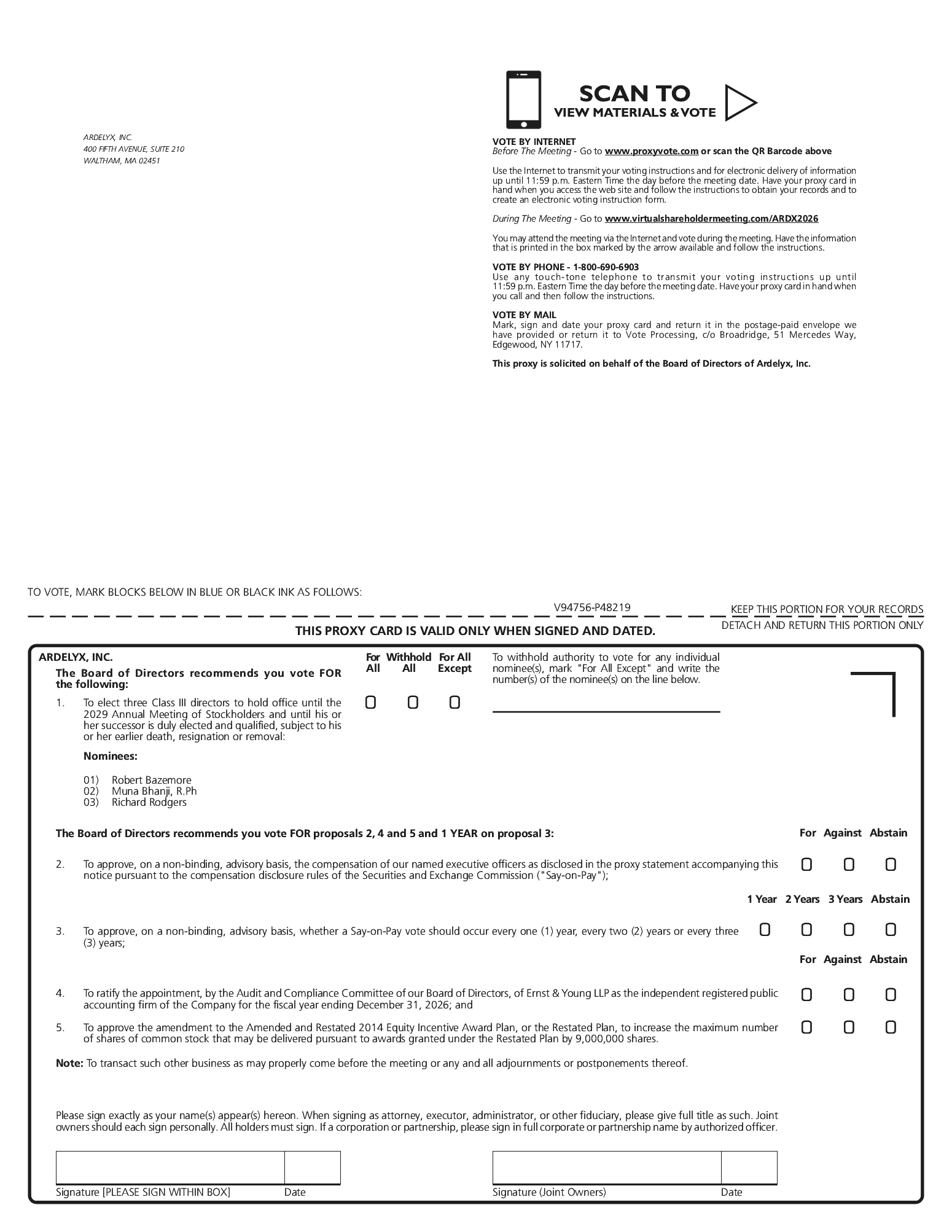
By Internet
By Telephone
By Mail
During the 2026 Annual Meeting
www.proxyvote.com
Toll-free at 1-800-690-6903
Complete and send proxy card by free post
Vote during the live webcast
You may vote at www.proxyvote.com, 24 hours a day, seven days a week. You will need the 16-digit control number included on your proxy card or voting instruction form. Votes submitted through the Internet must be received by 11:59 p.m. Eastern Time on Monday, June 15, 2026.
You may vote using a touch-tone telephone by calling 24 hours a day, seven days a week. You will need the 16-digit control number included on your proxy card or voting instruction form. Votes submitted by telephone must be received by 11:59 p.m. Eastern Time on Monday, June 15, 2026.
You may submit your vote by completing, signing and dating your proxy card or voting instruction form and returning it in the prepaid envelope. Proxy cards submitted by mail must be received no later than June 15, 2026.
You may vote during the 2026 Annual Meeting by going to: www.virtualshareholdermeeting.com/
ARDX2026. You will need the 16-digit control number included on your proxy card or voting instruction form. If you previously voted via the Internet, by telephone, or by mail, that vote will be cancelled if you vote online at the 2026 Annual Meeting.
CAST YOUR VOTE RIGHT AWAY
Please cast your vote on all of the proposals listed below to ensure that your shares are represented.
Proposal
Board Recommendation
(1) 
Election of the Class III directors.
FOR each nominee
(2) 
Advisory vote to approve the compensation paid to our NEOs.
FOR
(3) 
Advisory vote on the frequency of an advisory vote to approve NEO compensation.
EVERY ONE YEAR
(4) 
Ratify the appointment of Ernst & Young LLP as our independent registered public accounting firm for the fiscal year ending December 31, 2026.
FOR
(5) Approval of the Equity Plan Amendment.
FOR

TABLE OF CONTENTS

STOCKHOLDER VOTE REQUESTED: AMENDMENT TO AMENDED AND RESTATED 2014 EQUITY INCENTIVE AWARD PLAN PROPOSAL
Our stockholders are being asked to approve an amendment to the Restated Plan to increase the shares reserved for issuance under the Restated Plan by 9,000,000 shares. This increase is essential to our continued success as we scale our operations and commercialize our products. In an intensely competitive labor market, equity compensation remains our most vital tool for attracting, motivating, and retaining the industry-leading talent necessary to drive our business forward. By providing our directors and employees with an ownership stake, we ensure their interests are directly aligned with those of our stockholders, focusing our entire team on the delivery of long-term stockholder value.
With this Equity Plan Amendment, our projected overhang is expected to reach approximately 26.3%, which is in-line with our overhang rate for the prior three years and is a reflection of our disciplined history of share management, including our avoidance of equity financing transactions and larger issuance of shares of our stock, which has protected stockholders from ongoing dilution. The “evergreen” provisions of the Restated Plan were previously removed, ensuring stockholders have a direct vote on all share reserve increases. As a result, stockholder approval of this amendment is critical to ensure we can continue to appropriately utilize equity to attract top talent and incentivize our workforce.
Reasons to Vote FOR the Equity Plan Amendment
Fuel Strategic Growth: Secure the necessary share reserve to support our continued growth and optimization of our commercial and pipeline development efforts through 2027.
Attract and Retain Top Talent: Help ensure we remain competitive in a high-demand labor market by offering equity incentives that are essential for recruiting and retaining industry-leading professionals.
Align Employee and Stockholder Interests: Broad-based equity participation fosters an “owner’s mindset” across the entire organization, directly linking employee rewards to long-term stockholder value.
Stockholder Dilution Protection: Our overhang remains steady and is a result of our disciplined equity management and commitment to transparency, including our avoidance of equity financing transactions and larger issuance of shares of our stock. The removal of the “evergreen” provisions ensures you have a direct vote on all share increases rather than allowing automatic, hidden dilution.
Support Responsible Governance: The Restated Plan, inclusive of the Equity Plan Amendment, incorporates a broad range of compensation and governance best practices, as more fully described under “Other Key Features of the Restated Plan (including the Equity Plan Amendment)” below.
Our board of directors strongly recommends a vote FOR this proposal to provide the Company with the necessary resources to sustain our growth momentum through 2027 and beyond.

TABLE OF CONTENTS

GOVERNANCE AND EXECUTIVE COMPENSATION HIGHLIGHTS
We are committed to maintaining strong corporate governance and executive compensation practices, and we regularly review such practices to build on our success and drive long-term stockholder value. The highlights of our corporate governance and executive compensation practices include the following:
Governance Highlights
All of our directors are independent, other than Michael Raab, our chief executive officer.
We have an independent chairperson on our board of directors who is separate from the chief executive officer position.
We have 100% independence among members of each committee of our board of directors.
All of our directors attended at least 75% of board and committee meetings in 2025, and on average, our directors had a 95% attendance rate.
 We seek annual advisory approval of NEO compensation by our stockholders.
We do not have a stockholder rights plan, a takeover defense commonly referred to as a “poison pill.”
Our board of directors and each of its committees conduct periodic self-evaluations.
We conduct regular executive sessions of independent directors at meetings of our board of directors.
We believe all of our directors’ commitments align with stockholders and market best practices.
We have adopted robust corporate governance guidelines, which are published on our website at https://ir.ardelyx.com/governance-and-financials.
Executive Compensation Practices
We are committed to our pay-for-performance compensation program, with significant ratio of target compensation opportunities allocated to at-risk, variable incentives.
We have double-trigger (versus single-trigger) vesting of outstanding equity awards in connection with a change in control, unless equity awards are not assumed.
We have market-competitive target pay levels benchmarked against a comparable set of peer companies to maintain competitiveness of our pay program.
We do not offer our executive team any substantially enhanced benefits or perquisites when compared with our overall employee population.
We use multiple incentive plan metrics covering key financial, scientific, operational, strategic, and people goals that align with our value creation strategy.
We maintain a minimum stock ownership policy applicable to our executive officers and directors in order to help align their long-term interests with those of our stockholders.
We utilize both short- and long-term incentives to balance risk and reward.
We do not permit hedging or pledging of company stock.
We allow the compensation and leadership development committee full negative discretion to reduce incentives.
We do not permit repricing of outstanding stock options without stockholder approval.
We maintain a compensation recoupment (clawback) policy in compliance with applicable Nasdaq Stock Market rules.
We do not provide for excise tax gross ups.
We regularly assess the risk of our compensation program.
We provide no guarantees for increases to annual compensation.

TABLE OF CONTENTS

STOCKHOLDER ENGAGEMENT
We view stockholder engagement as a core part of effective corporate governance and regularly conduct outreach to understand stockholder perspectives on governance, executive compensation and disclosures. Our management team, as well as our board of directors, the nominating and corporate governance committee of our board of directors, and the compensation and leadership development committee of our board of directors, consider stockholder feedback, along with input from other stakeholders and advisors, when evaluating governance and compensation actions in the best interests of the Company and its stockholders. For example, in 2026, we updated the committee composition for both the nominating and corporate governance committee and compensation and leadership development committee in response to stockholder input, to broaden the different classes of directors represented on the nominating and corporate governance committee. The Company also considered stockholder feedback when designing and implementing a minimum stock ownership policy for executive officers and directors, which was approved by our board of directors in late 2025. In addition, in alignment with stockholder feedback, we previously removed the “evergreen” provision from the Restated Plan, ensuring stockholders have a direct vote on all share reserve increases.
We expect to continue outreach following the filing of this proxy statement with the SEC to seek support for the 2026 Annual Meeting proposals and to solicit feedback on governance and compensation matters of importance to our stockholders.

TABLE OF CONTENTS

TABLE OF CONTENTS
 
Page

TABLE OF CONTENTS

PROXY STATEMENT
FOR THE ANNUAL MEETING OF STOCKHOLDERS
TO BE HELD ON JUNE 16, 2026
IMPORTANT NOTICE REGARDING THE INTERNET AVAILABILITY OF PROXY MATERIALS
FOR THE ANNUAL MEETING OF STOCKHOLDERS TO BE HELD ON JUNE 16, 2026
This proxy statement and our Annual Report on Form 10-K for the fiscal year ended December 31, 2025 are available on our website at www.ardelyx.com and at www.proxyvote.com. The references to our web address contained in this proxy statement do not constitute incorporation by reference of the information contained at or available through our website.
Unless the context requires otherwise, in this proxy statement, the terms “Ardelyx,” “we,” “us,” “our” and “the Company” refer to Ardelyx, Inc.
QUESTIONS AND ANSWERS REGARDING THE PROXY MATERIALS AND THE VOTING PROCESS
Why am I receiving these proxy materials?
We have delivered paper proxy materials to you because the board of directors of Ardelyx is soliciting your proxy to vote at the 2026 Annual Meeting of Stockholders (the “2026 Annual Meeting”) or any adjournments that take place. The 2026 Annual Meeting will be held online on June 16, 2026 at 8:30 a.m. Eastern Time via live audio-only webcast at www.virtualshareholdermeeting.com/ARDX2026. As a stockholder, you are invited to attend the 2026 Annual Meeting online and are requested to vote on the proposals described in this proxy statement. However, you do not need to attend the 2026 Annual Meeting to vote.
What is included in the proxy materials?
The proxy materials include:
This proxy statement, which includes information regarding the proposals to be voted on at the 2026 Annual Meeting, the voting process, corporate governance, the compensation of our directors and certain executive officers, and other required information;
Our Annual Report on Form 10-K for the fiscal year ended December 31, 2025; and
The proxy card or a voting instruction card for the 2026 Annual Meeting.
The proxy materials are being mailed on or about May 1, 2026, and are available at www.ardelyx.com.
Who can vote at the 2026 Annual Meeting?
Only stockholders of record at the close of business on April 22, 2026 (the “Record Date”) will be entitled to vote at the 2026 Annual Meeting. On this Record Date, there were 247,029,387 shares of common stock outstanding and entitled to vote.
Stockholder of Record: Shares Registered in Your Name
If, at the close of business on April 22, 2026, your shares were registered directly in your name with our transfer agent, Equiniti Trust Company, LLC, then you are a stockholder of record. As a stockholder of record, you may vote online at the 2026 Annual Meeting or vote by proxy. Whether or not you plan to attend the 2026 Annual Meeting, please vote as soon as possible via the Internet, by telephone or by mail as instructed below to ensure your vote is counted.
Beneficial Owner: Shares Registered in the Name of a Broker or Bank
If, at the close of business on April 22, 2026, your shares were not held in your name, but rather in an account at a brokerage firm, bank, dealer or other similar organization, then you are the beneficial owner of shares held in “street name” and these proxy materials are being forwarded to you by that organization. The organization holding your account is considered to be the stockholder of record for purposes of voting at the 2026 Annual Meeting. As a beneficial owner, you have the right to direct your broker or other agent how to vote the shares in your account. If you are a beneficial owner of shares registered in the name of your broker, bank, dealer or other
1

TABLE OF CONTENTS

similar organization, you should have received a proxy card and voting instructions with these proxy materials from that organization rather than from us. Simply complete and mail the proxy card to ensure that your vote is counted. Alternatively, you may vote via the Internet or telephone as instructed by your broker or other agent. To vote online at the 2026 Annual Meeting, you must obtain a valid proxy from your broker or other agent. Follow the instructions from your broker or other agent included with these proxy materials, or contact your broker or bank to request a proxy form. In order to login to the online 2026 Annual Meeting, you will need the unique account number which appears in your proxy materials and the instructions that accompanied the proxy materials. In the event that you do not have a control number, please contact your broker, bank, or other nominee as soon as possible so that you can be provided with a control number.
What proposals are scheduled for a vote?
There are five proposals scheduled for a vote at the 2026 Annual Meeting:
Proposal No. 1 – To elect three Class III directors, Robert Bazemore, Muna Bhanji, R.Ph and Richard Rodgers, each to hold office until the 2029 Annual Meeting of Stockholders and until his or her successor is duly elected and qualified, subject to his or her earlier death, resignation or removal;
Proposal No. 2 – To approve, on a non-binding, advisory basis, the compensation of our named executive officers (“NEOs”) pursuant to the compensation disclosure rules of the U.S. Securities and Exchange Commission (the “SEC”) (“Say-on-Pay”);
Proposal No. 3 – To approve, on a non-binding, advisory basis, whether a Say-on-Pay vote should occur every one (1) year, every two (2) years or every three (3) years;
Proposal No. 4 – To ratify the appointment, by the audit and compliance committee of our board of directors, of Ernst & Young LLP as the independent registered public accounting firm of the Company for the fiscal year ending December 31, 2026; and
Proposal No. 5 – To approve the Equity Plan Amendment (the “Equity Plan Amendment”) to the Amended and Restated 2014 Equity Incentive Award Plan (as amended, the “Restated Plan”) to increase the maximum number of shares of common stock that may be delivered pursuant to awards granted under the Restated Plan by 9,000,000 shares.
How do I vote?
For Proposal No. 1, you may either vote “FOR” all nominees to the board of directors or you may “WITHHOLD” your vote for any nominee you specify. For Proposal Nos. 2, 4 and 5, you may either vote “FOR” or “AGAINST” or you may abstain from voting. For Proposal No. 3, you may vote “EVERY ONE YEAR,” “EVERY TWO YEARS” or “EVERY THREE YEARS” or you may abstain from voting.
The procedures for voting are as follows:
Stockholder of Record: Shares Registered in Your Name
If you are a stockholder of record, you may vote online at the virtual 2026 Annual Meeting or vote via the Internet, by telephone or by mail. Whether or not you plan to attend the 2026 Annual Meeting online, please vote as soon as possible to ensure your vote is counted. You may still attend the 2026 Annual Meeting online and vote online even if you have already voted by proxy.
By attending the 2026 Annual Meeting online. You may vote online at the 2026 Annual Meeting by attending the 2026 Annual Meeting online via live audio-only webcast at www.virtualshareholdermeeting.com/ARDX2026.
To vote by proxy via the Internet or by telephone. You may submit your proxy by following the instructions provided with your proxy materials and on your proxy card or voting instruction card.
To vote by proxy by mail. You may submit your proxy by mail by completing and signing your proxy card and mailing it in the enclosed envelope. Your shares will be voted as you have instructed.
2

TABLE OF CONTENTS

Beneficial Owner: Shares Registered in the Name of a Broker or Bank
If you are a beneficial owner of shares registered in the name of your broker, bank, dealer, or other similar organization, you should have received a proxy card and voting instructions with these proxy materials from that organization rather than from us. Simply complete and mail the proxy card to ensure that your vote is counted.
Alternatively, you may vote via the Internet or by telephone as instructed by your broker or other agent. To vote online at the 2026 Annual Meeting, you must obtain a valid proxy from your broker or other agent. Follow the instructions from your broker or other agent included with these proxy materials, or contact your broker or bank to request a proxy form.
How many votes do I have?
On each matter to be voted upon, you have one vote for each share of the Company’s common stock you owned as of April 22, 2026.
What if I return a proxy card but do not make specific choices?
If you return a signed and dated proxy card without marking any voting selections, your shares will be voted “FOR” the election of each nominee for director (Proposal No. 1), “FOR” the approval, on a non-binding, advisory basis, of the Say-on-Pay proposal (Proposal No. 2), “EVERY ONE YEAR” on a non-binding, advisory basis as the frequency of future Say-on-Pay votes (Proposal No. 3), “FOR” the ratification of the appointment of Ernst & Young LLP as the independent registered public accounting firm of the Company for the fiscal year ending December 31, 2026 (Proposal No. 4) and “FOR” the approval of the Equity Plan Amendment (Proposal No. 5). If any other matter is properly presented at the 2026 Annual Meeting, your proxyholder (one of the individuals named on your proxy card) will vote your shares using his or her best judgment.
Who is paying for this proxy solicitation?
We will pay for the entire cost of soliciting proxies. In addition to these mailed proxy materials, our directors, officers, and employees may also solicit proxies in person, by telephone, or by other means of communication. Directors, officers, and employees will not be paid any additional compensation for soliciting proxies. We have engaged Sodali & Co. (“Sodali”) as the proxy solicitor for the 2026 Annual Meeting for an approximate fee of $25,000 plus fees for additional services, if needed. We have also agreed to reimburse Sodali for its reasonable out-of-pocket expenses.
What does it mean if I receive more than one proxy card?
If you receive more than one proxy card, your shares are registered in more than one name or are registered in different accounts. In order to vote all the shares you own, you must return each proxy card.
Can I change my vote after submitting my proxy?
Yes. You can revoke your proxy at any time before the final vote at the 2026 Annual Meeting. If you are the stockholder of record of your shares, you may revoke your proxy in any one of three ways:
You may submit another properly completed proxy, bearing a date later than the date of the original proxy.
You may send a timely written notice, bearing a date later than the date of the original proxy, that you are revoking your proxy to the Company’s Chief Legal Officer at the following email address: general-counsel@ardelyx.com.
You may attend the virtual 2026 Annual Meeting and vote online. Simply attending the 2026 Annual Meeting online will not, by itself, revoke your proxy.
If your shares are held in “street name” by your broker or other agent, you should follow the instructions provided by your broker or agent to change your vote.
What is the quorum requirement?
A quorum of stockholders is necessary to hold a valid meeting. A quorum will be present if stockholders holding at least a majority of the outstanding shares entitled to vote are present in attendance online or represented by
3

TABLE OF CONTENTS

proxy at the virtual 2026 Annual Meeting. On the Record Date, there were 247,029,387 shares outstanding and entitled to vote. Accordingly, the holders of 123,514,694 shares must be present at the 2026 Annual Meeting to have a quorum. Your shares will be counted toward the quorum at the 2026 Annual Meeting only if you vote online at the meeting or you submit a valid proxy vote.
Abstentions and broker non-votes (as described below) will be counted towards the quorum requirement. If there is no quorum, the chairperson of the meeting or the holders of a majority in voting power of the stockholders entitled to vote at the meeting or represented by proxy may adjourn the 2026 Annual Meeting to another date.
How are votes counted?
With respect to the election of directors (Proposal No. 1), you may vote “FOR” or “WITHHOLD” authority to vote for each of the nominees for the board of directors. If you “WITHHOLD” authority to vote with respect to one or more director nominees, your vote will have no effect on the election of such nominees. Broker non-votes will have no effect on the election of the nominees.
With respect to the Say-on-Pay proposal (Proposal No. 2), you may vote “FOR,” “AGAINST” or “ABSTAIN.” Abstentions and broker non-votes will have no effect on the vote for this proposal.
With respect to the frequency of the Say-on-Pay vote (Proposal No. 3), you may vote for “EVERY ONE YEAR,” “EVERY TWO YEARS,” “EVERY THREE YEARS” or you may “ABSTAIN.” Abstentions and broker non-votes will have no effect on the vote for this proposal.
With respect to the ratification of the appointment of Ernst & Young LLP as our independent registered public accounting firm for the year ending December 31, 2026 (Proposal No. 4), you may vote “FOR,” “AGAINST” or “ABSTAIN.” Abstentions and broker non-votes will have no effect on the vote for this proposal.
With respect to the approval of the Equity Plan Amendment (Proposal No. 5), you may vote “FOR,” “AGAINST” or “ABSTAIN.” Abstentions and broker non-votes will have no effect on the vote for this proposal.
Votes will be counted by the Inspector of Elections appointed for the 2026 Annual Meeting. The Inspector of Elections will separately count “FOR” votes for the election of directors (Proposal No. 1), “FOR” and “AGAINST” votes, abstentions and, if any, broker non-votes for the approval, on a non-binding, advisory basis, of the Say-on-Pay (Proposal No. 2), votes for “EVERY ONE YEAR,” “EVERY TWO YEARS,” and “EVERY THREE YEARS” for the non-binding, advisory frequency of future Say-on-Pay votes (Proposal No. 3), “FOR” and “AGAINST” votes, abstentions and, if any, broker non-votes for the ratification of the appointment of Ernst & Young LLP as the independent registered public accounting firm of the Company for the fiscal year ending December 31, 2026 (Proposal No. 4) and “FOR” and “AGAINST” votes, abstentions and, if any, broker non-votes for the Equity Plan Amendment (Proposal No. 5).
If your shares are held by your broker or other agent as your nominee (that is, held beneficially in “street name”), you will need to obtain a proxy form from the institution that holds your shares and follow the instructions included on that form regarding how to instruct your broker or other agent to vote your shares. If you do not give voting instructions to your broker or other agent, your broker or other agent can only vote your shares with respect to “routine” matters (as described below).
What are “broker non-votes”?
If you hold shares beneficially in street name and do not provide your broker with voting instructions, your shares may constitute “broker non-votes.” Broker non-votes occur on a matter when a broker is not permitted to vote on that matter without instructions from the beneficial owner and instructions are not given. These matters are referred to as “non-routine” matters. Proposal No. 1 to elect directors, Proposal No. 2 to approve the Say-on-Pay, Proposal No. 3 to approve the frequency of Say-on-Pay votes and Proposal No. 5 to approve the Equity Plan Amendment are “non-routine” matters, but Proposal No. 4 to ratify the appointment of Ernst & Young LLP as the independent registered public accounting firm for the Company for the fiscal year ending December 31, 2026 is a “routine” matter.
4

TABLE OF CONTENTS

How many votes are needed to approve each proposal?
Proposal No. 1 – To elect three Class III directors, Robert Bazemore, Muna Bhanji, R.Ph and Richard Rodgers, each to hold office until the 2029 Annual Meeting of Stockholders and until his or her successor is duly elected and qualified, subject to his or her earlier death, resignation or removal. Directors shall be elected by a plurality of the votes cast, which means that the three nominees receiving the most “FOR” votes (from the votes of shares present in attendance online or represented by proxy and entitled to vote on the election of directors) will be elected. “WITHHOLD” votes and broker non-votes will not be counted towards the vote total for this proposal.
Proposal No. 2 – To approve, on a non-binding, advisory basis, the Say-on-Pay proposal. The Say-on-Pay proposal requires the affirmative vote of the majority of the votes cast (excluding abstentions and broker non-votes), which means the number of shares voted “FOR” the proposal must exceed the number of shares voted “AGAINST” such proposal. Abstentions and broker non-votes are not considered votes cast for the foregoing purpose, and will have no effect on the vote for this proposal.
Proposal No. 3 – To approve, on a non-binding, advisory basis, whether a Say-on-Pay vote should occur every one (1) year, every two (2) years or every three (3) years. The approval on the frequency of future Say-on-Pay votes requires that the option of every one year, every two years or every three years that receives the affirmative vote of the majority of the votes cast (excluding abstentions and broker non-votes) will be determined to be the stockholders’ recommended frequency for future advisory votes on executive compensation. If none of the frequency alternatives (one year, two years or three years) receives a majority vote, the Company will consider the frequency that receives the highest number of votes by stockholders to be the frequency that has been selected by its stockholders. Abstentions and broker non-votes are not considered votes cast for the foregoing purpose, and will have no effect on the vote for this proposal.
Proposal No. 4 – To ratify the appointment of Ernst & Young LLP as the independent registered public accounting firm of the Company for the fiscal year ending December 31, 2026. The ratification of the appointment of Ernst & Young LLP as our independent registered public accounting firm for the year ending December 31, 2026 requires the affirmative vote of the majority of the votes cast (excluding abstentions and broker non-votes), which means the number of shares voted “FOR” the proposal must exceed the number of shares voted “AGAINST” such proposal. Abstentions and broker non-votes are not considered votes cast for the foregoing purpose, and will have no effect on the vote for this proposal. Because Proposal No. 4 is considered a “routine” matter, no broker non-votes are expected in connection with this proposal.
Proposal No. 5 – To approve the Equity Plan Amendment to increase the number of shares reserved under the Restated Plan. This proposal requires the affirmative vote of the majority of the votes cast (excluding abstentions and broker non-votes), which means the number of shares voted “FOR” the proposal must exceed the number of shares voted “AGAINST” such proposal. Abstentions and broker non-votes are not considered votes cast for the foregoing purpose, and will have no effect on the vote for this proposal.
Because votes on Proposals No. 2 and 3 are advisory, they will not be binding on the board of directors, the compensation and leadership development committee of the board of directors or the Company. With respect to Proposal No. 2, the board of directors will review the voting results and take them into consideration when making future decisions about executive compensation. With respect to Proposal No. 3, the board of directors may decide that it is in the best interests of the Company and its stockholders to hold a stockholder advisory vote on executive compensation more or less frequently than the option recommended by stockholders.
How do I attend the Virtual Annual Meeting?
This year’s Annual Meeting will be held entirely online. Stockholders of record as of April 22, 2026 will be able to attend and participate in the 2026 Annual Meeting online via live audio-only webcast at www.virtualshareholdermeeting.com/ARDX2026. You will be able to vote your shares electronically via the Internet and submit questions online during the meeting by logging in to the website listed above and using the 16-digit control number included on your proxy card or on the instructions that accompanied your proxy materials. The virtual meeting has been designed to provide the same rights to participate as you would have at an in-person meeting.
5

TABLE OF CONTENTS

Even if you plan to attend the 2026 Annual Meeting online, we recommend that you also vote by proxy as described herein so that your vote will be counted if you decide not to attend the 2026 Annual Meeting.
Access to the Audio Webcast of the 2026 Annual Meeting. The live audio webcast of the 2026 Annual Meeting will begin promptly at 8:30 a.m. Eastern Time. Online check-in will begin at 8:15 a.m. Eastern Time and should allow ample time for the check-in procedures. We encourage our stockholders to access the meeting prior to the start time.
Log in Instructions. To attend the online 2026 Annual Meeting, you will need to login at www.virtualshareholdermeeting.com/ARDX2026. To attend the 2026 Annual Meeting, you will need the 16-digit control number included on your proxy card or on the instructions that accompanied your proxy materials.
Voting. You may vote online during the 2026 Annual Meeting. To do so, go to www.virtualshareholdermeeting.com/ARDX2026 and have available the 16-digit control number included on your proxy card or on the instructions that accompanied your proxy materials.
Submitting Questions During the Virtual 2026 Annual Meeting. During the 2026 Annual Meeting, you will be able to submit questions in the question box provided at www.virtualshareholdermeeting.com/ARDX2026. We will respond to as many inquiries at the 2026 Annual Meeting as time allows.
Technical Assistance. Beginning 15 minutes prior to the start of and during the virtual 2026 Annual Meeting, we will have a support team ready to assist stockholders with any technical difficulties they may have accessing or hearing the virtual meeting. If you encounter difficulties accessing the virtual 2026 Annual Meeting during check-in or meeting time, please call the technical support number that will be posted on the 2026 Annual Meeting website log-in page.
How can I find out the results of the voting at the 2026 Annual Meeting?
We will disclose final voting results in a Current Report on Form 8-K filed with the SEC within four business days after the 2026 Annual Meeting. If final voting results are unavailable at that time, then we intend to file a Current Report on Form 8-K to disclose preliminary voting results and file an amended Current Report on Form 8-K within four business days after the date the final voting results are available.
When are stockholder proposals due for next year’s annual meeting?
To be considered for inclusion in the proxy materials for the 2027 Annual Meeting of Stockholders, your proposal must be submitted in writing by January 1, 2027 to the Company’s Corporate Secretary at Ardelyx, Inc., 400 Fifth Avenue, Suite 210, Waltham, Massachusetts 02451. However, if the meeting is more than 30 days before or after June 16, 2027, then the deadline will be a reasonable time before we begin to print and mail our proxy materials for that meeting.
If you wish to submit a proposal before the stockholders or nominate a director at the 2027 Annual Meeting of Stockholders, but you are not requesting that your proposal or nomination be included in the proxy materials for that meeting, then you must follow the procedures set forth in our Amended and Restated Bylaws and, among other things, notify the Company’s Corporate Secretary in writing between February 16, 2027 and March 18, 2027. However, if the date of the 2027 Annual Meeting of Stockholders is more than 30 days before or more than 60 days after June 16, 2027, notice must be received, not more than the 120th day prior to the date of the 2027 Annual Meeting of Stockholders, and not later than the 90th day prior to the date of the 2027 Annual Meeting of Stockholders or, if later, the 10th day following the day on which public disclosure of the date of the 2027 Annual Meeting of Stockholders is first made. You are also advised to review our Amended and Restated Bylaws, which contain additional requirements regarding advance notice of stockholder proposals and director nominations. In addition to satisfying the foregoing requirements under our Amended and Restated Bylaws, to comply with the universal proxy rules, stockholders who intend to solicit proxies in support of director nominees other than our nominees must provide notice that sets forth the information required by Rule 14a-19 under the Securities Exchange Act of 1934, as amended (the “Exchange Act”), no later than 60 days prior to the anniversary of the previous year’s annual meeting (no later than April 17, 2027 for the 2027 Annual Meeting of Stockholders). If the date of the 2027 Annual Meeting of Stockholders is changed by more than 30 days from the anniversary of the 2026 Annual Meeting, then notice must be provided by the later of 60 days prior to the date of the 2027 Annual Meeting of Stockholders or the 10th calendar day following the day on which public disclosure of the date of the 2027 Annual Meeting of Stockholders is first made.
6

TABLE OF CONTENTS

PROPOSAL NO. 1
ELECTION OF DIRECTORS
Our board of directors is divided into three classes. Each class consists of, as nearly as possible, one-third of the total number of directors, and each class has a three-year term. Except as otherwise provided by law, vacancies on the board of directors may be filled only by individuals elected by a majority of the remaining directors. A director elected by the board of directors to fill a vacancy in a particular class, including a vacancy created by an increase in the number of directors, shall serve for the remainder of the full term of that class and until such director’s successor is elected and qualified, or until such director’s earlier death, resignation or removal.
Our board of directors currently consists of eight directors divided into the following three classes:
The Class III directors are Robert Bazemore, Muna Bhanji, R.Ph and Richard Rodgers, and their terms will expire at the 2026 Annual Meeting of Stockholders;
The Class I directors are William A. Bertrand, Jr., Esq., Onaiza Cadoret-Manier and Merdad Parsey, M.D., Ph.D., and their terms will expire at the 2027 Annual Meeting of Stockholders; and
The Class II directors are David Mott and Michael Raab, and their terms will expire at the 2028 Annual Meeting of Stockholders.
Our current Class III directors, Robert Bazemore, Muna Bhanji, R.Ph and Richard Rodgers, have each been nominated to serve as Class III directors and have agreed to stand for election.
If the nominees for Class III are elected at the 2026 Annual Meeting, then each nominee will serve for a three-year term expiring at the 2029 Annual Meeting of Stockholders, and until his or her successor is elected and qualified, or until his or her earlier death, resignation or removal. Our directors are elected by a plurality of the votes cast. If a choice is specified on the proxy card by a stockholder, the shares will be voted as specified. If a choice is not specified on the proxy card, and authority to do so is not withheld, the shares will be voted “FOR” the election of the three nominees for Class III above. If any of the nominees becomes unavailable for election as a result of an unexpected occurrence, shares that would have been voted for the nominee will instead be voted for the election of a substitute nominee proposed by our management or the board of directors. Each person nominated for election has agreed to serve if elected. Our management has no reason to believe that any nominee will be unable to serve.
The following is a brief biography and discussion of the specific attributes, qualifications, experience and skills of each nominee for director and each director whose term will continue after the 2026 Annual Meeting, including information with respect to their ages as of March 31, 2026. Our board of directors and management encourage each nominee for director and each continuing director to attend the 2026 Annual Meeting.
THE BOARD OF DIRECTORS RECOMMENDS A VOTE “FOR” EACH
OF THE THREE CLASS III NOMINEES FOR DIRECTOR.
CLASS III NOMINEES FOR DIRECTOR - To be elected for a three-year term expiring at the 2029 Annual Meeting of Stockholders
Robert Bazemore, age 58, has served on our board of directors since June 2016. Mr. Bazemore served as President and Chief Executive Officer and a director of Epizyme, Inc., a biopharmaceutical company, from September 2015 until the company was acquired by Ipsen S.A. (Euronext: IPN; ADR: IPSEY) in August 2022. Prior to joining Epizyme, Mr. Bazemore served as Chief Operating Officer of Synageva BioPharma Corp., a biopharmaceutical company, which was acquired by Alexion Pharmaceuticals, a pharmaceutical company and subsidiary of AstraZeneca Plc (NYSE: AZN), in July 2015. Prior to that, Mr. Bazemore was President of Janssen Biotech, part of the Janssen Pharmaceutical Companies of Johnson & Johnson (NYSE: JNJ). Mr. Bazemore currently serves on the board of directors of Nuvation Bio, Inc. (NYSE: NUVB) and Akari Therapeutics, PLC (Nasdaq: AKTX). Mr. Bazemore received his B.S. in Biochemistry from the University of Georgia. We believe that Mr. Bazemore is qualified to serve on our board of directors due to his significant life science industry experience, including as a chief executive officer, and service on the boards of directors of life sciences companies.
Muna Bhanji, R.Ph, age 63, has served on our board of directors since March 2021. Ms. Bhanji has served as the founder and principal of Tiba Global Access, LLC, an independent senior advisory practice focused on commercialization and market access strategy development, since January 2021. Ms. Bhanji previously served in roles of increasing responsibility at Merck & Co. (NYSE: MRK) between 1986 and January 2021, including as Senior Vice
7

TABLE OF CONTENTS

President, Global Market Access from 2010 until 2021 and as Senior Vice President, Hospital & Specialty Franchises from 2014 until 2017. Ms. Bhanji currently serves on the boards of directors of Veracyte, Inc. (Nasdaq: VCYT), Cytokinetics Incorporated (Nasdaq: CYTK), Intellia Therapeutics (Nasdaq: NTLA), Lumanity, a life sciences consulting firm, and Corus International, an international humanitarian organization committed to poverty alleviation. Ms. Bhanji also serves on the advisory group of Conquer AI, an artificial intelligence software company. Ms. Bhanji received her B.Sc. in Pharmacy from the Rutgers School of Pharmacy and her M.B.A. from Saint Joseph’s University. We believe that Ms. Bhanji is qualified to serve on our board of directors due to her extensive U.S. and global commercial and operational experience within the pharmaceutical industry.
Richard Rodgers, age 59, has served on our board of directors since March 2014. From March 2010 until August 2013, Mr. Rodgers was co-founder, Executive Vice President, Chief Financial Officer, Secretary and Treasurer of Tesaro, Inc., a biopharmaceutical company, which was acquired by GlaxoSmithKline plc (LSE/NYSE: GSK) in January 2019. Mr. Rodgers previously served as the Chief Financial Officer of Abraxis BioScience, Inc., a biotechnology company, from June 2009 to February 2010. Prior to that, Mr. Rodgers served as Senior Vice President, Controller and Chief Accounting Officer of MGI PHARMA, Inc., a biopharmaceutical company, from 2004 until its acquisition by Eisai Co. Ltd. (OTC: ESALF) in January 2008. Mr. Rodgers has held finance and accounting positions at several private and public companies, including Arthur Andersen & Co. Mr. Rodgers currently serves as a director of Novavax, Inc. (Nasdaq: NVAX) and Opus Genetics, Inc. (Nasdaq: IRD). Mr. Rodgers received a B.S. in Financial Accounting from St. Cloud State University and his M.B.A. in Finance from the University of Minnesota, Carlson School of Business. We believe that Mr. Rodgers is qualified to serve on our board of directors due to his financial background, significant industry experience, and service on other boards of directors of publicly-traded life sciences companies.
CLASS I DIRECTORS - To continue in office until the 2027 Annual Meeting of Stockholders
William Bertrand, Jr., Esq., age 61, has served on our board of directors since October 2015. From March 2017 to November 2025, Mr. Bertrand served as the Chief Operating Officer at Adaptimmune Therapeutics Plc (Nasdaq: ADAP). From October 2015 to September 2016, Mr. Bertrand served as the Executive Vice President, General Counsel of Infinity Pharmaceuticals, Inc. (Nasdaq: INFI). From July 2013 to August 2015, Mr. Bertrand held a variety of positions with Salix Pharmaceuticals, Ltd., a biopharmaceutical company, including Senior Vice President, General Counsel, Acting Chief Operating Officer, and most recently, General Manager of Salix Pharmaceuticals following its acquisition by Valeant Pharmaceuticals International, now known as Bausch Health Companies Inc. (NYSE: VRX), in April 2015. Prior to that, Mr. Bertrand completed a 12-year career at MedImmune Limited, a biotechnology company and subsidiary of AstraZeneca Plc (NYSE: AZN), serving in numerous roles of increasing responsibility, including as Executive Vice President and General Counsel from 2008 to 2013. In December 2025, Mr. Bertrand joined the boards of directors of LevelBlue, a cybersecurity company, and Unplugged & Uncorked Inc., a wine distribution business. Mr. Bertrand received his B.S. in Biology from Wayne State University and his J.D. from the University of Wisconsin-Madison. We believe that Mr. Bertrand is qualified to serve on our board of directors due to his legal and compliance background and significant life science industry experience.
Onaiza Cadoret-Manier, age 62, has served on our board of directors since March 2020. Ms. Cadoret-Manier has served as the Chief Executive Officer, President and Board Member of Yemaya Bio, a biotechnology company, since March 2024. From March 2022 to March 2024, Ms. Cadoret-Manier served as Chief Global Product Strategy and Operations Officer at Ionis Pharmaceuticals (Nasdaq: IONS), and from January 2020 to March 2022, Ms. Cadoret-Manier served as Chief Corporate Development and Commercial Officer at Ionis Pharmaceuticals. Prior to that, Ms. Cadoret-Manier was the Chief Commercial Officer for GRAIL, Inc. (Nasdaq: GRAL), an early detection genomics company, from June 2018 until June 2019. Prior to GRAIL, from April 2011 until June 2018, she was Vice President of the Respiratory Franchise at Genentech, Inc. , a biopharmaceutical company. Ms. Cadoret-Manier also has held multiple senior management positions overseeing corporate strategy, alliances, and marketing and sales for numerous disease areas for Genentech, Pfizer Inc. (NYSE: PFE) and Amylin Pharmaceuticals, all of which are biopharmaceutical companies. Ms. Cadoret-Manier served on the board of directors of Ventyx Biosciences from January 2023 until its acquisition by Eli Lilly and Company (NYSE: LLY) in March 2026. She has an M.B.A. from the University of Chicago and a bachelor’s degree in economics and accounting from City University of New York Queens College. We believe that Ms. Cadoret-Manier is qualified to serve on our board of directors due to her extensive commercial and strategic operational experience with life sciences companies.

8

TABLE OF CONTENTS

Merdad Parsey, M.D., Ph.D., age 63, has served as a member of our board of directors since April 2025. Dr. Parsey served as the Chief Medical Officer of Gilead Sciences, Inc. (Nasdaq: GILD) from November 2019 until April 2025. From October 2015 to November 2019, Dr. Parsey served as Senior Vice President of early clinical development at Genentech, Inc., a biopharmaceutical company Prior to Genentech, Dr. Parsey served as President and Chief Executive Officer of 3-V Biosciences Inc. (now Sagimet BioSciences Inc. (Nasdaq: SGMT)), held development roles at Sepracor Inc., Regeneron Pharmaceuticals, Inc., and Merck & Co., Inc., each a pharmaceutical company, and was Assistant Professor of Medicine and Director of Critical Care Medicine at the New York University School of Medicine. He currently serves on the board of directors for Arrivent Biopharma (Nasdaq: AVBP). Additionally, Dr. Parsey previously served on the boards of directors of Sagimet Biosciences (Nasdaq: SGMT) Arcus Biosciences, Inc. (NYSE: RCUS) and the Gilead Foundation, a nonprofit organization focused on health equity. Dr. Parsey received his B.S. in microbiology and biochemistry from the University of Maryland and his M.D. and Ph.D. in immunology from the University of Maryland at Baltimore. He completed his internal medicine residency at Stanford University and his pulmonary and critical care fellowship at the University of Colorado. We believe Dr. Parsey is well-suited to serve on our board of directors due to his years of experience in clinical drug development and his extensive scientific and medical experience.
CLASS II DIRECTORS - To continue in office until the 2028 Annual Meeting of Stockholders
David Mott, age 60, has served on our board of directors since March 2009 and as the chairperson of the board of directors since March 2014. Mr. Mott is currently Chief Executive Officer and Chief Investment Officer of Sphinx Mountain Capital LLC, a family office investment business, and, from February 2020 through August 2025, was a private investor through Mott Family Capital. From 2008 to 2020, Mr. Mott was a general partner of New Enterprise Associates, one of the world’s largest venture capital firms, which invests in companies across all stages in healthcare and technology. At NEA, Mr. Mott led the healthcare investing practice with a personal focus within biotechnology. Mr. Mott served as President and Chief Executive Officer and Vice Chairman of MedImmune Limited from 2000 through 2008, during which he led the sale of the company to AstraZeneca Plc (NYSE: AZN) in June 2007 for $15.6 billion. He joined MedImmune in 1992 and, prior to becoming Chief Executive Officer in 2000, served in various senior roles, including Chief Operating Officer, Chief Financial Officer, and Head of Business Development and Strategy. Mr. Mott currently serves as the chairperson of the board of directors for Novavax, Inc. (Nasdaq: NVAX) and is a member of several non-profit organizations. Mr. Mott holds a Bachelor of Arts degree from Dartmouth College. We believe that Mr. Mott is qualified to serve on our board of directors due to his extensive experience in the life sciences industry as a senior executive, his investment experience, strategic leadership track record and service on other boards of directors of life sciences companies.
Michael Raab, age 61, has served as our President and Chief Executive Officer since March 2009 and as a director since 2008. From 2002 to 2009, Mr. Raab was a partner at New Enterprise Associates, an investment firm focused on venture capital and growth equity investments, where he focused on investments in the biotechnology and pharmaceutical sectors. Prior to joining NEA, Mr. Raab spent 15 years in commercial and operating leadership roles in the biotechnology and pharmaceutical industries, including serving as Senior Vice President, Therapeutics and General Manager of the Renal Division at Genzyme Corporation, a biotechnology company. Mr. Raab also spent two years with Genzyme’s diagnostic products and services division. Before Genzyme, Mr. Raab held business development and sales and marketing positions at Repligen Corporation (Nasdaq: RGEN), a life sciences company, and Bristol-Myers Squibb Company (NYSE: BMY). Mr. Raab currently serves as a director of Tempest Therapeutics (Nasdaq: TPST) and as a member of the Emerging Companies Section Governing Board and the Health Section Governing Board as well as a member of the Executive Committee of the Biotechnology Innovation Organization. He is also a founding member and the secretary of The Midsized Biotech Alliance of America. In addition, Mr. Raab served as a member of the board of directors of Amicus Therapeutics, Inc. (Nasdaq: FOLD) from 2004 and as its chairperson of the board of directors from March 2024 until its acquisition by BioMarin Pharmaceutical Inc. in April 2026. Mr. Raab received a B.A. from DePauw University. We believe Mr. Raab is qualified to serve on our board of directors based on his role as our President and Chief Executive Officer, his senior management experience in the life sciences sector, his investment experience and his current and past service on other boards of directors of public companies.
9

TABLE OF CONTENTS

BOARD AND CORPORATE GOVERNANCE MATTERS
Board Composition
Director Independence
Our board of directors currently consists of eight members. Our board of directors has determined that all of our directors, other than Mr. Raab, qualify as “independent” directors in accordance with the Nasdaq listing requirements. Mr. Raab is not considered independent because he is an employee of our company. The Nasdaq independence definition includes a series of objective tests, such as that the director is not, and has not been for at least three years, one of our employees, and that neither the director nor any of his or her family members has engaged in various types of business dealings with us. In addition, as required by Nasdaq rules, our board of directors has made a subjective determination as to each independent director and director nominee that no relationships exist, which, in the opinion of our board of directors, would interfere with the exercise of independent judgment in carrying out the responsibilities of a director. In making these determinations, our board of directors reviewed and discussed information provided by the directors and us with regard to each director’s and each nominee’s business and personal activities and relationships as they may relate to us and our management. There are no family relationships among any of our directors, nominees for election to our board of directors or our executive officers.
As described more fully below, the board of directors has also determined that each current member of the compensation and leadership development committee, the audit and compliance committee and the nominating and corporate governance committee meets the independence standards applicable to those committees prescribed by Nasdaq and the SEC.
Classified Board of Directors
In accordance with our amended and restated certificate of incorporation, our board of directors is divided into three classes with staggered, three-year terms. At each annual meeting of stockholders, the successors to directors whose terms then expire will be elected to serve from the time of election and qualification until the third annual meeting following election.
The nominating and corporate governance committee of our board of directors continues to believe that our classified board structure is in the best interests of our business and stockholders, and provides a prudent protection given our size and stage of growth. In light of the operational challenges, complexity and long-term nature of our industry, three-year terms help promote continuity by ensuring that at any given time, a majority of our board of directors has meaningful experience with and knowledge of our business and strategic objectives, while enabling new directors to benefit from the institutional knowledge of continuing directors. In addition, because approximately one-third of our directors stand for election each year, a classified board can help protect and potentially maximize stockholder value by providing additional time to respond to hostile or potentially unfair takeover attempts. While it does not preclude unsolicited proposals, we believe it encourages potential acquirors to negotiate with our board of directors, allowing the Company to evaluate alternatives to maximize stockholder value. A classified board remains subject to fiduciary duties under the General Corporation Law of the State of Delaware and accountable to stockholders, and our board of directors has adopted measures to promote accountability, including our code of business conduct and ethics and regular self-evaluations. Because we maintain as equal a number of directors in each class as possible, a majority of our board of directors stands for election over any two-year period. As of our most recent peer assessment in March 2026, a majority of companies in our peer group had classified boards. Furthermore, a FactSet analysis of U.S. public biotechnology and pharmaceutical companies showed that 77% utilized classified boards as of mid-2025. For companies valued between $200 million and $2 billion, that figure rose to 86%. Our board of directors continues to periodically evaluate whether this structure remains in the best interests of our business and stockholders.
Leadership Structure of the Board
Our Amended and Restated Bylaws and corporate governance guidelines provide our board of directors with flexibility to combine or separate the positions of chairperson of the board of directors and chief executive officer and/or the implementation of a lead independent director in accordance with its determination that utilizing one or the other structure would be in the best interests of our Company. Mr. Mott currently serves as the chairperson of the board of directors. In that role, Mr. Mott presides over the executive sessions of the board
10

TABLE OF CONTENTS

of directors in which Mr. Raab does not participate and serves as a liaison to Mr. Raab and management on behalf of the board of directors. This structure allows Mr. Raab to focus on day-to-day operations as Chief Executive Officer and allows Mr. Mott to lead independent oversight and advisory functions in his fundamental role as chairperson of the board of directors. We believe this approach strengthens non-management and independent director involvement in oversight, agenda-setting and establishing priorities for the work of the board of directors, without affecting the risk oversight function of the board of directors.
Our board of directors has concluded that our current leadership structure is appropriate at this time. However, our board of directors will continue to periodically review our leadership structure and may make such changes in the future as it deems appropriate.
Role of the Board in Risk Oversight Processes
General Risk Oversight
Risk assessment and oversight are an integral part of our governance and management processes. Our board of directors encourages management to promote a culture that incorporates risk management into our corporate strategy and day-to-day business operations. Management discusses strategic and operational risks at regular management meetings, and conducts specific strategic planning and review sessions during the year that include a focused discussion and analysis of the risks facing us. Throughout the year, senior management reviews these risks with the board of directors at regular board meetings as part of management presentations that focus on particular business functions, operations or strategies and presents the steps taken by management to mitigate or eliminate such risks.
Our board of directors does not have a standing risk management committee, but rather administers this oversight function directly through our board of directors as a whole, as well as through various standing committees of our board of directors that address risks inherent in their respective areas of oversight. In particular, our board of directors is responsible for monitoring and assessing strategic risk exposure and our audit and compliance committee is responsible for overseeing our major financial risk exposures and the steps our management has taken to monitor and control these exposures. The audit and compliance committee also monitors compliance with legal and regulatory requirements and considers and approves or disapproves any related-persons transactions. Our nominating and corporate governance committee monitors the effectiveness of our corporate governance guidelines. Our compensation and leadership development committee assesses and monitors whether any of our compensation policies and programs has the potential to encourage excessive risk-taking.
Cybersecurity Governance
Our board of directors also considers cybersecurity risk as part of its risk oversight function and has delegated to the audit and compliance committee oversight of cybersecurity and other information technology risks, including oversight of management’s implementation of our cybersecurity risk management program, maintaining a strategic role in coordinating cyber risk initiatives and policies, and confirming their efficacy.
The audit and compliance committee receives annual reports from management on our cybersecurity posture. In addition, management updates the audit and compliance committee where it deems appropriate regarding any cybersecurity incidents it considers to be significant or potentially significant.
The audit and compliance committee and our management team take steps to stay informed about and monitor efforts to prevent, detect, mitigate and remediate cybersecurity risks and incidents through various means, which may include briefings from internal security personnel, threat intelligence and other information obtained from governmental, public or private sources, including external consultants engaged by us and alerts and reports produced by security tools deployed in the IT environment.
Meetings of the Board of Directors and Committees
During 2025, the board of directors met 11 times, the audit and compliance committee met five times, the compensation and leadership development committee met six times and the nominating and corporate governance committee met two times. In that year, each director attended at least 75% of the aggregate number of meetings of the board of directors and the committees on which they served, and on average, our directors had a 95% attendance rate. As required under Nasdaq rules and regulations, our independent directors meet in regularly scheduled executive sessions at which only independent directors are present.
11

TABLE OF CONTENTS

Board Committees
Audit and Compliance Committee
Our audit and compliance committee oversees our corporate accounting and financial reporting process, the audits of our financial statements, cybersecurity risk and our compliance with legal and regulatory requirements. Among other matters, the audit and compliance committee:
appoints our independent registered public accounting firm;
evaluates the independent registered public accounting firm’s qualifications, independence and performance;
determines the engagement of the independent registered public accounting firm;
reviews and approves the scope of the annual audit and the audit fee;
discusses with management and the independent registered public accounting firm the results of the annual audit and the review of our quarterly financial statements;
discusses with management and the independent registered public accounting firm the effectiveness of internal control over financial reporting;
approves the retention of the independent registered public accounting firm to perform any proposed permissible audit and non-audit services;
monitors the rotation of partners of the independent registered public accounting firm on our engagement team as required by law;
is responsible for reviewing our financial statements and our management’s discussion and analysis of financial condition and results of operations to be included in our annual and quarterly reports to be filed with the SEC;
reviews our critical accounting policies and estimates;
is responsible for being knowledgeable about the content and operation of our global compliance program and exercising oversight over its implementation and effectiveness;
maintains a strategic role in coordinating cyber risk initiatives and policies, and confirming their efficacy; and
reviews the audit and compliance committee charter and the committee’s performance.
In 2025, Messrs. Rodgers, Bertrand and Mott served as members of the audit and compliance committee, and they comprise the current members of our audit and compliance committee. Mr. Rodgers serves as the chairperson of the committee. Each of the members of the committee during 2025 met, and each of the current members of our audit and compliance committee meets, the requirements for financial literacy under the applicable rules and regulations of the SEC and Nasdaq. Our board of directors has determined that Mr. Rodgers is an audit committee financial expert as defined under the applicable rules of the SEC and has the requisite financial sophistication as defined under the applicable rules and regulations of Nasdaq. Under the rules of the SEC, members of the audit committee must also meet heightened independence standards. Our board of directors has determined that each of the members of our audit and compliance committee during 2025 was, and each of the current members of our audit and compliance committee is, an “independent director” under the heightened independence standards under the applicable rules of Nasdaq. Our audit and compliance committee has been established in accordance with the rules and regulations of the Exchange Act. The audit and compliance committee operates under a written charter that satisfies the applicable standards of the SEC and Nasdaq. A copy of the audit and compliance committee charter, as amended to date, is available to security holders on the Company’s website at https://ir.ardelyx.com/corporate-governance.
Compensation and Leadership Development Committee
Our compensation and leadership development committee reviews and recommends policies relating to compensation and benefits of our officers, employees and directors. The compensation and leadership development committee reviews and approves corporate goals and objectives relevant to compensation of our chief executive officer and other executive officers, evaluates the performance of these officers in light of those
12

TABLE OF CONTENTS

goals and objectives and sets the compensation of these officers, other than the chief executive officer, based on such evaluations. In addition, the compensation and leadership development committee oversees succession planning for the chief executive officer and other executive officers, and the company’s strategies, policies and practices with respect to human capital management and talent development. The compensation and leadership development committee also periodically reviews the compensation of directors and makes recommendations to the board of directors. The board of directors retains the authority to determine and approve, upon the recommendation of the compensation and leadership development committee, the compensation of the chief executive officer and our board of directors. Our executive officers submit proposals to the board of directors and compensation and leadership development committee regarding our executive and director compensation. The compensation and leadership development committee’s charter permits it to delegate its authority and responsibilities to a subcommittee of compensation and leadership development committee members, to the extent consistent with our amended and restated certificate of incorporation and Amended and Restated Bylaws.
The compensation and leadership development committee also approves grants of stock options and other awards under our stock plans. The compensation and leadership development committee has delegated authority to the chief executive officer to grant stock options to purchase shares of common stock and restricted stock units under our Restated Plan to existing employees, with such individual grants to be consistent with equity grant guidelines provided by our compensation consultant and approved by the compensation and leadership development committee, and new non-senior management team employees. The compensation and leadership development committee reviews and evaluates, at least annually, the performance of the compensation and leadership development committee and its members, including compliance of the compensation and leadership development committee with its charter.
In 2025, Messrs. Mott, Bazemore and Rodgers and Ms. Bhanji served as members of the compensation and leadership development committee. Messrs. Mott, Bazemore and Rodgers and Ms. Cadoret-Manier comprise the current members of our compensation and leadership development committee. Mr. Mott serves as the chairperson of the committee. Each of the members of our compensation and leadership development committee during 2025 was, and each of the current members of our compensation and leadership development committee is, an “independent director” under the applicable rules and regulations of The Nasdaq Global Market and a “non-employee director” as defined in Rule 16b-3 promulgated under the Exchange Act. The compensation and leadership development committee operates under a written charter that satisfies the applicable standards of the SEC and Nasdaq. A copy of the compensation and leadership development committee charter, as amended to date, is available to security holders on the Company’s website at https://ir.ardelyx.com/corporate-governance.
For fiscal year 2025, the compensation and leadership development committee retained Pearl Meyer & Partners, LLC (“Pearl Meyer”), a national executive compensation consulting firm, to conduct market research and analysis on our various executive positions, assist the committee in developing appropriate incentive plans for our executives on an annual basis, provide the committee and our board of directors with advice and ongoing recommendations regarding material executive compensation decisions, provide the committee with advice regarding appropriate compensation for our non-employee directors and review compensation proposals of management. In compliance with the disclosure requirements of the SEC regarding the independence of compensation consultants, Pearl Meyer addressed each of the six independence factors established by the SEC with the compensation and leadership development committee. Its responses affirmed the independence of Pearl Meyer on executive and director compensation matters. Based on this assessment, the compensation and leadership development committee determined that the engagement of Pearl Meyer did not raise any conflicts of interest or similar concerns. The compensation and leadership development committee also evaluated the independence of other outside advisors to the compensation and leadership development committee, including outside legal counsel, considering the same independence factors and concluded their work for the compensation and leadership development committee does not raise any conflicts of interest.
Nominating and Corporate Governance Committee
The nominating and corporate governance committee is responsible for making recommendations to our board of directors regarding candidates for directorships and the size and composition of our board of directors. In addition, the nominating and corporate governance committee is responsible for overseeing our corporate governance policies and reporting and making recommendations to our board of directors concerning governance matters. The nominating and corporate governance committee also oversees the evaluation of the board of directors and its various committees and the assignment and rotation of directors to the various committees.
13

TABLE OF CONTENTS

In 2025, Mr. Bertrand, Ms. Cadoret-Manier and Dr. Parsey served as members of the nominating and corporate governance committee, with Dr. Parsey’s service beginning in June 2025. In 2026, in response to stockholder feedback, we revised the composition of the committee to broaden the different classes of directors represented on the committee. Mr. Bertrand, Ms. Bhanji and Dr. Parsey comprise the current members of our nominating and corporate governance committee. Mr. Bertrand serves as the chairperson of the committee. Each of the members of our nominating and corporate governance committee during 2025 was, and each of the current members of our nominating and corporate governance committee is, an “independent director” under the applicable rules and regulations of Nasdaq relating to nominating and corporate governance committee independence. The nominating and corporate governance committee operates under a written charter that satisfies the applicable standards of the SEC and Nasdaq. A copy of the nominating and corporate governance committee charter, as amended to date, is available to security holders on the Company’s website at https://ir.ardelyx.com/corporate-governance.
Governance Policies and Principles
Certain Relationships and Related Party Transactions
To enable us to act in the best interest of our stockholders, our board of directors has adopted a related party transaction policy setting forth the policies and procedures for the review and approval or ratification of related person transactions.
Policies and Procedures for Related Party Transactions
Our related party transaction policy covers, with certain exceptions set forth in Item 404 of Regulation S-K, any transaction, arrangement or relationship, or any series of similar transactions, arrangements or relationships, in which we were or are to be a participant, where the amount involved exceeds $120,000 and a related person had or will have a direct or indirect material interest, including, without limitation, purchases of goods or services by or from the related person or entities in which the related person has a material interest, indebtedness, guarantees of indebtedness and employment by us of a related person. In reviewing and approving any such transactions, our audit and compliance committee is tasked to consider all relevant facts and circumstances, including, but not limited to, whether the transaction is on terms comparable to those that could be obtained in an arm’s length transaction with an unrelated third party and the extent of the related person’s interest in the transaction.
The following is a description of transactions either entered into since January 1, 2025 or entered into prior to January 1, 2025 which have continuing obligations and to which we have been a party, in which the amount involved exceeds or will exceed $120,000, and in which any of our directors, executive officers or holders of more than 5% of our capital stock, or an affiliate or immediate family member thereof, had or will have a direct or indirect material interest:
Indemnification Agreements and Directors’ and Officers’ Liability Insurance. We have entered into indemnification agreements with each of our directors and executive officers. These agreements, among other things, require us to indemnify each director and executive officer to the fullest extent permitted by the General Corporation Law of the State of Delaware, including indemnification of expenses such as attorneys’ fees, judgments, penalties, fines and settlement amounts incurred by the director or executive officer in any action or proceeding, including any action or proceeding by or in right of us, arising out of the person’s services as a director or executive officer.
Code of Business Conduct and Ethics
We have adopted a code of business conduct and ethics that applies to all of our employees, officers and directors, including those officers responsible for financial reporting. The code of business conduct and ethics is available on our website at https://ir.ardelyx.com/corporate-governance. We expect that any substantive amendments to the code, or any waivers of its requirements, will be disclosed on our website.
Director Attendance at Annual Meetings
Our board of directors has a policy of encouraging director attendance at our annual meetings of stockholders, but attendance is not mandatory. Our board of directors and management team encourage all of our directors to attend the 2026 Annual Meeting. All of our then-serving directors attended our 2025 Annual Meeting of Stockholders.
14

TABLE OF CONTENTS

Stockholder Communications with the Board of Directors
A stockholder may communicate with the board of directors, or an individual director, by sending written correspondence to the Company’s Chief Legal Officer at Ardelyx, Inc., 400 Fifth Avenue, Suite 210, Waltham, Massachusetts 02451. The Chief Legal Officer will review such correspondence and forward it to the board of directors, or an individual director, as appropriate.
Compensation Committee Interlocks and Insider Participation
During 2025, Messrs. Mott, Bazemore and Rodgers and Ms. Bhanji served as members of our compensation and leadership development committee. None of Messrs. Mott, Bazemore and Rodgers and Ms. Bhanji has at any time been one of our officers or employees. None of our executive officers currently serves, or in the past fiscal year has served, as a member of the board of directors or compensation and leadership development committee of any entity that has one or more executive officers on our board of directors or compensation and leadership development committee.
Prohibition on Hedging, Pledging and Similar Transactions
We have adopted an Insider Trading Compliance Policy governing the purchase, sale and other dispositions of our securities by our directors, officers and employees that we believe is reasonably designed to promote compliance with insider trading laws, rules and regulations, and listing standards applicable to us. A copy of our Insider Trading Compliance Policy is filed as Exhibit 19.1 to our Annual Report on Form 10-K for the year ended December 31, 2025.
All employees, officers, members of our board of directors and certain consultants of the Company are subject to our Insider Trading Compliance Policy. The policy prohibits the covered individuals from purchasing or selling any of our securities while in possession of material nonpublic information (“MNPI”).
Our Insider Trading Compliance Policy also prohibits covered individuals, including our NEOs, from (i) making short sales of our securities, (ii) engaging in transactions in puts, calls or other options or derivative instruments related to our securities, (iii) engaging in any hedging or similar transaction designed to decrease the risks associated with holding our securities and (iv) purchasing our securities on margin or pledging our securities as collateral.
Board Qualification Standards and Selection Criteria
Our nominating and corporate governance committee is responsible for reviewing with the board of directors, on an annual basis, the appropriate characteristics, skills and experience required for the board of directors as a whole and its individual members. In evaluating the suitability of individual candidates (both new candidates and current members) and in recommending candidates for election, the nominating and corporate governance committee, and in approving (and, in the case of vacancies, appointing) such candidates, the board of directors, will take into account many factors, including the following:
personal and professional integrity;
ethics and values;
experience in corporate management, such as serving as an officer or former officer of a publicly held company;
experience in the industries in which we compete;
variety of expertise and experience in substantive matters pertaining to our business relative to other board members;
conflicts of interest; and
practical and mature business judgment.
Our nominating and corporate governance committee also considers numerous other qualities, skills and characteristics when evaluating director nominees, including whether the nominee has specific strengths that would augment existing skills and experience of the board, such as expertise and experience in healthcare commercialization and reimbursement, public policy, and finance and capital markets, and whether the nominee
15

TABLE OF CONTENTS

brings key perspectives or leadership experience as a board member or executive of another publicly held company. Our nominating and corporate governance committee may identify nominees using professional search firms that may utilize proprietary screening techniques to match candidates to the specific criteria of our nominating and corporate governance committee.
Currently, our board of directors evaluates each individual in the context of the board of directors as a whole, with the objective of assembling a group that can best maximize the success of the business and represent stockholder interests through the exercise of sound judgment using its qualifications and experience in these various areas. Our nominating and corporate governance committee will consider director candidates recommended by stockholders and will evaluate such candidates using the same criteria applied to other candidates on a case-by-case basis. Our nominating and corporate governance committee believes that it is in the best position to identify, review, evaluate and select qualified candidates for board membership, based on the comprehensive criteria for board membership approved by our board of directors. Stockholders wishing to recommend a candidate for membership on our board of directors for the next fiscal year should follow the procedures described in this proxy statement under the headings “When are stockholder proposals due for next year’s annual meeting?” and “Stockholder Communications with the Board of Directors.”
STOCKHOLDER ENGAGEMENT
We view stockholder engagement as a core part of effective corporate governance and regularly conduct outreach to understand stockholder perspectives on governance, executive compensation and disclosures. Our management, as well as our board of directors, the nominating and corporate governance committee of our board of directors, and the compensation and leadership development committee of our board of directors, consider stockholder feedback, along with input from other stakeholders and advisors, when evaluating governance and compensation actions in the best interests of the Company and its stockholders. For example, in 2026, we updated the committee composition for both the nominating and corporate governance committee and compensation and leadership development committee in response to stockholder input, to broaden the different classes of directors represented on the nominating and corporate governance committee. The Company also considered stockholder feedback when designing and implementing a minimum stock ownership policy for executive officers and directors, which was approved by our board of directors in late 2025. In addition, in alignment with stockholder feedback, we previously removed the “evergreen” provision from the Restated Plan, ensuring stockholders have a direct vote on all share reserve increases.
We expect to continue outreach following the filing of this proxy statement with the SEC to seek support for the 2026 Annual Meeting proposals and to solicit feedback on governance and compensation matters of importance to our stockholders.
16

TABLE OF CONTENTS

NON-EMPLOYEE DIRECTOR COMPENSATION
Our board of directors periodically reviews our non-employee director compensation program in consultation with Pearl Meyer and has amended and restated the program from time to time based on recommendations provided by Pearl Meyer. In April 2025, our board of directors adopted the Fourth Amended and Restated Non-Employee Director Compensation Program (the “Director Compensation Program”). The Director Compensation Program provides for cash retainers and equity compensation for members of our board of directors who are not employed by us. We do not provide compensation to directors who are employees under the Director Compensation Program. Retainers are paid to our non-employee directors on or about the date of our annual stockholders meeting or, in respect of non-employee directors appointed to our board of directors after the annual stockholders meeting, on the date of appointment but pro-rated to reflect the number of months (rounded up to the next whole month) remaining until the next annual stockholders meeting.
Under the Director Compensation Program, our non-employee directors receive an annual retainer of $50,000. Any non-employee chairperson receives an additional annual cash retainer in the amount of $37,500. Non-employee directors receive additional annual retainers of $10,000 for serving on the audit and compliance committee (or $20,000 for serving as the chair of the audit and compliance committee), $7,500 for serving on the compensation and leadership development committee (or $15,000 for serving as the chair of the compensation and leadership development committee) and $5,000 for serving on the nominating and corporate governance committee (or $10,000 for serving as the chair of the nominating and corporate governance committee). In December 2025, our board of directors adopted the Fifth Amended and Restated Non-Employee Director Compensation Program, which amends the Director Compensation Program to increase the retainer for any non-employee chairperson to $40,000.
Under the Director Compensation Program, each newly appointed or elected non-employee director is automatically granted an equity award comprised of stock options and restricted stock units, with the split of such awards determined by the board of directors, such that the aggregate grant date fair market value is $450,000, but the maximum number of shares does not exceed 200,000 shares of our common stock. In addition, each non-employee director who has been serving on our board of directors for at least six months as of the date of any annual meeting of our stockholders and who will continue to serve as a non-employee director immediately following such meeting automatically is granted an equity award comprised of stock options and restricted stock units, with the split of such awards determined by the board of directors, such that the aggregate grant date fair market value of the awards is $300,000, but the maximum number of shares does not exceed 100,000 shares of our common stock. Each option has an exercise price per share equal to the closing trading price of our common stock on the date of grant or, if the date of grant is not a trading day, the immediately preceding trading day. Each initial non-employee director stock option vests and becomes exercisable as to 1/36th of the shares underlying the option on each monthly anniversary of the grant date, subject to the non-employee director’s continued service on our board of directors through the applicable vesting date. Each annual non-employee director stock option vests and becomes exercisable as to 1/12th of the shares underlying the option on each monthly anniversary of the grant date, subject to accelerated vesting immediately prior to the next annual stockholders meeting, in each case, subject to the non-employee director’s continued service on our board of directors through the applicable vesting date. The initial non-employee director restricted stock units will vest as to 1/12th of the shares on each Company-designated quarterly restricted stock unit vest date, and the restricted stock units comprising part of any annual non-employee director grant will vest as to 1/4th of the shares on each Company-designated quarterly restricted stock unit vest date. Further, under the Director Compensation Program, the board may provide each director with the opportunity to defer the issuance of shares underlying any of the restricted stock units that would otherwise be issued to the director in connection with the vesting or grant of the restricted stock units until the earliest of: (i) a fixed date properly elected by the director, (ii) the termination of the director’s service or (iii) a change in control.
The Director Compensation Program also provides that all outstanding equity awards that are held by a non-employee director will become fully vested and/or exercisable as of immediately prior to the consummation of a change in control.
The Director Compensation Program includes the opportunity for non-employee directors to elect to receive fully vested restricted stock unit awards in lieu of cash retainers. The number of restricted stock units is calculated by dividing the aggregate amount of the cash retainer by the closing trading price of a share of our common stock
17

TABLE OF CONTENTS

on the date of grant, rounded down to the nearest whole restricted stock unit. For 2025, each of Messrs. Bertrand, Mott and Rodgers and Dr. Parsey elected to receive a restricted stock unit award in lieu of their respective 2025 annual cash retainers as calculated pursuant to the preceding sentence.
Members of our board of directors are also reimbursed for reasonable travel and other out-of-pocket expenses.
2025 Director Compensation Table
The following table sets forth information for the year ended December 31, 2025 regarding the compensation awarded to, earned by or paid to our non-employee directors.
Name
Fees Earned
or Paid in
Cash ($)
Stock
Awards ($)(1)
Option
Awards ($)(1)
Total ($)
Robert Bazemore
57,500
149,999
149,387
356,886
William Bertrand, Jr., Esq.
70,000(2)
149,999
149,387
369,386
Muna Bhanji, R.Ph
57,500
149,999
149,387
356,886
Onaiza Cadoret-Manier
55,000
149,999
149,387
354,386
David Mott
112,500(2)
149,999
149,387
411,886
Richard Rodgers
77,500(2)
149,999
149,387
376,886
Merdad Parsey, M.D., Ph.D.(3)
55,000(2)
225,000
223,349
503,349
(1)
The amounts reported in the Stock Awards and Option Awards columns represent the grant date fair value of the equity awards granted to the non-employee members of our board of directors during 2025 as computed in accordance with ASC 718. The assumptions used in calculating the grant date fair value of the stock option reported in this column are set forth in Note 13 to the audited financial statements included in our Annual Report on Form 10-K filed on February 19, 2026. The amounts reported in this column exclude the impact of estimated forfeitures related to service-based vesting provisions. Note that amounts reported in this column reflect the accounting cost for these equity awards, and do not correspond to the actual economic value that may be received by the directors from equity awards. Pursuant to the Director Compensation Program, in June 2025, each of our non-employee directors other than Dr. Parsey was granted an annual option to purchase 54,059 shares of our common stock with an exercise price per share of $3.61 and 41,551 restricted stock units. Pursuant to the Director Compensation Program, on April 28, 2025, Dr. Parsey received (i) 42,056 restricted stock units and (ii) an initial option to purchase 54,610 shares of our common stock with an exercise price per share of $5.35.
The following table sets forth for the number of shares of our common stock subject to outstanding restricted stock units and options held by each of our non-employee directors as of December 31, 2025:
Name
Shares Subject to
Outstanding
Options
Number of Unvested
Restricted Stock
Units Outstanding
Robert Bazemore
404,834
20,775
William Bertrand, Jr., Esq.
394,834
20,775
Muna Bhanji, R.Ph
307,226
20,775
Onaiza Cadoret-Manier
342,194
20,775
David Mott(a)
369,834
20,775
Richard Rodgers
294,834
20,775
Merdad Parsey, M.D., Ph.D.
54,610
31,541
(a)
Includes options to purchase 95,000 shares of our common stock that Mr. Mott holds for the benefit of entities associated with New Enterprise Associates.
(2)
Pursuant to the Director Compensation Program, each of Messrs. Bertrand, Mott and Rodgers and Dr. Parsey elected to receive a fully vested restricted stock unit award in lieu of their respective 2025 annual cash retainers. The fully vested restricted stock unit awards consisted of 19,390, 31,163, 21,468 and 15,235 fully-vested restricted stock units for Messrs. Bertrand, Mott and Rodgers and Dr. Parsey, respectively. The number of restricted stock units issued was calculated by dividing the annual retainer otherwise payable in cash at the 2025 Annual Meeting of Stockholders as reported in this column by $3.61, which was the closing trading price of our common stock on the date of the 2025 Annual Meeting of Stockholders, rounded down to the nearest whole restricted stock unit. The value of the cash fees the non-employee directors would have received had they not elected to receive stock awards is reported in this column.
(3)
Dr. Parsey was appointed to our board of directors, effective April 28, 2025.
18

TABLE OF CONTENTS

PROPOSAL NO. 2
ADVISORY VOTE TO APPROVE NAMED EXECUTIVE OFFICER COMPENSATION
In accordance with Section 14A of the Exchange Act, we are providing stockholders an opportunity to cast a non-binding, advisory vote to approve the compensation of our NEOs (sometimes referred to as a “Say-on-Pay” vote). Accordingly, you have the opportunity to vote “FOR” or “AGAINST” or to “ABSTAIN” from voting on the following non-binding resolution at the 2026 Annual Meeting of Stockholders:
“Resolved, that the stockholders approve, on an advisory basis, the compensation of the Company’s named executive officers as disclosed in the Company’s proxy statement for the 2026 Annual Meeting of Stockholders pursuant to the compensation disclosure rules of the Securities and Exchange Commission, including the accompanying compensation tables and the related narrative disclosure in the proxy statement.”
At our 2025 Annual Meeting of Stockholders, approximately 92% of stockholders voting on the Say-on-Pay proposal voted in favor of our executive compensation program.
In deciding how to vote on this proposal, you are encouraged to review the accompanying compensation tables and the related narrative disclosure. As described in detail in the sections titled “Compensation Discussion and Analysis” and “Compensation Philosophy and Process,” our compensation programs are designed to reward, motivate, attract and retain top talent by rewarding performance based upon achievement of pre-approved annual goals and objectives. A portion of each NEO’s compensation is contingent upon overall corporate performance as well as specific performance metrics particular to each NEO’s position and consistent with the NEO’s role on the management team. We believe that our compensation programs align the interests of our NEOs with those of our stockholders and provide motivation for high performance levels from our NEOs.
Vote Required
Approval, on a non-binding, advisory basis, of the compensation of our NEOs, as disclosed in this proxy statement pursuant to the compensation disclosure rules of the SEC, requires the affirmative vote of the majority of votes cast (excluding abstentions and broker non-votes). Abstentions and broker non-votes are not considered votes cast for the foregoing purpose, and will have no effect on the vote for this proposal.
While your vote on this proposal is advisory and will not be binding on the board of directors, the compensation and leadership development committee, the Company and the board of directors value the opinions of the stockholders on executive compensation matters and will take into consideration the outcome of the vote when making future executive compensation decisions, to the extent they can determine the cause or causes of any significant negative voting results. Unless the board of directors modifies its determination on the frequency of future Say-on-Pay advisory votes, the next Say-on-Pay advisory vote will be held at the 2027 Annual Meeting of Stockholders.
THE BOARD OF DIRECTORS RECOMMENDS A VOTE “FOR” THE APPROVAL OF THE
COMPENSATION OF THE NAMED EXECUTIVE OFFICERS, AS DISCLOSED IN THIS PROXY STATEMENT.
19

TABLE OF CONTENTS

EXECUTIVE OFFICERS
The following table sets forth information regarding our executive officers as of April 20, 2026.
Name
Age
Position(s)
Michael Raab
61
President, Chief Executive Officer and Director
Susan Hohenleitner(1)
55
Chief Financial Officer
Felecia Ettenberg
55
Chief Legal Officer
Rajani Dinavahi, M.D.
50
Chief Medical Officer
John Bishop, Ph.D.(2)
64
Chief Technical and Quality Officer
Laura Williams, M.D., M.P.H.(3)
63
Chief Patient Officer
Michael Kelliher
49
Chief Business Officer
Eric Foster
51
Chief Commercial Officer
James Brady
55
Chief Human Resources Officer
(1)
Ms. Hohenleitner, who started in October 2025, was appointed as the Company’s Chief Financial Officer and Principal Financial Officer, effective November 4, 2025.
(2)
Dr. Bishop began serving as the Company’s Chief Technical Operations Officer, effective July 1, 2025. His title was changed to Chief Technical and Quality Officer, effective January 23, 2026.
(3)
Dr. Williams began the transition into her new role as Chief Patient Officer in April 2025 and continued to serve as Chief Medical Officer until Edward Conner, M.D. was appointed Chief Medical Officer on August 7, 2025. Dr. Conner subsequently resigned from his position, effective December 31, 2025, and Dr. Williams resumed serving as interim Chief Medical Officer in addition to her duties as Chief Patient Officer until Rajani Dinavahi, M.D. was appointed Chief Medical Officer, effective April 1, 2026.
The following biographical information is furnished with regard to our executive officers as of March 31, 2026:
Mr. Raab’s biographical information is included above under “Class II Directors.”
Susan Hohenleitner has served as our Chief Financial Officer since November 2025. Prior to joining the Company, Ms. Hohenleitner held positions of increasing responsibility at Johnson & Johnson (NYSE: JNJ) from February 1997 to October 2025, where she led multiple finance organizations in areas such as supply chain, innovation, commercial, business development, investor relations, acquisitions and divestitures, and financial planning and analysis. In her most recent role as Vice President and Chief Financial Officer of J&J Innovative Medicine North America, Ms. Hohenleitner led a number of strategic initiatives that resulted in greater efficiencies, effectiveness and funding for growth. Ms. Hohenleitner is a Certified Public Accountant in the Commonwealth of Pennsylvania and a Certified Management Accountant. Previously, she was also a board member of the Institute of Management Accountants (IMA) where she provided oversight and strategy planning for the IMA and its members as well as the treasurer for the La Salle University Alumni Board. Ms. Hohenleitner earned a Bachelor of Science in Accounting from La Salle University and a Master of Business Administration from Villanova University.
Felecia Ettenberg has served as our Chief Legal Officer since April 2026. Prior to joining the Company, Ms. Ettenberg held positions of increasing responsibility at Bristol-Myers Squibb Company (NYSE: BMY) from June 2001 to April 2026, most recently as Senior Vice President and Deputy General Counsel, where she led legal support across the organization. Before serving as Senior Vice President and Deputy General Counsel, Ms. Ettenberg held a series of senior leadership roles spanning legal, regulatory, compliance, and business operations. Previously, she practiced law at Goodwin Procter LLP and Heidell, Pittoni, Murphy & Bach, P.C., focusing on pharmaceutical litigation. Ms. Ettenberg earned a Bachelor of Arts from Cornell University and a Juris Doctor from Boston University School of Law.
Rajani Dinavahi, M.D. has served as our Chief Medical Officer since April 2026. Prior to joining the Company, Dr. Dinavahi held positions of increasing responsibility at Atara Biotherapeutics (Nasdaq: Atara) from June 2019 through March 2026, where she most recently served as Senior Vice President, Chief Medical Officer, with responsibilities that spanned leading pre-clinical and translational sciences through global development as well as medical affairs. Prior to serving as Senior Vice President, Chief Medical Officer, Dr. Dinavahi held senior leadership positions at Atara across clinical sciences, program team leadership and medical affairs. From 2012 to 2019, she held several positions at Amgen (Nasdaq: AMGN), contributing to multiple global development programs. Dr. Dinavahi began her career in academic medicine as an Assistant Professor of Medicine (Nephrology) at Mount Sinai School of Medicine and as an NIH funded investigator. She is board-certified in Internal Medicine and Nephrology and a Fellow of the American Society of Nephrology. She earned a Bachelor
20

TABLE OF CONTENTS

of Science and Doctor of Medicine from the University of Miami and completed her Internal Medicine residency and Nephrology fellowship training at Thomas Jefferson University Hospital, followed by a clinical transplant and post-doctoral fellowship focusing on translational immunology at Mount Sinai Hospital in New York City.
John Bishop, Ph.D. has served as our Chief Technical Operations Officer since July 2025. His title was changed to Chief Technical and Quality Officer in January 2026. Prior to joining the Company, Dr. Bishop held the role of Chief Technology Officer at Lyra Therapeutics (Nasdaq: LYRA) from February 2023 to June 2024, where he was responsible for CMC development activities and the build out of a manufacturing facility to support the company as they moved toward commercialization. He also served as Chief Technology Officer at Forma Therapeutics, a pharmaceutical company subsequently acquired by Novo Nordisk, from June 2021 to February 2023. Previously, Dr. Bishop held CMC leadership positions at various life sciences companies, including Epizyme, Inc., Genocea Biosciences, Inc. (OTC: GNCAQ), Momenta Pharmaceuticals, Inc., Millennium Pharmaceuticals, Inc. (now Takeda Oncology), DuPont Merck Pharmaceutical Company and Alcon Laboratories (NYSE: ALC). Dr. Bishop earned Bachelor’s degrees in chemistry and German from Tufts University, a doctoral degree in organic chemistry from University of California, Berkeley, and a Master of Business Administration from Northeastern University.
Laura Williams, M.D., M.P.H. has served as our Chief Patient Officer since April 2025 and as our Chief Medical Officer from October 2021 to August 2025. Before that, Dr. Williams served as our Senior Vice President, Global Therapeutic Strategies and Patient Advocacy from November 2020 until October 2021. Dr. Williams serves on the board of directors of the National Kidney Foundation in Northern California, Oregon and Washington State (CNOW), as well as on the board of trustees of the American Kidney Fund. Previously, Dr. Williams served as a director of Imara, Inc. from June 2021 until its acquisition by Enliven Therapeutics, Inc. (Nasdaq: ELVN) in February 2023. Prior to Ardelyx, Dr. Williams served as Senior Vice President, Head of Clinical Development and Biostatistics at AMAG Pharmaceuticals, a pharmaceutical company, from September 2017 to January 2020, and as Vice President, Clinical Development at Myovant Sciences (NYSE: MYOV) from September 2016 to August 2017. Dr. Williams held roles of increasing responsibility at AbbVie Pharmaceuticals (NYSE: ABBV) from January 2013 to July 2016 and at Abbott Laboratories, Inc. (NYSE: ABT) from July 1998 to December 2012. Dr. Williams received a B.S. degree in Pre-Medicine/Pre-Medical Studies and Biochemistry from Mississippi State University, an M.D. from University of Iowa, and an M.P.H. degree in Epidemiology from University of Washington, where she also completed a clinical fellowship in Infectious Diseases. Dr. Williams completed her residency training in Internal Medicine at the University of Michigan, where she also served as Chief Medical Resident and Junior Faculty.
Michael Kelliher has served as Chief Business Officer since June 2025. Prior to that, he was our Executive Director, Corporate Development and Strategy, from March 2024 to June 2025. Mr. Kelliher has served on the board of directors of Capricor Therapeutics, Inc. (Nasdaq: CAPR) since 2023. He has also served on the Saint JFX School Endowment Committee of Wilmette, Illinois since 2025 and previously served on the Saint JFX School Board from 2022 until 2025. From November 2014 to March 2024, Mr. Kelliher worked at Horizon Therapeutics (Nasdaq: HZNP), which was acquired in October 2023 by Amgen (Nasdaq: AMGN). Mr. Kelliher most recently served as Group Vice President, M&A and Business Development at Horizon Therapeutics from January 2022 to March 2024 and Vice President Business Development from April 2016 to December 2021. Prior to his time at Horizon Therapeutics, from 2009 to 2014, Mr. Kelliher held financial roles at Elan Corporation (now Perrigo Company), a public pharmaceutical company. Mr. Kelliher received a Bachelor of Commerce degree from the University College Cork (Ireland).
Eric Foster has served as our Chief Commercial Officer since August 2024. Before that, Mr. Foster served as Senior Vice President and U.S. General Manager at Amgen (Nasdaq: AMGN), following the acquisition of Horizon Therapeutics (Nasdaq: HZNP) in October 2023, where he served as Senior Vice President and General Manager of the Gout and Ophthalmology Business Units from October 2022 until October 2023 and Group Vice President and General Manager of the Gout Business Unit from May 2021 until October 2022. Prior to his time at Horizon Therapeutics, from 2010 to 2021, Mr. Foster held roles of increasing responsibility within the sales and marketing organization at GlaxoSmithKline Plc (LSE/NYSE: GSK) across a variety of immunology and rare disease products, including serving as Vice President of Immunology Marketing, Senior Global Marketing Director and Field Sales Vice President. Mr. Foster began his career in sales and market access at Johnson & Johnson (NYSE: JNJ). Mr. Foster holds a Bachelor of Arts in Economics degree from the University of Georgia and a Master of Business Administration from Auburn University.
21

TABLE OF CONTENTS

James Brady has served as our Chief Human Resources Officer since June 2025. Prior to joining Ardelyx, Mr. Brady served as Chief Human Resources Officer at Spero Therapeutics, Inc. (Nasdaq: SPRO) from September 2021 to June 2025, where he guided the company through leadership transitions, organizational restructuring and commercial scale-up efforts. Before his time at Spero, he held the role of Chief Human Resources Officer at uniQure N.V. (Nasdaq: QURE) from August 2020 to September 2021, as well as roles of increasing responsibility at Intarcia Therapeutics and Genzyme Corporation, both biotechnology companies, as well as Thomson Financial, a division of the Thomson Corporation, an information provider. Mr. Brady has extensive experience across all aspects of human resources, including talent acquisition, learning and development, total rewards and people technology and operations. He has also served in several learning, organization development and organization effectiveness roles. Mr. Brady earned a Bachelor of Arts in history from Marietta College and a Master of Theological Studies from Harvard University.
22

TABLE OF CONTENTS

COMPENSATION DISCUSSION AND ANALYSIS
The following is a discussion and analysis of the compensation program for our NEOs. This section covers our philosophy, programs, processes, decisions and other relevant information for fiscal year 2025.
Our NEOs for fiscal year 2025 were as follows:
Executive
Role
Michael Raab
President, Chief Executive Officer and Director (PEO or CEO)
Susan Hohenleitner(1)
Chief Financial Officer (PFO or CFO)
John Bishop, Ph.D.(2)
Chief Technical and Quality Officer
Edward Conner, M.D.(3)
Former Chief Medical Officer
Elizabeth Grammer, Esq.(4)
Former Chief Legal and Administrative Officer
Justin Renz(5)
Former Chief Financial and Operations Officer
(1)
Ms. Hohenleitner commenced employment in October 2025 and was appointed as the Company’s Chief Financial Officer and Principal Financial Officer, effective November 4, 2025.
(2)
Dr. Bishop began serving as the Company’s Chief Technical Operations Officer, effective July 1, 2025. His title was changed to Chief Technical and Quality Officer, effective January 23, 2026.
(3)
Dr. Conner began serving as the Company’s Chief Medical Officer, effective August 7, 2025 and subsequently resigned from his position, effective December 31, 2025.
(4)
Ms. Grammer resigned as the Company’s Chief Legal and Administrative Officer, effective December 31, 2025. Ms. Grammer continued to serve in the non-executive officer position of General Counsel until her successor commenced employment on April 20, 2026. Ms. Grammer currently serves as a Senior Advisor to the Company.
(5)
Mr. Renz ceased serving as the Company’s Chief Financial and Operations Officer upon Ms. Hohenleitner’s appointment, effective November 4, 2025. Mr. Renz ceased providing services to the Company, effective November 13, 2025.
Executive Summary
This section covers our key performance and organizational highlights, the resulting key compensation actions, and our governance best practices.
We are a patient-focused biopharmaceutical company focused on the development and commercialization of innovative medicines that meet significant unmet medical needs. We operate in a highly competitive environment for talented senior executives that are needed to achieve our mission. As such, we offer competitive compensation to attract and retain these individuals within our overarching philosophy to pay for performance and create stockholder value.
2025 Business Performance and Organizational Highlights
In 2025, the Company achieved net product sales revenue of $377.8 million through our two commercial products, IBSRELA® and XPHOZAH®, representing 18% year-over-year growth.
$274.2 million
2025 net product sales revenue of IBSRELA (tenapanor)
$103.6 million
2025 net product sales revenue of XPHOZAH (tenapanor)
Other business achievements
CIC study. We advanced efforts to expand the eligible patient population for IBSRELA to include patients with chronic idiopathic constipation (CIC) and finalized preparations for the ACCEL trial, a Phase 3 clinical trial evaluating tenapanor in adult patients with CIC. The first patient was enrolled in the ACCEL trial in January 2026.
Pipeline development. We launched a development program for RDX10531, a next-generation sodium/hydrogen exchanger 3 inhibitor.
Intellectual property. We received a notice of allowance from the United States Patent and Trademark Office (“PTO”) for a patent that extends the intellectual property protection for IBSRELA and XPHOZAH, and in January 2026, the PTO issued U.S. Patent No. 12,539,299 titled “Oral Formulations of Tenapanor.” The patent covers the commercial formulations of IBSRELA and XPHOZAH and has an expiration date of November 26, 2042. The patent is listed in the FDA’s Approved Drug Products with Therapeutic Equivalence Evaluations (commonly known as the Orange Book) for both products.
23

TABLE OF CONTENTS

Global development. In February 2025, we announced the approval in China of tenapanor to control serum phosphorus levels in dialysis patients with chronic kidney disease who have an inadequate response or are intolerant to phosphorus binders. Ardelyx received a $5.0 million milestone payment from Fosun Pharma following the approval. In March 2026, Fosun Pharma launched tenapanor in China under the Chinese trade name Wan Ti Le.
Strengthened our balance sheet. As of December 31, 2025, we had total cash, cash equivalents and short-term investments of $264.7 million, compared to $250.1 million as of December 31, 2024, with the increase in cash driven by our draw of the $50.0 million tranche under our loan agreement with investment affiliates managed by SLR Investment Corp. (“2022 Loan Agreement”), pursuant to an amendment announced in July 2025.
Increased availability of capital. The amendment to our 2022 Loan Agreement also provides us with the option to draw an additional $100.0 million of debt, consisting of two tranches of $50.0 million.
Organizational highlights
In April 2025, we announced the appointment of Laura Williams, M.D., M.P.H. as our first Chief Patient Officer.
In April 2025, we announced the appointment of Merdad Parsey, M.D., Ph.D. to our board of directors, effective in June 2025.
In June 2025, we announced the appointment of Michael Kelliher as our Chief Business Officer and James Brady as our Chief Human Resources Officer.
In August 2025, we announced the appointment of John Bishop, Ph.D. as our Chief Technical Operations Officer.
In October 2025, we announced the appointment of Susan Hohenleitner as our Chief Financial Officer, effective November 4, 2025.
2025 Compensation Actions
Our Compensation and Leadership Development Committee (the “Committee” for purpose of this Compensation Discussion and Analysis section), or in the case of our CEO compensation, our full board of directors, took several actions related to our NEOs’ 2025 compensation. These actions were informed by our compensation philosophy and objectives, and other factors as detailed in the “Compensation Philosophy and Process” section.
Topic
Key Actions
Base Salaries
• 
Approved 2025 salaries for our NEOs, consisting of a merit increase of 3.5% from 2024 base salaries for our NEOs (excluding Ms. Hohenleitner who started in October 2025 and was appointed as our Chief Financial Officer in November 2025, Dr. Bishop who started in July 2025, and Dr. Conner who started in August 2025), after review of the competitive range of the market compensation group recommended by Pearl Meyer (the “Market Data”)
• 
Set the base salary for Ms. Hohenleitner and Drs. Bishop and Conner after reviewing a competitive range of the Market Data
Cash Performance Incentive Program
• Approved target bonus levels for each NEO for 2025
• 
Established corporate goals for 2025 across a number of key areas, including financial, scientific, operational, and people
• 
Evaluated performance relative to these goals and approved a corporate goal performance score of 105% for 2025
Equity Awards
• 
Established a 2025 long-term incentive program, comprised of grants of stock options and restricted stock units (RSUs), each with a four-year vesting schedule
• 
Approved grants to our NEOs within the established program
• 
Set grant amounts based on an average of a targeted long-term incentive value and a targeted long-term incentive award as a percentage of common shares outstanding
• 
Applied this same approach to the new hire grants received by Ms. Hohenleitner and Drs. Bishop and Conner upon their respective hires
24

TABLE OF CONTENTS

Key Governance Attributes
Our compensation program is supported by a number of key features, processes, and decisions that reflect good governance and best practice.
What We Do
What We Don’t Do
 ☑ 
Review compensation of a set of comparable companies when making compensation decisions
☑ 
Use multiple incentive plan metrics covering key financial, scientific, operational, strategic, and people goals aligned with our value creation priorities
☑ 
Utilize both short- and long-term incentives to balance risk and reward
☑ 
Allow the Committee full negative discretion to reduce incentives
☑ 
Maintain a compensation recoupment policy
☑ 
Engage an independent consultant to advise our Committee
☑ 
Assess the risk of our compensation program
☑ 
Maintain a minimum stock ownership policy applicable to our executive officers and directors in order to help align their long-term interests with those of our stockholders
 ☒ 
No guarantees for increases to annual compensation
 ☒ 
No single trigger vesting of equity in connection with a change in control unless equity awards are not assumed
 ☒ 
No excessive perquisites or executive benefits
 ☒ 
No hedging or pledging of company stock
 ☒ 
No repricing of outstanding stock options without stockholder approval
 ☒ 
No excise tax gross ups
Compensation Philosophy and Process
This section covers our key beliefs and objectives regarding the 2025 compensation program and the process we undertake to evaluate compensation and make decisions.
Compensation Philosophy
Our compensation program is designed to support our overarching mission as a company: to develop and commercialize innovative medicines that address unmet patient needs. To achieve our mission, it is critical that our compensation program is structured to:
Attract and retain individuals who can contribute meaningfully to our mission
Motivate individuals to achieve our business objectives that support our mission
Measure performance across a number of metrics to drive holistic performance
Align the interests of our NEOs and stockholders to create value over time
25

TABLE OF CONTENTS

Our compensation philosophy allows for flexibility in establishing compensation levels and pay mix for NEOs. This flexibility is important to ensure our executive compensation program is competitive and that our compensation decisions appropriately reflect the contributions and profile of each of our NEOs. For all NEOs, the mix of target compensation elements is heavily weighted toward variable compensation, including our cash incentive and long-term incentive plans, that are based on a variety of strategic, financial and operational goals, as well as the Company’s stock price performance. The CEO’s target compensation places a greater emphasis on variable compensation than that of the other NEOs because our CEO’s actions have a greater influence on the performance of the Company as a whole.


As a growth-oriented biopharmaceutical company in a rapidly changing industry, our evaluation of performance cannot always be captured through pre-established objectives. We therefore allow for an appropriate amount of informed judgment in arriving at compensation outcomes for NEOs as well as other employees in our Company. This informed judgment can be negative or positive and is generally limited to the overall scoring of our corporate objectives at year end. The three-year history of bonus funding levels demonstrates the Committee’s rigor in determining corporate bonus ratings has been appropriate and commensurate with Company performance.
Three-Year Corporate Bonus Funding History (% of Target)
2023
2024
2025
92%
92%
105%
The Committee considers the following factors when determining compensation for our NEOs:
Internal Factors
External Factors
• Current compensation levels
• Current market conditions
• Company performance
• Current business conditions
• Individual performance
• Labor market supply and demand
• Scope and criticality of NEO’s role
• Compensation trends
• Outstanding equity value
• Peer group benchmarks
• Relative compensation to other NEOs
• 
Results of our “Say-on-Pay” vote and stockholder feedback
The weighting of these and other relevant factors is determined on an individual basis for each NEO after consideration of the relevant facts and circumstances.
Review of 2025 “Say-on-Pay” Vote
We currently hold an advisory vote of our NEO compensation each year. We carefully consider the results of this vote from the preceding year. At our 2025 Annual Meeting of Stockholders, approximately 92% of the votes cast (excluding broker non-votes and abstentions) were in favor of the compensation of our NEOs, as disclosed in our 2025 Proxy Statement. The Committee considered the results of the 2025 stockholder advisory vote on executive
26

TABLE OF CONTENTS

compensation when determining our 2026 executive compensation and will continue to consider our Say-on-Pay results, as well as feedback we receive throughout the year when making decisions about our executive compensation program.
Compensation Process
Each year, the Committee undergoes a comprehensive process to review, evaluate, and make decisions regarding our compensation program. To support these efforts, the Committee engages Pearl Meyer, its independent compensation consultant, as well as consulting with management.
The Role of the Committee. Our Committee, appointed by our board of directors, is responsible for, among other things, establishing, implementing and monitoring our compensation philosophy and objectives, overseeing and approving the compensation elements and targets for each of our NEOs, making determinations concerning our incentive programs, administering our Company’s stock-based compensation plans and approving the benefits offered to NEOs. Compensation decisions for the CEO are subject to review and approval by the full board of directors.
The Role of Management. Our CEO annually reviews each NEO’s performance (excluding his own), and recommends salary adjustments and incentive awards with the Committee. Prior to the appointment of our Chief Human Resources Officer, our former Chief Legal and Administrative Officer would provide data and participate in Committee meetings to provide context and perspective on appropriate matters. Together, our CEO and former Chief Legal and Administrative Officer, with assistance from other executive officers, have historically developed, and proposed corporate objectives for the purpose of our annual cash-based incentives, and have also assisted in developing other compensation proposals as may have come up from time to time. Our Chief Human Resources Officer will operate in this capacity in coordination with our CEO going forward. While our Committee utilizes this information, the ultimate decisions regarding fiscal year 2025 executive compensation were made by our Committee and our board of directors.
The Role of the Independent Consultant. Pearl Meyer serves as the Committee’s independent consultant and provides information and advice on executive and non-employee director compensation matters to the Committee. Pearl Meyer advises the Committee on all the principal aspects of executive compensation, and attends meetings of the Committee when requested.
Use of Market Data
When making compensation decisions, our board of directors and the Committee considered advice and Market Data provided by Pearl Meyer. Pearl Meyer recommended a market compensation peer group in 2024 that informed 2025 compensation program decisions. Companies removed from the prior peer group did not meet the following selection criteria and were no longer considered appropriate comparators to our current size and profile. Additionally, two peers were removed due to recent acquisitions. The recommended 2025 peer group reflected companies that met the following criteria, which were determined to be reflective of our Company’s profile at that time. Our Company was positioned between the 35th and 50th percentiles of the 2025 peer group for market capitalization, revenue and headcount at the time of approval.

Company Profile
• U.S. based
• 
Traded on a major stock exchange
• 
Biotechnology or pharmaceutical company
• 
Commercial stage
Size
• Market capitalization of $400 million to $4,000 million
• 
Revenues of $70 million to $600 million
• 
Full time employees of 100 to 1,000
Other Factors
• Preference for nephrology, gastroenterology and other non-oncology indications
• 
Preference for companies headquartered in California or Massachusetts
27

TABLE OF CONTENTS

Based on this criteria, Pearl Meyer recommended, and the Committee approved, the following 19 companies to serve as the peer group for setting 2025 compensation.
 • 
ADMA Biologics, Inc.
• 
Amicus Therapeutics, Inc.
• 
Arcutis Biotherapeutics, Inc.
• 
BioCryst Pharmaceuticals, Inc.
• 
Catalyst Pharmaceuticals, Inc.
• 
Collegium Pharmaceutical, Inc.
• 
Dynavax Technologies Corporation
• 
Evolus, Inc.
• 
Innoviva, Inc.
• 
Ironwood Pharmaceuticals, Inc.
• 
MannKind Corporation
• 
Mirum Pharmaceuticals, Inc.
• 
Ocular Therapeutix, Inc.
• 
Rhythm Pharmaceuticals, Inc.
• 
Tarsus Pharmaceuticals, Inc.
• 
TG Therapeutics, Inc.
• 
Travere Therapeutics, Inc.
• 
Vericel Corporation
• 
Xencor, Inc.
In addition to the compensation peer group detailed above, Pearl Meyer also made use of compensation survey data in evaluating our NEO compensation relative to the market. Like the compensation peer group, this survey data was customized to reflect companies that have a similar profile to our Company to ensure the comparisons were appropriate.
The Committee generally references compensation paid by the peer group companies to similarly situated employees at the 50th percentile when evaluating the compensation levels of our NEOs.
Compensation Program
For fiscal year 2025, our executive compensation program consisted of the following elements, each established as part of our program in order to achieve the compensation objective specified below:
Compensation Element
Compensation Objectives Designed to be Achieved and Key Features
Base Salary
Base salary attracts and retains talented executives, recognizes individual roles and responsibilities and provides stable income.
Cash-Based Incentive Compensation
Directly ties pay to key corporate metrics, which we believe will lead to sustained value for all stakeholders over the long term.
Equity-Based Compensation
Equity-based compensation, provided in the form of stock options and restricted stock units, reinforces the importance of a long-term, ownership orientation, creates alignment with our stockholders and promotes retention.
Severance and Other Benefits Potentially Payable upon Termination of Employment or Change in Control
Provides our executives security to focus on executing our strategies that support achieving our mission.
Retirement, Health and Welfare Benefits
Provides our executives with security to focus on executing our strategies that support achieving our mission.
Base Salaries
The base salaries of our NEOs are an important part of their total compensation package, and are intended to reflect their respective positions, duties and responsibilities. Base salary is a visible and stable fixed component of our compensation program. Base salaries for our NEOs were initially established through arms-length negotiation at the time an executive was hired. Generally, the Committee will review our NEO base salaries on an annual basis, and more frequently in such cases as a promotion or change in role.
During fiscal year 2025, the Committee increased the annual base salary for Messrs. Raab and Renz and Ms. Grammer by 3.5% each, following the Committee’s evaluation of each NEO’s individual performance and its review of Market Data. The base salaries for Ms. Hohenleitner and Drs. Bishop and Conner were established in connection with their respective commencements of employment with us. In establishing their annual base salaries as part of arm’s length negotiations, the Committee considered the annual base salaries of other NEOs, each individual’s experience and Market Data.
28

TABLE OF CONTENTS

The following table sets forth the base salaries of our NEOs for fiscal year 2025:
NEO Fiscal Year 2025 Base Salary
Michael Raab
$797,000
Susan Hohenleitner
$550,000
John Bishop, Ph.D.
$480,000
Edward Conner, M.D.
$530,000
Elizabeth Grammer, Esq.
$527,126
Justin Renz
$535,095
Cash-Based Incentive Compensation
We consider annual cash-based incentive bonuses to be an important component of our total compensation program and provides incentives necessary to retain and motivate NEOs. For 2025, our NEOs were eligible to receive performance-based cash incentives pursuant to the achievement of certain corporate performance objectives, as well as reflecting on their individual performance (excluding our CEO, who has a bonus opportunity based entirely on corporate performance).
The performance goals for these annual performance cash bonuses were evaluated by the Committee and approved by our board of directors. The determination of the bonus amounts paid to our NEOs generally reflects a number of considerations, including the NEO’s target bonus opportunity and the performance of the Company against corporate goals, as well as their individual performance.
Each NEO’s target bonus opportunity for 2025 performance is expressed as a percentage of base salary and is detailed below.
NEO Fiscal Year 2025 Target Cash-Based Incentive (% of Base Salary)
Michael Raab
75%
Susan Hohenleitner
45%
John Bishop, Ph.D.
45%
Edward Conner, M.D.
45%
Elizabeth Grammer, Esq.
45%
Justin Renz
45%
Our board of directors or our Committee has historically reviewed these target percentages annually to ensure they are appropriate and competitive, but does not follow a formula in determining them, though internal parity among NEOs and Market Data have the most impact on each NEO’s target percentage. Accordingly, following its review of Market Data, the Committee increased Mr. Raab’s target percentage by 5% over the target percentage for fiscal year 2024 to maintain the competitiveness of our compensation program. Ms. Hohenleitner and Drs. Bishop and Conner’s target percentages were established in connection with their respective commencements of employment.
For determining performance bonus amounts for our NEOs for 2025, the Committee established the following percentage allocations for corporate performance and individual performance for each NEO. These allocations are unchanged from the previous year. The Committee believes that the CEO’s bonus should be based entirely on corporate performance given the scope and nature of the role as principal executive officer and his responsibility for the Company as a whole. The Committee determined that other NEOs should have a majority of their annual performance cash bonus determined by corporate performance; however, some portion should reflect their performance as an individual and functional leader of the Company. The following table provides the breakout of corporate and individual performance, where applicable.
Role
Corporate Performance
Allocation
Individual Performance
Allocation
Total Allocation
CEO
100%
100%
Other NEO
80%
20%
100%
29

TABLE OF CONTENTS

At the beginning of 2025, our Committee and board of directors set our corporate performance goals, which covered a broad array of categories that were important to achieving our mission and creating stockholder value.
Each category has an assigned weight, which underscores the relative importance of the goal. Additionally, each category has a number of goals which serve as an evaluation tool for the Committee at year end when assessing Company performance. The Committee has the authority to provide no credit, partial credit, full credit or more for each category and in total. The scoring of each category reflects the Committee’s evaluation, which sums to a total corporate score based on the category weightings.
Discussion of Corporate Objective Goal Scoring
The Committee reviewed each category of corporate objectives, as well as management’s proposed scoring and underlying rationale, in approving the corporate funding total for 2025.
Category
Weighting
Score
Weighted Score
Product Revenue
65.0%
107.7%
70.0%
Corporate Development, Finance and Government Affairs and Policy
20.0%
90.0%
18.0%
CMC/Manufacturing
7.5%
100.0%
7.5%
People and Compliance
7.5%
126.6%
9.5%
Total
100%
105.0%
Corporate Goals
Product Revenue. The goals for this category related to our net product sales revenue for IBSRELA and XPHOZAH. For IBSRELA, the Company budgeted net product revenue of $264.9 million and exceeded budget with net product revenue for 2025 of $274.2 million, 73% growth over 2024 net product revenue. The Committee awarded additional credit to the Company for exceeding the budgeted net product revenue for IBSRELA; the successful redesign of the IBSRELA distribution strategy, including the launch of the IBSRELA pharmacy network and for the comprehensive commercial organizational restructure and leadership rebuild. For XPHOZAH, the Company budgeted $119.1 million and net product revenue for 2025 was $103.6 million. The Committee awarded partial credit to the Company based upon the achievements in the XPHOZAH commercial business in 2025, including that, despite the loss of Medicare Part D coverage for XPHOZAH on January 1, 2025, more patients were on XPHOZAH in 2025 than in 2024, exceeding the Company’s patient goal, and the quarter-over-quarter revenue growth for XPHOZAH in all four quarters of 2025.
Corporate Development, Finance and Government Affairs and Policy. The goals for this category related to completing a five-year corporate strategy, adding development programs to the Company’s portfolio, managing the Company’s operations consistent with the Board-approved budget and financial plan, and executing government affairs and policy efforts to support the Company’s goals. The Committee awarded the Company full credit for the development and presentation of its five-year corporate strategy and the successful execution of its government affairs and policy objectives. The Committee provided additional credit for the Company’s management of the Board-approved budget and financial plan, with net revenue in line with the budget and operating expenses favorable to budget, resulting in net loss and 2025 ending cash both being favorable to budget. While the Committee recognized the achievement of the introduction of RDX10531 into the Company’s portfolio pipeline and the advancement of the development of the CIC indication for IBSRELA, the Committee deducted partial credit due to a product timeline setback.
CMC/Manufacturing. These goals related to our manufacturing and supply chain and support of our ongoing commercialization efforts. Specifically, the goals were centered around managing inventory levels, executing on commercial supply agreements, and manufacturing facility buildouts. The Committee awarded full credit to the Company for strengthening product supply and the significant progress made in securing second sources of supply throughout the Company’s commercial supply chain.
30

TABLE OF CONTENTS

People and Compliance. These goals related to advancing our organizational capabilities and culture, including our commitment to a culture grounded in compliance. Specifically, the goals were centered around maintaining a patient-focused culture, implementation of a company rewards program, organization-wide leveling and salary evaluations, and achieving compliance rates on company-provided training. The Company maintained a strong patient-focused culture amid significant growth and organizational change. The Company also completed an internal market adjustment analysis for competitive pay, maintained its healthcare benefits package, and advanced its 401(k) program. While the Company fell short of the target 95% on-time compliance training completion, resulting in partial credit for this element of the goals, the Company increased the on-time compliance training completion rate for periodic training compared to 2024 levels and also commenced a full reevaluation of essential training materials and assessments. The Committee awarded additional credit acknowledging the strong organizational growth to support the Company’s business.
Discussion of Individual Goal Scoring
In addition to the corporate goal scoring, the Committee also evaluated each NEO for their individual performance in consultation with the CEO. The CEO recommended and the Committee approved individual performance scores of 100% for Mmes. Hohenleitner and Grammer and 115% for Dr. Bishop for his exceptional supply chain leadership impact, strategic outcomes, and organizational performance. Under the cash-based incentive program, Dr. Conner was not eligible to receive a 2025 bonus payout due to his resignation. In connection with the terms of Mr. Renz’s transition and separation agreement, he was eligible to receive a 2025 bonus payout that was not subject to proration with an individual performance score of 100%.
2025 Cash-Based Incentive Payouts
NEO
Base
Salary
Target Bonus
(% of Base
Salary)
Target Bonus
Amount
Total
Bonus
Achieved
Total
Bonus
Achieved
as a % of
Target
Bonus
Michael Raab
$797,000
75%
$597,750
$627,638
105%
Susan Hohenleitner
$550,000
45%
$54,247*
$56,416
104%
John Bishop, Ph.D.
$480,000
45%
$108,888*
$116,510
107%
Elizabeth Grammer, Esq.
$527,126
45%
$237,207
$246,695
104%
Justin Renz**
$535,095
45%
$240,793
$250,425
104%
*
Reflects prorated bonus opportunities for Ms. Hohenleitner and Dr. Bishop based on their dates of hire.
**
Mr. Renz remained eligible for a 2025 bonus in accordance with the terms of his transition and separation agreement.
In addition to our formal cash-based incentive program, the Committee may approve discretionary bonuses to be paid to our NEOs from time to time, when it determines it to be appropriate to attract and retain talent, reward performance, or incentivize future results. Ms. Hohenleitner received a $180,000 sign-on bonus to induce her to join our Company and a $150,000 additional housing consideration payment, in each case paid to her in accordance with her employment agreement. Each of her bonuses are subject to clawback if Ms. Hohenleitner’s employment is terminated by the Company for “cause” or if she voluntarily resigns from her employment prior to October 13, 2027, with 100% subject to clawback prior to October 13, 2026 and 50% subject to clawback between October 13, 2026 and October 13, 2027.
Equity-Based Compensation
The Committee views equity-based compensation as a critical component of our total compensation program. Equity-based compensation creates an ownership culture among our NEOs that provides an incentive to contribute to our mission and align interest of NEOs with those of our stockholders. We do not currently have any formal policy for determining the number of equity-based awards to grant to NEOs, though our Committee does reference the Market Data from our independent consultant when approving annual equity awards, as well as reflects on our philosophy, program objectives, and key factors as described above.
For 2025, the Committee reviewed Market Data that captured both the grant date fair value of long-term incentives provided, as well as the size of long-term incentive grants expressed as a percentage of a company’s
31

TABLE OF CONTENTS

common shares outstanding at that time. The Committee determined both reference points were important given the volatility of our share price leading up to the grant date, as well as the Committee’s desire to balance delivering competitive value and awards that were not excessively dilutive to stockholders or punitive to our NEOs on that basis.
The Committee determined to allocate 50% of each NEO’s equity award to stock options and 50% to time-vesting restricted stock units (“RSUs”) applying a 1.5 to 1 ratio for options to RSUs. The Committee reviewed Market Data and considered its desire to balance risk and reward, the volatility of our stock, and the motivational and retention aspects of the awards in arriving at the decision to grant an equal mix of stock options and RSUs (after applying the 1.5 to 1 ratio of options to RSUs described above). In sizing each equity award, the Committee referenced the Market Data, as well as internal equity among NEOs. The Committee views stock options to be performance-based awards because they deliver value only if the stock price appreciates following the grant date, fostering alignment of compensation with stockholder experience and performance outcomes.
As such, on February 25, 2025, in connection with our annual compensation review and approvals, the Committee approved the following grants to each of our NEOs other than Ms. Hohenleitner and Drs. Bishop and Conner, who were not yet employed at our Company on such date. Ms. Hohenleitner and Drs. Bishop and Conner received new hire grants upon commencing employment with us, which were structured in the same fashion as the annual grants, while reflecting arm’s length negotiations.
NEO
Award Type
Number of
Shares
Underlying
Stock Options
Number of
RSUs
Resulting Grant
Date Fair Value
Michael Raab
Annual
855,326
570,217
$6,367,672
Susan Hohenleitner
New Hire
578,104
146,896
$2,930,027
John Bishop, Ph.D.
New Hire
327,000
218,000
$2,153,012
Edward Conner, M.D.
New Hire
463,268
302,260
$3,410,891
Elizabeth Grammer, Esq.
Annual
205,019
136,680
$1,526,315
Justin Renz(1)
Annual
205,019
136,680
$1,526,315
(1)
Mr. Renz also received the regrants in connection with (i) his change in control and severance agreement, which provided for a 12-month accelerated vesting for a portion of the shares subject to the originally granted awards on his separation date, November 13, 2025, through November 13, 2026; and (ii) Mr. Renz’s transition and separation agreement, which provided for an accelerated vesting for a portion of the shares subject to the originally granted awards on November 13, 2026, through December 31, 2026, and an extended post-separation period to exercise the vested stock options from three months to 12 months. The amounts reported include 1,020,009 shares of stock options and 109,635 shares of RSUs, resulting in grant-date fair values of $760,246 and $474,720, respectively. The incremental fair value amounts are calculated in accordance with ASC 718.
Each annual stock option grant disclosed above vests and becomes exercisable in substantially equal monthly installments over four years from the grant date, subject to each holder continuing to provide services to us through such dates. The new hire stock option grants awarded to Ms. Hohenleitner and Drs. Bishop and Conner also vest and become exercisable over four years from the grant date, subject to continued employment through such dates but of the first 25% of the award does not vest until the first anniversary of their commencement of employment, with vesting thereafter on a monthly ratable basis. The annual RSU grants vest in substantially equal quarterly installments over four years on each of the Company’s designated quarterly RSU vest dates following the grant date, subject to each holder continuing to provide services to us through such dates. Our new hire RSUs vest as to 25% of the award on the first anniversary of the vesting commencement date, with vesting thereafter on a quarterly ratable basis.
Retirement Savings and Health and Welfare Benefits
Retirement Programs
We maintain a 401(k) retirement savings plan for our employees, including our NEOs, who satisfy certain eligibility requirements. Our NEOs are eligible to participate in the 401(k) plan on the same terms as other full-time employees. We believe that providing a vehicle for tax-deferred retirement savings through our 401(k) plan adds to the overall desirability of our executive compensation package and further incentivizes our employees, including our NEOs, in accordance with our compensation policies. In 2023, the Committee and board of directors approved matching employer contributions under our 401(k) plan for all employees participating in the 401(k) plan, with all contributions
32

TABLE OF CONTENTS

to vest immediately, and the Company’s match to be 50% of the first 3% of the employee’s contribution. In 2025, the Committee and board of directors approved matching employer contributions under our 401(k) plan for all employees participating in the 401(k) plan, with all contributions to vest immediately, and the Company’s match to be 50% of the first 6% of the employee’s contribution.
All of our full-time employees, including our NEOs, are eligible to participate in our health and welfare plans. These health and welfare plans include medical, dental and vision benefits; short-term and long-term disability insurance; and supplemental life and AD&D insurance.
Perquisites and Other Personal Benefits
We did not provide any perquisites or personal benefits to our NEOs not otherwise made available to other employees in 2025.
Employment and Severance Arrangements
During 2025, we entered into an amended and restated employment agreement with our CEO and an amended and restated change in control severance agreement with each of our other NEOs. Our CEO’s amended and restated employment agreement and the offer letters we entered into with our other NEOs set forth the terms and conditions of employment of our NEOs, including base salary and standard employee benefit plan participation and, in the case of offer letters, initial equity awards. Our CEO’s amended and restated employment agreement and other NEOs’ amended and restated change in control severance agreements provide for severance benefits and payments upon certain terminations without cause or resignations for good reason. The Committee believes that these types of arrangements are necessary to attract and retain executive talent and are a customary component of executive compensation. In particular, such arrangements can serve to mitigate a potential disincentive for them when they are evaluating a potential acquisition of the Company and can encourage retention through the conclusion of the transaction. Our CEO’s amended and restated employment agreement and our other NEOs’ amended and restated change in control severance agreements are described in more detail and the payments and benefits quantified below under “—Potential Payments Upon Termination or Change in Control.”
Other Aspects of Our Compensation Program
Recovery of Erroneously Awarded Compensation Policy
Our Policy for Recovery of Erroneously Awarded Compensation (the “Clawback Policy”) is intended to comply with SEC and Nasdaq listing standards and maintain a culture of focused, diligent and responsible management that discourages conduct detrimental to our growth. Accordingly, as set forth in the Clawback Policy, we are required to recover certain erroneously paid incentive-based compensation of our current and former executive officers in the event we are required to prepare a qualifying accounting restatement. The Clawback Policy provides that such erroneously paid incentive-based compensation may also be recovered from other compensation payable by us.
Equity Granting Practices
From time to time, we grant equity awards, including stock options and RSUs, to our employees, including our NEOs. Our typical practice is to grant employee equity awards upon an individual’s commencement of employment. We typically grant annual employee equity grants in the first quarter of each fiscal year, which grants are typically approved at a regularly scheduled meeting of the Committee occurring in such quarter. In addition, non-employee directors receive grants of initial and annual equity awards, at the time of a director’s initial appointment or election to the board and at the time of each annual meeting of our stockholders, respectively, pursuant to our Director Compensation Program. We do not otherwise maintain any written policies on the timing of awards of stock options, stock appreciation rights, or similar instruments with option-like features. The Committee considers whether there is any MNPI about our Company when determining the timing of stock option grants and it does not seek to time the award of stock options in relation to the Company’s public disclosure of MNPI. We have not timed the release of MNPI for the purpose of affecting the value of executive compensation.
During fiscal year 2025, we did not grant stock options or similar option-like instruments to our NEOs during the four business days prior to or the one business day following the filing of our periodic reports or the filing or furnishing of a Form 8-K that discloses MNPI.
33

TABLE OF CONTENTS

Insider Trading
All employees, officers, members of our board of directors and certain consultants of the Company are subject to our Insider Trading Compliance Policy. The policy prohibits the covered individuals from purchasing or selling any of our securities while in possession of MNPI. Our Insider Trading Compliance Policy also prohibits covered individuals, including our NEOs, from (i) making short sales of our securities, (ii) engaging in transactions in puts, calls or other options or derivative instruments related to our securities, (iii) engaging in any hedging or similar transaction designed to decrease the risks associated with holding our securities and (iv) purchasing our securities on margin or pledging our securities as collateral.
Accounting and Tax Considerations
As a general matter, our Committee reviews and considers the various tax and accounting implications of compensation programs we utilize. We account for equity compensation paid to our employees under the rules of Financial Accounting Standards Board Accounting Standard Codification Topic 718, Compensation—Stock Compensation (“ASC 718”). Accounting standards also require us to record cash compensation as an expense at the time the obligation is accrued.
Compensation Risk Assessment
The Committee carefully considers whether our compensation policies and practices are reasonably likely to have a material adverse effect on the Company. The Committee believes that the mix and design of our compensation plans and policies do not encourage management to assume excessive risks and are not reasonably likely to have a material adverse effect on the Company. In fiscal year 2025, the Committee considered several factors in assessing the overall risk of our compensation program:
We offer a base salary component of compensation, as well as certain health and welfare benefits, to provide employees fixed compensation and support regardless of performance.
Our Cash-Based Incentive Compensation Program has a range of metrics and outcomes that promote a balanced view of performance and is not binary in application.
Certain aspects of our Cash-Based Incentive Program include qualitative consideration, which restrain the influence of formulae or quantitative factors on excessive risk taking.
We use multiple incentive plan metrics covering key financial, scientific, operational, strategic, and people goals.
We set performance goals that we believe are reasonable to achieve.
The Committee has full discretion to adjust the Cash-Based Incentive Compensation funding at the end of year.
We utilize both short- and long-term incentives to balance risk and reward.
We grant long-term incentive awards that have a multi-year vesting schedule to promote a long-term view and decision-making.
We maintain a Clawback Policy.
Executive Officer Stock Ownership Policy
Because of the importance of linking the interests of management and stockholders, in December 2025, the board of directors, as recommended by the nominating and corporate governance committee, established a minimum stock ownership policy for our executive officers and directors. These guidelines specify the value of the shares of Common Stock that our executive officers and directors must accumulate and hold within five years from the later of the effective date of implementation of the guidelines and the date the individual was hired or promoted to an executive officer or director position (or otherwise designated as a participant of these guidelines). Under the guidelines, ownership targets are set at a value greater than or equal to three times base salary in the case of our chief executive officer, greater than or equal to one times base salary in the case of our other executive officers and greater than or equal to three times annual cash retainer (not including committee membership or chairmanship retainers, in the case of our directors). The following forms of equity are counted as owned for purposes of the stock ownership guidelines: (a) issued and outstanding shares of common stock, in any case whether (i) held directly by the individual or his or her immediate family members residing in the same household; (ii) held in a trust for the benefit of the individual or his or her immediate family members residing
34

TABLE OF CONTENTS

in the same household; or (iii) owned by a partnership, limited liability company or other entity to the extent of the individual’s interest therein (or the interest therein of his or her immediate family members residing in the same household), but only if the individual has or shares powers to vote or dispose of the shares; and (b) shares of restricted common stock and shares of common stock subject to outstanding restricted stock unit awards, in each case that vest solely based on the passage of time (including deferred stock units). Shares of common stock that count toward satisfaction of the minimum ownership requirement do not include (x) shares of common stock subject to outstanding and unexercised stock options or warrants, whether vested or unvested and whether exercisable or unexercisable; (y) performance-based vesting restricted common stock and restricted stock unit awards or other performance-based incentive awards to the extent applicable performance goals have not been achieved; and (z) all other forms of derivative securities. The nominating and corporate governance committee oversees compliance with the stock ownership guidelines and periodically reviews and amends the stock ownership guidelines as the Committee deems advisable.
35

TABLE OF CONTENTS

REPORT OF THE COMPENSATION AND LEADERSHIP DEVELOPMENT COMMITTEE OF THE BOARD OF DIRECTORS
The material in this report is not “soliciting material,” is not deemed “filed” with the Securities and Exchange Commission, and is not to be incorporated by reference into any filing of the Company under the Securities Act of 1933, as amended (the “Securities Act”) or the Exchange Act.
The Compensation and Leadership Development Committee has reviewed and discussed the disclosure set forth above under the heading “Compensation Discussion and Analysis” with management and, based on such review and discussions, it has recommended to the board of directors that the “Compensation Discussion and Analysis” be included in this proxy statement and incorporated by reference into our Annual Report on Form 10-K for the fiscal year ended December 31, 2025.
 
Compensation and Leadership
Development Committee
 
David Mott, Chairperson
 
Robert Bazemore
 
Onaiza Cadoret-Manier
 
Richard Rodgers
36

TABLE OF CONTENTS

EXECUTIVE COMPENSATION TABLES
2025 Summary Compensation Table
The following table contains information regarding the compensation earned by each of our NEOs during the fiscal years ended December 31, 2025, 2024 and 2023.
Name and Principal Position
Year
Salary
($)
Bonus
($)
Stock
Awards
($)(1)
Option
Awards
($)(1)
Non-Equity
Incentive Plan
Compensation
($)(2)
All Other
Compensation
($)(3)
Total
($)
Michael Raab
President, Chief
Executive Officer and
Director
2025
797,000
2,953,724
3,413,948
627,638
3,861
7,796,171
2024
770,000
4,170,500
4,164,621
495,880
5,164
9,606,165
2023
700,000
330,000
687,500
2,395,694
4,950
4,118,144
Susan Hohenleitner(4)
Chief Financial Officer
2025
120,929
330,000(4)
735,949
2,194,078
56,416
3,437,372
John Bishop, Ph.D.(5)
Chief Technical and
Quality Officer
2025
240,000
1,004,980
1,148,032
116,510
3,000
2,512,522
Edward Conner, M.D.(6)
Former Chief Medical Officer
2025
213,019
1,574,775
1,836,116
3,623,910
Elizabeth Grammer, Esq.(7)
Former Chief Legal and
Administrative Officer
2025
527,126
708,002
818,313
246,695
3,481
2,303,617
2024
509,300
1,121,645
1,127,238
210,850
4,273
2,973,306
2023
463,300
200,000
214,500
748,121
4,950
1,630,871
Justin Renz(8)
Former Chief Financial and
Operations Officer
2025
464,434
1,578,559(9)
1,182,722(9)
250,425
75,543(10)
3,551,684
2024
517,000
1,121,645
1,127,238
214,038
3,932
2,983,853
(1)
Except where otherwise noted, the amounts reported in the Stock Awards and Option Awards columns represent the grant date fair value of the RSUs and stock options granted to our NEOs as computed in accordance with ASC 718. The assumptions used in calculating the grant date fair value of the RSUs and stock options reported in the Stock Awards and Option Awards columns are set forth in Note 13 to the audited financial statements included in our Annual Report on Form 10-K filed on February 19, 2026. The amounts reported in this column exclude the impact of forfeitures related to service-based vesting conditions. Note that the amounts reported in these columns reflect the accounting cost for these equity awards and do not correspond to the actual economic value that may be received by the NEOs from the equity awards.
(2)
The amounts reported in the Non-Equity Incentive Plan Compensation column represent annual cash performance-based bonuses earned by our NEOs pursuant to the achievement of certain company (and in the case of all NEOs other than the CEO, individual) performance objectives.
(3)
Except where otherwise noted, the amounts reported in the All Other Compensation column represent employer matching contributions under our 401(k) plan.
(4)
Ms. Hohenleitner commenced employment with us on October 13, 2025 and was appointed as our Chief Financial Officer, effective November 4, 2025. In connection with the commencement of Ms. Hohenleitner’s employment with the Company, Ms. Hohenleitner was granted a sign-on bonus of $180,000 to induce her to join our Company and an additional housing consideration payment in the amount of $150,000. Each of these bonuses are subject to clawback if Ms. Hohenleitner’s employment is terminated by the Company for “cause” or if she voluntarily resigns from her employment prior to October 13, 2027, with 100% subject to clawback prior to October 13, 2026 and 50% subject to clawback between October 13, 2026 and October 13, 2027.
(5)
Dr. Bishop commenced employment with us on July 1, 2025.
(6)
Dr. Conner commenced employment with us on August 7, 2025 and subsequently resigned from his position, effective December 31, 2025.
(7)
Ms. Grammer resigned from her position as Chief Legal and Administrative Officer and transitioned to her role as General Counsel, effective December 31, 2025.
(8)
Mr. Renz ceased serving as the Company’s Chief Financial and Operations Officer upon Ms. Hohenleitner’s appointment, effective November 4, 2025. Mr. Renz ceased providing services to the Company, effective November 13, 2025.
(9)
The amounts reported include the grant-date fair value for option awards and stock awards related to the annual grant on February 25, 2025 of $818,313 and $708,002, respectively. The amounts reported also include $760,246 related to the incremental fair value due to the modification of option awards and $474,720 related to the incremental fair value due to the modification of stock awards in connection with (i) Mr. Renz’s change in control and severance agreement, which provided for a 12-month accelerated vesting for a portion of the shares subject to the originally granted awards on his separation date, November 13, 2025, through November 13, 2026; and (ii) Mr. Renz’s transition and separation agreement, which provided for an accelerated vesting for a portion of the shares subject to the originally granted awards on November 13, 2026, through December 31, 2026, and an extended post-separation period to exercise the vested stock options from three months to 12 months. The incremental fair value amounts are calculated in accordance with ASC 718 using the measurement date of August 1, 2025, the effective date of his transition and separation agreement.
(10)
The amount reported also includes the total continued salary payments of $70,661 paid to Mr. Renz through December 31, 2025 pursuant to his transition and separation agreement.
37

TABLE OF CONTENTS

2025 Grants of Plan-Based Awards Table
Name
Award
Type
Grant
Date
Approval
Date(10)
Estimated Future
Payouts Under Non-
Equity Incentive
Plan Awards(1)
All other
stock
awards:
Number
of shares
of stock
or unit
All other
option
awards:
Number
of shares
underlying
options
Exercise
or base
price of
option
award
($/share)
Grant
date fair
value of
stock and
option
awards
($)(2)
Threshold
($)
Target
($)
Michael Raab
Option(3)
2/25/2025
2/25/2025
855,326
5.18
3,413,948
RSU(4)
2/25/2025
2/25/2025
570,217
2,953,724
597,750
 
Susan Hohenleitner
Option(5)
10/13/2025
10/13/2025
578,104
5.01
2,194,078
RSU(6)
10/13/2025
10/13/2025
146,896
735,949
54,247*
 
John Bishop, Ph.D.
Option(5)
7/14/2025
7/14/2025
327,000
4.61
1,148,032
RSU(6)
7/14/2025
7/14/2025
218,000
1,004,980
108,888*
 
Edward Conner, M.D.(7)
Option(5)
8/8/2025
8/8/2025
463,268
5.21
1,836,116
RSU(6)
8/8/2025
8/8/2025
302,260
1,574,775
 
Elizabeth Grammer, Esq.
Option(3)
2/25/2025
2/25/2025
205,019
5.18
818,025
RSU(4)
2/25/2025
2/25/2025
136,680
708,002
237,207
 
Justin Renz
Option(3)
2/25/2025
2/25/2025
205,019
5.18
818,313
RSU(4)
2/25/2025
2/25/2025
136,680
708,002
Option(8)
11/13/2025
8/1/2025
195,017
7.35
126,761
Option(8)
11/13/2025
8/1/2025
146,755
6.35
101,261
Option(8)
11/13/2025
8/1/2025
121,000
0.99
35,090
Option(8)
11/13/2025
8/1/2025
343,687
2.75
319,629
Option(8)
11/13/2025
8/1/2025
119,583
8.78
74,141
Option(8)
11/13/2025
8/1/2025
93,967
5.18
103,364
RSU(9)
11/13/2025
8/1/2025
109,635
474,720
12,040
240,793
 
*
Reflects prorated bonus opportunities for Ms. Hohenleitner and Dr. Bishop’s dates of hire.
(1)
Non-equity incentive plan awards consist of performance-based cash bonuses earned based on achievement of pre-determined performance criteria during fiscal year 2025. There is no maximum payout amount under the non-equity incentive plan. The 2025 cash incentive bonus determinations are described in more detail above under the heading “Cash-Based Incentive Compensation.”
(2)
Except where otherwise noted, amounts represent the aggregate grant date fair value of RSU and stock option awards granted to our NEOs, computed in accordance with ASC 718 and excluding the effect of estimated forfeitures related to service-based vesting conditions. The assumptions used in the valuation of these awards are set forth in Note 13 to the audited financial statements included in our Annual Report on Form 10-K filed on February 19, 2026.
(3)
Represents annual grants of stock options to our NEOs, except Ms. Hohenleitner and Drs. Bishop and Conner, in 2025. The option awards vest in substantially equal monthly installments over four years from the vesting commencement date, subject to the holder continuing to provide services to us through each such date.
(4)
Represents annual grants of RSU awards to our NEOs, except Ms. Hohenleitner and Drs. Bishop and Conner, in 2025. The awards of RSUs vest in substantially equal quarterly installments over four years from the vesting commencement date, on each of February 19; May 19; August 19 and November 19, subject to the holder continuing to provide services to us through each such date.
(5)
Represents the new hire grant of stock options to Ms. Hohenleitner and Drs. Bishop and Conner. The option award vests and becomes exercisable as to 25% of the shares subject to the option on the one-year anniversary of the vesting commencement date, and as to 1/48th of the shares subject to the option each month thereafter, subject to the holder continuing to provide services to us through each such date.
(6)
Represents the new hire grants of RSU awards to Ms. Hohenleitner and Drs. Bishop and Conner. The RSU award vests as to 25% of the RSUs subject to the award on October 13, 2025, July 14, 2025 and August 8, 2025, respectively, and as to 1/16th of the shares subject to the RSU on each February 19; May 19; August 19 and November 19, subject to the holder continuing to provide services to us through each such date.
(7)
Due to Dr. Conner’s resignation, effective December 31, 2025, he was not eligible to receive a 2025 bonus payout and his unvested stock options and RSU awards were forfeited on December 31, 2025.
(8)
The amounts reported are related to the incremental fair value due to the modification of option awards in connection with (i) Mr. Renz’s change in control and severance agreement, which provided for a 12-month accelerated vesting for a portion of the shares subject to the originally granted stock options on his separation date, November 13, 2025, through November 13, 2026; and (ii) Mr. Renz’s transition and separation agreement, which provided for an accelerated vesting for a portion of the shares subject to the
38

TABLE OF CONTENTS

originally granted stock options on November 13, 2026, through December 31, 2026, and an extended post-separation period to exercise the vested stock options from three months to 12 months. The incremental fair value amounts are calculated in accordance with ASC 718 using the measurement date of August 1, 2025, the effective date of his transition and separation agreement.
(9)
The amounts reported are related to the incremental fair value due to the modification of stock awards in connection with (i) Mr. Renz’s change in control and severance agreement, which provided for a 12-month accelerated vesting for a portion of the shares subject to the originally granted RSU awards on his separation date, November 13, 2025, through November 13, 2026; and (ii) Mr. Renz’s transition and separation agreement, which provided for an accelerated vesting for a portion of the shares subject to the originally granted RSU awards on November 13, 2026, through December 31, 2026. The incremental fair value amounts are calculated in accordance with ASC 718 using the measurement date of August 1, 2025, the effective date of his transition and separation agreement.
(10)
For annual and new hire grants, the approval date represents the Committee approval date. For Mr. Renz’s regrants on November 13, 2025, the approval date represents the effective date of his transition and separation agreement.
Outstanding Equity Awards at Fiscal Year-End 2025
The following table summarizes the number of shares of common stock underlying outstanding equity awards for each of our NEOs during the year ended December 31, 2025.
Name
 
Option Awards(1)
Stock Awards(2)
Vesting
Commencement
Date
Number of
Securities
Underlying
Unexercised
Options
(#)
Exercisable
Number of
Securities
Underlying
Unexercised
Options
(#)
Unexercisable
Option
Exercise
Price
($)
Option
Expiration
Date
Number of
Shares or
Units of Stock
That Have
Not Vested
(#)
Market Value
of Shares or
Units of Stock
That Have
Not Vested
($)(3)
Michael Raab
2/25/2025
178,192
677,134
5.18
2/25/2035
463,300
2,701,039
1/16/2024
239,329
315,575
8.78
1/16/2034
237,496
1,384,602
1/5/2023
819,583
304,417
2.75
1/5/2033
62,500
364,375
1/6/2022
401,250
14,584
0.99
1/6/2032
37,500
190,125
1/5/2021
517,959
6.35
1/5/2031
1/9/2020
557,460
7.60
1/9/2030
1/17/2019
455,000
2.32
1/17/2029
7/26/2018
185,000
4.30
7/26/2028
1/16/2018
390,348
7.10
1/16/2028
8/9/2017
79,535
4.70
8/8/2027
1/19/2017
318,141
13.90
1/18/2027
1/15/2016
301,258
10.55
1/14/2026
Susan Hohenleitner(4)
10/13/2025
578,104
5.01
10/13/2035
146,896
856,404
John Bishop, Ph.D.(5)
7/14/2025
327,000
4.61
7/14/2035
218,000
1,270,940
Edward Conner, M.D.(6)
8/8/2025
Elizabeth Grammer, Esq.
2/25/2025
42,712
162,307
5.18
2/25/2035
111,051
647,427
1/16/2024
78,583
85,417
8.78
1/16/2034
63,872
372,374
1/5/2023
146,250
95,063
2.75
1/5/2033
19,500
113,685
1/6/2022
81,666
4,084
0.99
1/6/2032
1/5/2021
146,755
6.35
1/5/2031
1/9/2020
139,365
7.60
1/9/2030
1/17/2019
78,000
2.32
1/17/2029
7/26/2018
54,730
4.30
7/26/2028
1/16/2018
117,104
7.10
1/16/2028
8/9/2017
19,884
4.70
8/8/2027
1/19/2017
79,535
13.90
1/18/2027
1/15/2016
102,701
10.55
1/14/2026
Justin Renz(7)
11/13/2025
93,967
5.18
11/13/2026
11/13/2025
119,583
8.78
11/13/2026
11/13/2025
343,687
2.75
11/13/2026
11/13/2025
121,000
0.99
11/13/2026
11/13/2025
146,755
6.35
11/13/2026
11/13/2025
195,017
7.35
11/13/2026
(1)
Except as otherwise noted, each option vests and becomes exercisable in substantially equal monthly installments over four years from the vesting commencement date, subject to the holder continuing to provide services to us through each such date.
39

TABLE OF CONTENTS

(2)
Except as otherwise noted, each award of RSUs vest in substantially equal quarterly installments over four years from the vesting commencement date, on each of February 19; May 19; August 19 and November 19, subject to the holder continuing to provide services to us through each such date.
(3)
Amounts calculated based on the $5.83 closing trading price of our common stock as of December 31, 2025, the last trading day of fiscal year 2025.
(4)
The option award vests and becomes exercisable as to 25% of the shares subject to the option on the one-year anniversary of the vesting commencement date, and as to 1/48th of the shares subject to the option each month thereafter, subject to the holder continuing to provide services to us through each such date, and the RSU award vests as to 25% of the restricted stock units subject to the award on October 13, 2025, and as to 1/16th of the shares subject to the RSU on each February 19; May 19; August 19 and November 19, subject to the holder continuing to provide services to us through each such date.
(5)
The option award vests and becomes exercisable as to 25% of the shares subject to the option on the one-year anniversary of the vesting commencement date, and as to 1/48th of the shares subject to the option each month thereafter, subject to the holder continuing to provide services to us through each such date, and the RSU award vests as to 25% of the RSUs subject to the award on July 14, 2025, respectively, and as to 1/16th of the shares subject to the RSU on each February 19; May 19; August 19 and November 19, subject to the holder continuing to provide services to us through each such date.
(6)
Due to Dr. Conner’s resignation, effective December 31, 2025, his unvested stock options and RSU awards were forfeited on December 31, 2025.
(7)
The amounts reported include the regrants calculated in accordance with ASC 718 in connection with (i) Mr. Renz’s change in control and severance agreement, which provided for a 12-month accelerated vesting for a portion of the shares subject to the originally granted stock options on his separation date, November 13, 2025, through November 13, 2026; and (ii) Mr. Renz’s transition and separation agreement, which provided for an accelerated vesting for a portion of the shares subject to the originally granted stock options on November 13, 2026, through December 31, 2026, and an extended post-separation period to exercise the vested stock options from three months to 12 months. All regranted stock options and RSU awards vested on November 13, 2025.
Option Exercises and Stock Vested Table
The following table sets forth certain information regarding the exercise of options to purchase shares of our common stock by our NEOs during 2025, and the vesting of RSUs with respect to shares of our common stock that were held by our NEOs during the year ended December 31, 2025.
 
Option Awards
Stock Awards
Name
Number of Shares
Acquired on
Exercise
Value Realized on
Exercise
($)(1)
Number of Shares
Acquired on
Vesting
Value Realized on
Vesting
($)(2)
Michael Raab
104,166
412,498
325,669
1,746,981
Susan Hohenleitner
John Bishop, Ph.D.
Edward Conner, M.D.
Elizabeth Grammer, Esq.
87,567
470,667
Justin Renz(3)
164,632
776,871
(1)
The value realized on exercise is based on the difference between the closing market price of our common stock on the date of exercise and the applicable exercise price of those options multiplied by the number of shares underlying the options.
(2)
Except as otherwise noted, the value realized on vesting is based on the number of shares of our common stock underlying the RSU awards vested multiplied by the closing market price of our common stock on the vesting date.
(3)
The amounts reported include the regrants in connection with (i) Mr. Renz’s change in control and severance agreement, which provided for a 12-month accelerated vesting for a portion of the shares subject to the originally granted RSU awards on his separation date, November 13, 2025, through November 13, 2026; and (ii) Mr. Renz’s transition and separation agreement, which provided for an accelerated vesting for a portion of the shares subject to the originally granted RSU awards on November 13, 2026, through December 31, 2026. The value realized on vesting of these modified RSU awards is based on the number RSU awards accelerated multiplied by the closing market price of our common stock on the modification date, August 1, 2025, calculated in accordance with ASC 718. The value realized on vesting of RSU awards prior to November 13, 2025 is calculated using the methodology discussed in footnote (2) above.
Pension Benefits
We do not maintain any defined benefit pension plans.
Nonqualified Deferred Compensation
We do not maintain any nonqualified deferred compensation plans.
Potential Payments Upon Termination or Change in Control
Mr. Raab’s Employment Agreement
In 2025, the Company entered into a second amended and restated employment agreement with Mr. Raab (“the Second Amended and Restated Employment Agreement”). Under Mr. Raab’s Second Amended and Restated
40

TABLE OF CONTENTS

Employment Agreement, in the event Mr. Raab’s employment with us is involuntarily terminated for reasons other than “cause” or he resigns for “good reason” (each, as defined in his employment agreement), in each case more than three months prior to or more than 12 months after a change in control (the “Non-CIC Period”), then Mr. Raab will receive: (i) continued payment of his annual base salary as in effect immediately prior to such termination for a period of 18 months; (ii) payment of healthcare continuation costs for him and his eligible dependents for up to 18 months following the date of such termination; (iii) 18 months of accelerated vesting of any outstanding time-based equity awards, with any options remaining exercisable until the earlier of 12 months following the date of termination or the original expiration date; and (iv) with respect to any outstanding performance-based equity awards, such awards shall be treated as set forth in the applicable award agreement or, if the award agreement is silent as to specified treatment, 18 months accelerated vesting based on achievement of the applicable performance goals at target. In the event Mr. Raab’s employment with us is involuntarily terminated for reasons other than cause or he resigns for good reason, in each case within three months prior to and 12 months after a change in control (the “CIC Period”), then Mr. Raab will receive: (i) a lump sum amount equal to 2.0 multiplied by the sum of (a) his base salary as in effect immediately prior to such termination and (b) his target annual bonus for the year of termination; (ii) payment of healthcare continuation costs for him and his eligible dependents for up to 24 months following the date of such termination; (iii) full accelerated vesting of any outstanding time-based equity awards, with any options remaining exercisable until the earlier of 12 months following the date of termination or the original expiration date; and (iv) with respect to any outstanding performance-based equity awards, such awards shall be treated as set forth in the applicable award agreement or, if the award agreement is silent as to specified treatment, full accelerated vesting based on achievement of the applicable performance goals at target. The foregoing severance benefits are subject to Mr. Raab’s timely execution and non-revocation of a general release of claims against the Company and its affiliates. Mr. Raab is subject to a Proprietary Information and Inventions Assignment Agreement, a two-year post-termination non-solicitation of employees restriction, and non-disparagement restriction.
Change in Control and Severance Agreements
In 2025, the Company entered into amended and restated change in control and severance agreements with each of the other NEOs.
Under the amended and restated change in control and severance agreements with each of the other NEOs, in the event the NEO’s employment with us is involuntarily terminated for reasons other than “cause” or they resign for “good reason” (each as defined in their respective change in control and severance agreements), in each case during the Non-CIC Period, then they will receive: (i) continued payment of their annual base salary as in effect immediately prior to such termination for a period of 12 months; (ii) payment of healthcare continuation costs for them and their eligible dependents for up to 12 months following the date of such termination; (iii) 3 months of accelerated vesting of any outstanding time-based equity awards for each 12 months of service to the Company; provided that such acceleration shall not exceed 12 months; and (iv) with respect to any outstanding performance-based equity awards, such awards shall be treated as set forth in the applicable award agreement or, if the award agreement is silent, three months of accelerated vesting for each 12 months of service to the Company; provided that such acceleration shall not exceed 12 months, based on achievement of the applicable performance goals at target. In the event their employment with us is involuntarily terminated for reasons other than cause or they resign for good reason, in each case during the CIC Period, then they will receive: (i) a lump sum amount equal to 1.5 multiplied by the sum of their (a) base salary as in effect immediately prior to such termination and (b) target annual bonus for the year of termination; (ii) payment of healthcare continuation costs for them and their eligible dependents for up to 18 months following the date of such termination; (iii) full accelerated vesting of any outstanding time-based equity awards; (iv) with respect to any outstanding performance-based equity awards, such awards shall be treated as set forth in the applicable award agreement or, if the award agreement is silent, full accelerated vesting based on achievement of the applicable performance goals at target; and (v) any outstanding options will remain exercisable until the earlier of 12 months following the date of termination or the original expiration date. The foregoing severance benefits are subject to the NEO’s timely execution and non-revocation of a general release of claims against the Company and its affiliates and continued compliance with their Proprietary Information and Inventions Assignment Agreement. In addition, such NEOs are subject to a two-year post-termination non-solicitation of employees restriction and non-disparagement restriction.
41

TABLE OF CONTENTS

Transition and Separation Agreements
The Company and Ms. Grammer entered into a transition and separation agreement, pursuant to which Ms. Grammer is expected to continue to serve as General Counsel until a successor is appointed (such date, the “Transition Date”), after which Ms. Grammer will serve as a Senior Advisor for a period of up to 24 months (the “Advisory Period”). During the period (the “Employment Period”) ending on the earliest of (i) the first anniversary of the Transition Date, (ii) the date the Company terminates Ms. Grammer’s employment for “cause” or (iii) the date Ms. Grammer voluntarily resigns from her employment with the Company, she shall remain employed by the Company. During the Employment Period, (a) Ms. Grammer will continue to be employed by the Company and receive her base salary, (b) she was eligible to receive her annual target bonus for the year ended December 31, 2025, (c) she will be eligible to receive her annual target bonus for the year ending December 31, 2026 prorated for the portion of the year during which she servers as General Counsel (and will be ineligible to receive annual bonuses thereafter), and (d) her outstanding, unvested equity awards will continue to vest. At the end of the Employment Period, if Ms. Grammer provides the Company a general release of claims, she will be paid an amount equal to one month of her annual base salary. In addition, (x) during the second 12 months of the Advisory Period (the “Consulting Phase”), Ms. Grammer’s equity will continue to vest, (y) during the first 9 months of the Consulting Phase, Ms. Grammer will be eligible for an advisory payment in an amount to be determined, and (z) during the full Advisory Period, or if earlier, the date she becomes eligible for healthcare coverage from another employer, Ms. Grammer will be eligible to receive continued health care coverage for herself and her covered dependents under COBRA, and the Company will pay the applicable COBRA premiums. Ms. Grammer remains subject to her Proprietary Information and Inventions Assignment Agreement.
The Company and Mr. Renz entered into a transition and separation agreement, pursuant to which, if Mr. Renz remained employed through his planned separation date (the earlier of (i) December 31, 2025 or (ii) 30 days after the Company’s new Chief Financial Officer commences employment with the Company) and executed a release of claims, Mr. Renz became entitled to receive (i) the severance payments and benefits described above under his amended and restated change in control and severance agreement for a termination of employment for reasons other than for “cause” during the Non-CIC Period; (ii) in the event that the separation date is prior to December 31, 2025, continued payment of his base salary through December 31, 2025 and each outstanding time-based equity award automatically became vested and exercisable with respect to that number of shares that would have vested had Mr. Renz’s employment continued through December 31, 2026; and (iii) each vested stock option, held by Mr. Renz shall remain exercisable through the earliest of (a) the 12-month anniversary of the separation date, (b) a change in control or (c) the original expiration date of the stock option; and (iv) his annual bonus for the year ended December 31, 2025, with the amount calculated in accordance with the Company’s standard bonus calculations for members of the Company’s executive leadership team and with his individual performance component of such calculation set at 100%. Mr. Renz remains subject to his Proprietary Information and Inventions Assignment Agreement.
Dr. Conner resigned from his position as our Chief Medical Officer on December 31, 2025 and did not enter into a transition and separation agreement with the Company in connection with his resignation.
42

TABLE OF CONTENTS

The following table provides information concerning the estimated payments and benefits that would be provided in the circumstances described above for each of our NEOs, other than Dr. Conner, Mr. Renz, and Ms. Grammer. The payments and benefits are estimated assuming that the triggering event took place on December 31, 2025, and a fair market value of our common stock on December 31, 2025 of $5.83 per share (determined based on the closing trading price of a share of our common stock on December 31, 2025). There can be no assurance that a triggering event would produce the same or similar results as those estimated below if such event occurs on any other date. Dr. Conner is excluded from the following table since he did not receive any payments or benefits upon his separation on December 31, 2025 For Mr. Renz and Ms. Grammer, the “Voluntary Resignation” column reflects the actual and estimated payments and benefits as described in their transition and separation agreements above upon their separations on November 13, 2025 and December 31, 2025, respectively.
Name
Type of Payment
Covered
Termination
Unrelated to a
Change in Control
Covered
Termination in
Connection with a
Change in Control
Voluntary
Resignation
Michael Raab
Cash Severance Benefits


Base Salary
$1,195,500
$1,594,000
Target Bonus
$1,195,500
Equity Awards


RSUs(1)
$2,649,478
$3,411,168
Options(2)
$1,216,677
$1,286,172
Healthcare Benefits(3)
$34,907
$46,543
Total
$5,096,563
$7,533,383
Susan Hohenleitner
Cash Severance Benefits


Base Salary
$550,000
$825,000
Target Bonus
$371,250
Equity Awards


RSUs(1)
$856,404
Options(2)
$474,045
Healthcare Benefits(3)
$37,111
$55,667
Total
$587,111
$2,582,366
John Bishop, Ph.D.
Cash Severance Benefits


Base Salary
$480,000
$720,000
Target Bonus
$324,000
Equity Awards
 
 
RSUs(1)
$1,270,940
Options(2)
$398,940
Healthcare Benefits(3)
$26,179
$39,268
Total
$506,179
$2,753,148
Elizabeth Grammer, Esq.(4)
Cash Severance Benefits


Base Salary(5)
$724,798
Target Bonus(6)
$290,622
Equity Awards


RSUs(2)
$884,487
Options(2)
$379,191
Healthcare Benefits(3)
$52,357
Total
$2,331,456
Justin Renz
Cash Severance Benefits


Base Salary(7)
$605,756
Target Bonus(9)
$250,425
Equity Awards


RSUs(8)
$474,720
Options(8)
$760,246
Healthcare Benefits(9)
$37,111
Total
$2,128,258
(1)
The value of accelerated vesting for RSUs was based on $5.83 per share, which was the closing trading price of our common stock on December 31, 2025.
43

TABLE OF CONTENTS

(2)
The value of accelerated vesting for stock options was calculated by subtracting the exercise prices of options from $5.83 per share, which was the closing trading price of our common stock on December 31, 2025. Options with exercise prices in excess of $5.83 per share were excluded.
(3)
Represents the estimated value of the COBRA premium that would otherwise be payable by the NEO and any eligible dependents, based on the monthly cost of such benefits to the Company as of December 31, 2025, multiplied by the applicable number of months in accordance with terms of the agreements discussed above.
(4)
Under the terms of Ms. Grammer’s transition and separation agreement, Ms. Grammer is entitled to receive liquidated damages set forth in Section 8 if the Company terminates her transition and separation agreement prior to the second anniversary of the Transition Date, as defined in her agreement, which includes remaining contractual payments due thereunder through the second anniversary of the Transition Date, including the acceleration of the vesting of equity awards that would have vested as of the second anniversary of the Transition Date as well as retainer payments at a rate defined in this section of the transition and separation agreement. The estimation for the liquidated damages is based on the assumption that the Company terminates this agreement on December 31, 2025.
(5)
The amount reported includes (i) $527,126 of Ms. Grammer’s 2025 annual base salary, and (ii) $197,672 in consulting retainer payments calculated using a retainer rate of half of Ms. Grammer’s 2025 base salary multiplied by nine months.
(6)
The amount reported includes (i) $246,695 of the total actual 2025 bonus paid to Ms. Grammer in February 2026, and (ii) $43,297 bonus in the amount of one month of her 2025 base salary in exchange for the release of claims at the end of her Employment Period under the terms of Ms. Grammer’s transition and separation agreement.
(7)
The amount reported includes (i) $70,661 of total continued salary payments paid to Mr. Renz upon his separation, November 13, 2025, through December 31, 2025, and (ii) $535,095 of total severance payments with the first payment commencing in January 2026.
(8)
Represents the incremental fair value of the regrants calculated in accordance with ASC 718 in connection with (i) Mr. Renz’s change in control and severance agreement, which provided for a 12-month accelerated vesting for a portion of the shares subject to the originally granted awards on his separation date, November 13, 2025, through November 13, 2026; and (ii) Mr. Renz’s transition and separation agreement, which provided for an accelerated vesting for a portion of the shares subject to the originally granted awards on November 13, 2026, through December 31, 2026, and an extended post-separation period to exercise the vested stock options from three months to 12 months All regranted stock options and RSU awards vested on November 13, 2025.
(9)
Mr. Renz is eligible to receive (i) a 2025 bonus payout not subject to proration, which was paid in February 2026, and (ii) a 12-month value of COBRA premiums that would otherwise be payable by him and any eligible dependents with benefits which commenced in January 2026.
2025 CEO Pay Ratio
As required by Section 953(b) of the Dodd-Frank Wall Street Reform and Consumer Protection Act and Item 402(u) of Regulation S-K, we are providing information about the relationship of the annual total compensation of our employees and the annual total compensation of our President and CEO, Mr. Raab. The CEO pay ratio included below is a reasonable estimate calculated in a manner consistent with Item 402(u) of Regulation S-K. In complying with the CEO pay ratio disclosure requirements, companies are permitted to use a variety of assumptions and methodologies. As a result, the CEO pay ratio reported by other companies may not be comparable with the ratio reported below since all results are impacted by the nature of each company’s compensation reward structure and employee demographics and the chosen assumptions and methodologies permitted under the SEC rules.
Ratio
For the fiscal year that ended December 31, 2025, the estimated median annual total compensation of all our employees (excluding our CEO) was $311,004 and the 2025 annual total compensation of our CEO, Mr. Raab, was $7,796,171, as reported in the “Total” column of the 2025 Summary Compensation Table on page 37. Based on the foregoing, the estimated 2025 ratio of the annual total compensation of our CEO to the median of the annual total compensation of all employees is estimated to be approximately 25 to 1.
Identifying the Median Employee and Calculating Total Compensation
The CEO pay ratio disclosure rules require companies to identify a median employee only once every three years and to calculate total compensation for that median employee each year, provided that there has not been a significant change to the Company’s employee population or employee compensation arrangements. For purposes of our 2025 CEO pay ratio calculation, we did not elect to use the same median employee as the prior year, based on the fact that we had a significant number of new hires during 2025.
For purposes of identifying the median employee in 2025, we utilized the dollar amount reported in Box 5 of the 2025 Form W-2 Wage and Tax Statement provided for each active U.S. employee on the Company’s payroll as of December 31, 2025 and annualized the amounts for any employees hired during 2025. This consistently applied compensation measure was chosen because it is a readily available measure for all U.S. employees and we believe it is a reasonable measure of total annual compensation for the purpose of identifying the median employee.
44

TABLE OF CONTENTS

Pay Versus Performance
Pay Versus Performance Table
The following table sets forth information concerning the compensation provided to our NEOs and certain measures of Company performance in the years ended December 31, 2025, 2024, 2023, 2022 and 2021, for services to our Company in all capacities. The compensation and leadership development committee did not consider the pay versus performance disclosure below in making its pay decisions for any of the fiscal years shown.
Year
Summary
Compensation
Table Total
for PEO
($)
Compensation
Actually Paid
to PEO ($)(1)
Average
Summary
Compensation
Table Total
for Non-PEO
NEOs ($)
Average
Compensation
Actually Paid
to Non-PEO
NEOs ($)(1)
Value of
Initial Fixed
$100
Investment
Based
on Total
Shareholder
Return
(“TSR”)
($)(2)
Peer
Group
TSR ($)(3)
Net Loss
($ in millions)
Total
Revenue
($ in millions)(4)
2025
7,796,171
8,322,670
3,085,821
2,048,110
90
81
(62)
407
2024
9,606,165
4,749,620
2,941,814
1,676,438
78
81
(39)
334
2023
4,113,194
10,055,709
1,626,676
3,344,278
96
80
(66)
124
2022
1,947,020
4,047,941
1,049,800
1,913,762
44
78
(67)
52
2021
4,230,994
39,202
1,700,013
584,783
17
71
(158)
10
(1)
Amounts represent compensation actually paid (“CAP”) to our CEO, Michael Raab, who was our Principal Executive Officer or “PEO” for each of the five years shown, and the average CAP to our remaining NEOs or “Non-PEO NEOs” for the relevant fiscal year, as determined under SEC rules, which includes Susan Hohenleitner, John Bishop, Ph.D., Elizabeth Grammer, Esq., Edward Conner, M.D., and Justin Renz for 2025; Justin Renz, Elizabeth Grammer, Esq., Laura Williams, M.D., M.P.H., and Michael Kelliher for 2024; Laura Williams, M.D., M.P.H. and Elizabeth Grammer, Esq. for 2023; Laura Williams, M.D., M.P.H. and Susan Rodriguez for 2022; and Justin Renz, Robert Blanks, Elizabeth Grammer, Esq. and David Rosenbaum, Ph.D. for 2021.
Amounts represent the Summary Compensation Table Total Compensation for the applicable fiscal year adjusted as follows:
Fiscal Year (“FY”)
2025
 
PEO ($)
Average non-
PEO NEOs ($)
2025 Summary Compensation Table Total
7,796,171
3,085,821
Deduction for ASC 718 Fair Value as of Grant Date Reported under the Option Awards Columns in the Summary Compensation Table
(6,367,672)
(2,556,305)
Increase based on ASC 718 Fair Value of Awards Granted during the FY that Remain Unvested as of FY End (“FYE”)
5,060,845
1,334,577
Increase based on ASC 718 Fair Value of Awards Granted during the FY that Vested during the FY as of Vesting Date
1,287,226
106,325
Increase based on ASC 718 Fair Value of Outstanding Unvested Prior FY Awards as of FYE Compared to Valuation as of Prior FYE
144,661
8,435
Increase based on ASC 718 Fair Value of Prior FY Awards that Vested during the FY as of Vesting Date Compared to Valuation as of Prior FYE
401,439
28,389
Deduction for Fair Value as of Prior FYE of Option Awards and Stock Awards Granted in Prior Fiscal Years that Failed to Meet Applicable Vesting Conditions during the FY
(206,125)
Incremental Fair Value of Option Awards and Stock Awards that were Modified during the FY
246,993
Total Adjustments
526,500
(1,037,711)
Compensation Actually Paid
8,322,670
2,048,110
(2)
Cumulative TSR is calculated by dividing the sum of the cumulative amount of dividends for the measurement period, assuming dividend reinvestment, and the difference between our Company’s share price at the end and the beginning of the measurement period by our Company’s share price at the beginning of the measurement period. No dividends were paid on our common stock in any of the years presented.
(3)
Represents the weighted peer group TSR, weighted according to the respective companies’ stock market capitalization at the beginning of each period for which a return is indicated. For all years presented, the peer group used is the same peer group disclosed for the purposes of setting our 2025 executive compensation, as discussed under the “Use of Market Data” caption of the “Compensation Discussion and Analysis” section above. In our proxy statement for the fiscal year 2024, the peer group used was the same peer group disclosed under the “Use of Market Data” of the “Compensation Discussion and Analysis” section of this proxy. Had the fiscal year 2024 peer group been used instead, Peer Group TSR would have resulted in the following: 2025: $108, 2024: $105, 2023: $101, 2022: $103, 2021: $92.
(4)
We have selected total revenue as the most important financial measure used by us to link compensation actually paid for 2025 to our performance since it is the financial measure with the largest impact on the cash bonuses we pay our NEOs.
Tabular List of Financial Performance Measures
For 2025, the most important financial measures used to link compensation actually paid to our performance are as follows: (i) total revenue; (ii) net loss; and (iii) TSR.
45

TABLE OF CONTENTS

Narrative Disclosure to Pay Versus Performance Table
Relationship Between Financial Performance Measures
The graphs below compare the compensation actually paid to our PEO and the average of the compensation actually paid to our remaining NEOs, with (i) our cumulative TSR, and (ii) our net income, in each case, for the fiscal years ended December 31, 2021, 2022, 2023, 2024 and 2025.


46

TABLE OF CONTENTS


Equity Compensation Plan Information
The following table provides certain information as of December 31, 2025, with respect to all of our equity compensation plans in effect on that date:
Plan Category
Number of
Securities to
be Issued
Upon
Exercise of
Outstanding
Options
and Rights
(a)
Weighted-
Average
Exercise
Price of
Outstanding
Options
and Rights
(b)
Number of
Securities
Remaining
Available for
Future
Issuance
Under Equity
Compensation
Plans
(Excluding
Securities
Reflected in
Column (a))
(c)
Equity Compensation Plans Approved by Stockholders(1)
37,028,862
$5.51
20,190,787(2)
Equity Compensation Plans Not Approved by Stockholders(3)
4,530,480
$5.79
Total
41,559,342
 
20,190,787
(1)
Includes the Restated Plan and the 2014 Employee Stock Purchase Plan. The number of shares of common stock that may be issued pursuant to outstanding awards under the Restated Plan include: (A) 11,326,503 shares subject to outstanding restricted stock units and (B) 25,702,359 shares subject to stock options. The weighted average exercise price shown is for stock options; other outstanding awards had no exercise price.
(2)
Includes 3,282,591 shares that were available for future issuances as of December 31, 2025 under the 2014 Employee Stock Purchase Plan (of which 136,480 shares were issued with respect to the purchase period in effect as of December 31, 2025, which purchase period ended on February 28, 2026), which allows eligible employees to purchase shares of common stock with accumulated payroll deductions.
(3)
Includes the Ardelyx, Inc. 2016 Employment Commencement Incentive Plan. The number of shares of common stock that may be issued pursuant to outstanding awards under the 2016 Employment Commencement Incentive Plan include: (A) 1,255,997 shares subject to outstanding restricted stock units and (B) 3,274,483 shares subject to stock options. The weighted average exercise price shown is for stock options; other outstanding awards had no exercise price. The material features of the Ardelyx, Inc. 2016 Employment Commencement Incentive Plan are described in Note 13 to our financial statements included in our Annual Report on Form 10-K for the fiscal year ended December 31, 2025.
47

TABLE OF CONTENTS

PROPOSAL NO. 3
ADVISORY VOTE ON THE FREQUENCY OF
AN ADVISORY VOTE TO APPROVE EXECUTIVE COMPENSATION
In accordance with Section 14A of the Exchange Act, the Company is providing stockholders an opportunity to cast a non-binding, advisory vote on the frequency of future stockholder advisory votes to approve the compensation paid to the Company’s NEOs, as disclosed pursuant to the compensation disclosure rules of the SEC. Accordingly, you have the opportunity to vote on whether the Company should hold an advisory vote on executive compensation “EVERY ONE YEAR,” “EVERY TWO YEARS” or “EVERY THREE YEARS” or to “ABSTAIN” from voting.
The board of directors believes that a frequency of every one year for future advisory votes on executive compensation is the optimal interval for conducting and responding to a “Say-on-Pay” vote. The board of directors believes that an annual advisory “Say-on-Pay” vote will allow the stockholders to provide timely, direct input on the Company’s executive compensation philosophy, policies, and practices as disclosed in the Company’s proxy statement each year. Currently, the Company conducts a “Say-on-Pay” vote every one year. At our 2020 Annual Meeting of Stockholders, stockholders recommended that the Company hold a Say-on-Pay vote every one year, and the board of directors determined to hold the vote on an annual basis, consistent with the stockholders’ recommendation.
To constitute the recommendation of the stockholders, on a non-binding and advisory basis, for the frequency of future advisory votes on executive compensation, the applicable “Every One Year,” “Every Two Years” or “Every Three Years” option must receive the affirmative vote of the majority of the votes cast (excluding abstentions and broker non-votes). However, if none of the frequency options (one year, two years or three years) receives such vote, the option of one year, two years or three years that receives the greatest number of votes duly cast will be considered to be the stockholders’ recommended frequency of future advisory votes on executive compensation. Abstentions and broker non-votes will be counted towards a quorum, but will otherwise not be counted for any purpose in determining the stockholders’ recommendation.
While your vote on this proposal is advisory and will not be binding on the board of directors, the compensation and leadership development committee of the board of directors, or the Company, the compensation and leadership development committee and the board of directors will take into consideration the outcome of the vote when deciding the frequency of future advisory votes on executive compensation. However, the board of directors may decide that it is in the best interests of the Company and its stockholders to hold a “Say-on-Pay” vote more or less frequently than the option recommended by the stockholders.
This non-binding “frequency” vote is required to be submitted to our stockholders at least once every six years.
THE BOARD OF DIRECTORS RECOMMENDS A VOTE “FOR” THE OPTION OF EVERY ONE YEAR
FOR THE FREQUENCY OF FUTURE ADVISORY VOTES ON EXECUTIVE COMPENSATION.
48

TABLE OF CONTENTS

PROPOSAL NO. 4
RATIFICATION OF APPOINTMENT OF
INDEPENDENT REGISTERED PUBLIC ACCOUNTING FIRM
The audit and compliance committee of our board of directors has appointed Ernst & Young LLP (“EY”) as our independent registered public accounting firm for the year ending December 31, 2026, and is seeking ratification of such appointment by our stockholders at the 2026 Annual Meeting. EY has audited our financial statements since the fiscal year ended December 31, 2014. Representatives of EY are expected to be present in attendance online at the 2026 Annual Meeting. They will have an opportunity to make a statement if they so desire and will be available to respond to appropriate questions.
Neither our Amended and Restated Bylaws nor other governing documents or law require stockholder ratification of the appointment of EY as our independent registered public accounting firm. However, the audit and compliance committee is submitting the appointment of EY to our stockholders for ratification as a matter of good corporate practice. If our stockholders fail to ratify the appointment, the audit and compliance committee will reconsider whether to retain EY. Even if the appointment is ratified, the audit and compliance committee in its discretion may select a different independent registered public accounting firm at any time during the year if it determines that such a change would be in the best interests of the Company and our stockholders.
The affirmative vote of a majority of the votes cast at the 2026 Annual Meeting will be required to ratify the appointment of EY.
THE BOARD OF DIRECTORS RECOMMENDS A VOTE “FOR” THE
RATIFICATION OF APPOINTMENT OF INDEPENDENT REGISTERED
PUBLIC ACCOUNTING FIRM.
Independent Registered Public Accounting Firm Fees
For the fiscal years ended December 31, 2025 and 2024, EY billed the approximate fees set forth below. All fees included below were approved by the audit and compliance committee.
 
Year Ended December 31,
 
2025
2024
Audit Fees(1)
$2,335,500
$2,284,700
Audit-Related Fees
Tax Fees(2)
249,366
3,425
All Other Fees
Total All Fees
$2,584,866
$2,288,125.
(1)
This category consists of fees and expenses for professional services rendered for the integrated audit of our annual financial statements and of our internal controls over financial reporting, reviews of our interim quarterly reports, accounting and financial reporting consultations and the issuance of consents and comfort letters in connection with regulatory filings or engagements
(2)
This category consists of fees for professional services rendered by EY for tax compliance, tax advice and tax planning.
Pre-Approval Policies and Procedures
The audit and compliance committee has adopted a policy for the pre-approval of all audit and non-audit services to be performed for the Company by the independent registered public accounting firm. This policy is set forth in the charter of the audit and compliance committee and available at https://ir.ardelyx.com/corporate-governance. The policy provides that before an independent registered public accounting firm is engaged by Ardelyx or its subsidiaries to render audit or non-audit services, the audit and compliance committee must review the terms of the proposed engagement and pre-approve the engagement. Pre-approval of the audit and compliance committee of audit and non-audit services is not required if the engagement for the services is entered into pursuant to the pre-approval policies and procedures established by the audit and compliance committee regarding the Company’s engagement of the independent registered public accounting firm, provided the policies and procedures are detailed as to the particular service, the audit and compliance committee is informed of each service provided and such policies and procedures do not include delegation of the audit and compliance committee’s responsibilities under the Exchange Act to management. The audit and compliance committee may
49

TABLE OF CONTENTS

delegate to one or more members the authority to grant pre-approvals, provided such approvals are presented to the audit and compliance committee at a subsequent meeting. Audit and compliance committee pre-approval of non-audit services (other than review and attest services) also will not be required if such services fall within available exceptions established by the SEC. The audit and compliance committee has considered the role of EY in providing audit and audit-related services to the Company and has concluded that such services are compatible with EY’s role as the Company’s independent registered public accounting firm.
50

TABLE OF CONTENTS

REPORT OF THE AUDIT AND COMPLIANCE COMMITTEE OF THE BOARD OF DIRECTORS
The material in this report is not “soliciting material,” is not deemed “filed” with the SEC, and is not to be incorporated by reference into any filing of the Company under the Securities Act or the Exchange Act.
The primary purpose of the audit and compliance committee is to oversee our accounting and our financial reporting processes on behalf of our board of directors and our compliance with legal and regulatory requirements. The audit and compliance committee’s functions are more fully described in its charter, which is available on our website at https://ir.ardelyx.com/corporate-governance.
In fulfilling its oversight responsibilities, the audit and compliance committee reviewed and discussed with management the Company’s audited financial statements for the fiscal year ended December 31, 2025. The audit and compliance committee has discussed with EY, the Company’s independent registered public accounting firm, the matters required to be discussed by the applicable requirements of the Public Company Accounting Oversight Board (“PCAOB”) and the SEC. In addition, the audit and compliance committee has discussed with EY their independence, and received from EY the written disclosures and the letter required by PCAOB Ethics and Independence Rule 3526, “Communication with Audit Committees Concerning Independence.” Finally, the audit and compliance committee discussed with EY, with and without management present, the scope and results of EY’s audit of the financial statements for the fiscal year ended December 31, 2025.
Based on these reviews and discussions, the audit and compliance committee has recommended to our board of directors that such audited financial statements be included in our Annual Report on Form 10-K for the year ended December 31, 2025 for filing with the SEC.
 
Audit and Compliance Committee
 
Richard Rodgers, Chairperson
 
William Bertrand, Jr., Esq.
 
David Mott
51

TABLE OF CONTENTS

PROPOSAL NO. 5
APPROVAL OF THE AMENDMENT TO
THE AMENDED AND RESTATED 2014 EQUITY INCENTIVE AWARD PLAN
Introduction
Our stockholders are being asked to approve an amendment (the “Equity Plan Amendment”) to our Amended and Restated 2014 Equity Incentive Award Plan, as amended (the “Restated Plan”) to increase the maximum number of shares of Common Stock that may be delivered pursuant to awards granted under the Restated Plan by 9,000,000 shares of Common Stock. This increase is essential to support our planned operations and sustain our current commercial momentum, and our ability to utilize equity to attract and retain talent in our industry as a key driver for long-term stockholder value.
On June 14, 2024, the Company’s stockholders approved the Restated Plan, which among other changes: (i) increased the shares reserved for issuance by 19,000,000 shares, (ii) increased certain non-employee director compensation limits, (iii) removed certain provisions previously included for tax deductibility purposes, (iv) removed the evergreen provision such that any increase to the total number of shares of common stock that may be issued under the Restated Plan must be approved by our stockholders, and (v) removed the fixed term so that the Restated Plan will continue until terminated by our board of directors or the share reserve thereunder is exhausted. The Restated Plan was subsequently amended, with approval of our stockholders, in June 2025, to increase the number of shares authorized for issuance under the Restated Plan by 10,000,000 shares.
On March 24, 2026, our board of directors approved the Equity Plan Amendment subject to stockholder approval. The Equity Plan Amendment will become effective as of the date our stockholders approve the Equity Plan Amendment. If the Equity Plan Amendment is not approved by our stockholders, the Restated Plan, as in effect immediately prior to the approval of the Equity Plan Amendment by our board of directors, will remain in full force and effect.
Overview of Proposed Amendment
We strongly believe that an employee equity compensation program is a necessary and powerful incentive and retention tool that benefits all stockholders. As of March 31, 2026, the total number of shares of our common stock reserved for issuance under the Restated Plan since inception was 68,457,566. As of March 31, 2026, the aggregate number of shares of common stock subject to outstanding awards under the Restated Plan was 41,572,585 and a total of 10,240,799 shares of common stock remained available under the Restated Plan for future issuance. Pursuant to the Equity Plan Amendment, an additional 9,000,000 shares have been reserved for issuance under the Restated Plan over the existing share reserve, subject to stockholder approval. In addition, the Equity Plan Amendment would correspondingly increase the number of shares that may be issued upon exercise of incentive stock options, or ISOs, from 68,457,566 shares to 77,457,566 shares.
There will continue to be no evergreen provision in the Restated Plan.
In addition to increases as a result of forfeiture, repurchase, expiration or cash settlement of awards under the Restated Plan, the Restated Plan provides that shares reserved for issuance under the Restated Plan will also be increased by the number of shares of common stock subject to awards granted under our 2016 Employment Commencement Incentive Plan (the “Inducement Plan”) that lapse, are repurchased, are forfeited, or expired. No new awards have been made under the Inducement Plan after the effective date of the Restated Plan. Following stockholder approval of the prior amendment to the Restated Plan in June 2025, the compensation and leadership development committee terminated the Inducement Plan and the shares previously reserved under the Inducement Plan are no longer available for future grants.
All of the foregoing share numbers may be adjusted for changes in our capitalization and certain corporate transactions, as described below under the heading “Adjustments.”
The Restated Plan is not being amended in any material respect other than to reflect an increase of 9,000,000 shares reserved for issuance described above. A copy of the Equity Plan Amendment is attached as Annex A to this proxy statement.
52

TABLE OF CONTENTS

Equity Incentive Awards Are Critical to Long-Term Stockholder Value Creation
We believe that the adoption of the Equity Plan Amendment is essential to our success, particularly as we focus on commercial growth and building our pipeline and address increasing competition for specialized talent. Equity awards are intended to motivate high levels of performance, align the interests of our directors, employees and consultants with those of our stockholders by giving directors, employees and consultants the perspective of an owner with an equity stake in our company and providing a means of recognizing their contributions to the success of our company. Our board of directors and management believe that equity awards are necessary to remain competitive in our industry and are essential to recruiting and retaining the highly qualified employees who help our company meet its goals. This Equity Plan Amendment is a crucial investment in the human capital required to grow the business and create sustainable, long-term stockholder value.
We previously removed the “evergreen” provision from the Restated Plan, ensuring stockholders have a direct vote on all share reserve increases. As a result, stockholder approval of the Equity Plan Amendment is critical to ensure we are not left in a position where we cannot appropriately utilize equity to incentivize our workforce.
Reasons to Vote FOR the Equity Plan Amendment
Fuel Strategic Growth: Secure the necessary share reserve to support our continued growth and our optimization of our commercial and pipeline development efforts through 2027.
Attract and Retain Top Talent: Help ensure we remain competitive in a high-demand labor market by offering equity incentives that are essential for recruiting and retaining industry-leading professionals.
Align Employee and Stockholder Interests: Broad-based equity participation fosters an “owner’s mindset” across the entire organization, directly linking employee rewards to long-term stockholder value.
Stockholder Dilution Protection: Our overhang remains steady and is a result of our disciplined equity management and commitment to transparency, including our avoidance of equity financing transactions and larger issuance of shares of our stock. The removal of the “evergreen” provisions ensures you have a direct vote on all share increases rather than allowing automatic, hidden dilution.
Support Responsible Governance: The Restated Plan, inclusive of the Equity Plan Amendment, incorporates a broad range of compensation and governance best practices, as more fully described under “Other Key Features of the Restated Plan (including the Equity Plan Amendment)” below.
Our equity incentive program is broad-based. As of March 31, 2026, all of our employees had received grants of equity awards, and all six of our non-employee directors had received grants of equity awards. We do not typically make new grants of equity awards to our consultants. We believe we must continue to offer a competitive equity compensation plan in order to attract, retain and motivate the industry-leading talent imperative to our continued growth and success.
53

TABLE OF CONTENTS

Outstanding Awards Under Existing Plans
The table below presents information about the number of shares that were subject to various outstanding equity awards under our equity plans, and the shares remaining available for issuance under each such plan, each at March 31, 2026.
As of March 31, 2026, the Restated Plan is the only equity incentive plan under which we grant awards (other than the shares available for purchase under our 2014 Employee Stock Purchase Plan (the “2014 ESPP”)); however, equity awards remain outstanding under our Inducement Plan.
 
Number
of Shares
As a %
of Shares
Outstanding(1)
Dollar Value(2)
Inducement Plan


Options outstanding
3,136,328
1.27%
$18,786,605
Weighted average exercise price of outstanding options
$5.86
 
 
Weighted average exercise remaining term of outstanding options
6.94
 
 
Restricted stock units outstanding
1,032,393
0.42%
$6,184,034
Shares available for future issuance under the Restated Plan
—%
$


Restated Plan


Options outstanding
26,673,434
10.80%
$159,773,870
Weighted average exercise price of outstanding options
$5.67
 
 
Weighted average exercise remaining term of outstanding options
6.73
 
 
Restricted stock units outstanding
14,899,151
6.03%
$89,245,914
Shares available for future issuance under the Restated Plan
10,240,799
4.15%
$61,342,386


Equity Plan Amendment


Proposed increase to share reserve under Restated Plan (over existing share reserve under the Restated Plan)
9,000,000
3.64%
$53,910,000
(1)
Based on 246,973,414 shares of our common stock outstanding as of March 31, 2026.
(2)
Based on the closing price of our common stock on March 31, 2026 of $5.99 per share.
Background for the Determination of the Share Reserve under the Equity Plan Amendment
In determining whether to approve the Equity Plan Amendment, our board of directors considered that:
In setting the size of the share reserve under the Restated Plan, as described above, our board of directors considered the historical amounts of equity awards granted by our company in the past three years. In 2023, 2024, and 2025, equity awards representing a total of approximately 12,183,000 shares, 17,056,000 shares, and 20,302,000 shares, respectively, were granted under our Restated Plan and Inducement Plan, for an annual equity burn rate of 5.2%, 7.2%, and 8.3%, respectively. This level of equity awards represents a three-year average burn rate of 6.9% of common shares outstanding. Equity burn rate is calculated by dividing the number of shares subject to equity awards granted during the fiscal year by the number of common shares outstanding at the end of the fiscal year. The equity burn rate in 2025 was higher than in prior years because of (i) the continued growth of the Company’s employee base resulting in a larger number of employees receiving annual equity grants in 2025, (ii) the Company’s continued commercial expansion and hiring in 2025, resulting in a higher number of new hire grants, including those associated with four newly appointed executives in 2025 and (iii) the Company continuing to not issue additional equity in the market, which would have lowered the equity burn rate but resulted in dilution to our stockholders. During this period, the size of our employee base was 267, 395, and 489 employees as of year-end 2023, 2024, and 2025, respectively. Our employee base increased by approximately 101%, 48%, and 24% during 2023, 2024, and 2025, respectively.
In setting the size of the amendment to the Restated Plan approved in 2025, we expected the increased share reserve to provide us with enough shares for awards for 2025 and 2026 assuming we continued to grant awards consistent with our past practices and historical usage, as reflected in our historical burn rate, and further dependent on the price of our shares, hiring activity, and forfeitures of outstanding awards. We noted at the time we sought approval for the 2025 amendment to the Restated
54

TABLE OF CONTENTS

Plan that future circumstances could require us to change our equity grant practices, and that the share reserve under the Restated Plan, as amended by the 2025 amendment, could last for a shorter or longer time. In fact, circumstances did change, with four new executive officers hired in 2025, which was higher than the number originally anticipated when the size of the amendment to the Restated Plan was set. The hiring of these executive officers was key to the execution of the Company’s long-term strategy for the benefit of our stockholders and competitive equity compensation is vital to attract, retain and motivate industry-leading talent.
We expect the share authorization under the Restated Plan, as amended by the Equity Plan Amendment, to provide us with enough shares for awards in 2026 through 2027, assuming we continue to grant awards consistent with our current practices and historical usage.
In 2023, 2024 and 2025, our end of year overhang rate (including shares underlying equity awards outstanding and available for issuance under our Inducement Plan but excluding shares available for issuance under our 2014 ESPP) was 21.6%, 24.4%, and 23.9%, respectively. If the Equity Plan Amendment is approved, we expect our overhang rate attributable to the Restated Plan and the Inducement Plan at the end of 2026 will be approximately 26.3%. When modeling overhang including only “in-the-money” options (where options with an exercise price above $5.99 are considered not “in-the money”), the expected overhang rate attributable to the Restated Plan and the Inducement Plan at the end of 2026 is expected to be approximately 20.9%. Overhang for this purpose is calculated by dividing (1) the sum of the number of shares subject to equity awards outstanding at the end of the fiscal year plus shares remaining available for issuance for future awards at the end of the fiscal year (excluding shares available for issuance under our 2014 ESPP) by (2) the number of shares outstanding at the end of the fiscal year. While our projected overhang if the Equity Plan Amendment is 26.3%, this figure is primarily a result of our commitment to stockholder protection. By removing the “evergreen” provisions in our Restated Plan and avoiding other continuous issuance of our stock (such as frequent sales under our at-the-market issuance program or frequent follow-on equity offerings), we have successfully prevented automatic and ongoing dilution to our stockholders. In addition, options have been a component of our historic grant practice, and our employees typically hold options after vesting while shares underlying restricted stock units are promptly issued. As a result, our overhang appears higher at the time of this requested increase, but this approach ensures stockholders have a direct voice. 
In light of the factors described above, and the fact that the ability to continue to grant equity compensation is vital to our ability to continue to attract and retain employees in the extremely competitive labor markets in which we compete, our board of directors has determined that the size of the share reserve, as amended by the Equity Plan Amendment, would be reasonable and appropriate at this time.
Other Key Features of the Restated Plan (including the Equity Plan Amendment)
The Restated Plan (including the Equity Plan Amendment) reflects a broad range of compensation and governance best practices, with some of the key features of the Restated Plan as follows:
No Increase to Shares Available for Issuance without Stockholder Approval. Without stockholder approval, the Restated Plan prohibits any alteration or amendment that operates to increase the total number of shares of common stock that may be issued under the Restated Plan (other than adjustments in connection with certain corporate reorganizations and other events).
No Repricing of Awards. Other than pursuant to the provisions of the Restated Plan described below under the headings “Adjustments” and “Corporate Transactions,” the plan administrator may not without the approval of the Company’s stockholders (1) lower the exercise price of an option or SAR after it is granted or (2) cancel an option or SAR when the exercise price exceeds the fair market value of the underlying shares in exchange for cash or another award.
Incentive Stock Option Limitation. The Restated Plan, as amended by the Equity Plan Amendment, contains a limit of 77,457,566 shares that may be issued upon exercise of ISOs following the effective date of the Restated Plan.
55

TABLE OF CONTENTS

Limitations on Dividend Payments on Unvested Awards. Dividends and dividend equivalents may not be paid on awards subject to vesting conditions unless and until such conditions are met. Dividend equivalents may not be paid on stock options or SARs.
No In-the-Money Option or Stock Appreciation Right Grants. The Restated Plan prohibits the grant of options or SARs with an exercise or base price less than 100% of the fair market value of our Common Stock on the date of grant.
No Liberal Share Recycling. The Restated Plan prohibits shares tendered or withheld for the payment of tax obligations on an award or in payment of the exercise price of an option from being added back to the share reserve, in addition to prohibiting other practices considered to be liberal share recycling.
Independent Administration. The compensation and leadership development committee of our board of directors, which consists of two or more non-employee directors, generally will administer the Restated Plan. The full board of directors will administer the Restated Plan with respect to awards granted to members of the board. The compensation and leadership development committee may delegate certain of its duties and authorities to a committee of one or more directors or officers of the Company for awards to certain individuals, within specific guidelines and limitations. However, no delegation of authority is permitted with respect to awards made to individuals who (1) are subject to Section 16 of the Exchange Act, or (2) are officers of the Company and have been delegated authority to grant or amend awards under the Restated Plan.
No Automatic Change in Control Vesting for Awards. The Restated Plan does not have automatic accelerated vesting provisions for awards in connection with a change of control (other than in connection with the non-assumption of awards).
Limitations on Grants to Directors. The Restated Plan provides for limitations on grants to non-employee directors such that the sum of the grant date fair value of all equity awards and the maximum amount that may become payable pursuant to all cash-based awards granted to a non-employee director as compensation for services as a non-employee director during any fiscal year of the Company may not exceed $1,000,000. Prior to the amendment and restatement of the Restated Plan, non-employee directors could be granted awards covering the greater of (a) 100,000 shares or (b) a number of shares such that the maximum aggregate value of the awards to the director in a calendar year is $400,000.
No Fixed Term. The Restated Plan will not have a fixed term and will continue until terminated by our board of directors or the share reserve thereunder is exhausted.
Removal of Section 162(m) Provisions. Section 162(m) of the Internal Revenue Code prior to the Tax Cuts and Jobs Act of 2017 (the “TCJA”), allowed performance-based compensation that met certain requirements to be tax deductible regardless of amount. This qualified performance-based compensation exception was repealed as part of the TCJA. The Restated Plan does not include certain provisions which were otherwise required for awards to qualify as performance-based compensation under the Section 162(m) exception prior to its repeal.
Stockholder Approval
In general, stockholder approval of the Equity Plan Amendment will implement the foregoing share reserve increase while (1) complying with the terms of the Restated Plan regarding amendments, (2) meeting the stockholder approval requirements of Nasdaq, and (3) allowing us to grant ISOs. If the Equity Plan Amendment is not approved by our stockholders, the Equity Plan Amendment will not become effective, the Restated Plan will continue in full force and effect.
Summary of the Restated Plan
The principal features of the Restated Plan, as amended by the Equity Plan Amendment, are summarized below, but the summary is qualified in its entirety by reference to the Equity Plan Amendment, which is attached as Annex A, and the Restated Plan itself, which is filed as an exhibit to our Annual Report on Form 10-K for the fiscal year ended December 31, 2025.
56

TABLE OF CONTENTS

Securities Subject to the Restated Plan
As of March 31, 2026, the aggregate number of shares of common stock subject to outstanding awards under the Restated Plan was 41,572,585 and a total of 10,240,799 shares of common stock remained available under the Restated Plan for future issuance. Pursuant to the Equity Plan Amendment, subject to stockholder approval of this proposal, the number of shares of our common stock authorized for issuance as of the effective date of the Restated Plan will be increased by 9,000,000 shares.
If any shares subject to an award under the Restated Plan or the Inducement Plan are forfeited, expire or are settled for cash, any shares subject to such award will, to the extent of such forfeiture, expiration or cash settlement, be available for future grants under the Restated Plan. However, the following shares may not be used again for grant under the Restated Plan: (1) shares tendered or withheld to satisfy the exercise price of an option; (2) shares tendered or withheld to satisfy the tax withholding obligations with respect to an award; (3) shares subject to an SAR that are not issued in connection with the stock settlement of the SAR on its exercise; and (4) shares purchased on the open market with the cash proceeds from the exercise of options. If any shares of restricted stock are forfeited by a participant or repurchased by us pursuant to the Restated Plan or the Inducement Plan, such shares shall again be available for future grant or sale under the Restated Plan. The payment of dividend equivalents in cash in conjunction with any outstanding awards shall not be counted against the shares of stock available for issuance under the Restated Plan.
To the extent permitted by applicable law or any exchange rule, and subject to certain other restrictions, shares issued in assumption of, or in substitution for, any outstanding awards or shares available under a pre-existing plan of an entity acquired by the Company or any of its subsidiaries that was approved by stockholders and not adopted in contemplation of such acquisition will not be counted against the shares available for grant under the Restated Plan.
In no event will more than 77,457,566 shares of common stock be issuable pursuant to the exercise of ISOs following the effective date of the Equity Plan Amendment.
Administration
The Restated Plan, as amended by the Equity Plan Amendment, is administered by the compensation and leadership development committee of the board of directors. The compensation and leadership development committee may delegate to a committee of one or more members of the board or one or more of our officers the authority to grant or amend awards to participants other than our senior executives who are subject to Section 16 of the Exchange Act, subject to certain other limitations. Unless otherwise determined by the board of directors, the compensation and leadership development committee will consist solely of two or more members of the board, each of whom is a “non-employee director” as defined by Rule 16b-3 of the Exchange Act and an “independent director” under the rules of the Nasdaq Stock Market (or other principal securities market on which shares of our common stock are traded).
The compensation and leadership development committee has general authority to administer the Restated Plan, including the power to determine eligibility, the types and sizes of awards, the price and timing of awards and the acceleration or waiver of any vesting restriction, as well as the authority to delegate such administrative responsibilities. However, the full board of directors will conduct the general administration of the Restated Plan with respect to any awards to non-employee members of the board.
Eligibility
Options, SARs, restricted stock and other awards under the Restated Plan may be granted to individuals who are then our officers or employees or are the officers or employees of any of our subsidiaries. Such awards may also be granted to our non-employee directors and consultants but only employees may be granted ISOs. As of March 31, 2026, we had seven non-employee directors, 494 employees, and 20 consultants, each of whom would have been eligible for awards under the Restated Plan had it been in effect on such date. We do not typically make new grants of equity awards to our consultants. The closing share price per share for our common stock on the Nasdaq Stock Market on March 31, 2026 was $5.99.
Awards
The Restated Plan, as amended by the Equity Plan Amendment, provides for the grant of stock options, both incentive stock options and nonqualified stock options, SARs, restricted stock awards, restricted stock units,
57

TABLE OF CONTENTS

performance share awards, dividend equivalents, performance bonus awards, and other performance-based awards to eligible individuals. Certain awards under the Restated Plan may constitute or provide for a deferral of compensation, subject to Section 409A of the Code, which may impose additional requirements on the terms and conditions of such awards. All awards under the Restated Plan are or will be set forth in award agreements, which detail the terms and conditions of the awards, including any applicable vesting and payment terms and post-termination exercise limitations. Awards other than cash awards are generally settled in shares of our common stock, but the plan administrator may provide for cash settlement of any award. No determination has been made as to the types or amounts of awards that will be granted to specific individuals pursuant to the Restated Plan, as amended by the Equity Plan Amendment, except as set forth below under “New Plan Benefits.” See the “2025 Summary Compensation Table” and “2025 Grants of Plan-Based Awards Table” in this proxy statement for information on prior awards to our NEOs identified in those tables.
Stock Options. Stock options, including incentive stock options, as defined under Section 422 of the Code, and non-qualified stock options may be granted pursuant to the Restated Plan. The option exercise price of all stock options granted pursuant to the Restated Plan will not be less than 100% of the fair market value of the common stock on the date of grant. Stock options may be exercised as determined by the compensation and leadership development committee, but in no event may a stock option have a term extending beyond ten years after the date of grant. Incentive stock options granted to any person who owns, as of the date of grant, stock possessing more than ten percent of the total combined voting power of all classes of Company stock, however, shall have an exercise price that is not less than 110% of the fair market value of the common stock on the date of grant and may not have a term extending beyond the fifth anniversary of the date of grant. The aggregate fair market value of the shares with respect to which options intended to be incentive stock options are exercisable for the first time by an employee in any calendar year may not exceed $100,000, or such other amount as the Code provides.
Stock Appreciation Rights. Stock appreciation rights may also be granted under the Restated Plan. Stock appreciation rights typically will provide for payments to the holder based upon increases in the price of our common stock over the exercise price per share, which will be no less than 100% of the fair market value of our common stock on the date of grant. SARs may be exercised as determined by the compensation and leadership development committee, but in no event may an SAR have a term extending beyond ten years after the date of grant. Upon exercise of an SAR, payment may be made in cash or check or other property acceptable to the compensation and leadership development committee.
Restricted Stock and Restricted Stock Units. Restricted stock is an award of nontransferable shares of our common stock that remains forfeitable unless and until specified conditions are met and which may be subject to a purchase price. Holders of restricted stock will have voting rights and will have the right to receive dividends; however, dividends may not be paid until the applicable shares of restricted stock vest. RSUs are contractual promises to deliver shares of our common stock in the future, which may also remain forfeitable unless and until specified conditions are met. Delivery of the shares underlying these awards may be deferred under the terms of the award or at the election of the participant if the plan administrator permits such a deferral.
Dividend Equivalents. Dividend equivalents represent the right to receive the equivalent value of dividends paid on shares of our common stock and may be granted alone or in tandem with awards. Dividend equivalents are credited as of dividend payments dates during the period between the date an award is granted and the date such award vests, is exercised, is distributed, or expires, as determined by the plan administrator. The Restated Plan requires that any dividend equivalents be paid only to the extent the underlying award vests.
Performance Awards. Performance awards include any of the awards that are granted subject to vesting and/or payment based on the attainment of specified performance goals. Performance awards may include any of the awards enumerated in this summary or other incentive awards paid in cash or stock.
The compensation and leadership development committee will determine the methods by which payments by any award holder with respect to any awards may be paid, the form of payment, including, without limitation: (1) cash or check; (2) shares (including in the case of payment of the exercise price of an award, shares issuable pursuant to the exercise of the award) or shares held for such period of time as may be required by the compensation and leadership development committee in order to avoid adverse accounting consequences, in each case, having a fair market value on the date of delivery equal to the aggregate payments required; or (3) other property acceptable to the compensation and leadership development committee (including through the delivery
58

TABLE OF CONTENTS

of a notice that the award holder has placed a market sell order with a broker with respect to shares of common stock then issuable upon exercise or vesting of an award and that the broker has been directed to pay a sufficient portion of the net proceeds of the sale to us in satisfaction of the aggregate payments required, provided that payment of such proceeds is then made to us upon settlement of such sale). However, no participant who is a member of the board of directors or an “executive officer” of the Company within the meaning of Section 13(k) of the Exchange Act will be permitted to pay the exercise price of an option in any method that would violate the prohibitions on loans made or arranged by us as set forth in Section 13(k) of the Exchange Act.
Limitations on Awards
The maximum aggregate value of awards that may be granted under the Restated Plan as compensation for services as a non-employee director may not exceed $1,000,000 in any calendar year.
Tax Withholding
The Restated Plan permits the plan administrator to allow for the withholding or surrender of shares in satisfaction of tax withholding with respect to awards with a value up to the maximum individual statutory tax rate in the applicable jurisdiction at the time of such withholding (or such other rate as may be required to avoid the liability classification of the applicable award under generally accepted accounting principles in the United States of America).
No Repricing
In no case (except due to an adjustment to reflect a stock split or similar event or any repricing that may be approved by stockholders) may any adjustment be made to a stock option or an SAR award under the Restated Plan (by amendment, cancellation and re-grant, exchange, or other means) that would constitute a repricing of the per-share exercise or base price of the award.
Transferability
Generally, awards granted under the Restated Plan will not be transferable by a participant other than by will or the laws of descent and distribution or, subject to the consent of the compensation and leadership development committee, pursuant to a domestic relations order. Generally, stock options and SARs will be exercisable during a participant’s lifetime only by him or her, unless it has been disposed of pursuant to a domestic relations order; after the death of a participant, any exercisable portion of an option or SAR may be exercised by his personal representative or by any person empowered to do so under the deceased participant’s will or under the then applicable laws of descent and distribution. However, the compensation and leadership development committee has the authority to permit a participant to transfer an award other than an incentive stock option to a permitted transferee, subject to the terms and conditions in the Restated Plan. In no event may an award be transferable for consideration absent stockholder approval.
Forfeiture, Recoupment and Clawback Provisions
Pursuant to its general authority to determine the terms and conditions applicable to awards under the Restated Plan, the plan administrator has the right to provide, in an award agreement or otherwise, that an award shall be subject to the provisions of the Clawback Policy.
Adjustment Provisions
Certain transactions with our stockholders not involving our receipt of consideration, such as a stock split, spin-off, stock dividend, or certain recapitalizations may affect the share price of our common stock (which transactions are referred to collectively as “equity restructurings”). In the event that an equity restructuring occurs, the class, number of shares, and exercise or grant price of outstanding awards will be equitably adjusted, and the plan administrator will make such further equitable adjustments as it may deem appropriate to reflect the equity restructuring with respect to the aggregate number and kind of shares that may be issued under the Restated Plan.
Other types of transactions may also affect our common stock, such as a dividend or other distribution, reorganization, merger, or other changes in corporate structure. In the event that there is such a transaction,
59

TABLE OF CONTENTS

which is not an equity restructuring and the plan administrator determines that an adjustment to the plan and any outstanding awards would be appropriate to prevent any dilution or enlargement of benefits under the Restated Plan, the plan administrator will equitably adjust the Restated Plan as to the class of shares issuable and the maximum number of shares of our stock subject to the Restated Plan, as well as the maximum number of shares that may be issued to an employee during any calendar year, will adjust any outstanding awards as to the class, number of shares, and price per share of our stock in such manner as it may deem equitable and may provide for the cash-out, substitution, assumption or acceleration of outstanding awards.
Effect of Certain Corporate Transactions
For purposes of the Restated Plan, a “change in control” generally means certain transactions in which a person acquires 50% or more of our total voting power; certain changes in the composition of the board of directors over a two-year period; a merger or consolidation, other than a merger or consolidation that would result in our voting securities outstanding immediately prior thereto continuing to represent at least 50% of the total voting power represented by our voting securities or such surviving entity’s voting securities outstanding immediately after such merger or consolidation (or the voting securities of the parent of the entity which survives such merger or consolidation); a sale or disposition of all or substantially all of our assets, subject to certain exceptions; or approval by our stockholders of a plan of complete liquidation. The board of directors, in its sole discretion, may adopt a change-in-control program to determine the vesting schedule, exercisability, and other terms of outstanding awards on or after a change in control.
The board of directors may terminate, amend, or modify the Restated Plan at any time; however, stockholder approval will be obtained for any amendment to increase the number of shares available under the Restated Plan.
In addition, absent stockholder approval, no option or SAR may be amended to reduce the per share exercise price of the shares subject to such option or SAR below the per share exercise price as of the date the option or SAR was granted and, except to the extent permitted by the Restated Plan in connection with certain changes in capital structure, no option, SAR, cash, or other award may be granted in exchange for, or in connection with, the cancellation or surrender of an option or SAR having a higher per share exercise price.
Federal Income Tax Consequences
The following is a general summary under current U.S. law of the material federal income tax consequences with respect to the Restated Plan. This summary deals with the general U.S. tax principles that apply and is provided only for general information. Some kinds of taxes, such as foreign, state, and local income taxes, as well as gift and estate tax considerations, are not discussed. Tax laws are complex and subject to change and may vary depending on individual circumstances and from locality to locality, and the summary does not discuss all aspects of income taxation that may be relevant in light of a holder’s personal investment circumstances.
With respect to nonqualified stock options, we are generally entitled to deduct, and the optionee recognizes taxable income in an amount equal to, the difference between the option exercise price and the fair market value of the shares at the time of exercise. A participant receiving incentive stock options will not recognize taxable income upon grant. Additionally, if applicable holding period requirements are met, the participant will not recognize taxable income at the time of exercise. However, the excess of the fair market value of the common stock received over the option price is an item of tax preference income potentially subject to the alternative minimum tax. If stock acquired upon exercise of an incentive stock option is held for a minimum of two years from the date of grant and one year from the date of exercise, the gain or loss (in an amount equal to the difference between the fair market value on the date of sale and the exercise price) upon disposition of the stock will be treated as a long-term capital gain or loss, and we will not be entitled to any deduction. If the holding period requirements are not met, the incentive stock option will be treated as one that does not meet the requirements of the Code for incentive stock options, and the tax consequences described for nonqualified stock options will apply.
The current federal income tax consequences of other awards authorized under the Restated Plan generally follow certain basic patterns: SARs are taxed and deductible in substantially the same manner as nonqualified stock options; nontransferable restricted stock subject to a substantial risk of forfeiture and restricted stock units will result in income recognition equal to the excess of the fair market value over the price paid, if any, only at the time the restrictions applicable to such awards lapse (unless, with respect to an award of restricted stock, the recipient elects to accelerate recognition as of the date of grant); and stock-based performance awards, dividend
60

TABLE OF CONTENTS

equivalents, and other types of awards are generally subject to tax at ordinary income rates at the time of payment. In each of the foregoing cases, the Company will generally have a corresponding deduction at the time the participant recognizes income, subject to Section 162(m) with respect to covered employees.
New Plan Benefits
Other than with respect to annual grants of equity awards to our non-employee directors pursuant to the Restated Plan, as amended by the Equity Plan Amendment, that will be made immediately on the date of the 2026 Annual Meeting, assuming stockholder approval of the Equity Plan Amendment (reflected in the table below), all future grants of awards under the Restated Plan, as amended by the Equity Plan Amendment, are subject to the discretion of the plan administrator and it is not possible to determine the benefits that will be received in the future by participants in the Restated Plan, as amended by the Equity Plan Amendment.
 
Dollar Value
($)
Units
(#)
Michael Raab
President, Chief Executive Officer and Director
Susan Hohenleitner
Chief Financial Officer
John Bishop, Ph.D.
Chief Technical and Quality Officer
Laura Williams, M.D., M.P.H.
Chief Medical Officer
Edward Conner, M.D.
Former Chief Medical Officer
Justin Renz
Former Chief Financial and Operations Officer
All current executive officers as a group (8 persons)
All current directors who are not executive officers as a group (7 persons)
$2,100,000(1)
(2)
All non-executive officer employees as a group
(1)
Represents an estimate value of equity awards to be granted to our non-employee directors on the date of the 2026 Annual Meeting, using the aggregate grant date fair market value of $300,000 per non-employee director for equity awards granted under the Director Compensation Program multiplied by current number of our non-employee directors. This amount does not include the estimate value of fully vested RSUs to be granted to non-employee directors who elected to receive a fully vested RSU award in lieu of their respective 2026 annual cash retainers because the value of such fully vested RSU awards will depend on the closing market price of our common stock on the date of the 2026 Annual Meeting.
(2)
The aggregate number of shares to be granted to our non-employee directors is not included in the table above because it will depend on the closing market price of our common stock on the date of the 2026 Annual Meeting.
Plan Benefits Under the Restated Plan
As of March 31, 2026, each of our named executive officers and the other groups identified below have received the following option and RSU grants under the Restated Plan since its inception that are outstanding:
 
Stock Options
Granted and
Outstanding
(#)
Restricted Stock
Units/Shares of
Restricted Stock
Granted and
Outstanding
(#)
Michael Raab
President, Chief Executive Officer and Director
6,132,171
1,100,676
Susan Hohenleitner
Chief Financial Officer
706,609
227,211
John Bishop, Ph.D.
Chief Technical and Quality Officer
513,500
334,559
Edward Conner, M.D.
Former Chief Medical Officer
61

TABLE OF CONTENTS

 
Stock Options
Granted and
Outstanding
(#)
Restricted Stock
Units/Shares of
Restricted Stock
Granted and
Outstanding
(#)
Elizabeth Grammer, Esq.
Former Chief Legal and Administrative Officer
1,331,455
173,021
Justin Renz
Former Chief Financial and Operations Officer
1,013,909
All current executive officers as a group (8 persons)
12,155,274
2,951,185
All current directors who are not executive officers as a group (7 persons)
2,168,366
111,135
Robert Bazemore, nominee for director
404,834
10,387
Muna Bhanji, R.Ph, nominee for director
307,226
41,551
Richard Rodgers, nominee for director
294,834
10,387
Each associate of any directors, executive officers or nominees
Each other person who received or is to receive 5 percent of such options, warrants or rights
All employees, including all current officers who are not executive officers as a group (494 persons)
13,947,899
12,858,837
Interests of Directors and Executive Officers
Our directors and executive officers (including our named executive officers) have substantial interests in the matters set forth in the Equity Plan Amendment Proposal since equity awards may be granted to them in the future under the Restated Plan (as amended by the Equity Plan Amendment).
Vote Required
Approval of the Equity Plan Amendment requires the affirmative vote of the majority of votes cast (excluding abstentions and broker non-votes). Abstentions and broker non-votes are not considered votes cast for the foregoing purpose, and will have no effect on the vote for this proposal.
THE BOARD OF DIRECTORS RECOMMENDS A VOTE “FOR” THE EQUITY PLAN AMENDMENT, TO SUPPORT EXECUTION OF OUR GROWTH STRATEGY AND GOALS TO DELIVER
VALUE TO OUR STOCKHOLDERS.
62

TABLE OF CONTENTS

SECURITIES OWNERSHIP OF CERTAIN BENEFICIAL OWNERS AND MANAGEMENT
The following table sets forth information relating to the beneficial ownership of our common stock as of March 31, 2026, by:
each person, or group of affiliated persons, known by us to beneficially own more than 5% of our outstanding shares of common stock;
each of our directors and nominees for director;
each of our named executive officers; and
all directors and executive officers as a group.
The number of shares beneficially owned by each entity, person, director, nominee or executive officer is determined in accordance with the rules of the SEC, and the information is not necessarily indicative of beneficial ownership for any other purpose. Under such rules, beneficial ownership includes any shares over which the individual has sole or shared voting power or investment power as well as any shares that the individual has the right to acquire within 60 days of March 31, 2026 through the exercise of stock options, warrants or other rights and through the vesting and settlement of RSUs. Except as otherwise indicated, and subject to applicable community property laws, the persons named in the table have sole voting and investment power with respect to all shares of common stock held by that person.
The percentage of shares beneficially owned is computed on the basis of 246,973,414 shares of our common stock outstanding as of March 31, 2026. Shares of our common stock that a person has the right to acquire within 60 days of March 31, 2026 pursuant to the exercise of outstanding stock options, and restricted stock units that are expected to vest and settle on or before June 14, 2026 are deemed outstanding for purposes of computing the percentage ownership of the person holding such rights, but are not deemed outstanding for purposes of computing the percentage ownership of any other person, except with respect to the percentage ownership of all directors and executive officers as a group. Unless otherwise indicated below, the address for each beneficial owner listed is c/o Ardelyx, Inc., at 400 Fifth Avenue, Suite 210, Waltham, Massachusetts 02451.
 
Beneficial Ownership
Name and Address of Beneficial Owner
Number of
Outstanding
Shares
Beneficially
Owned
Number of
Shares
Exercisable/
Releasable
Within 60
Days
Number of
Shares
Beneficially
Owned
Percentage
of
Beneficial
Ownership
5% and Greater Stockholders


The Vanguard Group(1)
18,979,483
18,979,483
7.7%
Janus Henderson Group plc(2)
13,824,093
13,824,093
5.6%
Integrated Core Strategies (US) LLC(3)
12,855,317
12,855,317
5.2%
Named Executive Officers and Directors


Michael Raab(4)
676,456
4,599,627
5,276,083
2.1%
Susan Hohenleitner(5)
3,322
16,063
19,385
*%
John Bishop, Ph.D.(6)
4,592
23,312
27,904
*%
Edward Conner, M.D.
Elizabeth Grammer, Esq.(7)
102,295
1,085,072
1,187,367
*%
Justin Renz(8)
251,952
1,020,009
1,271,961
*%
David Mott(9)
3,292,531
375,716
3,593,247
1.5%
Robert Bazemore(10)
31,164
410,716
441,880
*%
William Bertrand, Jr., Esq.(11)
280,320
400,716
681,036
*%
Muna Bhanji, R.Ph(12)
116,578
302,721
419,299
*%
Onaiza Cadoret-Manier(13)
141,314
348,076
489,390
*%
Merdad Parsey, M.D., Ph.D.(14)
29,255
23,225
52,480
*%
Richard Rodgers(15)
403,156
300,716
703,872
*%
All directors and executive officers as a group (14 persons)(16)
5,336,345
7,774,764
13,111,109
5.3%
*
Indicates beneficial ownership of less than 1% of the total outstanding shares of common stock.
(1)
Based on a Schedule 13G/A filed with the SEC on January 30, 2026 by The Vanguard Group, Inc. (“Vanguard”). Vanguard holds shared voting and dispositive power over 18,979,483 shares and does not hold sole voting or dispositive power over any shares.
63

TABLE OF CONTENTS

Vanguard subsequently filed a Schedule 13G/A with the SEC on March 26, 2026 indicating that on January 12, 2026, it went through an internal realignment and certain of its subsidiaries or business divisions of its subsidiaries that formerly had, or were deemed to have, beneficial ownership with Vanguard will report beneficial ownership separately (on a disaggregated basis) from Vanguard and that Vanguard no longer has, or is deemed to have, beneficial ownership over securities beneficially owned by such subsidiaries and/or business divisions. The principal business address of Vanguard is 100 Vanguard Blvd., Malvern, PA 19355.
(2)
Based on a Schedule 13G/A filed with the SEC on November 14, 2025 by Janus Henderson Group plc (“Janus Henderson”). Janus Henderson holds shared voting and dispositive power over 13,824,093 shares and does not hold sole voting or dispositive power over any shares. Janus Henderson has a 100% ownership stake in Janus Henderson Investors U.S. LLC (“JHIUS”). As a result of its role as investment adviser or sub-adviser to certain fund, individual and/or institutional clients, JHIUS may be deemed to be the beneficial owner of the shares owned by Janus Henderson. However, JHIUS does not have the right to receive any dividends from, or the proceeds from the sale of, the securities held in the by such fund, individual and/or institutional clients and disclaims any ownership associated with such rights. The principal business address of Janus Henderson is 201 Bishopsgate, EC2M 3AE, United Kingdom.
(3)
Based on a Schedule 13G filed with the SEC on January 12, 2026. Integrated Core Strategies (US) LLC (“Integrated Core Strategies”) is the beneficial owner of 12,855,317 shares of common stock. Millennium Management LLC is an investment manager to Integrated Core Strategies and may be deemed to have shared voting and dispositive power over the 12,855,317 shares held by Integrated Core Strategies and the 13,121,781 shares of common stock reported in the aggregate. By virtue of their relationships, the securities reported are potentially beneficially owned by Millenium Management LLC, Millennium Group Management LLC and Israel A. Englander and are held by entities subject to voting control and investment discretion by Millennium Management LLC and/or other investment managers that may be controlled by Millennium Group Management LLC (the managing member of Millennium Management LLC) and Mr. Englander (the sole voting trustee of the managing member of Millennium Group Management LLC). The principal business address of Integrated Core Strategies is 399 Park Avenue, New York, NY, 10022.
(4)
The number of shares beneficially owned consists of (i) 651,092 shares of common stock owned directly by Mr. Raab, (ii) 24,364 shares of common stock owned directly by Michael G. Raab, trustee of the Michael G. Raab Living Trust dated July 25, 2012, and (iii) an aggregate of 1,000 shares of common stock owned directly by trusts for the benefit of Mr. Raab’s children. The number of shares exercisable/releasable with 60 days consists of (i) 4,490,787 shares of common stock subject to options exercisable within 60 days of March 31, 2026, and (ii) 108,840 shares of common stock subject to restricted stock units that will vest within 60 days of March 31, 2026.
(5)
The number of shares exercisable/releasable with 60 days consists of (i) 10,708 shares of common stock subject to options exercisable within 60 days of March 31, 2026, and (ii) 5,355 shares of common stock subject to restricted stock units that will vest within 60 days of March 31, 2026.
(6)
The number of shares exercisable/releasable with 60 days consists of (i) 15,541 shares of common stock subject to options exercisable within 60 days of March 31, 2026, and (ii) 7,771 shares of common stock subject to restricted stock units that will vest within 60 days of March 31, 2026.
(7)
The number of shares exercisable/releasable with 60 days consists of (i) 1,063,670 shares of common stock subject to options exercisable within 60 days of March 31, 2026, and (ii) 21,402 shares of common stock subject to restricted stock units that will vest within 60 days of March 31, 2026.
(8)
The number of shares exercisable/releasable with 60 days consists of 1,020,009 shares of common stock subject to options exercisable within 60 days of March 31, 2026.
(9)
The number of shares beneficially owned consists of (i) 3,204,965 shares of common stock owned directly by Mr. Mott and (ii) 87,566 shares of common stock held by Mr. Mott for the benefit of entities associated with New Enterprise Associates. The number of shares exercisable/releasable with 60 days consists of (i) 255,329 shares of common stock subject to options exercisable within 60 days of March 31, 2026, owned directly by Mr. Mott, (ii) 110,000 shares of common stock subject to options exercisable within 60 days of March 31, 2026, held by Mr. Mott for the benefit of entities associated with New Enterprise Associates, and (iii) 10,387 shares of common stock subject to restricted stock units that will vest within 60 days of March 31, 2026, owned directly by Mr. Mott. Mr. Mott disclaims beneficial ownership of all such shares and options, except to the extent of his actual pecuniary interest therein.
(10)
The number of shares exercisable/releasable with 60 days consists of (i) 410,716 shares of common stock subject to options exercisable within 60 days of March 31, 2026, and (ii) 10,387 shares of common stock subject to restricted stock units that will vest within 60 days of March 31, 2026.
(11)
The number of shares exercisable/releasable with 60 days consists of (i) 390,329 shares of common stock subject to options exercisable within 60 days of March 31, 2026, and (ii) 10,387 shares of common stock subject to restricted stock units that will vest within 60 days of March 31, 2026.
(12)
The number of shares exercisable/releasable with 60 days consists of 302,721 shares of common stock subject to options exercisable within 60 days of March 31, 2026. An additional 20,776 shares of common stock subject to restricted stock units will vest within 60 days of March 31, 2026; however, Ms. Bhanji has elected to defer delivery of these shares pursuant to our non-employee director compensation policy.
(13)
The number of shares exercisable/releasable with 60 days consists of (i) 337,689 shares of common stock subject to options exercisable within 60 days of March 31, 2026, and (ii) 10,387 shares of common stock subject to restricted stock units that will vest within 60 days of March 31, 2026.
(14)
The number of shares exercisable/releasable with 60 days consists of (i) 19,720 shares of common stock subject to options exercisable within 60 days of March 31, 2026, and (ii) 3,505 shares of common stock subject to restricted stock units that will vest within 60 days of March 31, 2026.
(15)
The number of shares exercisable/releasable with 60 days consists of (i) 290,329 shares of common stock subject to options exercisable within 60 days of March 31, 2026, and (ii) 10,387 shares of common stock subject to restricted stock units that will vest within 60 days of March 31, 2026.
(16)
Consists of (i) 5,336,345 shares of common stock, (ii) 7,513,700 shares of common stock subject to options exercisable within 60 days of March 31, 2026, and (iii) 261,064 shares of common stock subject to restricted stock units that will vest within 60 days of March 31, 2026. Excludes shares of common stock held by, exercisable by and releasable to Ms. Grammer, Mr. Renz and Dr. Conner, who ceased to be executive officers as of December 31, 2025, November 13, 2025 and December 31, 2025, respectively.
64

TABLE OF CONTENTS

DELINQUENT SECTION 16(A) REPORTS
Section 16(a) of the Exchange Act requires the Company’s directors and executive officers, and persons who own more than 10% of a registered class of the Company’s equity securities, to file with the SEC initial reports of ownership and reports of changes in ownership of common stock and other equity securities of the Company. Officers, directors and greater than 10% stockholders are required by SEC regulations to furnish the Company with copies of all Section 16(a) forms they file.
To the Company’s knowledge, based solely on a review of the copies of such reports furnished to the Company and written representations that no other reports were required, during the year ended December 31, 2025, all Section 16(a) filing requirements applicable to our officers, directors and greater than 10% beneficial owners were met, except for late Form 3s, which were filed on May 13, 2025 for Merdad Parsey and October 17, 2025 for each of John Bishop, James Brady and Edward Conner, and late Form 4s due to administrative delays, which were filed on January 10, 2025 for Michael Raab, May 14, 2025 for Merdad Parsey and June 19, 2025 for David Mott.
ADDITIONAL INFORMATION
Householding of Proxy Materials
The SEC has adopted rules known as “householding” that permit companies and intermediaries (such as brokers) to deliver one set of proxy materials to multiple stockholders residing at the same address. This process enables us to reduce our printing and distribution costs, and reduce our environmental impact. Householding is available to both registered stockholders and beneficial owners of shares held in street name.
Registered Stockholders
If you are a registered stockholder and have consented to householding, then we will deliver or mail one set of our proxy materials, as applicable, for all registered stockholders residing at the same address. Your consent will continue unless you revoke it, which you may do at any time by providing notice to the Company’s Corporate Secretary by telephone at (617) 675-2739 or by mail at Ardelyx, Inc., 400 Fifth Avenue, Suite 210, Waltham, MA 02451.
If you are a registered stockholder who has not consented to householding, then we will continue to deliver or mail copies of our proxy materials, as applicable, to each registered stockholder residing at the same address. You may elect to participate in householding and receive only one set of proxy materials for all registered stockholders residing at the same address by providing notice to the Company as described above.
Street Name Holders
Stockholders who hold their shares through a brokerage may elect to participate in householding, or revoke their consent to participate in householding, by contacting their respective brokers.
Annual Reports
This proxy statement is accompanied by our 2025 Annual Report to Stockholders, which includes our Annual Report on Form 10-K for the fiscal year ended December 31, 2025 (the “10-K”). The 10-K includes our audited financial statements. We have filed the 10-K with the SEC, and it is available free of charge at the SEC’s website at www.sec.gov and on our website at https://ir.ardelyx.com. In addition, upon written request to the Company’s Corporate Secretary at Ardelyx, Inc., 400 Fifth Avenue, Suite 210, Waltham, MA 02451, we will mail a paper copy of our 10-K, including the financial statements and the financial statement schedules, to you free of charge.
65

TABLE OF CONTENTS

Other Matters
As of the date of this proxy statement, our board of directors knows of no other matters that will be presented for consideration at the 2026 Annual Meeting other than the matters described in this proxy statement. If other matters are properly brought before the 2026 Annual Meeting, then proxies will be voted in accordance with the recommendation of the board of directors or, in the absence of such a recommendation, in accordance with the best judgment of the proxy holder.
 
By Order of the Board of Directors:


/s/ Michael Raab
 
Michael Raab
 
Chief Executive Officer
Waltham, Massachusetts
April 29, 2026
66

TABLE OF CONTENTS

Annex A
SECOND AMENDMENT TO THE
ARDELYX, INC.
AMENDED AND RESTATED
2014 EQUITY INCENTIVE AWARD PLAN
This Second Amendment (this “Amendment”) to the Ardelyx, Inc. Amended and Restated 2014 Equity Incentive Award Plan, as amended (the “Plan”), is made and adopted by the Board of Directors (the “Board”) of Ardelyx, Inc. (the “Company”), on March 24, 2026 (the “Adoption Date”), effective as of the date that it is approved by the Company’s stockholders; provided such date is within twelve (12) months of the Adoption Date (the “Amendment Effective Date”). All capitalized terms used but not otherwise defined herein shall have the respective meanings ascribed to such terms in the Plan.
RECITALS
WHEREAS, the Company maintains the Plan, which, prior to this Amendment taking effect, provides that the maximum number of shares of Common Stock (the “Shares”) that may be delivered pursuant to awards granted under the Plan is (i) 68,457,566 and (ii) any of the 6,500,000 Shares which as of the Effective Date of the Plan were subject to awards granted under the Ardelyx, Inc. 2016 Employment Commencement Incentive Plan (the “Prior Plan”) that on or after the Effective Date of the Plan terminate, expire or lapse for any reason without delivery of Shares to the holder thereof or for which the Shares are forfeited or repurchased for the original purchase prices thereof.
WHEREAS, the Board believes it is in the best interest of the Company to increase the maximum number of shares of Common Stock that may be delivered pursuant to awards granted under the Plan by 9,000,000 shares of Common Stock to provide flexibility to the Company in its ability to motivate, attract, and retain the services of members of its Board, Employees and Consultants.
WHEREAS, pursuant to Section 13.1 of the Plan, the Board may amend the Plan from time to time; provided that any such amendment to increase the number of shares of Common Stock subject to the Plan shall require approval by the Company’s stockholders within twelve (12) months before or after such action by the Board.
WHEREAS, the Board has recommended that this Amendment be submitted to the stockholders of the Company for approval within twelve (12) months of the Adoption Date.
NOW, THEREFORE, BE IT RESOLVED, that the Plan is hereby amended, as of the Amendment Effective Date, as follows:
AMENDMENT
1. Amendment to Section 3.1(a). Section 3.1(a) of the Plan is hereby amended and restated in its entirety to read as follows:
Number of Shares. Subject to Sections 13.1, 13.2 and 3.1(b) hereof, the aggregate number of Shares which may be issued or transferred pursuant to Awards under the Plan is (i) 77,457,566 and (ii) any of the 6,500,000 Shares which were subject to awards under the Prior Plan as of the Effective Date of the Plan that, on or after the Effective Date of the Plan, terminate, expire or lapse for any reason without the delivery of Shares to the holder thereof or for which the Shares are forfeited or repurchased for the original purchase prices thereof (the “Share Limit”). Notwithstanding anything in this Section 3.1 to the contrary, the number of shares of Stock that may be issued or transferred pursuant to Incentive Stock Options under the Plan shall not exceed an aggregate of 77,457,566 Shares, subject to adjustment pursuant to Section 13.2. Notwithstanding the foregoing, Shares added to the Share Limit pursuant to Section 3.1(a)(ii) or Section 3.1(a)(iii) hereof shall be available for issuance as Incentive Stock Options only to the extent that making such Shares available for issuance as Incentive Stock Options would not cause any Incentive Stock Option to cease to qualify as such. Notwithstanding the foregoing, to the extent permitted under Applicable Law, Awards that provide for the delivery of Shares subsequent to the applicable grant date may be granted in excess of the Share Limit if such Awards provide for the forfeiture or cash settlement of such Awards to the extent that insufficient Shares remain under the Share Limit in this Section 3.1 at the time that Shares would otherwise be issued in respect of such Award.”
A-1

TABLE OF CONTENTS

2. Effectiveness; Approval by Stockholders. This Amendment will be submitted for the approval of the Company’s stockholders within twelve (12) months after the Adoption Date. Awards may be granted or awarded prior to such stockholder approval; provided that (A) such Awards shall not be exercisable, (B) such Awards shall not vest and (C) the restrictions on such Awards shall not lapse and no shares shall be issued pursuant thereto prior to the Amendment Effective Date; and provided, further, that if such approval has not been obtained at the end of said twelve (12) month period, all Awards previously granted or awarded in reliance on this Amendment shall thereupon be canceled and become null and void; however, the Plan shall remain in full force and effect. If stockholder approval of this Amendment is obtained, as of the Amendment Effective Date, this Amendment shall be and is hereby incorporated as part of the Plan.
3. Effect on the Plan. Except as expressly provided herein, all terms and conditions of the Plan shall remain in full force and effect.
ADOPTED BY THE BOARD OF DIRECTORS: [ ], 2026
APPROVED BY THE STOCKHOLDERS: [ ], 2026
A-2

TABLE OF CONTENTS


TABLE OF CONTENTS


DEF 14A 0001437402 false 0001437402 2025-01-01 2025-12-31 0001437402 2024-01-01 2024-12-31 0001437402 2023-01-01 2023-12-31 0001437402 2022-01-01 2022-12-31 0001437402 2021-01-01 2021-12-31 0001437402 ecd:EqtyAwrdsInSummryCompstnTblForAplblYrMember ecd:PeoMember 2025-01-01 2025-12-31 0001437402 ecd:EqtyAwrdsInSummryCompstnTblForAplblYrMember ecd:NonPeoNeoMember 2025-01-01 2025-12-31 0001437402 ecd:YrEndFrValOfEqtyAwrdsGrntdInCvrdYrOutsdngAndUnvstdMember ecd:PeoMember 2025-01-01 2025-12-31 0001437402 ecd:YrEndFrValOfEqtyAwrdsGrntdInCvrdYrOutsdngAndUnvstdMember ecd:NonPeoNeoMember 2025-01-01 2025-12-31 0001437402 ecd:VstngDtFrValOfEqtyAwrdsGrntdAndVstdInCvrdYrMember ecd:PeoMember 2025-01-01 2025-12-31 0001437402 ecd:VstngDtFrValOfEqtyAwrdsGrntdAndVstdInCvrdYrMember ecd:NonPeoNeoMember 2025-01-01 2025-12-31 0001437402 ecd:ChngInFrValOfOutsdngAndUnvstdEqtyAwrdsGrntdInPrrYrsMember ecd:PeoMember 2025-01-01 2025-12-31 0001437402 ecd:ChngInFrValOfOutsdngAndUnvstdEqtyAwrdsGrntdInPrrYrsMember ecd:NonPeoNeoMember 2025-01-01 2025-12-31 0001437402 ecd:ChngInFrValAsOfVstngDtOfPrrYrEqtyAwrdsVstdInCvrdYrMember ecd:PeoMember 2025-01-01 2025-12-31 0001437402 ecd:ChngInFrValAsOfVstngDtOfPrrYrEqtyAwrdsVstdInCvrdYrMember ecd:NonPeoNeoMember 2025-01-01 2025-12-31 0001437402 ecd:FrValAsOfPrrYrEndOfEqtyAwrdsGrntdInPrrYrsFldVstngCondsDrngCvrdYrMember ecd:PeoMember 2025-01-01 2025-12-31 0001437402 ecd:FrValAsOfPrrYrEndOfEqtyAwrdsGrntdInPrrYrsFldVstngCondsDrngCvrdYrMember ecd:NonPeoNeoMember 2025-01-01 2025-12-31 0001437402 ardx:IncrementalFairValueOfOptionAwardsAndStockAwardsThatWereModifiedDuringTheFYMember ecd:PeoMember 2025-01-01 2025-12-31 0001437402 ardx:IncrementalFairValueOfOptionAwardsAndStockAwardsThatWereModifiedDuringTheFYMember ecd:NonPeoNeoMember 2025-01-01 2025-12-31 0001437402 ecd:PeoMember 2025-01-01 2025-12-31 0001437402 ecd:NonPeoNeoMember 2025-01-01 2025-12-31 0001437402 1 2025-01-01 2025-12-31 0001437402 2 2025-01-01 2025-12-31 0001437402 3 2025-01-01 2025-12-31 iso4217:USD