TABLE OF CONTENTS

UNITED STATES
SECURITIES AND EXCHANGE COMMISSION
Washington, D.C. 20549
SCHEDULE 14A

Proxy Statement Pursuant to Section 14(a) of the
Securities Exchange Act of 1934
(Amendment No.  )
Filed by the Registrant ☒
Filed by a party other than the Registrant  
Check the appropriate box:
 Preliminary Proxy Statement
Confidential, for Use of the Commission Only (as permitted by Rule 14a-6(e)(2))
☒ Definitive Proxy Statement
 Definitive Additional Materials
 Soliciting Material under §240.14a-12
Twilio Inc.
(Name of Registrant as Specified In Its Charter)

(Name of Person(s) Filing Proxy Statement, if other than the Registrant)
Payment of Filing Fee (Check all boxes that apply):
No fee required
Fee paid previously with preliminary materials
Fee computed on table in exhibit required by Item 25(b) per Exchange Act Rules 14A-6(i)(1) and 0-11

TABLE OF CONTENTS


TWILIO INC.
101 Spear Street, Fifth Floor
San Francisco, California 94105
Notice of Annual Meeting of Stockholders
To Be Held at 9:00 a.m. Pacific Time on June 16, 2026

Date

June 16, 2026

Time

9:00 a.m.
Pacific Time

Virtually at

www.virtualshareholder
meeting.com/TWLO2026

Record Date

Close of Business
on April 17, 2026 
Dear Stockholders of Twilio Inc.:
We cordially invite you to attend the 2026 annual meeting of stockholders (the “Annual Meeting”) of Twilio Inc., a Delaware corporation, which will be held virtually on June 16, 2026 at 9:00 a.m. Pacific Time via live audio webcast at www.virtualshareholdermeeting.com/TWLO2026, for the following purposes, as more fully described in the accompanying proxy statement:


1. 
To elect Charles Bell, Jeffrey Immelt, Douglas Robinson and Erika Rottenberg to serve as directors until the next annual meeting of stockholders and until their successors are duly elected and qualified;

2. 
To ratify the appointment of KPMG LLP as our independent registered public accounting firm for our fiscal year ending December 31, 2026;

3. 
To approve, on a non-binding advisory basis, the compensation of our named executive officers;

4. 
To approve the Twilio Inc. Amended and Restated 2016 Stock Option and Incentive Plan;

5. 
To approve the Twilio Inc. Amended and Restated 2016 Employee Stock Purchase Plan; and

6. 
To transact such other business as may properly come before the Annual Meeting or any adjournments or postponements thereof.
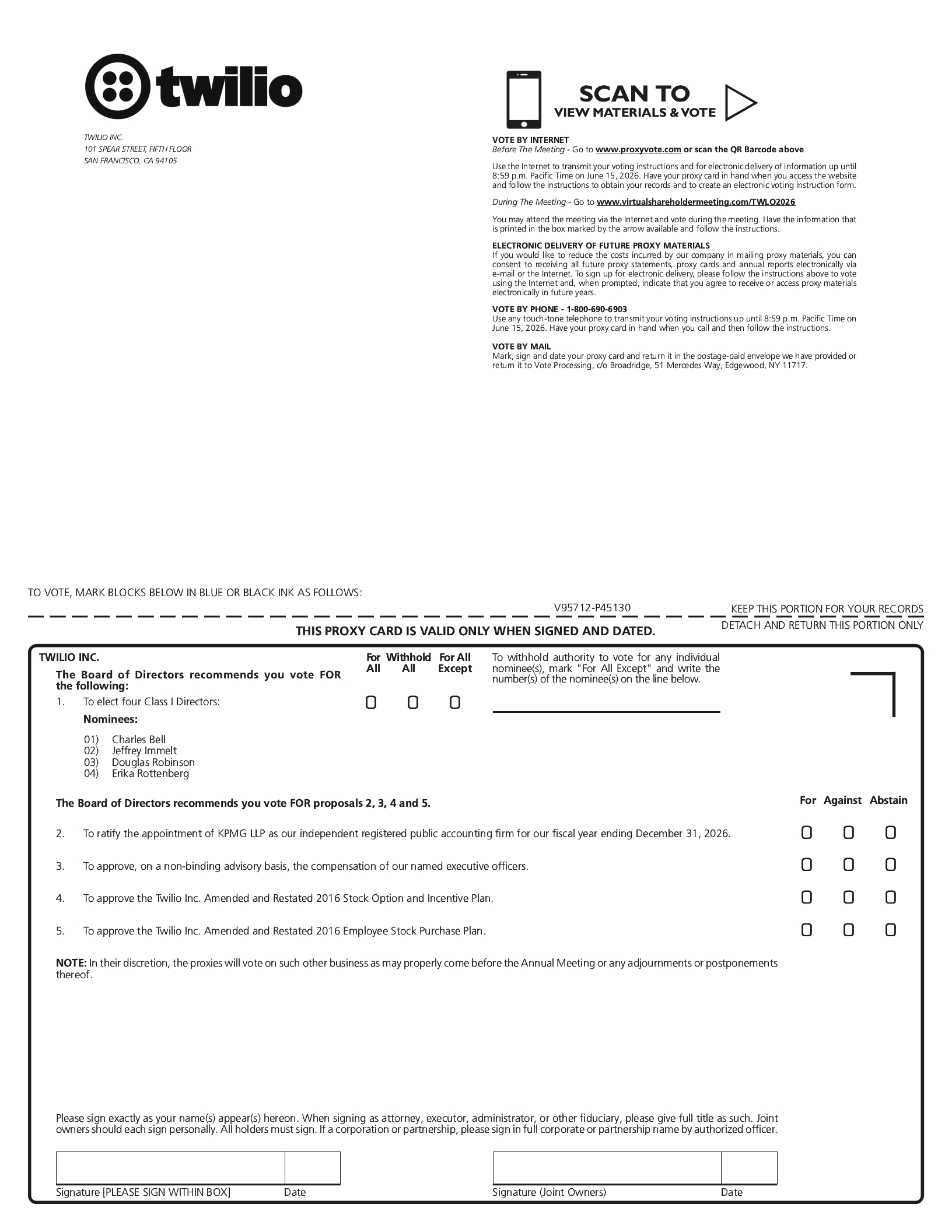
The Annual Meeting will be a virtual meeting held via live audio webcast. You will be able to attend the meeting, vote your shares and submit your questions during the meeting at www.virtualshareholdermeeting.com/TWLO2026. As always, we encourage you to vote your shares prior to the Annual Meeting either via the internet, by telephone or by mail to help make this meeting format as efficient as possible.
Our board of directors has fixed the close of business on April 17, 2026 as the record date for the Annual Meeting. Only stockholders of record as of the close of business on April 17, 2026 are entitled to notice of and to vote at the Annual Meeting. Further information regarding voting rights and the matters to be voted upon are presented in the accompanying proxy statement.
This proxy statement and our annual report can be accessed directly at www.proxyvote.com. You will be asked to enter the 16-digit control number located on your proxy card.
YOUR VOTE IS IMPORTANT. Whether or not you plan to attend the Annual Meeting, we urge you to submit your vote as soon as possible to ensure that your shares are represented. For additional instructions on how to vote your shares, please refer to your proxy card. Voting your shares by proxy prior to the Annual Meeting does not deprive you of your right to attend the Annual Meeting and to vote your shares at the Annual Meeting.
By order of the board of directors,
 
 
Khozema Shipchandler
Chief Executive Officer and Director
San Francisco, California
April 28, 2026
We appreciate your
continued support of Twilio. 

TABLE OF CONTENTS


Table of Contents
2026 Proxy Statement
i

TABLE OF CONTENTS

Table of Contents

ii
2026 Proxy Statement

TABLE OF CONTENTS


Proxy Statement Summary
This proxy statement and the enclosed form of proxy are furnished in connection with the solicitation of proxies by our board of directors for use at the 2026 annual meeting of stockholders of Twilio Inc., a Delaware corporation (referred to in this proxy statement as “Twilio,” the “Company,” “we,” “us,” or “our”), and any postponements, adjournments or continuations thereof (the “Annual Meeting”).
This summary highlights information contained elsewhere in this proxy statement. This summary does not contain all of the information you should consider, and you should read the entire proxy statement carefully before voting. Information contained on, or that can be accessed through, our website is not intended to be incorporated by reference into this proxy statement and references to our website address in this proxy statement are inactive textual references only.
Information About Our 2026 Annual Meeting of Stockholders
The Annual Meeting will be held virtually on June 16, 2026 at 9:00 a.m. Pacific Time via live audio webcast. We encourage you to access the Annual Meeting before it begins. Online check-in will start at approximately 8:45 a.m. Pacific Time on June 16, 2026. You will be able to attend the virtual Annual Meeting, vote your shares electronically and submit your questions during the live audio webcast of the meeting by visiting www.virtualshareholdermeeting.com/TWLO2026 and entering your 16-digit control number located on your proxy card. The Notice of Internet Availability of Proxy Materials (the “Notice”) containing instructions on how to access this proxy statement and our annual report is first being mailed on or about April 28, 2026 to all stockholders entitled to vote at the Annual Meeting.
Additional information about these proxy materials and the Annual Meeting is provided in “question and answer” format commencing on page 90 of this proxy statement.
How to Vote

By Phone

1-800-690-6903
Vote must be received by 8:59 p.m.
Pacific Time, June 15, 2026


By Internet Before the Meeting

www.proxyvote.com
Vote must be received by 8:59 p.m.
Pacific Time, June 15, 2026


By Mail

Return your completed proxy card in the prepaid envelope
Vote must be received by 8:59 p.m.
Pacific Time, June 15, 2026

By Internet During the Meeting

www.virtualshareholdermeeting.com/TWLO2026
Vote must be submitted before the polls close during the Annual Meeting
Voting Matters and Vote Recommendation
Items of Business
Board’s
Recommendation
More
Information
1.
The election of Charles Bell, Jeffrey Immelt, Douglas Robinson and Erika Rottenberg as directors.
FOR
Page 32
2.
The ratification of the appointment of KPMG LLP as our independent registered public accounting firm for our fiscal year ending December 31, 2026.
FOR
Page 33
3.
The approval, on a non-binding advisory basis, of the compensation of our named executive officers.
FOR
Page 35
4.
The approval of the Twilio Inc. Amended and Restated 2016 Stock Option and Incentive Plan.
FOR
Page 36
5.
The approval of the Twilio Inc. Amended and Restated 2016 Employee Stock Purchase Plan.
FOR
Page 49
2026 Proxy Statement
1

TABLE OF CONTENTS

Proxy Statement Summary

Financial and Business Highlights
Business Update
We envision a world in which every digital interaction is amazing. By combining our leading communications capabilities with rich contextual data and artificial intelligence (“AI”), we provide the infrastructure for businesses of all sizes to revolutionize how they engage with their customers by delivering seamless, trusted, and personalized customer experiences at scale.
We offer highly customizable communications application programming interfaces (“APIs”) that enable developers to embed numerous forms of messaging, voice, email, and video interactions into their customer-facing applications, as well as software products that target specific engagement needs, including our digital engagement centers, marketing campaigns, and user authentication and identity solutions. This combination of flexible APIs and software solutions, together with our customer data capabilities, helps businesses of all sizes and across numerous industries to benefit from smarter and more streamlined engagement at every step of the customer journey, including reduced customer acquisition costs, lasting loyalty, and increased customer value. The value proposition of our offerings has become stronger and our products have become more strategic to our customers as businesses are increasingly prioritizing building more personalized and differentiated customer engagement experiences through digital channels.
In recent years, we have taken action to better position our business for durable, profitable growth. Key highlights include:
Achieved Full-Year GAAP Profitability: We achieved our first ever year of GAAP operating profitability in 2025.
Announced a Three-Year Financial Framework: We hosted a successful investor day event in January 2025, announcing a three-year financial framework through 2027 for durable, profitable growth, as well as capital allocation and returns.
Accelerated Organic Growth: We accelerated year-over-year revenue growth to 14% in 2025, compared to 7% for 2024, and accelerated year-over-year organic revenue growth to 13% for 2025, compared to 9% for 2024.(1)
Innovation: We have continued to build innovation velocity, with a focus on delivering a single, cohesive platform that serves as the foundational infrastructure layer embedding communications, contextual data, and AI in one place.
Improved Operational Efficiency: We reduced operating expenses year-over-year in 2025, and advanced initiatives to optimize our business and reduce costs, including through simplifying, modernizing and automating business processes and infrastructure, enhancing our self-serve channel, leveraging AI, and optimizing our workforce.
Strengthened Free Cash Flow Profile: We increased our annual net cash provided by operating activities and free cash flow generation by nearly $1.3 billion between 2022 and 2025.(1)
Reduced Stock-Based Compensation: We have transformed our equity compensation practices in recent years, yielding significant improvements in our stock-based compensation expense and equity burn rate. At our 2025 investor day, we introduced 2027 targets for stock-based compensation expense of approximately 10% of revenue and a net burn rate of less than 3%. In 2025, stock-based compensation expense was 12% of revenue, reflecting a reduction of 200 basis points year-over-year and 900 basis points since 2022, and net burn was just 1.5%.(2)
Returned Capital to Shareholders: We completed $3.9 billion in aggregate share repurchase authorizations from 2023 through 2025, reducing total shares outstanding by approximately 18% during the period. In January 2025, our board of directors authorized $2 billion in additional share repurchases expiring at the end of 2027, of which approximately $1.1 billion remained entering into 2026.
(1)
Organic revenue and free cash flow are non-GAAP financial measures. See Appendix C for non-GAAP definitions and reconciliations.
(2)
The net burn target for 2027 announced at our 2025 investor day reflects the number of shares underlying equity awards granted to employees during the year, net of forfeitures, divided by the prior year ending share count, and therefore does not reflect the impact of share repurchases during the year.
2
2026 Proxy Statement

TABLE OF CONTENTS


Proxy Statement Summary
Financial Performance and Capital Allocation
We are focused on creating long-term value for our stockholders by continuing to drive durable, profitable growth. Our 2025 financial highlights include the following:
Revenue of $5.1 billion, up 14% year-over-year. Organic revenue growth of 13% year-over-year.(1)
GAAP income from operations of $158 million in 2025, compared with GAAP loss from operations of $54 million in 2024.
Non-GAAP income from operations of $924 million in 2025, compared with non-GAAP income from operations of $714 million in 2024.(1)
Net cash provided by operating activities of $1.0 billion in 2025, compared with net cash provided by operating activities of $716 million in 2024.
Free cash flow of $945 million in 2025, compared with free cash flow of $657 million in 2024.(1)
Repurchased an aggregate of $855 million(1) worth of shares of our common stock in 2025, which represents over 90% of free cash flow for the period.(2)
(1)
Includes related costs.
(2)
Organic revenue growth, non-GAAP income from operations, and free cash flow are non-GAAP financial measures. See Appendix C for non-GAAP definitions and reconciliations.
2026 Proxy Statement
3

TABLE OF CONTENTS

Proxy Statement Summary

Corporate Governance Highlights
Our corporate governance practices are described in the section titled “Board of Directors and Corporate Governance” below, including the following highlights:
  
Independent board chair
  
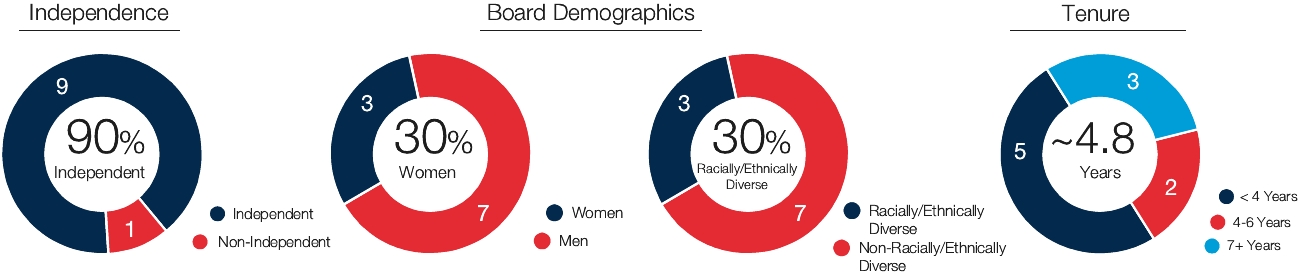
Highly independent board (9/10 directors)
  
100% independent board committees
  
Regular executive sessions of independent directors
  
Risk oversight by board and committees
  
Board oversight of strategy and business plans
  
Robust annual stockholder engagement program
  
Thoughtful board refreshment process (added five new independent directors since 2021)
  
Highly qualified board with a broad range of skills, backgrounds, and experiences aligned with our strategic priorities
  
Annual board and committee evaluations
  
CEO evaluation process
  
Succession planning process
  
No supermajority voting provision in bylaws (removed in January 2025)
  
No supermajority voting provisions in certificate of incorporation (removed in June 2025)
  
Declassifying board (phase-out commencing at the 2026 Annual Meeting)
  
Annual say-on-pay vote
  
One share, one vote
  
Stock ownership guidelines for directors and executive officers
  
Robust code of conduct and corporate governance guidelines
  
Regular review of corporate governance policies and committee charters
  
Policy prohibiting hedging, pledging and short sales
Evolution of Corporate Governance
Twilio is committed to strong corporate governance. We believe that robust corporate governance policies and practices are critical to the effective management of our business, helping ensure that our business functions at its best and serves the long-term interests of our stockholders.
Since becoming a public company in 2016, our board and governance practices have evolved to reflect our strategic priorities, the changing needs of our business, practices of our peers and stockholder feedback.
As part of this evolution, we have regularly refreshed our board, with eight of nine independent directors added subsequent to the IPO and five of those added since the beginning of 2021, including most recently appointing Doug Robinson in March 2026. Our thoughtful and deliberate board refreshment process has focused on adding critical skills and qualifications to our board to help Twilio navigate strategic opportunities and challenges. Moreover, as part of this refreshment process, we have sought highly qualified directors representing a broad range of expertise, backgrounds, and perspectives, leading to a board that is composed of directors with a wide range of skills and experiences relevant to Twilio.
4
2026 Proxy Statement

TABLE OF CONTENTS


Proxy Statement Summary
 
 
2023
Transitioned to a one-share, one-vote capital structure, eliminating our legacy dual-class structure.
Implemented a year-round engagement program, featuring formal meetings with our stockholders in the spring and fall. Many of the changes to both our corporate governance and executive compensation practices in recent years reflect the board’s responsiveness to stockholder feedback and priorities. See our “Stockholder Engagement” section below for further details of our engagement program.
2024
Appointed Khozema Shipchandler as Chief Executive Officer, reflecting the board's deliberate and thoughtful approach to succession planning.
Separated the roles of board chair and Chief Executive Officer and appointed Jeff Epstein, who has served as our lead independent director since December 2017, to the role of independent board chair.
2025
Amended our bylaws to eliminate supermajority voting provisions.
At our 2025 Annual Meeting:
  
Sought and obtained stockholder approval to eliminate supermajority voting provisions from our amended and restated certificate of incorporation (our “certificate of incorporation”); and
  
Obtained stockholder approval to declassify the board of directors; directors standing for election will be elected to one-year terms beginning at this year’s Annual Meeting, and our board of directors will be declassified as of the conclusion of our 2028 annual meeting of stockholders.
We are committed to ensuring that our corporate governance practices, as part of our broader strategy, best position Twilio for future success. We will continue to evaluate and evolve our corporate governance profile, taking into account the best interests of the Company and feedback we receive from our stockholders.
2026 Proxy Statement
5

TABLE OF CONTENTS


Stockholder Engagement
Annual Stockholder Engagement Cycle
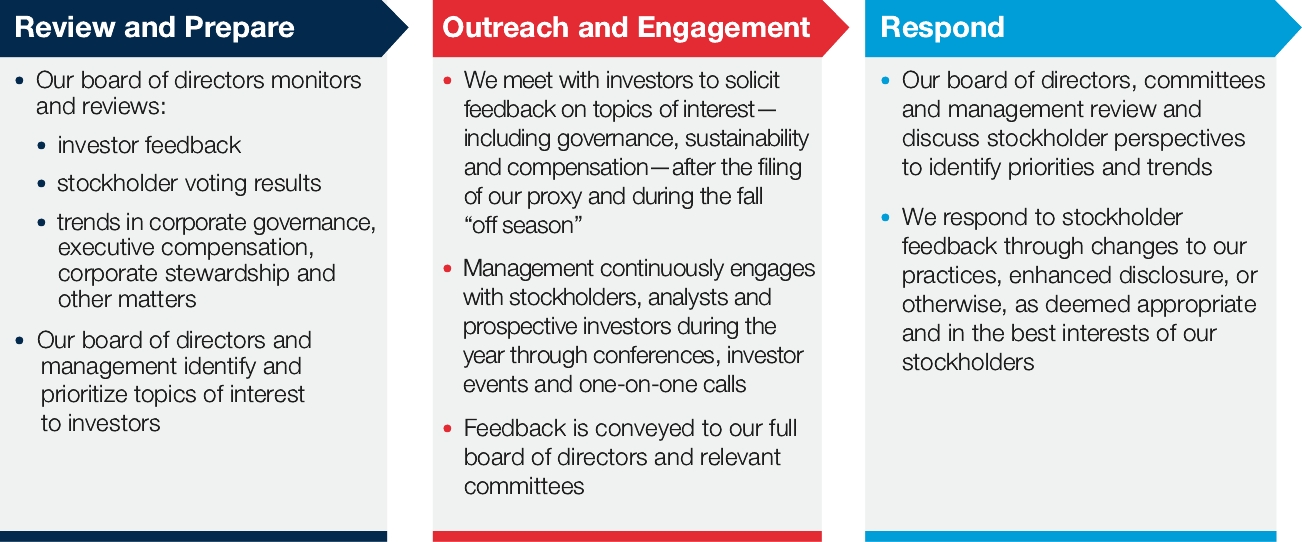
We are committed to ensuring the perspectives of our stockholders are understood and incorporated into Twilio’s decision making. Throughout the year, our board of directors and management regularly review and consider feedback received from our stockholders, including through meetings with stockholders, voting results, and other routine communications. This dialogue facilitates transparency, helps us better understand the perspectives of our stockholders and allows our board of directors to make better informed decisions throughout the year.

In 2025, we conducted two main rounds of stockholder outreach—one in the spring and one in the fall. During 2025 engagement we reached out to 29 institutional investors holding approximately 61.8% of our shares outstanding and held meetings with five institutional investors holding approximately 22% of our shares outstanding.
6
2026 Proxy Statement

TABLE OF CONTENTS


Stockholder Engagement
Stockholder Feedback
In the course of our discussions with stockholders, we have received valuable feedback on our compensation and corporate governance practices, including considerable support for our responsiveness and changes made in recent years. Such feedback was conveyed to our full board of directors and relevant committees for consideration in their decision making. Our consideration of the feedback from stockholders regarding our compensation of our named executive officers is further discussed in “Executive Compensation—Compensation Discussion and Analysis—Stockholder Feedback and Our Annual Say-on-Pay Vote”.
Key topics we have discussed with stockholders include:
What We Heard
How We Responded
Executive Compensation
Pay and performance alignment
We did not increase base salaries of our named executive officers in 2025, for the second year in a row.
In 2025, we reduced the approved target value of equity awards granted to each of our named executive officers by more than 15%.
 In 2025, we reduced the target bonus opportunity for our Chief Financial Officer.
We used an updated peer group to assess 2025 compensation, which reflects a set of companies with comparable market capitalization and revenue. Among the updates were adding more cloud-based software companies that would improve our market capitalization positioning within our peer group to be closer to the median, while pursuing balance overall between software companies and those focused more on internet infrastructure and communications, and removing several companies that significantly exceeded our market capitalization.
Manage compensation-related stockholder dilution
At our 2025 investor day, we introduced a target to reduce stock-based compensation expense to approximately 10% of revenue for 2027. In 2025, stock-based compensation expense was 12% of revenue, reflecting a reduction of 200 basis points year-over-year and a reduction of 900 basis points since 2022.
We also introduced a 2027 net burn rate target of less than 3%, and achieved net burn of just 1.5% in 2025.(1)
PSU structure
We received positive stockholder feedback on our performance-based restricted stock unit (“PSU”) awards structure introduced in 2024, and in 2025, we again granted PSUs with a three-year performance period, with vesting based on the achievement of (i) three-year cumulative free cash flow targets (70% weighting) and (ii) our relative total stockholder return measured against the S&P 500 Index over a three-year period (30% weighting). No portion of the 2025 PSUs is eligible to vest until 2028.
Continue use of short-term incentive plan
We received positive stockholder feedback on our annual cash bonus plan for executives that we implemented in 2024, and in 2025 we awarded annual cash bonuses as a short-term incentive with rigorous performance metrics and targets, with 2025 target opportunities based on the achievement of (i) organic revenue growth targets (50% weighting) and (ii) non-GAAP income from operations targets (50% weighting).
(1)
The net burn rate target for 2027 announced at our 2025 investor day reflects the number of shares underlying equity awards granted to employees during the year, net of forfeitures, divided by the prior year ending share count, and therefore does not reflect the impact of share repurchases during the year.
2026 Proxy Statement
7

TABLE OF CONTENTS

Stockholder Engagement

What We Heard
How We Responded
Corporate Governance
Annual director elections
At our 2025 annual meeting of stockholders, we sought and obtained stockholder approval to declassify our board of directors. Directors standing for election will be elected to one-year terms beginning at the Annual Meeting, and our board of directors will be fully declassified as of the conclusion of our 2028 annual meeting of stockholders.
Majority vote standard
In January 2025, we amended our bylaws to eliminate supermajority voting provisions, and at our 2025 annual meeting of stockholders, we sought and obtained stockholder approval to eliminate supermajority voting provisions from our certificate of incorporation. Amendments to our certificate of incorporation, unless otherwise provided by law, require the affirmative vote of the holders of a majority of the voting power of our outstanding stock entitled to vote thereon.
Board composition and refreshment
Since the beginning of 2021, we have added five new independent directors, including most recently appointing Doug Robinson, each of whom bolsters oversight by our board of directors in areas critical to our business strategy, bringing additional skills and diverse perspectives to our board of directors.
We remain committed to ongoing stockholder dialogue and to ensuring that our governance, executive compensation and corporate stewardship priorities align with stockholder expectations and our strategic objectives.
8
2026 Proxy Statement

TABLE OF CONTENTS


Board of Directors and Corporate Governance
Board of Directors
Our business and affairs are managed under the direction of a highly independent, experienced and qualified board of directors. Our board of directors, through our nominating and corporate governance committee, proactively evaluates its composition in the context of our company’s evolving business needs and has taken a thoughtful approach to board composition. Our board of directors and the nominating and corporate governance committee believe the skills, qualities, attributes, experience and backgrounds of our directors provide us with the right range of perspectives to effectively address our evolving needs and represent the best interests of our stockholders. Our board of directors also oversees our stockholder engagement program and reviews investor feedback, which allows us to better understand the perspectives of our stockholders and to take this feedback into account as we shape the composition of our board of directors.

Our board of directors currently consists of ten directors. All of our board members, other than our CEO, Mr. Shipchandler, qualify as “independent” under the listing standards of the New York Stock Exchange. While our board of directors is currently divided into three classes of directors, we have begun to phase out our classified board structure such that our board of directors will be fully declassified as of the conclusion of the 2028 annual meeting of stockholders. In eliminating the classified board structure, beginning with the Annual Meeting, directors whose terms expire will stand for election to serve for a one-year term instead of a three-year term. No director’s existing term was shortened. Directors, subject to the phase-out of the classified board structure, serve until the next annual meeting of stockholders and until their successors are elected and qualified, subject to earlier resignation or removal.
2026 Proxy Statement
9

TABLE OF CONTENTS

Board of Directors and Corporate Governance

The following table sets forth the names, ages as of March 31, 2026, and certain other information for each of the members of our board of directors with terms expiring at the Annual Meeting (who are also nominees for election as a director at the Annual Meeting) and for each of the continuing members of our board of directors.
 
Class*
Age
Director
Since
Current
Term
Expires
Expiration
of Term
for Which
Nominated
Independent
Audit
Committee
Compensation
and Talent
Management
Committee
Nominating
and
Corporate
Governance
Committee
Directors with Terms Expiring at the Annual Meeting/Nominees
Charles Bell
I
68
2023
2026
2027
 
 
Jeffrey Immelt
I
70
2019
2026
2027
 
 
Douglas Robinson
I
53
2026
2026
2027
 
 
Erika Rottenberg
I
63
2016
2026
2027
 
 
Continuing Directors
Donna Dubinsky
III
70
2018
2028
 
 
Jeff Epstein
II
69
2017
2027
 
 
Deval Patrick
III
69
2021
2028
 
 
Khozema Shipchandler
II
52
2024
2027


Andrew Stafman
II
38
2024
2027
 
 
Miyuki Suzuki
III
65
2022
2028
 
 
Committee Chair
Committee Member
Independent Board Chair
*
As described elsewhere in this proxy statement, the classes of our board of directors are being phased out commencing at our Annual Meeting. Directors elected at and after our Annual Meeting will be elected to one-year terms, and our board of directors will be declassified effective as of the conclusion of our 2028 annual meeting of stockholders.
10
2026 Proxy Statement

TABLE OF CONTENTS


Board of Directors and Corporate Governance
Board Skills and Experience Matrix
Our nominating and corporate governance committee periodically evaluates the composition of our board of directors in the context of our company’s evolving business needs to ensure that our directors have the skillsets, experiences and backgrounds that collectively add value to the strategic decisions made by our company, that enable them to provide oversight of management, risk, business operations, and corporate strategy, and that allow our board of directors to best fulfill its responsibilities to the long-term interests of our stockholders. This has resulted in the addition of five new independent directors to our board of directors since the beginning of 2021. Summarized below are the skills and experience that we consider important for our directors in light of our business strategy, structure, and market dynamics. Our board of directors and the nominating and corporate governance committee believe the skills, qualities, attributes, experience and backgrounds of our directors provide us with a broad range of perspectives to effectively address our evolving needs and represent the best interests of our stockholders.
 
Bell
Dubinsky
Epstein
Immelt
Patrick
Robinson
Rottenberg
Shipchandler
Stafman
Suzuki
Technology and Software Industry
Deep insight in the technology and software industries to oversee our business and the risks we face related to those industries, including AI.


Communications Industry
Deep insight in the communications industry to oversee our business and the risks we face related to that industry.


Public Company Board
Experience to understand the dynamics and operation of a public company.


Public Company Executive / Senior Leadership
Experience in senior leadership positions at a public company to analyze, advise and oversee management in decision making, operations and policies.


Finance / Accounting / Audit
Knowledge of financial markets, financing and accounting and financial reporting processes.


Sales and Marketing
Sales and marketing experience to provide expertise and guidance to grow sales and enhance our brand.


Human Capital / Compensation / Employee Development and Training
Experience attracting and retaining top talent to advise and oversee our people and compensation policies in our competitive environment.


Global Business Operations
Experience and knowledge of global operations, business conditions and culture to advise and oversee our global business.


Risk Management
Experience in risk oversight.


Regulatory / Government / Public Policy
Experience in governmental and regulatory affairs.


Cybersecurity / Information Security / Privacy
Expertise to oversee cybersecurity, information security, and privacy management.


Strategy / Business Development / M&A
Experience creating long-term value through investment, acquisitions and growth strategies.


Corporate Governance
Experience in corporate governance, compliance, policy, investor relations and creating long term sustainable value.


2026 Proxy Statement
11

TABLE OF CONTENTS

Board of Directors and Corporate Governance

Nominees for Director


Charles Bell
Age: 68
Director Since: 2023
Independent
Committees:
Audit
Other Public Company Board Experience within Last 5 Years:
None
Experience:
Mr. Bell has served as a member of our board of directors since March 2023. Since February 2026, Mr. Bell has served as Executive Vice President, Engineer at Microsoft, Inc. (“Microsoft”), a global software and technology company, which he joined in 2021 as Executive Vice President, Security, Compliance, Identity, and Management. From 1998 to 2021, Mr. Bell served in several roles at Amazon.com, Inc. (“Amazon”), an e-commerce and cloud computing company, including as Senior Vice President of Utility Computing from 2016 to 2021, Vice President of Utility Computing from 2005 to 2016, Vice President of eCommerce Platform from 2003 to 2005, and Vice President of Infrastructure from 1998 to 2003. Mr. Bell holds a B.A. in Business Administration, Information Systems Concentration from California State University, Fullerton.
Qualifications:
With his extensive experience in internet information technology, platform software, cloud computing and cybersecurity, including as Executive Vice President, Engineer and former Executive Vice President, Security, Compliance, Identity and Management at Microsoft, and as the former Senior Vice President of Utility Computing responsible for Amazon Web Services at Amazon, Mr. Bell brings a deep understanding of the technology industry and significant cybersecurity expertise to our board of directors. From his experience in executive leadership roles at multinational companies, Mr. Bell also brings a critical understanding of financial, operational, risk management, and regulatory compliance issues.


Jeffrey Immelt
Age: 70
Director Since: 2019
Independent
Committees:
Compensation and Talent Management (Chair)
Other Public Company Board Experience within Last 5 Years:
Bloom Energy Corporation (2019-present)
Desktop Metal, Inc. (2018-2025)
NeueHealth, Inc. (formerly Bright Health Group, Inc.) (2020-2025)
Hennessy Capital Investment Corp. V (2021-2022)
Tuya Inc. (2021-2022)
Experience:
Mr. Immelt has served as a member of our board of directors since June 2019. Mr. Immelt is a venture partner of New Enterprise Associates (“NEA”), a venture capital firm, which he joined in 2018. From 2001 to 2017, Mr. Immelt served as Chairman and Chief Executive Officer of General Electric Company (“General Electric”). Prior to being appointed Chief Executive Officer, Mr. Immelt held several global leadership roles at General Electric from 1982 to 2000. Mr. Immelt serves on the boards of directors of certain of NEA’s portfolio companies, among others, and previously served as a director of the Federal Reserve Bank of New York, as chairman of the U.S. Presidential Council on Jobs and Competitiveness and as a trustee of Dartmouth College. He holds a B.A. in Applied Mathematics from Dartmouth College and an M.B.A. from Harvard University.
Qualifications:
With his extensive experience as a chief executive and director of global businesses, including as the former Chief Executive Officer and Chairman of General Electric, Mr. Immelt brings to our board of directors a deep expertise in global business and financing strategy, as well as insight into managing all aspects of a multinational business, including operations, sales and marketing, human capital management, executive compensation, and global markets. In addition, Mr. Immelt’s extensive public company board experience gives Mr. Immelt a strong understanding of his role as a director and a broad perspective on key industry issues and corporate governance matters. As a partner of a venture capital firm, Mr. Immelt also brings knowledge of the current landscape of emerging technologies and companies in our industry.
12
2026 Proxy Statement

TABLE OF CONTENTS


Board of Directors and Corporate Governance


Douglas Robinson
Age: 53
Director Since: 2026
Independent
Committees:
Compensation and Talent Management
Other Public Company Board Experience within Last 5 Years:
None
Experience:
Douglas Robinson has served as a member of our board of directors since March 2026. From 2010 to 2025, Mr. Robinson served in several roles at Workday, Inc., a global software and technology company (“Workday”), including as Co-President from 2021 to 2025, Executive Vice President, Global Sales from February 2021 to November 2021, and Senior Vice President, Sales-Americas from 2018 to 2021. Prior to Workday, Mr. Robinson served in various sales roles at Oracle Corporation and PeopleSoft, Inc. Mr. Robinson holds a B.B.A. in Finance and Management Information Systems from Ohio University.
Qualifications:
With his extensive experience in the technology and software industry, including a 15-year Workday career where, most recently as company Co-President, he was responsible for overseeing Workday’s GTM efforts across the globe and all industries and for driving Workday’s continued revenue growth in new and emerging markets, Mr. Robinson brings a deep understanding of the technology industry and significant enterprise applications expertise to our board of directors. From his experience serving in executive leadership roles in the technology industry, he also brings extensive knowledge of sales, strategy and business development, and public company executive leadership.


Erika Rottenberg
Age: 63
Director Since: 2016
Independent
Committees:
Nominating and Corporate Governance (Chair)
Other Public Company Board Experience within Last 5 Years:
None
Experience:
Ms. Rottenberg has served as a member of our board of directors since June 2016. From March 2022 to December 2023, Ms. Rottenberg served as a Strategic Advisor at the Chan Zuckerberg Initiative, a philanthropic initiative, after having served as its Vice President and General Counsel from 2018 to 2022. From 2008 to 2014, Ms. Rottenberg served as Vice President, General Counsel and Secretary at LinkedIn Corporation (“LinkedIn”), a professional networking company. From 2004 to 2008, Ms. Rottenberg served as Senior Vice President, General Counsel and Secretary at SumTotal Systems, Inc., a talent management enterprise software company. From 1996 to 2002, Ms. Rottenberg served in several roles at Creative Labs, Inc., a computer peripheral and digital entertainment product company, including as Vice President, Strategic Development and General Counsel. From 1993 to 1996, Ms. Rottenberg served as an attorney at Cooley LLP, a law firm, specializing in corporate and employment law. Ms. Rottenberg holds a B.S. in Special and Elementary Education from the State University of New York at Geneseo and a J.D. from the University of California, Berkeley School of Law, formerly known as Boalt Hall School of Law.
Qualifications:
With her extensive experience as an executive and director of private and public technology companies, including as former General Counsel of LinkedIn, Ms. Rottenberg brings to our board of directors expertise in corporate governance, risk management oversight, business operations, and legal, policy and compliance matters, including privacy, security and intellectual property. Ms. Rottenberg has a deep understanding of the complex legal, regulatory and corporate governance issues that we face as a global, publicly traded technology company.
2026 Proxy Statement
13

TABLE OF CONTENTS

Board of Directors and Corporate Governance

Continuing Directors


Donna Dubinsky
Age: 70
Director Since: 2018
Independent
Committees:
Nominating and Corporate Governance
Other Public Company Board Experience within Last 5 Years:
None
Experience:
Ms. Dubinsky has served as a member of our board of directors since December 2018. From 2022 to 2023, Ms. Dubinsky served as a Senior Counselor to the U.S. Secretary of Commerce, Gina Raimondo. In 2005, Ms. Dubinsky co-founded Numenta, Inc. (“Numenta”), a machine intelligence company, where she served as Chief Executive Officer from 2005 to 2022 and as Board Chair from 2005 to 2024. Ms. Dubinsky also co-founded Handspring, Inc. (“Handspring”), a maker of personal digital assistants, and served as its President and Chief Executive Officer from 1998 to 2003 and as Acting Chief Financial Officer from 2002 to 2003. From 1992 to 1998, Ms. Dubinsky served as President and Chief Executive Officer of Palm Computing, Inc. (“Palm”), one of the first companies to develop and design handheld computers and smartphones. From 2023 to 2025, Ms. Dubinsky served on the board of Natcast, Inc., a non-profit entity focused on semiconductor research, and she previously served on the board of Intuit Inc. and Yale University, including two years as Senior Fellow. Ms. Dubinsky holds a B.A. from Yale University and an M.B.A. from Harvard Business School.
Qualifications:
With her extensive experience founding and managing technology companies, including Palm, Handspring, and Numenta, Ms. Dubinsky brings to our board of directors experience as a successful entrepreneur with demonstrated expertise and knowledge in business strategy, innovation, artificial intelligence, executive leadership growth, an in-depth understanding of the technology landscape and valuable insight on growing a company from a start-up to a publicly traded company. Her experience working with the federal government adds depth to her understanding of governmental and regulatory affairs.


Jeff Epstein
Age: 69
Director Since: 2017
Independent
Committees:
Audit (Chair)
Other Public Company Board Experience within Last 5 Years:
Autodesk, Inc. (2025-present)
AvePoint, Inc. (2021-present)
Okta, Inc. (2021-present)
Couchbase, Inc. (2015-2025)
Poshmark, Inc. (2018-2023)
Shutterstock, Inc. (2012-2021)
Experience:
Mr. Epstein has served as a member of our board of directors since July 2017. Mr. Epstein is an Operating Partner at Bessemer Venture Partners, a venture capital firm, which he joined in 2011. Prior to Bessemer Venture Partners, Mr. Epstein served as Chief Financial Officer of several public and private companies, including Oracle Corporation (“Oracle”), an enterprise software company, and DoubleClick Inc. (“DoubleClick”), an internet advertising company, which was acquired by Google LLC. Mr. Epstein holds a B.A. from Yale University and an M.B.A. from Stanford University.
Qualifications:
With his extensive experience as an investor, director and senior financial executive at public and private companies, including as former Chief Financial Officer at Oracle and DoubleClick, and as Operating Partner at Bessemer Venture Partners, Mr. Epstein brings to our board of directors in-depth knowledge of the complex accounting, financial and operational issues facing large global companies, with particular expertise in the software industry, and an understanding of accounting principles and financial reporting rules and regulations. In addition, Mr. Epstein’s service on several boards of directors and audit committees of other publicly traded companies give him significant insight into the preparation of financial statements and knowledge of audit procedures as well as risk management oversight.
14
2026 Proxy Statement

TABLE OF CONTENTS


Board of Directors and Corporate Governance


Deval Patrick
Age: 69
Director Since: 2021
Independent
Committees:
Nominating and Corporate Governance
Other Public Company Board
Experience within Last 5 Years:
Toast Inc. (2021-present)
Cerevel Therapeutics Holdings, Inc. (2021-2024)
American Well Corporation (2015-2019, 2020-2024)
Environmental Impact Acquisition Corp. (2021-2022)
Global Blood Therapeutics, Inc. (2015-2019, 2020-2022)
Experience:
Mr. Patrick has served as a member of our board of directors since January 2021. Since 2024, Mr. Patrick has served as Senior Partner at The Vistria Group, a leading impact investment firm, which he initially joined in 2024 as Senior Advisor. From 2022 to 2025, Mr. Patrick served as the David R. Gergen professor of the practice of public leadership at the Harvard Kennedy School, where he also served as co-director of the Center for Public Leadership from 2022 until 2024. From 2021 to 2023, he served as a Senior Advisor to Bain Capital LLC (“Bain Capital”), where, from 2015 to 2019, he previously founded and served as Managing Partner of the Double Impact Fund, a growth equity fund focused on delivering competitive financial returns and positive social impact. Previously, from 2007 to 2015, Mr. Patrick served as Governor of the Commonwealth of Massachusetts. Mr. Patrick holds an A.B. from Harvard College and a J.D. from Harvard Law School.
Qualifications:
With his extensive experience in leadership roles in both the public and private sectors, including as Senior Partner at The Vistria Group and former Governor of the Commonwealth of Massachusetts and advisor to Bain Capital, Mr. Patrick brings to our board of directors expertise in leadership, public policy, investment, and the economy. Mr. Patrick also has experience serving on boards of directors of public companies across the biopharmaceutical, healthcare and technology industries, which provides valuable insight into oversight of risk management and regulatory compliance.


Khozema Shipchandler
Age: 52
Director Since: 2024
Committees:
None
Other Public Company Board Experience within Last 5 Years:
Ethos Technologies Inc. (2026-present)
Smartsheet Inc. (2023-2025)
Experience:
Mr. Shipchandler has served as our Chief Executive Officer and as a member of our board of directors since January 2024. Prior to that, Mr. Shipchandler served as our President, Twilio Communications from March 2023 to January 2024, as our Chief Operating Officer from 2021 to 2023, and as our Chief Financial Officer from 2018 to 2021. From 2015 to 2018, Mr. Shipchandler served as Chief Financial Officer and Executive Vice President of Corporate Development at GE Digital, an operational technology and infrastructure software company that is a division of General Electric, a multinational conglomerate. From 1996 to 2015, Mr. Shipchandler served in various executive roles at General Electric, including as Chief Financial Officer, Middle East, North Africa and Turkey from 2011 to 2013. Mr. Shipchandler holds a B.A. in English and Biology from Indiana University Bloomington.
Qualifications:
With over 25 years of experience growing businesses and driving financial performance across global, public organizations, Mr. Shipchandler brings to our board of directors significant operational and financial leadership skills and expertise, particularly related to companies in the technology and software industry. He also brings a deep and valuable understanding of Twilio’s business, operations and culture, having served in key senior executive roles at Twilio since 2018.
2026 Proxy Statement
15

TABLE OF CONTENTS

Board of Directors and Corporate Governance


Andrew Stafman
Age: 38
Director Since: 2024
Independent
Committees:
Audit
Other Public Company Board Experience within Last 5 Years:
None
Experience:
Mr. Stafman has served as a member of our board of directors since March 2024. Mr. Stafman has been a partner at Sachem Head Capital Management LP, a value-oriented investment management firm based in New York, since 2013. Prior to Sachem Head, Mr. Stafman worked as an Associate at Silver Lake Partners, a global private equity firm focused on technology-enabled investments. Mr. Stafman holds a B.S. in Economics, with a concentration in Finance, from The Wharton School at the University of Pennsylvania.
Qualifications:
During his time at Sachem Head, Mr. Stafman has led prominent activist positions and software related investments. He previously worked in private equity at Silver Lake Partners. Mr. Stafman has extensive knowledge of corporate strategy in finance and corporate governance matters as a result of his investment and private equity background.


Miyuki Suzuki
Age: 65
Director Since: 2022
Independent
Committees:
Compensation and Talent Management
Other Public Company Board Experience within Last 5 Years:
Mitsubishi UFJ Financial Group, Inc.
(2025-present)
Sandisk Corporation (2025-present)
Western Digital Corporation (2021-2025)
Experience:
Ms. Suzuki has served as a member of our board of directors since August 2022. From 2015 to 2021, Ms. Suzuki served in senior executive roles at Cisco Systems, Inc. (“Cisco”), a networking technology company, including as President, Asia Pacific, Japan and China from 2018 to 2021. From 2011 to 2015, Ms. Suzuki served as President and Chief Executive Officer of Jetstar Japan Co., Ltd, a low-cost airline. Prior to that, from 2007 to 2011, Ms. Suzuki served as President and Vice Chairman of KVH Co. Ltd. (“KVH Telecom”), a Japanese telecommunications and IT services company. Prior to that, from 2004 to 2006, Ms. Suzuki served as the Chief Executive Officer of Lexis Nexis Asia Pacific, a legal information company, and from 2002 to 2004, she served as an Executive Vice President and Head of Consumer Business of Japan Telecom Co. Ltd (“Japan Telecom”), which is now part of Softbank Telecommunications. Ms. Suzuki holds an honors degree in History from Oxford University.
Qualifications:
With her extensive experience in management roles at multinational companies in the technology, telecommunication and networking industries, including as a former senior executive at Cisco, KVH Telecom and Japan Telecom, Ms. Suzuki brings to our board of directors a critical understanding of our industry and the operational, regulatory and cybersecurity risks and challenges we face. Ms. Suzuki also has deep expertise in global operations and markets as well as experience managing a global workforce, all of which provides our board of directors with a valuable perspective as we continue to expand internationally. Ms. Suzuki also has a valuable understanding of public company governance from her public company board experience.
16
2026 Proxy Statement

TABLE OF CONTENTS


Board of Directors and Corporate Governance
Director Independence
Our Class A common stock (“common stock”) is listed on the New York Stock Exchange (“NYSE”). Under the listing standards of the NYSE (the “NYSE Listing Standards”), independent directors must comprise a majority of a listed company’s board of directors. In addition, the NYSE Listing Standards require that, subject to specified exceptions, each member of a listed company’s audit, compensation, and nominating and corporate governance committees be independent. Under the NYSE Listing Standards, a director will only qualify as an “independent director” if, in the opinion of that listed company’s board of directors, that director does not have a material relationship with the listed company (either directly or as a partner, stockholder or officer of an organization that has a relationship with such listed company).
Audit committee members must also satisfy the additional independence criteria set forth in Rule 10A-3 under the Securities Exchange Act of 1934, as amended (the “Exchange Act”) and the NYSE Listing Standards. Compensation committee members must also satisfy the additional independence criteria set forth in Rule 10C-1 under the Exchange Act and the NYSE Listing Standards.
Our board of directors has undertaken a review of the independence of each director. Based on information provided by each director concerning his or her background, employment and affiliations, our board of directors has determined that Messrs. Bell, Epstein, Immelt, Patrick, Robinson and Stafman, and Mses. Dubinsky, Rottenberg and Suzuki do not have a relationship that would interfere with the exercise of independent judgment in carrying out the responsibilities of a director and that each of these directors is “independent” as that term is defined under the NYSE Listing Standards. In making these determinations, our board of directors considered the current and prior relationships that each non-employee director has with our company and all other facts and circumstances our board of directors deemed relevant in determining their independence, including the beneficial ownership of our capital stock by each non-employee director, and any transactions involving them described in the section titled “Certain Relationships and Related Party Transactions.” None of our non-employee directors have been employed by our company over the last five years.
Board Leadership Structure
Our board of directors has determined that, at this time, having a separate board chair and Chief Executive Officer is the most effective governance framework for our business. As a result, the roles are currently separated, and Mr. Epstein, an independent director, serves as board chair. This structure allows us to benefit from Mr. Epstein’s independent oversight, while enabling Mr. Shipchandler, as our Chief Executive Officer, to focus his attention on our business operations and strategy. We believe that an independent board chair helps further facilitate relations between our board of directors, our Chief Executive Officer and other senior management, assists our board of directors in reaching consensus on particular strategies and policies, fosters robust evaluation processes, and efficiently allocates oversight responsibilities between the independent directors and management.
In accordance with our corporate governance guidelines, if our board chair were not an independent director, our board of directors would appoint an independent director to serve as lead independent director.
Independent Board Chair
As board chair, Mr. Epstein presides over meetings of our board of directors, works with senior management to prepare agendas for such meetings, serves as a liaison to facilitate and promote communication between senior management and the board of directors, assists in the board’s oversight of key governance matters, participates in engagement with stockholders on behalf of our board, and undertakes such additional duties as the board of directors determines.
Mr. Epstein is an experienced director who has served as an empowered, independent voice on our board of directors since 2017. Having served as our lead independent director and chair of our audit committee, he possesses an in-depth knowledge of our company’s strategy, operations and risks, as well as the demonstrated leadership and relationships to render him an effective liaison with senior management and a respected, expert leader on our board of directors. We believe our company and our stockholders also benefit from Mr. Epstein’s extensive outside expertise and perspective, having served for many years in senior management and board leadership roles at numerous other public companies.
2026 Proxy Statement
17

TABLE OF CONTENTS

Board of Directors and Corporate Governance

Independent Directors and Committees
Our board of directors believes that Mr. Epstein is a strong and effective board chair, serving as an independent voice at the forefront of our leadership structure.
Our independent directors regularly meet in executive sessions led by the board chair after meetings of the board of directors and committees, as needed. These executive sessions allow our independent directors to discuss, without management present, our strategy, the performance and compensation of our Chief Executive Officer and other senior management, effectiveness of our board of directors, and other matters.
Only independent directors serve on the audit committee, the nominating and corporate governance committee and the compensation committee, which we believe provides strong independent leadership and oversight for each of these committees. As a result of the board of directors’ committee system, the independence of our board chair and the existence of a significant majority of independent directors, our board of directors believes it maintains effective oversight of our business operations, including independent oversight of our financial statements, executive compensation, selection of director candidates, stockholder outreach efforts, and corporate governance programs.
Board and Committee Meetings
Our board of directors may establish the authorized number of directors from time to time by resolution. Our board of directors currently consists of ten members.
During 2025, our board of directors held four meetings (including regularly scheduled and special meetings), and each director attended at least 75% of the aggregate of (i) the total number of meetings of our board of directors held during the period for which he or she had been a director and (ii) the total number of meetings held by all committees of our board of directors on which he or she served during the periods that he or she served.
Although our corporate governance guidelines do not have a formal policy regarding attendance by members of our board of directors at annual meetings of stockholders, we encourage, but do not require, our directors to attend. Eight of the nine members of our board of directors then serving in such capacity attended our 2025 annual meeting of stockholders.
Board Committees and Responsibilities
Our board of directors has established an audit committee, a compensation and talent management committee and a nominating and corporate governance committee. The composition and responsibilities of each of the committees of our board of directors is described below. Members serve on these committees until their resignation or until otherwise determined by our board of directors.
Board of Directors
Independent
Audit Committee
Compensation and Talent
Management Committee
Nominating and Corporate
Governance Committee
Charles Bell
 
 
Donna Dubinsky
 
 
Jeff Epstein
 
 
Jeffrey Immelt
 
 
Deval Patrick
 
 
Douglas Robinson
 
 
Erika Rottenberg
 
 
Khozema Shipchandler


Andrew Stafman
 
 
Miyuki Suzuki
 
 
Independent Director
Committee Member
Committee Chair
18
2026 Proxy Statement

TABLE OF CONTENTS


Board of Directors and Corporate Governance
Audit Committee
MEMBERS
Our audit committee consists of Messrs. Epstein, Bell and Stafman, with Mr. Epstein serving as chair. Mr. Epstein has extensive experience as a Chief Financial Officer, including at Oracle and DoubleClick. Each member of our audit committee meets the requirements for independence under the NYSE Listing Standards and Securities and Exchange Commission (“SEC”) rules. Each member of our audit committee also meets the financial literacy and sophistication requirements of the NYSE Listing Standards. In addition, our board of directors has determined that Mr. Epstein is an audit committee financial expert within the meaning of Item 407(d) of Regulation S-K under the Securities Act of 1933, as amended (the “Securities Act”).
No member of our audit committee may simultaneously serve on the audit committee of more than three public companies unless our board of directors determines that such simultaneous service would not impair the ability of such member to effectively serve on our audit committee. During 2025, Mr. Epstein served on the audit committee of more than three public companies until his resignation from one of such committees in September 2025. The board of directors determined that Mr. Epstein’s simultaneous service on the audit committees of more than three public companies would not impair his ability to effectively serve on our audit committee.
Our audit committee, among other things:
• 
selects a qualified firm to serve as the independent registered public accounting firm to audit our financial statements;
• 
helps to ensure the independence and performance of the independent registered public accounting firm;
• 
discusses the scope and results of the audit with the independent registered public accounting firm, and reviews, with management and the independent registered public accounting firm, our interim and year-end results of operations;
• 
develops procedures for employees to submit concerns anonymously about questionable accounting or audit matters;
• 
reviews (i) the framework and processes by which management assesses the Company’s risk profile and risk exposure, (ii) our major risk exposures, including financial, accounting, tax, operational, AI, privacy, information and data security, cybersecurity, competition, legal and regulatory, and (iii) the Company’s processes to monitor and mitigate such exposures;
• 
evaluates and discusses with management our risks, controls and procedures related to privacy, cybersecurity and information and technology security and related disclosure;
• 
reviews related party transactions;
• 
maintains our code of conduct and considers questions of conflicts of interest; and
• 
approves or, as required, pre-approves, all audit and all permissible non-audit services, other than de minimis non-audit services, to be performed by the independent registered public accounting firm.
Our audit committee operates under a written charter that satisfies the applicable rules and regulations of the SEC and the NYSE Listing Standards. A copy of the charter of our audit committee is available on our website at https://investors.twilio.com.
Our audit committee held eight meetings during 2025.
Jeff Epstein (Chair)
Charles Bell
Andrew Stafman
INDEPENDENCE
100%
MEETINGS IN 2025
8
2026 Proxy Statement
19

TABLE OF CONTENTS

Board of Directors and Corporate Governance

Compensation and Talent Management Committee
MEMBERS
Our compensation committee consists of Messrs. Immelt and Robinson and Ms. Suzuki, with Mr. Immelt serving as chair. Each member of our compensation committee meets the requirements for independence under the NYSE Listing Standards and SEC rules (and Mr. Epstein met such requirements during his service on our compensation committee). Each member of our compensation committee is also a non-employee director, as defined pursuant to Rule 16b-3 promulgated under the Exchange Act (as was Mr. Epstein during his service on our compensation committee). Our compensation committee, among other things:
• 
reviews, determines, and approves, or makes recommendations to our board of directors regarding, the compensation of our executive officers;
• 
oversees the evaluation of our management;
• 
reviews corporate succession plans for our executive officers;
• 
administers our stock and equity compensation plans;
• 
reviews and approves, or makes recommendations to our board of directors, regarding incentive compensation and equity compensation plans;
• 
establishes and reviews general policies relating to compensation and benefits of our employees; and
• 
reviews and discusses with management our human capital management activities, including, among other things, matters relating to talent management and development, talent acquisition, employee engagement, and culture and inclusion.
Our compensation committee operates under a written charter that satisfies the applicable rules of the SEC and the NYSE Listing Standards. A copy of the charter of our compensation committee is available on our website at https://investors.twilio.com.
Our compensation committee held five meetings during 2025.
Jeffrey Immelt (Chair)
Douglas Robinson
Miyuki Suzuki
INDEPENDENCE
100%
MEETINGS IN 2025
5
20
2026 Proxy Statement

TABLE OF CONTENTS


Board of Directors and Corporate Governance
Nominating and Corporate Governance Committee
MEMBERS
Our nominating and corporate governance committee consists of Mses. Rottenberg and Dubinsky and Mr. Patrick, with Ms. Rottenberg serving as chair. Each member of our nominating and corporate governance committee meets the requirements for independence under the NYSE Listing Standards and SEC rules. Our nominating and corporate governance committee, among other things:
• 
identifies, evaluates and selects, or makes recommendations to our board of directors regarding, nominees for election to our board of directors;
• 
considers and makes recommendations to our board of directors regarding the composition of our board of directors and its committees;
• 
reviews and assesses the adequacy of our corporate governance guidelines and policies and practices and recommends any proposed changes to our board of directors;
• 
oversees and periodically reviews our environmental, social and governance activities and programs; and
• 
evaluates the performance of our board of directors and of individual directors.
Our nominating and corporate governance committee operates under a written charter that satisfies the applicable NYSE Listing Standards. A copy of the charter of our nominating and corporate governance committee is available on our website at https://investors.twilio.com.
Our nominating and corporate governance committee held four meetings during 2025.
Erika Rottenberg (Chair)
Donna Dubinsky
Deval Patrick
INDEPENDENCE
100%
MEETINGS IN 2025
4
2026 Proxy Statement
21

TABLE OF CONTENTS

Board of Directors and Corporate Governance

Director Selection and Board Evaluation
Identifying and Evaluating Director Nominees
The board of directors has delegated to the nominating and corporate governance committee the responsibility of identifying suitable candidates for nomination to the board of directors (including candidates to fill any vacancies that may occur) and assessing their qualifications in light of the policies and principles in our corporate governance guidelines and the committee’s charter. The nominating and corporate governance committee uses a variety of methods for identifying and evaluating director nominees, including retaining a third-party search firm from time to time to identify and review candidates for membership on our board of directors. The nominating and corporate governance committee may gather information about the candidates through interviews, detailed questionnaires, comprehensive background checks or any other means that the nominating and corporate governance committee deems to be appropriate in the evaluation process. The nominating and corporate governance committee then meets as a group to discuss and evaluate the qualities and skills of each candidate, both on an individual basis and taking into account the overall composition and needs of the board of directors. Based on the results of the evaluation process, the nominating and corporate governance committee recommends candidates for the board of directors’ approval as director nominees for election to the board of directors.
In March 2024, we entered into a cooperation agreement (the “Cooperation Agreement”) with Sachem Head Capital Management LP and certain of its affiliates (collectively, “Sachem Head”). Pursuant to the Cooperation Agreement, our board of directors appointed Andrew Stafman to the board of directors as a Class II director in March 2024 and Mr. Stafman was re-elected as a director by our stockholders at our 2024 annual meeting of stockholders.
The Cooperation Agreement provides for customary director replacement rights, pursuant to which we and Sachem Head have agreed to cooperate to select a successor director in the event Mr. Stafman ceases to serve as a director. Our obligation with respect to the replacement of Mr. Stafman upon departure from the board of directors terminates in certain circumstances, including if Sachem Head’s aggregate net long position in the Company falls below 50% of its beneficial ownership of our outstanding shares of common stock as of the date of the Cooperation Agreement.
The Cooperation Agreement will remain effective until the later of (i) 30 calendar days after the date on which Mr. Stafman (or any replacement director) has ceased to serve on our board of directors and (ii) one calendar day following the conclusion of the 2025 annual meeting. The foregoing description does not purport to be complete and is qualified in its entirety by reference to the Cooperation Agreement, a copy of which is filed as Exhibit 10.1 to our Current Report on Form 8-K filed with the SEC on April 1, 2024, and is incorporated by reference herein.
Minimum Qualifications and Membership on other Boards
We have a highly effective and engaged board of directors, and members of our board of directors are expected to prepare for, attend, and participate in all board of directors and applicable committee meetings and are encouraged to attend our annual meetings of stockholders. The board of directors does not believe that explicit limits on the number of other boards of directors on which the directors may serve, or on other activities the directors may pursue, are appropriate. Rather, we believe that our directors’ service on other companies’ boards enables them to contribute valuable knowledge and perspective to our board of directors. Nonetheless, the board of directors recognizes that carrying out the duties of a director requires a significant commitment of time and attention, and excessive time commitments—whether other board service or otherwise—may interfere with the ability to fulfill our board of director responsibilities. Our corporate governance guidelines require directors to notify the chair of the nominating and corporate governance committee in connection with an invitation to join the board of directors of another company, whether public or private. Directors must also regularly update the Company regarding directorships and similar positions, so that the potential for conflicts or other factors that may compromise a director’s ability to perform their duties may be fully assessed.
Our board of directors has delegated to our nominating and corporate governance committee the responsibility of identifying suitable candidates for nomination to our board of directors (including candidates to fill any vacancies that may occur) and assessing their qualifications in light of the policies and principles in our corporate governance guidelines and the nominating and corporate governance committee’s charter. Our nominating and corporate governance committee uses a variety of methods for identifying and evaluating director nominees, which may include consultation with a third-party search firm, and considers all facts and circumstances that it deems appropriate or advisable. In its identification and evaluation of director candidates, our nominating and corporate governance committee considers the current size and composition of our board of directors and the needs of our board of directors and the respective committees of our board of directors. We seek to have a board composed of highly qualified directors representing a diverse range of expertise, professional backgrounds, and perspectives, and we require that the nominating and corporate governance committee (and any third-party search firm that it
22
2026 Proxy Statement

TABLE OF CONTENTS


Board of Directors and Corporate Governance
engages) include, in each initial director search pool, qualified candidates who reflect diverse backgrounds, including diversity of gender and race/ethnicity. While we strive for a diverse mix of candidates and perspectives, all decisions are made without regard to gender, race/ethnicity, or other protected characteristics and we do not maintain a policy with respect to any specific number of diverse individuals on our board of directors. We do not utilize term or age limits, as our board of directors does not believe that arbitrary limits on the number of consecutive terms a director may serve or on a director’s age are appropriate in light of the substantial benefits resulting from a sustained focus on the Company’s business, strategy and industry over a significant period of time. Some of the qualifications that our nominating and corporate governance committee considers include:
integrity, judgment and adherence to high personal ethics and character;
demonstrated achievement and competence in their fields, business acumen, understanding of our business and industry, the ability to offer advice and guidance to our management team, the ability to make significant contributions to our success, and an understanding of the fiduciary responsibilities that are required of a director;
diversity in breadth and quality of experience, personal and professional experience, expertise, and other qualities and attributes;
skills, education and expertise;
independence and potential conflicts of interest; and
the scope and breadth of other commitments.
In addition to the above criteria, our nominating and corporate governance committee may also consider such other factors as it may deem, from time to time, to be in our and our stockholders’ best interests.
Our nominating and corporate governance committee reviews the totality of the circumstances of each nominee and each board member to assess the ability of such individuals to devote the requisite time to fulfilling the responsibilities of service on our board of directors and applicable committees. Our nominating and corporate governance committee evaluates many factors when assessing the effectiveness and active involvement of each director, including the director’s attendance at board and committee meetings, participation and level of engagement during these meetings, the director’s other time commitments, the role played by the director on our board of directors and on any other boards, including committee membership and chair designation, and the experience and expertise of the director, including both relevant industry experience and service on other public company boards, which may enable the director to serve on multiple boards effectively.
Our nominating and corporate governance committee also considers these and other factors as it oversees the annual board of directors and committee evaluations. After completing its review and evaluation of director candidates, our nominating and corporate governance committee recommends to our full board of directors the director nominees for selection.
Board Evaluation
Annually, our nominating and corporate governance committee works with an outside advisor to conduct a comprehensive evaluation of our board of directors, its committees and its individual members. The evaluation aims (i) to find opportunities where our board of directors and committees can improve their performance and effectiveness, (ii) to assess any need to evolve the composition and expertise of our board of directors and (iii) to assure that our board of directors and committees are operating in accordance with our corporate governance guidelines and committee charters. The collection of information is facilitated by an outside advisor to preserve integrity and anonymity of the members of our board of directors and our senior executives.
The nominating and corporate governance committee is responsible for designing the evaluation process and establishing the evaluation criteria. During the evaluation process, the outside advisor collects feedback from each director and members of our senior management team, and then the results of the evaluation and any recommendations for improvement are provided to our nominating and corporate governance committee and our board of directors. The board of directors and our senior executives review and discuss the evaluation results and any actions to be taken as a result of the discussion. Our board of directors, including our nominating and corporate governance committee, uses the results to inform board and committee composition, including considering the attributes and experience that are criteria for membership on our board of directors, and to address the evolving needs of our company.
2026 Proxy Statement
23

TABLE OF CONTENTS

Board of Directors and Corporate Governance

Board’s Role in Risk Oversight
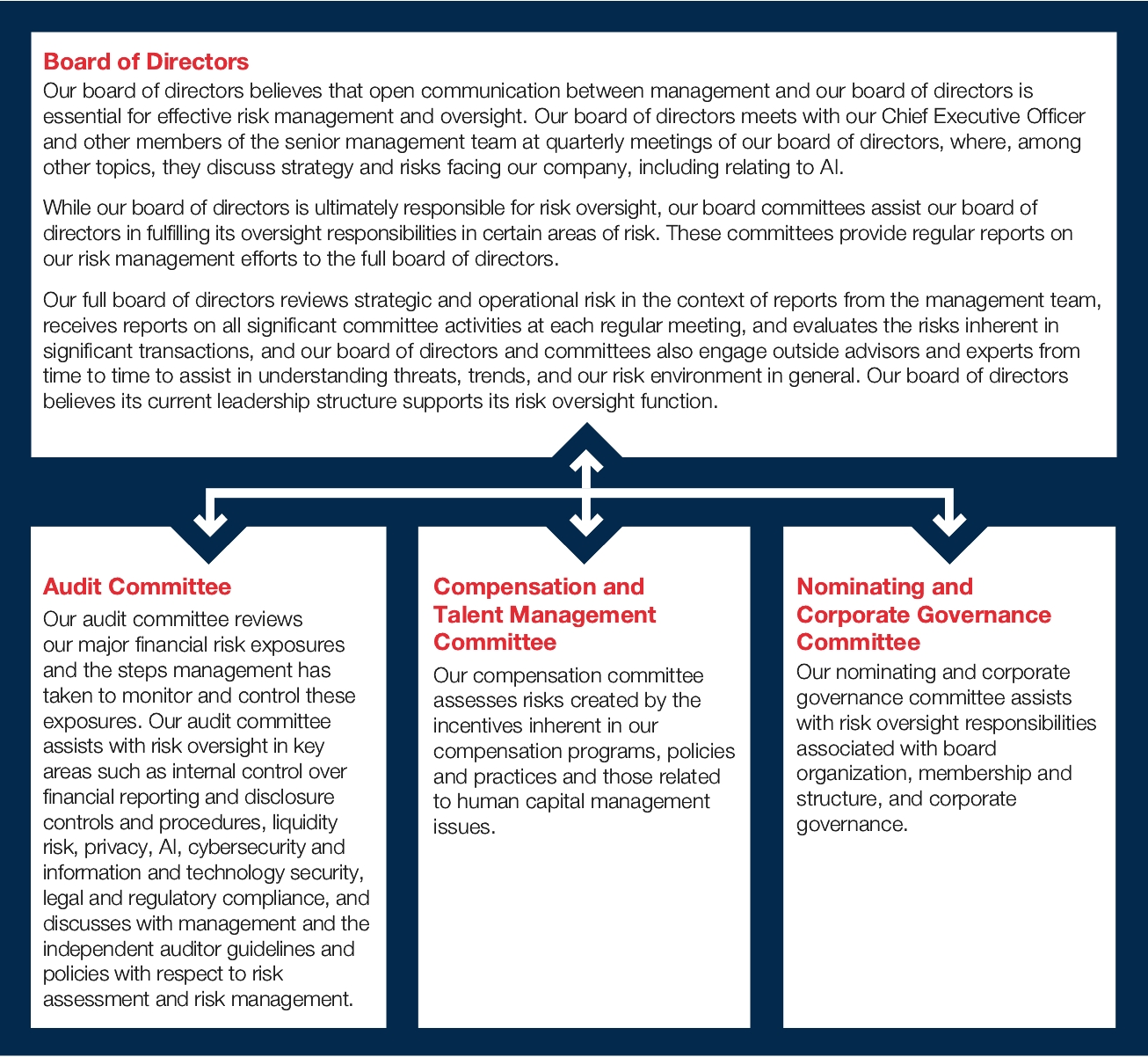
Risk is inherent with every business, and we face a number of risks, including strategic, financial, business and operational, cybersecurity, legal and compliance, and reputational. We have designed and implemented processes to identify, assess and manage risk in our operations as part of our enterprise risk management (“ERM”) approach. Management is responsible for the day-to-day oversight and management of risks we face, while our board of directors, as a whole and as delegated to its committees, has responsibility for the oversight of risk management. In addition, every employee is required to complete data privacy, cybersecurity and code of conduct training upon joining our company and each year thereafter. In its risk oversight role, our board of directors has the responsibility to satisfy itself that processes designed and implemented by management are appropriate and functioning as designed. As part of this approach, our board considers both the materiality of a risk and its immediacy in making strategic decisions and helping management to prioritize resources.

24
2026 Proxy Statement

TABLE OF CONTENTS


Board of Directors and Corporate Governance
Cybersecurity and Information Security Risk Oversight
Our board of directors is actively involved in oversight of cybersecurity, recognizing the critical importance of maintaining the trust and confidence of our customers, business partners and employees. Our board of directors, in coordination with our audit committee, oversees the management of cybersecurity risk through regular interactions with our Chief Information Security Officer and other members of management. In addition, our board of directors, supported by our audit committee, oversees the risk management systems and processes into which cybersecurity risk is integrated.
Our board of directors, in coordination with our audit committee, is responsible for monitoring and assessing strategic risk exposure through our risk management processes. Our audit committee receives regular presentations and reports on cybersecurity risks, which address a wide range of topics including recent developments, evolving standards, vulnerability assessments, third-party and independent reviews, the threat environment, technological trends and information security considerations arising with respect to our peers and third parties, and risks relating to cybersecurity incidents.
Board Oversight of Our Responsible Business Practices
We are committed to sound governance and oversight of our sustainable business practices and impact on the communities where we operate. We also value our employees and recognize the critical roles that they play in our overall success and achieving the long-term goals of our company and stockholders. Our board of directors has delegated formal oversight of these responsible business practices to our nominating and corporate governance committee. Our audit committee and compensation committee also play key roles in related risk oversight.
Our nominating and corporate governance committee has primary oversight of our environmental, social and governance activities and programs, including our climate targets and initiatives. Members of our management provide our nominating and corporate governance committee with formal updates on such matters.
Our audit committee oversees our enterprise risk management framework and processes. Our audit committee also oversees matters related to privacy, AI, cybersecurity, and information and technology security, including reviewing the adequacy of the company’s policies and processes and internal controls related to those matters.
Our compensation committee oversees a range of human capital management activities and disclosure of such matters, including relating to talent acquisition, talent management and development, employee engagement, and culture and inclusion.
2026 Proxy Statement
25

TABLE OF CONTENTS

Board of Directors and Corporate Governance


Executive Talent Management and Succession Planning
Our board of directors values senior management development and views succession planning as critical to creating long-term stockholder value. In coordination with our Chief Executive Officer and other appropriate members of management, our compensation committee evaluates the performance of, and succession planning for, our management team, and reports its findings to our board of directors, works with the board of directors in evaluating potential management successors, and confers with the Chief Executive Officer to encourage our management team’s employee development programs. Our compensation committee also periodically reviews a succession plan for the Chief Executive Officer position, using formal criteria to evaluate potential successors, and reporting such information to the board of directors. In conducting its evaluation, the compensation committee considers current and future organizational needs, competitive challenges, leadership/ management potential and development and emergency situations.
26
2026 Proxy Statement

TABLE OF CONTENTS


Board of Directors and Corporate Governance
Corporate Governance Policies
Corporate Governance Guidelines and Code of Conduct
Our board of directors has adopted corporate governance guidelines that address items such as the qualifications and responsibilities of our directors and director candidates and corporate governance policies and standards applicable to us in general. In addition, our board of directors has adopted a code of conduct that applies to all of our employees, officers and directors, including our Chief Executive Officer, Chief Financial Officer, and other executive and senior financial officers. A copy of each of our corporate governance guidelines and code of conduct is available on our website at https://investors.twilio.com and may also be obtained without charge by contacting our Corporate Secretary at Twilio Inc., 101 Spear Street, Fifth Floor, San Francisco, California 94105. We intend to disclose any amendments to our code of conduct, or waivers of its requirements, on our website or in filings under the Exchange Act, as required by the applicable rules and exchange requirements. During 2025, no waivers were granted from any provision of our code of conduct.
Compliance and Ethics
Our culture of integrity starts with our corporate governance guidelines and code of conduct, and includes efforts in risk assessment, development of policies, procedures, training, auditing, monitoring, investigations and remediation of potential compliance matters. We have also implemented mandatory anti-harassment, anti-corruption and anti-bribery training as well as more targeted compliance training aimed at addressing the compliance risks of specific roles and business functions.
Furthermore, in order to promote a high standard of ethical and professional conduct within our company, we have engaged with an impartial third party to administer an ethics reporting hotline where, as permitted by law, employees, contractors, customers and vendors may address any issues on a confidential and anonymous basis. Employees may choose the method with which they are most comfortable to discuss any issues or complaints, whether it is through their manager, our human resources partners, or the reporting hotline. In addition, our code of conduct applies to all of our employees, including our officers and board of directors. Violations of the code of conduct may result in disciplinary action, up to and including termination of employment.
Stockholder Recommendations and Nominations to the Board of Directors
Stockholders may submit recommendations for director candidates to the nominating and corporate governance committee by sending the individual’s name and qualifications to our Chief Legal Officer at Twilio Inc., 101 Spear Street, Fifth Floor, San Francisco, California 94105, who will forward all recommendations to the nominating and corporate governance committee. We encourage stockholders to email any such recommendations to us at legalnotices@twilio.com to help ensure prompt receipt. The nominating and corporate governance committee will evaluate any candidates recommended by stockholders against the same criteria and pursuant to the same policies and procedures applicable to the evaluation of candidates proposed by directors or management.
Under our fourth amended and restated bylaws (our “bylaws”), stockholders may also nominate directors for election at an annual meeting of stockholders. To nominate a director, the stockholder must provide proper written notice that sets forth all of the information required by our bylaws, as well as the additional information required by Rule 14a-19(b) under the Exchange Act. In addition, the stockholder must give timely notice to our Corporate Secretary in accordance with our bylaws, as described below under the section titled “Procedural Matters—What is the deadline to propose actions for consideration at next year’s annual meeting of stockholders or to nominate individuals to serve as directors?—Stockholder Proposals.”
Stockholder and Other Interested Party Communications
Our board of directors provides to every stockholder and any other interested parties the ability to communicate with the board of directors as a whole, with our non-management directors as a group, and with individual directors on the board of directors through an established process for stockholder communication. For a stockholder communication directed to the board of directors as a whole or to our non-management directors as a group, stockholders and other interested parties may send such communication via U.S. Mail or Expedited Delivery Service to: Twilio Inc., 101 Spear Street, Fifth Floor, San Francisco, California 94105, Attn: Chief Legal Officer.
For a stockholder or other interested party communication directed to an individual director, including our non-management directors, in his or her capacity as a member of the board of directors, stockholders and other interested parties may send such communication to the attention of the individual director via U.S. Mail or Expedited Delivery Service to: Twilio Inc., 101 Spear Street, Fifth Floor, San Francisco, California 94105, Attn: [Name of Individual Director].

2026 Proxy Statement
27

TABLE OF CONTENTS

Board of Directors and Corporate Governance

We encourage stockholders to email any such communications to us at legalnotices@twilio.com to help ensure prompt receipt. Our Chief Legal Officer, Chief Financial Officer, or a Vice President, Legal, in consultation with appropriate members of our board of directors as necessary, will review all incoming communications and, if appropriate, all such communications will be forwarded to the appropriate member or members of our board of directors, or if none is specified, to our board chair.
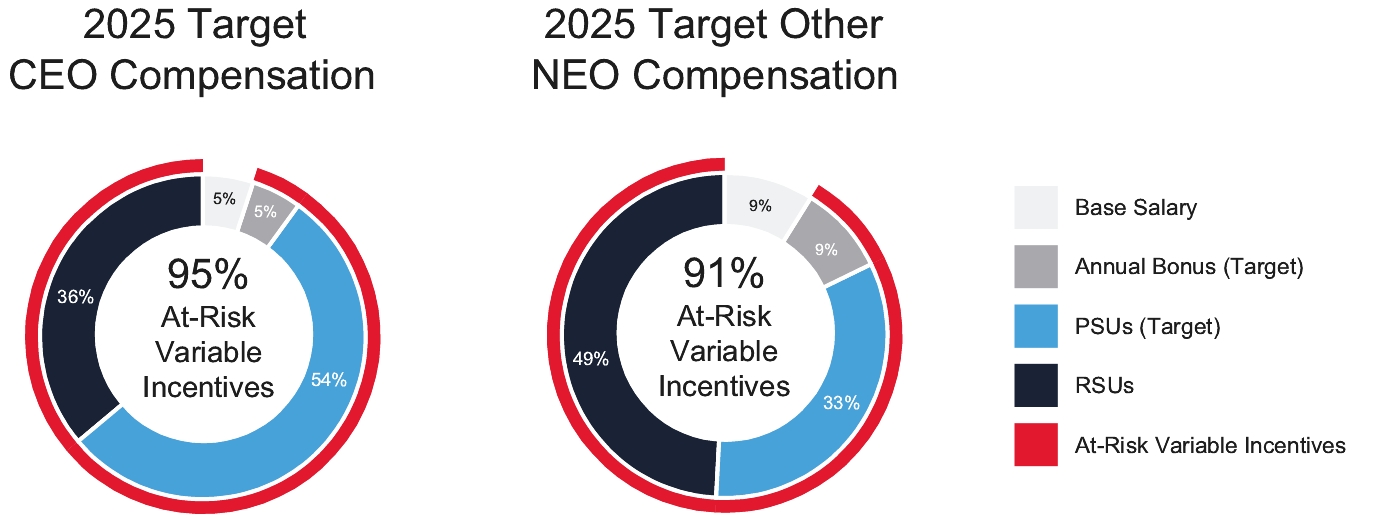
Insider Trading Policy and Compliance
Our board of directors has adopted our Amended and Restated Policy on Insider Trading and Disclosure (our “Insider Trading Policy”) governing the purchase, sale, and/or other disposition of our securities by directors, officers, employees, and other covered persons. We believe this policy is reasonably designed to promote compliance with insider trading laws, rules and regulations, and the exchange listing standards applicable to us. A copy of our Insider Trading Policy was filed as an exhibit to our Annual Report on Form 10-K for the year ended December 31, 2025.
From time to time, we repurchase our securities under our repurchase authorizations. In connection with such activities, we comply with all applicable securities laws.
Non-Employee Director Compensation
Non-Employee Director Compensation Policy
We have adopted a compensation policy for our non-employee directors (as amended and restated from time to time, the “Non-Employee Director Compensation Policy”) to attract, retain and award these individuals and align their long-term interests with those of our company and our stockholders. Our non-employee directors are paid in the form of restricted stock units (“RSUs”) only and do not receive cash compensation. Employee directors receive no additional compensation for their service as a director.
Decisions regarding the Non-Employee Director Compensation Policy are approved by our board of directors based on recommendations from our compensation committee. Our compensation committee conducts an annual evaluation of the design and competitiveness of our Non-Employee Director Compensation Policy in light of best practices, market trends and a competitive market analysis of data for our compensation peer group prepared by its compensation consultant, and makes appropriate recommendations to our board of directors with respect to the compensation of our non-employee directors.
During 2025, our compensation committee engaged Compensia, Inc. (“Compensia”), a national compensation consulting firm, as its independent compensation consultant to advise on, among other things, non-employee director compensation matters. In doing so, our compensation committee reviewed and considered a peer group compensation data analysis prepared by Compensia to understand market non-employee director compensation practices. Following a review and consideration of market data, our compensation committee recommended to our board of directors, and our board of directors approved, that non-employee director compensation would continue to be paid solely in the form of RSUs and the value of such non-employee director compensation would remain unchanged from 2024 levels, except that our Non-Employee Director Compensation Policy was amended, in light of peer company board compensation trends, to (i) increase the annual equity retainer for board membership from $45,000 to $60,000 and (ii) increase the additional annual equity retainer for independent board chair from $75,000 to $100,000.
For purposes of the amounts described in this section, the values are calculated as set forth in the Non-Employee Director Compensation Policy. For the aggregate grant date fair value of the RSUs awarded to the non-employee directors in 2025, calculated in accordance with Financial Accounting Standards Board Accounting Standards Codification Topic 718 (“FASB ASC Topic 718”), please see “2025 Non-Employee Director Compensation Table” below.
Annual Equity Grant and Annual Equity Retainer
For 2025, our non-employee directors received compensation in the form of RSUs only. Pursuant to our Non-Employee Director Compensation Policy, each non-employee director who continues as a member of our board of directors following each annual meeting of stockholders receives a grant of RSUs having a value of $250,000 (the “Annual Equity Grant”).
28
2026 Proxy Statement

TABLE OF CONTENTS


Board of Directors and Corporate Governance
Each non-employee director also receives an annual equity retainer for board and committee membership, the values of which are as set forth below. The aggregate amount that each non-employee director receives for such director’s membership on our board of directors, as a member or chair of a committee, or as the independent board chair or lead independent director, is referred to as the “Annual Equity Retainer”.
Board Equity Retainers
 
 
Annual Equity Retainer for Board Membership (the “Annual Board Retainer”)
 
$60,000
Additional Annual Equity Retainer for Independent Board Chair
 
$100,000
Additional Annual Equity Retainer for Lead Independent Director
 
$30,000


Additional Annual Equity Retainer for Committee Membership:
Chair Retainer
Member Retainer
Audit Committee
$26,000
$13,000
Compensation and Talent Management Committee
$20,000
$10,000
Nominating and Corporate Governance Committee
$12,000
$6,000
The Annual Equity Grant and Annual Equity Retainer are granted in four quarterly installments over the course of the year that commences on the date of each annual meeting of stockholders, with such grants to be made on each of September 15, December 15, March 15, and the earlier of (i) June 15 or (ii) the day that is immediately prior to the next subsequent annual meeting of stockholders (each such date, a “Quarterly Date,” and each such grant, a “Quarterly Grant”). The value of each Quarterly Grant is equal to the value of the portion of the Annual Equity Retainer and Annual Equity Grant applicable to the period beginning on the day after the immediately preceding Quarterly Date and ending on the then-current Quarterly Date (the “Quarterly Period”), based on the board and committee roles held by the non-employee director during such Quarterly Period. The number of RSUs granted for each Quarterly Grant is determined by dividing the applicable values by the average closing market price on NYSE of one share of our common stock over the trailing 30-day period ending five business days before the effective date of the applicable grant, rounded down to the nearest whole share. Each Quarterly Grant is fully vested upon the date of grant.
Initial Equity Grants
Our Non-Employee Director Compensation Policy during 2025 provided that, upon initial election to our board of directors, each non-employee director would be granted RSUs having a value of $575,000 (the “Initial Equity Grant”). The Initial Equity Grant vests in equal annual installments over three years, subject to continued service as a director through the applicable vesting dates; provided, however, that if a non-employee director is elected on a date other than at the annual meeting of stockholders, one-third of such value is pro-rated by the amount of time between such election and the next annual meeting of stockholders and such pro-rated portion vests on the day prior to the next annual meeting of stockholders (the “Initial Vesting Date”), with the other two-thirds vesting annually on the one and two-year anniversaries of the Initial Vesting Date over the following two years following such Initial Vesting Date.
During 2025, the number of RSUs for the Initial Equity Grant was determined by dividing the applicable value by the average closing market price on NYSE of one share of our common stock over the trailing 30-day period ending five business days before the effective date of the grant, rounded down to the nearest whole share.
Other Non-Employee Director Compensation Terms
Awards granted under our Non-Employee Director Compensation Policy are subject to full accelerated vesting upon a “sale event,” as defined in our 2016 Stock Option and Incentive Plan (as amended and restated, the “2016 Plan”).
Our Non-Employee Director Compensation Policy also provides that, pursuant to the 2016 Plan, the aggregate amount of compensation, including both equity compensation and cash compensation, paid to any non-employee director in a calendar year will not exceed $750,000, and pursuant to the terms of the amended and restated 2016 Plan proposed for approval at the Annual Meeting, increased to $1,000,000 in the non-employee director’s first year of service as a director (or such other limit(s) as may be set forth in the 2016 Plan or any similar provision of a successor plan).
2026 Proxy Statement
29

TABLE OF CONTENTS

Board of Directors and Corporate Governance

We also reimburse all reasonable out-of-pocket expenses incurred by our non-employee directors for their attendance at meetings of our board of directors or any committee thereof.
Non-Employee Directors’ Deferred Compensation Program
In July 2017, we implemented a Non-Employee Directors’ Deferred Compensation Program to offer our non-employee directors the ability to defer the receipt of any RSUs granted to them from Initial Equity Grants or Annual Equity Grants under the 2016 Plan. In advance of an award of RSUs, subject to the program’s requirements, a non-employee director may elect to defer the receipt of his or her RSUs until the earliest of (i) 90 days after such non-employee director ceases to serve as a member of our board of directors; (ii) the consummation of a “sale event”; or (iii) 90 days after the non-employee director’s death (such earliest date, the “Payment Event”). Upon the vesting of the RSUs, any amounts that would otherwise have been paid in shares of our common stock will be converted into deferred stock units (“DSUs”) on a one-to-one basis and credited to the non-employee director’s deferral account. The DSUs will be paid in shares of our common stock on a one-to-one basis in a single lump sum (and will cease to be held in the non-employee director’s deferred account) as soon as practicable following the Payment Event.
Death Equity Acceleration Policy
See “Executive Compensation—Other Compensation Policies and Practices—Death Equity Acceleration Policy” for a discussion of the treatment of equity awards upon the termination of an employee’s or non-employee director’s employment or other service relationship with us or any of our subsidiaries due to the death of such individual.
Stock Ownership Policy
In April 2018, we adopted a stock ownership policy for our non-employee directors, which was amended and restated in September 2020 and March 2022. Our stock ownership policy (as amended, the “Stock Ownership Policy”), requires our non-employee directors to acquire and hold a number of shares of our common stock equal in value to five times the Annual Board Retainer (as then in-effect). We only count directly and beneficially owned shares, in addition to shares underlying vested RSUs that are held or deferred. We do not count shares underlying vested and unexercised in-the-money stock options, unvested options, unvested RSUs or other unvested equity awards. Each non-employee director has five years from the later of his or her initial election to the board of directors or from the effective date of the Stock Ownership Policy to attain the required ownership level. As of December 31, 2025, all of our non-employee directors are in compliance with our Stock Ownership Policy or are within the five-year phase in period.
30
2026 Proxy Statement

TABLE OF CONTENTS


Board of Directors and Corporate Governance
2025 Non-Employee Director Compensation Table
The following table provides information regarding the total compensation that was earned by or paid to each of our non-employee directors in 2025, all of which was paid solely in RSUs. Mr. Shipchandler, who served as our Chief Executive Officer during his service on our board of directors, did not receive any additional compensation for his service as a director. The compensation received by Mr. Shipchandler, as a named executive officer, is presented in “Executive Compensation— Summary Compensation Table.”
Name
Stock awards ($)(1)(2)
Total ($)
Charles Bell
315,634
315,634
Donna Dubinsky
308,776
308,776
Jeff Epstein
430,449
430,449
Jeffrey Immelt
322,614
322,614
Deval Patrick
308,776
308,776
Douglas Robinson(3)
Erika Rottenberg
314,717
314,717
Andrew Stafman
315,634
315,634
Miyuki Suzuki
312,655
312,655
(1)
Stock awards consist solely of RSUs. Annual Equity Grants and Annual Equity Retainers vest immediately upon grant. Initial Equity Grants vest in equal annual installments over three years, subject to any pro-ration as described above. The amounts reported in this column represent the aggregate grant date fair value of the RSUs awarded to the non-employee directors in 2025, calculated in accordance with FASB ASC Topic 718. The valuation assumptions used in determining such amounts are described in the Notes to our Consolidated Financial Statements included in our Annual Report on Form 10-K filed with the SEC on February 24, 2026 and described further in footnote 1 to the “Summary Compensation Table” in “Executive Compensation Tables—Summary Compensation Table”. During 2025, each of Mses. Dubinsky and Suzuki and Messrs. Bell, Epstein, Patrick and Stafman elected to defer a portion of the RSUs issued pursuant to each of their Quarterly Grants, which DSUs are reflected in the table above for 2025 and in the total accumulated amounts in the table below.
(2)
As of December 31, 2025, the non-employee directors who served on our board of directors during 2025 had the following outstanding equity awards, in addition to the DSUs set forth in the table below: Mr. Stafman held 3,188 RSUs.
(3)
Mr. Robinson was appointed to our board of directors in March 2026.
The following table sets forth the aggregate number of DSUs accumulated in each director’s deferral account as of December 31, 2025 from deferrals of RSUs granted to them in 2025 or in prior years.
Name
Accumulated DSUs
Charles Bell
17,133
Donna Dubinsky
15,909
Jeff Epstein
38,411
Deval Patrick
15,596
Andrew Stafman
2,759
Miyuki Suzuki
2,733
Compensation Committee Interlocks and Insider Participation
During 2025, Ms. Suzuki and Messrs. Immelt and Epstein served on the compensation committee. None of the members of our compensation committee is or has been an officer or employee of our company. None of our executive officers currently serve, or in the past year have served, as a member of the board of directors or compensation committee (or other board committee performing equivalent functions) of any entity that has one or more of its executive officers serving on our board of directors or compensation committee.
2026 Proxy Statement
31

TABLE OF CONTENTS


PROPOSAL NO. 1
Election of Directors
Our board of directors is currently composed of ten members. Commencing at our Annual Meeting, in accordance with our certificate of incorporation, directors, subject to the phase-out of the classified board structure, serve until the next annual meeting of stockholders and until their successors are elected and qualified, subject to such director’s earlier death, resignation or removal. Our board of directors is currently divided into three classes of directors. At our 2025 annual meeting of stockholders, we sought and obtained stockholder approval to declassify our board of directors. Accordingly, the phase-out of the classified board structure will be completed at the 2028 annual meeting of stockholders.
Nominees
Our nominating and corporate governance committee has recommended, and our board of directors has approved, Charles Bell, Jeffrey Immelt, Douglas Robinson and Erika Rottenberg as director nominees for election at the Annual Meeting. If elected, each of Messrs. Bell, Immelt and Robinson and Ms. Rottenberg will serve as directors until the 2027 annual meeting of stockholders and until their successors are duly elected and qualified. Each of the nominees is currently a director of our company. For information concerning the nominees, please see the section titled “Board of Directors and Corporate Governance.”
If you are a stockholder of record and you submit a proxy but you do not specify your voting instructions with respect to the voting of directors, your shares will be voted “FOR” the election of Messrs. Bell, Immelt and Robinson and Ms. Rottenberg. We expect that Messrs. Bell, Immelt and Robinson and Ms. Rottenberg will each accept such nomination; however, in the event that a director nominee is unable or declines to serve as a director at the time of the Annual Meeting, the proxies will be voted for any nominee designated by our board of directors to fill such vacancy. If you are a street name stockholder and you submit a proxy but you do not give voting instructions to your broker or nominee, your broker will leave your shares unvoted on this matter.
Vote Required
Each director is elected by a plurality of the voting power of the shares of our common stock present virtually or represented by proxy at the Annual Meeting and entitled to vote thereon. “Withhold” votes and broker non-votes will have no effect on the outcome of this proposal. See “Procedural Matters—How many votes are needed for approval of each proposal?” for further information.
The Board of Directors recommends a vote “FOR” each of the nominees named above.
32
2026 Proxy Statement

TABLE OF CONTENTS


PROPOSAL NO. 2
Ratification of Appointment of Independent Registered Public Accounting Firm
Our audit committee has appointed KPMG LLP (“KPMG”), an independent registered public accounting firm, to audit our consolidated financial statements for our fiscal year ending December 31, 2026. During our fiscal year ended December 31, 2025, KPMG served as our independent registered public accounting firm.
Notwithstanding the appointment of KPMG, and even if our stockholders ratify the appointment, our audit committee, in its discretion, may appoint another independent registered public accounting firm at any time during our fiscal year if our audit committee believes that such a change would be in the best interests of our company and our stockholders. At the Annual Meeting, our stockholders are being asked to ratify the appointment of KPMG as our independent registered public accounting firm for our fiscal year ending December 31, 2026. Our audit committee is submitting the appointment of KPMG to our stockholders because we value our stockholders’ views on our independent registered public accounting firm and as a matter of good corporate governance. However, neither our bylaws nor other governing documents or law require stockholder ratification of the selection of KPMG as our independent registered public accounting firm. Representatives of KPMG will be present at the Annual Meeting, and they will have an opportunity to make a statement and will be available to respond to appropriate questions from our stockholders.
If our stockholders do not ratify the appointment of KPMG, our audit committee may reconsider the appointment.
Fees Paid to the Independent Registered Public Accounting Firm
The following table presents fees for professional audit services and other services rendered to our company by KPMG for our fiscal years ended December 31, 2024 and 2025.
 
2024
2025
 
(in thousands)
Audit Fees(1)
$5,195
$5,314
Audit-Related Fees
Tax Fees(2)
28
All Other Fees
Total Fees
$5,195
$5,342
(1)
Audit Fees consist of professional services rendered in connection with the audit of our annual consolidated financial statements, including audited financial statements presented in our Annual Report on Form 10-K and services that are normally provided by the independent registered public accountants in connection with statutory and regulatory filings or engagements for those fiscal years, and the review of the financial statements included in our quarterly reports. Fees for fiscal year 2024 also included work related to the new accounting guidance on additional disclosures related to reportable segments that became effective for fiscal year 2024.
(2)
Tax Fees consist of fees for professional services for tax compliance, tax advice and tax planning. For 2025, these services included support for tax disclosure requirements and assessment of System and Organization Controls (SOC) framework readiness.
Auditor Independence
In our fiscal year ended December 31, 2025, there were no other professional services provided by KPMG, other than those listed above, that would have required our audit committee to consider their compatibility with maintaining the independence of KPMG.
2026 Proxy Statement
33

TABLE OF CONTENTS

PROPOSAL NO. 2
Ratification of Appointment of Independent Registered Public Accounting Firm

Audit Committee Policy on Pre-Approval of Audit and Permissible Non-Audit Services of Independent Registered Public Accounting Firm
Our audit committee has established a policy governing our use of the services of our independent registered public accounting firm. Under this policy, our audit committee is required to pre-approve all audit and permissible non-audit services performed by our independent registered public accounting firm in order to ensure that the provision of such services does not impair the public accountants’ independence. All services provided by KPMG for our fiscal years ended December 31, 2024 and 2025 were pre-approved by our audit committee and were determined by our audit committee to be compatible with maintaining KPMG’s independence.
Vote Required
The ratification of the appointment of KPMG as our independent registered public accounting firm for our fiscal year ending December 31, 2026 requires the affirmative vote of a majority of the voting power of the shares of our common stock present virtually or represented by proxy at the Annual Meeting and entitled to vote thereon. Abstentions will have the effect of a vote against this proposal, and broker non-votes will have no effect.
The Board of Directors recommends a vote “FOR” the ratification of the appointment of
KPMG LLP as our independent registered public accounting firm.
34
2026 Proxy Statement

TABLE OF CONTENTS


PROPOSAL NO. 3
Approval, on a Non-Binding Advisory Basis, of the Compensation of Our Named Executive Officers
Pursuant to Section 14A of the Exchange Act, we are asking our stockholders to approve, on a non-binding advisory basis, the compensation of our named executive officers as disclosed in this proxy statement in accordance with the compensation disclosure rules of the SEC. This proposal, commonly known as a “Say-on-Pay” proposal, gives our stockholders the opportunity to express their views on our named executive officers’ compensation as a whole. The vote on this resolution is not intended to address any specific element of compensation; rather, the vote relates to the compensation of our named executive officers, as described in this proxy statement in accordance with the compensation disclosure rules of the SEC.
The Say-on-Pay vote is advisory, and therefore is not binding on us, our compensation committee, or our board of directors. The Say-on-Pay vote will, however, provide information to us regarding investor sentiment about our executive compensation philosophy, policies and practices, which our compensation committee will be able to consider when determining executive compensation for the remainder of the current fiscal year and beyond. Our board of directors and our compensation committee value the opinions of our stockholders. To the extent there is any significant vote against the compensation of our named executive officers as disclosed in this proxy statement, we will endeavor to communicate with stockholders to better understand the concerns that influenced the vote and consider our stockholders’ concerns, and our compensation committee will evaluate whether any actions are necessary to address those concerns.
As described in detail under the heading “Executive Compensation—Compensation Discussion and Analysis,” our compensation programs are designed to effectively align the interests of our named executive officers with the interests of our stockholders by focusing on long-term incentives that correlate with the growth of sustainable long-term value for our stockholders. Stockholders are urged to read the section titled “Executive Compensation” and, in particular, the section titled “Executive Compensation—Compensation Discussion and Analysis” in this proxy statement, which discusses how our executive compensation program policies and practices implement our compensation philosophy and contains tabular information and narrative discussion about the compensation of our named executive officers. Our board of directors and our compensation committee believe that these policies and practices are effective in implementing our compensation philosophy and in achieving our compensation program goals.
Accordingly, we are asking our stockholders to vote on the following resolution at the Annual Meeting:
RESOLVED, that the stockholders hereby approve, on a non-binding advisory basis, the compensation paid to the Company’s named executive officers, as disclosed in the Company’s proxy statement for the 2026 Annual Meeting of Stockholders, pursuant to the compensation disclosure rules of the SEC, including the Compensation Discussion and Analysis, the compensation tables and the narrative discussions that accompany the compensation tables.
Vote Required
The approval of this advisory non-binding proposal requires the affirmative vote of a majority of the voting power of the shares of our common stock present virtually or represented by proxy at the Annual Meeting and entitled to vote thereon. Abstentions will have the effect of a vote “against” this proposal, and broker non-votes will have no effect.
The Board of Directors recommends a vote “FOR” the approval, on a non-binding advisory basis, of the compensation of our named executive officers.
2026 Proxy Statement
35

TABLE OF CONTENTS


PROPOSAL NO. 4
Approval of the Twilio Inc. Amended and Restated 2016 Stock Option and Incentive Plan
Due to the upcoming expiration of our Amended and Restated 2016 Stock Option and Incentive Plan (the “Current 2016 Plan”), we are seeking stockholder approval to further amend and restate the Current 2016 Plan to extend its term. Based on our compensation committee’s recommendation, our board of directors adopted the Amended and Restated 2016 Stock Option and Incentive Plan (the “Restated Plan”) on April 15, 2026, which will become effective upon its approval by our stockholders at our Annual Meeting. If so approved, the Restated Plan will replace our Current 2016 Plan, which is scheduled to expire by its terms in June 2026, ten years after our June 2016 initial public offering.
If our stockholders approve the Restated Plan, the maximum number of shares of our common stock reserved and available for issuance under the Restated Plan will be 10,500,000 shares, which equates to approximately 6.9% of our 152,979,629 shares of common stock outstanding as of February 17, 2026. This constitutes a significant reduction in the shares available for grant as compared to the Current 2016 Plan. Please see below for information regarding outstanding equity awards and overhang as of February 17, 2026. 
In addition, the Restated Plan will include certain other changes from our Current 2016 Plan, including to remove the automatic annual increase to the share reserve and provide for more limited share recycling, and other changes to incorporate best practices for compensation and corporate governance purposes, which are described below.
Approval of the Restated Plan requires the affirmative vote of a majority of the voting power of the shares of our common stock present virtually or presented by proxy at the Annual Meeting and entitled to vote thereon. Abstentions will have the effect of a vote “against” this proposal, and broker non-votes will have no effect. If stockholders approve this proposal, the amendment and restatement of the Current 2016 Plan will become effective as of the date of stockholder approval (the “Restatement Date”). If stockholders do not approve this proposal, the amendment and restatement of the Current 2016 Plan will not take effect and our Current 2016 Plan will continue to be administered in its current form until its expiration in June 2026.
Why Should Stockholders Vote to Approve the Restated Plan?
Equity Compensation is Critical to Our Continued Growth and Talent Strategy
We operate in an extremely competitive market, facing substantial and continuous competition for employees with the experience and skills needed to lead in a dynamic and innovative industry. Our board of directors believes that our success and growth depend on our ability to recruit, retain and incentivize top talent to execute on our strategic priorities. The ability to continue to grant equity awards is crucial to recruiting and retaining these individuals and to the success of our overall stockholder value creation strategy.
Our board of directors also believes that equity awards align the interests of employees, directors and other service providers with those of our stockholders. By fostering an ownership mindset, equity awards encourage strong performance and provide an effective way to reward contributions to our success.
If our stockholders do not approve the Restated Plan at our Annual Meeting, we will not be able to grant equity awards to continuing employees, non-employee directors and other service providers after June 22, 2026, the expiration date of our Current 2016 Plan. This would seriously and negatively impact our ability to recruit, retain and incentivize employees to support the success and growth of our business.
If stockholders do not approve the Restated Plan at our Annual Meeting, we would need to consider alternative forms of compensation, such as increased cash compensation. This could adversely affect cash flows, limit our investments in strategic projects, hinder our ability to recruit, retain and incentivize talent, and otherwise undermine successful execution of our growth priorities and business strategy.
36
2026 Proxy Statement

TABLE OF CONTENTS


PROPOSAL NO. 4
Approval of the Twilio Inc. Amended and Restated 2016 Stock Option and Incentive Plan
Demonstrated Track Record of Responsible Equity Compensation Practices in Recent Years
Over the last ten years, we have used equity awards strategically and on a broad basis to successfully compete and grow our business. Our compensation committee and board of directors strive to thoughtfully manage long-term stockholder dilution, equity incentive plan burn rate, and stock-based compensation expense while maintaining our ability to attract, reward and retain key talent.
Our track record in recent years demonstrates our commitment to responsible equity usage and the positive trajectory of our equity award practices.
In 2025, we achieved a net burn rate of 1.5%, outpacing the 2027 net burn target of less than 3% announced at our 2025 Investor Day.(1)
At our 2025 investor day, we introduced a target for stock-based compensation as a percentage of revenue of approximately 10% for 2027. In 2025, stock-based compensation expense as a percentage of revenue was 12%, constituting a reduction of 200 basis points year-over-year and 900 basis points since 2022.
We have reduced our annual equity grants by 70%+ from their peak in 2022, both in total grant value and in the number of shares awarded.
To support this improvement, we have limited eligibility for equity compensation to select roles, introduced greater differentiation in equity awards by geography and role, shortened our refresh grant vesting period from four years to three years, and introduced a cash bonus program.
(1)
The net burn target for 2027 announced at our 2025 investor day reflects the number of shares underlying equity awards granted to employees during the year, net of forfeitures, divided by the prior year ending share count, and therefore does not reflect the impact of share repurchases during the year.
It is important to note that these changes to our equity grant practices will take time to be reflected in the plan dilution and three-year burn rate metrics disclosed in this proxy statement, which constitute lagging indicators in relation to our more recent progress. We are committed to building on our recent progress by continuing to responsibly manage our equity usage.
The following table shows our gross and net burn rate over the past three fiscal years and the average across those three years. Our burn rates are higher than they might otherwise have been absent the significant share repurchases we have made in recent years, which repurchases have offset the dilutive impact of our equity grants.
 
FY 2023
FY 2024
FY 2025
Average
Total awards granted(1)
14,722,012
10,584,021
4,728,094
10,011,376
Weighted-average shares outstanding(2)(3)
183,327,844
165,925,128
152,986,390
167,413,121
Gross Burn Rate(4)
8.0%
6.4%
3.1%
5.8%
Forfeitures
4,992,860
5,210,663
2,432,639
4,212,054
Shares withheld to cover taxes
38,655
28,006
1,665
22,776
Net Burn Rate(5)
5.3%
3.2%
1.5%
3.3%
(1)
Represents the total number of RSUs and PSUs granted during the applicable period. No other types of equity awards were granted during the applicable period.  PSUs were counted assuming target level performance.
(2)
Represents the weighted-average number of shares of common stock outstanding, basic, as reported in the Notes to our Consolidated Financial Statements included in our Annual Report on Form 10-K filed with the SEC on February 24, 2026.
(3)
Amounts in the table give effect to the following share repurchase activity, which, by reducing our weighted-average shares outstanding, increases both Gross Burn Rate and Net Burn Rate (each as defined below).
 
FY 2023
FY 2024
FY 2025
Average
Number of shares repurchased
11,292,516
36,848,645
8,048,649
18,729,937
Value of shares repurchased ($)*
$674.7 million
$2,346.7 million
$854.3 million
$1,291.9 million
*
Includes related costs.
(4)
“Gross Burn Rate” is calculated as (i) the total awards granted divided by (ii) the weighted-average number of shares of common stock outstanding (basic). 
(5)
“Net Burn Rate” is calculated as (i) the total awards granted minus forfeitures minus any shares withheld to cover taxes, divided by (ii) the weighted-average number of shares of common stock outstanding (basic).
2026 Proxy Statement
37

TABLE OF CONTENTS

PROPOSAL NO. 4
Approval of the Twilio Inc. Amended and Restated 2016 Stock Option and Incentive Plan

The following table demonstrates recent progress on stock-based compensation expense as a percentage of revenue:
 
FY 2023
FY 2024
FY 2025
Stock-based compensation expense as a percentage of revenue
16.3%
13.8%
11.8%
In addition, the following table demonstrates the reduction in our overhang from outstanding equity awards as of the end of each of the last three fiscal years:
 
As of December 31, 2023
As of December 31, 2024
As of December 31, 2025
Total outstanding equity awards(1)
21,057,321
19,609,189
14,540,583
(1)
PSUs were counted assuming target level performance.
We are Committed to Managing Dilution and Have Made Significant Share Repurchases in Recent Years
We recognize the dilutive impact of our equity compensation program on our stockholders and continuously strive to balance this concern with the competition for talent in the extremely competitive business environment and talent market in which we operate.
Alongside the commitment and trends with respect to responsible equity compensation practices described above, it is important to consider the dilutive impact of our equity compensation program with the critical context of our significant share repurchasing activity in recent years. We completed approximately $3.9 billion in aggregate share repurchases from 2023 through 2025, repurchasing approximately 56.2 million shares and reducing total shares outstanding by approximately 18%. As of December 31, 2025, we had approximately $1.1 billion in remaining repurchase authorization expiring at the end of 2027.
This repurchase program has decreased the number of shares of our common stock outstanding, which makes our Gross Burn Rate and Net Burn Rate as presented in the table above, as well as our overhang- and equity plan-related dilution, appear higher because the denominator for each is based on shares outstanding. In the past three years, our share repurchasing has eclipsed our granted equity awards by approximately 26 million shares, offsetting the dilutive impact of such equity awards on our stockholders:
 
FY 2023
FY 2024
FY 2025
Total
Equity Awards Granted(1)
14,722,012
10,584,021
4,728,094
30,034,127
Shares Repurchased
11,292,516
36,848,645
8,048,649
56,189,810
Net Dilutive Effect of Equity Program
3,429,496
(26,264,624)
(3,320,555)
(26,155,683)
(1)
Represents the total number of RSUs and PSUs granted during the applicable period. No other types of equity awards were granted during the applicable period. PSUs were counted assuming target level performance.
We Are Committed to Continued Accountability to Our Stockholders
We anticipate that the size of the share request described above will be sufficient to meet our expected needs for at least two years with a reasonable buffer to support potential unexpected events such as acquisitions, unplanned executive hires, or significant changes in the trading price of our stock. We expect to ask our stockholders for approval to increase the share reserve on a regular basis to afford them an opportunity to weigh in on our equity grant practices and support our competitiveness in recruiting and retaining top talent, while sustaining our ability to deliver profitable growth. The limited expected duration of our share request helps ensure that we remain accountable to our stockholders.
Additional Factors Considered in Determining the Number of Shares to be Reserved under the Restated Plan
As part of the process used to determine the number of shares of common stock subject to the Restated Plan, our compensation committee and board reviewed analyses prepared by Compensia, an independent compensation consultant, which included analysis of the burn rate and overhang metrics discussed herein.
38
2026 Proxy Statement

TABLE OF CONTENTS


PROPOSAL NO. 4
Approval of the Twilio Inc. Amended and Restated 2016 Stock Option and Incentive Plan
In addition to the dynamics described above, the compensation committee and our board of directors considered the following factors when determining the number of shares to ask our stockholders to approve for issuance under the Restated Plan:
Number of Shares Remaining under the Current 2016 Plan. As of February 17, 2026, 37,014,075 shares remained available for issuance under the Current 2016 Plan, representing approximately 24.20% of our outstanding common stock as of such date. If our stockholders approve the Restated Plan, the maximum number of shares reserved and available for issuance under the Restated Plan as of the Restatement Date would be reduced to 10,500,000 shares, representing approximately 6.9% of our outstanding common stock as of February 17, 2026. Further, in order to limit and provide clarity on the maximum potential dilution that may be attributable to outstanding equity awards as of the Restatement Date, our compensation committee and board of directors have approved and implemented a limit of 5,650,000 shares (the “Current 2016 Plan Grant Limit”), representing approximately 3.69% of our outstanding common stock as of February 17, 2026, that can be granted subject to awards under the Current 2016 Plan (or any other equity incentive plan of the Company, other than our Employee Stock Purchase Plan) after February 17, 2026 but before the effectiveness of the Restated Plan on the Restatement Date.
The Current 2016 Plan Grant Limit does not represent an estimate of our current expectation for grants during such period, but rather an outer bound for stockholders to consider for dilution purposes. Consistent with timing in recent years, we expect to conduct our annual focal grant program for eligible Company employees between the filing of this proxy statement and the Annual Meeting.
Overhang. As of February 17, 2026, 12,704,968 shares remained subject to outstanding equity awards, representing approximately 8.31% of our outstanding common stock, as of February 17, 2026. The following table includes information regarding outstanding equity awards as of February 17, 2026.
 
Zipwhip Inc.
2018 Equity
Incentive
Plan
SendGrid
Inc. 2012
Equity
Incentive
Plan
SendGrid
Inc. 2017
Equity
Incentive
Plan
Segment.io Inc.
2013 Stock
Option and
Grant Plan
2008
Stock
Option
Plan
Current
2016 Plan
All Plans
Shares underlying outstanding stock options
4,294
21,231
3,941
19,406
27,545
822,269
898,686
Weighted average exercise price of outstanding
stock options
$53.30
$20.25
$53.23
$51.50
$10.53
$108.81
$101.96
Weighted average remaining contractual life of outstanding stock options, in years
4.34
1.28
2.08
3.64
0.18
2.83
2.74
Shares underlying outstanding unvested RSUs and PSUs(1)
11,806,282
11,806,282
Total outstanding
equity awards
4,294
21,231
3,941
19,406
27,545
12,628,551
12,704,968
Shares reserved and available for future grants giving effect
to the Current 2016 Plan
Grant Limit(2)
5,650,000
5,650,000
(1)
PSUs were counted assuming target level performance.
(2)
As of February 17, 2026, there were a total of 37,014,075 shares reserved and available for issuance under our Current 2016 Plan. However, our board has approved the Current 2016 Plan Grant Limit, pursuant to which only a maximum of 5,650,000 shares may be granted out of such reserve between February 17, 2026 and the Restatement Date. 
Historical Grant Practices. Our compensation committee and our board of directors considered the number of shares covered by equity awards we granted in our last three fiscal years as shown in the table above.
Forecasted Grants. To determine how long the share request under the Restated Plan described above will enable us to make grants of equity awards, our board of directors reviewed a forecast that considered the dynamics and factors described above.
2026 Proxy Statement
39

TABLE OF CONTENTS

PROPOSAL NO. 4
Approval of the Twilio Inc. Amended and Restated 2016 Stock Option and Incentive Plan

In addition, the forecast reviewed by our board of directors considered forecasted future equity awards, with the future equity awards determined based on assumptions about our stock price (including potential volatility therein) and the competitive dollar value to be delivered to the equity award recipient. Because we generally determine the size of equity awards to be granted based on the dollar value of the relevant award, if the stock price used to determine the number of shares subject to an equity award differs significantly from the stock price assumed in the forecast, our actual share usage will deviate significantly from our forecasted share usage. For example, if our stock price used to determine the number of shares subject to future equity awards is lower than the stock price assumed in the forecast, we would need a larger number of shares than anticipated to deliver the same intended dollar value to the recipients of those equity awards. Conversely, if our stock price used to determine the number of shares subject to future equity awards is higher than the stock price assumed in the forecast, we would need a smaller number of shares than anticipated to deliver the same intended dollar value to the recipients of those equity awards.
The Restated Plan Includes Compensation and Governance Best Practices
The Restated Plan includes provisions considered best practice for compensation and corporate governance purposes. These provisions protect our stockholders’ interests:
Administration. The Restated Plan will be administered by our compensation committee, which consists entirely of independent non-employee directors.
No Annual “Evergreen” Provision. The Restated Plan requires stockholder approval to increase the maximum number of shares reserved and available for issuance under the Restated Plan. Unlike our Current 2016 Plan, the Restated Plan does not contain an annual “evergreen” to automatically increase the number of shares available for issuance each year.
Share Recycling More Limited than the Current 2016 Plan. Under the Restated Plan, for any stock appreciation rights settled in shares of stock, all shares of stock covered by the exercised award (that is, the shares of stock actually issued, as well as the shares representing payment of the exercise price) will not be available for issuance under the Restated Plan. Additionally, shares of stock used to pay the exercise or purchase price of an award under the Restated Plan, or to satisfy the tax withholding obligations related to an award under the Restated Plan will not be added back to the shares available for issuance under the Restated Plan. Under our Current 2016 Plan, these shares would be added back to the shares available for issuance.
Repricing is Not Allowed. Consistent with our Current 2016 Plan, the Restated Plan does not permit any of the following: a reduction of the exercise price of outstanding stock options or stock appreciation rights; a repricing through cancellation and re-grants or cancellation of stock options or stock appreciation rights in exchange for cash or other awards; or the cash buyout of underwater stock options or stock appreciation rights.
No Single-Trigger Vesting Acceleration upon a Sale Event. In a sale event (as defined in the Restated Plan), awards will be treated in the manner set forth in the Restated Plan. The Restated Plan does not provide for automatic vesting of awards upon a sale event for executives, employees, and consultants unless the award is not assumed, continued or substituted. As is typical for non-employee director equity awards, awards granted under our Amended and Restated Non-Employee Director Compensation Policy accelerate upon the occurrence of a sale event.
Reasonable Annual Limits on Non-Employee Director Compensation. The Restated Plan continues to set limits as to the total compensation that non-employee directors may receive during each calendar year (for service as a non-employee director).
Limited Transferability. Awards under the Restated Plan generally may not be sold, assigned, transferred or otherwise encumbered or disposed of other than by will or by the laws of descent and distribution or pursuant to a domestic relations order.
No Tax Gross-ups. The Restated Plan does not provide for any tax gross-ups.
Forfeiture Events. Awards under the Restated Plan will be subject to any applicable clawback policy of the Company, as in effect from time to time.
No Dividends on Unvested Awards. Under the Restated Plan, no dividends and other distributions may be paid with respect to any shares underlying the unvested portion of an award. Our Current 2016 Plan does not include this restriction.
40
2026 Proxy Statement

TABLE OF CONTENTS


PROPOSAL NO. 4
Approval of the Twilio Inc. Amended and Restated 2016 Stock Option and Incentive Plan
Minimum Exercise Price. Stock options and stock appreciation rights granted under the Restated Plan must have a per share exercise price no less than 100% of the fair market value per share on the date of grant of the relevant award.
Our Executive Compensation Program is Performance-Based and We Have Received Favorable Votes on our Say-On-Pay Proposals
The aim of our executive compensation program is to tie the pay of our named executive officers to both their own and the Company’s performance and our executive compensation program heavily emphasizes variable pay over “fixed” pay. In 2025, 95% of our Chief Executive Officer’s target compensation and 91% of our other named executive officer’s target compensation was in the form of at-risk variable incentive compensation. We have also adopted a compensation recovery policy that provides that if we are required to prepare an accounting restatement due to our material noncompliance with financial reporting requirements, we must claw back from certain officers any incentive-based compensation received during the covered period that was in excess of what they would have received had their incentive compensation been determined based on the restated amounts.
We value our stockholders’ feedback on our executive pay practices and are committed to considering this feedback as part of our compensation-setting process. In 2024 and 2025, approximately 84% and 85%, respectively, of the votes cast were voted in favor of our say-on-pay proposal.
Material Differences Between the Restated Plan and the Current 2016 Plan
The Restated Plan is substantively similar to the Current 2016 Plan in most respects, but there are some material differences between the Restated Plan and the Current 2016 Plan, including those changes noted above and the following:
Share Reserve. The Restated Plan reserves 10,500,000 shares of our common stock for issuance under the Restated Plan, constituting a significant reduction in the shares available for grant as compared to the Current 2016 Plan.
Ten-Year Term. The Restated Plan has a new ten-year term and no grants of awards may be made after the ten-year anniversary of the Annual Meeting, which would be June 16, 2036 (except that no grants of incentive stock options may be made after April 15, 2036).
Revisions to Reflect Changes in Tax Laws. The Current 2016 Plan contains limits on the number of shares subject to awards that may be granted to participants in any fiscal year and certain provisions relating to the granting, administration and terms of awards intended to qualify as “performance-based compensation” within the meaning of Code Section 162(m). These provisions were originally included to comply with Code Section 162(m)’s rules regarding the deductibility of performance-based compensation. Due to subsequent changes in the law, these provisions are no longer required for purposes of Code Section 162(m) and we have chosen to remove the individual limits, details of specific performance goals that could be applied to awards intended to qualify as performance-based compensation and specific terms, conditions and requirements related to such awards to provide maximum flexibility in administering the Restated Plan. These changes do not restrict our ability to grant performance-based equity awards. As noted above, the Restated Plan continues to include limits on the total compensation that non-employee directors may receive during each calendar year.
Summary of the Restated Plan
The following paragraphs summarize the principal features of the Restated Plan and its operation. However, this summary is not a complete description of the provisions of the Restated Plan and is qualified in its entirety by the specific language of the Restated Plan. A copy of the Restated Plan is provided as Appendix A to this proxy statement.
Purpose of the Restated Plan 
The purpose of the Restated Plan is to encourage and enable the officers, employees, non-employee directors and consultants of the Company and its subsidiaries upon whose judgement, initiative and efforts we largely depend for the successful conduct of our business to acquire a proprietary interest in the Company thereby providing such persons with a direct stake in our welfare and assuring a closer identification of their interests with those of the Company and our stockholders, thereby incentivizing their future efforts on our behalf and strengthening their desire to remain with the Company. Service providers eligible to participate in the Restated Plan are discussed below.
2026 Proxy Statement
41

TABLE OF CONTENTS

PROPOSAL NO. 4
Approval of the Twilio Inc. Amended and Restated 2016 Stock Option and Incentive Plan

Award Types 
The Restated Plan permits the grant of incentive stock options, non-qualified stock options, stock appreciation rights, restricted stock units, restricted stock awards, unrestricted stock awards, cash-based awards, performance share awards and dividend equivalent rights. An “incentive stock option” is a stock option designed and qualified an incentive stock option as defined in Section 422 of the Internal Revenue Code (the “Code”). A “non-qualified stock option” is a stock option that is not an incentive stock option. “Stock appreciation rights” entitle the recipient to receive shares of our common stock having a value equal to the excess of the fair market value of our common stock on the date of exercise over the exercise price of the stock appreciation award, multiplied by the number of shares exercised.  “Restricted stock units” are stock units subject to such restrictions and conditions as may be determined at the time of grant. “Restricted stock” are shares of stock that remain subject to a risk of forfeiture or the Company’s right of repurchase and are subject to such restrictions and conditions as may be determined at the time of grant, and an “unrestricted stock award” is an award of shares of stock free of any restrictions. “Cash-based awards” are awards entitling the recipient to receive a cash-denominated payment. “Performance shares” are awards that entitle the recipient to receive shares of our common stock upon the achievement of specified performance goals and such other conditions as may be determined. “Dividend equivalents” entitle recipients to receive credits for dividends that would be paid if the recipient had held a specified number of shares of our common stock. All such awards are described in further detail below.
Shares Subject to the Restated Plan 
As of the Restatement Date, the maximum number of shares of our common stock reserved and available for issuance under the Restated Plan shall be 10,500,000 shares (the “Initial Limit”).  The shares available for issuance under the Restated Plan may be authorized but unissued shares of common stock or shares of common stock that we reacquire. For purposes of the Initial Limit, the shares of common stock underlying any awards under the Restated Plan (including, for the avoidance of doubt, any awards that were granted under the Current 2016 Plan prior to the Restatement Date) that are forfeited, canceled, reacquired by us prior to vesting, satisfied without the issuance of stock or are otherwise terminated, other than by exercise, will be added back to the shares of common stock available for issuance under the Restated Plan. As of February 17, 2026, 12,704,968 shares were subject to outstanding equity awards under our equity incentive plans, of which 12,628,551 shares were subject to outstanding equity awards under the Current 2016 Plan.
Further, in order to limit and provide clarity on the maximum potential dilution that may be attributable to outstanding equity awards as of the Restatement Date, our compensation committee and board of directors have approved and implemented the Current 2016 Plan Grant Limit of 5,650,000 shares that can be granted subject to awards under the Current 2016 Plan (or any other equity incentive plan of the Company) after February 17, 2026 but before the effectiveness of the Restated Plan on the Restatement Date. As noted above, the Current 2016 Plan Grant Limit was implemented to provide an upper bound of potential dilution and does not represent an estimate of our current expectation for grants during the applicable period. Accordingly, the maximum number of shares of our common stock that can be granted subject to awards under the Current 2016 Plan and, if approved by stockholders, the Restated Plan, after February 17, 2026 is 16,150,000, consisting of (i) the Current 2016 Plan Grant Limit of 5,650,000 shares for the period from February 17, 2026 to the Restatement Date and (ii) the Initial Limit of 10,500,000 shares from and after the Restatement Date, plus any shares of common stock underlying any awards under the Restated Plan (or awards under the Current 2016 Plan prior to the Restatement Date) that are added back to the shares of common stock available for issuance under the Restated Plan as described above. With respect to stock appreciation rights settled in shares of common stock, all of the shares covered by the portion of the exercised award (that is, the shares actually issued pursuant to the award as well as the shares that represent payment of the exercise price) will cease to be available for issuance under the Restated Plan. Shares of common stock used to pay the exercise or purchase price of an award under the Restated Plan or to satisfy the tax withholding obligations related to an award under the Restated Plan will not be added back to the shares of common stock available for issuance under the Restated Plan. If any portion of an award under the Restated Plan is paid in cash rather than shares, that cash payment will not reduce the number of shares available for issuance under the Restated Plan and if such award was denominated in shares, the underlying shares will be available for issuance under the Restated Plan. If we repurchase shares of common stock on the open market, such shares will not be added back to the shares available for issuance under the Restated Plan. All references to “equity incentive plans” in this “Shares Subject to the Restated Plan” exclude our Employee Stock Purchase Plan. 
42
2026 Proxy Statement

TABLE OF CONTENTS


PROPOSAL NO. 4
Approval of the Twilio Inc. Amended and Restated 2016 Stock Option and Incentive Plan
Administration of the Restated Plan
Our compensation committee administers the Restated Plan and acts as the administrator of the Restated Plan. As administrator, our compensation committee has the power and authority to grant awards consistent with the terms of the Restated Plan, including the power and authority to select the individuals to whom awards will be granted, to determine the time or times of grant and make any combination of awards to participants and to determine the specific terms and conditions of each award, subject to the provisions of the Restated Plan. Subject to the provisions of the Restated Plan, and in the case of a committee, the specific duties delegated by our board to such committee, the administrator will have the power and authority, to determine the number of shares to be covered by any award; accelerate the exercisability or vesting of all or any portion of an award; and adopt, alter and repeal rules, guidelines and practices for administration of the Restated Plan. All decisions and interpretations of the administrator will be binding on all persons, including the Company and award recipients.
No Exchange Program 
The administrator may not exercise its discretion to reduce the exercise price of outstanding stock options or stock appreciation rights, effect a repricing through cancellation and re-grants or cancellation of stock options or stock appreciation rights in exchange for cash or other awards or effect cash buyouts of underwater stock options or stock appreciation rights.
Outside Director Award Limitations 
The value of all awards awarded under the Restated Plan and all other cash compensation paid by us to any non-employee director in any calendar year will not exceed $750,000, increased to $1,000,000 in the non-employee director’s first year of service.
Dividends and Other Distributions 
Service providers holding an award granted under the Restated Plan will not be entitled to receive any dividends or other distributions paid with respect to a share underlying such award until the underlying shares fully vest.
Transferability of Awards 
Unless determined otherwise by the administrator, an award may not be sold, assigned, transferred or otherwise encumbered or disposed of other than by will or by the laws of descent and distribution or pursuant to a domestic relations order. If the administrator makes an award transferable, such award will contain such additional terms and conditions as the administrator deems appropriate. In no event may an award be transferred by a grantee for value.
Eligibility 
Persons eligible to participate in the Restated Plan are those full or part-time officers or other employees, non-employee directors and consultants of the Company and its subsidiaries as are selected from time to time by the administrator in its sole discretion. As of March 31, 2026, we had approximately 5,558 employees (including one employee member of our board of directors), nine non-employee members of our board and 791 consultants. As of the same date, the closing sale price of a share of our common stock reported on The New York Stock Exchange was $125.82.
Stock Options
The administrator may grant stock options under the Restated Plan subject to the terms and conditions in the Restated Plan and such additional terms and conditions as the administrator deems desirable. Stock options granted under the Restated Plan may be either incentive stock options under Code Section 422 or non-qualified stock options that do not so qualify. Incentive stock options may be granted only to employees of the Company or any subsidiary of the Company. The exercise price of each stock option is determined by the administrator at the time of grant but will not be less than 100% of the fair market value of our common stock on the date of grant, or, in the case of an incentive stock option granted to an employee who, at the time the incentive stock option is granted, owns stock representing more than 10% of the total combined voting power of all classes of stock of the Company or any parent or subsidiary, the exercise price will not be less than 110% of our fair market value on the date of grant. The term of each stock option is fixed by the administrator and may not exceed ten years from the date of grant. In the case of an incentive stock option granted to an employee who, at the time the incentive stock option is granted, owns stock representing more than 10% of the combined voting power of all classes of stock of the Company or any parent or subsidiary, the term of the incentive stock option may not exceed five years from the date of grant. Stock options will become exercisable at such time or times determined by the administrator at or after the date of grant. The administrator may at any time accelerate the exercisability of all or any portion of any stock option. A grantee will have the rights of a stockholder only as to shares acquired upon the exercise of a stock option and not as to unexercised stock options. 
2026 Proxy Statement
43

TABLE OF CONTENTS

PROPOSAL NO. 4
Approval of the Twilio Inc. Amended and Restated 2016 Stock Option and Incentive Plan

Stock Appreciation Rights
The administrator may grant stock appreciation rights under the Restated Plan subject to such terms and conditions as are determined from time to time by the administrator. The exercise price of a stock appreciation right will not be less than 100% of the fair market value of our common stock on the date of grant. The term of each stock appreciation right may not exceed ten years.
Restricted Stock 
The administrator may grant restricted stock awards under the Restated Plan subject to such terms and conditions as are determined by the administrator. Conditions may be based on continuing employment (or other service relationship) and/or achievement of pre-established performance goals and objectives. The administrator will specify the date or dates and/or the attainment of pre-established performance goals, objectives and other conditions on which the non-transferability of the restricted shares and the Company’s right of repurchase or forfeiture will lapse. Upon the grant of a restricted stock award, the participant will have the rights of a stockholder with respect to the voting of the restricted stock and receipt of dividends provided that dividends and other distributions with respect to the restricted stock will accrue and will not be paid until and to the extent the restricted stock vests. Except as otherwise provided by the administrator or the Company, if a participant’s employment (or other service relationship) terminates for any reason, any unvested restricted shares will automatically be reacquired by the Company at its original purchase price (if any).
Restricted Stock Units
The administrator may grant restricted stock units under the Restated Plan subject to such terms and conditions as are determined by the administrator. Conditions may be based on continuing employment (or other service relationship) and/or achievement of pre-established performance goals and objectives. Except in the case of restricted stock units with a deferred settlement date, at the end of the vesting period, the vested restricted stock units will be settled in shares of common stock. A participant will have the rights of a stockholder only as to shares acquired upon the settlement of restricted stock units, provided that the participant may be credited with dividend equivalents subject to the terms of the Restated Plan and such terms and conditions as the administrator may determine. Except as otherwise provided by the administrator or the Company, a participant’s right to all unvested restricted stock units will automatically terminate upon the participant’s termination of employment (or other service relationship).
Unrestricted Stock Awards
The administrator may grant an unrestricted stock award under the Restated Plan pursuant to which the participant may receive shares of common stock free of any restrictions under the Restated Plan. Unrestricted stock awards may be granted for past services or other valid consideration, or in lieu of cash compensation due to such participant.
Cash-Based Awards
The administrator may grant cash-based awards under the Restated Plan pursuant to which the participant is entitled to a payment in cash upon the attainment of specified performance goals. The administrator will determine the maximum duration of the award, the amount of cash to which the award pertains, the conditions upon which the award will become vested or payable and such other provisions as the administrator may determine.
Performance Share Awards
The administrator may grant performance share awards under the Restated Plan entitling the participant to receive common stock upon the attainment of performance goals. The administrator will determine whether and to whom performance shares awards will be granted, the performance goals, the periods during which performance is to be measured and such other limitations and conditions as the administrator may determine. A participant will have the rights of a stockholder only as to shares received and only upon satisfaction of all conditions specified by the administrator. Except as otherwise provided by the administrator or the Company, a participant’s right to all unearned performance share awards will automatically terminate upon the participant’s termination of employment (or other service relationship).
Dividend Equivalent Rights
The administrator may grant dividend equivalent rights under the Restated Plan to participants that entitle the recipient to receive credits based on cash dividends that would have been paid on the shares specified in the dividend equivalent right if such shares had been issued to the participant. The terms and conditions of dividend equivalents will be determined by the
44
2026 Proxy Statement

TABLE OF CONTENTS


PROPOSAL NO. 4
Approval of the Twilio Inc. Amended and Restated 2016 Stock Option and Incentive Plan
administrator. Dividend equivalent rights will not be paid before the underlying shares subject to the award vest and shall be settled only upon settlement or payment of such other award. Except as otherwise provided by the administrator or the Company, a participant’s right to all dividend equivalent rights will automatically terminate upon the participant’s termination of employment (or other service relationship).
Changes in Stock
If, as a result of any reorganization, recapitalization, reclassification, stock dividend, stock split, reverse stock split or other similar change in the Company’s capital stock, the outstanding shares of common stock are increased or decreased or are exchanged for a different number or kind of shares or other securities of the Company, or additional shares or new or different shares are distributed, or, if, as a result of any merger or consolidation, sale of all or substantially all of the assets of the Company, the outstanding shares of common stock are converted into or exchanged for securities of the Company or any successor entity, the administrator shall make an appropriate or proportional adjustment in (i) the maximum number of shares reserved for issuance under the Restated Plan; (ii) the number and kind of shares or other securities subject to any then outstanding awards under the Restated Plan; (iii) the repurchase price, if any, per share subject to each outstanding restricted stock award; and (iv) the exercise price for each share subject to any then outstanding stock options and stock appreciation rights. The administrator will also make equitable or proportionate adjustments in the number of shares subject to outstanding awards and the exercise price and the terms of outstanding awards to take into consideration cash dividends paid other than in the ordinary course or any other extraordinary corporate event.
Sale Event 
The Restated Plan provides that upon the effectiveness of a “sale event,” as defined in the Restated Plan, an acquirer or successor entity may assume, continue or substitute for the outstanding awards under the Restated Plan. To the extent that awards granted under the Restated Plan are not assumed or continued or substituted by the successor entity, all outstanding awards granted under the Restated Plan shall terminate. In such case, except as may be otherwise provided in the relevant award agreement, all stock options and stock appreciation rights with time-based vesting, conditions or restrictions that are not exercisable immediately prior to the sale event will become fully vested and exercisable as of the sale event, all other awards with time-based vesting, conditions or restrictions will become fully vested and nonforfeitable as of the sale event, and all awards with conditions and restrictions relating to the attainment of performance goals may become vested and nonforfeitable in connection with the sale event in the administrator’s discretion or to the extent specified in the relevant award agreement. In the event of such termination, individuals holding stock options and stock appreciation rights will be permitted to exercise such stock options and stock appreciation rights (to the extent exercisable) prior to the sale event. In addition, in connection with the termination of the Restated Plan upon a sale event, we may make or provide for a cash payment to participants holding vested and exercisable stock options and stock appreciation rights equal to the difference between the per share cash consideration payable to stockholders in the sale event and the exercise price of the stock options or stock appreciation rights. We also have the option, in our sole discretion, to make or provide a payment, in cash or in kind, to the participants holding other awards in an amount equal to the sale price multiplied by the number of vested shares subject to such awards.
Term of Restated Plan
The Restated Plan will continue in effect for a term of ten years from the Restatement Date, unless terminated earlier by our board of directors. The administrator, may, at any time, amend or cancel any outstanding award for the purpose of satisfying changes in law or for any other lawful purpose, but no such action will adversely affect rights under any outstanding award without the holder’s consent. To the extent required under the rules of any securities exchange or market system on which the common stock is listed, or to the extent determined by the administrator to be required by the Code to ensure that incentive stock options granted under the Restated Plan are qualified under Code Section 422, amendments to the Restated Plan will be subject to approval by the Company stockholders entitled to vote at a meeting of the Company’s stockholders.
Forfeiture Events
Awards under the Restated Plan will be subject to any applicable clawback policy of the Company, as in effect from time to time.
2026 Proxy Statement
45

TABLE OF CONTENTS

PROPOSAL NO. 4
Approval of the Twilio Inc. Amended and Restated 2016 Stock Option and Incentive Plan

Summary of U.S. Federal Income Tax Consequences
The following summary is intended only as a general guide to the U.S. federal income tax consequences of participation in the Restated Plan. The summary is based on existing U.S. laws and regulations, and there can be no assurance that those laws and regulations will not change. The summary is not complete and does not discuss the tax consequences upon a participant’s death, or the income tax laws of any municipality, state or foreign country in which the participant may reside. Tax consequences for any particular participant may vary based on individual circumstances.
Incentive Stock Options
A participant recognizes no taxable income for regular income tax purposes because of the grant or exercise of a stock option that qualifies as an incentive stock option under Code Section 422. If a participant exercises the stock option and then later sells or otherwise disposes of the shares acquired through the exercise of the stock option after both the two-year anniversary of the date the stock option was granted and the one-year anniversary of the exercise, the participant will recognize a capital gain or loss equal to the difference between the sale price of the shares and the exercise price, and we will not be entitled to any deduction for federal income tax purposes.
However, if the participant disposes of such shares either on or before the two-year anniversary of the date of grant or on or before the one-year anniversary of the date of exercise (a “disqualifying disposition”), any gain up to the excess of the fair market value of the shares on the date of exercise over the exercise price generally will be taxed as ordinary income, unless the shares are disposed of in a transaction in which the participant would not recognize a loss (such as a gift). Any gain in excess of that amount will be a capital gain. If a loss is recognized, there will be no ordinary income, and such loss will be a capital loss. Any ordinary income recognized by the participant upon the disqualifying disposition of the shares generally should be deductible by the Company for federal income tax purposes, except to the extent such deduction is limited by applicable provisions of the Code.
For purposes of the alternative minimum tax, the difference between the option exercise price and the fair market value of the shares on the exercise date is treated as an adjustment item in computing the participant’s alternative minimum taxable income in the year of exercise. In addition, special alternative minimum tax rules may apply to certain subsequent disqualifying dispositions of the shares or provide certain basis adjustments or tax credits for purposes.
Non-Qualified Stock Options
A participant generally recognizes no taxable income as the result of the grant of a non-qualified stock option. However, upon exercising the stock option, the participant normally recognizes ordinary income equal to the amount that the fair market value of the shares on such date exceeds the exercise price. If the participant is an employee, such ordinary income generally is subject to withholding of income and employment taxes. Upon the sale of the shares acquired by exercising a non-qualified stock option, any gain or loss (based on the difference between the sale price and the fair market value on the exercise date) will be taxed as capital gain or loss.
Stock Appreciation Rights
In general, no taxable income is reportable when a stock appreciation right is granted to a participant. Upon exercise, the participant generally will recognize ordinary income equal to the fair market value of any shares received. If the participant is an employee, such ordinary income generally is subject to withholding of income and employment taxes. Upon the sale of the shares acquired by exercising a stock appreciation right, any gain or loss (based on the difference between the sale price and the fair market value on the exercise date) will be taxed as capital gain or loss.
Restricted Stock Awards
A participant acquiring shares of restricted stock generally will recognize ordinary income equal to the fair market value of the shares on the vesting date, reduced by any amount paid by the participant for such shares. If the participant is an employee, such ordinary income generally is subject to withholding of income and employment taxes. The participant may elect under Code Section 83(b) to accelerate the ordinary income tax event to the date of acquisition by filing an election with the Internal Revenue Service no later than thirty days after the date the shares are acquired. Upon the sale of shares acquired under a restricted stock award, any gain or loss, based on the difference between the sale price and the fair market value on the date the ordinary income tax event occurs, will be taxed as capital gain or loss.
46
2026 Proxy Statement

TABLE OF CONTENTS


PROPOSAL NO. 4
Approval of the Twilio Inc. Amended and Restated 2016 Stock Option and Incentive Plan
Restricted Stock Unit Awards
There are no immediate tax consequences of receiving an award of restricted stock units. A participant who is awarded restricted stock units generally will recognize ordinary income equal to the fair market value of shares issued to such participant on the vesting date or, if later, the settlement date elected by the administrator or a participant. If the participant is an employee, such ordinary income generally is subject to withholding of income and employment taxes. Any additional gain or loss recognized upon any later disposition of any shares received would be capital gain or loss.
Unrestricted Stock Awards
A participant acquiring an unrestricted stock award generally will recognize ordinary income equal to the fair market value of the shares on the grant date, reduced by any amount paid by the participant for such shares. If the participant is an employee, such ordinary income generally is subject to withholding of income and employment taxes. Upon the sale of shares acquired under an unrestricted stock award, any gain or loss, based on the difference between the sale price and the fair market value on the date the ordinary income tax event occurs, will be taxed as capital gain or loss.
Cash-Based Awards
A participant receiving a cash-based award will recognize ordinary income on the payment date. If the participant is an employee, such ordinary income generally is subject to withholding of income and employment taxes.
Performance Share Awards
A participant generally will recognize no income upon the grant of a performance share award. Upon the settlement of such awards, participants normally will recognize ordinary income in the year of receipt in an amount equal to the fair market value of any unrestricted shares received. If the participant is an employee, such ordinary income generally is subject to withholding of income and employment taxes. Upon the sale of any shares received, any gain or loss, based on the difference between the sale price and the fair market value on the date the ordinary income tax event occurs, will be taxed as capital gain or loss.
Code Section 409A
Code Section 409A provides certain requirements for non-qualified deferred compensation arrangements with respect to an individual’s deferral and distribution elections and permissible distribution events. Awards granted under the Restated Plan with a deferral feature will be subject to the requirements of Code Section 409A. If an award is subject to and fails to satisfy the requirements of Code Section 409A, the recipient of that award may recognize ordinary income on the amounts deferred under the award, to the extent vested, which may be before the compensation is actually or constructively received. Also, if an award subject to Code Section 409a violates the provisions of Code Section 409A, Code Section 409A imposes an additional 20% federal income tax on compensation recognized as ordinary income, and interest on such deferred compensation.
Medicare Surtax
A participant’s annual “net investment income”, as defined in Code Section 1411, may be subject to a 3.8% federal surtax (generally referred to as the “Medicare Surtax”). Net investment income may include capital gains and/or loss arising from the disposition of shares subject to a participant’s awards under the Restated Plan. Whether a participant’s net investment income will be subject to the Medicare Surtax will depend on the participant’s level of annual income and other factors.
Tax Effect for Twilio
We generally will be entitled to a tax deduction in connection with an award under the Restated Plan equal to the ordinary income realized by a participant when the participant recognizes such income (for example, the exercise of a non-qualified stock option) except to the extent such deduction is limited by applicable provisions of the Code. Special rules limit the deductibility of compensation paid to our chief executive officer and other “covered employees” as determined under Code Section 162(m) and applicable guidance. Under Code Section 162(m), the annual compensation paid to any of these specified executives will be deductible only to the extent that it does not exceed $1,000,000.
THE FOREGOING IS ONLY A SUMMARY OF THE EFFECT OF U.S. FEDERAL INCOME TAXATION UPON PARTICIPANTS AND TWILIO WITH RESPECT TO AWARDS UNDER THE RESTATED PLAN. IT DOES NOT PURPORT TO BE COMPLETE AND DOES NOT DISCUSS THE IMPACT OF EMPLOYMENT OR OTHER TAX REQUIREMENTS, THE TAX CONSEQUENCES OF A PARTICIPANT’S DEATH, OR THE PROVISIONS OF THE INCOME TAX LAWS OF ANY MUNICIPALITY, STATE, OR FOREIGN COUNTRY IN WHICH THE PARTICIPANT MAY RESIDE.
2026 Proxy Statement
47

TABLE OF CONTENTS

PROPOSAL NO. 4
Approval of the Twilio Inc. Amended and Restated 2016 Stock Option and Incentive Plan

Number of Awards Granted to Employees, Consultants and Directors
The number of awards that an employee, director or consultant may receive under the Restated Plan is at the discretion of the administrator and therefore cannot be determined in advance. Further, since the number of shares subject to the restricted stock units to be granted to non-employee directors under the Restated Plan depends on the fair market value of our common stock at future dates, it is not possible to determine the exact number of shares that will be subject to such future awards. The following table sets forth, with respect to the individuals and groups named below, the aggregate number of shares subject to awards granted under the Current 2016 Plan (whether or not currently outstanding, vested or forfeited, as applicable) during fiscal year 2025:
Name and position
Number of Shares
Subject to Options
Granted
Weighted Average
Per Share Exercise
Price of Option
Number of Shares
Subject to RSUs and
PSUs Granted(1)
Dollar Value of Shares
Subject to RSUs and
PSUs Granted($)(2)
Khozema Shipchandler
Chief Executive Officer and Director
155,547
21,398,539
Aidan Viggiano
Chief Financial Officer
56,908
7,601,386
All executive officers as a group
212,455
28,999,925
All non-employee directors as a group
22,978
2,629,256
All employees who are not executive officers as a group
4,492,661
531,086,754
(1)
PSUs granted shown at target value.
(2)
Reflects the aggregate grant date fair value of awards computed under ASC 718.
Our executive officers and directors have an interest in the approval of the Restated Plan because they are eligible to receive equity awards under the Restated Plan.
Vote Required 
The approval of the Restated Plan requires the affirmative vote of a majority of the voting power of the shares of our common stock present virtually or represented by proxy at the Annual Meeting and entitled to vote thereon. Abstentions will have the effect of a vote “against” this proposal, and broker non-votes will have no effect.
The Board of Directors recommends a vote “FOR” the proposal to approve the Twilio Inc. Amended and Restated 2016 Stock Option and Incentive Plan.
48
2026 Proxy Statement

TABLE OF CONTENTS


PROPOSAL NO. 5
Approval of the Twilio Inc. Amended and Restated 2016 Employee Stock Purchase Plan
Due to the upcoming expiration of our Amended and Restated 2016 Employee Stock Purchase Plan (the “Current ESPP”), we are seeking stockholder approval to further amend and restate the Current ESPP to extend its term. Based on our compensation committee’s recommendation, our board of directors adopted the Amended and Restated 2016 Employee Stock Purchase Plan (the “Restated ESPP”) on April 15, 2026, which will become effective upon its approval by our stockholders at our Annual Meeting. If so approved, the Restated ESPP will replace our Current ESPP, which is scheduled to expire by its terms in June 2026, ten years after our initial public offering in June 2016.
If our stockholders approve the Restated ESPP, 4,000,000 shares will be reserved and available for issuance under the Restated ESPP, a decrease from the 12,361,051 shares reserved and available for issuance under the Current ESPP as of February 17, 2026. The current purchase period under the Current ESPP runs from November 16, 2025 through May 15, 2026. No new shares are being requested for the Restated ESPP; instead, the proposed share pool constitutes a significant reduction in the shares reserved and available for issuance as compared to the Current ESPP.  Additionally, the Restated ESPP removes the annual automatic increase of the number of shares reserved and available for issuance included in the Current ESPP, and provides that the Restated ESPP will remain in effect until terminated by our board of directors.  No other material changes to the Restated ESPP have been made or are proposed for approval by our stockholders.
Approval of the Restated ESPP requires the affirmative vote of a majority of the voting power of the shares of our common stock present virtually or presented by proxy at the Annual Meeting and entitled to vote thereon. Abstentions will have the effect of a vote “against” this proposal, and broker non-votes will have no effect. If stockholders approve this proposal, the amendment and restatement of the Current ESPP will become effective as of the date of stockholder approval (the “ESPP Restatement Date”). If stockholders do not approve this proposal, the amendment and restatement of the Current ESPP will not take effect and our Current ESPP will continue to be administered in its current form until its expiration in June 2026. 
Why Should Stockholders Vote to Approve the Restated ESPP?
The primary purpose of this proposal and the Restated ESPP is to extend the term of the Current ESPP and to ensure that the Company will be able to continue to grant purchase rights to its employees. The Restated ESPP provides eligible employees with the opportunity to become Twilio stockholders and participate in our company’s success, which aligns the interest of participating employees with those of stockholders. The Restated ESPP also helps to attract and retain employees and employee stock purchase plans are a common benefit offered by the Company’s peers and other industry leaders.
Approval of the Restated ESPP by stockholders will enable the Company to continue to offer a current market-competitive, broad-based stock purchase plan to employees of the Company and its subsidiaries and affiliates on a global basis. Our board of directors believes that the Restated ESPP is in the best interests of the Company and its stockholders because it will help us to continue to attract, retain and reward eligible employees and strengthen the mutuality of interest between such employees and the Company’s stockholders.
Summary of the Restated ESPP
The following paragraphs summarize the principal features of the Restated ESPP and its operation. However, this summary is not a complete description of the provisions of the Restated ESPP and is qualified in its entirety by the specific language of the Restated ESPP. A copy of the Restated ESPP is provided as Appendix B to this proxy statement.
Purpose
The purpose of the Restated ESPP is to provide eligible employees of the Company and any present or future affiliate or subsidiary of the Company that has been designated by the Administrator to participate in the Restated ESPP (each, a “Designated Company”) with opportunities to purchase shares of the Company’s Class A common stock at a discount through voluntary contributions, thereby attracting, retaining and rewarding such persons and strengthening the mutuality of interest between such employees and the Company’s stockholders.
2026 Proxy Statement
49

TABLE OF CONTENTS

PROPOSAL NO. 5
Approval of the Twilio Inc. Amended and Restated 2016 Employee Stock Purchase Plan

The Restated ESPP includes two components: a “423 Component” and a “Non-423 Component”.  It is intended for the 423 Component  to constitute an “employee stock purchase plan” within the meaning of  Section 423(b) of the Internal Revenue Code of 1986, as amended (the “Code”).  Additionally, the Restated ESPP authorizes the grant of options under the Non-423 Component that does not qualify as an “employee stock purchase plan” under Section 423 of the Code.  Except as otherwise provided in the Restated ESPP, the Non-423 Component will operate and be administered in the same manner as the 423 Component.
Administration
The Restated ESPP will be administered by the person or persons appointed by the Company’s board of directors for such purposes (the “Administrator”). The Administrator will have the authority at any time to: (i) adopt, alter and repeal such rules, subplans, guidelines and practices for the administration and operation of the Restated ESPP and for its own acts and proceedings as it shall deem advisable, including to accommodate the specific requirements of local laws, regulations and procedures for jurisdictions outside of the United States; (ii) interpret the terms and provisions of the Restated ESPP (including related written instruments); (iii) make all determinations it deems advisable for the administration of the Restated ESPP; (iv) decide all disputes arising in connection with the Restated ESPP; and (v) otherwise supervise the administration of the Restated ESPP.  All interpretations and decisions of the Administrator will be binding on all persons, including the Company and participants.
Shares Subject to Restated ESPP
As of the ESPP Restatement Date, 4,000,000 shares of the Company’s common stock will be authorized and reserved for issuance under the Restated ESPP. As of February 17, 2026, a total of 12,361,051 shares of our common stock remained available for issuance under the Current ESPP. The current purchase period under the Current ESPP runs from November 16, 2025 through May 15, 2026. No new shares are being requested for the Restated ESPP; instead, the proposed share pool constitutes a significant reduction in the shares reserved and available for issuance as compared to the Current ESPP. Shares may be issued from authorized but unissued shares of common stock (including from shares of common stock held in the treasury of the Company, or from any other proper source).  In the event of a subdivision of outstanding shares of our common stock, the payment of a dividend in common stock, or any other change affecting the common stock, the number of shares reserved for issuance under the Restated ESPP and any share limitations in the Restated ESPP will be equitably or proportionally adjusted to reflect such event. 
In determining the number of shares to be reserved for issuance under the Restated ESPP, our compensation committee and board of directors considered (i) shares purchased under the Current ESPP during each of the last three fiscal years as set forth below and (ii) the dilutive impact of the 4,000,000 share reserve.
 
FY 2023
FY 2024
FY 2025
Average
Shares Purchased
906,728
632,375
398,494
645,866
Eligibility
Generally, all individuals classified as employees on the payroll records of the Company and each Designated Company are eligible to participate in the Restated ESPP, provided that on the first day of the applicable offering, they are customarily employed by the Company or a Designated Company for more than 20 hours per week.  As of March 31, 2026, approximately 5,558 employees, including all executive officers, were eligible to participate in the Current ESPP.
No employee is eligible for the grant of any purchase rights under the Restated ESPP if, immediately after such grant, the employee would own shares possessing 5% or more of the total combined voting power or value of all classes of shares of the Company or of any subsidiary or parent of the Company, nor will any employee be granted purchase rights to buy more than $25,000 worth of shares (determined based on the fair market value of the shares on the date the purchase rights are granted) under the Restated ESPP in any calendar year such purchase rights are outstanding.
Offerings
The Company will make one or more offerings to eligible employees to purchase common stock under the Restated ESPP (each, an “offering”).  Unless otherwise determined by the Administrator, the initial offering under the Restated ESPP will begin on November 16, 2026 and will end on the following May 15th. Thereafter, unless otherwise determined by the Administrator, an offering will begin on the first business day occurring after each May 15th and November 15th and will end on the last business day occurring on or before the following November 15th and May 15th, respectively.  The Administrator may, in its discretion, designate a different period for any offering, provided that no offering shall exceed 27 months in duration.
50
2026 Proxy Statement

TABLE OF CONTENTS


PROPOSAL NO. 5
Approval of the Twilio Inc. Amended and Restated 2016 Employee Stock Purchase Plan
Contributions, Purchase Price and Purchase of Shares
Each eligible employee who is a participant in the Restated ESPP may authorize payroll deductions at a minimum of 1% up to a maximum of 15% of his or her compensation for each pay period, provided that if payroll deductions are not permitted or are problematic under applicable law or for administrative reasons, the Company may allow eligible employees to contribute to the Restated ESPP by other means. No interest will accrue or be paid on payroll deductions or other contributions, unless required under applicable law.
Unless the participating employee has previously withdrawn from the offering, his or her accumulated contributions will be used to purchase shares on the last day of an offering at a purchase price equal to 85% of the fair market value of the shares on the first day of the applicable offering or the last day of the offering, whichever is less. On the exercise date, the participant will purchase the lowest of (a) that number of shares determined by dividing the participant’s accumulated contributions on the exercise date by the purchase price; (b) 5,000 shares; or (c) such other lesser maximum number established by the Administrator in advance of the offering, all subject to the terms of the Restated ESPP.
Transferability
Purchase rights granted under the Restated ESPP are not transferable by a participant other than by will or by the laws of descent and distribution, and are exercisable during the participant’s lifetime only by the participant.
Withdrawals
A participant may withdraw from participation in the Restated ESPP by submitting a notice of withdrawal in accordance with the relevant procedures established by the Company. The participant’s withdrawal will be effective as of the next business day.  Following a participant’s withdrawal, the Company will promptly refund such individual’s entire account balance under the Restated ESPP to them (after payment for any common stock purchased before the effective date of withdrawal). Partial withdrawals are not permitted. Such participant will not be eligible to participate in the Restated ESPP until the next enrollment period.
Termination of Employment; Leave of Absence
Unless otherwise required by applicable law, if a participant’s employment terminates for any reason before the exercise date for an offering, no further contributions will be taken from any pay due and the balance in the participant’s account will be paid to them as if such participant had withdrawn from the Restated ESPP.  An employee will not be deemed to have terminated employment if the employee is on an approved leave of absence for military service or sickness or for any other purpose approved by the Company, if the employee’s right to reemployment is guaranteed either by a statute or contract or under the policy pursuant to which the leave of absence was granted or if the Administrator otherwise provides in writing.
Term of the Restated ESPP; Amendment and Termination of the Restated ESPP
The Restated ESPP will become effective upon its approval by our stockholders and will continue in effect until it is terminated by the board of directors.
The board of directors may amend the Restated ESPP at any time, subject to any required approval by our stockholders.
Summary of U.S. Federal Income Tax Consequences
The following summary is intended only as a general guide to the U.S. federal income tax consequences of participation in the Restated ESPP. The summary is based on existing U.S. laws and regulations, and there can be no assurance that those laws and regulations will not change. The summary is not complete and does not discuss the tax consequences upon a participant’s death, or the income tax laws of any municipality, state or foreign country in which the participant may reside. Tax consequences for any particular participant may vary based on individual circumstances.
U.S. Federal Income Tax Information for 423 Component Offerings
Rights to purchase shares granted under a 423 Component offering are intended to qualify for favorable federal income tax treatment available to purchase rights granted under an employee stock purchase plan that qualifies under the provisions of Section 423(b) of the Code. Under these provisions, no income will be taxable to a participant until the shares purchased under the Restated ESPP are sold or otherwise disposed of. If the shares are disposed of within two years from the purchase right grant date (i.e., the beginning of the offering) or within one year from the purchase date of the shares, a transaction referred to as a “disqualifying disposition,” the participant will realize ordinary income in the year of such disposition equal to the difference
2026 Proxy Statement
51

TABLE OF CONTENTS

PROPOSAL NO. 5
Approval of the Twilio Inc. Amended and Restated 2016 Employee Stock Purchase Plan

between the fair market value of the shares on the purchase date and the purchase price. The amount of such ordinary income will be added to the participant’s basis in the shares, and any additional gain or resulting loss recognized on the disposition of the shares after such basis adjustment will be a capital gain or loss. A capital gain or loss will be long-term if the participant holds the shares for more than one year after the purchase date.
If the shares purchased under the Restated ESPP are sold (or otherwise disposed of) more than two years after the purchase right grant date and more than one year after the shares are transferred to the participant, then the lesser of (i) the excess of the fair market value of the shares at the time of disposition over the purchase price, and (ii) the excess of the fair market value of the shares as of the purchase right grant date over the purchase price (determined as of the first day of the offering) will be treated as ordinary income. If the sale price is less than the purchase price, no ordinary income will be reported. The amount of any such ordinary income will be added to the participant’s basis in the shares, and any additional gain or resulting loss recognized on the disposition of the shares after such basis adjustment will be long-term capital gain or loss.
The Company (or applicable Designated Company) generally will be entitled to a deduction in the year of a disqualifying disposition equal to the amount of ordinary income realized by the participant as a result of such disposition, subject to any applicable limitations under the Code. In other cases, no deduction is allowed.
U.S. Federal Income Tax Information for Non-423 Component Offerings
If the purchase right is granted under a Non-423 Component offering, then the amount equal to the difference between the fair market value of the shares on the purchase date and the purchase price will be treated as ordinary income at the time of such purchase. In such instances, the amount of such ordinary income will be added to the participant’s basis in the shares, and any additional gain or resulting loss recognized on the disposition of the shares after such basis adjustment will be a capital gain or loss. A capital gain or loss will be long-term if the participant holds the shares for more than one year after the purchase date.
The Company (or applicable Designated Company) generally will be entitled to a deduction in the year of purchase equal to the amount of ordinary income recognized by the participant as a result of such disposition, subject to any applicable limitations under the Code. For U.S. participants, FICA/FUTA taxes will generally be due in relation to ordinary income earned as a result of participation in a Non-423 Component offering.
Restated ESPP Benefits
Participation in the Restated ESPP is voluntary and is dependent on (among other things) each eligible employee’s election to participate and his or her determination as to the level of contributions and the eventual purchase price under the Restated ESPP.  Accordingly, future purchases under the Restated ESPP are not determinable.  Non-employee directors are not eligible to participate in the Restated ESPP.  For illustrative purposes, the following table sets forth: (i) the number of shares of our common stock that were purchased during the last completed fiscal year under the Current ESPP; (ii) the average price per share paid for such shares; and (iii) the fair market value at the date of purchase.  As of March 31, 2026, the closing price of a share of our common stock reported on The New York Stock Exchange was $125.82.
Name and position
Number of Shares
Purchased
Weighted Average Per Share
Purchase Price ($)
Weighted Average Fair Market
Value Per Share at
Date of Purchase ($)
Khozema Shipchandler
Chief Executive Officer and Director
​Aidan Viggiano
Chief Financial Officer
259
$81.95
$114.23
All executive officers
as a group
259
$81.95
$114.23
All employees who are not executive officers as a group
398,235
$88.12
$118.29
Our executive officers have an interest in the approval of the Restated ESPP because they are eligible to participate in the Restated ESPP.
52
2026 Proxy Statement

TABLE OF CONTENTS


PROPOSAL NO. 5
Approval of the Twilio Inc. Amended and Restated 2016 Employee Stock Purchase Plan
Vote Required
The approval of the Twilio Inc. Amended and Restated 2016 Employee Stock Purchase Plan requires the affirmative vote of a majority of the voting power of the shares of our common stock present virtually or represented by proxy at the Annual Meeting and entitled to vote thereon. Abstentions will have the effect of a vote “against” this proposal, and broker non-votes will have no effect.
The Board of Directors recommends a vote “FOR” the proposal to approve the Twilio Inc. Amended and Restated 2016 Employee Stock Purchase Plan.
2026 Proxy Statement
53

TABLE OF CONTENTS


Report of the Audit Committee
The audit committee is a committee of the board of directors composed solely of independent directors as required by the NYSE Listing Standards and rules of the SEC. The audit committee operates under a written charter approved by our board of directors, which is available on our website at https://investors.twilio.com. The composition of the audit committee, the attributes of its members and the responsibilities of the audit committee, as reflected in its charter, are intended to be in accordance with applicable requirements for corporate audit committees. The audit committee reviews and assesses the audit committee’s performance and the adequacy of its charter on an annual basis.
With respect to our financial reporting process, our management is responsible for (1) establishing and maintaining internal controls and (2) preparing our consolidated financial statements. Our independent registered public accounting firm, KPMG LLP (“KPMG”), is responsible for performing an independent audit of our consolidated financial statements and our internal control over financing reporting in accordance with the auditing standards of the Public Company Accounting Oversight Board (United States) (“PCAOB”), and to issue a report thereon. It is the responsibility of the audit committee to oversee these activities. It is not the responsibility of the audit committee to prepare our financial statements. These are the fundamental responsibilities of management. In the performance of its oversight function, the audit committee has:
reviewed and discussed the audited financial statements for the fiscal year ended December 31, 2025 and management’s report on internal control over financial reporting with management and KPMG;
discussed with KPMG the matters required to be discussed by the statement on Auditing Standards No. 1301, as amended (AICPA, Professional Standards, Vol. 1. AU section 380), and as adopted by the PCAOB in Rule 3200T; and
received the written disclosures and the letter from KPMG required by applicable requirements of the PCAOB regarding the independent accountant’s communications with the audit committee concerning independence and has discussed with KPMG its independence.
Based on the audit committee’s review and discussions with management and KPMG, the audit committee recommended to the board of directors that the audited financial statements be included in the Annual Report on Form 10-K for the fiscal year ended December 31, 2025.
Respectfully submitted by the audit committee of the board of directors:
Jeff Epstein (Chair)
Charles Bell
Andrew Stafman
This report of the audit committee is required by the SEC and, in accordance with the SEC’s rules, will not be deemed to be part of or incorporated by reference by any general statement incorporating by reference this proxy statement into any filing under the Securities Act or under the Exchange Act, except to the extent that we specifically incorporate this information by reference, and will not otherwise be deemed “soliciting material” or “filed” under either the Securities Act or the Exchange Act.
54
2026 Proxy Statement

TABLE OF CONTENTS


Executive Officers
The following table identifies certain information about our executive officers as of March 31, 2026. Each of our executive officers is appointed by, and serve at the discretion of, our board of directors and hold office until his or her successor is duly elected and qualified or until his or her earlier resignation or removal. There are no family relationships among any of our directors or executive officers.
Name
Age
Position
Khozema Shipchandler
52
Chief Executive Officer and Director
Aidan Viggiano
47
Chief Financial Officer
Khozema Shipchandler. See the section titled “Board of Directors and Corporate Governance—Directors—Continuing Directors” for Mr. Shipchandler’s biographical information.
Aidan Viggiano. Ms. Viggiano has served as our Chief Financial Officer since March 2023. Previously, Ms. Viggiano served as our Senior Vice President of Finance from 2021 to 2023 and as our Vice President of Corporate Finance from 2019 to 2021. From 2003 until 2019, Ms. Viggiano served in a variety of finance leadership positions at General Electric, including, most recently, in Investor Relations from 2018 to 2019, and as Chief of Staff to the Chief Financial Officer from 2012 until 2017. Ms. Viggiano holds a B.S. in Economics from the Wharton School of the University of Pennsylvania.
2026 Proxy Statement
55

TABLE OF CONTENTS


Executive Compensation
Compensation Discussion and Analysis
This Compensation Discussion and Analysis describes the material elements of our executive compensation program during 2025. It also provides an overview of our executive compensation philosophy and objectives. Finally, it discusses how our compensation committee arrived at the specific compensation decisions for our executive officers, including our named executive officers, for 2025, including the key factors that our compensation committee considered in determining their compensation. During 2025, our named executive officers were:
Khozema Shipchandler, Chief Executive Officer and Director
Aidan Viggiano, Chief Financial Officer
Executive Summary
Business Update
We envision a world in which every digital interaction is amazing. By combining our leading communications capabilities with rich contextual data and AI, we provide the infrastructure for businesses of all sizes to revolutionize how they engage with their customers by delivering seamless, trusted, and personalized customer experiences at scale.
We offer highly customizable communications APIs that enable developers to embed numerous forms of messaging, voice, email, and video interactions into their customer-facing applications, as well as software products that target specific engagement needs, including our digital engagement centers, marketing campaigns, and user authentication and identity solutions. This combination of flexible APIs and software solutions, together with our customer data capabilities, helps businesses of all sizes and across numerous industries to benefit from smarter and more streamlined engagement at every step of the customer journey, including reduced customer acquisition costs, lasting loyalty, and increased customer value. The value proposition of our offerings has become stronger and our products have become more strategic to our customers as businesses are increasingly prioritizing building more personalized and differentiated customer engagement experiences through digital channels.
In recent years, we have taken action to better position our business for durable, profitable growth. Key highlights include:
Achieved Full-Year GAAP Profitability: We achieved our first ever year of GAAP operating profitability in 2025.
Announced a Three-Year Financial Framework: We hosted a successful investor day event in January 2025, announcing a three-year financial framework through 2027 for durable, profitable growth, as well as capital allocation and returns.
Accelerated Organic Growth: We accelerated year-over-year revenue growth to 14% in 2025, compared to 7% for 2024, and accelerated year-over-year organic revenue growth to 13% for 2025, compared to 9% for 2024.(1)
Innovation: We have continued to build innovation velocity, with a focus on delivering a single, cohesive platform that serves as the foundational infrastructure layer embedding communications, contextual data, and AI in one place.
Improved Operational Efficiency: We reduced operating expenses year-over-year in 2025, and advanced initiatives to optimize our business and reduce costs, including through simplifying, modernizing and automating business processes and infrastructure, enhancing our self-serve channel, leveraging AI, and optimizing our workforce.
Strengthened Free Cash Flow Profile: We increased our annual net cash provided by operating activities and free cash flow generation by nearly $1.3 billion between 2022 and 2025.(1)
Reduced Stock-Based Compensation: We have transformed our equity compensation practices in recent years, yielding significant improvements in our stock-based compensation expense and equity burn rate. At our 2025 investor day, we introduced 2027 targets for stock-based compensation expense of approximately 10% of revenue and a net burn rate of less than 3%. In 2025, stock-based compensation expense was 12% of revenue, reflecting a reduction of 200 basis points year-over-year and 900 basis points since 2022, and net burn was just 1.5%.(2)
56
2026 Proxy Statement

TABLE OF CONTENTS


EXECUTIVE COMPENSATION
Compensation Discussion and Analysis
Returned Capital to Shareholders: We completed $3.9 billion in aggregate share repurchase authorizations from 2023 through 2025, reducing total shares outstanding by approximately 18% during the period. In January 2025, our board of directors authorized $2 billion in additional share repurchases expiring at the end of 2027, of which approximately $1.1 billion remained entering into 2026.
(1)
Organic revenue and free cash flow are non-GAAP financial measures. See Appendix C for non-GAAP definitions and reconciliations.
(2)
The net burn target for 2027 announced at our 2025 investor day reflects the number of shares underlying equity awards granted to employees during the year, net of forfeitures, divided by the prior year ending share count, and therefore does not reflect the impact of share repurchases during the year.
Financial Performance and Capital Allocation
We are focused on creating long-term value for our stockholders by continuing to drive durable, profitable growth. Our 2025 financial highlights include the following:
Revenue of $5.1 billion, up 14% year-over-year. Organic revenue growth of 13% year-over-year.(1)
GAAP income from operations of $158 million in 2025, compared with GAAP loss from operations of $54 million in 2024.
Non-GAAP income from operations of $924 million in 2025, compared with non-GAAP income from operations of $714 million in 2024.(1)
Net cash provided by operating activities of $1.0 billion in 2025, compared with net cash provided by operating activities of $716 million in 2024.
Free cash flow of $945 million in 2025, compared with free cash flow of $657 million in 2024.(1)
Repurchased an aggregate of $855 million(1) worth of shares of our common stock in 2025, which represents over 90% of free cash flow for the period.(2)
(1)
Includes related costs.
(2)
Organic revenue growth, non-GAAP income from operations, and free cash flow are non-GAAP financial measures. See Appendix C for non-GAAP definitions and reconciliations.
2025 Executive Compensation Program Highlights
Our 2025 executive compensation program is designed to support our business initiatives to achieve durable, profitable growth while enabling us to attract and retain key executive talent and remaining responsive to stockholder feedback. Our current program reflects the evolution of our compensation practices over the last several years and our maturation as a company, whereby we have introduced additional performance-based compensation through both cash and equity incentives and listened to stockholder feedback in refining their design.
In 2025, we made targeted reductions to named executive officer compensation, including (i) lowering the target value of equity awards granted to our named executive officers, reflecting our desire to use discipline with respect to stock-based compensation and reduce compensation-related dilution, and (ii) lowering the target bonus opportunity for our non-Chief Executive Officer named executive officer to better align cash compensation with market norms.
We did not increase the base salaries of any named executive officer in 2025. We awarded annual cash bonuses as a short-term incentive with rigorous performance metrics and targets, with target opportunities based on the achievement of (i) organic revenue growth targets (50% weighting) and (ii) non-GAAP income from operations targets (50% weighting).
We received positive stockholder feedback on our PSU structure introduced in 2024, and in 2025, we again granted PSUs with a three-year performance period, with vesting tied to the achievement of (i) three-year cumulative free cash flow targets (70% weighting) and (ii) our relative total stockholder return measured against the S&P 500 Index over a three-year period (30% weighting). No portion of these awards will be eligible to vest until 2028. Our Chief Executive Officer received annual equity awards comprising 60% PSUs and 40% PSUs, and our other named executive officer received annual equity awards comprising 40% PSUs and 60% RSUs.
Our peer group for 2025 compensation was updated to more closely reflect our business profile and size. Among the updates were adding more cloud-based software companies that would improve our market capitalization positioning within our peer group to be closer to the median, while pursuing balance overall between software companies and those focused more on internet infrastructure and communications. We also removed several companies that significantly exceeded our market capitalization and one company that was acquired.
2026 Proxy Statement
57

TABLE OF CONTENTS

EXECUTIVE COMPENSATION
Compensation Discussion and Analysis

2025 Executive Compensation Program Design
Our compensation committee took the following key actions with respect to the compensation of our named executive officers for 2025:
Element
2025 Design
Rationale
Base Salary
No increases from 2024 levels
Our compensation committee believed our named executive officer base salaries were competitive and did not increase base salaries for any of our named executive officers from 2024 levels.
Annual Cash-Based Incentive
Target awards set at 90% or 100% of base salary, with the following performance metrics: (i) organic revenue growth (50% weighting); and (ii) non-GAAP income from operations (50% weighting)
Annual cash bonuses were granted under our annual cash bonus plan. The target opportunity for our Chief Executive Officer was maintained at 100% of base salary, and the target opportunity for our other named executive officer was reduced from 100% to 90% of base salary for 2025.

These awards were intended to incentivize near-term performance on our key growth and profitability goals, which are critical to our long-term ability to create stockholder value, and further our retention objectives, as well as our desire to reduce stock-based compensation expense.
Long-Term
Incentive
PSUs with three-year performance period and vesting tied to: (i) cumulative free cash flow (70% weighting); and (ii) relative total stockholder return measured against the S&P 500 Index over the three-year performance period (30% weighting)

RSUs with three-year time-based vesting period
We granted PSUs in 2025 to foster alignment with our long-term performance results and stockholder interests.

We also granted RSUs with a three-year time-based vesting period to encourage executive retention and further focus on creating long-term stockholder value.

The approved value of each of our named executive officers’ equity awards for 2025 was lower than 2024, consistent with our desire to reduce stock-based compensation expense and reduce compensation-related stockholder dilution.

The Chief Executive Officer’s weighting of 60% PSUs and 40% RSUs reflects his role having the greatest impact among our named executive officers on our performance outcomes.

The weighting of the equity awards granted to our other named executive officer in 2025, 40% PSUs and 60% RSUs, ties their incentives meaningfully to performance outcomes while emphasizing ongoing retention and stability.
Stockholder Feedback and Our Annual Say-on-Pay Vote
We value our stockholders’ feedback on our executive pay practices and are committed to considering this feedback as part of our compensation-setting process.
Consistent with our stockholders’ preference, as most recently indicated in an advisory vote at our 2024 annual meeting, our board of directors has elected to hold an advisory vote on executive compensation on an annual basis (the “Say-on-Pay Vote”), thereby giving our stockholders the opportunity to provide feedback on the compensation of our named executive officers each year. Our 2025 annual meeting’s Say-on-Pay Vote on the compensation of our named executive officers for 2024 received the
58
2026 Proxy Statement

TABLE OF CONTENTS


EXECUTIVE COMPENSATION
Compensation Discussion and Analysis
support of approximately 85% of the votes cast. Our compensation committee believes that the result of this vote reflects our responsiveness to stockholders and stockholder support for our pay practices and we have maintained the general overall structure and principal elements of our executive compensation programs for 2025.
Regardless of this strong level of stockholder support, we continuously seek to understand our stockholders’ perspectives on our pay practices through regular stockholder engagement. We then convey any relevant feedback to our full board of directors and relevant committees for consideration in their decision-making.
Our stockholder engagement program, including a description of the outreach we conducted in 2025 as well as a summary of compensation-related feedback we have received and actions we have taken in response, is further discussed in “Proxy Statement Summary—Stockholder Engagement.”
Executive Compensation Policies and Practices
We believe our executive compensation program is reasonable and competitive, and appropriately balances the goals of attracting, motivating, rewarding and retaining our executive officers with the goal of aligning their interests with those of our stockholders. The annual compensation of our executive officers, including our named executive officers, varies from year to year based on our corporate financial and operational results and individual performance. In 2025, the principal elements of our executive compensation program, and the purposes for each element, were as follows:
Element
Compensation Element
Objective
Base Salary
Cash
Attract and retain highly talented executives by providing fixed compensation amounts that are competitive in the market.
Short-Term
Incentives
Annual cash bonus
Strengthen the performance-based core of our compensation program and enhance retention. Motivate executive officers to achieve annual performance goals that serve as the basis for long-term performance and stockholder value creation.
Long-Term
Incentives
Equity awards generally in the form of RSUs and PSUs
Align the interests of executive officers and stockholders by incentivizing retention of our key leaders and motivating them to achieve long-term stockholder value creation, while underscoring a pay-for-performance aligned program.
While we do not determine either contingent (“variable”) or “fixed” pay for each named executive officer with reference to a specific percentage of target total direct compensation, consistent with our “pay-for-performance” philosophy, our executive compensation program heavily emphasizes variable pay over “fixed” pay. In 2025, the majority of the target total direct compensation of our named executive officers consisted of variable pay in the form of annual cash and long-term and at-risk incentive compensation opportunities. The following charts show the percentages of target variable pay versus target fixed pay for our Chief Executive Officer and our other named executive officer as approved by the compensation committee for 2025.
2026 Proxy Statement
59

TABLE OF CONTENTS

EXECUTIVE COMPENSATION
Compensation Discussion and Analysis


*
Percentages may not sum due to rounding.
We believe that this approach provides balanced incentives for our executive officers to drive our financial performance and create long-term stockholder value. See the section titled “Individual Compensation Elements” for information about the principal elements of our executive compensation program, and the purposes for each element.
We endeavor to maintain sound governance standards consistent with our executive compensation policies and practices. Our compensation committee evaluates our executive compensation program on at least an annual basis to ensure that it is consistent with our short-term and long-term goals given the dynamic nature of our business and the market in which we compete for executive talent. The following summarizes our executive compensation and related policies and practices:
 
 
WHAT WE DO
WHAT WE DON’T DO
Target Compensation is Predominantly “At Risk”
The vast majority of our executive officers’ target total direct compensation is “at risk”, delivered in the form of equity and annual cash bonuses. Equity awards align compensation with the performance of our stock price, and PSUs and annual cash bonuses also incentivize the achievement of corporate financial objectives.
Use a Pay-for-Performance Philosophy
Our incentive programs reflect performance metrics that are closely aligned with our growth drivers and deliver value only if we achieve pre-set rigorous performance targets.
“Double-Trigger” Change-in-Control Arrangements
Change-in-control arrangements for executive officers require both a change in control and a qualifying termination of employment before payments and benefits are paid.
Maintain an Independent Compensation Committee
Our compensation committee consists solely of independent, non-employee directors.


No Additional Retirement Plans
We do not offer pension arrangements, nonqualified deferred compensation arrangements or retirement plans to our executive officers other than a 401(k) retirement plan for which we make matching contributions that is generally available to all our U.S. employees.

No Guaranteed Bonuses
We do not provide guaranteed bonuses to our executive officers.

Limited Perquisites or Other Personal Benefits
We provide limited perquisites or other personal benefits to our executive officers, and limited related tax reimbursement payments.
No Excise Tax Payments on Future Post-Employment Compensation Arrangements
We do not provide any excise tax reimbursement
payments (including “gross-ups”) with respect to payments or benefits contingent upon a change in control of our company.
60
2026 Proxy Statement

TABLE OF CONTENTS


EXECUTIVE COMPENSATION
Compensation Discussion and Analysis
 
 
WHAT WE DO
WHAT WE DON’T DO
Retain an Independent Compensation Advisor
Our compensation committee has engaged its own independent compensation advisor to provide information, analysis and other advice on executive compensation independent of management.
Annual Executive Compensation Review
Our compensation committee conducts an annual review of our compensation strategy, including a review of our compensation peer group used for comparative and benchmarking purposes.
Annual Compensation-Related Risk Assessment
Our compensation committee reviews, on an annual basis, our compensation-related risk profile.


Stock Ownership Policy
We maintain a robust stock ownership policy for our Chief Executive Officer, our other named executive officer and the non-employee members of our board of directors.

Clawback Policy
We maintain a compensation recovery (“clawback”) policy that complies with NYSE and SEC rules.
No Option Repricing
We prohibit stock option repricing without stockholder approval.


No Hedging
We prohibit our employees, including our executive officers, and the non-employee members of our board of directors from engaging in hedging transactions or certain derivative transactions relating to our securities.
No Pledging
We prohibit our employees, including our executive officers, and the non-employee members of our board of directors from holding our securities in a margin account or pledging our securities as collateral for a loan.
No Special Welfare or Health Benefits
We do not provide our executive officers with any special welfare or health benefit programs, and participation in the employee programs that are standard in our industry sector is on the same basis as all of our full-time employees.
2026 Proxy Statement
61

TABLE OF CONTENTS

EXECUTIVE COMPENSATION
Compensation Discussion and Analysis

Executive Compensation Philosophy
We operate in an extremely competitive market where there is substantial and continuous competition for leadership with the experience and skills to lead in a dynamic and innovative industry. Our executive compensation program is guided by our overarching philosophy of paying for demonstrable performance and aligning the compensation of our executive officers with the long-term interests of our stockholders. Consistent with this philosophy, we designed our executive compensation program to achieve the following primary objectives:
reward our executive officers for the achievement of our key business objectives;
effectively align our executive officers’ interests with the interests of our stockholders by heavily weighting long-term equity incentives that correlate with the growth of sustainable long-term value for our stockholders; and
attract, motivate, incentivize and retain employees at the executive level by providing competitive compensation to those who contribute to our long-term success.
We believe our compensation program continues to align with these objectives while addressing feedback we have received from stockholders.
Oversight of Executive Compensation
Role of the Compensation and Talent Management Committee
Our compensation committee discharges many of the responsibilities of our board of directors relating to the compensation of our executive officers, including our named executive officers, and the non-employee members of our board of directors (as described further in “Board of Directors and Corporate Governance—Non-Employee Director Compensation” above). Our compensation committee has overall responsibility for overseeing our compensation structure, philosophy, policies and benefits programs generally, and overseeing and evaluating the compensation plans, policies and practices applicable to our executive officers. Our compensation committee also oversees the annual evaluation of our executive officers, including our named executive officers, for the prior year and has the authority to retain, and has retained, an independent compensation consultant to provide support to the committee in its review and assessment of our compensation programs.
Compensation-Setting Process
Our compensation committee determines the target total direct compensation opportunities for our executive officers, including our named executive officers. Our compensation committee does not use a single method or measure in developing its recommendations, nor does it establish one specific target for the total direct compensation opportunities of our executive officers. Rather, our compensation committee generally begins its deliberations on cash and equity compensation by considering competitive market data regarding compensation amounts and practices with an intent to weight compensation more heavily towards equity compensation. Our compensation committee does not target a specific percentile of compensation, but instead considers the market data, along with the factors below, to determine an executive’s compensation with no specific weight given to any particular factor.
When formulating its recommendations for the amount of each compensation element and approving (or recommending for approval) each compensation element and the target total direct compensation opportunity for our executive officers, our compensation committee considers the following factors:
our performance against the financial and operational objectives established by our compensation committee and our board of directors;
our financial performance relative to our compensation peer group;
the compensation levels and practices of our compensation peer group;
each individual executive officer’s skills, experience and qualifications relative to other similarly situated executives at the companies in our compensation peer group and in selected broad-based compensation surveys;
our desire to retain experienced and talented executives in a highly competitive market, including consideration of the retentive value of our executives’ existing outstanding equity awards;
the scope of each individual executive officer’s role compared to other similarly situated executives at the companies in our compensation peer group and in selected broad-based compensation surveys;
62
2026 Proxy Statement

TABLE OF CONTENTS


EXECUTIVE COMPENSATION
Compensation Discussion and Analysis
the performance of each individual executive officer, based on a subjective assessment of his or her contributions to our overall performance, ability to lead his or her business unit or function and ability to work as part of a team, all of which reflect our core values;
compensation parity among our individual executive officers;
objectives with respect to reduction of compensation-related stockholder dilution; and
the recommendations provided by our Chief Executive Officer with respect to the compensation of our other executive officer.
These factors provide the framework for compensation decision-making and final decisions regarding the compensation opportunity for each executive officer. No single factor is determinative in setting pay levels, nor was the impact of any factor on the determination of pay levels quantifiable. Our compensation committee reviews the base salary levels, short-term and long-term incentive compensation opportunities of our executive officers, including our named executive officers, each year at the beginning of the year, or more frequently as warranted. Long-term incentive compensation is granted on a regularly-scheduled basis, as described in “Other Compensation Policies and Practices—Equity Award Grant Policy” below.
Role of Chief Executive Officer
In discharging its responsibilities, our compensation committee consults with members of our management, including our Chief Executive Officer. Our management assists our compensation committee by providing information on corporate and individual performance, market compensation data and management’s perspective on compensation matters. Our compensation committee solicits and reviews our Chief Executive Officer’s recommendations and proposals with respect to adjustments to annual base salaries, short-term and long-term incentive compensation opportunities, program structures and other compensation-related matters for our executive officers, other than with respect to his own compensation.
Our compensation committee reviews and discusses these recommendations and proposals with our Chief Executive Officer and considers them as one factor in determining the compensation for our executive officers, including our other named executive officer. Our Chief Executive Officer recuses himself from all deliberations and determinations regarding his own compensation.
Role of Compensation Consultant
Our compensation committee engages an external independent compensation consultant to assist it by providing information, analysis and other advice relating to our executive compensation program and the decisions resulting from its annual executive compensation review. For 2025, our compensation committee engaged Compensia as its compensation consultant to advise on executive compensation matters, including competitive market pay practices for our executive officers, the selection of our compensation peer group, and data analysis. For 2025, the scope of Compensia’s engagement included:
researching, developing and reviewing our compensation peer group;
reviewing and analyzing the compensation for our executive officers, including our named executive officers;
reviewing and providing input on the Compensation Discussion and Analysis section of our proxy statement for our 2025 annual meeting of stockholders;
reviewing and analyzing the compensation of the non-employee members of our board of directors;
reviewing short-term and long-term incentive compensation practices and considerations;
advising on executive severance and change in control practices;
reviewing our executive compensation philosophy;
conducting a compensation risk assessment; and
supporting other ad hoc matters throughout the year.
The terms of Compensia’s engagement included reporting directly to our compensation committee and to the chair of our compensation committee. Compensia also coordinated with our management for data collection and job matching for our
2026 Proxy Statement
63

TABLE OF CONTENTS

EXECUTIVE COMPENSATION
Compensation Discussion and Analysis

executive officers and provided data and analyses in connection with our equity plan renewals and equity strategy. In 2025, Compensia did not provide any other services to us. In April 2025, our compensation committee evaluated Compensia’s independence pursuant to the NYSE Listing Standards and the relevant SEC rules and determined that no conflict of interest had arisen as a result of the work performed by Compensia.
Use of Market Data
For purposes of comparing our executive compensation against the competitive market, our compensation committee reviews and considers the compensation levels and practices of a group of peer companies. This compensation peer group consists of technology companies that are similar to us in terms of industry, revenue and market capitalization.
Our compensation committee reviews our compensation peer group at least annually and makes adjustments to its composition if warranted, taking into account changes in both our business and the businesses of the companies in the peer group, and input from its compensation consultant.
In developing the compensation peer group for 2025, the following criteria were evaluated in identifying comparable companies:
similar industry and competitive market for talent;
within a range of 0.3x to 3.0x of our revenue for the last four fiscal quarters (as of August 2024); and
within a range of 0.25x to 4.0x of our then-trailing 30-day average market capitalization.
In September 2024, our compensation committee reviewed our compensation peer group and upon the recommendation of its compensation consultant, taking into consideration the criteria noted above, removed Arista Networks, Inc., CrowdStrike Holdings, Inc., and Splunk Inc., and added Informatica Inc., Teradata Corp., and UiPath, Inc. Our compensation committee determined that these updates would more closely reflect our business profile and size. Key updates included adding more cloud-based software companies that would improve our market capitalization positioning within our peer group to be closer to the median, while pursuing balance overall between software companies and those focused more on internet infrastructure and communications. We also removed several companies that significantly exceeded our market capitalization, and one company that was acquired. The compensation committee also considered stockholder feedback that supported these updates. The peer group for 2025, which was approved by our compensation committee in September 2024, consisted of the following companies:
Akamai Technologies, Inc.
Dropbox, Inc.
Nutanix, Inc.
Ubiquiti Inc.
Ansys, Inc.
Dynatrace, Inc.
Okta, Inc.
UiPath, Inc.
AppLovin Corporation
Fortinet, Inc.
RingCentral, Inc.
Zoom Communications, Inc.
Autodesk, Inc.
GoDaddy Inc.
Snap Inc.
 
Cloudflare, Inc.
Hubspot, Inc.
Snowflake Inc.
 
DocuSign, Inc.
Informatica Inc.
Teradata Corp.
 
Our compensation committee uses data drawn from our compensation peer group, as well as data from the Radford Global Technology executive compensation survey (the “Radford Survey”), to evaluate the competitive market when formulating its recommendation for the total direct compensation packages for our executive officers, including base salary and long-term incentive compensation opportunities. The Radford Survey provides compensation market intelligence and is widely used within the technology industry.
In addition, subsets of the Radford Survey were incorporated into the competitive assessment prepared by Compensia and used by our compensation committee to evaluate the compensation of our executive officers. Specifically, our compensation committee received a custom report of survey results reflecting only companies from our compensation peer group in addition to survey results tailored solely based on revenue. The Radford Survey data supplements the compensation peer group data and provides additional information for our named executive officers and other executive positions for which there is less comparable public data available.
64
2026 Proxy Statement

TABLE OF CONTENTS


EXECUTIVE COMPENSATION
Compensation Discussion and Analysis
Compensation Risk Assessment
In consultation with management and Compensia, in April 2025, our compensation committee assessed our compensation plans, policies and practices for named executive officers and other employees and concluded that they do not create risks that are reasonably likely to have a material adverse effect on us. This risk assessment included, among other things, a review of our cash and equity incentive-based compensation plans to ensure that they are aligned with our performance goals and overall target total direct compensation to ensure an appropriate balance between fixed and variable pay components. Our compensation committee conducts this assessment annually.
Individual Compensation Elements
In 2025, the principal elements of our executive compensation program as described under “Executive Compensation Policies and Practices” above, and the purposes for each element, are described below.
Base Salary
Base salary represents the fixed portion of the compensation of our executive officers, including our named executive officers, and is an important element of compensation intended to attract and retain highly talented individuals.
Using the competitive market data provided by its compensation consultant, our compensation committee reviews and develops recommendations for adjusting the base salaries for each of our executive officers, including our named executive officers, as part of its annual executive compensation review. In addition, the base salaries of our executive officers may be adjusted by our compensation committee in the event of a promotion or significant change in responsibilities. For 2025, our compensation committee determined to maintain 2025 base salaries at 2024 levels for all of our named executive officers. In making this decision, our compensation committee considered the factors described in “Oversight of Executive Compensation Program—Compensation-Setting Process” above, and determined that the base salaries for our named executive officers were appropriately aligned with their respective roles and responsibilities.
The base salaries of our named executive officers for 2024 and 2025 were as follows:
Named Executive Officer
2024
Base Salary
2025
Base Salary
Khozema Shipchandler
$1,100,000
$1,100,000
Aidan Viggiano
$850,000
$850,000
Annual Cash Incentives
Annual Cash Bonus Plan
We maintain an executive incentive compensation plan (“Cash Bonus Plan”) to reinforce the performance-based aspect of our compensation program.
Pursuant to the Cash Bonus Plan, our compensation committee has the authority, in its discretion, to approve target cash awards to be paid out based upon the achievement of performance goals, as determined by the compensation committee, over a specified performance period.
2025 Cash Bonus Awards
In February 2025, our compensation committee approved target annual bonuses pursuant to the Cash Bonus Plan, expressed as a percentage of base salary, for each executive with payouts tied to financial performance goals achieved during the 2025 performance period. The 2025 target annual cash bonuses were approved upon consideration of a number of factors, including the importance of incentivizing our executives to achieve near-term results to support our long-term business objectives, and our desires to retain top executive talent and to reduce the dilutive impact of our executive compensation program, as well as stockholder feedback supporting our annual cash bonus program.
Our Chief Executive Officer had a target annual bonus opportunity equal to 100% of base salary and maximum payout opportunity capped at 150% of base salary. Our other named executive officer had a target annual bonus opportunity equal to 90% of base salary, reduced from 100% in 2024, and maximum payout opportunity capped at 135% of base salary. These target amounts, including such reduction, were aimed at transitioning our cash compensation levels closer to market norms while continuing to provide meaningful incentives focused on near-term performance on our key growth and profitability goals.
2026 Proxy Statement
65

TABLE OF CONTENTS

EXECUTIVE COMPENSATION
Compensation Discussion and Analysis

The target amounts of the 2025 annual cash bonuses for our named executive officers were as follows:
Named Executive Officer
Target Bonus Opportunity
(% Base Salary)
Target Bonus
Opportunity
Khozema Shipchandler
100%
$1,100,000
Aidan Viggiano
90%
$765,000
After evaluation of multiple potential metrics, for 2025 our compensation committee determined that targets for (i) organic revenue growth (50% weighting) and (ii) non-GAAP income from operations (50% weighting) were the strongest incentive metrics for the 2025 cash bonus awards, representing key measures of our long-term success that are closely followed by investors in assessing our performance outlook. In selecting organic revenue growth, our compensation committee considered, among other factors, that the measure serves as a forecastable near-term objective in furtherance of our growth objectives, as well as stockholder feedback and peer bonus plan structures. In selecting non-GAAP income from operations, our compensation committee considered, among other factors, that the measure is more correlated with stockholder value creation than either growth or profitability as standalone metrics, and serves as a near-term objective in furtherance of our profitability and free cash flow generation goals, as well as stockholder feedback and peer bonus plan structures. Our compensation committee determined to evenly weight the two measures consistent with our focus on profitable growth.
In February 2025, our compensation committee approved the threshold, target and maximum performance levels for both metrics based on our internal forecasts at the beginning of the year, which planned for meaningful and profitable growth relative to the prior year, including orienting the business toward double-digit organic revenue growth. The targets were designed to be rigorous, requiring substantial year-over-year growth in organic revenue and non-GAAP income from operations, and target performance requiring results that meaningfully exceeded our February 2025 announced guidance ranges of 7%-8% organic revenue growth and $825-850 million non-GAAP income from operations for 2025. Additionally, the maximum total payout was capped at 150% of the target bonus opportunity.
The performance goals for the 2025 annual cash bonuses are as follows:
Performance Metric
Threshold Performance
(50% Payout)(1)
Target
Performance
(100% Payout)(1)
Maximum
Performance
(150% Payout)(1)
Weighting
Rationale
Organic Revenue Growth(2)
7.0%
10.0%
12.0%
50%
• 
Key measure of long-term success
• 
Supports our growth objectives
• 
Stockholder feedback
Non-GAAP Income from Operations(2)
$825 million
$900 million
$950 million
50%
• 
Key measure of long-term success
• 
Supports our profitability and free cash flow generation objectives
• 
Correlation with stockholder value
(1)
For each measure, no payout would be earned for such measure for achievement below the threshold indicated above. For performance at or above the threshold, the payout would be between 50% and 150% of the target bonus opportunity for each measure, interpolated on a straight-line basis between threshold and target and between target and maximum. The maximum total payout could not exceed 150% of the target bonus opportunity.
(2)
Organic revenue growth and non-GAAP income from operations are non-GAAP financial measures. See Appendix C for non-GAAP definitions and reconciliations.
66
2026 Proxy Statement

TABLE OF CONTENTS


EXECUTIVE COMPENSATION
Compensation Discussion and Analysis
In February 2026, our compensation committee certified achievement of the following levels of performance for 2025:
Performance Metric
Actual
Performance Goal Payout
Percentage
Organic Revenue Growth(1)
12.5%
150.0%
Non-GAAP Income from Operations(1)
$924.0 million
124.0%
Total Performance Goal Payout Percentage
 
137.0%
(1)
Organic revenue growth and non-GAAP income from operations are non-GAAP financial measures. See Appendix C for non-GAAP definitions and reconciliations.
Based on the level of achievement of these performance objectives, in February 2026 our compensation committee approved the following payouts to our named executive officers:
Named Executive Officer
Payout
Payout as % of Target
Khozema Shipchandler
$1,507,000
137.0%
Aidan Viggiano
$1,048,050
137.0%
Long-Term Incentive Compensation
We view long-term incentive compensation in the form of equity awards as a critical element of our executive compensation program. The realized value of these equity awards bears a direct relationship to our stock price, and, therefore, these awards are an incentive for our executive officers, including our named executive officers, to create value for our stockholders. Equity awards also help us retain qualified executive officers in a competitive market.
Long-term incentive compensation opportunities in the form of equity awards are granted by our compensation committee on a regularly-scheduled basis, as described in “Other Compensation Policies and Practices—Equity Award Grant Policy” below. All equity awards are settleable for shares of our Class A common stock. The amount and forms of such equity awards are determined by our compensation committee after considering the factors described in “Oversight of Executive Compensation Program—Compensation-Setting Process” above. The amounts of the equity awards are also intended to provide competitively-sized awards and resulting target total direct compensation opportunities that are competitive with the compensation opportunities offered by the companies in our compensation peer group and Radford Survey data for similar roles and positions for each of our executive officers, taking into consideration the factors described in “Oversight of Executive Compensation Program—Compensation-Setting Process” above.
2025 Annual Equity Awards
In 2025, our compensation committee determined to grant annual equity awards (the “2025 Annual Equity Awards”) in the form of a combination of performance-based RSUs (the “2025 Annual PSUs”) and time-based RSUs (the “2025 Annual RSUs”). We believe that PSUs incentivize execution of our profitable growth initiatives and long-term performance results. RSUs further motivate our executive officers to perform across industry cycles and market conditions. These awards work together to provide strong retention incentives and align executives’ interests with stockholders by motivating and rewarding sustained, long-term value creation.
Each named executive officer received a 2025 Annual Equity Award in February 2025 with an aggregate approved target value that was more than 15% lower than that which they received in 2024, consistent with our desire to continue to be responsive to past stockholder feedback on magnitude of pay and reduce stock-based compensation expense. The approved target value of our Chief Executive Officer’s 2025 Annual Equity Award was $20.5 million, compared to $25 million in 2024, and the approved target value of our other named executive officer’s 2025 Annual Equity Award was $7.5 million, compared to $9 million in 2024. The grant date fair value of the equity awards as stated in our Summary Compensation Table differs from these approved target values because the number of shares subject to the equity awards was determined by dividing the approved target value by the average closing price of our stock over the 30-day period ending five business days prior to the grant date, and the values shown in the Summary Compensation Table are based on certain assumptions described in the footnotes to the table.
2026 Proxy Statement
67

TABLE OF CONTENTS

EXECUTIVE COMPENSATION
Compensation Discussion and Analysis

In determining the value and structure of Mr. Shipchandler’s 2025 Annual Equity Awards, in addition to the factors described under “Oversight of Executive Compensation Program—Compensation-Setting Process,” the compensation committee considered the importance of continuing to align Mr. Shipchandler’s interests with our stockholders’ and incentivize him to successfully navigate this critical transformation period for our company following his promotion to Chief Executive Officer in 2024. Consistent with 2024, the compensation committee determined to grant Mr. Shipchandler’s equity award in the form of 60% PSUs and 40% RSUs to recognize his role as having the greatest impact on the Company’s performance outcomes among our named executive officers.
The equity award granted to our other named executive officer in 2025 was 40% PSUs and 60% RSUs. This design, and the magnitude of such award, was in line with the compensation committee’s objective of promoting continuity and stability within our leadership team during this period of transition and transformation.
Our compensation committee will continue to assess our incentive compensation structure in future award cycles in light of market conditions, business imperatives, stockholder feedback and our stock price performance. The following table sets forth the 2025 Annual Equity Awards that our compensation committee granted in February 2025 to our named executive officers as part of its annual executive compensation review.
Named Executive Officer
PSUs
(number of
shares at target
performance)
RSUs
(number of
shares)
Aggregate
Grant Date
Fair Value
($)(1)
Khozema Shipchandler
93,328
62,219
21,398,539
Aidan Viggiano
22,763
34,145
7,601,386
(1)
The amounts reported in this column represent the aggregate grant date fair value of the PSUs and RSUs granted to the named executive officer in 2025, calculated in accordance with FASB ASC Topic 718. Such aggregate grant date fair values do not take into account any estimated forfeitures related to service-vesting conditions. These amounts do not reflect the actual economic value that may be realized from such awards. The amounts reported for the RSUs were calculated using the closing price of our common stock on the date of grant. The amounts reported for the PSUs assume the probable outcome of the applicable performance conditions on the date of grant. The valuation assumptions used in determining such amounts are described in the Notes to our Consolidated Financial Statements included in our Annual Report on Form 10-K filed with the SEC on February 24, 2026 and further described in footnote 1 to the “Summary Compensation Table” below.
Our compensation committee awarded 2025 Annual PSUs to our named executive officers to support the successful execution of our profitable growth initiatives. Our 2025 Annual PSUs are structured consistent with our annual PSUs granted in 2024, which we refined in alignment with stockholder feedback, featuring a single three-year performance period from 2025-2027 and with vesting based on the achievement of (i) three-year cumulative free cash flow targets (70% weighting) and (ii) our relative total stockholder return measured against the S&P 500 Index over a three-year period (30% weighting). The S&P 500 Index was selected due to its breadth, maturity and financial characteristics. Each measure operates and is measured independently.
Targets were intended to be rigorous and require strong performance to achieve. Our relative TSR performance goals were designed to require outperformance against the broader market to achieve a target payout, and our free cash flow goals reflect consideration of internal forecasts at the time such goals were set and took into account the Company’s growth momentum, margin expansion and new product innovation. For reference, in February 2025 we announced external free cash flow guidance for 2025 of $825-850 million. Vesting of these PSUs may range between 0% for below threshold performance and up to 200% of target based on levels of performance at or above threshold. Notwithstanding the foregoing, if our total stockholder return during the performance period is negative, then performance and vesting will be capped at 100% of the number of target shares subject to that performance goal, regardless of actual performance relative to the S&P 500 Index. The free cash flow goal would continue to scale independently up to 200% of its respective target shares.
No portion of the 2025 Annual PSUs will be eligible to vest until 2028, to foster alignment with our long-term performance results and stockholder interests. Our compensation committee determined that free cash flow and relative total stockholder return were the most appropriate performance measures to drive long-term performance while aligning executive incentives with the significant changes we have made to our business aimed at delivering profitable growth. Our compensation committee evaluated multiple potential metrics when determining which performance metrics for the 2025 Annual PSUs best supported our profitable growth initiatives – including internal financial and operational metrics as well as external stock return metrics – and also considered stockholder feedback and industry standards.
68
2026 Proxy Statement

TABLE OF CONTENTS


EXECUTIVE COMPENSATION
Compensation Discussion and Analysis
The cumulative free cash flow and relative total stockholder return levels for the 2025 Annual PSUs, which were approved by our compensation committee in February 2025, are set forth below.
 
2025-2027 Performance Period
 
Performance Metric
Threshold
(50% Payout)(1)
Target
(100% Payout)(1)
Maximum
(200% Payout)(1)(2)
Weighting
Free Cash Flow(3)
$2.75 Billion
$3.25 Billion
$3.5 Billion
70%
Relative Total Stockholder Return(2)
30th Percentile
55th Percentile
80th Percentile
30%
(1)
For each measure, no portion of the award will vest for achievement below the threshold indicated above. For performance at or above the threshold, vesting will be between 50% and 200% of the target award (subject, in the case of relative total stockholder return, to the limitation described in Note 2 below), interpolated on a straight-line basis for performance between threshold, target and maximum. Each performance goal scales independently.
(2)
If our total stockholder return during the performance period is negative, then performance and vesting will be capped at 100% of the number of target shares subject to that performance goal, regardless of actual performance relative to the S&P 500 Index. The free cash flow goal would continue to scale independently up to 200% of its respective target shares.
(3)
Free cash flow is a non-GAAP financial measure. See Appendix C for non-GAAP definitions and reconciliations.
In addition to the 2025 Annual PSUs, each named executive officer received an award of 2025 Annual RSUs. The 2025 Annual RSUs vest over three years in equal quarterly installments between March 31, 2025 and December 31, 2027, subject to the executive’s continued service through the applicable vesting date. In determining this vesting schedule, our compensation committee considered the need for the overall vesting profile of our long-term incentive program to support our short- and long-term executive retention and incentive goals. In shifting from four- to three-year vesting for 2025, the compensation committee also considered alignment with corresponding changes to our broader employee equity program. It also recognized that a three-year vesting schedule was better aligned with peer practices, improving the competitive profile of our long-term incentive program.
Health and Welfare Benefits
Our executive officers, including our named executive officers, are eligible to receive the same employee benefits that are generally available to all of our full-time employees, subject to the satisfaction of certain eligibility requirements. These benefits include our medical, dental and vision insurance and life and disability insurance plans. In structuring these benefit plans, we seek to provide an aggregate level of benefits that are comparable to those provided by similar companies.
In addition, we maintain a tax-qualified 401(k) retirement plan that provides eligible U.S. employees with an opportunity to save for retirement on a tax-advantaged basis. Plan participants are able to defer eligible compensation subject to the applicable annual limits set forth in the Internal Revenue Code of 1986, as amended (the “Code”). In 2025, we matched 50% of the first 6% of contributions by plan participants, subject to annual contribution limits set forth in the Code. We have the ability to make discretionary contributions to the 401(k) plan but have not done so to date. The 401(k) plan is intended to be qualified under Section 401(a) of the Code with the plan’s related trust intended to be tax exempt under Section 501(a) of the Code. As a tax-qualified retirement plan, contributions to the 401(k) plan and earnings on those contributions are not taxable to the employees until distributed from the 401(k) plan.
Perquisites and Other Personal Benefits
Currently, we do not view perquisites or other personal benefits as a significant component of our executive compensation program. Accordingly, we generally do not provide perquisites or other personal benefits to our executive officers, including our named executive officers, except as generally made available to our employees or in other limited circumstances.
In 2025, based on ongoing assessments of security risks, we provided Mr. Shipchandler with a home security system and monitoring to address safety concerns on a tax-neutral basis. During 2025, the total incremental cost to us of the home security benefits provided to Mr. Shipchandler was $117,709. We also provided certain personal cybersecurity services to Mr. Shipchandler and Ms. Viggiano and certain of their family members. The personal safety and security of our executive officers and directors, including Mr. Shipchandler and Ms. Viggiano, is paramount, and we believe that the cost of the security measures we provide are appropriate and necessary in certain circumstances given the risks associated with the visibility of their positions. We intend to evaluate these costs regularly to determine whether they are a necessary and appropriate expense at the time. Although we view these personal security services as necessary and appropriate business expenses, we reported
2026 Proxy Statement
69

TABLE OF CONTENTS

EXECUTIVE COMPENSATION
Compensation Discussion and Analysis

the aggregate incremental cost related to these services for Mr. Shipchandler and Ms. Viggiano in the “All Other Compensation” column of the Summary Compensation Table below. We also provided Mr. Shipchandler and Ms. Viggiano with parking spots for commuting, which were provided at no incremental cost to the Company.
In the future, we may provide perquisites or other personal benefits in limited circumstances.
Post-Employment Compensation Arrangements
We believe that having in place reasonable and competitive post-employment compensation arrangements is essential to attracting and retaining highly qualified executive officers. Our Chief Executive Officer participates in our CEO Severance Plan and our other current named executive officer participates in our Senior Executive Severance Plan (collectively, the “Executive Severance Plans”).
The Executive Severance Plans, as discussed in more detail in “Executive Compensation Tables—Potential Payments Upon Termination or Change in Control—Executive Severance Plans” below, are designed to help ensure the continued service of key executive officers in the event of a potential acquisition, to provide reasonable compensation to named executive officers who leave our employ under specified circumstances and to align the interests of our named executive officers and our stockholders when considering our long-term future.
We believe that the severance payments and benefits provided to our named executive officers under the Executive Severance Plans are appropriate in light of the post-employment compensation protections available to similarly-situated executive officers at companies in our compensation peer group and are an important component of each named executive officer’s overall compensation as they help us to attract and retain our key executives who could have other job alternatives that may appear to them to be more attractive absent these protections.
We also believe that the occurrence or potential occurrence of a change in control transaction will create uncertainty regarding the continued employment of our named executive officers. In order to encourage them to remain employed with us during an important time when their prospects for continued employment following the transaction are often uncertain, we provide our named executive officers with the opportunity to receive additional severance protections during a change in control protection period. In addition, we provide additional payment and benefit protections if a named executive officer voluntarily terminates employment with us for good reason, because we believe that a voluntary termination of employment for good reason is essentially equivalent to an involuntary termination of employment by us without cause. The primary purpose of these arrangements is to keep our most senior executive officers focused on pursuing potential corporate transactions that are in the best interests of our stockholders regardless of whether those transactions may result in their own job loss. Reasonable post-acquisition payments and benefits should serve the interests of both the named executive officer and our stockholders.
To protect our interests, we require all participants of the Executive Severance Plans to sign a standard form of general release in favor of us prior to receiving any severance payments or benefits under the applicable plan.
In addition, under the Executive Severance Plans, all payments and benefits provided in the event of a change in control of our company are payable only if there is a qualifying loss of employment by a named executive officer (commonly referred to as a “double-trigger” arrangement). In the case of the acceleration of vesting of outstanding equity awards subject only to time-based vesting, we use this double-trigger arrangement to protect against the loss of retention value following a change in control of our company and to avoid windfalls, both of which could occur if the vesting of time-based equity awards accelerated automatically as a result of the transaction.
We do not provide excise tax payments (or “gross-ups”) relating to a change in control of our company and have no such obligations in place with respect to any of our named executive officers.
For detailed descriptions of the post-employment compensation arrangements we maintain with our named executive officers, as well as an estimate of the potential payments and benefits payable to our named executive officers under their post-employment compensation arrangements, see “Executive Compensation Tables—Employment Agreements or Offer Letters with Named Executive Officers” and “Executive Compensation Tables—Potential Payments Upon Termination or Change in Control” below.
70
2026 Proxy Statement

TABLE OF CONTENTS


EXECUTIVE COMPENSATION
Compensation Discussion and Analysis
Other Compensation Policies and Practices
Equity Award Grant Policy
Under our Amended and Restated Equity Award Grant Policy, we generally grant equity awards on a regularly scheduled basis to enhance the effectiveness of our internal control over our equity award grant process and to alleviate several of the burdens related to accounting for such equity awards, as follows:
Any grants of equity awards made in conjunction with the hiring of a new employee or the promotion of an existing employee will generally be made regularly (either monthly or quarterly) and will be effective on the date such grant is approved by our board of directors, our compensation committee or its delegate(s) or such future date as is approved by our board of directors, our compensation committee or its delegate(s). In no event will the effective date of an equity award made in conjunction with the hiring of a new employee precede the date such grant is approved or the first date of employment.
Any grants of equity awards to existing employees (other than in connection with a promotion) will generally be made on an annual or quarterly basis. Any such annual or quarterly grant will be effective on the date on which such grant is approved or such future date as is approved by our board of directors, our compensation committee or its delegate(s).
All equity awards will be priced on the effective date of the award. The exercise price of all stock options will be equal to (or, if specified in the approval of the award, greater than) the closing market price on the NYSE of one share of our common stock on the effective date of grant, or, if no closing price is reported for such date, the closing price on the last day preceding such date for which a closing price is reported. If the grant of restricted stock, RSUs or PSUs is denominated in dollars, the number of shares of restricted stock, RSUs or PSUs that are granted will generally be calculated by dividing the dollar value of the approved award by the average closing market price on the NYSE of one share of our common stock over the trailing 30-day period ending five business days immediately prior to the effective date of grant, with such total number of shares to be granted per recipient rounded up to the nearest whole share.
Our board of directors or our compensation committee may delegate to our Chief Executive Officer and/or any other executive officer, or a committee comprising at least two of our executive officers, all or part of the authority with respect to the granting of certain equity awards to employees (other than to such delegates), subject to certain limitations and requirements. Our board of directors and compensation committee have currently delegated authority to a subcommittee to allow any two of our Chief Financial Officer or Principal Financial Officer, Chief People Officer and Chief Legal Officer, to grant, without any further action required by the compensation committee, equity awards to all employees who are designated as senior directors or below and are not members of the subcommittee or executive officers. The purpose of this delegation of authority is to enhance the flexibility of equity award administration and to facilitate the timely grant of equity awards to non-management employees, particularly new employees, within specified limits approved from time to time by the compensation committee. As part of its oversight function, the compensation committee reviews the grants made by the subcommittee on a quarterly basis.
Our board of directors and compensation committee do not take material nonpublic information into account when determining the timing and terms of any stock option grant. We have not timed the disclosure of material nonpublic information for the purpose of affecting the value of executive compensation. We did not grant stock options to any of our named executive officers in 2025 and have never granted stock appreciation rights.
Death Equity Acceleration Policy
In August 2025, our compensation committee approved an amended and restated death equity acceleration policy providing that upon the termination of an employee’s or non-employee director’s employment or other service relationship with us or any of our subsidiaries due to the death of such individual, (i) any then outstanding equity awards held by the individual that vest solely based on continued employment or service will automatically become fully vested and (ii) a pro-rated portion of any then outstanding equity awards held by the individual that vest contingent on the satisfaction of performance conditions will automatically become fully vested at target, with such pro-ration determined based on the number of completed days of service during the performance period. The policy applies both to awards granted prior to the adoption of the policy, as well as awards granted thereafter.
2026 Proxy Statement
71

TABLE OF CONTENTS

EXECUTIVE COMPENSATION
Compensation Discussion and Analysis

Policy Prohibiting Hedging and Pledging of Equity Securities
Our Insider Trading Policy prohibits our employees, including our executive officers, and the non-employee members of our board of directors from engaging in any short sale and from buying or selling puts, calls, other derivative securities or any derivative securities that provide the economic equivalent of ownership of any of our securities or an opportunity, direct or indirect, to profit from any change in the value of our securities or engage in any other hedging transaction with respect to our securities, at any time. In addition, our Insider Trading Policy prohibits our employees, including our executive officers, and the non-employee members of our board of directors from using our securities as collateral in a margin account or from pledging our securities as collateral for a loan.
Stock Ownership Policy
To further align the interests of our executive officers with those of our stockholders and to promote a long-term perspective in managing our company, we maintain our Stock Ownership Policy, which applies to our Chief Executive Officer and executive officers subject to Section 16 of the Exchange Act (“Section 16 Officers”), including each of our named executive officers. We most recently amended and restated the Stock Ownership Policy in March 2022.
Our Stock Ownership Policy requires each named executive officer to acquire and hold a number of shares of our common stock equal in value to a multiple of such named executive officer’s annual base salary until he or she ceases to be our Chief Executive Officer or a Section 16 Officer, as applicable. The minimum value for our named executive officers is as follows:
Position
Minimum Value
Chief Executive Officer
6x base salary
Other Named Executive Officer
3x base salary
For purposes of our Stock Ownership Policy, we only count directly and beneficially owned shares, including shares purchased through our ESPP or 401(k) Plan, if applicable, shares underlying vested RSUs, and shares held following settlement of PSUs and do not count vested but unexercised stock options. Each named executive officer has five years from the later of his or her designation as our Chief Executive Officer or Section 16 Officer, as applicable, or from the original effective date of the policy to obtain the required ownership level.
As of December 31, 2025, all of our executive officers are in compliance with our Stock Ownership Policy or are within the five-year phase in period.
Compensation Recovery Policy
In November 2023, our compensation committee adopted a compensation recovery (“clawback”) policy in compliance with NYSE and SEC rules requiring public companies to recover excess incentive-based compensation from current and former executive officers in the event of an accounting restatement. Consistent with the requirements, this policy requires that if we are required to prepare an accounting restatement due to our material noncompliance with financial reporting requirements, we must claw back from certain officers any incentive-based compensation received by them after October 2, 2023 and during the applicable covered period (which generally includes the three completed fiscal years prior to the restatement date) that was in excess of what they would have received had their incentive compensation been determined based on the restated amounts.
Tax and Accounting Considerations
Deductibility of Executive Compensation
Under Section 162(m) of the Internal Code (“Section 162(m)”), compensation paid to each of our “covered employees” that exceeds $1 million per taxable year is generally non-deductible. Although our compensation committee will continue to consider tax implications as one factor in determining executive compensation, it also looks at other factors in making its decisions and retains the flexibility to provide compensation for our executive officers in a manner consistent with the goals of our executive compensation program and the best interests of our stockholders, which may include providing for compensation that is not deductible by us due to the deduction limit under Section 162(m).
72
2026 Proxy Statement

TABLE OF CONTENTS


EXECUTIVE COMPENSATION
Compensation Discussion and Analysis
Taxation of “Parachute” Payments
Sections 280G and 4999 of the Code provide that executive officers and directors who hold significant equity interests and certain other service providers may be subject to significant additional taxes if they receive payments or benefits in connection with a change in control of our company that exceeds certain prescribed limits, and that our company (or a successor) may forfeit a deduction on the amounts subject to this additional tax. We have not agreed to provide any executive officer, including any named executive officer, with a “gross-up” or other reimbursement payment for any tax liability that the executive officer might owe as a result of the application of Sections 280G or 4999 of the Code.
Section 409A of the Internal Revenue Code
Section 409A of the Code imposes additional significant taxes in the event that an executive officer, director or service provider receives “deferred compensation” that does not satisfy the requirements of Section 409A of the Code. Although we do not maintain a traditional nonqualified deferred compensation plan for our executive officers, Section 409A of the Code does apply to certain severance arrangements, bonus arrangements and equity awards, and we have structured all such arrangements and awards in a manner to either avoid or comply with the applicable requirements of Section 409A of the Code. For our non-employee directors, we provide a Non-Employee Directors’ Deferred Compensation Program, which has been structured to comply with the applicable requirements of Section 409A of the Code.
Accounting for Stock-Based Compensation
We follow the Financial Accounting Standard Board’s Accounting Standards Codification Topic 718 (“FASB ASC Topic 718”) for our stock-based compensation awards. FASB ASC Topic 718 requires us to measure the compensation expense for all share-based payment awards made to our employees and non-employee members of our board of directors, including options to purchase shares of our common stock and other stock awards, based on the grant date fair value of these awards. This cost is recognized as an expense following the straight-line attribution method over the requisite service period. This calculation is performed for accounting purposes and reported in the executive compensation tables required by the federal securities laws, even though the recipient of the awards may never realize any value from such awards.
2026 Proxy Statement
73

TABLE OF CONTENTS


Compensation and Talent Management Committee Report
Our compensation and talent management committee has reviewed and discussed the section titled “Compensation Discussion and Analysis” with management. Based on such review and discussion, our compensation and talent management committee has recommended to the board of directors that the section titled “Compensation Discussion and Analysis” be included in this proxy statement and incorporated by reference into our Annual Report on Form 10-K for the fiscal year ended December 31, 2025.
Respectfully submitted by the members of our compensation and talent management committee of the board of directors:
Compensation and Talent Management Committee

Jeffrey Immelt (Chair)
Douglas Robinson
Miyuki Suzuki
74
2026 Proxy Statement

TABLE OF CONTENTS


Executive Compensation Tables
Summary Compensation Table
The following table provides information regarding the total compensation, for services rendered in all capacities, that was paid to or earned by our named executive officers during 2023, 2024 and 2025.
Name and principal position
Year
Salary
($)
Stock
Awards
($)(1)
Non-Equity
Incentive Plan
Compensation
($)
All Other
Compensation
($)(2)
Total
($)
Khozema Shipchandler(3)
Chief Executive Officer
2025
1,100,000
21,398,539
1,507,000
286,378
24,291,917
2024
1,100,000
24,388,514
1,507,000
214,949
27,210,463
2023
1,100,000
10,010,679
3,000,000
9,900
14,120,579
Aidan Viggiano(4)
Chief Financial Officer
2025
850,000
7,601,386
1,048,050
41,544
9,540,980
2024
850,000
8,360,364
1,164,500
13,460
10,388,324
2023
793,462
11,946,693
2,750,000
9,900
15,500,055
(1)
The amounts reported in this column represent the aggregate grant date fair value of RSUs awarded to the named executive officers in 2023, 2024 and 2025, and PSUs awarded to the named executive officers in 2024 and 2025, calculated in accordance with FASB ASC Topic 718. Such aggregate grant date fair values do not take into account any estimated forfeitures related to service-vesting conditions. These amounts do not reflect the actual economic value that may be realized from such awards. The amounts reported for the RSUs were calculated using the closing price of our common stock on the date of grant. The amounts reported for the PSUs assume the probable outcome of the applicable performance conditions on the date of grant. The valuation assumptions used in determining such amounts are described in the Notes to our Consolidated Financial Statements included in our Annual Report on Form 10-K filed with the SEC on February 24, 2026 and the assumptions noted below. If the PSUs were instead valued based on the maximum outcome of the applicable performance conditions, the grant date fair value of the PSUs granted in this column (i) for 2024, would be as follows: Mr. Shipchandler: $27,128,782; Ms. Viggiano: $6,510,953; and (ii) for 2025, would be as follows: Mr. Shipchandler $21,789,218; Ms. Viggiano $5,314,449.
For the 2025 PSU awards, the fair value of the PSUs attributable to performance based on our relative total stockholder return was determined using a Monte Carlo simulation model using the following assumptions: (i) the expected term of 2.86 years was based on the time period from the grant date to the end of the performance period; (ii) the expected risk-free interest rate of 4.24% was based on the U.S. Treasury rates as of the grant date; and (iii) the expected volatility of 61.71% was based on the historical volatility of Twilio’s Class A common stock.
(2)
The amounts reported in this column for 2025 represent (i) in the case of Mr. Shipchandler, (1) 401(k) matching contributions of $11,346, (2) payments related to personal cybersecurity services, (3) payments related to home security installation and monitoring of $117,709, and (4) $138,323 for reimbursement of taxes associated with such home and cybersecurity services; and (ii) in the case of Ms. Viggiano, (1) 401(k) matching contributions, (2) payments related to personal cybersecurity services and (3) $16,717 for reimbursement of taxes associated with such cybersecurity services. Our named executive officers also utilized parking spaces provided by the Company for commuting, to which the Company is entitled under its leasing arrangement and which were provided at no additional cost to the Company.
(3)
Mr. Shipchandler served as Chief Financial Officer from 2018 to 2021, Chief Operating Officer from October 27, 2021 until March 1, 2023, and President, Twilio Communications from March 1, 2023 until his appointment as Chief Executive Officer effective January 8, 2024.
(4)
Ms. Viggiano served as Senior Vice President of Finance from 2021 until March 1, 2023, at which time she became our Chief Financial Officer. The amounts shown in this table for 2023 reflect an increase in Ms. Viggiano’s base salary and additional equity awards issued in connection with her appointment as Chief Financial Officer in March 2023.
2026 Proxy Statement
75

TABLE OF CONTENTS

Executive Compensation Tables

Grants of Plan-Based Awards Table
The following table sets forth certain information with respect to all plan-based awards granted to our named executive officers during 2025.
Name
Type
of
Award
Grant
Date
Board
Approval
Date
Estimated Future Payouts Under
Non-Equity Incentive Plan
Awards(1)
Estimated Future Payouts
Under Equity Incentive Plan
Awards(2)
All Other
Stock
Awards:
Number of
Shares of
Stock or
Units (#)(3)
All Other
Option
Awards:
Number of
Securities
Underlying
Options
(#)
Exercise
or Base
Price of
Option
Awards
($/Sh)
Grant Date
Fair Value
of Stock
and Option
Awards
($)(4)
Threshold
($)
Target
($)
Maximum
($)
Threshold
(#)
Target
(#)
Maximum
(#)
Khozema Shipchandler
RSUs
2/18/2025
2/18/2025
62,219
7,813,462
PSUs
2/18/2025
2/18/2025
46,664
93,328
186,656
13,585,077
Annual
Bonus
550,000
1,100,000
1,650,000
Aidan Viggiano
RSUs
2/18/2025
2/18/2025
34,145
4,287,929
PSUs
2/18/2025
2/18/2025
11,382
22,763
45,526
3,313,457
Annual
Bonus
382,500
765,000
1,147,500
(1)
The amounts reported in this column reflect the 2025 cash bonus awards, which were granted under the Cash Bonus Plan. For a description of the 2025 cash bonus awards, including information on the threshold, target, maximum and actual award level achievement, as well as descriptions of the performance goals, see the section titled “Executive Compensation—Compensation Discussion and Analysis—Individual Compensation Elements—Annual Cash Incentives—2025 Cash Bonus Awards.”
(2)
The amounts reported in this column reflect the 2025 Annual PSUs, which were granted under the 2016 Plan. For a description of the 2025 Annual PSUs, including information on the threshold, target, and maximum award level achievement, as well as descriptions of the performance goals, see the section titled “Executive Compensation—Compensation Discussion and Analysis—Individual Compensation Elements—Long-Term Incentive Compensation—2025 Annual Equity Awards.”
(3)
The amounts reported in this column reflect the 2025 Annual RSUs, which were granted under the 2016 Plan. For a description of the 2025 Annual RSUs, see the section titled “Executive Compensation—Compensation Discussion and Analysis—Individual Compensation Elements—Long-Term Incentive Compensation—2025 Annual Equity Awards.”
(4)
The amounts reported in this column represent the aggregate grant date fair value of the RSUs and PSUs granted to the named executive officers in 2025, calculated in accordance with FASB ASC Topic 718. The valuation assumptions used in determining such amounts are described in the Notes to our Consolidated Financial Statements included in our Annual Report on Form 10-K filed with the SEC on February 24, 2026 and in footnote 1 to the “Summary Compensation Table” above. These amounts do not reflect the actual economic value that may be realized from such awards.
76
2026 Proxy Statement

TABLE OF CONTENTS


Executive Compensation Tables
Outstanding Equity Awards at Fiscal Year-End Table
The following table sets forth information regarding outstanding equity awards held by our named executive officers as of December 31, 2025. Except as described below, all stock options and RSUs are subject to certain vesting acceleration provisions as provided in the applicable Executive Severance Plan, and PSUs are subject to certain vesting acceleration provisions as provided in the applicable grant agreement. See the section titled “—Potential Payments Upon Termination or Change in Control” below for information regarding the impact of certain employment termination scenarios or a change in control on outstanding equity awards.
 
Option Awards(1)(2)
Stock Awards(1)(2)
Name
Grant
Date
Number of
Securities
Underlying
Unexercised
Options (#)
Exercisable
Number of
Securities
Underlying
Unexercised
Options (#)
Unexercisable
Option
Exercise
Price ($)(3)
Option
Expiration
Date
Number of
Shares or
Units of
Stock That
Have Not
Vested (#)
Market
Value of
Shares or
Units of
Stock That
Have Not
Vested ($)(4)
Equity Incentive
Plan Awards:
Number of
Unearned
Shares, Units
or Other Rights
That Have Not
Vested (#)
Equity Incentive
Plan Awards:
Market or Payout
Value of Unearned
Shares, Units
or Other Rights
That Have Not
Vested ($)(4)
Khozema Shipchandler
11/01/2018(5)
35,418
76.63
10/31/2028
2/22/2020(5)
44,158
117.94
2/21/2030
2/25/2021(5)
18,126
377.59
2/24/2031
11/11/2021(5)
13,565
298.00
11/11/2031
2/22/2023(6)
34,416
4,895,332
2/20/2024(7)
69,672
9,910,145
4/10/2024(8)
491,432
69,901,288
2/18/2025(9)
41,479
5,899,973
2/18/2025(10)
121,326
17,257,467
Aidan Viggiano
2/20/2020(5)
4,066
126.71
2/20/2030
4/20/2021(5)
2,052
367.65
4/20/2031
2/22/2023(6)
31,548
4,487,388
3/20/2023(11)
16,600
2,361,184
2/16/2024(7)
37,572
5,344,241
4/10/2024(8)
117,944
16,776,355
2/18/2025(9)
22,764
3,237,951
2/18/2025(10)
29,592
4,209,152
(1)
Equity awards were granted pursuant to our 2016 Plan.
(2)
Unless otherwise described in the footnotes below, the vesting of each equity award on a vesting date is subject to the applicable named executive officer’s continued employment with us through such vesting date.
(3)
This column represents the fair market value of a share of our common stock on the date of the grant, as determined by the administrator of our 2016 Plan.
(4)
The market values of the unvested RSUs and unearned PSUs are calculated by multiplying the number of unvested or unearned units, respectively, by the closing price of our common stock, as reported on the NYSE, of $142.24 per share on December 31, 2025.
(5)
The shares subject to the stock option are fully vested.
(6)
The RSUs vest as follows: 33% of the RSUs vest in equal quarterly installments between the first and second anniversaries of January 1, 2023, 33% of the RSUs vest in equal quarterly installments between the second and third anniversaries of January 1, 2023, and 34% of the RSUs vest in equal quarterly installments between the third and fourth anniversaries of January 1, 2023.
(7)
The RSUs vest as follows: 1/16th of the RSUs vest on March 31, 2024, and 1/16th of the RSUs vest quarterly for the next 15 quarters on June 30, September 30, December 31 and March 31.
(8)
The PSUs vest in a single tranche based on the achievement over a three-year performance period covering 2024 through 2026 of (i) cumulative free cash flow targets and (ii) our relative total stockholder return measured against the S&P 500 Index. Vesting of these PSUs will range between zero for below threshold performance and up to 200% of target based on levels of performance at or above threshold, subject to a limitation on overperformance in the case of negative total stockholder return. In this table, the number and market value of the PSUs reported reflects maximum performance for cumulative free cash flow and maximum performance for relative total stockholder return. The actual number of shares that will be earned is not yet determinable.
(9)
The RSUs vest as follows: 1/12 of the RSUs vest on March 31, 2025, and 1/12 of the RSUs vest each quarter thereafter on June 30, September 30, December 31 and March 31 for the next 11 quarters.
(10)
The PSUs vest in a single tranche based on the achievement over a three-year performance period covering 2025 through 2027 of (i) cumulative free cash flow targets and (ii) our relative total stockholder return measured against the S&P 500 Index. Vesting of these PSUs will range between zero for below threshold performance and up to 200% of target based on levels of performance at or above threshold, subject to a limitation on overperformance in the case of negative total stockholder return. In this table, the number and market value of the PSUs reported reflects target performance for cumulative free cash flow and maximum performance for relative total stockholder return. The actual number of shares that will be earned pursuant to the PSUs is not yet determinable.
(11)
The RSUs vest as follows: 1/16th of the RSUs vest on August 15, 2023, and 1/16th of the RSUs vest quarterly for the next 15 quarters on February 15, May 15, August 15 and November 15.
2026 Proxy Statement
77

TABLE OF CONTENTS

Executive Compensation Tables

Option Exercises and Stock Vested Table
The following table presents, for each of our named executive officers, the shares of our common stock that were acquired upon the exercise of stock options and vesting of RSUs and PSUs and the related value realized during 2025.
 
Option Awards
Stock Awards
Name
Number of
Shares
Acquired
on Exercise
(#)
Value
Realized on
Exercise
($)
Number of
Shares
Acquired on
Vesting
(#)
Value
Realized on
Vesting
($)(1)
Khozema Shipchandler
106,409
12,359,416
Aidan Viggiano
79,571
9,257,526
(1)
The aggregate value realized upon the vesting and settlement of RSUs and PSUs is based on the number of shares underlying such awards that vested multiplied by the closing price of our shares of common stock on the NYSE on the vesting date or, if the vesting date was not a trading day, the closing price on the last trading day immediately preceding such vesting date.
Employment Agreements or Offer Letters with Named Executive Officers
We have entered into employment offer letters or promotion letters with each of our named executive officers. For a summary of the material terms and conditions of these arrangements, as well as an estimate of the potential payments and/or benefits payable to our named executive officers under these arrangements, see the description below and the section titled “—Potential Payments Upon Termination or Change in Control” below.
Khozema Shipchandler
On January 7, 2024, we entered into an employment agreement with Mr. Shipchandler in connection with his employment as our Chief Executive Officer. The employment agreement provided for Mr. Shipchandler’s “at-will” employment and set forth his initial annual base salary, target bonus opportunity and RSU and PSU grants, as well as his eligibility to participate in our benefit plans generally. Mr. Shipchandler is subject to our standard employment, confidential information, invention assignment and arbitration agreement. The employment agreement superseded the previous employment offer letter we entered into with Mr. Shipchandler on August 22, 2018 in connection with his employment as Chief Financial Officer.
Aidan Viggiano
On February 10, 2023, we entered into a new employment offer letter with Ms. Viggiano in connection with Ms. Viggiano’s appointment as our Chief Financial Officer. The employment offer letter provided for Ms. Viggiano’s continued “at-will” employment and set forth her initial annual base salary and an initial stock RSU grant, which was granted in March 2023, as well as her eligibility to participate in our benefit plans generally. Ms. Viggiano is subject to our standard employment, confidential information, invention assignment and arbitration agreement. The employment offer letter superseded the previous employment offer letter we entered into with Ms. Viggiano on June 21, 2019 in connection with her initial employment as Vice President of Corporate Finance.
Potential Payments Upon Termination or Change in Control
Executive Severance Plans
Our Chief Executive Officer participates in the Amended Chief Executive Officer Severance Plan and our other current named executive officer participates in the Amended Senior Executive Severance Plan (together with the Amended Chief Executive Officer Severance Plan, the “Executive Severance Plans”), as further described below. The Executive Severance Plans provide for certain payments and benefits in the event of a termination of employment, including an involuntary termination of employment in connection with a change in control of our company. We do not provide for any severance or change in control payments or benefits in our named executive officers’ employment offer letters.
The Executive Severance Plans provide that upon (i) a termination of employment by us for any reason other than for “cause” (as defined in the applicable plan), death or disability or (ii) resignation of employment for “good reason” (as defined in the applicable plan), in each case, outside of the change in control period (i.e., the period beginning three months prior to and ending 12 months after, a “change in control,” as defined in the applicable plan), an eligible participant will be entitled to
78
2026 Proxy Statement

TABLE OF CONTENTS


Executive Compensation Tables
receive, subject to the execution and delivery of an effective release of claims in our favor, (i) a lump sum cash payment equal to 18 months of base salary for our Chief Executive Officer and 12 months of base salary for our other named executive officer (in each case, utilizing the higher of the annual base salary in effect immediately prior to termination or for the preceding fiscal year), and (ii) a monthly cash payment for up to 18 months for our Chief Executive Officer and up to 12 months for our other named executive officer equal to the monthly contribution we would have made to provide health insurance to the named executive officer if he or she had remained employed by us. In addition, upon a (i) termination of employment by us other than due to cause, death or disability or (ii) a resignation of employment for “good reason”, in each case, outside of the change in control period, our Chief Executive Officer will be entitled to 12 months of acceleration of vesting for outstanding and unvested time-based equity awards.
The Executive Severance Plans provide that upon a (i) termination of employment by us other than due to cause, death or disability or (ii) resignation of employment for good reason, in each case, within the change in control period, an eligible participant will be entitled to receive, in lieu of the payments and benefits above and subject to the execution and delivery of an effective release of claims in our favor, (1) a lump sum cash payment equal to the sum of (A) 24 months of base salary for our Chief Executive Officer and 18 months of base salary for our other named executive officer (in each case, utilizing the higher of the annual base salary in effect immediately prior to termination or for the preceding fiscal year) and (B) 200% of annual target bonus for our Chief Executive Officer and 150% of annual target bonus for our other named executive officer (in each case, utilizing the higher of the annual target bonus in effect immediately prior to termination or for the preceding fiscal year), (2) a monthly cash payment for up to 24 months for our Chief Executive Officer and up to 18 months for our other named executive officer equal to the monthly contribution we would have made to provide health insurance to the named executive officer if he or she had remained employed by us, and (3) full accelerated vesting of all outstanding and unvested equity awards held by our named executive officers; provided, that the performance conditions applicable to any stock-based awards subject to performance conditions will be deemed satisfied at the target level specified in the terms of the applicable award agreement.
The payments and benefits provided under the severance plans in connection with a change in control may not be eligible for a federal income tax deduction by us pursuant to Section 280G of the Code. These payments and benefits may also subject an eligible participant, including the named executive officers, to an excise tax under Section 4999 of the Code. If the payments or benefits payable to an eligible participant in connection with a change in control would be subject to the excise tax imposed under Section 4999 of the Code, then those payments or benefits will be reduced if such reduction would result in a higher net after-tax benefit to him or her.
Other Change in Control Arrangements
Both the 2024 PSU grant agreement and the 2025 PSU grant agreement for each named executive officer provides that in the event of a Sale Event (as defined in the 2016 Plan) before the last day of the performance period, the compensation committee will, on a date prior to the closing of the Sale Event (the “Sale Event Certification Date”) determine a number of shares eligible to vest (“Eligible Shares”) utilizing an adjusted performance period as follows: (i) the free cash flow goal shall be calculated based on the higher of (1) the target level of performance and (2) the actual level of performance as of the Sale Event Certification Date and (ii) the relative total stockholder return portion shall be calculated based on (1) an adjusted performance period ending on the Sale Event Certification Date and (2) an ending price with respect our company equal to the price payable for a share of our common stock in connection with the Sale Event, provided that if our total stockholder return during the adjusted performance period is negative, then performance will be capped at 100%. The Eligible Shares so determined shall then vest (subject to continued employment) on December 31, 2026 or December 31, 2027, as applicable, except that in the event of a termination of employment that would otherwise entitle the executive to receive severance under the executive’s applicable severance plan during the change in control period (as defined under the applicable severance plan), and subject to conditions to receiving severance under the applicable severance plan, 100% of such Eligible Shares shall instead vest on the later of the date of termination and the date of the Sale Event. All PSUs that do not vest based on such calculation shall be forfeited without payment.
2026 Proxy Statement
79

TABLE OF CONTENTS

Executive Compensation Tables

The following table presents information concerning estimated payments and benefits that would be provided in the circumstances described above for each of the named executive officers who were serving as named executive officers as of the end of 2025 under the Executive Severance Plans and award agreements described above, as applicable. The payments and benefits set forth below are estimated assuming that the termination or change in control event occurred on the last business day of 2025 using the closing market price of our stock on that date. Actual payments and benefits could be different if such events were to occur on any other date or at any other price or if any other assumptions are used to estimate potential payments and benefits.
Name
Payment Elements
Qualifying Termination Not in
Connection with a Change in
Control ($)(1)
Qualifying Termination in
Connection with a Change in
Control ($)(2)
Khozema Shipchandler
Salary
1,650,000(5)
2,200,000(6)
Equity Acceleration(3)(4)
12,800,320(7)
107,450,026(8)
Continued Benefits
34,319(9)
45,758(10)
Annual Cash Bonus
2,200,000(11)
Total
14,484,639
111,895,784
Aidan Viggiano
Salary
850,000(12)
1,275,000(13)
Equity Acceleration(3)(4)
36,315,251(8)
Continued Benefits
22,879(14)
34,319(9)
Annual Cash Bonus
1,147,500(15)
Total
872,879
38,772,070
(1)
A “qualifying termination” means a termination other than due to cause, death or disability or a resignation for good reason and “not in connection with a change in control” means outside of the change in control period.
(2)
A “qualifying termination” means a termination other than due to cause, death or disability or a resignation for good reason and “in connection with a change in control” means within the change in control period. Assumes that in connection with the change in control, outstanding equity awards would have otherwise been assumed, substituted or continued by the successor entity.
(3)
Represents the market value of the shares underlying the stock options, RSUs and PSUs as of December 31, 2025, based on the closing price of our common stock, as reported on the NYSE, of $142.24 per share on such date.
(4)
See “Executive Compensation—Compensation Discussion and Analysis—Individual Compensation Elements—Other Compensation Policies and Practices—Death Equity Acceleration Policy” which discusses the treatment of equity awards upon the termination due to death of an employee’s or non-employee director’s employment or other service relationship with us or any of our subsidiaries.
(5)
Represents 18 months of our Chief Executive Officer’s 2025 annual base salary.
(6)
Represents 24 months of our Chief Executive Officer’s 2025 annual base salary.
(7)
Represents 12 months of accelerated vesting for outstanding and unvested time-based equity awards.
(8)
Represents (i) acceleration of vesting of 100% of the total number of shares underlying outstanding and unvested time-based equity awards, (ii) vesting of the 2024 PSUs based on maximum performance for cumulative free cash flow and maximum performance for relative total stockholder return and (iii) vesting of the 2025 PSUs based on target performance for cumulative free cash flow and performance between target and maximum for relative stockholder return.
(9)
Represents 18 months of our contribution towards health insurance, based on our actual costs to provide health insurance to the applicable named executive officer immediately prior to termination.
(10)
Represents 24 months of our contribution towards health insurance, based on our actual costs to provide health insurance to our Chief Executive Officer immediately prior to termination.
(11)
Represents payment of our Chief Executive Officer’s 2025 annual cash bonus at 200% of target.
(12)
Represents 12 months of the named executive officer’s 2025 annual base salary as in effect immediately prior to termination.
(13)
Represents 18 months of the named executive officer’s 2025 annual base salary as in effect immediately prior to termination.
(14)
Represents 12 months of our contribution toward health insurance, based on our actual costs to provide health insurance to the named executive officer immediately prior to termination.
(15)
Represents payment of the named executive officer’s 2025 annual cash bonus at 150% of target.
80
2026 Proxy Statement

TABLE OF CONTENTS


CEO Pay Ratio
Pursuant to SEC rules, we are required to provide information regarding the relationship between the annual total compensation of our Chief Executive Officer and the annual total compensation of our employees (other than our Chief Executive Officer) for our last completed fiscal year, which ended December 31, 2025:
the annual total compensation of our median employee was $188,714; and
the annual total compensation of our Chief Executive Officer as reported in the “Total Compensation” column in the “Summary Compensation Table” included in this proxy statement was $24,291,917.
Based on this information, for 2025, the ratio of the annual total compensation of our Chief Executive Officer to the annual total compensation of our median employee was 129:1. We calculated the annual total compensation for the median employee using the same methodology we used for our named executive officers in our Summary Compensation Table to yield the median annual total compensation disclosed above.
We elected to identify a new median employee as of December 31, 2025. To identify the median employee for fiscal 2025, we reviewed total direct compensation based on our consistently applied compensation measure, which we calculated as actual salary paid to our employees for 2025, annual cash bonus, performance-based cash awards or sales commission paid to our employees in 2025, and the grant date fair value of equity awards granted to our employees in 2025. We used December 31, 2025 to determine our employee population. In determining this population, we included all worldwide full-time and part-time employees other than our Chief Executive Officer. For employees paid in other than U.S. dollars, we converted their compensation to U.S. dollars using the exchange rates used by us for various purposes in effect on December 31, 2025 and did not make any cost-of-living adjustments to such compensation. We did not annualize total direct compensation for employees employed by us for less than the full fiscal year. Using our consistently applied compensation measure, we identified a median employee who is a full-time U.S.-based salaried employee.
The SEC’s rules for identifying the median employee and calculating the pay ratio based on that employee’s annual total compensation allow companies to adopt a variety of methodologies, to apply certain exclusions, and to make reasonable estimates and assumptions that reflect their employee populations and compensation practices. We believe our methodologies are reasonable and best reflect how we view these metrics. However, the pay ratio reported by other companies may not be comparable to the pay ratio reported above, as other companies have different employee populations and compensation practices and may utilize different methodologies, exclusions, estimates and assumptions in calculating their own pay ratios.
2026 Proxy Statement
81

TABLE OF CONTENTS


Pay Versus Performance
As required by Section 953(a) of the Dodd-Frank Wall Street Reform and Consumer Protection Act, and Item 402(v) of Regulation S-K, we are providing the following information about the relationship between executive compensation actually paid and certain financial performance of our company. For further information concerning our variable pay-for-performance philosophy and how we align executive compensation with our company’s performance, refer to “Executive Compensation—Compensation Discussion and Analysis.” In the tables below, Mr. Lawson is referred to as “PEO 1” and Mr. Shipchandler is referred to as “PEO 2”.
In determining the “compensation actually paid” to our named executive officers (our “NEOs”), we are required to make various adjustments to amounts that have been previously reported in the Summary Compensation Table in each such previous year, as the valuation methods for this disclosure under Item 402(v) differ from those required in reporting the compensation information in the Summary Compensation Table. For our NEOs other than our principal executive officer (our “PEO”), compensation is reported as an average.
Year
Summary
Compensation
Table Total for
PEO 1(1)
Compensation
Actually Paid to
PEO 1(2)
Summary
Compensation
Table Total for
PEO 2(3)
Compensation
Actually
Paid to
PEO 2(4)
Average
Summary
Compensation
Table Total for
Non-PEO
NEOs(5)
Average
Compensation
Actually Paid
to Non-PEO
NEOs(6)
Value of Initial Fixed $100
Investment Based On:
Net
Income
(Loss)
(millions)(9)
Non-GAAP
Income
(Loss)
from
Operations
(millions)(10)
Total
Shareholder
Return(7)
Peer Group
Total
Shareholder
Return(8)
(a)
(b)
(c)
(d)
(e)
(f)
(g)
(h)
(i)
(j)
(k)
2025
$24,291,917
$52,307,548
$9,540,980
$18,913,552
$42
$258
$34
$924
2024
$9,425,577
$3,248,458
$27,210,463
$65,586,042
$7,821,682
$17,386,888
$32
$208
($109)
$714.4
2023
$76,859
$2,493,698
$12,689,130
$16,376,998
$22
$152
($1,015)
$533.0
2022
$49,377,469
($19,994,765)
$29,982,991
($1,557,065)
$14
$97
($1,256)
($4.5)
2021
$14,625,745
($7,753,781)
$14,523,754
($2,409,804)
$78
$135
($950)
$2.5
(1)
Jeff Lawson served as our PEO during 2024 until January 8, 2024, and for the entirety of 2023, 2022, and 2021. The dollar amounts reported in column (b) are the amounts of total compensation reported for Mr. Lawson for each corresponding year in the “Total” column of the Summary Compensation Table for the applicable year.
(2)
The dollar amounts reported in column (c) represent the amount of “compensation actually paid” to Mr. Lawson, as computed in accordance with Item 402(v) of Regulation S-K. The company has not paid dividends historically and does not sponsor any pension arrangements; thus no adjustments are made for these items. The dollar amounts do not reflect the actual amount of compensation earned by or paid to Mr. Lawson during the applicable year. Note that due to rounding, the number shown in the “Compensation Actually Paid to PEO 1” column may not match the exact number obtained by adding and subtracting the numbers in the prior columns or shown above. Please see the proxy statement filed with the SEC on April 26, 2024, and on April 25, 2025, for the adjustments made to Mr. Lawson’s total compensation for each of 2021, 2022, 2023, and 2024.
(3)
Khozema Shipchandler served as our CEO during 2025 and 2024, commencing on January 8, 2024. The dollar amount reported in column (d) is the amount of total compensation reported for Mr. Shipchandler for the corresponding year in the “Total” column of the Summary Compensation Table. Refer to “Executive Compensation—Executive Compensation Tables—Summary Compensation Table.”
(4)
The dollar amounts reported in column (e) represent the amount of “compensation actually paid” to Mr. Shipchandler, as computed in accordance with Item 402(v) of Regulation S-K. The dollar amounts do not reflect the actual amount of compensation earned by or paid to Mr. Shipchandler during the applicable year. The company has not paid dividends historically and does not sponsor any pension arrangements; thus no adjustments are made for these items. In accordance with the requirements of Item 402(v) of Regulation S-K, the following adjustments were made to Mr. Shipchandler’s total compensation for 2025 to determine the compensation actually paid:
Year
Reported
Summary
Compensation
Table Total for PEO 2
Reported
Value of Equity
Awards(a)
Equity Award
Adjustments(b)
Compensation
Actually Paid to
PEO 2
2025
$24,291,917
($21,398,539)
$49,414,170
$52,307,548
Note that due to rounding, the number shown in the “Compensation Actually Paid to PEO 2” column may not match the exact number obtained by adding and subtracting the numbers in the prior columns or shown above. Please see the proxy statement filed with the SEC on April 25, 2025, for the adjustments made to Mr. Shipchandler’s total compensation for 2024.
(a)
The reported value of equity awards represents the total of the amounts reported in the “Stock Awards” and “Option Awards” columns in the Summary Compensation Table for 2025.
82
2026 Proxy Statement

TABLE OF CONTENTS


Pay Versus Performance
(b)
The equity award adjustments for 2025 include the addition (or subtraction, as applicable) of the following: (i) the year-end fair value of any equity awards granted in 2025 that are outstanding and unvested as of the end of 2025; (ii) the amount of change as of the end of 2025 (from the end of 2024) in fair value of any awards granted in prior years that are outstanding and unvested as of the end of 2025; (iii) for awards that are granted and vest in 2025, the fair value as of the vesting date; (iv) for awards granted in prior years that vest in 2025, the amount equal to the change as of the vesting date (from the end of 2024) in fair value; (v) for awards granted in prior years that are determined to fail to meet the applicable vesting conditions during 2025, a deduction for the amount equal to the fair value at the end of 2024; and (vi) the dollar value of any dividends or other earnings paid on stock or option awards in 2025 prior to the vesting date that are not otherwise reflected in the fair value of such award or included in any other component of total compensation for 2025. The valuation assumptions used to calculate fair values did not materially differ from those disclosed at the time of grant. The amounts deducted or added in calculating the equity award adjustments are as follows:
Year
Year End Fair
Value of
Equity
Awards
Granted in the
Year
Year over Year
Change in Fair
Value of
Outstanding and
Unvested Equity
Awards
Fair Value as
of Vesting Date
of Equity
Awards
Granted and
Vested in the
Year
Change in Fair
Value as of the
Vesting Date of
Equity Awards
Granted in
Prior Years
that Vested in
the Year
Fair Value at
the End of the
Prior Year of
Equity Awards
that Failed to
Meet Vesting
Conditions in
the Year
Value of
Dividends or
other Earnings
Paid on Stock or
Option Awards
not Otherwise
Reflected in
Fair Value or
Total
Compensation
Total
Equity
Award
Adjustments
2025
$25,085,686
$21,225,176
$2,408,951
$694,356
$49,414,170
Note that due to rounding, the number shown in the “Total Equity Award Adjustments” column may not match the exact number obtained by adding the numbers in the columns above.
(5)
The dollar amounts reported in column (f) represent the average of the amounts reported for our NEOs as a group (other than Mr. Shipchandler) in the “Total” column of the Summary Compensation Table in each applicable year. Our NEOs included in this calculation for each year are:
2025 – Aidan Viggiano
2024 – Aidan Viggiano and Dana Wagner
2023 – Khozema Shipchandler, Elena Donio, Aidan Viggiano and Dana Wagner
2022 – Khozema Shipchandler, Elena Donio, Eyal Manor and Dana Wagner
2021 – Khozema Shipchandler, Eyal Manor, Marc Boroditsky, Dana Wagner, George Hu and Chee Chew
(6)
The dollar amounts reported in column (g) represent the average amount of “compensation actually paid” to the NEOs as a group (other than Mr. Shipchandler), as computed in accordance with Item 402(v) of Regulation S-K. The dollar amounts do not reflect the actual average amount of compensation earned by or paid to the NEOs as a group (other than Mr. Shipchandler) during the applicable year. The company has not paid dividends historically and does not sponsor any pension arrangements; thus no adjustments are made for these items. In accordance with the requirements of Item 402(v) of Regulation S-K, the following adjustments were made to average total compensation for the NEOs as a group (other than Mr. Shipchandler) for 2025 to determine the compensation actually paid, using the same methodology described above in Note 2:
Year
Average
Reported Summary
Compensation
Table Total for
Non-PEO NEOs
Average
Reported
Value of Equity
Awards
Average
Equity Award
Adjustments(a)
Average Compensation
Actually Paid to
Non-PEO NEOs
2025
$9,540,980
($7,601,386)
$16,973,958
$18,913,552
Note that due to rounding, the number shown in the “Average Compensation Actually Paid to Non-PEO NEOs” column may not match the exact number obtained by adding and subtracting the numbers in the prior columns or shown above. Please see the proxy statement filed with the SEC on April 26, 2024, and on April 25, 2025, for the adjustments made to the NEOs as a group (other than Mr. Shipchandler) total compensation for each of 2021, 2022, 2023 and 2024.
(a)
The amounts deducted or added in calculating the total average equity award adjustments are as follows:
Year
Average
Year End Fair
Value of
Equity
Awards
Granted in the
Year
Year over Year
Average
Change in Fair
Value of
Outstanding
and Unvested
Equity Awards
Average Fair
Value as of
Vesting Date of
Equity Awards
Granted and
Vested in the
Year
Change in
Fair Value as
of the
Vesting Date
of Equity
Awards
Granted in
Prior Years
that Vested in
the Year
Average Fair
Value at the
End of the
Prior Year of
Equity
Awards that
Failed to Meet
Vesting
Conditions in
the Year
Average Value of
Dividends or
other Earnings
Paid on Stock or
Option Awards
not Otherwise
Reflected in Fair
Value or Total
Compensation
Total
Average
Equity
Award
Adjustments
2025
$7,917,413
$7,168,898
$1,321,911
$565,735
$16,973,958
Note that due to rounding, the number shown in the “Total Average Equity Award Adjustments” column may not match the exact number obtained by adding the numbers in the columns above. Please see the proxy statement filed with the SEC on April 26, 2024, and on April 25, 2025, for the equity award adjustments for each of 2021, 2022, 2023, and 2024.
(7)
TSR is determined based on the value of an initial fixed investment of $100 in our Class A common stock on December 31, 2020, assuming the reinvestment of any dividends.
2026 Proxy Statement
83

TABLE OF CONTENTS

Pay Versus Performance

(8)
The peer group used for this purpose is the following published industry index: S&P 500 Information Technology Index, which is an industry index reported in our most recent Annual Report on Form 10-K.
(9)
The dollar amounts reported represent the amount of net income reflected in our audited financial statements for the applicable year.
(10)
Non-GAAP income (loss) from operations is a non-GAAP financial measure. See Appendix C for non-GAAP definitions and reconciliations. While we use numerous financial and non-financial performance measures for the purpose of evaluating performance for our compensation programs, we have determined that non-GAAP income from operations is the financial performance measure that, in our assessment, represents the most important performance measure (that is not otherwise required to be disclosed in the table) used by the company to link compensation actually paid to our NEOs, for the most recently completed fiscal year, to company performance.
Financial Performance Measures
The following table sets forth an unranked list of the most important financial performance measures used by us to link executive compensation actually paid to our NEOs, for the most recently completed fiscal year, to our performance.
Non-GAAP income from operations
Organic revenue growth
Free cash flow
Non-GAAP income from operations, organic revenue growth and free cash flow are non-GAAP financial measures. See Appendix C for more information.
Relationship between Compensation Actually Paid presented in the Pay versus Performance Table and Other Table Elements
As described in more detail in the section “Executive Compensation—Compensation Discussion and Analysis,” our executive compensation program reflects a variable pay-for-performance philosophy. While we utilize several performance measures to align executive compensation with company performance, all of those company measures are not presented in the Pay versus Performance table. Moreover, we generally seek to incentivize long-term performance, and therefore do not specifically align our performance measures with compensation that is actually paid (as computed in accordance with Item 402(v) of Regulation S-K) for a particular year. In accordance with Item 402(v) of Regulation S-K, we are providing the following descriptions of the relationships between information presented in the Pay versus Performance table.
For purposes of the Pay versus Performance disclosure, we measure our TSR performance against the industry-focused index disclosed in the stock performance graph of our Annual Report on Form 10-K. The comparison assumes $100 was invested in our Class A common stock and in the S&P 500 Information Technology Index for the period starting December 31, 2020 and was held through the end of each year listed in the first table set forth above. All dollar values assume reinvestment of dividends paid by companies, where applicable, included in the S&P 500 Information Technology Index. Historical stock performance is not necessarily indicative of future stock performance.
84
2026 Proxy Statement

TABLE OF CONTENTS


Pay Versus Performance


2026 Proxy Statement
85

TABLE OF CONTENTS

Pay Versus Performance


86
2026 Proxy Statement

TABLE OF CONTENTS


Equity Compensation Plan Information
The following table provides information as of December 31, 2025 with respect to the shares of our common stock that may be issued under our existing equity compensation plans. We will not grant equity awards in the future under any of the equity compensation plans not approved by stockholders included in the table below.
Plan Category
(a) Number of
Securities to be Issued
Upon Exercise of
Outstanding Options,
Warrants and Rights
(b) Weighted
Average
Exercise Price
of Outstanding
Options,
Warrants and
Rights
(c) Number of
Securities Remaining
Available for Future
Issuance Under
Equity Compensation
Plans (Excluding
Securities Reflected
in Column (a))
Equity compensation plans approved by stockholders(1)
14,514,616(2)
$105.53(3)
39,380,907(4)
Equity compensation plans not approved by stockholders(5)
51,481
$39.22
Total
14,566,097
$101.75
39,380,907
(1)
Includes the following plans: our 2008 Plan, 2016 Plan, and our ESPP. We no longer make grants subject to our 2008 Plan.
(2)
Consists of stock options, RSUs, PSUs and DSUs. The number of PSUs included in this amount reflects the number of shares that would be earned assuming 100% of target level performance.
(3)
Excludes shares issuable upon vesting of outstanding RSUs, PSUs and DSUs as of December 31, 2025, since they have no exercise price.
(4)
As of December 31, 2025, a total of 28,543,969 shares of our common stock were reserved for issuance pursuant to the 2016 Plan. This number includes 3,783,548 shares of our common stock reserved and available for issuance under the SendGrid 2017 Plan that we assumed, which were approved by the stockholders of SendGrid, but not by a separate vote of our stockholders; such shares became available for issuance under our 2016 Plan, but awards using such shares may not be granted to individuals who were employed, immediately prior to the acquisition, by us or our subsidiaries. The 2016 Plan provides that the number of shares reserved and available for issuance under the 2016 Plan will automatically increase each January 1, beginning on January 1, 2017, by 5% of the outstanding number of shares of our common stock on the immediately preceding December 31 or such lesser number of shares as determined by our compensation committee. As of December 31, 2025, a total of 10,836,938 shares of our common stock were available for future issuance pursuant to the ESPP, including shares of our common stock subject to purchase during the current purchase period as of such date, which commenced on November 17, 2025 (the exact number of which will not be known until the purchase date on May 15, 2026). The ESPP provides that the number of shares reserved and available for issuance under the ESPP will automatically increase each January 1, beginning on January 1, 2017, by the lesser of 1,800,000 shares of our common stock, 1% of the outstanding number of shares of our common stock on the immediately preceding December 31 or such lesser number of shares as determined by our compensation committee.
(5)
Includes shares of our common stock to be issued upon outstanding stock option and RSU awards under the following plans, which awards were assumed in connection with our acquisitions of SendGrid, Segment.io, Inc. (“Segment”) and Zipwhip Inc. (“Zipwhip”): SendGrid’s Amended and Restated 2012 Equity Incentive Plan and Amended and Restated 2017 Equity Incentive Plan; Segment’s Fifth Amended and Restated 2013 Stock Option and Grant Plan; and Zipwhip’s 2018 Equity Incentive Plan. No further grants may be made under any of these plans.
2026 Proxy Statement
87

TABLE OF CONTENTS


Security Ownership of Certain Beneficial Owners and Management
The following table sets forth certain information available to us with respect to the beneficial ownership of our capital stock as of March 31, 2026, for:
each of our named executive officers;
each of our directors;
all of our current directors and executive officers as a group; and
each person known by us to be the beneficial owner of more than 5% of the outstanding shares of our common stock.
We have determined beneficial ownership in accordance with the rules of the SEC, and thus it represents sole or shared voting or investment power with respect to our securities. Unless otherwise indicated below, to our knowledge, the persons and entities named in the table have sole voting and sole investment power with respect to all shares that they beneficially owned, subject to community property laws where applicable.
We have based our calculation of percentage ownership of our common stock on 152,105,999 shares of our common stock outstanding on March 31, 2026. We have deemed shares of our capital stock subject to stock options that are currently exercisable or exercisable within 60 days of March 31, 2026 to be outstanding and to be beneficially owned by the person holding the stock option for the purpose of computing the percentage ownership of that person. We have deemed shares of our capital stock subject to RSUs for which the service condition has been satisfied or would be satisfied within 60 days of March 31, 2026 to be outstanding and to be beneficially owned by the person holding the RSUs for the purpose of computing the percentage ownership of that person. However, we did not deem these shares subject to stock options or RSUs outstanding for the purpose of computing the percentage ownership of any other person. Shares underlying DSUs are not included as beneficially owned.
Unless otherwise indicated, the address of each beneficial owner listed in the table below is c/o Twilio Inc., 101 Spear Street, Fifth Floor, San Francisco, California 94105. The information provided in the table is based on our records, information filed with the SEC and information provided to us, except where otherwise noted.
 
Shares of Common Stock Beneficially Owned
Name of Beneficial Owner
#
%
Named Executive Officers and Directors:
 
 
Khozema Shipchandler(1)
175,196
*
Aidan Viggiano(2)
23,901
*
Charles Bell
*
Donna Dubinsky(3)
5,388
*
Jeff Epstein(4)
26,484
*
Jeffrey Immelt(5)
34,114
*
Deval Patrick
2,058
*
Douglas Robinson
*
Erika Rottenberg(6)
35,609
*
Andrew Stafman(7)
6,857
*
Miyuki Suzuki
14,018
*
88
2026 Proxy Statement

TABLE OF CONTENTS


Security Ownership of Certain Beneficial Owners and Management
 
Shares of Common Stock Beneficially Owned
Name of Beneficial Owner
#
%
All current directors and executive officers as a group (11 persons)(8)
323,625
*
5% Stockholders:
 
 
BlackRock, Inc.(9)
16,455,770
10.8
FMR LLC(10)
10,672,418
7.0
JPMORGAN CHASE & CO.(11)
9,152,777
6.0
The Vanguard Group(12)
18,003,927
11.8
*
Represents less than 1%.
(1)
Consists of (i) 63,929 shares of Class A common stock held by Mr. Shipchandler, and (ii) 111,267 shares of Class A common stock subject to outstanding options that are exercisable within 60 days of March 31, 2026.
(2)
Consists of (i) 15,017 shares of Class A common stock held by Ms. Viggiano, (ii) 6,118 shares of Class A common stock subject to outstanding options that are exercisable within 60 days of March 31, 2026, and (iii) 2,766 shares of Class A common stock issuable upon the settlement of RSUs that are releasable within 60 days of March 31, 2026.
(3)
Consists of 5,388 shares of Class A Common stock held by Ms. Dubinsky, as trustee of the Shustek-Dubinsky Family Trust.
(4)
Consists of 26,484 shares of Class A common stock held by Mr. Epstein, as trustee of the Epstein Family Revocable Trust.
(5)
Consists of (i) 703 shares of Class A common stock held by Mr. Immelt and (ii) 33,411 shares of Class A common stock held by Mr. Immelt as trustee of the Jeffrey R. Immelt February 2026 Twilio GRAT, dated March 4, 2026.
(6)
Consists of 35,609 shares of Class A common stock held of record by Ms. Rottenberg, as trustee of the Erika Rottenberg Revocable Trust dated 1/28/2016.
(7)
Consists of 6,857 shares of Class A common stock held by Mr. Stafman. Pursuant to an arrangement between Mr. Stafman and Sachem Head Capital Management LP (“Sachem Head”), upon receipt of such shares, Mr. Stafman granted all right, title, interest, claims, and any other ownership interests in such shares to Sachem Head for no consideration. Uncas GP LLC (“SH Management”) is the sole general partner of Sachem Head, and Scott D. Ferguson is the managing partner of Sachem Head. Each of Mr. Stafman, Sachem Head, SH Management, and Mr. Ferguson may be deemed to share voting and investment control over such shares.
(8)
Consists of (i) 203,474 shares of Class A common stock, (ii) 117,385 shares of Class A common stock subject to outstanding stock options that are exercisable within 60 days of March 31, 2026, and (iii) 2,766 shares of Class A common stock issuable upon the settlement of RSUs that are releasable within 60 days of March 31, 2026.
(9)
Based on information reported by BlackRock, Inc. on Schedule 13G/A filed with the SEC on September 4, 2025. Of the shares of Class A common stock beneficially owned, Blackrock, Inc. reported that it has sole dispositive power with respect to 16,455,770 shares and sole voting power with respect to 15,253,719 shares. BlackRock, Inc. listed its address as 50 Hudson Yards, New York, New York 10001.
(10)
Based on information reported by FMR LLC on Schedule 13G/A filed with the SEC on February 5, 2026. Of the shares of Class A common stock beneficially owned, FMR LLC reported that it has sole voting power with respect to 9,997,030.12 shares and sole dispositive power with respect to 10,672,418.12 shares. FMR LLC listed its address as 245 Summer Street, Boston, MA 02210.
(11)
Based on information reported by JPMORGAN CHASE & CO. on Schedule 13G/A filed with the SEC on January 23, 2026. Of the shares of Class A common stock beneficially owned, JPMORGAN CHASE & CO. reported that it has sole voting power with respect to 7,061,018 shares, sole dispositive power with respect to 9,143,961 shares, shared voting power with respect to 12,698 shares and shared dispositive power with respect to 8,631 shares. JPMORGAN CHASE & CO. listed its address as 270 Park Avenue, New York, NY 10017.
(12)
Based on information reported by The Vanguard Group on Schedule 13G/A filed with the SEC on May 10, 2024. Of the shares of Class A common stock beneficially owned, The Vanguard Group reported that it has sole dispositive power with respect to 17,609,430 shares, shared dispositive power with respect to 394,497 shares and shared voting power with respect to 115,113 shares. The Vanguard Group listed its address as 100 Vanguard Blvd., Malvern, Pennsylvania 19355. The Vanguard Group subsequently reported on Schedule 13G/A filed with the SEC on March 27, 2026 that due to an internal realignment it no longer has, or is deemed to have, beneficial ownership over Company securities beneficially owned by various Vanguard subsidiaries and/or business divisions. The Vanguard Group also reported that certain subsidiaries or business divisions that formerly had, or were deemed to have, beneficial ownership with The Vanguard Group, will report beneficial ownership separately (on a disaggregated basis).
2026 Proxy Statement
89

TABLE OF CONTENTS


Procedural Matters
Questions and Answers About the Proxy Materials and Our Annual Meeting
The information provided in the “question and answer” format below is for your convenience only and is merely a summary of the information contained in this proxy statement. You should read this entire proxy statement carefully.
What matters am I voting on?
You will be voting on:
the election of Charles Bell, Jeffrey Immelt, Douglas Robinson and Erika Rottenberg to serve as directors until the next annual meeting of stockholders and until their successors are duly elected and qualified;
the ratification of the appointment of KPMG LLP as our independent registered public accounting firm for our fiscal year ending December 31, 2026;
the ratification, on a non-binding advisory basis, of the compensation of our named executive officers;
the approval of the Twilio Inc. Amended and Restated 2016 Stock Option and Incentive Plan;
the approval of the Twilio Inc. Amended and Restated 2016 Employee Stock Purchase Plan; and
such other business as may properly come before the Annual Meeting.
How does the board of directors recommend I vote on these proposals?
Our board of directors recommends a vote:
FOR” the election of Charles Bell, Jeffrey Immelt, Douglas Robinson and Erika Rottenberg as directors;
FOR” the ratification of the appointment of KPMG LLP as our independent registered public accounting firm for our fiscal year ending December 31, 2026;
FOR” the approval, on a non-binding advisory basis, of the compensation of our named executive officers;
FOR” the approval of the Twilio Inc. Amended and Restated 2016 Stock Option and Incentive Plan; and
FOR” the approval of the Twilio Inc. Amended and Restated 2016 Employee Stock Purchase Plan.
Who is entitled to vote?
Our only voting securities outstanding are shares of our Class A common stock, which we also refer to in this proxy statement as our “common stock”. On June 28, 2023, each share of our Class B common stock then outstanding automatically converted into one share of our Class A common stock pursuant to the terms of our certificate of incorporation. Following such conversion, no additional shares of Class B common stock have been or will be issued. Holders of our Class A common stock as of the close of business on April 17, 2026, the record date for the Annual Meeting, may vote at the Annual Meeting. As of the record date, there were 151,773,860 shares of our Class A common stock outstanding. Stockholders are not permitted to cumulate votes with respect to the election of directors. Each share of Class A common stock is entitled to one vote on each proposal.
Registered Stockholders. If shares of our common stock are registered directly in your name with our transfer agent, you are considered the stockholder of record with respect to those shares, and the Notice was provided to you directly by us. As the stockholder of record, you have the right to grant your voting proxy directly to the individuals listed on the proxy card or to vote by internet at the Annual Meeting. Throughout this proxy statement, we refer to these registered stockholders as “stockholders of record.”
Street Name Stockholders. If shares of our common stock are held on your behalf in a brokerage account or by a bank or other nominee, you are considered to be the beneficial owner of shares that are held in “street name,” and the Notice was forwarded to you by your broker or nominee, who is considered the stockholder of record with respect to those shares. As the beneficial owner, you have the right to direct your broker, bank or other nominee as to how to vote your shares. Beneficial owners are also invited to
90
2026 Proxy Statement

TABLE OF CONTENTS


PROCEDURAL MATTERS
Questions and Answers About the Proxy Materials and Our Annual Meeting
attend the Annual Meeting. However, since a beneficial owner is not the stockholder of record, you may not vote your shares of our common stock at the Annual Meeting unless you follow your broker’s procedures for obtaining a legal proxy. If you request a printed copy of our proxy materials by mail, your broker, bank or other nominee will provide a voting instruction form for you to use. Throughout this proxy statement, we refer to stockholders who hold their shares through a broker, bank or other nominee as “street name stockholders.”
How many votes are needed for approval of each proposal?
Proposal No. 1: Each director is elected by a plurality of the voting power of the shares of our common stock present virtually or represented by proxy at the Annual Meeting and entitled to vote thereon. “Plurality” means that the nominees who receive the largest number of “For” votes cast are elected as directors. As a result, any shares not voted “For” a particular nominee (whether as a result of a “Withhold” vote or a broker non-vote) will not be counted in such nominee’s favor and will have no effect on the outcome of the election. You may vote “For” or “Withhold” on each of the nominees for election as a director.
Proposal No. 2: The approval of the ratification of the appointment of KPMG LLP as our independent registered public accounting firm for our fiscal year ending December 31, 2026 requires the affirmative vote of a majority of the voting power of the shares of our common stock present virtually or represented by proxy at the Annual Meeting and entitled to vote thereon. You may vote “For,” “Against” or “Abstain” with respect to this proposal. Abstentions are considered shares present and entitled to vote on this proposal, and thus, will have the same effect as a vote “Against” this proposal. This proposal is a “routine” matter under NYSE rules. Therefore, if you hold your shares in street name and do not provide voting instructions to your broker, bank, or other agent that holds your shares, your broker, bank, or other agent has discretionary authority to vote your shares on this proposal.
Proposal No. 3: The approval, on a non-binding advisory basis, of the compensation of our named executive officers requires the affirmative vote of a majority of the voting power of the shares of our common stock present virtually or represented by proxy at the Annual Meeting and entitled to vote thereon. You may vote “For,” “Against” or “Abstain” with respect to this proposal. Abstentions are considered shares present and entitled to vote on this proposal, and thus, will have the same effect as a vote “Against” this proposal. Broker non-votes will have no effect on the outcome of this proposal. Since this proposal is an advisory vote, the result will not be binding on our board of directors, our compensation committee, or the Company. The board of directors and our compensation committee will consider the outcome of the vote when determining the compensation of our named executive officers.
Proposal No. 4: The approval of the Twilio Inc. Amended and Restated 2016 Stock Option and Incentive Plan requires the affirmative vote of a majority of the voting power of the shares of our common stock present virtually or represented by proxy at the Annual Meeting and entitled to vote thereon. You may vote “For,” “Against” or “Abstain” with respect to this proposal. Abstentions are considered shares present and entitled to vote on this proposal, and thus, will have the same effect as a vote “Against” this proposal. Broker non-votes will have no effect on the outcome of this proposal.
Proposal No. 5: The approval of the Twilio Inc. Amended and Restated 2016 Employee Stock Purchase Plan requires the affirmative vote of a majority of the voting power of the shares of our common stock present virtually or represented by proxy at the Annual Meeting and entitled to vote thereon. You may vote “For,” “Against” or “Abstain” with respect to this proposal. Abstentions are considered shares present and entitled to vote on this proposal, and thus, will have the same effect as a vote “Against” this proposal. Broker non-votes will have no effect on the outcome of this proposal.
What is a quorum?
A quorum is the minimum number of shares required to be present at the Annual Meeting to properly hold an annual meeting of stockholders and conduct business under our bylaws and Delaware law. The presence, virtually or by proxy, of the holders of a majority of the voting power of the stock issued and outstanding and entitled to vote at the Annual Meeting will constitute a quorum at the Annual Meeting. Abstentions, withheld votes and broker non-votes are counted as shares present and entitled to vote for purposes of determining a quorum.
2026 Proxy Statement
91

TABLE OF CONTENTS

PROCEDURAL MATTERS
Questions and Answers About the Proxy Materials and Our Annual Meeting

How do I vote?
If you are a stockholder of record, there are four ways to vote:
by internet prior to the Annual Meeting at www.proxyvote.com, 24 hours a day, seven days a week, until 8:59 p.m. Pacific Time on June 15, 2026 (have your Notice or proxy card in hand when you visit the website);
by telephone at 1-800-690-6903, until 8:59 p.m. Pacific Time on June 15, 2026 (have your Notice or proxy card in hand when you call);
by completing and returning your proxy card by mail prior to 8:59 p.m. Pacific Time on June 15, 2026 (if you received printed proxy materials); or
by internet during the Annual Meeting by visiting www.virtualshareholdermeeting.com/TWLO2026 (have your Notice or proxy card in hand when you visit the website).
If you plan to attend the Annual Meeting, we recommend that you also vote by proxy so that your vote will be counted if you later decide not to attend the Annual Meeting.
If you are a street name stockholder, you will receive voting instructions from your broker, bank or other nominee. You must follow the voting instructions provided by your broker, bank or other nominee in order to direct your broker, bank or other nominee on how to vote your shares. Street name stockholders should generally be able to vote by returning a voting instruction form, or by internet or telephone. However, the availability of internet and telephone voting will depend on the voting process of your broker, bank or other nominee. As discussed above, if you are a street name stockholder, you may not vote your shares by internet at the Annual Meeting unless you obtain a legal proxy from your broker, bank or other nominee.
Can I change my vote?
Yes. If you are a stockholder of record, you can change your vote or revoke your proxy any time before the Annual Meeting by:
entering a new vote by internet or by telephone;
completing and returning a later-dated proxy card;
notifying the Corporate Secretary of Twilio Inc., in writing, at 101 Spear Street, Fifth Floor, San Francisco, California 94105; or
attending and voting by internet at the Annual Meeting (although attendance at the Annual Meeting will not, by itself, revoke a proxy).
We encourage stockholders to reach out to us by email at legalnotices@twilio.com instead of physical mail to help ensure prompt receipt of any communications related to voting.
If you are a street name stockholder, your broker, bank or other nominee can provide you with instructions on how to change your vote.
Why is Twilio holding the meeting virtually?
We have designed the format of our Annual Meeting to provide stockholders with the same rights and opportunities to vote and participate as they would have at a physical meeting and to provide a consistent experience to all stockholders regardless of location. We are leveraging technology to hold a virtual Annual Meeting that expands convenient access to, and enables participation by, stockholders from any location around the world. We believe the virtual format encourages attendance and participation by a broader group of stockholders, while also reducing the costs and environmental impact associated with an in-person meeting. You will be able to vote and submit your questions during the meeting at www.virtualshareholdermeeting.com/TWLO2026. Our virtual Annual Meeting will be governed by our rules of conduct and procedures, which will be posted at www.virtualshareholdermeeting.com/TWLO2026 on the date of the Annual Meeting. We have designed the format of the virtual Annual Meeting so that stockholders have the same rights and opportunities to vote and participate as they would have at a physical meeting. Stockholders will be able to submit questions online during the meeting, providing our stockholders with the opportunity for meaningful engagement with the Company.
92
2026 Proxy Statement

TABLE OF CONTENTS


PROCEDURAL MATTERS
Questions and Answers About the Proxy Materials and Our Annual Meeting
Can I ask a question at the Annual Meeting?
Stockholders of record will be able to submit questions during the virtual meeting (at www.virtualshareholdermeeting.com/TWLO2026). Subject to time constraints, we will answer questions that comply with our rules of conduct and procedures, which will be posted at www.virtualshareholdermeeting.com/TWLO2026 on the date of the Annual Meeting. For example, questions related to personal grievances or that are not pertinent to Annual Meeting matters will not be addressed during the meeting.
What do I need to be able to attend the Annual Meeting online?
We will be hosting our Annual Meeting via live audio webcast only. If you are a stockholder as of the record date of April 17, 2026 and wish to virtually attend the Annual Meeting, you will need the 16-digit control number located on your Notice of Internet Availability of Proxy Materials or on your proxy card (if you receive a printed copy of the proxy materials). If you are a street name stockholder, you may not vote your shares of our common stock by internet at the Annual Meeting unless you follow your broker’s procedures for obtaining a legal proxy. Instructions on how to participate in the Annual Meeting are also posted online at www.proxyvote.com. The webcast will start at 9:00 a.m. Pacific Time on June 16, 2026. We encourage you to access the meeting prior to the start time. Online check-in will begin at 8:45 a.m. Pacific Time on June 16, 2026, and you should allow ample time for the check-in procedures.
Where can I get technical assistance if I am having trouble accessing the meeting or during the meeting?
If you have difficulty accessing the meeting or during the meeting, please refer to the technical support telephone number posted on the virtual meeting website login page.
What is the effect of giving a proxy?
Proxies are solicited by and on behalf of our board of directors. Khozema Shipchandler, our Chief Executive Officer and Director, and Juliana Chen, Vice President, Corporate Legal and Corporate Secretary, have been designated as proxy holders by our board of directors. When proxies are properly dated, executed and returned, the shares represented by such proxies will be voted at the Annual Meeting in accordance with the instructions of the stockholder. If no specific instructions are given, however, the shares will be voted in accordance with the recommendations of our board of directors as described above. If any matters not described in this proxy statement are properly presented at the Annual Meeting, the proxy holders will use their own judgment to determine how to vote the shares. If the Annual Meeting is adjourned, the proxy holders can vote the shares on the date of the adjourned meeting as well, unless you have properly revoked your proxy instructions, as described above.
Why did I receive a Notice of Internet Availability of Proxy Materials instead of a full set of proxy materials?
In accordance with the rules of the Securities and Exchange Commission (“SEC”), we have elected to furnish our proxy materials, including this proxy statement and our annual report, primarily via the internet. The Notice containing instructions on how to access our proxy materials is first being mailed on or about April 28, 2026 to all stockholders entitled to vote at the Annual Meeting. Stockholders may request to receive all future proxy materials in printed form by mail or electronically by email by following the instructions contained in the Notice. We encourage stockholders to take advantage of the availability of our proxy materials on the internet to help reduce the environmental impact and cost of our annual meetings of stockholders.
How are proxies solicited for the Annual Meeting?
Our board of directors is soliciting proxies for use at the Annual Meeting. All expenses associated with this solicitation will be borne by us. We will reimburse brokers or other nominees for reasonable expenses that they incur in sending our proxy materials to you if a broker, bank or other nominee holds shares of our common stock on your behalf. In addition, our directors and employees may also solicit proxies in person, by telephone or by other means of communication. Our directors and employees will not be paid any additional compensation for soliciting proxies.
We have hired Innisfree M&A Incorporated (“Innisfree”) to assist us in the solicitation of votes described above. We will pay Innisfree a base fee of $40,000 plus customary costs and expenses for these services. We have agreed to indemnify Innisfree against certain liabilities arising out of or in connection with these services.
2026 Proxy Statement
93

TABLE OF CONTENTS

PROCEDURAL MATTERS
Questions and Answers About the Proxy Materials and Our Annual Meeting

How may my brokerage firm or other intermediary vote my shares if I fail to provide timely directions?
Brokerage firms and other intermediaries holding shares of our common stock in street name for their customers are generally required to vote such shares in the manner directed by their customers. In the absence of timely directions, your broker will have discretion to vote your shares on our sole “routine” matter: the proposal to ratify the appointment of KPMG LLP as our independent registered public accounting firm for our fiscal year ending December 31, 2026. Your broker will not have discretion to vote your shares on any other proposals, which are “non-routine” matters, absent direction from you; these unvoted shares are counted as “broker non-votes.” Proposals 1, 3, 4, and 5 are considered to be “non-routine” under NYSE rules and we therefore expect broker non-votes to exist in connection with those proposals. Proposal 2 is a “routine” matter and therefore broker non-votes are not expected to exist in connection with this proposal.
Is there a list of registered stockholders entitled to vote at the Annual Meeting?
A list of our stockholders entitled to vote at the Annual Meeting will be available for examination by any stockholder of record for any purpose germane to the meeting during the 10-day period immediately prior to the date of the Annual Meeting. For access to the stockholder list, please contact us at legalnotices@twilio.com.
Where can I find the voting results of the Annual Meeting?
We will announce preliminary voting results at the Annual Meeting. We will also disclose voting results on a Current Report on Form 8-K that we will file with the SEC within four business days after the Annual Meeting. If final voting results are not available to us in time to file a Current Report on Form 8-K within four business days after the Annual Meeting, we will file a Current Report on Form 8-K to publish preliminary results and will provide the final results in an amendment to the Current Report on Form 8-K as soon as they become available.
I share an address with another stockholder, and we received only one paper copy of the proxy materials. How may I obtain an additional copy of the proxy materials?
We have adopted a procedure called “householding,” which the SEC has approved. Under this procedure, we deliver a single copy of the Notice and, if applicable, our proxy materials, to multiple stockholders who share the same address, unless we have received contrary instructions from one or more of such stockholders. This procedure reduces our printing costs, mailing costs and fees. Stockholders who participate in householding will continue to be able to access and receive separate proxy cards. Upon written or oral request, we will promptly deliver a separate copy of the Notice and, if applicable, our proxy materials, to any stockholder of record at a shared address to which we delivered a single copy of any of these materials. To receive a separate copy, or, if a stockholder of record is receiving multiple copies, to request that we only send a single copy of the Notice and, if applicable, our proxy materials, such stockholder may contact Broadridge Financial Solutions, Inc.:
by internet at www.proxyvote.com;
by telephone at 1-800-579-1639; or
by email at sendmaterial@proxyvote.com.
Street name stockholders may contact their broker, bank or other nominee to request information about householding.
94
2026 Proxy Statement

TABLE OF CONTENTS


PROCEDURAL MATTERS
Questions and Answers About the Proxy Materials and Our Annual Meeting
What is the deadline to propose actions for consideration at next year’s annual meeting of stockholders or to nominate individuals to serve as directors?
Stockholder Proposals
Stockholders may present proper proposals for inclusion in our proxy statement and for consideration at next year’s annual meeting of stockholders by submitting their proposals in writing to our Corporate Secretary in a timely manner. For a stockholder proposal to be considered for inclusion in our proxy statement for the 2027 annual meeting of stockholders, our Corporate Secretary must receive the written proposal at our principal executive offices not later than December 29, 2026. In addition, stockholder proposals must comply with the requirements of Rule 14a-8 regarding the inclusion of stockholder proposals in company-sponsored proxy materials. Stockholder proposals should be sent by one of the following two methods:
Via email only: legalnotices@twilio.com
Via mail with a copy via email:
Twilio Inc.
Attention: Corporate Secretary
101 Spear Street, Fifth Floor
San Francisco, California 94105
With a copy to legalnotices@twilio.com
Our bylaws also establish an advance notice procedure for stockholders who wish to present a proposal before an annual meeting of stockholders but do not intend for the proposal to be included in our proxy statement. Our bylaws provide that the only business that may be conducted at an annual meeting of stockholders is business that is (i) brought pursuant to our proxy materials with respect to such annual meeting, (ii) otherwise properly brought before such annual meeting by or at the direction of our board of directors or (iii) properly brought before such annual meeting by a stockholder of record entitled to notice of and to vote at such annual meeting who has delivered timely written notice to our Corporate Secretary and who is a stockholder of record at the time of giving such notice and the time of such annual meeting, and which notice must contain the information specified in our bylaws. To be timely for the 2027 annual meeting of stockholders, our Corporate Secretary must receive the written notice at our principal executive offices via one of the methods above:
not earlier than 8:00 a.m., Pacific Time, on February 12, 2027; and
not later than 5:00 p.m., Pacific Time, on March 14, 2027.
We encourage stockholders to email any such notice to us at legalnotices@twilio.com to help ensure prompt receipt.
In the event that we hold the 2027 annual meeting of stockholders more than 30 days before or more than 30 days after the one-year anniversary of the Annual Meeting, then, for notice by the stockholder to be timely, it must be received by the Corporate Secretary not earlier than 8:00 a.m., Pacific Time, on the 120th day prior to such annual meeting and not later than 5:00 p.m., Pacific Time, on the later of the 90th day prior to such annual meeting, or the 10th day following the day on which public announcement of the date of such annual meeting is first made.
If a stockholder who has notified us of his, her or its intention to present a proposal at an annual meeting of stockholders does not appear (or a qualified representative of such stockholder does not appear) to present his, her or its proposal at such annual meeting, we are not required to present the proposal for a vote at such annual meeting.
Nomination of Director Candidates
Holders of our common stock may propose director candidates for consideration by our nominating and corporate governance committee. Any such recommendations should include the nominee’s name and qualifications for membership on our board of directors and should be directed to our Chief Legal Officer at the address set forth above. We encourage stockholders to email any such recommendations to us at legalnotices@twilio.com to help ensure prompt receipt. For additional information regarding stockholder recommendations for director candidates, see the section titled “Board of Directors and Corporate Governance—Stockholder Recommendations and Nominations to the Board of Directors.”
In addition, our bylaws permit stockholders to nominate directors for election at an annual meeting of stockholders. To nominate a director, the stockholder must provide the information required by our bylaws. In addition, the stockholder must give timely notice to our Corporate Secretary in accordance with our bylaws, which, in general, require that the notice be received by our Corporate Secretary within the time periods described above under the section titled “Stockholder Proposals” for stockholder proposals that are not intended to be included in a proxy statement.
2026 Proxy Statement
95

TABLE OF CONTENTS

PROCEDURAL MATTERS
Questions and Answers About the Proxy Materials and Our Annual Meeting

If a stockholder who has notified us of his, her or its intention to nominate a director at an annual meeting of stockholders does not appear to present his, her or its nomination at such annual meeting, we are not required to present the nomination for a vote at such annual meeting.
Availability of Bylaws
A copy of our bylaws is available via the SEC’s website at http://www.sec.gov. You may also contact our Corporate Secretary at the address set forth above for a copy of the relevant bylaw provisions regarding the requirements for making stockholder proposals and nominating director candidates. We encourage you to email any such inquiry to us at legalnotices@twilio.com to help ensure prompt receipt.
96
2026 Proxy Statement

TABLE OF CONTENTS


Certain Relationships and Related Party Transactions
Aside from the compensation arrangements discussed in the section titled “Executive Compensation,” including employment, termination of employment and change in control arrangements, since the beginning of our last fiscal year, we have not entered into any transactions, nor are there any currently proposed transactions, in which:
we have been or are to be a participant;
the amount involved exceeded or exceeds $120,000; and
any of our directors, executive officers, nominees for director, or holders of more than 5% of any class of our capital stock, or any immediate family member of, or person sharing the household with, any of these individuals, had or will have a direct or indirect material interest.
Policies and Procedures for Related Party Transactions
As set forth in our audit committee charter, our audit committee has the primary responsibility for reviewing and approving or disapproving “related person transactions,” which, as set forth in our Related Person Transaction Policy, are transactions between us and related persons in which the aggregate amount involved exceeds or may be expected to exceed $120,000 and in which a related person has or will have a direct or indirect material interest. Our Related Person Transaction Policy, which sets forth guidelines regarding transactions between us and related persons, provides that a related person is defined as (i) any person who is, or at any time since the beginning of our last fiscal year was, a director, executive officer, or nominee for director, (ii) a security holder known to us to beneficially own more than 5% of our common stock, and (iii) any immediate family members of those described in (i) and (ii). Our audit committee charter provides that our audit committee shall review and oversee all transactions between our company and any related person, and that approval by the audit committee is required for any related person transaction, in accordance with the terms of our Related Person Transaction Policy.
Under this policy, our audit committee will review the relevant facts and circumstances of all related party transactions and either approve, ratify or disapprove of the entry into the transaction. In determining whether to approve or ratify any such transaction, our audit committee will take into account, among other factors it deems appropriate, whether the transaction is on terms no less favorable than terms generally available to an unaffiliated third party, the extent of the related person’s interest in the transaction, whether there are business reasons to enter into the transaction, whether the transaction would impair the independence of an outside director, and whether the transaction would present an improper conflict of interest for any director or executive officer. The policy grants standing pre-approval of certain transactions, including (i) certain compensation arrangements involving directors and executive officers that are required to be reported in our Annual Report on Form 10-K or proxy statement and, with respect to executive officer compensation, satisfy other criteria, including having been approved by our compensation committee or board of directors; (ii) certain transactions where the relationship between us and the related person arises only from the related person’s position as a director (or, in the case of a partnership, as a limited partner) of, and/or having holdings of less than 10% of, such entity; (iii) transactions where a related party’s interest arises solely from the ownership of our stock and all holders of our stock received the same benefit on a pro rata basis; and (iv) any indemnification or advancement of expense made pursuant to our certificate of incorporation or bylaws or any agreement.
2026 Proxy Statement
97

TABLE OF CONTENTS


Other Matters
Section 16(A) Beneficial Ownership Reporting Compliance
Section 16(a) of the Exchange Act requires that our executive officers and directors and persons who own more than 10% of our common stock (“Reporting Persons”) file reports of ownership and changes of ownership with the SEC.
Based solely on our review of such forms received, and written representations of the Reporting Persons, we have determined that during 2025, no Reporting Persons known to us were delinquent with respect to their reporting obligations as set forth in Section 16(a) of the Exchange Act, except that the Company inadvertently failed to timely file a Form 4 on behalf of Mr. Shipchandler and a Form 4 on behalf of Ms. Viggiano, each to report the sales of shares executed under 10b5-1 trading plans, which Form 4s were filed on May 16, 2025.
2025 Annual Report and SEC Filings
Our financial statements for the year ended December 31, 2025 are included in our annual report on Form 10-K, which we will make available to stockholders at the same time as this proxy statement. Our annual report and this proxy statement are posted on our website at https://investors.twilio.com and are available from the SEC at its website at www.sec.gov. You may also obtain a copy of our annual report without charge by sending a written request to Investor Relations, Twilio Inc., 101 Spear Street, Fifth Floor, San Francisco, California 94105. We encourage you to email any such request to us at IR@twilio.com to help ensure prompt receipt.
Forward-Looking Statements
This proxy statement contains forward-looking statements within the meaning of the federal securities laws, which statements involve substantial risks and uncertainties. Forward-looking statements generally relate to future events or our future financial or operating performance. In some cases, you can identify forward-looking statements because they contain words such as “may,” “can,” “will,” “would,” “should,” “expects,” “plans,” “anticipates,” “could,” “intends,” “target,” “aim,” “projects,” “contemplates,” “believes,” “estimates,” “predicts,” “forecasts,” “potential” or “continue” or the negative of these words or other similar terms or expressions that concern our expectations, strategy, plans or intentions. Forward-looking statements contained in this proxy statement include, but are not limited to, statements about: our future financial performance, including our expected financial results, objectives and goals and our ability to drive stockholder value; our anticipated strategies and business plans and our ability to execute on them; our expectations regarding our compensation programs and their effects on executive performance; our expectations and commitments regarding stock-based compensation and equity usage; our expectations regarding the impact if our proposed equity plan amendments fail; our expectations regarding share repurchases; our ability to increase customer value and reduce customer acquisition costs; ongoing stockholder dialogue; and our corporate governance efforts. The outcomes of the events described in these forward-looking statements are subject to known and unknown risks, uncertainties, and other factors that may cause our actual results, performance, or achievements to differ materially from those described in the forward-looking statements, including the risks and uncertainties described in our Annual Report on Form 10-K for the year ended December 31, 2025 and subsequent filings with the SEC. We undertake no obligation to update or review any forward-looking statements made in this proxy statement, except as required by law.
* * *
The board of directors does not know of any other matters to be presented at the Annual Meeting. If any additional matters are properly presented at the Annual Meeting, the persons named in the enclosed proxy card will have discretion to vote shares they represent in accordance with their own judgment on such matters.
It is important that your shares be represented at the Annual Meeting, regardless of the number of shares that you hold. You are, therefore, urged to vote by telephone or by using the internet as instructed on the enclosed proxy card or execute and return, at your earliest convenience, the enclosed proxy card in the envelope that has also been provided.
THE BOARD OF DIRECTORS
San Francisco, California
April 28, 2026
98
2026 Proxy Statement

TABLE OF CONTENTS


APPENDIX A
Twilio Inc. Amended and Restated 2016 Stock Option and Incentive Plan
SECTION 1.  GENERAL PURPOSE OF THE PLAN; DEFINITIONS
The name of the plan is the Twilio Inc. Amended and Restated 2016 Stock Option and Incentive Plan (the “Plan”). The purpose of the Plan is to encourage and enable the officers, employees, Non-Employee Directors and Consultants of Twilio Inc. (the “Company”) and its Subsidiaries upon whose judgment, initiative and efforts the Company largely depends for the successful conduct of its businesses to acquire a proprietary interest in the Company. It is anticipated that providing such persons with a direct stake in the Company’s welfare will assure a closer identification of their interests with those of the Company and its stockholders, thereby incentivizing their future efforts on the Company’s behalf and strengthening their desire to remain with the Company.
The following terms shall be defined as set forth below:
“Act” means the Securities Act of 1933, as amended, and the rules and regulations thereunder.
“Administrator” means either the Board or the compensation committee of the Board or a similar committee performing the functions of the compensation committee and which is comprised of not less than two Non-Employee Directors who are independent.
“Award” or “Awards,” except where referring to a particular category of grant under the Plan, shall include Incentive Stock Options, Non-Qualified Stock Options, Stock Appreciation Rights, Restricted Stock Units, Restricted Stock Awards, Unrestricted Stock Awards, Cash-Based Awards, Performance Share Awards and Dividend Equivalent Rights.
“Award Certificate” means a written or electronic document setting forth the terms and provisions applicable to an Award granted under the Plan. Each Award Certificate is subject to the terms and conditions of the Plan.
“Board” means the Board of Directors of the Company.
“Cash-Based Award” means an Award entitling the recipient to receive a cash-denominated payment.
“Code” means the Internal Revenue Code of 1986, as amended, and any successor Code, and related rules, regulations and interpretations.
“Consultant” means any natural person that provides bona fide services to the Company or a Subsidiary, and such services are not in connection with the offer or sale of securities in a capital-raising transaction and do not directly or indirectly promote or maintain a market for the Company’s securities.
“Dividend Equivalent Right” means an Award entitling the grantee to receive credits based on cash dividends that would have been paid on the shares of Stock specified in the Dividend Equivalent Right (or other award to which it relates) if such shares had been issued to and held by the grantee.
“Effective Date” means the date on which the Plan becomes effective as set forth in Section 20.
“Exchange Act” means the Securities Exchange Act of 1934, as amended, and the rules and regulations thereunder.
“Fair Market Value” of the Stock on any given date means the fair market value of the Stock determined in good faith by the Administrator; provided, however, that if the Stock is admitted to quotation on the New York Stock Exchange or another national securities exchange, the determination shall be made by reference to market quotations. If there are no market quotations for such date, the determination shall be made by reference to the last date preceding such date for which there are market quotations.
“Incentive Stock Option” means any Stock Option designated and qualified as an “incentive stock option” as defined in Section 422 of the Code.
“Non-Employee Director” means a member of the Board who is not also an employee of the Company or any Subsidiary.
2026 Proxy Statement
A-1

TABLE OF CONTENTS

APPENDIX A
Twilio Inc. Amended and Restated 2016 Stock Option and Incentive Plan

“Non-Qualified Stock Option” means any Stock Option that is not an Incentive Stock Option.
“Option” or “Stock Option” means any option to purchase shares of Stock granted pursuant to Section 5.
“Performance Share Award” means an Award entitling the recipient to acquire shares of Stock upon the attainment of specified performance goals.
“Restricted Shares” means the shares of Stock underlying a Restricted Stock Award that remain subject to a risk of forfeiture or the Company’s right of repurchase.
“Restricted Stock Award” means an Award of Restricted Shares subject to such restrictions and conditions as the Administrator may determine at the time of grant.
“Restricted Stock Units” means an Award of stock units subject to such restrictions and conditions as the Administrator may determine at the time of grant.
“Sale Event” shall mean (i) the sale of all or substantially all of the assets of the Company on a consolidated basis to an unrelated person or entity; (ii) a merger, reorganization or consolidation pursuant to which the holders of the Company’s outstanding voting power and outstanding stock immediately prior to such transaction do not own a majority of the outstanding voting power and outstanding stock or other equity interests of the resulting or successor entity (or its ultimate parent, if applicable) immediately upon completion of such transaction; (iii) the sale of all of the Stock of the Company to an unrelated person, entity or group thereof acting in concert; or (iv) any other transaction in which the owners of the Company’s outstanding voting power immediately prior to such transaction do not own at least a majority of the outstanding voting power of the Company or any successor entity immediately upon completion of the transaction other than as a result of the acquisition of securities directly from the Company.
“Sale Price” means the value as determined by the Administrator of the consideration payable, or otherwise to be received by stockholders, per share of Stock pursuant to a Sale Event.
“Section 409A” means Section 409A of the Code and the regulations and other guidance promulgated thereunder.
“Stock” means the Class A common stock, par value $0.001 per share, of the Company, subject to adjustments pursuant to Section 3.
“Stock Appreciation Right” means an Award entitling the recipient to receive shares of Stock having a value equal to the excess of the Fair Market Value of the Stock on the date of exercise over the exercise price of the Stock Appreciation Right multiplied by the number of shares of Stock with respect to which the Stock Appreciation Right shall have been exercised.
“Subsidiary” means any corporation or other entity (other than the Company) in which the Company has at least a 50% interest, either directly or indirectly.
“Ten Percent Owner” means an employee who owns or is deemed to own (by reason of the attribution rules of Section 424(d) of the Code) more than 10% of the combined voting power of all classes of stock of the Company or any parent or subsidiary corporation.
“Unrestricted Stock Award” means an Award of shares of Stock free of any restrictions.
SECTION 2.
ADMINISTRATION OF PLAN; ADMINISTRATOR AUTHORITY TO SELECT GRANTEES AND DETERMINE
AWARDS
(a)  Administration of Plan. The Plan shall be administered by the Administrator.
(b)  Powers of Administrator. The Administrator shall have the power and authority to grant Awards consistent with the terms of the Plan, including the power and authority:
(i)  to select the individuals to whom Awards may from time to time be granted;
(ii)  to determine the time or times of grant, and the extent, if any, of Incentive Stock Options, Non-Qualified Stock Options, Stock Appreciation Rights, Restricted Stock Awards, Restricted Stock Units, Unrestricted Stock Awards, Cash-Based Awards, Performance Share Awards and Dividend Equivalent Rights, or any combination of the foregoing, granted to any one or more grantees;
(iii)  to determine the number of shares of Stock to be covered by any Award;
A-2  
2026 Proxy Statement

TABLE OF CONTENTS


APPENDIX A
Twilio Inc. Amended and Restated 2016 Stock Option and Incentive Plan
(iv)  to determine and modify from time to time the terms and conditions, including restrictions, not inconsistent with the terms of the Plan, of any Award, which terms and conditions may differ among individual Awards and grantees, and to approve the forms of Award Certificates;
(v)  to accelerate at any time the exercisability or vesting of all or any portion of any Award;
(vi)  subject to the provisions of Section 5(c), to extend at any time the period in which Stock Options may be exercised; and
(vii)  at any time to adopt, alter and repeal such rules, guidelines and practices for administration of the Plan and for its own acts and proceedings as it shall deem advisable; to interpret the terms and provisions of the Plan and any Award (including related written instruments); to make all determinations it deems advisable for the administration of the Plan; to decide all disputes arising in connection with the Plan; and to otherwise supervise the administration of the Plan.
All decisions and interpretations of the Administrator shall be binding on all persons, including the Company and Plan grantees.
(c)  Delegation of Authority to Grant Awards. Subject to applicable law, the Administrator, in its discretion, may delegate to the Chief Executive Officer and/or any other officer or a committee comprised of one or more officers of the Company, all or part of the Administrator’s authority and duties with respect to the granting of Awards to individuals who are not subject to the reporting and other provisions of Section 16 of the Exchange Act. Any such delegation by the Administrator shall include a limitation as to the amount of Stock underlying Awards that may be granted during the period of the delegation and shall contain guidelines as to the determination of the exercise price and the vesting criteria. The Administrator may revoke or amend the terms of a delegation at any time but such action shall not invalidate any prior actions of the Administrator’s delegate or delegates that were consistent with the terms of the Plan.
(d)  Award Certificate. Awards under the Plan shall be evidenced by Award Certificates that set forth the terms, conditions and limitations for each Award which may include, without limitation, the term of an Award and the provisions applicable in the event employment or service terminates.
(e)  Indemnification. Neither the Board nor the Administrator, nor any member of either or any delegate thereof, shall be liable for any act, omission, interpretation, construction or determination made in good faith in connection with the Plan, and the members of the Board and the Administrator (and any delegate thereof) shall be entitled in all cases to indemnification and reimbursement by the Company in respect of any claim, loss, damage or expense (including, without limitation, reasonable attorneys’ fees) arising or resulting therefrom to the fullest extent permitted by law and/or under the Company’s articles or bylaws or any directors’ and officers’ liability insurance coverage which may be in effect from time to time and/or any indemnification agreement between such individual and the Company.
(f)  Non-U.S. Award Recipients. Notwithstanding any provision of the Plan to the contrary, in order to comply with the laws in countries other than the United States in which the Company and its Subsidiaries operate or have employees or other individuals eligible for Awards, the Administrator, in its sole discretion, shall have the power and authority to: (i) determine which Subsidiaries shall be covered by the Plan; (ii) determine which individuals outside the United States are eligible to participate in the Plan; (iii) modify the terms and conditions of any Award granted to individuals outside the United States to comply with applicable foreign laws; (iv) establish subplans and modify exercise procedures and other terms and procedures, to the extent the Administrator determines such actions to be necessary or advisable (and such subplans and/or modifications shall be attached to this Plan as appendices); provided, however, that no such subplans and/or modifications shall increase the share limitations contained in Section 3(a) hereof; and (v) take any action, before or after an Award is made, that the Administrator determines to be necessary or advisable to obtain approval or comply with any local governmental regulatory exemptions or approvals. Notwithstanding the foregoing, the Administrator may not take any actions hereunder, and no Awards shall be granted, that would violate the Exchange Act or any other applicable United States securities law, the Code, or any other applicable United States governing statute or law.
(g)  Exchange Programs. Except as provided in Section 3(c) or 3(d) hereof, in no event may the Administrator exercise its discretion to reduce the exercise price of outstanding Stock Options or Stock Appreciation Rights, effect a repricing through cancellation and re-grants or cancellation of Stock Options or Stock Appreciation Rights in exchange for cash or other Awards or effect cash buyouts of underwater Stock Options or Stock Appreciation Rights.
2026 Proxy Statement
A-3

TABLE OF CONTENTS

APPENDIX A
Twilio Inc. Amended and Restated 2016 Stock Option and Incentive Plan

SECTION 3.  STOCK ISSUABLE UNDER THE PLAN; MERGERS; SUBSTITUTION
(a)  Stock Issuable. As of the Effective Date, the maximum number of shares of Stock reserved and available for issuance under the Plan shall be 10,500,000 shares (the “Initial Limit”). The maximum aggregate number of shares of Stock that may be issued in the form of Incentive Stock Options shall not exceed the Initial Limit. For purposes of the Initial Limit, the shares of Stock underlying any Awards under the Plan (including, for the avoidance of doubt, any Awards that were granted under the pre-existing version of the Plan prior to the Effective Date), that are forfeited, canceled, reacquired by the Company prior to vesting, satisfied without the issuance of stock or otherwise terminated (other than by exercise) shall be added back to the shares of Stock available for issuance under the Plan. With respect to Stock Appreciation Rights under the Plan settled in shares of Stock, all of the shares of Stock covered by the portion of the Award that is exercised (that is, the shares of Stock actually issued pursuant to a Stock Appreciation Right, as well as the shares of Stock that represent payment of the exercise price) shall cease to be available for issuance under the Plan. Shares of Stock used (i) to pay the exercise price or purchase of an Award under the Plan or (ii) to satisfy the tax withholding obligations related to an Award under the Plan shall not be added back to the shares of Stock available for issuance under the Plan. In the event the Company repurchases shares of Stock on the open market, such shares shall not be added to the shares of Stock available for issuance under the Plan. Subject to such overall limitations, shares of Stock may be issued up to such maximum number pursuant to any type or types of Award. The shares available for issuance under the Plan may be authorized but unissued shares of Stock or shares of Stock reacquired by the Company.
(b)  Maximum Awards to Non-Employee Directors. Notwithstanding anything to the contrary in this Plan, the value of all Awards awarded under this Plan and all other cash compensation paid by the Company to any Non-Employee Director in any calendar year shall not exceed $750,000; provided, however, that the aggregate amount of compensation paid to any Non-Employee Director in the same calendar year period during their first year of service to the Company shall not exceed $1,000,000. For the purpose of this limitation, the value of any Award shall be its grant date fair value, as determined in accordance with ASC 718 or successor provision but excluding the impact of estimated forfeitures related to service-based vesting provisions.
(c)  Changes in Stock. Subject to Section 3(d) hereof, if, as a result of any reorganization, recapitalization, reclassification, stock dividend, stock split, reverse stock split or other similar change in the Company’s capital stock, the outstanding shares of Stock are increased or decreased or are exchanged for a different number or kind of shares or other securities of the Company, or additional shares or new or different shares or other securities of the Company or other non-cash assets are distributed with respect to such shares of Stock or other securities, or, if, as a result of any merger or consolidation, sale of all or substantially all of the assets of the Company, the outstanding shares of Stock are converted into or exchanged for securities of the Company or any successor entity (or a parent or subsidiary thereof), the Administrator shall make an appropriate or proportionate adjustment in (i) the maximum number of shares reserved for issuance under the Plan, including the maximum number of shares that may be issued in the form of Incentive Stock Options, (ii) the number and kind of shares or other securities subject to any then outstanding Awards under the Plan, (iii) the repurchase price, if any, per share subject to each outstanding Restricted Stock Award, and (iv) the exercise price for each share subject to any then outstanding Stock Options and Stock Appreciation Rights under the Plan, without changing the aggregate exercise price (i.e., the exercise price multiplied by the number of Stock Options and Stock Appreciation Rights) as to which such Stock Options and Stock Appreciation Rights remain exercisable. The Administrator shall also make equitable or proportionate adjustments in the number of shares subject to outstanding Awards and the exercise price and the terms of outstanding Awards to take into consideration cash dividends paid other than in the ordinary course or any other extraordinary corporate event. The adjustment by the Administrator shall be final, binding and conclusive. No fractional shares of Stock shall be issued under the Plan resulting from any such adjustment, but the Administrator in its discretion may make a cash payment in lieu of fractional shares.
(d)  Mergers and Other Transactions. In the case of and subject to the consummation of a Sale Event, the parties thereto may cause the assumption or continuation of Awards theretofore granted by the successor entity, or the substitution of such Awards with new Awards of the successor entity or parent thereof, with appropriate adjustment as to the number and kind of shares and, if appropriate, the per share exercise prices, as such parties shall agree. To the extent the parties to such Sale Event do not provide for the assumption, continuation or substitution of Awards, upon the effective time of the Sale Event, the Plan and all outstanding Awards granted hereunder shall terminate. In the event of such termination, except as may be otherwise provided in the relevant Award Certificate, all Options and Stock Appreciation Rights with time-based vesting, conditions or restrictions that are not vested and/or exercisable immediately
A-4  
2026 Proxy Statement

TABLE OF CONTENTS


APPENDIX A
Twilio Inc. Amended and Restated 2016 Stock Option and Incentive Plan
prior to the effective time of the Sale Event shall become fully vested and exercisable as of the effective time of the Sale Event, all other Awards with time-based vesting, conditions or restrictions shall become fully vested and nonforfeitable as of the effective time of the Sale Event, and all Awards with conditions and restrictions relating to the attainment of performance goals may become vested and nonforfeitable in connection with a Sale Event in the Administrator’s discretion or to the extent specified in the relevant Award Certificate. In the event of such termination, (i) the Company shall have the option (in its sole discretion) to make or provide for a payment, in cash or in kind, to the grantees holding Options and Stock Appreciation Rights, in exchange for the cancellation thereof, in an amount equal to the difference between (A) the Sale Price multiplied by the number of shares of Stock subject to outstanding Options and Stock Appreciation Rights (to the extent then exercisable at prices not in excess of the Sale Price) and (B) the aggregate exercise price of all such outstanding Options and Stock Appreciation Rights; or (ii) each grantee shall be permitted, within a specified period of time prior to the consummation of the Sale Event as determined by the Administrator, to exercise all outstanding Options and Stock Appreciation Rights (to the extent then exercisable) held by such grantee. The Company shall also have the option (in its sole discretion) to make or provide for a payment, in cash or in kind, to the grantees holding other Awards in an amount equal to the Sale Price multiplied by the number of vested shares of Stock under such Awards.
SECTION 4.  ELIGIBILITY
Grantees under the Plan will be such full or part-time officers and other employees, Non-Employee Directors and Consultants of the Company and its Subsidiaries as are selected from time to time by the Administrator in its sole discretion.
SECTION 5.  STOCK OPTIONS
(a)  Award of Stock Options. The Administrator may grant Stock Options under the Plan. Any Stock Option granted under the Plan shall be in such form as the Administrator may from time to time approve.
Stock Options granted under the Plan may be either Incentive Stock Options or Non-Qualified Stock Options. Incentive Stock Options may be granted only to employees of the Company or any Subsidiary that is a “subsidiary corporation” within the meaning of Section 424(f) of the Code. To the extent that any Option does not qualify as an Incentive Stock Option, it shall be deemed a Non-Qualified Stock Option.
Stock Options granted pursuant to this Section 5 shall be subject to the following terms and conditions and shall contain such additional terms and conditions, not inconsistent with the terms of the Plan, as the Administrator shall deem desirable. If the Administrator so determines, Stock Options may be granted in lieu of cash compensation at the optionee’s election, subject to such terms and conditions as the Administrator may establish.
(b)  Exercise Price. The exercise price per share for the Stock covered by a Stock Option granted pursuant to this Section 5 shall be determined by the Administrator at the time of grant but shall not be less than 100% of the Fair Market Value on the date of grant. In the case of an Incentive Stock Option that is granted to a Ten Percent Owner, the option price of such Incentive Stock Option shall be not less than 110% of the Fair Market Value on the grant date.
(c)  Option Term. The term of each Stock Option shall be fixed by the Administrator, but no Stock Option shall be exercisable more than ten years after the date the Stock Option is granted. In the case of an Incentive Stock Option that is granted to a Ten Percent Owner, the term of such Stock Option shall be no more than five years from the date of grant.
(d)  Exercisability; Rights of a Stockholder. Stock Options shall become exercisable at such time or times, whether or not in installments, as shall be determined by the Administrator at or after the grant date. The Administrator may at any time accelerate the exercisability of all or any portion of any Stock Option. An optionee shall have the rights of a stockholder only as to shares acquired upon the exercise of a Stock Option and not as to unexercised Stock Options.
(e)  Method of Exercise. Stock Options may be exercised, in whole or in part, by giving written or electronic notice of exercise to the Company specifying the number of shares of Stock to be purchased. Payment of the purchase price may be made by one or more of the following methods except to the extent otherwise provided in the Option Award Certificate:
(i)  In cash, by certified or bank check or other instrument acceptable to the Administrator;
(ii)  Through the delivery (or attestation to the ownership following such procedures as the Company may prescribe) of shares of Stock that are not then subject to restrictions under any Company plan or applicable laws. Such surrendered shares shall be valued at Fair Market Value on the exercise date;
2026 Proxy Statement
A-5

TABLE OF CONTENTS

APPENDIX A
Twilio Inc. Amended and Restated 2016 Stock Option and Incentive Plan

(iii)  By the optionee delivering to the Company a properly executed exercise notice together with irrevocable instructions to a broker to promptly deliver to the Company cash or a check payable and acceptable to the Company for the purchase price, subject to applicable law; provided that in the event the optionee chooses to pay the purchase price as so provided, the optionee and the broker shall comply with such procedures and enter into such agreements of indemnity and other agreements as the Company shall prescribe as a condition of such payment procedure; or
(iv)  With respect to Stock Options that are not Incentive Stock Options, by a “net exercise” arrangement pursuant to which the Company will reduce the number of shares of Stock issuable upon exercise by the largest whole number of shares with a Fair Market Value that does not exceed the aggregate exercise price.
Payment instruments will be received subject to collection. The transfer to the optionee on the records of the Company or of the transfer agent of the shares of Stock to be purchased pursuant to the exercise of a Stock Option will be contingent upon receipt from the optionee (or a purchaser acting in their stead in accordance with the provisions of the Stock Option) by the Company of the full purchase price for such shares and the fulfillment of any other requirements contained in the Option Award Certificate or applicable provisions of laws (including the satisfaction of any withholding taxes that the Company is obligated to withhold with respect to the optionee). In the event an optionee chooses to pay the purchase price by previously-owned shares of Stock through the attestation method, subject to applicable law, the number of shares of Stock transferred to the optionee upon the exercise of the Stock Option shall be net of the number of attested shares. In the event that the Company establishes, for itself or using the services of a third party, an automated system for the exercise of Stock Options, such as a system using an internet website or interactive voice response, then the paperless exercise of Stock Options may be permitted through the use of such an automated system.
(f)  Annual Limit on Incentive Stock Options. To the extent required for “incentive stock option” treatment under Section 422 of the Code, the aggregate Fair Market Value (determined as of the time of grant) of the shares of Stock with respect to which Incentive Stock Options granted under this Plan and any other plan of the Company or its parent and subsidiary corporations become exercisable for the first time by an optionee during any calendar year shall not exceed $100,000. To the extent that any Stock Option exceeds this limit, it shall constitute a Non-Qualified Stock Option.
SECTION 6.  STOCK APPRECIATION RIGHTS
(a)  Award of Stock Appreciation Rights. The Administrator may grant Stock Appreciation Rights under the Plan. A Stock Appreciation Right is an Award entitling the recipient to receive shares of Stock having a value equal to the excess of the Fair Market Value of a share of Stock on the date of exercise over the exercise price of the Stock Appreciation Right multiplied by the number of shares of Stock with respect to which the Stock Appreciation Right shall have been exercised.
(b)  Exercise Price of Stock Appreciation Rights. The exercise price of a Stock Appreciation Right shall not be less than 100% of the Fair Market Value of the Stock on the date of grant.
(c)  Grant and Exercise of Stock Appreciation Rights. Stock Appreciation Rights may be granted by the Administrator independently of any Stock Option granted pursuant to Section 5 of the Plan.
(d)  Terms and Conditions of Stock Appreciation Rights. Stock Appreciation Rights shall be subject to such terms and conditions as shall be determined from time to time by the Administrator. The term of a Stock Appreciation Right may not exceed ten years.
SECTION 7. RESTRICTED STOCK AWARDS
(a)  Nature of Restricted Stock Awards. The Administrator may grant Restricted Stock Awards under the Plan. A Restricted Stock Award is any Award of Restricted Shares subject to such restrictions and conditions as the Administrator may determine at the time of grant. Conditions may be based on continuing employment (or other service relationship) and/or achievement of pre-established performance goals and objectives. The terms and conditions of each such Award shall be determined by the Administrator, and such terms and conditions may differ among individual Awards and grantees.
(b)  Rights as a Stockholder. Upon the grant of the Restricted Stock Award and payment of any applicable purchase price, a grantee shall have the rights of a stockholder with respect to the voting of the Restricted Shares and receipt of dividends; provided that (i) dividends and other distributions payable with respect to Restricted Shares shall accrue and shall not be paid to the grantee until and to the extent the Restricted Shares vest, and (ii) if the lapse of restrictions with respect to the Restricted Stock Award is tied to the attainment of performance goals, any dividends paid
A-6  
2026 Proxy Statement

TABLE OF CONTENTS


APPENDIX A
Twilio Inc. Amended and Restated 2016 Stock Option and Incentive Plan
by the Company during the performance period shall accrue and shall not be paid to the grantee until and to the extent the performance goals are met with respect to the Restricted Stock Award. Unless the Administrator shall otherwise determine, (i) uncertificated Restricted Shares shall be accompanied by a notation on the records of the Company or the transfer agent to the effect that they are subject to forfeiture until such Restricted Shares are vested as provided in Section 7(d) below, and (ii) certificated Restricted Shares shall remain in the possession of the Company until such Restricted Shares are vested as provided in Section 7(d) below, and the grantee shall be required, as a condition of the grant, to deliver to the Company such instruments of transfer as the Administrator may prescribe.
(c)  Restrictions. Restricted Shares may not be sold, assigned, transferred, pledged or otherwise encumbered or disposed of except as specifically provided herein or in the Restricted Stock Award Certificate. Except as may otherwise be provided by the Administrator either in the Award Certificate or, subject to Section 17 below, in writing after the Award is issued, or as otherwise provided by the Company, if a grantee’s employment (or other service relationship) with the Company and its Subsidiaries terminates for any reason, any Restricted Shares that have not vested at the time of termination shall automatically and without any requirement of notice to such grantee from or other action by or on behalf of, the Company be deemed to have been reacquired by the Company at its original purchase price (if any) from such grantee or such grantee’s legal representative simultaneously with such termination of employment (or other service relationship), and thereafter shall cease to represent any ownership of the Company by the grantee or rights of the grantee as a stockholder. Following such deemed reacquisition of Restricted Shares that are represented by physical certificates, a grantee shall surrender such certificates to the Company upon request without consideration.
(d)  Vesting of Restricted Shares. The Administrator at the time of grant shall specify the date or dates and/or the attainment of pre-established performance goals, objectives and other conditions on which the non-transferability of the Restricted Shares and the Company’s right of repurchase or forfeiture shall lapse. Subsequent to such date or dates and/or the attainment of such pre-established performance goals, objectives and other conditions, the shares on which all restrictions have lapsed shall no longer be Restricted Shares and shall be deemed “vested.”
SECTION 8.  RESTRICTED STOCK UNITS
(a)  Nature of Restricted Stock Units. The Administrator may grant Restricted Stock Units under the Plan. A Restricted Stock Unit is an Award of stock units that may be settled in shares of Stock upon the satisfaction of such restrictions and conditions at the time of grant. Conditions may be based on continuing employment (or other service relationship) and/or achievement of pre-established performance goals and objectives. The terms and conditions of each such Award shall be determined by the Administrator, and such terms and conditions may differ among individual Awards and grantees. Except in the case of Restricted Stock Units with a deferred settlement date that complies with Section 409A, at the end of the vesting period, the Restricted Stock Units, to the extent vested, shall be settled in the form of shares of Stock. Restricted Stock Units with deferred settlement dates are subject to Section 409A and shall contain such additional terms and conditions as the Administrator shall determine in its sole discretion in order to comply with the requirements of Section 409A.
(b)  Election to Receive Restricted Stock Units in Lieu of Compensation. The Administrator may, in its sole discretion, permit a grantee to elect to receive a portion of future cash compensation otherwise due to such grantee in the form of an award of Restricted Stock Units. Any such election shall be made in writing and shall be delivered to the Company no later than the date specified by the Administrator and in accordance with Section 409A and such other rules and procedures established by the Administrator. Any such future cash compensation that the grantee elects to defer shall be converted to a fixed number of Restricted Stock Units based on the Fair Market Value of Stock on the date the compensation would otherwise have been paid to the grantee if such payment had not been deferred as provided herein. The Administrator shall have the sole right to determine whether and under what circumstances to permit such elections and to impose such limitations and other terms and conditions thereon as the Administrator deems appropriate. Any Restricted Stock Units that are elected to be received in lieu of cash compensation shall be fully vested, unless otherwise provided in the Award Certificate.
(c)  Rights as a Stockholder. A grantee shall have the rights of a stockholder only as to shares of Stock acquired by the grantee upon settlement of Restricted Stock Units; provided, however, that the grantee may be credited with Dividend Equivalent Rights with respect to the stock units underlying their Restricted Stock Units, subject to the provisions of Section 11 and such terms and conditions as the Administrator may determine.
2026 Proxy Statement
A-7

TABLE OF CONTENTS

APPENDIX A
Twilio Inc. Amended and Restated 2016 Stock Option and Incentive Plan

(d)  Termination. Except as may otherwise be provided by the Administrator either in the Award Certificate or, subject to Section 17 below, in writing after the Award is issued, or as otherwise provided by the Company, a grantee’s right in all Restricted Stock Units that have not vested shall automatically terminate upon the grantee’s termination of employment (or cessation of service relationship) with the Company and its Subsidiaries for any reason.
SECTION 9.  UNRESTRICTED STOCK AWARDS
Grant or Sale of Unrestricted Stock. The Administrator may grant (or sell at par value or such higher purchase price determined by the Administrator) an Unrestricted Stock Award under the Plan. An Unrestricted Stock Award is an Award pursuant to which the grantee may receive shares of Stock free of any restrictions under the Plan. Unrestricted Stock Awards may be granted in respect of past services or other valid consideration, or in lieu of cash compensation due to such grantee.
SECTION 10.  CASH-BASED AWARDS
Grant of Cash-Based Awards. The Administrator may grant Cash-Based Awards under the Plan. A Cash-Based Award is an Award that entitles the grantee to a payment in cash upon the attainment of specified performance goals. The Administrator shall determine the maximum duration of the Cash-Based Award, the amount of cash to which the Cash-Based Award pertains, the conditions upon which the Cash-Based Award shall become vested or payable, and such other provisions as the Administrator shall determine. Each Cash-Based Award shall specify a cash-denominated payment amount, formula or payment ranges as determined by the Administrator. Payment, if any, with respect to a Cash-Based Award shall be made in accordance with the terms of the Award and may be made in cash.
SECTION 11.  PERFORMANCE SHARE AWARDS
(a)  Nature of Performance Share Awards. The Administrator may grant Performance Share Awards under the Plan. A Performance Share Award is an Award entitling the grantee to receive shares of Stock upon the attainment of performance goals. The Administrator shall determine whether and to whom Performance Share Awards shall be granted, the performance goals, the periods during which performance is to be measured and such other limitations and conditions as the Administrator shall determine.
(b)  Rights as a Stockholder. A grantee receiving a Performance Share Award shall have the rights of a stockholder only as to shares of Stock actually received by the grantee under the Plan and not with respect to shares subject to the Award but not actually received by the grantee. A grantee shall be entitled to receive shares of Stock under a Performance Share Award only upon satisfaction of all conditions specified in the Performance Share Award Certificate (or in a performance plan adopted by the Administrator).
(c)  Termination. Except as may otherwise be provided by the Administrator either in the Award agreement or, subject to Section 17 below, in writing after the Award is issued, or as otherwise provided by the Company, a grantee’s rights in all Performance Share Awards shall automatically terminate upon the grantee’s termination of employment (or cessation of service relationship) with the Company and its Subsidiaries for any reason.
SECTION 12.  DIVIDEND EQUIVALENT RIGHTS
(a)  Dividend Equivalent Rights. The Administrator may grant Dividend Equivalent Rights under the Plan. A Dividend Equivalent Right is an Award entitling the grantee to receive credits based on cash dividends that would have been paid on the shares of Stock specified in the Dividend Equivalent Right (or other Award to which it relates) if such shares had been issued to the grantee. A Dividend Equivalent Right may be granted hereunder to any grantee as a component of an award of Restricted Stock Units or Performance Share Award or as a freestanding award. The terms and conditions of Dividend Equivalent Rights shall be specified in the Award Certificate. Dividend equivalents credited to the holder of a Dividend Equivalent Right may be paid currently or may be deemed to be reinvested in additional shares of Stock, which may thereafter accrue additional equivalents. Any such reinvestment shall be at Fair Market Value on the date of reinvestment or such other price as may then apply under a dividend reinvestment plan sponsored by the Company, if any. Dividend Equivalent Rights may be settled in cash or shares of Stock or a combination thereof, in a single installment or installments. A Dividend Equivalent Right granted as a component of an Award of Restricted Stock Units or Performance Share Award shall provide that such Dividend Equivalent Right shall not be paid before the underlying shares subject to the Award vest and shall be settled only upon settlement or payment of, or lapse of restrictions on, such other Award, and that such Dividend Equivalent Right shall expire or be forfeited or annulled under the same conditions as such other Award.
A-8  
2026 Proxy Statement

TABLE OF CONTENTS


APPENDIX A
Twilio Inc. Amended and Restated 2016 Stock Option and Incentive Plan
(b)  Termination. Except as may otherwise be provided by the Administrator either in the Award Certificate or, subject to Section 17 below, in writing after the Award is issued, or as otherwise provided by the Company, a grantee’s rights in all Dividend Equivalent Rights shall automatically terminate upon the grantee’s termination of employment (or cessation of service relationship) with the Company and its Subsidiaries for any reason.
SECTION 13.  TRANSFERABILITY OF AWARDS
(a)  Transferability. Except as provided in Section 13(b) below, during a grantee’s lifetime, their Awards shall be exercisable only by the grantee, or by the grantee’s legal representative or guardian in the event of the grantee’s incapacity. No Awards shall be sold, assigned, transferred or otherwise encumbered or disposed of by a grantee other than by will or by the laws of descent and distribution or pursuant to a domestic relations order. No Awards shall be subject, in whole or in part, to attachment, execution, or levy of any kind, and any purported transfer in violation hereof shall be null and void.
(b)  Administrator Action. Notwithstanding Section 13(a), the Administrator, in its discretion, may provide either in the Award Certificate regarding a given Award or by subsequent written approval that the grantee (who is an employee or director) may transfer their Non-Qualified Stock Options to their immediate family members, to trusts for the benefit of such family members, or to partnerships in which such family members are the only partners, provided that the transferee agrees in writing with the Company to be bound by all of the terms and conditions of this Plan and the applicable Award. In no event may an Award be transferred by a grantee for value.
(c)  Family Member. For purposes of Section 13(b), “family member” shall mean a grantee’s child, stepchild, grandchild, parent, stepparent, grandparent, spouse, former spouse, sibling, niece, nephew, mother-in-law, father-in-law, son-in-law, daughter-in-law, brother-in-law, or sister-in-law, including adoptive relationships, any person sharing the grantee’s household (other than a tenant or employee of the grantee), a trust in which these persons (or the grantee) have more than 50% of the beneficial interest, a foundation in which these persons (or the grantee) control the management of assets, and any other entity in which these persons (or the grantee) own more than 50% of the voting interests.
(d)  Designation of Beneficiary. To the extent permitted by the Company, each grantee to whom an Award has been made under the Plan may designate a beneficiary or beneficiaries to exercise any Award or receive any payment under any Award payable on or after the grantee’s death. Any such designation shall be on a form provided for that purpose by the Administrator and shall not be effective until received by the Administrator. If no beneficiary has been designated by a deceased grantee, or if the designated beneficiaries have predeceased the grantee, the beneficiary shall be the grantee’s estate.
SECTION 14.  TAX WITHHOLDING
(a)  Payment by Grantee. Each grantee shall, no later than the date as of which the value of an Award or of any Stock or other amounts received thereunder first becomes includable in the gross income of the grantee for federal income tax purposes, pay to the Company, or make arrangements satisfactory to the Company regarding payment of, any federal, state, or local taxes of any kind required by law to be withheld by the Company with respect to such income. The Company and its Subsidiaries shall, to the extent permitted by law, have the right to deduct any such taxes from any payment of any kind otherwise due to the grantee and/or to direct that the proceeds from a sale of Stock on behalf of a grantee be paid over to the Company to satisfy any such tax withholding obligations. The Company’s obligation to deliver evidence of book entry (or stock certificates) to any grantee is subject to and conditioned on tax withholding obligations being satisfied by the grantee.
(b)  Payment in Stock. The Company may require to have the Company’s minimum required tax withholding obligation (or such greater amount as the Company may determine if such amount would not have adverse accounting consequences to the Company, as the Company determines in its sole discretion) satisfied, in whole or in part, by authorizing the Company to withhold from shares of Stock to be issued pursuant to any Award a number of shares with an aggregate Fair Market Value (as of the date the withholding is effected) that would satisfy the withholding amount due. For purposes of share withholding, the Fair Market Value of withheld shares shall be determined in the same manner as the value of Stock includible in income of the Participants.
SECTION 15.  SECTION 409A AWARDS
2026 Proxy Statement
A-9

TABLE OF CONTENTS

APPENDIX A
Twilio Inc. Amended and Restated 2016 Stock Option and Incentive Plan

To the extent that any Award is determined to constitute “nonqualified deferred compensation” within the meaning of Section 409A (a “409A Award”), the Award shall be subject to such additional rules and requirements as specified by the Administrator from time to time in order to comply with Section 409A. In this regard, if any amount under a 409A Award is payable upon a “separation from service” (within the meaning of Section 409A) to a grantee who is then considered a “specified employee” (within the meaning of Section 409A), then no such payment shall be made prior to the date that is the earlier of (i) six months and one day after the grantee’s separation from service, or (ii) the grantee’s death, but only to the extent such delay is necessary to prevent such payment from being subject to interest, penalties and/or additional tax imposed pursuant to Section 409A. Further, the settlement of any such Award may not be accelerated except to the extent permitted by Section 409A.
SECTION 16.  TERMINATION OF EMPLOYMENT, TRANSFER, LEAVE OF ABSENCE, ETC.
(a)  If the grantee’s employer ceases to be a Subsidiary, the grantee shall be deemed to have terminated employment for purposes of the Plan.
(b)  For purposes of the Plan, and except as provided otherwise by the Company, the following events shall not be deemed a termination of employment:
(i)  a transfer to the employment of the Company from a Subsidiary or from the Company to a Subsidiary, or from one Subsidiary to another; or
(ii)  an approved leave of absence for military service or sickness, or for any other purpose approved by the Company, if the employee’s right to re-employment is guaranteed either by a statute or by contract or under the policy pursuant to which the leave of absence was granted or if the Administrator otherwise so provides in writing.
SECTION 17.  AMENDMENTS AND TERMINATION
The Board may, at any time, amend or discontinue the Plan and the Administrator may, at any time, amend or cancel any outstanding Award for the purpose of satisfying changes in law or for any other lawful purpose, but no such action shall adversely affect rights under any outstanding Award without the holder’s consent and such action shall be subject to Section 2(g) hereof. To the extent required under the rules of any securities exchange or market system on which the Stock is listed, or to the extent determined by the Administrator to be required by the Code to ensure that Incentive Stock Options granted under the Plan are qualified under Section 422 of the Code, Plan amendments shall be subject to approval by the Company stockholders entitled to vote at a meeting of stockholders. Nothing in this Section 17 shall limit the Administrator’s authority to take any action permitted pursuant to Section 3(c) or 3(d).
SECTION 18.  STATUS OF PLAN
With respect to the portion of any Award that has not been exercised and any payments in cash, Stock or other consideration not received by a grantee, a grantee shall have no rights greater than those of a general creditor of the Company unless the Administrator shall otherwise expressly determine in connection with any Award or Awards. In its sole discretion, the Administrator may authorize the creation of trusts or other arrangements to meet the Company’s obligations to deliver Stock or make payments with respect to Awards hereunder, provided that the existence of such trusts or other arrangements is consistent with the foregoing sentence.
SECTION 19.  GENERAL PROVISIONS
(a)  No Distribution. The Administrator may require each person acquiring Stock pursuant to an Award to represent to and agree with the Company in writing that such person is acquiring the shares without a view to distribution thereof.
(b)  Delivery of Stock Certificates. Stock certificates to grantees under this Plan shall be deemed delivered for all purposes when the Company or a stock transfer agent of the Company shall have mailed such certificates in the United States mail, addressed to the grantee, at the grantee’s last known address on file with the Company. Uncertificated Stock shall be deemed delivered for all purposes when the Company or a Stock transfer agent of the Company shall have given to the grantee by electronic mail (with proof of receipt) or by United States mail, addressed to the grantee, at the grantee’s last known address on file with the Company, notice of issuance and recorded the issuance in its records (which may include electronic “book entry” records). Notwithstanding anything herein to the contrary, the Company shall not be required to issue or deliver any certificates evidencing shares of Stock pursuant to the exercise of any Award, unless and
A-10  
2026 Proxy Statement

TABLE OF CONTENTS


APPENDIX A
Twilio Inc. Amended and Restated 2016 Stock Option and Incentive Plan
until the Administrator has determined, with advice of counsel (to the extent the Administrator deems such advice necessary or advisable), that the issuance and delivery of such certificates is in compliance with all applicable laws, regulations of governmental authorities and, if applicable, the requirements of any exchange on which the shares of Stock are listed, quoted or traded. All Stock certificates delivered pursuant to the Plan shall be subject to any stop-transfer orders and other restrictions as the Administrator deems necessary or advisable to comply with federal, state or foreign jurisdiction, securities or other laws, rules and quotation system on which the Stock is listed, quoted or traded. The Administrator may place legends on any Stock certificate to reference restrictions applicable to the Stock. In addition to the terms and conditions provided herein, the Administrator may require that an individual make such reasonable covenants, agreements, and representations as the Administrator, in its discretion, deems necessary or advisable in order to comply with any such laws, regulations, or requirements. The Administrator shall have the right to require any individual to comply with any timing or other restrictions with respect to the settlement or exercise of any Award, including a window-period limitation, as may be imposed in the discretion of the Administrator.
(c)  Stockholder Rights. Until Stock is deemed delivered in accordance with Section 19(b), no right to vote or receive dividends or any other rights of a stockholder will exist with respect to shares of Stock to be issued in connection with an Award, notwithstanding the exercise of a Stock Option or any other action by the grantee with respect to an Award. For purposes of clarification, dividends and other distributions payable with respect to shares of Stock subject to Awards shall not be paid before the underlying shares vest.
(d)  Other Compensation Arrangements; No Employment Rights. Nothing contained in this Plan shall prevent the Board from adopting other or additional compensation arrangements, including trusts, and such arrangements may be either generally applicable or applicable only in specific cases. The adoption of this Plan and the grant of Awards do not confer upon any employee any right to continued employment, or any other service provider the right to continued service, with the Company or any Subsidiary.
(e)  Trading Policy Restrictions. Awards under the Plan, including option exercises, shall be subject to the Company’s insider trading policies and procedures, as in effect from time to time.
(f)  Clawback Policy. Awards under the Plan shall be subject to any applicable clawback policy of the Company, as in effect from time to time.
SECTION 20.  EFFECTIVE DATE OF PLAN
This Plan was approved by the Board as of the date set forth above. This Plan shall become effective upon its approval by the Company’s stockholders at the Company’s 2026 Annual Meeting of Stockholders (the “Effective Date”). Such stockholder approval will be obtained in the manner and to the degree required under applicable law. No grants of Stock Options and other Awards may be made hereunder after the tenth anniversary of the Effective Date and no grants of Incentive Stock Options may be made hereunder after the tenth anniversary of the date the Plan is approved by the Board.
SECTION 21.  GOVERNING LAW
This Plan and all Awards and actions taken hereunder shall be governed by, and construed in accordance with, the laws of the State of California, applied without regard to conflict of law principles.
2026 Proxy Statement
A-11

TABLE OF CONTENTS


APPENDIX B
Twilio Inc. Amended and Restated 2016 Employee Stock Purchase Plan
The purpose of the Twilio Inc. Amended and Restated 2016 Employee Stock Purchase Plan (the “Plan”) is to provide eligible employees of Twilio Inc. (the “Company”) and each Designated Company (as defined in Section 11) with opportunities to purchase shares of the Company’s Class A common stock, par value $0.001 per share (the “Common Stock”). 4,000,000 shares of Common Stock in the aggregate have been approved and reserved for this purpose.
The Plan includes two components: a Code Section 423 Component (the “423 Component”) and a non-Code Section 423 Component (the “Non-423 Component”). It is intended for the 423 Component to constitute an “employee stock purchase plan” within the meaning of Section 423(b) of the U.S. Internal Revenue Code of 1986, as amended (the “Code”) and the 423 Component shall be interpreted in accordance with that intent (although the Company makes no undertaking or representation to maintain such qualification). In addition, this Plan authorizes the grant of options under the Non-423 Component that does not qualify as an “employee stock purchase plan” under Section 423 of the Code. Except as otherwise provided herein, the Non-423 Component will operate and be administered in the same manner as the 423 Component.
1.  Administration. The Plan will be administered by the person or persons (the “Administrator”) appointed by the Company’s Board of Directors (the “Board”) for such purpose. The Administrator has authority at any time to: (i) adopt, alter and repeal such rules, subplans, guidelines and practices for the administration and operation of the Plan and for its own acts and proceedings as it shall deem advisable, including to accommodate the specific requirements of local laws, regulations and procedures for jurisdictions outside of the United States; (ii) interpret the terms and provisions of the Plan (including related written instruments); (iii) make all determinations it deems advisable for the administration of the Plan; (iv) decide all disputes arising in connection with the Plan; and (v) otherwise supervise the administration of the Plan. All interpretations and decisions of the Administrator shall be binding on all persons, including the Company and the Participants. No member of the Board or individual exercising administrative authority with respect to the Plan shall be liable for any action or determination made in good faith with respect to the Plan or any Option granted hereunder.
2.  Offerings. The Company will make one or more offerings to eligible employees to purchase Common Stock under the Plan (“Offerings”). Unless otherwise determined by the Administrator, the initial Offering under the Plan will begin on November 16, 2026 and will end on the following May 15th. Thereafter, unless otherwise determined by the Administrator, an Offering will begin on the first business day occurring after each May 15th and November 15th and will end on the last business day occurring on or before the following November 15th and May 15th, respectively. The Administrator may, in its discretion, designate a different period for any Offering, provided that no Offering shall exceed 27 months in duration.
3.  Eligibility. All individuals classified as employees on the payroll records of the Company and each Designated Company are eligible to participate in any one or more of the Offerings under the Plan, provided that as of the first day of the applicable Offering (the “Offering Date”) they are customarily employed by the Company or a Designated Company for more than 20 hours a week, unless the exclusion of employees who do not meet this requirement is not permissible under applicable law. Notwithstanding any other provision herein, individuals who are not contemporaneously classified as employees of the Company or a Designated Company for purposes of the Company’s or applicable Designated Company’s payroll system are not considered to be eligible employees of the Company or any Designated Company and shall not be eligible to participate in the Plan. In the event any such individuals are reclassified as employees of the Company or a Designated Company for any purpose, including, without limitation, common law or statutory employees, by any action of any third party, including, without limitation, any government agency, or as a result of any private lawsuit, action or administrative proceeding, such individuals shall, notwithstanding such reclassification, remain ineligible for participation (unless otherwise determined by the Administrator in its discretion). Notwithstanding the foregoing, the exclusive means for individuals who are not contemporaneously classified as employees of the Company or a Designated Company on the Company’s or Designated Company’s payroll system to become eligible to participate in a plan which is equivalent to this Plan is through the adoption of a subplan, which specifically renders such individuals eligible to participate therein.
2026 Proxy Statement
B-1

TABLE OF CONTENTS

APPENDIX B
Twilio Inc. Amended and Restated 2016 Employee Stock Purchase Plan

4.  Participation.
(a)  Participants in Offerings. An eligible employee who is not already a Participant on any Offering Date may participate in such Offering by submitting an enrollment form in accordance with the relevant procedures established by the Company at least 15 business days before the Offering Date (or by such other deadline as shall be established by the Administrator for the Offering).
(b)  Enrollment. The enrollment form will (i) state a whole percentage to be contributed from an eligible employee’s Compensation (as defined in Section 11) per pay period; (ii) authorize the purchase of Common Stock in each Offering in accordance with the terms of the Plan; and (iii) specify the exact name or names in which shares of Common Stock purchased for such individual are to be issued or transferred pursuant to Section 10. An employee who does not enroll in accordance with these procedures will be deemed to have waived the right to participate. Unless a Participant submits a new enrollment form or withdraws from the Plan in accordance with the relevant procedures established by the Company, such Participant’s contributions and purchases will continue at the same percentage of Compensation for future Offerings, provided they remain eligible.
(c)  Notwithstanding the foregoing, participation in the Plan will neither be permitted nor be denied contrary to the requirements of the Code and any applicable law.
5.  Employee Contributions. Each eligible employee may authorize payroll deductions at a minimum of 1% up to a maximum of 15% of such employee’s Compensation for each pay period; provided, however, that if payroll deductions are not permitted or problematic under applicable law or for administrative reasons, the Company, in its discretion, may allow eligible employees to contribute to the Plan by other means. The Company will maintain book accounts showing the amount of payroll deductions or other contributions made by each Participant for each Offering. No interest will accrue or be paid on payroll deductions or other contributions, unless required under applicable law.
6.  Contribution Changes. Except as may be determined by the Administrator in advance of an Offering, a Participant may not increase their contributions during any Offering and may only decrease their contributions once during an Offering. However, during an Offering, a Participant may increase or decrease their contributions with respect to the next Offering (subject to the limitations of Section 5) by submitting a new enrollment form in accordance with the relevant procedures established by the Company at least 15 business days before the next Offering Date (or by such other deadline as shall be established by the Administrator for the Offering). The Administrator may, in advance of any Offering, establish rules permitting a Participant to increase, decrease or terminate their contributions during an Offering.
7.  Withdrawal. A Participant may withdraw from participation in the Plan by submitting a notice of withdrawal in accordance with the relevant procedures established by the Company. The Participant’s withdrawal will be effective as of the next business day. Following a Participant’s withdrawal, the Company will promptly refund such individual’s entire account balance under the Plan to them (after payment for any Common Stock purchased before the effective date of withdrawal). Partial withdrawals are not permitted. Such an employee may not begin participation again during the remainder of the Offering, but may enroll in a subsequent Offering in accordance with Section 4.
8.  Grant of Options. On each Offering Date, the Company will grant to each eligible employee who is then a Participant in the Plan an option (“Option”) to purchase on the last day of such Offering (the “Exercise Date”), at the Option Price hereinafter provided for, the lowest of (a) a number of shares of Common Stock determined by dividing such Participant’s accumulated contributions on such Exercise Date by the lower of (i) 85% of the Fair Market Value of the Common Stock on the Offering Date, or (ii) 85% of the Fair Market Value of the Common Stock on the Exercise Date; (b) 5,000 shares; or (c) such other lesser maximum number of shares as shall have been established by the Administrator in advance of the Offering; provided, however, that such Option shall be subject to the limitations set forth below. Each Participant’s Option shall be exercisable only to the extent of such Participant’s accumulated payroll deductions and/or other contributions on the Exercise Date. The purchase price for each share purchased under each Option (the “Option Price”) will be 85% of the Fair Market Value of the Common Stock on the Offering Date or the Exercise Date, whichever is less.
Notwithstanding the foregoing, no Participant may be granted an Option hereunder if such Participant, immediately after the Option was granted, would be treated as owning stock possessing 5% or more of the total combined voting power or value of all classes of stock of the Company or any Parent or Subsidiary (as defined in Section 11). For purposes of the preceding sentence, the attribution rules of Section 424(d) of the Code shall apply in determining the stock ownership of a Participant, and all stock which the Participant has a contractual right to purchase shall be treated as stock owned by the Participant.
B-2  
2026 Proxy Statement

TABLE OF CONTENTS


APPENDIX B
Twilio Inc. Amended and Restated 2016 Employee Stock Purchase Plan
In addition, no Participant may be granted an Option which permits their rights to purchase stock under the Plan, and any other employee stock purchase plan of the Company and its Parents and Subsidiaries, to accrue at a rate which exceeds $25,000 of the fair market value of such stock (determined on the Option grant date or dates) for each calendar year in which the Option is outstanding at any time. The purpose of the limitation in the preceding sentence is to comply with Section 423(b)(8) of the Code and shall be applied taking Options into account in the order in which they were granted.
9.  Exercise of Option and Purchase of Shares. Each employee who continues to be a Participant in the Plan on the Exercise Date shall be deemed to have exercised their Option on such date and shall acquire from the Company such number of whole shares of Common Stock reserved for the purpose of the Plan as their accumulated contributions on such date will purchase at the Option Price, subject to any other limitations contained in the Plan. Any amount remaining in a Participant’s account at the end of an Offering solely by reason of the inability to purchase a fractional share will be carried forward to the next Offering; any other balance remaining in a Participant’s account at the end of an Offering will be refunded to the Participant promptly.
If a Participant has more than one Option outstanding under the Plan, unless they otherwise indicate in agreements or notices delivered hereunder: (i) each agreement or notice delivered by that Participant shall be deemed to apply to all of their Options under the Plan; and (ii) an Option with a lower Option Price (or an earlier granted Option, if different Options have identical Option Prices) shall be exercised to the fullest possible extent before an Option with a higher Option Price (or a later granted Option if different Options have identical Option Prices) shall be exercised.
10.  Issuance of Certificates. Certificates, or book entries for uncertificated shares, representing shares of Common Stock purchased under the Plan may be issued only in the name of the employee or, if permitted by the Administrator, in the name of the employee and another person of legal age as joint tenants with rights of survivorship, or in the name of a broker authorized by the employee to be his, her or their, nominee for such purpose.
11.  Definitions.
The term “Affiliate” means any entity that is directly or indirectly controlled by the Company which does not meet the definition of a Subsidiary below, as determined by the Administrator, whether now or hereafter existing.
The term “Compensation” means the amount of base pay, prior to salary reduction pursuant to Sections 125, 132(f) or 401(k) of the Code or comparable reductions under laws outside the United States, and commissions, but excluding overtime, incentive or bonus awards, allowances and reimbursements for expenses such as relocation allowances or travel expenses, income or gains on the exercise, vesting or settlement of Company equity incentive awards, and similar items. The Administrator shall have the discretion to determine the application of this definition to Participants outside of the United States.
The term “Designated Company” means any present or future Affiliate or Subsidiary (as defined below) that has been designated by the Administrator to participate in the Plan. The Administrator may so designate any Affiliate or Subsidiary, or revoke any such designation, at any time and from time to time, either before or after the Plan is approved by the stockholders and may further designate such companies as participating in the 423 Component or the Non-423 Component. For purposes of the 423 Component, only Subsidiaries may be Designated Companies. The current list of Designated Companies is attached hereto as Appendix A.
The term “Fair Market Value of the Common Stock” on any given date means the fair market value of the Common Stock determined in good faith by the Administrator; provided, however, that if the Common Stock is admitted to quotation on the New York Stock Exchange or another national securities exchange, the determination shall be made by reference to the closing price on such date. If there is no closing price for such date, the determination shall be made by reference to the last date preceding such date for which there is a closing price.
The term “Parent” means a “parent corporation” with respect to the Company, as defined in Section 424(e) of the Code.
The term “Participant” means an individual who is eligible as determined in Section 3 and who has complied with the provisions of Section 4.
The term “Subsidiary” means a “subsidiary corporation” with respect to the Company, as defined in Section 424(f) of the Code.
12.  Rights on Termination of Employment. Unless otherwise required by applicable law, if a Participant’s employment terminates for any reason before the Exercise Date for any Offering, no contributions will be taken from any pay due and owing
2026 Proxy Statement
B-3

TABLE OF CONTENTS

APPENDIX B
Twilio Inc. Amended and Restated 2016 Employee Stock Purchase Plan

to the Participant and the balance in the Participant’s account will be paid to such Participant or, in the case of such Participant’s death, if permitted by the Administrator, to their designated beneficiary as if such Participant had withdrawn from the Plan under Section 7. An employee will be deemed to have terminated employment, for this purpose, if the corporation that employs them, having been a Designated Company, ceases to be an Affiliate or a Subsidiary, as applicable, or if the employee is transferred to any corporation other than the Company or a Designated Company. An employee will not be deemed to have terminated employment for this purpose, if the employee is on an approved leave of absence for military service or sickness or for any other purpose approved by the Company, if the employee’s right to reemployment is guaranteed either by a statute or by contract or under the policy pursuant to which the leave of absence was granted or if the Administrator otherwise provides in writing.
13.  Special Rules. Notwithstanding anything herein to the contrary, the Administrator may adopt special rules applicable to the employees of a particular Designated Company, whenever the Administrator determines that such rules are necessary or appropriate for the implementation of the Plan in a jurisdiction where such Designated Company has employees; provided that if such rules are inconsistent with the requirements of Section 423(b) of the Code, these employees will participate in the Non-423 Component. Any special rules established pursuant to this Section 13 shall, to the extent possible, result in the employees subject to such rules having substantially the same rights as other Participants in the Plan.
14.  Optionees Not Stockholders. Neither the granting of an Option to a Participant nor the deductions from their pay or other contributions shall deem such Participant to be a holder of the shares of Common Stock covered by an Option under the Plan until such shares have been purchased by and issued or transferred to them.
15.  Rights Not Transferable. Rights under the Plan are not transferable by a Participant other than by will or the laws of descent and distribution, and are exercisable during the Participant’s lifetime only by the Participant.
16.  Application of Funds. All funds received or held by the Company under the Plan may be combined with other corporate funds and may be used for any corporate purpose, unless otherwise required under applicable law.
17.  Adjustment in Case of Changes Affecting Common Stock. In the event of a subdivision of outstanding shares of Common Stock, the payment of a dividend in Common Stock or any other change affecting the Common Stock, the number of shares approved for the Plan and the share limitation set forth in Section 8 shall be equitably or proportionately adjusted to give proper effect to such event.
18.  Amendment of the Plan. The Board may at any time and from time to time amend the Plan in any respect, except that without the approval within 12 months of such Board action by the stockholders, no amendment shall be made increasing the number of shares approved for the Plan or making any other change that would require stockholder approval in order for the 423 Component of the Plan, as amended, to qualify as an “employee stock purchase plan” under Section 423(b) of the Code.
19.  Insufficient Shares. If the total number of shares of Common Stock that would otherwise be purchased on any Exercise Date plus the number of shares purchased under previous Offerings under the Plan exceeds the maximum number of shares issuable under the Plan, the shares then available shall be apportioned among Participants in proportion to the amount of payroll deductions accumulated on behalf of each Participant that would otherwise be used to purchase Common Stock on such Exercise Date.
20.  Termination of the Plan. The Plan may be terminated at any time by the Board. Upon termination of the Plan, all amounts in the accounts of Participants shall be promptly refunded. Subject to Section 26 of the Plan, the Plan shall continue in effect until terminated under this Section 20.
21.  Compliance with Law. The Company’s obligation to sell and deliver Common Stock under the Plan is subject to completion of any registration or qualification of the Common Stock under any relevant U.S. or non-U.S. local, state or federal law or under rulings or regulations of the U.S. Securities and Exchange Commission (“SEC”) or of any other governmental regulatory body, and to obtaining any approval or other clearance from any U.S. and non-U.S. local, state or federal governmental agency, which registration, qualification or approval the Company shall, in its absolute discretion, deem necessary or advisable. The Company is under no obligation to register or qualify the Common Stock with the SEC or any other U.S. or non-U.S. securities commission or to seek approval or clearance from any governmental authority for the issuance or sale of such stock.
B-4  
2026 Proxy Statement

TABLE OF CONTENTS


APPENDIX B
Twilio Inc. Amended and Restated 2016 Employee Stock Purchase Plan
22.  Governing Law. This Plan and all Options and actions taken hereunder shall be governed by, and construed in accordance with, the laws of the State of California, applied without regard to conflict of law principles.
23.  Issuance or Transfer of Shares. Shares may be issued upon exercise of an Option from authorized but unissued shares of Common Stock or, in the alternative, the Company may arrange for the transfer of shares of Common Stock (including from shares of Common Stock held in the treasury of the Company, or from any other proper source).
24.  Tax Withholding. Each Participant agrees, by participating in the Plan, that the Company and its Affiliates and Subsidiaries shall have the right to deduct any Tax Liability from any payment of any kind otherwise due to the Participant, including shares of Common Stock issuable under the Plan. Where a Tax Liability arises in connection with the Plan, the Company and/or a Designated Company may require that, as a condition of exercise of an Option and purchase of shares of Common Stock, a Participant must either:
(a)  make a payment to the Company, or otherwise as the Company directs, of an amount equal to the Company’s estimate of the amount of the Tax Liability; or
(b)  enter into arrangements acceptable to the Company to secure that such payment is made (whether by surrender of shares of Common Stock, net share issuance, the sale of shares of Common Stock or otherwise).
For these purposes, “Tax Liability” shall mean any amount of U.S. or non-U.S. federal, state or local income tax, social security (or similar) contributions, payroll tax, fringe benefits tax, payment on account and/or other tax-related items related to the participation in the Plan and legally applicable to the Participant, which the Company and/or an Affiliate or Subsidiary become liable to pay on the Participant’s behalf to the relevant authorities in any jurisdiction.
25.  Notification Upon Sale of Shares. Each Participant who is subject to tax in the United States with respect to their participation in the Plan agrees, by entering the Plan, to give the Company prompt notice of any disposition of shares purchased under the Plan where such disposition occurs within two years after the date of grant of the Option pursuant to which such shares were purchased.
26.  Effective Date and Approval of Stockholders. The Plan was approved by the Board as of the date set forth above. The Plan shall become effective upon its approval by the Company’s stockholders at the Company’s 2026 Annual Meeting of Stockholders. Such stockholder approval will be obtained in the manner and to the degree required under applicable law.
2026 Proxy Statement
B-5

TABLE OF CONTENTS


APPENDIX C
NON-GAAP Financial Measures
Non-GAAP Financial Measures
In addition to financial information presented in accordance with U.S. generally accepted accounting principles (“GAAP”), this proxy statement includes certain non-GAAP financial measures described below. We use these non-GAAP financial measures to evaluate our ongoing operations, for internal planning and forecasting purposes, and to set targets for our employee compensation programs. These non-GAAP financial measures are presented for supplemental informational purposes only, should not be considered substitutes for financial information presented in accordance with GAAP, and may be different from similarly-titled non-GAAP measures used by other companies.
Non-GAAP Income from Operations
For the periods presented, we define non-GAAP income from operations as GAAP income (loss) from operations adjusted to exclude, as applicable, stock-based compensation, amortization of acquired intangibles, loss on net assets divested, acquisition and divestiture related expenses, payroll taxes related to stock-based compensation, charitable contributions, restructuring costs, impairment of long-lived assets, and gains or losses on lease termination.
Organic Revenue
For the periods presented, we define organic revenue as GAAP revenue, excluding (i) revenue from each acquired business and revenue from incremental increases to application-to-person (“A2P”) fees imposed by major U.S. carriers on our core messaging business, in each case until the beginning of the first full quarter following the one-year anniversary of the closing date of such acquisition or the initial date such fees were charged and (ii) revenue from each divested business beginning in the quarter of the closing date of such divestiture; provided that (a) if an acquisition closes or such fees are initially charged on the first day of a quarter, such revenue will be included in organic revenue beginning on the one-year anniversary of the closing date of such acquisition or the initial date such fees were charged and (b) if a divestiture closes on the last day of a quarter, such revenue will be included in organic revenue for that quarter. As used in this definition, A2P fees refers to fees imposed by U.S. mobile carriers for A2P messages delivered to their subscribers, and we pass these fees to our messaging customers at cost.
Organic Revenue Growth
For the periods presented, we calculate organic revenue growth by dividing (i) organic revenue for the period presented less organic revenue in the comparative period by (ii) organic revenue in the comparative period. If revenue from certain acquisitions, divestitures or A2P fees is included or excluded in organic revenue in the period presented, then revenue from the same acquisitions, divestitures and A2P fees is included or excluded in organic revenue in the comparative period for purposes of the organic revenue growth calculation. As a result, organic revenue used in this calculation for the comparative period will not always equal organic revenue reported for the comparative period.
Free Cash Flow
For the periods presented, we define free cash flow as net cash provided by operating activities, excluding capitalized software development costs and purchases of long-lived and intangible assets.
2026 Proxy Statement
C-1

TABLE OF CONTENTS

APPENDIX C
NON-GAAP Financial Measures

Reconciliation of Non-GAAP Financial Measures to GAAP
Non-GAAP Income from Operations to Income (Loss) from Operations
 
Year Ended December 31
 
2025
2024
 
(in thousands)
GAAP income (loss) from operations
$157,802
$(53,708)
Non-GAAP adjustments:
Stock-based compensation
598,654
613,429
Amortization of acquired intangibles
108,074
111,851
Acquisition related expenses
486
Payroll taxes related to stock-based compensation
24,754
9,642
Charitable contributions
18,940
19,907
Restructuring costs
15,030
13,273
Impairment of long-lived assets
1,849
Gain on lease termination
(1,556)
Non-GAAP income from operations
$924,033
$714,394
Organic Revenue and Organic Revenue Growth to Revenue and Revenue Growth
 
Year Ended December 31
 
2025
2024
 
(in thousands)
Organic Revenue
 
 
GAAP Revenue
$5,067,220
$4,458,036
A2P Revenue
(49,470)
Acquisition Revenue
(682)
Organic Revenue
$5,017,068
$4,458,036
GAAP revenue growth
14%
7%
Organic revenue growth
13%(1)
9%(2)
(1)
Organic revenue for the year ended December 31, 2024, when used as the denominator for Organic Revenue Growth for the year ended December 31, 2025, is equal to reported revenue. Revenue for the year ended December 31, 2024 was $4.46 billion.
(2)
Organic revenue for the year ended December 31, 2023, when used as the denominator for Organic Revenue Growth for the year ended December 31, 2024, excludes $53 million of divestiture revenue. Revenue for the year ended December 31, 2023 was $4.15 billion.
C-2  
2026 Proxy Statement

TABLE OF CONTENTS


APPENDIX C
NON-GAAP Financial Measures
Free Cash Flow to Net Cash Provided by (Used In) Operating Activities
 
Year Ended December 31
 
2025
2024
2023
2022
 
(in thousands)
Net cash provided by (used in) operating activities
$1,003,244
$716,241
$414,752
$(254,368)
Less: Capitalized software development costs
51,969
51,808
39,925
(45,761)
Less: Purchase of long-lived and intangible assets
5,848
6,978
11,310
(34,421)
Free cash flow
$945,427
$657,455
$363,517
$(334,550)
Net cash provided by (used in) investing activities
$80,948
$1,370,837
$228,603
$(616,452)
Net cash used in financing activities
$(833,095 )
$(2,311,572)
$(643,610)
$45,007
2026 Proxy Statement
C-3

TABLE OF CONTENTS


TABLE OF CONTENTS


DEF 14A 0001447669 false 0001447669 2025-01-01 2025-12-31 0001447669 twlo:JeffLawsonMember 2025-01-01 2025-12-31 0001447669 twlo:KhozemaShipchandlerMember 2025-01-01 2025-12-31 0001447669 twlo:JeffLawsonMember 2024-01-01 2024-12-31 0001447669 twlo:KhozemaShipchandlerMember 2024-01-01 2024-12-31 0001447669 2024-01-01 2024-12-31 0001447669 twlo:JeffLawsonMember 2023-01-01 2023-12-31 0001447669 twlo:KhozemaShipchandlerMember 2023-01-01 2023-12-31 0001447669 2023-01-01 2023-12-31 0001447669 twlo:JeffLawsonMember 2022-01-01 2022-12-31 0001447669 twlo:KhozemaShipchandlerMember 2022-01-01 2022-12-31 0001447669 2022-01-01 2022-12-31 0001447669 twlo:JeffLawsonMember 2021-01-01 2021-12-31 0001447669 twlo:KhozemaShipchandlerMember 2021-01-01 2021-12-31 0001447669 2021-01-01 2021-12-31 0001447669 2024-01-01 2024-01-08 0001447669 2024-01-09 2024-12-31 0001447669 ecd:EqtyAwrdsInSummryCompstnTblForAplblYrMember ecd:PeoMember twlo:KhozemaShipchandlerMember 2025-01-01 2025-12-31 0001447669 ecd:EqtyAwrdsAdjsExclgValRprtdInSummryCompstnTblMember ecd:PeoMember twlo:KhozemaShipchandlerMember 2025-01-01 2025-12-31 0001447669 ecd:YrEndFrValOfEqtyAwrdsGrntdInCvrdYrOutsdngAndUnvstdMember ecd:PeoMember twlo:KhozemaShipchandlerMember 2025-01-01 2025-12-31 0001447669 ecd:ChngInFrValOfOutsdngAndUnvstdEqtyAwrdsGrntdInPrrYrsMember ecd:PeoMember twlo:KhozemaShipchandlerMember 2025-01-01 2025-12-31 0001447669 ecd:VstngDtFrValOfEqtyAwrdsGrntdAndVstdInCvrdYrMember ecd:PeoMember twlo:KhozemaShipchandlerMember 2025-01-01 2025-12-31 0001447669 ecd:ChngInFrValAsOfVstngDtOfPrrYrEqtyAwrdsVstdInCvrdYrMember ecd:PeoMember twlo:KhozemaShipchandlerMember 2025-01-01 2025-12-31 0001447669 ecd:FrValAsOfPrrYrEndOfEqtyAwrdsGrntdInPrrYrsFldVstngCondsDrngCvrdYrMember ecd:PeoMember twlo:KhozemaShipchandlerMember 2025-01-01 2025-12-31 0001447669 ecd:DvddsOrOthrErngsPdOnEqtyAwrdsNtOthrwsRflctdInTtlCompForCvrdYrMember ecd:PeoMember twlo:KhozemaShipchandlerMember 2025-01-01 2025-12-31 0001447669 ecd:EqtyAwrdsInSummryCompstnTblForAplblYrMember ecd:NonPeoNeoMember 2025-01-01 2025-12-31 0001447669 ecd:EqtyAwrdsAdjsExclgValRprtdInSummryCompstnTblMember ecd:NonPeoNeoMember 2025-01-01 2025-12-31 0001447669 ecd:YrEndFrValOfEqtyAwrdsGrntdInCvrdYrOutsdngAndUnvstdMember ecd:NonPeoNeoMember 2025-01-01 2025-12-31 0001447669 ecd:ChngInFrValOfOutsdngAndUnvstdEqtyAwrdsGrntdInPrrYrsMember ecd:NonPeoNeoMember 2025-01-01 2025-12-31 0001447669 ecd:VstngDtFrValOfEqtyAwrdsGrntdAndVstdInCvrdYrMember ecd:NonPeoNeoMember 2025-01-01 2025-12-31 0001447669 ecd:ChngInFrValAsOfVstngDtOfPrrYrEqtyAwrdsVstdInCvrdYrMember ecd:NonPeoNeoMember 2025-01-01 2025-12-31 0001447669 ecd:FrValAsOfPrrYrEndOfEqtyAwrdsGrntdInPrrYrsFldVstngCondsDrngCvrdYrMember ecd:NonPeoNeoMember 2025-01-01 2025-12-31 0001447669 ecd:DvddsOrOthrErngsPdOnEqtyAwrdsNtOthrwsRflctdInTtlCompForCvrdYrMember ecd:NonPeoNeoMember 2025-01-01 2025-12-31 0001447669 1 2025-01-01 2025-12-31 0001447669 2 2025-01-01 2025-12-31 0001447669 3 2025-01-01 2025-12-31 iso4217:USD