485BPOS0001511699false11.30xbrli:pureiso4217:USD00015116992026-04-302026-04-300001511699ck0001511699:S000097905Member2026-04-302026-04-300001511699ck0001511699:S000097905Memberck0001511699:C000267415Member2026-04-302026-04-300001511699ck0001511699:S000097905Memberoef:RiskLoseMoneyMember2026-04-302026-04-300001511699ck0001511699:S000097905Memberck0001511699:ManagementRiskMember2026-04-302026-04-300001511699ck0001511699:S000097905Memberck0001511699:ModelsAndDataRiskMember2026-04-302026-04-300001511699ck0001511699:S000097905Memberck0001511699:HighYieldBondRiskMember2026-04-302026-04-300001511699ck0001511699:S000097905Memberck0001511699:FixedIncomeSecuritiesRisksMember2026-04-302026-04-300001511699ck0001511699:S000097905Memberck0001511699:FixedIncomeSecuritiesRisksCallRiskMember2026-04-302026-04-300001511699ck0001511699:S000097905Memberck0001511699:FixedIncomeSecuritiesRisksCreditRiskMember2026-04-302026-04-300001511699ck0001511699:S000097905Memberck0001511699:FixedIncomeSecuritiesRisksInterestRateRiskMember2026-04-302026-04-300001511699ck0001511699:S000097905Memberck0001511699:FixedIncomeSecuritiesRisksPrepaymentAndExtensionRiskMember2026-04-302026-04-300001511699ck0001511699:S000097905Memberck0001511699:FixedIncomeSecuritiesRisksLiquidityRiskMember2026-04-302026-04-300001511699ck0001511699:S000097905Memberck0001511699:FixedIncomeSecuritiesRisksDurationRiskMember2026-04-302026-04-300001511699ck0001511699:S000097905Memberck0001511699:ETFRisksMember2026-04-302026-04-300001511699ck0001511699:S000097905Memberck0001511699:ETFRisksAuthorizedParticipantsMarketMakersAndLiquidityProvidersConcentrationRiskMember2026-04-302026-04-300001511699ck0001511699:S000097905Memberck0001511699:ETFRisksCashRedemptionRiskMember2026-04-302026-04-300001511699ck0001511699:S000097905Memberck0001511699:ETFRisksCostsOfBuyingOrSellingShareMember2026-04-302026-04-300001511699ck0001511699:S000097905Memberck0001511699:ETFRisksSharesMayTradeAtPricesOtherThanNAVRiskMember2026-04-302026-04-300001511699ck0001511699:S000097905Memberck0001511699:ETFRisksTradingRiskMember2026-04-302026-04-300001511699ck0001511699:S000097905Memberck0001511699:BusinessDevelopmentCompanyRiskMember2026-04-302026-04-300001511699ck0001511699:S000097905Memberck0001511699:ForeignInvestmentRiskMember2026-04-302026-04-300001511699ck0001511699:S000097905Memberck0001511699:EmergingMarketRiskMember2026-04-302026-04-300001511699ck0001511699:S000097905Memberck0001511699:CurrencyRiskMember2026-04-302026-04-300001511699ck0001511699:S000097905Memberck0001511699:GeographicFocusRiskMember2026-04-302026-04-300001511699ck0001511699:S000097905Memberck0001511699:LoansRiskMember2026-04-302026-04-300001511699ck0001511699:S000097905Memberck0001511699:DistributionRiskMember2026-04-302026-04-300001511699ck0001511699:S000097905Memberck0001511699:MarketRiskMember2026-04-302026-04-300001511699ck0001511699:S000097905Memberck0001511699:UnderlyingFundsRiskMember2026-04-302026-04-300001511699ck0001511699:S000097905Memberck0001511699:UnderlyingFundsRiskNetAssetValueAndMarketPriceRiskMember2026-04-302026-04-300001511699ck0001511699:S000097905Memberck0001511699:UnderlyingFundsRiskTrackingRiskMember2026-04-302026-04-300001511699ck0001511699:S000097905Memberck0001511699:DerivativesRiskMember2026-04-302026-04-300001511699ck0001511699:S000097905Memberck0001511699:DerivativesRiskFuturesContractRiskMember2026-04-302026-04-300001511699ck0001511699:S000097905Memberck0001511699:DerivativesRiskSwapAgreementsRiskMember2026-04-302026-04-300001511699ck0001511699:S000097905Memberck0001511699:DerivativesRiskOptionsRiskMember2026-04-302026-04-300001511699ck0001511699:S000097905Memberck0001511699:ValuationRiskMember2026-04-302026-04-300001511699ck0001511699:S000097905Memberck0001511699:ShortSaleRiskMember2026-04-302026-04-300001511699ck0001511699:S000097905Memberck0001511699:ConvertibleSecuritiesRiskMember2026-04-302026-04-300001511699ck0001511699:S000097905Memberck0001511699:MortgageBackedAndAssetBackedSecuritiesRiskMember2026-04-302026-04-300001511699ck0001511699:S000097905Memberck0001511699:LeverageRiskMember2026-04-302026-04-300001511699ck0001511699:S000097905Memberoef:RiskNondiversifiedStatusMember2026-04-302026-04-300001511699ck0001511699:S000097905Memberck0001511699:TurnoverRiskMember2026-04-302026-04-300001511699ck0001511699:S000097905Memberck0001511699:SecuritiesLendingRiskMember2026-04-302026-04-300001511699ck0001511699:S000097905Memberck0001511699:U.S.GovernmentSecuritiesRiskMember2026-04-302026-04-300001511699ck0001511699:S000097905Memberck0001511699:EquitySecuritiesRiskMember2026-04-302026-04-300001511699ck0001511699:S000097905Memberck0001511699:DividendOrientedCompaniesRiskMember2026-04-302026-04-300001511699ck0001511699:S000097905Memberck0001511699:LimitedHistoryOfOperationsRiskMember2026-04-302026-04-300001511699ck0001511699:S000087366Member2026-04-302026-04-300001511699ck0001511699:S000087366Memberck0001511699:C000253083Member2026-04-302026-04-300001511699ck0001511699:S000087366Memberoef:RiskLoseMoneyMember2026-04-302026-04-300001511699ck0001511699:S000087366Memberck0001511699:ManagementRiskMember2026-04-302026-04-300001511699ck0001511699:S000087366Memberck0001511699:EquitySecuritiesRiskMember2026-04-302026-04-300001511699ck0001511699:S000087366Memberck0001511699:ETFRisksMember2026-04-302026-04-300001511699ck0001511699:S000087366Memberck0001511699:ETFRisksAuthorizedParticipantsMarketMakersAndLiquidityProvidersConcentrationRiskMember2026-04-302026-04-300001511699ck0001511699:S000087366Memberck0001511699:ETFRisksCashRedemptionRiskMember2026-04-302026-04-300001511699ck0001511699:S000087366Memberck0001511699:ETFRisksCostsOfBuyingOrSellingShareMember2026-04-302026-04-300001511699ck0001511699:S000087366Memberck0001511699:ETFRisksSharesMayTradeAtPricesOtherThanNAVRiskMember2026-04-302026-04-300001511699ck0001511699:S000087366Memberck0001511699:ETFRisksTradingRiskMember2026-04-302026-04-300001511699ck0001511699:S000087366Memberck0001511699:MarketRiskMember2026-04-302026-04-300001511699ck0001511699:S000087366Memberck0001511699:UnderlyingFundsRiskMember2026-04-302026-04-300001511699ck0001511699:S000087366Memberck0001511699:UnderlyingFundsRiskNetAssetValueAndMarketPriceRiskMember2026-04-302026-04-300001511699ck0001511699:S000087366Memberck0001511699:UnderlyingFundsRiskTrackingRiskMember2026-04-302026-04-300001511699ck0001511699:S000087366Memberck0001511699:DerivativesRiskMember2026-04-302026-04-300001511699ck0001511699:S000087366Memberck0001511699:DerivativesRiskOptionsRiskMember2026-04-302026-04-300001511699ck0001511699:S000087366Memberck0001511699:LeverageRiskMember2026-04-302026-04-300001511699ck0001511699:S000087366Memberck0001511699:LimitedHistoryOfOperationsRiskMember2026-04-302026-04-300001511699ck0001511699:S000087366Memberoef:RiskNondiversifiedStatusMember2026-04-302026-04-300001511699ck0001511699:C000253083Member2026-04-302026-04-300001511699ck0001511699:C000253083Member2025-01-012025-12-310001511699ck0001511699:C000253083Member2024-09-042025-12-310001511699oef:AfterTaxesOnDistributionsMemberck0001511699:C000253083Member2026-04-302026-04-300001511699oef:AfterTaxesOnDistributionsMemberck0001511699:C000253083Member2025-01-012025-12-310001511699oef:AfterTaxesOnDistributionsMemberck0001511699:C000253083Member2024-09-042025-12-310001511699oef:AfterTaxesOnDistributionsAndSalesMemberck0001511699:C000253083Member2026-04-302026-04-300001511699oef:AfterTaxesOnDistributionsAndSalesMemberck0001511699:C000253083Member2025-01-012025-12-310001511699oef:AfterTaxesOnDistributionsAndSalesMemberck0001511699:C000253083Member2024-09-042025-12-310001511699ck0001511699:MerQubeHedgedPremiumIncomeIndexReflectsNoDeductionForFeesExpensesOrTaxesIndexMember2026-04-302026-04-300001511699ck0001511699:MerQubeHedgedPremiumIncomeIndexReflectsNoDeductionForFeesExpensesOrTaxesIndexMember2025-01-012025-12-310001511699ck0001511699:MerQubeHedgedPremiumIncomeIndexReflectsNoDeductionForFeesExpensesOrTaxesIndexMember2024-09-042025-12-310001511699ck0001511699:SP500TotalReturnIndexreflectsnodeductionforfeesexpensesortaxesIndexMember2026-04-302026-04-300001511699ck0001511699:SP500TotalReturnIndexreflectsnodeductionforfeesexpensesortaxesIndexMember2025-01-012025-12-310001511699ck0001511699:SP500TotalReturnIndexreflectsnodeductionforfeesexpensesortaxesIndexMember2024-09-042025-12-310001511699ck0001511699:S000087366Memberck0001511699:C000253083Member2025-01-012025-12-31
Filed with the Securities and Exchange Commission on April 29, 2026
1933 Act Registration File No. 333-172080
1940 Act File No. 811-22525
SECURITIES AND EXCHANGE COMMISSION
Washington, D.C. 20549
FORM N-1A
| | | | | | | | | | | | | | | | | |
| REGISTRATION STATEMENT UNDER THE SECURITIES ACT OF 1933 | [ | X | ] |
| Pre-Effective Amendment No. | | | [ | | ] |
| Post-Effective Amendment No. | 644 | | [ | X | ] |
and/or
| | | | | | | | | | | | | | | | | |
| REGISTRATION STATEMENT UNDER THE INVESTMENT COMPANY ACT OF 1940 | [ | X | ] |
| Amendment No. | 645 | | [ | X | ] |
(Check appropriate box or boxes.)
MANAGED PORTFOLIO SERIES
(Exact Name of Registrant as Specified in Charter)
615 East Michigan Street
Milwaukee, WI 53202
(Address of Principal Executive Offices, including Zip Code)
Registrant’s Telephone Number, including Area Code: (414) 765-6844
| | |
Brian R. Wiedmeyer, President and Principal Executive Officer
Managed Portfolio Series
615 East Michigan Street
Milwaukee, WI 53202 |
(Name and Address of Agent for Service)
Copy to:
| | |
Christopher D. Menconi
Morgan, Lewis & Bockius LLP
1111 Pennsylvania Ave, NW
Washington, DC 20004 |
It is proposed that this filing will become effective (check appropriate box)
| | | | | | | | | | | |
| [ | | ] | immediately upon filing pursuant to Rule 485(b) |
| [ | X | ] | On April 30, 2026 pursuant to Rule 485(b) |
| [ | | ] | 60 days after filing pursuant to Rule(a)(1) |
| [ | | ] | on (date) pursuant to Rule(a)(1) |
| [ | | ] | 75 days after filing pursuant to Rule(a)(2) |
| [ | | ] | on (date) pursuant to Rule 485(a)(2). |
If appropriate, check the following box:
| | | | | | | | | | | |
| [ | | ] | This post-effective amendment designates a new effective date for a previously filed post- effective amendment. |
Explanatory Note: This Post-Effective Amendment No. 644 to the Registration Statement of Managed Portfolio Series (the “Trust”) is being filed for the purpose of updating the financial information and to make other permissible changes under Rule 485(b).
| |
| |
| |
Kensington Credit Opportunities ETF | |
Listed on Cboe BZX Exchange, Inc. |
Kensington Hedged Premium Income ETF | |
Listed on Cboe BZX Exchange, Inc. |
PROSPECTUS
These securities have not been approved or disapproved by the Securities and Exchange Commission, nor has the Securities and
Exchange Commission passed upon the accuracy or adequacy of this Prospectus. Any representation to the contrary is a criminal
offense.
Table of Contents
| |
FUND SUMMARY ......................................................................................................................................................................... | |
| |
| |
| |
Investment Objective .................................................................................................................................................................. | |
Principal Investment Risks .......................................................................................................................................................... | |
Fund Holdings Disclosure ........................................................................................................................................................... | |
Cybersecurity .............................................................................................................................................................................. | |
MANAGEMENT............................................................................................................................................................................. | |
Investment Adviser and Sub-Adviser ......................................................................................................................................... | |
Portfolio Managers ...................................................................................................................................................................... | |
BUYING AND SELLING FUND SHARES ................................................................................................................................. | |
OTHER CONSIDERATIONS ....................................................................................................................................................... | |
| |
ADDITIONAL INFORMATION .................................................................................................................................................. | |
FINANCIAL HIGHLIGHTS ......................................................................................................................................................... | |
KENSINGTON CREDIT OPPORTUNITIES ETF
Investment Objective: The Kensington Credit Opportunities ETF (KAMO) (the “Fund”) seeks income and capital appreciation.
Fees and Expenses of the Fund: This table describes the fees and expenses that you may pay if you buy, hold, and sell shares of the
Fund. You may pay other fees, such as brokerage commissions and other fees to financial intermediaries, which are not
reflected in the table and Examples below.
| |
Annual Fund Operating Expenses (expenses that you pay each year as a percentage of the value of your investment) | |
| |
Distribution and/or Service (12b-1) Fees | |
| |
Acquired Fund Fees and Expenses(2) | |
Total Annual Fund Operating Expenses | |
(1)Kensington Asset Management, LLC (the “Adviser”) has agreed to pay all expenses of the Fund, except for: (i) brokerage expenses and other fees, charges, taxes,
levies or expenses incurred in connection with the execution of portfolio transactions or in connection with creation and redemption transactions; (ii) fees or
expenses in connection with any arbitration, litigation or pending or threatened arbitration or litigation, including any settlements in connection therewith; (iii)
extraordinary expenses; (iv) distribution fees and expenses paid by the Fund under any distribution plan adopted pursuant to Rule 12b-1 under the Investment
Company Act of 1940, as amended (“1940 Act”); (v) interest and taxes of any kind or nature; (vi) any fees and expenses related to the provision of securities
lending services; (vii) the advisory fee payable to the Adviser; (viii) Acquired Fund Fees and Expenses; and (ix) all costs incurred in connection with shareholder
meetings and all proxy solicitations (except for such shareholder meetings and proxy solicitations related to: (a) changes to the Adviser’s investment advisory
agreement, (b) changes in control at the Adviser, (c) the election of any Board member who is an “interested person” of the Adviser (as that term is defined under
Section 2(a)(19) of the 1940 Act), (d) matters initiated by the Adviser, or (e) any other matters that directly benefit the Adviser).
(2)Other Expenses and Acquired Fund Fees and Expenses (“AFFE”) are estimated for the current fiscal year. AFFE are indirect costs of investing in other investment
companies. The operating expenses in this fee table do not correlate to the expense ratio in the Fund’s financial highlights because the financial statements include
only the direct operating expenses incurred by the Fund and not the indirect costs of investing in other investment companies.
Example: This Example is intended to help you compare the cost of investing in the Fund with the cost of investing in other funds.
The Example assumes that you invest $10,000 in the Fund for the time periods indicated and then redeem all your shares at the end of
those periods. The Example also assumes that your investment has a 5% return each year and that the Fund’s operating expenses
remain the same. Although your actual costs may be higher or lower, based upon these assumptions your costs would be:
Portfolio Turnover: The Fund pays transaction costs, such as commissions, when it buys and sells securities (or “turns over” its
portfolio). A higher portfolio turnover rate may indicate higher transaction costs and may result in higher taxes when Fund shares are
held in a taxable account at the shareholder level. These costs, which are not reflected in annual fund operating expenses or in the
example above, affect the Fund’s performance. During the most recent fiscal period from the Fund’s inception on December 16, 2025,
through December 31, 2025, the Fund’s portfolio turnover rate was 1% of its average portfolio value. The portfolio turnover rate is
calculated without regard to short positions intended to be held for less than a year and most derivatives. If such instruments were
included, the Fund’s portfolio turnover rate might be significantly higher.
Principal Investment Strategies
The Fund invests, under normal circumstances, at least 80% of its assets (including the amount of borrowings for investment
purposes) in (1) U.S. and non-U.S. fixed income securities; and (2) exchange-traded funds and derivatives instruments that provide
long and short exposure to U.S. and non-U.S. fixed income securities. The Fund focuses on lower-quality, higher-yielding securities
across a wide range of investable asset classes using both long and short exposures. The Fund will gain exposure to fixed income
securities primarily by investing in one or more of the following investment types:
•Other exchange-traded funds (“ETFs”);
•Individual bonds (or baskets of bonds);
•Bond futures; and
•Credit default swaps, credit default index swaps, and options on such instruments.
The Fund will typically seek exposure among a wide range of fixed income segments, including the following:
Lower Grade Fixed Income
•High-yield corporate bonds
•Leveraged loans, senior loans and bank loans
•Convertible bonds
Higher Grade Fixed Income
•Investment-grade corporate bonds
•Asset-backed securities, including mortgage-related securities and mortgage-backed securities
•U.S. Treasury securities
Peripheral Asset Classes
•Emerging market bonds
•Publicly-traded Business Development Companies (“BDCs”)
•High dividend equity securities
The Fund is designed to provide an actively-managed solution across various sectors of fixed income using Kensington’s investment
process. The Fund will generally feature a blended portfolio that increases or decreases exposure across target asset classes. The Fund
may use both long or short exposures to manage duration and credit risk through a two-step process that involves quantitative analysis
on different aspects of fixed income investing, as well as risk management.
The Fund’s quantitative analysis process incorporates four distinct categories: Trends, Valuation, Macro Environment, and Pricing and
Flow Anomalies, using a quantitative approach with the following rationales:
| | |
| | |
| | The trend-following component of the Fund utilizes numerous inputs, such as par weighted index price, yields, total return index, and credit spreads. For each input, features are generated across long, medium, and short timeframes to obtain a final trend signal. The objective is to capture the essence of trends as they occur. Frequent changes are to be expected but other process components seek to mitigate this volatility. |
| | |
| | |
| | This component is an inherently counter-trend or contrarian framework designed to complement trend- following. This aspect of the process is designed to identify areas of relatively “cheap” versus “expensive” valuations, based on historical data. This component is designed to allow the Fund to be more risk-conscious when valuations are overpriced and to identify possible counter-trend buying opportunities when valuations are at extreme historical lows. |
| | |
| | |
| | This analysis considers factors from different asset classes, such as equities and commodities. The portfolio managers believe that including a “macro-aware” framework can potentially improve allocation guidance and risk-adjusted performance. For example, rising commodity, government bond, and equity prices typically show strong or improving economic growth, whereas falling bond and equity prices but rising commodity prices could be an indicator of a “stagflationary” regime. |
| | |
| | |
Pricing and Flow Anomalies | | Investor timing and behavior can lead to trading anomalies that produce regular periods of lower or higher- than-average expected returns. Kensington’s quantitative process is designed to identify these periods, and plays a role in determining asset allocation when combined with the other indicator subsets. |
After using these analyses to generate forecasts of expected future performance for asset classes, quantitative portfolio optimization
techniques that weigh forecasts of expected future performance and risk given real life constraints like turnover, transaction costs and
slippage are applied to obtain asset class allocations in the portfolio.
Shorting / Inverse Position: In addition to these four categories, the Fund’s quantitative model contains signals to short exposures
primarily in two asset classes: U.S. Treasuries and U.S. high-yield bonds. Shorting will be typically achieved through the usage of
futures contracts for U.S. Treasuries. For U.S. high-yield bonds, the Fund may short ETFs, purchase credit default swaps or utilize
other derivatives, such as options and futures. The Fund may also gain short exposure through the use of inverse ETFs, which are
ETFs that generally seek to provide investment results that are the inverse of the performance of an underlying index or other asset.
The Fund is flexible and not managed to a benchmark. The Fund may shift its allocations based on changing market conditions, which
may result in investing in a single or multiple markets and sectors. The Fund has broad flexibility to invest in a wide variety of debt
securities and instruments of any maturity. The Fund may invest in fixed and floating rate debt securities issued in both U.S. and
foreign markets, including countries whose economies are less developed (emerging markets). The Fund has discretion to focus its
investments in one or more regions or small groups of countries including both U.S. and foreign markets including emerging markets.
The Fund invests primarily in U.S. dollar denominated securities, although the Fund may also invest in non-dollar denominated
securities. The fixed-income securities to which the Fund may have exposure are not restricted as to issuer credit quality, country,
capitalization, security maturity, currency, or leverage.
The Fund will typically have significant exposure to high-yield securities, which are debt instruments rated lower than Baa3 by
Moody’s Ratings (“Moody’s”) or lower than BBB- by Standard and Poor’s Rating Group (“S&P”), or, if unrated, determined by the
Adviser, or the underlying fund’s adviser where applicable, to be of similar credit quality. High-yield securities are also known as
“junk bonds.” The Fund may have exposure to junk bonds that are in default, subject to bankruptcy or reorganization. The Fund may
also take short positions from time to time to hedge or offset existing long positions.
The Fund may hold cash or cash equivalents or invest directly or indirectly in underlying funds that invest in U.S. Treasury securities
of various maturities.
A portion of the Fund’s assets may be invested in asset-backed securities, mortgage-related securities and mortgage-backed securities.
Such securities may be structured as collateralized mortgage obligations (CMOs) and stripped mortgage-backed securities, including
those structured such that payments consist of interest-only (IO), principal-only (PO) or principal and interest. The Fund also may
invest in inverse floaters and inverse IOs, which are debt securities with interest rates that reset in the opposite direction from the
market rate to which the security is indexed. The Fund may also invest in structured investments and adjustable rate mortgage loans
(ARMs). The Fund may invest a portion of its assets in sub-prime mortgage-related securities.
In selecting underlying funds, the Adviser considers the performance, relative fees, management experience, and underlying portfolio
composition and strategy of such underlying funds.
While the Fund has no present intention to do so, the Fund may be invested in securities that become illiquid investments, which may
include securities that are not readily marketable and securities that are not registered under the Securities Act. The Fund may not
acquire any illiquid investments if, immediately after the acquisition, the Fund would have invested more than 15% of its net assets in
illiquid investments that are assets.
The Fund is non-diversified, which means it may invest a high percentage of its assets in a limited number of securities. The Fund will
typically limit its investment in a single underlying fund to three percent of such underlying fund’s net assets, although the percentage
of such underlying fund owned by the Fund may change over time as the value of such investment changes and the Fund’s overall
portfolio changes.
The Fund may lend its portfolio securities to brokers, dealers, and other financial organizations. These loans, if and when made, may
not exceed 33 1/3% of the total asset value of the Fund (including the loan collateral). By lending its securities, the Fund may increase
its income by receiving payments from the borrower.
Principal Investment Risks
As with all funds, there is the risk that you could lose money through your investment in the Fund. The Fund is not intended to be a
complete investment program. Many factors affect the Fund’s net asset value and performance. The following risks apply to the Fund
directly and indirectly through the Fund’s investment in underlying funds.
•Management Risk. The Adviser’s reliance on its proprietary investment process and the Adviser’s judgments about the
attractiveness, value, and potential appreciation of particular assets and asset classes may prove to be incorrect and may not
produce the desired results.
•Models and Data Risk. The Fund’s investment exposure is heavily dependent on proprietary quantitative models as well as
information and data supplied by third parties (“Models and Data”). When Models and Data prove to be incorrect or
incomplete, any decisions made in reliance thereon may lead to securities being included in or excluded from the Fund’s
portfolio that would have been excluded or included had the Models and Data been correct and complete. Some of the models
used by the Fund are predictive in nature. The use of predictive models has inherent risks. For example, such models may
incorrectly forecast future behavior, leading to potential losses. In addition, in unforeseen or certain low-probability scenarios
(often involving a market disruption of some kind), such models may produce unexpected results, which can result in losses
for the Fund.
•High-Yield Bond Risk. Lower-quality fixed income securities, known as “high-yield” or “junk” bonds, present greater risk
than bonds of higher quality, including an increased risk of default. These securities are considered speculative. Defaulted
securities or those subject to a reorganization proceeding may become worthless and are illiquid.
•Fixed-Income Securities Risks. The Fund may invest in or have exposure to fixed-income securities. Fixed-income securities
are or may be subject to interest rate, credit, liquidity, prepayment and extension risks. Interest rates may go up resulting in a
decrease in the value of fixed-income securities. Credit risk is the risk that an issuer will not make timely payments of
principal and interest. There is also the risk that an issuer may “call,” or repay, its high-yielding bonds before their maturity
dates. Fixed-income securities subject to prepayment can offer less potential for gains during a declining interest rate
environment and similar or greater potential for loss in a rising interest rate environment. Limited trading opportunities for
certain fixed-income securities may make it more difficult to sell or buy a security at a favorable price or time. Changes in
market conditions and government policies may lead to periods of heightened volatility and reduced liquidity in the fixed-
income securities market, and could result in an increase in redemptions. Interest rate changes and their impact on the Fund
and its share price can be sudden and unpredictable.
◦Call Risk. During periods of declining interest rates, a bond issuer may “call,” or repay, its high-yielding bonds
before their maturity dates. In this event the Fund would then be forced to invest the unanticipated proceeds at lower
interest rates, resulting in a decline in its income.
◦Credit Risk . Fixed-income securities are generally subject to the risk that the issuer may be unable or unwilling to
make principal and interest payments when they are due. There is also the risk that the securities could lose value
because of a loss of confidence in the ability of the borrower to pay back debt. Lower rated fixed-income securities
involve greater credit risk, including the possibility of default or bankruptcy.
◦Interest Rate Risk. Generally, the value of fixed income securities will change inversely with changes in interest
rates. As interest rates rise, the market value of fixed income securities tends to decrease. Conversely, as interest
rates fall, the market value of fixed income securities tends to increase. This risk will be greater for long-term
securities than for short-term securities.
◦Prepayment and Extension Risk. In times of declining interest rates, the Fund’s higher yielding securities may be
prepaid and such fund may have to replace them with securities having a lower yield. In times of rising interest rates,
prepayments will slow causing portfolio securities considered short or intermediate term to be long-term securities,
which fluctuate more widely in response to changes in interest rates than shorter term securities.
◦Liquidity Risk. There may be no willing buyer of the Fund’s portfolio securities and such fund may have to sell those
securities at a lower price or may not be able to sell the securities at all, each of which would have a negative effect
on performance.
◦Duration Risk. The Fund can invest in securities of any maturity or duration. Duration is a measure of sensitivity of
a security’s price to changes in interest rates. For example, a security with a duration of 2.0 would be expected to
decrease in price 2% for every 1% rise in interest rates (the inverse is true as well). Holding long duration and long
maturity investments will magnify certain risks, including interest rate risk and credit risk.
•ETF Risks. The Fund is an ETF, and, as a result of an ETF’s structure, it is exposed to the following risks:
◦Authorized Participants, Market Makers, and Liquidity Providers Concentration Risk. The Fund has a limited
number of financial institutions that may act as Authorized Participants (“APs”). In addition, there may be a limited
number of market makers and/or liquidity providers in the marketplace. To the extent either of the following events
occur, shares may trade at a material discount to NAV and possibly face delisting: (i) APs exit the business or
otherwise become unable to process creation and/or redemption orders and no other APs step forward to perform
these services, or (ii) market makers and/or liquidity providers exit the business or significantly reduce their business
activities and no other entities step forward to perform their functions.
◦Cash Redemption Risk. While not expected to be a regular occurrence, the Fund’s investment strategy may require it
to redeem shares for cash or to otherwise include cash as part of its redemption proceeds. The Fund may be required
to sell or unwind portfolio investments to obtain the cash needed to distribute redemption proceeds. This may cause
the Fund to recognize a capital gain that it might not have recognized if it had made a redemption in-kind. As a
result, the Fund may pay out higher annual capital gain distributions than if the in-kind redemption process was
used.
◦Costs of Buying or Selling Shares. Due to the costs of buying or selling shares, including brokerage commissions
imposed by brokers and bid-ask spreads, frequent trading of shares may significantly reduce investment results and
an investment in shares may not be advisable for investors who anticipate regularly making small investments.
◦Shares May Trade at Prices Other Than NAV. As with all ETFs, shares may be bought and sold in the secondary
market at market prices. Although it is expected that the market price of shares will approximate the Fund’s NAV,
there may be times when the market price of shares is more than the NAV intra-day (premium) or less than the NAV
intra-day (discount) due to supply and demand of shares or during periods of market volatility. This risk is
heightened in times of market volatility, periods of steep market declines, and periods when there is limited trading
activity for shares in the secondary market, in which case such premiums or discounts may be significant. Because
securities held by the Fund may trade on foreign exchanges that are closed when the Fund’s primary listing
exchange is open, there are likely to be deviations between the current price of a security and the security’s last
quoted price from the closed foreign market. This may result in premiums and discounts that are greater than those
experienced by domestic ETFs.
◦Trading. Although shares are listed for trading on the Cboe BZX Exchange, Inc. (the “Exchange”) and may be
traded on U.S. exchanges other than the Exchange, there can be no assurance that shares will trade with any volume,
or at all, on any stock exchange. In stressed market conditions, the liquidity of shares may begin to mirror the
liquidity of the Fund’s underlying portfolio holdings, which can be significantly less liquid than shares, and this
could lead to differences between the market price of the shares and the underlying value of those shares.
•Business Development Company (“BDC”) Risk. There are certain risks inherent in investing in BDCs, whose principal
business is to invest in, and lend capital or provide services to privately held companies. BDCs are regulated under the 1940
Act and are subject to certain restraints. For example, BDCs are required to invest at least 70% of their total assets primarily
in securities of private companies or thinly traded U.S. public companies, cash, cash equivalents, U.S. government securities
and high quality debt investments that mature in one year or less. Because little public information exists for private and
thinly traded companies in which a BDC may invest, there is a risk that investors may not be able to make a fully informed
investment decision. In addition, investments made by BDCs are typically illiquid and may be difficult to value. A BDC may
only incur indebtedness in amounts such that the BDC's asset coverage, subject to certain conditions, equals at least 150%
after such incurrence. These limitations on asset mix and leverage may prohibit the way that the BDC raises capital.
•Foreign Investment Risk. Foreign investments may be riskier than U.S. investments for many reasons, such as changes in
currency exchange rates and unstable political, social, and economic conditions.
•Emerging Market Risk. The Fund intends to have exposure to emerging markets. Emerging markets are riskier than more
developed markets because they tend to develop unevenly and may never fully develop. Investments in emerging markets
may be considered speculative.
•Currency Risk. Changes in currency exchange rates may negatively affect the value of the Fund’s investments. Fluctuations
in currency exchange rates (relative to the U.S. dollar) may erode or reverse any potential gains from the Fund’s investments
in securities denominated in a foreign currency or may widen existing losses.
•Geographic Focus Risk. The Fund may focus its investments in one or more regions or a limited number of countries. As a
result, the Fund’s performance may be subject to greater volatility than a more geographically diversified fund.
•Loans Risk. The market for loans, including bank loans, loan participations, and syndicated loan assignments may not be
highly liquid, and the holder may have difficulty selling them. These investments expose the Fund to the credit risk of both
the financial institution and the underlying borrower. Bank loans settle on a delayed basis, which can be greater than seven
days, potentially leading to the sale proceeds of such loans not being available for a substantial period of time after the sale of
the bank loans.
•Distribution Risk. The Fund is not designed to provide a predictable level of dividend income. The income payable on debt
securities in general and the availability of investment opportunities varies based on market conditions. In addition, the Fund
may not be effective in identifying income producing securities and managing distributions; as a result, the level of dividend
income will fluctuate. The Fund’s investments are subject to various risks including the risk that the counterparty will not pay
income when due which may adversely impact the level and volatility of dividend income paid by the Fund. The Fund does
not guarantee that distributions will always be paid or that such dividends will not fluctuate.
•Market Risk. Overall investment market risks affect the value of the Fund. Factors such as economic growth and market
conditions, interest rate levels, and political events affect U.S. and international investment markets. Additionally, unexpected
local, regional or global events, such as war; acts of terrorism; financial, political or social disruptions; natural, environmental
or man-made disasters; the spread of infectious illnesses or other public health issues (such as the COVID-19 global
pandemic); and recessions and depressions could have a significant impact on the Fund and its investments and may impair
market liquidity. Such events can cause investor fear, which can adversely affect the economies of nations, regions and the
market in general, in ways that cannot necessarily be foreseen.
•Underlying Funds Risk. Investments in underlying funds involve duplication of investment advisory fees and certain other
expenses. Each underlying fund is subject to specific risks, depending on the nature of its investment strategy. The manager
of an underlying fund may not be successful in implementing its strategy. ETF shares may trade at a market price that may be
lower (a discount) or higher (a premium) than the ETF’s net asset value. ETFs are also subject to brokerage and/or other
trading costs, which could result in greater expenses to the Fund. Because the value of ETF shares depends on the demand in
the market, the Adviser may not be able to liquidate the Fund’s holdings at the most optimal time, adversely affecting
performance.
◦Net Asset Value and Market Price Risk. The market value of ETF shares may differ from their NAV. This difference
in price may be due to the fact that the supply and demand in the market for ETF shares at any point in time is not
always identical to the supply and demand in the market for the underlying holdings. Accordingly, there may be
times when an ETF share trades at a premium or discount to its NAV.
◦Tracking Risk. ETFs in which the Fund invests will not be able to replicate exactly the performance of any indices or
prices they track because the total return generated by the securities will be reduced by transaction costs incurred in
adjusting the actual balance of the securities or derivatives. Certain securities comprising an index may, from time to
time, temporarily be unavailable, which may further impede the security’s ability to track an index.
•Derivatives Risk. In general, a derivative instrument typically involves leverage, i.e., it provides exposure to potential gain or
loss from a change in the level of the market price of the underlying security (or a basket or index) in a notional amount that
exceeds the amount of cash or assets required to establish or maintain the derivative instrument. Adverse changes in the value
or level of the underlying asset or index, which the Fund may not directly own, can result in a loss to the Fund substantially
greater than the amount invested in the derivative itself. The use of derivative instruments also exposes the Fund to additional
risks and transaction costs. A risk of the Fund’s use of derivatives is that the fluctuations in their values may not correlate
perfectly with the overall securities markets.
◦Futures Contract Risk. The successful use of futures contracts draws upon the Adviser’s skill and experience with
respect to such instruments and is subject to special risk considerations. The primary risks associated with the use of
futures contracts, which may adversely affect the Fund’s NAV and total return, are (a) the imperfect correlation between
the change in market value of the instruments held by the Fund and the price of the futures contract; (b) possible lack of a
liquid secondary market for a futures contract and the resulting inability to close a futures contract when desired; (c)
losses caused by unanticipated market movements, which are potentially unlimited; (d) the Adviser’s inability to predict
correctly the direction of securities prices, interest rates, currency exchange rates and other economic factors; (e) the
possibility that the counterparty will default in the performance of its obligations; and (f) if the Fund has insufficient
cash, it may have to sell securities from its portfolio to meet daily variation margin requirements, and the Fund may have
to sell securities at a time when it may be disadvantageous to do so.
◦Credit Default Swap Agreements Risk. The Fund may enter into credit default index swap agreements or credit default
swap agreements as a “buyer” or “seller” of credit protection. Credit default index swap agreements and credit default
swap agreements involve special risks because they may be difficult to value, are highly susceptible to liquidity and
credit risk, and generally pay a return to the party that has paid the premium only in the event of an actual default by the
issuer of the underlying obligation (as opposed to a credit downgrade or other indication of financial difficulty).
◦Options Risk. An option is an agreement that, for a premium payment or fee, gives the option holder (the purchaser) the
right but not the obligation to buy (a “call option”) or sell (a “put option”) the underlying asset (or settle for cash an
amount based on an underlying asset, rate, or index) at a specified price (the “exercise price”) during a period of time or
on a specified date. Investments in options are considered speculative. When the Fund purchases an option, it may lose
the premium paid for it if the price of the underlying security or other assets decreased or remained the same (in the case
of a call option) or increased or remained the same (in the case of a put option). If a put or call option purchased by the
Fund were permitted to expire without being sold or exercised, its premium would represent a loss to the Fund.
•Valuation Risk. Valuation risk is the risk that the Fund has valued certain securities or positions at a higher price than the
price at which they can be sold. There is no assurance that the Fund could sell a portfolio investment for the value established
for it at any time, and the Fund may incur a loss because a portfolio investment is sold at a discount to its established value.
•Short Sale Risk. The Fund will suffer a loss if it sells a security short and the value of the security rises rather than falls. It is
possible that the Fund’s long positions will decline in value at the same time that the value of its securities sold short
increase, thereby increasing potential losses to the Fund. A short position involves the risk of a theoretically unlimited
increase in the value of the underlying instrument which could cause the Fund to suffer a (potentially unlimited) loss. Short
sales also involve transaction and financing costs that will reduce potential Fund gains and increase potential Fund losses.
When the Fund invests in inverse ETFs to achieve short exposure, the Fund will indirectly be subject to the risk that the
performance of such inverse ETFs will fall as the performance of the inverse ETF’s benchmark or other reference asset rises -
a result that is the opposite from traditional ETFs. In addition, the inverse ETFs held by the Fund may utilize leverage to
acquire their underlying portfolio investments. The use of leverage may exaggerate changes in an inverse ETF’s share price
and the return on its investments.
•Convertible Securities Risk. Convertible securities are subject to the risks of stocks when the underlying stock price is high
relative to the conversion price (because more of the security's value resides in the conversion feature) and debt securities
when the underlying stock price is low relative to the conversion price (because the conversion feature is less valuable). The
value of convertible securities may rise and fall with the market value of the underlying stock or, like a debt security, vary
with changes in interest rates and the credit quality of the issuer. A convertible security is not as sensitive to interest rate
changes as a similar non-convertible debt security, and generally has less potential for gain or loss than the underlying stock.
•Mortgage Securities and Asset-Backed Securities Risk. Mortgage securities differ from conventional debt securities because
principal is paid back periodically over the life of the security rather than at maturity. The Fund may receive unscheduled
payments of principal due to voluntary prepayments, refinancings or foreclosures on the underlying mortgage loans. Because
of prepayments, mortgage securities may be less effective than some other types of debt securities as a means of "locking in"
long-term interest rates and may have less potential for capital appreciation during periods of falling interest rates. A
reduction in the anticipated rate of principal prepayments, especially during periods of rising interest rates, may increase or
extend the effective maturity and duration of mortgage securities, making them more sensitive to interest rate changes,
subject to greater price volatility, and more susceptible than some other debt securities to a decline in market value when
interest rates rise. Issuers of asset-backed securities may have limited ability to enforce the security interest in the underlying
assets, and credit enhancements provided to support the securities, if any, may be inadequate to protect investors in the event
of default. Like mortgage securities, asset-backed securities are subject to prepayment and extension risks.
•Leverage Risk. As part of the Fund’s principal investment strategy, the Fund may make investments in derivative instruments.
These derivative instruments provide the economic effect of financial leverage by creating additional investment exposure to
the underlying asset, as well as the potential for greater loss. If the Fund uses leverage through activities such as entering into
derivative instruments, the Fund has the risk that losses may exceed the net assets of the Fund. The net asset value of the
Fund while employing leverage will be more volatile and sensitive to market movements.
•Non-Diversification Risk. As a non-diversified fund, the Fund may invest more than 5% of its total assets in the securities of
one or more issuers. The Fund also invests in underlying funds that are non-diversified. The Fund’s performance may be
more sensitive to any single economic, business, political or regulatory occurrence than the value of shares of a diversified
investment company.
•Turnover Risk. A higher portfolio turnover may result in higher transactional and brokerage costs. The Fund’s portfolio
turnover rate may be significantly above 100% annually.
•Securities Lending Risk. There are certain risks associated with securities lending, including the risk that the borrower may
fail to return the securities on a timely basis or even the loss of rights in the collateral deposited by the borrower, if the
borrower should fail financially. As a result, the Fund may lose money. The Fund could also lose money in the event of a
decline in the value of collateral provided for loaned securities or a decline in the value of any investments made with cash
collateral. These events could also trigger adverse tax consequences for the Fund.
•U.S. Government Securities Risk. The Fund may invest directly or indirectly in obligations issued by agencies and
instrumentalities of the U.S. government. The U.S. government may choose not to provide financial support to U.S.
government sponsored agencies or instrumentalities if it is not legally obligated to do so, in which case, if the issuer
defaulted, the Fund might not be able to recover its investment.
•Equity Securities Risk. The Fund may invest in or have exposure to equity securities. Equity securities may experience
sudden, unpredictable drops in value or long periods of decline in value. This may occur because of factors that affect
securities markets generally or factors affecting specific industries, sectors, geographic markets, or companies in which the
Fund invests.
•Dividend-Oriented Companies Risk. Companies that have historically paid regular dividends to shareholders may decrease or
eliminate dividend payments in the future. A decrease in dividend payments by an issuer may result in a decrease in the value
of the issuer's stock and less available income for the Fund.
•Limited History of Operations Risk. The Fund has a limited history of operations for investors to evaluate. The Fund may fail
to attract sufficient assets to operate efficiently.
Performance: As of the date of this Prospectus, the Fund does not have a full calendar year of performance as an ETF. When the Fund
has been in operation for a full calendar year, performance information will be shown here. You should be aware that the Fund’s past
performance (before and after taxes) may not be an indication of how the Fund will perform in the future. Updated performance
information and daily NAV per share is available at no cost by calling toll-free 866-303-8623 and on the Fund’s website at https://
www.kensingtonassetmanagement.com/solutions/etfs-kamo/.
Investment Adviser: Kensington Asset Management, LLC
Portfolio Managers:
Patrick Sommerstad
Patrick Sommerstad serves as Portfolio Manager and Investment Committee Member for Kensington Asset Management. He has
served the Fund since its inception in 2025.
Jason Sim
Jason Sim serves as Portfolio Manager and Investment Committee Member for Kensington Asset Management. He has served the
Fund since its inception in 2025.
Jordan Flebotte
Jordan Flebotte serves as Portfolio Manager and Investment Committee Member for Kensington Asset Management. He has served
the Fund since its inception in 2025.
Purchase and Sale of Fund Shares: The Fund will issue (or redeem) shares to certain institutional investors (typically market makers
or other broker-dealers) only in blocks of shares known as “Creation Units.” Creation Unit transactions are typically conducted in
exchange for the deposit or delivery of in-kind securities and/or cash constituting a substantial replication, or a representation, of the
securities included in the Fund’s portfolio. Individual shares may only be purchased and sold on a national securities exchange
through a broker-dealer. You can purchase and sell individual shares of the Fund throughout the trading day like any publicly traded
security. The Fund’s shares are listed on the Cboe BZX Exchange, Inc. (the “Exchange”). The price of the Fund’s shares is based on
market price, and because exchange-traded fund shares trade at market prices rather than net asset value (“NAV”), the Fund’s shares
may trade at a price greater than NAV (premium) or less than NAV (discount). Except when aggregated in Creation Units, the Fund’s
shares are not redeemable securities.
Investors may incur costs attributable to the difference between the highest price a buyer is willing to pay to purchase shares of the
Fund (bid) and the lowest price a seller is willing to accept for shares of the Fund (ask) when buying or selling shares of the Fund in
the secondary market (the “bid-ask spread”). Recent information about the Fund, including its NAV, market price, premiums and
discounts, and bid-ask spreads is available on the Fund’s website at https://www.kensingtonassetmanagement.com/solutions/etfs-
kamo/.
Tax Information: Distributions made by the Fund may be taxable to you as ordinary income or capital gains, unless you are a tax-
exempt organization or are investing through a tax advantaged arrangement, such as a 401(k) plan or individual retirement account.
Any withdrawals made from such tax advantaged arrangement generally will be taxable to you as ordinary income.
Payments to Broker-Dealers and Other Financial Intermediaries: If you purchase the Fund through a broker-dealer or other
financial intermediary (such as a bank), the Fund and its related companies may pay the intermediary for the sale of Fund shares and
related services. These payments may create a conflict of interest by influencing the broker-dealer or other intermediary and your
salesperson to recommend the Fund over another investment. Ask your salesperson or visit your financial intermediary’s website for
more information.
KENSINGTON HEDGED PREMIUM INCOME ETF
Investment Objective: The Kensington Hedged Premium Income ETF (the “Fund”) seeks current income with the potential for capital
appreciation.
Fees and Expenses of the Fund: This table describes the fees and expenses that you may pay if you buy, hold, and sell shares of the
Fund. You may pay other fees, such as brokerage commissions and other fees to financial intermediaries, which are not
reflected in the table and Examples below.
| |
Annual Fund Operating Expenses (expenses that you pay each year as a percentage of the value of your investment) | |
| |
Distribution and/or Service (12b-1) Fees | |
| |
Acquired Fund Fees and Expenses(2) | |
Total Annual Fund Operating Expenses | |
(1)Kensington Asset Management, LLC (the “Adviser”) has agreed to pay all expenses of the Fund, except for: (i) brokerage expenses and other fees, charges, taxes,
levies or expenses incurred in connection with the execution of portfolio transactions or in connection with creation and redemption transactions; (ii) fees or
expenses in connection with any arbitration, litigation or pending or threatened arbitration or litigation, including any settlements in connection therewith; (iii)
extraordinary expenses; (iv) distribution fees and expenses paid by the Fund under any distribution plan adopted pursuant to Rule 12b-1 under the Investment
Company Act of 1940, as amended (“1940 Act”); (v) interest and taxes of any kind or nature; (vi) any fees and expenses related to the provision of securities
lending services; (vii) the advisory fee payable to the Adviser; (viii) Acquired Fund Fees and Expenses; and (ix) all costs incurred in connection with shareholder
meetings and all proxy solicitations (except for such shareholder meetings and proxy solicitations related to: (a) changes to the Adviser’s investment advisory
agreement, (b) changes in control at the Adviser or a sub-adviser, (c) the election of any Board member who is an “interested person” of the Adviser (as that term
is defined under Section 2(a)(19) of the 1940 Act), (d) matters initiated by the Adviser, or (e) any other matters that directly benefit the Adviser).
(2)Acquired Fund Fees and Expenses (“AFFE”) are indirect costs of investing in other investment companies. The operating expenses in this fee table do not
correlate to the expense ratio in the Fund’s financial highlights because the financial statements include only the direct operating expenses incurred by the Fund
and not the indirect costs of investing in other investment companies.
Example: This Example is intended to help you compare the cost of investing in the Fund with the cost of investing in other funds.
The Example assumes that you invest $10,000 in the Fund for the time periods indicated and then redeem all your shares at the end of
those periods. The Example also assumes that your investment has a 5% return each year and that the Fund’s operating expenses
remain the same. Although your actual costs may be higher or lower, based upon these assumptions your costs would be:
Portfolio Turnover: The Fund pays transaction costs, such as commissions, when it buys and sells securities (or “turns over” its
portfolio). A higher portfolio turnover rate may indicate higher transaction costs and may result in higher taxes when Fund shares are
held in a taxable account at the shareholder level. These costs, which are not reflected in annual fund operating expenses or in the
example above, affect the Fund’s performance. During the most recent fiscal year ended December 31, 2025, the Fund’s portfolio
turnover rate was 9% of its average portfolio value.
Principal Investment Strategies
The Fund is an actively managed exchange-traded fund (“ETF”) that seeks to achieve its investment objective by gaining exposure to
the S&P 500® Index (the “S&P 500”). The foundation of the Fund’s strategy involves buying shares of one or more cost-effective
ETFs that track the S&P 500, providing direct exposure to the broad market's performance. The Fund simultaneously implements a
monthly call option strategy to generate income and a quarterly put option strategy to protect against large declines in the S&P 500. In
strategically buying and selling put and call options on the S&P 500, the Fund seeks to provide a partial buffer against market
downturns, as well as provide additional income in flat to down markets, but resulting in lower upside potential during strong market
rallies.
In implementing its strategy, the Fund employs a methodology similar the MerQube Hedged Premium Income Index (the
“MQKHPI”). The MQKHPI is designed to be 100% invested in the Vanguard S&P 500 ETF (VOO) while selling 1-Month call
options and purchasing 3-Month put options on the SPDR S&P 500 ETF (SPY). The MQKHPI aims to generate income from selling
call spreads while providing downside protection through the purchase of put spreads, maintaining exposure to the U.S. large-cap
equity market.
The Fund will operate similarly to the MQKHPI, but with several differences. For one, while the Fund may elect to purchase VOO
and put and call options on SPY, the Fund will be more flexible in determining which cost-effective S&P 500 ETFs to purchase and
what S&P 500 call and put options to buy and sell. Additionally, unlike the MQKHPI that holds options to expiration, the Fund will
actively manage the risk-to-reward ratio of the Fund’s option strategies. If the perceived reward (premium or cost to close out a
position) is not proportional to the risk (maximum potential loss), the Fund’s Sub-advisor will use its discretion to adjust or close the
position if determined to be advantageous to the portfolio. The Fund’s Sub-adviser will also use independent judgement in
determining what particular option spreads to buy and sell under various market conditions, unlike the fixed spreads used by the
MQKHPI.
Although the Fund’s strategy is not expected to materially change in different interest rate environments, varying levels of market
volatility will impact the relative costs of downside protection and relative option spreads. Additionally, the sequence of investment
returns will affect the various strikes prices, expiration dates, and intended purposes of the options used by the Fund, and could
significantly impact Fund’s overall performance. The Fund, based on current market conditions, seeks to achieve the best balance of
premium income/costs, downside protection, and upside potential to meet its investment objective of current income with the potential
for capital appreciation.
Monthly Call Options Strategy
Call options are derivative instruments that allow the option purchaser to contractually purchase a particular security (or the security
index) from the option issuer at a set price (the “strike price”) up to the expiration date of the options. When the issuer sells the call
option, it receives a premium from the buyer in hopes that the option will not be exercised by the buyer.
The monthly call options strategy consists of a mix of selling and purchasing call options on the S&P 500 (“S&P 500 call options”).
The Fund seeks to generate income from the premiums earned from the sold S&P 500 call options. At the same time, the Fund seeks
to realize capital appreciation from its S&P 500 ETF holdings as the S&P 500 increases in value, but with potentially reduced upside
because of the sold S&P 500 call options it uses to generate premium income. The Fund’s purchased S&P 500 call options, however,
are intended to offset this reduced upside potential and limit the risk of missing out on strong market rallies of the S&P 500.
On a regular basis, typically monthly, the Fund sells S&P 500 call options to generate premium income while simultaneously buying
“out of the money” long S&P 500 call options (i.e., options to purchase at a strike price that is higher than the current price of the
reference security or index) to hedge against the possibility that the sold S&P 500 call options are exercised because the S&P 500
increases above the strike price of the sold S&P 500 call options. For example, as the S&P 500 increases in value during the month,
the holders of the sold S&P 500 call options may be more incentivized to exercise their options which will create some losses for the
Fund. However, if the price of the S&P 500 increases above the strike price of the purchased S&P 500 call options, the Fund will be
protected from larger losses because the Fund will exercise its purchased S&P 500 call options, offsetting a portion of its losses on the
sold S&P 500 call options.
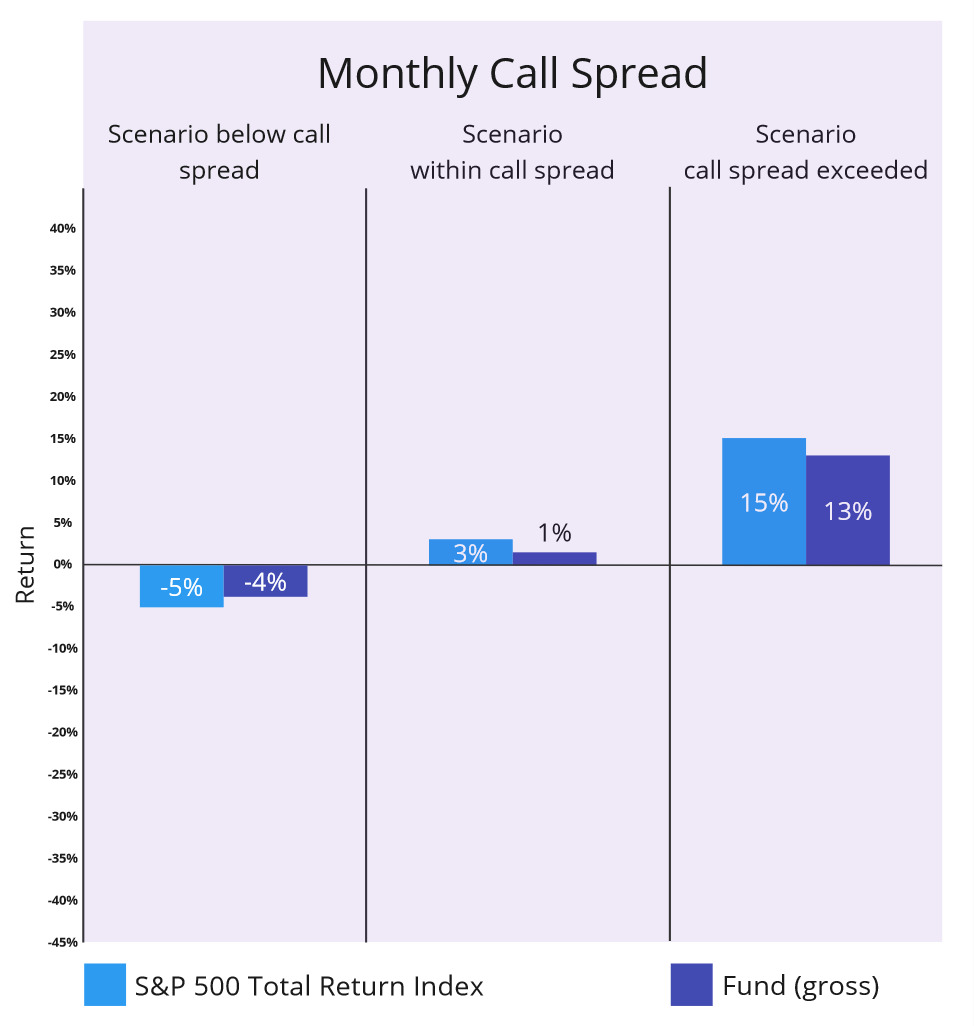
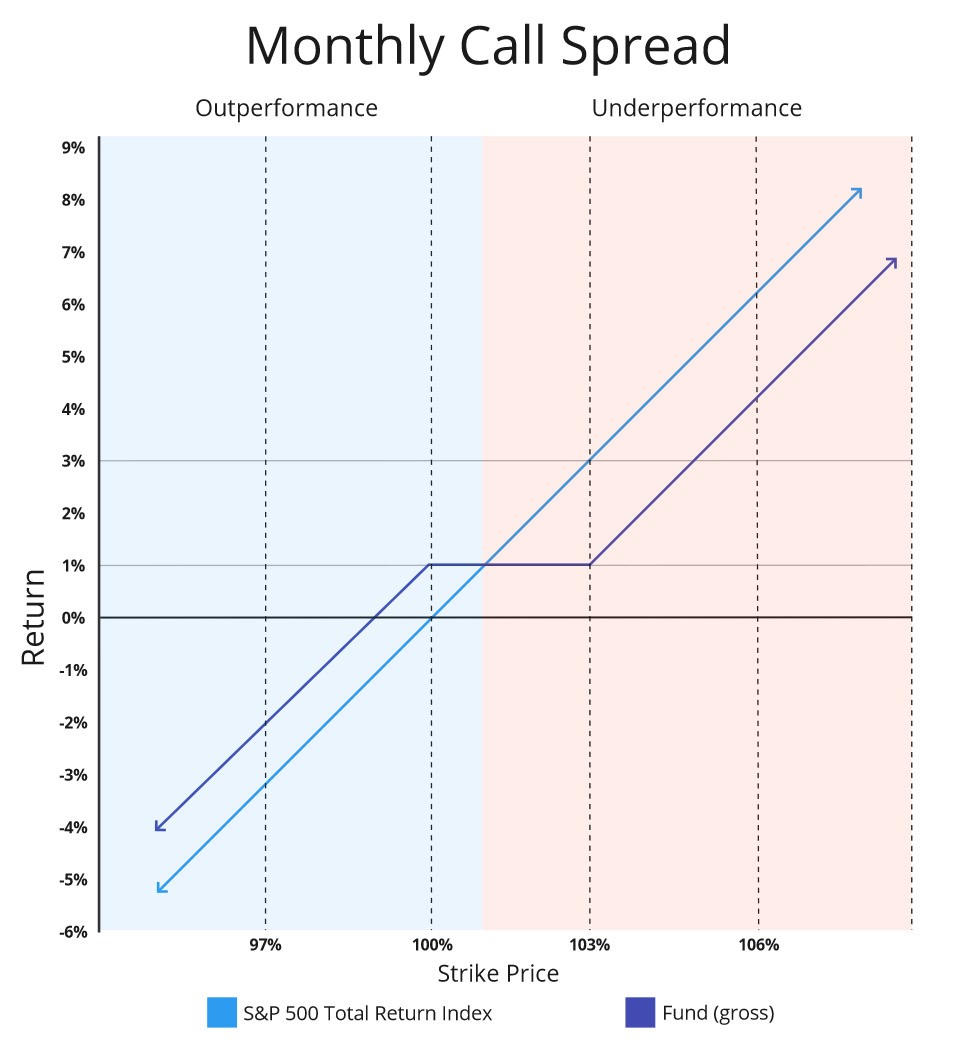
The call option strategy aims to profit from stable or declining S&P 500 prices, with the ideal scenario being the S&P 500 staying
below the strike price of the sold S&P 500 call options. At the same time, the strategy seeks to control and cap the risk of loss from
rapid gains of the S&P 500 with the purchased S&P 500 call options. While the strike prices of the S&P 500 call options may vary, the
Fund will typically sell call options with a strike price between approximately 98-105% of the current value of the S&P 500, and
purchase call options with a strike price between approximately 101-110% of the current value of the S&P 500. Once the S&P 500
appreciates by approximately 5% from its current level (the strike price of the sold call), such call spreads will begin to create a loss.
This loss will, however, will typically be capped at approximately 3% (the difference in strike prices) after the net income from the
call spreads.
Because the call option strategy is typically executed every month, it may have a larger impact on the Fund’s returns than the put
option strategy discussed below that is typically executed on a quarterly basis.
For illustrative purposes only. Figures are approximate and subject to change. Charts assume a quarterly net premium gain of 3%, which results from three
monthly call spreads and one quarterly put spread.
Quarterly Put Options Strategy
Put options are derivative instruments that allow the option purchaser to contractually sell a particular security (or the value of a
security index) to the option issuer at a strike price up to the expiration date of the options. When the issuer sells the put option, it
receives a premium from the buyer in hopes that the buyer will not exercise the option.
The Fund’s put options strategy, typically executed on a quarterly basis, is designed to protect against large declines in the S&P 500.
The quarterly put options strategy consists of a mix of purchased (or “long”) put options and sold (or “written”) put options on the
S&P 500 Index (“S&P 500 put options”). While the strike prices of the put options may vary, each quarter the Fund typically
purchases S&P 500 put options that are approximately 94-96% of the current S&P 500 level, paying a premium for downside
protection from a large decline in the S&P 500. The Fund simultaneously sells S&P 500 put options with a strike price that is
approximately 75-85% of the current price of the S&P 500 to generate some premium income to offset a portion of the cost of the
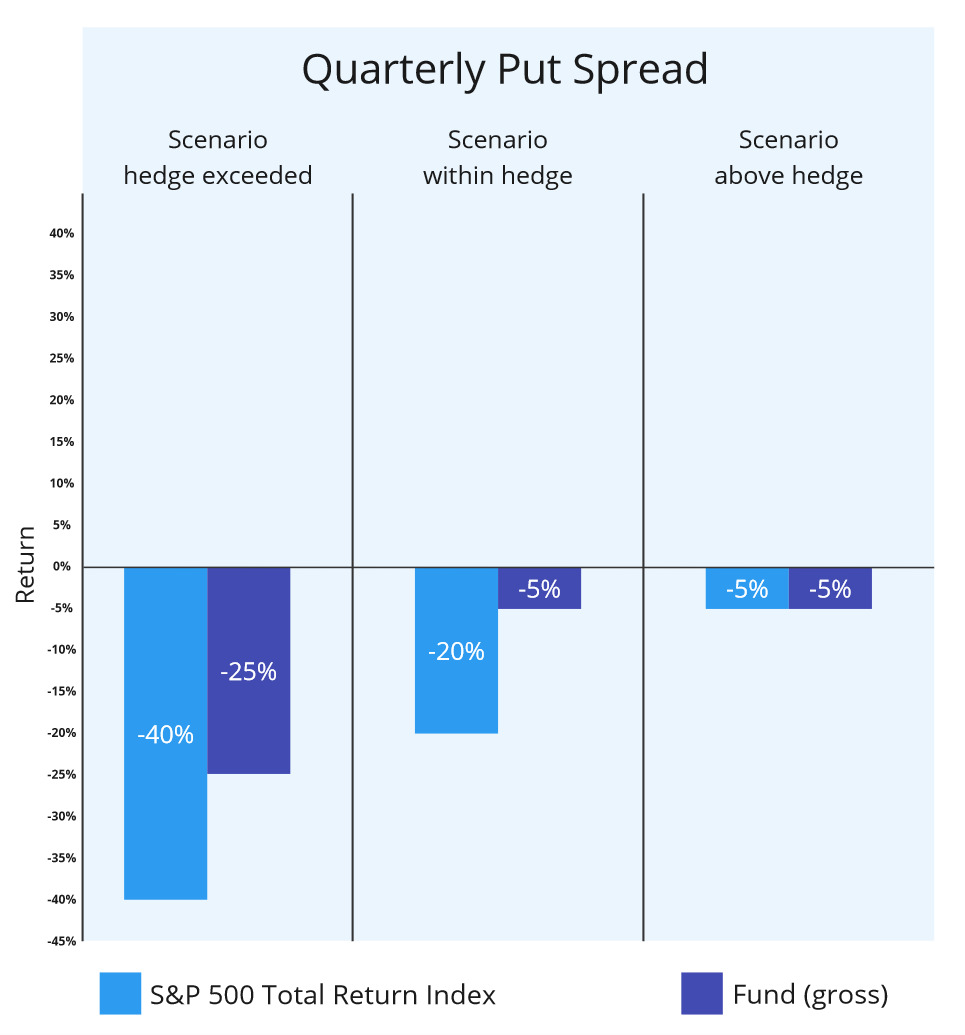
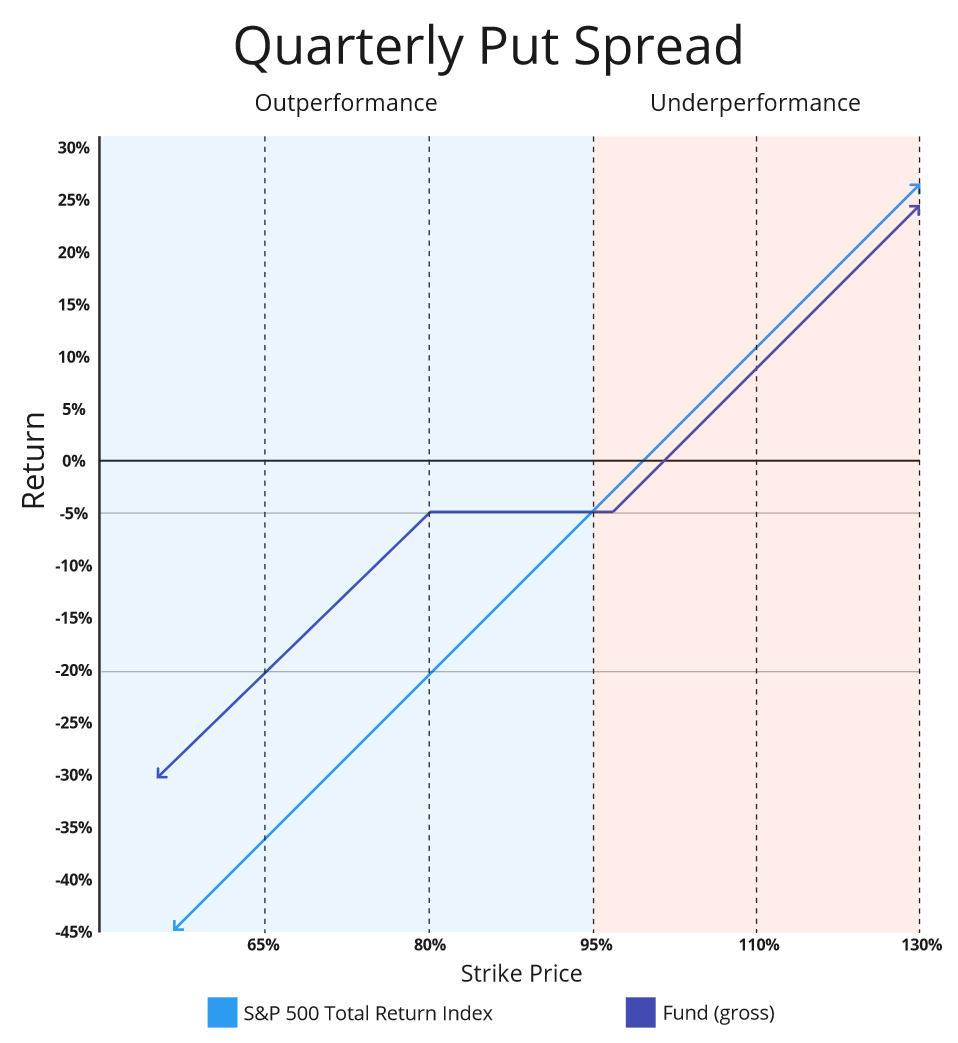
purchased put options. The quarterly options strategy of buying a put slightly below the current market price and selling another put
farther below the current market price is designed to protect against significant market downturns at a reduced cost. While the strike
prices of the put options will vary, the put spreads will typically provide a payment to offset losses once the S&P 500 declines by
approximately 5% (the strike price of the purchase put) but will no longer offset losses once the S&P 500 declines by more than an
approximately 20% (the difference in strike prices) after the net costs of the put spreads.
For illustrative purposes only. Figures are approximate and subject to change. Charts assume a quarterly net premium gain of 3%, which results from three
monthly call spreads and one quarterly put spread.
Expected Relative Performance of the Strategy
The Fund’s performance will vary, at times substantially, from the performance of the MQKHPI and the S&P 500. In general,
however, the Fund expects to perform somewhat in line with the MQKHPI, with the Fund’s active decisions around the
implementation of its options strategies intended to improve the Fund’s performance relative to the MQKHPI.
The Fund’s expected performance relative to the S&P 500 under various market conditions can be summarized as follows:
When the S&P 500 is Flat or Declines: Expected Outperformance. In months and quarters where the S&P 500 shows minimal
movement or decreases, the Fund’s overall performance is generally expected to also be flat to negative. However, the Fund would be
positioned to outperform the S&P 500 primarily due to the monthly premium income generated from the monthly call options.
•This anticipated relative outperformance is expected to increase during quarters where the S&P 500 declines by more than
approximately 4-6%, due to the additional downside protection from the quarterly put options.
•If the S&P 500 declines by more than approximately 20% from the purchase price of the put options, the Fund would have no
further downside protection other than the call option premiums. The Fund would participate fully in the decline of the S&P
500 until new put options are purchased.
When the S&P 500 is Up: Expected Underperformance. In months and quarters where the S&P 500 experiences an increase greater
than approximately 1% (the estimated long-term average of option premiums collected), the Fund’s overall performance is generally
expected to be positive. However, the Fund is likely to underperform the S&P 500 primarily be due to the Fund's option strategy that
is intended to sacrifice a portion of the Fund’s upside potential in return for reduced volatility and additional income.
•The underperformance for each monthly call option expiration cycle would be limited to the difference in call option strike
prices (expected to be approximately 3%) and the approximate 1% premium collected.
•If the S&P 500 rises above the strike prices of both call options, the Fund will no longer have capped appreciation until it
sells new call options.”
The Fund is considered to be non-diversified, which means it may invest a high percentage of its assets in a limited number of
investments. Additionally, the Fund’s investment strategies will involve active and frequent purchases and sales of call and put
options, but are not expected to result in high portfolio turnover.
Option Premiums – Income/Return of Capital
As part of the Fund’s options strategies, it sells (or writes) options in return for options premiums, which are expected to contribute to
the overall performance of the Fund. Distributions related to these options premiums may include a significant portion classified as
return of capital. Distributions characterized as a return of capital may reduce the Fund’s net asset value and should not be confused
with yield or income.
Principal Investment Risks
As with all funds, there is the risk that you could lose money through your investment in the Fund. The Fund is not intended to be a
complete investment program. Many factors affect the Fund’s Net Asset Value and performance. The following risks apply to the
Fund directly and indirectly through the Fund’s investment in underlying funds.
•Management Risk. The Adviser’s reliance on its proprietary investment process and the Adviser’s judgments about the
attractiveness, value, and potential appreciation of particular assets and asset classes may prove to be incorrect and may not
produce the desired results.
•Equity Securities Risk. The Fund may invest in or have exposure to equity securities. Equity securities may experience
sudden, unpredictable drops in value or long periods of decline in value. This may occur because of factors that affect
securities markets generally or factors affecting specific industries, sectors, geographic markets, or companies in which the
Fund invests.
•ETF Risks. The Fund is an ETF, and, as a result of an ETF’s structure, it is exposed to the following risks:
◦Authorized Participants, Market Makers, and Liquidity Providers Concentration Risk. The Fund has a limited
number of financial institutions that may act as Authorized Participants (“APs”). In addition, there may be a limited
number of market makers and/or liquidity providers in the marketplace. To the extent either of the following events
occur, shares may trade at a material discount to NAV and possibly face delisting: (i) APs exit the business or
otherwise become unable to process creation and/or redemption orders and no other APs step forward to perform
these services, or (ii) market makers and/or liquidity providers exit the business or significantly reduce their business
activities and no other entities step forward to perform their functions.
◦Cash Redemption Risk. While not expected to be a regular occurrence, the Fund’s investment strategy may require it
to redeem shares for cash or to otherwise include cash as part of its redemption proceeds. The Fund may be required
to sell or unwind portfolio investments to obtain the cash needed to distribute redemption proceeds. This may cause
the Fund to recognize a capital gain that it might not have recognized if it had made a redemption in-kind. As a
result, the Fund may pay out higher annual capital gain distributions than if the in-kind redemption process was
used.
◦Costs of Buying or Selling Shares. Due to the costs of buying or selling shares, including brokerage commissions
imposed by brokers and bid-ask spreads, frequent trading of shares may significantly reduce investment results and
an investment in shares may not be advisable for investors who anticipate regularly making small investments.
◦Shares May Trade at Prices Other Than NAV. As with all ETFs, shares may be bought and sold in the secondary
market at market prices. Although it is expected that the market price of shares will approximate the Fund’s NAV,
there may be times when the market price of shares is more than the NAV intra-day (premium) or less than the NAV
intra-day (discount) due to supply and demand of shares or during periods of market volatility. This risk is
heightened in times of market volatility, periods of steep market declines, and periods when there is limited trading
activity for shares in the secondary market, in which case such premiums or discounts may be significant. Because
securities held by the Fund may trade on foreign exchanges that are closed when the Fund’s primary listing
exchange is open, there are likely to be deviations between the current price of a security and the security’s last
quoted price from the closed foreign market. This may result in premiums and discounts that are greater than those
experienced by domestic ETFs.
◦Trading. Although shares are listed for trading on the Cboe BZX Exchange, Inc. (the “Exchange”) and may be
traded on U.S. exchanges other than the Exchange, there can be no assurance that shares will trade with any volume,
or at all, on any stock exchange. In stressed market conditions, the liquidity of shares may begin to mirror the
liquidity of the Fund’s underlying portfolio holdings, which can be significantly less liquid than shares, and this
could lead to differences between the market price of the shares and the underlying value of those shares.
•Market Risk. Overall investment market risks affect the value of the Fund. Factors such as economic growth and market
conditions, interest rate levels, and political events affect U.S. and international investment markets. Additionally, unexpected
local, regional or global events, such as war; acts of terrorism; financial, political or social disruptions; natural, environmental
or man-made disasters; the spread of infectious illnesses or other public health issues (such as the COVID-19 global
pandemic); and recessions and depressions could have a significant impact on the Fund and its investments and may impair
market liquidity. Such events can cause investor fear, which can adversely affect the economies of nations, regions and the
market in general, in ways that cannot necessarily be foreseen.
•Underlying Funds Risk. Investments in underlying funds involve duplication of investment advisory fees and certain other
expenses. Each underlying fund is subject to specific risks, depending on the nature of its investment strategy. The manager
of an underlying fund may not be successful in implementing its strategy. ETF shares may trade at a market price that may be
lower (a discount) or higher (a premium) than the ETF’s net asset value. ETFs are also subject to brokerage and/or other
trading costs, which could result in greater expenses to the Fund. Because the value of ETF shares depends on the demand in
the market, the Adviser may not be able to liquidate the Fund’s holdings at the most optimal time, adversely affecting
performance.
◦Net Asset Value and Market Price Risk. The market value of ETF shares may differ from their NAV. This difference
in price may be due to the fact that the supply and demand in the market for ETF shares at any point in time is not
always identical to the supply and demand in the market for the underlying holdings. Accordingly, there may be
times when an ETF share trades at a premium or discount to its NAV.
◦Tracking Risk. ETFs in which the Fund invests will not be able to replicate exactly the performance of any indices or
prices they track because the total return generated by the securities will be reduced by transaction costs incurred in
adjusting the actual balance of the securities or derivatives. Certain securities comprising an index may, from time to
time, temporarily be unavailable, which may further impede the security’s ability to track an index.
•Derivatives Risk. In general, a derivative instrument typically involves leverage, i.e., it provides exposure to potential gain or
loss from a change in the level of the market price of the underlying security (or a basket or index) in a notional amount that
exceeds the amount of cash or assets required to establish or maintain the derivative instrument. Adverse changes in the value
or level of the underlying asset or index, which the Fund may not directly own, can result in a loss to the Fund substantially
greater than the amount invested in the derivative itself. The use of derivative instruments also exposes the Fund to additional
risks and transaction costs. A risk of the Fund’s use of derivatives is that the fluctuations in their values may not correlate
perfectly with the overall securities markets.
◦Options Risk. An option is an agreement that, for a premium payment or fee, gives the option holder (the purchaser) the
right but not the obligation to buy (a “call option”) or sell (a “put option”) the underlying asset (or settle for cash an
amount based on an underlying asset, rate, or index) at a specified price (the “exercise price”) during a period of time or
on a specified date. Investments in options are considered speculative. When the Fund purchases an option, it may lose
the premium paid for it if the price of the underlying security or other assets decreased or remained the same (in the case
of a call option) or increased or remained the same (in the case of a put option). If a put or call option purchased by the
Fund were permitted to expire without being sold or exercised, its premium would represent a loss to the Fund. By
writing put options, the Fund takes on the risk of declines in the value of the underlying instrument, including the
possibility of a loss up to the entire exercise price of each option it sells but without the corresponding opportunity to
benefit from potential increases in the value of the underlying instrument. By writing a call option, the Fund may be
obligated to deliver instruments underlying an option at less than the market price. In the case of an uncovered call
option, there is a risk of unlimited loss.
•Leverage Risk. As part of the Fund’s principal investment strategy, the Fund will make investments in derivative instruments.
These derivative instruments provide the economic effect of financial leverage by creating additional investment exposure to
the underlying asset, as well as the potential for greater loss. If the Fund uses leverage through activities such as entering into
derivative instruments, the Fund has the risk that losses may exceed the net assets of the Fund. The net asset value of the
Fund while employing leverage will be more volatile and sensitive to market movements.
•Limited History of Operations Risk. The Fund has a limited history of operations for investors to evaluate. The Fund may fail
to attract sufficient assets to operate efficiently.
•Non-Diversification Risk. As a non-diversified fund, the Fund may invest more than 5% of its total assets in the securities of
one or more issuers. The Fund also invests in underlying funds that are non-diversified. The Fund’s performance may be
more sensitive to any single economic, business, political or regulatory occurrence than the value of shares of a diversified
investment company.
Performance: The accompanying bar chart and table provide some indication of the risks of investing in the Fund by showing how the
Fund’s total return has varied from year-to-year. Below the bar chart are the Fund’s highest and lowest quarterly returns during the
period shown in the bar chart. The performance table that follows shows the Fund’s average annual total returns over time compared
with those of a broad-based securities market index as well as an index with a similar methodology to the Fund’s strategy. You should
be aware that the Fund’s past performance (before and after taxes) may not be an indication of how the Fund will perform in the
future. Updated performance information and daily NAV per share is available at no cost by calling toll-free 866-303-8623 and on the
Fund’s website at https://www.kensingtonassetmanagement.com/solutions/etfs-khpi/.
Institutional Class Performance Bar Chart
For Calendar Year Ended December 31
The Fund’s year-to-date return as of March 31, 2026 was -3.47%.
Performance Table
Average Annual Total Returns
(For periods ended December 31, 2025)
| | |
| | Since Inception (September 4, 2024) |
Institutional Class Shares Return before taxes | | |
Institutional Class Shares Return after taxes on distributions(1) | | |
Institutional Class Shares Return after taxes on distributions and sale of Fund Shares(1) | | |
MerQube Hedged Premium Income Index (reflects no deduction for fees, expenses, or taxes) | | |
S&P 500 Total Return (reflects no deduction for fees, expenses, or taxes) | | |
(1)After-tax returns are calculated using the historical highest individual federal marginal income tax rates and do not reflect the impact of state and local taxes. The
“Return After Taxes on Distributions and Sale of Fund Shares” may be higher than other return figures when a capital loss occurs upon redemption of Fund shares
and provides an assumed tax benefit for the investor. Actual after-tax returns depend on an investor’s tax situation and may differ from those shown, and after-tax
returns shown are not relevant to investors who hold their Fund shares through tax-deferred arrangements, such as 401(k) plans or individual retirement accounts.
Investment Adviser: Kensington Asset Management, LLC
Sub-Adviser: Liquid Strategies, LLC
Portfolio Managers: Elio Chiarelli, Ph.D., Shawn Gibson and Adam Stewart, CFA, each a portfolio manager of the Sub-Adviser,
have been portfolio managers of the Fund since its inception in September of 2024.
Purchase and Sale of Fund Shares: The Fund will issue (or redeem) shares to certain institutional investors (typically market makers
or other broker-dealers) only in blocks of shares known as “Creation Units.” Creation Unit transactions are typically conducted in
exchange for the deposit or delivery of in-kind securities and/or cash constituting a substantial replication, or a representation, of the
securities included in the Fund’s portfolio. Individual shares may only be purchased and sold on a national securities exchange
through a broker-dealer. You can purchase and sell individual shares of the Fund throughout the trading day like any publicly traded
security. The Fund’s shares are listed on the Cboe BZX Exchange, Inc. (the “Exchange”). The price of the Fund’s shares is based on
market price, and because exchange-traded fund shares trade at market prices rather than net asset value (“NAV”), the Fund’s shares
may trade at a price greater than NAV (premium) or less than NAV (discount). Except when aggregated in Creation Units, the Fund’s
shares are not redeemable securities.
Investors may incur costs attributable to the difference between the highest price a buyer is willing to pay to purchase shares of the
Fund (bid) and the lowest price a seller is willing to accept for shares of the Fund (ask) when buying or selling shares of the Fund in
the secondary market (the “bid-ask spread”). Recent information about the Fund, including its NAV, market price, premiums and
discounts, and bid-ask spreads is available on the Fund’s website at https://www.kensingtonassetmanagement.com/solutions/etfs-
khpi/.
Tax Information: Distributions made by the Fund may be taxable to you as ordinary income or capital gains, unless you are a tax-
exempt organization or are investing through a tax advantaged arrangement, such as a 401(k) plan or individual retirement account.
Any withdrawals made from such tax advantaged arrangement generally will be taxable to you as ordinary income.
Payments to Broker-Dealers and Other Financial Intermediaries: If you purchase shares of the Fund through a broker-dealer or
other financial intermediary (such as a bank), the Fund and its related companies may pay the intermediary for the sale of Fund shares
and related services. These payments may create a conflict of interest by influencing the broker-dealer or other intermediary and your
salesperson to recommend the Fund over another investment. Ask your salesperson or visit your financial intermediary’s website for
more information.
|
ADDITIONAL INFORMATION ABOUT INVESTMENT OBJECTIVE AND RELATED RISKS |
Investment Objectives
| |
| |
Kensington Credit Opportunities ETF (the “Credit Opportunities ETF”)* | The Fund seeks income and capital appreciation. |
Kensington Hedged Premium Income ETF (the “Hedged Premium Income ETF”)* | The Fund seeks current income with the potential for capital appreciation. |
*Credit Opportunities ETF and Hedged Premium Income ETF (each, a “Fund” and, together, the “Funds”) |
Each Fund’s investment objective may be changed without shareholder approval by the Fund’s Board of Trustees (the “Board” or the
“Trustees”) upon written notice to shareholders.
Credit Opportunities ETF
The Credit Opportunities ETF is an actively-managed ETF designed to provide the potential to generate a return stream independent
from traditional buy and hold, long-only fixed income strategies with enhanced portfolio diversification, and a reduced risk of
drawdown (i.e., the risk of a decline in investment value during a decline in the U.S. equity markets also known as downside
protection). The Adviser seeks to achieve the Credit Opportunities ETF’s investment objective by managing the duration and credit
risk of higher-yielding fixed income securities, using a robust quantitative process. Over a full market cycle, the aim is to provide
smooth risk-adjusted returns by taking long or short positions across a wide range of asset classes within fixed income. Allocations
across asset classes will be made systematically with additional qualitative input from the portfolio management team.
Hedged Premium Income ETF
The Hedged Premium Income ETF is an actively-managed exchange-traded fund (“ETF”) that seeks to achieve its investment
objective by gaining exposure to the S&P 500 Index (the “S&P 500”). The foundation of the Hedged Premium Income ETF’s strategy
involves buying shares of a cost-effective ETF that tracks the S&P 500, providing direct exposure to the broad market’s performance.
The Hedged Premium Income ETF simultaneously implements a monthly call option strategy to generate income and a quarterly put
option strategy to protect against large declines in the S&P 500.
In implementing its strategy, the Hedged Premium Income ETF employs a methodology similar the MerQube Hedged Premium
Income Index (the “MQKHPI”). The MQKHPI is designed to be 100% invested in the Vanguard S&P 500 ETF (VOO) while selling
1-Month call options and purchasing 3-Month put options on the SPDR S&P 500 ETF (SPY). The MQKHPI aims to generate income
from selling call spreads while providing downside protection through the purchase of put spreads, maintaining exposure to the U.S.
large-cap equity market.
Neither MerQube, Inc. nor any of its affiliates (collectively,“MerQube”) is the issuer or producer of the Hedged Premium Income ETF
and MerQube has no duties, responsibilities, or obligations to investors in the Hedged Premium Income ETF. The index underlying
the Hedged Premium Income ETF is a product of MerQube and has been licensed for use by Kensington Asset Management. Such
index is calculated using, among other things, market data or other information (“Input Data”) from one or more sources (each a “Data
Provider”). MerQube® is a registered trademark of MerQube, Inc. These trademarks have been licensed for certain purposes by
Kensington Asset Management in its capacity as the investment adviser of the Hedged Premium Income ETF. The Hedged Premium
Income ETF is not sponsored, endorsed, sold or promoted by MerQube, any Data Provider, or any other third party, and none of such
parties make any representation regarding the advisability of investing in such product(s) nor do they have any liability for any
errors,omissions, or interruptions of the Input Data, MerQube Hedged Premium Income Index or any Associated data.
The Hedged Premium Income ETF will operate similarly to the MQKHPI, but with several differences. For one, while the Hedged
Premium Income ETF may elect to purchase VOO and put and call options on SPY, the Hedged Premium Income ETF will be more
flexible in determining which cost-effective S&P 500 ETFs to purchase and what S&P 500 call and put options to buy and sell.
Additionally, unlike the MQKHPI that holds options to expiration, the Hedged Premium Income ETF will actively manage the risk-to-
reward ratio of the Hedged Premium Income ETF’s option strategies. If the perceived reward (premium or cost to close out a position)
is not proportional to the risk (maximum potential loss), the Hedged Premium Income ETF’s Sub-advisor will use its discretion to
adjust or close the position if determined to be advantageous to the portfolio. The Hedged Premium Income ETF’s Sub-adviser will
also use independent judgement in determining what particular option spreads to buy and sell under various market conditions, unlike
the fixed spreads used by the MQKHPI.
Although the Hedged Premium Income ETF’s strategy is not expected to materially change in different interest rate environments,
varying levels of market volatility will impact the relative costs of downside protection and relative option spreads. Additionally, the
sequence of investment returns will affect the various strikes prices, expiration dates, and intended purposes of the options used by the
Hedged Premium Income ETF, and could significantly impact Hedged Premium Income ETF’s overall performance. The Hedged
Premium Income ETF, based on current market conditions, seeks to achieve the best balance of premium income/costs, downside
protection, and upside potential to meet its investment objective of current income with the potential for capital appreciation.
Monthly Call Options Strategy
Call options are derivative instruments that allow the option purchaser to contractually purchase a particular security (or the value of a
security index) from the option issuer at a set price (the “strike price”) up to the expiration date of the options. When the issuer sells
the call option, it receives a premium from the buyer in hopes that the option will not be exercised by the buyer.
The monthly call options strategy consists of a mix of selling and purchasing call options on the S&P 500 (“S&P 500 call options”).
The Hedged Premium Income ETF seeks to generate income from the premiums earned from the sold S&P 500 call options. At the
same time, the Hedged Premium Income ETF seeks to realize capital appreciation from its S&P 500 ETF holdings as the S&P 500
increases in value, but with potentially reduced upside because of the sold S&P 500 call options it uses to generate premium income.
The Hedged Premium Income ETF’s purchased S&P 500 call options, however, are intended to offset this reduced upside potential
and limit the risk of missing out on strong market rallies of the S&P 500.
On a regular basis, typically monthly, the Hedged Premium Income ETF sells S&P 500 call options to generate premium income
while simultaneously buying “out of the money” long S&P 500 call options (i.e., options to purchase at a strike price that is higher
than the current price of the reference security or index) to hedge against the possibility that the sold S&P 500 call options are
exercised because the S&P 500 increases above the strike price of the sold S&P 500 call options. For example, as the S&P 500
increases in value during the month, the holders of the sold S&P 500 call options may be more incentivized to exercise their options
which will create some losses for the Hedged Premium Income ETF. However, if the price of the S&P 500 increases above the strike
price of the purchased S&P 500 call options, the Hedged Premium Income ETF will be protected from larger losses because the
Hedged Premium Income ETF will exercise its purchased S&P 500 call options, offsetting a portion of its losses on the sold S&P 500
call options.
The call option strategy aims to profit from stable or declining S&P 500 prices, with the ideal scenario being the S&P 500 staying
below the strike price of the sold S&P 500 call options. At the same time, the strategy seeks to control and cap the risk of loss from
rapid gains of the S&P 500 with the purchased S&P 500 call options. While the strike prices of the S&P 500 call options may vary, the
Hedged Premium Income ETF will typically sell call options with a strike price between approximately 98-105% of the current value
of the S&P 500, and purchase call options with a strike price between approximately 101-110% of the current value of the S&P 500.
Once the S&P 500 appreciates by approximately 5% from its current level (the strike price of the sold call), such call spreads will
begin to create a loss. This loss will, however, will typically be capped at approximately 3% (the difference in strike prices) after the
net income from the call spreads.
Because the call option strategy is typically executed every month, it may have a larger impact on the Hedged Premium Income ETF’s
returns than the put option strategy discussed below that is typically executed on a quarterly basis.
Quarterly Put Options Strategy
Put options are derivative instruments that allow the option purchaser to contractually sell a particular security (or the value of a
security index) to the option issuer at a strike price up to the expiration date of the options. When the issuer sells the put option, it
receives a premium from the buyer in hopes that the option will not be exercised by the buyer.
The Hedged Premium Income ETF’s put options strategy, typically executed on a quarterly basis, is designed to protect against large
declines in the S&P 500. The quarterly put options strategy consists of a mix of purchased (or “long”) put options and sold (or
“written”) put options on the S&P 500 Index (“S&P 500 put options”). While the strike prices of the put options may vary, each
quarter the Hedged Premium Income ETF typically purchases S&P 500 put options that are approximately 94-96% of the current S&P
500 level, paying a premium for downside protection from a large decline in the S&P 500. The Hedged Premium Income ETF
simultaneously sells S&P 500 put options with a strike price that is approximately 75-85% of the current price of the S&P 500 to
generate some premium income to offset a portion of the cost of the purchased put options. The quarterly options strategy of buying a
put slightly below the current market price and selling another put farther below the current market price is designed to protect against
significant market downturns at a reduced cost. While the strike prices of the put options will vary, the put spreads will typically
provide a payment to offset losses once the S&P 500 declines by approximately 5% (the strike price of the purchase put) but will no
longer offset losses once the S&P 500 declines by more than an approximately 20% (the difference in strike prices) after the net costs
of the put spreads.
Expected Relative Performance of the Strategy
The Hedged Premium Income ETF’s performance will vary, at times substantially, from the performance of the MQKHPI and the
S&P 500. In general, however, the Hedged Premium Income ETF expects to perform somewhat in line with the MQKHPI, with the
Hedged Premium Income ETF’s active decisions around the implementation of its options strategies intended to improve the Hedged
Premium Income ETF’s performance relative to the MQKHP. The Hedged Premium Income ETF’s expected performance relative to
the S&P 500 under various market conditions can be summarized as follows:
When the S&P 500 is Flat or Declines: Expected Outperformance. In conditions months and quarters where the S&P 500 shows
minimal movement or decreases, the Hedged Premium Income ETF’s overall performance is generally expected to also be flat to
negative. However, the Hedged Premium Income ETF would be positioned to outperform the S&P 500 primarily due to the monthly
premium income generated from the monthly call options.
• This anticipated relative outperformance is expected to increase during quarters where the S&P 500 declines by more than
approximately 4-6%, due to the additional downside protection from the quarterly put options.
• If the S&P 500 declines by more than approximately 20% from the purchase price of the put options, the Hedged Premium Income
ETF would have no further downside protection other than the call option premiums. The Hedged Premium Income ETF would
participate fully in the decline of the S&P 500 until new put options are purchased.
When the S&P 500 is Up: Expected Underperformance. In scenarios months and quarters where the S&P 500 experiences an increase
greater than approximately 1% (the estimated long-term average of option premiums collected), the Hedged Premium Income ETF’s
overall performance is generally expected to be positive. However, the Hedged Premium Income ETF is likely to underperform the
S&P 500 primarily be due to the Hedged Premium Income ETF’s option strategy that is intended to sacrifice a portion of the Hedged
Premium Income ETF’s upside potential in return for reduced volatility and additional income.
• The underperformance for each monthly call option expiration cycle would be limited to the difference in call option strike prices
(expected to be approximately 3%) and the approximate 1% premium collected.
• If the S&P 500 rises above the strike prices of both call options, the Hedged Premium Income ETF will no longer have capped
appreciation until it sells new call options.
Option Premiums – Income/Return of Capital
Receipt of an option premium does not always represent income. Depending on whether the transaction as a whole results in a gain or
loss, such amounts may be treated for accounting or tax purposes as income or as a return of capital (“ROC”). ROC represents a return
of a shareholder’s own invested capital and does not reflect traditional income such as dividends or interest. A portion (sometimes a
significant portion) of the Hedged Premium Income ETF’s cash distributions may be classified as ROC, which generally refers to the
portion of a distribution that represents a return of the original investment (principal) rather than income or profit. Accordingly, such
distributions do not necessarily reflect traditional income or yield, and receipt of an option premium could ultimately result in a net
loss on the transaction if offset by subsequent closing transactions, exercise or settlement.
Investments in Other Investment Companies
Section 12(d)(1) of the Investment Company Act of 1940, as amended (the “1940 Act”) restricts investments by investment companies
in the securities of other investment companies, including Underlying ETFs. In October 2020, the SEC adopted regulatory changes
related to the ability of an investment company to invest in other investment companies in excess of specified statutory limits. These
changes include, among other things, amendments to Rule 12d1-1, the rescission of Rule 12d1-2, the adoption of new Rule 12d1-4,
and the rescission of certain exemptive relief issued by the SEC permitting certain fund of funds arrangements. Rule 12d1-4, which
became effective on January 19, 2021, permits each Fund to invest in other investment companies, including money market funds,
beyond the statutory limits, subject to certain conditions. The rescission of the applicable exemptive orders and the withdrawal of the
applicable no-action letters was effective on January 19, 2022. Following this effectiveness, an investment company is no longer able
to rely on these exemptive orders and no-action letters, and is subject instead to Rule 12d1-4 and other applicable rules under Section
12(d)(1).
Derivatives
Each Fund may invest in certain derivative instruments, such as futures, options and swaps, as set forth in its “Principal Investment
Strategies”. Under Rule 18f-4 under the 1940 Act, funds that are subject to the rule are required to adopt and implement a written
derivatives risk management program and quantitatively limit their use of derivatives based on the estimated potential risk of loss that
the funds incur from their derivatives transactions. Funds that limit derivatives exposure to 10% of net assets are exempt from many of
the requirements of Rule 18f-4, but must still adopt and implement policies and procedures reasonably designed to manage the fund’s
derivatives risks. Rule 18f-4 governs the way funds must comply with the asset segregation and coverage requirements of Section 18
of the 1940 Act with respect to derivatives and certain other financing transactions. Each Fund will comply with Rule 18f-4, as
applicable.
Principal Investment Risks
There is no assurance that a Fund will achieve its investment objective. Each Fund’s share price will fluctuate with changes in the
market value of its portfolio investments. When you sell your Fund shares, they may be worth less than what you paid for them and,
accordingly, you can lose money investing in a Fund. Risks could adversely affect the NAV, total return, and the value of a Fund and
your investment. The risk descriptions below provide a more detailed explanation of the principal investment risks that correspond to
the risks described in the “Fund Summary” section of this Prospectus. The following risks apply (as applicable) to the Funds’
investments in securities directly or through underlying funds or derivatives, as described above.
•Management Risk (both Funds). The Adviser’s and/or Sub-Adviser’s reliance on proprietary models or judgments about the
attractiveness, value, and potential appreciation or depreciation of a particular security or instrument in which a Fund invests
may prove to be inaccurate and may not produce the desired results.
•Equity Securities Risk (both Funds). Each Fund may invest in or have exposure to equity securities. Equity securities can be
affected by macroeconomic and other factors affecting the stock market in general, expectations about changes in interest
rates, investor sentiment towards equities, changes in a particular issuer’s or industry’s financial condition, or unfavorable or
unanticipated poor performance of a particular issuer or industry. Prices of equity securities of individual entities also can be
affected by fundamentals unique to the company or partnership, including earnings power and coverage ratios. An adverse
event, such as an unfavorable earnings report, may depress the value of a particular common stock held by a Fund. In
addition, prices of common stocks are sensitive to general movements in the stock market and a drop in the stock market may
depress the price of common stocks. Common stock prices may fluctuate for several reasons including changes in investors’
perceptions of the financial condition of an issuer or the general condition of the relevant stock market, or the occurrence of
political or economic events that affect the issuers. In addition, common stock prices may be particularly sensitive to rising
interest rates, which increases borrowing costs and the costs of capital. Any of the foregoing risks could substantially impact
the ability of such an entity to grow its dividends or distributions.
•High-Yield Bond Risk (Credit Opportunities ETF). High-yield fixed-income securities or “junk bonds” are fixed-income
securities rated below investment grade. Although junk bonds generally pay higher rates of interest than higher-rated
securities, they are subject to a greater risk of loss of income and principal. Junk bonds are subject to greater credit risk than
higher-grade securities and have a higher risk of default. Companies issuing high-yield junk bonds are more likely to
experience financial difficulties that may lead to a weakened capacity to make principal and interest payments than issuers of
higher grade securities. Issuers of junk bonds are often highly leveraged or undergoing restructuring and are more vulnerable
to changes in the economy, such as a recession or rising interest rates, which may affect their ability to meet their interest or
principal payment obligations. As a result, junk bonds generally are more sensitive to credit risk and are considered more
speculative than securities in the higher-rated categories. The risk of loss due to default by an issuer of these securities is
significantly greater than issuers of higher-rated securities because such securities are generally unsecured and are often
subordinated to other creditors. The secondary market for securities that are junk bonds may be less liquid than the markets
for higher quality securities, and, as such, may have an adverse effect on the market prices of certain securities.
•Fixed-Income Securities Risks (Credit Opportunities ETF). The Fund may invest in or have exposure to fixed-income
securities. Fixed-income securities held by the Fund are or may be subject to interest rate risk, call risk, prepayment and
extension risk, credit risk, and liquidity risk, which are more fully described below. Changes in market conditions and
government policies may lead to periods of heightened volatility and reduced liquidity in the fixed-income securities market,
and could result in an increase in Fund redemptions. Interest rate changes and their impact on the Fund and its share price can
be sudden and unpredictable.
◦Call Risk (Credit Opportunities ETF). During periods of declining interest rates, a bond issuer may “call,” or repay,
its high-yielding bonds before their maturity dates. In this event the Fund would then be forced to invest the
unanticipated proceeds at lower interest rates, resulting in a decline in its income.
◦Credit Risk (Credit Opportunities ETF). Fixed-income securities are generally subject to the risk that the issuer may
be unable or unwilling to make principal and interest payments when they are due. There is also the risk that the
securities could lose value because of a loss of confidence in the ability of the borrower to pay back debt. Lower
rated fixed-income securities involve greater credit risk, including the possibility of default or bankruptcy.
◦Interest Rate Risk (Credit Opportunities ETF). Generally, the value of fixed income securities will change inversely
with changes in interest rates. As interest rates rise, the market value of fixed income securities tends to decrease.
Conversely, as interest rates fall, the market value of fixed income securities tends to increase. This risk will be
greater for long-term securities than for short-term securities. The Fund may take steps to attempt to reduce the
exposure of its portfolio to interest rate changes; however, there can be no guarantee that the Fund will take such
actions or that the Fund will be successful in reducing the impact of of interest rate changes on the portfolio. In the
past, governmental financial regulators, including the U.S. Federal Reserve, took steps to maintain historically low
interest rates. Recently, government regulators have increased interest rates to combat the rise in inflation and are
now considering lowering them again as inflation appears to have subsided and unemployment rates have increased.
These changes in government intervention may have adverse affects on investments, volatility, and illiquidity in
debt markets.
◦Prepayment and Extension Risk (Credit Opportunities ETF). Many types of fixed-income securities are subject to
prepayment risk. Prepayment occurs when the issuer of a fixed-income security can repay principal faster than
expected prior to the security’s maturity. Fixed-income securities subject to prepayment risk can offer less potential
for gains during a declining interest rate environment and similar or greater potential for loss in a rising interest rate
environment. In addition, the potential impact of prepayment features on the price of a fixed-income security can be
difficult to predict and result in greater volatility. On the other hand, rising interest rates could cause prepayments of
the obligations to decrease. This is known as extension risk and may increase the Fund’s sensitivity to rising rates
and its potential for price declines.
◦Liquidity Risk (Credit Opportunities ETF). Trading opportunities are more limited for fixed-income securities that
have not received any credit ratings, have received ratings below investment grade or are not widely held. These
features may make it more difficult to sell or buy a security at a favorable price or time. Consequently, the Fund may
have to accept a lower price to sell a security, sell other securities to raise cash or give up an investment opportunity,
any of which could have a negative effect on its performance. Infrequent trading of securities may also lead to an
increase in their price volatility. Liquidity risk also refers to the possibility that the Fund may not be able to sell a
security or close out a position in a timely manner. If this happens, the Fund may be required to hold the security or
keep the position open, and it could incur losses.
◦Duration Risk (Credit Opportunities ETF). The Fund can invest in securities of any maturity or duration. Duration is
a measure of sensitivity of a security’s price to changes in interest rates. For example, a security with a duration of
2.0 would be expected to decrease in price 2% for every 1% rise in interest rates (the inverse is true as well).
Holding long duration and long maturity investments will magnify certain risks, including interest rate risk and
credit risk.
•ETF Risks (both Funds). Each Fund is an ETF, and, as a result of an ETF’s structure, each Fund is exposed to the following
risks:
◦Authorized Participants, Market Makers, and Liquidity Providers Concentration Risk (both Funds). A Fund has a
limited number of financial institutions that may act as APs. In addition, there may be a limited number of market
makers and/or liquidity providers in the marketplace. To the extent either of the following events occur, shares may
trade at a material discount to NAV and possibly face delisting: (i) APs exit the business or otherwise become
unable to process creation and/or redemption orders and no other APs step forward to perform these services, or (ii)
market makers and/or liquidity providers exit the business or significantly reduce their business activities and no
other entities step forward to perform their functions.
◦Cash Redemption Risk (both Funds). While not expected to be a regular occurrence, a Fund’s investment strategy
may require it to redeem shares for cash or to otherwise include cash as part of its redemption proceeds. A Fund may
be required to sell or unwind portfolio investments to obtain the cash needed to distribute redemption proceeds. This
may cause a Fund to recognize a capital gain that it might not have recognized if it had made a redemption in-kind.
As a result, a Fund may pay out higher annual capital gain distributions than if the in-kind redemption process was
used.
◦Costs of Buying or Selling Shares (both Funds). Investors buying or selling shares in the secondary market will pay
brokerage commissions or other charges imposed by brokers, as determined by that broker. Brokerage commissions
are often a fixed amount and may be a significant proportional cost for investors seeking to buy or sell relatively
small amounts of shares. In addition, secondary market investors will also incur the cost of the difference between
the price at which an investor is willing to buy shares (the “bid” price) and the price at which an investor is willing
to sell shares (the “ask” price). This difference in bid and ask prices is often referred to as the “spread” or “bid-ask
spread.” The bid-ask spread varies over time for shares based on trading volume and market liquidity, and the spread
is generally lower if shares have more trading volume and market liquidity and higher if shares have little trading
volume and market liquidity. Further, a relatively small investor base in a Fund, asset swings in a Fund, and/or
increased market volatility may cause increased bid-ask spreads. Due to the costs of buying or selling shares,
including bid-ask spreads, frequent trading of shares may significantly reduce investment results and an investment
in shares may not be advisable for investors who anticipate regularly making small investments.
◦Shares May Trade at Prices Other Than NAV (both Funds). As with all ETFs, shares may be bought and sold in the
secondary market at market prices. Although it is expected that the market price of shares will approximate a Fund’s
NAV, there may be times when the market price of shares is more than the NAV intra-day (premium) or less than
the NAV intra-day (discount) due to supply and demand of shares or during periods of market volatility. This risk is
heightened in times of market volatility, periods of steep market declines, and periods when there is limited trading
activity for shares in the secondary market, in which case such premiums or discounts may be significant. Because
securities held by a Fund may trade on foreign exchanges that are closed when a Fund’s primary listing exchange is
open, there are likely to be deviations between the current price of a security and the security’s last quoted price
from the closed foreign market. This may result in premiums and discounts that are greater than those experienced
by domestic ETFs.
◦Trading (both Funds). Although shares are listed for trading on the Exchange and may be listed or traded on U.S.
and non-U.S. stock exchanges other than the Exchange, there can be no assurance that an active trading market for
such shares will develop or be maintained. Trading in shares may be halted due to market conditions or for reasons
that, in the view of the Exchange, make trading in shares inadvisable. In addition, trading in shares on the Exchange
is subject to trading halts caused by extraordinary market volatility pursuant to Exchange “circuit breaker” rules,
which temporarily halt trading on the Exchange when a decline in the S&P 500 Index during a single day reaches
certain thresholds (e.g., 7%, 13%, and 20%). Additional rules applicable to the Exchange may halt trading in shares
when extraordinary volatility causes sudden, significant swings in the market price of shares. There can be no
assurance that shares will trade with any volume, or at all, on any stock exchange. In stressed market conditions, the
liquidity of shares may begin to mirror the liquidity of a Fund’s underlying portfolio holdings, which can be
significantly less liquid than shares, and this could lead to differences between the market price of the shares and the
underlying value of those shares.
•Business Development Company (“BDC”) Risk (Credit Opportunities ETF). There are certain risks inherent in investing in
BDCs, whose principal business is to invest in, and lend capital or provide services to privately held companies. BDCs are
regulated under the 1940 Act and are subject to certain restraints. For example, BDCs are required to invest at least 70% of
their total assets primarily in securities of private companies or thinly traded U.S. public companies, cash, cash equivalents,
U.S. government securities and high quality debt investments that mature in one year or less. Because little public
information exists for private and thinly traded companies in which a BDC may invest, there is a risk that investors may not
be able to make a fully informed investment decision. In addition, investments made by BDCs are typically illiquid and may
be difficult to value. A BDC may only incur indebtedness in amounts such that the BDC's asset coverage, subject to certain
conditions, equals at least 150% after such incurrence. These limitations on asset mix and leverage may prohibit the way that
the BDC raises capital.
Investments made by BDCs generally are subject to legal and other restrictions on resale and otherwise are less liquid than
publicly traded securities. As a result, these investments may be more difficult to sell if the need arises, and if there is a need
for a BDC in which the Fund invests to liquidate its portfolio quickly, it may realize a loss on its investments.
Further, investment advisers to BDCs may be entitled to compensation based on the BDC's performance, which may result in
riskier or more speculative investments in an effort to maximize incentive compensation and higher fees. Additionally, to the
extent that the Fund invests a portion of its assets in BDCs, a shareholder in the Fund not only will bear his or her
proportionate share of the expenses of the Fund, but also will bear indirectly the expenses of the BDCs.
•Foreign Investment Risk (Credit Opportunities ETF). Foreign investments may be riskier than U.S. investments for many
reasons, including changes in currency exchange rates; unstable political, social and economic conditions; possible security
illiquidity; a lack of adequate or accurate company information; differences in the way securities markets operate; less secure
foreign banks or securities depositories than those in the United States; less standardization of accounting standards and
market regulations in certain foreign countries; and varying foreign controls on investments. These risks are more
pronounced in emerging market countries.
•Emerging Market Risk (Credit Opportunities ETF). The Fund intends to have exposure to emerging markets. Emerging
markets are riskier than more developed markets because they tend to develop unevenly and may never fully develop.
Investments in emerging markets may be considered speculative. Emerging markets are more likely to experience
hyperinflation and currency devaluations, which adversely affect returns to U.S. investors. In addition, many emerging
securities markets have far lower trading volumes and less liquidity than developed markets. Emerging markets generally
have less stable political systems, less developed securities settlement procedures and may require the establishment of
special custody arrangements. Emerging securities markets generally do not have the level of market efficiency and strict
standards in accounting and securities regulation as developed markets, which could impact the Adviser's ability to evaluate
these securities and/or impact Fund performance.
•Currency Risk (Credit Opportunities ETF). Changes in currency exchange rates may negatively affect the value of the Fund’s
investments. The liquidity and trading value of foreign currencies could be affected by global economic factors, such as
inflation, interest rate levels, and trade balances among countries, as well as the actions of sovereign governments and central
banks or other political developments in the United States or abroad. Fluctuations in currency exchange rates (relative to the
U.S. dollar) may erode or reverse any potential gains from the Fund’s investments in securities denominated in a foreign
currency or may widen existing losses.
•Geographic Focus Risk (Credit Opportunities ETF). The Fund may focus its investments in one or more regions or a limited
number of countries. If the Fund focuses its investments in this manner, the Fund may be particularly susceptible to risks
related to economic, political, regulatory or other events or conditions affecting issuers and countries within the specific
geographic regions in which the Fund invests. As a result, the Fund’s performance may be subject to greater volatility than a
more geographically diversified fund.
•Loans Risk (Credit Opportunities ETF). Investments in bank loans, loan participations, syndicated loan assignments also
known as loans or corporate loans, of which senior loans are a type, may subject the Fund to heightened credit risks because
such loans tend to be highly leveraged and potentially more susceptible to the risks of interest deferral, default and/or
bankruptcy. These investments expose the Fund to the credit risk of both the financial institution and the underlying
borrower. The risks associated with these loans can be similar to the risks of other below investment grade fixed income
instruments. An economic downturn would generally lead to a higher non-payment rate, and a loan may lose significant
market value before a default occurs. Moreover, any specific collateral, if any, used to secure a loan may decline in value or
become illiquid, which would adversely affect the loan’s value. Unlike the securities markets, there is no central
clearinghouse for loan trades, and the loan market has not established enforceable settlement standards or remedies for failure
to settle. Therefore, transactions in loans may have uncertain settlement time periods. Investments in bank loans may not be
securities and therefore may not have the protections afforded by the federal securities laws.
•Distribution Risk (Credit Opportunities ETF). The Fund is not designed to provide a predictable level of dividend income.
The income payable on debt securities in general and the availability of investment opportunities varies based on market
conditions. In addition, the Fund may not be effective in identifying income producing securities and managing distributions;
as a result, the level of dividend income will fluctuate. The Fund’s investments are subject to various risks including the risk
that the counterparty will not pay income when due which may adversely impact the level and volatility of dividend income
paid by the Fund. The Fund does not guarantee that distributions will always be paid or that such dividends will not fluctuate.
•Market Risk (both Funds). The net asset value (“NAV”) and investment return of a Fund will fluctuate based on factors such
as economic growth and market conditions, interest rate levels, and political events that effect the United States and
international investment markets. The market value of a security may move up or down, sometimes rapidly and
unpredictably. These fluctuations may cause a security to be worth less than the price originally paid for it, or less than it was
worth at an earlier time. Market risk may affect a single issuer, industry, sector of the economy or the market as a whole. U.S.
and international markets have experienced, and may continue to experience, volatility, which may increase risks associated
with an investment in a Fund. Certain social, political, economic, environmental, and other conditions and events (such as
natural disasters and weather-related phenomena generally, epidemics and pandemics, terrorism, conflicts, and social unrest)
may adversely interrupt the global economy and result in prolonged periods of significant market volatility. The market value
of securities in which a Fund invests is based upon the market’s perception of value and is not necessarily an objective
measure of the securities’ value. In some cases, for example, the stock prices of individual companies have been negatively
impacted even though there may be little or no apparent degradation in the financial condition or prospects of the issuers.
Similarly, the debt markets have experienced substantially lower valuations, reduced liquidity, price volatility, credit
downgrades, increased likelihood of default, and valuation difficulties. As a result of this significant volatility, many of the
following risks associated with an investment in a Fund may be increased. Continuing market volatility may have adverse
effects on a Fund.
Unexpected local, regional or global events, such as war; acts of terrorism; financial, political or social disruptions; natural,
environmental or man-made disasters; the spread of infectious illnesses or other public health issues; and recessions and
depressions could have a significant impact on a Fund and its investments and may impair market liquidity. Such events can
cause investor fear, which can adversely affect the economies of nations, regions, and the market in general, in ways that
cannot necessarily be foreseen.
•Underlying Funds Risk (both Funds). Underlying funds are subject to investment advisory or management and other
expenses, which will be indirectly paid by a Fund. As a result, your cost of investing in a Fund will be higher than the cost of
investing directly in underlying funds and may be higher than other funds that invest directly in stocks and bonds. Each
underlying fund is subject to specific risks, depending on the nature of its investment strategy. These risks could include
liquidity risk and sector risk. ETFs are listed on national stock exchanges and are traded like stocks listed on an exchange.
ETF shares may trade at a discount or a premium in market price if there is a limited market in such shares. ETFs are also
subject to brokerage and/or other trading costs, which could result in greater expenses to a Fund. Because the value of ETF
shares depends on the demand in the market, the adviser may not be able to liquidate a Fund’s holdings at the most optimal
time, adversely affecting performance. It is also possible that an active secondary market for an ETF’s shares may not
develop and market trading in the shares of the ETF may be halted under certain circumstances. The lack of liquidity in a
particular ETF could result in it being more volatile than the ETF’s underlying portfolio of securities. Additional risks of
investing in ETFs are described below:
◦Net Asset Value and Market Price Risk (both Funds). The market value of ETF shares may differ from their NAV. This
difference in price may be due to the fact that the supply and demand in the market for ETF shares at any point in time is
not always identical to the supply and demand in the market for the underlying holdings. Accordingly, there may be
times when an ETF share trades at a premium or discount to its NAV.
◦Tracking Risk (both Funds). ETFs in which a Fund invests will not be able to replicate exactly the performance of any
indices or prices they track because the total return generated by the securities will be reduced by transaction costs
incurred in adjusting the actual balance of the securities or derivatives. Certain securities comprising an index may, from
time to time, temporarily be unavailable, which may further impede the security’s ability to track an index.
•Derivatives Risk (both Funds). In general, a derivative instrument typically involves leverage, i.e., it provides exposure to
potential gain or loss from a change in the level of the market price of the underlying security (or a basket or index) in a
notional amount that exceeds the amount of cash or assets required to establish or maintain the derivative instrument.
Adverse changes in the value or level of the underlying asset or index, which a Fund may not directly own, can result in a
loss to a Fund substantially greater than the amount invested in the derivative itself. The use of derivative instruments also
exposes a Fund to additional risks and transaction costs. A risk of a Fund’s use of derivatives is that the fluctuations in their
values may not correlate perfectly with the overall securities markets.
◦Futures Contract Risk (Credit Opportunities ETF). The successful use of futures contracts draws upon the Adviser’s skill
and experience with respect to such instruments and is subject to special risk considerations. The primary risks
associated with the use of futures contracts, which may adversely affect the Fund’s NAV and total return, are (a) the
imperfect correlation between the change in market value of the instruments held by the Fund and the price of the futures
contract; (b) possible lack of a liquid secondary market for a futures contract and the resulting inability to close a futures
contract when desired; (c) losses caused by unanticipated market movements, which are potentially unlimited; (d) the
Adviser’s inability to predict correctly the direction of securities prices, interest rates, currency exchange rates and other
economic factors; (e) the possibility that the counterparty will default in the performance of its obligations; and (f) if the
Fund has insufficient cash, it may have to sell securities from its portfolio to meet daily variation margin requirements,
and the Fund may have to sell securities at a time when it may be disadvantageous to do so.
◦Credit Default Swap Agreements Risk (Credit Opportunities ETF). The Fund may enter into credit default index swap
agreements or credit default swap agreements as a “buyer” or “seller” of credit protection. Credit default index swap
agreements and credit default swap agreements involve special risks because they may be difficult to value, are highly
susceptible to liquidity and credit risk, and generally pay a return to the party that has paid the premium only in the event
of an actual default by the issuer of the underlying obligation (as opposed to a credit downgrade or other indication of
financial difficulty).
◦Options Risk (both Funds). An option is an agreement that, for a premium payment or fee, gives the option holder (the
purchaser) the right but not the obligation to buy (a “call option”) or sell (a “put option”) the underlying asset (or settle
for cash an amount based on an underlying asset, rate, or index) at a specified price (the “exercise price”) during a period
of time or on a specified date. Investments in options are considered speculative. When a Fund purchases an option, it
may lose the premium paid for it if the price of the underlying security or other assets decreased or remained the same (in
the case of a call option) or increased or remained the same (in the case of a put option). If a put or call option purchased
by a Fund were permitted to expire without being sold or exercised, its premium would represent a loss to a Fund. By
writing put options, a Fund takes on the risk of declines in the value of the underlying instrument, including the
possibility of a loss up to the entire exercise price of each option it sells but without the corresponding opportunity to
benefit from potential increases in the value of the underlying instrument. By writing a call option, a Fund may be
obligated to deliver instruments underlying an option at less than the market price. In the case of an uncovered call
option, there is a risk of unlimited loss.
•Valuation Risk (Credit Opportunities ETF). Valuation risk is the risk that the Fund has valued certain securities or positions
at a higher price than the price at which they can be sold. Financial information related to securities of non-U.S. issuers may
be less reliable than information related to securities of U.S. issuers, which may make it difficult to obtain a current price for
a non-U.S. security held by the Fund. In certain circumstances, market quotations may not be readily available for certain
Fund securities, and those securities may be fair valued. The value established for a security through fair valuation may be
different from what would be produced if the security had been valued using market quotations. Fund securities that are
valued using techniques other than market quotations, including "fair valued" securities, may be subject to greater
fluctuations in their value from one day to the next than would be the case if market quotations were used. Accordingly, there
is no assurance that the Fund could sell a portfolio investment for the value established for it at any time, and the Fund may
incur a loss because a portfolio investment is sold at a discount to its established value.
•Short Sale Risk (Credit Opportunities ETF). The Fund will suffer a loss if it sells a security short and the value of the security
rises rather than falls. It is possible that the Fund’s long positions will decline in value at the same time that the value of its
securities sold short increases, thereby increasing potential losses to the Fund. A short position involves the risk of a
theoretically unlimited increase in the value of the underlying instrument which could cause the Fund to suffer a (potentially
unlimited) loss. Short sales also involve transaction and financing costs that will reduce potential Fund gains and increase
potential Fund losses. When the Fund invests in inverse ETFs to achieve short exposure, the Fund will indirectly be subject to
the risk that the performance of such inverse ETFs will fall as the performance of the inverse ETF’s benchmark or other
reference asset rises - a result that is the opposite from traditional ETFs. In addition, the inverse ETFs held by the Fund may
utilize leverage to acquire their underlying portfolio investments. The use of leverage may exaggerate changes in an inverse
ETF’s share price and the return on its investments.
•Convertible Securities Risk (Credit Opportunities ETF). Convertible securities are subject to the risks of stocks when the
underlying stock price is high relative to the conversion price (because more of the security's value resides in the conversion
feature) and debt securities when the underlying stock price is low relative to the conversion price (because the conversion
feature is less valuable). The conversion price is defined as the predetermined price at which the convertible security could be
exchanged for the associated stock. The value of convertible securities may rise and fall with the market value of the
underlying stock or, like a debt security, vary with changes in interest rates and the credit quality of the issuer. A convertible
security is not as sensitive to interest rate changes as a similar non-convertible debt security, and generally has less potential
for gain or loss than the underlying stock.
•Mortgage Securities and Asset-Backed Securities Risk (Credit Opportunities ETF). Mortgage securities differ from
conventional debt securities because principal is paid back periodically over the life of the security rather than at maturity.
The Fund may receive unscheduled payments of principal due to voluntary prepayments, refinancings or foreclosures on the
underlying mortgage loans. Because of prepayments, mortgage securities may be less effective than some other types of debt
securities as a means of "locking in" long-term interest rates and may have less potential for capital appreciation during
periods of falling interest rates. A reduction in the anticipated rate of principal prepayments, especially during periods of
rising interest rates, may increase or extend the effective maturity and duration of mortgage securities, making them more
sensitive to interest rate changes, subject to greater price volatility, and more susceptible than some other debt securities to a
decline in market value when interest rates rise. Issuers of asset-backed securities may have limited ability to enforce the
security interest in the underlying assets, and credit enhancements provided to support the securities, if any, may be
inadequate to protect investors in the event of default. The Fund’s investments in asset-backed securities are subject to risks
similar to those associated with mortgage-related securities, as well as additional risks associated with the nature of the assets
and the servicing of those assets. These securities also are subject to the risk of default on the underlying mortgage or assets,
particularly during periods of economic downturn or rising interest rates. Asset-backed securities entail certain risks not
presented by mortgage-backed securities, including the risk that in certain states it may be difficult to perfect the liens
securing the collateral backing certain asset-backed securities. In addition, certain asset-backed securities are based on loans
that are unsecured, which means that there is no collateral to seize if the underlying borrower defaults.
•Leverage Risk (both Funds). As part of a Fund’s principal investment strategy, a Fund will make investments in derivative
instruments. These derivative instruments provide the economic effect of financial leverage by creating additional investment
exposure to the underlying asset, as well as the potential for greater loss. If a Fund uses leverage through activities such as
entering into derivative instruments, a Fund has the risk that losses may exceed the net assets of a Fund. The net asset value
of a Fund while employing leverage will be more volatile and sensitive to market movements.
•Non-Diversification Risk (both Funds). As non-diversified funds, a Fund may invest more than 5% of its total assets in the
securities of one or more issuers, including in underlying funds that are non-diversified. Because a relatively high percentage
of the assets of a Fund may be invested in the securities of a limited number of issuers, the value of shares of a Fund may be
more sensitive to any single economic, business, political or regulatory occurrence than the value of shares of a diversified
investment company. This fluctuation, if significant, may affect the performance of a Fund.
•Turnover Risk (Credit Opportunities ETF). A higher portfolio turnover may result in higher transactional and brokerage costs
associated with the turnover which may reduce the Fund’s return unless the securities traded can be bought and sold without
corresponding commission costs. The Fund’s turnover rate may be significantly above 100% annually.
•Securities Lending Risk (Credit Opportunities ETF). There are certain risks associated with securities lending, including the
risk that the borrower may fail to return the securities on a timely basis or even the loss of rights in the collateral deposited by
the borrower, if the borrower should fail financially. As a result, the Fund may lose money. The Fund could also lose money
in the event of a decline in the value of collateral provided for loaned securities or a decline in the value of any investments
made with cash collateral. These events could also trigger adverse tax consequences for the Fund.
•U.S. Government Securities Risk (Credit Opportunities ETF). The Fund may invest in U.S. government securities. Securities
issued or guaranteed by the U.S. government or its agencies or instrumentalities include U.S. Treasury securities, which are
backed by the full faith and credit of the U.S. Treasury and which differ only in their interest rates, maturities, and times of
issuance. U.S. Treasury bills have initial maturities of one-year or less; U.S. Treasury notes have initial maturities of one to
ten years; and U.S. Treasury bonds generally have initial maturities of greater than ten years. Certain U.S. government
securities are issued or guaranteed by agencies or instrumentalities of the U.S. government including, but not limited to,
obligations of U.S. government agencies or instrumentalities such as the Federal National Mortgage Association (“Fannie
Mae”), the Government National Mortgage Association (“Ginnie Mae”), the Small Business Administration, the Federal
Farm Credit Administration, the Federal Home Loan Banks, Banks for Cooperatives (including the Central Bank for
Cooperatives), the Federal Land Banks, the Federal Intermediate Credit Banks, the Tennessee Valley Authority, the Export-
Import Bank of the United States, the Commodity Credit Corporation, the Federal Financing Bank, the Student Loan
Marketing Association, the National Credit Union Administration and the Federal Agricultural Mortgage Corporation
(“Farmer Mac”).
Some obligations issued or guaranteed by U.S. government agencies and instrumentalities, including, for example, Ginnie
Mae pass-through certificates, are supported by the full faith and credit of the U.S. Treasury. Other obligations issued by or
guaranteed by federal agencies, such as those securities issued by Fannie Mae, are supported by the discretionary authority of
the U.S. government to purchase certain obligations of the federal agency, while other obligations issued by or guaranteed by
federal agencies, such as those of the Federal Home Loan Banks, are supported by the right of the issuer to borrow from the
U.S. Treasury, while the U.S. government provides financial support to such U.S. government-sponsored federal agencies, no
assurance can be given that the U.S. government will always do so, since the U.S. government is not so obligated by law.
U.S. Treasury notes and bonds typically pay coupon interest semi-annually and repay the principal at maturity.
•Models and Data Risk (Credit Opportunities ETF). The Fund’s investment exposure is heavily dependent on proprietary
quantitative models as well as information and data supplied by third parties (“Models and Data”). When Models and Data
prove to be incorrect or incomplete, any decisions made in reliance thereon may lead to securities being included in or
excluded from the Fund’s portfolio that would have been excluded or included had the Models and Data been correct and
complete. Some of the models used by the Fund are predictive in nature. The use of predictive models has inherent risks. For
example, such models may incorrectly forecast future behavior, leading to potential losses. In addition, in unforeseen or
certain low-probability scenarios (often involving a market disruption of some kind), such models may produce unexpected
results, which can result in losses for the Fund. Furthermore, because predictive models are usually constructed based on
historical data supplied by third parties, the success of relying on such models may depend heavily on the accuracy and
reliability of the supplied historical data.
•Dividend-Oriented Companies Risk (Credit Opportunities ETF). Companies that have historically paid regular dividends to
shareholders may decrease or eliminate dividend payments in the future. A decrease in dividend payments by an issuer may
result in a decrease in the value of the issuer's stock and less available income for the Fund. Investment in dividend-oriented
companies involves the risk that such companies may fall out of favor with investors and underperform the market.
•Limited History of Operations Risk (both Funds). The Funds have a limited history of operations for investors to evaluate.
Investors in a Fund bear the risk that the Fund may not be successful in implementing its investment strategies, may be
unable to implement certain of its investment strategies or may fail to attract sufficient assets, any of which could result in a
Fund being liquidated and terminated at any time without shareholder approval and at a time that may not be favorable for all
shareholders. Such a liquidation could have negative tax consequences for shareholders and will cause shareholders to incur
expenses of liquidation.
Non-Principal Investment Strategies (Credit Opportunities ETF)
Temporary Investments: To respond to adverse market, economic, political, or other conditions, the Credit Opportunities ETF may
invest up to 100% of its total assets, without limitation, in high-quality short-term debt securities and money market instruments. The
Credit Opportunities ETF may be invested in these instruments for extended periods, depending on the Adviser’s assessment of
market conditions. These short-term debt securities and money market instruments may include shares of other funds, commercial
paper, certificates of deposit, bankers’ acceptances, U.S. Government securities and repurchase agreements. While the Credit
Opportunities ETF is in a defensive position, the opportunity to achieve its investment objective will be limited. Furthermore, to the
extent that the Credit Opportunities ETF invests in money market mutual funds for its cash position, there will be some duplication of
expenses because the Credit Opportunities ETF would bear its pro rata portion of such money market funds’ advisory and operational
fees.
The Credit Opportunities ETF may also invest a substantial portion of its assets in such instruments at any time to maintain liquidity or
pending selection of investments in accordance with its policies.
Fund Holdings Disclosure: A description of each Fund’s policies regarding the release of Fund holdings information is available in
the Funds’ Statement of Additional Information (“SAI”).
Cybersecurity: The computer systems, networks and devices used by the Funds and their service providers to carry out routine
business operations employ a variety of protections designed to prevent damage or interruption from computer viruses, network
failures, computer and telecommunication failures, infiltration by unauthorized persons and security breaches. Despite the various
protections utilized by the Funds and their service providers, systems, networks, or devices potentially can be breached. The Funds
and shareholders could be negatively impacted as a result of a cybersecurity breach. Cybersecurity breaches can include unauthorized
access to systems, networks, or devices; infection from computer viruses or other malicious software code; and attacks that shutdown,
disable, slow, or otherwise disrupt operations, business processes, or website access or functionality. Cybersecurity breaches may
cause disruptions and impact a Fund’s business operations, potentially resulting in financial losses; interference with a Fund’s ability
to calculate NAV; impediments to trading; the inability of a Fund, the Adviser, the Sub-Adviser and other service providers to transact
business; violations of applicable privacy and other laws; regulatory fines, penalties, reputational damage, reimbursement or other
compensation costs, or additional compliance costs; as well as the inadvertent release of confidential information.
Similar adverse consequences could result from cybersecurity breaches affecting issuers of securities in which a Fund invests;
counterparties with which a Fund engages in transactions; governmental and other regulatory authorities; exchange and other financial
market operators, banks, brokers, dealers, insurance companies, and other financial institutions (including financial intermediaries and
service providers for a Fund’s shareholders); and other parties. In addition, substantial costs may be incurred by these entities in order
to prevent any cybersecurity breaches in the future.
Investment Adviser: Kensington Asset Management, LLC, Barton Oaks Plaza, Bldg II, 901 S Mopac Expressway, Suite 225, Austin,
Texas 78746, serves as investment adviser to the Funds. Subject to the authority of the Board of Trustees, the Adviser is responsible
for management of each Fund’s investment portfolio. The Adviser is responsible for assuring each Fund’s investments are selected
according to the respective Fund’s investment objective, policies, and restrictions. Pursuant to an investment advisory agreement
between the Funds and the Adviser, the Adviser is entitled to receive, on a monthly basis, an annual advisory fee equal to 0.85% of the
average daily net assets with respect to the Credit Opportunities ETF and 0.95% of the average daily net assets with respect to the
Hedged Premium Income ETF.
A discussion regarding the basis for the Board’s approval of the Advisory Agreement for the Hedged Premium Income ETF is
available in the Funds’ report filed on Form N-CSR for the period ending December 31, 2024. A discussion regarding the basis for the
Board’s approval of the Advisory Agreement for the Credit Opportunities ETF is available in the Funds’ report filed on Form N-CSR
for the period ended December 31, 2025.
Under the Investment Advisory Agreement, the Adviser has agreed to pay all expenses of the Funds, except for: (i) brokerage
expenses and other fees, charges, taxes, levies or expenses (such as stamp taxes) incurred in connection with the execution of portfolio
transactions or in connection with creation and redemption transactions (including without limitation any fees, charges, taxes, levies or
expenses related to the purchase or sale of an amount of any currency, or the patriation or repatriation of any security or other asset,
related to the execution of portfolio transactions or any creation or redemption transactions); (ii) fees or expenses in connection with
any arbitration, litigation or pending or threatened arbitration or litigation, including any settlements in connection therewith; (iii)
extraordinary expenses (in each case as determined by a majority of the independent trustees); (iv) distribution fees and expenses paid
by the Funds under any distribution plan adopted pursuant to Rule 12b-1 under the 1940 Act; (v) interest and taxes of any kind or
nature (including, but not limited to, income, excise, transfer and withholding taxes); (vi) any fees and expenses related to the
provision of securities lending services; (vii) the advisory fee payable to the Adviser; (viii) Acquired Fund Fees and Expenses; and (ix)
all costs incurred in connection with shareholder meetings and all proxy solicitations (except for such shareholder meetings and proxy
solicitations related to: (i) changes to the Investment Advisory Agreement, (ii) changes in control at the Adviser or a sub-adviser, (iii)
the election of any Board member who is an “interested person” of the Adviser (as that term is defined under Section 2(a)(19) of the
1940 Act), (iv) matters initiated by the Adviser, or (v) any other matters that directly benefit the Adviser). The internal expenses of
pooled investment vehicles in which the Funds may invest (acquired fund fees and expenses) are not expenses of the Funds and are
not paid by the Adviser.
Sub-Adviser (Hedged Premium Income ETF): The Adviser has engaged Liquid Strategies, LLC to serve as sub-adviser to the
Hedged Premium Income ETF. Liquid Strategies, LLC, subject to the supervision of the Adviser, is responsible for the day-to-day
management of the portion of the Hedged Premium Income ETF’s portfolio allocated to it by the Adviser, including the purchase,
retention, and sale of securities. Founded in 2013, Liquid Strategies, LLC primarily provides investment advisory services to
registered investment companies, and currently serves as investment adviser to several exchange-traded funds in addition to the
Hedged Premium Income ETF. Liquid Strategies, LLC is a Delaware limited liability company located at 3550 Lenox Road, Suite
2550, Atlanta, Georgia 30326. Liquid Strategies, LLC is an SEC-registered investment adviser.
The Adviser compensates the Sub-Adviser out of the advisory fee that the Adviser receives from the Hedged Premium Income ETF.
A discussion regarding the basis for the Board’s approval of the Sub-Advisory Agreement is available in the Hedged Premium Income
ETF’s annual shareholder report for the fiscal period ending December 31, 2024.
Prior Performance of the Adviser’s Comparable Accounts (Credit Opportunities ETF)
The tables below set forth data relating to the historical performance of the Adviser’s Credit Opportunities Strategy (the “Composite”),
a composite consisting of all fully discretionary equity investment advisory accounts managed by the Adviser since August 31, 2022,
which have substantially similar investment objectives, policies and strategies as the Credit Opportunities ETF. The Composite
currently consists of a single account (the “Composite Account”). For comparison purposes, the Composite is measured against the
Bloomberg U.S. Aggregate Bond Index.
The performance of the Composite does not represent the historical performance of the Credit Opportunities ETF and should not be
considered indicative of the future performance of the Credit Opportunities ETF. The performance of the Composite is intended to
illustrate the historical performance of the Adviser in managing an account that is substantially similar to the Credit Opportunities
ETF. The Credit Opportunities ETF’s portfolio managers were also the portfolio managers of the Composite Account during the entire
period for which the Composite’s performance is shown. Results may differ because of, among other factors, differences in brokerage
commissions, account expenses including the management fees, the size of positions taken in relation to account size, diversification
of the portfolio, timing of purchases and sales, and availability of cash for new investment.
The Composite Account is not a registered investment company and, thus, has not been subject to the requirements of the 1940 Act or
Subchapter M of the Internal Revenue Code, which, if imposed, could have affected Composite performance. If the Composite
Account had been registered under the 1940 Act, its returns might have been lower.
The performance information for the Composite was calculated in compliance with the Global Investment Performance Standards
(“GIPS®”) maintained by the CFA Institute, with net of fee returns derived by applying the 0.85% management fees of the Credit
Opportunities ETF, and not actual deducted fees. This performance calculation method differs from the SEC performance standards
applicable to registered investment companies, such as the Credit Opportunities ETF. Investors should be aware that the use of a
methodology different from that used to calculate the performance of the Credit Opportunities ETF could result in differing
performance data.
The investment results presented below are not those of the Credit Opportunities ETF and are not intended to predict or
suggest returns that might be experienced by the Credit Opportunities ETF or an individual investor having an interest in the
Credit Opportunities ETF. These total return figures represent past performance and do not indicate future results, which will vary,
so that an investor’s shares, when redeemed, may be worth more or less than their original cost.
Total Returns for the Composite
For Calendar Years Ended December 31
| | | |
| | | |
Kensington Credit Opportunities Strategy (net of fees) | | | |
Bloomberg U.S. Aggregate Bond Index1 (reflects no deduction for fees, expenses or taxes) | | | |
| | |
Highest Quarterly Return: | | |
| | |
| | | | |
| | Average Annual Total Returns for the Composite (for periods ended 12/31/2025)* |
| | | | Since Inception (8/31/22) |
Kensington Credit Opportunities Strategy (net of fees) | | | | |
Bloomberg U.S. Aggregate Bond Index1 (reflects no deduction for fees, expenses or taxes) | | | | |
*Returns greater than one year are annualized.
1The Bloomberg US Aggregate Bond Index is an unmanaged index comprised of U.S. Investment grade fixed rate bond market securities, including government
agency, corporate and mortgage-backed securities. Investors cannot invest directly in an index. It is also known as U.S. Aggregate Bond Index.
Adviser Portfolio Managers: Credit Opportunities ETF
Patrick Sommerstad
Patrick Sommerstad serves as Portfolio Manager and Investment Committee Member for Kensington Asset Management providing
expertise in asset allocation, trade implementation, and investment product research. Mr. Sommerstad joined Kensington in 2020.
Prior to Kensington, the majority of Mr. Sommerstad’s financial services experience was spent at Cargill, Inc., where he served as a
Manager within Cargill’s Pension, Foundation, and 401k division and as a Senior Manager at Black River Asset Management,
Cargill’s then hedge fund subsidiary.
Mr. Sommerstad holds degrees in both Finance and Economics and graduated magna cum laude from the University of St. Thomas.
He also holds a Masters of Business Administration with a concentration in finance from Indiana University.
Jason Sim
Jason Sim serves as Portfolio Manager and Investment Committee Member, leading Kensington’s quantitative strategy development
and trade implementation. Mr. Sim joined Kensington in 2020. With a strong background in advanced statistics and machine learning
technology, Mr. Sim oversees analysis and data infrastructure for the firm’s quantitative research.
Prior to joining Kensington, Mr. Sim was CEO of CGE Partners, LLC, a specialty Data Science company from 2018 to 2020.
Mr. Sim holds degrees in both Finance and Computer Science, along with a minor in Mathematics from the University of Texas at
Austin. He also holds a master’s degree in computer science from the University of Illinois Urbana-Champaign.
Jordan Flebotte
Jordan Flebotte serves as Portfolio Manager and Investment Committee Member for Kensington Asset Management. Additionally,
Mr. Flebotte provides strategy development, market research and risk management for the firm. Mr. Flebotte’s Financial Services
industry experience spans across multiple business functions with particular focus on investment research, product due diligence and
regulatory compliance. Mr. Flebotte joined Kensington in 2020.
Mr. Flebotte is a graduate of the University of Alabama at Birmingham, receiving a degree in Finance with honors from the UAB
Collat School of Business, as well as a Masters of Business Administration with a specialized finance concentration.
Sub-Adviser Portfolio Managers: Hedged Premium Income ETF
Elio Chiarelli, Jr., Ph.D., AIF®, CPFA
Elio Chiarelli serves as Portfolio Manager of the Sub-Adviser and has over 12 years of experience in investment management, client
services, investment fiduciary guidance, and portfolio construction. Prior to joining the Sub-Adviser in 2023, he served as the Chief
Investment Officer and Chair of the Investment Committee at Kidder Advisers, Inc. from 2018 to 2023. Mr. Chiarelli also operates his
own financial advisory firm, Capital Defender Advisors, Inc., where he manages client assets with his investment model. He holds a
BS in Agricultural Education from Penn State and a MS in Agricultural Education and Food & Resource Economics and a Ph.D. in
Entrepreneurship from the University of Florida. Mr. Chiarelli has a strong background in agriculture and economics and is accredited
with the Accredited Investment Fiduciary (AIF®) designation from the Center for Fiduciary Studies and the Certified Plan Fiduciary
Advisor (CPFA) credential from the National Association of Plan Advisors (NAPA).
Shawn Gibson
Shawn Gibson co-founded the Sub-Adviser in 2013 and serves as a Portfolio Manager and member of the Executive Management
Committee. He brings over 25 years of investment experience, primarily in options trading and management. Mr. Gibson started
trading options in 1997 with Timber Hill Group, a leading options market making firm. At Timber Hill, he worked as an options
market maker at the Pacific Exchange before being promoted to a team in Greenwich, CT responsible for managing the firm's multi-
billion-dollar options portfolio. Later, as Head of Options Strategy and Director of Alternative Investments at BB&T, he helped
advisors and clients create options-based strategies for hedging and increasing yields. Mr. Gibson holds a B.S. in Commerce from the
University of Virginia.
Adam Stewart, CFA
Adam Stewart co-founded the Sub-Adviser in 2013 and serves as a Portfolio Manager and member of the Executive Management
Committee and has over 24 years of investment industry experience. Mr. Stewart started his career at Franklin Templeton in 1997 and
later held leadership positions, such as Head of Equity Trading at Trusco Capital Management and Director of Trading at Perimeter
Capital Management. Mr. Stewart has earned his Chartered Financial Analyst® (CFA) designation in 2001 and holds a B.S. from
Auburn University. He brings a wealth of experience in equity trading operations and portfolio management to the Sub-Adviser.
The Funds’ SAI provides additional information about each portfolio manager’s compensation structure, other accounts managed and
ownership of shares of the Funds.
|
BUYING AND SELLING FUND SHARES |
Shares of the Funds are listed on the Cboe BZX Exchange, Inc. When you buy or sell shares on the secondary market, you will pay or
receive the market price. Each Fund’s shares will trade on the Exchange at prices that may differ to varying degrees from the daily
NAV of each Fund’s shares. A “Business Day” with respect to the Funds is any day on which the Exchange is open for business. The
Exchange is generally open Monday through Friday and is closed weekends and the following holidays: New Year’s Day, Martin
Luther King, Jr. Day, Presidents’ Day, Good Friday, Memorial Day, Juneteenth National Independence Day, Independence Day,
Labor Day, Thanksgiving Day, and Christmas Day.
NAV per share for each Fund is computed by dividing the value of the net assets of each Fund (i.e., the value of its total assets minus
total liabilities) by the total number of shares of each Fund outstanding. Expenses and fees, including management and distribution
fees, if any, are accrued daily and taken into account for purposes of determining NAV. NAV is determined each business day,
normally as of the close of regular trading of the Exchange (ordinarily 4:00 p.m., Eastern time).
You may incur customary brokerage commissions and charges and may pay some or all of the spread between the bid and the offered
price in the secondary market on each leg of a round trip (purchase and sale) transaction. Investors buying or selling shares in the
secondary market will pay brokerage commissions or other charges imposed by brokers as determined by that broker. Brokerage
commissions are often a fixed amount and may be a significant proportional cost for investors seeking to buy or sell relatively small
amounts of shares. In addition, secondary market investors will also incur the cost of the difference between the price that an investor
is willing to pay for shares (the “bid” price) and the price at which an investor is willing to sell shares (the “ask” price). This difference
in bid and ask prices is often referred to as the “spread” or “bid/ask spread.” The bid/ask spread varies over time for shares based on
trading volume and market liquidity, and is generally lower if the Funds’ shares have more trading volume and market liquidity and
higher if the Funds’ shares have little trading volume and market liquidity. Further, increased market volatility may cause increased
bid/ask spreads. Due to the costs of buying or selling shares, including bid/ask spreads, frequent trading of shares may significantly
reduce investment results and an investment in shares may not be advisable for investors who anticipate regularly making small
investments.
Each Fund’s portfolio securities generally are valued at market price consistent with the Adviser’s valuation procedures and policies.
Pursuant to Rule 2a-5 under the 1940 Act, the Adviser has been designated by the Board as the valuation designee for the Funds and
has been delegated the responsibility for making good faith, fair value determinations with respect to the Funds’ portfolio securities.
When market quotations are not readily available, or believed by the Adviser to be unreliable, a security or other asset is valued at its
fair value by the Adviser as determined under fair value procedures approved by the Board. The Board reviews, no less frequently
than annually, the adequacy of the policies and procedures of each Fund and the effectiveness of their implementation. These fair
value pricing procedures will also be used to price a security when corporate events, events in the securities market and/or world
events cause the Adviser to believe that a security’s last sale price may not reflect its actual market value. The intended effect of using
fair value pricing procedures is to ensure that each Fund is accurately priced. The Board will regularly evaluate whether the Trust’s
fair value pricing procedures continue to be appropriate in light of the specific circumstances of each Fund and the quality of prices
obtained through the application of such procedures.
Fair value pricing may be applied to foreign securities held by the Funds upon the occurrence of an event after the close of trading on
non-U.S. markets but before the close of trading on the Exchange when each Fund’s NAV is determined. If the event may result in a
material adjustment to the price of a Fund’s foreign securities once non-U.S. markets open on the following business day (such as, for
example, a significant surge or decline in the U.S. market), a Fund may value such foreign securities at fair value, taking into account
the effect of such event, in order to calculate the Fund’s NAV.
Other types of portfolio securities that the Funds may fair value include, but are not limited to: (1) investments that are illiquid or
traded infrequently, including “restricted” securities and private placements for which there is no public market; (2) investments for
which, in the judgment of the Adviser, the market price is stale; and (3) securities for which trading has been halted or suspended.
Fair value pricing involves subjective judgments and it is possible that a fair value determination for a security will materially differ
from the value that could be realized upon the sale of the security.
Book Entry: Shares are held in book-entry form, which means that no stock certificates are issued. The Depository Trust Company
(“DTC”) or its nominee is the record owner of all outstanding shares.
Investors owning shares are beneficial owners as shown on the records of DTC or its participants. DTC serves as the securities
depository for all shares. DTC’s participants include securities brokers and dealers, banks, trust companies, clearing corporations and
other institutions that directly or indirectly maintain a custodial relationship with DTC. As a beneficial owner of shares, you are not
entitled to receive physical delivery of stock certificates or to have shares registered in your name, and you are not considered a
registered owner of shares. Therefore, to exercise any right as an owner of shares, you must rely upon the procedures of DTC and its
participants. These procedures are the same as those that apply to any other securities that you hold in book entry or “street name”
through your brokerage account.
Frequent Purchases and Redemptions of Fund Shares: The Funds do not impose any restrictions on the frequency of purchases and
redemptions of Creation Units; however, the Funds reserve the right to reject or limit purchases at any time as described in the SAI.
When considering that no restriction or policy was necessary, the Board evaluated the risks posed by arbitrage and market timing
activities, such as whether frequent purchases and redemptions would interfere with the efficient implementation of each Fund’s
investment strategy, or whether they would cause the Funds to experience increased transaction costs. The Board considered that,
unlike traditional mutual funds, shares are issued and redeemed only in large quantities of shares known as Creation Units available
only from the Funds directly to a few institutional investors (“Authorized Participants” or “APs”), and that most trading in the Funds
occurs on the Exchange at prevailing market prices and does not involve the Funds directly. Given this structure, the Board determined
that it is unlikely that trading due to arbitrage opportunities or market timing by shareholders would result in negative impact to the
Funds or their shareholders. In addition, frequent trading of shares by Authorized Participants and arbitrageurs is critical to helping the
market price remain at or close to NAV.
Distribution and Service Plan: Each Fund has adopted a Distribution and Service Plan in accordance with Rule 12b-1 under the 1940
Act pursuant to which payments of up to 0.25% per annum of each Fund’s average daily net assets may be made for the sale and
distribution of Fund shares or for providing or arranging for others to provide shareholder services and for the maintenance of
shareholder accounts. The Funds do not presently intend to make any payments pursuant to the Distribution and Service Plan for the
fiscal period ending December 31, 2026. Thereafter, 12b-1 fees may only be imposed after approval by the Board. Any forgone 12b-1
fees during the initial twelve months will not be recoverable during any subsequent period. Because these fees would be paid out of
each Fund’s assets on an on-going basis, if payments are made in the future, these fees will increase the cost of your investment and
may cost you more than paying other types of sales charges.
Payments to Financial Intermediaries: The Adviser, and/or its related entities, out of its own resources and without additional cost to
the Funds or their shareholders, may pay intermediaries, including affiliates of the Adviser, for the sale of Fund shares and related
services, including participation in activities that are designed to make intermediaries more knowledgeable about exchange traded
products. Payments are generally made to intermediaries that provide shareholder servicing, marketing and related sales support,
educational training or support, or access to sales meetings, sales representatives and management representatives of the intermediary.
Payments may also be made to intermediaries for making shares of the Funds available to its customers generally and in investment
programs. The Adviser may also reimburse expenses or make payments from its own resources to intermediaries in consideration of
services or other activities the Adviser believes may facilitate investment in the Funds.
The possibility of receiving, or the receipt of, the payments described above may provide intermediaries or their salespersons with an
incentive to favor sales of shares of the Funds, and other funds whose affiliates make similar compensation available, over other
investments that do not make such payments. Investors may wish to take such payment arrangements into account when considering
and evaluating any recommendations relating to the Funds and other ETFs.
Additional Information: The Funds may enter into contractual arrangements with various parties, including among others the Funds’
investment adviser, who provide services to the Funds. Shareholders are not parties to, or intended (or “third party”) beneficiaries of,
those contractual arrangements.
The Prospectus and the SAI provide information concerning the Funds that you should consider in determining whether to purchase
shares of the Funds. The Funds may make changes to this information from time to time. Neither this Prospectus nor the SAI is
intended to give rise to any contract rights or other rights in any shareholder, other than any rights conferred explicitly by federal or
state securities laws that may not be waived.
|
DIVIDENDS, DISTRIBUTIONS AND TAXES |
Fund Distributions: The Credit Opportunities ETF intends to distribute substantially all of its net investment income quarterly and net
capital gains, if any, annually.
The Hedged Premium Income ETF intends to distribute substantially all of its net investment income monthly and net capital gains, if
any, annually. The Hedged Premium Income ETF’s monthly income distributions will be a set amount based on projected annual
income of the Hedged Premium Income ETF and, as a result, it is possible that shareholders will receive some return of capital from
time to time.
Dividend Reinvestment Service: Brokers may make the Depository Trust Company book-entry dividend reinvestment service
available to their customers who own shares. If this service is available and used, dividend distributions of both income and capital
gains will automatically be reinvested in additional whole shares of the Funds purchased on the secondary market. Without this
service, investors would receive their distributions in cash. In order to achieve the maximum total return on their investments,
investors are encouraged to use the dividend reinvestment service. To determine whether the dividend reinvestment service is
available and whether there is a commission or other charge for using this service, consult your broker. Brokers may require the
Funds’ shareholders to adhere to specific procedures and timetables.
Tax Information: The following is a summary of some important tax issues that affect the Funds and their shareholders. The summary
is based on current tax laws, which may be changed by legislative, judicial or administrative action. You should not consider this
summary to be a comprehensive explanation of the tax treatment of the Funds, or the tax consequences of an investment in the Funds.
More information about taxes is located in the SAI. You are urged to consult your tax adviser regarding specific questions as to
federal, state and local income taxes.
Distributions of each Fund’s net investment company taxable income (which includes, but is not limited to, interest, dividends, net
short-term capital gains, and net gains from foreign currency transactions), if any, are generally taxable to the Fund’s shareholders as
ordinary income. To the extent that a Fund’s distributions of net investment company taxable income are designated as attributable to
“qualified dividend” income, such income may be subject to tax at the reduced rate of federal income tax applicable to non-corporate
shareholders for net long-term capital gains, if certain holding period requirements have been satisfied by the shareholder. To the
extent a Fund’s distributions of net investment company taxable income are attributable to net short-term capital gains, such
distributions will be treated as ordinary dividend income for the purposes of income tax reporting and will not be available to offset a
shareholder’s capital losses from other investments.
Distributions of net capital gains (net long-term capital gains less net short-term capital losses) are generally taxable as long-term
capital gains (currently at a maximum rate of 20% for individual shareholders in the highest income tax bracket) regardless of the
length of time that a shareholder has owned Fund shares, unless you are a tax-exempt organization or are investing through a tax-
advantaged arrangement such as a 401(k) plan or IRA.
Pursuant to provisions of the Health Care and Education Reconciliation Act, a 3.8% Medicare tax on net investment income (including
capital gains and dividends) will also be imposed on individuals, estates and trusts, subject to certain income thresholds.
You will be taxed in the same manner whether you receive your distributions (whether of net investment company taxable income or
net capital gains) in cash or reinvest them in additional Fund shares. Distributions are generally taxable when received. However,
distributions declared in October, November or December to shareholders of record on a date in such a month and paid the following
January are taxable as if received on December 31.
Shareholders who sell, or redeem, shares generally will have a capital gain or loss from the sale or redemption. The amount of the gain
or loss and the applicable rate of federal income tax will depend generally upon the amount paid for the shares, the amount of
reinvested taxable distributions, if any, the amount received from the sale or redemption and how long the shares were held by a
shareholder. Any loss arising from the sale or redemption of shares held for six months or less, however, is treated as a long-term
capital loss to the extent of any amounts treated as distributions of net capital gain received on such shares. In determining the holding
period of such shares for this purpose, any period during which your risk of loss is offset by means of options, short sales or similar
transactions is not counted. If you purchase Fund shares within 30 days before or after redeeming other Fund shares at a loss, all or
part of that loss will not be deductible and will instead increase the basis of the newly purchased shares.
Shareholders will be advised annually as to the federal tax status of all distributions made by a Fund for the preceding year.
Distributions by the Funds may also be subject to state and local taxes. Additional tax information may be found in the SAI.
This section assumes you are a U.S. shareholder and is also not intended to be a full discussion of federal tax laws and the effect of
such laws on you. There may be other federal, state, foreign or local tax considerations applicable to a particular investor. You are
urged to consult your own tax adviser.
Creation Units: An Authorized Participant who exchanges equity securities for Creation Units generally will recognize a gain or a
loss. The gain or loss will be equal to the difference between the market value of the Creation Units at the time of purchase (plus any
cash received by the Authorized Participant as part of the issue) and the Authorized Participant’s aggregate basis in the securities
surrendered (plus any cash paid by the Authorized Participant as part of the issue). An Authorized Participant who exchanges Creation
Units for equity securities generally will recognize a gain or loss equal to the difference between the Authorized Participant’s basis in
the Creation Units (plus any cash paid by the Authorized Participant as part of the redemption) and the aggregate market value of the
securities received (plus any cash paid by the Authorized Participant as part of the redemption). The IRS, however, may assert that a
loss realized upon an exchange of securities for Creation Units cannot be deducted currently under the rules governing “wash sales,”
or on the basis that there has been no significant change in economic position. Persons exchanging securities should consult their own
tax advisor with respect to whether the wash sale rules apply and when a loss might be deductible.
Under current federal tax laws, any capital gain or loss realized upon redemption of Creation Units is generally treated as long-term
capital gain or loss if the shares have been held for more than one year and as a short-term capital gain or loss if the shares have been
held for one year or less, assuming such Creation Units are held as a capital asset.
If a Fund redeems Creation Units in cash, it may recognize more capital gains than it will if it redeems Creation Units in-kind.
Other Information: For purposes of the 1940 Act, each Fund is treated as a registered investment company. Section 12(d)(1) of the
1940 Act restricts investments by investment companies in the securities of other investment companies, including shares of the
Funds. Rule 12d1-4 of the 1940 Act, which became effective on January 19, 2021, permits the Funds to invest in other investment
companies (or other investment companies to invest in the Funds) beyond the statutory limits of Section 12(d)(1), subject to certain
conditions. The Funds reserve the right to rely on Rule 12d1-4 as well as other available exceptions to the provisions of Section
12(d)(1).
Continuous Offering: The method by which Creation Units are purchased and traded may raise certain issues under applicable
securities laws. Because new Creation Units are issued and sold by the Funds on an ongoing basis, at any point a “distribution,” as
such term is used in the Securities Act of 1933, as amended (the “Securities Act”), may occur. Broker-dealers and other persons are
cautioned that some activities on their part may, depending on the circumstances, result in their being deemed participants in a
distribution in a manner which could render them statutory underwriters and subject them to the Prospectus delivery and liability
provisions of the Securities Act.
For example, a broker-dealer firm or its client may be deemed a statutory underwriter if it takes Creation Units after placing an order
with the Distributor, breaks them down into individual shares, and sells such shares directly to customers, or if it chooses to couple the
creation of a supply of new shares with an active selling effort involving solicitation of secondary market demand for shares. A
determination of whether one is an underwriter for purposes of the Securities Act must take into account all the facts and
circumstances pertaining to the activities of the broker-dealer or its client in the particular case, and the examples mentioned above
should not be considered a complete description of all the activities that could lead to categorization as an underwriter.
Broker-dealer firms should also note that dealers who are not “underwriters” but are effecting transactions in shares, whether or not
participating in the distribution of shares, are generally required to deliver a prospectus. This is because the prospectus delivery
exemption in Section 4(a)(3) of the Securities Act is not available with respect to such transactions as a result of Section 24(d) of the
1940 Act. As a result, broker dealer-firms should note that dealers who are not underwriters but are participating in a distribution (as
contrasted with ordinary secondary market transactions) and thus dealing with shares that are part of an over-allotment within the
meaning of Section 4(a)(3)(a) of the Securities Act would be unable to take advantage of the prospectus delivery exemption provided
by Section 4(a)(3) of the Securities Act. Firms that incur a prospectus delivery obligation with respect to shares of the Funds are
reminded that under Rule 153 of the Securities Act, a prospectus delivery obligation under Section 5(b)(2) of the Securities Act owed
to an exchange member in connection with a sale on the Exchange is satisfied by the fact that the Funds’ Prospectus is available on the
SEC’s electronic filing system. The prospectus delivery mechanism provided in Rule 153 is only available with respect to transactions
on an exchange. Certain affiliates of the Funds may purchase and resell Fund shares pursuant to this prospectus.
Premium/Discount Information: Information regarding how often the shares of the Funds traded on the Exchange at a price above (i.e.,
at a premium) or below (i.e., at a discount) the NAV of the Funds is available at https://www.kensingtonassetmanagement.com.
The financial highlights in the following table are intended to help you understand each Fund’s financial performance for the fiscal
periods indicated. Certain information reflects financial results for a single Fund share. The total returns in the table represent the rate
that an investor would have earned (or lost) on an investment in a Fund (assuming reinvestment of all dividends and distributions).The
financial highlights for the Funds for the fiscal periods indicated were derived from financial statements audited by Cohen &
Company, Ltd., the Funds’ independent Registered Public Accounting Firm, whose report, along with each Fund’s financial
statements and related notes, is included in the Funds’ December 31, 2025 annual report, which is available upon request.
| |
Kensington Credit Opportunities ETF |
| Period Ended December 31, 2025(a) |
| |
Net asset value, beginning of period | |
| |
| |
Net realized and unrealized gain (loss) on investments(c) | |
Total from investment operations | |
| |
| |
| |
| |
Net asset value, end of period | |
| |
SUPPLEMENTAL DATA AND RATIOS:(e) | |
Net assets, end of period (in thousands) | |
Ratio of expenses to average net assets(f) | |
Ratio of net investment income (loss) to average net assets(f)(i) | |
Portfolio turnover rate(d)(g) | |
(a)Inception date of the Fund was December 16, 2025.
(b)Net investment income per share has been calculated based on average shares outstanding during the period.
(c)Realized and unrealized gains and losses per share in the caption are balancing amounts necessary to reconcile the change in net asset value per
share for the periods, and may not reconcile with the aggregate gains and losses in the Statement of Operations due to share transactions for the
periods.
(d)Not annualized for periods less than one year.
(e)Ratios do not include the income and expenses of the underlying funds in which the Fund invests.
(f)Annualized for periods less than one year.
(g)Portfolio turnover rate excludes in-kind transactions.
(h)Amount per share rounds to $0.00.
(i)The ratio of net investment income to average net assets appears inflated due to the annualized nature of the income received during the 16
days of operation prior to the December 31, 2025 fiscal year end. This ratio will be lower when the Fund has had a full fiscal year of operation.
| | | |
Kensington Hedged Premium Income ETF |
| Year Ended December 31, 2025 | | Period Ended December 31, 2024(a) |
| | | |
Net asset value, beginning of period | | | |
| | | |
| | | |
Net realized and unrealized gain (loss) on investments(c) | | | |
Total from investment operations | | | |
| | | |
| | | |
| | | |
| | | |
| | | |
Net asset value, end of period | | | |
| | | |
SUPPLEMENTAL DATA AND RATIOS:(e) | | | |
Net assets, end of period (in thousands) | | | |
Ratio of expenses to average net assets(f) | | | |
Ratio of interest expense to average net assets(f) | | | |
Ratio of net investment income (loss) to average net assets(f) | | | |
Portfolio turnover rate(d)(h) | | | |
(a)Inception date of the Fund was September 4, 2024.
(b)Net investment income per share has been calculated based on average shares outstanding during the periods.
(c)Realized and unrealized gains and losses per share in the caption are balancing amounts necessary to reconcile the change in net asset value per
share for the periods, and may not reconcile with the aggregate gains and losses in the Statement of Operations due to share transactions for the
periods.
(d)Not annualized for periods less than one year.
(e)Ratios do not include the income and expenses of the underlying funds in which the Fund invests.
(f)Annualized for periods less than one year.
(g)Amount represents less than 0.005%.
(h)Portfolio turnover rate excludes in-kind transactions.
| | | |
| Kensington Asset Management, LLC Barton Oaks Plaza, Bldg II, 901 S Mopac Expressway, Suite 225 Austin, Texas 78746 | | Quasar Distributors, LLC Three Canal Plaza, Suite 100 Portland, Maine 04101 |
| U.S. Bancorp Fund Services, LLC 615 East Michigan Street Milwaukee, Wisconsin 53202 | Independent Registered Public Accounting Firm | Cohen & Company, Ltd. 342 North Water Street, Suite 830 Milwaukee, Wisconsin 53202 |
| U.S. Bank N.A. 1555 North RiverCenter Drive, Suite 302 Milwaukee, Wisconsin 53212 | | Morgan, Lewis & Bockius LLP 1111 Pennsylvania Avenue, NW Washington, DC 20004 |
Additional information about the Funds is included in the Funds’ SAI dated April 30, 2026, and is incorporated into this Prospectus by
reference (i.e., legally made a part of this Prospectus). The SAI provides more details about the Funds’ policies and management.
Additional information about the Funds’ investments is available in the Funds’ annual and semi-annual reports to shareholders and in
Form N-CSR. In the Funds’ annual report, you will find a discussion of the market conditions and investment strategies that significantly affected each Fund’s performance during its last fiscal period. In Form N-CSR, you will find the Funds’ annual and semi-
annual financial statements.
To obtain a free copy of the SAI and the annual and semi-annual reports to shareholders, or other information about the Fund, such as
the Fund’s financial statements, or to make shareholder inquiries about the Funds, please call toll-free 866-303-8623 or visit https://
www.kensingtonassetmanagement.com/fund-prospectuses-summary-prospectuses/.
Reports and other information about the Funds are available on the EDGAR Database on the SEC’s Internet site at http://
www.sec.gov. Copies of the information may be obtained, after paying a duplicating fee, by electronic request at the following E-mail
address: publicinfo@sec.gov, or by writing the Public Reference Section, Securities and Exchange Commission, Washington, D.C.
20549-1520.
(The Trust’s SEC Investment Company Act of 1940 file number is 811-22525)
| | | | | |
| Ticker Symbol |
| |
Kensington Credit Opportunities ETF | (KAMO) |
Listed on Cboe BZX Exchange, Inc. |
Kensington Hedged Premium Income ETF |
(KHPI) |
Listed on Cboe BZX Exchange, Inc. |
Statement of Additional Information
April 30, 2026
This Statement of Additional Information (the “SAI”) provides general information about the Kensington Credit Opportunities ETF (the “Credit Opportunities ETF”) and Kensington Hedged Premium Income ETF (the “Hedged Premium Income ETF”) (each a “Fund” and together the “Funds”), each a series of Managed Portfolio Series (the “Trust”). This SAI is not a prospectus and should be read in conjunction with the Funds’ current prospectus dated April 30, 2026 (the “Prospectus”), as supplemented and amended from time to time. In addition, the Funds’ audited financial statements for the fiscal period ended December 31, 2025, are incorporated herein by reference to the Funds’ annual report dated December 31, 2025. To obtain a copy of the Prospectus and/or annual report, free of charge, please call the Funds at 866-303-8623 (toll-free) or visit the Funds’ website at https://www.kensingtonassetmanagement.com/fund-prospectuses-summary-prospectuses/.
TABLE OF CONTENTS
The Trust and the Funds
The Trust is a Delaware statutory trust organized on January 27, 2011, and is registered with the U.S. Securities and Exchange Commission (“SEC”) as an open-end management investment company under the Investment Company Act of 1940, as amended (the “1940 Act”) and the offering of each Fund’s shares is registered under the Securities Act of 1933, as amended (the “Securities Act”).
Shares of other series of the Trust are offered in separate prospectuses and SAIs, including other funds managed by the Funds’ investment adviser, Kensington Asset Management, LLC (“Kensington” or the “Adviser”). Other than these other series managed by the Adviser, the Funds do not hold themselves out as related to any other series within the Trust for purposes of investment and investor services, nor do they share the same investment adviser with any other series of the Trust. The Funds’ Prospectus and this SAI are a part of the Trust’s Registration Statement filed with the SEC. Copies of the Trust’s complete Registration Statement may be obtained from the SEC upon payment of the prescribed fee or may be accessed free of charge at the SEC’s website at https://www.sec.gov. As permitted by Delaware law, the Trust’s Board of Trustees (the “Board”) may create additional classes of the Funds and may create additional series (and classes thereof) of the Trust and offer shares of these series and classes under the Trust at any time without the vote of shareholders.
All shares of a series shall represent an equal proportionate interest in the assets held with respect to that series (subject to the liabilities held with respect to that series and such rights and preferences as may have been established and designated with respect to classes of shares of such series), and each share of a series shall be equal to each other share of that series.
Shares are voted in the aggregate and not by series or class, except in matters where a separate vote is required by the 1940 Act, or when the matters affect only the interest of a particular series or class. When matters are submitted to shareholders for a vote, each shareholder is entitled to one vote for each full share owned and fractional votes for fractional shares owned.
The Trust is not required to hold annual meetings of shareholders, and does not normally do so. Meetings of the shareholders shall be called by any member of the Board upon written request of shareholders holding, in the aggregate, not less than 10% of the shares, with such request specifying the purpose or purposes for which such meeting is to be called.
Interests in the Funds are represented by shares of beneficial interest, each with no par value per share. Each share of a Fund represents an equal proportionate interest in the assets and liabilities belonging to a Fund and is entitled to such distributions out of the income belonging to the Fund as may be declared by the Board.
The Board has the authority from time to time to divide or combine the shares of any series into a greater or lesser number of shares of that series without materially changing the proportionate beneficial interest of the shares of that series in the assets belonging to that series or materially affecting the rights of shares of any other series. In case of the liquidation of a series, the holders of shares of the series being liquidated are entitled to receive a distribution out of the assets, net of the liabilities, belonging to that series. Expenses attributable to any series (or class thereof) are borne by that series (or class). Any general expenses of the Trust not readily identifiable as belonging to a particular series are allocated by, or under the direction of, the Board to all applicable series (and classes thereof) in such manner and on such basis as the Board in its sole discretion deems fair and equitable. No shareholder is liable to further calls for the payment of any sum of money or assessment whatsoever with respect to the Trust or any series of the Trust without his or her express consent.
All consideration received by the Trust for the issue or sale of a Fund’s shares, together with all assets in which such consideration is invested or reinvested, and all income, earnings, profits and proceeds thereof, including any proceeds derived from the sale, exchange or liquidation of such assets, and any fund or payments derived from any reinvestment of such proceeds, subject only to the rights of creditors, shall constitute the underlying assets of the Funds.
Kensington serves as the investment adviser for the Funds. Liquid Strategies, LLC (“LS” or the “Sub-Adviser”) serves as sub-adviser to the Hedged Premium Income ETF.
The Funds offer and issue shares at their net asset value per share (“NAV”) only in aggregations of a specified number of shares (each a “Creation Unit”). Each Fund generally offers and issues shares in exchange for a basket of securities, assets or other positions included in its portfolio (“Deposit Securities”) together with the deposit of a specified cash payment (“Cash Component”). The Trust reserves the right to permit or require the substitution of a “cash in lieu” amount (“Deposit Cash”) to be added to the Cash Component to replace any Deposit Security. Shares of the Funds are listed on the Cboe BZX Exchange, Inc. (the “Exchange”) and trade on the Exchange at market prices that may differ from the NAVs of the Funds’ shares. The Funds’ shares are also redeemable only in Creation Unit aggregations, and generally in exchange for portfolio securities and a specified cash payment.
Shares may be issued in advance of receipt of Deposit Securities subject to various conditions including a requirement to maintain on deposit with the Trust cash at least equal to a specified percentage of the market value of the missing Deposit Securities as set forth in
the Participant Agreement (as defined below). The Trust may impose a transaction fee for each creation or redemption (the “Transaction Fee”). In all cases, such fees will be limited in accordance with the requirements of the SEC applicable to management investment companies offering redeemable securities. The Funds may charge, either in lieu or in addition to the fixed creation or redemption Transaction Fee, a variable fee for creations and redemptions in order to cover certain brokerage, tax, foreign exchange, execution, market impact and other costs and expenses related to the execution of trades resulting from such transaction, up to a maximum of 2.00% of the NAV per Creation Unit, inclusive of any Transaction Fees charged (if applicable).
Investment Objective, Policies, Strategies and Associated Risks
The following discussion supplements the description of each Fund’s investment objective and principal investment strategies and principal risks set forth in the Prospectus. Unless an investment strategy or policy described below is specifically prohibited by the investment restrictions listed in the Prospectus, under the “Fundamental and Non-Fundamental Investment Limitations” in this SAI, or by applicable law, the Funds may hold securities and engage in various strategies as described hereafter, but are not obligated to do so. The Funds might not invest in all of these types of securities or use all of these techniques at any one time. The Funds’ transactions in a particular type of security or use of a particular technique are subject to limitations imposed by each Fund’s investment objective, policies and restrictions described in the Funds’ Prospectus and/or this SAI, as well as by applicable laws.
Investment Objective
The investment objective of each Fund is set forth under the “Summary Section” in the Funds’ Prospectus.
Percentage Limitations
Each Fund’s compliance with its investment policies and limitations will be determined immediately after and as a result of a Fund’s acquisition of such security or other asset. Accordingly, except with respect to borrowing or illiquid investments, any subsequent change in values, net assets or other circumstances will not be considered when determining whether an investment complies with a Fund’s investment policies and limitations. In addition, if a bankruptcy or other extraordinary event occurs concerning a particular investment by a Fund, the Fund may receive stock, real estate, or other investments that the Fund would not, or could not, buy. If this happens, the Fund will sell such investments as soon as practicable while trying to maximize the return to its shareholders.
Market Volatility
U.S. and international markets have from time to time experienced significant volatility. Certain social, political, economic, environmental and other conditions and events (such as natural disasters and weather-related phenomena generally, epidemics and pandemics, terrorism, conflicts and social unrest) may adversely interrupt the global economy and result in prolonged periods of significant market volatility. During certain volatile periods, the fixed income markets have experienced substantially lower valuations, reduced liquidity, price volatility, credit downgrades, increased likelihood of default and valuation difficulties. At times, concerns have spread to domestic and international equity markets. In some cases, the stock prices of individual companies have been negatively impacted even though there may be little or no apparent degradation in the financial conditions or prospects of that company. Continued volatility may have adverse effects on the Funds, thus the risks discussed below and in the Prospectus may increase.
Equity Securities
An equity security represents a proportionate share of the ownership of a company. Its value is based on the success of the company’s business, any income paid to stockholders, the value of its assets and general market conditions. The value of equity securities will be affected by changes in the stock markets, which may be the result of domestic or international political or economic news, changes in interest rates or changing investor sentiment. At times, stock markets can be volatile and stock prices can change substantially. Equity securities risk affects a Fund’s NAV, which will fluctuate as the value of the securities it holds changes. Not all stock prices change uniformly or at the same time, and not all stock markets move in the same direction at the same time. Other factors affect a particular stock’s prices, such as poor earnings reports by an issuer, loss of major customers, major litigation against an issuer, or changes in governmental regulations affecting an industry. Adverse news affecting one company can sometimes depress the stock prices of all companies in the same industry. Not all factors can be predicted. Common stocks and preferred stocks are examples of equity securities. The fundamental risk of investing in common and preferred stock is the risk that the value of the stock might decrease.
Exchange-Traded Funds
The Funds may invest in a range of exchange-traded funds (“ETFs”). ETFs may include, but are not limited to, Standard & Poor’s Depositary Receipts (“SPDRs”), DIAMONDS, SM Nasdaq-100 Index Tracking Stock (“QQQs”), iShares, HOLDRs, Fidelity Select
Portfolios, Select Sector SPDRs, Fortune e-50 and Fortune 50. Additionally, the Funds may invest in new exchange traded shares as they become available.
SPDRs represent ownership in the SPDR Trust, a unit investment trust that holds a portfolio of common stocks designed to closely track the price performance and dividend yield of the Standard & Poor’s 500 Composite Stock Price IndexTM (“S&P 500 Index”). SPDRs trade on the NYSE Arca under the symbol SPY. The value of SPDRs fluctuates in relation to changes in the value of the underlying portfolio of common stocks. A MidCap SPDR is similar to a SPDR except that it tracks the performance of the S&P MidCap 400 Index and trades on the NYSE Arca under the symbol MDY. DIAMONDS represent an investment in the DIAMONDS Trust, a unit investment trust that serves as an index to the Dow Jones Industrial Average (the “Dow”) in that its holding consists of the 30 component stocks of the Dow. The DIAMONDS Trust is structured so that its shares trade at approximately 1/100 (one one-hundredth) of the value of the Dow Index. The DIAMONDS Trust’s shares trade on the NYSE Arca under the symbol DIA. QQQs represent ownership in the Nasdaq-100 Trust, a unit investment trust that holds a portfolio of common stocks designed to track the price performance and dividend yield of the Nasdaq 100 Index by holding shares of all the companies on the Index. Shares trade on the NYSE Arca under the symbol QQQ. The iShares are managed by BlackRock (“BlackRock”). They track 80 different indexes, including sector/industry indexes (such as the S&P Financial Sector Index), bond indexes (such as the Barclay’s Capital U.S. Aggregate Index and the Barclay’s Capital 1-3 Year Treasury Bond Index) and international indexes (such as the S&P Europe 500 Index). Each iShares international ETF represents a broad portfolio of publicly traded stocks in a selected country. Each iShares international ETF seeks to generate investment results that generally correspond to the market yield performance of a given Morgan Stanley Capital International (“MSCI”) Index. BlackRock offers six iShares fixed income ETFs that track a particular Barclay’s Capital bond index. ETFs (both stock and fixed income) are subject to all of the common stock risks, and the international iShares are subject to all of the foreign securities risks described above. Investments in SPDRs, DIAMONDS, QQQs and iShares are considered to be investments in investment companies, see “Investments in Other Investment Companies” below.
When the Funds invest in sector ETFs, there is a risk that securities within the same group of industries will decline in price due to sector-specific market or economic developments. If a Fund invests more heavily in a particular sector, the value of its shares may be especially sensitive to factors and economic risks that specifically affect that sector. As a result, a Fund’s share price may fluctuate more widely than the value of shares of a mutual fund that invests in a broader range of industries. Additionally, some sectors could be subject to greater government regulation than other sectors. Therefore, changes in regulatory policies for those sectors may have a material effect on the value of securities issued by companies in those sectors. The sectors in which a Fund may be more heavily invested will vary.
The shares of an ETF may be assembled in a block known as a creation unit and redeemed in-kind for a portfolio of the underlying securities (based on the ETF’s NAV) together with a cash payment generally equal to accumulated dividends as of the date of redemption. Conversely, a creation unit may be purchased from the ETF by depositing a specified portfolio of the ETF’s underlying securities, as well as a cash payment generally equal to accumulated dividends of the securities (net of expenses) up to the time of deposit. A fund may redeem creation units for the underlying securities (and any applicable cash), and may assemble a portfolio of the underlying securities and use it (and any required cash) to purchase creation units, if a fund’s manager believes it is in the relevant fund’s interest to do so. A fund’s ability to redeem creation units may be limited by the Investment Company Act of 1940, as amended (the “1940 Act”), which provides that the ETFs will not be obligated to redeem shares held by a fund in an amount exceeding one percent of their total outstanding securities during any period of less than 30 days.
There is a risk that the underlying ETFs in which the Funds invest may terminate due to extraordinary events that may cause any of the service providers to the ETFs, such as the trustee or sponsor, to close or otherwise fail to perform their obligations to the ETF. Also, because the ETFs in which the Funds intend to invest may be granted licenses by agreement to use the indices as a basis for determining their compositions and/or otherwise to use certain trade names, the ETFs may terminate if such license agreements are terminated. In addition, an ETF may terminate if its entire NAV falls below a certain amount. Although the Funds believe that, in the event of the termination of an underlying ETF a Fund will be able to invest instead in shares of an alternate ETF tracking the same market index or another market index with the same general market, there is no guarantee that shares of an alternate ETF would be available for investment at that time. To the extent a Fund invests in a sector product, such Fund will be subject to the risks associated with that sector.
Futures Contracts
Futures contracts provide for the future sale by one party and purchase by another party of a specified amount of a specific security, class of securities, commodity, or an index at a specified future time and at a specified price. Futures contracts may be issued with respect to fixed-income securities, foreign currencies, single stocks or financial indices, including indices of U.S. government securities, foreign government securities, and equity or fixed-income securities as well as commodities. U.S. futures contracts are traded on exchanges that have been designated “contract markets” by the Commodity Futures Trading Commission (the “CFTC”) and must be executed through a futures commission merchant (“FCM”), or brokerage firm, which is a member of the relevant contract market. Through their clearing corporations, the exchanges guarantee performance of the contracts between the clearing members of
the exchange. The Funds may invest in futures traded on a foreign exchange, which may be subject to fewer regulations and investors protections.
Each Fund may at times engage in futures transactions for hedging purposes, to gain exposure to a particular asset or asset class or to enhance returns. This means that a purpose in entering into futures contracts is to protect a Fund from fluctuations in the value of securities or interest rates without actually buying or selling the underlying debt or equity security or other reference asset; or to seek outright returns. For example, if a Fund anticipates an increase in the price of stocks, and intends to purchase stocks at a later time, the Fund could enter into a futures contract to purchase a stock index as a temporary substitute for stock purchases. If an increase in the market occurs that influences the stock index as anticipated, the value of the futures contracts will increase, thereby serving as a hedge against the Fund not participating in a market advance. This technique is sometimes known as an anticipatory hedge. Conversely, if a Fund holds stocks and seeks to protect itself from a decrease in stock prices, the Fund might sell stock index futures contracts, thereby hoping to offset the potential decline in the value of its portfolio securities by a corresponding increase in the value of the futures contract position. The Fund could protect against a decline in stock prices by selling portfolio securities and investing in money market instruments, but the use of futures contracts enables it to maintain a defensive position without having to sell portfolio securities.
If a Fund owns Treasury bonds and the portfolio manager expects interest rates to increase, such Fund may take a short position in interest rate futures contracts. Taking such a position would have much the same effect as the Fund selling Treasury bonds in its portfolio. If interest rates increase as anticipated, the value of the Treasury bonds would decline, but the value of the Fund’s interest rate futures contract will increase, thereby keeping the NAV of the Fund from declining as much as it may have otherwise. If, on the other hand, a portfolio manager expects interest rates to decline, the Fund may take a long position in interest rate futures contracts in anticipation of later closing out the futures position and purchasing the bonds. Although the Fund can accomplish similar results by buying securities with long maturities and selling securities with short maturities, given the greater liquidity of the futures market than the cash market, it may be possible to accomplish the same result more easily and more quickly by using futures contracts as an investment tool to reduce risk.
Risk Factors in Futures Transactions
Liquidity Risk. Because futures contracts are generally settled within a day from the date they are closed out, compared with a settlement period of two days for some types of securities, the futures markets can provide superior liquidity to the securities markets. Nevertheless, there is no assurance that a liquid secondary market will exist for any particular futures contract at any particular time. In addition, futures exchanges may establish daily price fluctuation limits for futures contracts and may halt trading if a contract’s price moves upward or downward more than the limit in a given day. On volatile trading days when the price fluctuation limit is reached, it may be impossible for the Funds to enter into new positions or close out existing positions. If the secondary market for a futures contract is not liquid because of price fluctuation limits or otherwise, the Funds may not be able to promptly liquidate unfavorable futures positions and potentially could be required to continue to hold a futures position until the delivery date, regardless of changes in its value. As a result, the Funds’ access to other assets held to cover its futures positions also could be impaired.
Risk of Loss. Although the Funds may believe that the use of such contracts will benefit the Funds, the Funds’ overall performance could be worse than if the Funds had not entered into futures contracts if the Adviser’s investment judgment proves incorrect. For example, if a Fund has hedged against the effects of a possible decrease in prices of securities held in its portfolio and prices increase instead, the Fund will lose part or all of the benefit of the increased value of these securities because of offsetting losses in its futures positions. In addition, if a Fund has insufficient cash, it may have to sell securities from its portfolio to meet daily variation margin requirements. Those sales may be, but will not necessarily be, at increased prices that reflect the rising market and may occur at a time when the sales are disadvantageous to the Fund.
The risk of loss in trading futures contracts in some strategies can be substantial, due both to the low margin deposits required, and the extremely high degree of leverage involved in futures pricing. Because the deposit requirements in the futures markets are less onerous than margin requirements in the securities market, there may be increased participation by speculators in the futures market that may also cause temporary price distortions. A relatively small price movement in a futures contract may result in immediate and substantial loss (as well as gain) to the investor. For example, if at the time of purchase, 10% of the value of the futures contract is deposited as margin, a subsequent 10% decrease in the value of the futures contract would result in a total loss of the margin deposit, before any deduction for the transaction costs, if the account were then closed out. Thus, a purchase or sale of a futures contract may result in losses in excess of the amount invested in the contract. The Funds will only engage in futures transactions when it is believed these risks are justified and will engage in futures transactions primarily for risk management purposes and to seek returns.
Correlation Risk. The prices of futures contracts depend primarily on the value of their underlying instruments or reference asset, such as a commodity. Because there are a limited number of types of futures contracts, it is possible that the
standardized futures contracts available to the Funds will not match exactly a Fund’s current or potential investments. The Funds may buy and sell futures contracts based on underlying instruments with different characteristics from the securities in which it typically invests for example, by hedging investments in portfolio securities with a futures contract based on a broad index of securities, which involves a risk that the futures position will not correlate precisely with the performance of a Fund’s investments.
Futures prices can also diverge from the prices of their underlying instruments or reference asset, even if the underlying instruments closely correlate with the Funds’ investments. Futures prices are affected by factors such as current and anticipated short-term interest rates, changes in volatility of the underlying instruments or reference asset and the time remaining until expiration of the contract. Those factors may affect securities or commodity prices differently from futures prices. Imperfect correlations between a Fund’s investments and its futures positions also may result from differing levels of demand in the futures markets and the securities markets, from structural differences in how futures and securities or commodities are traded, and from imposition of daily price fluctuation limits for futures contracts. A Fund may buy or sell futures contracts with a greater or lesser value than the securities it wishes to hedge or is considering purchasing in order to attempt to compensate for differences in historical volatility between the futures contract and the securities, although this may not be successful in all cases. If price changes in a Fund’s futures positions are poorly correlated with its other investments, its futures positions may fail to produce desired gains or result in losses that are not offset by the gains in the Fund’s other investments.
Margin Requirements:
The buyer or seller of a futures contract is not required to deliver or pay for the underlying instrument unless the contract is held until the delivery date. However, both the buyer and seller are required to deposit “initial margin” for the benefit of the FCM when the contract is entered into. Initial margin deposits:
•Are equal to a percentage of the contract’s value, as set by the exchange on which the contract is traded; and
•Are similar to good faith deposits or performance bonds.
Unlike margin extended by a securities broker, initial margin payments do not constitute purchasing securities on margin for purposes of a Fund’s investment limitations. If the value of either party’s position declines, that party will be required to make additional “variation margin” payments for the benefit of the FCM to settle the change in value on a daily basis. The party that has a gain may be entitled to receive all or a portion of this amount. In the event of the bankruptcy of the FCM that holds margin on behalf of a Fund, the Fund may be entitled to return of margin owed to the Fund only in proportion to the amount received by the FCM’s other customers.
Forward Contracts
The Funds may use forward contracts to achieve substantially similar strategies as those executed using futures contracts. A forward contract is an obligation to purchase or sell an asset at a future date at a price agreed upon by the parties. The Funds may either accept or make delivery of the asset at the maturity of the contract or, prior to maturity, enter into a closing transaction involving the purchase or sale of an offsetting contract. The Funds may engage in forward contracts for hedging or investment purposes. Forward contracts are not traded on regulated exchanges and incur the risk of default by the counter party to the transaction.
Swap Agreements
The Funds may enter into swap agreements for purposes of attempting to gain exposure to equity, debt, commodities or other asset markets without actually purchasing those assets, or to hedge a position. Swap agreements are two-party contracts entered into primarily by institutional investors for periods ranging from a day to more than one year. In a standard “swap” transaction, two parties agree to exchange the returns (or differentials in rates of return) earned or realized on particular predetermined investments or instruments. The gross returns to be exchanged or “swapped” between the parties are calculated with respect to a “notional amount,” i.e., the return on or increase in value of a particular dollar amount invested in a “basket” of securities representing a particular index.
Most swap agreements entered into by the Funds calculate the obligations of the parties to the agreement on a “net basis.” Consequently, a Fund’s current obligations (or rights) under a swap agreement will generally be equal only to the net amount to be paid or received under the agreement based on the relative values of the positions held by each party to the agreement (the “net amount”). Payments may be made at the conclusion of a swap agreement or periodically during its term.
Swap agreements do not involve the delivery of securities or other underlying assets. Accordingly, if a swap is entered into on a net basis, if the other party to a swap agreement defaults, a Fund’s risk of loss consists of the net amount of payments that the Fund is contractually entitled to receive, if any.
The net amount of the excess, if any, of a Fund’s obligations over its entitlements with respect to a swap agreement entered into on a net basis will be accrued daily and an amount of cash or liquid asset having an aggregate NAV value at least equal to the accrued excess will be maintained in an account with the Custodian. The Fund will also establish and maintain such accounts with respect to its total obligations under any swaps that are not entered into on a net basis.
Because they are two-party contracts and because they may have terms of greater than seven days, swap agreements may be considered to be illiquid for the Funds’ illiquid investment limitations. A Fund will not enter into any swap agreement unless the Adviser believes that the other party to the transaction is creditworthy. A Fund bears the risk of loss of the amount expected to be received under a swap agreement in the event of the default or bankruptcy of a swap agreement counterparty.
The Funds may enter into a swap agreement in circumstances where the Adviser believes that it may be more cost effective or practical than buying the securities represented by such index or a futures contract or an option on such index. The counterparty to any swap agreement will typically be a bank, investment banking firm or broker/dealer. The counter-party will generally agree to pay a Fund the amount, if any, by which the notional amount of the swap agreement would have increased in value had it been invested in the particular stocks represented in the index, plus the dividends that would have been received on those stocks. The Fund will agree to pay to the counter-party a floating rate of interest on the notional amount of the swap agreement plus the amount, if any, by which the notional amount would have decreased in value had it been invested in such stocks. Therefore, the return to the Fund on any swap agreement should be the gain or loss on the notional amount plus dividends on the stocks less the interest paid by the Fund on the notional amount.
The swap market has grown substantially in recent years with a large number of banks and investment banking firms acting both as principals and as agents utilizing standardized swap documentation. As a result, the swap market has become relatively liquid in comparison with the markets for other similar instruments that are traded in the OTC market.
Options
The Funds may utilize call and put options, on securities and/or futures, to attempt to protect against possible changes in the market value of securities held in or to be purchased for a Fund’s portfolio and to generate income or gain for the Fund. The ability of the Funds to successfully utilize options will depend on the Adviser’s ability to predict pertinent market movements, which cannot be assured. The Funds will comply with applicable regulatory requirements when implementing these techniques and instruments.
The Funds may write (sell) covered call options and covered put options and purchase call and put options. The purpose of engaging in options transactions is to reduce the effect of price fluctuations of the securities owned by a Fund (and involved in the options) on the Fund’s NAV per share and to generate additional revenues.
A covered call option is an option sold on a security owned by the seller of the option in exchange for a premium. A call option gives the purchaser of the option the right to buy the underlying securities at the exercise price during the option period. If the option is exercised by the purchaser during the option period, the seller is required to deliver the underlying security against payment of the exercise price. The seller’s obligation terminates upon expiration of the option period or when the seller executes a closing purchase transaction with respect to such option. When the Funds write a covered call option, they profit from the premium paid by the buyer but give up the opportunity to profit from an increase in the value of the underlying security above the exercise price. At the same time, the seller retains the risk of loss from a decline in the value of the underlying security during the option period. Although the seller may terminate its obligation by executing a closing purchase transaction, the cost of effecting such a transaction may be greater than the premium received upon its sale, resulting in a loss to the seller if such an option expires unexercised, the seller realizes a gain equal to the premium received. Such a gain may be offset or exceeded by a decline in the market value of the underlying security during the option period. If an option is exercised, the exercise price, the premium received and the market value of the underlying security determine the gain or loss realized by the seller.
When a Fund sells a covered put option, it has the obligation to buy, and the purchaser of the put the right to sell, the underlying security at the exercise price during the option period. The obligation of the Fund is terminated when the purchaser exercises the put option, when the option expires or when a closing purchase transaction is effected by the Fund. The Fund’s gain on the sale of a put option is limited to the premium received. The Fund’s potential loss on a put option is determined by taking into consideration the exercise price of the option, the market price of the underlying security when the put is exercised and the premium received. Although the Funds risk a substantial loss if the price of the security on which they have sold a put option drops suddenly, they can protect themselves against serious loss by entering into a closing purchase transaction. The degree of loss will depend upon the Funds’ ability to detect the movement in the security’s price and to execute a closing transaction at the appropriate time.
The Funds will write options on such portion of its portfolio as management determines is appropriate in seeking to attain each relevant Fund’s objective. The Funds will write options when management believes that a liquid secondary market will exist on a national securities exchange for options of the same series so that the Funds can effect a closing purchase transaction if it desires to close out its position. Consistent with the investment policies of each Fund, a closing purchase transaction will ordinarily be effected to realize a profit on an outstanding option, to prevent an underlying security from being called or to permit the sale of the underlying security. Effecting a closing purchase transaction will permit the Fund to write another option on the underlying security with either a different exercise price or expiration date or both.
The Funds may purchase put options to protect against declines in the market value of portfolio securities or to attempt to retain unrealized gains in the value of portfolio securities. Put options might also be purchased to facilitate the sale of portfolio securities. The Funds may purchase call options as a temporary substitute for the purchase of individual securities, which then could be purchased in orderly fashion. Upon the purchase of the securities, a Fund would normally terminate the call position. The purchase of both put and call options involves the risk of loss of all or part of the premium paid. If the price of the underlying security does not rise (in the case of a call) or drop (in the case of a put) by an amount at least equal to the premium paid for the option contract, the Fund will experience a loss on the option contract equal to the deficiency.
Regulation as a Commodity Pool Operator
To the extent a Fund invests in “commodity interests” as defined under the Commodity Exchange Act (the “CEA”), the Adviser, with respect to such Fund, intends to file with the National Futures Association, a notice claiming an exclusion from the definition of the term “commodity pool operator” under the CEA, as amended, and Rule 4.5 of the Commodity Futures Trading Commission promulgated thereunder, with respect to such Fund’s operations. Accordingly, neither the Funds, nor the Adviser or Sub-Adviser, is subject to registration or regulation as a commodity pool operator or commodity trading advisor.
Borrowing
While the Funds have no present intention to do so, they may engage in borrowing. Borrowing creates an opportunity for increased return, but, at the same time, creates special risks. Furthermore, if the Funds were to engage in borrowing, an increase in interest rates could reduce the value of a Fund’s shares by increasing such Fund’s interest expense. Subject to the limitations described under “Investment Limitations” below, the Funds may be permitted to borrow for temporary purposes and/or for investment purposes. Such a practice will result in leveraging of a Fund’s assets and may cause such Fund to liquidate portfolio positions when it would not be advantageous to do so. This borrowing may be secured or unsecured. Provisions of the 1940 Act require the Funds to maintain continuous asset coverage (that is, total assets including borrowings, less liabilities exclusive of borrowings) of 300% of the amount borrowed, with an exception for borrowings not in excess of 5% of a Fund’s total assets made for temporary purposes. Any borrowings for temporary purposes in excess of 5% of a Fund’s total assets will count against this asset coverage requirement. If the 300% asset coverage should decline as a result of market fluctuations or other reasons, a Fund may be required to sell some of its portfolio holdings within three days to reduce the debt and restore the 300% asset coverage, even though it may be disadvantageous from an investment standpoint if the Fund sells securities at that time. Borrowing will tend to exaggerate the effect on NAV of any increase or decrease in the market value of a Fund’s portfolio. Money borrowed will be subject to interest costs which may or may not be recovered by appreciation of the securities purchased, if any. The Funds also may be required to maintain minimum average balances in connection with such borrowings or to pay a commitment or other fee to maintain a line of credit; either of these requirements would increase the cost of borrowing over the stated interest rate.
Illiquid Investments
While the Funds have no present intention to do so, the Funds may be invested in securities that become illiquid investments, which may include securities that are not readily marketable and securities that are not registered under the Securities Act. A Fund may not acquire any illiquid investments if, immediately after the acquisition, such Fund would have invested more than 15% of its net assets in illiquid investments that are assets. The term “illiquid investments” for this purpose means any investment that a fund reasonably expects cannot be sold or disposed of in current market conditions in seven calendar days or less without the sale or disposition significantly changing the market value of the investment, as determined pursuant to the provisions of Rule 22e-4 under the 1940 Act. The Funds may not be able to sell illiquid investments when the Adviser considers it desirable to do so or may have to sell such investments at a price that is lower than the price that could be obtained if the investments were more liquid. In addition, the sale of illiquid investments also may require more time and may result in higher dealer discounts and other selling expenses than does the sale of investments that are more liquid. Illiquid investments also may be more difficult to value due to the unavailability of reliable market quotations for such investments, and investments in illiquid investments may have an adverse impact on NAV.
Institutional markets for restricted securities have developed as a result of the promulgation of Rule 144A under the Securities Act, which provides a safe harbor from Securities Act registration requirements for qualifying sales to institutional investors. When Rule 144A restricted securities present an attractive investment opportunity and otherwise meet selection criteria, the Funds may make such
investments. Whether or not such investments are illiquid depends on the market that exists for the particular investment. It is not possible to predict with assurance exactly how the market for Rule 144A restricted securities or any other security will develop. An investment which when purchased enjoyed a fair degree of marketability may subsequently become illiquid. In such event, appropriate remedies are considered to minimize the effect on a Fund’s liquidity.
Indexed Securities
The Funds may purchase indexed securities consistent with its investment objectives. Indexed securities are those, the value of which varies positively or negatively in relation to the value of other securities, securities indices or other financial indicators. Indexed securities may be debt securities or deposits whose value at maturity or coupon rate is determined by reference to a specific instrument or statistic. Issuers of indexed securities have included banks, corporations and certain U.S. Government agencies.
The performance of indexed securities depends to a great extent on the performance of the security or other instrument to which they are indexed and also may be influenced by interest rate changes in the U.S. and abroad. Indexed securities are subject to the credit risks associated with the issuer of the security, and their values may decline substantially if the issuer’s creditworthiness deteriorates. Indexed securities may be more volatile than the underlying instruments. Certain indexed securities that are not traded on an established market may be deemed illiquid.
Insured Bank Obligations
The Funds may invest in insured bank obligations. The Federal Deposit Insurance Corporation (“FDIC”) insures the deposits of federally insured banks and savings and loan associations (collectively referred to as “banks”) up to $250,000. The Funds may purchase bank obligations which are fully insured as to principal by the FDIC. Currently, to remain fully insured as to principal, these investments must be limited to $250,000 per bank, if the principal amount and accrued interest together exceed $250,000, the excess principal and accrued interest will not be insured. Insured bank obligations may have limited marketability.
Investment Company Securities
A Fund may invest in the securities of other investment companies to the extent that such an investment would be consistent with the requirements of the 1940 Act, and the Fund’s investment objectives. Investments in the securities of other investment companies may involve duplication of advisory fees and certain other expenses. By investing in another investment company, the Fund becomes a shareholder of that investment company. As a result, the Fund’s shareholders indirectly will bear the Fund’s proportionate share of the fees and expenses paid by shareholders of the other investment company, in addition to the fees and expenses the Fund’s shareholders directly bear in connection with the Fund’s own operations.
Generally, under Section 12(d)(1) of the 1940 Act, a Fund may invest only up to 5% of its total assets in the securities of any one investment company (ETF or other mutual funds), but may not own more than 3% of the outstanding voting stock of any one investment company (the “3% Limitation”) or invest more than 10% of its total assets in the securities of other investment companies. However, Section 12(d)(1)(F) of the 1940 Act allows a Fund to exceed the 5% limitation and the 10% limitation described above. Section 12(d)(1)(F) of the 1940 Act, provides that the provisions of paragraph 12(d)(1) shall not apply to securities purchased or otherwise acquired by the Fund if (i) immediately after such purchase or acquisition not more than 3% of the total outstanding stock of such registered investment company is owned by the Fund and all affiliated persons of the Fund; and (ii) the Fund has not offered or sold after January 1, 1971, and is not proposing to offer or sell any security issued by it through a principal underwriter or otherwise at a public or offering price which includes a sales load of more than 1½% percent. An investment company that issues shares to the Fund pursuant to paragraph 12(d)(1)(F) shall not be required to redeem its shares in an amount exceeding 1% of such investment company’s total outstanding shares in any period of less than thirty days. A Fund (or the Adviser acting on behalf of the Fund) must comply with the following voting restrictions: when the Fund exercises voting rights, by proxy or otherwise, with respect to investment companies owned by the Fund, the Fund will either seek instruction from the Fund’s shareholders with regard to the voting of all proxies and vote in accordance with such instructions, or vote the shares held by the Fund in the same proportion as the vote of all other holders of such security. Because other investment companies employ an investment adviser, such investments by the Fund may cause shareholders to bear duplicate fees. In addition, Rule 12d1-4 of the 1940 Act permits a Fund to invest in other investment companies (or other investment companies to invest in the Fund) beyond the statutory limits of Section 12(d)(1), subject to certain conditions. Each Fund reserves the right to rely on Rule 12d1-4 as well as other available exceptions to the provisions of Section 12(d)(1), including Section 12(d)(1)(F).
Lending Portfolio Securities
For the purpose of achieving income, the Funds may lend their portfolio securities, provided (1) the loan is secured continuously by collateral consisting of U.S. Government securities or cash or cash equivalents (cash, U.S. Government securities, negotiable certificates of deposit, bankers’ acceptances or letters of credit) maintained on a daily mark-to-market basis in an amount at least equal
to the current market value of the securities loaned, (2) the Funds may at any time call the loan and obtain the return of securities loaned, (3) the Funds will receive any interest or dividends received on the loaned securities, and (4) the aggregate value of the securities loaned will not at any time exceed one-third of the total assets of a Fund.
The Hedged Premium Income ETF participates in a securities lending arrangement where the Hedged Premium Income ETF lends certain of its portfolio securities to brokers, dealers and financial institutions (not with individuals) in order to receive additional income and increase the rate of return of its portfolio. U.S. Bancorp Asset Management, Inc. serves as the Hedged Premium Income’s securities lending agent. For the most recent fiscal year ended December 31, 2025, the Hedged Premium Income ETF’s securities lending activities resulted in the following:
| | | | | |
| Hedged Premium Income ETF |
| Gross income from securities lending activities: | $1,551 |
| Fees and/or compensation for securities lending activities and related services: | — |
| Fees paid to securities lending agent from a revenue split | -$31 |
| Fees paid for any cash collateral management service that are not included in the revenue split | -$12 |
| Administrative fees not included in revenue split | — |
| Indemnification fee not included in revenue split | — |
| Rebates (paid to borrower) | 1,385 |
| Other fees not included in revenue split (specify) | — |
| Aggregate fees/compensation for securities lending activities | $1,428 |
| Net income from securities lending activities: | $124 |
Short Sales
A Fund may seek to realize additional gains or hedge investments by selling a security short. A short sale is a transaction in which the Fund sells a security that it does not own in anticipation of a decline in the market price of the security. To complete the short sale, the Fund must arrange through a broker to borrow the security in order to deliver it to the buyer. The Fund is obligated to replace the borrowed security by purchasing it at a market price at or prior to the time it must be returned to the lender. The price at which the Fund is required to replace the borrowed security may be more or less than the price at which the security was sold by the Fund. Until the security is replaced, the Fund is required to repay the lender any dividends or interest attributable to the borrowed security that may accrue during the period of the loan. To borrow the security, the Fund may be required to pay a premium, which would increase the cost of the security sold. Until the short position is closed out, the Fund also will incur fees and other transaction costs.
The net proceeds of the short sale plus any additional cash collateral will be retained by the broker to the extent necessary to meet margin requirements and provide a collateral cushion in the event that the value of the security sold short increases. The Fund will receive the net proceeds after it closes out the short position by replacing the borrowed security.
A Fund will incur a loss if the price of the security increases between the date of the short sale and the date on which the Fund replaces the borrowed security. The Fund will realize a gain if the price of the security declines between those dates. The amount of any gain will be decreased, and the amount of any loss increased, by the amount of any premium, dividend, interest or expenses the Fund may be required to pay in connection with the short sale. There can be no assurance that a Fund will be able to close out a short position at any particular time or at an acceptable price.
The Funds may also take short positions through the use of derivative instruments.
U.S. Government Securities
The Funds may invest in U.S. government securities. These securities may be backed by the credit of the government as a whole or only by the issuing agency. U.S. Treasury bonds, notes, and bills and some agency securities, such as those issued by the Federal Housing Administration and the Government National Mortgage Association (Ginnie Mae), are backed by the full faith and credit of the U.S. government as to payment of principal and interest and are the highest quality government securities. Other securities issued by U.S. government agencies or instrumentalities, such as securities issued by the Federal Home Loan Banks and the Federal Home Loan Mortgage Corporation (Freddie Mac), are supported only by the credit of the agency that issued them, and not by the U.S. government. Securities issued by the Federal Farm Credit System, the Federal Land Banks, and the Federal National Mortgage Association (Fannie Mae) are supported by the agency’s right to borrow money from the U.S. Treasury under certain circumstances, but are not backed by the full faith and credit of the U.S. government.
The Funds’ investments in U.S. Government securities may include agency step-up obligations. These obligations are structured with a coupon rate that “steps-up” periodically over the life of the obligation. Step-up obligations typically contain a call option, permitting the issuer to buy back the obligation upon exercise of the option. Step-up obligations are designed for investors who are unwilling to invest in a long-term security in a low interest rate environment. Step-up obligations are used in an attempt to reduce the risk of a price decline should interest rates rise significantly at any time during the life of the obligation. However, step-up obligations also carry the risk that market interest rates may be significantly below the new, stepped-up coupon rate. If this occurs, the issuer of the obligation likely will exercise the call option, leaving investors with cash to reinvest. As a result, these obligations may expose the Funds to the risk that proceeds from a called security may be reinvested in another security paying a lower rate of interest.
Fundamental and Non-Fundamental Investment Limitations
The Trust (on behalf of the Funds) has adopted the following restrictions as fundamental policies, which may not be changed without the favorable “vote of the holders of a majority of the outstanding voting securities” of a Fund, as defined under the 1940 Act. Under the 1940 Act, the “vote of the holders of a majority of the outstanding voting securities” means the vote of the holders of the lesser of (i) 67% of the shares of a Fund represented at a meeting at which the holders of more than 50% of its outstanding shares are represented at the meeting in person or by proxy; or (ii) more than 50% of the outstanding shares of the Fund.
Each Fund may not:
1.Issue senior securities, borrow money or pledge their assets, except that (i) the Fund may borrow from banks in amounts not exceeding one-third of its total assets (including the amount borrowed) less liabilities (other than borrowings); and (ii) this restriction shall not prohibit the Fund from engaging in options transactions, reverse repurchase agreements, purchasing securities on a when-issued, delayed delivery, or forward delivery basis, or short sales in accordance with its objectives and strategies;
2.Underwrite the securities of other issuers (except that the Fund may engage in transactions involving the acquisition, disposition or resale of its portfolio securities under circumstances where it may be considered to be an underwriter under the Securities Act);
3.Purchase or sell real estate or interests in real estate, unless acquired as a result of ownership of securities (although the Fund may purchase and sell securities which are secured by real estate and securities of companies that invest or deal in real estate);
4.Purchase or sell physical commodities or commodities contracts, unless acquired as a result of ownership of securities or other instruments and provided that this restriction does not prevent the Fund from engaging in transactions involving currencies and futures contracts and options thereon or investing in securities or other instruments that are secured by physical commodities;
5.Make personal loans of money or loans of its assets to persons who control or are under common control with the Fund (except that the Fund may lend its portfolio securities, enter into repurchase agreements, purchase debt securities consistent with the investment policies of the Fund, and invest in loans, including assignments and participation interests); or
6.Invest in the securities of any one industry or group of industries if, as a result, 25% or more of the Fund’s total assets would be invested in the securities of such industry or group of industries; except that, the foregoing does not apply to securities issued or guaranteed by the U.S. government, its agencies or instrumentalities or repurchase agreements with respect thereto.
Percentage Limitations
If a percentage limitation is adhered to at the time of investment or contract, a later increase or decrease in percentage resulting from any change in value or total or net assets will not result in a violation of such restriction, except that the percentage limitations with respect to the borrowing of money and illiquid investments will be observed continuously. If the percentage of a Fund’s net assets invested in illiquid investments exceeds 15% due to market activity or changes in the Fund’s portfolio, such Fund will take appropriate measures to reduce its holdings of illiquid investments in accordance with the 1940 Act and the Fund's policies and procedures.
Exchange Listing and Trading
A discussion of exchange listing and trading matters associated with an investment in the Funds are contained in the summary section of the Prospectus and in the Prospectus section entitled “Buying and Selling Fund Shares.” The discussion below supplements, and should be read in conjunction with, such sections of the Prospectus.
The shares of the Funds are approved for listing and trading on the Exchange. The shares trade on the Exchange at prices that may differ to some degree from its NAV. There can be no assurance that the requirements of the Exchange necessary to maintain the listing of shares of the Funds will continue to be met.
The Exchange may, but is not required to, remove the shares of a Fund from listing if: (1) following the initial twelve-month period beginning upon the commencement of trading of the Fund, there are fewer than 50 beneficial holders of the shares (2) the Fund is no longer eligible to operate in reliance on Rule 6c-11 under the 1940 Act; (3) the Fund fails to meet certain continuing listing standards of the Exchange; or (4) such other event occurs or condition exists that, in the opinion of the Exchange, makes further dealings on the Exchange inadvisable. In addition, the Exchange will remove the shares of a Fund from listing and trading upon termination of the Trust or the Fund. The Trust reserves the right to adjust the share price of the Funds in the future to maintain convenient trading ranges for investors. Any adjustments would be accomplished through stock splits or reverse stock splits, which would have no effect on the net assets of the Funds.
As in the case of other publicly traded securities, brokers’ commissions on transactions will be based on negotiated commission rates at customary levels.
The base and trading currency of the Funds is the U.S. dollar. The base currency is the currency in which each Fund's NAV is calculated and the trading currency is the currency in which shares of the Funds are listed and traded on the Exchange.
Management of the Funds
Board of Trustees
The management and affairs of the Funds are supervised by the Board. The Board consists of three individuals. The Trustees are fiduciaries and are governed by the laws of the State of Delaware in this regard. The Board establishes policies for the operation of the Funds and appoints the officers who conduct the daily business of the Funds.
The Role of the Board of Trustees
The Board provides oversight of the management and operations of the Trust. Like all registered investment companies, the day-to-day responsibility for the management and operation of the Trust is the responsibility of various service providers to the Trust and its individual series, such as the Adviser; Quasar Distributors, LLC, the Funds’ principal underwriter (the “Distributor”); U.S. Bancorp Fund Services, LLC, doing business as U.S. Bank Global Fund Services, the Funds’ administrator (the “Administrator”) and transfer agent (the “Transfer Agent”); and U.S. Bank, N.A., the Funds’ Custodian, each of whom are discussed in greater detail in this SAI. The Board approves all significant agreements between the Trust and its service providers, including the agreements with the Adviser, Distributor, Administrator, Custodian and Transfer Agent. The Board has appointed various individuals of certain of these service providers as officers of the Trust, with responsibility to monitor and report to the Board on the Trust’s day-to-day operations. In conducting this oversight, the Board receives regular reports from these officers and service providers regarding the Trust’s operations. The Board has appointed a Chief Compliance Officer (“CCO”) who reports directly to the Board and who administers the Trust’s compliance program and regularly reports to the Board as to compliance matters, including an annual compliance review. Some of these reports are provided as part of formal Board Meetings, which are held four times per year, in person, and such other times as the Board determines is necessary, and involve the Board’s review of recent Trust operations. From time to time one or more members of the Board may also meet with Trust officers in less formal settings, between formal Board Meetings, to discuss various topics. In all cases, however, the role of the Board and of any individual Trustee is one of oversight and not of management of the day-to-day affairs of the Trust, and its oversight role does not make the Board a guarantor of the Trust’s investments, operations, or activities.
Board Leadership Structure
The Board has structured itself in a manner that it believes allows it to effectively perform its oversight function. The Board is comprised of three Trustees that are not considered to be “interested persons” of the Funds, as defined by the 1940 Act (“Independent Trustees”) – Messrs. David A. Massart, David M. Swanson and Robert J. Kern. Accordingly, 100% of the members of the Board are Independent Trustees, who are Trustees that are not affiliated with the investment adviser or sub-adviser to the Funds, or their affiliates or other service providers to the Funds. Prior to July 6, 2020, Mr. Kern was considered an “interested person” of the Trust as defined in the 1940 Act (“Interested Trustee”). He was considered an Interested Trustee by virtue of the fact that he had served as a board member of Quasar Distributors, LLC, which acts as principal underwriter to many of the Trust’s underlying funds and had been an Executive Vice President of the Administrator. The Board has established two standing committees, an Audit Committee and a Nominating & Governance Committee. The Committees are discussed in greater detail under “Board Committees” below. Each of the Audit Committee and the Nominating & Governance Committee are comprised entirely of Independent Trustees. The Independent
Trustees have engaged independent counsel to advise them on matters relating to their responsibilities in connection with the Trust, as well as the Funds.
The Independent Trustees have appointed David A. Massart as Chairman. Mr. Massart also serves as lead Independent Trustee with responsibilities to coordinate activities of the Independent Trustees, act as a liaison with the Trust’s service providers, officers, legal counsel, and other Trustees between meetings, help to set Board meeting agendas, and serve as chair during executive sessions of the Independent Trustees.
In accordance with the fund governance standards prescribed by the SEC under the 1940 Act, the Independent Trustees on the Nominating & Governance Committee select and nominate all candidates for Independent Trustee positions. Each Trustee was appointed to serve on the Board because of his experience, qualifications, attributes and skills as set forth in the subsection “Trustee Qualifications” below.
The Board reviews its structure regularly in light of the characteristics and circumstances of the Trust, including: the affiliated or unaffiliated nature of each investment adviser; the number of funds that comprise the Trust; the variety of asset classes that those funds reflect; the net assets of the Trust; the committee structure of the Trust; and the independent distribution arrangements of each of the Trust’s underlying funds.
The Board has determined that the inclusion of all Independent Trustees as members of the Audit Committee and the Nominating & Governance Committee allows all such Trustees to participate in the full range of the Board’s oversight duties, including oversight of risk management processes discussed below. Given the composition of the Board and the function and composition of its various committees as described above, the Trust has determined that the Board’s leadership structure is appropriate.
Board Oversight of Risk Management
As part of its oversight function, the Board receives and reviews various risk management reports and assessments and discusses these matters with appropriate management and other personnel, including personnel of the Trust’s service providers. Because risk management is a broad concept comprised of many elements (such as, for example, investment risk, issuer and counter-party risk, compliance risk, operational risk, business continuity risk, etc.) the oversight of different types of risks is handled in different ways. For example, the CCO regularly reports to the Board during Board Meetings and meets in executive session with the Independent Trustees and their legal counsel to discuss compliance and operational risks. In addition, the Trustees meet with the President, Treasurer and the Funds’ independent registered public accounting firm to discuss, among other things, the internal control structure of the Funds’ financial reporting function. The full Board receives reports from the investment advisers to the underlying funds and the portfolio managers as to investment risks.
Trustees and Officers
The Trustees and officers of the Trust are listed below with their addresses, present positions with the Trust and principal occupations over at least the last five years.
| | | | | | | | | | | | | | | | | |
Name, Address and
Year of Birth | Position(s)
Held with
the Trust | Term of
Office and
Length of
Time
Served | Number of Portfolios in Trust Overseen by Trustee | Principal Occupation(s) During the Past Five Years | Other
Directorships
Held by Trustee
During the Past
Five Years |
| Independent Trustees | | | |
David A. Massart
615 E. Michigan St.
Milwaukee, WI 53202
Year of Birth: 1967 | Trustee and Chairman | Indefinite
Term; Since
April 2011 | 22 | Partner and Managing Director, Beacon Pointe Advisors, LLC (since 2022); Co-Founder and Chief Investment Strategist, Next Generation Wealth Management, Inc. (2005-2021). | Independent
Trustee, ETF
Series Solutions
(55 Portfolios)
(2012-Present). |
| | | | | | | | | | | | | | | | | |
Name, Address and
Year of Birth | Position(s)
Held with
the Trust | Term of
Office and
Length of
Time
Served | Number of Portfolios in Trust Overseen by Trustee | Principal Occupation(s) During the Past Five Years | Other
Directorships
Held by Trustee
During the Past
Five Years |
David M. Swanson
615 E. Michigan St.
Milwaukee, WI 53202
Year of Birth: 1957 | Trustee and
Nominating &
Governance
Committee
Chairman | Indefinite
Term; Since
April 2011 | 22 | Founder and Managing Principal, SwanDog Strategic Marketing, LLC (2006-Present). | Independent Trustee, RiverNorth Funds (3 Portfolios) (2018 to Present); RiverNorth Managed Duration Municipal Income Fund, Inc. (1 Portfolio) (2019 to Present); RiverNorth Opportunistic Municipal Income Fund, Inc. (1 Portfolio) (2018 to Present); RiverNorth Capital and Income Fund (1 Portfolio) (2018 to Present); RiverNorth Opportunities Fund, Inc. (1 Portfolio) (2015 to present); RiverNorth/DoubleLine Strategic Opportunity Fund, Inc. (1 Portfolio) (2019 to Present); RiverNorth Flexible Municipal Income Fund, Inc. (1 Portfolio) (2020 to Present); RiverNorth Flexible Municipal Income Fund II, Inc. (1 Portfolio) (2021 to Present); RiverNorth Managed Duration Municipal Income Fund II, Inc. (1 Portfolio) (2022 to Present); Independent Trustee, ALPS Variable Investment Trust (7 Portfolios) (2006 to 2025). |
Robert J. Kern
615 E. Michigan St.
Milwaukee, WI 53202
Year of Birth: 1958 | Trustee and Audit Committee Chairman | Indefinite
Term; Since
January 2011 | 22 | Retired (2018-Present); Executive Vice President, U.S. Bancorp Fund Services, LLC (1994-2018). | None |
| Officers | | | |
Brian R. Wiedmeyer
615 E. Michigan St.
Milwaukee, WI 53202
Year of Birth: 1973 | President and Principal Executive Officer | Indefinite Term; Since November 2018 | N/A | Vice President, U.S. Bancorp Fund Services, LLC (2005-Present). | N/A |
Deborah Ward
615 E. Michigan St.
Milwaukee, WI 53202
Year of Birth: 1966 | Vice President, Chief Compliance Officer and Anti-Money Laundering Officer | Indefinite Term; Since April 2013 | N/A | Senior Vice President, U.S. Bancorp Fund Services, LLC (2004-Present). | N/A |
Benjamin Eirich
615 E. Michigan St.
Milwaukee, WI 53202
Year of Birth: 1981 | Treasurer, Principal Financial Officer and Vice President | Indefinite
Term; Since
August
2019
(Treasurer);
Indefinite
Term; Since
November
2018 (Vice
President) | N/A | Vice President, U.S. Bancorp Fund Services, LLC (2008-Present). | N/A |
| | | | | | | | | | | | | | | | | |
Name, Address and
Year of Birth | Position(s)
Held with
the Trust | Term of
Office and
Length of
Time
Served | Number of Portfolios in Trust Overseen by Trustee | Principal Occupation(s) During the Past Five Years | Other
Directorships
Held by Trustee
During the Past
Five Years |
Jason M. Venner
615 E Michigan St.
Milwaukee, WI 53202
Year of Birth: 1972 | Secretary | Indefinite Term: Since November 2024 | N/A | Vice President, U.S. Bancorp Fund Services, LLC (since 2024); Managing Director & Associate General Counsel, Charles Schwab & Co, Inc. (2017-2024). | N/A |
Aaron G. Johanson
615 E. Michigan St.
Milwaukee, WI 53202
Year of Birth: 1977 | Assistant Treasurer and Vice President | Indefinite Term: Since October 2025 | N/A | Assistant Vice President, U.S. Bancorp Fund Services, LLC (2013-Present). | N/A |
Eli Bilderback
615 E. Michigan St.
Milwaukee, WI 53202
Year of Birth: 1991
| Assistant Treasurer and Vice President | Indefinite Term; Since March 2024 | N/A | Officer, U.S. Bancorp Fund Services, LLC (2022 -present); Operations Analyst, U.S. Bank N.A. (2018 -2022). | N/A |
Nasir Saiyed
615 E. Michigan St.
Milwaukee, WI 53202
Year of Birth: 2000 | Assistant Treasurer and Vice President | Indefinite Term; Since February 2025 | N/A | Officer, U.S. Bancorp Fund Services, LLC (2025 - present); Fund Administrator, U.S. Bancorp Fund Services, LLC. (2023-2025). | N/A |
Trustee Qualifications
The Board believes that each of the Trustees has the qualifications, experience, attributes and skills appropriate to their continued service as Trustees of the Trust in light of the Trust’s business and structure. The Trustees have substantial business and professional backgrounds that indicate they have the ability to critically review, evaluate and assess information provided to them. Certain of these business and professional experiences are set forth in detail in the table above. In addition, the Trustees have substantial board experience and, in their service to the Trust, have gained substantial insight as to the operation of the Trust. The Board annually conducts a “self-assessment” wherein the effectiveness of the Board and the individual Trustees is reviewed.
In addition to the information provided in the table above, below is certain additional information concerning each individual Trustee. The information provided below, and in the table above, is not all-inclusive. Many of the Trustees’ qualifications to serve on the Board involve intangible elements, such as intelligence, integrity, work ethic, the ability to work together, the ability to communicate effectively, the ability to exercise judgment, the ability to ask incisive questions, and commitment to shareholder interests.
Mr. Kern’s trustee attributes include substantial industry experience, including over 35 years of service with U.S. Bancorp Fund Services, LLC (the fund accountant (“Fund Accountant”), Administrator, and Transfer Agent to the Trust) where he managed business development and the mutual fund transfer agent operation including investor services, account services, legal compliance, document processing and systems support. He also served as a board member of U.S. Bancorp Fund Services, LLC and previously served as a board member of Quasar Distributors, LLC (the principal underwriter of many of the Trust’s series). The Board believes Mr. Kern’s experience, qualifications, attributes and skills on an individual basis and in combination with those of the other Trustees lead to the conclusion that he possesses the requisite skills and attributes as a Trustee to carry out oversight responsibilities with respect to the Trust.
Mr. Massart’s trustee attributes include substantial industry experience, including over two decades working with high net worth individuals, families, trusts and retirement accounts to make strategic and tactical asset allocation decisions, evaluate and select investment managers and manage client relationships. He is currently the Partner and Managing Director of Beacon Pointe Advisors, LLC. Previously, he served as Chief Investment Strategist and lead member of the investment management committee of the SEC
registered investment advisory firm he co-founded. He also previously served as Managing Director of Strong Private Client and as a Manager of Wells Fargo Investments, LLC. The Board believes Mr. Massart’s experience, qualifications, attributes and skills on an individual basis and in combination with those of the other Trustees lead to the conclusion that he possesses the requisite skills and attributes as a Trustee to carry out oversight responsibilities with respect to the Trust.
Mr. Swanson’s trustee attributes include substantial industry experience, including over 35 years of senior management and marketing experience with over 30 years dedicated to the financial services industry. He is currently the Founder and Managing Principal of a marketing strategy boutique serving asset and wealth management businesses. He has also served as Chief Operating Officer and Chief Marketing Officer of Van Kampen Investments, President and Chief Executive Officer of Scudder, Stevens & Clark, Canada, Ltd., Managing Director and Head of Global Investment Products at Morgan Stanley, Director of Marketing for Morgan Stanley Mutual Funds, Director of Marketing for Kemper Funds, and Executive Vice President and Head of Distribution for Calamos Investments. The Board believes Mr. Swanson’s experience, qualifications, attributes and skills on an individual basis and in combination with those of the other Trustees lead to the conclusion that he possesses the requisite skills and attributes as a Trustee to carry out oversight responsibilities with respect to the Trust.
This discussion of the Trustees’ experience and qualifications is pursuant to SEC requirements, does not constitute holding out the Board or any Trustee as having special expertise, and shall not impose any greater responsibility or liability on any such Trustee or the Board by reason thereof.
Trustee and Management Ownership of Fund Shares
The following table shows the dollar range of Fund shares and shares in all portfolios of the Trust beneficially owned by the Trustees as of the calendar year ended December 31, 2025:
| | | | | | | | | | | |
| Dollar Range of Fund Shares Beneficially Owned (None, $1-$10,000, $10,001-$50,000, $50,001-$100,000, Over $100,000) |
Name | Credit Opportunities ETF | Hedged Premium Income ETF | Aggregate Dollar Range of Fund Shares in the Trust |
Independent Trustees | | | |
David A. Massart | None | None | None |
David M. Swanson | None | None | $50,001-$100,000 |
Robert J. Kern | None | None | None |
Board Committees
Audit Committee. The Trust has an Audit Committee, which is comprised of all the Independent Trustees. The Audit Committee reviews financial statements and other audit-related matters for the Funds. The Audit Committee also holds discussions with management and with the Funds’ independent registered public accounting firm concerning the scope of the audit and the auditor’s independence. The Audit Committee met twice with respect to the Funds during the Funds’ fiscal year ended December 31, 2025.
Nominating & Governance Committee. The Trust has a Nominating & Governance Committee, which is comprised of all the Independent Trustees. The Nominating & Governance Committee is responsible for seeking and reviewing candidates for consideration as nominees for the position of trustee and meets only as necessary.
The Nominating & Governance Committee will consider nominees recommended by shareholders for vacancies on the Board. Recommendations for consideration by the Nominating & Governance Committee should be sent to the President of the Trust in writing together with the appropriate biographical information concerning each such proposed nominee, and such recommendation must comply with the notice provisions set forth in the Trust’s Bylaws. In general, to comply with such procedures, such nominations, together with all required information, must be delivered to and received by the President of the Trust at the principal executive office of the Trust not fewer than 120 days, and no more than 150 days, prior to the shareholder meeting at which any such nominee would be voted on. Shareholder recommendations for nominations to the Board will be accepted on an ongoing basis. The Nominating & Governance Committee’s procedures with respect to reviewing shareholder nominations will be disclosed as required by applicable securities laws. The Nominating and Governance Committee did not meet during the Funds’ fiscal year ended December 31, 2025.
Trustee Compensation
The Trustees each receive an annual retainer of $98,000. The Chairman of the Audit Committee receives additional compensation of $18,000 annually. The Chairman of the Nominating & Governance Committee receives additional compensation of $8,000 and the
Chairman of the Board of Trustees receives $12,500, each annually. The Trustees each receive $8,000 for regularly scheduled meetings and $2,500 for additional meetings.
The following table sets forth the estimated compensation to be received by the Trustees for the Funds’ fiscal year ended December 31, 2025, with such amounts paid by the Adviser from its management fee.
| | | | | | | | | | | | | | | | | |
Name of Person/Position(3) | Aggregate Compensation from the: | Pension or Retirement Benefits Accrued as Part of Fund Expenses | Estimated Annual Benefits Upon Retirement | Estimated Total Compensation from the Funds and the Trust(2) Paid to Trustees |
Credit Opportunities ETF(1) | Hedged Premium Income ETF(1) |
David A. Massart(4) | $4,964 | $4,964 | N/A | N/A | $148,000 |
David M. Swanson(5) | $5,232 | $5,232 | N/A | N/A | $156,000 |
Robert J. Kern(6) | $4,964 | $4,964 | N/A | N/A | $148,500 |
(1)Trustee fees and expenses are allocated among the Funds and any other series comprising the Trust.
(2)The Trust includes other portfolios in addition to the Funds.
(3)Mr. Leonard M. Rush, former Chairman, Independent Trustee and Audit Committee Chairman, passed away in January 2026.
(4)Independent Trustee and Chairman
(5)Independent Trustee and Nominating & Governance Committee Chairman
(6)Independent Trustee and Audit Committee Chairman
Control Persons and Principal Shareholders
A principal shareholder is any person who owns of record or beneficially 5% or more of the outstanding shares of a Fund. A control person is one who owns beneficially or through controlled companies more than 25% of the voting securities of a Fund or acknowledges the existence of control. A controlling person possesses the ability to control the outcome of matters submitted for shareholder vote by a Fund. The following table lists the shareholders considered to be either a control person or a principal shareholder of each class of each Fund as of March 31, 2026.
| | | | | | | | |
| Credit Opportunities ETF |
Name and Address | %
Ownership | Type of Ownership(1) |
National Financial Services LLC
499 Washington Boulevard, 4th Floor
Jersey City, NJ 07310-2010 | 53.95% | Record |
Charles Schwab & Co., Inc.
Special Custody Account FBO Customers
Attention Mutual Funds
211 Main Street
San Francisco, CA 94105-1901 | 36.11% | Record |
| | | | | | | | |
| Hedged Premium Income ETF |
Name and Address | %
Ownership | Type of Ownership(1) |
Charles Schwab & Co., Inc.
Special Custody Account FBO Customers
Attention Mutual Funds
211 Main Street
San Francisco, CA 94105-1901 | 34.42% | Record |
LPL Financial
FBO Customer Accounts
Attention Mutual Fund Operations
4707 Executive Drive
San Diego, CA 92121-3091 | 29.39% | Record |
National Financial Services LLC
499 Washington Boulevard, 4th Floor
Jersey City, NJ 07310-2010 | 16.91% | Record |
Pershing LLC
1 Pershing Plaza, Floor 14
Jersey City, NJ 07339-0002 | 5.10% | Record |
Investment Adviser and Sub-Adviser
Investment Adviser
Investment advisory services are provided to the Funds by the Adviser, Kensington Asset Management, LLC, pursuant to an investment advisory agreement (the “Advisory Agreement”).
Pursuant to the Advisory Agreement, the Adviser provides the Funds with investment research and advice and furnishes the Funds with an investment program consistent with each Fund’s investment objective and policies, subject to the supervision of the Board. The Adviser determines which portfolio securities will be purchased or sold, arranges for the placing of orders for the purchase or sale of portfolio securities, selects brokers or dealers to place those orders, maintains books and records with respect to the securities transactions and reports to the Board on each Fund’s investments and performance. The Adviser is solely responsible for making investment decisions on behalf of the Funds, but under the Advisory Agreement may delegate certain of its responsibilities to a sub-adviser and is thereby responsible for the oversight of such sub-adviser. The Board will have sole responsibility for selecting, evaluating the performance of, and replacing as necessary any of the service providers to the Funds, including the Adviser.
After an initial two-year period, the Advisory Agreement will continue in effect from year to year, only if such continuance is specifically approved at least annually by: (i) the Board or the vote of a majority of the outstanding voting securities of the Funds; and (ii) the vote of a majority of the Independent Trustees, cast in person at a meeting called for the purpose of voting on such approval. The Advisory Agreement is terminable without penalty by the Trust, on behalf of a Fund, upon 60 days’ written notice to the Adviser, when authorized by either: (i) a majority vote of the Fund’s shareholders; or (ii) by a vote of a majority of the Board or by the Adviser upon 60 days’ written notice to the Trust. The Advisory Agreement will automatically terminate in the event of its “assignment,” as defined under the 1940 Act. The Advisory Agreement provides that the Adviser under such agreement shall not be liable for any error of judgment or mistake of law or for any loss arising out of any investment or for any act or omission in the execution of portfolio transactions for the Funds, except for willful misfeasance, bad faith or negligence in the performance of its duties, or by reason of reckless disregard of its obligations and duties thereunder.
In consideration of the services provided by the Adviser pursuant to the Advisory Agreement, the Adviser is entitled to receive from the Funds a management fee computed daily and paid monthly, based on a percentage of each Fund’s average annual net assets, as specified in the Prospectus. Under the Investment Advisory Agreement, the Adviser has agreed to pay all expenses incurred by the Funds except for: (i) brokerage expenses and other fees, charges, taxes, levies or expenses (such as stamp taxes) incurred in connection with the execution of portfolio transactions or in connection with creation and redemption transactions (including without limitation any fees, charges, taxes, levies or expenses related to the purchase or sale of an amount of any currency, or the patriation or repatriation of any security or other asset, related to the execution of portfolio transactions or any creation or redemption transactions); (ii) fees or expenses in connection with any arbitration, litigation or pending or threatened arbitration or litigation, including any settlements in connection therewith; (iii) extraordinary expenses (in each case as determined by a majority of the independent trustees); (iv) distribution fees and expenses paid by the Funds under any distribution plan adopted pursuant to Rule 12b-1 under the 1940 Act; (v) interest and taxes of any kind or nature (including, but not limited to, income, excise, transfer and withholding taxes); (vi) any fees and expenses related to the provision of securities lending services; (vii) the advisory fee payable to the Adviser; and (viii) all costs incurred in connection with shareholder meetings and all proxy solicitations (except for such shareholder meetings and proxy solicitations related to: (i) changes to the Investment Advisory Agreement, (ii) changes in control at the Adviser or a sub-
adviser, (iii) the election of any Board member who is an “interested person” of the Adviser (as that term is defined under Section 2(a)(19) of the 1940 Act), (iv) matters initiated by the Adviser, or (v) any other matters that directly benefit the Adviser). The internal expenses of pooled investment vehicles in which the Funds may invest (acquired fund fees and expenses) are not expenses of the Funds and are not paid by the Adviser.
The following table sets forth the total advisory fees paid by each Fund for the fiscal years/periods ended December 31:
| | | | | |
| Credit Opportunities ETF |
| 2025(1) |
Advisory Fees Accrued | $18,216 |
Advisory Fees Waived | — |
Advisory Fees Recouped | — |
Total Advisory Fees Paid to Adviser | $18,216 |
(1)The Credit Opportunities ETF commenced operations on December 16, 2025.
| | | | | | | | |
| Hedged Premium Income ETF | |
| 2025 | 2024(1) |
Advisory Fees Accrued | $1,459,263 | $89,904 |
Advisory Fees Waived | — | — |
Advisory Fees Recouped | — | — |
Total Advisory Fees Paid to Adviser | $1,459,263 | $89,904 |
(1)The Hedged Premium Income ETF commenced operations on September 4, 2024.
Sub-Adviser (Hedged Premium Income ETF)
The Adviser has engaged Liquid Strategies, LLC to serve as sub-adviser to the Hedged Premium Income ETF. Liquid Strategies, LLC, subject to the supervision of the Adviser, is responsible for the day-to-day management of the portion of the Hedged Premium Income ETF’s portfolio allocated to it by the Adviser, including the purchase, retention, and sale of securities. Liquid Strategies, LLC is a Delaware limited liability company located at 3550 Lenox Road, Suite 2550, Atlanta, Georgia 30326. Liquid Strategies, LLC is an SEC-registered investment adviser.
| | | | | | | | |
| Hedged Premium Income ETF |
| 2025 | 2024(1) |
| Sub-Advisory Fees Paid | $460,821 | $22,424 |
(1)The Hedged Premium Income ETF commenced operations on September 4, 2024.
Portfolio Managers
As disclosed in the Prospectus, Patrick Sommerstad, Jason Sim, and Jordan Flebotte are the Portfolio Managers for the Credit Opportunities ETF and Elio Chiarelli, Ph.D., Shawn Gibson and Adam Stewart, CFA are the portfolio managers for the Hedged Premium Income ETF (each a “Portfolio Manager” and, collectively, the “Portfolio Managers”).
The following table provides information regarding other accounts, excluding the Funds, managed by the Portfolio Managers as of December 31, 2025:
| | | | | | | | | | | | | | | | | |
| Portfolio Manager | Account Category | Number of Accounts | Total Assets in the Accounts (in millions) | # of Accounts Paying a Performance Fee | Total Assets of Accounts Paying a Performance Fee |
| Patrick Sommerstad | Registered investment companies | 3 | $2,047.3 | 0 | $0 |
| Other pooled investment vehicles | 0 | $0 | 0 | $0 |
| Other Accounts | 0 | $0 | 0 | $0 |
| Jason Sim | Registered investment companies | 3 | $2,047.3 | 0 | $0 |
| Other pooled investment vehicles | 0 | $0 | 0 | $0 |
| Other Accounts | 0 | $0 | 0 | $0 |
| Jordan Flebotte | Registered investment companies | 3 | $2,047.3 | 0 | $0 |
| Other pooled investment vehicles | 0 | $0 | 0 | $0 |
| Other Accounts | 0 | $0 | 0 | $0 |
| Elio Chiarelli | Registered investment companies | 1 | $61 | 0 | $0 |
| Other pooled investment vehicles | 0 | $0 | 0 | $0 |
| Other Accounts | 0 | $0 | 0 | $0 |
| Shawn Gibson | Registered investment companies | 9 | $640 | 0 | $0 |
| Other pooled investment vehicles | 1 | $73 | 0 | $0 |
| Other Accounts | 1 | $104 | 0 | $0 |
| Adam Stewart | Registered investment companies | 8 | $508 | 0 | $0 |
| Other pooled investment vehicles | 1 | $73 | 0 | $0 |
| Other Accounts | 1 | $104 | 0 | $0 |
The Portfolio Managers’ management of “other accounts” may give rise to conflicts of interest in connection with the management of the Funds’ investments, on the one hand, and the investments of the other accounts, on the other. The other accounts may have the same investment objective as the Funds. Therefore, a potential conflict of interest may arise as a result of the identical investment objectives, whereby the Portfolio Manager could favor one account over another. Another potential conflict could include a Portfolio Manager’s knowledge about the size, timing and possible market impact of Fund trades, whereby a Portfolio Manager could use this information to the advantage of other accounts and to the disadvantage of the Funds. However, the Adviser has established policies and procedures to ensure that the purchase and sale of securities among all accounts it manages are fairly and equitably allocated.
Compensation
Credit Opportunities ETF. The Portfolio Managers’ compensation includes a blend of fixed salary and discretionary bonus. Each Portfolio Manager is also entitled to participate in the Adviser’s 401(k) retirement plan and Equity Appreciation Rights which are offered to all employees of the Adviser.
Hedged Premium Income ETF. The Portfolio Managers will receive a blend of fixed salary, discretionary bonus, and distributions from the Sub-Adviser to the extent a portfolio manager has equity ownership in the Sub-Adviser. The Portfolio Managers’ compensation is not directly based on the performance or assets of the Fund. Each Portfolio Manager is also entitled to participate in the Sub-Adviser’s 401(k) retirement plan which is offered to all employees of the Sub-Adviser.
The following table indicates the dollar range of Fund shares beneficially owned by each Portfolio Manager as of December 31, 2025.
| | | | | | | | |
| Portfolio Manager | Fund | Dollar Range of Shares Beneficially Owned (None, $1-$10,000; $10,001-$50,000; $50,001-$100,000; $100,001 - $500,000; $500,001-$1,000,000; Over $1,000,000) |
| Patrick Sommerstad | Credit Opportunities ETF | $50,001-$100,000 |
| Jason Sim | Credit Opportunities ETF | $50,001-$100,000 |
| Jordan Flebotte | Credit Opportunities ETF | $10,001-$50,000 |
| Elio Chiarelli | Hedged Premium Income ETF | $10,001-$50,000 |
| Shawn Gibson | Hedged Premium Income ETF | $10,001-$50,000 |
| Adam Stewart | Hedged Premium Income ETF | $10,001-$50,000 |
Service Providers
U.S. Bancorp Fund Services, LLC, doing business as U.S. Bank Global Fund Services (“Fund Services”), located at 615 East Michigan Street, Milwaukee, Wisconsin, 53202, serves as the Administrator, Fund Accountant and Transfer Agent for the Funds.
Pursuant to the Fund Servicing Agreement between the Trust and Fund Services, Fund Services provides certain administrative services to the Funds including, among other responsibilities, portfolio accounting services, tax accounting services and furnishing financial reports, coordinating the negotiation of contracts and fees with, and the monitoring of performance and billing of, the Funds’ independent contractors and agents; preparation for signature by an officer of the Trust of all documents required to be filed for compliance by the Trust and the Funds with applicable laws and regulations; arranging for the computation of performance data, including NAV per share and yield; responding to shareholder inquiries; arranging for the maintenance of books and records of the Funds; and providing, at its own expense, office facilities, equipment and personnel necessary to carry out its duties. In this capacity, Fund Services does not have any responsibility or authority for the investment management of the Funds, the determination of investment policy, or for any matter pertaining to the distribution of Fund shares. As compensation for its services, the Adviser pays Fund Services a fee based on each Fund’s average daily net assets, subject to an annual minimum fee.
The following table shows the amount the Adviser paid in administration and accounting fees to Fund Services for the fiscal years/periods ended December 31:
| | | | | | | | |
| 2025 | 2024 |
Credit Opportunities ETF(1) | $1,227 | N/A |
Hedged Premium Income ETF(2) | $109,492 | $30,885 |
(1)The Credit Opportunities ETF commenced operations on December 16, 2025.
(2)The Hedged Premium Income ETF commenced operations on September 4, 2024.
Pursuant to a custody agreement between the Trust and the Funds, U.S. Bank N.A., an affiliate of Fund Services, serves as the custodian of the Funds’ assets (the “Custodian”). Pursuant to the custody agreement, the Custodian receives an annual fee from the Adviser based on the Funds’ total average daily net assets, subject to a minimum annual fee, and certain settlement charges. The Custodian also is entitled to certain out-of-pocket expenses. The Custodian’s address is 1555 North RiverCenter Drive, Suite 302, Milwaukee, Wisconsin, 53212. The Custodian does not participate in decisions relating to the purchase and sale of securities by the Funds. U.S. Bank and its affiliates may participate in revenue sharing arrangements with service providers of mutual funds in which the Funds may invest.
Legal Counsel
Morgan, Lewis & Bockius LLP, 1111 Pennsylvania Avenue, NW, Washington, DC 20004, serves as counsel to the Trust and as independent legal counsel to the Board.
Independent Registered Public Accounting Firm
Cohen & Company, Ltd., 342 North Water Street, Suite 830, Milwaukee, Wisconsin 53202, serves as the independent registered public accounting firm for the Funds. Its services include auditing the Funds’ financial statements. Cohen & Co Advisory, LLC, an affiliate of Cohen & Company, Ltd., provides tax services as requested.
Distribution of Fund Shares
The Trust has entered into a distribution agreement (the “Distribution Agreement”) with Quasar Distributors, LLC, 3 Canal Plaza, Suite 100, Portland, Maine 04101 pursuant to which the Distributor acts as the Funds’ principal underwriter and distributes shares. Shares are continuously offered for sale by the Distributor only in Creation Units. The Distributor will not distribute shares in amounts less than a Creation Unit.
Under the Distribution Agreement, the Distributor, as agent for the Trust, will receive orders for the purchase and redemption of Creation Units, provided that any subscriptions and orders will not be binding on the Trust until accepted by the Trust. The Distributor will deliver prospectuses and, upon request, Statements of Additional Information to persons purchasing Creation Units and will maintain records of orders placed with it. The Distributor is a broker-dealer registered under the Securities Exchange Act of 1934, as amended (the “Exchange Act”) and a member of the Financial Industry Regulatory Authority (“FINRA”).
The Distributor may also enter into agreements with securities dealers (“Soliciting Dealers”) who will solicit purchases of Creation Units of shares. Such Soliciting Dealers may also be Authorized Participants (as discussed in “Purchase and Issuance of Shares in Creation Units” below) or DTC Participants (as defined below).
The Distribution Agreement has an initial term of two years and will continue in effect only if such continuance is specifically approved at least annually by the Board of Trustees or by vote of a majority of the Funds’ outstanding voting securities and, in either case, by a majority of the Independent Trustees. The Distribution Agreement is terminable without penalty by the Trust, on behalf of the Funds, on 60 days’ written notice when authorized either by a majority vote of a Fund’s shareholders or by vote of a majority of the Board of Trustees, including a majority of the Trustees who are not “interested persons” (as defined under the 1940 Act) of the Trust, or by the Distributor on 60 days’ written notice, and will automatically terminate in the event of its “assignment,” as defined in the 1940 Act.
Distribution (Rule 12b-1) Plan
The Trust has adopted a Distribution Plan (the “Plan”) in accordance with the provisions of Rule 12b-1 under the 1940 Act, which regulates circumstances under which an investment company may directly or indirectly bear expenses relating to the distribution of its shares. The Funds do not presently intend to make any payments pursuant to the Plan. Continuance of the Plan with respect to the Funds must be approved annually by a majority of the Trustees of the Trust and by a majority of the Trustees who are not interested persons (as defined in the 1940 Act) of the Trust and have no direct or indirect financial interest in the Plan or in any agreements related to the Plan (“Qualified Trustees”). The Plan requires that quarterly written reports of amounts spent under the Plan and the purposes of such expenditures be furnished to and reviewed by the Trustees. The Plan may not be amended to increase materially the amount that may be spent thereunder with respect to the Funds without approval by a majority of the outstanding shares of any class of a Fund that is affected by such increase. All material amendments of the Plan will require approval by a majority of the Trustees of the Trust and of the Qualified Trustees.
Under the Plan, the Distributor may make payments pursuant to written agreements to financial institutions and intermediaries such as banks, savings and loan associations and insurance companies including, without limit, investment counselors, broker-dealers and the Distributor’s affiliates and subsidiaries (collectively, “Agents”) as compensation for services and reimbursement of expenses incurred in connection with distribution assistance. The Plan is characterized as a compensation plan since the distribution fee will be paid to the Distributor without regard to the distribution expenses incurred by the Distributor or the amount of payments made to other financial institutions and intermediaries. The Trust intends to operate the Plan in accordance with its terms and with FINRA rules concerning sales charges.
Under the Plan, subject to the limitations of applicable law and regulations, the Funds are authorized to compensate the Distributor up to the maximum amount to finance any activity primarily intended to result in the sale of Creation Units of the Funds or for providing or arranging for others to provide shareholder services and for the maintenance of shareholder accounts. Such activities may include, but are not limited to: (i) delivering copies of the Funds’ then current reports, prospectuses, notices, and similar materials, to prospective purchasers of Creation Units; (ii) marketing and promotional services, including advertising; (iii) paying the costs of and compensating others, including Authorized Participants with whom the Distributor has entered into written Authorized Participant Agreements, for performing shareholder servicing on behalf of the Funds; (iv) compensating certain Authorized Participants for providing assistance in distributing the Creation Units of the Funds, including the travel and communication expenses and salaries and/or commissions of sales personnel in connection with the distribution of the Creation Units of the Funds; (v) payments to financial institutions and intermediaries such as banks, savings and loan associations, insurance companies and investment counselors, broker-dealers, mutual fund supermarkets and the affiliates and subsidiaries of the Trust’s service providers as compensation for services or reimbursement of expenses incurred in connection with distribution assistance; (vi) facilitating communications with beneficial owners of shares, including the cost of providing (or paying others to provide) services to beneficial owners of shares, including, but
not limited to, assistance in answering inquiries related to shareholder accounts, and (vi) such other services and obligations as are set forth in the Distribution Agreement.
Marketing Support Payments
The Adviser, out of its own profits and resources and without additional cost to the Funds or their shareholders, may provide cash payments or other compensation (“Support Payments”) to certain financial intermediaries who sell and/or promote the sale of shares of the Funds. Subject to and in accordance with the terms of the Funds’ prospectus, the Adviser may make Support Payments to such financial intermediaries related to marketing/distribution support, education training or support, shareholder servicing, sales meetings, inclusion on sales lists (including a preferred or select sales list), participation in sales programs, and for making shares of the Funds available to the intermediaries’ customers generally and in investment programs.
Support Payments made by the Adviser to intermediaries may be calculated in different ways, including: (1) as a percentage of net sales; (2) as a percentage of net assets; (3) as a flat fee; and, (4) in the case of payments to an affiliated broker-dealer, as a percentage of the expected annualized revenue to be received by the Adviser on new assets invested in the Funds as a result of the services provided by the affiliated broker-dealer with an offset for qualifying redemptions from the Funds.
The possibility of receiving, or the receipt of, such Support Payments as described above may provide such intermediaries and/or their salespersons with an incentive to favor sales of shares of the Funds, and other funds whose affiliates make similar compensation available, over other investments that do not make such payments. Investors may wish to take such payment arrangements into account when considering and evaluating any recommendations relating to the Funds and other ETFs.
Portfolio Transactions and Brokerage
The Adviser determines which securities are to be purchased and sold by the Funds and which broker-dealers are eligible to execute the Funds’ portfolio transactions. Purchases and sales of securities on an exchange are effected through brokers that charge a commission while purchases and sales of securities in the OTC market will generally be executed directly with the primary “market-maker” unless, in the opinion of the Adviser, a better price and execution can otherwise be obtained by using a broker for the transaction. Purchases and sales of portfolio securities that are fixed income securities (for instance, money market instruments and bonds, notes and bills) usually are principal transactions. In a principal transaction, the party from whom the Funds purchase or to whom the Funds sell is acting on its own behalf (and not as the agent of some other party, such as its customers). These securities normally are purchased directly from the issuer or from an underwriter or market maker for the securities. The price of securities purchased from underwriters includes a disclosed fixed commission or concession paid by the issuer to the underwriter, and prices of securities purchased from dealers serving as market makers reflects the spread between the bid and asked price. The price of OTC securities usually includes an undisclosed commission or markup.
Purchases of portfolio securities for the Funds will be effected through broker-dealers (including banks) that specialize in the types of securities that the Funds will be holding, unless better executions are available elsewhere. Dealers usually act as principal for their own accounts. Purchases from dealers will include a spread between the bid and the asked price. If the execution and price offered by more than one dealer are comparable, the order may be allocated to a dealer that has provided research or other services as discussed below.
In placing portfolio transactions, the Adviser will use reasonable efforts to choose broker-dealers capable of providing the services necessary to obtain the most favorable price and execution available. The full range and quality of services, such as the size of the order, the difficulty of execution, the operational facilities of the firm involved, the firm’s risk in positioning a block of securities, and other factors available, will be considered in making these determinations. In those instances where it is reasonably determined that more than one broker-dealer can offer the services needed to obtain the most favorable price and execution available, consideration may be given to those broker-dealers that furnish or supply research and statistical information to the Adviser that it may lawfully and appropriately use in its investment advisory capacities, as well as provide other brokerage services incidental to execution services. Research and statistical information may include reports that are common in the industry such as industry research reports and periodicals, quotation systems, software for portfolio management and formal databases. Typically, the research will be used to service all of the Adviser’s accounts, although a particular client may not benefit from all the research received on each occasion. The Adviser considers research information, which is in addition to and not in lieu of the services required to be performed by it under its Advisory Agreement with the Funds, to be useful in varying degrees, but of indeterminable value.
While it is the Adviser’s general policy to first seek to obtain the most favorable price and execution available in selecting a broker-dealer to execute portfolio transactions for the Funds, weight may also be given to the ability of a broker-dealer to furnish brokerage and research services to the Funds or to the Adviser, even if the specific services are not directly useful to the Funds and may be useful to the Adviser in advising other clients. In negotiating commissions with a broker or evaluating the spread to be paid to a dealer, the
Funds may therefore pay a higher commission or spread than would be the case if no weight were given to the furnishing of these supplemental services, provided that the amount of such commission or spread has been determined in good faith by the Adviser to be reasonable in relation to the value of the brokerage and/or research services provided by such broker-dealer. The standard of reasonableness is to be measured in light of the Adviser’s overall responsibilities to the Funds.
Investment decisions for the Funds are made independently from those of other client accounts of the Adviser and its affiliates. Nevertheless, it is often the case that identical securities will be acceptable for both the Funds and one or more of such other client accounts. In such event, the position of the Funds and such other client account(s) in the same issuer may vary and the length of time that each may choose to hold its investment in the same issuer may likewise vary. However, to the extent any of these client accounts seek to acquire the same security as the Funds at the same time, the Funds may not be able to acquire as large a portion of such security as it desires, or it may have to pay a higher price or obtain a lower yield for such security. Similarly, the Funds may not be able to obtain as high a price for, or as large an execution of, an order to sell any particular security at the same time. If one or more of such client accounts simultaneously purchases or sells the same security that the Funds are purchasing or selling, each day’s transactions in such security will be allocated between the Funds and all such client accounts in a manner deemed equitable by the Adviser, taking into account the respective sizes of the accounts and the amount being purchased or sold. It is recognized that in some cases this system could have a detrimental effect on the price or value of the security insofar as the Funds are concerned. In other cases, however, it is believed that the ability of the Funds to participate in volume transactions may produce better executions for the Funds. Notwithstanding the above, the Adviser may execute buy and sell orders for accounts and take action in performance of its duties with respect to any of its accounts that may differ from actions taken with respect to another account, so long as the Adviser shall, to the extent practical, allocate investment opportunities to accounts, including the Funds, over a period of time on a fair and equitable basis and in accordance with applicable law.
Portfolio transactions may be placed with broker-dealers who sell shares of the Funds subject to rules adopted by FINRA and the SEC. Portfolio transactions may also be placed with broker-dealers in which the Adviser has invested on behalf of the Funds and/or client accounts.
The following table sets forth the amount of brokerage commissions paid by each Fund during the fiscal years/periods ended December 31:
| | | | | | | | |
| 2025 | 2024 |
Credit Opportunities ETF(1) | $— | N/A |
Hedged Premium Income ETF(2) | $19,056 | $4,966 |
(1)The Credit Opportunities ETF commenced operations on December 16, 2025.
(2)The Hedged Premium Income ETF commenced operations on September 4, 2024.
Portfolio Turnover
A Fund may sell a portfolio investment soon after its acquisition if the Adviser believes that such a disposition is consistent with attaining the investment objective of the Fund. The Funds’ investments may be sold for a variety of reasons, such as a more favorable investment opportunity or other circumstances bearing on the desirability of continuing to hold such investments. A high rate of portfolio turnover (over 100%) may involve correspondingly greater transaction costs, which must be borne directly by the Funds and ultimately by their shareholders. High portfolio turnover may result in the realization of substantial net capital gains. To the extent short-term capital gains are realized, distributions attributable to such gains will be ordinary income for federal income tax purposes.
Each Fund’s portfolio turnover rate for the fiscal years/periods ended December 31, was as follows:
| | | | | | | | |
| 2025 | 2024 |
Credit Opportunities ETF(1) | 1% | N/A |
Hedged Premium Income ETF(2) | 9% | 7% |
(1)The Credit Opportunities ETF commenced operations on December 16, 2025.
(2)The Hedged Premium Income ETF commenced operations on September 4, 2024.
Code of Ethics
The Trust and the Adviser have each adopted Codes of Ethics under Rule 17j-1 of the 1940 Act. These codes permit, subject to certain conditions, personnel of the Trust and Adviser to invest in securities that may be purchased or held by the Funds.
Proxy Voting Procedures
The Board has adopted proxy voting policies and procedures (“Proxy Policies”) wherein the Trust has delegated to the Adviser the responsibility for voting proxies relating to portfolio securities held by the Funds as part of the Adviser’s investment advisory services, subject to the supervision and oversight of the Board. Notwithstanding this delegation of responsibilities, however, the Funds retain the right to vote proxies relating to their portfolio securities. The fundamental purpose of the Proxy Policies is to ensure that each vote will be in a manner that reflects the best interest of the Funds and their shareholders, taking into account the value of the Funds’ investments.
The Adviser’s Proxy Voting Policies and Procedures
The guiding principle by which the Adviser votes on all matters submitted to security holders is the maximization of the ultimate economic value of its clients’ holdings. The Adviser does not permit voting decisions to be influenced in any manner that is contrary to, or dilutive of, the guiding principle set forth above. It is the Adviser’s policy to avoid situations where there is any conflict of interest or perceived conflict of interest affecting voting decisions. Any conflicts of interest, regardless of whether actual or perceived, will be addressed in accordance with these policies and procedures.
It is the general policy of Adviser to vote on all matters presented to security holders in any proxy, and these policies and procedures have been designed with that in mind. However, the Adviser reserves the right to abstain on any particular vote or otherwise withhold its vote on any matter if in the judgment of the Adviser, the costs associated with voting such proxy outweigh the benefits to clients or if the circumstances make such an abstention or withholding otherwise advisable and in the best interest of the clients, in the judgment of the Adviser. Each vote is cast on a case-by-case basis, taking into consideration the Adviser’s contractual obligations to its clients and all other relevant facts and circumstances at the time of the vote. The Adviser may vote proxies related to the same security differently for each client.
For clients that have delegated to the Adviser the discretionary power to vote the securities held in their account, the Adviser does not generally accept any subsequent directions on specific matters presented to security holders or particular securities held in the account, regardless of whether such subsequent directions are from the client itself or a third party. The Adviser views the delegation of discretionary voting authority as an absolute choice for its clients. The Adviser’s clients shall be responsible for notifying their custodians of the name and address of the person or entity with voting authority.
Where the Adviser acts as investment adviser to a closed-end and/or open-end registered investment company and is responsible for voting their proxies, such proxies will be voted in accordance with any applicable investment restrictions of a fund and, to the extent applicable, any proxy voting procedures or resolutions or other instructions approved by an authorized person of a fund.
Absent any legal or regulatory requirement to the contrary, it is generally the policy of the Adviser to maintain the confidentiality of the votes that it casts on behalf of its clients. Any registered investment companies managed by the Adviser disclose the votes cast on their behalf in accordance with all legal and regulatory requirements. Any client of the Adviser can obtain details of how the Adviser has voted the securities in its account by contacting the Adviser. The Adviser does not, however, generally disclose the results of voting decisions to third parties.
The actual voting records relating to portfolio securities during the most recent 12-month period ended June 30 are available without charge, upon request, by calling toll-free, 866-303-8623, or by accessing the SEC’s website at www.sec.gov.
Anti-Money Laundering Compliance Program
The Trust has established an Anti-Money Laundering Compliance Program (the “Program”) as required by the Uniting and Strengthening America by Providing Appropriate Tools Required to Intercept and Obstruct Terrorism Act of 2001 (“USA PATRIOT Act”). To ensure compliance with this law, the Trust’s Program provides for the development of internal practices, procedures and controls, designation of anti-money laundering compliance officers, an ongoing training program and an independent audit function to determine the effectiveness of the Program. Ms. Deborah Ward has been designated as the Trust’s Anti-Money Laundering Compliance Officer.
Procedures to implement the Program include, but are not limited to: determining that the Distributor and the Transfer Agent have established proper anti-money laundering procedures; reporting suspicious and/or fraudulent activity checking shareholder names against designated government lists, including Office of Foreign Asset Control (“OFAC”), and a complete and thorough review of all new opening account applications. The Funds will not transact business with any person or legal entity whose identity and beneficial owners, if applicable, cannot be adequately verified under the provisions of the USA PATRIOT Act.
As a result of the Program, the Funds may be required to “freeze” the account of a shareholder if the shareholder appears to be involved in suspicious activity or if certain account information matches information on government lists of known terrorists or other suspicious persons, or the Funds may be required to transfer the account or proceeds of the account to a governmental agency.
Portfolio Holdings Information
The Board has adopted a policy regarding the disclosure of information about each Fund’s security holdings. Each Fund’s entire portfolio holdings are publicly disseminated each day the Funds are open for business and through financial reporting and news services including publicly available internet web sites. In addition, the composition of the Deposit Securities is publicly disseminated daily prior to the opening of the Exchange via the National Securities Clearing Corporation (“NSCC”).
Purchase and Issuance of Shares in Creation Units
The Trust issues and redeems shares of the Funds only in large blocks, known as “Creation Units,” which amount may change from time to time. The Trust issues and sells shares of the Funds: (i) in Creation Units on a continuous basis through the Funds’ distributor, without a sales load (but subject to transaction fees), at its NAV per share next determined after receipt of an order, on any day the Funds’ primary listing exchange is open for business (“Business Day”), in proper form pursuant to the terms of the Authorized Participant Agreement (“Participant Agreement”); or (ii) pursuant to the dividend reinvestment service of The Depository Trust Company (“DTC”). The NAV of each Fund’s shares is calculated each Business Day as of the close of regular trading on the Funds’ primary listing exchange, generally 4:00 p.m., Eastern time. The Funds will not issue or redeem fractional Creation Units.
Fund Deposit
The consideration for purchase of a Creation Unit of the Funds generally consist of the Deposit Securities and the Cash Component, computed as described below. Notwithstanding the foregoing, the Trust reserves the right to permit or require the substitution of Deposit Cash to be added to the Cash Component to replace any Deposit Security. When accepting purchases of Creation Units for all or a portion of Deposit Cash, the Funds may incur additional costs associated with the acquisition of Deposit Securities that would otherwise be provided by an in-kind purchaser. These additional costs associated with the acquisition of Deposit Securities (“Non-Standard Charges”) may be recoverable from the purchaser of creation units.
Together, the Deposit Securities or Deposit Cash, as applicable, and the Cash Component constitute the “Fund Deposit,” which represents the minimum initial and subsequent investment amount for a Creation Unit of the Funds. The “Cash Component” is an amount equal to the difference between the NAV of the shares (per Creation Unit) and the market value of the Deposit Securities or Deposit Cash, as applicable. If the Cash Component is a positive number (i.e., the NAV per Creation Unit exceeds the market value of the Deposit Securities or Deposit Cash, as applicable), the Cash Component will be such positive amount. If the Cash Component is a negative number (i.e., the NAV per Creation Unit is less than the market value of the Deposit Securities or Deposit Cash, as applicable), the Cash Component shall be such negative amount and the creator will be entitled to receive cash in an amount equal to the Cash Component. The Cash Component serves the function of compensating for any differences between the NAV per Creation Unit and the market value of the Deposit Securities or Deposit Cash, as applicable. Computation of the Cash Component excludes any stamp duty or other similar fees and expenses payable upon transfer of beneficial ownership of the Deposit Securities, if applicable, which will be the sole responsibility of the Authorized Participant (as defined below).
The Funds through NSCC, make available on each Business Day, immediately prior to the opening of business on the Exchange (currently 9:30 a.m., Eastern time), the list of the names and the required number of shares of each Deposit Security or the required amount of Deposit Cash, as applicable, to be included in the current Fund Deposit (based on information at the end of the previous Business Day) for each Fund. Such Fund Deposit is subject to any applicable adjustments as described below, in order to effect purchases of Creation Units of the Funds until such time as the next-announced composition of the Deposit Securities or the required amount of Deposit Cash, as applicable, is made available.
The identity and number of shares of the Deposit Securities or the amount of Deposit Cash, as applicable, required for the Fund Deposit for a Fund changes as rebalancing adjustments and corporate action events are reflected from time to time by the Adviser with a view to the investment objective of such Fund.
The Trust reserves the right to permit or require the substitution of an amount of cash (i.e., a “cash in lieu” amount) to replace any Deposit Security, which will be added to the Deposit Cash, if applicable, and the Cash Component, including, without limitation, in situations where the Deposit Security: (i) may not be available in sufficient quantity for delivery; (ii) may not be eligible for transfer through the systems of DTC for corporate securities and municipal securities; (iii) may not be eligible for trading by an Authorized Participant or the investor for which it is acting; (iv) would be restricted under the securities laws or where the delivery of the Deposit
Security to the Authorized Participant would result in the disposition of the Deposit Security by the Authorized Participant becoming restricted under the securities laws; or (v) in certain other situations (collectively, “custom orders”).
Procedures for Purchase of Creation Units
To be eligible to place orders with the Distributor to purchase a Creation Unit of a Fund, an entity must be (i) a “Participating Party”, i.e., a broker-dealer or other participant in the clearing process through the Continuous Net Settlement System of the NSCC (the “Clearing Process”), a clearing agency that is registered with the SEC; or (ii) a DTC Participant (see “BOOK ENTRY ONLY SYSTEM” above). In addition, each Participating Party or DTC Participant (each, an “Authorized Participant”) must execute a Participant Agreement that has been agreed to by the Distributor, and that has been accepted by the Transfer Agent and the Trust, with respect to purchases and redemptions of Creation Units. Each Authorized Participant will agree, pursuant to the terms of a Participant Agreement, on behalf of itself or any investor on whose behalf it will act, to certain conditions, including that it will pay to the Trust an amount of cash sufficient to pay the Cash Component together with the Creation Transaction Fee (defined below) and any other applicable fees and taxes. The Adviser may retain all or a portion of the Transaction Fee to the extent the Adviser bears the expenses that otherwise would be borne by the Trust in connection with the purchase of a Creation Unit, which the Transaction Fee is designed to cover.
All orders to purchase shares directly from the Funds must be placed for one or more Creation Units and in the manner and by the time set forth in the Participant Agreement (the “Cut-Off Time”). Orders to purchase Creation Units on the next Business Day must be submitted as a “Future Dated Trade” between 4:30 p.m. Eastern time and 5:30 p.m. Eastern time on the prior Business Day. Orders to purchase Creation Units on the current Business Day must be submitted by 3:00 p.m. Eastern time on such Business Day or such earlier time as may be designated by the Funds and disclosed to Authorized Participants. The date on which an order to purchase Creation Units (or an order to redeem Creation Units, as set forth below) is received and accepted is referred to as the “Order Placement Date.”
An Authorized Participant may require an investor to make certain representations or enter into agreements with respect to the order (e.g., to provide for payments of cash, when required). Investors should be aware that their particular broker may not have executed a Participant Agreement and that, therefore, orders to purchase shares directly from the Funds in Creation Units have to be placed by the investor’s broker through an Authorized Participant that has executed a Participant Agreement. In such cases there may be additional charges to such investor. At any given time, there may be only a limited number of broker-dealers that have executed a Participant Agreement and only a small number of such Authorized Participants may have international capabilities.
On days when the Exchange closes earlier than normal, the Funds may require orders to create Creation Units to be placed earlier in the day. In addition, if a market or markets on which the Funds’ investments are primarily traded is closed on any day, the Funds will also generally not accept orders on such day. Orders must be transmitted by an Authorized Participant by telephone or other transmission method acceptable to the Transfer Agent pursuant to procedures set forth in the Participant Agreement. With respect to the Funds, the Transfer Agent will notify the Distributor and Custodian of such order. The Custodian will then provide such information to the appropriate local sub-custodian(s). Those placing orders through an Authorized Participant should allow sufficient time to permit proper submission of the purchase order to the Transfer Agent by the Cut-Off Time on the Business Day on which the order is placed. Economic or market disruptions or changes, or telephone or other communication failure may impede the ability to reach the Transfer Agent or an Authorized Participant.
Fund Deposits must be delivered by an Authorized Participant through the Federal Reserve System (for cash) or through DTC (for corporate securities), through a subcustody agent (for foreign securities) and/or through such other arrangements allowed by the Trust or its agents. With respect to foreign Deposit Securities, the Custodian shall cause the subcustodian of the Funds to maintain an account into which the Authorized Participant shall deliver, on behalf of itself or the party on whose behalf it is acting, such Deposit Securities (or Deposit Cash for all or a part of such securities, as permitted or required), with any appropriate adjustments as advised by the Trust. Foreign Deposit Securities must be delivered to an account maintained at the applicable local subcustodian. A Fund Deposit transfer must be ordered by the Authorized Participant in a timely fashion so as to ensure the delivery of the requisite number of Deposit Securities or Deposit Cash, as applicable, to the account of the Fund or its agents by no later than 12:00 p.m. Eastern time (or such other time as specified by the Trust) on the Settlement Date. If the Funds or their agents do not receive all of the Deposit Securities, or the required Deposit Cash in lieu thereof, by such time, then the order may be deemed rejected and the Authorized Participant shall be liable to the Funds for losses, if any, resulting therefrom. The “Settlement Date” for the Funds is generally the next Business Day after the Order Placement Date. All questions as to the number of Deposit Securities or Deposit Cash to be delivered, as applicable, and the validity, form and eligibility (including time of receipt) for the deposit of any tendered securities or cash, as applicable, will be determined by the Trust, whose determination shall be final and binding. The amount of cash represented by the Cash Component must be transferred directly to the Custodian through the Federal Reserve Bank wire transfer system in a timely manner so as to be received by the Custodian no later than the Settlement Date. If the Cash Component and the Deposit Securities or Deposit Cash, as applicable, are not received by the Custodian in a timely manner by the Settlement Date, the creation order may be
cancelled. Upon written notice to the Transfer Agent, such canceled order may be resubmitted the following Business Day using a Fund Deposit as newly constituted to reflect the then current NAV of a Fund.
The order shall be deemed to be received on the Business Day on which the order is placed provided that the order is placed in proper form prior to the applicable cut-off time and the federal funds in the appropriate amount are deposited with the Custodian on the Settlement Date. If the order is not placed in proper form as required, or federal funds in the appropriate amount are not received on the Settlement Date, then the order may be deemed to be rejected and the Authorized Participant shall be liable to the Funds for losses, if any, resulting therefrom. A creation request is considered to be in “proper form” if all procedures set forth in the Participant Agreement and this SAI are properly followed.
Issuance of a Creation Unit
Except as provided herein, Creation Units will not be issued until the transfer of good title to the Trust of the Deposit Securities or payment of Deposit Cash, as applicable, and the payment of the Cash Component have been completed. When the subcustodian has confirmed to the Custodian that the required Deposit Securities (or the cash value thereof) have been delivered to the account of the relevant subcustodian or subcustodians, the Distributor and the Adviser will be notified of such delivery, and the Trust will issue and cause the delivery of the Creation Units. The delivery of Creation Units so created generally will occur no later than the next Business Day following the day on which the purchase order is deemed received by the Distributor, unless the Fund and Authorized Participant agree to a different timeline for settlement or the transaction is exempt from the requirements of Rule 15c6-1 under the 1934 Act. However, the Funds reserve the right to settle Creation Unit transactions on a basis other than the next Business Day following the day on which the purchase order is deemed received by the Distributor in order to accommodate foreign market holiday schedules, to account for different treatment among foreign and U.S. markets of dividend record dates and ex-dividend dates (that is the last day the holder of a security can sell the security and still receive dividends payable on the security), and in certain other circumstances. The Authorized Participant will be liable to the Funds for losses, if any, resulting from unsettled orders.
Creation Units may be purchased in advance of receipt by the Trust of all or a portion of the applicable Deposit Securities as described below. In these circumstances, the initial deposit will have a value greater than the NAV of the shares on the date the order is placed in proper form since in addition to available Deposit Securities, cash must be deposited in an amount equal to the sum of (i) the Cash Component, plus (ii) an additional amount of cash equal to a percentage of the market value as set forth in the Participant Agreement, of the undelivered Deposit Securities (the “Additional Cash Deposit”), which will be maintained in a separate non-interest bearing collateral account. The Authorized Participant must deposit with the Custodian the Additional Cash Deposit, as applicable, by 12:00 p.m. Eastern time (or such other time as specified by the Trust) on the Settlement Date. If the Funds or their agents do not receive the Additional Cash Deposit in the appropriate amount, by such time, then the order may be deemed rejected and the Authorized Participant shall be liable to the Funds for losses, if any, resulting therefrom. An additional amount of cash will be required to be deposited with the Trust, pending delivery of the missing Deposit Securities to the extent necessary to maintain the Additional Cash Deposit with the Trust in an amount at least equal to the applicable percentage, as set forth in the Participant Agreement, of the daily marked to market value of the missing Deposit Securities. The Participant Agreement will permit the Trust to buy the missing Deposit Securities at any time. Authorized Participants will be liable to the Trust for the costs incurred by the Trust in connection with any such purchases. These costs will be deemed to include the amount by which the actual purchase price of the Deposit Securities exceeds the market value of such Deposit Securities on the day the purchase order was deemed received by the Distributor plus the brokerage and related transaction costs associated with such purchases. The Trust will return any unused portion of the Additional Cash Deposit once all of the missing Deposit Securities have been properly received by the Custodian or purchased by the Trust and deposited into the Trust. In addition, a Transaction Fee as set forth below under “Creation Transaction Fee” will be charged in all cases, unless otherwise advised by the Funds, and Non-Standard Charges may also apply. The delivery of Creation Units so created generally will occur no later than the Settlement Date.
Acceptance of Orders of Creation Units
The Trust reserves the right to reject an order for Creation Units transmitted to it by the Transfer Agent in respect of the Funds including, without limitation, if (a) the order is not in proper form; (b) the Deposit Securities or Deposit Cash, as applicable, delivered by the Participant are not as disseminated through the facilities of the NSCC for that date by the Custodian; (c) the investor(s), upon obtaining the shares ordered, would own 80% or more of the currently outstanding shares of the Fund; (d) the acceptance of the Fund Deposit would, in the opinion of counsel, be unlawful; (e) the acceptance or receipt of the order for a Creation Unit would, in the opinion of counsel to the Trust, be unlawful; or (f) circumstances outside the control of the Trust, the Custodian, the Transfer Agent and/or the Adviser make it for all practical purposes not feasible to process orders for Creation Units.
Examples of such circumstances include acts of God or public service or utility problems such as fires, floods, extreme weather conditions and power outages resulting in telephone, telecopy and computer failures; market conditions or activities causing trading halts; systems failures involving computer or other information systems affecting the Trust, the Distributor, the Custodian, a sub-custodian, the Transfer Agent, DTC, NSCC, Federal Reserve System, or any other participant in the creation process, and other
extraordinary events. The Distributor shall notify a prospective creator of a Creation Unit and/or the Authorized Participant acting on behalf of the creator of a Creation Unit of its rejection of the order of such person. The Trust, the Transfer Agent, the Custodian, any sub-custodian and the Distributor are under no duty, however, to give notification of any defects or irregularities in the delivery of Fund Deposits nor will either of them incur any liability for the failure to give any such notification. The Trust, the Transfer Agent, the Custodian and the Distributor will not be liable for the rejection of any purchase order for Creation Units.
All questions as to the number of shares of each security in the Deposit Securities and the validity, form, eligibility and acceptance for deposit of any securities to be delivered will be determined by the Trust, and the Trust’s determination will be final and binding.
Creation Transaction Fee
A purchase (i.e., creation) transaction fee is imposed for the transfer and other transaction costs associated with the purchase of Creation Units, and investors will be required to pay a Creation Transaction Fee regardless of the number of Creation Units created in the transaction. The Funds may adjust the creation transaction fee from time to time based upon actual experience. The fixed creation fee may be waived on certain orders if the Funds’ custodian has determined to waive some or all of the creation order costs associated with the order or another party, such as the Funds’ investment adviser, has agreed to pay such fee. In addition, the Funds may impose a Non-Standard Charge of up to 2% of the value of the creation transactions for cash creations, non- standard orders, or partial cash purchases for the Funds. The Funds may adjust the Non-Standard Charge from time to time based upon actual experience. Investors who use the services of an Authorized Participant, broker or other such intermediary may be charged a fee for such services, which may include an amount for the Creation Transaction Fee and Non-Standard Charges. Investors are responsible for the costs of transferring the securities constituting the Deposit Securities to the account of the Trust. The Funds may determine to not charge a Non-Standard Charge on certain orders when the Funds’ investment adviser has determined that doing so is in the best interests of Fund shareholders, e.g. , for creation of orders that facilitate the rebalance of the Funds’ portfolio in a more tax efficient manner than could be achieved without such order. The Adviser may retain all or a portion of the Transaction Fee to the extent the Adviser bears the expenses that otherwise would be borne by the Trust in connection with the purchase of a Creation Unit, which the Transaction Fee is designed to cover. The standard Creation Transaction Fee for the Funds is $300.
Risks of Purchasing Creation Units
There are certain legal risks unique to investors purchasing Creation Units directly from the Funds. Because the Funds’ shares may be issued on an ongoing basis, a “distribution” of shares could be occurring at any time. Certain activities that a shareholder performs as a dealer could, depending on the circumstances, result in the shareholder being deemed a participant in the distribution in a manner that could render the shareholder a statutory underwriter and subject to the prospectus delivery and liability provisions of the Securities Act. For example, a shareholder could be deemed a statutory underwriter if it purchases Creation Units from the Funds, breaks them down into the constituent shares, and sells those shares directly to customers, or if a shareholder chooses to couple the creation of a supply of new shares with an active selling effort involving solicitation of secondary-market demand for shares. Whether a person is an underwriter depends upon all of the facts and circumstances pertaining to that person’s activities, and the examples mentioned here should not be considered a complete description of all the activities that could cause a shareholder to be deemed an underwriter.
Dealers who are not “underwriters” but are participating in a distribution (as opposed to engaging in ordinary secondary-market transactions), and thus dealing with a Fund’s shares as part of an “unsold allotment” within the meaning of Section 4(a)(3)(C) of the Securities Act, will be unable to take advantage of the prospectus delivery exemption provided by Section 4(a)(3)(C) of the Securities Act.
Redemption
Shares may be redeemed only in Creation Units at their NAV next determined after receipt of a redemption request in proper form by the Funds through the Transfer Agent and only on a Business Day. EXCEPT UPON LIQUIDATION OF THE FUNDS, THE TRUST WILL NOT REDEEM SHARES IN AMOUNTS LESS THAN CREATION UNITS. Investors must accumulate enough shares in the secondary market to constitute a Creation Unit in order to have such shares redeemed by the Trust. There can be no assurance, however, that there will be sufficient liquidity in the public trading market at any time to permit assembly of a Creation Unit. Investors should expect to incur brokerage and other costs in connection with assembling a sufficient number of shares to constitute a redeemable Creation Unit.
With respect to the Funds, the Custodian, through the NSCC, makes available immediately prior to the opening of business on the Exchange (currently 9:30 a.m., Eastern time) on each Business Day, the list of the names and share quantities of each Fund's portfolio securities that will be applicable (subject to possible amendment or correction) to redemption requests received in proper form (as defined below) on that day (“Fund Securities”). Fund Securities received on redemption may not be identical to Deposit Securities.
Redemption proceeds for a Creation Unit are paid either in-kind or in cash, or combination thereof, as determined by the Trust. With respect to in-kind redemptions of the Funds, redemption proceeds for a Creation Unit will consist of Fund Securities -- as announced by the Custodian on the Business Day of the request for redemption received in proper form -- plus cash in an amount equal to the difference between the NAV of the shares being redeemed, as next determined after a receipt of a request in proper form, and the value of the Fund Securities (the “Cash Redemption Amount”), less any fixed redemption transaction fee as set forth below and any Non-Standard Charges. If the Fund Securities have a value greater than the NAV of the shares, a compensating cash payment equal to the differential is required to be made by or through an Authorized Participant by the redeeming shareholder. Notwithstanding the foregoing, at the Trust’s discretion, an Authorized Participant may receive the corresponding cash value of the securities in lieu of the in-kind securities value representing one or more Fund Securities.
Cash Redemption Method
Although the Trust does not ordinarily permit full or partial cash redemptions of Creation Units of the Funds, when full or partial cash redemptions of Creation Units are available or specified for the Funds, they will be effected in essentially the same manner as in-kind redemptions thereof. In the case of full or partial cash redemptions, the Authorized Participant will receive the cash equivalent of the Fund Securities it would otherwise receive through an in-kind redemption, plus the same Cash Amount to be paid to an in-kind redeemer.
Redemption Transaction Fees
A redemption transaction fee may be imposed for the transfer and other transaction costs associated with the redemption of Creation Units, and Authorized Participants will be required to pay a Redemption Transaction Fee regardless of the number of Creation Units created in the transaction. The redemption transaction fee is the same no matter how many Creation Units are being redeemed pursuant to any one redemption request. The Funds may adjust the redemption transaction fee from time to time based upon actual experience. The fixed redemption fee may be waived on certain orders if the Funds’ custodian has determined to waive some or all of the redemption order costs associated with the order of another party, such as the Funds’ investment adviser, has agreed to pay such fee. In addition, the Funds may impose a Non-Standard Charge of up to 2% of the value of a redemption transaction for cash redemptions, non-standard orders, or partial cash redemptions for the Funds. Investors who use the services of an Authorized Participant, broker or other such intermediary may be charged a fee for such services which may include an amount for the Redemption Transaction Fees and Non- Standard Charges. Investors are responsible for the costs of transferring the securities constituting the Fund Securities to the account of the Trust. The Non-Standard Charges are payable to the Funds as they incur costs in connection with the redemption of Creation Units, the receipt of Fund Securities and the Cash Redemption Amount and other transactions costs. The standard Redemption Transaction Fee for the Funds is $300.
Procedures for Redemption of Creation Units
Orders to redeem Creation Units must be submitted in proper form to the Transfer Agent prior to the time as set forth in the Participant Agreement. A redemption request is considered to be in “proper form” if (i) an Authorized Participant has transferred or caused to be transferred to the Trust’s Transfer Agent the Creation Unit(s) being redeemed through the book- entry system of DTC so as to be effective by the time as set forth in the Participant Agreement and (ii) a request in form satisfactory to the Trust is received by the Transfer Agent from the Authorized Participant on behalf of itself or another redeeming investor within the time periods specified in the Participant Agreement. If the Transfer Agent does not receive the investor’s shares through DTC’s facilities by the times and pursuant to the other terms and conditions set forth in the Participant Agreement, the redemption request will be rejected.
All orders to redeem shares directly with the Funds must be placed for one or more Creation Units and in the manner set forth in the Participant Agreement and by the Cut-Off Time. Orders to redeem Creation Units on the next Business Day must be submitted as a “Future Dated Trade” between 4:30 p.m. Eastern time and 5:30 p.m. Eastern time on the prior Business Day. Orders to redeem Creation Units on the current Business Day must be submitted by 3:00 p.m. Eastern time on such Business Day.
The Authorized Participant must transmit the request for redemption, in the form required by the Trust, to the Transfer Agent in accordance with procedures set forth in the Authorized Participant Agreement. Investors should be aware that their particular broker may not have executed an Authorized Participant Agreement, and that, therefore, requests to redeem Creation Units may have to be placed by the investor’s broker through an Authorized Participant which has executed an Authorized Participant Agreement. Investors making a redemption request should be aware that such request must be in the form specified by such Authorized Participant. Investors making a request to redeem Creation Units should allow sufficient time to permit proper submission of the request by an Authorized Participant and transfer of the shares to the Trust’s Transfer Agent; such investors should allow for the additional time that may be required to effect redemptions through their banks, brokers or other financial intermediaries if such intermediaries are not Authorized Participants.
Additional Redemption Procedures
In connection with taking delivery of shares of Fund Securities upon redemption of Creation Units, the Authorized Participant must maintain appropriate custody arrangements with a qualified broker-dealer, bank or other custody providers in each jurisdiction in which any of the Fund Securities are customarily traded, to which account such Fund Securities will be delivered. Deliveries of redemption proceeds generally will be made within one Business Day of the trade date. However, due to the schedule of holidays in certain countries, the different treatment among foreign and U.S. markets of dividend record dates and dividend ex-dates (that is the last date the holder of a security can sell the security and still receive dividends payable on the security sold), and in certain other circumstances, the delivery of in-kind redemption proceeds may take longer than one Business Day after the day on which the redemption request is received in proper form. The aforementioned circumstances include exceptional large redemptions combined with exceptional market conditions such as a prolonged market closure. If neither the redeeming Shareholder nor the Authorized Participant acting on behalf of such redeeming Shareholder has appropriate arrangements to take delivery of the Fund Securities in the applicable foreign jurisdiction and it is not possible to make other such arrangements, or if it is not possible to effect deliveries of the Fund Securities in such jurisdiction, the Trust may, in its discretion, exercise its option to redeem such shares in cash, and the redeeming shareholder will be required to receive its redemption proceeds in cash.
In addition, an investor may request a redemption in cash that the Funds may, in their sole discretion, permit. In either case, the investor will receive a cash payment equal to the NAV of its shares based on the NAV of shares of each relevant Fund next determined after the redemption request is received in proper form (minus a redemption transaction fee and additional charge for requested cash redemptions specified above, to offset the Trust’s brokerage and other transaction costs associated with the disposition of Fund Securities). The Funds may also, in its sole discretion, upon request of a shareholder, provide such redeemer a portfolio of securities that differs from the exact composition of the Fund Securities but does not differ in NAV.
Redemptions of shares for Fund Securities will be subject to compliance with applicable federal and state securities laws and the Funds (whether or not it otherwise permits cash redemptions) reserve the right to redeem Creation Units for cash to the extent that the Trust could not lawfully deliver specific Fund Securities upon redemptions or could not do so without first registering the Fund Securities under such laws. An Authorized Participant or an investor for which it is acting subject to a legal restriction with respect to a particular security included in the Fund Securities applicable to the redemption of Creation Units may be paid an equivalent amount of cash. The Authorized Participant may request the redeeming investor of the Shares or to enter into agreements with respect to such matters as compensating cash payment. Further, an Authorized Participant that is not a “qualified institutional buyer,” (“QIB”) as such term is defined under Rule 144A of the Securities Act, will not be able to receive Fund Securities that are restricted securities eligible for resale under Rule 144A. An Authorized Participant may be required by the Trust to provide a written confirmation with respect to QIB status in order to receive Fund Securities.
Because the portfolio securities of the Funds may trade on the relevant exchange(s) on days that the Exchange is closed or are otherwise not Business Days for the Funds, shareholders may not be able to redeem their shares of the Funds, or to purchase or sell shares of the Funds on the Exchange, on days when the NAV of the Funds could be significantly affected by events in the relevant foreign markets.
The right of redemption may be suspended or the date of payment postponed with respect to the Funds (1) for any period during which the Exchange is closed (other than customary weekend and holiday closings); (2) for any period during which trading on the Exchange is suspended or restricted; (3) for any period during which an emergency exists as a result of which disposal of the shares of the Funds or determination of the NAV of the shares is not reasonably practicable; or (4) in such other circumstance as is permitted by the SEC.
Determination of Net Asset Value
The NAV for each Fund is computed by dividing the value of the net assets of a Fund (i.e., the value of its total assets less total liabilities) by the total number of shares outstanding, rounded to the nearest cent. Expenses and fees, including the management fees, are accrued daily and taken into account for purposes of determining NAV. The NAV of the Funds is calculated at the close of the regular trading session on the New York Stock Exchange (ordinarily 4:00 p.m., Eastern time) on each day that such Exchange is open, provided that fixed-income assets may be valued as of the announced closing time for trading in fixed- income instruments on any day that the Securities Industry and Financial Markets Association (“SIFMA”) announces an early closing time.
Generally, the Funds’ investments are valued at market value or, in the absence of a market value, at fair value as determined under fair value pricing policies approved by the Board. Pursuant to Rule 2a-5 under the 1940 Act, the Adviser has been designated by the Board as the valuation designee for the Funds and has been delegated the responsibility for making good faith, fair value determinations with respect to the Funds’ portfolio securities. When market prices are not readily available, or believed by the Adviser to be unreliable, a security or other asset is valued at its fair value by the Adviser as determined under fair value pricing procedures approved by the Board. The Board reviews, no less frequently than annually, the adequacy of the Funds’ policies and procedures and the effectiveness of their implementation. These fair value pricing procedures will also be used to price a security when corporate
events, events in the securities market and/or world events cause the Adviser to believe that a security’s last sale price may not reflect its actual market value. The intended effect of using fair value pricing procedures is to ensure that the Funds are accurately priced. The Board will regularly evaluate whether the Trust’s fair value pricing procedures continue to be appropriate in light of the specific circumstances of the Funds and the quality of prices obtained through the application of such procedures.
The Funds’ securities which are traded on securities exchanges are valued at the last sale price on the exchange on which such securities are traded, as of the close of business on the day the securities are being valued or, lacking any reported sales, at the mean between the last available bid and ask prices.
Securities traded on a securities exchange for which a last-quoted sales price is readily available will be valued at the last sales price as reported by the primary exchange on which the securities are listed. Securities listed on the Nasdaq National Market System (“Nasdaq”) will be valued at the Nasdaq Official Closing Price, which may differ from the last sales price reported. Securities traded on a securities exchange for which a last-quoted sales price is not readily available will be valued at the last bid, ask or mean between the bid and the ask price, as determined by the Advisor and disclosed in the notes of the annual report. Equity securities traded in the over- the-counter market (“OTC”) market in which no last sales price is available will be valued at the average of the last bid prices obtained from two or more dealers unless there is only one dealer, in which case that dealer’s last bid price is used.
Stocks that are “thinly traded” or events occurring when a foreign market is closed but the Exchange is open may create a situation where a market quote would not be readily available. When a market quote is not readily available, the security’s value is based on “fair value” as determined by procedures adopted by the Board. The Board will periodically review the reliability of the Funds’ fair value methodology. The Funds may hold portfolio securities, such as those traded on foreign exchanges that trade on weekends or other days when the Funds’ shares are not priced. Therefore, the value of the Funds’ shares may change on days when shareholders will not be able to purchase or redeem shares.
Dividends and Distributions
The following information supplements and should be read in conjunction with the section in the Prospectus entitled “Dividends, Distributions and Taxes.”
General Policies
Distributions of net realized capital gains, if any, generally are declared and paid once a year, but the Funds may make distributions on a more frequent basis to comply with the distribution requirements of the Code, in all events in a manner consistent with the provisions of the 1940 Act.
Dividends and other distributions on shares are distributed, as described below, on a pro rata basis to Beneficial Owners of such shares. Dividend payments are made through DTC Participants and Indirect Participants to Beneficial Owners then of record with proceeds received from the Funds.
The Funds may make additional distributions to the extent necessary (i) to distribute the entire annual taxable income of a Fund, plus any net capital gains and (ii) to avoid imposition of the excise tax imposed by Section 4982 of the Code. Management of the Trust reserves the right to declare special dividends if, in its reasonable discretion, such action is necessary or advisable to preserve a Fund’s eligibility for treatment as a regulated investment company (“RIC”) or to avoid imposition of income or excise taxes on undistributed income.
Dividend Reinvestment Service
The Trust will not make the DTC book-entry dividend reinvestment service available for use by Beneficial Owners for reinvestment of their cash proceeds, but certain individual broker- dealers may make available the DTC book-entry Dividend Reinvestment Service for use by Beneficial Owners of the Funds through DTC Participants for reinvestment of their dividend distributions. Investors should contact their brokers to ascertain the availability and description of these services. Beneficial Owners should be aware that each broker may require investors to adhere to specific procedures and timetables in order to participate in the dividend reinvestment service and investors should ascertain from their brokers such necessary details. If this service is available and used, dividend distributions of both income and realized gains will be automatically reinvested in additional whole shares issued by the Trust of the same Fund at NAV. Distributions reinvested in additional shares of the Funds will nevertheless be taxable to Beneficial Owners acquiring such additional shares to the same extent as if such distributions had been received in cash.
Federal Income Taxes
The following is a summary of certain additional federal income tax considerations generally affecting the Funds and their shareholders that supplements the summary in the Prospectus. No attempt is made to present a comprehensive explanation of the federal, state, local or foreign tax treatment of the Funds or their shareholders, and the discussion here and in the Prospectus is not intended to be a substitute for careful tax planning.
The following general discussion of certain federal income tax consequences is based on provisions of the Code and the regulations issued thereunder as in effect on the date of this SAI. New legislation, as well as administrative changes or court decisions, may significantly change the conclusions expressed herein, and may have a retroactive effect with respect to the transactions contemplated herein.
Shareholders are urged to consult their own tax advisers regarding the application of the provisions of tax law described in this SAI in light of the particular tax situations of the shareholders and regarding specific questions as to federal, state, or local taxes.
Regulated Investment Company (RIC) Status
Each Fund will seek to qualify for treatment as a RIC under Subchapter M of the Code. Provided that for each tax year a Fund: (i) meets the requirements to be treated as a RIC (as discussed below); and (ii) distributes at least an amount equal to the sum of 90% of a Fund’s investment company taxable income for such year (including, for this purpose, the excess of net short-term capital gains over net long-term capital losses), computed without regard to the dividends-paid deduction, and 90% of its net tax-exempt interest income for such year (the “Distribution Requirement”), the Fund itself generally will not be subject to federal income taxes to the extent the Fund’s income, including the Fund’s net capital gain (the excess of the Fund’s net long-term capital gains over its net short-term capital losses), is distributed to the Fund’s shareholders. One of several requirements for RIC qualification is that a Fund must receive at least 90% of its gross income each year from dividends, interest, payments with respect to certain securities loans, gains from the sale or other disposition of stock, securities or foreign currencies, or other income derived with respect to the Fund’s business of investing in stock, securities, foreign currencies and net income from interests in qualified publicly traded partnerships, generally including MLPs and certain LLCs (the “90% Test”). A second requirement for qualification as a RIC is that the Fund must diversify its holdings so that, at the end of each quarter of the Fund’s taxable year: (a) at least 50% of the market value of the Fund’s total assets is represented by cash and cash items, U.S. government securities, securities of other RICs, and other securities, with these other securities limited, in respect to any one issuer, to an amount not greater than 5% of the value of the Fund’s total assets or 10% of the outstanding voting securities of such issuer; and (b) not more than 25% of the value of its total assets is invested in the securities (other than U.S. government securities or securities of other RICs) of any one issuer, the securities (other than securities of other RICs) of two or more issuers which the Fund controls and which are engaged in the same, similar, or related trades or businesses, or the securities of one or more qualified publicly traded partnerships, generally including MLPs and certain LLCs (the “Asset Test”).
For purposes of the 90% Test, the character of income earned by certain entities in which a Fund invests that are not treated as corporations for U.S. federal income tax purposes (e.g., partnerships and LLCs that are not publicly traded partnerships and that have not elected to be classified as corporations under applicable regulations) will generally pass through to the Fund. Consequently, in order to qualify as a RIC, each Fund may be required to limit its equity investments in such entities if they earn income that is nonqualifying income for purposes of the 90% Test.
If a Fund fails to satisfy the 90% Test or the Asset Test, the Fund may be eligible for relief provisions if the failures are due to reasonable cause and not willful neglect and if a penalty tax is paid with respect to each failure to satisfy the applicable requirements. Additionally, relief is provided for certain de minimis failures of the Asset Test where a Fund corrects the failure within a specified period of time. In order to be eligible for the relief provisions with respect to a failure to meet the Asset Test, a Fund may be required to dispose of certain assets. If these relief provisions are not available to a Fund and it fails to qualify for treatment as a RIC for a taxable year, all of its taxable income would be subject to tax at regular corporate income tax rates without any deduction for distributions to shareholders, and its distributions (including capital gains distributions) generally would be taxable as ordinary income dividends to its shareholders, subject if certain requirements are met to the dividends-received deduction for corporate shareholders and the lower tax rates on qualified dividend income received by noncorporate shareholders. To requalify for treatment as a RIC in a subsequent taxable year, a Fund would be required to satisfy the RIC qualification requirements for that year and to distribute any earnings and profits from any year in which the Fund failed to qualify for tax treatment as a RIC. If a Fund fails to qualify as a RIC for a period longer than two taxable years, it would generally be required to pay a Fund-level tax on certain net built-in gains recognized with respect to certain of its assets upon a disposition of such assets within ten years of qualifying as a RIC in a subsequent year. The Board reserves the right not to maintain the qualification of each Fund for treatment as a RIC if it determines such course of action to be beneficial to shareholders. If a Fund determines that it will not qualify for treatment as a RIC, the Fund will establish procedures to reflect the anticipated tax liability in the Fund's NAV.
For each year, each Fund intends to distribute substantially all of its investment company taxable income (computed without regard to the dividends-paid deduction) and any realized net capital gain (after taking into account any capital loss carryovers). If a Fund failed
to satisfy the distribution requirement for any taxable year, it would be taxed as a regular corporation, with consequences generally similar to those described above.
If a Fund meets the Distribution Requirement but retains some or all of its income or gains, it will be subject to federal income tax to the extent any such income or gains are not distributed. A Fund may designate certain amounts retained as undistributed net capital gain in a notice to its shareholders, who (i) will be required to include in income for U.S. federal income tax purposes, as long-term capital gain, their proportionate shares of the undistributed amount so designated, (ii) will be entitled to credit their proportionate shares of the income tax paid by the Fund on that undistributed amount against their federal income tax liabilities and to claim refunds to the extent such credits exceed their liabilities and (iii) will be entitled to increase their tax basis, for federal income tax purposes, in their shares in the Fund by an amount equal to the excess of the amount of undistributed net capital gain included in their respective income over their respective income tax credits.
Each Fund will be subject to a nondeductible 4% federal excise tax on certain undistributed income if it does not distribute (and is not deemed to distribute) to its shareholders in each calendar year an amount at least equal to 98% of its ordinary income for the calendar year plus 98.2% of its capital gain net income for the twelve months ended October 31 of that year, subject to an increase for any shortfall in the prior year’s distribution. For this purpose, any ordinary income or capital gain net income retained by a Fund and subject to corporate income tax will be considered to have been distributed. Each Fund intends to declare and distribute dividends and distributions in the amounts and at the times necessary to avoid the application of this 4% excise tax, but can make no assurances that all such tax liability will be eliminated.
Capital losses in excess of capital gains (“net capital losses”) are not permitted to be deducted against a RIC’s net investment income. Instead, for U.S. federal income tax purposes, potentially subject to certain limitations, a RIC may carry net capital losses from any taxable year forward to offset capital gains in future years. Each Fund is permitted to carry net capital losses forward indefinitely. To the extent subsequent capital gains are offset by such losses, they will not result in U.S. federal income tax liability to a Fund and may not be distributed as capital gains to shareholders. Generally, a Fund may not carry forward any losses other than net capital losses. Under certain circumstances, a Fund may elect to treat certain losses as though they were incurred on the first day of the taxable year immediately following the taxable year in which they were actually incurred.
As of December 31, 2025, the Funds’ most recent fiscal year end, the Hedged Premium Income ETF had short-term capital loss carryovers of $3,633,742 and long-term capital loss carryovers of $5,526,772.
Taxation of Shareholders
Distributions of net capital gains that the Funds report to a shareholder as capital gain dividends are taxable as long-term capital gains, regardless of how long the shareholder has owned the shares. Long-term capital gains are generally taxed to noncorporate shareholders at rates of up to 20%. All other dividends of the Funds (including dividends from short-term capital gains) from its current and accumulated earnings and profits are generally subject to tax as ordinary income, subject to the discussion of qualified dividend income below.
Subject to certain limitations and requirements, including holding period requirements, dividends reported by the Funds as qualified dividend income will be taxable to noncorporate shareholders at rates of up to 20%. In general, dividends may be reported by the Funds as qualified dividend income if they are paid from dividends received by the Funds on common and preferred stock of U.S. companies or on stock of certain eligible foreign corporations, provided that certain holding period and other requirements are met by the Funds with respect to the dividend-paying stocks in its portfolio. Subject to certain limitations, eligible foreign corporations include those incorporated in possessions of the United States or in certain countries with comprehensive tax treaties with the United States, and other foreign corporations if the stock with respect to which the dividends are paid is readily tradable on an established securities market in the United States. “Passive foreign investment companies” (described below) are not qualified foreign corporations for this purpose. If 95% or more of a Fund’s gross income (calculated without taking into account net capital gain derived from sales or other dispositions of stock or securities) consists of qualified dividend income, the Fund may report all distributions of such income as qualified dividend income. Noncorporate shareholders will only be eligible for the rates of up to 20% on a Fund’s qualified dividend income distributions if the shareholders also meet certain holding period requirements with respect to their shares in the Fund.
Certain dividends received by the Funds on stock of U.S. corporations (generally, dividends received by the Funds in respect of any share of stock (1) as to which the Funds have met certain holding period requirements and (2) that is held in an unleveraged position) may be eligible for the dividends-received deduction generally available to corporate shareholders under the Code, provided such dividends are also appropriately reported as eligible for the dividends-received deduction by the Funds. In order to qualify for the dividends-received deduction, corporate shareholders must also meet minimum holding period requirements with respect to their Fund shares, taking into account any holding period reductions from certain hedging or other transactions or positions that diminish their risk of loss with respect to their Fund shares. The entire dividend, including the otherwise deductible amount, will be included in
determining the excess, if any, of a corporation’s adjusted current earnings over its alternative minimum taxable income, which may increase a corporation’s alternative minimum tax liability. Any corporate shareholder should consult its tax adviser regarding the possibility that its tax basis in its shares may be reduced, for federal income tax purposes, by reason of “extraordinary dividends” received with respect to the shares and, to the extent such basis would be reduced below zero, current recognition of income may be required. The Funds’ investment strategies may significantly limit their ability to distribute dividends eligible for the dividends-received deduction for corporations.
The Funds’ participation in loans of securities may affect the amount, timing, and character of distributions to Fund shareholders. If a Fund participates in a securities lending transaction and receives a payment in lieu of dividends (a “substitute payment”) with respect to securities on loan in a securities lending transaction, such income generally will not constitute qualified dividend income and thus dividends attributable to such income will not be eligible for taxation at the rates applicable to qualified dividend income. In addition, dividends attributable to such income will not be eligible for the dividends-received deduction for corporate shareholders.
Although dividends generally will be treated as distributed when paid, any dividend declared by a Fund in October, November or December and payable to shareholders of record in such a month that is paid during the following January will be treated for U.S. federal income tax purposes as received by shareholders on December 31 of the calendar year in which it was declared. In addition, certain distributions made after the close of a taxable year of the Funds may be “spilled back” and treated for certain purposes as paid by a Fund during such taxable year. In such case, shareholders generally will be treated as having received such dividends in the taxable year in which the distributions were actually made. For purposes of calculating the amount of a RIC’s undistributed income and gain subject to the 4% excise tax described above, such “spilled back” dividends are treated as paid by the RIC when they are actually paid.
Fund distributions, if any, that exceed a Fund’s current and accumulated earnings and profits may be treated as a return of capital to shareholders. A return of capital distribution generally will not be taxable but will reduce the shareholder’s cost basis and result in a higher capital gain or lower capital loss when the shares on which the distribution was received are sold. After a shareholder’s basis in the shares has been reduced to zero, distributions in excess of earnings and profits will be treated as gain from the sale of the shareholder’s shares.
The Funds’ shareholders will be notified annually as to the federal tax characterization of all distributions made by the Funds. Distributions may be subject to state and local taxes.
U.S. individuals with income exceeding certain threshold amounts ($250,000 if married and filing jointly or if considered a “surviving spouse” for federal income tax purposes, $125,000 if married filing separately and $200,000 in other cases) are subject to a 3.8% Medicare contribution tax on all or a portion of their “net investment income,” which generally includes interest, dividends, and capital gains (including capital gains realized on the sale or exchange of shares of a Fund or the redemption of Creation Units). This 3.8% tax also applies to all or a portion of the undistributed net investment income of certain shareholders that are estates and trusts.
A taxable shareholder may wish to avoid investing in the Funds shortly before a dividend or other distribution, because the distribution will generally be taxable even though it may economically represent a return of a portion of the shareholder’s investment.
Shareholders who have not held Fund shares for a full year should be aware that a Fund may report and distribute to a shareholder, as ordinary dividends or capital gain dividends, a percentage of income that is not equal to the percentage of the Fund’s ordinary income or net capital gain, respectively, actually earned during the shareholder’s period of investment in the Fund.
A sale of shares by a shareholder may give rise to a gain or loss. The difference between the selling price and the shareholder’s tax basis for the shares sold generally determines the amount of the gain or loss realized on the sale or exchange of shares. The tax basis of shares acquired by purchase will generally be based on the amount paid for shares and then may be subsequently adjusted for other applicable transactions as required by the Code. Contact the broker through whom you purchased your shares to obtain information with respect to the available basis reporting methods and elections for your account.
In general, any gain or loss realized upon a taxable disposition of shares will be treated as capital gain or loss if the shares are capital assets in the shareholder’s hands, and will be long-term capital gain or loss if the shares have been held for more than one year, and short-term capital gain or loss if the shares are held for one year or less. Any loss realized upon a taxable disposition of shares held for six months or less will be treated as long-term, rather than short-term, to the extent of any amounts treated as distributions to the shareholder of long-term capital gain with respect to the shares (including any amounts credited to the shareholder as undistributed capital gains). All or a portion of any loss realized upon a taxable disposition of shares will be disallowed if substantially identical shares of a Fund are purchased (through reinvestment of dividends or otherwise) within 30 days before or after the disposition. In such a case, the basis of the newly purchased shares will be adjusted to reflect the disallowed loss.
An Authorized Participant who exchanges securities for Creation Units generally will recognize gain or loss from the exchange. The gain or loss will be equal to the difference between the market value of the Creation Units at the time of the exchange and the sum of the Authorized Participant’s aggregate basis in the securities surrendered plus the amount of cash paid for such Creation Units. The Internal Revenue Service (“IRS”), however, may assert that a loss realized upon an exchange of securities for Creation Units cannot be deducted currently under the rules governing “wash sales,” or on the basis that there has been no significant change in economic position. Any gain or loss realized by an Authorized Participant upon a creation of Creation Units will be treated as capital gain or loss if the Authorized Participant holds the securities exchanged therefor as capital assets, and otherwise will be ordinary income or loss. Any capital gain or loss realized upon the creation of Creation Units will generally be treated as long-term capital gain or loss if the securities exchanged for such Creation Units have been held by the Authorized Participant for more than one year, and otherwise will be short-term capital gain or loss.
The Trust on behalf of the Funds has the right to reject an order for a purchase of Creation Units if the Authorized Participant (or a group of Authorized Participants) would, upon obtaining the Creation Units so ordered, own 80% or more of the outstanding shares of a Fund and if, pursuant to Section 351 of the Code, the Fund would have a basis in the securities different from the market value of such securities on the date of deposit. The Trust also has the right to require information necessary to determine beneficial share ownership for purposes of the 80% determination. If a Fund does issue Creation Units to an Authorized Participant (or group of Authorized Participants) that would, upon obtaining the Creation Units so ordered, own 80% or more of the outstanding shares of the Fund, the Authorized Participant (or group of Authorized Participants) may not recognize gain or loss upon the exchange of securities for Creation Units.
An Authorized Participant who redeems Creation Units will generally recognize a gain or loss equal to the difference between the sum of the aggregate market value of any securities received plus the amount of any cash received for such Creation Units and the Authorized Participant’s basis in the Creation Units. Any gain or loss realized by an Authorized Participant upon a redemption of Creation Units will be treated as capital gain or loss if the Authorized Participant holds the shares comprising the Creation Units as capital assets, and otherwise will be ordinary income or loss. Any capital gain or loss realized upon the redemption of Creation Units will generally be treated as long-term capital gain or loss if the shares comprising the Creation Units have been held by the Authorized Participant for more than one year, and otherwise will generally be short-term capital gain or loss. Any capital loss realized upon a redemption of Creation Units held for six months or less will be treated as a long-term capital loss to the extent of any amounts treated as distributions to the applicable Authorized Participant of long-term capital gains with respect to the Creation Units (including any amounts credited to the Authorized Participant as undistributed capital gains).
Persons purchasing or redeeming Creation Units should consult their own tax advisers with respect to the tax treatment of any creation or redemption transaction.
Due to the ability of the Authorized Participants to receive a full or partial cash redemption of Creation Units of the Funds, the Funds may be required to execute additional sale or exchange transactions which may increase the taxable income of the Funds and limit the tax efficiency of the Funds.
Taxation of Fund Investments
Certain of the Funds’ investments may be subject to complex provisions of the Code (including provisions relating to hedging transactions, straddles, integrated transactions, foreign currency contracts, forward foreign currency contracts, and notional principal contracts) that, among other things, may affect the character of gains and losses realized by the Funds (e.g., may affect whether gains or losses are ordinary or capital), accelerate recognition of income to the Funds and defer losses. These rules could therefore affect the character, amount and timing of distributions to shareholders. These provisions also may require the Funds to mark to market certain types of positions in its portfolio (i.e., treat them as if they were closed out) which may cause the Funds to recognize income without receiving cash with which to make distributions in amounts necessary to satisfy the RIC distribution requirements for avoiding income and excise taxes. The Funds intend to monitor their transactions, intends to make appropriate tax elections, and intends to make appropriate entries in its books and records in order to mitigate the effect of these rules and preserve its qualification for treatment as a RIC.
The Funds’ investments in options may be subject to numerous special and complex tax rules. These rules could affect whether gains and losses recognized by the Funds are treated as ordinary income and loss or capital gain and loss or whether capital gains and losses are long-term or short-term in nature, accelerate the recognition of income to the Funds and/or defer the Funds’ ability to recognize losses. In turn, those rules may affect the amount, timing or character of the income distributed by the Funds. It is anticipated that any net gain realized from the lapse or closing out of options contracts will be considered qualifying income for purposes of the 90% requirement.
The Funds may be subject to withholding and other taxes imposed by foreign countries, including taxes on interest, dividends and capital gains with respect to any investments in those countries. Any such taxes would, if imposed, reduce the yield on or return from
those investments. Tax conventions between certain countries and the U.S. may reduce or eliminate such taxes in some cases. The Funds do not expect to satisfy the requirements for passing through to its shareholders any share of foreign taxes paid by the Funds, with the result that shareholders will not be required to include such taxes in their gross incomes and will not be entitled to a tax deduction or credit for any such taxes on their own tax returns.
Backup Withholding
The Funds will be required in certain cases to withhold (as “backup withholding”) at the applicable withholding rate and remit to the U.S. Treasury the withheld amount of taxable dividends paid to any shareholder who (1) fails to provide a correct taxpayer identification number certified under penalty of perjury; (2) is subject to withholding by the IRS for failure to properly report all payments of interest or dividends; (3) fails to provide a certified statement that he or she is not subject to “backup withholding;” or (4) fails to provide a certified statement that he or she is a U.S. person (including a U.S. resident alien). Backup withholding is not an additional tax and any amounts withheld may be credited against the shareholder’s ultimate U.S. tax liability.
Foreign Shareholders
Foreign shareholders (i.e., nonresident alien individuals and foreign corporations, partnerships, trusts and estates) are generally subject to U.S. withholding tax at the rate of 30% (or a lower tax treaty rate) on distributions derived from taxable ordinary income. Gains realized by foreign shareholders from the sale or other disposition of shares of the Funds generally are not subject to U.S. taxation, unless the recipient is an individual who is physically present in the U.S. for 183 days or more per year. Foreign shareholders who fail to provide an applicable IRS form may be subject to backup withholding on certain payments from the Funds. Backup withholding will not be applied to payments that are subject to the 30% (or lower applicable treaty rate) withholding tax described in this paragraph. Different tax consequences may result if the foreign shareholder is engaged in a trade or business within the United States. In addition, the tax consequences to a foreign shareholder entitled to claim the benefits of a tax treaty may be different than those described above.
The 30% withholding tax also will not apply to dividends that the Funds report as (a) interest-related dividends, to the extent such dividends are derived from a Fund’s “qualified net interest income,” or (b) short-term capital gain dividends, to the extent such dividends are derived from the Funds’ “qualified short-term gain.” “Qualified net interest income” is a Fund’s net income derived from U.S.-source interest and original issue discount, subject to certain exceptions and limitations. “Qualified short-term gain” generally means the excess of the net short-term capital gain of a Fund for the taxable year over its net long-term capital loss, if any. In the case of shares held through a broker, the broker may withhold even if the Fund reports a payment as an interest-related dividend or a short-term capital gain dividend. Non-U.S. shareholders should contact their brokers with respect to the application of these rules to their accounts.
Unless certain non-U.S. entities that hold Fund shares comply with IRS requirements that generally require them to report information regarding U.S. persons investing in, or holding accounts with, such entities, a 30% withholding tax may apply to Fund distributions payable to such entities, and, after December 31, 2018, redemptions and certain capital gain dividends payable to such entities. A non-U.S. shareholder may be exempt from the withholding described in this paragraph under an applicable intergovernmental agreement between the U.S. and a foreign government, provided that the shareholder and the applicable foreign government comply with the terms of the agreement.
A beneficial holder of shares who is a foreign person may be subject to foreign, state and local tax and to the U.S. federal estate tax in addition to the federal income tax consequences referred to above. If a shareholder is eligible for the benefits of a tax treaty, any effectively connected income or gain will generally be subject to U.S. federal income tax on a net basis only if it is also attributable to a permanent establishment or fixed base maintained by the shareholder in the United States.
Certain Potential Tax Reporting Requirements
Under U.S. Treasury regulations, if a shareholder recognizes a loss of $2 million or more for an individual shareholder or $10 million or more for a corporate shareholder (or certain greater amounts over a combination of years), the shareholder must file with the IRS a disclosure statement on IRS Form 8886. Direct shareholders of portfolio securities are in many cases excepted from this reporting requirement, but under current guidance shareholders of a RIC are not excepted. A shareholder who fails to make the required disclosure to the IRS may be subject to adverse tax consequences, including substantial penalties. The fact that a loss is reportable under these regulations does not affect the legal determination of whether the taxpayer’s treatment of the loss is proper. Shareholders should consult their tax advisers to determine the applicability of these regulations in light of their individual circumstances.
Other Issues
The Funds may be subject to tax or taxes in certain states where the Funds do business. Furthermore, in those states which have income tax laws, the tax treatment of the Funds and of Fund shareholders with respect to distributions by the Funds may differ from federal tax treatment.
The foregoing discussion is based on federal tax laws and regulations which are in effect on the date of this Statement of Additional Information. Such laws and regulations may be changed by legislative or administrative action. Shareholders are advised to consult their tax advisers concerning their specific situations and the application of federal, state, local and foreign taxes.
Financial Statements
The Funds’ annual report to shareholders for the fiscal period ended December 31, 2025 is a separate document and the financial statements, accompanying notes and report of the independent registered public accounting firm appearing therein, are incorporated by reference into this SAI.
MANAGED PORTFOLIO SERIES (the “Trust”)
PART C
(Kensington Credit Opportunities ETF, Kensington Hedged Premium Income ETF)
OTHER INFORMATION
Item 28. Exhibits
| | | | | | | | | | | |
(a) | (1) | | |
| (2) | | |
(b) | | | |
(c) | | | |
(d) | (1) | | |
| (2) | | |
| (3) | | |
| (4) | | |
(e) | (1) | | |
| (2) | | |
(f) | | | Bonus or Profit Sharing Contracts – not applicable |
(g) | (1) | | |
| | | | | | | | | | | |
| (2) | | |
| (3) | | |
(h) | (1) | | |
| (2) | | |
| (3) | | |
(i) | (1) | | |
| (2) | | |
| (j) | (1) | | |
| (2) | | |
(k) | | | Omitted Financial Statements – not applicable. |
(l) | | | |
(m) | | | |
(n) | | | Multiple Class Plan (Rule 18f-3) – not applicable |
(o) | | | Reserved |
(p) | (1) | | |
| (2) | | |
Item 29. Persons Controlled by or Under Common Control with Registrant
No person is directly or indirectly controlled by or under common control with the Registrant.
Item 30. Indemnification
Reference is made to Article VII of the Registrant’s Amended and Restated Agreement and Declaration of Trust. With respect to the Registrant, the general effect of these provisions is to indemnify any person (Trustee, officer, employee or agent, among others) who was or is a party to any proceeding by reason of their actions performed in their official or duly authorized capacity on behalf of the Trust.
Pursuant to Rule 484 under the Securities Act of 1933, as amended, (the “1933 Act”) the Registrant furnishes the following undertaking: “Insofar as indemnification for liability arising under the 1933 Act may be permitted to trustees, officers and controlling persons of the Registrant pursuant to the foregoing provisions, or otherwise, the Registrant has been advised that, in the opinion of the U.S. Securities and Exchange Commission, such indemnification is against public policy as expressed in the 1933 Act and is, therefore, unenforceable. In the event that a claim for indemnification against such liabilities (other than the payment by the Registrant of expenses incurred or paid by a trustee, officer or controlling person of the Registrant in the successful defense of any action, suit or proceeding) is asserted by such trustee, officer or controlling person in connection with the securities being registered, the Registrant will, unless in the opinion of its counsel the matter has been settled by controlling precedent, submit to a court of appropriate jurisdiction the question whether such indemnification by it is against public policy as expressed in the 1933 Act and will be governed by the final adjudication of such issue.”
Item 31. Business and Other Connections of Investment Adviser
With respect to the Adviser and Sub-Adviser, the response to this Item will be incorporated by reference to each of the Adviser’s and Sub-Adviser’s Uniform Applications for Investment Adviser Registration (“Form ADV”) on file with the SEC. The Adviser’s and Sub-Adviser’s Form ADV may be obtained, free of charge, at the SEC’s website at www.adviserinfo.sec.gov.
Item 32. Principal Underwriter.
(a)Quasar Distributors, LLC (the “Distributor”) serves as principal underwriter for the following investment companies registered under the Investment Company Act of 1940, as amended:
1. Abacus FCF ETF Trust
2. Advisor Managed Portfolios
3. Antares Private Credit Fund
4. Capital Advisors Growth Fund, Series of Advisors Series Trust
5. Chase Growth Fund, Series of Advisors Series Trust
6. Davidson Multi-Cap Equity Fund, Series of Advisors Series Trust
7. Edgar Lomax Value Fund, Series of Advisors Series Trust
8. Huber Large Cap Value Fund, Series of Advisors Series Trust
9. Huber Mid Cap Value Fund, Series of Advisors Series Trust
10. Huber Select Large Cap Value Fund, Series of Advisors Series Trust
11. Huber Small Cap Value Fund, Series of Advisors Series Trust
12. Logan Capital Broad Innovative Growth ETF, Series of Advisors Series Trust
13. Medalist Partners MBS Total Return Fund, Series of Advisors Series Trust
14. Medalist Partners Short Duration Fund, Series of Advisors Series Trust
15. O'Shaughnessy Market Leaders Value Fund, Series of Advisors Series Trust
16. PIA BBB Bond Fund, Series of Advisors Series Trust
17. PIA High Yield (MACS) Fund, Series of Advisors Series Trust
18. PIA High Yield Fund, Series of Advisors Series Trust
19. PIA MBS Bond Fund, Series of Advisors Series Trust
20. PIA Short-Term Securities Fund, Series of Advisors Series Trust
21. Poplar Forest Cornerstone Fund, Series of Advisors Series Trust
22. Poplar Forest Partners Fund, Series of Advisors Series Trust
23. Pzena Emerging Markets Value Fund, Series of Advisors Series Trust
24. Pzena International Small Cap Value Fund, Series of Advisors Series Trust
25. Pzena International Value ETF, Series of Advisors Series Trust
26. Pzena International Value Fund, Series of Advisors Series Trust
27. Pzena Mid Cap Value Fund, Series of Advisors Series Trust
28. Pzena Small Cap Value Fund, Series of Advisors Series Trust
29. Pzena U.S. Large Cap Value ETF, Series of Advisors Series Trust
30. Vox populi ETF, Series of Advisors Series Trust
31. Scharf ETF, Series of Advisors Series Trust
32. Scharf Global Opportunity ETF, Series of Advisors Series Trust
33. Scharf Multi-Asset Opportunity Fund, Series of Advisors Series Trust
34. Shenkman Capital Floating Rate High Income Fund, Series of Advisors Series Trust
35. Shenkman Capital Short Duration High Income Fund, Series of Advisors Series Trust
36. The Aegis Funds
37. Allied Asset Advisors Funds
38. Angel Oak Funds Trust
39. Angel Oak Strategic Credit Fund
40. Brookfield Infrastructure Income Fund Inc.
41. Brookfield Investment Funds
42. Buffalo Funds
43. RJ Eagle GCM Dividend Select Income ETF, Series of Carillon Series Trust
44. RJ Eagle Municipal Income ETF, Series of Carillon Series Trust
45. RJ Eagle Vertical Income ETF, Series of Carillon Series Trust
46. DoubleLine Funds Trust
47. AAM Bahl & Gaynor Small/Mid Cap Income Growth ETF, Series of ETF Series Solutions
48. AAM Brentview Dividend Growth ETF, Series of ETF Series Solutions
49. AAM Crescent CLO ETF, Series of ETF Series Solutions
50. AAM Low Duration Preferred and Income Securities ETF, Series of ETF Series Solutions
51. AAM S&P 500 High Dividend Value ETF, Series of ETF Series Solutions
52. AAM Sawgrass U.S. Large Cap Quality Growth ETF, Series of ETF Series Solutions
53. AAM Sawgrass U.S. Small Cap Quality Growth ETF, Series of ETF Series Solutions
54. AAM SLC Low Duration Income ETF, Series of ETF Series Solutions
55. AAM Todd International Intrinsic Value ETF, Series of ETF Series Solutions
56. AAM Transformers ETF, Series of ETF Series Solutions
57. Acquirers Small and Micro Deep Value ETF, Series of ETF Series Solutions
58. Aptus April Buffer, Series of ETF Series Solutions
59. Aptus Collared Investment Opportunity ETF, Series of ETF Series Solutions
60. Aptus Deferred Income ETF, Series of ETF Series Solutions
61. Aptus Defined Risk ETF, Series of ETF Series Solutions
62. Aptus Drawdown Managed Equity ETF, Series of ETF Series Solutions
63. Aptus Enhanced Yield ETF, Series of ETF Series Solutions
64. Aptus International Enhanced Yield ETF, Series of ETF Series Solutions
65. Aptus January Buffer ETF, Series of ETF Series Solutions
66. Aptus July Buffer ETF, Series of ETF Series Solutions
67. Aptus Laddered Buffer ETF, Series of ETF Series Solutions
68. Aptus Large Cap Enhanced Yield ETF, Series of ETF Series Solutions
69. Aptus Large Cap Upside ETF, Series of ETF Series Solutions
70. Aptus October Buffer ETF, Series of ETF Series Solutions
71. Bahl & Gaynor Dividend ETF, Series of ETF Series Solutions
72. Bahl & Gaynor Income Growth ETF, Series of ETF Series Solutions
73. Bahl & Gaynor Small Cap Dividend ETF, Series of ETF Series Solutions
74. BTD Capital Fund, Series of ETF Series Solutions
75. Carbon Strategy ETF, Series of ETF Series Solutions
76. ClearShares OCIO ETF, Series of ETF Series Solutions
77. ClearShares Piton Intermediate Fixed Income Fund, Series of ETF Series Solutions
78. ClearShares Ultra-Short Maturity ETF, Series of ETF Series Solutions
79. Colterpoint Net Lease Real Estate ETF, Series of ETF Series Solutions
80. Distillate International Fundamental Stability & Value ETF, Series of ETF Series Solutions
81. Distillate Small/Mid Cash Flow ETF, Series of ETF Series Solutions
82. Distillate U.S. Fundamental Stability & Value ETF, Series of ETF Series Solutions
83. ETFB Green SRI REITs ETF, Series of ETF Series Solutions
84. Hoya Capital High Dividend Yield ETF, Series of ETF Series Solutions
85. Hoya Capital Housing ETF, Series of ETF Series Solutions
86. LHA Market State Tactical Beta ETF, Series of ETF Series Solutions
87. LHA Market State Tactical Q ETF, Series of ETF Series Solutions
88. LHA Risk-Managed Income ETF, Series of ETF Series Solutions
89. McElhenny Sheffield Managed Risk ETF, Series of ETF Series Solutions
90. Opus Small Cap Value ETF, Series of ETF Series Solutions
91. The Acquirers Fund, Series of ETF Series Solutions
92. The Brinsmere Fund - Conservative ETF, Series of ETF Series Solutions
93. The Brinsmere Fund - Growth ETF, Series of ETF Series Solutions
94. U.S. Global GO GOLD and Precious Metal Miners ETF, Series of ETF Series Solutions
95. U.S. Global JETS ETF, Series of ETF Series Solutions
96. U.S. Global Sea to Sky Cargo ETF, Series of ETF Series Solutions
97. U.S. Global Technology and Aerospace & Defense ETF, Series of ETF Series Solutions
98. US Vegan Climate ETF, Series of ETF Series Solutions
99. First American Funds Trust
100. FundX Investment Trust
101. The Glenmede Fund, Inc.
102. The GoodHaven Funds Trust
103. Harding, Loevner Funds, Inc.
104. Hennessy Funds Trust
105. Horizon Funds
106. Hotchkis & Wiley Funds
107. Intrepid Capital Management Funds Trust
108. Jacob Funds Inc.
109. The Jensen Quality Growth Fund Inc.
110. Kirr, Marbach Partners Funds, Inc.
111. Core Alternative ETF, Series of Listed Funds Trust
112. Optimized Equity Income ETF, Series of Listed Funds Trust
113. Wahed Dow Jones Islamic World ETF, Series of Listed Funds Trust
114. Wahed FTSE USA Shariah ETF, Series of Listed Funds Trust
115. LKCM Funds
116. LoCorr Investment Trust
117. MainGate Trust
118. ATAC Rotation Fund, Series of Managed Portfolio Series
119. Kensington Active Advantage Fund, Series of Managed Portfolio Series
120. Kensington Credit Opportunities ETF, Series of Managed Portfolio Series
121. Kensington Defender Fund, Series of Managed Portfolio Series
122. Kensington Dynamic Allocation Fund, Series of Managed Portfolio Series
123. Kensington Hedged Premium Income ETF, Series of Managed Portfolio Series
124. Kensington Managed Income Fund, Series of Managed Portfolio Series
125. LK Balanced Fund, Series of Managed Portfolio Series
126. Leuthold Core ETF, Series of Managed Portfolio Series
127. Leuthold Core Investment Fund, Series of Managed Portfolio Series
128. Leuthold Global Fund, Series of Managed Portfolio Series
129. Leuthold Grizzly Short Fund, Series of Managed Portfolio Series
130. Leuthold Select Industries ETF, Series of Managed Portfolio Series
131. Muhlenkamp Fund, Series of Managed Portfolio Series
132. Nuance Concentrated Value Fund, Series of Managed Portfolio Series
133. Nuance Mid Cap Value Fund, Series of Managed Portfolio Series
134. Olstein All Cap Value Fund, Series of Managed Portfolio Series
135. Olstein Strategic Opportunities Fund, Series of Managed Portfolio Series
136. Port Street Quality Growth Fund, Series of Managed Portfolio Series
137. Reinhart Genesis PMV Fund, Series of Managed Portfolio Series
138. Reinhart International PMV Fund, Series of Managed Portfolio Series
139. Reinhart Mid Cap PMV Fund, Series of Managed Portfolio Series
140. Tremblant Global ETF, Series of Managed Portfolio Series
141. Greenspring Income Opportunities Fund, Series of Manager Directed Portfolios
142. Hood River Emerging Markets Fund, Series of Manager Directed Portfolios
143. Hood River International Opportunity Fund, Series of Manager Directed Portfolios
144. Hood River New Opportunities Fund, Series of Manager Directed Portfolios
145. Hood River Small-Cap Growth Fund, Series of Manager Directed Portfolios
146. SanJac Alpha Core Plus Bond ETF, Series of Manager Directed Portfolios
147. SanJac Alpha Low Duration ETF, Series of Manager Directed Portfolios
148. SWP Growth & Income ETF, Series of Manager Directed Portfolios
149. Vert Global Sustainable Real Estate ETF, Series of Manager Directed Portfolios
150. Mason Capital Fund Trust
151. Matrix Advisors Funds Trust
152. Monetta Trust
153. Nicholas Equity Income Fund, Inc.
154. Nicholas Fund, Inc.
155. Nicholas II, Inc.
156. Nicholas Limited Edition, Inc.
157. Oaktree Asset-Backed Income Fund Inc.
158. Oaktree Diversified Income Fund Inc.
159. Permanent Portfolio Family of Funds
160. Procure ETF Trust II
161. Professionally Managed Portfolios
162. Provident Mutual Funds, Inc.
163. Abbey Capital Futures Strategy Fund, Series of The RBB Fund, Inc.
164. Abbey Capital Multi-Asset Fund, Series of The RBB Fund, Inc.
165. Adara Smaller Companies Fund, Series of The RBB Fund, Inc.
166. Aquarius International Fund, Series of The RBB Fund, Inc.
167. Boston Partners All Cap Value Fund, Series of The RBB Fund, Inc.
168. Boston Partners Global Equity Fund, Series of The RBB Fund, Inc.
169. Boston Partners Long/Short Equity Fund, Series of The RBB Fund, Inc.
170. Boston Partners Long/Short Research Fund, Series of The RBB Fund, Inc.
171. Boston Partners Small Cap Value Fund II, Series of The RBB Fund, Inc.
172. Campbell Systematic Macro Fund, Series of The RBB Fund, Inc.
173. F/m 10-Year Investment Grade Corporate Bond ETF, Series of The RBB Fund, Inc.
174. F/m 2-Year Investment Grade Corporate Bond ETF, Series of The RBB Fund, Inc.
175. F/m 3-Year Investment Grade Corporate Bond ETF, Series of The RBB Fund, Inc.
176. F/m Callable Tax-Free Municipal ETF, Series of The RBB Fund, Inc.
177. F/m Compoundr High Yield Bond ETF, Series of The RBB Fund, Inc.
178. F/m Compoundr U.S. Aggregate Bond ETF, Series of The RBB Fund, Inc.
179. F/m Emerald Life Sciences Innovation ETF, Series of The RBB Fund, Inc.
180. F/m Emerald Special Situations ETF, Series of The RBB Fund, Inc.
181. F/m High Yield 100 ETF, Series of The RBB Fund, Inc.
182. F/m Investments Large Cap Focused Fund Series of The RBB Fund, Inc.
183. F/m Opportunistic Income ETF, Series of The RBB Fund, Inc.
184. F/m Ultrashort Treasury Inflation-Protected Security (TIPS) ETF Series of The RBB Fund, Inc.
185. F/m US Treasury 10 Year Note ETF, Series of The RBB Fund, Inc.
186. F/m US Treasury 12 Month Bill ETF, Series of The RBB Fund, Inc.
187. F/m US Treasury 2 Year Note ETF, Series of The RBB Fund, Inc.
188. F/m US Treasury 20 Year Bond ETF, Series of The RBB Fund, Inc.
189. F/m US Treasury 3 Month Bill ETF, Series of The RBB Fund, Inc.
190. F/m US Treasury 3 Year Note ETF, Series of The RBB Fund, Inc.
191. F/m US Treasury 30 Year Bond ETF, Series of The RBB Fund, Inc.
192. F/m US Treasury 5 Year Note ETF, Series of The RBB Fund, Inc.
193. F/m US Treasury 6 Month Bill ETF, Series of The RBB Fund, Inc.
194. F/m US Treasury 7 Year Note ETF, Series of The RBB Fund, Inc.
195. Motley Fool 100 Index ETF, Series of The RBB Fund, Inc.
196. Motley Fool Capital Efficiency 100 Index ETF, Series of The RBB Fund, Inc.
197. Motley Fool Global Opportunities ETF, Series of The RBB Fund, Inc.
198. Motley Fool Innovative Growth Factor ETF, Series of The RBB Fund, Inc.
199. Motley Fool Mid-Cap Growth ETF, Series of The RBB Fund, Inc.
200. Motley Fool Momentum Factor ETF, Series of The RBB Fund, Inc.
201. Motley Fool Next Index ETF, Series of The RBB Fund, Inc.
202. Motley Fool Small-Cap Growth ETF, Series of The RBB Fund, Inc.
203. Motley Fool Value Factor ETF, Series of The RBB Fund, Inc.
204. MUFG Japan Small Cap Active ETF, Series of The RBB Fund, Inc.
205. Oakhurst Fixed Income Fund, Series of The RBB Fund, Inc.
206. SGI Dynamic Tactical ETF, Series of The RBB Fund, Inc.
207. SGI Enhanced Core ETF, Series of The RBB Fund, Inc.
208. SGI Enhanced Global Income ETF, Series of The RBB Fund, Inc.
209. SGI Enhanced Market Leaders ETF, Series of The RBB Fund, Inc.
210. SGI Global Equity Fund, Series of The RBB Fund, Inc.
211. SGI Peak Growth Fund, Series of The RBB Fund, Inc.
212. SGI Prudent Growth Fund, Series of The RBB Fund, Inc.
213. SGI Small Cap Core Fund, Series of The RBB Fund, Inc.
214. SGI U.S. Large Cap Core ETF, Series of The RBB Fund, Inc.
215. SGI U.S. Large Cap Equity Fund, Series of The RBB Fund, Inc.
216. WPG Partners Select Small Cap Value Fund, Series of The RBB Fund, Inc.
217. WPG Partners Small Cap Value Diversified Fund, Series of The RBB Fund, Inc.
218. The RBB Fund Trust
219. RBC Funds Trust
220. Rockefeller Municipal Opportunities Fund
221. SEG Partners Long/Short Equity Fund
222. Series Portfolios Trust
223. Thompson IM Funds, Inc.
224. Tortoise Capital Series Trust
225. Bright Rock Mid Cap Growth Fund, Series of Trust for Professional Managers
226. Bright Rock Quality Large Cap Fund, Series of Trust for Professional Managers
227. CrossingBridge Low Duration High Income Fund, Series of Trust for Professional Managers
228. CrossingBridge Nordic High Income Bond Fund, Series of Trust for Professional Managers
229. CrossingBridge Responsible Credit Fund, Series of Trust for Professional Managers
230. CrossingBridge Ultra-Short Duration Fund, Series of Trust for Professional Managers
231. RiverPark Strategic Income Fund, Series of Trust for Professional Managers
232. Dearborn Partners Rising Dividend Fund, Series of Trust for Professional Managers
233. Jensen Global Quality Growth Fund, Series of Trust for Professional Managers
234. Jensen Quality MidCap Fund, Series of Trust for Professional Managers
235. Rockefeller Climate Solutions Fund, Series of Trust for Professional Managers
236. Rockefeller US Small Cap Core Fund, Series of Trust for Professional Managers
237. Wall Street EWM Funds Trust
(b)The following are the Officers and Manager of the Distributor, the Registrant’s underwriter. The Distributor’s main business address is 3 Canal Plaza, Suite 100, Portland, ME 04101.
| | | | | | | | | | | |
| Name | Address | Position with Underwriter | Position with Registrant |
| Teresa Cowan | 190 Middle Street, Suite 301, Portland, Maine 04101 | President/Manager | None |
| Chris Lanza | 190 Middle Street, Suite 301, Portland, Maine 04101 | Vice President | None |
| Kate Macchia | 190 Middle Street, Suite 301, Portland, Maine 04101 | Vice President | None |
| Susan L. LaFond | 190 Middle Street, Suite 301, Portland, Maine 04101 | Vice President and Chief Compliance Officer and Treasurer | None |
| Gabriel E. Edelman | 190 Middle Street, Suite 301, Portland, Maine 04101 | Secretary | None |
| Weston Sommers | 190 Middle Street, Suite 301, Portland, Maine 04101 | Financial and Operations Principal and Chief Financial Officer | None |
(c)Not applicable.
Item 33. Location of Accounts and Records
The books and records required to be maintained by Section 31(a) of the Investment Company Act of 1940 are maintained at the following locations:
| | | | | |
| Records Maintained By: | Are located at: |
| Registrant’s Fund Administrator, Fund Accountant and Transfer Agent | U.S. Bancorp Fund Services, LLC 615 East Michigan Street, 3rd Floor Milwaukee, Wisconsin 53202 |
| Registrant’s Custodian | U.S. Bank National Association
1555 N. Rivercenter Drive, Suite 302
Milwaukee, Wisconsin 53212 |
| Registrant’s Investment Adviser | Kensington Asset Management, LLC
Barton Oaks Plaza, Bldg II
901 S Mopac Expressway, Suite 225
Austin, Texas 78746 |
| Registrant’s Distributor | Quasar Distributors, LLC
3 Canal Plaza, Suite 100
Portland, ME 04101 |
Item 34. Management Services
Not applicable.
Item 35. Undertakings
Not applicable.
SIGNATURES
Pursuant to the requirements of the Securities Act of 1933, as amended, and the Investment Company Act of 1940, as amended, the Registrant certifies that this Post-Effective Amendment No. 644 to its Registration Statement meets all of the requirements for effectiveness pursuant to Rule 485(b) of the Securities Act of 1933, as amended, and the Registrant has duly caused this Post-Effective Amendment No. 644 to its Registration Statement on Form N-1A to be signed on its behalf by the undersigned, thereunto duly authorized, in the City of Milwaukee and State of Wisconsin, on the 29th day of April, 2026.
Managed Portfolio Series
By: /s/ Brian R. Wiedmeyer
Brian R. Wiedmeyer
President
Pursuant to the requirements of the Securities Act of 1933, as amended, this Registration Statement has been signed below by the following persons in the capacities and on the 29th day of April, 2026.
| | | | | | | | |
| Signature | Title |
| |
| Robert J. Kern* | Trustee |
| Robert J. Kern | |
| |
| David A. Massart* | Trustee |
| David A. Massart | |
| |
| David M. Swanson* | Trustee |
| David M. Swanson | |
| |
| /s/ Brian R. Wiedmeyer | President and Principal Executive Officer |
| Brian R. Wiedmeyer | |
| |
| /s/ Benjamin Eirich | Treasurer, Principal Financial Officer and Principal Accounting Officer |
| Benjamin Eirich | |
| |
| *By: | /s/ Brian R. Wiedmeyer | |
| Brian R. Wiedmeyer, Attorney-In-Fact pursuant to Power of Attorney | |