Kensington Hedged Premium Income ETF (KHPI)
Summary Prospectus |
April 30, 2026 |
Listed on Cboe BZX Exchange, Inc.
Before you invest, you may want to review the Kensington Hedged Premium Income ETF’s (the “Fund”) prospectus, which contains
more information about the Fund and its risks. The current Statutory Prospectus and Statement of Additional Information dated April
30, 2025, are incorporated by reference into this Summary Prospectus. You can find the Fund’s Statutory Prospectus, Statement of
Additional Information, reports to shareholders and other information about the Fund online at https://
www.kensingtonassetmanagement.com/fund-prospectuses-summary-prospectuses/. You can also get this information at no cost by
calling the Fund (toll-free) at 866-303-8623.
2
KENSINGTON HEDGED PREMIUM INCOME ETF
Investment Objective: The Kensington Hedged Premium Income ETF (the “Fund”) seeks current income with the potential for capital
appreciation.
Fees and Expenses of the Fund: This table describes the fees and expenses that you may pay if you buy, hold, and sell shares of the
Fund. You may pay other fees, such as brokerage commissions and other fees to financial intermediaries, which are not
reflected in the table and Examples below.
Annual Fund Operating Expenses (expenses that you pay each year as a percentage of the value of your investment) | |
Management Fees(1) | 0.95% |
Distribution and/or Service (12b-1) Fees | None |
Other Expenses | 0.00% |
Acquired Fund Fees and Expenses(2) | 0.03% |
Total Annual Fund Operating Expenses | 0.98% |
(1)Kensington Asset Management, LLC (the “Adviser”) has agreed to pay all expenses of the Fund, except for: (i) brokerage expenses and other fees, charges, taxes,
levies or expenses incurred in connection with the execution of portfolio transactions or in connection with creation and redemption transactions; (ii) fees or
expenses in connection with any arbitration, litigation or pending or threatened arbitration or litigation, including any settlements in connection therewith; (iii)
extraordinary expenses; (iv) distribution fees and expenses paid by the Fund under any distribution plan adopted pursuant to Rule 12b-1 under the Investment
Company Act of 1940, as amended (“1940 Act”); (v) interest and taxes of any kind or nature; (vi) any fees and expenses related to the provision of securities
lending services; (vii) the advisory fee payable to the Adviser; (viii) Acquired Fund Fees and Expenses; and (ix) all costs incurred in connection with shareholder
meetings and all proxy solicitations (except for such shareholder meetings and proxy solicitations related to: (a) changes to the Adviser’s investment advisory
agreement, (b) changes in control at the Adviser or a sub-adviser, (c) the election of any Board member who is an “interested person” of the Adviser (as that term
is defined under Section 2(a)(19) of the 1940 Act), (d) matters initiated by the Adviser, or (e) any other matters that directly benefit the Adviser).
(2)Acquired Fund Fees and Expenses (“AFFE”) are indirect costs of investing in other investment companies. The operating expenses in this fee table do not
correlate to the expense ratio in the Fund’s financial highlights because the financial statements include only the direct operating expenses incurred by the Fund
and not the indirect costs of investing in other investment companies.
Example: This Example is intended to help you compare the cost of investing in the Fund with the cost of investing in other funds.
The Example assumes that you invest $10,000 in the Fund for the time periods indicated and then redeem all your shares at the end of
those periods. The Example also assumes that your investment has a 5% return each year and that the Fund’s operating expenses
remain the same. Although your actual costs may be higher or lower, based upon these assumptions your costs would be:
1 Year | 3 Years | 5 Years | 10 Years |
$100 | $312 | $542 | $1,201 |
Portfolio Turnover: The Fund pays transaction costs, such as commissions, when it buys and sells securities (or “turns over” its
portfolio). A higher portfolio turnover rate may indicate higher transaction costs and may result in higher taxes when Fund shares are
held in a taxable account at the shareholder level. These costs, which are not reflected in annual fund operating expenses or in the
example above, affect the Fund’s performance. During the most recent fiscal year ended December 31, 2025, the Fund’s portfolio
turnover rate was 9% of its average portfolio value.
Principal Investment Strategies
The Fund is an actively managed exchange-traded fund (“ETF”) that seeks to achieve its investment objective by gaining exposure to
the S&P 500® Index (the “S&P 500”). The foundation of the Fund’s strategy involves buying shares of one or more cost-effective
ETFs that track the S&P 500, providing direct exposure to the broad market's performance. The Fund simultaneously implements a
monthly call option strategy to generate income and a quarterly put option strategy to protect against large declines in the S&P 500. In
strategically buying and selling put and call options on the S&P 500, the Fund seeks to provide a partial buffer against market
downturns, as well as provide additional income in flat to down markets, but resulting in lower upside potential during strong market
rallies.
In implementing its strategy, the Fund employs a methodology similar the MerQube Hedged Premium Income Index (the
“MQKHPI”). The MQKHPI is designed to be 100% invested in the Vanguard S&P 500 ETF (VOO) while selling 1-Month call
3
options and purchasing 3-Month put options on the SPDR S&P 500 ETF (SPY). The MQKHPI aims to generate income from selling
call spreads while providing downside protection through the purchase of put spreads, maintaining exposure to the U.S. large-cap
equity market.
The Fund will operate similarly to the MQKHPI, but with several differences. For one, while the Fund may elect to purchase VOO
and put and call options on SPY, the Fund will be more flexible in determining which cost-effective S&P 500 ETFs to purchase and
what S&P 500 call and put options to buy and sell. Additionally, unlike the MQKHPI that holds options to expiration, the Fund will
actively manage the risk-to-reward ratio of the Fund’s option strategies. If the perceived reward (premium or cost to close out a
position) is not proportional to the risk (maximum potential loss), the Fund’s Sub-advisor will use its discretion to adjust or close the
position if determined to be advantageous to the portfolio. The Fund’s Sub-adviser will also use independent judgement in
determining what particular option spreads to buy and sell under various market conditions, unlike the fixed spreads used by the
MQKHPI.
Although the Fund’s strategy is not expected to materially change in different interest rate environments, varying levels of market
volatility will impact the relative costs of downside protection and relative option spreads. Additionally, the sequence of investment
returns will affect the various strikes prices, expiration dates, and intended purposes of the options used by the Fund, and could
significantly impact Fund’s overall performance. The Fund, based on current market conditions, seeks to achieve the best balance of
premium income/costs, downside protection, and upside potential to meet its investment objective of current income with the potential
for capital appreciation.
Monthly Call Options Strategy
Call options are derivative instruments that allow the option purchaser to contractually purchase a particular security (or the security
index) from the option issuer at a set price (the “strike price”) up to the expiration date of the options. When the issuer sells the call
option, it receives a premium from the buyer in hopes that the option will not be exercised by the buyer.
The monthly call options strategy consists of a mix of selling and purchasing call options on the S&P 500 (“S&P 500 call options”).
The Fund seeks to generate income from the premiums earned from the sold S&P 500 call options. At the same time, the Fund seeks
to realize capital appreciation from its S&P 500 ETF holdings as the S&P 500 increases in value, but with potentially reduced upside
because of the sold S&P 500 call options it uses to generate premium income. The Fund’s purchased S&P 500 call options, however,
are intended to offset this reduced upside potential and limit the risk of missing out on strong market rallies of the S&P 500.
On a regular basis, typically monthly, the Fund sells S&P 500 call options to generate premium income while simultaneously buying
“out of the money” long S&P 500 call options (i.e., options to purchase at a strike price that is higher than the current price of the
reference security or index) to hedge against the possibility that the sold S&P 500 call options are exercised because the S&P 500
increases above the strike price of the sold S&P 500 call options. For example, as the S&P 500 increases in value during the month,
the holders of the sold S&P 500 call options may be more incentivized to exercise their options which will create some losses for the
Fund. However, if the price of the S&P 500 increases above the strike price of the purchased S&P 500 call options, the Fund will be
protected from larger losses because the Fund will exercise its purchased S&P 500 call options, offsetting a portion of its losses on the
sold S&P 500 call options.
The call option strategy aims to profit from stable or declining S&P 500 prices, with the ideal scenario being the S&P 500 staying
below the strike price of the sold S&P 500 call options. At the same time, the strategy seeks to control and cap the risk of loss from
rapid gains of the S&P 500 with the purchased S&P 500 call options. While the strike prices of the S&P 500 call options may vary, the
Fund will typically sell call options with a strike price between approximately 98-105% of the current value of the S&P 500, and
purchase call options with a strike price between approximately 101-110% of the current value of the S&P 500. Once the S&P 500
appreciates by approximately 5% from its current level (the strike price of the sold call), such call spreads will begin to create a loss.
This loss will, however, will typically be capped at approximately 3% (the difference in strike prices) after the net income from the
call spreads.
Because the call option strategy is typically executed every month, it may have a larger impact on the Fund’s returns than the put
option strategy discussed below that is typically executed on a quarterly basis.
4
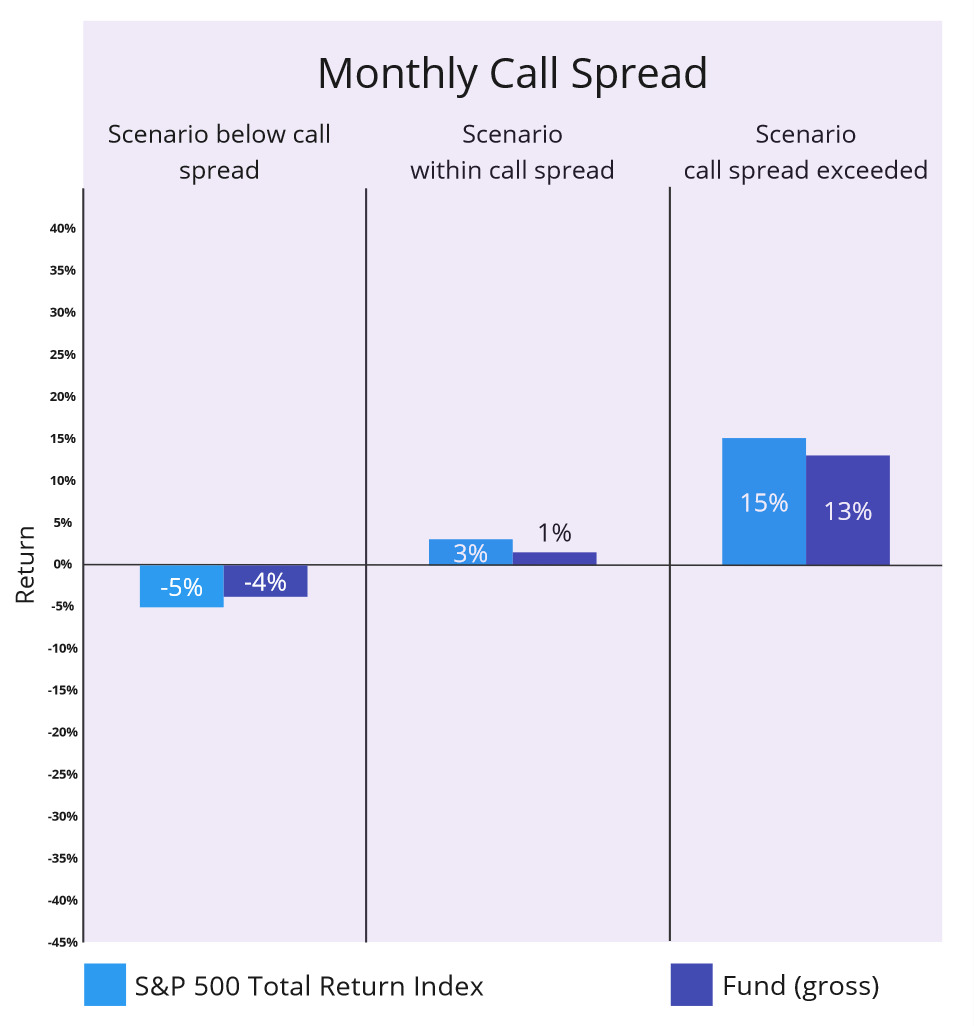
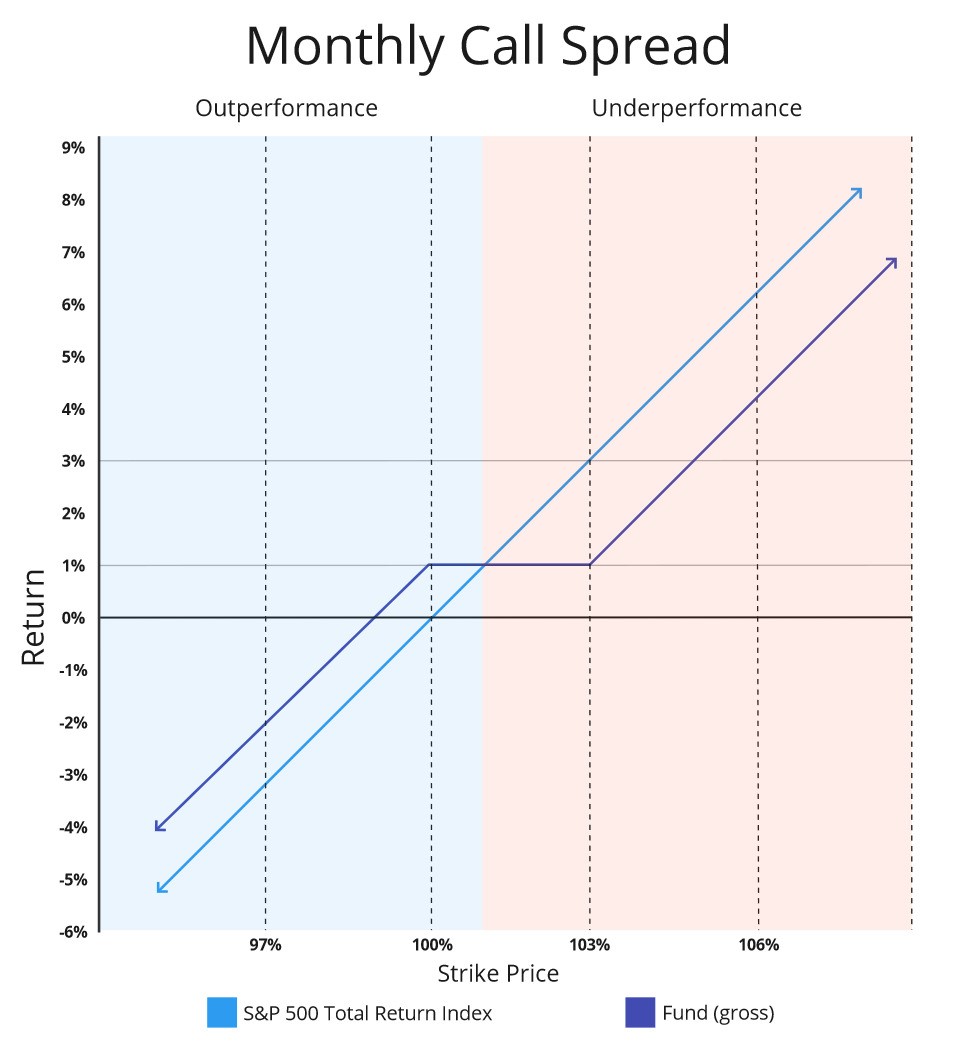
For illustrative purposes only. Figures are approximate and subject to change. Charts assume a quarterly net premium gain of 3%, which results from three
monthly call spreads and one quarterly put spread.
Quarterly Put Options Strategy
Put options are derivative instruments that allow the option purchaser to contractually sell a particular security (or the value of a
security index) to the option issuer at a strike price up to the expiration date of the options. When the issuer sells the put option, it
receives a premium from the buyer in hopes that the buyer will not exercise the option.
The Fund’s put options strategy, typically executed on a quarterly basis, is designed to protect against large declines in the S&P 500.
The quarterly put options strategy consists of a mix of purchased (or “long”) put options and sold (or “written”) put options on the
S&P 500 Index (“S&P 500 put options”). While the strike prices of the put options may vary, each quarter the Fund typically
purchases S&P 500 put options that are approximately 94-96% of the current S&P 500 level, paying a premium for downside
protection from a large decline in the S&P 500. The Fund simultaneously sells S&P 500 put options with a strike price that is
approximately 75-85% of the current price of the S&P 500 to generate some premium income to offset a portion of the cost of the
purchased put options. The quarterly options strategy of buying a put slightly below the current market price and selling another put
farther below the current market price is designed to protect against significant market downturns at a reduced cost. While the strike
prices of the put options will vary, the put spreads will typically provide a payment to offset losses once the S&P 500 declines by
approximately 5% (the strike price of the purchase put) but will no longer offset losses once the S&P 500 declines by more than an
approximately 20% (the difference in strike prices) after the net costs of the put spreads.
5
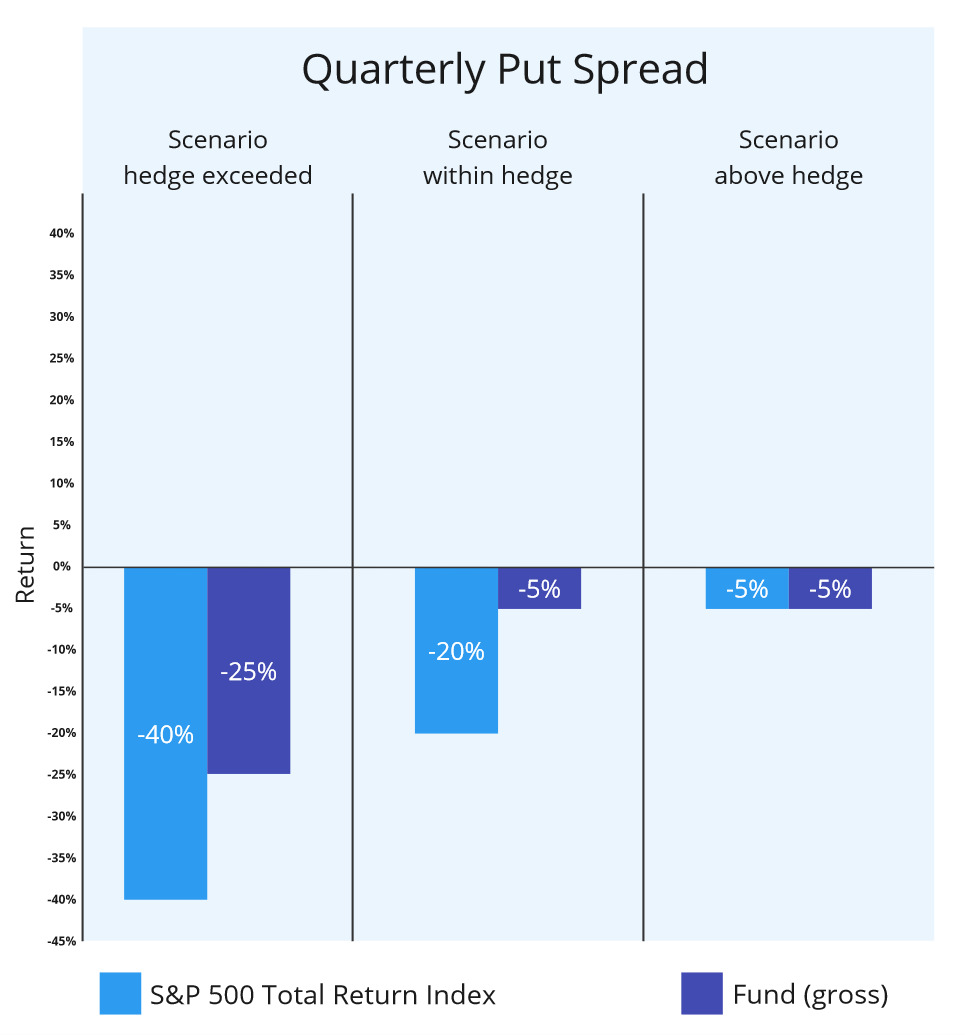
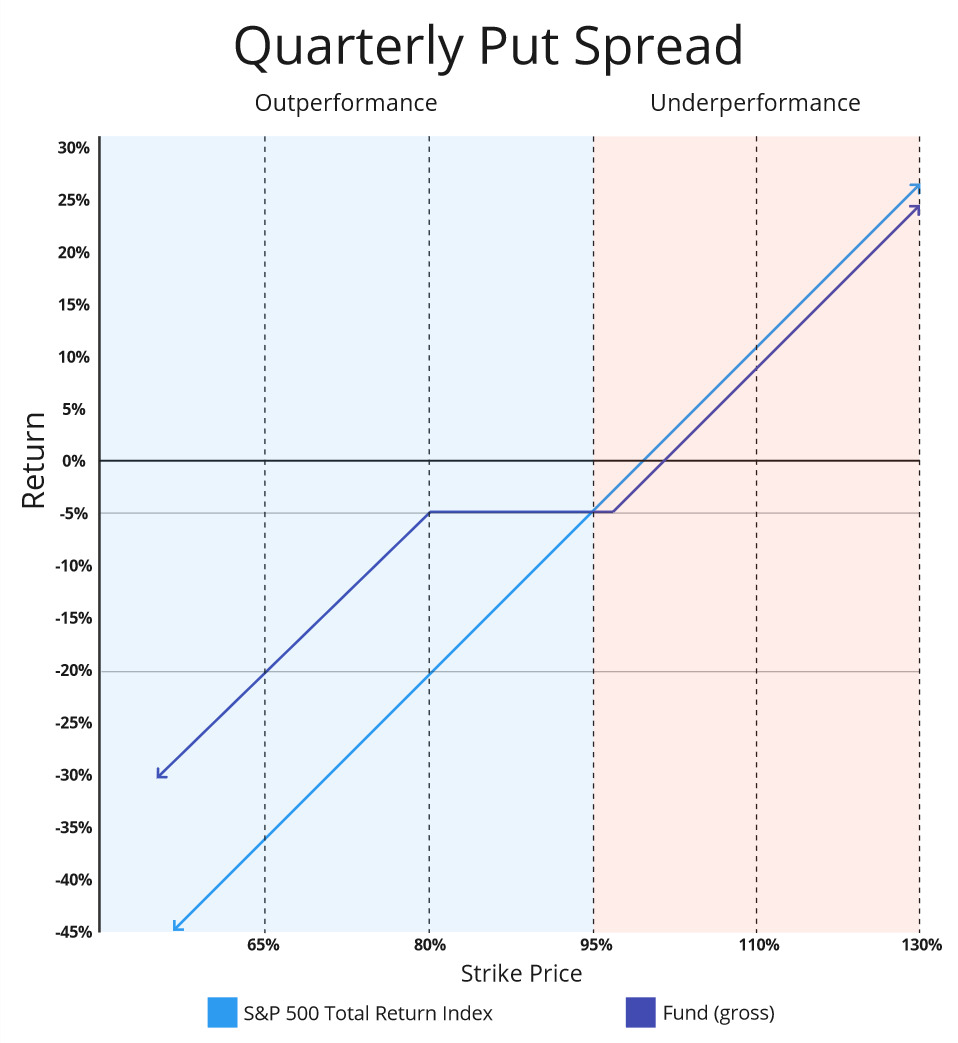
For illustrative purposes only. Figures are approximate and subject to change. Charts assume a quarterly net premium gain of 3%, which results from three
monthly call spreads and one quarterly put spread.
Expected Relative Performance of the Strategy
The Fund’s performance will vary, at times substantially, from the performance of the MQKHPI and the S&P 500. In general,
however, the Fund expects to perform somewhat in line with the MQKHPI, with the Fund’s active decisions around the
implementation of its options strategies intended to improve the Fund’s performance relative to the MQKHPI.
The Fund’s expected performance relative to the S&P 500 under various market conditions can be summarized as follows:
When the S&P 500 is Flat or Declines: Expected Outperformance. In months and quarters where the S&P 500 shows minimal
movement or decreases, the Fund’s overall performance is generally expected to also be flat to negative. However, the Fund would be
positioned to outperform the S&P 500 primarily due to the monthly premium income generated from the monthly call options.
•This anticipated relative outperformance is expected to increase during quarters where the S&P 500 declines by more than
approximately 4-6%, due to the additional downside protection from the quarterly put options.
•If the S&P 500 declines by more than approximately 20% from the purchase price of the put options, the Fund would have no
further downside protection other than the call option premiums. The Fund would participate fully in the decline of the S&P
500 until new put options are purchased.
When the S&P 500 is Up: Expected Underperformance. In months and quarters where the S&P 500 experiences an increase greater
than approximately 1% (the estimated long-term average of option premiums collected), the Fund’s overall performance is generally
expected to be positive. However, the Fund is likely to underperform the S&P 500 primarily be due to the Fund's option strategy that
is intended to sacrifice a portion of the Fund’s upside potential in return for reduced volatility and additional income.
•The underperformance for each monthly call option expiration cycle would be limited to the difference in call option strike
prices (expected to be approximately 3%) and the approximate 1% premium collected.
•If the S&P 500 rises above the strike prices of both call options, the Fund will no longer have capped appreciation until it
sells new call options.”
6
The Fund is considered to be non-diversified, which means it may invest a high percentage of its assets in a limited number of
investments. Additionally, the Fund’s investment strategies will involve active and frequent purchases and sales of call and put
options, but are not expected to result in high portfolio turnover.
Option Premiums – Income/Return of Capital
As part of the Fund’s options strategies, it sells (or writes) options in return for options premiums, which are expected to contribute to
the overall performance of the Fund. Distributions related to these options premiums may include a significant portion classified as
return of capital. Distributions characterized as a return of capital may reduce the Fund’s net asset value and should not be confused
with yield or income.
Principal Investment Risks
As with all funds, there is the risk that you could lose money through your investment in the Fund. The Fund is not intended to be a
complete investment program. Many factors affect the Fund’s Net Asset Value and performance. The following risks apply to the
Fund directly and indirectly through the Fund’s investment in underlying funds.
•Management Risk. The Adviser’s reliance on its proprietary investment process and the Adviser’s judgments about the
attractiveness, value, and potential appreciation of particular assets and asset classes may prove to be incorrect and may not
produce the desired results.
•Equity Securities Risk. The Fund may invest in or have exposure to equity securities. Equity securities may experience
sudden, unpredictable drops in value or long periods of decline in value. This may occur because of factors that affect
securities markets generally or factors affecting specific industries, sectors, geographic markets, or companies in which the
Fund invests.
•ETF Risks. The Fund is an ETF, and, as a result of an ETF’s structure, it is exposed to the following risks:
◦Authorized Participants, Market Makers, and Liquidity Providers Concentration Risk. The Fund has a limited
number of financial institutions that may act as Authorized Participants (“APs”). In addition, there may be a limited
number of market makers and/or liquidity providers in the marketplace. To the extent either of the following events
occur, shares may trade at a material discount to NAV and possibly face delisting: (i) APs exit the business or
otherwise become unable to process creation and/or redemption orders and no other APs step forward to perform
these services, or (ii) market makers and/or liquidity providers exit the business or significantly reduce their business
activities and no other entities step forward to perform their functions.
◦Cash Redemption Risk. While not expected to be a regular occurrence, the Fund’s investment strategy may require it
to redeem shares for cash or to otherwise include cash as part of its redemption proceeds. The Fund may be required
to sell or unwind portfolio investments to obtain the cash needed to distribute redemption proceeds. This may cause
the Fund to recognize a capital gain that it might not have recognized if it had made a redemption in-kind. As a
result, the Fund may pay out higher annual capital gain distributions than if the in-kind redemption process was
used.
◦Costs of Buying or Selling Shares. Due to the costs of buying or selling shares, including brokerage commissions
imposed by brokers and bid-ask spreads, frequent trading of shares may significantly reduce investment results and
an investment in shares may not be advisable for investors who anticipate regularly making small investments.
◦Shares May Trade at Prices Other Than NAV. As with all ETFs, shares may be bought and sold in the secondary
market at market prices. Although it is expected that the market price of shares will approximate the Fund’s NAV,
there may be times when the market price of shares is more than the NAV intra-day (premium) or less than the NAV
intra-day (discount) due to supply and demand of shares or during periods of market volatility. This risk is
heightened in times of market volatility, periods of steep market declines, and periods when there is limited trading
activity for shares in the secondary market, in which case such premiums or discounts may be significant. Because
securities held by the Fund may trade on foreign exchanges that are closed when the Fund’s primary listing
exchange is open, there are likely to be deviations between the current price of a security and the security’s last
quoted price from the closed foreign market. This may result in premiums and discounts that are greater than those
experienced by domestic ETFs.
◦Trading. Although shares are listed for trading on the Cboe BZX Exchange, Inc. (the “Exchange”) and may be
traded on U.S. exchanges other than the Exchange, there can be no assurance that shares will trade with any volume,
or at all, on any stock exchange. In stressed market conditions, the liquidity of shares may begin to mirror the
liquidity of the Fund’s underlying portfolio holdings, which can be significantly less liquid than shares, and this
could lead to differences between the market price of the shares and the underlying value of those shares.
7
•Market Risk. Overall investment market risks affect the value of the Fund. Factors such as economic growth and market
conditions, interest rate levels, and political events affect U.S. and international investment markets. Additionally, unexpected
local, regional or global events, such as war; acts of terrorism; financial, political or social disruptions; natural, environmental
or man-made disasters; the spread of infectious illnesses or other public health issues (such as the COVID-19 global
pandemic); and recessions and depressions could have a significant impact on the Fund and its investments and may impair
market liquidity. Such events can cause investor fear, which can adversely affect the economies of nations, regions and the
market in general, in ways that cannot necessarily be foreseen.
•Underlying Funds Risk. Investments in underlying funds involve duplication of investment advisory fees and certain other
expenses. Each underlying fund is subject to specific risks, depending on the nature of its investment strategy. The manager
of an underlying fund may not be successful in implementing its strategy. ETF shares may trade at a market price that may be
lower (a discount) or higher (a premium) than the ETF’s net asset value. ETFs are also subject to brokerage and/or other
trading costs, which could result in greater expenses to the Fund. Because the value of ETF shares depends on the demand in
the market, the Adviser may not be able to liquidate the Fund’s holdings at the most optimal time, adversely affecting
performance.
◦Net Asset Value and Market Price Risk. The market value of ETF shares may differ from their NAV. This difference
in price may be due to the fact that the supply and demand in the market for ETF shares at any point in time is not
always identical to the supply and demand in the market for the underlying holdings. Accordingly, there may be
times when an ETF share trades at a premium or discount to its NAV.
◦Tracking Risk. ETFs in which the Fund invests will not be able to replicate exactly the performance of any indices or
prices they track because the total return generated by the securities will be reduced by transaction costs incurred in
adjusting the actual balance of the securities or derivatives. Certain securities comprising an index may, from time to
time, temporarily be unavailable, which may further impede the security’s ability to track an index.
•Derivatives Risk. In general, a derivative instrument typically involves leverage, i.e., it provides exposure to potential gain or
loss from a change in the level of the market price of the underlying security (or a basket or index) in a notional amount that
exceeds the amount of cash or assets required to establish or maintain the derivative instrument. Adverse changes in the value
or level of the underlying asset or index, which the Fund may not directly own, can result in a loss to the Fund substantially
greater than the amount invested in the derivative itself. The use of derivative instruments also exposes the Fund to additional
risks and transaction costs. A risk of the Fund’s use of derivatives is that the fluctuations in their values may not correlate
perfectly with the overall securities markets.
◦Options Risk. An option is an agreement that, for a premium payment or fee, gives the option holder (the purchaser) the
right but not the obligation to buy (a “call option”) or sell (a “put option”) the underlying asset (or settle for cash an
amount based on an underlying asset, rate, or index) at a specified price (the “exercise price”) during a period of time or
on a specified date. Investments in options are considered speculative. When the Fund purchases an option, it may lose
the premium paid for it if the price of the underlying security or other assets decreased or remained the same (in the case
of a call option) or increased or remained the same (in the case of a put option). If a put or call option purchased by the
Fund were permitted to expire without being sold or exercised, its premium would represent a loss to the Fund. By
writing put options, the Fund takes on the risk of declines in the value of the underlying instrument, including the
possibility of a loss up to the entire exercise price of each option it sells but without the corresponding opportunity to
benefit from potential increases in the value of the underlying instrument. By writing a call option, the Fund may be
obligated to deliver instruments underlying an option at less than the market price. In the case of an uncovered call
option, there is a risk of unlimited loss.
•Leverage Risk. As part of the Fund’s principal investment strategy, the Fund will make investments in derivative instruments.
These derivative instruments provide the economic effect of financial leverage by creating additional investment exposure to
the underlying asset, as well as the potential for greater loss. If the Fund uses leverage through activities such as entering into
derivative instruments, the Fund has the risk that losses may exceed the net assets of the Fund. The net asset value of the
Fund while employing leverage will be more volatile and sensitive to market movements.
•Limited History of Operations Risk. The Fund has a limited history of operations for investors to evaluate. The Fund may fail
to attract sufficient assets to operate efficiently.
•Non-Diversification Risk. As a non-diversified fund, the Fund may invest more than 5% of its total assets in the securities of
one or more issuers. The Fund also invests in underlying funds that are non-diversified. The Fund’s performance may be
more sensitive to any single economic, business, political or regulatory occurrence than the value of shares of a diversified
investment company.
Performance: The accompanying bar chart and table provide some indication of the risks of investing in the Fund by showing how the
Fund’s total return has varied from year-to-year. Below the bar chart are the Fund’s highest and lowest quarterly returns during the
period shown in the bar chart. The performance table that follows shows the Fund’s average annual total returns over time compared
8
with those of a broad-based securities market index as well as an index with a similar methodology to the Fund’s strategy. You should
be aware that the Fund’s past performance (before and after taxes) may not be an indication of how the Fund will perform in the
future. Updated performance information and daily NAV per share is available at no cost by calling toll-free 866-303-8623 and on the
Fund’s website at https://www.kensingtonassetmanagement.com/solutions/etfs-khpi/.
Institutional Class Performance Bar Chart
For Calendar Year Ended December 31

Best Quarter | Q2 2025 | 7.76% |
Worst Quarter | Q1 2025 | -2.60% |
The Fund’s year-to-date return as of March 31, 2026 was -3.47%.
Performance Table
Average Annual Total Returns
(For periods ended December 31, 2025)
One Year | Since Inception (September 4, 2024) | |
Institutional Class Shares Return before taxes | 11.30% | 11.58% |
Institutional Class Shares Return after taxes on distributions(1) | 11.19% | 11.40% |
Institutional Class Shares Return after taxes on distributions and sale of Fund Shares(1) | 6.76% | 8.77% |
MerQube Hedged Premium Income Index (reflects no deduction for fees, expenses, or taxes) | 12.96% | 13.07% |
S&P 500 Total Return (reflects no deduction for fees, expenses, or taxes) | 17.88% | 19.19% |
(1)After-tax returns are calculated using the historical highest individual federal marginal income tax rates and do not reflect the impact of state and local taxes. The
“Return After Taxes on Distributions and Sale of Fund Shares” may be higher than other return figures when a capital loss occurs upon redemption of Fund shares
and provides an assumed tax benefit for the investor. Actual after-tax returns depend on an investor’s tax situation and may differ from those shown, and after-tax
returns shown are not relevant to investors who hold their Fund shares through tax-deferred arrangements, such as 401(k) plans or individual retirement accounts.
Investment Adviser: Kensington Asset Management, LLC
Sub-Adviser: Liquid Strategies, LLC
Portfolio Managers: Elio Chiarelli, Ph.D., Shawn Gibson and Adam Stewart, CFA, each a portfolio manager of the Sub-Adviser,
have been portfolio managers of the Fund since its inception in September of 2024.
Purchase and Sale of Fund Shares: The Fund will issue (or redeem) shares to certain institutional investors (typically market makers
or other broker-dealers) only in blocks of shares known as “Creation Units.” Creation Unit transactions are typically conducted in
exchange for the deposit or delivery of in-kind securities and/or cash constituting a substantial replication, or a representation, of the
securities included in the Fund’s portfolio. Individual shares may only be purchased and sold on a national securities exchange
through a broker-dealer. You can purchase and sell individual shares of the Fund throughout the trading day like any publicly traded
security. The Fund’s shares are listed on the Cboe BZX Exchange, Inc. (the “Exchange”). The price of the Fund’s shares is based on
market price, and because exchange-traded fund shares trade at market prices rather than net asset value (“NAV”), the Fund’s shares
9
may trade at a price greater than NAV (premium) or less than NAV (discount). Except when aggregated in Creation Units, the Fund’s
shares are not redeemable securities.
Investors may incur costs attributable to the difference between the highest price a buyer is willing to pay to purchase shares of the
Fund (bid) and the lowest price a seller is willing to accept for shares of the Fund (ask) when buying or selling shares of the Fund in
the secondary market (the “bid-ask spread”). Recent information about the Fund, including its NAV, market price, premiums and
discounts, and bid-ask spreads is available on the Fund’s website at https://www.kensingtonassetmanagement.com/solutions/etfs-
khpi/.
Tax Information: Distributions made by the Fund may be taxable to you as ordinary income or capital gains, unless you are a tax-
exempt organization or are investing through a tax advantaged arrangement, such as a 401(k) plan or individual retirement account.
Any withdrawals made from such tax advantaged arrangement generally will be taxable to you as ordinary income.
Payments to Broker-Dealers and Other Financial Intermediaries: If you purchase shares of the Fund through a broker-dealer or
other financial intermediary (such as a bank), the Fund and its related companies may pay the intermediary for the sale of Fund shares
and related services. These payments may create a conflict of interest by influencing the broker-dealer or other intermediary and your
salesperson to recommend the Fund over another investment. Ask your salesperson or visit your financial intermediary’s website for
more information.