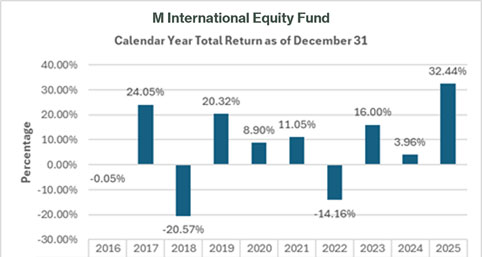
| 2016 | 2017 | 2018 | 2019 | 2020 | 2021 | 2022 | 2023 | 2024 | 2025 | |
| - |
- |
- |
As
filed with the Securities and Exchange Commission on
Securities Act Registration No. 333-174926
Investment Company Act Registration No. 811-22549
FORM
SECURITIES AND EXCHANGE COMMISSION
Washington, D.C. 20549
| REGISTRATION STATEMENT UNDER THE SECURITIES ACT OF 1933 | x |
| Pre-Effective Amendment No. ___ | o |
| Post-Effective Amendment No. 616 | x |
and/or
| REGISTRATION STATEMENT UNDER THE INVESTMENT COMPANY ACT OF 1940 | x | |
| Amendment No. 618 | (Check Appropriate Box or Boxes) | |
(Exact Name of Registrant as Specified in Charter)
225 Pictoria Drive, Suite 450
Cincinnati, OH 45246
(Address of Principal Executive Offices) (Zip Code)
(631) 490-4300
(Registrant’s Telephone Number, Including Area Code)
The Corporation Trust Company
Corporate Trust Center
251 Little Falls Drive
Wilmington, DE 19808
(Name and Address of Agent for Service)
With a copy to:
| David
J. Baum, Esq. Vedder Price P.C. 1401 New York Avenue NW Washington, DC 20005 (202) 312-3375 |
Kevin
Wolf Ultimus Fund Solutions, LLC 80 Arkay Drive, Suite 110 Hauppauge, New York 11788 (631) 470-2635 |
Approximate Date of Proposed Public Offering:
It is proposed that this filing will become effective (check appropriate box):
| o | immediately upon filing pursuant to paragraph (b). | |
| x | On
|
|
| o | 60 days after filing pursuant to paragraph (a)(1). | |
| o | On pursuant to paragraph (a)(1) | |
| o | 75 days after filing pursuant to paragraph (a)(2). | |
| o | on (date) pursuant to paragraph (a)(2) of Rule 485. |
If appropriate, check the following box:
| o | this post-effective amendment designates a new effective date for a previously filed post-effective amendment. |
Pursuant to Rule 24f-2 under the Investment Company Act of 1940, as amended, Registrant hereby elects to register an indefinite number of shares of Registrant and any series thereof hereinafter created.
EXPLANATORY NOTE
This Post-Effective Amendment No. 616 to the Registration Statement contains the Prospectus and Statement of Additional Information describing the M International Equity Fund, M Large Cap Growth Fund, M Capital Appreciation Fund and M Large Cap Value Fund, (the “Funds”), each a series of the Registrant. This Post-Effective Amendment to the Registration Statement is organized as follows: (a) Prospectus relating to the Funds; (b) Statement of Additional Information relating to the Funds; and (c) Part C Information relating to all series of the Registrant. The Prospectuses and Statements of Additional Information for the other series of the Registrant are not affected hereby.
| M International Equity Fund |
| (Symbol: MBEQX) |
| M Large Cap Growth Fund |
| (Symbol: MTCGX) |
| M Capital Appreciation Fund |
| (Symbol: MFCPX) |
| M Large Cap Value Fund |
| (Symbol: MBOVX) |
| PROSPECTUS |
| Advised
by: M Financial Investment Advisers, Inc. 1125 NW Couch Street, Suite 900 Portland, Oregon 97209 |
||
www.mfin.com/m-funds
(866) 439-9093
The M International Equity Fund, M Large Cap Growth Fund, M Capital Appreciation Fund and M Large Cap Value Fund (each a “Fund” and collectively, the Funds”) are each a separate series of Northern Lights Fund Trust II (the “Trust”), a registered management investment company.
This prospectus provides important information about the Fund that you should know before investing. Please read it carefully and keep it for future reference.
The U.S. Securities and Exchange Commission (“SEC”) has not approved or disapproved of these securities or determined if this Prospectus is truthful or complete. Any representation to the contrary is a criminal offense.
M
International Equity Fund
M Large Cap Growth Fund
M Capital Appreciation Fund
M Large Cap Value Fund
(each a series of the Northern Lights Fund Trust II (the “Trust”)
CONTENTS
| Summary Section – M INTERNATIONAL EQUITY FUND | 2 |
| Summary Section – M LARGE CAP GROWTH FUND | 10 |
| Summary Section – M CAPITAL APPRECIATION FUND | 16 |
| Summary Section – M LARGE CAP VALUE FUND | 22 |
| Additional Information About Principal Investment Strategies and Related Risks | 29 |
| M INTERNATIONAL EQUITY FUND | 29 |
| Investment Objective | 29 |
| Principal Investment Strategies | 29 |
| Other Investment Strategies | 30 |
| Investments in the Underlying Fund: Investment Objective, Strategies, and Policies of the Underlying Fund | 30 |
| M LARGE CAP GROWTH FUND | 31 |
| Investment Objective | 31 |
| Principal Investment Strategies | 31 |
| Additional Information Regarding the Security Selection Process | 31 |
| Other Investment Strategies | 32 |
| M CAPITAL APPRECIATION FUND | 32 |
| Investment Objective | 32 |
| Principal Investment Strategies | 32 |
| Other Investment Strategies | 33 |
| M LARGE CAP VALUE FUND | 33 |
| Investment Objective | 33 |
| Principal Investment Strategies | 33 |
| Other Investment Strategies | 34 |
| Security Types | 34 |
| RISKS OF INVESTING IN THE FUNDS | 35 |
| Principal Risks | 36 |
| Non-Principal Risks | 42 |
| Management of the Fund | 42 |
| The Adviser | 42 |
| Shareholder Information | 46 |
| Choosing the Appropriate Funds to Match Your Goals | 46 |
| Purchasing Shares | 46 |
| Market Timing | 46 |
| Redeeming Shares | 47 |
| Pricing of Fund Shares | 47 |
| Distributions and Taxes | 48 |
| Financial Highlights | 49 |
| Privacy Policy | 54 |
1
The Fund seeks long-term capital appreciation.
The fees and expenses reflected in the table below do not include the fees and charges associated with variable annuities or variable life insurance plans. Fees and charges for life insurance and annuity products typically include a sales load and/or a surrender charge and other charges for insurance benefits. If those fees and charges were included, the costs shown below would be higher.
The following table describes the fees and expenses that you may pay if you buy, hold, and sell shares of the Fund.
Annual Fund Operating Expenses
(expenses that you pay each year as a percentage of the value of your investments)
| Management Fees | |
| Distribution (12b-1) Fee | |
| Other Expenses1 | |
| Acquired Fund Fees and Expenses2 | |
| Total Annual Fund Operating Expenses |
| 1 |
| 2 |
This example is intended to help you compare the cost of investing in the Fund with the cost of investing in other mutual funds.
| 1 year | 3 years | 5 years | 10 years |
| $ |
$ |
$ |
$ |
The
Fund pays transaction costs, such as commissions, when it buys and sells securities (or “turns over” its portfolio). A higher
portfolio turnover rate may indicate higher transaction costs. These costs, which are not reflected in annual fund operating expenses
or in the example, affect the Fund’s performance. During the most recent fiscal year, the Predecessor International Equity Fund’s
portfolio turnover rate was
2
To achieve the Fund’s investment objective, Dimensional Fund Advisors LP (“Dimensional”) implements an integrated investment approach that combines research, portfolio design, portfolio management, and trading functions. As further described below, the Fund’s design emphasizes long-term drivers of expected returns identified by Dimensional’s research, while balancing risk through broad diversification across companies and sectors. Dimensional’s portfolio management and trading processes further balance those long-term drivers of expected returns with shorter-term drivers of expected returns and trading costs.
The Fund is designed to purchase a broad and diverse group of equity securities of non-U.S. companies in countries with developed and emerging markets. The Fund invests in companies of all sizes, with increased exposure to smaller capitalization, lower relative price, and higher profitability companies as compared to their representation in the International Universe. For purposes of the Fund, Dimensional defines the International Universe as a market capitalization weighted set (e.g., the larger the company, the greater the proportion of the International Universe it represents) of non-U.S. companies in developed and emerging markets that have been authorized for investment as approved markets by Dimensional’s Investment Committee. The Fund may pursue its investment objective by investing its assets directly and/or indirectly in the Emerging Markets Core Equity Portfolio of DFA Investment Dimensions Group Inc. (the “Underlying Fund”). The Underlying Fund is designed to purchase a broad and diverse group of equity securities associated with emerging markets, which may include frontier markets (emerging market countries in an earlier stage of development). The Underlying Fund invests in companies of all sizes, with increased exposure to smaller capitalization, lower relative price, and higher profitability companies. As of the date of this prospectus, it is anticipated that a significant portion of the Fund’s assets will be invested indirectly through the Underlying Fund.
The Fund’s increased exposure to smaller capitalization, lower relative price, and higher profitability companies may be achieved by decreasing the allocation of the Fund’s assets to larger capitalization, higher relative price, or lower profitability companies relative to their weight in the International Universe. An equity issuer is considered to have a high relative price (i.e., a growth stock) primarily because it has a high price in relation to its book value. An equity issuer is considered to have a low relative price (i.e., a value stock) primarily because it has a low price in relation to its book value. In assessing relative price, Dimensional may consider additional factors such as price-to-cash flow or price-to-earnings ratios. An equity issuer is considered to have high profitability because it has high earnings or profits from operations in relation to its book value or assets. The criteria Dimensional uses for assessing relative price and profitability are subject to change from time to time.
Dimensional may also increase or reduce the Fund’s exposure to an eligible company, or exclude a company, based on shorter-term considerations, such as a company’s price momentum, short-run reversals, and investment characteristics. In assessing a company’s investment characteristics, Dimensional considers ratios such as recent changes in assets divided by total assets. The criteria Dimensional uses for assessing a company’s investment characteristics are subject to change from time to time. In addition, Dimensional seeks to reduce trading costs using a flexible trading approach that looks for opportunities to participate in the available market liquidity, while managing turnover and explicit transaction costs.
The Fund will normally invest at least 80% of its total assets in equity securities of issuers located in at least three countries other than the United States. These countries may include, but are not limited to, the nations of Western Europe, North and South America, Australia, Africa and Asia. This strategy is not fundamental (it may be changed without shareholder approval), but should the Fund decide to change this strategy, it will provide shareholders with at least 60 days’ notice. The Fund may invest up to 40% of its total assets in emerging markets.
The Fund may gain exposure to companies associated with approved markets by purchasing equity securities in the form of depositary receipts, which may be listed or traded outside the issuer’s domicile country. The Fund may also purchase or sell futures contracts and options on futures contracts for foreign or U.S. equity securities and indices to increase or decrease equity market exposure based on actual or expected cash inflows to or outflows from the Fund. Because many of the Fund’s investments may be denominated in foreign currencies, the Fund may enter into foreign currency exchange transactions, including foreign currency forward contracts, in connection with the settlement of foreign securities or to transfer cash balances from one currency to another currency.
3
Principal Investment Risks
As with any mutual fund, there is no guarantee that the Fund will achieve its goal. The Fund’s share price will fluctuate, which means you could lose money on your investment in the Fund. The principal risks of investing in the Fund are summarized below.
| ● | Market Risk. Investments in common stocks are subject to stock market risk. Stock prices in general may decline over short or even extended periods, regardless of the success or failure of a particular company’s operations. Stock markets tend to run in cycles, with periods when stock prices generally go up and periods when they generally go down. Common stock prices tend to go up and down more than those of bonds. |
| ● | Economic and Market Events Risk. Events in the U.S. and global financial markets, including actions taken by the U.S. Federal Reserve or foreign central banks to stimulate or stabilize economic growth, may at times result in unusually high market volatility, which could negatively impact the Fund’s performance. Reduced liquidity in credit and fixed-income markets could adversely affect issuers worldwide. Companies, including banks and financial services companies, could suffer losses if interest rates fluctuate or economic conditions deteriorate. Similarly, political events within the United States at times have resulted, and may in the future result, in a shutdown of government services, which could negatively affect the U.S. economy, decrease the value of a Fund’s investments, and increase uncertainty in or impair the operation of the U.S. or other securities markets. In recent years, the U.S. renegotiated many of its global trade relationships and also has recently imposed or threatened to impose significant import tariffs. Such actions could lead to price volatility and overall declines in U.S. and global investment markets. |
| ● | Additional Market Disruption Risk. Financial and securities markets are volatile and may be affected by political, regulatory, social, economic, and other global developments and disruptions, including those arising out of geopolitical events, armed conflict, public health emergencies (such as the spread of infectious diseases, pandemics, and epidemics), natural disasters, terrorism and governmental or quasi-governmental actions. Such changes may be rapid and unpredictable. These events may negatively affect issuers, industries and markets worldwide and adversely affect the value and liquidity of the Fund and its investments. |
In February 2022, Russia commenced a military attack on Ukraine. In response, various countries, including the U.S., issued broad-ranging sanctions on Russia and certain Russian companies and individuals. Any existing or future sanctions could have a severe adverse effect on Russia’s economy, currency, companies and region, and these events may negatively impact other regional and global economic markets of the World (including Europe and the United States), companies in such countries and various sectors, industries and markets for securities and commodities globally, such as oil and natural gas. Accordingly, the hostilities and sanctions may have a negative effect on the Fund’s investments and performance beyond any direct or indirect exposure the Fund may have to Russian issuers or those of adjoining geographic regions. The sanctions and compliance with these sanctions may impair the ability of the Fund to buy, sell, hold or deliver Russian securities and/or other assets, including those listed on U.S. or other exchanges. Russia may also take retaliatory actions or countermeasures, such as cyberattacks and espionage, which may negatively impact the countries and companies in which the Fund may invest. Accordingly, there may be a heightened risk of cyberattacks by Russia in response to the sanctions. The extent and duration of the military action or future escalation of such hostilities; the extent and impact of existing and any future sanctions, market disruptions and volatility; the potential for wider conflict; and the result of any diplomatic negotiations cannot be predicted. These and any related events could have a significant negative impact on the Fund’s investments as well as the Fund’s performance, and the value or liquidity of certain securities held by the Fund may decline significantly. In addition, rising tensions between China and Taiwan over a forced reunification have caused concerns in the region and globally. China sees self-ruled Taiwan as a breakaway province that will eventually be part of China again. Previous efforts by China’s leadership sought to bring about reunification by non-military means. Beginning in 2021, concerns escalated when China began sending military aircraft into Taiwan’s air defense zone, a self-declared area where foreign aircraft are identified, monitored and controlled in the interests of Taiwan’s national security. These actions have caused Taiwan and other countries to fear further escalation in the region. Any escalation of hostility between China and/or Taiwan would likely have a significant adverse impact on the value of investments in both countries and on economies, markets and individual securities globally, which could negatively affect the value and liquidity of the Fund’s investments. Beginning in October 2023, the Israel-Hamas war has resulted in significant loss of life and increased volatility in the Middle East. The conflict between Israel and Hamas and the involvement of the U.S. and other countries could present material uncertainty and risk with respect to a Fund’s performance and ability to achieve its investment objective. The extent of any market disruptions are impossible to predict, but could be substantial.
4
| ● | Profitability Investment Risk. High relative profitability stocks may perform differently from the market as a whole and an investment strategy purchasing these securities may cause the Fund to at times underperform equity funds that use other investment strategies. |
| ● | Value Investment Risk. Value stocks may perform differently from the market as a whole and an investment strategy purchasing these securities may cause the Fund to at times underperform equity funds that use other investment strategies. Value stocks can react differently to political, economic, and industry developments than the market as a whole and other types of stocks. Value stocks also may underperform the market for long periods of time. |
| ● | Small and Medium Capitalization Companies Risk. The Fund may invest in small and medium capitalization companies, which tend to be more vulnerable to adverse developments than larger companies. These companies may have limited product lines, markets, or financial resources, or may depend on a limited management group. They may be recently organized, without proven records of success. Their securities may trade infrequently and in limited volumes. As a result, the prices of these securities may fluctuate more than prices of securities of larger, more widely traded companies and the Fund may experience difficulty in establishing or closing out positions in these securities at prevailing market prices. Also, there may be less publicly available information about small and medium capitalization companies or less market interest in their securities as compared to larger companies, and it may take longer for the prices of the securities to reflect the full value of their issuers’ earnings potential or assets. |
| ● | Foreign Securities and Currencies Risk. Foreign securities prices may decline or fluctuate because of: (a) economic or political actions of foreign governments, and/or (b) less regulated or liquid securities markets. Investors holding these securities may also be exposed to foreign currency risk (the possibility that foreign currency will fluctuate in value against the U.S. dollar or that a foreign government will convert, or be forced to convert, its currency to another currency, changing its value against the U.S. dollar), which may make the return on an investment increase or decrease unrelated to the quality or performance of the investment itself. The Fund does not hedge foreign security risk or foreign currency risk. |
Foreign issuers may not be subject to uniform accounting, auditing and financial reporting standards and there may be less publicly available financial and other information about such issuers, as compared to U.S. issuers. A fund may have greater difficulty voting proxies, exercising shareholder rights, securing dividends and/or interest and obtaining information regarding corporate actions on a timely basis, pursuing legal remedies, and obtaining judgments with respect to foreign investments in foreign courts than with respect to domestic issuers in U.S. courts.
Depositary receipts are generally subject to the same risks as the foreign securities that they evidence or into which they may be converted. In addition, the underlying issuers of certain depositary receipts, particularly unsponsored or unregistered depositary receipts, are under no obligation to distribute shareholder communications to the holders of such receipts, or to pass through to them any voting rights with respect to the deposited securities. Depositary receipts that are not sponsored by the issuer may be less liquid and there may be less readily available public information about the issuer.
5
| ● | Emerging Markets Risk. Securities of issuers associated with emerging market countries may be subject to higher and additional risks than securities of issuers in developed foreign markets. Numerous emerging market countries have a history of, and continue to experience serious, and potentially continuing, economic and political problems. Stock markets in many emerging market countries are relatively small, expensive to trade in and generally have higher risks than those in developed markets. Securities in emerging markets also may be less liquid than those in developed markets and there are frequently government controls on foreign investments and limitations on repatriation of invested capital. Additional restrictions may be imposed under other conditions. Emerging market companies may also be held to lower disclosures, corporate governance, auditing and financial reporting standards than companies in more developed markets. Frontier market countries (emerging market countries in an earlier stage of development) generally have smaller economies or less developed capital markets and, as a result, the risks of investing in emerging market countries are magnified in frontier market countries. |
| ● | China Investments Risk. There are special risks associated with investments in China and Taiwan, which are considered emerging market countries by the Fund. The Chinese government has implemented significant economic reforms in order to liberalize trade policy, promote foreign investment in the economy, reduce government control of the economy and develop market mechanisms. But there can be no assurance that these reforms will continue or that they will be effective. Despite reforms and privatizations of companies in certain sectors, the Chinese government still exercises substantial influence over many aspects of the private sector and may own or control many companies. The Chinese government continues to maintain a major role in economic policy making and investing in China involves risks of losses due to expropriation, nationalization, confiscation of assets and property, and the imposition of restrictions on foreign investments and on repatriation of capital invested. Further, investors in Chinese issuers may have difficulty obtaining information regarding the issuer, particularly high-quality and reliable financial reporting. |
A reduction in spending on Chinese products and services or the institution of additional tariffs or other trade barriers, including as a result of heightened trade tensions between China and the United States may also have an adverse impact on the Chinese economy. In addition, investments in Taiwan could be adversely affected by its political and economic relationship with China. Certain securities issued by companies located or operating in China, such as China A-shares, are also subject to trading restrictions, quota limitations and less market liquidity, which could pose risks to the Fund. The Fund may also invest in special structures that utilize contractual arrangements to provide exposure to certain Chinese companies, known as variable interest entities (“VIEs”) that operate in sectors in which China restricts and/or prohibits foreign investments. Investments involving a VIE structure may pose additional risks because such investments are made through a company whose interests in the underlying operating company are established through contract rather than through direct equity ownership. The Chinese government’s acceptance of the VIE structure is evolving. Investing through a VIE does not offer the same level of investor protection as direct ownership, and is subject to additional risks as it is uncertain whether Chinese officials and regulators will withdraw their acceptance of the structure or whether Chinese courts or arbitration bodies would decline to enforce the contractual rights of foreign investors, each of which would likely have significant, detrimental, and possibly permanent losses on the value of such investments.
| ● | Fund of Funds Risk. The investment performance of the Fund is affected by the investment performance of the Underlying Fund in which the Fund invests. The ability of the Fund to achieve its investment objective depends on the ability of the Underlying Fund to meet its investment objective and on Dimensional’s decisions regarding the allocation of the Fund’s assets to the Underlying Fund. The Fund may allocate assets to the Underlying Fund or asset class that underperforms other funds or asset classes. There can be no assurance that the investment objective of the Fund or the Underlying Fund will be achieved. When the Fund invests in the Underlying Fund, investors are exposed to a proportionate share of the expenses of the Underlying Fund in addition to the expenses of the Fund. Through its investments in the Underlying Fund, the Fund is subject to the risks of the Underlying Fund’s investments. |
6
| ● | Management Risk. The Fund is subject to management risk because it is actively managed. Management risk is the chance that security selection or focus on securities in a particular style, market sector or group of companies will cause the Fund to incur losses or underperform relative to its benchmarks or other investments with similar investment objectives. The sub-adviser will apply its investment techniques and risk analyses in making investment decisions for the Fund, but there can be no guarantee that these will produce the desired results. |
| ● | Liquidity Risk. Liquidity risk exists when investments are difficult to sell as the result of low trading volume, lack of market makers, and/or legal restrictions. Illiquid securities may prevent the Fund from entering into security transactions at advantageous times or prices, potentially reducing the return of the Fund’s portfolio. Investments in smaller market capitalizations and over-the-counter markets have greater exposure to liquidity risk. |
| ● | Derivatives Risk. Derivatives are instruments, such as futures, and options thereon, and foreign currency forward contracts, whose value is derived from that of other assets, rates or indices. The use of derivatives for non-hedging purposes may be considered to carry more risk than other types of investments. When the Fund uses derivatives, the Fund will be directly exposed to the risks of those derivatives. Derivative instruments are subject to a number of risks including counterparty and credit risk (the risk that the derivative counterparty will not fulfill its contractual obligations, whether because of bankruptcy or other default), settlement risk (the risk faced when one party to a transaction has performed its obligations under a contract but has not yet received value from its counterparty), interest rate risk (the risk that certain derivatives are more sensitive to interest rate changes and market price fluctuations than other securities), liquidity risk, market risk, and management risk, as well as the risk of improper valuation. Changes in the value of a derivative may not correlate perfectly with the underlying asset, rate or index, and the Fund could lose more than the principal amount invested. |
| ● | Operational Risk. Operational risks include human error, changes in personnel, system changes, faults in communication, and failures in systems, technology, or processes. Various operational events or circumstances are outside the sub-adviser’s control, including instances at third parties. The Fund and the sub-adviser seek to reduce these operational risks through controls and procedures. However, these measures do not address every possible risk and may be inadequate to address these risks. |
| ● | Cyber Security Risk. The Fund’s and its service providers’ use of internet, technology and information systems may expose the Fund to potential risks linked to cyber security breaches of those technological or information systems. Cyber security breaches, amongst other things, could allow an unauthorized party to gain access to proprietary information, customer data, or fund assets, or cause the Fund and/or its service providers to suffer data corruption or lose operational functionality. |
7
The
following information may give some indication of the risks of investing in the Fund. The Fund is the successor to the Predecessor International
Equity Fund, a mutual fund with identical investment objectives, policies, and restrictions, as a result of the reorganization of the
Predecessor International Equity Fund into the Fund on April 24, 2026. The performance provided in the bar chart and table is that of
the Predecessor International Equity Fund.
The
table below shows the Predecessor International Equity Fund’s average annual total returns for the periods indicated and how those returns
compare to those of the MSCI ACWI (All Country World Index) ex USA IMI Index and the MSCI All Country World ex USA Index. You cannot
invest directly in an index.
Average Annual Total Returns
(for the periods ended December 31, 2025)
| One Year | Five Years | Ten Years | ||||
| Predecessor International Equity Fund | ||||||
| MSCI ACWI (All Country World Index) ex USA IMI Index1 |
| 1 |
8
Fund Management
M Financial Investment Advisers, Inc. is the investment adviser for the Fund and Dimensional is the sub-adviser for the Fund.
The Fund is managed by a team of investment professionals from Dimensional. The following persons are responsible for coordinating the day-to-day management of the Fund’s portfolio:
| Portfolio Manager | Since | Title | ||
| Jed S. Fogdall | December 2018 for the Predecessor International Equity Fund | Global Head of Portfolio Management, Chairman of the Investment Committee, Vice President and Senior Portfolio Manager of Dimensional | ||
| Mary T. Phillips, CFA | December 2018 for the Predecessor International Equity Fund | Deputy Head of Portfolio Management, North America, Member of the Investment Committee, Vice President and Senior Portfolio Manager of Dimensional | ||
| William B. Collins-Dean, CFA | December 2018 for the Predecessor International Equity Fund | Vice President and Senior Portfolio Manager of Dimensional | ||
Other Important Information
For important information about Purchase and Redemption of Fund Shares, Tax Information and Payments to Insurance Companies and their Affiliates, please turn to page 28 of this prospectus.
9
The Fund seeks long-term capital appreciation.
The fees and expenses reflected in the table below do not include the fees and charges associated with variable annuities or variable life insurance plans. Fees and charges for life insurance and annuity products typically include a sales load and/or a surrender charge and other charges for insurance benefits. If those fees and charges were included, the costs shown below would be higher.
The following table describes the fees and expenses that you may pay if you buy, hold, and sell shares of the Fund.
Annual Fund Operating Expenses
(expenses that you pay each year as a percentage of the value of your investments)
| Management Fees | |||
| Distribution (12b-1) Fee | |||
| Other Expenses1 | |||
| Total Annual Fund Operating Expenses |
| 1 |
This example is intended to help you compare the cost of investing in the Fund with the cost of investing in other mutual funds.
| 1 year | 3 years | 5 years | 10 years |
| $ |
$ |
$ |
$ |
The
Fund pays transaction costs, such as commissions, when it buys and sells securities (or “turns over” its portfolio). A higher
portfolio turnover rate may indicate higher transaction costs. These costs, which are not reflected in annual fund operating expenses
or in the example, affect the Fund’s performance. During the most recent fiscal year, the Predecessor Large Cap Growth Fund’s
portfolio turnover rate was
The Fund will normally invest at least 80% of its total assets in domestic equity securities of U.S. large capitalization (“large-cap”) securities. The Fund seeks to achieve its objective by investing primarily in the common stock of large-sized U.S. companies. The investment strategy of Federated MDTA LLC (“Federated”), the Fund’s sub-adviser, utilizes a large-cap growth approach by selecting most of its investments from companies listed in the Russell 1000® Growth Index, an index that measures the performance of those companies with higher price-to-book ratios and higher forecasted growth values within the large-cap segment of the U.S. equity universe, which includes the 1,000 largest U.S. companies by market capitalization. Federated considers a company to be large-cap if it falls within the market capitalization range of the Russell 1000® Growth Index. As the Fund’s sector exposure approximates the Russell 1000® Growth Index, the Fund may, from time to time, have large allocations to certain broad market sectors, such as technology, consumer discretionary and healthcare. As of March 31, 2025, companies in the Russell 1000® Growth Index ranged in market capitalization from $681 million to $3.3 trillion.
10
The Fund is classified as a non-diversified mutual fund, which means that the Fund may invest a larger percentage of its assets in the securities of a small number of issuers than a diversified fund.
Federated implements its strategy using a quantitative model driven by fundamental and technical stock selection variables. This process seeks to impose strict discipline over stock selection, unimpeded by market or manager psychology. It seeks to maximize compound annual return while controlling risk. The process also takes into account trading costs in an effort to ensure that trades are generated only to the extent they are expected to be profitable on an after-trading-cost basis. Additionally, risk is controlled through diversification constraints which limit exposure to individual companies as well as groups of correlated companies.
This strategy to invest at least 80% of its total assets in domestic equity securities of U.S. large-cap securities is not fundamental (it may be changed without shareholder approval), but should the Fund decide to change this strategy, it will provide shareholders with at least 60 days’ notice.
The Fund actively trades its portfolio securities in an attempt to achieve its investment objective.
Principal Investment Risks
As with any mutual fund, there is no guarantee that the Fund will achieve its goals. The Fund’s share price will fluctuate, which means you could lose money on your investment in the Fund. The principal risks of investing in the Fund are summarized below.
| ● | Market Risk. Investments in common stocks are subject to stock market risk. Stock prices in general may decline over short or even extended periods, regardless of the success or failure of a particular company’s operations. Stock markets tend to run in cycles, with periods when stock prices generally go up and periods when they generally go down. Common stock prices tend to go up and down more than those of bonds. |
| ● | Active Trading Risk. Active trading will cause the Fund to have an increased portfolio turnover rate and increase the Fund’s trading costs, which may have an adverse impact on the Fund’s performance. |
| ● | Economic and Market Events Risk. Events in the U.S. and global financial markets, including actions taken by the U.S. Federal Reserve or foreign central banks to stimulate or stabilize economic growth, may at times result in unusually high market volatility, which could negatively impact the Fund’s performance. Reduced liquidity in credit and fixed-income markets could adversely affect issuers worldwide. Companies, including banks and financial services companies, could suffer losses if interest rates fluctuate or economic conditions deteriorate. Similarly, political events within the United States at times have resulted, and may in the future result, in a shutdown of government services, which could negatively affect the U.S. economy, decrease the value of a Fund’s investments, and increase uncertainty in or impair the operation of the U.S. or other securities markets. In recent years, the U.S. renegotiated many of its global trade relationships and also has recently imposed or threatened to impose significant import tariffs. Such actions could lead to price volatility and overall declines in U.S. and global investment markets. |
| ● | Additional Market Disruption Risk. Financial and securities markets are volatile and may be affected by political, regulatory, social, economic, and other global developments and disruptions, including those arising out of geopolitical events, armed conflict, public health emergencies (such as the spread of infectious diseases, pandemics, and epidemics), natural disasters, terrorism and governmental or quasi-governmental actions. Such changes may be rapid and unpredictable. These events may negatively affect issuers, industries and markets worldwide and adversely affect the value and liquidity of the Fund and its investments. |
11
In February 2022, Russia commenced a military attack on Ukraine. In response, various countries, including the U.S., issued broad-ranging sanctions on Russia and certain Russian companies and individuals. Any existing or future sanctions could have a severe adverse effect on Russia’s economy, currency, companies and region, and these events may negatively impact other regional and global economic markets of the World (including Europe and the United States), companies in such countries and various sectors, industries and markets for securities and commodities globally, such as oil and natural gas. Accordingly, the hostilities and sanctions may have a negative effect on the Fund’s investments and performance beyond any direct or indirect exposure the Fund may have to Russian issuers or those of adjoining geographic regions. The sanctions and compliance with these sanctions may impair the ability of the Fund to buy, sell, hold or deliver Russian securities and/or other assets, including those listed on U.S. or other exchanges. Russia may also take retaliatory actions or countermeasures, such as cyberattacks and espionage, which may negatively impact the countries and companies in which the Fund may invest. Accordingly, there may be a heightened risk of cyberattacks by Russia in response to the sanctions. The extent and duration of the military action or future escalation of such hostilities; the extent and impact of existing and any future sanctions, market disruptions and volatility; the potential for wider conflict; and the result of any diplomatic negotiations cannot be predicted. These and any related events could have a significant negative impact on the Fund’s investments as well as the Fund’s performance, and the value or liquidity of certain securities held by the Fund may decline significantly. In addition, rising tensions between China and Taiwan over a forced reunification have caused concerns in the region and globally. China sees self-ruled Taiwan as a breakaway province that will eventually be part of China again. Previous efforts by China’s leadership sought to bring about reunification by non-military means. Beginning in 2021, concerns escalated when China began sending military aircraft into Taiwan’s air defense zone, a self-declared area where foreign aircraft are identified, monitored and controlled in the interests of Taiwan’s national security. These actions have caused Taiwan and other countries to fear further escalation in the region. Any escalation of hostility between China and/or Taiwan would likely have a significant adverse impact on the value of investments in both countries and on economies, markets and individual securities globally, which could negatively affect the value and liquidity of the Fund’s investments. Beginning in October 2023, the Israel-Hamas war has resulted in significant loss of life and increased volatility in the Middle East. The conflict between Israel and Hamas and the involvement of the U.S. and other countries could present material uncertainty and risk with respect to a Fund’s performance and ability to achieve its investment objective. The extent of any market disruptions are impossible to predict, but could be substantial.
| ● | Growth Securities Risk. The Fund invests in growth securities, which may be more volatile than other types of investments, may perform differently than the market as a whole and may underperform when compared to securities with different investment parameters. Under certain market conditions, growth securities have performed better during the later stages of economic recovery. Therefore, growth securities may go in and out of favor over time. |
| ● | Large-Capitalization Investing Risk. Large-capitalization stocks as a group could fall out of favor with the market, causing the Fund to underperform investments that focus on small- or medium-capitalization stocks. Larger, more established companies may be slow to respond to challenges and may grow more slowly than smaller companies. |
| ● | Sector Risk. Because the Fund may allocate relatively more assets to certain industry sectors than others, the Fund’s performance may be more susceptible to any developments which affect those sectors emphasized by the Fund. |
| ● | Quantitative Modeling Risk. The Fund employs quantitative models as a management technique. These models examine multiple economic factors using various proprietary and third-party data. The results generated by quantitative analysis may perform differently than expected and may negatively affect Fund performance for various reasons (for example, human judgment, data imprecision, software or other technology malfunctions, or programming inaccuracies). |
12
| ● | Management Risk. The Fund is subject to management risk because it is actively managed. Management risk is the chance that security selection or focus on securities in a particular style, market sector or group of companies will cause the Fund to incur losses or underperform relative to its benchmarks or other investments with similar investment objectives. The sub-adviser will apply its investment techniques and risk analyses in making investment decisions for the Fund, but there can be no guarantee that these will produce the desired results. |
| ● | Operational Risk. Operational risks include human error, changes in personnel, system changes, faults in communication, and failures in systems, technology, or processes. Various operational events or circumstances are outside the sub-adviser’s control, including instances at third parties. The Fund and the sub-adviser seek to reduce these operational risks through controls and procedures. However, these measures do not address every possible risk and may be inadequate to address these risks. |
| ● | Non-Diversification Risk. The Fund can invest a larger portion of its assets in the stocks of a limited number of companies than a diversified fund, which means it may have more exposure to the price movements of a single security or small group of securities than funds that diversify their investments among many companies. |
| ● | Cyber Security Risk. The Fund’s and its service providers’ use of internet, technology and information systems may expose the Fund to potential risks linked to cyber security breaches of those technological or information systems. Cyber security breaches, amongst other things, could allow an unauthorized party to gain access to proprietary information, customer data, or fund assets, or cause the Fund and/or its service providers to suffer data corruption or lose operational functionality. |
| ● | Liquidity Risk. Liquidity risk exists when investments are difficult to sell as the result of low trading volume, lack of market makers, and/or legal restrictions. Illiquid securities may prevent the Fund from entering into security transactions at advantageous times or prices, potentially reducing the return of the Fund’s portfolio. Investments in smaller market capitalizations and over-the-counter markets have greater exposure to liquidity risk. |
13
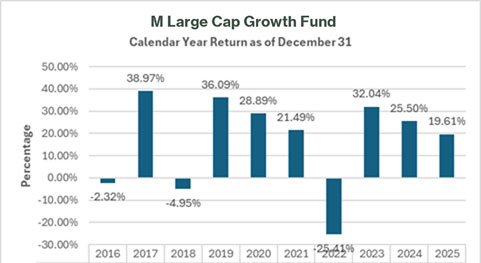
The
following information may give some indication of the risks of investing in the Fund. The Fund is the successor to the Predecessor Large
Cap Growth Fund, a mutual fund with identical investment objectives, policies, and restrictions, as a result of the reorganization of
the Predecessor Large Cap Growth Fund into the Fund on April 24, 2026. The performance provided in the bar chart and table is that of
the Predecessor Large Cap Growth Fund.
The
table below shows the Predecessor Large Cap Growth Fund’s average annual total returns for the periods indicated and how those returns
compare to those of the S&P 500® Index and the Russell 1000® Growth
Index. You cannot invest directly in an index.
Average Annual Total Returns
(for the periods ended December 31, 2025)
| One Year | Five Years | Ten Years | ||||
| Predecessor Large Cap Growth Fund | ||||||
| S&P 500® Index1 | ||||||
| Russell 1000® Growth Index2 ( |
| 1 |
| 2 |
14
Fund Management
M Financial Investment Advisers, Inc. is the investment adviser for the Fund and Federated is the sub-adviser for the Fund.
The Fund is managed by a team of investment professionals from Federated. The following persons are primarily responsible for the day-to-day management of the Fund’s portfolio:
| Portfolio Manager | Since | Title | ||
| Daniel J. Mahr, CFA | May
2025 for the Predecessor Large Cap Growth Fund |
Portfolio Manager | ||
| Damien Zhang, CFA | May
2025 for the Predecessor Large Cap Growth Fund |
Portfolio Manager | ||
| Frederick L. Konopka, CFA | May
2025 for the Predecessor Large Cap Growth Fund |
Portfolio Manager | ||
| John Paul Lewicke | May
2025 for the Predecessor Large Cap Growth Fund |
Portfolio Manager | ||
Each portfolio manager is primarily and jointly responsible for the day-to-day management of the Fund.
Other Important Information
For important information about Purchase and Redemption of Fund Shares, Tax Information and Payments to Insurance Companies and their Affiliates, please turn to page 28 of this prospectus.
15
The Fund seeks long-term capital appreciation.
The fees and expenses reflected in the table below do not include the fees and charges associated with variable annuities or variable life insurance plans. Fees and charges for life insurance and annuity products typically include a sales load and/or a surrender charge and other charges for insurance benefits. If those fees and charges were included, the costs shown below would be higher.
The following table describes the fees and expenses that you may pay if you buy, hold, and sell shares of the Fund.
Annual Fund Operating Expenses
(expenses that you pay each year as a percentage of the value of your investments)
| Management Fees | ||
| Distribution (12b-1) Fee | ||
| Other Expenses1 | ||
| Total Annual Fund Operating Expenses | ||
| 1 |
This example is intended to help you compare the cost of investing in the Fund with the cost of investing in other mutual funds.
| 1 year | 3 years | 5 years | 10 years |
| $ |
$ |
$ |
$ |
The
Fund pays transaction costs, such as commissions, when it buys and sells securities (or “turns over” its portfolio). A higher
portfolio turnover rate may indicate higher transaction costs. These costs, which are not reflected in annual fund operating expenses
or in the example, affect the Predecessor Capital Appreciation Fund’s performance. During the most recent fiscal year, the Fund’s
portfolio turnover rate was
The Fund principally invests in common stock of U.S. companies of all sizes, with emphasis on stocks of companies with capitalizations that are consistent with the capitalizations of those companies found in the Russell 2500® Index. As of March 31, 2025, the market capitalization range of companies in the Russell 2500® Index was between approximately $567.8 million and $31.4 billion. The Fund may invest up to 15% of the value of its total assets in equity securities of foreign issuers. The Fund’s sub-adviser, Frontier Capital Management Company, LLC (“Frontier”) seeks long-term capital appreciation by employing a Growth-At-A-Reasonable-Price approach to identify, in its view, the best risk/reward investment ideas in the U.S. small- and mid-capitalization equity universe. Frontier purchases companies that, in its view, have above-average earnings growth potential and are available at reasonable valuations. Frontier’s philosophy combines rigorous bottom-up fundamental analysis with a proven investment process.
16
Frontier may sell stocks for a number of reasons, including when price objectives are reached, fundamental conditions have changed so that future earnings progress is likely to be adversely affected, or a stock is fully invested and an attractive, new opportunity causes the sale of a current holding with less appreciation potential. Frontier does not sell stocks solely on changes to a company’s market capitalization.
Principal Investment Risks
As with any mutual fund, there is no guarantee that the Fund will achieve its goals. The Fund’s share price will fluctuate which, means you could lose money on your investment in the Fund. The principal risks of investing in the Fund are summarized below.
| ● | Small and Medium Capitalization Companies Risk. The Fund may invest in small and medium capitalization companies, which tend to be more vulnerable to adverse developments than larger companies. These companies may have limited product lines, markets, or financial resources, or may depend on a limited management group. They may be recently organized, without proven records of success. Their securities may trade infrequently and in limited volumes. As a result, the prices of these securities may fluctuate more than prices of securities of larger, more widely traded companies and the Fund may experience difficulty in establishing or closing out positions in these securities at prevailing market prices. Also, there may be less publicly available information about small and medium capitalization companies or less market interest in their securities as compared to larger companies, and it may take longer for the prices of the securities to reflect the full value of their issuers’ earnings potential or assets. |
| ● | Market Risk. Investments in common stocks are subject to stock market risk. Stock prices in general may decline over short or even extended periods, regardless of the success or failure of a particular company’s operations. Stock markets tend to run in cycles, with periods when stock prices generally go up and periods when they generally go down. Common stock prices tend to go up and down more than those of bonds. |
| ● | Growth Securities Risk. The Fund invests in growth securities, which may be more volatile than other types of investments, may perform differently than the market as a whole and may underperform when compared to securities with different investment parameters. Under certain market conditions, growth securities have performed better during the later stages of economic recovery. Therefore, growth securities may go in and out of favor over time. |
| ● | Management Risk. The Fund is subject to management risk because it is actively managed. Management risk is the chance that security selection or focus on securities in a particular style, market sector or group of companies will cause the Fund to incur losses or underperform relative to its benchmarks or other investments with similar investment objectives. The sub-adviser will apply its investment techniques and risk analyses in making investment decisions for the Fund, but there can be no guarantee that these will produce the desired results. |
| ● | Foreign Securities and Currencies Risk. Foreign securities prices may decline or fluctuate because of: (a) economic or political actions of foreign governments, and/or (b) less regulated or liquid securities markets. Investors holding these securities may also be exposed to foreign currency risk (the possibility that foreign currency will fluctuate in value against the U.S. dollar or that a foreign government will convert, or be forced to convert, its currency to another currency, changing its value against the U.S. dollar), which may make the return on an investment increase or decrease unrelated to the quality or performance of the investment itself. The Fund does not hedge foreign security risk or foreign currency risk. |
17
Foreign issuers may not be subject to uniform accounting, auditing and financial reporting standards and there may be less publicly available financial and other information about such issuers, as compared to U.S. issuers. A fund may have greater difficulty voting proxies, exercising shareholder rights, securing dividends and/or interest and obtaining information regarding corporate actions on a timely basis, pursuing legal remedies, and obtaining judgments with respect to foreign investments in foreign courts than with respect to domestic issuers in U.S. courts.
Depositary receipts are generally subject to the same risks as the foreign securities that they evidence or into which they may be converted. In addition, the underlying issuers of certain depositary receipts, particularly unsponsored or unregistered depositary receipts, are under no obligation to distribute shareholder communications to the holders of such receipts, or to pass through to them any voting rights with respect to the deposited securities. Depositary receipts that are not sponsored by the issuer may be less liquid and there may be less readily available public information about the issuer.
| ● | Economic and Market Events Risk. Events in the U.S. and global financial markets, including actions taken by the U.S. Federal Reserve or foreign central banks to stimulate or stabilize economic growth, may at times result in unusually high market volatility, which could negatively impact the Fund’s performance. Reduced liquidity in credit and fixed-income markets could adversely affect issuers worldwide. Companies, including banks and financial services companies, could suffer losses if interest rates fluctuate or economic conditions deteriorate. Similarly, political events within the United States at times have resulted, and may in the future result, in a shutdown of government services, which could negatively affect the U.S. economy, decrease the value of a Fund’s investments, and increase uncertainty in or impair the operation of the U.S. or other securities markets. In recent years, the U.S. renegotiated many of its global trade relationships and also has recently imposed or threatened to impose significant import tariffs. Such actions could lead to price volatility and overall declines in U.S. and global investment markets. |
| ● | Additional Market Disruption Risk. Financial and securities markets are volatile and may be affected by political, regulatory, social, economic, and other global developments and disruptions, including those arising out of geopolitical events, armed conflict, public health emergencies (such as the spread of infectious diseases, pandemics, and epidemics), natural disasters, terrorism and governmental or quasi-governmental actions. Such changes may be rapid and unpredictable. These events may negatively affect issuers, industries and markets worldwide and adversely affect the value and liquidity of the Fund and its investments. |
In February 2022, Russia commenced a military attack on Ukraine. In response, various countries, including the U.S., issued broad-ranging sanctions on Russia and certain Russian companies and individuals. Any existing or future sanctions could have a severe adverse effect on Russia’s economy, currency, companies and region, and these events may negatively impact other regional and global economic markets of the World (including Europe and the United States), companies in such countries and various sectors, industries and markets for securities and commodities globally, such as oil and natural gas. Accordingly, the hostilities and sanctions may have a negative effect on the Fund’s investments and performance beyond any direct or indirect exposure the Fund may have to Russian issuers or those of adjoining geographic regions. The sanctions and compliance with these sanctions may impair the ability of the Fund to buy, sell, hold or deliver Russian securities and/or other assets, including those listed on U.S. or other exchanges. Russia may also take retaliatory actions or countermeasures, such as cyberattacks and espionage, which may negatively impact the countries and companies in which the Fund may invest. Accordingly, there may be a heightened risk of cyberattacks by Russia in response to the sanctions. The extent and duration of the military action or future escalation of such hostilities; the extent and impact of existing and any future sanctions, market disruptions and volatility; the potential for wider conflict; and the result of any diplomatic negotiations cannot be predicted. These and any related events could have a significant negative impact on the Fund’s investments as well as the Fund’s performance, and the value or liquidity of certain securities held by the Fund may decline significantly. In addition, rising tensions between China and Taiwan over a forced reunification have caused concerns in the region and globally. China sees self-ruled Taiwan as a breakaway province that will eventually be part of China again. Previous efforts by China’s leadership sought to bring about reunification by non-military means. Beginning in 2021, concerns escalated when China began sending military aircraft into Taiwan’s air defense zone, a self-declared area where foreign aircraft are identified, monitored and controlled in the interests of Taiwan’s national security. These actions have caused Taiwan and other countries to fear further escalation in the region. Any escalation of hostility between China and/or Taiwan would likely have a significant adverse impact on the value of investments in both countries and on economies, markets and individual securities globally, which could negatively affect the value and liquidity of the Fund’s investments. Beginning in October 2023, the Israel-Hamas war has resulted in significant loss of life and increased volatility in the Middle East. The conflict between Israel and Hamas and the involvement of the U.S. and other countries could present material uncertainty and risk with respect to a Fund’s performance and ability to achieve its investment objective. The extent of any market disruptions are impossible to predict, but could be substantial.
18
| ● | Liquidity Risk. Liquidity risk exists when investments are difficult to sell as the result of low trading volume, lack of market makers, and/or legal restrictions. Illiquid securities may prevent the Fund from entering into security transactions at advantageous times or prices, potentially reducing the return of the Fund’s portfolio. Investments in smaller market capitalizations and over-the-counter markets have greater exposure to liquidity risk. |
| ● | Operational Risk. Operational risks include human error, changes in personnel, system changes, faults in communication, and failures in systems, technology, or processes. Various operational events or circumstances are outside the sub-adviser’s control, including instances at third parties. The Fund and the sub-adviser seek to reduce these operational risks through controls and procedures. However, these measures do not address every possible risk and may be inadequate to address these risks. |
| ● | Cyber Security Risk. The Fund’s and its service providers’ use of internet, technology and information systems may expose the Fund to potential risks linked to cyber security breaches of those technological or information systems. Cyber security breaches, amongst other things, could allow an unauthorized party to gain access to proprietary information, customer data, or fund assets, or cause the Fund and/or its service providers to suffer data corruption or lose operational functionality. |
19
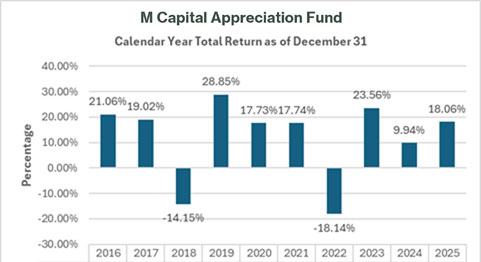
The
following information may give some indication of the risks of investing in the Fund. The Fund is the successor to the Predecessor Capital
Appreciation Fund, a mutual fund with identical investment objectives, policies, and restrictions, as a result of the reorganization
of the Predecessor Capital Appreciation Fund into the Fund on April 24, 2026. The performance provided in the bar chart and table is
that of the Predecessor Capital Appreciation Fund.
The table below shows the Predecessor Capital Appreciation Fund’s average annual total returns for the periods indicated and how those returns compare to those of the S&P 500® Index and the Russell 2500® Index. You cannot invest directly in an index. The Index returns are calculated on a total return basis and reflects no deduction for fees, expenses or taxes.
Average Annual Total Returns
(for the periods ended December 31, 2025)
| One Year | Five Years | Ten Years | ||||
| Predecessor Capital Appreciation Fund | ||||||
| S&P 500® Index1 | ||||||
| Russell 2500® Index2 ( |
| 1 | |
| 2 |
20
Fund Management
M Financial Investment Advisers, Inc. is the investment adviser for the Fund and Frontier is the sub-adviser for the Fund.’
The following people are primarily responsible for the day-to-day management of the Fund’s portfolio:
| Portfolio Manager | Since | Title | ||
| Andrew B. Bennett, CFA | December 2013 for the Predecessor Capital Appreciation Fund | Portfolio Manager | ||
| Peter G. Kuechle | April 2018 for the Predecessor Capital Appreciation Fund | Portfolio Manager |
Other Important Information
For
important information about Purchase and Redemption of Fund Shares, Tax Information and Payments to Insurance Companies and their Affiliates,
please turn to page 28 of this prospectus.
21
The Fund seeks long-term capital appreciation.
The fees and expenses reflected in the table below do not include the fees and charges associated with variable annuities or variable life insurance plans. Fees and charges for life insurance and annuity products typically include a sales load and/or a surrender charge and other charges for insurance benefits. If those fees and charges were included, the costs shown below would be higher.
The following table describes the fees and expenses that you may pay if you buy, hold, and sell shares of the Fund.
Annual Fund Operating Expenses
(expenses that you pay each year as a percentage of the value of your investments)
| Management Fees | ||
| Distribution (12b-1) Fee | ||
| Other Expenses1 | ||
| Total Annual Fund Operating Expenses |
| 1 |
This example is intended to help you compare the cost of investing in the Fund with the cost of investing in other mutual funds.
| 1 year | 3 years | 5 years | 10 years |
| $ |
$ |
$ |
$ |
The
Fund pays transaction costs, such as commissions, when it buys and sells securities (or “turns over” its portfolio). A higher
portfolio turnover rate may indicate higher transaction costs. These costs, which are not reflected in annual fund operating expenses
or in the example, affect the Fund’s performance. During the most recent fiscal year, the Predecessor Large Cap Value Fund’s
portfolio turnover rate was
The Fund normally invests at least 80% of its net assets, plus the amount of borrowings for investment purposes, if any, in issuers domiciled, or having their principal activities, in the United States, at the time of investment or other instruments with similar economic characteristics. In addition, the Fund normally invests at least 80% of its net assets in equity securities of large capitalization companies. Brandywine Global Investment Management, LLC (“Brandywine”), the Fund’s sub-adviser, defines “large capitalization” companies as those companies with market capitalizations similar to companies in the Russell 1000® Index. As of March 31, 2025, the market capitalization range of companies in the Russell 1000® Index was between approximately $273 million and $3.3 trillion. This strategy is not fundamental (it may be changed without shareholder approval), but should the Fund decide to change this strategy, it will provide shareholders with at least 60 days’ notice.
22
The Fund invests primarily in equity securities that, in Brandywine’s opinion, are undervalued or out of favor. Brandywine invests in securities that meet its value criteria, primarily price-to-earnings, price-to-book, price momentum and share change and quality, based on both quantitative and fundamental analysis. The Fund expects to hold approximately 175-250 stocks under normal market conditions.
Brandywine bases portfolio price targets on quantitative criteria determined in its sell process. Brandywine’s systems update these quantitatively determined buy and sell limits on a daily basis. Buy candidates must have a price that qualifies the stock as a value such that the price-to-earnings ratio is in the lower 40% of its universe or the price-to-book is in the lower 25% of its universe at time of purchase. Additionally, the current price compared to the price nine months ago must place it above the lower quartile of other universe stocks when ranked by nine-month price momentum and the change in shares outstanding over the past year must place it below the upper quartile.
Sell candidates will have a price that when compared to earnings and book place the stock above the median on a price-to-earnings basis and above the 40th percentile on a price-to-book basis. If a stock’s price declines relative to the universe such that it falls to the lower 10% of stocks as ranked on nine-month price momentum or the company issues sufficient shares to rank among the top 10% largest issuers (as a percentage of shares outstanding) in the year, the holding will be a sell candidate. Additionally, a stock will be sold if the capitalization falls 20% below the minimum purchase capitalization criteria.
Brandywine may modify buy and sell trigger points and decisions only due to tracking error considerations, trading opportunities or limitations such as position, industry or sector size. Brandywine does not violate its buy and sell rules based on analyst affinity for the stock. Its investment process requires disciplined buy and sell decisions rules with carefully outlined exceptions.
If a security experiences a severe fundamental deterioration event that is not captured in the price change, share change or valuation rules, Brandywine will initiate a sell. The rank order of the most common occurrences are price momentum, valuation expansion into the sell range, share issuance or fundamental deterioration.
Principal Investment Risks
As with any mutual fund, there is no guarantee that the Fund will achieve its goals. The Fund’s share price will fluctuate, which means you could lose money on your investment in the Fund. The principal risks of investing in the Fund are summarized below.
| ● | Large-Capitalization Investing Risk. Large-capitalization stocks as a group could fall out of favor with the market, causing the Fund to underperform investments that focus on small- or medium-capitalization stocks. Larger, more established companies may be slow to respond to challenges and may grow more slowly than smaller companies. |
| ● | Economic and Market Events Risk. Events in the U.S. and global financial markets, including actions taken by the U.S. Federal Reserve or foreign central banks to stimulate or stabilize economic growth, may at times result in unusually high market volatility, which could negatively impact the Fund’s performance. Reduced liquidity in credit and fixed-income markets could adversely affect issuers worldwide. Companies, including banks and financial services companies, could suffer losses if interest rates fluctuate or economic conditions deteriorate. Similarly, political events within the United States at times have resulted, and may in the future result, in a shutdown of government services, which could negatively affect the U.S. economy, decrease the value of a Fund’s investments, and increase uncertainty in or impair the operation of the U.S. or other securities markets. In recent years, the U.S. renegotiated many of its global trade relationships and also has recently imposed or threatened to impose significant import tariffs. Such actions could lead to price volatility and overall declines in U.S. and global investment markets. |
23
| ● | Additional Market Disruption Risk. Financial and securities markets are volatile and may be affected by political, regulatory, social, economic, and other global developments and disruptions, including those arising out of geopolitical events, armed conflict, public health emergencies (such as the spread of infectious diseases, pandemics, and epidemics), natural disasters, terrorism and governmental or quasi-governmental actions. Such changes may be rapid and unpredictable. These events may negatively affect issuers, industries and markets worldwide and adversely affect the value and liquidity of the Fund and its investments. |
In February 2022, Russia commenced a military attack on Ukraine. In response, various countries, including the U.S., issued broad-ranging sanctions on Russia and certain Russian companies and individuals. Any existing or future sanctions could have a severe adverse effect on Russia’s economy, currency, companies and region, and these events may negatively impact other regional and global economic markets of the World (including Europe and the United States), companies in such countries and various sectors, industries and markets for securities and commodities globally, such as oil and natural gas. Accordingly, the hostilities and sanctions may have a negative effect on the Fund’s investments and performance beyond any direct or indirect exposure the Fund may have to Russian issuers or those of adjoining geographic regions. The sanctions and compliance with these sanctions may impair the ability of the Fund to buy, sell, hold or deliver Russian securities and/or other assets, including those listed on U.S. or other exchanges. Russia may also take retaliatory actions or countermeasures, such as cyberattacks and espionage, which may negatively impact the countries and companies in which the Fund may invest. Accordingly, there may be a heightened risk of cyberattacks by Russia in response to the sanctions. The extent and duration of the military action or future escalation of such hostilities; the extent and impact of existing and any future sanctions, market disruptions and volatility; the potential for wider conflict; and the result of any diplomatic negotiations cannot be predicted. These and any related events could have a significant negative impact on the Fund’s investments as well as the Fund’s performance, and the value or liquidity of certain securities held by the Fund may decline significantly. In addition, rising tensions between China and Taiwan over a forced reunification have caused concerns in the region and globally. China sees self-ruled Taiwan as a breakaway province that will eventually be part of China again. Previous efforts by China’s leadership sought to bring about reunification by non-military means. Beginning in 2021, concerns escalated when China began sending military aircraft into Taiwan’s air defense zone, a self-declared area where foreign aircraft are identified, monitored and controlled in the interests of Taiwan’s national security. These actions have caused Taiwan and other countries to fear further escalation in the region. Any escalation of hostility between China and/or Taiwan would likely have a significant adverse impact on the value of investments in both countries and on economies, markets and individual securities globally, which could negatively affect the value and liquidity of the Fund’s investments. Beginning in October 2023, the Israel-Hamas war has resulted in significant loss of life and increased volatility in the Middle East. The conflict between Israel and Hamas and the involvement of the U.S. and other countries could present material uncertainty and risk with respect to a Fund’s performance and ability to achieve its investment objective. The extent of any market disruptions are impossible to predict, but could be substantial.
| ● | Market Risk. Investments in common stocks are subject to stock market risk. Stock prices in general may decline over short or even extended periods, regardless of the success or failure of a particular company’s operations. Stock markets tend to run in cycles, with periods when stock prices generally go up and periods when they generally go down. Common stock prices tend to go up and down more than those of bonds. |
| ● | Value Investment Risk. Value stocks may perform differently from the market as a whole and an investment strategy purchasing these securities may cause the Fund to at times underperform equity funds that use other investment strategies. Value stocks can react differently to political, economic, and industry developments than the market as a whole and other types of stocks. Value stocks also may underperform the market for long periods of time. |
24
| ● | Management Risk. The Fund is subject to management risk because it is actively managed. Management risk is the chance that security selection or focus on securities in a particular style, market sector or group of companies will cause the Fund to incur losses or underperform relative to its benchmarks or other investments with similar investment objectives. The sub-adviser will apply its investment techniques and risk analyses in making investment decisions for the Fund, but there can be no guarantee that these will produce the desired results. |
| ● | Operational Risk. Operational risks include human error, changes in personnel, system changes, faults in communication, and failures in systems, technology, or processes. Various operational events or circumstances are outside the sub-adviser’s control, including instances at third parties. The Fund and the sub-adviser seek to reduce these operational risks through controls and procedures. However, these measures do not address every possible risk and may be inadequate to address these risks. |
| ● | Cyber Security Risk. The Fund’s and its service providers’ use of internet, technology and information systems may expose the Fund to potential risks linked to cyber security breaches of those technological or information systems. Cyber security breaches, amongst other things, could allow an unauthorized party to gain access to proprietary information, customer data, or fund assets, or cause the Fund and/or its service providers to suffer data corruption or lose operational functionality. |
| ● | Liquidity Risk. Liquidity risk exists when investments are difficult to sell as the result of low trading volume, lack of market makers, and/or legal restrictions. Illiquid securities may prevent the Fund from entering into security transactions at advantageous times or prices, potentially reducing the return of the Fund’s portfolio. Investments in smaller market capitalizations and over-the-counter markets have greater exposure to liquidity risk. |
25
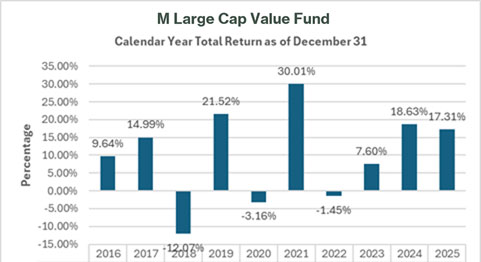
The
following information may give some indication of the risks of investing in the Fund. The Fund is the successor to the Predecessor Large
Cap Value Fund, a mutual fund with identical investment objectives, policies, and restrictions, as a result of the reorganization of
the Predecessor Large Cap Value Fund into the Fund on April 24 , 2026. The performance provided in the bar chart and table is that of
the Predecessor Large Cap Value Fund.
The table below shows the Predecessor Large Cap Value Fund’s average annual total returns for the periods indicated and how those returns compare to those of the Russell 1000® Index and the Russell 1000® Value Index. You cannot invest directly in an index. The Index returns are calculated on a total return basis and reflects no deduction for fees, expenses or taxes.
Average Annual Total Returns
(for the periods ended December 31, 2025)
| One Year | Five Years | Ten Years | ||||
| Predecessor Large Cap Value Fund | ||||||
| Russell 1000® Index1 | ||||||
| Russell 1000® Value Index2 ( |
| 1 |
| 2 |
26
Fund Management
M Financial Investment Advisers, Inc. is the investment adviser for the Fund and Brandywine is the sub-adviser for the Fund.
The Fund is managed by a team of portfolio managers, who are primarily responsible for the day-to-day management of the Fund’s portfolio. The team is led by:
| Portfolio Managers | Since | Title | ||
| Joseph J. Kirby | May
2020 for the Predecessor Large Cap Value Fund |
Portfolio Manager | ||
| Henry F. Otto | May
2020 for the Predecessor Large Cap Value Fund |
Managing Director and Portfolio Manager | ||
| Steven M. Tonkovich | May
2020 for the Predecessor Large Cap Value Fund |
Managing Director and Portfolio Manager |
Other Important Information
For important information about Purchase and Redemption of Fund Shares, Tax Information and Payments to Insurance Companies and their Affiliates, please turn to page 28 of this prospectus.
27
Purchasing Fund Shares
The Funds are available through the purchase of variable life insurance policies and variable annuity policies issued by certain insurance companies. Those insurance companies may offer other portfolios in addition to offering the Funds. You cannot buy shares of the Funds directly. You can invest indirectly in the Funds through your purchase of a variable annuity or variable life insurance contract. You should read this prospectus and the prospectus of the variable annuity or variable life insurance contract carefully before you choose your investment options.
The variable annuity and variable life insurance contracts are issued by separate accounts of various insurance companies. The insurance companies buy Fund shares for their separate accounts based on the instructions that they receive from the contract owners.
Redeeming Fund Shares
To meet various obligations under the variable annuity or variable life insurance contracts, the insurance company separate accounts may redeem Fund shares to generate cash. For example, a separate account may redeem Fund shares and use the proceeds to pay a contract owner who requested a partial withdrawal or who canceled a contract. Proceeds from the redemption are usually sent to the separate account on the next business day. The Funds may suspend redemptions of shares or postpone payment dates when the New York Stock Exchange (“NYSE”) is closed (other than weekends or holidays), when trading on the NYSE is restricted, or as otherwise permitted by the SEC.
Tax Information
Each Fund expects to qualify for taxation as a regulated investment company under subchapter M of chapter 1 of the Internal Revenue Code of 1986, as amended, for each taxable year. To qualify for taxation as a regulated investment company, each Fund must satisfy certain source-of-income, asset-diversification, and annual distribution requirements. Provided that a Fund satisfies the requirements to be taxed as a regulated investment company for each taxable year, such Fund will not be subject to U.S. federal income tax at corporate rates on its ordinary income and capital gains that it timely distributes to its shareholders. Each Fund also intends to comply with Section 817(h) of the Code and regulations issued thereunder, which impose certain investment diversification requirements on life insurance companies’ separate accounts that are used to support variable life insurance contracts and variable annuity contracts. Each Fund intends to distribute to its shareholders substantially all of its ordinary income and capital gains, if any, on an annual basis. Under current law, owners of variable life insurance contracts and variable annuity contracts who are indirectly invested in a Fund generally are not subject to U.S. federal income tax on Fund earnings or distributions or on gains realized upon the sale or redemption of Fund shares until amounts are withdrawn from their contracts. Please refer to the prospectus for the variable annuity or variable life insurance contract for tax information regarding those products.
Payments To Insurance Companies And Their Affiliates
The Funds are not sold directly to the general public but instead are offered as an underlying investment option for variable insurance contracts. The Funds and their related companies currently do not, but may, make payments to the sponsoring insurance company (or its affiliates) for distribution and/or other services. Such payments, if any, may be a factor that the insurance company considers in including the Funds as an underlying investment option in the variable insurance contract. The prospectus (or other offering document) for your variable insurance contract may contain additional information about these payments.
28
| Additional Information About Principal Investment Strategies and Related Risks |
M INTERNATIONAL EQUITY FUND
Investment Objective
The Fund seeks long-term capital appreciation. The Fund’s investment objective may be changed by a vote of the Board of Trustees of the Trust without shareholder approval, but should the Fund decide to change this goal, it will provide shareholders with at least 30 days’ notice.
Principal Investment Strategies
The Fund seeks to achieve its investment objective by purchasing a broad and diverse group of equity securities of non-U.S. companies. The Fund invests in companies of all sizes, with increased exposure to smaller capitalization, lower relative price, and higher profitability companies relative to the International Universe. For purposes of the Fund, Dimensional defines the International Universe as a market capitalization weighted set (e.g., the larger the company, the greater the proportion of the International Universe it represents) of non-U.S. companies in developed and emerging markets, which may include frontier markets, that have been authorized for investment as “Approved Markets” by Dimensional’s Investment Committee. The Fund may pursue its investment objective by investing its assets directly and/or indirectly in the Underlying Fund, which is also managed by the sub-adviser. For more information on the investment objective and strategies of the Underlying Fund please see below. Market capitalization weighted means that a company’s weighting in the International Universe is proportional to that company’s actual market capitalization compared to the total market capitalization of all eligible companies. The higher the company’s relative market capitalization, the greater its representation.
The Fund’s increased exposure to smaller capitalization, lower relative price, and higher profitability companies may be achieved by decreasing the allocation of the Fund’s assets to larger capitalization, higher relative price, or lower profitability companies relative to their weight in the International Universe. An equity issuer is considered to have a high relative price (i.e., a growth stock) primarily because it has a high price in relation to its book value. An equity issuer is considered to have a low relative price (i.e., a value stock) primarily because it has a low price in relation to its book value. In assessing relative price, Dimensional may consider additional factors, such as price-to-cash-flow or price-to-earnings ratios. An equity issuer is considered to have high profitability because it has high earnings or profits from operations in relation to its book value or assets. The criteria Dimensional uses for assessing relative price and profitability are subject to change from time to time.
Dimensional may adjust the representation in the Fund of an eligible company, or exclude a company, after considering such factors as free float, price momentum, short-run reversals, trading strategies, liquidity, size, relative price, profitability, investment characteristics, and other factors that Dimensional determines to be appropriate.
In determining which emerging market countries are eligible markets for the Fund, Dimensional may consider various factors, including, without limitation, the data, analysis, and classification of countries published or disseminated by international cooperatives and global development institutions, such as the International Bank for Reconstruction and Development (commonly known as the World Bank) and the International Finance Corporation, and widely recognized global index providers, such as FTSE Russell and MSCI. Approved Markets may not include all such emerging markets. In determining whether to approve emerging markets for investment, Dimensional may take into account, among other things, market liquidity, relative availability of investor information, government regulation, including fiscal and foreign exchange repatriation rules and the availability of other access to these markets for the Fund.
Dimensional may consider a small capitalization company’s investment characteristics as compared to other eligible companies when making investment decisions and may exclude a small capitalization company with high recent asset growth. The Fund will generally not exclude more than 5% of the eligible small capitalization company universe within each eligible country based on such investment characteristics. The criteria Dimensional uses for assessing
29
investment characteristics are subject to change from time to time. Dimensional may decrease the amount that the Fund invests in eligible small capitalization companies that have lower profitability and/or higher relative prices.
In general, securities will not be purchased or sold based on the prospects for the economy, the securities markets or the individual issuers whose shares are eligible for purchase. Securities that have depreciated in value since their acquisition will not be sold solely because prospects for the issuer are not considered attractive or due to an expected or realized decline in securities prices in general. Securities generally will not be sold solely to realize short-term profits, but when circumstances warrant, they may be sold without regard to the length of time held. Securities, including those eligible for purchase, may be disposed of, however, at any time when, in Dimensional’s judgment, circumstances warrant their sale, including but not limited to tender offers, mergers and similar transactions, or bids made for block purchases at opportune prices. Generally, securities will be purchased with the expectation that they will be held for longer than one year and will be held until such time as they are no longer considered an appropriate holding in light of the investment policy of the Fund.
In attempting to respond to adverse market, economic, political, or other considerations, the Fund may, from time to time, invest its assets in a temporary defensive manner that is inconsistent with the Fund’s principal investment strategies. In these circumstances, the Fund may be unable to achieve its investment objective.
Other Investment Strategies
Although the following are not principal investment strategies, the Fund may also:
| ● | invest in exchange-traded funds for purposes of gaining exposure to the equity markets, including the United States, while maintaining liquidity; |
| ● | keep a portion of assets in cash or cash equivalents pending investment or for liquidity purposes; |
| ● | lend its portfolio securities; and |
| ● | engage in relatively active trading. |
Investments in the Underlying Fund: Investment Objective, Strategies, and Policies of the Underlying Fund
The investment objective of the Underlying Fund is to achieve long-term capital appreciation. The Underlying Fund is designed to purchase a broad and diverse group of equity securities associated with emerging markets, which may include frontier markets (emerging market countries in an earlier stage of development) in Approved Markets. The Underlying Fund invests in companies of all sizes, with increased exposure to smaller capitalization, lower relative price, and higher profitability companies. The Underlying Fund’s increased exposure to smaller capitalization, lower relative price, and higher profitability companies may be achieved by decreasing the allocation of the Underlying Fund’s assets to larger capitalization, higher relative price, or lower profitability companies. An equity issuer is considered to have a high relative price (i.e., a growth stock) primarily because it has a high price in relation to its book value. An equity issuer is considered to have a low relative price (i.e., a value stock) primarily because it has a low price in relation to its book value. In assessing relative price, Dimensional may consider additional factors such as price-to-cash flow or price-to-earnings ratios. An equity issuer is considered to have high profitability because it has high earnings or profits from operations in relation to its book value or assets. The criteria Dimensional uses for assessing relative price and profitability are subject to change from time to time. Dimensional may also adjust the representation in the Underlying Fund of an eligible company, or exclude a company, after considering such factors as free float, price momentum, short-run reversals, trading strategies, liquidity, size, relative price, profitability, investment characteristics and other factors that Dimensional determines to be appropriate. In assessing a company’s investment characteristics, Dimensional considers ratios such as recent changes in assets divided by total assets. The criteria Dimensional uses for assessing a company’s investment characteristics are subject to change from time to time. The Underlying Fund will generally not exclude more than 5% of the eligible small capitalization company universe within each eligible country based on such investment characteristics. The Underlying Fund may purchase or sell futures contracts and options on futures contracts for Approved Market or other equity market securities and
30
indices, including those of the United States, to increase or decrease equity market exposure based on actual or expected cash inflows to or outflows from the Underlying Fund. The Underlying Fund may also invest in China A-shares (equity securities of companies listed in China) and variable interest entities (special structures that utilize contractual arrangements to provide exposure to certain Chinese companies). The Underlying Fund may lend its portfolio securities to generate additional income.
M LARGE CAP GROWTH FUND
Investment Objective
The Fund seeks long-term capital appreciation. The Fund’s investment objective may be changed by a vote of the Board of Trustees of the Trust without shareholder approval, but should the Fund decide to change this goal, it will provide shareholders with at least 30 days’ notice.
Principal Investment Strategies
The Fund will normally invest at least 80% of its total assets in domestic equity securities of U.S. large capitalization (“large-cap”) securities. The Fund seeks to achieve its objective by investing primarily in the common stock of large-sized U.S. companies. The investment strategy of Federated, the Fund’s sub-adviser, utilizes a large-cap growth approach by selecting most of its investments from companies listed in the Russell 1000® Growth Index, an index that measures the performance of those companies with higher price-to-book ratios and higher forecasted growth values within the large-cap segment of the U.S. equity universe, which includes the 1,000 largest U.S. companies by market capitalization. Federated considers a company to be large-cap if it falls within the market capitalization range of the Russell 1000® Growth Index. As the Fund’s sector exposure approximates the Russell 1000® Growth Index, the Fund may, from time to time, have large allocations to certain broad market sectors, such as technology, consumer discretionary and healthcare. As of March 31, 2025, companies in the Russell 1000® Growth Index ranged in market capitalization from $681 million to $3.3 trillion.
The Fund is classified as a non-diversified mutual fund, which means that the Fund may invest a larger percentage of its assets in the securities of a small number of issuers than a diversified fund.
Federated implements its strategy using a quantitative model driven by fundamental and technical stock selection variables. This process seeks to impose strict discipline over stock selection, unimpeded by market or manager psychology. It seeks to maximize compound annual return while controlling risk. The process also takes into account trading costs in an effort to ensure that trades are generated only to the extent they are expected to be profitable on an after-trading-cost basis. Additionally, risk is controlled through diversification constraints which limit exposure to individual companies as well as groups of correlated companies.
This strategy to invest at least 80% of its total assets in domestic equity securities of U.S. large-cap securities is not fundamental (it may be changed without shareholder approval), but should the Fund decide to change this strategy, it will provide shareholders with at least 60 days’ notice.
The Fund actively trades its portfolio securities in an attempt to achieve its investment objective.
Additional Information Regarding the Security Selection Process
As part of analysis in its security selection process, among other factors, Federated also evaluates whether environmental, social and governance factors could have a positive or negative impact on the risk/return profiles of many issuers in the universe of securities in which the Fund may invest. This analysis does not automatically result in including or excluding specific securities but may be used by Federated as an additional input to improve portfolio risk/return characteristics.
31
Other Investment Strategies
Although the following are not principal investment strategies, the Fund may also:
| ● | invest in derivatives, such as options (e.g., call options and put options), swaps (e.g., interest rate swaps, total return swaps, credit default swaps, currency swaps and caps and floors) or futures (e.g., interest rate futures, index futures, security futures, currency futures and currency forward contracts), in a manner that is consistent with its investment objective; |
| ● | use derivative contracts and/or hybrid instruments to: (i) implement elements of its investment strategy; (ii) obtain premiums from the sale of derivative contracts; (iii) realize gains from trading a derivative contract; and/or (iv) hedge against potential losses; |
| ● | invest in: (i) other equity securities, including, but not limited to, preferred stocks and warrants; (ii) fixed-income securities, including, but not limited to, treasury securities, government securities, corporate debt securities (e.g., commercial paper and demand instruments), mortgage-backed securities, zero-coupon securities, asset-backed securities and bank instruments; (iii) convertible securities; (iv) foreign securities, including, but not limited to, depository receipts, foreign exchange contracts, foreign government securities and emerging market securities; (v) repurchase and reverse repurchase agreements;(vi) real estate investment trusts; and/or (vii) hybrid instruments (e.g., credit linked notes and equity linked notes); |
| ● | keep a portion of assets in cash or cash equivalents pending investment or for liquidity purposes; and |
| ● | engage in portfolio securities lending. |
The Fund may depart from its normal strategies by taking temporary defensive positions in response to adverse market, economic, political or other conditions. When the Fund takes a temporary defensive position, it will invest all or a substantial portion of its assets in U.S. or Foreign Government securities, money market funds or securities, or other debt instruments and similar obligations or hold cash. During these times, the Fund may not achieve its investment objective.
M CAPITAL APPRECIATION FUND
Investment Objective
The Fund seeks long-term capital appreciation. The Fund’s investment objective may be changed by a vote of the Board of Trustees of the Trust without shareholder approval, but should the Fund decide to change this goal, it will provide shareholders with at least 30 days’ notice.
Principal Investment Strategies
The Fund principally invests in common stock of U.S. companies of all sizes, with emphasis on stocks of companies with capitalizations that are consistent with the capitalizations of those companies found in the Russell 2500® Index. As of March 31, 2025, the market capitalization range of companies in the Russell 2500® Index was between approximately $567.8 million and $31.4 billion. The Fund may invest up to 15% of the value of its total assets in equity securities of foreign issuers.
Frontier, the Fund’s sub-adviser, seeks long-term capital appreciation by employing a Growth-At-A-Reasonable-Price approach to identify, in its view, the best risk/reward investment ideas in the U.S. small- and mid-capitalization equity universe. Frontier purchases companies that, in its view, have above-average earnings growth potential and are available at reasonable valuations. Frontier’s philosophy combines rigorous bottom-up fundamental analysis with a proven investment process.
Frontier may sell stocks for a number of reasons, including when price objectives are reached, fundamental conditions have changed so that future earnings progress is likely to be adversely affected, or a stock is fully invested
32
and an attractive, new opportunity causes the sale of a current holding with less appreciation potential. Frontier does not sell stocks solely on changes to a company’s market capitalization.
Other Investment Strategies
Although the following are not principal investment strategies, the Fund may:
| ● | invest in companies with market capitalizations of $500 million or less; |
| ● | invest in recently organized companies; |
| ● | keep a portion of assets in cash or cash equivalents pending investment or for liquidity purposes; and |
| ● | lend its portfolio securities. |
The Fund may depart from its normal strategies by taking temporary defensive positions in response to adverse market, economic, political or other conditions. When the Fund takes a temporary defensive position, it will invest all or a substantial portion of its assets in U.S. Government securities, money market funds or securities, or other debt instruments. During these times, the Fund may not achieve its investment objective.
M LARGE CAP VALUE FUND
Investment Objective
The Fund seeks long-term capital appreciation. The Fund’s investment objective may be changed by a vote of the Board of Trustees of the Trust without shareholder approval, but should the Fund decide to change this goal, it will provide shareholders with at least 30 days’ notice.
Principal Investment Strategies
The Fund normally invests at least 80% of its net assets, plus the amount of borrowings for investment purposes, if any, in issuers domiciled, or having their principal activities, in the United States, at the time of investment or other instruments with similar economic characteristics. In addition, the Fund normally invests at least 80% of its net assets in equity securities of large capitalization companies. Brandywine, the Fund’s sub-adviser, defines “large capitalization” companies as those companies with market capitalizations similar to companies in the Russell 1000® Index. The size of the companies in the Index changes with market conditions and the composition of the Index. As of March 31, 2025, the market capitalization range of companies in the Russell 1000® Index was between approximately $273 million and $3.3 trillion. This strategy is not fundamental (it may be changed without shareholder approval), but should the Fund decide to change this strategy, it will provide shareholders with at least 60 days’ notice.
The Fund invests primarily in equity securities that, in Brandywine’s opinion, are undervalued or out of favor. Brandywine invests in securities that meet its value criteria, primarily price-to-earnings, price-to-book, price momentum and share change and quality, based on both quantitative and fundamental analysis. The Fund expects to hold approximately 175-250 stocks under normal market conditions.
Brandywine bases portfolio price targets on quantitative criteria determined in its sell process. Brandywine’s systems update these quantitatively determined buy and sell limits on a daily basis. Buy candidates must have a price that qualifies the stock as a value such that the price-to-earnings ratio is in the lower 40% of its universe or the price-to-book is in the lower 25% of its universe at time of purchase. Additionally, the current price compared to the price nine months ago must place it above the lower quartile of other universe stocks when ranked by nine-month price momentum and the change in shares outstanding over the past year must place it below the upper quartile.
Sell candidates will have a price that when compared to earnings and book place the stock above the median on a price-to-earnings basis and above the 40th percentile on a price-to-book basis. If a stock’s price declines relative to the universe such that it falls to the lower 10% of stocks as ranked on nine-month price momentum or the company issues sufficient shares to rank among the top 10% largest issuers (as a percentage of shares outstanding) in the year,
33
the holding will be a sell candidate. Additionally, a stock will be sold if the capitalization falls 20% below the minimum purchase capitalization criteria.
Brandywine may modify buy and sell trigger points and decisions only due to tracking error considerations, trading opportunities or limitations such as position, industry or sector size. Brandywine does not violate its buy and sell rules based on analyst affinity for the stock. Its investment process requires disciplined buy and sell decisions rules with carefully outlined exceptions.
If a security experiences a severe fundamental deterioration event that is not captured in the price change, share change or valuation rules, Brandywine will initiate a sell. The rank order of the most common occurrences are price momentum, valuation expansion into the sell range, share issuance or fundamental deterioration.
Other Investment Strategies
Although the following are not principal investment strategies, the Fund may also:
| ● | keep a portion of assets in cash or cash equivalents pending investment or liquidity needs; |
| ● | lend its portfolio securities; and |
| ● | engage in relatively active trading. |
The Fund may depart from its normal strategies by taking temporary defensive positions in response to adverse market, economic, political or other conditions. When the Fund takes a temporary defensive position, it will invest all or a substantial portion of its assets in U.S. Government securities, money market funds or securities, or other debt instruments. During these times, the Fund may not achieve its investment objective.
Security Types
Equity Securities. Equity securities include:
| ● | common stocks; |
| ● | preferred stocks; |
| ● | securities convertible into common stocks; and |
| ● | equity and index linked notes. |
American Depositary Receipts (ADRs), European Depositary Receipts (EDRs), International Depositary Receipts (IDRs) and Global Depositary Receipts (GDRs). ADRs, EDRs, IDRs and GDRs are securities that represent an ownership interest in a foreign security. ADRs are generally issued by a U.S. bank or trust company evidencing ownership of underlying securities issued by a foreign issuer. EDRs, IDRs and GDRs are European, international and global receipts, respectively, evidencing a similar arrangement. ADRs, EDRs, IDRs and GDRs may be sponsored (issued with the cooperation of the issuer whose stock underlies the receipt) by the issuer or be unsponsored (issued without the involvement of the issuer whose stock underlies the receipt). The issuers of unsponsored ADRs, EDRs, IDRs and GDRs are not required to disclose certain material information to the holders of such securities, as are issuers of sponsored securities.
Foreign Issuer. A foreign issuer is one that is organized under the laws of a foreign country and is:
| ● | unlisted or listed primarily on a non-U.S. exchange; or |
| ● | listed on a U.S. exchange or over-the-counter as a sponsored or unsponsored ADR. |
Emerging Market Securities. Emerging market securities are issued by a company that:
| ● | has its principal trading market for its stock in a country other than those currently listed as a “developed market” by Morgan Stanley Capital International; |
| ● | is organized under the laws of, and with a principal office in, an emerging market country; |
| ● | has its principal activities located in an emerging market country; or |
| ● | derives
at least 50% of its revenues or profits from operations within an emerging market country. |
34
RISKS OF INVESTING IN THE FUNDS
Principal Risks of Investing in the Funds
| Risk | M
International Equity Fund |
M
Large Cap Growth Fund |
M
Capital Appreciation Fund |
M
Large Cap Value Fund |
| Active Trading Risk | ● | |||
| Additional Market Disruption Risk | ● | ● | ● | ● |
| China Investments Risk | ● | |||
| Cyber Security Risk | ● | ● | ● | ● |
| Derivatives Risk | ● | |||
| Economic and Market Events Risk | ● | ● | ● | ● |
| Emerging Markets Risk | ● | |||
| Foreign Securities and Currencies Risk | ● | ● | ||
| Fund of Funds Risk | ● | |||
| Growth Securities Risk | ● | ● | ||
| Large-Capitalization Investing Risk | ● | ● | ||
| Liquidity Risk | ● | ● | ● | ● |
| Management Risk | ● | ● | ● | ● |
| Market Risk | ● | ● | ● | ● |
| Non-Diversification Risk | ● | |||
| Operational Risk | ● | ● | ● | ● |
| Profitability Investment Risk | ● | |||
| Quantitative Modeling Risk | ● | |||
| Sector Risk | ● | |||
| Small and Medium Capitalization Companies Risk | ● | ● | ||
| Value Investment Risk | ● | ● |
35
Non-Principal Risks of Investing in the Funds
| Risk | M
International Equity Fund |
M
Large Cap Growth Fund |
M
Capital Appreciation Fund |
M
Large Cap Value Fund |
| Investing in a Small Number of Securities Risk | ● | |||
| Recently Organized Companies and IPOs | ● | |||
| Securities Lending | ● | ● | ● | ● |
Principal Risks
Active Trading Risk. Active trading will cause the M Large Cap Growth Fund to have an increased portfolio turnover rate and increase the Fund’s trading costs, which may have an adverse impact on the Fund’s performance.
Additional Market Disruption Risk. Financial and securities markets are volatile and may be affected by political, regulatory, social, economic and other global developments and disruptions, including those arising out of geopolitical events, armed conflict, public health emergencies (such as the spread of infectious diseases, pandemics and epidemics), natural disasters, terrorism and governmental or quasi-governmental actions. Such changes may be rapid and unpredictable. These events may negatively affect issuers, industries and markets worldwide and adversely affect the value and liquidity of the Funds and their investments. Different sectors of the market, issuers, and security types may react differently to such developments.
In late February 2022, Russia launched a large-scale military attack on Ukraine. The invasion significantly amplified already existing geopolitical tensions among Russia, Ukraine, Europe, NATO and the West, including the U.S. In response to the military action by Russia, various countries, including the U.S., the United Kingdom, and European Union issued broad-ranging economic sanctions against Russia. Such sanctions included, among other things, a prohibition on doing business with certain Russian companies, large financial institutions, officials and oligarchs; a commitment by certain countries and the European Union to remove selected Russian banks from the Society for Worldwide Interbank Financial Telecommunications (“SWIFT”), the electronic banking network that connects banks globally; and restrictive measures to prevent the Russian Central Bank from undermining the impact of the sanctions. Additional sanctions may be imposed in the future. Such sanctions (and any future sanctions) and other actions against Russia may adversely impact, among other things, the Russian economy and various sectors of the economy, including but not limited to, financials, energy, metals and mining, engineering and defense and defense-related materials sectors; result in a decline in the value and liquidity of Russian securities; result in boycotts, tariffs, and purchasing and financing restrictions on Russia’s government, companies and certain individuals; weaken the value of the ruble; downgrade the country’s credit rating; freeze Russian securities and/or funds invested in prohibited assets and impair the ability to trade in Russian securities and/or other assets; and have other adverse consequences on the Russian government, economy, companies and region. Further, several large corporations and U.S. states have divested interests or otherwise curtailed business dealings with certain Russian businesses. Countermeasures or retaliatory actions by Russia may further impair the value and liquidity of Russian securities.
The ramifications of the hostilities and sanctions, however, may not be limited to Russia and Russian companies but may spill over to and negatively impact other regional and global economic markets of the World (including Europe and the United States), companies in other countries (particularly those that have done business with Russia) and on various sectors, industries and markets for securities and commodities globally, such as oil and natural gas. Accordingly, the actions discussed above and the potential for a wider conflict could increase financial market volatility, cause severe negative effects on regional and global economic markets, industries, and companies and have a negative effect on a Fund’s investments and performance beyond any direct or indirect exposure a Fund may have
36
to Russian issuers or those of adjoining geographic regions. In addition, Russia may take retaliatory actions and other countermeasures, including cyberattacks and espionage against other countries and companies in the World, which may negatively impact such countries and the companies in which the Fund invests. Accordingly, there may be heightened risk of cyberattacks which may result in, among other things, disruptions in the functioning and operations of industries or companies around the World, including in the United States and Europe.
The extent and duration of the military action or future escalation of such hostilities, the extent and impact of existing and any future sanctions, market disruptions and volatility, the potential for wider conflict, and the result of any diplomatic negotiations cannot be predicted. These and any related events could have a significant negative impact on Fund performance and the value and liquidity of an investment in the Fund, particularly with respect to Russian exposure.
Beginning in October 2023, the Israel-Hamas war has resulted in significant loss of life and increased volatility in the Middle East. The conflict between Israel and Hamas and the involvement of the U.S. and other countries could present material uncertainty and risk with respect to a Fund’s performance and ability to achieve its investment objective. The extent of any market disruptions are impossible to predict, but could be substantial.
China Investments Risk. There are special risks associated with investments in China, Hong Kong and Taiwan. The Chinese government has implemented significant economic reforms in order to liberalize trade policy, promote foreign investment in the economy, reduce government control of the economy and develop market mechanisms. But there can be no assurance that these reforms will continue or that they will be effective. Despite reforms and privatizations of companies in certain sectors, the Chinese government still exercises substantial influence over many aspects of the private sector and may own or control many companies. The Chinese government continues to maintain a major role in economic policy making and investing in China involves risks of losses due to expropriation, nationalization, confiscation of assets and property, and the imposition of restrictions on foreign investments and on repatriation of capital invested. Investors in Chinese issuers may have difficulty obtaining information regarding the issuer, particularly high-quality and reliable financial reporting. In addition, investments in Taiwan could be adversely affected by its political and economic relationship with China. The political reunification of China and Taiwan, over which China continues to claim sovereignty, is a highly complex issue that has included threats of invasion by China. Political or economic disturbances (including an attempted unification of Taiwan by force), as well as any economic sanctions implemented in response, may have an adverse impact on the values of investments in either China or Taiwan, or make investments in China and Taiwan impractical or impossible. Any escalation of hostility between China and/or Taiwan would likely have a significant adverse impact on the value of investments in both countries and on economies, markets and individual securities globally. The Chinese economy is also vulnerable to the long-running disagreements with Hong Kong related to integration.
A Fund investing in China A-shares through Stock Connect is subject to trading, clearance, settlement, and other procedures, which could pose risks to the Fund. Trading through the Stock Connect program is subject to daily quotas that limit the maximum daily net purchases on any particular day, each of which may restrict or preclude a Fund’s ability to invest in China A-shares through the Stock Connect program. Trading through Stock Connect may require pre-validation of cash or securities prior to acceptance of orders. This requirement may limit a Fund’s ability to dispose of its A-shares purchased through Stock Connect in a timely manner.
A primary feature of the Stock Connect program is the application of the home market’s laws and rules applicable to investors in China A-shares. Therefore, a Fund’s investments in Stock Connect China A-shares are generally subject to the securities regulations and listing rules of the People’s Republic of China (“PRC”), among other restrictions. Stock Connect can only operate when both PRC and Hong Kong markets are open for trading and when banking services are available in both markets on the corresponding settlement days. As such, the Shanghai and Shenzhen markets may be open at a time when Stock Connect is not trading, with the result that prices of China A-shares may fluctuate at times when a Fund is unable to add to or exit its position, which could adversely affect the Fund’s performance.
Changes in the operation of the Stock Connect program may restrict or otherwise affect a Fund’s investments or returns. Furthermore, any changes in laws, regulations and policies of the China A-shares market or rules in relation
37
to Stock Connect may affect China A-share prices. These risks are heightened generally by the developing state of the PRC’s investment and banking systems and the uncertainty about the precise nature of the rights of equity owners and their ability to enforce such rights under Chinese law. An investment in China A-Shares is also generally subject to the risks identified under “Emerging Markets Risk,” and foreign investment risks such as price controls, expropriation of assets, confiscatory taxation, and nationalization may be heightened when investing in China. Certain investments in Chinese companies may be made through a special structure known as a VIE. In a VIE structure, foreign investors, such as a Fund, will only own stock in a shell company rather than directly in the VIE, which must be owned by Chinese nationals (and/or Chinese companies) to obtain the licenses and/or assets required to operate in certain restricted or prohibited sectors in China. The value of the shell company is derived from its ability to consolidate the VIE into its financials pursuant to contractual arrangements that allow the shell company to exert a degree of control over, and obtain economic benefits arising from, the VIE without formal legal ownership. Investments involving a VIE structure may pose additional risks because such investments are made through a company whose interests in the underlying operating company are established through contract rather than through equity ownership. While VIEs are a longstanding industry practice and are well known by Chinese officials and regulators, historically the structure has not been formally recognized under Chinese law and Chinese regulations regarding the structure are evolving. It is uncertain whether Chinese officials or regulators will withdraw their acceptance of the structure. It is also uncertain whether the contractual arrangements, which may be subject to conflicts of interest between the legal owners of the VIE and foreign investors, would be enforced by Chinese courts or arbitration bodies. Prohibitions of these structures by the Chinese government, or the inability to enforce such contracts, from which the shell company derives its value, would likely cause the VIE-structured holding(s) to suffer significant, detrimental, and possibly permanent losses, and in turn, adversely affect a Fund’s returns and net asset value (“NAV”).
Cyber Security Risk. Intentional cyber security breaches include: unauthorized access to systems, networks or devices (such as through “hacking” activity), infection from computer viruses or other malicious software code, and attacks that shut down, disable, slow, or otherwise disrupt operations, business processes, or website access or functionality. In addition, unintentional incidents can occur, such as the inadvertent release of confidential information (possibly resulting in the violation of applicable privacy laws). A cyber security breach could result in the loss or theft of customer data or funds, the inability to access electronic systems (“denial of services”), loss or theft of proprietary information or corporate data, physical damage to a computer or network system, or costs associated with system repairs. Such incidents could cause a Fund, the Adviser, a sub-adviser or other service providers to incur regulatory penalties, reputational damage, litigation expenses, additional compliance costs, or significant financial loss. In addition, such incidents could affect issuers in which a Fund invests, and thereby cause the Fund’s investments to lose value.
Derivatives Risk. Derivatives are instruments, such as futures, and options thereon, and foreign currency forward contracts, whose value is derived from that of other assets, rates or indices. The use of derivatives for non-hedging purposes may be considered to carry more risk than other types of investments. When the M International Equity Fund uses derivatives, the Fund will be directly exposed to the risks of those derivatives. Derivative instruments are subject to a number of risks including counterparty and credit risk (the risk that the derivative counterparty will not fulfill its contractual obligations, whether because of bankruptcy or other default), settlement risk (the risk faced when one party to a transaction has performed its obligations under a contract but has not yet received value from its counterparty), interest rate risk (the risk that certain derivatives are more sensitive to interest rate changes and market price fluctuations than other securities), liquidity risk, market risk, and management risk, as well as the risk of improper valuation. Changes in the value of a derivative may not correlate perfectly with the underlying asset, rate or index, and the M International Equity Fund could lose more than the principal amount invested. SEC Rule 18f-4 (the “Derivatives Rule”) regulates the ability of the Fund to enter into derivative transactions and other leveraged transactions. The Derivatives Rule defines the term “derivatives” to include short sales and forward contracts, in addition to instruments traditionally classified as derivatives, such as swaps, futures, and options. The Derivatives Rule also regulates other types of leveraged transactions, such as reverse repurchase agreements. Under the Derivatives Rule, a Fund is prohibited from entering into derivatives transactions except in reliance on the provisions
38
of the Derivatives Rule. The M International Equity Fund qualifies as a “limited derivatives user,” which the Derivatives Rule defines as a fund that limits its derivatives exposure to 10% of its net assets. As such, M International Equity Fund is required to adopt and implement polices reasonably designed to manage its derivatives risks.
Economic and Market Events Risk. Economic events historically have resulted, and may in the future result, in an unusually high degree of volatility in the financial markets, both domestic and foreign. These events have included bankruptcies, corporate restructurings, and similar events; governmental efforts to limit short selling and high frequency trading; measures to address U.S. federal and state budget deficits; social, political, and economic instability in Europe and other countries; economic stimulus by the Japanese central bank; dramatic changes in energy prices and currency exchange rates; China’s economic slowdown; and regional armed conflict, such as the war between Russia and Ukraine. Interconnected global economies and financial markets increase the possibility that conditions in one country or region might adversely impact issuers in a different country or region. Both domestic and foreign equity markets have experienced increased volatility and turmoil, with issuers that have exposure to the real estate, mortgage, and credit markets particularly affected. Financial institutions could suffer losses as interest rates fluctuate or economic conditions deteriorate.
In addition, relatively high market volatility and reduced liquidity in credit and fixed-income markets may adversely affect many issuers worldwide. Actions taken by the U.S. Federal Reserve (“Fed”) or foreign central banks to stimulate or stabilize economic growth, such as interventions in currency markets, could cause high volatility in the equity and fixed-income markets. Reduced liquidity may result in less money being available to purchase raw materials, goods, and services from emerging markets, which may, in turn, bring down the prices of these economic staples. It may also result in emerging market issuers having more difficulty obtaining financing, which may, in turn, cause a decline in their securities prices.
To combat rising inflation, the Fed increased the Federal Funds interest rate several times in 2022 and 2023; however, the Fed decreased the Federal Funds interest rate in 2024, and the future of interest rates remains uncertain. As a result, risks associated with fluctuating interest rate environments have been, and continue to be, magnified in the current economic environment. It is difficult to accurately predict the pace at which the Fed may change interest rates, or the timing, frequency or magnitude of any such changes, and the evaluation of macro-economic and other conditions could cause a change in approach in the future. Changing interest rates may have unpredictable effects on the markets, may result in heightened market volatility, and may detract from Fund performance. As a result, a Fund may experience high redemptions and increased portfolio turnover, which could increase the costs that the Fund incurs and may negatively impact the Fund’s performance.
In addition, as the Fed adjusts the target Fed Funds Rate, any such changes, among other factors, could cause markets to experience continuing high volatility. A significant increase in interest rates may cause a decline in the market for equity securities. These events and the possible resulting market volatility may have an adverse effect on a Fund.
Political turmoil within the U.S. and abroad may also impact a Fund. Although the U.S. government has honored its credit obligations, it remains possible that the U.S. could default on its obligations. While it is impossible to predict the consequences of such an unprecedented event, it is likely that a default by the U.S. would be highly disruptive to the U.S. and global securities markets and could significantly impair the value of a Fund’s investments. Similarly, political events within the United States at times have resulted, and may in the future result, in a shutdown of government services, which could negatively affect the U.S. economy, decrease the value of a Fund’s investments, and increase uncertainty in or impair the operation of the U.S. or other securities markets. In recent years, the U.S. renegotiated many of its global trade relationships and also has recently imposed or threatened to impose significant import tariffs. Such actions could lead to price volatility and overall declines in U.S. and global investment markets.
There is a risk that the present value of assets or income from investments will be less in the future as rising prices (inflation) reduce their purchasing power. Inflation rates may change frequently and drastically as a result of various factors, including unexpected shifts in the domestic or global economy, and a Fund’s investments may be affected, which may reduce the Fund’s performance. While overshadowed by recent rapid inflation, there is also a risk that the prices of goods and services in the U.S. and many foreign economies may decline over time (deflation). Deflation may
39
have an adverse effect on stock prices and creditworthiness and may make defaults on debt more likely. If a country’s economy slips into a deflationary pattern, it could last for a prolonged period and may be difficult to reverse. Historically, securities issued in emerging and frontier markets have been subject to a greater risk of inflationary or deflationary forces, and more developed markets have been better able to use monetary policy to normalize markets.
Emerging Markets Risk. Investments in emerging markets can involve unique risks in addition to and greater than those generally associated with investing in developed markets. The securities markets of emerging countries are generally smaller, less developed, less liquid and more volatile than the securities markets of developed markets. The risks of investing in emerging markets include greater political and economic uncertainties than in developed markets; the risk of the imposition of economic sanctions against a country; the risk of nationalization of industries and expropriation of assets; currency transfer restrictions; and risks that governments may substantially restrict foreign investing in their capital markets. Emerging market companies may also be held to lower disclosures, corporate governance, auditing and financial reporting standards than companies in more developed markets. Emerging market countries may experience high levels of inflation and currency devaluation and have a more limited number of potential buyers for investments. Emerging markets may have different securities clearance and settlement procedures. In certain securities markets, settlements may not keep pace with the volume of securities transactions. If this occurs, settlement may be delayed and the Funds’ assets may be uninvested and may not be earning returns. A Fund also may miss investment opportunities or not be able to sell an investment because of these delays.
Foreign Securities and Currencies Risk. Investing in securities of foreign issuers poses unique risks such as fluctuation in currency exchange rates, market illiquidity, price volatility, high trading costs, difficulties in settlement, regulations on stock exchanges, limits on foreign ownership, possibility of expropriation or nationalization, confiscatory taxation, less stringent accounting, reporting and disclosure requirements and other considerations. Foreign securities may have more frequent and larger price changes than domestic securities.
Investments that are denominated in currencies other than the U.S. dollar are subject to currency exchange risk, which may make the return on an investment increase or decrease unrelated to the quality or performance of the investment itself. Because the value of the U.S. dollar against other currencies will vary, a decline in the exchange rate would reduce the value of certain portfolio investments. Forward foreign currency exchange contracts, which involve an obligation to purchase or sell a specific currency at a future date at a specified price, may be used in an attempt to protect against currency exchange risk. The M International Equity Fund, the M Large Cap Growth Fund, and the M Capital Appreciation Fund do not hedge foreign currency risk. Foreign securities prices may decline or fluctuate because of: (a) economic or political actions of foreign governments, and/or (b) less regulated or liquid securities markets.
The M International Equity Fund and the M Capital Appreciation Fund invest in depositary receipts. Depositary receipts are generally subject to the same risks as the foreign securities that they evidence or into which they may be converted. In addition, the underlying issuers of certain depositary receipts, particularly unsponsored or unregistered depositary receipts, are under no obligation to distribute shareholder communications to the holders of such receipts, or to pass through to them any voting rights with respect to the deposited securities. Depositary receipts that are not sponsored by the issuer may be less liquid and there may be less readily available public information about the issuer.
Fund of Funds Risk. The investment performance of the M International Equity Fund is affected by the investment performance of the Underlying Fund in which the M International Equity Fund invests. The ability of the M International Equity Fund to achieve its investment objective depends on the ability of the Underlying Fund to meet its investment objective and on Dimensional’s decisions regarding the allocation of the M International Equity Fund’s assets to the Underlying Fund. The M International Equity Fund may allocate assets to the Underlying Fund or asset class that underperforms other funds or asset classes. There can be no assurance that the investment objective of the M International Equity Fund or the Underlying Fund will be achieved. When the M International Equity Fund invests in the Underlying Fund, investors are exposed to a proportionate share of the expenses of the Underlying Fund in
40
addition to the expenses of the M International Equity Fund. Through its investment in the Underlying Fund, the M International Equity Fund is subject to the risks of the Underlying Fund’s investments.
Growth Securities Risk. The M Capital Appreciation Fund and the M Large Cap Growth Fund invest in growth securities, which may be more volatile than other types of investments, may perform differently than the market as a whole and may underperform when compared to securities with different investment parameters. Under certain market conditions, growth securities have performed better during the later stages of economic recovery. Therefore, growth securities may go in and out of favor over time.
Large-Capitalization Investing Risk. Larger, more established companies may be unable to respond quickly to competitive challenges, such as changes in technology and consumer tastes. Many larger companies also may not be able to attain the high growth rate of successful smaller companies, especially during extended periods of economic expansion.
Liquidity Risk. Liquidity risk exists when investments are difficult to sell as the result of low trading volume, lack of market makers, and/or legal restrictions. Illiquid securities may prevent a Fund from entering into security transactions at advantageous times or prices, potentially reducing the return of a Fund’s portfolio. Investments in smaller market capitalizations and over-the-counter markets have greater exposure to liquidity risk.
Management Risk. The Funds are subject to management risk because they are actively managed. Management risk is the chance that security selection or focus on securities in a particular style, market sector or group of companies will cause a Fund to incur losses or underperform relative to its benchmarks or other investments with similar investment objectives. A sub-adviser will apply its investment techniques and risk analyses in making investment decisions for a Fund, but there can be no guarantee that these will produce the desired results.
Market Risk. A Fund that invests in common stocks is subject to stock market risk. Stock prices in general may decline over short or even extended periods, regardless of the success or failure of a particular company’s operations. Stock markets tend to run in cycles, with periods when stock prices generally go up and periods when they generally go down. Common stock prices tend to go up and down more than those of bonds.
Non-Diversification Risk. The M Large Cap Growth Fund can invest a larger portion of its assets in the stocks of a limited number of companies than a diversified fund, which means it may have more exposure to the price movements of a single security or small group of securities than funds that diversify their investments among many companies.
Operational Risk. Operational risks include human error, changes in personnel, system changes, faults in communication, and failures in systems, technology, or processes. Various operational events or circumstances are outside a sub-adviser’s control, including instances at third parties. Each Fund and each applicable sub-adviser seek to reduce these operational risks through controls and procedures. However, these measures do not address every possible risk and may be inadequate to address these risks.
Profitability Investment Risk. High relative profitability stocks may perform differently from the market as a whole and an investment strategy purchasing these securities may cause a Fund to at times underperform equity funds that use other investment strategies.
Quantitative Modeling Risk. The M Large Cap Growth Fund employs quantitative models as a management technique. These models examine multiple economic and market factors using large data sets. The results generated by quantitative analysis may be different than expected and may negatively affect Fund performance for a variety of reasons. For example, human judgment plays a role in building, utilizing, testing and modifying the financial algorithms and formulas used in these models. Additionally, the data, which is typically supplied by third parties, can be imprecise or become stale due to new events or changing circumstances. Market performance can be affected by non-quantitative factors (for example, investor fear or over-reaction or other emotional considerations) that are not easily integrated into quantitative analysis. There may also be technical issues with the construction and
41
implementation of quantitative models (for example, software or other technology malfunctions, or programming inaccuracies).
Sector Risk. Companies with similar characteristics may be grouped together in broad categories called sectors. Sector risk is the possibility that a certain sector may underperform other sectors or the market as a whole. To the extent a Fund invests in a particular sector or sectors, its performance will be more susceptible to economic, business, or other developments and risks affecting that sector. Such factors may vary depending upon the sector and economic conditions at the time, but may include, for example, the availability and cost of capital funds, changes in interest rates, currency fluctuations, credit conditions or government regulation.
Small and Medium Capitalization Companies Risk. The Funds may invest in small and medium capitalization companies, which tend to be more vulnerable to adverse developments than larger companies. These companies may have limited product lines, markets, or financial resources, or may depend on a limited management group. They may be recently organized, without proven records of success. Their securities may trade infrequently and in limited volumes. As a result, the prices of these securities may fluctuate more than prices of securities of larger, more widely traded companies and the Funds may experience difficulty in establishing or closing out positions in these securities at prevailing market prices. Also, there may be less publicly available information about small and medium capitalization companies or less market interest in their securities as compared to larger companies, and it may take longer for the prices of the securities to reflect the full value of their issuers’ earnings potential or assets.
Value Investment Risk. Value stocks may perform differently from the market as a whole and an investment strategy purchasing these securities may cause a Fund to at times underperform equity funds that use other investment strategies. Value stocks can react differently to political, economic, and industry developments than the market as a whole and other types of stocks. Value stocks also may underperform the market for long periods of time.
Non-Principal Risks
Investing in a Small Number of Securities Risk. As a result of the relatively small number of securities held by the M Large Cap Growth Fund, there may be more risk because changes in the value of a single security or the impact of a single economic, political or regulatory occurrence may have a greater adverse impact on the strategy’s performance.
Recently Organized Companies and IPOs Risk. Investments in recently organized companies and in many initial public offerings (“IPOs”) have the same risks as small company investments, but to a greater degree, including the risk of significant price fluctuations over short periods of time.
Securities Lending Risk. Securities lending typically involves counterparty risk, including the risk that a borrower may not provide additional collateral when required or return the loaned securities in a timely manner. This risk could be greater for securities of foreign issuers. In the Funds’ securities lending program, the counterparty risk related to borrowers not providing additional collateral or returning loaned securities in a timely manner is borne by the securities lending agent, which has indemnified the Fund against losses resulting from these risks. However, a Fund may lose money from lending securities (or the amounts earned from securities lending may be limited) if, for example, the value or return of its investments of the cash collateral declines below the amount owed to a borrower. Cash received as collateral through loan transactions is invested in a money market fund.
| Management of the Fund |
The Adviser
Investment Adviser
The Adviser, located at 1125 NW Couch Street, Suite 900, Portland, Oregon 97209, is the investment adviser to the Funds. The Adviser has been registered as an investment adviser under the Investment Advisers Act of 1940, as
42
amended (the “Advisers Act”) since November 1995. As of December 31, 2025, the Adviser had approximately $998.5 million in assets under management.
The Adviser began managing the Predecessor Funds at its commencement of operations on January 4, 1996. The Adviser is responsible for providing (or arranging for the provision of) overall business management and administrative services necessary for the Fund’s operations. In this regard, the Adviser recommends to the Trust’s Board of Trustees sub-advisers who have shown good investment performance in their areas of expertise to manage the day-to-day portfolio management of the Funds. The Trust’s Board of Trustees selects the sub-advisers and supervises the Adviser’s management of the sub-advisers. The Adviser and the Predecessor Corporation had received an exemptive order from the SEC that allowed the Board of Directors, under certain circumstances, to change a sub-adviser, or change the terms of a sub-advisory contract, without shareholder approval. The Adviser has the ultimate responsibility to oversee the sub-advisers and to recommend to the Board of Trustees their hiring, termination and replacement. In addition, the Adviser is responsible for ensuring the Funds’ compliance with applicable legal requirements and for ensuring that the Funds’ investment objectives, policies and restrictions are followed.
Each Fund pays the Adviser a fee for its services. The Adviser retains 0.15% of the average daily net assets of each Fund. The Adviser pays the balance of the fee it receives from each Fund to the applicable sub-adviser.
The advisory fee of the M International Equity Fund is 0.15% on all assets plus (and only with respect to Fund assets which are not invested in a mutual fund that is advised by the Fund’s subadviser), 0.25% on the first $100 million, and 0.20% on the amounts thereafter. The advisory fee of the M Large Cap Growth Fund is 0.45% on the first $100 million and 0.40% on the amounts thereafter. The advisory fee of the M Capital Appreciation Fund is 0.85% on the first $125 million and 0.75% on the amounts thereafter. The advisory fee of the M Large Cap Value Fund is 0.43%.
The aggregate fee paid to the Adviser by each Predecessor Fund for the year ended December 31, 2025 is shown in the table below.
| Fee to the Adviser (as a % of average Fund daily net assets) | |
| Predecessor International Equity Fund | 0.31% |
| Predecessor Large Cap Growth Fund | 0.47% |
| Predecessor Capital Appreciation Fund | 0.81% |
| Predecessor Large Cap Value Fund | 0.43% |
A discussion of the basis for the Board of Trustees’ approvals of the advisory and sub-advisory contracts for the Funds, will be available in the Funds’ semi-annual financial statements for the period ended June 30, 2026.
Sub-Advisers
The sub-advisers make the day-to-day decisions regarding buying and selling specific securities for a Fund. Each sub-adviser manages the investments held by the Fund it serves according to the applicable investment objective and strategies. Additional information regarding portfolio manager compensation, other accounts managed by each portfolio manager and each manager’s ownership of securities of funds they manage may be found in the Funds’ Statement of Additional Information.
Dimensional Fund Advisors, LP (Dimensional)
6300 Bee Cave Road, Building One, Austin, Texas 78746
Sub-Adviser to the M International Equity Fund
Dimensional has been engaged in the business of providing investment management services since May 1981. Dimensional is currently organized as a Delaware limited partnership and is controlled and operated by its general partner, Dimensional Holdings Inc., a Delaware corporation. As of December 31, 2025, assets under management for all Dimensional affiliated advisors totaled approximately $994 billion. Dimensional has managed the Predecessor International Equity Fund since December 12, 2018.
43
In accordance with the team approach used to manage the M International Equity Fund, the portfolio managers and portfolio traders implement the policies and procedures established by Dimensional’s Investment Committee.
The portfolio managers and portfolio traders also make daily investment decisions regarding the Fund based on the parameters established by the Investment Committee. The individuals below coordinate the efforts of all other portfolio managers and/or trading personnel with respect to the day-to-day management of the Fund.
| ● | Jed S. Fogdall is Global Head of Portfolio Management, Chairman of the Investment Committee, Vice President and a Senior Portfolio Manager of Dimensional. Mr. Fogdall has an MBA from the University of California, Los Angeles and a BS from Purdue University. Mr. Fogdall joined Dimensional as a portfolio manager in 2004. |
| ● | Mary T. Phillips, CFA is Deputy Head of Portfolio Management, North America, member of the Investment Committee, Vice President and a Senior Portfolio Manager of Dimensional. Ms. Phillips holds an MBA from the University of Chicago Booth School of Business and a BA from the University of Puget Sound. Ms. Phillips joined Dimensional in 2012 and has been a portfolio manager since 2014. |
| ● | William B. Collins-Dean, CFA is Vice President and a Senior Portfolio Manager of Dimensional. Mr. Collins-Dean holds an MBA from the University of Chicago and a BS from Wake Forest University. Mr. Collins-Dean joined Dimensional in 2014 and has been a portfolio manager since 2016. |
Federated
MDTA LLC (Federated)
125 High Street, Oliver Tower, 21st floor, Boston, Massachusetts 02110
Sub-Adviser to the M Large Cap Growth Fund
Federated is a SEC registered investment adviser and a wholly owned subsidiary of Federated Hermes, Inc. Federated is responsible for day-to-day investment management of the M Large Cap Growth Fund, including quantitative model design, development and enhancement that drives investment decisions. Federated Advisory Services Company, an affiliate of Federated, provides security and market data and certain other support services to Federated. The fee for these services is paid by Federated and not by M Large Cap Growth Fund. As of December 31, 2025, Federated had approximately $14.3 billion in assets under management. Federated has managed the Predecessor Large Cap Growth Fund since May 1, 2025.
A team of investment professionals listed below manages the M Large Cap Growth Fund.
| ● | Daniel J. Mahr, CFA, has been Head of MDT Group at Federated since 2023 and formerly Managing Director, Research since 2008. He began his investment career in 2002. He has an A.B. from Harvard College and an S.M. from Harvard University. |
| ● | Damien Zhang, CFA, has been Head of MDT Research at Federated since 2023 and formerly Research Manager since 2015. He began his investment career in 2009. He has an A.B. from Princeton University. |
| ● | Frederick L. Konopka, CFA, has been Portfolio and Trading Manager at Federated since 2009. He began his investment career in 1997. He has an A.B. from Dartmouth College and an M.S. from MIT Sloan School of Management. |
| ● | John Paul Lewicke has been Research Manager at Federated since 2013 and formerly Senior Analyst since 2009. He began his investment career in 2007. He has an A.B. from Dartmouth College. |
44
Frontier
Capital Management Company, LLC (Frontier)
99 Summer Street, Boston, Massachusetts 02110
Sub-Adviser to the M Capital Appreciation Fund
Frontier has been registered as an investment adviser with the SEC since 1981. As of December 31, 2025, Frontier managed approximately $9.6 billion of assets. Frontier has managed the Predecessor Capital Appreciation Fund since January 5, 1996.
Andrew B. Bennett, CFA and Peter G. Kuechle are responsible for the day-to-day management of the M Capital Appreciation Fund.
| ● | Andrew B. Bennett, CFA has been a portfolio manager of the Fund since December 31, 2013. Mr. Bennett holds a B.A. from Wheaton College. He joined Frontier in 2003 as an equity research analyst. He assumed portfolio management responsibilities for Frontier’s capital appreciation portfolios in 2010. |
| ● | Peter G. Kuechle has been a portfolio manager of the Fund since April 1, 2018. Mr. Kuechle holds a B.A. from Dartmouth College and an M.B.A. from Harvard Business School. He joined Frontier in 2002 as an equity research analyst. He assumed portfolio management responsibilities for Frontier’s capital appreciation portfolios in April 2018. |
Brandywine
Global Investment Management, LLC (Brandywine)
1735 Market Street, Suite 1800, Philadelphia, Pennsylvania 19103
Sub-Adviser to the M Large Cap Value Fund
Brandywine has been registered as an investment adviser with the SEC since 1986. As of December 31, 2025, Brandywine managed approximately $64.1 billion of assets. Brandywine has managed the Predecessor Large Cap Value Fund since May 1, 2020.
A team of investment professionals manages the M Large Cap Value Fund. The team is led by the following investment professionals:
| ● | Joseph J. Kirby (Portfolio Manager) is the lead portfolio manager for the Diversified Large Cap Value Equity and Diversified Large Cap Value Select Equity strategies. He joined the firm in 1994. |
| ● | Henry F. Otto (Managing Director and Portfolio Manager) is the founder and co-lead portfolio manager of the Diversified Value Equity strategies. He is a member of the firm’s Executive Board. He joined the firm in 1988. |
| ● | Steven M. Tonkovich (Managing Director and Portfolio Manager) is co-lead portfolio manager of the Diversified Value Equity strategies. He is a member of the firm’s Executive Board. He joined the firm in 1989. |
Similar Funds
The Funds are not available for purchase directly by the general public and are not the same as other mutual fund portfolios with very similar or nearly identical names that are sold directly to the public. However, the investment objectives and policies of certain Funds may be very similar to the investment objectives and policies of other mutual fund portfolios that are managed by the sub-advisers. Nevertheless, the investment performance and results of each Fund may be lower, or higher, than the investment results of such other publicly available portfolios. There can be no assurance, and no representation is made, that the investment results of any of the Funds will be comparable to the investment results of any other mutual fund portfolio, even if the other portfolio is also managed by the Fund’s sub-adviser, has the same investment objectives and policies and has a very similar name.
Conflicts of Interest
Certain conflicts of interest may exist between the interests of the variable annuity contract owners, variable life insurance policy owners and plan participants. The Funds do not currently believe that ownership by each such type of entity will cause any disadvantage to owners of any of such entities. However, the Board of Trustees of the Trust monitors the Funds to identify any conflicts of interest that may cause such a disadvantage and that cannot be
45
reconciled. If such situations arise, the Board of Trustees will decide at that time what action should be taken in response to the conflicts.
Portfolio Holdings Disclosure
The Trust has adopted policies and procedures that govern the disclosure of the Funds’ portfolio holdings. The Adviser will provide complete lists of each Fund’s portfolio holdings as of the end of each quarter on its website at www.mfin.com/m-funds. The Adviser intends to post the holdings around the fifth business day of the succeeding quarter. The Funds’ portfolio holdings are also disclosed as of the end of the applicable quarter in the Funds’ Form N- CSR filings for the second and fourth fiscal quarters, which are filed with the SEC on or shortly before the 70th day following the end of those quarters, and in its Form N-PORT filings for the first and third fiscal quarters, which are filed with the SEC on or shortly before the 60th day following the end of those quarters. The Trust’s policies and procedures regarding website disclosure of the Funds’ portfolio holdings, as well as the Trust’s other policies and procedures relating to disclosure of the Funds’ portfolio holdings, are described in the Statement of Additional Information.
Performance Data
The performance data shown above in this prospectus (and elsewhere) reflects the Adviser’s agreement to cap certain operating expenses of the Predecessor Funds to the extent that they exceeded 0.25% of the Fund’s daily net assets, through April 30, 2024, as well as a voluntary waiver by AJO, LP, the Predecessor Large Cap Value Fund’s previous sub-adviser, and corresponding waiver by the Adviser to lower certain expenses of the Predecessor Large Cap Value Fund. If the expense cap had not been in effect, the performance results for those Funds that had operating expenses that exceeded 0.25% of the Fund’s daily net assets would have been less favorable for those years. In addition, if the waiver had not been in place for the Predecessor Large Cap Value Fund, the Fund’s performance results for the fiscal years ended December 31, 2016 through December 31, 2019 would have been less favorable.
| Shareholder Information |
Choosing the Appropriate Funds to Match Your Goals
Investing well requires a plan. We recommend that you meet with your financial adviser to plan a strategy that will best meet your financial goals. Your financial adviser can help you buy a variable annuity or variable life insurance contract that will allow you to choose the Funds.
Purchasing Shares
The Funds are generally available through the purchase of variable life insurance policies and variable annuity policies issued by certain insurance companies. Those insurance companies may offer other portfolios in addition to offering the Funds. You cannot buy shares of the Funds directly. You can invest indirectly in the Funds through your purchase of a variable annuity or variable life insurance contract. You should read this prospectus and the prospectus of the variable annuity or variable life insurance contract carefully before you choose your investment options.
The variable annuity and variable life insurance contracts are issued by separate accounts of various insurance companies. The insurance companies buy Fund shares for their separate accounts based on the instructions that they receive from the contract owners.
Market Timing
Programmed, large, frequent or short-term transfers among the Funds or between a Fund and other investment options can cause risk with adverse effects for other contract owners (and beneficiaries and underlying fund portfolios). These risks and harmful effects include: (1) dilution of the interest of long-term investors in a Fund if purchases or transfers into or out of a Fund are made at values that do not reflect an accurate value for the Fund’s
46
underlying portfolio securities (some “market timers” attempt to do this through methods known as “time-zone arbitrage” and “liquidity arbitrage”); (2) an adverse effect on portfolio management, such as impeding a sub-adviser’s ability to sustain an investment objective, causing the Fund to maintain a higher level of cash than would otherwise be the case, or causing the Fund to liquidate investments prematurely (or otherwise at an inopportune time) to pay withdrawals or transfers out of the Fund; and (3) increased brokerage and administrative expenses. These costs are borne by all contract owners invested in the Fund, not just those making transfers. Therefore, the Funds reserve the right to reject any transfer or purchase order if, in the Fund’s judgment, the Fund or other investors would potentially be adversely affected.
The Board of Trustees has determined that it is not necessary for the Funds to have any specific policies and procedures regarding frequent transfers because each of the Participating Insurance Companies has its own policies and procedures regarding its contract owner’s transfer activity. Each Participating Insurance Company has supplied and certified that it has established procedures to monitor and deter market-timing activity. The Adviser does not have, nor has it had, written agreements that provide for market timing.
Redeeming Shares
To meet various obligations under the variable annuity or variable life insurance contracts, the insurance company separate accounts may redeem Fund shares to generate cash. For example, a separate account may redeem Fund shares and use the proceeds to pay a contract owner who requested a partial withdrawal or who canceled a contract. Proceeds from the redemption are usually sent to the separate account on the next business day. Under stressed market conditions, as well as for other temporary or emergency purposes, the Funds reserve the right to enter into agreements in order to establish a line of credit or other borrowing arrangements should the Funds deem that stressful conditions may require such action in order to assist in meeting timely redemption requests. The Funds may suspend redemption of shares or postpone payment dates when the New York Stock Exchange (“NYSE”) is closed (other than weekends or holidays), when trading on the NYSE is restricted, or as otherwise permitted by the SEC, for more than seven days.
Pricing of Fund Shares
Shares of the Funds are sold at net asset value (“NAV”). The NAV of each Fund is determined at the close of regular trading on the New York Stock Exchange (normally 4:00 p.m. Eastern Time) on each day the New York Stock Exchange (“NYSE”) is open for business. NAV is computed by determining, on a per class basis, the aggregate market value of all assets of a Fund, less its liabilities, divided by the total number of shares outstanding ((assets-liabilities)/number of shares = NAV). The NYSE is closed on weekends and New Year’s Day, Martin Luther King, Jr. Day, Presidents’ Day, Good Friday, Memorial Day, Juneteenth, Independence Day, Labor Day, Thanksgiving Day and Christmas Day. The NAV takes into account, on a per class basis, the expenses and fees of a Fund, including management, administration, and distribution fees, which are accrued daily. The determination of NAV for a share class for a particular day is applicable to all applications for the purchase of shares, as well as all requests for the redemption of shares, received by a Fund (or an authorized broker or agent, or its authorized designee) before the close of trading on the NYSE on that day.
Generally, the Funds’ securities listed on an exchange are valued each day at the last quoted sales price on each security’s primary exchange. Securities traded or dealt in upon one or more securities exchanges (whether domestic or foreign) for which market quotations are readily available and not subject to restrictions against resale shall be valued at the last quoted sales price on the primary exchange or, in the absence of a sale on the primary exchange, at the mean between the current bid ask prices on such exchanges. Securities primarily traded in the National Association of Securities Dealers’ Automated Quotation System (“NASDAQ”) National Market System for which market quotations are readily available shall be valued using the NASDAQ Official Closing Price. Securities that are not traded or dealt in any securities exchange (whether domestic or foreign) and for which over-the-counter market quotations are readily available generally shall be valued at the last sale price or, in the absence of a sale, at the mean between
47
the current bid and ask price on such over-the- counter market. Debt securities not traded on an exchange may be valued at prices supplied by a pricing agent(s) based on broker or dealer supplied valuations or matrix pricing, a method of valuing securities by reference to the value of other securities with similar characteristics, such as rating, interest rate and maturity.
If market quotations are not readily available, securities will be valued at their fair market value as determined using the “fair value” procedures approved by the Board. Fair value pricing involves subjective judgments and it is possible that the fair value determined for a security may be materially different from the value that could be realized upon the sale of that security. The fair value prices can differ from market prices when they become available or when a price becomes available. The Board appointed the Adviser as its designee (the “Valuation Designee”) for all fair value determinations and responsibilities other than overseeing pricing service providers used by the Trust. This designation is subject to Board oversight and certain reporting and other requirements designed to facilitate the Board’s ability to oversee the Valuation Designee’s fair value determinations effectively . The Valuation Designee may also enlist third party consultants such as an audit firm or financial officer of a security issuer on an as-needed basis to assist in determining a security-specific fair value. The Board is responsible for reviewing and approving fair value methodologies utilized by the Valuation Designee, which approval shall be based upon whether the Valuation Designee followed the valuation procedures established by the Board.
The Funds may use independent pricing services to assist in calculating the value of the Funds’ securities. In addition, market prices for foreign securities are not determined at the same time of day as the NAV for the Funds. Because the Funds may invest in underlying ETFs which hold portfolio securities primarily listed on foreign exchanges, and these exchanges may trade on weekends or other days when the underlying ETFs do not price their shares, the value of some of a Fund’s portfolio securities may change on days when you may not be able to buy or sell Fund shares.
In computing the NAV, the Funds value foreign securities held by the Funds at the latest closing price on the exchange in which they are traded immediately prior to closing of the NYSE. Prices of foreign securities quoted in foreign currencies are translated into U.S. dollars at current rates. If events materially affecting the value of a security in a Fund’s portfolio, particularly foreign securities, occur after the close of trading on a foreign market but before a Fund prices its shares, the security will be valued at fair value. For example, if trading in a portfolio security is halted and does not resume before a Fund calculates its NAV, the Adviser may need to price the security using the Fund’s fair value pricing guidelines. The determination of fair value involves subjective judgments. As a result, using fair value to price a security may result in a price materially different from the prices used by other mutual funds to determine net asset value, or from the price that may be realized upon the actual sale of the security.
With respect to any portion of each Fund’s assets that are invested in one or more open-end management investment companies registered under the 1940 Act, each Fund’s net asset value is calculated based upon the net asset values of those open-end management investment companies, and the prospectuses for these companies explain the circumstances under which those companies will use fair value pricing and the effects of using fair value pricing. Shareholders may obtain this information from the websites for these funds or the SEC’s website.
| Distributions and Taxes |
Each Fund intends to distribute to its shareholders substantially all of its ordinary income and capital gains, if any, on an annual basis. Under current law, owners of variable life insurance contracts and variable annuity contracts who are indirectly invested in a Fund generally are not subject to U.S. federal income tax on Fund earnings or distributions or on gains realized upon the sale or redemption of Fund shares until amounts are withdrawn from their contracts. Please refer to the prospectus for the variable annuity or variable life insurance contract for tax information regarding those products.
48
| Financial Highlights |
The financial highlights tables are intended to help you understand each Fund’s financial performance for the past five years. As of the close of business on April 24 , 2026, pursuant to a reorganization, the M International Equity Fund, M Large Cap Growth Fund, M Capital Appreciation Fund and M Large Cap Value Fund acquired all of the assets and assumed all of the liabilities of the Predecessor International Equity Fund, Predecessor Large Cap Growth Fund, Predecessor Capital Appreciation Fund and Predecessor Large Cap Value Fund, respectively, each a series of the Predecessor Corporation. Upon completion of the reorganization, each Fund assumed the performance, financial, and other historical information of those of the respective Predecessor Fund. The following selected financial highlights are derived from the Predecessor Corporation’s audited financial statements included in the Predecessor Corporation’s annual financial statements.
Certain information reflects results for a single Fund share. The total returns in the table represent the rate that an investor would have earned or lost on an investment in the Fund (assuming reinvestment of all dividends and distributions). These total return figures do not reflect any fees or charges deducted from the insurance company separate account or from the variable annuity or life insurance policies, which, if reflected, would result in lower total return figures.
The Predecessor Funds’ financial statements and report of Cohen & Company, Ltd., independent registered public accounting firm, included in the Predecessor Corporation’s Form N-CSR for the Predecessor Funds’ fiscal year ended December 31, 2025 are incorporated by reference into the Statement of Additional Information. As of March 13, 2023, Cohen & Company, Ltd., served as the Predecessor Funds’ independent registered public accounting firm. Fiscal years prior to December 31, 2023 were audited by the Predecessor Funds’ previous independent registered public accounting firm. The following data should be read in conjunction with such financial statements, related notes and other financial information contained in the Predecessor Funds’ Annual Reports to shareholders and the Predecessor Corporation’s Form N-CSR. The Annual Reports to shareholders and Form N-CSR contain additional performance information about the Predecessor Funds and are available, as described below. The Annual Reports to shareholders, financial statements, and the Statement of Additional Information are available upon request.
49
Predecessor
International Equity Fund
FINANCIAL HIGHLIGHTS
(FOR A SHARE OUTSTANDING THROUGHOUT EACH YEAR)
M International Equity Fund | ||||||||||||||||||||
Year
Ended | Year
Ended | Year
Ended | Year
Ended | Year
Ended | ||||||||||||||||
| Net asset value, beginning of year | $ | 13.71 | $ | 13.59 | $ | 12.06 | $ | 14.45 | $ | 13.33 | ||||||||||
| Income from investment operations: | ||||||||||||||||||||
| Net investment income‡ | 0.41 | 0.37 | 0.37 | 0.37 | 0.32 | |||||||||||||||
| Net realized and unrealized gain (loss) on investments | 4.04 | 0.17 | 1.56 | (2.41 | ) | 1.15 | ||||||||||||||
| Total from investment operations | 4.45 | 0.54 | 1.93 | (2.04 | ) | 1.47 | ||||||||||||||
| Less distributions to shareholders: | ||||||||||||||||||||
| From net investment income | (0.48 | ) | (0.42 | ) | (0.40 | ) | (0.35 | ) | (0.35 | ) | ||||||||||
| From return of capital | — | — | — | — | (0.00 | )† | ||||||||||||||
| Total distributions | (0.48 | ) | (0.42 | ) | (0.40 | ) | (0.35 | ) | (0.35 | ) | ||||||||||
| Net asset value, end of year | $ | 17.68 | $ | 13.71 | $ | 13.59 | $ | 12.06 | $ | 14.45 | ||||||||||
| Total Return+ | 32.44 | % | 3.96 | % | 16.00 | % | (14.16 | )% | 11.05 | % | ||||||||||
| Ratios/Supplemental Data: | ||||||||||||||||||||
| Net assets, end of year (000’s) | $ | 260,585 | $ | 249,333 | $ | 232,710 | $ | 206,628 | $ | 243,721 | ||||||||||
| Net expenses to average daily net assets● | 0.54 | % | 0.59 | % | 0.57 | % | 0.56 | % | 0.57 | % | ||||||||||
| Net investment income to average daily net assets● | 2.56 | % | 2.62 | % | 2.82 | % | 2.89 | % | 2.20 | % | ||||||||||
| Gross expenses, before any expense waiver/reimbursement,
to average daily net assets● | N/A | 0.61 | % | 0.65 | % | 0.63 | % | 0.58 | % | |||||||||||
| Portfolio turnover rate | 10 | % | 21 | % | 23 | % | 18 | % | 9 | % | ||||||||||
| ‡ | Calculation based on average shares outstanding. |
| † | Represents amounts less than $0.005 per share. |
| + | Does not reflect additional fees charged by separate accounts or variable insurance contracts that an investor in the Fund may pay. If these additional fees were reflected, performance would have been lower. |
| ● | In addition to the fees and expenses which the Fund bears directly, it also indirectly bears a pro-rata share of the fees and expenses of the underlying fund in which it invests. Such indirect expenses are not included in the above ratios |
50
Predecessor
Large Cap Growth Fund
FINANCIAL HIGHLIGHTS
(FOR A SHARE OUTSTANDING THROUGHOUT EACH YEAR)
M Large Cap Growth Fund | ||||||||||||||||||||
Year
Ended | Year
Ended | Year
Ended | Year
Ended | Year
Ended | ||||||||||||||||
| Net asset value, beginning of year | $ | 33.11 | $ | 29.06 | $ | 23.19 | $ | 33.87 | $ | 33.48 | ||||||||||
| Income from investment operations: | ||||||||||||||||||||
| Net investment loss‡ | (0.05 | ) | (0.14 | ) | (0.07 | ) | (0.05 | ) | (0.14 | ) | ||||||||||
| Net realized and unrealized gain (loss) on investments | 6.55 | 7.58 | 7.48 | (8.58 | ) | 7.32 | ||||||||||||||
| Total from investment operations | 6.50 | 7.44 | 7.41 | (8.63 | ) | 7.18 | ||||||||||||||
| Less distributions to shareholders: | ||||||||||||||||||||
| From net realized capital gains | (9.80 | ) | (3.39 | ) | (1.54 | ) | (2.05 | ) | (6.79 | ) | ||||||||||
| Net asset value, end of year | $ | 29.81 | $ | 33.11 | $ | 29.06 | $ | 23.19 | $ | 33.87 | ||||||||||
| Total Return+ | 19.61 | % | 25.50 | % | 32.04 | % | (25.41 | )% | 21.49 | % | ||||||||||
| Ratios/Supplemental Data: | ||||||||||||||||||||
| Net assets, end of year (000’s) | $ | 311,790 | $ | 282,085 | $ | 242,100 | $ | 201,244 | $ | 273,085 | ||||||||||
| Net expenses to average daily net assets● | 0.64 | % | 0.74 | % | 0.77 | % | 0.76 | % | 0.75 | % | ||||||||||
| Net investment loss to average daily net assets● | (0.13 | )% | (0.40 | )% | (0.26 | )% | (0.19 | )% | (0.37 | )% | ||||||||||
| Portfolio turnover rate | 110 | %,҉ | 41 | % | 32 | % | 37 | % | 32 | % | ||||||||||
| ‡ | Calculation based on average shares outstanding. |
| + | Does not reflect additional fees charged by separate accounts or variable insurance contracts that an investor in the Fund may pay. If these additional fees were reflected, performance would have been lower. |
| ,҉ | The increase in portfolio turnover rate during the period was primarily attributable to portfolio adjustments made in response to a change in the Fund’s sub-adviser. |
| ● | In addition to the fees and expenses which the Fund bears directly, it also indirectly bears a pro-rata share of the fees and expenses of the underlying fund in which it invests. Such indirect expenses are not included in the above ratios |
51
Predecessor
Capital Appreciation Fund
FINANCIAL HIGHLIGHTS
(FOR A SHARE OUTSTANDING THROUGHOUT EACH YEAR)
M Capital Appreciation Fund | ||||||||||||||||||||
Year
Ended | Year
Ended | Year
Ended | Year
Ended | Year
Ended | ||||||||||||||||
| Net asset value, beginning of year | $ | 24.58 | $ | 24.43 | $ | 21.14 | $ | 28.30 | $ | 28.77 | ||||||||||
| Income from investment operations: | ||||||||||||||||||||
| Net investment loss‡ | (0.08 | ) | (0.07 | ) | (0.07 | ) | (0.08 | ) | (0.15 | ) | ||||||||||
| Net realized and unrealized gain (loss) on investments | 4.56 | 2.49 | 5.06 | (5.11 | ) | 5.24 | ||||||||||||||
| Total from investment operations | 4.48 | 2.42 | 4.99 | (5.19 | ) | 5.09 | ||||||||||||||
| Less distributions to shareholders: | ||||||||||||||||||||
| From net investment income | (0.26 | ) | (0.53 | ) | (0.11 | ) | — | — | ||||||||||||
| From net realized capital gains | (4.27 | ) | (1.74 | ) | (1.59 | ) | (1.97 | ) | (5.56 | ) | ||||||||||
| Total distributions | (4.53 | ) | (2.27 | ) | (1.70 | ) | (1.97 | ) | (5.56 | ) | ||||||||||
| Net asset value, end of year | $ | 24.53 | $ | 24.58 | $ | 24.43 | $ | 21.14 | $ | 28.30 | ||||||||||
| Total Return+ | 18.06 | % | 9.94 | % | 23.56 | % | (18.14 | )% | 17.74 | % | ||||||||||
| Ratios/Supplemental Data: | ||||||||||||||||||||
| Net assets, end of year (000’s) | $ | 241,660 | $ | 231,998 | $ | 227,952 | $ | 188,030 | $ | 232,758 | ||||||||||
| Net expenses to average daily net assets● | 0.99 | % | 0.98 | % | 1.02 | % | 1.05 | % | 1.04 | % | ||||||||||
| Net investment loss to average daily net assets● | (0.31 | )% | (0.29 | )% | (0.28 | )% | (0.34 | )% | (0.46 | )% | ||||||||||
| Portfolio turnover rate | 46 | % | 36 | % | 31 | % | 27 | % | 38 | % | ||||||||||
| ‡ | Calculation based on average shares outstanding. |
| + | Does not reflect additional fees charged by separate accounts or variable insurance contracts that an investor in the Fund may pay. If these additional fees were reflected, performance would have been lower. |
| ● | In addition to the fees and expenses which the Fund bears directly, it also indirectly bears a pro-rata share of the fees and expenses of the underlying fund in which it invests. Such indirect expenses are not included in the above ratios |
52
Predecessor
Large Cap Value Fund
FINANCIAL HIGHLIGHTS
(FOR A SHARE OUTSTANDING THROUGHOUT EACH YEAR)
M Large Cap Value Fund | ||||||||||||||||||||
Year
Ended | Year
Ended | Year
Ended | Year
Ended | Year
Ended | ||||||||||||||||
| Net asset value, beginning of year | $ | 15.68 | $ | 14.67 | $ | 14.15 | $ | 15.39 | $ | 12.02 | ||||||||||
| Income from investment operations: | ||||||||||||||||||||
| Net investment income‡ | 0.31 | 0.32 | 0.31 | 0.31 | 0.24 | |||||||||||||||
| Net realized and unrealized gain (loss) on investments | 2.40 | 2.40 | 0.75 | (0.55 | ) | 3.37 | ||||||||||||||
| Total from investment operations | 2.71 | 2.72 | 1.06 | (0.24 | ) | 3.61 | ||||||||||||||
| Less distributions to shareholders: | ||||||||||||||||||||
| From net investment income | (0.30 | ) | (0.32 | ) | (0.32 | ) | (0.31 | ) | (0.24 | ) | ||||||||||
| From net realized capital gains | (1.05 | ) | (1.39 | ) | (0.22 | ) | (0.69 | ) | — | |||||||||||
| Total distributions | (1.35 | ) | (1.71 | ) | (0.54 | ) | (1.00 | ) | (0.24 | ) | ||||||||||
| Net asset value, end of year | $ | 17.04 | $ | 15.68 | $ | 14.67 | $ | 14.15 | $ | 15.39 | ||||||||||
| Total Return+ | 17.31 | % | 18.63 | % | 7.61 | % | (1.45 | )% | 30.01 | % | ||||||||||
| Ratios/Supplemental Data: | ||||||||||||||||||||
| Net assets, end of year (000’s) | $ | 184,160 | $ | 154,293 | $ | 135,230 | $ | 131,956 | $ | 135,006 | ||||||||||
| Net expenses to average daily net assets● | 0.61 | % | 0.63 | % | 0.65 | % | 0.63 | % | 0.65 | % | ||||||||||
| Net investment income to average daily net assets● | 1.84 | % | 1.94 | % | 2.21 | % | 2.08 | % | 1.67 | % | ||||||||||
| Portfolio turnover rate | 58 | % | 48 | % | 48 | % | 48 | % | 61 | % | ||||||||||
| ‡ | Calculation based on average shares outstanding. |
| + | Does not reflect additional fees charged by separate accounts or variable insurance contracts that an investor in the Fund may pay. If these additional fees were reflected, performance would have been lower. |
| ● | In addition to the fees and expenses which the Fund bears directly, it also indirectly bears a pro-rata share of the fees and expenses of the underlying fund in which it invests. Such indirect expenses are not included in the above ratios |
53
| Privacy Policy |
Rev. May 2021
| FACTS | WHAT
DOES NORTHERN LIGHTS FUND TRUST II (“NLFT II”) DO WITH YOUR PERSONAL INFORMATION? |
| Why? | Financial companies choose how they share your personal information. Federal law gives consumers the right to limit some but not all sharing. Federal law also requires us to tell you how we collect, share, and protect your personal information. Please read this notice carefully to understand what we do. |
| What? | The types of personal information we collect and share depend on the product or service you have with us. This information can include: | |
● Social Security number
● Employment information
● Account balances |
● Account transactions
● Income
● Investment experience | |
| When you are no longer our customer, we continue to share your information as described in this notice. | ||
| How? | All financial companies need to share a customer’s personal information to run their everyday business - to process transactions, maintain customer accounts, and report to credit bureaus. In the section below, we list the reasons financial companies can share their customer’s personal information; the reasons NLFT II chooses to share; and whether you can limit this sharing. |
| Reasons we can share your personal information | Does
NLFT II share? |
Can
you limit this sharing? |
| For
our everyday business purposes — such as to process your transactions, maintain your account(s), respond to court orders and legal investigations, or report to credit bureaus |
Yes | No |
| For
our marketing purposes — to offer our products and services to you |
Yes | No |
| For joint marketing with other financial companies | Yes | No |
| For
our affiliates’ everyday business purposes — information about your transactions and experiences |
Yes | No |
| For
our affiliates’ everyday business purposes — information about your creditworthiness |
No | We don’t share |
| For nonaffiliates to market to you | No | We don’t share |
| Questions? | Call 1-631-490-4300 |
54
| Who we are | |
| Who is providing this notice? | Northern Lights Fund Trust II |
| What we do | |
| How does NLFT II protect my personal information? | To protect your personal information from unauthorized access and use, we use security measures that comply with federal law. These measures include computer safeguards and secured files and buildings. |
| How does NLFT II collect my | We collect your personal information, for example, when you | |
| personal information? | ● open an account
● give us your income information
● provide employment information |
● provide account information
● give us your contact information |
| We also collect your personal information from others, such as credit bureaus, affiliates, or other companies. | ||
| Why can’t I limit all sharing? | Federal law gives you the right to limit only
● sharing for affiliates’ everyday business purposes—information about your creditworthiness
● affiliates from using your information to market to you
● sharing for nonaffiliates to market to you
State laws and individual companies may give you additional rights to limit sharing. |
| Definitions | |
| Affiliates | Companies
related by common ownership or control.
● NLFT II has no affiliates. |
| Nonaffiliates | Companies not related by common ownership or control. They can be financial and nonfinancial companies.
● NLFT II does not share with nonaffiliates so they can market to you. |
| Joint marketing | A formal agreement between nonaffiliated financial companies that together market financial products and services to you.
● Our joint marketing partners include other financial service companies. |
55
| Independent Registered Public Accounting Firm |
| Cohen & Company, Ltd. |
| 1835 Market Street, Suite 310 |
| Philadelphia, PA, 19103 |
| Legal Counsel |
| Vedder Price P.C. |
| 1401 New York Avenue NW, |
| Washington, D.C. 20005 |
| Custodian |
| State Street Bank and Trust Company |
| 1 Congress Street |
| Boston, MA 02114 |
| Transfer Agent, Fund Accountant and Fund Administrator |
| Ultimus Fund Solutions, LLC |
| 4221 North 203rd Street, Suite 100 |
| Elkhorn, NE 68022 |
| Distributor |
| M Holdings Securities, Inc. |
| 1125 N.W. Couch Street, Suite 900 |
| Portland, OR 97209 |
| M International Equity Fund |
| M Capital Appreciation Fund |
| M Large Cap Value Fund |
| M Large Cap Growth Fund |
| Each a series of the Northern Lights Fund Trust II |
| FOR MORE INFORMATION |
You can find more information about the Funds in the following documents:
Statement of Additional Information
The SAI provides additional details about the investments and techniques of the Funds and certain other additional information. A current SAI is on file with the SEC and is incorporated into this Prospectus by reference. This means that the SAI is legally considered a part of this Prospectus even though it is not physically within this Prospectus.
Annual and Semi-Annual Reports
The Funds’ semi-annual and annual N-CSR provide the most recent financial reports and portfolio listings. The annual Tailored Shareholder Report contains a discussion of the market conditions and investment strategies that affected the Funds’ performance during the Funds’ last fiscal year.
You can obtain a free copy of these documents, request other information, or make general inquiries about the Funds by calling the Funds’ (toll-free) at (866) 439-9093, on the Fund’s website www.mfin.com/m-funds or by writing to:
| M International Equity Fund |
| M Capital Appreciation Fund |
| M Large Cap Value Fund |
| M Large Cap Growth Fund |
| c/o Ultimus Fund Solutions, LLC |
| 225 Pictoria Drive, Suite 450 |
| Cincinnati, OH 45246 |
You can review and copy information, including the Fund’s reports and SAI, at the SEC’s Public Reference Room in Washington, D.C. You can obtain information on the operation of the Public Reference Room by calling (202) 551-8090. Reports and other information about the Fund are also available:
| ● | free of charge from the SEC’s EDGAR database on the SEC’s Internet website at http://www.sec.gov; |
| ● | for a fee, by writing to the SEC’s Public Reference Room, 100 F Street, N.E., Washington, D.C. 20549-1520; or |
| ● | for a fee, by electronic request at the following e-mail address: publicinfo@sec.gov. |
| (The Trust’s SEC Investment Company Act file number is 811-22549) |
Statement of Additional Information
Dated: April 24, 2026
M International Equity Fund
(Symbol: MBEQX)
M Large Cap Growth Fund
(Symbol: MTCGX)
M Capital Appreciation Fund
(Symbol: MFCPX)
M Large Cap Value Fund
(Symbol: MBOVX)
This Statement of Additional Information (“SAI”) provides general information about the M International Equity Fund, M Large Cap Growth Fund, M Capital Appreciation Fund and M Large Cap Value Fund (the “Funds”), each a series of Northern Lights Fund Trust II (the “Trust”). This SAI is not a prospectus and should be read in conjunction with each Fund’s current prospectus for the Fund dated April 24, 2026 (the “Prospectus”), as supplemented and amended from time to time, which is incorporated herein by reference. To obtain a copy of the Prospectus free of charge, please visit our website at www.mfin.com/m-funds, write or call the Fund at the address or telephone number below:
c/o
Ultimus Fund Solutions, LLC
225 Pictoria Drive, Suite 450
Cincinnati, OH 45246
(866) 439-9093
1
| TABLE OF CONTENTS |
| The Trust | 3 |
| Investment Policies, Strategies and Associated Risks | 4 |
| FUNDAMENTAL INVESTMENT LIMITATIONS | 24 |
| Management of the Fund | 28 |
| Board of Trustees | 28 |
| Board Leadership Structure | 28 |
| Trustees and Officers | 31 |
| Other Committees of the Trust | 33 |
| Trustee Compensation | 33 |
| Control Persons and Principal Shareholders | 35 |
| Other Service Providers | 49 |
| Financial Statements | 65 |
| APPENDIX A - Proxy Voting Policies | 66 |
2
The Trust
M International Equity Fund, M Large Cap Growth Fund, M Capital Appreciation Fund and M Large Cap Value (each a “Fund” and collectively, the “Funds”) are each a series of Northern Lights Fund Trust II, a Delaware statutory trust (the “Trust”) organized on August 26, 2010.
The Trust is registered as an open-end management investment company. The Trust is governed by its Board of Trustees (the “Board” or “Trustees”). The Funds may issue an unlimited number of shares of beneficial interest. All shares of the Funds have equal rights and privileges. Each share of the Funds is entitled to one vote on all matters as to which shares are entitled to vote. In addition, each share of the Funds is entitled to participate equally with other shares (i) in dividends and distributions declared by the Funds and (ii) on liquidation to its proportionate share of the assets remaining after satisfaction of outstanding liabilities. Shares of the Funds are fully paid, non-assessable and fully transferable when issued and have no pre-emptive, conversion or exchange rights. Fractional shares have proportionately the same rights, including voting rights, as are provided for a full share.
Each of the Funds, other than the M Large Cap Growth Fund, is diversified. The M Large Cap Growth Fund is a non-diversified fund, which means that the Fund is permitted to invest its assets in a more limited number of issuers than other diversified investment companies. The Fund’s investment objectives, restrictions and policies are more fully described here and in the Prospectus. The Board may add classes to and reclassify the shares of the Fund, start other series and offer shares of a new fund under the Trust at any time.
The Funds have registered a single class of shares. Shares of the Fund are fully paid, non-assessable and fully transferable when issued and have no pre-emptive, conversion or exchange rights. Fractional shares have proportionately the same rights, including voting rights, as are provided for a full share.
M Financial Investment Advisers, Inc. (“MFIA” or the “Adviser”) serves as the investment adviser for each of the Funds. The Adviser has engaged the following sub-advisers (each a “Sub-Adviser” and together, the “Sub-Advisers”) to provide day-to-day portfolio management for the respective Funds:
| Fund | Sub-Adviser |
| M International Equity Fund | Dimensional Fund Advisors LP |
| M Large Cap Growth Fund | Federated MDTA LLC |
| M Capital Appreciation Fund | Frontier Capital Management Company, LLC |
| M Large Cap Value Fund | Brandywine Global Investment Management, LLC |
History of the Funds. The Funds are series of the Trust, and each commenced operations on April 27, 2026. Prior to becoming a series of the Trust, the Funds were each organized as a series of M Fund,
3
Inc., a Maryland corporation (the “Predecessor Corporation”), and were known as the M International Equity Fund (“Predecessor International Equity Fund”), M Large Cap Growth Fund (“Predecessor Large Cap Growth Fund”), M Capital Appreciation Fund (“Predecessor Capital Appreciation Fund”) and M Large Cap Value Fund (“Predecessor Large Cap Value Fund”) (collectively, the “Predecessor Funds”). The Predecessor International Equity Fund commenced operations on January 4, 1996. The Predecessor Large Cap Growth Fund commenced operations on January 4, 1996. The Predecessor Capital Appreciation Fund commenced operations on January 4, 1996. The Predecessor Large Cap Value Fund commenced operations on February 1, 2002.
Terms appearing, but not defined, in this SAI that are defined in the Prospectus have the same meaning in this SAI as in the Prospectus.
The Trust’s Agreement and Declaration of Trust - General
Under the Trust’s Amended Agreement and Declaration of Trust, each Trustee will continue in office until the termination of the Trust or his/her earlier death, incapacity, resignation or removal. Shareholders can remove a Trustee to the extent provided by the Investment Company Act of 1940, as amended (the “1940 Act”) and the rules and regulations promulgated thereunder. Vacancies may be filled by a majority of the remaining Trustees, except insofar as the 1940 Act may require the election by shareholders. As a result, normally no annual or regular meetings of shareholders will be held unless matters arise requiring a vote of shareholders under the Agreement and Declaration of Trust or the 1940 Act.
The Trust is not required to and does not intend to hold annual meetings of shareholders.
The Trust’s Agreement and Declaration of Trust – Shareholder Derivative Actions
A shareholder may bring derivative action on behalf of the Trust only if the shareholder or shareholders first make a pre-suit demand upon the Trustees to bring the subject action unless an effort to cause the Trustees to bring such action is excused. A demand on the Trustees shall only be excused if a majority of the Board of Trustees, or a majority of any committee established by the Board to consider the merits of such action, has a personal financial interest in the action at issue. There may be questions regarding the enforceability of the foregoing provisions based on certain interpretations of the Securities Act of 1933 Act, as amended, the Securities Exchange Act of 1934, as amended and the 1940 Act.
Investment Policies, Strategies and Associated Risks
Investments
Some or all of the Funds may utilize the following investment techniques or make the following types of investments, subject to the restrictions set forth above. To the extent permitted by federal law, investments of any cash invested or reinvested under the securities lending program are exempt from the restrictions set forth in this SAI.
| ● | Common and Preferred Stocks |
| ● | Foreign Government Obligations |
4
| ● | Depositary Receipts |
| ● | Short-Term Bank and Corporate Obligations |
| ● | Real Estate Investment Trusts |
Foreign Investments
Each of the Funds may invest in securities of Foreign Issuers. The M Large Cap Growth Fund may invest up to 20% of the value of its total assets in securities of Foreign Issuers and the M Capital Appreciation Fund and the M Large Cap Value Fund may invest up to 15% of the value of their total assets in securities of Foreign Issuers. The M International Equity Fund may invest in securities denominated or quoted in a currency other than the U.S. dollar (“non-dollar denominated securities”). The M Capital Appreciation Fund and the M Large Cap Value Fund may not invest in any foreign government securities.
Risks Related to Foreign Investments. Investments in the securities of Foreign Issuers, or in non-dollar denominated securities, may present potential benefits and risks not associated with investments solely in securities of domestic issuers or U.S. dollar-denominated securities. Because investments in Foreign Issuers may involve currencies of foreign countries, because a Fund may temporarily hold funds in bank deposits in foreign currencies during completion of investment programs, and because a Fund may be subject to currency exposure independent of its securities positions, the Fund may be affected favorably or unfavorably by changes in currency rates and in exchange control regulations and may incur costs in connection with conversions between various currencies.
Foreign investment markets also have different clearance and settlement procedures, and in certain markets there may be times when settlements may be unable to keep pace with the volume of transactions, making it difficult to conduct such transactions. Communications between the United States and foreign countries may be slower or less reliable than within the United States, thus increasing the risk of delayed settlements of portfolio transactions or loss of certificates for portfolio securities.
Investing in non-dollar denominated securities or in the securities of Foreign Issuers involves significant risks that are not typically associated with investing in U.S. dollar-denominated securities or in securities of domestic issuers. Such investments may be affected by changes in currency rates, changes in foreign or U.S. laws or restrictions applicable to such investments and in exchange control regulations (e.g., currency blockage). Some foreign stock markets may have substantially less volume than, for example, the New York Stock Exchange, and securities of some Foreign Issuers may be less liquid than securities of comparable domestic issuers. Commissions and dealer mark-ups on transactions in foreign investments may be higher than for similar transactions in the United States. In addition, clearance and settlement procedures may be different in foreign countries and, in certain markets, on certain occasions, such procedures may be unable to keep pace with the volume of securities transactions, thus making it difficult to conduct such transactions. For example, delays in settlement could result in temporary periods when a portion of the assets of a Fund is uninvested and no return is earned thereon. The inability of a Fund to make intended investments due to settlement
5
problems could cause it to miss attractive investment opportunities. Inability to dispose of portfolio securities or other investments due to settlement problems could result either in losses to a Fund due to subsequent declines in value of the portfolio investment or, if the Fund has entered into a contract to sell the investment, could result in possible liability to the purchaser.
Foreign Issuers may not be subject to uniform accounting, auditing and financial reporting standards comparable to those applicable to domestic companies. There may be less publicly available information about a Foreign Issuer than about a domestic one. In addition, there is generally less government regulation of stock exchanges, brokers, and listed and unlisted issuers in foreign countries than in the United States. Furthermore, with respect to certain foreign countries, there is a possibility of expropriation or confiscatory taxation, imposition of withholding taxes on dividend or interest payments, limitations on the removal of funds or other assets of a Fund, or political or social instability or diplomatic developments which could affect investments in those countries. Individual foreign economies also may differ favorably or unfavorably from the United States economy in such respects as growth of gross national product, rate of inflation, capital reinvestment and resource self-sufficiency.
It is also possible that the U.S., other nations or other governmental entities (including supranational entities) could impose sanctions against issuers in various sectors of certain foreign countries. This could limit a Fund’s investment opportunities in such countries, impairing the Fund’s ability to invest in accordance with its investment strategy and/or to meet its investment objective. In addition, an imposition of sanctions upon such issuers could result in an immediate freeze of the issuers’ securities, impairing the ability of a Fund to buy, sell, receive or deliver those securities. Further, current sanctions or the threat of potential sanctions may also impair the value or liquidity of affected securities and negatively impact a Fund.
Europe and United Kingdom Risk. The European financial markets have continued to experience volatility because of concerns about economic downturns and about high and rising government debt levels of several countries in the European Union (“EU”) and Europe generally. These events have adversely affected the exchange rate of the Euro and the European securities markets, and may spread to other countries in Europe, including countries that do not use the Euro. These events may affect the value and liquidity of certain of the Fund’s investments. Responses to the financial problems by EU governments, central banks and others, including austerity measures and reforms, may not work, may result in social unrest and may limit future growth and economic recovery or have other unintended consequences. Further defaults or restructurings by governments and others of their debt could have additional adverse effects on economies, financial markets and asset valuations around the world.
As the EU may grow in size or number of members with the addition or announced candidacies of new member countries, the candidate countries’ accessions may become more controversial to the existing EU members. Some member states may repudiate certain candidate countries joining the EU upon concerns about the possible economic, immigration and cultural implications. Also, Russia may be opposed to the expansion of the EU to members of the former Soviet bloc and may, at times, take actions that could negatively impact EU economic activity.
The United Kingdom (the “U.K.”) left the EU on January 31, 2020, in a process now commonly referred to as “Brexit.” On December 24, 2020, negotiators representing the U.K. and the EU came to a
6
preliminary trade agreement, the EU-UK Trade and Cooperating Agreement (“TCA”), which is an agreement on the terms governing certain aspects of the EU’s and U.K,’s relationship. Despite the existence of the TCA, certain aspects of the relationship between the U.K. and EU remain unresolved and subject to further negotiation and agreement. As such, there remains uncertainty as to the scope, nature and terms of the relationship between the U.K. and the EU and the long-term effect and implications of Brexit.
Secessionist and nationalist movements, such as the Catalan movement in Spain and the independence movement in Scotland, as well as governmental or other responses to such movements, may also create instability and uncertainty in the region. In addition, the national politics of countries in the EU have been unpredictable and subject to influence by disruptive political groups and ideologies. The governments of EU countries may be subject to change and such countries may experience social and political unrest. Unanticipated or sudden political or social developments may result in sudden and significant investment losses. The occurrence of terrorist incidents throughout Europe could also impact financial markets. The impact of these events is not clear but could be significant and far-reaching and could adversely affect the value and liquidity of the Fund’s investments.
Foreign Currency Transactions. Because investment in Foreign Issuers will usually involve currencies of foreign countries, and because the Funds may be exposed to currency exposure independent of their securities positions, the value of the assets of the Funds invested in Foreign Issuers as measured in U.S. dollars will be affected by changes in foreign currency exchange rates. To the extent that a Fund’s assets consist of investments denominated in a particular currency, the Fund’s exposure to adverse developments affecting the value of such currency will increase.
Currency exchange rates may fluctuate significantly over short periods of time causing, along with other factors, a Fund’s net asset value to fluctuate as well and may make the return on an investment increase or decrease unrelated to the quality or performance of the investment itself. Currency exchange rates generally are determined by the forces of supply and demand in the foreign exchange markets and the relative merits of investments in different countries, actual or anticipated changes in interest rates and other complex factors, as seen from an international perspective. Currency exchange rates also can be affected unpredictably by intervention by U.S. or foreign governments or central banks, or the failure to intervene, or by currency controls or political developments in the U.S. or abroad. To the extent that a substantial portion of a Fund’s total assets, adjusted to reflect the Fund’s net position after giving effect to currency transactions, is denominated in the currencies of foreign countries, the Fund will be more susceptible to the risk of adverse economic and political developments within those countries.
Forward Foreign Currency Exchange Contracts. The M International Equity Fund in the sole discretion of its Sub-Adviser may, but is not obligated under any circumstances to, enter into forward foreign currency exchange contracts in order to attempt to protect against uncertainty in the level of future foreign currency exchange rates in connection with settling trades. A forward foreign currency exchange contract involves an obligation to purchase or sell a specific currency at a future date, which may be any fixed number of days from the date of the contract agreed upon by the parties, at a price set at the time of the contract. These contracts are traded in the interbank market conducted directly between currency traders (usually large commercial banks) and their customers. A forward contract
7
generally has no deposit requirement, and no commissions are generally charged at any stage for trades.
At the maturity of a forward contract the Fund may accept or make delivery of the currency specified in the contract or, at or prior to maturity, enter into a closing purchase transaction involving the purchase or sale of an offsetting contract. Closing purchase transactions with respect to forward contracts are usually effected with the currency trader who is a party to the original forward contract.
The M International Equity Fund may enter into forward foreign currency exchange contracts in several circumstances. When the M International Equity Fund enters into a contract for the purchase or sale of a security denominated or noted in a foreign currency, or when it anticipates the receipt in a foreign currency of dividend or interest payments on such a security that it holds, it may desire to “lock in” the U.S. dollar price of the security or the U.S. dollar equivalent of such dividend or interest payment, as the case may be. By entering into a forward contract for the purchase or sale, for a fixed amount of dollars, of the amount of foreign currency involved in the underlying transactions, the M International Equity Fund will attempt to protect itself against an adverse change in the relationship between the U.S. dollar and the subject foreign currency during the period between the date on which the security is purchased or sold, or on which the dividend or interest payment is declared, and the date on which such payments are made or received.
The M International Equity Fund intends to enter into forward foreign currency exchange contracts in compliance with its policies and procedures adopted pursuant to Rule 18f-4 (the “Derivatives Rule”), as that rule is further described below in the section “Derivatives Rule”. Although the contracts are not presently regulated by the Commodity Futures Trading Commission (“CFTC”), the CFTC may in the future assert authority to regulate these contracts. In such event, the M International Equity Fund’s ability to utilize forward foreign currency exchange contracts may be restricted.
While the M International Equity Fund may enter into forward contracts to reduce currency exchange rate risks, transactions in such contracts involve certain other risks. Thus, while the M International Equity Fund may benefit from such transactions, unanticipated changes in currency prices may result in a poorer overall performance for the M International Equity Fund than if it had not engaged in any such transactions. Moreover, there may be an imperfect correlation between the M International Equity Fund’s portfolio holdings of securities denominated in a particular currency and forward contracts entered into by the M International Equity Fund. Such imperfect correlation may cause the M International Equity Fund to sustain losses, which may prevent it from achieving a complete hedge or expose the M International Equity Fund to risk of foreign exchange loss. Additionally, the market in forward foreign currency exchange contracts offers less protection against defaults by the other party to such instruments than is available for currency instruments traded on an exchange.
Forward contracts are subject to the risk that the counterparty to such contract will default on its obligations. Since a forward foreign currency exchange contract is not guaranteed by an exchange or clearinghouse, a default on the contract would deprive the M International Equity Fund of unrealized profits, transaction costs or expected benefits of a currency hedge or force the M International Equity Fund to cover its purchase or sale commitments, if any, at the current market price. The M International Equity Fund will not enter into such transactions unless the credit quality of the unsecured senior debt or the claims-paying ability of the counterparty is considered to be investment grade by the Sub-Adviser.
8
Investments in Depositary Receipts. Many securities of Foreign Issuers are represented by Depositary Receipts.
Subject to the restrictions set forth above, each of the Funds may invest in American Depositary Receipts (“ADRs”). ADRs represent the right to receive securities of Foreign Issuers deposited in a domestic bank or a foreign correspondent bank. Prices of ADRs are quoted in U.S. dollars, and ADRs are traded in the United States on exchanges or over-the-counter and are sponsored or unsponsored and issued by domestic banks. ADRs do not eliminate all the risk inherent in investing in the securities of Foreign Issuers. To the extent that a Fund acquires ADRs through banks that do not have a contractual relationship with the Foreign Issuer of the security underlying the ADR to issue and service such ADRs (i.e., unsponsored programs), there may be an increased possibility that the Fund would not become aware of and be able to respond to corporate actions such as stock splits or rights offerings involving the Foreign Issuer in a timely manner. The issuers of depositary receipts may discontinue issuing new depositary receipts and withdraw existing depositary receipts at any time, which may result in costs and delays in the distribution of the underlying assets to the Fund. In addition, the lack of information may result in inefficiencies in the valuation of such instruments. However, by investing in ADRs rather than directly in the stock of Foreign Issuers, a Fund will avoid currency risks during the settlement period for purchases and sales. In general, there is a large, liquid market in the United States for ADRs quoted on a national securities exchange or on the NASDAQ National Market. The information available for ADRs is subject to the accounting, auditing and financial reporting standards of the domestic market or exchange on which they are traded, which standards are more uniform and more exacting than those to which many Foreign Issuers may be subject.
In addition to ADRs, the M International Equity Fund may invest in European Depositary Receipts (“EDRs”), International Depositary Receipts (“IDRs”), and Global Depositary Receipts (“GDRs”), which are receipts evidencing an arrangement with a bank similar to that for ADRs and are designed for use in the foreign securities markets. EDRs, IDRs, and GDRs are not necessarily quoted in the same currency as the underlying security.
Emerging Market Securities
The M International Equity Fund may invest up to 40% of its total assets, measured at the time of purchase, in emerging markets, which may include countries or regions with relatively low gross national product per capita compared to the world’s major economies, countries or regions with the potential for rapid economic growth, or countries or regions at an earlier stage of development compared to the world’s major economies. With respect to the M International Equity Fund, emerging market securities include (i) securities of companies that are organized under the laws of, or maintain their principal place of business in, an emerging market country; (ii) securities for which the principal trading market is in an emerging market country; (iii) securities issued or guaranteed by the government of an emerging market country, its agencies or instrumentalities, or the central bank of such country or territory; (iv) securities of companies that derive at least 50% of their revenues or profits from goods produced or sold, investments made, or services performed in an emerging market country or have at least 50% of their assets in an emerging market country; (v) equity securities of companies in emerging market countries in the form of depositary shares; (vi) securities of pooled investment vehicles that invest primarily in securities of emerging market countries or derivative
9
instruments that derive their value from securities of emerging market country; or (vii) securities included in the M International Equity Fund’s benchmark index.
Risks Related to Emerging Market Securities. The risks of investing in foreign securities may be intensified in the case of investments in emerging markets. Securities of many issuers in emerging markets may be less liquid and more volatile than securities of comparable domestic issuers. Emerging markets also have different clearance and settlement procedures, and in certain markets there may be times when settlements may be unable to keep pace with the volume of securities transactions, making it difficult to conduct such transactions. Delays in settlement could result in temporary periods when a portion of the assets of a Fund is uninvested and no return is earned on the assets. The inability of a Fund to make intended security purchases due to settlement problems could cause the Fund to miss attractive investment opportunities. Inability to dispose of portfolio securities due to settlement problems could result either in losses to the Funds due to subsequent declines in value of the portfolio security or, if the Funds has entered into a contract to sell the security, in possible liability to the purchaser. Certain markets may require payment for securities before delivery.
Securities prices in emerging markets can be significantly more volatile than in the more developed nations of the world, reflecting the greater uncertainties of investing in less established markets and economies. In particular, countries with emerging markets may have relatively unstable governments, present the risk of nationalization of businesses, restrictions on foreign ownership, or prohibitions on repatriation of assets, and may have less protection of property rights than more developed countries. The economies of countries with emerging markets may be predominantly based on only a few industries, may be highly vulnerable to changes in local or global trade conditions, and may suffer from extreme and volatile debt burdens or inflation rates. Local securities markets may trade a small number of securities and may be unable to respond effectively to increases in trading volume, potentially making prompt liquidation of substantial holdings difficult or impossible at times. Securities of issuers located in countries with emerging markets may have limited marketability and may be subject to more abrupt or erratic price movements.
Certain emerging markets may require governmental approval for the repatriation of investment income, capital or the proceeds of sales of securities by foreign investors. In addition, if deterioration occurs in an emerging market’s balance of payments or for other reasons, a country could impose temporary restrictions on foreign capital remittances. The Funds could be adversely affected by delays in, or a refusal to grant, any required governmental approval for repatriation of capital, as well as by the application to the Funds of any restrictions on investments.
Investing in Real Estate Investment Trusts (“REITs”)
The M Large Cap Growth Fund and the M Capital Appreciation Fund may invest in real estate investment trusts (“REITs”).
Risks Related to REITs. REITs, including foreign REITs and REIT-like entities, are subject to risks associated with the ownership of real estate. Some REITs experience market risk due to investment in a limited number of properties, in a narrow geographic area, or in a single property type, which increases the risk that such REIT could be unfavorably affected by the poor performance of a single investment or investment type. These companies are also sensitive to factors such as changes in real
10
estate values and property taxes, interest rates, cash flow of underlying real estate assets, supply and demand, and the management skill and creditworthiness of the issuer. Borrowers could default on or sell investments that a REIT holds, which could reduce the cash flow needed to make distributions to investors. In addition, REITs may also be affected by tax and regulatory requirements impacting the REITs’ ability to qualify for preferential tax treatments or exemptions. REITs require specialized management and pay management expenses. REITs also are subject to physical risks to real property, including weather, natural disasters, terrorist attacks, war or other events that destroy real property. Foreign REITs and REIT-like entities can also be subject to currency risk, emerging market risk, limited public information, illiquid trading and the impact of local laws.
REITs include equity REITs and mortgage REITs. Equity REITs may be affected by changes in the value of the underlying property owned by the trusts, while mortgage REITs may be affected by the quality of any credit extended. Further, equity and mortgage REITs are dependent upon management skills and generally may not be diversified. Equity and mortgage REITs are also subject to heavy cash flow dependency, defaults by borrowers and self-liquidations. In addition, equity and mortgage REITs could possibly fail to qualify for tax-free pass-through of income under applicable tax laws or to maintain their exemptions from registration under the Investment Company Act of 1940, as amended. The above factors may also adversely affect a borrower’s or a lessee’s ability to meet its obligations to the REIT. In the event of a default by a borrower or lessee, the REIT may experience delays in enforcing its rights as a mortgagee or lessor and may incur substantial costs associated with protecting its investments. In addition, even many of the larger REITs in the industry tend to be small to medium-sized companies in relation to the equity markets as a whole. For taxable years beginning January 1, 2026, individuals and certain non-corporate entities, such as partnerships, are generally eligible for a deduction for 20% of qualified REIT dividends. Related regulations allow a regulated investment company to pass the character of its qualified REIT dividends through to its shareholders provided certain holding period requirements are met.
Investing in Small-Capitalization Companies
All of the Funds may invest in small-capitalization companies. Small capitalization companies have historically offered greater growth potential than larger ones, but they are often overlooked by investors.
Risks Related to Small-Capitalization Companies. Small capitalization companies often have limited product lines, markets or financial and managerial resources and may be dependent on one person or a few key persons for management. Investing in securities of smaller, lesser-known companies involves greater risks than investing in larger, more mature, better known issuers (such as those included in the S&P 500), including an increased possibility of portfolio price volatility. Historically, small-capitalization stocks and stocks of recently organized companies have been more volatile in price than larger capitalization stocks. Among the reasons for the greater price volatility of the stocks of these smaller companies are less certain growth prospects of smaller companies, a lower degree of liquidity in the markets for such stocks, and a greater sensitivity of smaller companies to changing economic conditions. The stock prices of smaller companies may fluctuate independently of larger company stock prices. Thus, small company stocks may decline in price as large company stock prices rise, or rise in price as large company stock prices decline.
11
Recently Organized Companies and IPOs. Investments in recently organized companies and in many initial public offerings (“IPOs”) have the same risks as investments in small capitalization companies, but to a greater degree, including the risk of significant price fluctuations over short periods of time.
Liquidity Risk Management
Many factors may influence the price at which a Fund could sell an investment at a given time. Investments are subject to liquidity risk when they are difficult to purchase or sell under favorable conditions. Investments in certain securities or other assets may be particularly subject to liquidity risk. A Fund’s ability to sell an instrument may be negatively impacted as a result of various market events or circumstances or characteristics of the particular instrument. In addition, market participants attempting to sell the same or similar instruments at the same time as the relevant Fund may increase such Fund’s exposure to liquidity risk. Investments in less liquid or illiquid investments may reduce the returns of the Fund because it may be unable to sell the investments at an advantageous time or price. Thus, a Fund may be forced to accept a lower sale price for the security, sell other investments or forego another more attractive investment opportunity. Liquid investments purchased by a Fund may subsequently become less liquid or illiquid, and harder to value.
Pursuant to Rule 22e-4 under the 1940 Act, a Fund may not acquire any “illiquid investment” if, immediately after the acquisition, the relevant Fund would have invested more than 15% of its net assets in illiquid investments. An “illiquid investment” is any investment that a Fund reasonably expects cannot be sold or disposed of in current market conditions in seven calendar days or less without the sale or disposition significantly changing the market value of the investment. The Trust has implemented a written liquidity risk management program and related procedures (“Liquidity Program”) that is reasonably designed to assess and manage each Fund’s “liquidity risk” (defined by the Securities and Exchange Commission (the “SEC”) as the risk that a Fund could not meet requests to redeem shares issued by the relevant Fund without significant dilution of remaining investors’ interests in such Fund). The Board has designated a committee comprised of the Trust’s Administrator, the Trust’s Treasurer and the Trust’s CCO (the “LRMP Administrator”) to serve as the administrator of the Liquidity Program and the related procedures. As part of the Liquidity Program, the LRMP Administrator is responsible for identifying illiquid investments and categorizing the relative liquidity of a Fund’s investments in accordance with Rule 22e-4. Under the Liquidity Program, the LRMP Administrator assesses, manages, and periodically reviews a Fund’s liquidity risk, and is responsible to make periodic reports to the Board and the SEC regarding the liquidity of a Fund’s investments, and to notify the Board and the SEC of certain liquidity events specified in Rule 22e-4. The liquidity of a Fund’s portfolio investments is determined based on a number of factors including, but not limited to, relevant market, trading and investment-specific considerations under the Liquidity Program. When a Fund’s holdings in illiquid securities exceed 15% of net assets, the LRMP Administrator will use its best efforts to remedy the situation as promptly as practicable under the circumstances. Under certain circumstances, the Funds are required to notify the SEC when a Fund’s illiquid investment holdings exceed 15%.
Securities Lending
All Funds may seek to increase their income by lending portfolio securities. Under present regulatory policies, such loans may be made to institutions, such as certain broker-dealers, and are required to
12
be secured continuously by collateral in cash (U.S. currency) or non-cash (U.S. Treasuries and Agencies) maintained on a current basis at an amount at least equal to the market value of the securities loaned. The collateral may be invested in repurchase agreements, money market funds, and other short-term obligations, subject to the restrictions of the 1940 Act. The amount of such collateral investment may be substantial. The Trust has a Securities Lending Agreement with its custodian bank, State Street Bank and Trust Company (“State Street”) pursuant to which State Street manages the securities lending on behalf of the Funds. The value of securities loaned will not exceed one-third of the value of the total assets of the Fund making the loan.
To the extent permitted by federal law, investments of any cash invested or reinvested under the securities lending program are exempt from the restrictions set forth in the Trust’s Prospectus and this SAI.
Risks Related to Securities Lending. Securities lending typically involves counterparty risk, including the risk that a borrower may not provide additional collateral when required or return the loaned securities in a timely manner. This risk could be greater for foreign securities. In the Funds’ securities lending program, the counterparty risk related to borrowers not providing additional collateral or returning loaned securities in a timely manner is borne by the securities lending agent, which has indemnified the Fund against losses resulting from these risks. However, the Fund may lose money from lending securities (or the amounts earned from securities lending may be limited) if, for example, the value or return of its investments of the cash collateral declines below the amount owed to a borrower.
Cash received as collateral through loan transactions may be invested in other eligible securities, including shares of a money market fund. Investing cash subjects the investment, as well as the securities loaned, to market appreciation or depreciation.
Derivatives Rule
The Derivatives Rule regulates the ability of a fund to enter into derivative transactions and other leveraged transactions. The Derivatives Rule defines the term “derivatives” to include short sales and forward contracts, in addition to instruments traditionally classified as derivatives, such as swaps, futures, and options. The Derivatives Rule also regulates other types of leveraged transactions, such as reverse repurchase agreements. Under the Derivatives Rule, a fund is prohibited from entering into derivatives transactions except in reliance on the provisions of the Derivatives Rule. Based on its derivatives usage, the M International Equity Fund qualifies as a “limited derivatives user,” which the Derivatives Rule defines as a fund that limits its derivatives exposure to 10% of its net assets. As such, M International Equity Fund is required to, and has, adopted and implemented polices reasonably designed to manage its derivatives risks.
Futures Contracts
The discussion below relates to both the M International Equity Fund itself and the Underlying Fund in which it invests.
The M International Equity Fund and the Underlying Fund may purchase or sell futures contracts and options on futures contracts for equity securities and indices to increase or decrease market exposure
13
based on actual or expected cash inflows to or outflows from the Fund or Underlying Fund. The Fund intends to enter into futures contracts in compliance with its policies and procedures adopted pursuant to the Derivatives Rule.
Futures contracts provide for the future sale by one party and purchase by another party of a specified amount of defined securities at a specified future time and at a specified price. Futures contracts that are standardized as to maturity date and underlying financial instrument are traded on national futures exchanges. The Fund or Underlying Fund will be required to make a margin deposit in cash or government securities with a futures commission merchant (an “FCM”) to initiate and maintain positions in futures contracts. Minimal initial margin requirements are established by the futures exchanges and FCMs may establish margin requirements which are higher than the exchange requirements. The Fund or Underlying Fund also will incur brokerage costs in connection with entering into futures contracts. After a futures contract position is opened, the value of the contract is marked-to-market daily. If the futures contract price changes to the extent that the margin on deposit does not satisfy margin requirements, payment of additional “variation” margin to be held by the FCM will be required. Conversely, a reduction in the required margin would result in excess margin that can be refunded to the custodial accounts of the Fund or Underlying Fund. Variation margin payments may be made to and from the futures broker for as long as the contract remains open. The Fund or Underlying Fund expects to earn income on its margin deposits.
At any time prior to the expiration of a futures contract, the Fund or Underlying Fund may elect to close the position by taking an opposite position, which will operate to terminate its existing position in the contract. Positions in futures contracts may be closed out only on the exchange on which they were entered into (or through a linked exchange). No secondary market for such contracts exists. Although the Fund or Underlying Fund may enter into futures contracts only if there is an active market for such contracts, there is no assurance that an active market will exist for any particular futures contract at any specific time. Most futures exchanges limit the amount of fluctuation permitted in futures contract prices during a single trading day. Once the daily limit has been reached in a particular contract, no trades may be made that day at a price beyond that limit or trading may be suspended for specified periods during the day. It is possible that futures contract prices could move to the daily limit for several consecutive trading days with little or no trading, thereby preventing prompt liquidation of futures positions at an advantageous price and subjecting the Fund or Underlying Fund to substantial losses. In such event, and in the event of adverse price movements, the Fund or Underlying Fund would be required to make daily cash payments of variation margin. In such situations, if the Fund or Underlying Fund had insufficient cash, it might have to sell securities to meet daily variation margin requirements at a time when it would be disadvantageous to do so. In addition, if the transaction is entered into for hedging purposes, in such circumstances the Fund or Underlying Fund may realize a loss on a futures contract or option that is not offset by an increase in the value of the hedged position. Losses incurred in futures transactions and the costs of these transactions will affect the performance of the Fund or Underlying Fund.
When-Issued Securities, Delayed Delivery, and Forward Commitment Transactions
The M International Equity Fund and its Underlying Fund may purchase eligible securities or sell securities it is entitled to receive on a when-issued basis. When purchasing securities on a when-issued basis, the price or yield is agreed to at the time of purchase, but the payment and settlement dates are not fixed until the securities are issued. It is possible that the securities will never be issued
14
and the commitment cancelled. In addition, the Fund and the Underlying Fund may purchase or sell eligible securities for delayed delivery or on a forward commitment basis where the Fund or Underlying Fund contracts to purchase or sell such securities at a fixed price at a future date beyond the normal settlement time. The Fund and Underlying Fund may renegotiate a commitment or sell a security it has committed to purchase prior to the settlement date, if deemed advisable.
While the payment obligation and, if applicable, interest rate are set at the time the Fund or Underlying Fund enters into a when-issued, delayed delivery, to-be-announced or forward commitment transaction, no interest or dividends accrue to the purchaser prior to the settlement date. In addition, the value of a security purchased or sold is subject to market fluctuations and may be worth more or less on the settlement date than the price the Fund or Underlying Fund committed to pay or receive for the security. The Fund or Underlying Fund will lose money if the value of a purchased security falls below the purchase price and the Fund or Underlying Fund will not benefit from the gain if a security sold appreciates above the sales price during the commitment period.
When entering into a commitment to purchase a security on a when-issued, delayed delivery, to-be-announced or forward commitment basis, the Fund or Underlying Fund will comply with the Derivatives Rule. Under the Derivatives Rule, transactions made on a when-issued, delayed delivery, to-be-announced or forward commitment basis will not be deemed to involve a “senior security” so long as the Fund intends to physically settle the transaction within 35 days of the trade date.
Exchange Traded Funds
The M International Equity Fund and the Underlying Fund may also invest in exchange traded funds (“ETFs”) and similarly structured pooled investments for the purpose of gaining exposure to the equity markets while maintaining liquidity. An ETF is an investment company classified as an open-end investment company or unit investment trust that is traded similar to a publicly traded company. ETFs may be actively managed based on a particular strategy or passively managed to track or replicate a particular index. The ETFs in which the Funds invest are passively managed. The risks and costs of investing in ETFs are comparable to investing in a publicly traded company. The goal of a passively managed ETF is to correspond generally to the price and yield performance, before fees and expenses, of its underlying index. The risk of not correlating to the index is an additional risk to the investors in passive ETFs. When the Fund invests in an ETF, shareholders of the Fund bear their proportionate share of the underlying ETF’s fees and expenses.
Other Investment Companies
Each Fund (except the M International Equity Fund) may invest up to 10% of the value of its total assets, calculated at the time of purchase, in the securities of other investment companies including business development companies, and small business investment companies (although it is anticipated that such investments will not exceed 5% of total assets). Each Fund (except the M International Equity Fund) may not invest more than 5% of its total assets in the securities of any one investment company nor in more than 3% of the voting securities of any other investment company. The above percentage limits do not apply to (i) investments in money market funds for short-term cash management or (ii) the investment of securities lending collateral. Subject to certain conditions, as described in Rule 12d1-4, such as entering into a fund of funds investment agreement, the Funds may exceed the percentage limits enumerated above.
15
Subject to certain limitations under the 1940 Act, the M International Equity Fund may invest up to 100% of the value of its total assets, calculated at the time of purchase, in the securities of other investment companies (although it is anticipated that such investments will not generally exceed 50% of the value of its total assets under normal circumstances). Each Fund will indirectly bear its proportionate share of any advisory and other fees paid by investment companies in which it invests, in addition to the management fees paid by such Fund.
Certain types of investment companies, such as closed-end investment companies, issue a fixed number of shares that trade on a stock exchange or over-the-counter at a premium or a discount to their net asset value per share (NAV). Others are continuously offered at NAV but may also be traded in the secondary market.
The extent to which a Fund can invest in securities of other investment companies is limited by federal securities law.
Risks Related to Investments in Other Investment Companies. Investing in other investment companies involves substantially the same risks as investing directly in the underlying instruments, but may involve additional expenses at the investment company-level, such as portfolio management fees and operating expenses.
Commodity Pool Operator Exemption
The Funds are not deemed to be “commodity pool operators” under the Commodity Exchange Act and are not subject to registration or regulation as such under the Commodity Exchange Act. The Adviser has claimed an exclusion from registration as a “commodity pool operator” with respect to its service as investment adviser to the Funds pursuant to a claim for exclusion filed with the National Futures Association with respect to each Fund under CFTC Rule 4.5, as of the date of this SAI. The Funds intend to limit their investments in commodity interests so as to remain exempt commodity pools.
Cybersecurity
Risks Related to Cybersecurity. Intentional cybersecurity breaches of the Funds could include: unauthorized access to systems, networks or devices (such as through “hacking” activity), infection from computer viruses or other malicious software code, and attacks that shut down, disable, slow, or otherwise disrupt operations, business processes, or website access or functionality. In addition, unintentional incidents can occur, such as the inadvertent release of confidential information (possibly resulting in the violation of applicable privacy laws). A cybersecurity breach could result in the loss or theft of customer data or funds, the inability to access electronic systems (“denial of services”), loss or theft of proprietary information or corporate data, physical damage to a computer or network system, or costs associated with system repairs. Such incidents could cause a Fund, the Adviser, or other service providers to incur regulatory penalties, litigation expenses, reputational damage, additional compliance costs, or significant financial loss. Work from home arrangements by the Funds, the Adviser, the Sub-Advisers or their service providers could increase all of the above risks, create additional data and information accessibility concerns, and make the Funds, the Adviser, the Sub-Adviser or their service providers susceptible to operational disruptions. In addition, such
16
incidents could affect issuers in which a Fund invests, and thereby cause the Fund’s investments to lose value.
Economic and Market Events
Risks Related to Economic and Market Events. Economic events historically have resulted, and may in the future result, in an unusually high degree of volatility in the financial markets, both domestic and foreign. These events have included bankruptcies, corporate restructurings, and similar events; governmental efforts to limit short selling and high frequency trading; measures to address U.S. federal and state budget deficits; bank failures; social, political, and economic instability in Europe and other countries; economic stimulus by the Japanese central bank; dramatic changes in energy prices and currency exchange rates; China’s economic slowdown; and regional armed conflict, such as the war between Russia and Ukraine and the war between Israel and Hamas. Interconnected global economies and financial markets increase the possibility that conditions in one country or region might adversely impact issuers in a different country or region. Both domestic and foreign equity markets have experienced increased volatility and turmoil, with issuers that have exposure to the real estate, mortgage, and credit markets particularly affected. Financial institutions could suffer losses as interest rates rise or economic conditions deteriorate.
In addition, relatively high market volatility and reduced liquidity in credit and fixed-income markets may adversely affect many issuers worldwide. Actions taken by the U.S. Federal Reserve (Fed) or foreign central banks to stimulate or stabilize economic growth, such as interventions in currency markets, could cause high volatility in the equity and fixed-income markets. Reduced liquidity may result in less money being available to purchase raw materials, goods, and services from emerging markets, which may, in turn, bring down the prices of these economic staples. It may also result in emerging market issuers having more difficulty obtaining financing, which may, in turn, cause a decline in their securities prices.
To combat rising inflation, the Fed increased the Federal Funds interest rate several times in 2022 and 2023; however, the Fed decreased the Federal Funds interest rate in 2024, and the future of interest rates remains uncertain. As a result, risks associated with fluctuating interest rate environments have been, and continue to be, magnified in the current economic environment. It is difficult to accurately predict the pace at which the Fed may change interest rates, or the timing, frequency or magnitude of any such changes, and the evaluation of macro-economic and other conditions could cause a change in approach in the future. Changing interest rates may have unpredictable effects on the markets, may result in heightened market volatility and may detract from Fund performance. As a result, a Fund may experience high redemptions and increased portfolio turnover, which could increase the costs that the Fund incurs and may negatively impact the Fund’s performance.
In addition, as the Fed adjusts the target Federal Funds Rate, any such changes , among other factors, could cause markets to experience continuing high volatility. A significant increase in interest rates may cause a decline in the market for equity securities. These events and the possible resulting market volatility may have an adverse effect on a Fund.
Political turmoil within the U.S. and abroad may also impact a Fund. Although the U.S. government has honored its credit obligations, it remains possible that the U.S. could default on its obligations. While it is impossible to predict the consequences of such an unprecedented event, it is likely that a
17
default by the U.S. would be highly disruptive to the U.S. and global securities markets and could significantly impair the value of a Fund’s investments. Similarly, political events within the U.S. at times have resulted, and may in the future result, in a shutdown of government services, which could negatively affect the U.S. economy, decrease the value of a Fund’s investments, and increase uncertainty in or impair the operation of the U.S. or other securities markets. In recent years, the U.S. renegotiated many of its global trade relationships and also has recently imposed or threatened to impose significant import tariffs. Such actions could lead to price volatility and overall declines in U.S. and global investment markets.
There is a risk that the present value of assets or income from investments will be less in the future as rising prices (inflation) reduce their purchasing power. Inflation rates may change frequently and drastically as a result of various factors, including unexpected shifts in the domestic or global economy, and a Fund’s investments may be affected, which may reduce the Fund’s performance. While overshadowed by recent rapid inflation, there is also a risk that the prices of goods and services in the U.S. and many foreign economies may decline over time (deflation). Deflation may have an adverse effect on stock prices and creditworthiness and may make defaults on debt more likely. If a country’s economy slips into a deflationary pattern, it could last for a prolonged period and may be difficult to reverse. Historically, securities issued in emerging and frontier markets have been subject to a greater risk of inflationary or deflationary forces, and more developed markets have been better able to use monetary policy to normalize markets.
Risks Related to Russia’s Invasion of Ukraine. In late February 2022, Russia launched a large scale military attack on Ukraine. The invasion significantly amplified already existing geopolitical tensions among Russia, Ukraine, Europe, NATO and the West, including the U.S. In response to the military action by Russia, various countries, including the U.S., the United Kingdom, and EU issued broad-ranging economic sanctions against Russia. Such sanctions included, among other things, a prohibition on doing business with certain Russian companies, large financial institutions, officials and oligarchs; a commitment by certain countries and the EU to remove selected Russian banks from the Society for Worldwide Interbank Financial Telecommunications (“SWIFT”), the electronic banking network that connects banks globally; and restrictive measures to prevent the Russian Central Bank from undermining the impact of the sanctions. Additional sanctions may be imposed in the future. Such sanctions (and any future sanctions) and other actions against Russia may adversely impact, among other things, the Russian economy and various sectors of the economy, including but not limited to, financials, energy, metals and mining, engineering and defense and defense-related materials sectors; result in a decline in the value and liquidity of Russian securities; result in boycotts, tariffs, and purchasing and financing restrictions on Russia’s government, companies and certain individuals; weaken the value of the ruble; downgrade the country’s credit rating; freeze Russian securities and/or funds invested in prohibited assets and impair the ability to trade in Russian securities and/or other assets; and have other adverse consequences on the Russian government, economy, companies and region. Further, several large corporations and U.S. states have divested interests or otherwise curtailed business dealings with certain Russian businesses. Countermeasures or retaliatory actions by Russia may further impair the value and liquidity of Russian securities.
The ramifications of the hostilities and sanctions, however, may not be limited to Russia and Russian companies but may spill over to and negatively impact other regional and global economic markets of the World (including Europe and the United States), companies in other countries (particularly those that have done business with Russia) and on various sectors, industries and markets for securities
18
and commodities globally, such as oil and natural gas. Accordingly, the actions discussed above and the potential for a wider conflict could increase financial market volatility, cause severe negative effects on regional and global economic markets, industries, and companies and have a negative effect on a Fund’s investments and performance beyond any direct or indirect exposure a Fund may have to Russian issuers or those of adjoining geographic regions. In addition, Russia may take retaliatory actions and other countermeasures, including cyberattacks and espionage against other countries and companies in the World, which may negatively impact such countries and the companies in which the Fund invests. Accordingly, there may be heightened risk of cyberattacks which may result in, among other things, disruptions in the functioning and operations of industries or companies around the World, including in the United States and Europe.
The extent and duration of the military action or future escalation of such hostilities, the extent and impact of existing and any future sanctions, market disruptions and volatility, and the result of any diplomatic negotiations cannot be predicted. These and any related events could have a significant negative impact on Fund performance and the value and liquidity of an investment in the Fund, particularly with respect to Russian exposure.
Israel-Hamas Conflict Risk. Beginning in October 2023, the Israel-Hamas war has resulted in significant loss of life and increased volatility in the Middle East. The conflict between Israel and Hamas and the involvement of the U.S. and other countries could present material uncertainty and risk with respect to a Fund’s performance and ability to achieve its investment objective. The extent and duration of any market disruptions are impossible to predict but could be substantial.
China Investments Risk. There are special risks associated with investments in China, Hong Kong and Taiwan. The Chinese government has implemented significant economic reforms in order to liberalize trade policy, promote foreign investment in the economy, reduce government control of the economy and develop market mechanisms. But there can be no assurance that these reforms will continue or that they will be effective. Despite reforms and privatizations of companies in certain sectors, the Chinese government still exercises substantial influence over many aspects of the private sector and may own or control many companies. The Chinese government continues to maintain a major role in economic policy making and investing in China involves risks of losses due to expropriation, nationalization, confiscation of assets and property, and the imposition of restrictions on foreign investments and on repatriation of capital invested. In addition, investments in Taiwan could be adversely affected by its political and economic relationship with China. The political reunification of China and Taiwan, over which China continues to claim sovereignty, is a highly complex issue that has included threats of invasion by China. Political or economic disturbances (including an attempted unification of Taiwan by force), as well as any economic sanctions implemented in response, may have an adverse impact on the values of investments in either China or Taiwan, or make investments in China and Taiwan impractical or impossible. Any escalation of hostility between China and/or Taiwan would likely have a significant adverse impact on the value of investments in both countries and on economies, markets and individual securities globally. The Chinese economy is also vulnerable to the long-running disagreements with Hong Kong related to integration.
Investors in Chinese issuers may have difficulty obtaining information regarding the issuer, particularly high-quality and reliable financial reporting. A contributor to such lack of information are restrictions on the Public Company Accounting Oversight Board’s (“PCAOB”) ability to inspect audit
19
work and practices of PCAOB-registered public accounting firms in China and the PCAOB’s ability to inspect audit work with respect to China-based Issuer audits by PCAOB-registered public accounting firms in Hong Kong. In December 2020, the US Congress passed the Holding Foreign Companies Accountable Act (“HFCAA”). The HFCAA provides that after three consecutive years of determinations by the PCAOB that positions taken by authorities in China obstructed the PCAOB’s ability to inspect and investigate registered public accounting firms in mainland China and Hong Kong completely, the companies audited by those firms would be subject to a trading prohibition on U.S. markets. On August 26, 2022, the PCAOB signed a Statement of Protocol with the China Securities Regulatory Commission and the Ministry of Finance of the People’s Republic of China to grant the PCAOB access to inspect and investigate registered public accounting firms in mainland China and Hong Kong completely, consistent with U.S. law. To the extent the PCAOB remains unable to inspect audit work papers and practices of PCAOB-registered accounting firms in China with respect to their audit work of U.S. reporting companies, such inability may impose significant additional risks associated with investments in China. Further, to the extent a Fund invests in the securities of a company whose securities become subject to a trading prohibition, the Fund’s ability to transact in such securities, and the liquidity of the securities, as well as their market price, would likely be adversely affected.
A Fund investing in China A shares through Stock Connect is subject to trading, clearance, settlement, and other procedures, which could pose risks to the Fund. Trading through the Stock Connect program is subject to daily quotas that limit the maximum daily net purchases on any particular day, each of which may restrict or preclude a Fund’s ability to invest in China A shares through the Stock Connect program. Trading through Stock Connect may require pre validation of cash or securities prior to acceptance of orders. This requirement may limit a Fund’s ability to dispose of its A shares purchased through Stock Connect in a timely manner.
A primary feature of the Stock Connect program is the application of the home market’s laws and rules applicable to investors in China A shares. Therefore, a Fund’s investments in Stock Connect China A shares are generally subject to the securities regulations and listing rules of the People’s Republic of China (“PRC”), among other restrictions. Stock Connect can only operate when both PRC and Hong Kong markets are open for trading and when banking services are available in both markets on the corresponding settlement days. As such, the Shanghai and Shenzhen markets may be open at a time when Stock Connect is not trading, with the result that prices of China A shares may fluctuate at times when a Fund is unable to add to or exit its position, which could adversely affect the Fund’s performance.
Changes in the operation of the Stock Connect program may restrict or otherwise affect a Fund’s investments or returns. Furthermore, any changes in laws, regulations and policies of the China A shares market or rules in relation to Stock Connect may affect China A share prices. These risks are heightened generally by the developing state of the PRC’s investment and banking systems and the uncertainty about the precise nature of the rights of equity owners and their ability to enforce such rights under Chinese law. An investment in China A Shares is also generally subject to the risks identified under “Emerging Markets Risk,” and foreign investment risks such as price controls, expropriation of assets, confiscatory taxation, and nationalization may be heightened when investing in China.
Certain investments in Chinese companies may be made through a special structure known as a variable interest entity (“VIE”). In a VIE structure, foreign investors, such as a Fund, will only own stock
20
in a shell company rather than directly in the VIE, which must be owned by Chinese nationals (and/or Chinese companies) to obtain the licenses and/or assets required to operate in certain restricted or prohibited sectors in China. The value of the shell company is derived from its ability to consolidate the VIE into its financials pursuant to contractual arrangements that allow the shell company to exert a degree of control over, and obtain economic benefits arising from, the VIE without formal legal ownership. Investments involving a VIE structure may pose additional risks because such investments are made through a company whose interests in the underlying operating company are established through contract rather than through equity ownership. While VIEs are a longstanding industry practice and are well known by Chinese officials and regulators, historically the structure has not been formally recognized under Chinese law and Chinese regulations regarding the structure are evolving. It is uncertain whether Chinese officials or regulators will withdraw their acceptance of the structure. It is also uncertain whether the contractual arrangements, which may be subject to conflicts of interest between the legal owners of the VIE and foreign investors, would be enforced by Chinese courts or arbitration bodies. Prohibitions of these structures by the Chinese government, or the inability to enforce such contracts, from which the shell company derives its value, would likely cause the VIE-structured holding(s) to suffer significant, detrimental, and possibly permanent losses, and in turn, adversely affect a Fund’s returns and net asset value.
Political, Social and Economic Uncertainty Risk. Social, political, economic and other conditions and events (such as natural disasters, epidemics and pandemics, terrorism, conflicts and social unrest) that occur from time to time will create uncertainty and may have significant impacts on issuers, industries, governments and other systems, including the financial markets, to which a Fund and the issuers in which it invests are exposed. As global systems, economies and financial markets are increasingly interconnected, events that once had only local impact are now more likely to have regional or even global effects. Events that occur in one country, region or financial market will, more frequently, adversely impact issuers in other countries, regions or markets, including in established markets such as the United States. These impacts can be exacerbated by failures of governments and societies to adequately respond to an emerging event or threat.
Uncertainty can result in or coincide with: increased volatility in the global financial markets, including those related to equity and debt securities, loans, credit, derivatives and currency; a decrease in the reliability of market prices and difficulty in valuing assets; greater fluctuations in currency exchange rates; increased risk of default (by both government and private issuers); further social, economic, and political instability; nationalization of private enterprises; greater governmental involvement in the economy or in social factors that impact the economy; greater, less or different governmental regulation and supervision of the securities markets and market participants and increased, decreased or different processes for and approaches to monitoring markets and enforcing rules and regulations by governments or self-regulatory organizations; limited, or limitations on the, activities of investors in such markets; controls or restrictions on foreign investment, capital controls and limitations on repatriation of invested capital; inability to purchase and sell assets or otherwise settle transactions (i.e., a market freeze); unavailability of currency hedging techniques; substantial, and in some periods extremely high, rates of inflation, which can last many years and have substantial negative effects on markets as well as the economy as a whole; recessions; and difficulties in obtaining and/or enforcing legal judgments.
21
Large Capitalization Companies
Risks Related to Large Capitalization Companies. Larger, more established companies may be unable to respond quickly to competitive challenges, such as changes in technology and consumer tastes. Many larger companies also may not be able to attain the high growth rate of successful smaller companies, especially during extended periods of economic expansion.
Sectors
Risks Related to Consumer Discretionary Sector. The consumer discretionary sector includes companies in industries such as consumer services, household durables, leisure products, textiles, apparel and luxury goods, hotels, restaurants, retailing, e-commerce, and automobiles. Companies in the consumer discretionary sector may be significantly impacted by the performance of the overall domestic and global economy and by interest rates. The consumer discretionary sector relies heavily on disposable household income and spending. Companies in this sector may be subject to severe competition, which may have an adverse impact on their respective profitability. The retail industry can be significantly affected by changes in demographics, and consumer tastes and shopping habits, which can also affect the demand for, and success of, consumer products and services in the marketplace. The automotive industry is highly cyclical and can be significantly affected by labor relations and fluctuating component prices.
Risks Related to Energy Sector. The energy sector includes companies in the energy equipment and services, and oil, gas and consumable fuels industry groups. The value of companies in these industry groups is particularly vulnerable to developments in the energy sector, which may include swift fluctuations in the price and supply of energy fuels caused by events relating to international politics, energy conservation initiatives, the success of exploration projects, the supply of, and demand for, specific energy-related products or services, and tax and other governmental regulatory policies. Oil and gas companies develop and produce crude oil and natural gas and provide related resources such as production- and distribution-related services. Stock prices for oil and gas companies in particular are affected by supply and demand both for the companies’ specific products or services and for energy products in general. The performance of these companies will likewise be affected by the price of oil and gas, exploration and production spending, government regulation, world events and economic conditions. Weak demand for energy companies’ products or services or for energy products and services in general, as well as negative developments in these other areas, would adversely impact the energy stocks in which a Fund invests and the Fund’s performance. Oil and gas exploration and production companies can be significantly affected by natural and man-made disasters as well as changes in currency exchange rates, interest rates, government regulation, world events and economic conditions, and the companies may be at risk for environmental damage claims.
Risks Related to Financials Sector. Companies in the financials sector of an economy are subject to extensive governmental regulation and intervention, which may adversely affect the scope of their activities, the prices they can charge, the amount of capital they must maintain and, potentially, their size. Governmental regulation may change frequently and may have significant adverse consequences for companies in the financials sector, including effects not intended by such regulation. The impact of recent or future regulation in various countries on any individual financial company or on the financials sector as a whole cannot be predicted. Certain risks may impact the value of investments in the financials sector more severely than those of investments outside this sector, including the risks associated with companies that operate with substantial financial leverage. Companies in the financials sector may also be adversely affected by increases in interest rates and
22
loan losses, decreases in the availability of money or asset valuations, credit rating downgrades and adverse conditions in other related markets. Insurance companies, in particular, may be subject to severe price competition and/or rate regulation, which may have an adverse impact on their profitability. The financials sector is particularly sensitive to fluctuations in interest rates.
Risks Related to Health Care Sector. The profitability of companies in the healthcare sector is affected by the following factors, among others: extensive government regulations, restrictions on government reimbursement for medical expenses, rising costs of medical products and services, pricing pressure, an increased emphasis on outpatient services, limited number of products, industry innovation, changes in technologies and other market developments. Many healthcare companies are heavily dependent on patent protection. The expiration of a company’s patents may adversely affect that company’s profitability. Many healthcare companies are subject to extensive litigation based on product liability and similar claims. Healthcare companies are subject to competitive forces that may make it difficult to raise prices and, in fact, may result in price discounting. Many new products in the healthcare sector may be subject to regulatory approvals. The process of obtaining such approvals may be long and costly, and such efforts ultimately may be unsuccessful. Companies in the healthcare sector may be thinly capitalized and may be susceptible to product obsolescence.
Risks Related to Industrials Sector. The value of securities issued by companies in the industrials sector may be adversely affected by supply and demand related to their specific products or services and industrials sector products in general. The products of manufacturing companies may face obsolescence due to rapid technological developments and frequent new product introduction. Government regulations, world events, economic conditions and exchange rates may adversely affect the performance of companies in the industrials sector. Companies in the industrials sector may be adversely affected by liability for environmental damage and product liability claims. Aerospace and defense companies, a component of the industrials sector, can be significantly affected by government spending policies because companies involved in this industry rely, to a significant extent, on government demand for their products and services. Thus, the financial condition of, and investor interest in, aerospace and defense companies are heavily influenced by governmental defense spending policies, which are typically under pressure from efforts to control government budgets. Transportation stocks, a component of the industrials sector, are cyclical and can be significantly affected by economic changes, fuel prices, labor relations and insurance costs. Transportation companies in certain countries may also be subject to significant government regulation and oversight, which may adversely affect their businesses. Companies in the industrials sector, particularly aerospace and defense companies, may also be adversely affected by government spending policies because companies involved in this industry rely to a significant extent on government demand for their products and services.
Risks Related to Technology Sector. Technology companies, including information technology companies, face intense competition, both domestically and internationally, which may have an adverse effect on profit margins.
Technology companies may have limited product lines, markets, financial resources and/or personnel. The products of technology companies may face obsolescence due to rapid technological developments, frequent new product introduction, unpredictable changes in growth rates and competition for the services of qualified personnel. Companies in the technology sector are heavily
23
dependent on patent and other intellectual property rights. The loss or impairment of these rights may adversely affect the profitability of these companies.
FUNDAMENTAL INVESTMENT LIMITATIONS
Fundamental Restrictions
The following investment restrictions have been adopted by the Trust as fundamental policies for the Funds. A fundamental policy is one that cannot be changed without the affirmative vote of “a majority of the outstanding voting securities” (as defined in the Investment Company Act of 1940, as amended (the “1940 Act”)) attributable to that Fund. The investment objective of each Fund and all other investment policies or practices of the Funds are considered by the Trust not to be fundamental and accordingly may be changed by the Board of Trustees without shareholder approval. See “Investment Objectives and Policies” in the Trust’s Prospectus. For purposes of the 1940 Act, “a majority of the outstanding voting securities” means the lesser of (a) 67% or more of the votes attributable to shares of the Fund present at a meeting, if the holders of more than 50% of such votes are present or represented by proxy, or (b) more than 50% of the votes attributable to shares of the Fund.
None of the Funds may:
1. Pledge, mortgage or hypothecate its assets, except to the extent necessary to secure permitted borrowings.
2. Purchase securities on margin, except for such short-term credits as are necessary for the clearance of transactions.
3. Underwrite securities issued by others, except to the extent that the sale of portfolio securities by a Fund may be deemed to be underwriting.
4. Purchase, hold or deal in real estate (including real estate limited partnerships) or oil, gas or mineral leases, although a Fund may purchase and sell securities that are secured by real estate or interests therein and may purchase mortgage-related securities (unless otherwise prohibited in these investment restrictions) and securities issued by real estate investment trusts and may hold and sell real estate acquired for the Fund as a result of the ownership of securities.
5. Invest in commodities.
6. Lend any money or other assets, except through the purchase of all or a portion of an issue of securities or obligations of the type in which the Fund may invest. However, a Fund may lend its portfolio securities in an amount not to exceed one-third of the value of its total assets, unless otherwise prohibited in these investment restrictions.
7. Issue any senior security (as such term is defined in Section 18(f) of the 1940 Act) except as otherwise permitted under these fundamental investment restrictions.
24
8. Alone or together with any other of the Funds, make investments for the purpose of exercising control over, or management of, any issuer.
9. Borrow money except from banks for temporary or short-term purposes and then only if the Fund maintains asset coverage of at least 300% for such borrowings. None of the Funds will purchase securities when such borrowings exceed 5% of its total assets.
10. Sell securities short or maintain a short position including short sales against the box.
11. Invest more than 25% of the value of its total assets in the securities of issuers conducting their principal business activities in the same industry. This limitation does not apply to U.S. government securities.
Fund Specific Restrictions
12. None of the M International Equity Fund, M Capital Appreciation Fund, or M Large Cap Value Fund may as to 75% of the value of its total assets, purchase the securities of any one issuer (except U.S. Government securities) if, as a result thereof, more than 5% of the value of the Fund’s total assets would be invested in securities of that issuer or if, as a result thereof, more than 10% of the outstanding voting securities of that issuer would be owned by the Fund.
Non-Fundamental Restrictions
In addition to the fundamental investment restrictions mentioned above, the Board of Trustees has adopted certain non-fundamental restrictions for each Fund as shown below. Non-fundamental restrictions represent the current intentions of the Board of Trustees, and they differ from fundamental investment restrictions in that they may be changed or amended by the Board of Trustees without prior notice to or approval of shareholders.
None of the Funds may:
1. Purchase the securities of any one issuer if, by such purchase, the Fund would own more than 10% of the outstanding voting securities of that issuer.
2. Write call or put options (except for the M International Equity Fund).
3. Purchase variable-amount master demand notes, which are obligations that permit the investment of fluctuating amounts at varying rates of interest pursuant to direct arrangements between the lender and the borrower.
4. Purchase variable or floating-rate demand instruments, which are debt securities that include a variable or floating interest rate adjustment feature.
5. Purchase fixed-income investments (e.g., corporate debt obligations, including commercial paper, but excluding convertible securities) that are unrated or rated at the time of purchase in the lower rating categories by S&P Global Ratings’, a business unit of Standard
25
& Poor’s Financial Services LLC (“S&P”) or Moody’s (i.e., ratings of BB or lower by S&P or Ba or lower by Moody’s for corporate debt obligations and ratings below A-3 by S&P or Prime-3 by Moody’s for commercial paper).
6. Invest in mortgage-backed securities, which represent direct or indirect participation in, or are collateralized by and payable from, mortgage loans secured by real property.
7. Invest in asset-backed securities, which represent participation in, or are secured by and payable from, assets such as motor vehicle installment sales, installment loan contracts, leases of various types of real and personal property, receivables from revolving credit (i.e., credit card) agreements and other categories of receivables.
8. Invest in options or futures (except for the M International Equity Fund).
9. Invest in when-issued securities (or delayed-delivery or forward commitment contracts) (except for the M International Equity Fund).
10. Invest in interest-only (“IO”) or principal only (“PO”) securities. However, this does not preclude investments in zero coupon bonds.
Fund-Specific Restrictions:
11. The M International Equity Fund has adopted a non-fundamental investment policy, in accordance with Rule 35d-1 under the 1940 Act, to normally invest at least 80% of its total assets in equity securities of issuers located in at least three countries other than the United States. This strategy is not fundamental (it may be changed without shareholder approval), but should the Fund decide to change this strategy, it will provide shareholders with at least 60 days’ notice.
12. The M Large Cap Growth Fund has adopted a non-fundamental investment policy, in accordance with Rule 35d-1 under the 1940 Act, to normally invest at least 80% of its total assets in U.S. large-cap equity securities, including, but not limited to, common stocks, preferred stocks and American Depositary Receipts. This strategy is not fundamental (it may be changed without shareholder approval), but should the Fund decide to change this strategy, it will provide shareholders with at least 60 days’ notice.
13. The M Large Cap Value Fund has adopted a non-fundamental investment policy, in accordance with Rule 35d-1 under the 1940 Act, to normally invest at least 80% of its total assets in the large capitalization segment of the U.S. stock market, including equity securities of U.S. issuers. This strategy is not fundamental (it may be changed without shareholder approval), but should the Fund decide to change this strategy, it will provide shareholders with at least 60 days’ notice.
14. The M International Equity Fund and the M Large Cap Growth Fund may not purchase illiquid securities, including certain repurchase agreements or time deposits maturing in more than seven days (except securities offered and sold to “qualified institutional buyers” in accordance with Rule 144A under the 1933 Act, and except foreign securities offered and sold
26
outside the United States), if, as a result thereof, more than 5% of the value of its total assets would be invested in assets that are either illiquid or are not readily marketable. The M Capital Appreciation Fund and the M Large Cap Value Fund may not purchase illiquid securities.
15. The M International Equity Fund, the M Capital Appreciation Fund and the M Large Cap Value Fund may not purchase restricted securities (except securities offered and sold to “qualified institutional buyers” in accordance with Rule 144A under the 1933 Act, and except foreign securities offered and sold outside the United States) if, as a result thereof, more than 10% of the value of its total assets would be invested in restricted securities. The M Large Cap Growth Fund may not invest in restricted securities.
16. The M Large Cap Growth Fund may invest no more than 20% of the value of its total assets in securities of companies that are organized under the laws of a foreign country and (i) are unlisted or listed primarily on a non-U.S. exchange or (ii) are listed on a U.S. exchange or over-the counter as a sponsored or unsponsored American Depositary Receipt (“Foreign Issuers”).
17. The M Capital Appreciation Fund and the M Large Cap Value Fund may invest no more than 15% of the value of their total assets in Foreign Issuers.
18. The M International Equity Fund may invest no more than 40% of the value of its total assets in emerging markets (including no more than 5% of its net asset value in Brady Bonds), calculated at the time of purchase.
19. The M Large Cap Growth Fund, the M Capital Appreciation Fund, and the M Large Cap Value Fund may invest no more than 5% of their net asset value in Brady Bonds.
20. The M International Equity Fund may not invest in warrants or rights (other than those acquired in units or otherwise attached to other securities) if, as a result thereof, more than 10% of the value of its total assets would be invested in warrants or rights, and the Fund may not invest more than 5% of its total assets, calculated at the time of purchase, in warrants or rights that are not listed on the New York Stock Exchange or the NYSE American. The M Capital Appreciation Fund and the M Large Cap Value Fund may not invest in warrants or rights (other than those acquired in units or otherwise attached to other securities) if, as a result thereof, more than 5% of the value of its total assets would be invested in warrants or rights, and each may not invest more than 2% of its total assets, calculated at the time of purchase, in warrants or rights that are not listed on the New York Stock Exchange or the NYSE American.
21. Under normal circumstances, the M International Equity Fund, the M Large Cap Growth Fund, and the M Large Cap Value Fund will not enter into forward foreign currency exchange contracts with respect to more than 5% of their assets.
Interpretive Rules
For purposes of the foregoing fundamental and non-fundamental restrictions, any restriction will be deemed to be violated to the extent an acquisition, encumbrance or sale of securities or assets of, or borrowings by, a Fund causes the Fund to exceed or fall short of the stated limitations. Market
27
fluctuations that cause a Fund to exceed or fall short of a stated limitation (except with respect to borrowings) will not be deemed to cause the Fund to violate a restriction. In addition, with regard to exceptions recited in a restriction, a Fund may only rely on an exception if its investment objective or policies otherwise permit it to rely on the exception.
Temporary Defensive Positions
Each Fund may depart from its normal strategies by taking temporary defensive positions in response to adverse market, economic, political or other conditions. When a Fund takes a temporary defensive position, it may invest all or a substantial portion of its assets in U.S. and Foreign Government securities, money market funds, securities, debt instruments, futures or options on futures, or cash. During these times, a Fund may not achieve its investment goals.
Management of the Fund
Board of Trustees
The management and affairs of the Funds are supervised by the Board of Trustees. The Board of Trustees consists of five individuals, all of whom are not “interested persons” (as defined under the 1940 Act) of the Trust and the Adviser (“Independent Trustees”). The Trustees are fiduciaries for the Funds’ shareholders and are governed by the laws of the State of Delaware in this regard. The Board monitors the level and quality of services, including commitments of service providers and the performance of each Fund’s Adviser. The Board of Trustees establishes policies for the operation of the Funds and to assure the Funds’ compliance with applicable rules, regulations, and investment policies and addresses possible conflicts of interest, and appoints the officers who conduct the daily business of the Funds. The Board evaluates the services received under the contracts with service providers by, among other things, receiving reports covering investment performance, shareholder services, distribution and marketing, and the Adviser’s profitability in order to determine whether to continue existing contracts or negotiate new contracts.
Board Leadership Structure
The Trust is led by Mr. Brian Nielsen, who has served as the Chairman of the Board since 2011. The Board of Trustees is comprised of Mr. Nielsen and four (4) other Independent Trustees. Under certain 1940 Act governance guidelines that apply to the Trust, the Independent Trustees will meet in executive session, at least quarterly. Under the Trust’s Agreement and Declaration of Trust and By-Laws, the Chairman of the Board is responsible for (a) presiding at board meetings, (b) calling special meetings on an as-needed basis, (c) setting the agendas for board meetings and (d) ensuring board members are provided necessary materials in advance of each board meeting. The Trust believes that (i) its Chairman, (ii) Keith Rhoades, the independent chair of the Audit Committee, and, (iii) as an entity, the full Board of Trustees, provide effective leadership that is in the best interests of the Trust, each of its funds and each shareholder. The Independent Trustees have selected Anthony Lewis as the Lead Independent Trustee.
28
In accordance with the fund governance standards prescribed by the SEC under the 1940 Act, the Independent Trustees on the Nominating Committee select and nominate all candidates for Independent Trustee positions. Each Trustee was appointed to serve on the Board of Trustees because of his experience, qualifications, attributes and/or skills. The Board of Trustees reviews its leadership structure regularly on at least an annual basis. The Board of Trustees believes that the structure described above facilitates the orderly and efficient flow of information to the Trustees from the officers of the Trust, the advisers of the funds that comprise the Trust and other service providers, and facilitates the effective evaluation of the risks and other issues, including conflicts of interest, that may impact the Trust as a whole as well as the funds individually. The Board of Trustees believes that the orderly and efficient flow of information and the ability of the Board of Trustees to bring each Trustee’s experience and skills to bear in overseeing the Trust’s operations is important given the characteristics and circumstances of the Trust, including: the unaffiliated nature of each investment adviser and the fund(s) managed by such adviser; the number of funds that comprise the Trust; the variety of asset classes that those funds reflect; the net assets of the Trust; the committee structure of the Trust; and the independent arrangements of each of the Trust’s series. For these reasons, the Board of Trustees believes that its leadership structure is appropriate.
Board Responsibilities
The Board of Trustees’ role is one of oversight rather than day-to-day management of any of the Trust’s series. The Trust’s Audit Committee assists with this oversight function. The Board of Trustees’ oversight extends to the Trust’s risk management processes. Those processes are overseen by Trust officers, including the President, the Treasurer, the Secretary and Chief Compliance Officer (“CCO”), who regularly report to the Board of Trustees on a variety of matters at Board meetings.
Board Risk Oversight
The Board of Trustees is comprised of Mr. Nielsen and four (4) other Independent Trustees with a standing independent Audit Committee with a separate chair. The Board is responsible for overseeing risk management, and the full Board regularly engages in discussions of risk management and receives compliance reports that inform its oversight of risk management from its CCO at quarterly meetings and on an ad hoc basis, when and if necessary. The Audit Committee considers financial and reporting risk within its area of responsibilities. Generally, the Board believes that its oversight of material risks is effectively maintained through the compliance-reporting chain where the CCO is the primary recipient and communicator of such risk-related information and oversees the Trust’s service providers’ adherence to the Trust’s policies and procedures.
Investment advisers managing the Trust’s series report to the Trust’s CCO and the Board of Trustees, on a regular and as-needed basis, on actual and possible risks affecting the Trust’s series. These investment advisers report to the CCO and the Board of Trustees on various elements of risk, including investment, credit, liquidity, valuation, operational and compliance risks, as well as any overall business risks that could impact the Trust’s series.
The Board of Trustees has appointed the CCO, who reports directly to the Board of Trustees and who participates in its regular meetings. In addition, the CCO conducts on-going and continuous compliance testing and presents an annual report to the Board of Trustees in accordance with the Trust’s compliance policies and procedures. The CCO, together with the Trust’s President, Treasurer
29
and Secretary, regularly discusses risk issues affecting the Trust and its series during Board of Trustee meetings. The CCO also provides updates to the Board of Trustees on the operation of the Trust’s compliance policies and procedures and on how these procedures are designed to mitigate risk. Finally, the CCO and/or other officers of the Trust report to the Board of Trustees in the event that any material risk issues arise in between Board meetings.
Trustee Qualifications
Generally, the Trust believes that each Trustee is competent to serve because of their individual overall merits including: (i) experience, (ii) qualifications, (iii) attributes and (iv) skills. Mr. Nielsen has over twenty-three years of experience in the investment management and brokerage business including a focus in compliance, legal and regulatory oversight and possesses a strong understanding of the regulatory framework under which investment companies must operate. Since 2010, Thomas Sarkany has been the President of TTS Consultants, LLC, and since December 2022 has been the President of TTS Associates, Inc., each a financial services firm and from 1994 through 2010, held various roles at Value Line, Inc. (a publicly held company providing financial research, publications and money management services to retail and institutional investors), including Director of Marketing and Asset Management, Director of Index Licensing, and member of the Board of Directors. Anthony Lewis has been Chairman and CEO of The Lewis Group USA, an executive consulting firm, for the past ten years, and also serves as a Director, the Chairman of the Compensation Committee, and a Member of the Audit Committee of Torotel Inc., and also serves as a Trustee, the Chairman of the Valuation Committee, and a Member of the Audit Committee of the Wildermuth Endowment Fund, a registered closed-end fund operating as an interval fund. Keith Rhoades held various accounting roles at Union Pacific Railroad, including Senior Director of General Ledger/Financial Research. Randy Skalla has more than 20 years of investment management experience including serving as President of L5 Enterprises, Inc. since 2001 and from 2001 through 2017 Mr. Skalla was a member of the Orizon Investment Counsel Board. The Trust does not believe that any one factor is determinative in assessing a Trustee’s qualifications, but that the collective experience of each Trustee makes them each highly qualified.
The Board of Trustees has established three standing board committees – the Audit Committee, the Compensation Committee and the Nominating Committee. All Independent Trustees are members of the Audit Committee, Compensation Committee and the Nominating Committee (“Standing Board Committees”). Inclusion of all Independent Trustees as members of all three of the Standing Board Committees allows all such Trustees to participate in the full range of the Board of Trustees’ oversight duties, including oversight of risk management processes.
30
Trustees and Officers
The Trustees and the officers of the Trust are listed below with their addresses, present positions with the Trust and principal occupations over at least the last five years. The business address of each Trustee and Officer is 225 Pictoria Drive, Suite 450, Cincinnati, OH 45246. All correspondence to the Trustees and Officers should be directed to c/o Ultimus Fund Solutions, LLC, P.O. Box 46707, Cincinnati, Ohio 45246.
Independent Trustees
| Name,
Address and Year of Birth |
Position/Term of Office* |
Principal
Occupation During the Past Five Years |
Number
of Portfolios in Fund Complex Overseen by Trustee** |
Other Directorships held by Trustee During the Past Five Years |
| Brian
Nielsen 1972 |
Trustee since May 2011 | Trustee of Northern Lights Fund Trust II (since 2011); Special Projects Counsel of NorthStar Financial Services Group, LLC (from 2018 to 2019). | 4 | NONE |
| Thomas
T. Sarkany 1946 |
Trustee since October 2011 | President, TTS Consultants, LLC (since 2010); President of TTS Associates, Inc., (since December 2022) (each a financial services firm). | 4 | Trustee, Arrow ETF Trust; Trustee, Arrow Investments Trust; Trustee, Northern Lights Fund Trust IV; Director, Aquila Distributors |
| Anthony
H. Lewis 1946 |
Trustee since May 2011 | Chairman and CEO of The Lewis Group USA (since 2007) (executive consulting firm). | 4 | Director, Member of the Compensation Committee and Member of the Risk Committee of Torotel Inc. (Magnetics, Aerospace and Defense); Trustee, Chairman of the Fair Valuation Committee and Member of the Audit Committee of the Wildermuth Endowment Strategy Fund |
| Keith
Rhoades 1948 |
Trustee since May 2011 | Retired since 2008. | 4 | NONE |
| Randy
Skalla 1962 |
Trustee since May 2011 | President, L5 Enterprises, Inc. (since 2001) (financial services company). | 4 | NONE |
31
Officers
| Name, Address and Year of Birth |
Position/Term of Office* |
Principal
Occupation During the Past Five Years |
Number
of Portfolios in Fund Complex Overseen by Trustee** |
Other Directorships held by Trustee During the Past Five Years |
| Kevin
Wolf 1969 |
President since January 2013 | Executive Vice President, Head of Client Strategies (since 2025); Executive Vice President, Head of Fund Administration and Product of Ultimus Fund Solutions, LLC (2020-April 2025); Vice President of The Ultimus Group, LLC (since 2019); Executive Vice President, Gemini Fund Services, LLC (2019-2020); President, Gemini Fund Services, LLC (2012-2019). | N/A | N/A |
| Kent
Barnes 1968 |
Secretary since April 2024 | Vice President and Senior Management Counsel, Ultimus Fund Solutions, LLC (since November 2023); Vice President, U.S. Bancorp Fund Services, LLC (November 2018 to November 2023). | N/A | N/A |
| Erik
Naviloff 1968 |
Treasurer since January 2013 | Vice President of Ultimus Fund Solutions, LLC (formerly, Gemini Fund Services, LLC) (since 2012). | N/A | N/A |
| Emile
Molineaux 1962 |
Chief Compliance Officer and Anti-Money Laundering Officer since May 2011 | Senior Compliance Officer and CCO of various clients of Northern Lights Compliance Services, LLC (since 2011). | N/A | N/A |
| Jared
Lahman 1986 |
Anti-Money Laundering Officer since January 2022 | Compliance Analyst, Northern Lights Compliance Services, LLC (since January 2019); Manager, Fund Accounting, Ultimus Fund Solutions, LLC (formerly, Gemini Fund Services, LLC) (January 2014 to December 2018). | N/A | N/A |
| * | The term of office for each Trustee and Officer listed above will continue indefinitely. |
| ** | As of December 31 2025, the Trust was comprised of 26 active portfolios managed by unaffiliated investment advisers. The term “Fund Complex” applies only to the M International Equity Fund, M Large Cap Growth Fund, M Capital Appreciation Fund and M Large Cap Value Fund and not to any other series of the Trust. Each Fund does not hold itself out as related to any other series within the Trust for investment purposes, nor do they share the same investment adviser with any other series not included in the Fund Complex. |
32
Other Committees of the Trust
All actions taken by a committee of the Board are recorded and/or reported to the full Board at its next meeting following such actions.
Audit Committee. The Board has an Audit Committee, which is comprised of the Independent Trustees. The Audit Committee reviews financial statements and other audit-related matters for the Funds. The Audit Committee also holds discussions with management and with the Funds’ independent auditor concerning the scope of the audit and the auditor’s independence and will meet at least four times annually. During the fiscal year ended December 31, 2025, the Audit Committee met ten times.
Nominating Committee. The Board has a Nominating Committee, which is comprised of the Independent Trustees. The Nominating Committee is responsible for seeking and reviewing candidates for consideration as nominees for the position of trustee and meets only as necessary. The Nominating Committee generally will not consider shareholder nominees.
Compensation Committee. The Board has a Compensation Committee, which is comprised of the Independent Trustees. The role of the Compensation Committee is to oversee the evaluation of, and review and approve compensation for, the Independent Trustees. The Compensation Committee will generally meet annually.
Trustee Compensation
Each Trustee receives a quarterly fee of $22,500 (the “Trustee Fee”) paid at the beginning of each calendar quarter, allocated among each of the various portfolios comprising the Trust. Each Trustee is also reimbursed for any reasonable expenses incurred attending the regular quarterly meetings of the Trust. In addition to the Trustee Fee, the Audit Committee Chairman receives an additional quarterly fee of $4,250 and the Chairman of the Trust receives an additional quarterly fee of $5,600. For special in-person meetings, each Trustee receives a $2,500 special in-person meeting fee, as well as reimbursement for any reasonable expenses incurred attending the special in-person meeting, which, in those cases where the special in-person meeting is requested by a Fund adviser, the fee is generally paid by the requesting adviser. In the interest of recruiting and retaining Trustees of high quality, the Board periodically reviews compensation and may modify it as the Board deems appropriate. None of the executive officers will receive compensation from the Trust.
33
The table below details the estimated amount of compensation the Trustees will receive from the Funds during the fiscal period ending December 31, 2026. The Trust does not have a bonus, profit sharing, pension or retirement plan.
| Name | M International Equity Fund |
M
Large Cap Growth Fund |
M
Capital Appreciation Fund |
M
Large Cap Value Fund |
Total Compensation From Fund Complex Paid to Trustees*** |
| Thomas T. Sarkany | $3,000 | $3,000 | $3,000 | $3,000 | $12,000 |
| Anthony Lewis | $3,000 | $3,000 | $3,000 | $3,000 | $12,000 |
| Keith Rhoades* | $3,567 | $3,567 | $3,567 | $3,567 | $14,267 |
| Randy Skalla | $3,000 | $3,000 | $3,000 | $3,000 | $12,000 |
| Brian Nielsen** | $3,747 | $3,747 | $3,747 | $3,747 | $14,987 |
| * | Mr. Rhoades also serves as chairman of the Audit Committee. |
| ** | Mr. Nielsen serves as Chairman of the Board of Trustees. |
| *** | There are currently multiple series comprising the Trust. The term “Fund Complex” refers only to the M International Equity Fund, M Large Cap Growth Fund, M Capital Appreciation Fund and M Large Cap Value Fund, and not to any other series of the Trust. For the fiscal year ended December 31, 2025, aggregate Independent Trustees’ fees were $482, 550. |
Management and Trustee Ownership
The following table indicates the dollar range of equity securities that each Trustee beneficially owned in the Funds and other series of the Trust as of December 31, 2025.
| Dollar Range of Equity Securities in the Funds | |||||
| Name
of Trustee |
M International Equity Fund |
M
Large Cap Growth Fund |
M
Capital Appreciation Fund |
M
Large Cap Value Fund |
Aggregate
Dollar Range of Equity Securities in All Registered Investment Companies Overseen by Trustee in Family of Investment Companies |
| Thomas T. Sarkany | None | None | None | None | None |
| Anthony Lewis | None | None | None | None | None |
| Keith Rhoades | None | None | None | None | None |
| Randal Skalla | None | None | None | None | None |
| Brian Nielsen | None | None | None | None | None |
As of December 31, 2025, the Trustees and officers, as a group, owned less than 1.00% of the Funds’ outstanding shares and the Fund Complex’s outstanding shares.
34
Control Persons and Principal Shareholders
Shares of the Funds will be owned by insurance companies as depositors of separate accounts, which are used primarily to fund variable annuity contracts and variable life insurance contracts. Persons or companies owning more than 25% of the outstanding shares of a Fund are presumed to “control” the Fund within the meaning of the 1940 Act. As a result, those persons or organizations could have the ability to take action with respect to a Fund without the consent or approval of other stockholders. As of December 31, 2025, John Hancock Variable Life Insurance Co. and Pacific Life Insurance Co. may each be deemed a control person of certain Funds in which their separate accounts hold more than 25% of the shares of such Funds reflected below:
| M
International Equity Fund |
M
Large Cap Growth Fund |
M
Capital Appreciation Fund |
M
Large Cap Value Fund | |
| John
Hancock Variable Life Insurance Co. |
39.76 | 47.02 | 49.29 | 47.85 |
| Pacific
Life Insurance Co. |
46.13 | 38.50 | 37.85 | 39.17 |
As of December 31, 2025, there were no principal shareholders of record or known by the Funds to own beneficially 5% or more of a Fund’s outstanding equity securities.
The addresses of each control person or beneficial owner of the Funds’ shares are as follows:
John Hancock Variable Life Insurance Company, 601 Congress Street, Boston, MA 02110 Pacific Life Insurance Co., 700 Newport Center Drive, Newport Beach, CA 92660
Investment Adviser
Investment Adviser
MFIA is the investment adviser of the Trust and its Funds. Robert Olson serves as President of the Adviser, James R. Nash serves as Chief Compliance Officer and Anti-Money Laundering Officer of the Adviser, Hannah Hasbrook serves as Secretary of the Adviser.
35
The Adviser is controlled by M Financial Holdings Incorporated, which does business under the name M Financial Group. M Financial Group is engaged in providing product development and marketing support services for participating insurance agents, who, collectively, own a majority of the outstanding stock of M Financial Group. As stockholders, they share in the profits of M Financial Group via periodic stock or cash dividends. M Financial Group derives revenue from, among other things, investment advisory fees with respect to assets invested in the Funds and receives from insurance carriers compensation based, in part, upon the volume of insurance premiums generated by its participating agents. Clients should be aware that these direct and indirect compensation arrangements may create economic incentives, which could influence recommendations for particular financial products or services (including the Funds). These incentives include, but are not limited to, the following: (i) commissions or other compensation in respect of one particular financial service provider, product, investment, or service may exceed commissions or compensation payable in respect of a comparable provider, product or service; (ii) certain policy features or riders may involve commissions or compensation that differ from compensation payable in respect of “base” or standard contractual features; and (iii) products or services that provide revenue, including override commissions or potential reinsurance profits, to M Financial Group could indirectly provide incentives to agents to recommend such products over similar products or services that do not provide revenue to M Financial Group.
The Adviser was organized on September 11, 1995. Although the Adviser is not primarily responsible for the daily management of the Funds, the Adviser oversees the management of the assets of the Funds by each of the Sub-Advisers. In turn, each Sub-Adviser is responsible for the day-to-day management of a specific Fund.
Investment Advisory Agreement
The Adviser has entered into an investment advisory agreement with the Trust under which the Adviser assumes overall responsibility, subject to the ongoing supervision of the Trust’s Board of Trustees, for monitoring and evaluating the management of the assets of each of the Funds by the Sub-Advisers. The Adviser, on behalf of the Trust, has entered into sub-advisory agreements with (i) Dimensional Fund Advisors LP, with respect to the M International Equity Fund, (ii) Federated MDTA LLC, with respect to the M Large Cap Growth Fund, (iii) Frontier Capital Management Company, LLC with respect to the M Capital Appreciation Fund and (iv) Brandywine Global Investment Management, LLC with respect to the M Large Cap Value Fund.
Under the Advisory Agreement, the Adviser, under the supervision of the Board, agrees (directly or through a sub-adviser) to invest the assets of each Fund in accordance with applicable law and the investment objectives, policies and restrictions set forth in the Fund’s current Prospectus and Statement of Additional Information, and subject to such further limitations as the Trust may from time to time impose by written notice to the Adviser. The Adviser shall act as the investment adviser to each Fund and, as such shall (directly or through a sub-adviser) (i) obtain and evaluate such information relating to the economy, industries, business, securities markets and securities as it may deem necessary or useful in discharging its responsibilities here under, (ii) formulate a continuing program for the investment of the assets of each Fund in a manner consistent with its investment objective, policies and restrictions, and (iii) determine from time to time securities to be purchased, sold or retained by each Fund, and implement those decisions, including the selection of entities with or through which such purchases or sales are to be effected; provided, that the Adviser will place
36
orders pursuant to its investment determinations either directly with the issuer or with a broker or dealer, and if with a broker or dealer, (a) will attempt to obtain the best price and execution of its orders, and (b) may nevertheless in its discretion purchase and sell portfolio securities from and to brokers who provide the Adviser with research, analysis, advice and similar services and pay such brokers in return a higher commission or spread than may be charged by other brokers.
The Adviser also provides each Fund with all necessary office facilities and personnel for servicing the Fund’s investments, compensates all officers, Trustees and employees of the Trust who are officers, directors or employees of the Adviser, and all personnel of the Fund or the Adviser performing services relating to research, statistical and investment activities. The Advisory Agreement was approved by the Board of the Trust, including by a majority of the Independent Trustees, with respect to the Funds at a meeting held on January 21, 2026.
In addition, the Adviser, directly subject to the supervision of the Board of Trustees, provides the management services necessary for the operation of each Fund and such additional administrative services as reasonably requested by the Board of Trustees. These services include providing such office space, office equipment and office facilities as are adequate to fulfill the Adviser’s obligations under the Advisory Agreement; assisting the Trust in supervising relations with custodians, transfer and pricing agents, accountants, underwriters and other persons dealing with the Fund; assisting in preparing all general shareholder communications and conducting shareholder relations; assuring the Fund’s records and the registration of the Fund’s shares under federal securities laws and making necessary filings under state securities laws; developing management and shareholder services for the Fund; and furnishing reports, evaluations and analyses on a variety of subjects to the Trustees. The Sub-Advisers, however, provide the day-to-day portfolio management for the respective Funds.
After an initial two year term, the investment advisory agreement and sub-advisory agreements (each an “Agreement”) will remain in effect from year to year, provided such continuance is specifically approved as to each Fund at least annually by (a) the vote of a majority of the outstanding voting securities of that Fund or by the Board of Trustees, and (b) the vote of a majority of the Independent Trustees, cast in person at a meeting called for the purpose of voting on such approval. Each Agreement will terminate automatically if assigned (as defined in the 1940 Act). Each Agreement is also terminable without penalty (a) as to any Fund at any time by the Board of Trustees or by vote of a majority of the votes attributable to outstanding voting securities of the applicable Fund; (b) by the Adviser on not more than 60 days’ nor less than 30 days’ written notice; or (c) by the Sub-Adviser on 90 days’ notice.
37
As compensation for its services, the Adviser receives a fee (paid by the Funds) based on the average daily net assets of the applicable Fund at the following annual rates:
| Fund | Advisory Fee |
| M International Equity Fund | 0.15%
on all assets plus (and only with respect to Fund assets which are not invested in a mutual fund that is advised by the Fund’s sub-adviser): 0.25% on the first $100 million 0.20% on amounts thereafter |
| M Large Cap Growth Fund | 0.45%
of first $100 million 0.40% on amounts thereafter |
| M Capital Appreciation Fund | 0.85%
of the first $125 million 0.75% on the amounts thereafter |
| M Large Cap Value Fund | 0.43% |
For the years ended December 31, 2025, December 31, 2024, and December 31, 2023, respectively, the Predecessor Funds incurred the following amounts as investment advisory fees payable to the Adviser:
| Fund | 2025 | 2024 | 2023 |
| Predecessor International Equity Fund | $805,022 | $763,289 | $692,788 |
| Predecessor Large Cap Growth Fund | $1,353,583* | $1,590,634 | $1,280,388 |
| Predecessor Capital Appreciation Fund | $1,809,860 | $1,904,141 | $1,700,930 |
| Predecessor Large Cap Value Fund | $700,584 | $633,999 | $564,917 |
| * | Sub-adviser to the Fund changed on May 1, 2025 |
Expenses of the Trust
Expenses not expressly assumed by the Adviser under the Advisory Agreement are paid by the Funds. Under the terms of the Advisory Agreement, each Fund is responsible for the payment of the following expenses among others: (a) the fees payable to the Adviser, (b) the fees and expenses of Trustees who are not affiliated persons of the Adviser or Distributor (as defined under the section entitled (“The Distributor”) (c) the fees and certain expenses of the Custodian (as defined under the section entitled “Custodian”) and Transfer and Dividend Disbursing Agent (as defined under the section entitled “Transfer Agent”), including the cost of maintaining certain required records of the Fund and of pricing the Fund’s shares, (d) the charges and expenses of legal counsel and independent accountants for the Fund, (e) brokerage commissions and any issue or transfer taxes chargeable to the Fund in connection with its securities transactions, (f) all taxes and corporate fees payable by the Fund to governmental agencies, (g) the fees of any trade association of which the Fund may be a member, (h) the cost of share certificates representing shares of the Fund, (i) the cost of fidelity and liability insurance, (j) the fees and expenses involved in registering and maintaining registration of the Fund and of their shares with the SEC, qualifying its shares under state securities laws, including the preparation and printing of the Fund’s registration statements and prospectuses for such purposes, (k) all expenses of shareholders and Trustees’ meetings (including travel expenses of trustees and officers of the Trust who are directors, officers or employees of the Adviser) and of preparing, printing and mailing reports, proxy statements and prospectuses to shareholders in the amount necessary for distribution to the
38
shareholders, and (l) litigation and indemnification expenses and other extraordinary expenses not incurred in the ordinary course of the Trust’s business.
Operating Expense Limitation Agreement
The Adviser has contractually agreed to reduce its fees and pay the expenses (excluding front-end or contingent deferred loads, taxes, interest expenses, brokerage commissions, Acquiring Fund Fees and Expenses, expenses incurred in connection with any merger or reorganization, or extraordinary expenses such as litigation) of each Fund in order to limit Total Annual Fund Operating Expenses After Fee Waiver and/or Expense Reimbursement for such Fund to the amounts shown in the table below:
| Fund | Expense
Cap (% of Average Net Assets) |
| M International Equity Fund | 0.54% |
| M Large Cap Growth Fund | 0.59% |
| M Capital Appreciation Fund | 0.99% |
| M Large Cap Value Fund | 0.61% |
The expense caps for the Funds are contractual and will be in place at least through September 30, 2028. It is currently anticipated that the Total Annual Fund Operating Expenses for each Fund will be below its applicable expense cap.
Any reduction in advisory fees or payment of expenses made by the Adviser is subject to reimbursement by the respective Fund, if requested by the Adviser, and the Board approves such reimbursement in subsequent years. This reimbursement may be requested by the Adviser if the aggregate amount actually paid by a Fund toward operating expenses for such period (taking into account any reimbursements) does not exceed the lesser of the expense cap in place at the time of waiver or at the time of reimbursement. The Adviser is permitted, with Board approval, to be reimbursed for fee reductions and/or expense payments made in the prior three years from the date the fees were waived and/or expenses were paid. Each Fund must pay its current ordinary operating expenses before the Adviser is entitled to any reimbursement of fees and/or expenses. In addition, any such reimbursement from a Fund to the Adviser will be subject to the applicable limitation on the Fund’s expenses. The agreement may be terminated at any time by the NLFT II Board upon 60 days’ written notice to the Adviser, or by the Adviser with the consent of the NLFT II Board.
Sub-Advisers
The Adviser has retained the services of four Sub-Advisers to provide the day-to-day portfolio management for the Funds.
39
Dimensional Fund Advisors LP
Dimensional Fund Advisors LP (“Dimensional”), Sub-Adviser to the M International Equity Fund, is located at 6300 Bee Cave Road, Building One, Austin, Texas 78746. Dimensional is currently organized as a Delaware limited partnership and is controlled and operated by its general partner, Dimensional Holdings Inc., a Delaware corporation.
As of December 31, 2025, the following members of the Dimensional investment team were responsible for advising the following types of accounts:
| Registered
Investment Companies |
Other
Pooled Investment Companies |
Separately
Managed Accounts | ||||
| Number
of Accounts |
Total
Assets of Accounts Managed (in millions) |
Number of Accounts |
Total
Assets of Accounts Managed (in millions) |
Number
of Accounts |
Total
Assets of Accounts Managed (in millions) | |
| Jed S. Fogdall | 130 | $656,178 | 29 | $40,414 | 1,938 | $41,346 |
| Mary T. Phillips, CFA | 48 | $180,965 | 8 | $14,701 | 0 | $0 |
| William B. Collins-Dean, CFA | 25 | $138,115 | 7 | $12,938 | 7 | $3,348 |
As of December 31, 2025, the following members of the Dimensional investment team managed the following types of accounts for which an advisory fee based on the account’s performance is earned:
| Registered
Investment Companies |
Other
Pooled Investment Companies |
Separately
Managed Accounts | ||||
| Number
of Accounts |
Total
Assets of Accounts Managed (in millions) |
Number of Accounts |
Total
Assets of Accounts Managed (in millions) |
Number
of Accounts |
Total
Assets of Accounts Managed (in millions) | |
| Jed S. Fogdall | 0 | $0 | 1 | $195 | 4 | $1,303 |
| Mary T. Phillips. CFA | 0 | $0 | 0 | $0 | 0 | $0 |
| William B. Collins-Dean, CFA | 0 | $0 | 0 | $0 | 0 | $0 |
40
Potential Conflicts of Interest
Actual or apparent conflicts of interest may arise when a portfolio manager has the primary day-to-day responsibilities with respect to the M International Equity Fund and one or more other accounts. Other accounts include registered mutual funds (other than the M International Equity Fund) and ETFs, other unregistered pooled investment vehicles, and other accounts managed for organizations and individuals (each an “Account” and collectively, “Accounts”). An Account may have similar investment objectives to the M International Equity Fund, or may purchase, sell or hold securities that are eligible to be purchased, sold or held by the M International Equity Fund. Actual or apparent conflicts of interest include:
| ● | Time Management. The management of the M International Equity Fund and/or multiple Accounts may result in a portfolio manager devoting unequal time and attention to the management of the M International Equity Fund and/or Account. The Sub-Adviser seeks to manage such competing interests for the time and attention of portfolio managers by having portfolio managers focus on a particular investment discipline. Most Accounts managed by a portfolio manager are managed using the same investment approaches that are used in connection with the management of the M International Equity Fund. |
| ● | Investment Opportunities. It is possible that at times identical securities will be held by the M International Equity Fund and one or more Account. However, positions in the same security may vary and the length of time that the M International Equity Fund or Account may choose to hold its investment in the same security may likewise vary. If a portfolio manager identifies a limited investment opportunity that may be suitable for the M International Equity Fund and one or more Account, the M International Equity Fund may not be able to take full advantage of that opportunity due to an allocation of filled purchase or sale orders across the M International Equity Fund and all Accounts. To deal with these situations, the Sub-Adviser has adopted procedures for allocating portfolio transactions across the M International Equity Fund and Accounts. |
| ● | Broker Selection. With respect to securities transactions for the M International Equity Fund, the Sub-Adviser determines which broker to use to execute each order, consistent with its duty to seek best execution of the transaction. However, with respect to certain Accounts (such as separate accounts), the Sub-Adviser may be limited by the client with respect to the selection of brokers or may be instructed to direct trades through a particular broker. In these cases, the Sub-Adviser or its affiliates may place separate, non-simultaneous, transactions for the M International Equity Fund and another Account that may temporarily affect the market price of the security or the execution of the transaction, or both, to the detriment of the M International Equity Fund or the Account. |
| ● | Performance-Based Fees. For some Accounts, the Sub-Adviser may be compensated based on the profitability of the Account, such as by a performance-based management fee. These incentive compensation structures may create a conflict of interest for the Sub-Adviser with regard to Accounts where the Sub-Adviser is paid based on a percentage of assets because the portfolio manager may have an incentive to allocate securities preferentially to the Accounts where the Sub-Adviser might share in investment gains. |
| ● | Investment in an Account. A portfolio manager or his/her relatives may invest in an Account that he or she manages and a conflict may arise where he or she may therefore have an incentive to treat the Account in which the portfolio manager or his/her relatives invest preferentially as compared to other Accounts for which he or she has portfolio management responsibilities. |
The Sub-Adviser has adopted certain compliance procedures that are reasonably designed to address these types of conflicts. However, there is no guarantee that such procedures will detect each and every situation in which a conflict arises.
Description of Compensation Structure
Portfolio managers receive a base salary and bonus. Compensation of a portfolio manager is determined at the discretion of the Sub-Adviser and is based on a portfolio manager’s experience, responsibilities, the perception of the quality of his or her work efforts and other subjective factors. The compensation of portfolio managers is not directly based upon the performance of the M International Equity Fund or other accounts that the portfolio managers manage. The Sub-Adviser
41
reviews the compensation of each portfolio manager annually and may make modifications in compensation as its Compensation Committee deems necessary to reflect changes in the market. Each portfolio manager’s compensation consists of the following:
| ● | Base salary. Each portfolio manager is paid a base salary. The Sub-Adviser considers the factors described above to determine each portfolio manager’s base salary. |
| ● | Semi-Annual Bonus. Each portfolio manager may receive a semi-annual bonus. The amount of the bonus paid to each portfolio manager is based upon the factors described above. |
Portfolio managers may be awarded the right to purchase restricted shares of the stock of the Sub-Adviser, as determined from time to time by the Board of Trustees of the Sub-Adviser or its delegees. Portfolio managers also participate in benefit and retirement plans and other programs available generally to all employees.
In addition, portfolio managers may be given the option of participating in the Sub-Adviser’s Long-Term Incentive Plan. The level of participation for eligible employees may be dependent on overall level of compensation, among other considerations. Participation in this program is not based on or related to the performance of any individual strategies or any particular client accounts.
As of December 31, 2025, none of the members of the Dimensional investment team beneficially owned any shares of the M International Equity Fund.
Federated MDTA LLC
Federated MDTA LLC (“Federated”), Sub-Adviser to the M Large Cap Growth Fund, is located at 125 High Street, Oliver Tower, 21st floor, Boston Massachusetts 02110.
As of December 31, 2025, each portfolio manager is responsible for advising the following types of accounts:
| Registered
Investment Companies |
Other
Pooled Investment Companies |
Separately
Managed Accounts | ||||
| Number of Accounts |
Total
Assets of Accounts Managed (in millions) |
Number of Accounts |
Total
Assets of Accounts Managed (in millions) |
Number
of Accounts |
Total
Assets of Accounts Managed (in millions) | |
| Frederick L. Konopka, CFA | 17 | $22,568 | 5 | $1,765 | 163 | $6,112 |
| John Paul Lewicke | 17 | $22,568 | 5 | $1,765 | 163 | $6,112 |
| Daniel J. Mahr, CFA | 17 | $22,568 | 5 | $1,765 | 163 | $6,112 |
| Damien Zhang, CFA | 17 | $22,568 | 5 | $1,765 | 163 | $6,112 |
None of the accounts above are subject to a performance-based advisory fee.
42
Conflicts of Interest
As a general matter, certain conflicts of interest may arise in connection with a portfolio manager’s management of the investments of the M Large Cap Growth Fund, on the one hand, and the investments of other funds/pooled investment vehicles or accounts (collectively, including the M Large Cap Growth Fund, as applicable, “accounts”) for which the portfolio manager is responsible, on the other. For example, it is possible that the various accounts managed could have different investment strategies that, at times, might conflict with one another to the possible detriment of the M Large Cap Growth Fund. Alternatively, to the extent that the same investment opportunities might be desirable for more than one account, possible conflicts could arise in determining how to allocate them. Other potential conflicts can include, for example, conflicts created by specific portfolio manager compensation arrangements (including, for example, the allocation or weighting given to the performance of the M Large Cap Growth Fund or other accounts or activities for which the portfolio manager is responsible in calculating the portfolio manager’s compensation), and conflicts relating to selection of brokers or dealers to execute M Large Cap Growth Fund portfolio trades and/or specific uses of commissions from M Large Cap Growth Fund portfolio trades (for example, research or “soft dollars”). Federated has adopted policies and procedures and has structured the portfolio managers’ compensation in a manner reasonably designed to safeguard the M Large Cap Growth Fund from being negatively affected as a result of any such potential conflicts.
Compensation
Daniel J. Mahr, Damien Zhang, Frederick L. Konopka, and John Paul Lewicke are paid a fixed base salary and a variable annual incentive. Base salary is determined within a market competitive, position-specific salary range, based on the portfolio manager’s experience and performance. The annual incentive amount is determined based primarily on Investment Product Performance (“IPP”) and may also include a discretionary component based on a variety of factors deemed relevant, such as financial measures and performance, and may be paid entirely in cash, or in a combination of cash and restricted stock of Federated Hermes, Inc. The total combined annual incentive opportunity is intended to be competitive in the market for this portfolio manager role.
IPP is measured on a rolling one, three and/or five calendar year pre-tax gross total return basis versus the representative performance index (Russell 1000® Growth Index) and versus the M Large Cap Growth Fund’s designated peer group of comparable accounts. Performance periods are adjusted, for example, if a portfolio manager has been managing an account for less than five years; accounts with less than one year of performance history under a portfolio manager may be excluded.
The allocation or weighting given to the performance of the M Large Cap Growth Fund or other accounts for which the portfolio manager is responsible when his compensation is calculated may be equal or can vary. For purposes of calculating the annual incentive amount, each account managed by the portfolio manager is currently categorized into multiple designated sub-groups, which may be further broken down by Strategies (which may be adjusted periodically).
Any individual allocations from the discretionary pool may be determined, by executive management on a discretionary basis using various factors, such as, for example, on a product, strategy or asset class basis, and considering overall contributions and any other factors deemed relevant (and may be adjusted periodically).
43
In addition, Daniel J. Mahr, Damien Zhang, Frederick L. Konopka and John Paul Lewicke may be awarded a grant of restricted Federated Hermes stock. Awards of restricted stock are discretionary and are made in variable amounts based on the subjective judgment of Federated’s senior management.
As of February 28, 2025, none of the members of the Federated investment team beneficially owned any shares of the M Large Cap Growth Fund.
Frontier Capital Management Company, LLC
Frontier Capital Management Company LLC (“Frontier”), Sub-Adviser to the M Capital Appreciation Fund, is located at 99 Summer Street, Boston, Massachusetts 02110. Frontier is 22% owned by active Frontier employees and 78% is indirectly owned by Affiliated Managers Group, Inc. (“AMG”), an asset management holding company located at 777 South Flagler Drive, West Palm Beach, FL 33401. As of December 31, 2025, AMG had 39 advisory affiliates that collectively manage approximately $708 billion in assets.
As of December 31, 2025, each portfolio manager is responsible for advising the following types of accounts:
| Registered
Investment Companies |
Other
Pooled Investment Companies |
Separately
Managed Accounts | ||||
| Number
of Accounts |
Total
Assets of Accounts Managed (in millions) |
Number of Accounts |
Total
Assets of Accounts Managed (in millions) |
Number of Accounts |
Total
Assets of Accounts Managed (in millions) | |
| Andrew B. Bennett, CFA | 1* | $242 | 1 | $109 | 10 | $1,397 |
| Peter G. Kuechle | 1* | $242 | 1 | $109 | 10 | $1,397 |
| * | M Capital Appreciation Fund |
As of December 31, 2025, Mr. Bennett and Mr. Kuechle did not manage any accounts for which the advisory fee was based on performance.
Conflicts of Interest
In connection with its management of clients’ accounts, Frontier is subject to a number of actual or apparent conflicts of interest. These conflicts may arise when a portfolio manager has day-to-day management responsibilities with respect to more than one fund or other account. A portfolio manager potentially could give favorable treatment to some accounts for a variety of reasons, including favoring larger accounts, accounts that have a different advisory fee arrangement (including any accounts that pay performance-based fees) or accounts in which the portfolio manager has a
44
personal investment. In addition, conflicts may arise relating to the allocation of investments among accounts with similar investment objectives but managed by different portfolio managers.
Frontier’s portfolio managers typically manage multiple accounts. Generally, however, accounts within a particular investment strategy (e.g., capital appreciation) with similar objectives are managed similarly. Accordingly, portfolio holdings and industry and sector exposure tend to be similar across a group of accounts in the same strategy with similar objectives, which tend to minimize the potential for conflicts of interest.
Frontier has adopted trade allocation and aggregation policies that seek to treat all clients fairly and equitably. These policies address the allocation of limited investment opportunities, such as IPOs, and the allocation of transactions and aggregations of orders across multiple accounts. Investment personnel of the firm or its affiliates may be permitted to be commercially or professionally involved with an issuer of securities. Any potential conflicts of interest from such involvement would be monitored for compliance with the firm’s Code of Ethics.
Compensation
Frontier’s portfolio manager compensation structure is designed to align the interest of portfolio managers with those of the shareholders whose assets they manage. Frontier’s portfolio manager compensation program consists of a base salary, annual bonus, and participation in company-funded retirement plans. In addition, all of Frontier’s portfolio managers are partners at Frontier, which entitles them to share in the firm’s profits and the long-term growth of the firm. The annual bonus is variable and based partially or primarily upon management-fee revenues generated from client accounts.
As of December 31, 2025, Mr. Bennett and Mr. Kuechle did not beneficially own any shares of the M Capital Appreciation Fund.
Brandywine Global Investment Management, LLC
Brandywine Global Investment Management, LLC (“Brandywine”), Sub-Adviser to the M Large Cap Value Fund, is located at 1735 Market Street, Suite 1800, Philadelphia, Pennsylvania 19103. Brandywine is a wholly-owned subsidiary of Franklin Resources, Inc. (“Franklin Resources”), a holding company with subsidiaries operating under its Franklin Templeton and/or subsidiary brand names, located at One Franklin Parkway, San Mateo, CA 94403. As of December 31, 2025, Franklin Resources had 303 advisory affiliates that collectively manage approximately $ 1,682.2 billion in assets.
45
As of December 31, 2025, each portfolio manager is responsible for advising the following types of accounts:
| Registered
Investment Companies |
Other
Pooled Investment Companies |
Separately
Managed Accounts | ||||
| Number of Accounts |
Total
Assets of Accounts Managed (in millions) |
Number
of Accounts |
Total
Assets of Accounts Managed (in millions) |
Number
of Accounts |
Total
Assets of Accounts Managed (in millions) | |
| Joseph J. Kirby | 6 | $6,209 | 3 | $68 | 1 | $7 |
| Henry F. Otto | 8 | $7,032 | 7 | $311 | 31* | $2,534* |
| Steven M. Tonkovich | 8 | $7,032 | 7 | $311 | 31* | $2,534* |
| * | Two of these accounts, which have a combined market value of $ 1,594 million, are subject to a performance-based advisory fee. |
Brandywine utilizes a team-based approach to portfolio management, and each of the portfolio managers listed are jointly and primarily responsible for the management of the accounts listed in each category.
Conflicts of Interest
Brandywine maintains policies and procedures reasonably designed to detect and minimize material conflicts of interest inherent in circumstances when a portfolio manager has day-to-day portfolio management responsibilities for multiple portfolios. Nevertheless, no set of policies and procedures can possibly anticipate or relieve all potential conflicts of interest. These conflicts may be real, potential, or perceived; certain of these conflicts are described in detail below.
Allocation of Limited Investment Opportunities. If a portfolio manager identifies a limited investment opportunity (including initial public offerings) that may be suitable for multiple portfolios, the investment opportunity may be allocated among these several portfolios, which may limit a portfolio’s ability to take full advantage of the investment opportunity, due to liquidity constraints or other factors.
Brandywine has adopted trade allocation procedures designed to ensure that allocations of limited investment opportunities are conducted in a fair and equitable manner between portfolios. Nevertheless, investment opportunities may be allocated differently among portfolios due to the particular characteristics of a portfolio, such as the size of the portfolio, cash position, investment guidelines and restrictions or its sector/ country/region exposure or other risk controls, market restrictions or for other reasons.
Similar Investment Strategies. Brandywine and its portfolio management team may manage multiple portfolios with similar investment strategies. Investment decisions for each portfolio are generally made based on each portfolio’s investment objectives and guidelines, cash availability, and current holdings. Purchases or sales of securities for the portfolios may be appropriate for other portfolios with like objectives and may be bought or sold in different amounts and at different times in multiple
46
portfolios. Purchase and sale orders for a portfolio may be combined with those of other portfolios in the interest of achieving the most favorable net results for all portfolios.
Differences in Financial Incentives. A conflict of interest may arise where the financial or other benefits available to a portfolio manager or an investment adviser differ among the portfolios under management. For example, when the structure of an investment adviser’s management fee differs among the portfolios under its management (such as where certain portfolios pay higher management fees or performance-based management fees), a portfolio manager might be motivated to favor certain portfolios over others. Performance-based fees could also create an incentive for an investment adviser to make investments that are riskier or more speculative. In addition, a portfolio manager might be motivated to favor portfolios in which he or she or the investment adviser and/or its affiliates have a financial interest. Similarly, the desire to maintain or raise assets under management or to enhance the portfolio manager’s performance record in a particular investment strategy or to derive other rewards, financial or otherwise, could influence a portfolio manager to lend preferential treatment to those portfolios that could most significantly benefit the portfolio manager.
To manage conflicts that may arise from management of portfolios with performance-based fees, Brandywine has developed trade allocation procedures as described above and Brandywine periodically reviews the performance and trading in portfolios with like strategies to seek to ensure that no portfolio or group of portfolios receives preference in the trading process.
Personal Account Trading. Brandywine may, from time to time, recommend to clients that they buy or sell securities in which employees have a financial interest. These types of transactions may present a conflict of interest in that employees might benefit from market activity by a client in a security held by an employee. In order to prevent conflicts of interest between Brandywine and its client, employee trading is monitored under the Code of Ethics (the “Brandywine Code”). The Brandywine Code includes policies and procedures (a) restricting personal trading, (b) requiring the pre-clearance of most types of personal securities transactions, (c) requiring the reporting to Brandywine of all required personal securities holdings and transactions, and (d) mandating blackout periods during which employees are prohibited from making personal transactions in certain securities.
Brandywine and its employees may also invest in mutual funds and other pooled investment vehicles, including private investment vehicles that are managed by Brandywine. This may result in a potential conflict of interest since Brandywine employees have knowledge of such funds’ investment holdings, which is non-public information.
Broker Selection and Soft Dollar Usage. Investment professionals may be able to influence the selection of broker-dealers that are used to execute securities transactions for the portfolios they manage. In addition to executing trades, some brokers and dealers provide brokerage and research services, which may result in the payment of higher brokerage commissions than might otherwise be available and may provide an incentive to increase trading with such brokers. All soft dollar arrangements in which Brandywine is involved are subject to Brandywine’s policy of seeking best execution and are structured to comply with the safe harbor of Section 28(e) of the 1934 Act, and the rules and interpretations thereof as issued by the SEC. Nonetheless, the research services obtained from brokers and dealers may be used to service portfolios other than those paying commissions to the broker-dealers providing the research services, and also may benefit some portfolios more than others.
47
Compensation
All portfolio managers receive a competitive base salary. In addition, from the firm’s profits, a bonus is paid quarterly and based in part on the performance of the portfolio managers’ investment strategies relative to a relevant peer-group universe over one-quarter, one-, three- and five-year time periods. More subjective measurements of an individual’s contributions to the success of their product group and to the overall success of the firm are also considered as part of the individual allocation decision. After this performance-based incentive compensation is allocated, profits associated with individual product groups are allocated as follows: a majority is retained within the product group and the remainder is allocated to a pool shared by all product groups. Brandywine believes this system achieves the goal of retaining top-quality investment professionals, as it provides extremely competitive compensation with entrepreneurial potential, and of fostering excellent performance, growth, and teamwork.
As of December 31, 2025, Henry F. Otto, Steven M. Tonkovich, and Joseph J. Kirby did not beneficially own any shares of the M Large Cap Value Fund.
Sub-Advisory Fees
As compensation for their services, each Sub-Adviser receives a fee (paid by the Adviser) based on the average daily net assets of the applicable Fund at the following annual rates:
| Fund | Sub-Advisory Fee |
| M International Equity Fund* | 0.25%
on the first $100 million 0.20% on amounts thereafter |
| M Large Cap Growth Fund | 0.30%
on the first $100 million 0.25% on amounts thereafter |
| M Capital Appreciation Fund | 0.70%
on the first $125 million 0.60% on amounts thereafter |
| M Large Cap Value Fund | 0.28% |
| * | The Sub-Adviser shall not receive any sub-advisory fee for its sub-advisory services to the M International Equity Fund with respect to assets of the M International Equity Fund invested in any other mutual fund advised by the Sub-Adviser, nor shall such assets count towards the application of the $100 million breakpoint. The Sub-Adviser and the Adviser acknowledge that, as a shareholder of any mutual fund advised by the Sub-Adviser, the M International Equity Fund will be subject to the fees of that fund as outlined in such fund’s currently effective registration statement. |
48
Since they are paid by the Adviser, the sub-advisory fees form a portion of, and are not in addition to, the Advisory fees described in the Prospectus and above. For the years ended December 31, 2025, December 31, 2024, and December 31, 2023, respectively, the Adviser paid the Sub-Advisers the following sub-advisory fees with respect to the Predecessor Funds:
| Sub-Adviser | 2025 | 2024 | 2023 |
| Dimensional | $409,151 | $393,860 | $363,050 |
| DSM* | $381,878 | $1,177,280 | $951,645 |
| Federated* | $536,178 | ||
| Frontier | $1,472,888 | $1,548,313 | $1,392,379 |
| Brandywine | $456,194 | $412,836 | $367,853 |
| * | Federated replaced DSM as the sub-adviser for the M Large Cap Growth Fund on May 1, 2025 |
Change of Sub-Advisers
The Predecessor Corporation and the Adviser received an exemptive order from the SEC that permits the Adviser to amend existing sub-advisory agreements, with the approval of the Trust’s Board of Trustees. The exemption also permits the Adviser to enter into new sub-advisory agreements with Sub-Advisers that are not affiliated with the Adviser when approved by the Trust’s Board of Trustees without shareholder approval, subject to limitations on fee rate increases. Shareholders of the Funds will be notified of any Sub-Adviser changes within 90 days of such change.
After the initial two-year term, the continuance of the Sub-Advisory Agreement must be specifically approved at least annually: (i) by the vote of the Trustees or by a vote of the majority of the outstanding voting securities of the Fund and (ii) by the vote of a majority of the Trustees who are not parties to the Sub-Advisory Agreement or “interested persons” of any party thereto, cast in person at a meeting called for the purpose of voting on such approval. The Sub-Advisory Agreement will terminate automatically in the event of its assignment or in the event of the termination of the Advisory Agreement, and is terminable at any time without penalty by the Board.
Other Service Providers
Administrator
Pursuant to a Fund Services Agreement (the “Administration Service Agreement”), Ultimus Fund Solutions, LLC (“UFS”), 4221 North 203rd Street, Suite 100, Elkhorn, NE 68022 (the “Administrator”), acts as administrator for the Fund, subject to the supervision of the Board. UFS is primarily in the business of providing administrative, fund accounting and transfer agent services to retail and institutional mutual funds. UFS is an affiliate of the Distributor. UFS may provide persons to serve as officers of the Fund Such officers may be directors, officers or employees of UFS or its affiliates.
The Administration Service Agreement is terminable by the Board or UFS on 60 days’ prior written notice and may be assigned provided the non-assigning party provides prior written consent. This Agreement provides that in the absence of willful misfeasance, bad faith or gross negligence on the part of UFS or reckless disregard of its obligations thereunder, UFS shall not be liable for any action or failure to act in accordance with its duties thereunder.
Under the Administration Service Agreement, UFS provides facilitating administrative services, including: (i) providing services of persons competent to perform such administrative and clerical functions as are necessary to provide effective administration of the Fund; (ii) facilitating the
49
performance of administrative and professional services to the Fund by others, including the Fund’s Custodian; (iii) preparing, but not paying for, the periodic updating of the Fund’s Registration Statement, Prospectuses and Statement of Additional Information in conjunction with Fund counsel, including the printing of such documents for the purpose of filings with the SEC and state securities administrators, and preparing reports to the Fund’s shareholders and the SEC; (iv) preparing in conjunction with Fund counsel, but not paying for, all filings under the securities or “Blue Sky” laws of such states or countries as are designated by the Distributor, which may be required to register or qualify, or continue the registration or qualification, of the Fund and/or their shares under such laws; (v) preparing notices and agendas for meetings of the Board and minutes of such meetings in all matters required by the 1940 Act to be acted upon by the Board; and (vi) monitoring daily and periodic compliance with respect to all requirements and restrictions of the 1940 Act, the Internal Revenue Code and the Prospectus.
For the services rendered to the Fund by the Administrator, the Fund pays the Administrator the greater of an annual minimum fee or an asset based fee, which scales downward based upon net assets for fund administration, fund accounting and transfer agency services. The Fund also pays the Administrator for any out-of-pocket expenses.
Fund Accounting
UFS, pursuant to the Administration Service Agreement, provides the Fund with accounting services, including: (i) daily computation of net asset value; (ii) maintenance of security ledgers and books and records as required by the 1940 Act; (iii) production of the Fund’s listing of portfolio securities and general ledger reports; (iv) reconciliation of accounting records; (v) calculation of yield and total return for the Fund; (vi) maintaining certain books and records described in Rule 31a-1 under the 1940 Act, and reconciling account information and balances among the Fund’s custodian or Adviser; and (vii) monitoring and evaluating daily income and expense accruals, and sales and redemptions of shares of the Fund.
Transfer Agent
UFS, 4221 North 203rd Street, Suite 100, Elkhorn, NE 68022, acts as transfer, dividend disbursing, and shareholder servicing agent for the Fund pursuant to a written agreement with the Fund. Under the agreement, UFS is responsible for administering and performing transfer agent functions, dividend distribution, shareholder administration, and maintaining necessary records in accordance with applicable rules and regulations.
Custodian
State Street Bank and Trust Company, 1 Congress Street, Boston, MA 02114, (the “Custodian”), serves as the custodian of the Funds’ assets pursuant to a Custody Agreement by and between the Custodian and the Trust on behalf of the Funds. The Custodian’s responsibilities include safeguarding and controlling the Funds’ cash and securities, handling the receipt and delivery of securities, and collecting interest and dividends on the Funds’ investments. Pursuant to the Custody Agreement, the Custodian also maintains original entry documents and books of record and general ledgers; posts cash receipts and disbursements; and records purchases and sales based upon communications from
50
the Sub-Advisers. The Funds may employ foreign sub-custodians that are approved by the Board to hold foreign assets.
Compliance Services
Northern Lights Compliance Services, LLC (“NLCS”), 4221 North 203rd Street, Suite 100, Elkhorn, NE 68022, an affiliate of GFS and the Distributor, provides a Chief Compliance Officer to the Trust as well as related compliance services pursuant to a consulting agreement between NLCS and the Trust. The Fund pays a compliance service fee to NLCS.
Legal Counsel
Vedder Price P.C., 1401 New York Avenue NW, Washington, D.C. 20005, serves as counsel to the Trust.
Blank Rome LLP, 405 Lexington Avenue, New York, NY 10174, serves as counsel to the Independent Trustees.
Independent Registered Public Accounting Firm
Cohen & Company, Ltd., 1835 Market Street, Suite 310, Philadelphia, PA, 19103, serves as the independent registered public accounting firm of the Fund.
Distributor
M Holdings Securities, Inc. acts as the distributor (the “Distributor”) for each of the Funds pursuant to a distribution agreement with the Trust (the “Distribution Agreement”). The Distributor is a wholly-owned subsidiary of M Financial Group. No fees are due the Distributor for these services. The Distributor conducts a continuous offering and is not obligated to sell a specific number of shares. The principal executive offices of the Distributor are in the same offices as the Adviser located at M Financial Plaza, Portland, OR. The Distributor is registered with the SEC as a broker-dealer under the Securities Exchange Act of 1934; as an investment adviser under the Investment Advisers Act of 1940; and is a member of the Financial Industry Regulatory Authority.
The Distribution Agreement has an initial term of two years and will continue in effect only if such continuance is specifically approved at least annually by the Board of Trustees or by vote of a majority of the Fund’s outstanding voting securities and, in either case, by a majority of the trustees who are not parties to the Distribution Agreement or “interested persons” (as defined in the 1940 Act) of any such party. The Distribution Agreement is terminable without penalty by the Trust on behalf of the Fund on 60 days’ notice when authorized either by a majority vote of the Fund’s outstanding voting securities or by vote of a majority of the Board of Trustees, including a majority of the trustees who are not “interested persons” (as defined in the 1940 Act) of the Trust, or by the Distributor on 60 days’ notice, and will automatically terminate in the event of its “assignment” (as defined in the 1940 Act).
Portfolio Transactions and Brokerage Allocation
The Sub-Advisers are responsible for decisions to buy and sell securities for the Funds, the selection of brokers and dealers to effect the transactions and the negotiation of brokerage commissions, if
51
any. Purchases and sales of securities on a securities exchange are effected through brokers who charge a negotiated commission for their services. Orders may be directed to any broker including, to the extent and in the manner permitted by applicable law, affiliates of the Adviser or the Sub-Advisers. Purchases and sales of certain portfolio securities on behalf of a Fund are frequently placed by a Sub-Adviser with the issuer or a primary or secondary market-maker for these securities on a net basis, without any brokerage commission being paid by the Fund. Trading does, however, involve transaction costs. Transactions with dealers serving as market-makers reflect the spread between the bid and asked prices. Purchases of underwritten issues may be made that will include an underwriting fee paid to the underwriter.
In placing orders for portfolio securities of a Fund, its Sub-Adviser is required to give primary consideration to obtaining the most favorable price and efficient execution. This means that the Sub-Adviser will seek to execute each transaction at a price and commission, if any, which provide the most favorable total cost or proceeds reasonably attainable in the circumstances. While the Sub-Adviser generally seeks reasonably competitive spreads or commissions, a Fund will not necessarily be paying the lowest spread or commission available. Within the framework of this policy, the Sub-Advisers may consider such factors as (1) the market impact of a trade, (2) the execution capabilities of the broker or dealer, (3) the size of the transaction, (4) the difficulty of executing the transaction, (5) the operational facilities of the broker or dealer, and (6) the risk to the broker or dealer of positioning a block of securities. In addition, the Sub-Advisers may consider research and investment services provided by brokers or dealers who effect or are parties to portfolio transactions of the Funds, the Sub-Advisers and their affiliates, or other clients of the Sub-Advisers or their affiliates. Such research and investment services include statistical and economic data and research reports on particular companies and industries. Such services are used by the Sub-Advisers in connection with all of their investment activities, and some of such services obtained in connection with the execution of transactions for the Funds may be used in managing other investment accounts. Conversely, brokers furnishing such services may be selected for the execution of transactions of such other accounts, whose aggregate assets are far larger than those of the Funds, and the services furnished by such brokers may be used by the Sub-Advisers in providing investment sub-advisory services to the Funds.
On occasions when the Sub-Adviser deems the purchase or sale of a security to be in the best interest of a Fund as well as its other advisory clients (including any other fund or other investment company or advisory account for which the Sub-Adviser or an affiliate acts as investment adviser), the Sub-Adviser, to the extent permitted by applicable laws and regulations, may aggregate the securities to be sold or purchased for the Fund with those to be sold or purchased for such other customers in order to obtain the best net price and most favorable execution. In such event, allocation of the securities so purchased or sold, as well as the expenses incurred in the transaction, will be made by the Sub-Adviser in the manner it considers to be most equitable and consistent with its fiduciary obligations to the Fund and such other customers. In some instances, this procedure may adversely affect the price and size of the position obtainable for a Fund.
Commission rates are established pursuant to negotiations with the broker based on the quality and quantity of execution services provided by the broker in the light of generally prevailing rates. The allocation of orders among brokers and the commission rates paid are reviewed periodically by the Board of Trustees.
52
The Predecessor Funds paid the following brokerage commissions for the years ended December 31, 2025, December 31, 2024, and December 31, 2023, respectively:
| Fund | 2025 | 2024 | 2023 |
| Predecessor International Equity Fund | $20,865 | $28,107 | $20,383 |
| Predecessor Large Cap Growth Fund* | $66,502 | $52,083 | $45,592 |
| Predecessor Capital Appreciation Fund | $157,026 | $147,884 | $118,887 |
| Predecessor Large Cap Value Fund | $40,471 | $32,949 | $36,009 |
| * | Sub-adviser to the M Large Cap Growth Fund changed on May 1, 2025 |
As of December 31, 2025, the Predecessor Funds owned securities of their “regular brokers or dealers” or their parents, as defined in Rule 10b-1 under the 1940 Act as follows:
| Value | |
| Predecessor International Equity Fund | |
| Nomura Holdings Inc. | $165,170 |
| BNP Paribas | $273,222 |
| ABN Amro Clearing Bank N.V | $50,359 |
| Predecessor Large Cap Growth Fund | |
| None | $0 |
| Predecessor Capital Appreciation Fund | |
| None | $0 |
| Predecessor Large Cap Value Fund | |
| Goldman Sachs Group | $2,519,528 |
| JP Morgan Chase & Co. | $8,989,125 |
Securities Lending
The Funds participate in a securities lending program under the terms of a Securities Lending Agency Agreement with State Street Bank and Trust Company, which serves as the Funds’ securities lending agent. Each Fund may loan its portfolio securities in an amount up to 33 1/3% of its total assets. The Funds receive cash (U.S. currency) and non-cash (U.S. Treasuries and Agencies) as collateral against the loaned securities. Such collateral is invested by the securities lending agent in a money market mutual fund that meets the quality and diversification requirements in accordance with Rule 2a-7 under the 1940 Act. All collateral received will be in an amount at least equal to 102% (for loans of U.S. securities) or 105% (for loans of non-U.S. securities) of the market value of the loaned securities at the inception of each loan. The market value of the loaned securities is determined each day at the close of business of the Funds and any change in the amount of collateral is delivered to or paid by the Fund the next day. The collateral value does not include the calculated mark, which is the amount charged/returned to the borrower daily to maintain 102%/105% of market value. There is a day lag in receiving the mark, which may at times result in a collateral percentage above or below 102%/105%.
53
The collateral received is recorded on a lending Fund’s statement of assets and liabilities, along with the related obligation to return the collateral. A Fund may also record realized gain or loss on securities deemed sold due to a borrower’s inability to return securities on loan. Upon an event of default under the Securities Agency Lending Agreement, there is a risk of delay in the recovery of the securities or loss of rights in the collateral. If the borrower fails to return loaned securities and cash collateral is insufficient to cover the value of loaned securities (provided that the insufficiency is not due to investment losses), the securities lending agent has agreed, at its option, to pay the amount of any shortfall in collateral to the Funds; or to replace the securities. Any dividends or interest payable by the issuers of the loaned portfolio securities, during the time that the securities are on loan, are paid to the borrowers of those securities. Dividend or interest payments that are made to borrowers of the loaned securities are reimbursed by the borrowers to the Funds. Such reimbursement amounts do not comprise qualified dividend income under the Code.
Income generated from the investment of cash collateral, less negotiated rebate fees paid to the borrower through the securities lending agent, is the source of the Fund’s securities lending income, 70% of which was paid to the Fund, 30% of which was paid to the custodian as securities lending agent. Beginning February 1, 2024, 75% is paid to the Fund and 25% is paid to the custodian as securities lending agent.
The table below sets forth, for the Predecessor Funds’ most recently completed fiscal year, each Predecessor Fund’s gross income received from securities lending activities, the fees and/or other compensation paid by the Predecessor Fund for securities lending activities, and the net income earned by the Predecessor Fund for securities lending activities.
| Security/Strategy | Predecessor International Equity Fund |
Predecessor Large Cap Growth Fund |
Predecessor Capital Appreciation Fund |
Predecessor Large Cap Value Fund |
| Gross income from securities lending activities: | $165,164 | $1,053 | $118,140 | $3,731 |
| Fees and/or compensation for securities lending activities and related services | ||||
| Fees paid to securities lending agent from a revenue split: | $14,304 | $266 | $11,778 | $253 |
| Fees paid for any cash collateral management service that are not included in the revenue split: | $1,004 | $1 | $774 | $25 |
| Administrative fees not included in revenue split: | — | — | — | — |
| Indemnification fee not included in revenue split: | — | — | — | — |
| Rebates (paid to borrower): | $116,302 | $163 | $78,088 | $2,861 |
| Other Fees not included in revenue split: | - | - | - | - |
| Aggregate fees/compensation for securities lending activities: | $131,610 | $430 | $90,641 | $3,139 |
| Net income from securities lending activities: | $33,554 | $622 | $27,499 | $592 |
54
Portfolio Turnover
Although the Funds generally will not invest for short-term trading purposes, portfolio securities may be sold without regard to the length of time they have been held when, in the opinion of the Adviser, investment considerations warrant such action. Portfolio turnover rate is calculated by dividing (i) the lesser of purchases or sales of portfolio securities for the fiscal year by (ii) the monthly average of the value of portfolio securities owned during the fiscal year. A 100% turnover rate would occur if all the securities in a Fund’s portfolio, with the exception of securities whose maturities at the time of acquisition were one year or less, were sold and either repurchased or replaced within one year. A high rate of portfolio turnover (100% or more) generally leads to above-average transaction costs, could generate capital gains that must be distributed to shareholders as short-term capital gains taxed at ordinary income tax rates (currently as high as 37%) and could increase brokerage commission costs. To the extent that a Fund experiences an increase in brokerage commissions due to a higher portfolio turnover rate, the performance of a Fund could be negatively impacted by the increased expenses incurred by the Fund and may result in a greater number of taxable transactions.
For each of the fiscal years ended December 31, 2025 December 31, 2024 and December 31, 2023, the portfolio turnover rates for the Predecessor Funds were as follows:
| Fund | 2025
Portfolio Turnover Rate |
2024
Portfolio Turnover Rate |
2023
Portfolio Turnover Rate |
| Predecessor M International Equity Fund | 10% | 21% | 23% |
| Predecessor M Large Cap Growth Fund | 110%* | 41% | 32% |
| Predecessor M Capital Appreciation Fund | 46% | 36% | 31% |
| Predecessor M Large Cap Value Fund | 58% | 48% | 48% |
| * | The increase in portfolio turnover rate during the period was primarily attributable to portfolio adjustments made in response to a change in the Fund’s sub-adviser. |
Code of Ethics
The Trust, the Adviser, the Sub-Advisers and the Distributor have each adopted Codes of Ethics under Rule 17j-1 of the 1940 Act. These Codes permit, subject to certain conditions, personnel of the Adviser, and Distributor to invest in securities that may be purchased or held by the Fund.
55
Proxy Voting Procedures
The Board has adopted Proxy Voting Policies and Procedures (“Policies”) on behalf of the Trust, which delegate the responsibility for voting proxies of securities held by the Fund to the Adviser, subject to the Board’s continuing oversight. The Policies require that the Adviser vote proxies received in a manner consistent with the best interests of the Fund and its shareholders. The Policies also require the Adviser to present to the Board, at least annually, the Adviser’s Proxy Policies and a record of each proxy voted by the Adviser on behalf of the Fund, including a report on the resolution of all proxies identified by the Adviser as involving a conflict of interest. The Adviser in turn has delegated proxy voting responsibility to the Funds’ sub-advisers. Notwithstanding this delegation of responsibilities, however, the Funds retain the right to vote proxies relating to its portfolio securities.
A copy of each Sub-Adviser’s Proxy Voting Policy for its applicable Fund is attached hereto as Appendix A.
More Information. The actual voting records relating to portfolio securities during the 12-month period ended June 30 will be available without charge, upon request, by calling toll-free, 1-800-SEC-0330 or by accessing the SEC’s website at www.sec.gov.
Anti-Money Laundering Compliance Program
The Trust has established an Anti-Money Laundering Compliance Program (the “Program”) as required by the Uniting and Strengthening America by Providing Appropriate Tools Required to Intercept and Obstruct Terrorism Act of 2001 (“USA PATRIOT Act”). To ensure compliance with this law, the Trust’s Program provides for the development of internal practices, procedures and controls, designation of anti-money laundering compliance officers, an ongoing training program and an independent audit function to determine the effectiveness of the Program. The Trust’s secretary serves as its Anti-Money Laundering Compliance Officer.
Procedures to implement the Program include, but are not limited to, determining that the Fund’s Distributor and Transfer Agent have established proper anti-money laundering procedures, reporting suspicious and/or fraudulent activity and a providing a complete and thorough review of all new opening account applications. The Trust will not transact business with any person or entity whose identity cannot be adequately verified under the provisions of the USA PATRIOT Act.
As a result of the Program, the Trust may be required to “freeze” the account of a shareholder if the shareholder appears to be involved in suspicious activity or if certain account information matches information on government lists of known terrorists or other suspicious persons, or the Trust may be required to transfer the account or proceeds of the account to a governmental agency.
Portfolio Holdings Information
The Trust has adopted policies and procedures that govern the disclosure of the Funds’ portfolio holdings. These policies and procedures are designed to ensure that such disclosure is in the best interests of Fund shareholders.
It is the Trust’s policy to: (1) ensure that any disclosure of portfolio holdings information is in the best interest of Trust shareholders; (2) protect the confidentiality of portfolio holdings information; (3) have
56
procedures in place to guard against personal trading based on the information; and (4) ensure that the disclosure of portfolio holdings information does not create conflicts between the interests of the Trust’s shareholders and those of the Trust’s affiliates.
The Funds disclose their portfolio holdings by mailing the annual and semi-annual reports to shareholders sixty days after the end of the fiscal year and semi-annual period. In addition, the Funds disclose their portfolio holdings reports on Forms N-CSR and Form N-PORT sixty days after the end of each quarter/semi-annual period. Further, the top ten portfolio holdings are generally made available to Morningstar within ten days of the end of each calendar quarter and remain available until new information for the next calendar quarter is posted. Each Fund will also disclose a complete list of its portfolio holdings as of the end of each quarter on its website at www.mfin.com/m-funds. The Funds intend to post the holdings around the fifth business day of the succeeding quarter.
The Funds may choose to make portfolio holdings information available to rating agencies such as Lipper, Morningstar or Bloomberg earlier and more frequently on a confidential basis.
Under limited circumstances, as described below, a Fund’s portfolio holdings may be disclosed to, or known by, certain third parties in advance of their filing with the Securities and Exchange Commission on Form N-CSR or Form N-PORT. In each case, a determination has been made that such advance disclosure is supported by a legitimate business purpose and that the recipient is subject to a duty to keep the information confidential.
The Adviser and Sub-Advisers. Personnel of the Adviser and Sub-Adviser, including personnel responsible for managing each Fund’s portfolio, may have full daily access to the Funds’ portfolio holdings since that information is necessary in order for the Adviser and the Sub-Advisers to provide their management, administrative, and investment services to the Funds. As required for purposes of analyzing the impact of existing and future market changes on the prices, availability, demand and liquidity of such securities, as well as for the assistance of portfolio managers in the trading of such securities, Adviser personnel may also release and discuss certain portfolio holdings with various broker-dealers.
Ultimus Fund Solutions, LLC. Ultimus Fund Solutions, LLC is the transfer agent, fund accountant, administrator and custody administrator for the Funds; therefore, its personnel have full daily access to the Funds’ portfolio holdings since that information is necessary in order for them to provide the agreed-upon services for the Trust.
Northern Lights Compliance Services, LLC. Northern Lights Compliance Services, LLC provides compliance services to the Funds; therefore, its personnel have full daily access to the Funds’ portfolio holdings since that information is necessary in order for them to provide the agreed-upon services for the Trust.
State Street Bank and Trust Company State Street Bank and Trust Company is custodian for the Funds; therefore, its personnel have full daily access to the Funds’ portfolio holdings since that information is necessary in order for them to provide the agreed-upon services for the Trust.
57
Cohen & Company, Ltd. is the Funds’ independent registered public accounting firm; therefore, its personnel have access to the Funds’ portfolio holdings in connection with auditing of the Funds’ annual financial statements and providing assistance and consultation in connection with SEC filings.
Vedder Price P.C. Vedder Price P.C. is counsel to the Trust; therefore, its personnel have access to the Funds’ portfolio holdings in connection with review of the Funds’ annual and semi-annual shareholder reports and SEC filings.
Blank Rome, LLP. Blank Rome, LLP is counsel to the Independent Trustees.
Other Service Providers. Other service providers to the Funds, such as proxy voting services and middle office service providers, may have full daily access to each Funds’ portfolio holdings because this information is necessary for such service providers to perform their contracted services to the Funds.
Broker-Dealers. Portfolio managers may also release and discuss portfolio holdings with various broker-dealers for purposes of analyzing the impact of existing and future market changes on the prices, availability, demand and liquidity of such securities, as well as for the purpose of assisting portfolio managers in the trading of such securities. Occasionally, certain broker-dealers may also receive information regarding a Fund’s portfolio holdings to help portfolio managers determine such Fund’s portfolio management and trading strategies. Such disclosure would only be made subject to a written confidentiality agreement that prohibits releasing the information or trading based upon the information.
Additions to List of Approved Recipients
The Trust’s Chief Compliance Officer is the person responsible, and whose prior approval is required, for any disclosure of the Funds’ portfolio securities at any time or to any persons other than those described above. In such cases, the recipient must have a legitimate business need for the information and must be subject to a duty to keep the information confidential. There are no ongoing arrangements in place with respect to the disclosure of portfolio holdings. In no event shall the Funds, the Adviser, or any other party receive any direct or indirect compensation in connection with the disclosure of information about the Funds’ portfolio holdings.
Compliance With Portfolio Holdings Disclosure Procedures
The Trust’s Chief Compliance Officer will report periodically to the Board with respect to compliance with the Funds’ portfolio holdings disclosure procedures, and from time to time will provide the Board any updates to the portfolio holdings disclosure policies and procedures.
There is no assurance that the Trust’s policies on disclosure of portfolio holdings will protect the Fund from the potential misuse of holdings information by individuals or firms in possession of that information.
58
Determination of Net Asset Value
As indicated in the Prospectus under the heading “Share Price,” the net asset value (“NAV”) of the Funds’ shares, by class, is determined by dividing the total value of each Fund’s portfolio investments and other assets, less any liabilities, by the total number of shares outstanding of each Fund, by class.
Generally, the Funds’ domestic securities (including underlying ETFs which hold portfolio securities primarily listed on foreign (non-U.S.) exchanges) are valued each day at the last quoted sales price on each security’s primary exchange. Securities traded or dealt in upon one or more securities exchanges for which market quotations are readily available and not subject to restrictions against resale shall be valued at the last quoted sales price on the primary exchange or, in the absence of a sale on the primary exchange, at the mean between the current bid and ask prices on such exchange. Securities primarily traded in the National Association of Securities Dealers’ Automated Quotation System (“NASDAQ”) National Market System for which market quotations are readily available shall be valued using the NASDAQ Official Closing Price. The Board has appointed the Adviser as its designee (the “Valuation Designee”) for all fair value determinations and responsibilities, other than overseeing pricing service providers used by the Trust. If market quotations are not readily available, securities will be valued at their fair market value as determined in good faith by the Funds’ Valuation Designee in accordance with procedures approved by the Board and as further described below. Securities that are not traded or dealt in any securities exchange (whether domestic or foreign) and for which over-the-counter market quotations are readily available generally shall be valued at the last sale price or, in the absence of a sale, at the mean between the current bid and ask price on such over-the-counter market.
Certain securities or investments for which daily market quotes are not readily available may be fair valued by the Valuation Designee, pursuant to guidelines established by the Board, with reference to other securities or indices. Debt securities not traded on an exchange may be valued at prices supplied by a pricing agent(s) based on broker or dealer supplied valuations or matrix pricing, a method of valuing securities by reference to the value of other securities with similar characteristics, such as rating, interest rate and maturity. Short-term investments having a maturity of 60 days or less may be generally valued at amortized cost when it approximated fair value.
Exchange traded options are valued at the last quoted sales price or, in the absence of a sale, at the mean between the current bid and ask prices on the exchange on which such options are traded. Futures and options on futures are valued at the settlement price determined by the exchange. Other securities for which market quotes are not readily available are valued at fair value as determined in good faith by the Valuation Designee. Swap agreements and other derivatives are generally valued daily based upon quotations from market makers or by a pricing service in accordance with the valuation procedures approved by the Board.
Under certain circumstances, the Funds may use an independent pricing service to calculate the fair market value of foreign equity securities on a daily basis by applying valuation factors to the last sale price or the mean price as noted above. The fair market values supplied by the independent pricing service will generally reflect market trading that occurs after the close of the applicable foreign markets of comparable securities or the value of other instruments that have a strong correlation to the fair-valued securities. The independent pricing service will also take into account the current relevant currency exchange rate. A security that is fair valued may be valued at a price higher or lower than actual market quotations or the value determined by other funds using their own fair valuation procedures. Because foreign securities may trade on days when the Funds’ shares are not priced, the
59
value of securities held by the Funds can change on days when the Funds’ shares cannot be redeemed or purchased. In the event that a foreign security’s market quotations are not readily available or are deemed unreliable (for reasons other than because the foreign exchange on which it trades closed before the Funds’ calculation of NAV), the security will be valued at its fair market value as determined in good faith by the Funds’ Valuation Designee in accordance with procedures approved by the Board as discussed below. Without fair valuation, it is possible that short-term traders could take advantage of the arbitrage opportunity and dilute the NAV of long-term investors. Fair valuation of the Funds’ portfolio securities can serve to reduce arbitrage opportunities available to short-term traders, but there is no assurance that it will prevent dilution of the Fund’s NAV by short-term traders. In addition, because the Fund may invest in underlying ETFs which hold portfolio securities primarily listed on foreign (non-U.S.) exchanges, and these exchanges may trade on weekends or other days when the underlying ETFs do not price their shares, the value of these portfolio securities may change on days when you may not be able to buy or sell Fund shares.
Investments initially valued in currencies other than the U.S. dollar are converted to U.S. dollars using exchange rates obtained from pricing services. As a result, the NAV of the Funds’ shares may be affected by changes in the value of currencies in relation to the U.S. dollar. The value of securities traded in markets outside the United States or denominated in currencies other than the U.S. dollar may be affected significantly on a day that the New York Stock Exchange is closed and an investor is not able to purchase, redeem or exchange shares.
Fund shares are valued at the close of regular trading on the New York Stock Exchange (normally 4:00 p.m., Eastern time) (the “NYSE Close”) on each day that the New York Stock Exchange is open. For purposes of calculating the NAV, the Fund normally use pricing data for domestic equity securities received shortly after the NYSE Close and does not normally take into account trading, clearances or settlements that take place after the NYSE Close. Domestic fixed income and foreign securities are normally priced using data reflecting the earlier closing of the principal markets for those securities. Information that becomes known to the Fund or its agents after the NAV has been calculated on a particular day will not generally be used to retroactively adjust the price of the security or the NAV determined earlier that day.
When market quotations are not readily available or deemed unreliable, the Fund may value securities at fair value as determined in good faith by the Valuation Designee, pursuant to procedures approved by the Board. Fair valuation may also be used by the Valuation Designee if extraordinary events occur after the close of the relevant market but prior to the NYSE Close.
Federal Tax Status of the Funds
The following discussion of the U.S. federal tax status of the Funds is a general and abbreviated summary based on tax laws and regulations in effect on the date of this Statement of Additional Information. Tax law is subject to change by legislative, administrative or judicial action, potentially with retroactive effect.
Qualification as Regulated Investment Company
Each Fund is treated as a separate corporation for U.S. federal income tax purposes. The Trust has caused each Fund to elect to be treated as a regulated investment company (“RIC”) under Subchapter
60
M of Chapter 1 of the Code and intends for each Fund to qualify for taxation as a RIC each year. If a Fund: (1) continues to qualify as a RIC, and (2) timely distributes to its shareholders an amount that equals or exceeds the sum of (i) 90% of its investment company taxable income (including for this purpose its net ordinary investment income and realized net short-term capital gains in excess of realized net long-term capital losses) and (ii) 90% of its tax-exempt interest income (reduced by certain expenses) (the “90% distribution requirement”), the Fund will not be subject to U.S. federal income tax on the portion of its investment company taxable income and net capital gain (i.e., realized net long-term capital gain in excess of realized net short-term capital loss) that it timely distributes to shareholders (or is treated as having distributed to shareholders). The Trust expects that each Fund will satisfy these requirements, and each Fund generally will endeavor to timely distribute (or treat as deemed distributed) to shareholders all of its investment company taxable income and its net capital gain, if any, for each taxable year so that it will not be subject to U.S. federal income tax at corporate rates on its earnings.
A Fund must meet several requirements to maintain its status as a RIC. These requirements include the following: (1) at least 90% of its gross income for each taxable year must be derived from dividends, interest, payments with respect to certain securities loans, gains from the sale or other disposition of securities or foreign currencies, net income from a qualified publicly traded partnership, and other income (including gains from options, futures or forward contracts) derived with respect to its business of investing in such securities or currencies; and (2) at the close of each quarter of the Funds’ taxable year, (a) at least 50% of the value of the Funds’ total assets must consist of cash, cash items, securities of other RICs, U.S. Government securities and other securities (if such other securities of any one issuer do not represent more than 5% of the value of the Funds’ assets and do not represent more than 10% of the outstanding voting securities of the issuer), and (b) the Fund must not invest more than 25% of its total assets in (i) the securities of any one issuer (other than U.S. Government securities or the securities of other RICs), (ii) the securities of any two or more issuers that are controlled by the Fund that are engaged in the same or similar trades or businesses or related trades or businesses (other than securities of other RICs), or (iii) the securities of one or more qualified publicly traded partnerships.
Distributions to Avoid Federal Excise Tax
A RIC will be subject to a 4% nondeductible U.S. federal excise tax on certain undistributed income unless it distributes, in a timely manner, an amount at least equal to the sum of (1) 98% of its ordinary taxable income for the year, (2) 98.2% of its capital gain net income for the 12 months ended on October 31 of that calendar year, and (3) any ordinary income or capital gain net income that it recognized in preceding years, but was not distributed during such years, and on which no U.S. federal income tax was paid (the “excise tax avoidance requirements”). However, the excise tax does not apply to a RIC whose only shareholders during the year are segregated asset accounts of life insurance companies supporting variable life insurance contracts or variable annuity contracts or certain qualified trusts. For purposes of making such a determination, parties that contributed in aggregate $250,000 or less in seed money to the Fund are not taken into account. In order to avoid this nondeductible U.S. federal excise tax, the Trust intends that each of the Funds will qualify for this exception each year or will make sufficient distributions to satisfy the excise tax avoidance requirements each year.
61
Section 817(h) Diversification Requirements
Each Fund also intends to comply with Section 817(h) of the Code and regulations issued thereunder, which impose certain investment diversification requirements on life insurance companies’ separate accounts that are used to support variable life insurance contracts and variable annuity contracts. A separate account may meet these requirements by investing solely in shares of a RIC registered under the 1940 Act as an open-end management investment company (such as the Funds) provided that such RIC satisfies the diversification requirements (as well as certain other requirements) of Section 817(h) of the Code and the regulations issued thereunder. These requirements are in addition to the diversification requirements of subchapter M and of the 1940 Act and may affect the securities in which a Fund may invest. In order to comply with future requirements of Section 817(h) (or related provisions of the Code) or the regulations issued thereunder, a Fund may be required, for example, to alter its investment objectives.
The Section 817(h) requirements place certain limitations on the assets of each separate account (or underlying RIC) that may be invested in securities of a single issuer. Specifically, the regulations provide that, except as permitted by a “safe harbor” described below, as of the end of each calendar quarter, or within 30 days thereafter:
| ● | No more than 55% of a Fund’s total assets may be represented by any one investment |
| ● | No more than 70% of a Fund’s total assets may be represented by any two investments |
| ● | No more than 80% of a Fund’s total assets may be represented by any three investments |
| ● | No more than 90% of a Fund’s total assets may be represented by any four investments |
Section 817(h) provides, as a safe harbor, that a separate account (or underlying RIC) will be treated as being adequately diversified if the diversification requirements under Subchapter M are satisfied and no more than 55% of the value of the account’s total assets are cash and cash items, government securities and securities of other RICs. For purposes of Section 817(h), all securities of the same issuer, all interests in the same real property project, and all interests in the same commodity are treated as a single investment. In addition, each U.S. Government agency or instrumentality is treated as a separate issuer, while the securities of a particular foreign government and its agencies, instrumentalities, and political subdivisions are considered securities issued by the same issuer.
Compliance with Applicable Requirements
If for any taxable year a Fund fails to qualify as a RIC or fails to satisfy the 90% distribution requirement, then all of its taxable income becomes subject to U.S. federal income tax at regular corporate rates (without any deduction for distributions to its shareholders). In addition, if for any taxable year a Fund fails to qualify as a RIC, owners of variable life insurance contracts and variable annuity contracts who have indirectly invested in the Fund might be taxed currently on the investment earnings under their contracts and thereby lose the benefit of tax deferral. Likewise, if a Fund fails to comply with the diversification (or other) requirements of section 817(h) of the Code and the regulations thereunder, owners of variable life insurance contracts and variable annuity contracts who have indirectly invested in the Fund would be taxed on the investment earnings under their contracts and thereby lose the benefit of tax deferral. Accordingly, compliance with the above
62
requirements is carefully monitored by the Funds’ Advisers and Sub-Advisers and each Fund intends to comply with these requirements as they exist or as they may be modified from time to time. Compliance with the tax requirements described above may result in lower total return for a Fund than would otherwise be the case, since, to comply with the above requirements, the investments utilized (and the time at which such investments are entered into and closed out) may be different from what the Funds’ Adviser and Sub-Advisers might otherwise select.
Investments in Foreign Securities
Investment income received from sources within foreign countries, or capital gains earned by a Fund investing in securities of Foreign Issuers, may be subject to foreign income taxes withheld at the source. In this regard, withholding tax rates in countries with which the United States does not have a tax treaty are often as high as 30% or more. The United States has entered into tax treaties with many foreign countries that may entitle a Fund to a reduced rate of tax or an exemption from tax on this related income and gains. The effective rate of foreign tax cannot be determined at this time since the amount of a Fund’s assets to be invested within various countries is not now known. The Trust intends that each Fund will operate so as to qualify for applicable treaty-reduced rates of tax.
A Fund may purchase shares in a passive foreign investment company (“PFIC”). In such event, the Fund may be subject to U.S. federal income tax on its allocable share of a portion of any “excess distribution” received on, or any gain from the disposition of, such shares. Additional charges in the nature of interest generally will be imposed on the Fund in respect of deferred taxes arising from any such excess distribution or gain. This additional tax and interest may apply even if the Fund makes a distribution in an amount equal to any “excess distribution” or gain from the disposition of such shares as a taxable dividend by the Fund to its shareholders. If the Fund elects to treat a PFIC as a “qualified electing fund” under the Code (a “QEF”), in lieu of the foregoing requirements, the Fund will be required to include in income each year its proportionate share of the ordinary earnings and net capital gain of the QEF, even if such income is not distributed by the QEF. Alternatively, the Fund may elect mark-to-market treatment for a PFIC; in this case, the Fund will recognize as ordinary income its allocable share of any increase in the value of such shares, and as ordinary loss its allocable share of any decrease in such value to the extent that any such decrease does not exceed prior increases included in the Funds’ income. Under either election, the Fund may be required to recognize in a year income in excess of distributions from PFICs and proceeds from dispositions of PFIC shares during that year, and the Fund may have to use cash from other sources to distribute such income to satisfy the 90% distribution requirement and avoid the 4% excise tax described above, if applicable.
Foreign exchange gains and losses realized by a Fund in connection with certain transactions involving non-dollar debt securities, certain foreign currency futures contracts, foreign currency options contracts, foreign currency forward contracts, foreign currencies, or payables or receivables denominated in a foreign currency are subject to Code provisions that generally treat such gains and losses as ordinary income and losses and may affect the amount, timing and character of distributions to shareholders. Any such transactions that are not directly related to a Fund’s investment in securities (possibly including speculative currency positions or currency derivatives not used for hedging purposes) could, under future Treasury regulations, produce income not among the types of “qualifying income” from which the Fund must derive at least 90% of its annual gross income.
63
Investments with Original Issue Discount
Each Fund that invests in certain payment-in-kind instruments, zero coupon securities or certain deferred interest securities (and, in general, any other securities with original issue discount or with market discount if the Fund elects to include market discount in current income) must accrue income on such investments prior to the receipt of the corresponding cash. However, because each Fund must meet the 90% distribution requirement to qualify as a RIC, a Fund may have to dispose of its portfolio investments under disadvantageous circumstances to generate cash, or may have to leverage itself by borrowing the cash, to satisfy distribution requirements.
Options, Futures, and Swaps
A Fund’s transactions in options contracts and futures contracts are subject to special provisions of the Code that, among other things, may affect the character of gains and losses realized by the Fund (this is, may affect whether gains or losses are ordinary or capital), accelerate recognition of income to the Fund and defer losses of the Fund. These rules (1) could affect the character amount and timing of distributions to shareholders of a Fund, (2) could require the Fund to “mark to market” certain types of the positions in its portfolio (that is, treat them as if they were closed out) and (3) may cause the Fund to recognize income without receiving cash with which to make distributions in amounts necessary to satisfy the 90% distribution requirement and the excise tax avoidance requirements described above. To mitigate the effect of these rules and prevent disqualification of a Fund as a RIC, the Trust seeks to monitor transactions of each Fund, seeks to make the appropriate tax elections on behalf of each Fund and seeks to make the appropriate entries in each Fund’s books and records when the Fund acquires any option, futures contract or hedged investment.
The U.S. federal income tax rules applicable to interest rate swaps, caps and floors are unclear in certain respects, and a Fund may be required to account for these transactions in a manner that, in certain circumstances, may limit the degree to which it may utilize these transactions.
Certain Fund Distributions
A Fund that receives dividend income from U.S. sources may annually report certain amounts of its dividends paid as eligible for the dividends received deduction, and a Fund that incurs foreign taxes may be eligible to elect to pass through allowable foreign tax credits. The benefits, which may be potentially material, of these reports and elections will inure only to the insurance company that issued the variable contract and will not be shared with the contract holders.
Investor Taxation
Under current law, owners of variable life insurance contracts and variable annuity contracts who are indirectly invested in a Fund generally are not subject to U.S. federal income tax on Fund earnings or distributions or on gains realized upon the sale or redemption of Fund Shares until amounts are withdrawn from their contracts. For information concerning the U.S. federal income tax consequences to the owners of variable life insurance contracts and variable annuity contracts, see the prospectuses for such contracts.
64
The above discussion and the related discussion in the Prospectus are not intended to be complete discussions of all applicable federal tax consequences of an investment in the Fund. Vedder Price P.C. has expressed no opinion in respect thereof.
Financial Statements
Cohen & Company, Ltd. acts as the Funds’ independent registered public accounting firm and served as the Predecessor Funds’ independent registered public accounting firm for the fiscal years after December 31, 2023. Fiscal years prior to December 31, 2023 were audited by the Predecessor Funds’ previous independent registered public accounting firm. The 2025 Financial Statements for the Predecessor Funds, which are contained in the Predecessor Funds’ financial statements in Form N-CSR, are incorporated by reference in this SAI.
Other Information
The Prospectus and this SAI do not contain all the information included in the registration statement filed with the SEC under the 1933 Act with respect to the securities offered by the Prospectus. Certain portions of the registration statement have been omitted from the Prospectus and this SAI pursuant to the rules and regulations of the SEC. The registration statement, including exhibits, may be obtained on the EDGAR Database on the SEC’s Internet site at http://www.sec.gov. Alternatively, this information may be obtained, upon payment of a duplicating fee by electronic request at the following e-mail address: publicinfo@sec.gov.
Statements contained in the Prospectus or in this SAI as to the contents of any contract or other document referred to are not necessarily complete, and, in each instance, reference is made to the copy of such contract or other document filed as an exhibit to the registration statement of which the Prospectus and this SAI are parts, each such statement being qualified in all respects by such reference.
65
Appendix
A
PROXY VOTING POLICIES
| Effective Date: October 29, 2025 | CONFIDENTIAL AND |
| PROPRIETARY |
PROXY VOTING POLICIES AND PROCEDURES
DIMENSIONAL
FUND ADVISORS LP
DIMENSIONAL FUND ADVISORS LTD.
DFA AUSTRALIA LIMITED
DIMENSIONAL FUND ADVISORS PTE. LTD.
DIMENSIONAL JAPAN LTD.
DIMENSIONAL IRELAND LIMITED
Introduction
Dimensional Fund Advisors LP (“Dimensional”) is an investment adviser registered with the U.S. Securities and Exchange Commission (“SEC”) pursuant to the Investment Advisers Act of 1940, as amended (the “Advisers Act”). Dimensional is the parent or indirect parent company of Dimensional Fund Advisors Ltd. (“Dimensional UK”), DFA Australia Limited (“Dimensional Australia”), Dimensional Fund Advisors Pte. Ltd. (“Dimensional Singapore”), Dimensional Japan Ltd. (“Dimensional Japan”) and Dimensional Ireland Limited (“Dimensional Ireland”) (each, an “Advisor”, and collectively referred to as the “Advisors”). Dimensional UK and Dimensional Australia are also registered as investment advisers under the Advisers Act.
The Advisors provide investment advisory or subadvisory services to various types of clients, including registered funds, unregistered commingled funds, defined benefit plans, defined contribution plans (including employee benefit plans subject to the Employee Retirement Income Security Act of 1974, and the regulations promulgated thereunder (“ERISA”)), private and public pension funds, foundations, endowment funds and other types of investors. These clients frequently give the Advisors the authority and discretion to vote proxies relating to the underlying securities beneficially held by such clients. Also, a client may, at times, ask an Advisor to share its proxy voting policies, procedures, and guidelines without the client delegating full voting discretion to the Advisor. Depending on the client, an Advisor’s duties may include making decisions regarding whether and how to vote proxies as part of an investment manager’s fiduciary duty under ERISA.1 The scope and any limitations of an Advisor’s proxy voting authority generally will be described in the written contract between the
| 1 | If the client is subject to ERISA, an Advisor’s proxy voting activities are subject to any applicable provisions under ERISA and/or guidance from the U.S. Department of Labor. |
66
Advisor and its client or with respect to an Advisor-sponsored fund, the offering documents of the fund.
The following Proxy Voting Policies and Procedures (the “Policy”) address the Advisors’ objectives for voting proxies received by the Advisors on behalf of client accounts or funds to the extent that relationships with such clients are subject to the Advisers Act or ERISA or the clients are registered investment companies under the Investment Company Act of 1940, as amended, including The DFA Investment Trust Company, DFA Investment Dimensions Group Inc., Dimensional Investment Group Inc., Dimensional Emerging Markets Value Fund, and Dimensional ETF Trust (together, the “Dimensional Investment Companies”) and the portfolios, funds and exchange-traded funds of the Dimensional Investment Companies are each a “Dimensional Fund” and together, the “Dimensional Funds”). The Advisors believe that this Policy is reasonably designed to meet their goal of seeking to vote (or refrain from voting) proxies in a manner consistent with applicable legal and fiduciary standards and in the best interests of clients, as understood by the Advisors at the time of the vote.
Exhibit A to this Policy includes a summary of the Advisors’ current Proxy Voting Guidelines and will change from time to time (the “Guidelines”) and includes three implementations, one standard implementation, one for the portfolios and accounts that incorporate social considerations in their investment guidelines, and one for the portfolios and accounts that incorporate sustainability considerations in their investment guidelines. A separate account client may select one of the three implementations to be used for their account or, in certain circumstances, individualize their proxy voting guidelines. The Investment Committee of Dimensional has determined that, in general, voting proxies pursuant to the Guidelines should be in the best interests of clients and the Advisors understand the Guidelines to be consistent with applicable legal standards. Therefore, an Advisor will usually instruct voting of proxies in accordance with the Guidelines.
The Guidelines provide a framework for analysis and decision making but do not address all potential issues. In order to be able to address all the relevant facts and circumstances related to a proxy vote, the Advisors reserve the right to instruct votes that deviate from the Guidelines if, after a review of the matter, an Advisor believes that a client’s best interests would be served by, or applicable legal and fiduciary standards require, such a vote. In such circumstance, the analysis will be documented in writing and periodically presented to the Investment Stewardship Committee for review. To the extent that the Guidelines do not cover potential voting issues, an Advisor may consider the spirit of the Guidelines and applicable legal standards and instruct the vote on such issues in a manner that the Advisor believes would be in the best interests of the client.
A client’s investment strategy or instructions can impact voting determinations and/or engagement efforts. For example, the Advisors consider social issues when voting proxies for portfolios and accounts that incorporate social considerations in their design and consider sustainability issues when voting proxies for portfolios and accounts that consider sustainability considerations in their design. The Advisors may also take social or sustainability issues into account when voting proxies for portfolios and accounts that do not incorporate social or sustainability considerations in their design if the Advisors believe that doing so is in the best interest of the relevant client(s) and otherwise consistent with applicable laws and the Advisors’ duties, such as where material environmental or social risks may have economic ramifications for shareholders
67
The foregoing differences may result in voting differently for some clients than others. Similarly, the Advisors may engage with a portfolio company differently depending on the relevant client(s)’ investment strategy and the subject(s) of the relevant engagement.
Proxy Advisory Firms
The Advisors have retained certain third-party proxy service providers (“Proxy Advisory Firms”) to provide information on shareholder meeting dates and proxy materials, translate proxy materials printed in a foreign language, provide research on proxy proposals, operationally process votes in accordance with the Guidelines on behalf of the clients for whom the Advisors have proxy voting responsibility, and provide reports concerning the proxies voted (“Proxy Voting Services”). Although the Advisors retain third-party service providers for Proxy Voting Services, the Advisors remain responsible for proxy voting decisions and making such decisions in accordance with their fiduciary duties. The Advisors have designed policies and procedures to prudently select, oversee and evaluate the Proxy Advisory Firms consistent with their fiduciary duties, including with respect to the matters described below, which Proxy Advisory Firms have been engaged to provide Proxy Voting Services to support the Advisors’ voting in accordance with this Policy. In the event that the Guidelines are not implemented precisely as the Advisors intend because of the actions or omissions of any Proxy Advisory Firms, custodians or sub-custodians or other agents, or any such persons experience any irregularities (e.g., misvotes or missed votes), then such instances will not necessarily be deemed by the Advisors as a breach of this Policy.
Prior to the selection of any new Proxy Advisory Firms and annually thereafter or more frequently if deemed necessary by Dimensional, the Investment Stewardship Committee will consider whether the Proxy Advisory Firm: (a) has the capacity and competency to timely and adequately analyze proxy issues and provide the Proxy Voting Services the Proxy Advisory Firm has been engaged to provide and (b) can make its recommendations in an impartial manner, in consideration of the best interests of the Advisors’ clients, and consistent with the Advisors’ voting policies and fiduciary duties. In conducting such a review of a Proxy Advisory Firm, Dimensional may consider the following, depending on the Proxy Voting Services the Proxy Advisory Firm has been engaged to provide:
| (i) | periodic sampling of certain votes pre-populated by the Proxy Advisory Firm’s systems as well as votes cast by the Proxy Advisory Firm to review that the Guidelines adopted by the Advisors are being followed; |
| (ii) | onsite visits to the Proxy Advisory Firm office and/or discussions with the Proxy Advisory Firm to determine whether the Proxy Advisory Firm continues to have the capacity and competency to carry out its proxy obligations to the Advisors; |
| (iii) | a review of those aspects of the Proxy Advisory Firm’s policies, procedures, and methodologies for formulating voting recommendations that the Advisors consider material to the Proxy Voting Services provided to the Advisors, including: (a) those relating to the Proxy Advisory Firm’s efforts to identify, address, mitigate and disclose actual or potential conflicts of interest, (b) the Proxy Advisory Firm’s efforts to obtain current, accurate, and |
68
complete information in creating recommendations and research, and (c) the Proxy Advisory Firm’s ability to provide services consistent with ERISA;
| (iv) | a requirement that the Proxy Advisory Firm notify the Advisors if there is a substantive change in the Proxy Advisory Firm’s policies and procedures described in (iii) above or otherwise to its business practices; |
| (v) | a review of how and when the Proxy Advisory Firm engages with, and receives and incorporates input from, portfolio companies, the Proxy Advisory Firm’s clients and other third-party information sources as well as how and when the Proxy Advisory Firm makes available from portfolio companies, or other sources, additional information about a matter to be voted; |
| (vi) | an assessment of how the Proxy Advisory Firm considers factors unique to a specific issuer or proposal when evaluating a matter subject to a shareholder vote; |
| (vii) | in case of an error made by the Proxy Advisory Firm, a discussion of the error with the Proxy Advisory Firm and determination of whether (a) the error affected the Proxy Advisory Firm’s Proxy Voting Services and (b) appropriate corrective and preventive action is being taken; and |
| (viii) | an assessment of whether the Proxy Advisory Firm appropriately updates its methodologies, guidelines, and voting recommendations, including to address any deficiencies, on an ongoing basis and incorporates input from issuers and Proxy Advisory Firm clients in the update process. |
In evaluating Proxy Advisory Firms, the Advisors may also consider the adequacy and quality of the Proxy Advisory Firm’s staffing, personnel, and/or technology and other factors in its discretion.
Procedures for Voting Proxies
The Investment Committee at Dimensional is generally responsible for overseeing each Advisor’s proxy voting process. The Investment Committee has formed the Investment Stewardship Committee composed of certain officers, directors and other personnel of the Advisors and has delegated to its members authority to (i) oversee the voting of proxies and the Proxy Advisory Firms, (ii) make determinations as to how to instruct the vote on certain specific proxies, (iii) verify ongoing compliance with this Policy, (iv) receive reports on the review of the Proxy Advisory Firms as described above, and (v) review this Policy from time to time and recommend changes to the Investment Committee. The Investment Stewardship Committee may designate one or more of its members to oversee specific, ongoing compliance with respect to this Policy and may designate personnel of each Advisor to instruct the vote on proxies on behalf of an Advisor’s clients, such as authorized traders of the Advisors (collectively, “Authorized Persons”). The Investment Stewardship Committee will review this policy no less frequently than annually and may recommend changes to this Policy to seek to act in a manner consistent with the best interests of the clients.
Generally, the Advisors analyze relevant proxy materials on behalf of their clients and seek to instruct the vote (or refrain from voting) proxies in accordance with this Policy and the Guidelines. A client may
69
direct an Advisor to vote for such client’s account differently than what would occur in applying the Policy and the Guidelines. An Advisor may also agree to follow a client’s individualized proxy voting guidelines or otherwise agree with a client on particular voting considerations.
Each Advisor seeks to vote (or refrain from voting) proxies for its clients in a manner that the Advisor determines is in the best interests of its clients and which seeks to maximize the value of the client’s investments, subject to the standards of legal and regulatory regimes, applicable to the Advisor or the client, and any particular investment or voting guidelines of specific funds or accounts. When voting (or electing to refrain from voting) proxies for clients, subject to ERISA, each Advisor shall seek to consider those factors that may affect the economic value of the ERISA client’s investment and not subordinate the interests of the client’s participants and beneficiaries on their retirement income or financial benefits under the plan to any other objectives. Irrespective of the foregoing, an Advisor’s decision-making to vote or refrain from voting will be made following a cost-benefit analysis described below.
Determining Whether to Vote Proxies
In some cases, an Advisor may determine that it is in the best interests of clients to refrain from exercising the clients’ proxy voting rights. For example, the Advisor will generally refrain from voting proxies where the Adviser anticipates that the costs to the client’s account of voting could exceed the expected benefits of voting. In making this assessment, each Advisor applies a general cost formula test for each account, assessing generally anticipated voting costs (e.g., custodian and Proxy Advisor Firm costs for voting) on a country-by-country basis against the Advisor’s assumptions regarding the aggregate financial value of voting.2 Note that securities issued in non-U.S. jurisdictions can be subject both to direct costs and opportunity costs which are not associated with voting U.S. proxies, including costs to: (i) appoint a proxy; (ii) obtain reliable information about the time and location of a meeting; (iii) obtain relevant information about voting procedures for foreign shareholders; (iv) restrict trading securities that are subject to proxy votes (share-blocking periods); (v) arrange for a proxy to vote locally in person; and (vi) charge fees by custody banks for providing certain services with regard to voting proxies. As a result, were an Advisor to refrain from voting proxies, it would be more likely to do so for votes for matters related to non-U.S. issuers rather than U.S. issuers. The Advisors consider updates on proxy voting costs and voting impediments and its overall cost-benefit analysis for each account and country periodically, no less frequently than annually.
In certain circumstances, for example, for client accounts with a relatively small amount of assets under management that invest significantly in non-U.S. issuers and have a large number of holdings, an Advisor’s cost-benefit analysis may result in the Advisor refraining from voting all proxies for an account.
Notwithstanding the foregoing, in the event an Advisor is made aware of and believes that an issue to be voted is likely to materially affect the economic value of a portfolio, that its client’s vote is reasonably likely to be determinative of the outcome of the contest, and that the expected benefits to
| 2 | If a client does not share with its Advisor information regarding the cost of voting proxies so that the Advisor can perform a cost-benefit analysis, the Advisor will decide whether to vote proxies considering only the information available to it on such costs, as well as the preferences expressed by the client or its representative(s). |
70
the client of voting a particular proxy vote exceed the expected costs, the Advisor will seek to make reasonable efforts to vote that proxy.
For securities on loan and when the Advisor or an affiliate of the Advisor has agreed to monitor the securities lending program of the client account, the Advisor will balance the revenue-producing value of loans against the difficult-to-assess value of casting votes. It is generally the Advisors’ belief that the expected value of casting a vote generally will be less than the securities lending income, either because the votes will not have significant economic consequences or because the outcome of the vote would not be affected by an Advisor recalling loaned securities for voting. In certain countries, including the United States, the specific terms of the proposals to be voted on by shareholders will generally not be known until after the record date, which determines the shares eligible to be voted. In this situation, the Advisor may not be aware of the subject of a proxy in time to make a decision as to whether the materiality of the voting proposals warrants recalling a security on loan to vote. In addition, because specific record dates may not be known, if the Advisor were to seek to recall securities on loan, the Advisor would need to estimate the record date which would result in the securities being recalled for a longer period of time than otherwise required and may create a greater potential loss of income. Each Advisor does intend to recall securities on loan if, based upon information in the Advisor’s possession, it determines that voting the securities is likely to materially affect the value of a client’s investment and that it is in the client’s best interests to do so.
In cases where an Advisor does not receive a solicitation or enough information within a sufficient time (as reasonably determined by the Advisor) prior to the proxy-voting deadline, the Advisor or its service provider may be unable to vote. As part of the vote execution services provided to the Advisors, a Proxy Advisory Firm pre-populates votes in accordance with the Policy and Guidelines. Such votes are automatically submitted unless modified by an Authorized Person prior to submission. The Advisors conduct sampling of select pre-populated votes prior to the final vote submission. For votes on certain issues, the Advisors conduct additional reviews as part of the voting process. If an Advisor becomes aware that a portfolio company or shareholder proponent of a proposal has filed or intends to file additional soliciting material after a Proxy Advisory Firm has pre-populated votes, and the company or proponent makes this material available within a sufficient time (as reasonably determined by the Advisor) prior to the proxy-voting deadline, the Advisor will assess whether the material could reasonably be expected to impact the Advisor’s vote determination and will seek to review and consider any impactful material prior to the proxy-voting deadline.
The Advisors from time to time discuss governance matters with portfolio companies to represent client interests; however, regardless of such conversations, the Advisors acquire securities on behalf of their clients solely for the purpose of investment and not with the purpose or intended effect of changing or influencing the control of any portfolio company. The Advisors do not intend to engage in shareholder activism with respect to a pending vote or matter that an Advisor reasonably expects to be the subject of a shareholder vote in the foreseeable future. If an issuer’s management, shareholders or proxy solicitors contact an Advisor with respect to a pending vote, a member of the Investment Stewardship Committee (or its delegee) may listen to such party and discuss this Policy with such party.
Fixed Income Securities
Holders of fixed income securities are generally not entitled to an annual vote and therefore do not have such a mechanism to influence an issuer’s governance. From time-to-time holders of fixed
71
income securities can receive proxy ballots or corporate action-consents at the discretion of the issuer/custodian. When processed as proxy ballots, Proxy Advisory Firms generally do not provide a voting recommendation on such matters and the service provider’s role is limited to election processing and recordkeeping. In such circumstances the Advisor’s fixed income portfolio management team is generally responsible for providing recommendations on how to vote proxy ballots and corporation action-consents and they may consult with members of the Investment Stewardship Group, with the aim of applying the same general principles as are set out in the Guidelines.
Conflicts of Interest
Occasions may arise where an Authorized Person, one or more members of the Investment Stewardship Committee, an Advisor, or an affiliated person of an Advisor has a potential conflict of interest in connection with the proxy voting process or engagement with portfolio companies. A conflict of interest may exist, for example, if an Advisor is actively soliciting investment advisory business from the company soliciting the proxy. Proxies that the Advisors receive on behalf of their clients generally will be voted in accordance with predetermined guidelines or procedures (or a client’s predetermined custom guidelines or procedures), and when proxies are voted consistently with such guidelines or procedures, the Advisors consider such votes not to be affected by any conflicts of interest.
In the limited instances where (i) an Authorized Person is considering voting a proxy contrary to predetermined guidelines or procedures (or in cases for which the guidelines or procedures do not prescribe a particular vote and the proposed vote is contrary to the recommendation of the Proxy Advisory Firm primarily used by the Advisors to provide voting recommendations), and (ii) the Authorized Person or any member of the Investment Stewardship Committee believes a potential conflict of interest exists, the Authorized Person will disclose the potential conflict to a member of the Investment Stewardship Committee or, in the case of a member of the Investment Stewardship Committee who believes a potential conflict of interest exists, the member will disclose the conflict to the Investment Stewardship Committee. Such disclosure will describe the proposal to be voted upon and disclose any potential conflict of interest including but not limited to any potential personal conflict of interest (e.g., familial relationship with company management) the Authorized Person may have relating to the proxy vote, in which case the Authorized Person will remove himself or herself from the proxy voting process.
If the Investment Stewardship Committee member has actual knowledge of a conflict of interest and recommends a vote contrary to predetermined guidelines or procedures (or in the case where the guidelines or procedures do not prescribe a particular vote and the proposed vote is contrary to the recommendation of the Proxy Advisory Firm), the Investment Stewardship Committee member will bring the vote to the Investment Stewardship Committee, which will (a) determine how the vote should be cast, keeping in mind the principle of preserving shareholder value or (b) determine to abstain from voting, unless abstaining would be materially adverse to the client’s interest.
The Advisors may face a conflict of interest in determining whether to vote or refrain from voting proxies for funds where the Advisor has agreed to assume the costs of a fund’s voting expenses because, for such client accounts, the costs of voting proxies are effectively paid by the Advisor. The Advisors believe such conflicts of interest are addressed by applying the same cost-benefit analysis
72
across all of their clients, without regard to whether the Advisor has a conflict, such as by assuming the costs of voting on behalf of a client.
To the extent a conflict arises in connection with a proposed engagement with a portfolio company, the proposed engagement will be brought to the Investment Stewardship Committee for consideration of how to proceed.
To the extent the Investment Stewardship Committee makes a determination regarding how to vote or to abstain for a proxy on behalf of a Dimensional Investment Company in the circumstances described in this paragraph, Dimensional will report annually on such determinations to the respective Board of Directors/Trustees of the Dimensional Investment Company. The Advisors will also consider, where appropriate, other disclosure to clients regarding potential conflicts of interest, dependent upon the agreement with the client.
Voting by Dimensional Funds that hold shares of other Dimensional Funds. To avoid certain potential conflicts of interest, Dimensional generally will employ mirror voting, if possible, when a Dimensional Fund invests in another Dimensional Fund in reliance on any one of Sections 12(d)(1)(E), 12(d)(1)(F) or 12(d)(1)(G) of the Investment Company Act of 1940, as amended, (“1940 Act”), related rules thereunder (including Rule 12d1-1 or Rule 12d1-4 under the 1940 Act), or pursuant to an SEC exemptive order thereunder, unless otherwise required by applicable law or regulation. Mirror voting means that Dimensional will vote the shares in the same proportion as the vote of all of the other holders of the Dimensional Fund’s shares. With respect to instances when a Dimensional Fund invests in an underlying Dimensional Fund in reliance on Section 12(d)(1)(G) of the 1940 Act, related rules thereunder (including Rule 12d1-1 or Rule 12d1-4), or pursuant to an SEC exemptive order thereunder, and there are no other unaffiliated shareholders also invested in the underlying Dimensional Fund, Dimensional will vote in accordance with the recommendation of such Dimensional Investment Company’s board of trustees or directors, unless otherwise required by applicable law or regulation. With respect to instances when a Dimensional Fund invests in an underlying Dimensional Fund in reliance on Sections 12(d)(1)(E) or 12(d)(1)(F) of the 1940 Act and there are no other unaffiliated shareholders also invested in the underlying Dimensional Fund, Dimensional will employ pass-through voting, unless otherwise required by applicable law or regulation. In “pass-through voting,” the investing Dimensional Fund will solicit voting instructions from its shareholders as to how to vote on the underlying Dimensional Fund’s proposals.
Availability of Proxy Voting Information and Recordkeeping
Each Advisor will inform those clients for which it has voting authority how to obtain information from the Advisor about how it voted with respect to client securities. The Advisor will provide those clients with a summary of its proxy voting guidelines, process and policies and will inform the clients how they can obtain a copy of the complete Policy upon request. If an Advisor is registered under the Advisers Act, the Advisor will also: (i) include such information described in the preceding two sentences in Part 2A of its Form ADV and (ii) if and as required, seek to file on Form N-PX its proxy voting record in respect of certain votes no later than August 31 of each year, for the twelve-month period ending June 30 of the current year.
73
Recordkeeping
The Advisors will also keep records of the following items: (i) their proxy voting guidelines, policies and procedures and documentation of their annual reviews of such guidelines, policies and procedures; (ii) proxy statements received regarding client securities (unless such statements are available on the SEC’s Electronic Data Gathering, Analysis, and Retrieval (EDGAR) system); (iii) records of votes they cast on behalf of clients, which may be maintained by a Proxy Advisory Firm if it undertakes to provide copies of those records promptly upon request; (iv) records of written client requests for proxy voting information and an Advisor’s responses (whether a client’s request was oral or in writing); (v) any documents prepared by an Advisor that were material to making a decision how to vote, or that memorialized the basis for the decision; (vi) a record of any testing conducted on any Proxy Advisory Firm’s votes; and (vii) a copy of each version of the Proxy Advisory Firm’s policies and procedures provided to the Advisors. The Advisors will maintain these records in an easily accessible place for at least six years from the end of the fiscal year during which the last entry was made on such records. For the first two years, each Advisor will store such records at one of its principal offices.
Disclosure by the Dimensional Investment Companies
Dimensional shall disclose in the statements of additional information of the Dimensional Investment Companies a summary of procedures which Dimensional uses to determine how to vote proxies relating to portfolio securities of the Dimensional Investment Companies. The disclosure will include a description of the procedures used when a vote presents a conflict of interest between shareholders and Dimensional, DFA Securities LLC (“DFAS”) or an affiliate of Dimensional or DFAS.
The semi-annual reports of the Dimensional Investment Companies shall indicate that a description of the policies and procedures that the Dimensional Investment Companies use in voting proxies of portfolio securities is available: (i) without charge, upon request, by calling Dimensional collect; or (ii) on the SEC’s website. Any requested description must be sent within three business days by a prompt method of delivery.
Dimensional, on behalf of each Dimensional Investment Company it advises, each applicable Advisor, and as otherwise as required, shall file its proxy voting record with the SEC on Form N-PX no later than August 31 of each year, for the twelve-month period ending June 30 of the current year. Such filings shall contain all information required to be disclosed on Form N-PX by each Dimensional Investment Company and each Advisor, as applicable.
74
Exhibit A
Summary of Proxy Voting Guidelines
General Approach to Corporate Governance and Proxy Voting
When voting (or refraining from voting) proxies, Dimensional3 seeks to act in the best interests of the funds and accounts Dimensional manages and consistent with applicable legal and fiduciary standards. Dimensional seeks to maximize shareholder value subject to the standards of legal and regulatory regimes (applicable to the Advisor or the client), listing requirements, corporate governance and stewardship codes, and the investment or voting guidelines of the fund or account.4
Dimensional expects the members of a portfolio company’s board to act in the interests of their shareholders. Each portfolio company’s board should implement policies and adopt practices that align the interests of the board and management with those of its shareholders. Since a board’s main responsibility is to oversee management and to manage and mitigate risk, it is important that board members have the experience and skills to carry out that responsibility.
This summary outlines Dimensional’s global approach to key proxy voting issues and highlights particular considerations in specific markets.
Global Evaluation Framework
Dimensional’s Global Evaluation Framework sets out Dimensional’s general expectations for all portfolio companies. When implementing the principles contained in Dimensional’s Global Evaluation Framework in a given market, in addition to the relevant legal and regulatory requirements, Dimensional will consider local market practices. Additionally, for portfolio companies in the United States, Europe, the Middle East, Africa, Japan, Australia and other select Asia markets, Dimensional will apply the market-specific considerations contained in the relevant subsection in these Guidelines.
Uncontested Director Elections
Dimensional may vote against individual directors, committee members, or the full board of a portfolio company, such as in the following situations:
| 1. | There are problematic audit-related practices; |
| 2. | There are problematic compensation practices or persistent pay for performance misalignment; |
| 3. | There are problematic anti-takeover provisions; |
| 4. | There have been material failures of governance, risk oversight, or fiduciary responsibilities; |
| 5. | The board has failed to adequately respond to shareholder concerns; |
| 3 | “Dimensional” refers to any of Dimensional Fund Advisors LP, Dimensional Fund Advisors Ltd., DFA Australia Limited, Dimensional Ireland Limited, Dimensional Fund Advisors Pte. Ltd. or Dimensional Japan Ltd. |
| 4 | For considerations in connection with ERISA-covered clients, see the Policy and its references to requirements under ERISA. |
75
| 6. | The board has demonstrated a lack of accountability to shareholders; |
| 7. | There is an ineffective board refreshment process5; |
If a director is a member of multiple boards of various portfolio companies, and one of those boards has one of the issues listed in 1-7 above, Dimensional may vote against that director with respect to the board of the portfolio company with the issue as well as any other portfolio company boards.
Dimensional also considers the following when voting on directors of portfolio companies:
| 1. | Board and committee independence; |
| 2. | Director attendance: Dimensional generally expects directors to attend at least 75% of board and committee meetings; |
| 3. | Director capacity to serve; |
| 4. | Board composition. |
Board Refreshment
An effective board refreshment process for a portfolio company can include the alignment of directors’ skills with business needs, assessment of individual director performance and feedback, and a search process for new directors that appropriately incorporates qualification criteria. Dimensional believes information about a portfolio company’s assessment and refreshment process should be disclosed and should generally include:
| ● | The processes and procedures by which the portfolio company identifies the key competencies that directors should possess in order to ensure the board is able to appropriately oversee the risks and opportunities associated with the portfolio company’s strategy and operations; |
| ● | How the performance of individual directors and the board as a whole is assessed; |
| ● | The alignment between the skills and expertise of each board member and the key competencies identified in the board assessment process; |
| ● | Board refreshment mechanisms; |
| ● | Director recruitment policies and procedures; and |
| ● | The extent to which diversity considerations are incorporated into board assessment and refreshment practices and director recruitment policies. |
In evaluating a portfolio company’s refreshment process, Dimensional may consider, among other information:
| ● | Whether the portfolio company’s board assessment process meets market best practices in terms of objectiveness, rigor, disclosure, and other criteria; |
| ● | Whether the portfolio company complies with market best practice with regards to refreshment mechanisms, including tenure limits; and |
| 5 | As used in these guidelines “board refreshment process” means the method for reviewing and establishing the composition of the board of the portfolio company (e.g., assessments or self-evaluation, succession planning, approach for searches for board members, criteria for qualification of board members). |
76
| ● | Whether the portfolio company has board entrenchment devices, such as a classified board or plurality vote standard. |
Dimensional may consider a board’s diversity when evaluating the effectiveness of a portfolio company’s board refreshment process. Dimensional may consider whether a portfolio company seeks to follow market best practices as the portfolio company nominates new directors and assesses the performance of existing directors who have the diversity of backgrounds, experiences, and skill-sets needed to effectively oversee management and manage risk.
If Dimensional believes that a portfolio company’s board assessment and refreshment process is not sufficiently rigorous, or if the portfolio company fails to disclose adequate information for Dimensional to assess the rigor of the process, Dimensional may vote against members of the Nominating Committee, or other relevant directors.
Bundled/Slate Director Elections
Dimensional generally opposes bundled director elections at portfolio companies; however, in markets where individual director elections are not an established practice, bundled elections are acceptable as long as the full list of candidates is disclosed in a timely manner.
Contested Director Elections
In the case of contested board elections at portfolio companies, Dimensional takes a case-by-case approach. With the goal of maximizing shareholder value, Dimensional considers the qualifications of the nominees, the likelihood that each side can accomplish their stated plans, the portfolio company’s corporate governance practices, and the incumbent board’s history of responsiveness to shareholders.
Board Size
Dimensional believes that portfolio company boards are responsible for determining an appropriate size of the board of directors within the confines of relevant corporate governance codes and best practice standards. However, Dimensional will generally oppose proposals to alter board structure or size in the context of a fight for control of the portfolio company or the board.
Auditors
Dimensional will typically support the ratification of auditors unless there are concerns with the auditor’s independence, the accuracy of the auditor’s report, the level of non-audit fees, or if lack of disclosure makes it difficult for us to assess these factors.
In addition to voting against the ratification of the auditors, Dimensional may also vote against or withhold votes from audit committee members at portfolio companies in instances of fraud, material weakness, or significant financial restatements.
Anti-Takeover Provisions
Dimensional believes that the market for corporate control, which often results in acquisitions which increase shareholder value, should be able to function without undue restrictions. Takeover defenses such as
77
shareholder rights plans (poison pills) can lead to entrenchment of management and reduced accountability at the board level. Dimensional will generally vote against the adoption of anti-takeover provisions. Dimensional may vote against directors at portfolio companies that adopt or maintain anti-takeover provisions without shareholder approval post-initial public offering (“IPO”) or adopted such structures prior to, or in connection with, an IPO. Dimensional may vote against such directors not just at the portfolio company that adopted the anti-takeover provision, but at all other portfolio company boards they serve on.
Related-Party Transactions
Related-party transactions have played a significant role in several high-profile corporate scandals and failures. Dimensional believes related-party transactions should be minimized. When such transactions are determined to be fair to the portfolio company and its shareholders in accordance with the portfolio company’s policies and governing law, they should be thoroughly disclosed in public filings.
Amendments to Articles of Association/Incorporation
Dimensional expects the details of proposed amendments to articles of association or incorporation, or similar portfolio company documents, to be clearly disclosed. Dimensional will typically support such amendments that are routine in nature or are required or prompted by regulatory changes. Dimensional may vote against amendments that negatively impact shareholder rights or diminish board oversight.
Equity Based Remuneration
Dimensional supports the adoption of equity plans that align the interests of the portfolio company board, management, and portfolio company employees with those of shareholders.
Dimensional will evaluate equity plans on a case-by-case basis, taking into account the potential dilution to shareholders, the portfolio company’s historical use of equity, and the particular plan features.
Executive Remuneration
Dimensional supports remuneration for executives that is clearly linked to the portfolio company’s performance. Remuneration should be designed to attract, retain and appropriately motivate and serve as a means to align the interests of executives with those of shareholders.
Dimensional expects portfolio companies to structure executive compensation in a manner that does not insulate management from the consequences of failures of risk oversight and management. Dimensional typically supports clawback provisions in executive compensation plans as a way to mitigate risk of excessive risk taking by executives at portfolio companies.
Dimensional supports remuneration plan metrics that are quantifiable and clearly tied to company strategy and the creation of shareholder value. The use of standard financial metrics, for example, metrics based on generally accepted accounting principles (“GAAP”) or international financial reporting standards, when determining executive pay is generally considered by Dimensional to be preferable. The use of non-standard metrics, including those involving large non-GAAP adjustments, result in less transparency for investors and may lead to artificially high executive pay. In evaluating a portfolio company’s executive compensation, Dimensional considers whether the portfolio company is disclosing what each metric is intended to capture, how performance is measured, what targets have been set, and performance against those targets. While environmental and social (E&S) issues may be material for shareholder value, Dimensional believes linking E&S
78
metrics to executive pay in a quantifiable and transparent manner can present particular challenges. Dimensional will seek to focus on the rigor of E&S metrics and will seek to scrutinize payouts made under these metrics, particularly when there has been underperformance against other metrics tied to financial performance or shareholder value.
To the extent that remuneration is clearly excessive and not aligned with the portfolio company’s performance or other factors, Dimensional would not support such remuneration. Additionally, Dimensional expects portfolio companies to strive to follow local market practices with regards to the specific elements of remuneration and the overall structure of the remuneration plan.
Therefore, Dimensional reviews proposals seeking approval of a portfolio company’s executive remuneration plan closely, taking into account the quantum of pay, portfolio company performance, and the structure of the plan.
In markets where components of executive remuneration, such as performance rights or options, are required to be subject to a separate shareholder vote, Dimensional will consider these proposals in line with the principles above.
Director Remuneration
Dimensional will generally support director remuneration at portfolio companies that is reasonable in both size and composition relative to industry and market norms.
Mergers & Acquisitions (M&A)
Dimensional’s primary consideration in evaluating mergers and acquisitions is maximizing shareholder value. Given that Dimensional believes market prices reflect future expected cash flows, an important consideration is the price reaction to the announcement, and the extent to which the deal represents a premium to the pre-announcement price. Dimensional will also consider the strategic rationale, potential conflicts of interest, and the possibility of competing offers.
Dimensional may vote against deals where there are concerns with the acquisition process or where there appear to be significant conflicts of interest.
Capitalization
Dimensional will vote case-by-case on proposals related to portfolio company share issuances, taking into account the purpose for which the shares will be used, the risk to shareholders of not approving the request, and the dilution to existing shareholders.
Unequal Voting Rights
Dimensional opposes the creation of share structures that provide for unequal voting rights, including dual class stock with unequal voting rights or mechanisms such as loyalty shares that may skew economic ownership and voting rights within the same class of shares, and will generally vote against proposals to create or continue such structures. On a case-by-case basis, Dimensional may also vote against directors at portfolio companies that adopt or maintain such structures without shareholder approval post-IPO or adopted such structures prior to, or in connection with, an IPO.
79
Say on Climate
Dimensional will generally vote against management and shareholder proposals to introduce say on climate votes, which propose that companies’ climate-risk management plans are put to a recurring advisory shareholder vote. Dimensional believes that strategic planning, including mitigation of climate-related risks and oversight of opportunities presented by potential climate change is the responsibility of the portfolio company board and should not be delegated or transferred to shareholders. If a portfolio company’s climate-risk management plan is put to a shareholder vote then Dimensional will generally vote against the plan, regardless of the level of detail contained in the plan, to indicate our opposition to the delegation of oversight implied by such votes If Dimensional observes that a portfolio company board is failing to adequately guard shareholder value through strategic planning, Dimensional may vote against directors.
Shareholder Proposals
Dimensional’s goal when voting on portfolio company shareholder proposals is to support those proposals that protect or enhance shareholder value through improved board accountability, improved policies and procedures, or improved disclosure.
Dimensional will typically vote with management on environmental and social (E&S) shareholder proposals. In certain circumstances, including if the E&S matter may have a material impact on the portfolio company, Dimensional may determine a case-by-case analysis is warranted, in which case we will consider if supporting the proposal is likely to provide shareholders with meaningful information about a portfolio company’s handling of environmental or social risk through improved board accountability, improved policies or procedures, or improved disclosures.
Virtual Meetings
Dimensional does not oppose the use of virtual-only meetings if shareholders are provided with the same rights and opportunities as available during a physical meeting, including:
| ● | The ability to see and hear portfolio company representatives; |
| ● | The ability to ask questions of portfolio company representatives; and |
| ● | The ability to see or hear questions submitted to portfolio company representatives by other shareholders, including those questions not answered by portfolio company representatives. |
Disclosure of Vote Results
Dimensional expects detailed disclosure of voting results. In cases where vote results have not been disclosed within a reasonable time frame, Dimensional may vote against individual directors, committee members, or the full board of a portfolio company.
Voting Guidelines for Environmental and Social Matters
Dimensional believes that portfolio company boards are responsible for addressing material environmental and social risks within their duties. If a portfolio company is unresponsive to environmental or social risks that may have material economic ramifications for shareholders, Dimensional may vote against directors individually, committee members, or the entire board, or may vote in favor of related shareholder proposals consistent with Dimensional’s general approach to such E&S proposals. Dimensional may communicate with portfolio
80
companies to better understand the alignment of the interests of boards and management with those of shareholders on these topics.
Evaluating Disclosure of Material Environmental or Social Risks
Dimensional generally believes that information about the oversight and mitigation of material environmental or social risks should be disclosed by portfolio companies. Dimensional generally expects the disclosure regarding oversight and mitigation to include:
| ● | A description of material risks. |
| ● | A description of the process for identifying and prioritizing such risks and how frequently it occurs. |
| ● | The policies and procedures governing the handling of each material risk. |
| ● | A description of the management-level roles/groups involved in oversight and mitigation of each material risk. |
| ● | A description of the metrics used to assess the effectiveness of mitigating each material risk, and the frequency at which performance against these metrics is assessed. |
| ● | A description of how the board is informed of material risks and the progress against relevant metrics. |
In certain instances where Dimensional determines that disclosure by a portfolio company is insufficient for a shareholder to be able to adequately assess the relevant risks facing a portfolio company, or where a portfolio company has faced a material controversy in relation to the issue, Dimensional may, on a case-by-case basis, vote against individual directors, committee members, or the entire board, or may vote in favor of related shareholder proposals consistent with Dimensional’s general approach to such proposals.
Political and Lobbying Activities
Dimensional expects boards of portfolio companies to exercise oversight of political and lobbying-related expenditures and ensure that such spending is in line with shareholder interests.
In evaluating a portfolio company’s policies related to political and lobbying expenditure, Dimensional expects the following practices:
| ● | The board to adopt policies and procedures to oversee political and lobbying expenditures; |
| ● | The details of the board oversight, including the policies and procedures governing such expenditures, to be disclosed publicly; and |
| ● | That board oversight of political and lobbying activities, such as spending, should include ensuring that the portfolio company’s publicly stated positions are in alignment with its related activities and spending. |
Human Capital Management
Dimensional expects boards of portfolio companies to exercise oversight of human capital management issues. Dimensional expects portfolio companies to disclose sufficient information for shareholders to understand the policies, procedures, and personnel a portfolio company has in place to address issues related to human capital management. This disclosure should include the portfolio company’s human capital management goals in key
81
areas, such as compensation, employee health and wellness, employee training and development, and workforce composition, as well as the metrics by which the portfolio company assesses performance against these goals.
Climate-Related Risks
Dimensional expects boards of portfolio companies to exercise oversight of climate-related risks that may have a material impact on the portfolio company. Climate-related risks may include physical risks from changing weather patterns and/or transitional risks from changes in regulation or consumer preferences. Dimensional expects portfolio companies to disclose information on their handling of these risks, to the extent those risks may have a material impact on the portfolio company. Disclosure should include:
| ● | The specific risks identified. |
| ● | The potential impact these risks could have on the portfolio company’s business, operations, or strategy. |
| ● | Whether the risks are overseen by a specific committee or the full board. |
| ● | The frequency with which the board or responsible board committee receives updates on the risks and the types of information reviewed. |
| ● | The management-level roles/groups responsible for managing these risks. |
| ● | The metrics used to assess the handling of these risks, how they are calculated, and the reason for their selection, particularly when the metrics recommended by a recognized third-party framework, such as Task Force for Climate-related Financial Disclosures (TCFD), International Sustainability Standards Board (ISSB), or Sustainability Accounting Standards Board (SASB) Standards, are not being used. |
| ● | Targets used by the portfolio company to manage climate-related risks and performance against those targets. |
Human Rights
Dimensional expects portfolio company boards to exercise oversight of human rights issues that could pose a material risk to the business, including forced labor, child labor, privacy, freedom of expression, and land and water rights. Dimensional expects portfolio companies to disclose information on their handling of these risks, to the extent those risks may have a material impact on the portfolio company. Disclosure should include:
| ● | The specific risks identified |
| ● | The potential impact these risks could have on the portfolio company’s business, operations, or strategy |
| ● | Whether the risks are overseen by a specific committee or the full board |
| ● | The frequency with which the board or responsible board committee receives updates on the risks and the types of information reviewed |
| ● | Details on how the portfolio company monitors human rights throughout the organization and supply chain, including the scope and frequency of audits and how instances of non-compliance are resolved |
| ● | The policies governing human rights throughout the organization and supply chain and the extent to which the policy aligns with recognized global frameworks such as the UN’s Guiding Principles on Human Rights and the OECD’s Guidelines for Multinational Enterprises |
| ● | Details of violations of the policy and corrective action taken |
82
Cybersecurity
Dimensional expects portfolio company boards to exercise oversight of cybersecurity issues that could pose a material risk to the business. Dimensional expects portfolio companies to disclose information on their handling of these risks, to the extent those risks may have a material impact on the portfolio company. Disclosure should include:
| ● | Policies and procedures to manage cybersecurity risk and identify cybersecurity incidents |
| ● | The role of management in implementing cybersecurity policies and procedures |
| ● | The role of the board in overseeing cybersecurity risk and the process by which the board is informed of incidents. |
| ● | Material cybersecurity incidents and remedial actions taken. |
Evaluation Framework for U.S. Listed Companies
Director Elections:
Uncontested Director Elections
Shareholders elect the board of a portfolio company to represent their interests and oversee management and expect boards to adopt policies and practices that align the interests of the board and management with those of shareholders and limit the potential for conflicts of interest.
One of the most important measures aimed at ensuring that portfolio company shareholders’ interests are represented is an independent board of directors, made up of individuals with the diversity of backgrounds, experiences, and skill-sets needed to effectively oversee management and manage risk. Dimensional expects portfolio company boards to be majority independent and key committees to be fully independent.
Dimensional believes shareholders should have a say in who represents their interests and portfolio companies should be responsive to shareholder concerns. Dimensional may vote against or withhold votes from individual directors, committee members, or the full board, and may also vote against such directors when they serve on other portfolio company boards, in the following situations:
| ● | The continued service of directors who failed to receive the support of a majority of shareholders (regardless of whether the portfolio company uses a majority or plurality vote standard). |
| ● | Failure to adequately respond to majority-supported shareholder proposals. |
Contested Director Elections
In the case of contested board elections at portfolio companies, Dimensional takes a case-by-case approach. With the goal of maximizing shareholder value, Dimensional considers the qualifications of the nominees, the likelihood that each side can accomplish their stated plans, the portfolio company’s corporate governance practices, the incumbent board’s history of responsiveness to shareholders, and the market’s reaction to the contest.
83
Board Structure and Composition:
Age and Term Limits
Dimensional believes it is the responsibility of a portfolio company’s nominating committee to ensure that the portfolio company’s board of directors is composed of individuals with the skills needed to effectively oversee management and will generally oppose proposals seeking to impose age or term limits for directors.
That said, portfolio companies should clearly disclose their director evaluation and board refreshment policies in their proxy. Lack of healthy turnover on the board of a portfolio company or lack of observable diversity on a portfolio company board may lead Dimensional to scrutinize the rigor of a portfolio company’s board refreshment process.
CEO/Chair
Dimensional believes that the portfolio company boards are responsible for determining whether the separation of roles is appropriate and adequately protects the interests of shareholders.
At portfolio companies with a combined CEO/Chair, Dimensional expects the board to appoint a lead independent director with specific responsibilities, including the setting of meeting agendas, to seek to ensure the board is able to act independently.
Recent environmental, social, and governance controversies resulting from inadequate board oversight may be taken into account when voting on shareholder proposals seeking the separation of the roles of CEO and Chair at a portfolio company.
Governance Practices:
Classified Boards
Dimensional believes director votes are an important mechanism to increase board accountability to shareholders. Dimensional therefore advocates for boards at portfolio companies to give shareholders the right to vote on the entire slate of directors on an annual basis.
Dimensional will generally support proposals to declassify existing boards at portfolio companies and will generally oppose efforts by portfolio companies to adopt classified board structures, in which only part of the board is elected each year.
Dimensional will generally vote against or withhold votes from incumbent directors at portfolio companies that adopt a classified board without shareholder approval. Dimensional may also vote against or withhold votes from directors at portfolio companies that adopt classified boards prior to or in connection with an IPO, unless accompanied by a reasonable sunset provision.
Dual Classes of Stock
Dual class share structures are generally seen as detrimental to shareholder rights, as they are accompanied by unequal voting rights. Dimensional believes in the principle of one share, one vote.
Dimensional opposes the creation of dual-class share structures with unequal voting rights at portfolio companies and will generally vote against proposals to create or continue dual-class capital structures.
84
Dimensional will generally vote against or withhold votes from directors at portfolio companies that adopt a dual-class structure without shareholder approval after the portfolio company’s IPO. Dimensional will generally vote against or withhold votes from directors for implementation of a dual-class structure prior to or in connection with an IPO, unless accompanied by a reasonable sunset provision.
Supermajority Vote Requirements
Dimensional believes that the affirmative vote of a majority of shareholders of a portfolio company should be sufficient to approve items such as bylaw amendments and mergers. Dimensional will generally vote against proposals seeking to implement a supermajority vote requirement and for shareholder proposals seeking the adoption of a majority vote standard.
Dimensional will generally vote against or withhold votes from incumbent directors at portfolio companies that adopt a supermajority vote requirement without shareholder approval. Dimensional may also vote against or withhold votes from directors at portfolio companies that adopt supermajority vote requirements prior to or in connection with an IPO, unless accompanied by a reasonable sunset provision.
Shareholder Rights Plans (Poison Pills)
Dimensional generally opposes poison pills. As a result, Dimensional may vote against the adoption of a pill and all directors at a portfolio company that put a pill in place without first obtaining shareholder approval. Votes against (or withheld votes from) directors may extend beyond the portfolio company that adopted the pill, to all boards the directors serve on.
Cumulative Voting
Under cumulative voting, each shareholder is entitled to the number of his or her shares multiplied by the number of directors to be elected. Shareholders have the flexibility to allocate their votes among directors in the proportion they see fit, including casting all their votes for one director. This is particularly impactful in the election of dissident candidates to the board in the event of a proxy contest.
Dimensional will typically support proposals that provide for cumulative voting and against proposals to eliminate cumulative voting unless the portfolio company has demonstrated that there are adequate safeguards in place, such as proxy access and majority voting.
Majority Voting
For the election of directors, portfolio companies may adopt either a majority or plurality vote standard. In a plurality vote standard, the directors with the most votes are elected. If the number of directors up for election is equal to the number of board seats, each director only needs to receive one vote in order to be elected. In a majority vote standard, in order to be elected, a director must receive the support of a majority of shares voted or present at the meeting.
Dimensional supports a majority (rather than plurality) voting standard for uncontested director elections at portfolio companies. The majority vote standard should be accompanied by a director resignation policy to address failed elections.
To account for contested director elections, portfolio companies with a majority vote standard should include a carve-out for plurality voting in situations where there are more nominees than seats.
85
Right to Call Meetings and Act by Written Consent
Dimensional will generally support the right of shareholders to call special meetings of a portfolio company board (if they own 25% of shares outstanding) and take action by written consent.
Proxy Access
Dimensional will typically support management and shareholder proposals for proxy access that allow a shareholder (or group of shareholders) holding three percent of voting power for three years to nominate up to 25 percent of a portfolio company board. Dimensional will typically vote against proposals that are more restrictive than these guidelines.
Amend Bylaws/Charters
Dimensional believes that shareholders should have the right to amend a portfolio company’s bylaws. Dimensional will generally vote against or withhold votes from incumbent directors at portfolio companies that place substantial restrictions on shareholders’ ability to amend bylaws through excessive ownership requirements for submitting proposals or restrictions on the types of issues that can be amended.
Exclusive Forum
Dimensional is generally supportive of management proposals at portfolio companies to adopt an exclusive forum for shareholder litigation.
Indemnification and Exculpation of Directors and Officers
Dimensional intends to evaluate proposals seeking to enact or expand indemnification or exculpation provisions on a case-by-case basis considering board rationale and specific provisions being proposed.
Advance Notice Provisions
Portfolio company bylaw amendments known as “advance notice provisions” set out the steps shareholders must follow when submitting an item for inclusion on the agenda of a shareholder meeting. These provisions may serve as an entrenchment device that can result in reduced accountability at the board level in cases where they impose onerous requirements on shareholders wishing to submit a nominee for the board of directors. When evaluating advanced notice provisions, whether for the submission of a shareholder candidate or the submission of other permissible proposals, Dimensional generally does not support provisions that:
| ● | Require shareholder-nominated candidates to disclose information that is not required for new board-nominated candidates |
| ● | Impose unduly burdensome disclosure requirements on shareholder proponents |
| ● | Significantly limit the time period shareholders have to submit proposals or nominees |
Dimensional may vote against or withhold votes from directors who adopt such provisions without shareholder approval.
86
Executive and Director Compensation:
Equity-Based Compensation
Dimensional supports the adoption of equity plans that align the interests of portfolio company board, management, and portfolio company employees with those of shareholders.
Dimensional will evaluate equity plans on a case-by-case basis, taking into account the potential dilution to shareholders, the portfolio company’s historical use of equity, and the particular plan features.
Dimensional will typically vote against plans that have features that have a negative impact on shareholders of portfolio companies. Such features include single-trigger or discretionary vesting, an overly broad definition of change in control, a lack of minimum vesting periods for grants, evergreen provisions, and the ability to reprice shares without shareholder approval.
Dimensional may also vote against equity plans if problematic equity grant practices have contributed to a pay for performance misalignment at the portfolio company.
Employee Stock Purchase Plans
Dimensional will generally support qualified employee stock purchase plans (as defined by Section 423 of the Internal Revenue Code), provided that the purchase price is no less than 85 percent of market value, the number of shares reserved for the plan is no more than ten percent of outstanding shares, and the offering period is no more than 27 months.
Advisory Votes on Executive Compensation (Say on Pay)
Dimensional supports reasonable compensation for executives that is clearly linked to the portfolio company’s performance. Compensation should serve as a means to align the interests of executives with those of shareholders. To the extent that compensation is excessive, it represents a transfer to management of shareholder wealth. Therefore, Dimensional reviews proposals seeking approval of a portfolio company’s executive compensation plan closely, taking into account the quantum of pay, portfolio company performance, and the structure of the plan.
Certain practices, such as:
| ● | multi-year guaranteed bonuses |
| ● | excessive severance agreements (particularly those that vest without involuntary job loss or diminution of duties or those with excise-tax gross-ups) |
| ● | single, or the same, metrics used for both short-term and long-term executive compensation plans |
may encourage excessive risk-taking by executives at portfolio companies and are generally opposed by Dimensional.
At portfolio companies that have a history of problematic pay practices or excessive compensation, Dimensional will consider the portfolio company’s responsiveness to shareholders’ concerns and may vote against or withhold votes from members of the compensation committee if these concerns have not been addressed.
87
Frequency of Say on Pay
Executive compensation in the United States is typically composed of three parts: 1) base salary; 2) cash bonuses based on annual performance (short-term incentive awards); 3) and equity awards based on performance over a multi-year period (long-term incentive awards).
Dimensional supports triennial say on pay because it allows for a longer-term assessment of whether compensation was adequately linked to portfolio company performance. This is particularly important in situations where a portfolio company makes significant changes to their long-term incentive awards, as the effectiveness of such changes in aligning pay and performance cannot be determined in a single year.
If there are serious concerns about a portfolio company’s compensation plan in a year where the plan is not on the ballot, Dimensional may vote against or withhold votes from members of the Compensation Committee.
Executive Severance Agreements (Golden Parachutes)
Dimensional analyzes golden parachute proposals on a case-by-case basis.
Dimensional expects payments to be reasonable on both an absolute basis and relative to the value of the transaction. Dimensional will typically vote against agreements with cash severance of more than 3x salary and bonus.
Dimensional expects vesting of equity to be contingent on both a change in control and a subsequent involuntary termination of the employee (“double-trigger change in control”).
Corporate Actions:
Reincorporation
Dimensional will evaluate reincorporation proposals on a case-by-case basis.
Dimensional may vote against reincorporations if the move would result in a substantial diminution of shareholder rights at the portfolio company.
Capitalization:
Increase Authorized Shares
Dimensional will vote case-by-case on proposals seeking to increase common or preferred stock of a portfolio company, taking into account the purpose for which the shares will be used and the risk to shareholders of not approving the request.
Dimensional will typically vote against requests for common or preferred stock issuances that are excessively dilutive relative to common market practice.
88
Dimensional will typically vote against proposals at portfolio companies with multiple share classes to increase the number of shares of the class with superior voting rights.
Blank Check Preferred Stock
Blank check preferred stock is stock that can be issued at the discretion of the board, with the voting, conversion, distribution, and other rights determined by the board at the time of issue. Therefore, blank check preferred stock can potentially serve as means to entrench management and prevent takeovers at portfolio companies.
To mitigate concerns regarding what Dimensional believes is the inappropriate use of blank check preferred stock, Dimensional expects portfolio companies seeking approval for blank preferred stock to clearly state that the shares will not be used for anti-takeover purposes.
Share Repurchases
Dimensional will generally support open-market share repurchase plans that allow all shareholders to participate on equal terms. Portfolio companies that use metrics such as earnings per share (EPS) in their executive compensation plans should ensure that the impact of such repurchases are taken into account when determining payouts.
Shareholder Proposals:
In instances where a shareholder proposal is excluded from the meeting agenda but the SEC has declined to state a view on whether such proposal can be excluded, Dimensional expects the portfolio company to provide shareholders with substantive disclosure concerning this exclusion. If substantive disclosure is lacking, Dimensional may vote against or withhold votes from certain directors on a case-by-case basis.
Evaluation Framework for Europe, the Middle East, and Africa (EMEA) Listed Companies
Continental Europe:
Director Election Guidelines
| ● | Portfolio company boards should be majority independent (excluding shareholder or employee representatives as provided by law); however, lower levels of board independence may be acceptable in controlled companies and in those markets where local best practice indicates that at least one-third of the board be independent. |
| ● | A majority of audit and remuneration committee members (excluding shareholder or employee representatives as provided by law) should be independent; the committees overall should be at least one-third independent. |
| ● | Executives should generally not serve on audit and remuneration committees. |
| ● | The CEO and board chair roles should generally be separate. |
| ● | Portfolio companies should comply with relevant listing rules, corporate governance codes, and market best practices with regards to board composition. |
89
Remuneration Guidelines
Dimensional expects annual remuneration reports published by portfolio companies pursuant to the Shareholder Rights Directive II to disclose, at a minimum:
| ● | The amount paid to executives; |
| ● | Alignment between pay and performance; |
| ● | The targets used for variable incentive plans and the ex-post levels achieved; and |
| ● | The rationale for any discretion applied. |
Other Market Specific Guidelines for Continental Europe
| ● | In Austria, Germany, and the Netherlands, Dimensional will generally vote against the appointment of a former CEO as chairman of the board of directors or supervisory board of a portfolio company. |
United Kingdom:
Dimensional expects portfolio companies to follow the applicable requirements of the FCA Listing Rules, the UK Corporate Governance Code, and market best practice with regards to board and committee composition. When evaluating portfolio company boards Dimensional will also consider the recommendations of the FTSE Women Leaders and Parker Reviews with regards to board composition.
Dimensional expects companies to align their remuneration with the requirements of the UK Corporate Governance Code and to consider best practices such as those set forth in the Investment Association Principles of Remuneration.
Ireland:
Dimensional will consider the recommendations of the Balance for Better Business Review Group with regards to evaluating board composition.
South Africa:
Dimensional expects portfolio companies to follow the recommendations of the King Report on Corporate Governance (King Code IV) with regards to board and committee composition.
Framework for Evaluating Australia and New Zealand-Listed Companies
Uncontested Director Elections
Shareholders elect the board of a portfolio company to represent their interests and oversee management and expect portfolio company boards to adopt policies and practices that align the interests of the board and management with those of shareholders and limit the potential for conflicts of interest.
90
One of the most important measures aimed at ensuring that portfolio company shareholders’ interests are represented is an independent board of directors, made up of individuals with the diversity of backgrounds, experiences, and skill-sets needed to effectively oversee management and manage risk. Dimensional expects portfolio company boards to be majority independent.
Dimensional believes that key audit and remuneration committees should be composed of independent directors. Dimensional will generally vote against executive directors of the portfolio company who serve on the audit committee or who serve on the remuneration committee if the remuneration committee is not majority independent.
When evaluating portfolio company boards, Dimensional will consider the ASX Corporate Governance Council Principles and Recommendations and the NZX Corporate Governance Code, respectively, with respect to board composition.
CEO/Chair
Dimensional expects Australian and New Zealand portfolio companies to separate the CEO and board chair roles, with the board chair being an independent director, in line with the expectations set forth in the ASX Corporate Governance Council Principles and Recommendations and the NZX Corporate Governance Code, respectively.
Auditors
Neither Australian nor New Zealand law requires the annual ratification of auditors; therefore, concerns with a portfolio company’s audit practices will be reflected in votes against members of the audit committee in both markets.
Dimensional may vote against audit committee members at a portfolio company if there are concerns with the auditor’s independence, the accuracy of the auditor’s report, the level of non-audit fees, or if lack of disclosure makes it difficult to assess these factors.
Dimensional may also vote against audit committee members in instances of fraud or material failures in oversight of audit functions.
Share Issuances
Dimensional will evaluate requests for share issuances on a case-by-case basis, taking into account factors such as the impact on current shareholders and the rationale for the request.
When voting on approval of prior share distributions, at Australian and New Zealand portfolio companies, Dimensional will generally support prior issuances that conform to the dilution guidelines set out in ASX Listing Rule 7.1 and NZX Listing Rule 4, respectively.
91
Share Repurchase
Dimensional will evaluate requests for share repurchases on a case-by-case basis, taking into account factors such as the impact on current shareholders, the rationale for the request, and the portfolio company’s history of repurchases. Dimensional expects repurchases to be made in arms-length transactions using independent third parties.
Dimensional may vote against portfolio company plans that do not include limitations on the portfolio company’s ability to use the plan to repurchase shares from third parties at a premium and limitations on the use of share purchases as an anti-takeover device.
Constitution Amendments
Dimensional will evaluate requests for amendments to a portfolio company’s constitution on a case-by-case basis. The primary consideration will be the impact on the rights of shareholders.
Non-Executive Director Remuneration
Dimensional will support non-executive director remuneration at portfolio companies that is reasonable in both size and composition relative to industry and market norms.
Dimensional will generally vote against components of non-executive director remuneration that are likely to impair a director’s independence, such as options or performance-based remuneration.
Equity-Based Remuneration
Dimensional supports the adoption of equity plans that align the interests of the portfolio company board, management, and portfolio company employees with those of shareholders.
Companies should clearly disclose components of the plan, including vesting periods and performance hurdles.
Dimensional may vote against plans that are exceedingly dilutive to existing shareholders. Plans that permit retesting or repricing will generally be viewed unfavorably.
Dimensional may vote against the granting of equity-based awards, such as performance rights, stock options, and stock appreciation rights, to specific executives, including CEOs and Managing Directors, if also voting against the portfolio company’s remuneration report under the analysis set for the in the Executive Remuneration section of the Global Framework.
Framework for Evaluating Japan-Listed Securities
Uncontested Director Elections
Shareholders elect the board of a portfolio company to represent their interests and oversee management and expect
92
portfolio company boards to adopt policies and practices that align the interests of the board and management with those of shareholders and limit the potential for conflicts of interest.
One of the most important measures aimed at ensuring that portfolio company shareholders’ interests are represented is an independent board of directors, made up of individuals with the diversity of backgrounds, experiences, and skill sets needed to effectively oversee management and manage risk. With respect to board composition, Dimensional may consider local market practice, including requirements under the Japan Corporate Governance Code, and may vote against directors if the board does not meet established market norms.
At portfolio companies with a three-committee structure, Dimensional expects at least one-third of the board to be outsiders. Ideally, the board should be majority independent. At portfolio companies with a three-committee structure that have a controlling shareholder, at least two directors and at least one-third of the board should be independent outsiders.
At portfolio companies with an audit committee structure, Dimensional expects at least one-third of the board to be outsiders. Ideally, the audit committee should be entirely independent; at minimum, any outside directors who serve on the committee should be independent. At portfolio companies with an audit committee structure that have a controlling shareholder, at least two directors and at least one-third of the board should be independent outsiders.
At portfolio companies with a statutory auditor structure, Dimensional expects at least two directors and at least one-third of the board to be outsiders. At portfolio companies with a statutory auditor structure that have a controlling shareholder, at least two directors and at least one-third of the board should be independent outsiders.
Statutory Auditors
Statutory auditors are responsible for effectively overseeing management and ensuring that decisions made are in the best interest of shareholders. Dimensional may vote against statutory auditors who are remiss in their responsibilities.
When voting on outside statutory auditors, Dimensional expects nominees to be independent and to have the capacity to fulfill the requirements of their role as evidenced by attendance at meetings of the board of directors or board of statutory auditors.
Director and Statutory Auditor Compensation
Dimensional will support compensation for portfolio company directors and statutory auditors that is reasonable in both size and composition relative to industry and market norms.
When requesting an increase to the level of director fees, Dimensional expects portfolio companies to provide a specific reason for the increase. Dimensional will generally support an increase of director fees if it is in conjunction with the introduction of performance-based compensation, or where the ceiling for performance-based compensation is being increased. Dimensional will generally not support an increase in director fees if
93
there is evidence that the directors have been remiss in effectively overseeing management or ensuring that decisions made are in the best interest of shareholders.
Dimensional will typically support an increase to the statutory auditor compensation ceiling unless there is evidence that the statutory auditors have been remiss in effectively overseeing management or ensuring that decisions made are in the best interest of shareholders.
Dimensional will generally support the granting of annual bonuses to portfolio company directors and statutory auditors unless there is evidence the board or the statutory auditors have been remiss in effectively overseeing management or ensuring that decisions made are in the best interest of shareholders.
Dimensional generally supports the granting of retirement benefits to portfolio company insiders, so long as the individual payments, and aggregate amount of such payments, is disclosed.
Dimensional will generally vote against the granting of retirement bonuses if there is evidence the portfolio company board or statutory auditors have been remiss in effectively overseeing management or ensuring that decisions made are in the best interest of shareholders.
Equity Based Compensation
Dimensional supports the adoption of equity plans that align the interests of the portfolio company board, management, and portfolio company employees with those of shareholders.
Dimensional will typically support stock option plans to portfolio company executives and employees if total dilution from the proposed plans and previous plans does not exceed 5 percent for mature companies or 10 percent for growth companies.
Dimensional will generally vote against stock plans if upper limit of options that can be issued per year is not disclosed.
For deep-discounted stock option plans, Dimensional typically expects portfolio companies to disclose specific performance hurdles.
Capital Allocation
Dimensional will typically support well-justified dividend payouts that do not negatively impact the portfolio company’s overall financial health.
Share Repurchase
Dimensional is typically supportive of portfolio company boards having discretion over share repurchases absent concerns with the portfolio company’s balance sheet management, capital efficiency, buyback and dividend payout history, board composition, or shareholding structure.
Dimensional will typically support proposed repurchases that do not have a negative impact on shareholder value.
For repurchases of more than 10 percent of issue share capital, Dimensional expects the portfolio company to provide a robust explanation for the request.
94
Cross-Shareholding
Dimensional generally believes that portfolio companies should not allocate significant portions of their net assets to investments in companies for non-investment purposes. For example, in order to strengthen relationships with customers, suppliers, or borrowers. Such cross-shareholding, whether unilateral or reciprocal, can compromise director independence, entrench management, and reduce director accountability to uninterested shareholders. Dimensional may vote against certain directors at companies with excessive cross-shareholdings.
Shareholder Rights Plans (Poison Pills)
Dimensional believes the market for corporate control, which can result in acquisitions that are accretive to shareholders, should be able to function without undue restrictions. Takeover defenses such as poison pills can lead to entrenchment and reduced accountability at the board level.
Indemnification and Limitations on Liability
Dimensional generally supports limitations on liability for directors and statutory auditors in ordinary circumstances.
Limit Legal Liability of External Auditors
Dimensional generally opposes limitations on the liability of external auditors.
Increase in Authorized Capital
Dimensional will typically support requests for increases of less than 100 percent of currently authorized capital, so long as the increase does not leave the portfolio company with less than 30 percent of the proposed authorized capital outstanding.
For increases that exceed these guidelines, Dimensional expects portfolio companies to provide a robust explanation for the increase.
Dimensional will generally not support requests for increases that will be used as an anti-takeover device.
Expansion of Business Activities
For well performing portfolio companies seeking to expand their business into enterprises related to their core business, Dimensional will typically support management requests to amend the portfolio company’s articles to expand the portfolio company’s business activities.
Framework for Evaluating Securities in Other Select Asian Markets
Uncontested Director Elections
Dimensional expects portfolio companies to disclose biographical information about director candidates sufficient for shareholders to assess the candidate’s independence and suitability for board service.
95
Dimensional expects that portfolio companies will at a minimum meet mandated regulatory or listing standards levels for board independence but should work towards meeting the applicable requirements of the relevant Corporate Governance code.
Dimensional maintains the following expectations for board independence at portfolio companies. The calculation of the level of independence will generally exclude shareholder or employee representatives as provided by law.
| ● | All boards of directors of Malaysian portfolio companies should be at least 33% independent. Boards of directors of Malaysian “Large Companies” as defined by the Securities Commission Malaysia should be majority independent. |
| ● | Boards of directors of Indian and Singaporean portfolio companies should be at least 50% independent if the board chair is not independent. If the board chair is independent, the board of directors should be at least 33% independent. |
| ● | Boards of directors of Thai, Filipino, Hong Kong and mainland Chinese portfolio companies should be at least 33% independent. |
| ● | Boards of directors of Taiwanese portfolio companies should have no fewer than two independent directors and no less than 20% independence. |
| ● | Boards of Commissioners of Indonesian portfolio companies should be at least 30% independent, except for banks, insurance companies, and financial institutions which should be 50% independent. |
| ● | Boards of directors of South Korean portfolio companies should be at least 25% independent. The board of directors of Large Companies, as defined by the Commercial Act of South Korea, should be majority independent. |
Director Remuneration
In most Asian markets, director remuneration generally consists of both fees and bonuses.
Dimensional will generally support the payment of fees for serving as a director, fees for attending meetings, and other market-permitted remuneration if the size of such fees and other director remuneration is reasonable relative to industry and market norms.
In the absence of specific proposals to approve director remuneration (including fees and bonuses), Dimensional may vote against the directors who receive such remuneration if concerns are identified.
Equity Based Remuneration
In most Asian markets, equity plans are developed and presented for shareholder approval as part of employee remuneration. Equity plans may consist of stock options, restricted shares, or performance shares.
When voting on stock-option plans, restricted share plans, and performance share plans, Dimensional will consider the extent to which the plan is performance based, the length of performance and vesting periods, and the treatment of equity upon a change in control.
For stock-option plans, if the plan provides for a discount to the market price, Dimensional will consider the reasonableness and rationale for such a discount in light of local market standards.
96
In instances where Dimensional has identified concerns with a portfolio company’s equity plan or equity granting practices, Dimensional will generally oppose the extension of the plan to subsidiary or associate companies.
97
Exhibit A
Summary of Sustainability Proxy Voting Guidelines
General Approach to Corporate Governance and Proxy Voting
When voting (or refraining from voting) proxies, Dimensional6 seeks to act in the best interests of the funds and accounts Dimensional manages and consistent with applicable legal and fiduciary standards. Dimensional seeks to maximize shareholder value subject to the standards of legal and regulatory regimes (applicable to the Advisor or the client), listing requirements, corporate governance and stewardship codes, and the investment or voting guidelines of the fund or account.
Dimensional expects the members of a portfolio company’s board to act in the interests of their shareholders. Each portfolio company’s board should implement policies and adopt practices that align the interests of the board and management with those of its shareholders. Since a board’s main responsibility is to oversee management and to manage and mitigate risk, it is important that board members have the experience and skills to carry out that responsibility.
This summary outlines Dimensional’s global approach to key proxy voting issues and highlights particular considerations in specific markets for the funds and accounts that incorporate sustainability considerations in their investment guidelines or have made an affirmative election or provided instruction that Dimensional should prioritize such considerations as part of voting (the “Sustainability-Voting Funds and Accounts”).
Global Evaluation Framework – Sustainability
Dimensional’s Global Evaluation Framework – Sustainability sets out Dimensional’s general expectations for all portfolio companies in Sustainability-Voting Funds and Accounts. When implementing the principles contained in Dimensional’s Global Evaluation Framework in a given market, in addition to the relevant legal and regulatory requirements, Dimensional will consider local market practices. Additionally, for portfolio companies in the United States, Europe, the Middle East, Africa, Japan, Australia and other select Asia markets, Dimensional will apply the market-specific considerations contained in the relevant subsection in these Guidelines.
Uncontested Director Elections
Dimensional may vote against individual directors, committee members, or the full board of a portfolio company, such as in the following situations:
| 1. | There are problematic audit-related practices; |
| 2. | There are problematic compensation practices or persistent pay for performance misalignment; |
| 3. | There are problematic anti-takeover provisions; |
| 4. | There have been material failures of governance, risk oversight, or fiduciary responsibilities; |
| 5. | The board has failed to adequately respond to shareholder concerns; |
| 6 | “Dimensional” refers to any of Dimensional Fund Advisors LP, Dimensional Fund Advisors Ltd., DFA Australia Limited, Dimensional Ireland Limited, Dimensional Fund Advisors Pte. Ltd. or Dimensional Japan Ltd. |
98
| 6. | The board has demonstrated a lack of accountability to shareholders; |
| 7. | There is an ineffective board refreshment process7; |
Additionally, Dimensional may vote against directors, committee members, or the full board of portfolio companies in sectors with high greenhouse gas emissions which have not disclosed the following:
| ● | Scope 1 and 2 greenhouse gas emissions; |
| ● | Targets to reduce greenhouse gas emissions; and |
| ● | Board oversight of climate-related policies and procedures. |
If a director is a member of multiple boards of various portfolio companies, and one of those boards has one of the issues listed in 1-7 above, Dimensional may vote against that director with respect to the board of the portfolio company with the issue as well as any other portfolio company boards.
Dimensional also considers the following when voting on directors of portfolio companies:
| 1. | Board and committee independence; |
| 2. | Director attendance: Dimensional generally expects directors to attend at least 75% of board and committee meetings; |
| 3. | Director capacity to serve; |
| 4. | Board composition. |
Board Refreshment
An effective board refreshment process for a portfolio company can include the alignment of directors’ skills with business needs, assessment of individual director performance and feedback, and a search process for new directors that appropriately incorporates qualification criteria. Dimensional believes information about a portfolio company’s assessment and refreshment process should be disclosed and should generally include:
| ● | The processes and procedures by which the portfolio company identifies the key competencies that directors should possess in order to ensure the board is able to appropriately oversee the risks and opportunities associated with the portfolio company’s strategy and operations; |
| ● | How the performance of individual directors and the board as a whole is assessed; |
| ● | The alignment between the skills and expertise of each board member and the key competencies identified in the board assessment process; |
| ● | Board refreshment mechanisms; |
| ● | Director recruitment policies and procedures; and |
| ● | The extent to which diversity considerations are incorporated into board assessment and refreshment practices and director recruitment policies. |
| 7 | As used in these guidelines “board refreshment process” means the method for reviewing and establishing the composition of the board of the portfolio company (e.g., assessments or self-evaluation, succession planning, approach for searches for board members, criteria for qualification of board members). |
99
In evaluating a portfolio company’s refreshment process, Dimensional may consider, among other information:
| ● | Whether the portfolio company’s board assessment process meets market best practices in terms of objectiveness, rigor, disclosure, and other criteria; |
| ● | Whether the portfolio company complies with market best practice with regards to refreshment mechanisms, including tenure limits; and |
| ● | Whether the portfolio company has board entrenchment devices, such as a classified board or plurality vote standard. |
Dimensional may consider a board’s diversity when evaluating the effectiveness of a portfolio company’s board refreshment process. Dimensional may consider whether a portfolio company seeks to follow market best practices as the portfolio company nominates new directors and assesses the performance of existing directors who have the diversity of backgrounds, experiences, and skill-sets needed to effectively oversee management and manage risk.
If Dimensional believes that a portfolio company’s board assessment and refreshment process is not sufficiently rigorous, or if the portfolio company fails to disclose adequate information for Dimensional to assess the rigor of the process, Dimensional may vote against members of the Nominating Committee, or other relevant directors.
Bundled/Slate Director Elections
Dimensional generally opposes bundled director elections at portfolio companies; however, in markets where individual director elections are not an established practice, bundled elections are acceptable as long as the full list of candidates is disclosed in a timely manner.
Contested Director Elections
In the case of contested board elections at portfolio companies, Dimensional takes a case-by-case approach. With the goal of maximizing shareholder value, Dimensional considers the qualifications of the nominees, the likelihood that each side can accomplish their stated plans, the portfolio company’s corporate governance practices, and the incumbent board’s history of responsiveness to shareholders.
Board Size
Dimensional believes that portfolio company boards are responsible for determining an appropriate size of the board of directors within the confines of relevant corporate governance codes and best practice standards. However, Dimensional will generally oppose proposals to alter board structure or size in the context of a fight for control of the portfolio company or the board.
Auditors
Dimensional will typically support the ratification of auditors unless there are concerns with the auditor’s independence, the accuracy of the auditor’s report, the level of non-audit fees, or if lack of disclosure makes it difficult for us to assess these factors.
In addition to voting against the ratification of the auditors, Dimensional may also vote against or withhold votes from audit committee members at portfolio companies in instances of fraud, material weakness, or significant financial restatements.
100
Anti-Takeover Provisions
Dimensional believes that the market for corporate control, which often results in acquisitions which increase shareholder value, should be able to function without undue restrictions. Takeover defenses such as shareholder rights plans (poison pills) can lead to entrenchment of management and reduced accountability at the board level. Dimensional will generally vote against the adoption of anti-takeover provisions. Dimensional may vote against directors at portfolio companies that adopt or maintain anti-takeover provisions without shareholder approval post-initial public offering (“IPO”) or adopted such structures prior to, or in connection with, an IPO. Dimensional may vote against such directors not just at the portfolio company that adopted the anti-takeover provision, but at all other portfolio company boards they serve on.
Related-Party Transactions
Related-party transactions have played a significant role in several high-profile corporate scandals and failures. Dimensional believes related-party transactions should be minimized. When such transactions are determined to be fair to the portfolio company and its shareholders in accordance with the portfolio company’s policies and governing law, they should be thoroughly disclosed in public filings.
Amendments to Articles of Association/Incorporation
Dimensional expects the details of proposed amendments to articles of association or incorporation, or similar portfolio company documents, to be clearly disclosed. Dimensional will typically support such amendments that are routine in nature or are required or prompted by regulatory changes. Dimensional may vote against amendments that negatively impact shareholder rights or diminish board oversight.
Equity Based Remuneration
Dimensional supports the adoption of equity plans that align the interests of the portfolio company board, management, and portfolio company employees with those of shareholders.
Dimensional will evaluate equity plans on a case-by-case basis, taking into account the potential dilution to shareholders, the portfolio company’s historical use of equity, and the particular plan features.
Executive Remuneration
Dimensional supports remuneration for executives that is clearly linked to the portfolio company’s performance. Remuneration should be designed to attract, retain and appropriately motivate and serve as a means to align the interests of executives with those of shareholders.
Dimensional expects portfolio companies to structure executive compensation in a manner that does not insulate management from the consequences of failures of risk oversight and management. Dimensional typically supports clawback provisions in executive compensation plans as a way to mitigate risk of excessive risk taking by executives at portfolio companies.
Dimensional supports remuneration plan metrics that are quantifiable and clearly tied to company strategy and the creation of shareholder value. The use of standard financial metrics, for example, metrics based on generally accepted accounting principles (“GAAP”) or international financial reporting standards, when determining executive pay is generally considered by Dimensional to be preferable. The use of non-standard metrics, including those involving large non-GAAP adjustments, result in less transparency for investors and may lead to artificially high executive pay. In evaluating a portfolio company’s executive compensation, Dimensional considers whether the portfolio company is disclosing what each metric is intended to capture, how
101
performance is measured, what targets have been set, and performance against those targets. While environmental and social (E&S) issues may be material for shareholder value, Dimensional believes linking E&S metrics to executive pay in a quantifiable and transparent manner can present particular challenges. Dimensional will seek to focus on the rigor of E&S metrics and will seek to scrutinize payouts made under these metrics, particularly when there has been underperformance against other metrics tied to financial performance or shareholder value.
To the extent that remuneration is clearly excessive and not aligned with the portfolio company’s performance or other factors, Dimensional would not support such remuneration. Additionally, Dimensional expects portfolio companies to strive to follow local market practices with regards to the specific elements of remuneration and the overall structure of the remuneration plan.
Therefore, Dimensional reviews proposals seeking approval of a portfolio company’s executive remuneration plan closely, taking into account the quantum of pay, portfolio company performance, and the structure of the plan.
In markets where components of executive remuneration, such as performance rights or options, are required to be subject to a separate shareholder vote, Dimensional will consider these proposals in line with the principles above.
Director Remuneration
Dimensional will generally support director remuneration at portfolio companies that is reasonable in both size and composition relative to industry and market norms.
Mergers & Acquisitions (M&A)
Dimensional’s primary consideration in evaluating mergers and acquisitions is maximizing shareholder value. Given that Dimensional believes market prices reflect future expected cash flows, an important consideration is the price reaction to the announcement, and the extent to which the deal represents a premium to the pre-announcement price. Dimensional will also consider the strategic rationale, potential conflicts of interest, and the possibility of competing offers.
Dimensional may vote against deals where there are concerns with the acquisition process or where there appear to be significant conflicts of interest.
Capitalization
Dimensional will vote case-by-case on proposals related to portfolio company share issuances, taking into account the purpose for which the shares will be used, the risk to shareholders of not approving the request, and the dilution to existing shareholders.
Unequal Voting Rights
Dimensional opposes the creation of share structures that provide for unequal voting rights, including dual class stock with unequal voting rights or mechanisms such as loyalty shares that may skew economic ownership and voting rights within the same class of shares, and will generally vote against proposals to create or continue such structures. On a case-by-case basis, Dimensional may also vote against directors at portfolio companies that adopt or maintain such structures without shareholder approval post-IPO or adopted such structures prior to, or in connection with, an IPO.
102
Say on Climate
Dimensional will generally vote against management and shareholder proposals to introduce say on climate votes, which propose that companies’ climate-risk management plans are put to a recurring advisory shareholder vote. Dimensional believes that strategic planning, including mitigation of climate-related risks and oversight of opportunities presented by potential climate change is the responsibility of the portfolio company board and should not be delegated or transferred to shareholders. If a portfolio company’s climate-risk management plan is put to a shareholder vote then Dimensional will generally vote against the plan, regardless of the level of detail contained in the plan, to indicate our opposition to the delegation of oversight implied by such votes If Dimensional observes that a portfolio company board is failing to adequately guard shareholder value through strategic planning, Dimensional may vote against directors.
Shareholder Proposals
Dimensional’s goal when voting on portfolio company shareholder proposals is to support those proposals that protect or enhance shareholder value through improved board accountability, improved policies and procedures, or improved disclosure.
When evaluating environmental or social shareholder proposals, Dimensional will use research to consider whether the proposal addresses a material issue to the portfolio company, the portfolio company’s current handling of the issue (both on an absolute basis and relative to market practices), the portfolio company’s compliance with regulatory requirements, and the potential cost to the portfolio company of implementing the proposal.
On behalf of Sustainability-Voting Funds or Accounts, Dimensional will typically support, subject to the foregoing considerations, proposals for greater board accountability, improved policies and procedures, or increased disclosure on the following matters:
| ● | Climate-related risks and greenhouse gas emissions |
| ● | Environmental impact |
| ● | Climate-related lobbying activities |
| ● | Financing of fossil fuel activities |
| ● | Workforce gender diversity |
| ● | Human rights risk |
| ● | Factory Farming |
| ● | Sale and distribution of tobacco products |
Virtual Meetings
Dimensional does not oppose the use of virtual-only meetings if shareholders are provided with the same rights and opportunities as available during a physical meeting, including:
| ● | The ability to see and hear portfolio company representatives; |
| ● | The ability to ask questions of portfolio company representatives; and |
| ● | The ability to see or hear questions submitted to portfolio company representatives by other shareholders, including those questions not answered by portfolio company representatives. |
103
Disclosure of Vote Results
Dimensional expects detailed disclosure of voting results. In cases where vote results have not been disclosed within a reasonable time frame, Dimensional may vote against individual directors, committee members, or the full board of a portfolio company.
Voting Guidelines for Environmental and Social Matters
Dimensional believes that portfolio company boards are responsible for addressing material environmental and social risks within their duties. If a portfolio company is unresponsive to environmental or social risks that may have material economic ramifications for shareholders, Dimensional may vote against directors individually, committee members, or the entire board. Dimensional may communicate with portfolio companies to better understand the alignment of the interests of boards and management with those of shareholders on these topics.
Dimensional evaluates shareholder proposals on environmental or social issues by paying particular attention to the portfolio company’s current handling of the issue, current disclosures, the financial materiality of the issue, market practices, and regulatory requirements. Dimensional may vote for proposals requesting disclosure of specific environmental and social data, such as information about board oversight, risk management policies and procedures, or performance against a specific metric, if Dimensional believes that the portfolio company’s current disclosure is inadequate to allow shareholders to effectively assess the portfolio company’s handling of a material issue.
Evaluating Disclosure of Material Environmental or Social Risks
Dimensional generally believes that information about the oversight and mitigation of material environmental or social risks should be disclosed by portfolio companies. Dimensional generally expects the disclosure regarding oversight and mitigation to include:
| ● | A description of material risks. |
| ● | A description of the process for identifying and prioritizing such risks and how frequently it occurs. |
| ● | The policies and procedures governing the handling of each material risk. |
| ● | A description of the management-level roles/groups involved in oversight and mitigation of each material risk. |
| ● | A description of the metrics used to assess the effectiveness of mitigating each material risk, and the frequency at which performance against these metrics is assessed. |
| ● | A description of how the board is informed of material risks and the progress against relevant metrics. |
In certain instances where Dimensional determines that disclosure by a portfolio company is insufficient for a shareholder to be able to adequately assess the relevant risks facing a portfolio company, or where a portfolio company has faced a material controversy in relation to the issue, Dimensional may, on a case-by-case basis,
104
vote against individual directors, committee members, or the entire board, or may vote in favor of related shareholder proposals consistent with Dimensional’s general approach to such proposals.
Political and Lobbying Activities
Dimensional expects boards of portfolio companies to exercise oversight of political and lobbying-related expenditures and ensure that such spending is in line with shareholder interests.
In evaluating a portfolio company’s policies related to political and lobbying expenditure, Dimensional expects the following practices:
| ● | The board to adopt policies and procedures to oversee political and lobbying expenditures; |
| ● | The details of the board oversight, including the policies and procedures governing such expenditures, to be disclosed publicly; and |
| ● | That board oversight of political and lobbying activities, such as spending, should include ensuring that the portfolio company’s publicly stated positions are in alignment with its related activities and spending. |
Human Capital Management
Dimensional expects boards of portfolio companies to exercise oversight of human capital management issues. Dimensional expects portfolio companies to disclose sufficient information for shareholders to understand the policies, procedures, and personnel a portfolio company has in place to address issues related to human capital management. This disclosure should include the portfolio company’s human capital management goals in key areas, such as compensation, employee health and wellness, employee training and development, and workforce composition, as well as the metrics by which the portfolio company assesses performance against these goals.
Climate-Related Risks
Dimensional expects boards of portfolio companies to exercise oversight of climate-related risks that may have a material impact on the portfolio company. Climate-related risks may include physical risks from changing weather patterns and/or transitional risks from changes in regulation or consumer preferences. Dimensional expects portfolio companies to disclose information on their handling of these risks, to the extent those risks may have a material impact on the portfolio company. Disclosure should include:
| ● | The specific risks identified. |
| ● | The potential impact these risks could have on the portfolio company’s business, operations, or strategy. |
| ● | Whether the risks are overseen by a specific committee or the full board. |
| ● | The frequency with which the board or responsible board committee receives updates on the risks and the types of information reviewed. |
| ● | The management-level roles/groups responsible for managing these risks. |
| ● | The metrics used to assess the handling of these risks, how they are calculated, and the reason for their selection, particularly when the metrics recommended by a recognized third-party framework, |
105
such as Task Force for Climate-related Financial Disclosures (TCFD), International Sustainability Standards Board (ISSB), or Sustainability Accounting Standards Board (SASB) Standards, are not being used.
| ● | Targets used by the portfolio company to manage climate-related risks and performance against those targets. |
Human Rights
Dimensional expects portfolio company boards to exercise oversight of human rights issues that could pose a material risk to the business, including forced labor, child labor, privacy, freedom of expression, and land and water rights. Dimensional expects portfolio companies to disclose information on their handling of these risks, to the extent those risks may have a material impact on the portfolio company. Disclosure should include:
| ● | The specific risks identified |
| ● | The potential impact these risks could have on the portfolio company’s business, operations, or strategy |
| ● | Whether the risks are overseen by a specific committee or the full board |
| ● | The frequency with which the board or responsible board committee receives updates on the risks and the types of information reviewed |
| ● | Details on how the portfolio company monitors human rights throughout the organization and supply chain, including the scope and frequency of audits and how instances of non-compliance are resolved |
| ● | The policies governing human rights throughout the organization and supply chain and the extent to which the policy aligns with recognized global frameworks such as the UN’s Guiding Principles on Human Rights and the OECD’s Guidelines for Multinational Enterprises |
| ● | Details of violations of the policy and corrective action taken |
Cybersecurity
Dimensional expects portfolio company boards to exercise oversight of cybersecurity issues that could pose a material risk to the business. Dimensional expects portfolio companies to disclose information on their handling of these risks, to the extent those risks may have a material impact on the portfolio company. Disclosure should include:
| ● | Policies and procedures to manage cybersecurity risk and identify cybersecurity incidents |
| ● | The role of management in implementing cybersecurity policies and procedures |
| ● | The role of the board in overseeing cybersecurity risk and the process by which the board is informed of incidents. |
| ● | Material cybersecurity incidents and remedial actions taken. |
106
Evaluation Framework for U.S. Listed Companies
Director Elections:
Uncontested Director Elections
Shareholders elect the board of a portfolio company to represent their interests and oversee management and expect boards to adopt policies and practices that align the interests of the board and management with those of shareholders and limit the potential for conflicts of interest.
One of the most important measures aimed at ensuring that portfolio company shareholders’ interests are represented is an independent board of directors, made up of individuals with the diversity of backgrounds, experiences, and skill-sets needed to effectively oversee management and manage risk. Dimensional expects portfolio company boards to be majority independent and key committees to be fully independent.
Dimensional believes shareholders should have a say in who represents their interests and portfolio companies should be responsive to shareholder concerns. Dimensional may vote against or withhold votes from individual directors, committee members, or the full board, and may also vote against such directors when they serve on other portfolio company boards, in the following situations:
| ● | The continued service of directors who failed to receive the support of a majority of shareholders (regardless of whether the portfolio company uses a majority or plurality vote standard). |
| ● | Failure to adequately respond to majority-supported shareholder proposals. |
Contested Director Elections
In the case of contested board elections at portfolio companies, Dimensional takes a case-by-case approach. With the goal of maximizing shareholder value, Dimensional considers the qualifications of the nominees, the likelihood that each side can accomplish their stated plans, the portfolio company’s corporate governance practices, the incumbent board’s history of responsiveness to shareholders, and the market’s reaction to the contest.
Board Structure and Composition:
Age and Term Limits
Dimensional believes it is the responsibility of a portfolio company’s nominating committee to ensure that the portfolio company’s board of directors is composed of individuals with the skills needed to effectively oversee management and will generally oppose proposals seeking to impose age or term limits for directors.
That said, portfolio companies should clearly disclose their director evaluation and board refreshment policies in their proxy. Lack of healthy turnover on the board of a portfolio company or lack of observable diversity on a portfolio company board may lead Dimensional to scrutinize the rigor of a portfolio company’s board refreshment process.
CEO/Chair
Dimensional believes that the portfolio company boards are responsible for determining whether the separation of roles is appropriate and adequately protects the interests of shareholders.
107
At portfolio companies with a combined CEO/Chair, Dimensional expects the board to appoint a lead independent director with specific responsibilities, including the setting of meeting agendas, to seek to ensure the board is able to act independently.
Recent environmental, social, and governance controversies resulting from inadequate board oversight may be taken into account when voting on shareholder proposals seeking the separation of the roles of CEO and Chair at a portfolio company.
Governance Practices:
Classified Boards
Dimensional believes director votes are an important mechanism to increase board accountability to shareholders. Dimensional therefore advocates for boards at portfolio companies to give shareholders the right to vote on the entire slate of directors on an annual basis.
Dimensional will generally support proposals to declassify existing boards at portfolio companies and will generally oppose efforts by portfolio companies to adopt classified board structures, in which only part of the board is elected each year.
Dimensional will generally vote against or withhold votes from incumbent directors at portfolio companies that adopt a classified board without shareholder approval. Dimensional may also vote against or withhold votes from directors at portfolio companies that adopt classified boards prior to or in connection with an IPO, unless accompanied by a reasonable sunset provision.
Dual Classes of Stock
Dual class share structures are generally seen as detrimental to shareholder rights, as they are accompanied by unequal voting rights. Dimensional believes in the principle of one share, one vote.
Dimensional opposes the creation of dual-class share structures with unequal voting rights at portfolio companies and will generally vote against proposals to create or continue dual-class capital structures.
Dimensional will generally vote against or withhold votes from directors at portfolio companies that adopt a dual-class structure without shareholder approval after the portfolio company’s IPO. Dimensional will generally vote against or withhold votes from directors for implementation of a dual-class structure prior to or in connection with an IPO, unless accompanied by a reasonable sunset provision.
Supermajority Vote Requirements
Dimensional believes that the affirmative vote of a majority of shareholders of a portfolio company should be sufficient to approve items such as bylaw amendments and mergers. Dimensional will generally vote against proposals seeking to implement a supermajority vote requirement and for shareholder proposals seeking the adoption of a majority vote standard.
Dimensional will generally vote against or withhold votes from incumbent directors at portfolio companies that adopt a supermajority vote requirement without shareholder approval. Dimensional may also vote against or withhold votes from directors at portfolio companies that adopt supermajority vote requirements prior to or in connection with an IPO, unless accompanied by a reasonable sunset provision.
108
Shareholder Rights Plans (Poison Pills)
Dimensional generally opposes poison pills. As a result, Dimensional may vote against the adoption of a pill and all directors at a portfolio company that put a pill in place without first obtaining shareholder approval. Votes against (or withheld votes from) directors may extend beyond the portfolio company that adopted the pill, to all boards the directors serve on.
Cumulative Voting
Under cumulative voting, each shareholder is entitled to the number of his or her shares multiplied by the number of directors to be elected. Shareholders have the flexibility to allocate their votes among directors in the proportion they see fit, including casting all their votes for one director. This is particularly impactful in the election of dissident candidates to the board in the event of a proxy contest.
Dimensional will typically support proposals that provide for cumulative voting and against proposals to eliminate cumulative voting unless the portfolio company has demonstrated that there are adequate safeguards in place, such as proxy access and majority voting.
Majority Voting
For the election of directors, portfolio companies may adopt either a majority or plurality vote standard. In a plurality vote standard, the directors with the most votes are elected. If the number of directors up for election is equal to the number of board seats, each director only needs to receive one vote in order to be elected. In a majority vote standard, in order to be elected, a director must receive the support of a majority of shares voted or present at the meeting.
Dimensional supports a majority (rather than plurality) voting standard for uncontested director elections at portfolio companies. The majority vote standard should be accompanied by a director resignation policy to address failed elections.
To account for contested director elections, portfolio companies with a majority vote standard should include a carve-out for plurality voting in situations where there are more nominees than seats.
Right to Call Meetings and Act by Written Consent
Dimensional will generally support the right of shareholders to call special meetings of a portfolio company board (if they own 25% of shares outstanding) and take action by written consent.
Proxy Access
Dimensional will typically support management and shareholder proposals for proxy access that allow a shareholder (or group of shareholders) holding three percent of voting power for three years to nominate up to 25 percent of a portfolio company board. Dimensional will typically vote against proposals that are more restrictive than these guidelines.
Amend Bylaws/Charters
Dimensional believes that shareholders should have the right to amend a portfolio company’s bylaws. Dimensional will generally vote against or withhold votes from incumbent directors at portfolio companies that place substantial restrictions on shareholders’ ability to amend bylaws through excessive ownership requirements for submitting proposals or restrictions on the types of issues that can be amended.
109
Exclusive Forum
Dimensional is generally supportive of management proposals at portfolio companies to adopt an exclusive forum for shareholder litigation.
Indemnification and Exculpation of Directors and Officers
Dimensional intends to evaluate proposals seeking to enact or expand indemnification or exculpation provisions on a case-by-case basis considering board rationale and specific provisions being proposed.
Advance Notice Provisions
Portfolio company bylaw amendments known as “advance notice provisions” set out the steps shareholders must follow when submitting an item for inclusion on the agenda of a shareholder meeting. These provisions may serve as an entrenchment device that can result in reduced accountability at the board level in cases where they impose onerous requirements on shareholders wishing to submit a nominee for the board of directors. When evaluating advanced notice provisions, whether for the submission of a shareholder candidate or the submission of other permissible proposals, Dimensional generally does not support provisions that:
| ● | Require shareholder-nominated candidates to disclose information that is not required for new board-nominated candidates |
| ● | Impose unduly burdensome disclosure requirements on shareholder proponents |
| ● | Significantly limit the time period shareholders have to submit proposals or nominees |
Dimensional may vote against or withhold votes from directors who adopt such provisions without shareholder approval.
Executive and Director Compensation:
Equity-Based Compensation
Dimensional supports the adoption of equity plans that align the interests of portfolio company board, management, and portfolio company employees with those of shareholders.
Dimensional will evaluate equity plans on a case-by-case basis, taking into account the potential dilution to shareholders, the portfolio company’s historical use of equity, and the particular plan features.
Dimensional will typically vote against plans that have features that have a negative impact on shareholders of portfolio companies. Such features include single-trigger or discretionary vesting, an overly broad definition of change in control, a lack of minimum vesting periods for grants, evergreen provisions, and the ability to reprice shares without shareholder approval.
Dimensional may also vote against equity plans if problematic equity grant practices have contributed to a pay for performance misalignment at the portfolio company.
110
Employee Stock Purchase Plans
Dimensional will generally support qualified employee stock purchase plans (as defined by Section 423 of the Internal Revenue Code), provided that the purchase price is no less than 85 percent of market value, the number of shares reserved for the plan is no more than ten percent of outstanding shares, and the offering period is no more than 27 months.
Advisory Votes on Executive Compensation (Say on Pay)
Dimensional supports reasonable compensation for executives that is clearly linked to the portfolio company’s performance. Compensation should serve as a means to align the interests of executives with those of shareholders. To the extent that compensation is excessive, it represents a transfer to management of shareholder wealth. Therefore, Dimensional reviews proposals seeking approval of a portfolio company’s executive compensation plan closely, taking into account the quantum of pay, portfolio company performance, and the structure of the plan.
Certain practices, such as:
| ● | multi-year guaranteed bonuses |
| ● | excessive severance agreements (particularly those that vest without involuntary job loss or diminution of duties or those with excise-tax gross-ups) |
| ● | single, or the same, metrics used for both short-term and long-term executive compensation plans |
may encourage excessive risk-taking by executives at portfolio companies and are generally opposed by Dimensional.
At portfolio companies that have a history of problematic pay practices or excessive compensation, Dimensional will consider the portfolio company’s responsiveness to shareholders’ concerns and may vote against or withhold votes from members of the compensation committee if these concerns have not been addressed.
Frequency of Say on Pay
Executive compensation in the United States is typically composed of three parts: 1) base salary; 2) cash bonuses based on annual performance (short-term incentive awards); 3) and equity awards based on performance over a multi-year period (long-term incentive awards).
Dimensional supports triennial say on pay because it allows for a longer-term assessment of whether compensation was adequately linked to portfolio company performance. This is particularly important in situations where a portfolio company makes significant changes to their long-term incentive awards, as the effectiveness of such changes in aligning pay and performance cannot be determined in a single year.
If there are serious concerns about a portfolio company’s compensation plan in a year where the plan is not on the ballot, Dimensional may vote against or withhold votes from members of the Compensation Committee.
Executive Severance Agreements (Golden Parachutes)
Dimensional analyzes golden parachute proposals on a case-by-case basis.
111
Dimensional expects payments to be reasonable on both an absolute basis and relative to the value of the transaction. Dimensional will typically vote against agreements with cash severance of more than 3x salary and bonus.
Dimensional expects vesting of equity to be contingent on both a change in control and a subsequent involuntary termination of the employee (“double-trigger change in control”).
Corporate Actions:
Reincorporation
Dimensional will evaluate reincorporation proposals on a case-by-case basis.
Dimensional may vote against reincorporations if the move would result in a substantial diminution of shareholder rights at the portfolio company.
Capitalization:
Increase Authorized Shares
Dimensional will vote case-by-case on proposals seeking to increase common or preferred stock of a portfolio company, taking into account the purpose for which the shares will be used and the risk to shareholders of not approving the request.
Dimensional will typically vote against requests for common or preferred stock issuances that are excessively dilutive relative to common market practice.
Dimensional will typically vote against proposals at portfolio companies with multiple share classes to increase the number of shares of the class with superior voting rights.
Blank Check Preferred Stock
Blank check preferred stock is stock that can be issued at the discretion of the board, with the voting, conversion, distribution, and other rights determined by the board at the time of issue. Therefore, blank check preferred stock can potentially serve as means to entrench management and prevent takeovers at portfolio companies.
To mitigate concerns regarding what Dimensional believes is the inappropriate use of blank check preferred stock, Dimensional expects portfolio companies seeking approval for blank preferred stock to clearly state that the shares will not be used for anti-takeover purposes.
Share Repurchases
Dimensional will generally support open-market share repurchase plans that allow all shareholders to participate on equal terms. Portfolio companies that use metrics such as earnings per share (EPS) in their
112
executive compensation plans should ensure that the impact of such repurchases are taken into account when determining payouts.
Shareholder Proposals:
Dimensional’s goal when voting on portfolio company shareholder proposals is to support those proposals that protect or enhance shareholder value through improved board accountability, improved policies and procedures, or improved disclosure.
When evaluating environmental or social shareholder proposals, Dimensional will use research to consider whether the proposal addresses a material issue to the portfolio company, the portfolio company’s current handling of the issue (both on an absolute basis and relative to market practices), the portfolio company’s compliance with regulatory requirements, and the potential cost to the portfolio company of implementing the proposal.
On behalf of Sustainability-Voting Funds or Accounts, Dimensional will typically support, subject to the foregoing considerations, proposals for greater board accountability, improved policies and procedures, or increased disclosure on the following matters:
| ● | Climate-related risks and greenhouse gas emissions |
| ● | Environmental impact |
| ● | Climate-related lobbying activities |
| ● | Financing of fossil fuel activities |
| ● | Workforce gender diversity |
| ● | Human rights risk |
| ● | Factory Farming |
| ● | Sale and distribution of tobacco products |
In instances where a shareholder proposal is excluded from the meeting agenda but the SEC has declined to state a view on whether such proposal can be excluded, Dimensional expects the portfolio company to provide shareholders with substantive disclosure concerning this exclusion. If substantive disclosure is lacking, Dimensional may vote against or withhold votes from certain directors on a case-by-case basis.
Evaluation Framework for Europe, the Middle East, and Africa (EMEA) Listed Companies
Continental Europe:
Director Election Guidelines
| ● | Portfolio company boards should be majority independent (excluding shareholder or employee representatives as provided by law); however, lower levels of board independence may be acceptable in controlled companies and in those markets where local best practice indicates that at least one-third of the board be independent. |
| ● | A majority of audit and remuneration committee members (excluding shareholder or employee representatives as provided by law) should be independent; the committees overall should be at least one-third independent. |
113
| ● | Executives should generally not serve on audit and remuneration committees. |
| ● | The CEO and board chair roles should generally be separate. |
| ● | Portfolio companies should comply with relevant listing rules, corporate governance codes, and market best practices with regards to board composition. |
Remuneration Guidelines
Dimensional expects annual remuneration reports published by portfolio companies pursuant to the Shareholder Rights Directive II to disclose, at a minimum:
| ● | The amount paid to executives; |
| ● | Alignment between pay and performance; |
| ● | The targets used for variable incentive plans and the ex-post levels achieved; and |
| ● | The rationale for any discretion applied. |
Other Market Specific Guidelines for Continental Europe
| ● | In Austria, Germany, and the Netherlands, Dimensional will generally vote against the appointment of a former CEO as chairman of the board of directors or supervisory board of a portfolio company. |
United Kingdom:
Dimensional expects portfolio companies to follow the applicable requirements of the FCA Listing Rules, the UK Corporate Governance Code, and market best practice with regards to board and committee composition. When evaluating portfolio company boards Dimensional will also consider the recommendations of the FTSE Women Leaders and Parker Reviews with regards to board composition.
Dimensional expects companies to align their remuneration with the requirements of the UK Corporate Governance Code and to consider best practices such as those set forth in the Investment Association Principles of Remuneration.
Ireland:
Dimensional will consider the recommendations of the Balance for Better Business Review Group with regards to evaluating board composition.
South Africa:
Dimensional expects portfolio companies to follow the recommendations of the King Report on Corporate Governance (King Code IV) with regards to board and committee composition.
114
Framework for Evaluating Australia- and New Zealand-Listed Companies
Uncontested Director Elections
Shareholders elect the board of a portfolio company to represent their interests and oversee management and expect portfolio company boards to adopt policies and practices that align the interests of the board and management with those of shareholders and limit the potential for conflicts of interest.
One of the most important measures aimed at ensuring that portfolio company shareholders’ interests are represented is an independent board of directors, made up of individuals with the diversity of backgrounds, experiences, and skill-sets needed to effectively oversee management and manage risk. Dimensional expects portfolio company boards to be majority independent.
Dimensional believes that key audit and remuneration committees should be composed of independent directors. Dimensional will generally vote against executive directors of the portfolio company who serve on the audit committee or who serve on the remuneration committee if the remuneration committee is not majority independent.
When evaluating portfolio company boards, Dimensional will consider the ASX Corporate Governance Council Principles and Recommendations and the NZX Corporate Governance Code, respectively, with respect to board composition.
CEO/Chair
Dimensional expects Australian and New Zealand portfolio companies to separate the CEO and board chair roles, with the board chair being an independent director, in line with the expectations set forth in the ASX Corporate Governance Council Principles and Recommendations and the NZX Corporate Governance Code, respectively.
Auditors
Neither Australian nor New Zealand law requires the annual ratification of auditors; therefore, concerns with a portfolio company’s audit practices will be reflected in votes against members of the audit committee in both markets.
Dimensional may vote against audit committee members at a portfolio company if there are concerns with the auditor’s independence, the accuracy of the auditor’s report, the level of non-audit fees, or if lack of disclosure makes it difficult to assess these factors.
Dimensional may also vote against audit committee members in instances of fraud or material failures in oversight of audit functions.
Share Issuances
Dimensional will evaluate requests for share issuances on a case-by-case basis, taking into account factors such as the impact on current shareholders and the rationale for the request.
115
When voting on approval of prior share distributions at Australian and New Zealand portfolio companies, Dimensional will generally support prior issuances that conform to the dilution guidelines set out in ASX Listing Rule 7.1 and NZX Listing Rule 4, respectively.
Share Repurchase
Dimensional will evaluate requests for share repurchases on a case-by-case basis, taking into account factors such as the impact on current shareholders, the rationale for the request, and the portfolio company’s history of repurchases. Dimensional expects repurchases to be made in arms-length transactions using independent third parties.
Dimensional may vote against portfolio company plans that do not include limitations on the portfolio company’s ability to use the plan to repurchase shares from third parties at a premium and limitations on the use of share purchases as an anti-takeover device.
Constitution Amendments
Dimensional will evaluate requests for amendments to a portfolio company’s constitution on a case-by-case basis. The primary consideration will be the impact on the rights of shareholders.
Non-Executive Director Remuneration
Dimensional will support non-executive director remuneration at portfolio companies that is reasonable in both size and composition relative to industry and market norms.
Dimensional will generally vote against components of non-executive director remuneration that are likely to impair a director’s independence, such as options or performance-based remuneration.
Equity-Based Remuneration
Dimensional supports the adoption of equity plans that align the interests of the portfolio company board, management, and portfolio company employees with those of shareholders.
Companies should clearly disclose components of the plan, including vesting periods and performance hurdles.
Dimensional may vote against plans that are exceedingly dilutive to existing shareholders. Plans that permit retesting or repricing will generally be viewed unfavorably.
Dimensional may vote against the granting of equity-based awards, such as performance rights, stock options, and stock appreciation rights, to specific executives, including CEOs and Managing Directors, if also voting against the portfolio company’s remuneration report under the analysis set for the in the Executive Remuneration section of the Global Framework.
116
Framework for Evaluating Japan-Listed Securities
Uncontested Director Elections
Shareholders elect the board of a portfolio company to represent their interests and oversee management and expect portfolio company boards to adopt policies and practices that align the interests of the board and management with those of shareholders and limit the potential for conflicts of interest.
One of the most important measures aimed at ensuring that portfolio company shareholders’ interests are represented is an independent board of directors, made up of individuals with the diversity of backgrounds, experiences, and skill sets needed to effectively oversee management and manage risk. With respect to board composition, Dimensional may consider local market practice, including requirements under the Japan Corporate Governance Code, and may vote against directors if the board does not meet established market norms.
At portfolio companies with a three-committee structure, Dimensional expects at least one-third of the board to be outsiders. Ideally, the board should be majority independent. At portfolio companies with a three-committee structure that have a controlling shareholder, at least two directors and at least one-third of the board should be independent outsiders.
At portfolio companies with an audit committee structure, Dimensional expects at least one-third of the board to be outsiders. Ideally, the audit committee should be entirely independent; at minimum, any outside directors who serve on the committee should be independent. At portfolio companies with an audit committee structure that have a controlling shareholder, at least two directors and at least one-third of the board should be independent outsiders.
At portfolio companies with a statutory auditor structure, Dimensional expects at least two directors and at least one-third of the board to be outsiders. At portfolio companies with a statutory auditor structure that have a controlling shareholder, at least two directors and at least one-third of the board should be independent outsiders.
Statutory Auditors
Statutory auditors are responsible for effectively overseeing management and ensuring that decisions made are in the best interest of shareholders. Dimensional may vote against statutory auditors who are remiss in their responsibilities.
When voting on outside statutory auditors, Dimensional expects nominees to be independent and to have the capacity to fulfill the requirements of their role as evidenced by attendance at meetings of the board of directors or board of statutory auditors.
Director and Statutory Auditor Compensation
Dimensional will support compensation for portfolio company directors and statutory auditors that is reasonable in both size and composition relative to industry and market norms.
When requesting an increase to the level of director fees, Dimensional expects portfolio companies to provide a specific reason for the increase. Dimensional will generally support an increase of director fees if it is in conjunction with the introduction of performance-based compensation, or where the ceiling for performance-
117
based compensation is being increased. Dimensional will generally not support an increase in director fees if there is evidence that the directors have been remiss in effectively overseeing management or ensuring that decisions made are in the best interest of shareholders.
Dimensional will typically support an increase to the statutory auditor compensation ceiling unless there is evidence that the statutory auditors have been remiss in effectively overseeing management or ensuring that decisions made are in the best interest of shareholders.
Dimensional will generally support the granting of annual bonuses to portfolio company directors and statutory auditors unless there is evidence the board or the statutory auditors have been remiss in effectively overseeing management or ensuring that decisions made are in the best interest of shareholders.
Dimensional generally supports the granting of retirement benefits to portfolio company insiders, so long as the individual payments, and aggregate amount of such payments, is disclosed.
Dimensional will generally vote against the granting of retirement bonuses if there is evidence the portfolio company board or statutory auditors have been remiss in effectively overseeing management or ensuring that decisions made are in the best interest of shareholders.
Equity Based Compensation
Dimensional supports the adoption of equity plans that align the interests of the portfolio company board, management, and portfolio company employees with those of shareholders.
Dimensional will typically support stock option plans to portfolio company executives and employees if total dilution from the proposed plans and previous plans does not exceed 5 percent for mature companies or 10 percent for growth companies.
Dimensional will generally vote against stock plans if upper limit of options that can be issued per year is not disclosed.
For deep-discounted stock option plans, Dimensional typically expects portfolio companies to disclose specific performance hurdles.
Capital Allocation
Dimensional will typically support well-justified dividend payouts that do not negatively impact the portfolio company’s overall financial health.
Share Repurchase
Dimensional is typically supportive of portfolio company boards having discretion over share repurchases absent concerns with the portfolio company’s balance sheet management, capital efficiency, buyback and dividend payout history, board composition, or shareholding structure.
Dimensional will typically support proposed repurchases that do not have a negative impact on shareholder value.
118
For repurchases of more than 10 percent of issue share capital, Dimensional expects the portfolio company to provide a robust explanation for the request.
Cross-Shareholding
Dimensional generally believes that portfolio companies should not allocate significant portions of their net assets to investments in companies for non-investment purposes. For example, in order to strengthen relationships with customers, suppliers, or borrowers. Such cross-shareholding, whether unilateral or reciprocal, can compromise director independence, entrench management, and reduce director accountability to uninterested shareholders. Dimensional may vote against certain directors at companies with excessive cross-shareholdings.
Shareholder Rights Plans (Poison Pills)
Dimensional believes the market for corporate control, which can result in acquisitions that are accretive to shareholders, should be able to function without undue restrictions. Takeover defenses such as poison pills can lead to entrenchment and reduced accountability at the board level.
Indemnification and Limitations on Liability
Dimensional generally supports limitations on liability for directors and statutory auditors in ordinary circumstances.
Limit Legal Liability of External Auditors
Dimensional generally opposes limitations on the liability of external auditors.
Increase in Authorized Capital
Dimensional will typically support requests for increases of less than 100 percent of currently authorized capital, so long as the increase does not leave the portfolio company with less than 30 percent of the proposed authorized capital outstanding.
For increases that exceed these guidelines, Dimensional expects portfolio companies to provide a robust explanation for the increase.
Dimensional will generally not support requests for increases that will be used as an anti-takeover device.
Expansion of Business Activities
For well performing portfolio companies seeking to expand their business into enterprises related to their core business, Dimensional will typically support management requests to amend the portfolio company’s articles to expand the portfolio company’s business activities.
119
Framework for Evaluating Securities in Other Select Asian Markets
Uncontested Director Elections
Dimensional expects portfolio companies to disclose biographical information about director candidates sufficient for shareholders to assess the candidate’s independence and suitability for board service.
Dimensional expects that portfolio companies will at a minimum meet mandated regulatory or listing standards levels for board independence but should work towards meeting the applicable requirements of the relevant Corporate Governance code.
Dimensional maintains the following expectations for board independence at portfolio companies. The calculation of the level of independence will generally exclude shareholder or employee representatives as provided by law.
| ● | All boards of directors of Malaysian portfolio companies should be at least 33% independent. Boards of directors of Malaysian “Large Companies” as defined by the Securities Commission Malaysia should be majority independent. |
| ● | Boards of directors of Indian and Singaporean portfolio companies should be at least 50% independent if the board chair is not independent. If the board chair is independent, the board of directors should be at least 33% independent. |
| ● | Boards of directors of Thai, Filipino, Hong Kong and mainland Chinese portfolio companies should be at least 33% independent. |
| ● | Boards of directors of Taiwanese portfolio companies should have no fewer than two independent directors and no less than 20% independence. |
| ● | Boards of Commissioners of Indonesian portfolio companies should be at least 30% independent, except for banks, insurance companies, and financial institutions which should be 50% independent. |
| ● | Boards of directors of South Korean portfolio companies should be at least 25% independent. The board of directors of Large Companies, as defined by the Commercial Act of South Korea, should be majority independent. |
Director Remuneration
In most Asian markets, director remuneration generally consists of both fees and bonuses.
Dimensional will generally support the payment of fees for serving as a director, fees for attending meetings, and other market-permitted remuneration if the size of such fees and other director remuneration is reasonable relative to industry and market norms.
In the absence of specific proposals to approve director remuneration (including fees and bonuses), Dimensional may vote against the directors who receive such remuneration if concerns are identified.
Equity Based Remuneration
In most Asian markets, equity plans are developed and presented for shareholder approval as part of employee remuneration. Equity plans may consist of stock options, restricted shares, or performance shares.
120
When voting on stock-option plans, restricted share plans, and performance share plans, Dimensional will consider the extent to which the plan is performance based, the length of performance and vesting periods, and the treatment of equity upon a change in control.
For stock-option plans, if the plan provides for a discount to the market price, Dimensional will consider the reasonableness and rationale for such a discount in light of local market standards.
In instances where Dimensional has identified concerns with a portfolio company’s equity plan or equity granting practices, Dimensional will generally oppose the extension of the plan to subsidiary or associate companies.
121
Exhibit A
Summary of Social Proxy Voting Guidelines
General Approach to Corporate Governance and Proxy Voting
When voting (or refraining from voting) proxies, Dimensional8 seeks to act in the best interests of the funds and accounts Dimensional manages and consistent with applicable legal and fiduciary standards. Dimensional seeks to maximize shareholder value subject to the standards of legal and regulatory regimes (applicable to the Advisor or the client), listing requirements, corporate governance and stewardship codes, and the investment or voting guidelines of the fund or account.
Dimensional expects the members of a portfolio company’s board to act in the interests of their shareholders. Each portfolio company’s board should implement policies and adopt practices that align the interests of the board and management with those of its shareholders. Since a board’s main responsibility is to oversee management and to manage and mitigate risk, it is important that board members have the experience and skills to carry out that responsibility.
This summary outlines Dimensional’s global approach to key proxy voting issues and highlights particular considerations in specific markets for the funds and accounts that incorporate sustainability considerations in their investment guidelines or have made an affirmative election or provided instruction that Dimensional should prioritize such considerations as part of voting (the “Social-Voting Funds and Accounts”).
Global Evaluation Framework - Social
Dimensional’s Global Evaluation Framework – Social sets out Dimensional’s general expectations for all portfolio companies in Social-Voting Funds and Accounts. When implementing the principles contained in Dimensional’s Global Evaluation Framework in a given market, in addition to the relevant legal and regulatory requirements, Dimensional will consider local market practices. Additionally, for portfolio companies in the United States, Europe, the Middle East, Africa, Japan, Australia and other select Asia markets, Dimensional will apply the market- specific considerations contained in the relevant subsection in these Guidelines.
Uncontested Director Elections
Dimensional may vote against individual directors, committee members, or the full board of a portfolio company, such as in the following situations:
| 1. | There are problematic audit-related practices; |
| 8 | “Dimensional” refers to any of Dimensional Fund Advisors LP, Dimensional Fund Advisors Ltd., DFA Australia Limited, Dimensional Ireland Limited, Dimensional Fund Advisors Pte. Ltd. or Dimensional Japan Ltd. |
1
| 2. | There are problematic compensation practices or persistent pay for performance misalignment; |
| 3. | There are problematic anti-takeover provisions; |
| 4. | There have been material failures of governance, risk oversight, or fiduciary responsibilities; |
| 5. | The board has failed to adequately respond to shareholder concerns; |
| 6. | The board has demonstrated a lack of accountability to shareholders; |
| 7. | There is an ineffective board refreshment process9; |
If a director is a member of multiple boards of various portfolio companies, and one of those boards has one of the issues listed in 1-7 above, Dimensional may vote against that director with respect to the board of the portfolio company with the issue as well as any other portfolio company boards.
Dimensional also considers the following when voting on directors of portfolio companies:
| 1. | Board and committee independence; |
| 2. | Director attendance: Dimensional generally expects directors to attend at least 75% of board and committee meetings; |
| 3. | Director capacity to serve; |
| 4. | Board composition. |
Board Refreshment
An effective board refreshment process for a portfolio company can include the alignment of directors’ skills with business needs, assessment of individual director performance and feedback, and a search process for new directors that appropriately incorporates qualification criteria. Dimensional believes information about a portfolio company’s assessment and refreshment process should be disclosed and should generally include:
| ● | The processes and procedures by which the portfolio company identifies the key competencies that directors should possess in order to ensure the board is able to appropriately oversee the risks and opportunities associated with the portfolio company’s strategy and operations; |
| ● | How the performance of individual directors and the board as a whole is assessed; |
| ● | The alignment between the skills and expertise of each board member and the key competencies identified in the board assessment process; |
| ● | Board refreshment mechanisms; |
| ● | Director recruitment policies and procedures; and |
| ● | The extent to which diversity considerations are incorporated into board assessment and refreshment practices and director recruitment policies. |
| 9 | As used in these guidelines “board refreshment process” means the method for reviewing and establishing the composition of the board of the portfolio company (e.g., assessments or self-evaluation, succession planning, approach for searches for board members, criteria for qualification of board members). |
2
In evaluating a portfolio company’s refreshment process, Dimensional may consider, among other information:
| ● | Whether the portfolio company’s board assessment process meets market best practices in terms of objectiveness, rigor, disclosure, and other criteria; |
| ● | Whether the portfolio company complies with market best practice with regards to refreshment mechanisms, including tenure limits; and |
| ● | Whether the portfolio company has board entrenchment devices, such as a classified board or plurality vote standard. |
Dimensional may consider a board’s diversity when evaluating the effectiveness of a portfolio company’s board refreshment process. Dimensional may consider whether a portfolio company seeks to follow market best practices as the portfolio company nominates new directors and assesses the performance of existing directors who have the diversity of backgrounds, experiences, and skill-sets needed to effectively oversee management and manage risk.
If Dimensional believes that a portfolio company’s board assessment and refreshment process is not sufficiently rigorous, or if the portfolio company fails to disclose adequate information for Dimensional to assess the rigor of the process, Dimensional may vote against members of the Nominating Committee, or other relevant directors.
Bundled/Slate Director Elections
Dimensional generally opposes bundled director elections at portfolio companies; however, in markets where individual director elections are not an established practice, bundled elections are acceptable as long as the full list of candidates is disclosed in a timely manner.
Contested Director Elections
In the case of contested board elections at portfolio companies, Dimensional takes a case-by-case approach. With the goal of maximizing shareholder value, Dimensional considers the qualifications of the nominees, the likelihood that each side can accomplish their stated plans, the portfolio company’s corporate governance practices, and the incumbent board’s history of responsiveness to shareholders.
Board Size
Dimensional believes that portfolio company boards are responsible for determining an appropriate size of the board of directors within the confines of relevant corporate governance codes and best practice standards. However, Dimensional will generally oppose proposals to alter board structure or size in the context of a fight for control of the portfolio company or the board.
Auditors
Dimensional will typically support the ratification of auditors unless there are concerns with the auditor’s independence, the accuracy of the auditor’s report, the level of non-audit fees, or if lack of disclosure makes it difficult for us to assess these factors.
3
In addition to voting against the ratification of the auditors, Dimensional may also vote against or withhold votes from audit committee members at portfolio companies in instances of fraud, material weakness, or significant financial restatements.
Anti-Takeover Provisions
Dimensional believes that the market for corporate control, which often results in acquisitions which increase shareholder value, should be able to function without undue restrictions. Takeover defenses such as shareholder rights plans (poison pills) can lead to entrenchment of management and reduced accountability at the board level. Dimensional will generally vote against the adoption of anti-takeover provisions. Dimensional may vote against directors at portfolio companies that adopt or maintain anti-takeover provisions without shareholder approval post-initial public offering (“IPO”) or adopted such structures prior to, or in connection with, an IPO. Dimensional may vote against such directors not just at the portfolio company that adopted the anti-takeover provision, but at all other portfolio company boards they serve on.
Related-Party Transactions
Related-party transactions have played a significant role in several high-profile corporate scandals and failures. Dimensional believes related-party transactions should be minimized. When such transactions are determined to be fair to the portfolio company and its shareholders in accordance with the portfolio company’s policies and governing law, they should be thoroughly disclosed in public filings.
Amendments to Articles of Association/Incorporation
Dimensional expects the details of proposed amendments to articles of association or incorporation, or similar portfolio company documents, to be clearly disclosed. Dimensional will typically support such amendments that are routine in nature or are required or prompted by regulatory changes. Dimensional may vote against amendments that negatively impact shareholder rights or diminish board oversight.
Equity Based Remuneration
Dimensional supports the adoption of equity plans that align the interests of the portfolio company board, management, and portfolio company employees with those of shareholders.
Dimensional will evaluate equity plans on a case-by-case basis, taking into account the potential dilution to shareholders, the portfolio company’s historical use of equity, and the particular plan features.
4
Executive Remuneration
Dimensional supports remuneration for executives that is clearly linked to the portfolio company’s performance. Remuneration should be designed to attract, retain and appropriately motivate and serve as a means to align the interests of executives with those of shareholders.
Dimensional expects portfolio companies to structure executive compensation in a manner that does not insulate management from the consequences of failures of risk oversight and management. Dimensional typically supports clawback provisions in executive compensation plans as a way to mitigate risk of excessive risk taking by executives at portfolio companies.
Dimensional supports remuneration plan metrics that are quantifiable and clearly tied to company strategy and the creation of shareholder value. The use of standard financial metrics, for example, metrics based on generally accepted accounting principles (“GAAP”) or international financial reporting standards, when determining executive pay is generally considered by Dimensional to be preferable. The use of non-standard metrics, including those involving large non-GAAP adjustments, result in less transparency for investors and may lead to artificially high executive pay. In evaluating a portfolio company’s executive compensation, Dimensional considers whether the portfolio company is disclosing what each metric is intended to capture, how performance is measured, what targets have been set, and performance against those targets. While environmental and social (E&S) issues may be material for shareholder value, Dimensional believes linking E&S metrics to executive pay in a quantifiable and transparent manner can present particular challenges. Dimensional will seek to focus on the rigor of E&S metrics and will seek to scrutinize payouts made under these metrics, particularly when there has been underperformance against other metrics tied to financial performance or shareholder value.
To the extent that remuneration is clearly excessive and not aligned with the portfolio company’s performance or other factors, Dimensional would not support such remuneration. Additionally, Dimensional expects portfolio companies to strive to follow local market practices with regards to the specific elements of remuneration and the overall structure of the remuneration plan.
Therefore, Dimensional reviews proposals seeking approval of a portfolio company’s executive remuneration plan closely, taking into account the quantum of pay, portfolio company performance, and the structure of the plan.
In markets where components of executive remuneration, such as performance rights or options, are required to be subject to a separate shareholder vote, Dimensional will consider these proposals in line with the principles above.
Director Remuneration
Dimensional will generally support director remuneration at portfolio companies that is reasonable in both size and composition relative to industry and market norms.
5
Mergers & Acquisitions (M&A)
Dimensional’s primary consideration in evaluating mergers and acquisitions is maximizing shareholder value. Given that Dimensional believes market prices reflect future expected cash flows, an important consideration is the price reaction to the announcement, and the extent to which the deal represents a premium to the pre-announcement price. Dimensional will also consider the strategic rationale, potential conflicts of interest, and the possibility of competing offers.
Dimensional may vote against deals where there are concerns with the acquisition process or where there appear to be significant conflicts of interest.
Capitalization
Dimensional will vote case-by-case on proposals related to portfolio company share issuances, taking into account the purpose for which the shares will be used, the risk to shareholders of not approving the request, and the dilution to existing shareholders.
Unequal Voting Rights
Dimensional opposes the creation of share structures that provide for unequal voting rights, including dual class stock with unequal voting rights or mechanisms such as loyalty shares that may skew economic ownership and voting rights within the same class of shares, and will generally vote against proposals to create or continue such structures. On a case-by-case basis, Dimensional may also vote against directors at portfolio companies that adopt or maintain such structures without shareholder approval post-IPO or adopted such structures prior to, or in connection with, an IPO.
Say on Climate
Dimensional will generally vote against management and shareholder proposals to introduce say on climate votes, which propose that companies’ climate-risk management plans are put to a recurring advisory shareholder vote. Dimensional believes that strategic planning, including mitigation of climate-related risks and oversight of opportunities presented by potential climate change is the responsibility of the portfolio company board and should not be delegated or transferred to shareholders. If a portfolio company’s climate-risk management plan is put to a shareholder vote then Dimensional will generally vote against the plan, regardless of the level of detail contained in the plan, to indicate our opposition to the delegation of oversight implied by such votes If Dimensional observes that a portfolio company board is failing to adequately guard shareholder value through strategic planning, Dimensional may vote against directors.
Shareholder Proposals
Dimensional’s goal when voting on portfolio company shareholder proposals is to support those proposals that protect or enhance shareholder value through improved board accountability, improved policies and procedures, or improved disclosure.
When evaluating environmental or social shareholder proposals, Dimensional will use research to consider whether the proposal addresses a material issue to the portfolio company, the portfolio company’s current handling of the issue (both on an absolute basis and relative to market practices),
6
the portfolio company’s compliance with regulatory requirements, and the potential cost to the portfolio company of implementing the proposal.
On behalf of Social-Voting Funds or Accounts, Dimensional will typically support, subject to the foregoing considerations, proposals for greater board accountability, improved policies and procedures, or increased disclosure on the following matters:
| ● | Climate-related risks and greenhouse gas emissions |
| ● | Environmental impact |
| ● | Climate-related lobbying activities |
| ● | Financing of fossil fuel activities |
| ● | Workforce gender diversity |
| ● | Human rights risk |
| ● | Factory Farming |
| ● | Sale and distribution of tobacco products |
In addition, and subject to the foregoing, Dimensional will typically not support on behalf of Social-Voting Funds or Accounts proposals favoring access to abortion.
Virtual Meetings
Dimensional does not oppose the use of virtual-only meetings if shareholders are provided with the same rights and opportunities as available during a physical meeting, including:
| ● | The ability to see and hear portfolio company representatives; |
| ● | The ability to ask questions of portfolio company representatives; and |
| ● | The ability to see or hear questions submitted to portfolio company representatives by other shareholders, including those questions not answered by portfolio company representatives. |
Disclosure of Vote Results
Dimensional expects detailed disclosure of voting results. In cases where vote results have not been disclosed within a reasonable time frame, Dimensional may vote against individual directors, committee members, or the full board of a portfolio company.
Voting Guidelines for Environmental and Social Matters
Dimensional believes that portfolio company boards are responsible for addressing material environmental and social risks within their duties. If a portfolio company is unresponsive to environmental or social risks that may have material economic ramifications for shareholders, Dimensional may vote against directors individually, committee members, or the entire board. Dimensional may communicate with portfolio companies to better understand the alignment of the interests of boards and management with those of shareholders on these topics.
7
Dimensional evaluates shareholder proposals on environmental or social issues by paying particular attention to the portfolio company’s current handling of the issue, current disclosures, the financial materiality of the issue, market practices, and regulatory requirements. Dimensional may vote for proposals requesting disclosure of specific environmental and social data, such as information about board oversight, risk management policies and procedures, or performance against a specific metric, if Dimensional believes that the portfolio company’s current disclosure is inadequate to allow shareholders to effectively assess the portfolio company’s handling of a material issue.
Evaluating Disclosure of Material Environmental or Social Risks
Dimensional generally believes that information about the oversight and mitigation of material environmental or social risks should be disclosed by portfolio companies. Dimensional generally expects the disclosure regarding oversight and mitigation to include:
| ● | A description of material risks. |
| ● | A description of the process for identifying and prioritizing such risks and how frequently it occurs. |
| ● | The policies and procedures governing the handling of each material risk. |
| ● | A description of the management-level roles/groups involved in oversight and mitigation of each material risk. |
| ● | A description of the metrics used to assess the effectiveness of mitigating each material risk, and the frequency at which performance against these metrics is assessed. |
| ● | A description of how the board is informed of material risks and the progress against relevant metrics. |
In certain instances where Dimensional determines that disclosure by a portfolio company is insufficient for a shareholder to be able to adequately assess the relevant risks facing a portfolio company, or where a portfolio company has faced a material controversy in relation to the issue, Dimensional may, on a case-by-case basis, vote against individual directors, committee members, or the entire board, or may vote in favor of related shareholder proposals consistent with Dimensional’s general approach to such proposals.
Political and Lobbying Activities
Dimensional expects boards of portfolio companies to exercise oversight of political and lobbying-related expenditures and ensure that such spending is in line with shareholder interests.
In evaluating a portfolio company’s policies related to political and lobbying expenditure, Dimensional expects the following practices:
| ● | The board to adopt policies and procedures to oversee political and lobbying expenditures; |
8
| ● | The details of the board oversight, including the policies and procedures governing such expenditures, to be disclosed publicly; and |
| ● | That board oversight of political and lobbying activities, such as spending, should include ensuring that the portfolio company’s publicly stated positions are in alignment with its related activities and spending. |
Human Capital Management
Dimensional expects boards of portfolio companies to exercise oversight of human capital management issues. Dimensional expects portfolio companies to disclose sufficient information for shareholders to understand the policies, procedures, and personnel a portfolio company has in place to address issues related to human capital management. This disclosure should include the portfolio company’s human capital management goals in key areas, such as compensation, employee health and wellness, employee training and development, and workforce composition, as well as the metrics by which the portfolio company assesses performance against these goals.
Climate-Related Risks
Dimensional expects boards of portfolio companies to exercise oversight of climate-related risks that may have a material impact on the portfolio company. Climate-related risks may include physical risks from changing weather patterns and/or transitional risks from changes in regulation or consumer preferences. Dimensional expects portfolio companies to disclose information on their handling of these risks, to the extent those risks may have a material impact on the portfolio company. Disclosure should include:
| ● | The specific risks identified. |
| ● | The potential impact these risks could have on the portfolio company’s business, operations, or strategy. |
| ● | Whether the risks are overseen by a specific committee or the full board. |
| ● | The frequency with which the board or responsible board committee receives updates on the risks and the types of information reviewed. |
| ● | The management-level roles/groups responsible for managing these risks. |
| ● | The metrics used to assess the handling of these risks, how they are calculated, and the reason for their selection, particularly when the metrics recommended by a recognized third-party framework, such as Task Force for Climate-related Financial Disclosures (TCFD), International Sustainability Standard Board (ISSB), or Sustainability Accounting Standards Board (SASB) Standards, are not being used. |
| ● | Targets used by the portfolio company to manage climate-related risks and performance against those targets. |
Human Rights
Dimensional expects portfolio company boards to exercise oversight of human rights issues that could pose a material risk to the business, including forced labor, child labor, privacy, freedom of expression, and land and water rights. Dimensional expects portfolio companies to disclose
9
information on their handling of these risks, to the extent those risks may have a material impact on the portfolio company. Disclosure should include:
| ● | The specific risks identified |
| ● | The potential impact these risks could have on the portfolio company’s business, operations, or strategy |
| ● | Whether the risks are overseen by a specific committee or the full board |
| ● | The frequency with which the board or responsible board committee receives updates on the risks and the types of information reviewed |
| ● | Details on how the portfolio company monitors human rights throughout the organization and supply chain, including the scope and frequency of audits and how instances of non-compliance are resolved |
| ● | The policies governing human rights throughout the organization and supply chain and the extent to which the policy aligns with recognized global frameworks such as the UN’s Guiding Principles on Human Rights and the OECD’s Guidelines for Multinational Enterprises |
| ● | Details of violations of the policy and corrective action taken |
Cybersecurity
Dimensional expects portfolio company boards to exercise oversight of cybersecurity issues that could pose a material risk to the business. Dimensional expects portfolio companies to disclose information on their handling of these risks, to the extent those risks may have a material impact on the portfolio company. Disclosure should include:
| ● | Policies and procedures to manage cybersecurity risk and identify cybersecurity incidents |
| ● | The role of management in implementing cybersecurity policies and procedures |
| ● | The role of the board in overseeing cybersecurity risk and the process by which the board is informed of incidents. |
| ● | Material cybersecurity incidents and remedial actions taken. |
Evaluation Framework for U.S. Listed Companies
Director Elections:
Uncontested Director Elections
Shareholders elect the board of a portfolio company to represent their interests and oversee management and expect boards to adopt policies and practices that align the interests of the board and management with those of shareholders and limit the potential for conflicts of interest.
One of the most important measures aimed at ensuring that portfolio company shareholders’ interests are represented is an independent board of directors, made up of individuals with the diversity of backgrounds, experiences, and skill-sets needed to effectively oversee management and
10
manage risk. Dimensional expects portfolio company boards to be majority independent and key committees to be fully independent.
Dimensional believes shareholders should have a say in who represents their interests and portfolio companies should be responsive to shareholder concerns. Dimensional may vote against or withhold votes from individual directors, committee members, or the full board, and may also vote against such directors when they serve on other portfolio company boards, in the following situations:
| ● | The continued service of directors who failed to receive the support of a majority of shareholders (regardless of whether the portfolio company uses a majority or plurality vote standard). |
| ● | Failure to adequately respond to majority-supported shareholder proposals. |
Contested Director Elections
In the case of contested board elections at portfolio companies, Dimensional takes a case-by-case approach. With the goal of maximizing shareholder value, Dimensional considers the qualifications of the nominees, the likelihood that each side can accomplish their stated plans, the portfolio company’s corporate governance practices, the incumbent board’s history of responsiveness to shareholders, and the market’s reaction to the contest.
Board Structure and Composition:
Age and Term Limits
Dimensional believes it is the responsibility of a portfolio company’s nominating committee to ensure that the portfolio company’s board of directors is composed of individuals with the skills needed to effectively oversee management and will generally oppose proposals seeking to impose age or term limits for directors.
That said, portfolio companies should clearly disclose their director evaluation and board refreshment policies in their proxy. Lack of healthy turnover on the board of a portfolio company or lack of observable diversity on a portfolio company board may lead Dimensional to scrutinize the rigor of a portfolio company’s board refreshment process.
CEO/Chair
Dimensional believes that the portfolio company boards are responsible for determining whether the separation of roles is appropriate and adequately protects the interests of shareholders.
At portfolio companies with a combined CEO/Chair, Dimensional expects the board to appoint a lead independent director with specific responsibilities, including the setting of meeting agendas, to seek to ensure the board is able to act independently.
11
Recent environmental, social, and governance controversies resulting from inadequate board oversight may be taken into account when voting on shareholder proposals seeking the separation of the roles of CEO and Chair at a portfolio company.
Governance Practices:
Classified Boards
Dimensional believes director votes are an important mechanism to increase board accountability to shareholders. Dimensional therefore advocates for boards at portfolio companies to give shareholders the right to vote on the entire slate of directors on an annual basis.
Dimensional will generally support proposals to declassify existing boards at portfolio companies and will generally oppose efforts by portfolio companies to adopt classified board structures, in which only part of the board is elected each year.
Dimensional will generally vote against or withhold votes from incumbent directors at portfolio companies that adopt a classified board without shareholder approval. Dimensional may also vote against or withhold votes from directors at portfolio companies that adopt classified boards prior to or in connection with an IPO, unless accompanied by a reasonable sunset provision.
Dual Classes of Stock
Dual class share structures are generally seen as detrimental to shareholder rights, as they are accompanied by unequal voting rights. Dimensional believes in the principle of one share, one vote.
Dimensional opposes the creation of dual-class share structures with unequal voting rights at portfolio companies and will generally vote against proposals to create or continue dual-class capital structures.
Dimensional will generally vote against or withhold votes from directors at portfolio companies that adopt a dual-class structure without shareholder approval after the portfolio company’s IPO. Dimensional will generally vote against or withhold votes from directors for implementation of a dual-class structure prior to or in connection with an IPO, unless accompanied by a reasonable sunset provision.
Supermajority Vote Requirements
Dimensional believes that the affirmative vote of a majority of shareholders of a portfolio company should be sufficient to approve items such as bylaw amendments and mergers. Dimensional will generally vote against proposals seeking to implement a supermajority vote requirement and for shareholder proposals seeking the adoption of a majority vote standard.
Dimensional will generally vote against or withhold votes from incumbent directors at portfolio companies that adopt a supermajority vote requirement without shareholder approval. Dimensional may also vote against or withhold votes from directors at portfolio companies that adopt
12
supermajority vote requirements prior to or in connection with an IPO, unless accompanied by a reasonable sunset provision.
Shareholder Rights Plans (Poison Pills)
Dimensional generally opposes poison pills. As a result, Dimensional may vote against the adoption of a pill and all directors at a portfolio company that put a pill in place without first obtaining shareholder approval. Votes against (or withheld votes from) directors may extend beyond the portfolio company that adopted the pill, to all boards the directors serve on.
Cumulative Voting
Under cumulative voting, each shareholder is entitled to the number of his or her shares multiplied by the number of directors to be elected. Shareholders have the flexibility to allocate their votes among directors in the proportion they see fit, including casting all their votes for one director. This is particularly impactful in the election of dissident candidates to the board in the event of a proxy contest.
Dimensional will typically support proposals that provide for cumulative voting and against proposals to eliminate cumulative voting unless the portfolio company has demonstrated that there are adequate safeguards in place, such as proxy access and majority voting.
Majority Voting
For the election of directors, portfolio companies may adopt either a majority or plurality vote standard. In a plurality vote standard, the directors with the most votes are elected. If the number of directors up for election is equal to the number of board seats, each director only needs to receive one vote in order to be elected. In a majority vote standard, in order to be elected, a director must receive the support of a majority of shares voted or present at the meeting.
Dimensional supports a majority (rather than plurality) voting standard for uncontested director elections at portfolio companies. The majority vote standard should be accompanied by a director resignation policy to address failed elections.
To account for contested director elections, portfolio companies with a majority vote standard should include a carve-out for plurality voting in situations where there are more nominees than seats.
Right to Call Meetings and Act by Written Consent
Dimensional will generally support the right of shareholders to call special meetings of a portfolio company board (if they own 25% of shares outstanding) and take action by written consent.
13
Proxy Access
Dimensional will typically support management and shareholder proposals for proxy access that allow a shareholder (or group of shareholders) holding three percent of voting power for three years to nominate up to 25 percent of a portfolio company board. Dimensional will typically vote against proposals that are more restrictive than these guidelines.
Amend Bylaws/Charters
Dimensional believes that shareholders should have the right to amend a portfolio company’s bylaws. Dimensional will generally vote against or withhold votes from incumbent directors at portfolio companies that place substantial restrictions on shareholders’ ability to amend bylaws through excessive ownership requirements for submitting proposals or restrictions on the types of issues that can be amended.
Exclusive Forum
Dimensional is generally supportive of management proposals at portfolio companies to adopt an exclusive forum for shareholder litigation.
Indemnification and Exculpation of Directors and Officers
Dimensional intends to evaluate proposals seeking to enact or expand indemnification or exculpation provisions on a case-by-case basis considering board rationale and specific provisions being proposed.
Advance Notice Provisions
Portfolio company bylaw amendments known as “advance notice provisions” set out the steps shareholders must follow when submitting an item for inclusion on the agenda of a shareholder meeting. These provisions may serve as an entrenchment device that can result in reduced accountability at the board level in cases where they impose onerous requirements on shareholders wishing to submit a nominee for the board of directors. When evaluating advanced notice provisions, whether for the submission of a shareholder candidate or the submission of other permissible proposals, Dimensional generally does not support provisions that:
| ● | Require shareholder-nominated candidates to disclose information that is not required for new board-nominated candidates |
| ● | Impose unduly burdensome disclosure requirements on shareholder proponents |
| ● | Significantly limit the time period shareholders have to submit proposals or nominees |
Dimensional may vote against or withhold votes from directors who adopt such provisions without shareholder approval.
14
Executive and Director Compensation:
Equity-Based Compensation
Dimensional supports the adoption of equity plans that align the interests of portfolio company board, management, and portfolio company employees with those of shareholders.
Dimensional will evaluate equity plans on a case-by-case basis, taking into account the potential dilution to shareholders, the portfolio company’s historical use of equity, and the particular plan features.
Dimensional will typically vote against plans that have features that have a negative impact on shareholders of portfolio companies. Such features include single-trigger or discretionary vesting, an overly broad definition of change in control, a lack of minimum vesting periods for grants, evergreen provisions, and the ability to reprice shares without shareholder approval.
Dimensional may also vote against equity plans if problematic equity grant practices have contributed to a pay for performance misalignment at the portfolio company.
Employee Stock Purchase Plans
Dimensional will generally support qualified employee stock purchase plans (as defined by Section 423 of the Internal Revenue Code), provided that the purchase price is no less than 85 percent of market value, the number of shares reserved for the plan is no more than ten percent of outstanding shares, and the offering period is no more than 27 months.
Advisory Votes on Executive Compensation (Say on Pay)
Dimensional supports reasonable compensation for executives that is clearly linked to the portfolio company’s performance. Compensation should serve as a means to align the interests of executives with those of shareholders. To the extent that compensation is excessive, it represents a transfer to management of shareholder wealth. Therefore, Dimensional reviews proposals seeking approval of a portfolio company’s executive compensation plan closely, taking into account the quantum of pay, portfolio company performance, and the structure of the plan.
Certain practices, such as:
| ● | multi-year guaranteed bonuses |
| ● | excessive severance agreements (particularly those that vest without involuntary job loss or diminution of duties or those with excise-tax gross-ups) |
| ● | single, or the same, metrics used for both short-term and long-term executive compensation plans |
may encourage excessive risk-taking by executives at portfolio companies and are generally opposed by Dimensional.
15
At portfolio companies that have a history of problematic pay practices or excessive compensation, Dimensional will consider the portfolio company’s responsiveness to shareholders’ concerns and may vote against or withhold votes from members of the compensation committee if these concerns have not been addressed.
Frequency of Say on Pay
Executive compensation in the United States is typically composed of three parts: 1) base salary; 2) cash bonuses based on annual performance (short-term incentive awards); 3) and equity awards based on performance over a multi-year period (long-term incentive awards).
Dimensional supports triennial say on pay because it allows for a longer-term assessment of whether compensation was adequately linked to portfolio company performance. This is particularly important in situations where a portfolio company makes significant changes to their long-term incentive awards, as the effectiveness of such changes in aligning pay and performance cannot be determined in a single year.
If there are serious concerns about a portfolio company’s compensation plan in a year where the plan is not on the ballot, Dimensional may vote against or withhold votes from members of the Compensation Committee.
Executive Severance Agreements (Golden Parachutes)
Dimensional analyzes golden parachute proposals on a case-by-case basis.
Dimensional expects payments to be reasonable on both an absolute basis and relative to the value of the transaction. Dimensional will typically vote against agreements with cash severance of more than 3x salary and bonus.
Dimensional expects vesting of equity to be contingent on both a change in control and a subsequent involuntary termination of the employee (“double-trigger change in control”).
Corporate Actions:
Reincorporation
Dimensional will evaluate reincorporation proposals on a case-by-case basis.
Dimensional may vote against reincorporations if the move would result in a substantial diminution of shareholder rights at the portfolio company.
16
Capitalization:
Increase Authorized Shares
Dimensional will vote case-by-case on proposals seeking to increase common or preferred stock of a portfolio company, taking into account the purpose for which the shares will be used and the risk to shareholders of not approving the request.
Dimensional will typically vote against requests for common or preferred stock issuances that are excessively dilutive relative to common market practice.
Dimensional will typically vote against proposals at portfolio companies with multiple share classes to increase the number of shares of the class with superior voting rights.
Blank Check Preferred Stock
Blank check preferred stock is stock that can be issued at the discretion of the board, with the voting, conversion, distribution, and other rights determined by the board at the time of issue. Therefore, blank check preferred stock can potentially serve as means to entrench management and prevent takeovers at portfolio companies.
To mitigate concerns regarding what Dimensional believes is the inappropriate use of blank check preferred stock, Dimensional expects portfolio companies seeking approval for blank preferred stock to clearly state that the shares will not be used for anti-takeover purposes.
Share Repurchases
Dimensional will generally support open-market share repurchase plans that allow all shareholders to participate on equal terms. Portfolio companies that use metrics such as earnings per share (EPS) in their executive compensation plans should ensure that the impact of such repurchases are taken into account when determining payouts.
Shareholder Proposals:
Dimensional’s goal when voting on portfolio company shareholder proposals is to support those proposals that protect or enhance shareholder value through improved board accountability, improved policies and procedures, or improved disclosure.
When evaluating environmental or social shareholder proposals, Dimensional will use research to consider whether the proposal addresses a material issue to the portfolio company, the portfolio company’s current handling of the issue (both on an absolute basis and relative to market practices), the portfolio company’s compliance with regulatory requirements, and the potential cost to the portfolio company of implementing the proposal.
17
On behalf of Social-Voting Funds or Accounts, Dimensional will typically support, subject to the foregoing consideration, proposals for greater board accountability, improved policies and procedures, or increased disclosure on the following matters:
| ● | Climate-related risks and greenhouse gas emissions |
| ● | Environmental impact |
| ● | Climate-related lobbying activities |
| ● | Financing of fossil fuel activities |
| ● | Workforce gender diversity |
| ● | Human rights risk |
| ● | Factory Farming |
| ● | Sale and distribution of tobacco products |
In addition, and subject to the foregoing, Dimensional will typically not support on behalf of Social-Voting Funds or Accounts proposals favoring access to abortion.
In instances where a shareholder proposal is excluded from the meeting agenda but the SEC has declined to state a view on whether such proposal can be excluded, Dimensional expects the portfolio company to provide shareholders with substantive disclosure concerning this exclusion. If substantive disclosure is lacking, Dimensional may vote against or withhold votes from certain directors on a case-by-case basis.
Evaluation Framework for Europe, the Middle East, and Africa (EMEA) Listed Companies
Continental Europe:
Director Election Guidelines
| ● | Portfolio company boards should be majority independent (excluding shareholder or employee representatives as provided by law); however, lower levels of board independence may be acceptable in controlled companies and in those markets where local best practice indicates that at least one-third of the board be independent. |
| ● | A majority of audit and remuneration committee members (excluding shareholder or employee representatives as provided by law) should be independent; the committees overall should be at least one-third independent. |
| ● | Executives should generally not serve on audit and remuneration committees. |
| ● | The CEO and board chair roles should generally be separate. |
| ● | Portfolio companies should comply with relevant listing rules, corporate governance codes, and market best practices with regards to board composition. |
Remuneration Guidelines
Dimensional expects annual remuneration reports published by portfolio companies pursuant to the Shareholder Rights Directive II to disclose, at a minimum:
| ● | The amount paid to executives; |
| ● | Alignment between pay and performance; |
18
| ● | The targets used for variable incentive plans and the ex-post levels achieved; and |
| ● | The rationale for any discretion applied. |
Other Market Specific Guidelines for Continental Europe
| ● | In Austria, Germany, and the Netherlands, Dimensional will generally vote against the appointment of a former CEO as chairman of the board of directors or supervisory board of a portfolio company. |
United Kingdom:
Dimensional expects portfolio companies to follow the applicable requirements of the FCA Listing Rules, the UK Corporate Governance Code, and market best practice with regards to board and committee composition. When evaluating portfolio company boards Dimensional will also consider the recommendations of the FTSE Women Leaders and Parker Reviews with regards to board composition.
Dimensional expects companies to align their remuneration with the requirements of the UK Corporate Governance Code and to consider best practices such as those set forth in the Investment Association Principles of Remuneration.
Ireland:
Dimensional will consider the recommendations of the Balance for Better Business Review Group with regards to portfolio company board composition.
South Africa:
Dimensional expects portfolio companies to follow the recommendations of the King Report on Corporate Governance (King Code IV) with regards to board and committee composition.
Framework for Evaluating Australia- and New-Zealand Listed Companies
Uncontested Director Elections
Shareholders elect the board of a portfolio company to represent their interests and oversee management and expect portfolio company boards to adopt policies and practices that align the interests of the board and management with those of shareholders and limit the potential for conflicts of interest.
One of the most important measures aimed at ensuring that portfolio company shareholders’ interests are represented is an independent board of directors, made up of individuals with the
19
diversity of backgrounds, experiences, and skill-sets needed to effectively oversee management and manage risk. Dimensional expects portfolio company boards to be majority independent.
Dimensional believes that key audit and remuneration committees should be composed of independent directors. Dimensional will generally vote against executive directors of the portfolio company who serve on the audit committee or who serve on the remuneration committee if the remuneration committee is not majority independent.
Dimensional will consider the ASX Corporate Governance Council Principles and Recommendations and the NZX Corporate Governance Code, respectively.
CEO/Chair
Dimensional expects Australian and New Zealand portfolio companies to separate the CEO and board chair roles, with the board chair being an independent director, in line with the expectations set forth in the ASX Corporate Governance Council Principles and Recommendations and the NZX Corporate Governance Code, respectively.
Auditors
Neither Australian nor New Zealand law requires the annual ratification of auditors; therefore, concerns with a portfolio company’s audit practices will be reflected in votes against members of the audit committee in both markets.
Dimensional may vote against audit committee members at a portfolio company if there are concerns with the auditor’s independence, the accuracy of the auditor’s report, the level of non-audit fees, or if lack of disclosure makes it difficult to assess these factors.
Dimensional may also vote against audit committee members in instances of fraud or material failures in oversight of audit functions.
Share Issuances
Dimensional will evaluate requests for share issuances on a case-by-case basis, taking into account factors such as the impact on current shareholders and the rationale for the request.
When voting on approval of prior share distributions at Australian and New Zealand portfolio companies, Dimensional will generally support prior issuances that conform to the dilution guidelines set out in ASX Listing Rule 7.1 and NZX Listing Rule 4, respectively.
20
Share Repurchase
Dimensional will evaluate requests for share repurchases on a case-by-case basis, taking into account factors such as the impact on current shareholders, the rationale for the request, and the portfolio company’s history of repurchases. Dimensional expects repurchases to be made in arms-length transactions using independent third parties.
Dimensional may vote against portfolio company plans that do not include limitations on the portfolio company’s ability to use the plan to repurchase shares from third parties at a premium and limitations on the use of share purchases as an anti-takeover device.
Constitution Amendments
Dimensional will evaluate requests for amendments to a portfolio company’s constitution on a case-by-case basis. The primary consideration will be the impact on the rights of shareholders.
Non-Executive Director Remuneration
Dimensional will support non-executive director remuneration at portfolio companies that is reasonable in both size and composition relative to industry and market norms.
Dimensional will generally vote against components of non-executive director remuneration that are likely to impair a director’s independence, such as options or performance-based remuneration.
Equity-Based Remuneration
Dimensional supports the adoption of equity plans that align the interests of the portfolio company board, management, and portfolio company employees with those of shareholders.
Companies should clearly disclose components of the plan, including vesting periods and performance hurdles.
Dimensional may vote against plans that are exceedingly dilutive to existing shareholders. Plans that permit retesting or repricing will generally be viewed unfavorably.
Dimensional may vote against the granting of equity-based awards, such as performance rights, stock options, and stock appreciation rights, to specific executives, including CEOs and Managing Directors, if also voting against the portfolio company’s remuneration report under the analysis set for the in the Executive Remuneration section of the Global Framework.
21
Framework for Evaluating Japan-Listed Securities
Uncontested Director Elections
Shareholders elect the board of a portfolio company to represent their interests and oversee management and expect portfolio company boards to adopt policies and practices that align the interests of the board and management with those of shareholders and limit the potential for conflicts of interest.
One of the most important measures aimed at ensuring that portfolio company shareholders’ interests are represented is an independent board of directors, made up of individuals with the diversity of backgrounds, experiences, and skill sets needed to effectively oversee management and manage risk. With respect to board composition, Dimensional may consider local market practice, including requirements under the Japan Corporate Governance Code, and may vote against directors if the board does not meet established market norms.
At portfolio companies with a three-committee structure, Dimensional expects at least one-third of the board to be outsiders. Ideally, the board should be majority independent. At portfolio companies with a three-committee structure that have a controlling shareholder, at least two directors and at least one-third of the board should be independent outsiders.
At portfolio companies with an audit committee structure, Dimensional expects at least one-third of the board to be outsiders. Ideally, the audit committee should be entirely independent; at minimum, any outside directors who serve on the committee should be independent. At portfolio companies with an audit committee structure that have a controlling shareholder, at least two directors and at least one-third of the board should be independent outsiders.
At portfolio companies with a statutory auditor structure, Dimensional expects at least two directors and at least one-third of the board to be outsiders. At portfolio companies with a statutory auditor structure that have a controlling shareholder, at least two directors and at least one-third of the board should be independent outsiders.
Statutory Auditors
Statutory auditors are responsible for effectively overseeing management and ensuring that decisions made are in the best interest of shareholders. Dimensional may vote against statutory auditors who are remiss in their responsibilities.
When voting on outside statutory auditors, Dimensional expects nominees to be independent and to have the capacity to fulfill the requirements of their role as evidenced by attendance at meetings of the board of directors or board of statutory auditors.
Director and Statutory Auditor Compensation
Dimensional will support compensation for portfolio company directors and statutory auditors that is reasonable in both size and composition relative to industry and market norms.
When requesting an increase to the level of director fees, Dimensional expects portfolio companies to provide a specific reason for the increase. Dimensional will generally support an increase of director
22
fees if it is in conjunction with the introduction of performance-based compensation, or where the ceiling for performance-based compensation is being increased. Dimensional will generally not support an increase in director fees if there is evidence that the directors have been remiss in effectively overseeing management or ensuring that decisions made are in the best interest of shareholders.
Dimensional will typically support an increase to the statutory auditor compensation ceiling unless there is evidence that the statutory auditors have been remiss in effectively overseeing management or ensuring that decisions made are in the best interest of shareholders.
Dimensional will generally support the granting of annual bonuses to portfolio company directors and statutory auditors unless there is evidence the board or the statutory auditors have been remiss in effectively overseeing management or ensuring that decisions made are in the best interest of shareholders.
Dimensional generally supports the granting of retirement benefits to portfolio company insiders, so long as the individual payments, and aggregate amount of such payments, is disclosed.
Dimensional will generally vote against the granting of retirement bonuses if there is evidence the portfolio company board or statutory auditors have been remiss in effectively overseeing management or ensuring that decisions made are in the best interest of shareholders.
Equity Based Compensation
Dimensional supports the adoption of equity plans that align the interests of the portfolio company board, management, and portfolio company employees with those of shareholders.
Dimensional will typically support stock option plans to portfolio company executives and employees if total dilution from the proposed plans and previous plans does not exceed 5 percent for mature companies or 10 percent for growth companies.
Dimensional will generally vote against stock plans if upper limit of options that can be issued per year is not disclosed.
For deep-discounted stock option plans, Dimensional typically expects portfolio companies to disclose specific performance hurdles.
Capital Allocation
Dimensional will typically support well-justified dividend payouts that do not negatively impact the portfolio company’s overall financial health.
Share Repurchase
Dimensional is typically supportive of portfolio company boards having discretion over share repurchases absent concerns with the portfolio company’s balance sheet management, capital efficiency, buyback and dividend payout history, board composition, or shareholding structure.
23
Dimensional will typically support proposed repurchases that do not have a negative impact on shareholder value.
For repurchases of more than 10 percent of issue share capital, Dimensional expects the portfolio company to provide a robust explanation for the request.
Cross-Shareholding
Dimensional generally believes that portfolio companies should not allocate significant portions of their net assets to investments in companies for non-investment purposes. For example, in order to strengthen relationships with customers, suppliers, or borrowers. Such cross-shareholding, whether unilateral or reciprocal, can compromise director independence, entrench management, and reduce director accountability to uninterested shareholders. Dimensional may vote against certain directors at companies with excessive cross-shareholdings.
Shareholder Rights Plans (Poison Pills)
Dimensional believes the market for corporate control, which can result in acquisitions that are accretive to shareholders, should be able to function without undue restrictions. Takeover defenses such as poison pills can lead to entrenchment and reduced accountability at the board level.
Indemnification and Limitations on Liability
Dimensional generally supports limitations on liability for directors and statutory auditors in ordinary circumstances.
Limit Legal Liability of External Auditors
Dimensional generally opposes limitations on the liability of external auditors.
Increase in Authorized Capital
Dimensional will typically support requests for increases of less than 100 percent of currently authorized capital, so long as the increase does not leave the portfolio company with less than 30 percent of the proposed authorized capital outstanding.
For increases that exceed these guidelines, Dimensional expects portfolio companies to provide a robust explanation for the increase.
Dimensional will generally not support requests for increases that will be used as an anti-takeover device.
Expansion of Business Activities
For well performing portfolio companies seeking to expand their business into enterprises related to their core business, Dimensional will typically support management requests to amend the portfolio company’s articles to expand the portfolio company’s business activities.
24
Framework for Evaluating Securities in Other Select Asian Markets
Uncontested Director Elections
Dimensional expects portfolio companies to disclose biographical information about director candidates sufficient for shareholders to assess the candidate’s independence and suitability for board service. Dimensional expects that portfolio companies will at a minimum meet mandated regulatory or listing standards levels for board independence but should work towards meeting the applicable requirements of the relevant Corporate Governance code.
Dimensional maintains the following expectations for board independence at portfolio companies. The calculation of the level of independence will generally exclude shareholder or employee representatives as provided by law.
| ● | All boards of directors of Malaysian portfolio companies should be at least 33% independent. Boards of directors of Malaysian “Large Companies” as defined by the Securities Commission Malaysia should be majority independent. |
| ● | Boards of directors of Indian and Singaporean portfolio companies should be at least 50% independent if the board chair is not independent. If the board chair is independent, the board of directors should be at least 33% independent. |
| ● | Boards of directors of Thai, Filipino, Hong Kong and mainland Chinese portfolio companies should be at least 33% independent. |
| ● | Boards of directors of Taiwanese portfolio companies should have no fewer than two independent directors and no less than 20% independence. |
| ● | Boards of Commissioners of Indonesian portfolio companies should be at least 30% independent, except for banks, insurance companies, and financial institutions which should be 50% independent. |
| ● | Boards of directors of South Korean portfolio companies should be at least 25% independent. The board of directors of Large Companies, as defined by the Commercial Act of South Korea, should be majority independent. |
Director Remuneration
In most Asian markets, director remuneration generally consists of both fees and bonuses.
Dimensional will generally support the payment of fees for serving as a director, fees for attending meetings, and other market-permitted remuneration if the size of such fees and other director remuneration is reasonable relative to industry and market norms.
In the absence of specific proposals to approve director remuneration (including fees and bonuses), Dimensional may vote against the directors who receive such remuneration if concerns are identified.
Equity Based Remuneration
In most Asian markets, equity plans are developed and presented for shareholder approval as part of employee remuneration. Equity plans may consist of stock options, restricted shares, or performance shares.
25
When voting on stock-option plans, restricted share plans, and performance share plans, Dimensional will consider the extent to which the plan is performance based, the length of performance and vesting periods, and the treatment of equity upon a change in control.
For stock-option plans, if the plan provides for a discount to the market price, Dimensional will consider the reasonableness and rationale for such a discount in light of local market standards.
In instances where Dimensional has identified concerns with a portfolio company’s equity plan or equity granting practices, Dimensional will generally oppose the extension of the plan to subsidiary or associate companies.
26
FEDERATED MDTA LLC
PROXY VOTING POLICY
Proxy Voting Policies
As an investment Adviser with a fiduciary duty to the Fund and its shareholders, the general policy of Federated MDTA LLC is to cast proxy votes in favor of management proposals and shareholder proposals that the Sub-Adviser anticipates will enhance the long-term value of the securities being voted in a manner that is consistent with the investment objectives of the Fund. Generally, this will mean voting for proposals that the Sub-Adviser believes will improve the management of a company, increase the rights or preferences of the voted securities, or increase the chance that a premium offer would be made for the company or for the voted securities. This approach to voting proxy proposals will be referred to hereafter as the “General Policy.”
The Sub-Adviser generally votes consistently on the same matter when securities of an issuer are held by multiple client portfolios. However, the Sub-Adviser may vote differently if a client’s investment objectives differ from those of other clients or if a client explicitly instructs the Sub-Adviser to vote differently.
The following examples illustrate how the General Policy may apply to the most common management proposals and shareholder proposals. However, whether the Sub-Adviser supports or opposes a proposal will always depend on a thorough understanding of the Fund’s investment objectives and the specific circumstances described in the proxy statement and other available information.
Corporate Governance
On matters related to the board of directors, generally, the Sub-Adviser will vote to elect nominees to the board in uncontested elections except in certain circumstances, such as where the director: (1) has not attended at least 75% of the board meetings during the previous year; (2) serves as the company’s chief financial officer, unless the company is headquartered in the UK or Ireland where this is market practice; (3) has become “overboarded” (i.e., more than five public company boards for retired executives and more than two such boards for CEOs); (4) is a non-independent, non-executive director on the board of a U.S. domestic issuer where less than two-thirds of the directors are independent; (5) is a non-independent, non-executive director on the board of a foreign issuer where less than half of the directors are independent; (6) is a non-independent member of the audit committee; (7) is the chair of the nominating or governance committee when the roles of chair of the board and CEO are combined and there is no lead independent director; (8) served on the compensation committee during a period in which compensation appears excessive relative to performance and peers; or (9) served on a board that did not implement a shareholder proposal that the Sub-Adviser supported and received more than 50% shareholder support the previous year.
In addition, the Sub-Adviser will generally vote in favor of: (10) a full slate of directors, where the directors are elected as a group and not individually, unless more than half of the
1
nominees are not independent; (11) shareholder proposals to declassify the board of directors; (12) shareholder proposals to require a majority voting standard in the election of directors; (13) shareholder proposals to separate the roles of chair of the board and CEO; (14) a proposal to require a company’s audit committee to be comprised entirely of independent directors; and (15) shareholder proposals to eliminate supermajority voting requirements in company bylaws.
On other matters of corporate governance, generally, the Sub-Adviser will vote: (1) in favor of proposals to grant shareholders the right to call a special meeting if owners of at least 10% of the outstanding stock agree; (2) on a case-by-case basis for shareholder proposals to grant shareholders the right to act by written consent when the company does not already grant shareholders the right to call a special meeting; (3) on a case-by-case basis for proposals to adopt or amend shareholder rights plans (also known as “poison pills”); and (4) in favor of shareholder proposals calling for “Proxy Access,” that is, a bylaw change allowing shareholders owning at least 3% of the outstanding common stock for at least three years to nominate candidates for election to the board of directors.
Notwithstanding the above, the Sub-Adviser may vote in a manner that diverges from the General Policy based on its evaluation of the specific facts and circumstances of the vote. For example, if a Federated Hermes investment professional has insights into a proxy voting issue as it relates to a specific portfolio company, the investment professional may determine to vote in a manner that contravenes the guidelines set out in the General Policy. The process for casting such votes will be overseen by the Proxy Voting Committee. See further the Proxy Voting Procedures below.
Shareholder Proposals on Environmental and Social Issues
The Sub-Adviser will vote shareholder proposals of an environmental or social nature on a case-by-case basis. The Sub-Adviser’s general approach to analyzing these proposals calls for considering the language of the proposal, and whether it is overly prescriptive, the financial materiality of the proposal’s objective and the practices followed by the company’s industry peers. This analysis utilizes research reports from the Sub-Adviser’s proxy service providers, company filings, as well as reports published by the company and other outside organizations.
Environmental
The Sub-Adviser will generally support proposals calling for enhanced reporting on the company’s business practices, including policies, strategic initiatives and oversight mechanisms, related to environmental risks. To reach a final voting decision, the Sub-Adviser will take into consideration:
| ● | The company’s current level of publicly available disclosure; |
| ● | Whether the company has formally committed to implementation of a reporting program based on well-established, generally accepted frameworks; |
| ● | Whether the company’s current level of disclosure is comparable to that of industry peers; and |
2
| ● | Whether there are significant controversies or litigation associated with the company’s environmental performance. |
Social
The Sub-Adviser will generally support resolutions in the social category when they call for measures to enhance disclosure that would enable investors to make high-quality risk assessments of the company’s social issues, such as their human capital management practices. The Sub-Adviser will generally oppose proposals calling for a change in the company’s product line or methods of distribution.
Political Activities
The Sub-Adviser will generally support enhanced disclosure of policies, practices and oversight of corporate political activity when the current level of disclosure falls short of disclosure provided by industry peers. The Sub-Adviser will oppose proposals prohibiting the company’s participation in any part of the political process, such as making political contributions and joining trade associations.
Capital Structure
On matters of capital structure, generally, the Sub-Adviser will vote: (1) on a case-by-case basis for proposals to authorize the issuance of new shares if not connected to an M&A transaction and the potential dilution is more than 10%; (2) against proposals to create multiple-class voting structures where one class has superior voting rights to the other classes; (3) in favor of proposals to authorize reverse stock splits unless the amount of authorized shares is not also reduced proportionately. Some foreign issuers annually request shareholders to approve general share issuance authorities as a matter of routine business. On these matters, the Sub-Adviser will vote in favor of proposals to authorize issuance of shares with and without pre-emptive rights unless the size of the authorities would unreasonably dilute existing shareholders.
Executive Compensation
Votes on executive compensation come in many forms, including, but not limited to: advisory votes on U.S. executive compensation plans (“Say On Pay”); advisory and binding votes on the design or implementation of non-U.S. executive remuneration plans; and votes to approve new equity plans or amendments to existing plans. Generally, the Sub-Adviser will support compensation arrangements that are believed to sufficiently align executive compensation outcomes with the company’s long-term performance.
Say On Pay
The Sub-Adviser will generally vote in favor of these proposals unless the plan has failed to align executive compensation with corporate performance, or the design of the plan is likely to lead to misalignment in the future. We support the principle of an annual shareholder vote on executive pay and will generally vote accordingly on proposals which set the frequency of the Say On Pay vote.
3
Remuneration Policy
In some markets, shareholders are provided a vote on the remuneration policy, which sets out the structural elements of a company’s executive compensation plan on a forward-looking basis. The Sub-Adviser will generally support these proposals unless:
| ● | The design of the remuneration policy fails to appropriately link executive compensation with corporate performance and shareholder value; |
| ● | Total compensation appears excessive relative to the company’s industry peer group considering local market dynamics; or |
| ● | There is insufficient disclosure to enable an informed judgment, particularly as it relates to the disclosure of the maximum amounts of compensation that may be awarded. |
Remuneration Report
Markets with remuneration policy proposals typically also feature proposals which request shareholders to approve the annual remuneration report. The remuneration report provides shareholders with details concerning the implementation in the previous year of the remuneration policy. The Sub-Adviser will generally support these proposals unless:
| ● | Implementation decisions during the period in question are not appropriately aligned with corporate performance and shareholder value; or |
| ● | The level of disclosure is not sufficient to permit an evaluation of the company’s pay practices in the period covered by the report. |
Equity Plans
The Sub-Adviser will generally vote in favor of equity plan proposals unless they:
| ● | Result in unreasonable dilution to existing shareholders; |
| ● | Permit replacement of “underwater” options with new options on more favorable terms for the recipient; or |
| ● | Omit the criteria for determining the granting or vesting of awards. |
M&A Activity
On matters relating to corporate transactions, the Sub-Adviser will generally vote in favor of mergers, acquisitions, and sales of assets if the Sub-Adviser’s analysis of the proposed business strategy and the transaction price would have a positive impact on the total return for shareholders.
Contested Elections
If a shareholders meeting is contested –that is, shareholders are presented with a set(s) of director candidates nominated by company management and a set of director candidates nominated by one or more dissident shareholder(s) –the Sub-Adviser will analyze the proposed business strategies of both groups and vote in a way that maximizes expected total return for the Fund.
4
Cost/Benefit Analysis
In addition, the Sub-Adviser will not vote any proxy if it determines that the consequences or costs of voting outweigh the potential benefit of voting. For example, if a foreign market requires shareholders voting proxies to retain the voted shares until the meeting date (thereby rendering the shares “illiquid” for some period), the Sub-Adviser will not vote proxies for such shares. In addition, the Sub-Adviser is not obligated to incur any expense to send a representative to a shareholder meeting or to translate proxy materials into English.
Securities Lending Recall
A Fund may elect to participate in their own securities lending arrangements, which would be facilitated by the investment Adviser for the Fund. To the extent that such securities are out on loan, the Sub-Adviser does not have the right to vote those securities. In general, the Sub-Adviser has no information about the securities that have been lent out pursuant to the Fund’s securities lending program and that are therefore unavailable to be voted. Accordingly, the proxies for those securities that are out on loan may not be voted by the Sub-Adviser.
Issuer Feedback
The Sub-Adviser will consider feedback from issuers on the voting recommendations of the Sub-Adviser’s proxy service provider(s) if the feedback is provided at least five days before the voting cut-off date.
Best Efforts
If proxies are not delivered in a timely or otherwise appropriate basis, the Sub-Adviser may not be able to vote a particular proxy.
For a Sub-Adviser that employs a quantitative investment strategy for certain funds or accounts that does not make use of qualitative research (“Non-Qualitative Accounts”), the Sub-Adviser may not have the kind of research to make decisions about how to vote proxies for them. Therefore, the Sub-Adviser will vote the proxies of these Non-Qualitative Accounts as follows: (a) in accordance with the Standard Voting Instructions (defined below); (b) if the Sub-Adviser is casting votes for the same proxy on behalf of a regular qualitative account and a Non-Qualitative Account, the Non-Qualitative Account would vote in the same manner as the regular qualitative account; (c) if neither of the first two conditions apply, as the proxy service provider is recommending; and (d) if none of the previous conditions apply, as recommended by the Proxy Voting Committee.
Proxy Voting Procedures
The Sub-Adviser has established a Proxy Voting Committee (“Proxy Committee”), to exercise all voting discretion granted to the Sub-Adviser by the Board in accordance with the proxy voting policies. To assist it in carrying out the day-to-day operations related to proxy voting, the Proxy Committee has created the Proxy Voting Management Group (PVMG). The day-to-day operations related to proxy voting are carried out by the Proxy Voting Team (PVT) and overseen by the PVMG. The PVT comprises a team of professionals who specialize in proxy
5
voting and corporate governance best practices. In addition to managing the operational aspects of proxy vote execution, the PVT’s responsibilities include: engaging with investee companies on proxy voting and corporate governance matters; managing the relationship with, and monitoring the effectiveness of, Federated Hermes’ proxy service providers, and reporting on these to the PVMG and the Proxy Committee; providing input on specific case-by-case vote decisions made by the Sub-Adviser’s investment professionals; facilitating the proxy voting process, including by presenting the proxy voting decisions made by the Sub-Adviser’s investment professionals to the Proxy Committee; preparing proxy voting data for filing on Form N-PX with the U.S. Securities and Exchange Commission; providing proxy voting reports to clients and investment companies as they are requested from time to time; and, keeping the Proxy Committee informed of any emerging or developing issues related to corporate governance and proxy voting to guide future policy development.
The Sub-Adviser has compiled a list of specific voting instructions based on the General Policy (the “Standard Voting Instructions”). The Standard Voting Instructions and any modifications to them are approved by the Proxy Committee. The Standard Voting Instructions may call for an investment professional to review the ballot question and provide a voting recommendation to the Proxy Committee. The foregoing notwithstanding, the Proxy Committee always has the authority to determine a final voting decision.
The Sub-Adviser has hired a proxy voting service provider (“proxy voting service”) to perform various proxy voting related administrative services such as ballot reconciliation, vote processing, and recordkeeping functions. The Proxy Committee has supplied the proxy service provider with the Standard Voting Instructions. The Proxy Committee retains the right to modify the Standard Voting Instructions at any time or to vote contrary to them at any time to cast proxy votes in a manner that the Proxy Committee believes is in accordance with the General Policy. If the Standard Voting Instructions require case-by-case handling for a proposal, the PVT will work with the investment professionals and the proxy service provider to develop a voting recommendation for the Proxy Committee and to communicate the Proxy Committee’s final voting decision to the proxy service provider. Further, if the Standard Voting Instructions require the PVT to analyze a ballot question and make the final voting decision, the PVT will report such votes to the Proxy Committee on a quarterly basis for review.
Conflicts of Interest
The Sub-Adviser has adopted procedures to address situations where a matter on which a proxy is sought may present a potential conflict between the interests of the Fund (and its shareholders) and those of the Sub-Adviser or Distributor. This may occur where a significant business relationship exists between the Sub-Adviser (or its affiliates) and a company involved with a proxy vote.
A company that is a proponent, opponent, or the subject of a proxy vote, and which to the knowledge of the Proxy Committee has this type of significant business relationship, is referred to below as an “Interested Company.”
The Sub-Adviser has implemented the following procedures to avoid concerns that the conflicting interests of the Sub-Adviser or its affiliates have influenced proxy votes. Any
6
employee of the Sub-Adviser or its affiliates who is contacted by an Interested Company regarding proxies to be voted by the Sub-Adviser must refer the Interested Company to a member of the Proxy Committee and must inform the Interested Company that the Proxy Committee has exclusive authority to determine how the proxy will be voted. Any Proxy Committee member contacted by an Interested Company must report it to the full Proxy Committee and provide a written summary of the communication. This requirement includes engagement meetings with investee companies and does not include communications with proxy solicitation firms. Under no circumstances will the Proxy Committee or any member of the Proxy Committee make a commitment to an Interested Company regarding the voting of proxies or disclose to an Interested Company how the Proxy Committee has directed such proxies to be voted. If the Standard Voting Instructions already provide specific direction on the proposal in question, the Proxy Committee shall not alter or amend such directions. If the Standard Voting Instructions require the Proxy Committee to provide further direction, the Proxy Committee shall do so in accordance with the proxy voting policies, without regard for the interests of the Sub-Adviser with respect to the Interested Company. If the Proxy Committee provides any direction as to the voting of proxies relating to a proposal affecting an Interested Company, it must disclose annually to the Fund’s Board information regarding: the significant business relationship; any material communication with the Interested Company; the matter(s) voted on; and how, and why, the Sub-Adviser voted as it did. In certain circumstances it may be appropriate for the Sub-Adviser to vote in the same proportion as all other shareholders, as to not affect the outcome beyond helping to establish a quorum at the shareholders’ meeting. This is referred to as “proportional voting.” If the Fund owns shares of another Federated Hermes mutual fund, generally the Sub-Adviser will proportionally vote the client’s proxies for that fund or seek direction from the Board or the client on how the proposal should be voted. If the Fund owns shares of an unaffiliated mutual fund, the Sub-Adviser may proportionally vote the Fund’s proxies for that fund depending on the size of the position. If the Fund owns shares of an unaffiliated exchange-traded fund, the Sub-Adviser will proportionally vote the Fund’s proxies for that fund.
Downstream Affiliates
If the Proxy Committee gives further direction, or seeks to vote contrary to the Standard Voting Instructions, for a proxy relating to a portfolio company in which the Fund owns more than 10% of the portfolio company’s outstanding voting securities at the time of the vote (“Downstream Affiliate”), the Proxy Committee must first receive guidance from counsel to the Proxy Committee as to whether any relationship between the Sub-Adviser and the portfolio company, other than such ownership of the portfolio company’s securities, gives rise to an actual conflict of interest. If counsel determines that an actual conflict exists, the Proxy Committee must address any such conflict with the executive committee of the board of directors or trustees of any investment company client prior to taking any action on the proxy at issue.
Proxy Advisors’ Conflicts of Interest
Proxy advisory firms may have significant business relationships with the subjects of their research and voting recommendations. For example, a significant vendor for a proxy advisory firm may be a public company with an upcoming shareholders’ meeting, and the proxy advisory firm has published a research report which includes voting recommendations. In
7
another example, a proxy advisory firm consulting client may be a public company on which the proxy advisory firm will write a research report, with voting recommendations, for its institutional clients. These and similar situations give rise to an actual or apparent conflict of interest.
To mitigate concerns that the conflicting interests of proxy advisory firms have influenced their proxy voting recommendations, the Sub-Adviser will take the following steps:
| ● | A due diligence team made up of employees of the Sub-Adviser and/or its affiliates will meet with its primary proxy advisor on an annual basis and determine through a review of their policies and procedures and through inquiry that they have established a system of internal controls that provide reasonable assurance that their voting recommendations are not influenced by their various conflicts of interest. |
| ● | If a proxy advisory firm provides material consulting services to corporate issuers, the PVT will annually review a sample of the proxy advisor’s research reports on those issuers which are consulting clients to assess potential bias in its voting recommendations. If evidence of bias is found, the results of the examination will be presented to the Proxy Voting Management Group and a decision would be made as to the further use of that advisory firm’s research reports. |
| ● | Whenever the standard voting guidelines call for voting a proposal in accordance with a proxy advisory firm’s recommendation and the proxy advisory firm has disclosed that they have a conflict of interest with respect to that issuer, the PVT will take the following steps: (a) the PVT will obtain a copy of the research report published by an alternative proxy advisory firm for that issuer; and (b) the Director of Proxy Voting, or their designee, will review both proxy advisory firm research reports and determine what vote will be cast. The PVT will report all proxies voted in this manner to the Proxy Committee on a quarterly basis. Alternatively, the PVT may seek direction from the Committee on how the proposal shall be voted. |
Proxy Voting Report
A report on “Form N-PX” of how the Fund voted any proxies during the most recent 12-month period ended June 30 is available via the SEC’s website at www.sec.gov.
8
FRONTIER
CAPITAL MANAGEMENT COMPANY, LLC
PROXY VOTING STATEMENT AND GUIDELINES
DECEMBER 2025
As an investment adviser and fiduciary of client assets, Frontier utilizes proxy voting policies and procedures intended to pursue its clients’ best interest by protecting the value of clients’ investments. Frontier recognizes that proxies have an economic value. In voting proxies, we seek to both maximize the long-term value of our clients’ assets and to cast votes that we believe to be fair and in the best interest of the affected client(s). Proxies are considered client assets and are managed with the same care, skill and diligence as all other client assets. These written proxy policies and procedures are designed to reasonably ensure that Frontier votes proxies in the best interest of clients for whom Frontier has voting authority.
Frontier’s authority to vote proxies does not extend to taking any legal action with regard to class action suits relating to securities purchased by Frontier for its clients. Frontier provides instructions to custodians and brokers regarding tender offers and rights offerings for securities in client accounts. However, Frontier does not provide legal advice to clients and, accordingly, does not determine whether a client should join, opt out of or otherwise submit a claim with respect to any legal proceedings, including bankruptcies or class actions, involving securities held or previously held by the client. Frontier generally does not have authority to submit claims or elections on behalf of clients in legal proceedings. Should a client, however, wish to retain legal counsel and/or take action regarding any class action suit proceeding, Frontier will provide the client or the client’s legal counsel with information that may be needed upon the client’s reasonable request.
Arrangements with Outside Firms
Frontier has contracted with a third-party vendor (the “proxy vendor”) to provide vote recommendations according to a set of pre-determined proxy voting policy guidelines. Frontier has also contracted with the proxy vendor to act as agent for the proxy voting process and to maintain records on proxy voting for our clients. The vendor has represented to Frontier that it uses its best efforts to ensure that its proxy voting recommendations are in accordance with these policies as well as relevant requirements of the ERISA and the U.S. Department of Labor’s interpretations thereof.
There may be occasional circumstances in which Frontier exercises its voting discretion to deviate from the proxy vendor’s recommendation. Frontier’s action in these cases is described in the Conflicts of Interest section of these policies and procedures.
Proxy Voting Committee
Frontier has a Proxy Voting Committee (the “Committee”) that is responsible for deciding what is in the best interest of clients when determining how proxies are voted. The Committee is comprised of the Chief Compliance Officer (“CCO”), the Operations Manager, and one or more Portfolio Managers. The Committee performs the following tasks in satisfying its responsibility:
| ● | Reviews annually, and revises as necessary, this Proxy Voting Statement and Guidelines (the “Proxy Statement”); |
9
| ● | Reviews annually all proxy votes taken to determine if those votes were consistent with the Proxy Statement, including any votes where Frontier determined it had a material conflict of interest; |
| ● | Reviews annually the proxy vendor’s proxy voting policies to determine that they continue to be consistent with the Proxy Statement and reasonably designed to be in the best interests of Frontier’s clients; and |
| ● | Reviews and approves as necessary any changes to the proxy vendor’s proxy voting policies. |
Determination and Execution of Discretionary Authority
Except where the contract is silent, each client will designate in its investment management contract whether it would like to retain proxy voting authority or delegate that authority to Frontier. If a client contract is silent on whether the client delegates proxy voting authority to Frontier, Frontier will be implied to have proxy voting authority.
Frontier will not neglect its proxy voting responsibilities, but Frontier may abstain from voting if it deems that abstaining is in its Clients’ best interests. For example, Frontier may be unable to vote securities that have been lent by the custodian or may choose not to vote where doing so would prevent transacting in those securities for a certain period of time (referred to as “share blocking”).
Proxy Voting Process
Frontier’s Operations team (“Operations”) manages the proxy voting process. The proxy vendor provides an online portal that shows all ballots received, together with the company’s voting recommendation and the proxy vendor’s voting recommendation. Operations distributes this information, as well as any additional proxy soliciting materials (such as a company’s response to the proxy vendor’s recommendation) received by Frontier at least three days prior to the voting date, to an investment professional for deliberation. Prior to the voting date, Operations submits Frontier’s vote via the online portal, a record of which is maintained by the proxy vendor.
Investment professionals determine how Frontier votes client proxies. Absent specific client instructions, or in the event that no determination is made by the investment professional, Frontier generally votes client proxies according to recommendations made by the proxy vendor. Investment professionals wishing to deviate from these recommendations must provide the CCO with a written explanation of the reason for the deviation, and the CCO will consider potential conflicts of interest as described in greater detail below.
Any attempt to influence the proxy voting process by Issuers or others not identified in these policies and procedures must also be promptly reported to the CCO. Similarly, any Client’s attempt to influence proxy voting with respect to other Clients’ securities should be promptly reported to the CCO.
Voting Proxies for Loaned Securities
Neither Frontier nor the proxy vendor are able to vote proxies for securities loaned out by a Client. In the event that Frontier is aware of a material vote on behalf of a Client that is a registered investment
10
company and Frontier has the ability to call back the security loaned, Frontier may attempt to call back to the loan and vote the proxy if time permits.
Conflicts of Interest
As noted, Frontier has adopted the proxy vendor’s proxy voting guidelines. The adoption of these proxy voting guidelines provides pre-determined policies for voting proxies and is thus designed to remove conflicts of interest. Examples of such conflicts are when we vote a proxy solicited by an issuer who is a client of ours or with whom we have another business or personal relationship that may affect how we vote on the issuer’s proxy. The intent of this policy is to remove any discretion that Frontier may have to interpret how to vote proxies in cases where Frontier has a material conflict of interest or the appearance of a material conflict of interest.
Although under normal circumstances Frontier is not expected to deviate from the proxy vendor’s recommendation, the CCO will monitor any situation where Frontier wishes to do so. In these situations, the CCO will consider whether Frontier has a material conflict of interest. If the CCO determines that a material conflict exists, Frontier will vote the proxy using either of the following two methods: (a) we will follow the recommendations of the proxy vendor; or (b) we will not take into consideration the relationship that gave rise to the conflict and will vote the proxy in the best interest of our clients. If the CCO determines that a material conflict does not exist, then we may vote the proxy in our discretion. The Committee reviews annually all votes cast where Frontier determined it had a material conflict of interest.
Proxy Vendor Oversight
Changes to Proxy Vendor Proxy Voting Policies and Guidelines
The proxy vendor notifies Frontier of any material changes to its proxy voting polices and guidelines. On an annual basis, the proxy vendor distributes its updated guidelines to Frontier.
New Account Setup
As part of the account setup process, Client Services will review a new investment advisory agreement to determine if Frontier has voting authority. If voting authority has been granted, Operations will provide the proxy vendor with the required instructions to set up the new account. On the following business day, Operations will review the proxy vendor’s systems to confirm the account was setup in accordance with Frontier’s instructions.
Account Reconciliations
On a periodic basis, the proxy vendor will provide Frontier with a list of Frontier clients for which the proxy vendor is voting. This is designed to ensure that the proxy vendor is voting for all clients for whom Frontier retains voting authority. In that regard, Frontier will conduct a periodic reconciliation between its records and the proxy vendor’s records.
11
Initial and Periodic Due Diligence of Proxy Vendors
When considering whether to retain or continue retaining Frontier’s proxy vendor to provide research or voting recommendations, Frontier will consider factors such as the following:
| ● | The proxy vendor’s capacity and competency to adequately analyze the matters for which the investment adviser is responsible for voting; |
| ● | The adequacy and quality of the proxy vendor’s personnel, processes, and technology; |
| ● | The adequacy of the proxy vendor’s process for seeking timely input from issuers and proxy vendor clients with respect to proxy voting policies, methodologies, and peer group constructions, including for “say-on-pay” votes; |
| ● | The proxy vendor’s engagement with issuers, including the firm’s process for ensuring that it has complete and accurate information about the issuer and each particular matter, and the firm’s process, if any, for investment advisers to access the issuer’s views about the firm’s voting recommendations in a timely and efficient manner |
| ● | The adequacy of the proxy vendor’s disclosures regarding its sources of information and methodologies for formulating voting recommendations and, in making such recommendations; |
| ● | The proxy vendor’s consideration of factors unique to a specific issuer or proposal when evaluating a matter subject to a shareholder vote. |
| ● | The proxy vendor’s policies and procedures for identifying and addressing conflicts of interest; |
| ● | The proxy vendor to update the investment adviser regarding business changes that may affect the proxy vendor’s capacity and competency to provide independent proxy voting advice or carry out voting instructions; |
| ● | Whether the proxy vendor appropriately updates its methodologies, guidelines, and voting recommendations on an ongoing basis, including in response to feedback from issuers and their shareholders; and |
| ● | The proxy voting vendor’s policies and procedures to keep confidential Frontier’s non-public information, including Frontier’s intention to proxy votes. |
Votes Cast Other than According to the Proxy Vendor’s Pre-Determined Policies
Frontier’s CCO, who is also the General Counsel, will periodically confirm that all documentation regarding any decisions to vote other than according to the proxy vendor’s pre-determined policies is accurate and complete.
Client Disclosure
Frontier includes a description of its policies and procedures regarding proxy voting and class actions in Part 2 of Form ADV, along with a statement that Clients can contact Frontier at 617-261-0777 to obtain a copy of these policies and procedures and information about how Frontier voted with respect to the Client’s securities. Any request for information about proxy voting or class actions should be promptly forwarded to the CCO, who will respond to any such requests.
Upon a client’s request, the proxy agent will provide Frontier with the following information:
| ● | the name of the issuer of the portfolio security |
| ● | the ticker symbol of the security |
| ● | the CUSIP of the security |
| ● | the shareholder meeting date |
| ● | a description of the matter voted on |
| ● | whether the matter was proposed by the issuer or by a security holder |
12
| ● | whether the account voted on the matter |
| ● | how each proxy proposal was voted (e.g., for or against the proposal, abstain; for or withhold authority regarding election of directors) |
| ● | whether the vote that was cast was for or against management’s recommendation |
As a matter of policy, Frontier does not disclose to companies or clients how it expects to vote on upcoming proxies. Additionally, Frontier does not disclose the way it voted proxies to unaffiliated third parties without a legitimate need to know such information.
Recordkeeping
Frontier will maintain in an easily accessible place for a period of six years, the first two years in an appropriate Frontier office, the following documents (except documents maintained on Frontier’s behalf by the proxy agent as specifically noted below):
| ● | Frontier’s proxy voting policies and procedures and the proxy voting guidelines; |
| ● | proxy statements received regarding client securities, which Frontier may satisfy by relying on the proxy agent, on Frontier’s behalf, to retain a copy of each proxy statement; |
| ● | records of votes cast on behalf of its clients, which Frontier may satisfy by relying on the proxy agent to retain, on Frontier’s behalf, a record of the vote cast; |
| ● | a copy of any document created by Frontier personnel that was material to making a decision on how to vote proxies on behalf of a client or that memorialized the basis for that decision; and |
| ● | a copy of each written client request for information on how Frontier voted proxies on behalf of the client, and a copy of any written response by Frontier to any written or oral client request for information on how Frontier voted proxies on behalf of the requesting client. |
Frontier retains the following information in connection with each proxy vote:
| ● | the Issuer’s name; |
| ● | the security’s ticker symbol or CUSIP, as applicable; |
| ● | the shareholder meeting date; |
| ● | the number of shares that the Company cast or instructed to be cast; |
| ● | the number of shares loaned and not recalled (if subject to Form N-PX); |
| ● | a brief identification of the matter voted on; |
| ● | whether the matter was proposed by the Issuer or a security-holder; and |
| ● | how the Company cast its vote (for, against, or abstain) |
13
Brandywine
Global Investment Management, LLC
Proxy Voting
Responsibility to Vote Proxies
As an investment adviser, Brandywine Global owes its clients a duty of care and loyalty with respect to services undertaken on their behalf, including proxy voting. Rule 206(4)-6 under the Investment Advisers Act of 1940 requires an investment adviser who exercises voting authority with respect to client securities to adopt and implement written policies and procedures that are reasonably designed to ensure that the investment adviser votes proxies in the best interest of its clients.
Client Accounts for which Brandywine Global Votes Proxies
Brandywine Global votes proxies for each client account for which the client has specifically delegated to Brandywine Global the power to vote proxies in the applicable investment management agreement or other written document, or in instances where the client has assigned Brandywine Global investment discretion over their account. Brandywine Global also votes proxies for any employee benefit plan client subject to the Employee Retirement Income Security Act of 1974, as amended (“ERISA”), unless the applicable investment management agreement specifically reserves the responsibility for voting proxies to the plan trustees or other named fiduciary.
At or prior to the inception of each client account, Brandywine Global will determine whether it has proxy voting authority over such account. In instances where the client has retained proxy voting responsibility, Brandywine Global will have no involvement in the proxy voting process for that client.
General Principles
In exercising discretion to vote proxies for securities held in client accounts, Brandywine Global is guided by general fiduciary principles. Brandywine Global’s goal in voting proxies is to act prudently and solely in the best economic interest of its clients. In furtherance of such goal, Brandywine Global will vote proxies in a manner that Brandywine Global believes will be consistent with efforts to maximize shareholder value and to protect shareholder interests.
Brandywine Global does not exercise its proxy voting discretion to further policy, political or other issues that have no connection to enhancing the economic value of a client’s investment. As part of its fiduciary duty, Brandywine Global does consider environmental, social, and governance issues that may impact the value of an investment, through introducing opportunity or by creating risk, or both.
How Brandywine Global Votes Proxies
Appendix A sets forth general guidelines considered by Brandywine Global in voting common proxy items.
14
In the case of a proxy issue for which there is a stated position set forth in Appendix A, Brandywine Global generally votes in accordance with the stated position. In the case of a proxy issue for which there is no stated position set forth in Appendix A, Brandywine Global votes on a case-by-case basis in accordance with the General Principles.
The general guidelines set forth in Appendix A are not binding on Brandywine Global, but rather are intended to provide an analytical framework for the review and assessment of common proxy issues. Such guidelines can always be superseded based on an assessment of the proxy issue and determination that a vote that is contrary to such general guidelines is in the best economic interests of client accounts. Different portfolio management teams within Brandywine Global may vote differently on the same issue based on their respective assessments of the proxy issue and determinations as to what is in the best economic interests of client accounts for which they are responsible.
Use of an Independent Proxy Service Firm
Brandywine Global may contract with an independent proxy service firm to provide Brandywine Global with certain services, including but not limited to, information or recommendations with regard to proxy votes or other administrative support.
Brandywine Global is not required to follow any recommendation furnished by such service provider. The use of an independent proxy service firm to provide proxy voting information or recommendations does not relieve Brandywine Global of its responsibility for any proxy votes.
With respect to any independent proxy service firm engaged by Brandywine Global to provide Brandywine Global with information or recommendations with regard to proxy votes, Brandywine Global will periodically review and assess such firm’s policies, procedures and practices including those with respect to the disclosure and handling of conflicts of interest.
Conflict of Interest Procedures
In furtherance of Brandywine Global’s goal to vote proxies in the best interests of clients, Brandywine Global follows procedures designed to identify and address material conflicts that may arise between the interests of Brandywine Global and its employees and those of its clients before voting proxies on behalf of such clients. Conflicts of interest may arise as a result of the firm’s business or as a result of an employee’s personal relationships or circumstances.
A. Procedures for Identifying Conflicts of Interest
Brandywine Global relies on the procedures set forth below to seek to identify conflicts of interest with respect to proxy voting.
1. Brandywine Global’s Compliance Department annually requires each Brandywine Global employee to complete a questionnaire designed to elicit information that may reveal potential conflicts between the employee’s interests and those of Brandywine Global clients.
15
2. Brandywine Global treats client relationships as creating a material conflict of interest for Brandywine Global in voting proxies with respect to securities issued by such client or its known affiliates.
3. As a general matter, Brandywine Global takes the position that relationships between a non-Brandywine Global Franklin Resources business unit and an issuer (e.g., investment management relationship between an issuer and a non-Brandywine Global Franklin Resources-owned asset manager) do not present a conflict of interest for Brandywine Global in voting proxies with respect to such issuer because Brandywine Global operates as an independent business unit from other Franklin Resources business units and because of the existence of informational barriers between Brandywine Global and certain other Franklin Resources business units.
B. Procedures for Assessing Materiality of Conflicts of Interest
1. All potential conflicts of interest identified must be brought to the attention of the Investment Committee for resolution.
2. The Investment Committee determines whether a conflict of interest is material. A conflict of interest will be considered material to the extent that it is determined that such conflict is likely to influence, or appear to influence, Brandywine Global’s decision-making in voting the proxy. All materiality determinations will be based on an assessment of the particular facts and circumstances. A written record of all materiality determinations made by the Investment Committee will be maintained.
3. If it is determined by the Investment Committee that a conflict of interest is not material, Brandywine Global may vote proxies following normal processes notwithstanding the existence of the conflict.
16
C. Procedures for Addressing Material Conflicts of Interest
1. With the exception of those material conflicts identified in A.2. which will be voted in accordance with paragraph C.1.b. below, if it is determined by the Investment Committee that a conflict of interest is material, the Investment Committee will determine an appropriate method or combination of methods to resolve such conflict of interest before the proxy affected by the conflict of interest is voted by Brandywine Global. Such determination will be based on the particular facts and circumstances, including the importance of the proxy issue, the nature of the conflict of interest, etc. Such methods may include:
| a. | confirming that the proxy will be voted in accordance with the recommendations of an independent proxy service firm retained by Brandywine Global; |
| b. | in the case of a conflict of interest resulting from a particular employee’s personal relationships or circumstances, removing such employee from the decision-making process with respect to such proxy vote; or |
| c. | such other method as is deemed appropriate given the particular facts and circumstances. |
2. A written record of the method used to resolve a material conflict of interest will be maintained.
Other Considerations
In certain situations, Brandywine Global may decide not to vote proxies on behalf of a client account for which it has discretionary voting authority because Brandywine Global believes that the expected benefit to the client account of voting shares is outweighed by countervailing considerations (excluding the existence of a potential conflict of interest). Examples of situations in which Brandywine Global may determine not to vote proxies are set forth below.
A. Share Blocking
Proxy voting in certain countries requires “share blocking.” This means that shareholders wishing to vote their proxies must deposit their shares shortly before the date of the meeting (e.g. one week) with a designated depositary. During the blocking period, shares that will be voted at the meeting cannot be sold until the meeting has taken place and the shares have been returned to client accounts by the designated depositary. In deciding whether to vote shares subject to share blocking, Brandywine Global may consider and weigh, based on the particular facts and circumstances, the expected benefit to client accounts of voting in relation to the potential detriment to clients of not being able to sell such shares during the applicable period.
B. Securities on Loan
Certain clients of Brandywine Global, such as an institutional client or a registered investment company for which Brandywine Global acts as a sub-adviser, may engage in securities lending with respect to the securities in their accounts. Brandywine Global typically does not direct or oversee such securities lending activities. To the extent feasible and practical under the circumstances, Brandywine Global may request that the client recall shares that are on loan so that such shares can be voted if Brandywine Global believes that the expected
17
benefit to the client of voting such shares outweighs the detriment to the client of recalling such shares (e.g., foregone income). The ability to timely recall shares for proxy voting purposes typically is not entirely within the control of Brandywine Global and requires the cooperation of the client and its other service providers. Under certain circumstances, the recall of shares in time for such shares to be voted may not be possible due to applicable proxy voting record dates and administrative considerations.
Proxy Voting-Related Disclosures
A. Proxy Voting Independence and Intent
Brandywine Global exercises its proxy voting authority independently of other Franklin Resources-owned asset managers. Brandywine Global and its employees will not consult with or enter into any formal or informal agreements with Brandywine Global’s ultimate parent, Franklin Resources, Inc., any other Franklin Resources business unit, or any of their respective officers, directors or employees, regarding the voting of any securities by Brandywine Global on behalf of its clients.
Brandywine Global and its employees may not disclose to any person outside of Brandywine Global, including without limitation another investment management firm (affiliated or unaffiliated) how Brandywine Global intends to vote a proxy without prior approval from Brandywine Global’s Chief Compliance Officer. Prior approval is not required in instances where Brandywine Global discloses directly to representatives of an issuer how Brandywine Global intends to vote a proxy so long as the disclosure is made solely to representatives of the issuer and Brandywine Global believes that the disclosure is in the best interests of its clients.
If a Brandywine Global employee receives a request to disclose Brandywine Global’s proxy voting intentions to another person outside of Brandywine Global (including an employee of another Franklin Resources business unit) in connection with an upcoming proxy voting matter, the employee should immediately notify Brandywine Global’s Chief Compliance Officer.
If a Brandywine Global portfolio manager wants to take a public stance with regards to a proxy, the portfolio manager must consult with and obtain the approval of Brandywine Global’s Chief Compliance Officer before making or issuing a public statement.
18
B. Disclosure of Proxy Votes and Policy and Procedures
Upon Brandywine Global’s receipt of any oral or written client request for information on how Brandywine Global voted proxies for that client’s account, Brandywine Global will promptly provide the client with such requested information in writing.
Brandywine Global will deliver to each client, for which it has proxy voting authority, no later than the time it accepts such authority, a written summary of this Proxy Voting policy and procedures. This summary must include information on how clients may obtain information about how Brandywine Global has voted proxies for their accounts and must also state that a copy of Brandywine Global’s Proxy Voting policy and procedures is available upon request.
Brandywine Global must create and maintain a record of each written client request for proxy voting information. Such record must be created promptly after receipt of the request and must include the date the request was received, the content of the request, and the date of Brandywine Global’s response. Brandywine Global must also maintain copies of written client requests and copies of all responses to such requests.
C. Delegation of Duties
Brandywine Global may delegate to non-investment personnel the responsibility to vote proxies in accordance with the guidelines set forth in Appendix A. Such delegation of duties will only be made to employees deemed to be reasonably capable of performing this function in a satisfactory manner.
Proxy Engagement and Certain Non-Proxy Voting Matters
Brandywine Global may determine that it is appropriate and beneficial to engage in a dialogue or written communication with a company or other shareholders regarding certain matters on a company’s proxy statement from time to time, if and to the extent that Brandywine Global determines that doing so is consistent with law and applicable general fiduciary principles. A company or shareholder may also seek to engage with Brandywine Global in advance of the company’s formal proxy solicitation to review issues more generally or gauge support for certain proposals.
Absent a specific contrary written agreement with a client or other legal obligation, Brandywine Global does not (1) render any advice to, or take any action on behalf of, clients with respect to any legal proceedings, including bankruptcies and shareholder litigation, to which any securities or other investments held in client accounts, or the issuers thereof, become subject, or (2) initiate or pursue legal proceedings, including without limitation shareholder litigation, on behalf of clients with respect to transactions or securities or other investments held in client accounts, or the issuers thereof. Except as otherwise agreed to in writing with a particular client, the right to take any action with respect to any legal proceeding, including without limitation bankruptcies
19
and shareholder litigation, and the right to initiate or pursue any legal proceedings, including without limitation shareholder litigation, with respect to transactions or securities or other investments held in a client account is expressly reserved to the client.
Recordkeeping
In addition to all other records required by this Policy and Procedures, Brandywine Global will maintain the following records relating to proxy voting:
| A. | a copy of this Policy and Procedures, including any and all amendments that may be adopted; |
| B. | a copy of each proxy statement that Brandywine Global receives regarding client securities; |
| C. | a record of each vote cast by Brandywine Global on behalf of a client; |
| D. | documentation relating to the identification and resolution of conflicts of interest; |
| E. | any documents created by Brandywine Global that were material to a proxy voting decision or that memorialized the basis for that decision; |
| F. | a copy of each written client request for information on how Brandywine Global voted proxies on behalf of the client, and a copy of any written response by Brandywine Global to any (written or oral) client request for information on how Brandywine Global voted proxies on behalf of the requesting client; and |
| G. | records showing whether or not Brandywine Global has proxy voting authority for each client account. |
All required records will be maintained and preserved in an easily accessible place for a period of not less than six years from the end of the fiscal year during which the last entry was made on such record, the first two years in an appropriate office of Brandywine Global. Brandywine Global also will maintain a copy of any proxy voting policies and procedures that were in effect at any time within the last five years.
To the extent that Brandywine Global is authorized to vote proxies for a United States registered investment company, Brandywine Global will maintain such records as are necessary to allow such fund to comply with its recordkeeping, reporting and disclosure obligations under applicable laws, rules and regulations.
In lieu of keeping copies of proxy statements, Brandywine Global may rely on proxy statements filed on the EDGAR system as well as on third party records of proxy statements if the third party provides an undertaking to provide copies of such proxy statements promptly upon request. Brandywine Global may rely on a third party to make and retain, on Brandywine Global’s behalf, records of votes cast by Brandywine Global on behalf of clients if the third party provides an undertaking to provide a copy of such records promptly upon request.
20
Appendix
A
Proxy Voting Guidelines
Below are proxy voting guidelines that Brandywine Global generally follows when voting proxies for securities held in client accounts. One or more portfolio management teams may decide to deviate from these guidelines with respect to any one or more particular proxy votes, subject in all cases to the duty to act solely in the best interest of client accounts holding the applicable security.
I. Compensation
| A. | We vote for non-employee director stock options, unless we consider the number of shares available for issue excessive. |
| B. | We vote for employee stock purchase programs. |
| C. | We vote for compensation plans that are tied to the company achieving set profitability hurdles. |
| D. | We vote against attempts to re-price options. Also, we vote against the re-election of incumbent Directors in the event of such a re-pricing proposal. |
| E. | We vote against attempts to increase incentive stock options available if they are excessive, either in total or for one individual. |
| F. | We vote against stock option plans allowing for stock options with exercise prices less than 100% of the stock’s price at the time of the option grant. |
| G. | We vote for measures that give shareholders a vote on executive compensation. |
II. Governance
| A. | We vote for proposals to separate the Chief Executive Officer and Chairman of the Board positions. |
| B. | We vote against “catch-all” authorizations permitting proxy holders to conduct unspecified business that arises during shareholder meetings. |
III. Anti-Takeover
We vote against anti-takeover measures, including without limitation:
| A. | Staggered Boards of Directors (for example, where 1/3 of a company’s Board is elected each year rather than the entire Board each year). |
| B. | Super-Majority Voting Measures (for example, requiring a greater than 50% vote to approve takeovers or make certain changes). |
21
| C. | Poison Pills, which are special stock rights that go into effect upon a takeover offer or an outsider acquiring more than a specified percentage of a company’s outstanding shares. |
IV. Capital Structure
We vote against attempts to increase authorized shares by more than twice the number of outstanding shares unless there is a specific purpose for such increase given, such as a pending stock split or a corporate purchase using shares, and we determine that increasing authorized shares for such purpose is appropriate.
February 2024
22
Northern Lights Fund Trust II
PART C
OTHER INFORMATION
ITEM 28. EXHIBITS.
| 1 | Is filed herewith. |
| 2 | To be filed by subsequent amendment. |
| 3 | Previously filed on June 16, 2011 in the Registrant’s Registration Statement on Form N-1A, and hereby incorporated by reference. |
| 4 | Previously filed on June 28, 2011 in the Registrant’s Pre-Effective Amendment No. 2, and hereby incorporated by reference. |
| 5 | Previously filed on August 3, 2011 in the Registrant’s Proxy/Registration Statement on Form N-14, and hereby incorporated by reference. |
| 6 | Previously filed on August 3, 2011 in the Registrant’s Post-Effective Amendment No. 2, and hereby incorporated by reference. |
| 7 | Previously filed on August 19, 2011 in the Registrant’s Post-Effective Amendment No. 3, and hereby incorporated by reference. |
| 8 | Previously filed on August 26, 2011 in the Registrant’s Post-Effective Amendment No. 4, and hereby incorporated by reference. |
| 9 | Previously filed on September 20, 2011 in the Registrant’s Post-Effective Amendment No. 5, and hereby incorporated by reference. |
| 10 | Previously filed on October 3, 2011 in the Registrant’s Post-Effective Amendment No. 9, and hereby incorporated by reference. |
| 11 | Previously filed on October 27, 2011 in the Registrant’s Post-Effective Amendment No. 12, and hereby incorporated by reference. |
| 12 | Previously filed on October 27, 2011 in the Registrant’s Post-Effective Amendment No. 13, and hereby incorporated by reference. |
| 13 | Previously filed on November 2, 2011 in the Registrant’s Post-Effective Amendment No. 14, and hereby incorporated by reference. |
| 14 | Previously filed on November 17, 2011 in the Registrant’s Post-Effective Amendment No. 18 and hereby incorporated by reference. |
| 15 | Previously filed on November 22, 2011 in the Registrant’s Post-Effective Amendment No. 20 and hereby incorporated by reference. |
| 16 | Previously filed on December 14, 2011 in the Registrant’s Post-Effective Amendment No. 24 and hereby incorporated by reference. |
| 17 | Previously filed on December 19, 2011 in the Registrant’s Post-Effective Amendment No. 25 and hereby incorporated by reference. |
| 18 | Previously filed on December 20, 2011 in the Registrant’s Post-Effective Amendment No. 27 and hereby incorporated by reference. |
| 19 | Previously filed on January 4, 2012 in the Registrant’s Post-Effective Amendment No. 29 and hereby incorporated by reference. |
| 20 | Previously filed on January 10, 2012 in the Registrant’s Post-Effective Amendment No. 31 and hereby incorporated by reference. |
| 21 | Previously filed on January 10, 2012 in the Registrant’s Post-Effective Amendment No. 32 and hereby incorporated by reference. |
| 22 | Previously filed on January 27, 2012 in the Registrant’s Post-Effective Amendment No. 34 and hereby incorporated by reference. |
| 23 | Previously filed on February 2, 2012 in the Registrant’s Post-Effective Amendment No. 37 and hereby incorporated by reference. |
| 24 | Previously filed on February 7, 2012 in the Registrant’s Post-Effective Amendment No. 39 and hereby incorporated by reference. |
| 25 | Previously filed on February 10, 2012 in the Registrant’s Post-Effective Amendment No. 40 and hereby incorporated by reference. |
| 26 | Previously filed on March 8, 2012 in the Registrant’s Post-Effective Amendment No. 45 and hereby incorporated by reference. |
| 27 | Previously filed on March 9, 2012 in the Registrant’s Post-Effective Amendment No. 46 and hereby incorporated by reference. |
| 28 | Previously filed on March 13, 2012 in the Registrant’s Post-Effective Amendment No. 47 and hereby incorporated by reference. |
| 29 | Previously filed on March 23, 2012 in the Registrant’s Post-Effective Amendment No. 51 and hereby incorporated by reference. |
| 30 | Previously filed on March 27, 2012 in the Registrant’s Post-Effective Amendment No. 52 and hereby incorporated by reference. |
| 31 | Previously filed on April 12, 2012 in the Registrant’s Post-Effective Amendment No. 56 and hereby incorporated by reference. |
| 32 | Previously filed on April 17, 2012 in the Registrant’s Post-Effective Amendment No. 57 and hereby incorporated by reference. |
| 33 | Previously filed on May 15, 2012 in the Registrant’s Post-Effective Amendment No. 62 and hereby incorporated by reference. |
| 34 | Previously filed on May 25, 2012 in the Registrant’s Post-Effective Amendment No. 65 and hereby incorporated by reference. |
| 35 | Previously filed on June 19, 2012 in the Registrant’s Post-Effective Amendment No. 68 and hereby incorporated by reference. |
| 36 | Previously filed on June 28, 2012 in the Registrant’s Post-Effective Amendment No. 69 and hereby incorporated by reference. |
| 37 | Previously filed on July 27, 2012 in the Registrant’s Post-Effective Amendment No. 73 and hereby incorporated by reference. |
| 38 | Previously filed on August 17, 2012 in the Registrant’s Post-Effective Amendment No. 75 and hereby incorporated by reference. |
| 39 | Previously filed on September 20, 2012 in the Registrant’s Post-Effective Amendment No. 78 and hereby incorporated by reference. |
| 40 | Previously filed on October 19, 2012 in the Registrant’s Post-Effective Amendment No. 81 and hereby incorporated by reference. |
| 41 | Previously filed on November 9, 2012 in the Registrant’s Post-Effective Amendment No. 86 and hereby incorporated by reference. |
| 42 | Previously filed on December 28, 2012 in the Registrant’s Post-Effective Amendment No. 88 and hereby incorporated by reference. |
| 43 | Previously filed on January 17, 2013 in the Registrant’s Post-Effective Amendment No. 91 and hereby incorporated by reference. |
| 44 | Previously filed on January 30, 2013 in the Registrant’s Post-Effective Amendment No. 92 and hereby incorporated by reference. |
| 45 | Previously filed on February 1, 2013 in the Registrant’s Post-Effective Amendment No. 93 and hereby incorporated by reference. |
| 46 | Previously filed on March 22, 2013 in the Registrant’s Post-Effective Amendment No. 95 and hereby incorporated by reference. |
| 47 | Previously filed on March 28, 2013 in the Registrant’s Post-Effective Amendment No. 96 and hereby incorporated by reference. |
| 48 | Previously filed on April 17, 2013 in the Registrant’s Post-Effective Amendment No. 99 and hereby incorporated by reference. |
| 49 | Previously filed on April 30, 2013 in the Registrant’s Post-Effective Amendment No. 101 and hereby incorporated by reference. |
| 50 | Previously filed on June 7, 2013 in the Registrant’s Post-Effective Amendment No. 103 and hereby incorporated by reference. |
| 51 | Previously filed on June 25, 2013 in the Registrant’s Post-Effective Amendment No. 105 and hereby incorporated by reference. |
| 52 | Previously filed on July 29, 2013 in the Registrant’s Post-Effective Amendment No. 109 and hereby incorporated by reference. |
| 53 | Previously filed on September 3, 2013 in the Registrant’s Post-Effective Amendment No. 112 and hereby incorporated by reference. |
| 54 | Previously filed on September 19, 2013 in the Registrant’s Post-Effective Amendment No. 115 and hereby incorporated by reference. |
| 55 | Previously filed on September 26, 2013 in the Registrant’s Post-Effective Amendment No. 117 and hereby incorporated by reference. |
| 56 | Previously filed on September 30, 2013 in the Registrant’s Post-Effective Amendment No. 118 and hereby incorporated by reference. |
| 57 | Previously filed on November 18, 2013 in the Registrant’s Post-Effective Amendment No. 123 and hereby incorporated by reference. |
| 58 | Previously filed on December 17, 2013 in the Registrant’s Post-Effective Amendment No. 125 and hereby incorporated by reference. |
| 59 | Previously filed on December 27, 2013 in the Registrant’s Post-Effective Amendment No. 127 and hereby incorporated by reference. |
| 60 | Previously filed on December 27, 2013 in the Registrant’s Post-Effective Amendment No. 128 and hereby incorporated by reference. |
| 61 | Previously filed on December 30, 2013 in the Registrant’s Post-Effective Amendment No. 131 and hereby incorporated by reference. |
| 62 | Previously filed on January 13, 2014 in the Registrant’s Post-Effective Amendment No. 134 and hereby incorporated by reference. |
| 63 | Previously filed on January 13, 2014 in the Registrant’s Post-Effective Amendment No. 135 and hereby incorporated by reference. |
| 64 | Previously filed on March 14, 2014 in the Registrant’s Post-Effective Amendment No. 138 and hereby incorporated by reference |
| 65 | Previously filed on March 26, 2014 in the Registrant’s Post-Effective Amendment No. 141 and hereby incorporated by reference. |
| 66 | Previously filed on March 26, 2014 in the Registrant’s Post-Effective Amendment No. 142 and hereby incorporated by reference. |
| 67 | Previously filed on March 27, 2014 in the Registrant’s Post-Effective Amendment No. 143 and hereby incorporated by reference |
| 68 | Previously filed on March 27, 2014 in the Registrant’s Post-Effective Amendment No. 144 and hereby incorporated by reference |
| 69 | Previously filed on March 27, 2014 in the Registrant’s Post-Effective Amendment No. 145 and hereby incorporated by reference |
| 70 | Previously filed on March 28, 2014 in the Registrant’s Post-Effective Amendment No. 146 and hereby incorporated by reference. |
| 71 | Previously filed on March 28, 2014 in the Registrant’s Post-Effective Amendment No. 147 and hereby incorporated by reference. |
| 72 | Previously filed on April 30, 2014 in the Registrant’s Post-Effective Amendment No. 149 and hereby incorporated by reference. |
| 73 | Previously filed on April 30, 2014 in the Registrant’s Post-Effective Amendment No. 150 and hereby incorporated by reference. |
| 74 | Previously filed on June 2, 2014 in the Registrant’s Post-Effective Amendment No. 155 and hereby incorporated by reference. |
| 75 | Previously filed on June 20, 2014 in the Registrant’s Post-Effective Amendment No. 157 and hereby incorporated by reference. |
| 76 | Previously filed on June 25, 2014 in the Registrant’s Post-Effective Amendment No. 158 and hereby incorporated by reference. |
| 77 | Previously filed on June 27, 2014 in the Registrant’s Post-Effective Amendment No. 159 and hereby incorporated by reference. |
| 78 | Previously filed on June 27, 2014 in the Registrant’s Post-Effective Amendment No. 160 and hereby incorporated by reference. |
| 79 | Previously filed on July 8, 2014 in the Registrant’s Post-Effective Amendment No. 163 and hereby incorporated by reference. |
| 80 | Previously filed on July 24, 2014 in the Registrant’s Post-Effective Amendment No. 168 and hereby incorporated by reference. |
| 81 | Previously filed on September 3, 2014 in the Registrant’s Post-Effective Amendment No. 170 and hereby incorporated by reference. |
| 82 | Previously filed on September 24, 2014 in the Registrant’s Post-Effective Amendment No. 175 and hereby incorporated by reference. |
| 83 | Previously filed on September 24, 2014 in the Registrant’s Post-Effective Amendment No. 176 and hereby incorporated by reference. |
| 84 | Previously filed on September 25, 2014 in the Registrant’s Post-Effective Amendment No. 177 and hereby incorporated by reference. |
| 85 | Previously filed on September 26, 2014 in the Registrant’s Post-Effective Amendment No. 178 and hereby incorporated by reference. |
| 86 | Previously filed on November 21, 2014 in the Registrant’s Post-Effective Amendment No. 189 and hereby incorporated by reference. |
| 87 | Previously filed on December 4, 2014 in the Registrant’s Post-Effective Amendment No. 190 and hereby incorporated by reference. |
| 88 | Previously filed on December 23, 2014 in the Registrant’s Post-Effective Amendment No. 192 and hereby incorporated by reference. |
| 89 | Previously filed on December 29, 2014 in the Registrant’s Post-Effective Amendment No. 192 and hereby incorporated by reference. |
| 90 | Previously filed on December 30, 2014 in the Registrant’s Post-Effective Amendment No. 197 and hereby incorporated by reference. |
| 91 | Previously filed on December 31, 2014 in the Registrant’s Post-Effective Amendment No. 200 and hereby incorporated by reference. |
| 92 | Previously filed on December 31, 2014 in the Registrant’s Post-Effective Amendment No. 201 and hereby incorporated by reference. |
| 93 | Previously filed on January 27, 2015 in the Registrant’s Post-Effective Amendment No. 207 and hereby incorporated by reference. |
| 94 | Previously filed on March 16, 2015 in the Registrant’s Post-Effective Amendment No. 209 and hereby incorporated by reference. |
| 95 | Previously filed on March 23, 2015 in the Registrant’s Post-Effective Amendment No. 210 and hereby incorporated by reference. |
| 96 | Previously filed on March 23, 2015 in the Registrant’s Post-Effective Amendment No. 211 and hereby incorporated by reference. |
| 97 | Previously filed on March 24, 2015 in the Registrant’s Post-Effective Amendment No. 212 and hereby incorporated by reference. |
| 98 | Previously filed on March 25, 2015 in the Registrant’s Post-Effective Amendment No. 213 and hereby incorporated by reference. |
| 99 | Previously filed on March 27, 2015 in the Registrant’s Post-Effective Amendment No. 214 and hereby incorporated by reference. |
| 100 | Previously filed on March 30, 2015 in the Registrant’s Post-Effective Amendment No. 215 and hereby incorporated by reference. |
| 101 | Previously filed on April 29, 2015 in the Registrant’s Post-Effective Amendment No. 225 and hereby incorporated by reference. |
| 102 | Previously filed on April 29, 2015 in the Registrant’s Post-Effective Amendment No. 226 and hereby incorporated by reference. |
| 103 | Previously filed on April 29, 2015 in the Registrant’s Post-Effective Amendment No. 227 and hereby incorporated by reference. |
| 104 | Previously filed on May 26, 2015 in the Registrant’s Post-Effective Amendment No. 233 and hereby incorporated by reference. |
| 105 | Previously filed on June 26, 2015 in the Registrant’s Post-Effective Amendment No. 234 and hereby incorporated by reference. |
| 106 | Previously filed on June 29, 2015 in the Registrant’s Post-Effective Amendment No. 235 and hereby incorporated by reference. |
| 107 | Previously filed on July 14, 2015 in the Registrant’s Post-Effective Amendment No. 238 and hereby incorporated by reference. |
| 108 | Previously filed on July 24, 2015 in the Registrant’s Post-Effective Amendment No. 240 and hereby incorporated by reference. |
| 109 | Previously filed on July 28, 2015 in the Registrant’s Post-Effective Amendment No. 242 and hereby incorporated by reference. |
| 110 | Previously filed on September 23, 2015 in the Registrant’s Post-Effective Amendment No. 251 and hereby incorporated by reference. |
| 111 | Previously filed on September 23, 2015 in the Registrant’s Post-Effective Amendment No. 252 and hereby incorporated by reference. |
| 112 | Previously filed on September 24, 2015 in the Registrant’s Post-Effective Amendment No. 253 and hereby incorporated by reference. |
| 113 | Previously filed on September 25, 2015 in the Registrant’s Post-Effective Amendment No. 254 and hereby incorporated by reference. |
| 114 | Previously filed on September 25, 2015 in the Registrant’s Post-Effective Amendment No. 255 and hereby incorporated by reference. |
| 115 | Previously filed on September 28, 2015 in the Registrant’s Post-Effective Amendment No. 256 and hereby incorporated by reference. |
| 116 | Previously filed on October 14, 2015 in the Registrant’s Post-Effective Amendment No. 262 and hereby incorporated by reference. |
| 117 | Previously filed on November 19, 2015 in the Registrant’s Post-Effective Amendment No. 268 and hereby incorporated by reference. |
| 118 | Previously filed on November 19, 2015 in the Registrant’s Post-Effective Amendment No. 269 and hereby incorporated by reference. |
| 119 | Previously filed on December 21, 2015 in the Registrant’s Post-Effective Amendment No. 280 and hereby incorporated by reference. |
| 120 | Previously filed on December 21, 2015 in the Registrant’s Post-Effective Amendment No. 281 and hereby incorporated by reference. |
| 121 | Previously filed on December 23, 2015 in the Registrant’s Post-Effective Amendment No. 282 and hereby incorporated by reference. |
| 122 | Previously filed on December 23, 2015 in the Registrant’s Post-Effective Amendment No. 283 and hereby incorporated by reference. |
| 123 | Previously filed on December 28, 2015 in the Registrant’s Post-Effective Amendment No. 284 and hereby incorporated by reference. |
| 124 | Previously filed on December 29, 2015 in the Registrant’s Post-Effective Amendment No. 285 and hereby incorporated by reference. |
| 125 | Previously filed on January 29, 2016 in the Registrant’s Post-Effective Amendment No. 290 and hereby incorporated by reference. |
| 126 | Previously filed on February 26, 2016 in the Registrant’s Post-Effective Amendment No. 293 and hereby incorporated by reference. |
| 127 | Previously filed on February 26, 2016 in the Registrant’s Post-Effective Amendment No. 294 and hereby incorporated by reference. |
| 128 | Previously filed on March 17, 2016 in the Registrant’s Post-Effective Amendment No. 297 and hereby incorporated by reference. |
| 129 | Previously filed on March 18, 2016 in the Registrant’s Post-Effective Amendment No. 298 and hereby incorporated by reference. |
| 130 | Previously filed on March 22, 2016 in the Registrant’s Post-Effective Amendment No. 299 and hereby incorporated by reference. |
| 131 | Previously filed on March 23, 2016 in the Registrant’s Post-Effective Amendment No. 300 and hereby incorporated by reference. |
| 132 | Previously filed on March 28, 2016 in the Registrant’s Post-Effective Amendment No. 301 and hereby incorporated by reference. |
| 133 | Previously filed on March 28, 2016 in the Registrant’s Post-Effective Amendment No. 301 and hereby incorporated by reference. |
| 134 | Previously filed on April 22, 2016 in the Registrant’s Post-Effective Amendment No. 308 and hereby incorporated by reference. |
| 135 | Previously filed on June 26, 2016 in the Registrant’s Post-Effective Amendment No. 312 and hereby incorporated by reference. |
| 136 | Previously filed on July 27, 2016 in the Registrant’s Post-Effective Amendment No. 313 and hereby incorporated by reference. |
| 137 | Previously filed on September 27, 2016 in the Registrant’s Post-Effective Amendment No. 315 and hereby incorporated by reference. |
| 138 | Previously filed on September 27, 2016 in the Registrant’s Post-Effective Amendment No. 316 and hereby incorporated by reference. |
| 139 | Previously filed on September 27, 2016 in the Registrant’s Post-Effective Amendment No. 317 and hereby incorporated by reference. |
| 140 | Previously filed on September 27, 2016 in the Registrant’s Post-Effective Amendment No. 318 and hereby incorporated by reference. |
| 141 | Previously filed on December 27, 2016 in the Registrant’s Post-Effective Amendment No. 324 and hereby incorporated by reference. |
| 142 | Previously filed on December 27, 2016 in the Registrant’s Post-Effective Amendment No. 325 and hereby incorporated by reference. |
| 143 | Previously filed on December 28, 2016 in the Registrant’s Post-Effective Amendment No. 326 and hereby incorporated by reference. |
| 144 | Previously filed on February 27, 2017 in the Registrant’s Post-Effective Amendment No. 331 and hereby incorporated by reference. |
| 145 | Previously filed on February 28, 2017 in the Registrant’s Post-Effective Amendment No. 332 and hereby incorporated by reference. |
| 146 | Previously filed on March 1, 2017 in the Registrant’s Post-Effective Amendment No. 333 and hereby incorporated by reference. |
| 147 | Previously filed on March 3, 2017 in the Registrant’s Post-Effective Amendment No. 334 and hereby incorporated by reference. |
| 148 | Previously filed on March 27, 2017 in the Registrant’s Post-Effective Amendment No. 337 and hereby incorporated by reference. |
| 149 | Previously filed on March 28, 2017 in the Registrant’s Post-Effective Amendment No. 338 and hereby incorporated by reference. |
| 150 | Previously filed on March 28, 2017 in the Registrant’s Post-Effective Amendment No. 339 and hereby incorporated by reference. |
| 151 | Previously filed on March 29, 2017 in the Registrant’s Post-Effective Amendment No. 340 and hereby incorporated by reference. |
| 152 | Previously filed on March 29, 2017 in the Registrant’s Post-Effective Amendment No. 341 and hereby incorporated by reference. |
| 153 | Previously filed on April 13, 2017 in the Registrant’s Post-Effective Amendment No. 347 and hereby incorporated by reference. |
| 154 | Previously filed on April 28, 2017 in the Registrant’s Post-Effective Amendment No. 348 and hereby incorporated by reference. |
| 155 | Previously filed on May 17, 2017 in the Registrant’s Post-Effective Amendment No. 351 and hereby incorporated by reference. |
| 156 | Previously filed on June 16, 2017 in the Registrant’s Post-Effective Amendment No. 353 and hereby incorporated by reference. |
| 157 | Previously filed on June 27, 2017 in the Registrant’s Post-Effective Amendment No. 354 and hereby incorporated by reference. |
| 158 | Previously filed on July 28, 2017 in the Registrant’s Post-Effective Amendment No. 356 and hereby incorporated by reference. |
| 159 | Previously filed on August 25, 2017 in the Registrant’s Post-Effective Amendment No. 358 and hereby incorporated by reference. |
| 160 | Previously filed on September 27, 2017 in the Registrant’s Post-Effective Amendment No. 361 and hereby incorporated by reference. |
| 161 | Previously filed on September 27, 2017 in the Registrant’s Post-Effective Amendment No. 362 and hereby incorporated by reference. |
| 162 | Previously filed on November 22, 2017 in the Registrant’s Post-Effective Amendment No. 367 and hereby incorporated by reference. |
| 163 | Previously filed on December 4, 2017 in the Registrant’s Post-Effective Amendment No. 370 and hereby incorporated by reference. |
| 164 | Previously filed on December 27, 2017 in the Registrant’s Post-Effective Amendment No. 372 and hereby incorporated by reference. |
| 165 | Previously filed on December 27, 2017 in the Registrant’s Post-Effective Amendment No. 373 and hereby incorporated by reference. |
| 166 | Previously filed on December 28, 2017 in the Registrant’s Post-Effective Amendment No. 374 and hereby incorporated by reference. |
| 167 | Previously filed on February 23, 2018 in the Registrant’s Post-Effective Amendment No. 379 and hereby incorporated by reference. |
| 168 | Previously filed on March 26, 2018 in the Registrant’s Post-Effective Amendment No. 381 and hereby incorporated by reference. |
| 169 | Previously filed on March 26, 2018 in the Registrant’s Post-Effective Amendment No. 382 and hereby incorporated by reference. |
| 170 | Previously filed on March 27, 2018 in the Registrant’s Post-Effective Amendment No. 383 and hereby incorporated by reference. |
| 171 | Previously filed on March 28, 2018 in the Registrant’s Post-Effective Amendment No. 384 and hereby incorporated by reference. |
| 172 | Previously filed on March 29, 2018 in the Registrant’s Post-Effective Amendment No. 385 and hereby incorporated by reference. |
| 173 | Previously filed on April 18, 2018 in the Registrant’s Post-Effective Amendment No. 391 and hereby incorporated by reference. |
| 174 | Previously filed on April 27, 2018 in the Registrant’s Post-Effective Amendment No. 394 and hereby incorporated by reference. |
| 175 | Previously filed on June 27, 2018 in the Registrant’s Post-Effective Amendment No. 395 and hereby incorporated by reference. |
| 176 | Previously filed on July 27, 2018 in the Registrant’s Post-Effective Amendment No. 397 and hereby incorporated by reference. |
| 177 | Previously filed on September 25, 2018 in the Registrant’s Post-Effective Amendment No. 400 and hereby incorporated by reference. |
| 178 | Previously filed on September 26, 2018 in the Registrant’s Post-Effective Amendment No. 401 and hereby incorporated by reference. |
| 179 | Previously filed on October 31, 2018 in the Registrant’s Post-Effective Amendment No. 404 and hereby incorporated by reference. |
| 180 | Previously filed on December 28, 2018 in the Registrant’s Post-Effective Amendment No. 405 and hereby incorporated by reference. |
| 181 | Previously filed on December 28, 2018 in the Registrant’s Post-Effective Amendment No. 406 and hereby incorporated by reference. |
| 182 | Previously filed on February 27, 2019 in the Registrant’s Post-Effective Amendment No. 411 and hereby incorporated by reference. |
| 183 | Previously filed on March 26, 2019 in the Registrant’s Post-Effective Amendment No. 413 and hereby incorporated by reference. |
| 184 | Previously filed on March 26, 2019 in the Registrant’s Post-Effective Amendment No. 414 and hereby incorporated by reference. |
| 185 | Previously filed on March 27, 2019 in the Registrant’s Post-Effective Amendment No. 415 and hereby incorporated by reference. |
| 186 | Previously filed on March 28, 2019 in the Registrant’s Post-Effective Amendment No. 416 and hereby incorporated by reference. |
| 187 | Previously filed on March 29, 2019 in the Registrant’s Post-Effective Amendment No. 417 and hereby incorporated by reference. |
| 188 | Previously filed on April 5, 2019 in the Registrant’s Post-Effective Amendment No. 422 and hereby incorporated by reference. |
| 189 | Previously filed on April 26, 2019 in the Registrant’s Post-Effective Amendment No. 428 and hereby incorporated by reference. |
| 190 | Previously filed on April 29, 2019 in the Registrant’s Post-Effective Amendment No. 429 and hereby incorporated by reference. |
| 191 | Previously filed on May 3, 2019 in the Registrant’s Post-Effective Amendment No. 429 and hereby incorporated by reference. |
| 192 | Previously filed on June 28, 2019 in the Registrant’s Post-Effective Amendment No. 435 and hereby incorporated by reference. |
| 193 | Previously filed on July 26, 2019 in the Registrant’s Post-Effective Amendment No. 437 and hereby incorporated by reference. |
| 194 | Previously filed on September 26, 2019 in the Registrant’s Post-Effective Amendment No. 440 and hereby incorporated by reference. |
| 195 | Previously filed on September 30, 2019 in the Registrant’s Post-Effective Amendment No. 441 and hereby incorporated by reference. |
| 196 | Previously filed on December 23, 2019 in the Registrant’s Post-Effective Amendment No. 445 and hereby incorporated by reference. |
| 197 | Previously filed on December 27, 2019 in the Registrant’s Post-Effective Amendment No. 446 and hereby incorporated by reference. |
| 198 | Previously filed on February 25, 2020 in the Registrant’s Post-Effective Amendment No. 449 and hereby incorporated by reference. |
| 199 | Previously filed on February 25, 2020 in the Registrant’s Post-Effective Amendment No. 450 and hereby incorporated by reference. |
| 200 | Previously filed on March 24, 2020 in the Registrant’s Post-Effective Amendment No. 453 and hereby incorporated by reference. |
| 201 | Previously filed on March 25, 2020 in the Registrant’s Post-Effective Amendment No. 454 and hereby incorporated by reference. |
| 202 | Previously filed on March 26, 2020 in the Registrant’s Post-Effective Amendment No. 455 and hereby incorporated by reference. |
| 203 | Previously filed on March 27, 2020 in the Registrant’s Post-Effective Amendment No. 456 and hereby incorporated by reference. |
| 204 | Previously filed on April 14, 2020 in the Registrant’s Post-Effective Amendment No. 461 and hereby incorporated by reference. |
| 205 | Previously filed on April 17, 2020 in the Registrant’s Post-Effective Amendment No. 462 and hereby incorporated by reference. |
| 206 | Previously filed on April 24, 2020 in the Registrant’s Post-Effective Amendment No. 463 and hereby incorporated by reference. |
| 207 | Previously filed on April 27, 2020 in the Registrant’s Post-Effective Amendment No. 464 and hereby incorporated by reference. |
| 208 | Previously filed on April 28, 2020 in the Registrant’s Post-Effective Amendment No. 465 and hereby incorporated by reference. |
| 209 | Previously filed on June 15, 2020 in the Registrant’s Post-Effective Amendment No. 471 and hereby incorporated by reference. |
| 210 | Previously filed on June 25, 2020 in the Registrant’s Post-Effective Amendment No. 472 and hereby incorporated by reference. |
| 211 | Previously filed on July 27, 2020 in the Registrant’s Post-Effective Amendment No. 475 and hereby incorporated by reference. |
| 212 | Previously filed on September 24, 2020 in the Registrant’s Post-Effective Amendment No. 477 and hereby incorporated by reference. |
| 213 | Previously filed on September 25, 2020 in the Registrant’s Post-Effective Amendment No. 478 and hereby incorporated by reference. |
| 214 | Previously filed on December 23, 2020 in the Registrant’s Post-Effective Amendment No. 482 and hereby incorporated by reference. |
| 215 | Previously filed on February 25, 2021 in the Registrant’s Post-Effective Amendment No. 484 and hereby incorporated by reference. |
| 216 | Previously filed on March 25, 2021 in the Registrant’s Post-Effective Amendment No. 486 and hereby incorporated by reference. |
| 217 | Previously filed on March 26, 2021 in the Registrant’s Post-Effective Amendment No. 487 and hereby incorporated by reference. |
| 218 | Previously filed on April 26, 2021 in the Registrant’s Post-Effective Amendment No. 491 and hereby incorporated by reference. |
| 219 | Previously filed on April 26, 2021 in the Registrant’s Post-Effective Amendment No. 492 and hereby incorporated by reference. |
| 220 | Previously filed on April 27, 2021 in the Registrant’s Post-Effective Amendment No. 493 and hereby incorporated by reference. |
| 221 | Previously filed on June 25, 2021 in the Registrant’s Post-Effective Amendment No. 499 and hereby incorporated by reference. |
| 222 | Previously filed on July 21, 2021 in the Registrant’s Post-Effective Amendment No. 506 and hereby incorporated by reference. |
| 223 | Previously filed on August 9, 2021 in the Registrant’s Post-Effective Amendment No. 507 and hereby incorporated by reference. |
| 224 | Previously filed on September 27, 2021 in the Registrant’s Post-Effective Amendment No. 511 and hereby incorporated by reference. |
| 225 | Previously filed on September 28, 2021 in the Registrant’s Post-Effective Amendment No. 512 and hereby incorporated by reference. |
| 226 | Previously filed on December 23 2021 in the Registrant’s Post-Effective Amendment No. 517 and hereby incorporated by reference. |
| 227 | Previously filed on January 31, 2022 in the Registrant’s Post-Effective Amendment No. 522 and hereby incorporated by reference. |
| 228 | Previously filed on February 25, 2022 in the Registrant’s Post-Effective Amendment No. 523 and hereby incorporated by reference. |
| 229 | Previously filed on March 24, 2022 in the Registrant’s Post-Effective Amendment No. 524 and hereby incorporated by reference. |
| 230 | Previously filed on March 25, 2022 in the Registrant’s Post-Effective Amendment No. 525 and hereby incorporated by reference. |
| 231 | Previously filed on March 30, 2022 in the Registrant’s Post-Effective Amendment No. 526 and hereby incorporated by reference. |
| 232 | Previously filed on April 27, 2022 in the Registrant’s Post-Effective Amendment No. 527 and hereby incorporated by reference. |
| 233 | Previously filed on April 28, 2022 in the Registrant’s Post-Effective Amendment No. 528 and hereby incorporated by reference. |
| 234 | Previously filed on April 29, 2022 in the Registrant’s Post-Effective Amendment No. 529 and hereby incorporated by reference. |
| 235 | Previously filed on June 29, 2022 in the Registrant’s Post-Effective Amendment No. 530 and hereby incorporated by reference. |
| 236 | Previously filed on September 23, 2022 in the Registrant’s Post-Effective Amendment No. 531 and hereby incorporated by reference. |
| 237 | Previously filed on September 27, 2022 in the Registrant’s Post-Effective Amendment No. 532 and hereby incorporated by reference |
| 238 | Previously filed on September 28, 2022 in the Registrant’s Post-Effective Amendment No. 533 and hereby incorporated by reference. |
| 239 | Previously filed on December 29, 2022 in the Registrant’s Post-Effective Amendment No. 534 and hereby incorporated by reference. |
| 240 | Previously filed on February 28, 2023 in the Registrant’s Post-Effective Amendment No. 537 and hereby incorporated by reference. |
| 241 | Previously filed on March 29, 2023 in the Registrant’s Post-Effective Amendment No. 539 and hereby incorporated by reference. |
| 242 | Previously filed on April 13, 2023 in the Registrant’s Post-Effective Amendment No. 541 and hereby incorporated by reference. |
| 243 | Previously filed on April 17, 2023 in the Registrant’s Post-Effective Amendment No. 543 and hereby incorporated by reference. |
| 244 | Previously filed on April 27, 2023 in the Registrant’s Post-Effective Amendment No. 544 and hereby incorporated by reference. |
| 245 | Previously filed on April 28, 2023 in the Registrant’s Post-Effective Amendment No. 545 and hereby incorporated by reference. |
| 246 | Previously filed on May 1, 2023 in the Registrant’s Post-Effective Amendment No. 546 and hereby incorporated by reference. |
| 247 | Previously filed on May 12, 2023 in the Registrant’s Post-Effective Amendment No. 549 and hereby incorporated by reference. |
| 248 | Previously filed on May 25, 2023 in the Registrant’s Post-Effective Amendment No. 550 and hereby incorporated by reference. |
| 249 | Previously filed on June 14, 2023 in the Registrant’s Post-Effective Amendment No. 551 and hereby incorporated by reference. |
| 250 | Previously filed on June 28, 2023 in the Registrant’s Post-Effective Amendment No. 552 and hereby incorporated by reference. |
| 251 | Previously filed on September 15, 2023 in the Registrant’s Post-Effective Amendment No. 556 and hereby incorporated by reference. |
| 252 | Previously filed on September 20, 2023 in the Registrant’s Post-Effective Amendment No. 558 and hereby incorporated by reference. |
| 253 | Previously filed on September 26, 2023 in the Registrant’s Post-Effective Amendment No. 559 and hereby incorporated by reference. |
| 254 | Previously filed on September 27, 2023 in the Registrant’s Post-Effective Amendment No. 560 and hereby incorporated by reference. |
| 254 | Previously filed on September 28, 2023 in the Registrant’s Post-Effective Amendment No. 561 and hereby incorporated by reference. |
| 255 | Previously filed on February 28, 2024 in the Registrant’s Post-Effective Amendment No. 563 and hereby incorporated by reference. |
| 256 | Previously filed on March 28, 2024 in the Registrant’s Post-Effective Amendment No. 564 and hereby incorporated by reference. |
| 257 | Previously filed on April 16, 2024 in the Registrant’s Post-Effective Amendment No. 566 and hereby incorporated by reference. |
| 258 | Previously filed on April 25, 2024 in the Registrant’s Post-Effective Amendment No. 567 and hereby incorporated by reference. |
| 259 | Previously filed on April 26, 2024 in the Registrant’s Post-Effective Amendment No. 568 and hereby incorporated by reference. |
| 260 | Previously filed on April 29, 2024 in the Registrant’s Post-Effective Amendment No. 569 and hereby incorporated by reference. |
| 261 | Previously filed on May 17, 2024 in the Registrant’s Post-Effective Amendment No. 570 and hereby incorporated by reference. |
| 262 | Previously filed on June 26, 2024 in the Registrant’s Post-Effective Amendment No. 572 and hereby incorporated by reference. |
| 262 | Previously filed on June 27, 2024 in the Registrant’s Post-Effective Amendment No. 573 and hereby incorporated by reference. |
| 263 | Previously filed on July 29, 2024 in the Registrant’s Post-Effective Amendment No. 574 and hereby incorporated by reference |
| 264 | Previously filed on August 16, 2024 in the Registrant’s Post-Effective Amendment No. 578 and hereby incorporated by reference |
| 265 | Previously filed on September 25, 2024 in the Registrant’s Post-Effective Amendment No. 579 and hereby incorporated by reference. |
| 266 | Previously filed on September 26, 2024 in the Registrant’s Post-Effective Amendment No. 580 and hereby incorporated by reference. |
| 267 | Previously filed on September 27, 2024 in the Registrant’s Post-Effective Amendment No. 581 and hereby incorporated by reference. |
| 268 | Previously filed on December 27, 2024 in the Registrant’s Post-Effective Amendment No. 582 and hereby incorporated by reference. |
| 269 | Previously filed on February 28, 2025 in the Registrant’s Post-Effective Amendment No. 583 and hereby incorporated by reference. |
| 270 | Previously filed on March 28, 2025 in the Registrant’s Post-Effective Amendment No. 584 and hereby incorporated by reference. |
| 271 | Previously filed on April 24, 2025 in the Registrant’s Post-Effective Amendment No. 585 and hereby incorporated by reference. |
| 272 | Previously filed on April 25, 2025 in the Registrant’s Post-Effective Amendment No. 586 and hereby incorporated by reference. |
| 273 | Previously filed on July 2, 2025 in the Registrant’s Post-Effective Amendment No. 589 and hereby incorporated by reference. |
| 274 | Previously filed on July 2, 2025 in the Registrant’s Post-Effective Amendment No. 590 and hereby incorporated by reference. |
| 275 | Previously filed on July 29, 2025 in the Registrant’s Post-Effective Amendment N., 591 and hereby incorporated by reference. |
| 276 | Previously filed on August 1, 2025 in the Registrant’s Post-Effective Amendment No. 592 and hereby incorporated by reference. |
| 277 | Previously filed on September 24, 2025 in the Registrant’s Post-Effective Amendment No. 595 and hereby incorporated by reference. |
| 278 | Previously filed on September 26, 2025 in the Registrant’s Post-Effective Amendment No. 596 and hereby incorporated by reference. |
| 279 | Previously filed on September 29, 2025 in the Registrant’s Post-Effective Amendment No. 597 and hereby incorporated by reference. |
| 280 | Previously filed on November 25, 2025 in the Registrant’s Post-Effective Amendment No. 600 and hereby incorporated by reference. |
| 281 | Previously filed December 23, 2025 in the Registrant’s Post-Effective Amendment No. 603 and hereby incorporated by reference. |
| 282 | Previously filed January 29, 2026 in the Registrant’s Post-Effective Amendment No. 609 and hereby incorporated by reference. |
| 283 | Previously filed February 12, 2026 in the Registrant’s Post-Effective Amendment No. 610 and hereby incorporated by reference. |
| 284 | Previously filed March 2, 2026 in the Registrant’s Post-Effective Amendment No. 611 and hereby incorporated by reference. |
| 285 | Previously filed March 24, 2026 in the Registrant’s Post-Effective Amendment No. 613 and hereby incorporated by reference. |
| 286 | Previously filed March 27, 2026 in the Registrant’s Post-Effective Amendment No. 614 and hereby incorporated by reference. |
ITEM 29. PERSONS CONTROLLED BY OR UNDER COMMON CONTROL WITH THE REGISTRANT.
None.
ITEM 30. INDEMNIFICATION.
Article VIII, Section 2(a) of the Agreement and Declaration of Trust provides that to the fullest extent that limitations on the liability of Trustees and officers are permitted by the Delaware Statutory Trust Act of 2002, the officers and Trustees shall not be responsible or liable in any event for any act or omission of: any agent or employee of the Trust; any investment adviser or principal underwriter of the Trust; or with respect to each Trustee and officer, the act or omission of any other Trustee or officer, respectively. The Trust, out of the Trust Property, is required to indemnify and hold harmless each and every officer and Trustee from and against any and all claims and demands whatsoever arising out of or related to such officer’s or Trustee’s performance of his or her duties as an officer or Trustee of the Trust. This limitation on liability applies to events occurring at the time a person serves as a Trustee or officer of the Trust whether or not such person is a Trustee or officer at the time of any proceeding in which liability is asserted. Nothing contained in the Agreement and Declaration of Trust indemnifies holds harmless or protects any officer or Trustee from or against any liability to the Trust or any shareholder to which such person would otherwise be subject by reason of willful misfeasance, bad faith, gross negligence or reckless disregard of the duties involved in the conduct of such person’s office.
Article VIII, Section 2(b) provides that every note, bond, contract, instrument, certificate or undertaking and every other act or document whatsoever issued, executed or done by or on behalf of the Trust, the officers or the Trustees or any of them in connection with the Trust shall be conclusively deemed to have been issued, executed or done only in such Person’s capacity as Trustee and/or as officer, and such Trustee or officer, as applicable, shall not be personally liable therefore, except as described in the last sentence of the first paragraph of Section 2 of Article VIII.
Insofar as indemnification for liabilities arising under the Securities Act of 1933 may be permitted to trustees, officers and controlling persons of the Registrant pursuant to the provisions of Delaware law and the Agreement and Declaration of the Registrant or the By-Laws of the Registrant, or otherwise, the Registrant has been advised that in the opinion of the Securities and Exchange Commission such indemnification is against public policy as expressed in the Act and is, therefore, unenforceable. In the event that a claim for indemnification against such liabilities (other than the payment by the Registrant of expenses incurred or paid by a trustee, officer or controlling person of the Trust in the successful defense of any action, suit or proceeding) is asserted by such trustee, officer or controlling person in connection with the securities being registered, the Registrant will, unless in the opinion of its counsel the matter has been settled by controlling precedent, submit to a court of appropriate jurisdiction the question whether such indemnification by it is against public policy as expressed in the Act and will be governed by the final adjudication of such issue.
ITEM 31. BUSINESS AND OTHER CONNECTIONS OF THE INVESTMENT ADVISER.
Certain information pertaining to the business and other connections of each Advisor of each series of the Trust is hereby incorporated herein by reference to the section of the respective Prospectus captioned “Investment Advisor” and to the section of the respective Statement of Additional Information captioned “Investment Advisory and Other Services.” The information required by this Item 31 with respect to each director, officer or partner of each Advisor is incorporated by reference to the Advisor’s Uniform Application for Investment Adviser Registration (Form ADV) on file with the Securities and Exchange Commission (“SEC”). Each
Advisor’s Form ADV may be obtained, free of charge, at the SEC’s website at www.adviserinfo.sec.gov, and may be requested by File No. as follows:
North Star Investment Management Corp., adviser to the North Star Opportunity Fund, North Star Dividend Fund, North Star Micro Cap Fund, North Star Bond Fund and North Star Small Cap Value Fund – File No. 801-62013.
Focus Partners Wealth, LLC, adviser to the Al Frank Fund – File No. 801-107054.
Innealta Capital, LLC, adviser to the Dynamic U.S. Opportunity Fund, Dynamic International Opportunity Fund, Acclivity Small Cap Growth Fund, Acclivity Small Cap Value Fund, Acclivity Broad Equity Multi-Style Fund and the Dynamic Global Diversified Fund. – File No. 801-112421
Longboard Asset Management, LP, adviser to the Longboard Fund – File No. 801-72623.
KKM Financial, LLC, adviser to the Essential 40 Stock ETF – File No. 801-77094.
Invenomic Capital Management, LP. adviser to the Invenomic Fund – File No. 801-110459.
The Future Fund, LLC adviser to One Global ETF and The Future Fund Long/Short ETF – File No. 801-121505.
Beacon Capital Management, Inc. – Adviser to the Beacon Selective Risk ETF, Beacon Tactical Risk ETF and Beacon Dynamic Allocation Fund- File No. 801-61249.
Exchange Traded Concepts, LLC – Sub-Adviser to the Beacon Selective Risk ETF, Beacon Tactical Risk ETF and Beacon Dynamic Allocation Fund– File No. 801-7048.5
Waverly Advisers, LLC – Adviser to the GGM Macro Alignment ETF – File No. 801-50972.
Penserra Capital Management, LLC – Sub-Adviser to the GGM Macro Alignment ETF – File No. 801-80466.
PeakShares, LLC - Adviser to the PeakShares Sector Rotation ETF and PeakShares RMR Prime Equity ETF - File No. 801-129548
RMR Wealth Builders, Inc - Sub-Adviser to the PeakShares RMR Prime Equity ETF
Weitz Investment Management, Inc. Adviser to the Weitz Multisector Bond ETF, Weitz Core Plus Bond ETF and Weitz Short Duration Bond ETF– File No. 801-18819
M Financial Investment Advisers, Inc. Adviser to the M International Equity Fund, M Large Cap Growth Fund, M Capital Appreciation Fund and M Large Cap Value Fund – File No. 801-50553
Frontier Capital Management Company, LLC, Sub-Adviser to the M Capital Appreciation Fund – File No. 801-15724
Federated MDTA LLC, Sub-Adviser to the M Large Cap Growth Fund – File No. 801-55094 Dimensional Fund Advisors LP, 6300 Bee Cave Road, Building One, Austin, Texas 78746 – File No. 801-16283
Brandywine Global Investment Management, LLC, Sub-Adviser to the M Large Cap Value Fund – File No. 801-27797
ITEM 32. PRINCIPAL UNDERWRITER.
(a)
Northern Lights Distributors, LLC (“NLD”), is the principal underwriter for certain series of Northern Lights Fund Trust II. NLD also acts as principal underwriter for the following:
Atlas U.S. Government Money Market Fund, Inc., Atlas U.S. Tactical Income Fund, Inc., AdvisorOne Funds, Arrow Investments Trust (ETFs Only), Arrow ETF Trust, Boyar Value Fund Inc., Centerstone Investors Trust, Capitol Series Trust, CIM Real Assets & Credit Fund, Copeland Trust, DGI Investment Trust, Grandeur Peak Global Trust, Humankind Benefit Corporation, Miller Investment Trust, Mutual Fund and Variable Insurance Trust, Mutual Fund Series Trust, New Age Alpha Trust, The North Country Funds, Northern Lights Fund Trust, Northern Lights Fund Trust III, Northern Lights Fund Trust IV, Northern Lights Variable Trust, OCM Mutual Fund, PREDEX, Princeton Private Investment AccessEverest Fund, Segall Bryant & Hamill Trust, Texas Capital Funds Trust, Two Roads Shared Trust, The Saratoga Advantage Trust, Tributary Funds, Inc., Uncommon Investment Funds Trust, and Ultimus Managers Trust, Unified Series Trust, Valued Advisers Trust, and Zacks Trust.
(b)
NLD is registered with Securities and Exchange Commission as a broker-dealer and is a member of the Financial Industry Regulatory Authority, Inc. The principal business address of NLD is 4221 North 203rd Street, Suite 100, Elkhorn, NE 68022. NLD is an affiliate of Ultimus Fund Solutions, LLC. To the best of Registrant’s knowledge, the following are the managers and officers of NLD:
| Name | Positions and Offices with Underwriter | Positions and Offices with the Trust |
| Kevin Guerette | President | None |
| Stephen Preston | Chief Compliance Officer, Financial Operations Principal, and AML Compliance Officer | None |
| William J. Strait | Manager, Secretary and General Counsel | None |
| Melvin Van Cleave | Chief Information Securities Officer | None |
| David James | Manager | None |
(e) Not Applicable.
ITEM 33. LOCATION OF ACCOUNTS AND RECORDS.
The following entities prepare, maintain and preserve the records required by Section 31 (a) of the 1940 Act for the Registrant. These services are provided to the Registrant for such periods prescribed by the rules and regulations of the U.S. Securities and Exchange Commission under the 1940 Act and such records are the property of the entity required to maintain and preserve such records and will be surrendered promptly on request.
U.S. Bank, National Association (“U.S. Bank”), 1555 North River Center Drive, Milwaukee, WI 53212, provides custodian services to the Al Frank Fund, Invenomic Fund, North Star Opportunity Fund, Dynamic U.S. Opportunity Fund, Dynamic International Opportunity Fund, Longboard Fund (formerly, the Longboard Alternative Growth Fund), North Star Dividend Fund, North Star Micro Cap Fund, North Star Bond Fund, Essential 40 Stock Fund, Acclivity Mid Cap Multi-Style Fund, Acclivity Small Cap Growth Fund, Acclivity
Small Cap Value Fund, Acclivity Broad Equity Multi-Style Fund, Dynamic Global Diversified Fund and the North Star Small Cap Value Fund pursuant to a Custody Agreement between U.S. Bank and the Trust.
Brown Brothers Harriman & Co., 50 Post Office Square, Boston, MA 02110, provides custodian services to One Global ETF, The Future Fund Long/Short ETF, Beacon Selective Risk ETF. Beacon Tactical Risk ETF, GGM Macro Alignment ETF, PeakShares Sector Rotation ETF, Essential 40 Stock ETF, Weitz Multisector Bond ETF, Weitz Core Plus Bond ETF and Weitz Short Duration Income ETF.
Ultimus Fund Solutions, LLC (formerly known as Gemini Fund Services, LLC) (“UFS”), located at 4221 North 203rd Street, Suite 100, Elkhorn, NE 68022, provides transfer agent and dividend disbursing services pursuant to a Transfer Agency and Service Agreements between UFS and the Trust. In such capacities, UFS provides pricing for each Fund’s portfolio securities, keeps records regarding securities and other assets in custody and in transfer, bank statements, canceled checks, financial books and records, and keeps records of each shareholder’s account and all disbursement made to shareholders. UFS also maintains all records required pursuant to Administrative Service Agreements with the Trust.
Northern Lights Distributors, LLC (“NLD”) located at 4221 North 203rd Street, Suite 100, Elkhorn, NE 68022, serves as principal underwriter for all series of Northern Lights Fund Trust II. NLD maintains all records required to be maintained pursuant to each Fund’s Distribution Plan and Agreement adopted pursuant to Rule 12b-1 under the 1940 Act.
Northern Lights Compliance Services, LLC (“NLCS”), located at 4221 North 203rd Street, Suite 100, Elkhorn, NE 68022, provides CCO and compliance services to each Fund of the Trust.
North Star Investment Management Corp. located at 20 N. Wacker Drive, Suite 1416, Chicago, IL 60606 pursuant to the Investment Advisory Agreement with the Trust, maintains all records required pursuant to such agreement with respect to the North Star Opportunity Fund, North Star Dividend Fund, North Star Micro Cap Fund, North Star Bond Fund and North Star Small Cap Value Fund.
Focus Partners Wealth, LLC located at 190 Carondele Plaza, Suite 600, St. Louis, MO 63105 pursuant to the Investment Advisory Agreement with the Trust, maintains all records required pursuant to such agreement with respect to the Al Frank Fund.
Innealta Capital, LLC located at 13215 Bee Cave Parkway, Building A, Suite 240, Austin, TX 78738
pursuant to the Investment Advisory Agreement with the Trust, maintains all records required pursuant to such agreement with respect to the Dynamic U.S. Opportunity Fund, Dynamic International Opportunity Fund, Acclivity Mid Cap Multi-Style Fund, Acclivity Small Cap Growth Fund and the Acclivity Small Cap Value Fund, Acclivity Broad Equity Multi-Style Fund and the Dynamic Global Diversified Fund.
Longboard Asset Management, LP located at P.O. Box 97730, Phoenix, Arizona 85060-7730 pursuant to the Investment Advisory Agreement with the Trust, maintains all records required pursuant to such agreement with respect to the Longboard Fund (formerly, the Longboard Alternative Growth Fund).
M Financial Investment Advisers, Inc. 1125 NW Couch Street, Suite 900, Portland Oregon 97209 pursuant to the Investment Advisory Agreement with the Trust, maintains all records required pursuant to such agreement with respect to the M International Equity Fund, M Large Cap Growth Fund, M Capital Appreciation Fund and M Large Cap Value Fund.
Dimensional Fund Advisors LP, 6300 Bee Cave Road, Building One, Austin, Texas 78746 with respect to the M International Equity Fund.
Frontier Capital Management Company, LLC, 99 Summer Street, Boston, Massachusetts 02110 with respect to the M Capital Appreciation Fund.
Brandywine Global Investment Management, LLC, 1735 Market Street, Suite 1800 Philadelphia, Pennsylvania 19103 with respect to the M Large Cap Value Fund.
DSM Capital Partners, LLC 7111 Fairway Drive, Suite 35,0 Palm Beach Gardens, Florida 33418 with respect to the M Large Cap Growth Fund.
KKM Financial, LLC, located at 311 South Wacker Drive, Suite 650, Chicago, IL 60606 pursuant to the Investment Advisory Agreement with the Trust, maintains all records required pursuant to such agreement with respect to the Essential 40 Stock ETF.
Invenomic Capital Management, LP, located at 211 Congress Street, 7th Floor, Boston, MA 02110 pursuant to the Investment Advisory Agreement with the Trust, maintains all records required pursuant to such agreement with respect to the Invenomic Fund.
The Future Fund LLC located at 330 N. Wabash Avenue, Suite 2300, Chicago, IL 6061112866 pursuant to the Investment Advisory Agreement with the Trust, maintains all records required pursuant to such agreement with respect to One Global ETF and The Future Fund Long/Short ETF.
Beacon Capital Management, Inc. located at 7777 Washington Village dr. Suite 280, Dayton, OH 45459 on behalf of the Beacon Selective Risk ETF, Beacon Tactical Risk ETF and Beacon Dynamic Allocation Fund.
Exchange Traded Concepts, LLC located at 10900 Hefner point drive, Suite 400, Oklahama City, OK 73120 on behalf of the Beacon Selective Risk ETF and Beacon Tactical Risk ETF.
Waverly Advisors, LLC, located at 600 University Park Place, Suite 501, Birmingham, AL 35209, on behalf of the GGM Macro Alignment ETF.
Penserra Capital Management, LLC located at 4 Orinda Way, Suite 100-A, Orinda, CA 94563 on behalf of the GGM Macro Alignment ETF.
PeakShares LLC located at 2701 Rocky Point Drive, Suite 1000, Tampa, FL on behalf of the PeakShares Sector Rotation ETF.
Weitz Investment Management, Inc. located at 3555 Farnam Street, Suite 80, Omaha, NE 68131 on behalf of the Weitz Multisector Bond ETF, Weitz Core Plus Bond ETF and Weitz Short Duration Bond ETF.
ITEM 34. MANAGEMENT SERVICES.
Not applicable.
ITEM 35. UNDERTAKINGS.
See Item 30 above, second paragraph.
One or more of the Registrant’s series may invest up to 25% of its respective total assets in a wholly-owned and controlled subsidiary (each a “Subsidiary” and collectively the “Subsidiaries”). Each Subsidiary will operate under the supervision of the Registrant. The Registrant hereby undertakes that the Subsidiaries will submit to inspection by the U. S. Securities and Exchange Commission.
Signatures
Pursuant to the requirements of the Securities Act of 1933, as amended, and the Investment Company Act of 1940, as amended, the Registrant certifies that it meets all of the requirements for effectiveness of this Registration Statement under Rule 485(b) under the Securities Act and has duly caused this Post-Effective Amendment No. 616 to its Registration Statement to be signed on its behalf by the undersigned, thereunto authorized, in the City of Hauppauge, State of New York, on April 24, 2026 .
| NORTHERN LIGHTS FUND TRUST II | ||
| By: | /s/ Kevin Wolf | |
| Kevin Wolf* | ||
| President and Principal Executive Officer | ||
Pursuant to the requirements of the Securities Act, this Registration Statement has been signed by the following persons in their capacities and on the dates indicated.
| Signature | Title | Date |
| Brian Nielsen* | /s/
Brian Nielsen Trustee & Chairman |
April 24, 2026 |
| Thomas Sarkany* | /s/
Thomas Sarkany Trustee |
April 24, 2026 |
| Anthony Lewis* | /s/
Anthony Lewis Trustee |
April 24, 2026 |
| Keith Rhoades* | /s/
Keith Rhoades Trustee |
April 24, 2026 |
| Randy Skalla* | /s/
Randy Skalla Trustee |
April 24, 2026 |
| Kevin Wolf* | /s/
Kevin Wolf President and Principal Executive Officer |
April 24, 2026 |
| Erik Naviloff* | /s/
Erik Naviloff Treasurer and Principal Financial Officer |
April 24, 2026 |
| *By: | /s/ Kevin Wolf | |
| Kevin Wolf | ||
| * | Attorney-in-Fact – pursuant to powers of attorney incorporated by reference to Post-Effective Amendment No. 351 (filed on May 17, 2017) in the Registrant’s Registration Statement on Form N-1A. |
EXHIBIT INDEX