M Large Cap Growth Fund (MTCGX)
SUMMARY PROSPECTUS
April 28, 2026
Before you invest, you may want to review the M Large Cap Growth Fund’s prospectus, which contains more information about the Fund and its risks. You can find the Fund’s prospectus, and other information about the Fund, including its statement of additional information (“SAI”) and most recent reports to shareholders, online at http://www.mfin.com/m-funds. You can also get this information at no cost by calling the Fund at (866) 439-9093. The Fund’s prospectus and statement of additional information, both dated April 27, 2026, as supplemented from time to time, are incorporated by reference into this Summary Prospectus.
Investment Objective
The Fund seeks long-term capital appreciation.
Fund Fees and Expenses
The fees and expenses reflected in the table below do not include the fees and charges associated with variable annuities or variable life insurance plans. Fees and charges for life insurance and annuity products typically include a sales load and/or a surrender charge and other charges for insurance benefits. If those fees and charges were included, the costs shown below would be higher.
The following table describes the fees and expenses that you may pay if you buy, hold, and sell shares of the Fund.
Annual Fund Operating Expenses
(expenses that you pay each year as a percentage of the value of your investments)
| Management Fees | 0.42% | ||
| Distribution (12b-1) Fee | None | ||
| Other Expenses1 | 0.11% | ||
| Total Annual Fund Operating Expenses | 0.53% |
| 1 | The M Large Cap Growth Fund, a series of M Funds, Inc. (the “Predecessor Large Cap Growth Fund”), reorganized into the Fund following the close of business on April 24 , 2026. Other Expenses are based on estimated amounts for the current fiscal year. |
Example
This example is intended to help you compare the cost of investing in the Fund with the cost of investing in other mutual funds. The example assumes that you invest $10,000 in the Fund for the time periods indicated and then redeem or hold all of your shares at the end of those periods. The example also assumes that your investment has a hypothetical 5% return each year and that the Fund’s operating expenses remain the same. These expense examples do not reflect the fees and charges imposed by the applicable insurance company. If those fees and charges were included, the costs shown below would be higher. Although your actual costs (and returns) may be higher or lower, based on these assumptions your costs would be:
| 1 year | 3 years | 5 years | 10 years |
| $54 | $170 | $296 | $665 |
Portfolio Turnover
The Fund pays transaction costs, such as commissions, when it buys and sells securities (or “turns over” its portfolio). A higher portfolio turnover rate may indicate higher transaction costs. These costs, which are not reflected in annual fund operating expenses or in the example, affect the Fund’s performance. During the most recent fiscal year, the Predecessor Large Cap Growth Fund’s portfolio turnover rate was 109.66% of the average value of its portfolio.
| 1 |
Principal Investment Strategies
The Fund will normally invest at least 80% of its total assets in domestic equity securities of U.S. large capitalization (“large-cap”) securities. The Fund seeks to achieve its objective by investing primarily in the common stock of large-sized U.S. companies. The investment strategy of Federated MDTA LLC (“Federated”), the Fund’s sub-adviser, utilizes a large-cap growth approach by selecting most of its investments from companies listed in the Russell 1000® Growth Index, an index that measures the performance of those companies with higher price-to-book ratios and higher forecasted growth values within the large-cap segment of the U.S. equity universe, which includes the 1,000 largest U.S. companies by market capitalization. Federated considers a company to be large-cap if it falls within the market capitalization range of the Russell 1000® Growth Index. As the Fund’s sector exposure approximates the Russell 1000® Growth Index, the Fund may, from time to time, have large allocations to certain broad market sectors, such as technology, consumer discretionary and healthcare. As of March 31, 2025, companies in the Russell 1000® Growth Index ranged in market capitalization from $681 million to $3.3 trillion.
The Fund is classified as a non-diversified mutual fund, which means that the Fund may invest a larger percentage of its assets in the securities of a small number of issuers than a diversified fund.
Federated implements its strategy using a quantitative model driven by fundamental and technical stock selection variables. This process seeks to impose strict discipline over stock selection, unimpeded by market or manager psychology. It seeks to maximize compound annual return while controlling risk. The process also takes into account trading costs in an effort to ensure that trades are generated only to the extent they are expected to be profitable on an after-trading-cost basis. Additionally, risk is controlled through diversification constraints which limit exposure to individual companies as well as groups of correlated companies.
This strategy to invest at least 80% of its total assets in domestic equity securities of U.S. large-cap securities is not fundamental (it may be changed without shareholder approval), but should the Fund decide to change this strategy, it will provide shareholders with at least 60 days’ notice.
The Fund actively trades its portfolio securities in an attempt to achieve its investment objective.
Principal Investment Risks
As with any mutual fund, there is no guarantee that the Fund will achieve its goals. The Fund’s share price will fluctuate, which means you could lose money on your investment in the Fund. The principal risks of investing in the Fund are summarized below.
| · | Market Risk. Investments in common stocks are subject to stock market risk. Stock prices in general may decline over short or even extended periods, regardless of the success or failure of a particular company’s operations. Stock markets tend to run in cycles, with periods when stock prices generally go up and periods when they generally go down. Common stock prices tend to go up and down more than those of bonds. |
| · | Active Trading Risk. Active trading will cause the Fund to have an increased portfolio turnover rate and increase the Fund’s trading costs, which may have an adverse impact on the Fund’s performance. |
| · | Economic and Market Events Risk. Events in the U.S. and global financial markets, including actions taken by the U.S. Federal Reserve or foreign central banks to stimulate or stabilize economic growth, may at times result in unusually high market volatility, which could negatively impact the Fund’s performance. Reduced liquidity in credit and fixed-income markets could adversely affect issuers worldwide. Companies, including banks and financial services companies, could suffer losses if interest rates fluctuate or economic conditions deteriorate. Similarly, political events within the United States at times have resulted, and may in the future result, in a shutdown of government services, which could negatively affect the U.S. economy, decrease the value of a Fund’s investments, and increase uncertainty in or impair the operation of the U.S. or other securities markets. In recent years, the U.S. renegotiated many of its global trade relationships and also has recently imposed or threatened to impose significant import tariffs. Such actions could lead to price volatility and overall declines in U.S. and global investment markets. |
| 2 |
| · | Additional Market Disruption Risk. Financial and securities markets are volatile and may be affected by political, regulatory, social, economic, and other global developments and disruptions, including those arising out of geopolitical events, armed conflict, public health emergencies (such as the spread of infectious diseases, pandemics, and epidemics), natural disasters, terrorism and governmental or quasi-governmental actions. Such changes may be rapid and unpredictable. These events may negatively affect issuers, industries and markets worldwide and adversely affect the value and liquidity of the Fund and its investments. |
In February 2022, Russia commenced a military attack on Ukraine. In response, various countries, including the U.S., issued broad-ranging sanctions on Russia and certain Russian companies and individuals. Any existing or future sanctions could have a severe adverse effect on Russia’s economy, currency, companies and region, and these events may negatively impact other regional and global economic markets of the World (including Europe and the United States), companies in such countries and various sectors, industries and markets for securities and commodities globally, such as oil and natural gas. Accordingly, the hostilities and sanctions may have a negative effect on the Fund’s investments and performance beyond any direct or indirect exposure the Fund may have to Russian issuers or those of adjoining geographic regions. The sanctions and compliance with these sanctions may impair the ability of the Fund to buy, sell, hold or deliver Russian securities and/or other assets, including those listed on U.S. or other exchanges. Russia may also take retaliatory actions or countermeasures, such as cyberattacks and espionage, which may negatively impact the countries and companies in which the Fund may invest. Accordingly, there may be a heightened risk of cyberattacks by Russia in response to the sanctions. The extent and duration of the military action or future escalation of such hostilities; the extent and impact of existing and any future sanctions, market disruptions and volatility; the potential for wider conflict; and the result of any diplomatic negotiations cannot be predicted. These and any related events could have a significant negative impact on the Fund’s investments as well as the Fund’s performance, and the value or liquidity of certain securities held by the Fund may decline significantly. In addition, rising tensions between China and Taiwan over a forced reunification have caused concerns in the region and globally. China sees self-ruled Taiwan as a breakaway province that will eventually be part of China again. Previous efforts by China’s leadership sought to bring about reunification by non-military means. Beginning in 2021, concerns escalated when China began sending military aircraft into Taiwan’s air defense zone, a self-declared area where foreign aircraft are identified, monitored and controlled in the interests of Taiwan’s national security. These actions have caused Taiwan and other countries to fear further escalation in the region. Any escalation of hostility between China and/or Taiwan would likely have a significant adverse impact on the value of investments in both countries and on economies, markets and individual securities globally, which could negatively affect the value and liquidity of the Fund’s investments. Beginning in October 2023, the Israel-Hamas war has resulted in significant loss of life and increased volatility in the Middle East. The conflict between Israel and Hamas and the involvement of the U.S. and other countries could present material uncertainty and risk with respect to a Fund’s performance and ability to achieve its investment objective. The extent of any market disruptions are impossible to predict, but could be substantial.
| · | Growth Securities Risk. The Fund invests in growth securities, which may be more volatile than other types of investments, may perform differently than the market as a whole and may underperform when compared to securities with different investment parameters. Under certain market conditions, growth securities have performed better during the later stages of economic recovery. Therefore, growth securities may go in and out of favor over time. |
| · | Large-Capitalization Investing Risk. Large-capitalization stocks as a group could fall out of favor with the market, causing the Fund to underperform investments that focus on small- or medium-capitalization stocks. Larger, more established companies may be slow to respond to challenges and may grow more slowly than smaller companies. |
| · | Sector Risk. Because the Fund may allocate relatively more assets to certain industry sectors than others, the Fund’s performance may be more susceptible to any developments which affect those sectors emphasized by the Fund. |
| 3 |
| · | Quantitative Modeling Risk. The Fund employs quantitative models as a management technique. These models examine multiple economic factors using various proprietary and third-party data. The results generated by quantitative analysis may perform differently than expected and may negatively affect Fund performance for various reasons (for example, human judgment, data imprecision, software or other technology malfunctions, or programming inaccuracies). |
| · | Management Risk. The Fund is subject to management risk because it is actively managed. Management risk is the chance that security selection or focus on securities in a particular style, market sector or group of companies will cause the Fund to incur losses or underperform relative to its benchmarks or other investments with similar investment objectives. The sub-adviser will apply its investment techniques and risk analyses in making investment decisions for the Fund, but there can be no guarantee that these will produce the desired results. |
| · | Operational Risk. Operational risks include human error, changes in personnel, system changes, faults in communication, and failures in systems, technology, or processes. Various operational events or circumstances are outside the sub-adviser’s control, including instances at third parties. The Fund and the sub-adviser seek to reduce these operational risks through controls and procedures. However, these measures do not address every possible risk and may be inadequate to address these risks. |
| · | Non-Diversification Risk. The Fund can invest a larger portion of its assets in the stocks of a limited number of companies than a diversified fund, which means it may have more exposure to the price movements of a single security or small group of securities than funds that diversify their investments among many companies. |
| · | Cyber Security Risk. The Fund’s and its service providers’ use of internet, technology and information systems may expose the Fund to potential risks linked to cyber security breaches of those technological or information systems. Cyber security breaches, amongst other things, could allow an unauthorized party to gain access to proprietary information, customer data, or fund assets, or cause the Fund and/or its service providers to suffer data corruption or lose operational functionality. |
| · | Liquidity Risk. Liquidity risk exists when investments are difficult to sell as the result of low trading volume, lack of market makers, and/or legal restrictions. Illiquid securities may prevent the Fund from entering into security transactions at advantageous times or prices, potentially reducing the return of the Fund’s portfolio. Investments in smaller market capitalizations and over-the-counter markets have greater exposure to liquidity risk. |
| 4 |
Performance
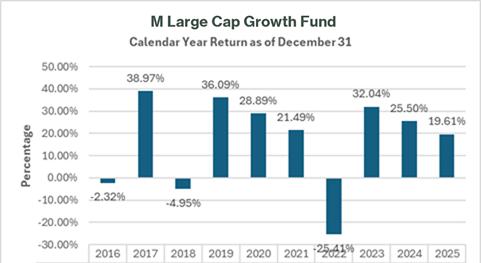
The following information may give some indication of the risks of investing in the Fund. The Fund is the successor to the Predecessor Large Cap Growth Fund, a mutual fund with identical investment objectives, policies, and restrictions, as a result of the reorganization of the Predecessor Large Cap Growth Fund into the Fund on April 24, 2026. The performance provided in the bar chart and table is that of the Predecessor Large Cap Growth Fund. The bar chart illustrates how the Predecessor Large Cap Growth Fund’s average annual returns have varied from year to year for the past ten calendar years. The table below illustrates how the Predecessor Large Cap Growth Fund’s average annual total returns compare with those of a broad measure of market performance, the S&P 500® Index and the Russell 1000® Growth Index, which is more representative of the market sector in which the Fund invests. The performance information shown here does not reflect fees that are paid by the insurance company separate accounts that invest in the Fund. Inclusion of those fees would reduce the total return figures for all periods. The Predecessor Large Cap Growth Fund’s past performance does not necessarily indicate how the Fund will perform in the future.
Calendar Year Total Returns
Highest quarterly return: 25.91% (for the quarter ended 6/30/2020)
Lowest quarterly return: (17.70)% (for the quarter ended 6/30/2022)
The table below shows the Predecessor Large Cap Growth Fund’s average annual total returns for the periods indicated and how those returns compare to those of the S&P 500® Index and the Russell 1000® Growth Index. You cannot invest directly in an index. The Index returns are calculated on a total return basis and reflects no deduction for fees, expenses or taxes.
Average Annual Total Returns
(for the periods ended December 31, 2025)
| One Year | Five Years | Ten Years | |
| Predecessor Large Cap Growth Fund | 19.61% | 12.43% | 15.06% |
| S&P 500® Index1 | 17.88% | 14.43% | 14.82% |
| Russell 1000® Growth Index2 (reflects no deduction for fees, expenses or taxes) |
18.56% | 15.32% | 18.13% |
| 1 | The Fund has adopted this broad-based index as its primary benchmark index in response to regulatory requirements and serves as the Fund’s regulatory index. |
| 2 | The Russell 1000® Growth Index is the Fund’s additional index and is more representative of the Fund’s risk and return than the regulatory index. |
| 5 |
Fund Management
M Financial Investment Advisers, Inc. is the investment adviser for the Fund and Federated is the sub-adviser for the Fund.
The Fund is managed by a team of investment professionals from Federated. The following persons are primarily responsible for the day-to-day management of the Fund’s portfolio:
| Portfolio Manager | Since | Title | |||
| Daniel J. Mahr, CFA |
May 2025 for the Predecessor Large Cap Growth Fund |
Portfolio Manager | |||
| Damien Zhang, CFA |
May 2025 for the Predecessor Large Cap Growth Fund |
Portfolio Manager | |||
| Frederick L. Konopka, CFA |
May 2025 for the Predecessor Large Cap Growth Fund |
Portfolio Manager | |||
| John Paul Lewicke |
May 2025 for the Predecessor Large Cap Growth Fund |
Portfolio Manager |
Each portfolio manager is primarily and jointly responsible for the day-to-day management of the Fund.
Other Important Information
For important information about Purchase and Redemption of Fund Shares, Tax Information and Payments to Insurance Companies and their Affiliates, please turn to page 27 of the Fund’s prospectus.
| 6 |