
97 22 45 215 163 54 197 103 52 228 191 138 205 192 183 70 97 131 0 32 96 51 63 80 Mechanics Bancorp First Quarter Earnings Presentation April 30, 2026 Seattle, WA San Francisco, CA Los Angeles, CA 1
97 22 45 215 163 54 197 103 52 228 191 138 205 192 183 70 97 131 0 32 96 51 63 80 FORWARD-LOOKING STATEMENTS AND OTHER This presentation and statements made by representatives of Mechanics Bancorp (“Mechanics” or the “Company”) during the course of this presentation include “forward- looking statements” within the meaning of the Private Securities Litigation Reform Act of 1995. These forward-looking statements involve known and unknown risks, uncertainties and other factors that may cause the Company’s actual results, performance or achievements to be materially different from any future results, performance or achievements expressed or implied by such statements. Such forward-looking statements include, but are not limited to, statements concerning such things as the Company’s outlook, business strategy, financial condition, efforts to make strategic acquisitions, integration activities and outlook, liquidity and sources of funding, market trends, operations and business, stock repurchases, dividend payments, and the Company’s other plans, objectives, strategies, expectations and intentions and other statements that are not statements of historical fact, and may be identified by words such as “anticipates,” “believes,” “building,” “continue,” “could,” “drive,” “estimates,” “expects,” “forecasts,” “goal,” “guidance,” “intends,” “may,” “might,” “outlook,” “plan,” “probable,” “projects,” “seeks,” “should,” “track,” “target,” “view” or “would” or the negative of these words and phrases or similar words or phrases. The following factors, among others, could cause actual results to differ materially from those set forth in the forward-looking statements: substantial non-recurring and integration costs, which may be greater than anticipated due to unexpected events; failure to realize the anticipated benefits of the HomeStreet merger; our ability to effectively manage our expanded operations; negative developments and events impacting the financial services industry; the soundness of other financial institutions; our ability to maintain sufficient liquidity, or an increase in the cost of liquidity; unpredictable economic, market and business conditions; interest rate risk, and fluctuations in interest rates; inflationary pressures and rising prices; adverse changes in real estate market values; the impact of climate change, including indirectly through impacts on our customers; the adequacy of our allowances for credit losses for loans and debt securities; incurring losses in our loan portfolio despite strict adherence to our underwriting practices; fluctuations in our mortgage origination business based upon seasonal and other factors; our geographic concentration, which may magnify the adverse effects and consequences of any regional or local economic downturn; the accuracy of independent appraisals to determine the value of the real estate that secures a substantial portion of our loans; the ability of our small- to medium-sized borrowers to weather adverse business developments; our ability to fully identify and mitigate exposure to the various risks that we face, including interest rate, credit, liquidity and market risk; our ability to mitigate our exposure to interest rate risk; negative publicity regarding us, or financial institutions in general; environmental liability risk associated with our lending activities; our ability to manage risks associated with new lines of business, products, product enhancements and services; our ability to adapt our services to changes in the marketplace related to mortgage servicing or origination, technology or in changes in the requirements of governmental authorities and customers; our ability to develop, implement and maintain an effective system of internal control over financial reporting; the potential that we may identify material weaknesses in our internal control over financial reporting in the future, which may result in material misstatements of our financial statements; the potential that we may write off goodwill and other intangible assets resulting from business combinations; dependence on our management team; exposure to fraudulent and negligent acts by our customers and the parties they do business with, as well as from employees, contractors and vendors; legal claims and litigation, including potential securities law liabilities; employee class action lawsuits or other legal proceedings; our ability to raise additional capital, if needed; competition from other financial institutions and financial service companies; regulatory restrictions that may delay, impede or prohibit our ability to consider certain acquisitions and opportunities; extensive supervision and regulation that could restrict our activities and impose financial requirements or limitations on the conduct of our business and limit our ability to generate income; our ability to comply with stringent capital requirements; the impact of federal and state regulators’ examination of our business; our ability to comply with the Bank Secrecy Act and other anti-money laundering statutes and regulations; our reliance on dividends from Mechanics Bank; our ability to raise debt or capital to pay off our debts upon maturity; our level of indebtedness following the completion of the HomeStreet merger; increasing and continually evolving cybersecurity and other technological risks; our ability to adapt to rapid technological change; our ability to effectively implement new technological solutions or enhancements to existing systems or platforms; our ability to manage risks and challenges relating to the development and use of artificial intelligence; our dependence on our computer and communications systems; our ability to effectively manage and aggregate data; Ford Financial Funds and their controlled affiliates control approximately 77% of the voting power of Mechanics, and have the ability to elect all of our directors and control most other matters submitted to our shareholders for approval; we are a “controlled company” within the meaning of the rules of Nasdaq, and, as a result, we qualify for, and rely on, exemptions from certain corporate governance standards; future sales of shares by existing shareholders could cause our stock price to decline; our reliance on certain entities affiliated with the Ford Financial Funds for services; reduced disclosure requirements as a smaller reporting company; and certain of our shareholders have registration rights, the exercise of which could adversely affect the trading price of our common stock. Disclaimer 2
97 22 45 215 163 54 197 103 52 228 191 138 205 192 183 70 97 131 0 32 96 51 63 80 Disclaimer (cont’d) FORWARD-LOOKING STATEMENTS AND OTHER (cont’d) For further discussion of such factors, see the risk factors described in our Annual Report on Form 10-K for the year ended December 31, 2025, Quarterly Reports on Form 10-Q and other reports that we have filed with the Securities and Exchange Commission. All forward-looking statements are qualified in their entirety by this cautionary statement. The information contained herein is preliminary and based on Company data available at the time of the earnings presentation. It speaks only as of the particular date or dates included in the accompanying slides. Except as required by law, Mechanics does not undertake an obligation to, and disclaims any duty to, update any of the information herein. Included in this presentation are certain non-GAAP financial measures, such as Core Net Income, Return on Average Equity, Return on Average Tangible Equity, Efficiency Ratio, Book Value and Tangible Book Value per Share and Common Equity Ratio and Tangible Common Equity Ratio, which are designed to complement the financial information presented in accordance with U.S. GAAP as management believes such measures are useful to investors to assess use of equity and financial performance. These non-GAAP financial measures should be considered only as supplemental to, and not superior to, financial measures provided in accordance with GAAP. Please refer to the “Non-GAAP Financial Measures and Reconciliations” section of the appendix of this presentation for additional detail including reconciliations of non-GAAP financial measures included in this presentation to the most directly comparable financial measures prepared in accordance with GAAP. Presentation of Results – HomeStreet Bank Merger On September 2, 2025, the merger of HomeStreet Bank, the wholly owned subsidiary of Mechanics Bancorp (formerly known as HomeStreet, Inc.) with and into Mechanics Bank, was completed. Mechanics Bank is the accounting acquirer (legal acquiree), HomeStreet Bank is the accounting acquiree and Mechanics Bancorp is the legal acquirer. Mechanics’ financial results for all periods ended prior to September 2, 2025 reflect Mechanics Bank’s historical financial results on a standalone basis. In addition, Mechanics’ reported financial results reflect Mechanics Bank’s financial results on a standalone basis until the closing of the merger on September 2, 2025 and results of the combined company beginning September 2, 2025. For periods prior to September 2, 2025, the number of shares issued and outstanding, earnings per share, and all references to share quantities or metrics of Mechanics have been retrospectively restated to reflect the equivalent number of shares issued in the merger since the merger was accounted for as a reverse acquisition. As the accounting acquirer, Mechanics Bank remeasured the identifiable assets acquired and liabilities assumed in the merger as of September 2, 2025 at their acquisition date fair values. Adoption of Purchased Seasoned Loans Accounting Standard The Company early adopted Accounting Standards Update (“ASU”) 2025-08, “Financial Instruments–Credit Losses (Topic 326): Purchased Loans,” during the fourth quarter of 2025. This new standard, which the Company elected to early adopt as of January 1, 2025, requires acquired loans that meet certain criteria at acquisition (purchased seasoned loans) to be recognized at their purchase price plus the amount of the allowance for expected credit losses (gross-up approach). As a result, for purchased seasoned loans acquired in the HomeStreet merger, the Company established an allowance for credit losses of $20.3 million at the date of acquisition for these loans and reversed the provision for credit losses recorded in the third quarter of 2025, and recorded it as part of the acquired loans initial amortized cost basis. Required disclosures regarding the impact of the adoption were presented when the Company filed its Annual Report on Form 10-K for the year ended December 31, 2025. In addition, third quarter 2025 results will be retrospectively adjusted when the Company files its Quarterly Report on Form 10-Q for the quarter ended September 30, 2026. The impact of the adoption is reflected in the respective comparative prior period results presented in this presentation for the third and fourth quarter of 2025. General Note The sum of the amounts in tables and charts may not equal the total amounts presented due to rounding. 3
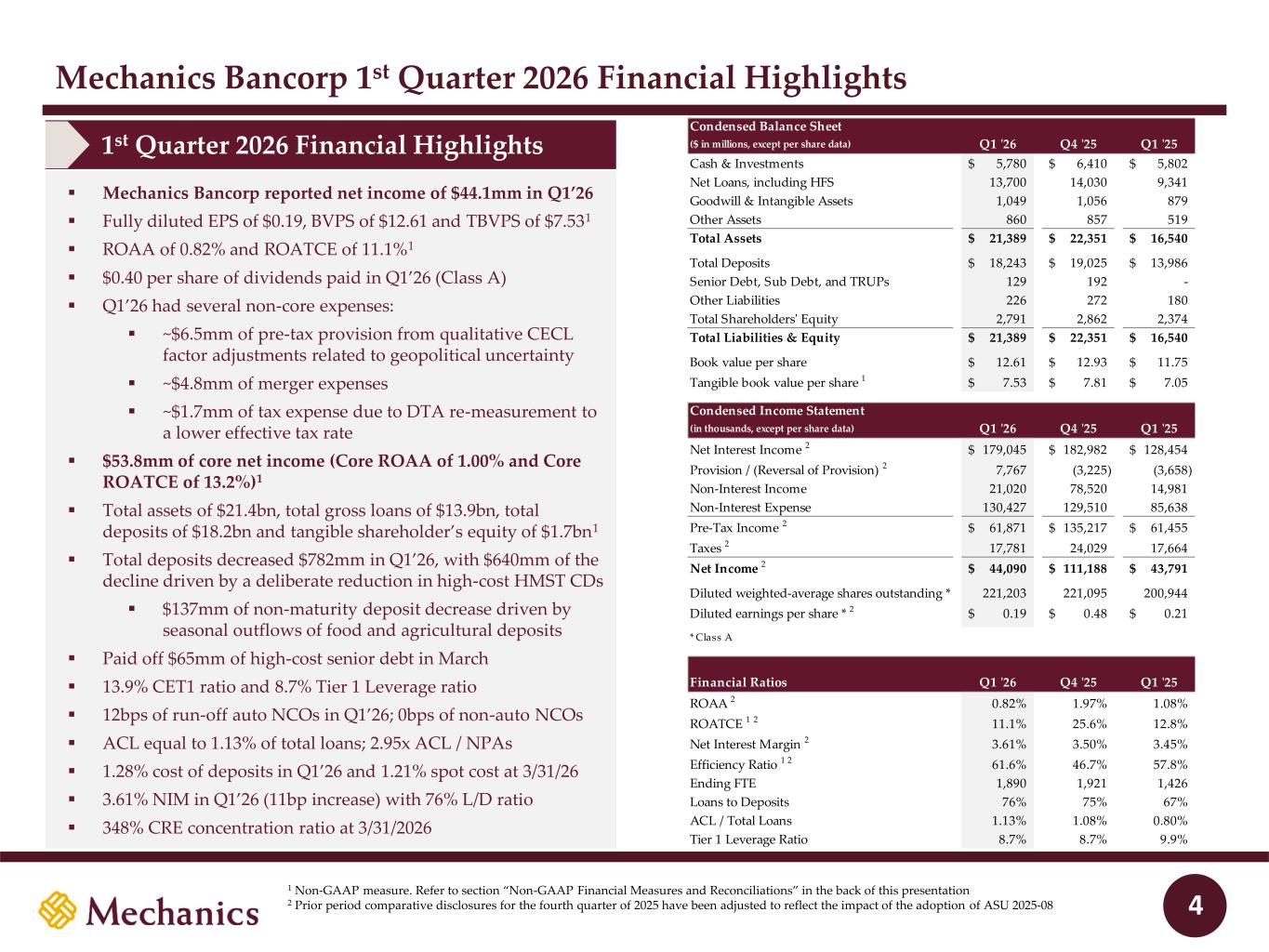
97 22 45 215 163 54 197 103 52 228 191 138 205 192 183 70 97 131 0 32 96 51 63 80 Mechanics Bancorp 1st Quarter 2026 Financial Highlights 4 1 Non-GAAP measure. Refer to section “Non-GAAP Financial Measures and Reconciliations” in the back of this presentation 2 Prior period comparative disclosures for the fourth quarter of 2025 have been adjusted to reflect the impact of the adoption of ASU 2025-08 Condensed Balance Sheet ($ in millions, except per share data) Q1 '26 Q4 '25 Q1 '25 Cash & Investments 5,780$ 6,410$ 5,802$ Net Loans, including HFS 13,700 14,030 9,341 Goodwill & Intangible Assets 1,049 1,056 879 Other Assets 860 857 519 Total Assets 21,389$ 22,351$ 16,540$ Total Deposits 18,243$ 19,025$ 13,986$ Senior Debt, Sub Debt, and TRUPs 129 192 - Other Liabilities 226 272 180 Total Shareholders' Equity 2,791 2,862 2,374 Total Liabilities & Equity 21,389$ 22,351$ 16,540$ Book value per share 12.61$ 12.93$ 11.75$ Tangible book value per share 1 7.53$ 7.81$ 7.05$ Condensed Income Statement (in thousands, except per share data) Q1 '26 Q4 '25 Q1 '25 Net Interest Income 2 179,045$ 182,982$ 128,454$ Provision / (Reversal of Provision) 2 7,767 (3,225) (3,658) Non-Interest Income 21,020 78,520 14,981 Non-Interest Expense 130,427 129,510 85,638 Pre-Tax Income 2 61,871$ 135,217$ 61,455$ Taxes 2 17,781 24,029 17,664 Net Income 2 44,090$ 111,188$ 43,791$ Diluted weighted-average shares outstanding * 221,203 221,095 200,944 Diluted earnings per share * 2 0.19$ 0.48$ 0.21$ * Class A Financial Ratios Q1 '26 Q4 '25 Q1 '25 ROAA 2 0.82% 1.97% 1.08% ROATCE 1 2 11.1% 25.6% 12.8% Net Interest Margin 2 3.61% 3.50% 3.45% Efficiency Ratio 1 2 61.6% 46.7% 57.8% Ending FTE 1,890 1,921 1,426 Loans to Deposits 76% 75% 67% ACL / Total Loans 1.13% 1.08% 0.80% Tier 1 Leverage Ratio 8.7% 8.7% 9.9% 1st Quarter 2026 Financial Highlights ▪ Mechanics Bancorp reported net income of $44.1mm in Q1’26 ▪ Fully diluted EPS of $0.19, BVPS of $12.61 and TBVPS of $7.531 ▪ ROAA of 0.82% and ROATCE of 11.1%1 ▪ $0.40 per share of dividends paid in Q1’26 (Class A) ▪ Q1’26 had several non-core expenses: ▪ ~$6.5mm of pre-tax provision from qualitative CECL factor adjustments related to geopolitical uncertainty ▪ ~$4.8mm of merger expenses ▪ ~$1.7mm of tax expense due to DTA re-measurement to a lower effective tax rate ▪ $53.8mm of core net income (Core ROAA of 1.00% and Core ROATCE of 13.2%)1 ▪ Total assets of $21.4bn, total gross loans of $13.9bn, total deposits of $18.2bn and tangible shareholder’s equity of $1.7bn1 ▪ Total deposits decreased $782mm in Q1’26, with $640mm of the decline driven by a deliberate reduction in high-cost HMST CDs ▪ $137mm of non-maturity deposit decrease driven by seasonal outflows of food and agricultural deposits ▪ Paid off $65mm of high-cost senior debt in March ▪ 13.9% CET1 ratio and 8.7% Tier 1 Leverage ratio ▪ 12bps of run-off auto NCOs in Q1’26; 0bps of non-auto NCOs ▪ ACL equal to 1.13% of total loans; 2.95x ACL / NPAs ▪ 1.28% cost of deposits in Q1’26 and 1.21% spot cost at 3/31/26 ▪ 3.61% NIM in Q1’26 (11bp increase) with 76% L/D ratio ▪ 348% CRE concentration ratio at 3/31/2026
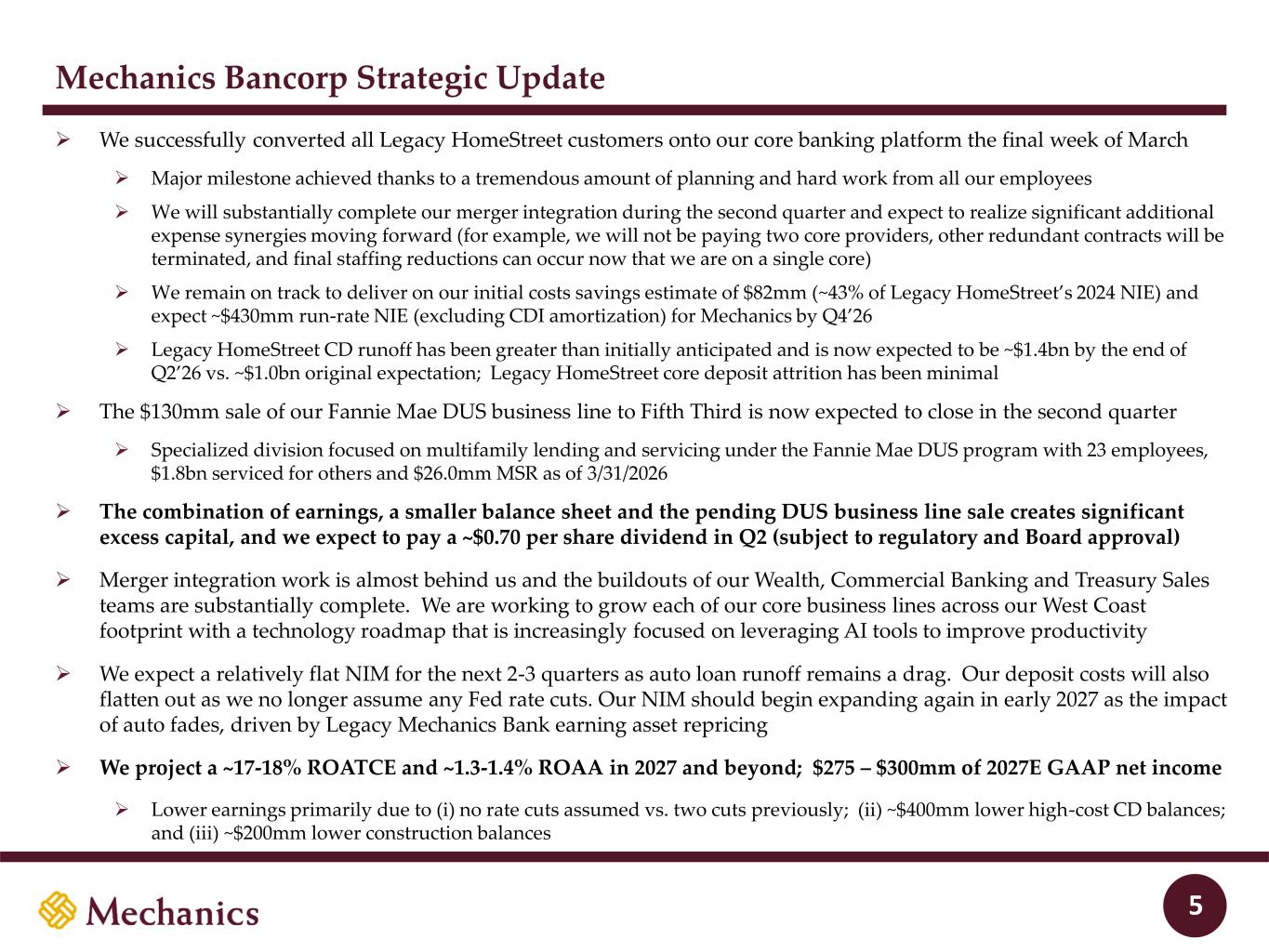
97 22 45 215 163 54 197 103 52 228 191 138 205 192 183 70 97 131 0 32 96 51 63 80 Mechanics Bancorp Strategic Update 5 ➢ We successfully converted all Legacy HomeStreet customers onto our core banking platform the final week of March ➢ Major milestone achieved thanks to a tremendous amount of planning and hard work from all our employees ➢ We will substantially complete our merger integration during the second quarter and expect to realize significant additional expense synergies moving forward (for example, we will not be paying two core providers, other redundant contracts will be terminated, and final staffing reductions can occur now that we are on a single core) ➢ We remain on track to deliver on our initial costs savings estimate of $82mm (~43% of Legacy HomeStreet’s 2024 NIE) and expect ~$430mm run-rate NIE (excluding CDI amortization) for Mechanics by Q4’26 ➢ Legacy HomeStreet CD runoff has been greater than initially anticipated and is now expected to be ~$1.4bn by the end of Q2’26 vs. ~$1.0bn original expectation; Legacy HomeStreet core deposit attrition has been minimal ➢ The $130mm sale of our Fannie Mae DUS business line to Fifth Third is now expected to close in the second quarter ➢ Specialized division focused on multifamily lending and servicing under the Fannie Mae DUS program with 23 employees, $1.8bn serviced for others and $26.0mm MSR as of 3/31/2026 ➢ The combination of earnings, a smaller balance sheet and the pending DUS business line sale creates significant excess capital, and we expect to pay a ~$0.70 per share dividend in Q2 (subject to regulatory and Board approval) ➢ Merger integration work is almost behind us and the buildouts of our Wealth, Commercial Banking and Treasury Sales teams are substantially complete. We are working to grow each of our core business lines across our West Coast footprint with a technology roadmap that is increasingly focused on leveraging AI tools to improve productivity ➢ We expect a relatively flat NIM for the next 2-3 quarters as auto loan runoff remains a drag. Our deposit costs will also flatten out as we no longer assume any Fed rate cuts. Our NIM should begin expanding again in early 2027 as the impact of auto fades, driven by Legacy Mechanics Bank earning asset repricing ➢ We project a ~17-18% ROATCE and ~1.3-1.4% ROAA in 2027 and beyond; $275 – $300mm of 2027E GAAP net income ➢ Lower earnings primarily due to (i) no rate cuts assumed vs. two cuts previously; (ii) ~$400mm lower high-cost CD balances; and (iii) ~$200mm lower construction balances
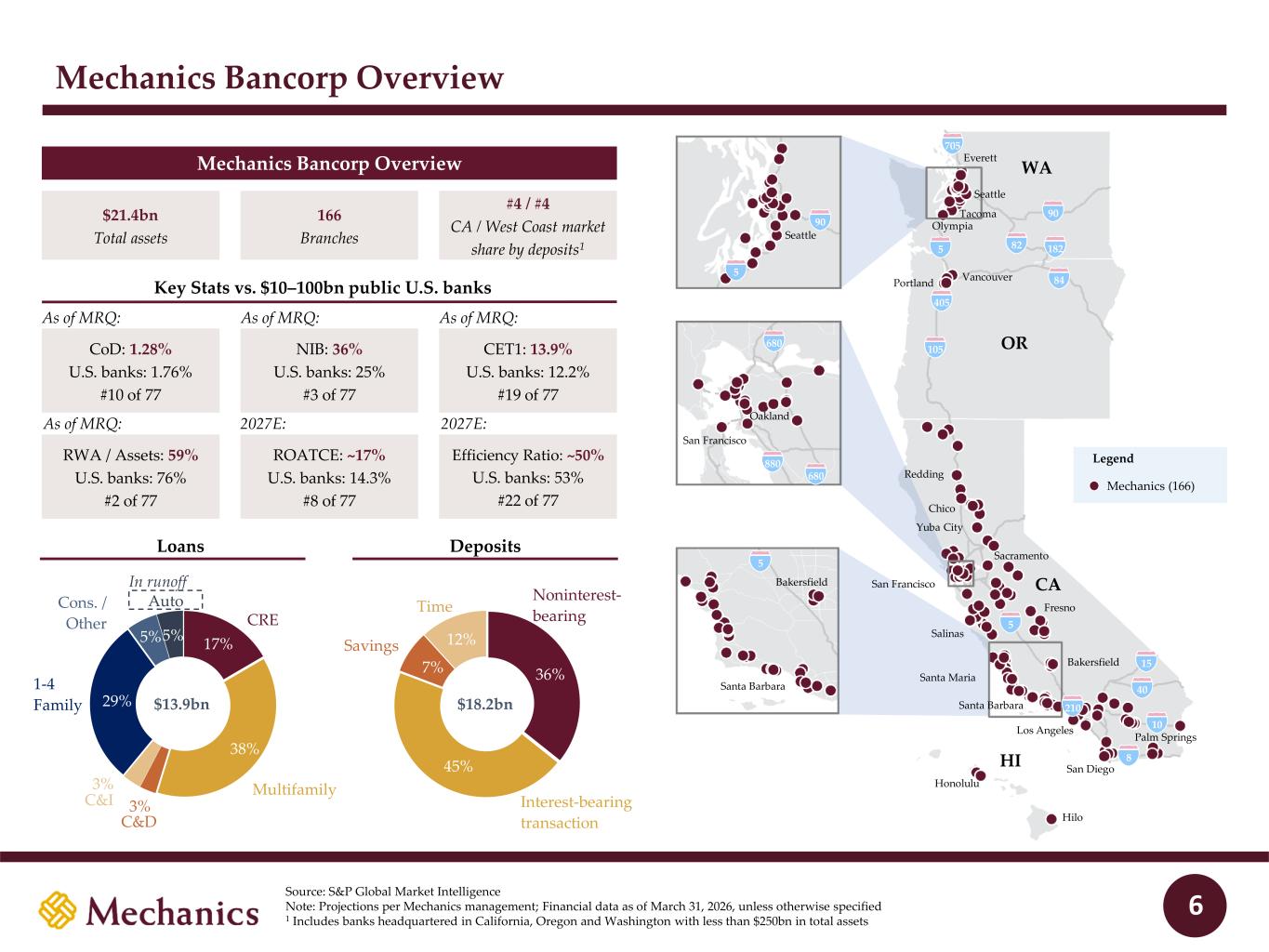
97 22 45 215 163 54 197 103 52 228 191 138 205 192 183 70 97 131 0 32 96 51 63 80 Key Stats vs. $10–100bn public U.S. banks Mechanics Bancorp Overview Source: S&P Global Market Intelligence Note: Projections per Mechanics management; Financial data as of March 31, 2026, unless otherwise specified 1 Includes banks headquartered in California, Oregon and Washington with less than $250bn in total assets CoD: 1.28% U.S. banks: 1.76% #10 of 77 NIB: 36% U.S. banks: 25% #3 of 77 RWA / Assets: 59% U.S. banks: 76% #2 of 77 ROATCE: ~17% U.S. banks: 14.3% #8 of 77 As of MRQ: CET1: 13.9% U.S. banks: 12.2% #19 of 77 Efficiency Ratio: ~50% U.S. banks: 53% #22 of 77 $21.4bn Total assets 166 Branches #4 / #4 CA / West Coast market share by deposits1 Mechanics Bancorp Overview 17% 38% 29% 5% 5% $13.9bn CRE C&I 1-4 Family Cons. / Other Auto 36% 45% 7% 12% $18.2bn Noninterest- bearing Interest-bearing transaction Savings Time Loans Multifamily C&D Deposits 3% 3% 6 In runoff As of MRQ: As of MRQ: As of MRQ: 2027E: 2027E: San Francisco Oakland 880 680 680 90 5 5 Santa Barbara Bakersfield CA OR WA 8 10 40 15 5 5 90 82 182 84 105 405 210 Palm Springs San Diego Los Angeles Santa Maria Santa Barbara Bakersfield Fresno Salinas San Francisco Sacramento Yuba City Chico Redding Seattle Seattle Everett Tacoma Olympia Vancouver Portland 705 Hilo Legend Mechanics (166) HI Honolulu
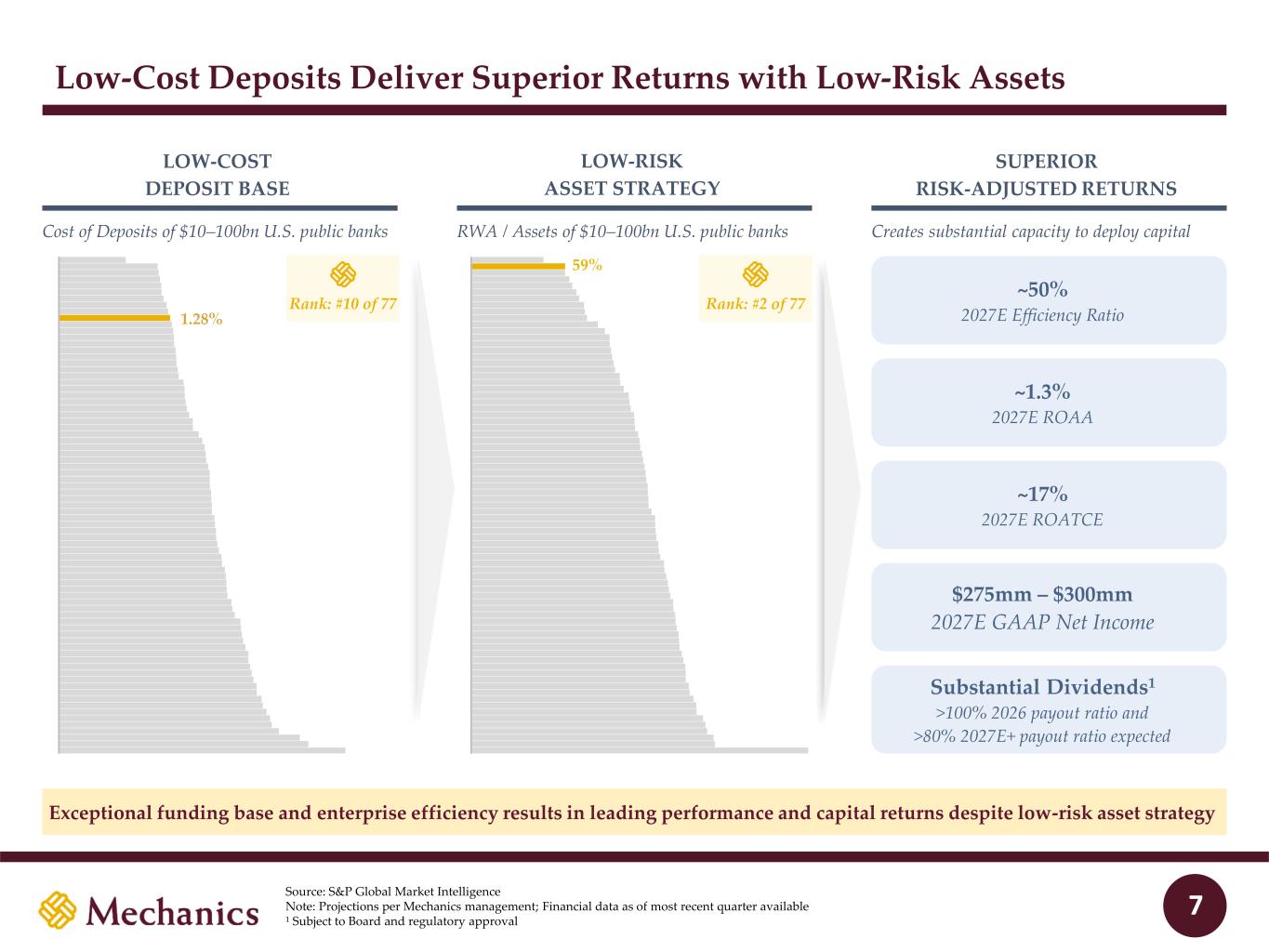
97 22 45 215 163 54 197 103 52 228 191 138 205 192 183 70 97 131 0 32 96 51 63 80 Low-Cost Deposits Deliver Superior Returns with Low-Risk Assets 7 Source: S&P Global Market Intelligence Note: Projections per Mechanics management; Financial data as of most recent quarter available ¹ Subject to Board and regulatory approval Exceptional funding base and enterprise efficiency results in leading performance and capital returns despite low-risk asset strategy ~50% 2027E Efficiency Ratio ~1.3% 2027E ROAA ~17% 2027E ROATCE $275mm – $300mm 2027E GAAP Net Income Substantial Dividends1 >100% 2026 payout ratio and >80% 2027E+ payout ratio expected Creates substantial capacity to deploy capital SUPERIOR RISK-ADJUSTED RETURNS 59% RWA / Assets of $10–100bn U.S. public banksCost of Deposits of $10–100bn U.S. public banks Rank: #2 of 77 LOW-RISK ASSET STRATEGY LOW-COST DEPOSIT BASE 1.28% Rank: #10 of 77
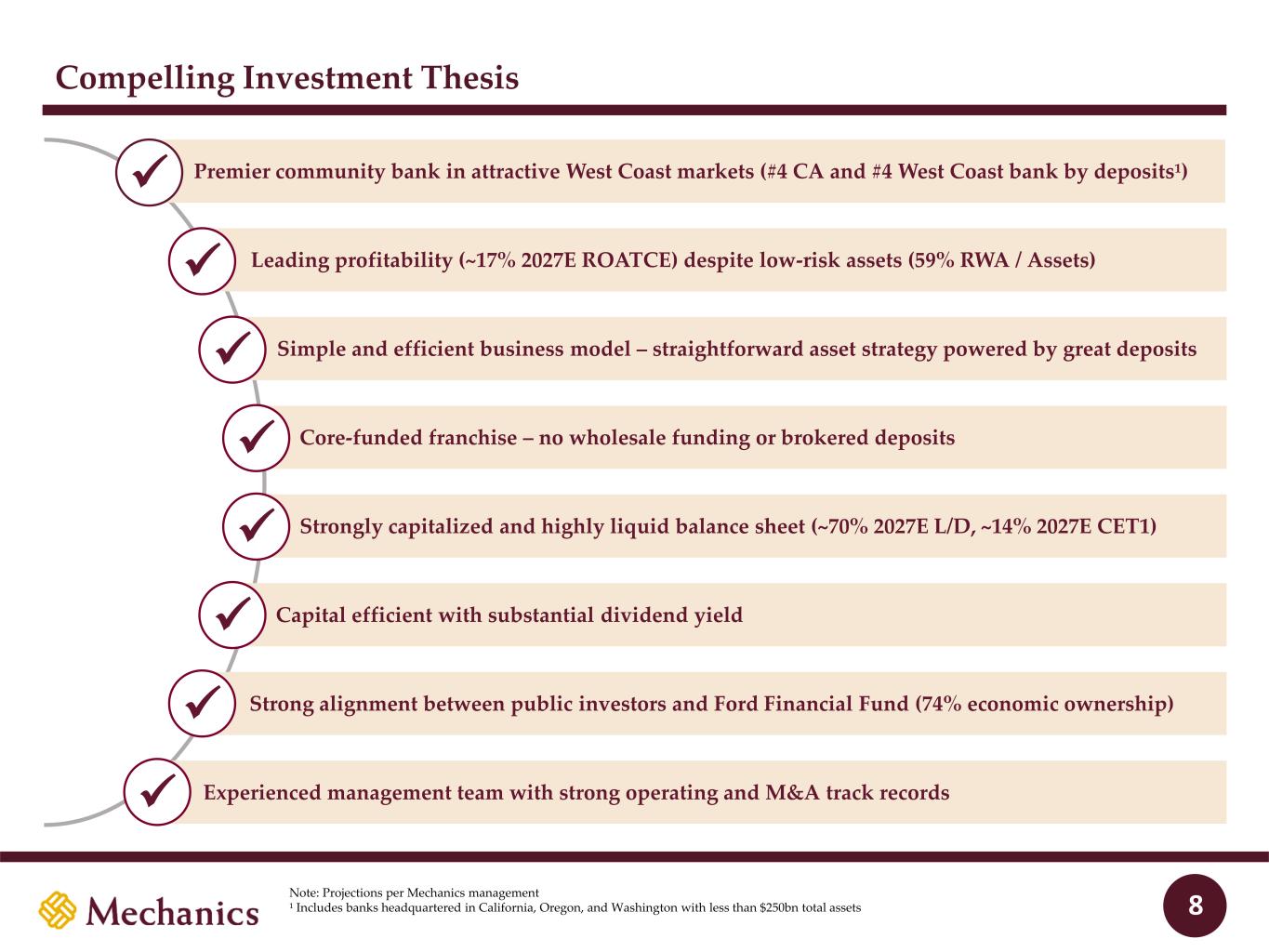
97 22 45 215 163 54 197 103 52 228 191 138 205 192 183 70 97 131 0 32 96 51 63 80 Premier community bank in attractive West Coast markets (#4 CA and #4 West Coast bank by deposits¹) Leading profitability (~17% 2027E ROATCE) despite low-risk assets (59% RWA / Assets) Simple and efficient business model – straightforward asset strategy powered by great deposits Core-funded franchise – no wholesale funding or brokered deposits Strongly capitalized and highly liquid balance sheet (~70% 2027E L/D, ~14% 2027E CET1) Capital efficient with substantial dividend yield Strong alignment between public investors and Ford Financial Fund (74% economic ownership) Experienced management team with strong operating and M&A track records Compelling Investment Thesis ✓ ✓ ✓ ✓ ✓ ✓ ✓ ✓ Note: Projections per Mechanics management ¹ Includes banks headquartered in California, Oregon, and Washington with less than $250bn total assets 8

First Quarter 2026 Financial Drivers 26 9
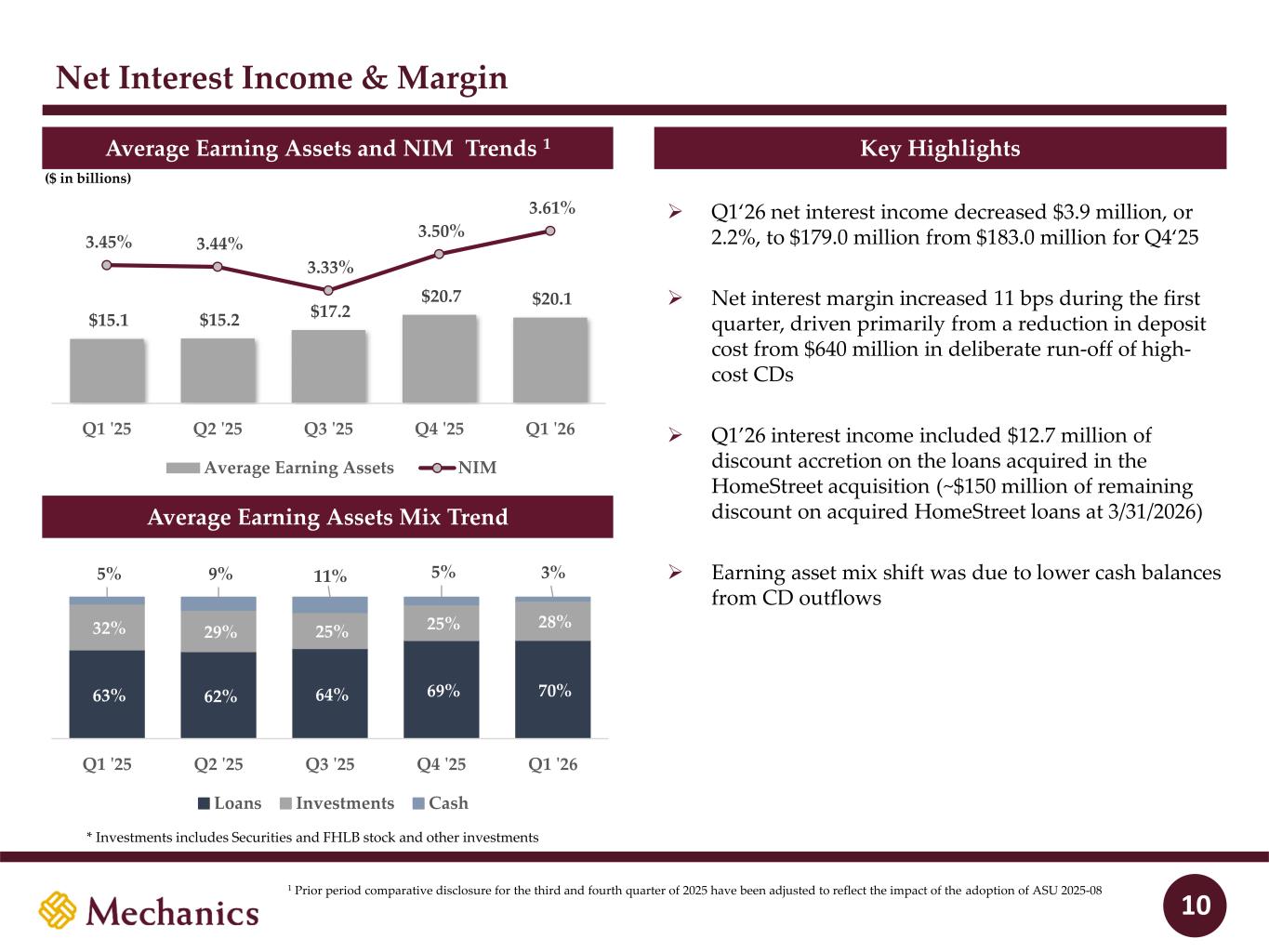
Net Interest Income & Margin Average Earning Assets and NIM Trends 1 Key Highlights 10 Average Earning Assets Mix Trend ($ in billions) ➢ Q1‘26 net interest income decreased $3.9 million, or 2.2%, to $179.0 million from $183.0 million for Q4‘25 ➢ Net interest margin increased 11 bps during the first quarter, driven primarily from a reduction in deposit cost from $640 million in deliberate run-off of high- cost CDs ➢ Q1’26 interest income included $12.7 million of discount accretion on the loans acquired in the HomeStreet acquisition (~$150 million of remaining discount on acquired HomeStreet loans at 3/31/2026) ➢ Earning asset mix shift was due to lower cash balances from CD outflows 63% 62% 64% 69% 70% 32% 29% 25% 25% 28% 5% 9% 11% 5% 3% Q1 '25 Q2 '25 Q3 '25 Q4 '25 Q1 '26 Loans Investments Cash * Investments includes Securities and FHLB stock and other investments 1 Prior period comparative disclosure for the third and fourth quarter of 2025 have been adjusted to reflect the impact of the adoption of ASU 2025-08 $15.1 $15.2 $17.2 $20.7 $20.1 3.45% 3.44% 3.33% 3.50% 3.61% Q1 '25 Q2 '25 Q3 '25 Q4 '25 Q1 '26 Average Earning Assets NIM
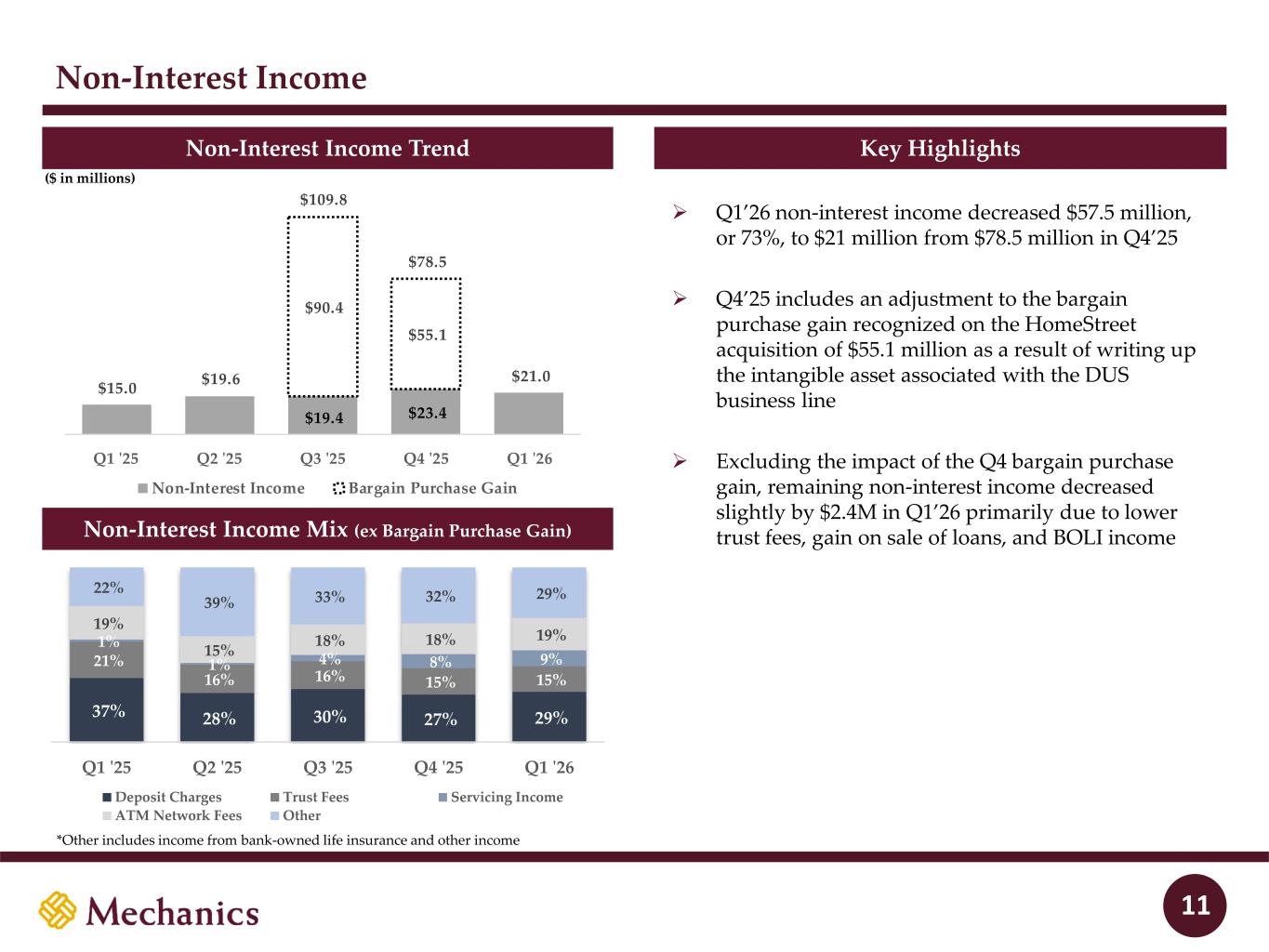
Non-Interest Income Non-Interest Income Trend Non-Interest Income Mix (ex Bargain Purchase Gain) Key Highlights 11 ($ in millions) ➢ Q1’26 non-interest income decreased $57.5 million, or 73%, to $21 million from $78.5 million in Q4’25 ➢ Q4’25 includes an adjustment to the bargain purchase gain recognized on the HomeStreet acquisition of $55.1 million as a result of writing up the intangible asset associated with the DUS business line ➢ Excluding the impact of the Q4 bargain purchase gain, remaining non-interest income decreased slightly by $2.4M in Q1’26 primarily due to lower trust fees, gain on sale of loans, and BOLI income *Other includes income from bank-owned life insurance and other income 37% 28% 30% 27% 29% 21% 16% 16% 15% 15% 1% 1% 4% 8% 9% 19% 15% 18% 18% 19% 22% 39% 33% 32% 29% Q1 '25 Q2 '25 Q3 '25 Q4 '25 Q1 '26 Deposit Charges Trust Fees Servicing Income ATM Network Fees Other $19.4 $23.4 $90.4 $55.1 $15.0 $19.6 $109.8 $78.5 $21.0 Q1 '25 Q2 '25 Q3 '25 Q4 '25 Q1 '26 Non-Interest Income Bargain Purchase Gain
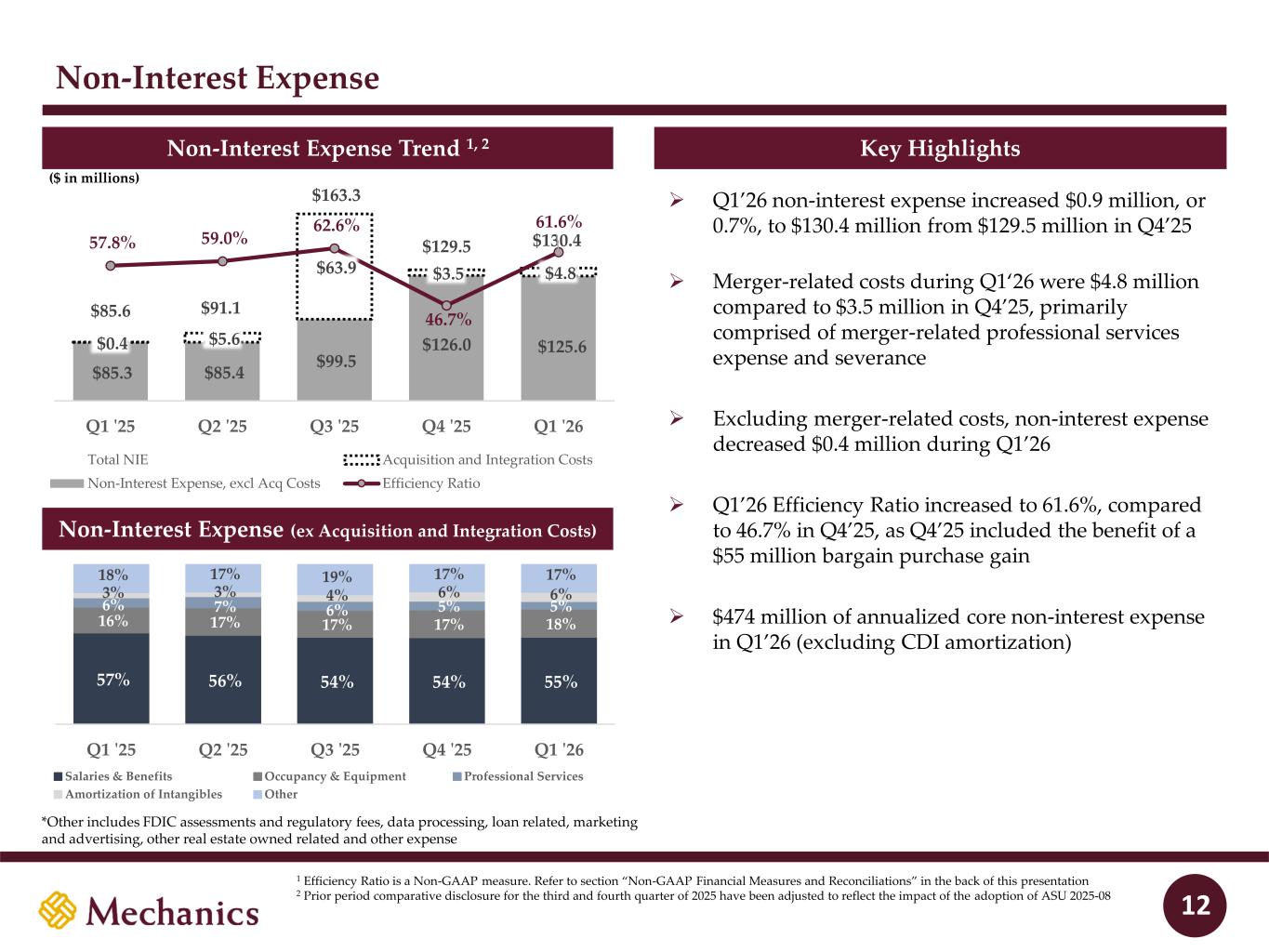
Non-Interest Expense Non-Interest Expense Trend 1, 2 Non-Interest Expense (ex Acquisition and Integration Costs) Key Highlights 12 ($ in millions) ➢ Q1’26 non-interest expense increased $0.9 million, or 0.7%, to $130.4 million from $129.5 million in Q4’25 ➢ Merger-related costs during Q1‘26 were $4.8 million compared to $3.5 million in Q4’25, primarily comprised of merger-related professional services expense and severance ➢ Excluding merger-related costs, non-interest expense decreased $0.4 million during Q1’26 ➢ Q1’26 Efficiency Ratio increased to 61.6%, compared to 46.7% in Q4’25, as Q4’25 included the benefit of a $55 million bargain purchase gain ➢ $474 million of annualized core non-interest expense in Q1’26 (excluding CDI amortization) 57% 56% 54% 54% 55% 16% 17% 17% 17% 18% 6% 7% 6% 5% 5% 3% 3% 4% 6% 6% 18% 17% 19% 17% 17% Q1 '25 Q2 '25 Q3 '25 Q4 '25 Q1 '26 Salaries & Benefits Occupancy & Equipment Professional Services Amortization of Intangibles Other *Other includes FDIC assessments and regulatory fees, data processing, loan related, marketing and advertising, other real estate owned related and other expense $85.3 $85.4 $99.5 $126.0 $125.6 $0.4 $5.6 $63.9 $3.5 $4.8 $85.6 $91.1 $163.3 $129.5 $130.4 57.8% 59.0% 62.6% 46.7% 61.6% Q1 '25 Q2 '25 Q3 '25 Q4 '25 Q1 '26 Total NIE Acquisition and Integration Costs Non-Interest Expense, excl Acq Costs Efficiency Ratio 1 Efficiency Ratio is a Non-GAAP measure. Refer to section “Non-GAAP Financial Measures and Reconciliations” in the back of this presentation 2 Prior period comparative disclosure for the third and fourth quarter of 2025 have been adjusted to reflect the impact of the adoption of ASU 2025-08
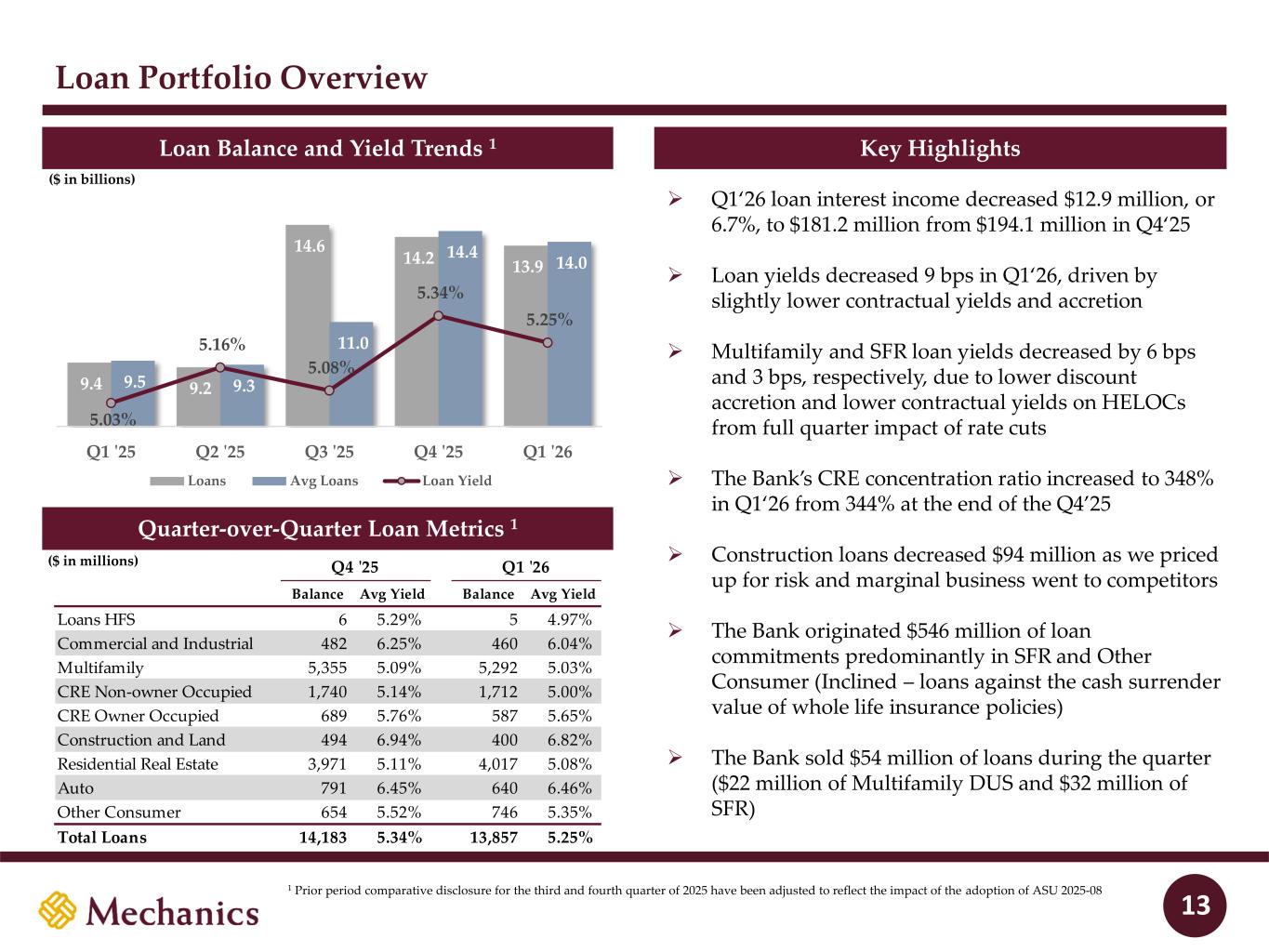
Loan Portfolio Overview Loan Balance and Yield Trends 1 Quarter-over-Quarter Loan Metrics Key Highlights Quarter-over-Quarter Loan etrics 1 13 ($ in billions) ($ in millions) ➢ Q1‘26 loan interest income decreased $12.9 million, or 6.7%, to $181.2 million from $194.1 million in Q4‘25 ➢ Loan yields decreased 9 bps in Q1‘26, driven by slightly lower contractual yields and accretion ➢ Multifamily and SFR loan yields decreased by 6 bps and 3 bps, respectively, due to lower discount accretion and lower contractual yields on HELOCs from full quarter impact of rate cuts ➢ The Bank’s CRE concentration ratio increased to 348% in Q1‘26 from 344% at the end of the Q4’25 ➢ Construction loans decreased $94 million as we priced up for risk and marginal business went to competitors ➢ The Bank originated $546 million of loan commitments predominantly in SFR and Other Consumer (Inclined – loans against the cash surrender value of whole life insurance policies) ➢ The Bank sold $54 million of loans during the quarter ($22 million of Multifamily DUS and $32 million of SFR) Q4 '25 Q1 '26 Balance Avg Yield Balance Avg Yield Loans HFS 6 5.29% 5 4.97% Commercial and Industrial 482 6.25% 460 6.04% Multifamily 5,355 5.09% 5,292 5.03% CRE Non-owner Occupied 1,740 5.14% 1,712 5.00% CRE Owner Occupied 689 5.76% 587 5.65% Construction and Land 494 6.94% 400 6.82% Residential Real Estate 3,971 5.11% 4,017 5.08% Auto 791 6.45% 640 6.46% Other Consumer 654 5.52% 746 5.35% Total Loans 14,183 5.34% 13,857 5.25% 9.4 9.2 14.6 14.2 13.9 9.5 9.3 11.0 14.4 14.0 5.03% 5.16% 5.08% 5.34% 5.25% Q1 '25 Q2 '25 Q3 '25 Q4 '25 Q1 '26 Loans Avg Loans Loan Yield 1 Prior period comparative disclosure for the third and fourth quarter of 2025 have been adjusted to reflect the impact of the adoption of ASU 2025-08
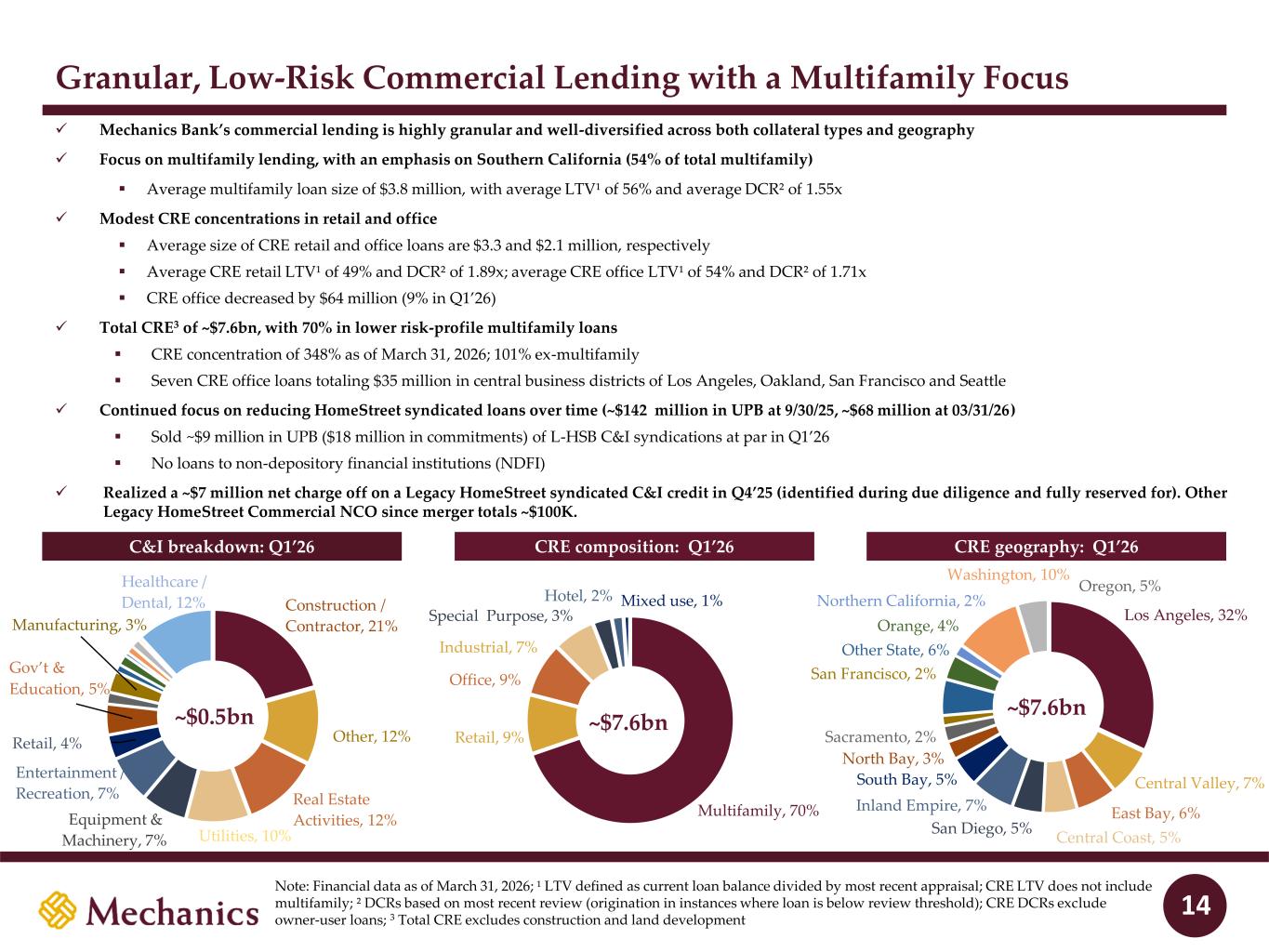
97 22 45 215 163 54 197 103 52 228 191 138 205 192 183 70 97 131 0 32 96 51 63 80 Granular, Low-Risk Commercial Lending with a Multifamily Focus ✓ Mechanics Bank’s commercial lending is highly granular and well-diversified across both collateral types and geography ✓ Focus on multifamily lending, with an emphasis on Southern California (54% of total multifamily) ▪ Average multifamily loan size of $3.8 million, with average LTV¹ of 56% and average DCR² of 1.55x ✓ Modest CRE concentrations in retail and office ▪ Average size of CRE retail and office loans are $3.3 and $2.1 million, respectively ▪ Average CRE retail LTV¹ of 49% and DCR² of 1.89x; average CRE office LTV¹ of 54% and DCR² of 1.71x ▪ CRE office decreased by $64 million (9% in Q1’26) ✓ Total CRE3 of ~$7.6bn, with 70% in lower risk-profile multifamily loans ▪ CRE concentration of 348% as of March 31, 2026; 101% ex-multifamily ▪ Seven CRE office loans totaling $35 million in central business districts of Los Angeles, Oakland, San Francisco and Seattle ✓ Continued focus on reducing HomeStreet syndicated loans over time (~$142 million in UPB at 9/30/25, ~$68 million at 03/31/26) ▪ Sold ~$9 million in UPB ($18 million in commitments) of L-HSB C&I syndications at par in Q1’26 ▪ No loans to non-depository financial institutions (NDFI) ✓ Realized a ~$7 million net charge off on a Legacy HomeStreet syndicated C&I credit in Q4’25 (identified during due diligence and fully reserved for). Other Legacy HomeStreet Commercial NCO since merger totals ~$100K. CRE composition: Q1’26C&I breakdown: Q1’26 CRE geography: Q1’26 14 Multifamily, 70% Retail, 9% Office, 9% Industrial, 7% Special Purpose, 3% Hotel, 2% Mixed use, 1% ~$7.6bn Note: Financial data as of March 31, 2026; ¹ LTV defined as current loan balance divided by most recent appraisal; CRE LTV does not include multifamily; ² DCRs based on most recent review (origination in instances where loan is below review threshold); CRE DCRs exclude owner-user loans; 3 Total CRE excludes construction and land development Los Angeles, 32% Central Valley, 7% East Bay, 6% Central Coast, 5% San Diego, 5% Inland Empire, 7% South Bay, 5% North Bay, 3% Sacramento, 2% San Francisco, 2% Other State, 6% Orange, 4% Northern California, 2% ~$7.6bn Washington, 10% Retail, 4% Gov’t & Education, 5% Manufacturing, 3% Utilities, 10% Real Estate Activities, 12% Entertainment / Recreation, 7% Equipment & Machinery, 7% Construction / Contractor, 21% Healthcare / Dental, 12% Other, 12% ~$0.5bn Oregon, 5%
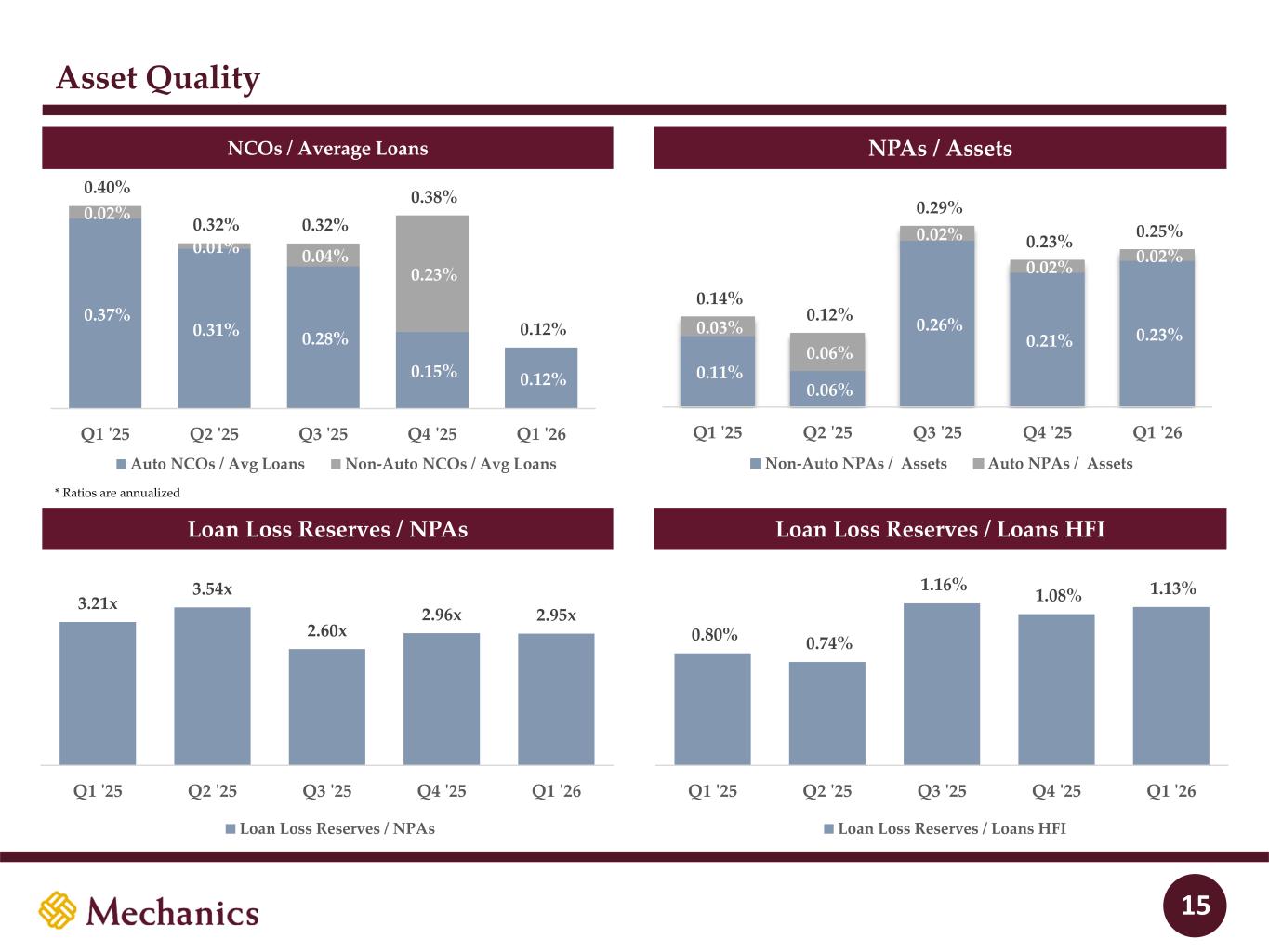
Asset Quality NCOs / Average Loans Loan Loss Reserves / NPAs NPAs / Assets Loan Loss Reserves / Loans HFI 15 * Ratios are annualized 3.21x 3.54x 2.60x 2.96x 2.95x Q1 '25 Q2 '25 Q3 '25 Q4 '25 Q1 '26 Loan Loss Reserves / NPAs 0.80% 0.74% 1.16% 1.08% 1.13% Q1 '25 Q2 '25 Q3 '25 Q4 '25 Q1 '26 Loan Loss Reserves / Loans HFI 0.37% 0.31% 0.28% 0.15% 0.12% 0.02% 0.01% 0.04% 0.23% 0.40% 0.32% 0.32% 0.38% 0.12% Q1 '25 Q2 '25 Q3 '25 Q4 '25 Q1 '26 Auto NCOs / Avg Loans Non-Auto NCOs / Avg Loans 0.11% 0.06% 0.26% 0.21% 0.23% 0.03% 0.06% 0.02% 0.02% 0.02% 0.14% 0.12% 0.29% 0.23% 0.25% Q1 '25 Q2 '25 Q3 '25 Q4 '25 Q1 '26 Non-Auto NPAs / Assets Auto NPAs / Assets
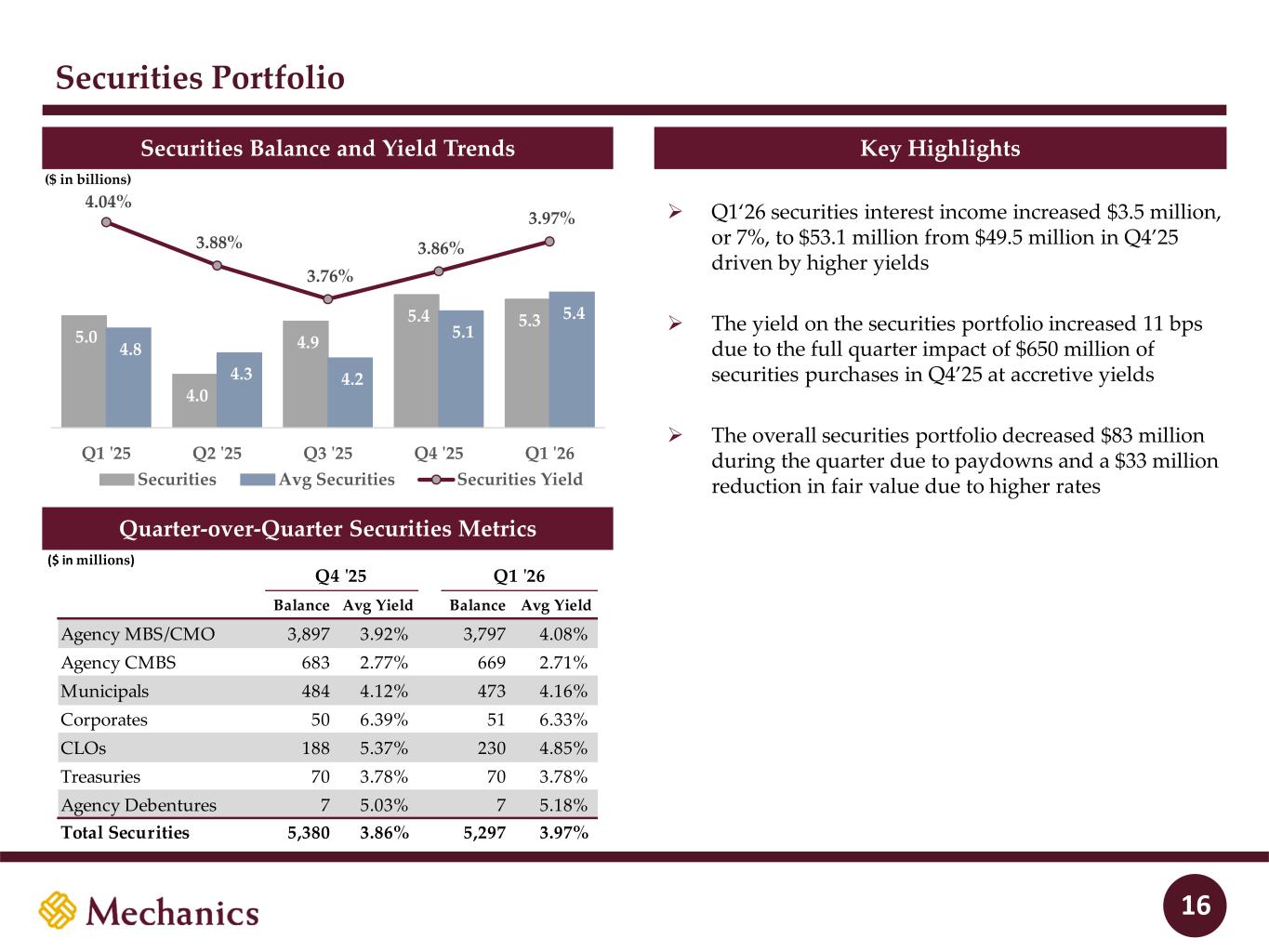
Securities Portfolio Securities Balance and Yield Trends Quarter-over-Quarter Loan Metrics Key Highlights Quarte -over-Quarte Securities Metrics 16 5.0 4.0 4.9 5.4 5.3 4.8 4.3 4.2 5.1 5.4 4.04% 3.88% 3.76% 3.86% 3.97% Q1 '25 Q2 '25 Q3 '25 Q4 '25 Q1 '26 Securities Avg Securities Securities Yield ($ in billions) ($ in millions) Q4 '25 Q1 '26 Balance Avg Yield Balance Avg Yield Agency MBS/CMO 3,897 3.92% 3,797 4.08% Agency CMBS 683 2.77% 669 2.71% Municipals 484 4.12% 473 4.16% Corporates 50 6.39% 51 6.33% CLOs 188 5.37% 230 4.85% Treasuries 70 3.78% 70 3.78% Agency Debentures 7 5.03% 7 5.18% Total Securities 5,380 3.86% 5,297 3.97% ➢ Q1‘26 securities interest income increased $3.5 million, or 7%, to $53.1 million from $49.5 million in Q4’25 driven by higher yields ➢ The yield on the securities portfolio increased 11 bps due to the full quarter impact of $650 million of securities purchases in Q4’25 at accretive yields ➢ The overall securities portfolio decreased $83 million during the quarter due to paydowns and a $33 million reduction in fair value due to higher rates
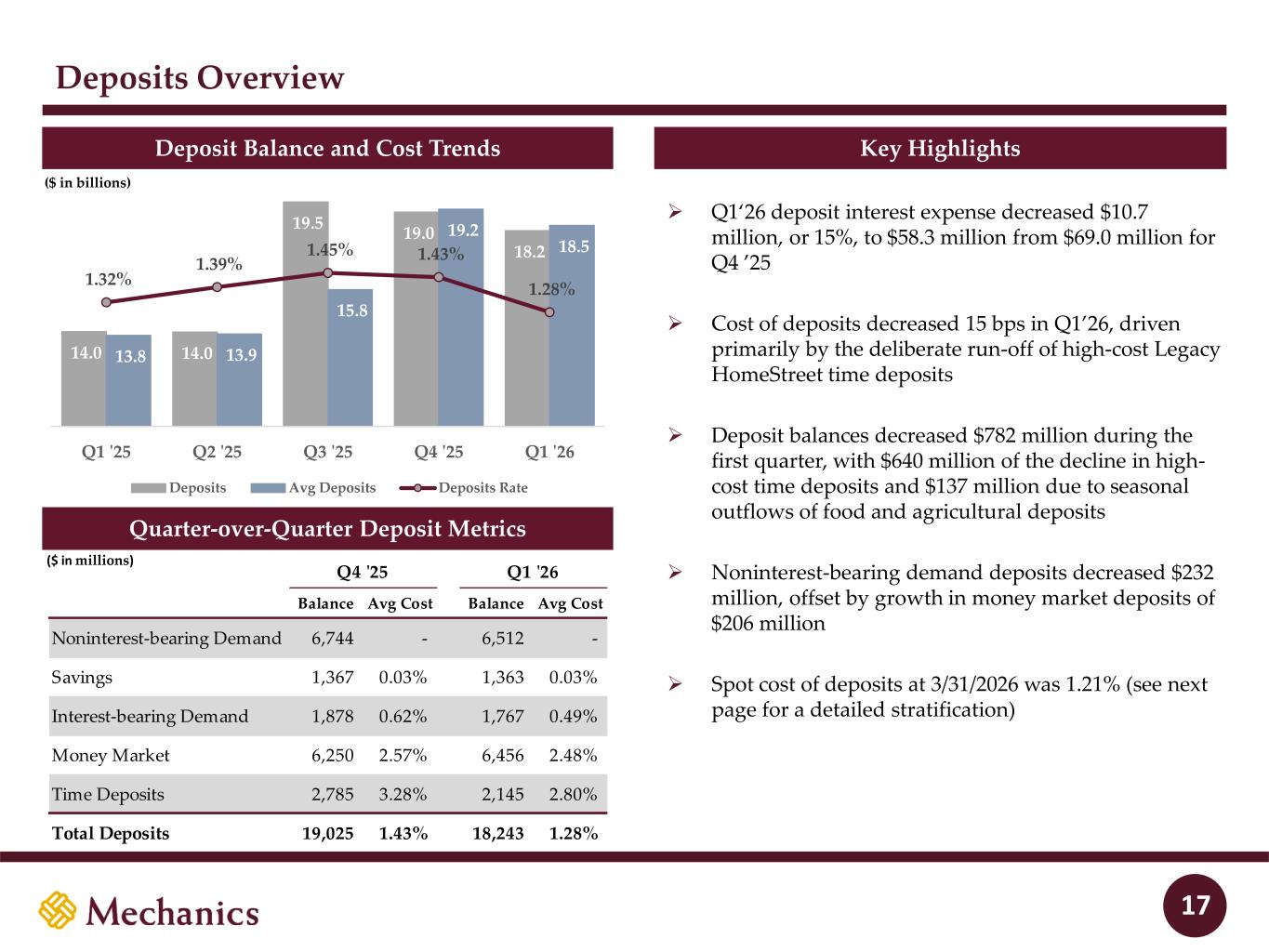
Deposits Overview Deposit Balance and Cost Trends Quarter-over-Quarter Loan Metrics Key Highlights Quarter-over-Quarter Deposit Metrics 17 14.0 14.0 19.5 19.0 18.2 13.8 13.9 15.8 19.2 18.5 1.32% 1.39% 1.45% 1.43% 1.28% Q1 '25 Q2 '25 Q3 '25 Q4 '25 Q1 '26 Deposits Avg Deposits Deposits Rate ($ in billions) ($ in millions) ➢ Q1‘26 deposit interest expense decreased $10.7 million, or 15%, to $58.3 million from $69.0 million for Q4 ’25 ➢ Cost of deposits decreased 15 bps in Q1’26, driven primarily by the deliberate run-off of high-cost Legacy HomeStreet time deposits ➢ Deposit balances decreased $782 million during the first quarter, with $640 million of the decline in high- cost time deposits and $137 million due to seasonal outflows of food and agricultural deposits ➢ Noninterest-bearing demand deposits decreased $232 million, offset by growth in money market deposits of $206 million ➢ Spot cost of deposits at 3/31/2026 was 1.21% (see next page for a detailed stratification) Q4 '25 Q1 '26 Balance Avg Cost Balance Avg Cost Noninterest-bearing Demand 6,744 - 6,512 - Savings 1,367 0.03% 1,363 0.03% Interest-bearing Demand 1,878 0.62% 1,767 0.49% Money Market 6,250 2.57% 6,456 2.48% Time Deposits 2,785 3.28% 2,145 2.80% Total Deposits 19,025 1.43% 18,243 1.28%
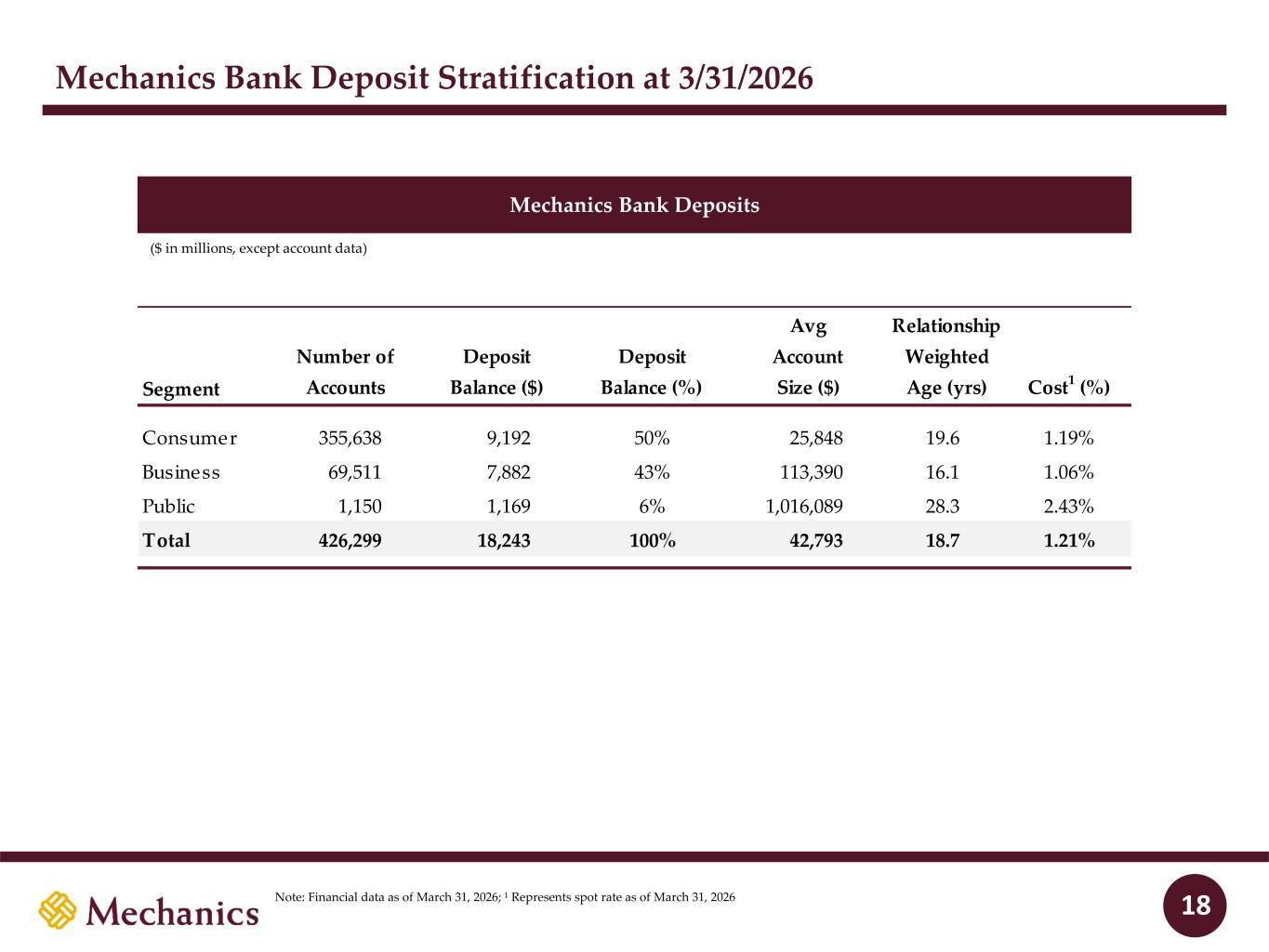
97 22 45 215 163 54 197 103 52 228 191 138 205 192 183 70 97 131 0 32 96 51 63 80 Mechanics Bank Deposit Stratification at 3/31/2026 18Note: Financial data as of March 31, 2026; ¹ Represents spot rate as of March 31, 2026 Mechanics Bank Deposits ($ in millions, except account data) Segment Number of Accounts Deposit Balance ($) Deposit Balance (%) Avg Account Size ($) Relationship Weighted Age (yrs) Cost1 (%) Consumer 355,638 9,192 50% 25,848 19.6 1.19% Business 69,511 7,882 43% 113,390 16.1 1.06% Public 1,150 1,169 6% 1,016,089 28.3 2.43% Total 426,299 18,243 100% 42,793 18.7 1.21%
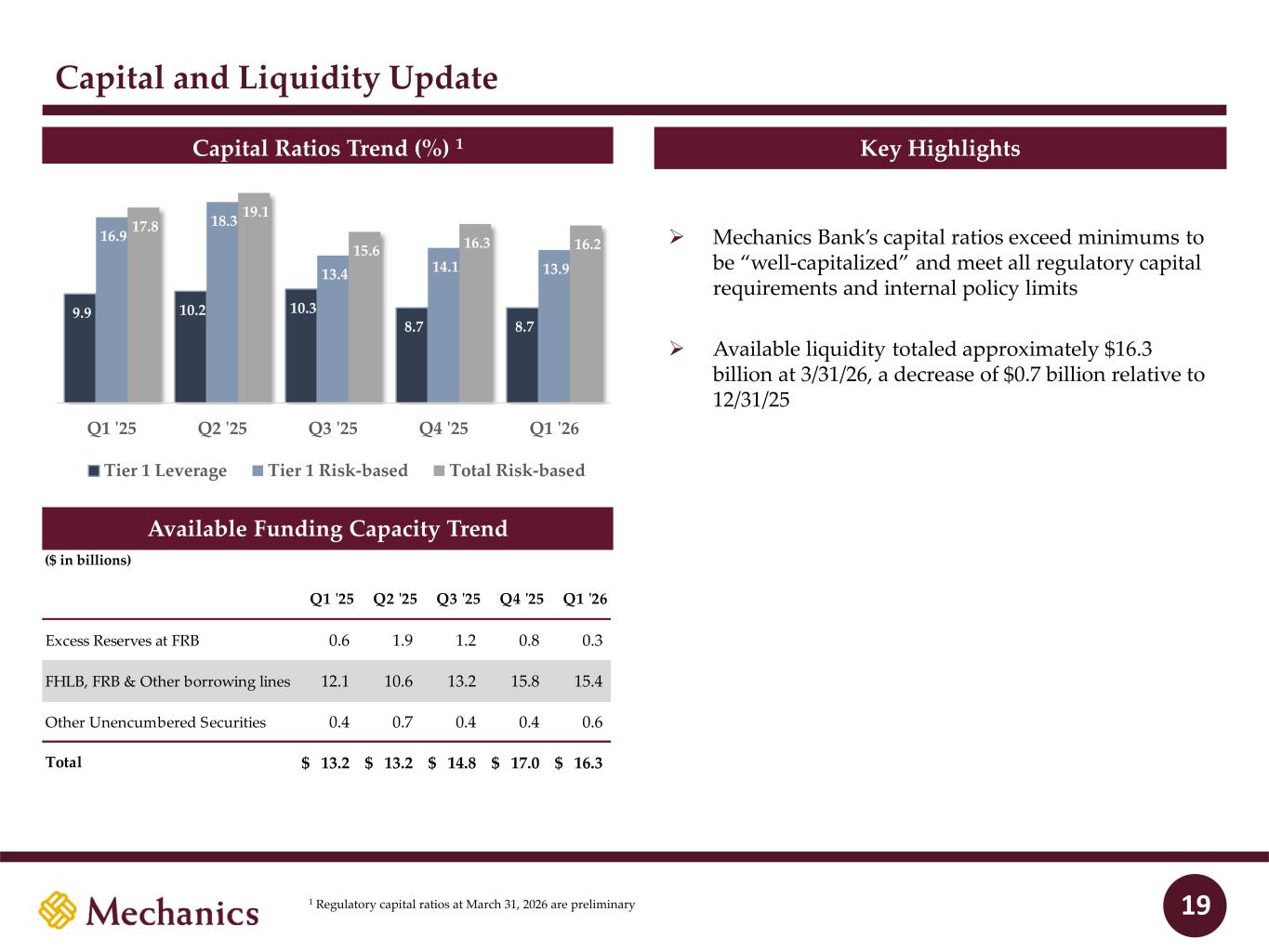
➢ Mechanics Bank’s capital ratios exceed minimums to be “well-capitalized” and meet all regulatory capital requirements and internal policy limits ➢ Available liquidity totaled approximately $16.3 billion at 3/31/26, a decrease of $0.7 billion relative to 12/31/25 Capital and Liquidity Update Capital Ratios Trend (%) 1 Quarter-over-Quarter Loan Metrics Key Highlights Av ilable Funding Capacity Trend 19 ($ in billions) 9.9 10.2 10.3 8.7 8.7 16.9 18.3 13.4 14.1 13.9 17.8 19.1 15.6 16.3 16.2 Q1 '25 Q2 '25 Q3 '25 Q4 '25 Q1 '26 Tier 1 Leverage Tier 1 Risk-based Total Risk-based Q1 '25 Q2 '25 Q3 '25 Q4 '25 Q1 '26 Excess Reserves at FRB 0.6 1.9 1.2 0.8 0.3 FHLB, FRB & Other borrowing lines 12.1 10.6 13.2 15.8 15.4 Other Unencumbered Securities 0.4 0.7 0.4 0.4 0.6 Total 13.2$ 13.2$ 14.8$ 17.0$ 16.3$ 1 Regulatory capital ratios at March 31, 2026 are preliminary

Appendix 26 20
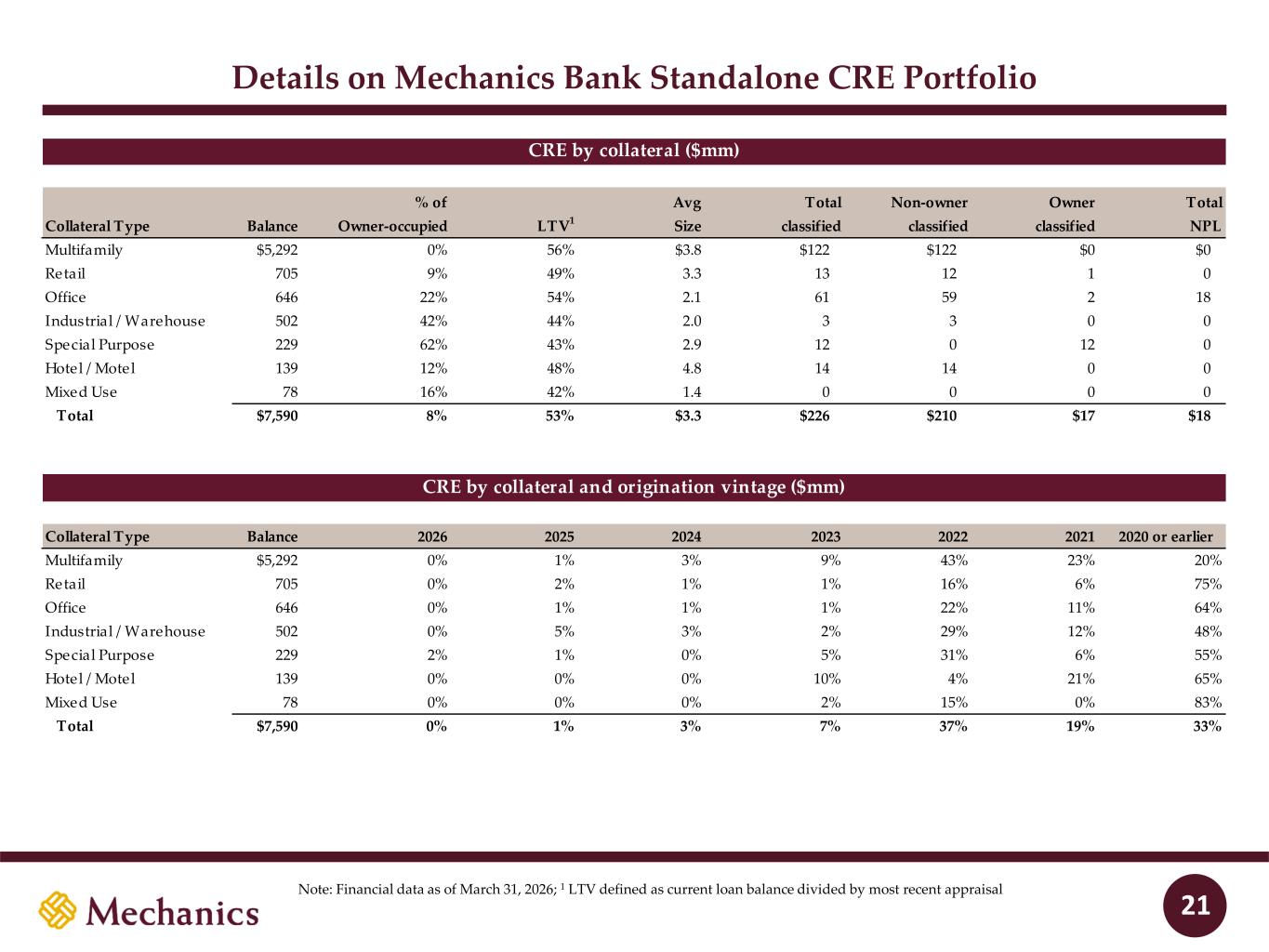
97 22 45 215 163 54 197 103 52 228 191 138 205 192 183 70 97 131 0 32 96 51 63 80 Details on Mechanics Bank Standalone CRE Portfolio 21 Collateral Type Balance % of Owner-occupied LTV1 Avg Size Total classified Non-owner classified Owner classified Total NPL Multifamily $5,292 0% 56% $3.8 $122 $122 $0 $0 Retail 705 9% 49% 3.3 13 12 1 0 Office 646 22% 54% 2.1 61 59 2 18 Industrial / Warehouse 502 42% 44% 2.0 3 3 0 0 Special Purpose 229 62% 43% 2.9 12 0 12 0 Hotel / Motel 139 12% 48% 4.8 14 14 0 0 Mixed Use 78 16% 42% 1.4 0 0 0 0 Total $7,590 8% 53% $3.3 $226 $210 $17 $18 Collateral Type Balance 2026 2025 2024 2023 2022 2021 2020 or earlier Multifamily $5,292 0% 1% 3% 9% 43% 23% 20% Retail 705 0% 2% 1% 1% 16% 6% 75% Office 646 0% 1% 1% 1% 22% 11% 64% Industrial / Warehouse 502 0% 5% 3% 2% 29% 12% 48% Special Purpose 229 2% 1% 0% 5% 31% 6% 55% Hotel / Motel 139 0% 0% 0% 10% 4% 21% 65% Mixed Use 78 0% 0% 0% 2% 15% 0% 83% Total $7,590 0% 1% 3% 7% 37% 19% 33% CRE by collateral ($mm) CRE by collateral and origination vintage ($mm) Source: Mechanics management; Note: Financial data as of March 31, 2026; 1 LTV defined as current loan balance divided by most recent appraisal Note: Financial data as of March 31, 2026; 1 LTV defined as current loan balance divided by most recent appraisal
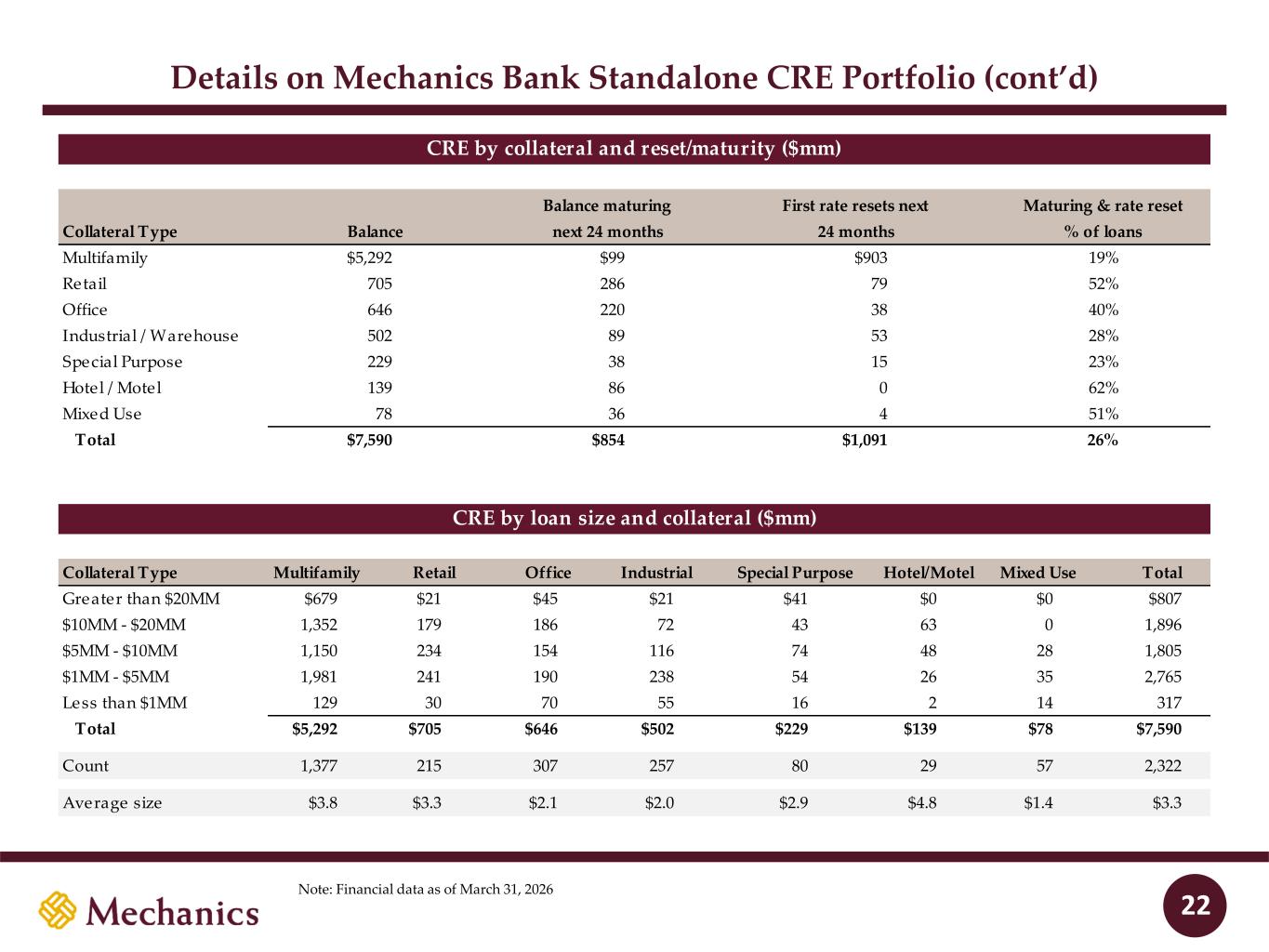
97 22 45 215 163 54 197 103 52 228 191 138 205 192 183 70 97 131 0 32 96 51 63 80 Details on Mechanics Bank Standalone CRE Portfolio (cont’d) 22 Collateral Type Multifamily Retail Office Industrial / Warehouse Special Purpose Hotel / Motel Mixed Use Total Collateral Type Multifamily Retail Office Industrial Special Purpose Hotel/Motel Mixed Use Total Greater than $20MM $679 $21 $45 $21 $41 $0 $0 $807 $10MM - $20MM 1,352 179 186 72 43 63 0 1,896 $5MM - $10MM 1,150 234 154 116 74 48 28 1,805 $1MM - $5MM 1,981 241 190 238 54 26 35 2,765 Less than $1MM 129 30 70 55 16 2 14 317 Total $5,292 $705 $646 $502 $229 $139 $78 $7,590 Count 1,377 215 307 257 80 29 57 2,322 Average size $3.8 $3.3 $2.1 $2.0 $2.9 $4.8 $1.4 $3.3 Source: Mechanics management; Note: Financial data as of March 31, 2026 1538 86 CRE by collateral and reset/maturity ($mm) 19% 52% 40% 28% $903 79 38 53 220 286 89 62% 51% 26% 36 $854 0 4 $1,091 CRE by loan size and collateral ($mm) Balance Balance maturing next 24 months First rate resets next 24 months Maturing & rate reset % of loans $5,292 705 646 502 229 139 78 $7,590 $99 23% Note: Financial data as of March 31, 2026
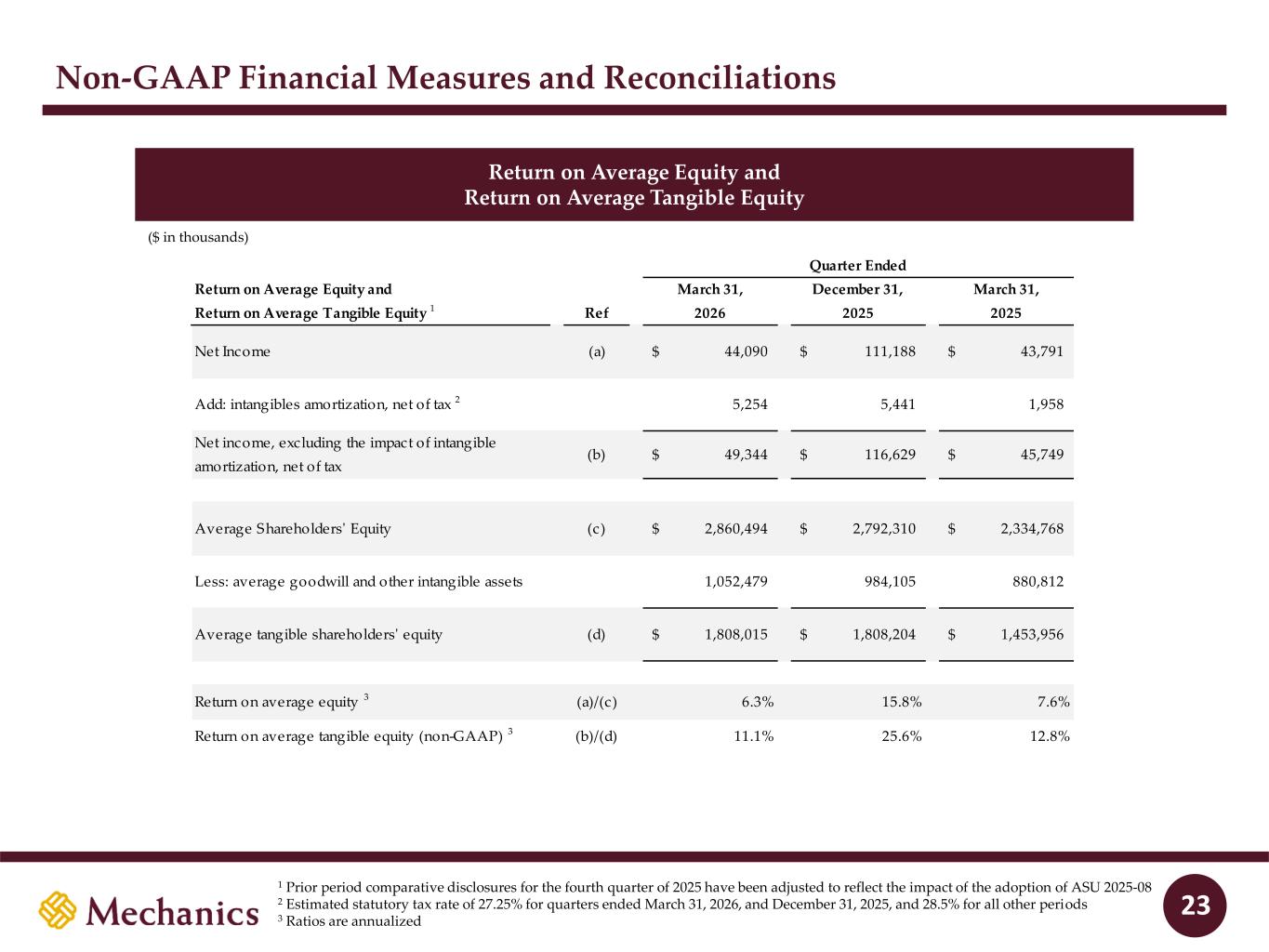
97 22 45 215 163 54 197 103 52 228 191 138 205 192 183 70 97 131 0 32 96 51 63 80 Non-GAAP Financial Measures and Reconciliations 23 1 Prior period comparative disclosures for the fourth quarter of 2025 have been adjusted to reflect the impact of the adoption of ASU 2025-08 2 Estimated statutory tax rate of 27.25% for quarters ended March 31, 2026, and December 31, 2025, and 28.5% for all other periods 3 Ratios are annualized Return on Average Equity and March 31, December 31, March 31, Return on Average Tangible Equity 1 Ref 2026 2025 2025 Net Income (a) 44,090$ 111,188$ 43,791$ Add: intangibles amortization, net of tax 2 5,254 5,441 1,958 Net income, excluding the impact of intangible amortization, net of tax (b) 49,344$ 116,629$ 45,749$ Average Shareholders' Equity (c) 2,860,494$ 2,792,310$ 2,334,768$ Less: average goodwill and other intangible assets 1,052,479 984,105 880,812 Average tangible shareholders' equity (d) 1,808,015$ 1,808,204$ 1,453,956$ Return on average equity 3 (a)/(c) 6.3% 15.8% 7.6% Return on average tangible equity (non-GAAP) 3 (b)/(d) 11.1% 25.6% 12.8% Quarter Ended Return on Average Equity and Return on Average Tangible Equity ($ in thousands)
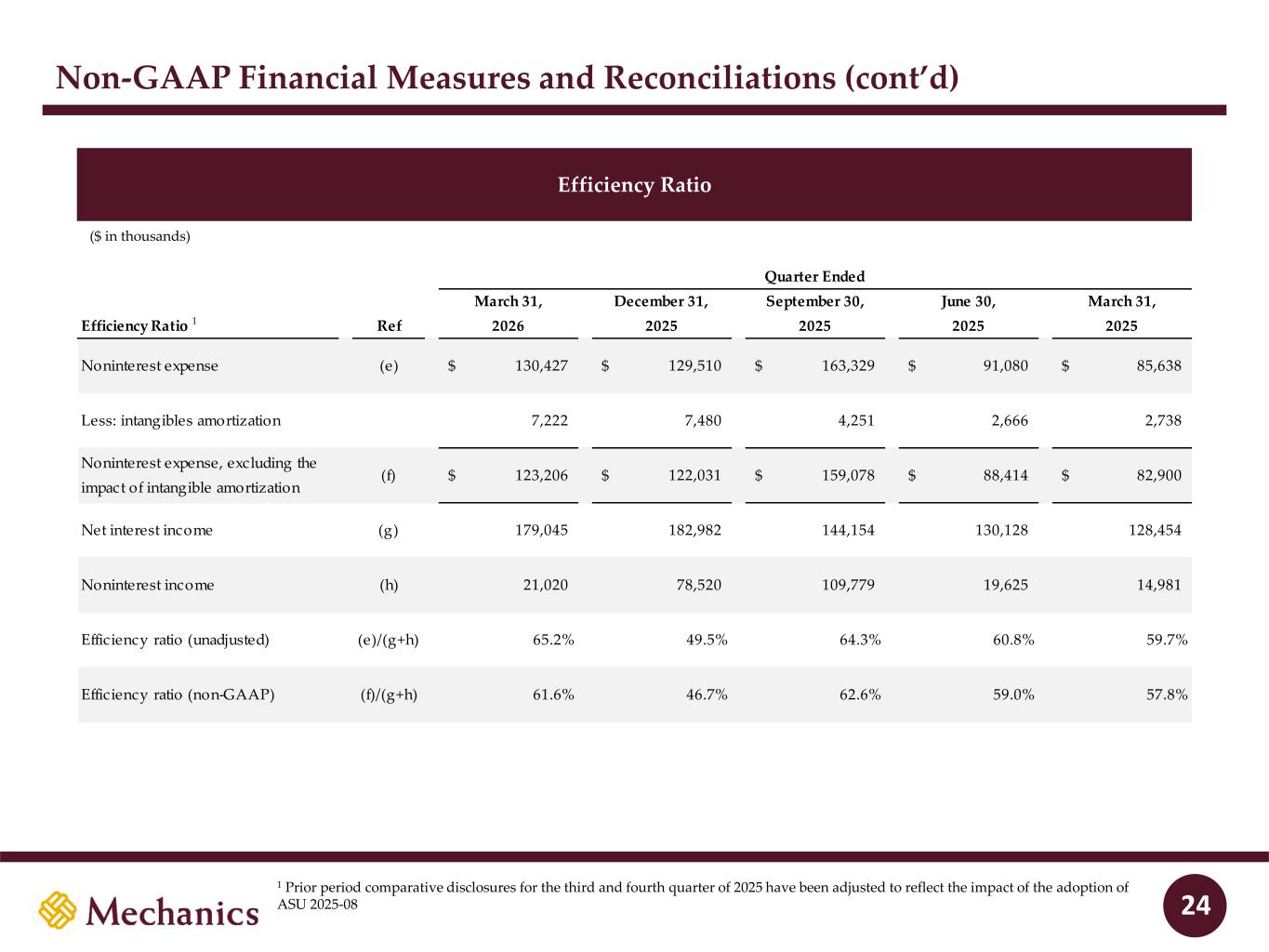
97 22 45 215 163 54 197 103 52 228 191 138 205 192 183 70 97 131 0 32 96 51 63 80 Non-GAAP Financial Measures and Reconciliations (cont’d) 24 March 31, December 31, September 30, June 30, March 31, Efficiency Ratio 1 Ref 2026 2025 2025 2025 2025 Noninterest expense (e) 130,427$ 129,510$ 163,329$ 91,080$ 85,638$ Less: intangibles amortization 7,222 7,480 4,251 2,666 2,738 Noninterest expense, excluding the impact of intangible amortization (f) 123,206$ 122,031$ 159,078$ 88,414$ 82,900$ Net interest income (g) 179,045 182,982 144,154 130,128 128,454 Noninterest income (h) 21,020 78,520 109,779 19,625 14,981 Efficiency ratio (unadjusted) (e)/(g+h) 65.2% 49.5% 64.3% 60.8% 59.7% Efficiency ratio (non-GAAP) (f)/(g+h) 61.6% 46.7% 62.6% 59.0% 57.8% Quarter Ended Efficiency Ratio ($ in thousands) 1 Prior period comparative disclosures for the third and fourth quarter of 2025 have been adjusted to reflect the impact of the adoption of ASU 2025-08
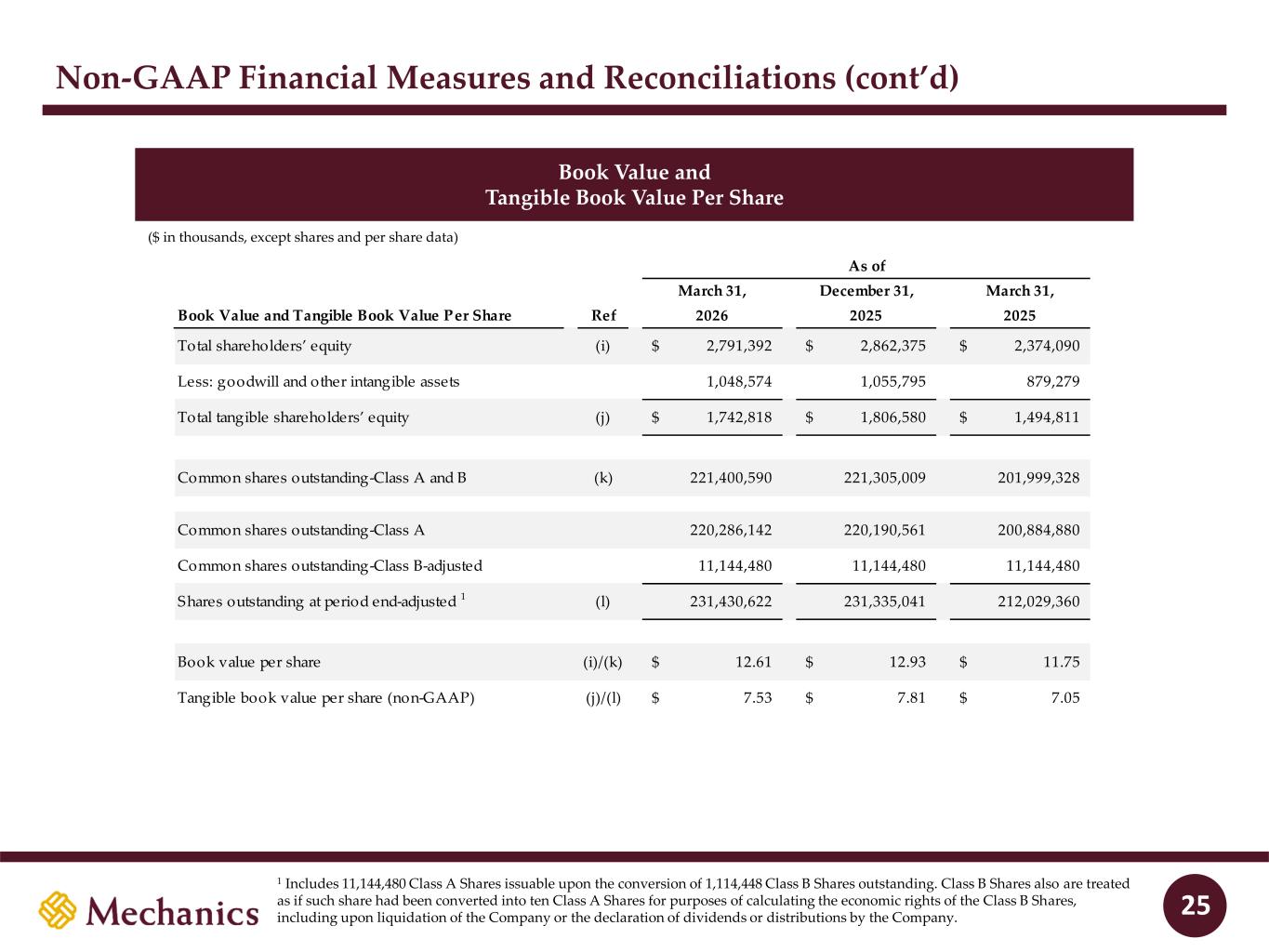
97 22 45 215 163 54 197 103 52 228 191 138 205 192 183 70 97 131 0 32 96 51 63 80 Non-GAAP Financial Measures and Reconciliations (cont’d) 25 1 Includes 11,144,480 Class A Shares issuable upon the conversion of 1,114,448 Class B Shares outstanding. Class B Shares also are treated as if such share had been converted into ten Class A Shares for purposes of calculating the economic rights of the Class B Shares, including upon liquidation of the Company or the declaration of dividends or distributions by the Company. As of March 31, December 31, March 31, Book Value and Tangible Book Value Per Share Ref 2026 2025 2025 Total shareholders’ equity (i) 2,791,392$ 2,862,375$ 2,374,090$ Less: goodwill and other intangible assets 1,048,574 1,055,795 879,279 Total tangible shareholders’ equity (j) 1,742,818$ 1,806,580$ 1,494,811$ Common shares outstanding-Class A and B (k) 221,400,590 221,305,009 201,999,328 Common shares outstanding-Class A 220,286,142 220,190,561 200,884,880 Common shares outstanding-Class B-adjusted 11,144,480 11,144,480 11,144,480 Shares outstanding at period end-adjusted 1 (l) 231,430,622 231,335,041 212,029,360 Book value per share (i)/(k) 12.61$ 12.93$ 11.75$ Tangible book value per share (non-GAAP) (j)/(l) 7.53$ 7.81$ 7.05$ Book Value and Tangible Book Value Per Share ($ in thousands, except shares and per share data)
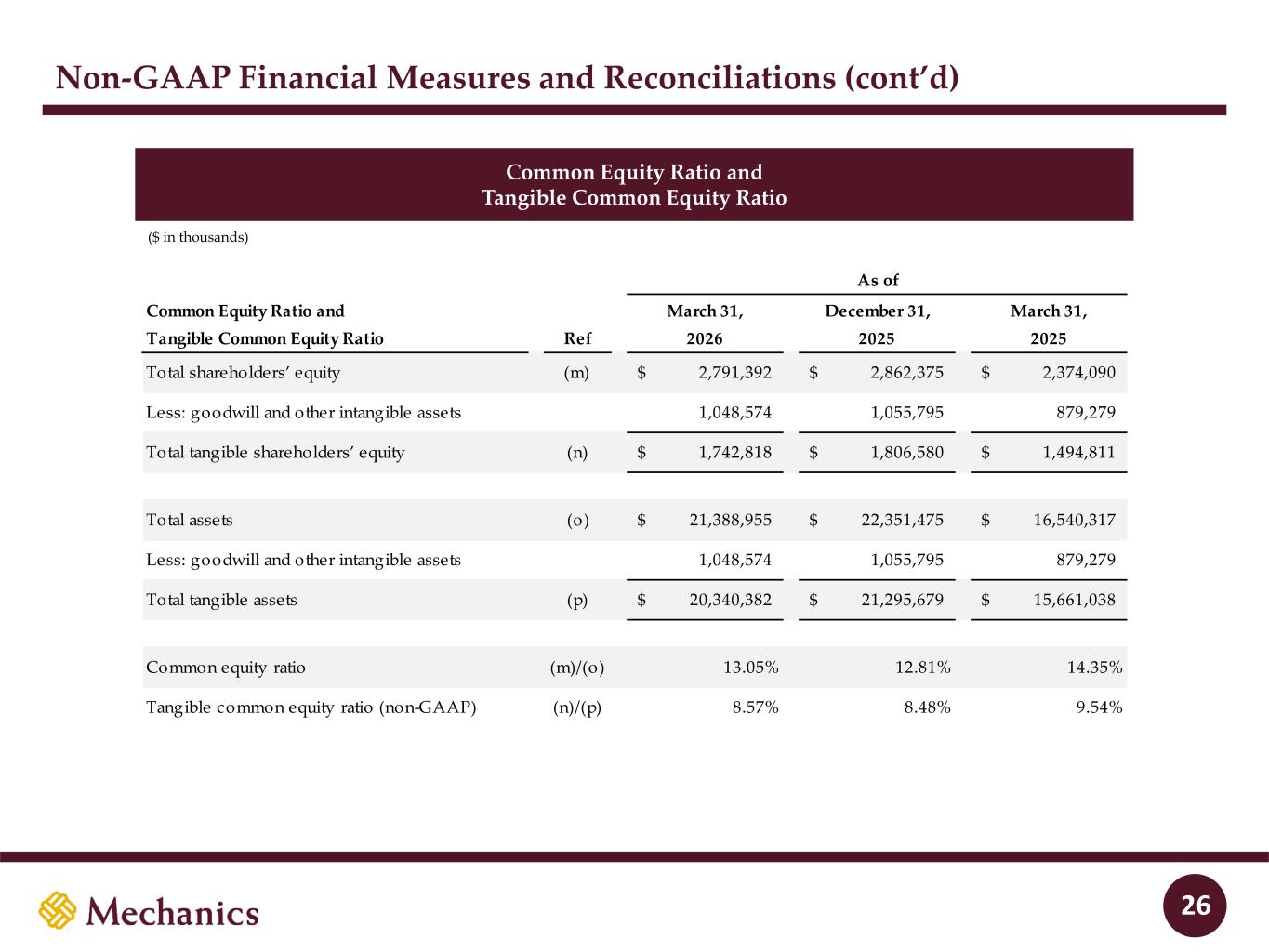
97 22 45 215 163 54 197 103 52 228 191 138 205 192 183 70 97 131 0 32 96 51 63 80 Non-GAAP Financial Measures and Reconciliations (cont’d) Common Equity Ratio and Tangible Common Equity Ratio 26 ($ in thousands) As of Common Equity Ratio and March 31, December 31, March 31, Tangible Common Equity Ratio Ref 2026 2025 2025 Total shareholders’ equity (m) 2,791,392$ 2,862,375$ 2,374,090$ Less: goodwill and other intangible assets 1,048,574 1,055,795 879,279 Total tangible shareholders’ equity (n) 1,742,818$ 1,806,580$ 1,494,811$ Total assets (o) 21,388,955$ 22,351,475$ 16,540,317$ Less: goodwill and other intangible assets 1,048,574 1,055,795 879,279 Total tangible assets (p) 20,340,382$ 21,295,679$ 15,661,038$ Common equity ratio (m)/(o) 13.05% 12.81% 14.35% Tangible common equity ratio (non-GAAP) (n)/(p) 8.57% 8.48% 9.54%
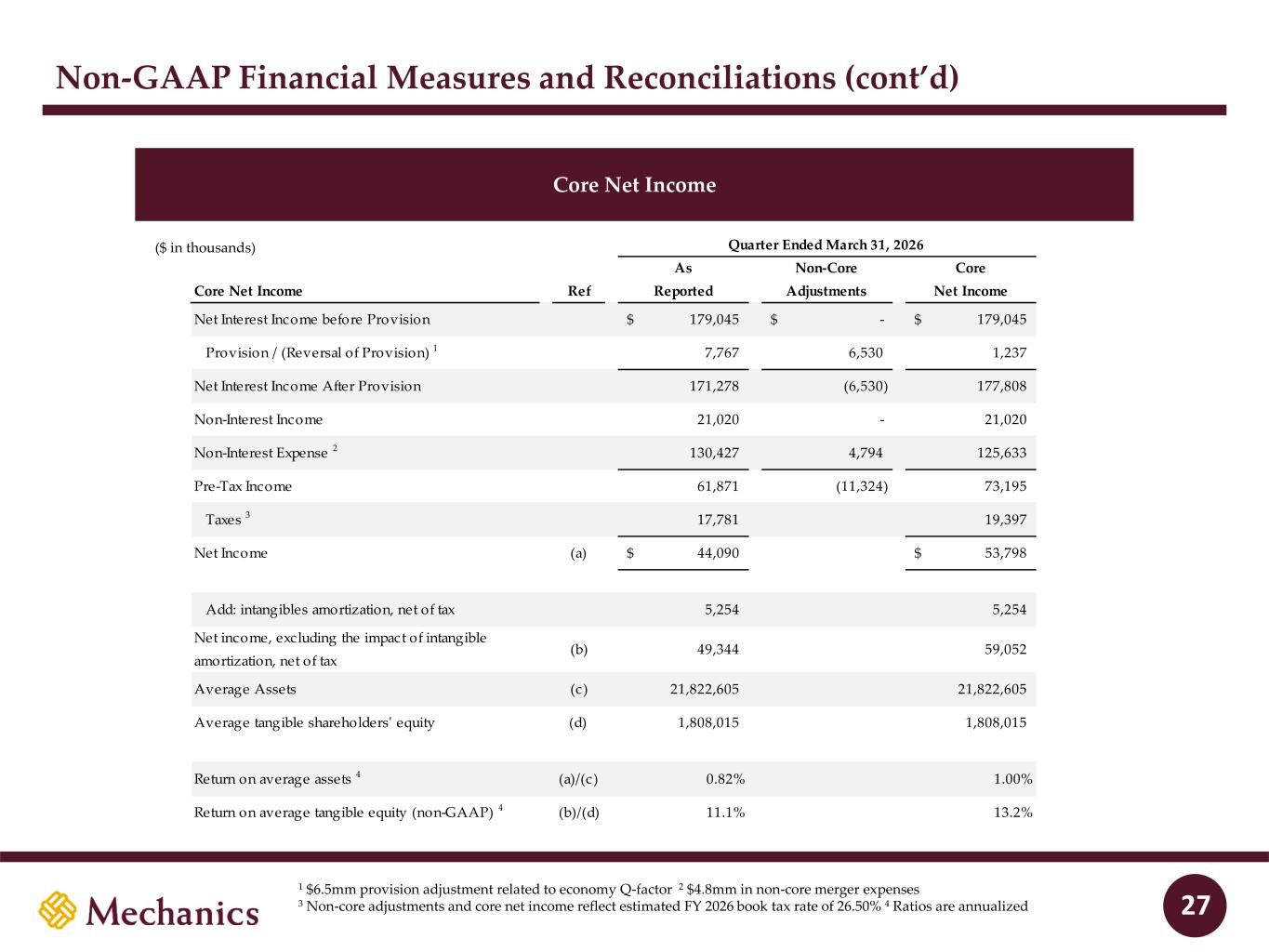
97 22 45 215 163 54 197 103 52 228 191 138 205 192 183 70 97 131 0 32 96 51 63 80 Non-GAAP Financial Measures and Reconciliations (cont’d) Core Net Income 27 ($ in thousands) 1 $6.5mm provision adjustment related to economy Q-factor 2 $4.8mm in non-core merger expenses 3 Non-core adjustments and core net income reflect estimated FY 2026 book tax rate of 26.50% 4 Ratios are annualized As Non-Core Core Core Net Income Ref Reported Adjustments Net Income Net Interest Income before Provision 179,045$ -$ 179,045$ Provision / (Reversal of Provision) 1 7,767 6,530 1,237 Net Interest Income After Provision 171,278 (6,530) 177,808 Non-Interest Income 21,020 - 21,020 Non-Interest Expense 2 130,427 4,794 125,633 Pre-Tax Income 61,871 (11,324) 73,195 Taxes 3 17,781 19,397 Net Income (a) 44,090$ 53,798$ Add: intangibles amortization, net of tax 5,254 5,254 Net income, excluding the impact of intangible amortization, net of tax (b) 49,344 59,052 Average Assets (c) 21,822,605 21,822,605 Average tangible shareholders' equity (d) 1,808,015 1,808,015 Return on average assets 4 (a)/(c) 0.82% 1.00% Return on average tangible equity (non-GAAP) 4 (b)/(d) 11.1% 13.2% Quarter Ended March 31, 2026