Exhibit 99.1

NICOLA MINING INC.
ANNUAL INFORMATION FORM
FOR THE FINANCIAL YEAR ENDED
December 31, 2025
April 27, 2026
Exhibit 99.1
NICOLA MINING INC.
ANNUAL INFORMATION FORM
FOR THE FINANCIAL YEAR ENDED
December 31, 2025
April 27, 2026
TABLE OF CONTENTS
ADVISORIES | 1 |
GLOSSARY OF TERMS | 5 |
CORPORATE STRUCTURE | 9 |
GENERAL DEVELOPMENT OF THE BUSINESS OF THE COMPANY | 9 |
DESCRIPTION OF THE BUSINESS OF THE COMPANY | 12 |
MINERAL PROJECTS | 15 |
RISK FACTORS | 19 |
DESCRIPTION OF CAPITAL STRUCTURE | 28 |
Market for Securities | 29 |
ESCROWED SECURITIES | 30 |
DIVIDENDS AND DISTRIBUTIONS | 30 |
DIRECTORS AND OFFICERS | 30 |
AUDIT COMMITTEE | 33 |
Legal Proceedings AND Regulatory actions | 35 |
INTERESTS OF MANAGEMENT AND OTHERS IN MATERIAL TRANSACTIONS | 35 |
corporate governance | 35 |
AUDITOR, TRANSFER AGENT AND REGISTRAR | 39 |
MATERIAL CONTRACTS | 39 |
INTERESTS OF EXPERTS | 39 |
ADDITIONAL INFORMATION | 39 |
| |
SCHEDULe | |
| |
SCHEDULE A – Audit Committee Charter | |
| |
Schedule B – Compensation Committee Charter | |
| |
Schedule C – Corporate Governance Charter | |
ADVISORIES
In this Annual Information Form (“AIF”), unless otherwise specified or if the context otherwise requires, references to “we”, “us”, “our”, “its”, the “Company” or Nicola” mean Nicola Mining Inc. and its subsidiary, Huldra Properties Inc. The information in this AIF is stated as at December 31, 2025 unless otherwise indicated. For additional information and details, readers are referred to the audited consolidated financial statements for the year ended December 31, 2025 and notes that follow, as well as the accompanying annual MD&A (as defined herein), which are available on the Canadian Securities Administrator’s SEDAR+ System at www.sedarplus.ca.
Cautionary Statement Regarding Forward-Looking Information and Statements
This AIF contains forward-looking information and statements (collectively, “forward-looking statements”). These forward-looking statements relate to Nicola’s current expectations, estimates and projections as to future events or Nicola’s future performance and are provided to allow readers a better understanding of Nicola’s business and prospects and may not be suitable for other purposes. All statements, other than statements of historical fact, may be considered forward-looking statements. Forward-looking statements are often, but not always, identified by the use of words such as “seek”, “anticipate”, “plan”, “continue”, “estimate”, “expect”, “may”, “will”, “project”, “predict”, “potential”, “targeting”, “intend”, “could”, “might”, “should”, “believe” and similar expressions. Forward-looking statements involve known and unknown risks, uncertainties and other factors that may cause actual results or events to differ materially from those anticipated in, or suggested by, such forward-looking statements. Nicola believes the expectations reflected in the forward-looking statements included in this AIF are reasonable, but no assurance can be given that these expectations will prove to be correct and such forward-looking statements should not be unduly relied upon. These statements speak only as of the date of this AIF and are expressly qualified, in their entirety, by this cautionary statement. Nicola assumes no obligation to revise or update these statements except as required pursuant to applicable securities laws
In particular, this AIF contains forward-looking statements pertaining to the following:
· | expectations regarding the Company’s future operations and strategic direction; |
· | the Company’s reliance on key management personnel and the potential impact of changes to senior leadership; |
· | the Company’s current and proposed development initiatives, operational plans and timelines; |
· | anticipated costs, schedules and availability of services necessary to support the Company’s projects and operations; |
· | environmental considerations, compliance obligations and potential liabilities arising from exploration, development, extraction and related activities; |
· | risks related to property title, as well as the acquisition, maintenance and renewal of significant licenses, concessions, and permits; |
· | the Company’s capital structure, liquidity position and funding needs for both ongoing and future initiatives; |
· | the Company’s ability to secure additional financing or access capital markets on terms that are commercially reasonable and in line with business objectives; and |
· | other statements under the heading “Management’s Discussion and Analysis”. |
With respect to forward-looking statements contained in this AIF, the Company has made assumptions regarding, among other things:
· | the Company’s continued access to adequate services and supplies, as supported by disclosures elsewhere in this document; |
· | the persistence of favourable economic conditions, stable commodity prices, and suitable foreign exchange and interest rates, as well as ongoing access to capital and debt markets; |
· | the ongoing availability of a qualified workforce to support the Company’s operations; |
Nicola Mining Inc. | Annual Information Form Page 1
· | that exploration schedules and associated capital costs remain accurately estimated and are not materially impacted by unforeseen events or adverse weather conditions, consistent with the considerations outlined in this document; |
· | that any environmental or other legal proceedings or disputes, if initiated against the Company, are satisfactorily resolved, and that the Company maintains stable relationships with its business partners and relevant governmental authorities; |
· | the Company’s capacity to secure and maintain financing on terms that are acceptable and in line with its operational objectives; |
· | the influence of prevailing and emerging competition within the industry; |
· | potential changes to applicable laws, regulations and rules impacting the Company’s activities, as may be further detailed in this document; |
· | the Company’s ability to attract and retain key personnel critical to its success; and |
· | the absence of material adverse developments in the industry or within the broader Canadian and global economy, including those attributable to or arising from evolving global tariff policies, increased trade barriers and their resulting impact on international trade flows and broader economic stability. |
These forward-looking statements are based upon certain material factors, assumptions and analyses that were applied in drawing a conclusion or making a forecast or projection, including management’s experience and perceptions of historical trends, current market conditions and expected future developments, the timing and amount of capital and other expenditures, and other factors believed to be reasonable in the circumstances.
By their nature, forward-looking statements are subject to inherent risks and uncertainties which give rise to the possibility that expectations, forecasts, predictions, projections or conclusions will not prove to be accurate, that assumptions may not be correct, and that objectives, strategic goals and priorities will not be achieved. A variety of material factors, many of which are beyond the control of the Company, could cause actual results to differ materially from current expectations of estimated or anticipated events or results. The risks, uncertainties and other factors that could influence actual results include, but are not limited to:
· | the Company’s potential challenges in managing its operations effectively; |
· | broad economic and business conditions, including those arising from shifting global tariff policies, increased trade barriers and their resulting effects on both international trade flows and overall economic stability; |
· | the presence of negative operating cash flow within the Company; |
· | the Company’s capacity to secure additional financing necessary to carry out the activities outlined in the AIF; |
· | possible increases in both capital and operating expenditures; |
· | fluctuations in commodity prices and in the market price of the Company’s Common Shares; |
· | inherent risks associated with the mineral exploration industry as a whole; |
· | the Company’s ability to adhere to relevant governmental regulations and standards; |
· | risks stemming from regulatory changes or governmental actions; |
· | competition within the mineral exploration sector; and |
· | the other risk factors set out in the Company’s short form base shelf prospectus dated January 29, 2026, a copy of which has been filed on SEDAR+ at www.sedarplus.ca. |
Readers are cautioned that the foregoing list of factors is not exhaustive and that other factors may emerge from time to time. It is not possible for management to predict all such factors and to assess in advance the impact of each such factor on the business of the Company, or the extent to which any factor or combination of factors may cause actual results to differ materially from those contained in any forward-looking statement. Readers are also cautioned to consider these and other factors, uncertainties and potential events carefully and not to put undue reliance on forward-looking statements. Although the forward-looking statements contained in this AIF are based upon what management of the Company currently believe to be reasonable assumptions, actual results, performance or achievements could differ materially from those expressed in, or implied by, the forward-looking
Nicola Mining Inc. | Annual Information Form Page 2
statements and, accordingly, no assurance can be given that any of the events anticipated by the forward-looking statements will transpire or occur. The forward-looking statements contained herein are made as of the date of this AIF and, other than as specifically required by law, the Company does not assume any obligation to update or revise any forward-looking statement to reflect events or circumstances after the date on which such statement is made, or to reflect the occurrence of unanticipated events, whether as a result of new information, future events or results, or otherwise.
The Company has included the above summary of assumptions and risks related to forward-looking statements contained in this AIF in order to provide investors with a more complete perspective on the Company’s current and future operations and such information may not be appropriate for other purposes.
Additional information on these and other factors is available in the reports filed by the Company with Canadian securities regulators and available under the Company’s profile on SEDAR+ at www.sedarplus.ca. The forward-looking statements and information contained in this AIF are made as of the date hereof.
Readers are cautioned that the preparation of financial statements in accordance with international financial reporting standards in Canada requires management to make certain judgments and estimates that affect the reported amounts of assets, liabilities, revenues and expenses. These estimates may change, having either a negative or positive effect on net earnings as further information becomes available and as the economic environment changes. The information contained in this AIF, including the documents incorporated by reference herein, identifies additional factors that could affect the operating results and performance of the Company. Readers are encouraged to carefully consider such factors.
Readers are also cautioned against placing undue reliance on forward-looking statements, which are given as of the date expressed in this AIF, or the MD&A disclosure incorporated by reference herein, and not to use future-oriented information or financial outlooks for anything other than their intended purpose. The forward-looking statements contained herein are expressly qualified in their entirety by this cautionary statement. The Company undertakes no obligation to publicly update or revise any forward-looking statements in this AIF or the MD&A or other disclosure incorporated by reference herein, whether as a result of new information, future events or otherwise, except as required by law.
Technical Information
Unless otherwise noted, the disclosure contained in this AIF of a scientific or technical nature for the New Craigmont Project is based on the technical report prepared by Kevin Wells, P.Geo., and James N. Gray, P.Geo. dated May 21, 2020 and entitled “NI 43-101 Technical Report on the Preliminary Copper Resource for the Southern Dump and 3060 Portal Dumps” prepared in accordance with the requirements of NI 43-101.
Any mineral reserve or resource figures, and scientific, technical, or projected economic information or estimates referred to in this AIF are estimates, and no assurances can be given that the information will materialize. Such information is based on expressions of judgment based on knowledge, mining experience, analysis of drilling results and industry practices. Valid estimates made at a given time may significantly change when new information becomes available. While the Company believes that the information included in this AIF is well established, the information by its nature is imprecise and depends, to a certain extent, upon statistical inferences which may ultimately prove unreliable. If such estimates of such information are inaccurate or are reduced in the future, this could have a material adverse impact on the Company.
Reference should be made to the full text of the Technical Report which has been filed with Canadian securities regulatory authorities pursuant to NI 43-101 and is available for review under the Company’s profile on SEDAR+ at www.sedarplus.ca.
William Whitty, P. Geo., the VP of Exploration of the Company and a “Qualified Person” under NI 43-101, reviewed and approved the written scientific and technical disclosure contained in this AIF.
Nicola Mining Inc. | Annual Information Form Page 3
Monetary References
Except as otherwise indicated, all dollar amounts in this AIF are expressed in Canadian dollars and references to $ are to Canadian dollars. References to US$ are to United States dollars.
Securities Reference
Except as otherwise indicated, all information contained in this AIF relating to the securities of the Company is presented on a post-Consolidation (as defined herein) basis.
GLOSSARY OF TERMS
In this AIF, unless otherwise indicated or the context otherwise requires, the following terms shall have the indicated meanings. Words importing the singular include the plural and vice versa and words importing any gender include all genders. A reference to an agreement means the agreement as it may be amended, supplemented or restated from time to time.
“ADSs” | means American Depository Shares. |
“ADS Warrant” | means an ADS purchase warrant of the Company. |
“Affiliate” | means a company that is affiliated with another company as described below. A company is an Affiliate of another company if (a) one of them is the subsidiary of the other or (b) each of them is controlled by the same person. A company is “controlled” by a person if (a) voting securities of the company are held, other than by way of security only, by or for the benefit of that person and (b) the voting securities, if voted, entitle the person to elect a majority of the directors of the company. A person beneficially owns securities that are beneficially owned by (a) a company controlled by that person or (b) an Affiliate of that person or an Affiliate of any company controlled by that person. |
“AIF” | means this Annual Information Form dated April 27, 2026. |
“Applicants” | has the meaning ascribed to it under the heading Directors and Officers – Corporate Cease Trade orders, Bankruptcies, Penalties or Sanctions. |
“ARO” | means asset retirement obligations. |
“Audit Committee” | means the audit committee of the Company. |
“Audit Committee Charter” | means the audit committee charter. |
“Author” | means Kevin Wells, P. Geo. and James N. Gray, P. Geo., the authors of the Technical Report. |
“BCBCA” | means the Business Corporations Act (British Columbia), and the regulations thereunder, as amended from time to time. |
“BCSC” | British Columbia Securities Commission. |
“Blue Lagoon” | means Blue Lagoon Resources Inc. |
“Board” | means the board of directors of the Company. |
“CEO” | means chief executive officer. |
“CFO” | means chief financial officer. |
Nicola Mining Inc. | Annual Information Form Page 4
“Common Share” | means a common share in the capital of the Company. |
Nicola Mining Inc. | Annual Information Form Page 5
“company” | unless specifically indicated otherwise, means a corporation, incorporated association or organization, body corporate, partnership, trust, association or other entity other than an individual. |
“Company” or “Nicola” | means Nicola Mining Inc., a company incorporated under the laws of the Province of British Columbia. |
“Compensation Committee” | means the compensation committee of the Company. |
“Compensation Committee Charter” | means the compensation committee charter adopted by the Board on July 7, 2023. |
“Consolidation” | means the consolidation of the Common Shares which occurred on November 17, 2023, whereby the Company consolidated its then issued and outstanding Common Shares on the basis of one (1) Common Share for every two (2) Common Shares. |
“Corporate Governance Committee” | means the ccorporate governance committee of the Company. |
“Corporate Governance Committee Charter” | means the corporate governance committee charter adopted by the Board. |
“Court” | means the Supreme Court of British Columbia. |
“CSE” | means the Canadian Securities Exchange, operated by CNSX Markets Inc. |
“Dominion Creek Gold Property” | refers to a property consisting of eight mineral claims situated near Prince George, British Columbia, in which the Company holds a 50% ownership interest acquired from High Range Exploration Ltd. |
“DSUs” | means deferred share units of the Company. |
“Equity Incentive Plan” | means the equity incentive plan adopted by the Board on May 12, 2022, and as ratified by shareholders of the Company on July 11, 2025. |
“High Range” | Means High Range Exploration Ltd. |
“Huldra Properties” | means Huldra Properties Inc., the Company’s wholly-owned subsidiary, incorporated pursuant to the BCBCA. |
“IFRS” | means IFRS Accounting Standards as issued by the International Accounting Standards Board, applied on a consistent basis with prior periods. |
“IP” | means induced polarization. |
“LiDar” | means light detection and ranging laser system. |
“MD&A” | means Form 51-102F1 – Management’s Discussion & Analysis. |
“Merritt Mill” | refers to the Company’s milling operations in Merritt, British Columbia. |
Nicola Mining Inc. | Annual Information Form Page 6
“Mines Act” | means the Mines Act (British Columbia), and the regulations thereunder, as amended from time to time. |
“Nasdaq” | means the Nasdaq Capital Market. |
“New Craigmont Project” | refers to a property consisting of 22 mineral claims and 10 mineral leases situated near Lower Nicola, British Columbia. |
“NGOs” | means certain non-governmental organizations. |
“NI 43-101” | means National Instrument 43-101 – Standards of Disclosure for Mineral Projects. |
“NI 51-102” | means National Instrument 51-102 – Continuous Disclosure Obligations. |
“NI 52-110” | means National Instrument 52-110 – Audit Committees. |
“NI 58-101” | means National Instrument 58‐101 – Disclosure of Corporate Governance Practices. |
“Ocean Partners UK” | Ocean Partners UK Limited, a United Kingdom-based metals trading firm. |
“Ocean Partners Holdings” | Ocean Partners Holdings Company. |
“Options” | means options to purchase Common Shares. |
“Oremex” | means Oremex Silver Inc. |
“Osisko” | means Osisko Development Corp. |
“Performance-Based Awards” | means RSUs, PSUs and DSUs collectively. |
“PSUs” | means performance share units of the Company. |
“Qualified Person” | has the meaning ascribed to such term in NI 43-101. |
“Reporting Issuer” | has the meaning ascribed to such term in the Securities Act (British Columbia), as amended. |
“RSUs” | means restricted share units of the Company. |
“SEDAR+” | means the System for Electronic Document Analysis and Retrieval. |
“Technical Report” | means the technical report of the Author dated May 21, 2020 entitled “NI 43-101 Technical Report on the Preliminary Copper Resource for the Southern Dump and 3060 Portal Dumps” prepared in accordance with the requirements of NI 43-101. |
“Treasure Mountain Project” | refers to a property consisting of 30 mineral claims and 1 mineral lease situated near Hope, British Columbia. |
“TSX” | means the Toronto Stock Exchange. |
Nicola Mining Inc. | Annual Information Form Page 7
“TSXV” | means the TSX Venture Exchange Inc. |
“Units” | means a security of the Company comprised of one or more of any combination of Common Shares, Warrants, or other securities of the Company, issued together as a single unit pursuant to the terms of the applicable offering. |
“United States”, “USA” or “US” | means, collectively, the United States of America, its territories and possessions. |
“Warrant” | means a Common Share purchase warrant of the Company. |
“Warrant Share” | means a Common Share issued or issuable by the Company upon the valid exercise of a Warrant in accordance with its terms. |
“ZTEM” | means Z-Axis tipper electromagnetic. |
Nicola Mining Inc. | Annual Information Form Page 8
CORPORATE STRUCTURE
Name, Address and Incorporation
The Company was incorporated by registration of its Memorandum and Articles pursuant to the provisions of the Company Act (British Columbia) on March 31, 1980 as “Huldra Silver Corporation”, with an authorized capital of 10,000,000 Common Shares without par value.
On April 21, 1980, the Company altered its Memorandum to change its name to “Huldra Silver Inc.” and to increase its authorized capital to 50,000,000 Common Shares without par value.
On April 9, 2005, the Company transitioned from the Company Act (British Columbia) to the BCBCA. At that time the Company filed its Notice of Articles, which effectively replaced its Memorandum, and adopted new Articles.
On June 23, 2010, the Company’s shareholders approved an amendment to the Company’s Notice of Articles to remove the pre-existing company provisions and to increase the authorized capital of the Company to an unlimited number of Common Shares without par value. On the same date, the Company’s shareholders approved an amendment to the Company’s Articles to bring the provisions of the Articles in line with the provisions of the BCBCA. On July 12, 2010, the Company filed a Notice of Alteration with respect to the amendment to the Notice of Articles.
On June 1, 2015, the Company changed its name from “Huldra Silver Inc.” to “Nicola Mining Inc.” and consolidated its issued and outstanding Common Shares on the basis of one (1) Common Share for every five (5) Common Shares.
On November 17, 2023, the Company completed the Consolidation whereby it consolidated its issued and outstanding Common Shares on the basis of one (1) Common Share for every two (2) Common Shares outstanding prior to the completion of the Consolidation.
The Company’s head office is located at Suite 1212 – 1030 West Georgia Street, Vancouver, British Columbia, V6E 2Y3, and its registered office is located at Suite 2501, 550 Burrard Street, Vancouver, British Columbia, V6C 2B5.
The Common Shares are listed and traded on the TSXV under the symbol “NIM” and the Frankfurt Securities Exchange under the symbol “HLI”. On April 14, 2026, the ADSs were listed and traded on Nasdaq under the symbol “NICM”. On November 3, 2021, the Company obtained Depository Trust Company eligibility in United States, and its Common Shares are quoted on OTCQB operated by the OTC Markets Group Inc. under the ticker “HUSIF”. The Company is a Reporting Issuer in British Columbia, Alberta and Ontario and files its continuous disclosure documents on SEDAR+ at www.sedarplus.ca. The Company’s filings through SEDAR+ are not incorporated by reference in this AIF.
Intercorporate Relationships
As of the date of this AIF, the Company has one wholly-owned subsidiary, Huldra Properties Inc. Huldra Properties was created pursuant to the BCBCA by an amalgamation between 0913103 B.C. Ltd. and Huldra Properties on January 1, 2016. Huldra Properties’ head office is located at 3329 Aberdeen Road, Lower Nicola, British Columbia, V0K 1Y0 and its registered office is located at Suite 2501, 550 Burrard Street, Vancouver, British Columbia, V6C 2B5.
GENERAL DEVELOPMENT OF THE BUSINESS OF THE COMPANY
Overview
Nicola is a junior exploration and custom milling company focused on the acquisition, exploration and development of mineral properties in British Columbia, Canada. The Company operates the Merritt Mill and holds interests in the New Craigmont Project, Treasure Mountain Project and Dominion Creek Gold Property.
Nicola Mining Inc. | Annual Information Form Page 9
Three Year History
A detailed description on the significant developments of the business of the Company for the past three years is set out below.
Recent Developments since the Fiscal Year Ended December 31, 2025
On January 29, 2026, the Company issued 5,512,001 Units for gross proceeds of $4,960,800 pursuant to a private placement offering. Each Unit consisted of one Common Share and one transferable Warrant, with each Warrant entitling the holder to purchase one Common Share at a price of $1.10 per Common Share for a period of three years following the date of issuance, provided that the expiry of the Warrants can be accelerated if the closing price of the Common Shares on the TSXV is $1.70 or greater for a minimum of ten consecutive trading days, and a notice of acceleration is provided in accordance with the terms of the Warrants.
On April 14, 2026, the Company completed its underwritten public offering in the United States which consisted of 930,233 ADSs and Warrants to purchase 930,233 ADSs at an offering price of US$6.45 per ADS and accompanying Warrant. Each ADS offered represents 12 Common Shares of the Company. The gross proceeds, before deducting underwriter discounts, and commissions and offering expenses, were US$6.0 million. The Warrants have an exercise price of CAD$12.2213 per ADS, are exercisable immediately upon issuance and will expire on the fifth anniversary of the original issuance date. On April 17, 2026, the Company issued an additional 139,534 ADSs at the public offering price of US$6.45 per ADS, for total gross proceeds of approximately US$900K pursuant to the partial exercise of the underwriters’ over-allotment option in connection with Company’s public offering of ADSs and Warrants.
Fiscal Year Ended December 31, 2025
On January 3, 2025, the Company converted the remaining outstanding principal and interest totaling $49,421 from a convertible debenture, scheduled to mature on January 9, 2025, into 246,995 Common Shares.
On March 12, 2025, the Company completed a non-brokered private placement issuing 4,038,955 Units at $0.28 per Unit, for an aggregate gross proceeds of $1,130,907. The Company paid $98,455 of finder’s fees, resulting in net proceeds of $1,032,452. Each Unit consisted of one Common Share and one-half of one Warrant, with each whole Warrant entitling the holder thereof to purchase one Warrant Share at a price of $0.40 per Warrant Share for a period of three years from the closing of the offering. The Warrants are subject to acceleration in the event that, during their exercise period and after the resale restrictions on the Common Shares have expired, the Common Shares trade at a closing price of $0.60 or greater per share on the TSXV (or any other exchange where they are listed) for ten consecutive trading days, in which case the Company may, by giving notice through a press release, accelerate the expiry date of the Warrants to the thirtieth (30th) day after such notice. On July 21, 2025, the Company gave notice of the acceleration of the Warrants issued on March 12, 2025. By the accelerated expiry date of August 20, 2025, all of the 2,019,477 Warrants then outstanding had been exercised, resulting in total proceeds of $807,791.
On July 1, 2025, the Company granted 400,000 Options to an employee of the Company, which Options are exercisable into one Common Share at a price of $0.495 per Common Share until July 1, 2030.
Nicola Mining Inc. | Annual Information Form Page 10
On July 17, 2025, the Company closed its non-brokered private placement in which it sold an aggregate of 4,350,000 Units at a price of $0.50 per Unit for gross proceeds of $2,175,000. Each Unit consists of one flow-through Common Share and one-half of one non-flow-through Warrant. Each Warrant is exercisable at a price of $0.65 and expires on July 17, 2027.
On December 3, 2025, the Company granted 2,850,000 Options to an directors, officers, consultants and employees of the Company, which Options are exercisable into one Common Share at a price of $1.00 per Common Share until December 3, 2030.
On December 3, 2025, the Company granted an aggregate of 1,015,000 RSUs to certain directors, officers and employees of the Company, which RSUs vest into Common Shares on January 1, 2027.
During the year ended December 31, 2025, debenture holders converted the principal and settled interest of $4,803,067 for the convertible debentures that matured on November 21, 2025, into 26,088,257 common shares.
During the year ended December 31, 2025, the Company issued 2,952,500 common shares from stock options exercised for total proceeds of $811,150.
During the year ended December 31, 2025, the Company issued 1,000,000 common shares to settle RSUs vested.
Fiscal Year Ended December 31, 2024
On December 3, 2024, the Company completed a flow-through private placement offering, pursuant to which it issued an aggregate of 1,641,790 Common Shares at a price of $0.335 per Common Share for aggregate gross proceeds of $550,000.
On December 18, 2024, the Company granted 500,000 Options to a consultant of the Company, which Options are exercisable into one Common Share at a price of $0.30 per Common Share until December 18, 2029.
On December 18, 2024, the Company granted an aggregate of 1,000,000 RSUs to certain directors, officers and employees of the Company, which RSUs vest into Common Shares on December 18, 2025.
On April 12, 2024, the Company completed a non-brokered private placement by the issuance of 5,499,994 Common Shares at a price of $0.23 per Common Share for aggregate gross proceeds of $1,264,999, which Common Shares were issued on a flow-through basis pursuant to the Income Tax Act (Canada).
On April 18, 2024, the Company granted an aggregate of 3,000,000 Options to certain directors, officers, consultants and employees, which Options are exercisable at a price of $0.265 until April 18, 2029.
On March 19, 2024, Warwick Bay resigned as the CFO and secretary and Sam Wong was appointed as the CFO and secretary of the Company.
Fiscal Year Ended December 31, 2023
On November 28, 2023, the Company issued 650,000 common shares at a value of $0.20 per share in connection with the exercise of 650,000 stock options for total proceeds of $130,000.
On November 21, 2023, a second tranche debenture holder elected to convert a total of $32,710 at a conversion price of $0.17 and was issued 213,529 common shares in accordance with terms of the debentures.
On November 17, 2023, the Company completed the Consolidation whereby it consolidated its issued and outstanding Common Shares on the basis of one (1) Common Share for every two (2) Common Shares.
On October 23, 2023, a second tranche debenture holder elected to convert a total of $234,776 at a conversion price of $0.17 and was issued 1,357,079 common shares in accordance with terms of the debentures.
Nicola Mining Inc. | Annual Information Form Page 11
On October 3, 2023, the Company granted 200,000 Options to one employee, which Options are exercisable into one Common Share at a price of $0.35 per Common Share until October 3, 2028.
On August 3, 2023, the Company granted 200,000 Options to one employee, which Options are exercisable into one Common Share at a price of $0.30 per Common Share until August 3, 2028.
On July 26, 2023, the Company granted 2,000,000 Options to certain directors, officers, consultants and employes, which Options are exercisable into one Common Share at a price of $0.36 per Common Share until July 26, 2028.
On May 18 and 19, 2023, the Company issued 113,834 common shares at a value of $0.20 per share in settlement of interest of $22,767 of May 20, 2020 debentures.
On May 19, 2023, a May 20, 2020 Debenture holder elected to convert a total of $45,000 at a conversion price of $0.20 and was issued 225,000 common shares in accordance with terms of the debentures.
On May 18, 2023, May 20, 2020 Debenture holders elected to convert a total of $185,000 at a conversion price of $0.20 and the Company issued 925,000 common shares in accordance with terms of the debentures.
On May 2, 2023, the Company granted 100,000 Options to one consultant, which Options are exercisable into one Common Share at a price of $0.30 per Common Share until May 2, 2028.
On April 19, 2023, the Company issued 500,000 common shares at a value of $0.16 per share in connection with the exercise of 500,000 stock options for gross proceeds of $80,000.
On March 15, 2023, the Company issued 121,321 common shares on conversion of $20,000 of convertible debentures issued November 21, 2022, exercised at $0.17.
On February 14, 2023, the Company issued 40,262 common shares on conversion of $8,000 of convertible debentures issued January 9, 2023, exercised at $0.20.
On January 13, 2023, the Company issued 8,000,000 common shares at a value of $0.25 per share for gross proceeds of $2,000,000.
Significant Acquisitions
During the most recently completed financial year ended December 31, 2025, Nicola did not complete any acquisition that would be considered a “significant acquisition” as defined under Part 8 of NI 51-102. Accordingly, the Company has not filed a Form 51-102F4 – Business Acquisition Report in respect of any acquisition during the year.
DESCRIPTION OF THE BUSINESS OF THE COMPANY
General
Nicola is a junior resource company engaged in two principal business segments:
1. | Mineral Exploration and Development |
2. | Custom Milling Operations |
These segments are considered reportable under IFRS as they represent distinct revenue-generating activities with separate operational and financial characteristics.
Mineral Exploration and Development
The mineral exploration and development segment encompasses Nicola’s efforts to identify, acquire and advance mineral properties in British Columbia. The Company’s principal exploration assets include the New Craigmont Project, the Treasure Mountain Project
Nicola Mining Inc. | Annual Information Form Page 12
and the Dominion Creek Gold Property. These projects are all in the exploration or pre-commercial development stage and have not yet reached commercial production and are further described below.
New Craigmont Project
The New Craigmont Project, a historic copper mine site near Merritt, British Columbia, is the Company’s flagship asset. It is permitted under Mine Permit M-68 and has been the focus of extensive geophysical surveys, soil sampling and diamond drilling. A mineral resource estimate was completed in 2020 for the Southern Mining Terraces and 3060 Portal Dump areas.
Treasure Mountain Project
The Treasure Mountain Project, located near Hope, British Columbia, is permitted for the removal of up to 60,000 tonnes of silver/lead/zinc mill feed annually but remains in care and maintenance. In June of 2025, the Company received a multi-year area-based exploration permit which allows for five years of exploration and plans to commence exploration at the MB Zone.
Dominion Creek Gold Property
The Dominion Creek Gold Property, in which Nicola holds a 50% interest and a 75% economic benefit through a profit-sharing agreement, received its bulk sample permit in March 2025. Nicola and its partner, High Range Exploration Ltd., are preparing for potential mining and milling activities in the current year.
The Company conducts its own exploration activities, including geological mapping, drilling, and geophysical surveys while subcontracting specialized services such as LiDAR and assay testing. The projects are not yet at the commercial production stage, and no sales have been made from these properties. The next steps toward commercialization include further drilling, resource definition and economic assessments. The Company has not disclosed specific cost estimates or timelines for achieving commercial production.
Custom Milling Operations
The custom milling operations segment is centered around the Merritt Mill, a fully permitted and operational facility located near Merritt, British Columbia. The mill is licensed to process up to 200 tonnes per day of silver, lead and gold ore. Nicola provides toll milling services to third-party mining companies, producing concentrate that is sold to offtake partners such as Ocean Partners UK. In 2025, the Company generated $1.54 million in milling revenue and $0.8 million from gravel, ash, soil and other income which compares to $818,000 in milling revenue and $1.97 million from gravel, ash, soil and other income in 2024 and $1.62 million and $8.15 million, respectively, in 2023. All revenue was derived from sales to external customers; there were no sales to joint ventures, equity-accounted entities or controlling shareholders. The method of providing milling services involves receiving ore shipments from clients, processing the ore through crushing, grinding and flotation circuits at the Merritt Mill, and producing gold and silver concentrate. The concentrate is then shipped to offtake partners for sale. The Company also provides ancillary services such as storage, logistics coordination, and compliance with environmental and safety regulations.
The Merritt Mill has processed ore from clients including Blue Lagoon, Talisker Resources Ltd. and Osisko under profit-sharing agreements. The facility underwent upgrades in 2023 and 2024 to support increased throughput and quality control. The Company continues to seek new custom milling contracts to support its cash flow and maintain operational flexibility.
Production and Services
The Company’s custom milling services are conducted at its wholly-owned Merritt Mill, located near Merritt, British Columbia. The Merritt Mill is a fully permitted facility authorized under the Mines Act to process up to 200 tonnes per day of silver, lead and gold ore. The mill was originally constructed in 2012 and has undergone extensive modifications since 2017, including upgrades completed in 2023 to enhance its processing capabilities. The Company provides toll milling services to third-party mining companies, whereby it processes ore into concentrate on behalf of clients. The concentrate is then sold to offtake partners, such as Ocean Partners UK, under purchase agreements. Nicola has entered into profit-sharing agreements with clients including Blue Lagoon and Osisko, under which it receives a share of the proceeds from the sale of processed concentrate.
The method of providing milling services involves receiving ore shipments from clients, processing the ore through crushing, grinding and flotation circuits at the Merritt Mill, and producing gold and silver concentrate. The concentrate is then shipped to offtake partners
Nicola Mining Inc. | Annual Information Form Page 13
for sale. The Company also provides ancillary services such as storage, logistics coordination and compliance with environmental and safety regulations.
In addition to milling, Nicola is actively engaged in mineral exploration and development at its New Craigmont, Treasure Mountain and Dominion Creek properties. These projects are in the exploration stage and are not yet producing. The Company’s exploration activities include geological mapping, soil and rock sampling, geophysical surveys (including ZTEM and IP), and diamond drilling. These activities are conducted by Nicola’s in-house geological team, with certain specialized services subcontracted to third-party providers. The Company has received multi-year area-based permits that allow for extensive exploration activities, including trenching and drilling, through to 2027.
Nicola Mining Inc. | Annual Information Form Page 14
The Company does not currently produce any mineral products for sale from its exploration properties.
Specialized Skill and Knowledge
Nicola’s operations require specialized geological, metallurgical and engineering expertise, particularly in mineral exploration, resource modelling and custom milling. The Company relies on experienced geologists for exploration planning and execution, including geophysical surveys, soil sampling, and diamond drilling. Metallurgical knowledge is essential for operating and optimizing the Merritt Mill, which processes complex ore types into concentrate. Nicola also depends on regulatory and permitting expertise to navigate environmental and mining legislation. These skills are sourced through a combination of in-house personnel and external consultants. The Company has been able to access the required expertise without material constraint.
Competitive Conditions
The Company operates in a highly competitive environment. In mineral exploration, it competes with junior and senior mining companies for land, capital, and talent—many with greater resources. In custom milling, Nicola’s Merritt Mill competes with other processors on capacity, turnaround and pricing. Its competitive edge lies in its fully permitted 200 tpd facility, flexible profit-sharing agreements and established client relationships. However, limited financial resources and reliance on third-party contracts constrain its position. Continued success depends on exploration outcomes, operational efficiency, and access to capital.
Cycles
The Company’s business segments, mineral exploration and custom milling, are subject to seasonal and cyclical influences. Exploration activities are typically concentrated in the spring through autumn months due to weather and ground conditions in British Columbia, which limit access and drilling during winter. Custom milling operations at the Merritt Mill are influenced by the availability and scheduling of third-party mill feed contracts, which can vary throughout the year. As such, both revenue and expenses may fluctuate significantly between quarters depending on project activity and contract timing.
Economic Dependence
Nicola is substantially dependent on a key offtake and financing agreement with Ocean Partners UK, a metals trading firm. This agreement governs the sale of gold and silver concentrate produced at the Company’s Merritt Mill and includes a revolving prepayment facility. Under the amended agreement signed on July 12, 2022, Ocean Partners UK agreed to purchase concentrate from Nicola and increased the revolving prepayment facility from US$500,000 to US$3,000,000. Nicola has drawn down US$750,000 under this facility, which was repaid December 29, 2022. The agreement provides critical working capital support and a guaranteed buyer for concentrate produced under custom milling contracts, including those with Blue Lagoon and Osisko. The Company’s reliance on this agreement is significant, as Ocean Partners UK accounted for 100% of Nicola’s milling revenue in both 2023 and 2024. The agreement also enables Nicola to process third-party ore at its Merritt Mill, which is a core component of its business model.
The Company also entered into a Mining and Milling Profit Share Agreement with High Range for the Dominion Creek Property. This agreement entitles Nicola to a 75% economic interest in the project and includes provisions for funding initial development and processing ore at the Merritt Mill.
These contracts are essential to Nicola’s operations and financial viability, providing both revenue generation and access to capital.
Changes to Contracts
Nicola Mining Inc. | Annual Information Form Page 15
The Company does not currently anticipate any material renegotiation or termination of contracts that would significantly affect its business. However, the Company’s operations rely heavily on custom milling agreements, particularly with Ocean Partners UK. Any changes to this offtake agreement could impact revenue and working capital. Similarly, profit-sharing agreements with High Range and Osisko are integral to the Merritt Mill’s utilization. While no changes are expected, any termination or renegotiation of these agreements could adversely affect operational continuity and financial performance.
Environmental Protection
Nicola is subject to environmental protection regulations under the Mines Act and related provincial legislation. These requirements have a material impact on the Company’s capital expenditures, primarily through its asset retirement obligations or “ARO”, which totaled $13.8 million as of December 31, 2025. The ARO reflects estimated future reclamation and closure costs for the Merritt Mill and Treasure Mountain Project, including tailings management and site remediation.
In 2025, the Company recognized a $0.9 million reduction in ARO due to changes in estimates, partially offset by $0.5 million in accretion expense. These environmental liabilities directly affect the Company’s net loss and working capital position. While no immediate capital outlays were required in 2025, the obligations are expected to result in significant future expenditures over the next 8 to 15 years.
Environmental compliance also influences the Company’s competitive position, as it must maintain sufficient financial assurance (e.g., $1.4 million in restricted cash) to satisfy regulatory bonding requirements. These requirements may limit flexibility in capital allocation and increase the cost of operations relative to peers with lower environmental liabilities.
Nicola remains committed to maintaining compliance and proactively managing its environmental responsibilities.
Employees
As of the date of this AIF, the Company has 25 employees.
MINERAL PROJECTS
The Company’s principal mineral project is the New Craigmont Project in Lower Nicola, British Columbia. For the purposes of mineral project disclosure required to be included in this AIF, the New Craigmont Project is the Company’s sole material mineral project.
In addition to the New Craigmont Project, the Company holds a 100% interest in 30 mineral claims and 1 mineral lease comprising the Treasure Mountain Project located near Hope, British Columbia, subject to a 2% net smelter royalty. The Company also holds a 50% interest in 8 mineral claims comprising the Dominion Creek Gold Property located near Prince George, British Columbia.
New Craigmont Project
The following is an updated reproduction of the summary section from the Technical Report. Definitions contained in this section shall have the meanings ascribed to such definitions in the Technical Report and may not match definitions used elsewhere in this AIF. The Technical Report was prepared in accordance with NI 43-101 and has been filed with the securities regulatory authorities in Alberta, British Columbia and Ontario. Portions of the following information are based on assumptions, qualifications and procedures which are not fully described herein.
The Technical Report is incorporated by reference into this AIF. Readers are cautioned that the following summary should be read in the context of the qualifying statements, procedures and accompanying discussion within the complete Technical Report, and this summary is qualified in its entirety by the Technical Report.
Nicola Mining Inc. | Annual Information Form Page 16
Property Description and Location
The Craigmont Project is in southern British Columbia, 18 km northwest of the city of Merritt. The UTM coordinates for the Craigmont Project are 5563500 North and 648500 East (geographic projection: NAD 83, Zone 10N). Access to the property is provided by paved and gravel roads. Additional mineral claims totaling 828 hectares were staked in December 2019, as a result the Craigmont Project now consists of 22 mineral tenures and 10 mineral leases with a total area of 10,913 hectares.
Ownership
The Craigmont Property is currently 100% owned by Nicola On March 3, 2011, Nicola agreed to buy all the outstanding shares of Craigmont Holdings Ltd. in consideration for certain cash and share payments.
On November 19, 2015, Nicola acquired the remaining shares of Craigmont Holdings Ltd. for a 2.0% net smelter royalty.
History
The property covers a large area along the southern extents of the Guichon Batholith, which is host to many copper prospects that have been intermittently explored since the early 1930’s. The most important discovery to date has been the past producing Craigmont Copper-iron mine located in the central portion of the property.
The Craigmont Mine was operated by Craigmont Mines Ltd. from 1961 to 1967 as an open pit mine before moving to an underground sub-level cave operation from 1967 to 1982. The mine produced in excess of 36,750,000 tons at an average grade of 1.30% Cu, containing approximately 900 000 000 lbs. of copper. The mine was shut down in 1982 due to low copper prices.
Following the mine shutdown in 1982, Craigmont shipped up to 60,000 tonnes of clean metallurgical magnetite per year until 1992 from its stockpile to coal producers throughout North America for use in the coal flotation process. After 1992, Craigmont continued to produce a limited amount of magnetite product for the coal industry from re-worked iron fines in the tailings pond. This operation was shut down in 2014 due to economic grades of magnetite being exhausted.
Status of Exploration
Nicola has been actively exploring the property since the project ownership was consolidated in 2015. This work has consisted of over 18,000m of diamond drilling, property-wide geological mapping, widespread soil sampling, IP surveys, and property-wide aeromagnetic and ZTEM surveys. Additionally, 1869m of RC drilling at the historic mine dump and the higher grade 3060 portal.
Geology and Mineralization
The geology of the property is underlain by an east-northeast trending, steeply dipping volcanic pile of Upper Triassic Nicola Group rocks that are bound to the north by the multistage Early Jurassic-Late Triassic Guichon Creek Batholith and unconformably overlain by the Middle and Upper Cretaceous Spences Bridge Group. Most of the area is covered by thick gravel overburden.
Near the project area, the Border phase of the Guichon Creek Batholith varies in composition from quartz diorite to granodiorite and intrude the Nicola Group, a thick volcanic and sedimentary series of agglomerate, breccia, andesitic flows, limestone, argillite and greywacke. Nicola Group sediments immediately adjacent to the batholith are
Nicola Mining Inc. | Annual Information Form Page 17
hornfelsed quartzo-feldspathic greywackes. Spences Bridge Group agglomerates and flows dip approximately 15 degrees to the south and crop out in the areas south and west of the Craigmont mine area.
The property holds at least two types of mineralization described as copper-iron skarn and copper porphyry. Carbonate-rich, silicate-rich or intrusive rocks along the southern flank of the Guichon Batholith host the two types of mineralization. Within the property, mineralization is commonly associated with copper and iron skarn assemblages. Chalcopyrite, magnetite, specularite and minor bornite are principal minerals. Accessory assemblages at the Craigmont Mine include supergene minerals such as chalcocite and native copper have developed above the mineralized body. Gold, molybdenum and silver contents are generally low.
Several major faults cut through the property. Faults around the Craigmont mine include the northwest trending east and West Embayment Fault, the Mine East Fault and the East-West Fault.
Sample Database and Validation
A review of the sample collection and analysis practices used during the various drilling campaigns indicates that this work was conducted using generally accepted industry procedures.
Sampling programs conducted by Nicola were monitored using a QA/QC program that is typically accepted in the industry. It is the QPs’ opinion that the database is sufficiently accurate and precise to generate a mineral resource estimate.
Mineral Resource Estimate
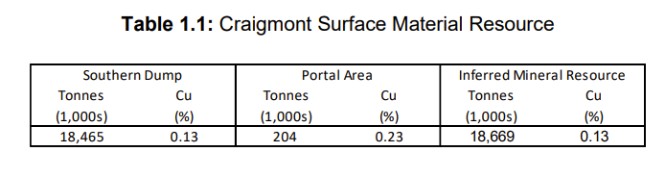
Two areas of Inferred Mineral Resource have been outlined, both consisting of historically subeconomic material remaining from past mining at the New Craigmont Project. A portion of the southern mine dumps, covering an area of 82.5 hectares, has been tested at a drill spacing of approximately 100 m. A smaller area (1.4 ha) of stockpiled material, adjacent to the 3060 portal, is of much smaller tonnage but of higher grade and is generally drilled at a 10-20 m spacing.
Resource tonnage is based on the volume between a LiDAR survey of current topography and a recent contractor generated pre-mine surface based on historic contour maps tied into current survey control. Density was assigned based on historic and current assumptions; no bulk density measurements are currently available. Future work must include density measurement work. The southern dump material was assigned a density of 1.8 t/m3; portal area material was assigned a density of 2.15 t/m3.
Inverse distance weighting was chosen as the most appropriate grade estimation approach due in part to the fact that the material being evaluated is not, in its present form, a naturally occurring mineral deposit. The southern dump material was estimated using 15x15x8 m blocks with 4 m composites from 60 RC holes. The 3060 portal area material was estimated using 5x5x4 m blocks and 4 m composites from 39 RC holes.
Material was classified as Inferred Mineral Resource where it was within the area of reasonably consistent drill spacing. In the southern dump area, blocks classified as Inferred are generally within 100 m of the closest sample and the drill spacing is approximately 100 m. In the portal area, drill spacing is typically less than 25 m and the resource extends a maximum of 40 m beyond drilling to the edge of the pile.
In order to establish reasonable prospects of eventual economic extraction a three-year trailing average copper price of US$2.8/lb and an anticipated annual production scenario was considered and a cut-off grade of 0.06% copper is deemed appropriate. The resource is included in Table 1.1.
Nicola Mining Inc. | Annual Information Form Page 18
Ongoing Exploration
Ongoing exploration at New Craigmont consists of drilling at several targets across the property, all of which show signs of porphyry-style alteration, mineral chemistry and mineralization. To date, over 8000 m of core has been drilled at porphyry targets throughout the property, and data analysis is ongoing. Geophysical and geochemical data from across the property is being compiled and analyzed to help generate exploration targets. Nicola collaborated with the Mineral Deposit Research Unit (MDRU) at UBC on a recently completed academic study which concluded that Craigmont is part of a porphyry-linked skarn system.
Recommendations
The following work is recommended for the New Craigmont Project:
· | Drill a large untested ZTEM anomaly (Jotun target) north of the historical pit, which could represent a porphyry system (planned for 2026). |
· | Create a 3D geological model of the property, particularly of the target areas. |
· | Continue to collect XRF and SWIR data from the core on site to incorporate into in the geochemical/geophysical dataset to help refine porphyry targeting. |
· | Mobile Metal Ion (MMI) soil sampling over areas of interest to refine drill targets. |
· | Airborne Audio-Frequency Magnetotellurics (MobileMT) survey as required to refine geophysical targeting across the property. |
· | Upgrading the historical waste dump resource by: |
o | Trench sampling or sonic drilling to determine the grade and volume of the fine material. |
o | Bulk density measurements. |
o | Additional testing on the cost benefit of Tomra sorting. |
o | Additional RC or sonic drilling at a spacing of 50 m on the Northern dump. |
Exploration, Development, and Production
Current exploration consists of compiling and validating current and historical data for New Craigmont into a unified database for targeting and geological modelling. Ongoing drilling during the summer with the possibility of geophysical surveys and soil sampling are being contemplated for New Craigmont. Exploration drilling is planned for 2026 on an untested tarted (MB Zone) at Treasure Mountain.
For more information, please see the Technical Report a copy of which is filed under Nicola’s profile on SEDAR+ at www.sedarplus.ca.
Nicola Mining Inc. | Annual Information Form Page 19
RISK FACTORS
The following specific factors could materially adversely affect the Company and should be considered when deciding whether to make an investment in the Company. You should carefully consider the risks described below, which are qualified in their entirety by reference to, and must be read in conjunction with, the detailed information appearing elsewhere in this AIF, and all other information contained in this AIF. The risks and uncertainties described in this AIF and the information incorporated by reference herein are those the Company currently believes to be material, but they are not the only ones the Company will face. If any of the following risks, or any other risks and uncertainties that the Company has not identified or that it currently considers not to be material, actually occur or become material risks, the Company’s business, prospects, financial condition, results of operations and cash flows, and consequently the price of the Common Shares could be materially and adversely affected. In all these cases, the trading price of the Company’s securities could decline, and prospective investors could lose all or part of their investment.
Investors should carefully consider the risk factors set out below and consider all other information contained herein and in the Company’s other public filings before making an investment decision.
Any reference to “the Company” or “Nicola” in the risk factors refers to the Company and its subsidiary together on a consolidated basis.
Insufficient Capital
The Company currently has minimal revenue producing operations and may report a working capital deficit from time to time. To maintain its activities, the Company will require additional funds which may be obtained either by the sale of equity capital, debt financing, government grants or by entering into an option or joint venture agreement with a third party providing such funding. There is no assurance that the Company will be successful in obtaining such additional financing; failure to do so could result in the loss or substantial dilution of the Company. The Company’s unallocated working capital may not suffice to fund its business goals and objects as stated elsewhere in the AIF.
The Company expects to continue to incur negative investing and operating cash flows until such time as it enters into commercial production of its properties. This will require the Company to deploy its working capital to fund such negative cash flow and to seek additional sources of financing. There is no assurance that any such financing sources will be available or sufficient to meet the Company’s requirements. There is no assurance that the Company will be able to continue to raise equity capital or that the Company will not continue to incur losses.
Lack of Operating Cash Flow
The Company currently has a minimal source of operating cash flow and is expected to continue to do so for the foreseeable future. The Company’s failure to achieve profitability and positive operating cash flows could have a material adverse effect on its financial condition and results of operations. If the Company sustains losses over an extended period of time, it may be unable to continue its business. Further exploration and development of its mineral properties will require the commitment of substantial financial resources. It may be several years before the Company may generate any substantial revenues from operations, if at all. There can be no assurance that the Company will realize revenue or achieve profitability.
Resale of Common Shares
The continued operation of the Company will be dependent upon its ability to generate operating revenues and to procure additional financing. There can be no assurance that any such revenues can be generated or sustained or that other financing can be obtained. If the Company is unable to generate such revenues or obtain such additional
Nicola Mining Inc. | Annual Information Form Page 20
financing, any investment in the Company may be lost. In such event, the probability of resale of the Common Shares purchased would be diminished.
Exploration of Mineral Property Interests
Although substantial benefits may be derived from the discovery of a major mineralized deposit, no assurance can be given that minerals will be discovered in sufficient quantities to justify commercial operations or that the funds required for development can be obtained on a timely basis. The discovery of mineral deposits is dependent upon a number of factors. The commercial viability of a mineral deposit once discovered is also dependent upon a number of factors, some of which relate to particular attributes of the deposit, such as size, grade and proximity to infrastructure, and some of which are more general such as commodity prices and government regulations, including environmental protection. Most of these factors are beyond the control of the Company. In addition, because of these risks, there is no certainty that the expenditures to be made by the Company on the exploration of its various mineral properties as described herein will result in the discovery of commercial quantities of ore. The Company has no history of operating earnings and the likelihood of success must be considered in light of problems, expenses, etc. which may be encountered in establishing a business.
Exploring and developing natural resource projects bears a high potential for all manner of risks. Additionally, few exploration projects successfully achieve development due to factors that cannot be predicted or foreseen. Moreover, even one such factor may result in the economic viability of a project being detrimentally impacted, such that it is neither feasible nor practical to proceed. Natural resource exploration involves many risks, which even a combination of experience, knowledge and careful evaluation may not be able to overcome. Operations in which the Company has a direct or indirect interest will be subject to all the hazards and risks normally incidental to exploration, development and production of natural resources, any of which could result in work stoppages, damage to property, and possible environmental damage. If any of the Company’s exploration programs are successful, there is a degree of uncertainty attributable to the calculation of resources and corresponding grades and in the analysis of the economic viability of future development and mineral extraction. In addition, the quantity of reserves and resources may vary depending on commodity prices and various technical and economic assumptions. Any material change in quantity of reserves, grade or recovery ratio, may affect the economic viability of the Company’s properties.
Exploration, Development and Production Risks
The exploration for and development of minerals involves significant risks, which even a combination of careful evaluation, experience and knowledge may not eliminate. Few properties that are explored are ultimately developed into producing mines. There can be no guarantee that the estimates of quantities and qualities of minerals disclosed will be economically recoverable. With all mining operations there is uncertainty and, therefore, risk associated with operating parameters and costs resulting from the scaling up of extraction methods tested in pilot conditions. Mineral exploration is speculative in nature and there can be no assurance that any minerals discovered will result in an increase in the Company’s resource base.
The Company’s operations will be subject to all of the hazards and risks normally encountered in the exploration, development and production of minerals. These include unusual and unexpected geological formations, rock falls, seismic activity, flooding and other conditions involved in the extraction of material, any of which could result in damage to, or destruction of, mines and other producing facilities, damage to life or property, environmental damage and possible legal liability. In addition, operations are subject to hazards that may result in environmental pollution, and consequent liability that could have a material adverse impact on the business, operations and financial performance of the Company.
Substantial expenditures are required to establish Ore Reserves through drilling, to develop metallurgical processes to extract the metal from the ore and, in the case of new properties, to develop the mining and processing facilities and infrastructure at any site chosen for mining. Although substantial benefits may be derived from the discovery of a major mineralized deposit, no assurance can be given that minerals will be discovered in sufficient quantities to
Nicola Mining Inc. | Annual Information Form Page 21
justify commercial operations or that funds required for development can be obtained on a timely basis. The economics of developing gold and other mineral properties is affected by many factors including the cost of operations, variations in the grade of ore mined, fluctuations in metal markets, costs of processing equipment and such other factors as government regulations, including regulations relating to royalties, allowable production, importing and exporting of minerals and environmental protection. The remoteness and restrictions on access of properties in which the Company has an interest will have an adverse effect on profitability as a result of higher infrastructure costs. There are also physical risks to the exploration personnel working in the terrain in which the Company’s properties will be located, often in poor climate conditions.
The long-term commercial success of the Company depends on its ability to explore, develop and commercially produce minerals from its properties and to locate and acquire additional properties worthy of exploration and development for minerals. No assurance can be given that the Company will be able to locate satisfactory properties for acquisition or participation. Moreover, if such acquisitions or participations are identified, the Company may determine that current markets, terms of acquisition and participation or pricing conditions make such acquisitions or participation uneconomic.
Mineral Resources and Reserves
The figures for mineral resources for the Treasure Mountain Project disclosed in the Company’s Annual Information Form for the year ended December 31, 2012, and in its technical report filed on SEDAR on June 12, 2012, are only estimates. Mineral reserves at the Treasure Mountain Project have not been defined therefore the mineral resources currently cannot be considered ore.
The figures for Inferred Copper Resource for the Southern Dump and 3060 Portal Dumps at New Craigmont Project in the Technical Report and final ALS Metallurgy Laboratory report for upgrading and copper recovery test work filed on SEDAR on June 12, 2020, are only estimates. The inferred mineral resources are not mineral reserves as the Company has not yet demonstrated the economic viability. There is no certainty that any expenditures made in the exploration of the Company’s mineral properties will result in identification of commercially recoverable quantities of ore or that ore reserves will be mined or processed profitably. In addition, substantial expenditures will be required to develop the mining and processing facilities and infrastructure at any site chosen for mining.
Uncertainty of Economic Viability of Production from the Treasure Mountain Project
The Company has not undertaken any preliminary economic assessment or preliminary feasibility study with respect to the Treasure Mountain Project or any of its other projects and does not intend to undertake such a study or assessment. There are significant risks associated with making a production decision without a valid, current, economic analysis and the Company may subsequently determine that recommencing operations at the Treasure Mountain Project is not economically feasible.
Governmental Regulation and Policy
Mining operations and exploration activities are subject to extensive laws and regulations. Such regulations relate to production, development, exploration, exports, imports, taxes and royalties, labor standards, occupational health, waste disposal, protection and remediation of the environment, toxic and radioactive substances, transportation safety and emergency response, and other matters. Compliance with such laws and regulations increases the costs of exploring, developing, constructing, and operating projects. It is possible that, in the future, the costs, delays and other effects associated with such laws and regulations may impact decisions of the Company with respect to the exploration and development of properties, such as the properties in which the Company has an interest. The Company will be required to expend significant financial and managerial resources to comply with such laws and regulations. Since legal requirements change frequently, are subject to interpretation and may be enforced in varying degrees in practice, the Company is unable to predict the ultimate cost of compliance with these requirements or their effect on operations. Furthermore, future changes in governments, regulations and policies and practices, such as those affecting exploration and development of the Company’s properties could materially
Nicola Mining Inc. | Annual Information Form Page 22
and adversely affect the results of operations and financial condition of the Company in a particular year or in its long-term business prospects.
No Assurances
There is no assurance that economic mineral deposits will ever be discovered, or if discovered, subsequently put into production. Most exploration activities do not result in the discovery of commercially mineable deposits. Mining exploration is highly speculative in nature, involves many risks and frequently is not productive. Most exploration projects do not result in the discovery of commercially mineable ore deposits and no assurance can be given that any anticipated level of recovery of mineral reserves will be realized or that any identified mineral deposit will ever qualify as a commercially mineable (or viable) ore body which can be legally and economically exploited.
Indigenous Peoples’ title claims and rights to consultation and accommodation may affect our existing operations as well as development projects and future acquisitions.
Governments in many jurisdictions must consult Indigenous Peoples with respect to grants of mineral rights and the issuance or amendment of exploration and project authorizations. Consultation and other rights of Indigenous Peoples may require accommodations, including undertakings regarding financial compensation, employment and other matters in impact and benefit agreements. This may affect the Company’s ability to acquire, explore or develop, within a reasonable time frame, mineral titles in these jurisdictions and may affect the timetable and costs of development of mineral properties in these jurisdictions. The risk of unforeseen aboriginal title claims also could affect existing operations as well as exploration and development projects and future acquisitions. These legal requirements may increase the Company’s operating costs and affect the Company’s ability to expand its operations or to explore and develop new projects.
Community Relations and License to Operate
The Company’s relationship with the host communities where it operates is critical to ensure the future success of its existing operations and the construction and development of its projects. There is an increasing level of public concern relating to the perceived effect of mining activities on the environment and on communities impacted by such activities. Certain non-governmental organizations (“NGOs”), some of which oppose globalization and resource development, are often vocal critics of extractive industries and their practices. Adverse publicity generated by such NGOs or others related to extractive industries generally, or the Company’s exploration or development activities specifically, could have an adverse effect on the Company’s reputation. Reputation loss may result in decreased investor confidence, increased challenges in developing and maintaining community relations and an impediment to the Company’s overall ability to advance its projects, which could have a material adverse impact on the Company’s results of operations, financial condition and prospects. While the Company is committed to operating in a socially responsible manner, there is no guarantee that the Company’s efforts in this respect will mitigate this potential risk.
Title Risks
Although the Company has exercised the usual due diligence with respect to determining title to properties in which it has a material interest, there is no guarantee that title to such properties will not be challenged or impugned. The Company’s mineral property interests may be subject to prior unregistered agreements or transfers or native land claims and title may be affected by undetected defects. Surveys have not been carried out on any of the Company’s mineral properties, therefore, in accordance with the laws of the jurisdiction in which such properties are situated; their existence and area could be in doubt. Until competing interests in the mineral lands have been determined, the Company can give no assurance as to the validity of title of the Company to those lands or the size of such mineral lands.
Uninsurable Risks
Nicola Mining Inc. | Annual Information Form Page 23
In the course of exploration, development and production of mineral properties, certain risks, and in particular, unexpected or unusual geological operating conditions including rock bursts, cave-ins, fires, flooding and earthquakes may occur. It is not always possible to fully insure against such risks and the Company may decide not to take out insurance against such risks as a result of high premiums or other reasons. Should such liabilities arise, they could reduce or eliminate any future profitability and result in increasing costs and a decline in the value of the securities of the Company.
Future Share Issuances May Affect the Market Price of the Common Shares and Results in Significant Dilution
In order to finance future operations, the Company may raise funds through the issuance of additional Common Shares or the issuance of debt instruments or other securities convertible into Common Shares. The Company cannot predict the size of future issuances of Common Shares or the issuance of debt instruments or other securities convertible into Common Shares or the dilutive effect, if any, that future issuances and sales of the Company’s securities will have on the market price of the Common Shares.
Dilution
Common Shares, including rights, warrants, special warrants, subscription receipts and other securities to purchase, to convert into or to exchange into Common Shares, may be created, issued, sold and delivered on such terms and conditions and at such times as the Board may determine. In addition, the Company may issue additional Common Shares from time to time pursuant to Common Share purchase warrants and the options to purchase Common Shares issued from time to time by the Board. The issuance of these Common Shares could result in significant dilution to holders of Common Shares.
Operational Risks
The Company will be subject to a number of operational risks and may not be adequately insured for certain risks, including: environmental contamination, liabilities arising from historic operations, accidents or spills, industrial and transportation accidents, which may involve hazardous materials, labor disputes, catastrophic accidents, fires, blockades or other acts of social activism, changes in the regulatory environment, impact of non-compliance with laws and regulations, natural phenomena such as inclement weather conditions, floods, earthquakes, ground movements, cave-ins, and encountering unusual or unexpected geological conditions and technological failure of exploration methods.
There is no assurance that the foregoing risks and hazards will not result in damage to, or destruction of, the property of the Company, personal injury or death, environmental damage or, regarding the exploration or development activities of the Company, increased costs, monetary losses and potential legal liability and adverse governmental action. These factors could all have an adverse impact on the Company’s future cash flows, earnings, results of operations and financial condition.
Additionally, the Company may be subject to liability or sustain loss for certain risks and hazards against which the Company cannot insure or which the Company may elect not to insure because of the cost. This lack of insurance coverage could have an adverse impact on the Company’s future cash flows, earnings, results of operations and financial condition.
Environmental Risks
All phases of the mineral exploration and development business present environmental risks and hazards and are subject to environmental regulations. Compliance with such legislation and regulations can require significant expenditures and a breach could result in the imposition of fines and penalties, some of which may be material. Environmental legislation is evolving in a manner which may lead to stricter standards and enforcement, larger fines and liability and potentially increased capital expenditures and operating costs. No assurance can be given that the application of environmental laws to the business and operations of the Company will not result in a curtailment of
Nicola Mining Inc. | Annual Information Form Page 24
exploration or production, material increase in the costs of production, development, or exploration activities, or otherwise adversely affect the Company’s financial condition, results of operations or prospects.
Regulatory and Permitting
Regulatory and permitting requirements have a significant impact on the Company’s operations and can have a material and adverse effect on future cash flow, results of operations and financial condition. To conduct mineral exploration and mining activities, the Company must obtain or renew exploration or mining permits and licenses in accordance with the relevant mining laws and regulations required by governmental authorities having jurisdiction over mineral projects. There is no guarantee that the Company will be granted the necessary permits and licenses, that they will be renewed, or that the Company will be in a-position to comply with all the conditions that are imposed. Mining is subject to potential risks and liabilities associated with pollution and the disposal of waste from mineral exploration and mining operations. Costs related to discovery, evaluation, planning, designing, developing, constructing, operating, closing, and remediating mines and other facilities in compliance with these laws and regulations are significant. In addition to environmental protection, applicable laws and regulations govern employee health and safety. Not complying with these laws and regulations can result in enforcement actions that may include corrective measures requiring capital expenditures, installation of additional equipment, remedial action, and changes to operating procedures resulting in additional costs and temporary or permanent shutdown of operations. The Company may also be required to compensate those parties’ suffering loss or damage and may face civil or criminal fines or penalties for violating certain laws or regulations. Changes to these laws and regulations in the future could have an adverse effect on the Company’s cash flow, results of operations and financial condition. Further, the issuance of permits may be subject to review by third parties who may challenge future permitting and the validity of existing permits based on, among other things, the government’s obligation to consult and accommodate.
Volatility of Mineral Prices
The Company’s revenues, if any, are expected to be in large part derived from the extraction and sale of precious and base minerals and metals. Factors beyond the control of the Company may affect the marketability of metals discovered, if any. Metal prices have fluctuated widely, particularly in recent years. Consequently, the economic viability of any of the Company’s exploration projects cannot be accurately predicted and may be adversely affected by fluctuations in mineral prices. In addition, currency fluctuations may affect the cash flow which the Company may realize from its operations, since most mineral commodities are sold in a world market in US dollars.
Infrastructure
Exploration, development and processing activities depend, to one degree or another, on adequate infrastructure. Reliable roads, bridges, power sources and water supply are important elements of infrastructure, which affect access, capital and operating costs. The lack of availability on acceptable terms or the delay in the availability of any one or more of these items could prevent or delay exploration on the Company’s mineral properties. If adequate infrastructure is not available in a timely manner, there can be no assurance that the exploration or development will be commenced or completed on a timely basis on the Company’s mineral properties, if at all. Furthermore, unusual or infrequent weather phenomena, sabotage, government or other interference in the maintenance or provision of necessary infrastructure could adversely affect our operations.
Global Financial Conditions
Global financial conditions have from time to time been subject to periods of elevated volatility. Government debt, the risk of sovereign defaults, political instability and wider economic concerns in many countries have been causing significant uncertainties in the markets. Disruptions in the credit and capital markets can have a negative impact on the availability and terms of credit and capital. Uncertainties in these markets could have a material adverse effect on the Company’s liquidity, ability to raise capital and cost of capital. High levels of volatility and market turmoil
Nicola Mining Inc. | Annual Information Form Page 25
could also adversely impact commodity prices, exchange rates and interest rates and have a detrimental effect on the Company’s business.
Resulting Effects of Broad Economic and Business Conditions
The Company’s operations and financial performance may be adversely affected by broad economic and business conditions, including those driven by shifting global tariff policies, the imposition or escalation of trade barriers, and other geopolitical developments. These factors can disrupt international trade flows, reduce market stability, and limit growth opportunities. Uncertainty surrounding global economic conditions—such as inflationary pressures, currency volatility, and supply chain disruptions—may impact demand for minerals, cost structures, and strategic planning. While the Company seeks to remain adaptable, there can be no assurance that it will be able to mitigate all risks associated with such macroeconomic fluctuations.
Executive Employee Recruitment and Retention
The success of the Company will be dependent upon the performance of its management and key employees. The loss of any key executive or manager of the Company may have an adverse effect on the future of the Company’s business. The number of persons skilled in acquisition, exploration and development of mining properties is limited and competition for such persons is intense. As the Company’s business activity grows, it will require additional key financial and administrative personnel as well as additional operations staff. Recruiting qualified personnel as the Company grows will be critical to its success. As the Company’s business activity grows, it will require additional key financial, administrative, engineering, geological and other personnel. If the Company is not successful in attracting and training qualified personnel, the efficiency of its operations could be affected, which could have an adverse impact on future cash flows, earnings, results of operations and the financial condition of the Company. The Company is particularly at risk at this state of its development as it relies on a small management team, the loss of any member of which could cause severe adverse consequences. There is no assurance that it will be successful in attracting, training and retaining qualified personnel as competition for persons with these skill sets increases. If the Company is not successful in attracting, training and retaining qualified personnel, the efficiency of its operations could be impaired, which could have an adverse impact on its future cash flows, earnings, results of operations and financial condition.
Adverse General Economic Conditions
The unprecedented events in global financial markets in the past several years have had a profound impact on the global economy. Many industries, including the mineral exploration sector, were impacted by these market conditions. Some of the key impacts of the financial market turmoil included contraction in credit markets resulting in a widening of credit risk, devaluations, high volatility in global equity, commodity, foreign exchange and precious metal markets, a lack of market liquidity, natural disasters, public health crisis (such as the ongoing dispute between the sovereign state of the Ukraine and Russia) and other events outside of the Company’s control. A similar slowdown in the financial markets or other economic conditions, including but not limited to, inflation, fuel and energy costs, lack of available credit, the state of the financial markets, interest rates and tax rates, may adversely affect the Company’s operations. Specifically, a global credit/liquidity crisis could impact the cost and availability of financing and our overall liquidity, the volatility of mineral prices would impact the Company’s prospects, volatile energy, commodity and consumables prices and currency exchange rates would impact costs and the devaluation and volatility of global stock markets would impact the valuation of its equity and other securities. These factors could have a material adverse effect on the Company’s financial condition and results of operations.
In recent years, the securities markets in Canada, as well as in other countries around the world, have experienced a high level of price and volume volatility, and the market prices of securities of many companies have experienced wide fluctuations in price that have not necessarily been related to the operating performance, underlying asset values or prospects of such companies. There can be no assurance that continual fluctuations in price will not occur. It may be anticipated that any quoted market for the Common Shares will be subject to market trends and conditions generally, notwithstanding any potential success of the Company in developing assets, adding additional resources,
Nicola Mining Inc. | Annual Information Form Page 26
establishing feasibility of deposits or creating revenues, cash flows or earnings. The value of securities will be affected by market volatility. An active public market for the Common Shares might not develop or be sustained. If an active public market for the Common Shares does not develop or continue, the liquidity of a shareholder’s investment may be limited and the price of the Common Shares may decline.
Legal and Litigation
All industries, including the mining industry, are subject to legal claims, with and without merit. Defense and settlement costs of legal claims can be substantial, even with respect to claims that have no merit. Due to the inherent uncertainty of the litigation process, the resolution of any particular legal proceeding to which the Company may become subject could have a material adverse effect on the Company’s business, prospects, financial condition, and operating results. There are no current claims or litigation outstanding against the Company.
Insurance
The Company is also subject to a number of operational risks and may not be adequately insured for certain risks, including: accidents or spills, industrial and transportation accidents, which may involve hazardous materials, labor disputes, catastrophic accidents, fires, blockades or other acts of social activism, changes in the regulatory environment, impact of non-compliance with laws and regulations, natural phenomena such as inclement weather conditions, floods, earthquakes, tornados, thunderstorms, ground movements, cave-ins, and encountering unusual or unexpected geological conditions and technological failure of exploration methods.
There is no assurance that the foregoing risks and hazards will not result in damage to, or destruction of, the properties of the Company, personal injury or death, environmental damage or, regarding the exploration or development activities of the Company, increased costs, monetary losses and potential legal liability and adverse governmental action, all of which could have an adverse impact on the Company’s future cash flows, earnings, results of operations and financial condition. The payment of any such liabilities would reduce the funds available to the Company. If the Company is unable to fully fund the cost of remedying an environmental problem, it might be required to suspend operations or enter into costly interim compliance measures pending completion of a permanent remedy.
Competition
All aspects of the Company’s business are subject to competition from other parties. Many of the Company’s competitors for the acquisition, exploration, production and development of mineral properties, and for capital to finance such activities, will include companies that have greater financial and personnel resources available to them than the Company. Competition could adversely affect the Company’s ability to acquire suitable properties or prospects in the future.
The international resource industries are highly competitive. The value of any future reserves discovered and developed by the Company may be limited by competition from other world resource mining companies, or from excess inventories. Existing international trade agreements and policies and any similar future agreements, governmental policies or trade restrictions are beyond the control of the Company and may affect the supply of and demand for minerals, including lithium, around the world.
Conflicts of Interest
Certain of the directors and officers of the Company will be engaged in, and will continue to engage in, other business activities on their own behalf and on behalf of other companies and, as a result of these and other activities, such directors and officers of the Company may become subject to conflicts of interest. The BCBCA provides that in the event that a director has a material interest in a contract or proposed contract or agreement that is material to the issuer, the director shall disclose his interest in such contract or agreement and shall refrain from voting on any
Nicola Mining Inc. | Annual Information Form Page 27
matter in respect of such contract or agreement, subject to and in accordance with the BCBCA. To the extent that conflicts of interest arise, such conflicts will be resolved in accordance with the provisions of the BCBCA.
Volatility of the Market Price of the Common Shares
Securities of junior companies have experienced substantial volatility in the past, often based on factors unrelated to the financial performance or prospects of the companies involved. These factors include macroeconomic developments in North America and globally and market perceptions of the attractiveness of particular industries. The Common Share price is also likely to be significantly affected by delays experienced in progressing with development plans, a decrease in investor appetite for junior stocks, or in adverse changes in the Company’s financial condition or results of operations as reflected in the Company’s quarterly and annual financial statements. Other factors unrelated to performance that could have an effect on the price of the Common Shares include:
(a) the trading volume and general market interest in the Common Shares could affect a shareholder’s ability to trade significant numbers of Common Shares; and (b) the size of the public float in the Common Shares may limit the ability of some institutions to invest in the Company’s securities.
As a result of any of these or other factors, the market price of the Common Shares at any given point in time might not accurately reflect the Company’s long-term value. Securities class action litigation has been brought against companies following years of volatility in the market price of their securities. The Company could in the future be the target of similar litigation. Securities litigation could result in substantial costs and damages and divert management’s attention and resources.
Dividends
The Company has never paid cash dividends on its Common Shares, and does not expect to pay any cash dividends in the future in favor of utilizing cash to support the development of our business. Any future determination relating to the Company’s dividend policy will be made at the discretion of the Company’s board of directors (the “Board”) and will depend on a number of factors, including future operating results, capital requirements, financial condition and the terms of any credit facility or other financing arrangements the Company may obtain or enter into, future prospects and other factors the Board may deem relevant at the time such payment is considered. As a result, shareholders will have to rely on capital appreciation, if any, to earn a return on their investment in the Common Shares for the foreseeable future.
Reporting Issuer Status
As a reporting issuer in Canada and the United States of America, the Company is subject to reporting requirements under applicable securities law and stock exchange policies. Compliance with these requirements may increase legal and financial compliance costs, make some activities more difficult, time consuming or costly, and increase demand on existing systems and resources. Among other things, the Company will be required to file annual, quarterly and current reports with respect to its business and results of operations and maintain effective disclosure controls and procedures and internal controls over financial reporting. In order to maintain and, if required, improve disclosure controls and procedures and internal controls over financial reporting to meet this standard, significant resources and management oversight may be required. As a result, management’s attention may be diverted from other business concerns, which could harm the Company’s business and results of operations.
The Company may need to hire additional employees to comply with these requirements in the future, which would increase its costs and expenses.
Management of the Company expects that being a reporting issuer will make it more expensive to maintain director and officer liability insurance. This factor could also make it more difficult for the Company to retain qualified directors and executive officers.
Nicola Mining Inc. | Annual Information Form Page 28
Tax Issues
Income tax consequences in relation to the Common Shares will vary according to the circumstances by each purchaser. Prospective purchasers should seek independent advice from their own tax and legal advisors prior to subscribing for Common Shares.
DESCRIPTION OF CAPITAL STRUCTURE
Common Shares
The Company’s authorized share structure consists of an unlimited number of Common Shares.
As of the date hereof, 229,525,709 Common Shares are issued and outstanding, 10,137,500 Options, each exercisable for one Common Share, 1,015,000 RSUs, each exercisable for one Common Share, 18,659,501 Warrants, each exercisable for one Common Share, 1,106,194 ADSs, and 914,375 ADS Warrants, each exercisable into one ADS, are issued and outstanding. See “Market for Securities – Prior Sales” for more information. A description of your company’s current and contemplated exploration, development or production activities.
The holders of Common Shares are entitled to dividends if, as and when declared by the Board. The holders of the Common Shares shall be entitled to vote at all meetings of shareholders of the Company and at all such meetings each such holder has one (1) vote for each Common Share held. Each holder of Common Shares is, upon liquidation, entitled to share equally in such assets of the Company as are distributable to the holders of Common Shares.
In the event of a liquidation, dissolution or winding up of the Company, whether voluntary or involuntary, or other distribution of assets or property of the Company amongst its shareholders for the purpose of winding up its affairs, shareholders will be entitled to receive all property and assets of the Company properly distributable to the shareholders.
There are no pre-emptive rights, no conversion or exchange rights, no redemption, retraction, purchase for cancellation or surrender provisions. There are no sinking or purchase fund provisions, no provisions permitting or restricting the issuance of additional securities or any other material restrictions, and there are no provisions which are capable of requiring a security holder to contribute additional capital.
Equity Incentive Plan
The Company adopted its Equity Incentive Plan (the “Equity Incentive Plan”) on May 12, 2022. The Equity Incentive Plan provides flexibility to the Company to grant equity-based incentive awards in the form of Options, RSUs, PSUs and DSUs. The purpose of the Equity Incentive Plan is to promote the long-term success of the Company and the creation of shareholder value by: (i) encouraging the attraction and retention of eligible persons; (ii) encouraging such eligible persons to focus on critical long-term objectives; and (iii) promoting greater alignment of the interests of such eligible persons with the interests of the Company.
The Equity Incentive Plan is a rolling plan for Options and a fixed plan for Performance-Based Awards such that the aggregate number of Common Shares that: (i) may be issued upon the exercise or settlement of Options granted under the Equity Incentive Plan (and all of the Company’s other security-based compensation arrangements), shall not exceed 10% of the Company’s issued and outstanding Common Shares from time to time; and (ii) may be issued in respect of Performance-Based Awards granted under the Equity Incentive Plan (and all of the Company’s other security-based compensation arrangements) shall not exceed 14,587,604. Options which have been exercised, cancelled, terminated, surrendered, forfeited or expired without being exercised shall be available for subsequent grants under the Equity Incentive Plan and the number of awards available to grant increases as the number of issued and outstanding Common Shares increases. Performance-Based Awards which have been settled in cash, cancelled, terminated, surrendered, forfeited or expired without being settled shall be available for subsequent
Nicola Mining Inc. | Annual Information Form Page 29
grants, but Performance-Based Awards which are settled in securities will reduce the number of Common Shares reserved for issuance under the fixed 10% portion of the Equity Incentive Plan.
As of April 27, 2026, the Company has 10,137,500 Options, 1,015,000 RSUs, nil PSUs and nil DSUs outstanding.
Market for Securities
Trading Price and Volume of Common Shares
The Common Shares have been listed and posted for trading on the TSXV under the symbol “NIM” since June 1, 2015. The following table sets forth the price range (high and low prices) in Canadian dollars of the Common Shares and volume traded on the TSXV, for the periods indicated.
| High ($) | Low ($) | Volume |
April 1 to April 24, 2026 | 1.01 | 0.79 | 2,687,923 |
March 2026 | 1.25 | 0.87 | 2,736,098 |
February 2026 | 1.29 | 1.13 | 3,033,671 |
January 2026 | 1.24 | 0.96 | 5,241,590 |
December 2025 | 1.1 | 0.84 | 346,584 |
November 2025 | 0.96 | 0.79 | 1,774,545 |
October 2025 | 1.20 | 0.91 | 2,964,940 |
September 2025 | 1.25 | 0.73 | 3,498,770 |
August 2025 | 0.84 | 0.71 | 4,015,057 |
July 2025 | 0.79 | 0.495 | 2,735,823 |
June 2025 | 0.53 | 0.405 | 3,322,872 |
May 2025 | 0.43 | 0.355 | 1,445,701 |
April 2025 | 0.40 | 0.32 | 1,755,175 |
Prior Sales
The following table summarizes the issuances of unlisted securities during the year ended December 31, 2025:
Date of Issuance | Securities | Number of Common Shares Issued/Issuable or Aggregate Amount | Exercise Price per Security |
December 3, 2025 | Options(1) | 2,850,000 | 1.00 |
December 3, 2025 | Restricted Share Units(2) | 1,015,000 | N/A |
July 17, 2025 | Units(3) | 4,350,000 | 0.50 |
July 1, 2025 | Options(4) | 400,000 | 0.495 |
March 12, 2025 | Units(5) | 4,038,955 | 0.28 |
(1) | These Options are exercisable at a price of $1.00 per Common Share until December 3, 2030 and vest immediately. |
(2) | These RSUs vest on January 1, 2027. |
Nicola Mining Inc. | Annual Information Form Page 30
(3) | Each Unit consists of one Common Share issued on a “flow-through” basis as defined in the Income Tax Act (Canada) and one-half of one-half of one Warrant. Each whole Warrant is exercisable into one Common Share at a price of $0.65 per Common Share until July 17, 2027. |
(4) | These Options are exercisable at a price of $0.495 per Common Share until July 1, 2030 and vest immediately |
(5) | Each Unit consists of one Common Share and one-half of one Warrant. Each whole Warrant is exercisable into one Common Share at a price of $0.40 per Common Share until March 12, 2028. |
ESCROWED SECURITIES
As at the date hereof, there are no securities held in escrow.
DIVIDENDS AND DISTRIBUTIONS
The Company has not declared or paid a dividend for the three most recently completed financial years: 2023, 2024 and 2025. Other than the requirements of the BCBCA, there are no restrictions on the Company that would prevent it from paying a dividend. However, as of the date of this AIF, the Board intends to retain any future earnings (when available) for reinvestment in the Company’s business, and therefore, it has no current intention to declare or pay dividends on the Common Shares in the foreseeable future. Any future determination to pay dividends on the Common Shares will be at the sole discretion of the Board after considering a variety of factors and conditions existing from time to time including its earnings, financial condition and other relevant factors.
DIRECTORS AND OFFICERS
As at the date hereof, the Board is comprised of five individuals. The following table sets forth the names and municipalities of residence of the current directors and executive officers of the Company, their respective positions and offices with the Company and the date first appointed or elected as a director and/or officer and their principal occupation(s) within the past five years.
Name, Occupation and Security Holding
Name | Position Held | Principal Occupation within the past five years |
|---|---|---|
Peter Espig(3) | President and Chief Executive Officer | Mr. Espig has been the President and CEO of the Company since November 7, 2013. The former Goldman Sachs banker and Olympus Capital Partners executive founded TriAsia Capital, a private equity and consulting firm focused on raising capital for mid-sized companies and pre-initial public offering investment in 2006. Mr. Espig is a founding director of Phosplatin Therapeutics, a private biopharmaceutical company, and has been a board member of that company since November 2010. He has been involved in several public and private companies, as well as charitable organizations. He is currently a director of First Lithium Minerals Corp., a mineral exploration and development company listed on the TSXV. Mr. Espig is a pioneer of SPACs, having completed two transactions with a combined value of greater than US$1.0 BN. He received his MBA from Columbia Business School, where he was a Chazen International Scholar. |
Sam Wong | Chief Financial Officer | Mr. Wong is a Certified Public Accountant with more than 19 years of international experience in the mining and resource sector. He has held senior executive positions in publicly traded mining companies. Mr. Wong’s expertise includes financial reporting, corporate risk management, corporate strategy and planning, and investment evaluation. Mr. Wong began his career at Deloitte LLP in Vancouver, where he provided assurance and tax services. |
Nicola Mining Inc. | Annual Information Form Page 31
Name | Position Held | Principal Occupation within the past five years |
William Cawker | Secretary (March 19, 2024) | Mr. Cawker is an experienced inhouse specialist that works with primarily assist small cap / microcap companies. Mr. Cawker specialized in publicly listed companies in the fields of technology and natural resources for over three decades. Mr. Cawker has worked at leading Canadian financial institutions and been active with numerous public companies. |
Frank Höegel(1)(2)(3) | Director (November 21, 2014 | Mr. Höegel is an asset manager actively involved in the financial evaluation of companies and convertible debenture structuring. He has also served as President and Chief Executive Officer of Peter Beck Performance Funds and Peter Beck and Partner Asset Management Company Limited since 2002. He is also currently involved in other stock exchange listed companies as set out in the Section “Corporate Governance”. |
Paul Johnston(3) | Director (May 13, 2016) | Dr. Johnston is a geologist with more than 25 years of experience in the mining industry and has accumulated extensive international experience in early to advanced stage exploration for gold, copper, and zinc. He is currently Vice President of Exploration for Element 29 Resources Inc. Dr. Johnston began his career in the late 1980s as a mine geologist before joining Teck Resources, where he worked in a variety of international positions. He holds a PhD from Queen’s University and is a member of the Association of Professional Engineers and Geoscientists of British Columbia. |
Malcolm Swallow(1)(2) Langley, British Columbia, Canada | Director (October 5, 2021) | Mr. Swallow qualified as a Mining Engineer in 1971 from the Royal School of Mines and has been a Fellow of the Institute of Mining and Metallurgy, a Chartered Engineer, a European Engineer and a Professional Engineer in BC from 1994 until his retirement from professional practice in 2020. He has consulted on both open pit and underground mining and specialized over the latter half of his career in mine development and project management on a number of significant projects. Mr. Swallow was a director of NorZinc Ltd., a junior mining company listed on the TSX, the Frankfurt Stock Exchange and the Over-The-Counter Bulletin Board, from 2016 to 2020 and a director of Silvercorp Metals Inc., a mining company listed on the TSX and American Stock Exchange, from 2013 to 2017. |
Brent Omland(1)(2) | Director (January 30, 2023) | Mr. Omland has been the CEO and a Director of Ocean Partners Holdings since 2013. In 2023, Mr. Omland was appointed to the role of co-CEO of Ocean Partners Holdings. Before joining Ocean Partners Holdings, Mr. Omland was the Chief Financial Officer for Ivernia Inc. and Enirgi Metals Group, companies focused on lead mining and secondary lead smelting in Australia. Mr. Omland also worked in finance roles for Teck Cominco. Mr. Omland is a graduate of the University of British Columbia (Commerce) and a Canadian Chartered Accountant with 20 years of experience in the mining, metals, and trading business. He also serves on the boards of Galantas Gold Corporation and Cygnus Metals Limited, both junior mining companies listed on the Exchange. He is also a director of DynaResource Inc., a mining company listed on the OTC market in the United States and Canadian Copper Inc., a mining company listed on the CSE. |
(1) | Member of the audit committee (the “Audit Committee”) of the Company. |
(2) | Member of the compensation committee (the “Compensation Committee”) of the Company. |
(3) | Member of the corporate governance committee (the “Corporate Governance Committee”) of the Company. |
As at the date hereof, the directors and senior officers of Nicola, as a group, beneficially own or control, directly or indirectly, 49,577,387 Common Shares or 23% of the issued and outstanding Common Shares, as well as 7,900,000 Options and 813,953 RSUs.
Nicola Mining Inc. | Annual Information Form Page 32
The directors listed above will hold office until the next annual meeting of the Company or until their successors are elected or appointed.
Corporate Cease Trade Orders, Bankruptcies, Penalties or Sanctions
To the knowledge of management, no director or executive officer as at the date hereof, is or was within 10 years before the date hereof, a director, chief executive officer or chief financial officer of any company (including Nicola), that (a) was subject to an order that was issued while the director or executive officer was acting in the capacity as director, chief executive officer or chief financial officer, or (b) was subject to an order that was issued after the director or executive officer ceased to be a director, chief executive officer or chief financial officer and which resulted from an event that occurred while that person was acting in the capacity as director, chief executive officer or chief financial officer. For the purposes hereof, “order” means (a) a cease trade order, (b) an order similar to a cease trade order, or (c) an order that denied the relevant company access to any exemption under securities legislation that was in effect for a period of more than 30 consecutive days.
To the knowledge of management, other than as disclosed herein, no director or executive officer of Nicola, or a shareholder holding a sufficient number of securities of Nicola to affect materially the control of the company (a) is, as at the date hereof, or has been within the 10 years before the date hereof, a director or executive officer of any company (including Nicola) that, while that person was acting in that capacity, or within a year of that person ceasing to act in that capacity, became bankrupt, made a proposal under any legislation relating to bankruptcy or insolvency or was subject to or instituted any proceedings, arrangement or compromise with creditors or had a receiver, receiver manager or trustee appointed to hold its assets, or (b) has, within the 10 years before the date hereof, become bankrupt, made a proposal under any legislation relating to bankruptcy or insolvency, or become subject to or instituted any proceedings, arrangement or compromise with creditors, or had a receiver, receiver manager or trustee appointed to hold the assets of the director, executive officer or shareholder.
To the best of management’s knowledge, no director, or proposed director of the Company has, within the ten (10) years before the date of this Information Circular, become bankrupt, made a proposal under any legislation relating to bankruptcy or insolvency, or become subject to or instituted any proceedings, arrangement or compromise with creditors, or had a receiver, receiver manager or trustee appointed to hold the assets of the proposed director.
Penalties or Sanctions
No director, executive officer or shareholder holding a sufficient number of securities of Nicola to materially affect the control of the Company has been subject to: (i) any penalties or sanctions imposed by a court relating to securities legislation or by a securities regulatory authority or has entered into a settlement agreement with a securities regulatory authority; or (ii) any other penalties or sanctions imposed by a court or regulatory body that would likely be considered important to a reasonable investor in making an investment decision.
Conflicts of Interest
There are potential conflicts of interest to which the directors and officers of Nicola will be subject to in connection with the operations of Nicola. In particular, certain of the directors and officers of Nicola are involved in managerial or director positions with other companies whose operations may, from time to time, be in direct competition with those of Nicola or with entities which may, from time to time, provide financing to, or make equity investments in, competitors of Nicola.
In accordance with the applicable corporate and securities legislation, directors who have a material interest or any person who is a party to a material contract or a proposed material contract with Nicola are required, subject to certain exceptions, to disclose that interest and generally abstain from voting on any resolution to approve the contract. In addition, the directors are required to act honestly and in good faith with a view to the best interests of Nicola. Certain of the directors and each of the executive officers of Nicola have either other employment or other business or time restrictions placed on them and accordingly, these directors of Nicola will only be able to devote
Nicola Mining Inc. | Annual Information Form Page 33
part of their time to the affairs of Nicola. To the extent that conflicts of interest arise, such conflicts will be resolved in accordance with the provisions of the applicable corporate law.
AUDIT COMMITTEE
Audit Committee Charter
On January 30, 2026, the Board adopted a new Audit Committee Charter. The full text of the Company’s Audit Committee Charter is included as Schedule A to the AIF.
Audit Committee Composition
The following are the members of the Audit Committee as at the date hereof:
Audit Committee Members | ||
Brent Omland | Independent(1) | Financially Literate(2) |
Frank Höegel | Independent(1) | Financially Literate(2) |
Malcolm Swallow | Independent(1) | Financially Literate(2) |
(1) | A member of an audit committee is independent if the member has no direct or indirect material relationship with the Company, which could, in the view of the Board, reasonably interfere with the exercise of a member’s independent judgment. Under NI 52-110, an individual who is, or has been within the last three years, an employee or executive officer of the issuer, is considered to have a material relationship with the issuer. |
(2) | An individual is financially literate if he has the ability to read and understand a set of financial statements that present a breadth of complexity of accounting issues that are generally comparable to the breadth and complexity of the issues that can reasonably be expected to be raised by the Company’s financial statements. |
Relevant Education and Experience
Brent Omland
Mr. Omland has been the CEO and as a Director of Ocean Partners Holdings since 2013. In 2023, Mr. Omland was appointed to the role of co-CEO of Ocean Partners Holdings. Before joining Ocean Partners Holdings, Mr. Omland was the Chief Financial Officer for Ivernia Inc. and Enirgi Metals Group, companies focused on lead mining and secondary lead smelting in Australia. Mr. Omland also worked in finance roles for Teck Cominco. Mr. Omland is a graduate of the University of British Columbia (Commerce) and a Canadian Chartered Accountant with 20 years of experience in the mining, metals, and trading business. He also serves on the boards of Galantas Gold Corporation and Cygnus Metals Limited, both junior mining companies listed on the Exchange. He is also a director of DynaResource Inc., a mining company listed on the OTC market in the United States and Canadian Copper Inc., a mining company listed on the CSE.
Frank Höegel
Mr. Höegel is an asset manager actively involved in the financial evaluation of companies and convertible debenture structuring. He has also served as President and CEO of Peter Beck Performance Funds and Peter Beck and Partner Asset Management Company Limited since 2002. His background includes more than 14 years of direct experience in the mining industry and expertise as an international financier / investor. Mr. Höegel holds a degree in Economics and International Business and Management from the University of Nürtingen in Germany.
Nicola Mining Inc. | Annual Information Form Page 34
Malcolm Swallow
Mr. Swallow qualified as a Mining Engineer in 1971 from the Royal School of Mines and has been a Fellow of the Institute of Mining and Metallurgy, a Chartered Engineer, a European Engineer and a Professional Engineer in BC from 1994 until his retirement from professional practice in 2020. He has consulted on both open pit and underground mining and specialised over the latter half of his career in mine development and project management on a number of significant projects. Mr. Swallow was a director of NorZinc Ltd., a junior mining company listed on the TSX, the Frankfurt Stock Exchange and the Over-The-Counter Bulletin Board, from 2016 to 2020 and a director of Silvercorp Metals Inc., mining company listed on the TSX and American Stock Exchange, from 2013 to 2017.
Each member of the Audit Committee has:
· | an understanding of the accounting principles used by the Company to prepare its financial statements, and the ability to assess the general application of those principles in connection with estimates, accruals and reserves; |
· | experience with analyzing or evaluating financial statements that present a breadth and level of complexity of accounting issues that are generally comparable to the breadth and complexity of issues that can reasonably be expected to be raised by the Company’s financial statements, or experience actively supervising individuals engaged in such activities; and |
· | an understanding of internal controls and procedures for financial reporting. |
Audit Committee Oversight
At no time since the commencement of the Company’s financial year ended December 31, 2025, was a recommendation of the Committee to nominate or compensate an external auditor not adopted by the Board.
Reliance on Certain Exemptions
At no time since the commencement of the Company’s financial year ended December 31, 2025 has the Company relied on the exemptions contained in Sections 2.4, 6.1.1(4), 6.1.1(5) or Part 8 of NI 52-110. Section 2.4 (De Minimis Non-audit Services) provides an exemption from the requirement that the Audit Committee must pre-approve all non-audit services to be provided by the auditor, where the total amount of fees related to the non-audit services are not expected to exceed 5% of the total fees payable to the auditor in the financial year in which the non-audit services were provided. Sections 6.1.1(4) (Circumstance Affecting the Business or Operations of the Venture Issuer), 6.1.1(5) (Events Outside Control of Member) and 6.1.1(6) (Death, Incapacity or Resignation) provide exemptions from the requirement that a majority of the members of the Company’s Audit Committee must not be executive officers, employees or control persons of the Company or of an affiliate of the Company. Part 8 (Exemptions) permits a company to apply to a securities regulatory authority or regulator for an exemption from the requirements of NI 52-110 in whole or in part.
Pre-Approval Policies and Procedures
The Audit Committee is authorized by the Board to review the performance of the Company’s external auditors and approve in advance provision of services other than auditing and to consider the independence of the external auditors, including reviewing the range of services provided in the context of all consulting services bought by the Company. The Audit Committee is authorized to approve any non-audit services or additional work which the Chairman of the Audit Committee deems as necessary who will notify the other members of the Audit Committee of such non-audit or additional work.
Nicola Mining Inc. | Annual Information Form Page 35
External Auditor Service Fees
The aggregate fees billed by the Company’s external auditors in each of the last two fiscal years for audit fees are as follows:
Financial Year Ending | Audit Fees(1) | Audit Related Fees(2) | Tax Fees(3) | All Other Fees(4) |
2025 | 171,257 | Nil | Nil | Nil |
2024 | 140,000(5) | Nil | Nil | Nil |
(1) | “Audit Fees” include fees necessary to perform the annual audit and quarterly reviews of our financial statements. Audit Fees include fees for review of tax provisions and for accounting consultations on matters reflected in the financial statements. Audit Fees also include audit or other attest services required by legislation or regulation, such as comfort letters, consents, reviews of securities filings and statutory audits. |
(2) | “Audit-Related Fees” for assurance and related services that are reasonably related to the performance of the audit or review of the Company’s financial statements and are not reported as audit fees. The services provided in this category include due diligence assistance, accounting consultations on proposed transactions, and consultation on International Financial Reporting Standards conversion. |
(3) | “Tax Fees” include fees for all tax services other than those included in “Audit Fees” and “Audit-Related Fees”. This category includes fees for tax compliance, tax planning and tax advice. |
(4) | “All Other Fees” includes all fees other than those reported as Audit Fees, Audit-Related Fees or Tax Fees. |
(5) | $70,000 was charged by Crowe and MacKay LLP and $70,000 was charged by Davidson & Company LLP for the re-audit of the financial statements for the year ended December 31, 2024 related to NASDAQ listing application. |
Legal Proceedings AND Regulatory actions
Nicola is not, and has not been at any time within the most recently completed financial year, a party to any legal proceedings, nor is or was Nicola property the subject of any legal proceedings, known or contemplated, that involves a claim for damages exclusive of interest and costs that met or exceeded 10% of the Company’s current assets.
Further, there have not been any (a) penalties or sanctions imposed against the Company by a court relating to securities legislation or by a securities regulatory authority during the year ended December 31, 2025, (b) any other penalties or sanctions imposed by a court or regulatory body against the Company that would likely be considered important to a reasonable investor in making an investment decision, or (c) settlement agreements entered into by the Company before a court relating to securities legislation or with a securities regulatory authority during the year ended December 31, 2025.
INTERESTS OF MANAGEMENT AND OTHERS IN MATERIAL TRANSACTIONS
Other than as set forth herein, or as previously disclosed, the Company is not aware of any material interests, direct or indirect, by way of beneficial ownership of securities or otherwise, of any director or executive officer or any shareholder holding more than 10% of the Common Shares or any associate or affiliate of any of the foregoing in any transaction within the three most recently completed financial years or during the current financial year or any proposed or ongoing transaction of the Company which has or will materially affect the Company.
corporate governance
Pursuant to NI 58-101, the Company is required to disclose its corporate governance practices as follows:
General
Nicola Mining Inc. | Annual Information Form Page 36
NI 58-101, as adopted by the Canadian Securities Administrators, prescribes certain disclosure by the Company of its corporate governance practices. This disclosure is presented below.
Board of Directors
The Board facilitates its exercise of independent supervision over the Company’s management through meetings of the Board and through consultation with the Corporate Governance Committee. The Corporate Governance Committee’s primary responsibilities include reviewing the skills, areas of expertise, backgrounds, independence, and qualifications of the members of the Board, reviewing the size and composition of the Board to ensure there remain an appropriate number of “unrelated” and “independent” directors, recommending to the Board structures and procedures to enable the Board to function independently of management, overseeing the development and implementation of any structures and procedures approved by the Board, and reviewing the relationship of the Board with management and recommending, where appropriate, limits on management’s authority to act without the express approval of the Board.
Mr. Espig, the Company’s President and CEO, is not considered to be independent as he is an officer of the Company. Messrs. Höegel, Johnston, Swallow and Omland are considered to be independent in that they are independent and free from any interest and any business or other relationship which could or could reasonably be perceived to materially interfere with the respective director’s ability to act with the best interests of the Company, other than the interests and relationships arising from being shareholders of the Company.
Directorships
The following table sets out information regarding other directorships presently held by directors of the Company with other reporting issuers (or the equivalent) in Canada or any foreign jurisdiction:
Name of Director | Name of Other Reporting Issuers | Securities Exchange |
Peter Espig | First Lithium Minerals Corp. | CSE |
| ESGold Corp. | CSE, OTCQB |
LaFleur Minerals Inc | CSE, OTCQB | |
Foremost Clean Energy Ltd | CSE, NASDAQ | |
Frank Höegel | Avrupa Minerals Ltd. | TSXV, OTC PINK |
Canamex Gold Corp. | CSE | |
Monarca Minerals Inc. | TSXV | |
Lake Victoria Gold Ltd. | TSXV | |
Golden Goliath Resources Ltd. | TSXV, OTCQX | |
Brent Omland | Cygnus Metals Limited | TSXV, ASX |
Galantas Gold Corporation | TSXV, OTCQB | |
DynaResource, Inc. | OTCQX | |
Canadian Copper Inc. | CSE |
Orientation and Continuing Education
Nicola Mining Inc. | Annual Information Form Page 37
The Board briefs all new directors with respect to the policies of the Board and other relevant corporate and business information. The Corporate Governance Committee oversees the development and implementation of orientation programs for new directors and continuing education for all directors.
Ethical Business Conduct
The Board has not adopted a written ethical business code of conduct for directors, officers and employees. However, the Board believes that the fiduciary duties placed on individual directors by the Company’s governing corporate legislation and the common law, and the restrictions placed by applicable corporate legislation on an individual director’s participation in decisions of the Board in which the director has an interest, have been sufficient to ensure that the Board operates independently of management and in the best interests of the Company.
Nomination of Directors
On January 30, 2026, the Board adopted a board of director nomination process (the “Nomination Process”) regarding nomination of directors.
Pursuant to the Nomination Process, the Board has determined that director nominees will be recommended for the Board’s selection by a majority of the Company’s independent directors in a vote in which only the independent directors participate, and to have the full Board participate in the consideration of board of director nominees.
In general, when the Board determines that expansion of the board or replacement of a director is necessary or appropriate, the Company’s independent directors will be responsible for identifying one or more candidates to fill such directorship, investigating each candidate, evaluating his/her suitability for service on the Board and recommending for selection suitable candidates for nomination to the Board.
The Company’s independent directors are authorized to use any methods they deem appropriate for identifying candidates for Board membership, including recommendations from current members of the Board, senior management or other third parties (including recommendations from stockholders). The Company’s independent directors may engage outside search firms to identify suitable candidates.
The Company’s independent directors are also authorized to engage in whatever investigation and evaluation processes they deem appropriate, including a thorough review of the candidate’s background, characteristics and qualifications, and personal interviews with all or some of the Company’s independent directors, the Company’s management or one or more other members of the Board. While diversity may contribute to an evaluation, it is not considered by the Board as a separate or independent factor in identifying board of director nominees.
In formulating its recommendation, the Company’s independent directors will consider not only the findings and conclusions of the investigation and evaluation process, but also the current composition of the Board; the diversity of the board, including the gender diversity; the attributes and qualifications of serving members of the Board; additional attributes, capabilities or qualifications that should be represented on the Board; and whether the candidate could provide those additional attributes, capabilities or qualifications. The Company’s independent directors will not recommend any candidate unless that candidate has indicated a willingness to serve as a director and has agreed to comply, if elected, with the expectations and requirements of serving as a member of the Board.
Shareholders desiring to suggest a candidate for consideration must do so in accordance with the Company’s articles and applicable securities laws, and should send a letter to Sam Wong, the Company’s Chief Financial Officer, at the Company’s principal office, Suite 1212 – 1030 West Georgia Street, Vancouver, BC V6E 2Y3. Candidates recommended by the Company’s stockholders will be considered in the same manner as other candidates.
In considering whether to recommend directors who are eligible to stand for re-election, the Company’s independent directors may consider a variety of factors, including, without limitation, a director’s contributions to
Nicola Mining Inc. | Annual Information Form Page 38
the Board and ability to continue to contribute productively; attendance at Board and committee meetings and compliance with the Company policies, including the Company’s corporate governance policies; whether the director continues to possess the attributes, capabilities and qualifications considered necessary or desirable for continued service on the Board; the independence of the director; and the nature and extent of the director’s non-Company activities.
Compensation
On February 14, 2023, the Board established the Compensation Committee and adopted a compensation committee charter (the “Compensation Committee Charter”). The full text of the Company’s Compensation Committee Charter is included as Schedule B to the AIF.
The role of the Compensation Committee is to:
(a) | review and recommend to the Board (the appropriate compensation level for the Company’s executive officers); |
(b) | oversee the Company’s compensation and benefit plans, policies and practices, including its executive compensation plans and incentive-compensation and equity-based plans; |
(c) | monitor and evaluate, at the Committee’s sole discretion, matters relating to the compensation and benefits structure of the Company; and |
(d) | take such other actions within the scope of the Compensation Committee Charter as the Board may assign to the Compensation Committee from time to time or as the Compensation Committee deems necessary or appropriate. |
On January 30, 2026, the Company adopted a Compensation Recovery (Clawback) Policy to promote accountability and alignment with the long-term interests of the Company and its shareholders by providing for the recovery of certain incentive compensation from current and former executive officers in certain circumstances.
Board Committees
On February 14, 2023, the Board established a corporate governance committee (the “Corporate Governance Committee”) and adopted a corporate governance charter (the “Corporate Governance Charter”). The full text of the Company’s Corporate Governance Charter is included as Schedule C to the AIF.
The Corporate Governance Committee consists of Peter Espig, Frank Höegel and Paul Johnson (Chair). The role of the Corporate Governance Committee is to:
(a) | advise and make recommendations to the Board in its oversight role with respect to: (i) the development of the Company’s corporate governance policies, principles, practices and processes; (ii) the effectiveness of the Board and its committees; (iii) the contributions of individual directors; (iv) the identification of individuals qualified to become board members; and (v) the selection of director nominees for election by the shareholders; and |
(b) | take such other actions within the scope of the Corporate Governance Charter as the Board may assign to the Corporate Governance Committee from time to time or as the Corporate Governance Committee deems necessary or appropriate. |
The Board has no committees other than the Audit Committee, the Compensation Committee and the Corporate Governance Committee.
Nicola Mining Inc. | Annual Information Form Page 39
Assessments
The Board regularly monitors the adequacy and effectiveness of information given to directors, communications between the Board and management, and the strategic direction and processes of the Board and its committees.
AUDITOR, TRANSFER AGENT AND REGISTRAR
The auditors of the Company are Davidson & Company LLP, Chartered Professional Accountants, located at 609 Granville Street, #1200, Vancouver, British Columbia, V6E 4T5.
The transfer agent and registrar for the Common Shares is Computershare Investor Services Inc., located at 510 Burrard Street, 3rd Floor, Street, Vancouver, British Columbia, V6C 3B9.
MATERIAL CONTRACTS
Except for contracts entered into in the ordinary course of business, the only contracts which have been entered into by the Company as of the date hereof, and which are regarded presently as material are:
1. | The offtake and financing agreement dated April 6, 2021 with Ocean Partners UK, amended on July 12, 2022. For more details, see “Description of the Business of the Company – Economic Dependence”; |
2. | Mining and Milling Profit Share Agreement with High Range dated October 24, 2021. For more details, see “Description of the Business of the Company – Economic Dependence”; |
3. | Equity Incentive Plan adopted by the Board on May 12, 2022; |
4. | Underwriting Agreement dated April 12, 2026 between the Company and Maxim Group LLC; and |
5. | Deposit Agreement dated April 13, 2026 among the Company, The Bank of New York Mellon and Owners and Holders of American Depository Shares. |
INTERESTS OF EXPERTS
There is no person or company whose profession or business gives authority to a statement made by such person or company and who is named as having prepared or certified a statement, report or valuation described or included in a filing, or referred to in a filing, made under NI 51-102 by the Company during, or related to, the Company’s most recently completed financial year other than Davidson & Company LLP, the Company’s auditors.
Davidson & Company LLP are the auditors of the Company and have confirmed that they are independent with respect to the Company within the meaning of the relevant rules and related interpretations prescribed by the relevant bodies in Canada and any applicable legislation or regulations.
ADDITIONAL INFORMATION
Additional information relating to the Company may be found on SEDAR+ at www.sedarplus.ca.
Additional information, including directors’ and officers’ remuneration and indebtedness, principal holders of Nicola’s securities and securities authorized for issuance under equity compensation plans, where applicable, will be contained in Nicola’s information circular for the next annual meeting of shareholders that involves the election of directors and additional information as provided in Nicola’s comparative financial statements for its most recently completed financial year. Nicola will provide this information to any person, upon request made to the CFO of Nicola
Nicola Mining Inc. | Annual Information Form Page 40
at Suite 1212 – 1030 West Georgia, British Columbia, V6E 2Y3. The documents will also be located on SEDAR+ at www.sedarplus.ca.
Additional financial information is provided in the Company’s comparative financial statements and management’s discussion and analysis for the period ended December 31, 2025, which are also available on SEDAR+.
Nicola Mining Inc. | Annual Information Form Page 41
SCHEDULE A
AUDIT COMMITTEE CHARTER
nicola mining inc.
(the “Company”)
AUDIT COMMITTEE CHARTER
I. | PURPOSE |
The Audit Committee (the “Audit Committee” or the “Committee”) of the Board of Directors (the “Board”) of the Company, shall provide assistance to the directors of the Company in fulfilling their responsibility to the stockholders relating to corporate accounting matters, the financial reporting practices of the Company, and the quality and integrity of the financial reports of the Company. The Audit Committee’s purpose is to:
1. | Assist the Board’s oversight of: |
(a) | the reliability and integrity of the Company’s financial statements, accounting policies, financial reporting and disclosure practices; |
(b) | the establishment and maintenance of processes to assure compliance with all relevant laws, regulations and Company policies, including a process for receipt of complaints and concerns regarding accounting, internal control or auditing matters; |
(c) | the engagement, compensation, performance, qualifications and independence of the Company’s independent auditors, their conduct of the annual independent audit of the Company’s financial statements, and their engagement for all other services; and |
(d) | the functioning of the Company’s system of internal accounting and financial controls. |
2. | Provide an open avenue of communication between the internal accounting department, the independent auditors, the Company’s financial and senior management and the Board. |
3. | Prepare the report of the Audit Committee required by the rules of the Securities and Exchange Commission (“SEC”), as applicable. |
The Committee will primarily fulfill these responsibilities by carrying out the activities enumerated in this Charter.
While the Committee has the responsibilities and powers set forth in this Charter, it is not the duty of the Committee to plan or conduct audits, or to determine that the Company’s financial statements are complete and accurate or are in accordance with generally accepted accounting principles, accounting standards, or applicable laws and regulations. This is the responsibility of management of the Company, the Company’s internal accounting department and the Company’s independent auditors. Because the primary function of the Committee is oversight, the Committee shall be entitled to rely on the expertise, skills and knowledge of management, the internal accounting department, and the Company’s independent auditors and the integrity and accuracy of information provided to the Committee by such persons in carrying out its oversight responsibilities. Nothing in this Charter is intended to change the responsibilities of management and the independent auditors.
A-1
II. | STRUCTURE AND OPERATION |
Composition and Qualifications
The Committee shall consist of at least three (3) members of the Board. The Committee will be composed of members of the Board as is required by applicable laws. To the extent applicable, and except as otherwise permitted by applicable rules and applicable laws, each of the members of the Committee shall, in the judgment of the Board, meet (i) the independence requirements of Rule 10A-3 of the Securities Exchange Act of 1934 (the “1934 Act”) and any other rules and regulations promulgated by the SEC thereunder; and (ii) the independence requirements of the rules of any applicable stock exchange or quotation system upon which the Company’s shares are listed from time to time. One or more members of the Committee, as required by the applicable rules and regulations, shall be, in the judgment of the Board, an “audit committee financial expert,” as such term is defined in Rule 309 of the 1934 Act and the rules and regulations promulgated by the SEC thereunder, and be able to read and understand fundamental financial statements.
Authority
The Committee shall have the authority to (i) retain (at the Company’s expense) its own legal counsel, accountants and other consultants that the Committee believes, in its sole discretion, are needed to carry out its duties and responsibilities; (ii) conduct investigations that it believes, in its sole discretion, are necessary to carry out its responsibilities; and (iii) take whatever actions that it deems appropriate to foster an internal culture that is committed to maintaining quality financial reporting, sound business risk practices and ethical behavior within the Company. In addition, the Committee shall have the authority to request any officer, director or employee of the Company, the Company’s outside legal counsel and the independent auditors to meet with the Committee and any of its advisors and to respond to their inquiries. The Committee shall have full access to the books, records and facilities of the Company in carrying out its responsibilities. Finally, the Board shall adopt resolutions which provide for appropriate funding, as determined by the Committee, for (i) services provided by the independent auditors in rendering or issuing an audit report, (ii) services provided by any adviser employed by the Committee which it believes, in its sole discretion, are needed to carry out its duties and responsibilities, or (iii) ordinary administrative expenses of the Committee that are necessary or appropriate in carrying out its duties and responsibilities.
The Committee, in its capacity as a committee of the Board, is directly responsible for the appointment, compensation, retention and oversight of the work of the independent auditors engaged (including resolution of disagreements between the Company’s management and the independent auditors regarding financial reporting) for the purpose of preparing and issuing an audit report or performing other audit, review or attestation services for the Company.
If and required by applicable laws, the Audit Committee shall ensure that the independent auditors submit to the Company annually a formal written statement delineating all relationships between the independent auditors and the Company and its subsidiaries addressing the non-audit services provided to the Company or its subsidiaries and the matters set forth in Independence Standards Board Standard No. 1.
The Audit Committee shall ensure that the independent auditors submit to the Company annually a formal written statement of the fees billed for each of the following categories of services rendered by the independent auditors: (i) the audit of the Company’s annual financial statements for the most recent fiscal year and any reviews of the financial statements; (ii) information technology consulting services for the most recent fiscal year, in the aggregate and by each service (and separately identifying fees for such services relating to financial information systems design and implementation); and (iii) all other services rendered by the independent auditors for the most recent fiscal years, in the aggregate and by each service.
A-2
Appointment and Removal
The members of the Committee shall be appointed by the Board and continue to be members until their successors are elected and qualified or until their earlier retirement, resignation or removal. Any member of the Committee may be removed, with or without cause, by majority vote of the Board at any time. However, a member of the Committee shall automatically cease to be a member of the Committee upon either ceasing to be a director of the Board or, if applicable, ceasing to satisfy any applicable standards as required in Section II above of this Charter. Vacancies on the Committee will be filled by the Board.
Chairperson
The Board may appoint one member of the Committee to serve as Chair of the Committee, to convene and chair all regular and special sessions of the Committee, set the agendas for Committee meetings, to determine and communicate to management and the full Board the information needs of the Committee, and to report Committee determinations and actions on behalf of the Committee to the full Board. If the Board fails to appoint a Chair, the members of the Committee shall elect a Chair by majority vote of the full Committee to serve at the pleasure of the majority of the full Committee. If the Chair of the Committee is not present at any meeting of the Committee, an acting Chair for the meeting shall be chosen by majority vote of the Committee from among the members present. In the case of a deadlock on any matter or vote, the Chair shall refer the matter to the Board. The Committee shall also appoint a secretary who need not be a director. All requests for information from the Company or the independent auditors shall be made through the Chair.
Delegation to Subcommittees
The Committee may delegate its duties and responsibilities to a subcommittee consisting of one or more members of the Committee. Any delegation may be made only to the extent permitted by applicable rules, regulations, and the Company’s constating documents.
III. | COMMITTEE MEETINGS |
The Chair shall preside at each meeting of the Committee and set the agendas for the Committee meetings. The Committee shall have the authority to establish its own rules and procedures for notice and conduct of its meetings as long as they are not inconsistent with any provisions of the Company’s constating documents or this Charter.
The Committee shall meet (in person or by telephonic meeting) as often as may be deemed necessary or appropriate, generally at least four times annually, or more frequently as circumstances dictate. The Committee shall meet periodically with management and the independent auditors and, if necessary, in separate executive sessions with only the independent auditors and Committee members present, or with only management and Committee members present, to discuss any matters that the Committee believes should be discussed privately. The Committee shall maintain written minutes or other records of its meetings and activities, which shall be duly filed in the Company’s records.
Except as otherwise required by the constating documents of the Company, a majority of the members of the Committee shall constitute a quorum for the transaction of business and the act of a majority of the members present at any meeting at which there is a quorum shall be the act of the Committee. The Committee may also act by unanimous written consent in lieu of a meeting.
All non-management directors who are not members of the Committee may attend and observe meetings of the Committee, but shall not participate in any discussion or deliberation unless invited to do so by the Committee, and in any event shall not be entitled to vote. The Committee may, at its discretion, include in its meetings members of the Company’s management, representatives of the Company’s outside advisors, any other personnel employed or retained by the Company or any other persons whose presence the Committee believes to be necessary or appropriate. Notwithstanding the foregoing, the Committee may also exclude from its meetings any persons it
A-3
deems appropriate, including, but not limited to, any non-management director who is not a member of the Committee.
The Chair of the Committee shall report to the Board following meetings of the Committee and as otherwise requested by the Board.
IV. | DUTIES AND RESPONSIBILITIES |
The Committee’s role is one of oversight. The Committee shall discharge its responsibilities, and shall assess the information provided by the Company’s management and the independent auditors, in accordance with its business judgment. In discharging its oversight role, the Committee encourages free and open communication among the Committee, the Company’s independent auditors, and management, and is empowered to investigate any matter brought to its attention with all requisite access to all books, records, facilities and personnel of the Company and to the Company’s auditors and outside legal counsel.
The following functions and responsibilities are set forth as a guide with the understanding that the Committee may carry out additional functions and adopt additional policies and procedures as may be appropriate in light of changing business, legislative, regulatory, legal or other conditions.
To fulfill its responsibilities and duties, the Committee is expected to:
General
1. | Develop and maintain free and open means of communication with the Board, the Company’s independent auditors, the Company’s internal auditors, if any, and the financial and general management of the Company. |
2. | Perform any other activities as the Committee deems appropriate, or as are requested by the Board, consistent with this Charter, the Company’s constating documents and applicable laws and regulations. |
3. | Review and reassess, at least annually, the adequacy of this Charter and submit any recommended changes to the Board for its consideration. |
4. | Report its findings regularly to the Board, including any issues that arise with respect to the quality or integrity of the Company’s financial statements, the Company’s compliance with legal or regulatory requirements, and the performance and independence of the Company’s independent auditors. |
5. | Maintain minutes and other records of meetings and activities of the Committee. |
Financial Statements and Published Information
1. | Review filings with the governmental bodies, including without limitation the Canadian securities commissions and the SEC, and other published documents containing the Company’s financial statements, including any certification, report, opinion or review rendered by the independent auditors, or any press releases announcing earnings (especially the use of “pro forma” or “adjusted” information not prepared in compliance with generally accepted accounting principles) and all financial information and earnings guidance intended to be provided to analysts and the public or to rating agencies, and consider whether the information contained in these documents is consistent with the information contained in the financial statements. |
A-4
2. | Review and discuss with management and the independent auditors the annual and quarterly financial statements prior to their filing, including the Company’s disclosure under “Management’s Discussion and Analysis of Financial Condition and Results of Operations” and a discussion with the independent auditors (i) all significant matters related to the independent auditors’ review of the financial statements and (ii) the matters required to be communicated by applicable auditing standards. |
3. | Make a recommendation to the Board regarding the inclusion of the audited annual financial statements in the Company’s annual report and interim financial statements in the Company’s quarterly reports. |
4. | Consider and review with management, the Chief Financial Officer and/or the Controller, and the independent auditors: |
(a) | significant findings during the year, including the status of previous audit recommendations, and management’s responses thereto; |
(b) | any audit problems or difficulties encountered in the course of audit work including any restrictions on the scope of activities or access to required information; |
(c) | any changes required in the planned scope of the audit plan; |
(d) | the overall scope and plans for the audit (including the audit budget and the adequacy of compensation and staffing); and |
(e) | the coordination of audit efforts to monitor completeness of coverage, reduction of redundant efforts, and the effective use of audit resources. |
5. | Oversee the services rendered by the independent auditors (including the resolution of disagreements between management and the independent auditors regarding preparation of financial statements). |
6. | Prepare and include in the Company’s filings any report from the Committee or other disclosures as required by applicable laws and regulations. |
Performance and Independence of Independent Auditor
1. | On an annual basis, request from the independent auditors a formal written statement delineating all relationships between the independent auditors and the Company, consistent with Independence Standards Board Standard No. 1 and with all applicable laws, rules and regulations. The Committee shall review the qualification, performance and independence of the independent auditor annually and make determinations regarding the appointment or termination of the independent auditor. The Committee shall actively engage in a dialogue with the Company’s management and independent auditors with respect to any disclosed relationships or services that may impact the objectivity and independence of the independent auditors from management and the Company and take appropriate action in response to the outside auditors’ report to satisfy itself of the independent auditor’s objectivity and independence. The Committee shall also: |
(a) | confirm with the independent auditors that the independent auditors are in compliance with the partner rotation requirements established by applicable laws and regulations; |
(b) | consider whether, in the interest of assuring continuing independence of the independence auditors, the Company should regularly rotate its independent auditors; |
A-5
(c) | set clear policies for the Company’s hiring of employees or former employees of the independent auditors; and |
(d) | if applicable, consider whether the independent auditor’s provision of any permitted non-audit services to the Company is compatible with maintaining the independence of the independent auditors. |
2. | At least annually, obtain and review a written report by the independent auditors describing all relationships between the Company and the independent auditors and discuss the independent auditor’s internal quality-control procedures, and any material issues raised by the most recent peer review. |
Review of Services and Audit by Independent Auditor
1. | Have the sole authority and responsibility to appoint, evaluate, determine the compensation of and, where appropriate, replace the independent auditor. The Committee may, in its discretion, seek stockholder ratification of the independent auditor it appoints. The independent auditor shall report directly to the Committee, and the Committee’s responsibility includes the resolution of disagreements between management and the independent auditors regarding financial reporting. |
2. | Consider and pre-approve all auditing and non-audit services provided by the independent auditors. The Committee may delegate the authority to grant pre-approvals to one or more members of the Committee, whose decisions must be presented to the full Committee at its scheduled meetings. |
3. | Following completion of the annual audit, review with management, the independent auditors and the internal accounting department: |
(a) | the Company’s annual financial statements and related footnotes; |
(b) | the independent auditors’ audit of the financial statements and the report thereon; |
(c) | any significant changes required in the independent auditors’ audit plan; and |
(d) | other matters related to the conduct of the audit which are to be communicated to the Committee under generally accepted auditing standards |
4. | Reviewing with the independent auditors, as required by applicable laws and regulations: |
(a) | all critical accounting policies and practices used by the Company; |
(b) | all alternative treatments of financial information within generally accepted accounting principles that have been discussed with Company management, ramifications of the use of such alternative disclosures and treatments, and the treatment preferred by the independent auditors; and |
(c) | other material communications between the independent auditors and management, such as any management letters or schedule of unadjusted differences. |
Financial Reporting Process
1. | Review the activities, organizational structure, staffing and qualifications of the internal audit function, if any. |
A-6
2. | The Committee shall review and approve any material off-balance sheet arrangements or other material financial arrangements of the Company that do not appear on the financial statements of the Company. |
3. | Review and discuss periodically with management and the independent auditors: |
(a) | the adequacy and effectiveness of the Company’s internal controls over financial reporting and disclosure controls and procedures; |
(b) | all significant deficiencies in the design or operation of the Company’s internal controls which could adversely affect the Company’s ability to record, process, summarize and report financial data; |
(c) | the integrity of its financial reporting processes; |
(d) | any fraud, whether or not material, that involves management or other employees who have a significant role in the Company’s internal controls; and |
(e) | the adequacy of its risk management programs and policies, including recommendations for any improvements in these areas. |
4. | Establish regular and separate systems of reporting to the Committee by each of management, the independent auditors and internal accounting department regarding any significant judgments made in management’s preparation of the financial statements and the view of each as to appropriateness of such judgments. |
5. | Review with management the adequacy of the insurance and fidelity bond coverages, reported contingent liabilities, and management’s assessment of contingency planning. Review management’s plans regarding any changes in accounting practices or policies and the financial impact of such changes, any major areas in management’s judgment that have a significant effect upon the financial statements of the Company, and any litigation or claim, including tax assessments, that could have a material effect upon the financial position or operating results of the Company. |
6. | Review with the Company’s counsel any legal, tax or regulatory matter that may have a material impact on the Company’s financial statements, operations, related Company’s compliance policies, and programs and reports received from regulators. |
7. | Meeting periodically with management, the internal auditors, if any, and the independent auditors in separate executive sessions to discuss matters which the Committee or these groups believe should be discussed privately. |
Ethical and Legal Compliance/General
1. | Review periodically with the Company’s general counsel any legal and regulatory matters that may have a material impact on the Company’s financial statements. |
2. | Establish procedures for (i) the receipt, retention and treatment of complaints received by the Company regarding accounting, internal accounting controls, or auditing matters, and (ii) the confidential, anonymous submission by employees of the Company of concerns regarding questionable accounting or auditing matters. |
A-7
3. | The Committee shall review and approve any transactions or courses of dealing with related parties. |
A-8
SCHEDULE B
COMPENSATION COMMITTEE CHARTER
NICOLA MINING INC.
(the “Company”)
COMPENSATION COMMITTEE CHARTER
(Adopted as of July 7, 2023)
1. | PURPOSE of the Compensation Committee |
The Compensation Committee (the “Committee”) is a standing committee of the Board of Directors (the “Board”) of the Company. The role of the Committee is to:
(a) | review and recommend to the Board the appropriate compensation level for the Company’s executive officers; |
(b) | oversee the Company’s compensation and benefit plans, policies and practices, including its executive compensation plans and incentive-compensation and equity-based plans; |
(c) | monitor and evaluate, at the Committee’s sole discretion, matters relating to the compensation and benefits structure of the Company; and |
(d) | take such other actions within the scope of this Charter as the Board may assign to the Committee from time to time or as the Committee deems necessary or appropriate. |
2. | COMPOSITION, OPERATIONS AND AUTHORITY |
Composition
The Committee shall be composed of members of the Board, the number of which shall be fixed from time to time by resolution adopted by the Board. Each member of the Committee shall be independent as determined by the Board in accordance with the applicable requirements of the laws governing the Company, the applicable stock exchanges on which the Company’s securities are listed and applicable securities regulatory authorities (collectively, the “Applicable Law”).
Members of the Committee shall be appointed by the Board and continue to be members until their successors are elected and qualified or until their earlier retirement, resignation or removal. Any member of the Committee may be removed by the Board in its discretion. However, a member of the Committee shall automatically cease to be a member of the Committee upon ceasing to be a director of the Board. Vacancies on the Committee will be filled by the Board.
Authority
The authority of the Committee is subject to the provisions of this Charter, the constating documents of the Company, such limitations as may be imposed by the Board from time to time and Applicable Law.
The Committee shall have the authority to (i) retain (at the Company’s expense) its own legal counsel and other advisors and experts that the Committee believes, in its sole discretion, are needed to carry out its duties and responsibilities, including, without limitation, the retention of a compensation consultant to assist the Committee in evaluating director and executive officer compensation; and (ii) conduct investigations that it believes, in its sole
B-1
discretion, are necessary to carry out its responsibilities. In addition, the Committee shall have the authority to request any officer, director or employee of the Company, or any other persons whose advice and counsel are sought by the Committee, such as members of the Company’s management or the Company’s outside legal counsel and independent accountants, to meet with the Committee or any of its advisors and to respond to their inquiries. The Committee shall have full access to the books, records and facilities of the Company in carrying out its responsibilities.
The Committee shall have the authority to delegate to one or more of its members, responsibility for developing recommendations for consideration by the Committee with respect to any of the matters referred to in this Charter.
Operations
The Board may appoint one member of the Committee to serve as chair of the Committee (the “Chair”), but if it fails to do so, the members of the Committee shall designate a Chair by majority vote of the full Committee to serve at the pleasure of the majority of the full Committee. If the Chair of the Committee is not present at any meeting of the Committee, an acting Chair for the meeting shall be chosen by majority vote of the Committee from among the members present. In the case of a deadlock on any matter or vote, the Chair shall refer the matter to the Board. The Committee may appoint a secretary who need not be a director of the Board or Committee.
The Chair shall preside at each meeting of the Committee and set the agendas for the Committee meetings. The Committee shall have the authority to establish its own rules and procedures for notice and conduct of its meetings as long as they are not inconsistent with any provisions of the Company’s constating documents or this Charter.
The Committee shall have regular meetings (in person or by telephonic meeting) on at least a semi-annual basis or more frequently as circumstances dictate. The Committee shall maintain written minutes or other records of its meetings and activities, which shall be duly filed in the Company’s records. The Committee shall meet separately, on at least an annual basis, with the Chief Executive Officer, the vice president of human resources (or similar position) and any other corporate officers as the Board and the Committee deem appropriate to discuss and review the performance criteria and compensation levels of key executive officers.
Except as otherwise required by the Company’s constating documents, a majority of the members of the Committee shall constitute a quorum for the transaction of business and the act of a majority of the members present at any meeting at which there is a quorum shall be the act of the Committee. The Committee may also act by unanimous written consent in lieu of a meeting.
The Chair of the Committee shall report to the Board following meetings of the Committee and as otherwise requested by the Board.
3. | Responsibilities and duties |
The Committee’s primary responsibilities are to:
(a) | review the adequacy and form of compensation of the Company’s executive officers and ensure that the compensation realistically reflects the risks and responsibilities of such positions; |
(b) | review and recommend to the Board for approval policies relating to compensation of the Company’s executive officers and directors; |
(c) | review the performance of the Company’s executive officers and recommend annually to the Board for approval the amount and composition of compensation to be paid to the Company’s executive officers; |
B-2
(d) | review and make recommendations to the Board with respect to pension, stock option and other incentive plans, benefit plans, perquisites and other remuneration matters with respect to the Company’s executive officers; |
(e) | review and approve the corporate goals and objectives relevant to compensation of the Chief Executive Officer (the “CEO”) and the Chief Financial Officer (the “CFO”) and recommend them to the Board for approval, lead the evaluation of the CEO’s and the CFO’s performance in light of these goals and objectives and recommend the compensation of the CEO and the CFO based on this evaluation; |
(f) | review the adequacy and form of compensation of directors and ensure that the compensation realistically reflects the responsibilities and risks of such positions and fix the amount and composition of compensation to be paid to members of the Board and the committees thereof; |
(g) | review and assess the Company’s compensation and benefit policies programs relating to all employees; |
(h) | review at least annually the corporate goals and objectives of the Company’s executive compensation plans, incentive-compensation and equity based plans and other general compensation plans (collectively the “Company Plans”), and if appropriate, recommend that the Board amend these goals and objectives; |
(i) | review at least annually the Company Plans in light of the Company’s goals and objectives with respect to such plans, and, if the Committee deems it appropriate, recommend to the Board the adoption of new, or the amendment of existing, Company Plans; |
(j) | monitor and assess the Company’s compliance with the requirements established by the Applicable Law; |
(k) | review executive compensation disclosure prior to public disclosure or filing with any securities regulatory authorities; |
(l) | issue an annual report on executive compensation for inclusion in the Company’s public filings, if required by Applicable Law; |
(m) | administer and otherwise exercise the various authorities prescribed for the Committee by any of the Company Plans; |
(n) | review, and if appropriate recommend for approval, any agreements between the Company and the CEO or the Company and its executive officers, including those assessing retirement, termination of employment or other special circumstances, as appropriate; |
(o) | exercise such other powers and perform such other duties and responsibilities as are incidental to the purposes, duties and responsibilities specified herein and as may from time to time be delegated to the Committee by the Board; |
(p) | report to the Board on all other matters and recommendations made by the Committee; |
(q) | report to the Board following each meeting of the Committee and at such other times as the Board may consider appropriate; |
(r) | maintain minutes and other records of meetings and activities of the Committee; |
B-3
(s) | follow the process established for all committees of the Board for assessing the Committee’s performance; and |
(t) | review and assess the adequacy of this Charter on an annual basis and, where necessary or desirable, recommend changes to the Board. |
B-4
SCHEDULE C
GOVERNANCE COMMITTEE CHARTER
NICOLA MINING INC.
(the “Company”)
CORPORATE GOVERNANCE COMMITTEE CHARTER
(Adopted as of July 7, 2023)
1. | PURPOSE of the Compensation Committee |
The Corporate Governance Committee (the “Committee”) is a standing committee of the Board of Directors (the “Board”) of the Company. The role of the Committee is to:
(a) | advise and make recommendations to the Board in its oversight role with respect to: (i) the development of the Company’s corporate governance policies, principles, practices and processes; (ii) the effectiveness of the Board and its committees; (iii) the contributions of individual directors; (iv) the identification of individuals qualified to become board members; and (v) the selection of director nominees for election by the shareholders; and |
(b) | take such other actions within the scope of this Charter as the Board may assign to the Committee from time to time or as the Committee deems necessary or appropriate. |
2. | COMPOSITION, OPERATIONS AND AUTHORITY |
Composition
The Committee shall be composed of members of the Board, the number of which shall be fixed from time to time by resolution adopted by the Board. A majority of the members of the Committee shall be independent as determined by the Board in accordance with the applicable requirements of the laws governing the Company, the applicable stock exchanges on which the Company’s securities are listed and applicable securities regulatory authorities (collectively, the “Applicable Law”).
Members of the Committee shall be appointed by the Board and continue to be members until their successors are elected and qualified or until their earlier retirement, resignation or removal. Any member of the Committee may be removed by the Board in its discretion. However, a member of the Committee shall automatically cease to be a member of the Committee upon ceasing to be a director of the Board. Vacancies on the Committee will be filled by the Board.
Authority
The authority of the Committee is subject to the provisions of this Charter, the constating documents of the Company, such limitations as may be imposed by the Board from time to time and Applicable Law.
The Committee shall have the authority to: (i) retain (at the Company’s expense) its own legal counsel and other advisors and experts that the Committee believes, in its sole discretion, are needed to carry out its duties and responsibilities; and (ii) conduct investigations that it believes, in its sole discretion, are necessary to carry out its responsibilities. In addition, the Committee shall have the authority to request any officer, director or employee of the Company, or any other persons whose advice and counsel are sought by the Committee, such as members of
C-1
the Company’s management or the Company’s outside legal counsel and external auditors, to meet with the Committee or any of its advisors and to respond to their inquiries. The Committee shall have full access to the books, records and facilities of the Company in carrying out its responsibilities.
The Committee shall have the authority to delegate to one or more of its members, responsibility for developing recommendations for consideration by the Committee with respect to any of the matters referred to in this Charter.
Operations
The Board may appoint one member of the Committee to serve as chair of the Committee (the “Chair”), but if it fails to do so, the members of the Committee shall designate a Chair by majority vote of the full Committee to serve at the pleasure of the majority of the full Committee. If the Chair of the Committee is not present at any meeting of the Committee, an acting Chair for the meeting shall be chosen by majority vote of the Committee from among the members present. In the case of a deadlock on any matter or vote, the Chair shall refer the matter to the Board. The Committee may appoint a secretary who need not be a director of the Board or Committee.
The Chair shall preside at each meeting of the Committee and set the agendas for the Committee meetings. The Committee shall have the authority to establish its own rules and procedures for notice and conduct of its meetings as long as they are not inconsistent with any provisions of the Company’s constating documents or this Charter.
The Committee shall have regular meetings (in person or by telephonic meeting) on at least a semi-annual basis or more frequently as circumstances dictate. The Committee shall maintain written minutes or other records of its meetings and activities, which shall be duly filed in the Company’s records.
Except as otherwise required by the Company’s constating documents, a majority of the members of the Committee shall constitute a quorum for the transaction of business and the act of a majority of the members present at any meeting at which there is a quorum shall be the act of the Committee. The Committee may also act by unanimous written consent in lieu of a meeting.
The Chair of the Committee shall report to the Board following meetings of the Committee and as otherwise requested by the Board.
Responsibilities and duties
The Committee’s primary responsibilities are to:
(a) | review the Board committee structure on an annual basis and recommend to the Board any changes it considers necessary or desirable with respect to that committee structure, including (all in consultation with the Chair of the Board): (i) the mandates of each committee; (ii) the criteria for membership on any committee; (iii) the composition of each committee; (iv) the appointment and removal of members from any committee; (v) the operations of each committee, including the ability of any committee to delegate any or all of its responsibilities to a sub-committee of that committee; and (vi) the process for each committee reporting to the Board; |
(b) | review the charters of each committee of the Board, and recommend such changes as are required or desirable; |
(c) | review the Company’s corporate governance practices at least annually and recommend appropriate policies, practices and procedures to the Board; |
(d) | review the corporate governance sections to be included in the Company’s annual report or proxy material, including the statement of corporate governance practices; |
C-2
(e) | develop and recommend to the Board a process for assessing the effectiveness of the Board, as a whole, the committees of the Board and the contribution of individual directors and be responsible for overseeing the execution of the assessment process approved by the Board; |
(f) | evaluate its effectiveness and the effectiveness of its members pursuant to the process for such evaluation approved by the Board; |
(g) | review, as required, the skills, areas of expertise, backgrounds, independence and qualifications of the members of the Board; |
(h) | review, as required, the size and composition of the Board to ensure that there remain an appropriate number of “unrelated” and “independent” directors; |
(i) | serve as a forum for individual directors to voice any concerns on matters not readily discussed at regular meetings of the Board; |
(j) | recommend to the Board a system which enables an individual director to engage outside advisers at the Company’s expense in appropriate circumstances and with the approval of the Committee; |
(k) | recommend to the Board appropriate criteria for the selection of new directors, periodically review the criteria adopted by the Board and, if deemed desirable, recommend to the Board changes to such criteria; |
(l) | identify and recommend qualified candidates to the Board who meet the selection criteria approved by the Board, and recommend the slate of nominees for election by shareholders at the annual meeting (and in this regard the Committee shall have the sole authority to retain and terminate any search firm to be used to identify director candidates or to otherwise assist the Committee in the discharge of its responsibilities, including the sole authority to approve the search firm’s fees and other retention terms); |
(m) | recommend to the Board structures and procedures to enable the Board to function independently of management and oversee the development and implementation of any structures and procedures approved by the Board; |
(n) | review the relationship of the Board with management and recommend, where appropriate, limits on management’s authority to act without the express approval of the Board; |
(o) | assess shareholder proposals as necessary for inclusion in the management information circular and make appropriate recommendations to the Board; |
(p) | oversee: (i) the development and implementation of orientation programs for new directors; and (ii) continuing education for all directors; |
(q) | monitor and assess the Company’s compliance with the requirements established by the Applicable Law; |
(r) | exercise such other powers and perform such other duties and responsibilities as are incidental to the purposes, duties and responsibilities specified herein and as may from time to time be delegated to the Committee by the Board; |
(s) | report to the Board on all other matters and recommendations made by the Committee; |
C-3
(t) | report to the Board following each meeting of the Committee and at such other times as the Board may consider appropriate; |
(u) | maintain minutes and other records of meetings and activities of the Committee; |
(v) | follow the process established for all committees of the Board for assessing the Committee’s performance; and |
(w) | review and assess the adequacy of this Charter on an annual basis and, where necessary or desirable, recommend changes to the Board. |
C-4