| | | | | |
| U.S. Global GO GOLD and Precious Metal Miners ETF Trading Symbol: GOAU Listed on: NYSE Arca
Summary Prospectus April 30, 2026
www.usglobaletfs.com |
Before you invest, you may want to review the Fund’s prospectus and statement of additional information (“SAI”), which contain more information about the Fund and its risks. The current prospectus and SAI dated April 30, 2026, are incorporated by reference into this Summary Prospectus. You can find the Fund’s prospectus, reports to shareholders, and other information about the Fund online at https://www.usglobaletfs.com/fund/goau/. You can also get this information at no cost by calling 1‑800‑617-0004 or by sending an e-mail request to ETF@usbank.com.
Investment Objective
The U.S. Global GO GOLD and Precious Metal Miners ETF (the “Fund”) seeks total return.
Fees and Expenses of the Fund
The following table describes the fees and expenses you may pay if you buy, hold, and sell shares of the Fund (“Shares”). You may pay other fees, such as brokerage commissions and other fees to financial intermediaries, which are not reflected in the table and Example below.
| | | | | |
Annual Fund Operating Expenses
(expenses that you pay each year as a percentage of the value of your investment) |
| Management Fees | 0.60% |
| Distribution and/or Service (12b-1) Fees | None |
| Other Expenses | 0.00% |
| Total Annual Fund Operating Expenses | 0.60% |
Expense Example
This Example is intended to help you compare the cost of investing in the Fund with the cost of investing in other funds. The Example assumes that you invest $10,000 in the Fund for the time periods indicated and then continue to hold or redeem all of your Shares at the end of those periods. The Example also assumes that your investment has a 5% return each year and that the Fund’s operating expenses remain the same. Although your actual costs may be higher or lower, based on these assumptions your costs would be:
| | | | | | | | | | | |
| 1 Year | 3 Years | 5 Years | 10 Years |
| $61 | $192 | $335 | $750 |
Portfolio Turnover
The Fund pays transaction costs, such as commissions, when it buys and sells securities (or “turns over” its portfolio). A higher portfolio turnover rate may indicate higher transaction costs and may result in higher taxes when Shares are held in a taxable account. These costs, which are not reflected in annual fund operating expenses or in the Example, affect the Fund’s performance. For the fiscal year ended December 31, 2025, the Fund’s portfolio turnover rate was 181% of the average value of its portfolio.
Principal Investment Strategy
The Fund is an actively managed exchange-traded fund (“ETF”) that seeks to achieve its investment objective by investing in exchange-listed common stock (or American Depositary Receipts (“ADRs”)) of U.S. and international (including emerging markets) companies that earn at least 50 percent of their aggregate revenue from precious metals (“Precious Metal Companies”). Precious metals consist of gold, silver, platinum, and palladium. Under normal circumstances, the Fund will invest at least 80% of its net assets (plus borrowings for investment purposes) in Precious Metals Companies and at least 20% of its net assets (plus borrowings for investment purposes) in Precious Metals Companies that primarily derive their revenue from gold (“Gold Companies”). For purposes of the Fund’s 80% policy, the specific precious metals from which Precious Metals Companies derive their revenue may change over
time. U.S. Global Investors, Inc., the Fund’s investment adviser (the “Adviser”), generally expects the Fund to be predominantly invested in Gold Companies.
The Adviser selects the Fund’s holdings from an initial universe of investments that consists of common stocks or ADRs of Precious Metals Companies across the globe that earn at least 50 percent of their aggregate revenue from precious metals through active ( i.e. , mining or production) or passive ( i.e. , owning royalties or production streams) means. The universe of Precious Metals Companies is screened by the Adviser for investibility ( i.e. , must be listed on a securities exchange) and liquidity ( i.e ., minimum average daily value traded). Precious Metals Companies that rely primarily on debt to finance their business are not included in the Fund by the Adviser. To qualify for inclusion in the Fund’s portfolio, Precious Metals Companies must have their common stock or a sponsored ADR listed on one of the following exchanges: Toronto Stock Exchange, TSX Venture, New York Stock Exchange (main market only), Nasdaq, London Stock Exchange (main market only), Hong Kong Stock Exchange, Johannesburg Stock Exchange, or Australian Securities Exchange. At the time of each portfolio rebalance conducted by the Adviser, the Fund invests at least 30% of its assets in Precious Metals Companies whose stock is listed on an exchange in the United States or Canada and that earn a majority of their revenue from gold and silver, and the top three such companies will each receive a 10% holdings allocation. In selecting Precious Metal Companies for inclusion in the Fund’s portfolio and in allocating Fund assets among such Precious Metal Companies, the Adviser considers, on at least a quarterly basis, fundamental factors such as free cash flow and momentum. The Adviser may re-allocate (buy or sell) Fund investments on a more frequent basis in response to market shifts and/or to adapt to changes in revenue momentum, relative value, macroeconomic sensitivity, and global trade policy. The Adviser intends to rebalance the Fund's portfolio on at least a quarterly basis, however, may do so more frequently in the Adviser’s discretion.
As of March 31, 2026, the Fund has significant exposure to investments in Canada and the United States.
In addition, the Fund expects to have significant investment exposure ( i.e. , more than 25% of the Fund’s total assets) to securities issued by companies in the metals and mining industry. The extent of the Fund’s exposure to the metals and mining industry may vary over time.
The Fund may include small-, mid-, and large-capitalization companies.
Principal Investment Risks
The principal risks of investing in the Fund are summarized below. The principal risks are presented in alphabetical order to facilitate finding particular risks and comparing them with other funds. Each risk summarized below is considered a “principal risk” of investing in the Fund, regardless of the order in which it appears. As with any investment, there is a risk that you could lose all or a portion of your investment in the Fund. Some or all of these risks may adversely affect the Fund’s net asset value per share (“NAV”), trading price, yield, total return and/or ability to meet its objectives. For more information about the risks of investing in the Fund, see the section in the Fund’s Prospectus titled “Additional Information About the Funds”.
• Currency Exchange Rate Risk . The Fund invests primarily in investments denominated in non-U.S. currencies or in securities that provide exposure to such currencies. Changes in currency exchange rates and the relative value of non-U.S. currencies will affect the value of the Fund’s investment and the value of your Shares. Currency exchange rates can be very volatile and can change quickly and unpredictably. As a result, the value of an investment in the Fund may change quickly and without warning and you may lose money.
• Depositary Receipt Risk . Depositary Receipts involve risks similar to those associated with investments in foreign securities, such as changes in political or economic conditions of other countries and changes in the exchange rates of foreign currencies. Depositary Receipts listed on U.S. exchanges are issued by banks or trust companies and entitle the holder to all dividends and capital gains that are paid out on the underlying foreign shares (“Underlying Shares”). When the Fund invests in Depositary Receipts as a substitute for an investment directly in the Underlying Shares, the Fund is exposed to the risk that the Depositary Receipts may not provide a return that corresponds precisely with that of the Underlying Shares.
• Emerging Markets Risk . The Fund may invest in companies organized in emerging market nations. Investments in securities and instruments traded in developing or emerging markets, or that provide exposure to such securities or markets, can involve additional risks relating to political, economic, or regulatory conditions not associated with investments in U.S. securities and instruments or investments in more developed international markets. Such conditions may impact the ability of the Fund to buy, sell or otherwise transfer securities, adversely affect the trading market and price for Shares and cause the Fund to decline in value. Less information may be available about companies in emerging markets than in developed markets because such emerging markets companies may not be subject to accounting, auditing and financial reporting standards or to other regulatory practices required by U.S. companies.
• Equity Market Risk . The equity securities held in the Fund’s portfolio may experience sudden, unpredictable drops in value or long periods of decline in value. This may occur because of factors that affect securities markets generally or factors affecting specific issuers, industries, or sectors in which the Fund invests. Common stocks are generally exposed to greater risk than other types of securities, such as preferred stock and debt obligations, because common stockholders generally have inferior rights to
receive payment from issuers. In addition, local, regional or global events such as war, including Russia’s invasion of Ukraine, acts of terrorism, market volatility related to global trade policy and the imposition of tariffs, the spread of infectious diseases or other public health issues (such as the global pandemic caused by the COVID-19 virus), recessions, rising inflation, or other events could have a significant negative impact on the Fund and its investments. Such events may affect certain geographic regions, countries, sectors and industries more significantly than others. Such events could adversely affect the prices and liquidity of the Fund’s portfolio securities or other instruments and could result in disruptions in the trading markets.
• ETF Risks. The Fund is an ETF, and, as a result of an ETF’s structure, it is exposed to the following risks:
◦ Authorized Participants, Market Makers, and Liquidity Providers Concentration Risk. The Fund has a limited number of financial institutions that may act as Authorized Participants (“APs”). In addition, there may be a limited number of market makers and/or liquidity providers in the marketplace. To the extent either of the following events occur, Shares may trade at a material discount to NAV and possibly face delisting: (i) APs exit the business or otherwise become unable to process creation and/or redemption orders and no other APs step forward to perform these services, or (ii) market makers and/or liquidity providers exit the business or significantly reduce their business activities and no other entities step forward to perform their functions.
◦ Costs of Buying or Selling Shares. Due to the costs of buying or selling Shares, including brokerage commissions imposed by brokers and bid-ask spreads, frequent trading of Shares may significantly reduce investment results and an investment in Shares may not be advisable for investors who anticipate regularly making small investments.
◦ Shares May Trade at Prices Other Than NAV. As with all ETFs, Shares may be bought and sold in the secondary market at market prices. Although it is expected that the market price of Shares will approximate the Fund’s NAV, there may be times when the market price of Shares is more than the NAV intra-day (premium) or less than the NAV intra-day (discount) due to supply and demand of Shares or during periods of market volatility. This risk is heightened in times of market volatility, periods of steep market declines, and periods when there is limited trading activity for Shares in the secondary market, in which case such premiums or discounts may be significant. Because securities held by the Fund may trade on foreign exchanges that are closed when the Fund’s primary listing exchange is open, the Fund is likely to experience premiums and discounts greater than those of domestic ETFs.
◦ Trading . Although Shares are listed for trading on the NYSE Arca, Inc. (the “Exchange”) and may be traded on U.S. exchanges other than the Exchange, there can be no assurance that Shares will trade with any volume, or at all, on any stock exchange. There can be no assurance that an active trading market for such Shares will develop or be maintained. In stressed market conditions, the liquidity of Shares may begin to mirror the liquidity of the Fund’s underlying portfolio holdings, which can be significantly less liquid than Shares, and this could lead to differences between the market price of the Shares and the underlying value of those Shares.
• Foreign Securities Risk . Investments in non-U.S. securities involve certain risks that may not be present with investments in U.S. securities. For example, investments in non-U.S. securities may be subject to risk of loss due to foreign currency fluctuations or to political or economic instability. There may be less information publicly available about a non-U.S. issuer than a U.S. issuer. Investments in non-U.S. securities also may be subject to withholding or other taxes and may be subject to additional trading, settlement, custodial, and operational risks. These and other factors can make investments in the Fund more volatile and potentially less liquid than other types of investments.
• Geographic Investment Risk . To the extent the Fund invests a significant portion of its assets in the securities of companies of a single country or region outside the United States or lists and trades its shares on a foreign exchange, it is more likely to be impacted by events or conditions affecting that country or region.
◦ Canada-Specific Risk. Because investments in the metals and mining industry may be geographically concentrated in Canadian companies or companies that have a significant presence in Canada, investment results could be dependent on the financial condition of the Canadian economy. The Canadian economy is reliant on the sale of natural resources and commodities, which can pose risks such as the fluctuation of prices and the variability of demand for exportation of such products. Changes in spending on Canadian products by the economies of other countries or changes in any of these economies may cause a significant impact on the Canadian economy. In particular, the United States is Canada’s largest trading partner, and the imposition of tariffs on Canadian goods by the United States may have a significant negative impact on the Canadian economy, including its metals and mining industry.
• Gold and Precious Metals Risk. The Fund will be sensitive to changes in, and its performance will depend to a greater extent on, the overall condition of the metals and mining industry. Competitive pressures may have a significant effect on the financial condition of companies in such industry. Also, such companies are highly dependent on the price of certain precious metals. These prices may fluctuate substantially over short periods of time, so the Fund’s Share price may be more volatile than other types of investments. The prices of precious metals rise and fall in response to many factors, including: economic cycles; changes
in inflation or expectations about inflation in various countries; interest rates; currency fluctuations; metal sales by governments, central banks, or international agencies; investment speculation; resource availability; fluctuations in industrial and commercial supply and demand; government regulation of the metals and materials industries; and government prohibitions or restrictions on the private ownership of certain precious and rare metals. The Fund measures the performance of equity securities of Precious Metals Companies and does not measure the performance of direct investment in precious metals. Consequently, the Fund’s Share price may not move in the same direction and to the same extent as the spot prices of precious metals.
• High Portfolio Turnover Risk . Because the Fund may “turn over” some or all of its positions as frequently as daily, the Fund may incur high levels of transaction costs from commissions or mark-ups in the bid/offer spread. Higher portfolio turnover may result in the Fund paying higher levels of transaction costs and generating greater tax liabilities for shareholders. Portfolio turnover risk may cause the Fund’s performance to be less than you expect.
• Management Risk . The Fund is actively managed and may not meet its investment objective based on the Adviser’s success or failure to implement investment strategies for the Fund.
• Market Capitalization Risk .
◦ Large-Capitalization Investing Risk. The Fund may invest in the securities of large-capitalization companies. The securities of large-capitalization companies may be relatively mature compared to smaller companies and therefore subject to slower growth during times of economic expansion. Large-capitalization companies may also be unable to respond quickly to new competitive challenges, such as changes in technology and consumer tastes.
◦ Mid-Capitalization Investing Risk. The Fund may invest in the securities of mid-capitalization companies. As a result, the Fund may be more volatile than funds that invest in larger, more established companies. The securities of mid-capitalization companies generally trade in lower volumes and are subject to greater and more unpredictable price changes than large capitalization stocks or the stock market as a whole, but they may also be subject to slower growth than small-capitalization companies during times of economic expansion. Mid-capitalization companies may be particularly sensitive to changes in interest rates, government regulation, borrowing costs, and earnings.
◦ Small-Capitalization Investing Risk. The Fund may invest in the securities of small-capitalization companies. The securities of small-capitalization companies may be more vulnerable to adverse issuer, market, political, or economic developments than securities of larger-capitalization companies. The securities of small-capitalization companies generally trade in lower volumes and are subject to greater and more unpredictable price changes than larger capitalization stocks or the stock market as a whole. Small-capitalization companies also may be particularly sensitive to changes in interest rates, government regulation, borrowing costs and earnings.
• Non-Diversification Risk. The Fund is considered to be non-diversified, which means that it may invest more of its assets in the securities of a single issuer or a smaller number of issuers than if it were a diversified fund. As a result, the Fund may be more exposed to the risks associated with and developments affecting an individual issuer or a smaller number of issuers than a fund that invests more widely. This may increase the Fund’s volatility and cause the performance of a relatively smaller number of issuers to have a greater impact on the Fund’s performance. However, the Fund intends to satisfy the diversification requirements for qualifying as a RIC under Subchapter M of the Code.
• Securities Lending Risk . The Fund may engage in securities lending. There are certain risks associated with securities lending, including the risk that the borrower may fail to return the securities on a timely basis or even the loss of rights in the collateral deposited by the borrower, if the borrower should fail financially. The Fund could also lose money in the event of a decline in the value of collateral provided for loaned securities or a decline in the value of any investments made with cash collateral. As a result, the Fund may lose money.
• Significant Exposure Risk . The Fund is expected to have significant investment exposure ( i.e. , hold more than 25% of its total assets) in securities issued by companies in the metals and mining industry. As a result, the value of the Fund’s shares may rise and fall more than the value of shares of a fund that invests in securities of companies in a broader range of industries. In addition, at times, the metals and mining industry may be out of favor and underperform other industries or groups of industries or the market as a whole.
• Tax Risk. To qualify for the favorable tax treatment generally available to a regulated investment company (a “RIC”) within the meaning of Subchapter M of the Internal Revenue Code of 1986, as amended, the Fund must satisfy, among other requirements described in the SAI, certain diversification requirements. Given the concentration of the Fund’s investments in a relatively small number of securities, it may not always be possible for the Fund to fully implement its investment strategy while satisfying these diversification requirements. The Fund’s efforts to pursue its investment strategy may cause it inadvertently to fail to satisfy the diversification requirements. If the Fund were to fail to satisfy the diversification requirements, it could be eligible for relief provisions if the failure is due to reasonable cause and not willful neglect and if a penalty tax is paid with respect to each failure to
satisfy the applicable requirements. Additionally, relief is provided for certain de minimis failures of the diversification requirements where the Fund corrects the failure within a specified period. If the Fund were to fail to qualify as a RIC for a tax year, and the relief provisions are not available, it would be taxed in the same manner as an ordinary corporation, and distributions to its shareholders would not be deductible by the Fund in computing its taxable income. In such case, its shareholders would be taxed as if they received ordinary dividends, although corporate shareholders could be eligible for the dividends received deduction (subject to certain limitations) and individuals may be able to benefit from the lower tax rates available to qualified dividend income. In addition, the Fund could be required to recognize unrealized gains, pay substantial taxes and interest, and make substantial distributions before requalifying as a RIC.
Performance
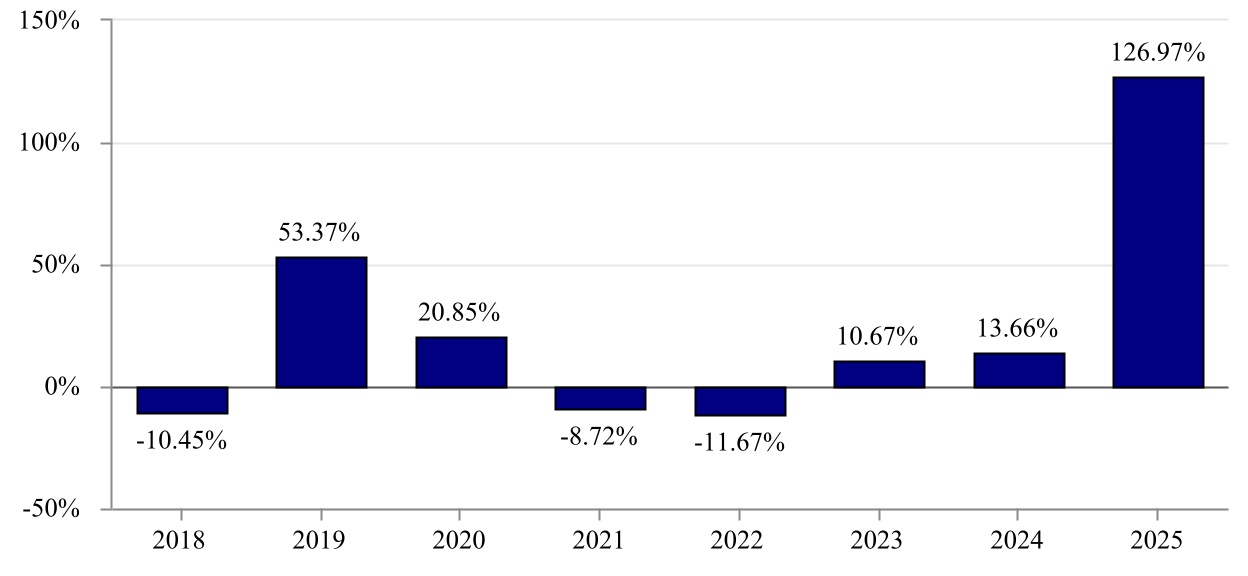
The following performance information indicates some of the risks of investing in the Fund. The bar chart shows the Fund’s performance for the calendar years ended December 31. The table illustrates how the Fund’s average annual returns for the 1-year, 5-year, and since inception periods compare with the S&P 500 ® Total Return Index, a broad measure of market performance, and the U.S. Global Go Gold and Precious Metal Miners Index, the Fund’s former underlying index. The Fund’s past performance, before and after taxes, does not necessarily indicate how it will perform in the future. Updated performance information is available on the Fund’s website at www.usglobaletfs.com.
The Fund’s investment objective and strategies changed effective December 30, 2025. Fund performance prior to December 30, 2025 reflects the Fund’s investment objective and strategies when it sought to provide returns that tracked the performance of the U.S. Global Go Gold and Precious Metal Miners Index.
Calendar Year Total Returns
During the period of time shown in the bar chart, the Fund’s highest quarterly return was 69.41% for the quarter ended June 30, 2020, and the lowest quarterly return was -31.04% for the quarter ended June 30, 2022.
Average Annual Total Returns
For the Periods Ended December 31, 2025
| | | | | | | | | | | |
| U.S. Global GO GOLD and Precious Metal Miners ETF |
1 Year | 5 Years | Since Inception (6/27/2017) |
| Return Before Taxes | 126.97% | 18.15% | 17.95% |
| Return After Taxes on Distributions | 126.55% | 17.94% | 17.53% |
| Return After Taxes on Distributions and Sale of Fund Shares | 75.60% | 14.78% | 15.04% |
U.S. Global Go Gold and Precious Metal Miners Index* (reflects no deduction for fees, expenses, or taxes) | 158.28% | 21.22% | 18.92% |
S&P 500® Total Return Index (reflects no deduction for fees, expenses, or taxes) | 17.88% | 14.42% | 14.89% |
* Prior to December 30, 2025 , the Fund tracked the performance of the U.S. Global Go Gold and Precious Metal Miners Index.
After-tax returns are calculated using the historical highest individual federal marginal income tax rates during the period covered by the table above and do not reflect the impact of state and local taxes. Actual after-tax returns depend on an investor’s tax situation and may differ from those shown. After-tax returns shown are not relevant to investors who hold their Shares through tax-deferred arrangements such as an individual retirement account (“IRA”) or other tax-advantaged accounts.
Management
Investment Adviser
U.S. Global Investors, Inc. serves as investment adviser to the Fund.
Portfolio Managers
The Fund is managed by a team consisting of Frank E. Holmes and Ralph P. Aldis. Frank E. Holmes, Chief Executive Officer and Director for the Adviser, has been a portfolio manager of the Fund since its inception in June 2017. Ralph P. Aldis, CFA, a Portfolio Manager for the Adviser, has been a portfolio manager of the Fund since its inception in June 2017.
Purchase and Sale of Shares
Shares are listed on the Exchange, and individual Shares may only be bought and sold in the secondary market through brokers at market prices, rather than NAV. Because Shares trade at market prices rather than NAV, Shares may trade at a price greater than NAV (premium) or less than NAV (discount).
The Fund issues and redeems Shares at NAV only in large blocks known as “Creation Units,” which only APs (typically, broker-dealers) may purchase or redeem. The Fund generally issues and redeems Creation Units in exchange for a portfolio of securities and/or a designated amount of U.S. cash.
Investors may incur costs attributable to the difference between the highest price a buyer is willing to pay to purchase Shares (bid) and the lowest price a seller is willing to accept for Shares (ask) when buying or selling Shares in the secondary market (the “bid-ask spread”). Recent information about the Fund, including its NAV, market price, premiums and discounts, and bid-ask spreads is available on the Fund’s website at www.usglobaletfs.com.
Tax Information
Fund distributions are generally taxable as ordinary income, qualified dividend income, or capital gains (or a combination), unless your investment is in an IRA or other tax-advantaged account. Distributions on investments made through tax-deferred arrangements may be taxed later upon withdrawal of assets from those accounts.
Financial Intermediary Compensation
If you purchase Shares through a broker-dealer or other financial intermediary (such as a bank) (an “Intermediary”), the Adviser or its affiliates may pay Intermediaries for certain activities related to the Fund, including participation in activities that are designed to make Intermediaries more knowledgeable about exchange traded products, including the Fund, or for other activities, such as marketing, educational training or other initiatives related to the sale or promotion of Shares. These payments may create a conflict of interest by influencing the Intermediary and your salesperson to recommend the Fund over another investment. Any such arrangements do not result in increased Fund expenses. Ask your salesperson or visit the Intermediary’s website for more information.