Investment Strategy
Apr. 27, 2026
The Fund is an actively managed exchange-traded fund (“ETF”) that, under normal market conditions, invests substantially all of its assets in FLexible EXchange® Options (“FLEX Options”) that reference the share price return of the SPDR® S&P 500® ETF Trust (the “Underlying ETF”). Due to the unique mechanics of the Fund’s strategy, the return an investor can expect to receive from an investment in the Fund has characteristics that are distinct from many other investment vehicles. It is important that an investor understand these characteristics before making an investment in the Fund.
The Fund uses FLEX Options to employ a “structured outcome strategy.” Structured outcome strategies seek to produce pre-determined target investment outcomes based upon the performance of an underlying security or index. The pre-determined outcomes sought by the Fund are intended to reflect the performance of the Underlying ETF over the period (the “Investment Period”), subject to a buffer (the “Buffer”) against certain Underlying ETF losses and a cap (the “Cap”) as set forth in the following table:
| Investment Period Start | Investment Period End | Buffer (before Fund fees and expenses) | Buffer (after Fund fees and expenses) | Cap (before Fund fees and expenses) | Cap (after Fund fees and expenses) | ||||||||||||
| May 1, 2026 | January 29, 2027 | 15% | 14.51% | 9.43% | 8.98% | ||||||||||||
The Current Investment Period
The current and first Investment Period of the Fund’s operation is less than a full calendar year, beginning on May 1, 2026 and ending on January 29, 2027. For the current Investment Period, the Cap is 9.43% before taking into account any fees or expenses charged to, or transaction costs incurred by, the Fund or Underlying ETF. When the Fund’s annualized management fee of 0.49% of its average daily net assets is taken into account, the Cap for the current Investment Period is reduced to 8.98%. The returns that the Fund seeks to provide do not take into account the costs associated with buying shares of the Underlying Fund and any other expenses incurred by the Fund. The Fund’s website, www.paceretfs.com/products/structured-outcome-strategie, provides more information about the potential outcomes of an investment in the Fund during the current Investment Period, including the remaining Cap.
The Underlying ETF
In general, the structured outcomes the Fund seeks for investors that hold Fund shares for an entire Investment Period are as follows, though there can be no guarantee these results will be achieved:
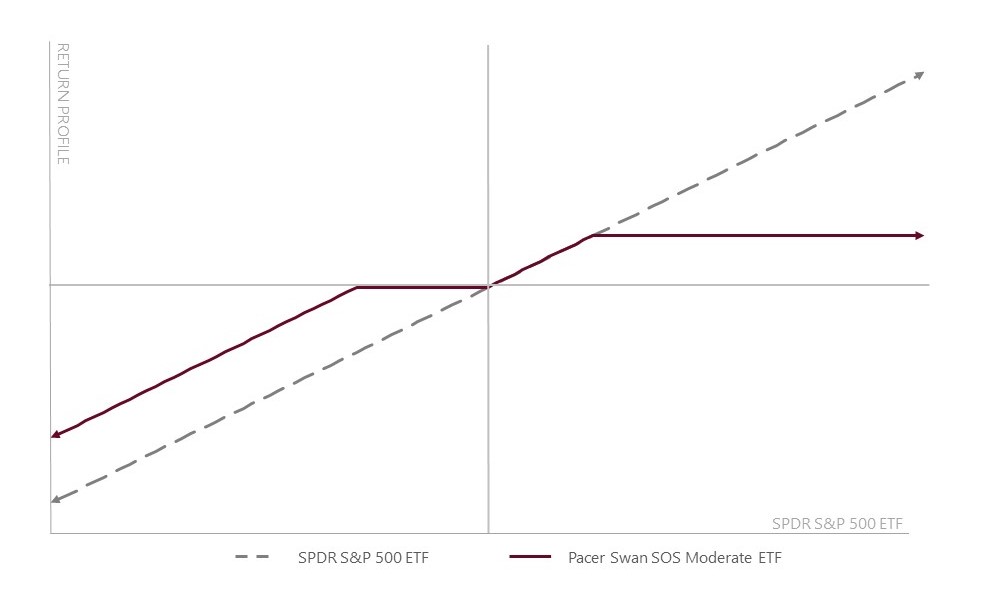
•If the Underlying ETF appreciates over the Investment Period, the strategy is intended to provide upside participation that matches the returns of the Underlying ETF, up to the Cap that is determined at the start of the Investment Period.
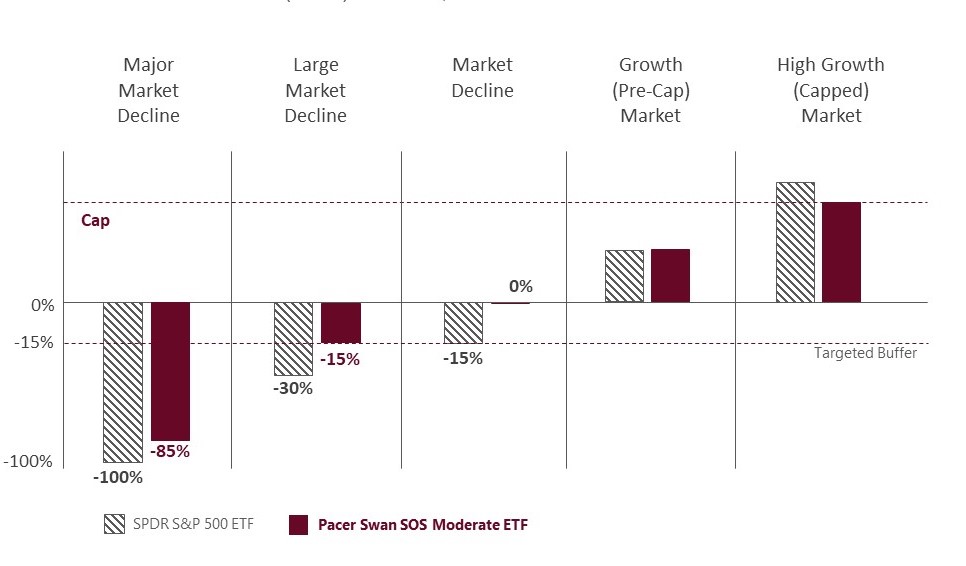
•If the Underlying ETF declines in value over the Investment Period by up to 15%, the strategy is designed to provide a flat return for the Fund (i.e., neither a gain nor a loss), before fees and expenses of the Fund. For example, if the Underlying ETF loses 10% over the Investment Period, the strategy is designed for the Fund to have a flat return of 0%, before fees and expenses of the Fund.
•If the Underlying ETF declines in value over the Investment Period, the strategy is designed to protect the Fund from the first 15% of Underlying ETF losses, while experiencing losses greater than 15% on a one-to-one basis with the Underlying ETF, before fees and expenses of the Fund. For example, if the Underlying ETF loses 20% over the Investment Period, the strategy is designed for the Fund to have losses of 5% (20% less the Buffer of 15%), before Fund fees and expenses.
The following charts illustrate the hypothetical returns that the FLEX Options seek to provide with respect to the performance of the Underlying ETF in certain illustrative scenarios over the course of the Investment Period. These charts do not take into account payment by the Fund of fees and expenses. There is no guarantee that the Fund will be successful in providing these investment outcomes for any Investment Period.
Investors purchasing Shares during an Investment Period will experience different results. The Fund’s website, www.paceretfs.com/products/structured-outcome-strategies, provides information relating to the possible outcomes for an investor of an investment in the Fund on a daily basis, including the Fund’s position relative to the Cap and Buffer. Before purchasing Shares, an investor should visit the Fund’s website to review this information and understand the possible outcomes of an investment in Shares on a particular day.
Subsequent Investment Periods will begin on the day the prior Investment Period ends and will end on the approximate one-year anniversary of that new Investment Period. On the first day of each new Investment Period, the Fund resets by investing in a new set of FLEX Options that will provide a new Cap for the new Investment Period. This means that the Cap will change for each Investment Period based upon prevailing market conditions at the beginning of each Investment
Period. The Cap and Buffer, and the Fund’s position relative to each, should be considered before investing in the Fund. The Fund will be perpetually offered and not terminate after the current or any subsequent Investment Period.
Purchases During an Investment Period
An investor that purchases Shares other than on the first day of an Investment Period and/or sells Shares prior to the end of an Investment Period may experience results that are very different from the outcomes sought by the Fund for that Investment Period.
Both the Cap and Buffer are fixed levels that are calculated in relation to the Underlying ETF’s share price return and the Fund’s net asset value (“NAV”) at the start of an Investment Period. While the Cap and Buffer reference the performance of the Underlying ETF over the Investment Period, the Fund expects its NAV to experience the same general price movement, Cap, and Buffer as a percentage gain or loss by the Underlying ETF over the Investment Period, before fees and expenses of the Fund.
Because the Underlying ETF’s share price return and the Fund’s NAV change over the Investment Period, an investor acquiring Shares after the start of the Investment Period will likely have a different return potential than an investor who purchased Shares at the start of the Investment Period. This is because, while the Cap and Buffer for the Investment Period are fixed levels that remain constant throughout the Investment Period, an investor purchasing Shares at market value during the Investment Period likely purchased Shares at a price that is different from the Fund’s NAV at the start of the Investment Period (i.e., the NAV that the Cap and Buffer reference). In addition, the price of the Underlying ETF during the Investment Period is likely to be different from the price of the Underlying ETF at the start of the Investment Period. To achieve the structured outcomes sought by the Fund for an Investment Period, an investor must hold Shares for the entire Investment Period. An investment in the Fund may not be appropriate for investors who do not intend to hold the Fund for the entire Investment Period.
Buffer
The Fund seeks to provide a Buffer on the first 15% loss of the Underlying ETF over each Investment Period. After the Underlying ETF has decreased in price by more than 15%, the Fund is expected to experience subsequent losses on a one-to-one basis (e.g., if the Underlying ETF loses 20%, the Fund loses 5%). The Buffer is before taking into account the fees and expenses of the Fund charged to shareholders.
If an investor is considering purchasing Shares during the Investment Period and the Fund has already decreased in value by at least 15% since the first day of the Investment Period (the “Initial Fund Value”), an investor purchasing Shares at that price will have increased gains available prior to reaching the Cap but may not benefit from the Buffer that the Fund seeks to offer for the remainder of the Investment Period. The Cap and Buffer relative to the Initial Fund Value will not change over the Investment Period.
Conversely, if an investor is considering purchasing Shares during the Investment Period and the Fund has already increased in value, then a shareholder may experience losses prior to gaining the protection offered by the Buffer, which is not guaranteed.
The Buffer only provides limited downside protection. Once losses on the Underlying ETF exceed the Buffer, investors will bear the risk of any further losses.
Cap
The returns of the Fund are subject to the Cap set forth in the above table for the Investment Period. Unlike other investment products, the potential returns an investor can receive from the Fund are subject to a pre-determined upside return Cap that represents the maximum percentage return an investor can achieve from an investment in the Fund for an entire Investment Period. In the event the Underlying ETF experiences gains over an Investment Period, the Fund seeks to provide investment returns that match the percentage increase of the Underlying ETF, but any percentage gains over the amount of the Cap will not be experienced by the Fund. This means that, if the Underlying ETF experiences gains for an Investment Period in excess of the Cap for that Investment Period, the Fund will not benefit from those excess gains. Therefore, regardless of the performance of the Underlying ETF, the Cap is the maximum return an investor can achieve from an investment in the Fund for that Investment Period.
An investor who sells Shares before the end of an Investment Period may not fully realize the maximum return during the Investment Period and may be exposed to greater risk of loss and less potential gain.
The Cap is set on the first day of each Investment Period. Following the close of business on the last day of the Investment Period, the Fund will supplement its prospectus by filing and mailing to shareholders a notice disclosing the Fund’s Cap for the next Investment Period if such Cap is lower than the Cap for the prior Investment Period. The information will also be available on the Fund’s website at www.paceretfs.com/products/structured-outcome-strategies.
The Cap is determined prior to taking into account annual operating expenses of the Fund, which are disclosed above under “Fees and Expenses of the Fund,” as well as brokerage commissions, trading fees, taxes, and any extraordinary expenses incurred by the Fund. Such extraordinary expenses (incurred outside of the ordinary operation of the Fund) may include, for example, unexpected litigation, regulatory, or tax expenses.
The Cap level is a result of the design of the Fund’s principal investment strategy. To provide the Buffer, the Fund purchases a series of put and call FLEX Options on the first day of an Investment Period. As the purchaser of these FLEX Options, the Fund is obligated to pay a premium to the seller of those FLEX Options. The portfolio manager will calculate the amount of premiums that the Fund will owe on the put options acquired and sold to provide the Buffer and will then go into the market and sell call options with terms that entitle the Fund to receive premiums such that the net amount of premiums paid per unit of the Underlying ETF is approximately equal to the price per unit of shares of the Underlying ETF. The Cap is the strike price of those sold FLEX Options. The defined Cap applicable to an Investment Period will vary based on prevailing market conditions at the time, including then-current interest rate levels, Underlying ETF volatility, and the relationship of puts and calls on the underlying FLEX Options.
The Cap, and the Fund’s position relative to it on any given day, should be considered before investing in the Fund. If an investor purchases Shares during an Investment Period, and the Fund has already increased in value above its Initial Fund Value for that Investment Period to a level near to the Cap, an investor purchasing Shares will have limited to no gain potential for the remainder of the Investment Period. However, the investor will remain vulnerable to significant downside risk because the investor will bear the losses between the price at which it purchased its Shares and the Initial Fund Value for the Investment Period before subsequent losses will be protected by the Buffer.
General Information about FLEX Options
FLEX Options are exchange-traded options contracts with uniquely customizable terms like exercise price, style, and expiration date. The Underlying ETF is an exchange-traded unit investment trust that seeks to provide investment results that, before expenses, correspond generally to the performance of the S&P 500® Index. The Underlying ETF uses a full replication strategy, meaning it invests in all of the component securities of the S&P 500® Index in the same approximate proportions as in the S&P 500® Index. See “Additional Information About the Funds—The Underlying ETF” below for more information.
The FLEX Options that the Fund will hold that reference the Underlying ETF will give the Fund the right to receive or deliver shares of the Underlying ETF on the option expiration date at a strike price, depending on whether the option is a put or call option and whether the Fund purchases or sells the option. The FLEX Options held by the Fund are European-style options, which are exercisable at the strike price only on the FLEX Option expiration date.
The Fund will generally, under normal conditions, hold four kinds of FLEX Options for each Investment Period. The Fund will purchase a call option (giving the Fund the right to receive shares of the Underlying ETF) and a put option (giving the Fund the right to deliver shares of the Underlying ETF), while simultaneously selling (i.e., writing) a call option (giving the Fund the obligation to deliver shares of the Underlying ETF) and a put option (giving the Fund the obligation to receive shares of the Underlying ETF). The Fund intends to structure the FLEX Options so that any amount owed by the Fund on the written FLEX Options will be covered by payouts at expiration from the purchased FLEX Options. As a result, the FLEX Options will be fully covered and no additional collateral will be necessary during the life of the Fund. The Fund receives premiums in exchange for the written FLEX Options and pays premiums in exchange for the purchased FLEX Options. Each of the FLEX Options purchased and sold throughout the Investment Period will have the same terms, such as strike price and expiration date, as the FLEX Options purchased and sold on the first day of the Investment Period.
On the FLEX Options’ expiration date, the Fund intends to sell the FLEX Options prior to their expiration and use the resulting proceeds to purchase new FLEX Options for the next Investment Period.
The Fund is classified as “non-diversified” under the Investment Company Act of 1940, as amended (the “1940 Act”).
The Fund is an actively managed exchange-traded fund (“ETF”) that, under normal market conditions, invests substantially all of its assets in FLexible EXchange® Options (“FLEX Options”) that reference the share price return of the SPDR® S&P 500® ETF Trust (the “Underlying ETF”). Due to the unique mechanics of the Fund’s strategy, the return an investor can expect to receive from an investment in the Fund has characteristics that are distinct from many other investment vehicles. It is important that an investor understand these characteristics before making an investment in the Fund.
The Fund uses FLEX Options to employ a “structured outcome strategy.” Structured outcome strategies seek to produce pre-determined target investment outcomes based upon the performance of an underlying security or index. The pre-determined outcomes sought by the Fund are intended to reflect the performance of the Underlying ETF over the period (the “Investment Period”), subject to a buffer (the “Buffer”) against certain Underlying ETF losses and a cap (the “Cap”) as set forth in the following table:
| Investment Period Start | Investment Period End | Buffer (before Fund fees and expenses) | Buffer (after Fund fees and expenses) | Cap (before Fund fees and expenses) | Cap (after Fund fees and expenses) | ||||||||||||
| May 1, 2026 | February 26, 2027 | 15% | 14.51% | 10.38% | 9.88% | ||||||||||||
The Current Investment Period
The current and first Investment Period of the Fund’s operation is less than a full calendar year, beginning on May 1, 2026 and ending on February 26, 2027. For the current Investment Period, the Cap is 10.38% before taking into account any fees or expenses charged to, or transaction costs incurred by, the Fund or Underlying ETF. When the Fund’s annualized management fee of 0.49% of its average daily net assets is taken into account, the Cap for the current Investment Period is reduced to 9.88%. The returns that the Fund seeks to provide do not take into account the costs associated with buying shares of the Underlying Fund and any other expenses incurred by the Fund. The Fund’s website, www.paceretfs.com/products/structured-outcome-strategie, provides more information about the potential outcomes of an investment in the Fund during the current Investment Period, including the remaining Cap.
The Underlying ETF
In general, the structured outcomes the Fund seeks for investors that hold Fund shares for an entire Investment Period are as follows, though there can be no guarantee these results will be achieved:
•If the Underlying ETF appreciates over the Investment Period, the strategy is intended to provide upside participation that matches the returns of the Underlying ETF, up to the Cap that is determined at the start of the Investment Period.
•If the Underlying ETF declines in value over the Investment Period by up to 15%, the strategy is designed to provide a flat return for the Fund (i.e., neither a gain nor a loss), before fees and expenses of the Fund. For example, if the Underlying ETF loses 10% over the Investment Period, the strategy is designed for the Fund to have a flat return of 0%, before fees and expenses of the Fund.
•If the Underlying ETF declines in value over the Investment Period, the strategy is designed to protect the Fund from the first 15% of Underlying ETF losses, while experiencing losses greater than 15% on a one-to-one basis with the Underlying ETF, before fees and expenses of the Fund. For example, if the Underlying ETF loses 20% over the Investment Period, the strategy is designed for the Fund to have losses of 5% (20% less the Buffer of 15%), before Fund fees and expenses.
The following charts illustrate the hypothetical returns that the FLEX Options seek to provide with respect to the performance of the Underlying ETF in certain illustrative scenarios over the course of the Investment Period. These charts do not take into account payment by the Fund of fees and expenses. There is no guarantee that the Fund will be successful in providing these investment outcomes for any Investment Period.
Investors purchasing Shares during an Investment Period will experience different results. The Fund’s website, www.paceretfs.com/products/structured-outcome-strategies, provides information relating to the possible outcomes for an investor of an investment in the Fund on a daily basis, including the Fund’s position relative to the Cap and Buffer. Before purchasing Shares, an investor should visit the Fund’s website to review this information and understand the possible outcomes of an investment in Shares on a particular day.
Subsequent Investment Periods will begin on the day the prior Investment Period ends and will end on the approximate one-year anniversary of that new Investment Period. On the first day of each new Investment Period, the Fund resets by investing in a new set of FLEX Options that will provide a new Cap for the new Investment Period. This means that the Cap will change for each Investment Period based upon prevailing market conditions at the beginning of each Investment
Period. The Cap and Buffer, and the Fund’s position relative to each, should be considered before investing in the Fund. The Fund will be perpetually offered and not terminate after the current or any subsequent Investment Period.
Purchases During an Investment Period
An investor that purchases Shares other than on the first day of an Investment Period and/or sells Shares prior to the end of an Investment Period may experience results that are very different from the outcomes sought by the Fund for that Investment Period.
Both the Cap and Buffer are fixed levels that are calculated in relation to the Underlying ETF’s share price return and the Fund’s net asset value (“NAV”) at the start of an Investment Period. While the Cap and Buffer reference the performance of the Underlying ETF over the Investment Period, the Fund expects its NAV to experience the same general price movement, Cap, and Buffer as a percentage gain or loss by the Underlying ETF over the Investment Period, before fees and expenses of the Fund.
Because the Underlying ETF’s share price return and the Fund’s NAV change over the Investment Period, an investor acquiring Shares after the start of the Investment Period will likely have a different return potential than an investor who purchased Shares at the start of the Investment Period. This is because, while the Cap and Buffer for the Investment Period are fixed levels that remain constant throughout the Investment Period, an investor purchasing Shares at market value during the Investment Period likely purchased Shares at a price that is different from the Fund’s NAV at the start of the Investment Period (i.e., the NAV that the Cap and Buffer reference). In addition, the price of the Underlying ETF during the Investment Period is likely to be different from the price of the Underlying ETF at the start of the Investment Period. To achieve the structured outcomes sought by the Fund for an Investment Period, an investor must hold Shares for the entire Investment Period. An investment in the Fund may not be appropriate for investors who do not intend to hold the Fund for the entire Investment Period.
Buffer
The Fund seeks to provide a Buffer on the first 15% loss of the Underlying ETF over each Investment Period. After the Underlying ETF has decreased in price by more than 15%, the Fund is expected to experience subsequent losses on a one-to-one basis (e.g., if the Underlying ETF loses 20%, the Fund loses 5%). The Buffer is before taking into account the fees and expenses of the Fund charged to shareholders.
If an investor is considering purchasing Shares during the Investment Period and the Fund has already decreased in value by at least 15% since the first day of the Investment Period (the “Initial Fund Value”), an investor purchasing Shares at that price will have increased gains available prior to reaching the Cap but may not benefit from the Buffer that the Fund seeks to offer for the remainder of the Investment Period. The Cap and Buffer relative to the Initial Fund Value will not change over the Investment Period.
Conversely, if an investor is considering purchasing Shares during the Investment Period and the Fund has already increased in value, then a shareholder may experience losses prior to gaining the protection offered by the Buffer, which is not guaranteed.
The Buffer only provides limited downside protection. Once losses on the Underlying ETF exceed the Buffer, investors will bear the risk of any further losses.
Cap
The returns of the Fund are subject to the Cap set forth in the above table for the Investment Period. Unlike other investment products, the potential returns an investor can receive from the Fund are subject to a pre-determined upside return Cap that represents the maximum percentage return an investor can achieve from an investment in the Fund for an entire Investment Period. In the event the Underlying ETF experiences gains over an Investment Period, the Fund seeks to provide investment returns that match the percentage increase of the Underlying ETF, but any percentage gains over the amount of the Cap will not be experienced by the Fund. This means that, if the Underlying ETF experiences gains for an Investment Period in excess of the Cap for that Investment Period, the Fund will not benefit from those excess gains. Therefore, regardless of the performance of the Underlying ETF, the Cap is the maximum return an investor can achieve from an investment in the Fund for that Investment Period.
An investor who sells Shares before the end of an Investment Period may not fully realize the maximum return during the Investment Period and may be exposed to greater risk of loss and less potential gain.
The Cap is set on the first day of each Investment Period. Following the close of business on the last day of the Investment Period, the Fund will supplement its prospectus by filing and mailing to shareholders a notice disclosing the Fund’s Cap for the next Investment Period if such Cap is lower than the Cap for the prior Investment Period. The information will also be available on the Fund’s website at www.paceretfs.com/products/structured-outcome-strategies.
The Cap is determined prior to taking into account annual operating expenses of the Fund, which are disclosed above under “Fees and Expenses of the Fund,” as well as brokerage commissions, trading fees, taxes, and any extraordinary expenses incurred by the Fund. Such extraordinary expenses (incurred outside of the ordinary operation of the Fund) may include, for example, unexpected litigation, regulatory, or tax expenses.
The Cap level is a result of the design of the Fund’s principal investment strategy. To provide the Buffer, the Fund purchases a series of put and call FLEX Options on the first day of an Investment Period. As the purchaser of these FLEX Options, the Fund is obligated to pay a premium to the seller of those FLEX Options. The portfolio manager will calculate the amount of premiums that the Fund will owe on the put options acquired and sold to provide the Buffer and will then go into the market and sell call options with terms that entitle the Fund to receive premiums such that the net amount of premiums paid per unit of the Underlying ETF is approximately equal to the price per unit of shares of the Underlying ETF. The Cap is the strike price of those sold FLEX Options. The defined Cap applicable to an Investment Period will vary based on prevailing market conditions at the time, including then-current interest rate levels, Underlying ETF volatility, and the relationship of puts and calls on the underlying FLEX Options.
The Cap, and the Fund’s position relative to it on any given day, should be considered before investing in the Fund. If an investor purchases Shares during an Investment Period, and the Fund has already increased in value above its Initial Fund Value for that Investment Period to a level near to the Cap, an investor purchasing Shares will have limited to no gain potential for the remainder of the Investment Period. However, the investor will remain vulnerable to significant downside risk because the investor will bear the losses between the price at which it purchased its Shares and the Initial Fund Value for the Investment Period before subsequent losses will be protected by the Buffer.
General Information about FLEX Options
FLEX Options are exchange-traded options contracts with uniquely customizable terms like exercise price, style, and expiration date. The Underlying ETF is an exchange-traded unit investment trust that seeks to provide investment results that, before expenses, correspond generally to the performance of the S&P 500® Index. The Underlying ETF uses a full replication strategy, meaning it invests in all of the component securities of the S&P 500® Index in the same approximate proportions as in the S&P 500® Index. See “Additional Information About the Funds—The Underlying ETF” below for more information.
The FLEX Options that the Fund will hold that reference the Underlying ETF will give the Fund the right to receive or deliver shares of the Underlying ETF on the option expiration date at a strike price, depending on whether the option is a put or call option and whether the Fund purchases or sells the option. The FLEX Options held by the Fund are European-style options, which are exercisable at the strike price only on the FLEX Option expiration date.
The Fund will generally, under normal conditions, hold four kinds of FLEX Options for each Investment Period. The Fund will purchase a call option (giving the Fund the right to receive shares of the Underlying ETF) and a put option (giving the Fund the right to deliver shares of the Underlying ETF), while simultaneously selling (i.e., writing) a call option (giving the Fund the obligation to deliver shares of the Underlying ETF) and a put option (giving the Fund the obligation to receive shares of the Underlying ETF). The Fund intends to structure the FLEX Options so that any amount owed by the Fund on the written FLEX Options will be covered by payouts at expiration from the purchased FLEX Options. As a result, the FLEX Options will be fully covered and no additional collateral will be necessary during the life of the Fund. The Fund receives premiums in exchange for the written FLEX Options and pays premiums in exchange for the purchased FLEX Options. Each of the FLEX Options purchased and sold throughout the Investment Period will have the same terms, such as strike price and expiration date, as the FLEX Options purchased and sold on the first day of the Investment Period.
On the FLEX Options’ expiration date, the Fund intends to sell the FLEX Options prior to their expiration and use the resulting proceeds to purchase new FLEX Options for the next Investment Period.
The Fund is classified as “non-diversified” under the Investment Company Act of 1940, as amended (the “1940 Act”).
The Fund is an actively managed exchange-traded fund (“ETF”) that, under normal market conditions, invests substantially all of its assets in FLexible EXchange® Options (“FLEX Options”) that reference the share price return of the SPDR® S&P 500® ETF Trust (the “Underlying ETF”). Due to the unique mechanics of the Fund’s strategy, the return an investor can expect to receive from an investment in the Fund has characteristics that are distinct from many other investment vehicles. It is important that an investor understand these characteristics before making an investment in the Fund.
The Fund uses FLEX Options to employ a “structured outcome strategy.” Structured outcome strategies seek to produce pre-determined target investment outcomes based upon the performance of an underlying security or index. The pre-determined outcomes sought by the Fund are intended to reflect the performance of the Underlying ETF over the period (the “Investment Period”), subject to a buffer (the “Buffer”) against certain Underlying ETF losses and a cap (the “Cap”) as set forth in the following table:
| Investment Period Start | Investment Period End | Buffer (before Fund fees and expenses) | Buffer (after Fund fees and expenses) | Cap (before Fund fees and expenses) | Cap (after Fund fees and expenses) | ||||||||||||
| May 1, 2026 | April 30, 2027 | 15% | 14.51% | 12.76% | 12.16% | ||||||||||||
The Current Investment Period
The current and first Investment Period of the Fund’s operation is less than a full calendar year, beginning on May 1, 2026 and ending on April 30, 2027. For the current Investment Period, the Cap is 12.76% before taking into account any fees or expenses charged to, or transaction costs incurred by, the Fund or Underlying ETF. When the Fund’s annualized management fee of 0.49% of its average daily net assets is taken into account, the Cap for the current Investment Period is reduced to 12.16%. The returns that the Fund seeks to provide do not take into account the costs associated with buying shares of the Underlying Fund and any other expenses incurred by the Fund. The Fund’s website, www.paceretfs.com/products/structured-outcome-strategie, provides more information about the potential outcomes of an investment in the Fund during the current Investment Period, including the remaining Cap.
The Underlying ETF
In general, the structured outcomes the Fund seeks for investors that hold Fund shares for an entire Investment Period are as follows, though there can be no guarantee these results will be achieved:
•If the Underlying ETF appreciates over the Investment Period, the strategy is intended to provide upside participation that matches the returns of the Underlying ETF, up to the Cap that is determined at the start of the Investment Period.
•If the Underlying ETF declines in value over the Investment Period by up to 15%, the strategy is designed to provide a flat return for the Fund (i.e., neither a gain nor a loss), before fees and expenses of the Fund. For example, if the Underlying ETF loses 10% over the Investment Period, the strategy is designed for the Fund to have a flat return of 0%, before fees and expenses of the Fund.
•If the Underlying ETF declines in value over the Investment Period, the strategy is designed to protect the Fund from the first 15% of Underlying ETF losses, while experiencing losses greater than 15% on a one-to-one basis with the Underlying ETF, before fees and expenses of the Fund. For example, if the Underlying ETF loses 20% over the Investment Period, the strategy is designed for the Fund to have losses of 5% (20% less the Buffer of 15%), before Fund fees and expenses.
The following charts illustrate the hypothetical returns that the FLEX Options seek to provide with respect to the performance of the Underlying ETF in certain illustrative scenarios over the course of the Investment Period. These charts do not take into account payment by the Fund of fees and expenses. There is no guarantee that the Fund will be successful in providing these investment outcomes for any Investment Period.
Investors purchasing Shares during an Investment Period will experience different results. The Fund’s website, www.paceretfs.com/products/structured-outcome-strategies, provides information relating to the possible outcomes for an investor of an investment in the Fund on a daily basis, including the Fund’s position relative to the Cap and Buffer. Before purchasing Shares, an investor should visit the Fund’s website to review this information and understand the possible outcomes of an investment in Shares on a particular day.
Subsequent Investment Periods will begin on the day the prior Investment Period ends and will end on the approximate one-year anniversary of that new Investment Period. On the first day of each new Investment Period, the Fund resets by investing in a new set of FLEX Options that will provide a new Cap for the new Investment Period. This means that the Cap will change for each Investment Period based upon prevailing market conditions at the beginning of each Investment
Period. The Cap and Buffer, and the Fund’s position relative to each, should be considered before investing in the Fund. The Fund will be perpetually offered and not terminate after the current or any subsequent Investment Period.
Purchases During an Investment Period
An investor that purchases Shares other than on the first day of an Investment Period and/or sells Shares prior to the end of an Investment Period may experience results that are very different from the outcomes sought by the Fund for that Investment Period.
Both the Cap and Buffer are fixed levels that are calculated in relation to the Underlying ETF’s share price return and the Fund’s net asset value (“NAV”) at the start of an Investment Period. While the Cap and Buffer reference the performance of the Underlying ETF over the Investment Period, the Fund expects its NAV to experience the same general price movement, Cap, and Buffer as a percentage gain or loss by the Underlying ETF over the Investment Period, before fees and expenses of the Fund.
Because the Underlying ETF’s share price return and the Fund’s NAV change over the Investment Period, an investor acquiring Shares after the start of the Investment Period will likely have a different return potential than an investor who purchased Shares at the start of the Investment Period. This is because, while the Cap and Buffer for the Investment Period are fixed levels that remain constant throughout the Investment Period, an investor purchasing Shares at market value during the Investment Period likely purchased Shares at a price that is different from the Fund’s NAV at the start of the Investment Period (i.e., the NAV that the Cap and Buffer reference). In addition, the price of the Underlying ETF during the Investment Period is likely to be different from the price of the Underlying ETF at the start of the Investment Period. To achieve the structured outcomes sought by the Fund for an Investment Period, an investor must hold Shares for the entire Investment Period. An investment in the Fund may not be appropriate for investors who do not intend to hold the Fund for the entire Investment Period.
Buffer
The Fund seeks to provide a Buffer on the first 15% loss of the Underlying ETF over each Investment Period. After the Underlying ETF has decreased in price by more than 15%, the Fund is expected to experience subsequent losses on a one-to-one basis (e.g., if the Underlying ETF loses 20%, the Fund loses 5%). The Buffer is before taking into account the fees and expenses of the Fund charged to shareholders.
If an investor is considering purchasing Shares during the Investment Period and the Fund has already decreased in value by at least 15% since the first day of the Investment Period (the “Initial Fund Value”), an investor purchasing Shares at that price will have increased gains available prior to reaching the Cap but may not benefit from the Buffer that the Fund seeks to offer for the remainder of the Investment Period. The Cap and Buffer relative to the Initial Fund Value will not change over the Investment Period.
Conversely, if an investor is considering purchasing Shares during the Investment Period and the Fund has already increased in value, then a shareholder may experience losses prior to gaining the protection offered by the Buffer, which is not guaranteed.
The Buffer only provides limited downside protection. Once losses on the Underlying ETF exceed the Buffer, investors will bear the risk of any further losses.
Cap
The returns of the Fund are subject to the Cap set forth in the above table for the Investment Period. Unlike other investment products, the potential returns an investor can receive from the Fund are subject to a pre-determined upside return Cap that represents the maximum percentage return an investor can achieve from an investment in the Fund for an entire Investment Period. In the event the Underlying ETF experiences gains over an Investment Period, the Fund seeks to provide investment returns that match the percentage increase of the Underlying ETF, but any percentage gains over the amount of the Cap will not be experienced by the Fund. This means that, if the Underlying ETF experiences gains for an Investment Period in excess of the Cap for that Investment Period, the Fund will not benefit from those excess gains. Therefore, regardless of the performance of the Underlying ETF, the Cap is the maximum return an investor can achieve from an investment in the Fund for that Investment Period.
An investor who sells Shares before the end of an Investment Period may not fully realize the maximum return during the Investment Period and may be exposed to greater risk of loss and less potential gain.
The Cap is set on the first day of each Investment Period. Following the close of business on the last day of the Investment Period, the Fund will supplement its prospectus by filing and mailing to shareholders a notice disclosing the Fund’s Cap for the next Investment Period if such Cap is lower than the Cap for the prior Investment Period. The information will also be available on the Fund’s website at www.paceretfs.com/products/structured-outcome-strategies.
The Cap is determined prior to taking into account annual operating expenses of the Fund, which are disclosed above under “Fees and Expenses of the Fund,” as well as brokerage commissions, trading fees, taxes, and any extraordinary expenses incurred by the Fund. Such extraordinary expenses (incurred outside of the ordinary operation of the Fund) may include, for example, unexpected litigation, regulatory, or tax expenses.
The Cap level is a result of the design of the Fund’s principal investment strategy. To provide the Buffer, the Fund purchases a series of put and call FLEX Options on the first day of an Investment Period. As the purchaser of these FLEX Options, the Fund is obligated to pay a premium to the seller of those FLEX Options. The portfolio manager will calculate the amount of premiums that the Fund will owe on the put options acquired and sold to provide the Buffer and will then go into the market and sell call options with terms that entitle the Fund to receive premiums such that the net amount of premiums paid per unit of the Underlying ETF is approximately equal to the price per unit of shares of the Underlying ETF. The Cap is the strike price of those sold FLEX Options. The defined Cap applicable to an Investment Period will vary based on prevailing market conditions at the time, including then-current interest rate levels, Underlying ETF volatility, and the relationship of puts and calls on the underlying FLEX Options.
The Cap, and the Fund’s position relative to it on any given day, should be considered before investing in the Fund. If an investor purchases Shares during an Investment Period, and the Fund has already increased in value above its Initial Fund Value for that Investment Period to a level near to the Cap, an investor purchasing Shares will have limited to no gain potential for the remainder of the Investment Period. However, the investor will remain vulnerable to significant downside risk because the investor will bear the losses between the price at which it purchased its Shares and the Initial Fund Value for the Investment Period before subsequent losses will be protected by the Buffer.
General Information about FLEX Options
FLEX Options are exchange-traded options contracts with uniquely customizable terms like exercise price, style, and expiration date. The Underlying ETF is an exchange-traded unit investment trust that seeks to provide investment results that, before expenses, correspond generally to the performance of the S&P 500® Index. The Underlying ETF uses a full replication strategy, meaning it invests in all of the component securities of the S&P 500® Index in the same approximate proportions as in the S&P 500® Index. See “Additional Information About the Funds—The Underlying ETF” below for more information.
The FLEX Options that the Fund will hold that reference the Underlying ETF will give the Fund the right to receive or deliver shares of the Underlying ETF on the option expiration date at a strike price, depending on whether the option is a put or call option and whether the Fund purchases or sells the option. The FLEX Options held by the Fund are European-style options, which are exercisable at the strike price only on the FLEX Option expiration date.
The Fund will generally, under normal conditions, hold four kinds of FLEX Options for each Investment Period. The Fund will purchase a call option (giving the Fund the right to receive shares of the Underlying ETF) and a put option (giving the Fund the right to deliver shares of the Underlying ETF), while simultaneously selling (i.e., writing) a call option (giving the Fund the obligation to deliver shares of the Underlying ETF) and a put option (giving the Fund the obligation to receive shares of the Underlying ETF). The Fund intends to structure the FLEX Options so that any amount owed by the Fund on the written FLEX Options will be covered by payouts at expiration from the purchased FLEX Options. As a result, the FLEX Options will be fully covered and no additional collateral will be necessary during the life of the Fund. The Fund receives premiums in exchange for the written FLEX Options and pays premiums in exchange for the purchased FLEX Options. Each of the FLEX Options purchased and sold throughout the Investment Period will have the same terms, such as strike price and expiration date, as the FLEX Options purchased and sold on the first day of the Investment Period.
On the FLEX Options’ expiration date, the Fund intends to sell the FLEX Options prior to their expiration and use the resulting proceeds to purchase new FLEX Options for the next Investment Period.
The Fund is classified as “non-diversified” under the Investment Company Act of 1940, as amended (the “1940 Act”).
The Fund is an actively managed exchange-traded fund (“ETF”) that, under normal market conditions, invests substantially all of its assets in FLexible EXchange® Options (“FLEX Options”) that reference the share price return of the SPDR® S&P 500® ETF Trust (the “Underlying ETF”). Due to the unique mechanics of the Fund’s strategy, the return an investor can expect to receive from an investment in the Fund has characteristics that are distinct from many other investment vehicles. It is important that an investor understand these characteristics before making an investment in the Fund.
The Fund uses FLEX Options to employ a “structured outcome strategy.” Structured outcome strategies seek to produce pre-determined target investment outcomes based upon the performance of an underlying security or index. The pre-determined outcomes sought by the Fund are intended to reflect the performance of the Underlying ETF over the period (the “Investment Period”), subject to a buffer (the “Buffer”) against certain Underlying ETF losses and a cap (the “Cap”) as set forth in the following table:
| Investment Period Start | Investment Period End | Buffer (before Fund fees and expenses) | Buffer (after Fund fees and expenses) | Cap (before Fund fees and expenses) | Cap (after Fund fees and expenses) | ||||||||||||
| May 1, 2026 | May 29, 2026 | 15% | 14.51% | 0.75% | 0.70% | ||||||||||||
The Current Investment Period
The current and first Investment Period of the Fund’s operation is less than a full calendar year, beginning on May 1, 2026 and ending on May 29, 2026. For the current Investment Period, the Cap is 0.75% before taking into account any fees or expenses charged to, or transaction costs incurred by, the Fund or Underlying ETF. When the Fund’s annualized management fee of 0.49% of its average daily net assets is taken into account, the Cap for the current Investment Period is reduced to 0.70%. The returns that the Fund seeks to provide do not take into account the costs associated with buying shares of the Underlying Fund and any other expenses incurred by the Fund. The Fund’s website, www.paceretfs.com/products/structured-outcome-strategie, provides more information about the potential outcomes of an investment in the Fund during the current Investment Period, including the remaining Cap.
The Underlying ETF
In general, the structured outcomes the Fund seeks for investors that hold Fund shares for an entire Investment Period are as follows, though there can be no guarantee these results will be achieved:
•If the Underlying ETF appreciates over the Investment Period, the strategy is intended to provide upside participation that matches the returns of the Underlying ETF, up to the Cap that is determined at the start of the Investment Period.
•If the Underlying ETF declines in value over the Investment Period by up to 15%, the strategy is designed to provide a flat return for the Fund (i.e., neither a gain nor a loss), before fees and expenses of the Fund. For example, if the Underlying ETF loses 10% over the Investment Period, the strategy is designed for the Fund to have a flat return of 0%, before fees and expenses of the Fund.
•If the Underlying ETF declines in value over the Investment Period, the strategy is designed to protect the Fund from the first 15% of Underlying ETF losses, while experiencing losses greater than 15% on a one-to-one basis with the Underlying ETF, before fees and expenses of the Fund. For example, if the Underlying ETF loses 20% over the Investment Period, the strategy is designed for the Fund to have losses of 5% (20% less the Buffer of 15%), before Fund fees and expenses.
The following charts illustrate the hypothetical returns that the FLEX Options seek to provide with respect to the performance of the Underlying ETF in certain illustrative scenarios over the course of the Investment Period. These charts do not take into account payment by the Fund of fees and expenses. There is no guarantee that the Fund will be successful in providing these investment outcomes for any Investment Period.
Investors purchasing Shares during an Investment Period will experience different results. The Fund’s website, www.paceretfs.com/products/structured-outcome-strategies, provides information relating to the possible outcomes for an investor of an investment in the Fund on a daily basis, including the Fund’s position relative to the Cap and Buffer. Before purchasing Shares, an investor should visit the Fund’s website to review this information and understand the possible outcomes of an investment in Shares on a particular day.
Subsequent Investment Periods will begin on the day the prior Investment Period ends and will end on the approximate one-year anniversary of that new Investment Period. On the first day of each new Investment Period, the Fund resets by investing in a new set of FLEX Options that will provide a new Cap for the new Investment Period. This means that the Cap will change for each Investment Period based upon prevailing market conditions at the beginning of each Investment
Period. The Cap and Buffer, and the Fund’s position relative to each, should be considered before investing in the Fund. The Fund will be perpetually offered and not terminate after the current or any subsequent Investment Period.
Purchases During an Investment Period
An investor that purchases Shares other than on the first day of an Investment Period and/or sells Shares prior to the end of an Investment Period may experience results that are very different from the outcomes sought by the Fund for that Investment Period.
Both the Cap and Buffer are fixed levels that are calculated in relation to the Underlying ETF’s share price return and the Fund’s net asset value (“NAV”) at the start of an Investment Period. While the Cap and Buffer reference the performance of the Underlying ETF over the Investment Period, the Fund expects its NAV to experience the same general price movement, Cap, and Buffer as a percentage gain or loss by the Underlying ETF over the Investment Period, before fees and expenses of the Fund.
Because the Underlying ETF’s share price return and the Fund’s NAV change over the Investment Period, an investor acquiring Shares after the start of the Investment Period will likely have a different return potential than an investor who purchased Shares at the start of the Investment Period. This is because, while the Cap and Buffer for the Investment Period are fixed levels that remain constant throughout the Investment Period, an investor purchasing Shares at market value during the Investment Period likely purchased Shares at a price that is different from the Fund’s NAV at the start of the Investment Period (i.e., the NAV that the Cap and Buffer reference). In addition, the price of the Underlying ETF during the Investment Period is likely to be different from the price of the Underlying ETF at the start of the Investment Period. To achieve the structured outcomes sought by the Fund for an Investment Period, an investor must hold Shares for the entire Investment Period. An investment in the Fund may not be appropriate for investors who do not intend to hold the Fund for the entire Investment Period.
Buffer
The Fund seeks to provide a Buffer on the first 15% loss of the Underlying ETF over each Investment Period. After the Underlying ETF has decreased in price by more than 15%, the Fund is expected to experience subsequent losses on a one-to-one basis (e.g., if the Underlying ETF loses 20%, the Fund loses 5%). The Buffer is before taking into account the fees and expenses of the Fund charged to shareholders.
If an investor is considering purchasing Shares during the Investment Period and the Fund has already decreased in value by at least 15% since the first day of the Investment Period (the “Initial Fund Value”), an investor purchasing Shares at that price will have increased gains available prior to reaching the Cap but may not benefit from the Buffer that the Fund seeks to offer for the remainder of the Investment Period. The Cap and Buffer relative to the Initial Fund Value will not change over the Investment Period.
Conversely, if an investor is considering purchasing Shares during the Investment Period and the Fund has already increased in value, then a shareholder may experience losses prior to gaining the protection offered by the Buffer, which is not guaranteed.
The Buffer only provides limited downside protection. Once losses on the Underlying ETF exceed the Buffer, investors will bear the risk of any further losses.
Cap
The returns of the Fund are subject to the Cap set forth in the above table for the Investment Period. Unlike other investment products, the potential returns an investor can receive from the Fund are subject to a pre-determined upside return Cap that represents the maximum percentage return an investor can achieve from an investment in the Fund for an entire Investment Period. In the event the Underlying ETF experiences gains over an Investment Period, the Fund seeks to provide investment returns that match the percentage increase of the Underlying ETF, but any percentage gains over the amount of the Cap will not be experienced by the Fund. This means that, if the Underlying ETF experiences gains for an Investment Period in excess of the Cap for that Investment Period, the Fund will not benefit from those excess gains. Therefore, regardless of the performance of the Underlying ETF, the Cap is the maximum return an investor can achieve from an investment in the Fund for that Investment Period.
An investor who sells Shares before the end of an Investment Period may not fully realize the maximum return during the Investment Period and may be exposed to greater risk of loss and less potential gain.
The Cap is set on the first day of each Investment Period. Following the close of business on the last day of the Investment Period, the Fund will supplement its prospectus by filing and mailing to shareholders a notice disclosing the Fund’s Cap for the next Investment Period if such Cap is lower than the Cap for the prior Investment Period. The information will also be available on the Fund’s website at www.paceretfs.com/products/structured-outcome-strategies.
The Cap is determined prior to taking into account annual operating expenses of the Fund, which are disclosed above under “Fees and Expenses of the Fund,” as well as brokerage commissions, trading fees, taxes, and any extraordinary expenses incurred by the Fund. Such extraordinary expenses (incurred outside of the ordinary operation of the Fund) may include, for example, unexpected litigation, regulatory, or tax expenses.
The Cap level is a result of the design of the Fund’s principal investment strategy. To provide the Buffer, the Fund purchases a series of put and call FLEX Options on the first day of an Investment Period. As the purchaser of these FLEX Options, the Fund is obligated to pay a premium to the seller of those FLEX Options. The portfolio manager will calculate the amount of premiums that the Fund will owe on the put options acquired and sold to provide the Buffer and will then go into the market and sell call options with terms that entitle the Fund to receive premiums such that the net amount of premiums paid per unit of the Underlying ETF is approximately equal to the price per unit of shares of the Underlying ETF. The Cap is the strike price of those sold FLEX Options. The defined Cap applicable to an Investment Period will vary based on prevailing market conditions at the time, including then-current interest rate levels, Underlying ETF volatility, and the relationship of puts and calls on the underlying FLEX Options.
The Cap, and the Fund’s position relative to it on any given day, should be considered before investing in the Fund. If an investor purchases Shares during an Investment Period, and the Fund has already increased in value above its Initial Fund Value for that Investment Period to a level near to the Cap, an investor purchasing Shares will have limited to no gain potential for the remainder of the Investment Period. However, the investor will remain vulnerable to significant downside risk because the investor will bear the losses between the price at which it purchased its Shares and the Initial Fund Value for the Investment Period before subsequent losses will be protected by the Buffer.
General Information about FLEX Options
FLEX Options are exchange-traded options contracts with uniquely customizable terms like exercise price, style, and expiration date. The Underlying ETF is an exchange-traded unit investment trust that seeks to provide investment results that, before expenses, correspond generally to the performance of the S&P 500® Index. The Underlying ETF uses a full replication strategy, meaning it invests in all of the component securities of the S&P 500® Index in the same approximate proportions as in the S&P 500® Index. See “Additional Information About the Funds—The Underlying ETF” below for more information.
The FLEX Options that the Fund will hold that reference the Underlying ETF will give the Fund the right to receive or deliver shares of the Underlying ETF on the option expiration date at a strike price, depending on whether the option is a put or call option and whether the Fund purchases or sells the option. The FLEX Options held by the Fund are European-style options, which are exercisable at the strike price only on the FLEX Option expiration date.
The Fund will generally, under normal conditions, hold four kinds of FLEX Options for each Investment Period. The Fund will purchase a call option (giving the Fund the right to receive shares of the Underlying ETF) and a put option (giving the Fund the right to deliver shares of the Underlying ETF), while simultaneously selling (i.e., writing) a call option (giving the Fund the obligation to deliver shares of the Underlying ETF) and a put option (giving the Fund the obligation to receive shares of the Underlying ETF). The Fund intends to structure the FLEX Options so that any amount owed by the Fund on the written FLEX Options will be covered by payouts at expiration from the purchased FLEX Options. As a result, the FLEX Options will be fully covered and no additional collateral will be necessary during the life of the Fund. The Fund receives premiums in exchange for the written FLEX Options and pays premiums in exchange for the purchased FLEX Options. Each of the FLEX Options purchased and sold throughout the Investment Period will have the same terms, such as strike price and expiration date, as the FLEX Options purchased and sold on the first day of the Investment Period.
On the FLEX Options’ expiration date, the Fund intends to sell the FLEX Options prior to their expiration and use the resulting proceeds to purchase new FLEX Options for the next Investment Period.
The Fund is classified as “non-diversified” under the Investment Company Act of 1940, as amended (the “1940 Act”).
The Fund is an actively managed exchange-traded fund (“ETF”) that, under normal market conditions, invests substantially all of its assets in FLexible EXchange® Options (“FLEX Options”) that reference the share price return of the SPDR® S&P 500® ETF Trust (the “Underlying ETF”). Due to the unique mechanics of the Fund’s strategy, the return an investor can expect to receive from an investment in the Fund has characteristics that are distinct from many other investment vehicles. It is important that an investor understand these characteristics before making an investment in the Fund.
The Fund uses FLEX Options to employ a “structured outcome strategy.” Structured outcome strategies seek to produce pre-determined target investment outcomes based upon the performance of an underlying security or index. The pre-determined outcomes sought by the Fund are intended to reflect the performance of the Underlying ETF over the period (the “Investment Period”), subject to a buffer (the “Buffer”) against certain Underlying ETF losses and a cap (the “Cap”) as set forth in the following table:
| Investment Period Start | Investment Period End | Buffer (before Fund fees and expenses) | Buffer (after Fund fees and expenses) | Cap (before Fund fees and expenses) | Cap (after Fund fees and expenses) | ||||||||||||
| May 1, 2026 | July 31, 2026 | 15% | 14.51% | 2.71% | 2.56% | ||||||||||||
The Current Investment Period
The current and first Investment Period of the Fund’s operation is less than a full calendar year, beginning on May 1, 2026 and ending on July 31, 2026. For the current Investment Period, the Cap is 2.71% before taking into account any fees or expenses charged to, or transaction costs incurred by, the Fund or Underlying ETF. When the Fund’s annualized management fee of 0.49% of its average daily net assets is taken into account, the Cap for the current Investment Period is reduced to 2.56%. The returns that the Fund seeks to provide do not take into account the costs associated with buying shares of the Underlying Fund and any other expenses incurred by the Fund. The Fund’s website, www.paceretfs.com/products/structured-outcome-strategie, provides more information about the potential outcomes of an investment in the Fund during the current Investment Period, including the remaining Cap.
The Underlying ETF
In general, the structured outcomes the Fund seeks for investors that hold Fund shares for an entire Investment Period are as follows, though there can be no guarantee these results will be achieved:
•If the Underlying ETF appreciates over the Investment Period, the strategy is intended to provide upside participation that matches the returns of the Underlying ETF, up to the Cap that is determined at the start of the Investment Period.
•If the Underlying ETF declines in value over the Investment Period by up to 15%, the strategy is designed to provide a flat return for the Fund (i.e., neither a gain nor a loss), before fees and expenses of the Fund. For example, if the Underlying ETF loses 10% over the Investment Period, the strategy is designed for the Fund to have a flat return of 0%, before fees and expenses of the Fund.
•If the Underlying ETF declines in value over the Investment Period, the strategy is designed to protect the Fund from the first 15% of Underlying ETF losses, while experiencing losses greater than 15% on a one-to-one basis with the Underlying ETF, before fees and expenses of the Fund. For example, if the Underlying ETF loses 20% over the Investment Period, the strategy is designed for the Fund to have losses of 5% (20% less the Buffer of 15%), before Fund fees and expenses.
The following charts illustrate the hypothetical returns that the FLEX Options seek to provide with respect to the performance of the Underlying ETF in certain illustrative scenarios over the course of the Investment Period. These charts do not take into account payment by the Fund of fees and expenses. There is no guarantee that the Fund will be successful in providing these investment outcomes for any Investment Period.
Investors purchasing Shares during an Investment Period will experience different results. The Fund’s website, www.paceretfs.com/products/structured-outcome-strategies, provides information relating to the possible outcomes for an investor of an investment in the Fund on a daily basis, including the Fund’s position relative to the Cap and Buffer. Before purchasing Shares, an investor should visit the Fund’s website to review this information and understand the possible outcomes of an investment in Shares on a particular day.
Subsequent Investment Periods will begin on the day the prior Investment Period ends and will end on the approximate one-year anniversary of that new Investment Period. On the first day of each new Investment Period, the Fund resets by investing in a new set of FLEX Options that will provide a new Cap for the new Investment Period. This means that the Cap will change for each Investment Period based upon prevailing market conditions at the beginning of each Investment
Period. The Cap and Buffer, and the Fund’s position relative to each, should be considered before investing in the Fund. The Fund will be perpetually offered and not terminate after the current or any subsequent Investment Period.
Purchases During an Investment Period
An investor that purchases Shares other than on the first day of an Investment Period and/or sells Shares prior to the end of an Investment Period may experience results that are very different from the outcomes sought by the Fund for that Investment Period.
Both the Cap and Buffer are fixed levels that are calculated in relation to the Underlying ETF’s share price return and the Fund’s net asset value (“NAV”) at the start of an Investment Period. While the Cap and Buffer reference the performance of the Underlying ETF over the Investment Period, the Fund expects its NAV to experience the same general price movement, Cap, and Buffer as a percentage gain or loss by the Underlying ETF over the Investment Period, before fees and expenses of the Fund.
Because the Underlying ETF’s share price return and the Fund’s NAV change over the Investment Period, an investor acquiring Shares after the start of the Investment Period will likely have a different return potential than an investor who purchased Shares at the start of the Investment Period. This is because, while the Cap and Buffer for the Investment Period are fixed levels that remain constant throughout the Investment Period, an investor purchasing Shares at market value during the Investment Period likely purchased Shares at a price that is different from the Fund’s NAV at the start of the Investment Period (i.e., the NAV that the Cap and Buffer reference). In addition, the price of the Underlying ETF during the Investment Period is likely to be different from the price of the Underlying ETF at the start of the Investment Period. To achieve the structured outcomes sought by the Fund for an Investment Period, an investor must hold Shares for the entire Investment Period. An investment in the Fund may not be appropriate for investors who do not intend to hold the Fund for the entire Investment Period.
Buffer
The Fund seeks to provide a Buffer on the first 15% loss of the Underlying ETF over each Investment Period. After the Underlying ETF has decreased in price by more than 15%, the Fund is expected to experience subsequent losses on a one-to-one basis (e.g., if the Underlying ETF loses 20%, the Fund loses 5%). The Buffer is before taking into account the fees and expenses of the Fund charged to shareholders.
If an investor is considering purchasing Shares during the Investment Period and the Fund has already decreased in value by at least 15% since the first day of the Investment Period (the “Initial Fund Value”), an investor purchasing Shares at that price will have increased gains available prior to reaching the Cap but may not benefit from the Buffer that the Fund seeks to offer for the remainder of the Investment Period. The Cap and Buffer relative to the Initial Fund Value will not change over the Investment Period.
Conversely, if an investor is considering purchasing Shares during the Investment Period and the Fund has already increased in value, then a shareholder may experience losses prior to gaining the protection offered by the Buffer, which is not guaranteed.
The Buffer only provides limited downside protection. Once losses on the Underlying ETF exceed the Buffer, investors will bear the risk of any further losses.
Cap
The returns of the Fund are subject to the Cap set forth in the above table for the Investment Period. Unlike other investment products, the potential returns an investor can receive from the Fund are subject to a pre-determined upside return Cap that represents the maximum percentage return an investor can achieve from an investment in the Fund for an entire Investment Period. In the event the Underlying ETF experiences gains over an Investment Period, the Fund seeks to provide investment returns that match the percentage increase of the Underlying ETF, but any percentage gains over the amount of the Cap will not be experienced by the Fund. This means that, if the Underlying ETF experiences gains for an Investment Period in excess of the Cap for that Investment Period, the Fund will not benefit from those excess gains. Therefore, regardless of the performance of the Underlying ETF, the Cap is the maximum return an investor can achieve from an investment in the Fund for that Investment Period.
An investor who sells Shares before the end of an Investment Period may not fully realize the maximum return during the Investment Period and may be exposed to greater risk of loss and less potential gain.
The Cap is set on the first day of each Investment Period. Following the close of business on the last day of the Investment Period, the Fund will supplement its prospectus by filing and mailing to shareholders a notice disclosing the Fund’s Cap for the next Investment Period if such Cap is lower than the Cap for the prior Investment Period. The information will also be available on the Fund’s website at www.paceretfs.com/products/structured-outcome-strategies.
The Cap is determined prior to taking into account annual operating expenses of the Fund, which are disclosed above under “Fees and Expenses of the Fund,” as well as brokerage commissions, trading fees, taxes, and any extraordinary expenses incurred by the Fund. Such extraordinary expenses (incurred outside of the ordinary operation of the Fund) may include, for example, unexpected litigation, regulatory, or tax expenses.
The Cap level is a result of the design of the Fund’s principal investment strategy. To provide the Buffer, the Fund purchases a series of put and call FLEX Options on the first day of an Investment Period. As the purchaser of these FLEX Options, the Fund is obligated to pay a premium to the seller of those FLEX Options. The portfolio manager will calculate the amount of premiums that the Fund will owe on the put options acquired and sold to provide the Buffer and will then go into the market and sell call options with terms that entitle the Fund to receive premiums such that the net amount of premiums paid per unit of the Underlying ETF is approximately equal to the price per unit of shares of the Underlying ETF. The Cap is the strike price of those sold FLEX Options. The defined Cap applicable to an Investment Period will vary based on prevailing market conditions at the time, including then-current interest rate levels, Underlying ETF volatility, and the relationship of puts and calls on the underlying FLEX Options.
The Cap, and the Fund’s position relative to it on any given day, should be considered before investing in the Fund. If an investor purchases Shares during an Investment Period, and the Fund has already increased in value above its Initial Fund Value for that Investment Period to a level near to the Cap, an investor purchasing Shares will have limited to no gain potential for the remainder of the Investment Period. However, the investor will remain vulnerable to significant downside risk because the investor will bear the losses between the price at which it purchased its Shares and the Initial Fund Value for the Investment Period before subsequent losses will be protected by the Buffer.
General Information about FLEX Options
FLEX Options are exchange-traded options contracts with uniquely customizable terms like exercise price, style, and expiration date. The Underlying ETF is an exchange-traded unit investment trust that seeks to provide investment results that, before expenses, correspond generally to the performance of the S&P 500® Index. The Underlying ETF uses a full replication strategy, meaning it invests in all of the component securities of the S&P 500® Index in the same approximate proportions as in the S&P 500® Index. See “Additional Information About the Funds—The Underlying ETF” below for more information.
The FLEX Options that the Fund will hold that reference the Underlying ETF will give the Fund the right to receive or deliver shares of the Underlying ETF on the option expiration date at a strike price, depending on whether the option is a put or call option and whether the Fund purchases or sells the option. The FLEX Options held by the Fund are European-style options, which are exercisable at the strike price only on the FLEX Option expiration date.
The Fund will generally, under normal conditions, hold four kinds of FLEX Options for each Investment Period. The Fund will purchase a call option (giving the Fund the right to receive shares of the Underlying ETF) and a put option (giving the Fund the right to deliver shares of the Underlying ETF), while simultaneously selling (i.e., writing) a call option (giving the Fund the obligation to deliver shares of the Underlying ETF) and a put option (giving the Fund the obligation to receive shares of the Underlying ETF). The Fund intends to structure the FLEX Options so that any amount owed by the Fund on the written FLEX Options will be covered by payouts at expiration from the purchased FLEX Options. As a result, the FLEX Options will be fully covered and no additional collateral will be necessary during the life of the Fund. The Fund receives premiums in exchange for the written FLEX Options and pays premiums in exchange for the purchased FLEX Options. Each of the FLEX Options purchased and sold throughout the Investment Period will have the same terms, such as strike price and expiration date, as the FLEX Options purchased and sold on the first day of the Investment Period.
On the FLEX Options’ expiration date, the Fund intends to sell the FLEX Options prior to their expiration and use the resulting proceeds to purchase new FLEX Options for the next Investment Period.
The Fund is classified as “non-diversified” under the Investment Company Act of 1940, as amended (the “1940 Act”).
The Fund is an actively managed exchange-traded fund (“ETF”) that, under normal market conditions, invests substantially all of its assets in FLexible EXchange® Options (“FLEX Options”) that reference the share price return of the SPDR® S&P 500® ETF Trust (the “Underlying ETF”). Due to the unique mechanics of the Fund’s strategy, the return an investor can expect to receive from an investment in the Fund has characteristics that are distinct from many other investment vehicles. It is important that an investor understand these characteristics before making an investment in the Fund.
The Fund uses FLEX Options to employ a “structured outcome strategy.” Structured outcome strategies seek to produce pre-determined target investment outcomes based upon the performance of an underlying security or index. The pre-determined outcomes sought by the Fund are intended to reflect the performance of the Underlying ETF over the period (the “Investment Period”), subject to a buffer (the “Buffer”) against certain Underlying ETF losses and a cap (the “Cap”) as set forth in the following table:
| Investment Period Start | Investment Period End | Buffer (before Fund fees and expenses) | Buffer (after Fund fees and expenses) | Cap (before Fund fees and expenses) | Cap (after Fund fees and expenses) | ||||||||||||
| May 1, 2026 | August 31, 2026 | 15% | 14.51% | 3.81% | 3.61% | ||||||||||||
The Current Investment Period
The current and first Investment Period of the Fund’s operation is less than a full calendar year, beginning on May 1, 2026 and ending on August 31, 2026. For the current Investment Period, the Cap is 3.81% before taking into account any fees or expenses charged to, or transaction costs incurred by, the Fund or Underlying ETF. When the Fund’s annualized management fee of 0.49% of its average daily net assets is taken into account, the Cap for the current Investment Period is reduced to 3.61%. The returns that the Fund seeks to provide do not take into account the costs associated with buying shares of the Underlying Fund and any other expenses incurred by the Fund. The Fund’s website, www.paceretfs.com/products/structured-outcome-strategie, provides more information about the potential outcomes of an investment in the Fund during the current Investment Period, including the remaining Cap.
The Underlying ETF
In general, the structured outcomes the Fund seeks for investors that hold Fund shares for an entire Investment Period are as follows, though there can be no guarantee these results will be achieved:
•If the Underlying ETF appreciates over the Investment Period, the strategy is intended to provide upside participation that matches the returns of the Underlying ETF, up to the Cap that is determined at the start of the Investment Period.
•If the Underlying ETF declines in value over the Investment Period by up to 15%, the strategy is designed to provide a flat return for the Fund (i.e., neither a gain nor a loss), before fees and expenses of the Fund. For example, if the Underlying ETF loses 10% over the Investment Period, the strategy is designed for the Fund to have a flat return of 0%, before fees and expenses of the Fund.
•If the Underlying ETF declines in value over the Investment Period, the strategy is designed to protect the Fund from the first 15% of Underlying ETF losses, while experiencing losses greater than 15% on a one-to-one basis with the Underlying ETF, before fees and expenses of the Fund. For example, if the Underlying ETF loses 20% over the Investment Period, the strategy is designed for the Fund to have losses of 5% (20% less the Buffer of 15%), before Fund fees and expenses.
The following charts illustrate the hypothetical returns that the FLEX Options seek to provide with respect to the performance of the Underlying ETF in certain illustrative scenarios over the course of the Investment Period. These charts do not take into account payment by the Fund of fees and expenses. There is no guarantee that the Fund will be successful in providing these investment outcomes for any Investment Period.
Investors purchasing Shares during an Investment Period will experience different results. The Fund’s website, www.paceretfs.com/products/structured-outcome-strategies, provides information relating to the possible outcomes for an investor of an investment in the Fund on a daily basis, including the Fund’s position relative to the Cap and Buffer. Before purchasing Shares, an investor should visit the Fund’s website to review this information and understand the possible outcomes of an investment in Shares on a particular day.
Subsequent Investment Periods will begin on the day the prior Investment Period ends and will end on the approximate one-year anniversary of that new Investment Period. On the first day of each new Investment Period, the Fund resets by investing in a new set of FLEX Options that will provide a new Cap for the new Investment Period. This means that the Cap will change for each Investment Period based upon prevailing market conditions at the beginning of each Investment
Period. The Cap and Buffer, and the Fund’s position relative to each, should be considered before investing in the Fund. The Fund will be perpetually offered and not terminate after the current or any subsequent Investment Period.
Purchases During an Investment Period
An investor that purchases Shares other than on the first day of an Investment Period and/or sells Shares prior to the end of an Investment Period may experience results that are very different from the outcomes sought by the Fund for that Investment Period.
Both the Cap and Buffer are fixed levels that are calculated in relation to the Underlying ETF’s share price return and the Fund’s net asset value (“NAV”) at the start of an Investment Period. While the Cap and Buffer reference the performance of the Underlying ETF over the Investment Period, the Fund expects its NAV to experience the same general price movement, Cap, and Buffer as a percentage gain or loss by the Underlying ETF over the Investment Period, before fees and expenses of the Fund.
Because the Underlying ETF’s share price return and the Fund’s NAV change over the Investment Period, an investor acquiring Shares after the start of the Investment Period will likely have a different return potential than an investor who purchased Shares at the start of the Investment Period. This is because, while the Cap and Buffer for the Investment Period are fixed levels that remain constant throughout the Investment Period, an investor purchasing Shares at market value during the Investment Period likely purchased Shares at a price that is different from the Fund’s NAV at the start of the Investment Period (i.e., the NAV that the Cap and Buffer reference). In addition, the price of the Underlying ETF during the Investment Period is likely to be different from the price of the Underlying ETF at the start of the Investment Period. To achieve the structured outcomes sought by the Fund for an Investment Period, an investor must hold Shares for the entire Investment Period. An investment in the Fund may not be appropriate for investors who do not intend to hold the Fund for the entire Investment Period.
Buffer
The Fund seeks to provide a Buffer on the first 15% loss of the Underlying ETF over each Investment Period. After the Underlying ETF has decreased in price by more than 15%, the Fund is expected to experience subsequent losses on a one-to-one basis (e.g., if the Underlying ETF loses 20%, the Fund loses 5%). The Buffer is before taking into account the fees and expenses of the Fund charged to shareholders.
If an investor is considering purchasing Shares during the Investment Period and the Fund has already decreased in value by at least 15% since the first day of the Investment Period (the “Initial Fund Value”), an investor purchasing Shares at that price will have increased gains available prior to reaching the Cap but may not benefit from the Buffer that the Fund seeks to offer for the remainder of the Investment Period. The Cap and Buffer relative to the Initial Fund Value will not change over the Investment Period.
Conversely, if an investor is considering purchasing Shares during the Investment Period and the Fund has already increased in value, then a shareholder may experience losses prior to gaining the protection offered by the Buffer, which is not guaranteed.
The Buffer only provides limited downside protection. Once losses on the Underlying ETF exceed the Buffer, investors will bear the risk of any further losses.
Cap
The returns of the Fund are subject to the Cap set forth in the above table for the Investment Period. Unlike other investment products, the potential returns an investor can receive from the Fund are subject to a pre-determined upside return Cap that represents the maximum percentage return an investor can achieve from an investment in the Fund for an entire Investment Period. In the event the Underlying ETF experiences gains over an Investment Period, the Fund seeks to provide investment returns that match the percentage increase of the Underlying ETF, but any percentage gains over the amount of the Cap will not be experienced by the Fund. This means that, if the Underlying ETF experiences gains for an Investment Period in excess of the Cap for that Investment Period, the Fund will not benefit from those excess gains. Therefore, regardless of the performance of the Underlying ETF, the Cap is the maximum return an investor can achieve from an investment in the Fund for that Investment Period.
An investor who sells Shares before the end of an Investment Period may not fully realize the maximum return during the Investment Period and may be exposed to greater risk of loss and less potential gain.
The Cap is set on the first day of each Investment Period. Following the close of business on the last day of the Investment Period, the Fund will supplement its prospectus by filing and mailing to shareholders a notice disclosing the Fund’s Cap for the next Investment Period if such Cap is lower than the Cap for the prior Investment Period. The information will also be available on the Fund’s website at www.paceretfs.com/products/structured-outcome-strategies.
The Cap is determined prior to taking into account annual operating expenses of the Fund, which are disclosed above under “Fees and Expenses of the Fund,” as well as brokerage commissions, trading fees, taxes, and any extraordinary expenses incurred by the Fund. Such extraordinary expenses (incurred outside of the ordinary operation of the Fund) may include, for example, unexpected litigation, regulatory, or tax expenses.
The Cap level is a result of the design of the Fund’s principal investment strategy. To provide the Buffer, the Fund purchases a series of put and call FLEX Options on the first day of an Investment Period. As the purchaser of these FLEX Options, the Fund is obligated to pay a premium to the seller of those FLEX Options. The portfolio manager will calculate the amount of premiums that the Fund will owe on the put options acquired and sold to provide the Buffer and will then go into the market and sell call options with terms that entitle the Fund to receive premiums such that the net amount of premiums paid per unit of the Underlying ETF is approximately equal to the price per unit of shares of the Underlying ETF. The Cap is the strike price of those sold FLEX Options. The defined Cap applicable to an Investment Period will vary based on prevailing market conditions at the time, including then-current interest rate levels, Underlying ETF volatility, and the relationship of puts and calls on the underlying FLEX Options.
The Cap, and the Fund’s position relative to it on any given day, should be considered before investing in the Fund. If an investor purchases Shares during an Investment Period, and the Fund has already increased in value above its Initial Fund Value for that Investment Period to a level near to the Cap, an investor purchasing Shares will have limited to no gain potential for the remainder of the Investment Period. However, the investor will remain vulnerable to significant downside risk because the investor will bear the losses between the price at which it purchased its Shares and the Initial Fund Value for the Investment Period before subsequent losses will be protected by the Buffer.
General Information about FLEX Options
FLEX Options are exchange-traded options contracts with uniquely customizable terms like exercise price, style, and expiration date. The Underlying ETF is an exchange-traded unit investment trust that seeks to provide investment results that, before expenses, correspond generally to the performance of the S&P 500® Index. The Underlying ETF uses a full replication strategy, meaning it invests in all of the component securities of the S&P 500® Index in the same approximate proportions as in the S&P 500® Index. See “Additional Information About the Funds—The Underlying ETF” below for more information.
The FLEX Options that the Fund will hold that reference the Underlying ETF will give the Fund the right to receive or deliver shares of the Underlying ETF on the option expiration date at a strike price, depending on whether the option is a put or call option and whether the Fund purchases or sells the option. The FLEX Options held by the Fund are European-style options, which are exercisable at the strike price only on the FLEX Option expiration date.
The Fund will generally, under normal conditions, hold four kinds of FLEX Options for each Investment Period. The Fund will purchase a call option (giving the Fund the right to receive shares of the Underlying ETF) and a put option (giving the Fund the right to deliver shares of the Underlying ETF), while simultaneously selling (i.e., writing) a call option (giving the Fund the obligation to deliver shares of the Underlying ETF) and a put option (giving the Fund the obligation to receive shares of the Underlying ETF). The Fund intends to structure the FLEX Options so that any amount owed by the Fund on the written FLEX Options will be covered by payouts at expiration from the purchased FLEX Options. As a result, the FLEX Options will be fully covered and no additional collateral will be necessary during the life of the Fund. The Fund receives premiums in exchange for the written FLEX Options and pays premiums in exchange for the purchased FLEX Options. Each of the FLEX Options purchased and sold throughout the Investment Period will have the same terms, such as strike price and expiration date, as the FLEX Options purchased and sold on the first day of the Investment Period.
On the FLEX Options’ expiration date, the Fund intends to sell the FLEX Options prior to their expiration and use the resulting proceeds to purchase new FLEX Options for the next Investment Period.
The Fund is classified as “non-diversified” under the Investment Company Act of 1940, as amended (the “1940 Act”).
The Fund is an actively managed exchange-traded fund (“ETF”) that, under normal market conditions, invests substantially all of its assets in FLexible EXchange® Options (“FLEX Options”) that reference the share price return of the SPDR® S&P 500® ETF Trust (the “Underlying ETF”). Due to the unique mechanics of the Fund’s strategy, the return an investor can expect to receive from an investment in the Fund has characteristics that are distinct from many other investment vehicles. It is important that an investor understand these characteristics before making an investment in the Fund.
The Fund uses FLEX Options to employ a “structured outcome strategy.” Structured outcome strategies seek to produce pre-determined target investment outcomes based upon the performance of an underlying security or index. The pre-determined outcomes sought by the Fund are intended to reflect the performance of the Underlying ETF over the period (the “Investment Period”), subject to a buffer (the “Buffer”) against certain Underlying ETF losses and a cap (the “Cap”) as set forth in the following table:
| Investment Period Start | Investment Period End | Buffer (before Fund fees and expenses) | Buffer (after Fund fees and expenses) | Cap (before Fund fees and expenses) | Cap (after Fund fees and expenses) | ||||||||||||
| May 1, 2026 | October 30, 2026 | 15% | 14.51% | 6.00% | 5.70% | ||||||||||||
The Current Investment Period
The current and first Investment Period of the Fund’s operation is less than a full calendar year, beginning on May 1, 2026 and ending on October 30, 2026. For the current Investment Period, the Cap is 6.00% before taking into account any fees or expenses charged to, or transaction costs incurred by, the Fund or Underlying ETF. When the Fund’s annualized management fee of 0.49% of its average daily net assets is taken into account, the Cap for the current Investment Period is reduced to 5.70%. The returns that the Fund seeks to provide do not take into account the costs associated with buying shares of the Underlying Fund and any other expenses incurred by the Fund. The Fund’s website, www.paceretfs.com/products/structured-outcome-strategie, provides more information about the potential outcomes of an investment in the Fund during the current Investment Period, including the remaining Cap.
The Underlying ETF
In general, the structured outcomes the Fund seeks for investors that hold Fund shares for an entire Investment Period are as follows, though there can be no guarantee these results will be achieved:
•If the Underlying ETF appreciates over the Investment Period, the strategy is intended to provide upside participation that matches the returns of the Underlying ETF, up to the Cap that is determined at the start of the Investment Period.
•If the Underlying ETF declines in value over the Investment Period by up to 15%, the strategy is designed to provide a flat return for the Fund (i.e., neither a gain nor a loss), before fees and expenses of the Fund. For example, if the Underlying ETF loses 10% over the Investment Period, the strategy is designed for the Fund to have a flat return of 0%, before fees and expenses of the Fund.
•If the Underlying ETF declines in value over the Investment Period, the strategy is designed to protect the Fund from the first 15% of Underlying ETF losses, while experiencing losses greater than 15% on a one-to-one basis with the Underlying ETF, before fees and expenses of the Fund. For example, if the Underlying ETF loses 20% over the Investment Period, the strategy is designed for the Fund to have losses of 5% (20% less the Buffer of 15%), before Fund fees and expenses.
The following charts illustrate the hypothetical returns that the FLEX Options seek to provide with respect to the performance of the Underlying ETF in certain illustrative scenarios over the course of the Investment Period. These charts do not take into account payment by the Fund of fees and expenses. There is no guarantee that the Fund will be successful in providing these investment outcomes for any Investment Period.
Investors purchasing Shares during an Investment Period will experience different results. The Fund’s website, www.paceretfs.com/products/structured-outcome-strategies, provides information relating to the possible outcomes for an investor of an investment in the Fund on a daily basis, including the Fund’s position relative to the Cap and Buffer. Before purchasing Shares, an investor should visit the Fund’s website to review this information and understand the possible outcomes of an investment in Shares on a particular day.
Subsequent Investment Periods will begin on the day the prior Investment Period ends and will end on the approximate one-year anniversary of that new Investment Period. On the first day of each new Investment Period, the Fund resets by investing in a new set of FLEX Options that will provide a new Cap for the new Investment Period. This means that the Cap will change for each Investment Period based upon prevailing market conditions at the beginning of each Investment
Period. The Cap and Buffer, and the Fund’s position relative to each, should be considered before investing in the Fund. The Fund will be perpetually offered and not terminate after the current or any subsequent Investment Period.
Purchases During an Investment Period
An investor that purchases Shares other than on the first day of an Investment Period and/or sells Shares prior to the end of an Investment Period may experience results that are very different from the outcomes sought by the Fund for that Investment Period.
Both the Cap and Buffer are fixed levels that are calculated in relation to the Underlying ETF’s share price return and the Fund’s net asset value (“NAV”) at the start of an Investment Period. While the Cap and Buffer reference the performance of the Underlying ETF over the Investment Period, the Fund expects its NAV to experience the same general price movement, Cap, and Buffer as a percentage gain or loss by the Underlying ETF over the Investment Period, before fees and expenses of the Fund.
Because the Underlying ETF’s share price return and the Fund’s NAV change over the Investment Period, an investor acquiring Shares after the start of the Investment Period will likely have a different return potential than an investor who purchased Shares at the start of the Investment Period. This is because, while the Cap and Buffer for the Investment Period are fixed levels that remain constant throughout the Investment Period, an investor purchasing Shares at market value during the Investment Period likely purchased Shares at a price that is different from the Fund’s NAV at the start of the Investment Period (i.e., the NAV that the Cap and Buffer reference). In addition, the price of the Underlying ETF during the Investment Period is likely to be different from the price of the Underlying ETF at the start of the Investment Period. To achieve the structured outcomes sought by the Fund for an Investment Period, an investor must hold Shares for the entire Investment Period. An investment in the Fund may not be appropriate for investors who do not intend to hold the Fund for the entire Investment Period.
Buffer
The Fund seeks to provide a Buffer on the first 15% loss of the Underlying ETF over each Investment Period. After the Underlying ETF has decreased in price by more than 15%, the Fund is expected to experience subsequent losses on a one-to-one basis (e.g., if the Underlying ETF loses 20%, the Fund loses 5%). The Buffer is before taking into account the fees and expenses of the Fund charged to shareholders.
If an investor is considering purchasing Shares during the Investment Period and the Fund has already decreased in value by at least 15% since the first day of the Investment Period (the “Initial Fund Value”), an investor purchasing Shares at that price will have increased gains available prior to reaching the Cap but may not benefit from the Buffer that the Fund seeks to offer for the remainder of the Investment Period. The Cap and Buffer relative to the Initial Fund Value will not change over the Investment Period.
Conversely, if an investor is considering purchasing Shares during the Investment Period and the Fund has already increased in value, then a shareholder may experience losses prior to gaining the protection offered by the Buffer, which is not guaranteed.
The Buffer only provides limited downside protection. Once losses on the Underlying ETF exceed the Buffer, investors will bear the risk of any further losses.
Cap
The returns of the Fund are subject to the Cap set forth in the above table for the Investment Period. Unlike other investment products, the potential returns an investor can receive from the Fund are subject to a pre-determined upside return Cap that represents the maximum percentage return an investor can achieve from an investment in the Fund for an entire Investment Period. In the event the Underlying ETF experiences gains over an Investment Period, the Fund seeks to provide investment returns that match the percentage increase of the Underlying ETF, but any percentage gains over the amount of the Cap will not be experienced by the Fund. This means that, if the Underlying ETF experiences gains for an Investment Period in excess of the Cap for that Investment Period, the Fund will not benefit from those excess gains. Therefore, regardless of the performance of the Underlying ETF, the Cap is the maximum return an investor can achieve from an investment in the Fund for that Investment Period.
An investor who sells Shares before the end of an Investment Period may not fully realize the maximum return during the Investment Period and may be exposed to greater risk of loss and less potential gain.
The Cap is set on the first day of each Investment Period. Following the close of business on the last day of the Investment Period, the Fund will supplement its prospectus by filing and mailing to shareholders a notice disclosing the Fund’s Cap for the next Investment Period if such Cap is lower than the Cap for the prior Investment Period. The information will also be available on the Fund’s website at www.paceretfs.com/products/structured-outcome-strategies.
The Cap is determined prior to taking into account annual operating expenses of the Fund, which are disclosed above under “Fees and Expenses of the Fund,” as well as brokerage commissions, trading fees, taxes, and any extraordinary expenses incurred by the Fund. Such extraordinary expenses (incurred outside of the ordinary operation of the Fund) may include, for example, unexpected litigation, regulatory, or tax expenses.
The Cap level is a result of the design of the Fund’s principal investment strategy. To provide the Buffer, the Fund purchases a series of put and call FLEX Options on the first day of an Investment Period. As the purchaser of these FLEX Options, the Fund is obligated to pay a premium to the seller of those FLEX Options. The portfolio manager will calculate the amount of premiums that the Fund will owe on the put options acquired and sold to provide the Buffer and will then go into the market and sell call options with terms that entitle the Fund to receive premiums such that the net amount of premiums paid per unit of the Underlying ETF is approximately equal to the price per unit of shares of the Underlying ETF. The Cap is the strike price of those sold FLEX Options. The defined Cap applicable to an Investment Period will vary based on prevailing market conditions at the time, including then-current interest rate levels, Underlying ETF volatility, and the relationship of puts and calls on the underlying FLEX Options.
The Cap, and the Fund’s position relative to it on any given day, should be considered before investing in the Fund. If an investor purchases Shares during an Investment Period, and the Fund has already increased in value above its Initial Fund Value for that Investment Period to a level near to the Cap, an investor purchasing Shares will have limited to no gain potential for the remainder of the Investment Period. However, the investor will remain vulnerable to significant downside risk because the investor will bear the losses between the price at which it purchased its Shares and the Initial Fund Value for the Investment Period before subsequent losses will be protected by the Buffer.
General Information about FLEX Options
FLEX Options are exchange-traded options contracts with uniquely customizable terms like exercise price, style, and expiration date. The Underlying ETF is an exchange-traded unit investment trust that seeks to provide investment results that, before expenses, correspond generally to the performance of the S&P 500® Index. The Underlying ETF uses a full replication strategy, meaning it invests in all of the component securities of the S&P 500® Index in the same approximate proportions as in the S&P 500® Index. See “Additional Information About the Funds—The Underlying ETF” below for more information.
The FLEX Options that the Fund will hold that reference the Underlying ETF will give the Fund the right to receive or deliver shares of the Underlying ETF on the option expiration date at a strike price, depending on whether the option is a put or call option and whether the Fund purchases or sells the option. The FLEX Options held by the Fund are European-style options, which are exercisable at the strike price only on the FLEX Option expiration date.
The Fund will generally, under normal conditions, hold four kinds of FLEX Options for each Investment Period. The Fund will purchase a call option (giving the Fund the right to receive shares of the Underlying ETF) and a put option (giving the Fund the right to deliver shares of the Underlying ETF), while simultaneously selling (i.e., writing) a call option (giving the Fund the obligation to deliver shares of the Underlying ETF) and a put option (giving the Fund the obligation to receive shares of the Underlying ETF). The Fund intends to structure the FLEX Options so that any amount owed by the Fund on the written FLEX Options will be covered by payouts at expiration from the purchased FLEX Options. As a result, the FLEX Options will be fully covered and no additional collateral will be necessary during the life of the Fund. The Fund receives premiums in exchange for the written FLEX Options and pays premiums in exchange for the purchased FLEX Options. Each of the FLEX Options purchased and sold throughout the Investment Period will have the same terms, such as strike price and expiration date, as the FLEX Options purchased and sold on the first day of the Investment Period.
On the FLEX Options’ expiration date, the Fund intends to sell the FLEX Options prior to their expiration and use the resulting proceeds to purchase new FLEX Options for the next Investment Period.
The Fund is classified as “non-diversified” under the Investment Company Act of 1940, as amended (the “1940 Act”).
The Fund is an actively managed exchange-traded fund (“ETF”) that, under normal market conditions, invests substantially all of its assets in FLexible EXchange® Options (“FLEX Options”) that reference the share price return of the SPDR® S&P 500® ETF Trust (the “Underlying ETF”). Due to the unique mechanics of the Fund’s strategy, the return an investor can expect to receive from an investment in the Fund has characteristics that are distinct from many other investment vehicles. It is important that an investor understand these characteristics before making an investment in the Fund.
The Fund uses FLEX Options to employ a “structured outcome strategy.” Structured outcome strategies seek to produce pre-determined target investment outcomes based upon the performance of an underlying security or index. The pre-determined outcomes sought by the Fund are intended to reflect the performance of the Underlying ETF over the period (the “Investment Period”), subject to a buffer (the “Buffer”) against certain Underlying ETF losses and a cap (the “Cap”) as set forth in the following table:
| Investment Period Start | Investment Period End | Buffer (before Fund fees and expenses) | Buffer (after Fund fees and expenses) | Cap (before Fund fees and expenses) | Cap (after Fund fees and expenses) | ||||||||||||
| May 1, 2026 | November 30, 2026 | 15% | 14.51% | 7.06% | 6.71% | ||||||||||||
The Current Investment Period
The current and first Investment Period of the Fund’s operation is less than a full calendar year, beginning on May 1, 2026 and ending on November 30, 2026. For the current Investment Period, the Cap is 7.06% before taking into account any fees or expenses charged to, or transaction costs incurred by, the Fund or Underlying ETF. When the Fund’s annualized management fee of 0.49% of its average daily net assets is taken into account, the Cap for the current Investment Period is reduced to 6.71%. The returns that the Fund seeks to provide do not take into account the costs associated with buying shares of the Underlying Fund and any other expenses incurred by the Fund. The Fund’s website, www.paceretfs.com/products/structured-outcome-strategie, provides more information about the potential outcomes of an investment in the Fund during the current Investment Period, including the remaining Cap.
The Underlying ETF
In general, the structured outcomes the Fund seeks for investors that hold Fund shares for an entire Investment Period are as follows, though there can be no guarantee these results will be achieved:
•If the Underlying ETF appreciates over the Investment Period, the strategy is intended to provide upside participation that matches the returns of the Underlying ETF, up to the Cap that is determined at the start of the Investment Period.
•If the Underlying ETF declines in value over the Investment Period by up to 15%, the strategy is designed to provide a flat return for the Fund (i.e., neither a gain nor a loss), before fees and expenses of the Fund. For example, if the Underlying ETF loses 10% over the Investment Period, the strategy is designed for the Fund to have a flat return of 0%, before fees and expenses of the Fund.
•If the Underlying ETF declines in value over the Investment Period, the strategy is designed to protect the Fund from the first 15% of Underlying ETF losses, while experiencing losses greater than 15% on a one-to-one basis with the Underlying ETF, before fees and expenses of the Fund. For example, if the Underlying ETF loses 20% over the Investment Period, the strategy is designed for the Fund to have losses of 5% (20% less the Buffer of 15%), before Fund fees and expenses.
The following charts illustrate the hypothetical returns that the FLEX Options seek to provide with respect to the performance of the Underlying ETF in certain illustrative scenarios over the course of the Investment Period. These charts do not take into account payment by the Fund of fees and expenses. There is no guarantee that the Fund will be successful in providing these investment outcomes for any Investment Period.
Investors purchasing Shares during an Investment Period will experience different results. The Fund’s website, www.paceretfs.com/products/structured-outcome-strategies, provides information relating to the possible outcomes for an investor of an investment in the Fund on a daily basis, including the Fund’s position relative to the Cap and Buffer. Before purchasing Shares, an investor should visit the Fund’s website to review this information and understand the possible outcomes of an investment in Shares on a particular day.
Subsequent Investment Periods will begin on the day the prior Investment Period ends and will end on the approximate one-year anniversary of that new Investment Period. On the first day of each new Investment Period, the Fund resets by investing in a new set of FLEX Options that will provide a new Cap for the new Investment Period. This means that the Cap will change for each Investment Period based upon prevailing market conditions at the beginning of each Investment
Period. The Cap and Buffer, and the Fund’s position relative to each, should be considered before investing in the Fund. The Fund will be perpetually offered and not terminate after the current or any subsequent Investment Period.
Purchases During an Investment Period
An investor that purchases Shares other than on the first day of an Investment Period and/or sells Shares prior to the end of an Investment Period may experience results that are very different from the outcomes sought by the Fund for that Investment Period.
Both the Cap and Buffer are fixed levels that are calculated in relation to the Underlying ETF’s share price return and the Fund’s net asset value (“NAV”) at the start of an Investment Period. While the Cap and Buffer reference the performance of the Underlying ETF over the Investment Period, the Fund expects its NAV to experience the same general price movement, Cap, and Buffer as a percentage gain or loss by the Underlying ETF over the Investment Period, before fees and expenses of the Fund.
Because the Underlying ETF’s share price return and the Fund’s NAV change over the Investment Period, an investor acquiring Shares after the start of the Investment Period will likely have a different return potential than an investor who purchased Shares at the start of the Investment Period. This is because, while the Cap and Buffer for the Investment Period are fixed levels that remain constant throughout the Investment Period, an investor purchasing Shares at market value during the Investment Period likely purchased Shares at a price that is different from the Fund’s NAV at the start of the Investment Period (i.e., the NAV that the Cap and Buffer reference). In addition, the price of the Underlying ETF during the Investment Period is likely to be different from the price of the Underlying ETF at the start of the Investment Period. To achieve the structured outcomes sought by the Fund for an Investment Period, an investor must hold Shares for the entire Investment Period. An investment in the Fund may not be appropriate for investors who do not intend to hold the Fund for the entire Investment Period.
Buffer
The Fund seeks to provide a Buffer on the first 15% loss of the Underlying ETF over each Investment Period. After the Underlying ETF has decreased in price by more than 15%, the Fund is expected to experience subsequent losses on a one-to-one basis (e.g., if the Underlying ETF loses 20%, the Fund loses 5%). The Buffer is before taking into account the fees and expenses of the Fund charged to shareholders.
If an investor is considering purchasing Shares during the Investment Period and the Fund has already decreased in value by at least 15% since the first day of the Investment Period (the “Initial Fund Value”), an investor purchasing Shares at that price will have increased gains available prior to reaching the Cap but may not benefit from the Buffer that the Fund seeks to offer for the remainder of the Investment Period. The Cap and Buffer relative to the Initial Fund Value will not change over the Investment Period.
Conversely, if an investor is considering purchasing Shares during the Investment Period and the Fund has already increased in value, then a shareholder may experience losses prior to gaining the protection offered by the Buffer, which is not guaranteed.
The Buffer only provides limited downside protection. Once losses on the Underlying ETF exceed the Buffer, investors will bear the risk of any further losses.
Cap
The returns of the Fund are subject to the Cap set forth in the above table for the Investment Period. Unlike other investment products, the potential returns an investor can receive from the Fund are subject to a pre-determined upside return Cap that represents the maximum percentage return an investor can achieve from an investment in the Fund for an entire Investment Period. In the event the Underlying ETF experiences gains over an Investment Period, the Fund seeks to provide investment returns that match the percentage increase of the Underlying ETF, but any percentage gains over the amount of the Cap will not be experienced by the Fund. This means that, if the Underlying ETF experiences gains for an Investment Period in excess of the Cap for that Investment Period, the Fund will not benefit from those excess gains. Therefore, regardless of the performance of the Underlying ETF, the Cap is the maximum return an investor can achieve from an investment in the Fund for that Investment Period.
An investor who sells Shares before the end of an Investment Period may not fully realize the maximum return during the Investment Period and may be exposed to greater risk of loss and less potential gain.
The Cap is set on the first day of each Investment Period. Following the close of business on the last day of the Investment Period, the Fund will supplement its prospectus by filing and mailing to shareholders a notice disclosing the Fund’s Cap for the next Investment Period if such Cap is lower than the Cap for the prior Investment Period. The information will also be available on the Fund’s website at www.paceretfs.com/products/structured-outcome-strategies.
The Cap is determined prior to taking into account annual operating expenses of the Fund, which are disclosed above under “Fees and Expenses of the Fund,” as well as brokerage commissions, trading fees, taxes, and any extraordinary expenses incurred by the Fund. Such extraordinary expenses (incurred outside of the ordinary operation of the Fund) may include, for example, unexpected litigation, regulatory, or tax expenses.
The Cap level is a result of the design of the Fund’s principal investment strategy. To provide the Buffer, the Fund purchases a series of put and call FLEX Options on the first day of an Investment Period. As the purchaser of these FLEX Options, the Fund is obligated to pay a premium to the seller of those FLEX Options. The portfolio manager will calculate the amount of premiums that the Fund will owe on the put options acquired and sold to provide the Buffer and will then go into the market and sell call options with terms that entitle the Fund to receive premiums such that the net amount of premiums paid per unit of the Underlying ETF is approximately equal to the price per unit of shares of the Underlying ETF. The Cap is the strike price of those sold FLEX Options. The defined Cap applicable to an Investment Period will vary based on prevailing market conditions at the time, including then-current interest rate levels, Underlying ETF volatility, and the relationship of puts and calls on the underlying FLEX Options.
The Cap, and the Fund’s position relative to it on any given day, should be considered before investing in the Fund. If an investor purchases Shares during an Investment Period, and the Fund has already increased in value above its Initial Fund Value for that Investment Period to a level near to the Cap, an investor purchasing Shares will have limited to no gain potential for the remainder of the Investment Period. However, the investor will remain vulnerable to significant downside risk because the investor will bear the losses between the price at which it purchased its Shares and the Initial Fund Value for the Investment Period before subsequent losses will be protected by the Buffer.
General Information about FLEX Options
FLEX Options are exchange-traded options contracts with uniquely customizable terms like exercise price, style, and expiration date. The Underlying ETF is an exchange-traded unit investment trust that seeks to provide investment results that, before expenses, correspond generally to the performance of the S&P 500® Index. The Underlying ETF uses a full replication strategy, meaning it invests in all of the component securities of the S&P 500® Index in the same approximate proportions as in the S&P 500® Index. See “Additional Information About the Funds—The Underlying ETF” below for more information.
The FLEX Options that the Fund will hold that reference the Underlying ETF will give the Fund the right to receive or deliver shares of the Underlying ETF on the option expiration date at a strike price, depending on whether the option is a put or call option and whether the Fund purchases or sells the option. The FLEX Options held by the Fund are European-style options, which are exercisable at the strike price only on the FLEX Option expiration date.
The Fund will generally, under normal conditions, hold four kinds of FLEX Options for each Investment Period. The Fund will purchase a call option (giving the Fund the right to receive shares of the Underlying ETF) and a put option (giving the Fund the right to deliver shares of the Underlying ETF), while simultaneously selling (i.e., writing) a call option (giving the Fund the obligation to deliver shares of the Underlying ETF) and a put option (giving the Fund the obligation to receive shares of the Underlying ETF). The Fund intends to structure the FLEX Options so that any amount owed by the Fund on the written FLEX Options will be covered by payouts at expiration from the purchased FLEX Options. As a result, the FLEX Options will be fully covered and no additional collateral will be necessary during the life of the Fund. The Fund receives premiums in exchange for the written FLEX Options and pays premiums in exchange for the purchased FLEX Options. Each of the FLEX Options purchased and sold throughout the Investment Period will have the same terms, such as strike price and expiration date, as the FLEX Options purchased and sold on the first day of the Investment Period.
On the FLEX Options’ expiration date, the Fund intends to sell the FLEX Options prior to their expiration and use the resulting proceeds to purchase new FLEX Options for the next Investment Period.
The Fund is classified as “non-diversified” under the Investment Company Act of 1940, as amended (the “1940 Act”).
The Fund seeks to achieve its investment objective by providing investors with U.S. equity market exposure while attempting to limit downside risk through a laddered portfolio of up to 12 Pacer Swan SOS Moderate ETFs (the “Underlying Swan Moderate ETFs”). The term “laddered portfolio” refers to the Fund’s investment in multiple Underlying Swan Moderate ETFs that have investment period expiration dates which occur on a rolling, or periodic, basis.
See below for a discussion of “structured outcome strategies” and their meaning within the strategies of the Underlying Swan Moderate ETFs. The rolling or “laddered” nature of the investments in the Underlying Swan Moderate ETFs creates diversification of investment time period compared to the risk of acquiring or disposing of any one Underlying Swan Moderate ETF at any one time. This diversification of investment time period is intended to mitigate the risk of failing to benefit from the buffer of a single Underlying Swan Moderate ETF due to the timing of investment in such Underlying Swan Moderate ETF and the relative price of the reference asset or having limited or no upside potential remaining because of the cap of a single Underlying Swan Moderate ETF.
The Fund’s laddered approach is intended to allow the Fund to continue to benefit from increases in the value of SPDR® S&P 500® ETF Trust and to provide a level of downside protection for at least a portion of the Fund’s portfolio at any given time. The Fund invests in the Underlying Swan Moderate ETFs in a laddered manner.
Unlike the Underlying Swan Moderate ETFs, the Fund itself does not pursue a structured outcome strategy. The buffer is only provided by the Underlying Swan Moderate ETFs and the Fund itself does not provide any stated buffer against losses. The Fund will likely not receive the full benefit of the Underlying Swan Moderate ETF buffers and could have limited upside potential. The Fund’s returns may be limited by the caps of the Underlying Swan Moderate ETFs.
Under normal market conditions, the Fund will invest substantially all of its assets in the Underlying Swan Moderate ETFs, which seek to provide investors with returns (before fees and expenses) that match the price return of SPDR® S&P 500® ETF TRUST, up to a predetermined upside cap, while providing a buffer (before fees and expenses) against the first 15% of SPDR® S&P 500® ETF TRUST losses, over a defined one-year period. The Fund intends only to acquire shares of Underlying Swan Moderate ETFs in the secondary market and will not engage in any principal transactions with the Underlying Swan Moderate ETFs. The Fund and each Underlying Swan Moderate ETF are advised by Pacer Advisors, Inc. (the “Adviser”) and sub-advised by Swan Global Management, LLC (“Swan” or the “Sub-Adviser”).
The investment objective of SPDR® S&P 500® ETF TRUST is to seek to provide investment results that, before expenses, correspond generally to the price and yield performance of the S&P 500® Index.
Structured Outcome Strategies
The Underlying Swan Moderate ETFs use a structured outcome strategy generally seek to produce pre-determined target investment outcomes for a specific period of time based upon the performance of an underlying security (such as an ETF) or index (a “reference asset”) through the use of a combination of call and put options on such reference asset. The pre-determined outcomes sought by such Underlying Swan Moderate ETFs may include a buffer against certain reference asset losses and a cap based on the performance of the reference asset over a fixed period of time (e.g., one year). Investments in such strategies reflect an investment in a portfolio of options linked to a reference asset that, when bought at inception of the strategy and held to the expiration of the options (an “Investment Period”), seeks to target returns that buffer against downside losses due to a decline in the reference asset, while providing participation up to a maximum capped gain in the reference asset.
The structure of the structured outcomes that such Underlying Swan Moderate ETFs seek for investors (such as the Fund) that hold Underlying Swan Moderate ETF shares for an entire Investment Period may vary significantly based on the amount, structure, and timing of their buffer and cap, though there can be no guarantee these results will be achieved. For example, such outcomes may be structured as follows:
•If the reference asset appreciates over the Investment Period, the combination of options held by the Underlying Swan Moderate ETF provides upside participation that is intended to match that of the reference asset, up to the cap that is determined at the start of the Investment Period.
•If the reference asset decreases over the Investment Period, the combination of options held by the Underlying Swan Moderate ETF provides a payoff at expiration that is intended to compensate for losses experienced by the reference asset (if any), in an amount not to exceed the Underlying Swan Moderate ETF’s buffer (e.g., 15%) before fees and expenses.
•If the reference asset has decreased in value by more than the buffer amount over the Investment Period, the Underlying Swan Moderate ETF will experience all subsequent losses greater than the buffer amount on a one-to-one basis with the reference asset.
Importantly, if the Fund purchases shares of an Underlying Swan Moderate ETF other than on the first day of an Investment Period and/or sells such shares prior to the end of an Investment Period, the Fund may experience results that are very different from the outcomes sought by the Underlying Swan Moderate ETF for that Investment Period. This is because, while the cap and buffer for the Investment Period are fixed levels that remain constant throughout the Investment Period, an investor purchasing Underlying Swan Moderate ETF shares at market value during the Investment
Period likely purchased such shares at a price that is different from the Underlying Swan Moderate ETF’s net asset value at the start of the Investment Period (i.e., the net asset value that the cap and buffer reference).
Structured outcome strategy Underlying Swan Moderate ETFs generally invest substantially all of their assets in FLexible EXchange® Options (“FLEX Options”). FLEX Options are exchange-traded options contracts with uniquely customizable terms like reference asset, exercise price, style, and expiration date. FLEX Options are guaranteed for settlement by the Options Clearing Corporation (“OCC”). The OCC guarantees performance by each of the counterparties to the FLEX Options, becoming the “buyer for every seller and the seller for every buyer,” protecting clearing members and options traders from counterparty risk. Although guaranteed for settlement by the OCC, FLEX Options are still subject to counterparty risk with the OCC and subject to the risk that the OCC may fail to perform the settlement of the FLEX Options due to bankruptcy or other adverse reasons.
The FLEX Options that an Underlying Swan Moderate ETF will hold will give the Underlying Swan Moderate ETF the right to receive or deliver shares of the reference asset on the option expiration date at a strike price, depending on whether the option is a put or call option and whether the Underlying Swan Moderate ETF purchases or sells the option. The FLEX Options held by the Underlying Swan Moderate ETFs are European-style options, which are exercisable at the strike price only on the FLEX Option expiration date.
Each Underlying Swan Moderate ETF establishes a new cap annually at the beginning of each Investment Period. The buffer level for each Underlying Swan Moderate ETF will remain the same at the beginning of each Investment Period.
At the end of each Investment Period, an Underlying Swan Moderate ETF’s FLEX Options are generally allowed to expire or sold at or near their expiration, and the proceeds are used to purchase (or roll into) a new set of FLEX Options expiring in approximately one year. On the first day of each new Investment Period, the Underlying Swan Moderate ETF resets by investing in a new set of FLEX Options that will provide a new Cap for the new Investment Period. Each Underlying Swan Moderate ETF will undergo such reset in a different month of the calendar year.
The rolling or “laddered” nature of the investments in the Underlying Swan Moderate ETFs creates diversification of investment time period and market level (meaning the price of SPDR® S&P 500® ETF TRUST at any given time) compared to the risk of acquiring or disposing of any one Underlying Swan Moderate ETF at any one time. Because the Fund typically will not acquire shares of the Underlying Swan Moderate ETFs on the first day of an Investment Period and may dispose of shares of the Underlying Swan Moderate ETFs before the end of the Investment Period the Fund may experience investment returns that are very different from those that the Underlying Swan Moderate ETFs seek to provide. If an Underlying Swan Moderate ETF has experienced certain levels of either gains or losses since the beginning of its current Investment Period, there may be little to no ability for the Fund to achieve gains or benefit from the buffer for the remainder of the Investment Period. Further, an investor like the Fund that holds Underlying Swan Moderate ETF shares through multiple Investment Periods may fail to experience gains comparable to those of SPDR® S&P 500® ETF TRUST over time because at the end of each Investment Period, a new cap will be established based on the then current price of SPDR® S&P 500® ETF TRUST and any gains above the prior cap will be forfeit. Moreover, the annual imposition of a new cap on future gains may make it difficult to recoup any losses from prior Investment Periods such that, over multiple Investment Periods, the Underlying Swan Moderate ETFs may have losses that exceed those of SPDR® S&P 500® ETF TRUST.
When an investor purchases shares of a single Underlying Swan Moderate ETF, the potential outcomes are limited by the Underlying Swan Moderate ETF's stated cap and buffer over a defined time period (depending on when the shares were purchased). Alternatively, the Fund’s laddered approach provides a diversified exposure to all of the Underlying Swan Moderate ETFs in a single investment. By owning a laddered portfolio of Underlying Swan Moderate ETFs, the Fund has the ability to continue to benefit from increases in the value of SPDR® S&P 500® ETF TRUST and to provide a level of downside protection as each of the Underlying Swan Moderate ETFs will reset its cap annually based on the price of SPDR® S&P 500® ETF TRUST at the time of the reset. In other words, the continual and periodic refreshing of the Underlying Swan Moderate ETF caps at current SPDR® S&P 500® ETF TRUST prices is intended to allow the Fund to continue to benefit from increases in the value of SPDR® S&P 500® ETF TRUST and to provide a level of downside protection for at least a portion of the Fund's portfolio at any given time. This approach reduces the risk inherent in the Underlying Swan Moderate ETFs of having the upside potential for an entire Investment Period capped out in cases of rapid appreciation of SPDR® S&P 500® ETF TRUST. It also reduces the risk of failing to benefit from an individual
Underlying Swan Moderate ETF buffer in cases where SPDR® S&P 500® ETF TRUST has depreciated below that specific buffer level. Annually, each of the Underlying Swan Moderate ETFs will undergo a reset of its cap, meaning that investors may have the ability to benefit from any appreciation in SPDR® S&P 500® ETF TRUST for future periods up to the respective caps of the Underlying Swan Moderate ETFs and may have the benefit of the buffer for future periods. A laddered buffer portfolio can diversify timing risk, similar to how laddered bond portfolios seek to manage timing risks for fixed-income investors.
The Fund intends to generally rebalance its portfolio to equal weight among the Underlying Swan Moderate ETFs quarterly. The Fund also will acquire and dispose of Underlying Swan Moderate ETFs in connection with the creation and redemption of Creation Units between quarterly rebalances. In between such rebalances, market movements in the prices of the Underlying Swan Moderate ETFs may result in the Fund having temporary larger exposures to certain Underlying Swan Moderate ETFs compared to others. Under such circumstances, the Fund’s returns would be influenced to a greater degree by the returns of the Underlying Swan Moderate ETFs with the larger exposures. If an over-weighted Underlying Swan Moderate ETF underperforms the other Underlying Swan Moderate ETFs, the Fund will experience returns that are inferior to those that would have been achieved if the Underlying Swan Moderate ETFs were equally weighted.
The Fund’s website will provide, on a daily basis, the proportion of the Fund’s assets invested in each Underlying Swan Moderate ETF at any given time. Each Underlying Swan Moderate ETF’s website provides important information (including Investment Period start and end dates and the cap (both gross and net of fees) and buffer both at the start of the Underlying Swan Moderate ETF’s Investment Period and on any particular day relative to the end of the Investment Period).
Although this website information may be useful in understanding the investment strategies of the Underlying Swan Moderate ETFs, it is limited in providing an investor of the Fund with all of the risks and potential outcomes associated with an investment in the Underlying Swan Moderate ETFs. For example, it does not provide a direct example of your potential investment return in the Fund because of the Fund’s laddered exposure to the Underlying Swan Moderate ETFs in which each one of the Underlying Swan Moderate ETFs will reset its cap annually based on prevailing market conditions.
Under normal circumstances, at least 80% of the Fund’s net assets (plus borrowings for investment purposes) will be invested in the Underlying Swan Moderate ETFs. The Fund is considered to be non-diversified, which means that it may invest more of its assets in the securities of a single issuer or a smaller number of issuers than if it were a diversified fund.
The Fund’s investment strategy may include active and frequent trading. The Fund may not invest 25% or more of the value of its total assets in securities of issuers in any one industry or group of industries except to the extent that the Underlying Swan Moderate ETFs invests more than 25% of its assets in an industry or group of industries. The Fund considers the investments of the Underlying Swan Moderate ETFs when determining compliance with these limitations.