
| OMB APPROVAL | |
| As filed with the Securities and Exchange Commission on April 29, 2026 Securities Act File No. 333-208542 Investment Company Act File No. 811-23121 |
OMB Number: 3235-0307 Expires: July 31, 2027 Estimated average burden hours per response 297.7 |
UNITED STATES
SECURITIES AND EXCHANGE COMMISSION
Washington, D.C. 20549
FORM
| REGISTRATION STATEMENT UNDER THE SECURITIES ACT OF 1933 | [X] | |
| Pre-Effective Amendment No. | [ ] | |
| Post-Effective Amendment No. 19 | [X] | |
| and/or | ||
| REGISTRATION STATEMENT UNDER THE INVESTMENT COMPANY ACT OF 1940 | [X] | |
| Amendment No. 20 | [X] | |
(Check appropriate box or boxes.)
(Exact Name of Registrant as Specified in Charter)
151 Detroit Street, Denver, Colorado 80206-4805
(Address of Principal Executive Offices) (Zip Code)
Registrant's Telephone Number, including Area Code: 303-333-3863
Cara Owen
151 Detroit Street
Denver, Colorado 80206-4805
(Name and Address of Agent for Service)
With Copies to:
Eric S. Purple
Stradley Ronon Stevens & Young, LLP
2000 K Street, N.W., Suite 700
Washington, District of Columbia 20006
Approximate Date of Proposed Public Offering: As soon as practicable after the effective date of this Registration Statement.
| It is proposed that this filing will become effective: (check appropriate box) | ||
| [ ] | immediately upon filing pursuant to paragraph (b) | |
| [X] | on April 30, 2026 at 12:01am Mountain Time pursuant to paragraph (b) | |
| [ ] | 60 days after filing pursuant to paragraph (a)(1) | |
| [ ] | on (date) pursuant to paragraph (a)(1) | |
| [ ] | 75 days after filing pursuant to paragraph (a)(2) | |
| [ ] | on (date) pursuant to paragraph (a)(2) of rule 485. | |
| If appropriate, check the following box: | ||
| [ ] | this post-effective amendment designates a new effective date for a previously filed post-effective amendment. | |
|
|
Protective Life Dynamic Allocation Series – Conservative Portfolio |
|
Protective Life Dynamic Allocation Series – Moderate Portfolio |
|
Protective Life Dynamic Allocation Series – Growth Portfolio |
Clayton Street Trust
Prospectus
The Securities and Exchange Commission has not approved or disapproved of these securities or passed on the accuracy or adequacy of this Prospectus. Any representation to the contrary is a criminal offense.
This Prospectus describes three portfolios (each, a “Portfolio” and collectively, the “Portfolios”), each a separate series of Clayton Street Trust (the “Trust”). Janus Henderson Investors US LLC (the “Adviser”) serves as investment adviser to each Portfolio.
Each Portfolio currently offers one class of shares (the “Shares”). The Shares are offered by this Prospectus in connection with investment in and payments under variable annuity contracts issued exclusively by Protective Life Insurance Company and its affiliates (“Protective Life”).
This Prospectus contains information that variable annuity contract holders and prospective purchasers should consider in conjunction with the accompanying Protective Life separate account prospectus before allocating purchase payments or premiums to the Portfolios. Each variable annuity contract involves fees and expenses that are not described in this Prospectus. Refer to the accompanying contract prospectus for information regarding contract fees and expenses and any restrictions on purchases or allocations.
Table of Contents
Portfolio Summary |
|
Protective Life Dynamic Allocation Series – Conservative Portfolio |
2 |
Protective Life Dynamic Allocation Series – Moderate Portfolio |
13 |
Protective Life Dynamic Allocation Series – Growth Portfolio |
23 |
Additional Information about the Portfolios |
|
Additional Investment Strategies and General Portfolio Policies |
33 |
Risks of the Portfolios |
40 |
Management of the Portfolios |
|
Investment Adviser |
53 |
Management Expenses |
54 |
Portfolio Management |
55 |
Other Information |
56 |
Distributions and Taxes |
57 |
Shareholder’s Guide |
|
Pricing of Portfolio Shares |
59 |
Distribution, Servicing, and Administrative Fees |
60 |
Payments to Protective Life by the Adviser or its Affiliates |
60 |
Purchases |
61 |
Redemptions |
61 |
Excessive Trading |
62 |
Shareholder Communications |
64 |
Financial Highlights |
65 |
Appendix A |
68 |
1 | Clayton Street Trust
Portfolio Summary
Protective Life Dynamic Allocation Series – Conservative Portfolio
Protective Life Dynamic Allocation Series – Conservative Portfolio (“Conservative Portfolio”) seeks total return through income and growth of capital, balanced by capital preservation.
This table describes the fees and expenses that you may pay if you buy, hold, and sell Shares of the Portfolio. Owners of variable annuity contracts that invest in Shares of the Portfolio should refer to the variable annuity contract prospectus for a description of fees and expenses, as the following table and examples do not reflect deductions at the separate account level or contract level for any charges that may be incurred under a contract. Inclusion of these charges would increase the fees and expenses described below.
|
|
Management Fees |
|
Distribution/Service (12b-1) Fees |
|
Other Expenses |
|
Acquired Fund(1) Fees and Expenses |
|
Total Annual Fund Operating Expenses |
|
Fee Waiver and/or Expense Reimbursement(2)(3) |
|
Total Annual Fund Operating Expenses After Fee Waiver and/or Expense Reimbursement(2)(3) |
|
(1) |
|
|
(2) |
|
(3) |
|
The Example is intended to help you compare the cost of investing in the Portfolio with the cost of investing in other mutual funds. The Example assumes that you invest $10,000 in the Portfolio for the time periods indicated, reinvest all dividends and distributions, and then redeem all of your Shares at the end of each period. The Example also assumes that your investment has a 5% return each year and that the Portfolio’s operating expenses are equal to the Total Annual Fund Operating Expenses After Fee Waiver and/or Expense Reimbursement for the first year and the Total Annual Fund Operating Expenses thereafter. Although your actual costs may be higher or lower, based on these assumptions your costs would be:
|
1 Year |
3 Years |
5 Years |
10 Years |
||||||||||||
|
$ | $ | $ | $ | ||||||||||||
Portfolio Turnover: The Portfolio pays transaction costs, such as commissions, when it buys and sells securities (or “turns over” its portfolio). A higher portfolio turnover rate may indicate higher transaction costs. These costs, which are not reflected in annual fund operating expenses or in the Example, affect the Portfolio’s performance. During the most recent fiscal year, the Portfolio’s turnover rate was
2 | Protective Life Dynamic Allocation Series – Conservative Portfolio
The Portfolio seeks to achieve its investment objective by investing in a dynamic portfolio of ETFs (also referred to in this Prospectus as “underlying ETFs”) across seven different equity asset classes, as well as intermediate- and long-duration fixed- income investments (the “Static Fixed-Income Allocation”), and an allocation to short-duration investments (the “Variable Short- Duration Allocation”), which can include cash, money market instruments and short-duration affiliated and unaffiliated underlying ETFs (“short-duration investments”). The equity asset classes and the Variable Short-Duration Allocation are adjusted weekly based on market conditions pursuant to a proprietary, quantitative-based allocation program (the “Allocation Adjustment Program”). Over the long term, and when fully invested, the Portfolio seeks to maintain an asset allocation of approximately 50% global equity investments and 50% intermediate- and long-duration fixed-income investments.
The Allocation Adjustment Program
The Allocation Adjustment Program, a proprietary methodology co-developed by the Adviser and Protective Life, allocates the Portfolio’s assets on a weekly basis among seven different equity asset classes, as well as the Variable Short-Duration Allocation, based on historical market indicators.
The Portfolio’s asset allocation is intended to diversify investments throughout the world among equity investments and intermediate- and long-duration fixed-income investments, and mitigate market risk by adjusting equity investments between market exposure and short-duration investments. Portfolio management oversees the Allocation Adjustment Program and are responsible for the day-to-day management of the Portfolio. Within the parameters of each asset class’ allocation relative to the Portfolio’s total assets, and the target allocation ranges within each asset class, portfolio management reviews the allocation of Portfolio assets in the underlying ETFs and may, without shareholder notice, cease investing in one or more underlying ETFs, modify the underlying ETFs’ weightings or add or substitute other underlying ETFs that provide similar investment exposure, to emphasize and mitigate risk exposures that may arise as a result of the implementation of the allocations.
At no time will an individual asset class exposure be less than zero for investment purposes (i.e., no short exposure), and generally an asset class exposure will not be greater than its maximum target allocation, except due to market movements between periodic rebalancing of the Portfolio. To the extent market movements between periodic rebalancing of the Portfolio results in an asset class exposure in excess of its maximum target allocation, the Portfolio will continue to buy and sell assets reflecting the Portfolio’s current composition as it manages purchase and redemption orders for the Portfolio, and when it implements trades directed by the weekly Allocation Adjustment Program.
Portfolio management may change the Portfolio’s allocations among the asset classes without shareholder notice, unless the Adviser determines it would be a material change to the Portfolio’s investment strategy, in which case shareholders would receive advance notice.
Static Fixed-Income Allocation
The Static Fixed-Income Allocation is expected to remain constant over time, subject to market movement, and will be rebalanced to its target allocation on a quarterly basis. The Portfolio will generally obtain intermediate- and long-duration fixed- income exposure by investing in unaffiliated ETFs that provide broad exposure to the total U.S. investment-grade bond market.
The Underlying ETFs
The Portfolio will obtain the desired market exposure by investing primarily in unaffiliated ETFs that seek to track the performance of one or more broad-based indices, using a passive investment strategy. Because it invests primarily in ETFs, the Portfolio is considered a “fund of funds.” The Portfolio will normally allocate its investments to underlying ETFs to diversify investments throughout the world and provide varying exposure to large-, mid-, or small-capitalization companies, U.S. based and non-U.S. based companies (including those with exposure to emerging markets), and fixed-income securities (including U.S. Treasury, government-related, and corporate, mortgage-backed pass-through securities, commercial mortgage-backed securities, and asset-backed securities). As noted above, the Portfolio may invest in short-duration affiliated and unaffiliated underlying ETFs within its Variable Short-Duration Allocation to seek to mitigate market risk associated with its equity allocation.
3 | Protective Life Dynamic Allocation Series – Conservative Portfolio
The table below shows, for each asset class, the ETFs in which the Portfolio, as of the date of this Prospectus, expects to invest. Portfolio management may choose in their sole discretion, without shareholder notice, to remove, add or substitute other ETFs that provide similar investment exposure in order to obtain the desired market exposure, to further diversify and/or mitigate risk for the Portfolio, or for other reasons, including the liquidity of one or more of the ETFs.
Asset Class |
Potential Underlying ETFs+ |
||
Global Equity Investments (Stocks) |
Asset Class |
Exchange-Traded Funds |
Ticker |
U.S. Large Cap Equity |
20.00% |
SPDR® S&P 500® ETF# iShares® Core S&P 500 ETF* Vanguard S&P 500 ETF |
SPY IVV VOO |
U.S. Small Cap Equity |
7.50% |
iShares® Russell 2000 ETF* iShares® Core S&P Small-Cap ETF* Vanguard Small-Cap ETF |
IWM IJR VB |
U.S. High Growth Equity |
7.50% |
Invesco QQQ TrustSM, Series 1 Invesco NASDAQ 100 ETF |
QQQ QQQM |
U.K. Equity |
5.00% |
iShares® MSCI United Kingdom ETF* Franklin FTSE United Kingdom ETF |
EWU FLGB |
European Equity |
5.00% |
SPDR® Euro Stoxx 50® ETF# Vanguard FTSE Europe ETF JPMorgan BetaBuilders Europe ETF Franklin FTSE Europe ETF |
FEZ VGK BBEU FLEE |
Japan Equity |
2.50% |
iShares® MSCI Japan ETF* Franklin FTSE Japan ETF JPMorgan BetaBuilders Japan ETF |
EWJ FLJP BBJP |
Asia Equity, ex-Japan |
2.50% |
iShares® MSCI All Country Asia ex-Japan ETF* Franklin FTSE Asia ex Japan ETF JPMorgan BetaBuilders Developed Asia Pacific ex-Japan ETF |
AAXJ FLAX BBAX |
Intermediate- and Long-Duration Fixed-Income Investments (Bonds) |
50.00% |
iShares® Core U.S. Aggregate Bond ETF* Vanguard Total Bond Market ETF |
AGG BND |
Short-Duration Fixed-Income Investments |
N/A |
Janus Henderson Short Duration Income ETF JPMorgan Ultra-Short Income ETF PIMCO Enhanced Short Maturity Active ETF Invesco Ultra Short-Duration ETF |
VNLA JPST MINT GSY |
|
(1) |
Represents the target allocation to the respective asset class as a percentage of the Portfolio’s total assets plus, with respect to the equity classes, the remainder, if any, held in short-duration investments. |
|
* |
iShares® is a registered trademark of BlackRock (BlackRock, Inc. and its subsidiaries). |
|
# |
SPDR® is a registered trademark of Standard & Poor’s Financial Services LLC. |
|
+ |
The investment advisers, sponsors and distributors of the underlying ETFs, and the underlying ETFs themselves, do not make any representations regarding the advisability of investing in any of the underlying ETFs. |
Refer to Appendix A in this Prospectus for a brief description of the investment objective and strategies of each of the potential underlying ETFs in which the Portfolio, as of the date of this Prospectus, expects to invest.
As a result of its investments in the underlying ETFs, the Portfolio will have exposure to foreign markets, including emerging markets (which include, but are not limited to, Asia, China, Europe, India, Japan, North America, and South Korea) and various economic sectors (which include, but are not limited to, consumer discretionary, consumer staples, energy, financials, healthcare, industrials, and information technology). Please refer to “Principal Investment Risks” and “Additional Information About the Portfolios” in this Prospectus for more detail.
4 | Protective Life Dynamic Allocation Series – Conservative Portfolio
Variable Short-Duration Allocation
The Portfolio’s Variable Short-Duration Allocation may be as low as 0% or as high as 50% of its assets, depending on prevailing market conditions and the weekly results of the Allocation Adjustment Program. Under normal circumstances, the Portfolio expects the Variable Short-Duration Allocation to be comprised of or provide exposure to securities with varying maturities and an average duration of 2 years or less. Permissible short-duration investments include cash, money market instruments (eligible securities, as defined by Rule 2a-7 under the Investment Company Act of 1940, as amended (the “1940 Act”)) determined by the Adviser to present minimal credit risk, affiliated or unaffiliated money market funds and/or investments in affiliated and unaffiliated underlying ETFs that invest in a portfolio of fixed-income instruments across a broad range of sectors and geographies while maintaining a short-duration portfolio. These underlying ETFs primarily invest in investment grade debt securities including, among others, short-term instruments, such as commercial paper and repurchase agreements, mortgage- backed securities, asset-backed securities, including collateralized debt obligations, and derivatives. The underlying ETFs may also invest in high-yield (or “junk”) bonds. The Portfolio’s short-duration investments may include securities of U.S. and foreign public- and private-sector issuers.
Portfolio management’s selection of investments for the Variable Short-Duration Allocation among short-duration affiliated ETFs, short-duration unaffiliated ETFs, money market instruments and cash may be based on a variety of factors, including prevailing market conditions, to seek to enhance total return and managing risk.
The Portfolio may also invest its cash in a cash sweep program, an arrangement in which the Portfolio’s uninvested cash balance at the end of each day is pooled with uninvested cash of other funds and invested in certain securities such as repurchase agreements or is used to purchase shares of affiliated or non-affiliated money market funds or cash management pooled investment vehicles.
The Portfolio may seek to earn additional income through lending its securities to certain qualified broker-dealers and institutions on a short-term or long-term basis, in an amount equal to up to one-third of its total assets as determined at the time of the loan origination.
Due to the nature of the Allocation Adjustment Program, the Portfolio may have relatively high portfolio turnover compared to other funds.
PRINCIPAL INVESTMENT RISKS |
Main Risks Associated with the Portfolio
Allocation Risk. The Portfolio’s ability to achieve its investment objective depends largely upon the Portfolio’s allocation of assets among the underlying ETFs and short-duration investments, using the Allocation Adjustment Program (a quantitative- based process that allocates equity investments between market exposure and short-duration investments, based on historical market indicators). You could lose money on your investment in the Portfolio as a result of these allocations. The Portfolio will typically invest in a range of different underlying ETFs and short-duration investments; however, to the extent that the Portfolio invests a significant portion of its assets in a single underlying ETF, it will be more sensitive to the risks associated with that underlying ETF and any investments in which that underlying ETF focuses. To the extent the Portfolio’s assets are allocated to short-duration investments, the Portfolio will be subject to risks associated with those investments, may generate returns that are lower than inflation and, in periods of rising market prices, the Portfolio may be unable to participate in such price increases as fully as it may have if its assets were allocated to the equity asset classes.
Investment Process Risk. No assurance can be given that the Portfolio’s investment strategy will be successful under all or any market conditions. Although the Allocation Adjustment Program is designed to achieve the Portfolio’s investment objective, there is no guarantee that it will achieve the desired results, and there is a risk that it may not be successful in identifying how the Portfolio’s assets should be adjusted to reduce the risk of loss in down markets while participating in the upside growth of markets. The Allocation Adjustment Program is a quantitative, model-driven (i.e., rules-based) investment strategy that may perform differently from the market as a whole based on the factors used in the model, the weight placed on each factor, as well as changes in historical trends and market conditions. Historical performance does not indicate future performance, and the assumption that markets will continue to rise or fall based on historical market indicators may prove to be incorrect under certain market conditions. In such cases, implementing a signal from the Allocation Adjustment Program may result
5 | Protective Life Dynamic Allocation Series – Conservative Portfolio
in maintaining or increasing market exposure (or a reduction in exposure), might not provide the intended results, and may adversely impact the Portfolio’s performance. The risk of loss may be heightened during periods of significant market volatility if the Allocation Adjustment Program is not designed to address the specific market conditions present at that time.
Fund of Funds Structure Risk. The Portfolio pursues its investment objective by investing its assets in the underlying ETFs or short-duration investments. The allocation of the Portfolio’s assets to underlying ETFs may not be successful in achieving the Portfolio’s investment objective. There is a risk that you may experience lower returns by investing in the Portfolio instead of investing directly in an underlying ETF. The Portfolio’s returns are directly related to the aggregate performance and expenses of the underlying ETFs in which it invests. The Portfolio, as a shareholder in an underlying ETF, will indirectly bear its pro rata share of the expenses incurred by the underlying ETF. The Portfolio’s return will be net of these expenses, and these expenses may be higher or lower depending upon the allocation of the Portfolio’s assets among the underlying ETFs and the actual expenses of the underlying ETFs. There is additional risk for the Portfolio with respect to aggregation of holdings of underlying ETFs. The aggregation of holdings of underlying ETFs may result in the Portfolio indirectly having increased exposure to a particular industry, geographical sector, or single company. Such indirect exposure may have the effect of increasing the volatility of the Portfolio’s returns. The Portfolio does not control the investments of the underlying ETFs, or any indirect exposure that occurs as a result of the underlying ETFs following their investment objectives. Additionally, to the extent the Portfolio purchases shares of affiliated or non-affiliated money market funds, or cash management pooled investment vehicles, it would bear its pro rata portion of such fund’s expenses, in addition to the expenses the Portfolio bears directly in connection with its own operation.
Exchange-Traded Funds Risk. ETFs are typically open-end investment companies, which may seek to track the performance of a specific index or be actively managed. ETFs are traded on a national securities exchange at market prices that may vary from the net asset value (“NAV”) of their underlying investments. Accordingly, there may be times when an ETF trades at a premium or discount to NAV. As a result, the Portfolio may pay more or less than NAV when it buys ETF shares, and may receive more or less than NAV when it sells those shares. ETFs also involve the risk that an active trading market for an ETF’s shares may not develop or be maintained. Similarly, because the value of ETF shares depends on the demand in the market, the Portfolio may not be able to purchase or sell an ETF at the most optimal time, which could adversely affect the Portfolio’s performance. In addition, ETFs that track particular indices may be unable to match the performance of such underlying indices due to the temporary unavailability of certain index securities in the secondary market or other factors, such as discrepancies with respect to the weighting of securities. Trading of an underlying ETF’s shares may be halted by the activation of individual or market- wide “circuit breakers” (which halt trading for a specific period of time when the price of a particular security or overall market prices decline by a specified percentage). Trading of an ETF’s shares may also be halted if (1) the shares are delisted from an exchange without first being listed on another exchange or (2) exchange officials determine that such action is appropriate in the interest of a fair and orderly market or for the protection of investors.
Affiliated Underlying Fund Risk. The Adviser may invest in certain underlying affiliated ETFs and money market funds (or unregistered cash management pooled investment vehicles that operate as money market funds) as investments for the Portfolio. The Adviser will generally receive fees for managing such funds, in addition to the fees paid to the Adviser by the Portfolio. The payment of such fees by underlying affiliated funds creates a conflict of interest when selecting underlying affiliated funds for investment in the Portfolio. The Adviser, however, is a fiduciary to the Portfolio and its shareholders and is legally obligated to act in their best interest when selecting underlying affiliated funds. In addition, the Adviser has contractually agreed to waive and/or reimburse a portion of the Portfolio’s management fee in an amount equal to the management fee it earns as an investment adviser to any of the underlying affiliated ETFs with respect to the Portfolio’s investment in such ETF, less certain asset-based operating fees and expenses.
Risks of Holding Short-Duration Investments. To the extent the Portfolio’s assets are allocated to short-duration investments, the Portfolio may be subject to the following risks:
|
● |
Credit Quality Risk. The value of the securities which the Portfolio may hold may fall based on an issuer’s actual or perceived creditworthiness, or an issuer’s ability to meet its obligations. The credit quality of the Portfolio’s holdings can change rapidly in certain market environments and any downgrade or default of a portfolio security could result in a decline in the Portfolio’s income and potentially in the value of the Portfolio’s investments. |
|
● |
Counterparty Risk. Portfolio transactions involving a counterparty are subject to the risk that the counterparty or a third party will not fulfill its obligation to the Portfolio (“counterparty risk”). Counterparty risk may arise because of the counterparty’s financial condition (i.e., financial difficulties, bankruptcy, or insolvency), market activities and developments, or other reasons, whether foreseen or not. A counterparty’s inability to fulfill its obligation may result in |
6 | Protective Life Dynamic Allocation Series – Conservative Portfolio
significant financial loss to the Portfolio. The Portfolio may be unable to recover its investment from the counterparty or may obtain a limited recovery, and/or recovery may be delayed. The Portfolio may be exposed to counterparty risk through its investments in certain securities, including, but not limited to, repurchase agreements and debt securities. The Portfolio intends to enter into financial transactions with counterparties that the Adviser believes to be creditworthy at the time of the transaction. There is always the risk that the Adviser’s analysis of a counterparty’s creditworthiness is incorrect or may change due to market conditions. To the extent that the Portfolio focuses its transactions with a limited number of counterparties, it will have greater exposure to the risks associated with one or more counterparties.
|
● |
Interest Rate Risk. An increase in interest rates may cause the value of fixed-income securities held by the Portfolio to decline. In inflationary conditions, the Portfolio may be subject to a greater risk of rising interest rates as a result of government fiscal policy initiatives and resulting market reaction to those initiatives. Variable and floating rate securities may increase or decrease in value in response to changes in interest rates, although generally to a lesser degree than fixed-income securities. |
Securities Lending Risk. There is the risk that when portfolio securities are lent, the securities may not be returned on a timely basis, and the Portfolio may experience delays and costs in recovering the security or gaining access to the collateral provided to the Portfolio to collateralize the loan. If the Portfolio is unable to recover a security on loan, the Portfolio may use the collateral to purchase replacement securities in the market. There is a risk that the value of the collateral could decrease below the cost of the replacement security by the time the replacement investment is made, resulting in a loss to the Portfolio.
Portfolio Turnover Risk. Increased portfolio turnover may result in higher costs, which may have a negative effect on the Portfolio’s performance. Due to operation of the Allocation Adjustment Program, the Portfolio may experience higher portfolio turnover as the result of equity market volatility.
Risks Through Investing in the Underlying ETFs
The ability of the Portfolio to realize its investment objective will depend, in large part, on the extent to which the underlying ETFs realize their respective investment objectives. Similarly, the Portfolio’s investment performance is directly related to the investment performance of the underlying ETFs it holds. The Portfolio is subject to the risk factors associated with the investments of the underlying ETFs, and will be affected by such risks in direct proportion to the allocation of its assets among the underlying ETFs. Therefore, to the extent that the Portfolio invests significantly in a particular underlying ETF, the Portfolio’s performance would be significantly impacted by the performance of such underlying ETF. What follows are the main risks associated with the underlying ETFs, which, in turn, may be considered to be principal risks of the Portfolio. These risks are subject to change based on the allocation of the Portfolio’s assets among the underlying ETFs.
Market Risk. The market price of investments owned by the Portfolio or an underlying ETF may go up or down. Market risk may affect a single issuer, industry, economic sector, or the market as a whole. Market risk may be magnified if certain social, political, economic and other conditions and events (such as financial institution failures, economic recessions, tariffs, trade disputes, terrorism, war, armed conflicts, including related sanctions, social unrest, natural disasters, and epidemics and pandemics) adversely interrupt the global economy and financial markets. It is important to understand that the value of your investment may fall, sometimes sharply, in response to changes in the market, and you could lose money.
Equity Securities Risk. Equity securities are subject to changes in value, and their values may be more volatile than those of other asset classes. The value of an underlying ETF’s portfolio may decrease if the value of an individual company or security, or multiple companies or securities, in the portfolio decreases. Further, regardless of how well individual companies or securities perform, the value of an underlying ETF’s portfolio could also decrease if there are deteriorating economic or market conditions or perceptions regarding the industries in which the issuers of securities the underlying ETF holds participate.
Passive Investment Risk. Certain of the underlying ETFs are not actively managed and therefore an underlying ETF might not sell shares of a security due to current or projected underperformance of a security, industry, or sector, unless that security is removed from the index or the selling of shares is otherwise required upon a rebalancing of the index the underlying ETF seeks to track. Maintaining investments in securities without attempting to take defensive positions, regardless of market conditions or the performance of individual securities, could cause an underlying ETF’s return to be lower than if it had employed an active strategy.
Fixed-Income Securities Risk. Certain of the underlying ETFs invest in a variety of fixed-income securities that are generally subject to the following risks:
7 | Protective Life Dynamic Allocation Series – Conservative Portfolio
|
● |
Interest rate risk, which is the risk that prices of bonds and other fixed-income securities will increase as interest rates fall and decrease as interest rates rise. Changes in interest rates have unpredictable effects on the markets and may expose fixed-income and related markets to heightened volatility. |
|
● |
Credit risk, which is the risk that the credit strength of an issuer of a fixed-income security will weaken and/or that the issuer will be unable to make timely principal and interest payments and that the security may go into default. |
|
● |
Prepayment risk, which is the risk that, during periods of falling interest rates, certain fixed-income securities may be paid off quicker than originally anticipated, which may cause an underlying ETF to reinvest its assets in securities with lower yields, resulting in a decline in an underlying ETF’s income or return potential. |
|
● |
Income risk, which is the risk that an underlying ETF’s income may decline when interest rates fall, or when there is a change in an underlying ETF’s investments because (i) the fixed-income securities in the underlying ETF’s portfolio mature and it subsequently invests in lower-yielding fixed-income securities, (ii) the fixed-income securities in the ETF’s underlying index are substituted, or (iii) the underlying ETF otherwise needs to purchase additional fixed-income securities. |
|
● |
Extension risk, which is the risk that, during periods of rising interest rates, certain fixed-income securities may be paid off substantially slower than originally anticipated, and as a result, the value of those fixed-income securities may fall. |
|
● |
Valuation risk, which is the risk that one or more of the fixed-income securities in which an underlying ETF invests are priced differently than the value realized upon such security’s sale. In times of market instability, valuation may be more difficult. Valuation may also be affected by changes in the issuer’s financial strength, the market’s perception of such strength, or in the credit rating of the issuer or the security. |
|
● |
Liquidity risk, which is the risk that fixed-income securities may be difficult or impossible to sell at the time that an underlying ETF seeks to sell. In unusual market conditions, even normally liquid securities may be affected by a degree of liquidity risk (i.e., if the number and capacity of traditional market participants is reduced). |
|
● |
Call risk, which is the risk that during periods of falling interest rates, an issuer of a callable fixed-income security held by an underlying ETF may “call” or repay the security before its stated maturity, and the underlying ETF may have to reinvest the proceeds at lower interest rates, resulting in a decline in the underlying ETF’s income. |
High-Yield Bonds Risk. High-yield bonds (also known as “junk” bonds) are considered speculative and may be more sensitive than other types of bonds to economic changes, political changes, or adverse developments specific to the entity that issued the bond, which may adversely affect their value.
Derivatives Risk. Derivatives used by an underlying ETF, such as swaps, forwards, futures, and options, involve risks in addition to the risks of the underlying referenced securities or asset. Gains or losses from a derivative investment can be substantially greater than the derivative’s original cost and can therefore involve leverage. Leverage may cause an underlying ETF to be more volatile than if it had not used leverage. Because most derivatives are not currently eligible to be transferred in-kind, an underlying ETF may be subject to increased liquidity risk to the extent its derivative positions become less liquid. Derivatives entail the risk that the counterparty will default on its payment obligations. Derivatives used for hedging purposes may reduce or eliminate losses if the market moves in a manner different from that anticipated by portfolio management or if the cost of the derivative outweighs the benefit of the hedge. The risks associated with derivatives may be heightened when they are used to enhance an underlying ETF’s return rather than solely for hedging purposes. Changes in laws or regulations may make the use of derivatives more costly, may limit the availability of derivatives, or may otherwise adversely affect the use, value or performance of derivatives.
Sovereign Debt Risk. An underlying ETF may invest in U.S. and non-U.S. government debt securities (“sovereign debt”). Investments in sovereign debt can involve a high degree of risk, including the risk that the governmental entity that controls the repayment of sovereign debt may not be willing or able to repay the principal and/or to pay the interest on its sovereign debt in a timely manner. A sovereign debtor’s willingness or ability to satisfy its debt obligation may be affected by various factors including, but not limited to, its cash flow situation, the extent of its foreign currency reserves, the availability of foreign exchange when a payment is due, and the relative size of its debt position in relation to its economy as a whole. In the event of default, there may be limited or no legal remedies for collecting sovereign debt and there may be no bankruptcy proceedings through which the underlying ETF may collect all or part of the sovereign debt that a governmental entity has not repaid. In addition, to the extent the underlying ETF invests in non-U.S. sovereign debt, it may be subject to currency risk.
8 | Protective Life Dynamic Allocation Series – Conservative Portfolio
Foreign Exposure Risk. Foreign markets, including emerging markets, can be more volatile than the U.S. market. As a result, an underlying ETF’s returns and net asset value may be affected by fluctuations in currency exchange rates or political or economic conditions in a particular country. Investments in foreign securities, particularly those of issuers located in emerging market countries, tend to have greater exposure to liquidity risk than domestic securities. In some foreign markets, there may not be protection against failure by other parties to complete transactions. It may not be possible for an underlying ETF to repatriate capital, dividends, interest, and other income from a particular country or governmental entity. In addition, a market swing in one or more countries or regions where an underlying ETF has invested a significant amount of its assets may have a greater effect on an underlying ETF’s performance than it would in a more geographically diversified portfolio. To the extent that an underlying ETF invests in foreign debt securities, such investments are sensitive to changes in interest rates. Additionally, investments in securities of foreign governments involve the risk that a foreign government may not be willing or able to pay interest or repay principal when due. An underlying ETF’s investments in emerging market countries may involve risks greater than, or in addition to, the risks of investing in more developed countries.
Risk of Investing in Europe. Certain underlying ETFs may have significant exposure to European markets. Developed and emerging market countries in Europe will be significantly affected by the fiscal and monetary controls of the European Monetary Union. Changes in regulations on trade, decreasing imports or exports, changes in the exchange rate of the euro, and recessions among European countries may have a significant adverse effect on the economies of other European countries including those of Eastern Europe. The markets in Eastern Europe remain relatively undeveloped and can be particularly sensitive to political and economic developments.
|
● |
Risk of Investing in the United Kingdom. Certain underlying ETFs may have significant exposure to the United Kingdom. Investments in British issuers may subject an underlying ETF to regulatory, political, currency, security, and economic risk specific to the United Kingdom. The United Kingdom has one of the largest economies in Europe, and the United States and other European countries are substantial trading partners of the United Kingdom. As a result, the British economy may be impacted by changes to the economic health of the United States and other European countries. |
Risk of Investing in Japan. The Japanese economy may be subject to considerable degrees of economic, political, and social instability, which could have a negative impact on Japanese securities. Since the year 2000, Japan’s economic growth rate has remained relatively low, and it may remain low in the future. In addition, Japan is subject to the risk of natural disasters, such as earthquakes, volcanic eruptions, typhoons, and tsunamis, which could negatively affect an underlying ETF’s investment.
Risk of Investing in Asia. Investments in securities of issuers in certain Asian countries involve risks that are specific to Asia, including certain legal, regulatory, political, and economic risks. Certain Asian countries have experienced expropriation and/or nationalization of assets, confiscatory taxation, political instability, armed conflict and social instability as a result of religious, ethnic, socio-economic and/or political unrest. Some economies in this region are dependent on a range of commodities, and are strongly affected by international commodity prices and particularly vulnerable to price changes for these products. The market for securities in this region may also be directly influenced by the flow of international capital, and by the economic and market conditions of neighboring countries. Many Asian economies have experienced rapid growth and industrialization, and there is no assurance that this growth rate will be maintained. Some Asian economies are highly dependent on trade and economic conditions in other countries can impact these economies.
Industry and Sector Risk. To the extent that an underlying ETF’s investments are focused in the securities of a particular issuer or issuers, country, group of countries, region, market, industry, group of industries, sector or asset class, the underlying ETF may be susceptible to an increased risk of loss, including losses due to adverse events that affect the underlying ETF’s investments more than the market as a whole.
Large-Capitalization Companies Risk. Certain underlying ETFs’ investments in securities issued by large-capitalization companies will be subject to the risk that returns on stocks of large companies could trail the returns on investments in stocks of small- and mid-sized companies. Large-cap stocks tend to go through cycles of doing better – or worse – than other segments of the stock market or the stock market in general. These periods have, in the past, lasted for as long as several years.
Small- and Mid-Sized Companies Risk. Certain underlying ETFs’ investments in securities issued by small- and mid-sized companies, which can include smaller, start-up companies offering emerging products or services, may involve greater risks than are customarily associated with larger, more established companies. For example, small- and mid-sized companies may suffer more significant losses as a result of their narrow product lines, limited operating history, greater exposure to competitive threats, limited financial resources, limited trading markets, and the potential lack of management depth.
9 | Protective Life Dynamic Allocation Series – Conservative Portfolio
Securities issued by small- and mid-sized companies tend to be more volatile and somewhat more speculative than securities issued by larger or more established companies and may underperform as compared to the securities of larger or more established companies. These holdings are also subject to wider price fluctuations and tend to be less liquid than stocks of larger or more established companies, which could have a significant adverse effect on an underlying ETF’s returns, especially as market conditions change.
Mortgage- and Asset-Backed Securities Risk. Mortgage- and asset-backed securities represent interests in “pools” of commercial or residential mortgages or other assets, including consumer loans or receivables. The value of mortgage- and asset- backed securities will be influenced by factors affecting the real estate market and the assets underlying these securities. Investments in mortgage- and asset-backed securities may be subject to credit risk, valuation risk, liquidity risk, extension risk, and prepayment risk. These securities also are subject to risk of default on the underlying mortgage or asset, particularly during periods of economic downturn.
Illiquid Investments Risk. To the extent the Portfolio or underlying ETF invests in illiquid investments or investments that become less liquid, such investments may have a negative effect on the returns of the Portfolio or underlying ETF because the Portfolio or underlying ETF may be unable to sell the illiquid investments at an advantageous time or price.
Annual Total Returns (calendar year-end) |
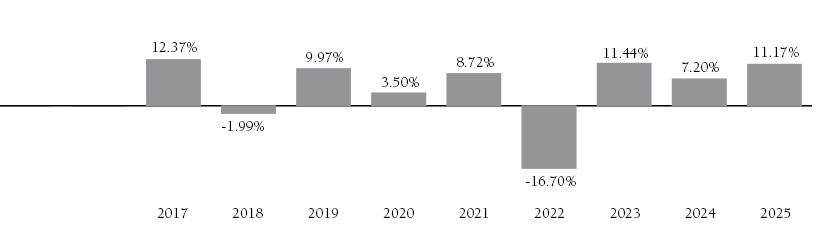
4th Quarter 2023 |
1st Quarter 2020 |
– |
10 | Protective Life Dynamic Allocation Series – Conservative Portfolio
|
1 Year |
5 Years |
Since |
Protective Life Dynamic Allocation Series – Conservative Portfolio |
|||
Protective Life Dynamic Allocation Series – Conservative Portfolio |
|||
MSCI All Country World IndexSM (reflects no deduction for expenses, fees or taxes, except foreign withholding taxes) |
|||
Protective Life Conservative Allocation Index (reflects no deduction for expenses, fees or taxes) |
The Portfolio’s broad-based benchmark index is the MSCI All Country World Index. The Portfolio’s additional benchmark index is the Protective Life Conservative Allocation Index. The indices are described below.
|
● |
The MSCI All Country World Index is designed to measure equity market performance in global developed and emerging markets. |
|
● |
The Protective Life Conservative Allocation Index is an internally-calculated, hypothetical combination of total returns from the MSCI All Country World Index (50%) and the Bloomberg U.S. Aggregate Bond Index (50%). The Bloomberg U.S. Aggregate Bond Index is a broad-based measure of the U.S. investment grade fixed-rate debt market. |
MANAGEMENT |
Investment Adviser: Janus Henderson Investors US LLC
Portfolio Management: Benjamin Wang, CFA, is Co-Portfolio Manager of the Portfolio, which he has co-managed since inception in April 2016. Zoey Zhu, CFA, is Co-Portfolio Manager of the Portfolio, which she has co-managed since May 2020.
PURCHASE AND SALE OF PORTFOLIO SHARES |
Purchases of Shares of the Portfolio may be made only by the separate accounts of Protective Life for the purpose of funding variable annuity contracts. Redemptions, like purchases, may be effected only through the separate accounts of Protective Life. Requests are duly processed at the NAV next calculated after your order is received in good order by the Portfolio or its agents. Refer to Protective Life’s separate account prospectus for details.
TAX INFORMATION |
Because Shares of the Portfolio may be purchased only through variable annuity contracts, it is anticipated that any income dividends or net capital gains distributions made by the Portfolio will be exempt from current federal income taxation if left to accumulate within the variable annuity contract. Generally, withdrawals from such contracts may be subject to federal income tax at ordinary income rates and, if made before age 59 ½, a 10% penalty. The federal income tax status of your investment depends on the features of your variable annuity contract. Further information may be found in Protective Life’s separate account prospectus.
PAYMENTS TO INSURERS, BROKER-DEALERS, AND OTHER FINANCIAL INTERMEDIARIES |
Shares of the Portfolio are only available through Protective Life’s variable annuity contracts. The Portfolio or its distributor (and/or their related companies) make payments to Protective Life and/or its related companies for distribution and/or other services; some of the payments may go to broker-dealers and other financial intermediaries. These payments may create a
11 | Protective Life Dynamic Allocation Series – Conservative Portfolio
conflict of interest for an intermediary, or be a factor in Protective Life’s decision to include the Portfolio as an underlying investment option in a variable annuity contract. Ask your financial advisor, visit Protective Life’s website, or consult your variable annuity contract prospectus for more information.
12 | Protective Life Dynamic Allocation Series – Conservative Portfolio
Portfolio summary
Protective Life Dynamic Allocation Series – Moderate Portfolio
Protective Life Dynamic Allocation Series – Moderate Portfolio (“Moderate Portfolio”) seeks total return through growth of capital and income, balanced by capital preservation.
This table describes the fees and expenses that you may pay if you buy, hold, and sell Shares of the Portfolio. Owners of variable annuity contracts that invest in Shares of the Portfolio should refer to the variable annuity contract prospectus for a description of fees and expenses, as the following table and examples do not reflect deductions at the separate account level or contract level for any charges that may be incurred under a contract. Inclusion of these charges would increase the fees and expenses described below.
|
|
Management Fees |
|
Distribution/Service (12b-1) Fees |
|
Other Expenses |
|
Acquired Fund(1) Fees and Expenses |
|
Total Annual Fund Operating Expenses |
|
Fee Waiver and/or Expense Reimbursement(2)(3) |
|
Total Annual Fund Operating Expenses After Fee Waiver and/or Expense Reimbursement(2)(3) |
|
(1) |
|
|
(2) |
|
|
(3) |
|
The Example is intended to help you compare the cost of investing in the Portfolio with the cost of investing in other mutual funds. The Example assumes that you invest $10,000 in the Portfolio for the time periods indicated, reinvest all dividends and distributions, and then redeem all of your Shares at the end of each period. The Example also assumes that your investment has a 5% return each year and that the Portfolio’s operating expenses are equal to the Total Annual Fund Operating Expenses After Fee Waiver and/or Expense Reimbursement for the first year and the Total Annual Fund Operating Expenses thereafter. Although your actual costs may be higher or lower, based on these assumptions your costs would be:
|
1 Year |
3 Years |
5 Years |
10 Years |
||||||||||||
|
$ | $ | $ | $ | ||||||||||||
Portfolio Turnover: The Portfolio pays transaction costs, such as commissions, when it buys and sells securities (or “turns over” its portfolio). A higher portfolio turnover rate may indicate higher transaction costs. These costs, which are not reflected in annual fund operating expenses or in the Example, affect the Portfolio’s performance. During the most recent fiscal year, the Portfolio’s turnover rate was
13 | Protective Life Dynamic Allocation Series – Moderate Portfolio
The Portfolio seeks to achieve its investment objective by investing in a dynamic portfolio of ETFs (also referred to in this Prospectus as “underlying ETFs”) across seven different equity asset classes, as well as intermediate- and long-duration fixed- income investments (the “Static Fixed-Income Allocation”), and an allocation to short-duration investments (the “Variable Short- Duration Allocation”), which can include cash, money market instruments and short-duration affiliated and unaffiliated underlying ETFs (“short-duration investments”). The equity asset classes and the Variable Short-Duration Allocation are adjusted weekly based on market conditions pursuant to a proprietary, quantitative-based allocation program (the “Allocation Adjustment Program”). Over the long term, and when fully invested, the Portfolio seeks to maintain an asset allocation of approximately 65% global equity investments and 35% intermediate- and long-duration fixed-income investments.
The Allocation Adjustment Program
The Allocation Adjustment Program, a proprietary methodology co-developed by the Adviser and Protective Life, allocates the Portfolio’s assets on a weekly basis among seven different equity asset classes, as well as the Variable Short-Duration Allocation, based on historical market indicators.
The Portfolio’s asset allocation is intended to diversify investments throughout the world among equity investments and intermediate- and long-duration fixed-income investments, and mitigate market risk by adjusting equity investments between market exposure and short-duration investments. Portfolio management oversees the Allocation Adjustment Program and are responsible for the day-to-day management of the Portfolio. Within the parameters of each asset class’ allocation relative to the Portfolio’s total assets, and the target allocation ranges within each asset class, portfolio management reviews the allocation of Portfolio assets in the underlying ETFs and may, without shareholder notice, cease investing in one or more underlying ETFs, modify the underlying ETFs’ weightings or add or substitute other underlying ETFs that provide similar investment exposure, to emphasize and mitigate risk exposures that may arise as a result of the implementation of the allocations.
At no time will an individual asset class exposure be less than zero for investment purposes (i.e., no short exposure), and generally an asset class exposure will not be greater than its maximum target allocation, except due to market movements between periodic rebalancing of the Portfolio. To the extent market movements between periodic rebalancing of the Portfolio results in an asset class exposure in excess of its maximum target allocation, the Portfolio will continue to buy and sell assets reflecting the Portfolio’s current composition as it manages purchase and redemption orders for the Portfolio, and when it implements trades directed by the weekly Allocation Adjustment Program.
Portfolio management may change the Portfolio’s allocations among the asset classes without shareholder notice, unless the Adviser determines it would be a material change to the Portfolio’s investment strategy, in which case shareholders would receive advance notice.
Static Fixed-Income Allocation
The Static Fixed-Income Allocation is expected to remain constant over time, subject to market movement, and will be rebalanced to its target allocation on a quarterly basis. The Portfolio will generally obtain intermediate- and long-duration fixed- income exposure by investing in unaffiliated ETFs that provide broad exposure to the total U.S. investment-grade bond market.
The Underlying ETFs
The Portfolio will obtain the desired market exposure by investing primarily in unaffiliated ETFs that seek to track the performance of one or more broad-based indices, using a passive investment strategy. Because it invests primarily in ETFs, the Portfolio is considered a “fund of funds.” The Portfolio will normally allocate its investments to underlying ETFs to diversify investments throughout the world and provide varying exposure to large-, mid-, or small-capitalization companies, U.S. based and non-U.S. based companies (including those with exposure to emerging markets), and fixed-income securities (including U.S. Treasury, government-related, and corporate, mortgage-backed pass-through securities, commercial mortgage-backed securities, and asset-backed securities). As noted above, the Portfolio may invest in short-duration affiliated and unaffiliated underlying ETFs within its Variable Short-Duration Allocation to seek to mitigate market risk associated with its equity allocation.
14 | Protective Life Dynamic Allocation Series – Moderate Portfolio
The table below shows, for each asset class, the ETFs in which the Portfolio, as of the date of this Prospectus, expects to invest. Portfolio management may choose in their sole discretion, without shareholder notice, to remove, add or substitute other ETFs that provide similar investment exposure in order to obtain the desired market exposure, to further diversify and/or mitigate risk for the Portfolio, or for other reasons, including the liquidity of one or more of the ETFs.
Asset Class |
Potential Underlying ETFs+ |
||
Global Equity Investments (Stocks) |
Asset Class |
Exchange-Traded Funds |
Ticker |
U.S. Large Cap Equity |
26.00% |
SPDR® S&P 500® ETF# iShares® Core S&P 500 ETF* Vanguard S&P 500 ETF |
SPY IVV VOO |
U.S. Small Cap Equity |
9.75% |
iShares® Russell 2000 ETF* iShares® Core S&P Small-Cap ETF* Vanguard Small-Cap ETF |
IWM IJR VB |
U.S. High Growth Equity |
9.75% |
Invesco QQQ TrustSM, Series 1 Invesco NASDAQ 100 ETF |
QQQ QQQM |
U.K. Equity |
6.50% |
iShares® MSCI United Kingdom ETF* Franklin FTSE United Kingdom ETF |
EWU FLGB |
European Equity |
6.50% |
SPDR® Euro Stoxx 50® ETF# Vanguard FTSE Europe ETF JPMorgan BetaBuilders Europe ETF Franklin FTSE Europe ETF |
FEZ VGK BBEU FLEE |
Japan Equity |
3.25% |
iShares® MSCI Japan ETF* Franklin FTSE Japan ETF JPMorgan BetaBuilders Japan ETF |
EWJ FLJP BBJP |
Asia Equity, ex-Japan |
3.25% |
iShares® MSCI All Country Asia ex-Japan ETF* Franklin FTSE Asia ex Japan ETF JPMorgan BetaBuilders Developed Asia Pacific ex-Japan ETF |
AAXJ FLAX BBAX |
Intermediate-and Long-Duration Fixed-Income Investments (Bonds) |
35.00% |
iShares® Core U.S. Aggregate Bond ETF* Vanguard Total Bond Market ETF |
AGG BND |
Short-Duration Fixed-Income Investments |
N/A |
Janus Henderson Short Duration Income ETF JPMorgan Ultra-Short Income ETF PIMCO Enhanced Short Maturity Active ETF Invesco Ultra Short-Duration ETF |
VNLA JPST MINT GSY |
|
(1) |
Represents the target allocation to the respective asset class as a percentage of the Portfolio’s total assets plus, with respect to the equity classes, the remainder, if any, held in short-duration investments. |
|
* |
iShares® is a registered trademark of BlackRock (BlackRock, Inc. and its subsidiaries). |
|
# |
SPDR® is a registered trademark of Standard & Poor’s Financial Services LLC. |
|
+ |
The investment advisers, sponsors and distributors of the underlying ETFs, and the underlying ETFs themselves, do not make any representations regarding the advisability of investing in any of the underlying ETFs. |
Refer to Appendix A in this Prospectus for a brief description of the investment objective and strategies of each of the potential underlying ETFs in which the Portfolio, as of the date of this Prospectus, expects to invest.
As a result of its investments in the underlying ETFs, the Portfolio will have exposure to foreign markets, including emerging markets (which include, but are not limited to, Asia, China, Europe, India, Japan, North America, and South Korea) and various economic sectors (which include, but are not limited to, consumer discretionary, consumer staples, energy, financials, healthcare, industrials, and information technology). Please refer to “Principal Investment Risks” and “Additional Information About the Portfolios” in this Prospectus for more detail.
15 | Protective Life Dynamic Allocation Series – Moderate Portfolio
Variable Short-Duration Allocation
The Portfolio’s Variable Short-Duration Allocation may be as low as 0% or as high as 65% of its assets, depending on prevailing market conditions and the weekly results of the Allocation Adjustment Program. Under normal circumstances, the Portfolio expects the Variable Short-Duration Allocation to be comprised of or provide exposure to securities with varying maturities and an average duration of 2 years or less. Permissible short-duration investments include cash, money market instruments (eligible securities, as defined by Rule 2a-7 under the Investment Company Act of 1940, as amended (the “1940 Act”)) determined by the Adviser to present minimal credit risk, affiliated or unaffiliated money market funds and/or investments in affiliated and unaffiliated underlying ETFs that invest in a portfolio of fixed-income instruments across a broad range of sectors and geographies while maintaining a short-duration portfolio. These underlying ETFs primarily invest in investment grade debt securities including, among others, short-term instruments, such as commercial paper and repurchase agreements, mortgage- backed securities, asset-backed securities, including collateralized debt obligations, and derivatives. The underlying ETFs may also invest in high-yield (or “junk”) bonds. The Portfolio’s short-duration investments may include securities of U.S. and foreign public- and private-sector issuers.
Portfolio management’s selection of investments for the Variable Short-Duration Allocation among short-duration affiliated ETFs, short-duration unaffiliated ETFs, money market instruments and cash may be based on a variety of factors, including prevailing market conditions, to seek to enhance total return and managing risk.
The Portfolio may also invest its cash in a cash sweep program, an arrangement in which the Portfolio’s uninvested cash balance at the end of each day is pooled with uninvested cash of other funds and invested in certain securities such as repurchase agreements or is used to purchase shares of affiliated or non-affiliated money market funds or cash management pooled investment vehicles.
The Portfolio may seek to earn additional income through lending its securities to certain qualified broker-dealers and institutions on a short-term or long-term basis, in an amount equal to up to one-third of its total assets as determined at the time of the loan origination.
Due to the nature of the Allocation Adjustment Program, the Portfolio may have relatively high portfolio turnover compared to other funds.
PRINCIPAL INVESTMENT RISKS |
Main Risks Associated with the Portfolio
Allocation Risk. The Portfolio’s ability to achieve its investment objective depends largely upon the Portfolio’s allocation of assets among the underlying ETFs and short-duration investments, using the Allocation Adjustment Program (a quantitative- based process that allocates equity investments between market exposure and short-duration investments, based on historical market indicators). You could lose money on your investment in the Portfolio as a result of these allocations. The Portfolio will typically invest in a range of different underlying ETFs and short-duration investments; however, to the extent that the Portfolio invests a significant portion of its assets in a single underlying ETF, it will be more sensitive to the risks associated with that underlying ETF and any investments in which that underlying ETF focuses. To the extent the Portfolio’s assets are allocated to short-duration investments, the Portfolio will be subject to risks associated with those investments, may generate returns that are lower than inflation and, in periods of rising market prices, the Portfolio may be unable to participate in such price increases as fully as it may have if its assets were allocated to the equity asset classes.
Investment Process Risk. No assurance can be given that the Portfolio’s investment strategy will be successful under all or any market conditions. Although the Allocation Adjustment Program is designed to achieve the Portfolio’s investment objective, there is no guarantee that it will achieve the desired results, and there is a risk that it may not be successful in identifying how the Portfolio’s assets should be adjusted to reduce the risk of loss in down markets while participating in the upside growth of markets. The Allocation Adjustment Program is a quantitative, model-driven (i.e., rules-based) investment strategy that may perform differently from the market as a whole based on the factors used in the model, the weight placed on each factor, as well as changes in historical trends and market conditions. Historical performance does not indicate future performance, and the assumption that markets will continue to rise or fall based on historical market indicators may prove to be incorrect under certain market conditions. In such cases, implementing a signal from the Allocation Adjustment Program may result
16 | Protective Life Dynamic Allocation Series – Moderate Portfolio
in maintaining or increasing market exposure (or a reduction in exposure), might not provide the intended results, and may adversely impact the Portfolio’s performance. The risk of loss may be heightened during periods of significant market volatility if the Allocation Adjustment Program is not designed to address the specific market conditions present at that time.
Fund of Funds Structure Risk. The Portfolio pursues its investment objective by investing its assets in the underlying ETFs or short-duration investments. The allocation of the Portfolio’s assets to underlying ETFs may not be successful in achieving the Portfolio’s investment objective. There is a risk that you may experience lower returns by investing in the Portfolio instead of investing directly in an underlying ETF. The Portfolio’s returns are directly related to the aggregate performance and expenses of the underlying ETFs in which it invests. The Portfolio, as a shareholder in an underlying ETF, will indirectly bear its pro rata share of the expenses incurred by the underlying ETF. The Portfolio’s return will be net of these expenses, and these expenses may be higher or lower depending upon the allocation of the Portfolio’s assets among the underlying ETFs and the actual expenses of the underlying ETFs. There is additional risk for the Portfolio with respect to aggregation of holdings of underlying ETFs. The aggregation of holdings of underlying ETFs may result in the Portfolio indirectly having increased exposure to a particular industry, geographical sector, or single company. Such indirect exposure may have the effect of increasing the volatility of the Portfolio’s returns. The Portfolio does not control the investments of the underlying ETFs, or any indirect exposure that occurs as a result of the underlying ETFs following their investment objectives. Additionally, to the extent the Portfolio purchases shares of affiliated or non-affiliated money market funds, or cash management pooled investment vehicles, it would bear its pro rata portion of such fund’s expenses, in addition to the expenses the Portfolio bears directly in connection with its own operation.
Exchange-Traded Funds Risk. ETFs are typically open-end investment companies, which may seek to track the performance of a specific index or be actively managed. ETFs are traded on a national securities exchange at market prices that may vary from the net asset value (“NAV”) of their underlying investments. Accordingly, there may be times when an ETF trades at a premium or discount to NAV. As a result, the Portfolio may pay more or less than NAV when it buys ETF shares, and may receive more or less than NAV when it sells those shares. ETFs also involve the risk that an active trading market for an ETF’s shares may not develop or be maintained. Similarly, because the value of ETF shares depends on the demand in the market, the Portfolio may not be able to purchase or sell an ETF at the most optimal time, which could adversely affect the Portfolio’s performance. In addition, ETFs that track particular indices may be unable to match the performance of such underlying indices due to the temporary unavailability of certain index securities in the secondary market or other factors, such as discrepancies with respect to the weighting of securities. Trading of an underlying ETF’s shares may be halted by the activation of individual or market- wide “circuit breakers” (which halt trading for a specific period of time when the price of a particular security or overall market prices decline by a specified percentage). Trading of an ETF’s shares may also be halted if (1) the shares are delisted from an exchange without first being listed on another exchange or (2) exchange officials determine that such action is appropriate in the interest of a fair and orderly market or for the protection of investors.
Affiliated Underlying Fund Risk. The Adviser may invest in certain underlying affiliated ETFs and money market funds (or unregistered cash management pooled investment vehicles that operate as money market funds) as investments for the Portfolio. The Adviser will generally receive fees for managing such funds, in addition to the fees paid to the Adviser by the Portfolio. The payment of such fees by underlying affiliated funds creates a conflict of interest when selecting underlying affiliated funds for investment in the Portfolio. The Adviser, however, is a fiduciary to the Portfolio and its shareholders and is legally obligated to act in their best interest when selecting underlying affiliated funds. In addition, the Adviser has contractually agreed to waive and/or reimburse a portion of the Portfolio’s management fee in an amount equal to the management fee it earns as an investment adviser to any of the underlying affiliated ETFs with respect to the Portfolio’s investment in such ETF, less certain asset-based operating fees and expenses.
Risks of Holding Short-Duration Investments. To the extent the Portfolio’s assets are allocated to short-duration investments, the Portfolio may be subject to the following risks:
|
● |
Credit Quality Risk. The value of the securities which the Portfolio may hold may fall based on an issuer’s actual or perceived creditworthiness, or an issuer’s ability to meet its obligations. The credit quality of the Portfolio’s holdings can change rapidly in certain market environments and any downgrade or default of a portfolio security could result in a decline in the Portfolio’s income and potentially in the value of the Portfolio’s investments. |
|
● |
Counterparty Risk. Portfolio transactions involving a counterparty are subject to the risk that the counterparty or a third party will not fulfill its obligation to the Portfolio (“counterparty risk”). Counterparty risk may arise because of the counterparty’s financial condition (i.e., financial difficulties, bankruptcy, or insolvency), market activities and developments, or other reasons, whether foreseen or not. A counterparty’s inability to fulfill its obligation may result in |
17 | Protective Life Dynamic Allocation Series – Moderate Portfolio
significant financial loss to the Portfolio. The Portfolio may be unable to recover its investment from the counterparty or may obtain a limited recovery, and/or recovery may be delayed. The Portfolio may be exposed to counterparty risk through its investments in certain securities, including, but not limited to, repurchase agreements and debt securities. The Portfolio intends to enter into financial transactions with counterparties that the Adviser believes to be creditworthy at the time of the transaction. There is always the risk that the Adviser’s analysis of a counterparty’s creditworthiness is incorrect or may change due to market conditions. To the extent that the Portfolio focuses its transactions with a limited number of counterparties, it will have greater exposure to the risks associated with one or more counterparties.
|
● |
Interest Rate Risk. An increase in interest rates may cause the value of fixed-income securities held by the Portfolio to decline. In inflationary conditions, the Portfolio may be subject to a greater risk of rising interest rates as a result of government fiscal policy initiatives and resulting market reaction to those initiatives. Variable and floating rate securities may increase or decrease in value in response to changes in interest rates, although generally to a lesser degree than fixed-income securities. |
Securities Lending Risk. There is the risk that when portfolio securities are lent, the securities may not be returned on a timely basis, and the Portfolio may experience delays and costs in recovering the security or gaining access to the collateral provided to the Portfolio to collateralize the loan. If the Portfolio is unable to recover a security on loan, the Portfolio may use the collateral to purchase replacement securities in the market. There is a risk that the value of the collateral could decrease below the cost of the replacement security by the time the replacement investment is made, resulting in a loss to the Portfolio.
Portfolio Turnover Risk. Increased portfolio turnover may result in higher costs, which may have a negative effect on the Portfolio’s performance. Due to operation of the Allocation Adjustment Program, the Portfolio may experience higher portfolio turnover as the result of equity market volatility.
Risks Through Investing in the Underlying ETFs
The ability of the Portfolio to realize its investment objective will depend, in large part, on the extent to which the underlying ETFs realize their respective investment objectives. Similarly, the Portfolio’s investment performance is directly related to the investment performance of the underlying ETFs it holds. The Portfolio is subject to the risk factors associated with the investments of the underlying ETFs, and will be affected by such risks in direct proportion to the allocation of its assets among the underlying ETFs. Therefore, to the extent that the Portfolio invests significantly in a particular underlying ETF, the Portfolio’s performance would be significantly impacted by the performance of such underlying ETF. What follows are the main risks associated with the underlying ETFs, which, in turn, may be considered to be principal risks of the Portfolio. These risks are subject to change based on the allocation of the Portfolio’s assets among the underlying ETFs.
Market Risk. The market price of investments owned by the Portfolio or an underlying ETF may go up or down. Market risk may affect a single issuer, industry, economic sector, or the market as a whole. Market risk may be magnified if certain social, political, economic and other conditions and events (such as financial institution failures, economic recessions, tariffs, trade disputes, terrorism, war, armed conflicts, including related sanctions, social unrest, natural disasters, and epidemics and pandemics) adversely interrupt the global economy and financial markets. It is important to understand that the value of your investment may fall, sometimes sharply, in response to changes in the market, and you could lose money.
Equity Securities Risk. Equity securities are subject to changes in value, and their values may be more volatile than those of other asset classes. The value of an underlying ETF’s portfolio may decrease if the value of an individual company or security, or multiple companies or securities, in the portfolio decreases. Further, regardless of how well individual companies or securities perform, the value of an underlying ETF’s portfolio could also decrease if there are deteriorating economic or market conditions or perceptions regarding the industries in which the issuers of securities the underlying ETF holds participate.
Passive Investment Risk. Certain of the underlying ETFs are not actively managed and therefore an underlying ETF might not sell shares of a security due to current or projected underperformance of a security, industry, or sector, unless that security is removed from the index or the selling of shares is otherwise required upon a rebalancing of the index the underlying ETF seeks to track. Maintaining investments in securities without attempting to take defensive positions, regardless of market conditions or the performance of individual securities, could cause an underlying ETF’s return to be lower than if it had employed an active strategy.
Fixed-Income Securities Risk. Certain of the underlying ETFs invest in a variety of fixed-income securities that are generally subject to the following risks:
18 | Protective Life Dynamic Allocation Series – Moderate Portfolio
|
● |
Interest rate risk, which is the risk that prices of bonds and other fixed-income securities will increase as interest rates fall and decrease as interest rates rise. Changes in interest rates have unpredictable effects on the markets and may expose fixed-income and related markets to heightened volatility. |
|
● |
Credit risk, which is the risk that the credit strength of an issuer of a fixed-income security will weaken and/or that the issuer will be unable to make timely principal and interest payments and that the security may go into default. |
|
● |
Prepayment risk, which is the risk that, during periods of falling interest rates, certain fixed-income securities may be paid off quicker than originally anticipated, which may cause an underlying ETF to reinvest its assets in securities with lower yields, resulting in a decline in an underlying ETF’s income or return potential. |
|
● |
Income risk, which is the risk that an underlying ETF’s income may decline when interest rates fall, or when there is a change in an underlying ETF’s investments because (i) the fixed-income securities in the underlying ETF’s portfolio mature and it subsequently invests in lower-yielding fixed-income securities, (ii) the fixed-income securities in the ETF’s underlying index are substituted, or (iii) the underlying ETF otherwise needs to purchase additional fixed-income securities. |
|
● |
Extension risk, which is the risk that, during periods of rising interest rates, certain fixed-income securities may be paid off substantially slower than originally anticipated, and as a result, the value of those fixed-income securities may fall. |
|
● |
Valuation risk, which is the risk that one or more of the fixed-income securities in which an underlying ETF invests are priced differently than the value realized upon such security’s sale. In times of market instability, valuation may be more difficult. Valuation may also be affected by changes in the issuer’s financial strength, the market’s perception of such strength, or in the credit rating of the issuer or the security. |
|
● |
Liquidity risk, which is the risk that fixed-income securities may be difficult or impossible to sell at the time that an underlying ETF seeks to sell. In unusual market conditions, even normally liquid securities may be affected by a degree of liquidity risk (i.e., if the number and capacity of traditional market participants is reduced). |
|
● |
Call risk, which is the risk that during periods of falling interest rates, an issuer of a callable fixed-income security held by an underlying ETF may “call” or repay the security before its stated maturity, and the underlying ETF may have to reinvest the proceeds at lower interest rates, resulting in a decline in the underlying ETF’s income. |
High-Yield Bonds Risk. High-yield bonds (also known as “junk” bonds) are considered speculative and may be more sensitive than other types of bonds to economic changes, political changes, or adverse developments specific to the entity that issued the bond, which may adversely affect their value.
Derivatives Risk. Derivatives used by an underlying ETF, such as swaps, forwards, futures, and options, involve risks in addition to the risks of the underlying referenced securities or asset. Gains or losses from a derivative investment can be substantially greater than the derivative’s original cost and can therefore involve leverage. Leverage may cause an underlying ETF to be more volatile than if it had not used leverage. Because most derivatives are not currently eligible to be transferred in-kind, an underlying ETF may be subject to increased liquidity risk to the extent its derivative positions become less liquid. Derivatives entail the risk that the counterparty will default on its payment obligations. Derivatives used for hedging purposes may reduce or eliminate losses if the market moves in a manner different from that anticipated by portfolio management or if the cost of the derivative outweighs the benefit of the hedge. The risks associated with derivatives may be heightened when they are used to enhance an underlying ETF’s return rather than solely for hedging purposes. Changes in laws or regulations may make the use of derivatives more costly, may limit the availability of derivatives, or may otherwise adversely affect the use, value or performance of derivatives.
Sovereign Debt Risk. An underlying ETF may invest in U.S. and non-U.S. government debt securities (“sovereign debt”). Investments in sovereign debt can involve a high degree of risk, including the risk that the governmental entity that controls the repayment of sovereign debt may not be willing or able to repay the principal and/or to pay the interest on its sovereign debt in a timely manner. A sovereign debtor’s willingness or ability to satisfy its debt obligation may be affected by various factors including, but not limited to, its cash flow situation, the extent of its foreign currency reserves, the availability of foreign exchange when a payment is due, and the relative size of its debt position in relation to its economy as a whole. In the event of default, there may be limited or no legal remedies for collecting sovereign debt and there may be no bankruptcy proceedings through which the underlying ETF may collect all or part of the sovereign debt that a governmental entity has not repaid. In addition, to the extent the underlying ETF invests in non-U.S. sovereign debt, it may be subject to currency risk.
19 | Protective Life Dynamic Allocation Series – Moderate Portfolio
Foreign Exposure Risk. Foreign markets, including emerging markets, can be more volatile than the U.S. market. As a result, an underlying ETF’s returns and net asset value may be affected by fluctuations in currency exchange rates or political or economic conditions in a particular country. Investments in foreign securities, particularly those of issuers located in emerging market countries, tend to have greater exposure to liquidity risk than domestic securities. In some foreign markets, there may not be protection against failure by other parties to complete transactions. It may not be possible for an underlying ETF to repatriate capital, dividends, interest, and other income from a particular country or governmental entity. In addition, a market swing in one or more countries or regions where an underlying ETF has invested a significant amount of its assets may have a greater effect on an underlying ETF’s performance than it would in a more geographically diversified portfolio. To the extent that an underlying ETF invests in foreign debt securities, such investments are sensitive to changes in interest rates. Additionally, investments in securities of foreign governments involve the risk that a foreign government may not be willing or able to pay interest or repay principal when due. An underlying ETF’s investments in emerging market countries may involve risks greater than, or in addition to, the risks of investing in more developed countries.
Risk of Investing in Europe. Certain underlying ETFs may have significant exposure to European markets. Developed and emerging market countries in Europe will be significantly affected by the fiscal and monetary controls of the European Monetary Union. Changes in regulations on trade, decreasing imports or exports, changes in the exchange rate of the euro, and recessions among European countries may have a significant adverse effect on the economies of other European countries including those of Eastern Europe. The markets in Eastern Europe remain relatively undeveloped and can be particularly sensitive to political and economic developments.
|
● |
Risk of Investing in the United Kingdom. Certain underlying ETFs may have significant exposure to the United Kingdom. Investments in British issuers may subject an underlying ETF to regulatory, political, currency, security, and economic risk specific to the United Kingdom. The United Kingdom has one of the largest economies in Europe, and the United States and other European countries are substantial trading partners of the United Kingdom. As a result, the British economy may be impacted by changes to the economic health of the United States and other European countries. |
Risk of Investing in Japan. The Japanese economy may be subject to considerable degrees of economic, political, and social instability, which could have a negative impact on Japanese securities. Since the year 2000, Japan’s economic growth rate has remained relatively low, and it may remain low in the future. In addition, Japan is subject to the risk of natural disasters, such as earthquakes, volcanic eruptions, typhoons, and tsunamis, which could negatively affect an underlying ETF’s investment.
Risk of Investing in Asia. Investments in securities of issuers in certain Asian countries involve risks that are specific to Asia, including certain legal, regulatory, political, and economic risks. Certain Asian countries have experienced expropriation and/or nationalization of assets, confiscatory taxation, political instability, armed conflict and social instability as a result of religious, ethnic, socio-economic and/or political unrest. Some economies in this region are dependent on a range of commodities, and are strongly affected by international commodity prices and particularly vulnerable to price changes for these products. The market for securities in this region may also be directly influenced by the flow of international capital, and by the economic and market conditions of neighboring countries. Many Asian economies have experienced rapid growth and industrialization, and there is no assurance that this growth rate will be maintained. Some Asian economies are highly dependent on trade and economic conditions in other countries can impact these economies.
Industry and Sector Risk. To the extent that an underlying ETF’s investments are focused in the securities of a particular issuer or issuers, country, group of countries, region, market, industry, group of industries, sector or asset class, the underlying ETF may be susceptible to an increased risk of loss, including losses due to adverse events that affect the underlying ETF’s investments more than the market as a whole.
Large-Capitalization Companies Risk. Certain underlying ETFs’ investments in securities issued by large-capitalization companies will be subject to the risk that returns on stocks of large companies could trail the returns on investments in stocks of small- and mid-sized companies. Large-cap stocks tend to go through cycles of doing better – or worse – than other segments of the stock market or the stock market in general. These periods have, in the past, lasted for as long as several years.
Small- and Mid-Sized Companies Risk. Certain underlying ETFs’ investments in securities issued by small- and mid-sized companies, which can include smaller, start-up companies offering emerging products or services, may involve greater risks than are customarily associated with larger, more established companies. For example, small- and mid-sized companies may suffer more significant losses as a result of their narrow product lines, limited operating history, greater exposure to competitive threats, limited financial resources, limited trading markets, and the potential lack of management depth.
20 | Protective Life Dynamic Allocation Series – Moderate Portfolio
Securities issued by small- and mid-sized companies tend to be more volatile and somewhat more speculative than securities issued by larger or more established companies and may underperform as compared to the securities of larger or more established companies. These holdings are also subject to wider price fluctuations and tend to be less liquid than stocks of larger or more established companies, which could have a significant adverse effect on an underlying ETF’s returns, especially as market conditions change.
Mortgage- and Asset-Backed Securities Risk. Mortgage- and asset-backed securities represent interests in “pools” of commercial or residential mortgages or other assets, including consumer loans or receivables. The value of mortgage- and asset-backed securities will be influenced by factors affecting the real estate market and the assets underlying these securities. Investments in mortgage- and asset-backed securities may be subject to credit risk, valuation risk, liquidity risk, extension risk, and prepayment risk. These securities also are subject to risk of default on the underlying mortgage or asset, particularly during periods of economic downturn.
Illiquid Investments Risk. To the extent the Portfolio or underlying ETF invests in illiquid investments or investments that become less liquid, such investments may have a negative effect on the returns of the Portfolio or underlying ETF because the Portfolio or underlying ETF may be unable to sell the illiquid investments at an advantageous time or price.
Annual Total Returns (calendar year-end) |
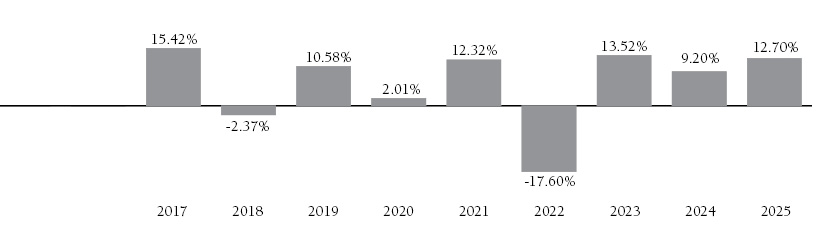
4th Quarter 2020 |
1st Quarter 2020 |
– |
21 | Protective Life Dynamic Allocation Series – Moderate Portfolio
|
1 Year |
5 Years |
Since |
Protective Life Dynamic Allocation Series – Moderate Portfolio |
|||
Protective Life Dynamic Allocation Series – Moderate Portfolio |
|||
MSCI All Country World IndexSM (reflects no deduction for expenses, fees or taxes, except foreign withholding taxes) |
|||
Protective Life Moderate Allocation Index (reflects no deduction for expenses, fees or taxes) |
The Portfolio’s broad-based benchmark index is the MSCI All Country World Index. The Portfolio’s additional benchmark index is the Protective Life Moderate Allocation Index. The indices are described below.
|
● |
The MSCI All Country World Index is designed to measure equity market performance in global developed and emerging markets. |
|
● |
The Protective Life Moderate Allocation Index is an internally-calculated, hypothetical combination of total returns from the MSCI All Country World Index (65%) and the Bloomberg U.S. Aggregate Bond Index (35%). The Bloomberg U.S. Aggregate Bond Index is a broad-based measure of the U.S. investment grade fixed-rate debt market. |
MANAGEMENT |
Investment Adviser: Janus Henderson Investors US LLC
Portfolio Management: Benjamin Wang, CFA, is Co-Portfolio Manager of the Portfolio, which he has co-managed since inception in April 2016. Zoey Zhu, CFA, is Co-Portfolio Manager of the Portfolio, which she has co-managed since May 2020.
PURCHASE AND SALE OF PORTFOLIO SHARES |
Purchases of Shares of the Portfolio may be made only by the separate accounts of Protective Life for the purpose of funding variable annuity contracts. Redemptions, like purchases, may be effected only through the separate accounts of Protective Life. Requests are duly processed at the NAV next calculated after your order is received in good order by the Portfolio or its agents. Refer to Protective Life’s separate account prospectus for details.
TAX INFORMATION |
Because Shares of the Portfolio may be purchased only through variable annuity contracts, it is anticipated that any income dividends or net capital gains distributions made by the Portfolio will be exempt from current federal income taxation if left to accumulate within the variable annuity contract. Generally, withdrawals from such contracts may be subject to federal income tax at ordinary income rates and, if made before age 59 ½, a 10% penalty. The federal income tax status of your investment depends on the features of your variable annuity contract. Further information may be found in Protective Life’s separate account prospectus.
PAYMENTS TO INSURERS, BROKER-DEALERS, AND OTHER FINANCIAL INTERMEDIARIES |
Shares of the Portfolio are only available through Protective Life’s variable annuity contracts. The Portfolio or its distributor (and/or their related companies) make payments to Protective Life and/or its related companies for distribution and/or other services; some of the payments may go to broker-dealers and other financial intermediaries. These payments may create a conflict of interest for an intermediary, or be a factor in Protective Life’s decision to include the Portfolio as an underlying investment option in a variable annuity contract. Ask your financial advisor, visit Protective Life’s website, or consult your variable annuity contract prospectus for more information.
22 | Protective Life Dynamic Allocation Series – Moderate Portfolio
Portfolio summary
Protective Life Dynamic Allocation Series – Growth Portfolio
Protective Life Dynamic Allocation Series – Growth Portfolio (“Growth Portfolio”) seeks total return through growth of capital, balanced by capital preservation.
This table describes the fees and expenses that you may pay if you buy, hold, and sell Shares of the Portfolio. Owners of variable annuity contracts that invest in Shares of the Portfolio should refer to the variable annuity contract prospectus for a description of fees and expenses, as the following table and examples do not reflect deductions at the separate account level or contract level for any charges that may be incurred under a contract. Inclusion of these charges would increase the fees and expenses described below.
|
|
Management Fees |
|
Distribution/Service (12b-1) Fees |
|
Other Expenses |
|
Acquired Fund(1) Fees and Expenses |
|
Total Annual Fund Operating Expenses |
|
Fee Waiver and/or Expense Reimbursement(2)(3) |
|
Total Annual Fund Operating Expenses After Fee Waiver and/or Expense Reimbursement(2)(3) |
|
(1) |
|
|
(2) |
|
|
(3) |
|
The Example is intended to help you compare the cost of investing in the Portfolio with the cost of investing in other mutual funds. The Example assumes that you invest $10,000 in the Portfolio for the time periods indicated, reinvest all dividends and distributions, and then redeem all of your Shares at the end of each period. The Example also assumes that your investment has a 5% return each year and that the Portfolio’s operating expenses are equal to the Total Annual Fund Operating Expenses After Fee Waiver and/or Expense Reimbursement for the first year and the Total Annual Fund Operating Expenses thereafter. Although your actual costs may be higher or lower, based on these assumptions your costs would be:
|
1 Year |
3 Years |
5 Years |
10 Years |
||||||||||||
|
$ | $ | $ | $ | ||||||||||||
Portfolio Turnover: The Portfolio pays transaction costs, such as commissions, when it buys and sells securities (or “turns over” its portfolio). A higher portfolio turnover rate may indicate higher transaction costs. These costs, which are not reflected in annual fund operating expenses or in the Example, affect the Portfolio’s performance. During the most recent fiscal year, the Portfolio’s turnover rate was
23 | Protective Life Dynamic Allocation Series – Growth Portfolio
The Portfolio seeks to achieve its investment objective by investing in a dynamic portfolio of ETFs (also referred to in this Prospectus as “underlying ETFs”) across seven different equity asset classes and an allocation to short-duration investments (the “Variable Short-Duration Allocation”) which can include cash, money market instruments and short-duration affiliated and unaffiliated underlying ETFs (“short-duration investments”). The equity asset classes and the Variable Short-Duration Allocation are adjusted weekly based on market conditions pursuant to a proprietary, quantitative-based allocation program (the “Allocation Adjustment Program”). Over the long term, and when fully invested, the Portfolio seeks to maintain an asset allocation of approximately 100% global equity investments, which includes specific targeted allocations to large-, mid-, or small-capitalization companies, U.S. based and non-U.S. based companies (including those with exposure to emerging markets).
The Allocation Adjustment Program
The Allocation Adjustment Program, a proprietary methodology co-developed by the Adviser and Protective Life, allocates the Portfolio’s assets on a weekly basis among seven different equity asset classes, as well as the Variable Short-Duration Allocation, based on historical market indicators.
The Portfolio’s asset allocation is intended to diversify investments throughout the world among equity investments and mitigate market risk by adjusting equity investments between market exposure and short-duration investments. Portfolio management oversees the Allocation Adjustment Program and are responsible for the day-to-day management of the Portfolio. Within the parameters of each asset class’ allocation relative to the Portfolio’s total assets, and the target allocation ranges within each asset class, portfolio management reviews the allocation of Portfolio assets in the underlying ETFs and may, without shareholder notice, cease investing in one or more underlying ETFs, modify the underlying ETFs’ weightings or add or substitute other underlying ETFs that provide similar investment exposure, to emphasize and mitigate risk exposures that may arise as a result of the implementation of the allocations.
At no time will an individual asset class exposure be less than zero for investment purposes (i.e., no short exposure), and generally an asset class exposure will not be greater than its maximum target allocation, except due to market movements between periodic rebalancing of the Portfolio. To the extent market movements between periodic rebalancing of the Portfolio results in an asset class exposure in excess of its maximum target allocation, the Portfolio will continue to buy and sell assets reflecting the Portfolio’s current composition as it manages purchase and redemption orders for the Portfolio, and when it implements trades directed by the weekly Allocation Adjustment Program.
Portfolio management may change the Portfolio’s allocations among the asset classes without shareholder notice, unless the Adviser determines it would be a material change to the Portfolio’s investment strategy, in which case shareholders would receive advance notice.
The Underlying ETFs
The Portfolio will obtain the desired market exposure by investing primarily in unaffiliated ETFs that seek to track the performance of one or more broad-based indices, using a passive investment strategy. Because it invests primarily in ETFs, the Portfolio is considered a “fund of funds.” The Portfolio will normally allocate its investments to underlying ETFs to diversify investments throughout the world and provide varying exposure to large-, mid-, or small-capitalization companies, U.S. based and non-U.S. based companies (including those with exposure to emerging markets). As noted above, the Portfolio may invest in short-duration affiliated and unaffiliated underlying ETFs within its Variable Short-Duration Allocation to seek to mitigate market risk associated with its equity allocation.
24 | Protective Life Dynamic Allocation Series – Growth Portfolio
The table below shows, for each asset class, the ETFs in which the Portfolio, as of the date of this Prospectus, expects to invest. Portfolio management may choose in their sole discretion, without shareholder notice, to remove, add or substitute other ETFs that provide similar investment exposure in order to obtain the desired market exposure, to further diversify and/or mitigate risk for the Portfolio, or for other reasons, including the liquidity of one or more of the ETFs.
Asset Class |
Potential Underlying ETFs+ |
||
Global Equity Investments (Stocks) |
Asset
Class |
Exchange-Traded Funds |
Ticker |
U.S. Large Cap Equity |
40.00% |
SPDR® S&P 500® ETF# iShares® Core S&P 500 ETF* Vanguard S&P 500 ETF |
SPY |
U.S. Small Cap Equity |
15.00% |
iShares® Russell 2000 ETF* iShares® Core S&P Small-Cap ETF* Vanguard Small-Cap ETF |
IWM |
U.S. High Growth Equity |
15.00% |
Invesco QQQ TrustSM, Series 1 Invesco NASDAQ 100 ETF |
QQQ |
U.K. Equity |
10.00% |
iShares® MSCI United Kingdom ETF* Franklin FTSE United Kingdom ETF |
EWU |
European Equity |
10.00% |
SPDR® Euro Stoxx 50® ETF# Vanguard FTSE Europe ETF JPMorgan BetaBuilders Europe ETF Franklin FTSE Europe ETF |
FEZ |
Japan Equity |
5.00% |
iShares® MSCI Japan ETF* Franklin FTSE Japan ETF JPMorgan BetaBuilders Japan ETF |
EWJ |
Asia Equity, ex-Japan |
5.00% |
iShares® MSCI All Country Asia ex-Japan ETF* Franklin FTSE Asia ex Japan ETF JPMorgan BetaBuilders Developed Asia Pacific ex-Japan ETF |
AAXJ |
Short-Duration Fixed-Income Investments |
N/A |
Janus Henderson Short Duration Income ETF JPMorgan Ultra-Short Income ETF PIMCO Enhanced Short Maturity Active ETF Invesco Ultra Short-Duration ETF |
VNLA |
|
(1) |
Represents the target allocation to the respective asset class as a percentage of the Portfolio’s total assets plus, with respect to the equity classes, the remainder, if any, held in short-duration investments. |
|
* |
iShares® is a registered trademark of BlackRock (BlackRock, Inc. and its subsidiaries). |
|
# |
SPDR® is a registered trademark of Standard & Poor’s Financial Services LLC. |
|
+ |
The investment advisers, sponsors and distributors of the underlying ETFs, and the underlying ETFs themselves, do not make any representations regarding the advisability of investing in any of the underlying ETFs. |
Refer to Appendix A in this Prospectus for a brief description of the investment objective and strategies of each of the potential underlying ETFs in which the Portfolio, as of the date of this Prospectus, expects to invest.
As a result of its investments in the underlying ETFs, the Portfolio will have exposure to foreign markets, including emerging markets (which include, but are not limited to, Asia, China, Europe, India, Japan, North America, and South Korea) and various economic sectors (which include, but are not limited to, consumer discretionary, consumer staples, energy, financials, healthcare, industrials, and information technology). Please refer to “Principal Investment Risks” and “Additional Information About the Portfolios” in this Prospectus for more detail.
25 | Protective Life Dynamic Allocation Series – Growth Portfolio
Variable Short-Duration Allocation
The Portfolio’s Variable Short-Duration Allocation may be as low as 0% or as high as 100% of its assets, depending on prevailing market conditions and the weekly results of the Allocation Adjustment Program. Under normal circumstances, the Portfolio expects the Variable Short-Duration Allocation to be comprised of or provide exposure to securities with varying maturities and an average duration of 2 years or less. Permissible short-duration investments include cash, money market instruments (eligible securities, as defined by Rule 2a-7 under the Investment Company Act of 1940, as amended (the “1940 Act”)) determined by the Adviser to present minimal credit risk, affiliated or unaffiliated money market funds and/or investments in affiliated and unaffiliated underlying ETFs that invest in a portfolio of fixed-income instruments across a broad range of sectors and geographies while maintaining a short-duration portfolio. These underlying ETFs primarily invest in investment grade debt securities including, among others, short-term instruments, such as commercial paper and repurchase agreements, mortgage- backed securities, asset-backed securities, including collateralized debt obligations, and derivatives. The underlying ETFs may also invest in high-yield (or “junk”) bonds. The Portfolio’s short-duration investments may include securities of U.S. and foreign public- and private-sector issuers.
Portfolio management’s selection of investments for the Variable Short-Duration Allocation among short-duration affiliated ETFs, short-duration unaffiliated ETFs, money market instruments and cash may be based on a variety of factors, including prevailing market conditions, to seek to enhance total return and managing risk.
The Portfolio may also invest its cash in a cash sweep program, an arrangement in which the Portfolio’s uninvested cash balance at the end of each day is pooled with uninvested cash of other funds and invested in certain securities such as repurchase agreements or is used to purchase shares of affiliated or non-affiliated money market funds or cash management pooled investment vehicles.
The Portfolio may seek to earn additional income through lending its securities to certain qualified broker-dealers and institutions on a short-term or long-term basis, in an amount equal to up to one-third of its total assets as determined at the time of the loan origination.
Due to the nature of the Allocation Adjustment Program, the Portfolio may have relatively high portfolio turnover compared to other funds.
PRINCIPAL INVESTMENT RISKS |
Main Risks Associated with the Portfolio
Allocation Risk. The Portfolio’s ability to achieve its investment objective depends largely upon the Portfolio’s allocation of assets among the underlying ETFs and short-duration investments, using the Allocation Adjustment Program (a quantitative- based process that allocates equity investments between market exposure and short-duration investments, based on historical market indicators). You could lose money on your investment in the Portfolio as a result of these allocations. The Portfolio will typically invest in a range of different underlying ETFs and short-duration investments; however, to the extent that the Portfolio invests a significant portion of its assets in a single underlying ETF, it will be more sensitive to the risks associated with that underlying ETF and any investments in which that underlying ETF focuses. To the extent the Portfolio’s assets are allocated to short-duration investments, the Portfolio will be subject to risks associated with those investments, may generate returns that are lower than inflation and, in periods of rising market prices, the Portfolio may be unable to participate in such price increases as fully as it may have if its assets were allocated to the equity asset classes.
Investment Process Risk. No assurance can be given that the Portfolio’s investment strategy will be successful under all or any market conditions. Although the Allocation Adjustment Program is designed to achieve the Portfolio’s investment objective, there is no guarantee that it will achieve the desired results, and there is a risk that it may not be successful in identifying how the Portfolio’s assets should be adjusted to reduce the risk of loss in down markets while participating in the upside growth of markets. The Allocation Adjustment Program is a quantitative, model-driven (i.e., rules-based) investment strategy that may perform differently from the market as a whole based on the factors used in the model, the weight placed on each factor, as well as changes in historical trends and market conditions. Historical performance does not indicate future performance, and the assumption that markets will continue to rise or fall based on historical market indicators may prove to be incorrect under certain market conditions. In such cases, implementing a signal from the Allocation Adjustment Program may result
26 | Protective Life Dynamic Allocation Series – Growth Portfolio
in maintaining or increasing market exposure (or a reduction in exposure), might not provide the intended results, and may adversely impact the Portfolio’s performance. The risk of loss may be heightened during periods of significant market volatility if the Allocation Adjustment Program is not designed to address the specific market conditions present at that time.
Fund of Funds Structure Risk. The Portfolio pursues its investment objective by investing its assets in the underlying ETFs or short-duration investments. The allocation of the Portfolio’s assets to underlying ETFs may not be successful in achieving the Portfolio’s investment objective. There is a risk that you may experience lower returns by investing in the Portfolio instead of investing directly in an underlying ETF. The Portfolio’s returns are directly related to the aggregate performance and expenses of the underlying ETFs in which it invests. The Portfolio, as a shareholder in an underlying ETF, will indirectly bear its pro rata share of the expenses incurred by the underlying ETF. The Portfolio’s return will be net of these expenses, and these expenses may be higher or lower depending upon the allocation of the Portfolio’s assets among the underlying ETFs and the actual expenses of the underlying ETFs. There is additional risk for the Portfolio with respect to aggregation of holdings of underlying ETFs. The aggregation of holdings of underlying ETFs may result in the Portfolio indirectly having increased exposure to a particular industry, geographical sector, or single company. Such indirect exposure may have the effect of increasing the volatility of the Portfolio’s returns. The Portfolio does not control the investments of the underlying ETFs, or any indirect exposure that occurs as a result of the underlying ETFs following their investment objectives. Additionally, to the extent the Portfolio purchases shares of affiliated or non-affiliated money market funds, or cash management pooled investment vehicles, it would bear its pro rata portion of such fund’s expenses, in addition to the expenses the Portfolio bears directly in connection with its own operation.
Exchange-Traded Funds Risk. ETFs are typically open-end investment companies, which may seek to track the performance of a specific index or be actively managed. ETFs are traded on a national securities exchange at market prices that may vary from the net asset value (“NAV”) of their underlying investments. Accordingly, there may be times when an ETF trades at a premium or discount to NAV. As a result, the Portfolio may pay more or less than NAV when it buys ETF shares, and may receive more or less than NAV when it sells those shares. ETFs also involve the risk that an active trading market for an ETF’s shares may not develop or be maintained. Similarly, because the value of ETF shares depends on the demand in the market, the Portfolio may not be able to purchase or sell an ETF at the most optimal time, which could adversely affect the Portfolio’s performance. In addition, ETFs that track particular indices may be unable to match the performance of such underlying indices due to the temporary unavailability of certain index securities in the secondary market or other factors, such as discrepancies with respect to the weighting of securities. Trading of an underlying ETF’s shares may be halted by the activation of individual or market- wide “circuit breakers” (which halt trading for a specific period of time when the price of a particular security or overall market prices decline by a specified percentage). Trading of an ETF’s shares may also be halted if (1) the shares are delisted from an exchange without first being listed on another exchange or (2) exchange officials determine that such action is appropriate in the interest of a fair and orderly market or for the protection of investors.
Affiliated Underlying Fund Risk. The Adviser may invest in certain underlying affiliated ETFs and money market funds (or unregistered cash management pooled investment vehicles that operate as money market funds) as investments for the Portfolio. The Adviser will generally receive fees for managing such funds, in addition to the fees paid to the Adviser by the Portfolio. The payment of such fees by underlying affiliated funds creates a conflict of interest when selecting underlying affiliated funds for investment in the Portfolio. The Adviser, however, is a fiduciary to the Portfolio and its shareholders and is legally obligated to act in their best interest when selecting underlying affiliated funds. In addition, the Adviser has contractually agreed to waive and/or reimburse a portion of the Portfolio’s management fee in an amount equal to the management fee it earns as an investment adviser to any of the underlying affiliated ETFs with respect to the Portfolio’s investment in such ETF, less certain asset-based operating fees and expenses.
Risks of Holding Short-Duration Investments. To the extent the Portfolio’s assets are allocated to short-duration investments, the Portfolio may be subject to the following risks:
|
● |
Credit Quality Risk. The value of the securities which the Portfolio may hold may fall based on an issuer’s actual or perceived creditworthiness, or an issuer’s ability to meet its obligations. The credit quality of the Portfolio’s holdings can change rapidly in certain market environments and any downgrade or default of a portfolio security could result in a decline in the Portfolio’s income and potentially in the value of the Portfolio’s investments. |
|
● |
Counterparty Risk. Portfolio transactions involving a counterparty are subject to the risk that the counterparty or a third party will not fulfill its obligation to the Portfolio (“counterparty risk”). Counterparty risk may arise because of the counterparty’s financial condition (i.e., financial difficulties, bankruptcy, or insolvency), market activities and developments, or other reasons, whether foreseen or not. A counterparty’s inability to fulfill its obligation may result in |
27 | Protective Life Dynamic Allocation Series – Growth Portfolio
significant financial loss to the Portfolio. The Portfolio may be unable to recover its investment from the counterparty or may obtain a limited recovery, and/or recovery may be delayed. The Portfolio may be exposed to counterparty risk through its investments in certain securities, including, but not limited to, repurchase agreements and debt securities. The Portfolio intends to enter into financial transactions with counterparties that the Adviser believes to be creditworthy at the time of the transaction. There is always the risk that the Adviser’s analysis of a counterparty’s creditworthiness is incorrect or may change due to market conditions. To the extent that the Portfolio focuses its transactions with a limited number of counterparties, it will have greater exposure to the risks associated with one or more counterparties.
|
● |
Interest Rate Risk. An increase in interest rates may cause the value of fixed-income securities held by the Portfolio to decline. In inflationary conditions, the Portfolio may be subject to a greater risk of rising interest rates as a result of government fiscal policy initiatives and resulting market reaction to those initiatives. Variable and floating rate securities may increase or decrease in value in response to changes in interest rates, although generally to a lesser degree than fixed-income securities. |
Securities Lending Risk. There is the risk that when portfolio securities are lent, the securities may not be returned on a timely basis, and the Portfolio may experience delays and costs in recovering the security or gaining access to the collateral provided to the Portfolio to collateralize the loan. If the Portfolio is unable to recover a security on loan, the Portfolio may use the collateral to purchase replacement securities in the market. There is a risk that the value of the collateral could decrease below the cost of the replacement security by the time the replacement investment is made, resulting in a loss to the Portfolio.
Portfolio Turnover Risk. Increased portfolio turnover may result in higher costs, which may have a negative effect on the Portfolio’s performance. Due to operation of the Allocation Adjustment Program, the Portfolio may experience higher portfolio turnover as the result of equity market volatility.
Risks Through Investing in the Underlying ETFs
The ability of the Portfolio to realize its investment objective will depend, in large part, on the extent to which the underlying ETFs realize their respective investment objectives. Similarly, the Portfolio’s investment performance is directly related to the investment performance of the underlying ETFs it holds. The Portfolio is subject to the risk factors associated with the investments of the underlying ETFs, and will be affected by such risks in direct proportion to the allocation of its assets among the underlying ETFs. Therefore, to the extent that the Portfolio invests significantly in a particular underlying ETF, the Portfolio’s performance would be significantly impacted by the performance of such underlying ETF. What follows are the main risks associated with the underlying ETFs, which, in turn, may be considered to be principal risks of the Portfolio. These risks are subject to change based on the allocation of the Portfolio’s assets among the underlying ETFs.
Market Risk. The market price of investments owned by the Portfolio or an underlying ETF may go up or down. Market risk may affect a single issuer, industry, economic sector, or the market as a whole. Market risk may be magnified if certain social, political, economic and other conditions and events (such as financial institution failures, economic recessions, tariffs, trade disputes, terrorism, war, armed conflicts, including related sanctions, social unrest, natural disasters, and epidemics and pandemics) adversely interrupt the global economy and financial markets. It is important to understand that the value of your investment may fall, sometimes sharply, in response to changes in the market, and you could lose money.
Equity Securities Risk. Equity securities are subject to changes in value, and their values may be more volatile than those of other asset classes. The value of an underlying ETF’s portfolio may decrease if the value of an individual company or security, or multiple companies or securities, in the portfolio decreases. Further, regardless of how well individual companies or securities perform, the value of an underlying ETF’s portfolio could also decrease if there are deteriorating economic or market conditions or perceptions regarding the industries in which the issuers of securities the underlying ETF holds participate.
Passive Investment Risk. Certain of the underlying ETFs are not actively managed and therefore an underlying ETF might not sell shares of a security due to current or projected underperformance of a security, industry, or sector, unless that security is removed from the index or the selling of shares is otherwise required upon a rebalancing of the index the underlying ETF seeks to track. Maintaining investments in securities without attempting to take defensive positions, regardless of market conditions or the performance of individual securities, could cause an underlying ETF’s return to be lower than if it had employed an active strategy.
28 | Protective Life Dynamic Allocation Series – Growth Portfolio
Fixed-Income Securities Risk. Certain of the underlying ETFs invest in a variety of fixed-income securities that are generally subject to the following risks:
|
● |
Interest rate risk, which is the risk that prices of bonds and other fixed-income securities will increase as interest rates fall and decrease as interest rates rise. Changes in interest rates have unpredictable effects on the markets and may expose fixed-income and related markets to heightened volatility. |
|
● |
Credit risk, which is the risk that the credit strength of an issuer of a fixed-income security will weaken and/or that the issuer will be unable to make timely principal and interest payments and that the security may go into default. |
|
● |
Prepayment risk, which is the risk that, during periods of falling interest rates, certain fixed-income securities may be paid off quicker than originally anticipated, which may cause an underlying ETF to reinvest its assets in securities with lower yields, resulting in a decline in an underlying ETF’s income or return potential. |
|
● |
Income risk, which is the risk that an underlying ETF’s income may decline when interest rates fall, or when there is a change in an underlying ETF’s investments because (i) the fixed-income securities in the underlying ETF’s portfolio mature and it subsequently invests in lower-yielding fixed-income securities, (ii) the fixed-income securities in the ETF’s underlying index are substituted, or (iii) the underlying ETF otherwise needs to purchase additional fixed-income securities. |
|
● |
Extension risk, which is the risk that, during periods of rising interest rates, certain fixed-income securities may be paid off substantially slower than originally anticipated, and as a result, the value of those fixed-income securities may fall. |
|
● |
Valuation risk, which is the risk that one or more of the fixed-income securities in which an underlying ETF invests are priced differently than the value realized upon such security’s sale. In times of market instability, valuation may be more difficult. Valuation may also be affected by changes in the issuer’s financial strength, the market’s perception of such strength, or in the credit rating of the issuer or the security. |
|
● |
Liquidity risk, which is the risk that fixed-income securities may be difficult or impossible to sell at the time that an underlying ETF seeks to sell. In unusual market conditions, even normally liquid securities may be affected by a degree of liquidity risk (i.e., if the number and capacity of traditional market participants is reduced). |
|
● |
Call risk, which is the risk that during periods of falling interest rates, an issuer of a callable fixed-income security held by an underlying ETF may “call” or repay the security before its stated maturity, and the underlying ETF may have to reinvest the proceeds at lower interest rates, resulting in a decline in the underlying ETF’s income. |
High-Yield Bonds Risk. High-yield bonds (also known as “junk” bonds) are considered speculative and may be more sensitive than other types of bonds to economic changes, political changes, or adverse developments specific to the entity that issued the bond, which may adversely affect their value.
Derivatives Risk. Derivatives used by an underlying ETF, such as swaps, forwards, futures, and options, involve risks in addition to the risks of the underlying referenced securities or asset. Gains or losses from a derivative investment can be substantially greater than the derivative’s original cost and can therefore involve leverage. Leverage may cause an underlying ETF to be more volatile than if it had not used leverage. Because most derivatives are not currently eligible to be transferred in-kind, an underlying ETF may be subject to increased liquidity risk to the extent its derivative positions become less liquid. Derivatives entail the risk that the counterparty will default on its payment obligations. Derivatives used for hedging purposes may reduce or eliminate losses if the market moves in a manner different from that anticipated by portfolio management or if the cost of the derivative outweighs the benefit of the hedge. The risks associated with derivatives may be heightened when they are used to enhance an underlying ETF’s return rather than solely for hedging purposes. Changes in laws or regulations may make the use of derivatives more costly, may limit the availability of derivatives, or may otherwise adversely affect the use, value or performance of derivatives.
Sovereign Debt Risk. An underlying ETF may invest in U.S. and non-U.S. government debt securities (“sovereign debt”). Investments in sovereign debt can involve a high degree of risk, including the risk that the governmental entity that controls the repayment of sovereign debt may not be willing or able to repay the principal and/or to pay the interest on its sovereign debt in a timely manner. A sovereign debtor’s willingness or ability to satisfy its debt obligation may be affected by various factors including, but not limited to, its cash flow situation, the extent of its foreign currency reserves, the availability of foreign exchange when a payment is due, and the relative size of its debt position in relation to its economy as a whole. In the event of default, there may be limited or no legal remedies for collecting sovereign debt and there may be no bankruptcy
29 | Protective Life Dynamic Allocation Series – Growth Portfolio
proceedings through which the underlying ETF may collect all or part of the sovereign debt that a governmental entity has not repaid. In addition, to the extent the underlying ETF invests in non-U.S. sovereign debt, it may be subject to currency risk.
Foreign Exposure Risk. Foreign markets, including emerging markets, can be more volatile than the U.S. market. As a result, an underlying ETF’s returns and net asset value may be affected by fluctuations in currency exchange rates or political or economic conditions in a particular country. Investments in foreign securities, particularly those of issuers located in emerging market countries, tend to have greater exposure to liquidity risk than domestic securities. In some foreign markets, there may not be protection against failure by other parties to complete transactions. It may not be possible for an underlying ETF to repatriate capital, dividends, interest, and other income from a particular country or governmental entity. In addition, a market swing in one or more countries or regions where an underlying ETF has invested a significant amount of its assets may have a greater effect on an underlying ETF’s performance than it would in a more geographically diversified portfolio. To the extent that an underlying ETF invests in foreign debt securities, such investments are sensitive to changes in interest rates. Additionally, investments in securities of foreign governments involve the risk that a foreign government may not be willing or able to pay interest or repay principal when due. An underlying ETF’s investments in emerging market countries may involve risks greater than, or in addition to, the risks of investing in more developed countries.
Risk of Investing in Europe. Certain underlying ETFs may have significant exposure to European markets. Developed and emerging market countries in Europe will be significantly affected by the fiscal and monetary controls of the European Monetary Union. Changes in regulations on trade, decreasing imports or exports, changes in the exchange rate of the euro, and recessions among European countries may have a significant adverse effect on the economies of other European countries including those of Eastern Europe. The markets in Eastern Europe remain relatively undeveloped and can be particularly sensitive to political and economic developments.
|
● |
Risk of Investing in the United Kingdom. Certain underlying ETFs may have significant exposure to the United Kingdom. Investments in British issuers may subject an underlying ETF to regulatory, political, currency, security, and economic risk specific to the United Kingdom. The United Kingdom has one of the largest economies in Europe, and the United States and other European countries are substantial trading partners of the United Kingdom. As a result, the British economy may be impacted by changes to the economic health of the United States and other European countries. |
Risk of Investing in Japan. The Japanese economy may be subject to considerable degrees of economic, political, and social instability, which could have a negative impact on Japanese securities. Since the year 2000, Japan’s economic growth rate has remained relatively low, and it may remain low in the future. In addition, Japan is subject to the risk of natural disasters, such as earthquakes, volcanic eruptions, typhoons, and tsunamis, which could negatively affect an underlying ETF’s investment.
Risk of Investing in Asia. Investments in securities of issuers in certain Asian countries involve risks that are specific to Asia, including certain legal, regulatory, political, and economic risks. Certain Asian countries have experienced expropriation and/or nationalization of assets, confiscatory taxation, political instability, armed conflict and social instability as a result of religious, ethnic, socio-economic and/or political unrest. Some economies in this region are dependent on a range of commodities, and are strongly affected by international commodity prices and particularly vulnerable to price changes for these products. The market for securities in this region may also be directly influenced by the flow of international capital, and by the economic and market conditions of neighboring countries. Many Asian economies have experienced rapid growth and industrialization, and there is no assurance that this growth rate will be maintained. Some Asian economies are highly dependent on trade and economic conditions in other countries can impact these economies.
Industry and Sector Risk. To the extent that an underlying ETF’s investments are focused in the securities of a particular issuer or issuers, country, group of countries, region, market, industry, group of industries, sector or asset class, the underlying ETF may be susceptible to an increased risk of loss, including losses due to adverse events that affect the underlying ETF’s investments more than the market as a whole.
Large-Capitalization Companies Risk. Certain underlying ETFs’ investments in securities issued by large-capitalization companies will be subject to the risk that returns on stocks of large companies could trail the returns on investments in stocks of small- and mid-sized companies. Large-cap stocks tend to go through cycles of doing better – or worse – than other segments of the stock market or the stock market in general. These periods have, in the past, lasted for as long as several years.
30 | Protective Life Dynamic Allocation Series – Growth Portfolio
Small- and Mid-Sized Companies Risk. Certain underlying ETFs’ investments in securities issued by small- and mid-sized companies, which can include smaller, start-up companies offering emerging products or services, may involve greater risks than are customarily associated with larger, more established companies. For example, small- and mid-sized companies may suffer more significant losses as a result of their narrow product lines, limited operating history, greater exposure to competitive threats, limited financial resources, limited trading markets, and the potential lack of management depth. Securities issued by small- and mid-sized companies tend to be more volatile and somewhat more speculative than securities issued by larger or more established companies and may underperform as compared to the securities of larger or more established companies. These holdings are also subject to wider price fluctuations and tend to be less liquid than stocks of larger or more established companies, which could have a significant adverse effect on an underlying ETF’s returns, especially as market conditions change.
Mortgage- and Asset-Backed Securities Risk. Mortgage- and asset-backed securities represent interests in “pools” of commercial or residential mortgages or other assets, including consumer loans or receivables. The value of mortgage- and asset-backed securities will be influenced by factors affecting the real estate market and the assets underlying these securities. Investments in mortgage- and asset-backed securities may be subject to credit risk, valuation risk, liquidity risk, extension risk, and prepayment risk. These securities also are subject to risk of default on the underlying mortgage or asset, particularly during periods of economic downturn.
Illiquid Investments Risk. To the extent the Portfolio or underlying ETF invests in illiquid investments or investments that become less liquid, such investments may have a negative effect on the returns of the Portfolio or underlying ETF because the Portfolio or underlying ETF may be unable to sell the illiquid investments at an advantageous time or price.
Annual Total Returns (calendar year-end) |
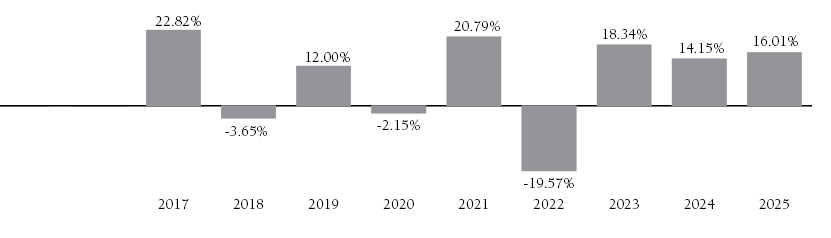
4th Quarter 2020 |
1st Quarter 2020 |
– |
31 | Protective Life Dynamic Allocation Series – Growth Portfolio
|
1 Year |
5 Years |
Since |
Protective Life Dynamic Allocation Series – Growth Portfolio |
|||
Protective Life Dynamic Allocation Series – Growth Portfolio |
|||
MSCI All Country World IndexSM (reflects no deduction for expenses, fees or taxes, except foreign withholding taxes) |
The Portfolio’s broad-based benchmark index is the MSCI All Country World Index. The index is described below.
|
● |
The MSCI All Country World Index is designed to measure equity market performance in global developed and emerging markets. |
MANAGEMENT |
Investment Adviser: Janus Henderson Investors US LLC
Portfolio Management: Benjamin Wang, CFA, is Co-Portfolio Manager of the Portfolio, which he has co-managed since inception in April 2016. Zoey Zhu, CFA, is Co-Portfolio Manager of the Portfolio, which she has co-managed since May 2020.
PURCHASE AND SALE OF PORTFOLIO SHARES |
Purchases of Shares of the Portfolio may be made only by the separate accounts of Protective Life for the purpose of funding variable annuity contracts. Redemptions, like purchases, may be effected only through the separate accounts of Protective Life. Requests are duly processed at the NAV next calculated after your order is received in good order by the Portfolio or its agents. Refer to Protective Life’s separate account prospectus for details.
TAX INFORMATION |
Because Shares of the Portfolio may be purchased only through variable annuity contracts, it is anticipated that any income dividends or net capital gains distributions made by the Portfolio will be exempt from current federal income taxation if left to accumulate within the variable annuity contract. Generally, withdrawals from such contracts may be subject to federal income tax at ordinary income rates and, if made before age 59 ½, a 10% penalty. The federal income tax status of your investment depends on the features of your variable annuity contract. Further information may be found in Protective Life’s separate account prospectus.
PAYMENTS TO INSURERS, BROKER-DEALERS, AND OTHER FINANCIAL INTERMEDIARIES |
Shares of the Portfolio are only available through Protective Life’s variable annuity contracts. The Portfolio or its distributor (and/or their related companies) make payments to Protective Life and/or its related companies for distribution and/or other services; some of the payments may go to broker-dealers and other financial intermediaries. These payments may create a conflict of interest for an intermediary, or be a factor in Protective Life’s decision to include the Portfolio as an underlying investment option in a variable annuity contract. Ask your financial advisor, visit Protective Life’s website, or consult your variable annuity contract prospectus for more information.
32 | Protective Life Dynamic Allocation Series – Growth Portfolio
Additional Information about the Portfolios
Additional Investment Strategies and General Portfolio Policies |
This Prospectus provides information about the Portfolios, a group of mutual funds that invest in affiliated and unaffiliated ETFs, cash and/or money market instruments. Because they invest primarily in ETFs, each Portfolio is considered a “fund of funds.” The term “fund of funds” is used to describe a registered investment company that pursues its investment objective by investing primarily in other investment companies, rather than in individual stocks or bonds. A fund of funds bears its own direct expenses in addition to bearing a proportionate share of the expenses charged by the underlying ETFs in which it invests. Each Portfolio is best suited for long-term investors.
The Portfolios’ Board of Trustees of the Trust (the “Trustees”) may change each Portfolio’s investment objective or non-fundamental principal investment strategies without a shareholder vote. A Portfolio will notify you in writing at least 60 days, or as soon as practicable, before making any such change it considers material. If there is a material change to a Portfolio’s investment objective or principal investment strategies, you should consider whether the Portfolio remains an appropriate investment for you. There is no guarantee that a Portfolio will achieve its investment objective.
This section takes a closer look at the Portfolios’ principal investment strategies, as well as certain risks of investing in the Portfolios. Some of these strategies and policies may be part of a principal strategy, describing Portfolio Summary items in more detail. Other strategies and policies, not previously discussed, are not considered principal strategies, but may be utilized to a lesser extent. Please carefully review the “Risks of the Portfolios” section of this Prospectus for a discussion of risks associated with certain investment techniques.
The Portfolios offer three choices for different investment styles. Because investors’ risk tolerances, investment goals, investment time horizons, and financial circumstances may be different, Conservative Portfolio and Moderate Portfolio each offer differing strategies that seek to attain total return through capital appreciation and income, balanced by capital preservation. Growth Portfolio offers a strategy that seeks to attain total return through growth of capital, balanced by capital preservation. The allocation among global equity asset classes, intermediate- and long-duration fixed-income investments (if any) (the “Static Fixed-Income Allocation”), and short-duration investments (the “Variable Short-Duration Allocation”), in each Portfolio reflects its greater or lesser emphasis on pursuing growth of capital versus income or preservation of capital.
Each Portfolio intends to invest in a dynamic portfolio of underlying ETFs, to pursue a target allocation of global equity and, with respect to Conservative Portfolio and Moderate Portfolio, intermediate- and long-duration fixed-income market exposure. Each Portfolio may also invest in short-duration investments. Each Portfolio intends to employ a quantitative-based investment strategy in which equity allocations will be adjusted weekly, based on market conditions, pursuant to the Allocation Adjustment Program, described further below.
The Allocation Adjustment Program
The Allocation Adjustment Program, a proprietary methodology co-developed by the Adviser and Protective Life, allocates each Portfolio’s assets on a weekly basis among various different equity asset classes and the Variable Short-Duration Allocation, based on historical market indicators. Each Portfolio’s asset allocation is intended to diversify investments throughout the world among equity investments and seeks to mitigate market risk by adjusting equity investments between market exposure and the Variable Short-Duration Allocation, based on historical market indicators. Each of Conservative Portfolio’s and Moderate Portfolio’s Static Fixed-Income Allocation is expected to remain constant over time, subject to market movements. Portfolio management oversees the Allocation Adjustment Program and are responsible for the day-to-day management of the Portfolios. Within the parameters of each asset class’ allocation relative to a Portfolio’s total assets, and the target allocation ranges within each asset class, portfolio management reviews the allocation of Portfolio assets in the underlying ETFs and may, without shareholder notice, cease investing in one or more underlying ETFs, modify the underlying ETFs’ weightings or add or substitute other underlying ETFs that provide similar investment exposure, to emphasize and mitigate risk exposures that may arise as a result of the implementation of the allocations.
33 | Clayton Street Trust
In allocating among the underlying ETFs in a particular asset class, portfolio management will consider a number of factors, the primary of which is liquidity. The following table summarizes the management process:
Action |
Normal Frequency |
Review/rebalance Portfolio allocations within each equity asset class |
Weekly |
Rebalance across asset class allocations |
Every Calendar Quarter |
Review allocation policy |
Every Calendar Quarter |
The following table indicates each Portfolio’s long-term, fully-invested target asset allocation, which is how each Portfolio’s investments generally will be allocated among the asset classes under full investment, as well as the approximate ranges, based on market conditions, within which each Portfolio’s assets may be allocated.
|
Conservative |
Moderate |
Growth |
Long-Term Target Asset Allocation |
|||
Global Equity Investments |
50% |
65% |
100% |
Intermediate- and Long-Duration Fixed-Income Investments |
50% |
35% |
0% |
Short-Duration Fixed-Income Investments |
0% |
0% |
0% |
Approximate Asset Allocation Range |
|||
Global Equity Investments |
0%-50% |
0%-65% |
0%-100% |
Intermediate- and Long-Duration Fixed-Income Investments |
50% |
35% |
0% |
Short-Duration Fixed-Income Investments |
0%-50% |
0%-65% |
0%-100% |
Equity and Variable Short-Duration Allocations. The equity and Variable Short-Duration allocations are adjusted weekly, as needed, based on historical market indicators (a 252-day exponentially-weighted moving average for each equity class, as discussed further below), subject to the respective asset class’ allocation. Accordingly, in any given week, each equity asset class component will represent the combined allocation to such equity investments plus short-duration investments, if any. Within each equity asset class, the amount invested by a Portfolio to gain or maintain market exposure versus the amount to be held in short-duration investments depends on the market indicator as established by the Allocation Adjustment Program. The Variable Short-Duration Allocation is described in further detail below.
Static Fixed-Income Allocation (Conservative Portfolio and Moderate Portfolio only). The Static Fixed-Income Allocation is expected to remain constant over time, subject to market movement, and will be rebalanced to its target allocation on a quarterly basis. Conservative Portfolio and Moderate Portfolio will generally obtain intermediate- and long-duration fixed- income exposure by investing in unaffiliated ETFs that provide broad exposure to the total U.S. investment-grade bond market. The credit quality of the Portfolios’ Static Fixed Income Allocation will generally reflect the average credit quality of the underlying ETFs providing the fixed-income exposure.
Market Indicators. The Allocation Adjustment Program compares the current valuation of an equity asset class compared to a 252-day exponentially-weighted moving average. An exponentially-weighted moving average gives more weight to more recent days’ valuation relative to less recent days’ valuation within the 252-day look-back window. If the current valuation of a given equity asset class is more than 2% below the 252-day exponentially-weighted moving average, the Allocation Adjustment Program signals portfolio management to move to the next lower target allocation, down to a minimum of 0%. If the valuation of a given equity asset class is between 98% and 100% of the 252-day exponentially-weighted moving average, the Allocation Adjustment Program will signal no change. If the current valuation of a given equity asset class is above the 252-day exponentially-weighted moving average by any amount, the Allocation Adjustment Program signals portfolio management to move to the next higher target allocation, up to the maximum target allocation for that equity class. Under normal circumstances, trade signals from the Allocation Adjustment Program will be implemented in a Portfolio on the next business day.
34 | Clayton Street Trust
Trading Increments. The Allocation Adjustment Program allows for five different target allocations within each equity asset class: 0%, 25%, 50%, 75%, and 100%. The target reflects the desired allocation to equity, with the remainder held in the Variable Short-Duration Allocation. The target allocation for each of the equity asset classes at the outset is 100%.
The table below shows, for each asset class, the class’ target allocation within each Portfolio, the approximate range of potential market exposure within the asset class, and the approximate trading increment upon a trade signal. Each figure is shown as a percentage of the respective Portfolio’s total assets.
Conservative Portfolio |
|||
Asset Class |
Asset Class |
Approximate |
Approximate |
U.S. Large Cap Equity |
20.00% |
0%-20.00% |
5.00% |
U.S. Small Cap Equity |
7.50% |
0%-7.50% |
1.88% |
U.S. High Growth Equity |
7.50% |
0%-7.50% |
1.88% |
U.K. Equity |
5.00% |
0%-5.00% |
1.25% |
European Equity |
5.00% |
0%-5.00% |
1.25% |
Japan Equity |
2.50% |
0%-2.50% |
0.63% |
Asia Equity, ex-Japan |
2.50% |
0%-2.50% |
0.63% |
Global Equity Total |
50.00% |
0%-50.00% |
N/A |
Intermediate- and Long-Duration Fixed-Income Investments |
50.00% |
50.00% |
N/A |
Short-Duration Fixed-Income Investments |
N/A |
0%-50.00% |
N/A |
Moderate Portfolio |
|||
Asset Class |
Asset Class |
Approximate |
Approximate |
U.S. Large Cap Equity |
26.00% |
0%-26.00% |
6.50% |
U.S. Small Cap Equity |
9.75% |
0%-9.75% |
2.44% |
U.S. High Growth Equity |
9.75% |
0%-9.75% |
2.44% |
U.K. Equity |
6.50% |
0%-6.50% |
1.63% |
European Equity |
6.50% |
0%-6.50% |
1.63% |
Japan Equity |
3.25% |
0%-3.25% |
0.81% |
Asia Equity, ex-Japan |
3.25% |
0%-3.25% |
0.81% |
Global Equity Total |
65.00% |
0%-65.00% |
N/A |
Intermediate- and Long-Duration Fixed-Income Investments |
35.00% |
35.00% |
N/A |
Short-Duration Fixed-Income Investments |
N/A |
0%-65.00% |
N/A |
35 | Clayton Street Trust
Growth Portfolio |
|||
Asset Class |
Asset Class |
Approximate |
Approximate |
U.S. Large Cap Equity |
40.00% |
0%-40.00% |
10.00% |
U.S. Small Cap Equity |
15.00% |
0%-15.00% |
3.75% |
U.S. High Growth Equity |
15.00% |
0%-15.00% |
3.75% |
U.K. Equity |
10.00% |
0%-10.00% |
2.50% |
European Equity |
10.00% |
0%-10.00% |
2.50% |
Japan Equity |
5.00% |
0%-5.00% |
1.25% |
Asia Equity, ex-Japan |
5.00% |
0%-5.00% |
1.25% |
Global Equity Total |
100.00% |
0%-100.00% |
N/A |
Short-Duration Fixed-Income Investments |
N/A |
0%-100.00% |
N/A |
|
(1) |
Represents the target allocation to the respective asset class as a percentage of the Portfolio’s total assets plus, with respect to the equity classes, the remainder, if any, held in short-duration investments. |
|
(2) |
Represents the approximate trading increment response to an Allocation Adjustment Program signal, as a percentage of the Portfolio’s total assets, to be reallocated from one target allocation to the next. |
At no time will an individual asset class exposure be less than zero for investment purposes (i.e., no short exposure), and generally an asset class exposure will not be greater than its maximum target allocation, except due to market movements between periodic rebalancing of a Portfolio. To the extent market movements between periodic rebalancing of the Portfolio results in an asset class exposure in excess of its maximum target allocation, a Portfolio will continue to buy and sell assets reflecting the Portfolio’s current composition as it manages purchase and redemption orders for the Portfolio, and when it implements trades directed by the weekly Allocation Adjustment Program.
Portfolio management may change a Portfolio’s allocations among the asset classes without shareholder notice, unless the Adviser determines it would be a material change to the Portfolio’s investment strategy, in which case shareholders would receive advance notice.
Actual allocations implemented in each Portfolio may vary, due to a number of factors, including but not limited to, market movements, and large purchases and redemptions in the Portfolios.
As an example of how the Allocation Adjustment Program works, assume a Portfolio presently allocates 20% of its assets to the U.S. Large Cap Equity asset class, and the target allocation within that asset class is 100%. Twenty percent of the Portfolio’s assets will be invested in underlying ETFs that comprise the U.S. Large Cap Equity asset class. If the following week, the U.S. Large Cap Equity asset class is valued 5% below the 252-day exponentially-weighted moving average, the Allocation Adjustment Program will signal portfolio management to move to the next lower target allocation (75%) for this asset class. If, as a result of market movement, the asset class now represents 18% of the Portfolio’s assets, the Portfolio’s assets invested in the underlying ETFs that comprise the U.S. Large Cap Equity asset class will be reduced to a target of 13.5% of the Portfolio’s assets, with the remaining target of 4.5% held in the Variable Short-Duration Allocation. If in the third week, the performance of the U.S. Large Cap Equity class is flat, but its valuation remains more than 2% below the 252-day exponentially-weighted moving average, the Allocation Adjustment Program will signal to portfolio management to move to the next lower target allocation (50%). If, as a result of market movement, the asset class now represents 16% of the Portfolio’s assets, the Portfolio’s assets invested in the underlying ETFs that comprise the U.S. Large Cap Equity asset class will be further reduced to a target of 8% of the Portfolio’s assets, with the remaining target of 8% held in short-duration investments.
The Underlying ETFs
Each Portfolio will normally allocate its investments to underlying ETFs to diversify investments throughout the world and provide varying exposure to large-, mid-, or small-capitalization companies, U.S. based and non-U.S. based companies (including those with exposure to emerging markets), and, with respect to Conservative Portfolio and Moderate Portfolio, fixed-income securities (including U.S. Treasury, government-related, and corporate, mortgage-backed pass-through
36 | Clayton Street Trust
securities, commercial mortgage-backed securities, and asset-backed securities). The allocations may change from time to time to reflect market fluctuations or in response to various economic or other factors as deemed appropriate by portfolio management. As noted above, each Portfolio may invest in short-duration affiliated and unaffiliated underlying ETFs within its Variable Short- Duration Allocation to seek to mitigate market risk associated with its equity allocation.
The table below shows, for each asset class, the ETFs in which the Portfolios, as of the date of this Prospectus, expect to invest. The underlying ETFs may change at any time without prior notice. In addition, the Portfolios may reallocate their assets among the potential underlying ETFs described in this Prospectus, other ETFs, or cash and/or money market instruments. Portfolio management may choose at their sole discretion to remove, add or substitute other ETFs in order to obtain the desired market exposure, to further diversify and/or mitigate risk for the Portfolios, or for other reasons, without prior shareholder notification.
Asset Class |
Potential Underlying ETFs+ |
|
Global Equity Investments (Stocks) |
Exchange-Traded Funds |
Ticker |
U.S. Large Cap Equity |
SPDR® S&P 500® ETF# iShares® Core S&P 500 ETF* Vanguard S&P 500 ETF |
SPY |
U.S. Small Cap Equity |
iShares® Russell 2000 ETF* iShares® Core S&P Small-Cap ETF* Vanguard Small-Cap ETF |
IWM |
U.S. High Growth Equity |
Invesco QQQ TrustSM, Series 1 Invesco NASDAQ 100 ETF |
QQQ |
U.K. Equity |
iShares® MSCI United Kingdom ETF* Franklin FTSE United Kingdom ETF |
EWU |
European Equity |
SPDR® Euro Stoxx 50® ETF# Vanguard FTSE Europe ETF JPMorgan BetaBuilders Europe ETF Franklin FTSE Europe ETF |
FEZ |
Japan Equity |
iShares® MSCI Japan ETF* Franklin FTSE Japan ETF JPMorgan BetaBuilders Japan ETF |
EWJ |
Asia Equity, ex-Japan |
iShares® MSCI All Country Asia ex-Japan ETF* Franklin FTSE Asia ex Japan ETF JPMorgan BetaBuilders Developed Asia Pacific ex-Japan ETF |
AAXJ |
Intermediate- and Long-Duration Fixed-Income Investments (Bonds) |
iShares® Core U.S. Aggregate Bond ETF* Vanguard Total Bond Market ETF |
AGG |
Short-Duration Fixed-Income Investments |
Janus Henderson Short Duration Income ETF JPMorgan Ultra-Short Income ETF PIMCO Enhanced Short Maturity Active ETF Invesco Ultra Short-Duration ETF |
VNLA |
|
* |
iShares® is a registered trademark of BlackRock (BlackRock, Inc. and its subsidiaries). |
|
# |
SPDR® is a registered trademark of Standard & Poor’s Financial Services LLC. |
|
+ |
The investment advisers, sponsors and distributors of the underlying ETFs, and the underlying ETFs themselves, do not make any representations regarding the advisability of investing in any of the underlying ETFs. |
Actual holdings percentages may vary due to actual asset allocations, cash flows, and changes to the underlying ETFs’ asset values. Each Portfolio can invest in any or all of the underlying ETFs and a Portfolio’s investment in certain underlying ETFs may exceed 25% of such Portfolio’s total assets. The Adviser may change the underlying ETFs, an underlying ETF’s asset category, or allocations among asset classes or underlying ETFs without prior notice to shareholders, unless the Adviser determines it would be a material change to a Portfolio’s principal investment strategy, in which case shareholders would receive prior notice.
37 | Clayton Street Trust
In the event portfolio management is unable to identify or invest in underlying ETFs that provide the desired exposure to an asset class, portfolio management may, without shareholder notice, elect to forego investment in that asset class until an appropriate underlying ETF is identified and available. Portfolio management may also determine to remove the asset class from the Allocation Adjustment Program, in which case a Portfolio would provide notice to shareholders as soon as reasonably practical.
Information regarding a Portfolio’s actual allocations to underlying ETFs is available to shareholders on a periodic basis through the Portfolios’ annual reports, semiannual reports, and certain other reports filed with the Securities and Exchange Commission (the “SEC”), as well as at janushenderson.com/clayton-street-trust. Please refer to “Availability of Portfolio Holdings Information” in this Prospectus to learn how to access the most recent allocation information.
Refer to Appendix A in this Prospectus for a brief description of the investment objective and strategies of each of the potential underlying ETFs in which a Portfolio, as of the date of this Prospectus, expects to invest. This Prospectus is not an offer to sell any of the underlying ETFs. Additional information is available in the underlying ETFs’ prospectuses and statements of additional information available on the SEC’s website at http://www.sec.gov.
Variable Short-Duration Allocation
Each Portfolio’s Variable Short-Duration Allocation may be as low as 0% or as high as 50%, 65%, or 100% of its assets for the Conservative Portfolio, Moderate Portfolio, and Growth Portfolio, respectively, depending on prevailing market conditions and the weekly results of the Allocation Adjustment Program. Under normal circumstances, each Portfolio expects the Variable Short- Duration Allocation to be comprised of or provide exposure to securities with varying maturities and an average duration of 2 years or less. Permissible short-duration investments include cash, money market instruments (eligible securities, as defined by Rule 2a-7 under the Investment Company Act of 1940, as amended (the “1940 Act”)) determined by the Adviser to present minimal credit risk, affiliated or unaffiliated money market funds and/or investments in affiliated and unaffiliated underlying ETFs that invest in a portfolio of fixed-income instruments across a broad range of sectors and geographies while maintaining a short-duration portfolio. These underlying ETFs primarily invest in investment grade debt securities, including, among others, short-term instruments, such as commercial paper and repurchase agreements, mortgage-backed securities, asset-backed securities, including collateralized debt obligations, and derivatives. The underlying ETFs may also invest in high-yield (or “junk”) bonds. Each Portfolio’s short-duration investments may include securities of U.S. and foreign public- and private-sector issuers.
A Portfolio will increase its Variable Short-Duration Allocation when market indicators from the Allocation Adjustment Program dictate a more defensive position. As a Portfolio’s investments in short-duration investments increase, it may not participate in market advances or declines to the same extent that it would if the Portfolio remained more fully invested in underlying ETFs.
Securities that a Portfolio may invest in as a means of receiving a return on the portion of the Portfolio’s assets allocated to short- duration investments include high-quality debt obligations and obligations of financial institutions. Debt obligations may include commercial paper, notes, bonds, and floating interest rate securities. Obligations of financial institutions include certificates of deposit and time deposits. A Portfolio may also invest in repurchase agreements, including those secured by U.S. Treasuries, or other instruments issued by U.S. Government agencies. Some government agencies are backed by the full faith and credit of the United States and as such are supported by the issuer’s ability to borrow from the United States Treasury, others are supported only by the credit of the issuer, and some are supported by the United States in some other way. With respect to money market instruments, a Portfolio will:
|
● |
acquire only short-term money market instruments that present minimal credit risks, as determined by the Adviser; |
|
● |
acquire only U.S. dollar-denominated instruments that have a remaining maturity of 397 calendar days or less (as calculated pursuant to Rule 2a-7 under the 1940 Act). |
Subject to the limitations described above, money market instruments and/or affiliated and unaffiliated underlying ETFs that invest in a portfolio of fixed-income instruments across a broad range of sectors and geographies while maintaining a short- duration portfolio in which the Portfolio may invest include, but are not limited to:
|
● |
Commercial Paper. Each Portfolio may purchase commercial paper. Commercial paper is a debt obligation usually issued by corporations in order to finance their current operations. Commercial paper is usually repaid at maturity by the issuer from the proceeds of the issuance of new commercial paper. As a result, investments in commercial paper are subject to |
38 | Clayton Street Trust
the risk the issuer cannot issue enough new commercial paper to satisfy its outstanding commercial paper, also known as rollover risk. In addition, under certain circumstances, commercial paper may become illiquid or may suffer from reduced liquidity.
|
● |
Mortgage- and Asset-Backed Securities. Each Portfolio may purchase fixed or variable rate commercial or residential mortgage- backed securities issued by the Government National Mortgage Association (“Ginnie Mae”), the Federal National Mortgage Association (“Fannie Mae”), the Federal Home Loan Mortgage Corporation (“Freddie Mac”), or other governmental or government-related entities. Ginnie Mae’s guarantees are backed by the full faith and credit of the U.S. Government, which means that the U.S. Government guarantees that the interest and principal will be paid when due. Fannie Mae and Freddie Mac securities are not backed by the full faith and credit of the U.S. Government. The Portfolios may also purchase mortgage-and asset-backed securities through single- and multi-seller conduits, collateralized debt obligations, structured investment vehicles, and other similar securities. Asset-backed securities may be backed by various consumer obligations, including automobile loans, equipment leases, credit card receivables, or other collateral. In the event the underlying loans are not paid, the securities’ issuer could be forced to sell the assets and recognize losses on such assets, which could impact a Portfolio’s yield and your return. |
|
● |
Obligations of Financial Institutions. Each Portfolio may invest in obligations of financial institutions. Examples of obligations of financial institutions include: negotiable certificates of deposit, bankers’ acceptances, time deposits, and other obligations of U.S. banks (including savings and loan associations) having total assets in excess of one billion dollars and U.S. branches of foreign banks having total assets in excess of ten billion dollars); Eurodollar and Yankee bank obligations (Eurodollar bank obligations are U.S. dollar-denominated certificates of deposit or time deposits issued outside the U.S. capital markets by foreign branches of U.S. banks and by foreign banks; Yankee bank obligations are dollar-denominated obligations issued in the U.S. capital markets by foreign banks.); and other U.S. dollar-denominated obligations of foreign banks having total assets in excess of ten billion dollars that the Adviser believes are of an investment quality comparable to obligations of U.S. banks in which a Portfolio may invest. To the extent a Portfolio focuses on these financial services sector investments, it will be at risk in the event of an economic downturn or other market event, which increases the risk of your investment. A decline in the credit quality of an issuer, the provider of credit support, may also have a negative effect on the Portfolio. Foreign, Eurodollar, and, to a limited extent, Yankee bank obligations are subject to certain sovereign risks. |
|
● |
Repurchase Agreements. Each Portfolio may enter into repurchase agreements collateralized by cash, U.S. Treasuries, U.S. Government securities, or other securities deemed appropriate by the Adviser. Repurchase agreements are transactions in which a Portfolio purchases securities and simultaneously commits to resell those securities to the seller at an agreed-upon price on an agreed-upon future date. The repurchase price reflects a market rate of interest. Repurchase agreements involve the risk that the seller will fail to repurchase the security, as agreed. In that case, the Portfolio will bear the risk of market value fluctuations until the security can be sold, and may encounter delays and incur costs in liquidating the security. |
|
● |
U.S. Government Securities. Each Portfolio may invest in U.S. Government securities. U.S. Government securities include those issued directly by the U.S. Treasury and those issued or guaranteed by various U.S. Government agencies and instrumentalities. Some government securities are backed by the full faith and credit of the United States. Other government securities are backed only by the rights of the issuer to borrow from the U.S. Treasury. Others are supported by the discretionary authority of the U.S. Government to purchase the obligations. Certain other government securities are supported only by the credit of the issuer. For securities not backed by the full faith and credit of the United States, a Portfolio must look principally to the agency or instrumentality issuing or guaranteeing the securities for repayment and may not be able to assert a claim against the United States if the agency or instrumentality does not meet its commitment. Such securities may involve increased risk of loss of principal and interest compared to government debt securities that are backed by the full faith and credit of the United States. Because of the rising U.S. Government debt burden, it is possible that the U.S. Government may not be able to meet its financial obligations or that securities issued or backed by the U.S. Government may experience credit downgrades. Such a credit event may adversely affect the financial markets. |
A Portfolio may also invest its cash in a cash sweep program, an arrangement in which the Portfolio’s uninvested cash balance is pooled with uninvested cash of other funds and invested in certain securities such as repurchase agreements or is used to purchase shares of affiliated or non-affiliated money market funds (or cash management pooled investment vehicles that operate as money market funds) at the end of each day. To the extent a Portfolio invests through a sweep program, it is subject to the risks of the account or fund into which it is investing, including liquidity issues that may delay the Portfolio from accessing its cash. The Portfolios and certain underlying ETFs may purchase unlimited shares of affiliated or non-affiliated money market funds or cash management pooled investment vehicles.
39 | Clayton Street Trust
Portfolio management’s selection of investments for the Variable Short-Duration Allocation among short-duration affiliated ETFs, short-duration unaffiliated ETFs, money market instruments and cash may be based on a variety of factors, including prevailing market conditions, to seek to enhance total return and managing risk.
When market indicators from the Allocation Adjustment Program dictate a more defensive position, the resulting allocations may result in a Portfolio holding a substantial portion of its assets in short-duration investments for a prolonged period. When a Portfolio holds a substantial portion of its assets in short-duration investments for a prolonged period, it may not achieve the income and/or growth portions of its investment objective, as applicable.
Due to the nature of the Allocation Adjustment Program, a Portfolio may have higher portfolio turnover compared to other funds of funds. Increased portfolio turnover may result in higher costs for brokerage commissions, dealer mark-ups, and other transaction costs. Higher costs associated with increased portfolio turnover also may have a negative effect on a Portfolio’s performance.
Portfolio Turnover
Portfolio turnover rates are not a factor in making buy and sell decisions. The Portfolios normally seek long-term investment, although the Portfolios may sell shares of the underlying ETFs regardless of how long they have been held. Portfolio turnover is affected by market conditions, the Allocation Adjustment Program, and changes in the size of a Portfolio (including due to shareholder purchases and redemptions). Changes are normally made in a Portfolio’s holdings on a weekly basis, pursuant to the Allocation Adjustment Program. Portfolio turnover rates are not a factor in the Allocation Adjustment Program. The Portfolios’ transactions in the underlying ETFs incur brokerage commissions. Due to the nature of the Allocation Adjustment Program, the Portfolios may have higher portfolio turnover compared to other fund of funds.
Increased portfolio turnover may result in higher costs for brokerage commissions, dealer mark-ups, and other transaction costs. Higher costs associated with increased portfolio turnover also may have a negative effect on a Portfolio’s performance.
Securities Lending
A Portfolio may seek to earn additional income through lending its securities to certain qualified broker-dealers and institutions, in an amount equal to up to one-third of its total assets as determined at the time of the loan origination. When a Portfolio lends its securities, it receives collateral (including cash collateral), at least equal to the value of securities loaned. The Portfolios may earn income by investing this collateral in one or more affiliated or non-affiliated cash management vehicles or in time deposits. It is also possible that, due to a decline in the value of a cash management vehicle in which collateral is invested, the Portfolio may lose money. There is also the risk that when portfolio securities are lent, the securities may not be returned on a timely basis, and the Portfolio may experience delays and costs in recovering the security or gaining access to the collateral provided to the Portfolio to collateralize the loan. If the Portfolio is unable to recover a security on loan, the Portfolio may use the collateral to purchase replacement securities in the market. There is a risk that the value of the collateral could decrease below the cost of the replacement security by the time the replacement investment is made, resulting in a loss to the Portfolio. In certain circumstances, individual loan transactions could yield negative returns. The Adviser intends to manage the cash collateral in an affiliated cash management vehicle and will receive an investment advisory fee for managing such assets.
Risks of the Portfolios |
The value of your investment will vary over time, sometimes significantly, and you may lose money by investing in the Portfolios.
Allocation Risk. The Portfolios are managed pursuant to the Allocation Adjustment Program, and are therefore subject to the risk that the investment strategies and resulting allocation employed for the Portfolios may fail to produce the intended results. A Portfolio may underperform its benchmark index or other mutual funds with similar investment objectives. A Portfolio’s ability to achieve its investment objective depends largely upon the allocation of assets among the underlying ETFs and short- duration investments, using the Allocation Adjustment Program. You could lose money on your investment in a Portfolio as a result of these allocations. The Portfolios will typically invest in a range of different underlying ETFs and short-duration investments; however, to the extent that a Portfolio invests a significant portion of its assets in a single underlying ETF, it will be more sensitive to the risks associated with that underlying ETF and any investments in which that underlying ETF focuses. To the extent a Portfolio’s assets are allocated to short-duration investments, it will be subject to risks associated
40 | Clayton Street Trust
with those investments, may generate returns that are lower than inflation and, in periods of rising market prices, such Portfolio may be unable to participate in such price increases as fully as it may have if its assets were allocated to the equity asset classes.
Investment Process Risk. No assurance can be given that a Portfolio’s investment strategy will be successful under all or any market conditions. Although the Allocation Adjustment Program is designed to achieve each Portfolio’s investment objective, there is no guarantee that it will achieve the desired results, and there is a risk that it may not be successful in identifying how a Portfolio’s assets should be adjusted to reduce the risk of loss in down markets while participating in the upside growth of markets. The Allocation Adjustment Program is a quantitative, model-driven (i.e., rules-based) investment strategy that may perform differently from the market as a whole based on the factors used in the model, the weight placed on each factor, as well as changes in historical trends and market conditions. Historical performance does not indicate future performance, and the assumption that markets will continue to rise where an asset class is valued higher (or continue to fall where an asset class is valued lower) than its 252-day exponentially-weighted moving average may prove to be incorrect under certain market conditions. In such cases, implementing a signal from the Allocation Adjustment Program may result in maintaining or increasing market exposure (or a reduction in exposure), might not provide the intended results, and may adversely impact a Portfolio’s performance. The risk of loss may be heightened during periods of significant market volatility if the Allocation Adjustment Program is not designed to address the specific market conditions present at that time.
Fund of Funds Structure Risk. To varying degrees, each Portfolio intends to allocate assets among underlying ETFs that invest in global equity and fixed-income securities (not including Growth Portfolio), and also among short-duration investments. The allocation of each Portfolio’s assets to underlying ETFs may not be successful in achieving each Portfolio’s investment objective. There is a risk that you may experience lower returns by investing in a Portfolio instead of investing directly in an underlying ETF. A Portfolio’s returns are directly related to the aggregate performance and expenses of the underlying ETFs in which it invests. A Portfolio, as a shareholder in an underlying ETF, will indirectly bear its pro rata share of the expenses incurred by the underlying ETFs. A Portfolio’s return will be net of these expenses, and these expenses may be higher or lower depending upon the allocation of its assets among the underlying ETFs and the actual expenses of the underlying ETFs. There is additional risk for the Portfolios with respect to aggregation of holdings of underlying ETFs. The aggregation of holdings of underlying ETFs may result in a Portfolio indirectly having increased exposure to assets in a particular industry, geographical sector, or single company. Such indirect exposure may have the effect of increasing the volatility of a Portfolio’s returns. The Portfolios do not control the investments of the underlying ETFs, or any indirect exposure that occurs as a result of the underlying ETFs following their investment objectives. Additionally, to the extent the Portfolio purchases shares of affiliated or non-affiliated money market funds, or cash management pooled investment vehicles, it would bear its pro rata portion of such fund’s expenses, in addition to the expenses the Portfolio bears directly in connection with its own operation.
The SEC adopted changes to the rules that govern SEC registered money market funds in July 2023 that impact the manner in which money market funds are operated. These changes may affect the investment strategies, performance, yield, operating expenses and continued viability of money market funds in which a Portfolio may invest. There can be no assurance that a Portfolio’s investments in money market funds are not adversely affected by these or additional reforms to money market regulation that may be adopted by the SEC or other regulatory authorities.
Affiliated Underlying Fund Risk. The Adviser may invest in certain underlying affiliated ETFs and money market funds (or unregistered cash management pooled investment vehicles that operate as money market funds) as investments for the Portfolios. The Adviser will generally receive fees for managing such funds, in addition to the fees paid to the Adviser by each Portfolio. The payment of such fees by underlying affiliated funds creates a conflict of interest when selecting underlying affiliated funds for investment in the Portfolio. The Adviser, however, is a fiduciary to each Portfolio and its shareholders and is legally obligated to act in their best interest when selecting underlying affiliated funds. In addition, the Adviser has contractually agreed to waive and/or reimburse a portion of each Portfolio’s management fee in an amount equal to the management fee it earns as an investment adviser to any of the underlying affiliated ETFs with respect to each Portfolio’s investment in such ETF, less certain asset-based operating fees and expenses.
The Adviser manages many funds and numerous other accounts, which may include separate accounts and other pooled investment vehicles, such as hedge funds. Side-by-side management of multiple accounts, including the management of a cash collateral pool for securities lending and investing the Janus Henderson funds’ cash, may give rise to conflicts of interest among those accounts, and may create potential risks, such as the risk that investment activity in one account may adversely affect another account. Side-by-side management may raise additional potential conflicts of interest relating to the allocation of investment opportunities and the aggregation and allocation of trades. Additionally, because the Adviser is the adviser to the Portfolios and potentially to certain of the underlying ETFs or money market funds, it is subject to certain
41 | Clayton Street Trust
potential conflicts of interest when allocating the assets of the Portfolios among underlying ETFs. Portfolio management, officers, and Trustees of the Portfolios may also serve in the same capacity as portfolio management, officers, and Trustees of the underlying ETFs. Conflicts may arise as portfolio management, officers, and Trustees seek to fulfill their fiduciary responsibilities to the Portfolios and the underlying ETFs. A further discussion of potential conflicts of interest and a discussion of certain procedures intended to mitigate such potential conflicts are contained in the Portfolios’ statement of additional information (“SAI”).
Operational Risk. An investment in a Portfolio (and the Portfolios’ investments in the underlying ETFs) can involve operational risks arising from factors such as processing errors, human errors, inadequate or failed internal or external processes, failures in systems and technology, changes in personnel, and errors caused by third party service providers. Among other things, these errors or failures, as well as other technological issues, may adversely affect a Portfolio’s or underlying ETF’s ability to calculate its net asset value, process fund orders, execute portfolio trades or perform other essential tasks in a timely manner, including over a potentially extended period of time. These errors or failures may also result in a loss or compromise of information, regulatory scrutiny, reputational damage or other events, any of which could have a material adverse effect on a Portfolio or underlying ETF. Implementation of business continuity plans by the Portfolio, the Adviser or third-party service providers in response to disruptive events such as natural disasters, epidemics and pandemics, terrorism, conflicts and social unrest may increase these operational risks to the Portfolios. While the Portfolios seek to minimize such events through internal controls and oversight of third-party service providers, there is no guarantee that the Portfolios will not suffer losses if such events occur.
Portfolio Turnover Risk. Increased portfolio turnover may result in higher costs, which may have a negative effect on a Portfolio’s performance. Due to operation of the Allocation Adjustment Program, a Portfolio may experience higher portfolio turnover as the result of equity market volatility.
Risks of Holding Short-Duration Investments. The Conservative Portfolio, Moderate Portfolio, and Growth Portfolio may allocate up to 50%, 65% and 100% of their respective assets to short-duration investments, respectively. To the extent a Portfolio’s assets are allocated directly to short-duration investments (i.e. money market instruments) rather than short-duration ETFs, such Portfolio may be subject to the following risks:
|
● |
Interest Rate Risk. Although a Portfolio seeks to invest only in high-quality, short-term money market instruments, there is a risk that the value of the securities it may hold will fall as a result of the changes in interest rates. Rising interest rates could cause the value of a Portfolio’s investments to decline, and a decline in interest rates is likely to cause the Portfolio’s income to decline. A Portfolio’s investments may be subject to a greater risk of rising interest rates due to inflationary trends; likewise, during certain periods of time, the Portfolio’s income may approach zero. |
|
● |
Credit Quality Risk. The value of the securities that a Portfolio may hold may fall based on an issuer’s actual or perceived creditworthiness, or an issuer’s ability to meet its obligations. The credit quality of a Portfolio’s holdings can change rapidly in certain market environments, and any downgrade or default of a portfolio security could result in a decline in the Portfolio’s income and potentially in the value of the Portfolio’s investments. |
|
● |
Liquidity Risk. The liquidity of the securities that a Portfolio may hold may deteriorate rapidly due to credit events affecting one or more issuers or guarantors or due to general market conditions and a lack of willing buyers. In such cases, a Portfolio may have to accept a lower price or may be unable to sell a security. An inability to sell one or more securities may negatively affect a Portfolio’s income or prevent the Portfolio from being able to take advantage of other investment opportunities. |
|
● |
Income Risk. The value of a Portfolio may vary as short-term securities in its portfolio mature and the proceeds are reinvested in securities with different interest rates. For capital preservation and liquidity, a Portfolio may have a greater concentration in short-term securities including, but not limited to, investing up to all of its assets in overnight securities, which may result in a reduction of the Portfolio’s income. |
|
● |
Collateral Risk. With respect to collateral received in repurchase transactions or other investments, a Portfolio may have significant exposure to financial services, mortgage markets, and government agencies not secured by the full faith and credit of the United States. Such exposure, depending on market conditions, could have a negative impact on a Portfolio, including minimizing the value of any collateral held by the Portfolio. |
42 | Clayton Street Trust
|
● |
Counterparty Risk. Portfolio transactions involving a counterparty are subject to the risk that the counterparty or a third party will not fulfill its obligation to a Portfolio (“counterparty risk”). Counterparty risk may arise because of the counterparty’s financial condition (i.e., financial difficulties, bankruptcy, or insolvency), market activities and developments, or other reasons, whether foreseen or not. A counterparty’s inability to fulfill its obligation may result in significant financial loss to a Portfolio. A Portfolio may be unable to recover its investment from the counterparty or may obtain a limited recovery, and/or recovery may be delayed. A Portfolio may be exposed to counterparty risk through its investments in certain securities, including, but not limited to, repurchase agreements and debt securities. A Portfolio intends to enter into financial transactions with counterparties that the Adviser believes to be creditworthy at the time of the transaction. There is always the risk that the Adviser’s analysis of a counterparty’s creditworthiness is incorrect or may change due to market conditions. To the extent that a Portfolio focuses its transactions with a limited number of counterparties, it will have greater exposure to the risks associated with one or more counterparties. |
Risks Associated with the Underlying ETFs and Securities
The biggest risk is that the underlying ETFs’ returns will vary, and you could lose money. There can be no assurance that an underlying ETF will achieve its investment objective.
The following information is intended to help you better understand some of the risks of investing in the Portfolios. The impact of the following risks on a Portfolio may vary depending on the Portfolio’s investment allocation. The greater a Portfolio’s allocation to an underlying ETF or investment, the greater the Portfolio’s exposure to the risks associated with that underlying ETF or investment. Additional information is available in the underlying ETFs’ prospectuses and statements of additional information available on the SEC’s website at http://www.sec.gov. Before investing in a Portfolio, you should consider carefully the risks that you assume when investing in that Portfolio.
Collateral Risk. With respect to collateral received in repurchase transactions or other investments, an underlying ETF or a Portfolio may have significant exposure to financial services, mortgage markets, and government agencies not secured by the full faith and credit of the United States. Such exposure, depending on market conditions, could have a negative impact on an underlying ETF, including minimizing the value of any collateral.
Counterparty Risk. Portfolio or underlying ETF transactions involving a counterparty are subject to the risk that the counterparty or a third party will not fulfill its obligation to such Portfolio or underlying ETF (“counterparty risk”). Counterparty risk may arise because of the counterparty’s financial condition (i.e., financial difficulties, bankruptcy, or insolvency), market activities and developments, or other reasons, whether foreseen or not. A counterparty’s inability to fulfill its obligation may result in significant financial loss to a Portfolio, in connection with its short-duration investments, or through an underlying ETF. A Portfolio or an underlying ETF may be unable to recover its investment from the counterparty or may obtain a limited recovery, and/or recovery may be delayed. A Portfolio, in connection with its short-duration investments, or through an underlying ETF may be exposed to counterparty risk to the extent it, or an underlying ETF, participates in cash sweep arrangements whereby a Portfolio’s or an underlying ETF’s cash balance is invested in one or more types of cash management vehicles. In addition, a Portfolio, in connection with its short-duration investments, or through an underlying ETF may be exposed to counterparty risk through investments in certain securities, including, but not limited to, repurchase agreements, debt securities and derivatives (including various types of forwards, swaps, futures, and options). The Portfolios intend to enter into financial transactions with counterparties that the Adviser believes to be creditworthy at the time of the transaction. There is always the risk that the Adviser’s analysis, or an underlying ETF’s analysis, of a counterparty’s creditworthiness is incorrect or may change due to market conditions. To the extent that a Portfolio or an underlying ETF focuses its transactions with a limited number of counterparties, it will have greater exposure to the risks associated with one or more counterparties.
Credit Quality Risk. A Portfolio, in connection with its money market instruments, and through investments in underlying ETFs holding fixed-income securities, is subject to the risks associated with the credit quality of the issuers of those fixed- income securities. Credit quality measures the likelihood that the issuer or borrower will meet its obligations on a security. One of the fundamental risks for the underlying ETFs and the Portfolios is credit risk, which is the risk that an issuer will be unable to make principal and interest payments when due, or default on its obligations. Higher credit risk may negatively impact a Portfolio and an underlying ETF’s returns and yields.
Many fixed-income securities receive credit ratings from services such as Nationally Recognized Statistical Rating Organizations (“NRSROs”). These services assign ratings to securities by assessing the likelihood of issuer default. The lower a bond issue is rated by an agency, the more credit risk it is considered to represent. Lower rated instruments and securities
43 | Clayton Street Trust
generally pay interest at a higher rate to compensate for the associated greater risk. Interest rates can fluctuate in response to economic or market conditions, which can result in a fluctuation in the price of a security and impact a Portfolio’s return and yield.
Currency Risk. An underlying ETF’s investments and strategies will involve exposure to foreign currencies. Currency risk is the risk that changes in the exchange rate between currencies will adversely affect the value (in U.S. dollar terms) of an investment. As long as an underlying ETF holds a foreign security, its value will be affected by the value of the local currency relative to the U.S. dollar. When the underlying ETF sells a foreign currency denominated security, its value may be worth less in U.S. dollars even if the security increases in value in its home country. U.S. dollar-denominated securities of foreign issuers may also be affected by currency risk, as the value of these securities may also be affected by changes in the issuer’s local currency.
Depositary Receipt Investing Risk. An underlying ETF may invest in depositary receipts (“DRs”), including listed unsponsored DRs. Unsponsored DRs may be established by a depositary without participation by the underlying issuer. Holders of an unsponsored DR generally bear all the costs associated with establishing the unsponsored DR. These investments may involve additional risks and considerations including, for example, risks related to adverse political and economic developments unique to a country or region, currency fluctuations or controls and the possibility of expropriation, nationalization or confiscatory taxation. The issuers of the securities underlying unsponsored DRs are not obligated to disclose material information in the U.S. and, therefore, there may be less information available regarding such issuers and there may not be a correlation between such information and the market value of the DRs. Additionally, to the extent the value of a DR held by an underlying ETF fails to track that of the underlying security, the use of the DR may result in tracking error in the underlying ETF.
Derivatives Risk. Derivatives can be volatile and involve risks in addition to the risks of the underlying referenced securities or asset. Gains or losses from a derivative investment can be substantially greater than the derivative’s original cost and can therefore involve leverage. Leverage may cause an underlying ETF to be more volatile than if it had not used leverage because leverage can exaggerate the effect of any increase or decrease in the value of securities and other instruments held by the underlying ETF.
Derivatives can be complex instruments and may involve analysis that differs from that required for other investment types used by an underlying ETF. If the value of a derivative does not correlate well with the particular market or other asset class to which the derivative is intended to provide exposure, the derivative may not produce the anticipated result. Derivatives can also reduce the opportunity for gain or result in losses by offsetting positive returns in other investments.
Derivatives can be less liquid than other types of investments and because most derivatives are not eligible to be transferred in-kind, an underlying ETF may be subject to increased liquidity risk to the extent its derivative positions become less liquid, relative to an exchange-traded fund that is able to deliver its underlying investments in-kind to meet redemptions. Derivatives also entail the risk that the counterparty will default on its payment obligations. If the counterparty to a derivative transaction defaults, an underlying ETF would risk the loss of the net amount of the payments that it contractually is entitled to receive. If there is a default by the other party to such a transaction, an underlying ETF normally will have contractual remedies pursuant to the agreements related to the transaction. To the extent an underlying ETF enters into short derivative positions, the underlying ETF may be exposed to risks similar to those associated with short sales, including the risk that the underlying ETF’s losses are theoretically unlimited.
An underlying ETF may use derivatives for hedging purposes. Hedging with derivatives may increase expenses, and there is no guarantee that a hedging strategy will work. While hedging can reduce or eliminate losses, it can also reduce or eliminate gains or cause losses if the market moves in a manner different from that anticipated by portfolio management or if the cost of the derivative outweighs the benefit of the hedge. The risks associated with derivatives may be heightened when they are used to enhance an underlying ETF’s return rather than solely for hedging purposes. Changes in laws or regulations may make the use of derivatives more costly, may limit the availability of derivatives, or may otherwise adversely affect the use, value or performance of derivatives.
Emerging Markets Risk. Within the parameters of its specific investment policies, an underlying ETF may invest in securities of issuers or companies from or with exposure to one or more “developing countries” or “emerging market countries.” To the extent that an underlying ETF invests a significant amount of its assets in one or more of these countries, its returns and net asset value may be affected by events and economic conditions in such countries. The risks of foreign investing are heightened when investing in emerging markets, which may result in the price of investments in emerging markets experiencing sudden and sharp price swings. In many developing markets, there is less government supervision and regulation of stock exchanges, brokers, and listed companies than in more developed markets, making these investments
44 | Clayton Street Trust
may be potentially more volatile in price and less liquid than investments in developed securities markets, resulting in greater risk to investors. There is a risk in developing countries that a current or future economic or political crisis could lead to price controls, forced mergers of companies, expropriation or confiscatory taxation, imposition or enforcement of foreign ownership limits, seizure, nationalization, sanctions or imposition of restrictions by various governmental entities on investment and trading, or creation of government monopolies, any of which may have a detrimental effect on an underlying ETF’s investments.
The securities markets of many of these emerging market countries may also be smaller, less liquid, and subject to greater price volatility than those in the United States. Moreover, the legal remedies for investors in emerging markets or other legal systems to ensure orderly enforcement of property interests such as bankruptcy may be more limited than the remedies available in the United States and the ability of U.S. authorities (e.g., the SEC and the U.S. Department of Justice) to bring actions against bad actors may be limited. A shareholder’s ability to bring and enforce legal actions in emerging market countries, or to obtain information needed to pursue or enforce such actions, may be limited and as a result such claims may be difficult or impossible to pursue. In the event of a default on any investments in foreign debt obligations, it may be more difficult for an underlying ETF to obtain or to enforce a judgment against the issuers of such securities. In addition, an underlying ETF’s investments may be denominated in foreign currencies and therefore, changes in the value of a country’s currency compared to the U.S. dollar may affect the value of the underlying ETF’s investments. Further, the taxation systems at the federal, regional, and local levels in developing or emerging market countries may be less transparent, inconsistently enforced, and subject to sudden change. An underlying ETF may be subject to emerging markets risk to the extent that it invests in securities of issuers or companies which are not considered to be from emerging markets, but which have customers, products, or transactions associated with emerging markets. Additionally, foreign and emerging market risks, including but not limited to price controls, expropriation or confiscatory taxation, imposition or enforcement of foreign ownership limits, nationalization, and restrictions on repatriation of assets may be heightened to the extent an underlying ETF invests in local market securities. Some of the risks of investing directly in emerging market securities may be reduced when a Portfolio invests indirectly in such securities through various other investment vehicles including derivatives, but such investments also involve other risks.
Emerging market countries in which a Portfolio may invest include frontier market countries, which generally have smaller economies and even less developed capital markets than traditional developing markets, and, as a result, the risks of investing in developing market countries are magnified in frontier market countries. The magnification of risks are the result of: potential for extreme price volatility and illiquidity in frontier markets; government ownership or control of parts of private sector and of certain companies; trade barriers, exchange controls, managed adjustments in relative currency values and other protectionist measures imposed or negotiated by other countries; and the relatively new and unsettled securities laws in many frontier market countries.
Equity Securities Risk. Consistent with each Portfolio’s investment strategy and target allocations, a significant portion of a Portfolio’s assets may be allocated to equity investments through investments in underlying ETFs. Under certain circumstances, all of Growth Portfolio’s assets may be allocated to equity investments through investments in underlying ETFs. Equity securities are subject to changes in value, and their values may be more volatile than those of other asset classes. The value of an underlying ETF’s portfolio may decrease if the value of an individual company or security, or multiple companies or securities, in the portfolio decreases. Further, regardless of how well individual companies or securities perform, the value of an underlying ETF’s portfolio could also decrease if there are deteriorating economic or market conditions, including, but not limited to, a general decline in prices on the stock markets, or perceptions regarding the industries in which the issuers of securities the underlying ETF holds participate.
European Investments Risk. Exposure to investments in European countries may expose an underlying ETF to the economic and political risks associated with Europe in general and the specific European countries in which it invests. The economies and markets of European countries are often closely connected and interdependent, and events in one European country can have an adverse impact on other European countries. An underlying ETF may be exposed to investments in securities of issuers that are domiciled in, have significant operations in, or that are listed on at least one securities exchange within member states of the European Union (the “EU”). A number of countries within the EU are also members of the Economic and Monetary Union (the “EMU”) (together, with the EU, the “eurozone”) and have adopted the euro as their currency. Eurozone membership requires member states to comply with restrictions on inflation rates, deficits, interest rates, debt levels and fiscal and monetary controls, each of which may significantly affect every country in Europe. Changes in import or export tariffs, changes in governmental or EU regulations on trade, changes in the exchange rate of the euro and other
45 | Clayton Street Trust
currencies of certain EU countries which are not in the eurozone, the default or threat of default by an EU member state on its sovereign debt, and/or an economic recession in an EU member state may have a significant adverse effect on the economies of other EU member states and major trading partners outside Europe.
Exchange-Traded Funds Risk. Each Portfolio invests in underlying ETFs. ETFs are traded on a national securities exchange at market prices that may vary from the net asset value of their underlying investments. Accordingly, there may be times when an ETF trades at a premium or discount. As a result, a Portfolio may pay more or less than NAV when it buys ETF shares, and may receive more or less than NAV when it sells those shares. ETFs also involve the risk that an active trading market for an ETF’s shares may not develop or be maintained. Similarly, because the value of ETF shares depends on the demand in the market, a Portfolio may not be able to purchase or sell an ETF at the most optimal time, which could adversely affect the Portfolio’s performance. Trading of an underlying ETF’s shares may be halted by the activation of individual or market-wide “circuit breakers” (which halt trading for a specific period of time when the price of a particular security or overall market prices decline by a specified percentage). Trading of the ETF shares may also be halted if (1) the shares are delisted from an exchange without first being listed on another exchange or (2) exchange officials determine that such action is appropriate in the interest of a fair and orderly market or for the protection of investors. In addition, ETFs that track particular indices may be unable to match the performance of such underlying indices due to the temporary unavailability of certain index securities in the secondary market or other factors, such as discrepancies with respect to the weighting of securities.
An underlying index and underlying ETF reconstitute and rebalance only when the index provider determines to reconstitute and rebalance the underlying index, which may cause the performance of the underlying index and the underlying ETF to deviate from that of the market the underlying index seeks to track. This deviation results from changes to index component securities being reflected in the market more quickly than the index provider’s methodology can track because of the annual reconstitution process and the intermittent rebalancing of individual index component securities for corporate actions. In addition, an ETF that tracks a particular index may not utilize an investing strategy that seeks returns in excess of its underlying index and would not necessarily buy or sell a security unless that security is added or removed, respectively, from its underlying index, even if that security generally is underperforming. Certain underlying ETFs are subject to index sampling risk, which is the chance that the securities selected for an underlying ETF, in the aggregate, will not provide investment performance matching that of such underlying ETF’s target index.
Fixed-Income Securities Risk. Through a Portfolio’s investments in underlying ETFs holding fixed-income securities, the Portfolio is subject to the risks associated with investments in a variety of fixed-income securities. Typically, the values of fixed- income securities change inversely with prevailing interest rates. Therefore, a fundamental risk of fixed-income securities is interest rate risk, which is the risk that the value of such securities will generally decline as prevailing interest rates rise, which may cause an underlying ETF’s net asset value to likewise decrease. How specific fixed-income securities may react to changes in interest rates will depend on the specific characteristics of each security. For example, while securities with longer maturities and durations tend to produce higher yields, they also tend to be more sensitive to changes in prevailing interest rates and are therefore more volatile than shorter-term securities and are subject to greater market fluctuations as a result of changes in interest rates. However, calculations of maturity and duration may not reliably predict a security’s price sensitivity to changes in interest rates. In addition, different interest rate measures (such as short- and long-term interest rates and U.S. and non-U.S. interest rates), or interest rates on different types of securities or securities of different issuers, may not necessarily change in the same amount or in the same direction. Investments in fixed-income securities with very low or negative interest rates may diminish an underlying ETF’s yield and performance. How specific fixed-income securities may react to changes in interest rates will depend on the specific characteristics of each security held by an underlying ETF. Fixed-income securities are also subject to credit risk, income risk, call risk, prepayment risk, extension risk, valuation risk, and liquidity risk.
|
● |
Credit risk, which is the risk that the credit strength of an issuer of a fixed-income security will weaken and/or that the issuer will be unable to make timely principal and interest payments and that the security may go into default. |
|
● |
Income risk, which is the risk that an underlying ETF’s income may decline when interest rates fall, or when there is a change in an underlying ETF’s investments because (i) the fixed-income securities in the underlying ETF’s portfolio mature and it subsequently invests in lower-yielding fixed-income securities, (ii) the fixed-income securities in the ETF’s underlying index are substituted, or (iii) the underlying ETF otherwise needs to purchase additional fixed-income securities. |
46 | Clayton Street Trust
|
● |
Call risk, which is the risk that during periods of falling interest rates, an issuer of a callable fixed-income security held by an underlying ETF may “call” or repay the security before its stated maturity, and the underlying ETF may have to reinvest the proceeds at lower interest rates, resulting in a decline in the underlying ETF’s income. |
|
● |
Prepayment risk, which is the risk that, during periods of falling interest rates, certain fixed-income securities may be paid off quicker than originally anticipated, which may cause the underlying ETF to reinvest its assets in securities with lower yields, resulting in a decline in the underlying ETF’s income or return potential. |
|
● |
Extension risk, which is the risk that, during periods of rising interest rates, certain fixed-income securities may be paid off substantially slower than originally anticipated, and as a result, the value of those fixed-income securities may fall. |
|
● |
Valuation risk, which is the risk that one or more of the fixed-income securities in which an underlying ETF invests are priced differently than the value realized upon such security’s sale. In times of market instability, valuation may be more difficult. Valuation may also be affected by changes in the issuer’s financial strength, the market’s perception of such strength, or in the credit rating of the issuer or the security. |
|
● |
Liquidity risk, which is the risk that fixed-income securities may be difficult or impossible to sell at the time that an underlying ETF seeks to sell. In unusual market conditions, even normally liquid securities may be affected by a degree of liquidity risk (i.e., if the number and capacity of traditional market participants is reduced). |
In addition, to the extent an underlying ETF invests in fixed-income securities in a particular industry or economic sector, its share values may fluctuate in response to events affecting that industry or sector. Securities underlying mortgage- and asset- backed securities, which may include subprime mortgages, also may be subject to a high degree of credit risk, valuation risk, and liquidity risk.
The market for certain fixed-income securities may become illiquid under adverse market or economic conditions independent of any specific adverse changes in the conditions of a particular issuer.
Foreign Exposure Risk. Foreign markets, including investments in emerging markets, can be more volatile than the U.S. market. With respect to investments in securities of issuers or companies that are economically tied to different countries throughout the world, securities may be deemed to be economically tied to a particular country based on such factors as the issuer’s country of incorporation, primary listing, and other factors including, but not limited to operations, revenues, headquarters, management, and shareholder base. Investments in foreign securities may involve greater risks than investing in domestic securities and investment returns and net asset value may depend on factors other than the performance of a particular company. These factors include, but may not be limited to, fluctuations in currency exchange rates, political and economic risk, regulatory risk, foreign market risk, geographic investment risk, and transaction costs. Foreign investments may be subject to increased political and economic risks, including the imposition of economic and other sanctions. Sanctions imposed by the U.S. Government on other countries or persons or issuers operating in such countries could restrict an underlying ETF’s ability to buy affected securities or force an underlying ETF to dispose of any affected securities it has previously purchased at an inopportune time. As a result, an underlying ETF may experience a greater risk of loss with respect to securities impacted by such sanctions. Political and economic risks may be heightened in emerging markets which may have relatively unstable governments, immature economic structures, national policies restricting investments by foreigners, social instability, and different and/or developing legal systems. In some countries, there is the risk that the government may take over the assets or operations of a company or that the government may impose withholding and other taxes or limits on the removal of an underlying ETF’s assets from that country. In addition, the economies of emerging markets may be predominantly based on only a few industries, may be highly vulnerable to changes in local or global trade conditions, and may suffer from extreme and volatile debt burdens or inflation rates. There may be less government supervision of foreign markets. As a result, foreign issuers may not be subject to the uniform accounting, auditing, and financial reporting standards and practices applicable to domestic issuers, and there may be less publicly available information about foreign issuers. Investments in foreign securities, particularly those of issuers located in emerging market countries, tend to have greater exposure to liquidity risk than domestic securities. In some foreign markets, there may not be protection against failure by other parties to complete transactions. It may not be possible to repatriate capital, dividends, interest, and other income from a particular country or governmental entity. In addition, a market swing in one or more countries or regions where an underlying ETF has invested a significant amount of its assets may have a greater effect on its performance than it would in a more geographically diversified portfolio. Costs of buying, selling, and holding foreign
47 | Clayton Street Trust
securities, including brokerage, tax, and custody costs, may be higher than those involved in domestic transactions. Some of the risks of investing directly in foreign securities may be reduced to the extent that a Portfolio invests indirectly in such securities through various other investment vehicles including derivatives, but such investments also involve other risks.
Geographic Concentration Risk. Geographic concentration risk is the risk that world events, such as political upheaval, social conditions, financial troubles, or natural disasters in the countries or regions in which an underlying ETF invests will have a significant impact on the performance of the underlying ETF. Some of the markets in which certain underlying ETFs invest are located in parts of the world that have historically been prone to natural disasters, such as earthquakes, tornadoes, volcanic eruptions, droughts, floods, hurricanes, or tsunamis, and are economically sensitive to environmental events.
|
● |
Risk of Investing in Asia. Investments in securities of issuers in certain Asian countries involve risks that are specific to Asia, including certain legal, regulatory, political, and economic risks. Certain Asian countries have experienced expropriation and/ or nationalization of assets, confiscatory taxation, political instability, armed conflict, and social instability as a result of religious, ethnic, socio-economic and/or political unrest. Some economies in this region are dependent on a range of commodities, and are strongly affected by international commodity prices and particularly vulnerable to price changes for these products. The market for securities in this region may also be directly influenced by the flow of international capital, and by the economic and market conditions of neighboring countries. Many Asian economies have experienced rapid growth and industrialization, and there is no assurance that this growth rate will be maintained. Some Asian economies are highly dependent on trade and economic conditions in other countries can impact these economies. |
|
● |
Risk of Investing in China. China is a developing market and demonstrates significantly higher volatility from time to time in comparison to developed markets. China may be subject to considerable degrees of economic, political, and social instability. Internal social unrest or confrontations with other neighboring countries, including military conflicts in response to such events, may also disrupt economic development in China and result in a greater risk of currency fluctuations, currency convertibility, interest rate fluctuations, and higher rates of inflation. The value of securities of companies that derive the majority of their revenues from China is likely to be more volatile than that of other issuers. The economy of China differs, often unfavorably, from the U.S. economy in such respects as structure, general development, government involvement, wealth distribution, rate of inflation, growth rate, allocation of resources and capital reinvestment. The Chinese central government historically has exercised substantial control over virtually every sector of the Chinese economy through administrative regulation and/or state ownership. Actions of the Chinese government authorities continue to have a substantial effect on economic conditions in China. It is difficult for non-Chinese investors to directly access securities in China because of investment and trading restrictions. These limitations and restrictions may impact the availability, liquidity, and pricing of certain securities. |
|
● |
Risk of Investing in Europe. Certain underlying ETFs may have significant exposure to European markets. Developed and emerging market countries in Europe will be significantly affected by the fiscal and monetary controls of the European Monetary Union. Changes in regulations on trade, decreasing imports or exports, changes in the exchange rate of the euro, and recessions among European countries may have a significant adverse effect on the economies of other European countries. |
|
° |
Risk of Investing in the United Kingdom. Certain underlying ETFs may have significant exposure to the United Kingdom. Investments in British issuers may subject an underlying ETF to regulatory, political, currency, security, and economic risk specific to the United Kingdom. The United Kingdom has one of the largest economies in Europe, and the United States and other European countries are substantial trading partners of the United Kingdom. As a result, the British economy may be impacted by changes to the economic health of the United States and other European countries. |
|
● |
Risk of Investing in India. Investments in Indian issuers involve risks that are specific to India, including legal, regulatory, political, and economic risks. Political and legal uncertainty, greater government control over the economy, currency fluctuations or blockage, and the risk of nationalization or expropriation of assets may result in higher potential for losses. The securities markets in India are relatively underdeveloped and may subject an underlying ETF to higher transaction costs or greater uncertainty than investments in more developed securities markets. |
|
● |
Risk of Investing in Japan. The Japanese economy may be subject to considerable degrees of economic, political, and social instability, which could have a negative impact on Japanese securities. Since the year 2000, Japan’s economic growth rate has remained relatively low, and it may remain low in the future. In addition, Japan is subject to the risk of natural disasters, such as earthquakes, volcanic eruptions, typhoons, and tsunamis, which could negatively affect an underlying ETF’s investment. |
48 | Clayton Street Trust
|
● |
Risk of Investing in North America. Economic events in any one North American country can have a significant economic effect on the entire North American region and on some or all of the North American countries in which an underlying ETF invests. Policy and legislative changes in one country may have a significant effect on North American markets generally, as well as on the value of certain securities held by an underlying ETF. |
|
● |
Risk of Investing in South Korea. Investments in South Korean issuers involve risks that are specific to South Korea, including legal, regulatory, political, currency, security, and economic risks. Substantial political tensions exist between North Korea and South Korea, and recently these political tensions have escalated. The outbreak of hostilities between the two nations, or even the threat of an outbreak of hostilities, will likely adversely impact the South Korean economy. In addition, South Korea’s economic growth potential has recently been on a decline, mainly because of a rapidly aging population and structural problems. |
|
● |
Risk of Investing in the United States. An underlying ETF may have significant exposure to U.S. issuers. A decrease in imports or exports, changes in trade regulations and/or an economic recession in the United States may have a material adverse effect on the U.S. economy and the securities listed on U.S. exchanges. Policy and legislative changes in the United States have changed many aspects of financial and other regulation and may have a significant effect on the U.S. market generally, as well as the value of certain securities. In addition, a continued rise in the U.S. public debt level may adversely affect U.S. economic growth and the securities to which an underlying ETF has exposure. |
High-Yield Bond Risk. High-yield bonds (also known as “junk” bonds) are bonds rated below investment grade by NRSROs or are unrated bonds of similar quality. The value of lower quality bonds generally is more dependent on credit risk than investment grade bonds. Issuers of high-yield bonds may not be as strong financially as those issuing bonds with higher credit ratings and are more vulnerable to real or perceived economic changes, political changes, or adverse developments specific to the issuer. In addition, the junk bond market can experience sudden and sharp price swings.
The secondary market on which high-yield securities are traded is less liquid than the market for investment grade securities. The lack of a liquid secondary market may have an adverse impact on the market price of the security. Additionally, it may be more difficult to value the securities because valuation may require more research, and elements of judgment may play a larger role in the valuation because there is less reliable, objective data available.
Illiquid Investments Risk. To the extent a Portfolio or underlying ETF invests in illiquid investments or investments that become less liquid, such investments may have a negative effect on the returns of the Portfolio or underlying ETF because the Portfolio or underlying ETF may be unable to sell the illiquid investments at an advantageous time or price. To the extent that a Portfolio or underlying ETF invests in securities with substantial market and/or credit risk, the Portfolio or underlying ETF will tend to have the greatest exposure to liquidity risk. Liquidity risk may be the result of, among other things, the reduced number and capacity of traditional market participants to make a market in fixed-income securities or the lack of an active market.
Liquid investments may become illiquid or less liquid after purchase by a Portfolio or underlying ETF, particularly during periods of market turmoil or economic uncertainty. Illiquid and relatively less liquid investments may be harder to value, especially in changing markets. Although a Portfolio or underlying ETF may primarily seek to redeem its shares in-kind, if the Portfolio or underlying ETF is forced to sell underlying investments at reduced prices or under unfavorable conditions to meet redemption requests or for other cash needs, the Portfolio or underlying ETF may suffer a loss. This may be magnified in a rising interest rate environment or other circumstances where redemptions from a Portfolio or underlying ETF may be higher than normal. It may also be the case that other market participants may be attempting to liquidate holdings at the same time as the Portfolio or underlying ETF, causing increased supply in the market and contributing to liquidity risk and downward pricing pressure. There can be no assurance that a security that is deemed to be liquid when purchased will continue to be liquid for as long as it is held by the Portfolio or underlying ETF.
Industry and Sector Risk. An underlying ETF may focus its investments in related industry groups. To the extent that one or more underlying ETF’s investments are focused in the securities of a particular issuer or issuers, country, group of countries, region, market, industry, group of industries, sector or asset class, the investments in one or more underlying ETF’s portfolio
49 | Clayton Street Trust
may share common characteristics and react similarly to market developments, including adverse events, which may result in an increased risk of loss more than the market as a whole. Sectors in which certain underlying ETFs may focus include, but are not limited to:
|
● |
Consumer Discretionary Sector Risk. The consumer discretionary sector may be affected by changes in domestic and international economies, exchange and interest rates, competition, consumers’ disposable income, consumer preferences, social trends, and marketing campaigns. |
|
● |
Consumer Staples Sector Risk. The consumer staples sector may be affected by marketing campaigns, changes in consumer demands, government regulations, and changes in commodity prices. |
|
● |
Energy Sector Risk. The value of securities issued by companies in the energy sector may decline for many reasons, including, among others, changes in energy prices, government regulations, energy conservation efforts, and potential civil liabilities. |
|
● |
Financial Services Sector Risk. Performance of companies in the financial sector may be adversely impacted by changes in regulatory framework or interest rates that may negatively affect financial services businesses; exposure of a financial institution to a nondiversified or concentrated loan portfolio; exposure to financial leverage and/or investments or agreements that, under certain circumstances, may lead to losses; and the risk that a market shock or other unexpected market, economic, political, regulatory, or other event might lead to a sudden decline in the values of most or all financial services companies. |
|
● |
Healthcare Sector Risk. Companies in the healthcare sector may be adversely affected by extensive government regulation restrictions on government reimbursement for medical expenses, rising costs of medical products, services and facilities, pricing pressure, an increased emphasis on outpatient services, a limited number of products, industry innovation, costs associated with obtaining and protecting patents, product liability and other claims, changes in technologies and other market developments. |
|
● |
Industrials Sector Risk. The industrials sector is comprised of companies that produce capital goods used in construction and manufacturing, such as companies that make and sell machinery, equipment and supplies that are used to produce other goods. Companies in the industrials sector may be adversely affected by changes in government regulation and spending, import controls, and worldwide competition. In addition, companies may be adversely affected by environmental damages, product liability claims and exchange rates, and may face product obsolescence due to rapid technological developments and frequent new product introduction. |
|
● |
Information Technology Sector Risk. Information technology companies face intense competition and potentially rapid product obsolescence. They are also heavily dependent on intellectual property rights and may be adversely affected by the loss or impairment of those rights. |
Large-Capitalization Companies Risk. Certain underlying ETFs’ investments in securities issued by large-capitalization companies will be subject to the risk that returns on stocks of large companies could trail the returns on investments in stocks of small- and mid-sized companies. Large-cap stocks tend to go through cycles of doing better – or worse – than other segments of the stock market or the stock market in general. These periods have, in the past, lasted for as long as several years.
Market Risk. The value of a Portfolio or an underlying ETF may decrease if the value of one or more issuers in an underlying ETF’s portfolio decreases. Further, regardless of how well individual securities perform, the value of an underlying ETF’s portfolio could also decrease if there are deteriorating economic or market conditions, including, but not limited to, a general decline in prices on the markets, a general decline in real estate markets, a decline in commodities prices, or if the market favors different types of securities than the types of securities in which the Portfolio or an underlying ETF invests. If the value of the underlying ETF’s portfolio decreases, an underlying ETF’s net asset value will also decrease, resulting in a decrease in a Portfolio’s net asset value, which means if you sell your shares in the Portfolio, you may lose money. Market risk may affect a single issuer, industry, economic sector, or the market as a whole.
The increasing interconnectivity between global economies and financial markets increases the likelihood that events or conditions in one region or financial market may adversely impact issuers in a different country, region or financial market. Social, political, economic and other conditions and events, such as natural disasters, health emergencies (e.g., epidemics and pandemics), terrorism, war, armed conflicts, including related sanctions, social unrest, tariffs, trade disputes, financial
50 | Clayton Street Trust
institution failures, and economic recessions, could reduce consumer demand or economic output, result in market closures, travel restrictions and/or quarantines, and generally have a significant and negative impact on the global economies and financial markets.
|
● |
Armed Conflicts Risk. Armed conflicts between countries or in a geographic region, such as the ongoing armed conflicts in Europe and the Middle East, have the potential to adversely impact a Portfolio or underlying ETF. The extent and duration of each conflict, resulting sanctions and resulting future market disruptions in each region are impossible to predict, but could be significant and have a severe adverse effect, including significant negative impacts on the United States and broader global economy and the markets for certain securities and commodities. |
Mortgage- and Asset-Backed Securities Risk. A Portfolio or underlying ETF may invest in mortgage-backed securities, some of which may not be backed by the full faith and credit of the U.S. government. Rising interest rates tend to extend the duration of, or reduce the rate of prepayments on, both commercial mortgage-backed securities (“CMBS”) and residential mortgage-backed securities (“RMBS”), making them more sensitive to changes in interest rates (“extension risk”). As a result, in a period of rising interest rates, the price of mortgage-backed securities may fall, causing a Portfolio or underlying ETF that holds mortgage-backed securities to exhibit additional volatility. Mortgage-backed securities are also subject to prepayment risk. When interest rates decline, borrowers may pay off their mortgages sooner than expected. This can reduce a Portfolio’s or underlying ETF’s returns because the Portfolio or underlying ETF will have to reinvest that money at lower prevailing interest rates. Investments in certain mortgage-backed securities, including those comprised of subprime mortgages, may be subject to a higher degree of credit risk, valuation risk, and liquidity risk than various other types of fixed-income securities. Additionally, although mortgage-backed securities are generally supported by some form of government or private guarantee and/or insurance, there is no assurance that guarantors or insurers will meet their obligations.
CMBS are subject to certain other risks. The market for CMBS developed more recently than that for RMBS and is relatively small in terms of outstanding principal amount of issues compared to the RMBS market. CMBS are also subject to risks associated with a lack of standardized terms, shorter maturities than residential mortgage loans, and payment of all or substantially all of the principal at maturity, rather than regular amortization of principal. Moreover, the type and use of a particular commercial property may add to the risk of CMBS investments. Adverse changes in economic conditions and circumstances are more likely to have an adverse impact on mortgage-backed securities secured by loans on commercial properties than on those secured by residential properties.
Similarly, the value of a Portfolio’s or underlying ETF’s investments in asset-backed securities may be adversely affected by changes in interest rates, factors concerning the interests in and structure of the issuer or originator of the receivables, the creditworthiness of the entities that provide any supporting letters of credit, surety bonds, or other credit or liquidity enhancements, and/or the market’s assessment of the quality of the underlying assets. Generally, the originating bank or credit provider is neither the obligor nor the guarantor of the security, and interest and principal payments ultimately depend upon payment of the underlying loans by individuals. A Portfolio or underlying ETF could incur a loss if the underlying loans are not paid. In addition, most asset-backed securities are subject to prepayment risk in a declining interest rate environment. The impact of prepayments on the value of asset-backed securities may be difficult to predict and may result in greater volatility. Rising interest rates tend to extend the duration of asset-backed securities, making them more volatile and sensitive to changing interest rates.
Passive Investment Risk. Certain of the underlying ETFs are not actively managed and therefore an underlying ETF might not sell shares of a security due to the current or projected underperformance of a security, industry, or sector, unless that security is removed from the index or the selling of shares is otherwise required upon a rebalancing of the index the underlying ETF seeks to track. Maintaining investments in securities without attempting to take defensive positions, regardless of market conditions or the performance of individual securities, could cause an underlying ETF’s return to be lower than if it had employed an active strategy.
Small- and Mid-Sized Companies Risk. Due to certain underlying ETFs’ investments in securities issued by small- and mid-sized companies, such underlying ETFs’ net asset value may fluctuate more than that of an underlying ETF investing primarily in large companies. An underlying ETF’s investments in securities issued by small- and mid-sized companies, which can include smaller, start-up companies offering emerging products or services, may involve greater risks than are customarily associated with larger, more established companies. For example, small- and mid-sized companies may may also suffer more significant losses as a result of their narrow product lines, limited operating history, greater exposure to competitive threats, limited financial resources, limited trading markets, and the potential lack of management depth. Securities issued by small- and mid-sized companies tend to be more volatile and somewhat more speculative than securities issued by larger or more
51 | Clayton Street Trust
established companies and may underperform as compared to the securities of larger or more established companies. These holdings are also subject to wider price fluctuations and tend to be less liquid than stocks of larger or more established companies, which could have a significant adverse effect on an underlying ETF’s returns, especially as market conditions change.
Sovereign Debt Risk. An underlying ETF may invest in U.S. and non-U.S. government debt securities (“sovereign debt”). Investments in sovereign debt, especially the debt of certain emerging market countries, can involve a high degree of risk, including the risk that the governmental entity that controls the repayment of sovereign debt may not be willing or able to repay the principal and/or to pay the interest on its sovereign debt in a timely manner. A sovereign debtor’s willingness or ability to satisfy its debt obligation may be affected by various factors, including its cash flow situation, the extent of its foreign currency reserves, the availability of foreign exchange when a payment is due, the relative size of its debt position in relation to its economy as a whole, the sovereign debtor’s policy toward international lenders, and local political constraints to which the governmental entity may be subject. Sovereign debtors may also be dependent on expected disbursements from foreign governments, multilateral agencies, and other entities. The failure of a sovereign debtor to implement economic reforms, achieve specified levels of economic performance, or repay principal or interest when due may result in the cancellation of third party commitments to lend funds to the sovereign debtor, which may further impair such debtor’s ability or willingness to timely service its debts. In the event of default, there may be limited or no legal remedies for collecting sovereign debt and there may be no bankruptcy proceedings through which the underlying ETF may collect all or part of the sovereign debt that a governmental entity has not repaid. In addition, to the extent the underlying ETF invests in non-U.S. sovereign debt it may be subject to currency risk.
Valuation Risk. The sale price that an underlying ETF could receive for a security may differ from such fund’s valuation of the security and may differ from the value used by its underlying index, particularly for securities or assets that trade in low volume or volatile markets, or that are valued using a fair value methodology. Because non-U.S. exchanges may be open on days when an underlying ETF does not price its shares, the value of the securities or assets in the underlying ETF’s portfolio may change on days when a Portfolio will not be able to purchase or sell the fund’s shares. In addition, for purposes of calculating an underlying ETF’s NAV, the value of assets denominated in non-U.S. currencies is converted into U.S. dollars using prevailing market rates on the date of valuation as quoted by one or more data service providers. This conversion may result in a difference between the prices used to calculate an underlying ETF’s NAV and the prices used by its underlying index, which, in turn, could result in a difference between such underlying ETF’s performance and the performance of its underlying index.
52 | Clayton Street Trust
Management of the Portfolios
Investment Adviser |
Janus Henderson Investors US LLC (the “Adviser”), 151 Detroit Street, Denver, Colorado 80206-4805, is the investment adviser to the Portfolios. The Adviser is responsible for the day-to-day management of the Portfolios’ investment portfolios and furnishes continuous advice and recommendations concerning the Portfolios’ investments. The Adviser also provides certain administration and other services and is responsible for other business affairs of the Portfolios.
The Adviser (together with its predecessors) has served as investment adviser to Janus Henderson mutual funds since 1970 and currently serves as investment adviser to all of the Janus Henderson mutual funds as well as the Janus Henderson exchange-traded funds, acts as subadviser for a number of private-label mutual funds, and provides separate account advisory services for institutional accounts and other unregistered products.
On December 22, 2025, Janus Henderson Group plc (“Janus Henderson”), the parent company of the Adviser to each Portfolio, Trian Fund Management, L.P. and its affiliated funds (“Trian”), and General Catalyst Group Management, LLC and its affiliated funds (“General Catalyst”) announced that they have entered into a definitive agreement under which Janus Henderson will be acquired by Trian and General Catalyst (the “Transaction”). The Transaction is expected to close in 2026, subject to customary closing conditions, including requisite regulatory approvals and client consents. Janus Henderson shareholders approved the Transaction on April 16, 2026.
The closing of the Transaction will be deemed to be an “assignment” (as defined in the Investment Company Act of 1940, as amended) of the Advisory Agreement between each Portfolio and the Adviser. As a result, the closing of the Transaction will cause such advisory agreements to terminate automatically in accordance with their respective terms. On February 11, 2026, the Trustees approved new advisory agreements with the Adviser. The new agreements will be presented to the Portfolios’ shareholders for approval, and, if so approved by shareholders, will take effect upon the closing of the Transaction or such later time as shareholder approval is obtained.
The Adviser has received an exemptive order from the SEC that permits the Adviser, subject to the approval of the Trustees, to appoint or replace certain subadvisers to manage all or a portion of a Portfolio’s assets and enter into, amend, or terminate a subadvisory agreement with certain subadvisers without obtaining shareholder approval (a “manager-of-managers structure”). The manager-of-managers structure applies to subadvisers that are not affiliated with the Trust or the Adviser (“non-affiliated subadvisers”), as well as any subadviser that is an indirect or direct “wholly-owned subsidiary” (as such term is defined by the 1940 Act) of the Adviser or of another company that, indirectly or directly, wholly owns the Adviser (collectively, “wholly-owned subadvisers”).
Pursuant to the order, the Adviser, with the approval of the Trustees, has the discretion to terminate any subadviser and allocate and, as appropriate, reallocate a Portfolio’s assets among the Adviser and any other non-affiliated subadvisers or wholly-owned subadvisers (including terminating a non-affiliated subadviser and replacing it with a wholly-owned subadviser). To the extent that a Portfolio’s assets are allocated to one or more subadvisers, the Adviser, subject to oversight by the Trustees, would have the responsibility to oversee such subadviser(s) to the Portfolio and to recommend for approval by the Trustees, the hiring, termination, and replacement of a subadviser for the Portfolio. In the event that the Adviser hires a subadviser pursuant to the manager-of-managers structure, a Portfolio would provide shareholders with information about the subadviser and subadvisory agreement within 90 days.
The Trustees and the initial shareholder of each Portfolio have approved the use of a manager-of-managers structure for the Portfolios.
The Adviser furnishes certain administration, compliance, and accounting services to the Portfolios, including providing office space for the Portfolios and providing personnel to serve as officers to the Portfolios. The Portfolios reimburse the Adviser for certain of its costs in providing these services (to the extent the Adviser seeks reimbursement and such costs are not otherwise waived). These costs include some or all of the salaries, fees, and expenses of the Adviser employees and Portfolio officers, including the Portfolios’ Chief Compliance Officer and compliance staff, that provide specified administration and compliance services to the Portfolios. The Portfolios pay these costs based on out-of-pocket expenses incurred by the Adviser, and these costs are separate and apart from advisory fees and other expenses paid in connection with the investment advisory services the Adviser provides to the Portfolios.
53 | Clayton Street Trust
Management Expenses |
Each Portfolio pays the Adviser an investment advisory fee and incurs expenses, including the distribution and shareholder servicing fees (12b-1 fee), any transfer agent and custodian fees and expenses, legal and auditing fees, printing and mailing costs of sending reports and other information to existing shareholders, and Independent Trustees’ fees and expenses. Each Portfolio’s investment advisory fee is calculated daily and paid monthly. Each Portfolio’s Advisory Agreement details the investment advisory fee and other expenses that each Portfolio must pay.
The following table reflects each Portfolio’s contractual investment advisory fee rate (expressed as an annual rate), as well as the actual compensation rate paid by each Portfolio to the Adviser any applicable fee waivers and/or expense reimbursements. The rate shown is a fixed rate based on each Portfolio’s average daily net assets.
Portfolio Name |
Average Daily |
Contractual |
Actual |
Conservative Portfolio |
All Asset Levels |
0.40 |
0.15 |
Moderate Portfolio |
All Asset Levels |
0.40 |
0.39 |
Growth Portfolio |
All Asset Levels |
0.40 |
0.12 |
|
(1) |
The Adviser has agreed to waive its investment advisory fee and/or reimburse Portfolio expenses to the extent that each Portfolio’s total annual fund operating expenses (excluding the distribution and shareholder servicing/administrative fees payable pursuant to the Transfer Agency Agreement, interest, dividends, taxes, brokerage commissions, and extraordinary expenses) exceed a certain level at least until May 1, 2027. Additionally, the Adviser has contractually agreed to waive and/or reimburse a portion of each Portfolio’s management fee in an amount equal to the management fee it earns as an investment adviser to any affiliated ETFs with respect to the Portfolio’s investment in such affiliated ETF, less certain asset-based operating fees and expenses. The fee waiver agreement will remain in effect at least until May 1, 2027. Application of an expense waiver and its effect on annual fund operating expenses is reflected, when applicable, in the “Fees and Expenses of the Portfolio” table in each Portfolio Summary of the Prospectus, and additional information is included under “Expense Limitations” below. The waivers are not reflected in the contractual fee rate shown. |
A discussion regarding the basis for the Trustees’ approval of the Portfolios’ investment advisory agreements is included in each Portfolio’s semi-annual financial statements located in Form N-CSR for the period ending June 30. This information is available, free of charge, at janushenderson.com/clayton-street-trust, under “Financial Statements and Other Information,” or by contacting Protective Life or a representative at 1-877-335-2687.
Expense Limitations
The Adviser has contractually agreed to waive the advisory fee payable by each Portfolio and/or reimburse expenses in an amount equal to the amount, if any, that the Portfolio’s normal operating expenses, including the investment advisory fee, but excluding the distribution and shareholder servicing/administrative fees payable pursuant to the Transfer Agency Agreement, interest, dividends, taxes, brokerage commissions, and extraordinary expenses exceed the annual rate shown below. For information about how the expense limit affects the total expenses of each Portfolio, see the “Fees and Expenses of the Portfolio” table in each Portfolio Summary of the Prospectus. The Adviser has agreed to continue each waiver at least until May 1, 2027. The contractual waiver may be modified or terminated prior to this date only at the discretion of the Trustees. Mortality risk, expense risk, and other charges imposed by Protective Life are also excluded from the expense limitation noted.
Portfolio Name |
Expense Limit |
Conservative Portfolio |
0.55 |
Moderate Portfolio |
0.55 |
Growth Portfolio |
0.55 |
The Adviser has also contractually agreed to waive and/or reimburse a portion of each Portfolio’s management fee in an amount equal to the management fee it earns as an investment adviser to any affiliated ETFs in which the Portfolio invests. Pursuant to this agreement, the waiver amount is equal to the amount of Portfolio assets invested in the affiliated
54 | Clayton Street Trust
ETF, multiplied by an amount equal to the current daily unitary management fee of the affiliated ETF less certain asset-based operating fees and expenses incurred on a per-fund basis and paid by the Adviser with respect to the affiliated ETF (including, but not limited to custody, sub-administration, and transfer agency fees and fees paid to the administrator). The fee waiver agreement will remain in effect at least until May 1, 2027. The contractual waiver may be modified or terminated prior to this date only at the discretion of the Trustees.
Portfolio Management |
Janus Henderson Protective Life Dynamic Allocation Series - Conservative Portfolio, Moderate Portfolio, and Growth Portfolio
Co-Portfolio Managers Benjamin Wang and Zoey Zhu jointly are responsible for the day-to-day management of Conservative Portfolio, Moderate Portfolio, and Growth Portfolio, with no limitation on the authority of one co-portfolio manager in relation to the other.
Benjamin Wang, CFA, is Co-Portfolio Manager of Conservative Portfolio, Moderate Portfolio, and Growth Portfolio, which he has co-managed since each Portfolio’s inception in April 2016. He is also Portfolio Manager of other Janus Henderson accounts. Mr. Wang holds a Bachelor of Science degree and a Master of Engineering in Computer Science from the Massachusetts Institute of Technology, and a Master of Science degree in Financial Engineering from Columbia University. Mr. Wang holds the Chartered Financial Analyst designation.
Zoey Zhu, CFA, is Co-Portfolio Manager of Conservative Portfolio, Moderate Portfolio, and Growth Portfolio, which she has co-managed since May 2020. She is also Portfolio Manager of other Janus Henderson accounts. Ms. Zhu joined the Adviser in 2018. She holds a Bachelor of Computing degree from National University of Singapore and a Master of Science Degree in Computational Finance from Carnegie Mellon University. Ms. Zhu holds the Chartered Financial Analyst designation.
Information about portfolio management’s compensation structure and other accounts managed, as well as the aggregate range of their individual ownership of securities (if any), is included in the SAI.
55 | Clayton Street Trust
Other Information
DISTRIBUTION OF THE PORTFOLIOS |
The Portfolios are distributed by Janus Henderson Distributors US LLC (the “Distributor”), which is a member of the Financial Industry Regulatory Authority, Inc. (“FINRA”). To obtain information about FINRA member firms and their associated persons, you may contact FINRA at www.finra.org, or 1-800-289-9999.
56 | Clayton Street Trust
Distributions and Taxes
DISTRIBUTIONS |
To avoid taxation of the Portfolios, the Internal Revenue Code of 1986, as amended (the “Internal Revenue Code”), requires each Portfolio to distribute all or substantially all of its net investment income and any net capital gains realized on its investments at least annually. A Portfolio’s income from certain dividends, interest, and any net realized short-term capital gains are paid to shareholders as ordinary income dividends. Net realized long-term capital gains, if any, are paid to a Portfolio’s shareholders as capital gains distributions, regardless of how long Shares of such Portfolio have been held.
Distribution Schedule
Dividends for the Portfolios are generally declared and distributed in June and December. Capital gains are normally declared and distributed in June. However, in certain situations it may be necessary for a Portfolio to declare and distribute capital gains in December. If necessary, dividends and net capital gains may be distributed at other times as well. Distributions of net investment income and net capital gains, if any, are automatically reinvested in additional Shares of the Portfolios.
How Distributions Affect a Portfolio’s NAV
Distributions are paid as of the record date of a distribution of a Portfolio, regardless of how long the Shares have been held. Undistributed dividends and net capital gains are included in each Portfolio’s daily net asset value (“NAV”). The share price of a Portfolio drops by the amount of the distribution, net of any subsequent market fluctuations. For example, assume that on December 31, a Portfolio declared a dividend in the amount of $0.25 per share. If the Portfolio’s share price was $10.00 on December 30, the Portfolio’s share price on December 31 would be $9.75, barring market fluctuations.
TAXES |
Taxes on Distributions
Because Shares of the Portfolios may be purchased only through variable annuity contracts, it is anticipated that any income dividends or net capital gains distributions made by a Portfolio will be exempt from current federal income taxation if left to accumulate within the variable annuity contract. Generally, withdrawals from such contracts may be subject to federal income tax at ordinary income rates and, if made before age 59 ½, a 10% penalty tax may be imposed. The federal income tax status of your investment depends on the features of your variable annuity contract. Further information may be found in Protective Life’s separate account prospectus.
The foregoing discussion is based in part on the assumption that the assets of each Portfolio constitute a “segregated asset account” and will satisfy the diversification requirements that apply to such accounts under Section 817(h) of the Code. If a Portfolio’s assets did not satisfy those requirements, any variable annuity contract through which Shares of that Portfolio were purchased could fail to qualify as an annuity contract for federal income tax purposes. In such case, the contract owner would be subject to current taxation on the income under the contract at ordinary income tax rates, even if such income was not actually withdrawn from the contract.
The discussion above also is generally based on the assumption that Shares of a Portfolio purchased through variable annuity contracts will be respected as owned by Protective Life’s separate accounts. If this is not the case (for example, because the Internal Revenue Service finds an impermissible level of “investor control” over the investment options underlying the variable annuity contracts), the advantageous federal income tax treatment provided in respect of variable contracts under the Code will no longer be available, and the person or persons determined to own the Portfolio Shares (which could include the variable annuity contract holder) will be currently taxed under the Code on Portfolio distributions and on the gain on any redemption of Portfolio Shares.
Taxation of the Portfolios
Dividends, interest, and some capital gains received by the Portfolios on foreign securities may be subject to foreign tax withholding or other foreign taxes. If a Portfolio is eligible, it may from year to year make the election permitted under Section 853 of the Internal Revenue Code to pass through such taxes to shareholders. If such an election is not made, any foreign taxes paid or accrued will represent an expense to the Portfolios.
57 | Clayton Street Trust
The Portfolios do not expect to pay any federal income or excise taxes because they intend to meet certain requirements of the Internal Revenue Code. In addition, because the Shares of each Portfolio are sold in connection with variable insurance contracts, each Portfolio intends to satisfy the diversification requirements applicable to Protective Life’s segregated asset accounts under the Internal Revenue Code.
58 | Clayton Street Trust
Shareholder’s Guide
Investors may not purchase or redeem Shares of the Portfolios directly. Shares may be purchased or redeemed only through variable annuity contracts offered by the separate accounts of Protective Life. Refer to the prospectus for Protective Life’s separate account for instructions on purchasing or selling variable annuity contracts and on how to select specific Portfolios as an investment option.
Pricing of Portfolio Shares |
The per share NAV is computed by dividing the total value of a Portfolio’s securities and other assets, less liabilities, by the total number of outstanding shares of the Portfolio. The value of a Portfolio’s investment in an underlying ETF is based upon the closing price of such underlying ETF on the applicable exchange. A Portfolio’s NAV is calculated as of the close of the trading session of the New York Stock Exchange (“NYSE”) (normally 4:00 p.m. New York time) each day that the NYSE is open (“business day”). However, the time at which a Portfolio’s NAV is calculated may be changed if trading on the NYSE is restricted, the NYSE closes at a different time, or as permitted by the SEC. Foreign securities held by an underlying ETF may be traded on days and at times when the NYSE is closed and the NAV is therefore not calculated. Accordingly, the value of a Portfolio’s holdings may change on days that are not business days in the United States and on which you will not be able to purchase or redeem a Portfolio’s Shares.
All purchases and redemptions will be duly processed at the NAV next calculated after a request is received in good order by a Portfolio or its agents. In order to receive a day’s price, an order must be received in good order by a Portfolio or its agents by the close of the trading session of the NYSE.
Securities held by the Portfolios are valued in accordance with policies and procedures established by the Adviser pursuant to Rule 2a-5 under the 1940 Act, as amended, and approved by and subject to the oversight of the Trustees (the “Valuation Procedures”). To the extent available, equity securities are generally valued on the basis of readily available market quotations, which are (i) the official close prices or (ii) last sale prices on the primary market or exchange in which the securities trade. Most fixed-income securities are typically valued using an evaluated bid price supplied by an Adviser-approved pricing service that is intended to reflect market value. The evaluated bid price is an evaluation that may consider factors such as security prices, yields, maturities, and ratings. Certain short-term instruments maturing within 60 days or less may be valued at amortized cost, which approximates market value. If a market quotation or evaluated price for a security is not readily available or is deemed unreliable, or if an event that is expected to affect the value of the security occurs after the close of the principal exchange or market on which the security is traded, and before the close of the NYSE, a fair value of the security will be determined in good faith by the Adviser pursuant to the Valuation Procedures. Such events include, but are not limited to: (i) a significant event that may affect the securities of a single issuer, such as a merger, bankruptcy, or significant issuer-specific development; (ii) an event that may affect an entire market, such as a natural disaster or significant governmental action; (iii) a non-significant event such as a market closing early or not opening, or a security trading halt; and (iv) pricing of a non-valued security and a restricted or non-public security. This type of fair valuation may be more commonly used with foreign equity securities, but it may also be used with, among other things, thinly-traded domestic securities or fixed-income securities. Special valuation considerations may apply with respect to “odd-lot” fixed-income transactions which, due to their small size, may receive evaluated prices by pricing services which reflect a large block trade and not what actually could be obtained for the odd-lot position. For valuation purposes quotations of foreign portfolio securities, other assets and liabilities, and forward contracts stated in foreign currency are generally translated into U.S. dollar equivalents at the prevailing market rates. The Valuation Procedures provide for the use of systematic fair valuation models provided by an independent pricing service to value foreign equity securities in order to adjust for stale pricing, which may occur between the close of certain foreign exchanges and the close of the NYSE.
Due to the subjective nature of systematic fair valuation, the value of a particular security may be different from the last quoted market price. Systematic fair valuation may reduce arbitrage activity involving the frequent buying and selling of mutual fund shares by investors seeking to take advantage of a perceived lag between a change in the value of a Portfolio’s securities and the reflection of such change in the Portfolio’s NAV, as further described in the “Excessive Trading” section of this Prospectus. While funds that invest in foreign securities may be at a greater risk for arbitrage activity, such activity may also arise in funds which do not invest in foreign securities, for example, when trading in a security held by a Portfolio is halted and does not resume prior to the time the portfolio calculates its NAV (referred to as “stale pricing”).
59 | Clayton Street Trust
Portfolios that hold thinly-traded securities, such as certain small-capitalization securities or high-yield fixed-income securities, may be subject to attempted use of arbitrage techniques. To the extent that the valuation of a security is different from the security’s market value, short-term arbitrage traders buying and/or selling shares of a Portfolio may dilute the NAV of the Portfolio, which negatively impacts long-term shareholders. The Valuation Procedures and the Trust’s excessive trading policies and procedures may not completely eliminate short-term trading.
The value of the securities of other mutual funds held by a Portfolio, if any, will be calculated using the NAV of such mutual funds, and the prospectuses for such mutual funds explain the circumstances under which they use fair valuation and the effects of using fair valuation.
Distribution, Servicing, and Administrative Fees |
Distribution and Shareholder Servicing Plan
Under a distribution and shareholder servicing plan (the “Plan”) adopted in accordance with Rule 12b-1 under the 1940 Act, the Shares may pay Janus Henderson Distributors US LLC, the Trust’s distributor, a fee at an annual rate of up to 0.25% of the average daily net assets of the Shares of a Portfolio. Under the terms of the Plan, the Trust is authorized to make payments to Janus Henderson Distributors US LLC for remittance to Protective Life as compensation for distribution and/or shareholder services performed by Protective Life or its agents. Because 12b-1 fees are paid out of the Portfolios’ assets on an ongoing basis, over time they will increase the cost of your investment and may cost you more than paying other types of sales charges.
Administrative Fees
Janus Henderson Services US LLC (the “Transfer Agent”) receives an administrative services fee at an annual rate of 0.10% of the average daily net assets of each Portfolio for providing, or arranging for the provision by Protective Life of administrative services, including recordkeeping, subaccounting, order processing, or other shareholder services provided on behalf of shareholders of the Portfolios. Other shareholders services may include the provision of order confirmations, periodic account statements, forwarding prospectuses, shareholder reports, and other materials to existing customers, and answering inquiries regarding accounts. The Transfer Agent expects to use this entire fee to compensate Protective Life for providing these services to its customers who invest in the Portfolios.
Payments to Protective Life by the Adviser or its Affiliates |
From its own assets, the Adviser or its affiliates pay fees to Protective Life for distribution, marketing, and/or promotion of the Portfolios or for the performance of related services for shareholders. Such payments may be based on gross sales or assets under management, or on a combination of these factors. The amount of these payments is determined from time to time by the Adviser and may be substantial. Payments based primarily on sales create an incentive to make new sales of shares, while payments based on assets create an incentive to retain previously sold shares. Asset-based payments currently range up to 10 basis points on average annual net assets of shares held through Protective Life and are subject to change. The Adviser and its affiliates consider a number of factors in making payments to Protective Life.
The Adviser or its affiliates may pay fees, from their own assets, to Protective Life for providing recordkeeping, subaccounting, transaction processing, and other shareholder or administrative services in connection with investments in the Portfolios. These fees are in addition to any fees that may be paid by the Portfolios for these types of services or other services.
In addition, the Adviser or its affiliates periodically share certain marketing expenses with Protective Life and/or other intermediaries, or pay for or sponsor informational meetings, seminars, client awareness events, support for marketing materials, sales reporting, or business building programs for such intermediaries to raise awareness of the Portfolios. The Adviser or its affiliates make payments to participate in selected intermediary marketing support programs which may provide the Adviser or its affiliates with one or more of the following benefits: attendance at sales conferences, participation in meetings or training sessions, access to or information about intermediary personnel, use of an intermediary’s marketing and communication infrastructure, fund analysis tools, data, business planning and strategy sessions with intermediary personnel, information on industry- or platform-specific developments, trends and service providers, and other marketing-related services. Such payments may be in addition to, or in lieu of, the fees described above. These payments are intended to promote the sales of Janus Henderson funds and to reimburse financial intermediaries, directly or indirectly, for the costs
60 | Clayton Street Trust
that they or their salespersons incur in connection with educational seminars, meetings, and training efforts about the Janus Henderson funds to enable the intermediaries and their salespersons to make suitable recommendations, provide useful services, and maintain the necessary infrastructure to make the Janus Henderson funds available to their customers.
The receipt of (or prospect of receiving) fees or reimbursements and other forms of compensation described above may provide Protective Life and/or other financial intermediaries and its salespersons with an incentive to favor sales of Janus Henderson funds’ shares over sales of other mutual funds (or non-mutual fund investments) with respect to which the financial intermediary does not receive such payments or receives them in a lower amount. The receipt of these payments may cause Protective Life and/or certain financial intermediaries to elevate the prominence of the Janus Henderson funds within such financial intermediary’s organization by, for example, placement on a list of preferred or recommended funds and/or the provision of preferential or enhanced opportunities to promote the Janus Henderson funds in various ways within such financial intermediary’s organization.
From time to time, certain financial intermediaries approach the Adviser to request that the Adviser make contributions to certain charitable organizations. In these cases, the Adviser’s contribution may result in the financial intermediary, or its salespersons, recommending Janus Henderson funds over other investment alternatives.
The payment arrangements described above will not change the price a shareholder pays for Shares nor the amount that a Portfolio receives to invest on behalf of the shareholder. You should consider whether such arrangements exist when evaluating any recommendations from an intermediary to purchase or sell Shares. Please contact your financial adviser for details on such arrangements.
Purchases |
Purchases of Shares may be made only by the separate accounts of Protective Life for the purpose of funding variable annuity contracts. Refer to the prospectus of Protective Life’s separate account for information on how to invest in the Shares of each Portfolio, including any minimum purchase requirements. Under certain circumstances, the Portfolios may permit an in-kind purchase of Shares. Protective Life and certain other designated organizations are authorized to receive purchase orders on the Portfolios’ behalf. As discussed under “Payments to Protective Life by the Adviser or its Affiliates,” the Adviser and its affiliates make payments to Protective Life, its affiliates, or other financial intermediaries that were instrumental in the acquisition or retention of accounts for the Portfolios or that provide services in connection with investments in the Portfolios. You should consider such arrangements when evaluating any recommendation of the Portfolios.
Each Portfolio reserves the right to reject any purchase order, including exchange purchases, for any reason. The Portfolios are not intended for excessive trading. For more information about the Portfolios’ policy on excessive trading, refer to “Excessive Trading.”
In compliance with the Uniting and Strengthening America by Providing Appropriate Tools Required to Intercept and Obstruct Terrorism Act of 2001 (“USA PATRIOT Act”), Protective Life is required to verify certain information on your account application as part of its Anti-Money Laundering Program. You will be required to provide your full name, date of birth, Social Security number, and permanent street address to assist in verifying your identity. You may also be asked to provide documents that may help to establish your identity. Until verification of your identity is made, Protective Life may temporarily limit additional share purchases. In addition, Protective Life may close an account if it is unable to verify a shareholder’s identity.
Please contact Protective Life if you need additional assistance when completing your application or additional information about Protective Life’s Anti-Money Laundering Program.
In an effort to ensure compliance with this law, the Adviser’s Anti-Money Laundering Program (the “Program”) provides for the development of internal practices, procedures and controls, designation of anti-money laundering compliance officers, an ongoing training program, and an independent audit function to determine the effectiveness of the Program.
Redemptions |
Redemptions, like purchases, may be effected only through the separate accounts of Protective Life. Please refer to Protective Life’s separate account prospectus for details.
61 | Clayton Street Trust
Shares of each Portfolio may be redeemed on any business day on which the Portfolio’s NAV is calculated. Redemptions are duly processed at the NAV next calculated after your redemption order is received in good order by a Portfolio or its agents. Redemption proceeds will normally be sent within two business days following receipt of the redemption order.
Each Portfolio reserves the right to postpone payment of redemption proceeds for up to seven calendar days. Additionally, the right to require the Portfolios to redeem their Shares may be suspended, or the date of payment may be postponed beyond seven calendar days, whenever: (i) trading on the NYSE is restricted, as determined by the SEC, or the NYSE is closed (except for holidays and weekends); (ii) the SEC permits such suspension and so orders; or (iii) an emergency exists as determined by the SEC so that disposal of securities or determination of NAV is not reasonably practicable.
Large Shareholder Redemptions
Certain large shareholders may from time to time own (beneficially or of record) or control a significant percentage of a Portfolio’s shares. Redemptions by these large shareholders of their holdings may cause a Portfolio to sell securities at times when it would not otherwise do so, which may negatively impact the Portfolio’s NAV and liquidity. Similarly, large purchases may adversely affect a Portfolio’s performance to the extent that the Portfolio is delayed in investing new cash and is required to maintain a larger cash position than it ordinarily would. A large shareholder purchase or redemption may also increase transaction costs. In addition, a large redemption could result in a Portfolio’s current expenses being allocated over a smaller asset base, which could lead to an increase in the Portfolio’s expense ratio.
Redemptions In-Kind
Shares normally will be redeemed for cash, although each Portfolio retains the right to redeem some or all of its shares in-kind under unusual circumstances, in order to protect the interests of remaining shareholders, to accommodate a request by a particular shareholder that does not adversely affect the interests of the remaining shareholders, or in connection with the liquidation of a portfolio, by delivery of securities selected from its assets at its discretion. In-kind payment means payment will be made in portfolio securities rather than cash, and may potentially include illiquid securities. Illiquid securities may not be able to be sold quickly or at a price that reflects full value, or there may not be a market for such securities, which could cause the redeeming shareholder to realize losses on the security if the security is sold at a price lower than that at which it had been valued. If a Portfolio makes an in-kind payment, the redeeming shareholder might incur brokerage or other transaction costs to convert the securities to cash, whereas such costs are borne by the Portfolio for cash redemptions.
While a Portfolio may pay redemptions in-kind, a Portfolio may instead choose to raise cash to meet redemption requests through the sale of portfolio securities or permissible borrowings. If a Portfolio is forced to sell securities at an unfavorable time and/or under unfavorable conditions, such sales may adversely affect the Portfolio’s NAV and may increase brokerage costs.
Excessive Trading |
Excessive and Short-Term Trading Policies and Procedures
The Trustees have adopted policies and procedures with respect to short-term and excessive trading of Portfolio shares (“excessive trading”). Each Portfolio is intended to provide shareholders with a long-term risk/return profile consistent with a specific overall allocation between and within global equities and/or fixed-income and the Portfolios will take reasonable steps to attempt to detect and deter excessive and short-term trading. Transactions placed in violation of the Portfolios’ excessive trading policies and procedures may be cancelled or rescinded by a Portfolio. The trading history of accounts determined to be under common ownership or control within any of the Portfolios may be considered in enforcing these policies and procedures.
The Janus Henderson funds attempt to deter excessive trading through at least the following methods:
|
● |
fair valuation of securities as described under “Pricing of Portfolio Shares”; and |
|
● |
trade monitoring and transaction restrictions as described below. |
62 | Clayton Street Trust
The Portfolios monitor for patterns of shareholder short-term trading and may suspend or permanently terminate the purchase and exchange privilege of any investor who is identified as having a pattern of short-term trading. The Portfolios at all times reserve the right to reject any purchase or exchange request and to modify or terminate the purchase and exchange privileges for any investor for any reason without prior notice, in particular, if the trading activity in the account(s) is deemed to be disruptive to a Portfolio.
The Portfolios’ Trustees may approve from time to time a redemption fee to be imposed by any Portfolio, subject to 60 days’ notice to shareholders of that Portfolio.
Investors who place transactions through the same insurance company on an omnibus basis may be deemed part of a group for the purpose of the Portfolios’ excessive trading policies and procedures and may be rejected in whole or in part by a Portfolio. Transactions accepted by an insurance company in violation of the Portfolios’ excessive trading policies may be cancelled or revoked by a Portfolio by the next business day following receipt by that Portfolio.
In an attempt to deter excessive trading in omnibus accounts, the Portfolios or their agents may require the insurance companies to impose restrictions on the trading activity of accounts traded through insurance companies. Such restrictions may include, but are not limited to, requiring that trades be placed by U.S. mail, requiring the insurance company to report information about customers who purchase and redeem large amounts, prohibiting future purchases by investors who have engaged in short-term trading, and similar restrictions. The Portfolios’ ability to impose such restrictions and to enforce these policies and procedures with respect to accounts traded through particular insurance companies may vary depending on the systems’ capabilities, applicable contractual and legal restrictions, and cooperation of those intermediaries.
Generally, the Portfolios’ excessive trading policies and procedures do not apply to (i) systematic purchases, redemptions, and exchanges; (ii) rebalancing of a shareholder’s portfolio or policy; and (iii) identifiable transactions by asset allocation programs to realign portfolio investments with existing target allocations.
The Portfolios’ policies and procedures regarding excessive trading may be modified at any time by the Portfolios’ Trustees.
Excessive Trading Risks
Excessive trading may present risks to a Portfolio’s long-term shareholders. Excessive trading into and out of a Portfolio may disrupt portfolio investment strategies, may increase capital gains distributions, and may increase Portfolio expenses, all of which may negatively impact investment returns for all remaining shareholders, including long-term shareholders.
Portfolios that invest in foreign securities may be at a greater risk for excessive trading. Investors may attempt to take advantage of anticipated price movements in securities held by a portfolio based on events occurring after the close of a foreign market that may not be reflected in the portfolio’s NAV (referred to as “price arbitrage”). Such arbitrage opportunities may also arise in portfolios which do not invest in foreign securities, for example, when trading in a security held by a portfolio is halted and does not resume prior to the time the portfolio calculates its NAV (referred to as “stale pricing”). Portfolios that hold thinly-traded securities, such as certain small-capitalization securities, may be subject to attempted use of arbitrage techniques. To the extent that a Portfolio’s valuation of a security differs from the security’s market value, short-term arbitrage traders may dilute the NAV of a Portfolio, which negatively impacts long-term shareholders. There is potential for short-term arbitrage trades to dilute the value of the shares held by a Portfolio despite the Portfolios adoption of policies and procedures intended to reduce the Portfolios’ exposure to price arbitrage, stale pricing, and other potential pricing inefficiencies.
There is no assurance that the policies and procedures adopted by the Portfolios to detect and deter excessive trading will be effective in all circumstances. For example, the Portfolios may be unable to completely eliminate the possibility of excessive trading in certain omnibus accounts and other accounts traded through intermediaries. Omnibus accounts may effectively conceal the identity of individual investors and their transactions from the Portfolios and their agents. This makes the Portfolios’ identification of excessive trading transactions in the Portfolios through an omnibus account difficult and makes the elimination of excessive trading in the account impractical without the assistance of the intermediary. Moreover, the contract between an insurance company and the owner of a variable insurance contract may govern the frequency with which the contract owner may cause the insurance company to purchase or redeem shares of a Portfolio. Although the Portfolios encourage intermediaries to take necessary actions to detect and deter excessive trading, some intermediaries may be unable or unwilling to do so, and accordingly, the Portfolios cannot eliminate completely the possibility of excessive trading.
Shareholders that invest through an omnibus account should be aware that they may be subject to the policies and procedures of their insurance company with respect to excessive trading in the Portfolios.
63 | Clayton Street Trust
AVAILABILITY OF PORTFOLIO HOLDINGS INFORMATION |
The Policy on Disclosure of Portfolio Holdings adopted by the Trust is designed to protect the confidentiality of the Portfolios’ holdings, and prevent the selective disclosure and misuse of such information. The following describes policies and procedures with respect to disclosure of portfolio holdings.
|
● |
Full Holdings. A complete schedule of each Portfolio’s holdings is also available in the annual and semiannual financial statements located in Form N-CSR and, within 60 days of the end of the first and third fiscal quarters, in Form N-PORT. Each Portfolio’s Form N-CSR and Form N-PORT filings (i) are available on the SEC’s website at http://www.sec.gov; (ii) may be obtained, upon payment of a duplicating fee, by electronic request at the following e-mail address: publicinfo@sec.gov.; and (iii) are available without charge, upon request, by calling a representative at 1-877-335-2687 (toll free). Portfolio holdings consisting of at least the names of the holdings are generally posted under the Fact Sheet for each Portfolio at janushenderson.com/clayton-street-trust. |
|
● |
Other Information. See the prospectuses for the underlying ETFs for such funds’ portfolio holdings disclosure policies. Each Portfolio may occasionally provide holdings characteristics, performance attribution or contribution information, and statistics that do not disclose the names of portfolio holdings. |
The Adviser may exclude from publication on its website all or any portion of portfolio holdings or change the time periods of disclosure as deemed necessary to protect the interests of the Portfolios. Under extraordinary circumstances, exceptions to the Policy on Disclosure of Portfolio Holdings may be made by the head of the applicable investment unit or a delegate, in consultation with the Portfolios’ Chief Compliance Officer or a delegate. Such exceptions may be made without prior notice to shareholders. A summary of the Portfolios’ holdings disclosure policies and procedures, which includes a discussion of any exceptions, is contained in the Portfolios’ SAI.
Shareholder Communications |
Protective Life is responsible for providing annual and semiannual reports, including the financial statements of the Portfolios that you have authorized for investment. These reports show each Portfolio’s investments and the market value of such investments, as well as other information about each Portfolio and its operations. Please contact Protective Life or your financial adviser to obtain these reports. The Trust’s fiscal year ends December 31.
64 | Clayton Street Trust
Financial Highlights
The financial highlights tables are intended to help you understand the Portfolios’ financial performance for each fiscal period shown. Items “Net asset value, beginning of period” through “Net asset value, end of period” reflect financial results for a single Portfolio Share. The gross expense ratio reflects expenses prior to any expense offset arrangement and waivers (reimbursements), if applicable. The net expense ratio reflects expenses after any expense offset arrangement and waivers (reimbursements), if applicable. The information for the fiscal periods shown has been audited by PricewaterhouseCoopers LLP, whose report, along with the Portfolios’ financial statements, is included in the Portfolios’ Form N-CSR and incorporated by reference into the SAI.
The total returns in the tables represent the rate that an investor would have earned (or lost) on an investment in the Shares of the Portfolios (assuming reinvestment of all dividends and distributions) but do not include charges and expenses attributable to any insurance product. If these charges and expenses had been included, the performance for the period shown would be lower. “Total return” information may include adjustments in accordance with generally accepted accounting principles. As a result, returns may differ from returns for shareholder transactions.
Protective Life Dynamic Allocation Series – Conservative Portfolio |
|
|
|
|
||||||||||||||||
For a share outstanding during the year ended December 31 |
2025 |
2024 |
2023 |
2022 |
2021 |
|||||||||||||||
Net Asset Value, Beginning of Period |
$ | 11.55 | $ | 11.08 | $ | 10.34 | $ | 12.88 | $ | 11.95 | ||||||||||
Income/(Loss) from Investment Operations: |
||||||||||||||||||||
Net investment income/(loss)(1) |
0.26 | 0.24 | 0.23 | 0.14 | 0.12 | |||||||||||||||
Net realized and unrealized gain/(loss) |
0.97 | 0.55 | 0.94 | (2.27 | ) | 0.92 | ||||||||||||||
Total from Investment Operations |
1.23 | 0.79 | 1.17 | (2.13 | ) | 1.04 | ||||||||||||||
Less Dividends and Distributions: |
||||||||||||||||||||
Dividends (from net investment income) |
(0.27 | ) | (0.23 | ) | (0.21 | ) | (0.13 | ) | (0.11 | ) | ||||||||||
Distributions (from capital gains) |
(0.69 | ) | (0.09 | ) | (0.22 | ) | (0.28 | ) | — | |||||||||||
Total Dividends and Distributions |
(0.96 | ) | (0.32 | ) | (0.43 | ) | (0.41 | ) | (0.11 | ) | ||||||||||
Net Asset Value, End of Period |
$ | 11.82 | $ | 11.55 | $ | 11.08 | $ | 10.34 | $ | 12.88 | ||||||||||
Total Return* |
11.17 | % | 7.20 | % | 11.44 | % | (16.70 | )% | 8.72 | % | ||||||||||
Net Assets, End of Period (in thousands) |
$ | 40,190 | $ | 40,459 | $ | 44,307 | $ | 43,245 | $ | 49,095 | ||||||||||
Ratios to Average Net Assets: |
||||||||||||||||||||
Ratio of Gross Expenses(2) |
1.10 | % | 1.04 | % | 1.07 | % | 1.00 | % | 1.03 | % | ||||||||||
Ratio of Net Expenses (After Waivers and Expense Offsets)(2) |
0.85 | % | 0.85 | % | 0.85 | % | 0.85 | % | 0.84 | % | ||||||||||
Ratio of Net Investment Income/(Loss)(2) |
2.26 | % | 2.08 | % | 2.10 | % | 1.30 | % | 0.95 | % | ||||||||||
Portfolio Turnover Rate |
86 | % | 54 | % | 106 | % | 207 | % | 49 | % | ||||||||||
|
* |
Total return includes adjustments in accordance with generally accepted accounting principles required at the year or period end and are not annualized for periods of less than one full year. Total return does not include fees, charges, or expenses imposed by the variable annuity contracts for which Clayton Street Trust serves as an underlying investment vehicle. |
|
(1) |
Per share amounts are calculated based on average shares outstanding during the year or period. |
|
(2) |
Ratios do not include indirect expenses of the underlying funds and/or investment companies in which the Portfolio invests. |
65 | Clayton Street Trust
Protective Life Dynamic Allocation Series – Moderate Portfolio |
|
|
|
|
||||||||||||||||
For a share outstanding during the year ended December 31 |
2025 |
2024 |
2023 |
2022 |
2021 |
|||||||||||||||
Net Asset Value, Beginning of Period |
$ | 13.51 | $ | 12.60 | $ | 11.29 | $ | 13.99 | $ | 12.54 | ||||||||||
Income/(Loss) from Investment Operations: |
||||||||||||||||||||
Net investment income/(loss)(1) |
0.28 | 0.25 | 0.24 | 0.16 | 0.14 | |||||||||||||||
Net realized and unrealized gain/(loss) |
1.32 | 0.91 | 1.28 | (2.61 | ) | 1.40 | ||||||||||||||
Total from Investment Operations |
1.60 | 1.16 | 1.52 | (2.45 | ) | 1.54 | ||||||||||||||
Less Dividends and Distributions: |
||||||||||||||||||||
Dividends (from net investment income) |
(0.27 | ) | (0.25 | ) | (0.21 | ) | (0.12 | ) | (0.09 | ) | ||||||||||
Distributions (from capital gains) |
(1.05 | ) | — | — | (0.13 | ) | — | |||||||||||||
Total Dividends and Distributions |
(1.32 | ) | (0.25 | ) | (0.21 | ) | (0.25 | ) | (0.09 | ) | ||||||||||
Net Asset Value, End of Period |
$ | 13.79 | $ | 13.51 | $ | 12.60 | $ | 11.29 | $ | 13.99 | ||||||||||
Total Return* |
12.70 | % | 9.20 | % | 13.52 | % | (17.60 | )% | 12.32 | % | ||||||||||
Net Assets, End of Period (in thousands) |
$ | 722,701 | $ | 703,996 | $ | 696,047 | $ | 590,267 | $ | 530,876 | ||||||||||
Ratios to Average Net Assets: |
||||||||||||||||||||
Ratio of Gross Expenses(2) |
0.83 | % | 0.82 | % | 0.82 | % | 0.83 | % | 0.85 | % | ||||||||||
Ratio of Net Expenses (After Waivers and Expense Offsets)(2) |
0.83 | % | 0.82 | % | 0.82 | % | 0.81 | % | 0.84 | % | ||||||||||
Ratio of Net Investment Income/(Loss)(2) |
2.06 | % | 1.89 | % | 2.04 | % | 1.38 | % | 1.01 | % | ||||||||||
Portfolio Turnover Rate |
105 | % | 63 | % | 122 | % | 260 | % | 35 | % | ||||||||||
|
* |
Total return includes adjustments in accordance with generally accepted accounting principles required at the year or period end and are not annualized for periods of less than one full year. Total return does not include fees, charges, or expenses imposed by the variable annuity contracts for which Clayton Street Trust serves as an underlying investment vehicle. |
|
(1) |
Per share amounts are calculated based on average shares outstanding during the year or period. |
|
(2) |
Ratios do not include indirect expenses of the underlying funds and/or investment companies in which the Portfolio invests. |
66 | Clayton Street Trust
Protective Life Dynamic Allocation Series – Growth Portfolio |
|
|
|
|
||||||||||||||||
For a share outstanding during the year ended December 31 |
2025 |
2024 |
2023 |
2022 |
2021 |
|||||||||||||||
Net Asset Value, Beginning of Period |
$ | 14.43 | $ | 13.15 | $ | 12.15 | $ | 15.29 | $ | 12.77 | ||||||||||
Income/(Loss) from Investment Operations: |
||||||||||||||||||||
Net investment income/(loss)(1) |
0.20 | 0.19 | 0.23 | 0.16 | 0.14 | |||||||||||||||
Net realized and unrealized gain/(loss) |
1.82 | 1.65 | 1.93 | (3.14 | ) | 2.51 | ||||||||||||||
Total from Investment Operations |
2.02 | 1.84 | 2.16 | (2.98 | ) | 2.65 | ||||||||||||||
Less Dividends and Distributions: |
||||||||||||||||||||
Dividends (from net investment income) |
(0.22 | ) | (0.22 | ) | (0.23 | ) | (0.16 | ) | (0.13 | ) | ||||||||||
Distributions (from capital gains) |
(2.33 | ) | (0.34 | ) | (0.93 | ) | — | — | ||||||||||||
Total Dividends and Distributions |
(2.55 | ) | (0.56 | ) | (1.16 | ) | (0.16 | ) | (0.13 | ) | ||||||||||
Net Asset Value, End of Period |
$ | 13.90 | $ | 14.43 | $ | 13.15 | $ | 12.15 | $ | 15.29 | ||||||||||
Total Return* |
16.01 | % | 14.15 | % | 18.34 | % | (19.57 | )% | 20.79 | % | ||||||||||
Net Assets, End of Period (in thousands) |
$ | 34,466 | $ | 41,597 | $ | 46,668 | $ | 48,769 | $ | 65,595 | ||||||||||
Ratios to Average Net Assets: |
||||||||||||||||||||
Ratio of Gross Expenses(2) |
1.11 | % | 1.01 | % | 1.03 | % | 0.96 | % | 0.98 | % | ||||||||||
Ratio of Net Expenses (After Waivers and Expense Offsets)(2) |
0.83 | % | 0.83 | % | 0.84 | % | 0.82 | % | 0.82 | % | ||||||||||
Ratio of Net Investment Income/(Loss)(2) |
1.45 | % | 1.34 | % | 1.81 | % | 1.17 | % | 0.95 | % | ||||||||||
Portfolio Turnover Rate |
164 | % | 92 | % | 204 | % | 415 | % | 57 | % | ||||||||||
|
* |
Total return includes adjustments in accordance with generally accepted accounting principles required at the year or period end and are not annualized for periods of less than one full year. Total return does not include fees, charges, or expenses imposed by the variable annuity contracts for which Clayton Street Trust serves as an underlying investment vehicle. |
|
(1) |
Per share amounts are calculated based on average shares outstanding during the year or period. |
|
(2) |
Ratios do not include indirect expenses of the underlying funds and/or investment companies in which the Portfolio invests. |
67 | Clayton Street Trust
Appendix A
INVESTMENT OBJECTIVES AND STRATEGIES OF THE UNDERLYING ETFS |
Below is a brief description of the investment objectives and strategies of each of the underlying ETFs in which a Portfolio, as of the date of this Prospectus, expects to invest. Each underlying ETF has its own investment objective and strategies and may hold a wide range of securities and other instruments in its portfolio. No assurance can be given that the underlying ETFs will achieve their investment objectives or that their investment strategies will be successful under all or any market conditions. This Prospectus is not an offer for any of the underlying ETFs. Additional information is available in the underlying ETFs’ prospectuses and statements of additional information available on the SEC’s website at http://www.sec.gov.
Portfolio management may choose to remove, add or substitute other ETFs in order to obtain the desired market exposure, to further diversify and/or mitigate risk for a Portfolio, or for other reasons.
Potential Underlying ETFs Included in the Global Equity Investments (Stocks) Asset Category
iShares® Core S&P 500 ETF [Ticker: IVV] seeks to track the investment results of an index composed of large-capitalization U.S. equities. To achieve its investment objective, the ETF invests in publicly-traded U.S. equity securities selected by the S&P 500 Index which approximates 87% of the market capitalization of all publicly-traded U.S. equity securities.
iShares® Core S&P Small-Cap ETF [Ticker: IJR] seeks to track the investment results of an index composed of small- capitalization U.S. equities. To achieve its investment objective, the ETF invests in publicly-traded U.S. equity securities selected by the S&P SmallCap 600 Index which approximates 2% of the market capitalization of all publicly-traded U.S. equity securities.
Vanguard Small-Cap ETF [Ticker: VB] seeks to track the performance of a benchmark index that measures the investment return of small-capitalization stocks. The ETF employs an indexing investment approach designed to track the performance of the CRSP US Small Cap Index, a broadly diversified index of stocks of small U.S. companies.
iShares® MSCI All Country Asia ex-Japan ETF [Ticker: AAXJ] seeks to track the investment results of an index composed of Asian equities, excluding Japan. To achieve its investment objective, the ETF seeks to track the investment results of the MSCI AC Asia ex-Japan Index, which is a free float-adjusted market capitalization-weighted index designed to measure equity market performance of securities from the following 10 developed and emerging market countries: China, Hong Kong, India, Indonesia, Malaysia, the Philippines, Singapore, South Korea, Taiwan, and Thailand.
JP Morgan BetaBuilders Developed Asia Pacific ex-Japan ETF [Ticker: BBAX] seeks investment results that closely correspond, before fees and expenses, to the performance of the Morningstar® Developed Asia Pacific ex-Japan Target Market Exposure IndexSM. The Morningstar® Developed Asia Pacific ex-Japan Target Market Exposure Index is a free float adjusted market capitalization-weighted index that consists of equity securities from developed Asia-Pacific countries, or regions, other than Japan, including: Australia, Hong Kong, New Zealand, and Singapore.
Franklin FTSE Asia ex Japan ETF [Ticker: FLAX] seeks to provide investment results that closely correspond, before fees and expenses, to the performance of the FTSE Asia ex Japan RIC Capped Index. Under normal market conditions, the ETF invests at least 80% of its assets in the component securities of the FTSE Asia ex Japan RIC Capped Index and the depositary receipts representing such securities.
iShares® MSCI Japan ETF [Ticker: EWJ] seeks to track the investment results of an index composed of Japanese equities. To achieve its investment objective, the ETF seeks to track the investment results of the MSCI Japan Index, which is designed to measure the performance of the large- and mid-capitalization segments of the Japanese equity market.
Franklin FTSE Japan ETF [Ticker: FLJP] seeks to provide investment results that closely correspond, before fees and expenses, to the performance of the FTSE Japan RIC Capped Index. Under normal market conditions, the ETF invests at least 80% of its assets in the component securities of the FTSE Japan RIC Capped Index and the depositary receipts representing such securities.
68 | Clayton Street Trust
JPMorgan BetaBuilders Japan ETF [Ticker: BBJP] seeks investment results that closely correspond, before fees and expenses, to the performance of the Morningstar® Japan Target Market Exposure IndexSM. The Morningstar® Japan Target Market Exposure Index is a free float adjusted market capitalization weighted index which consists of stocks traded primarily on the Tokyo Stock Exchange or the Nagoya Stock Exchange.
iShares® MSCI United Kingdom ETF [Ticker: EWU] seeks to track the investment results of an index composed of U.K. equities. To achieve its investment objective, the ETF seeks to track the investment results of the MSCI United Kingdom Index, which is designed to measure the performance of the large- and mid-capitalization segments of the United Kingdom market.
Franklin FTSE United Kingdom ETF [Ticker: FLGB] seeks to provide investment results that closely correspond, before fees and expenses, to the performance of the FTSE UK RIC Capped Index. Under normal market conditions, the ETF invests at least 80% of its assets in the component securities of the FTSE UK RIC Capped Index and the depositary receipts representing such securities.
iShares® Russell 2000 ETF [Ticker: IWM] seeks to track the investment results of an index composed of small-capitalization U.S. equities. To achieve its investment objective, the ETF seeks to track the investment results of the Russell 2000® Index, which measures the performance of the small-capitalization sector of the U.S. equity market.
Invesco QQQ TrustSM, Series 1 [Ticker: QQQ] seeks to provide investment results, before fees and expenses, of the NASDAQ-100 Index®. To achieve its investment objective, the unit investment trust holds a portfolio of securities that are included in the NASDAQ-100 Index, with the weight of each security substantially corresponding to the weight of such stock in the NASDAQ-100 Index.
Invesco NASDAQ 100 ETF [Ticker: QQQM] seeks to track the investment results, before fees and expenses, of the NASDAQ-100 Index®. To achieve its investment objective, the ETF generally will invest at least 90% of its total assets in the securities that are included in the NASDAQ-100 Index.
SPDR® EURO STOXX 50® ETF [Ticker: FEZ] seeks to provide investment results that, before fees and expenses, correspond generally to the total return performance of the EURO STOXX 50® Index. To achieve its investment objective, under normal market conditions, the ETF generally invests substantially all, but at least 80%, of its total assets in the securities comprising the EURO STOXX 50® Index.
JPMorgan BetaBuilders Europe ETF [Ticker: BBEU] seeks investment results that closely correspond, before fees and expenses, to the performance of the Morningstar® Developed Europe Target Market Exposure IndexSM. The ETF will invest at least 80% of its assets in securities included in the Morningstar® Developed Europe Target Market Exposure Index.
Franklin FTSE Europe ETF [Ticker: FLEE] seeks to provide investment results that closely correspond, before fees and expenses, to the performance of the FTSE Developed Europe RIC Capped Index. Under normal market conditions, the ETF invests at least 80% of its assets in the component securities of the FTSE Developed Europe RIC Capped Index and the depositary receipts representing such securities.
SPDR® S&P 500® ETF Trust [Ticker: SPY] seeks to provide investment results that, before expenses, correspond generally to the price and yield performance of the S&P 500® Index. To achieve its investment objective, the ETF holds a portfolio of the common stocks that are included in the S&P 500® Index, with the weight of each stock substantially corresponding to the weight of such stock in the S&P 500® Index.
Vanguard FTSE Europe ETF [Ticker: VGK] seeks to track the performance of a benchmark index that measures the investment return of stocks issued by companies located in the major markets of Europe. To achieve its investment objective, the ETF seeks to track the performance of the FTSE Developed Europe All Cap Index, a market-capitalization weighted index that is made up of common stocks of companies located in European countries.
Vanguard S&P 500 ETF [Ticker: VOO] seeks to track the performance of a benchmark index that measures the investment return of large-capitalization stocks. To achieve its investment objective, the ETF employs an indexing investment approach designed to track the performance of the Standard & Poor’s 500 Index, a widely recognized benchmark of U.S. stock market performance that is dominated by the stocks of large U.S. companies.
69 | Clayton Street Trust
Potential Underlying ETFs Included in the Intermediate- and Long-Duration Fixed-Income Investments Asset Category
iShares® Core U.S. Aggregate Bond ETF [Ticker: AGG] seeks to track the investment results of an index composed of the total U.S. investment-grade bond market. To achieve its investment objective, the ETF seeks to track the investment results of the Bloomberg U.S. Aggregate Bond Index, which measures the performance of the total U.S. investment-grade bond market.
Vanguard Total Bond Market ETF [Ticker: BND] seeks to track the performance of a broad, market-weighted bond index. To achieve its investment objective, the ETF employs an indexing investment approach designed to track the performance of the Bloomberg U.S. Aggregate Float Adjusted Index.
Potential Underlying ETFs Included in the Short-Duration Fixed-Income Investments Asset Category
Janus Henderson Short Duration Income ETF [Ticker: VNLA] seeks to provide a steady income stream with capital preservation across various market cycles. The ETF seeks to consistently outperform the FTSE 3-Month US Treasury Bill Index by a moderate amount through various market cycles while at the same time providing low volatility. To achieve its investment objective, the ETF, under normal circumstances, invests at least 80% of its net assets in a portfolio of fixed-income instruments of varying maturities.
JPMorgan Ultra-Short Income ETF [Ticker: JPST] seeks to provide current income while seeking to maintain a low volatility of principal. Under normal circumstances, the ETF seeks to achieve its investment objective by investing at least 80% of its assets in investment grade, U.S. dollar denominated short-term fixed, variable and floating rate debt.
PIMCO Enhanced Short Maturity Active ETF [Ticker: MINT] seeks maximum current income, consistent with preservation of capital and daily liquidity. To achieve its investment objective, the ETF, under normal circumstances, invests at least 80% of its net assets in a diversified portfolio of fixed-income instruments of varying maturities, which may be represented by forwards.
Invesco Ultra Short-Duration ETF [Ticker: GSY] seeks maximum current income, consistent with preservation of capital and daily liquidity. To achieve its investment objective, the ETF invests at least 80% of its net assets in fixed-income securities and in exchange-traded funds, and closed-end funds that invest substantially all of their assets in fixed-income securities.
70 | Clayton Street Trust
This page intentionally left blank.
71 | Clayton Street Trust
This page intentionally left blank.
72 | Clayton Street Trust
This page intentionally left blank.
73 | Clayton Street Trust
You can make inquiries and request other information, including a Statement of Additional Information, annual report, semiannual report, or Portfolios financial statements (as they become available), free of charge, by contacting your insurance company or by contacting a representative at 1-877-335-2687. The Portfolios’ Statement of Additional Information, most recent annual and semiannual reports, and Portfolios financial statements (as they become available) are also available, free of charge, at Janushenderson.com/clayton-street-trust. Additional Information about the Portfolios’ investments are available in the Portfolios’ annual and semiannual reports and in Form N-CSR. In the Portfolios’ annual report, you will find a discussion of the market conditions and investment strategies that significantly affected the Portfolios’ performance during its last fiscal period. In Form N-CSR you will find the Portfolios’ annual and semiannual financial statements. Other information is also available from financial intermediaries that sell shares of the Portfolios.
The Statement of Additional Information provides detailed information about the Portfolios and is incorporated into this Prospectus by reference. Reports and other information about the Portfolios are available on the Electronic Data Gathering Analysis and Retrieval (EDGAR) Database on the SEC’s website at http://www.sec.gov. You may obtain copies of this information, after paying a duplicating fee, by electronic request at the following e-mail address: publicinfo@sec.gov.

janushenderson.com/clayton-street-trust
151 Detroit Street
Denver, CO 80206-4805
1-877-335-2687
The Trust’s Investment Company Act File No. is 811-23121.
April 30, 2026
|
||
Protective Life Dynamic Allocation Series – Conservative Portfolio |
||
Protective Life Dynamic Allocation Series – Moderate Portfolio |
||
Protective Life Dynamic Allocation Series – Growth Portfolio |
Clayton Street Trust
Statement of Additional Information
This Statement of Additional Information (“SAI”) expands upon and supplements the information contained in the current Prospectus for the shares (the “Shares”) of the Portfolios listed above (each, a “Portfolio” and collectively, the “Portfolios”), each of which is a separate series of Clayton Street Trust, a Delaware statutory trust (the “Trust”). Each of these series of the Trust represents shares of beneficial interest in a separate portfolio of securities and other assets with its own objective and policies.
Shares of the Portfolios may be purchased only by separate accounts for the purpose of funding variable annuity contracts issued exclusively by Protective Life Insurance Company and its affiliates (“Protective Life”).
This SAI is not a Prospectus and should be read in conjunction with the Portfolios’ Prospectus dated April 30, 2026, and any supplements thereto, which are incorporated by reference into this SAI and may be obtained from your insurance company or by contacting a representative at 1-877-335-2687. This SAI contains additional and more detailed information about the Portfolios’ operations and activities than the Prospectus. The audited financial statements for the Portfolios, the notes relating thereto, and the related reports of PricewaterhouseCoopers LLP, the Portfolios’ independent registered public accounting firm, are incorporated by reference into this SAI from the Trust’s most recent Form N-CSR, which contains important financial information about the Portfolios. The Annual and Semiannual Reports are available, without charge, from your insurance company, at janushenderson.com/clayton-street-trust, or by contacting a representative at 1-877-335-2687.

Table of Contents
Classification, Investment Policies and Restrictions, and Investment Strategies and Risks |
2 |
Investment Adviser |
44 |
Custodian, Transfer Agent, and Certain Affiliations |
49 |
Portfolio Transactions and Brokerage |
50 |
Shares of the Trust |
52 |
Net Asset Value Determination |
52 |
Purchases |
52 |
Distribution and Shareholder Servicing Plan |
53 |
Redemptions |
54 |
Securities Lending |
55 |
Income Dividends, Capital Gains, Distributions, and Tax Status |
56 |
Trustees and Officers |
58 |
Principal Shareholders |
66 |
Miscellaneous Information |
67 |
Shares of the Trust |
67 |
Shareholder Meetings |
67 |
Voting Rights |
67 |
Independent Registered Public Accounting Firm |
68 |
Registration Statement |
68 |
Financial Statements |
69 |
Appendix A – Proxy Voting Policy and Procedures |
70 |
Classification, Investment Policies and Restrictions,
and Investment Strategies and Risks
Clayton STREET TRUST |
This Statement of Additional Information includes information about three separate series of the Trust. Each Portfolio is a series of the Trust, an open-end, management investment company.
CLASSIFICATION |
The Investment Company Act of 1940, as amended (“1940 Act”), classifies mutual funds as either diversified or nondiversified. Protective Life Dynamic Allocation Series – Conservative Portfolio (“Conservative Portfolio”), Protective Life Dynamic Allocation Series – Moderate Portfolio (“Moderate Portfolio”), and Protective Life Dynamic Allocation Series – Growth Portfolio (“Growth Portfolio”) are each classified as diversified.
ADVISER |
Janus Henderson Investors US LLC (the “Adviser”) is the investment adviser for each Portfolio.
INVESTMENT POLICIES AND RESTRICTIONS APPLICABLE TO ALL PORTFOLIOS |
The Portfolios are subject to certain fundamental policies and restrictions that may not be changed without shareholder approval. Shareholder approval means approval by the lesser of: (i) more than 50% of the outstanding voting securities of the Trust (or a particular Portfolio if a matter affects just that Portfolio) or (ii) 67% or more of the voting securities present at a meeting if the holders of more than 50% of the outstanding voting securities of the Trust (or a particular Portfolio) are present or represented by proxy. Each of the following fundamental policies applies to each Portfolio.
Each Portfolio may not:
(1) With respect to 75% of its total assets, purchase securities of an issuer (other than the U.S. Government, its agencies, instrumentalities or authorities, or repurchase agreements collateralized by U.S. Government securities, and securities of other investment companies) if: (a) such purchase would, at the time, cause more than 5% of the Portfolio’s total assets taken at market value to be invested in the securities of such issuer or (b) such purchase would, at the time, result in more than 10% of the outstanding voting securities of such issuer being held by the Portfolio.
(2) Purchase securities if 25% or more of the value of a Portfolio’s total assets would be invested in the securities of issuers conducting their principal business activities in the same industry or group of industries provided that: (i) investments in other investment companies shall not be considered an investment in any particular industry for purposes of this investment limitation; (ii) there is no limit on investments in U.S. Government securities or in obligations of domestic commercial banks (including U.S. branches of foreign banks subject to regulations under U.S. laws applicable to domestic banks and, to the extent that its parent is unconditionally liable for the obligation, foreign branches of U.S. banks); (iii) this limitation shall not apply to a Portfolio’s investments in municipal securities; and (iv) financial service companies are classified according to the end users of their services (for example, automobile finance, bank finance, and diversified finance are each considered to be a separate industry).
(3) Purchase or sell physical commodities unless acquired as a result of ownership of securities or other instruments (but this limitation shall not prevent a Portfolio from purchasing or selling foreign currencies, options, futures, swaps, forward contracts, or other derivative instruments, or from investing in securities or other instruments backed by physical commodities).
(4) Lend any security or make any other loan if, as a result, more than one-third of a Portfolio’s total assets would be lent to other parties (but this limitation does not apply to investments in repurchase agreements, commercial paper, debt securities, or loans, including assignments and participation interests).
2
(5) Act as an underwriter of securities issued by others, except to the extent that a Portfolio may be deemed an underwriter in connection with the disposition of its portfolio securities.
(6) Borrow money except that a Portfolio may borrow money for temporary or emergency purposes (not for leveraging or investment). Borrowings from banks will not, in any event, exceed one-third of the value of a Portfolio’s total assets (including the amount borrowed). The Portfolios may not issue “senior securities” in contravention of the 1940 Act.
(7) Purchase or sell real estate or any interest therein, except that a Portfolio may invest in debt obligations secured by real estate or interests therein or securities issued by companies that invest in real estate or interests therein.
As a fundamental policy, a Portfolio may, notwithstanding any other investment policy or limitation (whether or not fundamental), invest all of its assets in the securities of a single open-end management investment company with substantially the same fundamental investment objectives, policies, and limitations as such Portfolio.
The Board of Trustees (“Trustees”) has adopted additional investment restrictions for the Portfolios. These restrictions are operating policies of the Portfolios and may be changed by the Trustees without shareholder approval. The additional restrictions adopted by the Trustees to date include the following:
(1) A Portfolio may not purchase securities on margin or make short sales of securities, except for short sales against the box and the use of short-term credit necessary for the clearance of purchases and sales of portfolio securities.
(2) A Portfolio may not pledge, mortgage, hypothecate, or encumber any of its assets except to secure permitted borrowings or in connection with permitted short sales.
(3) A Portfolio may not acquire any illiquid investment if, immediately after the acquisition, the Portfolio would have invested more than 15% of its net assets in illiquid investments that are assets.
(4) The Portfolios may not invest in companies for the purpose of exercising control of management.
Unless otherwise stated, except for the policies with respect to investments in illiquid investments, borrowing, and derivatives use, the percentage limitations included in these policies and elsewhere in the SAI and Prospectus normally apply only at the time of purchase of a security. So, for example, if a Portfolio or an underlying fund exceeds a limit as a result of market fluctuations or the sale of other securities, it will not be required to dispose of any securities. For purposes of complying with the concentration policy noted above, when a Portfolio invests in an unaffiliated exchange traded fund (“ETF”), it will only include the industry of such ETF if it concentrates in such industry as part of its investment strategy. Otherwise, each Portfolio does not include the industry assigned to non-concentrated unaffiliated ETFs for purposes of complying with its concentration policy. To the extent a Portfolio invests in an affiliated ETF, it considers the underlying holdings of the affiliated ETF for purposes of complying with the Portfolio’s concentration policy.
Under the terms of an exemptive order received from the Securities and Exchange Commission (“SEC”), each Portfolio may borrow money from or lend money to other funds that permit such transactions and for which the Adviser or one of its affiliates serves as investment adviser. All such borrowing and lending will be subject to the above terms and conditions in such applicable exemptive order. A Portfolio will borrow money through the program only when the costs are equal to or lower than the cost of bank loans. Interfund loans and borrowings normally extend overnight, but can have a maximum duration of seven days. A Portfolio will lend through the program only when the returns are higher than those available from other short-term instruments (such as repurchase agreements). A Portfolio may have to borrow from a bank at a higher interest rate if an interfund loan is called or not renewed. Any delay in repayment to a lending Portfolio could result in a lost investment opportunity or additional borrowing costs, and interfund loans are subject to the risk that the borrowing Portfolio may be unable to repay the loan when due. While it is expected that a Portfolio may borrow money through the program to satisfy redemption requests or to cover unanticipated cash shortfalls, a Portfolio may elect to not participate in the program during times of market uncertainty or distress or for other reasons.
For purposes of each Portfolio’s policies on investing in particular industries, each Portfolio relies primarily on industry or industry group classifications as published by Bloomberg L.P. To the extent that the above classifications are so broad that the primary economic characteristics in a single class are materially different, the Portfolios may further classify issuers in accordance with industry classifications consistent with relevant SEC staff interpretations. The Portfolios may change any source used for determining industry classifications without prior shareholder notice or approval.
3
INVESTMENT STRATEGIES AND RISKS OF THE PORTFOLIOS AND THE UNDERLYING ETFS |
The investment objective, investment strategies, and principal risks of each Portfolio are described in the Portfolios’ Prospectus. As discussed in the Prospectus, the Portfolios intend to invest in a dynamic portfolio of underlying exchange-traded funds (also referred to in this SAI as “ETFs,” or “underlying ETFs”), to pursue a target allocation of global equity and intermediate- and long-duration fixed income market exposure, and short-duration investments, which can include cash, money market instruments and short-duration affiliated and unaffiliated underlying ETFs (“short duration investments”). The Portfolios intend to employ a proprietary, quantitative-based investment strategy in which allocations will be adjusted, based on market conditions, pursuant to a proprietary methodology co-developed by the Adviser and Protective Life (the “Allocation Adjustment Program”).
This SAI contains supplemental information about those strategies and risks and the types of securities that may be selected for a Portfolio or an underlying ETF. Except as described below and except as otherwise specifically stated in the Prospectus or this SAI, each Portfolio’s investment policies set forth in its Prospectus and in this SAI are not fundamental and may be changed without shareholder approval.
This section discusses investment strategies of the Portfolios, which may also apply to the underlying ETFs in which each Portfolio may invest. This section also details the risks associated with each investment strategy because each investment vehicle and technique contributes to a Portfolio’s overall risk profile.
Allocation Adjustment Program
The Allocation Adjustment Program allocates a Portfolio’s assets among seven different equity asset classes, short-duration investments (the “Variable Short-Duration Allocation”), and with respect to Conservative Portfolio and Moderate Portfolio, intermediate- and long-duration fixed-income investments (the “Static Fixed Income Allocation”). Assets are allocated between equity asset classes and the Variable Short-Duration Allocation on a weekly basis, based on historical market indicators. Specifically, the Allocation Adjustment Program compares the current valuation of an equity asset class compared to the 252-day exponentially-weighted moving average. An exponentially-weighted moving average gives more weight to more recent days’ valuation relative to less recent days’ valuation within the 252-day look-back window. To maintain consistency in this historical review across different asset classes, the 252-day exponentially-weighted moving average for each asset class is calculated using available data for the 252-day window of the U.S. Large Cap Equity asset class. In contrast, the Static Fixed Income Allocations for each of Conservative Portfolio and Moderate Portfolio are expected to remain constant over time, subject to market movements, and are rebalanced on a quarterly basis. At no time will an individual asset class exposure be less than zero for investment purposes (i.e., no short exposure), and generally an asset class exposure will not be greater than its maximum target allocation, except due to market movements between periodic rebalancing of the Portfolios. Market movements between when the Allocation Adjustment Program is run and when the resulting allocation is implemented in a Portfolio on the next trading day, may result in a Portfolio purchasing more than the stated maximum target allocation for a particular asset class. In addition, to the extent market movements between periodic rebalancing of the Portfolios results in an asset class exposure in excess of its maximum target allocation, a Portfolio will continue to buy and sell assets reflecting the Portfolio’s current composition as it manages purchase and redemption orders for the Portfolio, and when it implements trades directed by the weekly Allocation Adjustment Program.
Artificial Intelligence Risk
The rapid development and increasingly widespread use of certain artificial intelligence technologies, including machine learning models and generative artificial intelligence (collectively “AI Technologies”), may adversely impact markets, the overall performance of an underlying ETF's investments, or the services provided to a Portfolio by its service providers. For example, issuers in which an underlying ETF invests and/or service providers to the Portfolios (including, without limitation, the Portfolios' investment adviser, fund accountant, custodian, or transfer agent) may use and/or expand the use of AI Technologies in their business operations, and the challenges with properly managing its use could result in reputational harm, competitive harm, legal liability, and/or an adverse effect on business operations. AI Technologies are highly reliant on the collection and analysis of large amounts of data and complex algorithms, and it is possible that the information provided through use of AI Technologies could be insufficient, incomplete, inaccurate or biased leading to adverse effects for the Portfolios, including, potentially, operational errors and investment losses. Additionally, the use of AI Technologies could impact the market as a whole, including by way of use by malicious actors for market manipulation, fraud and cyberattacks, and may face regulatory scrutiny in the future, which could limit the development of this technology and impede the growth of companies that develop and use AI. To the extent an underlying ETF invests in companies that are involved in various aspects of AI Technologies, it is particularly sensitive to the risks of those types of companies. These risks include, but are not limited to, small or limited markets for such securities, changes in business cycles, world economic growth, technological progress, rapid obsolescence, and government regulation. Such companies may have limited product lines, markets, financial resources or personnel. Securities of such companies, especially smaller, start-up companies, tend to be more volatile than securities of companies that do not rely heavily on technology. Rapid change to technologies that affect a company's products could have a material adverse effect on such company's operating results. Companies that are extensively involved in AI Technologies also may rely heavily on a combination of patents, copyrights, trademarks and trade secret laws to establish and protect their proprietary rights in their products and technologies. There can be no assurance that the steps taken by these companies to protect their proprietary rights will be adequate to prevent the misappropriation of their technology or that competitors will not independently develop technologies that are substantially equivalent or superior to such companies' technology. Such companies may engage in significant amounts of spending on research and development, and there is no guarantee that the products or services produced by these companies will be successful. Actual usage of AI Technologies by the Portfolios' service providers and issuers in which an underlying ETF invests will vary. AI Technologies and their current and potential future applications, and the regulatory frameworks within which they operate, continue to rapidly evolve, and it is impossible to predict the full extent of future applications or regulations and the associated risks to the Portfolios.
Bonds
A Portfolio or underlying ETF may invest in U.S. dollar-denominated bonds. A bond is an interest-bearing security issued by a U.S. or non-U.S. company, or U.S. or non-U.S. governmental unit. The issuer of a bond has a contractual obligation to pay interest at a stated rate on specific dates and to repay principal (the bond’s face value) periodically or on a specified maturity date. Bonds generally are used by corporations and governments to borrow money from investors.
An issuer may have the right to redeem or “call” a bond before maturity, in which case a fund may have to reinvest the proceeds at lower market rates. Similarly, a fund may have to reinvest interest income or payments received when bonds mature, sometimes at lower market rates. Most bonds bear interest income at a “coupon” rate that is fixed for the life of the bond. The value of a fixed-rate bond usually rises when market interest rates fall, and falls when market interest rates rise. Accordingly, a fixed-rate bond’s yield (income as a percent of the bond’s current value) may differ from its coupon rate as its value rises or falls. When an investor purchases a fixed-rate bond at a price that is greater than its face value, the investor is purchasing the bond at a premium. Conversely, when an investor purchases a fixed-rate bond at a price that is less than its face value, the investor is purchasing the bond at a discount. Fixed-rate bonds that are purchased at a discount pay less current income than securities with comparable yields that are purchased at face value, with the result that prices for such
4
fixed-rate securities can be more volatile than prices for such securities that are purchased at face value. Other types of bonds bear interest at an interest rate that is adjusted periodically. Generally, prices of higher quality issues tend to fluctuate less with changes in market interest rates than prices of lower quality issues, and prices of longer maturity issues tend to fluctuate more than prices of shorter maturity issues.
Bonds may be senior or subordinated obligations. Senior obligations generally have the first right to payment and, in the event of liquidation, are paid before subordinated obligations. Bonds may be unsecured (backed only by the issuer’s general creditworthiness) or secured (backed by specified collateral).
Borrowing
A Portfolio may borrow for temporary or emergency purposes and an underlying ETF may borrow to the extent permitted by its investment policies, as limited by the 1940 Act, applicable exemptions, no-action letters, interpretations, and other pronouncements issued from time to time by the SEC and its staff or any other regulatory authority with jurisdiction. Borrowing will tend to exaggerate the effect on net asset value of any increase or decrease in the market value of a fund’s portfolio. Money borrowed will be subject to interest costs that may or may not be recovered by earnings on the securities purchased with the proceeds of such borrowing. A fund also may be required to maintain minimum average balances in connection with a borrowing or to pay a commitment or other fee to maintain a line of credit; either of these requirements would increase the cost of borrowing over the stated interest rate.
Variable Short-Duration Allocation
As discussed in the Portfolios’ Prospectus, a Portfolio’s allocation to cash, money market instruments and short-duration affiliated and unaffiliated underlying ETFs may be as low as 0% or as high as 50%, 65%, and 100% of its assets for Conservative Portfolio, Moderate Portfolio, and Growth Portfolio, respectively, depending on prevailing market conditions and the results of the Allocation Adjustment Program. A Portfolio’s allocation to short-duration investments may include investment in the Janus Henderson Short Duration Income ETF that invests in a portfolio of fixed income instruments across a broad range of sectors and geographies while maintaining a short duration portfolio. The types of investments in which the Janus Henderson Short Duration Income ETF may invest include, among others, debt securities (including high yield bonds); mortgage-backed securities; asset-backed securities; and derivatives. Securities may include investments of U.S. and foreign public and private issuers. Each Portfolio may invest in short-duration affiliated and unaffiliated underlying ETFs. Securities that a Portfolio may invest in as a means of receiving a return on the portion of the Portfolio’s assets allocated to short-duration investments include high-quality debt obligations and obligations of financial institutions. Debt obligations may include commercial paper, notes, bonds, and floating interest rate securities. Obligations of financial institutions include certificates of deposit and time deposits. A Portfolio may also invest in repurchase agreements, including those secured by U.S. Treasuries, U.S. Government agencies, or other securities deemed appropriate by the Adviser. Some government agencies backed by the full faith and credit of the United States are supported by the issuer’s ability to borrow from the U.S. Treasury, some are supported only by the credit of the issuer, and some are supported by the United States in some other way. A Portfolio may also invest in affiliated or unaffiliated money market funds which invest in the instruments described above. A Portfolio may also invest its cash in a cash sweep program, an arrangement in which the Portfolio’s uninvested cash balance at the end of each day is pooled with uninvested cash of other funds and invested in certain securities such as repurchase agreements or is used to purchase shares of affiliated or non-affiliated money market funds or cash management pooled investment vehicles. To the extent a Portfolio invests through a sweep program, it is subject to the risks of the account or fund into which it is investing, including liquidity issues that may delay the Portfolio from accessing its cash. Maintaining cash positions may also subject a Portfolio to increased counterparty risk to the custodian bank holding the assets.
Custody Risk
Custody risk refers to the risks inherent in the process of clearing and settling trades and to the holding of securities, cash, and other assets by local banks, agents, and depositories. Low trading volumes and volatile prices in less developed markets make trades harder to complete and settle, and governments or trade groups may compel local agents to hold securities in designated depositories that may not be subject to independent evaluation. Local agents are held only to the standards of care of their local markets, and thus may be subject to limited or no government oversight. Communications between the United States and emerging market countries may be unreliable, increasing the risk of delayed settlements or losses of security certificates. In general, the less developed a country’s securities market, the greater the likelihood of custody problems. Practices in relation to the settlement of securities transactions in emerging market countries involve higher risks than those in developed market countries, in part because of the use of brokers and counterparties that are often less well capitalized, and custody and registration of assets in some countries may be unreliable. The possibility of fraud, negligence or undue influence being exerted by the issuer or refusal to recognize ownership exists in some emerging markets, and, along
5
with other factors, could result in ownership registration being lost. In addition, the laws of certain countries may put limits on an underlying ETF’s ability to recover its assets if a foreign bank, depository, issuer of a security, or agent of any of the foregoing goes bankrupt. Such underlying ETF would absorb any loss resulting from such custody problems and may have no successful claim for compensation.
Cyber Security Risk
The Portfolios and underlying ETFs are susceptible to operational and information security risks. In general, cyber incidents can result from deliberate attacks or unintentional events. Cyber-attacks include, but are not limited to, infection by computer viruses or other malicious software code, gaining unauthorized access to systems, networks, or devices that are used to service the Portfolios’ and the underlying ETFs’ operations through “hacking” or other means for the purpose of misappropriating assets or sensitive information, corrupting data, or causing operational disruption. Cyber-attacks may also be carried out in a manner that does not require gaining unauthorized access, such as causing denial-of-service attacks on the Portfolios’, underlying ETFs’ websites, or a service provider’s systems, which renders them inoperable to intended users until appropriate actions are taken. In addition, authorized persons could inadvertently or intentionally release confidential or proprietary information stored on the Portfolio’s and underlying ETFs’ systems.
Cyber security failures or breaches by the Portfolios’ or underlying ETFs’ service providers (including, but not limited to, the Adviser to the Portfolios, the investment adviser to the underlying ETFs, custodians, transfer agents, sub-administrators, and financial intermediaries) may subject the Portfolios or underlying ETFs to many of the same risks associated with direct cyber security failures or breaches and may cause disruptions and impact the service providers’, the Portfolios’, and underlying ETFs’ business operations, potentially resulting in financial losses, the inability of Portfolio shareholders to transact business and the Portfolios or underlying ETFs to process transactions, inability to calculate a Portfolio’s or underlying ETF’s net asset value, violations of applicable privacy and other laws, regulatory fines, penalties, reputational damage, reimbursement or other compensation costs, and/or additional compliance costs. The Portfolios and underlying ETFs may incur incremental costs to prevent cyber incidents in the future. The Portfolios and underlying ETFs could be negatively impacted as a result. While the Adviser has established business continuity plans and risk management systems designed to prevent or reduce the impact of such cyber-attacks, there are inherent limitations in such plans and systems due in part to the ever-changing nature of technology and cyber-attack tactics. As such, there is a possibility that certain risks have not been adequately identified or prepared for. Furthermore, the Portfolios and underlying ETFs cannot directly control any cyber security plans and systems put in place by third party service providers. Cyber security risks are also present for issuers of securities in which a Portfolio invests, which could result in material adverse consequences for such issuers, and may cause the Portfolio’s investment in such securities to lose value.
Operational Risk
An investment in the Portfolios or an underlying ETF can involve operational risks arising from factors such as processing errors, human errors, inadequate or failed internal or external processes, failures in systems and technology, changes in personnel, and errors caused by third party service providers. Among other things, these errors or failures, as well as other technological issues, may adversely affect the Portfolios’ or an underlying ETF’s ability to calculate its net asset value in a timely manner, including over a potentially extended period of time. These errors or failures may also result in a loss or compromise of information, regulatory scrutiny, reputational damage or other events, any of which could have a material adverse effect on the Portfolios or underlying ETFs. While the Portfolios or underlying ETFs seek to minimize such events through internal controls and oversight of third party service providers, there is no guarantee that a Portfolio or an underlying ETF will not suffer losses if such events occur.
Diversification
Each Portfolio is classified as diversified, and the underlying ETFs may be classified as either diversified or nondiversified. Diversification is a way to reduce risk by investing in a broad range of stocks or other securities. To be classified as diversified under the 1940 Act, a fund may not, with respect to 75% of its total assets, invest more than 5% of its total assets in any issuer and may not own more than 10% of the outstanding voting securities of an issuer.
Exchange-Traded Funds
Each Portfolio may invest up to 100% of its assets in ETFs. ETFs are typically open-end investment companies, which may seek to track the performance of a specific index (“underlying index”) or be actively managed. An underlying ETF may invest in ETFs subject to certain regulatory limits.
6
Secondary Market Trading Risks. The net asset value (“NAV”) of an underlying ETF’s shares will generally fluctuate with changes in the market value of the underlying ETF’s securities holdings. Shares of an underlying ETF generally trade on a national securities exchange at prices at, above, or below their most recent NAV. The per share NAV of an underlying ETF share is calculated at the end of each business day. However, the market price of an underlying ETF’s shares fluctuate continuously throughout the national securities exchange’s trading day based on supply and demand of the underlying ETF’s shares. The market price may not track an underlying ETF’s NAV.
The Portfolio may also incur the cost of the underlying ETF’s spread (the difference between the bid price and the ask price for a share of the underlying ETF). The spread varies over time for shares of an underlying ETF. The spread is generally smaller for underlying ETFs with significant daily trading volumes and larger for underlying ETFs with smaller daily trading volumes.
Additionally, during a “flash crash,” the market price of an underlying ETF’s shares may decline suddenly and significantly, resulting in underlying ETF shares trading at a substantial discount to its NAV. Such a decline may not reflect the performance of the portfolio securities held by the underlying ETF. Flash crashes may also cause APs and other market makers to limit or cease trading in an underlying ETF’s shares, which may result in an increase in the variance between market prices of the underlying ETF’s shares and the underlying ETF’s shares’ net asset value. Shareholders could suffer significant losses to the extent that they sell Portfolio shares during a flash crash.
Index-Related Risk. There is no assurance that an index provider or its agents that may act on its behalf will compile an underlying ETF’s underlying index accurately, or that the underlying index will be determined, composed, or calculated accurately. While the index provider provides descriptions of what the underlying index is designed to achieve, neither the index provider nor its agents provide any warranty or accept any liability in relation to the quality, accuracy, or completeness of the underlying index or its related data, and they do not guarantee that the underlying index will be in line with the index provider’s methodology. Apart from scheduled rebalances, the index provider or its agents may carry out additional ad hoc rebalances to the underlying index in order, for example, to correct an error in the selection of index constituents. Additionally, in response to various conditions, including market volatility, the index provider may unilaterally take certain actions that materially change the operation or expected composition of the underlying index (including altering the frequency of index rebalances). When the underlying index of an underlying ETF is rebalanced and the underlying ETF in turn rebalances its portfolio to attempt to increase the correlation between the underlying ETF’s portfolio and the underlying index, any transaction costs and market exposure arising from such portfolio rebalancing will be borne directly by the underlying ETF and its shareholders, including a Portfolio. Therefore, errors and additional ad hoc rebalances carried out by the index provider to the underlying index may increase the costs and the tracking error risk of the underlying ETF.
Tracking Error Risk. An underlying ETF that seeks to achieve a return that corresponds generally to an underlying index may be unable to reach its objective and the divergence of such underlying ETF’s performance from that of the underlying index is known as tracking error. Tracking error may occur because of differences between the securities and other instruments held in an underlying ETF’s portfolio and those included in the underlying index, pricing differences, transaction costs, the underlying ETF holding uninvested cash, differences in the timing of the accrual of dividends or interest, tax gains or losses, changes to the underlying index, or the costs of complying with various new or existing regulatory requirements. This risk may be heightened during times of increased market volatility or other unusual market conditions. Tracking error also may result because an underlying ETF incurs fees and expenses, while the underlying index does not.
Index Sampling Risk. Certain underlying ETFs invest by sampling the underlying index, meaning that it holds a broadly diversified collection of securities that, in the aggregate, approximates the full underlying index in terms of key risk factors and other characteristics. There is a possibility that the securities selected for such an underlying ETF, in the aggregate, will not provide investment performance matching that of the underlying ETF’s target index.
Asset Class Risk. The securities in an underlying ETF’s portfolio or its underlying index may underperform other securities or indexes that track other industries, groups of industries, markets, asset classes, or sectors. Various types of securities, currencies, and indexes may experience cycles of outperformance and underperformance in comparison to the general financial markets depending upon a number of factors including, among other things, inflation, interest rates, productivity, global demand for local products or resources, and regulation and governmental controls.
Illiquid Investments
A Portfolio may not acquire any illiquid investment if, immediately after the acquisition, the Portfolio would have invested more than 15% of its net assets in illiquid investments that are assets. Illiquid investments, which include certain securities that are purchased in private placements, are securities that a Portfolio reasonably expects cannot be sold or disposed of in
7
current market conditions in seven calendar days or less without the sale or disposition significantly changing the market value of the security. Certain securities previously deemed liquid may become illiquid over time, particularly in periods of economic distress.
If illiquid investments that are assets exceed 15% of a Portfolio’s net assets, the Portfolio will take steps to reduce its holdings of such illiquid investments to or below 15% of its net assets within a reasonable period of time. Because illiquid investments may not be readily marketable, portfolio management may not be able to dispose of them in a timely manner. As a result, a Portfolio may be forced to hold illiquid investments while their price depreciates. Depreciation in the price of illiquid investments may cause the NAV of a Portfolio to decline.
Investment Company Securities
An underlying ETF may invest its assets, and a Portfolio may invest up to 100% of its total assets, in securities of other investment companies, subject to the provisions of the 1940 Act or as otherwise permitted by the SEC. Section 12(d)(1) of the 1940 Act prohibits a fund from acquiring: (i) more than 3% of another investment company’s voting stock; (ii) securities of another investment company with a value in excess of 5% of a fund’s total assets; or (iii) securities of such other investment company and all other investment companies owned by a fund having a value in excess of 10% of the fund’s total assets. In addition, Section 12(d)(1) prohibits another investment company from selling its shares to a fund if, after the sale: (i) the fund owns more than 3% of the other investment company’s voting stock or (ii) the fund and other investment companies, and companies controlled by them, own more than 10% of the voting stock of such other investment company. A Portfolio may invest in other investment companies beyond these statutory limits to the extent the Portfolio abides by certain conditions of Rule 12d1-4 under the 1940 Act. A Portfolio may invest its cash holdings in affiliated or non-affiliated money market funds or cash management pooled investment vehicles that operate pursuant to the provisions of the 1940 Act that govern the operation of money market funds as part of a cash sweep program. To the extent the underlying ETFs invest in money market funds or other funds, the underlying ETFs will be subject to the same risks that investors experience when investing in such other funds.
To the extent a Portfolio invests in money market funds or other funds, such Portfolio will be subject to the same risks that investors experience when investing in such other funds. These risks may include the impact of significant fluctuations in assets as a result of the cash sweep program or purchase and redemption activity by affiliated or non-affiliated shareholders in such other funds. Additionally, to the extent that the Adviser serves as the investment adviser to underlying funds or investment vehicles in which a Portfolio may invest, the Adviser may have conflicting interests in fulfilling its fiduciary duties to both the Portfolio and the underlying funds or investment vehicles. Money market funds are open-end registered investment companies. Money market funds that meet the definition of a retail money market fund or government money market fund generally compute their price per share using the amortized cost method of valuation to seek to maintain a stable $1.00 price per share, and money market funds that do not meet the definitions of a retail money market fund or government money market fund transact at a floating NAV per share (similar to all other non-money market mutual funds). Money market funds may impose liquidity fees under certain conditions. The SEC adopted changes to the rules that govern SEC registered money market funds in July 2023 that impact the manner in which money market funds are operated. These changes may affect the investment strategies, performance, yield, operating expenses and continued viability of money market funds in which a Portfolio may invest. These or future amendments to money market fund regulation could impact the trading and value of money market instruments, which may negatively affect a Portfolio’s return potential.
Investment companies may include index-based investments such as ETFs that hold substantially all of their assets in investments representing specific indices. The main risk of investing in index-based investments is the same as investing in a portfolio of investments comprising the index. Index-based investments may not replicate exactly the performance of their specific index because of transaction costs and because of the temporary unavailability of certain component securities of the index. ETFs may also permit other investment companies, such as the Portfolios, to acquire their securities in excess of the limits of the 1940 Act in reliance on applicable exemptions, including Rule 12d1-4.
As a shareholder of another investment company, a Portfolio or underlying ETF would bear its pro rata portion of the other investment company’s expenses, including advisory fees, in addition to the expenses the Portfolio or underlying ETF bears directly in connection with its own operation. The market prices of index-based investments will fluctuate in accordance with both changes in the market value of their underlying portfolio investments and due to supply and demand for the instruments on the exchanges on which they are traded (which may result in their trading at a discount or premium to their NAVs). If the market price of shares of an index-based investment decreases below the price that a Portfolio paid for the shares and the Portfolio were to sell its shares of such investment company at a time when the market price is lower than the price at which it purchased the shares, the Portfolio would experience a loss.
8
Issuer Risk
The performance of a Portfolio or an underlying ETF depends on the performance of individual securities to which such Portfolio or underlying ETF has exposure. Any issuer of these securities may perform poorly, causing the value of its securities to decline. Poor performance may be caused by poor management decisions, competitive pressures, changes in technology, expiration of patent protection, disruptions in supply, labor problems or shortages, corporate restructurings, fraudulent disclosures, or other factors. Issuers may, in times of distress or at their own discretion, decide to reduce or eliminate dividends, which may also cause their stock prices to decline.
Regulatory Changes and Market Events and Risks
Federal, state, and foreign governments, regulatory agencies, and self-regulatory organizations may take actions that affect the regulation of the Portfolios or the instruments in which the Portfolios invest, or the issuers of such instruments, in ways that are unforeseeable. Future legislation or regulation or other governmental actions could limit or preclude the Portfolios’ abilities to achieve their investment objectives or otherwise adversely impact an investment in the Portfolios. Furthermore, worsened market conditions, including as a result of U.S. government shutdowns or the perceived creditworthiness of the United States, could have a negative impact on securities markets.
Economic downturns can prompt various economic, legal, budgetary, tax, and regulatory reforms across the globe. In the aftermath of the 2007-2008 financial crisis, the financial sector experienced reduced liquidity in credit and other fixed-income markets, and an unusually high degree of volatility, both domestically and internationally. In response to the crisis, the United States and certain foreign governments, along with the U.S. Federal Reserve and certain foreign central banks, took a number of unprecedented steps designed to support the financial markets, which provided for widespread regulation of the financial industry, including expanded federal oversight in the financial sector. The U.S. Government and the Federal Reserve, as well as certain foreign governments and central banks, took extraordinary actions to support local and global economies and the financial markets in response to the COVID-19 pandemic. This and other government intervention into the economy and financial markets may not work as intended.
Policy and legislative changes in the United States and in other countries continue to impact many aspects of financial regulation. For example, some countries, including the United States, have adopted and/or are considering the adoption of more protectionist trade policies. The rise in protectionist trade policies, with potential changes to some international trade agreements, may affect the global economy in ways that cannot be presently foreseen.
The value and liquidity of a Portfolio’s or an underlying ETF’s holdings is also generally subject to the risk of significant future local, national, or global economic or political disruptions or slowdowns in the markets in which a Portfolio or underlying ETF invests, especially given that the economies and financial markets throughout the world are becoming increasingly interconnected and reliant on each other. In the event of such an occurrence, the issuers of securities held by a Portfolio may experience significant declines in the value of their assets and even cease operations, or may require government assistance that is contingent on increased restrictions on their business operations or their government interventions. In addition, it is not certain that the U.S. government or foreign governments will intervene in response to a future market disruption and the effect of any such future intervention cannot be predicted.
Widespread disease, including pandemics and epidemics, and natural or environmental disasters, including those which may be attributable to global climate change, such as earthquakes, fires, floods, hurricanes, tsunamis and weather-related phenomena generally have been and can be highly disruptive to economies and markets, adversely impacting individual companies, sectors, industries, markets, currencies, interest and inflation rates, credit ratings, investor sentiment, and other factors affecting the value of a Portfolio or underlying ETF’s investments. Economies and financial markets throughout the world have become increasingly interconnected, which increases the likelihood that events, conflicts, or conditions in one region or country will adversely affect markets or issuers in other regions or countries, including the United States. These disruptions could prevent a Portfolio or underlying ETF from executing advantageous investment decisions in a timely manner and negatively impact a Portfolio or underlying ETF’s ability to achieve its investment objective(s). Any such event(s) could have a significant adverse impact on the value of a Portfolio. In addition, these disruptions could also impair the information technology and other operational systems upon which the Portfolios’ service providers, including the Adviser, rely, and could otherwise disrupt the ability of employees of the Portfolios’ service providers to perform essential tasks on behalf of the Portfolios.
9
Pass-Through Securities
A Portfolio or underlying ETF may invest in various types of pass-through securities, such as commercial and residential mortgage-backed securities, asset-backed securities, credit-linked trust certificates, traded custody receipts, and participation interests. A pass-through security is a share or certificate of interest in a pool of debt obligations that have been repackaged by an intermediary, such as a bank or broker-dealer. The purchaser of a pass-through security receives an undivided interest in the underlying pool of securities. The issuers of the underlying securities make interest and principal payments to the intermediary, which are passed through to purchasers, such as a Portfolio or underlying ETF.
Agency Mortgage-Related Securities. The most common type of pass-through securities is mortgage-backed securities. Government National Mortgage Association (“Ginnie Mae”) Certificates are mortgage-backed securities that evidence an undivided interest in a pool of mortgage loans. Ginnie Mae Certificates differ from bonds in that principal is paid back monthly by the borrowers over the term of the loan rather than returned in a lump sum at maturity. A Portfolio or underlying ETF will generally purchase “modified pass-through” Ginnie Mae Certificates, which entitle the holder to receive a share of all interest and principal payments paid and owned on the mortgage pool, net of fees paid to the “issuer” and Ginnie Mae, regardless of whether or not the mortgagor actually makes the payment. Ginnie Mae Certificates are backed as to the timely payment of principal and interest by the full faith and credit of the U.S. Government.
Government-related (i.e., not backed by the full faith and credit of the U.S. Government) guarantors include (i) the Federal National Mortgage Association (“Fannie Mae”), and (ii) the Federal Home Loan Mortgage Corporation (“Freddie Mac”), which issue certificates that resemble Ginnie Mae Certificates in that each certificate represents a pro rata share of all interest and principal payments made and owned on the underlying pool. Pass-through securities issued by Fannie Mae are guaranteed as to timely payment of principal and interest by Fannie Mae. Participation certificates issued by Freddie Mac, which represent interests in mortgages from Freddie Mac’s national portfolio, are guaranteed by Freddie Mac as to the timely payment of interest and ultimate collection of principal.
In September 2008, the Federal Housing Finance Agency (“FHFA”), an agency of the U.S. Government, placed Fannie Mae and Freddie Mac under conservatorship. Since that time, Fannie Mae and Freddie Mac have received capital support through
U.S. Treasury preferred stock purchases and Treasury and Federal Reserve purchases of their mortgage-backed securities. The FHFA and the U.S. Treasury have imposed strict limits on the size of these entities’ mortgage portfolios. The FHFA has the power to cancel any contract entered into by Fannie Mae and Freddie Mac prior to FHFA’s appointment as conservator or receiver, including the guarantee obligations of Fannie Mae and Freddie Mac. As of the date of this SAI, Fannie Mae and Freddie Mac remain under conservatorship. In addition, the future for Fannie Mae and Freddie Mac is uncertain as the U.S. Government is considering multiple options, ranging on a spectrum from significant reform, nationalization, privatization, consolidation, to outright elimination of these entities. Congress is considering several pieces of legislation that would reform Fannie Mae and Freddie Mac, proposing to address their structure, mission, portfolio limits, and guarantee fees, among other issues. Fannie Mae and Freddie Mac also are the subject of several continuing legal actions and investigations over certain accounting, disclosure, and corporate governance matters, which (along with any resulting financial restatements) may continue to have an adverse effect on these guaranteeing entities.
Except for Ginnie Mae Certificates, each of the mortgage-backed securities described above is characterized by monthly payments to the holder, reflecting the monthly payments made by the borrowers who received the underlying mortgage loans. The payments to the security holders (such as a fund), like the payments on the underlying loans, represent both principal and interest. Although the underlying mortgage loans are for specified periods of time, such as 20 or 30 years, the borrowers can, and typically do, pay them off sooner. Thus, the security holders frequently receive prepayments of principal in addition to the principal that is part of the regular monthly payments. A borrower is more likely to prepay a mortgage that bears a relatively high rate of interest. This means that in times of declining interest rates, higher yielding mortgage-backed securities held by a fund might be converted to cash, and the fund will be forced to accept lower interest rates when that cash is used to purchase additional securities in the mortgage-backed securities sector or in other investment sectors. Additionally, prepayments during such periods will limit a fund’s ability to participate in as large a market gain as may be experienced with a comparable security not subject to prepayment.
A Portfolio’s or underlying ETF’s investments in mortgage-backed securities, including privately issued mortgage-related securities where applicable, may be backed by subprime mortgages. Subprime mortgages are loans made to borrowers with weakened credit histories or with a lower capacity to make timely payments on their mortgages. Investments in mortgage-backed securities comprised of subprime mortgages may be subject to a higher degree of credit risk, valuation risk, prepayment risk, extension risk (heightened in rising interest rate environments), and liquidity risk.
10
Asset-Backed Securities. Asset-backed securities represent interests in pools of consumer and commercial loans and are backed by paper or accounts receivables originated by banks, credit card companies, or other providers of credit. Asset-backed securities are created from many types of assets, including, but not limited to, auto loans, accounts receivable such as credit card receivables and hospital account receivables, home equity loans, student loans, boat loans, mobile home loans, recreational vehicle loans, manufactured housing loans, aircraft leases, computer leases, and syndicated bank loans. Generally, the originating bank or credit provider is neither the obligor nor the guarantor of the security, and interest and principal payments ultimately depend upon payment of the underlying loans. Tax-exempt asset-backed securities include units of beneficial interests in pools of purchase contracts, financing leases, and sales agreements that may be created when a municipality enters into an installment purchase contract or lease with a vendor. Such securities may be secured by the assets purchased or leased by the municipality; however, if the municipality stops making payments, there generally will be no recourse against the vendor. The market for tax-exempt, asset-backed securities is still relatively new. These obligations are likely to involve unscheduled prepayments of principal.
Privately Issued Mortgage-Related Securities. Privately issued mortgage-related securities are pass-through pools of conventional residential mortgage loans created by commercial banks, savings and loan institutions, private mortgage insurance companies, mortgage bankers and other secondary market issuers. Such issuers may be the originators and/or servicers of the underlying mortgage loans as well as the guarantors of the mortgage-related securities. Pools created by such non-governmental issuers generally offer a higher rate of interest than government and government-related pools because there are no direct or indirect government or agency guarantees of payments in the former pools. However, timely payment of interest and principal of these pools may be supported by various forms of insurance or guarantees, including individual loan, title, pool and hazard insurance and letters of credit, which may be issued by governmental entities or private insurers. There can be no assurance that insurers or guarantors can meet their obligations under the insurance policies or guarantee arrangements.
Privately issued mortgage-related securities are not subject to the same underwriting requirements for the underlying mortgages that are applicable to those mortgage-related securities that have a government or government-sponsored entity guarantee. As a result, the mortgage loans underlying privately issued mortgage-related securities may, and frequently do, have less favorable collateral, credit risk or other underwriting characteristics than government or government-sponsored mortgage-related securities and have wider variances in a number of terms including interest rate, term, size, purpose and borrower characteristics. Mortgage pools underlying privately issued mortgage-related securities more frequently include second mortgages, high loan-to-value ratio mortgages and manufactured housing loans, in addition to commercial mortgages and other types of mortgages where a government or government-sponsored entity guarantee is not available. The coupon rates and maturities of the underlying mortgage loans in a privately-issued mortgage-related securities pool may vary to a greater extent than those included in a government guaranteed pool, and the pool may include subprime mortgage loans.
The risk of non-payment is greater for mortgage-related securities that are backed by loans that were originated under weak underwriting standards, including loans made to borrowers with limited means to make repayment. A level of risk exists for all loans, although, historically, the poorest performing loans have been those classified as subprime. Other types of privately issued mortgage-related securities, such as those classified as pay-option adjustable rate or Alt-A have also performed poorly. Even loans classified as prime have experienced higher levels of delinquencies and defaults. Market factors that may adversely affect mortgage loan repayment include adverse economic conditions, unemployment, a decline in the value of real property, or an increase in interest rates.
Privately issued mortgage-related securities are not traded on an exchange and there may be a limited market for the securities, especially when there is a perceived weakness in the mortgage and real estate market sectors. Without an active trading market, mortgage-related securities held in a fund’s portfolio may be particularly difficult to value because of the complexities involved in assessing the value of the underlying mortgage loans.
An underlying ETF may purchase privately issued mortgage-related securities that are originated, packaged and serviced by third party entities. It is possible these third parties could have interests that are in conflict with the holders of mortgage-related securities, and such holders (such as a Portfolio or underlying ETF) could have rights against the third parties or their affiliates. For example, if a loan originator, servicer or its affiliates engaged in negligence or willful misconduct in carrying out its duties, then a holder of the mortgage-related security could seek recourse against the originator/servicer or its affiliates, as applicable. Also, as a loan originator/servicer, the originator/servicer or its affiliates may make certain representations and warranties regarding the quality of the mortgages and properties underlying a mortgage-related security. If one or more of those representations or warranties is false, then the holders of the mortgage-related securities (such as a Portfolio or underlying ETF) could trigger an obligation of the originator/servicer or its affiliates, as applicable, to repurchase the
11
mortgages from the issuing trust. Notwithstanding the foregoing, many of the third parties that are legally bound by trust and other documents have failed to perform their respective duties, as stipulated in such trust and other documents, and investors have had limited success in enforcing terms.
Mortgage-related securities that are issued or guaranteed by the U.S. Government, its agencies or instrumentalities, are not subject to a Portfolio’s or an underlying ETF’s industry concentration restrictions by virtue of the exclusion from that test available to all U.S. Government securities. In the case of privately issued mortgage-related securities, the Adviser takes the position that mortgage-related securities do not represent interests in any particular “industry” or group of industries. Therefore, privately-issued mortgage-related securities are not subject to a Portfolio’s or an underlying ETF’s industry concentration restrictions. The assets underlying such securities may be represented by a portfolio of residential or commercial mortgages (including both whole mortgage loans and mortgage participation interests that may be senior or junior in terms of priority of repayment) or portfolios of mortgage pass-through securities issued or guaranteed by Ginnie Mae, Freddie Mac or Fannie Mae. Mortgage loans underlying a mortgage-related security may in turn be insured or guaranteed by the Federal Housing Administration or the Department of Veterans Affairs. In the case of privately issued mortgage-related securities whose underlying assets are neither U.S. Government securities nor U.S. Government-insured mortgages, to the extent that real properties securing such assets may be located in the same geographical region, the security may be subject to a greater risk of default than other comparable securities in the event of adverse economic, political or business developments that may affect such region and, ultimately, the ability of residential homeowners to make payments of principal and interest on the underlying mortgages.
Commercial Mortgage-Backed Securities. A Portfolio or underlying ETF may invest in commercial mortgage-backed securities. Commercial mortgage-backed securities include securities that reflect an interest in, and are secured by, mortgage loans on commercial real property. Many of the risks of investing in commercial mortgage-backed securities reflect the risks of investing in the real estate securing the underlying mortgage loans including office properties, retail properties, hotels, industrial mixed use properties or multi-family apartment buildings. These risks reflect the effects of local and other economic conditions on real estate markets, the ability of tenants to make loan payments, and the ability of a property to attract and retain tenants. Commercial mortgage-backed securities may be less liquid and exhibit greater price volatility than other types of mortgage- or asset-backed securities.
Other Mortgage-Related Securities. Other mortgage-related securities in which a Portfolio or underlying ETF may invest include securities other than those described above that directly or indirectly represent a participation in, or are secured by and payable from, mortgage loans on real property, including collateralized mortgage obligation residuals or stripped mortgage-backed securities. Other mortgage-related securities may be equity or debt securities issued by agencies or instrumentalities of the U.S. Government or by private originators of, or investors in, mortgage loans, including savings and loan associations, homebuilders, mortgage banks, commercial banks, investment banks, partnerships, trusts and special purpose entities of the foregoing. In addition, a Portfolio or underlying ETF may invest in any combination of mortgage-related interest-only or principal-only debt.
Mortgage-related securities include, among other things, securities that reflect an interest in reverse mortgages. In a reverse mortgage, a lender makes a loan to a homeowner based on the homeowner’s equity in his or her home. While a homeowner must be age 62 or older to qualify for a reverse mortgage, reverse mortgages may have no income restrictions. Repayment of the interest or principal for the loan is generally not required until the homeowner dies, sells the home, or ceases to use the home as his or her primary residence.
There are three general types of reverse mortgages: (1) single-purpose reverse mortgages, which are offered by certain state and local government agencies and nonprofit organizations; (2) federally-insured reverse mortgages, which are backed by the U.S. Department of Housing and Urban Development; and (3) proprietary reverse mortgages, which are privately offered loans. A mortgage-related security may be backed by a single type of reverse mortgage. Reverse mortgage-related securities include agency and non-agency mortgage-related securities. The principal government guarantor of reverse mortgage-related securities is Ginnie Mae.
Reverse mortgage-related securities may be subject to risks different than other types of mortgage-related securities due to the unique nature of the underlying loans. The date of repayment for such loans is uncertain and may occur sooner or later than anticipated. The timing of payments for the corresponding mortgage-related security may be uncertain. Because reverse mortgages are offered only to persons 62 and older and there may be no income restrictions, the loans may react differently than traditional home loans to market events.
12
Adjustable Rate Mortgage-Backed Securities. A Portfolio or underlying ETF may invest in adjustable rate mortgage-backed securities (“ARMBS”), which have interest rates that reset at periodic intervals. Acquiring ARMBS permits a fund to participate in increases in prevailing current interest rates through periodic adjustments in the coupons of mortgages underlying the pool on which ARMBS are based. Such ARMBS generally have higher current yield and lower price fluctuations than is the case with more traditional fixed income debt securities of comparable rating and maturity. In addition, when prepayments of principal are made on the underlying mortgages during periods of rising interest rates, a fund can reinvest the proceeds of such prepayments at rates higher than those at which they were previously invested. Mortgages underlying most ARMBS, however, have limits on the allowable annual or lifetime increases that can be made in the interest rate that the mortgagor pays. Therefore, if current interest rates rise above such limits over the period of the limitation, a fund, when holding an ARMBS, does not benefit from further increases in interest rates. Moreover, when interest rates are in excess of coupon rates (i.e., the rates being paid by mortgagors) of the mortgages, ARMBS behave more like fixed-income securities and less like adjustable rate securities and are subject to the risks associated with fixed-income securities. In addition, during periods of rising interest rates, increases in the coupon rate of adjustable rate mortgages generally lag current market interest rates slightly, thereby creating the potential for capital depreciation on such securities.
Other Types of Pass-Through Securities. A Portfolio or underlying ETF also may invest in other types of pass-through securities, such as credit-linked trust certificates, traded custody receipts, and participation interests. Holders of the interests are entitled to receive distributions of interest, principal, and other payments on each of the underlying debt securities (less expenses), and in some cases distributions of the underlying debt securities. The underlying debt securities have a specified maturity but are subject to prepayment risk because if an issuer prepays the principal, a Portfolio or underlying ETF may have additional cash to invest at a time when prevailing interest rates have declined and reinvestment of such additional funds is made at a lower rate. The value of the underlying debt securities may change due to changes in market interest rates. If interest rates rise, the value of the underlying debt securities, and therefore the value of the pass-through security, may decline. If the underlying debt securities are high-yield securities, the risks associated with high-yield securities discussed in this SAI and in the underlying ETFs’ prospectuses may apply.
Obligations of Financial Institutions
A Portfolio or underlying ETF may invest in obligations of financial institutions. Examples of obligations of financial institutions include: negotiable certificates of deposit, bankers’ acceptances, time deposits, and other obligations of U.S. banks (including savings and loan associations); Eurodollar and Yankee bank obligations as discussed below; and other U.S. dollar-denominated obligations of foreign banks that the Adviser believes are of an investment quality comparable to obligations of U.S. banks in which a Portfolio may invest. Certificates of deposit represent an institution’s obligation to repay funds deposited with it that earn a specified interest rate over a given period. Bankers’ acceptances are negotiable obligations of a bank to pay a draft which has been drawn by a customer and are usually backed by goods in international trade. Time deposits are non-negotiable deposits with a banking institution that earn a specified interest rate over a given period. Fixed-time deposits, which are payable at a stated maturity date and bear a fixed rate of interest, generally may be withdrawn on demand by a Portfolio or underlying ETF but may be subject to early withdrawal penalties that could reduce a Portfolio’s or underlying ETF’s income. Unless there is a readily available market for them, time deposits that are subject to early withdrawal penalties and that mature in more than seven calendar days will be treated as illiquid securities. Eurodollar bank obligations are dollar-denominated certificates of deposit or time deposits issued outside the U.S. capital markets by foreign branches of U.S. banks and by foreign banks. Yankee bank obligations are dollar-denominated obligations issued in the U.S. capital markets by foreign banks. Foreign, Eurodollar, and, to a limited extent, Yankee bank obligations are subject to certain sovereign risks. One such risk is the possibility that a foreign government might prevent dollar-denominated funds from flowing across its borders. Other risks include: adverse political and economic developments in a foreign country, the extent and quality of government regulation of financial markets and institutions, the imposition of foreign withholding taxes, and expropriation or nationalization of foreign issuers.
Municipal Obligations
A Portfolio or underlying ETF may invest in municipal obligations issued by states, territories, and possessions of the United States and the District of Columbia. The municipal obligations which a Portfolio may purchase include general obligation bonds and limited obligation bonds (or revenue bonds), and private activity bonds. In addition, a Portfolio may invest in securities issued by entities whose underlying assets are municipal bonds. General obligation bonds are obligations involving the credit of an issuer possessing taxing power and are payable from such issuer’s general revenues and not from any particular source. Limited obligation bonds are payable only from the revenues derived from a particular facility or class of facilities or, in some cases, from the proceeds of a special excise or other specific revenue source. Tax-exempt private activity bonds generally are also revenue bonds and thus are not payable from the issuer’s general revenues. The value of
13
municipal obligations can be affected by changes in their actual or perceived credit quality. The credit quality of municipal obligations can be affected by, among other things, the financial condition of the issuer or guarantor, the issuer’s current financial obligations, the issuer’s future borrowing plans and sources of revenue, the economic feasibility of the revenue bond project or general borrowing purpose, political or economic developments in the region where the security is issued, and the liquidity of the security. Because municipal securities are generally traded over-the-counter, the liquidity of a particular issue often depends on the willingness of dealers to make a market in the security. The liquidity of some municipal obligations may be enhanced by demand features, which would enable a Portfolio to demand payment on short notice from the issuer or a financial intermediary.
Repurchase and Reverse Repurchase Agreements
In a repurchase agreement, a fund purchases an equity or fixed-income security and simultaneously commits to resell that security to the seller at an agreed upon price on an agreed upon date within a number of days (usually not more than seven) from the date of purchase. The resale price consists of the purchase price plus an agreed upon incremental amount that is unrelated to the coupon rate or maturity of the purchased security. A repurchase agreement involves the obligation of the seller to pay the agreed upon price, which obligation is in effect secured by the value (at least equal to the amount of the agreed upon resale price and marked-to-market daily) of the underlying security or “collateral.” A risk associated with repurchase agreements is the failure of the seller to repurchase the securities as agreed, which may cause a Portfolio or an underlying ETF to suffer a loss if the market value of such securities declines before they can be liquidated on the open market. In the event of bankruptcy or insolvency of the seller, a Portfolio or an underlying ETF may encounter delays and incur costs in liquidating the underlying security. In addition, the collateral received in the repurchase transaction may become worthless. To the extent a Portfolio’s or an underlying ETF’s collateral focuses in one or more sectors, such as banks and financial services, the Portfolio is subject to increased risk as a result of that exposure. Repurchase agreements that mature in more than seven calendar days are subject to the 15% limit on illiquid investments that are assets. While it is not possible to eliminate all risks from these transactions, it is the policy of the Portfolios to limit repurchase agreements to those parties whose creditworthiness has been reviewed and found satisfactory by the Adviser. There is no guarantee that the Adviser’s analysis of the creditworthiness of the counterparty will be accurate, and the underlying collateral involved in the transaction can expose a Portfolio to additional risk regardless of the creditworthiness of the parties involved in the transaction.
Reverse repurchase agreements are transactions in which a fund sells an equity or fixed-income security and simultaneously commits to repurchase that security from the buyer, such as a bank or broker-dealer, at an agreed upon price on an agreed upon future date. The resale price in a reverse repurchase agreement reflects a market rate of interest that is not related to the coupon rate or maturity of the sold security. For certain demand agreements, there is no agreed upon repurchase date and interest payments are calculated daily, often based upon the prevailing overnight repurchase rate. A Portfolio will use the proceeds of reverse repurchase agreements only to satisfy unusually heavy redemption requests or for other temporary or emergency purposes without the necessity of selling portfolio securities, or to earn additional income on portfolio securities, such as Treasury bills or notes, or as part of a cash management investment strategy.
Generally, a reverse repurchase agreement enables a fund to recover for the term of the reverse repurchase agreement all or most of the cash invested in the portfolio securities sold and to keep the interest income associated with those portfolio securities.
Such transactions are only advantageous if the interest cost to a Portfolio or an underlying ETF of the reverse repurchase transaction is less than the cost of obtaining the cash otherwise. In addition, interest costs on the money received in a reverse repurchase agreement may exceed the return received on the investments made by a Portfolio or an underlying ETF with those monies. Using reverse repurchase agreements to earn additional income involves the risk that the interest earned on the invested proceeds is less than the expense of the reverse repurchase agreement transaction. This technique may also have a leveraging effect on a Portfolio’s holdings or an underlying ETF’s portfolio. A Portfolio will enter into reverse repurchase agreements only with parties that the Adviser deems creditworthy. A fund’s reverse repurchase agreements may be considered to be borrowings or involve leverage and thus are subject to the 1940 Act restrictions (requiring funds to maintain at all times an asset coverage of at least 300% of the amount of its borrowings) as well as the fund’s own policies and restrictions borrowings.
14
U.S. Government Securities
The Portfolios and certain underlying ETFs may invest in U.S. Government securities. The 1940 Act defines U.S. Government securities to include securities issued or guaranteed by the U.S. Government, its agencies, and its instrumentalities. U.S. Government securities may also include repurchase agreements collateralized by and municipal securities escrowed with or refunded with U.S. Government securities. U.S. Government securities may include U.S. Treasury securities, including Treasury Inflation-Protected Securities (“TIPS”), Treasury bills, notes, and bonds, and obligations issued or guaranteed by U.S. Government agencies and instrumentalities that are backed by the full faith and credit of the U.S. Government, such as those issued or guaranteed by the Small Business Administration, Maritime Administration, Export-Import Bank of the United States, Farmers Home Administration, Federal Housing Administration, and Ginnie Mae. In addition, U.S. Government securities in which a Portfolio or underlying ETF may invest include securities backed only by the rights of the issuers to borrow from the U.S. Treasury, such as those issued by the members of the Federal Farm Credit System, Federal Intermediate Credit Banks, Tennessee Valley Authority, and Freddie Mac. Securities issued by Fannie Mae, the Federal Home Loan Banks, and the Student Loan Marketing Association (“Sallie Mae”) are supported by the discretionary authority of the U.S. Government to purchase the obligations. There is no guarantee that the U.S. Government will support securities not backed by its full faith and credit. Accordingly, although these securities have historically involved little risk of loss of principal if held to maturity, they may involve more risk than securities backed by the full faith and credit of the U.S. Government because a Portfolio or underlying ETF must look principally to the agency or instrumentality issuing or guaranteeing the securities for repayment and may not be able to assert a claim against the United States if the agency or instrumentality does not meet its commitment.
Because of the rising U.S. Government debt burden, it is possible that the U.S. Government may not be able to meet its financial obligations or that securities issued or backed by the U.S. Government may experience credit downgrades. Such a credit event may adversely affect the financial markets.
When-Issued, Delayed Delivery and Forward Commitment Transactions
An underlying ETF may enter into “to be announced” or “TBA” commitments and may purchase or sell securities on a when- issued, delayed delivery, or forward commitment basis. When purchasing a security on a when-issued, delayed delivery, or forward commitment basis, the underlying ETF assumes the rights and risks of ownership of the security, including the risk of price and yield fluctuations, and takes such fluctuations into account when determining its net asset value. Typically, no income accrues on securities an underlying ETF has committed to purchase prior to the time delivery of the securities is made. Because payment is not required until the delivery date, these risks are in addition to the risks associated with the underlying ETF’s other investments. If the other party to a transaction fails to deliver the securities, an underlying ETF could miss a favorable price or yield opportunity. If an underlying ETF remains substantially fully invested at a time when when-issued, delayed delivery, or forward commitment purchases are outstanding, the purchases may result in a form of leverage.
When an underlying ETF has sold a security on a when-issued, delayed delivery, or forward commitment basis, it does not participate in future gains or losses with respect to the security. If the other party to a transaction fails to pay for the securities, the underlying ETF could suffer a loss. Additionally, when selling a security on a when-issued, delayed delivery, or forward commitment basis without owning the security, an underlying ETF will incur a loss if the security’s price appreciates in value such that the security’s price is above the agreed upon price on the settlement date.
An underlying ETF may dispose of or renegotiate a transaction after it is entered into, and may purchase or sell when-issued, delayed delivery or forward commitment securities before the settlement date, which may result in a gain or loss.
Rules of the Financial Industry Regulatory Authority, Inc. (“FINRA”) include certain mandatory margin requirements for TBA commitments and other forward settling agency mortgage-backed securities which, when implemented, may require an underlying ETF to post collateral under certain circumstances. These collateral requirements may increase costs associated with participation in the TBA and agency mortgage-backed securities market.
Valuation Risk
The sale price a Portfolio or underlying ETF could receive for a security may differ from such fund’s valuation of the security and, with respect to an underlying ETF, may differ from the value used by its underlying index, particularly for securities or assets that trade in low volume or volatile markets, or that are valued using a fair value methodology. Because non-U.S. exchanges may be open on days when a fund does not price its shares, the value of the securities or assets in the fund’s portfolio may change on days when shareholders will not be able to purchase or sell the fund’s shares. In addition, for purposes of calculating a fund’s NAV, the value of assets denominated in non-U.S. currencies is converted into U.S. dollars using prevailing market rates on the date of valuation as quoted by one or more data service providers. This conversion may
15
result in a difference between the prices used to calculate an underlying ETF’s NAV and the prices used by its underlying index, which, in turn, could result in a difference between such underlying ETF’s performance and the performance of its underlying index.
Fund of Funds Structure Risk
Each Portfolio pursues its investment objective by investing its assets directly in the underlying ETFs or short-duration investments. The allocation of each Portfolio’s assets to underlying ETFs may not be successful in achieving the Portfolio’s objective. There is a risk that you may achieve lower returns by investing in a Portfolio instead of investing directly in an underlying ETF. A Portfolio’s returns are directly related to the aggregate performance and expenses of the underlying ETFs in which it invests. A Portfolio, as a shareholder in an underlying ETF, will indirectly bear its pro rata share of the expenses incurred by the underlying ETF. A Portfolio’s return will be net of these expenses, and these expenses may be higher or lower depending upon the allocation of the Portfolio’s assets among the underlying ETFs and the actual expenses of the underlying ETFs. There is additional risk for a Portfolio with respect to aggregation of holdings of underlying ETFs. The aggregation of holdings of underlying ETFs may result in a Portfolio indirectly having concentrated assets in a particular industry, geographical sector, or single company. Such indirect concentrated holdings may have the effect of increasing the volatility of the Portfolio’s returns. The Portfolios do not control the investments of the underlying ETFs, or any indirect concentration that occurs as a result of the underlying ETFs following their investment objectives.
To the extent each of the underlying ETFs in which a Portfolio invests experience the same or similar risks, there is a risk that the aggregation of holdings of the underlying ETFs will magnify each of the risks of investing in the underlying ETFs.
Affiliated Underlying Fund Risk
The Adviser has the authority to select and substitute certain underlying affiliated ETFs and money market funds as investments for the Portfolios. The Adviser will generally receive fees for managing such funds, in addition to the fees paid to the Adviser by each Portfolio. The payment of such fees by underlying affiliated funds creates a conflict of interest when selecting underlying affiliated funds for investment in the Portfolios. The Adviser, however, is a fiduciary to each Portfolio and its shareholders and is legally obligated to act in their best interest when selecting underlying affiliated funds. In addition, the Adviser has contractually agreed to waive and/or reimburse a portion of the Portfolio’s management fee in an amount equal to the management fee it earns as an investment adviser to any of the affiliated ETFs with respect to the Portfolio’s investment in such ETF, less certain asset-based operating fees and expenses.
The Adviser manages many funds and numerous other accounts, which may include separate accounts and other pooled investment vehicles, such as hedge funds. Side-by-side management of multiple accounts, including the management of a cash collateral pool for securities lending and investing the Janus Henderson funds’ cash, may give rise to conflicts of interest among those accounts, and may create potential risks, such as the risk that investment activity in one account may adversely affect another account. Side-by-side management may raise additional potential conflicts of interest relating to the allocation of investment opportunities and the aggregation and allocation of trades. Additionally, because the Adviser is the adviser to the Portfolios and potentially to certain of the underlying ETFs or money market funds, it is subject to certain potential conflicts of interest when allocating the assets of the Portfolios among underlying ETFs. Portfolio management, officers, and Trustees of the Portfolios may also serve in the same capacity as portfolio management, officers, and Trustees of the underlying funds. Conflicts may arise as portfolio management, officers, and Trustees seek to fulfill their fiduciary responsibilities to the Portfolios and the underlying funds.
Securities Lending
Under procedures adopted by the Trustees, the Portfolios may seek to earn additional income by lending securities to qualified parties (typically brokers or other financial institutions) who need to borrow securities in order to complete, among other things, certain transactions such as covering short sales, avoiding failures to deliver securities, or completing arbitrage activities. To the extent a Portfolio engages in securities lending, there is the risk of delay in recovering a loaned security. In addition, the Adviser makes efforts to balance the benefits and risks from granting such loans. The Portfolios may participate in a securities lending program pursuant to which shares of an issuer may be on loan while that issuer is conducting a proxy solicitation. Generally, if shares of an issuer are on loan during a proxy solicitation, a Portfolio cannot vote the shares. The Portfolios have discretion to pull back lent shares before proxy record dates and vote proxies if time and jurisdictional restrictions permit and based on the best interests of the Portfolios. All loans will be continuously secured by collateral which may consist of cash, U.S. Government securities, domestic and foreign short-term debt instruments, letters of credit, time deposits, repurchase agreements, money market mutual funds or other money market accounts, or such other collateral as permitted by the SEC. If a Portfolio is unable to recover a security on loan, the Portfolio may use the collateral
16
to purchase replacement securities in the market. There is a risk that the value of the collateral could decrease below the cost of the replacement security by the time the replacement investment is made, resulting in a loss to the Portfolio. In certain circumstances, individual loan transactions could yield negative returns.
Upon receipt of cash collateral, the Adviser may invest it in affiliated or non-affiliated cash management vehicles, whether registered or unregistered entities, as permitted by the 1940 Act and rules promulgated thereunder. The Adviser currently intends to invest the cash collateral in a cash management vehicle for which the Adviser serves as investment adviser, or in time deposits, which are managed by the Portfolios’ securities lending agent, JPMorgan Chase Bank, National Association (“J.P. Morgan”). An investment in a cash management vehicle is generally subject to the same risks that shareholders experience when investing in similarly structured vehicles, such as the potential for significant fluctuations in assets as a result of the purchase and redemption activity of the securities lending program, a decline in the value of the collateral, and possible liquidity issues. Such risks may delay the return of the cash collateral and cause a Portfolio to violate its agreement to return the cash collateral to a borrower in a timely manner. As adviser to the Portfolios and the affiliated cash management vehicle in which a portion of the cash collateral is invested, the Adviser has an inherent conflict of interest as a result of its fiduciary duties to both the Portfolios and the cash management vehicle. Additionally, the Adviser receives an investment advisory fee of 0.05% for managing Janus Henderson Cash Collateral Fund LLC and therefore may have an incentive to allocate collateral to the Janus Henderson Cash Collateral Fund LLC rather than to other collateral management options for which the Adviser does not receive compensation.
INVESTMENT STRATEGIES AND RISKS OF THE UNDERLYING ETFS |
Appendix A to the Portfolios’ currently effective prospectus provides a brief description of the investment objectives and strategies for underlying ETFs in which a Portfolio, as of the date of this SAI, expects to invest. Each underlying ETF has its own investment objective and strategies and may hold a wide range of securities and other instruments in its portfolio. No assurance can be given that the underlying ETFs will achieve their investment objectives or that their investment strategies will be successful under all or any market conditions. The risks set forth below are intended to describe other principal risks of the underlying ETFs, in addition to those set forth in the Prospectus and above in this SAI, but do not represent all risks of investing in the underlying ETFs. This SAI is not an offer for any of the underlying ETFs. Additional information is available in the underlying ETFs’ prospectuses and statements of additional information available on the SEC’s website at http://www.sec.gov.
Portfolio management may choose to add or substitute other ETFs in order to obtain the desired market exposure, to further diversify and/or mitigate risk for a Portfolio, or for other reasons.
Potential Risks of the Underlying ETFs
Industry and Sector
An underlying ETF may focus its investments in related industry groups. To the extent that an underlying ETF’s investments are focused in the securities of a particular issuer or issuers, country, group of countries, region, market, industry, group of industries, sector or asset class, the investments in an underlying ETF’s portfolio may share common characteristics and react similarly to market developments, including adverse events, which may result in an increased risk of loss more than the market as a whole. For example, many companies with a life science orientation are highly regulated and may be dependent upon certain types of technology. As a result, changes in government funding or subsidies, new or anticipated legislative changes, or technological advances could affect the value of such companies and, therefore, the underlying ETF’s net asset value. Sectors in which certain underlying ETFs focus may include, but are not limited to, those which follow. In addition, see “Geographic Focus,” which discusses country and regional focus risks.
Consumer Discretionary Sector Risk. The consumer discretionary sector may be affected by changes in domestic and international economies, exchange and interest rates, competition, consumers’ disposable income, consumer preferences, social trends, and marketing campaigns. Companies in this sector depend heavily on disposable household income and consumer spending and may be strongly affected by fads and marketing campaigns. These companies may be subject to severe competition, which may adversely affect their profitability.
Consumer Staples Sector Risk. The consumer staples sector may be affected by marketing campaigns, changes in consumer demands, government regulations, and changes in commodity prices. These companies may be subject to severe competition, which may have an adverse impact on their profitability.
17
Energy Sector Risk. The energy sector of an economy is cyclical and highly dependent on energy prices. The market value of companies in the energy sector is strongly affected by the levels and volatility of global energy prices, energy supply and demand, capital expenditures on exploration and production of energy sources, energy conservation efforts, exchange rates, interest rates, economic conditions, tax treatment, increased competition and technological advances, among other factors. Companies in this sector may be subject to substantial government regulation and contractual fixed pricing, which may increase the cost of doing business and limit the earnings of these companies. A significant portion of the revenues of these companies depends on a relatively small number of customers, including governmental entities and utilities. As a result, governmental budget constraints may have a material adverse effect on the prices of securities issued by companies in this sector. Energy companies may also operate in, or engage in transactions involving countries with, less developed regulatory regimes or a history of expropriation, nationalization or other adverse policies. Energy companies also face a significant risk of liability from accidents resulting in injury or loss of life or property, pollution or other environmental problems, equipment malfunctions or mishandling of materials and a risk of loss from terrorism, political strife and natural disasters. Any such event could have serious consequences for the general population of the affected area and could have an adverse impact on an underlying ETF’s portfolio and the performance of the underlying ETF. Energy companies can be significantly affected by the supply of, and demand for, specific products (e.g., oil and natural gas) and services, exploration and production spending, government subsidization, world events and general economic conditions.
Financial Sector Risk. Companies in the financial sector of an economy are often subject to extensive governmental regulation and intervention, which may adversely affect the scope of their activities, the prices they can charge and the amount of capital they must maintain. Governmental regulation may change frequently and may have significant adverse consequences for companies in the financial sector, including effects not intended by such regulation. The impact of recent or future regulation in various countries on any individual financial company or on the financial sector as a whole cannot be predicted. Certain risks may impact the value of investments in the financial sector more severely than those of investments outside this sector, including the risks associated with companies that operate with substantial financial leverage. Companies in the financial sector may also be adversely affected by increases in interest rates and loan losses, decreases in the availability of money or asset valuations, credit rating downgrades, and adverse conditions in other related markets. Insurance companies, in particular, may be subject to severe price competition and/or rate regulation, which may have an adverse impact on their profitability. During the financial crisis that began in 2007, the deterioration of the credit markets impacted a broad range of mortgage- and asset-backed, auction rate, sovereign debt and other markets, including U.S. and non-U.S. credit and interbank money markets, thereby affecting a wide range of financial institutions and markets. During the financial crisis, a number of large financial institutions failed, merged with stronger institutions or had significant government infusions of capital. Instability in the financial markets caused certain financial companies to incur large losses. Some financial companies experienced declines in the valuations of their assets, took actions to raise capital (such as the issuance of debt or equity securities), or even ceased operations. Some financial companies borrowed significant amounts of capital from government sources and may face future government-imposed restrictions on their businesses or increased government intervention. Those actions caused the securities of many financial companies to decline in value. The financial sector is particularly sensitive to fluctuations in interest rates.
Healthcare Sector Risk. The profitability of companies in the healthcare sector may be affected by extensive government regulations, restrictions on government reimbursement for medical expenses, rising costs of medical products and services, pricing pressure, an increased emphasis on outpatient services, limited number of products, industry innovation, changes in technologies, and other market developments. Many healthcare companies are heavily dependent on patent protection. The expiration of a company’s patents may adversely affect that company’s profitability. Many healthcare companies are subject to extensive litigation based on product liability and similar claims. Healthcare companies are subject to competitive forces that may make it difficult to raise prices and, in fact, may result in price discounting. Many new products in the healthcare sector may be subject to regulatory approvals. The process of obtaining such approvals may be long and costly, and such efforts ultimately may be unsuccessful. Companies in the healthcare sector may be thinly capitalized and may be susceptible to product obsolescence.
Industrials Sector Risk. The value of securities issued by companies in the industrials sector may be adversely affected by supply and demand related to their specific products or services and industrials sector products in general. The products of manufacturing companies may face obsolescence due to rapid technological developments and frequent new product introduction. Government regulations, world events, economic conditions, and exchange rates may adversely affect the performance of companies in the industrials sector. Companies in the industrials sector may be adversely affected by liability for environmental damage and product liability claims. The industrials sector may also be adversely affected by changes or trends in commodity prices, which may be influenced by unpredictable factors.
18
Information Technology Sector Risk. Information technology companies face intense competition, both domestically and internationally, which may have an adverse effect on profit margins. Like other technology companies, information technology companies may have limited product lines, markets, financial resources, or personnel. The products of information technology companies may face obsolescence due to rapid technological developments, frequent new product introduction, unpredictable changes in growth rates, and competition for the services of qualified personnel. Companies in the information technology sector are heavily dependent on patent and intellectual property rights. The loss or impairment of these rights may adversely affect the profitability of these companies.
Depositary Receipts
Depositary receipts are securities that evidence ownership interests in a security or a pool of securities that have been deposited with a “depository.” Depositary receipts may be sponsored or unsponsored and include American Depositary Receipts (“ADRs”), which are receipts issued by an American bank or trust company evidencing ownership of underlying securities issued by a foreign issuer. ADRs, in registered form, are designed for use in U.S. securities markets. Unsponsored ADRs may be created without the participation of the foreign issuer. Holders of these ADRs generally bear all the costs of the ADR facility, whereas foreign issuers typically bear certain costs in a sponsored ADR. The bank or trust company depositary of an unsponsored ADR may be under no obligation to distribute shareholder communications received from the foreign issuer or to pass through voting rights. The underlying ETFs may also invest in European Depositary Receipts (“EDRs”), Global Depositary Receipts (“GDRs”), and in other similar instruments representing securities of foreign companies. EDRs and GDRs are securities that are typically issued by foreign banks or foreign trust companies, although U.S. banks or U.S. trust companies may issue them. EDRs and GDRs are structured similarly to the arrangements of ADRs. EDRs, in bearer form, are designed for use in European securities markets.
Although the two types of depositary receipt facilities (sponsored and unsponsored) are similar, there are differences regarding a holder’s rights and obligations and the practices of market participants. A depository may establish an unsponsored facility without participation by (or acquiescence of) the underlying issuer; however, the depository typically requests a letter of non-objection from the underlying issuer prior to establishing the facility. Holders of unsponsored depositary receipts generally bear all the costs of the facility. The depository usually charges fees upon the deposit and withdrawal of the underlying securities, the conversion of dividends into U.S. dollars or other currency, the disposition of non-cash distributions, and the performance of other services. The depository of an unsponsored facility frequently is under no obligation to distribute shareholder communications received from the underlying issuer or to pass through voting rights to depositary receipt holders with respect to the underlying securities. Sponsored depositary receipt facilities are created in generally the same manner as unsponsored facilities, except that sponsored depositary receipts are established jointly by a depository and the underlying issuer through a deposit agreement. The deposit agreement sets out the rights and responsibilities of the underlying issuer, the depository, and the depositary receipt holders. With sponsored facilities, the underlying issuer typically bears some of the costs of the depositary receipts (such as dividend payment fees of the depository), although most sponsored depositary receipt holders may bear costs such as deposit and withdrawal fees. Depositories of most sponsored depositary receipts agree to distribute notices of shareholder meetings, voting instructions, and other shareholder communications and information to the depositary receipt holders at the underlying issuer’s request.
For purposes of a fund’s investment policies, investments in depositary receipts will be deemed to be investments in the underlying securities. Thus, a depositary receipt representing ownership of common stock will be treated as common stock. Depositary receipts are generally subject to the same sort of risks as direct investments in a foreign country, such as currency risk, political and economic risk, regulatory risk, market risk, and geographic investment risk, because their values depend on the performance of a foreign security denominated in its home currency. The risks of foreign investing are addressed in this SAI and in the underlying ETFs’ prospectuses and statements of additional information.
Derivative Instruments
Certain of the underlying ETFs may invest in derivative instruments, including but not limited to futures contracts, put options, call options, options on futures contracts, options on foreign currencies, options on fixed income or other securities, swaps and forward contracts (including TBA commitments). These derivative instruments may be used for hedging purposes (i.e., to manage and mitigate risks associated with an investment, currency exposure or market conditions), but may also be used to adjust currency exposure relative to a benchmark index, to manage duration (i.e., sensitivity to changes in interest rates) or to seek to enhance returns or earn income. When a derivative is used for non-hedging purposes, an underlying ETF will be fully exposed to the risks of loss of that derivative, which may sometimes be greater than the derivative’s cost. An underlying ETF may not use any derivative to gain exposure to an asset or class of securities that it would be prohibited by its
19
investment restrictions from purchasing directly. Derivative instruments that are exchange traded and cleared tend to be more liquid and less susceptible to counterparty risk than derivatives that are not exchange traded and cleared. An underlying ETF’s ability to use derivatives instruments may also be limited by tax considerations.
Investments in derivatives in general are subject to market risks that may cause their prices to fluctuate over time. Investments in derivatives may not directly correlate with the price movements of the underlying instrument. As a result, the use of derivatives may expose an underlying ETF to additional risks that it would not be subject to if it invested directly in the securities underlying those derivatives. The use of derivatives may result in larger losses or smaller gains than otherwise would be the case. Derivatives can be volatile and may involve significant risks, including:
Counterparty risk – the risk that the counterparty (the party on the other side of the transaction) on a derivative transaction will be unable to honor its financial obligation to the underlying ETF.
Currency risk – the risk that changes in the exchange rate between currencies will adversely affect the value (in U.S. dollar terms) of an investment.
Leverage risk – the risk associated with certain types of leveraged investments or trading strategies pursuant to which relatively small market movements may result in large changes in the value of an investment. An underlying ETF creates leverage by investing in instruments where the investment loss can exceed the original amount invested. The use of other investments techniques, such as short sales and certain derivative transactions, can create a leveraging effect on an underlying ETF.
Liquidity risk – the risk that certain securities may be difficult or impossible to sell at the time that the underlying ETF would like or at the price that the underlying ETF believes the security is currently worth.
Index risk – if the derivative is linked to the performance of an index, it will be subject to the risks associated with changes in that index. If the index changes, the underlying ETF could receive lower interest payments or experience a reduction in the value of the derivative to below what the underlying ETF paid. Certain indexed securities, including inverse securities (which move in an opposite direction to the index), may create leverage, to the extent that they increase or decrease in value at a rate that is a multiple of the changes in the applicable index.
Derivatives may generally be traded over-the-counter (“OTC”) or on an exchange. Derivatives traded OTC, such as options and structured notes, are agreements that are individually negotiated between parties and can be tailored to meet a purchaser’s needs. OTC derivatives are not guaranteed by a clearing agency and may be subject to increased credit risk.
In an effort to mitigate credit risk associated with derivatives traded OTC, an underlying ETF may enter into collateral agreements with certain counterparties whereby, subject to certain minimum exposure requirements, the underlying ETF may require the counterparty to post collateral if the underlying ETF has a net aggregate unrealized gain on all OTC derivative contracts with a particular counterparty. There is no guarantee that counterparty exposure is reduced by using collateral and these arrangements are dependent on the Adviser’s ability to establish and maintain appropriate systems and trading.
Government Regulation of Derivatives. Rule 18f-4 under the 1940 Act governs the underlying ETFs’ use of derivative instruments and certain other transactions that create future payment and/or delivery obligations by the underlying ETFs.
Rule 18f-4 permits the underlying ETFs to enter into derivatives and certain other transactions notwithstanding the restrictions on the issuance of “senior securities” under Section 18 of the 1940 Act. Section 18 of the 1940 Act, among other things, prohibits open-end funds, including the underlying ETFs, from issuing or selling any “senior security,” other than borrowing from a bank (subject to a requirement to maintain 300% “asset coverage”). In connection with the adoption of Rule 18f-4, the SEC eliminated the asset segregation framework arising from prior SEC guidance for covering derivatives transactions and certain financial instruments.
Pursuant to Rule 18f-4, funds that do not qualify as limited derivatives users are required to adopt and implement a derivatives risk management program (“DRMP”) designed to identify, assess, and reasonably manage the risks associated with derivatives and certain other transactions. Under the DRMP, the underlying ETFs are required to comply with certain value-at-risk (VaR)- based leverage limits (VaR is an estimate of an instrument’s or portfolio’s potential losses over a given time horizon and at a specified confidence level). The DRMP is administered by a “derivatives risk manager,” who is approved by the funds’ board of trustees, and who periodically reviews the DRMP and reports to the board of trustees. While the
20
underlying ETFs are not required to segregate assets to cover derivatives transactions and certain financial instruments pursuant to Rule 18f-4, the underlying ETFs may continue to do so for other instruments as required under applicable federal securities laws.
In addition, the SEC, the Commodity Futures Trading Commission (“CFTC”), and the exchanges are authorized to take extraordinary actions in the event of a market emergency, including, for example, the implementation or reduction of speculative position limits, the implementation of higher margin requirements, the establishment of daily price limits and the suspension of trading. It is not possible to predict fully the effects of current or future regulation. However, it is possible that developments in government regulation of various types of derivative instruments may limit or prevent the underlying ETFs from using these instruments effectively as a part of its investment strategy, and could adversely affect an underlying ETF’s ability to achieve its investment objective. New requirements, even if not directly applicable to the Portfolios may increase the cost of the Portfolios’ investments and cost of doing business.
Futures Contracts. Certain underlying ETFs may enter into contracts for the purchase or sale for future delivery of equity securities, fixed-income securities, foreign currencies, commodities, and commodity-linked derivatives (to the extent permitted by the underlying ETF and the Internal Revenue Code of 1986, as amended (the “Internal Revenue Code”)), or contracts based on interest rates and financial indices, including indices of U.S. Government securities, foreign government securities, commodities, and equity or fixed-income securities.
A public market exists in futures contracts covering a number of indices as well as financial instruments and foreign currencies, including, but not limited to: the S&P 500®; the S&P Midcap 400®; the Nikkei 225; the Markit CDX credit index; the iTraxx credit index; U.S. Treasury bonds; U.S. Treasury notes; U.S. Treasury bills; 90-day commercial paper; bank certificates of deposit; the Euro Bund; Eurodollar certificates of deposit; the Australian dollar; the Canadian dollar; the British pound; the Japanese yen; the Swiss franc; the Mexican peso; and certain multinational currencies, such as the euro. It is expected that other futures contracts will be developed and traded in the future.
U.S. futures contracts are traded on exchanges which have been designated “contract markets” by the CFTC and must be executed through a futures commission merchant (“FCM”) or brokerage firm, which are members of a relevant contract market. Through their clearing corporations, the exchanges guarantee performance of the contracts as between the clearing members of the exchange.
Neither the CFTC, National Futures Association (“NFA”), SEC, nor any domestic exchange regulates activities of any foreign exchange or boards of trade, including the execution, delivery, and clearing of transactions, or has the power to compel enforcement of the rules of a foreign exchange or board of trade or any applicable foreign law. This is true even if the exchange is formally linked to a domestic market so that a position taken on the market may be liquidated by a transaction on another market. Moreover, such laws or regulations will vary depending on the foreign country in which the foreign futures or foreign options transaction occurs. For these reasons, an underlying ETF’s investments in foreign futures transactions may not be provided the same protections in respect of transactions on U.S. exchanges. In particular, an underlying ETF that trades foreign futures contracts may not be afforded certain of the protective measures provided by the Commodity Exchange Act, as amended (the “Commodity Exchange Act”), the CFTC’s regulations and the rules of the NFA and any domestic exchange, including the right to use reparations proceedings before the CFTC and arbitration proceedings provided by the NFA or any domestic futures exchange. Similarly, such underlying ETF may not have the protection of the U.S. securities laws.
Stock index futures contracts are settled daily with a payment by one party to the other of a cash amount based on the difference between the level of the stock index specified in the contract from one day to the next. Futures contracts are standardized as to maturity date and underlying instrument and are traded on futures exchanges. Although futures contracts (other than cash settled futures contracts including most stock index futures contracts) by their terms call for actual delivery or acceptance of the underlying instrument or commodity, in most cases the contracts are closed out before the maturity date without the making or taking of delivery. Closing out an open futures position is done by taking an opposite position (“buying” a contract which has previously been “sold” or “selling” a contract previously “purchased”) in an identical contract to terminate the position. Brokerage commissions are incurred when a futures contract position is opened or closed. Futures traders are required to make a good faith margin deposit in cash or government securities with a broker or custodian to initiate and maintain open positions in futures contracts. A margin deposit is intended to assure completion of the contract (delivery or acceptance of the underlying instrument or commodity or payment of the cash settlement amount) if it is not
21
terminated prior to the specified delivery date. Brokers may establish deposit requirements that are higher than the exchange minimums. Futures contracts are customarily purchased and sold on margin deposits which may range upward from less than 5% of the value of the contract being traded.
An underlying ETF may use futures contracts and options thereon, together with its positions in cash and money market instruments, to simulate full investment in its underlying index.
An underlying ETF may also enter into futures contracts to protect itself from fluctuations in the value of individual securities, the securities markets generally, or interest rate fluctuations, without actually buying or selling the underlying debt or equity security. For example, if an underlying ETF anticipates an increase in the price of stocks, and it intends to purchase stocks at a later time, the underlying ETF could enter into a futures contract to purchase a stock index as a temporary substitute for stock purchases. If an increase in the market occurs that influences the stock index as anticipated, the value of the futures contracts will increase, thereby serving as a hedge against the underlying ETF not participating in a market advance. This technique is sometimes known as an anticipatory hedge. An underlying ETF may also use this technique with respect to an individual company’s stock. To the extent an underlying ETF enters into futures contracts for this purpose, the segregated assets maintained to cover such underlying ETF’s obligations with respect to the futures contracts will consist of liquid assets from its portfolio in an amount equal to the difference between the contract price and the aggregate value of the initial and variation margin payments made by the underlying ETF with respect to the futures contracts. Conversely, if an underlying ETF holds stocks and seeks to protect itself from a decrease in stock prices, the underlying ETF might sell stock index futures contracts, thereby hoping to offset the potential decline in the value of its portfolio securities by a corresponding increase in the value of the futures contract position. Similarly, if an underlying ETF holds an individual company’s stock and expects the price of that stock to decline, the underlying ETF may sell a futures contract on that stock in hopes of offsetting the potential decline in the company’s stock price. An underlying ETF could protect against a decline in stock prices by selling portfolio securities and investing in money market instruments, but the use of futures contracts enables it to maintain a defensive position without having to sell portfolio securities. See each underlying ETF’s prospectus or statement of additional information for additional information, including any restrictions on its use of futures and options.
The underlying ETFs in which the Portfolios invest may enter into futures contracts and related options as permitted under Rule 4.5. The Adviser will become subject to increased CFTC regulation if the underlying ETFs in which a Portfolio invests collectively hold more than a prescribed level of assets in such instruments, or if the Portfolio markets itself as providing investment exposure to these instruments. If a Portfolio cannot meet the requirements of Rule 4.5, the Adviser and the Portfolio would need to comply with certain disclosure, reporting, and recordkeeping requirements. Such additional requirements would potentially increase a Portfolio’s expenses, which could negatively impact the Portfolio’s returns. The Adviser is registered as a commodity pool operator in connection with the operation of one or more other Janus Henderson mutual funds which do not qualify for the Rule 4.5 exemption. Under the CFTC’s “harmonization” rules, the Adviser is not subject to certain CFTC recordkeeping, reporting, and disclosure requirements with respect such funds. The Adviser and such funds instead are permitted, and intend, to comply with customary SEC rules applicable to registered investment companies under the CFTC’s “substituted compliance” regime. The Adviser is required to file certain notes and periodic reports with the National Futures Association in connection with the substituted compliance regime. Existing or new regulation by the CFTC may increase the costs of implementing such fund’s strategies, which could negatively affect the fund’s returns. Additionally, the underlying ETFs in which the Portfolios invest may in turn invest in certain securitized vehicles and/or mortgage real estate investment trusts that may invest in commodity-related investments and which, in turn, may be considered commodity pools. The Adviser has no transparency into the holdings of these pooled investment vehicles in which the underlying ETFs may invest. Therefore, the Adviser has filed a claim with the CFTC to rely on available relief to delay any regulation as a “commodity pool operator” with respect to the Portfolios which expires six months from the date on which the CFTC issues additional guidance on the treatment of commodity-related investments held by such pooled investment vehicles. To date, the CFTC has not issued additional guidance with respect to such investments.
Risk of Investing in Futures Contracts. The ordinary spreads between prices in the cash and futures markets, due to differences in the nature of those markets, are subject to distortions. First, all participants in the futures market are subject to initial margin and variation margin requirements. Rather than meeting additional variation margin requirements, investors may close out futures contracts through offsetting transactions which could distort the normal price relationship between the cash and futures markets. Second, the liquidity of the futures market depends on participants entering into offsetting transactions rather than making or taking delivery of the instrument underlying a futures contract. To the extent participants decide to make or take delivery, liquidity in the futures market could be reduced and prices in the futures market distorted. Third, from the point of view of speculators, the margin deposit requirements in the futures market are less onerous than
22
margin requirements in the securities market. Therefore, increased participation by speculators in the futures market may cause temporary price distortions. Due to the possibility of the foregoing distortions, a correct forecast of general price trends by portfolio management still may not result in a successful use of futures.
Futures contracts entail risks. There is no guarantee that derivative investments will benefit the underlying ETFs. An underlying ETF’s performance could be worse than if the underlying ETF had not used such instruments. For example, if an underlying ETF has hedged against the effects of a possible decrease in prices of securities held in its portfolio and prices increase instead, the underlying ETF will lose part or all of the benefit of the increased value of these securities because of offsetting losses in its futures positions. This risk may be magnified for single stock futures transactions, as portfolio management must predict the direction of the price of an individual stock, as opposed to securities prices generally. In addition, if an underlying ETF has insufficient cash, it may have to sell securities from its portfolio to meet daily variation margin requirements. Those sales may be, but will not necessarily be, at increased prices which reflect the rising market and may occur at a time when the sales are disadvantageous to the underlying ETF.
The prices of futures contracts depend primarily on the value of their underlying instruments. Because there are a limited number of types of futures contracts, it is possible that the standardized futures contracts available to an underlying ETF will not match exactly the underlying ETF’s current or potential investments. An underlying ETF may buy and sell futures contracts based on underlying instruments with different characteristics from the securities in which it typically invests – for example, by hedging investments in portfolio securities with a futures contract based on a broad index of securities – which involves a risk that the futures position will not correlate precisely with the performance of the underlying ETF’s investments.
Futures prices can also diverge from the prices of their underlying instruments, even if the underlying instruments closely correlate with an underlying ETF’s investments, such as with a single stock futures contract. Futures prices are affected by factors such as current and anticipated short-term interest rates, changes in volatility of the underlying instruments, and the time remaining until expiration of the contract. Those factors may affect securities prices differently from futures prices. Imperfect correlations between an underlying ETF’s investments and its futures positions also may result from differing levels of demand in the futures markets and the securities markets, from structural differences in how futures and securities are traded, and from imposition of daily price fluctuation limits for futures contracts. An underlying ETF may buy or sell futures contracts with a greater or lesser value than the securities it wishes to hedge or is considering purchasing in order to attempt to compensate for differences in historical volatility between the futures contract and the securities, although this may not be successful in all cases. If price changes in an underlying ETF’s futures positions are poorly correlated with its other investments, its futures positions may fail to produce desired gains or result in losses that are not offset by the gains in the underlying ETF’s other investments.
Because futures contracts are generally settled within a day from the date they are closed out, compared with a settlement period of two days for some types of securities, the futures markets can provide superior liquidity to the securities markets. Nevertheless, there is no assurance that a liquid secondary market will exist for any particular futures contract at any particular time. In addition, futures exchanges may establish daily price fluctuation limits for futures contracts and may halt trading if a contract’s price moves upward or downward more than the limit in a given day. On volatile trading days when the price fluctuation limit is reached, it may be impossible for an underlying ETF to enter into new positions or close out existing positions. If the secondary market for a futures contract is not liquid because of price fluctuation limits or otherwise, an underlying ETF may not be able to promptly liquidate unfavorable futures positions and potentially could be required to continue to hold a futures position until the delivery date, regardless of changes in its value. As a result, such underlying ETF’s access to other assets held to cover its futures positions also could be impaired.
Options on Futures Contracts. The underlying ETFs may buy and write put and call options on futures contracts with respect to, but not limited to, interest rates, commodities, foreign currencies, and security or commodity indices. A purchased option on a future gives an underlying ETF the right (but not the obligation) to buy or sell a futures contract at a specified price on or before a specified date. The purchase of a call option on a futures contract is similar in some respects to the purchase of a call option on an individual security. Depending on the pricing of the option compared to either the price of the futures contract upon which it is based or the price of the underlying instrument, ownership of the option may or may not be less risky than ownership of the futures contract or the underlying instrument. As with the purchase of futures contracts, when an underlying ETF is not fully invested, it may buy a call option on a futures contract to hedge against a market advance.
23
The writing of a call option on a futures contract constitutes a partial hedge against declining prices of a security, commodity, or foreign currency which is deliverable under, or of the index comprising, the futures contract. If the futures price at the expiration of the option is below the exercise price, an underlying ETF will retain the full amount of the option premium which provides a partial hedge against any decline that may have occurred in the underlying ETF’s portfolio holdings. The writing of a put option on a futures contract constitutes a partial hedge against increasing prices of a security, commodity, or foreign currency which is deliverable under, or of the index comprising, the futures contract. If the futures price at the expiration of the option is higher than the exercise price, an underlying ETF will retain the full amount of the option premium which provides a partial hedge against any increase in the price of securities which the underlying ETF is considering buying. If a call or put option an underlying ETF has written is exercised, the underlying ETF will incur a loss which will be reduced by the amount of the premium it received. Depending on the degree of correlation between the change in the value of its portfolio securities and changes in the value of the futures positions, an underlying ETF’s losses from existing options on futures may to some extent be reduced or increased by changes in the value of its portfolio securities.
The purchase of a put option on a futures contract is similar in some respects to the purchase of protective put options on portfolio securities. For example, an underlying ETF may buy a put option on a futures contract to hedge its portfolio against the risk of falling prices or rising interest rates.
The amount of risk an underlying ETF assumes when it buys an option on a futures contract is the premium paid for the option plus related transaction costs. In addition to the correlation risks discussed above, the purchase of an option also entails the risk that changes in the value of the underlying futures contract will not be fully reflected in the value of the options bought.
Forward Contracts. A forward contract is an agreement between two parties in which one party is obligated to deliver a stated amount of a stated asset at a specified time in the future and the other party is obligated to pay a specified amount for the asset at the time of delivery. The underlying ETFs may enter into forward contracts to purchase and sell government securities, equity or income securities, foreign currencies, or other financial instruments. Forward contracts generally are traded in an interbank market conducted directly between traders (usually large commercial banks) and their customers. Unlike futures contracts, which are standardized contracts, forward contracts can be specifically drawn to meet the needs of the parties that enter into them. The parties to a forward contract may agree to offset or terminate the contract before its maturity, or may hold the contract to maturity and complete the contemplated exchange.
Forward Foreign Currency Contracts. An underlying ETF may enter into forward foreign currency exchange contracts in order to facilitate local settlements or to offset the fund’s exposure to the component currencies. A forward currency contract is an obligation to buy or sell an amount of a specified currency for an agreed price (which may be in U.S. dollars or a foreign currency). An underlying ETF will exchange foreign currencies for U.S. dollars and for other foreign currencies in the normal course of business and may buy and sell currencies through forward currency contracts in order to fix a price for securities it has agreed to buy or sell (“transaction hedge”). An underlying ETF also may hedge some or all of its investments denominated in a foreign currency or exposed to foreign currency fluctuations against a decline in the value of that currency relative to the U.S. dollar by entering into forward currency contracts to sell an amount of that currency (or a proxy currency whose performance is expected to replicate or exceed the performance of that currency relative to the U.S. dollar) approximating the value of some or all of its portfolio securities denominated in or exposed to that currency (“position hedge”) or by participating in options or futures contracts with respect to the currency. An underlying ETF also may enter into a forward currency contract with respect to a currency where the underlying ETF is considering the purchase or sale of investments denominated in that currency but has not yet selected the specific investments (“anticipatory hedge”). In any of these circumstances an underlying ETF may, alternatively, enter into a forward currency contract to purchase or sell one foreign currency for a second currency that is expected to perform more favorably relative to the U.S. dollar if portfolio management believes there is a reasonable degree of correlation between movements in the two currencies (“cross-hedge”). In addition, an underlying ETF may cross-hedge its U.S. dollar exposure in order to achieve a representative weighted mix of the major currencies in its benchmark index and/or to cover an underweight country or region exposure in its portfolio. An underlying ETF may enter into physically-settled non-U.S. currency forwards, and non-U.S. currency futures contracts and spot currency transactions to facilitate local securities settlements or to protect against currency exposure.
These types of hedging minimize the effect of currency appreciation as well as depreciation, but do not eliminate fluctuations in the underlying U.S. dollar equivalent value of the proceeds of or rates of return on an underlying ETF’s foreign currency denominated portfolio securities. The matching of the increase in value of a forward contract and the decline in the U.S. dollar equivalent value of the foreign currency denominated asset that is the subject of the hedge generally will not be precise. Shifting an underlying ETF’s currency exposure from one foreign currency to another removes the underlying
24
ETF’s opportunity to profit from increases in the value of the original currency and involves a risk of increased losses to the underlying ETF if its portfolio management’s projections of future exchange rates is inaccurate. Proxy hedges and cross-hedges may protect against losses resulting from a decline in the hedged currency, but will cause an underlying ETF to assume the risk of fluctuations in the value of the currency it purchases which may result in losses if the currency used to hedge does not perform similarly to the currency in which hedged securities are denominated. Unforeseen changes in currency prices may result in poorer overall performance for an underlying ETF than if it had not entered into such contracts.
An underlying ETF may also use non-deliverable forward (“NDF”) contracts to execute its hedging transactions. NDFs are cash settled, short-term forward contracts that may be thinly traded or are denominated in non-convertible foreign currencies, where the profit or loss at the time of settlement date is calculated by taking the difference between the agreed upon exchange rate and the spot rate at the time of settlement, for an agreed upon notional amount of funds. NDFs generally have a fixing date and a settlement date. The fixing date is the valuation date at which the difference between the prevailing market exchange rate and the agreed upon exchange rate is calculated. The settlement date is the date by which the payment of the difference is due to the party receiving payment. NDFs are commonly quoted for time periods ranging from one month to up to two years, and are normally quoted and settled in U.S. dollars. They are often used to gain exposure to and/or hedge exposure to foreign currencies that are not internationally traded. Foreign currency forward contracts and NDFs are subject to regulation under the Dodd-Frank Act in the United States and under comparable regimes in Europe, Asia, and other non-U.S. jurisdictions. Physically-settled forwards between eligible contract participants, such as an underlying ETF, are generally subject to lighter regulation in the United States than NDFs and cash-settled foreign currency forward contracts. Under the Dodd-Frank Act, NDFs are regulated as swaps and are subject to rules requiring central clearing and mandatory trading on an exchange or facility that is regulated by the CFTC. NDFs traded in the over-the-counter market are subject to margin requirements that are expected to be finalized in the near future. Implementation of the regulations regarding clearing, mandatory trading, and margining of NDFs are likely to increase the cost to the underlying ETF of hedging currency risk and, as a result, may affect returns to investors in the underlying ETF, including a Portfolio.
While forward contracts are not currently regulated by the CFTC, the CFTC may in the future assert authority to regulate forward contracts. In such event, the underlying ETFs’ ability to utilize forward contracts may be restricted. In addition, an underlying ETF may not always be able to enter into forward contracts at attractive prices and may be limited in its ability to use these contracts.
Options on Securities. An underlying ETF may write covered and uncovered put and call options and buy put and call options on securities that are traded on U.S. and foreign securities exchanges and OTC. Examples of covering transactions include: (i) for a written put, selling short the underlying instrument at the same or higher price than the put’s exercise price; and (ii) for a written call, owning the underlying instrument. The underlying ETFs may write and buy options on the same types of securities that the underlying ETFs may purchase directly. The underlying ETFs may utilize American-style and European-style options. An American-style option is an option contract that can be exercised at any time between the time of purchase and the option’s expiration date. A European-style option is an option contract that can only be exercised on the option’s expiration date.
An underlying ETF may cover its obligations on a put option by holding a put on the same security and in the same principal amount as the put written where the exercise price of the put held is equal to or greater than the exercise price of the put written. The premium paid by the buyer of an option will normally reflect, among other things, the relationship of the exercise price to the market price and the volatility of the underlying security, the remaining term of the option, supply and demand, and interest rates.
An underlying ETF may cover its obligations on a written call option by (i) owning the underlying security covered by the call or having an absolute and immediate right to acquire that security without additional cash consideration (or for additional cash consideration held in a segregated account by the underlying ETF’s custodian) upon conversion or exchange of other securities held in its portfolio; or (ii) holding a call on the same security and in the same principal amount as the call written where the exercise price of the call held is equal to or less than the exercise price of the call written.
The premium paid by the buyer of an option will normally reflect, among other things, the relationship of the exercise price to the market price and the volatility of the underlying security, the remaining term of the option, supply and demand, and interest rates.
25
The writer of an option may have no control over when the underlying securities must be sold, in the case of a call option, or bought, in the case of a put option, since with regard to certain options, the writer may be assigned an exercise notice at any time prior to the termination of the obligation. Whether or not an option expires unexercised, the writer retains the amount of the premium. This amount, of course, may, in the case of a covered call option, be offset by a decline in the market value of the underlying security during the option period. If a call option is exercised, the writer experiences a profit or loss from the sale of the underlying security. If a put option is exercised, the writer must fulfill the obligation to buy the underlying security at the exercise price, which will usually exceed the then market value of the underlying security.
The writer of an option that wishes to terminate its obligation may effect a “closing purchase transaction.” This is accomplished by buying an option of the same series as the option previously written. The effect of the purchase is that the writer’s position will be canceled by the clearing corporation. However, a writer may not effect a closing purchase transaction after being notified of the exercise of an option. Likewise, an investor who is the holder of an option may liquidate its position by effecting a “closing sale transaction.” This is accomplished by selling an option of the same series as the option previously bought. There is no guarantee that either a closing purchase or a closing sale transaction can be effected.
In the case of a written call option, effecting a closing transaction will permit an underlying ETF to write another call option on the underlying security with either a different exercise price or expiration date or both. In the case of a written put option, such transaction will permit an underlying ETF to write another put option to the extent that the exercise price is secured by deposited liquid assets. Effecting a closing transaction also will permit an underlying ETF to use the cash or proceeds from the concurrent sale of any securities subject to the option for other investments. If an underlying ETF desires to sell a particular security from its portfolio on which it has written a call option, the underlying ETF will effect a closing transaction prior to or concurrent with the sale of the security.
An underlying ETF will realize a profit from a closing transaction if the price of the purchase transaction is less than the premium received from writing the option or the price received from a sale transaction is more than the premium paid to buy the option. An underlying ETF will realize a loss from a closing transaction if the price of the purchase transaction is more than the premium received from writing the option or the price received from a sale transaction is less than the premium paid to buy the option. Because increases in the market price of a call option generally will reflect increases in the market price of the underlying security, any loss resulting from the repurchase of a call option is likely to be offset in whole or in part by appreciation of the underlying security owned by the underlying ETF.
An option position may be closed out only where a secondary market for an option of the same series exists. If a secondary market does not exist, an underlying ETF may not be able to effect closing transactions in particular options and the underlying ETF would have to exercise the options in order to realize any profit. If an underlying ETF is unable to effect a closing purchase transaction in a secondary market, it will not be able to sell the underlying security until the option expires or it delivers the underlying security upon exercise. The absence of a liquid secondary market may be due to the following: (i) insufficient trading interest in certain options; (ii) restrictions imposed by a national securities exchange (“Exchange”) on which the option is traded on opening or closing transactions or both; (iii) trading halts, suspensions, or other restrictions imposed with respect to particular classes or series of options or underlying securities; (iv) unusual or unforeseen circumstances that interrupt normal operations on an Exchange; (v) the facilities of an Exchange or of the OCC may not at all times be adequate to handle current trading volume; or (vi) one or more Exchanges could, for economic or other reasons, decide or be compelled at some future date to discontinue the trading of options (or a particular class or series of options), in which event the secondary market on that Exchange (or in that class or series of options) would cease to exist, although outstanding options on that Exchange that had been issued by the OCC as a result of trades on that Exchange would continue to be exercisable in accordance with their terms.
An underlying ETF may write options in connection with buy-and-write transactions. In other words, an underlying ETF may buy a security and then write a call option against that security. The exercise price of such call will depend upon the expected price movement of the underlying security. The exercise price of a call option may be below (“in-the-money”), equal to (“at-the-money”), or above (“out-of-the-money”) the current value of the underlying security at the time the option is written.
Buy-and-write transactions using in-the-money call options may be used when it is expected that the price of the underlying security will remain flat or decline moderately during the option period. Buy-and-write transactions using at-the-money call options may be used when it is expected that the price of the underlying security will remain fixed or advance moderately during the option period. Buy-and-write transactions using out-of-the-money call options may be used when it is expected that the premiums received from writing the call option plus the appreciation in the market price of the underlying security
26
up to the exercise price will be greater than the appreciation in the price of the underlying security alone. If the call options are exercised in such transactions, an underlying ETF’s maximum gain will be the premium received by it for writing the option, adjusted upwards or downwards by the difference between the underlying ETF’s purchase price of the security and the exercise price. If the options are not exercised and the price of the underlying security declines, the amount of such decline will be offset by the amount of premium received.
The writing of covered put options is similar in terms of risk and return characteristics to buy-and-write transactions. If the market price of the underlying security rises or otherwise is above the exercise price, the put option will expire worthless and an underlying ETF’s gain will be limited to the premium received. If the market price of the underlying security declines or otherwise is below the exercise price, the underlying ETF may elect to close the position or take delivery of the security at the exercise price and the underlying ETF’s return will be the premium received from the put options minus the amount by which the market price of the security is below the exercise price.
An underlying ETF may buy put options to hedge against a decline in the value of its portfolio. By using put options in this way, the underlying ETF will reduce any profit it might otherwise have realized in the underlying security by the amount of the premium paid for the put option and by transaction costs.
An underlying ETF may buy call options to hedge against an increase in the price of securities that it may buy in the future. The premium paid for the call option plus any transaction costs will reduce the benefit, if any, realized by the underlying ETF upon exercise of the option, and, unless the price of the underlying security rises sufficiently, the option may expire worthless to the underlying ETF.
Options on Securities Indices. The underlying ETFs may also purchase and write exchange-listed and OTC put and call options on securities indices. A securities index measures the movement of a certain group of securities by assigning relative values to the securities. The index may fluctuate as a result of changes in the market values of the securities included in the index. Some securities index options are based on a broad market index, such as the New York Stock Exchange Composite Index, or a narrower market index such as the Standard & Poor’s 100. Indices may also be based on a particular industry, market segment, or certain currencies such as the U.S. Dollar Index or DXY Index.
Options on securities indices are similar to options on securities except that (1) the expiration cycles of securities index options are monthly, while those of securities options are currently quarterly, and (2) the delivery requirements are different. Instead of giving the right to take or make delivery of securities at a specified price, an option on a securities index gives the holder the right to receive a cash “exercise settlement amount” equal to (a) the amount, if any, by which the fixed exercise price of the option exceeds (in the case of a put) or is less than (in the case of a call) the closing value of the underlying index on the date of exercise, multiplied by (b) a fixed “index multiplier.” Receipt of this cash amount will depend upon the closing level of the securities index upon which the option is based being greater than, in the case of a call, or less than, in the case of a put, the exercise price of the index and the exercise price of the option times a specified multiple. The writer of the option is obligated, in return for the premium received, to make delivery of this amount. Securities index options may be offset by entering into closing transactions as described above for securities options.
Options on Non-U.S. Securities Indices. The underlying ETFs may purchase and write put and call options on foreign securities indices listed on domestic and foreign securities exchanges. The underlying ETFs may also purchase and write OTC options on foreign securities indices.
The underlying ETFs may, to the extent allowed by federal and state securities laws, invest in options on non-U.S. securities indices instead of investing directly in individual non-U.S. securities. The underlying ETFs may also use foreign securities index options for bona fide hedging and non-hedging purposes.
Options on securities indices entail risks in addition to the risks of options on securities. The absence of a liquid secondary market to close out options positions on securities indices may be more likely to occur. Price movements in an underlying ETF’s portfolio may not correlate precisely with movements in the level of an index and, therefore, the use of options on indices cannot serve as a complete hedge. Because options on securities indices require settlement in cash, portfolio management may be forced to liquidate portfolio securities to meet settlement obligations. An underlying ETF’s activities in index options may also be restricted by the requirements of the Internal Revenue Code for qualification as a regulated investment company.
27
In addition, the hours of trading for options on the securities indices may not conform to the hours during which the underlying securities are traded. To the extent that the option markets close before the markets for the underlying securities, significant price and rate movements can take place in the underlying securities markets that cannot be reflected in the option markets. It is impossible to predict the volume of trading that may exist in such options, and there can be no assurance that viable exchange markets will develop or exist.
Swaps and Swap-Related Products. The underlying ETFs may enter into swap agreements or utilize swap-related products, including, but not limited to, total return swaps (including fixed-income total return swaps); equity swaps; interest rate swaps; commodity swaps; credit default swaps, including index credit default swaps (“CDXs”) and other event-linked swaps; swap agreements on security or commodity indices; swaps on ETFs; and currency swaps, caps, and floors (either on an asset-based or liability-based basis, depending upon whether it is hedging its assets or its liabilities). To the extent an underlying ETF may invest in foreign currency-denominated securities, it also may invest in currency exchange rate swap agreements. Swap agreements are two-party contracts entered into primarily by institutional investors for periods ranging from a day to more than one year. An underlying ETF may enter into swap agreements in an attempt to gain exposure to the issuers making up an index of securities in a market without actually purchasing those securities, or to hedge a position. The most significant factor in the performance of swap agreements is the change in value of the specific index, security, or currency, or other factors that determine the amounts of payments due to and from the underlying ETF. An underlying ETF will usually enter into total return swaps and interest rate swaps on a net basis (i.e., the two payment streams are netted out, with the underlying ETF receiving or paying, as the case may be, only the net amount of the two payments).
Swap agreements entail the risk that a party will default on its payment obligations to an underlying ETF. If there is a default by the other party to such a transaction, the underlying ETF normally will have contractual remedies pursuant to the agreements related to the transaction, and a underlying ETF would risk the loss of the net amount of the payments that it contractually is entitled to receive. Swap agreements also bear the risk that an underlying ETF will not be able to meet its obligation to the counterparty and the risk of loss, under documentation currently used in those markets, is limited to the net amount of the payments that the underlying ETF is contractually obligated to make. Swap agreements are typically privately negotiated and entered into in the over-the-counter market. However, the Dodd-Frank Wall Street Reform and Consumer Protection Act of 2010 (the “Dodd-Frank Act”) requires certain swap agreements to be centrally cleared. Swaps that are required to be cleared are required to post initial and variation margins in accordance with the exchange requirements. New regulations under the Dodd-Frank Act could, among other things, increase the cost of such transactions.
Some types of swaps are required to be executed on an exchange or on a swap execution facility. A swap execution facility is a trading platform where multiple market participants can execute derivatives by accepting bids and offers made by multiple other participants in the platform. While this execution requirement is designed to increase transparency and liquidity in the cleared derivatives market, trading on a swap execution facility can create additional costs and risks for an underlying ETF. For example, swap execution facilities typically charge fees, and if an underlying ETF executes derivatives on a swap execution facility through a broker intermediary, the intermediary may impose fees as well. Also, an underlying ETF may indemnify a swap execution facility, or a broker intermediary who executes cleared derivatives on a swap execution facility on the underlying ETF’s behalf, against any losses or costs that may be incurred as a result of the underlying ETF’s transactions on the swap execution facility. If an underlying ETF wishes to execute a package of transactions that includes a swap that is required to be executed on a swap execution facility as well as other transactions (for example, a transaction that includes both a security and an interest rate swap that hedges interest rate exposure with respect to such security), it is possible the underlying ETF could not execute all components of the package on the swap execution facility. In that case, the underlying ETF would need to trade certain components of the package on the swap execution facility and other components of the package in another manner, which could subject the underlying ETF to the risk that certain of the components of the package would be executed successfully and others would not, or that the components would be executed at different times, leaving the underlying ETF with an unhedged position for a period of time.
The swap market has grown substantially in recent years, with a large number of banks and investment banking firms acting both as principals and as agents utilizing standardized swap documentation. As a result, the swap market has become relatively liquid. Caps and floors may be less liquid than other types of swaps.
There is no limit on the number of total return, equity, or interest rate swap transactions that may be entered into by an underlying ETF. The use of swaps is a highly specialized activity which involves investment techniques and risks different from those associated with ordinary portfolio securities transactions. Swap transactions may in some instances involve the delivery of securities or other underlying assets by an underlying ETF or its counterparty to collateralize obligations under
28
the swap. An underlying ETF may buy and sell (i.e., write) caps and floors, without limitation. Certain swaps, such as total return swaps, may add leverage to an underlying ETF because, in addition to its total net assets, the underlying ETF may be subject to investment exposure on the notional amount of the swap.
Another form of a swap agreement is the credit default swap. As the seller in a credit default swap contract, an underlying ETF would be required to pay either (i) the par value (the “notional value”) (or other agreed-upon value) of a referenced debt obligation, or (ii) an amount equal to the difference between the face amount and the current market value of the reference obligation, to the counterparty in the event of a default by a third party, such as a U.S. or foreign corporate issuer, on the debt obligation. In return, the underlying ETF would receive from the counterparty a periodic stream of payments over the term of the contract provided that no event of default has occurred. If no default occurs, the underlying ETF would keep the stream of payments and would have no payment obligations. As the seller, the underlying ETF would effectively add leverage to its portfolio because, in addition to its total net assets, the underlying ETF would be subject to investment exposure on the notional value of the swap. The maximum potential amount of future payments (undiscounted) that an underlying ETF as a seller could be required to make in a credit default transaction would be the notional amount of the agreement. An underlying ETF may also purchase credit default swap contracts in order to hedge against the risk of default of debt securities held in its portfolio, in which case the underlying ETF would function as the counterparty referenced in the preceding paragraph. Credit default swaps could result in losses if the underlying ETF does not correctly evaluate the creditworthiness of the company or companies on which the credit default swap is based.
Credit default swap agreements may involve greater risks than if an underlying ETF had invested in the reference obligation directly since, in addition to risks relating to the reference obligation, credit default swaps are subject to illiquidity risk, counterparty risk, and credit risk. An underlying ETF will generally incur a greater degree of risk when it sells a credit default swap than when it purchases a credit default swap. As a buyer of a credit default swap, the underlying ETF may lose its investment and recover nothing should no credit event occur and the swap is held to its termination date. As seller of a credit default swap, if a credit event were to occur, the value of any deliverable obligation received by the underlying ETF, coupled with the upfront or periodic payments previously received, may be less than what it pays to the buyer, resulting in a loss of value to the underlying ETF.
Regulations enacted by the CFTC under the Dodd-Frank Act require the underlying ETFs to clear certain interest rate and credit default index swaps through a clearinghouse or central counterparty (“CCP”). To clear a swap with a CCP, an underlying ETF will submit the swap to, and post collateral with, an FCM that is a clearinghouse member. Alternatively, an underlying ETF may enter into a swap with a financial institution other than the FCM (the “Executing Dealer”) and arrange for the swap to be transferred to the FCM for clearing. An underlying ETF may also enter into a swap with the FCM itself. The CCP, the FCM, and the Executing Dealer are all subject to regulatory oversight by the CFTC. A default or failure by a CCP or an FCM, or the failure of a swap to be transferred from an Executing Dealer to the FCM for clearing, may expose the underlying ETFs to losses, increase their costs, or prevent the underlying ETFs from entering or exiting swap positions, accessing collateral, or fully implementing their investment strategies. The regulatory requirement to clear certain swaps could, either temporarily or permanently, reduce the liquidity of cleared swaps or increase the costs of entering into those swaps.
Options on Swap Contracts. Certain underlying ETFs may purchase or write covered and uncovered put and call options on swap contracts (“swaptions”). Swaption contracts grant the purchaser the right, but not the obligation, to enter into a swap transaction at preset terms detailed in the underlying agreement within a specified period of time. Entering into a swaption contract involves, to varying degrees, the elements of credit, market, and interest rate risk, associated with both option contracts and swap contracts.
Other Derivatives. Certain underlying ETFs may invest in other types of derivatives such as caps, floors, collars and certain other financial instruments as set forth in such underlying ETF’s prospectus or statement of additional information available on the SEC’s website at http://www.sec.gov.
Structured Investments. A structured investment is a security having a return tied to an underlying index or other security or asset class. Structured investments generally are individually negotiated agreements and may be traded over-the-counter. Structured investments are organized and operated to restructure the investment characteristics of the underlying security. This restructuring involves the deposit with or purchase by an entity, such as a corporation or trust, or specified instruments (such as commercial bank loans) and the issuance by that entity of one or more classes of securities (“structured securities”) backed by, or representing interests in, the underlying instruments. The cash flow on the underlying instruments may be apportioned among the newly issued structured securities to create securities with different investment characteristics, such
29
as varying maturities, payment priorities, and interest rate provisions, and the extent of such payments made with respect to structured securities is dependent on the extent of the cash flow on the underlying instruments. Because structured securities typically involve no credit enhancement, their credit risk generally will be equivalent to that of the underlying instruments. Investments in structured securities are generally of a class of structured securities that is either subordinated or unsubordinated to the right of payment of another class. Subordinated structured securities typically have higher yields and present greater risks than unsubordinated structured securities. Structured securities are typically sold in private placement transactions, and there currently is no active trading market for structured securities.
Investments in government and government-related restructured debt instruments are subject to special risks, including the inability or unwillingness to repay principal and interest, requests to reschedule or restructure outstanding debt, and requests to extend additional loan amounts. Structured investments include a wide variety of instruments which are also subject to special risk such as inverse floaters and collateralized debt obligations. Inverse floaters involve leverage which may magnify an underlying ETF’s gains or losses. The risk of collateral debt obligations depends largely on the type of collateral securing the obligations. There is a risk that the collateral will not be adequate to make interest or other payments related to the debt obligation the collateral supports.
Structured instruments that are registered under the federal securities laws may be treated as liquid. In addition, many structured instruments may not be registered under the federal securities laws. In that event, an underlying ETF’s ability to resell such a structured instrument may be more limited than its ability to resell other underlying ETF securities. An underlying ETF may treat such instruments as illiquid and such investments will be subject to the underlying ETF’s illiquid securities policies and limitations.
Equity Securities
The underlying ETFs may invest in equity securities, which include, but are not limited to, common and preferred stocks, securities convertible or exchangeable into common stock, and warrants.
Common Stock. Common stock represents a proportionate share of the ownership of a company. Common stocks sometimes are divided into several classes, with each class having different voting rights, dividend rights, or other differences in their rights and priorities. The value of a stock is based on the market’s assessment of the current and future success of a company’s business, any income paid to stockholders, the value of the company’s assets, and general market conditions. The value of a stock may also be adversely affected by other factors such as accounting irregularities, actual or perceived weaknesses in corporate governance practices of a company’s board or management, and changes in company management. Common stock values can fluctuate dramatically over short periods.
Preferred Stock. A preferred stock represents an ownership interest in a company, but pays dividends at a specific rate and has priority over common stock in payment of dividends and liquidation claims. Preferred stock dividends are generally cumulative, noncumulative, or participating. “Cumulative” dividend provisions require all or a portion of prior unpaid dividends to be paid before dividends can be paid to the issuer’s common stock. “Participating” preferred stock may be entitled to a dividend exceeding the stated dividend in certain cases. Like debt securities, the value of a preferred stock often fluctuates more in response to changes in interest rates and the creditworthiness of the issuer, rather than in response to changes in the issuer’s profitability and business prospects. Preferred stock is subject to similar risks as common stock and debt securities.
Convertible Security. A convertible security is generally a debt obligation or preferred stock that may be converted within a specified period of time into a certain amount of common stock of the same or a different issuer. A convertible security, such as a “convertible preferred stock,” provides a fixed-income stream and the opportunity, through its conversion feature, to participate in the capital appreciation resulting from a market price advance in its underlying common stock. Like a common stock, the value of a convertible security tends to increase as the market value of the underlying stock rises, and it tends to decrease as the market value of the underlying stock declines. As with a fixed-income security, a convertible security tends to increase in market value when interest rates decline and decrease in value when interest rates rise. Because both interest rate and market movements can influence its value, a convertible security is not as sensitive to interest rates as a similar fixed-income security, nor is it as sensitive to changes in share price as its underlying stock.
Convertible securities generally have less potential for gain or loss than common stocks. Convertible securities generally provide yields higher than the underlying common stocks, but generally lower than comparable non-convertible securities. Because of this higher yield, convertible securities generally sell at prices above their “conversion value,” which is the current
30
market value of the stock to be received upon conversion. The difference between this conversion value and the price of convertible securities will vary over time depending on changes in the value of the underlying common stocks and interest rates.
A convertible security may also be called for redemption or conversion by the issuer after a particular date and under certain circumstances (including a specified price) established upon issue. If a convertible security held by an underlying ETF is called for redemption or conversion, the underlying ETF could be required to tender it for redemption, convert it into the underlying common stock, or sell it to a third party.
Synthetic convertible securities are created by combining separate securities that possess the two principal characteristics of a traditional convertible security, i.e., an income-producing security (“income-producing component”) and the right to acquire an equity security (“convertible component”). The income-producing component is achieved by investing in non-convertible, income-producing securities such as bonds, preferred stocks and money market instruments, which may be represented by derivative instruments. The convertible component is achieved by investing in securities or instruments such as warrants or options to buy common stock at a certain exercise price, or options on a stock index. Unlike a traditional convertible security, which is a single security having a single market value, a synthetic convertible security is comprised of two or more separate securities, each with its own market value. Therefore, the “market value” of a synthetic convertible security is the sum of the values of its income-producing component and its convertible component. For this reason, the values of a synthetic convertible security and a traditional convertible security may respond differently to market fluctuations.
More flexibility is possible in the assembly of a synthetic convertible security than in the purchase of a convertible security. Although synthetic convertible securities may be selected where the two components are issued by a single issuer, thus making the synthetic convertible security similar to the traditional convertible security, the character of a synthetic convertible security allows the combination of components representing distinct issuers. A synthetic convertible security also is a more flexible investment in that its two components may be purchased separately. For example, an underlying ETF may purchase a warrant for inclusion in a synthetic convertible security but temporarily hold short-term investments while postponing the purchase of a corresponding bond pending development of more favorable market conditions.
A holder of a synthetic convertible security faces the risk of a decline in the price of the security or the level of the index involved in the convertible component, causing a decline in the value of the security or instrument, such as a call option or warrant, purchased to create the synthetic convertible security. Should the price of the stock fall below the exercise price and remain there throughout the exercise period, the entire amount paid for the convertible component would be lost. Because a synthetic convertible security includes the income-producing component as well, the holder of a synthetic convertible security also faces the risk that interest rates will rise, causing a decline in the value of the income-producing instrument.
Warrants. Warrants constitute options to purchase equity securities at a specific price and are valid for a specific period of time. They do not represent ownership of the equity securities, but only the right to buy them. Warrants have no voting rights, pay no dividends, and have no rights with respect to the assets of the corporation issuing them. Warrants differ from call options in that warrants are issued by the issuer of the security that may be purchased on their exercise, whereas call options may be issued by anyone. The prices of warrants do not necessarily move parallel to the prices of the underlying equity securities. The price usually represents a premium over the applicable market value of the common stock at the time of the warrant’s issuance. Investments in warrants involve certain risks, including the possible lack of a liquid market for the resale of the warrants, potential price fluctuations as a result of speculation or other factors, and failure of the price of the common stock to rise. The price of a warrant may be more volatile than the price of its underlying security. A warrant becomes worthless if it is not exercised within the specified time period.
Foreign Securities
An underlying ETF’s foreign securities investments may be held indirectly (e.g., depositary receipts, depositary shares, and passive foreign investment companies) or directly via investment in foreign markets, including emerging markets. Investments in foreign securities may include, but are not limited to, corporate debt securities of foreign issuers, preferred or preference stock of foreign issuers, certain foreign bank obligations, and U.S. dollar or foreign currency-denominated obligations of foreign governments or supranational entities or their subdivisions, agencies, and instrumentalities. Investments in foreign securities, including securities of foreign and emerging market governments, may involve greater risks than investing in domestic securities because an underlying ETF’s performance may depend on factors other than the performance of a particular company. These risks may include:
31
Currency Risk. An underlying ETF’s investments and strategies will involve exposure to foreign currencies. Currency risk is the risk that changes in the exchange rate between currencies will adversely affect the value (in U.S. dollar terms) of an investment. As long as an underlying ETF holds a foreign security, its value will be affected by the value of the local currency relative to the U.S. dollar. When an underlying ETF sells a foreign currency denominated security, its value may be worth less in U.S. dollars even if the security increases in value in its home country. U.S. dollar-denominated securities of foreign issuers may also be affected by currency risk, as the value of these securities may also be affected by changes in the issuer’s local currency. Additionally, and as a result of an underlying ETF’s use of currency investment strategies, the underlying ETF’s net currency positions may expose the underlying ETF to losses independent of any securities positions.
Emerging Markets Risk. Certain underlying ETFs may invest assets in securities of issuers or companies from or with exposure to one or more “developing countries” or “emerging market countries.” Investing in emerging markets involves certain risks not typically associated with investing in the United States and imposes risks greater than, or in addition to, the risks associated with investing in securities of more developed foreign countries. The prices of investments in emerging markets can experience sudden and sharp price swings. In many developing markets, there is less government supervision and regulation of business and industry practices (including the potential lack of strict finance and accounting controls and standards), stock exchanges, brokers, and listed companies than in more developed markets. Similarly, issuers in such markets may not be subject to regulatory, disclosure, accounting, auditing, and financial reporting and recordkeeping standards comparable to those to which U.S. companies are subject. Information about emerging market companies, including financial information, may be less available or reliable and the ability to conduct due diligence with respect to such companies may be limited. In addition, certain emerging market jurisdictions may materially restrict the Public Company Accounting Oversight Board’s (“PCAOB”) inspection, investigation and enforcement capabilities impairing the ability to conduct independent oversight or inspection of accounting firms located in or operating in certain emerging markets; therefore, there is no guarantee that the quality of financial reporting or the audits conducted by audit firms of emerging market issuers meet PCAOB standards. Accordingly, these investments may be potentially more volatile in price and less liquid than investments in developed securities markets, resulting in greater risk to investors. There is a risk in developing countries that a current or future economic or political crisis could lead to price controls, forced mergers of companies, expropriation or confiscatory taxation, imposition or enforcement of foreign ownership limits, seizure, nationalization, sanctions or imposition of restrictions by various governmental entities on investment and trading, or creation of government monopolies, any of which may have a detrimental effect on investments. Many emerging market countries have experienced substantial, and in some periods extremely high, rates of inflation or deflation for many years, and future inflation may adversely affect the economies and securities markets of such countries. In addition, the economies of developing countries tend to be heavily dependent upon international trade and, as such, have been, and may continue to be, adversely impacted by trade barriers, exchange controls, managed adjustments in relative currency values, and other protectionist measures. Developing countries may also experience a higher level of exposure and vulnerability to the adverse effects of climate change. This may be attributed to both the geographic location of emerging market countries and/or a country’s lack of access to technology or resources to adjust and adapt to its effects. An increased occurrence and severity of natural disasters and extreme weather events such as droughts and decreased crop yields, heat waves, flooding and rising sea levels, and increased spread of disease, could cause harmful effects to the performance of affected economies. These economies also have been, and may continue to be, adversely affected by economic conditions in the countries with which they do business. Emerging markets may be subject to a higher degree of corruption and fraud than developed markets, and financial institutions and transaction counterparties may have less financial sophistication, creditworthiness and/or resources than participants in developed markets.
The securities markets of many of the emerging market countries in which an underlying ETF may invest may also be smaller, less liquid, and subject to greater price volatility than those in the United States. Moreover, the legal remedies for investors in emerging markets or other legal systems to ensure orderly enforcement of property interests such as bankruptcy may be more limited than the remedies available in the United States. Additionally, the ability of U.S. authorities (e.g., the SEC and the U.S. Department of Justice) to bring actions against bad actors may be limited. A shareholder’s ability to bring and enforce legal actions in emerging market countries, or to obtain information needed to pursue or enforce such actions, may be limited and as a result such claims may be difficult or impossible to pursue. In the event of a default on any investments in foreign debt obligations, it may be more difficult to obtain or to enforce a judgment against the issuers of such securities. In addition, there may be little financial or accounting information available with respect to issuers of emerging market securities, and it may be difficult as a result to assess the value of an investment in such securities. Further, an underlying ETF’s ability
32
to participate fully in the smaller, less liquid emerging markets may be limited by the policy restricting its investments in illiquid securities. In addition, the taxation systems at the federal, regional and local levels in developing or emerging market countries may be less transparent and inconsistently enforced, and subject to sudden change.
The Portfolios may be subject to emerging market risk to the extent that they invest in underlying ETF’s that invest in securities of issuers or companies which are not considered to be from emerging markets, but which have customers, products, or transactions associated with emerging markets.
Foreign Market Risk. Foreign securities markets, particularly those of emerging market countries, may be less liquid and more volatile than domestic markets. These securities markets may trade a small number of securities, may have a limited number of issuers and a high proportion of shares, or may be held by a relatively small number of persons or institutions. Local securities markets may be unable to respond effectively to increases in trading volume, potentially making prompt liquidation of substantial holdings difficult or impossible at times. It is also possible that certain markets may require payment for securities before delivery, and delays may be encountered in settling securities transactions. In some foreign markets, there may not be protection against failure by other parties to complete transactions. An underlying ETF could be adversely affected by delays in, or a refusal to grant, any required approval for repatriation of capital, dividends, interest, and other income from a particular country or governmental entity. In addition, securities of issuers located in or economically tied to countries with emerging markets may have limited marketability and may be subject to more abrupt or erratic price movements which could also have a negative effect on an underlying ETF. Such factors may hinder an underlying ETF’s ability to buy and sell emerging market securities in a timely manner, affecting the underlying ETF’s investment strategies and potentially affecting the value of the underlying ETF.
Political and Economic Risk. Foreign investments may be subject to heightened political and economic risks, particularly in emerging markets which may have relatively unstable governments, immature economic structures, national policies restricting investments by foreigners, social instability, and different and/or developing legal systems. In some countries, there is the risk that the government may take over the assets or operations of a company or that the government may impose withholding and other taxes or limits on the removal of an underlying ETF’s assets from that country. Further, acts of terrorism or armed conflict in the United States or other countries may cause uncertainty in the financial markets and adversely affect the performance of the issuers to which an underlying ETF has exposure. For example, there is significant uncertainty regarding how recent wars between Russia and Ukraine in Europe and ongoing conflicts in the Middle East will evolve. The extent and duration of each conflict, resulting sanctions and resulting future market disruptions in each region are impossible to predict, but could be significant and have a severe adverse effect, including significant negative impacts on the U.S. and broader global economic environment and the markets for certain securities and commodities. In addition, the economies of emerging markets may be predominantly based on only a few industries, may be highly vulnerable to changes in local or global trade conditions, and may suffer from extreme and volatile debt burdens or inflation rates.
These and any related events could negatively impact a Portfolio’s or underlying ETF’s performance even if the Portfolio or underlying ETF does not have direct exposure to European issuers or issuers in other countries affected by the invasion.
Regulatory Risk. There may be less government supervision of foreign markets. As a result, foreign issuers may not be subject to the uniform accounting, auditing, and financial reporting standards and practices applicable to domestic issuers, and there may be less publicly available information about foreign issuers.
Reliance on Trading Partners Risk. The economies of many countries in which an underlying ETF invests are highly dependent on trade with certain key trading partners. Reduction in spending on products and services by these key trading partners, institution of tariffs or other trade barriers, or a slowdown in the economies of key trading partners may adversely affect the performance of any company in which an underlying ETF invests and have a material adverse effect on such underlying ETF’s performance.
Security Risk. Some geographic areas in which an underlying ETF invests have experienced security concerns. Incidents involving a country’s or region’s security may cause uncertainty in these markets and may adversely affect its economy and the underlying ETF’s investments.
Transaction Costs. Costs of buying, selling, and holding foreign securities, including brokerage, tax, and custody costs, may be higher than those involved in domestic transactions.
33
Geographic Focus
To the extent an underlying ETF invests a significant portion of its assets in a particular country or geographic region, the underlying ETF will generally have more exposure to certain risks and world events such as political upheaval, social conditions, financial troubles, or natural disasters in the country or region in which it invests. For example, an underlying ETF that focuses on a single country (e.g., China or Japan) or a specific region (e.g., the Middle East or African countries) is more exposed to that country’s or region’s economic cycles, currency exchange rates, stock market valuations, and political risks compared with a more geographically diversified fund. Adverse developments in certain regions could also adversely affect securities of other countries whose economies appear to be unrelated and could have a negative impact on an underlying ETF’s performance. Some of the markets in which certain underlying ETF invests are located in parts of the world that have historically been prone to natural disasters, such as earthquakes, tornadoes, volcanic eruptions, droughts, floods, hurricanes or tsunamis, and are economically sensitive to environmental events.
Risk of Investing in Asia. Many Asian economies have experienced rapid growth and industrialization in recent years, but there is no assurance that this growth rate will be maintained. Other Asian economies, however, have experienced high inflation, high unemployment, currency devaluations and restrictions, and over-extension of credit. Economic events in any one Asian country may have a significant economic effect on the entire Asian region, as well as on major trading partners outside Asia. Any adverse event in the Asian markets may have a significant adverse effect on some or all of the economies of the countries in which an underlying ETF invests. Many Asian countries are subject to security and structural risk, including corruption and regional conflict with neighboring countries. In addition, many Asian countries are subject to social and labor risks associated with demands for improved political, economic and social conditions. These risks, among others, may adversely affect the value of certain underlying ETF’s investments.
Risk of Investing in Europe. Investing in European countries may expose an underlying ETF to the economic and political risks associated with Europe in general and the specific European countries in which it invests. The economies and markets of European countries are often closely connected and interdependent, and events in one European country can have an adverse impact on other European countries. A majority of western European and a number of eastern European countries are members of the European Union (“EU”). A number of countries in the EU have experienced, and may continue to experience, severe economic and financial difficulties. In particular, many EU nations are susceptible to economic risks associated with high levels of debt. Many non-governmental issuers, and even certain governments, have defaulted on, or been forced to restructure, their debts. Many other issuers have faced difficulties obtaining credit or refinancing existing obligations. Financial institutions have in many cases required government or central bank support, have needed to raise capital, and/or have been impaired in their ability to extend credit. As a result, financial markets in the EU have experienced extreme volatility and declines in asset values and liquidity. These difficulties may continue, worsen, or spread further within the EU. The Economic and Monetary Union of the European Union (“EMU”) is comprised of EU members that have adopted the euro currency (the “Eurozone”). By adopting the euro as its currency, a member state relinquishes control of its own monetary policies and is subject to fiscal and monetary controls imposed by the EMU. As a result, European countries may also be significantly affected by fiscal and monetary policies implemented by the EU and European Central Bank. As economic conditions across the Eurozone may vary widely, it is possible that these controls may not adequately address the needs of all Eurozone members from time to time. These controls remove the Eurozone’s flexibility in implementing monetary policies to address regional economic conditions, which may impair their ability to respond to crises. The euro currency may not fully reflect the strengths and weaknesses of the various economies that comprise the Eurozone and Europe generally.
Certain countries in the EU have had to accept assistance from supra-governmental agencies such as the International Monetary Fund and the European Financial Service Facility. The European Central Bank has also been intervening to purchase Eurozone debt in an attempt to stabilize markets and reduce borrowing costs. Responses to these financial problems by European governments, central banks and others, including austerity measures and reforms, may not work, may result in social unrest, and may limit future growth and economic recovery or have other unintended consequences. Further defaults or restructurings by governments and others of their debt could have additional adverse effects on economies, financial markets, and asset valuations around the world.
In addition, certain European countries have at times experienced negative interest rates on certain fixed-income instruments. A negative interest rate policy is an unconventional central bank monetary policy tool where nominal target interest rates are set with a negative value (i.e., below zero percent) intended to help create self-sustaining growth in the local economy. Negative interest rates may result in heightened market volatility and may detract from a Portfolio’s performance to the extent the Portfolio is exposed to such interest rates.
34
One or more countries could abandon the euro and/or withdraw from the EU, which could weaken the EU and, by extension, its remaining members. In addition, any further exits from the EU, or an increase in the belief that such exits are likely or possible, would likely cause additional market disruption globally and introduce new legal and regulatory uncertainties. In the event of one or more countries’ exit from the euro, it may be difficult to value investments denominated in euros or in a replacement currency.
Among other things, these developments have adversely affected the value and exchange rate of the euro and pound sterling, and may continue to significantly affect the economies of all EU countries, which in turn may have a material adverse effect on an underlying ETF’s investments in such countries, other countries that depend on EU countries for significant amounts of trade or investment, or issuers with exposure to debt issued by certain EU countries.
While many countries in western Europe are considered to have developed markets, many eastern European countries are less developed. Investments in eastern European countries, even if denominated in euros, may involve special risks associated with investments in emerging markets. Securities markets of emerging market economies may be less efficient and may have lower trading volume, lower liquidity, and higher volatility than more developed markets. Many eastern European economies remain particularly sensitive to social, political, and economic conditions within the region and may, in particular, given its proximity and historical ties, be adversely affected by events in Russia, including changes to the Russian economy or currency (including as the result of sanctions), or attempts by Russia to assert its influence through economic, political or military measures (such as Russia’s invasion of Ukraine beginning in late February 2022). Many eastern European countries are also highly dependent on exports to western Europe, making them particularly vulnerable to demand in that region. Many eastern European countries had centrally planned, socialist economies for a substantial period of time, and there can be no assurance that more recent political and economic efforts to transition to market-based economies will be successful. As a result, investments in Eastern European countries may involve heightened risks of expropriation or nationalization. Many eastern European countries are heavily reliant on credit from western Europe, and those countries have faced significant challenges in the wake of the global economic crisis.
Risk of Investing in India. India is an emerging market and exhibits significantly greater market volatility from time to time in comparison to more developed markets. Political and legal uncertainty, greater government control over the economy, currency fluctuations or blockage, and the risk of nationalization or expropriation of assets may result in higher potential for losses.
Moreover, governmental actions can have a significant effect on the economic conditions in India, which could adversely affect the value and liquidity of an underlying ETF’s investments. The securities markets in India are comparatively underdeveloped, and stockbrokers and other intermediaries may not perform as well as their counterparts in the United States and other more developed securities markets. The limited liquidity of the Indian securities markets may also affect an underlying ETF’s ability to acquire or dispose of securities.
Global factors and foreign actions may inhibit the flow of foreign capital on which India is dependent to sustain its growth. In addition, the Reserve Bank of India (“RBI”) has imposed limits on foreign ownership of Indian securities, which may decrease the liquidity of an underlying ETF’s portfolio and result in extreme volatility in the prices of Indian securities. These factors, coupled with the lack of extensive accounting, auditing and financial reporting standards and practices, as compared to the United States, may increase an underlying ETF’s risk of loss.
Further, certain Indian regulatory approvals, including approvals from the Securities and Exchange Board of India (“SEBI”), the RBI, the central government, and the tax authorities (to the extent that tax benefits need to be utilized), may be required before an underlying ETF can make investments in the securities of Indian companies.
Risk of Investing in Japan. Certain of the underlying ETFs may invest in securities of companies that are principally located in Japan. The Japanese economy may be subject to considerable degrees of economic, political, and social instability, which could have a negative impact on Japanese securities. Since the year 2000, Japan’s economic growth rate has remained relatively low, and it may remain low in the future. In addition, Japan is subject to the risk of natural disasters, such as earthquakes, volcanic eruptions, typhoons, and tsunamis, which could negatively affect an underlying ETF’s investment.
Risk of Investing in North America. Economic events in any one North American country can have a significant economic effect on the entire North American region and on some or all of the North American countries in which an underlying ETF invests. The United States is Canada’s and Mexico’s largest trading and investment partner. The Canadian and Mexican economies are significantly affected by developments in the U.S. economy. Since the implementation of the North American Free Trade Agreement (“NAFTA”) in 1994 among Canada, the United States, and Mexico, total merchandise trade among
35
the three countries has increased. Additionally, the three countries signed a new trade agreement in 2018, the United States-Mexico-Canada Agreement (“USMCA”), which replaced NAFTA in July 2020. The USMCA amends aspects of NAFTA, and such changes may have a significant negative impact on a country’s economy and, consequently, the value of securities held by an underlying ETF. Moreover, the likelihood of further policy and legislative changes in one country may have a significant effect on North American markets generally, as well as on the value of certain securities held by an underlying ETF.
Risk of Investing in the People’s Republic of China (“PRC”). Investing in the PRC, or having indirect exposure to the PRC through derivative investments, presents additional risks. These additional risks include (without limitation): (i) inefficiencies resulting from erratic growth; (ii) the unavailability of consistently-reliable economic data; (iii) potentially high rates of inflation; (iv) dependence on exports and international trade; (v) relatively high levels of asset price volatility; (vi) small market capitalization and less liquidity; (vii) greater competition from regional economies; (viii) fluctuations in currency exchange rates, particularly in light of the relative lack of currency hedging instruments and controls on the ability to exchange local currency for U.S. dollars; (ix) the relatively small size and absence of operating history of many Chinese companies; (x) the developing nature of the legal and regulatory framework for securities markets, custody arrangements and commerce; (xi) uncertainty with respect to the commitment of the government of the PRC to economic reforms; and (xii) the imposition of sanctions or embargoes imposed by the U.S. government.
As an emerging market, many factors may affect political stability within the PRC – such as increasing gaps between the rich and poor or agrarian unrest and instability of existing political structures – and may result in adverse consequences to a fund investing in securities and instruments economically tied to the PRC. Political uncertainty, military intervention and political corruption could reverse favorable trends toward market and economic reform, privatization and removal of trade barriers, and could result in significant disruption to securities markets. Reduction in spending on Chinese products and services, the imposition of tariffs or other trade barriers by the United States or other foreign governments on exports from the PRC, or a downturn in any of the economies of the PRC’s key trading partners may also have an adverse impact on Chinese issuers and the PRC’s economy as a whole. The current political climate has intensified concerns about trade tariffs and a trade war between the PRC and the United States. These consequences may trigger a significant reduction in international trade, the oversupply of certain manufactured goods, substantial price reductions of goods, and possible failure of individual companies and/or large segments of the PRC’s export industry with a potentially negative impact to an underlying ETF.
The PRC is dominated by the one-party rule of the Communist Party. Investments in the PRC are subject to risks associated with greater governmental control over and involvement in the economy. The PRC manages its currency at artificial levels relative to the U.S. dollar rather than at levels determined by the market. This type of system can lead to sudden and large adjustments in the currency, which, in turn, can have a disruptive and negative effect on foreign investors. The PRC also may restrict the free conversion of its currency into foreign currencies, including the U.S. dollar. Currency repatriation restrictions may have the effect of making securities and instruments tied to the PRC relatively illiquid, particularly in connection with redemption requests. In addition, the government of the PRC exercises significant control over economic growth through direct and heavy involvement in resource allocation and monetary policy, control over payment of foreign currency denominated obligations and provision of preferential treatment to particular industries and/or companies. Economic reform programs in the PRC have contributed to growth, but there is no guarantee that such reforms will continue.
Chinese companies, particularly those located in China, may lack, or have different, accounting and financial reporting standards, which may result in the unavailability of material information about Chinese issuers. PRC companies are required to follow Chinese accounting standards and practices, which may be less rigorous and significantly different than international accounting standards. In particular, the assets and profits appearing on the financial statements of a Chinese issuer may not reflect its financial position or results of operations in the way they would be reflected had such financial statements been prepared in accordance with U.S. Generally Accepted Accounting Principles. This may result in inaccurate or incomplete financial records of an issuer’s operations within China, which may have a negative impact on an underlying ETF’s investments in such companies.
Natural disasters such as droughts, floods, earthquakes and tsunamis have plagued the PRC in the past, and the region’s economy may be affected by such environmental events in the future. An underlying ETF’s investment in the PRC is, therefore, subject to the risk of such events. In addition, the relationship between the PRC and Taiwan is particularly sensitive, and hostilities between the PRC and Taiwan may present a risk to an underlying ETF’s investments in the PRC.
36
Moreover, as demonstrated by past protests in Hong Kong over political, economic, social, and legal freedoms, and the PRC government’s response to them, political uncertainty exists within Hong Kong and there is no guarantee that additional protests will not arise in the future. Hostilities between the PRC and Hong Kong may present a risk to a Portfolio’s investments in the PRC or Hong Kong.
Variable Interest Entities (“VIEs”). In seeking exposure to Chinese issuers, an underlying ETF may invest in VIE structures, which may subject the underlying ETF to legal and regulatory uncertainties and additional risks. The VIE structure enables foreign investors, such as an underlying ETF, to obtain exposure to a Chinese operating company in situations in which the Chinese government has limited or prohibited non-Chinese ownership of such company. The VIE structure does not involve equity ownership in a China-based company but rather involves claims to the China-based company’s profits and control of its assets through contractual arrangements. As a result, foreign investors do not have rights of direct equity owners, including rights to residual profits or control over management.
Intervention by the Chinese government with respect to VIE structure or the non-enforcement of VIE-related contractual rights could significantly affect a Chinese operating company’s business, the enforceability of the shell company’s contractual arrangements with the Chinese operating company and the value of the listed company’s stock. Intervention by the Chinese government could include nationalization of the Chinese operating company, confiscation of its assets, restrictions on operations and/or constraints on the use of VIE structures. Any change in the operations of entities in a VIE structure, the status of VIE contractual arrangements or the legal or regulatory environment in China could result in significant losses to an underlying ETF, and in turn, losses to a Portfolio.
Risk of Investing in South Korea. Investments in South Korean issuers involve risks that are specific to South Korea, including legal, regulatory, political, currency, security and economic risks. Substantial political tensions exist between North Korea and South Korea. The outbreak of hostilities between the two nations, or even the threat of an outbreak of hostilities, will likely adversely impact the South Korean economy. In addition, South Korea’s economic growth potential has recently been on a decline, mainly because of a rapidly aging population and structural problems.
Risk of Investing in the United States. Certain of the underlying ETFs may have significant exposure to U.S. issuers. A decrease in imports or exports, changes in trade regulations, and/or an economic recession in the United States may have a material adverse effect on the U.S. economy and the securities listed on U.S. exchanges. Policy and legislative changes in the United States are changing many aspects of financial and other regulation and may have a significant effect on the U.S. markets generally, as well as the value of certain securities. In addition, a continued rise in the U.S. public debt level or implementation of U.S. austerity measures may adversely affect U.S. economic growth and the securities to which an underlying ETF has exposure.
High Portfolio Turnover Risk
An underlying ETF may engage in active and frequent trading of its portfolio securities. High portfolio turnover (higher than 100%) may result in increased transaction costs to the underlying ETF, including brokerage commissions, dealer mark-ups, and other transaction costs on the sale of the securities and on reinvestment in other securities. The sale of an underlying ETF’s portfolio securities may result in the realization and/or distribution to shareholders of higher capital gains or losses as compared to a fund with less active trading. Higher than normal portfolio turnover may adversely affect underlying ETF performance.
Inflation-Linked Securities
An underlying ETF may invest in inflation-indexed securities, including municipal inflation-indexed bonds and corporate inflation-indexed bonds, or in derivatives that are linked to these securities. Inflation-linked bonds are fixed-income securities that have a principal value that is periodically adjusted according to the rate of inflation. If an index measuring inflation falls, the principal value of inflation-indexed bonds will typically be adjusted downward, and consequently the interest payable on these securities (calculated with respect to a smaller principal amount) will be reduced. Because of their inflation adjustment feature, inflation-linked bonds typically have lower yields than conventional fixed-rate bonds. In addition, inflation-linked bonds also normally decline in price when real interest rates rise. In the event of deflation, when prices decline over time, the principal and income of inflation-linked bonds would likely decline, resulting in losses to an underlying ETF.
37
In the case of Treasury Inflation-Protected Securities, also known as TIPS, repayment of original bond principal upon maturity (as adjusted for inflation) is guaranteed by the U.S. Treasury. For inflation-linked bonds that do not provide a similar guarantee, the adjusted principal value of the inflation-linked bond repaid at maturity may be less than the original principal. Inflation-linked bonds may also be issued by, or related to, sovereign governments of other developed countries, emerging market countries, or companies or other entities not affiliated with governments.
Municipal Obligations
The underlying ETFs may invest in municipal obligations issued by states, territories, and possessions of the United States and the District of Columbia. The municipal obligations which an underlying ETF may purchase include general obligation bonds and limited obligation bonds (or revenue bonds), and private activity bonds. In addition, an underlying ETF may invest in securities issued by entities whose underlying assets are municipal bonds. General obligation bonds are obligations involving the credit of an issuer possessing taxing power and are payable from such issuer’s general revenues and not from any particular source. Limited obligation bonds are payable only from the revenues derived from a particular facility or class of facilities or, in some cases, from the proceeds of a special excise or other specific revenue source. Tax-exempt private activity bonds generally are also revenue bonds and thus are not payable from the issuer’s general revenues.
The value of municipal obligations can be affected by changes in their actual or perceived credit quality. The credit quality of municipal obligations can be affected by, among other things, the financial condition of the issuer or guarantor, the issuer’s future borrowing plans and sources of revenue, the economic feasibility of the revenue bond project or general borrowing purpose, political or economic developments in the region where the security is issued, and the liquidity of the security. Because municipal securities are generally traded over-the-counter, the liquidity of a particular issue often depends on the willingness of dealers to make a market in the security. The liquidity of some municipal obligations may be enhanced by demand features, which would enable an underlying ETF to demand payment on short notice from the issuer or a financial intermediary.
An underlying ETF may invest in longer-term municipal obligations that give the investor the right to “put” or sell the security at par (face value) within a specified number of days following the investor’s request – usually one to seven days. This demand feature enhances a security’s liquidity by shortening its effective maturity and enables it to trade at a price equal to or very close to par. If a demand feature terminates prior to being exercised, an underlying ETF would hold the longer-term security, which could experience substantially more volatility.
Mortgage Dollar Rolls
A mortgage dollar roll is a transaction in which an underlying ETF sells a mortgage-backed security (such as a Ginnie Mae security) to a dealer and simultaneously agrees to purchase a similar security (but not the same security) in the future at a predetermined price. A mortgage-dollar-roll program may be structured to simulate an investment in mortgage-backed securities at a potentially lower cost, or with potentially reduced administrative burdens, than directly holding mortgage-backed securities. For accounting purposes, each transaction in a mortgage dollar roll is viewed as a separate purchase and sale of a mortgage-backed security. The underlying ETF receives cash for a mortgage-backed security in the initial transaction and enters into an agreement that requires the underlying ETF to purchase a similar mortgage-backed security in the future. The counterparty with which an underlying ETF enters into a mortgage-dollar-roll transaction is obligated to provide the underlying ETF with similar securities to purchase as those originally sold by the underlying ETF. These securities generally must (i) be issued by the same agency and be part of the same program; (ii) have similar original stated maturities; (iii) have identical net coupon rates; and (iv) satisfy “good delivery” requirements, meaning that the aggregate principal amounts of the securities delivered and received back must be within a certain percentage of the initial amount delivered.
High-Yield Bonds
Within the parameters of its specific investment policies, an underlying ETF may invest in bonds that are rated below investment grade (also known as “junk” bonds), by Nationally Recognized Statistical Rating Organizations ("NRSROs") or are unrated bonds of similar quality.
Lower rated bonds, which are considered speculative, involve a higher degree of credit risk (the risk that the issuer will not make interest or principal payments when due) than higher quality bonds. In the event of an unanticipated default, an underlying ETF could expect a decline in the market value of the bonds so affected. High-yield bonds are considered to be speculative in nature and may be more sensitive than other types of bonds to economic changes, political changes, or adverse developments specific to the entity that issued the bond, which may adversely affect their value. Issuers of high-yield bonds may not be as strong financially as those issuing bonds with higher credit ratings and may be more vulnerable to real or perceived economic changes, political changes, or adverse developments specific to the issuer. In addition, the secondary
38
market on which high-yield securities are traded is less liquid than the market for investment grade securities. The lack of a liquid secondary market may have an adverse impact on the market price of the security. Additionally, it may be more difficult to value the securities because valuation may require more research, and elements of judgment may play a larger role in the valuation because there is less reliable, objective data available.
Loan Interests and Direct Debt Instruments
Loan interests and direct debt instruments are interests in amounts owed by a corporate, governmental, or other borrower to lenders or lending syndicates (in the case of loans and loan participations); to suppliers of goods or services (in the case of trade claims or other receivables); or to other parties. These investments involve a risk of loss in case of the default, the insolvency, or the bankruptcy of the borrower and may offer less legal protection to the purchaser in the event of fraud or misrepresentation, or there may be a requirement that a purchaser supply additional cash to a borrower on demand. Purchasers of loans and other forms of direct indebtedness depend primarily upon the creditworthiness of the borrower for payment of interest and repayment of principal. Direct debt instruments may not be rated by a rating agency. If scheduled interest or principal payments are not made, or are not made in a timely manner, the value of the instrument may be adversely affected. Loans that are fully secured provide more protections than unsecured loans in the event of failure to make scheduled interest or principal payments. However, there is no assurance that the liquidation of collateral from a secured loan would satisfy the borrower’s obligation or that the collateral could be liquidated. Indebtedness of borrowers whose creditworthiness is poor involves substantially greater risks and may be highly speculative. Borrowers that are in bankruptcy or restructuring may never pay off their indebtedness, or they may pay only a small fraction of the amount owed. Direct indebtedness of developing countries also involves a risk that the governmental entities responsible for the repayment of the debt may be unable, or unwilling, to pay interest and repay principal when due. Corporate loans and other forms of direct corporate indebtedness in which an underlying ETF may invest generally are made to finance internal growth, mergers, acquisitions, stock repurchases, refinancing of existing debt, leveraged buyouts, and other corporate activities. A significant portion of the corporate indebtedness purchased by an underlying ETF may represent interests in loans or debt made to finance highly leveraged corporate acquisitions (known as “leveraged buyout” transactions), leveraged recapitalization loans, and other types of acquisition financing. Another portion may also represent loans incurred in restructuring or “work-out” scenarios, including super-priority debtor-in-possession facilities in bankruptcy and acquisition of assets out of bankruptcy. Loans in restructuring or work-out scenarios may be especially vulnerable to the inherent uncertainties in restructuring processes. In addition, the highly leveraged capital structure of the borrowers in any such transactions, whether in acquisition financing or restructuring, may make such loans especially vulnerable to adverse or unusual economic or market conditions. Loans and other forms of direct indebtedness generally are subject to restrictions on transfer, and only limited opportunities may exist to sell them in secondary markets. As a result, an underlying ETF may be unable to sell loans and other forms of direct indebtedness at a time when it may otherwise be desirable to do so or may be able to sell them only at a price that is less than their fair value. Investments in loans through direct assignment of a financial institution’s interests with respect to a loan may involve additional risks. For example, if a loan is foreclosed, the purchaser could become part owner of any collateral and would bear the costs and liabilities associated with owning and disposing of the collateral. In addition, it is at least conceivable that, under emerging legal theories of lender liability, a purchaser could be held liable as a co-lender. Direct debt instruments may also involve a risk of insolvency of the lending bank or other intermediary. A loan is often administered by a bank or other financial institution that acts as agent for all holders. The agent administers the terms of the loan, as specified in the loan agreement. Unless the purchaser has direct recourse against the borrower, the purchaser may have to rely on the agent to apply appropriate credit remedies against a borrower under the terms of the loan or other indebtedness. If assets held by the agent for the benefit of a purchaser were determined to be subject to the claims of the agent’s general creditors, the purchaser might incur certain costs and delays in realizing payment on the loan or loan participation and could suffer a loss of principal or interest. Direct indebtedness may include letters of credit, revolving credit facilities, or other standby financing commitments that obligate purchasers to make additional cash payments on demand. These commitments may have the effect of requiring a purchaser to increase its investment in a borrower when it would not otherwise have done so, even if the borrower’s condition makes it unlikely that the amount will ever be repaid. An underlying ETF’s investment policies will govern the amount of total assets that it may invest in any one issuer or in issuers within the same industry.
Other Securities
An underlying ETF may invest in other types of securities disclosed in its prospectus or statement of additional information available on the SEC’s website at http://www.sec.gov.
39
Securities Lending
A Portfolio and/or an underlying ETF (a “fund” for the purposes of this section) may seek to earn additional income by lending securities to qualified parties (typically brokers or other financial institutions) who need to borrow securities in order to complete, among other things, certain transactions such as covering short sales, avoiding failures to deliver securities, or completing arbitrage activities. When a fund lends its securities, it receives collateral (including cash collateral), at least equal to the value of securities loaned. A fund may earn income by investing this collateral in one or more cash management vehicles. There is the risk of delay in recovering a loaned security or the risk of loss in collateral rights if the borrower fails financially. It is also possible that, due to a decline in the value of a cash management vehicle in which collateral is invested, a fund may lose money. If a fund is unable to recover a security on loan, the fund may use the collateral to purchase replacement securities in the market. There is a risk that the value of the collateral could decrease below the cost of the replacement security by the time the replacement investment is made, resulting in a loss to the fund.
Short Sales
Certain underlying ETFs may engage in short sales through short sales of stocks, futures, uncovered written calls, structured products, and swaps used to effectuate a short position. An underlying ETF may engage in short sales when portfolio management anticipates that a security’s market purchase price will be less than its borrowing price. In a short sale transaction, an underlying ETF sells a security it does not own to a purchaser at a specified price. To complete a short sale, the underlying ETF must: (i) borrow the security to deliver it to the purchaser and (ii) buy that same security in the market to return it to the lender. Short sales involve the same fundamental risk as short sales against the box, as described in the previous paragraph. In addition, the underlying ETF may incur a loss as a result of the short sale if the price of the security increases between the date of the short sale and the date on which the underlying ETF replaces the borrowed security, and the underlying ETF may realize a gain if the security declines in price between those same dates. Although an underlying ETF’s potential for gain as a result of a short sale is limited to the price at which it sold the security short less the cost of borrowing the security, the potential for loss is theoretically unlimited because there is no upper limit to the cost of replacing the borrowed security. To borrow the security, an underlying ETF may also be required to pay a premium, which would increase the cost of the security sold.
The underlying ETFs may not always be able to close out a short position at a particular time or at an acceptable price. A lender may request, or market conditions may dictate, that the borrowed securities be returned to the lender on short notice, and an underlying ETF may have to buy the borrowed securities at an unfavorable price. If this occurs at a time when other short sellers of the same security also want to close out their positions, a “short squeeze” can occur, which means that the demand is greater than supply for the stock sold short. If a short squeeze occurs, it is more likely that an underlying ETF will have to cover its short sale at an unfavorable price and potentially reduce or eliminate any gain, or cause a loss, as a result of the short sale.
An underlying ETF also is required to pay the lender of the security any dividends or interest that accrues on a borrowed security during the period of the loan. Depending on the arrangements made with the broker or custodian, an underlying ETF may or may not receive any payments (including interest) on collateral it has deposited with the broker. Certain underlying ETFs’ ability to invest in short sales may be limited, as described in the underlying ETF’s prospectuses. For tax purposes an underlying ETF that enters into a short sale against the box may be treated as having made a constructive sale of an “appreciated financial position” causing the underlying ETF to realize a gain (but not a loss).
Sovereign Debt
An underlying ETF may invest in sovereign debt, including of emerging market countries. Sovereign debt may be issued by foreign developed and emerging market governments and their respective sub-divisions, agencies or instrumentalities, government sponsored enterprises and supranational government entities. Supranational entities include international organizations that are organized or supported by one or more government entities to promote economic reconstruction or development and by international banking institutions and related governmental agencies. Investment in sovereign debt can involve a high degree of risk. The governmental entity that controls the repayment of sovereign debt may not be able or willing to repay the principal and/or interest when due in accordance with the terms of the debt. A governmental entity’s willingness or ability to repay principal and interest due in a timely manner may be affected by, among other factors, its cash flow situation, the extent of its foreign reserves, the availability of sufficient foreign exchange on the date a payment is due, the relative size of the debt service burden to the economy as a whole, the governmental entity’s policy toward the International Monetary Fund, and the political constraints to which a governmental entity may be subject. Governmental entities also may depend on expected disbursements from foreign governments, multilateral agencies and others to reduce principal and interest arrearages on their debt. The commitment on the part of these governments, agencies and others
40
to make such disbursements may be conditioned on a governmental entity’s implementation of economic reforms and/or economic performance and the timely service of such debtor’s obligations. Failure to implement such reforms, achieve such levels of economic performance or repay principal or interest when due may result in the cancellation of such third parties’ commitments to lend funds to the governmental entity, which may further impair such debtor’s ability or willingness to service its debts in a timely manner. Consequently, governmental entities may decide to default on their sovereign debt in whole or in part. Holders of sovereign debt (including an underlying ETF) may be requested to participate in the rescheduling of such debt and to extend further loans to governmental entities. There is no known bankruptcy proceeding by which sovereign debt on which governmental entities have defaulted may be collected in whole or in part.
In recent years, some of the countries in which an underlying ETF may invest have encountered difficulties in servicing their sovereign debt. Some of these countries have withheld payments of interest and/or principal of sovereign debt. These difficulties have also led to agreements to restructure external debt obligations; in particular, commercial bank loans, typically by rescheduling principal payments, reducing interest rates and extending new credits to finance interest payments on existing debt. In the future, holders of sovereign debt may be requested to participate in similar rescheduling of such debt.
The ability or willingness of foreign governments to make timely payments on their sovereign debt is likely to be influenced strongly by a country’s balance of trade and its access to trade and other international credits. A country whose exports are concentrated in a few commodities could be vulnerable to a decline in the international prices of one or more of such commodities. Increased protectionism on the part of a country’s trading partners could also adversely affect its exports. Such events could extinguish a country’s trade account surplus, if any. To the extent that a country receives payment for its exports in currencies other than hard currencies, its ability to make hard currency payments could be affected.
The occurrence of political, social, economic and diplomatic changes in one or more of the countries issuing sovereign debt could adversely affect an underlying ETF’s investments. The countries issuing such instruments are faced with social and political issues and some of them have experienced high rates of inflation in recent years and have extensive internal debt. Among other effects, high inflation and internal debt service requirements may adversely affect the cost and availability of future domestic sovereign borrowing to finance governmental programs, and may have other adverse social, political and economic consequences. Political changes or a deterioration of a country’s domestic economy or balance of trade may affect the willingness of countries to services their sovereign debt. There can be no assurance that adverse political changes will not cause an underlying ETF to suffer a loss of interest or principal on any of its holdings.
As a result of all of the foregoing, a government obligor may default on its obligations. If such an event occurs, an underlying ETF may have limited legal recourse against the issuer and/or guarantor. Remedies must, in some cases, be pursued in the courts of the defaulting party itself, and the ability of the holder of foreign government debt securities to obtain recourse may be subject to the political climate in the relevant country. Bankruptcy, moratorium and other similar laws applicable to issuers of sovereign debt obligations may be substantially different from those applicable to issuers of private debt obligations. In addition, no assurance can be given that the holders of commercial bank debt will not contest payments to the holders of other foreign government debt obligations in the event of default under their commercial bank loan agreements.
Periods of economic uncertainty may result in the volatility of market prices of sovereign debt and in turn, an underlying ETF’s net asset value, to a greater extent than the volatility inherent in domestic securities. The value of sovereign debt will likely vary inversely with changes in prevailing interest rates, which are subject to considerable variance in the international market.
Standby Commitments
Standby commitments are the rights to sell a specified underlying security or securities within a specified period of time and at an exercise price equal to the amortized cost of the underlying security or securities plus accrued interest, if any, at the time of exercise, that may be sold, transferred, or assigned only with the underlying security or securities. A standby commitment entitles the holder to receive same day settlement and will be considered to be from the party to whom the investment company will look for payment of the exercise price.
Variable and Floating Rate Obligations
Variable and floating rate securities are debt securities that provide for periodic adjustments in the interest rate paid on the security. Variable rate securities provide for a specified periodic adjustment in the interest rate, while floating rate securities have interest rates that change whenever there is a change in a designated benchmark rate or the issuer’s credit quality. There is a risk that the current interest rate on variable and floating rate securities may not accurately reflect current market interest rates or adequately compensate the holder for the current creditworthiness of the issuer. Some variable or floating
41
rate securities are structured with liquidity features such as (1) put options or tender options that permit holders (sometimes subject to conditions) to demand payment of the unpaid principal balance plus accrued interest from the issuers or certain financial intermediaries or (2) auction-rate features, remarketing provisions, or other maturity-shortening devices designed to enable the issuer to refinance or redeem outstanding debt securities (market-dependent liquidity features). Variable or floating rate securities that include market-dependent liquidity features may have greater liquidity risk than other securities. The greater liquidity risk may exist, for example, because of the failure of a market-dependent liquidity feature to operate as intended (as a result of the issuer’s declining creditworthiness, adverse market conditions, or other factors) or the inability or unwillingness of a participating broker-dealer to make a secondary market for such securities. As a result, variable or floating rate securities that include market-dependent liquidity features may lose value, and the holders of such securities may be required to retain them until the later of the repurchase date, the resale date, or the date of maturity. A demand instrument with a demand notice exceeding seven days may be considered illiquid if there is no secondary market for such security.
Zero-Coupon and Pay-in-Kind Securities
Zero-coupon and pay-in-kind securities are debt securities that do not make regular cash interest payments. Zero-coupon securities generally do not pay interest. Zero-coupon Treasury bonds are U.S. Treasury notes and bonds that have been stripped of their unmatured interest coupons, or the coupons themselves, and also receipts or certificates representing an interest in such stripped debt obligations and coupons. The timely payment of coupon interest and principal on these instruments remains guaranteed by the full faith and credit of the U.S. Government. Pay-in-kind securities pay interest through the issuance of additional securities. These securities are generally issued at a discount to their principal or maturity value. Because such securities do not pay current cash income, the price of these securities can be volatile when interest rates fluctuate. Although these securities do not pay current cash income, federal income tax law requires the holders of zero-coupon and pay-in-kind securities to include in income each year the portion of the original issue discount and other non-cash income on such securities accrued during that year.
PORTFOLIO TURNOVER |
The portfolio turnover rate of a Portfolio is calculated by dividing the lesser of purchases or sales of portfolio securities (exclusive of purchases or sales of U.S. Government securities and all other securities whose maturities at the time of acquisition were one year or less) by the monthly average of the value of the portfolio securities owned by the Portfolio during the year. Proceeds from short sales and assets used to cover short positions undertaken are included in the amounts of securities sold and purchased, respectively, during the fiscal year. A 100% portfolio turnover rate would occur, for example, if all of the securities held by a Portfolio were replaced once during the fiscal year. A Portfolio cannot accurately predict its turnover rate. Variations in portfolio turnover rates shown may be due to market conditions, changes in the size of a Portfolio, fluctuating volume of shareholder purchase and redemption orders, the nature of a Portfolio’s investments, and the implementation of the Allocation Adjustment Program. Higher levels of portfolio turnover may result in higher costs for brokerage commissions, dealer mark-ups, and other transaction costs. Higher costs associated with increased portfolio turnover may offset gains in Portfolio performance. The following table summarizes the portfolio turnover rates for the Portfolios for the Portfolios’ two most recent fiscal years ended December 31.
Portfolio Name |
Portfolio |
Portfolio |
Conservative Portfolio |
86%(1) |
54% |
Moderate Portfolio |
105%(1) |
63% |
Growth Portfolio |
164%(1) |
92% |
(1) The Portfolio’s turnover rate increased during its most recent fiscal year as a result of the Allocation Adjustment Program and market conditions.
PORTFOLIO HOLDINGS DISCLOSURE POLICIES AND PROCEDURES |
The Mutual Fund Holdings Disclosure Policies and Procedures adopted by the Trust is designed to protect the confidentiality of the Portfolios’ holdings, and prevent the selective disclosure and misuse of such information. The following describes policies and procedures with respect to disclosure of portfolio holdings.
42
|
● |
Full Holdings. A complete schedule of each Portfolio’s holdings is also available in the annual and semiannual financial statements located in Form N-CSR and, within 60 days of the end of the first and third fiscal quarters, in Form N-PORT. Each Portfolio’s Form N-CSR and Form N-PORT filings (i) are available on the SEC’s website at http://www.sec.gov; and (ii) are available without charge, upon request, by calling a representative at 1-800-525-0020 (toll free). Portfolio holdings consisting of at least the names of the holdings are generally available on a calendar quarter-end basis with a 15-day lag and are posted under the Fact Sheet for each Portfolio at janushenderson.com/clayton-street-trust. |
|
● |
Other Information. See the prospectuses for the underlying ETFs for such funds’ portfolio holdings disclosure policies. Each Portfolio may provide holdings characteristics, performance attribution or contribution information, and statistics that do not disclose the names of portfolio holdings. |
Full portfolio holdings of the Portfolios will remain available on the Janus Henderson website at least until a Form N-CSR is filed with the SEC for the period that includes the date as of which the website information is current. The Adviser may exclude from publication on its website all or any portion of portfolio holdings or change the time periods of disclosure as deemed necessary to protect the interests of the Portfolios.
Nonpublic portfolio holdings information may be provided as frequently as daily as part of the legitimate business purposes of the Portfolios to service providers that have contracted to provide services to the Trust and other organizations. To the best knowledge of the Trust, as of April 10, 2026, the following non-affiliated third parties, which consist of service providers and consultants, that the Portfolios intend to disclose portfolio holdings information to as part of ongoing arrangements include, but are not limited to: Barra, Inc.; Bloomberg Finance L.P.; BNP Paribas; BNP Paribas Financial Services, LLC; BNP Paribas Prime Brokerage, Inc.; BNP Paribas Securities Services; BNP Securities Corp.; Charles River Brokerage, LLC; Charles River Systems, Inc.; Command Financial Press Corporation; Deloitte & Touche LLP; Deloitte Tax LLP; Ernst & Young Global Limited; Ernst & Young LLP; FactSet Research Systems, Inc.; IHS Markit; Institutional Shareholder Services, Inc.; ICE Data Services; Interactive Data (Europe) Limited; Interactive Data Pricing and Reference Data LLC; International Data Corporation; Investment Technology Group, Inc. (Virtu Financial); JPMorgan Chase Bank, National Association; J.P.Morgan Pricing Direct; J.P.Morgan Securities LLC; KPMG LLP; Lipper Inc.; Markit EDM Limited; Markit Loans, Inc. Merrill Communications LLC; Moody’s Investors Service Inc.; Morningstar, Inc.; Nasdaq, Inc.; PricewaterhouseCoopers LLP; Protective Life; RR Donnelley and Sons Company; Seismic Software, Inc.; SimCorp USA, Inc.; SPI Global Content Holding PTE LTD; Standard & Poor’s; Standard & Poor’s Financial Services; Standard & Poor’s Securities Evaluation; Thomson Reuters (Markets) LLC (Refinitive); and TradingHub Group Limited. Such parties, either by agreement or by virtue of their duties, are required to maintain confidentiality with respect to such nonpublic portfolio holdings. Any confidentiality agreement entered into regarding disclosure of a Portfolio’s holdings includes a provision that portfolio holdings are the confidential property of that Portfolio and may not be shared or used directly or indirectly for any purpose (except as specifically provided in the confidentiality agreement), including trading in portfolio shares.
In addition to the categories of persons and names of persons described above who may receive nonpublic portfolio holdings information, brokers executing portfolio trades on behalf of the portfolios may receive nonpublic portfolio holdings information.
Nonpublic portfolio holdings information may be disclosed to certain third parties upon a good faith determination made by the head of the applicable investment unit or a delegate, in consultation with the Portfolios’ Chief Compliance Officer, that a Portfolio has a legitimate business purpose for such disclosure and the recipient agrees to maintain confidentiality. The Chief Compliance Officer reports to the Portfolios’ Trustees regarding material compliance matters with respect to the Policy on Disclosure of Portfolio Holdings.
Under extraordinary circumstances, the head of the applicable investment unit or a delegate, in consultation with the Portfolios’ Chief Compliance Officer, has the authority to waive one or more provisions of, or make exceptions to, the Mutual Fund Holdings Disclosure Policies and Procedures when in the best interest of the Portfolios and when such waiver or exception is consistent with federal securities laws and applicable fiduciary duties. The frequency with which portfolio holdings are disclosed, as well as the lag time associated with such disclosure, may vary as deemed appropriate under the circumstances.
Under no circumstances does the Adviser, a mutual fund advised by the Adviser, or other party receive any compensation in connection with the arrangements to release portfolio holdings information to any of the described recipients of the information.
43
Investment Adviser
INVESTMENT ADVISER – JANUS HENDERSON INVESTORS US LLC |
As stated in the Prospectus, each Portfolio has an Investment Advisory Agreement (“Advisory Agreement”) with Janus Henderson Investors US LLC (the “Adviser”), 151 Detroit Street, Denver, Colorado 80206-4805. The Adviser is an indirect wholly-owned subsidiary of Janus Henderson Group plc (“JHG”), a global asset manager. Janus Henderson US (Holdings) Inc., the direct parent of the Adviser, completed a strategic combination with Henderson Group plc on May 30, 2017 to form JHG, doing business as Janus Henderson Investors.
Each Portfolio’s Advisory Agreement continues in effect year to year so long as such continuance is approved at least annually by the vote of a majority of the Trustees who are not parties to the Advisory Agreements or “interested persons” (as defined by the 1940 Act) of any such party (the “Independent Trustees”), and by either the Portfolios’ Trustees or the affirmative vote of a majority of the outstanding voting securities of each Portfolio. Each Advisory Agreement: (i) may be terminated, without the payment of any penalty, by a Portfolio’s Trustees, or the vote of at least a majority of the outstanding voting securities of a Portfolio, or the Adviser, on at least 60 days’ advance written notice; (ii) terminates automatically in the event of its assignment; and (iii) generally, may not be amended without the approval by vote of a majority of the Trustees of the affected Portfolio, including a majority of the Independent Trustees, and, to the extent required by the 1940 Act, the affirmative vote of a majority of the outstanding voting securities of that Portfolio.
Each Advisory Agreement provides that the Adviser will furnish continuous advice and recommendations concerning the Portfolios’ investments, provide office space for the Portfolios, and provide certain other advisory-related services. The Adviser also serves as administrator and is authorized to perform, or cause others to perform, the administration services necessary for the operation of each Portfolio. Each Portfolio bears costs related to operation of the Portfolios, such as, but not limited to, custody, fund accounting and tax services; shareholder servicing; and preparation of various documents filed with the SEC. The Portfolios also bear the costs related to any compensation, fees, or reimbursements paid to Trustees who are independent of the Adviser; fees and expenses of counsel to the Independent Trustees; fees and expenses of consultants to the Portfolios; audit expenses; brokerage commissions and all other expenses in connection with execution of portfolio transactions; interest; all federal, state and local taxes (including stamp, excise, income, and franchise taxes); expenses of shareholder meetings, including the preparation, printing, and distribution of proxy statements, notices, and reports to shareholders; expenses of printing and mailing to existing shareholders prospectuses, statements of additional information, shareholder reports, and other materials required to be mailed to shareholders by federal or state laws or regulations; transfer agency fees and expenses payable pursuant to a transfer agency agreement between the Trust and the Transfer Agent on behalf of each Portfolio; any litigation; and other extraordinary expenses.
On December 22, 2025, JHG, Trian Fund Management, L.P. and its affiliated funds (“Trian”), and General Catalyst Group Management, LLC and its affiliated funds (“General Catalyst”) announced that they have entered into a definitive agreement under which Janus Henderson will be acquired by Trian and General Catalyst (the “Transaction”). The Transaction is expected to close in 2026, subject to customary closing conditions, including requisite regulatory approvals. JHG shareholders approved the Transaction on April 16, 2026.
The closing of the Transaction will be deemed to be an “assignment” (as defined by the 1940 Act) of the Advisory Agreement between each Portfolio and the Adviser. As a result, the closing of the Transaction will cause the advisory agreements to terminate automatically in accordance with their respective terms. On February 11, 2026, the Trustees approved new advisory agreements with the Adviser. The new agreements will be presented to the Portfolios’ shareholders for approval, and, if so approved by shareholders, will take effect upon the closing of the Transaction or such later time as shareholder approval is obtained.
The Adviser also serves as administrator and is authorized to perform, or cause others to perform, the administration services necessary for the operation of the Portfolios, including, but not limited to, NAV determination, portfolio accounting, recordkeeping, blue sky registration and monitoring services, preparation of prospectuses and other Portfolio documents, and other services for which the Portfolios reimburse the Adviser for its out-of-pocket costs. The Portfolios also pay for some or all of the salaries, fees, and expenses of certain the Adviser employees and Portfolio officers, with respect to certain specified administration functions they perform on behalf of the Portfolios. Administration costs are separate and apart from advisory
44
fees and other expenses paid in connection with the investment advisory services that the Adviser provides to the Portfolios. Some expenses related to compensation payable to the Portfolios’ Chief Compliance Officer and compliance staff are shared with the Portfolios.
Many of these costs vary from year to year which can make it difficult to predict the total impact to your Portfolio’s expense ratio, in particular during times of declining asset values of a Portfolio. Certain costs may be waived and/or reimbursed by the Adviser pursuant to an expense limitation agreement with a Portfolio.
A discussion regarding the basis for the Trustees’ approval of the Portfolios’ investment advisory agreements are included in each Portfolio’s semi-annual financial statements located in Form N-CSR, for the period ending June 30. This information is available, free of charge, at janushenderson.com/clayton-street-trust, under “Financial Statements and Other Information,” or by contacting Protective Life at 1-877-335-2687.
The Portfolios pay a monthly investment advisory fee to the Adviser for its services. The fee is based on the average daily net assets of each Portfolio and is calculated at the following annual rate.
Portfolio Name |
Average Daily Net |
Contractual |
Conservative Portfolio |
All Asset Levels |
0.40 |
Moderate Portfolio |
All Asset Levels |
0.40 |
Growth Portfolio |
All Asset Levels |
0.40 |
Expense Limitations |
The Adviser agreed by contract to waive the advisory fee payable by each Portfolio, or reimburse expenses, in an amount equal to the amount, if any, that such Portfolio’s normal operating expenses, including the investment advisory fee, but excluding the distribution and shareholder servicing/administrative fees payable pursuant to the Transfer Agency Agreement, interest, dividends, taxes, brokerage commissions, and extraordinary expenses, exceed the annual rate shown below. For information about how these expense limits affect the total expenses of a Portfolio, refer to the “Fees and Expenses of the Portfolio” table in each Portfolio Summary of the Prospectus. Provided that the Adviser remains investment adviser to the Portfolios, the Adviser has agreed to continue the waiver at least until May 1, 2027. The Adviser may not recover these previously waived or reimbursed amounts. Additional charges imposed by Protective Life (for example mortality risk or expense risk) are also excluded from the expense limitation noted.
Portfolio Name |
Expense Limit |
Conservative Portfolio |
0.55 |
Moderate Portfolio |
0.55 |
Growth Portfolio |
0.55 |
The Portfolios, as shareholders of the underlying ETFs, indirectly bear a proportionate share of those underlying ETFs’ advisory fees.
The following table summarizes the investment advisory fees paid by the Portfolios and any advisory fee waivers pursuant to the investment advisory fee agreements in effect during the last three fiscal years ended December 31, unless otherwise noted.
2025 |
2024 |
2023 |
||||||||||||||||||||||
Portfolio Name |
Advisory |
Waivers (-) |
Advisory |
Waivers (-) |
Advisory |
Waivers (-) |
||||||||||||||||||
Conservative Portfolio |
$ | 160,705 | $ | 99,454 | $ | 166,650 | $ | 78,446 | $ | 171,134 | $ | 91,884 | ||||||||||||
Moderate Portfolio |
$ | 2,828,163 | $ | 39,302 | $ | 2,840,823 | $ | 0 | $ | 2,635,691 | $ | 0 | ||||||||||||
Growth Portfolio |
$ | 150,822 | $ | 106,053 | $ | 180,020 | $ | 81,135 | $ | 192,362 | $ | 95,379 | ||||||||||||
45
The Adviser has also contractually agreed to waive and/or reimburse a portion of each Portfolio’s management fee in an amount equal to the management fee it earns as an investment adviser to any affiliated ETFs in which the Portfolio invests, less certain asset-based operating fees and expenses. The fee waiver agreement will remain in effect at least until May 1, 2027.
Pursuant to this agreement, the waiver amount is equal to the amount of Portfolio assets invested in the affiliated ETF, multiplied by an amount equal to the current daily unitary management fee of the affiliated ETF less certain asset-based operating fees and expenses incurred on a per-fund basis and paid by the Adviser with respect to the affiliated ETF (including, but not limited to: custody, sub-administration, transfer agency fees, and fees paid to the administrator). The fee waiver agreement may be modified or terminated prior to this date only at the discretion of the Board of Trustees. Please see “Management Expenses” in the prospectus for additional information.
PAYMENTS TO FINANCIAL INTERMEDIARIES BY THE ADVISOR OR ITS AFFILIATES |
In addition to payments made under the 12b-1 plan, the Adviser or its affiliates pay fees, from its own resources, to Protective Life for distribution, marketing, and/or promotion of the Portfolios or to perform related services for shareholders. Such payments may be based on gross sales or assets under management, or on a combination of these factors. The amount of these payments is determined from time to time by the Adviser and may be substantial. Payments based primarily on sales create an incentive to make new sales of shares, while payments based on assets create an incentive to retain previously sold shares. Asset-based payments currently range up to 10 basis points on average annual net assets of shares held through Protective Life and are subject to change. The Adviser and its affiliates consider a number of factors in making payments to Protective Life.
In addition, the Adviser, Janus Henderson Distributors US LLC (the “Distributor”), or their affiliates may pay, from their own assets, to Protective Life or its affiliates, and other financial intermediaries fees for providing recordkeeping, subaccounting, transaction processing, and other shareholder or administrative services (including payments for processing transactions via the National Securities Clearing Corporation (“NSCC”) or other means) in connection with investments in the Portfolios. These fees are in addition to any fees that may be paid by the Portfolios for these types of services or other services.
The Adviser or its affiliates periodically share certain marketing expenses with selected intermediaries, or pay for, or sponsor informational meetings, seminars, client awareness events, support for marketing materials, sales reporting, or business building programs for such intermediaries to raise awareness of the Janus Henderson funds. The Adviser or its affiliates may make payments to participate in selected intermediary marketing support programs which may provide the Adviser or its affiliates with one or more of the following benefits: attendance at sales conferences, participation in meetings or training sessions, access to or information about intermediary personnel, use of an intermediary’s marketing and communication infrastructure, fund analysis tools, business planning and strategy sessions with intermediary personnel, information on industry- or platform-specific developments, trends and service providers, and other marketing-related services. Such payments may be in addition to, or in lieu of, the payments described above. These payments are intended to promote the sales of Janus Henderson funds and to reimburse financial intermediaries, directly or indirectly, for the costs that they or their salespersons incur in connection with educational seminars, meetings, and training efforts about the Janus Henderson funds to enable the intermediaries and their salespersons to make suitable recommendations, provide useful services, and maintain the necessary infrastructure to make the Janus Henderson funds available to their customers.
The receipt of (or prospect of receiving) fees or reimbursements and other forms of compensation described above may provide a financial intermediary and its salespersons with an incentive to favor sales of Janus Henderson funds’ shares over sales of other funds (or non-investment company investments), with respect to which the financial intermediary does not receive such payments or receives them in a lower amount. The receipt of these payments may cause certain financial intermediaries to elevate the prominence of the Janus Henderson funds within such financial intermediary’s organization by, for example, placement on a list of preferred or recommended funds and/or the provision of preferential or enhanced opportunities to promote the Janus Henderson funds in various ways within such financial intermediary’s organization.
From time to time, certain financial intermediaries approach the Adviser to request that the Adviser make contributions to certain charitable organizations. In these cases, the Adviser’s contribution may result in the financial intermediary, or its salespersons, recommending Janus Henderson funds over other funds (or non-mutual fund investments).
46
The payment arrangements described above will not change the price a contract owner pays for Shares nor the amount that a Portfolio receives to invest on behalf of the contract owner. You should consider whether such arrangements exist when evaluating any recommendations from an intermediary to purchase or sell Shares of the Portfolios and when considering which Portfolio is most appropriate for you. Please contact Protective Life for details on such arrangements.
ADDITIONAL INFORMATION ABOUT THE ADVISER |
The Adviser has adopted procedures (including trade allocation procedures described in the “Portfolio Transactions and Brokerage” section of this SAI) that it believes are reasonably designed to mitigate potential conflicts and risks. For example, the Adviser manages long and short portfolios. The simultaneous management of long and short portfolios creates potential conflicts of interest in fund management and creates potential risks such as the risk that short sale activity could adversely affect the market value of long positions in one or more Janus Henderson funds (and vice versa), the risk arising from the sequential orders in long and short positions, and the risks associated with the trade desk receiving opposing orders in the same security at the same time. To mitigate this potential conflict, the Adviser has procedures that prohibit portfolio management from executing a short sale on a security held long in any other portfolio that he or she manages but is not held long in the account in which portfolio management is placing the short. Note this does not prohibit shorting against the box. The procedures also require approvals of the Adviser’s senior management in other situations that raise potential conflicts of interest, as well as periodic monitoring of long and short trading activity of the Janus Henderson funds and accounts.
The Portfolios and other funds advised by the Adviser or its affiliates may also transfer daily uninvested cash balances into one or more joint trading accounts. Assets in the joint trading accounts are invested in money market instruments and the proceeds are allocated to the participating funds on a pro rata basis.
Pursuant to the provisions of the 1940 Act, Janus Henderson funds may participate in an affiliated or non-affiliated cash sweep program. In the cash sweep program, uninvested cash balances of Janus Henderson funds may be used to purchase shares of affiliated or non-affiliated money market funds or cash management pooled investment vehicles that operate pursuant to the provisions of the 1940 Act that govern the operation of money market funds. All Janus Henderson funds are eligible to participate in the cash sweep program (the “Investing Funds”). The Adviser has an inherent conflict of interest because of its fiduciary duties to the affiliated money market funds or cash management pooled investment vehicles and the Investing Funds. In addition, the Adviser receives an investment advisory fee for managing affiliated money market funds and the cash management vehicle used for its securities lending program, but it may not receive a fee for managing certain other affiliated cash management vehicles, and therefore may have an incentive to allocate preferred investment opportunities to investment vehicles for which it is receiving a fee.
Each account managed by the Adviser has its own investment objective and policies and is managed accordingly by the respective portfolio management. As a result, from time to time, two or more different managed accounts may pursue divergent investment strategies with respect to investments or categories of investments.
The officers and Trustees of the Janus Henderson funds may also serve as officers and Trustees of ETFs, hedge funds, private funds, and other Janus Henderson financial products managed by the Adviser. Conflicts may arise as the officers and Trustees seek to fulfill their fiduciary responsibilities to both the Portfolios and other Janus Henderson financial products. The Trustees intend to address any such conflicts as deemed appropriate.
Janus Henderson Personal Code of Ethics
The Adviser and the Distributor currently have in place the Personal Code of Ethics, which is comprised of the Personal Account Dealing Policy, the Gifts, Entertainment, and Other Benefits Received Policy, the Outside Business Activities Policy, and the Political Activities Policy. The Personal Code of Ethics is designed to ensure that Adviser and Distributor personnel: (i) observe applicable legal (including compliance with applicable federal securities laws) and ethical standards in the performance of their duties; (ii) at all times place the interests of the Portfolio shareholders first; (iii) disclose all actual or potential conflicts; (iv) adhere to the highest standards of loyalty, candor, and care in all matters relating to the Portfolio shareholders; (v) conduct all personal trading, including transactions in the Portfolios and other securities, consistent with the Personal Code of Ethics and in such a manner as to avoid any actual or potential conflict of interest or any abuse of their position of trust and responsibility; and (vi) refrain from using any material nonpublic information in securities trading. The Personal Code of Ethics is on file with and available from the SEC through the SEC website at http://www.sec.gov.
47
Under the Personal Account Dealing Policy, all Adviser and Distributor personnel, as well as the Trustees and Officers of the Portfolios, are required to conduct their personal investment activities in a manner that the Adviser believes is not detrimental to the Portfolios. In addition, Adviser and Distributor personnel are not permitted to transact in securities held by the Portfolios for their personal accounts except under circumstances specified in the Personal Account Dealing Policy. All personnel of the Adviser, the Distributor, and the Portfolios, as well as certain other designated employees deemed to have access to current trading information, are required to pre-clear all transactions in securities not otherwise exempt. Requests for trading authorization will be denied when, among other reasons, the proposed personal transaction would be contrary to the provisions of the Personal Account Dealing Policy.
In addition to the pre-clearance requirement described above, the Personal Account Dealing Policy subjects such personnel to various trading restrictions and reporting obligations. All reportable transactions are reviewed for compliance with the Personal Account Dealing Policy and under certain circumstances Adviser and Distributor personnel may be required to forfeit profits made from personal trading.
PROXY VOTING POLICy AND PROCEDURES |
The Trustees of the Trust have delegated to the Adviser the authority to vote all proxies relating to a Portfolio’s securities in accordance with the Adviser’s own policies and procedures. The Adviser’s proxy voting policies and procedures, including specific voting guidelines, are included in Appendix A of this SAI and are also available at janushenderson.com/proxyvoting. The Adviser or its affiliates will publicly disclose vote reporting in line with local market requirements or practices and/or where, in the Adviser’s view, it is appropriate. Each Portfolio’s proxy voting record for the one-year period ending each June 30th is available, free of charge, upon request, by calling 1-800-525-1093, through janushenderson.com/proxyvoting, or from the SEC through the SEC website at http://www.sec.gov.
In the event that a Portfolio invests in an underlying ETF in reliance on Rule 12d1-4 under the 1940 Act, and the Portfolio and its “advisory group” (as defined in Rule 12d1-4) hold more than 25% of the total outstanding voting stock of an underlying ETFs as a result of a decrease in the outstanding securities of that underlying ETF, the Portfolio and its “advisory group” will vote all shares of the underlying ETF held by the Portfolio and its “advisory group” in the same proportion as the votes of the other shareholders of the underlying ETF (known as an “echo vote”); provided, however, that in circumstances where all holders of the outstanding voting securities of an underlying ETF are required to echo vote pursuant to Rule 12d1-4, or otherwise under section 12(d)(1) of the 1940 Act, a Portfolio will solicit voting instructions from its shareholders with regard to the voting of all proxies with respect to such underlying ETF and vote such proxies in accordance with such instructions.
48
Custodian, Transfer Agent, and Certain Affiliations
BNP Paribas, acting through its New York branch (“BNP(NY)”), 787 Seventh Avenue, New York, New York 10019, is the custodian of the domestic securities and cash of the Portfolios. BNP(NY) is the designated Foreign Custody Manager (as the term is defined in Rule 17f-5 under the 1940 Act) of the Portfolios’ securities and cash held outside the United States. The Portfolios’ Trustees have delegated to BNP(NY) certain responsibilities for such assets, as permitted by Rule 17f-5. BNP(NY) and the foreign subcustodians selected by it hold the Portfolios’ assets in safekeeping and collect and remit the income thereon, subject to the instructions of each Portfolio.
Effective May 11, 2026, JPMorgan Chase Bank, National Association (“J.P. Morgan” or the “Custodian”) 270 Park Avenue, New York NY 10017 is the custodian of the domestic securities and cash of the Portfolios. J.P. Morgan is the designated Foreign Custody Manager (as the term is defined in Rule 17f-5 under the 1940 Act) of the Portfolios’ securities and cash held outside the United States. The Portfolios’ Trustees have delegated to J.P. Morgan certain responsibilities for such assets, as permitted by Rule 17f-5.
Janus Henderson Services US LLC (the “Transfer Agent”), 151 Detroit Street, Denver, Colorado 80206-4805, a wholly-owned subsidiary of the Adviser, is the Portfolios’ transfer agent. In addition, the Transfer Agent provides or arranges for the provision of certain other administrative, recordkeeping, and shareholder relations services for the Portfolios.
The Transfer Agent receives an administrative services fee at an annual rate of 0.10% of the average daily net assets of each Portfolio for providing, or arranging for the provision by Protective Life of administrative services, including recordkeeping, subaccounting, order processing, or other shareholder services provided on behalf of contract holders investing in the Portfolios. Other shareholders services may include the provision of order confirmations, periodic account statements, forwarding prospectuses, shareholder reports, and other materials to existing investors, and answering inquiries regarding accounts. The Transfer Agent expects to use this entire fee to compensate Protective Life for providing these services to its customers who invest in the Portfolios.
Services provided by Protective Life may include, but are not limited to, recordkeeping, subaccounting, order processing, providing order confirmations, periodic statements, forwarding prospectuses, shareholder reports, and other materials to existing contract holders, answering inquiries regarding accounts, and other administrative services. Order processing includes the submission of transactions through the NSCC or similar systems, or those processed on a manual basis with the Transfer Agent.
For the past three fiscal years ended December 31, the total amounts paid by each Portfolio to the Transfer Agent for providing, or arranging for the provision by Protective Life of administrative services are summarized below. The Transfer Agent pays out all or substantially all of the amounts reflected to Protective Life for providing these services to its customers who invest in the Portfolios. Amounts for certain Portfolios may include the reimbursement of unused portions of administrative services fees.
|
2025 |
2024 |
2023 |
Portfolio Name |
Administrative |
Administrative |
Administrative |
Conservative Portfolio |
$40,176 |
$41,662 |
$42,784 |
Moderate Portfolio |
$707,041 |
$710,206 |
$658,923 |
Growth Portfolio |
$37,706 |
$45,005 |
$48,090 |
Through the Transfer Agent, the Portfolios pay SS&C Global Investor & Distribution Solutions Inc. (“SS&C GIDS”) fees for the use of SS&C GIDS’ shareholder accounting system, as well as for closed accounts. These fees are in addition to any administrative services fees paid to the Transfer Agent.
Janus Henderson Distributors US LLC (the “Distributor”), 151 Detroit Street, Denver, Colorado 80206-4805, a wholly-owned subsidiary of the Adviser, is the distributor of the Portfolios and offers shares of each Portfolio on a continuous basis to Protective Life’s separate accounts. The Distributor is registered as a broker-dealer under the Securities Exchange Act of 1934, as amended, and is a member of FINRA. The cash-compensation amount or rate at which the Distributor’s registered representatives are paid for sales of products may differ based on a type of fund or a specific trust or the distribution channel or platform. The receipt of (or prospect of receiving) compensation described above may provide an incentive for a registered representative to favor sales of funds, or certain share classes of a fund, for which they receive a higher compensation amount or rate. You should consider these arrangements when evaluating any recommendations of your registered representative.
In connection with the upcoming Transaction, the closing of the Transaction will be deemed to be an “assignment” (as defined by the 1940 Act) of the Distribution Agreement between the Trust and the Adviser. As a result, the closing of the Transaction will cause the Distribution Agreement to terminate automatically in accordance with its terms. On February 11, 2026, the Trustees approved a new Distribution Agreement with the Adviser. The new agreement will take effect upon the closing of the Transaction.
49
Portfolio Transactions and Brokerage
The Adviser, or its affiliates, acting pursuant to the Global Execution Agreement mentioned below, initiates all portfolio transactions of the Portfolios solely upon the direction of the relevant portfolio management. The Adviser is party to a Global Execution Agreement with certain Janus Henderson affiliates (the “Trading Affiliates”) that allow trades in foreign markets to be executed by personnel in the relevant market through such Trading Affiliates. Personnel of the Trading Affiliates providing trade execution services are subject to brokerage policies and procedures and oversight by Janus Henderson Investors’ Front Offices Governance and Risk Committee. As used in this Portfolio Transactions and Brokerage section, the term “Adviser” also includes its Trading Affiliates.
The Adviser selects broker-dealers for the Portfolios as part of its discretionary responsibilities under the Advisory Agreement and broker selection is determined by the Adviser’s duty to seek best execution. Janus Henderson’s Best Execution Committee will periodically review the quality of execution that the Adviser receives from broker-dealers and the Adviser will continually evaluate the effectiveness of the executing brokers and trading tools utilized. The Adviser does not consider a broker-dealer’s sale of shares of the Portfolios or gifts and entertainment received from registered representatives of broker-dealers when choosing a broker-dealer to effect transactions.
The Adviser has a duty to seek to obtain “best execution” for its portfolio transactions by reasonably seeking to obtain the best possible result under the circumstances. The Adviser considers a number of factors including but not limited to: an understanding of prices of securities currently available and commission rates and other costs associated with various trading tools, channels and venues; the nature, liquidity, size and type of the security being traded and the character of the markets in which the security will be purchased or sold; the activity, existing and expected, in the market for the particular security; the potential impact of the trade in such market and the desired timing or urgency of the trade pursuant to the investment decision; any portfolio restrictions associated with asset types; the ability of a broker-dealer to maintain confidentiality, including trade anonymity; the quality of the execution, clearance, and settlement services of a broker-dealer; the financial stability of the broker-dealer and the existence of actual or apparent operational problems of the broker-dealer; and principal commitment by the broker-dealer to facilitate the transaction.
The Portfolios may trade foreign securities in foreign countries because the best available market for these securities is often on foreign exchanges. In transactions on foreign stock exchanges, brokers’ commissions are frequently fixed and are often higher than in the United States, where commissions are negotiated.
The Portfolios generally buy and sell fixed-income securities in principal and agency transactions in which no brokerage commissions are paid. However, the Portfolios may engage an agent and pay commissions for such transactions if the Adviser believes that the net result of the transaction to the respective Portfolio will be no less favorable than that of contemporaneously available principal transactions. The implied cost of executing fixed-income securities transactions for a Portfolio primarily will consist of bid-offer spreads at which brokers will transact. The spread is the difference between the prices at which the broker is willing to purchase and sell the specific security at the time.
When the Portfolios purchase or sell a security in the over-the-counter market, the transaction takes place directly with a principal market-maker, without the use of a broker, except in those circumstances where, in the opinion of the Adviser, better prices and executions will be achieved through the use of a broker.
The Adviser may engage in “cross trades” whereby the Adviser causes its clients or accounts to engage in a purchase and sale of a security with each other. The Adviser may engage in cross trades where it determines such transaction is in the best interests of both accounts and consistent with the Adviser’s best execution obligations. Although the use of cross trades may be beneficial to clients, it also creates opportunities for conflicts of interest to adversely affect clients. For instance, the Adviser could prefer one account over the other in determining price or otherwise executing a cross trade due to the existence of a more favorable fee structure or proprietary interest in one account. To address these potential conflicts, the Adviser has adopted policies and procedures which require that all cross trades are effected at a readily available fair market price, which may be based on independent dealer bids or quotes depending on the type of security. In addition, cross trades involving a registered investment company must be consistent with Rule 17a-7 under the 1940 Act. The Adviser may execute cross trades among any eligible funds and accounts managed by the Adviser or its affiliates. The Adviser does not permit cross trades for fixed-income securities, with accounts subject to the Employee Retirement Income Security Act of 1974 (“ERISA”) or where prohibited by client restrictions.
50
For the fiscal year ended December 31, 2025, the Portfolios paid no brokerage commissions to brokers and dealers in transactions identified for execution primarily on the basis of research and other services provided to the Portfolios.
The following table lists the total amount of brokerage commissions paid by each Portfolio for the three most recent fiscal years ended December 31, unless otherwise noted.
Portfolio Name |
2025 |
2024 |
2023 |
Conservative Portfolio |
$6,306 |
$6,156 |
$10,989 |
Moderate Portfolio |
$143,935 |
$120,795 |
$209,210 |
Growth Portfolio |
$12,105 |
$11,643 |
$22,549 |
Brokerage commissions paid by a Portfolio may vary significantly from year to year because of portfolio turnover rates, contract owner purchase/redemption activity, varying market conditions, changes to investment strategies or processes, and other factors.
The Portfolios do not pay underwriting commissions to the Distributor for the distribution of Portfolio shares.
As of December 31, 2025, the Portfolios owned securities of their regular broker-dealers (or parents) as shown below:
Portfolio Name |
Name of Broker-Dealer |
Value of |
Conservative Portfolio |
RBC Capital Markets, LLC |
$389,928 |
Moderate Portfolio |
RBC Capital Markets, LLC |
$2,806,664 |
Growth Portfolio |
RBC Capital Markets, LLC |
$175,786 |
51
Shares of the Trust
Net Asset Value Determination |
As stated in the Portfolios’ Prospectus, the net asset value (“NAV”) of the Shares of each Portfolio is determined once each day the New York Stock Exchange (the “NYSE”) is open, as of the close of its trading session (normally 4:00 p.m., New York time, Monday through Friday). The per share NAV for each Portfolio is computed by dividing the total value of securities and other assets of a Portfolio, less liabilities of such Portfolio, by the total number of outstanding Shares of such Portfolio.
Securities held by the Portfolios, including the underlying ETFs, are valued in accordance with policies and procedures established by the Adviser pursuant to Rule 2a-5 under the 1940 Act and approved by and subject to the oversight of the Trustees (the “Valuation Procedures”). Shares of underlying ETFs will be valued at their most recent closing price on an Exchange. Shares of money market funds held by a Portfolio will be valued at their net asset value. In determining NAV, equity securities traded on a domestic securities exchange are generally valued at readily available market quotations, which are (i) the official close prices or (ii) last sale prices on the primary market or exchange in which the securities trade. If such price is lacking for the trading period immediately preceding the time of determination, such securities are valued at their current bid price. Equity securities that are traded on a foreign exchange are generally valued at the closing prices on such markets. In the event that there is not current trading volume on a particular security in such foreign exchange, the bid price from the primary exchange is generally used to value the security. Securities that are traded on the over-the-counter markets are generally valued at their latest bid prices as available. Foreign securities and currencies are converted to U.S. dollars using the applicable exchange rate in effect at the close of the NYSE. The Adviser will determine the market value of individual securities held by it by using prices provided by one or more Adviser-approved professional pricing services or, as needed, by obtaining market quotations from independent broker-dealers. Most debt securities are valued in accordance with the evaluated bid price supplied by the pricing service that is intended to reflect market value. The evaluated bid price supplied by the pricing service is an evaluation that may consider factors such as security prices, yields, maturities, and ratings. Certain short-term securities maturing within 60 days or less may be evaluated and valued on an amortized cost basis provided that the amortized cost determined approximates market value.
Securities for which market quotations or evaluated prices are not readily available or are deemed unreliable are valued at fair valuation in good faith by the Adviser, as valuation designee, pursuant to the Valuation Procedures, and subject to the oversight of the Board of Trustees. Circumstances in which fair valuation may be utilized include, but are not limited to: (i) a significant event that may affect the securities of a single issuer, such as a merger, bankruptcy, or significant issuer-specific development; (ii) an event that may affect an entire market, such as a natural disaster or significant governmental action; (iii) a nonsignificant event such as a market closing early or not opening, or a security trading halt; and (iv) pricing of a non-valued security and a restricted or nonpublic security. Special valuation considerations may apply with respect to “odd-lot” fixed-income transactions which, due to their small size, may receive evaluated prices by pricing services which reflect a large block trade and not what actually could be obtained for the odd-lot position. The Valuation Procedures provide for the use of systematic fair valuation models provided by an independent pricing service to value foreign equity securities in order to adjust for stale pricing, which may occur between the close of certain foreign exchanges and the close of the NYSE.
If an event that is expected to affect the value of a portfolio security occurs after the close of the principal exchange or market on which that security is traded, and before the close of the NYSE, then that security may be valued in good faith under the Valuation Procedures.
If an error is discovered that impacts a Portfolio’s NAV calculation, the Adviser will take corrective action if necessary and appropriate pursuant to the Trust’s net asset value and shareholder account corrections policy.
Purchases |
Shares of the Portfolios can be purchased only by the separate accounts of Protective Life for the purpose of funding variable annuity contracts. Protective Life is authorized to receive purchase orders on the Portfolios’ behalf and it is authorized to designate its agents and affiliates as intermediaries to receive purchase orders. Purchase orders are deemed received by a Portfolio when Protective Life, its agents, or affiliates receive the order provided that Protective Life or its agents or affiliates transmit the order to the Portfolio within contractually specified periods. The Portfolios are not responsible for the failure of Protective Life or its agents or affiliates to carry out its obligations to its customers. In order to receive a day’s price, your
52
purchase request must be received in good order by the close of the regular trading session of the NYSE as described above in “Net Asset Value Determination.” The prospectus for Protective Life’s separate account contains detailed information about investing in the Portfolios. In addition, for an analysis of fees associated with an investment in other similar funds, please visit www.finra.org/fundanalyzer.
The Adviser has established an Anti-Money Laundering Program (the “Program”) as required by the Uniting and Strengthening America by Providing Appropriate Tools Required to Intercept and Obstruct Terrorism Act of 2001 (“USA PATRIOT Act”). In an effort to ensure compliance with this law, the Program provides for the development of internal practices, procedures and controls, designation of anti-money laundering compliance officers, an ongoing training program, and an independent audit function to determine the effectiveness of the Program.
Procedures to implement the Program include, but are not limited to, determining that Protective Life has established proper anti-money laundering procedures, reporting suspicious and/or fraudulent activity, checking shareholder names against designated government lists, including the Office of Foreign Asset Control (“OFAC”), and a review of all new account applications. The Trust does not intend to transact business with any person or entity whose identity cannot be adequately verified under the provisions of the USA PATRIOT Act.
Distribution and Shareholder Servicing Plan |
Under a distribution and shareholder servicing plan (“Plan”) adopted in accordance with Rule 12b-1 under the 1940 Act, the Shares may pay the Distributor, the Trust’s distributor, a fee at an annual rate of up to 0.25% of the average daily net assets of the Shares of the Portfolios. Under the terms of the Plan, the Trust is authorized to make payments to the Distributor for remittance to Protective Life or other intermediaries as compensation for distribution and/or shareholder servicing performed by Protective Life or its agents, or by such intermediary. The Plan is a compensation type plan and permits the payment at an annual rate of up to 0.25% of the average daily net assets of the Shares of each Portfolio for recordkeeping and administrative services as well as activities which are primarily intended to result in sales of the Shares, including but not limited to preparing, printing and distributing prospectuses, Statements of Additional Information, shareholder reports, and educational materials to prospective and existing contract owners; responding to inquiries by contract owners; receiving and answering correspondence; contract owner level recordkeeping and administrative services; and similar activities. Payments are made to the Distributor, the Portfolios’ distributor, who may make ongoing payments to Protective Life or other intermediaries based on the value of Portfolio shares held by such intermediaries’ customers. The Plan and any Rule 12b-1 related agreement that is entered into by a Portfolio or the Distributor in connection with the Plan will continue in effect for a period of more than one year only so long as continuance is specifically approved at least annually by a vote of a majority of the Trustees, and of a majority of the Trustees who are not interested persons (as defined in the 1940 Act) of the Trust and who have no direct or indirect financial interest in the operation of the Plan or any related agreements (“12b-1 Trustees”). All material amendments to the Plan must be approved by a majority vote of the Trustees, including a majority of the 12b-1 Trustees, at a meeting called for that purpose. In addition, the Plan may be terminated as to a Portfolio at any time, without penalty, by vote of a majority of the outstanding Shares of such Portfolio or by vote of a majority of the 12b-1 Trustees.
For the fiscal year ended December 31, 2025, the Portfolios in total paid $1,962,209 to the Distributor (substantially all of which the Distributor paid out as compensation to Protective Life or its affiliates). The dollar amounts and the manner in which these Rule 12b-1 payments were spent are summarized below.
Portfolio Name |
Advertising(1) and |
Prospectus Preparation, |
Payment to Brokers |
Conservative Portfolio |
$16 |
$0 |
$100,445 |
Moderate Portfolio |
$282 |
$0 |
$1,768,260 |
Growth Portfolio |
$13 |
$0 |
$94,244 |
(1) Advertising and printing amounts are based on estimates and are allocated based on each Portfolio’s assets under management.
53
Redemptions |
Redemptions, like purchases, may only be effected through the separate accounts of Protective Life. Protective Life is authorized to receive redemption orders on the Portfolios’ behalf and is authorized to designate its agents and affiliates as intermediaries to receive redemption orders. Redemption orders are deemed received by a Portfolio when Protective Life, its agents, or affiliates receive the order. The Portfolios are not responsible for the failure of Protective Life, its agents, or affiliates to carry out its obligations to its customers.
Certain large shareholders may from time to time own (beneficially or of record) or control a significant percentage of a Portfolio’s or underlying ETF’s shares. Redemptions by these large shareholders of their holdings in a Portfolio or underlying ETF may cause a Portfolio or underlying ETF to sell securities at times when it would not otherwise do so, which may negatively impact the Portfolio’s NAV and liquidity. Similarly, large purchases may adversely affect a Portfolio’s or underlying ETF’s performance to the extent that the Portfolio or underlying ETF is delayed in investing new cash and is required to maintain a larger cash position than it ordinarily would. A large shareholder purchase or redemption may also increase transaction costs. In addition, a large redemption could result in a Portfolio’s or underlying ETF’s current expenses being allocated over a smaller asset base, which could lead to an increase in the Portfolio’s expense ratio.
Shares normally will be redeemed for cash, although each Portfolio retains the right to redeem some or all of its shares in-kind under unusual circumstances, in order to protect the interests of remaining shareholders, to accommodate a request by a particular shareholder that does not adversely affect the interests of the remaining shareholders, or in connection with the liquidation of a Portfolio, by delivery of securities selected from its assets at its discretion. In-kind payment means payment will be made in portfolio securities rather than cash, and may potentially include illiquid securities. Illiquid securities may not be able to be sold quickly or at a price that reflects full value, or there may not be a market for such securities, which could cause the redeeming shareholder to realize losses on the security if the security is sold at a price lower than that at which it had been valued. If a Portfolio makes an in-kind payment, the redeeming shareholder may incur brokerage costs in converting the assets to cash, whereas such costs are borne by the Portfolio for cash redemptions. The method of valuing securities used to make redemptions in-kind will be the same as the method of valuing portfolio securities described under “Shares of the Trust – Net Asset Value Determination” and such valuation will be made as of the same time the redemption price is determined.
The Portfolios reserve the right to postpone payment of redemption proceeds for up to seven calendar days. Additionally, the right to require the Portfolios to redeem their Shares may be suspended, or the date of payment may be postponed beyond seven calendar days, whenever: (i) trading on the NYSE is restricted, as determined by the SEC, or the NYSE is closed (except for holidays and weekends); (ii) the SEC permits such suspension and so orders; or (iii) an emergency exists as determined by the SEC so that disposal of securities or determination of NAV is not reasonably practicable.
54
Securities Lending
The Portfolios may seek to earn additional income through lending their securities to certain qualified broker-dealers and institutions. J.P. Morgan acts as the Portfolios’ securities lending agent and a limited purpose custodian or subcustodian to receive and disburse cash balances and cash collateral, hold short-term investments, hold collateral, and perform other custodian functions in accordance with the Non Custodial Securities Lending Agreement.
During the fiscal year ended December 31, 2025, the securities lending services provided by J.P. Morgan included negotiating the terms of loans; monitoring approved borrowers; recalling and arranging the return of loaned securities to the Portfolios upon termination of the loan; marking to market loans; providing recordkeeping services; reporting on the Portfolios’ securities lending activities; and related services. The following table summarizes the income and fees from securities lending activities for the fiscal year for the Portfolios.
Fees and/or compensation for securities lending activities and related services: |
|||||||||
|
Gross |
Fees paid to |
Fees paid |
Administrative |
Indemnification |
Rebate (paid |
Other fees not |
Aggregate |
Net income |
Conservative Portfolio |
$37,439 |
$(706) |
$(365) |
$— |
$— |
$(28,241) |
$— |
$(29,312) |
$8,127 |
Moderate Portfolio |
$571,715 |
$(12,519) |
$(5,492) |
$— |
$— |
$(409,737) |
$— |
$(427,748) |
$143,967 |
Growth Portfolio |
$55,107 |
$(1,266) |
$(526) |
$— |
$— |
$(38,760) |
$— |
$(40,552) |
$14,555 |
55
Income Dividends, Capital Gains, Distributions, and Tax Status
The following is intended to be a general summary of certain U.S. federal income tax consequences of investing in the Portfolios. It is not intended to be a complete discussion of all such federal income tax consequences, nor does it purport to deal with all categories of investors. This discussion reflects applicable tax laws of the United States as of the date of this SAI. However, tax laws may change or be subject to new interpretation by the courts or the Internal Revenue Service (the “IRS”), possibly with retroactive effect. Investors are therefore advised to consult with their own tax advisers before making an investment in the Portfolios.
It is a policy of the Portfolios to make distributions of substantially all of their respective net investment income and any realized net capital gains at least annually. Dividends for the Portfolios are normally declared and distributed in June and December. Capital gains are normally declared and distributed in June. However, in certain situations it may be necessary for the Portfolios to declare and distribute capital gains in December. If necessary, dividends and net capital gains may be distributed at other times as well.
The Portfolios have elected and intend to qualify as regulated investment companies by satisfying certain requirements prescribed by Subchapter M of the Internal Revenue Code. If a Portfolio fails to qualify as a regulated investment company in any taxable year, the Portfolio may be subject to federal income tax on its taxable income at the corporate rates. In addition, if for any taxable year a Portfolio fails to qualify as a regulated investment company, owners of variable annuity contracts who have indirectly invested in the Portfolio might be taxed for federal income tax purposes currently on the investment earnings under their contracts and thereby lose the benefit of tax deferral. The Portfolios could be required to recognize unrealized gains, pay taxes and interest, and make distributions before requalifying as regulated investment companies that are accorded special federal income tax treatment.
Each Portfolio intends to comply with the diversification requirements of Internal Revenue Code Section 817(h) and the regulations thereunder, which impose certain investment diversification requirements on life insurance companies’ separate accounts that are used to support variable annuity contracts. If a Portfolio fails to comply with the requirements of Internal Revenue Code Section 817(h) and the regulations thereunder, owners of variable annuity contracts who have indirectly invested in the Portfolio might be taxed for federal income tax purposes currently on the investment earnings under their contracts and thereby lose the benefit of tax deferral.
A regulated investment company generally must distribute in each calendar year an amount equal to at least the sum of: (1) 98% of its ordinary taxable income for the calendar year, (2) 98.2% of its capital gain net income for the 12 months ended on October 31 of that calendar year, and (3) any ordinary income or capital gain net income not distributed for prior years (the “excise tax avoidance requirements”). To the extent that a regulated investment company fails to do this, it is subject to a 4% nondeductible federal excise tax on undistributed earnings. However, the excise tax does not apply to a regulated investment company whose only shareholders during the calendar year are segregated asset accounts of life insurance companies supporting variable annuity contracts. In order to avoid this excise tax, each Portfolio intends to qualify for this exception each year or intends to make sufficient distributions to satisfy the excise tax avoidance requirement.
Unless otherwise instructed, all income dividends and capital gains distributions, if any, on a Portfolio’s Shares are reinvested automatically in additional Shares of that Portfolio at the NAV determined on the first business day following the record date.
Because Shares of each Portfolio can only be purchased through Protective Life’s variable annuity contracts, it is anticipated that any income dividends or capital gains distributions will be exempt from current federal income taxation if left to accumulate within such contracts. Refer to the prospectus for the separate account of Protective Life for additional information.
For a variable annuity contract to qualify for tax deferral, assets in the separate accounts supporting the contract must be considered to be owned by the life insurance company and not by the contract owner. If owners of a variable contract possess sufficient incidents of ownership (“investor control”), they will be considered for federal income tax purposes the owners of the assets of the separate accounts used to support their contracts. A contract owner should not be able to direct a Portfolio’s investment in any particular asset so as to avoid the prohibition on investor control. The IRS may consider several factors in determining whether a contract owner has an impermissible level of investor control over a segregated asset account. In such circumstances of investor control, income and gains from the separate account’s assets for a taxable year will be included in the contract owner’s gross income for the current taxable year. With respect to their investments in underlying ETFs that
56
are available to the public, the Portfolios have obtained an opinion from counsel to the Portfolios that such investments will not cause holders of variable insurance contracts to be treated as the owners of a Portfolio’s Shares for federal income tax purposes.
Each Portfolio will primarily invest its assets in shares of the underlying ETFs, cash, and money market instruments. Accordingly, a Portfolio’s income will consist of distributions from the underlying ETFs, net gains realized from the disposition of underlying ETF shares, and interest. If an underlying ETF qualifies for treatment as a regulated investment company under the Code – each has done so for its past taxable years and intends to continue to do so for its current and future taxable years – (i) dividends paid to a Portfolio from such underlying ETF’s investment company taxable income determined without regard to the deduction for dividends paid (which may include net gains from certain foreign currency transactions) will generally be treated by the Portfolio as ordinary income; and (ii) dividends paid to a Portfolio that an underlying ETF designates as capital gain dividends will be treated by the Portfolio as long-term capital gains.
To the extent that an underlying ETF that qualifies as a regulated investment company under the Code realizes net losses on its investments for a given taxable year, a Portfolio will not be able to recognize its share of those losses (so as to offset distributions of net income or capital gains from other underlying ETFs in which it invests) until it disposes of shares of such underlying ETF. Moreover, even when a Portfolio does make such a disposition, a portion of its loss may be recognized as a long-term capital loss, which will not be treated as favorably for federal income tax purposes as an ordinary deduction. In particular, a Portfolio will not be able to offset any capital losses from its dispositions of underlying ETF shares against its ordinary income (including distributions of any net short-term capital gains from an underlying ETF that qualifies as a regulated investment company). Furthermore, if shares of an underlying ETF are purchased within 30 days before or after redeeming other shares of that underlying ETF at a loss (whether pursuant to a rebalancing of a Portfolio’s holdings or otherwise), all or a part of the loss will not be deductible by a Portfolio and instead will increase its basis for the newly purchased shares. As a result of the foregoing rules, and certain other special rules, it is possible that the amounts of net investment income and net capital gains that a Portfolio will be required to distribute will be greater than such amounts would have been had the Portfolio invested directly in the securities held by the underlying ETFs, rather than investing in shares of the underlying ETFs.
Investment income received by a Portfolio from sources within foreign countries may be subject to foreign income tax withheld at the source and the amount of tax withheld generally will be treated as an expense of the Series. The U.S. has entered into tax treaties with many foreign countries that entitle a Portfolio to a reduced rate of, or exemption from, tax on such income. Some countries require the filing of a tax reclaim or other forms to receive the benefit of the reduced tax rate; whether or when a Portfolio will receive the tax reclaim is within the control of the individual country. Information required on these forms may not be available such as shareholder information; therefore, a Portfolio may not receive the reduced treaty rates or potential reclaims. Other countries have conflicting and changing instructions and restrictive timing requirements which may cause a Portfolio not to receive the reduced treaty rates or potential reclaims. Other countries may subject capital gains realized by a Portfolio on sale or disposition of securities of that country to taxation. These and other factors may make it difficult for the Portfolio to determine in advance the effective rate of foreign tax on its investments in certain countries.
If more than 50% of the value of a Portfolio’s total assets at the end of a fiscal year is invested in foreign securities, or if the Portfolio is a qualified fund of funds (i.e., a fund at least 50 percent of the value of the total assets of which, at the close of each quarter of the taxable year, is represented by interests in other regulated investment companies), the Portfolio may elect to “pass-through” to its shareholders the amount of foreign income tax paid by the Portfolio (the Foreign Tax Election) in lieu of deducting such amount in determining its investment company taxable income. Pursuant to the Foreign Tax Election, shareholders will be required (i) to include in gross income, even though not actually received, their respective pro rata shares of the foreign income tax paid by the Portfolio that are attributable to any distributions they receive; and (ii) either to deduct their pro rata share of foreign tax in computing their taxable income or to use it (subject to various Code limitations) as a foreign tax credit against federal income tax (but not both). The Portfolio reserves the right not to pass-through to its shareholders the amount of foreign income taxes it pays.
Since shareholders of a Portfolio will be the insurance company separate accounts, no discussion is included herein concerning federal income tax consequences for the holders of the contracts. For information concerning the federal income tax consequences to any such holder, see the prospectus relating to the applicable variable contract. Holders of variable contracts should consult their own tax advisors for more information on their tax situation, including the possible applicability of federal, state, local, and foreign taxes.
57
Trustees and Officers
The following are the Trustees and officers of the Trust, together with a brief description of their principal occupations during the last five years (principal occupations for certain Trustees may include periods over five years).
Each Trustee has served in that capacity since he or she was originally elected or appointed. The Trustees do not serve a specified term of office. Each Trustee will hold office until the termination of the Trust or his or her earlier death, resignation, retirement, incapacity, or removal. Under the Portfolios’ Governance Procedures and Guidelines, the policy is for Trustees to retire no later than the end of the calendar year in which the Trustee turns 75. The Trustees review the Portfolios’ Governance Procedures and Guidelines from time to time and may make changes they deem appropriate. The Portfolios’ Nominating and Governance Committee will consider nominees for the position of Trustee recommended by shareholders. Shareholders may submit the name of a candidate for consideration by the Committee by submitting their recommendations to the Trust’s Secretary. Each Trustee is currently a Trustee of one other registered investment company advised by the Adviser: Janus Detroit Street Trust. As of the date of this SAI, collectively, the two registered investment companies consist of 22 series or funds. The Trust’s officers are elected annually by the Trustees for a one-year term. The officers also serve as officers of Janus Detroit Street Trust. Certain officers of the Portfolios may also be officers and/or directors of the Adviser or its affiliates. Except as otherwise disclosed, Portfolio officers receive no compensation from the Portfolios.
TRUSTEES |
|||||
Name, Address, |
Positions |
Length of |
Principal Occupations |
Number of |
Other Directorships |
Independent Trustees |
|||||
Clifford J. Weber |
Chairman
Trustee |
2/16-Present
2/16-Present |
Owner, Financial Products Consulting Group LLC (consulting services to financial institutions) (since 2015). |
22 |
Chairman, Clough Global Dividend and Income Fund (closed-end fund) (since April 2024), Chairman, Clough Global Opportunities Fund (closed-end fund) (since April 2024), Chairman, Clough Global Equity Fund (closed-end fund) (since April 2024), Independent Trustee, Clough Global Dividend and Income Fund (closed-end fund) (since 2017), Independent Trustee, Clough Global Opportunities Fund (closed-end fund) (since 2017), Independent Trustee, Clough Global Equity Fund (closed-end fund) (since 2017) and Independent Trustee, Global X Funds (investment company) (since 2018). Formerly, Chairman, Clough Funds Trust (investment company) (2016-2023), Independent Trustee, Clough Fund Trust (2015-2023). |
58
TRUSTEES |
|||||
Name, Address, |
Positions |
Length of |
Principal Occupations |
Number of |
Other Directorships |
Maureen T. Upton |
Trustee |
2/16-Present |
Executive Director, National Association of Corporate Directors Colorado Chapter (since 2024); Principal, Maureen Upton Ltd. (consulting services to multinational companies) (since 2017). |
22 |
Independent Director, Cascadia Minerals Ltd. (mineral exploration company); Independent Director, ATAC Resources Ltd. (mineral exploration company) (since 2022). |
Jeffrey B. Weeden |
Trustee |
2/16-Present |
Senior Advisor, Bay Boston Capital LP (investment fund in finance companies, banks and bank holdings companies) (since 2015). |
22 |
Director, West Travis County Municipal Utility District No. 6 (municipal utility) (since 2020). Formerly, Director, State Farm Bank (banking) (2014-2021). |
Interested Trustee |
|||||
Gregory R. Trinks** |
Trustee |
7/24-Present |
Head of US Product, Janus Henderson Investors US LLC (since 2023); Formerly, Managing Director, UBS Wealth Management USA, (2002-2022). |
22 |
|
* Each Trustee also serves as a trustee to the Janus Detroit Street Trust, which is currently comprised of nineteen funds.
**Gregory R. Trinks is an Interested Trustee because of his employment with Janus Henderson Investors US LLC.
OFFICERS |
|||
Name, Address, |
Positions Held with the Trust |
Term of |
Principal Occupations |
Nicholas Cherney |
President and Chief Executive Officer |
10/22-Present |
Head of Innovation at Janus Henderson Investors US LLC (since 2023), Head of Exchange Traded Products at Janus Henderson Distributors US LLC, Velocity Shares Holdings Inc. (since 2019). Formerly, Head of Exchange Traded Products Janus Henderson Indices LLC (2019-2023). |
Kristin Mariani |
Vice President and Chief Compliance Officer |
7/20-Present |
Head of Compliance, North America at Janus Henderson Investors US LLC (since September 2020) and Chief Compliance Officer at Janus Henderson Investors US LLC (since September 2017). Formerly, Anti-Money Laundering Officer for the Trust (July 2020-December 2022), and Global Head of Investment Management Compliance at Janus Henderson Investors US LLC (February 2019-August 2020). |
Jesper Nergaard |
Vice President, Chief Financial Officer, Treasurer, and Principal Accounting Officer |
2/16-Present |
Head of U.S. Fund Administration, Janus Henderson Investors US LLC and Janus Henderson Services US LLC (since 2005). |
59
OFFICERS |
|||
Name, Address, |
Positions Held with the Trust |
Term of |
Principal Occupations |
Cara Owen |
Vice President, Secretary and Chief Legal Officer |
1/23-Present |
Senior Legal Counsel at Janus Henderson Investors US LLC (since 2021). Formerly, Assistant Secretary of the Trust and Janus Detroit Street Trust (2021-2023); and Vice President and Principal Legal Counsel, ALPS Fund Services, Inc. (2019-2021) (fund administrator). |
Ciaran Askin |
Anti-Money Laundering Officer |
1/23-Present |
Global Head of Financial Crime, Janus Henderson Investors US LLC (since 2022). Formerly, Global Head of Financial Crime at Invesco Ltd. (2017-2022). |
Jay Mensah |
Assistant Secretary |
10/24-Present |
Legal Counsel at Janus Henderson Investors US LLC (since 2024). Formerly, Associate, Morgan Lewis & Bockius LLP (law firm) (2022-2024); Associate, Finn Dixon & Herling LLP (law firm)(2021-2022); Associate Counsel, CBRE Global Investors (asset management firm) (2020-2021). |
J. Tison Cory |
Assistant Secretary |
1/23-Present |
Senior Legal Manager at Janus Henderson Investors US LLC (since 2020). |
Dawn Cotten |
Assistant Treasurer |
7/23-Present |
Director – Head of Fund Oversight at Janus Henderson Investors US LLC (since 2023). Formerly, Client Solutions Group Director, S&P Global (financial data information provider) (2022-2023); and Senior Vice President SS&C ALPS (fund administrator) (2017-2022). |
Allen Welch |
Assistant Treasurer |
2/16-Present |
Director, Head of Fund Tax at Janus Henderson Investors US LLC (since 2017). |
* Officers are elected at least annually by the Trustees for a one-year term and may also be elected from time to time by the Trustees for an interim period.
The Board’s Nominating and Governance Committee is responsible for identifying and recommending candidates for nomination or election by the Board based on a variety of diverse criteria. In its most recent evaluation of the qualifications of each Trustee as part of the Board’s annual self-evaluation process, the Committee and the Board considered the totality of the information available to them, including the specific experience, qualifications, attributes or skills, as noted below, and determined that each of the Trustees should serve as members of the Board of Trustees based on the Trust’s business structure. In reaching these conclusions, the Committee and the Board, in the exercise of their reasonable business judgment, evaluated each Trustee based on his or her specific experience, qualifications, attributes and/or skills on an individual basis and in combination with the other Trustees, none of which by itself was considered dispositive. Each member is listed below.
60
Maureen T. Upton: Service as a consultant to global mining, energy and water resource industries, founder of sustainability consultancy, director of public affairs of a NYSE-listed mining corporation, and experience with the financial services industry.
Clifford J. Weber: Service as a senior executive of stock exchanges with responsibilities including exchange-traded fund and exchange-traded product issues, experience with the structure and operations of exchange-traded funds, experience with secondary market transactions involving exchange-traded funds, and service as a mutual fund independent director.
Jeffrey B. Weeden: Service as a senior executive and CFO of NYSE-listed financial services companies, and as a director of a bank.
Gregory R. Trinks: Service as a senior executive at Janus Henderson Investors US LLC and experience as a senior executive in the financial services industry.
General Information Regarding the Board of Trustees and Leadership Structure
The Trust is governed by the Board of Trustees, which is responsible for and oversees the management and operations of the Trust and each of the Portfolios on behalf of Portfolio shareholders. A majority of the Board is considered Independent of the Adviser and the Distributor. The Board’s Chair is also an Independent Trustee and each Committee is comprised solely of Independent Trustees. The Board’s responsibilities include, but are not limited to, oversight of the Portfolios’ officers and service providers, including the Adviser, which is responsible for the Trust’s day-to-day operations. The Trustees approve all of the agreements entered into with the Portfolios’ service providers, including the investment management agreements with the Adviser. The Trustees are also responsible for determining or changing each Portfolio’s investment objective(s), policies, and available investment techniques, as well as for overseeing the Portfolios’ Chief Compliance Officer. In carrying out these responsibilities, the Trustees are assisted by the Trust’s independent auditor (who reports directly to the Trust’s Audit Committee) and independent counsel, each of whom is selected by the Trustees. The Trustees also may engage specialists or consultants from time to time to assist them in fulfilling their responsibilities. The Trustees also meet regularly without representatives of the Adviser or its affiliates present.
The Trustees discharge their responsibilities collectively as a Board, as well as through Board committees, each of which operates pursuant to a Board-approved charter that delineates the specific responsibilities of that committee. For example, the Board will oversee the annual process by which the Board will consider for approval the renewal of each Portfolio’s Investment Advisory Agreement with the Adviser. Specific matters may be delegated to a committee, such as oversight of the Portfolios’ independent auditor, which has been delegated by the Board to its Audit and Pricing Committee, subject to approval of the Audit Committee’s recommendations by the Board. The members and responsibilities of each Board committee are summarized below. In addition to serving on certain committees, the Chair of the Board (“Board Chair”) is responsible for presiding at all meetings of the Board, and has other duties as may be assigned by the Trustees from time to time. The Board Chair also serves as the Board’s liaison to the Adviser with respect to all matters related to the Portfolios that are not otherwise delegated to the chair of a Board committee. The Board has determined that this leadership structure is appropriate based on (i) the number of Portfolios overseen and the various investment objectives of those Portfolios; (ii) the distribution model of the Portfolios; and (iii) the responsibilities entrusted to the Adviser and its affiliates to oversee the Trust’s day-to-day operations, among other considerations. On an annual basis, the Board conducts a self-evaluation that considers, among other matters, whether the Board and its committees are functioning effectively and whether, given the size and composition of the Board and each of its committees, the Trustees are able to oversee effectively the Portfolios in the complex.
61
Committees of the Board
The Board of Trustees has two standing committees that each performs specialized functions: an Audit and Pricing Committee and Nominating and Governance Committee. The table below shows the committee members. Each committee is comprised entirely of Independent Trustees. Information about each committee’s functions is provided in the following table:
|
Summary of Functions |
Members (Independent |
Number of Meetings Held |
Audit and Pricing Committee |
Reviews the financial reporting process, the system of internal controls over financial reporting, disclosure controls and procedures, and the audit process. The Committee’s review of the audit process includes, among other things, the appointment, compensation, and oversight of the Trust’s independent auditor and preapproval of all audit and nonaudit services.
Oversees the Adviser as valuation designee and reviews reports on fair valuation determinations and valuation methodologies regarding securities and investments held by the Portfolios pursuant to valuation procedures established by the Adviser and approved by the Board of Trustees, reviews other matters related to the pricing of securities, and approves changes to the valuation procedures. |
Jeffrey B. Weeden (Chair) |
6 |
Nominating and Governance Committee |
Identifies and recommends individuals for election as Trustee, consults with Management in planning Trustee meetings, and oversees the administration of, and ensures compliance with, the Trust’s Governance Procedures and Guidelines, which includes review of proposed changes to Trustee compensation. |
Maureen T. Upton (Chair) |
4 |
Board Oversight of Risk Management
The Adviser, as part of its responsibilities for the day-to-day operations of the Portfolios, is responsible for day-to-day risk management. The Board, as part of its overall oversight responsibilities for the Portfolios’ operations, oversees the Adviser’s risk management efforts with respect to the Portfolios. The Board, in the exercise of its reasonable business judgment, also separately considers potential risks that may impact the Portfolios. Information considered by the Board is provided by the Adviser and the Portfolios’ service providers, as deemed appropriate from time to time. The Board and its Committees will analyze the risks of the Portfolio and request information they deem appropriate. The Audit and Pricing Committee considers valuation risk as part of its regular oversight responsibilities as well as enterprise risk. The Board is apprised of particular risk management matters in connection with its general oversight and approval of various Portfolio matters brought before the Board. The Board has appointed a Chief Compliance Officer for the Portfolios (“Portfolio CCO”) who reports directly to the Board. The Portfolio CCO, who also serves as Chief Compliance Officer of other Janus Henderson funds, discusses relevant risk issues that may impact the Janus Henderson funds and/or the Adviser’s services to the Portfolios, and also discusses matters related to the Portfolios’ compliance policies and procedures.
Additional Information About Trustees
Under the Trust’s Governance Procedures and Guidelines, the Trustees are expected to make efforts to invest in one or more (but not necessarily all) funds advised by the Adviser for which they serve as Trustee, to the extent it is practicable and reasonable to do so. Such investments, including the amount and which funds, are dictated by each Trustee’s individual financial circumstances and investment goals. The Trustees cannot directly own Shares of the Portfolios without purchasing an insurance contract through Protective Life. To the best knowledge of the Trust, such Trustees as a group do not directly or beneficially own any outstanding Shares of the Portfolios. The Trustees may, however, own shares of certain other Janus Henderson mutual funds that have comparable investment objectives and strategies as the Portfolios described in this SAI but offered through different distribution channels.
62
As of December 31, 2025, the Trustees owned securities of the Portfolios described in this SAI in the dollar range shown in the following table. The last column of the table reflects each Trustee’s aggregate dollar range of securities of all funds advised by the Adviser and overseen by the Trustees (collectively, the “Janus Henderson Funds”).
Name of Trustee |
Dollar Range of Equity Securities in the Portfolios |
Aggregate Dollar Range of Equity |
Independent Trustees |
||
Clifford J. Weber |
None |
Over $100,000 |
Maureen T. Upton |
None |
Over $100,000 |
Jeffrey B. Weeden |
None |
Over $100,000 |
Interested Trustee |
||
Gregory R. Trinks(1) |
None |
Over $100,000 |
(1) Gregory R. Trinks is an Interested Trustee because of his employment with Janus Henderson Investors.
Trustee Compensation
To the best knowledge of the Trust, the following table shows the aggregate compensation paid to each Independent Trustee by the Portfolios described in this SAI for the periods indicated. None of the Independent Trustees receives any pension or retirement benefits from the Portfolios or the Adviser.
Name of Person, Position |
Aggregate |
Total Compensation |
Independent Trustees |
||
Clifford J. Weber, Chairman and Trustee |
$63,500 |
$127,500 |
Maureen T. Upton, Trustee |
$63,500 |
$127,500 |
Jeffrey B. Weeden, Trustee |
$63,500 |
$127,500 |
Interested Trustee |
||
Gregory R. Trinks, Trustee* |
$0 |
$0 |
* Gregory R. Trinks is an Interested Trustee because of his employment with Janus Henderson Investors.
(1) For all Trustees, includes compensation for service on the boards of two Janus Henderson trusts comprised of 22 portfolios.
JANUS HENDERSON PORTFOLIO MANAGEMENT |
Other Accounts Managed
To the best knowledge of the Trust, the following table provides information relating to other accounts managed by portfolio management as of December 31, 2025. For any co-managed Portfolio or account, the assets reflect total Portfolio assets. No accounts included in the totals listed below have a performance-based advisory fee.
Other Registered |
Other Pooled |
Other |
||
Benjamin Wang |
Number of Other Accounts Managed |
3 |
1 |
None |
|
Assets in Other Accounts Managed |
$1,031.73M |
$19.01M |
None |
Zoey Zhu |
Number of Other Accounts Managed |
3 |
1 |
None |
|
Assets in Other Accounts Managed |
$1,031.73M |
$19.01M |
None |
63
Material Conflicts
As shown in the table above, portfolio management generally manages other accounts, including accounts that may hold the same securities as or pursue investment strategies similar to the Portfolios. Those other accounts may include separately managed accounts, model or emulation accounts, Janus Henderson mutual funds and ETFs, private-label funds for which the Adviser or an affiliate serves as subadviser, or other Janus Henderson pooled investment vehicles, such as hedge funds, which may have different fee structures or rates than the Portfolios or may have a performance-based management fee. The Adviser or an affiliate may also proprietarily invest in or provide seed capital to some but not all of these accounts. In addition, portfolio management may personally invest in or provide seed capital to some but not all of these accounts, and certain of these accounts may have a greater impact on their compensation than others. Further, portfolio management (or their family members) may beneficially own or transact in the same securities as those held in a Portfolio. Moreover, portfolio management may also have other roles at Janus Henderson (e.g., research analyst) and receive compensation attributable to the other roles. Portfolio management may also have roles with an affiliate of the Adviser, and provide advice on behalf of the Adviser through participating affiliate agreements, and receive compensation attributable to other roles. These factors could create conflicts of interest between portfolio management and the Portfolios because portfolio management may have incentives to favor one or more accounts over others or one role over another in the allocation of time, resources, or investment opportunities and the sequencing of trades, resulting in the potential for the Portfolios to be disadvantaged relative to one or more other accounts.
A conflict of interest between the Portfolios and other clients, including one or more Portfolios, may arise if portfolio management identifies a limited investment opportunity that may be appropriate for a Portfolio, but the Portfolio is not able to take full advantage of that opportunity due to the need to allocate that opportunity among other accounts also managed by such portfolio management. A conflict may also arise if portfolio management executes transactions in one or more accounts that adversely impact the value of securities held by a Portfolio. Investments made by a Portfolio and results achieved by a Portfolio at any given time are not expected to be the same as those made by other funds for which the Adviser acts as investment adviser, including portfolios with names, investment objectives and policies, and/or portfolio management teams, similar to a Portfolio.
The Adviser believes that these and other conflicts are mitigated by policies, procedures, and practices in place, including those governing personal trading, proprietary trading and seed capital deployment, aggregation and allocation of trades, allocation of limited offerings, cross trades, and best execution. In addition, the Adviser generally requires portfolio management to manage accounts with similar investment strategies in a similar fashion, subject to a variety of exceptions, including, but not limited to, investment restrictions or policies applicable only to certain accounts, certain portfolio holdings that may be transferred in-kind when an account is opened, differences in cash flows and account sizes, and similar factors. In addition, the Portfolios’ use a proprietary, quantitative-based investment strategy to determine the allocation of assets among different asset classes and cash, and reviews and or rebalances allocations on a scheduled, periodic basis. The Adviser monitors accounts with similar strategies for any holdings, risk, or performance dispersion or unfair treatment.
The Adviser and its affiliates generate trades throughout the day, depending on the volume of orders received from portfolio management, for all of its clients using trade system software. Trades are pre-allocated to individual clients and submitted to selected brokers via electronic files, in alignment with the Adviser’s best execution policy. If an order is not completely filled, executed shares are allocated to client accounts in proportion to the order. In addition, the Adviser has adopted trade allocation procedures that govern allocation of securities among various Janus Henderson accounts. Trade allocation and personal trading are described in further detail under “Additional Information About the Adviser.”
JANUS HENDERSON PORTFOLIO MANAGEMENT COMPENSATION INFORMATION |
The following describes the structure and method of calculating portfolio management’s compensation as of December 31, 2025.
Portfolio management is compensated for managing the Portfolios and any other funds, portfolios, or accounts for which they have exclusive or shared responsibilities through two components: a fixed annual base salary and a variable performance component. Compensation (both fixed and variable) is determined on a pre-tax basis.
Since there are no set targets/percentages for variable compensation, the pay mix will vary for each portfolio manager based on individual performance. On average, total compensation is weighted more heavily in the form of variable compensation, typically split between cash and deferral.
64
Base Salary
Base salary is determined by the individual’s manager.
The base salary is based on factors such as performance, complexity of managing portfolios, scope of responsibility (including assets under management), skills, knowledge, experience, ability, and market competitiveness.
Variable Compensation
Individuals’ awards, if any, are discretionary and given based on company, department, and individual performance. These awards are funded from a profit pool.
The overall investment team variable compensation pool is based on Janus Henderson profitability and is fully discretionary. Both quantitative and qualitative factors will be used to determine these awards. Such factors include, among other things:
|
● |
consistent short-term and long-term performance (i.e., one-, three-, and five-year performance), |
|
● |
client support and |
|
● |
investment team support through the sharing of ideas, leadership, development, mentoring and teamwork. |
Deferrals
All employees are subject to the Company’s deferral arrangements which apply to variable incentive awards. Deferral rates apply to awards that exceed a minimum threshold, rates of deferral increase for larger incentive awards, or as appropriate under certain regulations. Deferred awards vest in three equal installments over a 3-year period. Forfeiture provisions apply to employees who cease employment with the Company during the vesting period, other than in prescribed circumstances. Deferrals are awarded in JHG restricted stock and/or funds.
Deferral arrangements are reviewed periodically to ensure they remain aligned with:
|
● |
the Company’s business strategy, associated time horizons and risk appetite; |
|
● |
competitive practice in the sectors and jurisdictions in which the Company operates; and |
|
● |
emerging regulatory practice. |
Portfolio management may be eligible to defer payment of a designated percentage of their fixed compensation and/or up to all of their variable compensation in accordance with JHG’s Executive Income Deferral Program.
OWNERSHIP OF SECURITIES |
Portfolio management cannot directly own Shares of the Portfolios without purchasing an insurance contract through one of the participating insurance companies. To the best knowledge of the Trust, portfolio management does not directly or beneficially own any outstanding Shares of the Portfolios as of December 31, 2025.
65
Principal Shareholders
The officers and Trustees of the Portfolios cannot directly own Shares of the Portfolios without purchasing an insurance contract through Protective Life. To the best knowledge of the Trust, such officers and Trustees individually, and collectively as a group, do not directly or beneficially own any outstanding Shares of the Portfolios. To the best knowledge of the Trust, unless otherwise noted, as of March 31, 2026, all of the outstanding Shares of the Portfolios were owned by Protective Life. The percentage ownership of the outstanding Shares of each Portfolio is listed below.
From time to time, a Portfolio may have a concentration of several shareholders holding a significant percentage of Shares outstanding. Investment activities of these shareholders could have a material impact on the Portfolio.
The Shares held by the separate accounts of Protective Life, including Shares for which no voting instructions have been received, are typically voted by Protective Life in proportion to instructions received from contract owners. Since Protective Life’s separate accounts’ voting rights typically are passed through to contract owners, Protective Life may not exercise voting control over the shares held in those accounts.
Portfolio Name |
Shareholder and Address of Record |
Percentage Ownership |
Conservative Portfolio |
Protective Life Variable Annuity |
100% |
Moderate Portfolio |
Protective Life Variable Annuity |
100% |
Growth Portfolio |
Protective Life Variable Annuity |
100% |
66
Miscellaneous Information
Each Portfolio is a series of the Trust, an open-end management investment company registered under the 1940 Act and organized as a Delaware statutory trust on December 7, 2015. As of the date of this SAI, the Trust offers three series of shares, known as “Portfolios.”
The Adviser reserves the right to the name “Janus Henderson.” In the event that the Adviser does not continue to provide investment advice to the Portfolios, the Portfolios must cease to use the name “Janus Henderson” as soon as reasonably practicable.
It is important to know that, pursuant to the Trust’s Trust Instrument, the Trustees have the authority to merge, liquidate, and/ or reorganize a Portfolio into another portfolio without seeking shareholder vote or consent. Any such consolidation, merger, or reorganization may be authorized at any time by a vote of a majority of the Trustees then in office.
Shares of the Trust |
The Trust is authorized to issue an unlimited number of shares of beneficial interest with a par value of $0.001 per share for each series of the Trust. Shares of each series of the Trust are fully paid and nonassessable when issued. Shares of a Portfolio participate equally in dividends and other distributions by the Shares of such Portfolio, and in residual assets of that Portfolio in the event of liquidation. Shares of each Portfolio have no preemptive, conversion, or subscription rights.
The Portfolios discussed in this SAI offer one class of shares. The Shares discussed in this SAI, are offered only in connection with investments in and payments under variable annuity contracts that require a fee from Portfolio assets to procure distribution and administrative services to contract owners.
Shareholder Meetings |
The Trust does not intend to hold annual or regular shareholder meetings unless otherwise required by the Trust Instrument or the 1940 Act. Special meetings may be called for a specific portfolio or for the Trust as a whole for purposes such as electing or removing Trustees, terminating or reorganizing the Trust, changing fundamental policies, or for any other purpose requiring a shareholder vote under the 1940 Act.
Separate votes are taken by each Portfolio only if a matter affects or requires the vote of only that Portfolio or if that Portfolio’s interest in the matter differs from the interest of other Portfolios of the Trust. A shareholder is entitled to one vote for each whole dollar and a proportionate fractional vote for each fractional dollar of NAV of the applicable shares held in the shareholder’s name.
Under the Trust Instrument, special meetings of shareholders of the Trust or of any Portfolio shall be called subject to certain conditions, upon written request of shareholders owning Shares representing at least two-thirds of the votes entitled to be cast at such meeting. The Portfolios will assist these shareholders in communicating with other shareholders in connection with such a meeting similar to that referred to in Section 16(c) of the 1940 Act.
Voting Rights |
Protective Life will vote Shares for its separate accounts as required by law and interpretations thereof, as may be amended or changed from time to time. In accordance with current law and interpretations, Protective Life is required to request voting instructions from policy owners and must vote shares in the separate account, including shares for which no instructions have been received, in proportion to the voting instructions received. As a result of proportional voting, the vote of a small number of policy owners could determine the outcome of a shareholder vote. Additional information may be found in Protective Life’s separate account prospectus.
The Trustees are responsible for major decisions relating to each Portfolio’s policies and objectives; the Trustees oversee the operation of each Portfolio by its officers and review the investment decisions of the officers.
67
Under the Trust Instrument, each Trustee will continue in office until the termination of the Trust or his or her earlier death, retirement, resignation, bankruptcy, incapacity, or removal. Vacancies will be filled by appointment by a majority of the remaining Trustees, subject to the 1940 Act. Therefore, no annual or regular meetings of shareholders normally will be held, unless otherwise required by the Trust Instrument or the 1940 Act. Subject to the foregoing, shareholders have the power to vote to elect or remove Trustees, to terminate or reorganize their Portfolio, to amend the Trust Instrument, to bring certain derivative actions, and on any other matters on which a shareholder vote is required by the 1940 Act, the Trust Instrument, the Trust’s Bylaws, or the Trustees.
As mentioned previously in “Shareholder Meetings,” shareholders are entitled to one vote for each whole dollar and a proportionate fractional vote for each fractional dollar of NAV of the applicable shares held in the shareholder’s name. Shares of all Portfolios of the Trust have noncumulative voting rights, which means that the holders of more than 50% of the value of shares of all series of the Trust voting for the election of Trustees can elect 100% of the Trustees if they choose to do so. In such event, the holders of the remaining value of shares will not be able to elect any Trustees.
Independent Registered Public Accounting Firm |
PricewaterhouseCoopers LLP, 1900 16th Street, Suite 1600, Denver, Colorado 80202, the Independent Registered Public Accounting Firm for the Portfolios, audits the Portfolios’ annual financial statements and performs tax services for the Portfolios.
Registration Statement |
The Trust has filed with the SEC, Washington, D.C., a Registration Statement under the Securities Act of 1933, as amended (the “1933 Act”) with respect to the securities to which this SAI relates. If further information is desired with respect to the Portfolios or such securities, reference is made to the Registration Statement and the exhibits filed as a part thereof.
68
Financial Statements
The financial statements and Report of Independent Registered Public Accounting Firm for the fiscal period ended December 31, 2025 are hereby incorporated into this SAI by reference from the Portfolios’ Form N-CSR dated December 31, 2025.
69
Appendix A – Proxy Voting Policy and Procedures
Proxy Voting Policy and Procedures
Last Review Date: September 2025
70
Contents
1 |
Overview |
75 |
1.1 |
Policy Statement |
75 |
1.2 |
Key Principles |
75 |
1.3 |
Scope |
75 |
1.4 |
Roles and Responsibilities |
75 |
1.5 |
References |
76 |
2 |
Additional Definitions |
76 |
3 |
Proxy Voting Procedures |
76 |
3.1 |
Voting Generally |
76 |
3.2 |
Abstentions |
77 |
3.3 |
Funds of Funds |
77 |
3.4 |
Conflicts of Interest |
78 |
4 |
Reporting, Oversight and Recordkeeping |
78 |
4.1 |
Client and Regulatory Reporting |
78 |
4.2 |
Proxy Voting and Proxy Voting Service Oversight |
79 |
4.3 |
Record Retention |
79 |
5 |
Amendments |
79 |
Proxy Voting Guidelines |
79 |
|
Directors and Boards |
80 |
|
Auditors and Accounting Issues |
82 |
|
Compensation Issues |
82 |
|
Capitalization, Issuances, Transactions, Shareholder Rights, and Other Corporate Matters |
83 |
|
Environmental and Social Issues |
84 |
|
Miscellaneous, Administrative and Routine Items |
85 |
|
Proposals Outside the Guidelines |
85 |
|
71
1 Overview |
1.1 Policy Statement
Where Janus Henderson Investors has been provided voting discretion, it has a responsibility to vote proxies in the best interest of each client. Janus Henderson Investors has adopted this Proxy Voting Policy and Procedures to ensure that proxies are voted in the best interest of clients without regard to any relationship that Janus Henderson Investors or any affiliated person of Janus Henderson Investors may have with the issuer or personnel of the issuer. Subject to specific provisions in a client’s account documentation related to exception voting, Janus Henderson Investors will generally only accept direction from a client to vote proxies for that client’s account pursuant to: 1) the JHI Voting Guidelines; 2) the ISS Benchmark Policy; or 3) the ISS Taft-Hartley Voting Guidelines.
1.2 Key Principles
|
● |
Janus Henderson Investors will vote proxies in the best interest of each client. |
|
● |
Janus Henderson Investors will identify and manage any conflicts of interest which might affect a voting decision. |
|
● |
Upon request, Janus Henderson Investors will provide clients with the proxy voting record for their accounts. |
|
● |
Janus Henderson Investors will publicly disclose proxy votes on matters no longer pending in line with local market requirements or practices and/or where, in Janus Henderson Investors’ view, it is appropriate. |
|
● |
Janus Henderson Investors will maintain records supporting its voting decisions. |
1.3 Scope
This Policy applies to Janus Henderson Investors and each of the client accounts for which it has proxy voting responsibilities, other than those advised or sub-advised by Kapstream Capital Pty Ltd, Victory Park Capital Advisors, Privacore Capital, and Janus Henderson Emerging Markets Private Investments Ltd.
1.4 Roles and Responsibilities
Portfolio Management. Portfolio Management is responsible for determining how to vote proxies with respect to securities held in the client accounts they manage with input and support from the Responsible Investment and Governance Team, other representatives of Janus Henderson, and the Proxy Voting Service, as applicable. Where Portfolio Management chooses to vote contrary to the Guidelines and as otherwise specified herein, Portfolio Management is required to provide a written rationale sufficient to show why Portfolio Management reasonably believes the voting instruction is in the best interest of the client.
Asset Servicing. Asset Servicing is responsible for administering the proxy voting process as set forth in this Policy. Asset Servicing works with the Proxy Voting Service and is responsible for ensuring that all meeting notices are reviewed against the Guidelines, the ISS Benchmark Policy or the Taft-Hartley Guidelines, and proxy matters are communicated to Portfolio Management for consideration pursuant to this Policy.
Proxy Voting Committee. The Proxy Voting Committee develops Janus Henderson Investors’ positions on all major corporate issues, maintains and updates the Guidelines, manages conflicts of interest related to proxy voting and oversees the voting process generally, including by reviewing results of diligence on the Proxy Voting Service.
Proxy Voting Service. The Proxy Voting Service provides research services relating to proxy issues. The Proxy Voting Service also assists in certain functions relating to the voting of proxies. Among other things, the Proxy Voting Service is responsible for coordinating with clients’ custodians to ensure that all proxy materials received by the custodians relating to the clients’ portfolio securities are processed in a timely fashion. In addition, the Proxy Voting Service is responsible for submitting Janus Henderson Investors’ votes in accordance with the Guidelines or as otherwise instructed by Janus Henderson Investors and is responsible for maintaining copies of all proxy statements received from issuers and promptly providing such materials to Janus Henderson Investors upon request. The Proxy Voting Service also provides voting disclosure services, including preparing Form N-PX for Janus Henderson Investors and the Proprietary U.S. Funds.
72
1.5 References
Rule 206(4)-7 of the Investment Advisers Act Rule 30b1-4 of the Investment Company Act
Rule 239.15 et seq. of the Investment Company Act
Employee Retirement Income Security Act of 1974 (ERISA)
Commission Delegated Regulation (EU) No 231/2013, Article 37
Commission Directive 2010/43/EU, Article 21
FCA COLL 6.6A.6
CSSF Regulation 10-04, Article 23
UN Principles for Responsible Investment
IMAS Singapore Stewardship Principles
SFC Principles of Responsible Ownership
FRC UK Stewardship Code
2 Additional Definitions |
Janus Henderson Investors includes all investment advisory subsidiaries of Janus Henderson Group plc, including, but not limited to, Janus Henderson Investors (Australia) Institutional Funds Management Limited, Janus Henderson Investors (Singapore) Limited, Janus Henderson Investors (Japan) Limited, Janus Henderson Investors (Jersey) Limited, Janus Henderson Investors UK Limited, Janus Henderson Investors US LLC, and Tabula Investment Management Limited.1
JHI Proxy Voting Guidelines or the Guidelines refers to the voting guidelines adopted by Janus Henderson Investors and outlined at Appendix A.
Policy means this Proxy Voting Policy and Procedures.
Portfolio Management refers to the portfolio managers, assistant portfolio managers, and analysts supporting a given client account.
Proxy Voting Committee or the Committee refers to the Janus Henderson Investors Proxy Voting Committee. The Committee is comprised of representatives from Asset Servicing, Compliance, Operational Risk, Responsible Investment and Governance, and equity portfolio management. Internal legal counsel serves as a consultant to the Committee and is a non-voting member.
Proprietary U.S. Funds refer to the series of Janus Investment Fund, Janus Aspen Series, Clayton Street Trust, and Janus Detroit Street Trust.
Proxy Voting Service or ISS refers to Institutional Shareholder Services Inc.
3 Proxy Voting Procedures |
3.1 Voting Generally
Where the Guidelines address the proxy matter being voted on, votes will be cast in accordance with the Guidelines unless directed otherwise. Portfolio Management may vote contrary to the Guidelines at their discretion and with a written rationale sufficient to show why Portfolio Management reasonably believes the voting instruction is in the best interest of the client. Where the (1) Guidelines call for Portfolio Management input and/or (2) the proxy matter being voted on relates to a company and/or issue for which the Proxy Voting Service does not have research, analysis and/or a recommendation available, the Proxy Voting Service will refer proxy questions to portfolio management for further instruction. In the event Portfolio Management is unable to provide input on a referred proxy item, Janus Henderson Investors will vote the proxy item consistent with the ISS Benchmark Policy.
Notwithstanding the above, with respect to clients who have instructed Janus Henderson Investors to vote proxies in accordance with the Taft-Hartley Guidelines or the ISS Benchmark Policy, the Proxy Voting Service will cast all proxy votes in strict accordance with those policies.
1 Janus Henderson Investors US LLC has been designated by the Boards of Trustees of Janus Investment Fund, Janus Aspen Series, Clayton Street Trust, and Janus Detroit Street Trust to vote proxies for the Proprietary U.S. Funds, as applicable while Tabula Investment Management Limited has adopted Janus Henderson Investors US LLC’s Proxy Voting Policy and Procedures.
73
Janus Henderson relies on pre-populated and/or automated voting. That means the Proxy Voting Service will automatically populate the proxy voting system in accordance with the Guidelines, the Taft- Hartley Guidelines or the ISS Benchmark Policy. For those proxy proposals with a default policy position, the votes will be cast as populated in the system by the Proxy Voting Service unless directed otherwise by Janus Henderson Investors.
From time to time, issuers and/or ballot issue sponsors may publicly report additional information that may be relevant to the application of the Guidelines, the Taft-Hartley Guidelines or the ISS Benchmark Policy or the exercise of discretion by Portfolio Management (“supplemental materials”). To the extent the Proxy Voting Service identifies such supplemental materials, it will review that information and determine whether it has a material effect on the application of the Guidelines, the Taft-Hartley Guidelines, or the ISS Benchmark Policy. The Proxy Voting Service is then responsible for ensuring that any votes pre-populated in the proxy voting system are appropriately updated and Janus Henderson is provided appropriate notice of such changes, including through availability of an updated research report. In all events, the Proxy Voting Service will notify Janus Henderson Investors of any supplemental materials identified so that they can be considered as part of the voting process, including with respect to items requiring Portfolio Management input.
3.2 Abstentions
Janus Henderson Investors recognises that in certain circumstances the cost to clients associated with casting a proxy vote may exceed the benefits received by clients from doing so. In those situations, Janus Henderson Investors may decide to abstain from voting. For instance, in many countries, shareholders who vote proxies for shares of an issuer are not able to trade in that company’s stock within a given period of time on or around the shareholder meeting date (“share blocking”). In countries where share blocking is practiced, Janus Henderson Investors will only vote proxies if Janus Henderson Investors determines that the benefit of voting the proxies outweighs the risk of not being able to sell the securities. Similarly, in some instances, Janus Henderson Investors may participate in a securities lending program. Generally, if shares of an issuer are on loan, the voting rights are transferred and the lending party cannot vote the shares. In deciding whether to recall securities on loan, Janus Henderson Investors will evaluate whether the benefit of voting the proxies outweighs the cost of recalling them consistent with requirements of applicable securities lending procedures. Furthermore, in circumstances where a client held a security as of record date, but the holdings were sold prior to the shareholder meeting, Janus Henderson Investors may abstain from voting that proxy.
3.3 Funds of Funds
Janus Henderson Investors advises certain accounts that invest in other funds (“funds of funds”) advised by Janus Henderson Investors or its affiliated persons (“underlying funds”). From time to time, a fund of funds may be required to vote proxies for the underlying funds in which it is invested. In those circumstances, there may be a conflict of interest between Janus Henderson Investors and its clients. Except as noted below, to mitigate that conflict, whenever an underlying fund submits a matter to a vote of its shareholders which would otherwise require portfolio manager discretion under the Guidelines, Janus Henderson Investors will generally vote shares in accordance with the recommendation of the Proxy Voting Service. Janus Henderson Investors will generally abstain from voting shares where the Proxy Voting Service does not have a recommendation; although, it may alternatively vote in the same proportion as the votes of the other shareholders in the underlying fund (“echo vote”) in limited cases. Whenever an underlying fund that is a Proprietary U.S. Fund submits a matter to a vote of its shareholders, Janus Henderson Investors will echo vote shares held by a fund-of-funds account or refrain from voting such shares to the extent that cost or other considerations outweigh the benefits of voting such shares.
In addition, certain Proprietary U.S. Funds may invest in exchange-traded funds and other funds advised by unaffiliated persons (“acquired funds,” and each, an “acquired fund”) pursuant to Rule 12d1-4 under the Investment Company Act (“Rule 12d1-4”). To the extent a Proprietary U.S. Fund and its advisory group, as defined in Rule 12d1-4 (“advisory group”), individually or in the aggregate become the holders of (i) more than 25% of the outstanding voting securities of an acquired open-end fund or unit investment trust as a result of a decrease in the outstanding securities of that acquired open-end fund or unit investment trust or (ii) more than 10% of the outstanding voting securities of an acquired registered closed-end management investment company or business development company, Janus Henderson Investors will ensure that the Proprietary U.S. Fund and other funds and accounts in the advisory group echo vote the shares of the acquired fund; provided, however, that in circumstances where all holders of the outstanding voting securities of an acquired fund are required to echo vote pursuant to Rule 12d1-4, a Proprietary U.S. Fund and other funds and accounts in the advisory group will solicit voting instructions from its shareholders with regard to the voting of all proxies with respect to such acquired fund securities and vote such proxies only in accordance with such instructions.
74
3.4 Conflicts of Interest
Because the Guidelines, the ISS Benchmark Policy and the Taft-Hartley Guidelines pre-establish voting positions, application of those rules to default positions should, in most cases, adequately address any possible conflicts of interest. For situations where Portfolio Management seeks to exercise discretion when voting proxies, Janus Henderson Investors has implemented additional policies and controls described below to mitigate any conflicts of interest.
Portfolio Management is required to disclose any actual or potential conflicts of interest that may affect its exercise of voting discretion. Actual or potential conflicts of interest include but are not limited to the existence of any communications from the issuer, proxy solicitors or others designed to improperly influence Portfolio Management in exercising its discretion or the existence of significant relationships with the issuer.
Janus Henderson Investors also proactively monitors and tests proxy votes for any actual or potential conflicts of interest. Janus Henderson Investors maintains a list of significant relationships for purposes of assessing potential conflicts with respect to proxy voting, which may include significant intermediaries, vendors or service providers, clients, and other relationships. In the event Portfolio Management votes against the Guidelines with respect to an issuer on the significant relationships list, Asset Servicing will notify the Committee which will review the rationale provided by Portfolio Management. In the event Portfolio Management votes contrary to Proxy Voting Service’s recommendations and with management as to an issuer on the significant relationships list, Asset Servicing will notify the Committee, which will review the rationale provided by Portfolio Management. If the Committee determines the rationale is inadequate, the proxy vote will be cast as in accordance with the Guidelines or as instructed by the Committee. In addition, on a quarterly basis, the Committee reviews all votes that deviate from the Guidelines and assesses the adequacy of Portfolio Management’s stated rationale.
Any personal conflict of interest related to a specific proxy vote should be reported to the Committee prior to casting a vote. In the event a personal conflict of interest is disclosed or identified, the Committee will determine whether that person should recuse himself or herself from the voting determination process. In such circumstances, the proxy vote will be cast in accordance with the Guidelines or as instructed by the head of the applicable investment unit or a delegate. Compliance also reviews all refer votes contrary to the ISS recommendations and with management to identify any undisclosed personal conflicts of interest.
If a proxy vote is referred to the head of the applicable investment unit or a delegate or to the Committee, the decision made and basis for the decision will be documented by the Committee.
To mitigate perceived or potential conflicts of interest, in instances where a proxy is for a Janus Henderson managed fund in which seed or other proprietary capital is invested, Janus Henderson Investors will generally instruct that such shares be voted in the same proportion as other shares are voted with respect to a proposal, subject to applicable legal, regulatory and operational requirements.
4 Reporting, Oversight and Recordkeeping |
4.1 Client and Regulatory Reporting
Janus Henderson Investors will provide clients with such information on proxy voting in their accounts as contractually agreed or reasonably requested. Janus Henderson Investors will present this Policy and the Guidelines to the boards of trustees of the Proprietary U.S. Funds at least annually and shall provide such other information and reports requested by such boards to fulfill their oversight function.
Janus Henderson Investors will provide other third parties with such information on proxy voting as set forth herein. Janus Henderson Investors will publicly disclose proxy votes on matters no longer pending in line with local market requirements or practices and/or where, in Janus Henderson Investors’ view, it is appropriate. On an annual basis, Janus Henderson Investors will provide proxy voting records for each Proprietary U.S. Fund for the one-year period ending on June 30th on Janus Henderson Investors’ website at www.janushenderson.com/proxyvoting. Such voting record, on Form N-PX, is also available on the SEC’s website at www.sec.gov no later than August 31 of each year.2 Janus Henderson Investors may also privately disclose proxy votes on matters no longer pending where appropriate and consistent with other applicable policy, legal, and regulatory requirements.
2 Janus Henderson Investors will also provide proxy voting records on say-on-pay issues consistent with requirements of Rule 14Ad-1.
75
Except as noted in this Policy or required by law, Janus Henderson Investors generally does not provide information to anyone on how it voted or intends to vote on any matters still pending. Unless that information has otherwise been made public, Janus Henderson Investors may only confirm to issuers, their agents or other third parties that votes have been cast but not how or how many votes were cast. Notwithstanding the foregoing, Portfolio Management may indicate to issuers, proxy solicitors and proxy advisory firms how they voted or intend to vote in the context of the engagement and investment analysis process. Portfolio Management also may indicate to other shareholders how they voted or intend to vote subject to applicable legal and regulatory requirements.
A complete copy of the Policy is available at www.janushenderson.com.
4.2 Proxy Voting and Proxy Voting Service Oversight
The Committee will ensure sufficient oversight of proxy voting through periodic review of voting decisions, operational issues and conflicts of interest as discussed herein. The Committee will review such information as it deems appropriate to discharge these responsibilities.
In addition, Janus Henderson Investors will conduct periodic due diligence reviews of the Proxy Voting Service via on-site, video, or telephonic meetings and by written questionnaires. As part of this periodic due diligence process, Janus Henderson Investors shall collect information that is reasonably sufficient to support the conclusion that the Proxy Voting Service has the capacity and competency to adequately analyse the matters for which they provide research and voting recommendations. In connection with the periodic due diligence review, Janus Henderson Investors shall consider, among other things, (1) the adequacy and quality of the Proxy Voting Service’s staffing, personnel, and/or technology; (2) disclosure from the Proxy Voting Service regarding its methodologies in formulating voting recommendations; and (3) whether the Proxy Voting Service has adequate policies and procedures to identify, disclose, and address actual and potential conflicts of interest. In further exercise of its oversight responsibility, Janus Henderson Investors shall periodically sample the proxy votes cast on behalf of clients to ensure whether the Guidelines were applied correctly to such votes.
4.3 Record Retention
Janus Henderson Investors will retain proxy statements received regarding client securities, records of votes cast on behalf of clients, records of client requests for proxy voting information and all documents prepared by Janus Henderson Investors regarding votes cast in contradiction to the Guidelines. In addition, Janus Henderson Investors will retain internally-generated documents that are material to a proxy voting decision, such as the Guidelines, Committee materials and other internal research relating to voting decisions. Proxy statements received from issuers are generally available from the issuer’s, the relevant regulatory authority’s and/or the market place’s websites. They may also be available from the third-party voting service upon request. All materials discussed above will be retained in accordance with any applicable record retention obligations.
5 Amendments |
This Policy is subject to review on an annual or more frequent basis by the Committee. In reviewing the Policy, the Committee reviews Janus Henderson Investors’ proxy voting record over the prior year, including exceptions to the Guidelines requested by Portfolio Management to determine whether any adjustments should be made. The Committee also reviews changes to the Guidelines recommended by the Proxy Voting Service, discusses such changes with the Proxy Voting Service, and solicits feedback from Portfolio Management on such changes. Once the Guidelines have been approved by the Committee and clients where required, they are distributed to Asset Servicing and the Proxy Voting Service for implementation.
APPENDIX A - Proxy Voting Guidelines |
Janus Henderson Investors will generally vote all proxies relating to portfolio securities held in client accounts for which it has been delegated voting authority in accordance with the Policy, including these Guidelines, and the implementation instructions provided to the Proxy Voting Service. Nonetheless, because proxy issues and the circumstances of individual companies are varied, there may be instances when Janus Henderson Investors may not vote in strict adherence to the Guidelines. Portfolio Management is responsible for monitoring significant corporate developments, including proxy proposals submitted to shareholders, and instructing votes contrary to the Guidelines where they reasonably believe that is in the best interest of clients.
76
Janus Henderson Investors recognises that corporate governance systems vary a great deal between jurisdictions according to factors such as cultural issues, laws and regulations, the extent of shareholder rights, the level of dispersed ownership and the stage of development more generally. In formulating our approach to corporate governance, we are conscious that a “one size fits all” policy is not appropriate. We will therefore seek to vary our voting activities according to the local market and its standards of best practices.
While Janus Henderson Investors has attempted to address the most common issues through the Guidelines, there will be various proxy voting proposals that are not addressed by the Guidelines or that require case-by-case resolution under the Guidelines. In addition, it may not be appropriate to apply certain Guidelines to investment types such as mutual funds, exchange-traded funds, and closed-end funds, in which case Janus Henderson Investors will generally rely on the recommendation of the Proxy Voting Service unless otherwise specified in the Policy. Moreover, there may be various proxy voting proposals as to which the Proxy Voting Service does not have or provide research, analysis and recommendations. For example, the Proxy Voting Service may not provide research, analysis and recommendations for proxy voting proposals of privately-held companies. In such instances, those proposals will be referred to Portfolio Management for resolution. In exercising discretion, Janus Henderson Investors may take into consideration the information and recommendations of the Proxy Voting Service but will vote all proxies based on its own conclusions regarding the best interests of its clients.
In many cases, a security may be held by client accounts managed by multiple portfolio managers. While Janus Henderson Investors generally casts votes consistently across client accounts it manages, different portfolio managers may vote differently on the same matter in the exercise of their discretion. For example, different portfolio managers may reasonably reach different conclusions as to what is in the best interest of their clients based on their independent judgments. In addition, in rare circumstances, an individual portfolio manager may reasonably reach different conclusions as to what is in the best interests of different clients depending on each individual client account’s investment strategy or its objectives.
Directors and Boards
Janus Henderson Investors recognises the diversity of corporate governance models across different markets and does not advocate any one form of board structure. However, it also recognises there are certain key functions which are or should be common across all markets:
|
● |
Reviewing and guiding corporate strategy, major plans of action, risk policy, annual budgets and business plans; setting performance objectives; monitoring implementation and corporate performance; and overseeing major capital expenditures, acquisitions and divestitures; |
|
● |
Monitoring the effectiveness of the company’s governance practices and making changes as needed; |
|
● |
Selecting, compensating, monitoring and, where necessary, replacing key executives and overseeing succession planning; |
|
● |
Aligning key executive and board compensation with the longer-term interests of the company and its shareholders; |
|
● |
Ensuring a formal and transparent board nomination and election process; |
|
● |
Monitoring and managing potential conflicts of interest of management, board members and shareholders, including misuse of corporate assets and abuse in related party transactions; |
|
● |
Ensuring the integrity of the corporation’s accounting and financial reporting systems, including the independent audit, and that appropriate systems of control are in place, in particular, systems for risk management, financial and operational control, and compliance with the law and relevant standards; |
|
● |
Monitoring the quality of relationships with key stakeholders; and |
|
● |
Overseeing the process of disclosure and communications. |
Boards of directors should include the number and types of qualified directors sufficient to ensure effective discharge of these responsibilities, including independent non-executive directors with appropriate skills, experience, and knowledge. The responsibilities of such non-executive directors should include monitoring and contributing effectively to the strategy and performance of management, staffing key committees of the board, and influencing the conduct of the board as a whole. Consistent with this principle of independence, a board of directors should generally have a non-executive chairperson.
The board of directors should establish audit, compensation, and nomination/succession committees. These should be composed wholly or predominantly of independent directors. Companies should publicly disclose the terms of reference of these committees and give an account to shareholders in an annual report or other regulatory filing of how their responsibilities have been discharged. The chairpersons and members of these committees should be appointed by the board as a whole according to a transparent procedure.
77
Janus Henderson Investors believes the board of directors, or supervisory board, as an entity, and each of its members, as an individual, is a fiduciary for all shareholders, and should be accountable to the shareholder body as a whole. Each director should therefore generally stand for election on an annual basis.
In recognition of these principles, Janus Henderson Investors has adopted the following default policy positions among others:
Board Classification – Janus Henderson Investors will generally vote against proposals to classify boards of directors and for proposals to declassify boards of directors.
Board Size – Janus Henderson Investors will generally vote in favor of proposals to increase the size of a board of directors so long as the board would retain a majority of independent directors. Janus Henderson Investors will generally vote against proposals to decrease the size of a board of directors which are intended as anti-takeover measures.
Director Independence – Janus Henderson Investors will generally vote in favor of proposals to increase the minimum number of independent directors. Janus Henderson Investors will generally vote in favor of proposals to separate the role of the chairman from the role of the CEO.
Director Indemnification – Janus Henderson Investors will generally vote in favor of proposals regarding director or officer indemnification arrangements provided such provisions are not deemed excessive or inappropriate.
Uncontested Elections –Janus Henderson Investors will generally vote in favor of director candidates that result in the board having a majority of independent directors and oppose director candidates that result in the board not having a majority of independent directors. After taking into consideration country-specific practices, Janus Henderson Investors will generally vote in favor of individual director candidates unless:
|
● |
they attend less than 75% of the board and committee meetings without a valid excuse; |
|
● |
they ignore or otherwise fail to respond appropriately to shareholder proposals receiving majority shareholder support; |
|
● |
they are not responsive to advisory votes on executive compensation matters; |
|
● |
they fail to provide appropriate oversight of company’s risk management practices; |
|
● |
they are non-independent directors and sit on the audit, compensation or nominating committees; |
|
● |
they are non-independent directors and the board does not have an audit, compensation, or nominating committee; |
|
● |
they are audit committee members and the non-audit fees paid to the auditor are excessive; |
|
● |
they are audit committee members and poor accounting practices rise to a level of serious concern, or other serious issues surrounding the audit process or arrangement exist; |
|
● |
they serve as directors on an excessive number of boards; |
|
● |
they are compensation committee members and the company has poor compensation practices; |
|
● |
they adopt a long term poison pill without shareholder approval or make material adverse changes to an existing poison pill; |
|
● |
they are the chair of the nominating committee, or are otherwise responsible for the nomination process, of a board that does not have a minimum level of female directors, and the company has not provided a sufficient explanation for its lack of gender diversity; |
|
● |
they are the chair of the nominating committee, or are otherwise responsible for the nomination process, of a board that does not have any apparent racial/ethnic diversity, and the company has not provided a sufficient explanation for its lack of racial/ethnic diversity; |
|
● |
they are the chair of the responsible committee of a company that is a significant greenhouse gas emitter3 where such company is not taking minimum steps needed to understand, assess, and mitigate risks related to climate change; |
|
● |
they amend the company’s bylaws or charter without shareholder approval in a manner that materially diminishes shareholders’ rights or that could adversely impact shareholders; |
|
● |
the company employs a capital structure with unequal voting rights; and/or |
|
● |
they are the chair of the nominating committee, or are otherwise responsible for the nomination process, of a board where director(s) remain on the board after having received less than the majority of votes cast in the prior election and the company has not provided a sufficient explanation for continuing with such director(s). |
3 Janus Henderson Investors will apply the same definition as used by the Proxy Voting Service.
78
Contested Elections – Janus Henderson Investors will generally evaluate proposals relating to contested director candidates on case-by-case basis.
Cumulative Voting – Janus Henderson Investors will generally vote in favor of proposals to adopt cumulative voting unless otherwise recommended by the Proxy Voting Service.
Auditors and Accounting Issues
Janus Henderson Investors believes boards of directors should maintain robust structures and processes to ensure sound internal controls and to oversee all aspects of relationships with auditors. Boards of directors should generally have appropriately constituted audit committees with sufficient levels of financial expertise in accordance with prevailing legislation or best practice. The audit committee should ensure that the company gives a balanced and clear presentation of its financial position and prospects and clearly explains its accounting principles and policies. The audit committee should ensure that the independence of the external auditors is not compromised by conflicts of interest (e.g., financial conflicts arising from the award of non-audit assignments).
In recognition of these principles, Janus Henderson Investors has adopted the following default policy positions among others:
Uncontested Auditors – Janus Henderson Investors will generally vote in favor of proposals to approve external or statutory auditors and auditor compensation unless:
|
● |
the auditor has a financial interest in or association with the company and is therefore not independent; |
|
● |
fees for non-audit services are excessive; |
|
● |
there is reason to believe the auditor has rendered an opinion which may be neither accurate nor indicative of the company’s financial position; |
|
● |
the auditor is being changed without explanation; or |
|
● |
the auditor is not identified by name. |
Contested Auditors – Janus Henderson Investors will evaluate proposals relating to contested auditors on a case-by-case basis.
Compensation Issues
Janus Henderson Investors believes compensation of executive directors and key executives should be aligned with the interests of shareholders. Performance criteria attached to share-based compensation should be demanding. Requirements for directors and senior executives to acquire and retain company shares that are meaningful in the context of their cash compensation are also appropriate. The design of senior executives’ contracts should not commit companies to ‘payment for failure’. Boards should pay attention to minimising this risk when drawing up contracts and to resist pressure to concede excessively generous severance conditions. Any share-based compensation should be subject to shareholder approval.
Companies should disclose in each annual report or proxy statement the board’s policies on executive compensation (and preferably the compensation of individual board members and top executives), as well as the composition of such compensation so that investors can judge whether corporate pay policies and practices are appropriately designed.
Broad-based employee share ownership plans or other profit-sharing programs are effective market mechanisms that promote employee participation. When reviewing whether to support proposed new share schemes, we place particular importance on the following factors:
|
● |
The overall potential cost of the scheme, including the level of dilution; |
|
● |
The issue price of share options relative to the market price; |
|
● |
The use of performance conditions aligning the interests of participants with shareholders; |
|
● |
The holding period (i.e., the length of time from the award date to the earliest date of exercise); and |
|
● |
The level of disclosure. |
79
In recognition of these principles, Janus Henderson Investors has adopted the following default policy positions among others:
Executive and Director Equity-Based Compensation Plans – Janus Henderson Investors will generally vote in favor of equity-based compensation plans unless they create an inconsistent relationship between long-term share performance and compensation, do not demonstrate good stewardship of investors’ interests, or contain problematic features. Janus Henderson Investors considers the following, non-exhaustive list of practices to be problematic and generally votes against plans or amendments to plans that:
|
● |
provide for re-pricing of underwater options; |
|
● |
provide for automatic replenishment (“evergreen”) or reload options; |
|
● |
create an inconsistent relationship between long term share performance and compensation increases; and/or |
|
● |
are proposed by management and do not demonstrate good stewardship of investors’ interests regarding executive compensation or are a vehicle for poor compensation practices. |
Janus Henderson Investors will generally vote against proposals permitting material amendments to equity-based compensation plans without shareholder approval.
Long-Term Ownership – Janus Henderson Investors will generally vote in favor of proposals intended to increase long-term stock ownership by executives, officers, and directors. These may include:
|
● |
requiring executive officers and directors to hold a minimum amount of stock in the company; |
|
● |
requiring stock acquired through exercised options to be held for a certain period of time; and |
|
● |
using restricted stock grants instead of options. |
Director and Officer Loans – Janus Henderson Investors will generally oppose proposals requesting approval of loans to officers, executives, and board members of an issuer.
Say-on-Pay – Janus Henderson Investors will generally vote in favor of annual advisory votes on executive compensation (say-on-pay frequency). Janus Henderson Investors will generally vote with management on advisory votes on executive compensation (say-on-pay) unless Janus Henderson Investors determines problematic pay practices are maintained.
Executive Severance Agreements – Janus Henderson Investors will generally evaluate proposals to approve or cancel executive severance agreements on a case-by-case basis. Janus Henderson Investors will generally vote in favor of proposals to require executive severance agreements to be submitted for shareholder approval unless the proposal requires shareholder approval prior to entering into employment contracts.
Employee Stock Option Plans (ESOP) and Stock Purchase Plans (ESPP) – Janus Henderson Investors will generally vote in favor of proposals relating to ESOPs and ESPPs unless the shares purchased through the plans are discounted more than the market norm, the shares allocated to the plans are excessive, and/or the plans contain other problematic features.
Option Expensing and Repricing – Janus Henderson Investors will generally vote in favor of proposals requiring the expensing of options. Janus Henderson Investors will generally vote against proposals providing for the repricing of options.
Capitalisation, Issuances, Transactions, Shareholder Rights, and Other Corporate Matters
Janus Henderson Investors believes all shareholders should be treated equitably. Companies’ ordinary shares should provide one vote for each share, and companies should act to ensure the owners’ rights to vote.
Any major strategic modifications to the core businesses of a company should not be made without prior shareholder approval. Equally, any major corporate changes, which in substance or effect, materially dilute the equity or erode the economic interests or share ownership rights of existing shareholders should not be made without prior shareholder approval of the proposed change. Such changes may include but are not limited to modifications to articles or bylaws and the implementation of shareholder rights plans or so called “poison pills.”
We will not support proposals that have the potential to reduce shareholder rights, such as significant open-ended authorities to issue shares without pre-emption rights or anti-takeover proposals, unless companies provide a compelling rationale for why they are in shareholder interests.
80
In recognition of these principles, Janus Henderson Investors has adopted the following default policy positions among others:
Capital Stock – Subject to local market standards, Janus Henderson Investors will generally vote in favor of proposals seeking to increase the number of shares of common or preferred stock authorized for issue unless the company does not adequately justify the need for the additional shares. Janus Henderson Investors will generally vote against proposals to authorize preferred stock whose voting, conversion, dividend, and other rights are determined at the discretion of the board of directors when the stock is issued (“blank check stock”). Janus Henderson Investors will generally vote against proposals for different classes of stock with different voting rights.
Stock Splits – Janus Henderson Investors will generally vote in favor of proposals to split shares unless they negatively affect the ability to trade shares or the economic value of a share.
Share Issuances - Janus Henderson Investors will generally vote in favor of proposals related to share issuances with and without preemptive rights, provided that voting in favor of such proposals is consistent with local market standards, such proposals are not considered excessive in the context of the issuer and such proposals do not provide for different levels of voting rights.
Debt Issuances – Janus Henderson Investors will generally evaluate proposals regarding the issuance of debt, including convertible debt, on a case-by-case basis.
Mergers, Acquisitions and Other Significant Corporate Transactions – Janus Henderson Investors will generally evaluate proposals regarding acquisitions, mergers, related party transactions, tender offers, or changes in control on a case-by-case basis, including any related proposals such as share issuances or advisory votes on golden parachutes.
Reorganization, Restructuring and Liquidation – Janus Henderson Investors will generally evaluate plans of reorganization, restructuring and liquidation on a case-by-case basis.
Shareholder Rights Plans and Other Anti-Takeover Mechanisms – Janus Henderson Investors will generally vote against shareholder rights plans or other proposals designed to prevent or obstruct corporate takeovers (includes poison pills), unless such measures are proposed in a transparent and independent fashion and designed primarily as a short-term means to protect a tax benefit, or are structured in such a way that they give shareholders the ultimate decision on any proposal or offer. This general policy supersedes any other more specific policy to the contrary.
Change in Jurisdiction of Incorporation or Organization - Janus Henderson Investors will generally vote in favor of proposals regarding changes in the jurisdiction of incorporation or organization of an issuer.
Confidential Voting – Janus Henderson Investors will generally vote in favor of proposals to provide for confidential voting and independent tabulation of voting results.
Supermajority Voting – Janus Henderson Investors will generally vote against proposals to provide for supermajority voting (e.g., to approve acquisitions or mergers).
Special Meetings – Janus Henderson Investors will generally vote in favor of management proposals to allow shareholders to call special meetings. Janus Henderson Investors will generally vote in favor of shareholder proposals to allow shareholders to call special meetings, unless such right is already provided at a level consistent with local best practice and the shareholder proposal would further reduce the required threshold. Such proposals will be evaluated on a case-by-case basis.
Written Consents – Janus Henderson Investors will generally vote in favor of management proposals to allow action by shareholders’ written consent. Where supported by the Proxy Voting Service, Janus Henderson Investors will generally evaluate shareholder proposals to allow action by shareholders’ written consent on a case-by-case basis; otherwise, Janus Henderson will generally vote against proposals to allow action by shareholders’ written consent.
Proxy Access – Janus Henderson Investors will generally evaluate proposals related to proxy access on a case-by-case basis.
Environmental and Social Issues
Janus Henderson Investors believes that good management of stakeholder relationships contributes to business success and long-term shareholder value. These stakeholders include not only shareholders but also employees, consumers, debtholders, business partners, neighbors, and the wider global community. Janus Henderson Investors also recognises the importance of environmental issues such as climate change and social issues such as diversity & inclusion to all these stakeholder groups.
81
As a fiduciary for its clients, Janus Henderson Investors is primarily concerned with the impact of proposals on a company’s performance and economic value. Janus Henderson Investors recognises that environmental and social issues are associated with risks, costs and benefits which can have a significant impact on company performance over the short and long term. When evaluating the merits of proposals on environmental and social issues, Janus Henderson Investors will weigh the risks, costs, and benefits of supporting the proposals against those presented by alternatives, including potentially seeking similar outcomes through direct engagement activities with management. Janus Henderson Investors will generally support management proposals addressing environmental and social issues unless we identify significant weaknesses relative to market practice or peers. Janus Henderson Investors will generally support shareholder proposals addressing environmental and social issues where we identify significant areas of weakness or deficiency relative to peers and/or industry best practices or feel that management has failed to adequately respond to shareholder concerns.
Miscellaneous, Administrative and Routine Items
Janus Henderson Investors believes that management should generally have discretion to make certain types of decisions, including how to use existing capital. In addition, in certain jurisdictions, shareholder approval of certain routine or administrative matters may be required. On these types of issues, Janus Henderson Investors will generally defer to management unless it believes these decisions are not being made, or these actions are not being taken, in good faith.
In recognition of these principles, Janus Henderson Investors has adopted the following default policy positions among others:
Dividends – Janus Henderson Investors will generally vote in favor of management proposals relating to the issuance of dividends. Janus Henderson Investors will generally evaluate shareholder proposals relating to the issuance of dividends on a case-by-case basis.
Share Repurchase Plans - Janus Henderson Investors will generally vote in favor of management proposals regarding share repurchases. Janus Henderson Investors will generally evaluate shareholder proposals relating to share repurchases on a case-by-case basis.
“Other Business” – Janus Henderson Investors will generally vote against proposals to approve “other business” when it appears as a voting item.
Designation of Exclusive Forum - Janus Henderson Investors will generally vote in favor of proposals designating an exclusive forum in federal court or Delaware state court (for companies organised in Delaware). Janus Henderson Investors will generally evaluate proposals designating an exclusive forum in other jurisdictions on a case-by-case basis.
Proposals Outside the Guidelines
For proposals not specifically addressed by the Guidelines, Janus Henderson Investors generally provides implementation instructions to the Proxy Voting Service consistent with the principles and approaches outlined herein. Those instructions will frequently utilise or leverage the research and vote recommendations from the Proxy Voting Service. For proposals not specifically addressed by the Guidelines or the implementation instructions, or where Proxy Voting Service does not have research, analysis, and/or a recommendation available, Janus Henderson Investors will generally evaluate such proposals on a case-by-case basis.
82
This page intentionally left blank.
83
This page intentionally left blank.
84
This page intentionally left blank.
85

janushenderson.com/clayton-street-trust
151 Detroit Street
Denver, Colorado 80206-4805
1-877-335-2687
PART C - OTHER INFORMATION
| ITEM 28. | Exhibits |
| ITEM 29. | Persons Controlled by or Under Common Control with Registrant |
In addition to serving as the investment adviser of Clayton Street Trust, Janus Henderson Investors US LLC serves as the investment adviser of Janus Detroit Street Trust, Janus Aspen Series, and Janus Investment Fund, three registered open-end investment management companies. Additionally, certain officers of Clayton Street Trust also serve as officers of Janus Detroit Street Trust, Janus Aspen Series, and Janus Investment Fund. Nonetheless, Clayton Street Trust takes the position that it is not under common control with such other Trusts because the power residing in the respective officers arises as a result of an official position with each respective Trust.
| ITEM 30. | Indemnification |
A Delaware business trust may provide in its governing instrument for indemnification of its officers and trustees from and against any and all claims and demands whatsoever. Article IX, Section 2 of the Trust Instrument provides that the Registrant shall indemnify any present or former trustee, member of the Trust’s advisory board, officer or employee of the Registrant (“Covered Person”) to the fullest extent permitted by law against liability and all expenses reasonably incurred or paid by him in connection with any claim, action, suit or proceeding (“Action”) in which he becomes involved as a party or otherwise by virtue of his being or having been a Covered Person and against amounts paid or incurred by him in the settlement thereof, whether or not he is a Covered Person at the time such expenses are incurred. Indemnification will not be provided to a Covered Person adjudged by a court or other body to be liable to the Registrant or its shareholders by reason of “willful misfeasance, bad faith, gross negligence or reckless disregard of the duties involved in the conduct of his office” (“Disabling Conduct”), or not to have acted in good faith in the reasonable belief that his action was in the best interest of the Registrant. In the event of a settlement, no indemnification may be provided unless there has been a determination that such Covered Person did not engage in Disabling Conduct (i) by the court or other body approving the settlement; (ii) by at least a majority of those trustees who are neither interested persons, as that term is defined in the Investment Company Act of 1940 (“1940 Act”), of the Registrant (“Independent Trustees”), nor parties to the matter based upon a review of readily available facts (as opposed to a full trial type inquiry); or (iii) by written opinion of independent legal counsel based upon a review of readily available facts (as opposed to a full trial type inquiry).
Pursuant to Article IX, Section 3 of the Trust Instrument, if any present or former shareholder of any series (“Series”) of the Registrant shall be held personally liable solely by reason of his being or having been a shareholder and not because of his acts or omissions or for some other reason, the present or former shareholder (or his or her heirs, executors, administrators or other legal representatives or in the case of any entity, its general successor) may be entitled out of the assets belonging to the applicable Series to be held harmless from and indemnified against all loss and expense arising from such liability. The Registrant, on behalf of the affected Series, shall, upon request by such shareholder, assume the defense of any claim made against such shareholder for any act or obligation of the Series and satisfy any judgment thereon from the assets of the Series.
Insofar as indemnification for liabilities arising under the Securities Act of 1933 (“1933 Act”) may be permitted to trustees, officers and controlling persons of the Registrant pursuant to the foregoing provisions, or otherwise, the Registrant has been advised that in the opinion of the Securities and Exchange Commission, such indemnification is against public policy as expressed in the 1933 Act and is, therefore, unenforceable. In the event that a claim for indemnification against such liabilities (other than the payment by the Registrant of expenses incurred or paid by a trustee, officer or controlling person of the Registrant in the successful defense of any action, suit or proceeding) is asserted by such trustee, officer or controlling person, the Registrant will, unless in the opinion of its counsel the matter has been settled by controlling precedent, submit to a court of appropriate jurisdiction the question whether such indemnification by it is against public policy as expressed in the 1933 Act and will be governed by the final adjudication of such issue.
| ITEM 31. | Business and Other Connections of Investment Adviser |
The only business of Janus Henderson Investors US LLC is to serve as the investment adviser and administrator of the Registrant and as investment adviser or subadviser to several other mutual funds and exchange-traded funds, unregistered investment companies, and for individual, charitable, corporate, private, and retirement accounts. Business backgrounds of the principal executive officers and directors of the adviser that also hold positions with the Registrant are included under “Trustees and Officers” in the Statement(s) of Additional Information included in this Registration Statement. The principal executive officers of the investment adviser and their position(s) with the adviser are listed in Schedule A of the adviser’s Form ADV as filed with the Securities and Exchange Commission (File No. 801-13991, dated April 16, 2026), which information from such schedule is incorporated herein by reference.
| ITEM 32. | Principal Underwriters |
| (a) | Janus Henderson Distributors US LLC dba Janus Henderson Distributors (“Janus Henderson Distributors”) serves as principal underwriter for the Registrant, Janus Investment Fund and Janus Aspen Series. |
| (b) | The principal business address, positions with Janus Henderson Distributors and positions with the Registrant of Nicholas Cherney, Kristin Mariani, and Stephanie Grauerholz, officers of Janus Henderson Distributors, are also described under “Trustees and Officers” in the Statement(s) of Additional Information included in this Registration Statement. The principal executive officers of Janus Henderson Distributors are as follows: |
| Name | Position(s) with Janus Henderson Distributors |
| Berg Crawford | Chief Accounting Officer |
| Peter Falconer | Assistant Secretary |
| Stephanie Grauerholz | Deputy General Counsel |
| Karlene J. Lacy | Global Head of Tax |
| Kristin Mariani | Head of Compliance, North America |
| Michelle R. Rosenberg | General Counsel and Secretary |
| Steven Saba | Director, Corporate Accounting |
| Michael Schweitzer | President |
| Kevin Rosenfeld | Head of Privacore Sales |
| Bretton Utz | Deputy Chief Compliance Officer |
Messrs. Crawford, Falconer, Saba, and Schweitzer, and Mses. Lacy, and Utz do not hold any positions with the Registrant. Their principal business address is 151 Detroit Street, Denver, Colorado 80206-4805. Mr. Rosenfeld does not hold any positions with the Registrant. His principal business address is 1411 Broadway, Floor 17, New York City, New York 10018-3310.
| (c) | Not Applicable. |
| ITEM 33. | Location of Accounts and Records |
The accounts, books and other documents required to be maintained by Section 31(a) of the Investment Company Act of 1940, as amended, and the rules promulgated thereunder are maintained by Janus Henderson Investors US LLC, 151 Detroit Street, Denver, Colorado 80206-4805; Janus Henderson Investors US LLC, 17 Old Kings Hwy S, Suite 100, Darien, Connecticut 06820; Iron Mountain, 5151 E. 46th Avenue, Denver, Colorado 80216, 11333 E. 53rd Avenue, Denver, Colorado 80239, 3576 Moline Street, Aurora, Colorado 80010, 3900 Nome Street, Units A&J, Denver, Colorado 80239, 3500 North Windsor Drive, Suite 100, Denver, Colorado 80239, and 3344 Moline Street, Aurora, Colorado 80010; JPMorgan Chase Bank, National Association, 270 Park Avenue, New York, NY 10017; BNP Paribas, New York at 787 Seventh Avenue, New York, New York 10019; Janus Henderson Services US LLC, 151 Detroit Street, Denver, Colorado 80206-4805; and BNP Paribas Financial Services, 720 S. Colorado Boulevard, Suite 8005, Denver, CO 80246.
| ITEM 34. | Management Services |
The Registrant has no management-related service contracts that are not discussed in Part A or Part B of this form.
| ITEM 35. | Undertakings |
Not Applicable.
SIGNATURES
Pursuant to the requirements of the Securities Act of 1933, as amended, and the Investment Company Act of 1940, as amended, the Registrant certifies that this Post-Effective Amendment to the Registration Statement meets all the requirements for effectiveness pursuant to Rule 485(b) of the Securities Act of 1933, as amended, and the Registrant has duly caused this Post-Effective Amendment to the Registration Statement to be signed on its behalf by the undersigned, thereunto duly authorized, in the City of Denver, and State of Colorado, on the 29th day of April, 2026.
CLAYTON STREET TRUST
| By: |
/s/ Nicholas Cherney |
|
| Nicholas Cherney, President and Chief Executive Officer |
Pursuant to the requirements of the Securities Act of 1933, as amended, this Registration Statement has been signed below by the following person(s) in the capacities and on the dates indicated.
| Signature | Title | Date | |||
| s/ Nicholas Cherney | President and Chief Executive Officer (Principal Executive Officer) | April 29, 2026 | |||
| Nicholas Cherney | |||||
| /s/ Jesper Nergaard | Vice President, Chief Financial | April 29, 2026 | |||
| Jesper Nergaard | Officer, Treasurer and Principal Accounting Officer (Principal Financial Officer and Principal Accounting Officer) | ||||
| Clifford J. Weber* | Chairman and Trustee | April 29, 2026 | |||
| Clifford J. Weber | |||||
| Gregory R. Trinks* | Trustee | April 29, 2026 | |||
| Gregory R. Trinks | |||||
| Maureen T. Upton* | Trustee | April 29, 2026 | |||
| Maureen T. Upton | |||||
| Jeffrey B. Weeden* | Trustee | April 29, 2026 | |||
| Jeffrey B. Weeden | |||||
| /s/ Jesper Nergaard | |||||
| *By: | Jesper Nergaard | ||||
| Attorney-in-Fact | |||||
| * | Pursuant to Powers of Attorney dated February 3, 2021 and July 17, 2024, are filed herein as Exhibit (q)(1). | ||||
INDEX OF EXHIBITS