0001680378DEF 14AFALSEiso4217:USD00016803782025-01-012025-12-310001680378snes:MrFruendtMember2025-01-012025-12-310001680378snes:MrFruendtMember2024-01-012024-12-3100016803782024-01-012024-12-310001680378snes:MrFruendtMember2023-01-012023-12-3100016803782023-01-012023-12-3100016803782022-11-142022-12-310001680378snes:MrFruendtMemberecd:AggtChngPnsnValInSummryCompstnTblForAplblYrMemberecd:PeoMember2025-01-012025-12-310001680378ecd:AggtChngPnsnValInSummryCompstnTblForAplblYrMemberecd:NonPeoNeoMember2025-01-012025-12-310001680378snes:MrFruendtMemberecd:YrEndFrValOfEqtyAwrdsGrntdInCvrdYrOutsdngAndUnvstdMemberecd:PeoMember2025-01-012025-12-310001680378ecd:YrEndFrValOfEqtyAwrdsGrntdInCvrdYrOutsdngAndUnvstdMemberecd:NonPeoNeoMember2025-01-012025-12-310001680378snes:MrFruendtMemberecd:ChngInFrValOfOutsdngAndUnvstdEqtyAwrdsGrntdInPrrYrsMemberecd:PeoMember2025-01-012025-12-310001680378ecd:ChngInFrValOfOutsdngAndUnvstdEqtyAwrdsGrntdInPrrYrsMemberecd:NonPeoNeoMember2025-01-012025-12-310001680378snes:MrFruendtMemberecd:ChngInFrValAsOfVstngDtOfPrrYrEqtyAwrdsVstdInCvrdYrMemberecd:PeoMember2025-01-012025-12-310001680378ecd:ChngInFrValAsOfVstngDtOfPrrYrEqtyAwrdsVstdInCvrdYrMemberecd:NonPeoNeoMember2025-01-012025-12-310001680378snes:MrFruendtMemberecd:PeoMember2025-01-012025-12-310001680378ecd:NonPeoNeoMember2025-01-012025-12-31
UNITED STATES
SECURITIES AND EXCHANGE COMMISSION
Washington, D.C. 20549
_________________
SCHEDULE 14A
(Rule 14a 101)
_________________
INFORMATION REQUIRED IN PROXY STATEMENT
SCHEDULED 14A INFORMATION
Proxy Statement Pursuant to Section 14(a)
of the Securities Exchange Act of 1934
(Amendment No. __)
| | | | | | | | |
| Filed by the Registrant | | ☒ |
| Filed by a Party other than the Registrant | | ☐ |
Check the appropriate box:
| | | | | | | | |
| ☐ | | Preliminary Proxy Statement |
| ☐ | | Confidential, for Use of the Commission Only (as permitted by Rule 14a-6(e)(2)) |
| ☒ | | Definitive Proxy Statement |
| ☐ | | Definitive Additional Materials |
| ☐ | | Soliciting Material Pursuant to §240.14a-12 |
SenesTech, Inc.
(Name of Registrant as Specified in its Charter)
_______________________________________________________________
(Name of Person(s) Filing Proxy Statement if other than the Registrant)
Payment of Filing Fee (Check all boxes that apply):
| | | | | | | | |
| ☒ | | No fee required. |
| ☐ | | Fee paid previously with preliminary materials. |
| ☐ | | Fee computed on table in exhibit required by Item 25(b) per Exchange Act Rules 14a-6(i)(1) and 0-11. |
SENESTECH, INC.
NOTICE OF ANNUAL MEETING OF STOCKHOLDERS
TO BE HELD ON JUNE 9, 2026
Dear Stockholder:
The Annual Meeting of Stockholders (the “Annual Meeting”) of SenesTech, Inc., a Delaware corporation, will be held on Tuesday, June 9, 2026 at 12:00 p.m., Mountain Standard Time, at 13430 North Dysart Road, Suite 105, Surprise, Arizona 85379. Additional information regarding attending the Annual Meeting, voting your shares and submitting questions can be found in the Proxy Statement.
The Annual Meeting will be held for the following purposes:
1.To elect Jake S. Leach and Joshua M. Moss as Class I directors, each to serve for a three-year term until the 2029 annual meeting of stockholders and until their successors are duly elected and qualified;
2.To provide a non-binding advisory vote to approve the compensation of our named executive officers for the fiscal year ended 2025 (“say-on-pay”);
3.To approve an amendment to the 2018 Equity Incentive Plan (the “2018 Plan”) to increase the number of shares of common stock available for issuance under the 2018 Plan by 1,700,000 shares (the 2018 Plan, as amended, the “2018 Amended Plan”);
4.To ratify the appointment of M&K CPAS, PLLC as our independent registered public accounting firm for the fiscal year ending December 31, 2026; and
5.To transact such other business as may properly come before the meeting or any adjournment or postponement thereof.
The foregoing items of business are more fully described in the Proxy Statement accompanying this Notice of Annual Meeting of Stockholders.
Our board of directors has fixed the close of business on April 20, 2026 as the record date for the determination of stockholders entitled to vote at this meeting. Only stockholders of record at the close of business on April 20, 2026 are entitled to receive notice of, and to vote at, the meeting and any adjournment thereof.
It is important that your shares be represented and voted, regardless of whether you plan to attend the Annual Meeting. You may vote in advance of the Annual Meeting on the Internet, by telephone or by completing and mailing a proxy or voting card. Voting in advance by Internet, telephone or mail will ensure your shares are represented at the Annual Meeting. If you attend the meeting, you may choose to revoke your proxy and vote in person.
We are furnishing proxy materials to our stockholders through the internet as permitted under the rules of the Securities and Exchange Commission. Under these rules, many of our stockholders will receive a Notice of Internet Availability of Proxy Materials instead of a paper copy of this Notice of Annual Meeting of Stockholders, the Proxy Statement, our proxy card, and our Annual Report on Form 10-K, for the fiscal year ended December 31, 2025. We believe this process gives us the opportunity to serve you more efficiently by making the proxy materials available quickly online and reducing costs associated with printing and postage. If requested, stockholders will receive a paper copy of the proxy materials by mail.
On behalf of management and our board of directors, we thank you for your continued support and interest in SenesTech, Inc.
| | | | | | | | |
| | Sincerely, |
| | /s/ Joel L. Fruendt |
| | Joel L. Fruendt |
| | President and Chief Executive Officer |
Surprise, Arizona
April 29, 2026
Important Notice Regarding the Availability of Proxy Materials for the Stockholder Meeting to Be Held on June 9, 2026: The proxy statement and annual report to stockholders are available at http://senestech.investorroom.com/.
TABLE OF CONTENTS
SENESTECH, INC.
PROXY STATEMENT
FOR THE 2026 ANNUAL MEETING OF STOCKHOLDERS
PROCEDURAL MATTERS
General
The enclosed proxy is being solicited by the board of directors for use at our 2026 Annual Meeting of Stockholders (the “Annual Meeting”) to be held on Tuesday, June 9, 2026 at 12:00 p.m., Mountain Standard Time, or at any adjournment or postponement thereof, for the purposes set forth herein and in the accompanying Notice of Annual Meeting of Stockholders.
This year’s Annual Meeting will be held at 13430 North Dysart Road, Suite 105, Surprise, Arizona 85379, and the telephone number of the principal executive office is (928) 779-4143. As used in this proxy statement, “we,” “us,” “our” and “our company” refer to SenesTech, Inc., a Delaware corporation.
On or about April 29, 2026, we are mailing stockholders entitled to vote at the Annual Meeting a Notice of Internet Availability of Proxy Materials (the “Notice”) instead of a paper copy of this proxy statement. The Notice contains instructions on how to access those documents over the Internet, which are available at http://senestech.investorroom.com/. The Notice also contains instructions on how to request a paper copy of our proxy materials, including this proxy statement and a form of proxy card or voting instruction card.
We were incorporated under Delaware law, which specifically permits electronically transmitted proxies, provided that the transmission sets forth or is submitted with information from which it can reasonably be determined that the transmission was authorized by the stockholder. The electronic voting procedures provided for the Annual Meeting are designed to authenticate each stockholder by use of a control number to allow stockholders to vote their shares and to confirm that their instructions have been properly recorded.
Record Date and Outstanding Shares
Only stockholders of record at the close of business on April 20, 2026 (the “record date”) are entitled to receive notice of and to vote at the Annual Meeting. Our only outstanding voting securities are shares of common stock, $0.001 par value. As of the record date, 5,265,744 shares of our common stock were issued and outstanding, which shares of common stock are held by approximately 687 stockholders of record.
Can I Submit Questions During the Annual Meeting?
Questions pertinent to meeting matters will be answered during the Annual Meeting, subject to time constraints. Questions regarding personal matters, including those relating to employment, products or services or suggestions for product innovations may not be considered pertinent to meeting matters and therefore may not be answered.
How Do I Vote?
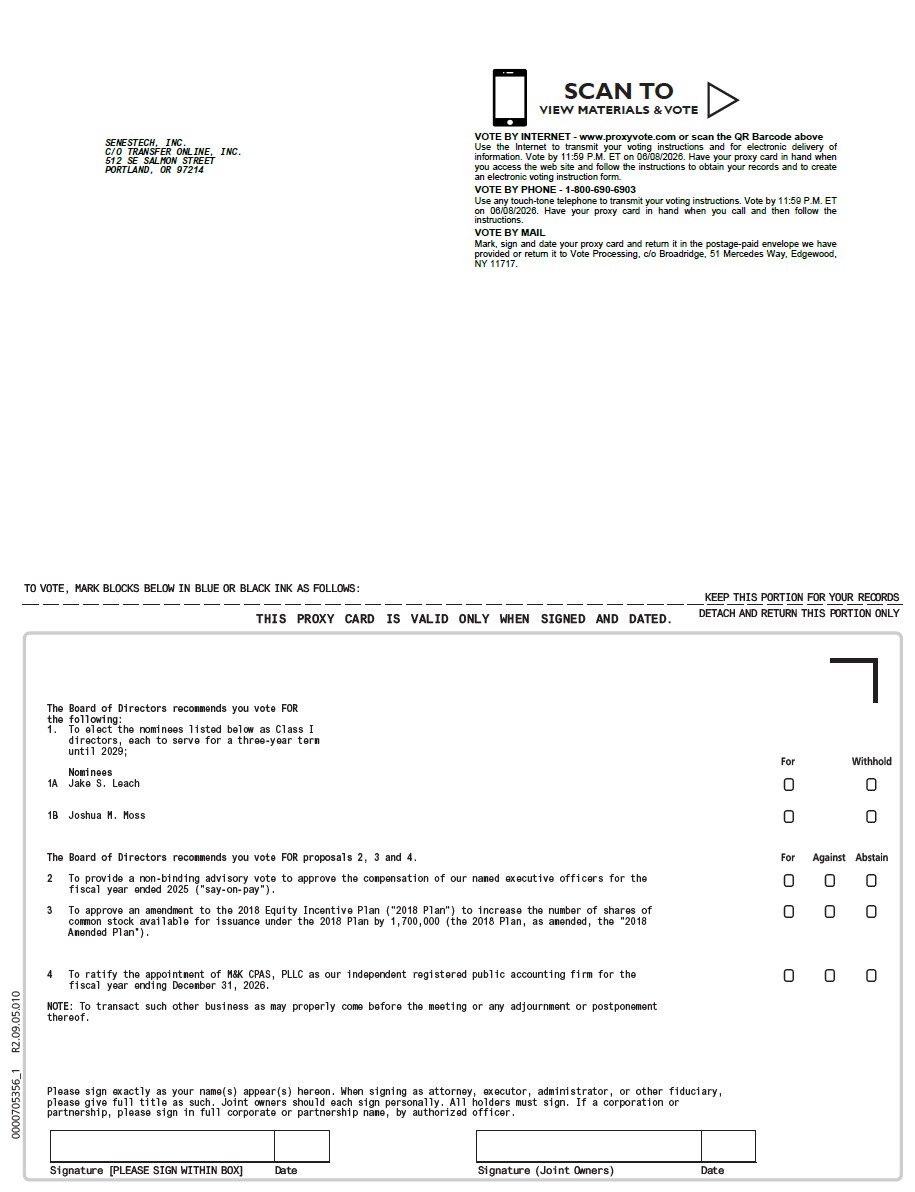
Whether you plan to attend the Annual Meeting or not, we urge you to submit your voting instructions by proxy. Voting by proxy will not affect your right to attend the Annual Meeting. All shares represented by valid proxies that we receive through this solicitation, and that are not revoked, will be voted in accordance with your instructions on the proxy card or as instructed via the internet or telephone. If you properly submit a proxy without giving specific voting instructions, your shares will be voted in accordance with the board of directors’ recommendations as noted below. If you neither submit by proxy nor vote your shares during the Annual Meeting, your shares will not be voted if you are a registered stockholder. If your shares are held in street name, your broker, bank or other holder of record may vote your shares on certain “routine” matters. See “Quorum; Abstentions; Broker Non-Votes; Results” below for more information.
If your shares are registered directly in your name through our stock transfer agent, Transfer Online, or you have stock certificates registered in your name, you may vote:
•By the internet or by telephone. Follow the instructions included in the proxy card to submit your voting instructions over the Internet or by telephone.
•By mail. If you received a proxy card by mail, you can have your shares voted by mail by completing, signing, dating and returning the proxy card as instructed on the card. If you sign the proxy card but do not specify how you want your shares voted, they will be voted in accordance with the board of directors’ recommendations as noted below.
•During the Annual Meeting. You may present your completed, signed and dated proxy card in person at the Annual Meeting to the inspector of elections. If you sign the proxy card but do not specify how you want your shares voted, they will be voted in accordance with the board of directors’ recommendations as noted below.
Telephone and internet voting facilities for stockholders of record will be available 24 hours a day and will close at 11:59 p.m. Eastern Daylight Time on June 8, 2026.
If your shares are held in “street name” (held in the name of a bank, broker or other holder of record), you will receive instructions from the holder of record. You must follow the instructions of the holder of record in order for your shares to be voted. Telephone and internet voting also will be offered to stockholders owning shares through certain banks and brokers.
Revocability of Proxies
If you give us your proxy, you may change or revoke it at any time before the Annual Meeting. You may change or revoke your proxy in any one of the following ways:
•if you received a proxy card, by signing a new proxy card with a date later than your previously delivered proxy and submitting it as instructed above;
•by submitting your proxy by the internet or by telephone as instructed above; or
•by notifying the Secretary of our company in writing before the Annual Meeting that you have revoked your proxy.
Solicitation
We have retained Alliance Advisors, LLC (“Alliance”) to act as a proxy solicitor for the Annual Meeting. We have agreed to pay Alliance $11,500, plus reasonable out-of-pocket expenses, for proxy solicitation services and, if needed, additional fees for telephone solicitation. All related costs will be borne by us. We may reimburse brokerage firms and other persons representing beneficial owners of shares for their expenses in forwarding solicitation material to such beneficial owners. Proxies may also be solicited by certain of our directors, officers or administrative employees without the payment of any additional consideration. Solicitation of proxies may be made by mail, by telephone, by email, in person or otherwise.
Stockholders of Record and “Street Name” Holders
Where shares are registered directly in the holder’s name, that holder is the stockholder of record with respect to those shares. If shares are held by an intermediary, meaning in a stock brokerage account or by a bank, trust or other nominee, then the broker, bank, trust or other nominee is considered the stockholder of record as to those shares. Those shares are said to be held in “street name” on behalf of the beneficial owner of the shares. Street-name holders generally cannot directly vote their shares and must instead instruct the broker or other nominee how to vote their shares using the voting instruction form provided by that broker or other nominee. Many brokers also offer the option of giving voting instructions over the internet or by telephone. Instructions for giving your vote as a street-name holder are provided on your voting instruction form.
Quorum; Abstentions; Broker Non-Votes; Results
At the Annual Meeting, an inspector of elections will determine the presence of a quorum and tabulate the results of the voting by stockholders. A quorum exists when holders of one-third (1/3) of the stock issued and outstanding and entitled to vote are present in person or represented by proxy. A quorum is necessary for the transaction of business at the Annual Meeting.
Broker non-votes can occur as to shares held in street name. Under the current rules that govern brokers and other nominee holders of record, if a street-name holder does not give instructions to its broker or other nominee, such broker or other nominee will be able to vote such shares only with respect to proposals for which the broker or other nominee has discretionary voting authority, i.e., “routine” matters under The Nasdaq Stock Market LLC (“Nasdaq”) rules. A “broker non-vote” occurs when a broker or other nominee submits a proxy for the Annual Meeting but does not vote on a particular proposal because such broker or other nominee either does not exercise its discretionary voting authority or does not have discretionary voting power with respect to that proposal and has not received instructions from the beneficial owner.
The one “routine” proposal you are being asked to vote on at the Annual Meeting is the ratification of the appointment of M&K CPAS, PLLC as our independent registered public accounting firm for the fiscal year ending December 31, 2026 (Proposal Four). The other proposals concerning the election of directors (Proposal One), say-on-pay (Proposal Two), and
the 2018 Amended Plan (Proposal Three), are considered “non-routine” matters, which means that your bank or broker will not be permitted to vote your shares on such proposals at the Annual Meeting unless you provide proper voting instructions. Accordingly, stockholders are urged to give their bank or broker instructions on voting their shares on all matters.
Abstentions and broker non-votes are treated as shares present for the purpose of determining whether there is a quorum for the transaction of business at the Annual Meeting.
We intend to publish final voting results of the Annual Meeting in a Current Report on Form 8-K, which we expect will be filed within four business days of the Annual Meeting. If final voting results are not available to us in time to file a Current Report on Form 8-K within four business days after the Annual Meeting, we intend to file a Current Report on Form 8-K to publish results as to matters for which we have final votes and, within four business days after the final results are known to us, file an additional Current Report on Form 8-K to publish the final results.
Required Votes and Voting
Each holder of common stock is entitled to one vote for each share held. Assuming that a quorum is present at the Annual Meeting, the following votes will be required:
| | | | | | | | | | | | | | | | | | | | | | | | | | |
| Proposal | | Voting Options | | Vote Required to
Adopt the Proposal | | Effect of
Abstentions | | Effect of Broker
Non-Votes |
1.Election of directors | | For or withhold on each nominee. | | Plurality of the votes cast by the shares present, in person or represented by proxy and entitled to vote on the election of directors. | | No effect. | | No effect. |
2.Non-binding advisory vote to approve the compensation of our named executive officers for fiscal year ended 2025 (“say-on-pay”) | | For, against, or abstain. | | The advisory vote to approve the compensation of our named executive officers is non-binding, but our board of directors will consider the input of stockholders based on the votes from the holders of a majority of the voting power of the shares present in person or represented by proxy and entitled to vote on this proposal. | | Against. | | No effect. |
3.Approval of the 2018 Amended Plan | | For, against, or abstain. | | “FOR” votes from the holders of a majority of the voting power of the shares present in person or represented by proxy and entitled to vote on this proposal. | | Against. | | No effect. |
4.Ratification of Appointment of M&K CPAS, PLLC as our independent registered public accounting firm for fiscal year ending 2026 | | For, against, or abstain. | | “FOR” votes from the holders of a majority of the voting power of the shares present in person or represented by proxy and entitled to vote on this proposal. | | Against. | | Brokers have discretion to vote. |
All shares entitled to vote and represented by properly executed, unrevoked proxies received before the Annual Meeting will be voted at the Annual Meeting in accordance with the instructions given on those proxies. If no instructions are given on a properly executed proxy, the shares represented by that proxy will be voted “FOR” each of the director nominees, “FOR” the approval of the compensation of our named executive officers for our fiscal year ended 2025, “FOR” the approval of the 2018 Amended Plan, and “FOR” the ratification of appointment of M&K CPAS, PLLC as our independent registered public accounting firm for the fiscal year ending December 31, 2026.
If any other matters are properly presented for consideration at the Annual Meeting, which may include, for example, a motion to adjourn the Annual Meeting to another time or place (including, without limitation, for the purpose of soliciting additional proxies), the persons named in the enclosed proxy and acting thereunder will have discretion to vote on those matters as they deem advisable. We do not currently anticipate that any other matters will be raised at the Annual Meeting.
Deadlines for Receipt of Stockholder Proposals
Stockholder proposals may be included in our proxy statement and form of proxy for an annual meeting so long as they are provided to us on a timely basis and satisfy the other conditions set forth in Rule 14a-8 under the Securities Exchange Act of 1934, as amended (the “Exchange Act”), regarding the inclusion of stockholder proposals in company-sponsored proxy materials. For a stockholder proposal to be considered timely pursuant to Rule 14a-8 for inclusion in our proxy statement and form of proxy for the annual meeting to be held in 2027, we must receive the proposal at our principal executive offices, addressed to our Secretary, no later than December 30, 2026. Any proposals received after such date will be considered untimely. Submitting a stockholder proposal does not guarantee that it will be included in our proxy statement and form of proxy.
In addition, a stockholder proposal that is not intended for inclusion in our proxy statement and form of proxy under Rule 14a-8 (including director nominations) shall be considered “timely” as calculated in accordance with Rule 14a-4(c) under the Exchange Act and Section 2.4 of our Amended and Restated Bylaws, as amended (“Bylaws”), and may be brought before the 2027 annual meeting of stockholders provided that we receive information and notice of the proposal addressed to our Secretary at our principal executive offices, no earlier than 11:59 pm Eastern Daylight Time on February 13, 2027 and no later than 11:59 pm Eastern Daylight Time on March 15, 2027.
In order to comply with the universal proxy rules, stockholders who intend to solicit proxies in support of director nominees other than our nominees must provide notice that sets forth the information required by Rule 14a-19 under the Exchange Act no later than March 15, 2027; provided, however, that if our 2027 annual meeting of stockholders is held before May 10, 2027 or after July 9, 2027, then the notice must be received by the later of 60 days prior to the date of the annual meeting or the 10th day following the day on which public announcement of the date of such meeting is made.
Further, our Bylaws provide that only such business shall be conducted at an Annual Meeting of Stockholders as shall have been properly brought before the meeting. To be properly brought before an annual meeting, business must be brought in accordance with Section 2.4 of our Bylaws.
All notices of stockholder proposals, whether or not intended to be included in our proxy materials, should be in writing and sent to SenesTech, Inc., 13430 North Dysart Road, Suite 105, Surprise, Arizona 85379, Attention: Secretary.
Paper Copy of Proxy Materials
If you want to receive a paper copy of these proxy materials, including any documents incorporated herein by reference but excluding exhibits to the Annual Report on Form 10-K for the fiscal year ended December 31, 2025 (our “2025 Annual Report”) you may request one at no cost to you by writing to SenesTech, Inc., 13430 North Dysart Road, Suite 105, Surprise, Arizona 85379, Attention: Secretary.
Annual Report and Other Matters
Our 2025 Annual Report, which was made available to stockholders with or preceding this proxy statement, contains financial and other information about our company, but is not incorporated into this proxy statement and is not to be considered a part of these proxy materials or subject to Regulations 14A or 14C or to the liabilities of Section 18 of the Exchange Act. The information contained in the “Report of the Audit Committee” shall not be deemed “filed” with the Securities and Exchange Commission (the “SEC”) or subject to Regulations 14A or 14C or to the liabilities of Section 18 of the Exchange Act.
PROPOSAL ONE
ELECTION OF DIRECTORS
General
Our Bylaws provide that the authorized number of directors of our company are fixed by the board of directors from time to time. The board of directors is currently set at seven directors. If for any reason directors are not elected at the annual meeting of our stockholders, they may be elected at any special meeting of the stockholders that is duly called and held for that purpose in the manner provided by the Bylaws.
Currently, the board of directors is divided into three classes, and directors in each class are elected to serve a three-year term. The term of the current Class I directors expires at this year’s Annual Meeting. The term of the Class II directors expires at our 2027 annual meeting of stockholders, and the term of the Class III directors expires at the 2028 annual meeting of stockholders. A director serves in office until a successor is duly elected and qualified, unless the director is removed, resigns or, by reason of death or other cause, is unable to serve in the capacity of director. Any additional directorships resulting from an increase in the number of directors would currently be distributed among the three classes so that, as nearly as possible, each class will consist of one third of the total number of directors.
Set forth below is certain information regarding the director nominees and each of the incumbent directors whose terms will continue following the Annual Meeting.
Nominees for Director
The board of directors has nominated Jake S. Leach and Joshua M. Moss as Class I directors, each of whom will stand for re-election at our Annual Meeting subject to election for a three-year term expiring at our 2029 annual meeting of stockholders.
Unless otherwise instructed, the proxy holders will vote the proxies received by them for the election of Mr. Leach and Mr. Moss to the board of directors. These individuals have indicated that they will serve if elected. We do not anticipate that any of these nominees will be unable or unwilling to stand for election, but if that occurs, all proxies received may be voted by the proxy holders for another person nominated by the board of directors. As there are two nominees, proxies may be voted for up to two persons.
Nominees and Continuing Directors
The following table sets forth the names and certain information as of the record date regarding the nominees and each director of our company continuing in office after the Annual Meeting:
| | | | | | | | | | | | | | | | | | | | | | | | | | |
| Name of Director | | Age | | Position | | Director
Since | | Term Expires |
| Jamie Bechtel, JD, Ph.D. | | 53 | | Chair of the Board and Director | | 2018 | | 2027 (Class II) |
| Joel L. Fruendt | | 65 | | Director, President and
Chief Executive Officer | | 2022 | | 2028 (Class III) |
Lynn Y. Graham | | 51 | | Director(4) | | 2025 | | 2028 (Class III) |
| Phil N. Grandinetti III | | 54 | | Director(1)(3)(4) | | 2020 | | 2027 (Class II) |
| Jake S. Leach | | 48 | | Director(2) | | 2020 | | 2026 (Class I) |
| Joshua M. Moss | | 54 | | Director(2)(3)(4) | | 2025 | | 2026 (Class I) |
| Matthew K. Szot | | 51 | | Director(1)(2)(3) | | 2015 | | 2028 (Class III) |
____________
(1)Member of the compensation committee.
(2)Member of the audit committee.
(3)Member of the nominating and corporate governance committee.
(4)Member of the commercialization committee.
Director Nominees
Jake S. Leach has served as a director of our company since November 2020. Mr. Leach is currently the Executive Vice President and Chief Executive Officer of Dexcom, Inc., a company that develops, manufacturers, and distributes continuous glucose monitoring systems for diabetes management. Since joining Dexcom, Inc. in March 2004, Mr. Leach served as President and Chief Operating Officer from August 2022 to January 2026, Executive Vice President and Chief
Technology Officer from September 2018 to August 2022, Senior Vice President of Research and Development (“R&D”) from January 2015 to September 2018, and Vice President, R&D from January 2011 to January 2015. Mr. Leach holds a Bachelor of Science degree in Electrical Engineering with a minor in Biomedical Engineering from the University of California, Los Angeles. We believe that Mr. Leach is qualified to serve as a member of our board of directors because of his executive leadership experience with publicly-traded companies, including operations and corporate strategy, as well as his research and development and innovative technology experience, and his commitment to quality and extensive knowledge of domestic and international regulatory requirements.
Joshua M. Moss has served as a director of our company since January 2025. Mr. Moss cofounded The Informed Momentum Company (“IMC”) (formerly EAM Global Investors), an investment management company, in 2007 and serves as Co-Portfolio Manager/Analyst for IMC’s Non-U.S. Strategies. From 2006 to 2007, Mr. Moss was a Vice President and Senior Equity Analyst at Allianz Global Investors (“Allianz”), a global investment management firm, and had served as a member of the emerging growth team. From 2002 to 2006, he was the senior analyst on Allianz’s Global Select Portfolio, a global multi-cap strategy, and concurrently served as the research head for Allianz’s Global Consumer Discretionary sector. Mr. Moss holds a Master of Business Administration from the Anderson School of Management at the University of California, Los Angeles, and a Bachelor of Arts from the University of California, San Diego. We believe Mr. Moss is qualified to serve as a member of our board of directors because of his experience in capital markets and international business.
Vote Required
If a quorum is present, the two nominees for election to the board of directors receiving the greatest number of votes cast “FOR” the election of the directors by the shares present in person or represented by proxy and entitled to vote on the election of directors at the Annual Meeting will be elected to our board of directors for a three-year term.
THE BOARD OF DIRECTORS RECOMMENDS THAT STOCKHOLDERS VOTE “FOR” THE ELECTION OF EACH OF THE BOARD’S CLASS I DIRECTOR NOMINEES.
Continuing Directors
Jamie Bechtel, JD, Ph.D. has served as a director of our company since January 2018. Dr. Bechtel is the founder of Kito Impact Foundation, a non-profit focused on integrating corporate social responsibility into small and medium sized businesses, and she has been the Chief Executive Officer since February 2018. In addition, Dr. Bechtel was a co-founder of New Course, an organization focused on women-led conservation initiatives, and she has been a board member since August 2009. Dr. Bechtel holds a Ph.D. from Boston University, a Juris Doctor from Boston College and a bachelor’s degree from Boston University. We believe that Dr. Bechtel is qualified to serve as a member of our board of directors because she is a highly regarded leader in international conservation, and her work has led to strategic advances in the fields of conservation, sustainable finance and biology.
Joel L. Fruendt has served as a director and Chief Executive Officer of our company since November 2022 and as President since December 2022. Mr. Fruendt previously served as the President and Chief Executive Officer of Safe Reflections, Inc., a provider of colorfast, durable, reflective solutions to the occupational safety and military training apparel markets, from 2020 to 2022. Mr. Fruendt held various management roles at Clarke Environmental Inc., a pest control product and services company, from 2005 to 2020, including Vice President and General Manager and Vice President and General Manager – Services. From 2000 to 2005, Mr. Fruendt served as the Vice President – Sales at Moore Diversified Products, a plastic conduit products and custom metal enclosures manufacturing company. From 1992 to 2000, Mr. Fruendt served as the Vice President, GM – NSC Division with Waste Management Inc., a thermoplastic liner, geotextile, and geosynthetic construction products manufacturing and installation company. We believe that Mr. Fruendt is qualified to serve as a member of our board of directors because of his role as our Chief Executive Officer and his experience in the pest control industry, with new product development and with managing high growth companies.
Lynn Y. Graham has served as a director of our company since July 2025. She has served as a Senior eCommerce Advisor to Kainos Capital since July 2023, where she supports the growth of consumer brands across digital channels. Ms. Graham is also the founder of Hustle and Flower, LLC, a marketing consulting firm. She previously was the founder of Beekeeper Marketing, an agency specializing in scaling natural and organic consumer brands through online marketplaces. Earlier in her career, she held roles in brand marketing, technology product management, and strategy consulting. She also serves on advisory boards for several consumer packaged goods and e-commerce companies. Ms. Graham holds a Bachelor of Arts in Economics from Stanford University and a Master of Business Administration from the University of California, Berkeley, Haas School of Business. Her expertise in digital commerce and go-to-market strategy supports the Company’s commercialization initiatives. We believe that Ms. Graham is qualified to serve as a member of our board of
directors because of her experience in e-commerce, consumer products, and commercialization strategy, including scaling brands across digital channels and advising on go-to-market execution and growth initiatives.
Phil N. Grandinetti III has served as a director of our company since November 2020. In March 2013, Mr. Grandinetti co-founded WITHit, a wearable tech accessory company, and he serves as its Chief Customer Officer. From February 2005 to March 2013, Mr. Grandinetti served as Vice President of Sales at LightWedge, a global e-book, e-reader and tablet accessories brand. Prior to LightWedge, Mr. Grandinetti served as Senior Vice President of Worldwide Sales of GSM Products, an innovative outdoor products company, from February 2002 to February 2005. Mr. Grandinetti has a Juris Doctor from the University of San Diego School of Law and is licensed in the State of California, as well as a Bachelor of Arts from the University of Iowa in Economics and Political Science. We believe that Mr. Grandinetti is qualified to serve as a member of our board of directors because of his experience with retail sales and marketing and the development and commercialization of new products.
Matthew K. Szot has served as a director of our company since December 2015. Mr. Szot served as Vice Chairman of our board of directors from June 2022 to June 2023 when we eliminated the role. He is currently the Chief Financial Officer of Cadrenal Therapeutics, Inc., a late-stage biopharmaceutical company where he has served since May 2022. From March 2010 to November 2021, Mr. Szot served as the Chief Financial Officer of S&W Seed Company, an agricultural seed biotechnology company. Since September 2020, Mr. Szot has served on the board of directors and as Chairman of the Audit and Compensation committees of INVO Fertility, Inc., a healthcare services fertility company. From June 2018 to August 2019, Mr. Szot served on the board of directors and as Chairman of the Audit Committee of Eastside Distilling, Inc. a then-Nasdaq-listed craft spirits company which merged with Beeline Holdings, Inc.. From February 2007 to October 2011, Mr. Szot served as Chief Financial Officer for Cardiff Partners, LLC, a strategic consulting company that provided executive financial services to various publicly-traded and privately-held companies. From 2003 to December 2006, Mr. Szot served as Chief Financial Officer and Secretary of Rip Curl, Inc., a market leader in wetsuit and action sports apparel products. From 1996 to 2003, Mr. Szot was a Certified Public Accountant with KPMG and served as an Audit Manager for various publicly traded companies. Mr. Szot has a Bachelor of Science degree in Agricultural Economics/Accountancy from the University of Illinois, Champaign-Urbana and is a Certified Public Accountant in the state of California. We believe that Mr. Szot is qualified to serve as a member of our board of directors because of his experience and knowledge of corporate finance, mergers and acquisitions, corporate governance, as well as other operational, financial and accounting matters gained as a past and present chief financial officer and director of other public and private companies.
Executive Officers
The following table sets forth the names and certain information regarding our executive officers as of the record date:
| | | | | | | | | | | | | | |
| Name | | Age | | Position |
| Joel L. Fruendt | | 65 | | President, Chief Executive Officer and Director |
| Thomas C. Chesterman | | 66 | | Executive Vice President, Chief Financial Officer, Treasurer and Secretary |
Michael Edell | | 63 | | Interim Chief Operating Officer |
Mr. Fruendt’s biographical details are set out under the heading “Continuing Directors” above.
Thomas C. Chesterman joined our company in September 2015 and has served as our Executive Vice President, Chief Financial Officer, Treasurer and Secretary since December 2015. He has over 25 years of experience as the Chief Financial Officer of a public company in the life science, technology and telecommunications industries. Most recently, he was the Vice President and Treasurer of General Communication Inc., a telecommunications company in Alaska, from 2013 to 2015. Previously, he was the Chief Financial Officer of life science companies Bionovo Inc. from 2007 to 2012, Aradigm Corp. from 2002 to 2007 and Bio-Rad Laboratories, Inc. from 1996 to 2002. Mr. Chesterman is adept at a variety of capital market access techniques and has significant experience in developing the operational and financial infrastructures in companies to help support successful and rapid growth. Mr. Chesterman earned a bachelor’s degree from Harvard University and a Master of Business Administration from the University of California at Davis.
Michael Edell has served as our Interim Chief Operating Officer since November 2025. Mr. Edell founded Westlake Serial Company, LLC in January 2018 and currently serves as a member of its board of directors. Westlake Serial Company, LLC was founded to provide private label consumer package goods in the eco-friendly home cleaning space in addition to providing services to support companies in commercializing existing technologies into consumer-facing products. In April 2025, Mr. Edell also founded Rancher’s Pride, LLC, a wagyu beef-based pet treat company, and currently serves as a member on its board of directors. In March 2008, Mr. Edell founded MaddieBrit Products, LLC, a consumer package goods products company in the eco-friendly home cleaning space, and served as a member of its board of directors until the company was sold in March 2025. In June 2021, Mr. Edell founded Waterleaf Paper Company, a dissolvable wrapping
paper company, and served as a member of its board of directors until it was sold in March 2024. Mr. Edell earned his bachelor’s degree from California State University.
There are no family relationships among any of our directors and executive officers. None of our directors or executive officers have been involved in any legal proceedings listed in Regulation S-K, Sections 103(c) and 401(f).
CORPORATE GOVERNANCE
Board of Directors Leadership Structure
Our Corporate Governance Principles provide our board of directors with flexibility in determining the appropriate leadership structure for our company. Our board of directors has elected to separate the roles of Chief Executive Officer and Chair of the Board. These positions are currently held by Mr. Fruendt, our President and Chief Executive Officer, and Dr. Bechtel, our Chair of the Board. The board of directors believes that a leadership structure that separates these roles is appropriate for our company due to the differences between the two roles. The Chief Executive Officer is responsible for setting our strategic direction, providing day-to-day leadership and managing our business, while the Chair of the Board provides guidance to the Chief Executive Officer, sets the agendas for and chairs board meetings, presides over executive sessions of the independent directors, establishes priorities and procedures for the work of the full board of directors and provides information to the members of our board of directors in advance of such meetings.
Board of Directors Role in Risk Oversight
One of the key functions of our board of directors is informed oversight of our risk management process. Our board of directors does not have a standing risk management committee, but rather administers this oversight function directly through our board of directors as a whole, as well as through various standing committees that address risks inherent in their respective areas of oversight. In particular, our board of directors is responsible for monitoring and assessing strategic risk exposure and cybersecurity risk management, and our audit committee is responsible for considering and discussing our major financial risk exposures and the steps our management has taken to monitor and control these exposures. The audit committee also has the responsibility to issue guidelines and policies to govern the process by which risk assessment and management is undertaken and to monitor compliance with legal and regulatory requirements. Our compensation committee assesses and monitors whether any of our compensation policies and programs have the potential to encourage excessive risk-taking.
Director Independence
Generally, under the continued listing requirements and rules of Nasdaq, independent directors must comprise a majority of a listed company’s board of directors. Our board of directors has undertaken a review of its composition, the composition of its committees and the independence of each director. Our board of directors has determined that Ms. Graham and Messrs. Grandinetti, Leach, Moss and Szot are independent within the meaning of Nasdaq listing standards and that none of any such directors has any relationship with our company that would interfere with the exercise of their independent business judgment. Dr. Bechtel was determined to be independent until the board of directors appointed her as Interim Executive Chair of the Company on January 26, 2026, pursuant to which she received compensation for her service in such position. The board of directors has determined that Dr. Bechtel is not independent while she serves in that position. The board also determined that Mr. Fruendt, our President and Chief Executive Officer, is not independent due to his role as an executive officer of our company. Accordingly, a majority of our directors are independent, as required under applicable Nasdaq rules. In making this determination, our board of directors considered the current and prior relationships that each non-employee director has with our company and all other facts and circumstances our board of directors deemed relevant in determining their independence, including the beneficial ownership of our capital stock by each non-employee director.
In determining the independence of Ms. Graham, the board of directors considered her position as founder of Hustle and Flower, LLC, which provided consulting services to our Company in 2025 for a total amount of $24,000.
There are no arrangements or understandings between any director or nominee and any other person or entity other than our company pursuant to which the director or nominee receives compensation in connection with that person’s candidacy or service as a director.
Standing Committees and Attendance
The board of directors held a total of five formal meetings during 2025, and met informally as a group a number of other times during 2025. All directors attended more than 75% of the aggregate of the meetings of our board of directors and committees thereof, if any, upon which such director served during the period for which the director has been a director or committee member during 2025. The independent directors meet in executive session from time to time.
Our board of directors has a standing audit committee, compensation committee, and nominating and corporate governance committee comprised solely of independent directors. In 2025, the audit committee held four meetings, the compensation committee held nine meetings and the nominating and corporate governance committee held five meetings. Information about these standing committees is set forth below.
Our board of directors forms ad hoc committees from time-to-time to assist the board in fulfilling its responsibilities with respect to matters that are the subject of the ad hoc committee’s mandate.
Audit Committee
The audit committee currently consists of Matthew K. Szot, who is the chair, Jake S. Leach, and Joshua M. Moss. The board of directors has determined that, after consideration of all relevant factors, each of the current audit committee members qualifies as an “independent” director under applicable SEC and Nasdaq rules. Each member of the audit committee is able to read and understand fundamental financial statements, including our balance sheets, statements of operations and statements of cash flows. Further, no member of the audit committee has participated in the preparation of our financial statements at any time during the past three years. The board of directors has designated Mr. Szot as an “audit committee financial expert” as defined under applicable SEC rules and has determined that Mr. Szot possesses the requisite “financial sophistication” under applicable Nasdaq rules. The audit committee operates under a written charter setting forth the functions and responsibilities of the audit committee, which is periodically reviewed by the audit committee and by the board of directors as appropriate. A current copy of the audit committee charter is available on our website at http://senestech.investorroom.com on the “Documents and Policies” page under the heading “Corporate Governance.” The functions of the audit committee include:
•overseeing the engagement of our independent public accountants, including pre-approval of services and review of independence and quality control procedures of the independent public accountants;
•reviewing our accounting policies, judgments and assumptions used in the preparation of our financial statements;
•reviewing our audited financial statements and discussing them with the independent public accountants and our management;
•meeting separately with the independent public accountants and our management to consider the adequacy of our internal controls;
•establishing procedures regarding complaints concerning accounting or auditing matters, reviewing and, if appropriate, approving earnings press releases, related-party transactions, reviewing compliance with our Code of Business Conduct and Ethics, and reviewing our investment policy and compliance therewith;
•reviewing our investment policy and financial plans, reporting recommendations to our full board of directors for approval and authorizing actions; and
•discussing with our general counsel (if any) or outside counsel any legal matters brought to the Committee’s attention that could reasonably be expected to have a material impact on our financial statements.
Both our independent registered accounting firm and internal financial personnel regularly meet with our audit committee and have unrestricted access to the audit committee.
Compensation Committee
Our compensation committee currently consists of Jamie Bechtel, who is the chair, Phil Grandinetti III and Matthew K. Szot. Each of the current compensation committee members has been determined by our board of directors to be independent in accordance with Nasdaq standards. Each member of our compensation committee is also a non-employee director, as defined pursuant to Rule 16b-3 promulgated under the Exchange Act. The compensation committee operates under a written charter, which is periodically reviewed by the compensation committee and the board of directors as appropriate. A current copy of the compensation committee charter is available on our website at http://senestech.investorroom.com on the “Documents and Policies” page under the heading “Corporate Governance.” The functions of the compensation committee include:
•reviewing and, if deemed appropriate, recommending to our board of directors policies, practices and procedures relating to the compensation of our officers and other managerial employees;
•reviewing, at least annually, our compensation philosophy;
•reviewing and recommending to the board of directors for approval the corporate goals and objectives relevant to the Chief Executive Officer and other executive officers;
•reviewing and approving any employment agreements, severance agreements or special compensation or change-in-control arrangements with executive officers;
•determining or recommending to the board of directors the compensation of our executive officers;
•advising and consulting with our officers regarding managerial personnel and development;
•overseeing our compliance with the Nasdaq requirement that, with limited exceptions, stockholders approve equity compensation plans;
•monitoring our compliance with applicable legal requirements of the Sarbanes Oxley Act of 2002 and the Dodd-Frank Wall Street Reform and Consumer Protection Act relating to employee compensation and benefits;
•administering our Executive Officer Clawback Policy; and
•evaluating the performance of the Chief Executive Officer.
As part of its process to determine the compensation level of each executive officer, the compensation committee evaluates, among other things, the Chief Executive Officer’s assessment of the other executive officers and recommendations regarding their compensation in light of the goals and objectives of our executive compensation program. The compensation committee may delegate certain of its responsibilities, as it deems appropriate, to subcommittees of the compensation committee or to our officers, but it has not elected to do so to date.
Pursuant to its charter, the compensation committee has sole authority to retain and/or replace, as needed, any independent legal counsel, compensation and benefits consultants and other experts or advisors as the compensation committee believes to be necessary or appropriate. With respect to 2025, the compensation committee retained Frederic W. Cook & Co., Inc. (“FW Cook”) to provides executive compensation consulting services to the Compensation Committee. Other than services provided to the Compensation Committee, FW Cook did not provide any services to the Company with respect to 2025. The Compensation Committee reviewed the independence of FW Cook under Nasdaq and SEC rules and concluded that the work of FW Cook has not raised any conflict of interest.
Nominating and Corporate Governance Committee
Our nominating and corporate governance committee currently consists of Matthew K. Szot, who is the chair, Phil Grandinetti III, and Joshua Moss. Each of the current nominating and corporate governance committee members has been determined by the board of directors to be independent in accordance with Nasdaq standards. The nominating and corporate governance committee operates under a written charter, which is periodically reviewed by the nominating and corporate governance committee and by our board of directors as appropriate. A current copy of the nominating and corporate governance committee charter is available on our website at http://senestech.investorroom.com/ on the “Documents and Policies” page under the heading “Corporate Governance.” The functions of the nominating and corporate governance committee include:
•evaluating the composition, compensation, size and governance of our board of directors and its committees and make recommendations regarding future planning and the appointment of directors to our committees;
•evaluating and recommending candidates for election to our board of directors;
•establishing a policy for considering stockholder nominees for election to our board of directors; and
•reviewing our corporate governance principles and providing recommendations to the board regarding possible changes.
Commercialization Committee
Our commercialization committee currently consists of Phil Grandinetti III, who is the chair, Lynn Y. Graham, and Joshua M. Moss. Each of the current commercialization committee members has been determined by the board of directors to be independent in accordance with Nasdaq standards. The commercialization committee operates under a written charter, which is periodically reviewed by the nominating and corporate governance committee and by our board of directors as appropriate. A current copy of the commercialization committee charter is available on request. The functions of the commercialization committee include:
•providing strategic and operational advice and guidance to the Company regarding advancement of commercial strategy and operations;
•being available as a resource for management of the Company to consult with regarding all commercial matters as reasonably requested;
•advising the board of directors of the Company regarding strategic commercial decisions that also require approval by the board of directors of the Company;
•reporting to the board of directors of the Company at meetings thereof, as appropriate, with respect to significant matters covered at committee meetings; and
•reviewing and discussing with management the Company’s risk assessment and risk management policies and procedures relating to commercial and other topics deemed appropriate by such committee, including but not limited to commercial matters.
Director Nomination Process
The board of directors has determined that director nomination responsibilities should be overseen by the nominating and corporate governance committee. One of the nominating and corporate governance committee’s goals is to assemble a board that brings to us a variety of perspectives and skills derived from high quality business and professional experience. Factors considered by the nominating and corporate governance committee include character, judgment, knowledge, skill, integrity, diversity, including with respect to race, gender, ethnicity and similar characteristics, age, expertise, length of service, independence, experience with businesses and other organizations of comparable size, including experience in animal and health sciences, business, finance, administration or public service, the relevance of a candidate’s experience to our needs and experience of other board members, familiarity with national and international business matters, experience with accounting rules and practices, the desire to balance the considerable benefit of continuity with the periodic injection of the fresh perspective provided by new members, and the extent to which a candidate would be a desirable addition to the board of directors and any committees of the board of directors. In addition, directors are expected to be able to exercise their best business judgment when acting on behalf of our company and our stockholders, act ethically at all times and adhere to the applicable provisions of our Code of Business Conduct and Ethics. Other than consideration of the foregoing and applicable SEC and Nasdaq requirements, unless determined otherwise by the nominating and corporate governance committee, there are no stated minimum criteria, qualities or skills for director nominees. However, the nominating and corporate governance committee may also consider such other factors as it may deem are in the best interests of our company and our stockholders. In addition, at least one member of the board of directors serving on the audit committee should meet the criteria for an “audit committee financial expert” having the requisite “financial sophistication” under applicable Nasdaq and SEC rules, and a majority of the members of our board of directors should meet the definition of “independent director” under applicable Nasdaq rules. The board of directors is committed to actively seeking highly qualified women and individuals from underrepresented groups. The nominating and corporate governance committee and any search firm that it engages are directed to include women and candidates from underrepresented groups in each search pool from which the nominating and corporate governance committee selects director candidates.
The nominating and corporate governance committee identifies director nominees by first evaluating the current members of the board of directors willing to continue in service. Current members of the board of directors with skills and experience that are relevant to our business and who are willing to continue in service are considered for re-nomination, balancing the value of continuity of service by existing members of the board of directors with that of obtaining a new perspective. The nominating and corporate governance committee also takes into account an incumbent director’s performance as a board member. If any member of the board of directors does not wish to continue in service, if the nominating and corporate governance committee decides not to re-nominate a member for reelection, if the board decided to fill a director position that is currently vacant or if the board of directors decides to recommend that the size of the board of directors be increased, the nominating and corporate governance committee identifies the desired skills and experience of a new nominee in light of the criteria described above. Current members of the board of directors and management are polled for suggestions as to individuals meeting the nominating and corporate governance committee’s criteria. Research may also be performed to identify qualified individuals.
It is the policy of the nominating and corporate governance committee to consider suggestions for persons to be nominated for director that are submitted by stockholders. The nominating and corporate governance committee will evaluate stockholder suggestions for director nominees in the same manner as it evaluates suggestions for director nominees made by management, then-current directors or other appropriate sources. Stockholders suggesting persons as director nominees should send information about a proposed nominee to our Secretary at our principal executive offices by no later than 120 days before the anniversary of the release date of the prior year’s proxy statement, which date is identified in the section titled “Deadlines for Receipt of Stockholder Proposals.” This information should be in writing and should include a signed statement by the proposed nominee that the nominee is willing to serve as a director of our company, a description of the proposed nominee’s relationship to the stockholder and any information that the stockholder feels will fully inform the nominating and corporate governance committee about the proposed nominee and the nominee’s qualifications. The nominating and corporate governance committee may request further information from the proposed nominee and the
stockholder making the recommendation. In addition, a stockholder may nominate one or more persons for election as a director at our annual meeting of stockholders if the stockholder complies with the notice, information, consent and other provisions relating to stockholder nominees contained in our bylaws. Please see the section above titled “Deadlines for Receipt of Stockholder Proposals” for important information regarding stockholder proposals, including director nominations.
Code of Business Conduct and Ethics
We have adopted a Code of Business Conduct and Ethics in compliance with applicable rules of the SEC that applies to all of our directors, officers and other employees and consultants. A copy of this policy is available on our website at https://senestech.investorroom.com/ on the “Documents and Policies” page under the heading “Corporate Governance,” or free of charge upon written request to the attention of our Secretary, by regular mail at our principal executive offices, email to inquiries@senestech.com or fax at 928-526-0243. We will disclose, on our website, any amendment to, or a waiver from, a provision of our Code of Business Conduct and Ethics that applies to our principal executive officer, principal financial officer, principal accounting officer or controller, or persons performing similar functions and that relates to any element of the Code of Business Conduct and Ethics enumerated in applicable rules of the SEC. In addition, we have adopted a policy for research misconduct, which also applies to all officers, directors and employees.
Clawback Policy
In 2023, we adopted an Executive Officer Clawback Policy that complies with new SEC and Nasdaq rules, which mandate the recoupment of certain erroneously paid performance-based incentive compensation received by covered persons (as defined in the policy) on or after October 2, 2023 in the event of an accounting restatement. A copy of our Executive Officer Clawback Policy is filed with the SEC as Exhibit 97.1 to our Annual Report on Form 10-K for the fiscal year ended December 31, 2025.
Anti-Hedging Practices
Although we do not have a formal policy related to hedging transactions, we discourage our management and directors from engaging in hedging and monetization transactions in connection with our securities, such as zero-cost collars, prepaid variable forward sale contracts, equity swaps and exchange funds.
Insider Trading Policies and Procedures
We have adopted a Policy on Insider Trading governing the purchase, sale and/or other disposition of our securities by our directors, officers, and employees. We believe that our Policy on Insider Trading is reasonably designed to promote compliance with insider trading laws, rules, and regulations and the exchange listing standards applicable to us. A copy of our Policy on Insider Trading is filed with the SEC as Exhibit 19.1 to our Annual Report on Form 10-K for the fiscal year ended December 31, 2025.
DIRECTOR COMPENSATION
2025 Director Compensation Table
The following table sets forth information regarding compensation earned by or paid to our non-employee directors during the fiscal year ended December 31, 2025. Mr. Fruendt, our President and Chief Executive Officer, does not receive any additional compensation for his service on the board of directors. Please see the “2025 Summary Compensation Table” for the compensation received by Mr. Fruendt with respect to his service as our Chief Executive Officer during 2025.
| | | | | | | | | | | | | | | | | | | | | | | | | | | | | |
| Name | | Fees Earned or Paid in Cash ($)(1) | | Option Awards ($)(2)(3) | | All Other Compensation ($) | | Total
($) |
Jamie Bechtel, JD, Ph.D | | $ | 89,167 | | | $ | — | | | $ | — | | | | $ | 89,167 | |
Lynn Y. Graham(4) | | 23,750 | | | — | | | 24,000 | | (5) | | 47,750 | |
Phil N. Grandinetti III | | 57,083 | | | — | | | — | | | | 57,083 | |
Jake S. Leach(6) | | 23,750 | | | — | | | — | | | | 23,750 | |
Joshua M. Moss(7) | | 49,750 | | | 25,250 | | | — | | | 0 | 75,000 | |
| Matthew K. Szot | | 61,917 | | | — | | | — | | | | 61,917 | |
____________(1)Represents the cash amounts paid in 2025, representing the second half of the 2024-2025 board service year and the first half of the 2025-2026 board service year—“board service year” represents board service from Annual Meeting to Annual Meeting, which is generally June to the following June. Cash amounts are paid in four equal installments on or about July 1st, October 1st, January 2nd and April 1st. This includes any additional cash compensation for service on ad hoc committees.
(2)Represents the aggregate grant date fair value of option award granted in 2025 to Mr. Moss, determined in accordance with Financial Accounting Standards Board Accounting Standards Codification Topic 718, Compensation—Stock Compensation (“ASC 718”). For additional details regarding assumptions used in this calculation, see Note 6 (Stock-based Compensation) to the financial statements included in our Annual Report on Form 10-K for the fiscal year ended December 31, 2025. As of December 31, 2025, the total number of shares subject to outstanding stock options held by each non-employee director was as follows: Dr. Bechtel, 12,577; Ms. Graham, 0; Mr. Grandinetti, 15,660; Mr. Leach, 24,793; Mr. Moss, 8,057; and Mr. Szot, 12,532.
(3)On October 15, 2025, the board of directors approved stock option awards to all non-employee directors (the “Contingent Stock Options”). The Contingent Stock Options are subject to stockholder approval of the plan amendment and will be rescinded and deemed not to have been granted if such approval is not obtained. Because stockholder approval had not been obtained as of December 31, 2025, and the awards were subject to a substantive contingency, the Contingent Stock Options did not have a grant date for accounting purposes under ASC 718 and, accordingly, no grant date fair value has been determined or is reportable in the 2025 Director Compensation Table. If stockholder approval of the plan amendment is obtained, the awards will be reported in the year in which the grant is established under ASC 718. For each non-employee director, the Contingent Stock Option grant is with respect to 70,000 shares.
(4)Ms. Graham joined our board of directors in July 2025.
(5)Represents consulting fees paid to Hustle and Flower, LLC for services provided to the Company in 2025. Ms. Graham is founder of Hustle and Flower, LLC.
(6)Represents cash compensation for the third and fourth quarters of 2025. Mr. Leach received an option grant in lieu of cash compensation for his Board service from July 2024 to June 2025.
(7)Mr. Moss joined our board of directors in January 2025.
Non-Employee Director Compensation Program
The non-employee director compensation program (the “Director Compensation Program”) provides both cash and equity compensation components to our non-employee directors for their service on the board, which includes compensation for service on the various committees of the board.
The 2025 annual cash component of the Director Compensation Program was as follows:
| | | | | | | | | | | |
| Prior to July 2025 | | After July 2025 |
| Retainer for service on the board | $ | 27,000 | | | $ | 40,000 | |
| Additional retainer for service on the board – Chair | 40,000 | | | 45,000 | |
| Incremental retainers for chair of committees: | | | |
| Audit | 15,000 | | | 17,500 | |
| Compensation | 15,000 | | | 17,500 | |
| Nominating and Corporate Governance | 15,000 | | | 17,500 | |
Commercialization | — | | | 17,500 | |
Transition | — | | | 17,500 | |
| Incremental retainers for members of committees: | | | |
| Audit | 5,000 | | | 7,500 | |
| Compensation | 5,000 | | | 7,500 | |
| Nominating and Corporate Governance | 5,000 | | | 7,500 | |
Commercialization | — | | | 7,500 | |
Transition | — | | | 7,500 | |
| | | |
| | | |
| | | |
Under the Director Compensation Plan, directors are eligible to receive equity-based awards in addition to cash compensation. Historically, non-employee directors have received annual stock option grants with an exercise price equal to the closing market price of our common stock on the date of grant, vesting in equal installments over the applicable service period and expiring on the fifth anniversary of the grant date. Directors may also elect to have all or any portion of their designated cash compensation paid in equity in lieu of cash, subject to the availability of shares under our equity incentive plan. During fiscal year 2025, the Company did not have sufficient shares available under the 2018 Plan to make equity grants to non-employee directors, other than a grant made to Mr. Moss in January 2025. As a result, no annual equity awards were granted to the other non-employee directors during the year. However, as noted above, on October 15, 2025, the board of directors approved the Contingent Stock Options to all non-employee directors, with each non-employee director receiving a Contingent Stock Option with respect to 70,000 shares. The Contingent Stock Options are subject to stockholder approval of the plan amendment and will be rescinded and deemed not to have been granted if such approval is not obtained.
Ad Hoc Committees and Expense Reimbursements
Our board of directors forms ad hoc committees from time-to-time to assist the board in fulfilling its responsibilities with respect to matters that are the subject of the ad hoc committee’s mandate. The directors serving on such ad hoc committees are compensated as determined by the board of directors from time to time.
In addition, we reimburse non-employee directors for reasonable travel expenses for participation in board meetings and for travel conducted on behalf of our business.
EXECUTIVE COMPENSATION
As the Company qualifies as a “smaller reporting company” in accordance with Rule 12b‑2 of the Exchange Act, we are not required to include a Compensation Discussion and Analysis section and have elected to comply with the scaled disclosure requirements applicable to emerging growth companies.
Overview
Our philosophy with respect to compensation for our executives and key employees is designed to attract and retain people who share our vision and values and who can consistently perform in such a manner that enables us to achieve our strategic goals. Our executive compensation programs are designed to (1) motivate and reward our executive officers, (2) retain our executive officers and encourage quality service, (3) incentivize our executive officers to appropriately manage risks while improving our financial results and (4) align executive officers’ interests with those of our stockholders. Under these programs, our executive officers are rewarded for the achievement of company objectives that support increased stockholder value. The compensation policies developed by the compensation committee are based on the philosophy that compensation should reflect both company-wide performance, financial and operational performance, and the individual performance of the executive, including management of personnel under his or her supervision. The compensation committee’s objectives when setting compensation for our executive officers include:
•setting compensation levels that are sufficiently competitive such that they will motivate and reward the highest quality individuals to contribute to our goals, objectives and overall financial success. This is done in part through reviewing and comparing the compensation of other companies in our peer group;
•retaining executives and encouraging their continued quality service, thereby encouraging and maintaining continuity of the management team;
•incentivizing executives to appropriately manage risks while attempting to improve our financial results, performance and condition; and
•aligning executive and stockholder interests.
While the compensation committee believes the use of equity compensation as a key component of executive compensation is a valuable tool for aligning the interests of our executive officers with those of our stockholders, no option grants were made in 2025 because the Company did not have sufficient shares available under its 2018 Plan. Our compensation programs are designed to reward superior performance of both our company and of each individual executive and seeks to encourage actions that drive our business strategy. Our compensation strategy is to provide a competitive opportunity for senior executives, taking into account their total compensation packages.
2025 Summary Compensation Table
The following table sets forth the compensation earned during the past two fiscal years by (i) our principal executive officer, and (ii) our most highly compensated executive officer other than the principal executive officer who was serving as an executive officer at the end of 2025 (collectively, “named executive officers”).
| | | | | | | | | | | | | | | | | | | | | | | | | | | | | | | | | | | | | | |
| Name and Principal Position | | Year | | Salary
($) | | Bonus ($)(1) | | Option Awards ($) | | All Other Compensation ($)(2) | | Total
($) |
| Joel L. Fruendt | | 2025 | | $ | 357,000 | | | $ | — | | | $ | — | | | $ | 3,044 | | | $ | 360,044 | |
| President and Chief Executive Officer | | 2024 | | 344,875 | | | 64,260 | | | 152,890 | | | 3,044 | | | 565,069 | |
| Thomas C. Chesterman | | 2025 | | 262,500 | | | 40,000 | | | — | | | 7,195 | | | 309,695 | |
| Executive Vice President, Chief Financial Officer, Treasurer and Secretary | | 2024 | | 261,458 | | | 39,375 | | | 65,525 | | | 7,195 | | | 373,553 | |
Michael Edell | | 2025 | | 60,000 | | | 25,000 | | | — | | | 95,613 | | | 180,613 | |
Interim Chief Operating Officer | | | | | | | | | | | | |
__________
(1)The amounts reported for 2025 represent the bonuses earned with respect to 2025 performance and which were paid in early 2026. The 2024 bonuses have been updated as compared to the amounts reported in the Company’s 2025 Proxy Statement to reflect the amount earned with respect to 2024 rather than paid in 2024.
(2)Other compensation for Messrs. Fruendt and Chesterman consists of life and disability insurance premiums and consulting fees paid to Mr. Edell prior to his appointment as Interim Chief Operating Officer.
Outstanding Equity Awards at December 31, 2025
The following table sets forth outstanding equity awards held by each of our named executive officers as of December 31, 2025.
| | | | | | | | | | | | | | | | | | | | | | | | | | | | | | | | | | | |
| | Option Awards |
| | Date of Grant | | Number of securities underlying outstanding options (#) | Option exercise price ($)(1) | | Option
expiration
date |
| Name | | | Exercisable | | Unexercisable | | |
| Joel L. Fruendt | | 12/14/2022 | | 595 | | | — | | | | $ | 319.20 | | | 12/14/2027 |
| | 8/27/2024 | | 25,061 | | | 31,335 | | (2) | | 2.81 | | | 8/27/2034 |
| Thomas C. Chesterman | | 2/17/2022 | | 25 | | | — | | | | 1,965.36 | | | 2/17/2027 |
| | 12/14/2022 | | 289 | | | — | | | | 319.20 | | | 12/14/2027 |
| | 8/27/2024 | | 10,741 | | | 13,429 | | (2) | | 2.81 | | | 8/27/2034 |
Michael Edell | | — | | | — | | | — | | | | — | | | — | |
____________
(1)The option exercise price is the closing price of our common stock on the grant date, as adjusted for reverse stock splits where applicable.
(2)The options vest in equal monthly installments over a period of three years beginning on the grant date subject to the named executive officer’s continued employment with the Company.
Employment Agreements
We have entered into agreements with our named executive officers, which include provisions regarding post-termination compensation. We do not have a formal severance policy or plan applicable to our executive officers as a group.
Joel L. Fruendt
On November 9, 2022, we entered into an employment letter agreement with Mr. Fruendt to serve as our Chief Executive Officer. Under the terms of this employment letter agreement, Mr. Fruendt received (i) an initial annual base salary of $340,000 (which was subsequently increased to $357,000 in 2025) and (ii) an inducement stock option to purchase 3.5% of the then outstanding shares of our common stock, which vested on a quarterly basis over a three-year period. Mr. Fruendt is eligible to receive an annual incentive bonus with a target value equal to 60% of his annual base salary, subject to his achievement of performance objectives mutually agreed upon by Mr. Fruendt and our board of directors. In addition, after each full year of employment, subject to board approval, Mr. Fruendt is eligible to receive additional equity incentive grants consistent with timing for our other employees. Mr. Fruendt is also eligible to participate in the standard benefits,
vacation, and expense reimbursement plans offered to similarly situated employees. Mr. Fruendt entered into our standard form of indemnification agreement applicable to our directors and officers.
Under the terms of the employment letter agreement, in the event of Mr. Fruendt’s termination by us without Cause or Mr. Fruendt’s resignation for Good Reason (as such terms are defined in his employment letter agreement), Mr. Fruendt will be entitled to severance benefits equal to 12 months’ continuation of his then base salary. In addition, we will reimburse Mr. Fruendt for premiums under the Consolidated Omnibus Budget Reconciliation Act of 1985 (“COBRA”) in effect on the date of termination for coverage in effect for him and, if applicable, his spouse and dependent children on such date under our group health plan(s). Finally, the vesting of Mr. Fruendt’s options will be accelerated such that he will be deemed vested in those shares subject to the options. Following the end of fiscal 2025, Mr. Fruendt notified the Company of his intent to retire and entered into a transition agreement with the Company, as described below. This transition agreement superseded the termination and severance provisions in the employment letter agreement.
Thomas C. Chesterman
We entered into an employment offer letter with Mr. Chesterman on November 20, 2015 to serve as our Chief Financial Officer. Pursuant to this agreement, we pay Mr. Chesterman a salary of $250,000 per year, subsequently increased to $262,500 in 2025. In addition, Mr. Chesterman is eligible for a performance bonus, which amounts will be determined at least annually by mutual agreement based on achievement of personal and company goals, and which will be targeted to be no less than $200,000 per year. The target for the performance bonus has been subsequently revised and is now targeted to be up to 50% of Mr. Chesterman’s base annual salary.
Mr. Chesterman participates in our standard benefits plans.
Michael Edell
We entered into an employment offer letter with Mr. Edell on November 7, 2025 to serve as our Interim Chief Operating Officer, effective November 3, 2025. Pursuant to this agreement, Mr. Edell received a salary of $30,000 per month. In addition, Mr. Edell was eligible to receive discretionary bonuses, including up to $25,000 for the fourth quarter of 2025 and up to $30,000 for the first quarter of 2026, as determined by our board of directors. The agreement had a term of six months, subject to earlier termination by either party upon 60 days’ notice. Mr. Edell was not entitled to severance or post-termination compensation.
Bonuses
As noted above, Messrs. Fruendt, Chesterman and Edell are eligible to receive annual incentive bonuses based on the achievement of individual and Company performance objectives, as determined by the Board (or a committee thereof). The Company performance objectives are generally based on revenue and other operating metrics, with payouts subject to Board discretion. Mr. Fruendt’s target bonus opportunity is 60% of his base salary, Mr. Chesterman’s target bonus opportunity is up to 50% of his base salary and Mr. Edell was eligible for a target bonus of up to $25,000 for fiscal 2025. Based on a qualitative assessment of Company performance. Messrs. Chesterman and Edell earned annual bonuses of $40,000 and $25,000, respectively, which were paid during the first quarter of 2026. In view of his announced retirement, Mr. Fruendt did not receive a bonus for 2025.
CEO Transition
In January 2026, Mr. Fruendt notified the Company of his intent to retire and entered into a transition agreement with the Company (the “Transition Agreement”). Pursuant to the Transition Agreement, Mr. Fruendt will continue to serve as Chief Executive Officer through the earlier of June 30, 2026 or the appointment of a successor, after which his employment will terminate. During the transition period, he will continue to receive his base salary and benefits, but will not be eligible for additional bonuses or equity grants. Subject to his execution of a release of claims and as an inducement for Mr. Freundt to remain with the Company through the earlier of June 30, 2026 or the appointment of a successor, Mr. Fruendt will be entitled to severance benefits, including continued base salary through January 21, 2027, Company-paid COBRA premiums through January 2027, and accelerated vesting of his outstanding equity awards. The Transition Agreement supersedes any prior severance arrangements, including Mr. Fruendt’s employment letter agreement described above.
Pay Versus Performance
As required by Item 402(v) of Regulation S-K and Section 953(a) of the Dodd-Frank Wall Street Reform and Consumer Protection Act, we are providing the following information about the relationship between executive compensation actually paid and certain financial performance of our company for each of the last three completed fiscal years. The information
provided below does not necessarily reflect the value actually received or realized by the executives or how our compensation committee evaluates compensation decisions in light of company or individual performance.
Pay Versus Performance Table
The following table and accompanying description set forth information for the past three fiscal years regarding compensation as calculated under SEC rules and certain financial performance measures specified under SEC rules.
| | | | | | | | | | | | | | | | | | | | | | | | | | | | | | | | | | | | | | |
Year(1) (a) | | Summary Compensation Table Total for PEO(2)(3) (b) | | Compensation Actually Paid to PEO(2)(4) (c) | | Average Summary Compensation Table Total for Non-PEO NEOs(2) (d) | | Average Compensation Actually Paid to Non-PEO NEOs(2)(5) (e) | | Value of Initial Fixed $100 Investment Based on Total Shareholder Return(6) (f) | | Net Income (Loss)(7) (g) |
| 2025 | | $ | 360,044 | | | $ | 280,318 | | | $ | 245,154 | | | $ | 210,982 | | | $ | 0.58 | | | $ | (6,383,000) | |
2024(8) | | 565,069 | | | 570,146 | | | 373,553 | | | 375,671 | | | 0.89 | | | (6,184,000) | |
2023(9) | | 343,044 | | | 340,000 | | | 222,732 | | | 161,155 | | | 3.16 | | | (7,710,000) | |
____________
(1)We are a smaller reporting company pursuant to Rule 405 of the Securities Act of 1933, as amended (the “Securities Act”), and as such, we are only required to include information for the past three fiscal years in this table for this proxy statement.
(2)The PEO reflected in columns (b) and (c) represents Joel. L. Fruendt. The non-PEO NEOs reflected in columns (d) and (e) for each of 2023, 2024 and 2025 are as follows: 2025: Thomas C. Chesterman and Michael Edell; 2024: Thomas C. Chesterman; and 2023: Thomas C. Chesterman and Nicole C. Williams.
(3)The dollar amounts reported in columns (b) are the amounts of total compensation reported for Mr. Fruendt (our current President and Chief Executive Officer since November 14, 2022) (“PEO”) for each corresponding year in the “Total” column for the applicable Summary Compensation Table.
(4)The dollar amounts reported in columns (c) represent the amount of “compensation actually paid” to Mr. Fruendt as computed in accordance with Item 402(v) of Regulation S-K. The dollar amounts do not reflect the actual amount of compensation earned by or paid to Mr. Fruendt during the applicable year. In accordance with the requirements of Item 402(v) of Regulation S-K, the adjustments made to Mr. Fruendt’s total compensation for each year to determine the compensation actually paid are shown in the “Adjustments to Compensation Actually Paid” table below.
(5)The dollar amounts reported in column (d) represent the “compensation actually paid” to the Non-PEO NEO, as computed in accordance with Item 402(v) of Regulation S-K. In accordance with the requirements of Item 402(v) of Regulation S-K, the adjustments made to the total compensation for the Non-PEO NEOs for each year to determine the compensation actually paid are shown in the “Adjustments to Compensation Actually Paid” table below.
(6)Pursuant to rules of the SEC, the comparison assumes $100 was invested on December 31, 2022. Historic stock price performance is not necessarily indicative of future stock price performance.
(7)The dollar amounts reported represent the amount of net loss reflected in our audited financial statements for the applicable year.
(8)The amounts reported for 2024 have been revised from those previously disclosed to reflect updates to the Summary Compensation Table totals, as further described in footnote 1 to the 2025 Summary Compensation Table.
(9)The amounts reported for 2023 have been revised from those previously disclosed to reflect the inclusion of an additional non-PEO NEO, Nicole C. Williams, who was inadvertently excluded from the Pay v. Performance table.
Adjustments to Compensation Actually Paid
As noted above in footnotes 3 and 4 to the Pay Versus Performance Table, in accordance with the requirements of Item 402(v) of Regulation S-K, the following adjustments were made to (i) Mr. Fruendt’s total compensation for fiscal year 2025 to determine the compensation actually paid, and (ii) the total compensation for the Non-PEO NEOs for fiscal year 2025 to determine the compensation actually paid. The methodology used to determine compensation actually paid is further described in footnotes (1), (2) and (3) below.
| | | | | | | | | | | | | | | | | | | | | | | | | | | | | |
| FY2025 | | | | | | | | |
| PEO | | Non-PEO NEO | | | | | | | | | | | | | | | | | | |
| Total from Summary Compensation Table | $ | 360,044 | | | $ | 245,154 | | | | | | | | | | | | | | | | | | | |
| Adjustments for stock and option awards: | | | | | | | | | | | | | | | | | | | | | |
Deduct: Summary Compensation Table amounts (1) | — | | | — | | | | | | | | | | | | | | | | | | | |
Add: Fair value of equity granted during fiscal year, outstanding and unvested as of end of fiscal year (2) | — | | | — | | | | | | | | | | | | | | | | | | | |
Add (deduct): Change in fair value of equity granted in prior year that is outstanding at beginning and end of fiscal year (2) | (59,774) | | | (25,618) | | | | | | | | | | | | | | | | | | | |
Add (deduct): Change in fair value for awards granted in prior fiscal years that vested in fiscal year (2) | (19,952) | | | (8,554) | | | | | | | | | | | | | | | | | | | |
| Total adjustments for stock and option awards | (79,726) | | | (34,172) | | | | | | | | | | | | | | | | | | | |
| Compensation actually paid (as calculated) | $ | 280,318 | | | $ | 210,982 | | | | | | | | | | | | | | | | | | | |
____________
(1)The grant date fair value of equity awards represents the sum of the totals of the amounts reported in the “Option Awards” columns, as applicable, in the 2025 Summary Compensation Table.
(2)The equity award adjustments for each applicable year include the addition (or subtraction, as applicable) of the following, to the extent applicable: (i) the year-end fair value of any equity awards granted in the applicable year that are outstanding and unvested as of the end of the year; (ii) the amount of change as of the end of the applicable year (from the end of the prior fiscal year) in fair value of any awards granted in prior years that are outstanding and unvested as of the end of the applicable year; (iii) for awards that are granted and vest in same applicable year, the fair value as of the vesting date; (iv) for awards granted in prior years that vest in the applicable year, the amount equal to the change as of the vesting date (from the end of the prior fiscal year) in fair value; (v) for awards granted in prior years that are determined to fail to meet the applicable vesting conditions during the applicable year, a deduction for the amount equal to the fair value at the end of the prior fiscal year; and (vi) the dollar value of any dividends or other earnings paid on stock or option awards in the applicable year prior to the vesting date that are not otherwise reflected in the fair value of such award or included in any other component of total compensation for the applicable year.
(3)The dollar value of any dividends or other earnings paid on stock or option awards in the applicable year prior to the vesting date that are not otherwise reflected in the fair value of such award or included in any other component of total compensation for the applicable year.
Description of Relationship Between Compensation Actually Paid and Cumulative Total Shareholder Return
As presented in the table above, compensation actually paid to our PEO, along with the compensation actually paid to our Non-PEO NEOs are not necessarily directly correlated with total shareholder return. Total compensation actually paid to our PEO decreased approximately $290,000 from 2024 to 2025 and increased approximately $338,000 from 2023 to 2024. Non-PEO NEOs’ total compensation actually paid decreased approximately $165,000 from 2024 to 2025 and increased approximately $185,000 from 2023 to 2024. While seeing an overall decrease in compensation to our officers from 2024 to 2025 and an increase from 2023 to 2024, we experienced decreases in total shareholder return of $0.32 from 2024 to 2025 and $2.53 from 2023 to 2024. We utilize several performance measures to align compensation for our executive officers, but those measures tend not to be financial performance measures, such as total shareholder return. Stock options are an integral part of our executive compensation and are used as bonuses or incentives when performance measures have been achieved.
Description of Relationship Between Compensation Actually Paid and Net Income (Loss)
We have reported a net loss in both 2024 and 2025, which increased by $0.2 million. Regardless of our continued net loss, compensation actually paid to both PEO and Non-PEO NEO decreased from 2024 to 2025. We have not historically looked to net income (loss) as a guide to measure performance for our executive officers.
All information provided above under the “Pay Versus Performance” heading will not be deemed to be incorporated by reference into any filing of the company under the Securities Act or the Exchange Act whether made before or after the date hereof and irrespective of any general incorporation language in any such filing, except to the extent we specifically incorporate such information by reference.
Policies and Practices Related to the Grant of Certain Equity Awards
We do not have any formal policies and practices regarding the timing of awards of options in relation to the disclosure of material nonpublic information. Our board of directors and compensation committee do not take material nonpublic information into account when determining the timing and terms of such awards, and we do not time the disclosure of material nonpublic information for the purpose of affecting the value of executive compensation.
The timing of any awards of options to executive officers in connection with new hires, promotions, or other non-routine grants is generally tied to the event giving rise to the award, such as an executive officer’s commencement of employment
or promotion effective date. As a result, the timing of the award of options occurs independent of the release of any material nonpublic information.
SECURITY OWNERSHIP OF CERTAIN BENEFICIAL OWNERS AND MANAGEMENT
The following table sets forth, as of April 20, 2026, information regarding beneficial ownership of our common stock by:
•each person, or group of affiliated persons, known by us to beneficially own more than 5% of our outstanding shares of common stock;
•each of our named executive officers;
•each of our directors; and
•all of our current executive officers and directors as a group.
Beneficial ownership is determined in accordance with the rules of the SEC and generally includes any shares over which a person exercises sole or shared voting or investment power, as well as any shares a person has the right to acquire beneficial ownership over within 60 days.
The number of shares listed below under the heading “Total Shares Beneficially Owned” is the aggregate beneficial ownership for each stockholder and includes:
•common stock beneficially owned;
•common stock warrants exercisable;
•currently vested and exercisable options; and
•stock options and warrants that are not currently vested and exercisable but will become so within 60 days of April 20, 2026.
Of this total amount, the number of shares of common stock underlying options that are currently vested and stock options that are not currently vested but will become vested within 60 days after April 20, 2026 are deemed outstanding for the purpose of computing the percentage ownership of common stock outstanding beneficially owned by a stockholder, director or executive officer, or the Deemed Outstanding Shares, and are also separately listed below under the heading “Number of Shares Issuable Upon Exercise of Warrants and Options Exercisable or Vested” but the Deemed Outstanding Shares are not treated as outstanding for the purpose of computing the percentage ownership of our common stock outstanding beneficially owned by any other person. This table is based on information supplied by officers, directors, and principal stockholders and filings made with the SEC. Percentage ownership is based on 5,265,744 shares of common stock outstanding as of April 20, 2026.
Unless otherwise indicated below, to our knowledge, all persons named in the table have sole voting and dispositive power with respect to their shares of common stock, except to the extent authority is shared by spouses under community property laws.
Unless otherwise indicated, the address of each beneficial owner listed in the table below is c/o SenesTech, Inc., 13430 North Dysart Road, Suite 105, Surprise, Arizona 85379.
| | | | | | | | | | | | | | | | | | | | | | | | | | | | | | | | |
| Name of Beneficial Owner | | Number of
Shares
Beneficially
Held | | Number of Shares Issuable Upon Exercise of Warrants and Options Exercisable or Vested or That Will Vest Within 60 Days of April 20, 2026 | | Total Shares
Beneficially Owned |
| Shares | | Percent |
| Directors and Named Executive Officers: | | | | | | | | | | |
| Joel L. Fruendt | | 111 | | | | 30,355 | | | | 30,466 | | * |
| Thomas C. Chesterman | | — | | | | 13,069 | | | | 13,069 | | * |
| Jamie Bechtel, JD, Ph.D. | | 1 | | | | 12,577 | | | | 12,578 | | * |
| Lynn Y. Graham | | — | | | — | | — | | | | — | | | * |
| Phil N. Grandinetti III | | — | | | | 15,660 | | | | 15,660 | | * |
| Jake S. Leach | | 63 | | | | 24,793 | | | | 24,856 | | * |
| Joshua M. Moss | | — | | | | 8,057 | | | | 8,057 | | * |
| Matthew K. Szot | | 2 | | | | 12,532 | | | | 12,534 | | * |
All current executive officers and directors as a group (8 persons) | | 177 | | | | 117,043 | | | | 117,220 | | 2.2% |
| 5% Owners: | | | | | | | | | | |
Glenbrook Capital Management (1) | | 800,635 | | | | 90,000 | | | | 890,635 | | 16.6% |
PFS Cap Mgt Co.(2) | | 220,000 | | | | 120,000 | | | | 340,000 | | 6.3% |
____________
* Represents beneficial ownership of less than one percent (1%).
(1)Based in part on information in Schedule 13G/A (Amendment No. 2) filed with the SEC on March 18, 2026. which provides information as of March 16, 2026 and reports that as of such date, Glenbrook Capital Management (“GCM”) had shared voting and dispositive power over 890,635 shares of common stock which are held by PFS Trust and GCM Employee Profit-Sharing Plan (“GCM EPSP”). According to a Form 3 filed by GCM on February 2, 2026, GCM also owns warrants to purchase 90,000 shares of common stock that are subject to a 9.99% beneficial ownership limitation for warrants held by PFS Trust and subject to a 4.99% beneficial ownership limitation for warrants held by GCM EPSP and, accordingly, are not currently exercisable under each applicable beneficial ownership limitation. Each of Grover T. Wickersham, the managing member of GCM, Richard Rudgley and Robert W. Lishman serve on the investment committee of GCM, which serves as the investment manager to each of the PFS Trust and GCM EPSP. The address of GCM is 5396 Avenue 18 1/2, Chowchilla, California 93610.
(2)Based in part on information in Schedule 13G/A (Amendment No. 3) filed with the SEC on August 12, 2025, as updated for a more recent shares outstanding figure. The Schedule 13G/A provides information as of June 30, 2025 and indicates that as of such date, PFS Cap Mgt Co and PFS Trust (together, the “PFS entities”) each held shared voting and dispositive power over 340,000 shares of common stock which includes warrants to purchase 120,000 shares of common stock that are subject to a 9.99% beneficial ownership limitation. The indicated percentage ownership has been updated to reflect the percentage ownership using the shares outstanding as of April 20, 2026 and assumes the warrant has been exercised. The address of each of the PFS entities is 2207, Suite B, Bellanca St., Minden, Nevada 89423.
Delinquent Section 16(a) Reports
Section 16(a) of the Exchange Act requires our officers and directors and persons who own more than 10% of a registered class of our equity securities to file with the SEC reports of ownership on Form 3 and changes in ownership on Form 4 and Form 5. Officers, directors and greater-than-10% beneficial owners are required by the SEC to furnish to us copies of all Section 16(a) forms they file. Based solely on our review of the copies of such forms received by us, forms filed electronically by the reporting person or written representations from certain reporting persons, we believe that all Section 16(a) filing requirements during the fiscal year ended December 31, 2025 were met in a timely manner by our officers, directors and greater-than-10% beneficial owners.
CERTAIN RELATIONSHIPS AND RELATED TRANSACTIONS
From January 1, 2025 through December 31, 2025, there were no transaction and there are no currently proposed transactions, in which the Company was, or is to be, a participant where the amount involved exceeded or will exceed $120,000, and in which any related person had or will have a direct or indirect material interest, other than compensation arrangements which are described under “Executive Compensation” and “Non-Employee Director Compensation” elsewhere in this proxy statement.
Indemnification Agreements
We have entered into indemnification agreements with each of our directors and executive officers. These agreements provide for the indemnification of such persons for all reasonable expenses and liabilities incurred in connection with any action or proceeding brought against them by reason of the fact they are or were serving in such capacity. We believe that these charter provisions and indemnification agreements are necessary to attract and retain qualified persons as directors, officers and employees. Furthermore, we have obtained director and officer liability insurance to cover liabilities our directors and officers may incur in connection with their services to us.
Policies and Procedures for Transactions with Related Persons
We have adopted a policy that our executive officers, directors, nominees for election as a director, beneficial owners of more than 5% of any class of our common stock and any members of the immediate family of any of the foregoing persons are not permitted to enter into a related person transaction with us without the prior consent of our audit committee. Any request for us to enter into a transaction with an executive officer, director, nominee for election as a director, beneficial owner of more than 5% of any class of our voting securities or any member of the immediate family of any of the foregoing persons, in which the amount involved requires disclosure under Item 404 of Regulation S-K and such person would have a direct or indirect interest, must first be presented to our audit committee for review, consideration and approval. In approving or rejecting any such proposal, our audit committee is to consider the material facts of the transaction, including, but not limited to, whether the transaction is on terms no less favorable than terms generally available to an unaffiliated third party under the same or similar circumstances and the extent of the related person’s interest in the transaction.
In addition, if a related person transaction will compromise the independence of one of our directors, our audit committee may recommend that our board of directors reject the transaction if it could affect our ability to comply with securities laws and regulations or Nasdaq listing requirements.
PROPOSAL TWO
ADVISORY VOTE TO APPROVE EXECUTIVE COMPENSATION (“SAY-ON-PAY”)
Background
The Dodd-Frank Act Wall Street Reform and Consumer Protection Act and Section 14A of the Exchange Act enables our stockholders to vote to approve, on an advisory (non-binding) basis, the compensation of our named executive officers as disclosed in this proxy statement in accordance with the SEC’s rules.
Summary
We are asking our stockholders to provide advisory approval of the compensation of our named executive officers (which consist of our President and Chief Executive Officer and two additional executive officers) as such compensation is described in the “Executive Compensation” section, the tabular disclosure regarding such compensation, and the accompanying narrative disclosure set forth in this proxy statement. We conduct advisory say-on-pay votes on an annual basis, consistent with the preference expressed by our stockholders. Our philosophy with respect to compensation for our executives and key employees is designed to attract and retain people who share our vision and values and who can consistently perform in such a manner that enables us to achieve our strategic goals. Our executive compensation programs are designed to (1) motivate and reward our executive officers, (2) retain our executive officers and encourage quality service, (3) incentivize our executive officers to appropriately manage risks while improving our financial results and (4) align executive officers’ interests with those of our stockholders. Under these programs, our executive officers are rewarded for the achievement of company objectives that support increased stockholder value. The compensation policies developed by the compensation committee are based on the philosophy that compensation should reflect both company-wide performance, financial and operational performance, and the individual performance of the executive, including management of personnel under his or her supervision. The compensation committee’s objectives when setting compensation for our executive officers include:
•setting compensation levels that are sufficiently competitive such that they will motivate and reward the highest quality individuals to contribute to our goals, objectives and overall financial success. This is done in part through reviewing and comparing the compensation of other companies in our peer group;
•retaining executives and encouraging their continued quality service, thereby encouraging and maintaining continuity of the management team;
•incentivizing executives to appropriately manage risks while attempting to improve our financial results, performance and condition; and
•aligning executive and stockholder interests.
While the compensation committee believes the use of equity compensation as a key component of executive compensation is a valuable tool for aligning the interests of our executive officers with those of our stockholders, no option grants were made in 2025 because the Company did not have sufficient shares available under its 2018 Plan. Our compensation program is designed to reward superior performance of both our company and of each individual executive and seeks to encourage actions that drive our business strategy. Our compensation strategy is to provide a competitive opportunity for senior executives, taking into account their total compensation packages. We urge our stockholders to review the executive compensation tables and accompanying narrative for more information.
Board Recommendation
The board of directors believes that the information provided above and within the “Executive Compensation” section of this proxy statement demonstrates that our executive compensation program is designed appropriately and is working to ensure that management’s interests are aligned with our stockholders’ interests to support long-term value creation.
The following resolution is submitted for a stockholder vote at the meeting:
RESOLVED, that the stockholders of our company approve, on an advisory basis, the compensation of our named executive officers, as disclosed in the executive compensation section set forth in this proxy statement and pursuant to Item 402 of Regulation S-K.
Vote Required
The say-on-pay vote is advisory, and therefore not binding on our company, the board of directors, or the compensation committee. Although non-binding, the vote will provide information to the compensation committee and our board of directors regarding investor sentiment about our executive compensation philosophy, policies and practices, which the compensation committee and our board of directors will be able to consider when determining executive compensation for the years to come. Advisory approval of this proposal requires the vote of the holders of a majority of the shares present in person or represented by proxy and entitled to vote on this proposal. Unless the board of directors of the Company decides to modify its policy regarding the frequency of soliciting advisory votes on the compensation of the Company’s named executives, the next scheduled say-on-pay vote will be at the 2027 annual meeting of stockholders.
THE BOARD OF DIRECTORS RECOMMENDS THAT STOCKHOLDERS VOTE “FOR” ADOPTION OF THE RESOLUTION APPROVING THE COMPENSATION OF OUR NAMED EXECUTIVE OFFICERS, AS DESCRIBED IN THE EXECUTIVE COMPENSATION SECTION IN THIS PROXY STATEMENT.
PROPOSAL THREE
APPROVAL OF AN AMENDMENT TO THE 2018 EQUITY INCENTIVE PLAN
We are seeking stockholder approval of an amendment to the 2018 Plan to increase the number of shares of common stock available for issuance under the 2018 Plan by 1,700,000 shares (the “2018 Amended Plan”). If stockholders approve the 2018 Amended Plan, we will continue to be able to make equity awards, including grants consistent with the Contingent Option Grants described below, which we believe are critical for attracting, motivating, rewarding and retaining a talented team who will contribute to our success.
Following the recommendation by our compensation committee, our board of directors unanimously approved the 2018 Amended Plan on October 15, 2025, subject to stockholder approval.
Purpose and Background
The 2018 Plan is the sole available plan for granting equity compensation to our employees, officers, directors and consultants. As of April 20, 2026, there are only 32,173 shares remaining available for future grant under the 2018 Plan. The board believes the remaining share reserve is insufficient to support our ongoing needs to recruit, retain, and incentivize our employees and directors, particularly in this challenging business environment and as we continue to advance our commercialization activities.
Equity compensation is a critical component of long-term compensation philosophy and business strategy. Our ability to grant equity awards enables us to attract, retain, motivate, and reward talented employees, executives, and directors whose efforts drive sustainable stockholder value creation. We believe that equity awards encourage our employees to think and act like owners by tying a meaningful portion of their compensation to our long-term performance and stock price appreciation.
The successful execution of our strategic plans depends on our ability to compete for highly qualified talent in a competitive market. Given our limited cash resources, equity is a critical component of our overall compensation program and an important tool to supplement cash compensation, enabling us to offer market-competitive total compensation to the employees, non-employee directors, consultants, and advisors who are essential to our success. Without approval of additional shares, we will be unable to make future equity awards consistent with our compensation philosophy and competitive market practices. This would require us to rely more heavily on cash compensation, which could reduce alignment with stockholders and increase pressure on our cash resources. It could also impair our ability to recruit and retain the talent necessary to execute our strategic objectives.
For these reasons, we are requesting an additional 1,700,000 new shares under the 2018 Plan. In determining the number of additional shares to request, the compensation committee received input from FW Cook, considering projected equity compensation needs and market practices among similarly-situated companies. We believe that stock-based awards incentivize employees to create stockholder value and that a competitive compensation program is essential for promoting the future success of the Company. Incentive compensation plans like the 2018 Plan are critical for attracting, retaining and motivating key employees.
The board also recognizes the importance of responsible equity plan design and sound governance practices. The 2018 Amended Plan contains important corporate governance features to protect stockholder interests and align our equity compensation program with best practices, and includes the following key features:
•Prohibits Repricing without Stockholder Approval. The 2018 Amended Plan prohibits repricing of options and stock appreciation rights (“SARs”) without first obtaining stockholder approval.
•No Discounted Options and SARs. Requires stock options and SARs to be granted with an exercise price equal to at least the fair market value of our common stock on the date of the award is granted.
•Maximum Term of Options/SARs. The maximum term for options and SARs issued under the 2018 Amended Plan is ten years.
In determining the number of additional new shares to allocate to the 2018 Amended Plan, our board of directors analyzed various factors, including industry dilution practices and anticipated equity compensation needs. We believe that the requested share authorization under the 2018 Amended Plan highlights our commitments to manage our equity reasonably.
As of April 20, 2026, 8,367,013 shares of our common stock are outstanding on a fully diluted basis (assuming exercise of all outstanding warrants and stock options). If the 2018 Amended Plan is approved, total potential dilution from existing
equity awards plus shares available for future issuance would be approximately 18.9% of our fully diluted shares outstanding, which aligns with the median of similarly situated companies.
| | | | | | | | | | | |
| Existing Plan | | 2018 Amended Plan |
Total outstanding options | 174,973 | | | 174,973 | |
Total shares available for future awards under the 2018 Plan | 32,173 | | | 1,732,173 | |
Total potential dilution (outstanding + available) | 207,146 | | | 1,907,146 | |
Total potential dilution (% fully diluted) | 2.5 | % | | 18.9 | % |
Fully diluted shares outstanding | 8,367,013 | | 10,067,013 | |
Market median total potential dilution (% fully diluted)(1) | | | 19.9 | % |
____________.
(1)Industry market data was gathered and provided by FW Cook from a sample of 35 U.S.-based public life science companies with less than $100 million in market capitalization.
If the 2018 Amended Plan is approved, the 2018 Amended Plan will become effective as of the date of the Annual Meeting. If the 2018 Amended Plan proposal is not approved, we will only have 32,173 remaining for future grants that we may continue to grant under the 2018 Plan in accordance with the current terms, which would likely result in our inability to retain management and our Board. As a result, we would need to consider other compensation alternatives, such as cash compensation. Replacing equity with cash would increase cash compensation expense and divert cash that could otherwise be used for our business operations or reinvested in the business. As such, our board of directors believes that the increase in the share reserve is in the best interest of the Company and its stockholders and recommends that stockholders approve the 2018 Amended Plan.
The principal features of the 2018 Amended Plan are summarized below. This summary does not contain all information about the 2018 Amended Plan and is qualified in its entirety by reference to the text of the 2018 Amended Plan, which is attached to this Proxy Statement as Annex A.
Executive officers and directors have a financial interest in this proposal because they are eligible to participate in the 2018 Plan and will be eligible to participate in the 2018 Amended Plan.
Description of the 2018 Amended Plan
Purpose. The purpose of the 2018 Amended Plan is to help us secure and retain the services of eligible award recipients, provide incentives for such persons to exert maximum efforts for the success of our company and provide a means by which the eligible recipient may benefit from increases in value of our common stock.
Eligibility. The 2018 Amended Plan allows for the grant of incentive stock options to our employees and for the grant of nonstatutory stock options, SARs, restricted stock awards, restricted stock unit awards and other stock awards to our employees, officers, directors and consultants. Historically, the Company has not granted awards to consultants under the 2018 Amended Plan and does not currently anticipate changing this practice. As of April 20, 2026, approximately 22 employees, including three executive officers and six non-employee directors, were eligible to participate in the 2018 Amended Plan if selected by the board and/or our compensation committee for participation.
Authorized Shares. If the 2018 Amended Plan is approved, the maximum number of shares of our common stock authorized for issuance will increase by 1,700,000 shares for a total of 1,907,146 shares. As of April 20, 2026, approximately 32,173 shares remained available for future grant.
To the extent that stock awards granted under the 2018 Amended Plan expire or terminate without being exercised in full or are settled in cash, then any such expiration, termination or settlement will not count against the share reserve and the underlying shares will again become available for future issuance under the 2018 Amended Plan. Additionally, shares issued pursuant to stock awards under the 2018 Amended Plan that we repurchase or that are forfeited, as well as shares used to pay the exercise price of a stock award or to satisfy the tax withholding obligations related to a stock award, will again become available for future grant under the 2018 Amended Plan, to the extent permitted by applicable law and the terms of the plan.
Subject to the 2018 Amended Plan’s share reserve, incentive stock options can be granted under the 2018 Amended Plan in an amount not to exceed three times the total authorized share reserve of the 2018 Amended Plan (under the tax rules for incentive stock options, certain shares that are subsequently repurchased by us or forfeited under the 2018 Amended Plan cannot be used again for future grants of incentive stock options).
As of April 20, 2026, the closing stock price of a share of our common stock, as reported on Nasdaq, was $1.65.
2018 Amended Plan Administration. Our board of directors and/or compensation committee of our board of directors administers the 2018 Amended Plan and the stock awards granted under it (references to “board” below generally refer to both our board of directors and the compensation committee). Subject to the terms of the 2018 Amended Plan, the board of directors has the authority to select the individuals to receive awards, determine the terms and conditions of all awards and interpret the provisions of the 2018 Amended Plan and any awards, notices or agreements executed or entered into under the 2018 Amended Plan. The board may amend the 2018 Amended Plan or any awards granted under the 2018 Amended Plan, subject to applicable law and stockholder approval requirements for certain material amendments, with the written consent of any adversely affected participant. Our board is also authorized to delegate to officers the authority to make grants to non-officer employees, within limits prescribed by the board, the 2018 Amended Plan and applicable law.
Corporate Transactions. The 2018 Amended Plan provides that our board of directors will determine how each outstanding award will be treated in the event of certain specified significant corporate transactions, including (1) a sale or other disposition of all or substantially all of our assets, (2) the sale or disposition of at least 90% of our outstanding securities, (3) the consummation of a merger or consolidation where we do not survive the transaction and (4) the consummation of a merger or consolidation where we do survive the transaction but the shares of our common stock outstanding prior to such transaction are converted or exchanged into other property by virtue of the transaction.
The board of directors may (1) arrange for the assumption, continuation or substitution of a stock award by a successor corporation, (2) arrange for the assignment of any reacquisition or repurchase rights held by us to a successor corporation, (3) accelerate the vesting, in whole or in part, of the stock award and provide for its termination prior to the transaction, (4) arrange for the lapse, in whole or in part, of any reacquisition or repurchase rights held by us, (5) cancel or arrange for the cancellation of the stock award prior to the transaction in exchange for a cash payment, if any, determined by the board or (6) make a payment, in the form determined by the board, equal to the excess, if any, of the value of the property the participant would have received upon exercise of the stock award prior to the transaction over any exercise price payable by the participant in connection with the exercise (which amount may be zero). The board of directors is not obligated to treat all stock awards, even those that are of the same type, or all participants in the same manner, subject to applicable law.
In the event of a change in control, awards granted under the 2018 Amended Plan will not receive automatic acceleration of vesting and exercisability, although this treatment may be provided for in an individual award agreement or other written arrangement with the participant. Under the 2018 Amended Plan, a change in control is defined to include (1) the acquisition by any person of more than 50% of the combined voting power of our then outstanding stock, (2) a merger, consolidation or similar transaction in which our stockholders immediately prior to the transaction do not own, directly or indirectly, more than 50% of the combined voting power of the surviving entity (or the parent of the surviving entity), (3) our stockholders approve or our board of directors approves a plan of complete dissolution or liquidation or a complete dissolution or liquidation of us otherwise occurs except for a liquidation into a parent corporation, (4) a sale, lease, exclusive license or other disposition of all or substantially all of the assets to an entity that did not previously hold more than 50% of the voting power of our stock and (5) individuals who constitute our incumbent board of directors ceasing to constitute at least a majority of our board of directors, other than as a result of a transaction approved by our incumbent board.
Types of Awards. The 2018 Amended Plan permits the grant of any or all of the following types of awards.
Stock Options. Incentive stock options and nonstatutory stock options are granted pursuant to stock option agreements adopted by the board of directors. The board of directors determines the exercise price for stock options, within the terms and conditions of the 2018 Amended Plan, provided that the exercise price of a stock option cannot be less than 100% of the fair market value of our common stock on the date of grant (or, in the case of incentive stock options granted to certain significant stockholders, at least 110% of fair market value, as required by applicable tax rules); provided, however, that stock options may be granted with an exercise price less than 100% of the fair market value of our common stock in connection with certain corporate transactions involving the assumption or substitution of awards, in a manner compliant with applicable tax requirements. Options granted under the 2018 Amended Plan vest at the rate specified in the stock option agreement as determined by the board of directors and have a maximum term of ten years from the date of grant (or five years in the case of certain incentive stock options).
Restricted Stock Unit Awards. Restricted stock unit awards are granted pursuant to restricted stock unit award agreements adopted by the board of directors. Restricted stock unit awards may be granted in consideration for any form of legal consideration that may be acceptable to our board of directors and permissible under applicable law. A restricted stock unit award may be settled by cash, delivery of stock,
a combination of cash and stock as deemed appropriate by the board of directors or in any other form of consideration set forth in the restricted stock unit award agreement. Additionally, dividend equivalents may be credited in respect of shares covered by a restricted stock unit award as determined by the board of directors and as provided in the applicable award agreement, and, to the extent such dividend equivalents are converted into additional shares, such additional shares will be subject to the same terms and conditions as the underlying restricted stock unit award. Except as otherwise provided in the applicable award agreement, restricted stock units that have not vested will be forfeited upon the participant’s cessation of continuous service for any reason.
Restricted Stock Awards. Restricted stock awards are granted pursuant to restricted stock award agreements adopted by the board of directors. A restricted stock award may be awarded in consideration for cash, check, bank draft or money order, past services to us or any other form of legal consideration that may be acceptable to our board of directors and permissible under applicable law. The board of directors determines the terms and conditions of restricted stock awards, including vesting and forfeiture terms. In addition, a restricted stock award agreement may provide that any dividends paid on restricted stock will be subject to the same vesting and forfeiture restrictions as the shares to which they relate. If a participant’s service relationship with us ceases for any reason, we may receive through a forfeiture condition or a repurchase right any or all of the shares of common stock held by the participant that have not vested as of the date the participant terminates service with us, to the extent provided in the applicable award agreement.
Stock Appreciation Rights. SARs are granted pursuant to stock appreciation grant agreements adopted by the board of directors. The board of directors determines the purchase price or strike price for SARs, which cannot be less than 100% of the fair market value of our common stock on the date of grant; provided, however, that SARs may be granted with a strike price less than 100% of the fair market value of our common stock in connection with certain corporate transactions involving the assumption or substitution of awards, in a manner compliant with applicable tax requirements. A SAR granted under the 2018 Plan vests at the rate specified in the SAR agreement and may be settled in cash, shares of common stock or a combination thereof.
Other Stock Awards. The board of directors may grant other awards based in whole or in part by reference to our common stock. The board of directors will set the number of shares under the stock award and all other terms and conditions of such awards, including any vesting or performance conditions.
Repricing. The 2018 Amended Plan prohibits the board of directors, without stockholder approval, from lowering the exercise or grant price of an option or SAR after it is granted, except in connection with capitalization adjustments provided under the 2018 Amended Plan, taking any other action that is treated as a repricing under generally accepted accounting principles, canceling an option or SAR at a time when its exercise or grant price exceeds the fair market value of the underlying stock, in exchange for cash, another option or SAR, restricted stock, or other equity award, or issuing an option or SAR or amending an outstanding option or SAR to provide for the grant or issuance of a new option or SAR on exercise of the original option or SAR.
Changes to Capital Structure. In the event there is a specified type of change in our capital structure, such as a stock split, reverse stock split or recapitalization, appropriate adjustments will be made to (i) the class and maximum number of shares reserved for issuance under the 2018 Amended Plan, (ii) the class and maximum number of shares that may be issued upon the exercise of incentive stock options and (iii) the class and number of shares and exercise price, strike price or purchase price, if applicable, of all outstanding stock awards in each case, to prevent dilution or enlargement of the benefits intended to be provided under the 2018 Amended Plan.
Transferability. Under the 2018 Amended Plan, the board of directors may provide for limitations on the transferability of awards, in its sole discretion. Options and SARs are generally not transferable other than by will or the laws of descent and distribution, except as otherwise provided under the 2018 Amended Plan.
2018 Amended Plan Amendment or Termination. Our board of directors has the authority to amend, suspend or terminate the 2018 Amended Plan, although certain material amendments require the approval of our stockholders under applicable law and stock exchange rules, and amendments that would impair the rights of any participant require the consent of that participant, unless otherwise permitted under the terms of the 2018 Amended Plan.
U.S. Federal Income Tax Information
The following is a general summary of the material U.S. federal income tax consequences of the 2018 Amended Plan to us and to participants who are subject to U.S. federal income taxation. The summary is based on the U.S. Internal Revenue Code of 1986, as amended (the “Code”), the U.S. Treasury regulations promulgated thereunder, rulings and other guidance issued by the Internal Revenue Service and judicial decisions as in effect as of the date of this proxy statement, all of which are subject to change, possibly with retroactive effect. The summary is not intended to be a complete analysis of all potential tax consequences that may be relevant to a participant’s particular circumstances, including U.S. gift or estate tax consequences or foreign, state or local tax consequences.
Incentive Stock Options. Generally, for U.S. federal income tax purposes, a participant will not recognize any income upon the grant or vesting of an incentive stock option under the 2018 Amended Plan. If a participant exercises an incentive stock option during the participant’s employment or within three months after termination of employment (12 months in the case of permanent and total disability), the participant generally will not recognize income at the time of exercise for U.S. federal income tax purposes, although the exercise may result in alternative minimum taxable income. If a participant exercises an incentive stock option more than three months after the participant’s termination of employment (or more than 12 months after termination in the case of permanent and total disability), then the same tax consequences described below for nonqualified stock options apply.. If a participant sells or exchanges the shares acquired upon exercise of an incentive stock option after the later of (a) one year from the date of exercise and (b) two years from the grant date of the option, the participant generally will recognize long-term capital gain or loss equal to the difference between the amount the participant received in the sale or exchange and the option exercise price. If a participant disposes of the shares that the participant receives upon exercise of an incentive stock option before the end of these holding periods, the disposition will constitute a “disqualifying disposition,” and the participant generally will recognize compensation taxable as ordinary income in the year of the disposition equal to the excess of the fair market value of the shares received on the date the option was exercised over the option exercise price (or generally, if less, the excess of the amount realized on the sale of the shares over the option exercise price), and the participant will recognize capital gain or loss, long-term or short-term, as the case may be, equal to the difference between (i) the amount the participant received and (ii) the option exercise price increased by the amount of compensation income, if any, the participant recognized.
Nonqualified Stock Options. Generally, for U.S. federal income tax purposes, a participant will not recognize any income upon the grant or vesting of a nonqualified stock option under the 2018 Amended Plan. Upon exercise of a nonqualified stock option, the participant generally will recognize ordinary income in an amount equal to the excess of the fair market value of the stock on the date of exercise over the option exercise price. The tax basis of the shares that the participant receives upon exercise generally will be equal to their fair market value on the exercise date, and the shares’ holding period will begin on the day after the shares are transferred to the participant. Upon a sale of the shares acquired upon exercise of the nonqualified stock option, the participant generally will recognize short-term or long-term capital gain or loss, depending on how long the participant held the shares, equal to the difference between the amount received from the sale and the tax basis of such shares.
Stock Appreciation Rights. A participant generally will not recognize taxable income upon the grant or vesting of a SAR under the 2018 Amended Plan. Upon exercise of a SAR, a participant generally will recognize ordinary income equal to the then fair market value of any shares received and the amount of cash, if any, paid. The tax basis of any shares acquired upon exercise generally will be equal to the fair market value of such shares on the date of exercise, and the shares’ holding period will begin on the day after the shares are transferred to the participant. Upon subsequent disposition of such shares, the participant generally will recognize short-term or long-term capital gain or loss equal to the difference between the amount the participant realizes from the sale and the tax basis of the shares sold.
Unrestricted Stock Awards. If a participant receives shares of stock under the 2018 Amended Plan that are not subject to restrictions, the participant generally will recognize ordinary income at the time such shares are transferred in an amount equal to the fair market value of the shares at such time minus the amount, if any, paid for the shares. The participant’s holding period will begin on the date the shares are transferred, and the participant’s tax basis will be the amount of ordinary income the participant recognizes plus the amount, if any, paid for the shares.
Restricted Stock Awards. Upon receipt of a restricted stock award (i.e., shares subject to a substantial risk of forfeiture), a participant generally will not recognize taxable income. A participant generally will recognize ordinary income when the shares subject to the award cease to be subject to the restrictions constituting a substantial risk of forfeiture in an amount equal to the excess of the fair market value of the shares at such time over the amount, if any, paid for the shares. Instead of postponing the federal income tax consequences until the restrictions constituting a substantial risk of forfeiture lapse, a participant may elect to recognize ordinary income at the time the award is granted in an amount equal to the fair market value of the shares at such time over the amount, if any, paid for the shares. This election is made under Section 83(b) of
the Code. In general, a Section 83(b) election is made by filing a written notice with the Internal Revenue Service within 30 days of the date of grant of the restricted stock award for which the election is made and must meet certain technical requirements.
When the participant sells the shares subject to the restricted stock award, the participant generally will recognize short-term or long-term capital gain or loss equal to the difference between the amount the participant receives from the sale and the tax basis of the shares sold. The tax basis of the shares generally will be equal to the amount, if any, the participant paid for the shares plus the amount of taxable ordinary income recognized either at the time the restrictions constituting a substantial risk of forfeiture lapsed or at the time of the 83(b) election, if an election was made. If a participant has to forfeit the shares to us (e.g., upon the participant’s termination prior to expiration of the restriction period), the participant may not claim a deduction for the amount of compensation income recognized as a result of making the Section 83(b) election, and the participant generally will have a capital loss equal to the amount, if any, paid for the shares.
Restricted Stock Units. A participant generally will not recognize income at the time of grant for restricted stock units. When shares of stock or cash are issued or paid with respect to a restricted stock unit, the participant generally will recognize ordinary income at the time of such issuance or payment in an amount equal to the then fair market value of any shares received or cash paid. The tax basis of any shares received generally will be equal to their fair market value at the time of settlement, and the holding period will begin on the day after the shares are transferred to the participant.. Upon a subsequent sale of such shares, the participant generally will recognize short-term or long-term capital gain or loss, depending on how long the participant held the shares, equal to the difference between the amount received from the sale and the tax basis of the shares sold.
U.S. Federal Income Tax Consequences to Us and Employees. In the foregoing cases, we (or, if applicable, the affiliate employer) generally will be entitled to a deduction for U.S. federal income tax purposes in an amount equal to the ordinary income recognized by the participant, at the time such income is recognized, subject to certain limitations on deductions for compensation contained in the Code. In addition, with respect to participants who are employees, any compensation includable in the gross income of a participant who is an employee will generally be subject to applicable federal, state and local income and employment tax withholding.
New Plan Benefits
The following table sets forth information regarding benefits that may be received under the 2018 Amended Plan by our named executive officers, our non-employee directors and other eligible participants. Except as described below with respect to the Contingent Stock Options approved for our non-employee directors, all awards under the 2018 Amended Plan are discretionary and, accordingly, the benefits or amounts that may be received by any participant are not presently determinable
| | | | | | | | | | | | | | | | | |
Name and Position | | Dollar Value ($) | | Number of Securities Underlying Options |
Joel L. Fruendt | | $ | — | | | — | | |
Chief Executive Officer | | | | | |
Thomas C. Chesterman | | — | | | — | | |
Executive Vice President, Chief Financial Officer, Treasurer and Secretary | | | | | |
Michael Edell | | — | | | — | | |
Interim Chief Operating Officer | | | | | |
| Executive Group | | — | | | — | | |
| Non-Employee Director Group | | — | | | 420,000 | | (1) |
| Non-Executive Officer Employee Group | | — | | | — | | |
____________
(1)Represents the Contingent Stock Options, with each non-employee director receiving a Contingent Stock Option with respect to 70,000 shares. The Contingent Stock Options are subject to stockholder approval of the 2018 Amended Plan and will be rescinded and deemed not to have been granted if such approval is not obtained.
Historical Equity Awards Table
The following table sets forth the number of shares subject to awards granted over the lifetime of the 2018 Plan to the individuals and groups as indicated as of April 20, 2026.
| | | | | | | | | | | | | | |
Name and Position | | Stock Options | | Restricted Stock Units |
Joel L. Fruendt | | 56,396 | | | 156 | |
Chief Executive Officer | | | | |
Thomas C. Chesterman | | 24,484 | | | — | |
Executive Vice President, Chief Financial Officer, Treasurer and Secretary | | | | |
Michael Edell | | — | | | — | |
Interim Chief Operating Officer | | | | |
Jake S. Leach | | 24,793 | | | — | |
Joshua M. Moss | | 8,057 | | | — | |
Executive Group | | 80,880 | | | |
Non-Employee Director Group | | 73,619 | | | |
Non-Executive Officer Employee Group | | 20,476 | | | — | |
Equity Compensation Plan Information
The following table presents certain information regarding our common stock that may be issued under our equity plans, including upon the exercise of options and vesting of RSUs granted to employees, consultants or directors as of December 31, 2025:
| | | | | | | | | | | | | | | | | | | | |
| Plan category | | Number of
securities to
be issued
upon exercise of
outstanding
options,
warrants and
rights
(a) | | Weighted-
average
exercise price of
outstanding
options,
warrants and
rights
(b) | | Number of
securities
remaining
available for future
issuance
under equity compensation plans
(excluding
securities
reflected in
column (a))
(c) |
Equity compensation plans approved by security holders(1) | | 174,975 | | $ | 19.72 | | | 32,266 |
Equity compensation plans not approved by security holders(2) | | 603 | | 319.20 | | | — |
| Total | | 175,578 | | 20.75 | | | 32,266 |
____________
(1)Options to purchase our common stock are outstanding under the 2018 Plan, which was approved by our stockholders at the 2018 Annual Meeting of Stockholders. The 2018 Plan enables us to grant options, restricted stock, restricted stock units and certain other equity-based compensation to our officers, directors, employees and consultants.
(2)Represents inducement equity awards granted outside of the 2018 Plan in accordance with applicable Nasdaq listing rules.
Vote Required
The affirmative “FOR” vote of a majority of the shares of common stock present in person or represented by proxy at the Annual Meeting and entitled to vote on this proposal is required to approve this proposal. Each of the failure to vote by proxy or to vote in person and a broker non-vote will have no effect on the 2018 Amended Plan proposal. An abstention will have the same practical effect as shares voted against this proposal. A vote on this proposal will not be considered a “routine” matter. A broker non-vote will have no effect as these votes are not considered “entitled to vote.”
THE BOARD OF DIRECTORS RECOMMENDS THAT STOCKHOLDERS VOTE “FOR” THE APPROVAL OF THE 2018 AMENDED PLAN.
PROPOSAL FOUR
RATIFICATION OF APPOINTMENT OF INDEPENDENT REGISTERED PUBLIC ACCOUNTING FIRM
The independent registered public accounting firm of M&K CPAS, PLLC has acted as our auditor since December 22, 2014 and has audited our financial statements for each of our 2014 to 2025 fiscal years. M&K CPAS, PLLC is responsible for performing an independent audit of our financial statements in accordance with auditing standards generally accepted in the United States and issuing a report on its audit.
The audit committee has appointed, and the board of directors has ratified the audit committee’s appointment of, M&K CPAS, PLLC as our independent registered public accounting firm for the fiscal year ending December 31, 2026. Stockholder ratification of the appointment of M&K CPAS, PLLC as our independent registered public accounting firm is not required by the Bylaws or otherwise. In the event that our stockholders fail to ratify the appointment, the audit committee may reconsider its appointment of M&K CPAS, PLLC. Even if the appointment is ratified, the audit committee, in its sole discretion, may direct the appointment of a different independent registered public accounting firm at any time during the year if the audit committee determines that such a change would be in the best interests of our company and our stockholders. A representative of M&K CPAS, PLLC is expected to be present at our Annual Meeting, where the representative will have the opportunity to make a statement and to respond to appropriate questions.
Principal Accountant Fees and Services
The aggregate fees billed by M&K CPAS, PLLC are as follows:
| | | | | | | | | | | | | | |
| | Years Ended December 31, |
| | 2025 | | 2024 |
Audit fees(1) | | $ | 69,710 | | | $ | 64,635 | |
Audit-related fees(2) | | 33,525 | | | 23,175 | |
| Tax fees | | — | | | — | |
| All other fees | | — | | | — | |
| Total fees | | $ | 103,235 | | | $ | 87,810 | |
____________
(1)Includes audit fees related to professional services rendered in connection with the audit of our annual financial statements, the reviews of the financial statements included in each of our quarterly reports on Form 10-Q, and accounting services that relate to the audited financial statements and are necessary to comply with generally accepted auditing standards.
(2)Includes audit-related fees related to reviews of registration statements and consents related to documents filed with the SEC, our public offerings of securities. Such services were reasonably related to the performance of M&K CPAS, PLLC’s audit of our financial statements and not reported under the caption “Audit fees.”
Pre-Approval Policies and Procedures
We have implemented pre-approval policies and procedures related to the provision of audit and non-audit services. Under these procedures, our audit committee pre-approves all services to be provided by M&K CPAS, PLLC and the estimated fees related to these services.
All audit, audit-related, and tax services were pre-approved by the audit committee, which concluded that the provision of such services by M&K CPAS, PLLC was compatible with the maintenance of that firm’s independence in the conduct of its auditing functions. Our pre-approval policies and procedures provide for the audit committee’s pre-approval of specifically described audit, audit-related, and tax services on an annual basis, but individual engagements anticipated to exceed pre-established thresholds must be separately approved. The policies and procedures also require specific approval by the audit committee if total fees for audit-related and tax services would exceed total fees for audit services in any fiscal year. The policies and procedures authorize the audit committee to delegate to one or more of its members pre-approval authority with respect to permitted services.
Vote Required
The affirmative “FOR” vote of a majority of the shares of common stock present in person or represented by proxy at the Annual Meeting and entitled to vote on this proposal is required to approve this proposal. Each of the failure to vote by proxy or to vote in person will have no effect on this proposal. An abstention will have the same practical effect as shares voted against this proposal. A vote on this proposal will be considered a “routine” matter. Therefore, we do not expect any broker non-votes on this proposal and a failure to instruct your broker, bank or other nominee on how to vote your shares will not necessarily count as a vote against this proposal.
THE BOARD OF DIRECTORS RECOMMENDS THAT STOCKHOLDERS VOTE “FOR” THE RATIFICATION OF THE APPOINTMENT OF M&K CPAS, PLLC AS OUR INDEPENDENT REGISTERED PUBLIC ACCOUNTING FIRM FOR THE FISCAL YEAR ENDING DECEMBER 31, 2026.
AUDIT COMMITTEE REPORT
In connection with our financial statements for the fiscal year ended December 31, 2025, the audit committee has:
•reviewed and discussed the audited financial statements with management;
•discussed with our independent registered public accounting firm, M&K CPAS PLLC, the matters required to be discussed by applicable auditing standards, including Auditing Standard No. 1301, Communications with Audit Committees; and
•received the written disclosures and the letter from the independent registered public accounting firm required by applicable requirements of the Public Company Accounting Oversight Board regarding the independent registered public accounting firm’s communications with the audit committee concerning independence and discussed with the independent registered public accounting firm the independent registered public accounting firm’s independence.
Based upon these reviews and discussions, the audit committee approved and recommended to the board of directors that our audited financial statements be included in our 2025 Annual Report filed with the SEC.
Submitted by the Audit Committee:
Matthew K. Szot (Chair)
Jake S. Leach
Joshua M. Moss
OTHER MATTERS
Stockholder Communications with the Board of Directors and Board Attendance at Annual Stockholder Meetings
Our stockholders may, at any time, communicate in writing with any member or group of members of our board of directors by sending such written communication to the attention of our Secretary by regular mail to our principal executive offices.
Copies of written communications received by our Secretary will be provided to the relevant director(s) unless such communications are considered, in the reasonable judgment of our Secretary, to be improper for submission to the intended recipient(s). Examples of stockholder communications that would be considered improper for submission include, without limitation, customer complaints, solicitations, communications that do not relate directly or indirectly to us or our business, or communications that relate to improper or irrelevant topics.
The chair of the board of directors is expected to make all reasonable efforts to attend the Annual Meeting. If our board chair is unable to attend an Annual Meeting of Stockholders for any reason, at least one other member of the board of directors is expected to attend. Other members of the board of directors are expected to attend the Annual Meeting if reasonably possible. Three of our directors attended our 2025 annual meeting of Stockholders.
Proxy Materials Delivered to a Shared Address
Stockholders who have the same mailing address and last name may have received a notice that your household will receive only one Notice. This practice, commonly referred to as “householding,” is designed to reduce the volume of duplicate information and reduce printing and postage costs. A single Notice will be delivered to multiple stockholders sharing an address unless contrary instructions have been received from the affected stockholders. Once you have received notice, from the Company or from your bank, broker or other registered holder, that it will be householding communications to your address, householding will continue until you are notified otherwise or until you revoke your consent. A number of banks, brokers and other registered holders with account holders who are our stockholders household our proxy materials. If you hold your shares in street name, and no longer wish to participate in householding and would prefer to receive separate proxy materials in the future, or currently receive multiple copies of the proxy materials and would like to request householding, please notify your bank, broker or other registered holder. If you are a holder of record, and no longer wish to participate in householding and would prefer to receive separate proxy materials in the future, or currently receive multiple copies of the proxy materials and would like to request householding, please notify us in writing at SenesTech, Inc., 13430 North Dysart Road, Suite 105, Surprise, Arizona 85379, Attention: Secretary, or by telephone at (928) 779-4143. Any stockholder residing at a shared address to which a single copy of the proxy materials was delivered who wishes to receive a separate copy of our proxy statement may obtain a copy by written request addressed to SenesTech, Inc., 13430 North Dysart Road, Suite 105, Surprise, Arizona 85379, Attention: Secretary. We will deliver a separate copy of our proxy statement to any stockholder who so requests in writing promptly following our receipt of such request.
Transaction of Other Business
Our board of directors knows of no other matters to be submitted at the Annual Meeting. If any other business is properly brought before the Annual Meeting, proxies will be voted in respect thereof as the proxy holders deem advisable.
Form 10-K
We will provide, without charge upon the written request of any beneficial owner of shares of our common stock entitled to vote at the Annual Meeting, a copy of our Annual Report on Form 10-K for the fiscal year ended December 31, 2025, as filed with the SEC, but excluding exhibits. Written requests should be mailed to SenesTech, Inc., 13430 North Dysart Road, Suite 105, Surprise, Arizona 85379, Attention: Secretary.
ANNEX A
SENESTECH, INC.
2018 Equity Incentive Plan
(as amended and restated June 9, 2026)
1. General
(a) Eligible Stock Award Recipients. Employees, Directors and Consultants are eligible to receive Stock Awards.
(b) Available Stock Awards. The Plan provides for the grant of the following types of Stock Awards: (i) Incentive Stock Options, (ii) Nonstatutory Stock Options, (iii) Stock Appreciation Rights, (iv) Restricted Stock Awards, (v) Restricted Stock Unit Awards and (vi) Other Stock Awards.
(c) Purpose. The Plan, through the granting of Stock Awards, is intended to help the Company secure and retain the services of eligible award recipients, provide incentives for such persons to exert maximum efforts for the success of the Company and any Affiliate and provide a means by which the eligible recipients may benefit from increases in value of the Common Stock.
2. Administration
(a) Administration by Board. The Board will administer the Plan. The Board may delegate administration of the Plan to a Committee or Committees, as provided in Section 2(c).
(b) Powers of Board. The Board will have the power, subject to, and within the limitations of, the express provisions of the Plan:
(i) To determine (A) who will be granted Stock Awards; (B) when and how each Stock Award will be granted; (C) what type of Stock Award will be granted; (D) the provisions of each Stock Award (which need not be identical), including when a person will be permitted to exercise or otherwise receive cash or Common Stock under the Stock Award; (E) the number of shares of Common Stock subject to a Stock Award; and (F) the Fair Market Value applicable to a Stock Award.
(ii) To construe and interpret the Plan and Stock Awards granted under it, and to establish, amend and revoke rules and regulations for administration of the Plan and Stock Awards. The Board, in the exercise of these powers, may correct any defect, omission or inconsistency in the Plan or in any Stock Award Agreement, in a manner and to the extent it will deem necessary or expedient to make the Plan or Stock Award fully effective.
(iii) To settle all controversies regarding the Plan and Stock Awards granted under it.
(iv) To accelerate, in whole or in part, the time at which a Stock Award may be exercised or vest (or at which cash or shares of Common Stock may be issued).
(v) To suspend or terminate the Plan at any time. Except as otherwise provided in the Plan or a Stock Award Agreement, suspension or termination of the Plan will not impair a Participant’s rights under his or her then-outstanding Stock Award without his or her written consent except as provided in subsection (viii) below.
(vi) To amend the Plan in any respect the Board deems necessary or advisable, including, without limitation, by adopting amendments relating to Incentive Stock Options and certain nonqualified deferred compensation under Section 409A of the Code and/or to make the Plan or Stock Awards granted under the Plan compliant with the requirements for Incentive Stock Options or exempt from or compliant with the requirements for nonqualified deferred compensation under Section 409A of the Code, subject to the limitations, if any, of applicable law. However, if required by applicable law, and except as provided in Section 9(a) relating to Capitalization Adjustments, the Company will seek stockholder approval of any amendment of
the Plan that (A) materially increases the number of shares of Common Stock available for issuance under the Plan, (B) materially expands the class of individuals eligible to receive Stock Awards under the Plan, (C) materially increases the benefits accruing to Participants under the Plan, (D) materially reduces the price at which shares of Common Stock may be issued or purchased under the Plan, (E) materially extends the term of the Plan, or (F) materially expands the types of Stock Awards available for issuance under the Plan. Except as provided in the Plan (including subsection (viii) below) or a Stock Award Agreement, no amendment of the Plan will impair a Participant’s rights under an outstanding Stock Award unless (1) the Company requests the consent of the affected Participant, and (2) such Participant consents in writing.
(vii) To submit any amendment to the Plan for stockholder approval, including, but not limited to, amendments to the Plan intended to satisfy the requirements of Section 422 of the Code regarding Incentive Stock Options.
(viii) To approve forms of Stock Award Agreements for use under the Plan and to amend the terms of any one or more Stock Awards, including, but not limited to, amendments to provide terms more favorable to the Participant than previously provided in the Stock Award Agreement, subject to any specified limits in the Plan that are not subject to Board discretion; provided however, that a Participant’s rights under any Stock Award will not be impaired by any such amendment unless (A) the Company requests the consent of the affected Participant, and (B) such Participant consents in writing. Notwithstanding the foregoing, (1) a Participant’s rights will not be deemed to have been impaired by any such amendment if the Board, in its sole discretion, determines that the amendment, taken as a whole, does not materially impair the Participant’s rights, and (2) subject to the limitations of applicable law, if any, the Board may amend the terms of any one or more Stock Awards without the affected Participant’s consent (A) to maintain the qualified status of the Stock Award as an Incentive Stock Option under Section 422 of the Code; (B) to change the terms of an Incentive Stock Option, if such change results in impairment of the Award solely because it impairs the qualified status of the Award as an Incentive Stock Option under Section 422 of the Code; (C) to clarify the manner of exemption from, or to bring the Stock Award into compliance with, Section 409A of the Code; or (D) to comply with other applicable laws.
(ix) Generally, to exercise such powers and to perform such acts as the Board deems necessary or expedient to promote the best interests of the Company and that are not in conflict with the provisions of the Plan or Stock Awards.
(x) To adopt such procedures and sub-plans as are necessary or appropriate to permit participation in the Plan by Employees, Directors or Consultants who are foreign nationals or employed outside the United States (provided that Board approval will not be necessary for immaterial modifications to the Plan or any Stock Award Agreement that are required for compliance with the laws of the relevant foreign jurisdiction).
(xi) To effect, with the consent of any adversely affected Participant, (A) the modification of the exercise, purchase or strike price of any outstanding Stock Award; (B) the cancellation of any outstanding Stock Award and the grant in substitution therefor of a new (1) Option or SAR, (2) Restricted Stock Award, (3) Restricted Stock Unit Award, (4) Other Stock Award, (5) cash and/or (6) other valuable consideration determined by the Board, in its sole discretion, with any such substituted award (x) covering the same or a different number of shares of Common Stock as the cancelled Stock Award and (y) granted under the Plan or another equity or compensatory plan of the Company. In no event, however, shall the Board have the right, without stockholder approval, to (i) lower the exercise or grant price of an Option or SAR after it is granted, except in connection with Capitalization Adjustments provided in Section 9; (ii) cancel an Option or SAR at a time when its exercise or grant price exceeds the Fair Market Value of the underlying stock, in exchange for cash, another option or stock appreciation right, restricted stock, or other equity award; (iii) take any other action that is treated as a repricing under generally accepted accounting principles, or (iv) issue an Option or SAR or amend an outstanding Option or SAR to provide for the grant or issuance of a new Option or SAR on exercise of the original Option or SAR.
(c) Delegation to Committee. The Board may delegate some or all of the administration of the Plan to a Committee or Committees. If administration of the Plan is delegated to a Committee, the Committee will have,
in connection with the administration of the Plan, the powers theretofore possessed by the Board that have been delegated to the Committee, including the power to delegate to a subcommittee of the Committee any of the administrative powers the Committee is authorized to exercise (and references in this Plan to the Board will thereafter be to the Committee or subcommittee). Any delegation of administrative powers will be reflected in resolutions, not inconsistent with the provisions of the Plan, adopted from time to time by the Board or Committee (as applicable). The Committee may, at any time, abolish the subcommittee and/or revest in the Committee any powers delegated to the subcommittee. The Board may retain the authority to concurrently administer the Plan with the Committee and may, at any time, revest in the Board some or all of the powers previously delegated.
(d) Delegation to an Officer. The Board may delegate to one (1) or more Officers the authority to do one or both of the following: (i) designate Employees who are not Officers to be recipients of Options and SARs (and, to the extent permitted by applicable law, other Stock Awards) and, to the extent permitted by applicable law, the terms of such Stock Awards, and (ii) determine the number of shares of Common Stock to be subject to such Stock Awards granted to such Employees; provided, however, that the Board resolutions regarding such delegation will specify the total number of shares of Common Stock that may be subject to the Stock Awards granted by such Officer and that such Officer may not grant a Stock Award to himself or herself. Any such Stock Awards will be granted on the form of Stock Award Agreement most recently approved for use by the Committee or the Board, unless otherwise provided in the resolutions approving the delegation authority. The Board may not delegate authority to an Officer who is acting solely in the capacity of an Officer (and not also as a Director) to determine the Fair Market Value pursuant to Section 13(t) below.
(e) Effect of Board’s Decision. All determinations, interpretations and constructions made by the Board in good faith will not be subject to review by any person and will be final, binding and conclusive on all persons.
3. Shares Subject to the Plan
(a) Share Reserve.
(i) Subject to Section 9(a) relating to Capitalization Adjustments, the aggregate number of shares of Common Stock that may be issued pursuant to Stock Awards from and after the Effective Date will not exceed 3,724,008 shares (representing an initial share pool of 2,024,008 shares as of the Effective Date plus the number of shares approved by the Company’s stockholders at the 2026 Annual Meeting of Stockholders), plus the following additional shares: (A) any authorized shares of Common Stock available for issuance, and not issued or subject to outstanding Stock Awards, under the Company’s 2015 Incentive Plan (the “Prior Plan”) on the Effective Date shall cease to be set aside or reserved for issuance pursuant to the Prior Plan, effective on the Effective Date, and shall instead be set aside and reserved for issuance pursuant to the Plan; and (B) any shares of Common Stock subject to outstanding Stock Awards under the Prior Plan on the Effective Date that cease to be subject to such awards following the Effective Date (other than by reason of exercise or settlement of the awards to the extent they are exercised for or settled in vested and nonforfeitable shares), shall cease to be set aside or reserved for issuance pursuant to the Prior Plan, effective on the date upon which they cease to be so subject to such awards, and shall instead be set aside and reserved for issuance pursuant to the Plan, up to an aggregate maximum of 509 shares pursuant to clauses (A) and (B) of this paragraph (i) (taken all together, the “Share Reserve”).
(ii) For clarity, the Share Reserve in this Section 3(a) is a limitation on the number of shares of Common Stock that may be issued pursuant to the Plan. Accordingly, this Section 3(a) does not limit the granting of Stock Awards except as provided in Section 7(a).
(b) Reversion of Shares to the Share Reserve. If a Stock Award or any portion thereof (i) expires or otherwise terminates without all of the shares covered by such Stock Award having been issued or (ii) is settled in cash (i.e., the Participant receives cash rather than stock), such expiration, termination or settlement will not reduce (or otherwise offset) the number of shares of Common Stock that may be available for issuance under the Plan. If any shares of Common Stock issued pursuant to a Stock Award are forfeited back to or repurchased by the Company because of the failure to meet a contingency or condition required to vest such shares in the Participant, then the shares that are forfeited or repurchased will revert to and again become available for
issuance under the Plan. Any shares reacquired by the Company in satisfaction of tax withholding obligations on a Stock Award or as consideration for the exercise or purchase price of a Stock Award will again become available for issuance under the Plan.
(c) Incentive Stock Option Limit. Subject to the Share Reserve and Section 9(a) relating to Capitalization Adjustments, the aggregate maximum number of shares of Common Stock that may be issued pursuant to the exercise of Incentive Stock Options will be a number of shares of Common Stock equal to three (3) multiplied by the Share Reserve.
(d) Source of Shares. The stock issuable under the Plan will be shares of authorized but unissued or reacquired Common Stock, including shares repurchased by the Company on the open market or otherwise.
4. Eligibility
(a) Eligibility for Specific Stock Awards. Incentive Stock Options may be granted only to employees of the Company or a “parent corporation” or “subsidiary corporation” thereof (as such terms are defined in Sections 424(e) and 424(f) of the Code). Stock Awards other than Incentive Stock Options may be granted to Employees, Directors and Consultants; provided, however, that Stock Awards may not be granted to Employees, Directors and Consultants who are providing Continuous Service only to any “parent” of the Company, as such term is defined in Rule 405, unless (i) the stock underlying such Stock Awards is treated as “service recipient stock” under Section 409A of the Code (for example, because the Stock Awards are granted pursuant to a corporate transaction such as a spin off transaction), or (ii) the Company, in consultation with its legal counsel, has determined that such Stock Awards are otherwise exempt from or alternatively comply with the distribution requirements of Section 409A of the Code.
(b) Ten Percent Stockholders. A Ten Percent Stockholder will not be granted an Incentive Stock Option unless the exercise price of such Option is at least one hundred ten percent (110%) of the Fair Market Value on the date of grant and the Option is not exercisable after the expiration of five (5) years from the date of grant.
(c) Consultants. A Consultant will not be eligible for the grant of a Stock Award if, at the time of grant, either the offer or sale of the Company’s securities to such Consultant is not exempt under Rule 701 because of the nature of the services that the Consultant is providing to the Company, because the Consultant is not a natural person, or because of any other provision of Rule 701, unless the Company determines that such grant need not comply with the requirements of Rule 701 and will satisfy another exemption under the Securities Act as well as comply with the securities laws of all other relevant jurisdictions.
5. Provisions Relating to Options and Stock Appreciation Rights.
Each Option or SAR will be in such form and will contain such terms and conditions as the Board deems appropriate. All Options will be separately designated Incentive Stock Options or Nonstatutory Stock Options at the time of grant, and, if certificates are issued, a separate certificate or certificates will be issued for shares of Common Stock purchased on exercise of each type of Option. If an Option is not specifically designated as an Incentive Stock Option, or if an Option is designated as an Incentive Stock Option but some portion or all of the Option fails to qualify as an Incentive Stock Option under the applicable rules, then the Option (or portion thereof) will be a Nonstatutory Stock Option. The provisions of separate Options or SARs need not be identical; provided, however, that each Stock Award Agreement will conform to (through incorporation of provisions hereof by reference in the applicable Stock Award Agreement or otherwise) the substance of each of the following provisions:
(a) Term. Subject to the provisions of Section 4(b) regarding Ten Percent Stockholders, no Option or SAR will be exercisable after the expiration of ten (10) years from the date of its grant or such shorter period specified in the Stock Award Agreement.
(b) Exercise Price. Subject to the provisions of Section 4(b) regarding Ten Percent Stockholders, the exercise or strike price of each Option or SAR will be not less than one hundred percent (100%) of the Fair Market Value of the Common Stock subject to the Option or SAR on the date the Stock Award is granted. Notwithstanding the foregoing, an Option or SAR may be granted with an exercise or strike price lower than
one hundred percent (100%) of the Fair Market Value of the Common Stock subject to the Stock Award if such Stock Award is granted pursuant to an assumption of or substitution for another option or stock appreciation right pursuant to a Corporate Transaction and in a manner consistent with the provisions of Section 409A of the Code and, if applicable, Section 424(a) of the Code. Each SAR will be denominated in shares of Common Stock equivalents.
(c) Purchase Price for Options. The purchase price of Common Stock acquired pursuant to the exercise of an Option may be paid, to the extent permitted by applicable law and as determined by the Board in its sole discretion, by any combination of the methods of payment set forth below. The Board will have the authority to grant Options that do not permit all of the following methods of payment (or otherwise restrict the ability to use certain methods) and to grant Options that require the consent of the Company to use a particular method of payment. The permitted methods of payment are as follows:
(i) by cash, check, bank draft or money order payable to the Company;
(ii) pursuant to a program developed under Regulation T as promulgated by the Federal Reserve Board that, prior to the issuance of the stock subject to the Option, results in either the receipt of cash (or check) by the Company or the receipt of irrevocable instructions to pay the aggregate exercise price to the Company from the sales proceeds;
(iii) by delivery to the Company (either by actual delivery or attestation) of shares of Common Stock;
(iv) if an Option is a Nonstatutory Stock Option, by a “net exercise” arrangement pursuant to which the Company will reduce the number of shares of Common Stock issuable upon exercise by the largest whole number of shares with a Fair Market Value that does not exceed the aggregate exercise price; provided, however, that the Company will accept a cash or other payment from the Participant to the extent of any remaining balance of the aggregate exercise price not satisfied by such reduction in the number of whole shares to be issued. Shares of Common Stock will no longer be subject to an Option and will not be exercisable thereafter to the extent that (A) shares issuable upon exercise are used to pay the exercise price pursuant to the “net exercise,” (B) shares are delivered to the Participant as a result of such exercise, and (C) shares are withheld to satisfy tax withholding obligations;
(v) according to a deferred payment or similar arrangement with the Optionholder; provided, however, that interest will compound at least annually and will be charged at the minimum rate of interest necessary to avoid (A) the imputation of interest income to the Company and compensation income to the Optionholder under any applicable provisions of the Code, and (B) the classification of the Option as a liability for financial accounting purposes; or
(vi) in any other form of legal consideration that may be acceptable to the Board and specified in the applicable Stock Award Agreement.
(d) Exercise and Payment of a SAR. To exercise any outstanding SAR, the Participant must provide written notice of exercise to the Company in compliance with the provisions of the Stock Award Agreement evidencing such SAR. The appreciation distribution payable on the exercise of a SAR will be not greater than an amount equal to the excess of (A) the aggregate Fair Market Value (on the date of the exercise of the SAR) of a number of shares of Common Stock equal to the number of Common Stock equivalents in which the Participant is vested under such SAR, and with respect to which the Participant is exercising the SAR on such date, over (B) the strike price. The appreciation distribution may be paid in Common Stock, in cash, in any combination of the two or in any other form of consideration, as determined by the Board and contained in the Stock Award Agreement evidencing such SAR.
(e) Transferability of Options and SARs. The Board may, in its sole discretion, impose such limitations on the transferability of Options and SARs as the Board will determine. In the absence of such a determination by the Board to the contrary, the following restrictions on the transferability of Options and SARs will apply:
(i) Restrictions on Transfer. An Option or SAR will not be transferable except by will or by the laws of descent and distribution (and pursuant to subsections (ii) and (iii) below), and will be exercisable during the lifetime of the Participant only by the Participant. The Board may permit transfer of the Option or SAR in a manner that is not prohibited by applicable tax and securities laws. Except as explicitly provided herein, neither an Option nor a SAR may be transferred for consideration.
(ii) Domestic Relations Orders. Subject to the approval of the Board or a duly authorized Officer, an Option or SAR may be transferred pursuant to the terms of a domestic relations order, official marital settlement agreement or other divorce or separation instrument as permitted by Treasury Regulation 1.421-1(b)(2). If an Option is an Incentive Stock Option, such Option may be deemed to be a Nonstatutory Stock Option as a result of such transfer.
(iii) Beneficiary Designation. Subject to the approval of the Board or a duly authorized Officer, a Participant may, by delivering written notice to the Company, in a form approved by the Company (or the designated broker), designate a third party who, upon the death of the Participant, will thereafter be entitled to exercise the Option or SAR and receive the Common Stock or other consideration resulting from such exercise. In the absence of such a designation, the executor or administrator of the Participant’s estate will be entitled to exercise the Option or SAR and receive the Common Stock or other consideration resulting from such exercise. However, the Company may prohibit designation of a beneficiary at any time, including due to any conclusion by the Company that such designation would be inconsistent with the provisions of applicable laws.
(f) Vesting Generally. The total number of shares of Common Stock subject to an Option or SAR may vest and therefore become exercisable in periodic installments that may or may not be equal. The Option or SAR may be subject to such other terms and conditions on the time or times when it may or may not be exercised (which may be based on the satisfaction of performance goals or other criteria) as the Board may deem appropriate. The vesting provisions of individual Options or SARs may vary. The provisions of this Section 5(f) are subject to any Option or SAR provisions governing the minimum number of shares of Common Stock as to which an Option or SAR may be exercised.
(g) Termination of Continuous Service. Except as otherwise provided in the applicable Stock Award Agreement or other agreement between the Participant and the Company, if a Participant’s Continuous Service terminates (other than for Cause and other than upon the Participant’s death or Disability), the Participant may exercise his or her Option or SAR (to the extent that the Participant was entitled to exercise such Stock Award as of the date of termination of Continuous Service) within the period of time ending on the earlier of (i) the date three (3) months following the termination of the Participant’s Continuous Service (or such longer or shorter period specified in the applicable Stock Award Agreement, which period will not be less than thirty (30) days if necessary to comply with applicable laws unless such termination is for Cause) and (ii) the expiration of the term of the Option or SAR as set forth in the Stock Award Agreement. If, after termination of Continuous Service, the Participant does not exercise his or her Option or SAR within the applicable time frame, the Option or SAR (as applicable) will terminate.
(h) Extension of Termination Date. Except as otherwise provided in the applicable Stock Award Agreement or other agreement between the Participant and the Company, if the exercise of an Option or SAR following the termination of the Participant’s Continuous Service (other than for Cause and other than upon the Participant’s death or Disability) would be prohibited at any time solely because the issuance of shares of Common Stock would violate the registration requirements under the Securities Act, then the Option or SAR will terminate on the earlier of (i) the expiration of a total period of three (3) months (that need not be consecutive) after the termination of the Participant’s Continuous Service during which the exercise of the Option or SAR would not be in violation of such registration requirements, or (ii) the expiration of the term of the Option or SAR as set forth in the applicable Stock Award Agreement. In addition, unless otherwise provided in a Participant’s Stock Award Agreement, if the sale of any Common Stock received upon exercise of an Option or SAR following the termination of the Participant’s Continuous Service (other than for Cause) would violate the Company’s insider trading policy, then the Option or SAR will terminate on the earlier of (i) the expiration of a period of time (that need not be consecutive) equal to the applicable post-termination exercise period after the termination of the Participant’s Continuous Service during which the sale of the Common Stock
received upon exercise of the Option or SAR would not be in violation of the Company’s insider trading policy, or (ii) the expiration of the term of the Option or SAR as set forth in the applicable Stock Award Agreement.
(i) Disability of Participant. Except as otherwise provided in the applicable Stock Award Agreement or other agreement between the Participant and the Company, if a Participant’s Continuous Service terminates as a result of the Participant’s Disability, the Participant may exercise his or her Option or SAR (to the extent that the Participant was entitled to exercise such Option or SAR as of the date of termination of Continuous Service), but only within such period of time ending on the earlier of (i) the date twelve (12) months following such termination of Continuous Service (or such longer or shorter period specified in the Stock Award Agreement, which period will not be less than six (6) months if necessary to comply with applicable laws), and (ii) the expiration of the term of the Option or SAR as set forth in the Stock Award Agreement. If, after termination of Continuous Service, the Participant does not exercise his or her Option or SAR within the applicable time frame, the Option or SAR (as applicable) will terminate.
(j) Death of Participant. Except as otherwise provided in the applicable Stock Award Agreement or other agreement between the Participant and the Company, if (i) a Participant’s Continuous Service terminates as a result of the Participant’s death, or (ii) the Participant dies within the period (if any) specified in the Stock Award Agreement for exercisability after the termination of the Participant’s Continuous Service (for a reason other than death), then the Option or SAR may be exercised (to the extent the Participant was entitled to exercise such Option or SAR as of the date of death) by the Participant’s estate, by a person who acquired the right to exercise the Option or SAR by bequest or inheritance or by a person designated to exercise the Option or SAR upon the Participant’s death, but only within the period ending on the earlier of (i) the date eighteen (18) months following the date of death (or such longer or shorter period specified in the Stock Award Agreement, which period will not be less than six (6) months if necessary to comply with applicable laws), and (ii) the expiration of the term of such Option or SAR as set forth in the Stock Award Agreement. If, after the Participant’s death, the Option or SAR is not exercised within the applicable time frame, the Option or SAR (as applicable) will terminate.
(k) Termination for Cause. Except as explicitly provided otherwise in a Participant’s Stock Award Agreement or other individual written agreement between the Company or any Affiliate and the Participant, if a Participant’s Continuous Service is terminated for Cause, the Option or SAR will terminate immediately upon such Participant’s termination of Continuous Service, and the Participant will be prohibited from exercising his or her Option or SAR from and after the time of such termination of Continuous Service.
(l) Non-Exempt Employees. If an Option or SAR is granted to an Employee who is a non-exempt employee for purposes of the Fair Labor Standards Act of 1938, as amended, the Option or SAR will not be first exercisable for any shares of Common Stock until at least six (6) months following the date of grant of the Option or SAR (although the Stock Award may vest prior to such date). Consistent with the provisions of the Worker Economic Opportunity Act, (i) if such non-exempt Employee dies or suffers a Disability, (ii) upon a Corporate Transaction in which such Option or SAR is not assumed, continued, or substituted, (iii) upon a Change in Control, or (iv) upon the Participant’s retirement (as such term may be defined in the Participant’s Stock Award Agreement, in another agreement between the Participant and the Company, or, if no such definition, in accordance with the Company’s then current employment policies and guidelines), the vested portion of any Options and SARs may be exercised earlier than six (6) months following the date of grant. The foregoing provision is intended to operate so that any income derived by a non-exempt employee in connection with the exercise or vesting of an Option or SAR will be exempt from his or her regular rate of pay. To the extent permitted and/or required for compliance with the Worker Economic Opportunity Act to ensure that any income derived by a non-exempt employee in connection with the exercise, vesting or issuance of any shares under any other Stock Award will be exempt from the employee’s regular rate of pay, the provisions of this Section 5(l) will apply to all Stock Awards and are hereby incorporated by reference into such Stock Award Agreements.
(m) Early Exercise of Options. An Option may, but need not, include a provision whereby the Optionholder may elect at any time before the Optionholder’s Continuous Service terminates to exercise the Option as to any part or all of the shares of Common Stock subject to the Option prior to the full vesting of the
Option. Subject to the “Repurchase Limitation” in Section 8(m), any unvested shares of Common Stock so purchased may be subject to a repurchase right in favor of the Company or to any other restriction the Board determines to be appropriate. Provided that the “Repurchase Limitation” in Section 8(m) is not violated, the Company will not be required to exercise its repurchase right until at least six (6) months (or such longer or shorter period of time required to avoid classification of the Option as a liability for financial accounting purposes) have elapsed following exercise of the Option unless the Board otherwise specifically provides in the Option Agreement.
(n) Right of Repurchase. Subject to the “Repurchase Limitation” in Section 8(m), the Option or SAR may include a provision whereby the Company may elect to repurchase all or any part of the vested shares of Common Stock acquired by the Participant pursuant to the exercise of the Option or SAR.
(o) Right of First Refusal. The Option or SAR may include a provision whereby the Company may elect to exercise a right of first refusal following receipt of notice from the Participant of the intent to transfer all or any part of the shares of Common Stock received upon the exercise of the Option or SAR. Such right of first refusal will be subject to the “Repurchase Limitation” in Section 8(m). Except as expressly provided in this Section 5(o) or in the Stock Award Agreement, such right of first refusal will otherwise comply with any applicable provisions of the bylaws of the Company.
6. Provisions of Stock Awards Other than Options and SARs.
(a) Restricted Stock Awards. Each Restricted Stock Award Agreement will be in such form and will contain such terms and conditions as the Board deems appropriate. To the extent consistent with the Company’s bylaws, at the Board’s election, shares of Common Stock may be (i) held in book entry form subject to the Company’s instructions until any restrictions relating to the Restricted Stock Award lapse; or (ii) evidenced by a certificate, which certificate will be held in such form and manner as determined by the Board. The terms and conditions of Restricted Stock Award Agreements may change from time to time, and the terms and conditions of separate Restricted Stock Award Agreements need not be identical. Each Restricted Stock Award Agreement will conform to (through incorporation of the provisions hereof by reference in the agreement or otherwise) the substance of each of the following provisions:
(i) Consideration. A Restricted Stock Award may be awarded in consideration for (A) cash, check, bank draft or money order payable to the Company, (B) past services to the Company or an Affiliate, or (C) any other form of legal consideration (including future services) that may be acceptable to the Board, in its sole discretion, and permissible under applicable law.
(ii) Vesting. Subject to the “Repurchase Limitation” in Section 8(m), shares of Common Stock awarded under the Restricted Stock Award Agreement may be subject to forfeiture to the Company in accordance with a vesting schedule to be determined by the Board.
(iii) Termination of Participant’s Continuous Service. If a Participant’s Continuous Service terminates, the Company may receive through a forfeiture condition or a repurchase right, any or all of the shares of Common Stock held by the Participant that have not vested as of the date of termination of Continuous Service under the terms of the Restricted Stock Award Agreement.
(iv) Transferability. Rights to acquire shares of Common Stock under the Restricted Stock Award Agreement will be transferable by the Participant only upon such terms and conditions as are set forth in the Restricted Stock Award Agreement, as the Board will determine in its sole discretion, so long as Common Stock awarded under the Restricted Stock Award Agreement remains subject to the terms of the Restricted Stock Award Agreement.
(v) Dividends. A Restricted Stock Award Agreement may provide that any dividends paid on Restricted Stock will be subject to the same vesting and forfeiture restrictions as apply to the shares subject to the Restricted Stock Award to which they relate.
(b) Restricted Stock Unit Awards. Each Restricted Stock Unit Award Agreement will be in such form and will contain such terms and conditions as the Board deems appropriate. The terms and conditions of Restricted
Stock Unit Award Agreements may change from time to time, and the terms and conditions of separate Restricted Stock Unit Award Agreements need not be identical. Each Restricted Stock Unit Award Agreement will conform to (through incorporation of the provisions hereof by reference in the Agreement or otherwise) the substance of each of the following provisions:
(i) Consideration. At the time of grant of a Restricted Stock Unit Award, the Board will determine the consideration, if any, to be paid by the Participant upon delivery of each share of Common Stock subject to the Restricted Stock Unit Award. The consideration to be paid (if any) by the Participant for each share of Common Stock subject to a Restricted Stock Unit Award may be paid in any form of legal consideration that may be acceptable to the Board, in its sole discretion, and permissible under applicable law.
(ii) Vesting. At the time of the grant of a Restricted Stock Unit Award, the Board may impose such restrictions on or conditions to the vesting of the Restricted Stock Unit Award as it, in its sole discretion, deems appropriate.
(iii) Payment. A Restricted Stock Unit Award may be settled by the delivery of shares of Common Stock, their cash equivalent, any combination thereof or in any other form of consideration, as determined by the Board and contained in the Restricted Stock Unit Award Agreement.
(iv) Additional Restrictions. At the time of the grant of a Restricted Stock Unit Award, the Board, as it deems appropriate, may impose such restrictions or conditions that delay the delivery of the shares of Common Stock (or their cash equivalent) subject to a Restricted Stock Unit Award to a time after the vesting of such Restricted Stock Unit Award.
(v) Dividend Equivalents. Dividend equivalents may be credited in respect of shares of Common Stock covered by a Restricted Stock Unit Award, as determined by the Board and contained in the Restricted Stock Unit Award Agreement. At the sole discretion of the Board, such dividend equivalents may be converted into additional shares of Common Stock covered by the Restricted Stock Unit Award in such manner as determined by the Board. Any additional shares covered by the Restricted Stock Unit Award credited by reason of such dividend equivalents will be subject to all of the same terms and conditions of the underlying Restricted Stock Unit Award Agreement to which they relate.
(vi) Termination of Participant’s Continuous Service. Except as otherwise provided in the applicable Restricted Stock Unit Award Agreement, such portion of the Restricted Stock Unit Award that has not vested will be forfeited upon the Participant’s termination of Continuous Service.
(vii) Compliance with Section 409A of the Code. Notwithstanding anything to the contrary set forth herein, any Restricted Stock Unit Award granted under the Plan that is not exempt from the requirements of Section 409A of the Code shall contain such provisions so that such Restricted Stock Unit Award will comply with the requirements of Section 409A of the Code. Such restrictions, if any, shall be determined by the Board and contained in the Restricted Stock Unit Award Agreement evidencing such Restricted Stock Unit Award. For example, such restrictions may include, without limitation, a requirement that any Common Stock that is to be issued in a year following the year in which the Restricted Stock Unit Award vests must be issued in accordance with a fixed pre-determined schedule.
(c) Other Stock Awards. Other forms of Stock Awards valued in whole or in part by reference to, or otherwise based on, Common Stock, including the appreciation in value thereof (e.g., options or stock rights with an exercise price or strike price less than one hundred percent (100%) of the Fair Market Value of the Common Stock at the time of grant) may be granted either alone or in addition to Stock Awards provided for under Section 5 and the preceding provisions of this Section 6. Subject to the provisions of the Plan, the Board will have sole and complete authority to determine the persons to whom and the time or times at which such Other Stock Awards will be granted, the number of shares of Common Stock (or the cash equivalent thereof) to be granted pursuant to such Other Stock Awards and all other terms and conditions of such Other Stock Awards.
7. Covenants of the Company.
(a) Availability of Shares. The Company will keep available at all times the number of shares of Common Stock reasonably required to satisfy then-outstanding Stock Awards.
(b) Securities Law Compliance. The Company will seek to obtain from each regulatory commission or agency having jurisdiction over the Plan such authority as may be required to grant Stock Awards and to issue and sell shares of Common Stock upon exercise of the Stock Awards; provided, however, that this undertaking will not require the Company to register under the Securities Act the Plan, any Stock Award or any Common Stock issued or issuable pursuant to any such Stock Award. If, after reasonable efforts and at a reasonable cost, the Company is unable to obtain from any such regulatory commission or agency the authority that counsel for the Company deems necessary for the lawful issuance and sale of Common Stock under the Plan, the Company will be relieved from any liability for failure to issue and sell Common Stock upon exercise of such Stock Awards unless and until such authority is obtained. A Participant will not be eligible for the grant of a Stock Award or the subsequent issuance of cash or Common Stock pursuant to the Stock Award if such grant or issuance would be in violation of any applicable securities law.
(c) No Obligation to Notify or Minimize Taxes. The Company will have no duty or obligation to any Participant to advise such holder as to the time or manner of exercising such Stock Award. Furthermore, the Company will have no duty or obligation to warn or otherwise advise such holder of a pending termination or expiration of a Stock Award or a possible period in which the Stock Award may not be exercised. The Company has no duty or obligation to minimize the tax consequences of a Stock Award to the holder of such Stock Award.
8. Miscellaneous.
(a) Use of Proceeds from Sales of Common Stock. Proceeds from the sale of shares of Common Stock pursuant to Stock Awards will constitute general funds of the Company.
(b) Corporate Action Constituting Grant of Stock Awards. Corporate action constituting a grant by the Company of a Stock Award to any Participant will be deemed completed as of the date of such corporate action, unless otherwise determined by the Board, regardless of when the instrument, certificate, or letter evidencing the Stock Award is communicated to, or actually received or accepted by, the Participant. In the event that the corporate records (e.g., Board consents, resolutions or minutes) documenting the corporate action constituting the grant contain terms (e.g., exercise price, vesting schedule or number of shares) that are inconsistent with those in the Stock Award Agreement as a result of a clerical error in the papering of the Stock Award Agreement, the corporate records will control and the Participant will have no legally binding right to the incorrect term in the Stock Award Agreement.
(c) Stockholder Rights. No Participant will be deemed to be the holder of, or to have any of the rights of a holder with respect to, any shares of Common Stock subject to a Stock Award unless and until (i) such Participant has satisfied all requirements for exercise of, or the issuance of shares of Common Stock under, the Stock Award pursuant to its terms, and (ii) the issuance of the Common Stock subject to the Stock Award has been entered into the books and records of the Company.
(d) No Employment or Other Service Rights. Nothing in the Plan, any Stock Award Agreement or any other instrument executed thereunder or in connection with any Stock Award granted pursuant thereto will confer upon any Participant any right to continue to serve the Company or an Affiliate in the capacity in effect at the time the Stock Award was granted or will affect the right of the Company or an Affiliate to terminate (i) the employment of an Employee with or without notice and with or without cause, (ii) the service of a Consultant pursuant to the terms of such Consultant’s agreement with the Company or an Affiliate, or (iii) the service of a Director pursuant to the bylaws of the Company or an Affiliate, and any applicable provisions of the corporate law of the state in which the Company or the Affiliate is incorporated, as the case may be.
(e) Change in Time Commitment. In the event a Participant’s regular level of time commitment in the performance of his or her services for the Company and any Affiliates is reduced (for example, and without
limitation, if the Participant is an Employee of the Company and the Employee has a change in status from a full-time Employee to a part-time Employee) after the date of grant of any Stock Award to the Participant, the Board has the right in its sole discretion to (x) make a corresponding reduction in the number of shares subject to any portion of such Stock Award that is scheduled to vest or become payable after the date of such change in time commitment, and (y) in lieu of or in combination with such a reduction, extend the vesting or payment schedule applicable to such Stock Award. In the event of any such reduction, the Participant will have no right with respect to any portion of the Stock Award that is so reduced or extended.
(f) Incentive Stock Option Limitations. To the extent that the aggregate Fair Market Value (determined at the time of grant) of Common Stock with respect to which Incentive Stock Options are exercisable for the first time by any Optionholder during any calendar year (under all plans of the Company and any Affiliates) exceeds one hundred thousand dollars ($100,000) (or such other limit established in the Code) or otherwise does not comply with the rules governing Incentive Stock Options, the Options or portions thereof that exceed such limit (according to the order in which they were granted) or otherwise do not comply with such rules will be treated as Nonstatutory Stock Options, notwithstanding any contrary provision of the applicable Option Agreement(s).
(g) Investment Assurances. The Company may require a Participant, as a condition of exercising or acquiring Common Stock under any Stock Award, (i) to give written assurances satisfactory to the Company as to the Participant’s knowledge and experience in financial and business matters and/or to employ a purchaser representative reasonably satisfactory to the Company who is knowledgeable and experienced in financial and business matters and that he or she is capable of evaluating, alone or together with the purchaser representative, the merits and risks of exercising the Stock Award; and (ii) to give written assurances satisfactory to the Company stating that the Participant is acquiring Common Stock subject to the Stock Award for the Participant’s own account and not with any present intention of selling or otherwise distributing the Common Stock. The foregoing requirements, and any assurances given pursuant to such requirements, will be inoperative if (A) the issuance of the shares upon the exercise or acquisition of Common Stock under the Stock Award has been registered under a then currently effective registration statement under the Securities Act, or (B) as to any particular requirement, a determination is made by counsel for the Company that such requirement need not be met in the circumstances under the then applicable securities laws. The Company may, upon advice of counsel to the Company, place legends on stock certificates issued under the Plan as such counsel deems necessary or appropriate in order to comply with applicable securities laws, including, but not limited to, legends restricting the transfer of the Common Stock.
(h) Withholding Obligations. Unless prohibited by the terms of a Stock Award Agreement, the Company may, in its sole discretion, satisfy any federal, state or local tax withholding obligation relating to a Stock Award by any of the following means or by a combination of such means: (i) causing the Participant to tender a cash payment; (ii) withholding shares of Common Stock from the shares of Common Stock issued or otherwise issuable to the Participant in connection with the Stock Award; provided, however, that no shares of Common Stock are withheld with a value exceeding the minimum amount of tax required to be withheld by law (or such lesser amount as may be necessary to avoid classification of the Stock Award as a liability for financial accounting purposes); (iii) withholding cash from a Stock Award settled in cash; (iv) withholding payment from any amounts otherwise payable to the Participant; or (v) by such other method as may be set forth in the Stock Award Agreement.
(i) Electronic Delivery. Any reference herein to a “written” agreement or document will include any agreement or document delivered electronically or posted on the Company’s intranet (or other shared electronic medium controlled by the Company to which the Participant has access).
(j) Deferrals. To the extent permitted by applicable law, the Board, in its sole discretion, may determine that the delivery of Common Stock or the payment of cash, upon the exercise, vesting or settlement of all or a portion of any Stock Award may be deferred and may establish programs and procedures for deferral elections to be made by Participants. Deferrals by Participants will be made in accordance with Section 409A of the Code. Consistent with Section 409A of the Code, the Board may provide for distributions while a Participant is still an employee or otherwise providing services to the Company. The Board is authorized to make deferrals of Stock Awards and determine when, and in what annual percentages, Participants may receive payments,
including lump sum payments, following the Participant’s termination of Continuous Service, and implement such other terms and conditions consistent with the provisions of the Plan and in accordance with applicable law.
(k) Compliance with Section 409A of the Code. To the extent that the Board determines that any Stock Award granted hereunder is subject to Section 409A of the Code, the Stock Award Agreement evidencing such Stock Award shall incorporate the terms and conditions necessary to avoid the consequences specified in Section 409A(a)(1) of the Code. To the extent applicable, the Plan and Stock Award Agreements shall be interpreted in accordance with Section 409A of the Code.
(l) Compliance with Exemption Provided by Rule 12h-1(f). If at the end of the Company’s most recently completed fiscal year: (i) the aggregate of the number of persons who hold outstanding compensatory employee stock options to purchase shares of Common Stock granted pursuant to the Plan or otherwise (such persons, “Holders of Options”) equals or exceeds five hundred (500), and (ii) the Company’s assets exceed $10 million, then the following restrictions will apply during any period during which the Company does not have a class of its securities registered under Section 12 of the Exchange Act and is not required to file reports under Section 15(d) of the Exchange Act: (A) the Options and, prior to exercise, the shares of Common Stock to be issued on exercise of the Options may not be transferred until the Company is no longer relying on the exemption provided by Rule 12h-1(f) promulgated under the Exchange Act (“Rule 12h-1(f)”), except: (1) as permitted by Rule 701(c) promulgated under the Securities Act, (2) to a guardian upon the disability of the Holder of Options, or (3) to an executor upon the death of the Holder of Options (collectively, the “Permitted Transferees”); provided, however, the following transfers are permitted: (i) transfers by Holders of Options to the Company, and (ii) transfers in connection with a change of control or other acquisition involving the Company, if following such transaction, the Options no longer remain outstanding and the Company is no longer relying on the exemption provided by Rule 12h-1(f); provided further, that any Permitted Transferees may not further transfer the Options; (B) except as otherwise provided in (A) above, the Options and shares of Common Stock issuable on exercise of the Options are restricted as to any pledge, hypothecation, or other transfer, including any short position, any “put equivalent position” as defined by Rule 16a-1(h) promulgated under the Exchange Act, or any “call equivalent position” as defined by Rule 16a-1(b) promulgated under the Exchange Act by Holders of Options prior to exercise of an Option until the Company is no longer relying on the exemption provided by Rule 12h-1(f); and (C) at any time that the Company is relying on the exemption provided by Rule 12h-1(f), the Company will deliver to Holders of Options (whether by physical or electronic delivery or written notice of the availability of the information on an internet site) the information required by Rule 701(e)(3), (4), and (5) promulgated under the Securities Act every six (6) months, including financial statements that are not more than one hundred eighty (180) days old; provided, however, that the Company may condition the delivery of such information upon the Holder of Options’ agreement to maintain its confidentiality.
(m) Repurchase Limitation. The terms of any repurchase right will be specified in the Stock Award Agreement. The repurchase price for vested shares of Common Stock will be the Fair Market Value of the shares of Common Stock on the date of repurchase. The repurchase price for unvested shares of Common Stock will be the lower of (i) the Fair Market Value of the shares of Common Stock on the date of repurchase or (ii) their original purchase price. However, the Company will not exercise its repurchase right until at least six (6) months (or such longer or shorter period of time necessary to avoid classification of the Stock Award as a liability for financial accounting purposes) have elapsed following delivery of shares of Common Stock subject to the Stock Award, unless otherwise specifically provided by the Board.
9. Adjustments upon Changes in Common Stock; Other Corporate Events.
(a) Capitalization Adjustments. In the event of a Capitalization Adjustment, the Board will appropriately and proportionately adjust: (i) the class(es) and maximum number of securities subject to the Plan pursuant to Section 3(a), (ii) the class(es) and maximum number of securities that may be issued pursuant to the exercise of Incentive Stock Options pursuant to Section 3(c), and (iii) the class(es) and number of securities and price per share of stock subject to outstanding Stock Awards. The Board will make such adjustments, and its determination will be final, binding and conclusive.
(b) Dissolution or Liquidation. Except as otherwise provided in the Stock Award Agreement, in the event of a dissolution or liquidation of the Company, all outstanding Stock Awards (other than Stock Awards consisting of vested and outstanding shares of Common Stock not subject to a forfeiture condition or the Company’s right of repurchase) will terminate immediately prior to the completion of such dissolution or liquidation, and the shares of Common Stock subject to the Company’s repurchase rights or subject to a forfeiture condition may be repurchased or reacquired by the Company notwithstanding the fact that the holder of such Stock Award is providing Continuous Service, provided, however, that the Board may, in its sole discretion, cause some or all Stock Awards to become fully vested, exercisable and/or no longer subject to repurchase or forfeiture (to the extent such Stock Awards have not previously expired or terminated) before the dissolution or liquidation is completed but contingent on its completion.
(c) Corporate Transaction. The following provisions will apply to Stock Awards in the event of a Corporate Transaction unless otherwise provided in the instrument evidencing the Stock Award or any other written agreement between the Company or any Affiliate and the Participant or unless otherwise expressly provided by the Board at the time of grant of a Stock Award. In the event of a Corporate Transaction, then, notwithstanding any other provision of the Plan, the Board may take one or more of the following actions with respect to Stock Awards, contingent upon the closing or completion of the Corporate Transaction:
(i) arrange for the surviving corporation or acquiring corporation (or the surviving or acquiring corporation’s parent company) to assume or continue the Stock Award or to substitute a similar stock award for the Stock Award (including, but not limited to, an award to acquire the same consideration paid to the stockholders of the Company pursuant to the Corporate Transaction);
(ii) arrange for the assignment of any reacquisition or repurchase rights held by the Company in respect of Common Stock issued pursuant to the Stock Award to the surviving corporation or acquiring corporation (or the surviving or acquiring corporation’s parent company);
(iii) accelerate the vesting, in whole or in part, of the Stock Award (and, if applicable, the time at which the Stock Award may be exercised) to a date prior to the effective time of such Corporate Transaction as the Board determines (or, if the Board does not determine such a date, to the date that is five (5) days prior to the effective date of the Corporate Transaction), with such Stock Award terminating if not exercised (if applicable) at or prior to the effective time of the Corporate Transaction; provided, however, that the Board may require Participants to complete and deliver to the Company a notice of exercise before the effective date of a Corporate Transaction, which exercise is contingent upon the effectiveness of such Corporate Transaction;
(iv) arrange for the lapse, in whole or in part, of any reacquisition or repurchase rights held by the Company with respect to the Stock Award;
(v) cancel or arrange for the cancellation of the Stock Award, to the extent not vested or not exercised prior to the effective time of the Corporate Transaction, in exchange for such cash consideration, if any, as the Board, in its sole discretion, may consider appropriate; and
(vi) make a payment, in such form as may be determined by the Board equal to the excess, if any, of (A) the value of the property the Participant would have received upon the exercise of the Stock Award immediately prior to the effective time of the Corporate Transaction, over (B) any exercise price payable by such holder in connection with such exercise. For clarity, this payment may be zero ($0) if the value of the property is equal to or less than the exercise price. Payments under this provision may be delayed to the same extent that payment of consideration to the holders of the Company’s Common Stock in connection with the Corporate Transaction is delayed as a result of escrows, earn outs, holdbacks or any other contingencies.
The Board need not take the same action or actions with respect to all Stock Awards or portions thereof or with respect to all Participants. The Board may take different actions with respect to the vested and unvested portions of a Stock Award.
(d) Change in Control. A Stock Award may be subject to additional acceleration of vesting and exercisability upon or after a Change in Control as may be provided in the Stock Award Agreement for such
Stock Award or as may be provided in any other written agreement between the Company or any Affiliate and the Participant, but in the absence of such provision, no such acceleration will occur.
10. Plan Term; Earlier Termination or Suspension of the Plan.
(a) Plan Term. The Board may suspend or terminate the Plan at any time. Unless terminated sooner by the Board, the Plan will automatically terminate on the day before the tenth (10th) anniversary of the earlier of (i) the date the Plan is adopted by the Board, or (ii) the date the Plan is approved by the stockholders of the Company. No Stock Awards may be granted under the Plan while the Plan is suspended or after it is terminated.
(b) No Impairment of Rights. Suspension or termination of the Plan will not impair rights and obligations under any Stock Award granted while the Plan is in effect except with the written consent of the affected Participant or as otherwise permitted in the Plan.
11. Effective Date of Plan.
This Plan originally became effective on the Effective Date.
12. Choice of Law.
The laws of the State of Delaware will govern all questions concerning the construction, validity and interpretation of this Plan, without regard to that state’s conflict of laws rules.
13. Definitions.
As used in the Plan, the following definitions will apply to the capitalized terms indicated below:
(a) “Affiliate” means, at the time of determination, any “parent” or “majority-owned subsidiary” of the Company, as such terms are defined in Rule 405. The Board will have the authority to determine the time or times at which “parent” or “majority-owned subsidiary” status is determined within the foregoing definition.
(b) “Board” means the Board of Directors of the Company.
(c) “Capitalization Adjustment” means any change that is made in, or other events that occur with respect to, the Common Stock subject to the Plan or subject to any Stock Award after the Effective Date without the receipt of consideration by the Company through merger, consolidation, reorganization, recapitalization, reincorporation, stock dividend, dividend in property other than cash, large nonrecurring cash dividend, stock split, reverse stock split, liquidating dividend, combination of shares, exchange of shares, change in corporate structure, or any similar equity restructuring transaction, as that term is used in Statement of Financial Accounting Standards Board Accounting Standards Codification Topic 718 (or any successor thereto). Notwithstanding the foregoing, the conversion of any convertible securities of the Company will not be treated as a Capitalization Adjustment.
(d) “Cause” will have the meaning ascribed to such term in any written agreement between the Participant and the Company defining such term and, in the absence of such agreement, such term means, with respect to a Participant, the occurrence of any of the following events: (i) such Participant’s commission of any felony or any crime involving fraud, dishonesty or moral turpitude under the laws of the United States or any state thereof; (ii) such Participant’s attempted commission of, or participation in, a fraud or act of dishonesty against the Company; (iii) such Participant’s intentional, material violation of any contract or agreement between the Participant and the Company or of any statutory duty owed to the Company; (iv) such Participant’s unauthorized use or disclosure of the Company’s confidential information or trade secrets; or (v) such Participant’s gross misconduct. The determination that a termination of the Participant’s Continuous Service is either for Cause or without Cause will be made by the Company, in its sole discretion. Any determination by the Company that the Continuous Service of a Participant was terminated with or without Cause for the purposes of outstanding Stock Awards held by such Participant will have no effect upon any determination of the rights or obligations of the Company or such Participant for any other purpose.
(e) “Change in Control” means the occurrence, in a single transaction or in a series of related transactions, of any one or more of the following events:
(i) any Exchange Act Person becomes the Owner, directly or indirectly, of securities of the Company representing more than fifty percent (50%) of the combined voting power of the Company’s then outstanding securities other than by virtue of a merger, consolidation or similar transaction. Notwithstanding the foregoing, a Change in Control will not be deemed to occur (A) on account of the acquisition of securities of the Company directly from the Company, (B) on account of the acquisition of securities of the Company by an investor, any affiliate thereof or any other Exchange Act Person that acquires the Company’s securities in a transaction or series of related transactions the primary purpose of which is to obtain financing for the Company through the issuance of equity securities or (C) solely because the level of Ownership held by any Exchange Act Person (the “Subject Person”) exceeds the designated percentage threshold of the outstanding voting securities as a result of a repurchase or other acquisition of voting securities by the Company reducing the number of shares outstanding, provided that if a Change in Control would occur (but for the operation of this sentence) as a result of the acquisition of voting securities by the Company, and after such share acquisition, the Subject Person becomes the Owner of any additional voting securities that, assuming the repurchase or other acquisition had not occurred, increases the percentage of the then outstanding voting securities Owned by the Subject Person over the designated percentage threshold, then a Change in Control will be deemed to occur;
(ii) there is consummated a merger, consolidation or similar transaction involving (directly or indirectly) the Company and, immediately after the consummation of such merger, consolidation or similar transaction, the stockholders of the Company immediately prior thereto do not Own, directly or indirectly, either (A) outstanding voting securities representing more than fifty percent (50%) of the combined outstanding voting power of the surviving Entity in such merger, consolidation or similar transaction or (B) more than fifty percent (50%) of the combined outstanding voting power of the parent of the surviving Entity in such merger, consolidation or similar transaction, in each case in substantially the same proportions as their Ownership of the outstanding voting securities of the Company immediately prior to such transaction;
(iii) the stockholders of the Company approve or the Board approves a plan of complete dissolution or liquidation of the Company, or a complete dissolution or liquidation of the Company will otherwise occur, except for a liquidation into a parent corporation;
(iv) there is consummated a sale, lease, exclusive license or other disposition of all or substantially all of the consolidated assets of the Company and its Subsidiaries, other than a sale, lease, license or other disposition of all or substantially all of the consolidated assets of the Company and its Subsidiaries to an Entity, more than fifty percent (50%) of the combined voting power of the voting securities of which are Owned by stockholders of the Company in substantially the same proportions as their Ownership of the outstanding voting securities of the Company immediately prior to such sale, lease, license or other disposition; or
(v) individuals who, on the date the Plan is adopted by the Board, are members of the Board (the “Incumbent Board”) cease for any reason to constitute at least a majority of the members of the Board; provided, however, that if the appointment or election (or nomination for election) of any new Board member was approved or recommended by a majority vote of the members of the Incumbent Board then still in office, such new member will, for purposes of this Plan, be considered as a member of the Incumbent Board.
Notwithstanding the foregoing definition or any other provision of this Plan, (A) the term Change in Control will not include a sale of assets, merger or other transaction effected exclusively for the purpose of changing the domicile of the Company, and (B) the definition of Change in Control (or any analogous term) in an individual written agreement between the Company or any Affiliate and the Participant will supersede the foregoing definition with respect to Stock Awards subject to such agreement; provided, however, that if no definition of Change in Control or any analogous term is set forth in such an individual written agreement, the foregoing definition will apply.
(f) “Code” means the Internal Revenue Code of 1986, as amended, including any applicable regulations and guidance thereunder.
(g) “Committee” means a committee of one or more Directors to whom authority has been delegated by the Board in accordance with Section 2(c).
(h) “Common Stock” means the common stock of the Company.
(i) “Company” means Senestech, Inc., a Nevada corporation.
(j) “Consultant” means any person, including an advisor, who is (i) engaged by the Company or an Affiliate to render consulting or advisory services and is compensated for such services, or (ii) serving as a member of the board of directors of an Affiliate and is compensated for such services. However, service solely as a Director, or payment of a fee for such service, will not cause a Director to be considered a “Consultant” for purposes of the Plan.
(k) “Continuous Service” means that the Participant’s service with the Company or an Affiliate, whether as an Employee, Director or Consultant, is not interrupted or terminated. A change in the capacity in which the Participant renders service to the Company or an Affiliate as an Employee, Director or Consultant or a change in the Entity for which the Participant renders such service, provided that there is no interruption or termination of the Participant’s service with the Company or an Affiliate, will not terminate a Participant’s Continuous Service; provided, however, that if the Entity for which a Participant is rendering services ceases to qualify as an Affiliate, as determined by the Board in its sole discretion, such Participant’s Continuous Service will be considered to have terminated on the date such Entity ceases to qualify as an Affiliate. For example, a change in status from an Employee of the Company to a Consultant of an Affiliate or to a Director will not constitute an interruption of Continuous Service. To the extent permitted by law, the Board or the chief executive officer of the Company, in that party’s sole discretion, may determine whether Continuous Service will be considered interrupted in the case of (i) any leave of absence approved by the Board or chief executive officer, including sick leave, military leave or any other personal leave, or (ii) transfers between the Company, an Affiliate, or their successors. Notwithstanding the foregoing, a leave of absence will be treated as Continuous Service for purposes of vesting in a Stock Award only to such extent as may be provided in the Company’s leave of absence policy, in the written terms of any leave of absence agreement or policy applicable to the Participant, or as otherwise required by law.
(l) “Corporate Transaction” means the consummation, in a single transaction or in a series of related transactions, of any one or more of the following events:
(i) a sale or other disposition of all or substantially all, as determined by the Board in its sole discretion, of the consolidated assets of the Company and its Subsidiaries;
(ii) a sale or other disposition of at least ninety percent (90%) of the outstanding securities of the Company;
(iii) a merger, consolidation or similar transaction following which the Company is not the surviving corporation; or
(iv) a merger, consolidation or similar transaction following which the Company is the surviving corporation but the shares of Common Stock outstanding immediately preceding the merger, consolidation or similar transaction are converted or exchanged by virtue of the merger, consolidation or similar transaction into other property, whether in the form of securities, cash or otherwise.
(m) “Director” means a member of the Board.
(n) “Disability” means, with respect to a Participant, the inability of such Participant to engage in any substantial gainful activity by reason of any medically determinable physical or mental impairment that can be expected to result in death or that has lasted or can be expected to last for a continuous period of not less than twelve (12) months as provided in Sections 22(e)(3) and 409A(a)(2)(c)(i) of the Code, and will be determined by the Board on the basis of such medical evidence as the Board deems warranted under the circumstances.
(o) “Effective Date” means the effective date of this Plan, which is the earlier of (i) the date that this Plan is first approved by the Company’s stockholders, and (ii) the date this Plan is adopted by the Board.
(p) “Employee” means any person employed by the Company or an Affiliate. However, service solely as a Director, or payment of a fee for such services, will not cause a Director to be considered an “Employee” for purposes of the Plan.
(q) “Entity” means a corporation, partnership, limited liability company or other entity.
(r) “Exchange Act” means the Securities Exchange Act of 1934, as amended, and the rules and regulations promulgated thereunder.
(s) “Exchange Act Person” means any natural person, Entity or “group” (within the meaning of Section 13(d) or 14(d) of the Exchange Act), except that “Exchange Act Person” will not include (i) the Company or any Subsidiary of the Company, (ii) any employee benefit plan of the Company or any Subsidiary of the Company or any trustee or other fiduciary holding securities under an employee benefit plan of the Company or any Subsidiary of the Company, (iii) an underwriter temporarily holding securities pursuant to an offering of such securities, (iv) an Entity Owned, directly or indirectly, by the stockholders of the Company in substantially the same proportions as their Ownership of stock of the Company; or (v) any natural person, Entity or “group” (within the meaning of Section 13(d) or 14(d) of the Exchange Act) that, as of the Effective Date, is the Owner, directly or indirectly, of securities of the Company representing more than fifty percent (50%) of the combined voting power of the Company’s then outstanding securities.
(t) “Fair Market Value” means, as of any date, the value of the Common Stock determined by the Board in compliance with Section 409A of the Code or, in the case of an Incentive Stock Option, in compliance with Section 422 of the Code.
(u) “Incentive Stock Option” means an option granted pursuant to Section 5 of the Plan that is intended to be, and that qualifies as, an “incentive stock option” within the meaning of Section 422 of the Code.
(v) “Nonstatutory Stock Option” means any option granted pursuant to Section 5 of the Plan that does not qualify as an Incentive Stock Option.
(w) “Officer” means any person designated by the Company as an officer.
(x) “Option” means an Incentive Stock Option or a Nonstatutory Stock Option to purchase shares of Common Stock granted pursuant to the Plan.
(y) “Option Agreement” means a written agreement between the Company and an Optionholder evidencing the terms and conditions of an Option grant. Each Option Agreement will be subject to the terms and conditions of the Plan.
(z) “Optionholder” means a person to whom an Option is granted pursuant to the Plan or, if applicable, such other person who holds an outstanding Option.
(aa) “Other Stock Award” means an award based in whole or in part by reference to the Common Stock which is granted pursuant to the terms and conditions of Section 6(c).
(bb) “Other Stock Award Agreement” means a written agreement between the Company and a holder of an Other Stock Award evidencing the terms and conditions of an Other Stock Award grant. Each Other Stock Award Agreement will be subject to the terms and conditions of the Plan.
(cc) “Own,” “Owned,” “Owner,” “Ownership” A person or Entity will be deemed to “Own,” to have “Owned,” to be the “Owner” of, or to have acquired “Ownership” of securities if such person or Entity, directly or indirectly, through any contract, arrangement, understanding, relationship or otherwise, has or shares voting power, which includes the power to vote or to direct the voting, with respect to such securities.
(dd) “Participant” means a person to whom a Stock Award is granted pursuant to the Plan or, if applicable, such other person who holds an outstanding Stock Award.
(ee) “Plan” means this Senestech, Inc. 2018 Equity Incentive Plan.
(ff) “Restricted Stock Award” means an award of shares of Common Stock which is granted pursuant to the terms and conditions of Section 6(a).
(gg) “Restricted Stock Award Agreement” means a written agreement between the Company and a holder of a Restricted Stock Award evidencing the terms and conditions of a Restricted Stock Award grant. Each Restricted Stock Award Agreement will be subject to the terms and conditions of the Plan.
(hh) “Restricted Stock Unit Award” means a right to receive shares of Common Stock which is granted pursuant to the terms and conditions of Section 6(b).
(ii) “Restricted Stock Unit Award Agreement” means a written agreement between the Company and a holder of a Restricted Stock Unit Award evidencing the terms and conditions of a Restricted Stock Unit Award grant. Each Restricted Stock Unit Award Agreement will be subject to the terms and conditions of the Plan.
(jj) “Rule 405” means Rule 405 promulgated under the Securities Act.
(kk) “Rule 701” means Rule 701 promulgated under the Securities Act.
(ll) “Securities Act” means the Securities Act of 1933, as amended.
(mm) “Stock Appreciation Right” or “SAR” means a right to receive the appreciation on Common Stock that is granted pursuant to the terms and conditions of Section 5.
(nn) “Stock Appreciation Right Agreement” means a written agreement between the Company and a holder of a Stock Appreciation Right evidencing the terms and conditions of a Stock Appreciation Right grant. Each Stock Appreciation Right Agreement will be subject to the terms and conditions of the Plan.
(oo) “Stock Award” means any right to receive Common Stock granted under the Plan, including an Incentive Stock Option, a Nonstatutory Stock Option, a Restricted Stock Award, a Restricted Stock Unit Award, a Stock Appreciation Right or any Other Stock Award.
(pp) “Stock Award Agreement” means a written agreement between the Company and a Participant evidencing the terms and conditions of a Stock Award grant. Each Stock Award Agreement will be subject to the terms and conditions of the Plan.
(qq) “Subsidiary” means, with respect to the Company, (i) any corporation of which more than fifty percent (50%) of the outstanding capital stock having ordinary voting power to elect a majority of the board of directors of such corporation (irrespective of whether, at the time, stock of any other class or classes of such corporation will have or might have voting power by reason of the happening of any contingency) is at the time, directly or indirectly, Owned by the Company, and (ii) any partnership, limited liability company or other entity in which the Company has a direct or indirect interest (whether in the form of voting or participation in profits or capital contribution) of more than fifty percent (50%).
(rr) “Ten Percent Stockholder” means a person who Owns (or is deemed to Own pursuant to Section 424(d) of the Code) stock possessing more than ten percent (10%) of the total combined voting power of all classes of stock of the Company or any Affiliate.
ANNEX B
PROXY CARD