As filed with the Securities and Exchange Commission on April 27, 2026.
REGISTRATION NO. 333-214403
INVESTMENT COMPANY ACT NO. 811-23209
=================================================
SECURITIES AND EXCHANGE COMMISSION
Washington, D.C. 20549
FORM N-6
REGISTRATION STATEMENT UNDER THE SECURITIES ACT OF 1933
Post-Effective Amendment No. 13
REGISTRATION STATEMENT UNDER THE INVESTMENT COMPANY ACT OF 1940
Amendment No. 16
Everlake Assurance Company Variable Life Separate Account
(Exact Name of Registrant)
Everlake Assurance Company
(Name of Depositor)
Street Address:
3100 Sanders Road, Suite 303
Northbrook, IL 60062
(Address of Depositor's principal executive offices)
Telephone Number: 1-833-879-0774
Fax Number: 1-833-636-0035
SONYA EKART, ESQUIRE
EVERLAKE ASSURANCE COMPANY
115 Canopy St., Suite 401
Lincoln Nebraska 68508
(Name and address of agent for service)
Approximate Date of Proposed Public Offering: Continuous.
It is proposed that this filing become effective: (check appropriate space)
[ ] immediately upon filing pursuant to paragraph (b) of Rule 485
[X] on _May 1, 2026__ pursuant to paragraph (b) of Rule 485
[ ] 60 days after filing pursuant to paragraph (a)(i) of Rule 485
[ ] on ____ pursuant to paragraph (a)(i) of Rule 485
If appropriate, check the following box:
[ ] This post-effective amendment designates a new effective date for a previously filed post-effective amendment.
The Registrant has registered an indefinite amount of securities under the Securities Act of 1933, pursuant to Section 24 of the Investment Company Act of 1940.
FutureVest Variable Universal Life
Individual Flexible Premium Variable Adjustable Life Insurance Policy
Issued by: Everlake Assurance Company
In connection with: Everlake Assurance Co Variable Life Separate Account
Mailing Address:
P.O. Box 82207
Lincoln, NE 68501
1-833-879-0774
Date: May 1, 2026
This Prospectus describes information you should know about the FutureVest VUL Flexible Premium Variable Adjustable Life Insurance Policy. Please read it carefully. Since June 1, 2021, the Policy is no longer offered for sale.
This Policy is designed to provide both life insurance protection and flexibility in connection with Premium payments and Death Benefits. Subject to certain restrictions, you may vary the frequency and amount of Premium payments and increase or decrease the level of life insurance benefits payable under the Policy.
Additional information about certain investment products, including variable life insurance policies, has been prepared by the Securities and Exchange Commission’s staff and is available at Investor.gov.
NEITHER THE SECURITIES AND EXCHANGE COMMISSION NOR ANY STATE SECURITIES COMMISSION HAS APPROVED OR DISAPPROVED THESE SECURITIES OR DETERMINED THE ADEQUACY OF THIS PROSPECTUS. ANY REPRESENTATION TO THE CONTRARY IS A CRIMINAL OFFENSE.
The Policies are not FDIC insured.
| | | | | |
| Page |
DEFINITIONS | |
IMPORTANT INFORMATION YOU SHOULD CONSIDER ABOUT THE POLICY | |
Fees and Expenses | |
Risks | |
Restrictions | |
Taxes | |
Conflicts of Interest | |
OVERVIEW OF THE POLICY | |
For Whom is this Policy Appropriate? | |
What Premium Payments are Required Under the Policy? | |
What are the Primary Features of the Policy? | |
FEE TABLE | |
Transaction Fees | |
Periodic Charges Other Than Annual Portfolio Company's Expenses | |
The Portfolio Company's Annual Expenses | |
PRINCIPAL RISKS OF INVESTING IN THE POLICY | |
Risk of Loss | |
Not a Short-Term Investment | |
Risks Associated with Investments | |
Insurance Company Risks | |
Policy Lapse | |
Access to Cash Value | |
Tax Consequences | |
GENERAL DESCRIPTION OF DEPOSITOR, REGISTRANT, AND SUB-ACCOUNTS | |
Everlake Assurance Company | |
General Account and Financial Condition of Everlake Assurance Company | |
The Separate Account | |
Sub-Accounts | |
Voting Rights | |
CHARGES AND DEDUCTIONS | |
Premium Expense Charge | |
Monthly Deduction | |
Policy Fee | |
Administrative Expense Charge | |
Mortality and Expense Risk Charge | |
Cost of Insurance Charge | |
Loans | |
Rider Charges | |
Separate Account Income Taxes | |
Portfolio Company Charges | |
| | | | | |
| Page |
Surrender Charge | |
Partial Withdrawal Service Fee | |
Transfer Fee | |
Commissions Paid to Broker-Dealers | |
GENERAL DESCRIPTION OF THE POLICY | |
Policy Rights | |
Assignment | |
Dividends | |
Change to Face Amount | |
The Fixed Account | |
Policy and/or Registrant Changes | |
Changes to the Separate Account | |
TRANSFERS | |
General | |
Transfers Authorized by Telephone | |
Dollar Cost Averaging | |
Portfolio Rebalancing | |
Market Timing & Excessive Trading | |
Trading Limitations | |
Agreements to Share Information with Funds | |
Short-Term Trading Fees | |
PURCHASE OF POLICY AND PREMIUMS | |
Premium Payments | |
Premium Limits | |
Safety Net Premium | |
Modified Endowment Contracts | |
Allocation of Premiums | |
Sub-Account Valuation | |
Policy Value | |
Written Requests and Forms in Good Order | |
Postponement of Payments | |
STANDARD DEATH BENEFITS | |
Death Benefits | |
Death Benefit Options | |
Change to Death Benefit Option | |
Change to Face Amount | |
Limit on Right to Contest | |
Suicide | |
Misstatement as to Age and Sex | |
OTHER BENEFITS AVAILABLE UNDER THE POLICY | |
General | |
Riders | |
Other Benefits | |
| | | | | |
| Page |
SETTLEMENT OPTIONS | |
MAKING WITHDRAWALS: ACCESSING THE MONEY IN YOUR POLICY | |
Surrender | |
Partial Withdrawal | |
Effect on Face Amount | |
Effect on Rider Benefits | |
Tax Consequences | |
POLICY LOANS | |
General | |
Loan Interest | |
Loan Repayment | |
Pre-Existing Loan | |
Effect on Policy Value | |
HOW YOUR POLICY CAN LAPSE | |
Lapse | |
Effect of Lapse | |
Reinstatement | |
STATEMENTS TO POLICY OWNERS | |
FEDERAL TAXES | |
Introduction | |
Taxation of the Company and the Separate Account | |
Taxation of Policy Benefits | |
Employer Owned Life Insurance (a.k.a. “COLI”) | |
Modified Endowment Contracts | |
Income Tax Withholding | |
Diversification Requirements | |
Ownership Treatment | |
Generation-Skipping Transfer Tax | |
Reportable Policy Sale and Transfers of Ownership to Foreign Owners | |
Medicare Tax on Investment Income | |
LEGAL PROCEEDINGS | |
LEGAL MATTERS | |
FINANCIAL STATEMENTS | |
APPENDIX A: PORTFOLIO COMPANIES AVAILABLE UNDER THE CONTRACT | |
| |
Please refer to this list for the meaning of the following terms:
Accumulation Unit — An accounting unit of measurement, which we use to calculate the value of a Sub-Account.
Age — The Insured’s age at his or her last birthday.
Attained Age — The Insured’s age on his or her last birthday as of the Policy Issue Date and subsequent Policy Anniversaries.
Beneficiary(ies) — The person(s) named by you to receive the Death Benefit under the Policy.
Company — Everlake Assurance Company, sometimes referred to as “EAC.”
Death Benefit — The amount payable to the Beneficiary under the Policy upon the death of the Insured, before payment of any unpaid Policy Debt or policy charges.
Face Amount — The initial Death Benefit under your Policy, adjusted for any changes in accordance with the terms of your Policy.
Fixed Account — The portion of Policy Value receiving fixed interest crediting and allocated to our general account.
Grace Period — A time period of 61 days that begins on any Monthly Activity Day where the Net Surrender Value is less than the Monthly Deduction for the current Policy Month, except as provided in the Safety Net Premium provision.
Insured — The person whose life is covered by your Policy.
Investment Options - Includes each of the Sub-Accounts and the Fixed Account available to invest in.
Issue Date — The date the Policy is issued. It is used to determine Policy Years and Policy Months in your Policy.
Loan Account — An account established for amounts transferred from the Sub-Accounts and the Fixed Account as security for outstanding Policy loans.
Monthly Activity Day — The day of the month on which deductions are made. If a month does not have that day, the deduction will be made on the last day of that month.
Monthly Automatic Payment — A method of paying a premium each month automatically, for example by bank draft or salary deduction.
Monthly Deduction — The amount deducted from Policy Value on each Monthly Activity Day for the policy fee, mortality and expense risk charge, administrative expense charge, cost of insurance charge, and the cost of any benefit riders.
Net Investment Factor — An index applied to measure the net investment performance of a Sub-Account from one Valuation Date to the next. It is used to determine the Policy Value of a Sub-Account in any Valuation Period.
Net Policy Value — The Policy Value, less any Policy Debt.
Net Premium — The Premium paid less the premium expense charge.
Net Surrender Value — The amount you would receive upon surrender of your Policy, equal to the Surrender Value less any Policy Debt.
Policy Anniversary — The same day and month as your Issue Date for each subsequent year your Policy remains in force.
Policy Debt — The sum of all unpaid Policy loans and accrued interest.
Policy Month — A one month period beginning on the same day of the month as the Issue Date of the Policy.
Policy Owner (“You” “Your”) — The person(s) having the rights of ownership defined in the Policy. The Policy Owner may or may not be the same person as the Insured. If your Policy is issued pursuant to a retirement plan, your ownership rights may be modified by the plan.
Policy Value — The sum of the values in the Sub-Accounts of the Separate Account plus the value of the Fixed Account, plus the Loan Account. The amount from which Monthly Deductions are made and the Death Benefit is determined.
Policy Year — A twelve-month period beginning on the Issue Date or a Policy Anniversary.
Portfolio Company(ies)— The underlying fund(s) (or investment series thereof) in which the Sub-Accounts invest. Each Portfolio Company is an investment company registered with the SEC or a separate investment series of a registered investment company.
Premium — Amounts paid to us as Premium for the Policy by you or on your behalf.
Safety Net Premium — The period of time the Policy is guaranteed to stay in force based on the payment of the Safety Net Premium.
Separate Account — Everlake Assurance Company Variable Life Separate Account, which is a segregated investment account of Everlake Assurance Company.
Sub-Account — A subdivision of the Separate Account invested wholly in shares of one of the Portfolio Companies.
Surrender Value — The Policy Value less any applicable surrender charges.
Tax Code — The Internal Revenue Code of 1986, as amended.
Valuation Date — Each day the New York Stock Exchange is open for business. Currently the New York Stock Exchange is closed on the following holidays: New Years Day, Martin Luther King, Jr. Day, President’s Day, Good Friday, Memorial Day, Independence Day, Labor Day, Thanksgiving Day and Christmas Day. We do not determine accumulation unit value on days on which the New York Stock Exchange is closed for trading.
Valuation Period — The period of time during which we determine the change in the value of the Sub-Accounts in order to price Accumulation Units. Each Valuation Period begins at the close of normal trading on the New York Stock Exchange, currently 4:00 p.m. Eastern time, on each Valuation Date and ends at the close of the NYSE on the next Valuation Date.
We, Us, Our — Our company, Everlake Assurance Company, sometimes referred to as “EAC.”
You, Your — The person(s) having the rights of ownership defined in your Policy.
| | |
Important Information You Should Consider About the Policy |
| | | | | | | | | | | | | | |
Fees and Expenses | Location in Prospectus |
Charges for Early Withdrawals
| There are no surrender charges on partial withdrawals. A Partial Withdrawal Service Fee of the lesser of 2% of amount withdrawn or $25.00 applies.
If the investor surrenders the Policy within the first 10 Policy Years, he or she will be assessed a surrender charge. The maximum surrender charge factor is 4.749% ($47.49) per $1,000 of Face Amount. For example, if you surrender your Policy, you could pay a surrender charge of up to $4,749 on a Policy with a $100,000 Face Amount. | |
Transaction Charges
| In addition to surrender charges (if applicable), the investor may also be charged for other transactions. A Premium Expense Charge is charged when premium is paid, and a Transfer Fee* may be charged for the second and each subsequent transfer in each calendar month. Fees may also be charged to exercise optional benefits.
*We are currently waiving this fee. | |
Ongoing Fees and Expenses (as annual charges)
| In addition to surrender charges and transaction charges, the Policy is subject to certain ongoing fees and expenses, including fees and expenses covering the cost of insurance under the Policy and Rider Charges for optional benefits available under the Policy, and such fees and expenses are set based on characteristics of the Insured (e.g., age, sex, and rating classification). Investors should view the policy specifications page of the Policy for rates applicable to their Policy.
Investors will also bear expenses associated with the Portfolio Companies under the Policy, as shown in the following table: | |
Annual Fee | Minimum | Maximum |
Investment Options (Portfolio Company fees and expenses) | 0.09% | 0.97% |
| | | | | | | | |
Risks | Location in Prospectus |
Risk of Loss | You can lose money by investing in the Policy. |
|
Not a Short-Term Investment | This Policy is not a short-term investment and is not appropriate for an investor who needs ready access to cash. Charges assessed on Premiums and the Surrender Charge imposed on surrenders during the first 10 Policy Years will reduce your surrender proceeds. In addition, a surrender may have adverse tax consequences. |
|
Risks Associated with Investment Options | Your Policy Value will vary depending on the investment options you select. Sub-Accounts will vary depending on the performance of the Portfolio Companies in which they invest and are subject to the risk of negative investment performance. Each investment option, including the Fixed Account investment option, will have its own unique risks. You should review these investment options before making an investment decision. | |
Insurance Company Risks | An investment in the Policy is subject to the risks related to Everlake Assurance Company. Any obligations (including under any fixed account investment options), guarantees, or benefits are subject to the claims-paying ability of Everlake Assurance Company. If Everlake Assurance Company experiences financial distress, it may not be able to meet its obligations to you. More information about Everlake Assurance Company, including its financial strength ratings, is available upon request by calling 1-833-879-0774. | |
Contract Lapse
| Your Policy could lapse (terminate) if the value of your Policy becomes too low to support the Policy’s monthly charges and the Safety Net Premium feature is not in effect. Death benefits will not be paid if the Policy has lapsed. If you have any outstanding Policy loans when your Policy lapses, you may have taxable income as a result.
If the Policy lapses, you may apply for reinstatement by paying to us the reinstatement Premium and any applicable charges required under the Policy. If a Policy loan was outstanding at the time of your Policy’s lapse, you must either repay or reinstate the loan before we reinstate your Policy. All Policy charges continue to be based on your original Issue Date. | |
| | | | | | | | |
Restrictions | Location in Prospectus |
Investments | We reserve the right to add, combine, remove or substitute investment options.
We also reserve the right to limit the size of transfers and remaining balances, and to limit the number and frequency of transfers among your investment options and the Fixed Account. We reserve the right to limit transfers in any Policy Year, or to refuse any transfer request for a Policy Owner or certain Policy Owners.
More information about the Portfolio Companies is available in the prospectuses for the Portfolio Companies, which may be amended from time to time and can be found online at https://www.everlakelife.com/futurevest-vul. You can also request this information at no cost by calling 1-833-879-0774 or by sending an email request to ELCustomerservice@everlake.nttdata.com. |
|
Optional Benefits | We may discontinue or modify any of the optional benefits at any time prior to the time you elect to receive it.
| |
| | | | | | | | |
Taxes | Location in Prospectus |
Tax Implications | You should consult with a tax professional to determine the tax implications of an investment in and payments received under the Policy. The death benefit of a life insurance policy that was transferred for value may be subject to ordinary income taxes, and subject to tax penalties. | |
| | | | | | | | |
Conflicts of Interest | Location in Prospectus |
Investment Professional Compensation | The Policy is currently not being issued. However, some investment professionals may receive compensation in connection with additional premium payments on an outstanding Policy, and may have a financial incentive to recommend such additional premiums over another investment. In addition, certain bonuses and managerial compensation may be paid.
From time to time, we pay asset-based compensation to broker-dealers. We may also pay or allow other promotional incentives or payments in the form of cash or non-cash compensation. These investment professionals may have a financial incentive to recommend additional premiums on a Policy over another investment. | |
Exchanges | Some investment professionals may have a financial incentive to offer an investor a new Policy in place of the one you already own. You should only exchange your Policy if you determine, after comparing the features, fees, and risks of both Policies, that it is preferable for you to purchase the new Policy rather than continue to own your existing Policy. | |
For Whom is this Policy Appropriate?
This Policy is designed to provide life insurance protection, flexibility in Premium payments, and a choice of Death Benefits. It may be appropriate for an investor who has a higher risk tolerance, an understanding of investments, a long-term investment horizon, financial goals needing a Death Benefit with an added investment component and funds that are not required to meet current needs.
What Premium Payments are Required Under the Policy?
Because the Policy is a “flexible premium” policy you have a great amount of flexibility in determining the timing and amount of your Premiums. You are required to pay a first year Premium, which is based on your Policy’s Face Amount and the Insured’s age, sex and risk class. After the first Policy Year, you do not have to pay the required Premium as long as you pay the cumulative Premium due under the Safety Net Premium Feature. Under the Safety Net Premium Feature, we agree to keep the Policy, including any optional benefits, in force for a specified period regardless of the investment performance of the Sub-Accounts as long as your total premiums paid (reduced for withdrawals and Policy Debt) at least equals the sum of monthly Safety Net Premiums on or before the Safety Net Premium guarantee expiry date shown in your Policy. When the Safety Net Premium Feature is not in effect, your Policy remains in force as long as the Net Surrender Value is large enough to pay the charges on your Policy as they come due. Payment of insufficient premiums may result in a lapse of the Policy.
Before we accept any Premium that would require an increase in the net amount at risk under the Policy, you first must provide us with evidence of insurability. The Tax Code imposes limits on the amount of Premium that can be contributed under a life insurance policy. Accordingly, we will not accept any Premium that would cause your Policy to exceed this limit, unless you increase the Face Amount of your Policy appropriately.
The Policy currently offers multiple Investment Options, which include Sub-Accounts and a Fixed Account option. Each Sub-Account invests in a single Portfolio Company. You may invest in up to 21 Investment Options. You may transfer money among your investment choices, subject to restrictions. Additional information about each Portfolio Company is provided in the Appendix A at the back of this Prospectus.
What are the Primary Features of the Policy?
Death Benefit. While your Policy is in force, we will pay a Death Benefit to the Beneficiary upon the death of the Insured. The Policy provides for two Death Benefit options you may choose between while the Insured is alive. Decreases in the Policy Value never cause the Death Benefit to be less than the Face Amount. Before we pay the Death Benefit to the Beneficiary, however, we subtract an amount sufficient to repay any outstanding Policy Debt and to pay any due and unpaid charges.
Withdrawal Options. You may withdraw part of your Policy Value through a partial withdrawal, which must equal at least $250. In addition, the maximum partial withdrawal amount may not reduce the Face Amount below $25,000.
Loan Provisions. You may borrow money from us using your Policy as security for the loan. The maximum loan amount is equal to 75% of the Surrender Value so long as the Net Surrender Value after the loan is taken is sufficient to cover the most recent total monthly deduction times 3. Taking a loan from your Policy may increase the risk that your Policy will lapse, may prevent you from satisfying the Safety Net cumulative premium requirements, will have a permanent effect on your Policy Value and will reduce the Death Proceeds. In addition, if your Policy is a modified endowment contract for tax purposes, taking a Policy loan may have tax consequences.
Optional Benefits. You may ask to add one or more riders to your Policy to provide additional optional insurance benefits. We require evidence of insurability before we issue a rider to you. The riders we currently offer are described below in “Other Benefits Available Under the Policy.” All of these riders may not be available in all states. In our discretion, we may offer additional riders or stop offering a rider. All riders can be concurrently elected. Riders requiring an additional cost will reduce your Policy Value due to the cost of the rider.
Riders
•Children’s Level Term Rider - This rider provides for level term insurance on the Insured’s children, as defined in the rider. We provide coverage until the earlier of the child’s 25th birthday or the Insured’s age 65.
•Accidental Death Benefit Rider - Under this rider, we provide additional insurance if the Insured dies from accidental bodily injury as defined in the rider.
•Continuation of Payment Rider - Under this rider, we contribute a monthly amount to the Policy Value if the Insured becomes totally disabled as defined in the rider.
•Accelerated Death Benefit Rider, Terminal Illness - This rider provides for an advance of a portion of the Death Benefit if the Insured is diagnosed with a terminal illness and satisfactory proof of the terminal illness is provided to us.
•Accelerated Death Benefit Rider, Chronic Illness - This rider provides for an acceleration of a portion of the Death Benefit if the Insured has been certified by a licensed health care practitioner as a chronically ill individual who is:
a.Permanently unable to perform, without substantial assistance from another individual, at least two activities of daily living for a period of at least 90 consecutive days due to loss of functional capacity; or
b.Requiring substantial supervision to protect such individual from threats to health and safety due to permanent severe cognitive impairment.
•Overloan Protection Rider - If the benefit is elected under this rider, the Policy will not lapse due to Policy loans exceeding the Surrender Value.
•Guaranteed Insurability Rider - This rider provides the option to increase the Face Amount of the Policy on the Policy anniversaries following the attainment of Insured’s ages 25, 28, 31, 34, 37 and 40 without proof of insurability. Unscheduled increases are allowed in lieu of the attained age increase options at the following life events: birth, marriage and adoption.
Other Benefits
•Asset Allocation Program - You may elect to participate in the optional asset allocation program for no additional charge to you. The asset allocation program provides Policy Owners with an assessment questionnaire to help determine their investment time horizon and tolerance for risk. Based on the answers to the questionnaire, one of five asset allocation Sub-Accounts, the Morningstar ETF Asset Allocation Series Portfolios, is recommended. These portfolios are managed such that the allocations between different asset classes remain consistent with the qualities identified during the initial assessment.
•Dollar Cost Averaging - You may automatically transfer a set amount every month (or other intervals we may offer) from any Sub-Account or the Fixed Account to any Sub-Account or Fixed Account.
•Portfolio Rebalancing - We will automatically rebalance the Policy Value in each Sub-Account and return it to the desired percentage allocations each quarter.
The following tables describe the fees and expenses that you will pay when buying, owning, and surrendering or making withdrawals from the Policy. Please refer to your Policy specifications page for information about the specific fees you will pay each year based on the options you have elected.
The first table describes the fees and expenses that you will pay at the time that you buy the Policy, surrender or make withdrawals from the Policy, or transfer cash value between Investment Options.
Transaction Fees
| | | | | | | | |
Charge | When Charge is Deducted | Amount Deducted |
Maximum Premium Expense Charge | When you pay a premium | 6% of the Premium amount |
Surrender Charge | When you surrender your Policy during the first 10 Policy Years | Maximum: $47.49 per $1,000 of Face Amount Minimum: $4.48 per $1,000 of Face Amount |
Year One Charge for a Representative Investor(1) Surrender Charge for 45-year old Male Non-Smoker, $120,000 Face Amount, at issue | When you surrender your Policy in the first year | $20.88 per $1,000 of Face Amount
|
Partial Withdrawal Service Fee | When you make a withdrawal | The lesser of 2% of amount withdrawn or $25.00 |
Transfer Fee(2) | Second and each subsequent transfer in each calendar month | $10.00 Maximum; $0 current |
Accelerated Death Benefit Rider, Terminal Illness | When Benefit Elected | $150 |
Accelerated Death Benefit Rider, Chronic Illness | When Benefit Elected | $250 |
Overloan Protection Rider | When Benefit Elected | 4.5% of Policy Value |
(1)The charge varies based on individual characteristics. The charge shown in the table may not be representative of the charge that a particular investor will pay. You may obtain more information about the particular charges that would apply to you by contacting the number on the cover page.
(2)We are currently waiving this fee.
The next table describes the fees and expenses that you will pay periodically during the time that you own the Policy, not including the Portfolio Company's fees and expenses.
Periodic Charges Other Than Annual Portfolio Company's Expenses
| | | | | | | | |
Charge | When Charge is Deducted | Amount Deducted |
Base Policy Charge: | | |
Cost of Insurance(1) Maximum and Minimum Charge | Monthly | Maximum and current: $83.33 per $1,000 Net Amount at Risk Minimum and current: $0.01 per $1,000 Net Amount at Risk |
Charge for a Representative Investor(1) Cost of Insurance Charge for 45-year old Male Non-Smoker, $120,000 Face Amount, at issue, assuming $1,825.00 annual premium | Guaranteed: $0.16 per $1,000 Net Amount at Risk Current: $0.16 per $1,000 Net Amount at Risk First Month's Charge: $18.37 |
Policy Fee | Monthly | Maximum: $15; current: $11 |
Mortality and Expense Risk Fees | Monthly | Years 1-10: 0.85% annually - guaranteed (0.70% annually - current) Sub-Account Policy Value Years 11+: 0.45% annually - guaranteed (0.30% annually - current) Sub-Account Policy Value |
| | | | | | | | |
Administrative Expense Charge | Monthly for the first 30 Policy Years | Maximum: $0.35 per $1,000 Face Amount Minimum: $0.06 per $1,000 Face Amount |
Charge for a Representative Investor(1) Cost of Insurance Charge for 45-year old Male Non-Smoker, $120,000 Face Amount, at issue. | $0.16 per $1,000 on the first $100,000 $0.06 per $1,000 on the amount over $100,000 |
For Policies with applications signed prior to August 10, 2020: |
Loan Interest Rate | Annually | Interest Rate on Preferred Loans 2% annually; Interest Rate on Standard Loans 3% annually |
For Policies with applications signed on or after August 10, 2020: |
Loan Interest Rate | Annually | Interest Rate on Preferred Loans 1% annually; Interest Rate on Standard Loans 2% annually |
Optional Benefit Charges |
Children’s Level Term Rider | Monthly | $2.50 per $5,000 unit of coverage |
Accidental Death Benefit Rider | Monthly | Maximum COI: $0.13 per $1,000 of benefit amount Minimum COI: $0.08 per $1,000 of benefit amount |
Charge for a Representative Investor(1) Cost of Insurance Charge for 45-year old Male Non-Smoker, $120,000 Face Amount, at issue | $0.10 per $1,000 Monthly Charge: $12.00 |
Continuation of Payment Rider | Monthly | Maximum COI: $1.54 per $100 of benefit amount Minimum COI: $0.25 per $100 of benefit amount |
Charge for a Representative Investor(1) Cost of Insurance Charge for 45-year old Male Non-Smoker, $120,000 Face Amount, at issue, assuming $1,825.00 annual premium | $0.64 per $100 of benefit amount Monthly Charge: $11.68 |
Guaranteed Insurability Rider | Monthly | Maximum COI: $0.12 per $1,000 benefit amount Minimum COI: $0.07 per $1,000 benefit amount |
Charge for a Representative Investor(1) Cost of Insurance Charge for 45-year old Male Non-Smoker, $120,000 Face Amount, at issue | $0.11 per $1,000 Monthly Charge: $13.20 |
(1)The cost of insurance or other charge varies based on individual characteristics. The cost of insurance charge or other charge shown in the table may not be representative of the charge that a particular investor will pay. You may obtain more information about the particular cost of insurance or other charges that would apply to you by contacting the number on the cover page.
The next table shows the minimum and maximum total operating expenses charged by the Portfolio Companies that you may pay periodically during the time that you own the Policy. A complete list of the Portfolio Companies available under the Policy, including their annual expenses, is located in the Appendix A at the back of this Prospectus.
The Portfolio Company's Annual Expenses
| | | | | | | | |
| Minimum | Maximum |
Total Annual Operating Expenses(1) (expenses that are deducted from the Portfolio Company's assets, which may include management fees, distribution and/or service (12b-1) fees, and other expenses) | 0.09% | 0.97% |
(1)Expenses are shown as a percentage of the Portfolio Company's average daily net assets (before any waiver or reimbursement) as of December 31, 2025.
| | |
Principal Risks of Investing in the Policy |
Risk of Loss. You can lose money by investing in the Policy. Amounts you allocate to Sub-Accounts may grow in value, decline in value, or grow less than you expect, depending on the investment performance of the Portfolio Companies in which those Sub-Accounts invest. You bear the investment risk that the Portfolio Companies might not meet their investment objectives. Shares of the Portfolio Companies are not deposits, or obligations of, or guaranteed or endorsed by any bank and are not insured by the Federal Deposit Insurance Corporation, the Federal Reserve Board or any other agency.
Not a Short-Term Investment. This Policy is designed to provide benefits on a long-term basis. It is not suitable as a short-term savings vehicle. You should not purchase the Policy if you may need to access the Policy Value within a short time. If you are purchasing a Policy for a specialized purpose, you should consider whether the long-term nature of the Policy is consistent with the purpose for which you are purchasing the Policy.
Risks Associated with Investments. Your Policy Value will vary depending on the investment options you select. Sub-Accounts will vary depending on the performance of the Portfolio Companies in which they invest and are subject to the risk of negative investment performance. Each investment option, including the Fixed Account investment option, will have its unique risks. You should review these investment options before making an investment decision.
Insurance Company Risks. An investment in the Policy is subject to the risks related to Everlake Assurance Company. Any obligations (including under any Fixed Account investment options), guarantees, or benefits are subject to the claims-paying ability of Everlake Assurance Company. If Everlake Assurance Company experiences financial distress, it may not be able to meet its obligations to you.
Policy Lapse. Your Policy could lapse (terminate) if the value of your Policy becomes too low to support the Policy’s monthly charges and the Safety Net Premium feature is not in effect. Death benefits will not be paid if the Policy has lapsed. If you have any outstanding Policy loans when your Policy lapses, you may have taxable income as a result.
If the Policy lapses, you may apply for reinstatement by paying to us the reinstatement Premium and any applicable charges required under the Policy. If a Policy loan was outstanding at the time of your Policy’s lapse, you must either repay or reinstate the loan before we reinstate your Policy. All Policy charges continue to be based on your original Issue Date.
Access to Cash Value. You may surrender your Policy at any time for its Net Surrender Value. Upon surrender, life insurance coverage under your Policy ends. We will subtract a surrender charge from your surrender proceeds during the first ten Policy Years and the first ten years following an increase to the Face Amount. You also may withdraw a portion of your Policy Value through a partial withdrawal. We deduct a partial withdrawal service fee of the lesser of 2% of the amount withdrawn, or $25, from the remaining Policy Value for a partial withdrawal. Surrenders and withdrawals may have adverse tax consequences.
Tax Consequences. Your Policy is structured to meet the definition of a life insurance policy under the Tax Code. We may need to limit the amount of Premiums you pay under the Policy to ensure that your Policy continues to meet that definition.
Current federal tax law generally excludes all Death Benefits from the gross income of the beneficiary of a life insurance policy. In addition, you generally are not subject to taxation on any increase in the Policy Value until it is withdrawn. Generally, you are taxed on surrender proceeds and the proceeds of any partial withdrawals only if those amounts, when added to all previous distributions, exceed the total Premiums paid. Amounts received upon surrender or withdrawal in excess of Premiums paid are treated as ordinary income.
Special rules govern the tax treatment of life insurance policies that meet the federal definition of a modified endowment contract. Depending on the amount and timing of your Premiums, your Policy may meet that definition. Under current tax law, Death Benefit payments under modified endowment contracts, like Death Benefit payments under other life insurance policies, generally are excluded from the gross income of the beneficiary. Withdrawals and Policy loans, however, are treated differently. Amounts withdrawn and Policy loans are treated first as income, to the extent of any gain, and then as a return of Premium. The income portion of the distribution is includable in your taxable income. In addition, an additional 10% federal penalty tax is generally imposed on the taxable portion of amounts received before age 59½. We will not accept any Premium that would cause the Policy not to qualify as a life insurance policy under the Tax Code. For more information on the consequences of a Policy becoming a modified endowment contracts, see Federal Taxes -Modified Endowment Contracts. For more information on the tax treatment of the Policy, in general, see “Federal Taxes".
The death benefit of life insurance policies that were transferred for value may be subject to ordinary income taxes. Estate taxes may apply. Consult your tax adviser for additional information.
| | |
General Description of Depositor, Registrant, and Sub-Accounts |
Everlake Assurance Company. Everlake Assurance Company ("Company") serves as the depositor of the Separate Account. Our offices are located at 3100 Sanders Road, Northbrook, IL 60062; however, our mailing address is P.O. Box 82207, Lincoln NE 68501.
General Account and Financial Condition of Everlake Assurance Company. Any guarantees under the Policy that exceed your Policy Value are paid out of the Company’s general account and are subject to our financial strength and claims paying ability. Obligations funded by the general account are the death benefit, living benefits, the accelerated death benefit riders, and the Overloan Protection Rider.
We are obligated to pay all money we owe under the Policies — such as death benefits and income payments — if that amount exceeds the assets in the Separate Account. Any such amount is paid from our general account. Such amounts are subject to our financial strength and claims paying ability and our long-term ability to make such payments. We are regulated as an insurance company under state law, which generally includes limits on the amount and type of investments in our general account and requires us to hold a specific amount of reserves to meet contractual obligations payable out of our general account. We monitor our reserves so that we hold sufficient amounts to cover actual or expected Policy and claims payments. State regulators also require Everlake Assurance Company to maintain a minimum amount of capital, to act as a cushion in the event the Company suffers a financial impairment. But there is no guarantee that we will always be able to meet our claims paying obligations, and there are risks associated with purchasing any insurance product.
We encourage existing Policy Owners to read and understand our financial statements. Our financial statements are included in the Statement of Additional Information. You may obtain a copy of the Statement of Additional Information without charge by writing to us at P.O. Box 82207, Lincoln NE 68501, or calling us at 1-833-879-0774.
The Separate Account. Everlake Assurance Company Variable Life Account is the registrant of the policies. It was originally established in 2016, as a segregated asset account of the Company. The Separate Account meets the definition of a "separate account" under the federal securities laws and is registered with the Securities and Exchange Commission ("SEC") as a unit investment trust under the Investment Company Act of 1940. The SEC does not supervise the management of the Separate Account or the Company. Everlake Assurance Company Variable Life Separate Account is a segregated asset account of Everlake Assurance Company. Everlake Assurance Company owns the assets of the Separate Account, but we hold them separate from our other assets. To the extent that these assets are attributable to the Policy Value of the Policies offered by this Prospectus, these assets may not be used to pay any liabilities of Everlake Assurance Company other than those arising from the Policies. Income, gains and losses, whether or not realized, from assets allocated to the Separate Account are credited to or charged against the Separate Account without regard to the income, gains, losses or any investment experience of Everlake Assurance Company’s other assets. Everlake Assurance Company is obligated to pay all amounts promised to Policy Owners under the Policies.
The Separate Account is divided into Sub-Accounts. The assets of each Sub-Account are invested in the shares of one of the Portfolio Companies. We do not guarantee the investment performance of the Separate Account, its Sub- Accounts, or the Portfolio Companies. Values allocated to the Separate Account rise and fall with the values of shares of the Portfolio Companies and are also reduced by Policy charges. We use the Separate Account to fund the Policies and our other variable universal life insurance policies. We account separately for each type of variable life insurance policy funded by the Separate Account.
The street address for the Everlake Assurance Company Variable Life Separate Account is 3100 Sanders Road, Northbrook, IL 60062, with a mailing address of P.O. Box 82207, Lincoln NE 68501.
Sub-Accounts. You may allocate your purchase payments to various Sub-Accounts. Each Sub-Account invests in the shares of a corresponding Portfolio Company. Each Portfolio Company has its own investment objective(s) and policies. Information regarding each Portfolio Company, including its name; its type or a brief statement of its investment objectives; its investment adviser and any sub-investment adviser; current expenses; and performance is included in the Appendix A at the back of this Prospectus. Certain Portfolio Companies may not be available depending on the date you purchased your Policy. In addition, certain Portfolio Companies are closed to Policy Owners not invested in the specified Portfolio Companies by a designated date.
We do not provide investment advice, nor do we recommend any particular Sub-Account. You bear the risk of any decline in the value of Sub-Accounts resulting from the performance of the Sub-Accounts. Please consult with a qualified investment professional if you wish to obtain investment advice. You should carefully consider the investment objectives, risks, charges and expenses of the underlying Portfolio Companies when making an allocation to the Sub-Accounts.
Voting Rights. As a general matter, you do not have a direct right to vote the shares of the Portfolio Companies held by the Sub-Accounts to which you have allocated your Policy Value. Under current law, however, you are entitled to give us instructions on how to vote those shares on certain matters. We notify you when your instructions are needed and provide proxy materials or other information to assist you in understanding the matter at issue. We determine the number of Portfolio Company shares as to which a Policy Owner may give instructions as of the record date for a Portfolio Company’s shareholder meeting.
The number of votes you are entitled to for a Portfolio Company’s shares held in a Sub-Account in which you are invested is determined by dividing your Sub-Account value attributable to the Portfolio Company by the net asset value of a single Portfolio Company share. Fractional shares will be counted.
In most cases, you are the person entitled to give voting instructions. However, if you assign your Policy, the assignee may be entitled to give voting instructions. Retirement plans may have different rules for voting by plan participants.
If you send written voting instructions to us, we follow your instructions in voting the Portfolio Company shares attributable to your Policy. If you do not send written instructions, we vote the shares attributable to your Policy in the same proportions as the shares for which we have received instructions from other Policy Owners. While proportional voting guarantees all outstanding shares of a Portfolio Company are voted, it can lead to a small number of shareholders determining the outcome of a proxy.
We may, when required by state insurance regulatory authorities, disregard Policy Owner voting instructions if the instructions would cause a change in the sub-classification or investment objective of one or more of the Portfolio Companies or to approve or disapprove an investment advisory contract for one or more of the Portfolio Companies.
In addition, we may disregard voting instructions in favor of changes initiated by Policy Owners in the investment objectives or the investment adviser of the Portfolio Companies if we reasonably disapprove of the proposed change. We would disapprove a proposed change only if the proposed change is contrary to state law or prohibited by state regulatory authorities or we reasonably conclude that the proposed change would not be consistent with the investment objectives of the Portfolio Company or would result in the purchase of securities for the Portfolio Company which vary from the general quality and nature of investments and investment techniques utilized by the Portfolio Company. If we disregard voting instructions, we include a summary of that action and our reasons for that action in the next semi-annual report to you.
This description reflects our view of currently applicable law. If the law changes or our interpretation of the law changes, we may decide that we are permitted to vote the Portfolio Company shares without obtaining instructions from our Policy Owners, and we may choose to do so.
Premium Expense Charge. Before we allocate a Premium to the Policy Value, we subtract the premium expense charge. The premium expense charge equals 6.00% of all Premiums in all years. This charge is intended to help us pay for: (a) actual sales expenses, which include agents’ sales commissions and other sales and distribution expenses; (b) state premium taxes and other state and local premium taxes; and (c) certain Federal taxes and other expenses related to the receipt of Premiums.
State premium tax rates currently vary from 0% to 4.0%. Premium taxes are not directly passed through to you by us. We do not vary the premium expense charge to reflect the actual premium tax rate in individual states, or the absence of premium tax in certain states. Accordingly, the portion of this charge attributable to state premium taxes may be more or less than the premium taxes assessed in your state. The current North Carolina premium tax rate is 1.9% of the gross premium collected.
Monthly Deduction. On the Issue Date and on each Monthly Activity Day, we deduct from your Policy Value a Monthly Deduction to cover certain charges and expenses in connection with the Policy. The Monthly Deduction is the sum of the following five items:
1)the policy fee;
2)the administrative expense charge;
3)the mortality and expense risk charge;
4)the cost of insurance charge for your Policy; and
5)the cost of certain additional benefits provided by riders, if any.
We allocate the mortality and expense risk charge pro rata among the Sub-Accounts in proportion to the amount of your Policy Value in each Sub-Account. We allocate the remainder of the Monthly Deduction pro rata among the Sub-Accounts and the Fixed Account, unless you specify otherwise.
Policy Fee. The monthly policy fee will never be more than $15.00 per month. We currently charge $11.00. This charge compensates us in part for administrative expenses such as salaries, postage, telephone, office equipment and periodic reports. The policy fee is waived after the Insured’s age 121.
Administrative Expense Charge. The monthly Administrative Expense Charge applies for the first thirty Policy Years, and varies based on the Insured’s age at issue of the Policy, sex, payment class, and Face Amount. The current monthly Administrative Expense Charge is tiered such that one rate per $1,000 is charged on the first $100,000 of Face Amount and another rate per $1,000 is charged on the Face Amount above $100,000. See Periodic Charges Other Than Annual Portfolio Company's Expenses. The guaranteed amount is the same as the current amount. This charge covers administration expenses and issuance costs. A monthly Administrative Expense Charge is determined separately for each increase in Face Amount based on the Insured’s Attained Age at the time of the increase. The applicable charge applies for thirty years from the date of the increase. If you decrease the Face Amount, the Administrative Expense Charge remains the same. The Administrative Expense Charge is waived after the Insured’s age 121. Mortality and Expense Risk Charge. The current monthly mortality and expense risk charge is calculated at a monthly rate of 0.06% of the net Policy Value allocated to the Sub-Accounts for the first ten years and 0.03% thereafter. The mortality and expense risk charge is not assessed against your Policy Value in the Fixed Account. This charge compensates us for the mortality and expense risks that we assume in relation to the Policies. The mortality risk assumed includes the risk that the cost of insurance charges specified in the Policy will be insufficient to meet claims. We also assume a risk that, on the Monthly Activity Day preceding the death of an Insured, the Death Benefit will exceed the amount on which the cost of insurance charges were based. The expense risk assumed is that expenses incurred in issuing and administering the Policies will exceed the administrative charges set in the Policy. The mortality and expense risk charge is waived after the Insured’s age 121.
Cost of Insurance Charge. The cost of insurance is determined monthly. The cost of insurance charge is determined by multiplying the applicable current cost of insurance rate per $1,000 by the net amount at risk for each Policy Month. The net amount at risk is (a) – (b), where: (a) is the Death Benefit as of the prior Monthly Activity Day divided by 1.0032737; and (b) is the Policy Value as of the prior Monthly Activity Day. The cost of insurance rate is individualized depending on the Insured’s age at issue of the Policy, Policy Year, sex, payment class and Face Amount, thus, the rate differs from year to year. The rates are determined by us, but they will never be more than the guaranteed rates shown in your Policy. Please see the following example.
| | | | | |
Example (45-Year Old Non-Smoking Male): |
Face Amount | $100,000 |
Death Benefit Option | 1 |
Policy Value on the Current Monthly Activity Day | $30,000 |
Insured’s Attained Age | 45 |
Corridor Percentage | 215% |
Death Benefit | $100,000 |
On the Monthly Activity Day in this example, the Death Benefit as then computed would be $100,000, because the Face Amount ($100,000) is greater than the Policy Value multiplied by the applicable corridor percentage ($30,000 × 215% = $64,500). See Standard Death Benefits - Death Benefits- Death Benefit Options. Since the Policy Value on that date is $30,000, the cost of insurance charges per $1,000 are applied to the difference in the net amount at risk of $69,674 (($100,000/1.0032737) – $30,000).
Assume that the Policy Value in the above example was $50,000. The Death Benefit would then be $107,500 (215% × $50,000), since this is greater than the Face Amount ($100,000). The cost of insurance rates in this case would be applied to the net amount at risk of $57,149 (($107,500/1.0032737) – $50,000).
The Policy Value may vary monthly, based on the investment performance of the Sub-Accounts you have selected, the addition of interest credited to your Fixed Account (if any), the deduction of charges, and any other Policy transaction. Under Policies with an Option 1 Death Benefit, increases in the Policy Value generally decrease the net amount at risk; conversely, decreases in the Policy Value increase the net amount at risk. Since the cost of insurance charge is based on the net amount at risk, your cost of insurance charge probably will be correspondingly different each month. Under Policies with an Option 2 Death Benefit, however, the net amount at risk does not vary with changes in the Policy Value, unless your Policy’s death benefit is determined under a corridor percentage. In that circumstance, increases in the Policy Value increase the net amount at risk. See “Purchase of Policy and Premiums - Policy Value”. Accordingly, a change in the Policy Value does not affect your monthly cost of insurance charge, unless it increases your net amount at risk. We determine the cost of insurance charge separately for the initial Face Amount and each subsequent increase. The cost of insurance charge for increases reflects circumstances, such as the Insured’s age and health status, at the time of the increase. The cost of insurance charge covers our anticipated mortality costs for standard and substandard risks. We determine the current cost of insurance rates, but we guarantee that we will never charge you a cost of insurance rate higher than the guaranteed cost of insurance rates shown in the Policy.
We base the cost of insurance rate on the sex, issue age, Policy Year and premium rating class of the Insured, and on the Face Amount. However, we issue unisex policies in Montana. We charge a lower current cost of insurance rate for Policies with a Face Amount of $200,000 or above. If an increase in Face Amount of your Policy would raise the total Face Amount above one of these break points, only the amount of the increase above the breakpoint is eligible for a lower current cost of insurance rate. Although we base the current cost of insurance rate on our expectations as to future mortality experience, that rate will never exceed a maximum cost of insurance rate based on the 2017 Commissioners Standard Ordinary (“2017 CSO”) Smoker and Non-Smoker Mortality Table, based on the Insured’s sex, smoker status, and age. Our cost of insurance rates for unisex Policies will never exceed a maximum based on the 2017 CSO 80 Mortality Table, based on the smoker status and age.
Beginning on the Policy Anniversary following the Insured’s 121st birthday, we waive all cost of insurance charges, administrative expense charges, mortality and expense risk charge, and monthly policy fee.
Loans. The amounts allocated to the Loan Account are credited interest at the Loan Credited Rate of 2.0% for Policies with an application signed prior to August 10, 2020 and 1.0% for Policies with an application signed date on or after August 10, 2020. The annual interest rate charged for preferred loans of 2.0% for Policies with an application signed prior to August 10, 2020, and 1.0% for Policies with an application signed date on or after August 10, 2020, while standard loans are charged an annual interest rate of 3.0% for Policies with an application signed prior to August 10, 2020 and 2.0% for Policies with an application signed date on or after August 10, 2020. See Policy Loans for information regarding how Policy loans are deducted from the relevant accounts. Because amounts allocated to the Loan Account are credited interest, the loan credited rate is 2.0% per year for Policies with an application signed prior to August 10, 2020, and 1.0% per year for Policies with an application signed date on or after August 10, 2020. Preferred loans have a zero net cost and standard loans are subject to a net interest rate of 1.0%. For additional information please refer to Policy Loans section. Rider Charges. If your Policy includes one or more optional benefits, a rider charge applicable to each optional benefit you purchased is made from your Policy Value each month. The charge is to compensate us for the anticipated cost of providing these benefits and is specified on the applicable rider. The charge for the Children’s Level Term Rider is $2.50 per $5,000 unit of coverage; up to 5 units may be purchased. The Accidental Death Benefit Rider cost of insurance charge varies based on the insured’s age; the maximum cost of insurance for this rider is $0.13 per $1,000 of benefit amount and the minimum cost of insurance is $0.08 per $1,000 of benefit amount. The Continuation of Payment Rider cost of insurance charge varies based on the insured’s age and sex; the maximum cost of insurance for this rider is $1.54 per $100 of benefit amount and the minimum cost of insurance is $0.25 per $100 of benefit amount. The Guaranteed Insurability Rider cost of insurance charge varies based on the insured’s age; the maximum cost of insurance for this rider is $0.12 per $1,000 of benefit amount and the minimum cost of insurance is $0.07 per $1,000 of benefit amount. Rider charges for a representative insured are in the "Periodic Charges Other Than Portfolio Company's Operating Expenses" table of this Prospectus. The Accelerated Death Benefit Rider, Terminal Illness has a $150 administrative fee if the benefit is elected. The Accelerated Death Benefit Rider, Chronic Illness has a $250 administrative fee if the benefit is elected. The Overloan Protection Rider has a transaction fee of 4.5% of the Policy Value if the benefit is elected. For a description of the optional riders, see “Other Benefits Available Under the Policy”.
Separate Account Income Taxes. We are not currently deducting or maintaining a provision for taxes. In the future, however, we may establish a provision for taxes if we determine, in our sole discretion, that we will incur a tax from the operation of the Separate Account. We will deduct for any taxes we incur as a result of the operation of the Separate Account, whether or not we previously made a provision for taxes and whether or not it was sufficient.
Portfolio Company Charges. You indirectly bear the charges and expenses of the Portfolio Companies whose shares are held by the Sub-Accounts to which you allocate your Policy Value. These charges and expenses are deducted from the assets of the Portfolios. For more detailed information, please refer to the prospectuses for the appropriate Portfolio Companies. The prospectuses for the Portfolio Companies can be found online at https://www.everlakelife.com/futurevest-vul. You can also request this information at no cost by calling 1-833-879-0774 or by sending an email request to ELCustomerservice@everlake.nttdata.com.
We receive compensation from the investment advisers or administrators of some of the Portfolio Companies. Such compensation is consistent with the services we provide or the cost savings resulting from the arrangement and therefore may differ between Portfolio Companies. Such compensation typically is a percentage of the Separate Account assets invested in the relevant Portfolio Company and generally may range up to 0.25% annually of net assets. We receive Rule 12b-1 fees or service fees directly from some of the Portfolio Companies for providing certain services primarily intended to assist in the account servicing of the Portfolio Company’s shares held by corresponding Sub-Accounts.
Surrender Charge. If you surrender your Policy, we may subtract a surrender charge from the surrender proceeds. The surrender charge equals the amount shown in the surrender charge table in your Policy, plus any additional surrender charge due to increases in the Face Amount of your Policy. The amount of the surrender charge decreases over time.
Initial Surrender Charge. When we issue your Policy, we determine the initial surrender charge. To determine the initial surrender charge, we multiply the Initial Face Amount of your Policy by a rate per thousand dollars of Face Amount. The applicable rate depends on the Insured’s age at issue, sex and status as a smoker or non-smoker. For example, if the Insured is age 45 when your Policy is issued, the applicable rates per thousand are as follows:
| | | | | |
Male Non-Smoker | $20.88 |
Male Smoker | $25.97 |
Female Non-Smoker | $18.80 |
Female Smoker | $21.28 |
Unisex Non-Smoker | $20.51 |
Unisex Smoker | $25.58 |
Accordingly, if the Insured were a male non-smoker age 45 and the Policy’s Face Amount were $100,000, the surrender charge initially would be $2,088.00.
The rates for each category are greater or lesser according to the age of the Insured when your Policy is issued. The maximum rate is $47.49 per thousand.
If you surrender your Policy after ten Policy Years have elapsed, we do not charge a surrender charge (unless you have increased the Face Amount of your Policy, as explained below). Before that time, we determine the applicable surrender charge by multiplying the initial surrender charge on your Policy by the appropriate surrender charge percentage for the Policy Year in which the surrender occurs. The applicable surrender charge percentage depends on the Insured’s sex, age when your Policy was issued, status as a smoker or non-smoker, and the number of years elapsed since your Policy was issued. For example, the following surrender charge percentage rates would apply if the Insured were 45 years old when your Policy was issued:
| | | | | | | | | | | | | | | | | | | | |
POLICY YEAR | Male, Nonsmoker Age 45 | Male, Smoker Age 45 | Female, Nonsmoker Age 45 | Female, Smoker Age 45 | Unisex, Nonsmoker Age 45 | Unisex, Smoker Age 45 |
1 | 100% | 100% | 100% | 100% | 100% | 100% |
2 | 93% | 93% | 93% | 93% | 93% | 93% |
3 | 87% | 87% | 87% | 87% | 87% | 87% |
4 | 82% | 82% | 82% | 82% | 82% | 82% |
5 | 77% | 77% | 77% | 77% | 77% | 77% |
6 | 64% | 64% | 64% | 64% | 64% | 64% |
7 | 51% | 51% | 51% | 51% | 51% | 51% |
8 | 38% | 38% | 38% | 38% | 38% | 38% |
9 | 25% | 25% | 25% | 25% | 25% | 25% |
10 | 12% | 12% | 12% | 12% | 12% | 12% |
11+ | 0% | 0% | 0% | 0% | 0% | 0% |
Thus, in the example given above, if the Policy were surrendered during the seventh Policy Year, the surrender charge would equal [$1,064.88 ($2,088.00 × 51%)]. A different surrender charge percentage rate might apply if the Insured is older than 45 when the Policy is issued.
Surrender Charge on Increases in Initial Face Amount. If you increase the Initial Face Amount of your Policy, we determine an additional surrender charge amount applicable to the amount of the increase. We determine the initial amount of the additional surrender charge using the same formula and rates used in determining the initial surrender charge, except that we use the Insured’s age and smoking status at the time of the increase, rather than at the time your Policy was issued.
The surrender charge on the increase also decreases over a ten Policy Year period, starting from the effective date of the increase. The schedule of surrender charge percentages applicable to the additional surrender charge is based on the Insured’s age at the time of the increase. If you surrender your Policy or make a partial withdrawal, we separately calculate the surrender charge applicable to the Initial Face Amount and each increase and add those amounts to determine the total surrender charge.
If you decrease the Face Amount, the applicable surrender charge remains the same.
We include in your Policy a table showing the surrender charge rates and the surrender charge percentages applicable under the Policies. For additional information concerning the rates applicable to you, please consult your agent or contact our Service Center at the number on the cover page of this prospectus. In addition, a table of the applicable rates is on file with the SEC as an exhibit to the registration statement for the Policies.
The premium expense charge (in part) and the surrender charge are imposed to cover our actual sales expenses, which include agents’ sales commissions and other sales and distribution expenses. We expect to recover total sales expenses of the Policies over the life of the Policies. However, the premium expense charge and surrender charge paid with respect to a particular Policy may be higher or lower than the distribution expenses we incurred in connection with that Policy. To the extent distribution costs are not recovered by these charges, we may make up any shortfall from the assets of our general account, which includes funds derived from the mortality and expense charge on the Separate Account assets and the other charges imposed under the Policies.
Partial Withdrawal Service Fee. We do not assess a surrender charge for a partial withdrawal. We do, however, subtract a partial withdrawal service fee of the lesser of 2% of the amount withdrawn, or $25, for a partial withdrawal from the remaining Policy Value to cover our expenses relating to the partial withdrawal. The partial withdrawal fee will be deducted in the same proportions as the partial withdrawal, see Making Withdrawals: Accessing the Money in Your Policy - Partial Withdrawals. Transfer Fee. We currently are not charging a transfer fee. The Policy, however, permits us to charge a transfer fee of $10 on the second and each subsequent transaction in each calendar month in which transfer(s) are effected between Sub-Account(s) and/or the Fixed Account. We will notify you if we begin to charge this fee.
We will deduct the transfer fee from the Policy Value that remains in the Sub-Account(s) or Fixed Account from which we process your transfer. If that amount is insufficient to pay the transfer fee, we will deduct the fee from the transferred amount.
Commissions Paid to Broker-Dealers. The Policy is currently not being issued. However, some investment professionals may receive a trail commission of up to 0.20% of Policy Value on Policies that have been in force for at least one year in connection with additional premium payments, and may have a financial incentive to recommend such additional premiums over another investment.
From time to time, we pay asset-based compensation to broker-dealers. These payments vary among broker-dealers, and the asset-based payments may be up to 0.25% of Policy Value annually. These payments are intended to contribute to the promotion of the Policies, and they vary among broker-dealers. The distribution support services include but are not limited to: (1) placement of the Policies on a list of preferred or recommended products in the broker-dealer’s distribution system; (2) sales promotions with regard to the Policies; (3) participation in sales conferences; and (4) helping to defray the costs of sales conferences and educational seminars for the broker-dealer’s registered representatives. A list of broker-dealers that Everlake Distributors, LLC paid pursuant to such arrangements is provided in the Statement of Additional Information, which is available upon request. For a free copy, please write or call us at the address or telephone number listed on the front page of this prospectus, or go to the SEC’s Web site (www.sec.gov).
To the extent permitted by FINRA rules and other applicable laws and regulations, we may pay or allow other promotional incentives or payments in the form of cash or non-cash compensation. We may not offer the arrangements to all broker-dealers and the terms of the arrangement may differ among broker-dealers.
| | |
| General Description of the Policy |
Policy Rights. The Policy provides a number of Policy roles. They are the Policy Owner, the Insured, and the Beneficiaries.
Policy Owner. The Policy Owner controls the Policy during the lifetime of the Insured. The Insured is the Policy Owner if no other person is named in the application as the Policy Owner. Unless you provide otherwise, as Policy Owner, you may exercise all rights granted by the Policy without the consent of anyone else. Rights of the Policy Owner include that ability to: change who will receive the death benefit, change the face amount, surrender the policy for its net cash surrender value, and borrow or withdraw amounts in the sub-accounts and the fixed account. The Beneficiary is (or Beneficiaries are) entitled to receive the death benefits proceeds.
If the last-named Policy Owner dies before the Insured, then any contingent owner is the new Policy Owner. If no Policy Owner named is living, then the Policy Owner will be the estate of the last-named Policy Owner.
You may name a new Policy Owner. You must make this request in writing in a form satisfactory to us and file it with us. No such request is binding upon us until we accept it. When we accept it, it is effective as of the date you signed the request, subject to any action we have taken before we accept it.
Insured. The Insured is the person whose life is covered by this Policy.
Beneficiaries. You name the Beneficiary(ies) (Primary Beneficiary, Contingent Beneficiary) in the application for the Policy. You may change the Beneficiary at any time, except irrevocable Beneficiaries may not be changed without their written consent.
You must request a change of Beneficiary in writing. We provide a form to be completed, signed and filed with us. Your request for a change in Beneficiary takes effect upon our filing of a signed and completed form, effective as of the date you signed the form. Until we receive your change instructions, we are entitled to rely on your most recent instructions in our files. Accordingly, we are not liable for making a payment to the person shown in our files as the Beneficiary or treating that person in any other respect as the Beneficiary, even if instructions that we subsequently receive from you seek to change your Beneficiaries effective as of a date before we made the payment or took the action in question.
If you name more than one Beneficiary, we divide the Death Benefit among your Beneficiaries according to your most recent written instructions. If you have not given us written instructions regarding the amount each Beneficiary is to receive, we pay the Death Benefit in equal shares to the Beneficiaries. If one of the Beneficiaries dies before you, we divide the Death Benefit among the surviving Beneficiaries.
Assignment. You may assign your Policy as collateral security. You must notify us in writing if you assign the Policy. Until we receive notice from you, we are not liable for any action we may take or payments we may make that may be contrary to the terms of your assignment. We are not responsible for the validity of an assignment. Your rights and the rights of the Beneficiary may be affected by an assignment.
Dividends. We do not pay any dividend under the Policies.
Change to Face Amount. You may change the Face Amount after the first Policy Year. You may request the change by writing to us at the address shown on the first page of this Prospectus. You should be aware that a change in the Face Amount changes the net amount at risk and, therefore, changes the cost of insurance charges on your Policy. The change will take effect on the Monthly Activity Day after we approve the request. We do not permit a Face Amount change if the Policy is in the Grace Period.
If you request a decrease in Face Amount, we first apply it to coverage provided by the most recent increase in Face Amount, then to the next most recent increase successively and finally to the coverage under the original application. We do not permit a decrease in the Face Amount of your Policy if afterward the Face Amount remaining in force would be less than $100,000. A decrease in the Face Amount affects the Safety Net Premium, if applicable. A Face Amount decrease will not be subject to a partial withdrawal fee, even if the reduction triggers a mandatory withdrawal of funds from this Policy.
To apply for an increase in the Face Amount, you must submit to us a supplemental application, accompanied by satisfactory evidence that the Insured is insurable. We do not permit any increase in Face Amount after the Insured’s 80th birthday. The minimum amount of a Face Amount increase is $10,000. You may not increase the Face Amount of your Policy more often than once every twelve months.
You should be aware that an increase in the Face Amount of your Policy affects the cost of insurance charges applicable to your Policy. As noted above, we deduct a larger amount of cost of insurance charges, because an increase in the Face Amount also increases the net amount at risk under your Policy. We will not approve a request for a Face Amount increase if the Net Surrender Value is too small to pay the Monthly Deduction for the Policy Month following the increase. As described in “Charges and Deductions - Surrender Charge”, if you increase the Face Amount of your Policy, your maximum surrender charge also increases. Finally, increases in the Face Amount of your Policy also increase the Safety Net Premium amount. Modifying the Policy’s Face Amount may have tax ramifications. For additional information, please see “Federal Taxes”. The Fixed Account. The portion of the Policy relating to the Fixed Account is not registered under the Securities Act of 1933 (“1933 Act”) and the Fixed Account is not registered as an investment company under the 1940 Act. Accordingly, neither the Fixed Account nor any interests in the Fixed Account are subject to the provisions. The statements about the Fixed Account in this Prospectus may be subject to generally applicable provisions of the federal securities laws regarding accuracy and completeness.
You may allocate part or all of your Premiums to the Fixed Account in states where it is available. Amounts allocated to the Fixed Account become part of the general assets of Everlake Assurance Company. Everlake Assurance Company invests the assets of the general account in accordance with applicable laws governing the investments of insurance company general accounts.
We credit interest to amounts allocated to the Fixed Account at an effective annual rate of at least 2.0% for Policies with an application signed prior to August 10, 2020 and 1.0% for Policies with an application signed date on or after August 10, 2020. We are not obligated to, but we may credit interest at a higher rate. You assume the risk that the interest rate credited to the Fixed Account may be no higher than those rates.
Policy and/or Registrant Changes
Changes to the Policy. We reserve the right to amend the Policy to comply with changes in requirements imposed by our regulators. Only officers of Everlake Assurance Company have authority to change this Policy. No agent may do this. Any change must be made in writing by us and is subject to any necessary regulatory approvals.
Changes to the Separate Account
Additions, Deletions and Substitutions of Securities. We reserve the right, subject to applicable law:
•Operate the Separate Account in any form permitted by law;
•Take any action necessary to comply with, or obtain and continue any exemption from, applicable laws;
•Transfer assets from one Sub-Account to another, or to our general account and to substitute the Portfolio Companies in which the Sub-Accounts invest subject to requirements of the Investment Company Act of 1940;
•Add, combine, or remove Sub-Accounts in the Separate Account
•Assess a charge for taxes attributable to the operations of the Separate Account or for other taxes, as described in "Charges and Deductions”; and •Change the way in which we assess other charges, as long as the total other charges do not exceed the amount currently charged by the Separate Account and the Portfolio Companies in connection with the Policies.
•De-register the Separate Account under the Investment Company Act of 1940;
•Manage the Separate Account under the direction of a committee or discharge such committee at any time;
•Restrict or eliminate any voting rights of Policy Owners or other persons who have voting rights as to the Separate Account;
•Combine the Separate Account with one or more other separate accounts; and
•Transfer assets of the Separate Account, which we determine to be associated with the class of policies to which this Policy belongs, to another separate account. If this type of transfer is made, the term “Separate Account”, as used in the Policy, shall mean the separate account to which the assets were transferred.
We also reserve the right, subject to applicable laws and regulations and after providing notice to you, to discontinue accepting Premium payments and/or discontinue permitting transfers into Sub-Accounts of the Separate Account.
General. While the Policy is in force, you may transfer Policy Value among the Fixed Account and Sub-Accounts in writing or by telephone. Currently, there is no minimum transfer amount. We may set a minimum transfer amount in the future. In the future, we may charge you the transfer fee, although currently we are waiving it. You currently may not have Policy Value in more than 21 Investment Options. Accordingly, we will not perform a transfer that would cause your Policy to exceed that limit. We may waive this limit in the future.
Generally, we only make transfers on Valuation Dates. See “Purchase of Policy and Premiums - Policy Value”. If we receive your request on a day that is not a Valuation Date, or if we receive your request after the close of business on the NYSE, we make the transfer on the first subsequent Valuation Date. Special requirements apply to transfers from the Fixed Account. You may transfer a single payment from the Fixed Account to the Sub-Accounts only during the 60-day period beginning on the Issue Date or each Policy Anniversary. We do not process transfer requests involving the Fixed Account at any other time, except transfers pursuant to a Dollar Cost Averaging or Portfolio Rebalancing program.
You may not transfer Policy Value or allocate new Premiums into the Fixed Account if transfers are being made out under the Dollar Cost Averaging program. However, we may waive or modify these restrictions on transfers from the Fixed Account.
This limit also applies to transfers under a Dollar Cost Averaging program, unless you choose to transfer your entire Fixed Account balance to Sub-Accounts. In that case, your maximum monthly transfer amount may not be more than 1/36th of your Fixed Account balance on the day of the first transfer.
The Policy permits us to defer transfers from the Fixed Account for up to six months from the date you request a transfer.
Transfers Authorized by Telephone. You may make transfers by telephone. Telephone transfers may not be available if all lines are busy. In that case, you will need to submit a written request or try to call later. Please see the SAI for a description of our procedures for telephone transfers.
To give a third-party authorization, you must first send us a completed authorization form.
The cut off time for telephone transfer requests is 4:00 p.m. Eastern time. Calls completed before 4:00 p.m. will be effective on that day at that day's price. Calls completed after 4:00 p.m. will be effective on the Valuation Date, at that day's price.
We use procedures that we believe provide reasonable assurance that telephone authorized transfers are genuine. For example, we request identifying information from persons purporting to authorize transfers. Accordingly, we disclaim any liability for losses resulting from allegedly unauthorized telephone transfers. However, if we do not take reasonable steps to help ensure that a telephone authorization is valid, we may be liable for such losses.
At any time, we may suspend, modify or terminate your privilege to make transfers via the telephone, or via other electronic or automated means specifically approved by the Company, including, but not limited to, automated telephone services, facsimile machine, e-mail and electronic services via online access. Among other things, we reserve the right to limit the number of such transfers among the Sub-Accounts in any Policy Year, or to refuse any telephone transfer request. We also reserve the right to restrict such transfers in any manner reasonably designed to prevent transfers that we consider disadvantageous to other Policy Owners.
Dollar Cost Averaging. Under our automatic Dollar Cost Averaging program, while the Policy is in force you may authorize us to transfer a fixed dollar amount at fixed intervals from the Fixed Account or a Sub-Account of your choosing so long as your Policy Value is spread among no more than 21 Investment Options. The interval between transfers may be monthly, quarterly, semi-annually or annually, at your option. There are no fees associated with the Dollar Cost Averaging program. Transfers made under a Dollar Cost Averaging program will not be assessed a transfer fee and do not count towards the number of transfers you can make before a transfer fee applies. The transfers are made at the Accumulation Unit Value on the date of the transfer. The transfers continue until you instruct us otherwise, or until your chosen source of transfer payments is exhausted. Currently, the minimum transfer amount is $100 per transfer. We may change this minimum or grant exceptions. If you elect this program, the first transfer occurs one interval after you elect the Dollar Cost Averaging program. Your request to participate in this program is effective when we receive your completed application at the P.O. Box given on the first page of this Prospectus. Please call or write us for a copy of the application. You may elect to increase, decrease or change the frequency or amount of transfer payments under a Dollar Cost Averaging program. Special restrictions apply to transfers from the Fixed Account. Please see “Transfers — General” on page 15 for a discussion of these restrictions.
The theory of Dollar Cost Averaging is that by spreading your investment over time, you may be able to reduce the effect of transitory market conditions on your investment. In addition, because a given dollar amount purchases more units when the unit prices are relatively low rather than when the prices are higher, in a fluctuating market, the average cost per unit may be less than the average of the unit prices on the purchase dates. However, participation in this program does not assure you of a greater profit from your purchases under the program, nor does it prevent or necessarily reduce losses in a declining market. Moreover, while we refer to this program of periodic transfers generally as Dollar Cost Averaging, periodic transfers from a Sub-Account with more volatile performance experience is unlikely to produce the desired effects of Dollar Cost Averaging as would transfers from a less volatile Sub-Account. You may not use Dollar Cost Averaging and Portfolio Rebalancing at the same time.
Portfolio Rebalancing. Portfolio Rebalancing allows you to maintain the percentage of your Policy Value allocated to each Sub-Account or the Fixed Account or both at a preset level. Over time, the variations in each Sub-Account’s investment results shift the balance of your Policy Value allocations. Under the Portfolio Rebalancing feature, we automatically transfer your Policy Value, including new Premiums, back to the percentages you specify. Portfolio Rebalancing is consistent with maintaining your desired allocation among the Investment Options.
You may choose to have rebalances made monthly, quarterly, semi-annually or annually. There are no fees associated with Portfolio Rebalancing. Transfers made under a Portfolio Rebalancing program will not be assessed a transfer fee and do not count towards the number of transfers you can make before a transfer fee applies. No more than 21 Investment Options can be included in a Portfolio Rebalancing program at one time. Transfers from the Fixed Account under a Portfolio Rebalancing program are subject to the overall limit on transfers from the Fixed Account. Accordingly, if the total amount transferred from the Fixed Account in any Policy Year reaches that limit before the end of the year, we do not transfer additional amounts from the Fixed Account for Portfolio Rebalancing purposes until the next Policy Year. We automatically terminate this option if you request any transfers outside the Portfolio Rebalancing program. If you wish to resume the Portfolio Rebalancing after it has been canceled, then you must complete a new Portfolio Rebalancing form and send it to our home office.
You may request Portfolio Rebalancing at any time by submitting a completed written request to us at the address given on the first page of this Prospectus. Please call or write us for a copy of the request form. If you stop Portfolio Rebalancing, you must wait 30 days to begin again. The date of your rebalancing must coincide with the same day of the month as your Issue Date. If you request rebalancing on your Policy application and specify the frequency, but not the date, for your first rebalancing, it occurs one interval after the Issue Date. Otherwise, your first rebalancing occurs one interval after we receive your completed request form. All subsequent rebalancing's occur at the intervals you have specified on the day of the month that coincides with the same day of the month as your Issue Date.
Generally, you may change the allocation percentages, frequency or choice of Sub-Accounts at any time. If you include the Fixed Account in a Portfolio Rebalancing program, however, in any consecutive twelve months you may not change the allocation percentages more than twice and the total change to the Fixed Account allocation may not exceed 20%. We may waive this restriction.
If your total Policy Value subject to rebalancing falls below any minimum value that we may establish, we may prohibit or limit your use of Portfolio Rebalancing. You may not use Dollar Cost Averaging and Portfolio Rebalancing at the same time. We may change, terminate, limit or suspend Portfolio Rebalancing at any time.
Market Timing & Excessive Trading. The Policies are intended for long-term investment. Market timing and excessive trading can potentially dilute the value of Sub-Accounts and can disrupt management of a Portfolio Company and raise its expenses, which can impair the Portfolio Company's performance and adversely affect your Policy Value. Our Policy is not to accept knowingly any premium intended for the purpose of market timing or excessive trading. Accordingly, you should not invest in the Policy if your purpose is to engage in market timing or excessive trading, and you should refrain from such practices if you currently own a Policy.
We seek to detect market timing or excessive trading activity by reviewing trading activities. Portfolio Companies also may report suspected market-timing or excessive trading activity to us. If, in our judgment, we determine that the transfers are part of a market timing strategy or are otherwise harmful to the underlying Portfolio Company, we will impose the trading limitations as described below under “Transfers - Trading Limitations.” Because there is no universally accepted definition of what constitutes market timing or excessive trading, we will use our reasonable judgment based on all of the circumstances. While we seek to deter market timing and excessive trading in Sub-Accounts, because our procedures involve the exercise of reasonable judgment, we may not identify or prevent some market timing or excessive trading. Moreover, imposition of trading limitations is triggered by the detection of market timing or excessive trading activity, and the trading limitations are not applied prior to detection of such trading activity. Therefore, our policies and procedures do not prevent such trading activity before it is detected. As a result, some investors may be able to engage in market timing and excessive trading, while others are prohibited, and the Sub-Account may experience the adverse effects of market timing and excessive trading described above.
Trading Limitations. We reserve the right to limit transfers among the investment alternatives in any Policy Year, require that all future transfer requests be submitted through U.S. Postal Service First Class Mail thereby refusing to accept transfer requests via telephone, facsimile, Internet, or overnight delivery, or to refuse any transfer request, if:
•we believe, in our sole discretion, that certain trading practices, such as excessive trading, by, or on behalf of, one or more Policy Owners, or a specific transfer request or group of transfer requests, may have a detrimental effect on the Accumulation Unit Values of any Sub-Account or on the share prices of the corresponding Portfolio Company or otherwise would be to the disadvantage of other Policy Owners; or
•we are informed by one or more of the Portfolio Companies that they intend to restrict the purchase, exchange, or redemption of the Portfolio Company shares because of excessive trading or because they believe that a specific transfer or group of transfers would have a detrimental effect on the prices of the Portfolio Company shares.
In making the determination that trading activity constitutes market timing or excessive trading, we will consider, among other things:
•the total dollar amount being transferred, both in the aggregate and in the transfer request; the number of transfers you make over a period of time and/or the period of time between transfers (note: one set of transfers to and from a Sub-Account in a short period of time can constitute market timing);
•whether your transfers follow a pattern that appears designed to take advantage of short-term market fluctuations, particularly within certain Sub-Accounts underlying the Portfolio Company that we have identified as being susceptible to market timing activities (e.g., International, High Yield, and Small Cap Sub-Accounts);
•whether the manager of the underlying Portfolio Company has indicated that the transfers interfere with the Portfolio Company management or otherwise adversely impact the Portfolio Company; and
•the investment objectives and/or size of the Sub-Account’s underlying the Portfolio Company.
We seek to uniformly apply these trading limitations to all trades, including those that occur through omnibus accounts at intermediaries. However, because these determinations involve the exercise of discretion, it is possible that we may not detect some market timing or excessive trading activity. As a result, it is possible that some investors may be able to engage in market timing or excessive trading activity, while others are prohibited, and the Portfolio Company may experience the adverse effects of market timing and excessive trading described above.
If we determine that a Policy Owner has engaged in market timing or excessive trading activity, we will require that all future transfer requests be submitted through U.S. Postal Service First Class Mail thereby refusing to accept transfer requests via telephone, facsimile, Internet, or overnight delivery. If we determine that a Policy Owner continues to engage in a pattern of market timing or excessive trading activity we will restrict that Policy Owner from making future additions or transfers into the impacted Sub-Account(s) or will restrict that Policy Owner from making future additions or transfers into the class of Sub-Account(s) if the Sub-Accounts(s) involved are vulnerable to arbitrage market timing trading activity (e.g., International, High Yield, and Small Cap Sub-Accounts).
In our sole discretion, we may revise our Trading Limitations at any time as necessary to better deter or minimize market timing and excessive trading or to comply with regulatory requirements.
Agreements to Share Information with Funds. Under the Investment Company Act of 1940, Everlake Assurance Company has entered into information sharing agreements with each of the fund companies whose funds are offered under the Policy. Policy Owner trading information is shared under these agreements as necessary for the fund companies to monitor fund trading and Everlake Assurance Company's trading Policy. Under these agreements, Everlake Assurance Company is required to share information regarding Policy Owner transactions, including but not limited to information regarding fund transfers initiated by you. In addition to information about Policy Owner transactions, this information may include personal Policy Owner information, including names and social security numbers or other tax identification numbers. As a result of this information sharing, a fund company may direct us to restrict a Policy Owner’s transactions if the fund determines that the Policy Owner has violated the fund’s frequent trading policies. This could include the fund directing us to reject any allocations of premium or Policy Value to the fund.
Short-Term Trading Fees. The underlying Portfolio Companies are authorized by SEC regulation to adopt and impose redemption fees if a Portfolio Company’s Board of Directors determines that such fees are necessary to minimize or eliminate short-term transfer activity and/or holding periods that can reduce or dilute the value of outstanding shares issued by the Portfolio Company. The Portfolio will set the parameters relating to the redemption fee and such parameters may vary by Portfolio Company. If a Portfolio Company elects to adopt and charge redemption fees, these fees will be passed on to the Policy Owner(s) responsible for the short-term transfer activity generating the fee.
We will administer and collect redemption fees and forward these fees to the Portfolio Company. Please consult the Portfolio Company’s prospectus for more complete information regarding the fees and charges associated with each Portfolio Company.
| | |
| Purchase of Policy and Premiums |
Premium Payments. The minimum initial payment as shown in your Policy must be paid in full for the Policy coverage to begin. The required premium for the Policy is based on the Insured’s age, sex, underwriting classification, Face Amount of the Policy, death benefit option, optional riders selected, and charges and expenses. After the initial payment, payments are flexible. You may pay additional Premium at any time, and in any amount, as long as your Premium would not cause your Policy to lose its status as a life insurance policy under the Tax Code, as explained in “Federal Taxes”. If you pay too little, the Policy will lapse subject to the Grace Period. Your Policy also shows a planned periodic Premium amount; however, you are not required to pay the planned periodic Premiums. You set the planned periodic Premium when you purchase your Policy. Your Policy will not lapse because you did not pay a planned periodic Premium.
Even if you pay all of the planned periodic Premiums, your Policy nevertheless may enter the Grace Period and thereafter lapse if you have not paid the required Safety Net Premium amount and the Net Surrender Value is no longer enough to pay the Monthly Deductions. Please see “How Your Policy Can Lapse”. Yet, paying planned periodic Premiums will generally provide greater benefits than if a lower amount of Premium is paid. Premiums must be sent to us at our address on the first page. You may also make a Monthly Automatic Payment. If you would like to make your payment through Monthly Automatic Payment, you may contact us at the number on the cover page, and we will provide you with information on the current methods available. Currently electronic fund transfers from your bank account are available. Unless you request otherwise in writing, we treat all payments received while a Policy loan exists as new Premium.
Premium Limits. Before we accept any Premium that would require an increase in the net amount at risk under the Policy, you first must provide us with evidence of insurability. The Tax Code imposes limits on the amount of Premium that can be contributed under a life insurance policy. If you exceed this limit, your Policy would lose its favorable federal income tax treatment under the Tax Code. Accordingly, we will not accept any Premium that would cause your Policy to exceed this limit, unless you increase the Face Amount of your Policy appropriately. To obtain this increase, you must submit a written request to us and provide evidence of insurability meeting our then current underwriting standards. Otherwise, we will only accept the portion of your Premium that would cause your total Premiums to equal the maximum permitted amount and we will return the excess to you. In addition, we will not accept any additional Premium from you until we can do so without exceeding the limit set by the Tax Code.
Safety Net Premium. The Safety Net Premium feature can enable you to keep your Policy (including any riders) in force during a specified period regardless of changes in the Policy Value. If the Insured is age 60 or less at the Issue Date, the specified period is the first twenty Policy Years. If the Insured is age 61 to 75 at the Issue Date, it runs from the Issue Date until the next Policy Anniversary after the Insured’s 80th birthday. If the Insured is over age 75 at the Issue Date, it runs from the Issue Date until five years after the Issue Date.
Ordinarily, your Policy enters the Grace Period and may lapse if the Net Surrender Value is not sufficient to pay a Monthly Deduction when it is due. For additional discussion of lapse, please see “How Your Policy Can Lapse”. Under the Safety Net Premium feature, however, we guarantee that, regardless of declines in your Policy Value, your Policy will not enter the Grace Period if your total Premiums paid since the Issue Date, less any partial withdrawals and outstanding Policy loans, are greater than the monthly Safety Net Premium amount times the number of months since the Issue Date. During the first Policy Year, the Safety Net Premium amount is the minimum Premium required in order to issue the Policy. In subsequent years, the Safety Net Premium is the same as that of the first year provided there are no changes made to your Policy. As a result, if you pay your required Premium on a timely basis, the Safety Net Premium feature remains in effect. Because the Safety Net Premium feature covers optional riders, adding optional riders to your Policy increases your Safety Net Premium amount. Face amount increases or decreases, partial withdrawals, and death benefit option changes may also affect the monthly Safety Net Premiums.
If at any time your total Premiums, less partial withdrawals and Policy Debt, are less than the product of the monthly Safety Net Premium times the number of Policy Months since the Issue Date, the Safety Net Premium guarantee ends. We will notify you and you will be given 61 days to satisfy any shortfall. If such payments are not made during this period, the Safety Net Premium provision will terminate. The Safety Net Premium feature can be reinstated at any time before the Safety Net expiry date if total Premium payments received, less partial withdrawals and Policy Debt are greater than the sum of the required monthly Safety Net Premiums. For more detail about the circumstances in which the Policy will lapse, see “How Your Policy Can Lapse”. The following are examples of how the Safety Net Premium may change as a result of changes in your Policy:
| | | | | |
Base Policy | Monthly Safety Net Premium |
Face Amount $250,000, 45 Male Non-Smoker, Death Benefit Option 1, no riders | $211.88 |
Changes to Base Policy | |
Increase Face Amount to $300,000 in year 5 | $263.92 |
Decrease Face Amount to $200,000 in year 5 | $169.50 |
Partial Withdrawal of $3,000 in year 5 | $209.34 |
Modified Endowment Contracts. Under certain circumstances, a Policy could be classified as a “modified endowment contract,” which is a category of life insurance policy defined in the Tax Code. If your Policy were to become a modified endowment contract, distributions and loans from the Policy could result in current taxable income for you, as well as other adverse tax consequences. These tax consequences are described in more detail in “Federal Taxes — Modified Endowment Contracts.” Your Policy could be a Modified Endowment Contract if, among other things, you pay too much Premium or if the Death Benefit is reduced. We monitor the status of your Policy and advise you if you need to take action to prevent the Policy from becoming a modified endowment contract. If you pay a Premium that would result in this classification, we notify you and allow you to request a refund of the excess Premium, or other action, to avoid having your Policy become a modified endowment contract. If, however, you choose to have your Policy become a modified endowment contract, we do not refund the Premium.
Your Policy will be a Modified Endowment Contract if it is issued in exchange for a modified endowment contract issued by another insurer. Your Policy will not be a modified endowment contract if it is issued in exchange for a non-modified endowment contract in a transaction that qualifies under Section 1035 of the Tax Code. However, paying additional Premium into such a Policy could cause it to become a modified endowment contract. For more information, please consult your tax adviser.
If you replace a modified endowment contract issued by another insurer with a Policy, your Policy will also be deemed a modified endowment contract. Our ability to determine whether a replaced Policy issued by another insurer is a modified endowment contract is based solely on the sufficiency of the Policy data we receive from the other insurer. We do not consider ourselves liable to you if that data is insufficient to accurately determine whether the replaced Policy is a modified endowment contract. You should discuss this issue with your tax adviser if it pertains to your situation. Based on the information provided to us, we will notify you as to whether you can contribute more Premiums to your Policy without causing it to become a modified endowment contract.
Allocation of Premiums. Your Net Premiums are allocated to the Sub-Account(s) and the Fixed Account in the proportions that you have selected. You must specify your allocation percentages in your Policy application. Percentages must be in whole numbers and the total allocation must equal 100%. We allocate your subsequent Net Premiums in those percentages until you give us new allocation instructions.
Initially, you may allocate your Policy Value among twenty-one (21) options, counting each Sub-Account and the Fixed Account as one option. You may allocate Policy Value among these options from time to time so long as your Policy Value is spread among no more than the 21 options. In the future, we may change or waive this limit.
We allocate your initial Net Premium to the Sub-Accounts and the Fixed Account, as you have instructed us, on the Issue Date. If you do not pay the first Premium until after the Issue Date, we allocate your initial Net Premium to the Sub-Accounts and the Fixed Account on the date we receive it at the Home Office. If there are outstanding requirements when we issue the Policy, your Premiums are not allocated until all requirements are satisfied. In these cases, the Premium is held in an account without interest until the outstanding requirements are satisfied. We do not credit earnings or interest before the Issue Date.
Sub-Account Valuation. Net Premium payments are credited to the Sub-Accounts on the basis of the Sub-Account valuation next determined after receipt of the Premium. For Premiums received before the New York Stock Exchange closes, the Net Premium is allocated to the Sub-Accounts based on the Sub-Account Accumulation Unit value determined at the close of that regular business session of the New York Stock Exchange (usually 3:00p.m. Central Time). If we receive the Premium after the close of the New York Stock Exchange, it is allocated based on the Sub-Account Accumulation Unit value determined at the close of the next regular session of the New York Stock Exchange. We convert amounts allocated to the Sub-Accounts into Accumulation Units by dividing the dollar amount allocated by the Accumulation Unit value for that Sub-Account on the Valuation Date when the allocation occurs.
Policy Value. Your Policy Value is the sum of the values of your interests in the Sub-Accounts of the Separate Account plus the value of the Fixed Account and the Loan Account. Your Policy Value changes daily to reflect the performance of the Sub-Accounts you have chosen, the addition of interest credited to the Fixed Account, the addition of Net Premiums, and the subtraction of partial withdrawals and charges assessed. There is no minimum guaranteed Policy Value.
The Accumulation Unit Value for each Sub-Account varies to reflect the investment experience of the applicable Portfolio Company. We determine the Accumulation Unit Value for each Sub-Account on each Valuation Date by multiplying the Accumulation Unit Value on the preceding Valuation Date by the Net Investment Factor for that Sub-Account for the Valuation Period then ended.
The Net Investment Factor for each Sub-Account is (1) divided by (2), where:
1) equals (a) the net asset value per share of the Portfolio Company held in the Sub-Account at the end of the current Valuation Period, plus (b) the per share amount of any dividend or capital gains distribution made by the Portfolio Company during the current Valuation Period, plus or minus (c) a per share credit or charge with respect to any taxes which we paid or for which we reserved during the Valuation Period which are determined by us to be attributable to the operation of the Sub-Account (no federal income taxes currently are applicable); and
2) is the net asset value per share of the Portfolio Company held in the Sub-Account at the end of the previous Valuation Period.
Please refer to the Prospectuses for the Portfolio Companies for a description of how the assets of each Portfolio Company are valued, since that determination has a direct bearing on the Net Investment Factor of the corresponding Sub-Account and, therefore, your Policy Value.
On each Valuation Date, the portion of your Policy Value in a particular Sub-Account will equal:
(1)The total value of your Accumulation Units in the Sub-Account; plus
(2)Any Net Premium received from you and allocated to the Sub-Account during the current Valuation Period; plus
(3)Any Policy Value transferred to the Sub-Account during the current Valuation Period; minus
(4)Any Policy Value transferred from the Sub-Account during the current Valuation Period; minus
(5)Any amounts withdrawn by you (plus the applicable withdrawal charge) from the Sub-Account during the current Valuation Period; minus
(6)The portion of any Monthly Deduction allocated to the Sub-Account during the current Valuation Period for the Policy Month following the Monthly Deduction Day.
On each Valuation Date, the portion of your Policy Value in the Fixed Account will equal:
(1)Any Net Premium allocated to it, plus
(2)Any Policy Value transferred to it from the Sub-Accounts; plus
(3)Interest credited to it; minus
(4)Any Policy Value transferred out of it; minus
(5)Any amounts withdrawn by you (plus the applicable withdrawal charge); minus
(6)The portion of any Monthly Deduction allocated to the Fixed Account.
(7)All Policy Values equal or exceed those required by law. Detailed explanations of methods of calculation are on file with the appropriate regulatory authorities.
Written Requests and Forms in Good Order. Written requests must include sufficient information and/or documentation, and be sufficiently clear, to enable us to complete your request without the need to exercise discretion on our part to carry it out. You may contact our Customer Service Center to learn what information we require for your particular request to be in “good order.”
Additionally, we may require that you submit your request on our form. We reserve the right to determine whether any particular request is in good order, and to change or waive any good order requirements at any time.
Postponement of Payments. We may defer for up to fifteen days the payment of any amount attributable to a Premium paid by check to allow the check a reasonable time to clear. We may postpone paying any amount for a total surrender or a partial withdrawal, the disbursement of a Policy loan, or the payment of the Death Benefit Proceeds, in the following circumstances: (i) whenever the New York Stock Exchange (“NYSE”) is closed (other than customary weekend and holiday closings); (ii) when trading on the NYSE is restricted or an emergency exists, as determined by the SEC, so that disposal of the Separate Account’s investments or determination of the value of its net assets is not reasonably practicable; or (iii) at any other time permitted by the SEC for your protection.
In addition, we may delay payment of the Surrender Value in the Fixed Account for up to six months or a shorter period if required by law. If we defer payment for more than 30 days, we add interest at our current rate from the time you asked for the Surrender Value in accordance with applicable state law.
We may postpone paying any amount for a total surrender, a partial withdrawal, or the disbursement of a Policy loan to authenticate the signature on a request. In the event that we postpone payment, the request will not be effective until we have validated the signature on the request to our satisfaction. Once accepted, the request for a total surrender, a partial withdrawal, or a Policy loan will be paid within seven days.
Death Benefits. While your Policy is in force, we pay the Death Benefit proceeds upon the death of the Insured. We will pay the Death Benefit proceeds to the named Beneficiary(ies) or contingent Beneficiary(ies). As described below in “Settlement Options,” we pay the Death Benefit proceeds in one sum or under an optional payment plan. The Death Benefit proceeds payable to the Beneficiary equal the applicable Death Benefit, less any Policy Debt and less any due and unpaid charges. The proceeds may be increased, if you have added a rider that provides an additional benefit. Riders which may impact the death benefit include the Accidental Death Benefit Rider, the Overloan Protection Rider, and the Accelerated Death Benefit Riders. Please see “Other Benefits Available Under Your Policy”. We determine the amount of the Death Benefit proceeds as of the end of the Valuation Period during which the Insured dies. We usually pay the Death Benefit proceeds within seven days after we have received due proof of death and all other requirements we deem necessary have been satisfied. The amount of the Death Benefit is based on the Death Benefit Option you have selected, any increases or decreases in the Face Amount, and in some instances your Policy Value.
Death Benefit Options. The minimum Death Benefit is equal to the Face Amount. You may choose one of two Death Benefit Options:
Option 1: the Death Benefit is the greater of: (a) the Face Amount of the Policy on the date of death; or (b) the Policy Value multiplied by the applicable corridor percentage as described below, and as set forth in your Policy. Option 1 is designed to provide a specific amount of Death Benefit that generally does not vary with changes in the Policy Value. As your Policy Value increases, the net amount at risk under your Policy generally decreases, unless your Policy Value is sufficiently large to require that the Death Benefit be determined using the applicable corridor percentage.
Option 2: the Death Benefit is the greater of: (a) the Face Amount plus the Policy Value on the date of death; or (b) the Policy Value multiplied by the applicable corridor percentage. Under Option 2, the amount of the Death Benefit generally increases to reflect increases in the Policy Value. Under this option your Policy generally involves a constant net amount at risk. If this Policy is in force on the Policy Anniversary following the insured's 100th birthday and Option 2 has been selected, the death benefit option will change to Option 1.
While your Policy remains in force, we guarantee that the Death Benefit will not be less than the greater of the current Face Amount of the Policy or the Policy Value multiplied by the applicable corridor percentage. We have set forth the applicable corridor percentages in the Policy. The corridor percentages are based upon the age of the Insured. The applicable corridor percentage decreases from 250% at age 40 or less to 100% at age 100 or above.
Since the cost of insurance charge is based upon the net amount at risk, it generally is less under a Policy with an Option 1 Death Benefit than one with an Option 2 Death Benefit. As a result, if the Sub-Accounts you select experience favorable investment results, your Policy Value tends to increase faster under Option 1 than under Option 2, but the total Death Benefit under Option 2 increases or decreases directly with changes in Policy Value. Thus, for a given Premium and Face Amount, you may prefer Option 1 if you are more interested in the possibility of increasing your Policy Value based upon favorable investment experience, while you may prefer Option 2 if you are seeking to increase total Death Benefits.
Example of Applicable Corridor Percentage. The corridor percentages are set so as to seek to ensure that the Policies qualify for favorable federal income tax treatment. An increase in Policy Value due to favorable investment experience may increase the Death Benefit above the Face Amount, and a decrease in Policy Value due to unfavorable investment experience may decrease the Death Benefit (but not below the Face Amount). For example, if in the example below the Policy Owner paid a Net Premium of $40,000 and the Policy Value increased to $48,000 and then decreased to $34,000, the changes in Policy Value would have the following effects on the Death Benefit:
| | | | | | | | |
EXAMPLES | A | B |
Face Amount | $100,000 | $100,000 |
Death Benefit Option | 1 | 1 |
Insured’s Attained Age | 45 | 45 |
Policy Value on Date of Death | $48,000 | $34,000 |
Applicable Corridor Percentage | 215% | 215% |
Death Benefit | $103,200 | $100,000 |
In Example A, the Death Benefit equals $103,200, i.e., the greater of $100,000 (the Face Amount) and $103,200 (the Policy Value at the Date of Death of $48,000, multiplied by the corridor percentage of 215%). This amount, less any Policy Debt and unpaid charges, constitutes the Death Benefit proceeds that we would pay to the Beneficiary.
In Example B, the Death Benefit is $100,000, i.e., the greater of $100,000 (the Face Amount) or $73,100 (the Policy Value of $34,000 multiplied by the corridor percentage of 215%).
Change to Death Benefit Option. After the first Policy Year, you may change the Death Benefit Option by writing to us at the address given on the first page of this Prospectus. If you ask to change from Option 2 to Option 1, we increase the Face Amount of your Policy by the amount of the Policy Value. If you ask to change from Option 1 to Option 2, we decrease the Face Amount of your Policy by the amount of the Policy Value. The change takes effect on the Monthly Activity Day on or immediately following the day we receive your written request. We do not currently require you to prove insurability for a Death Benefit Option change. In addition, changes to the death benefit option may have tax consequences.
Change to Face Amount. You may change the Face Amount after the first Policy Year. You may request the change by writing to us at the address shown on the first page of this Prospectus. You should be aware that a change in the Face Amount changes the net amount at risk and, therefore, changes the cost of insurance charges on your Policy. The change will take effect on the Monthly Activity Day after we approve the request. We do not permit a Face Amount change if the Policy is in the Grace Period.
If you request a decrease in Face Amount, we first apply it to coverage provided by the most recent increase in Face Amount, then to the next most recent increase successively and finally to the coverage under the original application. We do not permit a decrease in the Face Amount of your Policy if afterward the Face Amount remaining in force would be less than $100,000. A decrease in the Face Amount affects the Safety Net Premium, if applicable. A Face Amount decrease will not be subject to a partial withdrawal fee, even if the reduction triggers a mandatory withdrawal of funds from this Policy.
To apply for an increase in the Face Amount, you must submit to us a supplemental application, accompanied by satisfactory evidence that the Insured is insurable. We do not permit any increase in Face Amount after the Insured’s 80th birthday. The minimum amount of a Face Amount increase is $10,000. You may not increase the Face Amount of your Policy more often than once every twelve months.
You should be aware that an increase in the Face Amount of your Policy affects the cost of insurance charges applicable to your Policy. As noted above, we deduct a larger amount of cost of insurance charges, because an increase in the Face Amount also increases the net amount at risk under your Policy. We will not approve a request for a Face Amount increase if the Net Surrender Value is too small to pay the Monthly Deduction for the Policy Month following the increase.
As described in “Charges and Deductions - Surrender Charge” of this Prospectus, if you increase the Face Amount of your Policy, your maximum surrender charge also increases. Finally, increases in the Face Amount of your Policy also increase the Safety Net Premium amount. Modifying the Policy’s Face Amount may have tax ramifications. For additional information, please see “Federal Taxes”. Limit on Right to Contest. We may not contest the insurance coverage under the Policy after the Policy has been in force for two years while the Insured is alive. If the Policy has lapsed and been reinstated, we may not contest the reinstatement after two years from the date of the reinstatement while the Insured is alive. We may not contest any increase in the Face Amount of the Policy after the increase has been in effect for two years while the Insured is alive.
Suicide. If the Insured commits suicide while sane or kills him or herself while insane within two years of the Issue Date or within two years of any increase in the Face Amount, we are not required to pay the full Death Benefit that would otherwise be payable. Instead, we will pay an amount equal to the Policy Value less any Policy Debt and the Policy will stop. If within two years of the effective date of any increase in the Face Amount the Insured commits suicide while sane or kills him or herself while insane, we will pay a Death Benefit for the increase equal to the total cost of insurance charges.
For policies issued in Colorado and North Dakota, all references in this section to “two years” should be replaced with “one year.”
Misstatement as to Age and Sex. If the age or sex of the Insured is incorrectly stated in the application, we will adjust the Death Benefit appropriately as specified in the Policy.
| | |
| Other Benefits Available Under the Policy |
General. In addition to the standard death benefits associated with the Policy, other standard and/or optional benefits may also be available to you.
The following table summarizes information about those benefits. Information about the fees associated with each benefit included in the table may be found in the Fee Table.
| | | | | | | | | | | |
Name of Benefit | Purpose | Is the Benefit Standard or Optional? | Brief Description of Restrictions or Limitations |
Children’s Level Term Rider | Provides for level term insurance on the Insured’s children. | Optional | We provide coverage until the earlier of the child’s 25th birthday or the Insured’s age 65. We pay the Death Benefit to the person designated by you. |
Accidental Death Benefit Rider | Provide additional insurance if the Insured dies from accidental bodily injury. | Optional | This rider ends when one of the following occurs: (1) the Policy terminates; (2) the next Policy Anniversary after the Insured’s 70th birthday; or (3) you ask to end the rider. |
Continuation of Payment Rider | Under this rider, we contribute a monthly amount to the Policy Value if the Insured becomes totally disabled as defined in the rider. | Optional | This rider ends when one of the following occurs: (1) the Policy terminates; (2) the Insured reaches age 60; or (3) you ask to end the rider. |
Guaranteed Insurability Rider | This rider provides the option to increase the Face Amount of the Policy on the Policy anniversaries following the attainment of certain Insured’s ages without proof of insurability. | Optional | Only available at Policy issue ages 38 and younger.
Election of an unscheduled increase due to life event results in forfeiting the next scheduled increase. The option to increase the Face Amount as of any particular option date will, if not exercised, expire at the end of the period during which such option was available. |
Accelerated Death Benefit Rider, Terminal Illness | Provides for an advance of a portion of the Death Benefit if the Insured is diagnosed with a terminal illness and satisfactory proof of the terminal illness is provided to us.
| Standard | A terminal illness is a medical condition that, notwithstanding medical care, will result in death within twelve months, or as otherwise provided by applicable state law.
The Death Benefit and Policy Value of your Policy are reduced if an accelerated benefit is paid.
There is a charge when the benefit is elected.
The maximum accelerated death benefit you may receive is less than the Death Benefit and capped and subject to discounting, fees, required unpaid Premiums and any outstanding charges.
|
| | | | | | | | | | | |
Accelerated Death Benefit Rider, Chronic Illness | Provides for an acceleration of a portion of the Death Benefit if the Insured has been certified as a chronically ill individual.
| Standard | This rider is not available in California, Connecticut and Florida.
The Death Benefit and Policy Value of your Policy are reduced if an accelerated benefit is paid.
There is a charge when the benefit is elected.
You can take an accelerated death benefit once every 12 months up to a maximum payout at each election date.
Chronic illness must be certified by a licensed professional as follows:
The Insured is: a. Permanently unable to perform, without substantial assistance from another individual, at least two activities of daily living for a period of at least 90 consecutive days due to loss of functional capacity; or b. Requiring substantial supervision to protect such individual from threats to health and safety due to permanent severe cognitive impairment.
The maximum accelerated death benefit you may receive is less than the Death Benefit and capped and subject to discounting, fees, required unpaid Premiums and any outstanding charges.
|
Overloan Protection Rider | Guarantees the Policy will not lapse due to Policy loans exceeding the Surrender Value. | Standard | Only available at Policy issue.
No additional premiums, withdrawals or loans are permitted.
There is a one-time charge of 4.5% of the Policy Value upon election.
The rider benefit is only available if certain conditions are met. |
Asset Allocation | The asset allocation program provides Policy Owners with an assessment questionnaire to help them determine their investment time horizon and tolerance for risk. Policy Value is invested in different asset classes in a way that matches your risk tolerance, time horizon, and investment goals. If you participate in this program, you may select one of the available Morningstar ETF Asset Allocation Series Portfolios. | Standard | Each transfer modifying the program counts towards the number of transfers used to determine if there is a transfer fee*.
*We are currently waiving this fee. |
| | | | | | | | | | | |
Dollar Cost Averaging | You may automatically transfer a set amount every month from any Sub-Account or the Fixed Account to any Sub-Account or the Fixed Account. | Standard | There is a minimum transfer amount of $100 per transfer. This cannot be used with Portfolio Rebalancing. |
Portfolio Rebalancing | We will automatically rebalance the Policy Value in each Sub-Account and return it to the desired percentage allocations each quarter. | Standard | If rebalancing is stopped, there is a 30 day waiting period to resume the program. May not change allocation percentages more than twice in a 12 month period and total change to Fixed Account may not exceed 20%. This cannot be used with Dollar Cost Averaging. |
Riders - Additional Information and Examples
•Children’s Level Term Rider - This rider provides for level term insurance on the Insured’s children, as defined in the rider. We provide coverage until the earlier of the child’s 25th birthday or the Insured’s age 65. We pay the Death Benefit to the person designated by you. If the Insured dies while the rider is in effect, we convert the coverage on each child to paid-up term insurance that remains in force until the child reaches age 25. The rider may be exchanged for a new term Policy on the earlier of each child’s 25th birthday, or the Insured’s age 65. We do not require evidence of insurability to exchange the rider. For example, if this rider is selected with a benefit amount of $10,000, and the insured child dies prior to their 25th birthday when the Insured is 65 or younger, we would pay you the $10,000 benefit.
•Accidental Death Benefit Rider - Under this rider, we provide additional insurance if the Insured dies from accidental bodily injury as defined in the rider. This rider ends when one of the following occurs: (1) the Policy terminates; (2) the next Policy Anniversary after the Insured’s 70th birthday; or (3) you ask to end the rider. For example, if this rider is selected with a $100,000 benefit and the Insured dies in an accident, such as a car wreck, prior to their 70th birthday, we would pay the Policy Beneficiary $100,000 in addition to the Death Benefit of the Policy.
•Continuation of Payment Rider - Under this rider, we contribute a monthly amount to the Policy Value if the Insured becomes totally disabled as defined in the rider. This rider ends when one of the following occurs: (1) the Policy terminates; (2) the Insured reaches age 60; or (3) you ask to end the rider. For example, if this rider is selected with a benefit amount of $750, and the Insured becomes disabled before they reach 60, we will pay $750 to the Policy every month during the Insured’s disability.
•Accelerated Death Benefit Rider, Terminal Illness - This rider provides for an advance of a portion of the Death Benefit if the Insured is diagnosed with a terminal illness and satisfactory proof of the terminal illness is provided to us. A terminal illness is a medical condition of the Insured that, notwithstanding medical care, will result in death within twelve months, or as otherwise provided by applicable state law. You may add this rider after your Policy is issued if the rider is available in your state. There is no additional cost for this rider. The maximum accelerated death benefit you may receive is the lesser of:
•80% of the Death Benefit as of the date the first request is paid; or
•$250,000, including all other accelerated benefit amounts paid under all policies issued by us on the life of the Insured.
The Death Benefit and Policy Value of your Policy are reduced if an accelerated benefit is paid. The amount of Death Benefit that you request to accelerate is reduced by:
•any due and uncollected Monthly Deductions, or unpaid required Premium if a claim occurs during a Grace Period;
•if allowed in your state, an administrative expense charge of up to $150 for each accelerated benefit request;
•pro-rata amount of any outstanding Policy loan; and
•an actuarial discount that reflects the early payment of the accelerated benefit amount. It will be based on an annual interest rate which has been declared by us and the future expected lifetime of the insured. The maximum interest used will be the greater of:
•The current yield on 90-day U.S. Treasury Bills; or
•The current maximum statutory adjustable Policy loan interest rate.
For example, if the Insured’s Face Amount is $100,000 and they are diagnosed with a terminal illness, such as pancreatic cancer, and their life expectancy is less than twelve months, upon the Policy Owner’s request we will pay the Policy Owner $80,000 less an administrative fee of $150. The remaining Death Benefit for the Policy payable at the Insured’s death is $20,000.
•Accelerated Death Benefit Rider, Chronic Illness - This rider provides for an acceleration of a portion of the Death Benefit if the Insured has been certified by a licensed health care practitioner as a chronically ill individual who is:
•Permanently unable to perform, without substantial assistance from another individual, at least two activities of daily living for a period of at least 90 consecutive days due to loss of functional capacity; or
•Requiring substantial supervision to protect such individual from threats to health and safety due to permanent severe cognitive impairment.
You may add this rider after your Policy is issued if the rider is available in your state. There is no additional cost for this rider. The maximum lifetime benefit you may receive is the lesser of:
•80% of the Death Benefit as of the initial election date; or
•$1,000,000.
You can take an accelerated death benefit once every 12 months up to a maximum payout at each election date.
The minimum payout you may receive is the lesser of:
5% of the eligible death benefit on the initial election date; or $50,000.
The maximum payout you may receive is the lesser of:
20% of the eligible death benefit; or $250,000 at each election date.
The maximum payout will be reduced to comply with the maximum lifetime benefit, if necessary.
The Death Benefit and Policy Value of your Policy are reduced if an accelerated benefit is paid. The amount of Death Benefit that you request to accelerate is reduced by:
•any due and uncollected Monthly Deductions, or unpaid required Premium if a claim occurs during a Grace Period; plus
•if allowed in your state, an administrative expense charge of up to $250 for each accelerated benefit request; plus
•pro-rata amount of any outstanding Policy loan; plus
•an actuarial discount that reflects the early payment of the accelerated benefit amount. It will be based on an annual interest rate which has been declared by us and the future expected lifetime of the insured. The maximum interest used will be the greater of:
•The current yield on 90-day U.S. Treasury Bills; or
•The current maximum statutory adjustable Policy loan interest rate.
This rider is not available in California, Connecticut and Florida.
For example, if the insured’s Face Amount is $100,000 and the Insured is diagnosed with a chronic illness such as Alzheimer’s disease and the Insured has an expected life span of 10 years, upon the Policy Owner’s request we will pay the Policy Owner $20,000 less an administrative fee of $250 and less $198 interest discount assuming a 1% discounting rate. The remaining Death Benefit for the Policy payable at the Insured’s death is $80,000.
•Overloan Protection Rider - If the benefit is elected under this rider, the Policy will not lapse due to Policy loans exceeding the Surrender Value. Once the overloan protection benefit has been exercised, the Death Benefit will be the greater of: the Face Amount immediately before exercise; the Policy Value multiplied by the applicable corridor percentage; or 101% of the greater of the Policy Value or Policy Debt. No additional premiums, withdrawals or loans are permitted. No additional monthly charges are deducted from your Policy. You are permitted to repay any outstanding loans on the Policy. There is no charge for the rider unless the benefit is elected, when a one-time charge of 4.5% of the Policy Value will be deducted. The rider benefit is only available if certain conditions are met. These conditions are:
◦the Policy has been in force for at least 15 Policy Years;
◦the Insured has attained age 75;
◦the death benefit option for the Policy must be Option 1;
◦the Policy Debt is greater than the Face Amount;
◦the Policy Debt has accumulated to at least 90% of the Surrender Value;
◦the sum of all partial withdrawals must be at least equal to the sum of all Premiums paid;
◦the Policy must not be a modified endowment contract (MEC) as defined by federal tax laws, and exercising the rider must not cause the Policy to become a MEC; and
◦the Policy Debt is no more than 99.9% of the Surrender Value after the overloan protection election charge has been deducted from the Policy Value.
For example, if the Policy has a Face Amount of $100,000, the Policy Owner purchased the Policy in 2005, the current year is 2021 and the Insured’s attained age is 95. All Premiums have been withdrawn from the Policy and loans were taken. The Policy Debt currently is greater than the Face Amount and all other rider conditions are met. The Overloan Protection Rider is exercised, the one-time 4.5% charge is taken and the Policy remains in force for the rest of the Insured’s lifetime. Once the rider has been exercised, the Policy Owner can no longer pay premiums or take loans or withdrawals.
•Guaranteed Insurability Rider - This rider provides the option to increase the Face Amount of the Policy on the Policy anniversaries following the attainment of Insured’s ages 25, 28, 31, 34, 37 and 40 without proof of insurability. Unscheduled increases are allowed in lieu of the attained age increase options at the following life events: birth, marriage and adoption. Election of an unscheduled increase due to life event results in forfeiting the next scheduled increase. The option to increase the Face Amount as of any particular option date will, if not exercised, expire at the end of the period during which such option was available. This rider is available to Insureds 38 years old and younger. For example, if the Policy has a Face Amount of $100,000 and this rider is selected, on the Insured’s 31st birthday, the Policy Owner may increase the Policy Face Amount by $50,000 without additional underwriting. If the Insured gets married the next year, the Policy Owner can again increase the Face Amount without underwriting, but they cannot do another increase at age 34. They will have to wait until age 37 for the next Face Amount increase without underwriting unless they have a new child prior to the Insured’s 37th birthday.
Other Benefits
•Asset Allocation Program - As a Policy Owner, you may elect to participate in the optional asset allocation program for no additional charge to you. The asset allocation program can be elected at issue or any time your Policy is in force. The asset allocation program provides Policy Owners with an assessment questionnaire to help them determine their investment time horizon and tolerance for risk. The questions on the questionnaire have been provided by ALPS, Inc. and Morningstar Associates and included in the asset allocation program information developed and provided by us. Based on the answers to the questionnaire, one of five asset allocation Sub-Accounts, the Morningstar ETF Asset Allocation Series Portfolios, is recommended. These portfolios are managed such that the allocations between different asset classes remain consistent with the qualities identified during the initial assessment. The objective of each asset allocation Sub-Account is to provide disciplined, diversified access to a variety of asset classes that is consistent with an investor’s risk profile and investment time horizon.
Asset allocation is the process by which your Policy Value is invested in different asset classes in a way that matches your risk tolerance, time horizon, and investment goals. Theoretically, different asset classes tend to behave differently under various economic and market conditions. By spreading your Policy Value across a range of asset classes, you may, over time, be able to reduce the risk of investment volatility and potentially enhance returns. Asset allocation does not guarantee a profit or protect against loss in a declining market.
If you elect to participate in this program at issue, you may select one of the currently available Morningstar ETF Asset Allocation Series Portfolios. The Portfolios, advised by ALPS Advisers, Inc. and sub-advised Morningstar Associates, Inc., represent five different investment styles: Conservative, Income and Growth, Balanced, Growth, and Aggressive Growth. Each of the Morningstar ETF Asset Allocation Series Portfolios is designed to meet the investment goals of the applicable investment style. Once you select a Morningstar ETF Asset Allocation Series Portfolio, your Policy Value will be allocated to the corresponding Morningstar ETF Asset Allocation Series Sub-Account. Additional investment options available with the asset allocation program at issue include the Fixed Account and the Fidelity VIP Government Money Market Sub-Account. We recommend that you consult with your sales representative and obtain and read the prospectus for the Morningstar ETF Asset Allocation Series carefully before participating in the asset allocation program. For example, an investor that is interested in the Asset Allocation Program completes the assessment questionnaire. The questionnaire result suggests that the investor’s investment style is Income and Growth. The investor then discusses this questionnaire result with their sales representative and receives the prospectus for the Morningstar Income and Growth ETF Asset Allocation Portfolio Company, the investment that corresponds to the questionnaire result, to determine if this Portfolio Company is in the best interest and suitable for the investor. After this discussion, the investor may opt to invest in this Sub-Account.
Once your Policy is in force you may elect to participate in the asset allocation program if it was not elected at time of issue. You may also allocate Policy Value among the Morningstar ETF Asset Allocation Series Portfolios and any other investment options offered on your Policy as desired once your Policy is in force. You can discontinue participation in the asset allocation program at any time by submitting a Fund Change form. Each transfer you make to modify your asset allocation program will count towards the number of transfers you can make without paying a transfer fee. You may want to consult with your sales representative before making a change to the asset allocation program to help you determine if the change is appropriate for your needs.
Although it is not advised, the Morningstar ETF Asset Allocation Series Portfolios Sub-Accounts could be invested in without completing the assessment questionnaire. This is not advised because the differing responses to the questionnaire are what have been used to develop the investment styles of the five Morningstar ETF Series Portfolios.
Everlake Assurance Company, the principal underwriter of the Policy and EDLLC, the distributor of the Policy, do not intend to provide any personalized investment advice in connection with the asset allocation program and you should not rely on this program as providing individualized investment recommendations to you. Policy Owners should ultimately rely on their own judgment and/or the judgment of a financial adviser in making their financial decisions.
The asset allocation program can be used in conjunction with our Dollar Cost Averaging program or Portfolio Rebalancing program. We reserve the right to terminate the asset allocation program at any time. If the program is terminated, but the Morningstar ETF Asset Allocation Series Portfolios are still available, the Policyholder’s allocation will remain in the Morningstar ETF Asset Allocation Series Portfolios Sub-Accounts previously elected.
•Dollar Cost Averaging - Through our Dollar Cost Averaging Program, at no additional charge, you may automatically transfer a set amount every month (or other intervals we may offer) from any Sub-Account or the Fixed Account to any Sub-Account See "Transfers - Dollar Cost Averaging". In this example, the owner elects to transfer a specified fixed amount of $1,000 monthly from Sub-Account A to Sub-Account B. | | | | | |
Balance of Sub-Account A Prior to Transfer | $100,000 |
Balance of Sub-Account B Prior to Transfer | $100,000 |
Transfer from Sub-Account A to Sub-Account B | $1,000 |
Balance of Sub-Account A After Transfer | $99,000 |
Balance of Sub-Account B After Transfer | $101,000 |
•Portfolio Rebalancing - If you select our Portfolio Rebalancing Program, at no additional charge, we will automatically rebalance the Policy Value in each Sub-Account and return it to the desired percentage allocations each quarter. We will not include money you allocate to the Fixed Account in the Portfolio Rebalancing Program. See "Transfers - Portfolio Rebalancing". In this example, the owner decides to allocate $100,000 across 3 funds, 60% to Fund A, 25% to Fund B and 15% to Fund C. The owner rebalances on an annual basis. One year after $100,000 is invested in three different portfolio companies, Fund A grew 22%, Fund B grew 9% and the Fund C grew 4%. | | | | | | | | | | | | | | | | | | | | | | | |
| Original Allocation Fund | Performance Year End | Allocation Prior to Rebalance | Year End Allocation After Rebalance |
Fund A | 60% | $60,000.00 | 22% | 63.1% | $73,200.00 | 60% | $69,630.00 |
Fund B | 25% | $25,000.00 | 9% | 23.5% | $27,250.00 | 25% | $29,012.50 |
Fund C | 15% | $15,000.00 | 4% | 13.4% | $15,600.00 | 15% | $17,407.50 |
Total | 100% | $100,000.00 | | 100.0% | $116,050.00 | 100% | $116,050.00 |
At the end of one year, the percentage of funds allocated to Fund A changed from 60% to 63.1%. Fund B changed from 25% to 23.5% and Fund C changed from 15% to 13.4%. The auto-rebalance feature rebalances the sub-accounts within the Separate Account to reflect the specified allocation. The number of units for each Sub-Account are adjusted to reflect the specified allocation percentages. The rebalanced allocation reflects the specified allocations of 60% in Fund A, 25% in Fund B and 15% in Fund C.
We pay the surrender proceeds or Death Benefit proceeds under the Policy in a one sum payment or under one of the settlement options that we then offer. The one sum payment may be paid in a single payment or deposited to an interest-bearing account, if available. You may request a settlement option by notifying us in writing at the address given on the first page of this Prospectus. We transfer to our Fixed Account any amount placed under a Settlement option, which will not be affected thereafter by the investment performance of the Separate Account. We do not permit surrenders or partial withdrawals after payment under a settlement option commences.
The amount applied to a settlement option must include at least $5,000 of Policy Value and result in installment payments of not less than $50. When the proceeds are payable, we inform you concerning the rate of interest we credit to funds left with us. We guarantee that the rate of interest used to calculate the monthly benefit will not be less than an effective annual rate of 1%. We may pay interest in excess of the guaranteed rate.
We currently offer the three settlement options described below:
Fixed Payments. We pay a selected monthly income until the proceeds, and any interest credits, are exhausted. If the payee dies before the end of the guarantee period, we continue payments to a successor payee until the end of the guarantee period.
Life Income Guaranteed Period Certain. We pay the proceeds in a monthly income for the longer of the payee’s life or the selected guarantee period of between five and twenty years. We make monthly payments for at least as long as the guarantee period selected. If the payee dies before the end of the guarantee period, we continue payments to a successor payee until the end of the guarantee period. If the payee dies after the end of the guarantee period, we stop payments when the payee dies. This settlement option is not available if settlement is to a non-natural Owner or non-natural Beneficiary.
Life Income. We pay the proceeds in a monthly income for as long as the payee lives. We stop payments when the payee dies. It is possible for the payee to receive only one payment under this option, if the payee dies before the second payment is due. This settlement option is not available if settlement is to a non-natural owner or non-natural Beneficiary.
In addition, we may agree to other settlement option plans. Write or call us to obtain information about them.
You may request that the proceeds of the Policy be paid under a settlement option by submitting a request to us in writing before the death of the Insured. If at the time of the Insured’s death, no settlement option is in effect, the Beneficiary may choose a settlement option after the Death Benefit is payable and before it is paid. If a settlement option is not elected, the Death Benefit will be paid in a one sum payment to the Beneficiary. If you change the Beneficiary, the existing choice of settlement option becomes invalid and you may either notify us that you wish to continue the pre-existing choice of settlement option or select a new one.
| | |
| Making Withdrawals: Accessing the Money in Your Policy |
Surrender. While your Policy is in force, you may surrender the Policy. Your Policy and all riders terminate on the day we receive your written request, or the surrender effective date requested by you, whichever is later. The Net Surrender Value equals the Policy Value, minus the surrender charge, minus any Policy Debt. Upon surrender, we pay you the Net Surrender Value determined as of the day we receive your written request. We ordinarily pay you the Net Surrender Value of the Policy within seven days of our receiving your complete written request or on the effective surrender date you request, whichever is later. The Policy cannot be reinstated once it is surrendered. You may receive the surrender proceeds in a single payment or under any of the settlement options we offer. See “Settlement Options” above for additional information. The following is an example of the calculation of the Net Surrender Value for a Policy surrendered the first Policy Year:
| | | | | |
Example (45-Year Old Non-Smoking Male): |
Face Account = | $100,000 |
Annual Premium = | $4,700 |
Policy Value = | $4,300 |
Surrender Charge = | $2,088 |
Net Surrender Value = | $2,212 |
Partial Withdrawal. While the Policy is in force, you may receive a portion of the Net Surrender Value by making a partial withdrawal from your Policy. The minimum partial withdrawal amount is $250. You may not withdraw an amount that would reduce the Face Amount below $25,000. After a partial withdrawal, the Net Surrender Value must be at least $500. We deduct a partial withdrawal service fee of the lesser of 2% of the amount withdrawn, or $25, from the remaining Policy Value for a partial withdrawal.
We subtract the amount withdrawn from your Policy Value. You may specify how much of your partial withdrawal you wish taken from each Sub-Account or from the Fixed Account; otherwise the partial withdrawal amount will be deducted on a pro rata basis. You may not withdraw from the Fixed Account more than the total withdrawal amount times the ratio of the Fixed Account to your total Policy Value immediately before the withdrawal.
You must request the partial withdrawal in writing. Your request is effective on the date received. Before we pay any partial withdrawal, you must provide us with a completed withholding form. A partial withdrawal will decrease cumulative premiums paid into your Policy. Riders do not impact the ability to take partial withdrawals.
Effect on Face Amount. If you have selected Death Benefit Option 1, a partial withdrawal reduces the Face Amount of your Policy as well as the Policy Value. We reduce the Face Amount by the amount of the partial withdrawal. The Face Amount after a partial withdrawal may not be less than $25,000. If you have previously increased the Face Amount of your Policy, your partial withdrawals first reduce the Face Amount of the most recent increase, then the most recent increases successively, then the coverage under the original Policy.
Under Option 2, a reduction in Policy Value as a result of a partial withdrawal typically results in a dollar for dollar reduction in the Death Benefit proceeds payable under the Policy.
The following are examples of calculations as discussed above using a 45-Year Old Non-Smoking Male insured. The initial surrender charge is shown above as $2,088 and full calculation details can be found above, “Charges and Deductions - Surrender Charge”. The maximum withdrawal allowable is the Net Surrender Value minus $500. The Net Surrender Value is calculated as the Policy Value minus the surrender charge. After the withdrawal, the Policy Value is reduced by the requested withdrawal amount and the $25 withdrawal fee. | | | | | |
Example 1 (45-Year Old Non-Smoking Male): |
Death Benefit Option 1, Partial Withdrawal in Policy Year 2 |
Prior to Partial Withdrawal | |
Policy Value | $8,600 |
Surrender Charge | $1,942 |
Net Surrender Value | $6,658 |
Maximum Withdrawal Allowable | $6,158 |
Face Amount | $100,000 |
Death Benefit | $100,000 |
Partial Withdrawal Requested | $2,000 |
| |
After Partial Withdrawal | |
Policy Value | $6,575 |
Surrender Charge | $1,942 |
Net Surrender Value | $4,633 |
Face Amount | $98,000 |
Death Benefit | $98,000 |
For this example, the withdrawal is assumed to occur in Year 2. The Year 2 surrender charge is calculated as 93% of the Year 1 surrender charge shown above. This is $2,088 * 0.93 = $1,942. The maximum withdrawal allowable is $6,658 - 500 = $6,158. The withdrawal assumed to be taken is less than the maximum. After the withdrawal, the Policy Value is reduced by the withdrawal and withdrawal fee and calculated as $8,600 - 2000 - 25 = $6,575. The Net Surrender Value after the withdrawal is calculated as $6,575 - 1,942 = $4,633. The $100,000 Death Benefit also is reduced by the $2,000 withdrawal and after the withdrawal it is $98,000.
| | | | | |
Example 2 (45-Year Old Non-Smoking Male): |
Death Benefit Option 2, Partial Withdrawal in Policy Year 2 |
Prior to Partial Withdrawal | |
Policy Value | $8,600 |
Surrender Charge | $1,942 |
Net Surrender Value | $6,658 |
Maximum Withdrawal Allowable | $6,158 |
Face Amount | $100,000 |
Death Benefit | $108,600 |
Partial Withdrawal | $2,000 |
| |
After Partial Withdrawal | |
Policy Value | $6,575 |
Surrender Charge | $1,942 |
Net Surrender Value | $4,633 |
Face Amount | $100,000 |
Death Benefit | $106,575 |
For this example, the calculations for the Policy Value and Net Surrender Value after the withdrawal are the same as Example 1. This example assumes the Policy is Death Benefit Option 2. The Face Amount for a Death Benefit Option 2 Policy is not reduced by the withdrawal but because the Policy Value is reduced by the withdrawal the resulting Death Benefit is reduced.
| | | | | |
Example 3 (45-Year Old Non-Smoking Male): |
Death Benefit Option 1, Partial Withdrawal in Policy Year 3 |
Initial Face Amount | $100,000 |
Increase in Year 2 Face Amount | $200,000 |
Total Policy Year 3 Face Amount | $300,000 |
| |
Prior to Partial Withdrawal | |
Policy Value | $12,700 |
Surrender Charge | $5,814 |
Net Surrender Value | $6,886 |
Maximum Withdrawal Allowable | $6,386 |
Death Benefit | $300,000 |
Partial Withdrawal | $2,000 |
| |
After Partial Withdrawal | |
Policy Value | $10,675 |
Surrender Charge | $5,814 |
Net Surrender Value | $4,861 |
Initial Face Amount | $100,000 |
Increase Face Amount | $198,000 |
Total Face Amount | $298,000 |
Death Benefit | $298,000 |
This example assumes there was a face increase in year 2 and a withdrawal in year 3. The Year 3 surrender charge is made up of the initial surrender charge plus the additional surrender charge for the face increase. The Year 3 surrender charge is calculated as 87% of the initial Year 1 surrender charge shown above. This is $2,088 * 0.87 = $1,817. The additional surrender charge due to the face increase is based on an attained age factor per $1,000 of 21.49 and a durational factor of 93%, 21.49 *200 *0.93 = $3,997. The total Year 3 surrender charge is the sum of those two, or $1,817 + 3,997 = $5,814. After the withdrawal, the Policy Value is reduced by the withdrawal of $2,000 and also by the $25 withdrawal fee and calculated as $12,700 - 2000 - 25 = $10,675. The Net Surrender Value after the withdrawal is calculated as $10,675 - 5,814 = $4,861. The most recent Face Amount increase of $200,000 is reduced by the $2,000 withdrawal and after the withdrawal it is $198,000. The total Face Amount is $298,000.
Effect on Rider Benefits. A partial withdrawal will decrease cumulative premiums paid into your Policy. Riders do not impact the ability to take partial withdrawals.
Tax Consequences. The tax consequences of partial withdrawals are discussed in “Federal Taxes” below. General. While the Policy is in force, you may borrow money from us using the Policy as the only security for your loan. Loans have priority over the claims of any assignee or any other person. The maximum amount available for Policy loans is 75% of the Surrender Value of your Policy at the end of the Valuation Period in which we receive your loan request so long as the Net Surrender Value after the loan is taken is sufficient to cover the most recent total monthly deduction times 3. Outstanding Policy loans and loan interest reduce the amount you may request. Taking a loan from your Policy may increase the risk that your Policy will lapse, may prevent you from satisfying the Safety Net cumulative premium requirements, will reduce your Net Policy Value and will reduce the Death Proceeds. In addition, if you have named an irrevocable Beneficiary, you must also obtain his or her written consent before we make a Policy loan to you.
When we make a Policy loan to you, we transfer to the Loan Account a portion of the Policy Value equal to the loan amount. We also transfer in this manner Policy Value equal to any due and unpaid loan interest. Loan amounts are transferred from the Separate Account and the Fixed Account to the Loan Account in the same allocation percentages as specified for premium payments. However, we do not withdraw amounts from the Fixed Account equaling more than the total loan multiplied by the ratio of the Fixed Account to the Policy Value immediately preceding the loan. If this is the case, the transfers from the Separate Account will be increased proportionately based on the premium allocation percentages without the Fixed Account. The amounts allocated to the Loan Account are credited at the loan credited rate of 2.0% for Policies with an application signed prior to August 10, 2020 and 1.0% for Policies with an application signed date on or after August 10, 2020.
Loan Interest. Interest on Policy loans accrues daily and is due at the end of each Policy Year. If you do not pay the interest on a Policy loan when due, the unpaid interest becomes part of the Policy loan and accrues interest at the same rate. In addition, we transfer the difference between the values of the Loan Account and the Policy Debt on a pro-rata basis from the Sub-Accounts and the Fixed Account to the Loan Account.
You may borrow an amount equal to your Policy Value, less all Premiums paid, as a preferred loan. The annual interest rate charged for preferred loans is 2.0% for Policies with an application signed prior to August 10, 2020 and 1.0% for Policies with an application signed date on or after August 10, 2020. A standard loan is the amount that may be borrowed from the sum of Premiums paid. All nonpreferred loans will be treated as a standard loan. The annual interest rate charged for standard loans is currently 3.0% for Policies with an application signed prior to August 10, 2020 and 2.0% for Policies with an application signed date on or after August 10, 2020. As stated above, the amounts allocated to the Loan Account are credited at the loan credited rate of 2.0% for Policies with an application signed prior to August 10, 2020 and 1.0% for Policies with an application signed date on or after August 10, 2020. As a result, preferred loans have a zero net cost while standard loans have a 1.0% net cost.
Upon expiration of the initial surrender charge period of 10 years, all new and existing loans will be treated as preferred loans.
Loan Repayment. While the Policy remains in force, you may repay the Policy loan in whole or in part without any penalty at any time while the Insured is living. Your Safety Net Premium guarantee will be in effect as long as your total Premiums paid (as reduced to reflect withdrawals and Policy Debt) at least equals the sum of monthly Safety Net Premiums on or before the Safety Net Premium guarantee expiry date shown in your Policy. If the Safety Net Premium guarantee is in effect, your Policy will not lapse. If you have a Policy loan outstanding, we assume that any payment we receive from you is to be paid in accordance with any payment notice we have provided you. If payment is received other than as provided by a payment notice, the payment will be assumed to be a premium payment. If you designate a payment as a loan repayment or interest payments, your payment is allocated among the Sub-Accounts and the Fixed Account using the same percentages used to allocate Net Premiums. An amount equal to the payment is deducted from the Loan Account.
If the total outstanding loan(s) and loan interest exceeds the Surrender Value of your Policy, and the Safety Net Premium guarantee is not in effect, we notify you and any assignee in writing. To keep the Policy in force, we require you to pay a Premium sufficient to keep the Policy in force for at least three more months. If you do not pay us sufficient Premium within the 61-day Grace Period, your Policy lapses and terminates without value. As explained in the section entitled “How Your Policy Can Lapse” below, you may subsequently reinstate the Policy by either repayment or reimbursement of any Policy Debt that was outstanding at the end of the Grace Period. If your Policy lapses while a Policy loan is outstanding, you may owe taxes or suffer other adverse tax consequences even if you subsequently reinstate the Policy. Please consult a tax adviser for details. Pre-Existing Loan. If you have a loan with another insurance company, and you are terminating that Policy to buy one from us, usually you would repay the old loan during the process of surrendering the old Policy. Income taxes on the interest earned may be due. We permit you to carry this old loan over to your new Policy through a Tax Code Section 1035 tax-free exchange. We limit the maximum loaned amount and will only accept a Policy that will have a positive net surrender value at the end of the first Policy Year. This may require a loan repayment before the exchange is processed. The use of a Section 1035 tax-free exchange may avoid any current income tax liability that would be due if the old loan was extinguished.
Upon expiration of the initial surrender charge period, all new and existing loans will be treated as preferred loans.
Effect on Policy Value. A Policy loan, whether or not repaid, has a permanent effect on the Policy Value because the investment results of each Sub-Account and the Fixed Account apply only to the amount remaining in that account. The longer a loan is outstanding, the greater the effect is likely to be. The effect could be favorable or unfavorable. If the Sub-Accounts and/or Fixed Account earn more than the annual interest rate for amounts held in the Loan Account, your Policy Value does not increase as rapidly as it would if you had not taken a Policy loan. However, if the Sub-Accounts or the Fixed Account or both earn less than that rate, then your Policy Value is greater than it would have been if you had not taken a Policy loan. The combination of an increasing loan balance, deductions for Policy charges and fees, and unfavorable investment performance may cause the Policy to lapse, triggering ordinary income taxation on the outstanding loan balance to the extent it exceeds your cost basis in the Policy. If eligible, you may be able to elect the Overloan Protection Rider, which converts the Policy to a paid-up Policy, which would prevent the Policy from lapsing. (See “Other Benefits Available Under the Policy - Overloan Protection Rider”.) Also, if you do not repay a Policy loan, total outstanding Policy Debt is subtracted from the Death Benefit and Surrender Value otherwise payable. | | |
| How Your Policy Can Lapse |
Lapse. If the Net Surrender Value is less than the Monthly Deduction due on a Monthly Activity Day and the Safety Net Premium is not in effect, your Policy may lapse. Your Safety Net Premium guarantee will be in effect as long as your total Premiums paid (as reduced to reflect withdrawals and Policy Debt) at least equals the sum of monthly Safety Net Premiums on or before the Safety Net Premium guarantee expiry date shown in your Policy. If the Safety Net Premium guarantee is in effect, your Policy will not lapse. We give you a 61-day Grace Period in which to pay an adequate amount of additional Premium to keep the Policy in force after the end of the Grace Period. Additional Premiums may be necessary to assure the safety net premium guarantee remains in force. This additional Premium may be paid during the Grace Period.
At least 30 days (61 days for the District of Columbia) before the end of the Grace Period, we will send you a notice that your Policy will lapse as of a certain date and additional Premiums are necessary to keep the Policy in force.
The Policy continues in effect through the Grace Period. If the Insured dies during the Grace Period, we pay a Death Benefit in accordance with your instructions. However, we reduce the proceeds by an amount equal to Monthly Deduction(s) due and unpaid. If you do not pay us the amount shown in the notice before the end of the Grace Period, your Policy ends at the end of the Grace Period.
Effect of Lapse. Your Policy could terminate if the value of your Policy becomes too low to support the Policy’s monthly charges and the Safety Net Premium feature is not in effect. You will then have a 61-day Grace Period to pay additional amounts to prevent your Policy from terminating. If such amounts are not received, your Policy will terminate, with no Death Benefit or any other coverage under your Policy. If you have any outstanding Policy loans when your Policy lapses, you may have taxable income as a result.
Reinstatement. If the Policy lapses, you may apply for reinstatement by paying to us the reinstatement Premium and any applicable charges required under the Policy. You must request reinstatement within three years of the date the Policy entered a Grace Period. The reinstatement Premium equals an amount sufficient to (1) cover all unpaid Monthly Deductions for the Grace Period, and (2) keep your Policy in force for three months. If a Policy loan was outstanding at the time of your Policy’s lapse, you must either repay or reinstate the loan before we reinstate your Policy. In addition, we may require you to provide evidence of insurability satisfactory to us. The Face Amount upon reinstatement cannot exceed the Face Amount of your Policy at its lapse. The Policy Value on the reinstatement date reflects the Policy Value at the time of termination of the Policy plus the Premium paid at the time of reinstatement. All Policy charges continue to be based on your original Issue Date.
The Safety Net will apply upon reinstatement if the Safety Net Premium guarantee expiry date has not expired and cumulative premiums received at time of reinstatement exceed the Safety Net Premium times the number of months that coverage was in force, plus three additional Safety Net Premiums.
You cannot reinstate the Policy once it has been surrendered.
| | |
Statements to Policy Owners |
We will maintain all records relating to the Separate Account and the Sub-Accounts. Each year we will send you a report showing information concerning your Policy transactions in the past year and the current status of your Policy. The report will include information such as the Policy Value as of the end of the current and the prior year, the current Death Benefit, Surrender Value, Policy Debt, partial withdrawals, earnings, Premiums paid, and deductions made since the last annual report. We will also include any information required by state law or regulation. If you ask us, we will send you an additional report at any time. We may charge you up to $25 for this extra report. We will tell you the current charge before we send you the report.
In addition, we will send you the reports required by the 1940 Act. We will mail you confirmation notices or other appropriate notices of Policy transactions quarterly or more frequently if required by law. You should therefore give us prompt written notice of any address change. You should read your statements and confirmations carefully and verify their accuracy. You should contact us promptly with any questions.
Introduction. The following discussion is general and is not intended as tax advice. Everlake Assurance Company makes no guarantee regarding the tax treatment of any policy or transaction involving a policy. Federal, state, local and other tax consequences of ownership or purchase of a life insurance policy depend upon your circumstances. Our general discussion of the tax treatment of this policy is based on our understanding of federal income tax laws as they are currently interpreted. A detailed description of all federal income tax consequences regarding the purchase of this policy cannot be made in the Prospectus. For detailed information, you should consult with a qualified tax adviser familiar with your situation. If you are concerned about any tax consequences with regard to your individual circumstances, you should consult a qualified tax adviser.
Taxation of the Company and the Separate Account. Everlake Assurance Company is taxed as a life insurance company under Part I of Subchapter L of the Tax Code. The Separate Account is not an entity separate from Everlake Assurance Company and its operations form a part of Everlake Assurance Company. Therefore, the Separate Account is not taxed separately as a “Regulated Investment Company” under Subchapter M of the Tax Code. Investment income and realized capital gains are automatically applied to increase reserves under the Policies to the extent permitted by federal tax law. Under current federal tax law, Everlake Assurance Company believes that the Separate Account investment income and realized net capital gains will not be taxed to the extent that such income and gains are applied to increase the reserves under the Policies. Generally, reserves are amounts that Everlake Assurance Company is legally required to accumulate and maintain in order to meet future obligations under the Policies. Everlake Assurance Company does not anticipate that it will incur any federal income tax liability attributable to the Separate Account. Therefore, we do not intend to make provisions for any such taxes. If we incur tax associated with a Separate Account, then we may impose a charge against the Separate Account in order to make provisions for any such taxes.
Taxation of Policy Benefits. In order to qualify as a life insurance policy for federal income tax purposes, the policy must meet the definition of a life insurance policy set forth in Section 7702 of the Tax Code. Section 7702 limits the amount of premiums that may be invested in a policy that qualifies as life insurance. The policy is structured to meet the Section 7702 definition of a life insurance policy. This means that the Death Benefit is generally excluded from the Beneficiary’s gross income under Section 101(a) of the Tax Code and you are generally not taxed on increases in the Policy Value until a distribution occurs. The death benefit of a life insurance policy that was transferred for value may be subject to ordinary income taxes.
If the Death Benefit is not received in one sum and is, instead, applied under one of the settlement options, payments generally will be prorated between amounts attributable to the Death Benefit, which will generally be excludable from the Beneficiary’s income, and amounts attributable to earnings on that income (occurring after the Insured’s death), which will be includable in the Beneficiary’s income.
If a policy fails to qualify as life insurance under Section 7702, the policy will not provide any of the tax advantages normally provided by life insurance. Everlake Assurance Company has the right to amend the Policies to comply with any future changes in the Tax Code, any regulations or rulings under the Tax Code and any other requirements imposed by the Internal Revenue Service.
If you surrender the policy, you are subject to income tax on the portion of the distribution that exceeds the investment in the policy. The investment in the policy is the gross Premium paid for the policy minus any amounts previously received from the policy if such amounts were properly excluded from your gross income. If your policy is not a Modified Endowment Contract, Policy loans are not treated as taxable distributions. Interest paid on a Policy loan is generally not deductible. You are generally taxed on partial withdrawals to the extent the amount distributed exceeds the investment in the policy. In certain situations, partial withdrawals or reduction in benefits during the first fifteen years of the policy may result in a taxable distribution before the investment in the policy is recovered even if the policy is not a Modified Endowment Contract. Withdrawals and loans from Modified Endowment Contracts are subject to less favorable tax treatment. Loans, if not repaid, and withdrawals reduce the policy’s death benefit and cash value. For an additional discussion of Modified Endowment Contracts, please see “Federal Taxes - Modified Endowment Contracts”. If you are owner and Insured under the policy, the Death Benefit will be included in your gross estate for federal estate tax purposes. Even if the Insured is not the owner but retains incidents of ownership in the policy, the Death Benefit will also be included in the Insured’s gross estate. Examples of incidents of ownership include the right to:
•Change Beneficiaries,
•Assign the policy,
•Revoke an assignment,
•Pledge the policy; or
•Obtain a Policy loan.
If you are owner and Insured under the policy, and you transfer all incidents of ownership in the policy, the Death Benefit will be included in your gross estate if you die within three years from the date of the ownership transfer. State and local estate and inheritance taxes may also apply. In addition, certain transfers of the policy or Death Benefit, either during life or at death, to individuals two or more generations below the transferor may be subject to the federal generation skipping transfer tax. This rule also applies if the transfer is to a trust for the benefit of individuals two or more generations below the transferor.
The policy may be used in various arrangements, including non-qualified deferred compensation or salary continuance plans, split dollar insurance plans, executive bonus plans, retiree medical benefit plans and others. The tax consequences of such plans may vary depending on the particular facts and circumstances of each individual arrangement. If you are contemplating the use of a policy in any of these arrangements, you should consult a qualified tax adviser regarding the tax attributes of the particular arrangement. We no longer sell life insurance policies to corporate and self-employed tax-qualified retirement pension and profit sharing plans subject to Section 401.
You should consult with a tax professional to determine the tax implications of an investment in and payments received under the policy.
Employer Owned Life Insurance (a.k.a. “COLI”). The Pension Reform Act, enacted in 2006, includes provisions affecting the taxation of Death Benefits paid from policies owned by “Employers.” Although these policies are commonly referred to as Corporate Owned Life Insurance (“COLI”), the term “Employer” includes any person or non-natural entity such as a partnership, LLC, or corporation, which is engaged in a trade or business. The term Employer also includes a person or entity related to the policyholder under the attribution rules of Tax Code sections 267(b) or 707(b)(1), and any person or entity engaged in a trade or business which is under common control with the policyholder.
Generally, for Policies issued to employers after August 17, 2008, the portion of the Death Benefit in excess of the premiums or other amounts the employer paid for the policy will be treated as income unless:
•the insured was an employee within 12 months of death;
•proceeds are paid to the insured's beneficiary;
•proceeds are used to buy back any equity interest owned by the insured at the time of death; or
•the insured was a “highly compensated employee” or “highly compensated individual.”
For purposes of the COLI rules, “highly compensated employees” are:
•more than 5% owners; and
•anyone else in the top 20% of employees ranked by pay.
“Highly compensated individuals” are individuals who are:
•more than 10% owners;
•one of the five highest paid officers; or
•among the highest paid 35% of all employees.
The COLI provision also includes notice and consent requirements, and reporting requirements.
Modified Endowment Contracts. A life insurance policy is treated as a “Modified Endowment Contract” under Section 7702A of the Tax Code if it meets the definition of life insurance in Section 7702, but fails the “seven-pay” test of Section 7702A. The seven-pay test limits the amount of premiums that can be paid into the policy before the policy will become a Modified Endowment Contract. We will not accept any Premiums that cause the policy to become a Modified Endowment Contract unless we receive from you a written acknowledgment that the policy will become a Modified Endowment Contract. An exchange under Section 1035 of the Tax Code of a life insurance policy that is not a Modified Endowment Contract will not cause the new policy to be a Modified Endowment Contract if no additional premiums are paid. An exchange under Section 1035 of the Code of a life insurance policy that is a Modified Endowment Contract for a new life insurance policy will always cause the new policy to be a Modified Endowment Contract.
If your policy is not issued as a Modified Endowment Contract, it can become a Modified Endowment Contract under certain circumstances. If your policy is materially changed at any time, your policy must be tested to determine whether it has become a Modified Endowment Contract. A material change includes certain increases in the policy’s death benefit and the addition or increase of certain riders, rate class changes, and certain changes to Death Benefit Options. Your policy will be treated as though it were a new policy on the day the material change takes effect, a new seven-pay limit will be calculated, and a new seven-pay period will begin. Additionally, if the benefits provided by your policy are reduced or certain changes to Death Benefit Options occur during the first 7 years of the policy or during a “seven-pay period”, the seven-pay test will be applied as though the policy were initially issued with the reduced benefits. If the cumulative premiums paid into the policy prior to the reduction in benefits are in excess of the seven-pay limit for the reduced benefit, then your policy will become a Modified Endowment Contract.
If a policy is classified as a Modified Endowment Contract, the Death Benefit will still qualify for the exclusion from gross income, and increases in Policy Value are not subject to current taxation unless withdrawn or otherwise accessed. If you
receive any amount as a Policy loan (including unpaid interest that is added to the loan balance) from a Modified Endowment Contract, or assign or pledge any part of the value of the policy, such amount is treated as a distribution. Withdrawals and distributions made from a Modified Endowment Contract before the Insured’s death are treated as taxable income first, then as recovery of the investment in the policy. The taxable portion of any distribution from a Modified Endowment Contract is subject to an additional 10% penalty tax, except as follows:
•distributions made on or after the date on which the taxpayer attains age 59½;
•distributions attributable to the taxpayer’s becoming disabled (within the meaning of Section 72(m)(7) of the Tax Code); or
•any distribution that is part of a series of substantially equal periodic payments (paid not less frequently than annually) made for the life (or life expectancy) of the taxpayer or the joint lives (or joint life expectancies) of such taxpayer and his or her beneficiary.
All Modified Endowment Contracts that are issued within any calendar year to the same owner by one company or its affiliates shall be treated as one Modified Endowment Contract in determining the taxable portion of any distributions from any of the Policies required to be aggregated.
Income Tax Withholding. Generally, Everlake Assurance Company is required to withhold federal income tax at a rate of 10% from taxable distributions. The customer may elect out of withholding by completing and signing a withholding election form. If no election is made, we will automatically withhold the required 10% of the taxable amount. In certain states, if there is federal withholding, then state withholding is also mandatory. Election out of withholding is valid only if the customer provides a U.S. residence address and taxpayer identification number.
Generally, code Section 1441 provides that Everlake Assurance Company, as a withholding agent, must withhold 30% of the taxable amounts paid to a non-resident alien not subject to FATCA. Certain payees may be subject to the Foreign Accounts Tax Compliance Act ("FATCA") which would require 30% mandatory withholding for certain entities. Please see your personal tax adviser for additional information regarding FATCA. A non-resident alien is someone other than a U.S. citizen or resident alien. We require an original IRS Form W-8 to certify the owners’ foreign status. Withholding on taxable distributions may be reduced or eliminated if covered by an income tax treaty between the United States and the non-resident alien’s country of residence. The United States does not have a tax treaty with all countries nor do all tax treaties provide an exclusion or lower withholding rate for taxable life insurance distributions.
Diversification Requirements. For a policy to qualify as a variable life insurance policy for federal tax purposes, the investments in the Separate Account must be “adequately diversified” consistent with standards under Treasury Department regulations. If the investments in the Separate Account are not adequately diversified, the policy will not be treated as a variable life insurance policy for federal income tax purposes. As a result, you will be taxed on the excess of the Policy Value over the investment in the policy. Although Everlake Assurance Company does not have control over the Portfolio Companies or their investments, we expect the Portfolio Companies to meet the diversification requirements.
Ownership Treatment. The IRS has stated that you will be considered the owner of Separate Account assets if you possess incidents of ownership in those assets, such as the ability to exercise investment control over the assets. At the time the diversification regulations were issued, the Treasury Department announced that the regulations do not provide guidance concerning circumstances in which investor control of the Separate Account investments may cause a Policy Owner to be treated as the owner of the Separate Account. The Treasury Department also stated that future guidance would be issued regarding the extent that owners could direct Sub-Account investments without being treated as owners of the underlying assets of the Separate Account.
Your rights under the policy are different than those described by the IRS in private and public rulings in which it found that Policy Owners were not owners of separate account assets. For example, if your policy offers more than twenty (20) investment alternatives you have the choice to allocate premiums and Policy Values among a broader selection of investment alternatives than described in such rulings. You may be able to transfer among investment alternatives more frequently than in such rulings. These differences could result in your being treated as the owner of the Separate Account. If this occurs, income and recognized gain from the Separate Account assets would be includable in your gross income. Everlake Assurance Company does not know what standards will be set forth in any regulations or rulings which the Treasury Department may issue. It is possible that future standards announced by the Treasury Department could adversely affect the tax treatment of your policy. We reserve the right to modify the policy as necessary to attempt to prevent you from being considered the federal tax owner of the assets of the Separate Account. However, we make no guarantee that such modification to the policy will be successful.
Generation-Skipping Transfer Tax. The transfer of the policy or designation of a beneficiary may have federal, state, and/or local transfer and inheritance tax consequences, including the imposition of gift, estate, and generation-skipping
transfer "GST" taxes. For example, the transfer of the policy to, or the designation as a Beneficiary of, or the payment of proceeds to, a person who is assigned to a generation which is two or more generations below the generation assignment of the owner may have generation skipping transfer tax consequences under federal tax law. The individual situation of each Policy Owner or Beneficiary will determine the extent, if any, to which federal, state, and local transfer and inheritance taxes may be imposed and how ownership or receipt of policy proceeds will be treated for purposes of federal, state and local estate, inheritance, generation skipping and other taxes. Regulations issued under the Tax Code may require us to deduct the tax from your policy, or from any applicable payment, and pay it directly to the IRS.
The potential application of these taxes underscores the importance of seeking guidance from a qualified adviser to help ensure that your estate plan adequately addresses your needs and those of your beneficiaries under all possible scenarios.
Reportable Policy Sale and Transfers of Ownership to Foreign Owners. The Tax Cuts and Jobs Act of 2017 included additional reporting requirements for any reportable policy sale occurring after December 31, 2017. A Reportable Policy Sale occurs when a person (buyer) acquires, directly or indirectly, a life insurance policy or any interest in such a policy with no substantial family, business, or financial relationship with the insured. The buyer is required to provide us with information related to the Reportable Policy Sale to ensure proper reporting on an IRS Form 1099-LS. Upon notification of a Reportable Policy Sale, we have an information reporting obligation to file an IRS Form 1099-SB including the seller’s investment in the life policy and the surrender value of the life insurance policy as of the date of sale. The Tax Cuts and Jobs Act of 2017 also modified the transfer for value rules. The potential application of these requirements underscores the importance of seeking guidance from a qualified adviser before entering into a Reportable Policy Sale. At time of death claim, the death benefits from these life insurance policies that are identified as Reportable Policy Sale policies are required to be reported on an IRS Form 1099R as a Reportable Death Benefit under Section 6050Y. A Transfer of Ownership to a Foreign Owner requires us to file an IRS Form 1099-SB with the transferor’s investment in the life policy and the surrender value of the life insurance policy as of the date of transfer. A Foreign Owner is a person or entity that cannot provide us an IRS Form W-9 certifying they are a US citizen or resident alien. We require an original IRS Form W-8 to certify the owner’s foreign status.
Medicare Tax on Investment Income. The Patient Protection and Affordable Care Act, enacted in 2010, included a Medicare tax on investment income. This tax assesses a 3.8% surtax on the lesser of (1) net investment income or (2) the excess of “modified adjusted gross income” over a threshold amount. The “threshold amount” is $250,000 for married taxpayers filing jointly, $125,000 for married taxpayers filing separately, $200,000 for single taxpayers, and approximately $12,500 for trusts. The taxable portion of payments received under the policy will be considered investment income for purposes of this surtax. You should consult a tax adviser about the impact of this tax on distributions from the policy.
There are no pending material legal proceedings to which the Separate Account, principal underwriter, or EAC is a party. Legal proceedings are material to the extent that they are likely to have a material adverse effect on the ability of the Separate Account, principal underwriter, or EAC to meet its obligations with respect to the Policy. EAC is engaged in routine lawsuits, which, in our management’s judgment, are not of material importance to its respective total assets or material with respect to the Separate Account.
All matters of Illinois law pertaining to the Policy, including the validity of the Policy and our right to issue the Policy under Illinois law, have been passed upon by Angela K. Fontana, Senior Vice President, Chief Legal Officer and Secretary.
•The statutory-basis financial statements of Everlake Assurance Company as of December 31, 2025 and 2024, and for each of the three years in the period ended December 31, 2025, are included in the Statement of Additional Information.
•The statements of net assets of each of the Sub-Accounts comprising Everlake Assurance Co Variable Life Separate Account as of December 31, 2025 and the statements of operations, the statements of changes in net assets, and the financial highlights for each of the periods presented, are included in the Statement of Additional Information.
| | |
| Appendix: Portfolio Companies Available Under the Policy |
The following is a list of the Portfolio Companies available under the Policy. More information about the Portfolio Companies is available in the prospectuses for the Portfolio Companies, which may be amended from time to time and can be found online at https://www.everlakelife.com/futurevest-vul. You can also request this information at no cost by calling 1-833-879-0774 or by sending an email request to ELCustomerservice@everlake.nttdata.com. The current expenses and performance information below reflects fees and expenses of the Portfolio Companies, but do not reflect the other fees and expenses that your Policy may charge. Expenses would be higher and performance would be lower if these other charges were included. Each Portfolio Company's past performance is not necessarily an indication of future performance. | | | | | | | | | | | | | | | | | |
Investment Objective | Portfolio Company and Adviser/Subadviser | Current Expenses | Average Annual Returns (as of 12/31/25) |
1 year | 5 year | 10 year |
Current income and long-term capital appreciation. | Alger Balanced Portfolio - Class I-2 | 0.94% | 16.15% | 11.02% | 10.41% |
Fred Alger Management, LLC | | | | |
Long-term capital appreciation. | Alger Capital Appreciation Portfolio - Class I-2 | 0.94% | 32.87% | 16.33% | 18.17% |
Fred Alger Management, LLC | | | | |
Long-term capital appreciation. | Alger Mid Cap Growth Portfolio - Class I-2 | 0.92% | 16.77% | 3.01% | 11.68% |
Fred Alger Management, LLC | | | | |
Long-term capital appreciation. | Alger Small Cap Growth Portfolio - Class I-2 | 0.97% | 5.91% | -4.93% | 8.83% |
Fred Alger Management, LLC | | | | |
Seeks long-term capital appreciation. | Fidelity® VIP Contrafund℠ Portfolio - Initial Class | 0.54% | 21.52% | 15.37% | 15.78% |
Fidelity Management & Research Company (FMR) (Subadviser FMR UK, FMR H.K. and FMR Japan) | | | | |
Seeks capital appreciation. | Fidelity® VIP Disciplined Small Cap Portfolio - Initial Class | 0.32% | 17.38% | 10.36% | 10.60% |
Fidelity Management & Research Company (FMR) | | | | |
Seeks capital appreciation. | Fidelity® VIP Emerging Markets Portfolio - Initial Class | 0.87% | 41.20% | 5.88% | 10.93% |
Fidelity Management & Research Company (FMR) (Subadviser FMR UK, FMR HK, FMR Japan, FIA, FIA (UK)) | | | | |
Seeks reasonable Income. The fund will also consider the potential for capital appreciation. The fund's goal is to achieve a yield which exceeds the composite yield on the securities comprising the S&P 500® Index. | Fidelity® VIP Equity-Income Portfolio℠ - Initial Class | 0.46% | 19.02% | 12.51% | 11.60% |
Fidelity Management & Research Company (FMR) (Subadviser FMR UK, FMR H.K. and FMR Japan) | | | | |
Seeks as high a level of current income as is consistent with preservation of capital and liquidity. | Fidelity® VIP Government Money Market Portfolio - Initial Class | 0.25% | 4.13% | 3.10% | 2.03% |
Fidelity Management & Research Company (FMR) (Subadviser FMR UK, FMR H.K. and FMR Japan) | | | | |
Seeks to achieve capital appreciation. | Fidelity® VIP Growth Portfolio - Initial Class | 0.55% | 14.92% | 13.70% | 17.45% |
Fidelity Management & Research Company (FMR) (Subadviser FMR UK, FMR H.K. and FMR Japan) | | | | |
Seeks investment results that correspond to the total return of common stocks publicly traded in the United States, as represented by the S&P 500® Index. | Fidelity® VIP Index 500 Portfolio - Initial Class | 0.09% | 17.78% | 14.31% | 14.70% |
Fidelity Management & Research Company (FMR) (Subadviser Geode Capital Management, LLC (Geode)) | | | | |
Seeks as high a level of current income as is consistent with the preservation of capital. | Fidelity® VIP Investment Grade Bond Portfolio - Initial Class | 0.37% | 7.22% | 0.06% | 2.71% |
Fidelity Management & Research Company (FMR) (Subadviser FMR UK, FMR H.K. and FMR Japan) | | | | |
| | | | | | | | | | | | | | | | | |
Investment Objective | Portfolio Company and Adviser/Subadviser | Current Expenses | Average Annual Returns (as of 12/31/25) |
1 year | 5 year | 10 year |
Seeks long-term growth of capital. | Fidelity® VIP Mid Cap Portfolio - Initial Class | 0.55% | 11.75% | 10.10% | 10.59% |
Fidelity Management & Research Company (FMR) (Subadviser FMR UK, FMR H.K. and FMR Japan) | | | | |
Seeks long-term growth of capital. | Fidelity® VIP Overseas Portfolio - Initial Class | 0.72% | 20.39% | 6.62% | 7.93% |
Fidelity Management & Research Company (FMR) (Subadviser FMR UK, FMR HK, FMR Japan, FIA, FIA (UK)) | | | | |
Seeks above-average income and long-term capital growth, consistent with reasonable investment risk. The fund seeks to provide a yield that exceeds the composite yield of the S&P 500® Index. | Fidelity® VIP Real Estate Portfolio - Initial Class | 0.60% | 3.10% | 4.23% | 3.87% |
Fidelity Management & Research Company (FMR) (Subadviser FMR UK, FMR H.K. and FMR Japan) | | | | |
Seeks capital appreciation. | Fidelity® VIP Value Portfolio - Initial Class | 0.60% | 11.23% | 13.10% | 11.24% |
Fidelity Management & Research Company (FMR) (Subadviser FMR UK, FMR H.K. and FMR Japan) | | | | |
Long-term capital appreciation. | Invesco V.I. American Value Fund - Series I | 0.89% | 11.67% | 10.35% | 14.87% |
Invesco Advisers, Inc. | | | | |
To seek capital appreciation. | Invesco V.I. Discovery Mid Cap Growth Fund - Series I | 0.86% | 4.79% | 3.90% | 11.38% |
Invesco Advisers, Inc. | | | | |
To provide reasonable current income and long term growth of income and capital. | Invesco V.I. Diversified Dividend Fund - Series I | 0.68% | 15.74% | 10.81% | 9.20% |
Invesco Advisers, Inc. | | | | |
Long-term growth of capital. | Invesco V.I. EQV International Equity Fund - Series I | 0.90% | 16.50% | 3.68% | 6.22% |
Invesco Advisers, Inc. | | | | |
Total return, comprised of current income and capital appreciation. | Invesco V.I. High Yield Fund - Series I | 0.92% | 6.73% | 3.64% | 4.83% |
Invesco Advisers, Inc. | | | | |
Long-term capital growth, consistent with preservation of capital and balanced by current income. | Janus Henderson Balanced Portfolio - Institutional Shares | 0.62% | 15.11% | 8.48% | 10.14% |
Janus Henderson Investors US LLC | | | | |
Long-term growth of capital. | Janus Henderson Enterprise Portfolio - Institutional Shares | 0.72% | 7.67% | 7.62% | 12.79% |
Janus Henderson Investors US LLC | | | | |
Maximum total return, consistent with preservation of capital. | Janus Henderson Flexible Bond Portfolio - Institutional Shares | 0.57% | 7.40% | -0.23% | 2.32% |
Janus Henderson Investors US LLC | | | | |
Long-term growth of capital. | Janus Henderson Forty Portfolio - Institutional Shares | 0.62% | 18.14% | 11.65% | 16.24% |
Janus Henderson Investors US LLC | | | | |
Long-term growth of capital. | Janus Henderson Global Technology and Innovation Portfolio - Institutional Shares | 0.73% | 25.15% | 13.71% | 21.48% |
Janus Henderson Investors US LLC | | | | |
Capital appreciation. | Janus Henderson Mid Cap Value Portfolio - Institutional Shares | 0.83% | 6.50% | 8.69% | 8.66% |
Janus Henderson Investors US LLC | | | | |
Long-term growth of capital. | Janus Henderson Research Portfolio - Institutional Shares | 0.82% | 18.39% | 14.11% | 15.88% |
Janus Henderson Investors US LLC | | | | |
Capital appreciation. | Morningstar Aggressive Growth ETF Asset Allocation Portfolio Class I | 0.60% | 20.33% | 10.82% | 10.63% |
ALPS Advisors, Inc. (Subadviser Morningstar Investment Management, LLC) | | | | |
| | | | | | | | | | | | | | | | | |
Investment Objective | Portfolio Company and Adviser/Subadviser | Current Expenses | Average Annual Returns (as of 12/31/25) |
1 year | 5 year | 10 year |
Capital appreciation and some current income. | Morningstar Balanced ETF Asset Allocation Portfolio Class I | 0.59% | 15.07% | 6.89% | 7.53% |
ALPS Advisors, Inc. (Subadviser Morningstar Investment Management, LLC) | | | | |
Current income and preservation of capital. | Morningstar Conservative ETF Asset Allocation Portfolio Class I | 0.58% | 9.11% | 2.45% | 3.76% |
ALPS Advisors, Inc. (Subadviser Morningstar Investment Management, LLC) | | | | |
Capital appreciation. | Morningstar Growth ETF Asset Allocation Portfolio Class I | 0.57% | 18.15% | 9.08% | 9.32% |
ALPS Advisors, Inc. (Subadviser Morningstar Investment Management, LLC) | | | | |
Current income and capital appreciation. | Morningstar Income and Growth ETF Asset Allocation Portfolio Class I | 0.59% | 11.94% | 4.68% | 5.73% |
ALPS Advisors, Inc. (Subadviser Morningstar Investment Management, LLC) | | | | |
We have filed a Statement of Additional Information, dated May 1, 2026, with the Securities and Exchange Commission (“SEC”). It contains additional important information about the Policies, the Separate Account and Everlake Assurance Company ("EAC"), and is incorporated herein by reference, which means that it is legally a part of this prospectus. For a free copy, please write to us at P.O. Box 82207, Lincoln NE 68501, or call us at 1-833-879-0774. You may also contact us at the same number to request other information about the Policy and to make investor inquiries.
SEC reports and other information about the Separate Account and EAC are also available to the public at the SEC’s website at http://www.sec.gov. Copies of any of this information may be obtained, upon payment of a duplicating fee, by electronic request at the following email address: publicinfo@sec.gov.
Edgar Contract Identifier: C000176738
STATEMENT OF ADDITIONAL INFORMATION
May 1, 2026
FutureVest Variable Universal Life
Individual Flexible Premium Variable Adjustable Life Insurance Policies
REGISTRANT: EVERLAKE ASSURANCE COMPANY VARIABLE LIFE SEPARATE ACCOUNT ("Separate Account")
DEPOSITOR: EVERLAKE ASSURANCE COMPANY
Everlake Assurance Company
PO Box 82207
Lincoln NE 68501
1-833-879-0774
This Statement of Additional Information ("SAI") is not a prospectus. Please review the Prospectus dated May 1, 2026, which contains information concerning the Policies described above. You may obtain a copy of the Prospectus without charge by calling us at 1-833-879-0774, going to http://www.everlakelife.com/futurevest-vul, or writing to us at the address above.
This Statement of Additional Information uses the same defined terms as the prospectus for the Policies, except as specifically noted.
TABLE OF CONTENTS
GENERAL INFORMATION AND HISTORY
Depositor
Everlake Assurance Company. Everlake Assurance Company ("Company") serves as the depositor of the Separate Account. The Company, which was organized on June 28, 1967, is a stock life insurance company currently organized under the laws of the State of Illinois. The Company is a wholly owned subsidiary of Everlake US Holdings Company. The Company is an Illinois stock life insurance company. The Company, itself and/or through its affiliates, markets a broad line of life insurance.
On November 1, 2021, Allstate Financial Insurance Holdings Corporation and Allstate Insurance Company completed their sale of Allstate Assurance Company and Allstate Distributors, LLC, to Everlake US Holdings Company, a Delaware corporation (the “Transaction”). As a result of the Transaction, Allstate Distributors, LLC, has changed its name to Everlake Distributors, LLC, ("EDLLC") and Allstate Assurance Company has changed its name to Everlake Assurance Company (the “Company”).
We are authorized to conduct life insurance and annuity business in the District of Columbia and all states except New York. The Policies offered by this prospectus were issued by us and will be funded in the Separate Account and/or the Fixed Account.
Registrant
Everlake Assurance Company Variable Life Separate Account. Everlake Assurance Company Variable Life Account was originally established under Illinois law on November 3, 2016, as a segregated asset account of the Company. The Separate Account meets the definition of a "separate account" under the federal securities laws and is registered with the Securities and Exchange Commission ("SEC") as a unit investment trust under the Investment Company Act of 1940. The SEC does not supervise the management of the Separate Account or the Company.
Non-Principal Risks of Investing in the Policy
Cyber Security Risk. We are at risk for cyber security failures or breaches of our information and processing systems and the systems of our business partners that could have negative impacts on you. These impacts include, but are not limited to, potential financial losses under your Policy, your inability to conduct transactions under your Policy, our inability to calculate your Policy’s Values, and the disclosure of your personal or confidential information. Because our variable product business is highly dependent upon the effective operation of our computer systems and those of our business partners, our business is vulnerable to disruptions from utility outages, and susceptible to operational and information security risks resulting from information system failures (e.g. hardware and software malfunctions) and cyber-attacks. These risks include, among other things, the theft, misuse, corruption and destruction of data maintained online or digitally, denial of service attacks on websites and other operational disruption and unauthorized release of confidential customer information. Such system failures and cyber-attacks affecting us, the Portfolios, intermediaries and other affiliated or third party service providers may adversely affect us and your interest in the Policy. For instance, system failures and cyber-attacks may interfere with our processing of Policy transactions, (including the processing of orders from our website or with the Portfolios), impact our ability to calculate Accumulation Unit values, cause the release and possible destruction of confidential customer or business information, subject us and/or our service providers and intermediaries to regulatory fines and financial losses and/or cause reputational damage. Cyber security risks may also affect issuers of securities in which the Portfolios invest, which may cause the Portfolios to lose value. There can be no assurance that we, the Portfolios or our service providers will avoid losses affecting your Policy due to cyber-attacks or information security breaches in the future.
Business Continuity Risk. We are also exposed to risks related to natural and man-made disasters and catastrophes, such as storms, fires, earthquakes, epidemics and terrorist acts, which could adversely affect our ability to administer the Policies. Natural and man-made disasters, such as the recent spread of COVID-19, may require a significant contingent of our employees to work from remote locations. During these periods, we could experience decreased productivity, and a significant number of our workforce or certain key personnel may be unable to fulfill their duties. In addition, system outages could impair our ability to operate effectively by preventing the workforce from working remotely and impair our ability to process Policy-related transactions or to calculate Policy Values.
The Company outsources certain critical business functions to third parties and, in the event of a natural or man-made disaster, relies upon the successful implementation and execution of the business continuity planning of such entities. While the Company closely monitors the business continuity activities of these third parties, successful implementation and execution of their business continuity strategies are largely beyond the Company’s control. If one or more of the third parties to whom the Company outsources such critical business functions experience operational failures, the Company’s ability to administer the Policy could be impaired.
PREMIUMS
General
Premiums for this Policy are also referred to as payments. Payments are flexible. This means you may change the amount of planned payments and the time between payments. Payments are payable to us. The amount you pay will affect the Policy Value. If you pay too little, the Policy will lapse subject to the grace period.
Loan Repayment. As long as the Policy remains in force, the Policy debt may be repaid in whole or in part without penalty at any time while the Insured is living. You may designate whether a payment to us is a loan payment and/or Premium. Any payment received will be assumed to be paid in accordance with any payment notice we have provided you. If payment is received other than as provided by a payment notice, the payment will be assumed to be a Premium payment. Loan repayments will be returned to the Separate Account.
Allocation of Premium Payments. We will invest the net Premium payments in the Fixed Account and the Sub-Accounts you selected on the application. Allocations are made according to the selections you made on the application unless you have changed your allocations in accordance with this provision. Your allocation selections must be in whole percentages from 0% to 100%. The total allocation must equal 100%. You may change your allocation percentages at any time by making a written request in a form satisfactory to us. We will establish a maximum number of Sub-Accounts to which you may allocate net Premium payments.
All net Premium payments not requiring underwriting will be allocated to the Fixed Account and the Sub-Accounts as of the date payments are received by us. Premium payments requiring underwriting will not be credited with interest or earnings pending such underwriting. Net Premium payments requiring underwriting will be allocated to the Sub-Accounts and Fixed Account as of the date underwriting approval is received and all outstanding requirements have been completed.
UNDERWRITERS
Principal Underwriter. Everlake Distributors, L.L.C, ("EDLLC") serves as principal underwriter and distributor of the Policies. EDLLC is an affiliate of Everlake Assurance Company, as both are direct wholly owned subsidiaries of Everlake Life Insurance Company ("Everlake Life"). EDLLC is a registered broker dealer under the Securities Exchange Act of 1934, as amended ("Exchange Act"), and is a member of FINRA. The principal business address for EDLLC is 3100, Suite 303, Sanders Road, Northbrook, IL 60062-7127.
Offering and Commissions. Since June 1, 2021, the Policy is no longer offered for sale. Outstanding Policies were sold by registered representatives of broker-dealers who are our licensed insurance agents, either individually or through an incorporated insurance agency. EDLLC received no underwriting commissions in connection with the sale of Policies during the past three fiscal years.
Other Payments
The underwriting agreement with EDLLC provides that we will reimburse EDLLC for expenses incurred in distributing the Policies, including liability arising out services we provide on the Policies.
EXPERTS
The statements of net assets for each of the sub-accounts of Everlake Assurance Co Variable Life Separate Account as of December 31, 2025, and the related statements of operations, the statements of changes in net assets and financial highlights for each of the periods presented, included in this Statement of Additional Information, have been audited by Deloitte & Touche LLP, an independent registered public accounting firm, as stated in their report. Such financial statements and financial highlights are included in reliance upon the report of such firm given their authority as experts in accounting and auditing.
The statutory-basis financial statements of Everlake Assurance Company as of December 31, 2025 and 2024, and for each of the three years in the period ended December 31, 2025, included in this Statement of Additional Information, have been audited by Deloitte & Touche LLP, independent auditor, as stated in their report which expresses an unqualified opinion on the statutory-basis financial statements and an adverse opinion on accounting principles generally accepted in the United States of America. Such financial statements are included in reliance upon the report of such firm given their authority as experts in accounting and auditing.
The principal business address of Deloitte & Touche LLP is 111 S Wacker Dr., Chicago, IL.
FINANCIAL STATEMENTS
•The statutory-basis financial statements of Everlake Assurance Company as of December 31, 2025 and 2024, and for each of the three years in the period ended December 31, 2025, are included in this Statement of Additional Information.
•The statements of net assets of each of the Sub-Accounts comprising Everlake Assurance Co Variable Life Separate Account as of December 31, 2025 and the statements of operations, the statements of changes in net assets, and the financial highlights for each of the periods presented, are included in this Statement of Additional Information.
EVERLAKE ASSURANCE COMPANY
Statutory-basis Statements of Financial Position as of December 31, 2025 and 2024, Statutory-basis Statements of Operations, Changes in Capital and Surplus and Cash Flows for the Years Ended December 31, 2025, 2024 and 2023, and Independent Auditor’s Report
EVERLAKE ASSURANCE COMPANY
TABLE OF CONTENTS
| | | | | |
| Page |
| |
| Independent Auditor’s Report | |
| |
| Statutory-basis Statements of Financial Position | |
| |
| Statutory-basis Statements of Operations | |
| |
| Statutory-basis Statements of Changes in Capital and Surplus | |
| |
| Statutory-basis Statements of Cash Flows | |
| |
| Notes to Statutory-basis Financial Statements | |
INDEPENDENT AUDITOR’S REPORT
To the Audit & Risk Committee of
Everlake US Holdings Company
Northbrook, Illinois
Opinions
We have audited the statutory-basis financial statements of Everlake Assurance Company (the “Company”), which comprise the statutory-basis statements of financial position as of December 31, 2025 and 2024, and the related statutory-basis statements of operations, changes in capital and surplus, and cash flows for each of the three years in the period ended December 31, 2025, and the related notes to the statutory-basis financial statements (collectively referred to as the “statutory-basis financial statements”).
Unmodified Opinion on Statutory-Basis of Accounting
In our opinion, the accompanying statutory-basis financial statements present fairly, in all material respects, the financial position of the Company as of December 31, 2025 and 2024, and the results of its operations and its cash flows for each of the three years in the period ended December 31, 2025, in accordance with the accounting practices prescribed or permitted by the Illinois Department of Insurance described in Note 2.
Adverse Opinion on Accounting Principles Generally Accepted in the United States of America
In our opinion, because of the significance of the matter described in the Basis for Adverse Opinion on Accounting Principles Generally Accepted in the United States of America section of our report, the statutory-basis financial statements do not present fairly, in accordance with accounting principles generally accepted in the United States of America, the financial position of the Company as of December 31, 2025 and 2024, or the results of its operations or its cash flows for each of the three years in the period ended December 31, 2025.
Basis for Opinions
We conducted our audits in accordance with auditing standards generally accepted in the United States of America (GAAS). Our responsibilities under those standards are further described in the Auditor’s Responsibilities for the Audit of the Statutory-Basis Financial Statements section of our report. We are required to be independent of the Company and to meet our other ethical responsibilities, in accordance with the relevant ethical requirements relating to our audits. We believe that the audit evidence we have obtained is sufficient and appropriate to provide a basis for our audit opinions.
Basis for Adverse Opinion on Accounting Principles Generally Accepted in the United States of America
As described in Note 2 to the statutory-basis financial statements, the statutory-basis financial statements are prepared by the Company using the accounting practices prescribed or permitted by the Illinois Department of Insurance, which is a basis of accounting other than accounting principles generally accepted in the United States of America, to meet the requirements of the Illinois Department of Insurance. The effects on the statutory-basis financial statements of the variances between the statutory-basis of accounting described in Note 2 and accounting principles generally accepted in the United States of America, although not reasonably determinable, are presumed to be material and pervasive.
Responsibilities of Management for the Statutory-Basis Financial Statements
Management is responsible for the preparation and fair presentation of the statutory-basis financial statements in accordance with the accounting practices prescribed or permitted by the Illinois Department of Insurance. Management is also responsible for the design, implementation, and maintenance of internal control relevant to the preparation and fair presentation of statutory-basis financial statements that are free from material misstatement, whether due to fraud or error.
In preparing the statutory-basis financial statements, management is required to evaluate whether there are conditions or events, considered in the aggregate, that raise substantial doubt about the Company’s ability to continue as a going concern for one year after the date that the statutory-basis financial statements are issued.
Auditor’s Responsibilities for the Audit of the Statutory-Basis Financial Statements
Our objectives are to obtain reasonable assurance about whether the statutory-basis financial statements as a whole are free from material misstatement, whether due to fraud or error, and to issue an auditor’s report that includes our opinion. Reasonable assurance is a high level of assurance but is not absolute assurance and therefore is not a guarantee that an audit conducted in accordance with GAAS will always detect a material misstatement when it exists. The risk of not detecting a material misstatement resulting from fraud is higher than for one resulting from error, as fraud may involve collusion, forgery, intentional omissions, misrepresentations, or the override of internal control. Misstatements are considered material if there is a substantial likelihood that, individually or in the aggregate, they would influence the judgment made by a reasonable user based on the statutory-basis financial statements.
In performing an audit in accordance with GAAS, we:
•Exercise professional judgment and maintain professional skepticism throughout the audit.
•Identify and assess the risks of material misstatement of the statutory-basis financial statements, whether due to fraud or error, and design and perform audit procedures responsive to those risks. Such procedures include examining, on a test basis, evidence regarding the amounts and disclosures in the statutory-basis financial statements.
•Obtain an understanding of internal control relevant to the audit in order to design audit procedures that are appropriate in the circumstances, but not for the purpose of expressing an opinion on the effectiveness of the Company’s internal control. Accordingly, no such opinion is expressed.
•Evaluate the appropriateness of accounting policies used and the reasonableness of significant accounting estimates made by management, as well as evaluate the overall presentation of the statutory-basis financial statements.
•Conclude whether, in our judgment, there are conditions or events, considered in the aggregate, that raise substantial doubt about the Company’s ability to continue as a going concern for a reasonable period of time.
We are required to communicate with those charged with governance regarding, among other matters, the planned scope and timing of the audit, significant audit findings, and certain internal control-related matters that we identified during the audit.
/s/ DELOITTE & TOUCHE LLP
Chicago, Illinois
April 21, 2026
EVERLAKE ASSURANCE COMPANY
STATUTORY-BASIS STATEMENTS OF FINANCIAL POSITION
______________________________________________________________________________
| | | | | | | | | | | | | | |
| ($ in thousands, except par value and number of shares) | | December 31, |
| | 2025 | | 2024 |
| ADMITTED ASSETS | | | | |
Bonds (fair value: $54,357 and $47,898) | $ | 57,218 | | $ | 52,549 | |
| Cash, cash equivalents and short-term investments | | 10,917 | | | 12,885 | |
| Subtotals, cash and invested assets | | 68,135 | | | 65,434 | |
| Investment income due and accrued | | 358 | | | 308 | |
| Premiums and considerations | | (349) | | | (424) | |
| | | | |
Other amounts receivable under reinsurance contracts | | 2,246 | | | 3,247 | |
Guaranty funds receivable or on deposit | | 1,913 | | | 2,279 | |
| Premium tax recoverable | | 13 | | | 14 | |
| From Separate Accounts, Segregated Accounts and Protected Cell Accounts | | 80,405 | | | 67,826 | |
| Total admitted assets | $ | 152,721 | | $ | 138,684 | |
| | | | |
| LIABILITIES | | | | |
| | | | |
| Interest maintenance reserve (“IMR”) | | 362 | | | 766 | |
| Commissions to agents due or accrued | | — | | | 193 | |
General expenses due or accrued | | 32 | | | 38 | |
| Taxes, licenses and fees due or accrued, excluding federal income taxes | | 2,926 | | | 3,075 | |
| Current federal and foreign income taxes | | 3,446 | | | 3,186 | |
| Net deferred tax liability | | 498 | | | 1,009 | |
| Asset valuation reserve (“AVR”) | | 366 | | | 345 | |
| Payable to parent, subsidiaries and affiliates | | 9,868 | | | 9,623 | |
| Accounts payable | | 80 | | | 247 | |
| From Separate Accounts Statement | | 80,405 | | | 67,826 | |
Total liabilities | | 97,983 | | | 86,308 | |
| | | | |
| CAPITAL AND SURPLUS | | | | |
Common capital stock ($3 par value; 1,000,000 shares authorized, issued and outstanding) | | 3,000 | | | 3,000 | |
| Gross paid in and contributed surplus | | 46,313 | | | 46,313 | |
Unassigned funds (surplus) | | 5,425 | | | 3,063 | |
| Total capital and surplus | | 54,738 | | | 52,376 | |
| Total liabilities and capital and surplus | $ | 152,721 | | $ | 138,684 | |
See notes to statutory-basis financial statements.
EVERLAKE ASSURANCE COMPANY
STATUTORY-BASIS STATEMENTS OF OPERATIONS
______________________________________________________________________________
| | | | | | | | | | | | | | | | | | | | |
| ($ in thousands) | | Year Ended December 31, |
| | 2025 | | 2024 | | 2023 |
| Net investment income | $ | 1,790 | | $ | 1,930 | | $ | 1,986 | |
| Amortization of IMR | | 404 | | | 602 | | | 786 | |
| Commissions and expense allowances on reinsurance ceded | | 2,850 | | | 3,981 | | | 4,676 | |
| Reserve adjustments on reinsurance ceded | | 7,594 | | | 8,797 | | | 8,256 | |
| Total | | 12,638 | | | 15,310 | | | 15,704 | |
| | | | | | |
Commissions on premiums, annuity considerations and deposit-type contract funds | | 2,850 | | | 3,981 | | | 4,676 | |
| Insurance taxes, licenses and fees, excluding federal income taxes | | 63 | | | 33 | | | 304 | |
| Net transfers to or (from) Separate Accounts net of reinsurance | | 7,594 | | | 8,797 | | | 8,256 | |
| Total | | 10,507 | | | 12,811 | | | 13,236 | |
| | | | | | |
Net gain (loss) from operations before federal income taxes and realized
capital gains or (losses) | | 2,131 | | | 2,499 | | | 2,468 | |
| | | | | | | |
| Federal and foreign income taxes incurred (excluding tax on capital gains) | | 259 | | | 974 | | | (942) | |
| | | | | | |
Net gain (loss) from operations after federal income taxes and before
realized capital gains or (losses) | | 1,872 | | | 1,525 | | | 3,410 | |
| | | | | | |
Net realized capital gains (losses) (excluding gains (losses) transferred to the IMR) less capital gains tax of $0, $0 and $0 (excluding taxes of $0, $0 and $(2) transferred to the IMR) | | — | | | — | | | — | |
| | | | | | |
| Net income | $ | 1,872 | | $ | 1,525 | | $ | 3,410 | |
See notes to statutory-basis financial statements.
EVERLAKE ASSURANCE COMPANY
STATUTORY-BASIS STATEMENTS OF CHANGES IN CAPITAL AND SURPLUS
______________________________________________________________________________
| | | | | | | | | | | | | | | | | | | | |
| ($ in thousands) | | Year Ended December 31, |
| | 2025 | | 2024 | | 2023 |
| Capital and surplus, December 31, prior year | $ | 52,376 | | $ | 49,645 | | $ | 47,045 | |
Net income | | 1,872 | | | 1,525 | | | 3,410 | |
Change in net deferred income tax | | 511 | | | 1,169 | | | (783) | |
Change in AVR | | (21) | | | 37 | | | (27) | |
| | | | | | |
| Capital and surplus, December 31, current year | $ | 54,738 | | $ | 52,376 | | $ | 49,645 | |
See notes to statutory-basis financial statements.
EVERLAKE ASSURANCE COMPANY
STATUTORY-BASIS STATEMENTS OF CASH FLOWS
______________________________________________________________________________
| | | | | | | | | | | | | | | | | | | | |
(in thousands) | | Year Ended December 31, |
| | 2025 | | 2024 | | 2023 |
Cash from operations |
|
|
|
|
|
|
Premiums collected net of reinsurance | $ | (75) | | $ | (1) | | $ | 46 | |
Net investment income | | 1,365 | | | 1,579 | | | 1,717 | |
Miscellaneous income |
| 1,001 | |
| (2,643) | |
| (604) | |
Total |
| 2,291 | |
| (1,065) | |
| 1,159 | |
|
| |
| |
| |
Benefit and loss related payments |
| (7,594) | |
| (8,797) | |
| 7,256 | |
Net transfers to Separate Accounts, Segregated Accounts and Protected Cell Accounts |
| 7,594 | |
| 8,797 | |
| 8,256 | |
Commissions, expenses paid and aggregate write-ins for deductions |
| 44 | |
| (283) | |
| 444 | |
Total |
| 44 | |
| (283) | |
| 15,956 | |
Net cash from operations |
| 2,247 | |
| (782) | |
| (14,797) | |
|
| |
| |
| |
Cash from investments |
| |
| |
| |
Proceeds from investments sold, matured or repaid |
| 629 | |
| 8,000 | |
| 4,485 | |
Cost of investments acquired (long-term only) |
| 4,923 | |
| 4,634 | |
| — | |
Net cash from investments |
| (4,294) | |
| 3,366 | |
| 4,485 | |
|
| |
| |
| |
Cash from financing and miscellaneous sources |
| |
| |
| |
Other cash provided (applied) |
| 79 | |
| (262) | |
| (33) | |
Net cash from financing and miscellaneous sources |
| 79 | |
| (262) | |
| (33) | |
|
| |
| |
| |
Reconciliation of cash, cash equivalents and short-term investments |
| |
| |
| |
Net change in cash, cash equivalents and short-term investments |
| (1,968) | |
| 2,322 | |
| (10,345) | |
Cash, cash equivalents and short-term investments, beginning of year |
| 12,885 | |
| 10,563 | |
| 20,908 | |
Cash, cash equivalents and short-term investments, end of year | $ | 10,917 | | $ | 12,885 | | $ | 10,563 | |
| | | | | | |
See notes to statutory-basis financial statements.
EVERLAKE ASSURANCE COMPANY
NOTES TO STATUTORY-BASIS FINANCIAL STATEMENTS
YEARS ENDED DECEMBER 31, 2025, 2024 AND 2023
_______________________________________________________________________________________________________
1. General
Everlake Assurance Company (the “Company”, formerly known as Allstate Assurance Company), an Illinois domiciled insurer, is a wholly owned subsidiary of Everlake Life Insurance Company (“ELIC”, formerly known as Allstate Life Insurance Company). ELIC, an insurance company domiciled in the State of Illinois, is a wholly owned subsidiary of Everlake US Holdings Company (“EUHC”), a Delaware corporation. EUHC is a wholly owned subsidiary of Everlake US Parent Company, a Delaware corporation. Everlake US Parent Company is a wholly owned subsidiary of Everlake Holdings, LP. Prior to November 1, 2021, the Company was wholly owned by Allstate Financial Insurance Holdings Corporation (“AFIHC”), a holding company incorporated in the State of Delaware. AFIHC is a wholly owned subsidiary of The Allstate Corporation.
On January 26, 2021, Allstate Insurance Company (“AIC”) and AFIHC entered into a Stock Purchase Agreement with EUHC (formerly Antelope US Holdings Company), an affiliate of an investment fund managed by Blackstone Inc., to sell the Company and ELIC and certain affiliates. The necessary state regulatory approvals were received on October 29, 2021 and the sale of the Company and ELIC was completed on November 1, 2021, at which time EUHC became the parent of the Company and ELIC. Subsequently, the Company was renamed to Everlake Assurance Company.
On November 1, 2021, EUHC contributed all the issued and outstanding common stock of the Company to ELIC.
The Company is licensed to conduct business in all states except New York and in the District of Columbia. From January 1, 2015 to third quarter 2021, the Company sold life insurance through Allstate exclusive agents and exclusive financial specialists. The Company’s business consists of traditional, interest-sensitive and variable life insurance. Term and whole life insurance products offer basic life protection solutions. Universal life insurance covers more advanced needs. All product sales were discontinued during third quarter 2021. The Company also has closed blocks of deferred and immediate fixed annuity business, and a closed variable annuity product, the assets and liabilities of which are held in a Separate Account. The Company reinsures 100% of its variable annuity Separate Account business with an unaffiliated third-party.
Effective January 1, 2017, term life insurance policies and any accompanying additional riders issued on or after January 1, 2015 and before January 1, 2018 are ceded to ELIC on a 100% coinsurance basis. Effective December 1, 2020, the Company entered into a 100% coinsurance reinsurance agreement with ELIC to cede all of the Company’s retained life insurance business. ELIC also recaptured, effective December 1, 2020, certain universal life insurance business previously assumed by the Company. The details of the Company’s reinsurance transactions are in Note 10.
2. Summary of Significant Accounting Policies
Basis of presentation
The Company prepares its statutory-basis financial statements in conformity with accounting practices prescribed or permitted by the Illinois Department of Insurance (“IL DOI”). Prescribed statutory accounting practices include a variety of publications of the National Association of Insurance Commissioners (“NAIC”), as well as state laws, regulations and general administrative rules. Permitted statutory accounting practices encompass all accounting practices not so prescribed.
The State of Illinois requires its domestic insurance companies to prepare statutory-basis financial statements in conformity with the NAIC Accounting Practices and Procedures Manual (“APPM”), which includes all Statements of Statutory Accounting Principles (“SSAPs”), subject to any deviations prescribed or permitted by the IL DOI. The Insurance Commissioner of the State of Illinois has the right to permit other specific practices that deviate from prescribed practices.
The Company’s net income and capital and surplus did not include any accounting practices prescribed or permitted by the IL DOI during 2025, 2024 or 2023.
Accounting practices and procedures of the NAIC as prescribed or permitted by the IL DOI comprise a comprehensive basis of accounting other than accounting principles generally accepted in the United States of America (“GAAP”). The more significant differences relevant to the Company are as follows:
•Under the APPM, debt securities must meet a principles-based bond definition in order to be reported as bonds while such a definition does not exist under GAAP. Bonds are stated at amortized cost, or lower of amortized cost or fair value, or recovery value, while under GAAP, they are carried at fair value.
•Realized investment capital gains or losses are reported net of related income taxes, while under GAAP, such gains or losses are reported gross of tax.
•Under both GAAP and the APPM, the Company is required to identify impairments and recognize credit or intent related losses on bonds (i.e., the term used in the APPM is “other-than-temporary impairment” (“OTTI”), effective January 1, 2020, this term is no longer used in GAAP). However, the measurement of credit impairments differs for bonds.
Intent related credit losses are recorded when there is a decision to sell a security or when it is more likely than not that the Company will be required to sell the security before the recovery of the amortized cost basis. Under GAAP and the APPM, for intent related credit losses, bonds are written down to fair value.
Credit related impairments result from an assessment that the entire amortized cost basis is not expected to be recovered. Under GAAP, for bonds in an unrealized loss position, credit losses are recorded to expected recovery value, which is recognized as a contra asset allowance and may not exceed fair value. Recovery value is determined by calculating the best estimate of future cash flows considering past events, current conditions and reasonable and supportable forecasts discounted at the security’s current effective rate. Under the APPM, for credit related OTTI, bonds are written down to fair value.
•Under the APPM, costs that are related directly to the successful acquisition of new or renewal life insurance and investment contracts, principally agents’ and brokers’ remuneration and certain underwriting costs, are expensed as incurred. Under GAAP, these costs are deferred and amortized to income either over the premium paying period of the related policies in proportion to the
estimated revenue on such business or in relation to the present value of estimated gross profits on such business over the estimated lives of the contracts.
•Both GAAP and the APPM require a provision for deferred taxes on temporary differences between the reporting and tax bases of assets and liabilities. The change in deferred taxes is reported in surplus per the APPM, while under GAAP, the change is reported in the Statement of Operations. The APPM also includes limitations as to the amount of deferred tax assets (“DTAs”) that may be reported as an admitted asset. Both GAAP and the APPM require a valuation allowance for DTAs and the allowance is similarly measured.
•Under the APPM, the effects of reinsurance are netted against the corresponding assets or liabilities versus reported on a gross basis for GAAP. For paid and unpaid reinsurance recoverables and receivables reported gross on the GAAP balance sheet, effective January 1, 2020 credit loss allowances, which are estimates of expected credit losses, are established through a charge to GAAP income and reported as a contra asset. GAAP credit loss allowances are established considering all relevant information available, including past events, current conditions, and reasonable and supportable forecasts over the life of the asset. Under GAAP, reinsurance recoverables and receivables may be evaluated on a pooled basis when they share similar risk characteristics; while under the APPM, reinsurance recoverables and receivables are generally evaluated individually for collectibility and amounts determined to be uncollectible are charged to income in the period the determination is made. Under the APPM, a loss on reinsurance is expensed immediately, while under GAAP, a loss is deferred as cost of reinsurance and amortized into income over the estimated life of the ceded policies.
•Life statutory policy reserves are based on mortality, interest and other assumptions applied in compliance with statutory regulations and subject to reserve testing with assumptions subject to statutory requirements. Statutory formula policy reserves in certain cases are subject to stand alone reserve testing with assumptions subject to statutory requirements. Statutory policy reserves generally differ from policy reserves under GAAP, which are based on the Company’s estimates of mortality, interest and withdrawals and include sufficiency testing with assumptions representative of the Company’s current expectations. The effect, if any, on reserves due to a change in valuation basis is recorded directly to unassigned surplus per the APPM rather than included in the determination of net gain from operations for GAAP.
•An AVR and IMR are required by the APPM, but not GAAP. The accounting policy for AVR and IMR are discussed further in Note 2 under the caption “AVR and IMR”.
•Under the APPM, premium receipts and benefits on certain annuity contracts and universal life-type contracts are recorded as revenue and expense. Under GAAP, revenue on certain annuity contracts and universal life-type contracts is comprised of contract charges and fees, which are recognized when assessed against the policyholder account balance. Additionally, premium receipts on certain annuity contracts and universal life-type contracts are considered deposits and are recorded as interest-bearing liabilities, while benefits are recognized as expenses in excess of the policyholder account balance.
•GAAP requires the presentation of comprehensive income and its components in the financial statements, which is not required by the APPM.
•Under the APPM, economic transactions between related parties involving the exchange of assets or liabilities are accounted for at their fair value and non-economic transactions are accounted for at their fair value if lower than book value, while under GAAP, the exchange of assets or liabilities between related parties are accounted for at book value. If the related parties are affiliates under common control and if the common parent is subject to APPM guidance, increases in surplus on such transactions are deferred by the common parent reporting entity.
Use of estimates
The preparation of statutory-basis financial statements in conformity with the NAIC Annual Statement Instructions and accounting practices prescribed or permitted by the IL DOI requires management to make estimates and assumptions that affect the amounts reported in the statutory-basis financial statements and accompanying notes. Actual results could differ from those estimates.
Adoption of accounting guidance
During 2024 and 2023, the NAIC issued updates to the SSAPs related to its bond definition project to clarify the definition of bond investments. The new guidance was effective January 1, 2025, and has been applied prospectively. The principles-based bond definition is applied to securities to determine whether they should be classified as long-term bonds, equity securities, or other invested assets for statutory reporting purposes. Under the new guidance, a bond must represent a creditor relationship with a fixed payment schedule and qualify as either an issuer credit obligation (“ICO”) or an asset-backed security (“ABS”). Securities that qualify as an ICO or ABS continue to be accounted for as bonds, with each category being disclosed separately. Securities with equity-like characteristics or ownership interests are not bonds and are to be accounted for and reported separately. As a result of the implementation of the new guidance, there was no impact to capital and surplus.
As the NAIC revised its bond reporting categories, the 2025 presentation differs from (or is not directly comparable to) the 2024 presentation.
Investments
Bonds
Effective January 1, 2025, the Company adopted the NAIC’s updates to the SSAPs related to its bond definition project that clarifies the definition of bond investments. Under the new guidance, a bond must represent a creditor relationship with a fixed payment schedule and qualify as either an ICO or an ABS.
Bonds with an NAIC designation of 1 through 5 are reported at amortized cost using the effective yield method. Bonds with an NAIC designation of 6 are reported at the lower of amortized cost or fair value, with the difference reflected in unassigned surplus as an unrealized capital loss. Realized capital losses recognized on bonds due to OTTI resulting from changes in the general level of interest rates are reported in the IMR, net of tax and amortized into the Statements of Operations.
OTTI
The Company’s portfolio monitoring process includes a quarterly review of all securities to identify instances where the fair value of a bond, compared to its amortized cost is below internally established thresholds. The process also includes the monitoring of other impairment indicators such as ratings, ratings downgrades and payment defaults. The securities identified, in addition to other securities for which the Company may have a concern, are evaluated for potential OTTI using all reasonably available information relevant to the collectibility or recovery of the security. Inherent in the Company’s evaluation of OTTI for these securities are assumptions and estimates about the financial
condition and future earnings potential of the issue or issuer. Some of the factors that may be considered in evaluating whether a decline in fair value is other than temporary are: (1) the financial condition, near-term and long-term prospects of the issue or issuer, including relevant industry specific market conditions and trends, geographic location and implications of rating agency actions and offering prices; (2) the specific reasons that a security is in an unrealized loss position, including overall market conditions which could affect liquidity; and (3) the length of time and extent to which the fair value has been less than amortized cost or cost.
For each bond in an unrealized loss position (fair value is less than amortized cost), the Company assesses whether management with the appropriate authority has made a decision to sell the bond prior to its maturity at an amount below its carrying value. If the decision has been made to sell the bond, the bond’s decline in fair value is considered other than temporary and the Company recognizes a realized capital loss equal to the difference between the amortized cost and the fair value of the bond at the balance sheet date the assessment is made. If the Company has not made the decision to sell the bond, but it is probable the Company will not be able to collect all amounts due according to contractual terms, the bond’s decline in value is considered other-than-temporarily impaired, and a write-down of the amortized cost to fair value is required.
For securities with an NAIC designation of 6, unrealized losses that are not deemed other-than-temporarily impaired are reflected in the Company’s unassigned surplus.
OTTI realized capital losses for bonds that are not a result of changes in the general level of interest rates are reported in the Statements of Operations and used in the calculation of the AVR provision, the change of which is reported within unassigned surplus.
Realized capital gains and losses
Realized capital gains and losses include gains and losses on investment sales and write-downs in value due to other than temporary declines in fair value. Realized capital gains and losses on investment sales are determined on a specific identification basis.
Investment income
Investment income consists of interest and amortization of any premium or discount. Interest is recognized on an accrual basis using the effective yield method. Actual prepayment experience is periodically reviewed and effective yields are recalculated when differences arise between the prepayments originally anticipated and the actual prepayments received and currently anticipated. The effective yield is recalculated on a prospective basis. In periods subsequent to the recognition of an OTTI on a bond, the difference between the new amortized cost basis and the cash flows expected to be collected is accreted as interest income. Accrual of income is suspended for other-than-temporarily impaired bonds when the timing and amount of cash flows expected to be received is not reasonably estimable. Cash receipts on investments on nonaccrual status are generally recorded as a reduction of carrying value.
Due and accrued investment income is recorded as an asset, with two exceptions. Due and accrued investment income for investments where the interest is more than 90 days past due is nonadmitted. Due and accrued investment income that is determined to be uncollectible, regardless of its age, is written off in the period that determination is made.
AVR and IMR
The Company establishes the AVR and IMR as promulgated by the NAIC. The AVR offsets potential credit-related investment losses and volatility in recorded changes in fair value measurements on all invested asset categories excluding cash, contract loans, premium notes, collateral notes and income receivables. The AVR calculation is formula-based and considers the prior year reserve balance, the current year’s realized credit-related (default) and equity capital gains and losses, net of capital gains tax, and the current year’s unrealized capital gains and losses, net of deferred taxes thereon, applicable to the invested asset categories that are grouped within the default and equity components. The default component includes long-term bonds. Realized and unrealized capital gains increase the AVR and realized and unrealized capital losses decrease the AVR. The Company’s total AVR is generally limited to a maximum amount of credit-related reserve that is calculated using a set of factors applied to the admitted asset values of the various invested asset categories. Total AVR in one sub-component of either the default or equity component that is in excess of the maximum reserve must be transferred to the “sister” sub-component if that sub-component’s total AVR is below its maximum reserve. If the total AVR in either of the combined default or equity component is in excess of the combined maximum reserve, the Company may transfer the excess to the other component if that component’s total AVR is below its maximum reserve, or the excess reserve may be released to unassigned surplus. In general, decreases in the Company’s total invested assets portfolio will decrease the total AVR and increases will increase the total AVR.
The IMR captures the realized capital gains and losses that result from changes in the overall level of interest rates and amortizes them into investment income over the approximate remaining life of the investments sold. The IMR includes all realized capital gains and losses, net of capital gains tax thereon, due to interest rate changes on fixed income investments and excludes credit-related realized capital gains and losses on default component invested assets, realized capital gains and losses on equity investments and unrealized capital gains and losses. After a realized capital gain or loss has been identified as interest-related and an expected maturity date has been determined, a company may select either a grouped method or seriatim method for calculating the IMR amortization. The Company has elected to use the grouped method to calculate its IMR amortization. The total IMR is calculated by adding the current year’s interest-related capital gains and losses, net of capital gains tax, to the prior year reserve and subtracting the current year’s amortization released to the Statements of Operations. Make whole fees and prepayment penalties are recorded as investment income and not included in the IMR. The Company did not adopt the guidance in INT 23-01 – Net Negative (Disallowed) Interest Maintenance Reserve effective September 30, 2023 as the Company had positive IMR as of December 31, 2025 and 2024.
Premiums and annuity considerations
Annual premiums for most traditional life insurance policies are recognized as revenue on the policy anniversary date. Premiums, based on modal payment, for certain traditional life insurance policies are recognized as revenue when due. Premiums for all single and flexible premium life insurance and annuity products are recognized as revenue when collected. Considerations received on deposit-type funds, which do not contain any life contingencies, are recorded directly to the related reserve liability.
Premiums written and not yet collected from policyholders are shown as a receivable, with balances older than 90 days nonadmitted.
Reserves for policy benefits
The Company adopted Principles Based Reserving which are computed actuarially according to the Valuation Manual Section 20 method with interest, mortality and other assumptions applied in compliance with statutory regulations, for the following policies:
•Guaranteed term policies issued on or after January 1, 2018
•Certain whole life policies issued on or after October 15, 2018
•Indexed life policies issued on or after February 11, 2019
•Certain universal life policies issued on or after February 11, 2019
•All remaining life policies issued on or after January 1, 2020
Policy benefit reserves for traditional and flexible premium life insurance policies, excluding the above policies, are computed actuarially according to the Commissioners' Reserve Valuation Method with interest, mortality and other assumptions applied in compliance with statutory regulations.
Benefit reserves for annuity products are calculated according to the Commissioners' Annuity Reserve Valuation Method with interest, mortality and other assumptions applied in compliance with statutory regulations.
Reserves for deposit-type funds are equal to deposits received and interest credited to the benefit of contractholders, less surrenders and withdrawals that represent a return to the contractholder. For deposit-type funds with no cash values prior to maturity, reserves are present values of contractual payments with interest assumptions applied in compliance with statutory regulations. Tabular interest on deposit-type funds is calculated as the prescribed valuation interest rate times the mean amount of funds subject to such rate held at the beginning and end of the year of valuation.
On traditional life insurance contracts, the Company waives deduction of deferred fractional premiums upon the death of the insured and returns any portion of the final premium beyond the date of death. Surrender values are not contracted in excess of the reserve as legally computed. For life contracts, the cost of additional mortality for each policy is assumed to equal the additional premium charged for that policy period and is reserved accordingly. Additional premiums are collected for policies issued on substandard lives. Reserves are held in a manner consistent with traditional policies.
Tabular interest, tabular less actual reserves released and tabular cost are determined by formula as described in the APPM.
Tabular interest for contracts not involving life contingencies represents the net amount credited taking into account increments of premiums and annuity considerations and decrements of benefits, withdrawals, loads and policy charges.
Reinsurance
The Company has reinsurance agreements whereby all premiums and annuity considerations and policy benefits are ceded to reinsurers.
Amounts reinsured under coinsurance agreements are reflected net of reinsurance in the Statements of Financial Position. Amounts reinsured under coinsurance and modified coinsurance agreements are reflected net of reinsurance in the Statements of Operations. Reinsurance does not extinguish the Company’s primary liability under the policies written. Reinsurance recoverable balances that are current and from authorized reinsurers are reported as admitted assets. Reinsurance recoverable balances from unauthorized reinsurers require collateral at least equal to the amount recoverable, or the recoverable balance is nonadmitted. If it is probable that reinsurance recoverables on paid or unpaid claim or benefit payments are uncollectible, these amounts are written off through a charge to the Statements of Operations. Details of changes to the Company’s reinsurance program are in Note 10.
Income taxes
The income tax provision is calculated under the liability method. DTAs and deferred tax liabilities (“DTLs”) are recorded based on the difference between the statutory-basis financial statement and tax bases of assets and liabilities at the enacted tax rates. Deferred income taxes also arise from net unrealized capital gains and losses on certain investments carried at fair value. The net change in DTAs and DTLs is applied directly to unassigned surplus. The nonadmitted portion of gross DTAs is determined by applying the rules prescribed by SSAP No. 101, Income Taxes (“SSAP No. 101”).
The application of SSAP No. 101 requires the Company to evaluate the recoverability of DTAs and to establish a statutory valuation allowance adjustment (“valuation allowance”) if necessary to reduce the DTA to an amount which is more likely than not to be realized. Considerable judgment is required in determining whether a valuation allowance is necessary, and if so, the amount of such valuation allowance. In evaluating the need for a valuation allowance the Company considers many factors, including: (1) the nature of the DTAs and DTLs; (2) whether they are ordinary or capital; (3) the timing of their reversal; (4) taxable income in prior carryback years as well as projected taxable earnings exclusive of reversing temporary differences and carry-forwards; (5) the length of time that carryovers can be utilized; (6) unique tax rules that would impact the utilization of the DTAs; and (7) any tax planning strategies that the Company would employ to avoid an operating loss or tax credit carry-forward from expiring unused. Although the realization is not assured, management believes it is more likely than not that the DTAs, net of the valuation allowance, will be realized.
Separate Account
The assets of the Separate Account are carried at fair value. Separate Account liabilities represent the contractholders’ claims to the related assets and are carried at the fair value of the assets. In the event the asset values of certain contractholder accounts are projected to be below the value guaranteed by the Company, a liability is established through a charge to earnings. Reserves for guarantees provided by the Company are included in the Company’s General Account.
The Company holds reserves for variable life policies at less than the fund balances carried in the Separate Account. The difference between the reserves and the fund balances of the Separate Account is transferred from the Separate Account to the General Account and subsequently reinsured via a modified coinsurance agreement. Premiums, contract benefits, reserve transfers, policy loans and policyholder charges are also transferred from the Separate Accounts to the General Account.
Separate Account premium deposits, benefit expenses and contract charges for mortality risk, and contract and policy administration are recorded by the Company and reflected in the Statements of Operations. Investment income, realized capital gains and losses and changes in unrealized capital gains and losses related to assets which support variable life policies accrue directly to the contractholders and, therefore, are not included in the Statements of Operations.
3. Investments
Bonds
The following table summarizes the statement value, gross unrealized gains, gross unrealized losses and fair value of the Company’s bonds, excluding bonds that have been written down to fair value as of December 31:
| | | | | | | | | | | | | | | | | | | | | | | | | | |
| ($ in thousands) | | | | Gross | | Gross | | |
| | Statement | | Unrealized | | Unrealized | | Fair |
| 2025 | | Value | | Gains | | Losses | | Value |
| Bonds - ICO | | | | | | | | |
| U.S. government obligations | $ | 2,000 | | $ | — | | $ | (18) | | $ | 1,982 | |
| Other U.S. government obligations | | 6,332 | | | — | | | (340) | | | 5,992 | |
| Corporate bonds(unaffiliated) | | 48,886 | | | 375 | | | (2,878) | | | 46,383 | |
| Total bonds - ICO | $ | 57,218 | | $ | 375 | | $ | (3,236) | | $ | 54,357 | |
| | | | | | | | | | | | | | | | | | | | | | | | | | |
| ($ in thousands) | | | | Gross | | Gross | | |
| | Statement | | Unrealized | | Unrealized | | Fair |
| 2024 | | Value | | Gains | | Losses | | Value |
| Industrial and miscellaneous | $ | 44,435 | | $ | 300 | | $ | (4,176) | | $ | 40,559 | |
| U.S. special revenue | | 6,115 | | | — | | | (686) | | | 5,429 | |
| U.S. governments | | 1,999 | | | — | | | (89) | | | 1,910 | |
| Total bonds | $ | 52,549 | | $ | 300 | | $ | (4,951) | | $ | 47,898 | |
Unrealized losses
Unrealized losses are calculated as the difference between amortized cost and fair value for the Company’s investment securities, including securities written down to fair value. They result from declines in fair value below amortized cost for bonds, and are evaluated for OTTI. Every security with unrealized losses was included in the portfolio monitoring process.
The following tables summarize the fair value and gross unrealized losses of bonds by the length of time individual securities have been in a continuous unrealized loss position as of December 31.
| | | | | | | | | | | | | | | | | | | | | | | | | | | | | | | | |
| ($ in thousands) | | 2025 |
| | Less than 12 Months | | 12 Months or More | | |
| | Fair Value | | Unrealized Losses | | Fair Value | | Unrealized Losses | | Total Unrealized Losses |
| Bonds - ICO | $ | 7,864 | | $ | (62) | | $ | 35,338 | | $ | (3,174) | | $ | (3,236) | |
| Total | $ | 7,864 | | $ | (62) | | $ | 35,338 | | $ | (3,174) | | $ | (3,236) | |
| | | | | | | | | | | | | | | | | | | | | | | | | | | | | | | | |
| ($ in thousands) | | 2024 |
| | Less than 12 Months | | 12 Months or More | | |
| | Fair Value | | Unrealized Losses | | Fair Value | | Unrealized Losses | | Total Unrealized Losses |
Bonds | $ | 4,441 | | $ | (184) | | $ | 33,572 | | $ | (4,767) | | $ | (4,951) | |
| Total | $ | 4,441 | | $ | (184) | | $ | 33,572 | | $ | (4,767) | | $ | (4,951) | |
The following table summarizes the gross unrealized losses by unrealized loss position and credit quality as of December 31, 2025.
| | | | | | | | | | | | | | | | | | | | |
| ($ in thousands) | | Investment Grade | | Below Investment Grade | | Total |
Bonds, with unrealized loss position less than 20% of amortized cost | | $ | (2,060) | | | $ | — | | | $ | (2,060) | |
Bonds, with unrealized loss position greater than or equal to 20% of amortized cost | | (1,176) | | | — | | | (1,176) | |
| Total unrealized losses | | $ | (3,236) | | | $ | — | | | $ | (3,236) | |
Investment grade is defined as a security having an NAIC designation of 1 or 2, a rating of Aaa, Aa, A or Baa from Moody’s, a rating of AAA, AA, A or BBB from S&P Global Ratings, a comparable rating from another nationally recognized rating agency, or a comparable internal rating if an externally provided rating is not available. Market prices for certain securities may have credit spreads which imply higher or lower credit quality than the current third-party rating. Unrealized losses on investment grade securities were principally related to an increase in market yields which may include increased risk-free interest rates or wider credit spreads since the time of initial purchase. The unrealized losses are expected to reverse as the securities approach maturity.
As of December 31, 2025, the Company had not made a decision to sell and it was not more likely than not the Company would be required to sell bonds with unrealized losses before recovery of the amortized cost basis.
Scheduled maturities
The scheduled maturities for bonds were as follows as of December 31, 2025:
| | | | | | | | | | | | | | |
($ in thousands)
| | Statement Value | | Fair Value |
| Due in one year or less | $ | 4,991 | | $ | 4,972 | |
| Due after one year through five years | | 33,334 | | | 32,148 | |
| Due after five years through ten years | | 8,847 | | | 8,435 | |
| Due after ten years through twenty years | | 7,010 | | | 6,943 | |
| Due after twenty years | | 3,036 | | | 1,859 | |
Total | $ | 57,218 | | $ | 54,357 | |
Actual maturities may differ from those scheduled as a result of calls and make-whole payments by the issuers.
Restricted assets
Restricted assets (including pledged) consisted of the following as of December 31:
| | | | | | | | | | | | | | | | | | | | | | | | | | | | | | | | | | | | | | | | | | | | | | | | | | | | | |
| ($ in thousands) | | 2025 |
Restricted Asset Category | |
Total Admitted From Prior Year | |
Increase/ (Decrease) |
| Total Current Year Admitted Restricted |
| Gross (Admitted & Nonadmitted) Restricted To Total Assets |
| Admitted Restricted to Total Admitted Assets | | | Amount Reported in General Interrogatories (“GI”) | | Difference from Note and GI | | GI Ref |
| On deposit with states | $ | 4,982 | $ | 132 | $ | 5,114 | | 3.3 | | % | 3.3 | | % | $ | 5,114 | $ | — | | 26.28 |
| Total restricted assets | $ | 4,982 | $ | 132 | $ | 5,114 | | 3.3 | | % | 3.3 | | % | | | | | | |
| | | | | | | | | | | | | | | | | | | | | | | | | | | | | | | | | | | |
| ($ in thousands) | | 2024 |
|
Restricted Asset Category | |
Total Admitted From Prior Year | |
Increase/ (Decrease) |
| Total Current Year Admitted Restricted |
| Gross (Admitted & Nonadmitted) Restricted To Total Assets |
| Admitted Restricted to Total Admitted Assets | |
| On deposit with states | $ | 4,855 | $ | 127 | $ | 4,982 | | 3.6 | | % | 3.6 | | % |
| Total restricted assets | $ | 4,855 | $ | 127 | $ | 4,982 | | 3.6 | | % | 3.6 | | % |
Prepayment penalty and acceleration fees
During the years ended December 31, 2025 or 2024, the Company did not have bonds sold, redeemed or otherwise disposed of as a result of a callable or tender offer feature. During the year ended December 31, 2023, the Company had bonds sold, redeemed or otherwise disposed of as a result of a callable or tender offer feature. The number of securities sold, disposed or otherwise redeemed and the aggregate amount of investment income generated as a result of a prepayment penalty and/or acceleration fees are presented in the following table.
| | | | | | | | | | | | | | | | | | | | | | |
| ($ in thousands) | | | | | | 2023 |
| | | | | | | | | | General Account | | Separate Account |
| Number of CUSIPs | | | | | | | | | | 1 | | | — | |
| Aggregate amount of investment income | | | | | | | | | $ | (7) | | $ | — | |
Investment income
All due and accrued investment income was admitted as of December 31, 2025 and 2024.
Gross, nonadmitted and admitted amounts for interest income due and accrued as of December 31 were as follows:
| | | | | | | | | | | | | | |
| ($ in thousands) | | | | |
| Interest income due and accrued | | 2025 | | 2024 |
| Gross | $ | 358 | | $ | 308 | |
| Nonadmitted | $ | — | | $ | — | |
| Admitted | $ | 358 | | $ | 308 | |
The Company did not have deferred interest admitted as of December 31, 2025 and 2024.
The Company did not have paid-in-kind interest included in the current principal balance as of December 31, 2025 and 2024.
Net realized capital gains and losses
Net realized capital gains and losses from investment securities including calls consisted of the following:
| | | | | | | | | | | | | | | | | | | | |
| ($ in thousands) |
|
|
|
|
|
|
| Year Ended December 31, 2023 |
| Gross Realized Gains |
| Gross Realized Losses |
| Net Realized Gains (Losses) |
Bonds | $ | — | | $ | 9 | | $ | (9) | |
Cash and cash equivalents | | — | | | — | | | — | |
Short-term investments | | — | | | — | | | — | |
| $ | — | | $ | 9 | | | (9) | |
Capital loss tax expense | |
| |
| | 2 | |
Transferred to IMR | |
| |
| | 7 | |
| Total | |
| |
| $ | — | |
The Company did not have realized gains or losses in 2025 or 2024. In addition, the Company did not have realized losses due to impairments in 2025, 2024 or 2023. The Company did not have any proceeds or realized gains or losses on sales of bonds, exclusive of calls, maturities and pay downs in 2025, 2024 and 2023.
4. Fair Value Measurements
Fair value is defined, per SSAP No. 100, Fair Value (“SSAP No. 100”), as the price that would be received to sell an asset or paid to transfer a liability in an orderly transaction between market participants at the measurement date. The fair value hierarchy under SSAP No. 100 prioritizes the inputs to valuation techniques used to measure fair value. The hierarchy for inputs used in determining fair value maximizes the use of observable inputs and minimizes the use of unobservable inputs by requiring that observable inputs be used when available. The levels of the fair value hierarchy are as follows:
Level 1 – Unadjusted quoted prices for identical assets and liabilities in active markets accessible at the measurement date. Active markets are defined as a market in which many transactions occur with sufficient frequency and volume to provide pricing information on an ongoing basis.
Level 2 – Quoted prices for similar assets or liabilities in active markets, quoted prices from those willing to trade in markets that are not active, or other inputs that are observable or can be corroborated by market data for the term of the instrument. Such inputs include market interest rates and volatilities, spreads and yield curves. Valuations are generally obtained from third-party pricing services for identical or comparable assets or liabilities or through the use of valuation methodologies using observable market inputs.
Level 3 – Certain inputs are unobservable, supported by little or no market activity, and significant to the fair value measurement. Unobservable inputs reflect the Company’s best estimate of what hypothetical market participants would use to determine a transaction price for the asset or liability at the reporting date. The Company’s best estimate is determined using valuation methodologies such as discounted cash flows and other similar techniques.
The following tables summarize the Company’s assets measured and reported at fair value in the Statements of Financial Position as of December 31:
| | | | | | | | | | | | | | | | | | | | | | | | | | | | | | | | |
($ in thousands) | | 2025 |
| Description for each class of asset or liability | | (Level 1) | | (Level 2) | | (Level 3) | | Net Asset Value (“NAV”) | | Total |
Assets at fair value | | | | | |
| |
| | |
Separate Account | $ | 80,405 | $ | — | $ | — | $ | — | $ | 80,405 |
Total assets at fair value/NAV | $ | 80,405 | $ | — | $ | — | $ | — | $ | 80,405 |
| | | | | | | | | | | | | | | | | | | | | | | | | | | | | | | | |
($ in thousands) | | 2024 |
| Description for each class of asset or liability | | (Level 1) | | (Level 2) | | (Level 3) | | NAV | | Total |
Assets at fair value | | | | | |
| |
| | |
Separate Account | $ | 67,826 | $ | — | $ | — | $ | — | $ | 67,826 |
Total assets at fair value/NAV | $ | 67,826 | $ | — | $ | — | $ | — | $ | 67,826 |
None of the Company’s liabilities were measured and reported at fair value in the Statements of Financial Position as of December 31, 2025 or 2024.
The Company consistently follows its policy for determining when transfers between levels are recognized. The policy about the timing of recognizing transfers into Level 3 is the same as that for recognizing transfers out of Level 3.
In determining fair value, the Company principally uses the market approach which generally utilizes market transaction data for the same or similar instruments. To a lesser extent, the Company uses the income approach which involves determining fair values from discounted cash flow methodologies. The Company did not have assets or liabilities measured and reported at fair value that were categorized as Level 2 or 3.
Presented below are the aggregate fair value estimates and the admitted values of financial instruments as of December 31. The Company was able to estimate the fair value of its bonds as of December 31, 2025 and 2024.
Financial assets
| | | | | | | | | | | | | | | | | | | | | | | | | | | | | | | | | | | | | | |
($ in thousands) | | 2025 |
Type of Financial Instrument | | Aggregate Fair Value | | Admitted Assets | |
(Level 1) | |
(Level 2) | |
(Level 3) | |
NAV |
Bonds - ICO | $ | 54,357 | $ | 57,218 | $ | 1,982 | $ | 52,375 | $ | — | $ | — |
Separate Account | | 80,405 | | 80,405 | | 80,405 | | — | | — | | — |
| | | | | | | | | | | | | | | | | | | | | | | | | | | | | | | | | | | | | | |
($ in thousands) | | 2024 |
Type of Financial Instrument | | Aggregate Fair Value | | Admitted Assets | |
(Level 1) | |
(Level 2) | |
(Level 3) | |
NAV |
Bonds | $ | 47,898 | $ | 52,549 | $ | 1,910 | $ | 45,988 | $ | — | $ | — |
Separate Account | | 67,826 | | 67,826 | | 67,826 | | — | | — | | — |
Bonds - The fair value of bonds in Level 1 is based on unadjusted quoted prices for identical assets in active markets the Company can access. The fair value of publicly traded bonds in Level 2 is based upon quoted prices for identical or similar assets in markets that are not active, contractual cash flows, benchmark yields and credit spreads. Non-publicly traded bonds in Level 2 are valued using a discounted cash flow model that is widely accepted in the financial services industry and uses market observable inputs and inputs derived principally from, or corroborated by, observable market data. The primary inputs to the discounted cash flow model include an interest rate yield curve, as well as published credit spreads for similar assets in markets that are not active that incorporate the credit quality and industry sector of the issuer.
Separate Account - The fair value of the assets of the Separate Account in Level 1 is based on actively traded mutual funds that have daily quoted net asset values that are readily determinable for identical assets the Company can access.
5. Income Taxes
The components of the net DTA/(DTL) were as follows as of December 31:
| | | | | | | | | | | | | | | | | | | | | | | | | | | | | | | | | | | | | | | | | | | | | | | | | | | | | | | | |
($ in thousands) |
| 2025 | | 2024 | | Change |
| | Ordinary | | Capital | | Total | | Ordinary | | Capital | | Total | | Ordinary | | Capital | | Total |
Gross DTAs | $ | 2,894 | | $ | — | | $ | 2,894 | | $ | 2,413 | | $ | — | $ | 2,413 | | $ | 481 | | $ | — | $ | 481 | |
Valuation allowance | | — | | | — | | | — | | | — | | | — | | — | | | — | | | — | | — | |
Adjusted gross DTAs | | 2,894 | | | — | | | 2,894 | | | 2,413 | | | — | | 2,413 | | | 481 | | | — | | 481 | |
DTAs nonadmitted | | — | | | — | | | — | | | — | | | — | | — | | | — | | | — | | — | |
Subtotal – net admitted DTA | | 2,894 | | | — | | | 2,894 | | | 2,413 | | | — | | 2,413 | | | 481 | | | — | | 481 | |
DTLs | | 3,392 | | | — | | | 3,392 | | | 3,422 | | | — | | 3,422 | | | (30) | | | — | | (30) | |
Net admitted DTA/(net DTL) | $ | (498) | | $ | — | | $ | (498) | | $ | (1,009) | | $ | — | $ | (1,009) | | $ | 511 | | $ | — | $ | 511 | |
The amount of adjusted gross DTAs admitted under each component of SSAP No. 101 was as follows as of December 31:
| | | | | | | | | | | | | | | | | | | | |
($ in thousands) | | 2025 |
| | Ordinary | | Capital | | Total |
Federal income taxes paid in prior years recoverable through loss carrybacks | $ | — | $ | — | $ | — |
Adjusted gross DTAs expected to be realized (excluding the amount of DTAs from above) after application of the threshold limitation. | | — | | — | | — |
Adjusted gross DTAs expected to be realized following the balance sheet date | | — | | — | | — |
Adjusted gross DTAs allowed per limitation threshold | | XXX | | XXX | | 8,211 |
Adjusted gross DTAs (excluding the amount of DTAs from above) offset by gross DTLs | | 2,894 | | — | | 2,894 |
DTAs admitted as the result of application of SSAP No. 101 | $ | 2,894 | $ | — | $ | 2,894 |
| | | | | | | | | | | | | | | | | | | | |
($ in thousands) | | 2024 |
| | Ordinary | | Capital | | Total |
Federal income taxes paid in prior years recoverable through loss carrybacks | $ | — | $ | — | $ | — |
Adjusted gross DTAs expected to be realized (excluding the amount of DTAs from above) after application of the threshold limitation. | | — | | — | | — |
Adjusted gross DTAs expected to be realized following the balance sheet date | | — | | — | | — |
Adjusted gross DTAs allowed per limitation threshold | | XXX | | XXX | | 7,856 |
Adjusted gross DTAs (excluding the amount of DTAs from above) offset by gross DTLs | | 2,413 | | — | | 2,413 |
DTAs admitted as the result of application of SSAP No. 101 | $ | 2,413 | $ | — | $ | 2,413 |
| | | | | | | | | | | | | | | | | | | | |
($ in thousands) | | Change |
| | Ordinary | | Capital | | Total |
Federal income taxes paid in prior years recoverable through loss carrybacks | $ | — | $ | — | $ | — |
Adjusted gross DTAs expected to be realized (excluding the amount of DTAs from above) after application of the threshold limitation. | | — | | — | | — |
Adjusted gross DTAs expected to be realized following the balance sheet date | | — | | — | | — |
Adjusted gross DTAs allowed per limitation threshold | | XXX | | XXX | | 355 | |
Adjusted gross DTAs (excluding the amount of DTAs from above) offset by gross DTLs | | 481 | | — | | 481 | |
DTAs admitted as the result of application of SSAP No. 101 | $ | 481 | $ | — | $ | 481 | |
The Company’s threshold information used to determine the amount of DTAs admitted was as follows as of December 31:
| | | | | | | | | | | | | | | | | |
($ in thousands) | | 2025 | | 2024 | |
Ratio percentage used to determine recovery period and threshold limitation amount | | 812.8 | % | 793.6 | % |
| Amount of adjusted capital and surplus used to determine recovery period and threshold limitation | $ | 54,738 | $ | 52,720 | |
The impact of tax planning strategies on adjusted gross and net admitted DTAs was as follows as of December 31:
| | | | | | | | | | | | | | | | | | | | | | | | | | | | | | | | | | | | | | | | | |
($ in thousands) | | 2025 | | 2024 | | Change | |
| | Ordinary | | Capital | | Ordinary | | Capital | | Ordinary | | Capital | |
Determination of adjusted gross DTAs and net admitted DTAs, by tax character as a percentage | | | | | | | | | | | | | |
Adjusted gross DTAs | $ | 2,894 | | $ | — | | $ | 2,413 | | $ | — | | $ | 481 | | $ | — | | |
Percentage of adjusted gross DTAs by tax character attributable to the impact of tax-planning strategies | | — | | % | — | | % | — | | % | — | | % | — | | % | — | | % |
Net admitted adjusted gross DTAs amount | $ | 2,894 | | $ | — | | $ | 2,413 | | $ | — | | $ | 481 | | $ | — | | |
Percentage of net admitted adjusted gross DTAs by tax character admitted because of the impact of tax-planning strategies | | — | | % | — | | % | — | | % | — | | % | — | | % | — | | % |
The Company’s tax planning strategies do not include the use of reinsurance.
The tax effects of temporary differences that gave rise to significant portions of DTAs and DTLs were as follows as of December 31:
| | | | | | | | | | | | | | | | | | | | |
($ in thousands) | | 2025 | | 2024 | | Change |
DTAs | | | | | | |
| Ordinary | | | | | | |
| Deferred acquisition costs | $ | 2,546 | | $ | 2,008 | | $ | 538 | |
Other | | 348 | | | 405 | | | (57) | |
Subtotal | $ | 2,894 | | $ | 2,413 | | $ | 481 | |
| | | | | | |
Valuation allowance | | — | | | — | | | — | |
| | | | | | |
Admitted ordinary DTAs | $ | 2,894 | | $ | 2,413 | | $ | 481 | |
| | | | | | |
Capital | $ | — | | $ | — | | $ | — | |
| | | | | | |
Valuation allowance | | — | | | — | | | — | |
| | | | | | |
Admitted capital DTAs | $ | — | | $ | — | | $ | — | |
| | | | | | |
Admitted DTAs | $ | 2,894 | | $ | 2,413 | | $ | 481 | |
DTLs | | | | | | |
DTLs | | | | | | |
Ordinary | | | | | | |
Investments | $ | 3,392 | | $ | 3,422 | | $ | (30) | |
Subtotal | $ | 3,392 | | $ | 3,422 | | $ | (30) | |
| | | | | | |
Capital | $ | — | | $ | — | | $ | — | |
| | | | | | |
DTLs | $ | 3,392 | | $ | 3,422 | | $ | (30) | |
| | | | | | |
Net DTAs/DTLs | $ | (498) | | $ | (1,009) | | $ | 511 | |
The change in net deferred income tax comprises the following as of December 31 (this analysis is exclusive of nonadmitted assets, as the change in nonadmitted assets is reported separately from the change in net deferred income tax in the Statements of Changes in Capital and Surplus):
| | | | | | | | | | | | | | | | | | | | |
| ($ in thousands) |
| 2025 | | 2024 |
| Change |
Total DTAs | $ | 2,894 | | $ | 2,413 | | $ | 481 | |
Total DTLs | | 3,392 | | | 3,422 | |
| (30) | |
Net DTAs (DTLs) | $ | (498) | | $ | (1,009) | |
| 511 | |
Tax effect of unrealized gains (losses) | | | | |
| — | |
Change in net deferred income tax | | | | |
| 511 | |
| | | | | | |
Change in net deferred income tax relating to the provision | $ | 511 | |
| | | | | | | | | | | | | | | | | | | | |
| ($ in thousands) |
| 2024 | | 2023 |
| Change |
Total DTAs | $ | 2,413 | | $ | 1,924 | | $ | 489 | |
Total DTLs | | 3,422 | | | 4,102 | |
| (680) | |
Net DTAs (DTLs) | $ | (1,009) | | $ | (2,178) | |
| 1,169 | |
Tax effect of unrealized gains (losses) | | | | |
| — | |
Change in net deferred income tax | | | | |
| 1,169 | |
| | | | | | |
Change in net deferred income tax relating to the provision | $ | 1,169 | |
| | | | | | | | | | | | | | | | | | | | |
| ($ in thousands) |
| 2023 | | 2022 |
| Change |
Total DTAs | $ | 1,924 | | $ | 3,100 | | $ | (1,176) | |
Total DTLs | | 4,102 | | | 4,495 | |
| (393) | |
Net DTAs (DTLs) | $ | (2,178) | | $ | (1,395) | |
| (783) | |
Tax effect of unrealized gains (losses) | | | | |
| — | |
Change in net deferred income tax | | | | |
| (783) | |
| | | | | | |
Change in net deferred income tax relating to the provision | $ | (783) | |
The provision for incurred income taxes for the years ended December 31 was:
| | | | | | | | | | | | | | | | | | | | |
($ in thousands) | | 2025 | | 2024 | | Change |
| Current Income Tax | | | | | | |
| Federal | $ | 259 | $ | 974 | $ | (715) | |
Federal income tax on net capital gains (losses) | | — | | — | | — | |
Federal and foreign income taxes incurred | $ | 259 | $ | 974 | $ | (715) | |
| | | | | | | | | | | | | | | | | | | | |
($ in thousands) | | 2024 | | 2023 | | Change |
| Current Income Tax | | | | | | |
| Federal | $ | 974 | $ | (937) | | $ | 1,911 | |
Federal income tax on net capital gains (losses) | | — | | (2) | | | 2 | |
Federal and foreign income taxes incurred | $ | 974 | $ | (939) | | $ | 1,913 | |
The provision for federal income taxes incurred was different from that which would have been obtained by applying the statutory federal income tax rate to income before taxes. The items causing this difference were as follows as of December 31:
| | | | | | | | | | | | | | | | | | | | | | | | | | | | | | | | | | | | | | | | | | | | | | | |
| ($ in thousands) | | 2025 | | | 2024 | | | 2023 | |
| |
Amount | | Effective Tax Rate | | |
Amount | | Effective Tax Rate | | |
Amount | | Effective Tax Rate | |
| Provision computed at statutory rate | $ | 471 | | | 21.0 | | % | $ | 525 | | | 21.0 | | % | $ | 516 | | | 21.0 | % |
Transfer pricing adjustment | | (624) | | | (27.8) | | | | (577) | | | (23.1) | | | | (570) | | | (23.2) | | |
| IMR amortization | | (85) | | | (3.8) | | | | (126) | | | (5.1) | | | | (165) | | | (6.7) | | |
| Return to provision | | (2) | | | (0.1) | | | | (8) | | | (0.3) | | | | 72 | | | 2.9 | | |
| Dividend received deduction | | (19) | | | (0.8) | | | | (16) | | | (0.6) | | | | (9) | | | (0.4) | | |
| Other | | 7 | | | 0.3 | | | | 7 | | | 0.3 | | | | — | | | — | | |
Total statutory income taxes | $ | (252) | | | (11.2) | | % | $ | (195) | | | (7.8) | | % | $ | (156) | | | (6.4) | | % |
| | | | | | | | | | | | | | | |
Federal and foreign income taxes
incurred | $ | 259 | | | 11.6 | | % | $ | 974 | | | 39.0 | | % | $ | (937) | | | (38.1) | | % |
| Realized capital gains (losses) tax | | — | | | — | | | | — | | | — | | | | (2) | | | (0.1) | | |
| Change in net deferred income taxes | | (511) | | | (22.8) | | | | (1,169) | | | (46.8) | | | | 783 | | | 31.8 | | |
| Total statutory income taxes | $ | (252) | | | (11.2) | | % | $ | (195) | | | (7.8) | | % | $ | (156) | | | (6.4) | | % |
As of December 31, 2025, the Company did not have a net operating loss carry-forward available to offset future net income subject to federal income taxes. As of December 31, 2025, the Company did not have tax credit carry-forwards available to offset future net income subject to federal income taxes.
As of December 31, 2025, capital gain income taxes incurred by the Company in 2024 and 2023 of $89 thousand and $18 thousand, respectively, will be available for recoupment in the event of future net capital losses.
The Company joins ELIC and ELIC Reinsurance Company in the filing of a consolidated federal income tax return. The consolidated group has elected under Internal Revenue Code Section 1552(a)(2) to allocate the consolidated federal income tax liability based on each member’s federal income tax liability computed on a separate return basis; however, all tax benefits resulting from losses and tax credits are allocated to the Company to the extent they can be utilized in the consolidated return.
The Inflation Reduction Act, which created a new corporate alternative minimum tax (“CAMT”) effective January 1, 2023 for calendar year taxpayers, was enacted on August 16, 2022. Based on current Internal Revenue Service and Treasury guidance, the reporting entity (or the controlled group of corporations of which the reporting entity is a member) has determined that Everlake is not an “applicable corporation” for the 2025, 2024 and 2023 tax years such that it is not required to perform the CAMT calculations and therefore has not recognized any impact from the CAMT. Changes to guidance or interpretations may result in the reporting entity’s average “adjusted statutory-basis financial statement income” being above the thresholds and require it to perform the CAMT calculations and potentially be liable for the CAMT.
6. Information Concerning Parent, Subsidiaries and Affiliates
Related party transactions
There were no transactions entered into by the Company with related parties in 2025, 2024 or 2023 that involved more than ½ of 1% of the Company’s admitted assets.
The Company reported the following as payable to affiliates and other related parties as of December 31:
| | | | | | | | | | | | | | |
($ in thousands) | | 2025 | | 2024 |
| ELIC | $ | 9,758 | $ | 9,584 |
| Blackstone ISG-1 Advisors LLC (“BIS”) | | 110 | | 39 |
Total | $ | 9,868 | | $ | 9,623 | |
The Company did not have any receivables from affiliates as of December 31, 2025 or 2024. Intercompany receivable and payable balances are evaluated on an individual company basis. Net intercompany balances are generally settled quarterly.
For information regarding related party reinsurance agreements, see Note 10.
Significant related party agreements
On November 1, 2021, the Company, Everlake Holdings, LP and certain of its affiliated companies entered into an Expense Sharing and Services Agreement to allow for the provision by Everlake Services Company (“ESCO”) and the affiliates of certain services and facilities to ELIC, the Company and other affiliates from time to time.
On November 1, 2021, the Company and BIS entered into an Investment Management Agreement whereby BIS provides investment management services and advice. BIS is affiliated with Blackstone Inc., the ultimate parent company of the general partner that manages Everlake Holdings, LP. Everlake Holdings, LP is an investment fund and is the Company’s indirect parent. Investment structures originated and, in some cases, also managed by BIS, are classified as affiliated investments, however nearly all the underlying investments in the structures are not affiliated with BIS. As of December 31, 2025 and 2024, the Company did not hold any investments that were classified as affiliated investments with BIS under this Agreement.
7. Company Benefit Plans
The Company utilizes the services of ESCO employees. ESCO uses Insperity PEO Services, L.P. as its outsourced human resource and administrative service company. Insperity PEO Services, L.P. offers various benefits, including the Insperity 401(k) Plan, to eligible ESCO employees. The Company was allocated its share of the cost associated with these benefits. The Company’s allocated share of these benefits, before reinsurance, was $442 thousand, $413 thousand and $382 thousand in 2025, 2024 and 2023, respectively.
8. Capital and Surplus and Dividend Restrictions
Capital stock
The Company had 1,000,000 common shares authorized, issued and outstanding as of December 31, 2025 and 2024. All common shares had a par value of $3 per share.
Unassigned surplus
The components contributing to the cumulative increase or (reduction) of unassigned surplus as of December 31 were as follows:
| | | | | | | | | | | | | | |
($ in thousands) | | 2025 | | 2024 |
| AVR | $ | (366) | | $ | (345) | |
Dividend restrictions
The ability of the Company to pay dividends is generally dependent on business conditions, income, cash requirements and other relevant factors. More specifically, the Illinois Insurance Code (“Code”) provides a two-step process. First, no dividend may be declared or paid except from earned (unassigned) surplus, as distinguished from contributed surplus, nor when the payment of a dividend reduces surplus below the minimum amount required by the Code and surplus for determining whether a dividend may be declared shall not include unrealized appreciation from investments. Secondly, a determination of the ordinary versus extraordinary dividends that can be paid is formula based and considers net income and capital and surplus, as well as the timing and amounts of dividends paid in the preceding twelve months as specified by the Code. Dividends are not cumulative. As of December 31, 2025, the maximum ordinary dividend that can be declared and paid in 2026 by the Company is limited to $5 million, which represents earned (unassigned) surplus excluding unrealized appreciation from investments. Additionally, any dividend cannot result in capital and surplus being less than the minimum amount required by law.
9. Assessments
The Company’s policy is to accrue assessments when the entity for which the insolvency relates has met its state of domicile’s statutory definition of insolvency and the amount of the loss is reasonably estimable. As of December 31, 2025, the Company had accrued $2 million for future guaranty fund assessments, and $2 million for the related premium tax offset expected to be received. As of December 31, 2024, the Company had accrued $2 million for future guaranty fund assessments, and $2 million for the related premium tax offset expected to be received. Premium tax offsets are realized on a straight-line basis over the period allowed by each individual state once the guaranty fund assessment has been paid. The Company did not recognize an impairment loss on the premium tax offsets in 2025, 2024 or 2023.
Reconciliation of assets recognized from paid and accrued premium tax offsets and policy surcharges were as follows:
| | | | | | | | | | | | | | |
($ in thousands) | | 2025 | | 2024 |
| Assets recognized from paid and accrued premium tax offsets and policy surcharges as of prior year end | $ | 2,279 | | $ | — | |
| Decreases during the year | | 366 | | | — | |
| Increases during the year | | — | | | 2,279 | |
| Assets recognized from paid and accrued premium tax offsets and policy surcharges as of current year end | $ | 1,913 | | $ | 2,279 | |
The Company did not incur liabilities related to guaranty fund assessments arising from insolvencies of entities that wrote long-term care contracts as of December 31, 2025 or 2024.
10. Reinsurance
As of December 31, 2025, and 2024, there were no amounts of reinsurance credits, whether an asset or a reduction of a liability, taken for new agreements or amendments. This excludes the agreement in the next paragraph.
Effective January 1, 2017, the Company entered into a coinsurance agreement with ELIC for guaranteed term business issued by the Company in 2015 through 2017. Effective December 1, 2020, the Company entered into a coinsurance and modified coinsurance agreement with ELIC to reinsure the remaining life business. Reserve credits taken were $1.10 billion and $1 billion as of December 31, 2025 and 2024, respectively.
Reinsurance ceded information under the terms of the reinsurance agreements with ELIC for the years ended December 31 were as follows:
| | | | | | | | | | | | | | | | | | | | |
($ in thousands) |
| 2025 |
| 2024 |
| 2023 |
Life insurance premiums | $ | 277,507 | | $ | 292,326 | | $ | 315,742 | |
Policy benefits |
| 99,889 | |
| 98,400 | |
| 90,159 | |
The Company had previously written single premium annuities. This single premium annuity business of the Company was transferred to the Paul Revere Life Insurance Company (“Paul Revere”) via an indemnity reinsurance agreement effective December 31, 2000. Reserves and related assets of $179 million as of December 31, 2000 were transferred in accordance with the agreement. Reserve credits taken were $1 million as of December 31, 2025 and 2024.
Reinsurance ceded information under the terms of the reinsurance agreement with Paul Revere for the years ended December 31 were as follows:
| | | | | | | | | | | | | | | | | | | | |
($ in thousands) |
| 2025 |
| 2024 |
| 2023 |
Surrender and other benefits | $ | 108 | | $ | 102 | | $ | 185 | |
During 1998, the Company also reinsured, on a 100% coinsurance basis, its inforce block of individual tax-sheltered annuity business with The Variable Annuity Life Insurance Company (“VALIC”). Reserve credits taken were $8 million and $9 million as of December 31, 2025 and 2024, respectively.
Reinsurance ceded information under the terms of the reinsurance agreement with VALIC for the years ended December 31 were as follows:
| | | | | | | | | | | | | | | | | | | | |
($ in thousands) |
| 2025 |
| 2024 |
| 2023 |
Annuity and other fund deposits | $ | 32 | | $ | 125 | | $ | 124 | |
Surrender benefits and other fund withdrawals |
| 938 | | | 1,314 | | | 576 | |
Variable annuity benefits |
| — | | | 401 | | | 282 | |
Effective April 1, 2015, the Company entered into a reinsurance agreement with a pool of reinsurers whereby the Company reinsures some of its term and universal life business on a yearly renewable term basis. Reserve credits taken were $5 million as of December 31, 2025 and 2024.
Reinsurance ceded information under the terms of the other reinsurance agreements for the years ended December 31 were as follows:
| | | | | | | | | | | | | | | | | | | | |
($ in thousands) |
| 2025 |
| 2024 |
| 2023 |
Life insurance premiums | $ | 3,442 | | $ | 3,523 | | $ | 3,326 | |
Policy benefits |
| 4,277 | | | 522 | | | 3,201 | |
11. Direct Premium Written/Produced by Managing General Agents (“MGAs”)/Third-Party Administrators (“TPAs”)
The aggregate amount of direct premiums written/produced by MGAs/TPAs was $281 million, $296 million and $319 million for the years ended December 31, 2025, 2024 and 2023, respectively, which was greater than 5% of the Company’s surplus. AIC began providing administrative services to the Company on November 1, 2021 pursuant to a Transition Services Agreement entered into in connection with the sale of the Company. In accordance with the Master Services Agreement entered on November 22, 2021 with Transactions Applications Group, Inc., a wholly owned subsidiary of NTT DATA Services Holdings Corporation (“NTT Data”), administrative services provided by AIC are being transitioned to NTT Data over a multi-year period. The following table presents information for the MGA/TPA:
| | | | | | | | | | | | | | | | | | | | | | | | | | | | | | | | | | | | | | | | | | | | | | | | | | |
($ in thousands) | | | |
| | Types of |
| Types of | | Total Direct Premiums |
| Name and Address | | FEIN | | Exclusive | | Business |
| Authority | | Written/Produced by |
of MGA/TPA | | Number | | Contract | | Written |
| Granted * | | 2025 | | 2024 | | 2023 |
AIC 3100 Sanders Road, STE 201 Northbrook, IL 60062 | | 36-0719665 | | No | | Individual life, individual annuity | | C, CA, P, R | $ | 89,625 | | $ | 123,645 | | $ | 211,979 | |
The Variable Annuity Life Insurance Company 1050 N. Western St Amarillo, TX 79106 | | 74-1625348 | | No | | Individual annuity, group annuity | | C, CA, P, R | | 32 | | | 125 | | | 124 | |
NTT Data 777 Research Drive Lincoln, NE 68521 | | 04-2437166 | | No | | Individual life, group life | | C, CA, P | | 191,324 | | | 172,204 | | | 107,089 | |
| Total | | | | | | | | | $ | 280,981 | | $ | 295,974 | | $ | 319,192 | |
| | | | | | | | | |
| |
| | |
| * | C | - Claims payment | | | | | | | | | |
| |
| | |
| CA | - Claims adjustment | | | | | | | | | |
| |
| | |
| P | - Premium collection | | | | | | | | | |
| |
| | |
| R | - Reinsurance ceding | | | | | | | | | |
| |
| | |
12. Analysis of Annuity Actuarial Reserves and Deposit-Type Liabilities by Withdrawal Characteristics
Withdrawal characteristics of annuity reserves and deposit-type contracts and other liabilities without life or disability contingencies were as follows as of December 31:
| | | | | | | | | | | | | | | | | | | | | | | | | | | | | | | | | | | | | | |
($ in thousands) | 2025 |
| | | |
General Account | | Separate Account Non-guaranteed | |
Total | |
% of Total | |
| INDIVIDUAL ANNUITIES: | | | | | | | | | | |
| (1) | Subject to discretionary withdrawal: | | | | | | | | | | |
| a. | With market value adjustment | $ | — | | $ | — | | $ | — | | | — | | % | |
| b. | At book value less current surrender charge of 5% or more | | — | | | — | | | — | | | — | | | |
| c. | At fair value | | — | | | — | | | — | | | — | | | |
| d. | Total with market value adjustment or at fair value | | — | | | — | | | — | | | — | | | |
| e. | At book value without adjustment (minimal or no charge or adjustment) | | 7,970 | | | — | | | 7,970 | | 99.7 | | | |
| (2) | Not subject to discretionary withdrawal | | 27 | | | — | | | 27 | | | 0.3 | | | |
| (3) | Total (gross: direct + assumed) | | 7,997 | | | — | | | 7,997 | | | 100.0 | | % | |
| (4) | Reinsurance ceded | | 7,997 | | | — | | | 7,997 | | | | | |
| (5) | Total (net) | $ | — | | $ | — | | $ | — | | | | | |
(6) | Amount included in (1)b above that will move to (1)e for the first time within the year after the statement date | $ | — | | $ | — | | $ | — | | | | | |
| | | | | | | | | | | |
| GROUP ANNUITIES: | | | | | | | | | | |
| (1) | Subject to discretionary withdrawal: | | | | | | | | | | |
| a. | With market value adjustment | $ | — | | $ | — | | $ | — | | | — | | % | |
| b. | At book value less current surrender charge of 5% or more | | — | | | — | | | — | | | — | | | |
| c. | At fair value | | — | | | — | | | — | | | — | | | |
| d. | Total with market value adjustment or at fair value | | — | | | — | | | — | | | — | | | |
| e. | At book value without adjustment (minimal or no charge or adjustment) | | 708 | | | — | | | 708 | | | 74.2 | | | |
| (2) | Not subject to discretionary withdrawal | | 246 | | | — | | | 246 | | | 25.8 | | | |
| (3) | Total (gross: direct + assumed) | | 954 | | | — | | | 954 | | | 100.0 | | % | |
| (4) | Reinsurance ceded | | 954 | | | — | | | 954 | | | | | |
| (5) | Total (net) | $ | — | | $ | — | | $ | — | | | | | |
| (6) | Amount included in (1)b above that will move to (1)e for the first time within the year after the statement date | $ | — | | $ | — | | $ | — | | | | | |
| | | | | | | | | | | |
DEPOSIT-TYPE CONTRACTS (no life contingencies): | | | | | | | | | | |
| (1) | Subject to discretionary withdrawal: | | | | | | | | | | |
| a. | With market value adjustment | $ | — | | $ | — | | $ | — | | | — | | % | |
| b. | At book value less current surrender charge of 5% or more | | — | | | — | | | — | | | — | | | |
| c. | At fair value | | — | | | — | | | — | | | — | | | |
| d. | Total with market value adjustment or at fair value | | — | | | — | | | — | | | — | | | |
| e. | At book value without adjustment (minimal or no charge or adjustment) | | 3,898 | | | — | | | 3,898 | | 100.0 | | | |
| (2) | Not subject to discretionary withdrawal | | — | | | — | | | — | | | — | | | |
| (3) | Total (gross: direct + assumed) | | 3,898 | | | — | | | 3,898 | | | 100.0 | | % | |
| (4) | Reinsurance ceded | | 3,898 | | | — | | | 3,898 | | | | | |
| (5) | Total (net) | $ | — | | $ | — | | $ | — | | | | | |
| (6) | Amount included in (1)b above that will move to (1)e for the first time within the year after the statement date | $ | — | | $ | — | | $ | — | | | | | |
| | | | | | | | | | | | | | | | | | | | | | | | | | | | | | | | | | | | | | |
($ in thousands) | 2024 |
| | | |
General Account | | Separate Account Non-guaranteed | |
Total | |
% of Total | |
| INDIVIDUAL ANNUITIES: | | | | | | | | | | |
| (1) | Subject to discretionary withdrawal: | | | | | | | | | | |
| a. | With market value adjustment | $ | — | | $ | — | | $ | — | | | — | | % | |
| b. | At book value less current surrender charge of 5% or more | | — | | | — | | | — | | | — | | | |
| c. | At fair value | | — | | | — | | | — | | | — | | | |
| d. | Total with market value adjustment or at fair value | | — | | | — | | | — | | | — | | | |
| e. | At book value without adjustment (minimal or no charge or adjustment) | | 8,706 | | | — | | | 8,706 | | | 99.6 | | | |
| (2) | Not subject to discretionary withdrawal | | 31 | | | — | | | 31 | | | 0.4 | | | |
| (3) | Total (gross: direct + assumed) | | 8,737 | | | — | | | 8,737 | | | 100.0 | | % | |
| (4) | Reinsurance ceded | | 8,737 | | | — | | | 8,737 | | | | | |
| (5) | Total (net) | $ | — | | $ | — | | $ | — | | | | | |
(6) | Amount included in (1)b above that will move to (1)e for the first time within the year after the statement date | $ | — | | $ | — | | $ | — | | | | | |
| | | | | | | | | | | |
| GROUP ANNUITIES: | | | | | | | | | | |
| (1) | Subject to discretionary withdrawal: | | | | | | | | | | |
| a. | With market value adjustment | $ | — | | $ | — | | $ | — | | | — | | % | |
| b. | At book value less current surrender charge of 5% or more | | — | | | — | | | — | | | — | | | |
| c. | At fair value | | — | | | — | | | — | | | — | | | |
| d. | Total with market value adjustment or at fair value | | — | | | — | | | — | | | — | | | |
| e. | At book value without adjustment (minimal or no charge or adjustment) | | 695 | | | — | | | 695 | | | 72.7 | | | |
| (2) | Not subject to discretionary withdrawal | | 260 | | | — | | | 260 | | | 27.3 | | | |
| (3) | Total (gross: direct + assumed) | | 955 | | | — | | | 955 | | | 100.0 | | % | |
| (4) | Reinsurance ceded | | 955 | | | — | | | 955 | | | | | |
| (5) | Total (net) | $ | — | | $ | — | | $ | — | | | | | |
(6) | Amount included in (1)b above that will move to (1)e for the first time within the year after the statement date | $ | — | | $ | — | | $ | — | | | | | |
| | | | | | | | | | | |
DEPOSIT-TYPE CONTRACTS (no life contingencies): | | | | | | | | | | |
| (1) | Subject to discretionary withdrawal: | | | | | | | | | | |
| a. | With market value adjustment | $ | — | | $ | — | | $ | — | | | — | | % | |
| b. | At book value less current surrender charge of 5% or more | | — | | | — | | | — | | | — | | | |
| c. | At fair value | | — | | | — | | | — | | | — | | | |
| d. | Total with market value adjustment or at fair value | | — | | | — | | | — | | | — | | | |
| e. | At book value without adjustment (minimal or no charge or adjustment) | | 4,567 | | | — | | | 4,567 | | | 100.0 | | | |
| (2) | Not subject to discretionary withdrawal | | — | | | — | | | — | | | — | | | |
| (3) | Total (gross: direct + assumed) | | 4,567 | | | — | | | 4,567 | | | 100.0 | | % | |
| (4) | Reinsurance ceded | | 4,567 | | | — | | | 4,567 | | | | | |
| (5) | Total (net) | $ | — | | $ | — | | $ | — | | | | | |
(6) | Amount included in (1)b above that will move to (1)e for the first time within the year after the statement date | $ | — | | $ | — | | $ | — | | | | | |
Reconciliation of total annuity actuarial reserves and deposit fund liabilities was as follows as of December 31:
| | | | | | | | | | | | | | |
($ in thousands) | | 2025 | | 2024 |
Life & Accident & Health Annual Statement: | | | |
|
Exhibit 7, Deposit-Type Contracts, Line 14, Column 1 | $ | — | | $ | — | |
| |
| |
|
| Separate Accounts Annual Statement: | |
| |
|
| Exhibit 3, Line 0299999, Column 2 | | — | | | — | |
| Other contract deposit funds | | — | | | — | |
Subtotal | | — | | | — |
Total | $ | — | $ | — |
13. Analysis of Life Actuarial Reserves by Withdrawal Characteristics
Withdrawal characteristics of life actuarial reserves were as follows as of December 31:
| | | | | | | | | | | | | | | | | | | | | | | | | | |
($ in thousands) | | 2025 |
| | Account Value | | Cash Value | | Reserve |
| General Account | | | | | | |
| Subject to discretionary withdrawal, surrender values, or policy loans: | | | | | | |
| | Universal life with secondary guarantees | $ | 185,029 | $ | 125,125 | $ | 170,989 |
| | Indexed universal life with secondary guarantees | | 318,090 | | 227,144 | | 238,502 |
| | Other permanent cash value life insurance | | — | | 54,761 | | 78,862 |
| | Variable universal life | | 3,497 | | 3,005 | | 3,005 |
| Not subject to discretionary withdrawal or no cash values: | |
| |
| |
|
| | Term policies without cash value | | XXX | | XXX | | 585,043 | |
| | Accidental death benefits | | XXX | | XXX | | 40 | |
| | Disability – Active lives | | XXX | | XXX | | 231 | |
| | Disability – Disabled lives | | XXX | | XXX | | — | |
| | Miscellaneous reserves | | XXX | | XXX | | 9,299 | |
| Total (gross: direct + assumed) | | 506,616 | | 410,035 | | 1,085,971 |
| Reinsurance ceded | | 506,616 | | 410,035 | | 1,085,971 |
| Total (net) | $ | — | $ | — | $ | — |
| | |
| |
| |
|
| Separate Account Nonguaranteed | | | | | | |
| Subject to discretionary withdrawal, surrender values, or policy loans: | | | | | | |
| | Variable universal life | $ | 80,412 | $ | 68,667 | $ | 69,100 |
| Not subject to discretionary withdrawal or no cash values: | |
| |
| |
|
| | Term policies without cash value | | XXX | | XXX | | — | |
| | Accidental death benefits | | XXX | | XXX | | — | |
| | Disability – Active lives | | XXX | | XXX | | — | |
| | Disability – Disabled lives | | XXX | | XXX | | — | |
| | Miscellaneous reserves | | XXX | | XXX | | — | |
| Total (gross: direct + assumed) | | 80,412 | | 68,667 | | 69,100 |
| Reinsurance ceded | | — | | — | | — |
| Total (net) | $ | 80,412 | $ | 68,667 | $ | 69,100 |
| | | | | | | | | | | | | | | | | | | | | | | | | | |
($ in thousands) | | 2024 |
| | Account Value | | Cash Value | | Reserve |
| General Account | | | | | | |
| Subject to discretionary withdrawal, surrender values, or policy loans: | | | | | | |
| | Universal life with secondary guarantees | $ | 169,943 | $ | 104,073 | $ | 149,580 |
| | Indexed universal life with secondary guarantees | | 287,654 | | 184,345 | | 203,451 |
| | Other permanent cash value life insurance | | — | | 45,466 | | 69,576 |
| | Variable universal life | | 2,222 | | 1,766 | | 1,773 |
| Not subject to discretionary withdrawal or no cash values: | |
| |
| |
|
| | Term policies without cash value | | XXX | | XXX | | 552,632 |
| | Accidental death benefits | | XXX | | XXX | | 44 |
| | Disability – Active lives | | XXX | | XXX | | 242 |
| | Disability – Disabled lives | | XXX | | XXX | | — |
| | Miscellaneous reserves | | XXX | | XXX | | 9,111 |
| Total (gross: direct + assumed) | | 459,819 | | 335,650 | | 986,409 |
| Reinsurance ceded | | 459,819 | | 335,650 | | 986,409 |
| Total (net) | $ | — | $ | — | $ | — |
| | |
| |
| |
|
| Separate Account Nonguaranteed | | | | | | |
| Subject to discretionary withdrawal, surrender values, or policy loans: | | | | | | |
| | Variable universal life | $ | 67,827 | $ | 53,265 | $ | 54,237 |
| Not subject to discretionary withdrawal or no cash values: | |
| |
| |
|
| | Term policies without cash value | | XXX | | XXX | | 0 |
| | Accidental death benefits | | XXX | | XXX | | 0 |
| | Disability – Active lives | | XXX | | XXX | | 0 |
| | Disability – Disabled lives | | XXX | | XXX | | 0 |
| | Miscellaneous reserves | | XXX | | XXX | | 0 |
| Total (gross: direct + assumed) | | 67,827 | | 53,265 | | 54,237 |
| Reinsurance ceded | | — | | | — | | | — | |
| Total (net) | $ | 67,827 | $ | 53,265 | $ | 54,237 |
Reconciliation of total life actuarial reserves was as follows as of December 31:
| | | | | | | | | | | | | | | | | | | | |
| ($ in thousands) | | 2025 | | 2024 |
| Life & Accident & Health Annual Statement: | | | | |
| Exhibit 5, Life Insurance Section, Total (net) | $ | — | | $ | — | |
| Exhibit 5, Accidental Death Benefits Section, Total (net) | | — | | | — | |
| Exhibit 5, Disability – Active Lives Section, Total (net) | | — | | | — | |
| Exhibit 5, Disability – Disabled Lives Section, Total (net) | | — | | | — | |
| Exhibit 5, Miscellaneous Reserves Section, Total (net) | | — | | | — | |
| Subtotal | | — | | | — | |
| | | | | | |
| Separate Accounts Annual Statement: | | | | |
| Exhibit 3, Line 0199999, Column 2 | | 69,100 | | | 54,237 | |
| Combined total | $ | 69,100 | | $ | 54,237 | |
14. Premiums and Annuity Considerations Deferred and Uncollected
Deferred and uncollected life insurance premiums and annuity considerations, net of reinsurance, as of December 31 were as follows:
| | | | | | | | | | | | | | | | | | | | | | | | | | |
($ in thousands) | | 2025 | | 2024 |
Type | |
Gross | | Net of Loading | |
Gross | | Net of Loading |
| Ordinary renewal | $ | (349) | | $ | (349) | | $ | (424) | | $ | (424) | |
Total | $ | (349) | | $ | (349) | | $ | (424) | | $ | (424) | |
15. Separate Accounts
Separate Accounts held by the Company are for variable life policies.
Everlake Assurance Company Separate Account B (“Separate Account B”) contains variable annuity contracts which the Company discontinued offering on February 1, 1984. Prior to February 22, 2017, Separate Account B was registered under the Investment Company Act of 1940, as amended, as an open-end diversified management investment company. On February 22, 2017, the Securities and Exchange Commission (“SEC”) issued an order to the Company and Separate Account B exempting Separate Account B from all provisions of the Investment Company Act of 1940, subject to certain conditions. Separate Account B has been wound down and the final distributions out of Separate Account B were made in November 2024. Everlake Assurance Company Variable Life Separate Account, a unit investment trust registered with SEC under the Investment Company Act of 1940, contains variable life policies, launched on August 28, 2017.
The assets and liabilities of variable life policies are recorded as assets and liabilities of the Separate Accounts and are legally insulated from the General Account, excluding any purchase payments or transfers directed by the contractholder to earn a fixed rate of return which are included in the Company’s General Account assets. The legal insulation of the Separate Accounts assets prevents such assets from being generally available to satisfy claims resulting from the General Account. As of December 31, 2025 and 2024, all assets of the Separate Accounts that support the variable life business were legally insulated.
The Company’s Separate Accounts were attributed to the following products/transactions as of December 31:
| | | | | | | | | | | | | | |
($ in thousands) | | 2025 | | 2024 |
Product/transaction | | Legally insulated assets | | Legally insulated assets |
| Variable universal life policies | $ | 80,405 | $ | 67,826 |
| Total | $ | 80,405 | | $ | 67,826 | |
Some of the Separate Account liabilities are guaranteed by the General Account. To compensate the General Account for the risk taken, the Separate Accounts paid risk charges of $2 thousand in 2024. The Separate Accounts did not pay any risk charges in 2025. The General Account did not pay any amounts for Separate Account guarantees for variable life products in 2025 and 2024.
Variable life business allow the contractholder to accumulate funds within a variety of portfolios, at rates which depend upon the return achieved from the types of investments chosen. The net investment experience of the Separate Accounts is credited directly to the contractholder and can be favorable or unfavorable. The assets of each portfolio are held separately from the other portfolios and each has distinct investment objectives and policies. Absent any contract provision wherein the Company provides a guarantee, the contractholders of the variable life products bear the investment risk that the Separate Account’s funds may not meet their stated investment objectives.
Premiums, considerations or deposits totaled $11 million and $12 million for non-guaranteed Separate Accounts for the years ended December 31, 2025 and 2024, respectively. The Separate Account reserves for its non-guaranteed accounts with supporting assets valued at fair value totaled $69 million and $54 million as of December 31, 2025 and 2024, respectively. Separate Account assets subject to discretionary withdrawal at fair value totaled $69 million and $54 million as of December 31, 2025 and 2024, respectively.
Reconciliation of net transfers to or (from) the Separate Accounts for the years ended December 31 was as follows:
| | | | | | | | | | | | | | | | | | | | |
($ in thousands) | | 2025 | | 2024 | | 2023 |
Transfers as reported in the Statements of Operations of the Separate Account Annual Statements: | | | | | | |
Transfers to Separate Accounts | $ | 11,144 | $ | 12,017 | $ | 13,133 |
| Transfers from Separate Accounts | | 3,550 | | 2,820 | | 4,597 |
| Net transfers to (from) Separate Accounts | | 7,594 | | 9,197 | | 8,536 |
| | | |
| |
|
| Reconciling adjustments: | | | |
| |
|
| Transfers on account of deposit-type contracts | | — | | | (400) | | | (280) | |
| Transfers as reported in the Statements of Operations | $ | 7,594 | | $ | 8,797 | | $ | 8,256 | |
16. Reconciliation to Annual Statement
The following reconciliations between the Company’s filed 2025 and 2024 annual statement and the audited statutory-basis financial statements relate to the reclassification between cash, cash equivalents and short-term investments, other amounts receivable under reinsurance contracts, and other amounts payable on reinsurance. The related Statement of Cash Flow line items in the annual statement were impacted by the same amounts for the year-ended December 31, 2025 and 2024. In addition, the Company’s filed statutory-basis Statement of Cash Flow in the 2025 annual statement includes a reclassification of $2,246 thousand between miscellaneous income and benefits and loss related payments. The reclassifications did not impact net income or capital and surplus.
Statutory-Basis Statement of Financial Position
| | | | | | | | | | | | | | | | | | | | |
($ in thousands) | | As reported December 31, 2024 | | Adjustment Increase (Decrease) | | Corrected Amount December 31, 2024 |
| | | | | | |
| Admitted assets | | | | | | |
| Cash, cash equivalents and short-term investments | $ | 16,385 | | $ | (3,500) | | $ | 12,885 | |
Other amounts receivable under reinsurance contracts | $ | — | | $ | 3,247 | | $ | 3,247 | |
| Total admitted assets | $ | 138,937 | | $ | (253) | | $ | 138,684 | |
| | | | | | |
| Liabilities | | | | | | |
| Other amounts payable on reinsurance | $ | 253 | | $ | (253) | | $ | — | |
| Total liabilities | $ | 86,561 | | $ | (253) | | $ | 86,308 | |
| | | | | | |
| Capital and surplus | | | | | | |
| Total capital and surplus | $ | 52,376 | | $ | — | | $ | 52,376 | |
| Total liabilities and capital and surplus | $ | 138,937 | | $ | (253) | | $ | 138,684 | |
Statutory-Basis Statement of Cash Flow
| | | | | | | | | | | | | | | | | | | | | | | | | | | | | | | | | | | | | | |
($ in thousands) | | As reported December 31, 2025 | | Adjustment Increase (Decrease) | | Corrected Amount December 31, 2025 | | As reported December 31, 2024 | | Adjustment Increase (Decrease) | | Corrected Amount December 31, 2024 |
| | | | | | | | | | | | |
| Cash from operations | | | | | | | | | | | | |
| Miscellaneous income | $ | — | | $ | 1,001 | | $ | 1,001 | | $ | 604 | | $ | (3,247) | | $ | (2,643) | |
| Benefits and loss related payments | $ | (5,095) | | $ | (2,499) | | $ | (7,594) | | $ | (9,050) | | $ | 253 | | $ | (8,797) | |
| Net cash from operations | $ | (1,253) | | $ | 3,500 | | $ | 2,247 | | $ | 2,718 | | $ | (3,500) | | $ | (782) | |
| | | | | | | | | | | | |
| Cash from investments | | | | | | | | | | | | |
| Net cash from investments | $ | (4,294) | | $ | — | | $ | (4,294) | | $ | 3,366 | | $ | — | | $ | 3,366 | |
| | | | | | | | | | | | |
| Cash from financing and miscellaneous sources | | | | | | | | | | | | |
| Net cash from financing and miscellaneous sources | $ | 79 | | $ | — | | $ | 79 | | $ | (262) | | $ | — | | $ | (262) | |
| | | | | | | | | | | | |
| Reconciliation of cash, cash equivalents, and short-term investments | | | | | | | | | | | | |
| Net change in cash, cash equivalents and short-term investments | $ | (5,468) | | $ | 3,500 | | $ | (1,968) | | $ | 5,822 | | $ | (3,500) | | $ | 2,322 | |
| Cash, cash equivalents and short-term investments, beginning of year | $ | 16,385 | | $ | (3,500) | | $ | 12,885 | | $ | 10,563 | | $ | — | | $ | 10,563 | |
| Cash, cash equivalents and short-term investments, end of year | $ | 10,917 | | $ | — | | $ | 10,917 | | $ | 16,385 | | $ | (3,500) | | $ | 12,885 | |
The following reconciliation between the Company’s filed 2023 annual statement and the audited statutory-basis financial statements relate to the reclassification between benefits and loss related payments and other cash provided (applied). The reclassification did not impact net income or capital and surplus.
Statutory-Basis Statement of Cash Flow
| | | | | | | | | | | | | | | | | | | | | | | | | | |
($ in thousands) | | As reported December 31, 2023 | | Adjustment Increase (Decrease) | | Corrected Amount December 31, 2023 | | | | | | |
| | | | | | | | | | | | |
| Cash from operations | | | | | | | | | | | | |
| Benefits and loss related payments | $ | 17,365 | | $ | (10,109) | | $ | 7,256 | | | | | | | |
| Net cash from operations | $ | (24,906) | | $ | 10,109 | | $ | (14,797) | | | | | | | |
| | | | | | | | | | | | |
| Cash from investments | | | | | | | | | | | | |
| Net cash from investments | $ | 4,485 | | $ | — | | $ | 4,485 | | | | | | | |
| | | | | | | | | | | | |
| Cash from financing and miscellaneous sources | | | | | | | | | | | | |
| Other cash provided (applied) | $ | 10,076 | | $ | (10,109) | | $ | (33) | | | | | | | |
| Net cash from financing and miscellaneous sources | $ | 10,076 | | $ | (10,109) | | $ | (33) | | | | | | | |
| | | | | | | | | | | | |
| Reconciliation of cash, cash equivalents, and short-term investments | | | | | | | | | | | | |
| Net change in cash, cash equivalents and short-term investments | $ | (10,345) | | $ | — | | $ | (10,345) | | | | | | | |
| Cash, cash equivalents and short-term investments, beginning of year | $ | 20,908 | | $ | — | | $ | 20,908 | | | | | | | |
| Cash, cash equivalents and short-term investments, end of year | $ | 10,563 | | $ | — | | $ | 10,563 | | | | | | | |
17. Other Items
New York license withdrawal
With the approval of the New York Department of Financial Services (“NYDFS”), the Company withdrew its New York license in the first quarter of 2015. In connection with the Company’s plan to withdraw its license, the NYDFS required an affiliate of the Company, ELIC, to establish a custodial account for the protection of the Company’s New York issued business. As required by the NYDFS, the custodial account is to be maintained with a minimum amount of assets which may vary over time. As of December 31, 2025, the balance in the custodial account was $3 million.
Balances reasonably possible to be uncollectible
Agents’ balances receivable are 100% nonadmitted after the establishment of a valuation allowance. The Company did not have agents’ balances net of reinsurance as of December 31, 2025 and 2024.
Amount of insurance for gross premium less than net premiums
As of December 31, 2025 and 2024, the Company had $84 million and $118 million, respectively, of insurance in force for which the gross premiums were less than the net premiums according to the standards of valuation set by the State of Illinois. Reserves to cover the above insurance totaled $419 thousand and $556 thousand as of December 31, 2025 and 2024, respectively, and were fully ceded.
18. Events Subsequent
An evaluation of subsequent events was made through April 21, 2026, the date the audited statutory-basis financial statements were available to be issued. There were no significant subsequent events requiring adjustment to or disclosure in the statutory-basis financial statements.
* * * * * *
Everlake Assurance Co Variable Life Separate Account
Financial Statements as of December 31, 2025 and for the years ended December 31, 2025 and 2024 and Report of Independent Registered Public Accounting Firm
REPORT OF INDEPENDENT REGISTERED PUBLIC ACCOUNTING FIRM
To the Audit and Risk Committee of the Board of Directors of
Everlake US Holdings Company and the Policyholders of
Everlake Assurance Co Variable Life Separate Account
Opinion on the Financial Statements and Financial Highlights
We have audited the accompanying statements of net assets for each of the sub-accounts of Everlake Assurance Co Variable Life Separate Account (the "Account") listed in Appendix A, as of December 31, 2025, the related statements of operations, the statements of changes in net assets, and the financial highlights for each of the periods presented in Appendix A and the related notes (collectively referred to as the “financial statements and financial highlights”). In our opinion, the financial statements and financial highlights present fairly, in all material respects, the financial position of each of the sub-accounts comprising the Account as of December 31, 2025, and the results of their operations, the changes in their net assets, and the financial highlights for each of the periods presented in Appendix A, in conformity with accounting principles generally accepted in the United States of America.
Basis for Opinion
These financial statements and financial highlights are the responsibility of the Account’s management. Our responsibility is to express an opinion on the Account’s financial statements and financial highlights based on our audits. We are a public accounting firm registered with the Public Company Accounting Oversight Board (United States) (PCAOB) and are required to be independent with respect to the Account in accordance with the U.S. federal securities laws and the applicable rules and regulations of the Securities and Exchange Commission and the PCAOB.
We conducted our audits in accordance with the standards of the PCAOB. Those standards require that we plan and perform the audit to obtain reasonable assurance about whether the financial statements and financial highlights are free of material misstatement, whether due to error or fraud. The Account is not required to have, nor were we engaged to perform, an audit of its internal control over financial reporting. As part of our audits, we are required to obtain an understanding of internal control over financial reporting but not for the purpose of expressing an opinion on the effectiveness of the Account’s internal control over financial reporting. Accordingly, we express no such opinion.
Our audits included performing procedures to assess the risks of material misstatement of the financial statements and financial highlights, whether due to error or fraud, and performing procedures that respond to those risks. Such procedures included examining, on a test basis, evidence regarding the amounts and disclosures in the financial statements and financial highlights. Our audits also included evaluating the accounting principles used and significant estimates made by management, as well as evaluating the overall presentation of the financial statements and financial highlights. Our procedures included confirmation of securities owned as of December 31, 2025, by correspondence with the Account’s fund managers. We believe that our audits provide a reasonable basis for our opinion.
/s/ DELOITTE & TOUCHE LLP
Chicago, Illinois
April 6, 2026
We have served as the auditor of the Account since 2017.
Everlake Assurance Co Variable Life Separate Account Appendix A
| | | | | | | | | | | | | | |
Sub-account | Statements of Net Assets | Statements of Operations | Statements of Changes in Net Assets | Financial Highlights |
| As of | For the Year Ended | For Each of the/ For the | For Each of the/ For the |
| Alger Balanced Class I-2 | December 31, 2025 | December 31, 2025 | Two Years Ended December 31,
2025 | Five Years Ended December 31,
2025 |
| Alger Capital Appreciation Class I-2 | December 31, 2025 | December 31, 2025 | Two Years Ended December 31,
2025 | Five Years Ended December 31,
2025 |
| Alger MidCap Growth Class I-2 | December 31, 2025 | December 31, 2025 | Two Years Ended December 31,
2025 | Five Years Ended December 31,
2025 |
| Alger SmallCap Growth Class I-2 | December 31, 2025 | December 31, 2025 | Two Years Ended December 31,
2025 | Five Years Ended December 31,
2025 |
| Fidelity® VIP ContrafundSM Portfolio Initial Class | December 31, 2025 | December 31, 2025 | Two Years Ended December 31,
2025 | Five Years Ended December 31,
2025 |
| Fidelity® VIP Disciplined Small Cap Portfolio Initial Class | December 31, 2025 | December 31, 2025 | Two Years Ended December 31,
2025 | Five Years Ended December 31,
2025 |
| Fidelity® VIP Emerging Markets Portfolio Initial Class | December 31, 2025 | December 31, 2025 | Two Years Ended December 31,
2025 | Five Years Ended December 31,
2025 |
| Fidelity® VIP Equity-Income PortfolioSM Initial Class | December 31, 2025 | December 31, 2025 | Two Years Ended December 31,
2025 | Five Years Ended December 31,
2025 |
| Fidelity® VIP Government Money Market Portfolio Initial Class | December 31, 2025 | December 31, 2025 | Two Years Ended December 31,
2025 | Five Years Ended December 31,
2025 |
| Fidelity® VIP Growth Portfolio Initial Class | December 31, 2025 | December 31, 2025 | Two Years Ended December 31,
2025 | Five Years Ended December 31,
2025 |
| Fidelity® VIP Index 500 Portfolio Initial Class | December 31, 2025 | December 31, 2025 | Two Years Ended December 31,
2025 | Five Years Ended December 31,
2025 |
| Fidelity® VIP Investment Grade Bond Portfolio Initial Class | December 31, 2025 | December 31, 2025 | Two Years Ended December 31,
2025 | Five Years Ended December 31,
2025 |
| Fidelity® VIP Mid Cap Portfolio Initial Class | December 31, 2025 | December 31, 2025 | Two Years Ended December 31,
2025 | Five Years Ended December 31,
2025 |
| Fidelity® VIP Overseas Portfolio Initial Class | December 31, 2025 | December 31, 2025 | Two Years Ended December 31,
2025 | Five Years Ended December 31,
2025 |
| Fidelity® VIP Real Estate Portfolio Initial Class | December 31, 2025 | December 31, 2025 | Two Years Ended December 31,
2025 | Five Years Ended December 31,
2025 |
| Fidelity® VIP Value Portfolio Initial Class | December 31, 2025 | December 31, 2025 | Two Years Ended December 31,
2025 | Five Years Ended December 31,
2025 |
| Invesco V.I. American Value | December 31, 2025 | December 31, 2025 | Two Years Ended December 31,
2025 | Five Years Ended December 31,
2025 |
| Invesco V.I. Discovery Mid Cap Growth Fund - Series I | December 31, 2025 | December 31, 2025 | Two Years Ended December 31,
2025 | Five Years Ended December 31,
2025 |
| Invesco V.I. Diversified Dividend | December 31, 2025 | December 31, 2025 | Two Years Ended December 31,
2025 | Five Years Ended December 31,
2025 |
| Invesco V.I. EQV International Equity Fund - Series I | December 31, 2025 | December 31, 2025 | Two Years Ended December 31,
2025 | Five Years Ended December 31,
2025 |
| Invesco V.I. High Yield | December 31, 2025 | December 31, 2025 | Two Years Ended December 31,
2025 | Five Years Ended December 31,
2025 |
| Janus Henderson Balanced Portfolio Institutional Shares | December 31, 2025 | December 31, 2025 | Two Years Ended December 31,
2025 | Five Years Ended December 31,
2025 |
| Janus Henderson Enterprise Portfolio Institutional Shares | December 31, 2025 | December 31, 2025 | Two Years Ended December 31,
2025 | Five Years Ended December 31,
2025 |
| Janus Henderson Flexible Bond Portfolio Institutional Shares | December 31, 2025 | December 31, 2025 | Two Years Ended December 31,
2025 | Five Years Ended December 31,
2025 |
| Janus Henderson Forty Portfolio Institutional Shares | December 31, 2025 | December 31, 2025 | Two Years Ended December 31,
2025 | Five Years Ended December 31,
2025 |
| Janus Henderson Glob. Tech. and Innovation Portfolio Institutional Shares | December 31, 2025 | December 31, 2025 | Two Years Ended December 31,
2025 | Five Years Ended December 31,
2025 |
| Janus Henderson Mid Cap Value Portfolio Institutional Shares | December 31, 2025 | December 31, 2025 | Two Years Ended December 31,
2025 | Five Years Ended December 31,
2025 |
| Janus Henderson Research Portfolio Institutional Shares | December 31, 2025 | December 31, 2025 | Two Years Ended December 31,
2025 | Five Years Ended December 31,
2025 |
| Morningstar Aggressive Growth ETF Asset Allocation Portfolio Class I | December 31, 2025 | December 31, 2025 | Two Years Ended December 31,
2025 | Five Years Ended December 31,
2025 |
| Morningstar Balanced ETF Asset Allocation Portfolio Class I | December 31, 2025 | December 31, 2025 | Two Years Ended December 31,
2025 | Five Years Ended December 31,
2025 |
| Morningstar Conservative ETF Asset Allocation Portfolio Class I | December 31, 2025 | December 31, 2025 | Two Years Ended December 31,
2025 | Five Years Ended December 31,
2025 |
| Morningstar Growth ETF Asset Allocation Portfolio Class I | December 31, 2025 | December 31, 2025 | Two Years Ended December 31,
2025 | Five Years Ended December 31,
2025 |
| Morningstar Income and Growth ETF Asset Allocation Portfolio Class I | December 31, 2025 | December 31, 2025 | Two Years Ended December 31,
2025 | Five Years Ended December 31,
2025 |
EVERLAKE ASSURANCE CO VARIABLE LIFE SEPARATE ACCOUNT
STATEMENTS OF NET ASSETS
As of December 31, 2025
| | | | | | | | | | | | | | | | | | | | |
| | Alger | Alger | Alger | Fidelity® VIP | Fidelity® VIP |
| Alger | Capital | MidCap | SmallCap | ContrafundSM | Disciplined Small |
| Balanced | Appreciation | Growth | Growth | Portfolio | Cap Portfolio |
| Class I-2 | Class I-2 | Class I-2 | Class I-2 | Initial Class | Initial Class |
| ASSETS | | | | | | |
| Investments, at fair value | $ | 530,380 | | $ | 5,106,345 | | $ | 1,620,323 | | $ | 2,288,568 | | $ | 6,071,447 | | $ | 1,020,707 | |
| Total assets | $ | 530,380 | | $ | 5,106,345 | | $ | 1,620,323 | | $ | 2,288,568 | | $ | 6,071,447 | | $ | 1,020,707 | |
| NET ASSETS | | | | | | |
| Accumulation units | $ | 530,380 | | $ | 5,106,345 | | $ | 1,620,323 | | $ | 2,288,568 | | $ | 6,071,447 | | $ | 1,020,707 | |
| | | | | | |
| | | | | | |
| | | | | | |
| Total net assets | $ | 530,380 | | $ | 5,106,345 | | $ | 1,620,323 | | $ | 2,288,568 | | $ | 6,071,447 | | $ | 1,020,707 | |
| FUND SHARE INFORMATION | | | | | | |
| Number of shares | 23,510 | | 39,630 | | 68,024 | | 122,777 | | 101,377 | | 50,555 | |
| Cost of investments | $ | 437,157 | | $ | 3,631,669 | | $ | 1,441,749 | | $ | 2,698,617 | | $ | 4,792,109 | | $ | 784,223 | |
| | | | | | |
| ACCUMULATION UNIT VALUE | $ | 22.90 | | $ | 44.24 | | $ | 25.86 | | $ | 19.25 | | $ | 35.65 | | $ | 23.23 | |
| | | | | | |
STATEMENTS OF OPERATIONS
For the Year Ended December 31, 2025
| | | | | | | | | | | | | | | | | | | | |
| | | | | | |
| | | | | | |
| | | | | | |
| | | | | | |
| | | | | | |
| | | | | | |
| | | | | | |
| | Alger | Alger | Alger | Fidelity® VIP | Fidelity® VIP |
| Alger | Capital | MidCap | SmallCap | ContrafundSM | Disciplined Small |
| Balanced | Appreciation | Growth | Growth | Portfolio | Cap Portfolio |
| Class I-2 | Class I-2 | Class I-2 | Class I-2 | Initial Class | Initial Class |
| NET INVESTMENT INCOME (LOSS) | | | | | | |
| Dividends | $ | 13,831 | | $ | — | | $ | — | | $ | — | | $ | 7,953 | | $ | 8,304 | |
| | | | | | |
| | | | | | |
| | | | | | |
| Net investment income (loss) | 13,831 | | — | | — | | — | | 7,953 | | 8,304 | |
NET REALIZED AND UNREALIZED
GAINS (LOSSES) ON INVESTMENTS | | | | | | |
| Realized gains (losses) on fund shares: | | | | | | |
| Proceeds from sales | 31,807 | | 450,934 | | 110,873 | | 106,737 | | 378,635 | | 72,147 | |
| Cost of investments sold | 24,888 | | 283,703 | | 102,554 | | 125,286 | | 323,084 | | 60,262 | |
| Realized gains (losses) on fund shares | 6,919 | | 167,231 | | 8,319 | | (18,549) | | 55,551 | | 11,885 | |
| | | | | | |
| | | | | | |
| Realized gain distributions | 49,965 | | 807,509 | | — | | 26,480 | | 903,637 | | 68,114 | |
| Net realized gains (losses) | 56,884 | | 974,740 | | 8,319 | | 7,931 | | 959,188 | | 79,999 | |
| | | | | | |
| Change in unrealized gains (losses) | 2,422 | | 339,729 | | 231,813 | | 143,405 | | 111,953 | | 67,420 | |
Net realized and change in unrealized
gains (losses) on investments | 59,306 | | 1,314,469 | | 240,132 | | 151,336 | | 1,071,141 | | 147,419 | |
| INCREASE (DECREASE) IN NET | | | | | | |
| ASSETS FROM OPERATIONS | $ | 73,137 | | $ | 1,314,469 | | $ | 240,132 | | $ | 151,336 | | $ | 1,079,094 | | $ | 155,723 | |
See notes to financial statements.
4
EVERLAKE ASSURANCE CO VARIABLE LIFE SEPARATE ACCOUNT
STATEMENTS OF NET ASSETS
As of December 31, 2025
| | | | | | | | | | | | | | | | | | | | |
| Fidelity® VIP | Fidelity® VIP | Fidelity® VIP | Fidelity® VIP | Fidelity® VIP | Fidelity® VIP |
| Emerging Markets | Equity-Income | Government Money | Growth | Index 500 | Investment Grade |
| Portfolio | PortfolioSM | Market Portfolio | Portfolio | Portfolio | Bond Portfolio |
| Initial Class | Initial Class | Initial Class | Initial Class | Initial Class | Initial Class |
| ASSETS | | | | | | |
| Investments, at fair value | $ | 978,236 | | $ | 991,544 | | $ | 329,021 | | $ | 4,479,872 | | $ | 13,954,097 | | $ | 654,448 | |
| Total assets | $ | 978,236 | | $ | 991,544 | | $ | 329,021 | | $ | 4,479,872 | | $ | 13,954,097 | | $ | 654,448 | |
| NET ASSETS | | | | | | |
| Accumulation units | $ | 978,236 | | $ | 991,544 | | $ | 329,021 | | $ | 4,479,872 | | $ | 13,954,097 | | $ | 654,448 | |
| | | | | | |
| | | | | | |
| | | | | | |
| Total net assets | $ | 978,236 | | $ | 991,544 | | $ | 329,021 | | $ | 4,479,872 | | $ | 13,954,097 | | $ | 654,448 | |
| FUND SHARE INFORMATION | | | | | | |
| Number of shares | 61,796 | | 33,692 | | 329,021 | | 45,844 | | 21,138 | | 57,610 | |
| Cost of investments | $ | 735,036 | | $ | 838,795 | | $ | 329,021 | | $ | 4,189,896 | | $ | 8,274,138 | | $ | 698,289 | |
| | | | | | |
| ACCUMULATION UNIT VALUE | $ | 21.22 | | $ | 24.39 | | $ | 12.16 | | $ | 40.00 | | $ | 31.94 | | $ | 12.03 | |
| | | | | | |
STATEMENTS OF OPERATIONS
For the Year Ended December 31, 2025
| | | | | | | | | | | | | | | | | | | | |
| | | | | | |
| | | | | | |
| | | | | | |
| | | | | | |
| | | | | | |
| | | | | | |
| | | | | | |
| Fidelity® VIP | Fidelity® VIP | Fidelity® VIP | Fidelity® VIP | Fidelity® VIP | Fidelity® VIP |
| Emerging Markets | Equity-Income | Government Money | Growth | Index 500 | Investment Grade |
| Portfolio | PortfolioSM | Market Portfolio | Portfolio | Portfolio | Bond Portfolio |
| Initial Class | Initial Class | Initial Class | Initial Class | Initial Class | Initial Class |
| NET INVESTMENT INCOME (LOSS) | | | | | | |
| Dividends | $ | 16,530 | | $ | 16,802 | | $ | 15,208 | | $ | 12,354 | | $ | 147,499 | | $ | 22,694 | |
| | | | | | |
| | | | | | |
| | | | | | |
| Net investment income (loss) | 16,530 | | 16,802 | | 15,208 | | 12,354 | | 147,499 | | 22,694 | |
NET REALIZED AND UNREALIZED
GAINS (LOSSES) ON INVESTMENTS | | | | | | |
| Realized gains (losses) on fund shares: | | | | | | |
| Proceeds from sales | 177,546 | | 92,626 | | 103,232 | | 312,115 | | 652,764 | | 52,565 | |
| Cost of investments sold | 170,487 | | 83,121 | | 103,232 | | 306,267 | | 446,129 | | 56,236 | |
| Realized gains (losses) on fund shares | 7,059 | | 9,505 | | — | | 5,848 | | 206,635 | | (3,671) | |
| | | | | | |
| | | | | | |
| Realized gain distributions | 6,367 | | 51,530 | | — | | 545,677 | | 63,854 | | — | |
| Net realized gains (losses) | 13,426 | | 61,035 | | — | | 551,525 | | 270,489 | | (3,671) | |
| | | | | | |
| Change in unrealized gains (losses) | 264,574 | | 78,609 | | — | | 11,370 | | 1,685,722 | | 23,698 | |
Net realized and change in unrealized
gains (losses) on investments | 278,000 | | 139,644 | | — | | 562,895 | | 1,956,211 | | 20,027 | |
| INCREASE (DECREASE) IN NET | | | | | | |
| ASSETS FROM OPERATIONS | $ | 294,530 | | $ | 156,446 | | $ | 15,208 | | $ | 575,249 | | $ | 2,103,710 | | $ | 42,721 | |
See notes to financial statements.
5
EVERLAKE ASSURANCE CO VARIABLE LIFE SEPARATE ACCOUNT
STATEMENTS OF NET ASSETS
As of December 31, 2025
| | | | | | | | | | | | | | | | | | | | |
| Fidelity® VIP | Fidelity® VIP | Fidelity® VIP | Fidelity® VIP | | Invesco V.I. |
| Mid Cap | Overseas | Real Estate | Value | | Discovery |
| Portfolio | Portfolio | Portfolio | Portfolio | Invesco V.I. | Mid Cap Growth |
| Initial Class | Initial Class | Initial Class | Initial Class | American Value | Fund - Series I |
| ASSETS | | | | | | |
| Investments, at fair value | $ | 2,175,037 | | $ | 541,950 | | $ | 789,009 | | $ | 514,961 | | $ | 757,324 | | $ | 743,450 | |
| Total assets | $ | 2,175,037 | | $ | 541,950 | | $ | 789,009 | | $ | 514,961 | | $ | 757,324 | | $ | 743,450 | |
| NET ASSETS | | | | | | |
| Accumulation units | $ | 2,175,037 | | $ | 541,950 | | $ | 789,009 | | $ | 514,961 | | $ | 757,324 | | $ | 743,450 | |
| | | | | | |
| | | | | | |
| | | | | | |
| Total net assets | $ | 2,175,037 | | $ | 541,950 | | $ | 789,009 | | $ | 514,961 | | $ | 757,324 | | $ | 743,450 | |
| FUND SHARE INFORMATION | | | | | | |
| Number of shares | 57,986 | | 19,693 | | 44,227 | | 26,710 | | 41,726 | | 9,885 | |
| Cost of investments | $ | 2,082,651 | | $ | 488,552 | | $ | 787,466 | | $ | 457,423 | | $ | 649,200 | | $ | 756,416 | |
| | | | | | |
| ACCUMULATION UNIT VALUE | $ | 22.70 | | $ | 18.72 | | $ | 13.78 | | $ | 24.32 | | $ | 27.82 | | $ | 17.95 | |
| | | | | | |
STATEMENTS OF OPERATIONS
For the Year Ended December 31, 2025
| | | | | | | | | | | | | | | | | | | | |
| | | | | | |
| | | | | | |
| | | | | | |
| | | | | | |
| | | | | | |
| | | | | | |
| | | | | | |
| Fidelity® VIP | Fidelity® VIP | Fidelity® VIP | Fidelity® VIP | | Invesco V.I. |
| Mid Cap | Overseas | Real Estate | Value | | Discovery |
| Portfolio | Portfolio | Portfolio | Portfolio | Invesco V.I. | Mid Cap Growth |
| Initial Class | Initial Class | Initial Class | Initial Class | American Value | Fund - Series I |
| NET INVESTMENT INCOME (LOSS) | | | | | | |
| Dividends | $ | 8,876 | | $ | 8,347 | | $ | 15,773 | | $ | 6,902 | | $ | 3,270 | | $ | — | |
| | | | | | |
| | | | | | |
| | | | | | |
| Net investment income (loss) | 8,876 | | 8,347 | | 15,773 | | 6,902 | | 3,270 | | — | |
NET REALIZED AND UNREALIZED
GAINS (LOSSES) ON INVESTMENTS | | | | | | |
| Realized gains (losses) on fund shares: | | | | | | |
| Proceeds from sales | 69,855 | | 45,326 | | 38,639 | | 60,522 | | 45,799 | | 75,159 | |
| Cost of investments sold | 74,549 | | 40,018 | | 37,674 | | 57,033 | | 37,660 | | 69,381 | |
| Realized gains (losses) on fund shares | (4,694) | | 5,308 | | 965 | | 3,489 | | 8,139 | | 5,778 | |
| | | | | | |
| | | | | | |
| Realized gain distributions | 220,458 | | 46,340 | | 341 | | 37,850 | | 109,097 | | 60,570 | |
| Net realized gains (losses) | 215,764 | | 51,648 | | 1,306 | | 41,339 | | 117,236 | | 66,348 | |
| | | | | | |
| Change in unrealized gains (losses) | 670 | | 30,426 | | 3,976 | | 4,852 | | 15,853 | | (31,527) | |
Net realized and change in unrealized
gains (losses) on investments | 216,434 | | 82,074 | | 5,282 | | 46,191 | | 133,089 | | 34,821 | |
| INCREASE (DECREASE) IN NET | | | | | | |
| ASSETS FROM OPERATIONS | $ | 225,310 | | $ | 90,421 | | $ | 21,055 | | $ | 53,093 | | $ | 136,359 | | $ | 34,821 | |
See notes to financial statements.
6
EVERLAKE ASSURANCE CO VARIABLE LIFE SEPARATE ACCOUNT
STATEMENTS OF NET ASSETS
As of December 31, 2025
| | | | | | | | | | | | | | | | | | | | |
| | | | Janus Henderson | Janus Henderson | Janus Henderson |
| | Invesco V.I. | | Balanced | Enterprise | Flexible Bond |
| Invesco V.I. | EQV International | Invesco V.I. | Portfolio | Portfolio | Portfolio |
| Diversified Dividend | Equity Fund - Series I | High Yield | Institutional Shares | Institutional Shares | Institutional Shares |
| ASSETS | | | | | | |
| Investments, at fair value | $ | 291,032 | | $ | 618,059 | | $ | 285,288 | | $ | 974,013 | | $ | 794,436 | | $ | 305,652 | |
| Total assets | $ | 291,032 | | $ | 618,059 | | $ | 285,288 | | $ | 974,013 | | $ | 794,436 | | $ | 305,652 | |
| NET ASSETS | | | | | | |
| Accumulation units | $ | 291,032 | | $ | 618,059 | | $ | 285,288 | | $ | 974,013 | | $ | 794,436 | | $ | 305,652 | |
| | | | | | |
| | | | | | |
| | | | | | |
| Total net assets | $ | 291,032 | | $ | 618,059 | | $ | 285,288 | | $ | 974,013 | | $ | 794,436 | | $ | 305,652 | |
| FUND SHARE INFORMATION | | | | | | |
| Number of shares | 10,692 | | 17,116 | | 60,187 | | 17,437 | | 9,505 | | 30,781 | |
| Cost of investments | $ | 277,973 | | $ | 620,961 | | $ | 296,413 | | $ | 758,244 | | $ | 759,299 | | $ | 332,910 | |
| | | | | | |
| ACCUMULATION UNIT VALUE | $ | 20.25 | | $ | 15.96 | | $ | 13.82 | | $ | 22.90 | | $ | 25.96 | | $ | 11.90 | |
| | | | | | |
STATEMENTS OF OPERATIONS
For the Year Ended December 31, 2025
| | | | | | | | | | | | | | | | | | | | | | |
| | | | | | | | |
| | | | | | | | |
| | | | | | | | |
| | | | | | | | |
| | | | | | | | |
| | | | | | | | |
| | | | | | | | |
| | | | Janus Henderson | Janus Henderson | Janus Henderson | | |
| | Invesco V.I. | | Balanced | Enterprise | Flexible Bond | | |
| Invesco V.I. | EQV International | Invesco V.I. | Portfolio | Portfolio | Portfolio | | |
| Diversified Dividend | Equity Fund - Series I | High Yield | Institutional Shares | Institutional Shares | Institutional Shares | | |
| NET INVESTMENT INCOME (LOSS) | | | | | | | | |
| Dividends | $ | 4,388 | | $ | 8,420 | | $ | 18,866 | | $ | 18,738 | | $ | 1,500 | | $ | 15,175 | | | |
| | | | | | | | |
| | | | | | | | |
| | | | | | | | |
| Net investment income (loss) | 4,388 | | 8,420 | | 18,866 | | 18,738 | | 1,500 | | 15,175 | | | |
NET REALIZED AND UNREALIZED
GAINS (LOSSES) ON INVESTMENTS | | | | | | | | |
| Realized gains (losses) on fund shares: | | | | | | | | |
| Proceeds from sales | 26,320 | | 37,555 | | 18,794 | | 69,231 | | 45,583 | | 24,787 | | | |
| Cost of investments sold | 23,705 | | 35,293 | | 18,502 | | 58,094 | | 42,063 | | 26,310 | | | |
| Realized gains (losses) on fund shares | 2,615 | | 2,262 | | 292 | | 11,137 | | 3,520 | | (1,523) | | | |
| | | | | | | | |
| | | | | | | | |
| Realized gain distributions | 20,982 | | 37,374 | | — | | 29,231 | | 55,230 | | — | | | |
| Net realized gains (losses) | 23,597 | | 39,636 | | 292 | | 40,368 | | 58,750 | | (1,523) | | | |
| | | | | | | | |
| Change in unrealized gains (losses) | 11,616 | | 35,479 | | (2,019) | | 68,811 | | (4,368) | | 6,658 | | | |
Net realized and change in unrealized
gains (losses) on investments | 35,213 | | 75,115 | | (1,727) | | 109,179 | | 54,382 | | 5,135 | | | |
| INCREASE (DECREASE) IN NET | | | | | | | | |
| ASSETS FROM OPERATIONS | $ | 39,601 | | $ | 83,535 | | $ | 17,139 | | $ | 127,917 | | $ | 55,882 | | $ | 20,310 | | | |
See notes to financial statements.
7
EVERLAKE ASSURANCE CO VARIABLE LIFE SEPARATE ACCOUNT
STATEMENTS OF NET ASSETS
As of December 31, 2025
| | | | | | | | | | | | | | | | | | | | |
| Janus Henderson | Janus Henderson | Janus Henderson | Janus Henderson | Morningstar | Morningstar |
| Forty | Glob. Tech. and | Mid Cap Value | Research | Aggressive Growth | Balanced ETF |
| Portfolio | Innovation Portfolio | Portfolio | Portfolio | ETF Asset Allocation | Asset Allocation |
| Institutional Shares | Institutional Shares | Institutional Shares | Institutional Shares | Portfolio Class I | Portfolio Class I |
| ASSETS | | | | | | |
| Investments, at fair value | $ | 2,328,044 | | $ | 2,586,019 | | $ | 713,248 | | $ | 267,483 | | $ | 13,035,269 | | $ | 3,247,006 | |
| Total assets | $ | 2,328,044 | | $ | 2,586,019 | | $ | 713,248 | | $ | 267,483 | | $ | 13,035,269 | | $ | 3,247,006 | |
| NET ASSETS | | | | | | |
| Accumulation units | $ | 2,328,044 | | $ | 2,586,019 | | $ | 713,248 | | $ | 267,483 | | $ | 13,035,269 | | $ | 3,247,006 | |
| | | | | | |
| | | | | | |
| | | | | | |
| Total net assets | $ | 2,328,044 | | $ | 2,586,019 | | $ | 713,248 | | $ | 267,483 | | $ | 13,035,269 | | $ | 3,247,006 | |
| FUND SHARE INFORMATION | | | | | | |
| Number of shares | 39,179 | | 108,021 | | 40,138 | | 4,121 | | 753,920 | | 293,847 | |
| Cost of investments | $ | 1,848,770 | | $ | 1,705,419 | | $ | 667,133 | | $ | 183,160 | | $ | 10,356,658 | | $ | 3,154,437 | |
| | | | | | |
| ACCUMULATION UNIT VALUE | $ | 36.72 | | $ | 48.04 | | $ | 18.52 | | $ | 37.28 | | $ | 22.38 | | $ | 17.68 | |
| | | | | | |
STATEMENTS OF OPERATIONS
For the Year Ended December 31, 2025
| | | | | | | | | | | | | | | | | | | | |
| | | | | | |
| | | | | | |
| | | | | | |
| | | | | | |
| | | | | | |
| | | | | | |
| | | | | | |
| Janus Henderson | Janus Henderson | Janus Henderson | Janus Henderson | Morningstar | Morningstar |
| Forty | Glob. Tech. and | Mid Cap Value | Research | Aggressive Growth | Balanced ETF |
| Portfolio | Innovation Portfolio | Portfolio | Portfolio | ETF Asset Allocation | Asset Allocation |
| Institutional Shares | Institutional Shares | Institutional Shares | Institutional Shares | Portfolio Class I | Portfolio Class I |
| NET INVESTMENT INCOME (LOSS) | | | | | | |
| Dividends | $ | 1,521 | | $ | — | | $ | 5,443 | | $ | — | | $ | 164,101 | | $ | 67,535 | |
| | | | | | |
| | | | | | |
| | | | | | |
| Net investment income (loss) | 1,521 | | — | | 5,443 | | — | | 164,101 | | 67,535 | |
NET REALIZED AND UNREALIZED
GAINS (LOSSES) ON INVESTMENTS | | | | | | |
| Realized gains (losses) on fund shares: | | | | | | |
| Proceeds from sales | 128,613 | | 272,471 | | 27,553 | | 28,075 | | 1,341,383 | | 157,838 | |
| Cost of investments sold | 104,014 | | 186,856 | | 25,560 | | 20,238 | | 1,070,266 | | 144,700 | |
| Realized gains (losses) on fund shares | 24,599 | | 85,615 | | 1,993 | | 7,837 | | 271,117 | | 13,138 | |
| | | | | | |
| | | | | | |
| Realized gain distributions | 250,969 | | 225,624 | | 60,237 | | 19,083 | | 851,479 | | 336,232 | |
| Net realized gains (losses) | 275,568 | | 311,239 | | 62,230 | | 26,920 | | 1,122,596 | | 349,370 | |
| | | | | | |
| Change in unrealized gains (losses) | 78,578 | | 235,205 | | (25,837) | | 16,491 | | 960,220 | | 177 | |
Net realized and change in unrealized
gains (losses) on investments | 354,146 | | 546,444 | | 36,393 | | 43,411 | | 2,082,816 | | 349,547 | |
| INCREASE (DECREASE) IN NET | | | | | | |
| ASSETS FROM OPERATIONS | $ | 355,667 | | $ | 546,444 | | $ | 41,836 | | $ | 43,411 | | $ | 2,246,917 | | $ | 417,082 | |
See notes to financial statements.
8
EVERLAKE ASSURANCE CO VARIABLE LIFE SEPARATE ACCOUNT
STATEMENTS OF NET ASSETS
As of December 31, 2025
| | | | | | | | | | | | | | |
| Morningstar | Morningstar | Morningstar Income | | | |
| Conservative ETF | Growth ETF | and Growth ETF | | | |
| Asset Allocation | Asset Allocation | Asset Allocation | | | |
| Portfolio Class I | Portfolio Class I | Portfolio Class I | | | |
| ASSETS | | | | | | |
| Investments, at fair value | $ | 294,576 | | $ | 10,213,643 | | $ | 904,105 | | | | |
| Total assets | $ | 294,576 | | $ | 10,213,643 | | $ | 904,105 | | | | |
| NET ASSETS | | | | | | |
| Accumulation units | $ | 294,576 | | $ | 10,213,643 | | $ | 904,105 | | | | |
| | | | | | |
| | | | | | |
| | | | | | |
| Total net assets | $ | 294,576 | | $ | 10,213,643 | | $ | 904,105 | | | | |
| FUND SHARE INFORMATION | | | | | | |
| Number of shares | 27,075 | | 745,521 | | 94,276 | | | | |
| Cost of investments | $ | 290,483 | | $ | 8,815,026 | | $ | 915,676 | | | | |
| | | | | | |
| ACCUMULATION UNIT VALUE | $ | 13.20 | | $ | 20.29 | | $ | 15.42 | | | | |
| | | | | | |
STATEMENTS OF OPERATIONS
For the Year Ended December 31, 2025
| | | | | | | | | | | | | | |
| | | | | | |
| | | | | | |
| | | | | | |
| | | | | | |
| | | | | | |
| | | | | | |
| | | | | | |
| Morningstar | Morningstar | Morningstar Income | | | |
| Conservative ETF | Growth ETF | and Growth ETF | | | |
| Asset Allocation | Asset Allocation | Asset Allocation | | | |
| Portfolio Class I | Portfolio Class I | Portfolio Class I | | | |
| NET INVESTMENT INCOME (LOSS) | | | | | | |
| Dividends | $ | 8,231 | | $ | 160,069 | | $ | 23,500 | | | | |
| | | | | | |
| | | | | | |
| | | | | | |
| Net investment income (loss) | 8,231 | | 160,069 | | 23,500 | | | | |
NET REALIZED AND UNREALIZED
GAINS (LOSSES) ON INVESTMENTS | | | | | | |
| Realized gains (losses) on fund shares: | | | | | | |
| Proceeds from sales | 45,457 | | 344,345 | | 59,663 | | | | |
| Cost of investments sold | 45,011 | | 296,761 | | 56,705 | | | | |
| Realized gains (losses) on fund shares | 446 | | 47,584 | | 2,958 | | | | |
| | | | | | |
| | | | | | |
| Realized gain distributions | — | | 686,778 | | 74,672 | | | | |
| Net realized gains (losses) | 446 | | 734,362 | | 77,630 | | | | |
| | | | | | |
| Change in unrealized gains (losses) | 16,588 | | 655,226 | | (5,758) | | | | |
Net realized and change in unrealized
gains (losses) on investments | 17,034 | | 1,389,588 | | 71,872 | | | | |
| INCREASE (DECREASE) IN NET | | | | | | |
| ASSETS FROM OPERATIONS | $ | 25,265 | | $ | 1,549,657 | | $ | 95,372 | | | | |
See notes to financial statements.
9
EVERLAKE ASSURANCE CO VARIABLE LIFE SEPARATE ACCOUNT
STATEMENTS OF CHANGES IN NET ASSETS
For the Year Ended December 31,
| | | | | | | | | | | |
| 2025 |
| | Alger | Alger |
| Alger | Capital | MidCap |
| Balanced | Appreciation | Growth |
| Class I-2 | Class I-2 | Class I-2 |
| | | |
| INCREASE (DECREASE) IN NET ASSETS FROM OPERATIONS | | | |
| Net investment income (loss) | $ | 13,831 | | $ | — | | $ | — | |
| | | |
| | | |
| | | |
| Net realized gains (losses) | 56,884 | | 974,740 | | 8,319 | |
| | | |
| | | |
| | | |
| Change in unrealized gains (losses) | 2,422 | | 339,729 | | 231,813 | |
| Increase (decrease) in net assets from operations | 73,137 | | 1,314,469 | | 240,132 | |
| INCREASE (DECREASE) IN NET ASSETS FROM POLICY TRANSACTIONS | | | |
| Deposits | 71,700 | | 567,220 | | 227,003 | |
| | | |
| Transfers for policy benefits and terminations | (13,320) | | (203,152) | | (99,465) | |
| Loans | (10,077) | | (119,064) | | (22,285) | |
| Policy maintenance charge | (37,824) | | (284,549) | | (96,047) | |
| Transfers among the sub-accounts and with the Fixed Account - net | (5,378) | | (170,414) | | (10,638) | |
| | | |
| | | |
| | | |
| Increase (decrease) in net assets from policy transactions | 5,101 | | (209,959) | | (1,432) | |
| | | |
| | | |
| | | |
| INCREASE (DECREASE) IN NET ASSETS | 78,238 | | 1,104,510 | | 238,700 | |
| NET ASSETS AT BEGINNING OF PERIOD | 452,142 | | 4,001,835 | | 1,381,623 | |
| NET ASSETS AT END OF PERIOD | $ | 530,380 | | $ | 5,106,345 | | $ | 1,620,323 | |
| Accumulation Units outstanding at beginning of period | 22,932 | | 120,192 | | 62,378 | |
Units issued | 1,776 | | 6,491 | | 4,728 | |
Units redeemed | (1,548) | | (11,258) | | (4,455) | |
| Accumulation Units outstanding at end of period | 23,160 | | 115,425 | | 62,651 | |
| | | | | | | | | | | |
| 2025 |
| Alger | Fidelity® VIP | Fidelity® VIP |
| SmallCap | ContrafundSM | Disciplined Small |
| Growth | Portfolio | Cap Portfolio |
| Class I-2 | Initial Class | Initial Class |
| |
| INCREASE (DECREASE) IN NET ASSETS FROM OPERATIONS | | | |
| Net investment income (loss) | $ | — | | $ | 7,953 | | $ | 8,304 | |
| | | |
| | | |
| | | |
| Net realized gains (losses) | 7,931 | | 959,188 | | 79,999 | |
| | | |
| | | |
| | | |
| Change in unrealized gains (losses) | 143,405 | | 111,953 | | 67,420 | |
| Increase (decrease) in net assets from operations | 151,336 | | 1,079,094 | | 155,723 | |
| INCREASE (DECREASE) IN NET ASSETS FROM POLICY TRANSACTIONS | | | |
| Deposits | 350,017 | | 710,458 | | 120,254 | |
| | | |
| Transfers for policy benefits and terminations | (126,880) | | (317,362) | | (64,088) | |
| Loans | (25,877) | | (72,722) | | (12,693) | |
| Policy maintenance charge | (140,390) | | (347,098) | | (58,385) | |
| Transfers among the sub-accounts and with the Fixed Account - net | 124,917 | | (132,703) | | 2,242 | |
| | | |
| | | |
| | | |
| Increase (decrease) in net assets from policy transactions | 181,787 | | (159,427) | | (12,670) | |
| | | |
| | | |
| | | |
| INCREASE (DECREASE) IN NET ASSETS | 333,123 | | 919,667 | | 143,053 | |
| NET ASSETS AT BEGINNING OF PERIOD | 1,955,445 | | 5,151,780 | | 877,654 | |
| NET ASSETS AT END OF PERIOD | $ | 2,288,568 | | $ | 6,071,447 | | $ | 1,020,707 | |
| Accumulation Units outstanding at beginning of period | 107,576 | | 175,566 | | 44,349 | |
Units issued | 17,190 | | 6,947 | | 3,046 | |
Units redeemed | (5,890) | | (12,191) | | (3,454) | |
| Accumulation Units outstanding at end of period | 118,876 | | 170,322 | | 43,941 | |
See notes to financial statements.
10
EVERLAKE ASSURANCE CO VARIABLE LIFE SEPARATE ACCOUNT
STATEMENTS OF CHANGES IN NET ASSETS
For the Year Ended December 31,
| | | | | | | | | | | |
| 2025 |
| Fidelity® VIP | Fidelity® VIP | Fidelity® VIP |
| Emerging Markets | Equity-Income | Government Money |
| Portfolio | PortfolioSM | Market Portfolio |
| Initial Class | Initial Class | Initial Class |
| | | |
| INCREASE (DECREASE) IN NET ASSETS FROM OPERATIONS | | | |
| Net investment income (loss) | $ | 16,530 | | $ | 16,802 | | $ | 15,208 | |
| | | |
| | | |
| | | |
| Net realized gains (losses) | 13,426 | | 61,035 | | — | |
| | | |
| | | |
| | | |
| Change in unrealized gains (losses) | 264,574 | | 78,609 | | — | |
| Increase (decrease) in net assets from operations | 294,530 | | 156,446 | | 15,208 | |
| INCREASE (DECREASE) IN NET ASSETS FROM POLICY TRANSACTIONS | | | |
| Deposits | 132,497 | | 124,818 | | 61,831 | |
| | | |
| Transfers for policy benefits and terminations | (65,247) | | (78,225) | | (87,130) | |
| Loans | (12,801) | | (20,071) | | (12,237) | |
| Policy maintenance charge | (54,716) | | (59,218) | | (35,727) | |
| Transfers among the sub-accounts and with the Fixed Account - net | (106,543) | | 20,827 | | 30,308 | |
| | | |
| | | |
| | | |
| Increase (decrease) in net assets from policy transactions | (106,810) | | (11,869) | | (42,955) | |
| | | |
| | | |
| | | |
| INCREASE (DECREASE) IN NET ASSETS | 187,720 | | 144,577 | | (27,747) | |
| NET ASSETS AT BEGINNING OF PERIOD | 790,516 | | 846,967 | | 356,768 | |
| NET ASSETS AT END OF PERIOD | $ | 978,236 | | $ | 991,544 | | $ | 329,021 | |
| Accumulation Units outstanding at beginning of period | 52,602 | | 41,326 | | 30,560 | |
Units issued | 4,256 | | 3,579 | | 5,067 | |
Units redeemed | (10,760) | | (4,256) | | (8,563) | |
| Accumulation Units outstanding at end of period | 46,098 | | 40,649 | | 27,064 | |
| | | | | | | | | | | |
| 2025 |
| Fidelity® VIP | Fidelity® VIP | Fidelity® VIP |
| Growth | Index 500 | Investment Grade |
| Portfolio | Portfolio | Bond Portfolio |
| Initial Class | Initial Class | Initial Class |
| | | |
| INCREASE (DECREASE) IN NET ASSETS FROM OPERATIONS | | | |
| Net investment income (loss) | $ | 12,354 | | $ | 147,499 | | $ | 22,694 | |
| | | |
| | | |
| | | |
| Net realized gains (losses) | 551,525 | | 270,489 | | (3,671) | |
| | | |
| | | |
| | | |
| Change in unrealized gains (losses) | 11,370 | | 1,685,722 | | 23,698 | |
| Increase (decrease) in net assets from operations | 575,249 | | 2,103,710 | | 42,721 | |
| INCREASE (DECREASE) IN NET ASSETS FROM POLICY TRANSACTIONS | | | |
| Deposits | 592,867 | | 1,710,273 | | 106,264 | |
| | | |
| Transfers for policy benefits and terminations | (215,994) | | (566,318) | | (32,390) | |
| Loans | (114,575) | | (204,489) | | (10,945) | |
| Policy maintenance charge | (265,853) | | (782,664) | | (45,684) | |
| Transfers among the sub-accounts and with the Fixed Account - net | 22,932 | | 4,378 | | 20,464 | |
| | | |
| | | |
| | | |
| Increase (decrease) in net assets from policy transactions | 19,377 | | 161,180 | | 37,709 | |
| | | |
| | | |
| | | |
| INCREASE (DECREASE) IN NET ASSETS | 594,626 | | 2,264,890 | | 80,430 | |
| NET ASSETS AT BEGINNING OF PERIOD | 3,885,246 | | 11,689,207 | | 574,018 | |
| NET ASSETS AT END OF PERIOD | $ | 4,479,872 | | $ | 13,954,097 | | $ | 654,448 | |
| Accumulation Units outstanding at beginning of period | 111,612 | | 431,006 | | 51,145 | |
Units issued | 9,148 | | 28,401 | | 7,724 | |
Units redeemed | (8,754) | | (22,544) | | (4,486) | |
| Accumulation Units outstanding at end of period | 112,006 | | 436,863 | | 54,383 | |
See notes to financial statements.
11
EVERLAKE ASSURANCE CO VARIABLE LIFE SEPARATE ACCOUNT
STATEMENTS OF CHANGES IN NET ASSETS
For the Year Ended December 31,
| | | | | | | | | | | |
| 2025 |
| Fidelity® VIP | Fidelity® VIP | Fidelity® VIP |
| Mid Cap | Overseas | Real Estate |
| Portfolio | Portfolio | Portfolio |
| Initial Class | Initial Class | Initial Class |
| | | |
| INCREASE (DECREASE) IN NET ASSETS FROM OPERATIONS | | | |
| Net investment income (loss) | $ | 8,876 | | $ | 8,347 | | $ | 15,773 | |
| | | |
| | | |
| | | |
| Net realized gains (losses) | 215,764 | | 51,648 | | 1,306 | |
| | | |
| | | |
| | | |
| Change in unrealized gains (losses) | 670 | | 30,426 | | 3,976 | |
| Increase (decrease) in net assets from operations | 225,310 | | 90,421 | | 21,055 | |
| INCREASE (DECREASE) IN NET ASSETS FROM POLICY TRANSACTIONS | | | |
| Deposits | 282,015 | | 71,462 | | 114,383 | |
| | | |
| Transfers for policy benefits and terminations | (88,002) | | (25,572) | | (29,949) | |
| Loans | (10,756) | | (7,531) | | (6,703) | |
| Policy maintenance charge | (134,188) | | (33,090) | | (47,091) | |
| Transfers among the sub-accounts and with the Fixed Account - net | 51,200 | | 1,637 | | 72,688 | |
| | | |
| | | |
| | | |
| Increase (decrease) in net assets from policy transactions | 100,269 | | 6,906 | | 103,328 | |
| | | |
| | | |
| | | |
| INCREASE (DECREASE) IN NET ASSETS | 325,579 | | 97,327 | | 124,383 | |
| NET ASSETS AT BEGINNING OF PERIOD | 1,849,458 | | 444,623 | | 664,626 | |
| NET ASSETS AT END OF PERIOD | $ | 2,175,037 | | $ | 541,950 | | $ | 789,009 | |
| Accumulation Units outstanding at beginning of period | 91,067 | | 28,602 | | 49,734 | |
Units issued | 8,264 | | 2,930 | | 10,372 | |
Units redeemed | (3,496) | | (2,574) | | (2,841) | |
| Accumulation Units outstanding at end of period | 95,835 | | 28,958 | | 57,265 | |
| | | | | | | | | | | |
| 2025 |
| Fidelity® VIP | | Invesco V.I. |
| Value | | Discovery |
| Portfolio | Invesco V.I. | Mid Cap Growth |
| Initial Class | American Value | Fund - Series I |
| | | |
| INCREASE (DECREASE) IN NET ASSETS FROM OPERATIONS | | | |
| Net investment income (loss) | $ | 6,902 | | $ | 3,270 | | $ | — | |
| | | |
| | | |
| | | |
| Net realized gains (losses) | 41,339 | | 117,236 | | 66,348 | |
| | | |
| | | |
| | | |
| Change in unrealized gains (losses) | 4,852 | | 15,853 | | (31,527) | |
| Increase (decrease) in net assets from operations | 53,093 | | 136,359 | | 34,821 | |
| INCREASE (DECREASE) IN NET ASSETS FROM POLICY TRANSACTIONS | | | |
| Deposits | 75,748 | | 74,088 | | 128,518 | |
| | | |
| Transfers for policy benefits and terminations | (36,229) | | (24,491) | | (29,217) | |
| Loans | (21,708) | | (9,936) | | (36,370) | |
| Policy maintenance charge | (36,974) | | (38,859) | | (49,161) | |
| Transfers among the sub-accounts and with the Fixed Account - net | 13,491 | | (3,545) | | 15,831 | |
| | | |
| | | |
| | | |
| Increase (decrease) in net assets from policy transactions | (5,672) | | (2,743) | | 29,601 | |
| | | |
| | | |
| | | |
| INCREASE (DECREASE) IN NET ASSETS | 47,421 | | 133,616 | | 64,422 | |
| NET ASSETS AT BEGINNING OF PERIOD | 467,540 | | 623,708 | | 679,028 | |
| NET ASSETS AT END OF PERIOD | $ | 514,961 | | $ | 757,324 | | $ | 743,450 | |
| Accumulation Units outstanding at beginning of period | 21,380 | | 27,132 | | 39,635 | |
Units issued | 2,470 | | 1,853 | | 6,271 | |
Units redeemed | (2,680) | | (1,759) | | (4,494) | |
| Accumulation Units outstanding at end of period | 21,170 | | 27,226 | | 41,412 | |
See notes to financial statements.
12
EVERLAKE ASSURANCE CO VARIABLE LIFE SEPARATE ACCOUNT
STATEMENTS OF CHANGES IN NET ASSETS
For the Year Ended December 31,
| | | | | | | | | | | | | | |
| 2025 | |
| | | | |
| | Invesco V.I. | | |
| Invesco V.I. | EQV International | Invesco V.I. | |
| Diversified Dividend | Equity Fund - Series I | High Yield | |
| | | | |
| INCREASE (DECREASE) IN NET ASSETS FROM OPERATIONS | | | | |
| Net investment income (loss) | $ | 4,388 | | $ | 8,420 | | $ | 18,866 | | |
| | | | |
| | | | |
| | | | |
| Net realized gains (losses) | 23,597 | | 39,636 | | 292 | | |
| | | | |
| | | | |
| | | | |
| Change in unrealized gains (losses) | 11,616 | | 35,479 | | (2,019) | | |
| Increase (decrease) in net assets from operations | 39,601 | | 83,535 | | 17,139 | | |
| INCREASE (DECREASE) IN NET ASSETS FROM POLICY TRANSACTIONS | | | | |
| Deposits | 41,037 | | 88,186 | | 51,689 | | |
| | | | |
| Transfers for policy benefits and terminations | (4,918) | | (13,909) | | (6,536) | | |
| Loans | (20,186) | | (11,338) | | (13,625) | | |
| Policy maintenance charge | (18,957) | | (40,021) | | (20,121) | | |
| Transfers among the sub-accounts and with the Fixed Account - net | 4,375 | | 16,930 | | 22,880 | | |
| | | | |
| | | | |
| | | | |
| Increase (decrease) in net assets from policy transactions | 1,351 | | 39,848 | | 34,287 | | |
| | | | |
| | | | |
| | | | |
| INCREASE (DECREASE) IN NET ASSETS | 40,952 | | 123,383 | | 51,426 | | |
| NET ASSETS AT BEGINNING OF PERIOD | 250,080 | | 494,676 | | 233,862 | | |
| NET ASSETS AT END OF PERIOD | $ | 291,032 | | $ | 618,059 | | $ | 285,288 | | |
| Accumulation Units outstanding at beginning of period | 14,292 | | 36,116 | | 18,060 | | |
Units issued | 1,485 | | 5,156 | | 3,981 | | |
Units redeemed | (1,407) | | (2,539) | | (1,398) | | |
| Accumulation Units outstanding at end of period | 14,370 | | 38,733 | | 20,643 | | |
| | | | | | | | | | | |
| 2025 |
| Janus Henderson | Janus Henderson | Janus Henderson |
| Balanced | Enterprise | Flexible Bond |
| Portfolio | Portfolio | Portfolio |
| Institutional Shares | Institutional Shares | Institutional Shares |
| | | |
| INCREASE (DECREASE) IN NET ASSETS FROM OPERATIONS | | | |
| Net investment income (loss) | $ | 18,738 | | $ | 1,500 | | $ | 15,175 | |
| | | |
| | | |
| | | |
| Net realized gains (losses) | 40,368 | | 58,750 | | (1,523) | |
| | | |
| | | |
| | | |
| Change in unrealized gains (losses) | 68,811 | | (4,368) | | 6,658 | |
| Increase (decrease) in net assets from operations | 127,917 | | 55,882 | | 20,310 | |
| INCREASE (DECREASE) IN NET ASSETS FROM POLICY TRANSACTIONS | | | |
| Deposits | 140,954 | | 111,031 | | 48,751 | |
| | | |
| Transfers for policy benefits and terminations | (65,404) | | (46,555) | | (11,415) | |
| Loans | (8,473) | | (7,431) | | (3,452) | |
| Policy maintenance charge | (65,778) | | (47,888) | | (20,959) | |
| Transfers among the sub-accounts and with the Fixed Account - net | 7,070 | | 38,104 | | 6,042 | |
| | | |
| | | |
| | | |
| Increase (decrease) in net assets from policy transactions | 8,369 | | 47,261 | | 18,967 | |
| | | |
| | | |
| | | |
| INCREASE (DECREASE) IN NET ASSETS | 136,286 | | 103,143 | | 39,277 | |
| NET ASSETS AT BEGINNING OF PERIOD | 837,727 | | 691,293 | | 266,375 | |
| NET ASSETS AT END OF PERIOD | $ | 974,013 | | $ | 794,436 | | $ | 305,652 | |
| Accumulation Units outstanding at beginning of period | 42,099 | | 28,668 | | 24,048 | |
Units issued | 3,668 | | 3,741 | | 3,795 | |
Units redeemed | (3,242) | | (1,811) | | (2,150) | |
| Accumulation Units outstanding at end of period | 42,525 | | 30,598 | | 25,693 | |
See notes to financial statements.
13
EVERLAKE ASSURANCE CO VARIABLE LIFE SEPARATE ACCOUNT
STATEMENTS OF CHANGES IN NET ASSETS
For the Year Ended December 31,
| | | | | | | | | | | |
| 2025 |
| Janus Henderson | Janus Henderson | Janus Henderson |
| Forty | Glob. Tech. and | Mid Cap Value |
| Portfolio | Innovation Portfolio | Portfolio |
| Institutional Shares | Institutional Shares | Institutional Shares |
| | | |
| INCREASE (DECREASE) IN NET ASSETS FROM OPERATIONS | | | |
| Net investment income (loss) | $ | 1,521 | | $ | — | | $ | 5,443 | |
| | | |
| | | |
| | | |
| Net realized gains (losses) | 275,568 | | 311,239 | | 62,230 | |
| | | |
| | | |
| | | |
| Change in unrealized gains (losses) | 78,578 | | 235,205 | | (25,837) | |
| Increase (decrease) in net assets from operations | 355,667 | | 546,444 | | 41,836 | |
| INCREASE (DECREASE) IN NET ASSETS FROM POLICY TRANSACTIONS | | | |
| Deposits | 288,755 | | 313,478 | | 93,883 | |
| | | |
| Transfers for policy benefits and terminations | (99,812) | | (138,668) | | (27,091) | |
| Loans | (41,762) | | (50,860) | | (3,608) | |
| Policy maintenance charge | (125,329) | | (138,688) | | (44,514) | |
| Transfers among the sub-accounts and with the Fixed Account - net | 2,141 | | (77,394) | | 30,380 | |
| | | |
| | | |
| | | |
| Increase (decrease) in net assets from policy transactions | 23,993 | | (92,132) | | 49,050 | |
| | | |
| | | |
| | | |
| INCREASE (DECREASE) IN NET ASSETS | 379,660 | | 454,312 | | 90,886 | |
| NET ASSETS AT BEGINNING OF PERIOD | 1,948,384 | | 2,131,707 | | 622,362 | |
| NET ASSETS AT END OF PERIOD | $ | 2,328,044 | | $ | 2,586,019 | | $ | 713,248 | |
| Accumulation Units outstanding at beginning of period | 62,693 | | 55,534 | | 35,786 | |
Units issued | 4,665 | | 4,482 | | 4,297 | |
Units redeemed | (3,952) | | (6,187) | | (1,572) | |
| Accumulation Units outstanding at end of period | 63,406 | | 53,829 | | 38,511 | |
| | | | | | | | | | | |
| 2025 |
| Janus Henderson | Morningstar | Morningstar |
| Research | Aggressive Growth | Balanced ETF |
| Portfolio | ETF Asset Allocation | Asset Allocation |
| Institutional Shares | Portfolio Class I | Portfolio Class I |
| | | |
| INCREASE (DECREASE) IN NET ASSETS FROM OPERATIONS | | | |
| Net investment income (loss) | $ | — | | $ | 164,101 | | $ | 67,535 | |
| | | |
| | | |
| | | |
| Net realized gains (losses) | 26,920 | | 1,122,596 | | 349,370 | |
| | | |
| | | |
| | | |
| Change in unrealized gains (losses) | 16,491 | | 960,220 | | 177 | |
| Increase (decrease) in net assets from operations | 43,411 | | 2,246,917 | | 417,082 | |
| INCREASE (DECREASE) IN NET ASSETS FROM POLICY TRANSACTIONS | | | |
| Deposits | 33,459 | | 1,987,019 | | 599,872 | |
| | | |
| Transfers for policy benefits and terminations | (22,008) | | (1,390,854) | | (70,351) | |
| Loans | (1,017) | | (202,670) | | (56,926) | |
| Policy maintenance charge | (16,564) | | (902,970) | | (308,525) | |
| Transfers among the sub-accounts and with the Fixed Account - net | (4,795) | | (60,346) | | (8,369) | |
| | | |
| | | |
| | | |
| Increase (decrease) in net assets from policy transactions | (10,925) | | (569,821) | | 155,701 | |
| | | |
| | | |
| | | |
| INCREASE (DECREASE) IN NET ASSETS | 32,486 | | 1,677,096 | | 572,783 | |
| NET ASSETS AT BEGINNING OF PERIOD | 234,997 | | 11,358,173 | | 2,674,223 | |
| NET ASSETS AT END OF PERIOD | $ | 267,483 | | $ | 13,035,269 | | $ | 3,247,006 | |
| Accumulation Units outstanding at beginning of period | 7,463 | | 610,714 | | 174,072 | |
Units issued | 516 | | 38,812 | | 19,346 | |
Units redeemed | (804) | | (67,036) | | (9,749) | |
| Accumulation Units outstanding at end of period | 7,175 | | 582,490 | | 183,669 | |
See notes to financial statements.
14
EVERLAKE ASSURANCE CO VARIABLE LIFE SEPARATE ACCOUNT
STATEMENTS OF CHANGES IN NET ASSETS
For the Year Ended December 31,
| | | | | | | | | | | |
| 2025 |
| Morningstar | Morningstar | Morningstar Income |
| Conservative ETF | Growth ETF | and Growth ETF |
| Asset Allocation | Asset Allocation | Asset Allocation |
| Portfolio Class I | Portfolio Class I | Portfolio Class I |
| | | |
| INCREASE (DECREASE) IN NET ASSETS FROM OPERATIONS | | | |
| Net investment income (loss) | $ | 8,231 | | $ | 160,069 | | $ | 23,500 | |
| | | |
| | | |
| | | |
| Net realized gains (losses) | 446 | | 734,362 | | 77,630 | |
| | | |
| | | |
| | | |
| Change in unrealized gains (losses) | 16,588 | | 655,226 | | (5,758) | |
| Increase (decrease) in net assets from operations | 25,265 | | 1,549,657 | | 95,372 | |
| INCREASE (DECREASE) IN NET ASSETS FROM POLICY TRANSACTIONS | | | |
| Deposits | 61,048 | | 1,583,019 | | 180,678 | |
| | | |
| Transfers for policy benefits and terminations | (16,120) | | (413,001) | | (48,263) | |
| Loans | (11,063) | | (82,781) | | (7,181) | |
| Policy maintenance charge | (33,245) | | (750,614) | | (78,641) | |
| Transfers among the sub-accounts and with the Fixed Account - net | (14,710) | | (9,675) | | (7,866) | |
| | | |
| | | |
| | | |
| Increase (decrease) in net assets from policy transactions | (14,090) | | 326,948 | | 38,727 | |
| | | |
| | | |
| | | |
| INCREASE (DECREASE) IN NET ASSETS | 11,175 | | 1,876,605 | | 134,099 | |
| NET ASSETS AT BEGINNING OF PERIOD | 283,401 | | 8,337,038 | | 770,006 | |
| NET ASSETS AT END OF PERIOD | $ | 294,576 | | $ | 10,213,643 | | $ | 904,105 | |
| Accumulation Units outstanding at beginning of period | 23,429 | | 485,411 | | 55,907 | |
Units issued | 2,492 | | 36,654 | | 6,809 | |
Units redeemed | (3,603) | | (18,752) | | (4,072) | |
| Accumulation Units outstanding at end of period | 22,318 | | 503,313 | | 58,644 | |
See notes to financial statements.
15
EVERLAKE ASSURANCE CO VARIABLE LIFE SEPARATE ACCOUNT
STATEMENTS OF CHANGES IN NET ASSETS
For the Year Ended December 31,
| | | | | | | | | | | |
| 2024 |
| | Alger | Alger |
| Alger | Capital | MidCap |
| Balanced | Appreciation | Growth |
| Class I-2 | Class I-2 | Class I-2 |
| | | |
| INCREASE (DECREASE) IN NET ASSETS FROM OPERATIONS | | | |
| Net investment income (loss) | $ | — | | $ | — | | $ | — | |
| | | |
| | | |
| | | |
| Net realized gains (losses) | 9,835 | | 36,438 | | (6,408) | |
| | | |
| | | |
| | | |
| Change in unrealized gains (losses) | 56,666 | | 1,265,911 | | 241,590 | |
| Increase (decrease) in net assets from operations | 66,501 | | 1,302,349 | | 235,182 | |
| INCREASE (DECREASE) IN NET ASSETS FROM POLICY TRANSACTIONS | | | |
| Deposits | 90,482 | | 591,034 | | 236,140 | |
| | | |
| Transfers for policy benefits and terminations | (38,848) | | (129,219) | | (44,745) | |
| Loans | (576) | | (33,998) | | (15,966) | |
| Policy maintenance charge | (39,152) | | (263,360) | | (94,449) | |
| Transfers among the sub-accounts and with the Fixed Account - net | 23,643 | | (131,148) | | 6,095 | |
| | | |
| | | |
| | | |
| Increase (decrease) in net assets from policy transactions | 35,549 | | 33,309 | | 87,075 | |
| | | |
| | | |
| | | |
| INCREASE (DECREASE) IN NET ASSETS | 102,050 | | 1,335,658 | | 322,257 | |
| NET ASSETS AT BEGINNING OF PERIOD | 350,092 | | 2,666,177 | | 1,059,366 | |
| NET ASSETS AT END OF PERIOD | $ | 452,142 | | $ | 4,001,835 | | $ | 1,381,623 | |
| Accumulation Units outstanding at beginning of period | 20,786 | | 118,620 | | 57,905 | |
| Units issued | 4,610 | | 8,517 | | 6,982 | |
| Units redeemed | (2,464) | | (6,945) | | (2,509) | |
| Accumulation Units outstanding at end of period | 22,932 | | 120,192 | | 62,378 | |
| | | | | | | | | | | |
| 2024 |
| Alger | Fidelity® VIP | Fidelity® VIP |
| SmallCap | ContrafundSM | Disciplined Small |
| Growth | Portfolio | Cap Portfolio |
| Class I-2 | Initial Class | Initial Class |
| |
| INCREASE (DECREASE) IN NET ASSETS FROM OPERATIONS | | | |
| Net investment income (loss) | $ | 7,399 | | $ | 8,965 | | $ | 8,760 | |
| | | |
| | | |
| | | |
| Net realized gains (losses) | (20,295) | | 627,569 | | 14,477 | |
| | | |
| | | |
| | | |
| Change in unrealized gains (losses) | 152,526 | | 654,156 | | 102,844 | |
| Increase (decrease) in net assets from operations | 139,630 | | 1,290,690 | | 126,081 | |
| INCREASE (DECREASE) IN NET ASSETS FROM POLICY TRANSACTIONS | | | |
| Deposits | 375,404 | | 750,083 | | 138,537 | |
| | | |
| Transfers for policy benefits and terminations | (107,806) | | (176,910) | | (49,240) | |
| Loans | (15,900) | | (59,801) | | (14,705) | |
| Policy maintenance charge | (146,015) | | (345,523) | | (61,037) | |
| Transfers among the sub-accounts and with the Fixed Account - net | 94,438 | | (126,554) | | 1,954 | |
| | | |
| | | |
| | | |
| Increase (decrease) in net assets from policy transactions | 200,121 | | 41,295 | | 15,509 | |
| | | |
| | | |
| | | |
| INCREASE (DECREASE) IN NET ASSETS | 339,751 | | 1,331,985 | | 141,590 | |
| NET ASSETS AT BEGINNING OF PERIOD | 1,615,694 | | 3,819,795 | | 736,064 | |
| NET ASSETS AT END OF PERIOD | $ | 1,955,445 | | $ | 5,151,780 | | $ | 877,654 | |
| Accumulation Units outstanding at beginning of period | 96,113 | | 174,161 | | 43,470 | |
| Units issued | 16,416 | | 10,099 | | 4,257 | |
| Units redeemed | (4,953) | | (8,694) | | (3,378) | |
| Accumulation Units outstanding at end of period | 107,576 | | 175,566 | | 44,349 | |
See notes to financial statements.
16
EVERLAKE ASSURANCE CO VARIABLE LIFE SEPARATE ACCOUNT
STATEMENTS OF CHANGES IN NET ASSETS
For the Year Ended December 31,
| | | | | | | | | | | |
| 2024 |
| Fidelity® VIP | Fidelity® VIP | Fidelity® VIP |
| Emerging Markets | Equity-Income | Government Money |
| Portfolio | PortfolioSM | Market Portfolio |
| Initial Class | Initial Class | Initial Class |
| | | |
| INCREASE (DECREASE) IN NET ASSETS FROM OPERATIONS | | | |
| Net investment income (loss) | $ | 11,214 | | $ | 14,703 | | $ | 17,076 | |
| | | |
| | | |
| | | |
| Net realized gains (losses) | (3,785) | | 50,489 | | — | |
| | | |
| | | |
| | | |
| Change in unrealized gains (losses) | 61,723 | | 41,993 | | — | |
| Increase (decrease) in net assets from operations | 69,152 | | 107,185 | | 17,076 | |
| INCREASE (DECREASE) IN NET ASSETS FROM POLICY TRANSACTIONS | | | |
| Deposits | 143,015 | | 134,440 | | 63,338 | |
| | | |
| Transfers for policy benefits and terminations | (36,945) | | (25,657) | | (22,783) | |
| Loans | (14,203) | | (6,919) | | (3,590) | |
| Policy maintenance charge | (62,214) | | (59,704) | | (34,394) | |
| Transfers among the sub-accounts and with the Fixed Account - net | 27,962 | | 29,411 | | 10,742 | |
| | | |
| | | |
| | | |
| Increase (decrease) in net assets from policy transactions | 57,615 | | 71,571 | | 13,313 | |
| | | |
| | | |
| | | |
| INCREASE (DECREASE) IN NET ASSETS | 126,767 | | 178,756 | | 30,389 | |
| NET ASSETS AT BEGINNING OF PERIOD | 663,749 | | 668,211 | | 326,379 | |
| NET ASSETS AT END OF PERIOD | $ | 790,516 | | $ | 846,967 | | $ | 356,768 | |
| Accumulation Units outstanding at beginning of period | 48,600 | | 37,608 | | 29,384 | |
| Units issued | 6,821 | | 5,082 | | 3,693 | |
| Units redeemed | (2,819) | | (1,364) | | (2,517) | |
| Accumulation Units outstanding at end of period | 52,602 | | 41,326 | | 30,560 | |
| | | | | | | | | | | |
| 2024 |
| Fidelity® VIP | Fidelity® VIP | Fidelity® VIP |
| Growth | Index 500 | Investment Grade |
| Portfolio | Portfolio | Bond Portfolio |
| Initial Class | Initial Class | Initial Class |
| | | |
| INCREASE (DECREASE) IN NET ASSETS FROM OPERATIONS | | | |
| Net investment income (loss) | $ | 32 | | $ | 138,104 | | $ | 19,501 | |
| | | |
| | | |
| | | |
| Net realized gains (losses) | 827,596 | | 118,451 | | (2,840) | |
| | | |
| | | |
| | | |
| Change in unrealized gains (losses) | 49,343 | | 2,014,243 | | (6,887) | |
| Increase (decrease) in net assets from operations | 876,971 | | 2,270,798 | | 9,774 | |
| INCREASE (DECREASE) IN NET ASSETS FROM POLICY TRANSACTIONS | | | |
| Deposits | 614,658 | | 1,901,994 | | 115,243 | |
| | | |
| Transfers for policy benefits and terminations | (126,893) | | (535,977) | | (28,203) | |
| Loans | (32,286) | | (59,428) | | (3,771) | |
| Policy maintenance charge | (259,589) | | (779,507) | | (45,967) | |
| Transfers among the sub-accounts and with the Fixed Account - net | 12,602 | | (16,468) | | 47,417 | |
| | | |
| | | |
| | | |
| Increase (decrease) in net assets from policy transactions | 208,492 | | 510,614 | | 84,719 | |
| | | |
| | | |
| | | |
| INCREASE (DECREASE) IN NET ASSETS | 1,085,463 | | 2,781,412 | | 94,493 | |
| NET ASSETS AT BEGINNING OF PERIOD | 2,799,783 | | 8,907,795 | | 479,525 | |
| NET ASSETS AT END OF PERIOD | $ | 3,885,246 | | $ | 11,689,207 | | $ | 574,018 | |
| Accumulation Units outstanding at beginning of period | 104,872 | | 410,228 | | 43,490 | |
| Units issued | 10,302 | | 38,219 | | 10,184 | |
| Units redeemed | (3,562) | | (17,441) | | (2,529) | |
| Accumulation Units outstanding at end of period | 111,612 | | 431,006 | | 51,145 | |
See notes to financial statements.
17
EVERLAKE ASSURANCE CO VARIABLE LIFE SEPARATE ACCOUNT
STATEMENTS OF CHANGES IN NET ASSETS
For the Year Ended December 31,
| | | | | | | | | | | |
| 2024 |
| Fidelity® VIP | Fidelity® VIP | Fidelity® VIP |
| Mid Cap | Overseas | Real Estate |
| Portfolio | Portfolio | Portfolio |
| Initial Class | Initial Class | Initial Class |
| | | |
| INCREASE (DECREASE) IN NET ASSETS FROM OPERATIONS | | | |
| Net investment income (loss) | $ | 9,822 | | $ | 7,377 | | $ | 26,078 | |
| | | |
| | | |
| | | |
| Net realized gains (losses) | 232,631 | | 26,034 | | 2,137 | |
| | | |
| | | |
| | | |
| Change in unrealized gains (losses) | 23,746 | | (13,344) | | 14,387 | |
| Increase (decrease) in net assets from operations | 266,199 | | 20,067 | | 42,602 | |
| INCREASE (DECREASE) IN NET ASSETS FROM POLICY TRANSACTIONS | | | |
| Deposits | 303,055 | | 78,522 | | 120,335 | |
| | | |
| Transfers for policy benefits and terminations | (86,169) | | (20,736) | | (33,656) | |
| Loans | (11,672) | | (14,155) | | (8,005) | |
| Policy maintenance charge | (137,861) | | (33,271) | | (47,451) | |
| Transfers among the sub-accounts and with the Fixed Account - net | 38,071 | | 14,253 | | 34,517 | |
| | | |
| | | |
| | | |
| Increase (decrease) in net assets from policy transactions | 105,424 | | 24,613 | | 65,740 | |
| | | |
| | | |
| | | |
| INCREASE (DECREASE) IN NET ASSETS | 371,623 | | 44,680 | | 108,342 | |
| NET ASSETS AT BEGINNING OF PERIOD | 1,477,835 | | 399,943 | | 556,284 | |
| NET ASSETS AT END OF PERIOD | $ | 1,849,458 | | $ | 444,623 | | $ | 664,626 | |
| Accumulation Units outstanding at beginning of period | 85,497 | | 27,028 | | 44,343 | |
| Units issued | 9,509 | | 3,843 | | 10,224 | |
| Units redeemed | (3,939) | | (2,269) | | (4,833) | |
| Accumulation Units outstanding at end of period | 91,067 | | 28,602 | | 49,734 | |
| | | | | | | | | | | |
| 2024 |
| Fidelity® VIP | | Invesco V.I. |
| Value | | Discovery |
| Portfolio | Invesco V.I. | Mid Cap Growth |
| Initial Class | American Value | Fund - Series I |
| | | |
| INCREASE (DECREASE) IN NET ASSETS FROM OPERATIONS | | | |
| Net investment income (loss) | $ | 5,947 | | $ | 5,839 | | $ | — | |
| | | |
| | | |
| | | |
| Net realized gains (losses) | 48,963 | | 29,527 | | 2,476 | |
| | | |
| | | |
| | | |
| Change in unrealized gains (losses) | (9,453) | | 121,554 | | 124,836 | |
| Increase (decrease) in net assets from operations | 45,457 | | 156,920 | | 127,312 | |
| INCREASE (DECREASE) IN NET ASSETS FROM POLICY TRANSACTIONS | | | |
| Deposits | 80,606 | | 85,521 | | 130,729 | |
| | | |
| Transfers for policy benefits and terminations | (11,813) | | (61,839) | | (20,508) | |
| Loans | (14,684) | | (7,827) | | (2,774) | |
| Policy maintenance charge | (37,990) | | (37,850) | | (49,199) | |
| Transfers among the sub-accounts and with the Fixed Account - net | 9,298 | | 5,860 | | (2,641) | |
| | | |
| | | |
| | | |
| Increase (decrease) in net assets from policy transactions | 25,417 | | (16,135) | | 55,607 | |
| | | |
| | | |
| | | |
| INCREASE (DECREASE) IN NET ASSETS | 70,874 | | 140,785 | | 182,919 | |
| NET ASSETS AT BEGINNING OF PERIOD | 396,666 | | 482,923 | | 496,109 | |
| NET ASSETS AT END OF PERIOD | $ | 467,540 | | $ | 623,708 | | $ | 679,028 | |
| Accumulation Units outstanding at beginning of period | 20,202 | | 27,396 | | 35,975 | |
| Units issued | 2,605 | | 3,598 | | 5,244 | |
| Units redeemed | (1,427) | | (3,862) | | (1,584) | |
| Accumulation Units outstanding at end of period | 21,380 | | 27,132 | | 39,635 | |
See notes to financial statements.
18
EVERLAKE ASSURANCE CO VARIABLE LIFE SEPARATE ACCOUNT
STATEMENTS OF CHANGES IN NET ASSETS
For the Year Ended December 31,
| | | | | | | | | | | |
| 2024 |
| | | |
| | Invesco V.I. | |
| Invesco V.I. | EQV International | Invesco V.I. |
| Diversified Dividend | Equity Fund - Series I | High Yield |
| | | |
| INCREASE (DECREASE) IN NET ASSETS FROM OPERATIONS | | | |
| Net investment income (loss) | $ | 4,520 | | $ | 8,690 | | $ | 12,506 | |
| | | |
| | | |
| | | |
| Net realized gains (losses) | 11,669 | | 4,015 | | (192) | |
| | | |
| | | |
| | | |
| Change in unrealized gains (losses) | 12,794 | | (11,831) | | 3,402 | |
| Increase (decrease) in net assets from operations | 28,983 | | 874 | | 15,716 | |
| INCREASE (DECREASE) IN NET ASSETS FROM POLICY TRANSACTIONS | | | |
| Deposits | 45,619 | | 95,272 | | 53,210 | |
| | | |
| Transfers for policy benefits and terminations | (10,365) | | (34,680) | | (13,114) | |
| Loans | (4,475) | | (9,827) | | (4,609) | |
| Policy maintenance charge | (19,536) | | (39,679) | | (19,235) | |
| Transfers among the sub-accounts and with the Fixed Account - net | 258 | | 49,650 | | 14,119 | |
| | | |
| | | |
| | | |
| Increase (decrease) in net assets from policy transactions | 11,501 | | 60,736 | | 30,371 | |
| | | |
| | | |
| | | |
| INCREASE (DECREASE) IN NET ASSETS | 40,484 | | 61,610 | | 46,087 | |
| NET ASSETS AT BEGINNING OF PERIOD | 209,596 | | 433,066 | | 187,775 | |
| NET ASSETS AT END OF PERIOD | $ | 250,080 | | $ | 494,676 | | $ | 233,862 | |
| Accumulation Units outstanding at beginning of period | 13,561 | | 31,813 | | 15,622 | |
| Units issued | 2,105 | | 7,100 | | 3,785 | |
| Units redeemed | (1,374) | | (2,797) | | (1,347) | |
| Accumulation Units outstanding at end of period | 14,292 | | 36,116 | | 18,060 | |
| | | | | | | | | | | |
| 2024 |
| Janus Henderson | Janus Henderson | Janus Henderson |
| Balanced | Enterprise | Flexible Bond |
| Portfolio | Portfolio | Portfolio |
| Institutional Shares | Institutional Shares | Institutional Shares |
| | | |
| INCREASE (DECREASE) IN NET ASSETS FROM OPERATIONS | | | |
| Net investment income (loss) | $ | 16,676 | | $ | 4,611 | | $ | 12,392 | |
| | | |
| | | |
| | | |
| Net realized gains (losses) | 9,625 | | 28,224 | | (2,723) | |
| | | |
| | | |
| | | |
| Change in unrealized gains (losses) | 83,428 | | 54,582 | | (4,659) | |
| Increase (decrease) in net assets from operations | 109,729 | | 87,417 | | 5,010 | |
| INCREASE (DECREASE) IN NET ASSETS FROM POLICY TRANSACTIONS | | | |
| Deposits | 152,551 | | 118,031 | | 52,837 | |
| | | |
| Transfers for policy benefits and terminations | (59,715) | | (31,717) | | (22,789) | |
| Loans | (8,707) | | (21,181) | | (2,883) | |
| Policy maintenance charge | (67,907) | | (47,777) | | (20,720) | |
| Transfers among the sub-accounts and with the Fixed Account - net | 20,972 | | 29,602 | | 26,570 | |
| | | |
| | | |
| | | |
| Increase (decrease) in net assets from policy transactions | 37,194 | | 46,958 | | 33,015 | |
| | | |
| | | |
| | | |
| INCREASE (DECREASE) IN NET ASSETS | 146,923 | | 134,375 | | 38,025 | |
| NET ASSETS AT BEGINNING OF PERIOD | 690,804 | | 556,918 | | 228,350 | |
| NET ASSETS AT END OF PERIOD | $ | 837,727 | | $ | 691,293 | | $ | 266,375 | |
| Accumulation Units outstanding at beginning of period | 40,071 | | 26,700 | | 21,019 | |
| Units issued | 5,271 | | 4,665 | | 5,409 | |
| Units redeemed | (3,243) | | (2,697) | | (2,380) | |
| Accumulation Units outstanding at end of period | 42,099 | | 28,668 | | 24,048 | |
See notes to financial statements.
19
EVERLAKE ASSURANCE CO VARIABLE LIFE SEPARATE ACCOUNT
STATEMENTS OF CHANGES IN NET ASSETS
For the Year Ended December 31,
| | | | | | | | | | | |
| 2024 |
| Janus Henderson | Janus Henderson | Janus Henderson |
| Forty | Glob. Tech. and | Mid Cap Value |
| Portfolio | Innovation Portfolio | Portfolio |
| Institutional Shares | Institutional Shares | Institutional Shares |
| | | |
| INCREASE (DECREASE) IN NET ASSETS FROM OPERATIONS | | | |
| Net investment income (loss) | $ | 1,858 | | $ | — | | $ | 5,728 | |
| | | |
| | | |
| | | |
| Net realized gains (losses) | 109,273 | | 30,056 | | 35,897 | |
| | | |
| | | |
| | | |
| Change in unrealized gains (losses) | 305,885 | | 477,868 | | 28,603 | |
| Increase (decrease) in net assets from operations | 417,016 | | 507,924 | | 70,228 | |
| INCREASE (DECREASE) IN NET ASSETS FROM POLICY TRANSACTIONS | | | |
| Deposits | 298,027 | | 330,113 | | 100,594 | |
| | | |
| Transfers for policy benefits and terminations | (37,602) | | (79,387) | | (55,133) | |
| Loans | (6,558) | | (17,013) | | (2,260) | |
| Policy maintenance charge | (123,123) | | (132,776) | | (46,810) | |
| Transfers among the sub-accounts and with the Fixed Account - net | (34,182) | | (47,061) | | 15,536 | |
| | | |
| | | |
| | | |
| Increase (decrease) in net assets from policy transactions | 96,562 | | 53,876 | | 11,927 | |
| | | |
| | | |
| | | |
| INCREASE (DECREASE) IN NET ASSETS | 513,578 | | 561,800 | | 82,155 | |
| NET ASSETS AT BEGINNING OF PERIOD | 1,434,806 | | 1,569,907 | | 540,207 | |
| NET ASSETS AT END OF PERIOD | $ | 1,948,384 | | $ | 2,131,707 | | $ | 622,362 | |
| Accumulation Units outstanding at beginning of period | 59,310 | | 54,028 | | 35,133 | |
| Units issued | 5,484 | | 4,174 | | 4,098 | |
| Units redeemed | (2,101) | | (2,668) | | (3,445) | |
| Accumulation Units outstanding at end of period | 62,693 | | 55,534 | | 35,786 | |
| | | | | | | | | | | |
| 2024 |
| Janus Henderson | Morningstar | Morningstar |
| Research | Aggressive Growth | Balanced ETF |
| Portfolio | ETF Asset Allocation | Asset Allocation |
| Institutional Shares | Portfolio Class I | Portfolio Class I |
| | | |
| INCREASE (DECREASE) IN NET ASSETS FROM OPERATIONS | | | |
| Net investment income (loss) | $ | 62 | | $ | 164,345 | | $ | 53,667 | |
| | | |
| | | |
| | | |
| Net realized gains (losses) | 10,130 | | 232,610 | | 29,299 | |
| | | |
| | | |
| | | |
| Change in unrealized gains (losses) | 50,969 | | 1,025,236 | | 163,074 | |
| Increase (decrease) in net assets from operations | 61,161 | | 1,422,191 | | 246,040 | |
| INCREASE (DECREASE) IN NET ASSETS FROM POLICY TRANSACTIONS | | | |
| Deposits | 34,759 | | 2,229,900 | | 571,847 | |
| | | |
| Transfers for policy benefits and terminations | (8,627) | | (552,651) | | (79,486) | |
| Loans | (200) | | (97,454) | | (15,225) | |
| Policy maintenance charge | (16,348) | | (925,077) | | (306,543) | |
| Transfers among the sub-accounts and with the Fixed Account - net | (5,379) | | (66,214) | | (8,594) | |
| | | |
| | | |
| | | |
| Increase (decrease) in net assets from policy transactions | 4,205 | | 588,504 | | 161,999 | |
| | | |
| | | |
| | | |
| INCREASE (DECREASE) IN NET ASSETS | 65,366 | | 2,010,695 | | 408,039 | |
| NET ASSETS AT BEGINNING OF PERIOD | 169,631 | | 9,347,478 | | 2,266,184 | |
| NET ASSETS AT END OF PERIOD | $ | 234,997 | | $ | 11,358,173 | | $ | 2,674,223 | |
| Accumulation Units outstanding at beginning of period | 7,289 | | 577,228 | | 163,003 | |
| Units issued | 676 | | 61,528 | | 18,361 | |
| Units redeemed | (502) | | (28,042) | | (7,292) | |
| Accumulation Units outstanding at end of period | 7,463 | | 610,714 | | 174,072 | |
See notes to financial statements.
20
EVERLAKE ASSURANCE CO VARIABLE LIFE SEPARATE ACCOUNT
STATEMENTS OF CHANGES IN NET ASSETS
For the Year Ended December 31,
| | | | | | | | | | | |
| 2024 |
| Morningstar | Morningstar | Morningstar Income |
| Conservative ETF | Growth ETF | and Growth ETF |
| Asset Allocation | Asset Allocation | Asset Allocation |
| Portfolio Class I | Portfolio Class I | Portfolio Class I |
| | | |
| INCREASE (DECREASE) IN NET ASSETS FROM OPERATIONS | | | |
| Net investment income (loss) | $ | 7,051 | | $ | 136,596 | | $ | 20,150 | |
| | | |
| | | |
| | | |
| Net realized gains (losses) | (336) | | 215,031 | | 4,740 | |
| | | |
| | | |
| | | |
| Change in unrealized gains (losses) | 7,386 | | 584,827 | | 31,202 | |
| Increase (decrease) in net assets from operations | 14,101 | | 936,454 | | 56,092 | |
| INCREASE (DECREASE) IN NET ASSETS FROM POLICY TRANSACTIONS | | | |
| Deposits | 64,365 | | 1,722,481 | | 194,656 | |
| | | |
| Transfers for policy benefits and terminations | (4,555) | | (516,576) | | (38,151) | |
| Loans | (5,072) | | (261,318) | | (299) | |
| Policy maintenance charge | (33,243) | | (763,571) | | (80,554) | |
| Transfers among the sub-accounts and with the Fixed Account - net | 785 | | (78,450) | | (30,701) | |
| | | |
| | | |
| | | |
| Increase (decrease) in net assets from policy transactions | 22,280 | | 102,566 | | 44,951 | |
| | | |
| | | |
| | | |
| INCREASE (DECREASE) IN NET ASSETS | 36,381 | | 1,039,020 | | 101,043 | |
| NET ASSETS AT BEGINNING OF PERIOD | 247,020 | | 7,298,018 | | 668,963 | |
| NET ASSETS AT END OF PERIOD | $ | 283,401 | | $ | 8,337,038 | | $ | 770,006 | |
| Accumulation Units outstanding at beginning of period | 21,547 | | 479,652 | | 52,552 | |
| Units issued | 2,984 | | 45,965 | | 9,080 | |
| Units redeemed | (1,102) | | (40,206) | | (5,725) | |
| Accumulation Units outstanding at end of period | 23,429 | | 485,411 | | 55,907 | |
See notes to financial statements.
21
EVERLAKE ASSURANCE CO VARIABLE LIFE SEPARATE ACCOUNT
NOTES TO FINANCIAL STATEMENTS 1.Organization
On January 26, 2021, Allstate Financial Insurance Holdings, LLC entered into a purchase agreement with Everlake US Holdings Company (formerly Antelope US Holdings Company), an affiliate of an investment fund managed by Blackstone Inc., to sell Everlake Assurance Company ("EAC", formerly known as Allstate Assurance Company) and Everlake Life Insurance Company (formerly Allstate Life Insurance Company) and certain affiliates. The necessary state regulatory approvals were received on October 29, 2021, and the sale was completed on November 1, 2021, at which time Allstate Life Insurance Company ("ALIC") became the parent of Allstate Assurance Company ("AAC"). Subsequently, AAC was renamed Everlake Assurance Company. The transaction had no impact on the obligations towards the policyholders of Everlake Assurance Company.
Everlake Assurance Co Variable Life Separate Account (the “Account”, formerly known as Allstate Assurance Company Variable Life Separate Account), a unit investment trust registered with the Securities and Exchange Commission under the Investment Company Act of 1940, is a Separate Account of EAC. The assets of the Account are legally segregated from those of EAC. These financial statements have been prepared in conformity with accounting principles generally accepted in the United States of America (“GAAP”).
The assets within the Account are legally segregated from each other into sub-accounts (the “sub-accounts”). EAC issued the Allstate FutureVest VULSM Variable Adjustable Life insurance policy, the deposits of which are invested at the direction of the policyholders in the sub-accounts that comprise the Account. The Account accepts additional deposits from existing policyholders but is closed to new policyholders. Absent any policy provisions wherein EAC contractually guarantees a specified death benefit, variable life policyholders bear the investment risk that the sub-accounts may not meet their stated investment objectives. The sub-account names listed below correspond to the mutual fund portfolios (Fund or Funds) in which they invest:
| | |
| Alger Balanced Class I-2 |
| Alger Capital Appreciation Class I-2 |
| Alger MidCap Growth Class I-2 |
| Alger SmallCap Growth Class I-2 |
| Fidelity® VIP ContrafundSM Portfolio Initial Class |
| Fidelity® VIP Disciplined Small Cap Portfolio Initial Class |
| Fidelity® VIP Emerging Markets Portfolio Initial Class |
| Fidelity® VIP Equity-Income PortfolioSM Initial Class |
| Fidelity® VIP Government Money Market Portfolio Initial Class |
| Fidelity® VIP Growth Portfolio Initial Class |
| Fidelity® VIP Index 500 Portfolio Initial Class |
| Fidelity® VIP Investment Grade Bond Portfolio Initial Class |
| Fidelity® VIP Mid Cap Portfolio Initial Class |
| Fidelity® VIP Overseas Portfolio Initial Class |
| Fidelity® VIP Real Estate Portfolio Initial Class |
| Fidelity® VIP Value Portfolio Initial Class |
| Invesco V.I. American Value |
| Invesco V.I. Discovery Mid Cap Growth Fund - Series I |
| Invesco V.I. Diversified Dividend |
| Invesco V.I. EQV International Equity Fund - Series I |
| Invesco V.I. High Yield |
| Janus Henderson Balanced Portfolio Institutional Shares |
| Janus Henderson Enterprise Portfolio Institutional Shares |
| Janus Henderson Flexible Bond Portfolio Institutional Shares |
| Janus Henderson Forty Portfolio Institutional Shares |
| Janus Henderson Glob. Tech. and Innovation Portfolio Institutional Shares |
| Janus Henderson Mid Cap Value Portfolio Institutional Shares |
| Janus Henderson Research Portfolio Institutional Shares |
| Morningstar Aggressive Growth ETF Asset Allocation Portfolio Class I |
| Morningstar Balanced ETF Asset Allocation Portfolio Class I |
| Morningstar Conservative ETF Asset Allocation Portfolio Class I |
EVERLAKE ASSURANCE CO VARIABLE LIFE SEPARATE ACCOUNT
NOTES TO FINANCIAL STATEMENTS | | |
| Morningstar Growth ETF Asset Allocation Portfolio Class I |
| Morningstar Income and Growth ETF Asset Allocation Portfolio Class I |
|
|
|
|
|
|
|
|
|
|
|
|
|
|
|
|
|
|
The net assets are affected by the investment results of each Fund, transactions by policyholders and certain policy expenses (see Note 5). Policyholders’ interests consist of accumulation units of the sub-account. The accompanying financial statements include only policyholders’ purchase payments applicable to the variable portions of their policies and exclude any purchase payments directed by the policyholder to the Fixed Account in which the policyholders' deposits are included in EAC general account assets and earn a fixed rate of return.
A policyholder may choose from among a number of different underlying Fund options. The underlying Funds are not available to the general public directly. These Funds are available as investment options in variable annuity contracts or variable life insurance policies issued by life insurance companies, or in certain cases, through participation in certain qualified pension or retirement plans.
Some of these underlying Funds have been established by investment advisers that manage publicly traded mutual funds that have similar names and investment objectives. While some of the underlying Funds may be similar to and may in fact be modeled after publicly traded mutual funds, the underlying Funds are not otherwise directly related to any publicly traded mutual fund. Consequently, the investment performance of publicly traded mutual funds and any corresponding underlying Funds may differ substantially.
The Separate Account is engaged in a single line of business as a registered unit investment trust and is divided into various subaccounts for variable life policies with the assets owned by the policyholders. Each subaccount of the Separate Account constitutes a single operating segment and therefore, a single reportable segment because the chief operating decision maker (“CODM”) manages the activities of the Separate Account using information of each subaccount. The accounting policies of the Separate Account’s segments are the same as those described in the summary of significant accounting policies (see Note 3).
The Separate Account has identified the Chief Executive Officer of EAC as the CODM as the Separate Account does not have employees and is not a separate legal entity. The CODM uses Increase (decrease) in net assets resulting from operations as their performance measure in order to make operational decisions while monitoring the net assets of each of the subaccounts within the Separate Account. The measure of segment assets is reported on the Statements of Net Assets. Refer to the Statements of Operations and Changes in Net Assets, Financial Highlights and the related footnotes for each subaccount’s operating segment results. All assets and revenue are generated in the U.S. and there is no customer greater than 10% of the results for all periods presented.
Subsequent Events - Subsequent events have been evaluated through April 6, 2026.
2. Portfolio changes
There were no sub-account changes during the years ended December 31, 2025 or December 31, 2024.
3. Summary of Significant Accounting Policies
The Account is an investment company and, accordingly, follows the investment company accounting and reporting guidance of the Financial Accounting Standards Board Accounting Standards Codification Topic 946 - Investment Companies, which is part of GAAP.
Investments - Investments consist of shares of the Funds and are stated at fair value based on the reported net asset values of each corresponding Fund, which in turn value their investment securities at fair value. The difference between cost and fair value of shares owned on the day of measurement is recorded as unrealized gain or loss on investments.
Dividends - Dividends declared by the Funds are recognized on the ex-dividend date.
Net Realized Gains and Losses - Net realized gains and losses on Fund shares represent the difference between the proceeds from sales of shares of the Funds by the sub-accounts and the cost of such shares, which is determined on a weighted average basis, and realized gain distributions received from the underlying Funds. Transactions are recorded on a trade date basis. Distributions of net realized gains are recorded on the Funds’ ex-distribution date.
Federal Income Taxes - The Account intends to qualify as a segregated asset account as defined by the Internal Revenue Code of 1986 (“Code”). In order to qualify as a segregated asset account, each sub-account is required to satisfy the diversification requirements of Section 817(h) of the Code. The Code provides that the “adequately diversified” requirement may be met if the underlying investments satisfy either the statutory safe harbor test or
EVERLAKE ASSURANCE CO VARIABLE LIFE SEPARATE ACCOUNT
NOTES TO FINANCIAL STATEMENTS diversification requirements set forth in regulations issued by the Secretary of the Treasury. The operations of the Account are included in the tax return of EAC. EAC is taxed as a life insurance company under the Code and joins its parent Everlake Life Insurance Company and ELIC Reinsurance Company in filing a consolidated federal income tax return. No income taxes are allocable to the Account. The Account had no liability for unrecognized tax benefits as of December 31, 2025 and believes that the unrecognized tax benefits balance will not materially change within the next twelve months.
Use of Estimates - The preparation of financial statements in conformity with GAAP requires management to make estimates and assumptions that affect the amounts reported in the financial statements and the accompanying notes. Actual results could differ from those estimates.
4. Fair Value Measurements
Fair value is defined as the price that would be received to sell an asset or paid to transfer a liability in an orderly transaction between market participants at the measurement date. The hierarchy for inputs used in determining fair value maximizes the use of observable inputs and minimizes the use of unobservable inputs by requiring that observable inputs be used when available. Assets recorded on the Statements of Net Assets at fair value are categorized in the fair value hierarchy based on the observability of inputs to the valuation techniques as follows:
Level 1: Assets whose values are based on unadjusted quoted prices for identical assets in an active market that the Account can access.
Level 2: Assets whose values are based on the following:
(a) Quoted prices for similar assets in active markets;
(b) Quoted prices for identical or similar assets in markets that are not active; or
(c) Valuation models whose inputs are observable, directly or indirectly, for substantially the full term of the asset.
Level 3: Assets whose values are based on prices or valuation techniques that require inputs that are both unobservable and significant to the overall fair value measurement. Unobservable inputs reflect the Account’s estimates of the assumptions that market participants would use in valuing the assets.
In determining fair value, the Account uses the market approach, which generally utilizes market transaction data for the same or similar instruments. All investments during the reporting period consist of shares of the Funds that have daily quoted net asset values for identical assets that the sub-account can access and are categorized as Level 1. Net asset values for these actively traded Funds are obtained daily from the Funds’ managers. The Account’s policy is to recognize transfers of securities among the levels at the beginning of the reporting period.
5. Expenses
Surrender Charge - In the event the policy is surrendered, a surrender charge may be imposed. If the policy is surrendered during the first ten policy years, the amount of the charge is from $4.48 to $47.49 per $1,000. After year ten there is no charge. These amounts are included in transfers for policy benefits and terminations on the Statements of Changes in Net Assets.
Monthly Deductions - On each monthly activity day (the same day in each month as the Issue Date, or the last day of the month if a month does not have that day), EAC will deduct from the policy value an amount to cover certain charges and expenses incurred in connection with the policy. The monthly deduction is intended to compensate EAC for expenses incurred in connection with the cost of insurance, mortality and expense risk charges, administrative expense charges, and policy fees. The monthly deductions are recognized as a redemption of units and are included in policy maintenance charge reported in the Statements of Changes in Net Assets. They are as follows:
Cost of Insurance - On all policies, EAC charges each policyholder monthly for cost of insurance. The cost of insurance is determined based upon several variables, including the policyholder’s age and gender, the policy year, the face amount and the underwriting class.
Mortality and Expense Risk Charge - The mortality and expense risk charge covers insurance benefits available with the policies and certain expenses of the policies. It also covers the risk that the current charges will not be sufficient in the future to cover the cost of administering the policies. EAC deducts charges at a monthly rate equal to 0.06% of the net policy value allocated to the Sub-Accounts for the first ten years and 0.03% thereafter.
EVERLAKE ASSURANCE CO VARIABLE LIFE SEPARATE ACCOUNT
NOTES TO FINANCIAL STATEMENTS Administrative Expense Charge - EAC deducts an administrative expense charge on a monthly basis to cover expenses incurred in evaluating the insured person’s risk, issuing the policy, and sales expenses. The annual amount of this charge ranges from $0.06 to $0.35 per $1,000 of face amount depending upon the policy and the policy year.
Policy Fee - On all policies, EAC deducts a policy fee on a monthly basis to cover expenses such as salaries, postage and periodic reports. This fee is currently $11 per month, and is guaranteed to not exceed $15 per month.
6. Purchases of Investments
The cost of investments purchased during the year ended December 31, 2025 was as follows:
| | | | | |
| Sub-Account | Purchases |
| Alger Balanced Class I-2 | $ | 100,703 | |
| Alger Capital Appreciation Class I-2 | 1,048,483 | |
| Alger MidCap Growth Class I-2 | 109,441 | |
| Alger SmallCap Growth Class I-2 | 315,004 | |
| Fidelity® VIP ContrafundSM Portfolio Initial Class | 1,130,800 | |
| Fidelity® VIP Disciplined Small Cap Portfolio Initial Class | 135,895 | |
| Fidelity® VIP Emerging Markets Portfolio Initial Class | 93,634 | |
| Fidelity® VIP Equity-Income PortfolioSM Initial Class | 149,089 | |
| Fidelity® VIP Government Money Market Portfolio Initial Class | 75,486 | |
| Fidelity® VIP Growth Portfolio Initial Class | 889,524 | |
| Fidelity® VIP Index 500 Portfolio Initial Class | 1,025,298 | |
| Fidelity® VIP Investment Grade Bond Portfolio Initial Class | 112,969 | |
| Fidelity® VIP Mid Cap Portfolio Initial Class | 399,458 | |
| Fidelity® VIP Overseas Portfolio Initial Class | 106,919 | |
| Fidelity® VIP Real Estate Portfolio Initial Class | 158,081 | |
| Fidelity® VIP Value Portfolio Initial Class | 99,600 | |
| Invesco V.I. American Value | 155,424 | |
| Invesco V.I. Discovery Mid Cap Growth Fund - Series I | 165,330 | |
| Invesco V.I. Diversified Dividend | 53,041 | |
| Invesco V.I. EQV International Equity Fund - Series I | 123,196 | |
| Invesco V.I. High Yield | 71,948 | |
| Janus Henderson Balanced Portfolio Institutional Shares | 125,569 | |
| Janus Henderson Enterprise Portfolio Institutional Shares | 149,574 | |
| Janus Henderson Flexible Bond Portfolio Institutional Shares | 58,929 | |
| Janus Henderson Forty Portfolio Institutional Shares | 405,096 | |
| Janus Henderson Glob. Tech. and Innovation Portfolio Institutional Shares | 405,962 | |
| Janus Henderson Mid Cap Value Portfolio Institutional Shares | 142,282 | |
| Janus Henderson Research Portfolio Institutional Shares | 36,232 | |
| Morningstar Aggressive Growth ETF Asset Allocation Portfolio Class I | 1,787,140 | |
| Morningstar Balanced ETF Asset Allocation Portfolio Class I | 717,306 | |
| Morningstar Conservative ETF Asset Allocation Portfolio Class I | 39,599 | |
| Morningstar Growth ETF Asset Allocation Portfolio Class I | 1,518,140 | |
| Morningstar Income and Growth ETF Asset Allocation Portfolio Class I | 196,561 | |
| |
| |
| |
| |
| |
|
EVERLAKE ASSURANCE CO VARIABLE LIFE SEPARATE ACCOUNT
NOTES TO FINANCIAL STATEMENTS
7. Financial Highlights
A summary of accumulation units outstanding, accumulation unit values, net assets, investment income ratios, expense ratios, excluding expenses of the underlying Funds, and total return ratios by sub-account is presented below for each of the five years in the period ended December 31, 2025.
Items in the following table are notated as follows:
* Investment Income Ratio - These amounts represent dividends, excluding realized gain distributions, received by the sub-account from the underlying Fund, net of management fees assessed by the Fund manager, divided by the average net assets. These ratios exclude those expenses that result in a reduction in the accumulation unit values or redemption of units. The recognition of investment income by the sub-account is affected by the timing of the declaration of dividends by the underlying Fund in which the sub-account invests.
The operation of the Account commenced on August 28, 2017. Sub-accounts with a date notation indicate the effective date of that investment option in the Account. Consistent with the total return, investment income ratio is calculated from the effective date through the end of the reporting period. The investment income ratio for closed sub-accounts is calculated from the beginning of period, or from the effective date, through the last day the sub-account was open. The investment income ratio is reported at zero when no dividend is received in the Sub-Account during the period or the net asset value at the end of the period is zero.
** Expense Ratio - These amounts represent the annualized policy expenses of the sub-account, consisting of mortality and expense risk charges for each period indicated. The ratios include only those expenses that are charged that result in a reduction in the accumulation unit values. Charges made directly to policyholder accounts through the redemption of units and expenses of the underlying Fund have been excluded.
*** Total Return - These amounts represent the total return for the periods indicated, including changes in the value of the underlying Fund, and expenses assessed through the reduction in the accumulation unit values. The ratio does not include any expenses assessed through the redemption of units. The total return is calculated as the change in the accumulation unit value during the reporting period, or the effective period if less than the reporting period, divided by the beginning of period accumulation unit value or the accumulation unit value on the effective date.
| | | | | | | | | | | | | | | | | | | | | | | | | | | | | | | | | | | | | | | | | |
| At December 31, | | For the year ended December 31, |
| Accumulation Units | | Accumulation Unit Value | Net Assets | | Investment Income Ratio* | | Expense Ratio** | | Total
Return *** | |
| | | | | | | | | | | | | | | |
| Alger Balanced Class I-2 | | | |
| 2025 | | 23,160 | | | $ | 22.90 | | | | $ | 530,380 | | | 2.88 | | % | 0.06 | | % | 16.15 | | | | % |
| 2024 | | 22,932 | | | 19.72 | | | | 452,142 | | | — | | | 0.06 | | | 17.06 | | | | |
| 2023 | | 20,786 | | | 16.84 | | | | 350,092 | | | 1.58 | | | 0.06 | | | 17.43 | | | | |
| 2022 | | 18,052 | | | 14.34 | | | | 258,917 | | | 1.26 | | | 0.06 | | | (11.31) | | | | |
| 2021 | | 15,634 | | | 16.17 | | | | 252,831 | | | 0.97 | | | 0.06 | | | 19.12 | | | | |
| Alger Capital Appreciation Class I-2 | | | |
| 2025 | | 115,425 | | | 44.24 | | | | 5,106,345 | | | — | | | 0.06 | | | 32.87 | | | | |
| 2024 | | 120,192 | | | 33.30 | | | | 4,001,835 | | | — | | | 0.06 | | | 48.13 | | | | |
| 2023 | | 118,620 | | | 22.48 | | | | 2,666,177 | | | — | | | 0.06 | | | 43.13 | | | | |
| 2022 | | 111,531 | | | 15.70 | | | | 1,751,463 | | | — | | | 0.06 | | | (36.52) | | | | |
| 2021 | | 86,766 | | | 24.74 | | | | 2,146,513 | | | — | | | 0.06 | | | 19.13 | | | | |
| Alger MidCap Growth Class I-2 | | | |
| 2025 | | 62,651 | | | 25.86 | | | | 1,620,323 | | | — | | | 0.06 | | | 16.76 | | | | |
| 2024 | | 62,378 | | | 22.15 | | | | 1,381,623 | | | — | | | 0.06 | | | 21.07 | | | | |
| 2023 | | 57,905 | | | 18.29 | | | | 1,059,366 | | | — | | | 0.06 | | | 23.17 | | | | |
| 2022 | | 50,559 | | | 14.85 | | | | 750,959 | | | — | | | 0.06 | | | (36.07) | | | | |
| 2021 | | 37,047 | | | 23.23 | | | | 860,749 | | | — | | | 0.06 | | | 4.20 | | | | |
EVERLAKE ASSURANCE CO VARIABLE LIFE SEPARATE ACCOUNT
NOTES TO FINANCIAL STATEMENTS
| | | | | | | | | | | | | | | | | | | | | | | | | | | | | | | | | | | | | | | | | |
| At December 31, | | For the year ended December 31, |
| Accumulation Units | | Accumulation Unit Value | Net Assets | | Investment Income Ratio* | | Expense Ratio** | | Total
Return *** | |
| | | | | | | | | | | | | | | |
| Alger SmallCap Growth Class I-2 | |
| 2025 | 118,876 | | | $ | 19.25 | | | | $ | 2,288,568 | | | — | | % | 0.06 | | % | 5.91 | | | | % |
| 2024 | 107,576 | | | 18.18 | | | | 1,955,445 | | | 0.41 | | | 0.06 | | | 8.13 | | | | |
| 2023 | 96,113 | | | 16.81 | | | | 1,615,694 | | | — | | | 0.06 | | | 16.49 | | | | |
| 2022 | 80,409 | | | 14.43 | | | | 1,160,354 | | | — | | | 0.06 | | | (38.01) | | | | |
| 2021 | 55,751 | | | 23.28 | | | | 1,297,903 | | | — | | | 0.06 | | | (6.06) | | | | |
| Fidelity® VIP ContrafundSM Portfolio Initial Class | |
| 2025 | 170,322 | | | 35.65 | | | | 6,071,447 | | | 0.14 | | | 0.06 | | | 21.48 | | | | |
| 2024 | 175,566 | | | 29.34 | | | | 5,151,780 | | | 0.19 | | | 0.06 | | | 33.79 | | | | |
| 2023 | 174,161 | | | 21.93 | | | | 3,819,795 | | | 0.50 | | | 0.06 | | | 33.45 | | | | |
| 2022 | 174,723 | | | 16.43 | | | | 2,871,549 | | | 0.56 | | | 0.06 | | | (26.31) | | | | |
| 2021 | 146,361 | | | 22.30 | | | | 3,264,376 | | | 0.05 | | | 0.06 | | | 27.83 | | | | |
| Fidelity® VIP Disciplined Small Cap Portfolio Initial Class | |
| 2025 | 43,941 | | | 23.23 | | | | 1,020,707 | | | 0.92 | | | 0.06 | | | 17.38 | | | | |
| 2024 | 44,349 | | | 19.79 | | | | 877,654 | | | 1.07 | | | 0.06 | | | 16.87 | | | | |
| 2023 | 43,470 | | | 16.93 | | | | 736,064 | | | 1.04 | | | 0.06 | | | 20.96 | | | | |
| 2022 | 46,546 | | | 14.00 | | | | 651,575 | | | 0.87 | | | 0.06 | | | (18.23) | | | | |
| 2021 | 41,041 | | | 17.12 | | | | 702,646 | | | 0.40 | | | 0.06 | | | 20.66 | | | | |
| Fidelity® VIP Emerging Markets Portfolio Initial Class | |
| 2025 | 46,098 | | | 21.22 | | | | 978,236 | | | 1.95 | | | 0.06 | | | 41.20 | | | | |
| 2024 | 52,602 | | | 15.03 | | | | 790,516 | | | 1.50 | | | 0.06 | | | 10.04 | | | | |
| 2023 | 48,600 | | | 13.66 | | | | 663,749 | | | 2.36 | | | 0.06 | | | 9.66 | | | | |
| 2022 | 43,941 | | | 12.45 | | | | 547,247 | | | 1.94 | | | 0.06 | | | (20.11) | | | | |
| 2021 | 34,665 | | | 15.59 | | | | 540,404 | | | 2.64 | | | 0.06 | | | (2.24) | | | | |
| Fidelity® VIP Equity-Income PortfolioSM Initial Class | |
| 2025 | 40,649 | | | 24.39 | | | | 991,544 | | | 1.89 | | | 0.06 | | | 19.02 | | | | |
| 2024 | 41,326 | | | 20.50 | | | | 846,967 | | | 1.87 | | | 0.06 | | | 15.35 | | | | |
| 2023 | 37,608 | | | 17.77 | | | | 668,211 | | | 2.09 | | | 0.06 | | | 10.65 | | | | |
| 2022 | 33,186 | | | 16.06 | | | | 532,900 | | | 2.07 | | | 0.06 | | | (4.96) | | | | |
| 2021 | 29,763 | | | 16.90 | | | | 502,868 | | | 2.06 | | | 0.06 | | | 24.89 | | | | |
| Fidelity® VIP Government Money Market Portfolio Initial Class | |
| 2025 | 27,064 | | | 12.16 | | | | 329,021 | | | 4.05 | | | 0.06 | | | 4.13 | | | | |
| 2024 | 30,560 | | | 11.67 | | | | 356,768 | | | 4.97 | | | 0.06 | | | 5.10 | | | | |
| 2023 | 29,384 | | | 11.11 | | | | 326,379 | | | 4.76 | | | 0.06 | | | 4.89 | | | | |
| 2022 | 34,847 | | | 10.59 | | | | 369,008 | | | 1.43 | | | 0.06 | | | 1.44 | | | | |
| 2021 | 33,494 | | | 10.44 | | | | 349,652 | | | 0.01 | | | 0.06 | | | 0.01 | | | | |
| Fidelity® VIP Growth Portfolio Initial Class | |
| 2025 | 112,006 | | | 40.00 | | | | 4,479,872 | | | 0.30 | | | 0.06 | | | 14.90 | | | | |
| 2024 | 111,612 | | | 34.81 | | | | 3,885,246 | | | — | | | 0.06 | | | 30.39 | | | | |
| 2023 | 104,872 | | | 26.70 | | | | 2,799,783 | | | 0.14 | | | 0.06 | | | 36.24 | | | | |
| 2022 | 90,659 | | | 19.60 | | | | 1,776,572 | | | 0.61 | | | 0.06 | | | (24.46) | | | | |
| 2021 | 71,335 | | | 25.94 | | | | 1,850,436 | | | — | | | 0.06 | | | 23.21 | | | | |
EVERLAKE ASSURANCE CO VARIABLE LIFE SEPARATE ACCOUNT
NOTES TO FINANCIAL STATEMENTS
| | | | | | | | | | | | | | | | | | | | | | | | | | | | | | | | | | | | | | | | | |
| At December 31, | | For the year ended December 31, |
| Accumulation Units | | Accumulation Unit Value | Net Assets | | Investment Income Ratio* | | Expense Ratio** | | Total
Return *** | |
| | | | | | | | | | | | | | | |
| Fidelity® VIP Index 500 Portfolio Initial Class | |
| 2025 | 436,863 | | | $ | 31.94 | | | | $ | 13,954,097 | | | 1.18 | | % | 0.06 | | % | 17.78 | | | | % |
| 2024 | 431,006 | | | 27.12 | | | | 11,689,207 | | | 1.32 | | | 0.06 | | | 24.90 | | | | |
| 2023 | 410,228 | | | 21.71 | | | | 8,907,795 | | | 1.54 | | | 0.06 | | | 26.19 | | | | |
| 2022 | 366,724 | | | 17.21 | | | | 6,310,278 | | | 1.55 | | | 0.06 | | | (18.21) | | | | |
| 2021 | 311,292 | | | 21.04 | | | | 6,549,228 | | | 1.37 | | | 0.06 | | | 28.58 | | | | |
| Fidelity® VIP Investment Grade Bond Portfolio Initial Class | |
| 2025 | 54,383 | | | 12.03 | | | | 654,448 | | | 3.69 | | | 0.06 | | | 7.22 | | | | |
| 2024 | 51,145 | | | 11.22 | | | | 574,018 | | | 3.65 | | | 0.06 | | | 1.79 | | | | |
| 2023 | 43,490 | | | 11.03 | | | | 479,525 | | | 2.60 | | | 0.06 | | | 6.20 | | | | |
| 2022 | 43,155 | | | 10.38 | | | | 448,041 | | | 2.27 | | | 0.06 | | | (12.96) | | | | |
| 2021 | 39,391 | | | 11.93 | | | | 469,853 | | | 2.21 | | | 0.06 | | | (0.61) | | | | |
| Fidelity® VIP Mid Cap Portfolio Initial Class | |
| 2025 | 95,835 | | | 22.70 | | | | 2,175,037 | | | 0.46 | | | 0.06 | | | 11.75 | | | | |
| 2024 | 91,067 | | | 20.31 | | | | 1,849,458 | | | 0.57 | | | 0.06 | | | 17.49 | | | | |
| 2023 | 85,497 | | | 17.29 | | | | 1,477,835 | | | 0.64 | | | 0.06 | | | 15.08 | | | | |
| 2022 | 77,957 | | | 15.02 | | | | 1,170,976 | | | 0.53 | | | 0.06 | | | (14.74) | | | | |
| 2021 | 71,312 | | | 17.62 | | | | 1,256,394 | | | 0.66 | | | 0.06 | | | 25.60 | | | | |
| Fidelity® VIP Overseas Portfolio Initial Class | |
| 2025 | 28,958 | | | 18.72 | | | | 541,950 | | | 1.63 | | | 0.06 | | | 20.39 | | | | |
| 2024 | 28,602 | | | 15.55 | | | | 444,623 | | | 1.68 | | | 0.06 | | | 5.05 | | | | |
| 2023 | 27,028 | | | 14.80 | | | | 399,943 | | | 0.94 | | | 0.06 | | | 20.51 | | | | |
| 2022 | 32,338 | | | 12.28 | | | | 397,098 | | | 1.17 | | | 0.06 | | | (24.48) | | | | |
| 2021 | 27,576 | | | 16.26 | | | | 448,417 | | | 0.57 | | | 0.06 | | | 19.70 | | | | |
| | | | | | | | | | | | | | | |
| Fidelity® VIP Real Estate Portfolio Initial Class | |
| 2025 | 57,265 | | | 13.78 | | | | 789,009 | | | 2.19 | | | 0.06 | | | 3.10 | | | | |
| 2024 | 49,734 | | | 13.36 | | | | 664,626 | | | 4.28 | | | 0.06 | | | 6.52 | | | | |
| 2023 | 44,343 | | | 12.55 | | | | 556,284 | | | 2.60 | | | 0.06 | | | 11.19 | | | | |
| 2022 | 35,903 | | | 11.28 | | | | 405,083 | | | 1.48 | | | 0.06 | | | (27.51) | | | | |
| 2021 | 29,773 | | | 15.56 | | | | 463,401 | | | 1.25 | | | 0.06 | | | 38.99 | | | | |
| Fidelity® VIP Value Portfolio Initial Class | |
| 2025 | | 21,170 | | | 24.32 | | | | 514,961 | | | 1.46 | | | 0.06 | | | 11.23 | | | | |
| 2024 | | 21,380 | | | 21.87 | | | | 467,540 | | | 1.37 | | | 0.06 | | | 11.37 | | | | |
| 2023 | | 20,202 | | | 19.63 | | | | 396,666 | | | 1.36 | | | 0.06 | | | 19.79 | | | | |
| 2022 | | 18,262 | | | 16.39 | | | | 299,328 | | | 1.43 | | | 0.06 | | | (4.11) | | | | |
| 2021 | | 16,265 | | | 17.09 | | | | 278,037 | | | 1.73 | | | 0.06 | | | 30.16 | | | | |
| Invesco V.I. American Value (On April 30 2021, Invesco V.I. Value Opportunities merged into Invesco V.I. American Value) | |
| 2025 | | 27,226 | | | 27.82 | | | | 757,324 | | | 0.49 | | | 0.06 | | | 21.00 | | | | |
| 2024 | | 27,132 | | | 22.99 | | | | 623,708 | | | 1.00 | | | 0.06 | | | 30.41 | | | | |
| 2023 | | 27,396 | | | 17.63 | | | | 482,923 | | | 0.67 | | | 0.06 | | | 15.60 | | | | |
| 2022 | | 24,499 | | | 15.25 | | | | 373,572 | | | 0.79 | | | 0.06 | | | (2.61) | | | | |
| 2021 | | 24,046 | | | 15.66 | | | | 376,506 | | | 0.49 | | | 0.06 | | | 27.95 | | | | |
EVERLAKE ASSURANCE CO VARIABLE LIFE SEPARATE ACCOUNT
NOTES TO FINANCIAL STATEMENTS
| | | | | | | | | | | | | | | | | | | | | | | | | | | | | | | | | | | | | | | | | |
| At December 31, | | For the year ended December 31, |
| Accumulation Units | | Accumulation Unit Value | Net Assets | | Investment Income Ratio* | | Expense Ratio** | | Total
Return *** | |
| | | | | | | | | | | | | | | |
| Invesco V.I. Discovery Mid Cap Growth Fund - Series I | |
| 2025 | | 41,412 | | | $ | 17.95 | | | | $ | 743,450 | | | — | | % | 0.06 | | % | 4.79 | | | | % |
| 2024 | | 39,635 | | | 17.13 | | | | 679,028 | | | — | | | 0.06 | | | 24.23 | | | | |
| 2023 | | 35,975 | | | 13.79 | | | | 496,109 | | | — | | | 0.06 | | | 13.15 | | | | |
| 2022 | | 29,325 | | | 12.19 | | | | 357,405 | | | — | | | 0.06 | | | (30.98) | | | | |
| 2021 | | 22,545 | | | 17.66 | | | | 398,115 | | | — | | | 0.06 | | | 19.10 | | | | |
| Invesco V.I. Diversified Dividend | |
| 2025 | | 14,370 | | | 20.25 | | | | 291,032 | | | 1.67 | | | 0.06 | | | 15.74 | | | | |
| 2024 | | 14,292 | | | 17.50 | | | | 250,080 | | | 1.91 | | | 0.06 | | | 13.22 | | | | |
| 2023 | | 13,561 | | | 15.46 | | | | 209,596 | | | 2.15 | | | 0.06 | | | 9.04 | | | | |
| 2022 | | 11,105 | | | 14.17 | | | | 157,396 | | | 2.34 | | | 0.06 | | | (1.68) | | | | |
| 2021 | | 7,976 | | | 14.42 | | | | 114,986 | | | 2.38 | | | 0.06 | | | 18.89 | | | | |
| Invesco V.I. EQV International Equity Fund - Series I | |
| 2025 | | 38,733 | | | 15.96 | | | | 618,059 | | | 1.51 | | | 0.06 | | | 16.50 | | | | |
| 2024 | | 36,116 | | | 13.70 | | | | 494,676 | | | 1.84 | | | 0.06 | | | 0.62 | | | | |
| 2023 | | 31,813 | | | 13.61 | | | | 433,066 | | | 0.21 | | | 0.06 | | | 18.15 | | | | |
| 2022 | | 28,642 | | | 11.52 | | | | 330,014 | | | 1.87 | | | 0.06 | | | (18.31) | | | | |
| 2021 | | 23,798 | | | 14.10 | | | | 335,643 | | | 1.43 | | | 0.06 | | | 5.89 | | | | |
| Invesco V.I. High Yield | |
| 2025 | | 20,643 | | | 13.82 | | | | 285,288 | | | 7.25 | | | 0.06 | | | 6.73 | | | | |
| 2024 | | 18,060 | | | 12.95 | | | | 233,862 | | | 5.93 | | | 0.06 | | | 7.73 | | | | |
| 2023 | | 15,622 | | | 12.02 | | | | 187,775 | | | 5.71 | | | 0.06 | | | 10.18 | | | | |
| 2022 | | 13,180 | | | 10.91 | | | | 143,792 | | | 4.98 | | | 0.06 | | | (9.55) | | | | |
| 2021 | | 11,096 | | | 12.06 | | | | 133,845 | | | 5.35 | | | 0.06 | | | 4.38 | | | | |
| Janus Henderson Balanced Portfolio Institutional Shares | |
| 2025 | | 42,525 | | | 22.90 | | | | 974,013 | | | 2.07 | | | 0.06 | | | 15.10 | | | | |
| 2024 | | 42,099 | | | 19.90 | | | | 837,727 | | | 2.12 | | | 0.06 | | | 15.43 | | | | |
| 2023 | | 40,071 | | | 17.24 | | | | 690,804 | | | 2.19 | | | 0.06 | | | 15.41 | | | | |
| 2022 | | 34,619 | | | 14.94 | | | | 517,116 | | | 1.30 | | | 0.06 | | | (16.40) | | | | |
| 2021 | | 29,806 | | | 17.87 | | | | 532,569 | | | 0.94 | | | 0.06 | | | 17.20 | | | | |
| Janus Henderson Enterprise Portfolio Institutional Shares | |
| 2025 | | 30,598 | | | 25.96 | | | | 794,436 | | | 0.21 | | | 0.06 | | | 7.67 | | | | |
| 2024 | | 28,668 | | | 24.11 | | | | 691,293 | | | 0.74 | | | 0.06 | | | 15.61 | | | | |
| 2023 | | 26,700 | | | 20.86 | | | | 556,918 | | | 0.17 | | | 0.06 | | | 18.07 | | | | |
| 2022 | | 24,134 | | | 17.67 | | | | 426,363 | | | 0.20 | | | 0.06 | | | (15.94) | | | | |
| 2021 | | 21,708 | | | 21.02 | | | | 456,230 | | | 0.31 | | | 0.06 | | | 16.83 | | | | |
| Janus Henderson Flexible Bond Portfolio Institutional Shares | |
| 2025 | | 25,693 | | | 11.90 | | | | 305,652 | | | 5.34 | | | 0.06 | | | 7.40 | | | | |
| 2024 | | 24,048 | | | 11.08 | | | | 266,375 | | | 5.16 | | | 0.06 | | | 1.96 | | | | |
| 2023 | | 21,019 | | | 10.86 | | | | 228,350 | | | 4.53 | | | 0.06 | | | 5.50 | | | | |
| 2022 | | 16,832 | | | 10.30 | | | | 173,324 | | | 2.56 | | | 0.06 | | | (13.66) | | | | |
| 2021 | | 14,892 | | | 11.93 | | | | 177,608 | | | 2.17 | | | 0.06 | | | (0.90) | | | | |
EVERLAKE ASSURANCE CO VARIABLE LIFE SEPARATE ACCOUNT
NOTES TO FINANCIAL STATEMENTS
| | | | | | | | | | | | | | | | | | | | | | | | | | | | | | | | | | | | | | | | | |
| At December 31, | | For the year ended December 31, |
| Accumulation Units | | Accumulation Unit Value | Net Assets | | Investment Income Ratio* | | Expense Ratio** | | Total
Return *** | |
| | | | | | | | | | | | | | | |
| Janus Henderson Forty Portfolio Institutional Shares | |
| 2025 | | 63,406 | | | $ | 36.72 | | | | $ | 2,328,044 | | | 0.07 | | % | 0.06 | | % | 18.14 | | | | % |
| 2024 | | 62,693 | | | 31.08 | | | | 1,948,384 | | | 0.11 | | | 0.06 | | | 28.47 | | | | |
| 2023 | | 59,310 | | | 24.19 | | | | 1,434,806 | | | 0.21 | | | 0.06 | | | 39.96 | | | | |
| 2022 | | 52,378 | | | 17.28 | | | | 905,319 | | | 0.22 | | | 0.06 | | | (33.55) | | | | |
| 2021 | | 39,637 | | | 26.01 | | | | 1,031,022 | | | — | | | 0.06 | | | 22.90 | | | | |
| Janus Henderson Glob. Tech. and Innovation Portfolio Institutional Shares | |
| 2025 | | 53,829 | | | 48.04 | | | | 2,586,019 | | | — | | | 0.06 | | | 25.15 | | | | |
| 2024 | | 55,534 | | | 38.39 | | | | 2,131,707 | | | — | | | 0.06 | | | 32.10 | | | | |
| 2023 | | 54,028 | | | 29.06 | | | | 1,569,907 | | | — | | | 0.06 | | | 54.55 | | | | |
| 2022 | | 49,557 | | | 18.80 | | | | 931,759 | | | — | | | 0.06 | | | (36.95) | | | | |
| 2021 | | 35,789 | | | 29.82 | | | | 1,067,276 | | | 0.20 | | | 0.06 | | | 18.01 | | | | |
| Janus Henderson Mid Cap Value Portfolio Institutional Shares | |
| 2025 | | 38,511 | | | 18.52 | | | | 713,248 | | | 0.84 | | | 0.06 | | | 6.50 | | | | |
| 2024 | | 35,786 | | | 17.39 | | | | 622,362 | | | 0.98 | | | 0.06 | | | 13.11 | | | | |
| 2023 | | 35,133 | | | 15.38 | | | | 540,207 | | | 1.15 | | | 0.06 | | | 11.40 | | | | |
| 2022 | | 32,228 | | | 13.80 | | | | 444,845 | | | 1.32 | | | 0.06 | | | (5.56) | | | | |
| 2021 | | 31,084 | | | 14.62 | | | | 454,308 | | | 0.47 | | | 0.06 | | | 19.73 | | | | |
| Janus Henderson Research Portfolio Institutional Shares | |
| 2025 | | 7,175 | | | 37.28 | | | | 267,483 | | | — | | | 0.06 | | | 18.39 | | | | |
| 2024 | | 7,463 | | | 31.49 | | | | 234,997 | | | 0.03 | | | 0.06 | | | 35.31 | | | | |
| 2023 | | 7,289 | | | 23.27 | | | | 169,631 | | | 0.14 | | | 0.06 | | | 43.17 | | | | |
| 2022 | | 6,205 | | | 16.25 | | | | 100,863 | | | 0.18 | | | 0.06 | | | (29.89) | | | | |
| 2021 | | 5,142 | | | 23.18 | | | | 119,200 | | | 0.10 | | | 0.06 | | | 20.33 | | | | |
| Morningstar Aggressive Growth ETF Asset Allocation Portfolio Class I | |
| 2025 | | 582,490 | | | 22.38 | | | | 13,035,269 | | | 1.37 | | | 0.06 | | | 20.33 | | | | |
| 2024 | | 610,714 | | | 18.60 | | | | 11,358,173 | | | 1.55 | | | 0.06 | | | 14.85 | | | | |
| 2023 | | 577,228 | | | 16.19 | | | | 9,347,478 | | | 1.98 | | | 0.06 | | | 17.10 | | | | |
| 2022 | | 523,800 | | | 13.83 | | | | 7,243,644 | | | 1.92 | | | 0.06 | | | (12.92) | | | | |
| 2021 | | 424,597 | | | 15.88 | | | | 6,742,988 | | | 1.48 | | | 0.06 | | | 18.60 | | | | |
| Morningstar Balanced ETF Asset Allocation Portfolio Class I | |
| 2025 | | 183,669 | | | 17.68 | | | | 3,247,006 | | | 2.31 | | | 0.06 | | | 15.07 | | | | |
| 2024 | | 174,072 | | | 15.36 | | | | 2,674,223 | | | 2.13 | | | 0.06 | | | 10.50 | | | | |
| 2023 | | 163,003 | | | 13.90 | | | | 2,266,184 | | | 2.39 | | | 0.06 | | | 13.11 | | | | |
| 2022 | | 157,231 | | | 12.29 | | | | 1,932,541 | | | 2.25 | | | 0.06 | | | (12.60) | | | | |
| 2021 | | 126,394 | | | 14.06 | | | | 1,777,583 | | | 1.83 | | | 0.06 | | | 11.00 | | | | |
| Morningstar Conservative ETF Asset Allocation Portfolio Class I | |
| 2025 | | 22,318 | | | 13.20 | | | | 294,576 | | | 2.86 | | | 0.06 | | | 9.11 | | | | |
| 2024 | | 23,429 | | | 12.10 | | | | 283,401 | | | 2.65 | | | 0.06 | | | 5.52 | | | | |
| 2023 | | 21,547 | | | 11.46 | | | | 247,020 | | | 2.47 | | | 0.06 | | | 8.19 | | | | |
| 2022 | | 21,689 | | | 10.60 | | | | 229,821 | | | 1.92 | | | 0.06 | | | (11.61) | | | | |
| 2021 | | 17,753 | | | 11.99 | | | | 212,832 | | | 1.85 | | | 0.06 | | | 2.51 | | | | |
EVERLAKE ASSURANCE CO VARIABLE LIFE SEPARATE ACCOUNT
NOTES TO FINANCIAL STATEMENTS
| | | | | | | | | | | | | | | | | | | | | | | | | | | | | | | | | | | | | | | | | |
| At December 31, | | For the year ended December 31, |
| Accumulation Units | | Accumulation Unit Value | Net Assets | | Investment Income Ratio* | | Expense Ratio** | | Total
Return *** | |
| | | | | | | | | | | | | | | |
| Morningstar Growth ETF Asset Allocation Portfolio Class I | |
| 2025 | | 503,313 | | | $ | 20.29 | | | | $ | 10,213,643 | | | 1.75 | | % | 0.06 | | % | 18.15 | | | | % |
| 2024 | | 485,411 | | | 17.18 | | | | 8,337,038 | | | 1.73 | | | 0.06 | | | 12.88 | | | | |
| 2023 | | 479,652 | | | 15.22 | | | | 7,298,018 | | | 2.13 | | | 0.06 | | | 15.61 | | | | |
| 2022 | | 436,435 | | | 13.16 | | | | 5,744,029 | | | 2.02 | | | 0.06 | | | (12.96) | | | | |
| 2021 | | 362,069 | | | 15.12 | | | | 5,474,998 | | | 1.55 | | | 0.06 | | | 15.09 | | | | |
| Morningstar Income and Growth ETF Asset Allocation Portfolio Class I | |
| 2025 | | 58,644 | | | 15.42 | | | | 904,105 | | | 2.81 | | | 0.06 | | | 11.94 | | | | |
| 2024 | | 55,907 | | | 13.77 | | | | 770,006 | | | 2.79 | | | 0.06 | | | 8.20 | | | | |
| 2023 | | 52,552 | | | 12.73 | | | | 668,963 | | | 2.83 | | | 0.06 | | | 10.99 | | | | |
| 2022 | | 43,432 | | | 11.47 | | | | 498,142 | | | 2.2 | | | 0.06 | | | (12.31) | | | | |
| 2021 | | 40,159 | | | 13.08 | | | | 525,272 | | | 1.95 | | | 0.06 | | | 6.66 | | | | |
| | |
| | | | | | | | | | | | | | | |
| | | | | | | | | | | | | | | |
| | | | | | | | | | | | | | | |
| | | | | | | | | | | | | | | |
| | | | | | | | | | | | | | | |
| |
| | | | | | | | | | | | | | | |
| | | | | | | | | | | | | | | |
| | | | | | | | | | | | | | | |
| | | | | | | | | | | | | | | |
| | | | | | | | | | | | | | | |
| | |
| | | | | | | | | | | | | | | |
| | | | | | | | | | | | | | | |
| | | | | | | | | | | | | | | |
| | | | | | | | | | | | | | | |
| | | | | | | | | | | | | | | |
| | |
| | | | | | | | | | | | | | | |
| | | | | | | | | | | | | | | |
| | | | | | | | | | | | | | | |
| | | | | | | | | | | | | | | |
| | | | | | | | | | | | | | | |
| | |
| | | | | | | | | | | | | | | |
| | | | | | | | | | | | | | | |
| | | | | | | | | | | | | | | |
| | | | | | | | | | | | | | | |
| | | | | | | | | | | | | | | |
| | |
| | | | | | | | | | | | | | | |
| | | | | | | | | | | | | | | |
| | | | | | | | | | | | | | | |
| | | | | | | | | | | | | | | |
| | | | | | | | | | | | | | | |
PART C
OTHER INFORMATION
Item 30. EXHIBITS
As a result of the sale on November 1, 2021, by Allstate Insurance Company of Allstate Assurance Company and Allstate Distributors, LLC, to Everlake US Holdings Company, a Delaware corporation, Allstate Assurance Company changed its name to Everlake Assurance Company and Allstate Distributors, LLC changed its name to Everlake Distributors, LLC (“EDLLC”). Accordingly, references in the exhibits below to “Allstate Assurance Company" and “Allstate Distributors” are solely for historical purposes and should be read to refer to Everlake Assurance Company and Everlake Distributors, respectively.
(b) Not Applicable
(c) (i) Principal Underwriting Agreement
(f) (1) Amended and Restated Articles of Incorporation of Everlake Assurance Company.
(2) By-Laws of Everlake Assurance Company.
(g) Contracts of Reinsurance
(h) Fund Participation Agreements:
(4) Participation Agreement between Fidelity(R) Variable Insurance Products and Allstate Assurance Company.
(5) Participation Agreement between Janus Aspen Series and Allstate Assurance Company.
(i) Not Applicable
(j) Not Applicable
(n) Other Opinions and Consents
(o) Not Applicable
(p) Not Applicable
(r) Not Applicable
Item 31. EXECUTIVE OFFICERS AND DIRECTORS OF EVERLAKE ASSURANCE COMPANY
| | | | | |
Name and Principal Business Address* | Positions and Offices with Depositor |
Rebecca Baldwin | Vice President |
Beth Drinan | Vice President and Head of Internal Audit |
Sonya Ekart | Vice President and Assistant Secretary |
Angela Fontana | Director, Senior Vice President, Chief Legal Officer and Secretary |
| Michael Gambler | Head of Information Security |
Laurie Harris | Director |
Michael Hartt | Senior Vice President and Chief Accounting Officer |
Michael Hovey | Director and Chairman of the Board |
Christine Husted | Vice President, Head of Investments and Treasurer |
Johnny Johns | Director |
Ted Johnson | Director, Senior Vice President and Chief Financial Officer |
Rebecca Kennedy | Senior Vice President and Chief Operations Officer |
Tracy Kirchhoff | Chief Compliance, Ethics and Privacy Officer |
Tyler (Doney) Largey | Director, President and Chief Executive Officer |
Michael Murphy | Appointed Actuary |
Steven Napoli | Illustration Actuary |
Theresa Resnick | Senior Vice President and Actuary |
| Philip Sherrill | Director |
| Jeremy Vessels | Senior Vice President and Chief Development Officer |
Susan Voss | Director |
Bonnie Wasgatt | Director |
| Yiping Yang | Senior Vice President and Chief Actuary |
Rui Zhang | Vice President and Head of Risk |
Alexandros Zoppos | Senior Vice President and Chief Technology Officer |
*The principal business address of each of the officers and directors listed above is 3100 Sanders Road, Suite 303, Northbrook, IL 60062.
Item 32. PERSONS CONTROLLED BY OR UNDER COMMON CONTROL WITH THE DEPOSITOR OR REGISTRANT
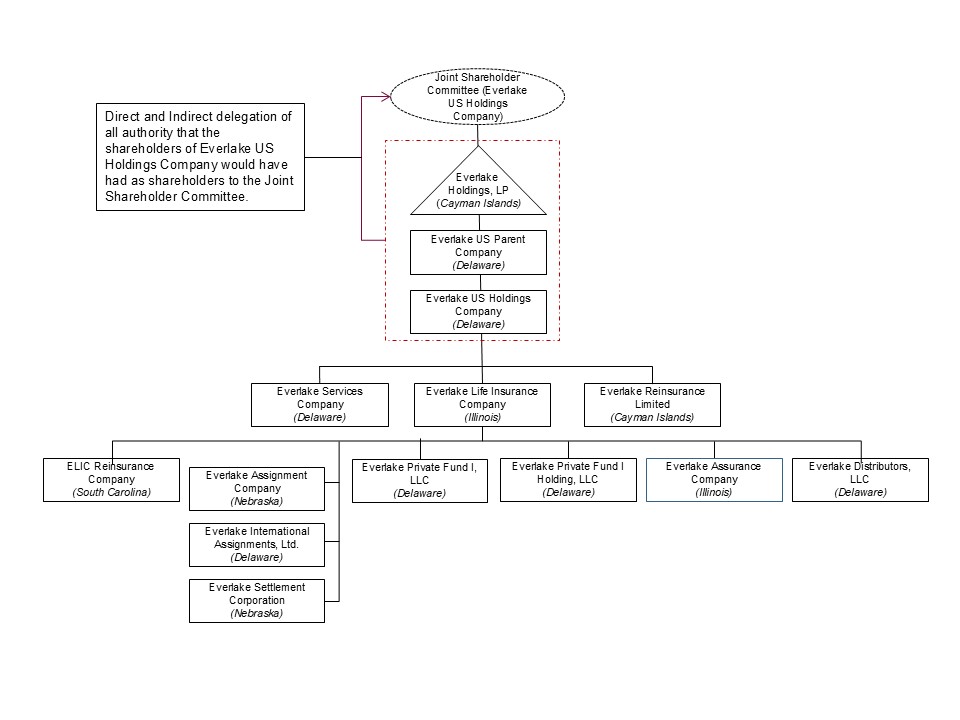
Everlake Assurance Company is a wholly owned subsidiary of Everlake Life Insurance Company (“Everlake Life”), which is a life insurance company organized under the laws of the State of Illinois. Everlake Life is a life insurance company organized under the laws of the State of Illinois and is a direct wholly owned subsidiary of Everlake US Holdings Company, a holding company incorporated in the state of Delaware. Everlake US Holdings Company is a direct wholly owned subsidiary of Everlake US Parent Company, a holding company incorporated in the state of Delaware, which is a direct wholly owned subsidiary of Everlake Holdings, LP, a Cayman Islands limited partnership, whose general partner is Blackstone ISG Investment Partners – A Management Associates (Cayman) – NQ L.P., a Cayman Islands exempted limited partnership (“BISG Management Associates”). BISG Management Associates is an indirect subsidiary of Blackstone Inc., a Delaware corporation, which is a publicly traded company listed on the New York Stock Exchange under the ticker symbol “BX” (“Blackstone”). Pursuant to the terms of the Joint Shareholder Committee Agreement, dated November 1, 2021 (as amended, the “Joint Shareholder Committee Agreement”), Everlake US Holdings Company, Everlake US Parent Company, Everlake Holdings, LP, BISG Management Associates and the other entities that otherwise would directly or indirectly control Everlake US Holdings Company, including Blackstone (collectively, the “Delegating Persons”), established and delegated all authority that the shareholders of Everlake US Holdings Company would have had as shareholders to a joint shareholder committee (the “Shareholder Committee”) comprised of three employees of Blackstone with the title of managing director or any equivalent or senior title. The Shareholder Committee possesses and is entitled to exercise rights attendant to the shares of Everlake US Holdings Company held by the Delegating Persons and, as such, its primary role is to consider and vote on matters appropriate for Everlake US Holdings Company’s shareholders, including the election of members of Everlake US Holding Company’s Board of Directors.
Item 33: INDEMNIFICATION
The Amended and Restated Bylaws of Everlake Assurance Company (Depositor) provide for the indemnification of its directors and officers against expenses, judgments, fines and amounts paid in settlement as incurred by such person, so long as such person shall not have been adjudged to be liable for negligence or misconduct in the performance of a duty to the Company. This right of indemnity is not exclusive of other rights to which a director or officer may otherwise be entitled. Everlake Assurance Company has obtained directors and officers liability insurance which insures against certain liabilities that the directors and officers of Everlake Assurance Company and its subsidiaries, may, in such capacities, incur.
The By-Laws of EDLLC (Distributor) provide that the corporation will indemnify a director, officer, employee or agent of the corporation to the full extent of Delaware law. In general, Delaware law provides that a corporation may indemnify a director, officer, employee or agent against expenses, judgments, fines and amounts paid in settlement if that individual acted in good faith and in a manner he or she reasonably believed to be in or not opposed to the best interests of the corporation, and with respect to any criminal action or proceeding, had no reasonable cause to believe his or her conduct was unlawful. No indemnification shall be made for expenses, including attorney's fees, if the person shall have been judged to be liable to the corporation unless a court determines such person is entitled to such indemnity. Expenses incurred by such individual in defending any action or proceeding may be advanced by the corporation so long as the individual agrees to repay the corporation if it is later determined that he or she is not entitled to such indemnification.
Under the terms of the Amended and Restated Principal Underwriting Agreement with EDLLC, Everlake Assurance Company agrees to indemnify Distributors for any liability that it may incur to a contract owner or party-in-interest under a contract covered by the agreement: (a) arising out of any act or omission in the course of or in connection with rendering services under this Agreement; or (b) arising out of the purchase, retention or surrender of a contract; provided, however that Everlake Life will not indemnify EDLLC for any such liability that results from the willful misfeasance, bad faith or gross negligence of EDLLC or from the reckless disregard by EDLLC of its duties and obligations arising under this Agreement
Insofar as indemnification for liability arising under the Securities Act of 1933 may be permitted to directors, officers and controlling persons of the registrant pursuant to the forgoing provisions, or otherwise, the registrant has been advised that in the opinion of the Securities and Exchange Commission such indemnification is against public Policy as expressed in the Act and is, therefore, unenforceable. In the event that a claim for indemnification against such liabilities (other than the payment by the registrant of expenses incurred or paid by a director, officer or controlling person of the registrant in the successful defense of any action, suit or proceeding) is asserted by such director, officer or controlling person in connection with the securities being registered, the registrant will, unless in the opinion of its counsel the matter has settled by controlling precedent, submit to a court of appropriate jurisdiction the question whether such indemnification by it is against public Policy as expressed in the Act and will be governed by the final adjudication of such issue.
Item 34. PRINCIPAL UNDERWRITERS
Everlake Distributors, L.L.C, ("EDLLC") serves as principal underwriter and distributor of the Policies. EDLLC is a direct wholly owned subsidiary of Everlake Life Insurance Company and an affiliate of Everlake Assurance Company. EDLLC is a registered broker dealer under the Securities and Exchange Act of 1934, as amended ("Exchange Act"), and is a member of FINRA.
On November 1, 2021, Allstate Insurance Company completed its sale of Allstate Assurance Company and Allstate Distributors, LLC, to Everlake US Holdings Company, a Delaware corporation (the “Transaction”). As a result of the Transaction, Allstate Distributors, LLC, has changed its name to Everlake Distributors, LLC ("EDLLC"), and Allstate Assurance Company has changed its name to Everlake Assurance Company (the “Company”).
As stated in the SAI, under the underwriting agreement for the Policies, the Company reimburses EDLLC for expenses incurred in distributing the Policies, including liability arising from services Everlake Assurance Company provides on the Policies.
In addition to the Everlake Assurance Company Variable Life Separate Account, EDLLC serves as the principal underwriter of certain life insurance policies issued through the following separate accounts:
•Everlake Life Insurance Co Variable Annuity Separate Account C
•Everlake Life Variable Life Separate Account A
•Everlake Financial Advisors Separate Account I
•Lincoln Benefit Life Variable Annuity Account
•Lincoln Benefit Life Variable Life Account
The following are the directors and officers of EDLLC. The principal business address of each of the officers and directors listed below is 3100 Sanders Road, Suite 303, Northbrook, IL 60062.
| | | | | |
Name | Positions with Underwriter |
| Tyler (Doney) Largey | Manager and Chairman of the Board |
| Angela Fontana | Manager, Senior Vice President, Chief Legal Officer and Secretary |
| Rebecca Kennedy | Manager, President and Chief Executive Officer |
| Tracy Kirchhoff | AML Officer |
| Julie Harrigan | Treasurer, Controller & Financial and Operations Principal (FINOP) |
| Michael Hartt | Senior Vice President and Chief Accounting Officer |
| Patrick Jeneske | Chief Compliance Officer |
| Sonya Ekart | Vice President and Assistant Secretary |
Christine Husted | Vice President and Assistant Treasurer |
Item 35. LOCATION OF ACCOUNTS AND RECORDS
The Depositor, Everlake Assurance Company, is located at 3100 Sanders Road, Suite 303, Northbrook, Illinois 60062.
The Principal Underwriter, EDLLC, is located at 3100 Sanders Road, Suite 303, Northbrook, Illinois 60062.
The Administrator of the Separate Account and the Administrative Service Provider, Everlake Life Insurance Company, is located at 3100 Sanders Road, Suite 303, Northbrook, IL 60062.
Each company maintains those accounts and records required to be maintained pursuant to Section 31(a) of the Investment Company Act and the rules promulgated thereunder.
Item 36. MANAGEMENT SERVICES
None.
Item 37. FEE REPRESENTATION
Everlake Assurance Company hereby represents that the aggregate fees and charges deducted under the Policy are reasonable in relation to the services rendered, the expenses expected to be incurred, and the risks assumed by Everlake Assurance Company.
SIGNATURES
Pursuant to the requirements of the Securities Act of 1933 and the Investment Company Act of 1940, the Registrant, Everlake Assurance Variable Life Separate Account, certifies that it meets the requirements for effectiveness of this Registration Statement under Rule 485(b) under the Securities Act of 1933 and has caused this Registration Statement to be signed on its behalf by the undersigned, thereunto duly authorized in the Township of Northfield, State of Illinois, on the day of April 27, 2026.
EVERLAKE ASSURANCE VARIABLE LIFE SEPARATE ACCOUNT
(Registrant)
By: EVERLAKE ASSURANCE COMPANY
By: /s/ Angela Fontana
-------------------------
Angela Fontana
Senior Vice President, Chief Legal Officer and Secretary
EVERLAKE ASSURANCE COMPANY
(Depositor)
By: /s/ Angela Fontana
-------------------------
Angela Fontana
Senior Vice President, Chief Legal Officer and Secretary
Pursuant to the requirements of the Securities Act of 1933, this Registration Statement has been signed by the following persons and in the capacities indicated on April 27, 2026.
| | | | | |
| /s/ Angela K. Fontana | Director, Senior Vice President, Chief Legal Officer and Secretary |
| Angela K. Fontana | |
| |
| */Johnny Johns | Director |
| Johnny Johns | |
| |
| */ Laurie L. Harris | Director |
| Laurie L. Harris | |
| |
| */ Michael Hartt | Senior Vice President and Chief Accounting Officer |
| Michael Hartt | |
| |
| */ Michael W. Hovey | Director and Chairman of the Board |
| Michael W. Hovey | |
| |
| */ Ted M. Johnson | Director, Senior Vice President and Chief Financial Officer |
| Ted M. Johnson | |
| |
| */ Tyler E. Largey | Director, President and Chief Executive Officer |
| Tyler E. Largey | |
| |
| */ Philip Sherrill | Director |
| Philip Sherrill | |
| |
| */ Susan E. Voss | Director |
| Susan E. Voss | |
| |
| */ Bonnie G. Wasgatt | Director |
| Bonnie G. Wasgatt | |
| |
| | | | | |
| *By: | /s/ Angela K. Fontana |
| Angela K. Fontana, Attorney-in-fact, pursuant to Power of Attorney |
INDEX TO EXHIBITS
TO REGISTRATION STATEMENT ON FORM N-6
EVERLAKE ASSURANCE VARIABLE LIFE ACCOUNT
EXHIBIT NO. DESCRIPTION